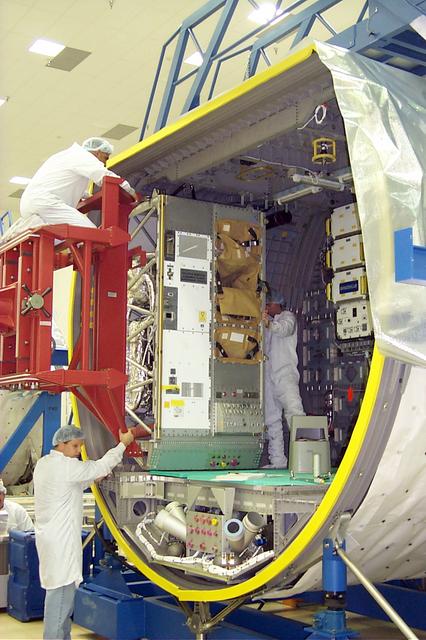
Interior of a Spacehab module showing the type of rack mounting that will be used, and crew working space that will be available, on the STS-107 Research 1 mission in 2002. Experiments plarned for the mission include soil mechanics, combustion physics, and cell science.
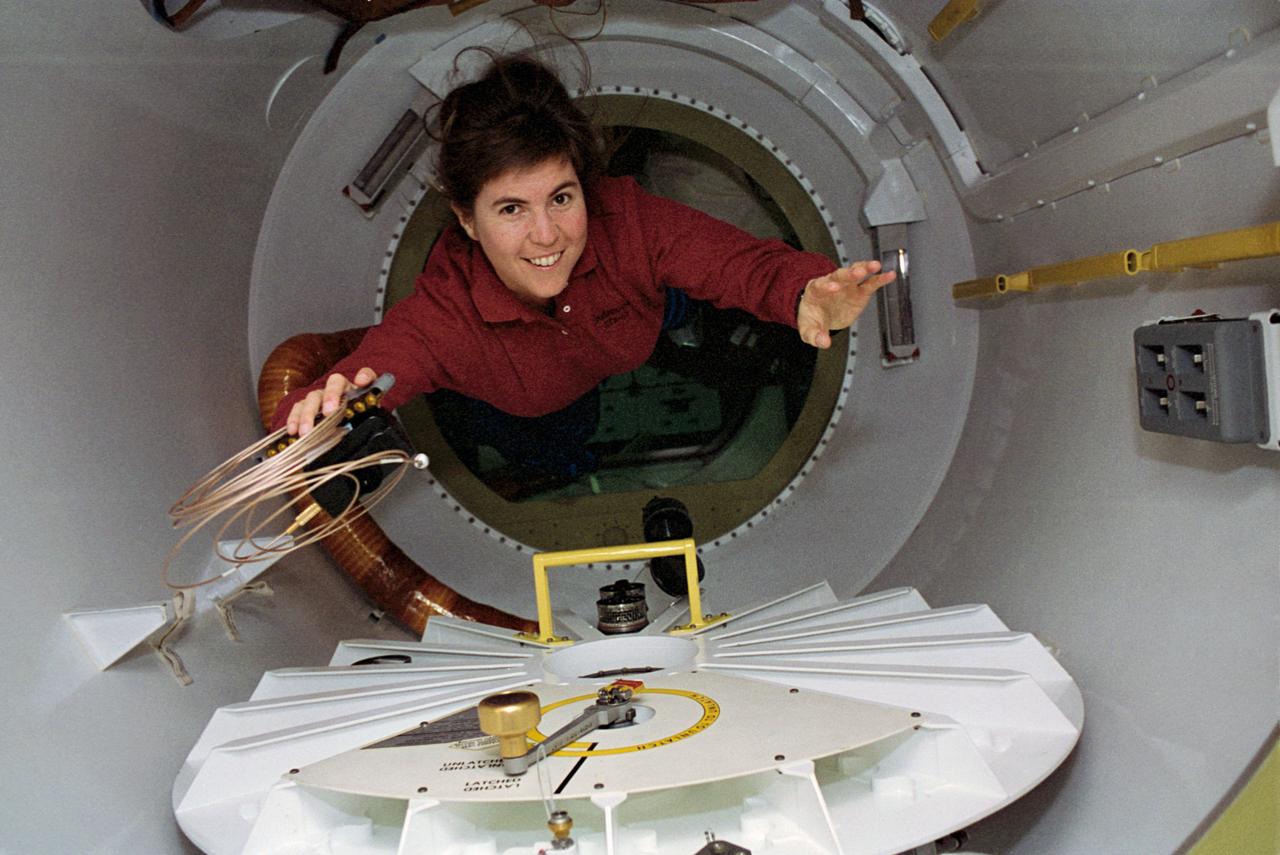
STS057-28-013 (21 June - 1 July 1993) --- With a camera and cable in hand, astronaut Janice E. Voss, mission specialist, floats through a special tunnel into the SpaceHab module. Voss and five other NASA astronauts spent almost ten days aboard the Space Shuttle Endeavour in Earth-orbit supporting the SpaceHab mission, retrieving the European Retrievable Carrier (EURECA) and conducting various experiments.
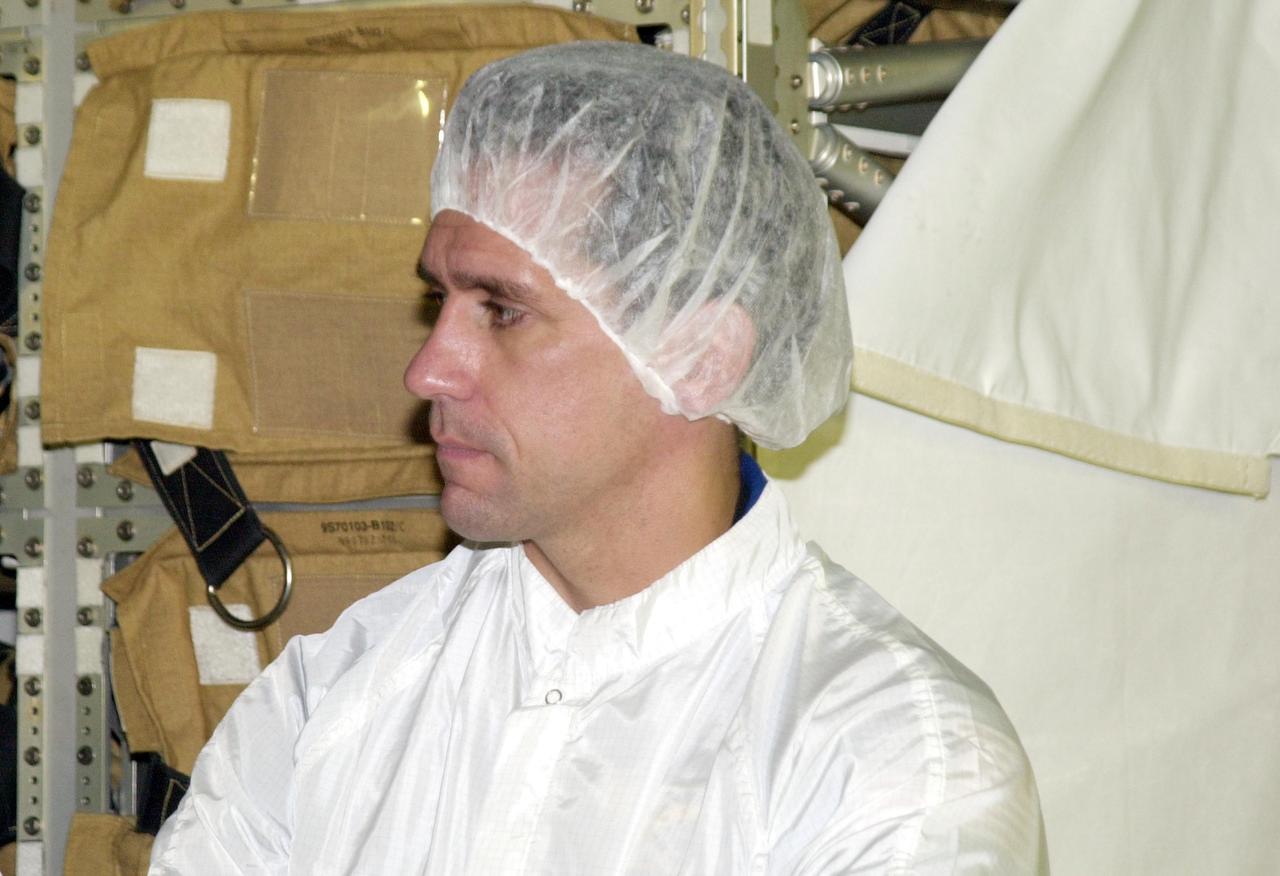
KENNEDY SPACE CENTER, FLA. - STS-116 Mission Specialist Christer Fugelsang, who is with the European Space Agency, listens to instructions in the SPACEHAB module. He and other crew members are taking part in equipment familiarization at SPACEHAB. The objective of their mission to the International Space Station is to deliver and attach the third port truss segment, the P5 Truss, deactivate and retract P6 Truss Channel 4B (port-side) solar array, reconfigure station power from 2A and 4A solar arrays, deliver the Expedition 8 crew to the Station and return the Expedition 7 crew to Earth. The mission is currently targeted for launch in July 2003..
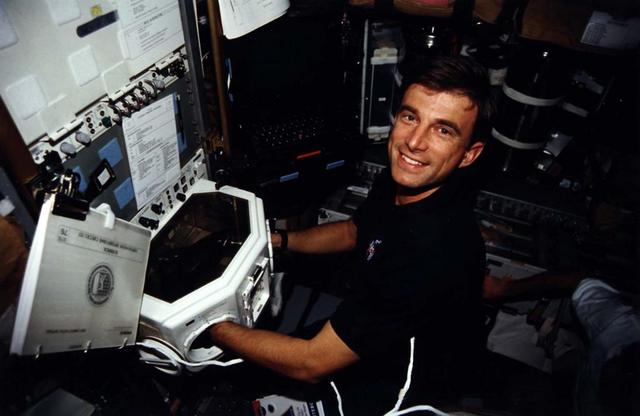
Astronaut Ronald M. Sega, payload commander, works in the glovebox facility in the Spacehab laboratory aboard the Earth-orbiting Space Shuttle Atlantis. The Spacehab facility was one f the busier research areas on Atlantis during the STS-76 mission. Also, some of the gear for transfer to Russia's Mir Space Station was stowed there prior to the March 23, 1996 docking of Atlantis.
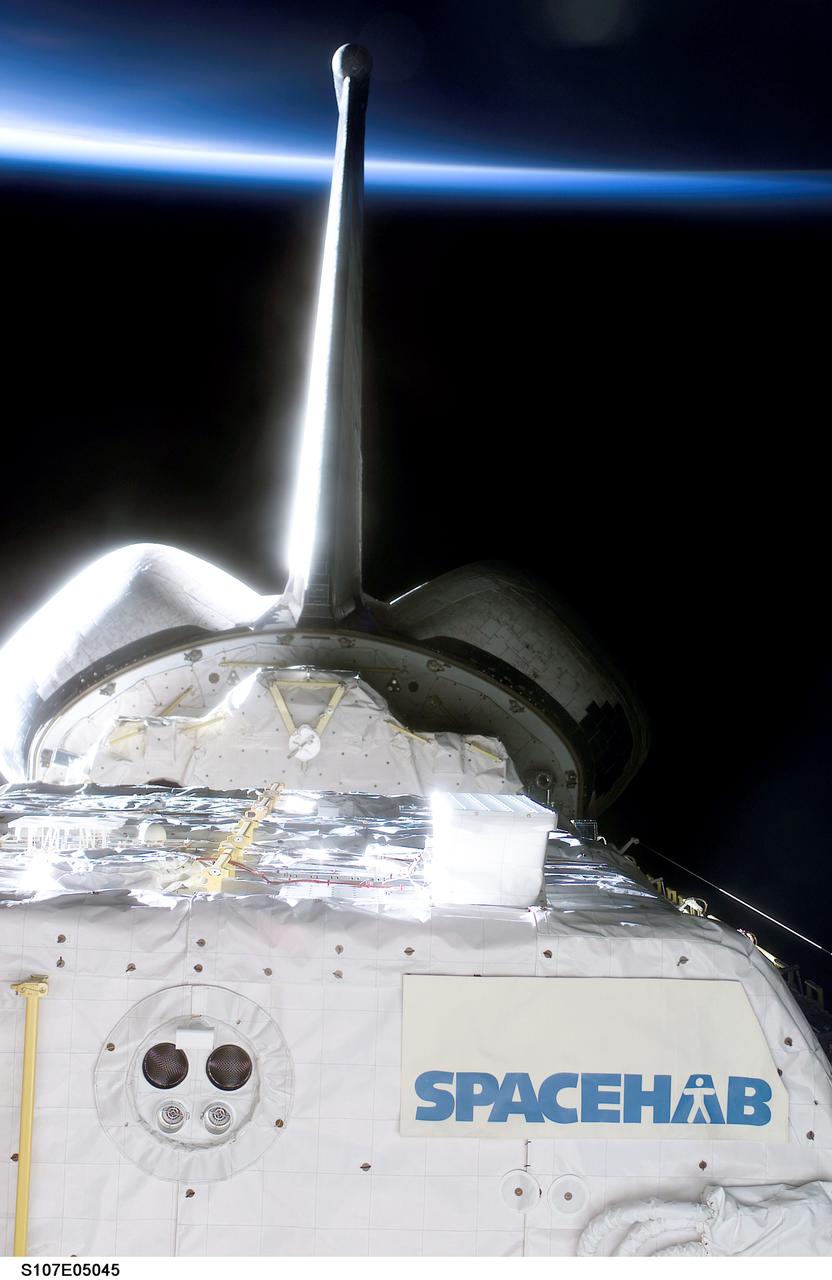
The Space Shuttle Orbiter Columbia STS-107 mission, launched January 16, 2003, is strictly a multidiscipline microgravity and Earth science research mission involving 80-plus International experiments tp be performed during 16-days, many of which will be managed by the Marshall Space Flight Center in Huntsville, Alabama. The majority of the research will be conducted in the Shuttle's middeck, the area directly under the cockpit, and in the new SPACEHAB Research Double Module. This is the first flight for that module, which doubles the volume available for experiments and significantly increases the amount and complexity of research from the last dedicated Shuttle science mission, STS-95, flown in 1998 with a single SPACEHAB module. The pressurized module is carried in Columbia's payload bay and is accessible to the crew via a turnel from the Shuttle's middeck. This onboard photo shows the SPACEHAB Research Double Module in Columbia's payload bay, back dropped by the shuttle vertical stabilizer, the blackness of space, and a thin slice of Earth's horizon. The first shuttle mission in 2003, the STS-107 mission marks the 113th flight overall in NASA's Space Shuttle program, and the 28th flight of the Space Shuttle Orbiter Columbia.
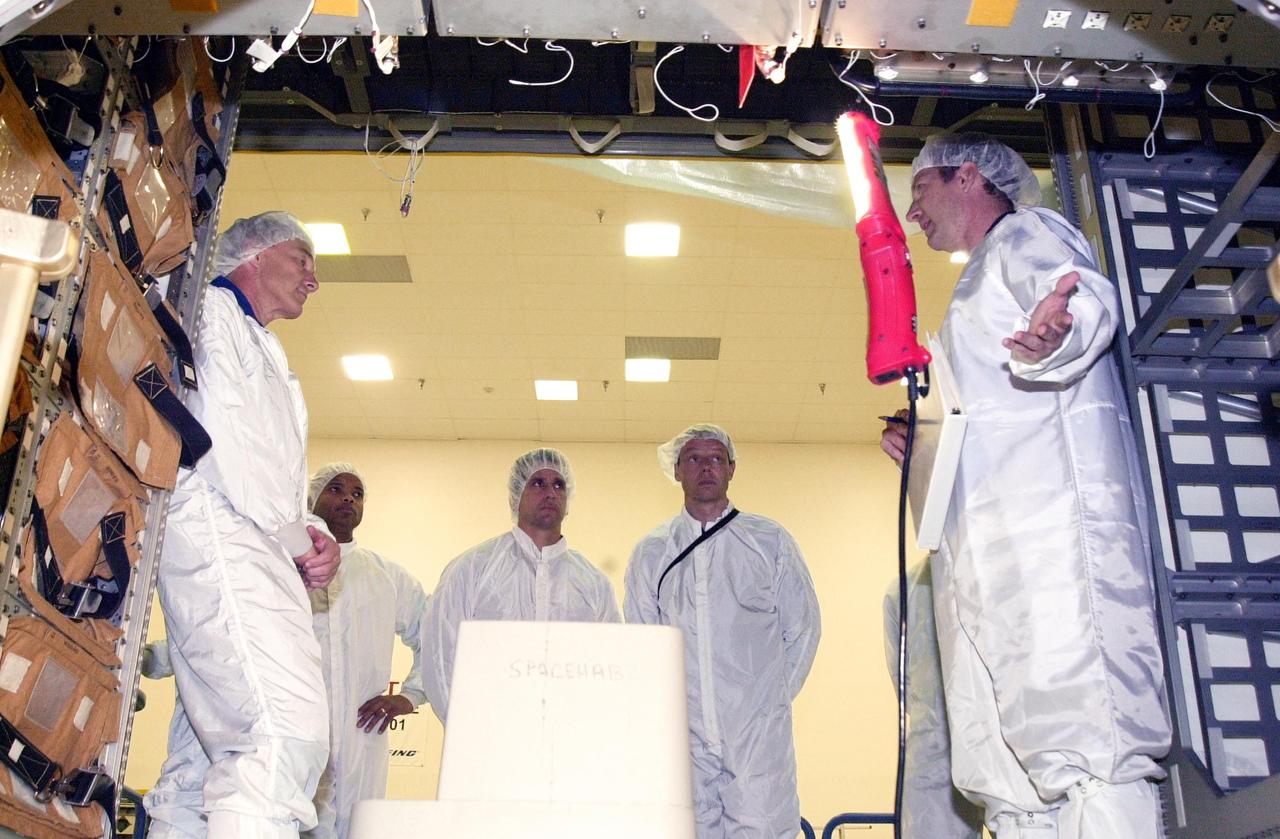
KENNEDY SPACE CENTER, FLA. -- STS-116 crew members take part in equipment familiarization in the SPACEHAB module. From left are Mission Commander Terrence Wilcutt, Mission Specialist Robert Curbeam, Pilot William Oefelein and Mission Specialist Christer Fugelsang, who is with the European Space Agency. At right is a SPACEHAB trainer. Objective of their mission to the International Space Station is to deliver and attach the third port truss segment, the P5 Truss, deactivate and retract P6 Truss Channel 4B (port-side) solar array, reconfigure station power from 2A and 4A solar arrays, deliver the Expedition 8 crew to the Station and return the Expedition 7 crew to Earth. The mission is currently targeted for launch in July 2003.
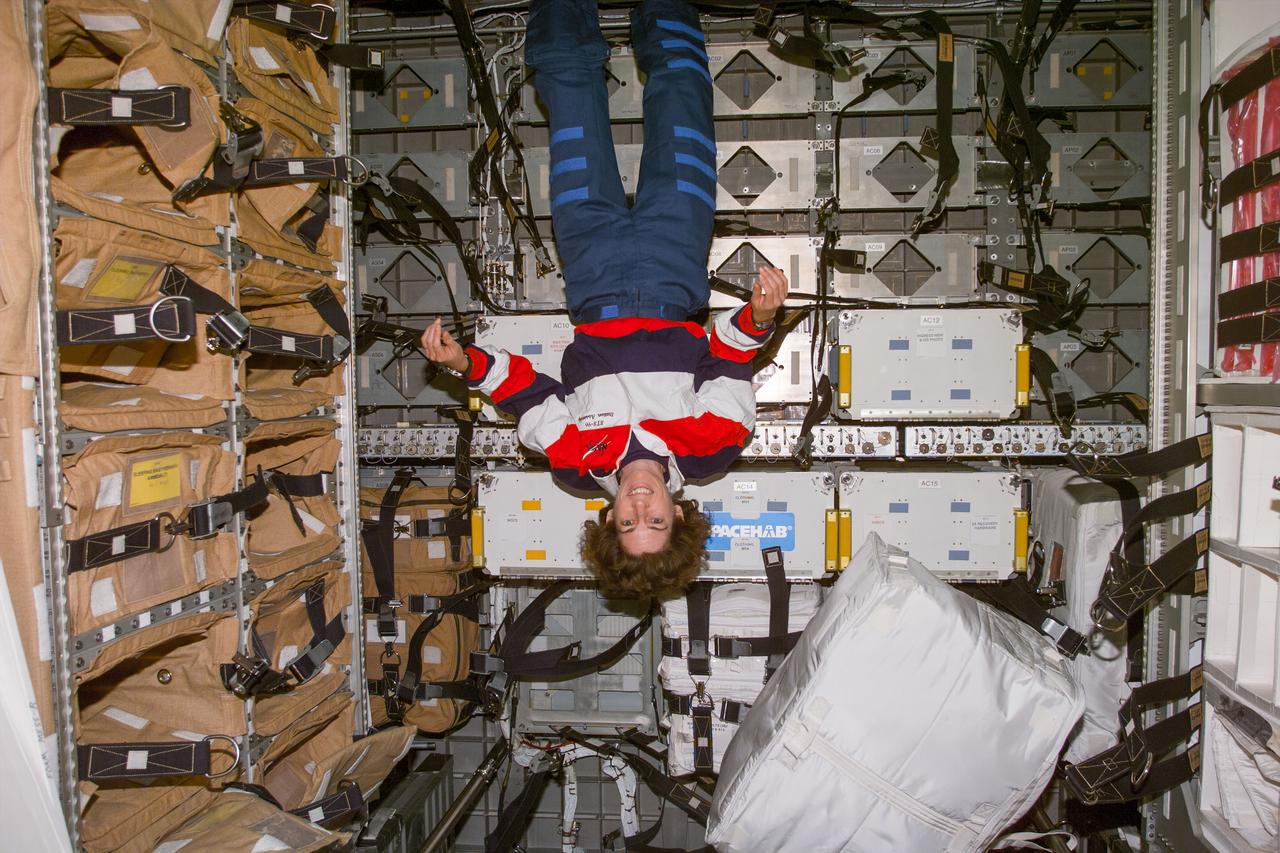
S96-E-5153 (2 June 1999) --- Onboard Discovery's SpaceHab, astronaut Ellen Ochoa surveys the near completion of a gigantic move effort of supplies from the shuttle to the International Space Station (ISS). Tons of supplies were carried up in Discovery and the SpaceHab module in the payload bay to be transferred to the station. The photo was taken with an electronic still camera (ESC) at 01:16:30 GMT, June 2, 1999. Photo credit: NASA
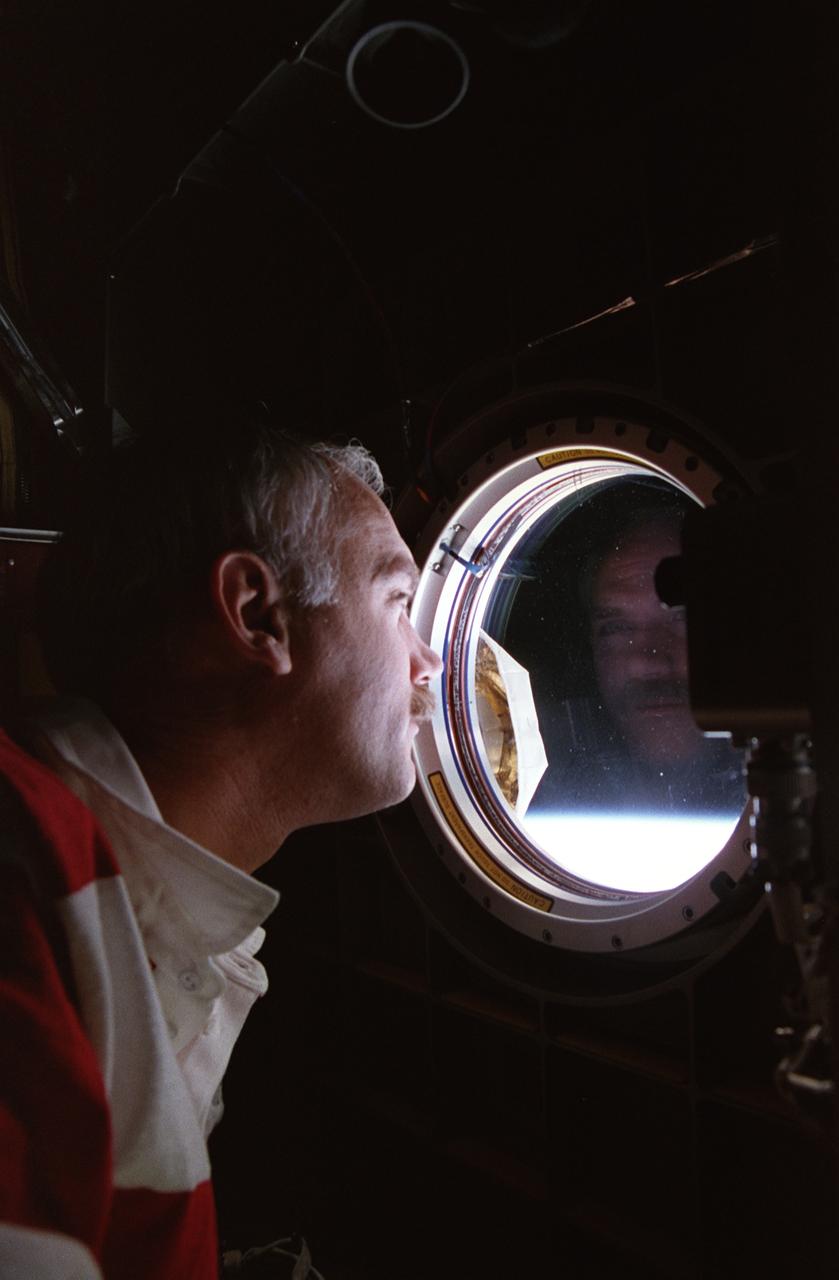
STS079-346-022 (16-26 Sept. 1996) --- Astronaut William F. Readdy, mission commander, looks at the night sky and Earth's horizon through a viewing port in the Spacehab Module in the space shuttle Atlantis' cargo bay. The double module version of Spacehab was flying for the first time.
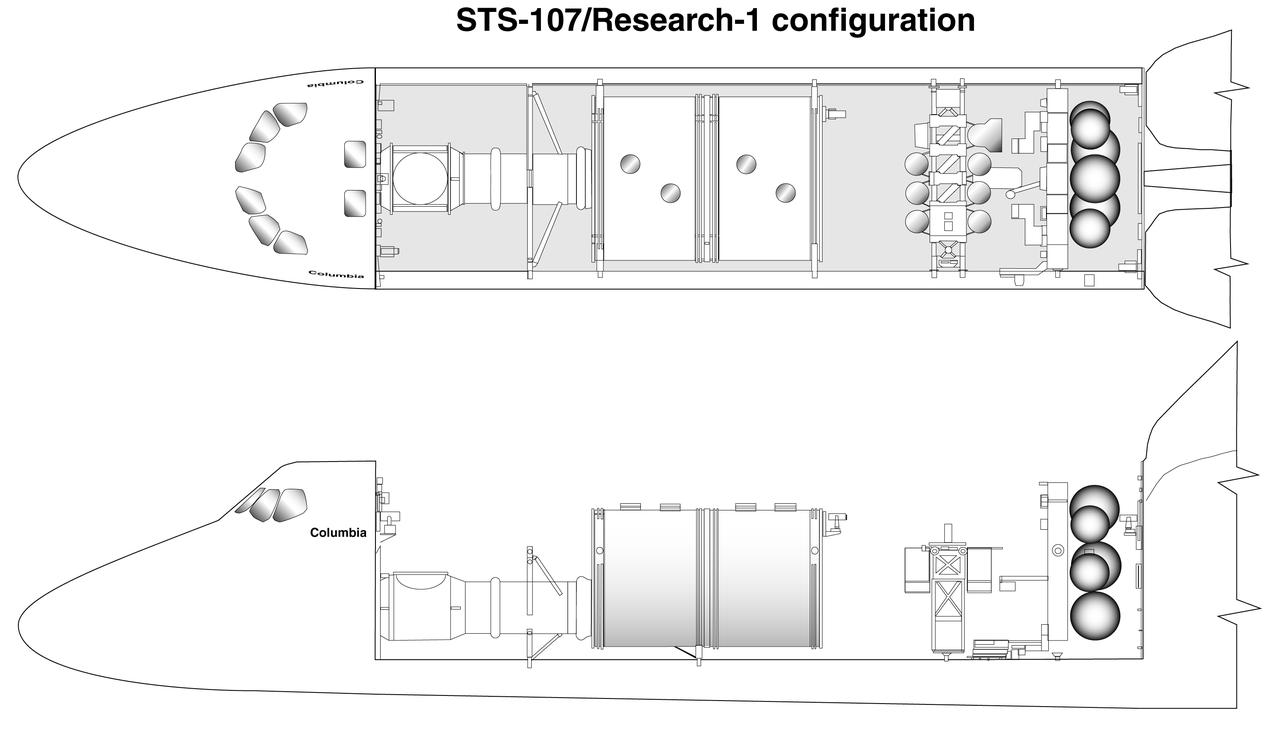
Thisdiagram shows the general arrangement of the payloads to be carried by the multidisciplinary STS-107 Research-1 Space Shuttle mission in 2002. The Spacehab module will host experiments that require direct operation by the flight crew. Others with special requirements will be on the GAS Bridge Assembly sparning the payload bay. The Extended Duration Orbiter kit carries additional oxygen and hydrogen for the electricity-producing fuel cells. Research-1 experiments will cover space biology, life science, microgravity research, and commercial space product development, research sponsored by NASA's Office of Biological and Physical Research. An alternative view with callouts is available at 0101764.
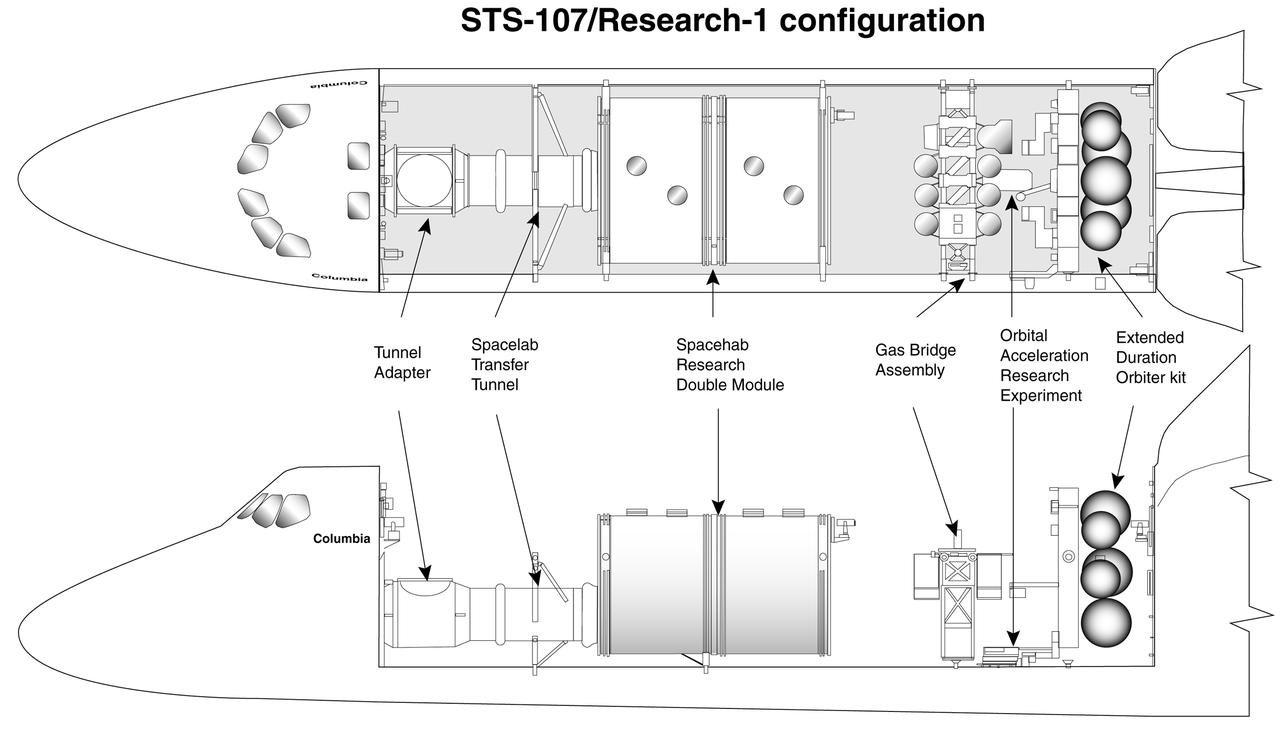
This diagram shows the general arrangement of the payloads to be carried by the multidisciplinary STS-107 Research-1 Space Shuttle mission in 2002. The Spacehab module will host experiments that require direct operation by the flight crew. Others with special requirements will be on the GAS Bridge Assembly sparning the payload bay. The Extended Duration Orbiter kit carries additional oxygen and hydrogen for the electricity-producing fuel cells. Research-1 experiments will cover space biology, life science, microgravity research, and commercial space product development, research sponsored by NASA's Office of Biological and Physical Research. An alternative view without callouts is available at 0101765.
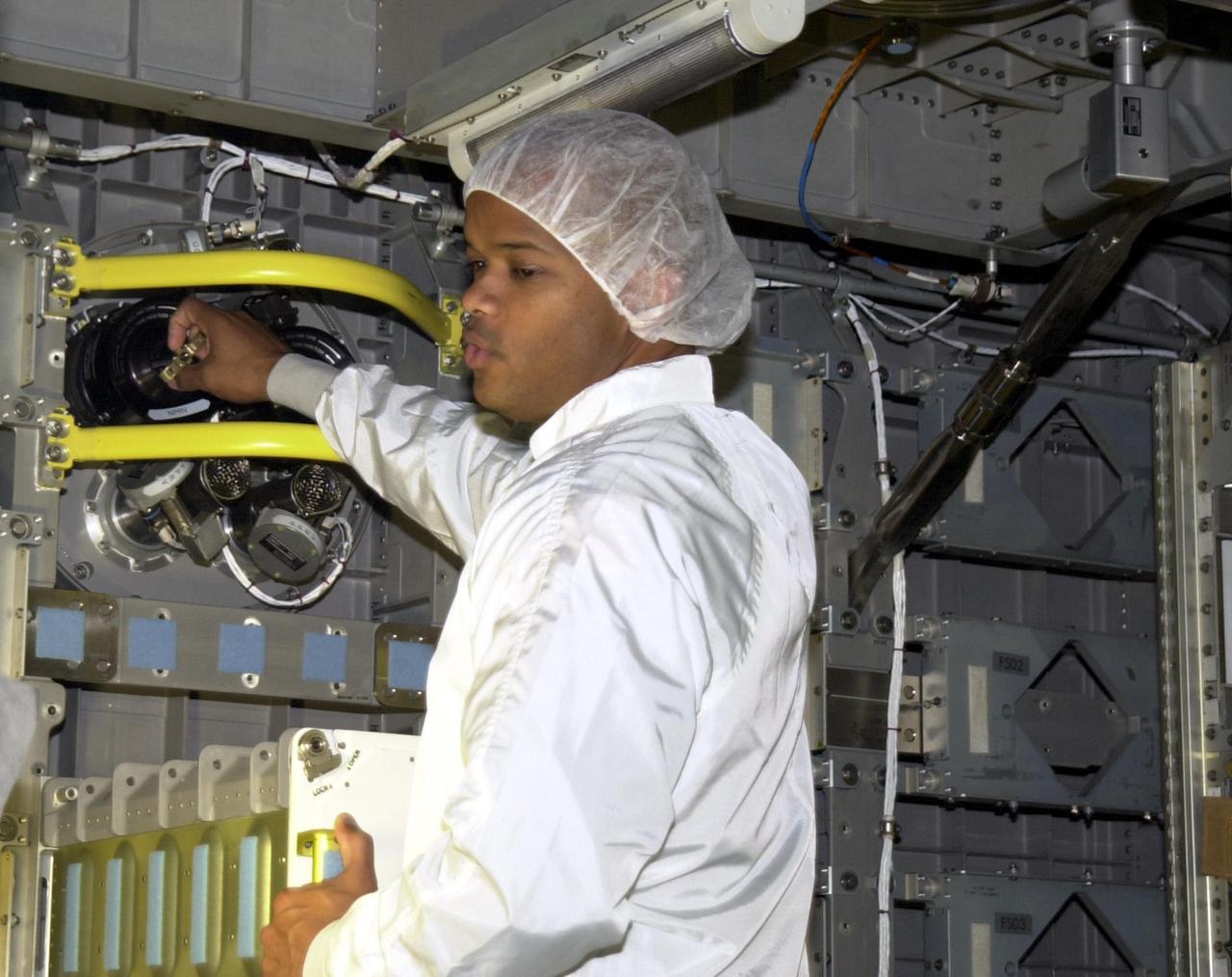
KENNEDY SPACE CENTER, FLA. -- STS-116 Mission Specialist Robert Curbeam handles a piece of equipment in the SPACEHAB module. He and other crew members are taking part in equipment familiarization. Objective of their mission to the International Space Station is to deliver and attach the third port truss segment, the P5 Truss, deactivate and retract P6 Truss Channel 4B (port-side) solar array, reconfigure station power from 2A and 4A solar arrays, deliver the Expedition 8 crew to the Station and return the Expedition 7 crew to Earth. The mission is currently targeted for launch in July 2003.
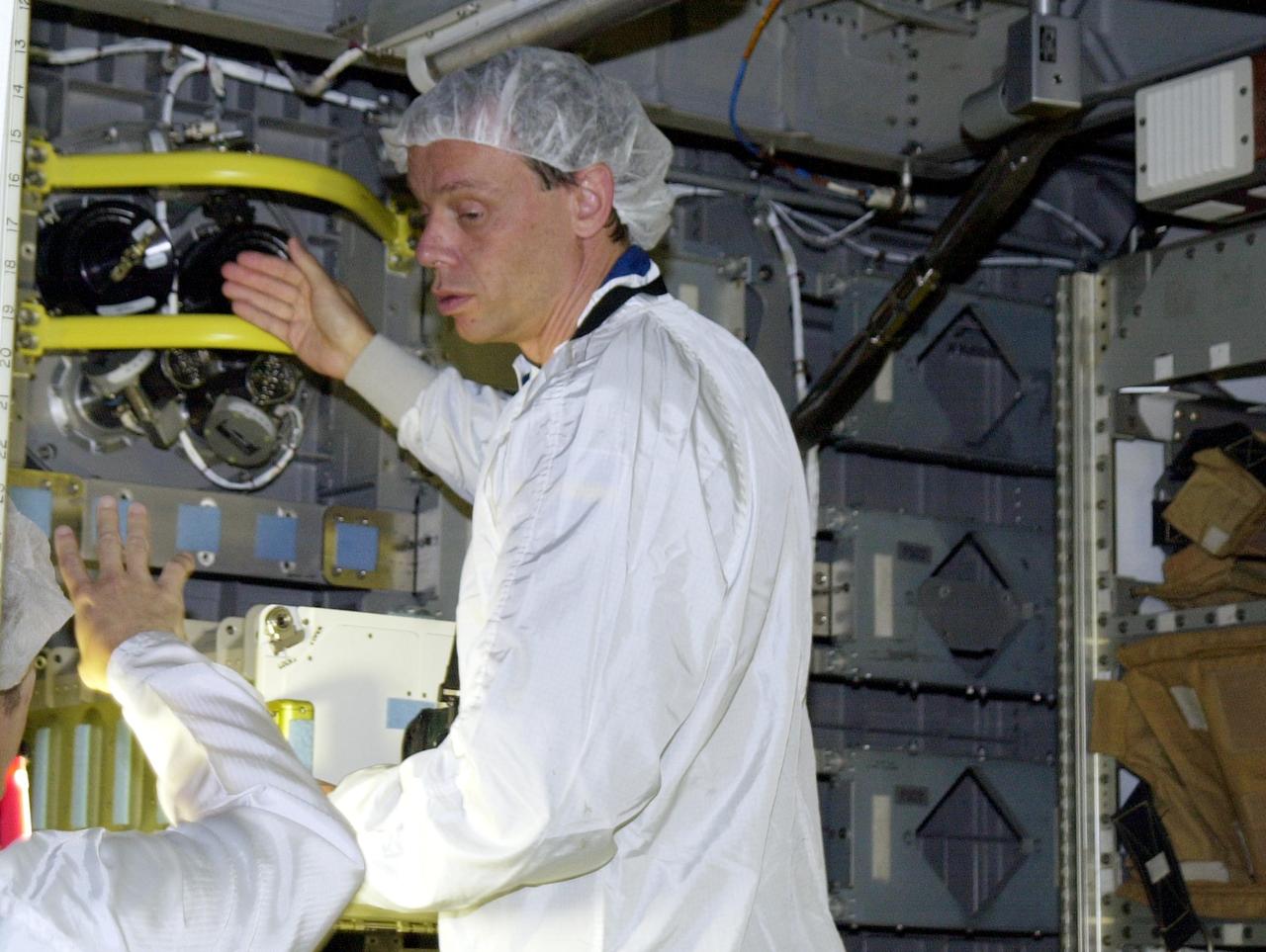
KENNEDY SPACE CENTER, FLA. -- STS-116 Mission Specialist Christer Fugelsang, who is with the European Space Agency, gets instruction about a piece of equipment in the SPACEHAB module. He and other crew members are taking part in equipment familiarization. Objective of their mission to the International Space Station is to deliver and attach the third port truss segment, the P5 Truss, deactivate and retract P6 Truss Channel 4B (port-side) solar array, reconfigure station power from 2A and 4A solar arrays, deliver the Expedition 8 crew to the Station and return the Expedition 7 crew to Earth. The mission is currently targeted for launch in July 2003.
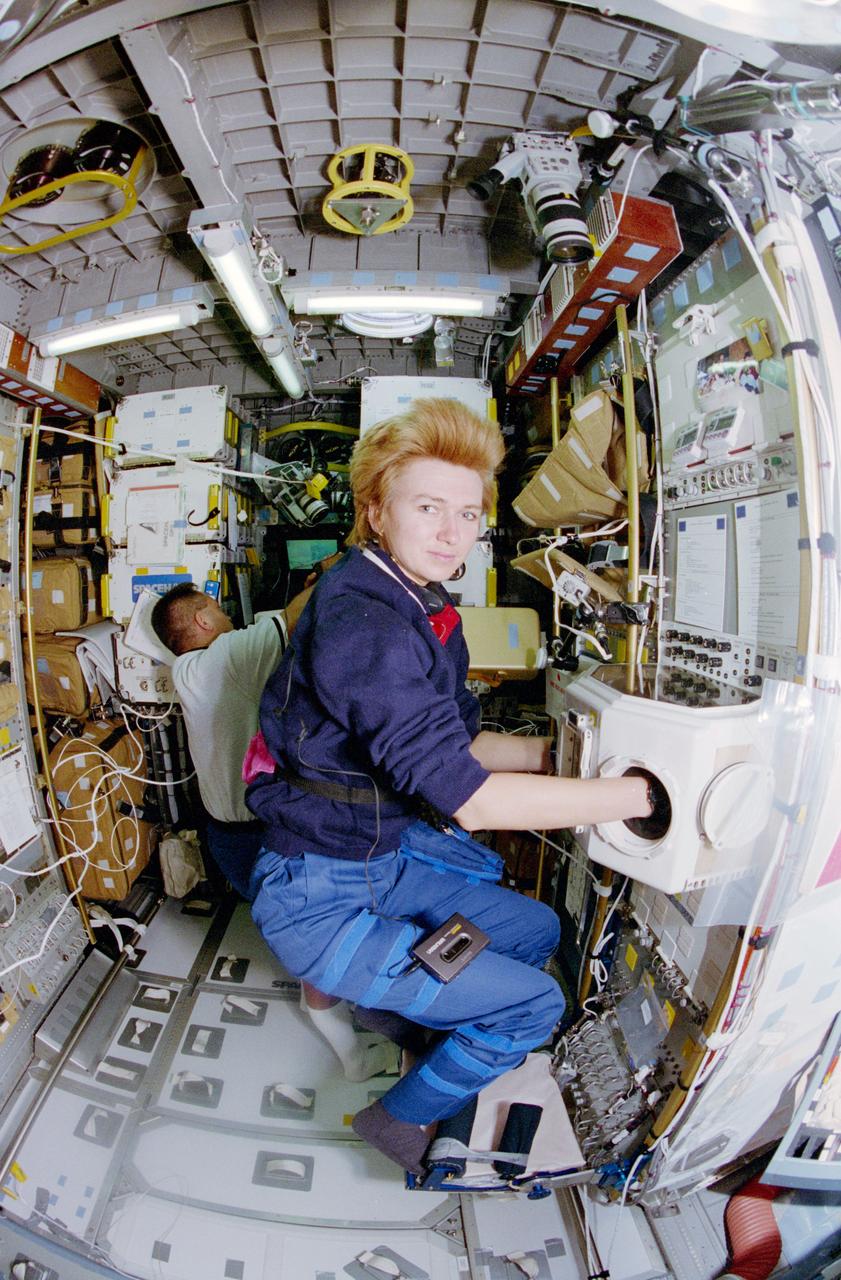
STS084-317-020 (15-24 May 1997) --- Elena V. Kondakova works in the Spacehab glovebox, aboard the Space Shuttle Atlantis, as Carlos I. Noriega, a fellow mission specialist, checks on an experiment in the background.
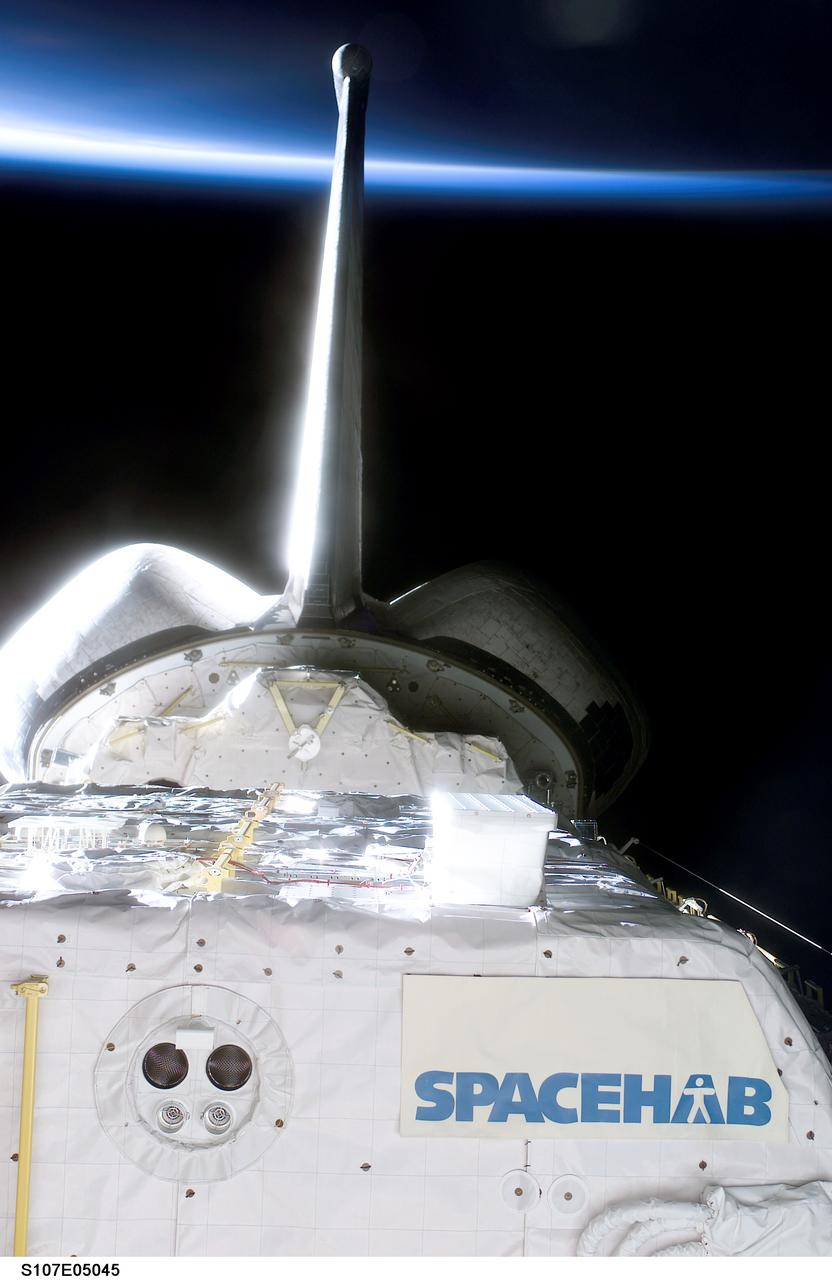
STS107-E-05045 (18 January 2003) --- The SPACEHAB Research Double Module in the Space Shuttle Columbia’s payload bay and vertical stabilizer are backdropped by the blackness of space and a thin slice of Earth’s horizon.
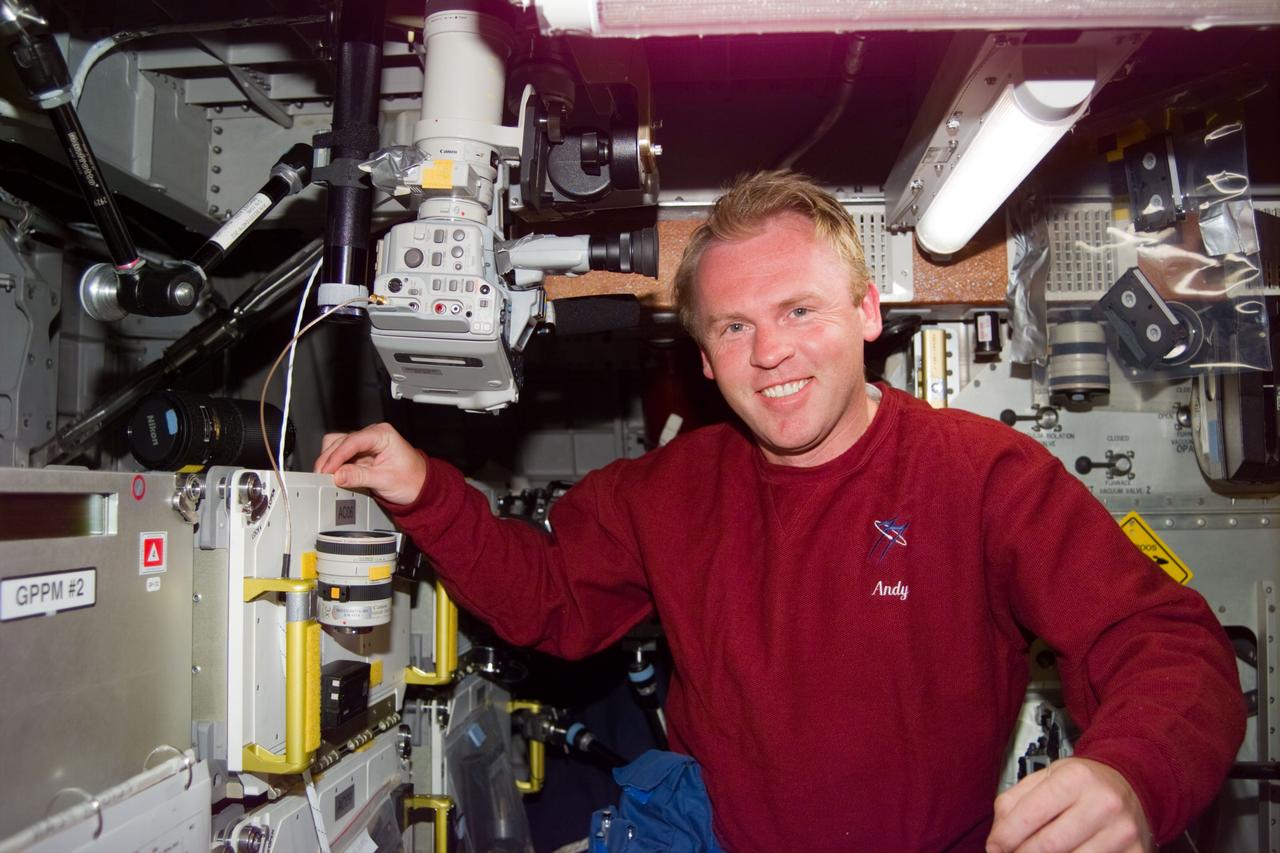
S77-E-5089 (25 May 1996) --- Astronaut Andrew S. W. Thomas, mission specialist, interrupts a Spacehab task to pose for an Electronic Still Camera (ESC) snapshot inside the Spacehab Module onboard the Earth-orbiting Space Shuttle Endeavour. In upper left is the view port which crew members had used for viewing and photographing operations with the Spartan 207/Inflatable Antenna Experiment (IAE). Thomas has his hand on an aft-bulkhead-mounted locker. The Space Experiment Facility (SEF), designed and managed by the University of Alabama, is just behind his left shoulder.
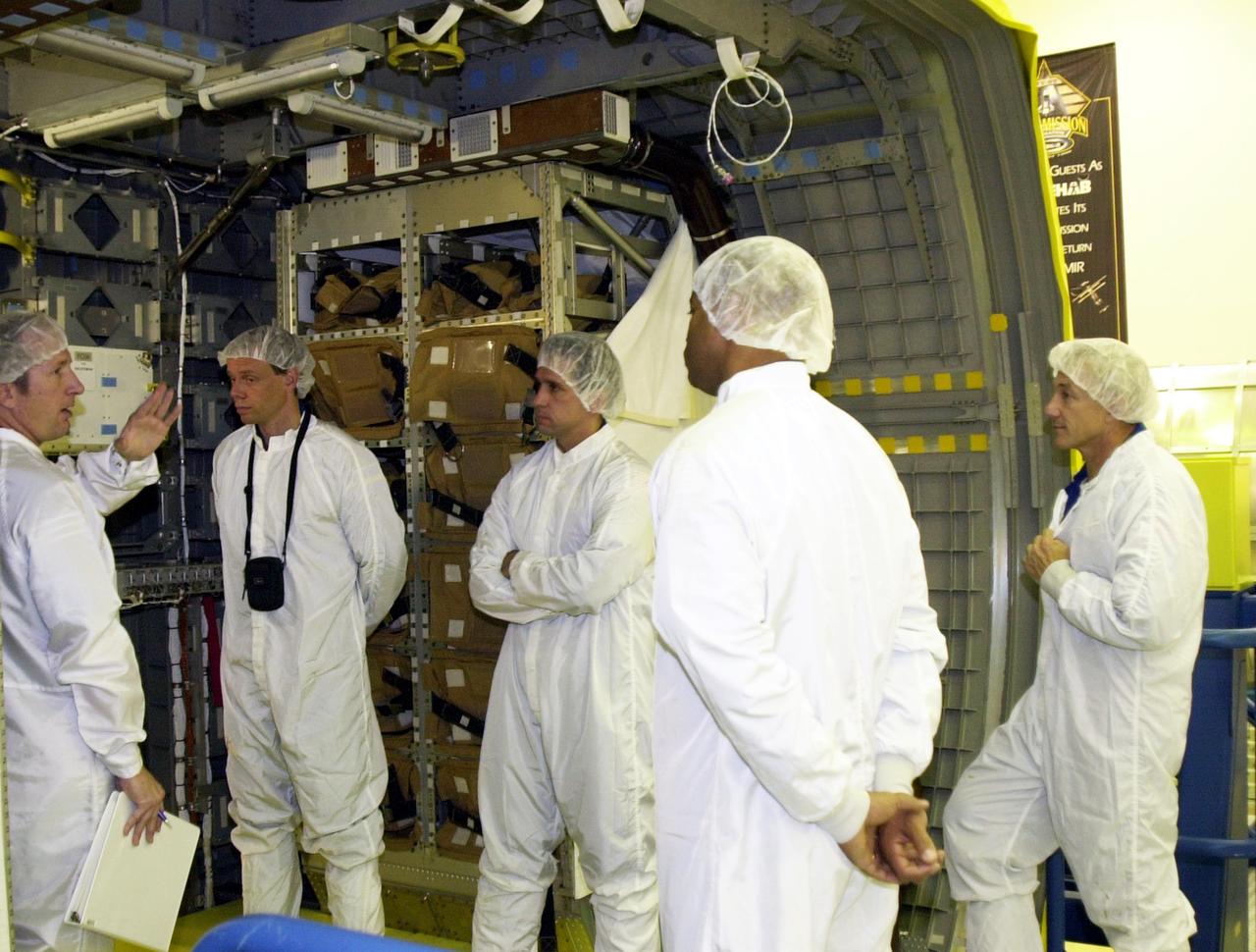
KKENNEDY SPACE CENTER, FLA. -- STS-116 crew members listen to instructions from a trainer (left) about equipment in the SPACEHAB module. Starting second from left are Mission Specialist Christer Fugelsang, who is with the European Space Agency, Pilot William Oefelein, Mission Specialist Robert Curbeam an Mission Commander Terrence Wilcutt. Objective of their mission to the International Space Station is to deliver and attach the third port truss segment, the P5 Truss, deactivate and retract P6 Truss Channel 4B (port-side) solar array, reconfigure station power from 2A and 4A solar arrays, deliver the Expedition 8 crew to the Station and return the Expedition 7 crew to Earth. The mission is currently targeted for launch in July 2003.
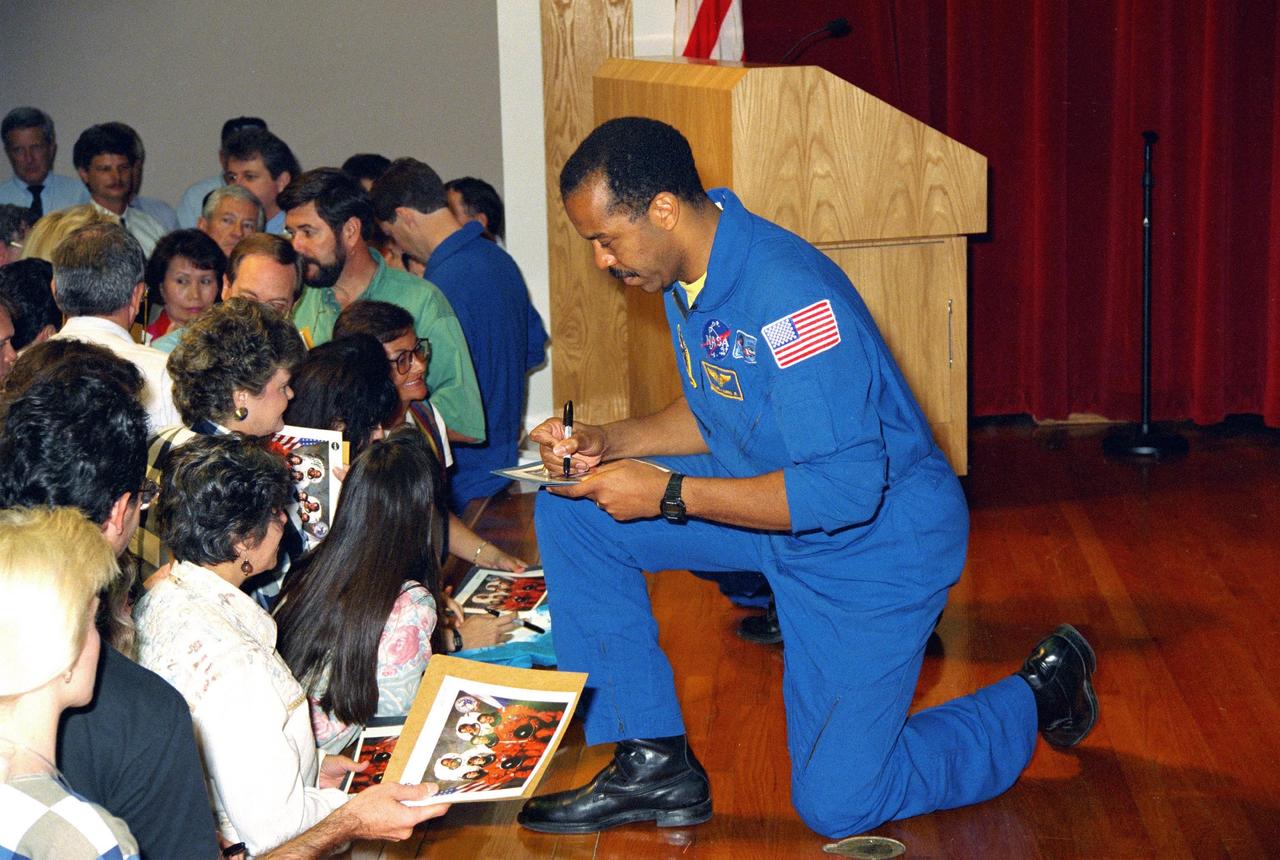
KENNEDY SPACE CENTER, FLA. -- STS-63 Mission Specialist Dr. Bernard Harris autographs copies of the crew photograph in the Training Auditorium during a March crew visit to thank employees for their help in ensuring a successful mission. The six-member crew on Discovery, who landed February 11 after an eight-day flight, included Mission Commander James Wetherbee, Pilot Eileen Collins (on the first flight of a female Shuttle pilot), and Mission Specialists Michael Foale, Janice Voss and Vladimir Titov. The mission featured another milestone, the first approach and flyaround of a Shuttle with Russian Space Station Mir. It was also the second flight of a russian cosmonaut on Shuttle and the third flight of the SPACEHAB module, which carried 20 experiments in biotechnology, advanced materials development, technology demonstrations and other measurements.
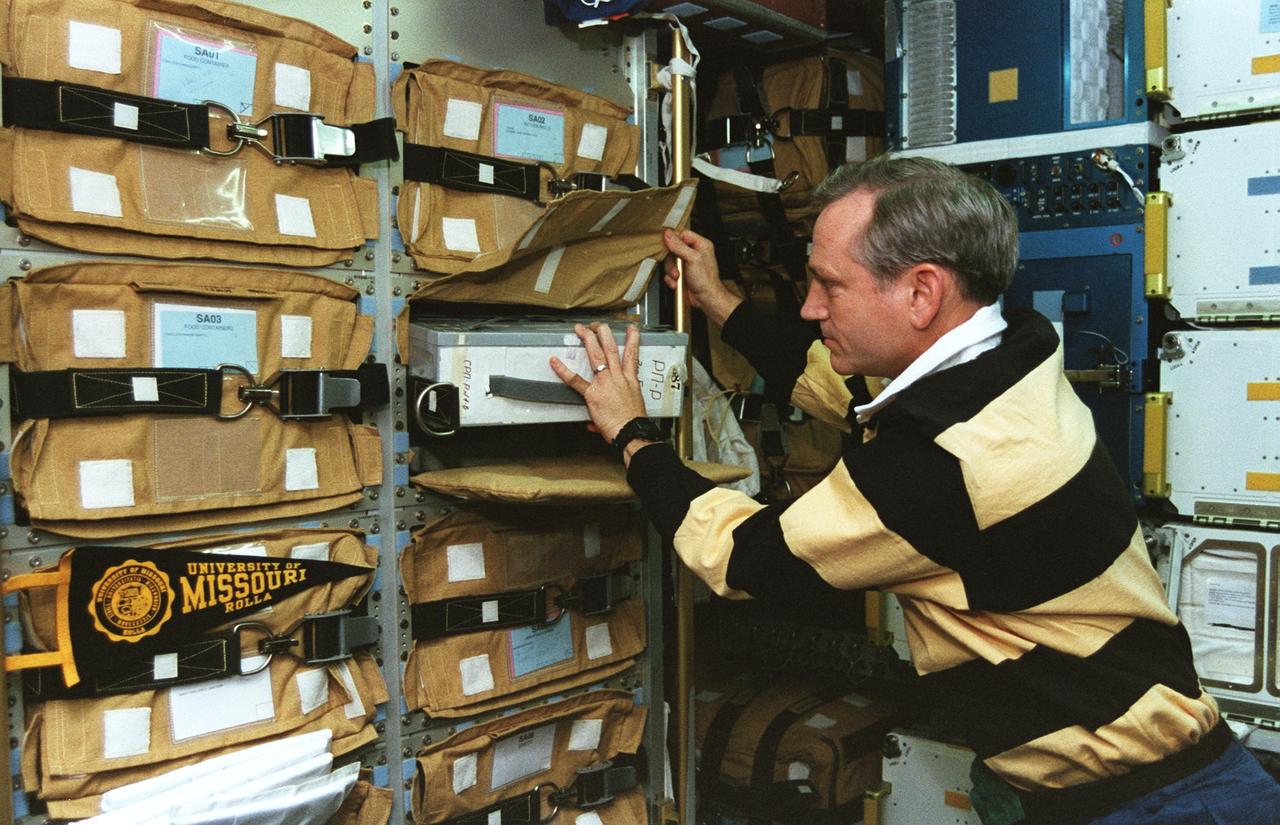
STS079-365-009 (16-26 Sept. 1996) --- Astronaut Thomas D. Akers, mission specialist, continues his busy task of supply transfer. Akers referred to this corner of the Spacehab Module as "transfer headquarters," where he was responsible for keeping up with a large supply of food, batteries, flight gear and a number of other supplies. This flight marked the first for the double module Spacehab configuration.
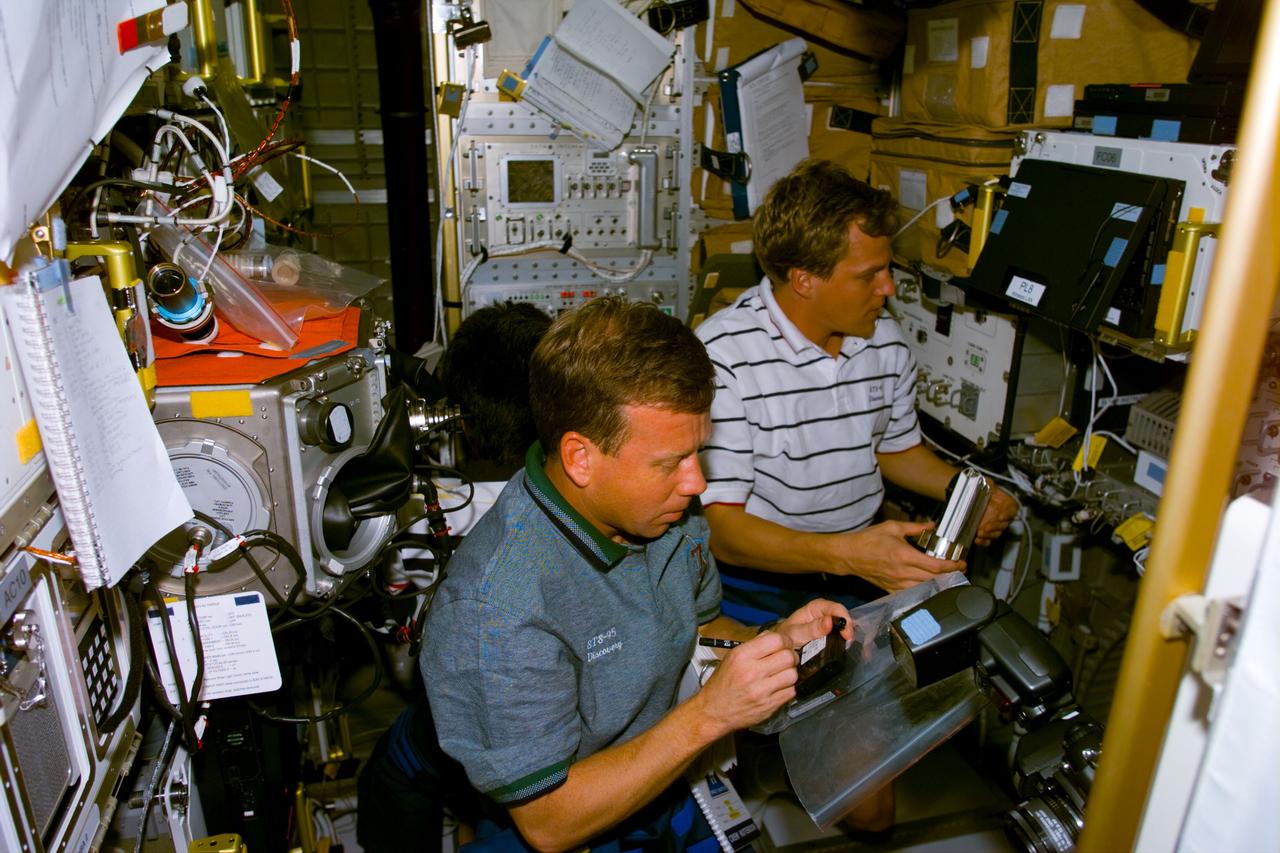
STS095-E-5109 (2 Nov. 1998) --- Astronauts Steven W. Lindsey (left), STS-95 pilot, and Scott E. Parazynski, mission specialist, work with cameras and other supportive gear for experiments on Spacehab. The photo was taken with an electronic still camera (ESC) at 05:11:28 GMT, Nov. 2.
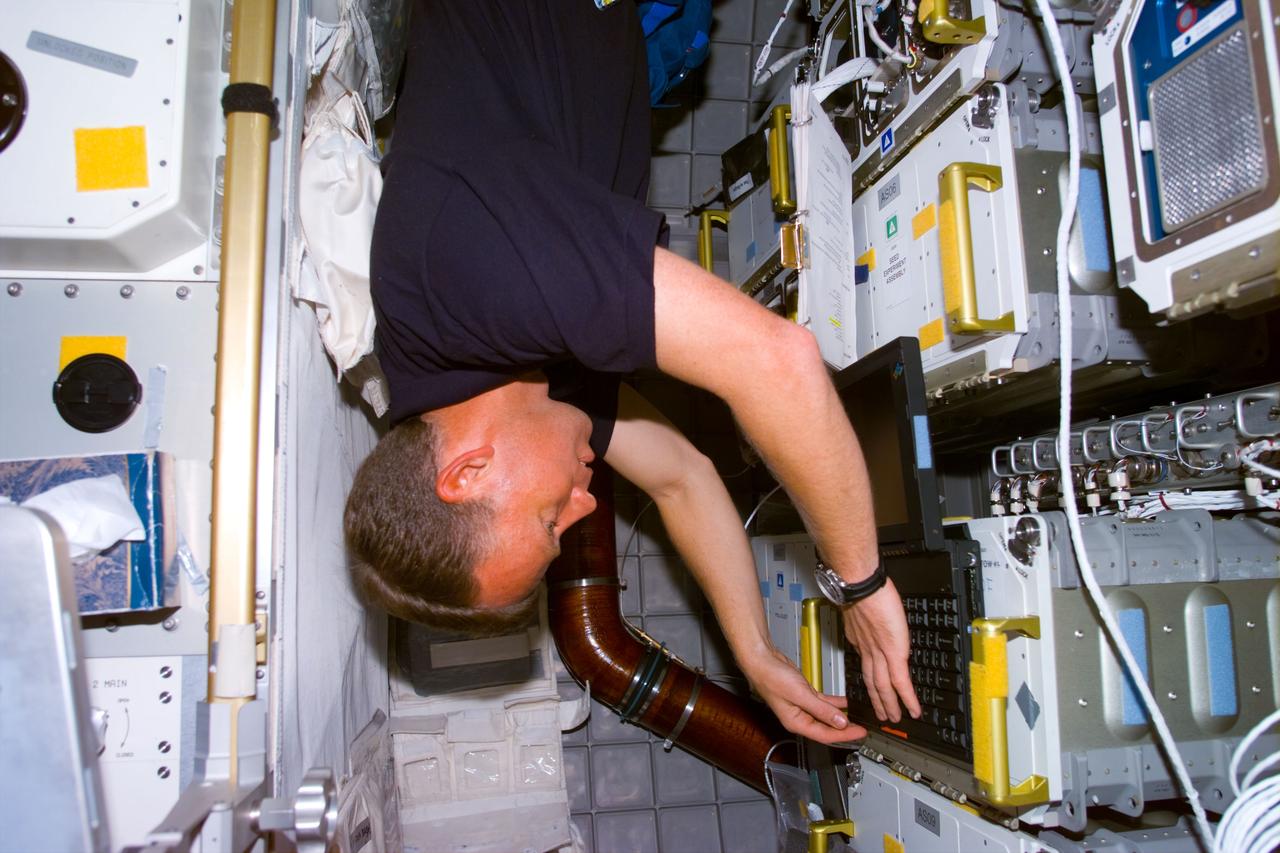
STS095-E-5218 (4 Nov. 1998) --- Astronaut Steven W. Lindsey, STS-95 pilot, inputs data on a lap top computer in the Spacehab facility onboard the Space Shuttle Discovery. The photo was taken with an electronic still camera (ESC) at 02:58:43 GMT, Nov. 4.
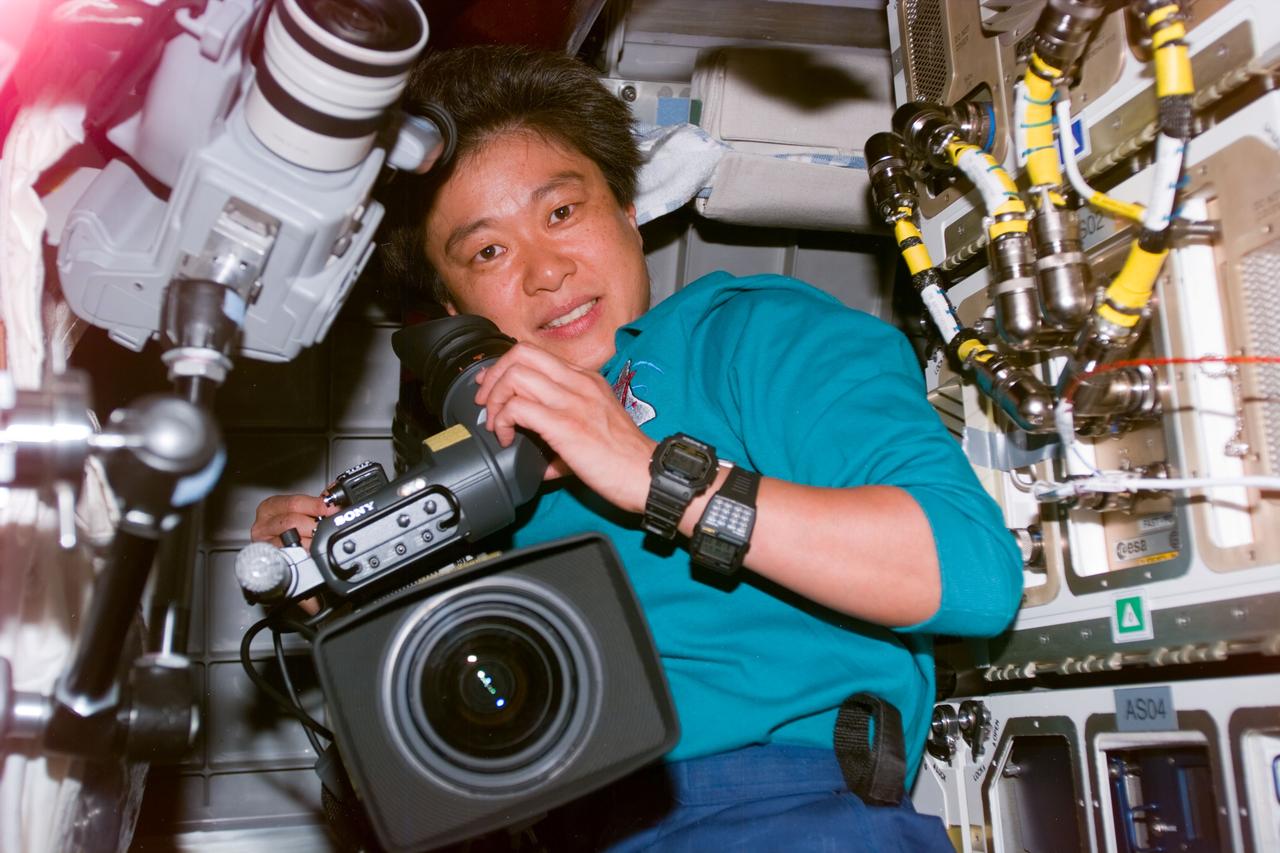
STS095-E-5070 (1 Nov. 1998) --- STS-95 payload specialist Chiaki Mukai prepares to use a camcorder during activity in the Spacehab module aboard the Space Shuttle Discovery. The photo was taken with an electronic still camera (ESC) at 00:55:22 GMT, Nov. 1.
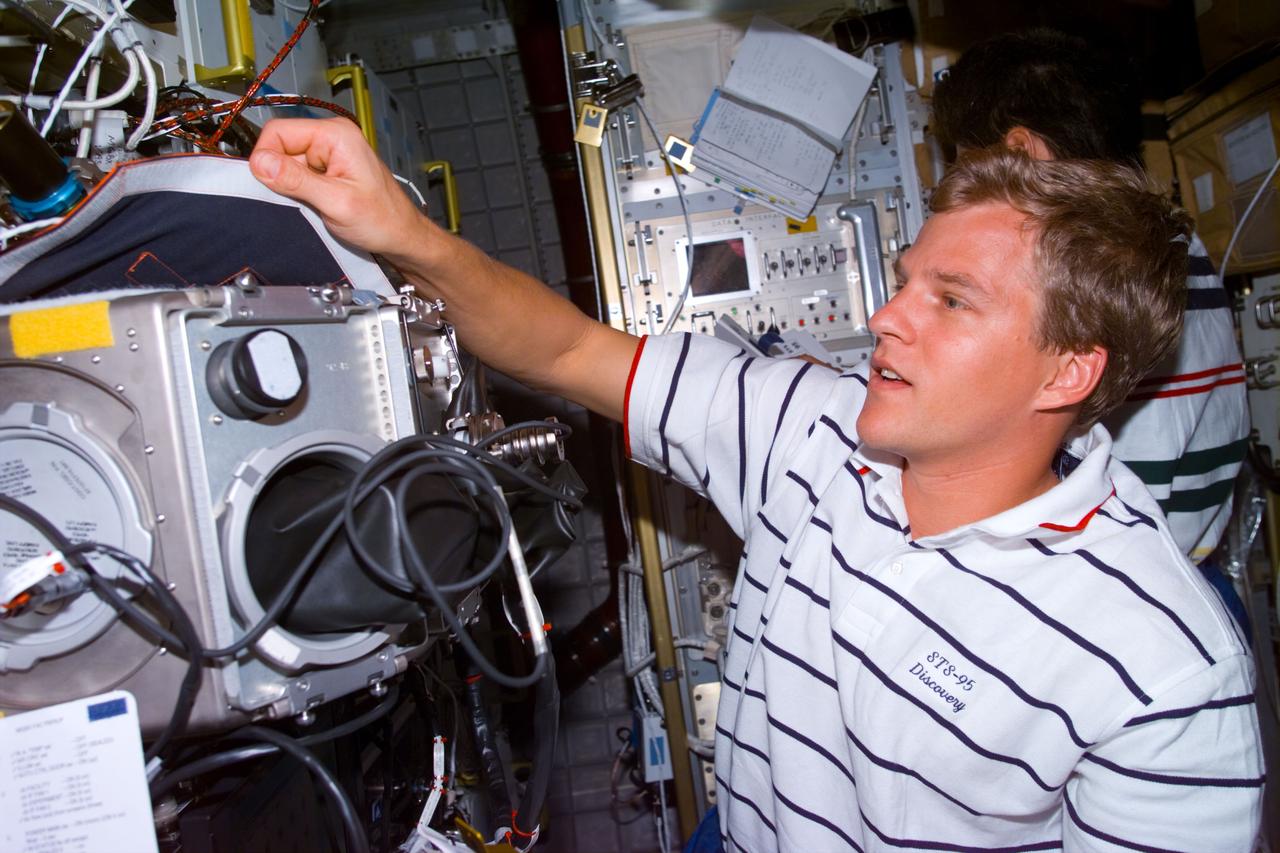
STS095-E-5104 (2 Nov. 1998) --- Astronaut Scott E. Parazynski, STS-95 mission specialist, at glove box in Spacehab facility during flight day four activity. The photo was taken with an electronic still camera (ESC) at 4:59:22 GMT, Nov. 2.
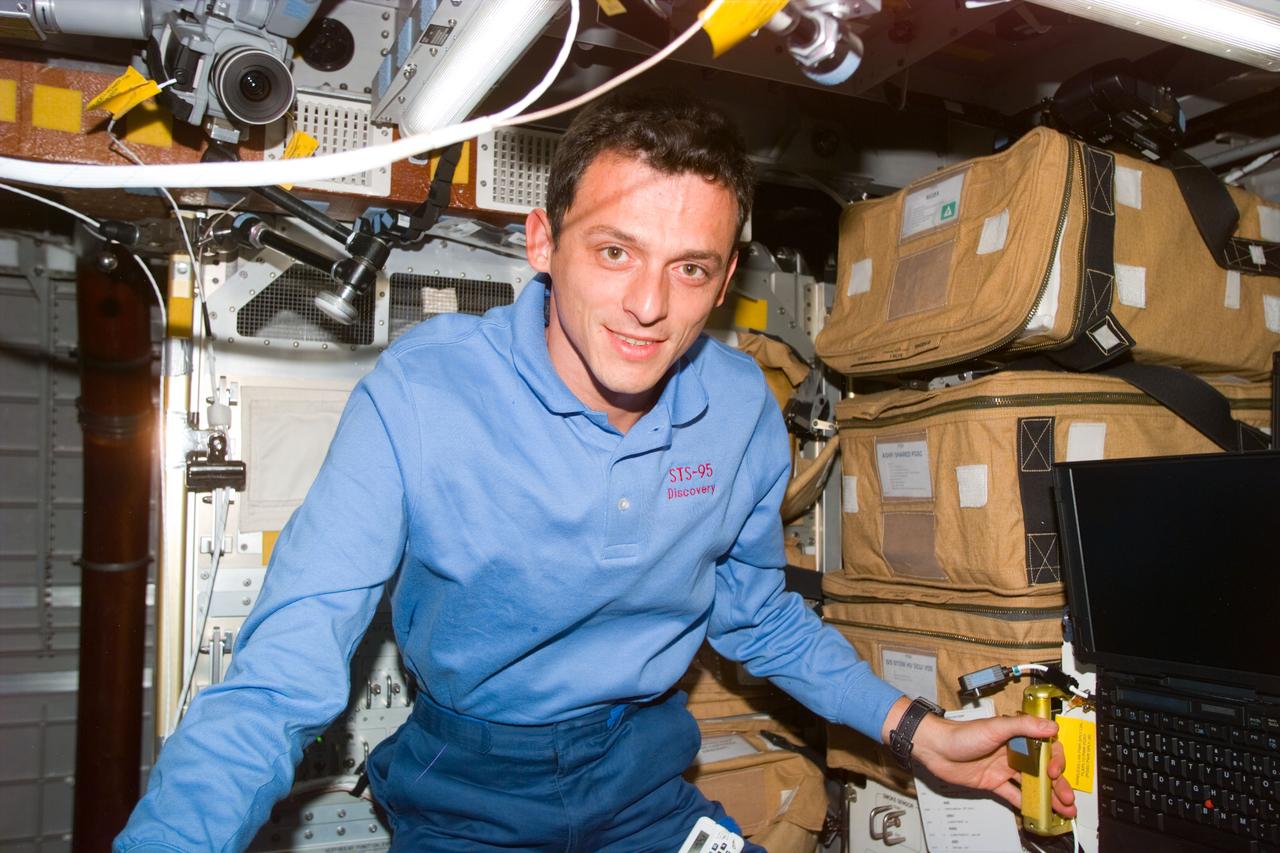
STS095-E-5153 (1 Nov. 1998) --- Astronaut Pedro Duque, STS-95 mission specialist representing the European Space Agency (ESA) moves toward a laptop computer in Spacehab facility aboard Discovery. The photo was taken at 00:57:29 GMT, Nov. 1.
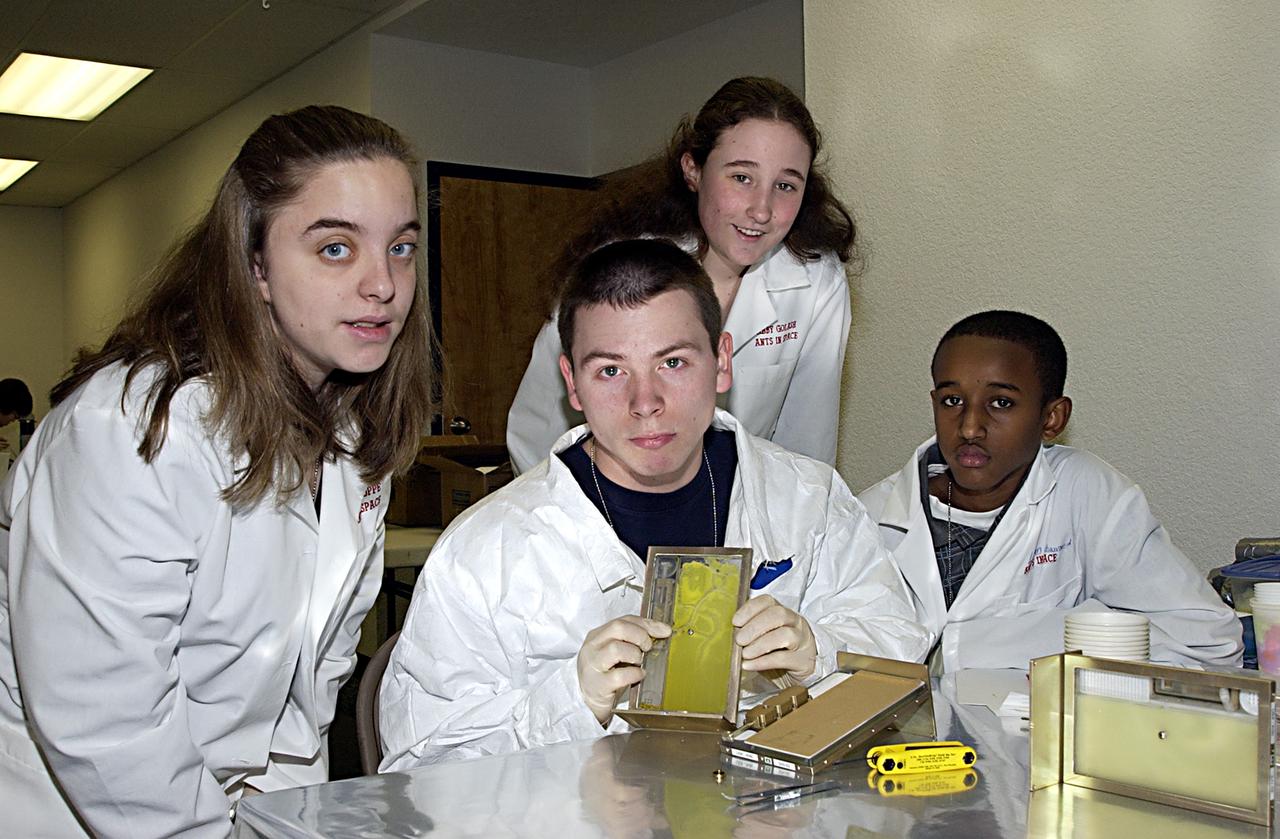
Students display an experiment that will fly in SPACEHAB on Space Shuttle Columbia on mission STS-107. SPACEHAB's complement of commercial experiments includes six educational experiments designed and developed by students in six different countries under the auspices of Space Technology and Research Students (STARS), a global education program managed by SPACEHAB subsidiary Space Media. The countries represented are Australia, China, Israel, Japan, Liechtenstein and the United States. The student investigators who conceived these experiments will monitor their operations in space. The experiments will be housed in BioServe Space Technologies' Isothermal Containment Module (ICM --a small temperature-controlled facility that provides experiment support such as physical containment, lighting, and video imaging) and stowed in a middeck-size locker aboard the SPACEHAB Research Double Module.
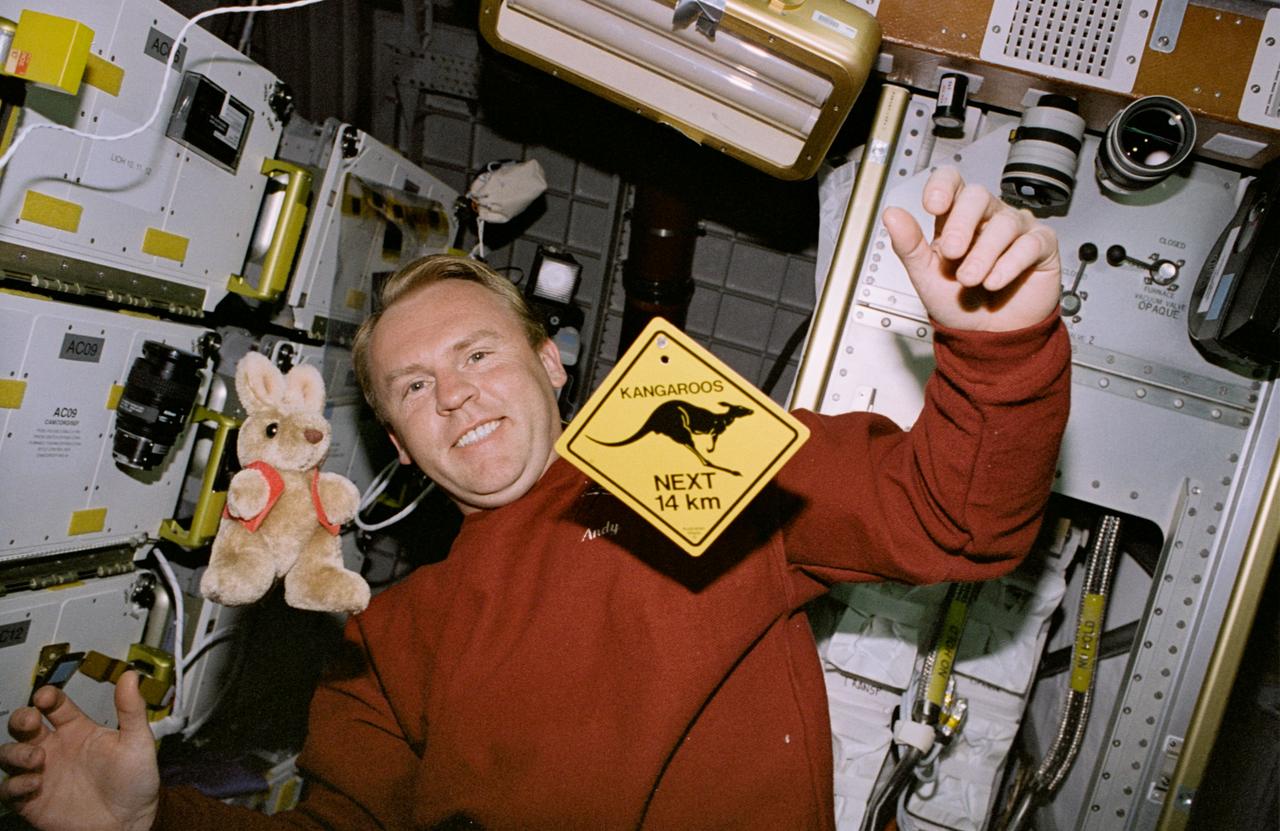
STS077-368-026 (19-29 May 1996) --- On his off-duty time, Australian-native Andrew S. W. Thomas, mission specialist, has a little fun with Australian mementos in the Spacehab Module onboard the Space Shuttle Endeavour. Floating in the foreground are a stuffed toy kangaroo and a miniaturized typical highway warning sign about the plentiful four-legged Australian resident. Astronaut Thomas and five other crew members went on to spend almost ten-days aboard Endeavour in support of the Spacehab 4 mission and a number of other payloads.
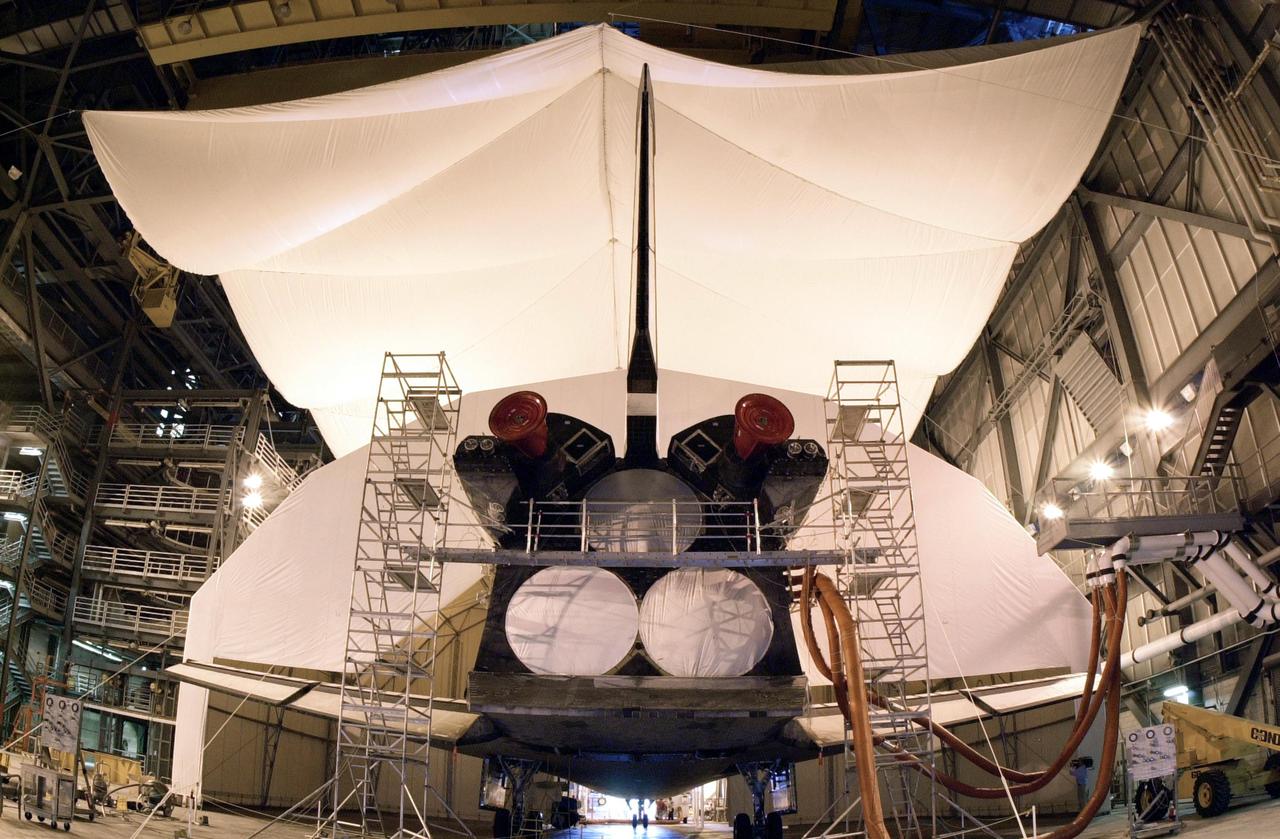
KENNEDY SPACE CENTER, FLA. -- Columbia sits inside an protective tent used to keep out moisture. The orbiter is next scheduled to fly on mission STS-107 no earlier than Nov. 29. STS-107 is a research mission. The payload includes the Hitchhiker Bridge, a carrier for the Fast Reaction Experiments Enabling Science, Technology, Applications and Research (FREESTAR) that incorporates eight high priority secondary attached shuttle experiments, plus the SHI Research Double Module (SHI/RDM), also known as SPACEHAB.
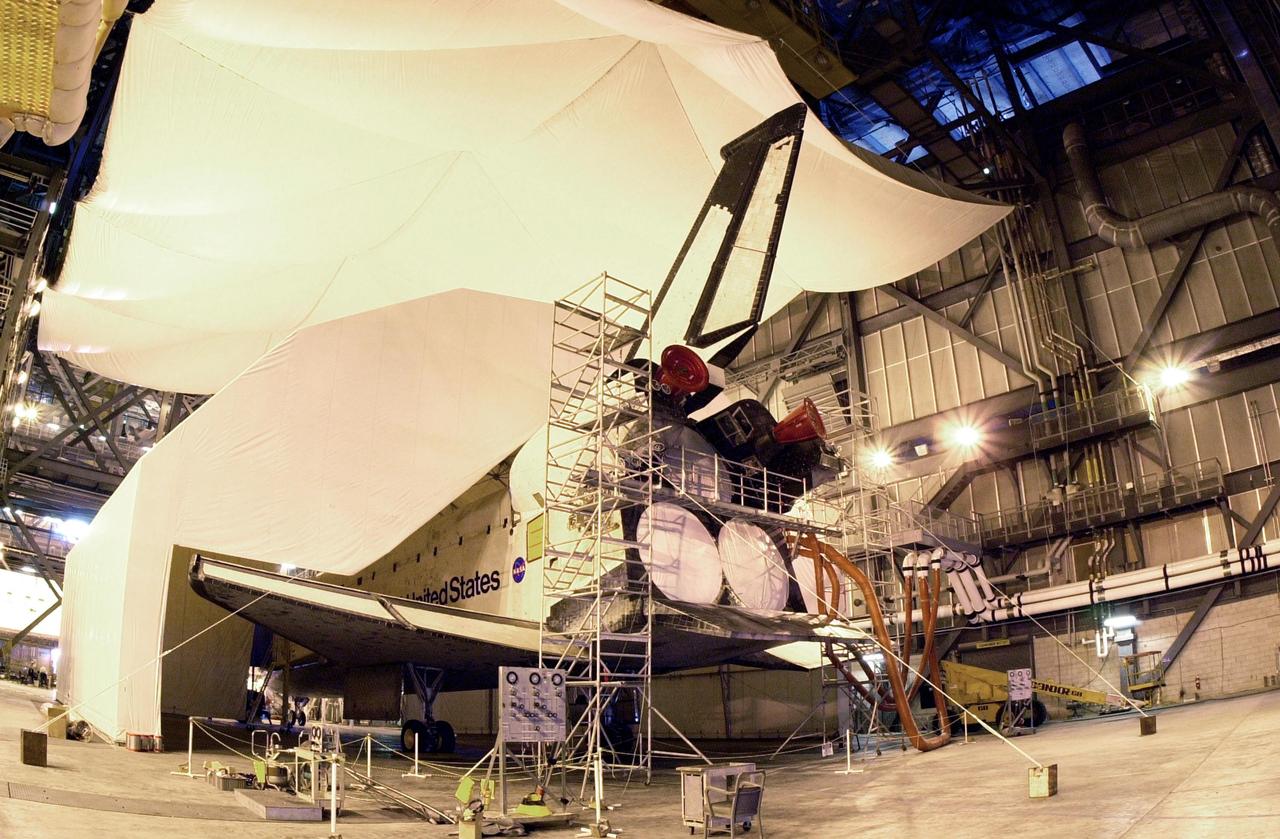
KENNEDY SPACE CENTER, FLA. -- Columbia sits inside an protective tent used to keep out moisture. The orbiter is next scheduled to fly on mission STS-107 no earlier than Nov. 29. STS-107 is a research mission. The payload includes the Hitchhiker Bridge, a carrier for the Fast Reaction Experiments Enabling Science, Technology, Applications and Research (FREESTAR) that incorporates eight high priority secondary attached shuttle experiments, plus the SHI Research Double Module (SHI/RDM), also known as SPACEHAB.
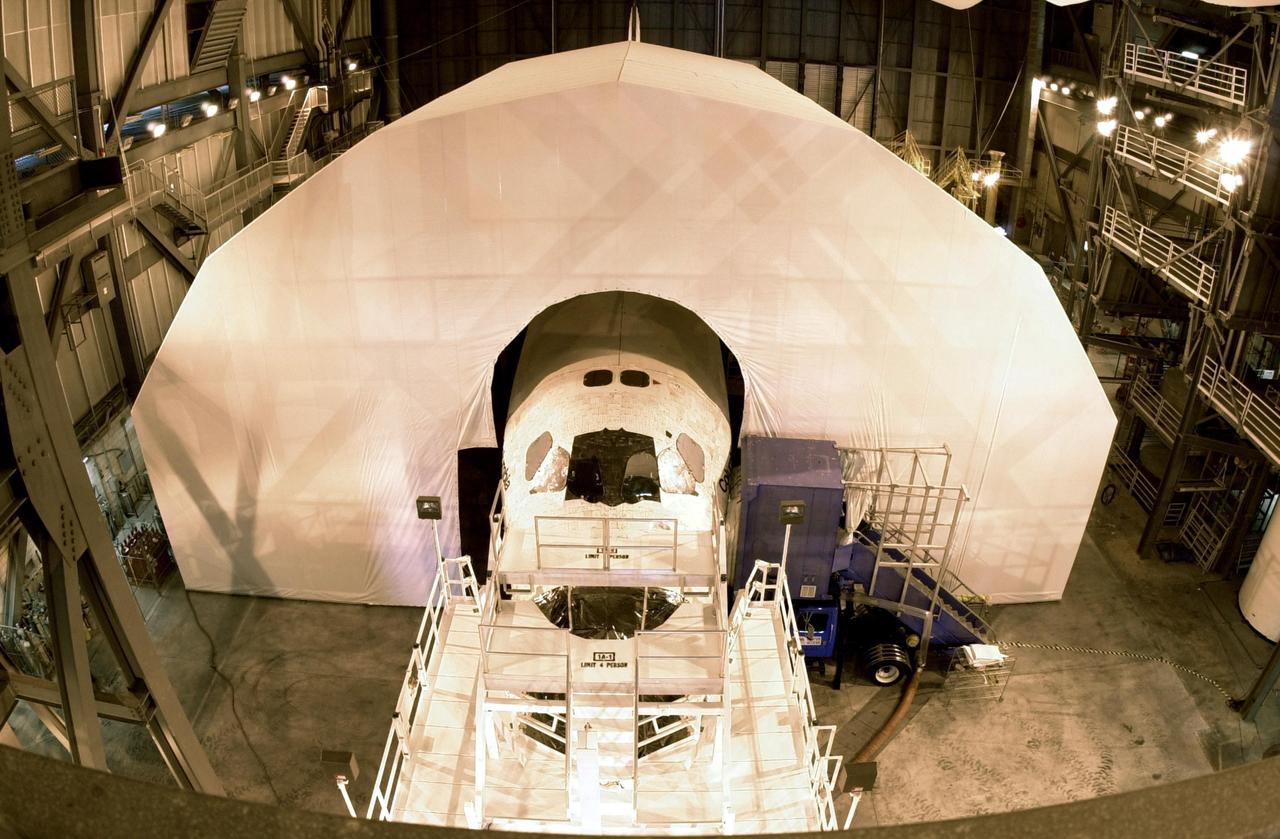
KENNEDY SPACE CENTER, FLA. -- Only the nose and tail of Columbia are visible as it sits inside an protective tent used to keep out moisture. The orbiter is next scheduled to fly on mission STS-107 no earlier than Nov. 29. STS-107 is a research mission. The payload includes the Hitchhiker Bridge, a carrier for the Fast Reaction Experiments Enabling Science, Technology, Applications and Research (FREESTAR) that incorporates eight high priority secondary attached shuttle experiments, plus the SHI Research Double Module (SHI/RDM), also known as SPACEHAB.
STS-132 CREW CEIT IN SSPF & SPACEHAB
STS-132 CREW CEIT IN SSPF & SPACEHAB
STS-132 CREW CEIT IN SSPF & SPACEHAB
STS-132 CREW CEIT IN SSPF & SPACEHAB
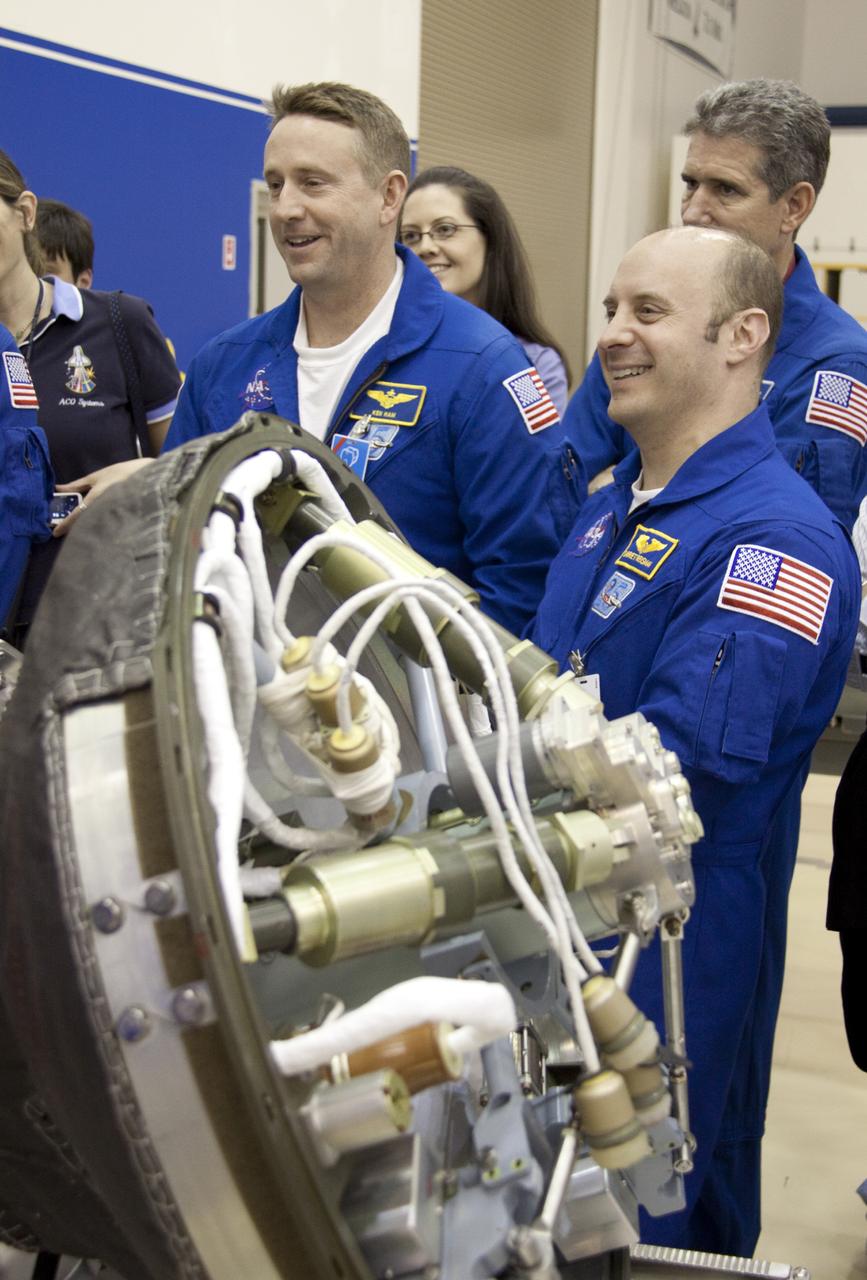
STS-132 CREW CEIT IN SSPF & SPACEHAB
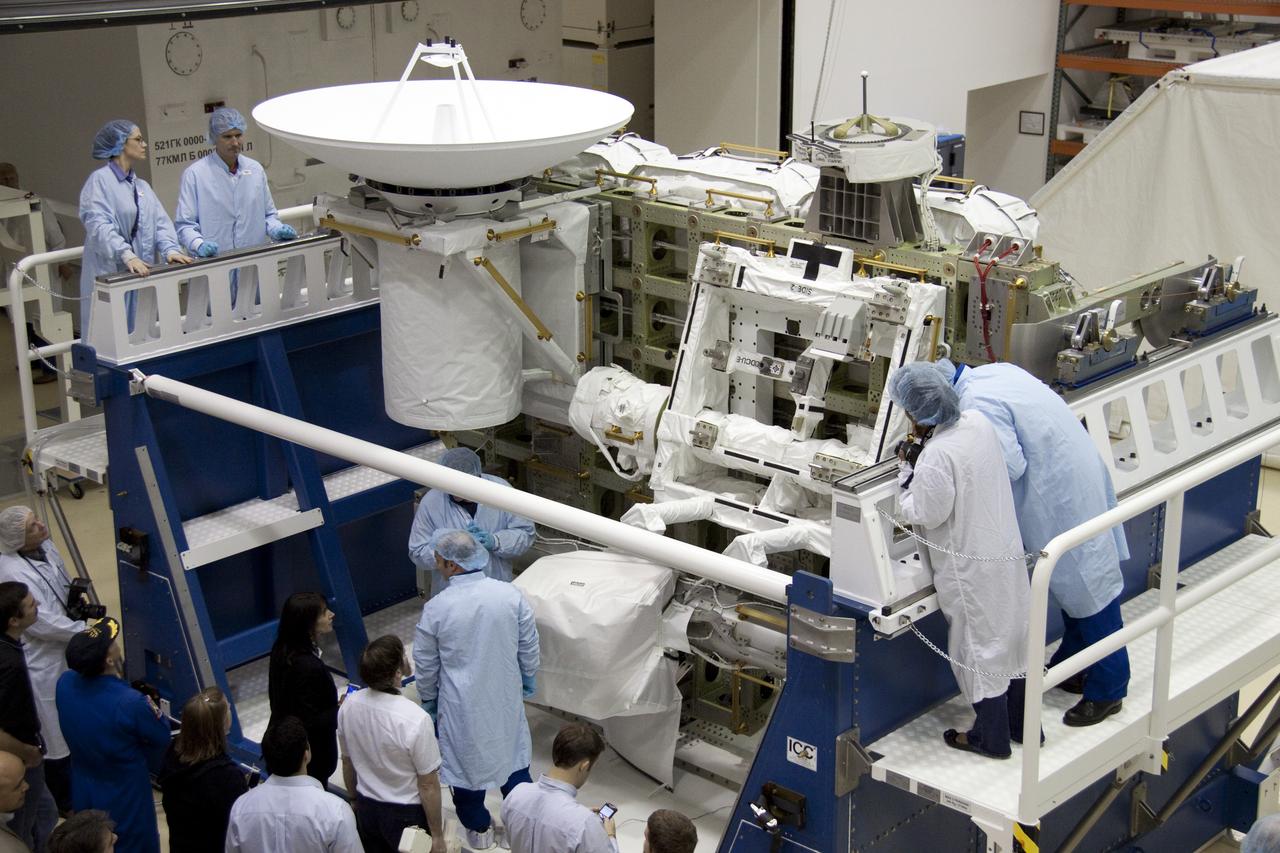
STS-132 CREW CEIT IN SSPF & SPACEHAB
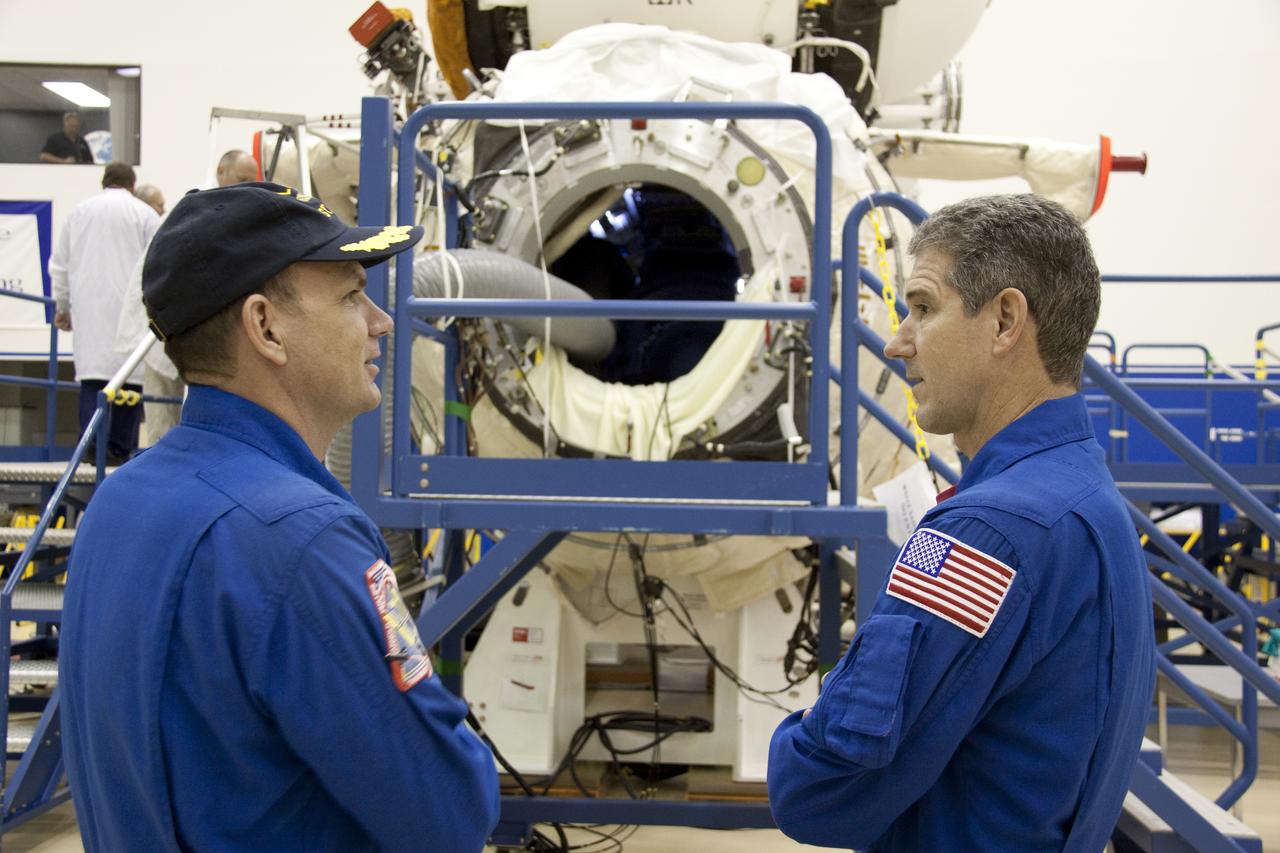
STS-132 CREW CEIT IN SSPF & SPACEHAB
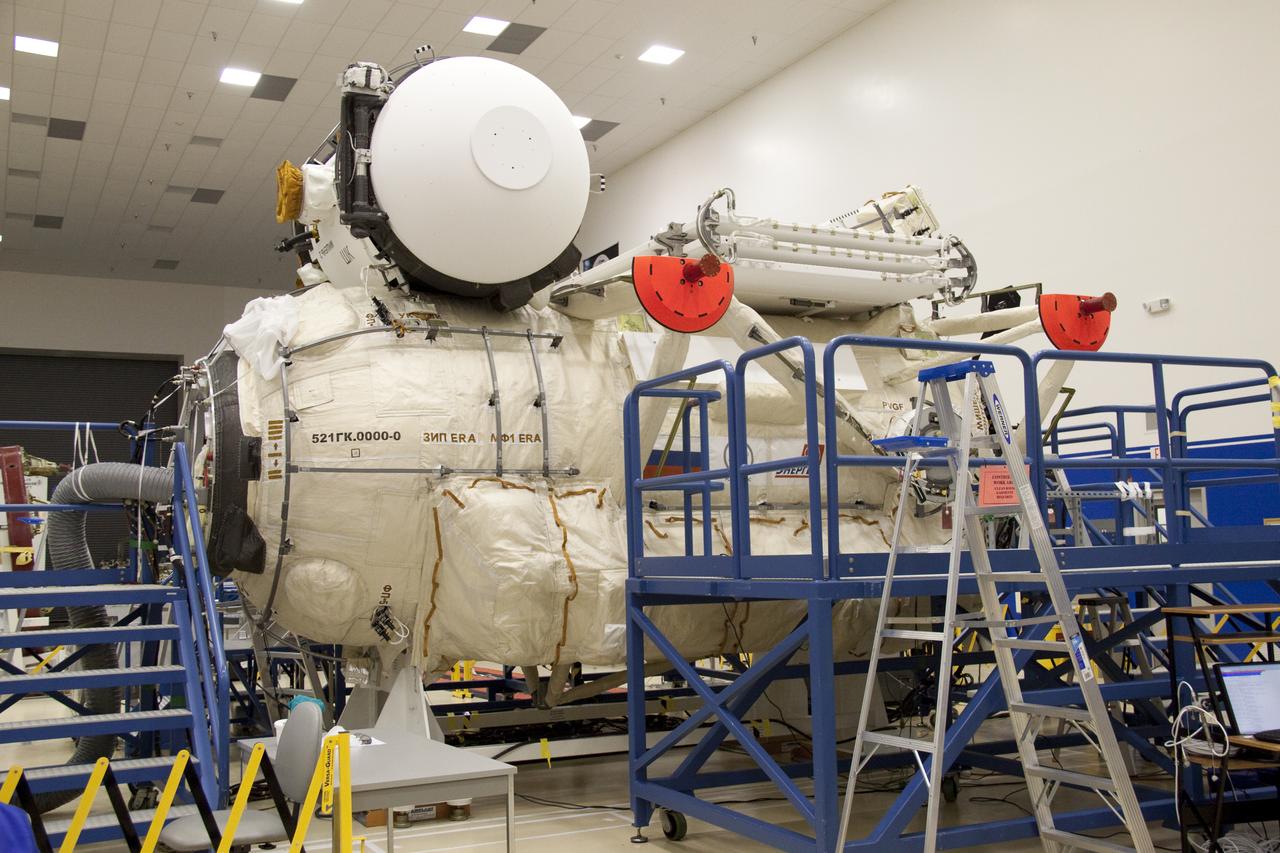
STS-132 CREW CEIT IN SSPF & SPACEHAB
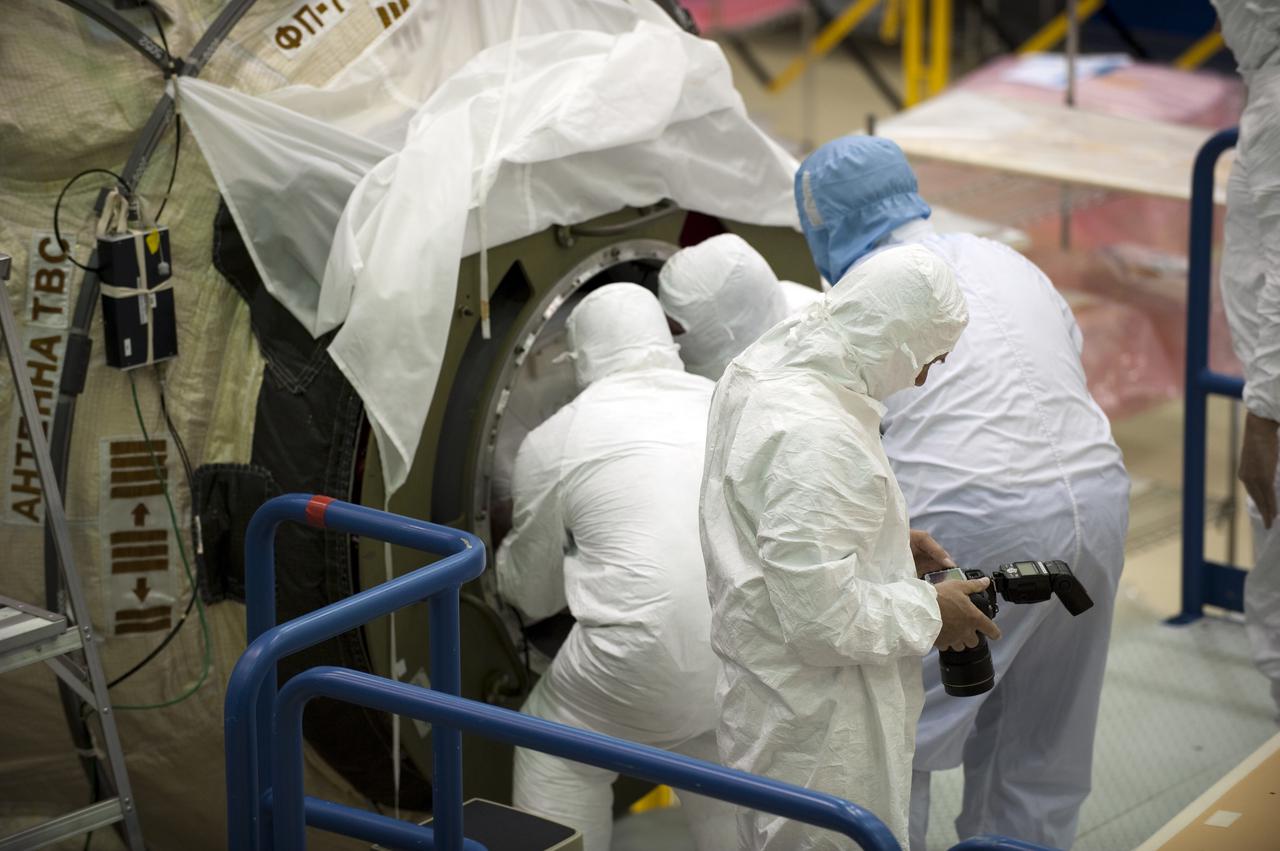
CAPE CANAVERAL, Fla. – In the Astrotech payload processing facility at Port Canaveral, Fla., workers dressed in clean room attire, known as bunny suits, install supplies and other cargo in the Russian-built Mini-Research Module, or MRM, through a hatch on the end of the module. The six-member crew of space shuttle Atlantis' STS-132 mission will deliver an Integrated Cargo Carrier and the MRM to the International Space Station. The second in a series of new pressurized components for Russia, the MRM will be permanently attached to the bottom port of the Zarya module. The MRM also will carry U.S. pressurized cargo. STS-132 is the 34th mission to the station and the 132nd space shuttle mission. Launch is targeted for May 14. For information on the STS-132 mission, visit http:__www.nasa.gov_mission_pages_shuttle_shuttlemissions_sts132_index.html. Photo credit: NASA_Kim Shiflett
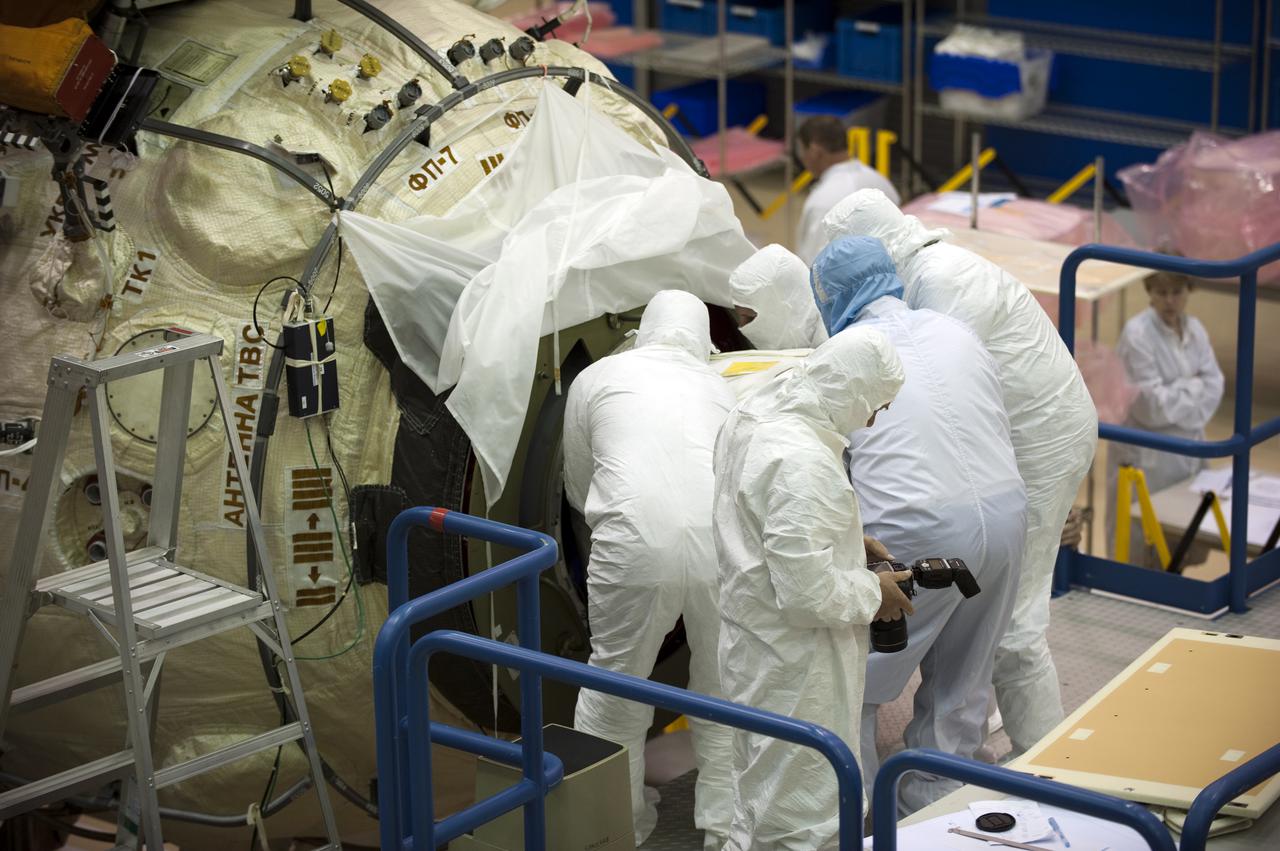
CAPE CANAVERAL, Fla. – In the Astrotech payload processing facility at Port Canaveral, Fla., workers dressed in clean room attire, known as bunny suits, install supplies and other cargo in the Russian-built Mini-Research Module, or MRM, through a hatch on the end of the module. The six-member crew of space shuttle Atlantis' STS-132 mission will deliver an Integrated Cargo Carrier and the MRM to the International Space Station. The second in a series of new pressurized components for Russia, the MRM will be permanently attached to the bottom port of the Zarya module. The MRM also will carry U.S. pressurized cargo. STS-132 is the 34th mission to the station and the 132nd space shuttle mission. Launch is targeted for May 14. For information on the STS-132 mission, visit http:__www.nasa.gov_mission_pages_shuttle_shuttlemissions_sts132_index.html. Photo credit: NASA_Kim Shiflett
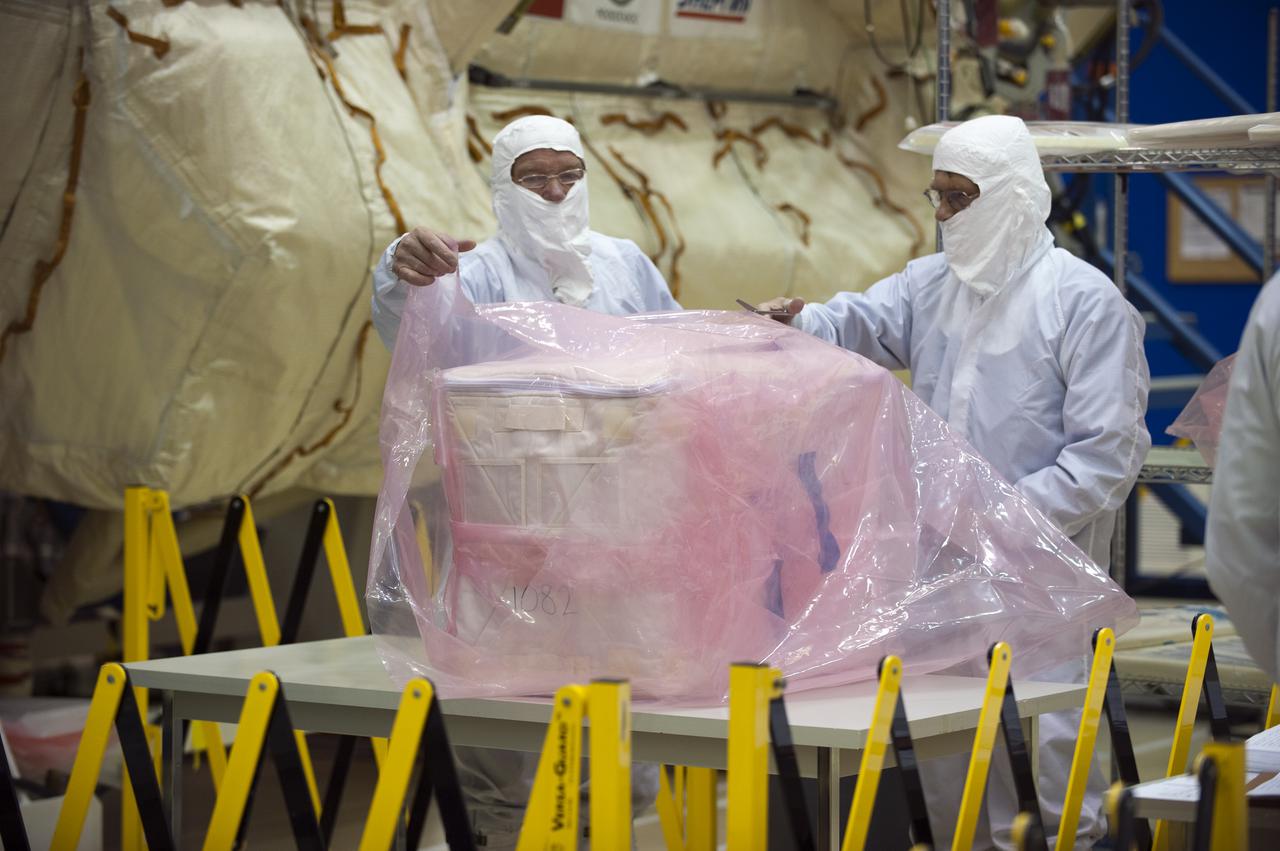
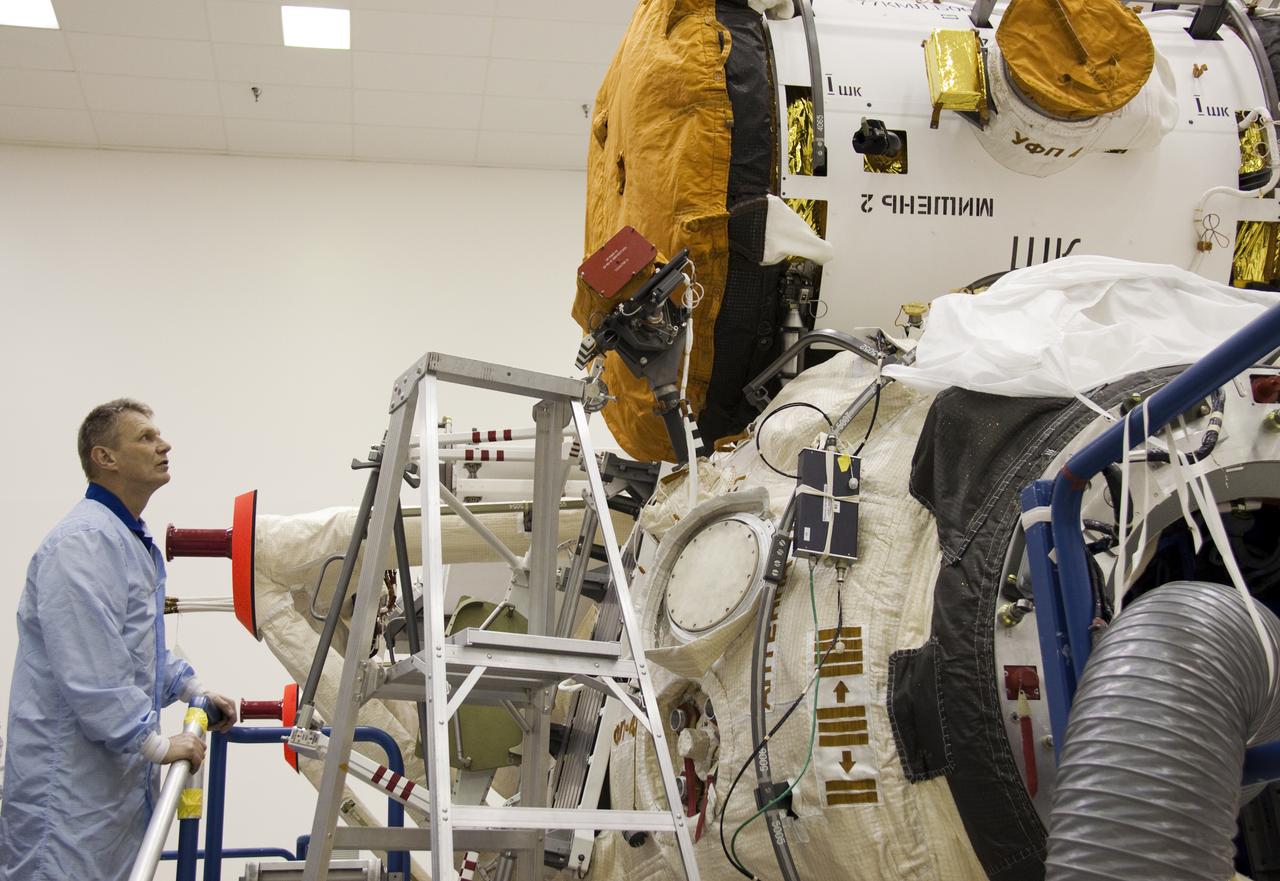
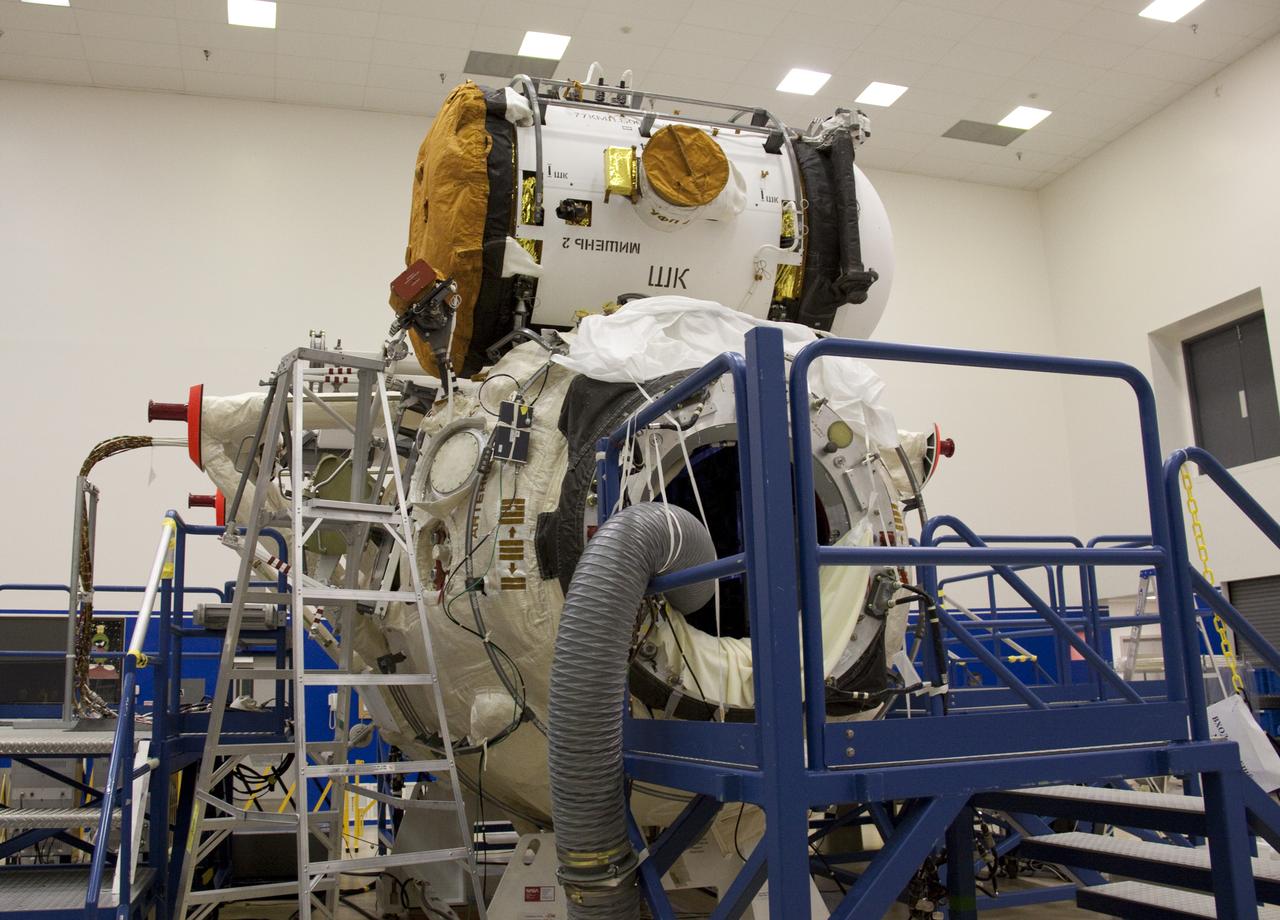
CAPE CANAVERAL, Fla. – In the Astrotech payload processing facility at Port Canaveral, Fla., supplies and other cargo are prepared for installation in the Russian-built Mini-Research Module, or MRM, in the background. The six-member crew of space shuttle Atlantis' STS-132 mission will deliver an Integrated Cargo Carrier and the MRM to the International Space Station. The second in a series of new pressurized components for Russia, the MRM will be permanently attached to the bottom port of the Zarya module. The MRM also will carry U.S. pressurized cargo. STS-132 is the 34th mission to the station and the 132nd space shuttle mission. Launch is targeted for May 14. For information on the STS-132 mission, visit http:__www.nasa.gov_mission_pages_shuttle_shuttlemissions_sts132_index.html. Photo credit: NASA_Kim Shiflett
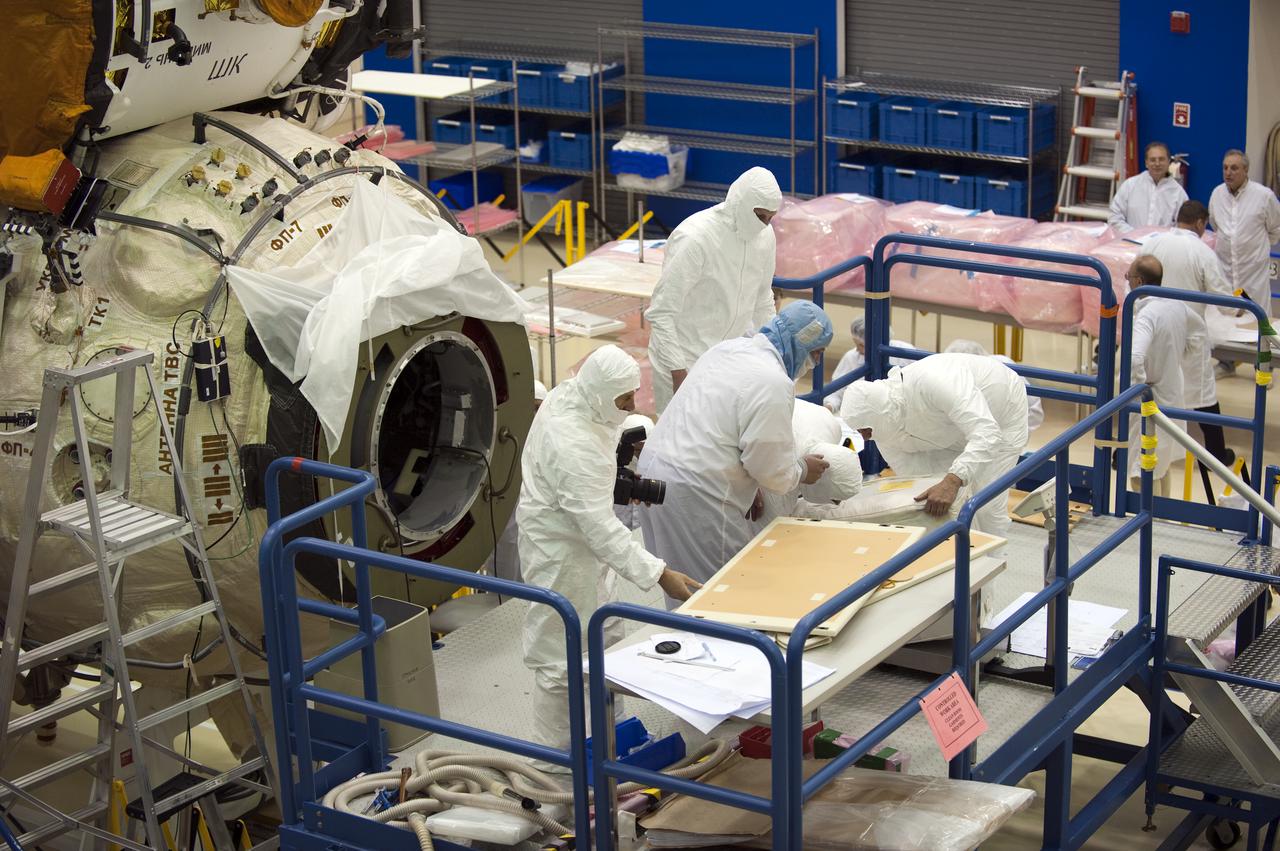
CAPE CANAVERAL, Fla. – In the Astrotech payload processing facility at Port Canaveral, Fla., preparations are under way to install supplies and other cargo in the Russian-built Mini-Research Module, or MRM, at left. The six-member crew of space shuttle Atlantis' STS-132 mission will deliver an Integrated Cargo Carrier and the MRM to the International Space Station. The second in a series of new pressurized components for Russia, the MRM will be permanently attached to the bottom port of the Zarya module. The MRM also will carry U.S. pressurized cargo. STS-132 is the 34th mission to the station and the 132nd space shuttle mission. Launch is targeted for May 14. For information on the STS-132 mission, visit http:__www.nasa.gov_mission_pages_shuttle_shuttlemissions_sts132_index.html. Photo credit: NASA_Kim Shiflett
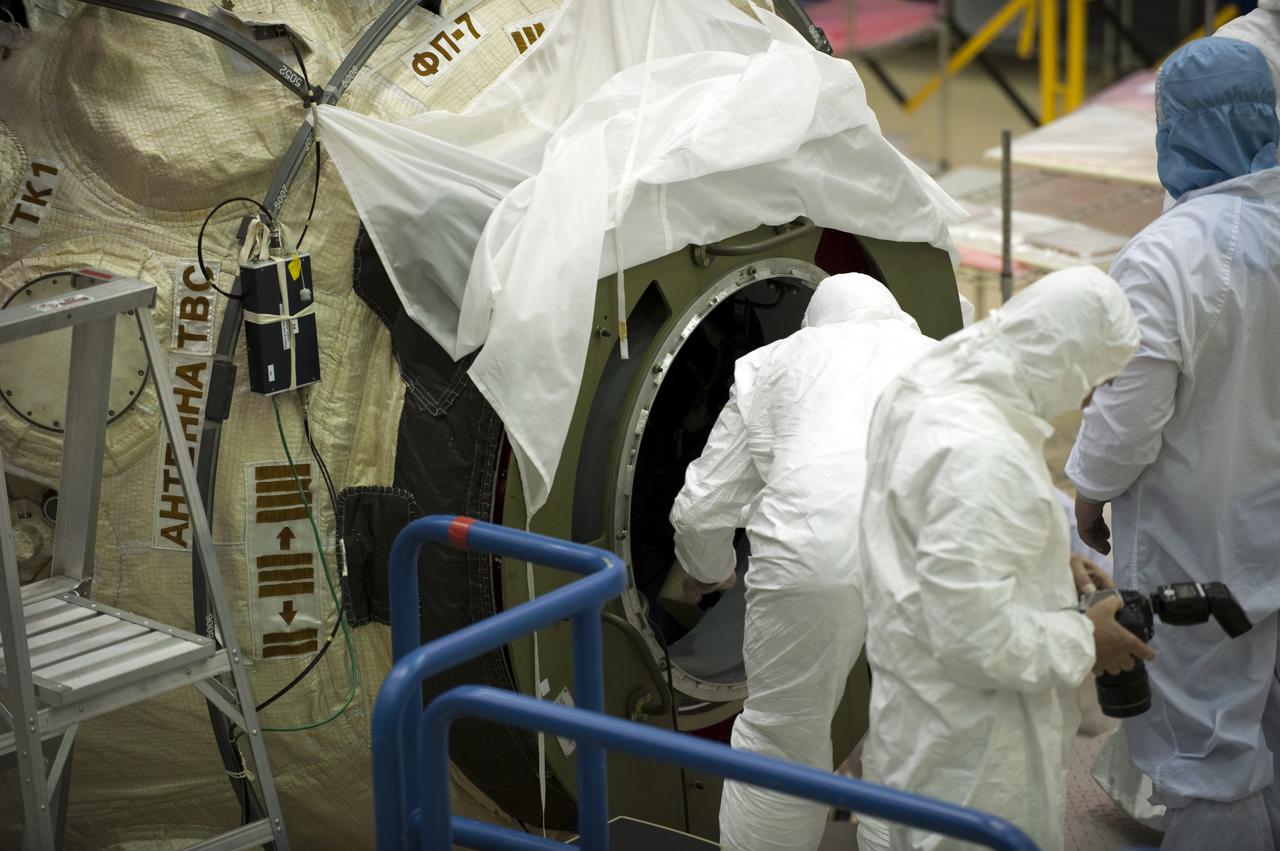
CAPE CANAVERAL, Fla. – In the Astrotech payload processing facility at Port Canaveral, Fla., workers dressed in clean room attire, known as bunny suits, install supplies and other cargo in the Russian-built Mini-Research Module, or MRM, through a hatch on the end of the module. The six-member crew of space shuttle Atlantis' STS-132 mission will deliver an Integrated Cargo Carrier and the MRM to the International Space Station. The second in a series of new pressurized components for Russia, the MRM will be permanently attached to the bottom port of the Zarya module. The MRM also will carry U.S. pressurized cargo. STS-132 is the 34th mission to the station and the 132nd space shuttle mission. Launch is targeted for May 14. For information on the STS-132 mission, visit http:__www.nasa.gov_mission_pages_shuttle_shuttlemissions_sts132_index.html. Photo credit: NASA_Kim Shiflett
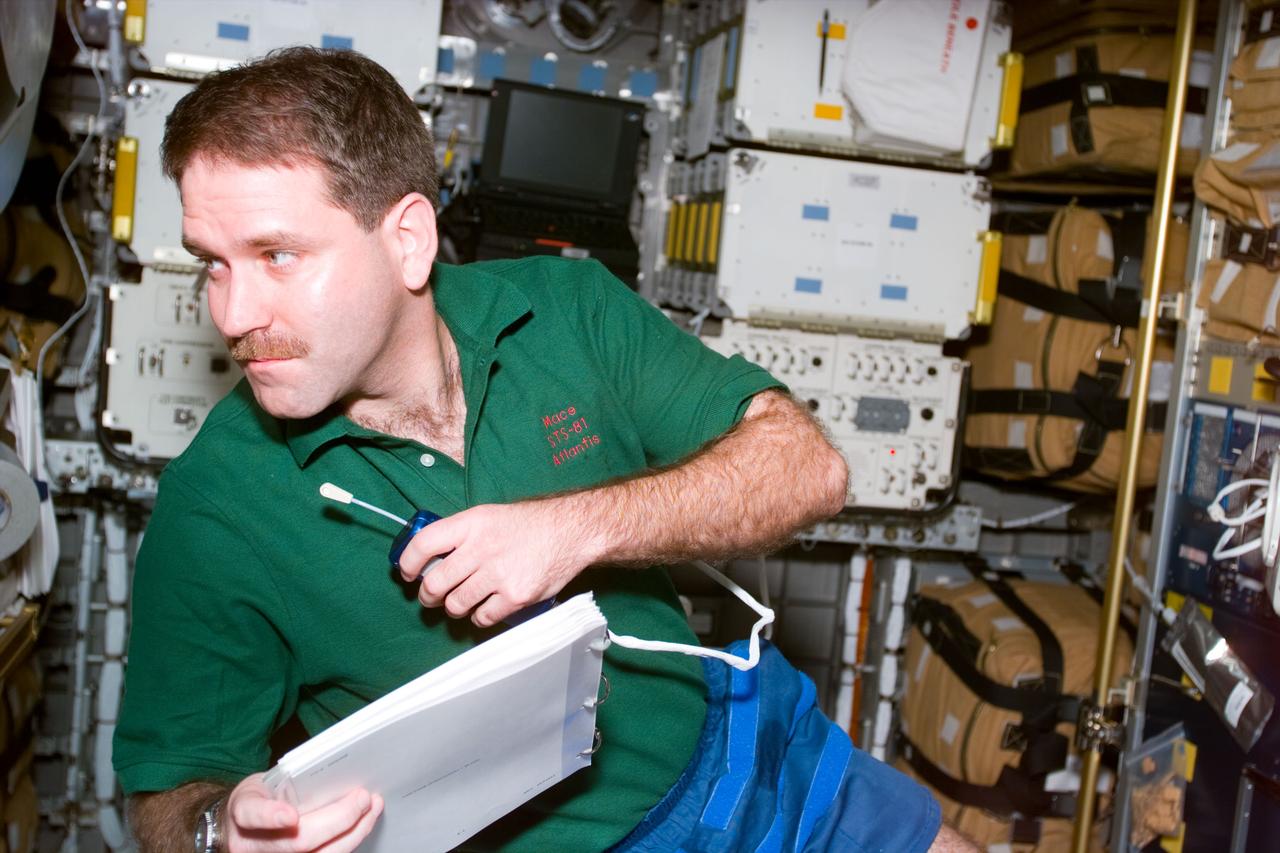
STS081-E-05144 (13 Jan. 1997) --- Making sure everything is in its place is no easy task as witnessed by the serious countenance of astronaut John M. Grunsfeld, mission specialist. Grunsfeld communicates with ground controllers as he checks progress of item transfers in the Spacehab Double Module (DM). This image was recorded with an Electronic Still Camera (ESC) and was later downlinked to flight controllers in Houston, Texas. Grunsfeld and five astronaut crew mates are preparing for a scheduled mid-week docking with Russia's Mir Space Station.

STS096-366-030 (27 May - 6 June 1999) --- Astronaut Ellen Ochoa spent many hours in this post aboard SpaceHab in Discovery's cargo bay as she coordinated the large supply of hardware intended for the International Space Station (ISS). She joined four other American astronauts, a Canadian astronaut and a Russian cosmonaut for almost ten days in Earth orbit.
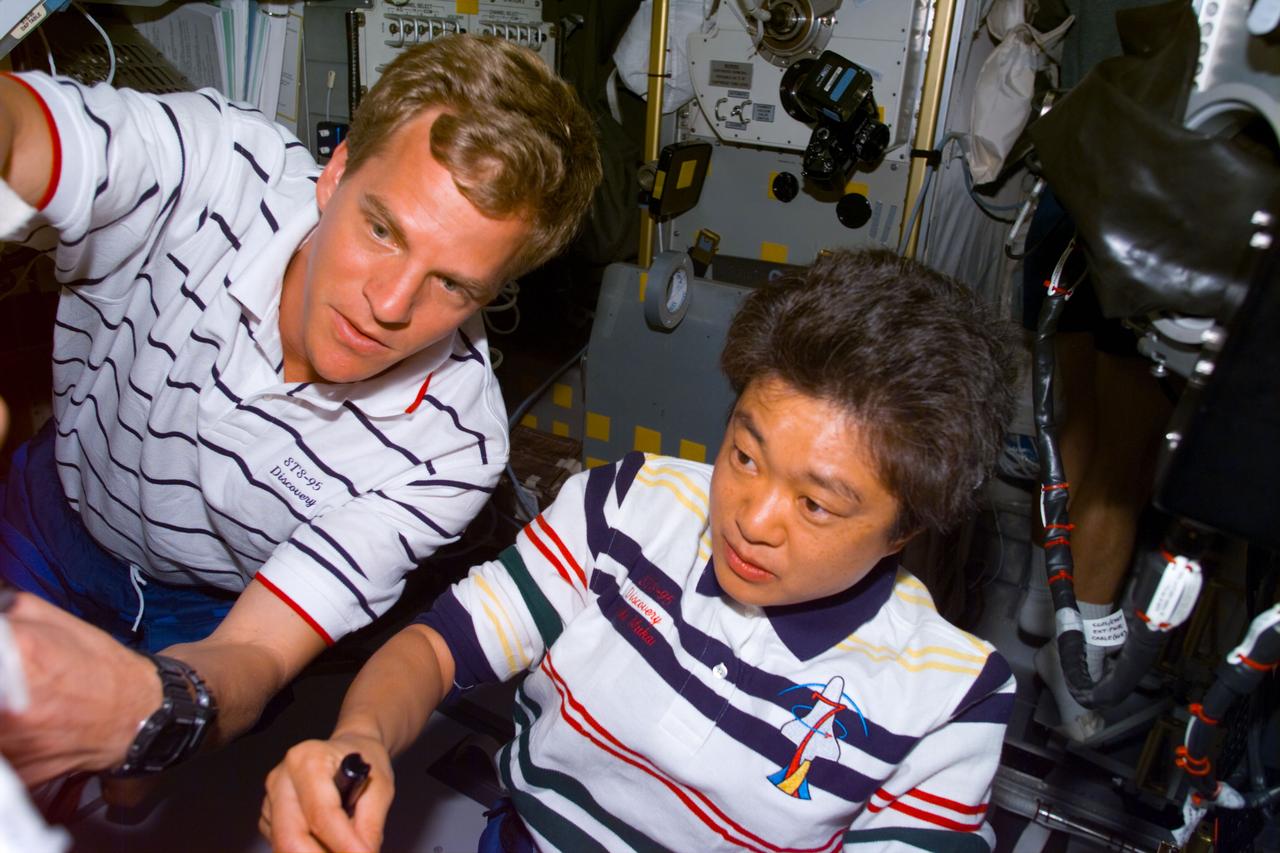
STS095-E-5119 (2 Nov. 1998) --- Astronaut Scott E. Parazynski (left), STS-95 mission specialist, and payload specialist Chiaki Mukai with Japan's National Space Development Agency (NASDA) check an experiment on Spacehab during flight day four activity. The photo was taken with an electronic still camera (ESC) at 05:17:18 GMT, Nov 2.
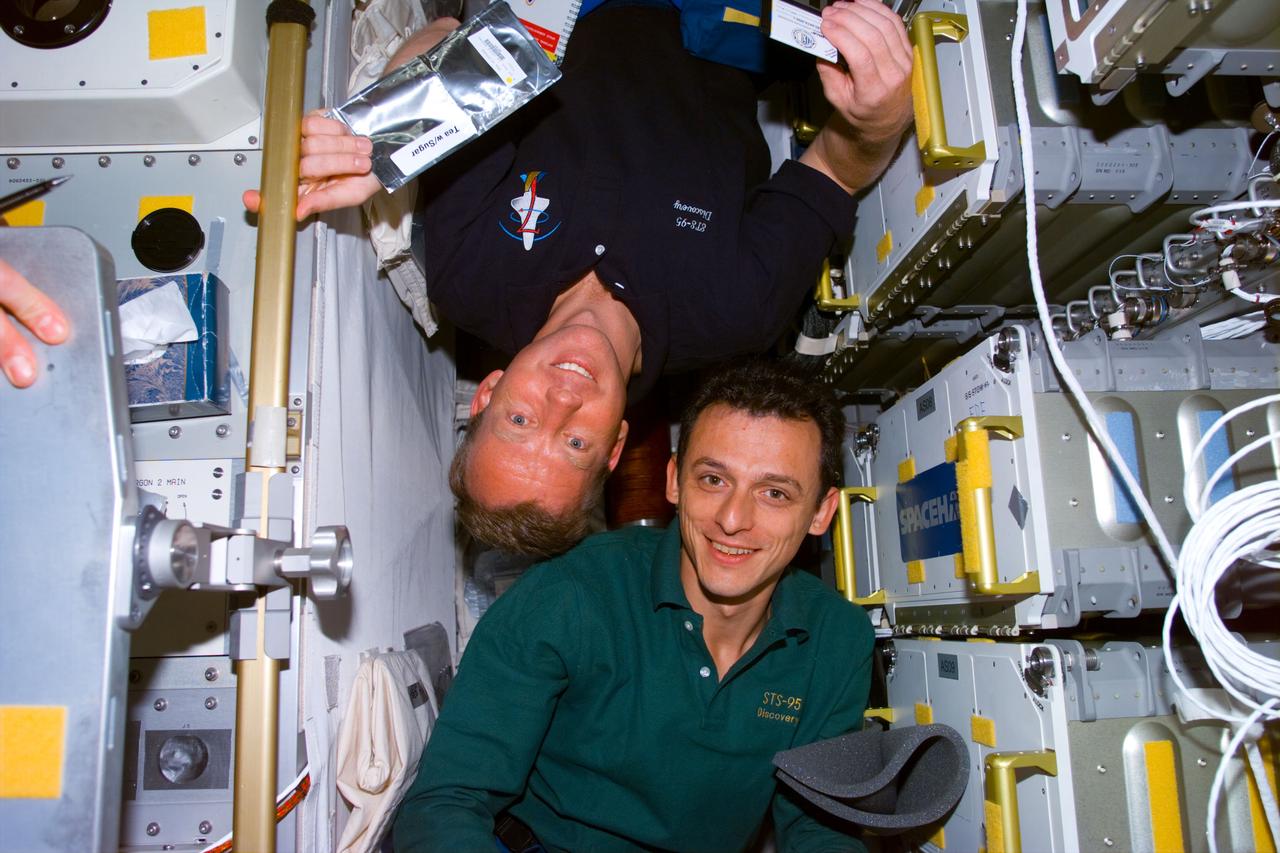
STS095-E-5221 (4 Nov. 1998) --- Astronauts Steven W. Lindsey (top) and Pedro Duque in Spacehab facility during Flight Day 6 activity. Lindsey, pilot, is making his second space flight on STS-95, while Duque, a mission specialist repreenting the European Space Agency (ESA), is the only first-time space flier on this mission. The photo was taken with an electronic still camera (ESC) at 03:01:38 GMT, Nov. 4.
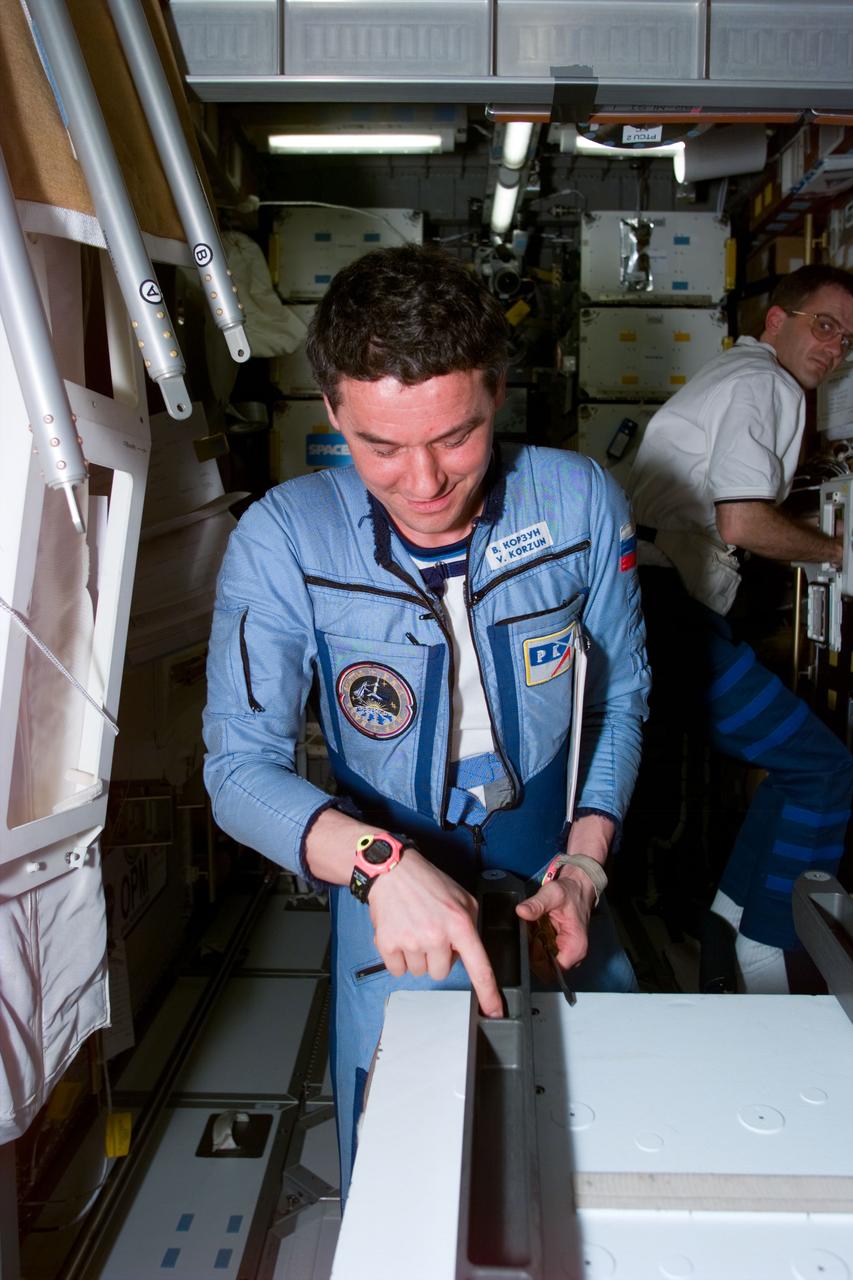
STS081-E-05477 (16 Jan. 1997) --- In the Spacehab Double Module (DM), cosmonaut Valeri G. Korzun, Mir-22 commander, checks out the rails for a Russian Mir Space Station experiment called ALICE. The experiment is a cooperative project between France's Space Agency (CNES) and the Russian Space Agency (RSA). The photograph was recorded with an Electronic Still Camera (ESC) and later was downlinked to flight controllers in Houston, Texas.
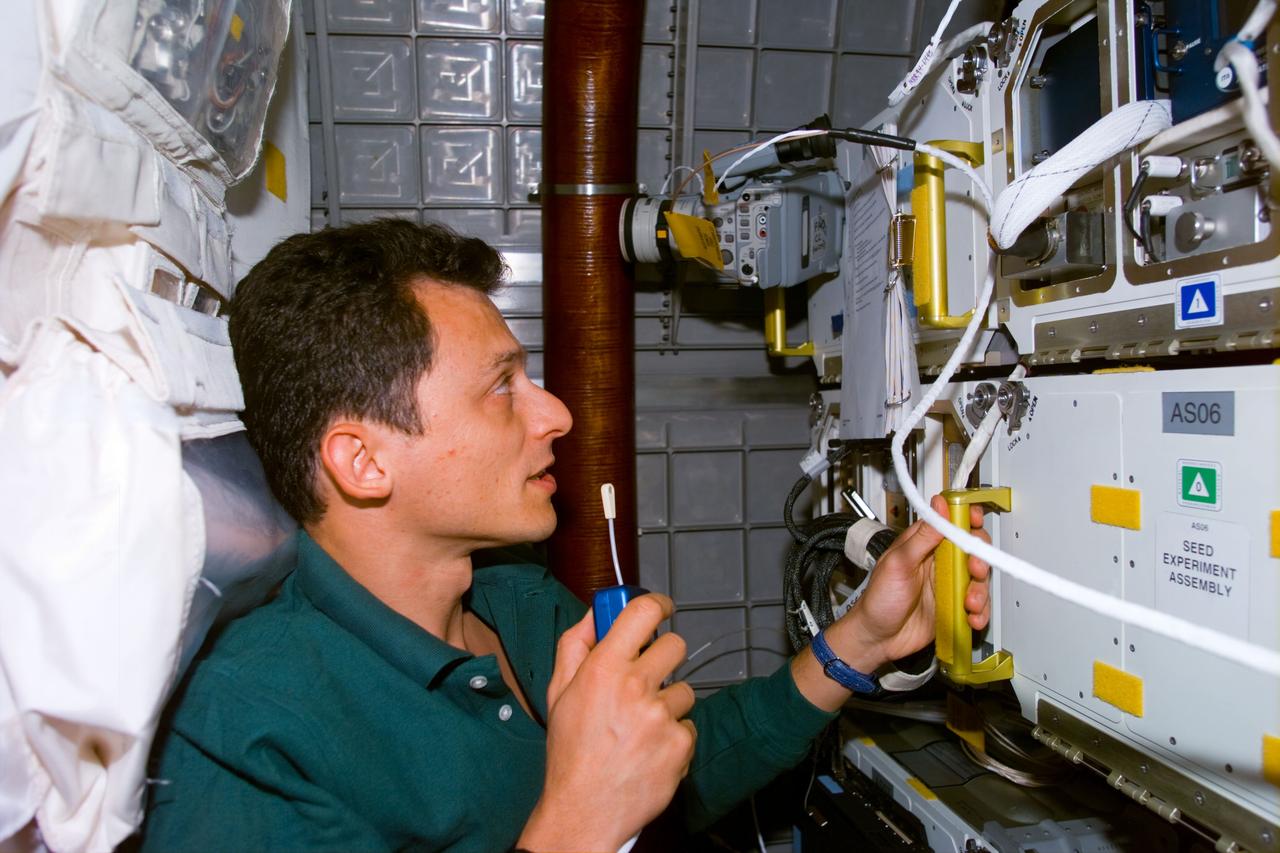
STS095-E-5226 (4 Nov. 1998) --- Astronaut Pedro Duque, STS-95 mission specialist representing the European Space Agency (ESA), talks with ground controllers while checking on an experiment in the Spacehab facility aboard the Space Shuttle Discovery. The picture was taken with an electronic still camera (ESC) at 03:01:28 GMT, Nov. 4.
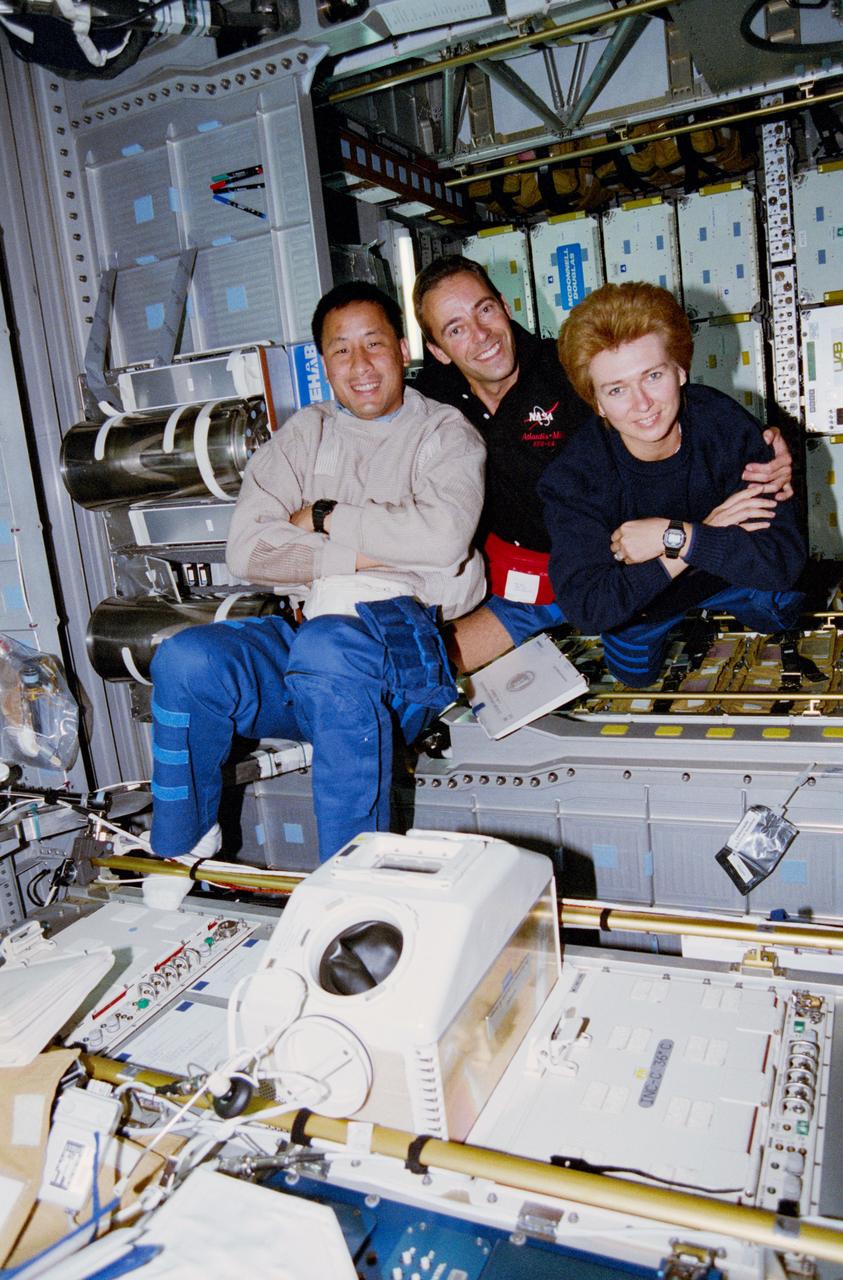
STS084-301-014 (15-24 May 1997) --- Zero-gravity adds a flavor of confusion to this 35mm frame, photographed onboard the Spacehab Double Module during a break in transfer operations of supplies for the STS-84 mission. For orientation purposes, the picture should be held with the glovebox positioned vertically on the right side of the frame. The crew members pictured, from top to bottom, are Elena V. Kondakova, Jean-Francois Clervoy and Edward T. Lu.
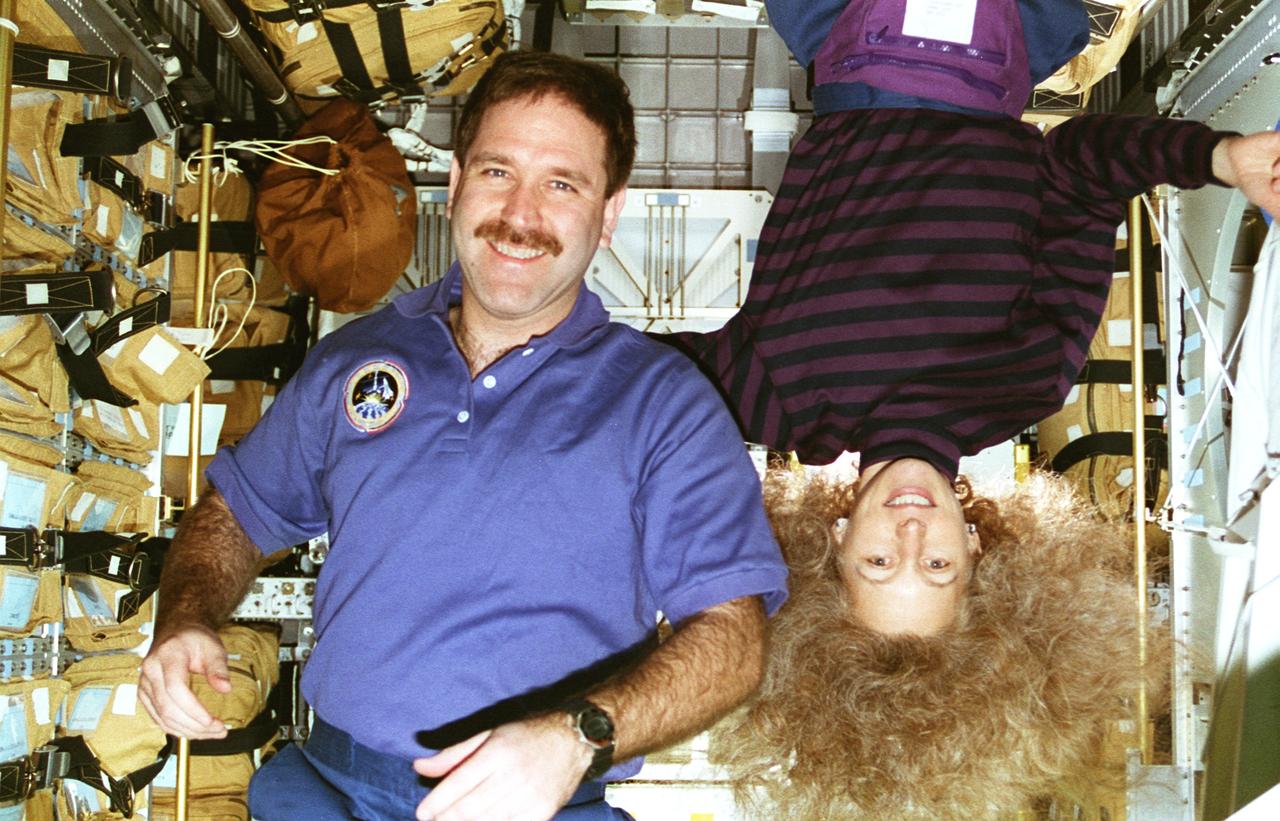
STS081-303-015 (12-22 Jan. 1997) --- Early in the part of the mission during which the Space Shuttle Atlantis was docked with Russia's Mir Space Station, impending duties appear to have Marsha S. Ivins topsy-turvy. Pictured in Spacehab's new Double Module (DM), astronauts Ivins and John M. Grunsfeld were involved with the transfer of supplies from Atlantis to Mir.
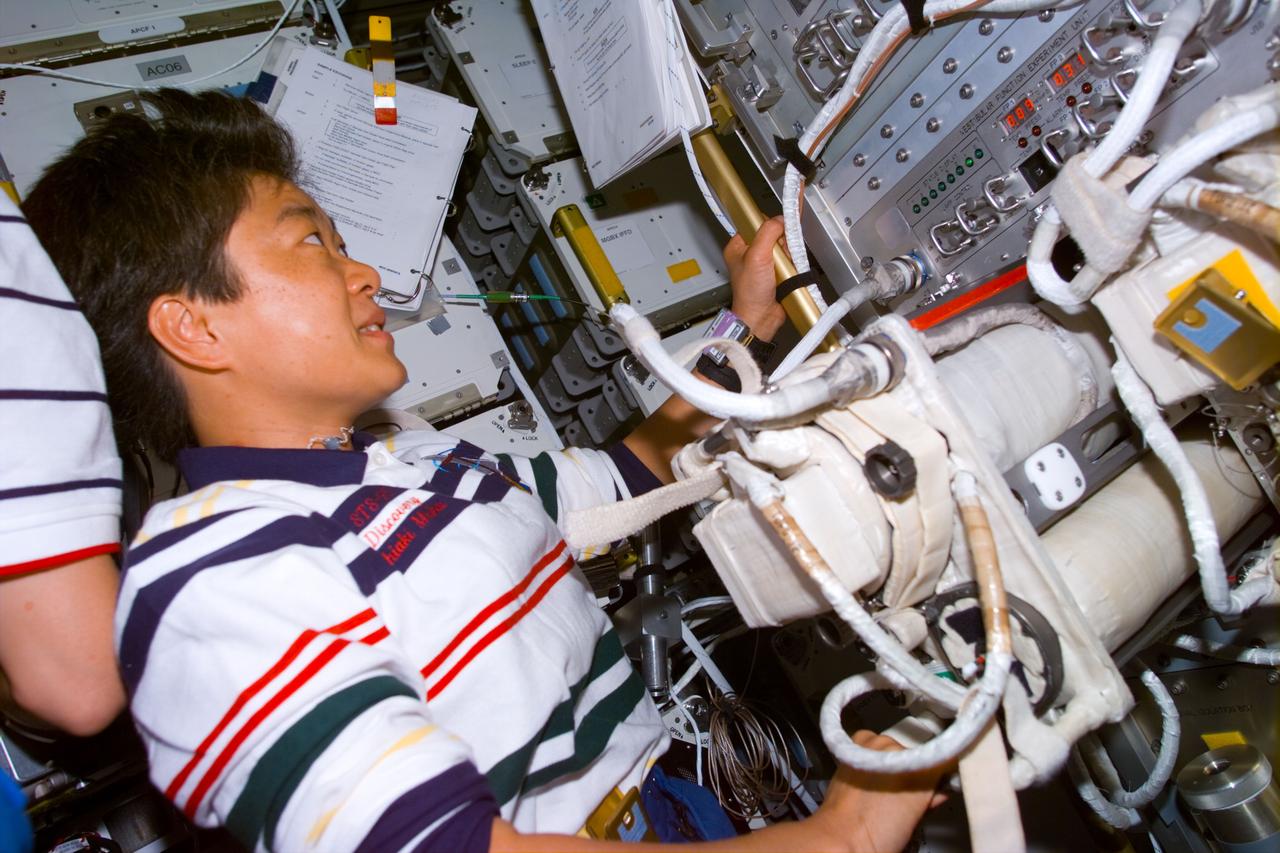
STS095-E-5105 (2 Nov. 1998) --- STS-95 payload specialist Chiaki Mukai, representing Japan's National Space Development Agency (NASDA), prepares to conduct an experiment in the Spacehab facility aboard the Space Shuttle Discovery during Flight Day 4 activity. The photo was taken with an electronic still camera (ESC) at 05:02:27 GMT, Nov. 2.
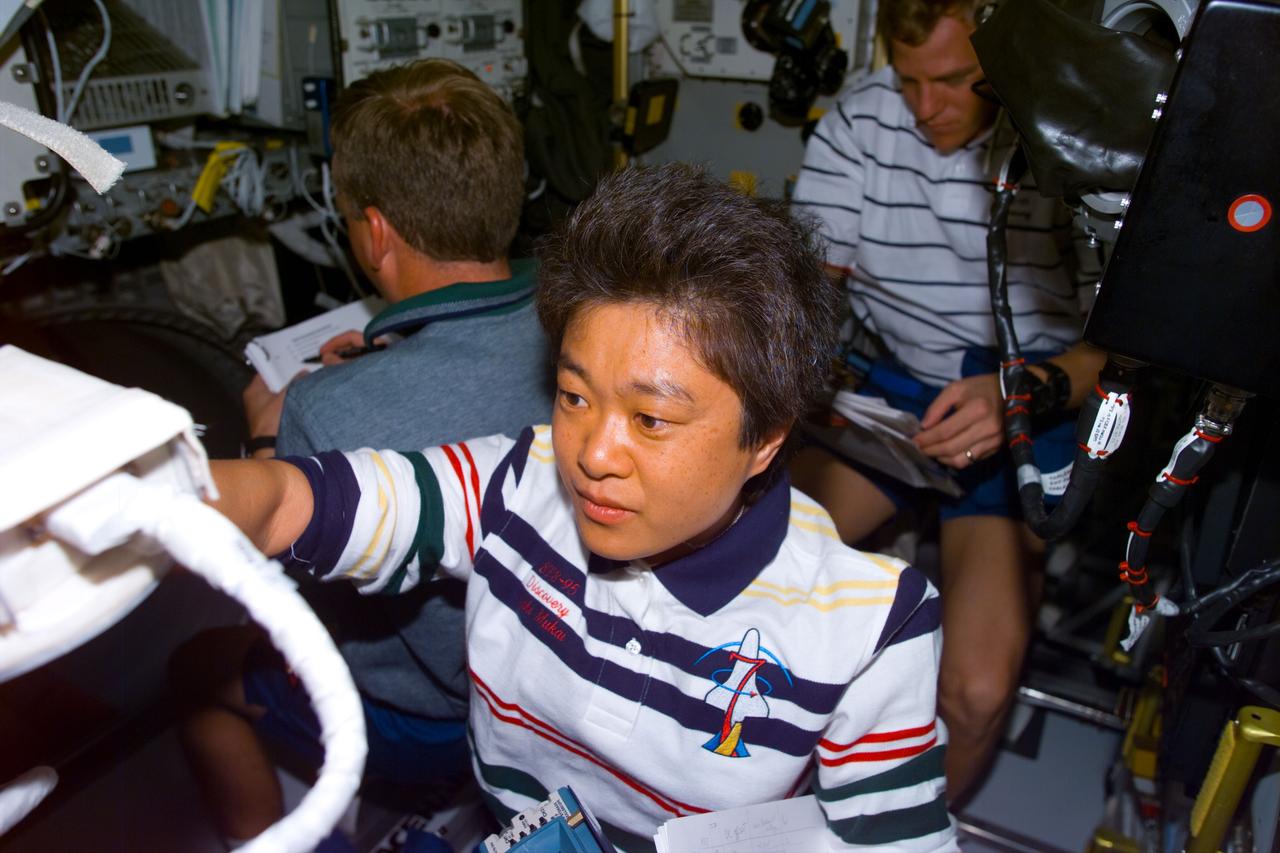
STS095-E-5115 (2 Nov. 1998) --- Payload specialist Chiaki Mukai, representing Japan's National Space Development Agency (NASDA), sets up an experiment on Spacehab during flight day four activity. In the background are astronauts Steven W. Lindsey, STS-95 pilot, and Scott E. Parazynski, mission specialist. The photo was taken with an electronic still camera (ESC) at 05:14:24 GMT, Nov. 2.
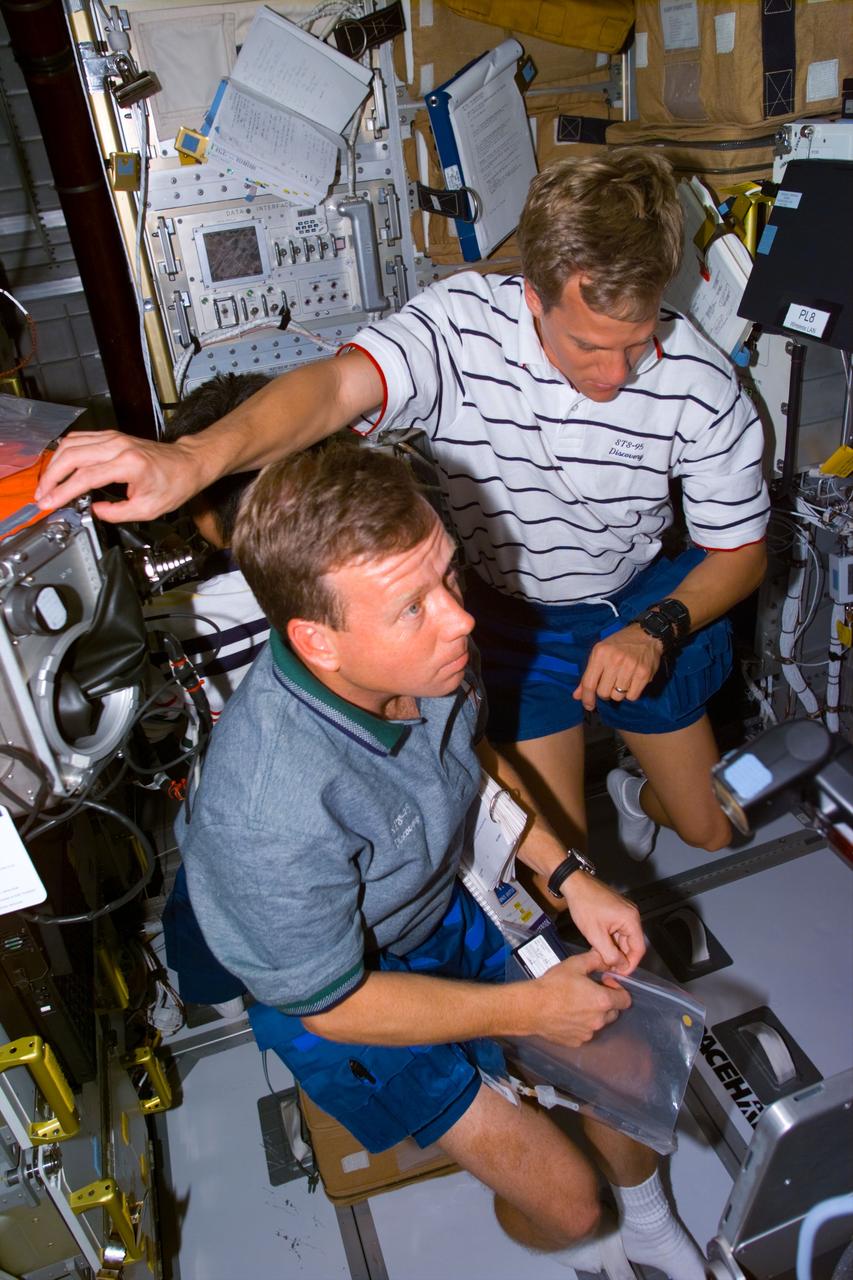
STS095-E-5111 (2 Nov. 1998) --- A high-angle view shows astronauts Steven W. Lindsey (left), STS-95 pilot, and Scott E. Parazynski, mission specialist, work with supportive gear for experiments on Spacehab. The heavily used glove box facility is on left side of frame. The photo was taken with an electronic still camera (ESC) at 05:11:38 GMT, Nov. 2.
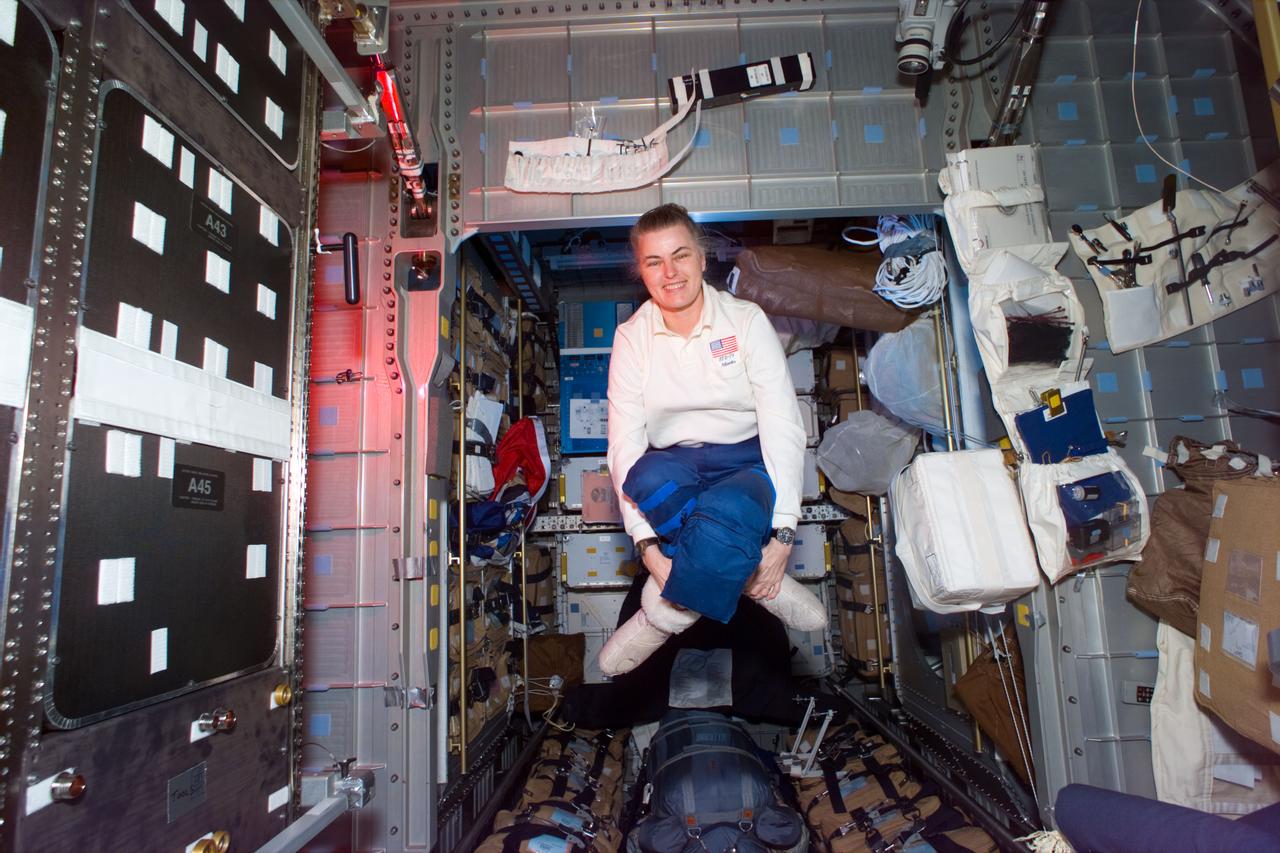
STS79-E-5370 (24 September 1996)--- During off-duty time in the Spacehab Module, astronaut Shannon W. Lucid uses the microgravity of space to fabricate her own kind of easy chair as the days of her lengthy Russian Mir Space Station stay as a cosmonaut guest researcher come to a close. The photo was taken with an electronic still camera (ESC) during Flight Day 9.
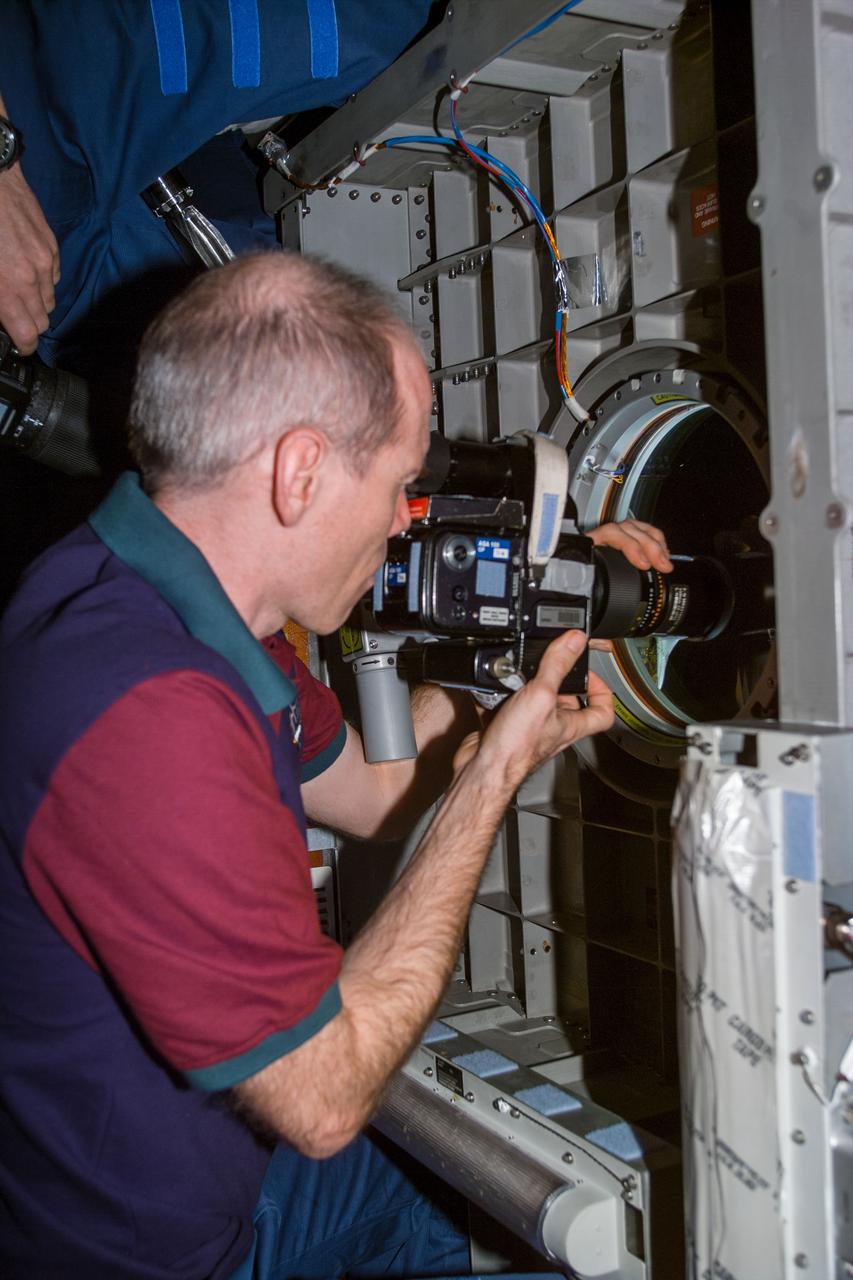
S96-E-5134 (4 June 1999) --- Astronaut Daniel T. Barry uses a viewing port on SpaceHab to take out-the-window views aboard the Earth-orbiting Space Shuttle Discovery. The photo was taken with an electronic still camera (ESC) at 00:50:53, June 4, 1999.
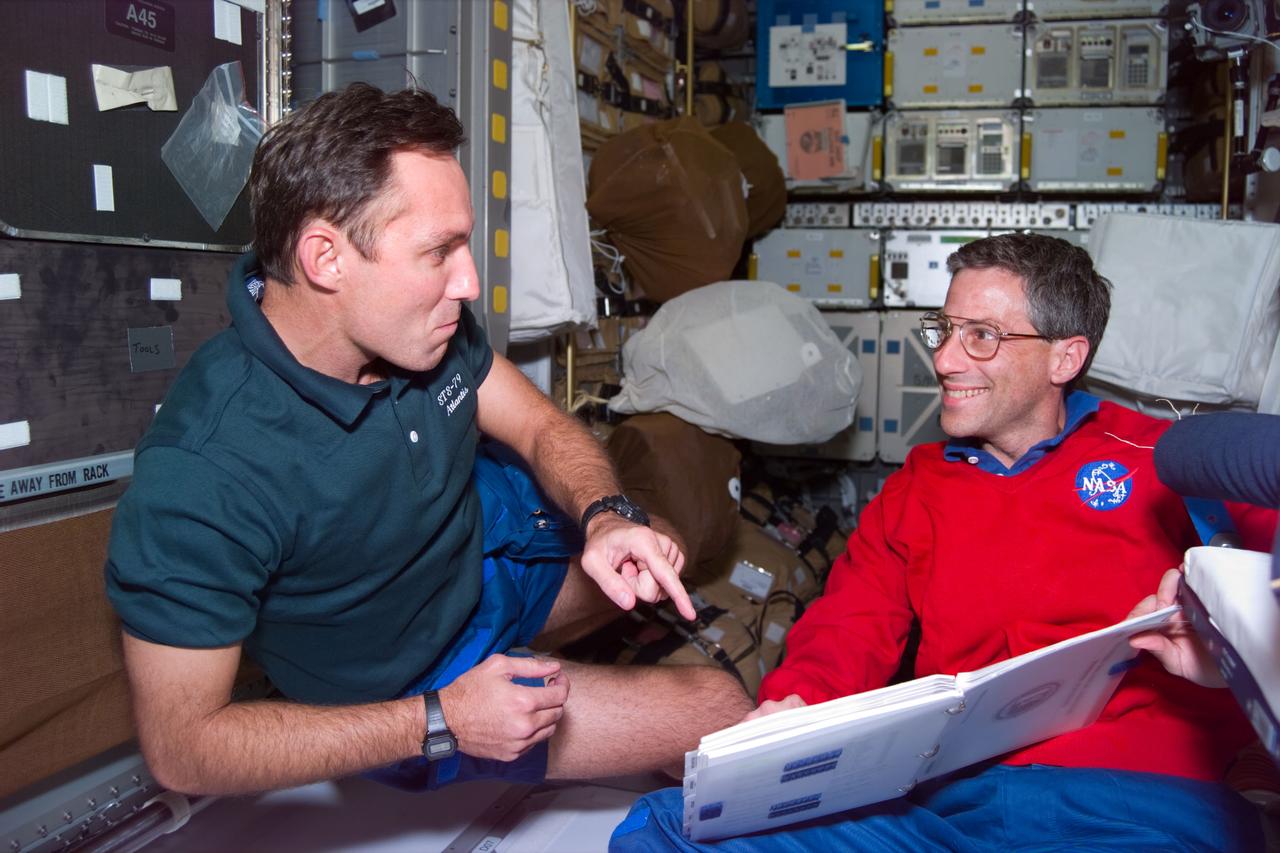
STS79-E-5007 (17 September 1996) --- Astronauts Carl E. Walz and Jerome (Jay) Apt, mission specialists, report to Spacehab Module for early mission experimentation on the first full day of STS-79 operations, on Flight Day 2.
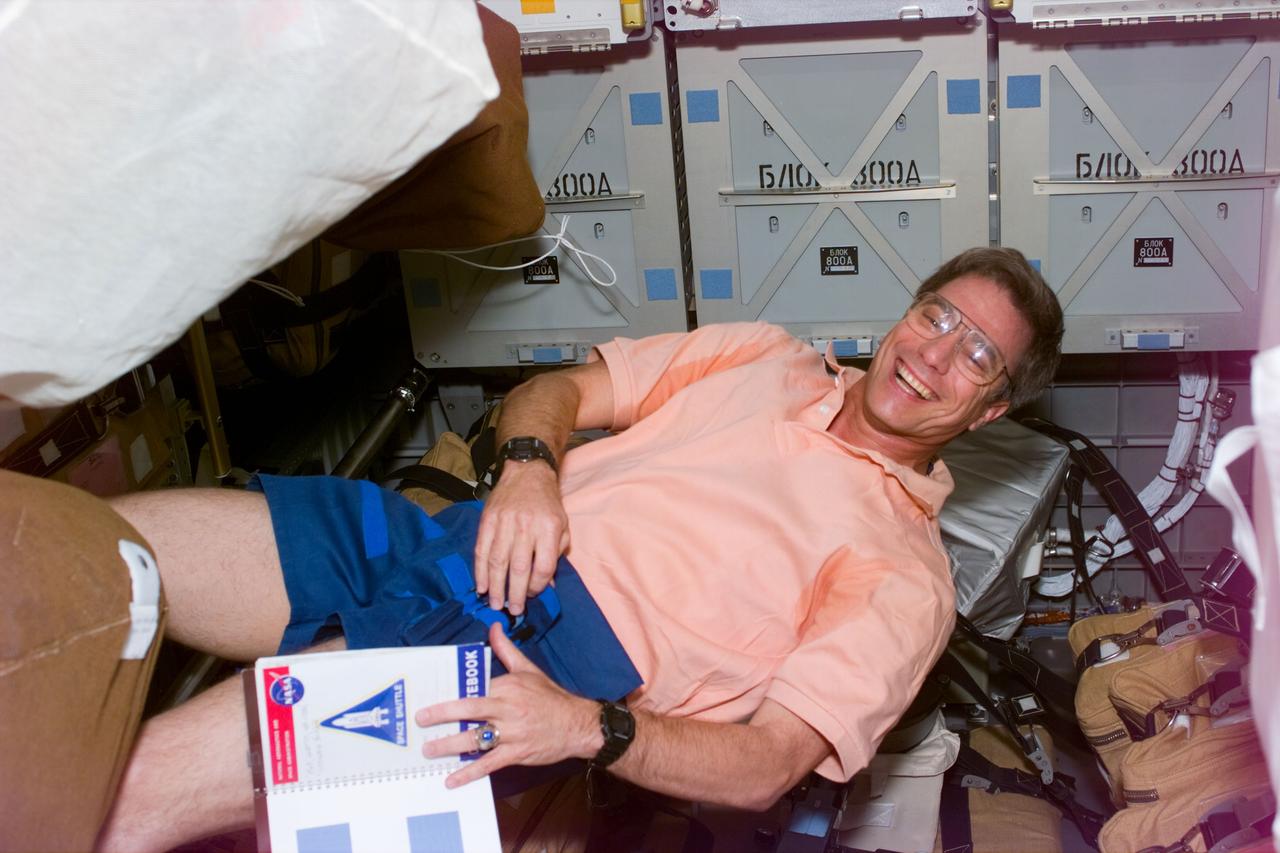
STS79-E-5027 (18 September 1996) --- Astronaut John E. Blaha, near Spacehab lockers onboard the Space Shuttle Atlantis, stays busy with final preparations for joining cosmonauts for crew mates following tomorrow's docking of the Atlantis and Russia's Mir Space Station, on Flight Day 3.
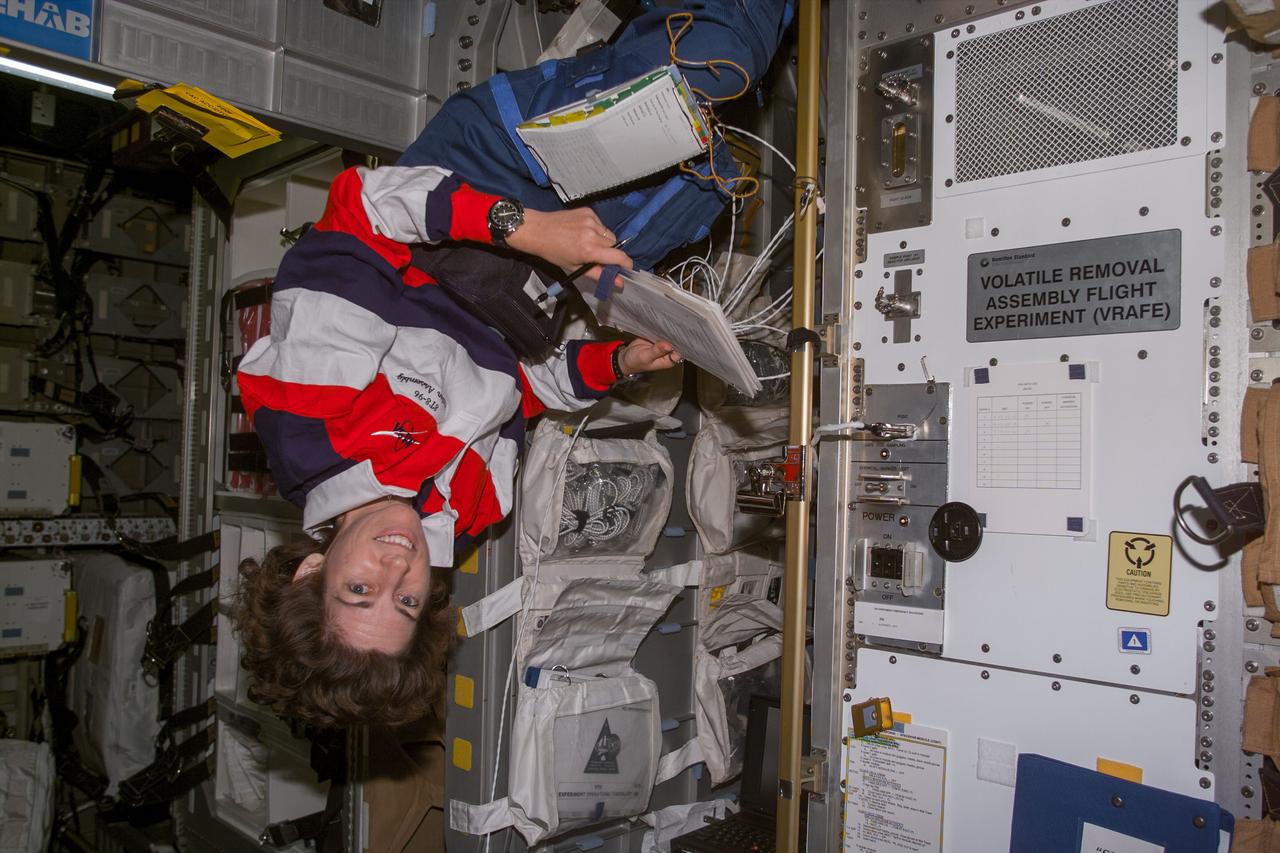
S96-E-5150 (02 June 1999) --- Astronaut Ellen Ochoa, STS-96 mission specialist, in the SpaceHab module aboard the Earth-orbiting Space Shuttle Discovery. The photograph was taken with an electronic still camera (ESC) at 01:14:12, June 2, 1999.
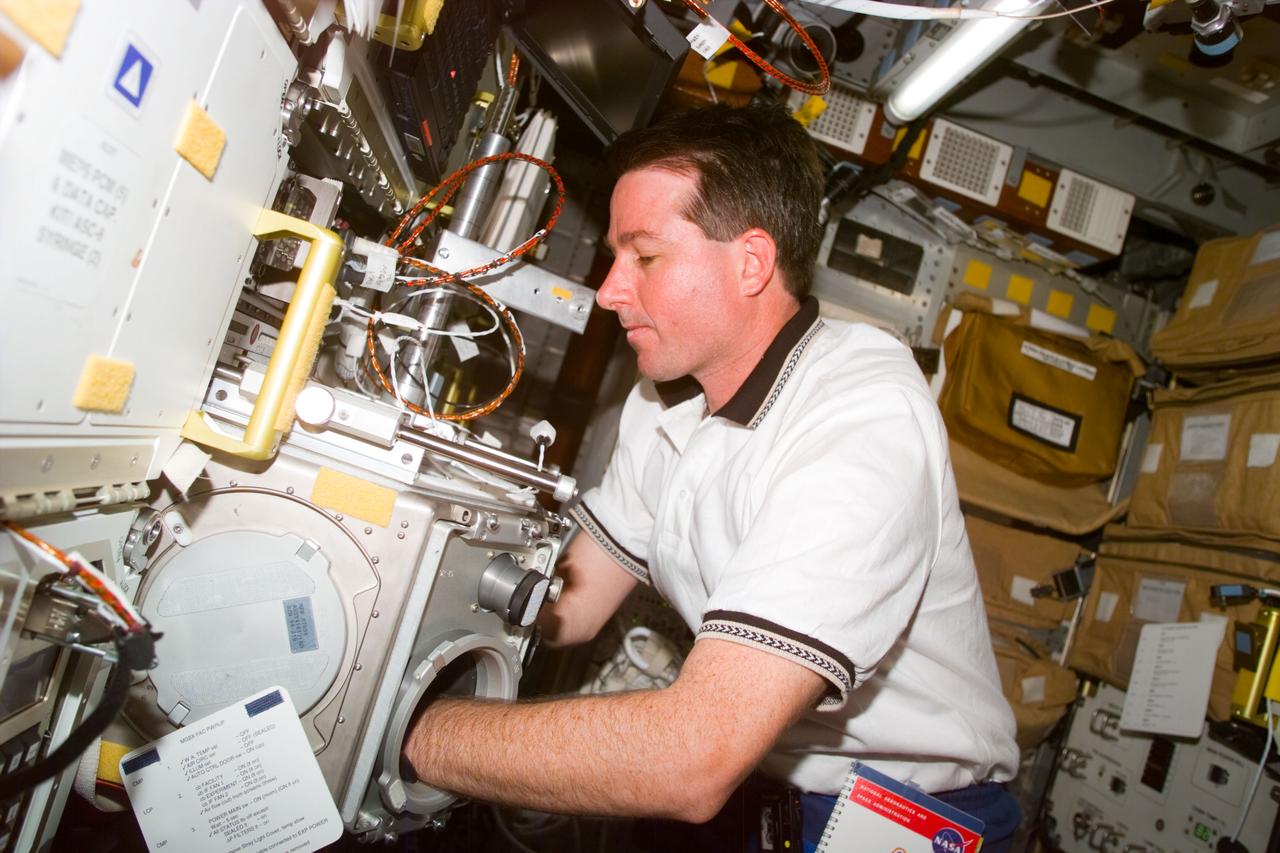
STS095-E-5163 (1 Nov. 1998) --- Astronaut Stephen K. Robinson, mission specialist, works with an experiment in the glove box located in the Spacehab facility onboard Discovery. The photo was taken with an electronic still camera (ESC) at 01:53:47 GMT, Nov. 1.
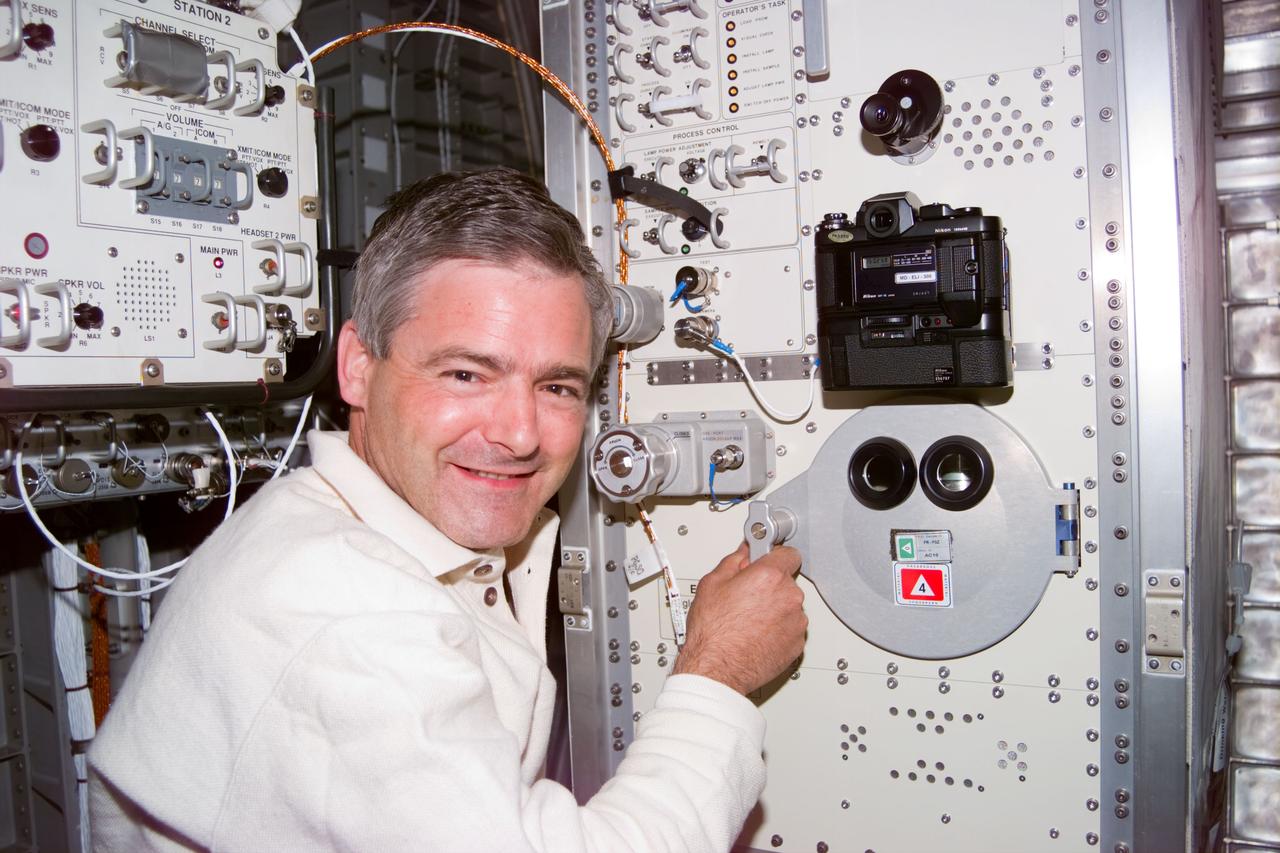
S77-E-5094 (25 May 1996) --- Astronaut Marc Garneau, mission specialist representing the Canadian Space Agency (CSA), stands at the Commercial Float Zone Furnace (CFZF) in the Spacehab Module onboard the Earth-orbiting Space Shuttle Endeavour.
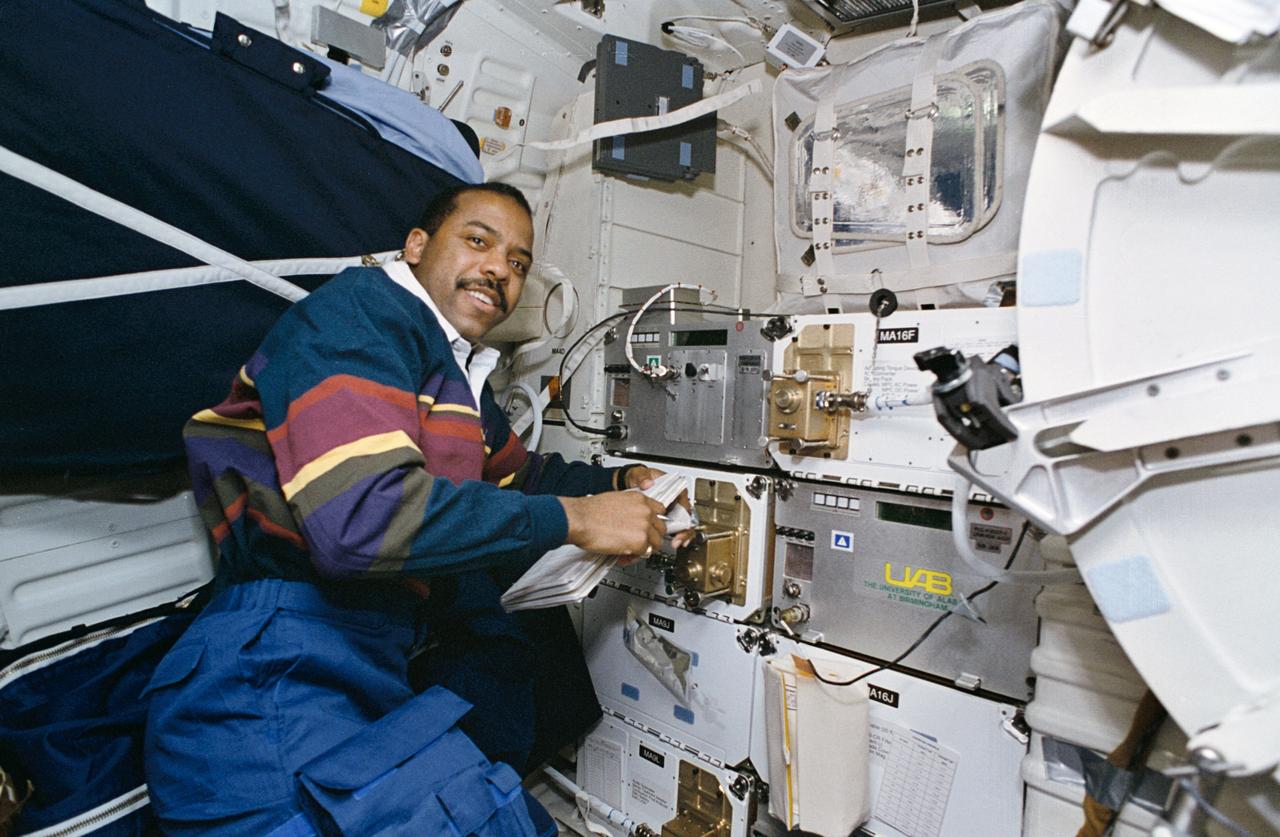
STS063-68-013 (3-11 Feb 1995) --- Astronaut Bernard A. Harris, Jr., a physician and payload commander, monitors several Spacehab-3 experiments which occupy locker space on the Space Shuttle Discovery's mid-deck. The Spacehab 3 Module is located in the cargo bay. Others onboard the Discovery were astronauts James D. Wetherbee, commander; Eileen M. Collins, pilot; mission specialists C. Michael Foale, Janice E. Voss, and Russian cosmonaut Vladimir G. Titov.
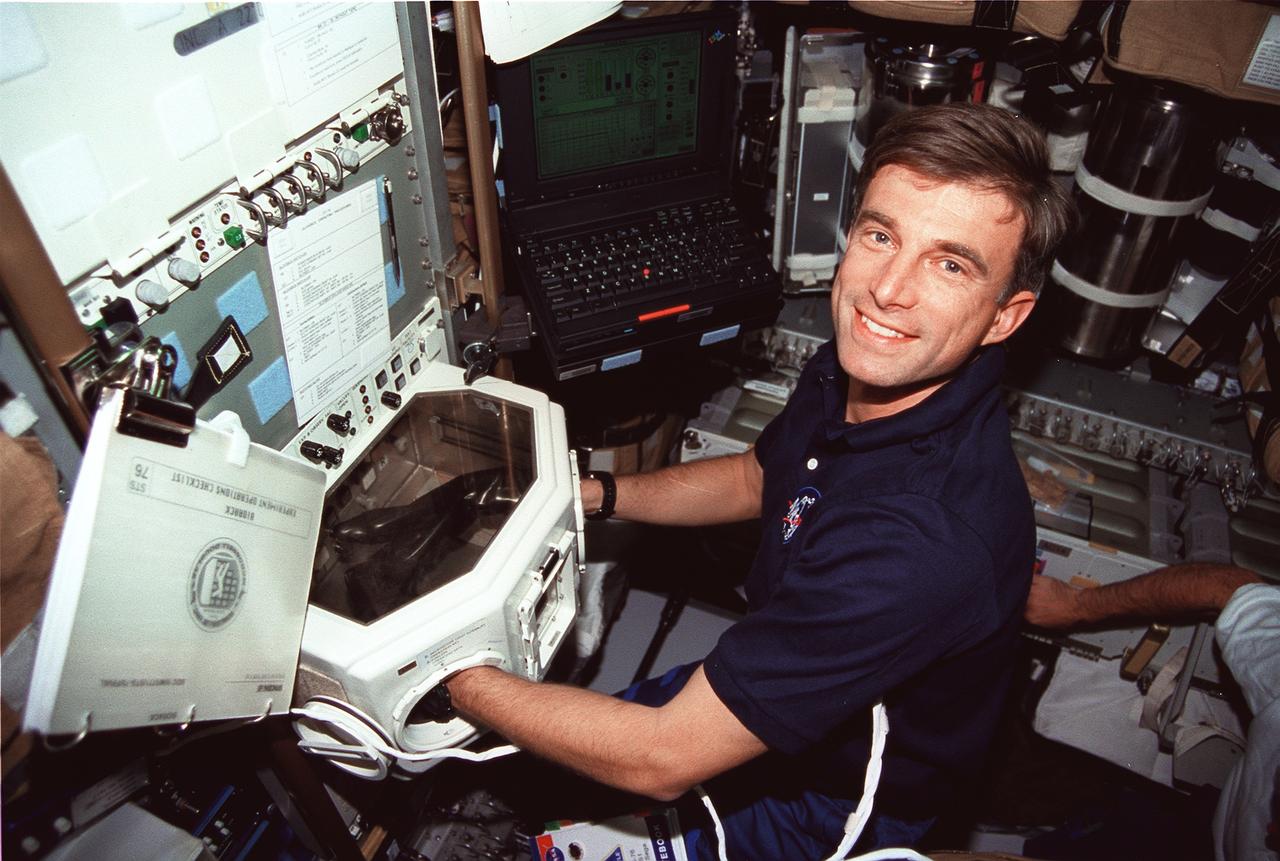
STS076-312-022 (22 - 31 March 1996) --- Astronaut Ronald M. Sega, payload commander, works in the glovebox facility in the Spacehab laboratory aboard the Earth-orbiting Space Shuttle Atlantis. The Spacehab facility was one of the busier research areas on Atlantis during the STS-76 mission. Also, some of the gear for transfer to Russia's Mir Space Station was stowed there prior to the March 23, 1996 docking of Atlantis and Mir.
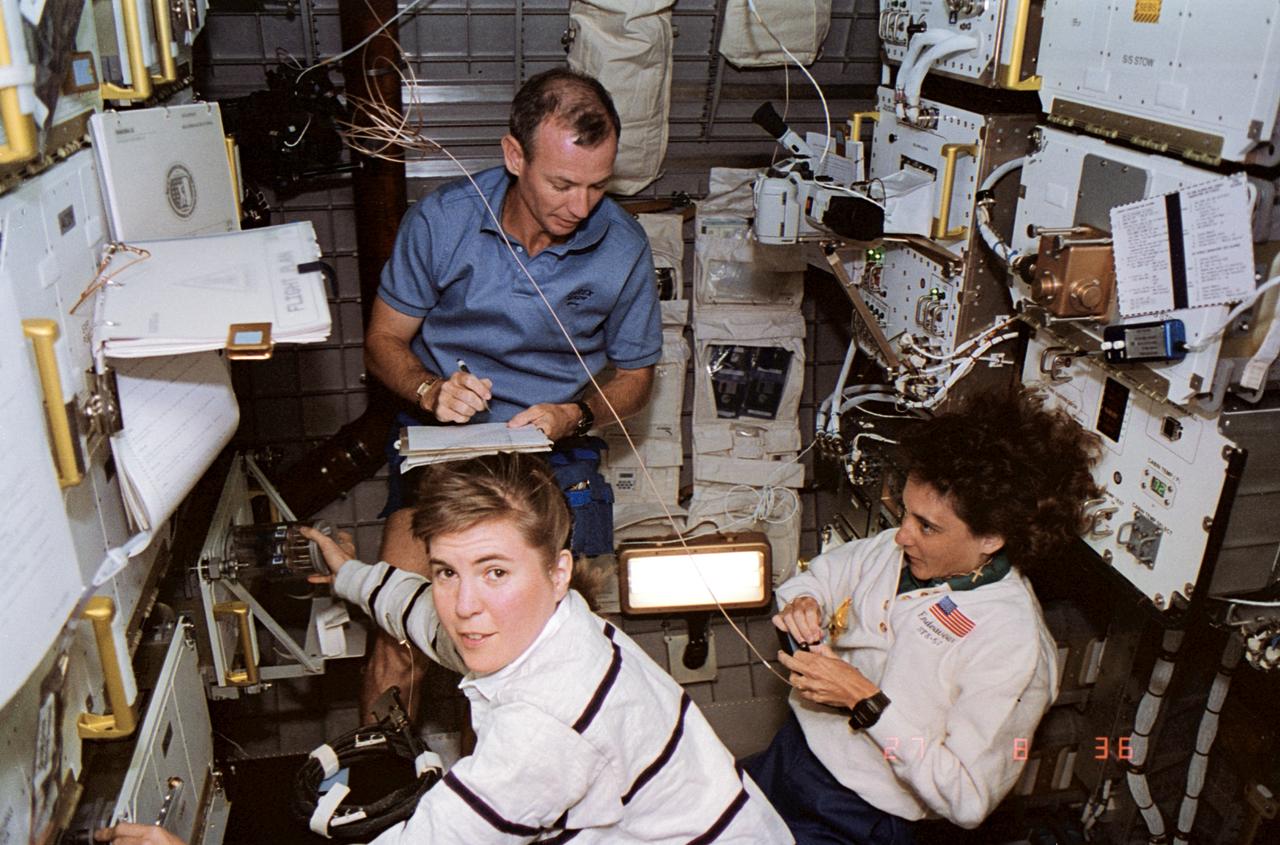
STS057-39-001 (27 June 1993) --- This high angle shot inside the SPACEHAB module, onboard the Space Shuttle Endeavour, typifies the pace of activity conducted there during the ten-day STS-57 mission. Astronaut Janice E. Voss (foreground), mission specialist, works with biomaterials products, while astronauts Brian Duffy, pilot, and Nancy J. Sherlock, mission specialist, participate in other tasks.
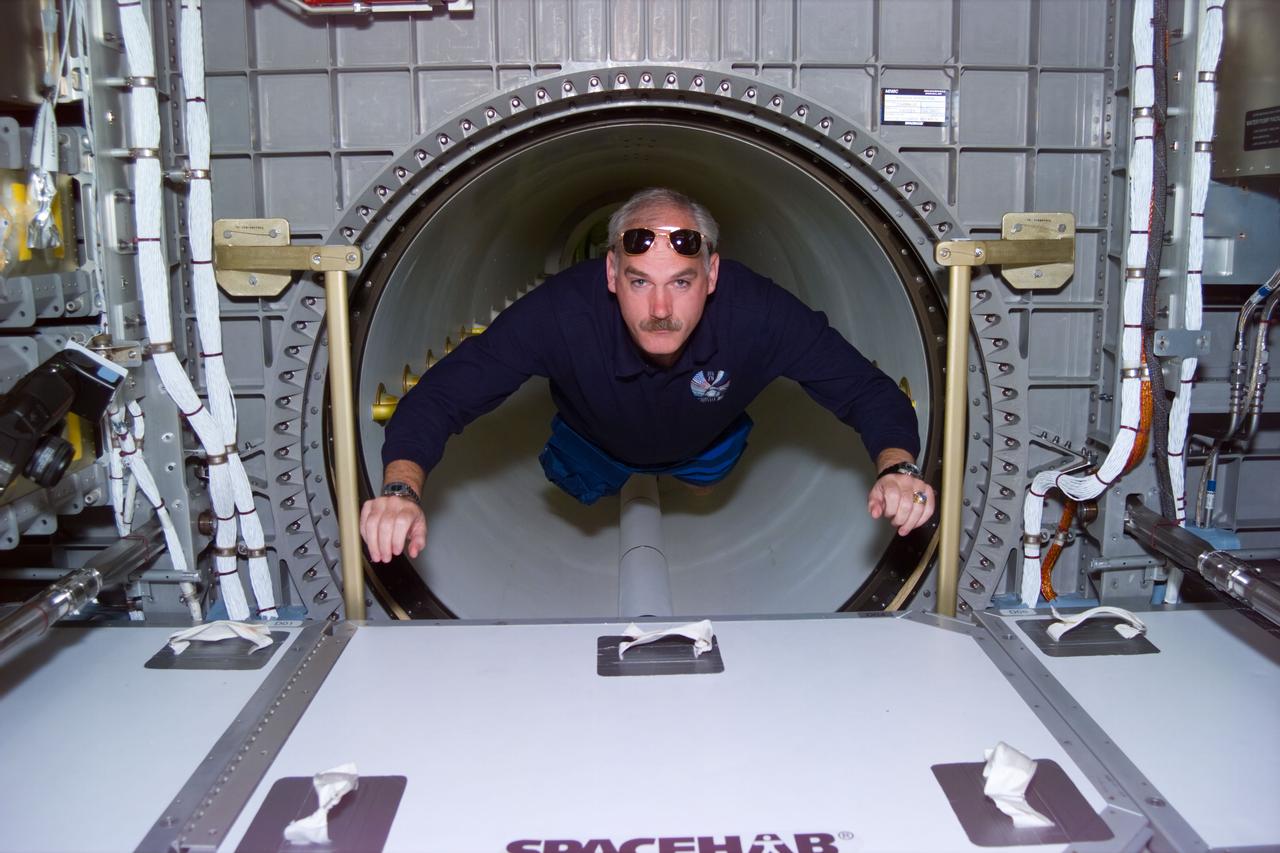
STS79-E-5008 (17 September 1996) --- Astronaut William F. Readdy, mission commander, floats through tunnel into Spacehab Module, onboard the Space Shuttle Atlantis on Flight Day 2.
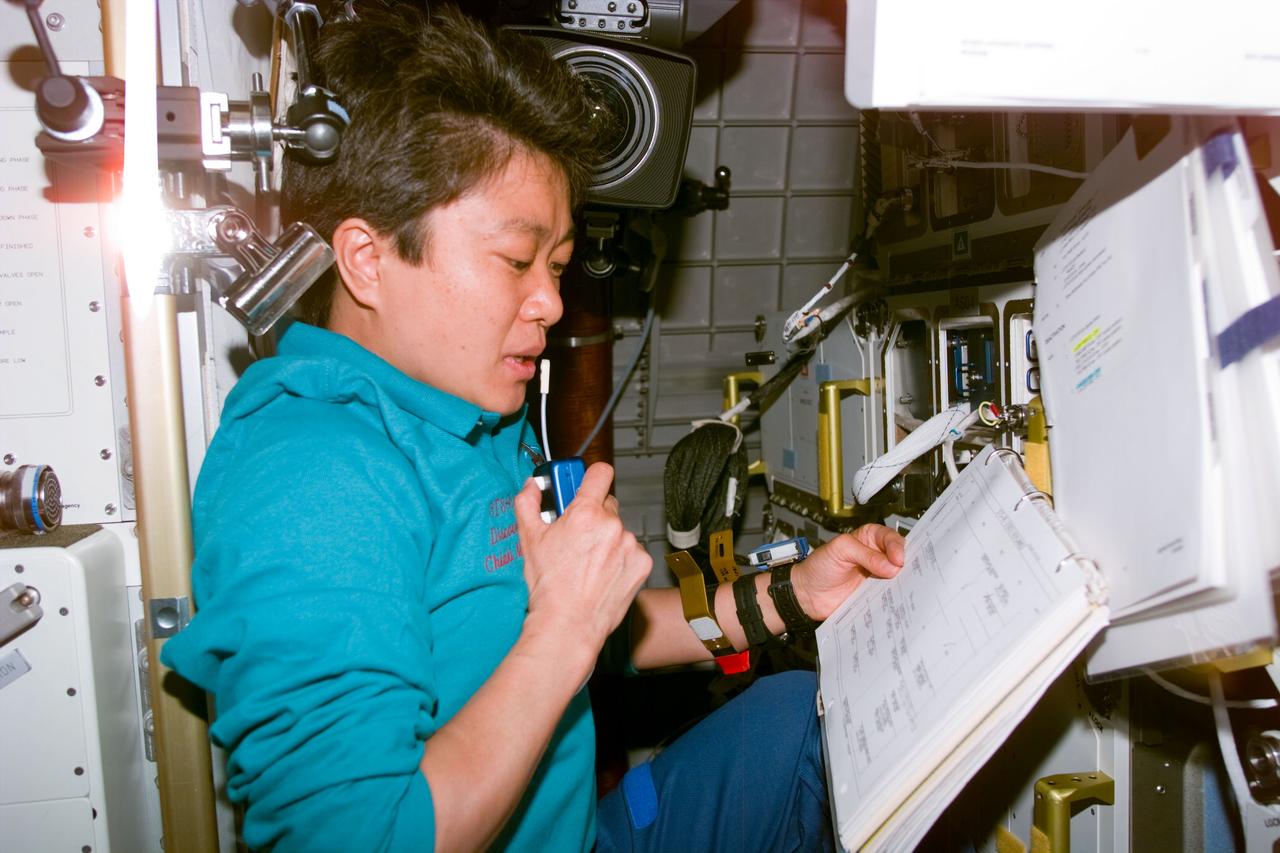
STS095-E-5067 (31 Oct. 1998) --- Aboard Spacehab, payload specialist Chiaki Mukai, representing Japan's National Space Development Agency (NASDA), talks to ground controllers and principal investigators regarding experiments she is conducting in zero gravity. The photo was taken with an electronic still camera (ESC) at 22:20:51 GMT, Oct. 31.
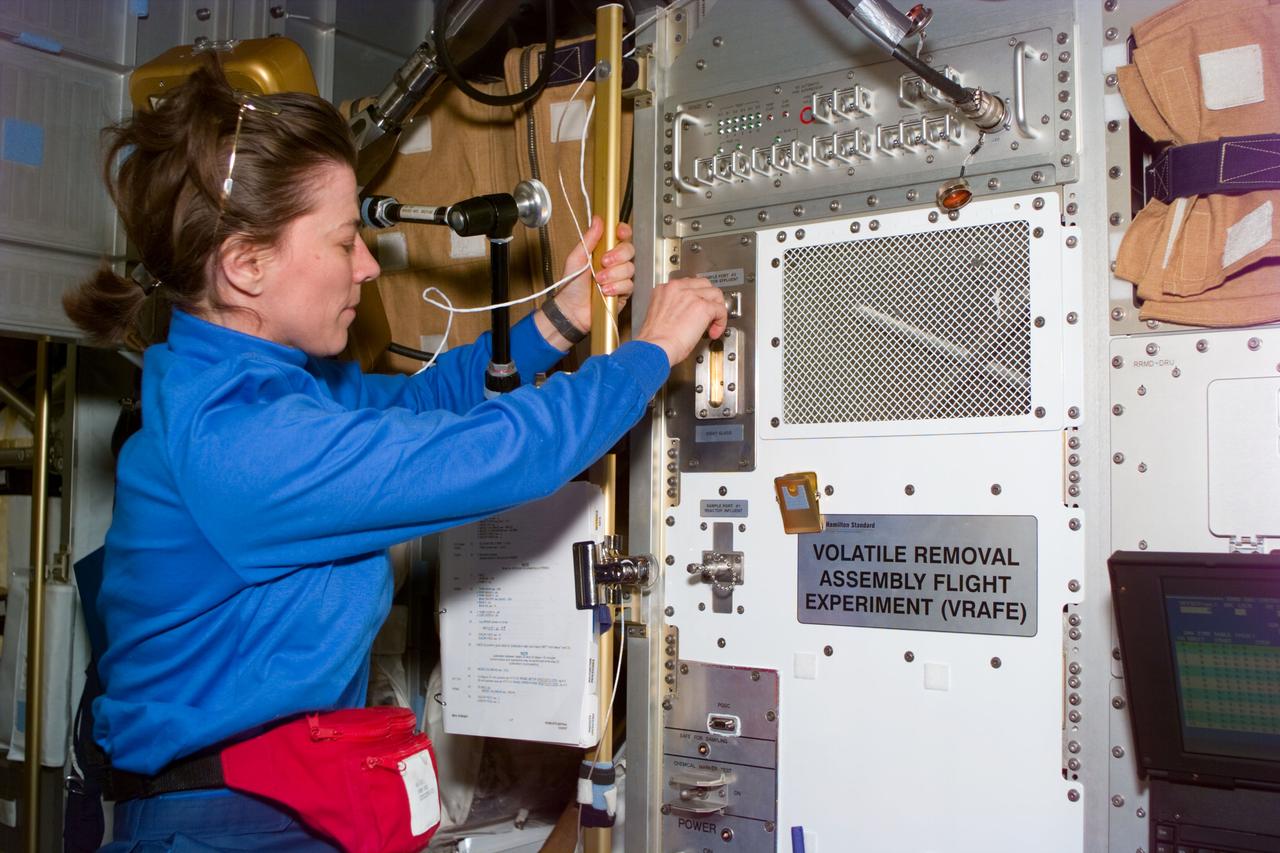
S89-E-5285 (25 Jan 1998) --- This Electronic Still Camera (ESC) image shows mission specialist Bonnie J. Dunbar, payload commander, working in the Spacehab Module onboard the Space Shuttle Endeavour. Dunbar is working with RME-1326, a Risk Mitigation Experiment (RME) at the Volatile Removal Assembly (VRA). This ESC view was taken on January 25, 1998 at 13:16:22 GMT.

STS095-E-5227 (4 Nov. 1998) --- Astronaut Steven W. Lindsey, STS-95 pilot, has done a 180-degree change of posture from earlier frame as he inputs data on a laptop in Spacehab aboard the Space Shuttle Discovery. The photo was taken with an electronic still camera (ESC) at 03:07:52 GMT, Nov. 4.
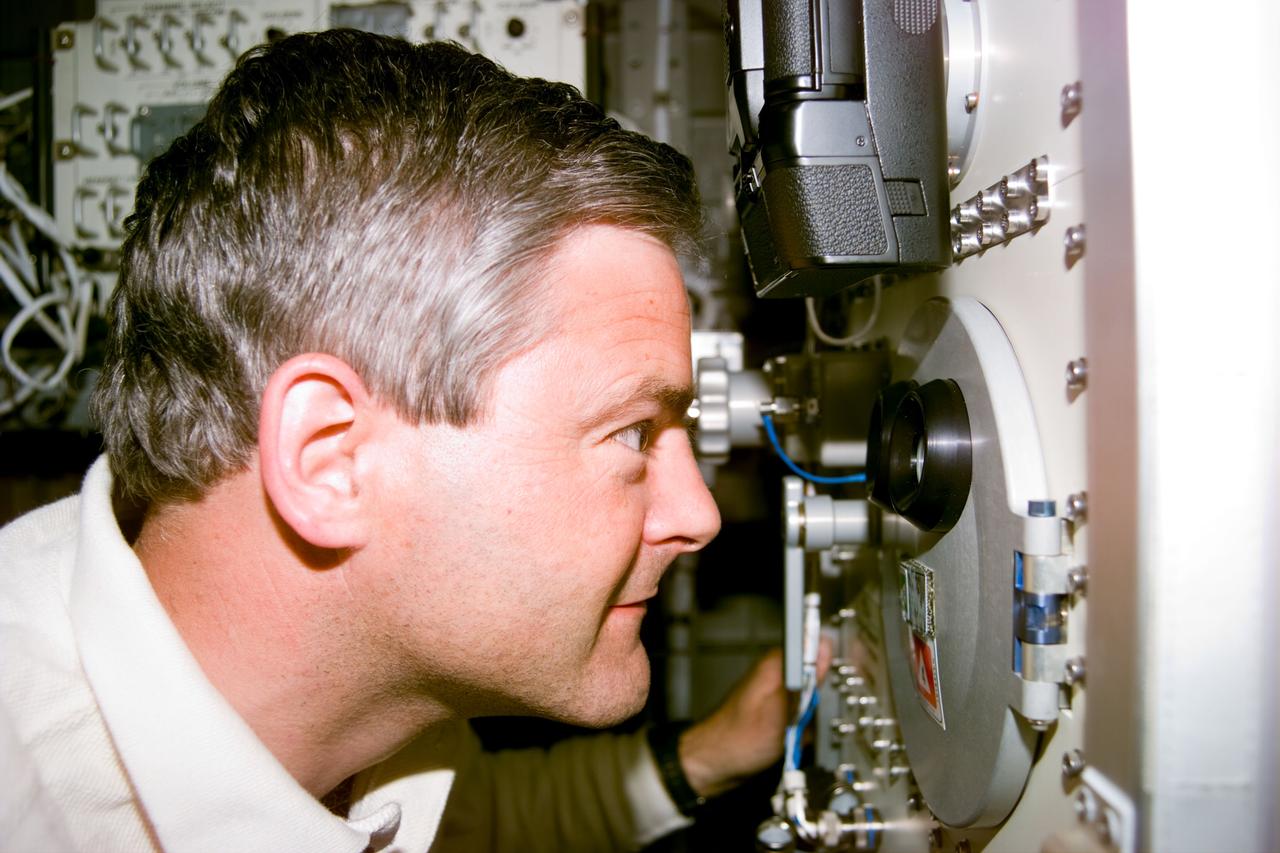
S77-E-5093 (25 May 1996) --- Astronaut Marc Garneau, mission specialist representing the Canadian Space Agency (CSA), makes a visual check of the Commercial Float Zone Furnace (CFZF), a single-rack-mounted facility in the Spacehab Module onboard the Earth-orbiting Space Shuttle Endeavour. The scene was recorded with an Electronic Still Camera (ESC).
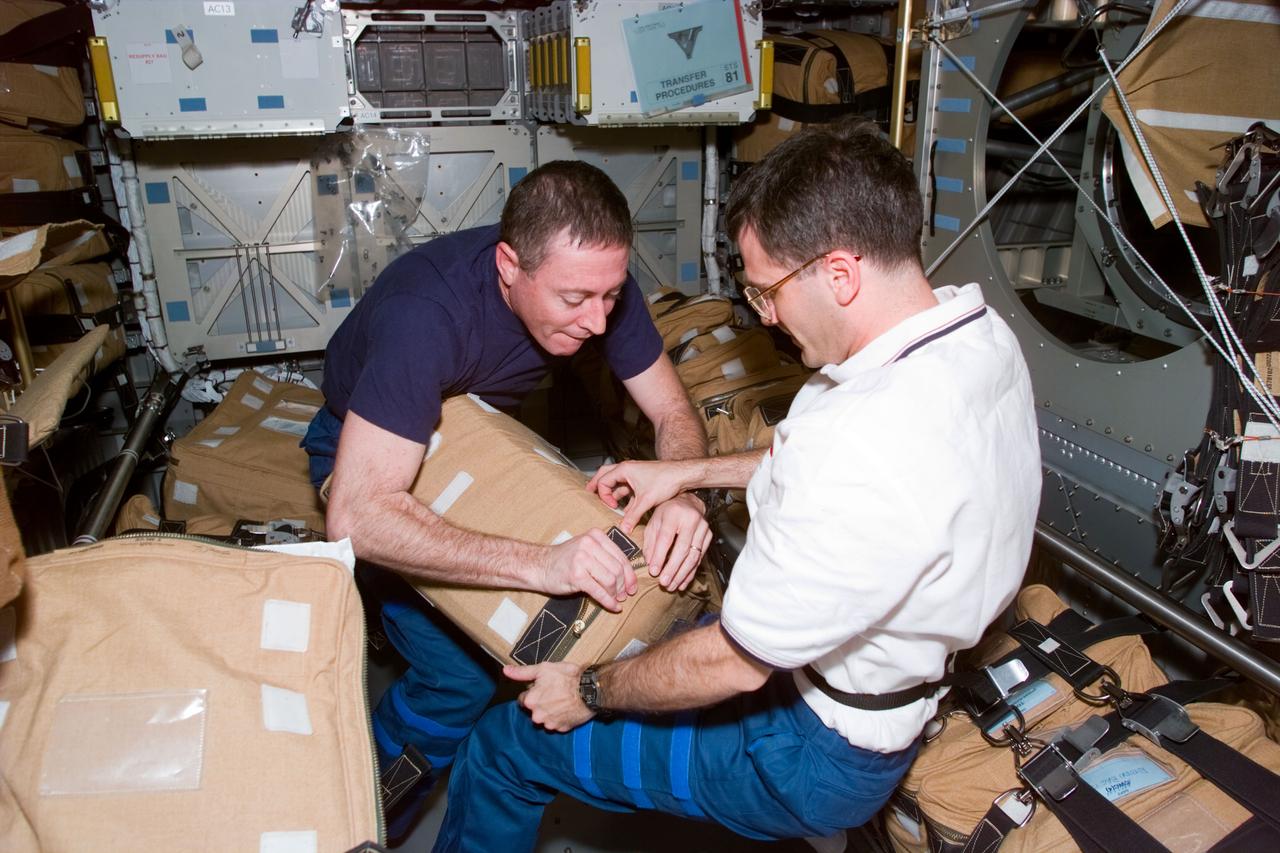
STS081-E-05515 (16 Jan. 1997) --- Astronauts Michael A. Baker, commander, and Peter J. K. (Jeff) Wisoff, mission specialist, secure a bag filled with a drawer of supplies in the Spacehab Double Module (DM). The scene was recorded with an Electronic Still Camera (ESC) and later downlinked to flight controllers in Houston, Texas.
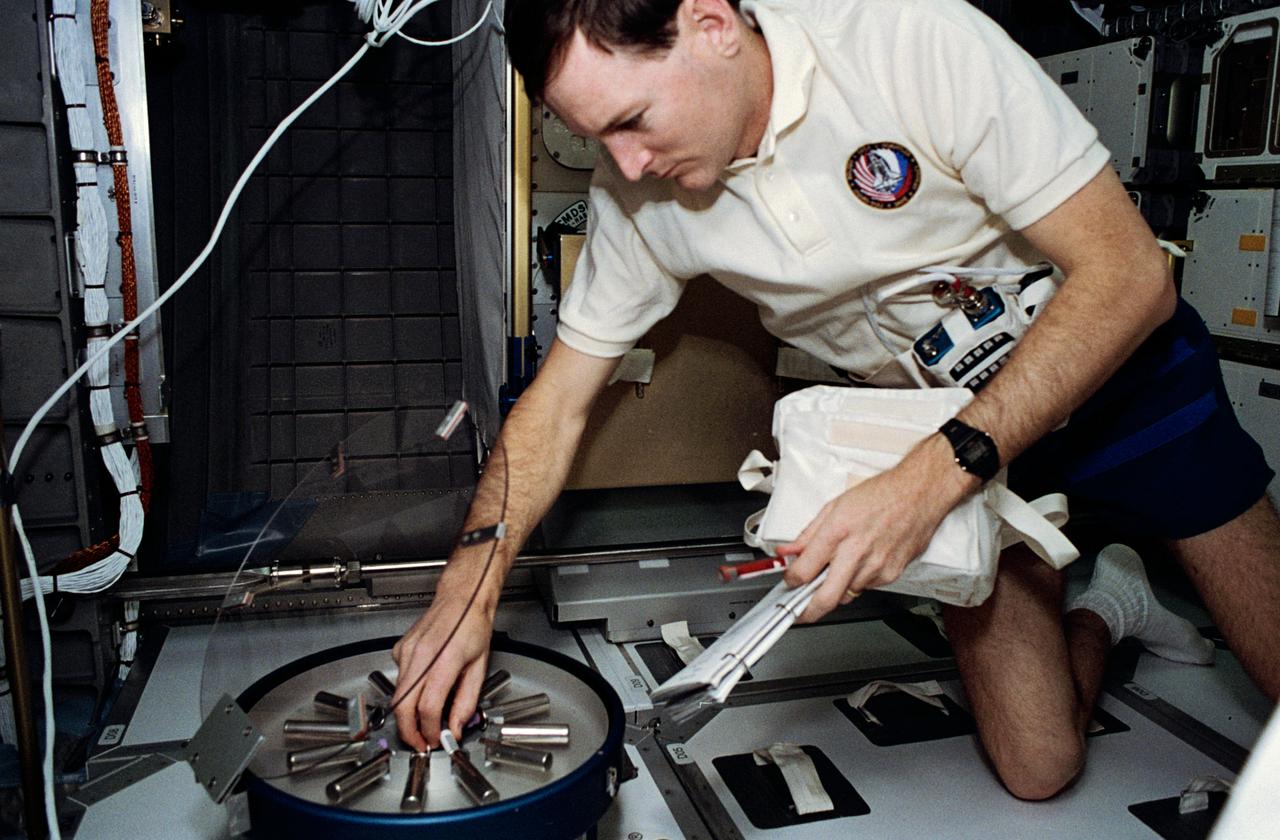
STS060-301-003 (3-11 Feb 1994) --- Astronaut Kenneth S. Reightler, STS-60 pilot, processes biomedical samples in a centrifuge aboard the SPACEHAB module. Reightler joined four other NASA astronauts and a Russian cosmonaut for eight days of research aboard the Space Shuttle Discovery.
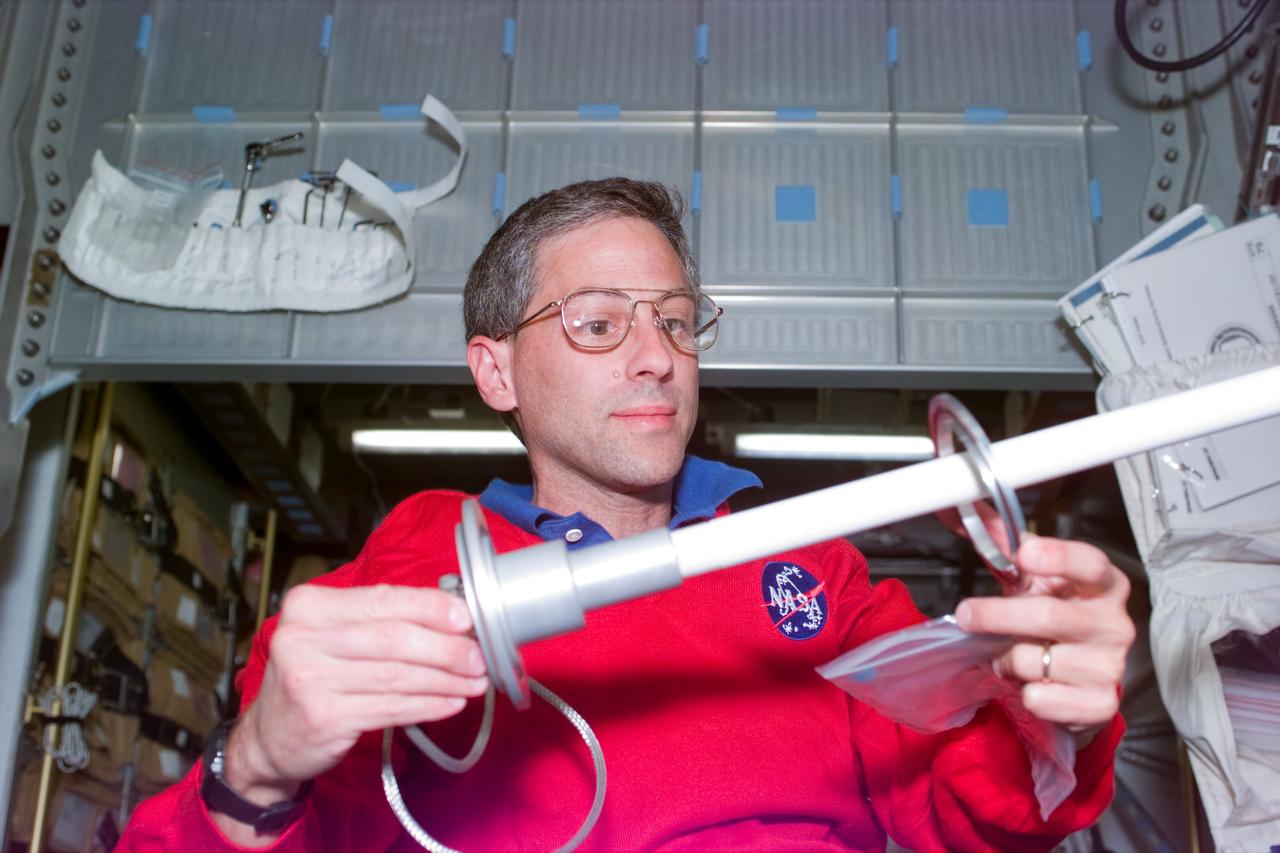
STS79-E-5018 (17 September 1996) --- Astronaut Jerome (Jay) Apt prepares experiment, a rod-like device for insertion into Extreme Temperature Translation Furnace (ETTF) in STS-79-E-5019, during early mission chores aboard Spacehab in the Space Shuttle Atlantis cargo bay, on Flight Day 2.
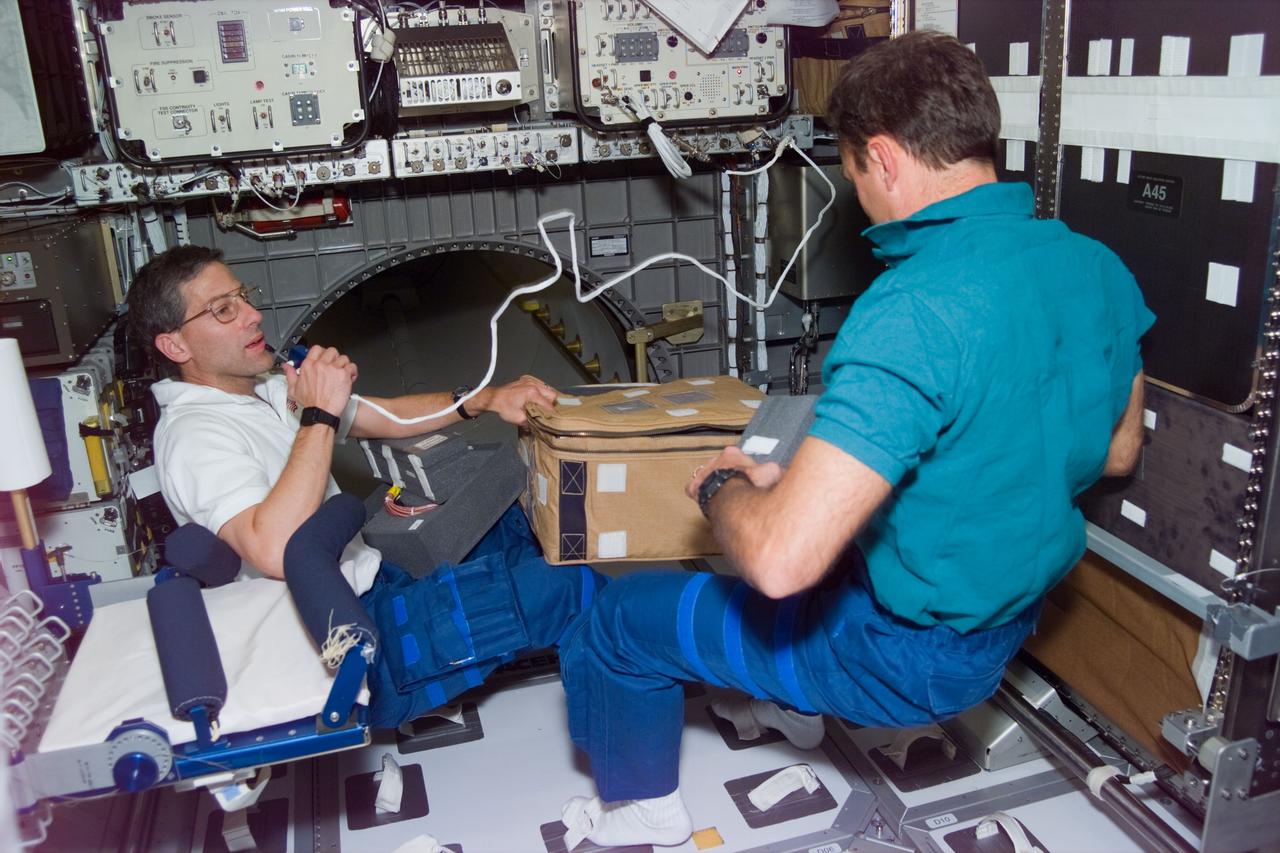
STS79-E-5268 (22 September 1996) --- Astronauts Jerome (Jay) Apt and Thomas D. Akers seal up a transfer stowage bag on the floor at the front end of the Spacehab Module, during Flight Day 7, onboard the Space Shuttle Atlantis.
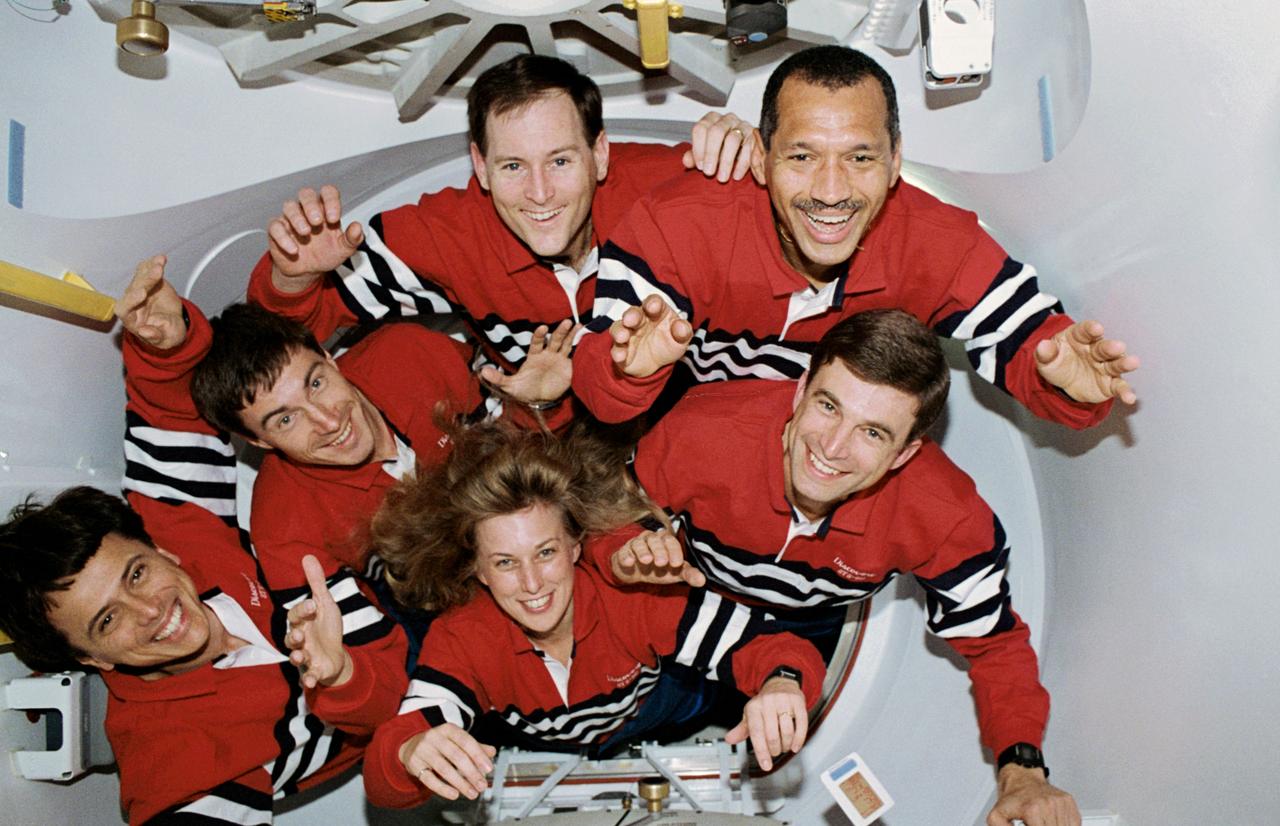
STS060-31-028 (3-11 Feb. 1994) --- Five NASA astronauts and a Russian cosmonaut squeeze through the tunnel which connects the shirt-sleeve environments of the space shuttle Discovery and the SPACEHAB module. SPACEHAB is located in the spacecraft’s payload bay. Charles F. Bolden Jr., mission commander, is at upper right. Others, clockwise from the commander, are Ronald M. Sega and N. Jan Davis, both mission specialists; Franklin R. Chang-Diaz, payload commander; cosmonaut Sergei K. Krikalev, mission specialist; and Kenneth S. Reightler Jr., pilot. The six spent eight days in Earth orbit. Photo credit: NASA
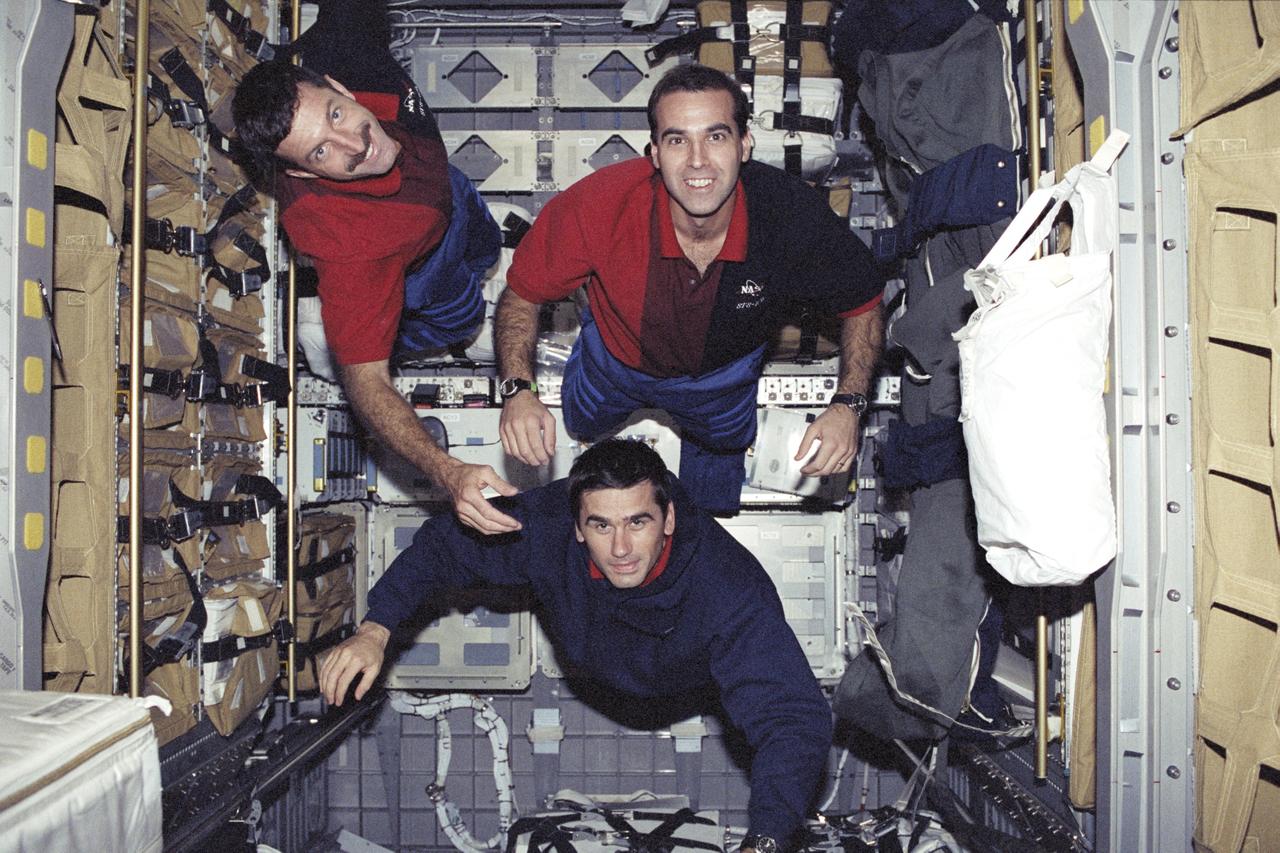
STS106-369-019 (8-20 September 2000) --- Two astronauts and a cosmonaut, all mission specialists, float onboard Spacehab. They are astronauts Daniel C. Burbank (top left) and Richard A. Mastracchio (top right), along with cosmonaut Yuri I. Malenchenko. The Spacehab double module is as "empty" as it was at any other time during the STS-106 mission in this scene, photographed during mission's end. The seven-man crew had moved a large amount of supplies and hardware to the International Space Station (ISS).

STS077-319-036 (19-29 May 1996) --- Astronaut Andrew S. W. Thomas, mission specialist, floats through the tunnel that connects the Spacehab Module to the Space Shuttle Endeavour?s cabin. Thomas and five other astronauts went on to spend almost ten days aboard Endeavour in support of the Spacehab 4 mission and a number of other payloads.
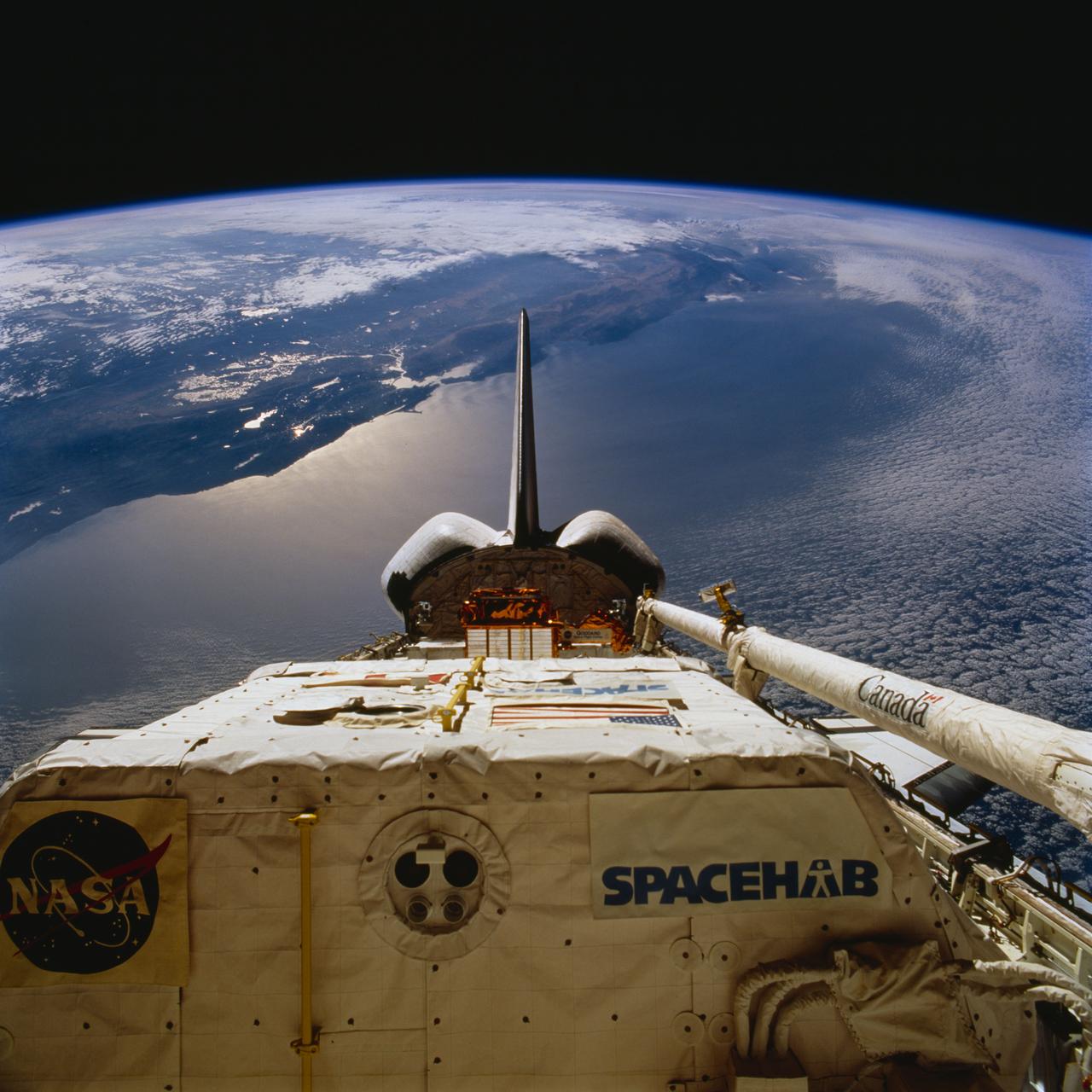
STS077-716-050 (19-29 May 1996) --- With part of the Pacific Ocean and almost the entire state of California as a backdrop, this scene of the Space Shuttle Endeavour’s cargo bay was photographed by a crew member on the aft flight deck. Spacehab-4’s module is in the foreground, flanked by the Canadian-built Remote Manipulator System (RMS) arm and the Spartan-207 payload, both in stowed position. Sunglint on the Earth scene accentuates the bay area of San Francisco. The San Andreas Fault can also easily be traced not far inalnd from the coastline.
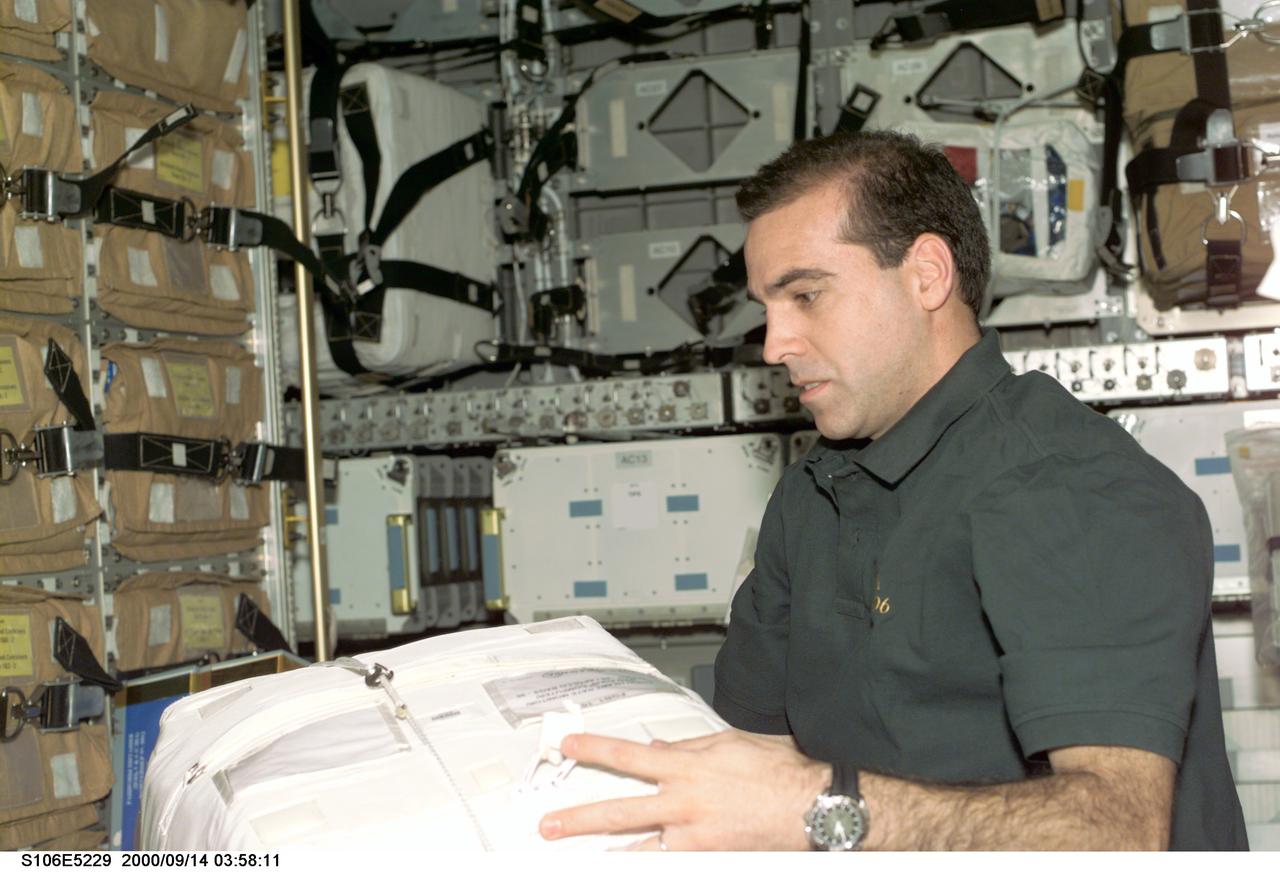
S106-E-5229 (14 September 2000) --- Astronaut Richard A. Mastracchio, mission specialist, works with packages of supplies in the Spacehab double module in the cargo bay of the Earth-orbiting Space Shuttle Atlantis.
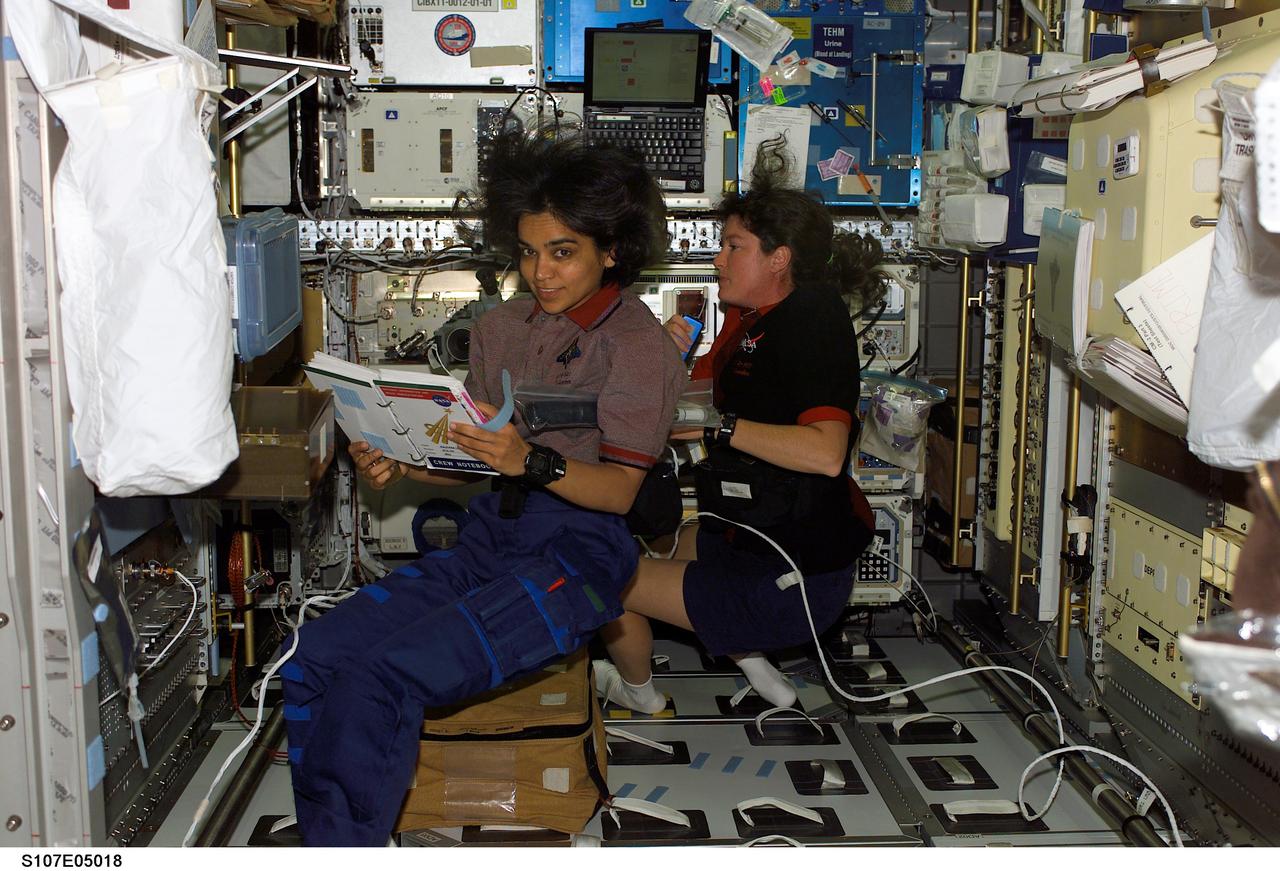
STS107-E-05018 (17 January 2003) --- Astronaut Kalpana Chawla (foreground) and Laurel B. Clark, STS-107 mission specialists, work in the SPACEHAB Research Double Module aboard the Space Shuttle Columbia.
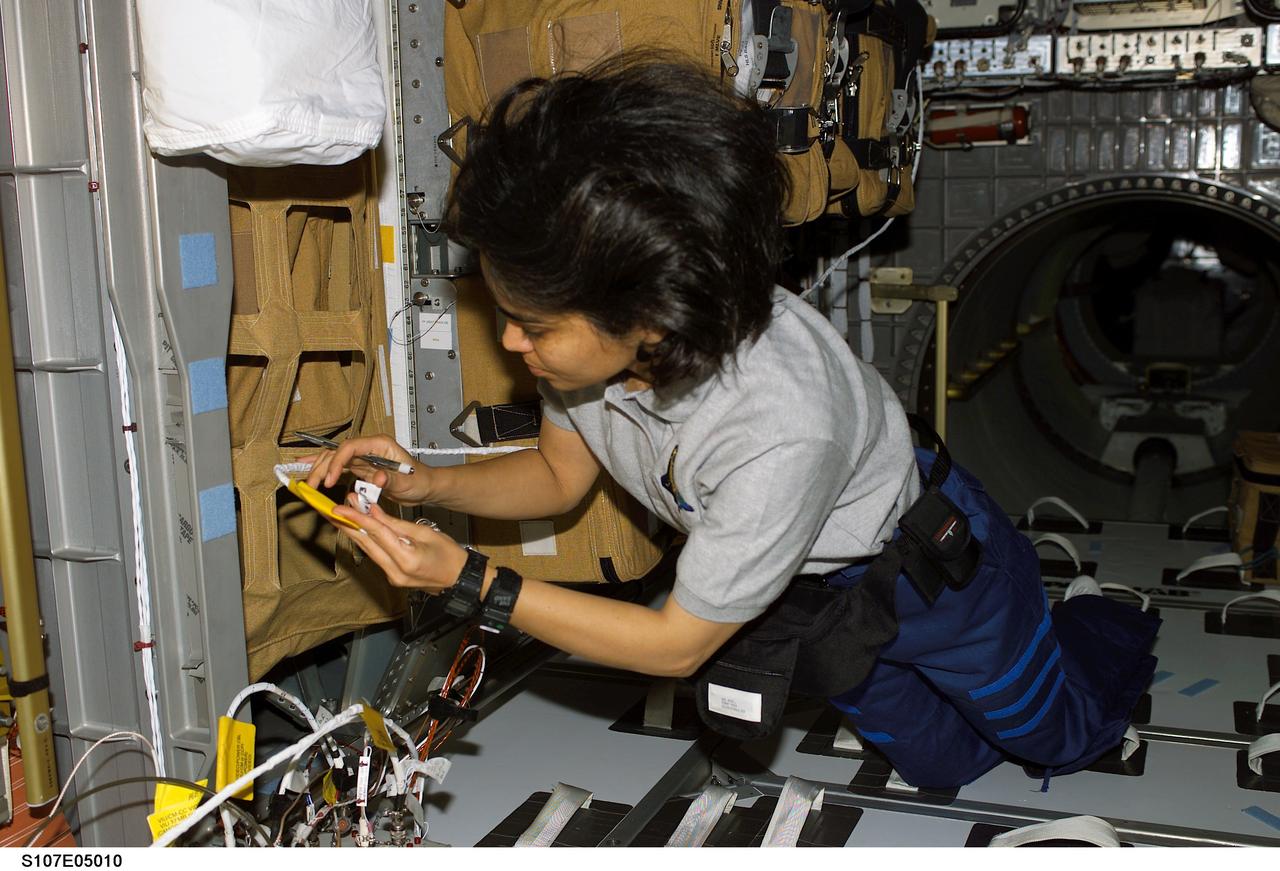
STS107-E-05010 (17 January 2003) --- Astronaut Kalpana Chawla, STS-107 mission specialist, works in the SPACEHAB Research Double Module aboard the Space Shuttle Columbia.
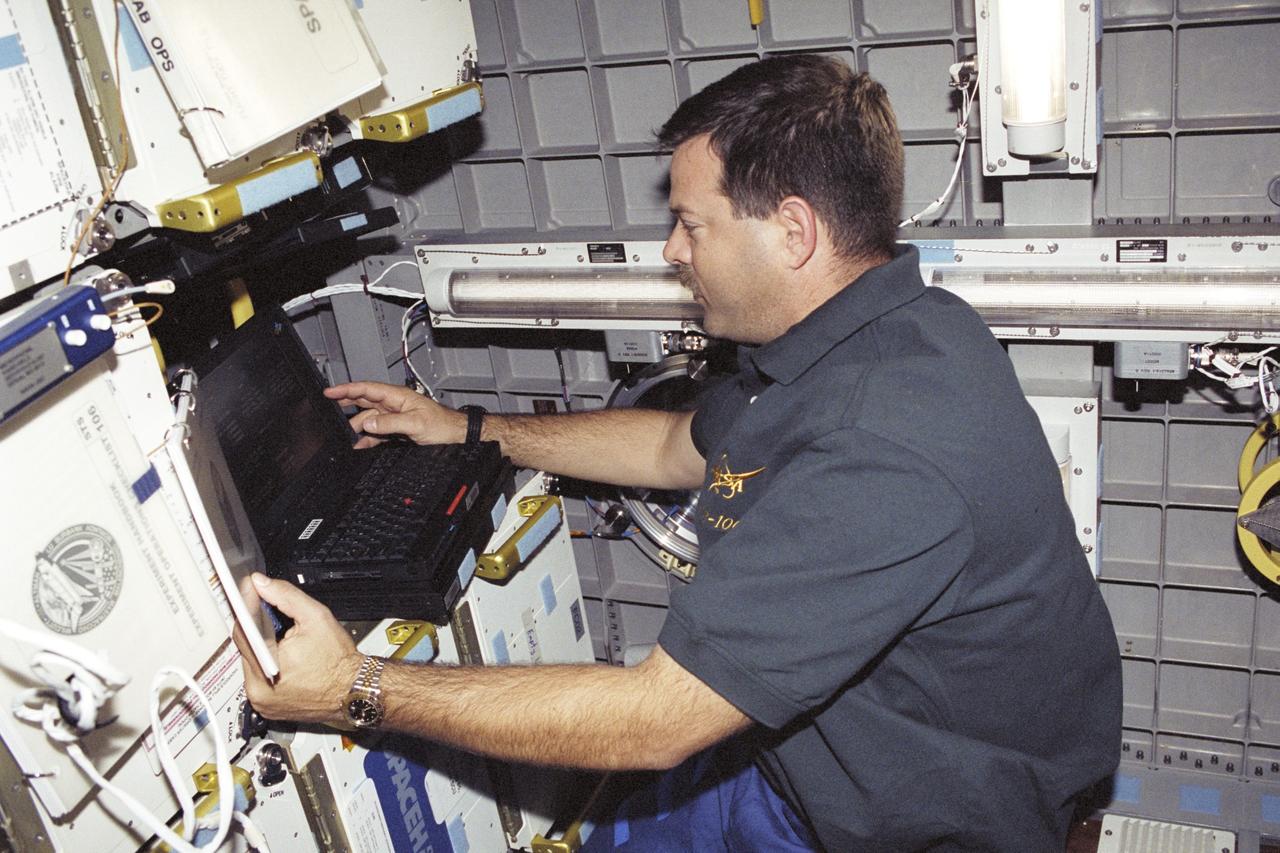
STS106-388-025 (8-20 September 2000) --- Astronaut Scott D. Altman, STS-106 pilot, works on a laptop computer in the SPACEHAB Logistics Double Module onboard the Space Shuttle Atlantis.
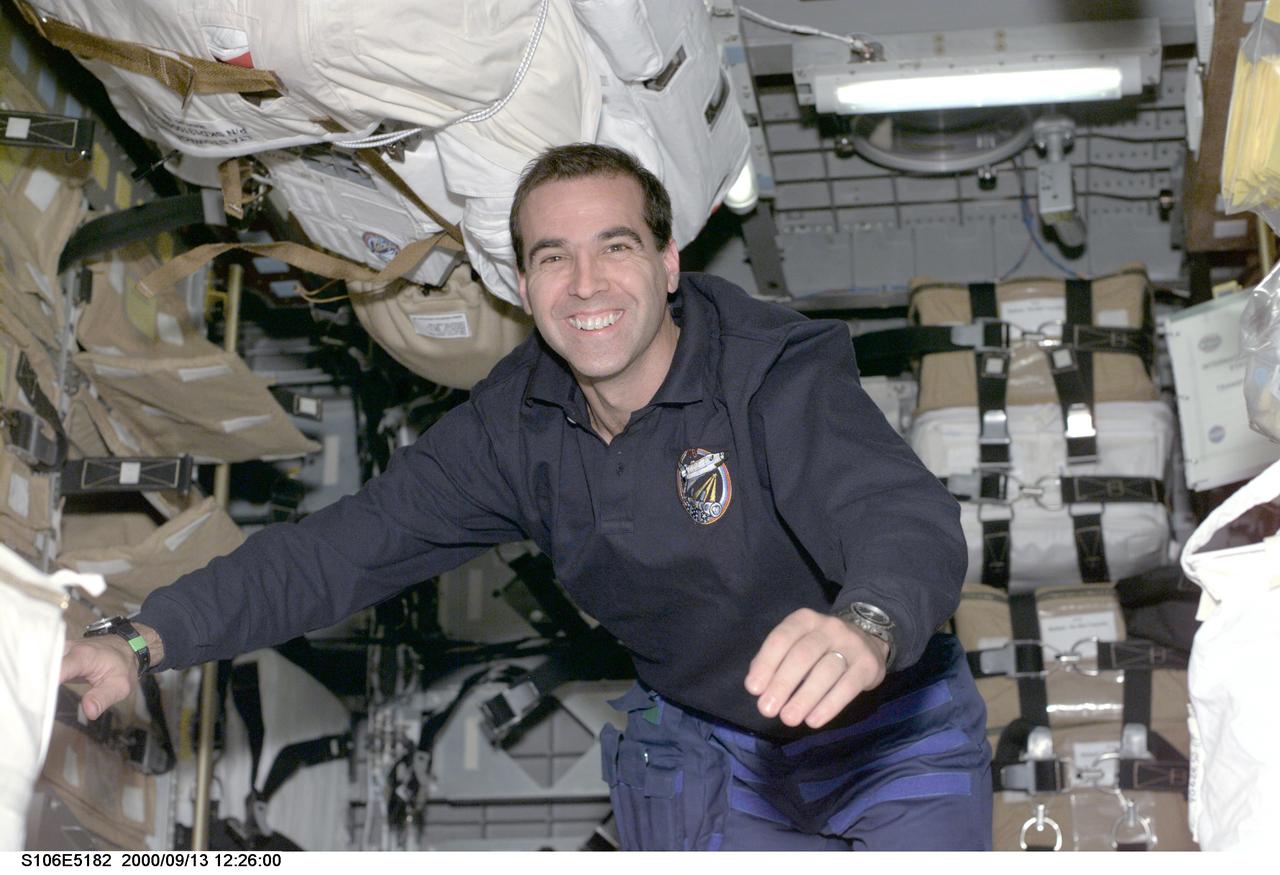
S106-E-5182 (13 September 2000) --- While crewmates (out of frame) do electrical work on the International Space Station (ISS), astronaut Richard A. Mastracchio, mission specialist, is in Spacehab to participate in the effort to move supplies. Mastracchio is one of the crew members who are working together to unload supplies from both a double Spacehab cargo module in the rear of Atlantis’ cargo bay and from a Russian Progress M-1 resupply craft docked to the aft end of the Zvezda Service Module. Zvezda, which linked up to the ISS on July 26, will serve as the early living quarters for the station and is the cornerstone of the Russian contribution to the ISS.
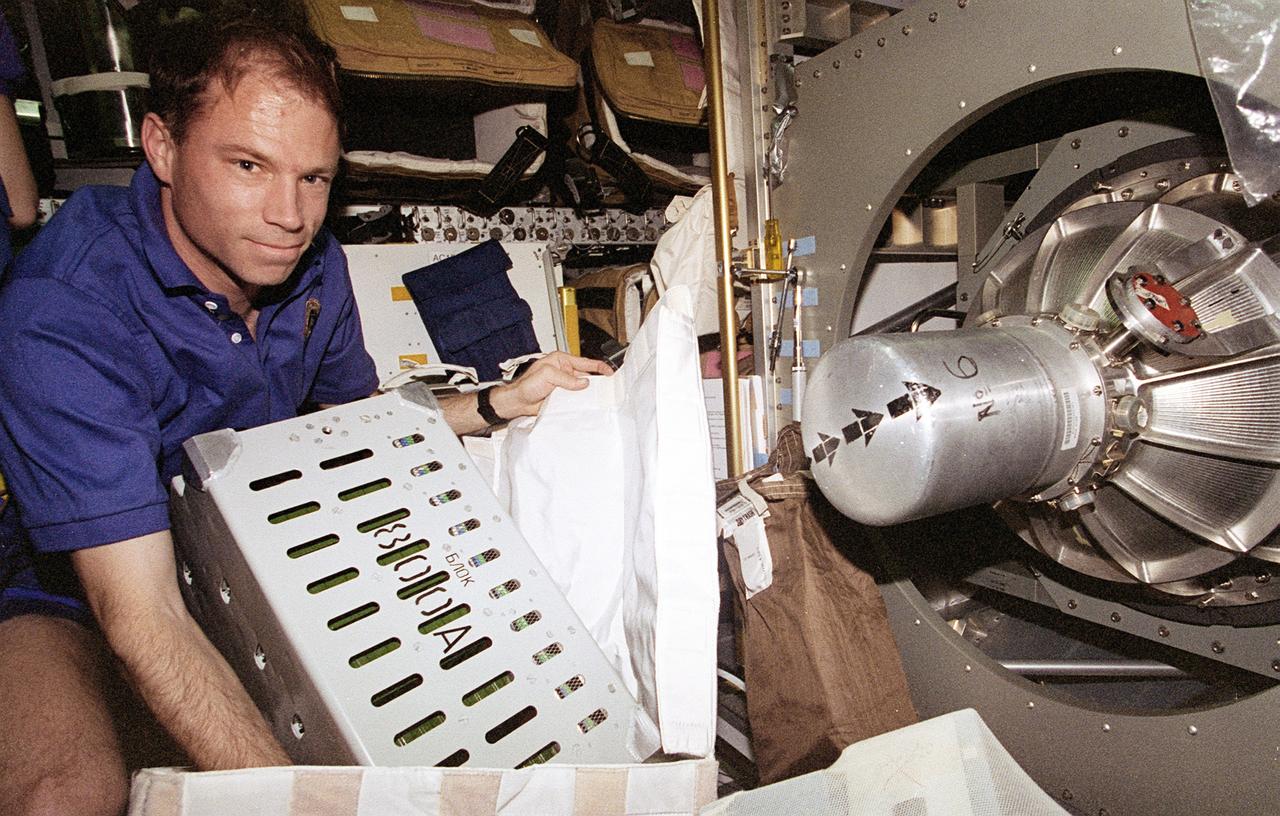
STS076-345-019 (22 - 31 March 1996) --- Onboard the Spacehab Module in the cargo bay of the Earth-orbiting Space Shuttle Atlantis, astronaut Richard A. Searfoss fetches a battery which is to be transferred to Russia's Mir Space Station. The pilot and his crew mates docked with Mir on March 23, 1996, and remained linked until March 28, 1996. At right is a stowed gyrodyne, which earlier had been replaced on Mir with a new one brought up from the ground by the STS-76 crew.
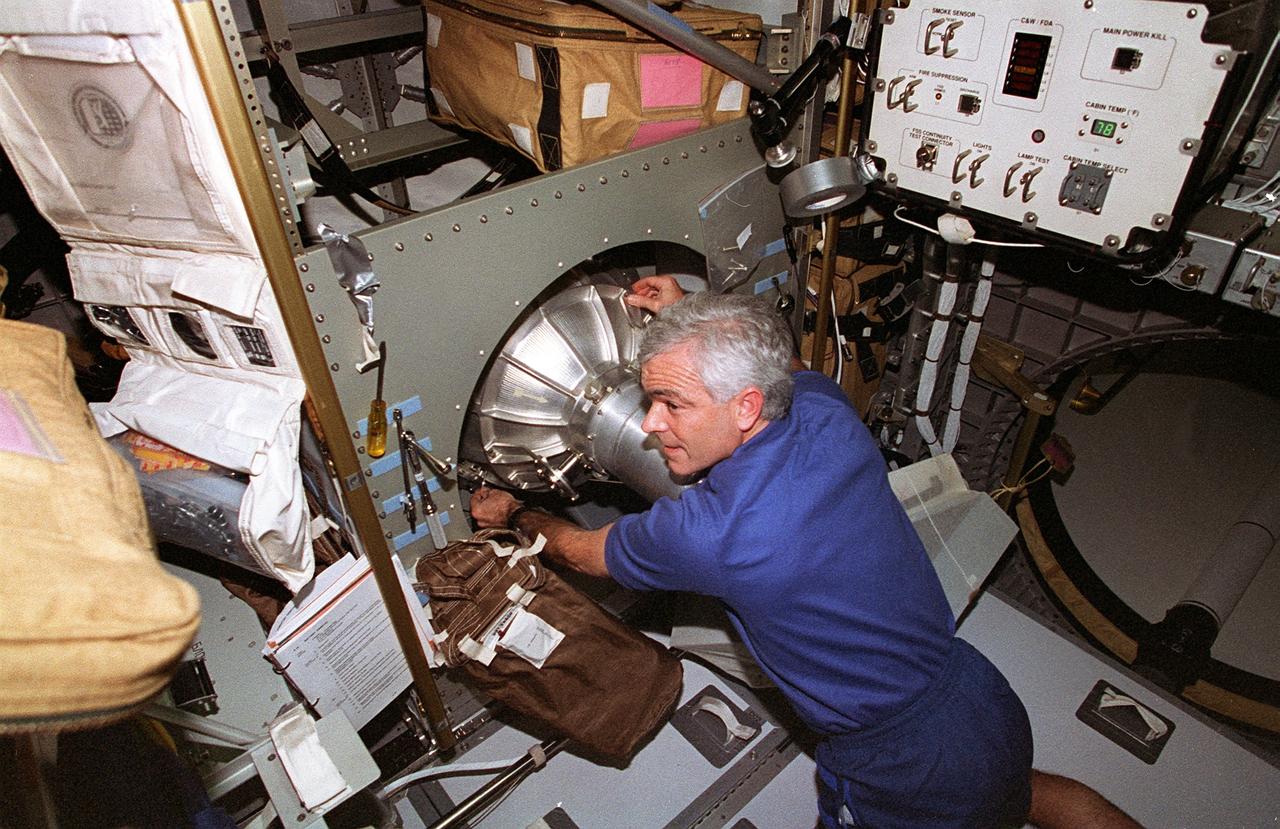
STS076-345-017 (22 - 31 March 1996) --- Onboard the Spacehab module in the cargo bay of the Earth-orbiting Space Shuttle Atlantis, astronaut Michael R. (Rich) Clifford secures a stowed gyrodyne. The stabilizing instrument earlier had been replaced on Russia's Mir Space Station with a new one brought up from the ground by the crew. The mission specialist and his crew mates docked with Mir on March 23, 1996 and remained linked until March 28, 1996.
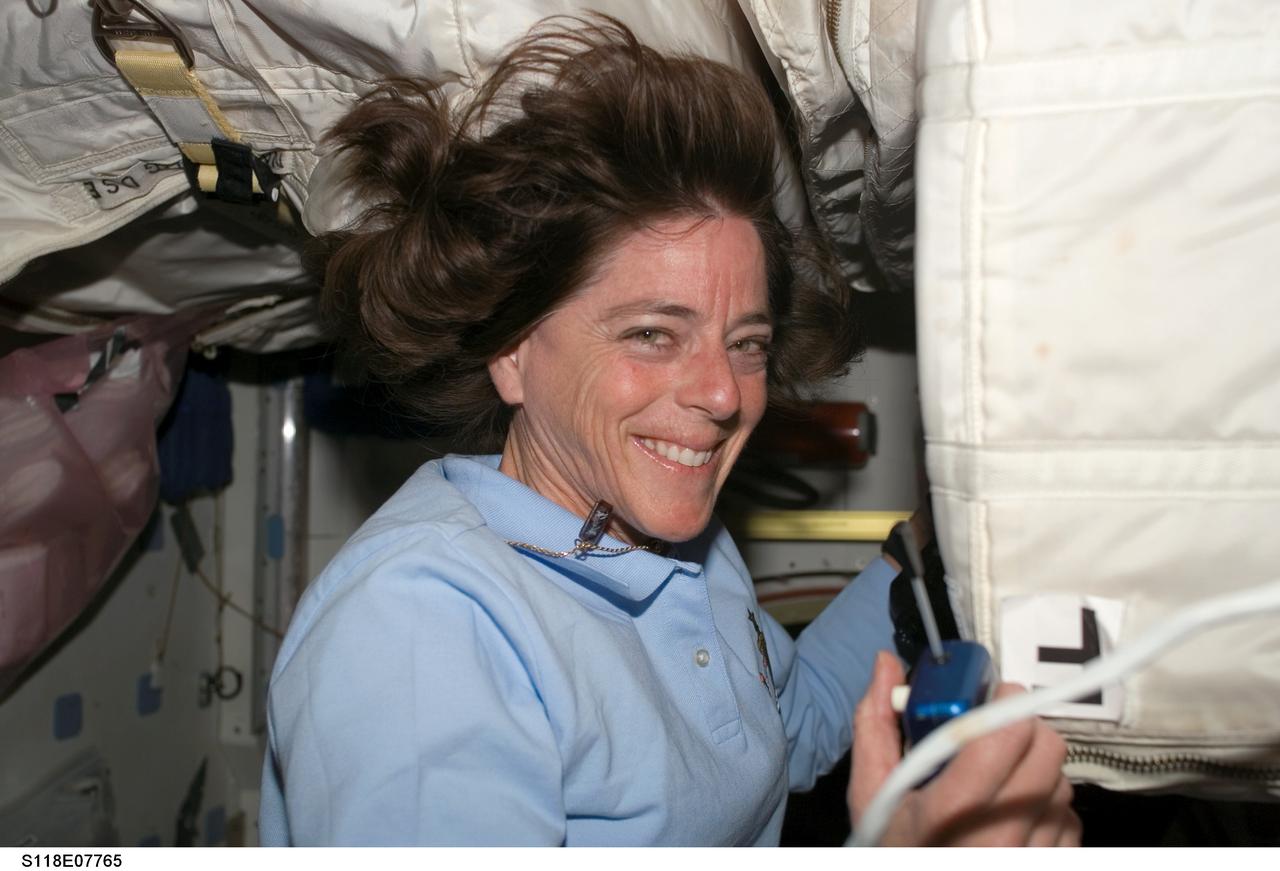
S118-E-07765 (17 Aug. 2007) --- Astronaut Barbara R. Morgan, mission specialist, finds herself surrounded by supplies in SPACEHAB, located in the cargo bay of the Space Shuttle Endeavour. Supply transfer was one of the main activities on the agenda Aug. 17 for the STS-118 crewmembers, who learned their anticipated departure from the International Space Station will come a day earlier due to possible weather issues back home.
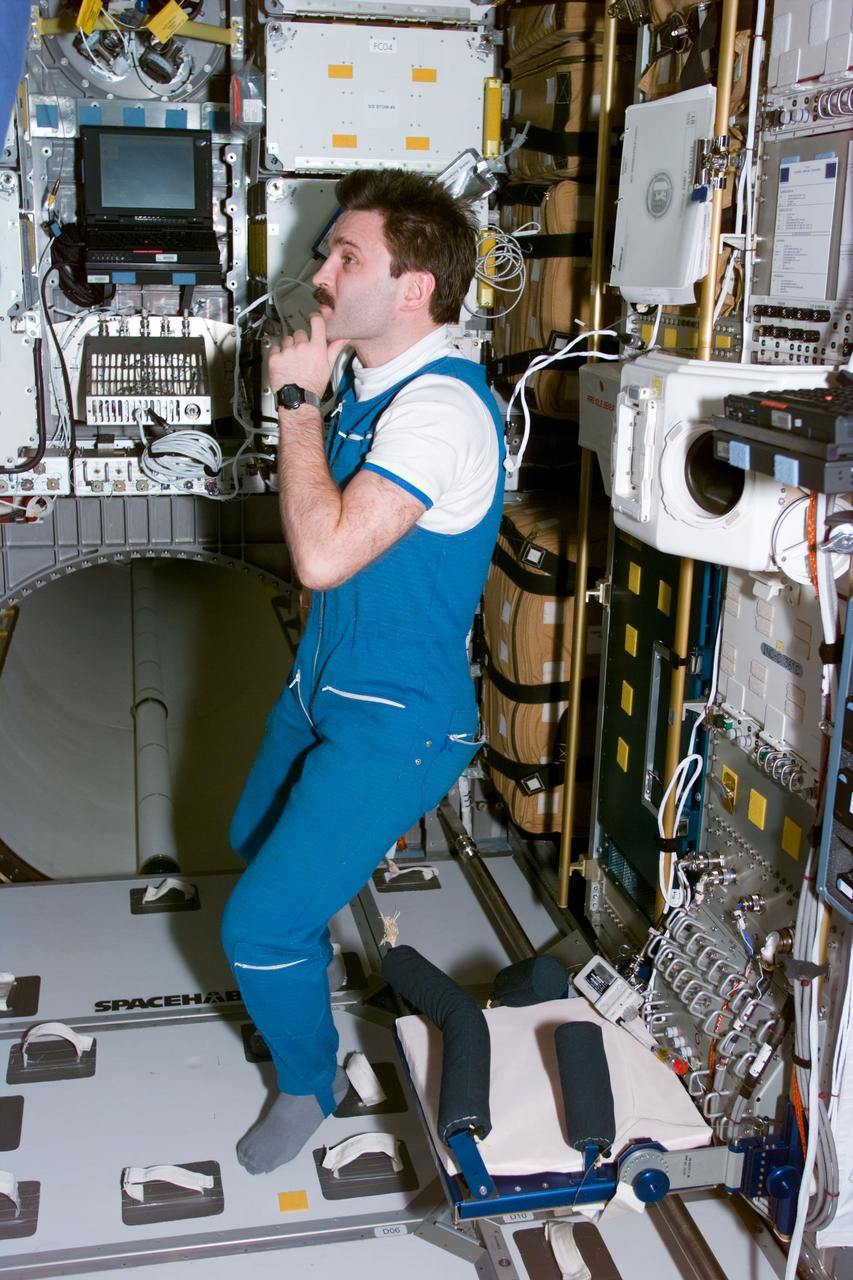
STS081-E-05482 (16 Jan. 1997) --- Perhaps overwhelmed by a giant stock of supplies (out of frame, left), cosmonaut Aleksandr Y. Kaleri, Mir-22 flight engineer, ponders what parcel to transfer next from the Spacehab Double Module (DM) to the Russian Mir Space Station complex. The photograph was recorded with an Electronic Still Camera (ESC) and later was downlinked to flight controllers in Houston, Texas.
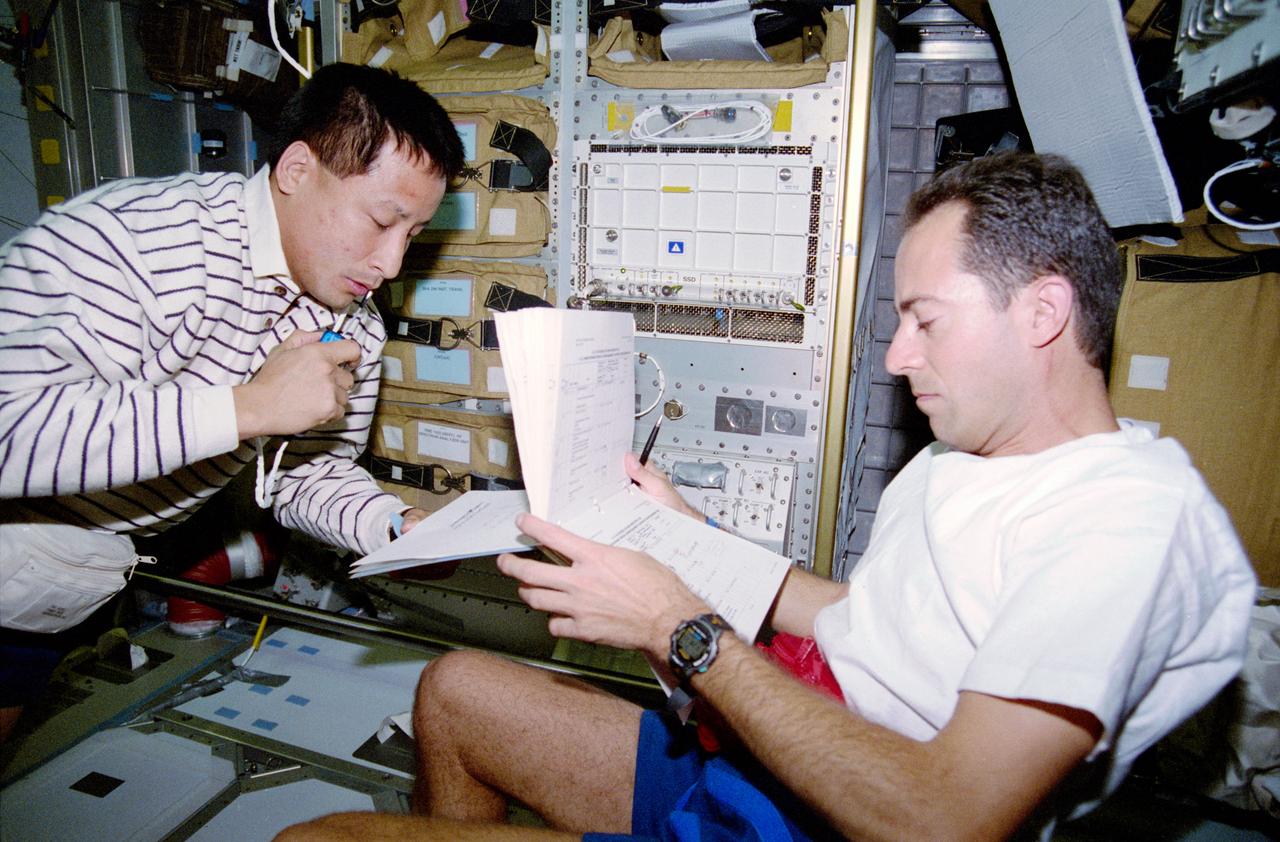
STS084-304-004 (15-24 May 1997) --- Astronaut Edward T. Lu (left) gets an early start on transfer operations in the Spacehab Double Module as he goes over an inventory checklist with astronaut Jean-Fran?ois Clervoy, payload commander. Later, almost three tons of supplies were transferred between the Space Shuttle Atlantis and Russia's Mir Space Station.
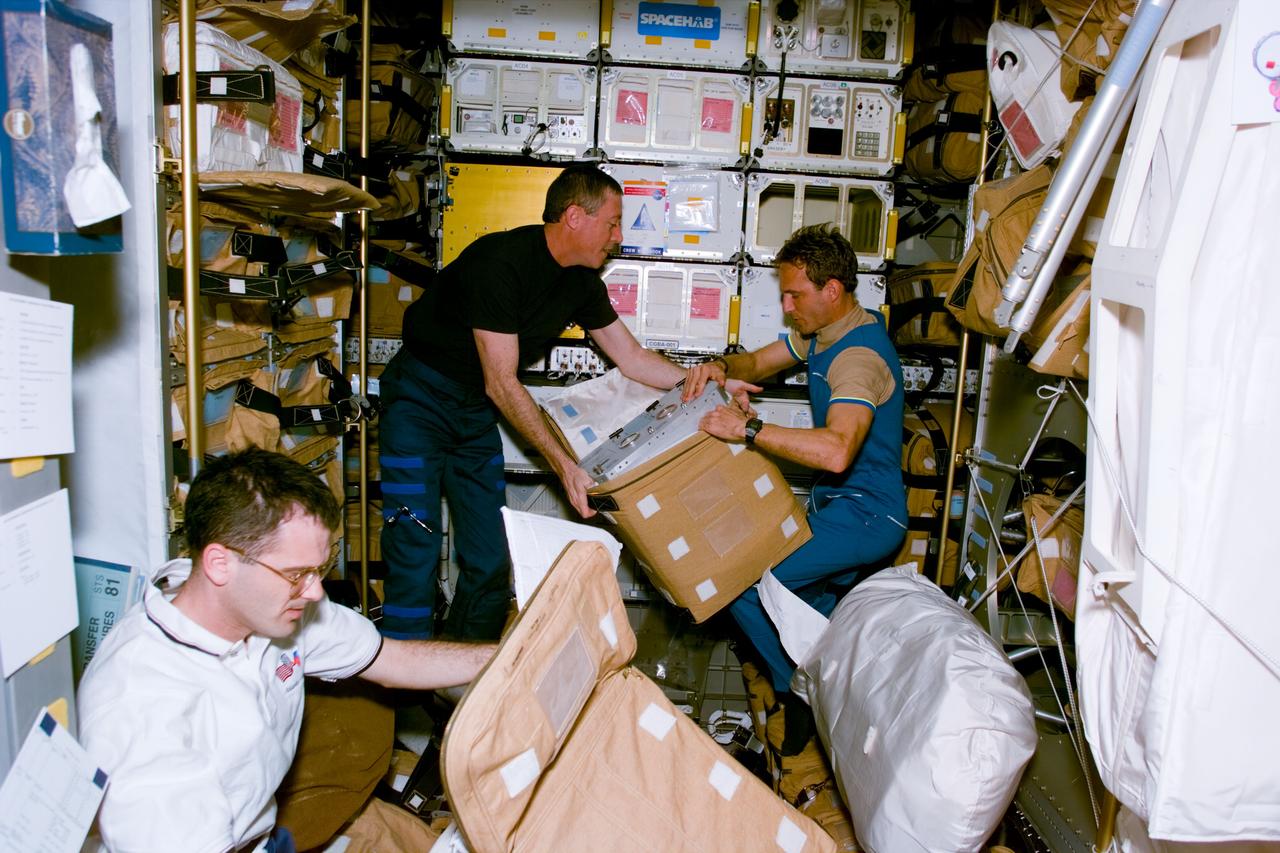
STS081-E-05514 (16 Jan. 1997) --- The transfer of equipment and supplies continues aboard the Spacehab Double Module (DM) aboard the Space Shuttle Atlantis. Here, left to right, astronauts Peter J. K. Wisoff and Michael A. Baker along with newly initiated "cosmonaut" Jerry M. Linenger, Mir-22 cosmonaut guest researcher, load and move supplies. The photograph was recorded with an Electronic Still Camera (ESC) and later was downlinked to flight controllers in Houston, Texas.
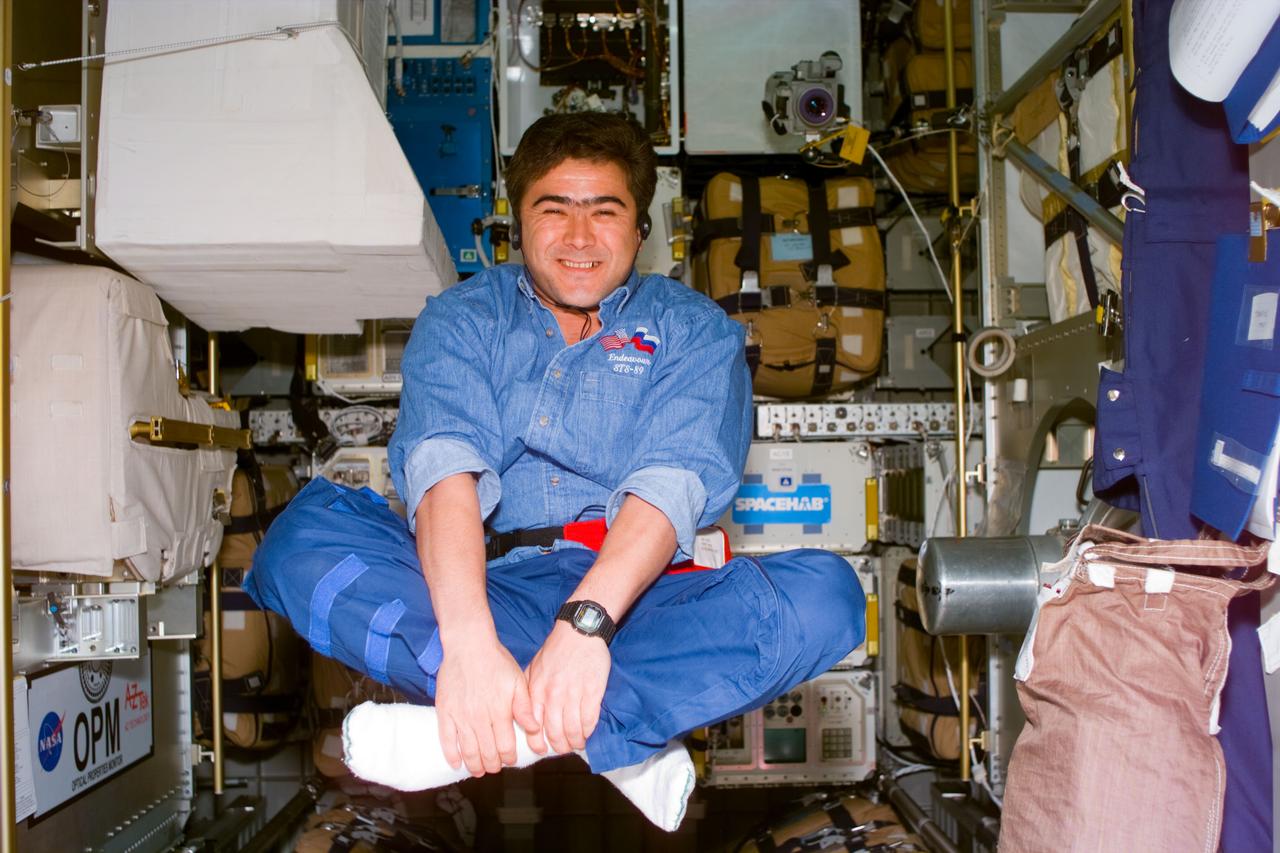
S89-E-5524 (22-31 Jan 1998) --- This Electronic Still Camera (ESC) image shows Salizan Sharipov, mission specialist representing Russia's Space Agency (RSA), takes advantage of the weightless environment of Earth-orbit to relax in the Spacehab Module during off-duty time on the Space Shuttle Endeavour. This ESC view was taken at 01:29:11 GMT, on January 30, 1998.
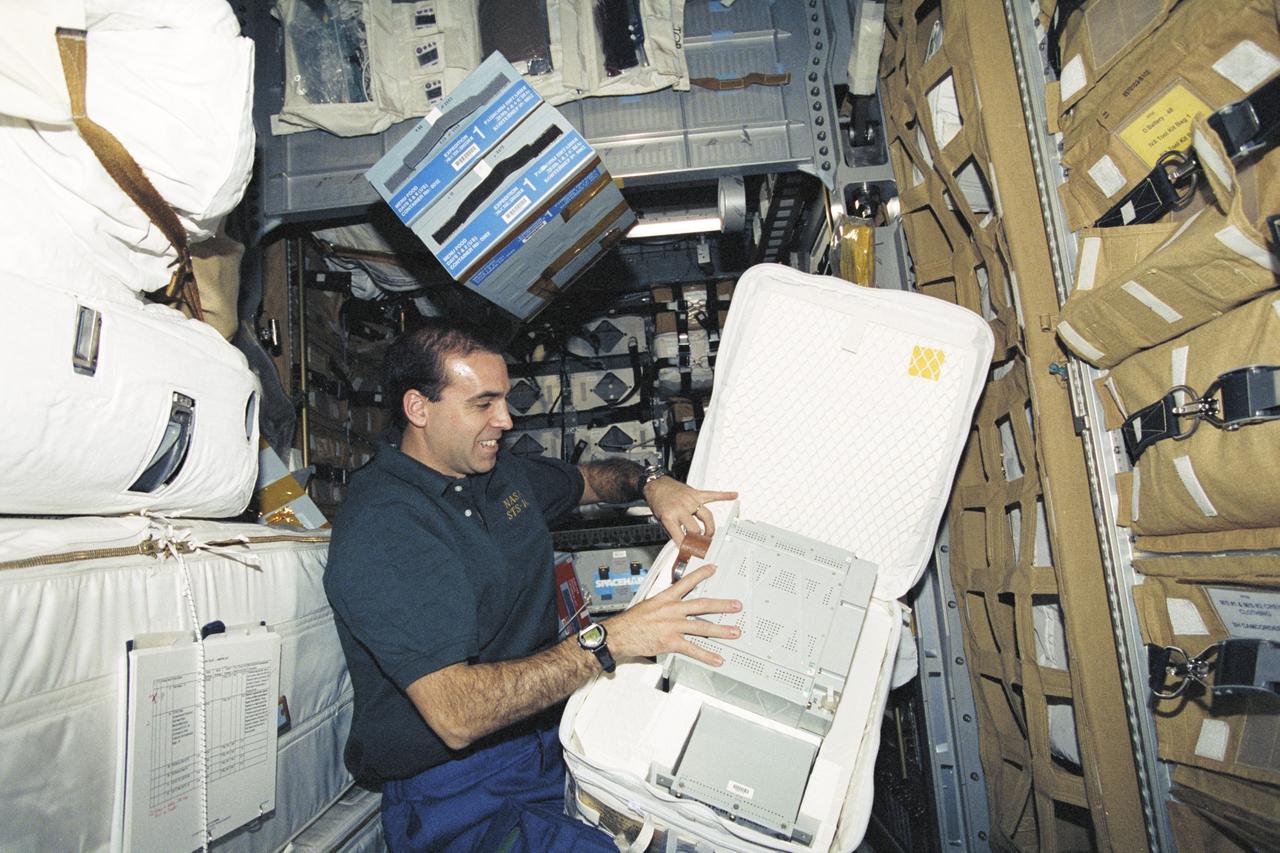
STS106-301-019 (8-20 September 2000) ---Astronaut Richard A. Mastracchio, STS-106 mission specialist, participates in the moving of supplies from the SPACEHAB Logistics Double Module on the Space Shuttle Atlantis to the International Space Station (ISS).
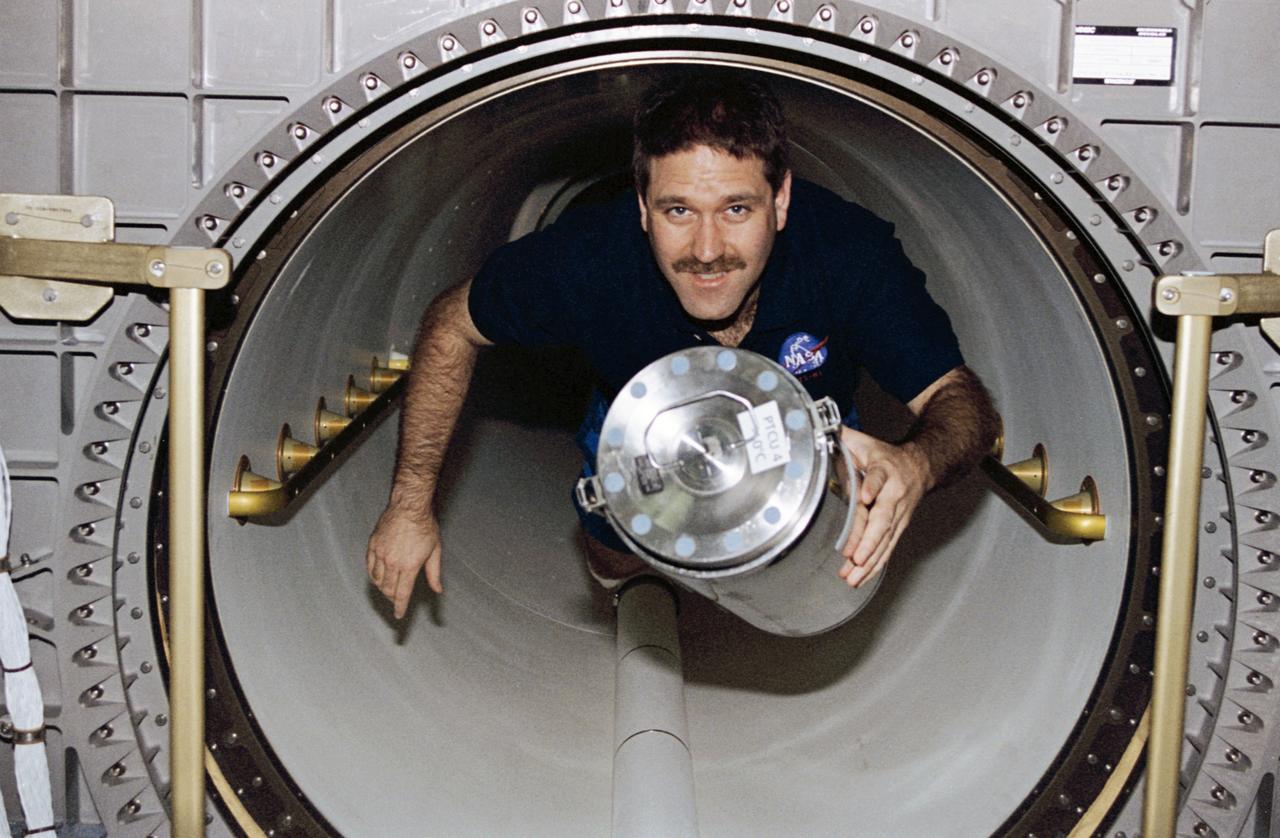
STS081-361-026 (12-22 Jan 1997) --- Astronaut John M. Grunsfeld, mission specialist, floats into the Spacehab Double Module (DM) bearing a freezer unit in support of experimentation, onboard the Space Shuttle Atlantis during the Atlantis - Russia?s Mir Space Station docking mission.
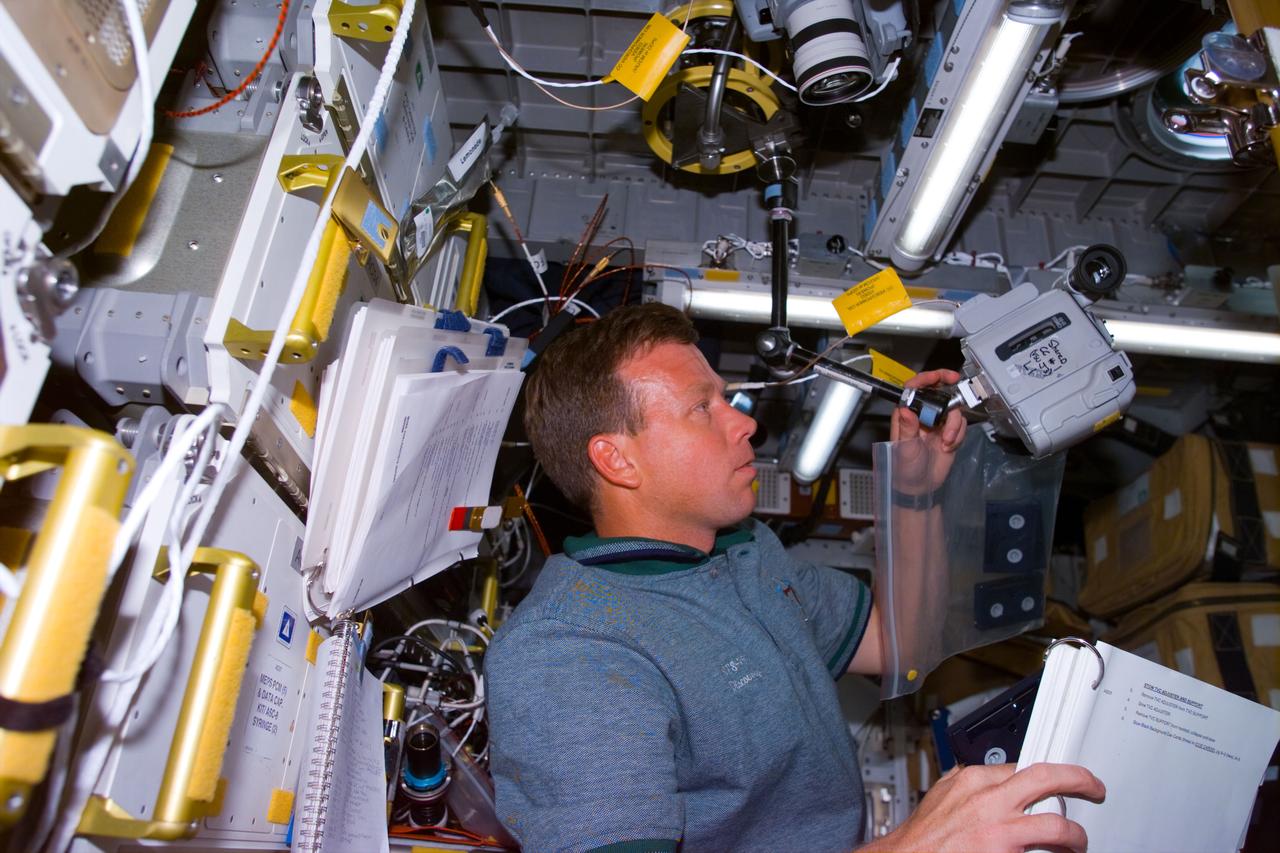
STS095-E-5107 (2 Nov. 1998) --- Astronaut Steven W. Lindsey, STS-95 pilot, sets up a camera for an experiment in the Spacehab facility aboard Discovery during Flight Day 4 activity. The photo was taken with an electronic still camera (ESC) at 05:10:25 GMT, Nov. 2.

STS107-E-05020 (17 January 2003) --- Astronauts Laurel B. Clark and Rick D. Husband, STS-107 mission specialist and mission commander, respectively, are pictured near supportive equipment for experiments on the SPACEHAB Research Double Module aboard the Space Shuttle Columbia.
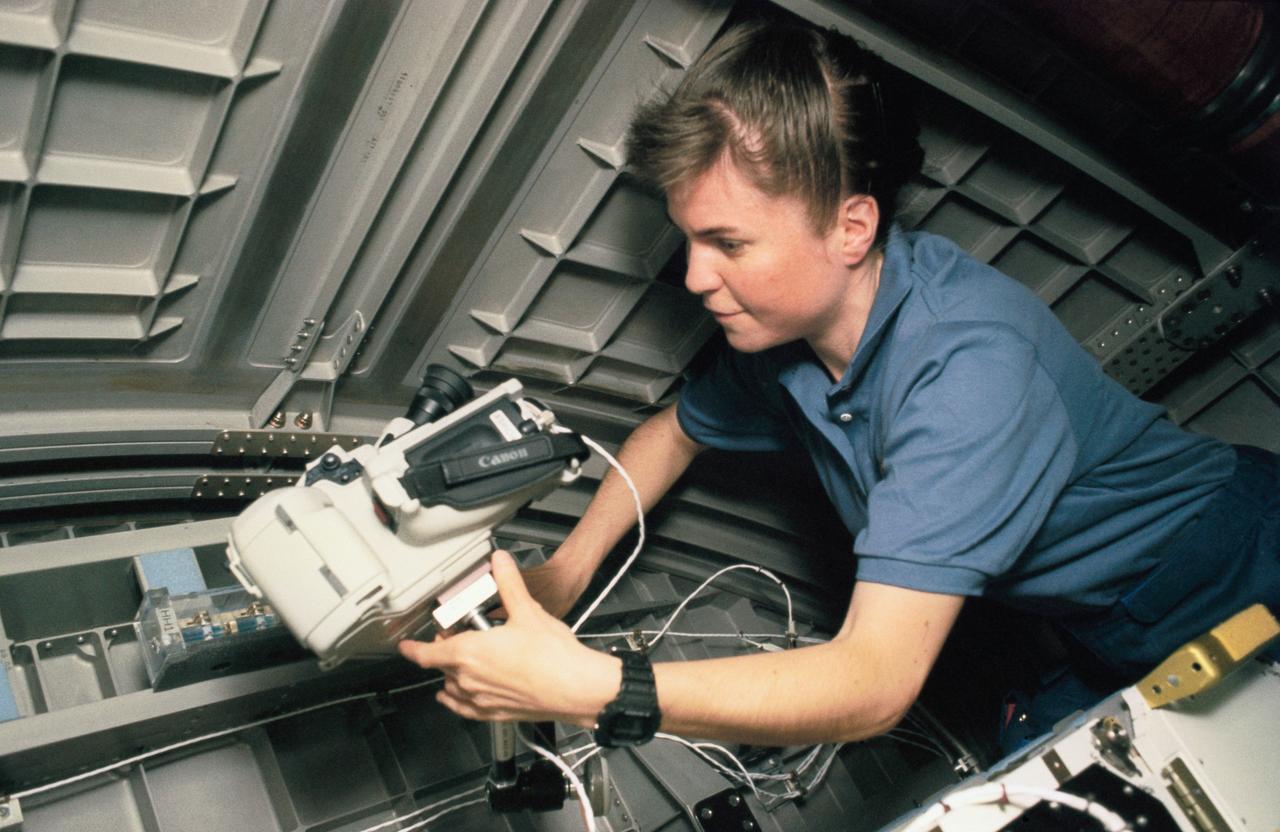
STS063-313-018 (3-11 Feb 1995) --- Janice E. Voss, mission specialist, with a video camera in SpaceHab-3 onboard the Space Shuttle Discovery. This is one of 16 still photographs released by the NASA Johnson Space Center (JSC) Public Affairs Office (PAO) on February 14, 1995. Others onboard the Discovery were astronauts James D. Wetherbee, mission commander; Eileen M. Collins, pilot; Bernard A. Harris Jr., payload commander; mission specialists C. Michael Foale, and cosmonaut Vladimir G. Titov.
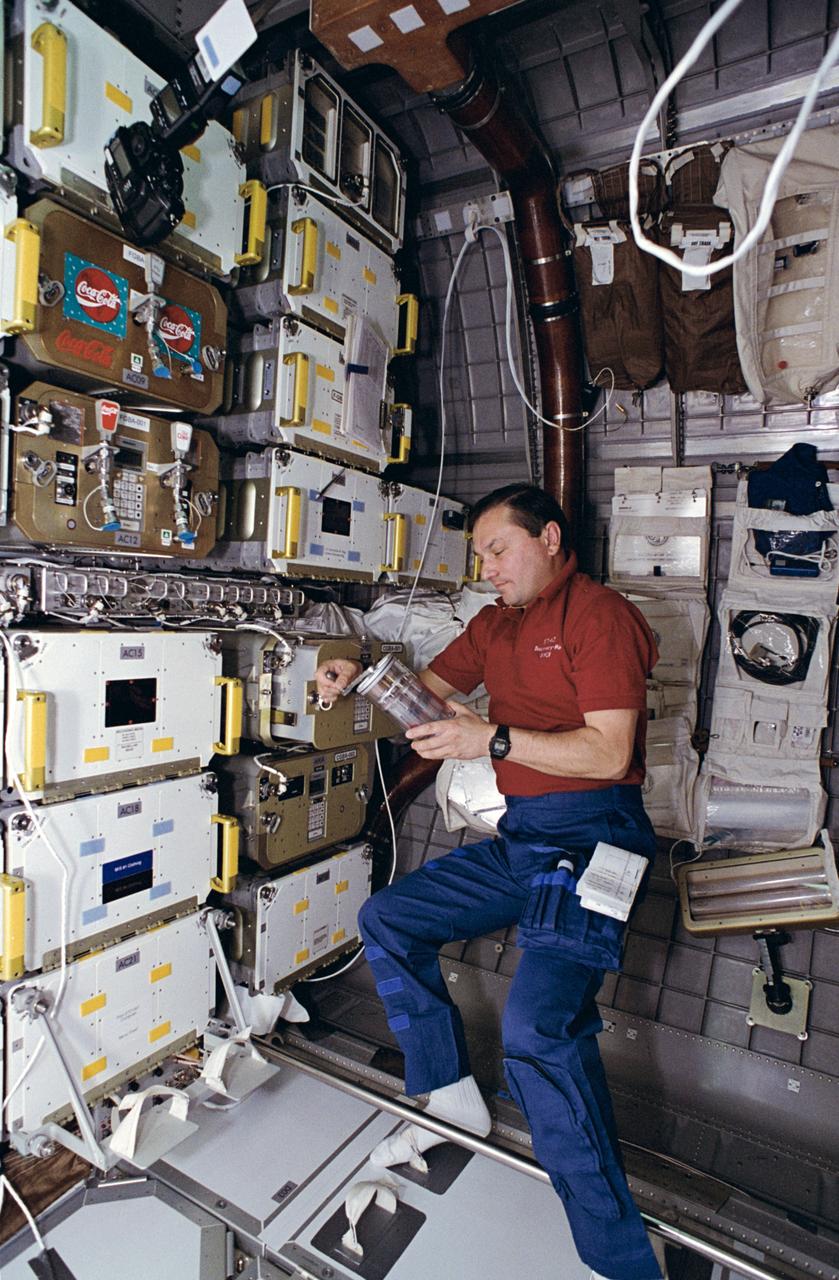
STS063-68-018 (3-11 Feb 1995) --- Russian cosmonaut Vladimir G. Titov, mission specialist, handles vials of samples for the Commercial Generic Bioprocessing Apparatus (CGBA) experiment in SpaceHab 3 Module onboard the Earth-orbiting Space Shuttle Discovery. Titov joined five NASA astronauts for eight days of research in Earth-orbit.
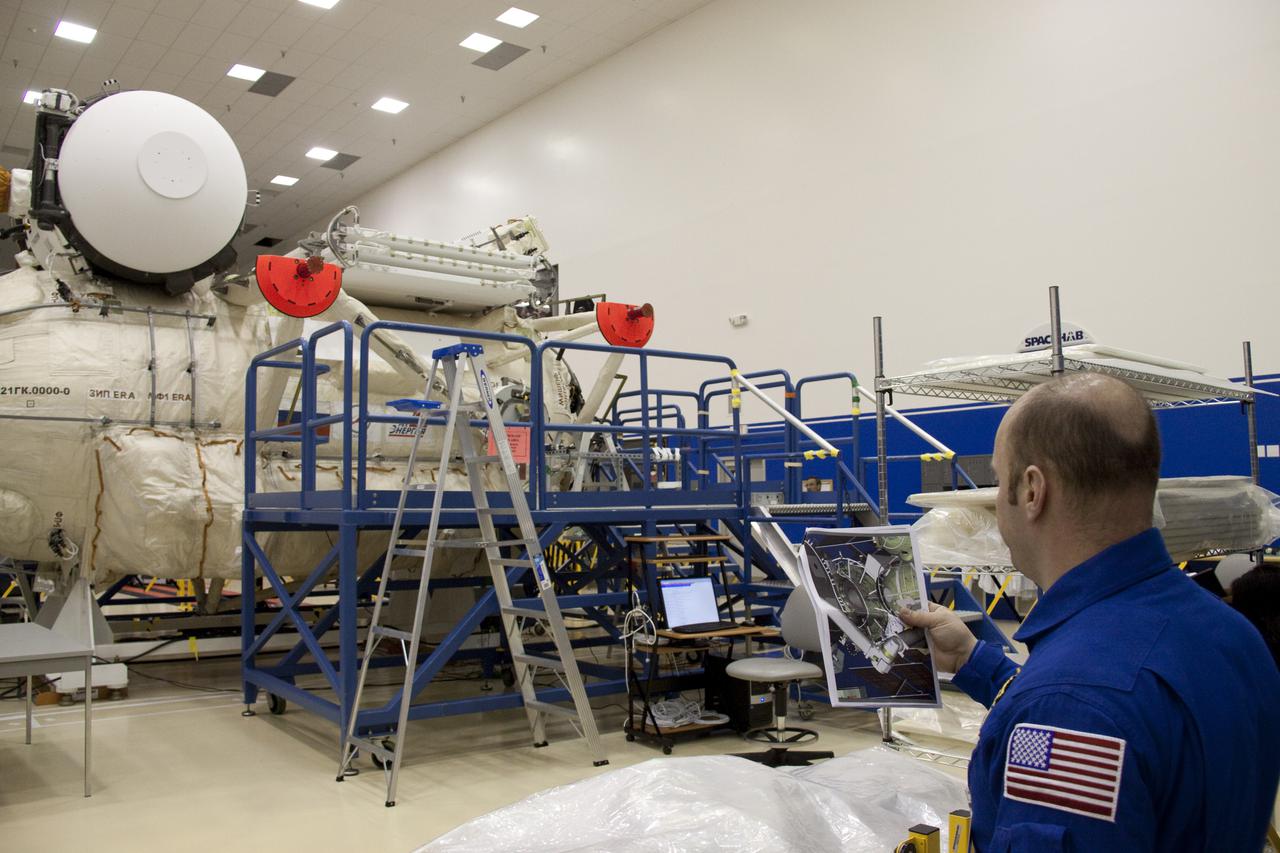
CAPE CANAVERAL, Fla. – At the Astrotech payload processing facility at Port Canaveral in Florida, STS-132 Mission Specialist Garrett Reisman compares the actual Mini-Research Module to a picture of the module during the crew equipment interface test, or CEIT. CEIT provides the crew with hands-on training and observation of shuttle and flight hardware. The six-member crew of space shuttle Atlantis' STS-132 mission will deliver an Integrated Cargo Carrier and a Russian-built Mini-Research Module to the International Space Station. The second in a series of new pressurized components for Russia, the module will be permanently attached to the bottom port of the Zarya module and also will carry U.S. pressurized cargo. STS-132 is the 34th mission to the station and the 132nd space shuttle mission in the program. Launch is targeted for May 14. For information on the STS-132 mission, visit http:__www.nasa.gov_mission_pages_shuttle_shuttlemissions_sts132_index.html. Photo credit: NASA_Troy Cryder
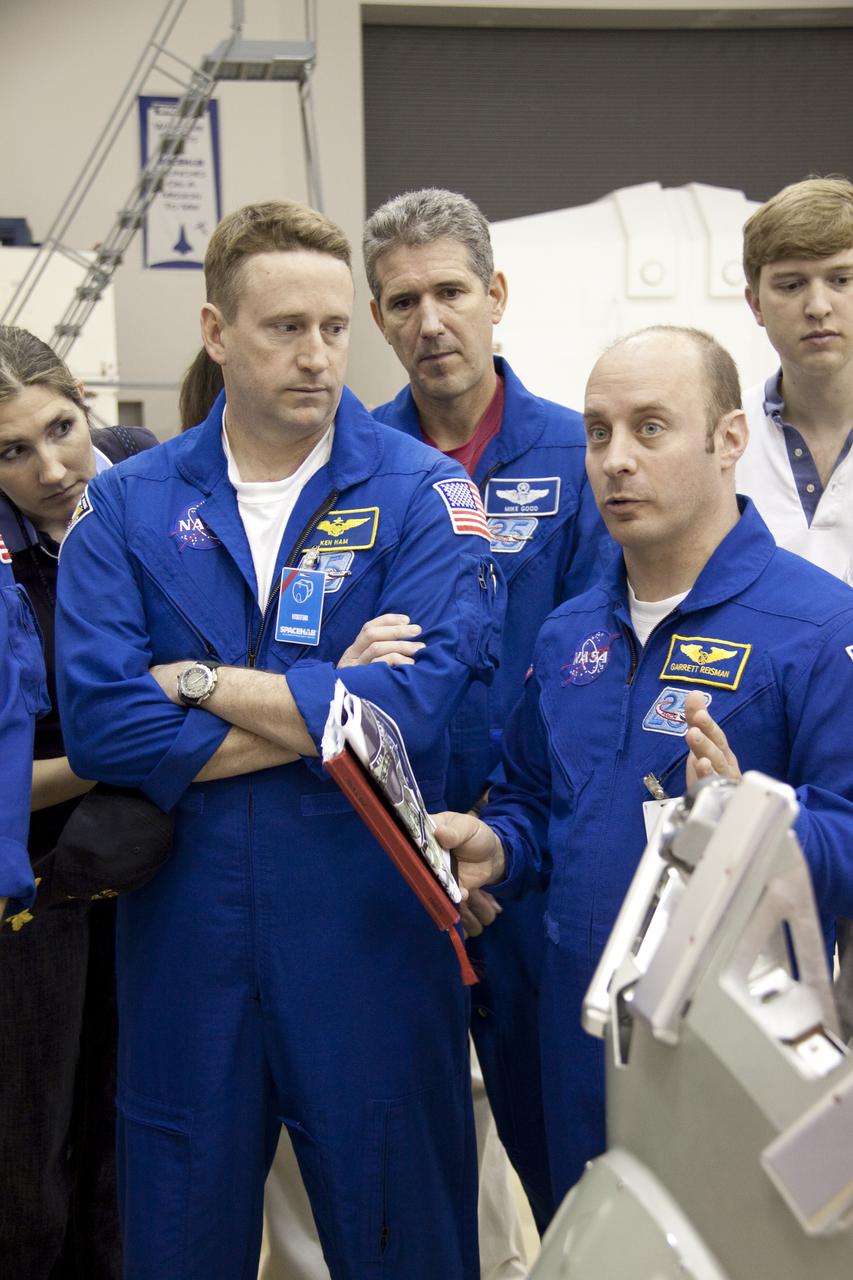
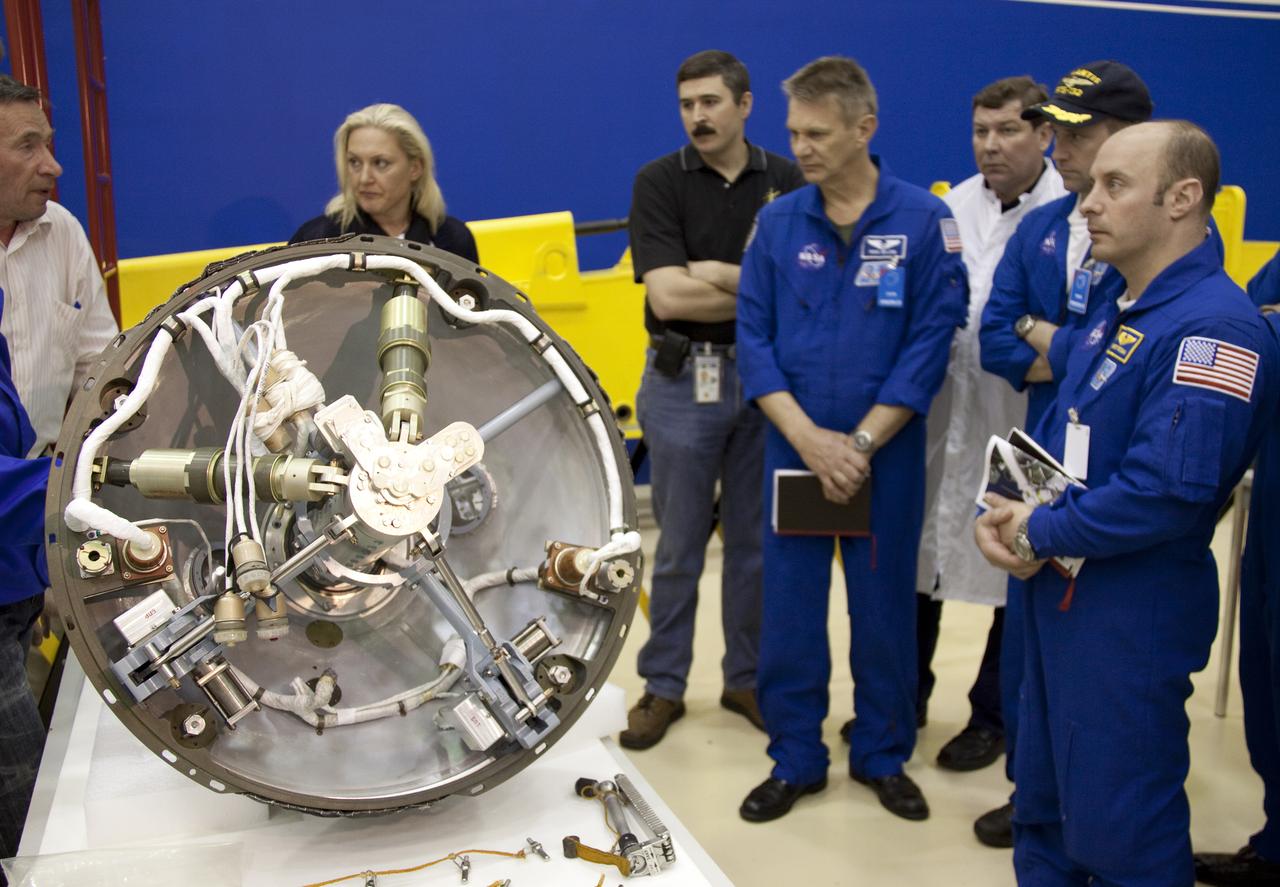
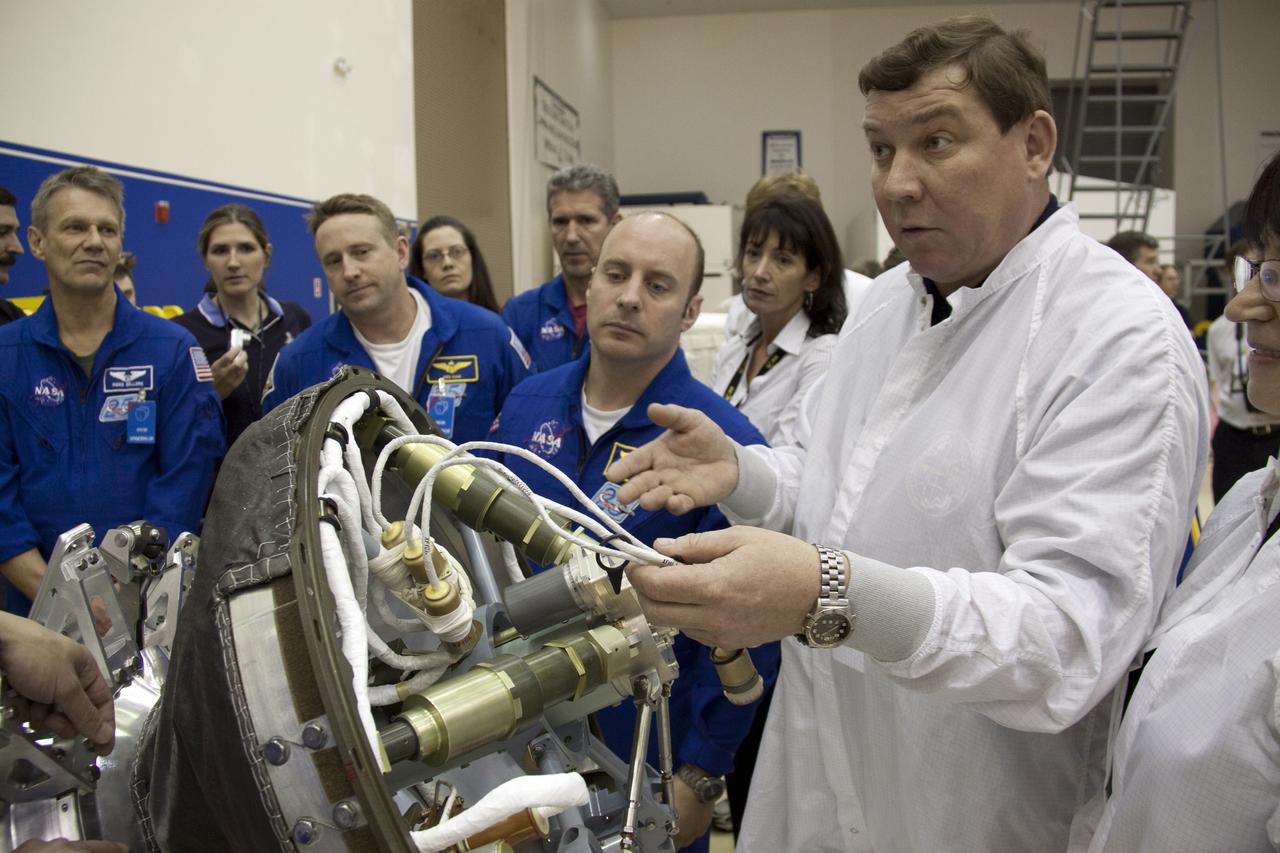
CAPE CANAVERAL, Fla. – At the Astrotech payload processing facility at Port Canaveral in Florida, members of the STS-132 crew receive instruction on the design and operation of the docking mechanism for the Mini-Research Module during their crew equipment interface test, or CEIT. Mission Specialist Garrett Reisman, right, asks a question of his instructor as Commander Ken Ham, left, and Mission Specialist Michael Good look on. CEIT provides the crew with hands-on training and observation of shuttle and flight hardware. The six-member crew of space shuttle Atlantis' STS-132 mission will deliver an Integrated Cargo Carrier and a Russian-built Mini-Research Module to the International Space Station. The second in a series of new pressurized components for Russia, the module will be permanently attached to the bottom port of the Zarya module and also will carry U.S. pressurized cargo. STS-132 is the 34th mission to the station and the 132nd space shuttle mission in the program. Launch is targeted for May 14. For information on the STS-132 mission, visit http:__www.nasa.gov_mission_pages_shuttle_shuttlemissions_sts132_index.html. Photo credit: NASA_Troy Cryder
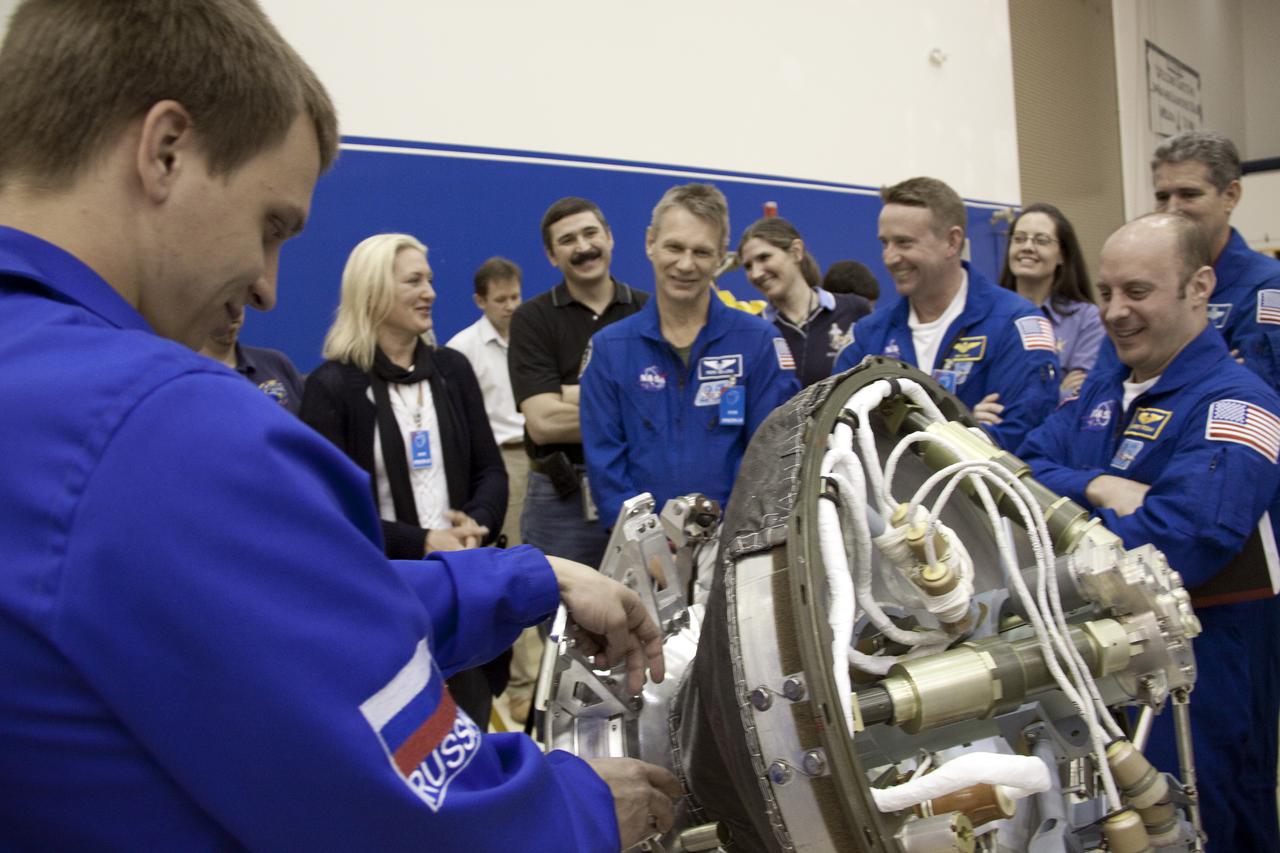
CAPE CANAVERAL, Fla. – At the Astrotech payload processing facility at Port Canaveral in Florida, members of the STS-132 crew receive instruction on the design and operation of the docking mechanism for the Mini-Research Module during their crew equipment interface test, or CEIT. At left is the instructor. From center in the blue flight suits are Mission Specialist Piers Sellers, Commander Ken Ham, and Mission Specialist Garrett Reisman. Mission Specialist Michael Good looks on behind them. CEIT provides the crew with hands-on training and observation of shuttle and flight hardware. The six-member crew of space shuttle Atlantis' STS-132 mission will deliver an Integrated Cargo Carrier and a Russian-built Mini-Research Module to the International Space Station. The second in a series of new pressurized components for Russia, the module will be permanently attached to the bottom port of the Zarya module and also will carry U.S. pressurized cargo. STS-132 is the 34th mission to the station and the 132nd space shuttle mission in the program. Launch is targeted for May 14. For information on the STS-132 mission, visit http:__www.nasa.gov_mission_pages_shuttle_shuttlemissions_sts132_index.html. Photo credit: NASA_Troy Cryder
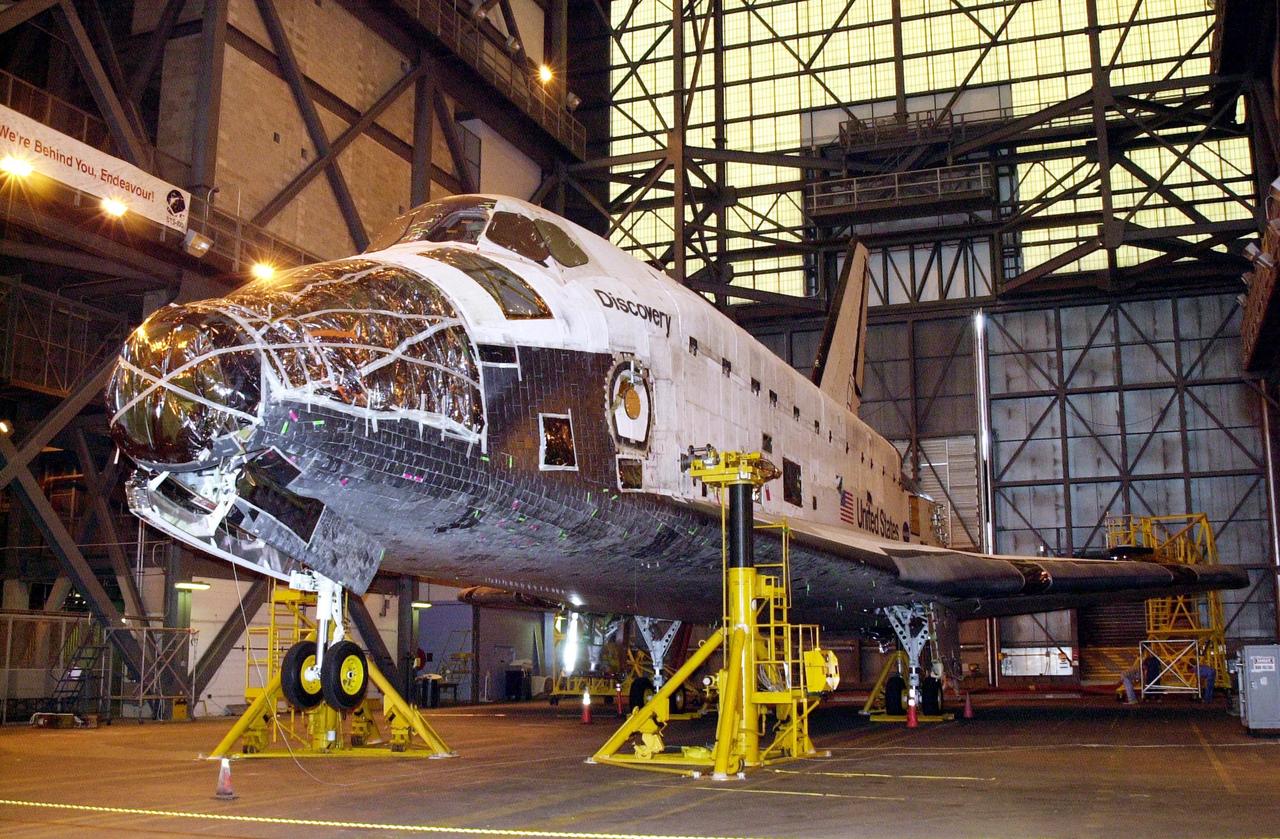
KENNEDY SPACE CENTER, FLA. -- Discovery (shown here) has been inactive since its last mission that ended Aug. 22, 2001. The orbiter has spent a year awaiting the start of its Orbiter Major Modification (OMM) period that is scheduled to begin at the Kennedy Space Center late this summer.
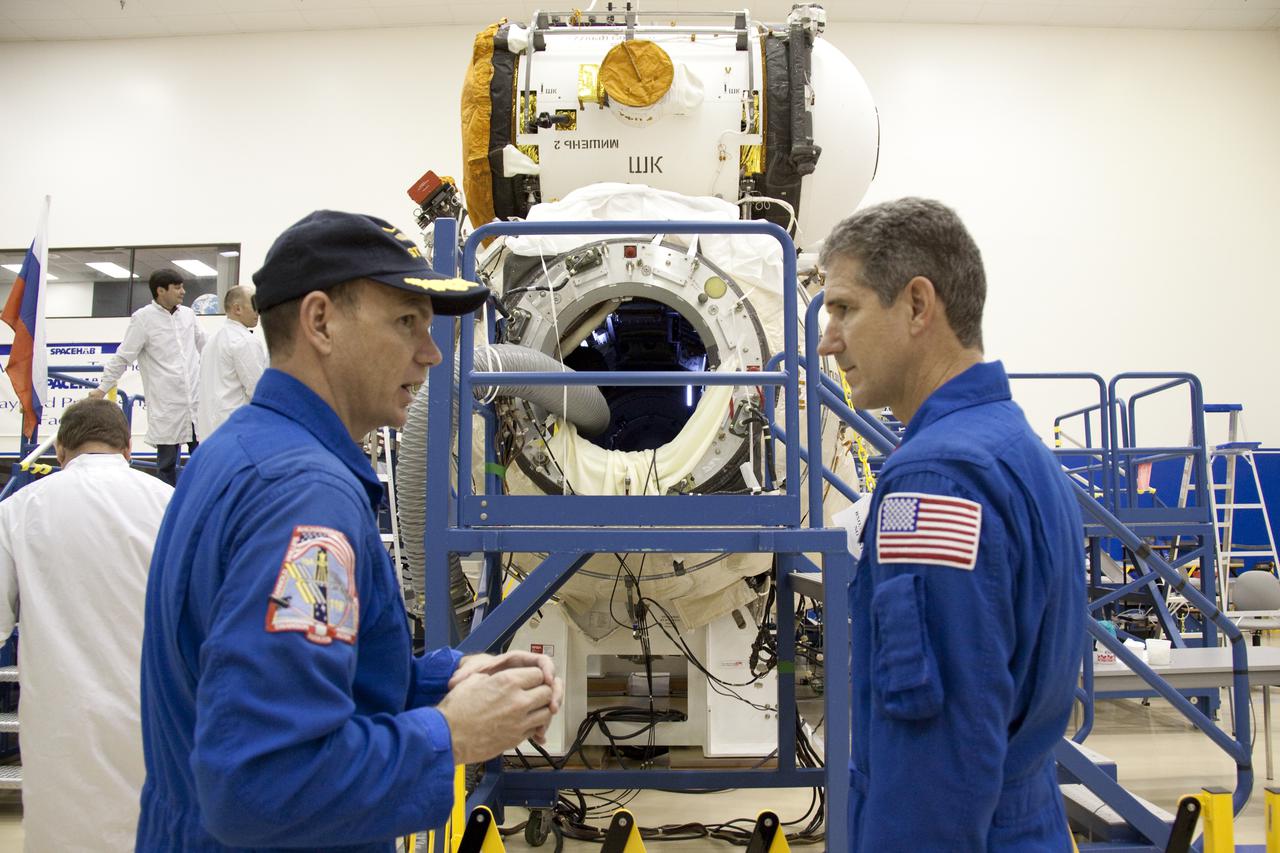
CAPE CANAVERAL, Fla. – At the Astrotech payload processing facility at Port Canaveral in Florida, STS-132 Pilot Tony Antonelli, left, and Mission Specialist Michael Good discuss the Mini-Research Module behind them during their crew equipment interface test, or CEIT. CEIT provides the crew with hands-on training and observation of shuttle and flight hardware. The six-member crew of space shuttle Atlantis' STS-132 mission will deliver an Integrated Cargo Carrier and a Russian-built Mini-Research Module to the International Space Station. The second in a series of new pressurized components for Russia, the module will be permanently attached to the bottom port of the Zarya module and also will carry U.S. pressurized cargo. STS-132 is the 34th mission to the station and the 132nd space shuttle mission in the program. Launch is targeted for May 14. For information on the STS-132 mission, visit http:__www.nasa.gov_mission_pages_shuttle_shuttlemissions_sts132_index.html. Photo credit: NASA_Troy Cryder
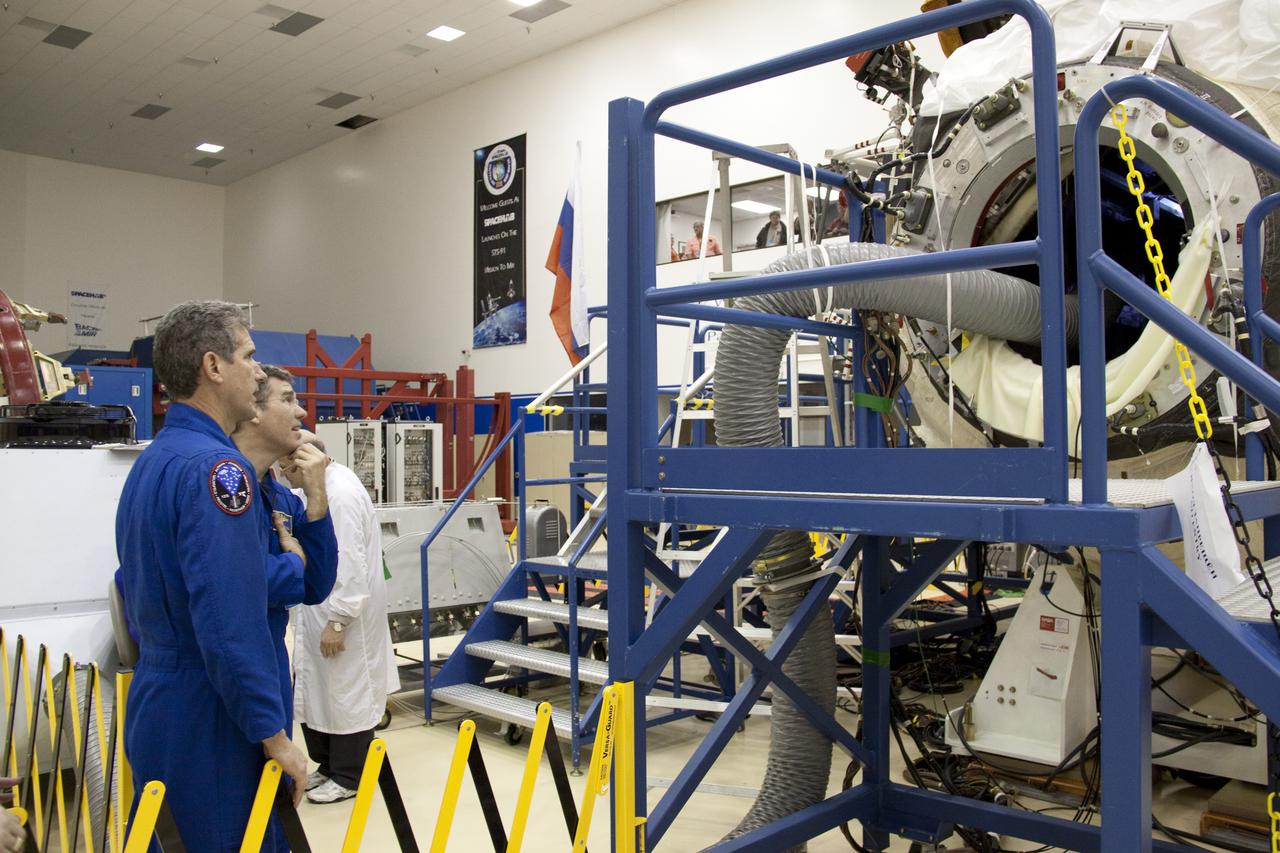
CAPE CANAVERAL, Fla. – At the Astrotech payload processing facility at Port Canaveral in Florida, STS-132 Mission Specialists Michael Good, left, and Steve Bowen get a close-up view of the Mini-Research Module during their crew equipment interface test, or CEIT. CEIT provides the crew with hands-on training and observation of shuttle and flight hardware. The six-member crew of space shuttle Atlantis' STS-132 mission will deliver an Integrated Cargo Carrier and a Russian-built Mini-Research Module to the International Space Station. The second in a series of new pressurized components for Russia, the module will be permanently attached to the bottom port of the Zarya module and also will carry U.S. pressurized cargo. STS-132 is the 34th mission to the station and the 132nd space shuttle mission in the program. Launch is targeted for May 14. For information on the STS-132 mission, visit http:__www.nasa.gov_mission_pages_shuttle_shuttlemissions_sts132_index.html. Photo credit: NASA_Troy Cryder
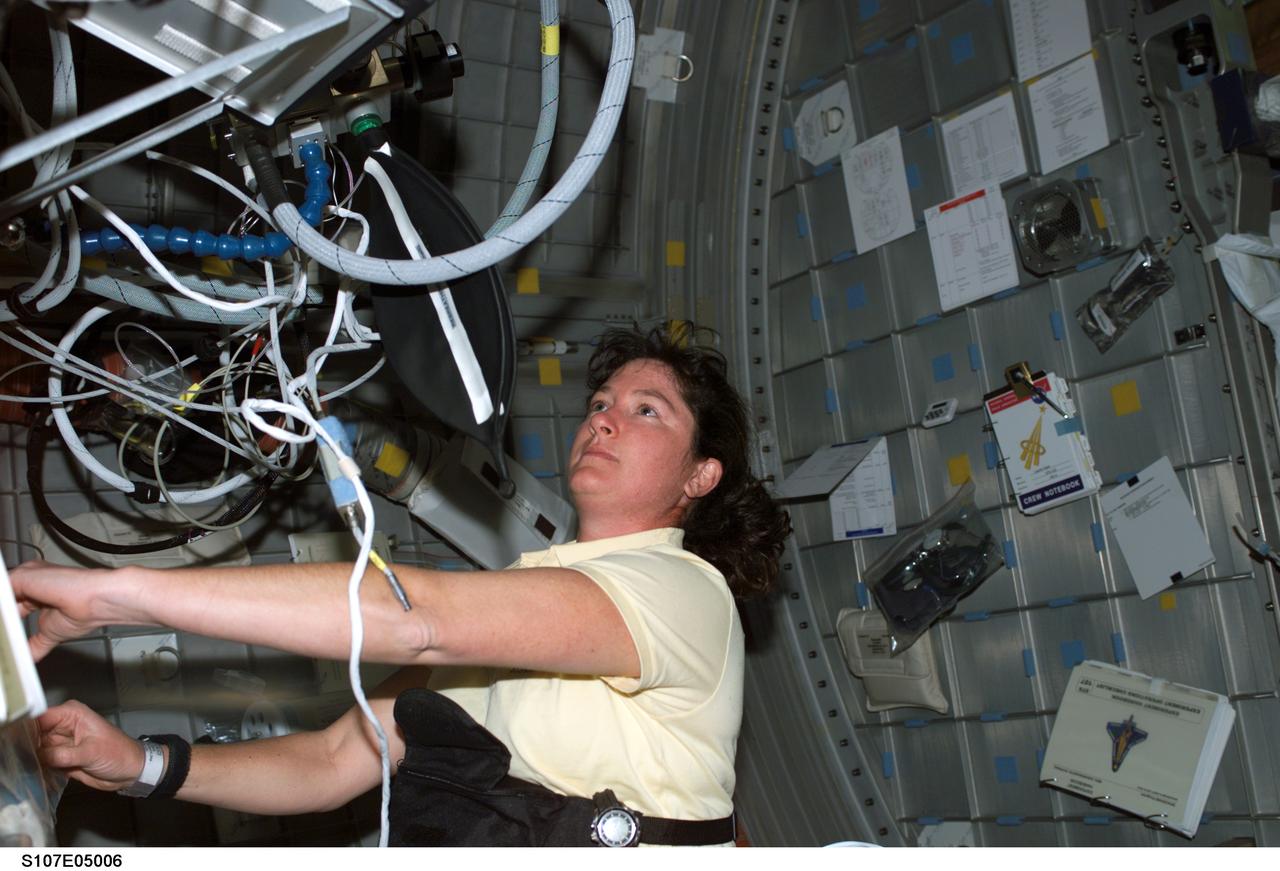
STS107-E-05006 (17 January 2003) --- Astronaut Laurel B. Clark, STS-107 mission specialist, works in the SPACEHAB Research Double Module in the cargo bay of the Earth-orbiting Space Shuttle Columbia.