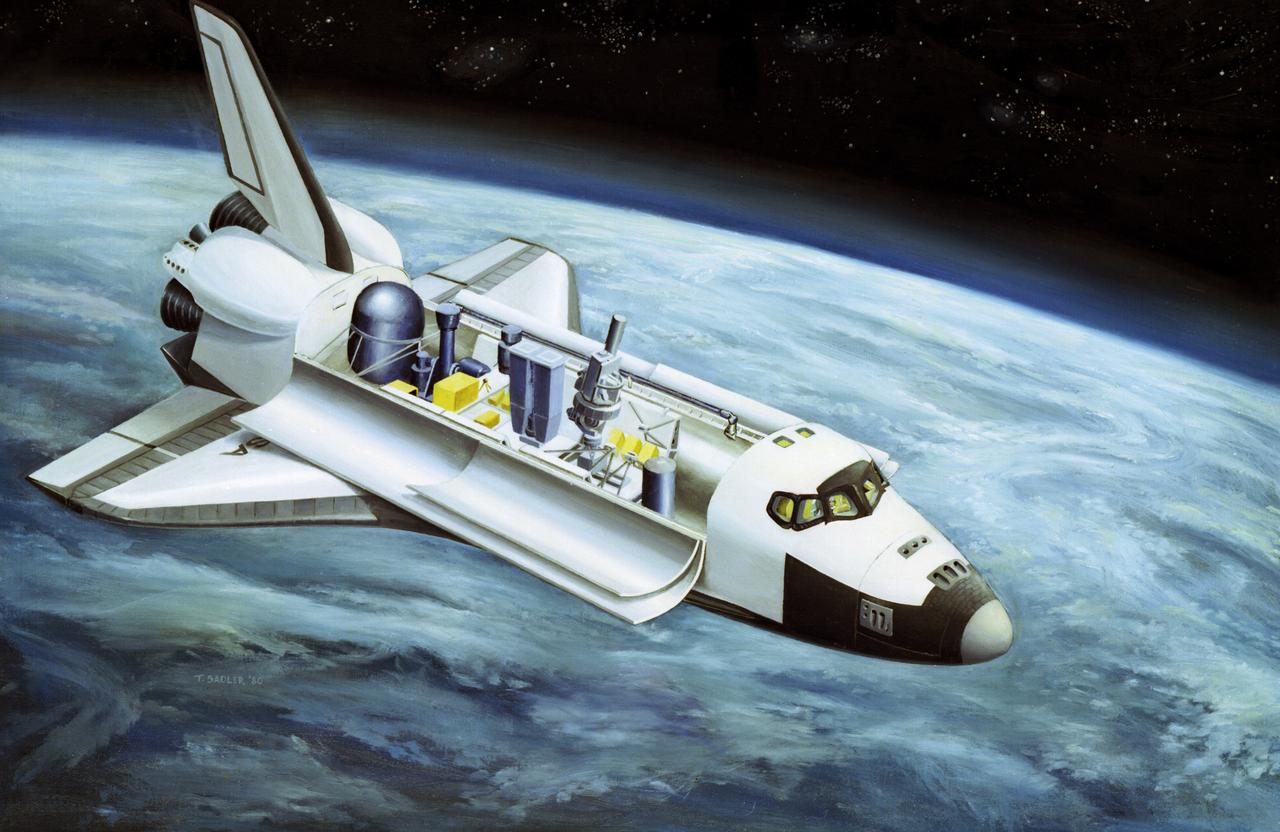
This illustration depicts the configuration of the Spacelab-2 in the cargo bay of the orbiter. Spacelab was a versatile laboratory carried in the Space Shuttle's cargo bay for scientific research flights. Each Spacelab mission had a unique design appropriate to the mission's goals. A number of Spacelab configurations could be assembled from pressurized habitation modules and exposed platforms called pallets. Spacelab-2 was the first pallet-only mission. One of the goals of the mission was to verify that the pallets' configuration was satisfactory for observations and research. Except for two biological experiments and an experiment that used ground-based instruments, the Spacelab-2 scientific instruments needed direct exposure to space. On the first pallet, three solar instruments and one atmospheric instrument were mounted on the Instrument Pointing System, which was being tested on its first flight. The second Spacelab pallet held a large double x-ray telescope and three plasma physics detectors. The last pallet supported an infrared telescope, a superfluid helium technology experiment, and a small plasma diagnostics satellite. The Spacelab-2 mission was designed to capitalize on the Shuttle-Spacelab capabilities, to launch and retrieve satellites, and to point several instruments independently with accuracy and stability. Spacelab-2 (STS-51F, 19th Shuttle mission) was launched aboard Space Shuttle Orbiter Challenger on July 29, 1985. The Marshall Space Flight Center had overall management responsibilities of the Spacelab missions.
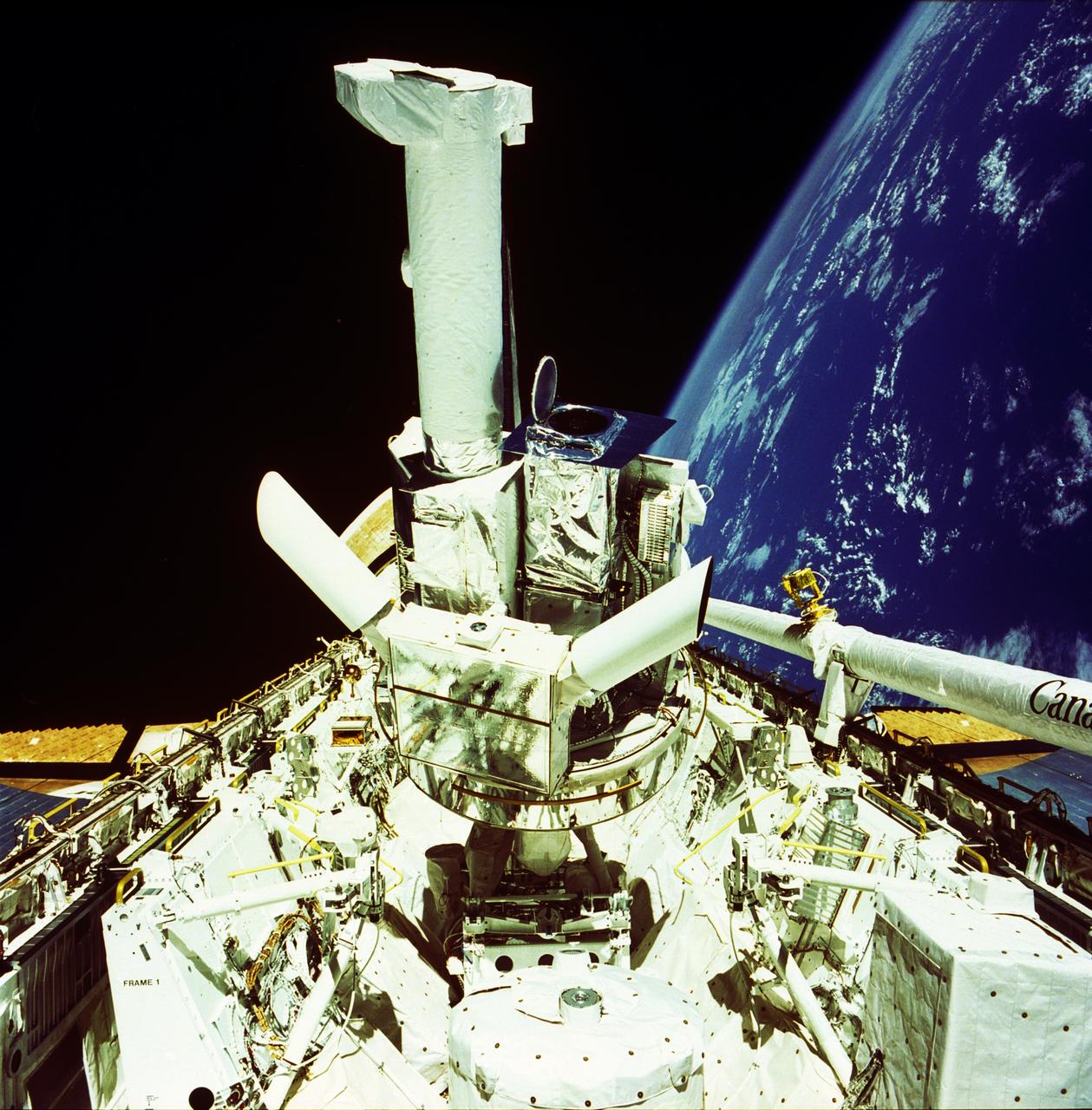
This photograph shows the Instrument Pointing System (IPS) for Spacelab-2 being deployed in the cargo bay of the Space Shuttle Orbiter Challenger. The European Space Agency (ESA) developed this irnovative pointing system for the Spacelab program. Previously, instruments were pointed toward particular celestial objects or areas by maneuvering the Shuttle to an appropriate attitude. The IPS could aim instruments more accurately than the Shuttle and kept them fixed on a target as the Shuttle moved. On the first pallet, three solar instruments and one atmospheric instrument were mounted on the IPS. Spacelab-2 was the first pallet-only mission. One of the goals of the mission was to verify that the pallets' configuration was satisfactory for observations and research. Except for two biological experiments and an experiment that uses ground-based instruments, the Spacelab-2 scientific instruments needed direct exposure to space. The Spacelab-2 mission was designed to capitalize on the Shuttle-Spacelab capabilities to carry very large instruments, launch and retrieve satellites, and point several instruments independently with accuracy and stability. Spacelab-2 (STS-51F, 19th Shuttle mission) was launched on July 29, 1985 aboard the Space Shuttle Orbiter Challenger. The Marshall Space Flight Center had overall management responsibilities of the Spacelab missions.
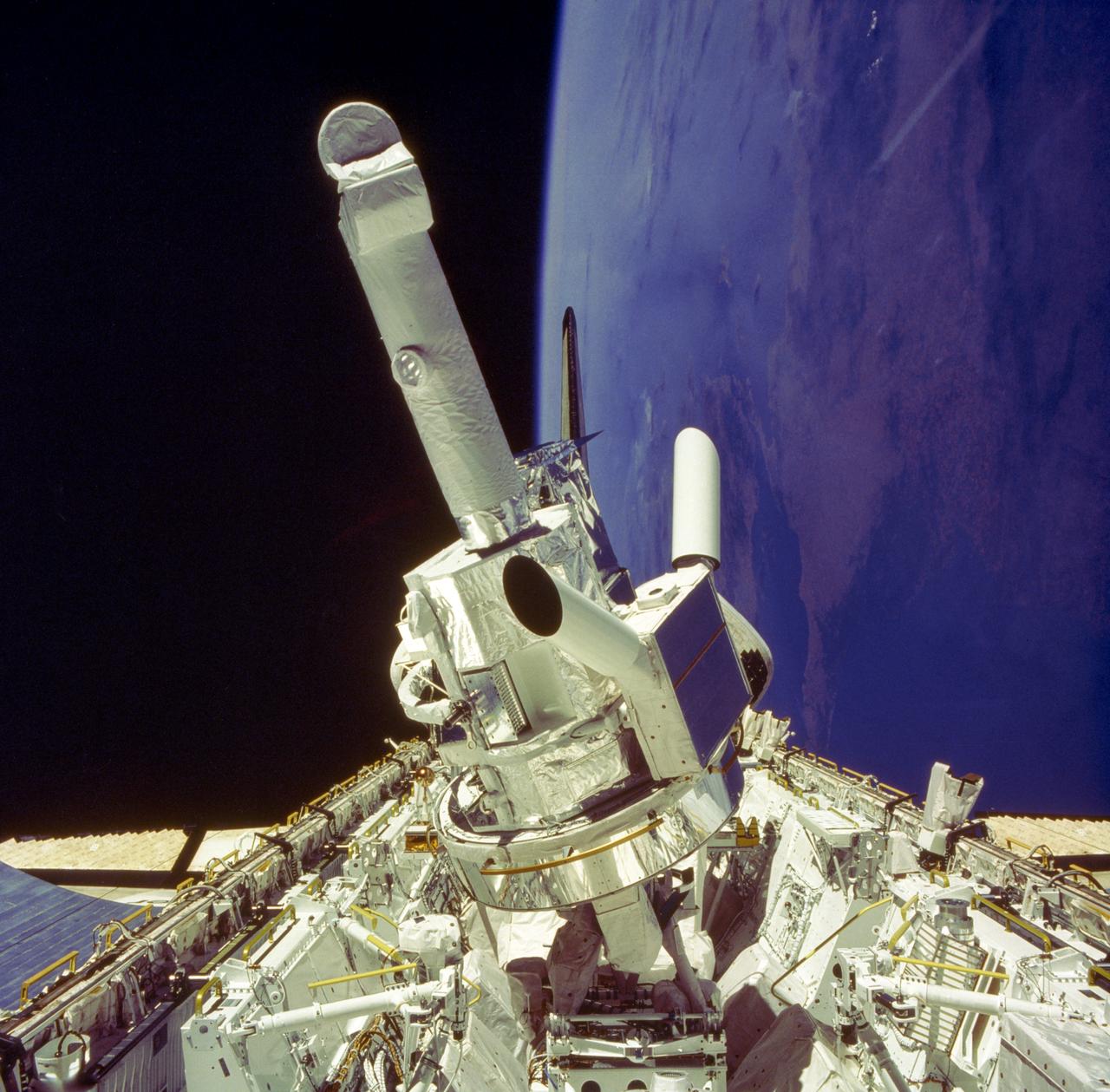
This photograph shows the Instrument Pointing System (IPS) for Spacelab-2 being deployed in the cargo bay of the Space Shuttle Orbiter Challenger. The European Space Agency (ESA) developed this irnovative pointing system for the Spacelab program. Previously, instruments were pointed toward particular celestial objects or areas by maneuvering the Shuttle to an appropriate attitude. The IPS could aim instruments more accurately than the Shuttle and kept them fixed on a target as the Shuttle moved. On the first pallet, three solar instruments and one atmospheric instrument were mounted on the IPS. Spacelab-2 was the first pallet-only mission. One of the goals of the mission was to verify that the pallets' configuration was satisfactory for observations and research. Except for two biological experiments and an experiment that used ground-based instruments, the Spacelab-2 scientific instruments needed direct exposure to space. The Spacelab-2 mission was designed to capitalize on the Shuttle-Spacelab capabilities to carry very large instruments, launch and retrieve satellites, and point several instruments independently with accuracy and stability. Spacelab-2 (STS-51F, 19th Shuttle mission) was launched on July 29, 1985 aboard the Space Shuttle Orbiter Challenger. The Marshall Space Flight Center had overall management responsibilities of the Spacelab missions.
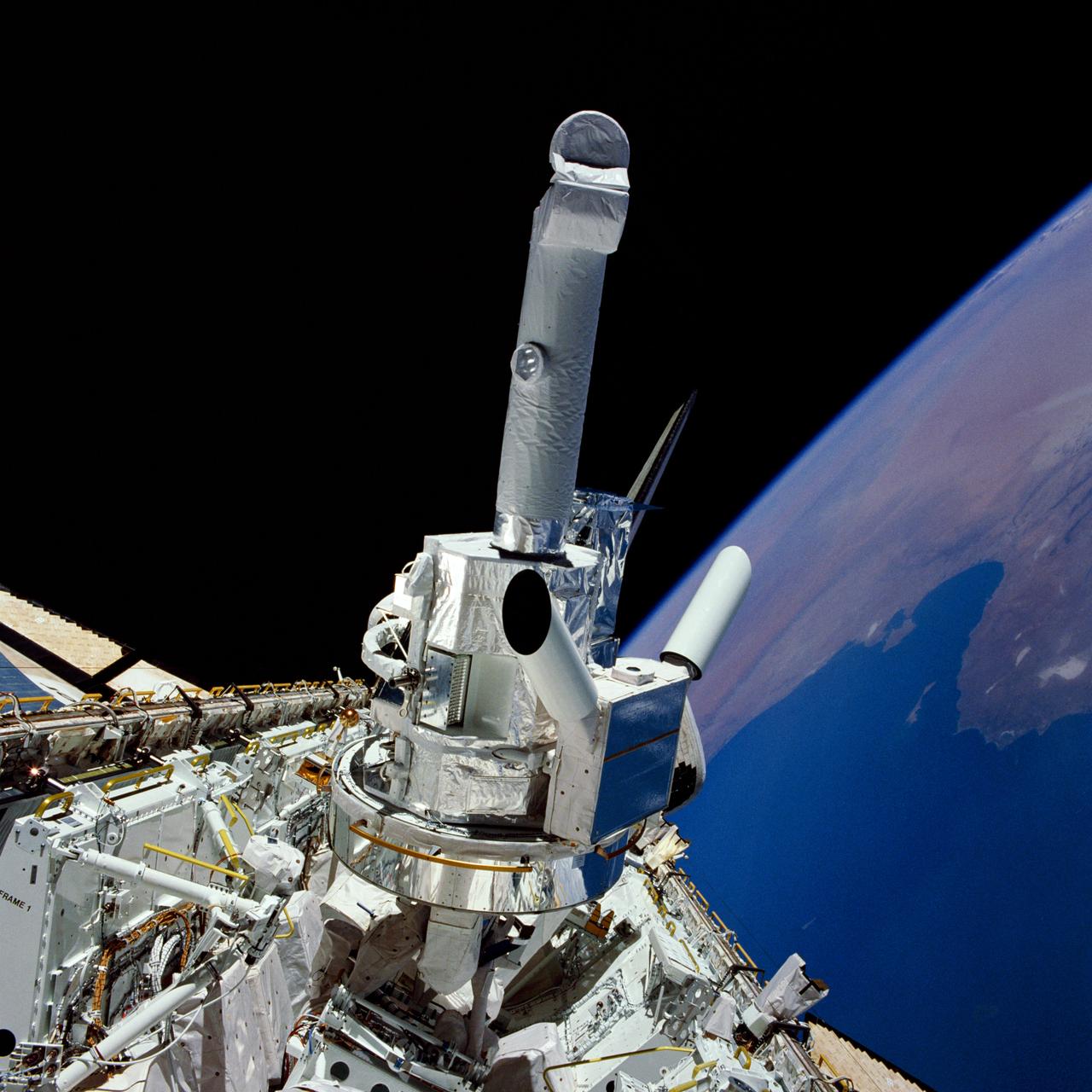
51F-33-005 (29 July - 6 August 1985) --- Experiments and the instrument pointing system (IPS) for Spacelab 2 are backdropped against the Libya/Tunisia Mediterranean coast and black space in this 70mm view photographed through the aft flight deck windows of the Space Shuttle Challenger. Also partially visible among the cluster of Spacelab 2 hardware are the solar optical universal polarimeter (SOUP) experiment and the coronal helium abundance experiment (CHASE).
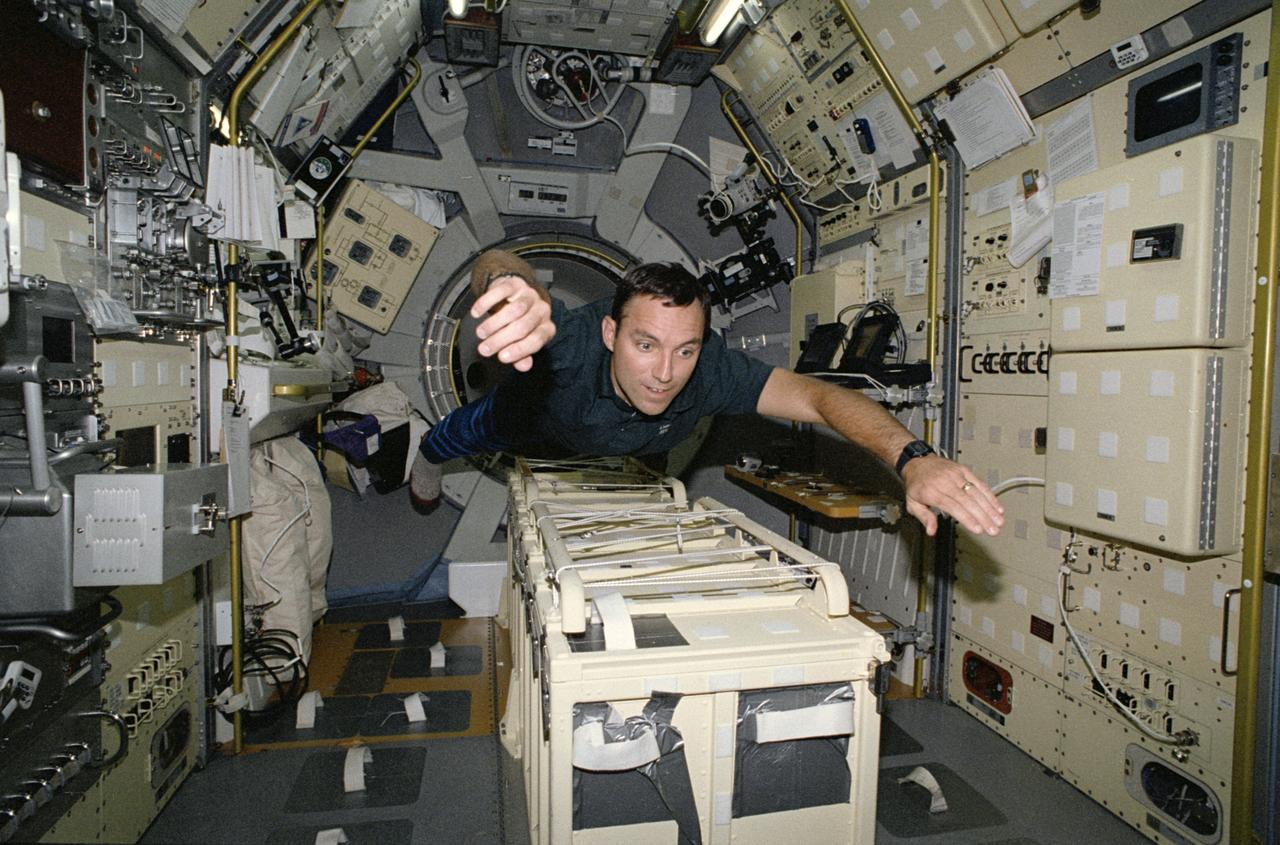
STS-65 Mission Specialist Carl E. Walz floats above center aisle equipment in the International Microgravity Laboratory 2 (IML-2) spacelab science module. Walz has just entered the IML-2 module via the spacelab tunnel (note hatch opening behind him). The tunnel connects the IML-2 module with Columbia's, Orbiter Vehicle (OV) 102's, crew compartment. Walz along with five other NASA astronauts and a Japanese payload specialist spent more than two weeks in Earth orbit conducting IML-2 experiments. This photo was among the first released by NASA following IML-2.
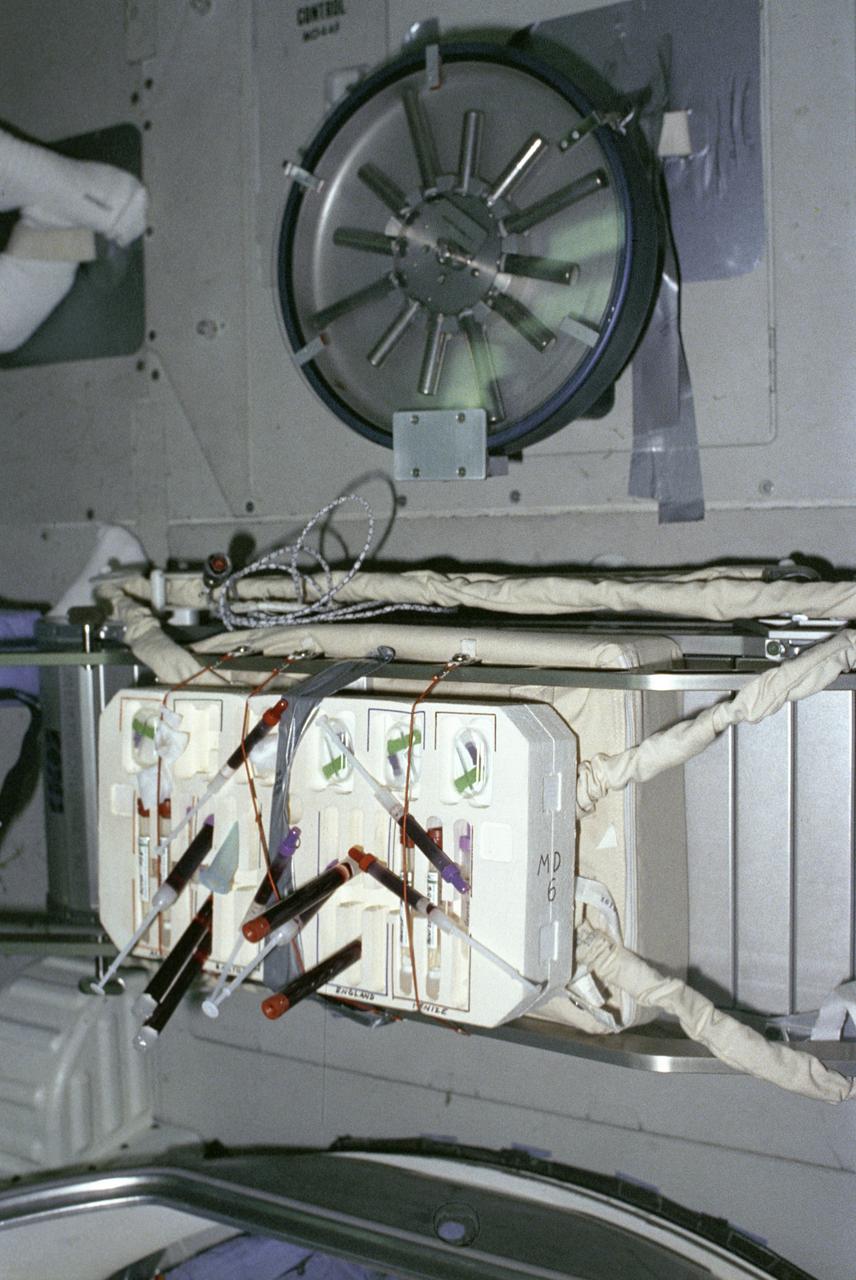
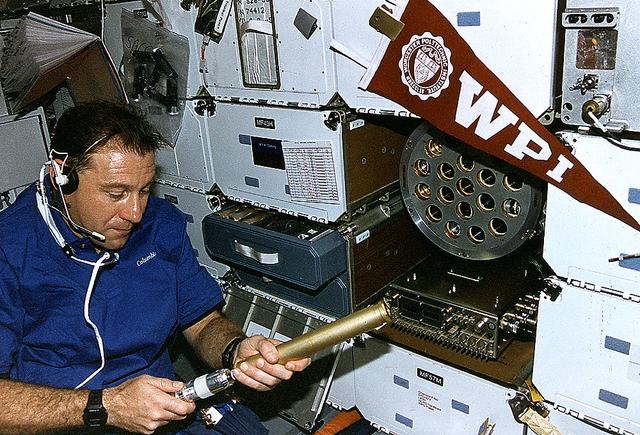
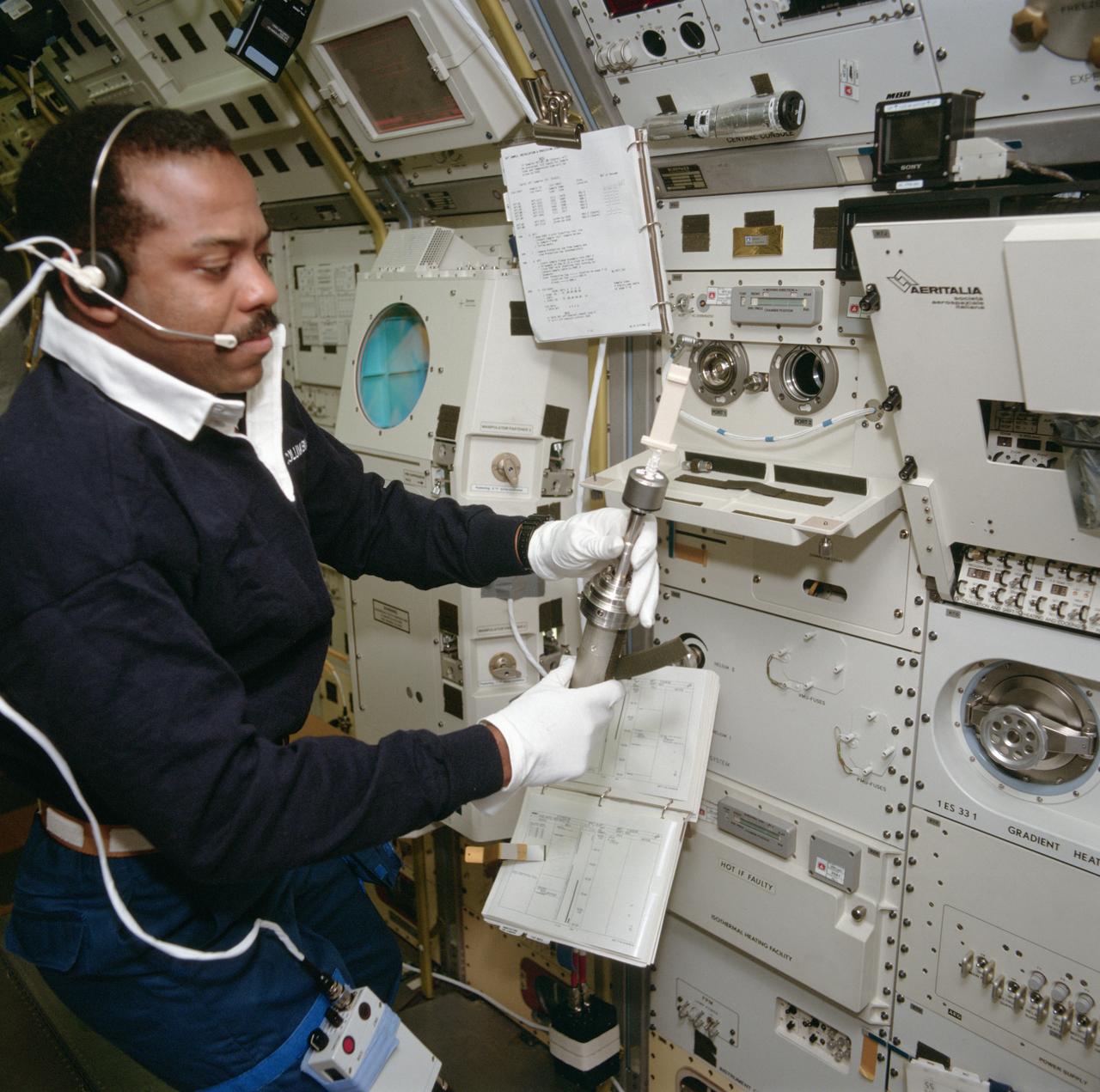
While instruments on the pallets in the payload bay observed the universe, biological experiments were performed in the middeck of the Shuttle Orbiter Challenger. Studying life processes in a microgravity environment can shed new light on the functioning of biological systems on Earth. These investigations can also help us understand how living organisms react to prolonged weightlessness. One such experiment was the vitamin D metabolites and bone demineralization experiment. This investigation measured the vitamin d metabolite levels of crew members to gain information on the cause of bone demineralization and mineral imbalance that occur during prolonged spaceflight as well as on Earth. Research into the biochemical nature of vitamin D has shown that the D-metabolites play a major role in regulating the body's calcium and phosphorus levels. One major function of the most biologically active vitamin D metabolite is to regulate the amount of calcium absorbed from the diet and taken out of bones. This investigation had two phases. The first was the developmental phase, which included extensive testing before flight, and the second, or final phase, involved the postflight analysis of the crew's blood samples. This photograph shows a blood draw test kit and centrifuge used for the experiment aboard the Spacelab-2. Marshall Space Flight Center had management responsibilities of all Spacelab missions.
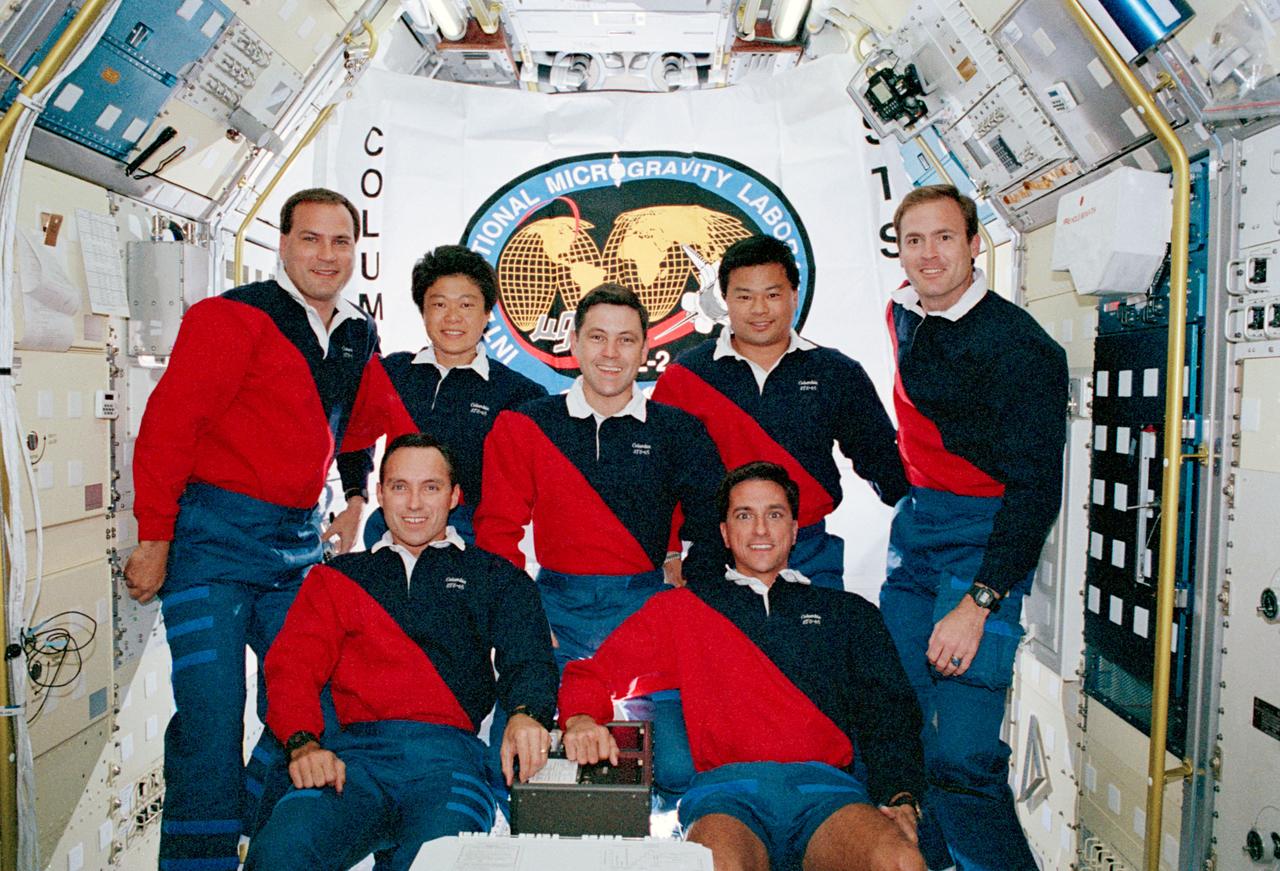
In the spacelab science module aboard the Space Shuttle Columbia, Orbiter Vehicle (OV) 102, the seven crewmembers pose for the traditional onboard (inflight) crew portrait. Displayed in the background is a flag with the International Microgravity Laboratory 2 (IML-2) insignia and Columbia inscribed along the edge. In the front row (left to right) are Mission Specialist (MS) Carl E. Walz and MS Donald A. Thomas. Behind them (left to right) are Payload Commander (PLC) Richard J. Hieb, Payload Specialist Chiaki Mukai, Commander Robert D. Cabana, MS Leroy Chiao, and Pilot James D. Halsell, Jr. Mukai represents the National Space Development Agency (NASDA) of Japan. Crewmembers are wearing their mission polo shirts for the portrait. Inside this module, the crew conducted experiments in support of the IML-2 mission.
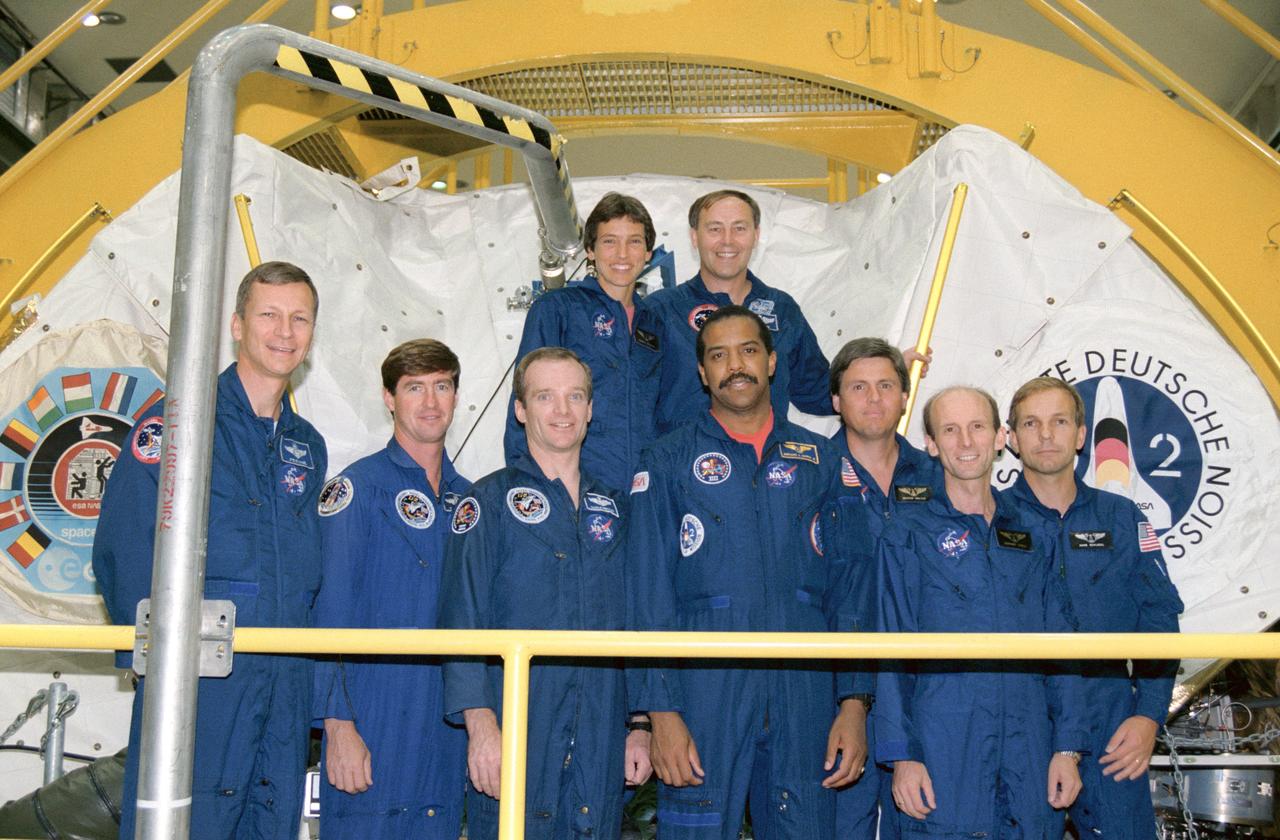
S92-49373 (8 Dec 1992) --- The seven prime flight crewmembers and two alternates assigned to support the STS-55\Spacelab D-2 mission pose with their science module. Left to right (front) are Steven R. Nagel, Terence T. (Tom) Henricks, Charles J. Precourt, Bernard A. Harris Jr., Ulrich Walter, Gerhard Thiele and Hans Schlegel; and (back) Renate Brummer and Jerry L. Ross. Nagel is mission commander; Henricks, pilot; and Ross, payload commander. Harris and Precourt will serve as mission specialists. Walter and Schlegel are scheduled to represent the DLR as payload specialists for the mission, while Brummer and Thiele will serve as alternates and fill supportive roles on the ground. The crew was photographed during a tour of the science module before its integration at Kennedy Space Center (KSC).
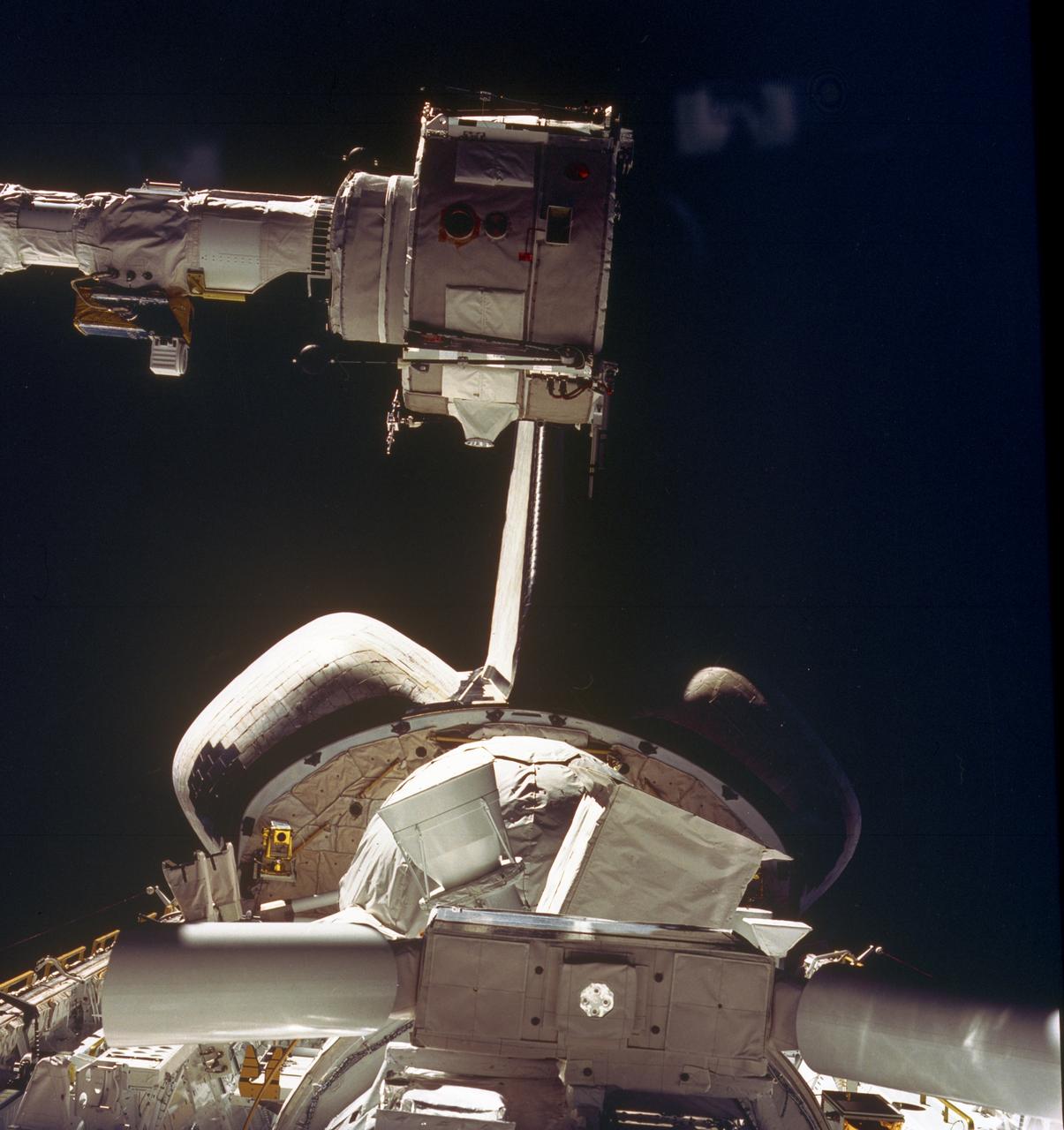
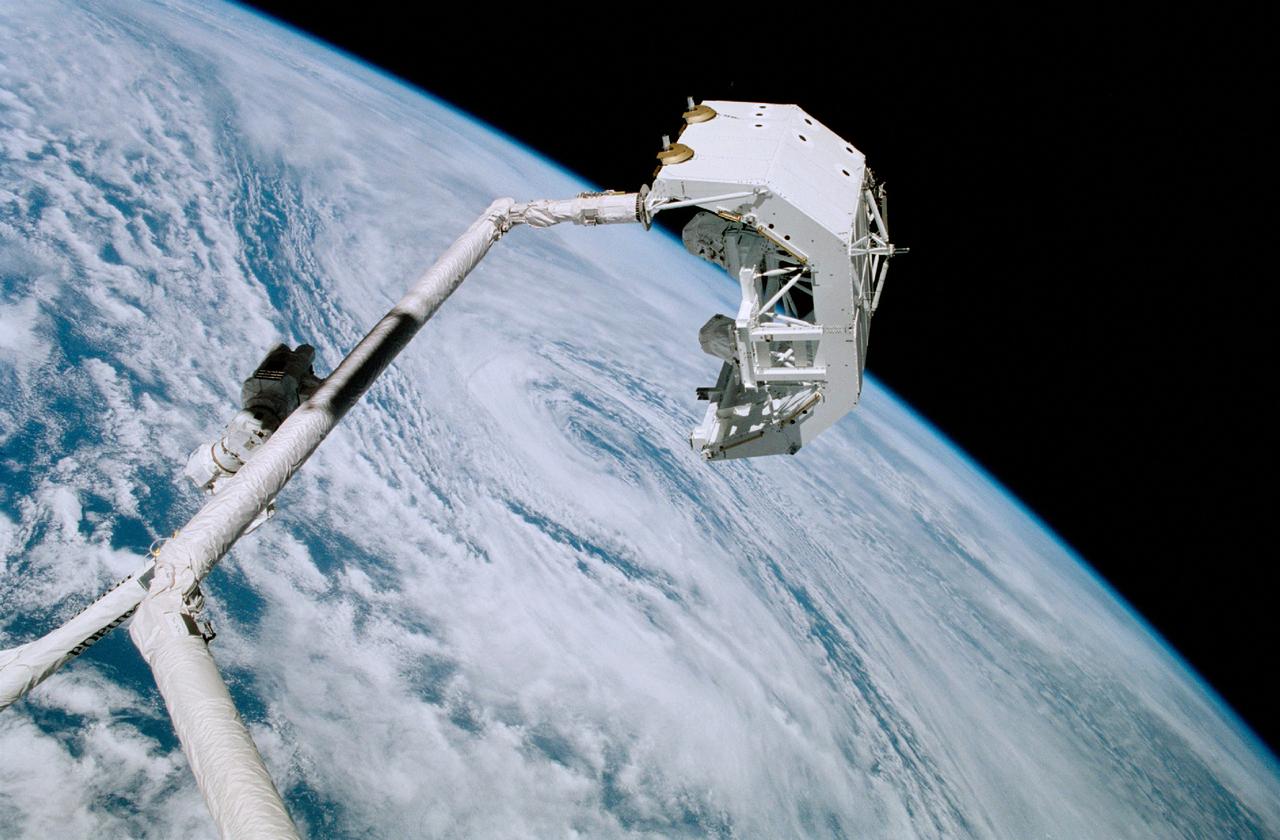
This STS-51F mission onboard Photograph shows some of the Spacelab-2 instruments in the cargo bay of the Orbiter Challenger. The Plasma Diagnostics Package (PDP). shown at the end of the Remote Manipulator System (RMS), used instruments on a subsatellite to study natural plasma processes, orbiter-induced plasma processes, and beam plasma physics. Fourteen instruments were mounted on the PDP for measurements of various plasma characteristics. The X-ray Telescope (XRT), is at the front. The goal of this investigation was to image and examine the X-ray emissions from clusters of galaxies in order to study the mechanisms that cause high-temperature emissions and to determine the weight of galactic clusters. The Small Helium-Cooled Infrared Telescope (IRT) is at the right behind the XRT. The objective of this investigation was to measure and map diffused and discrete infrared astronomical sources while evaluating the Space Shuttle as a platform for infrared astronomy. At the same time, a new large superfluid helium dewar system for cooling the telescope was evaluated. The egg-shaped Cosmic Ray Nuclei experiment (CRNE) is shown at the rear. This investigation was to study the composition of high-energy cosmic rays by using a large instrument exposed to space for a considerable period of time. Spacelab-2 (STS-51F, 19th Shuttle mission) was launched aboard the Space Shuttle Orbiter Challenger on July 29, 1985.
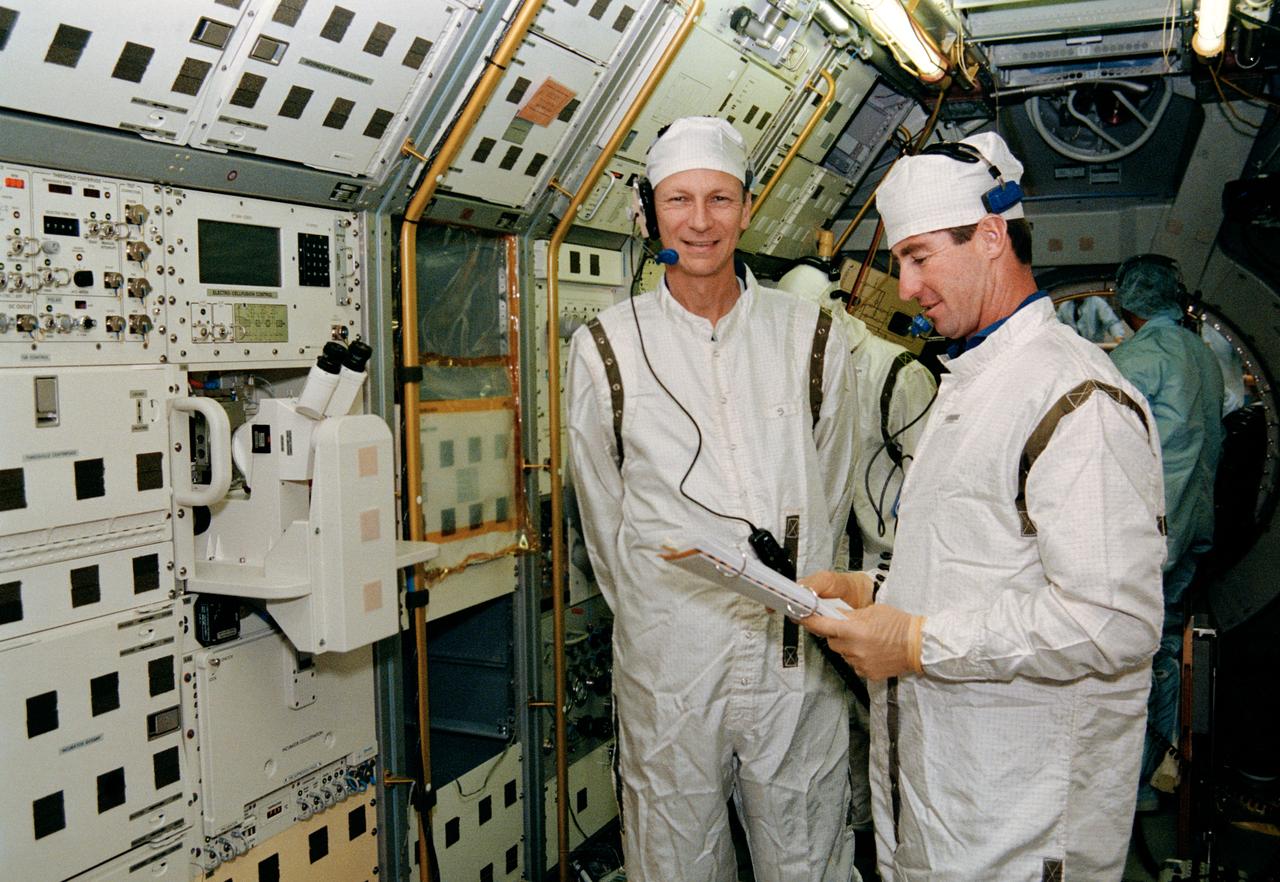
S93-29830 (4 Nov 1992) --- Inside the Spacelab D-2 module in the Operations and Checkout Building high bay, STS-55 Mission Commander Steven R. Nagel (left) and Pilot Terence T. Henricks are participating in a mission sequence test to check out experiment steps and procedures which will be conducted on-orbit. Spacelab D-2, the second German Spacelab, is scheduled to fly on space shuttle mission STS-55 in 1993.
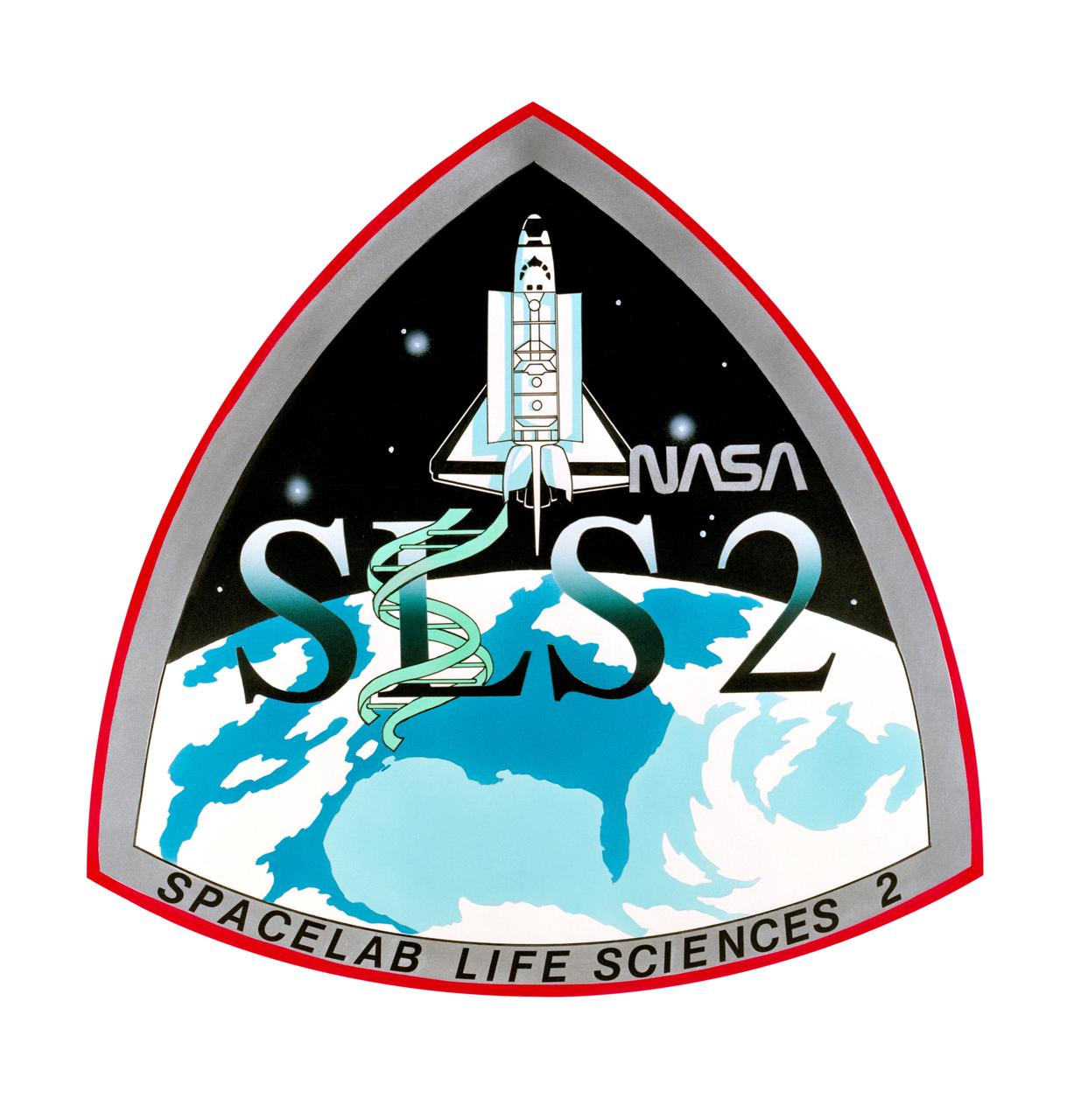
S93-26894 (March 1993) --- Spacelab Life Sciences 2, scheduled to fly as the major payload on the STS-58 mission, is represented with this logo. As in the case of SLS-1, which flew in space in June of 1991, this Spacelab mission will be devoted to life sciences and will carry a crew of experts in the associated disciplines.
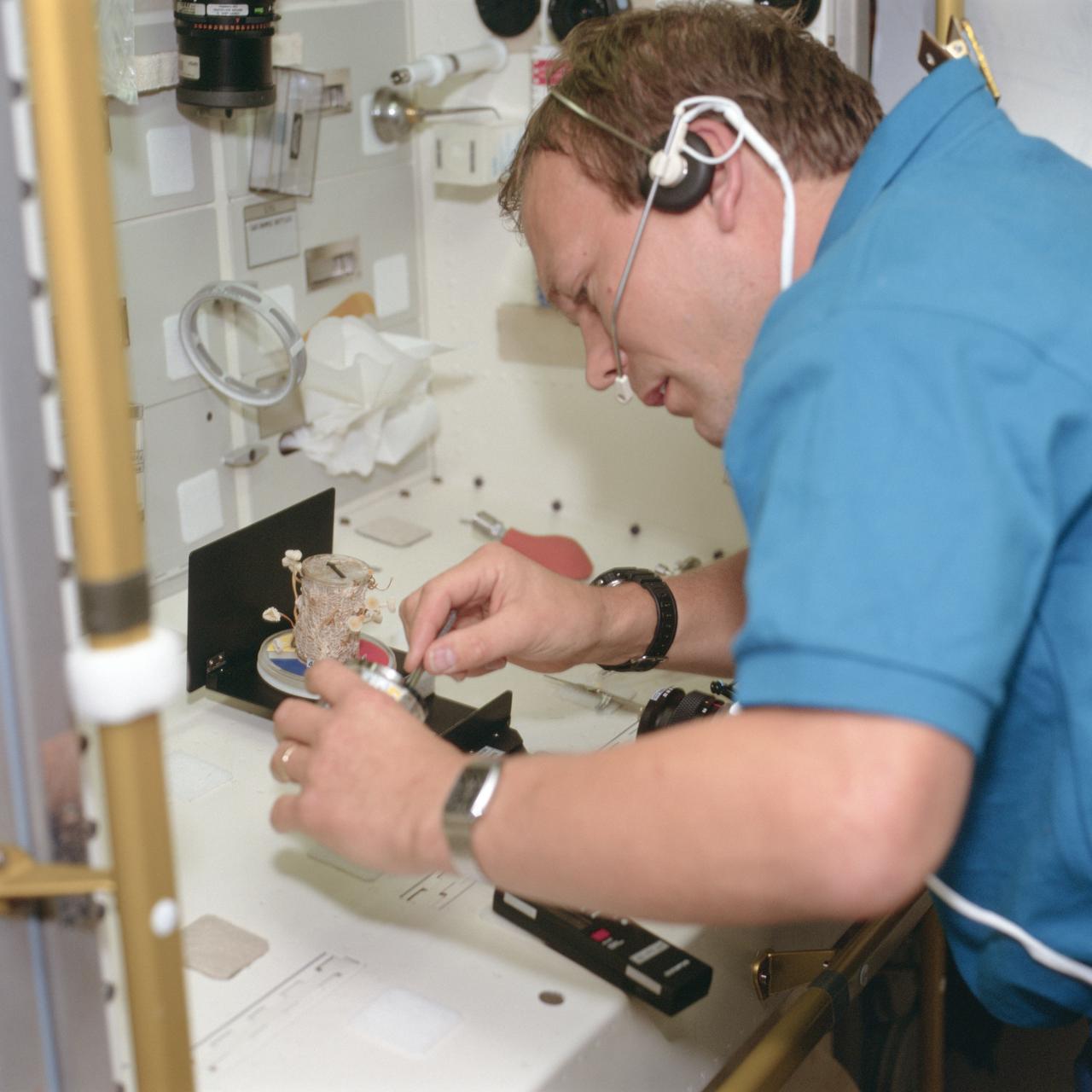
STS055-106-037 (26 April-6 May 1993) --- Hans Schlegel works with a fungi experiment in the Spacelab D-2 Science Module onboard the Earth-orbiting Space Shuttle Columbia. Schlegel was one of two payload specialists representing the German Aerospace Research Establishment (DLR) on the 10-day Spacelab D-2 mission.
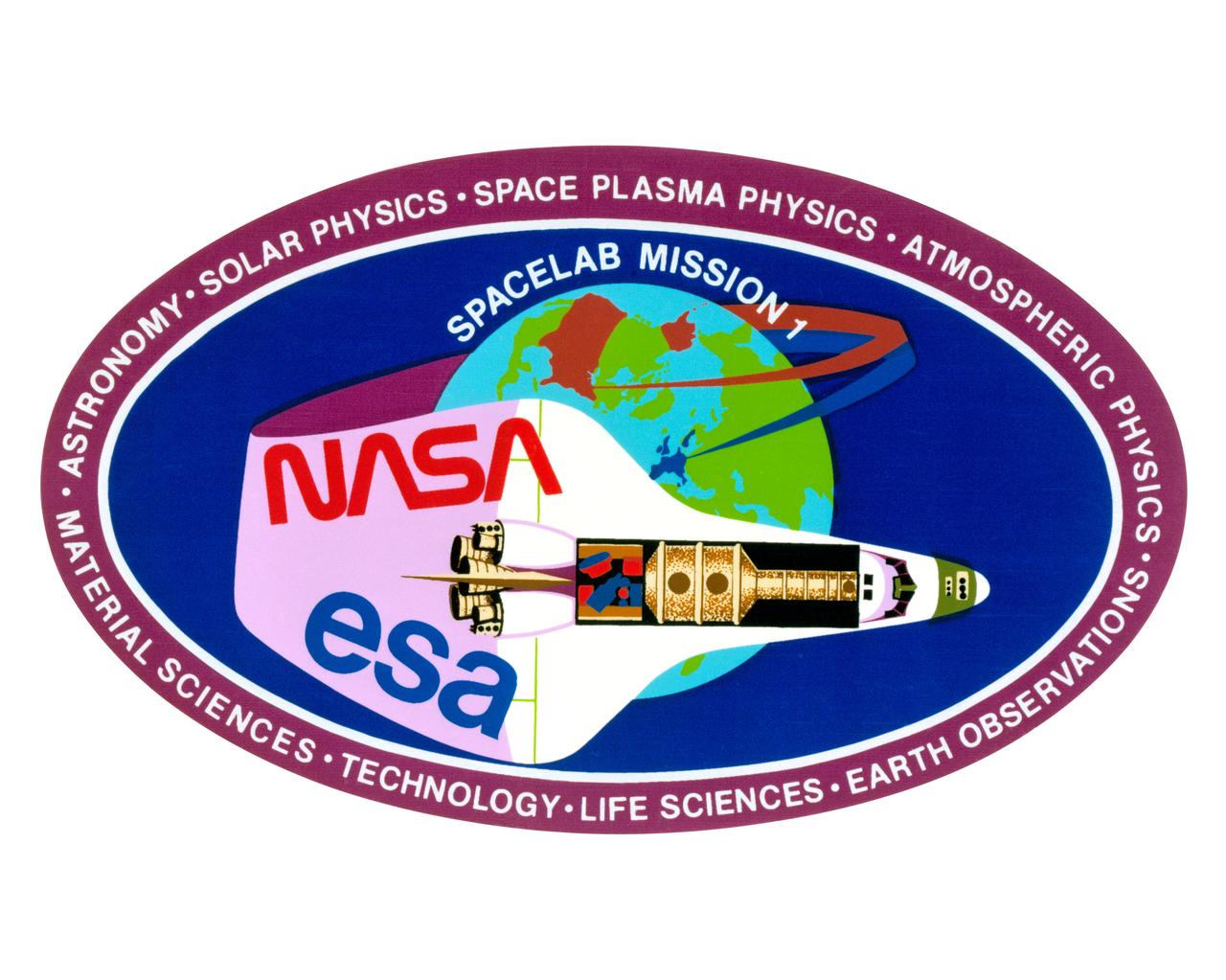
S82-31408 (May 1983) --- The Spacelab 2 emblem is a symbolic representation of the scientific objectives of the mission. The emblem is in the shape of a triangular shield with convexly curved edges. Across the top of a black out border are the words ?SPACELAB 2?. Within the black border is a sky blue border carryhing the words: ?ASTRONOMY?, ON TOP? ?PHYSICS?, on the left; and ?BIOLOGY?, on the right. Within the blue border is a schematic view of the sun, the earth, and the orbiter with Spacelab 2. The sun appears in the upper right background as a white disc surrounded by six concentric rings ranging grom bright yellow near the disc through yellow-red to a dark red out ring. A sector of the earth with blue ocean and a black portion of North America is in the upper left corner. The black and white Orbiter is seen from directly overhead in the foreground, the right side illuminated by the sun, the left side in shadow. Although the payload bay doors are not open, the Spacelab 2 payload is seen as if the doors were open. In black on white are seen the three pallets, and the separately mounted cosmic ray experiment at the aft end of the bay.
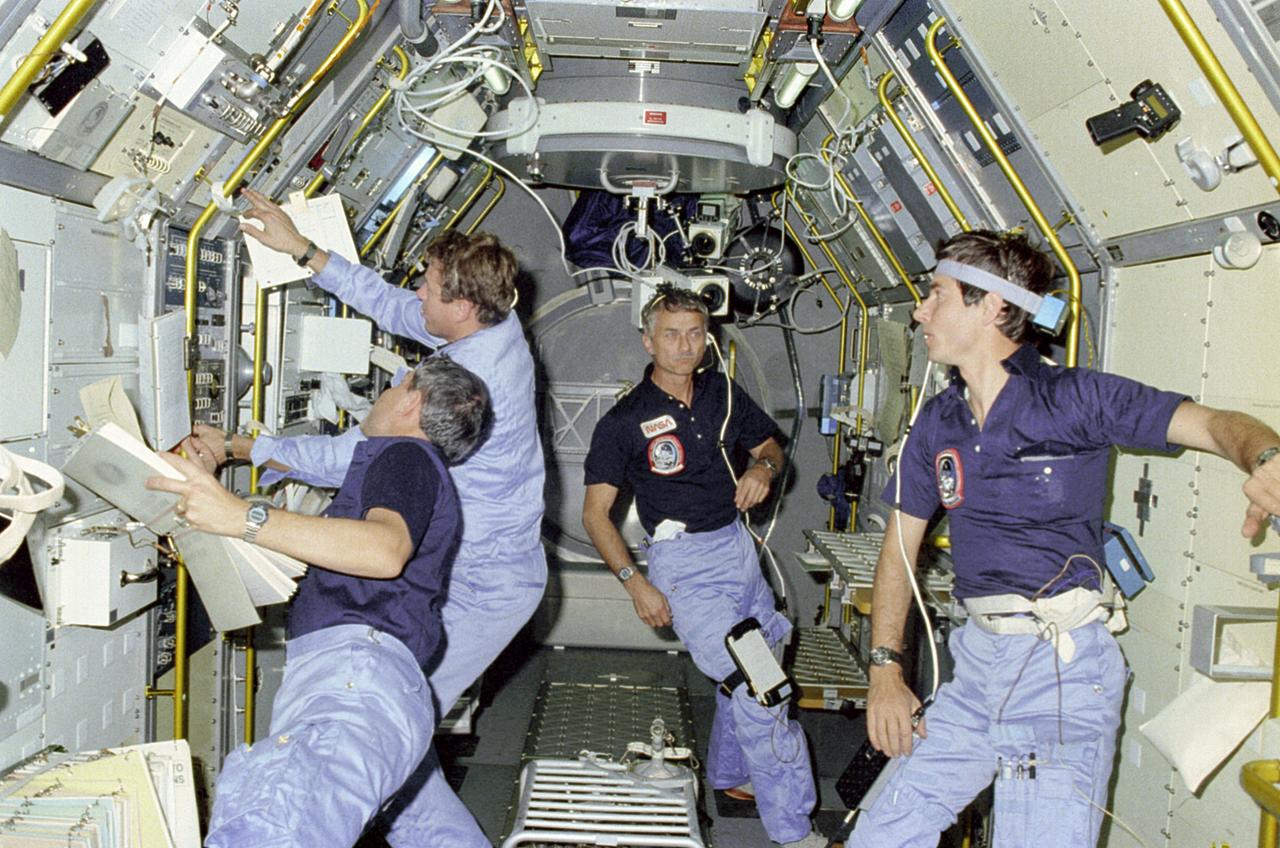
This photograph shows activities inside the science module during the Spacelab-1 (STS-9) mission. Left to right are Mission Specialist Robert Parker, Payload Specialist Byron Lichtenberg, Mission Specialist Owen Garriott, and Payload Specialist Ulf Merbold. The overall goal of the Spacelab-1 mission, the first mission of the Spacelab facility, were: (1) To verify the Spacelab system capability, (2) to obtain valuable scientific, applications, and technology data from a U.S./European multidisciplinary payload, and (3) to demonstrate the broad capability of Spacelab for scientific research. More than 70 experiments in 5 disciplines from 14 nations were conducted during the mission. The mission marked the the entry of non-astronaut persornel, called Payload Specialists, into space as working members of the crew. They are fellow scientists representing the international group of investigators using the mission. Mission Specialists are NASA astronauts who have broad scientific training. They operate various Orbiter-Spacelab systems, perform any required activity outside the spacecraft, and support investigations as needed. The Space Shuttle Orbiter Columbia that carried Spacelab-1 was operated by two other NASA astronauts serving as commander and pilot. The STS-9 mission, managed by the Marshall Space Flight Center, was launched on November 28, 1983.
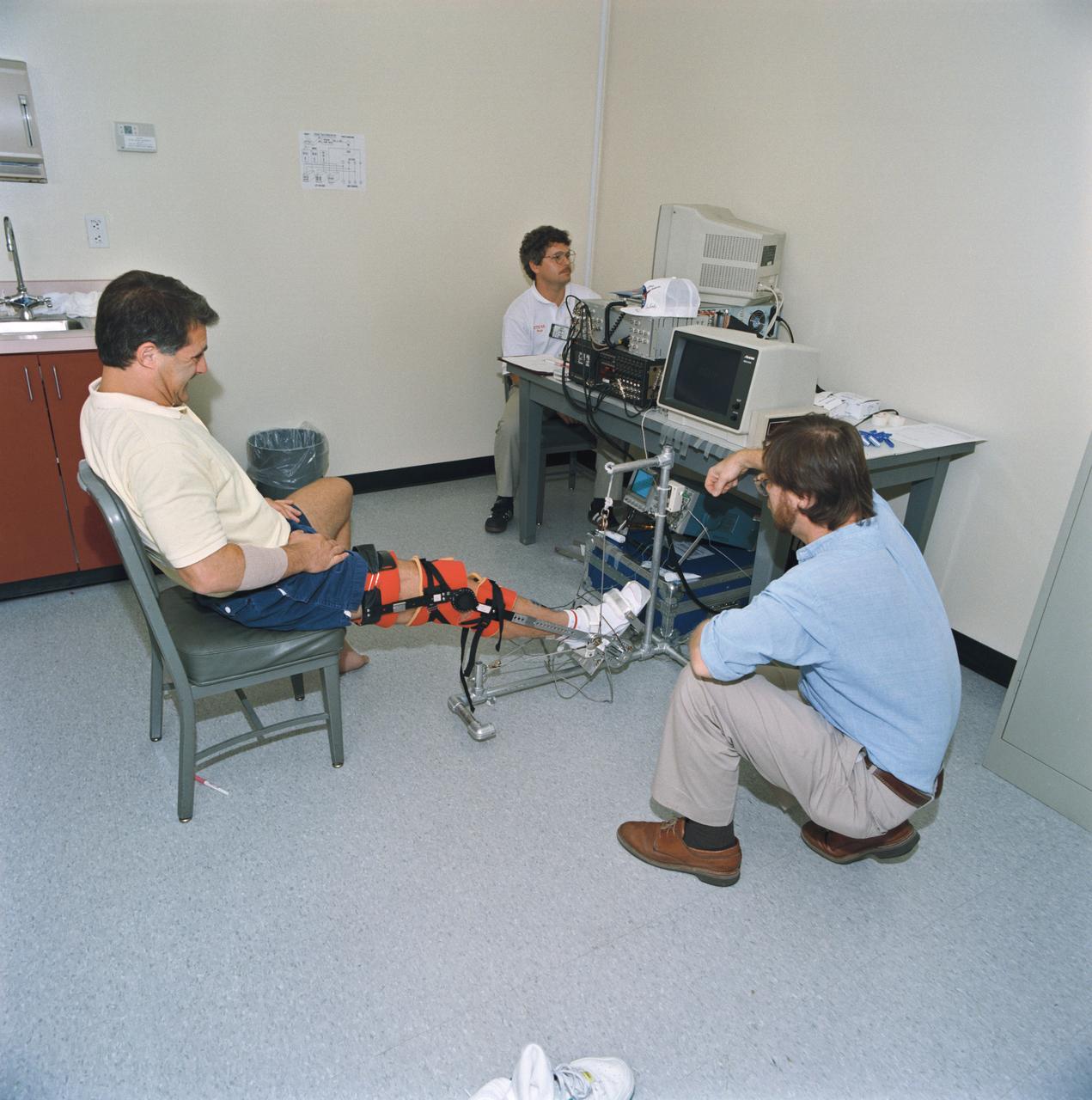
S93-45364 (29 Sept 1993) --- Astronaut David A. Wolf, mission specialist, participates in pre-flight data collection for the cardiovascular experiments scheduled to fly aboard Columbia for the Spacelab Life Sciences (SLS-2) mission.
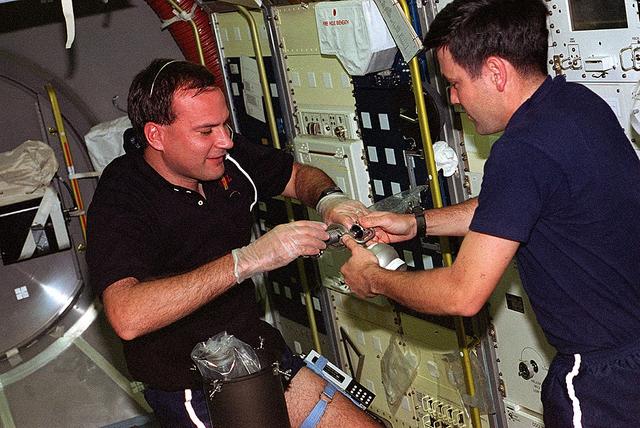
Space Shuttle Columbia (STS-65) onboard photo of Payload specialist Richard J. Hieb (right) and Shuttle Pilot James D. Halsell Jr. working on experiments in the Spacelab in the International Microgravity Laboratory (IML-2).
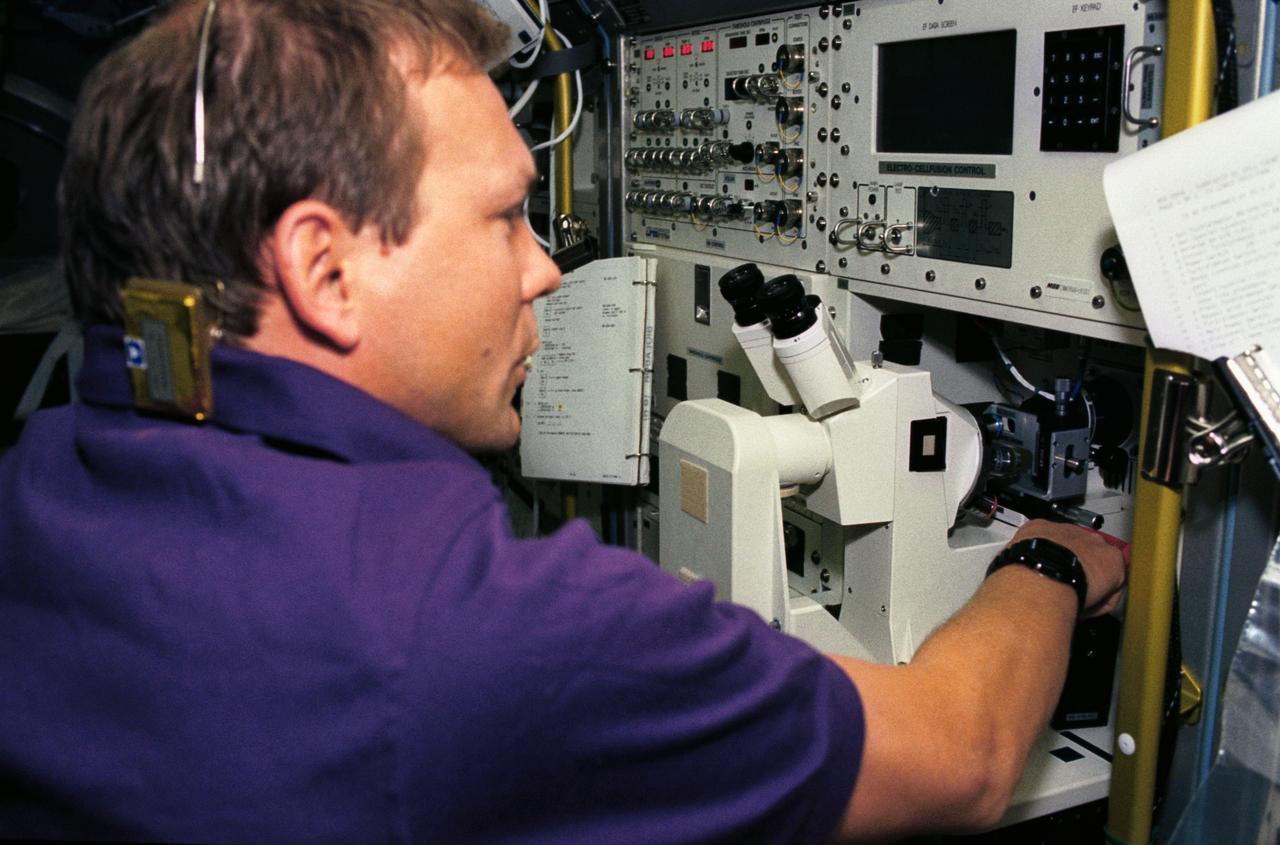
STS055-233-025 (26 April-6 May 1993) --- German payload specialist Hans Schlegel uses a microscope at the Biolabor workstation in the Spacelab D-2 science module. The Biolabor facility is a life sciences and biotechnology research device developed by Germany (MBB/ERNO) for use aboard Spacelab. Schlegel was joined by five NASA astronauts and a fellow German payload specialist for the 10-day mission aboard the Space Shuttle Columbia.
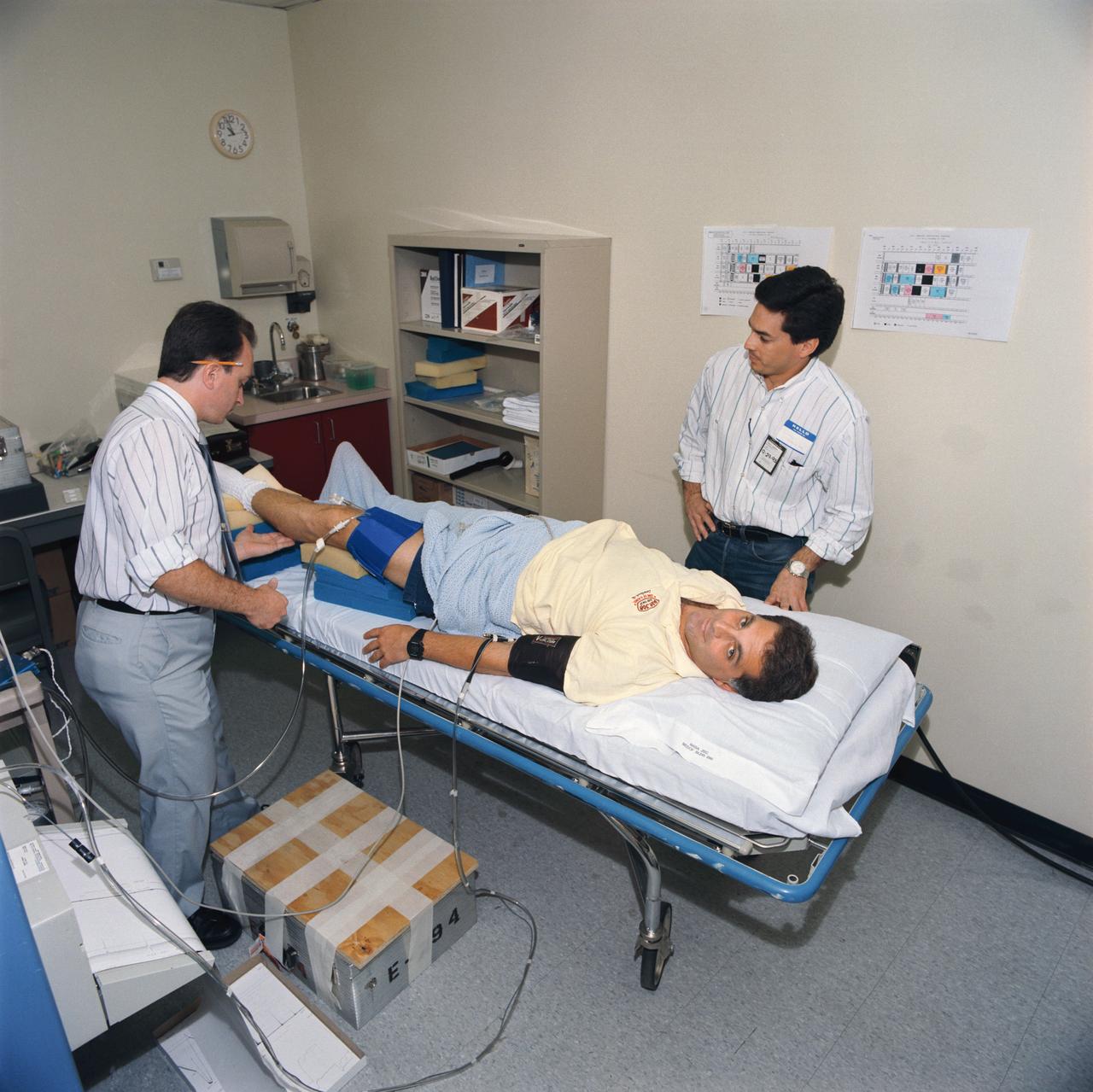
S93-45375 (29 Sept 1993) --- Astronaut David A. Wolf, STS-58 mission specialist, has blood drawn from his leg for volume measuring. The blood draw was part of the cardiovascular function data collection in preparation for the Spacelab Life Sciences (SLS-2) mission. The seven Spacelab Life Sciences crewmembers devoted a full day to miscellaneous biomedical data collection in preparation for next month's two week mission aboard Columbia.
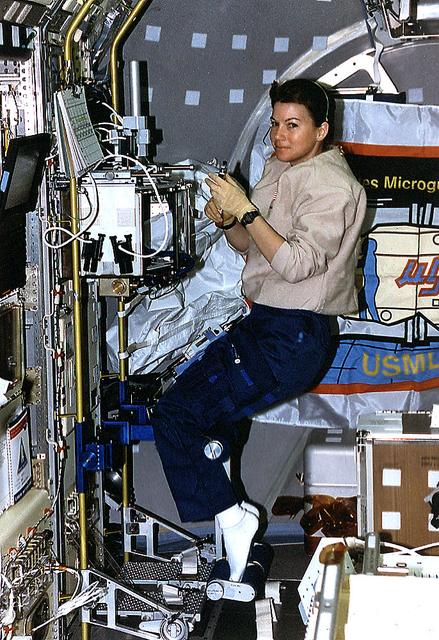
Onboard Space Shuttle Columbia (STS-73) Mission Specialists Catherine Cady Coleman works at the glovebox facility in support of the Protein Crystal Growth Glovebox (PCG-GBX) experiment in the United States Microgravity Laboratory 2 (USML-2) Spacelab science module.
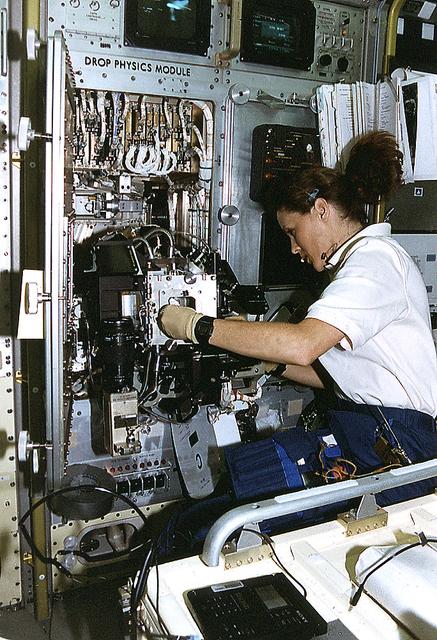
Onboard Space Shuttle Columbia (STS-73) Payload Commander Kathryn Thornton works with the Drop Physics Module (DPM) in the United States Microgravity Laboratory 2 (USML-2) Spacelab Science Module cleaning the experiment chamber of the DPM.
Onboard Space Shuttle Columbia (STS-73) Payload Specialist Albert Sacco loads autoclaves using a power screwdriver into the Zeolite Crystal Growth (ZCG) experiment in the middeck for the United States Microgravity Laboratory 2 (USML-2) Spacelab mission.
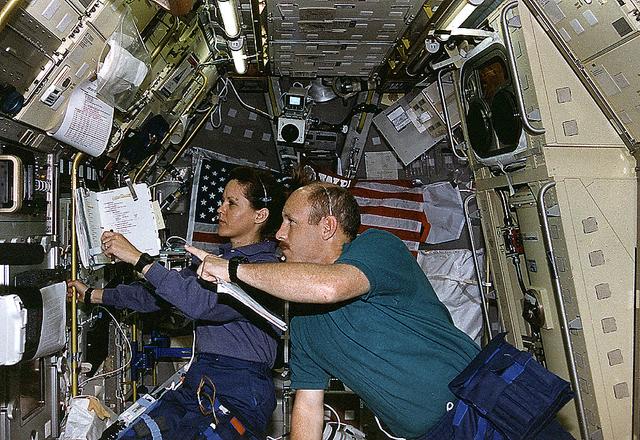
Onboard Space Shuttle Columbia (STS-73) Payload Commander Kathryn Thornton and Commander Ken Bowersox discuss the Drop Physics Module (DPM) experiment in the United States Microgravity Laboratory 2 (USML-2) spacelab science module.
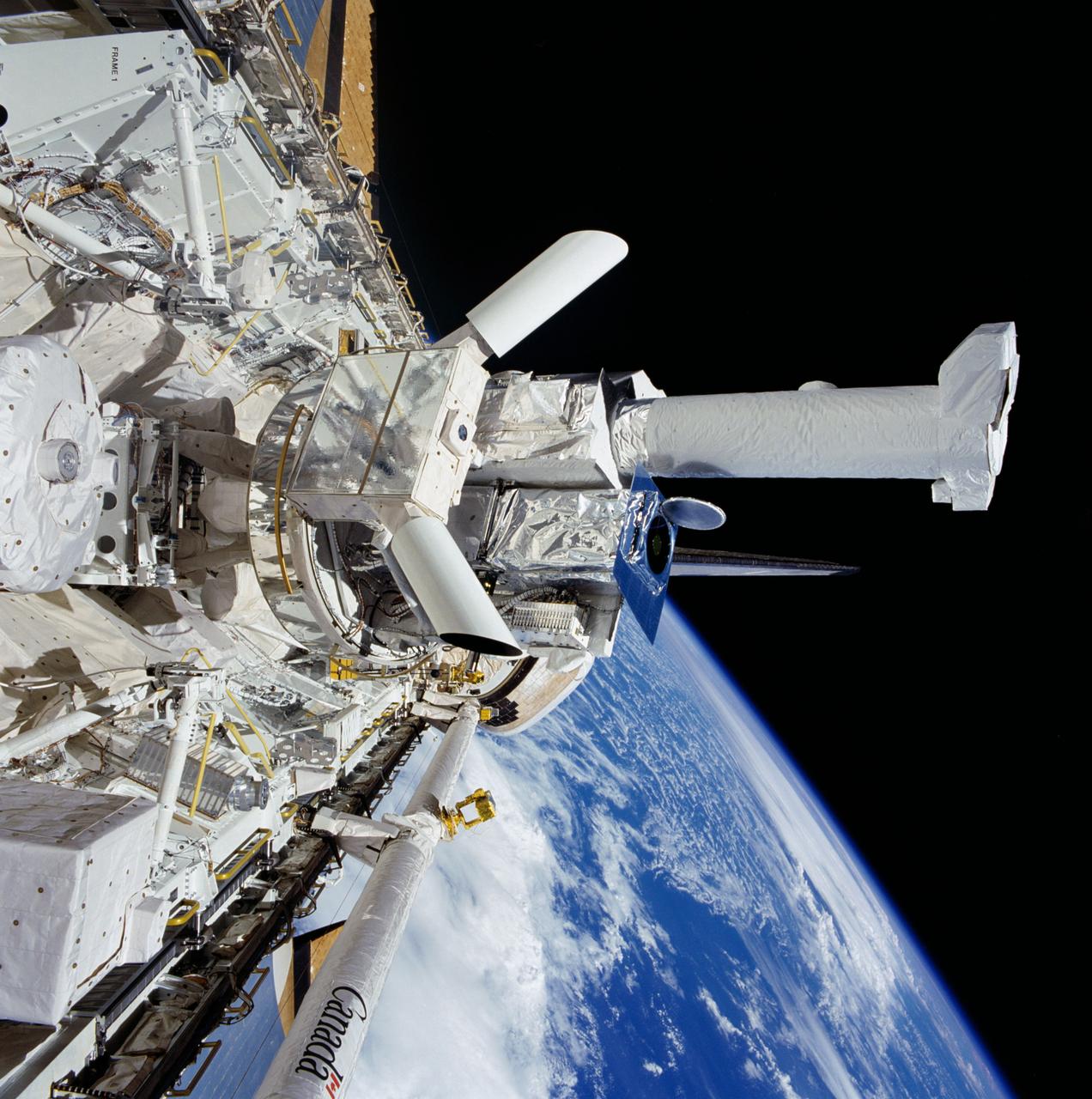
51F-42-069 (29 July-6 Aug 1985) --- The solar optical universal polarimeter (SOUP) experiment is visible among the cluster of Spacelab 2 hardware in the cargo bay of the Earth-orbiting Space Shuttle Challenger, backdropped against a curtain of white clouds over ocean waters. Various components of the instrument positioning system (IPS) are conspicuous at the center of the frame. Now resting, the remote manipulator system (RMS) was used at various points during the mission with the plasma diagnostics package (PDP) and as a support service structure for television cameras covering various activities of the busy science-oriented Spacelab 2 mission.
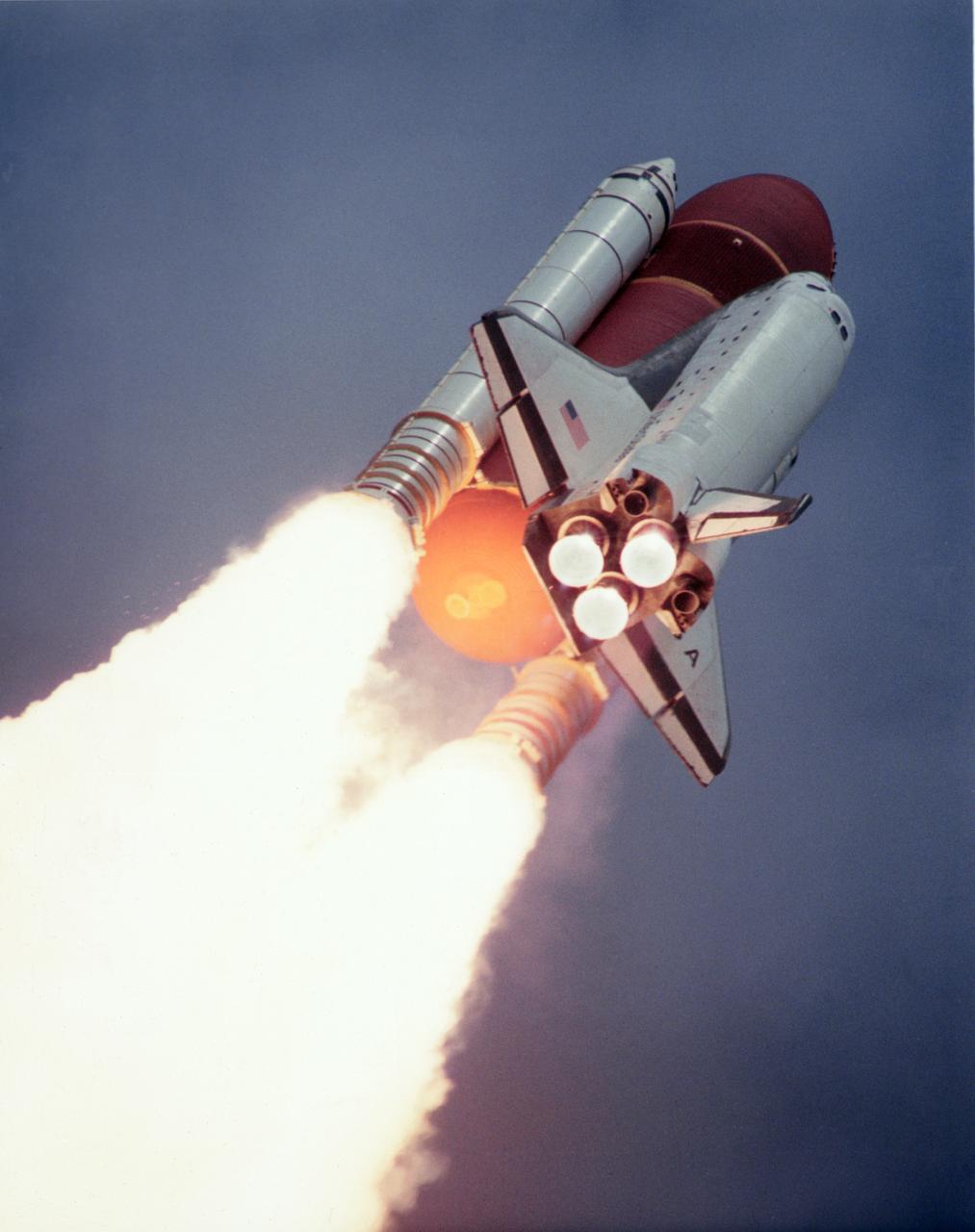
Launched aboard the Space Shuttle Columbia on June 5, 1991 at 9:24; am (EDT), the STS-40 mission was the fifth dedicated Spacelab Mission, Spacelab Life Sciences-1 (SLS-1), and the first mission dedicated solely to life sciences. The STS-40 crew included 7 astronauts: Bryan D. O’Connor, commander; Sidney M. Gutierrez, pilot; F. Drew Gaffney, payload specialist 1; Milli-Hughes Fulford, payload specialist 2; James P. Bagian, mission specialist 1; Tamara E. Jernigan, mission specialist 2; and M. Rhea Seddon, mission specialist 3.
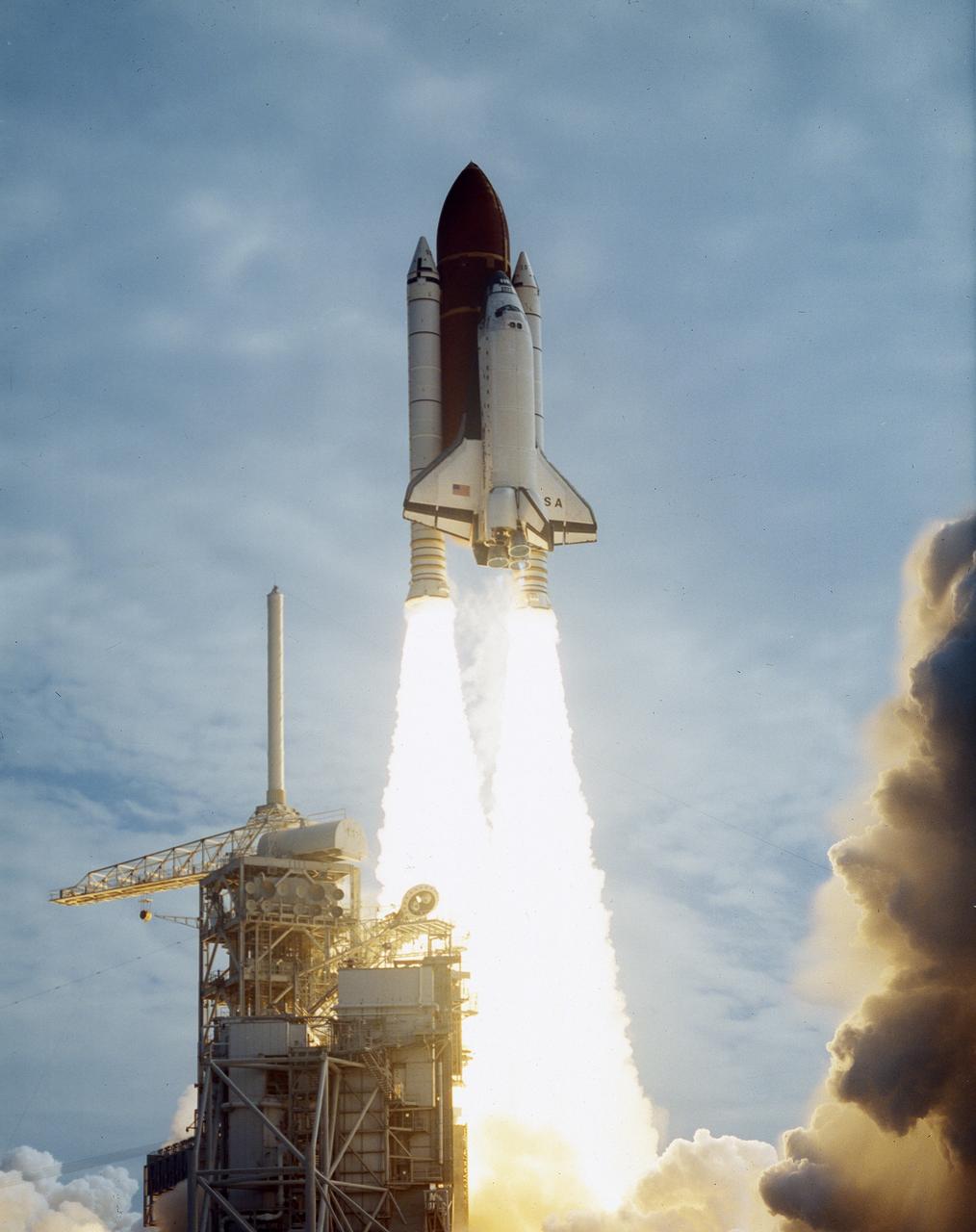
Launched aboard the Space Shuttle Columbia on June 5, 1991 at 9:24; am (EDT), the STS-40 mission was the fifth dedicated Spacelab Mission, Spacelab Life Sciences-1 (SLS-1), and the first mission dedicated solely to life sciences. The STS-40 crew included 7 astronauts: Bryan D. O’Connor, commander; Sidney M. Gutierrez, pilot; F. Drew Gaffney, payload specialist 1; Milli-Hughes Fulford, payload specialist 2; James P. Bagian, mission specialist 1; Tamara E. Jernigan, mission specialist 2; and M. Rhea Seddon, mission specialist 3.
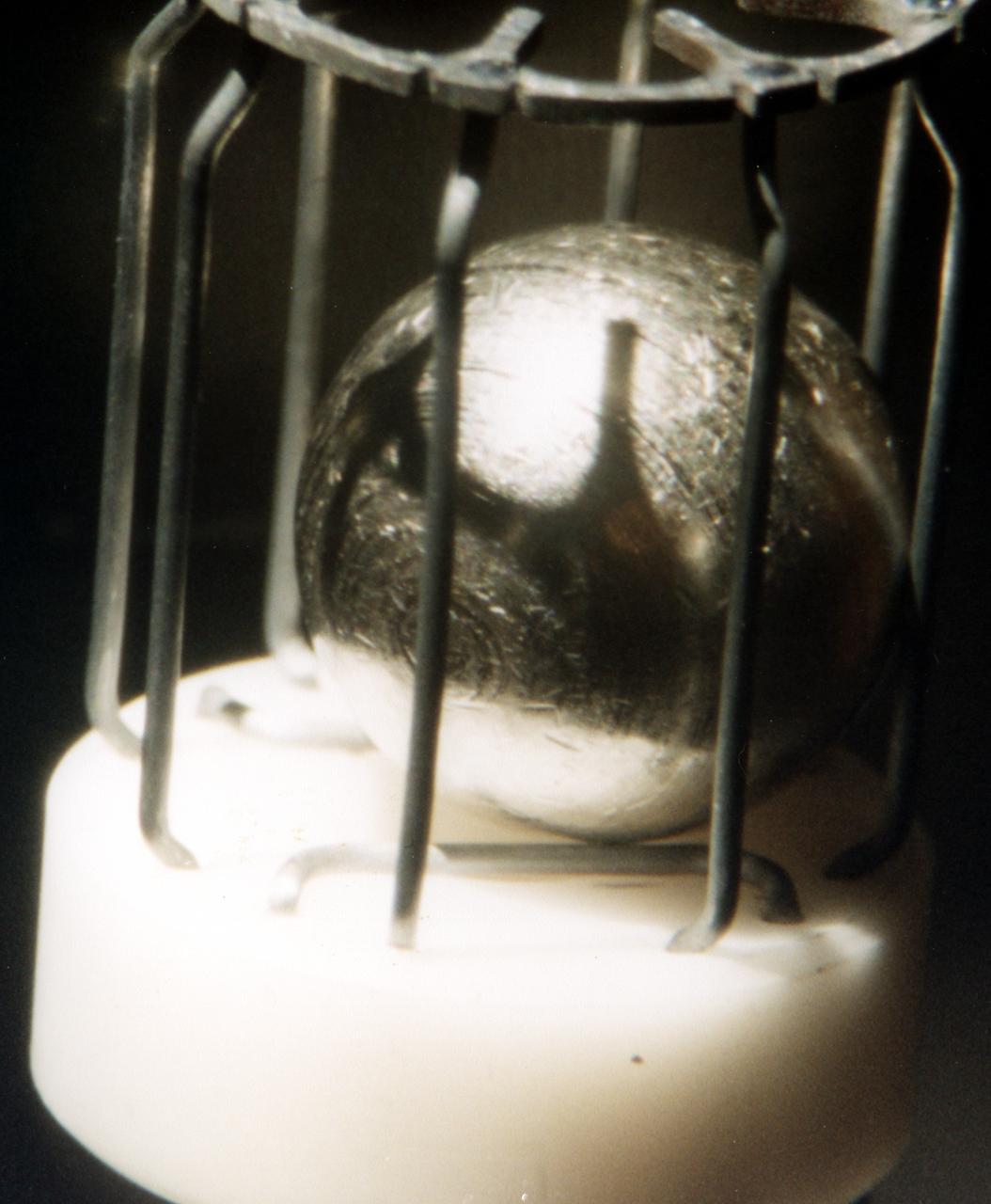
Typical metal sample that was processed by TEMPUS (Tiegelfreies Elektromagnetisches Prozessieren Unter Schwerelosigkeit), an electromagnetic levitation facility developed by German researchers and flown on the IML-2 and MSL-1 and 1R Spacelab missions. Electromagnetic levitation is used commonly in ground-based experiments to melt and then cool metallic melts below their freezing points without solidification occurring. Sample size is limited in ground-based experiments. Research with TEMPUS aboard Spacelab allowed scientists to study the viscosity, surface tension, and other properties of several metals and alloys while undercooled (i.e., cooled below their normal solidification points). The sample is about 1 cm (2/5 inch) in diameter.
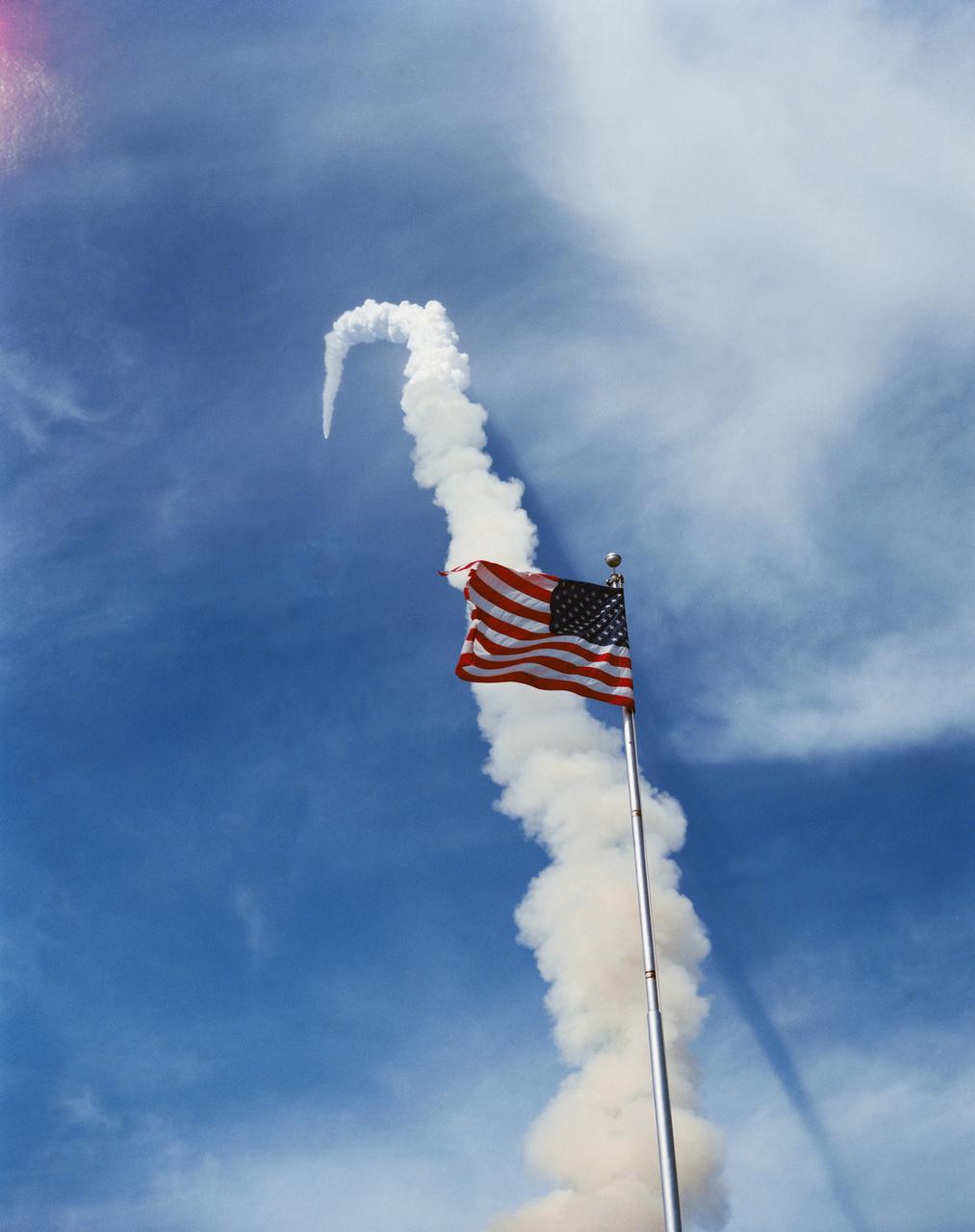
51F-S-068 (29 July 1985) --- The Space Shuttle Challenger heads toward Earth-orbit with the Spacelab-2 experiment pallet and a team of astronauts and scientists onboard. This photograph was taken by Otis Imboden of the National Geographic Society for NASA from the press site at Kennedy Space Center (KSC).
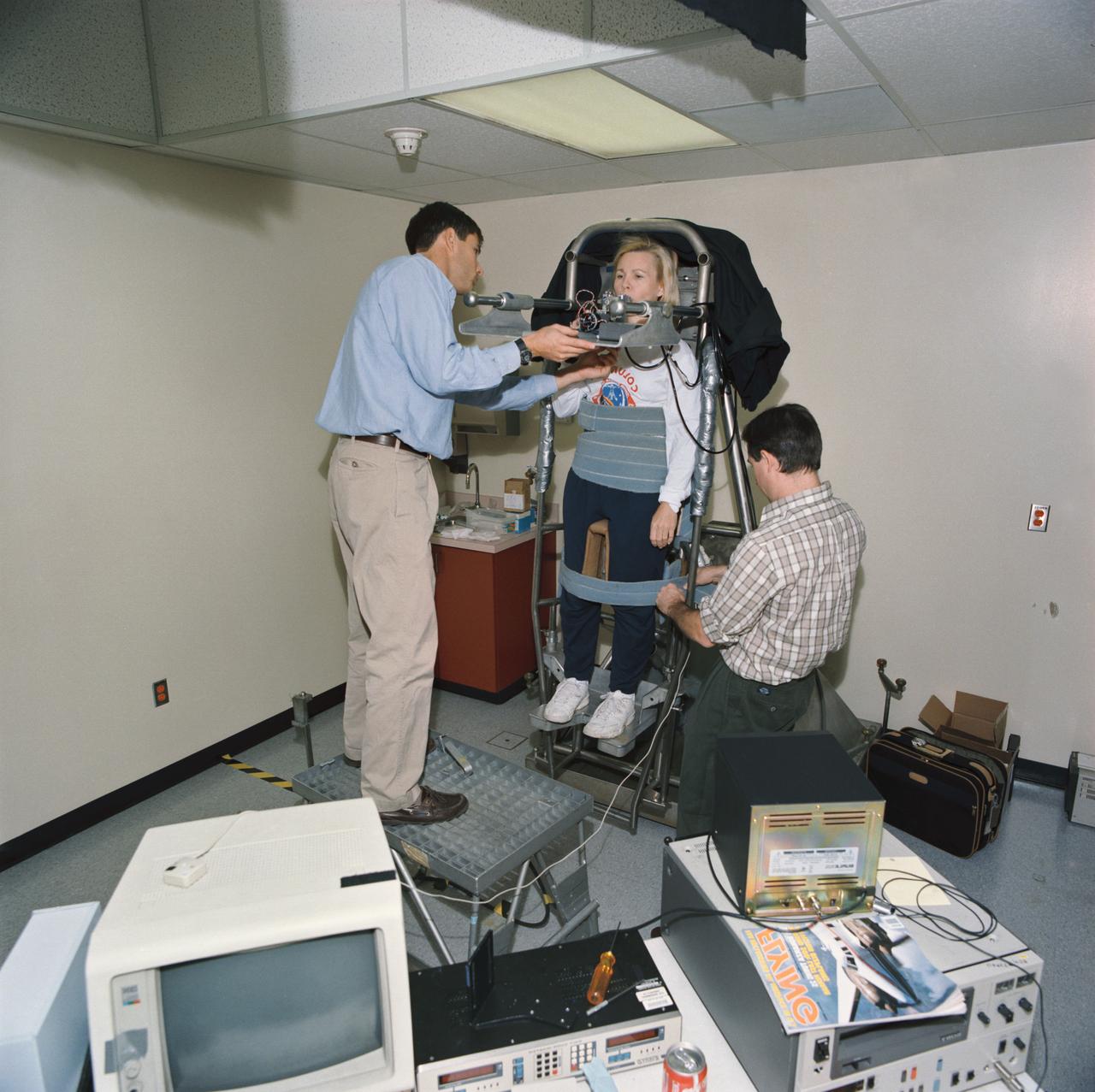
S93-45376 (29 Sept 1993) --- Astronaut Rhea Seddon, STS-58 payload commander, participates in data collection for neurovestibular functions. The data collection process was in preparation for the Spacelab Life Sciences (SLS-2) flight scheduled for next month.
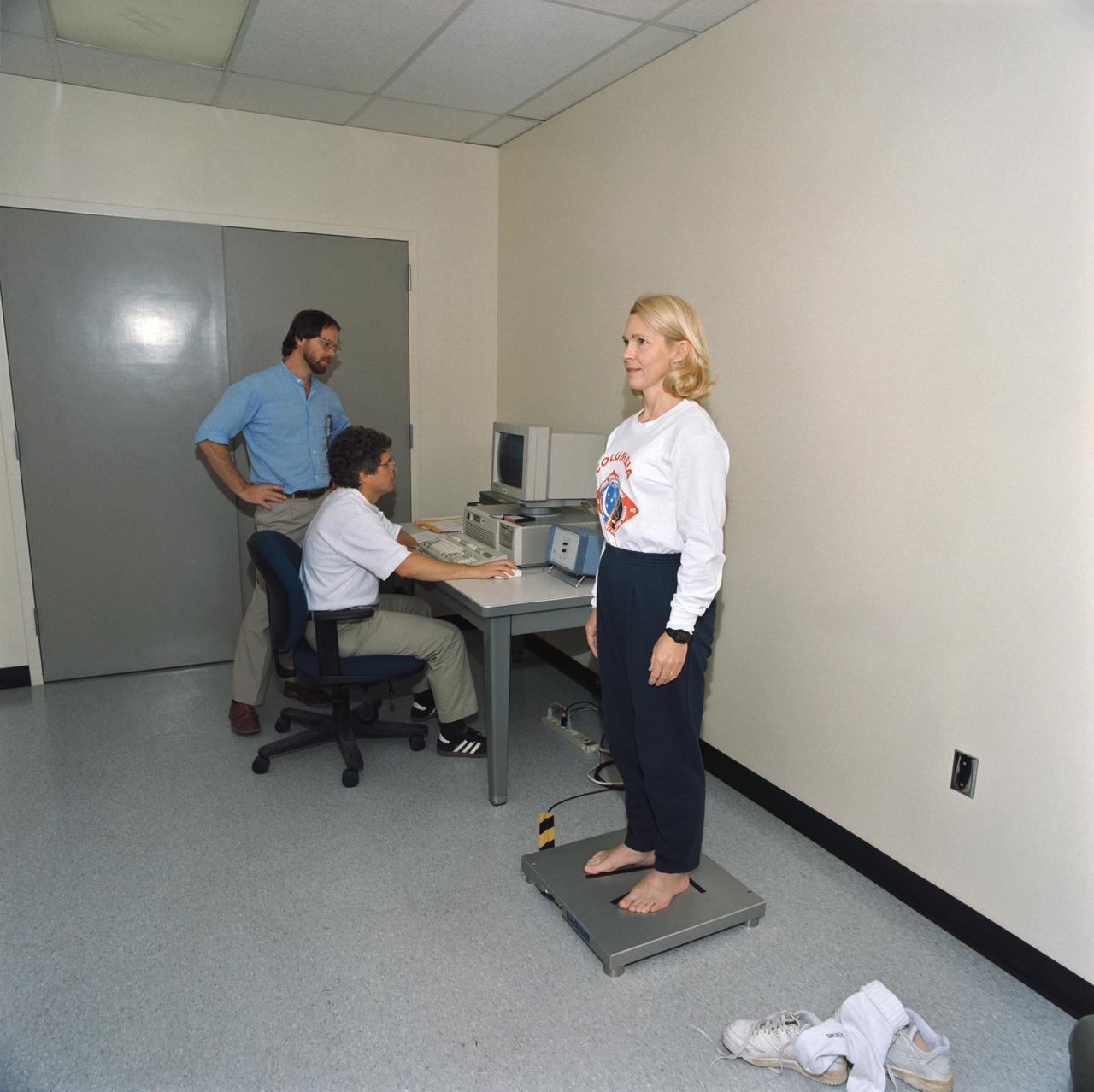
S93-45367 (29 Sept 1993) --- Astronaut Rhea Seddon, STS-58 payload commander, participates in biomedical data collection. The seven member crew spent an entire day recording important pre-flight data in preparation for the two week Spacelab Life Sciences (SLS-2) mission, scheduled for next month.
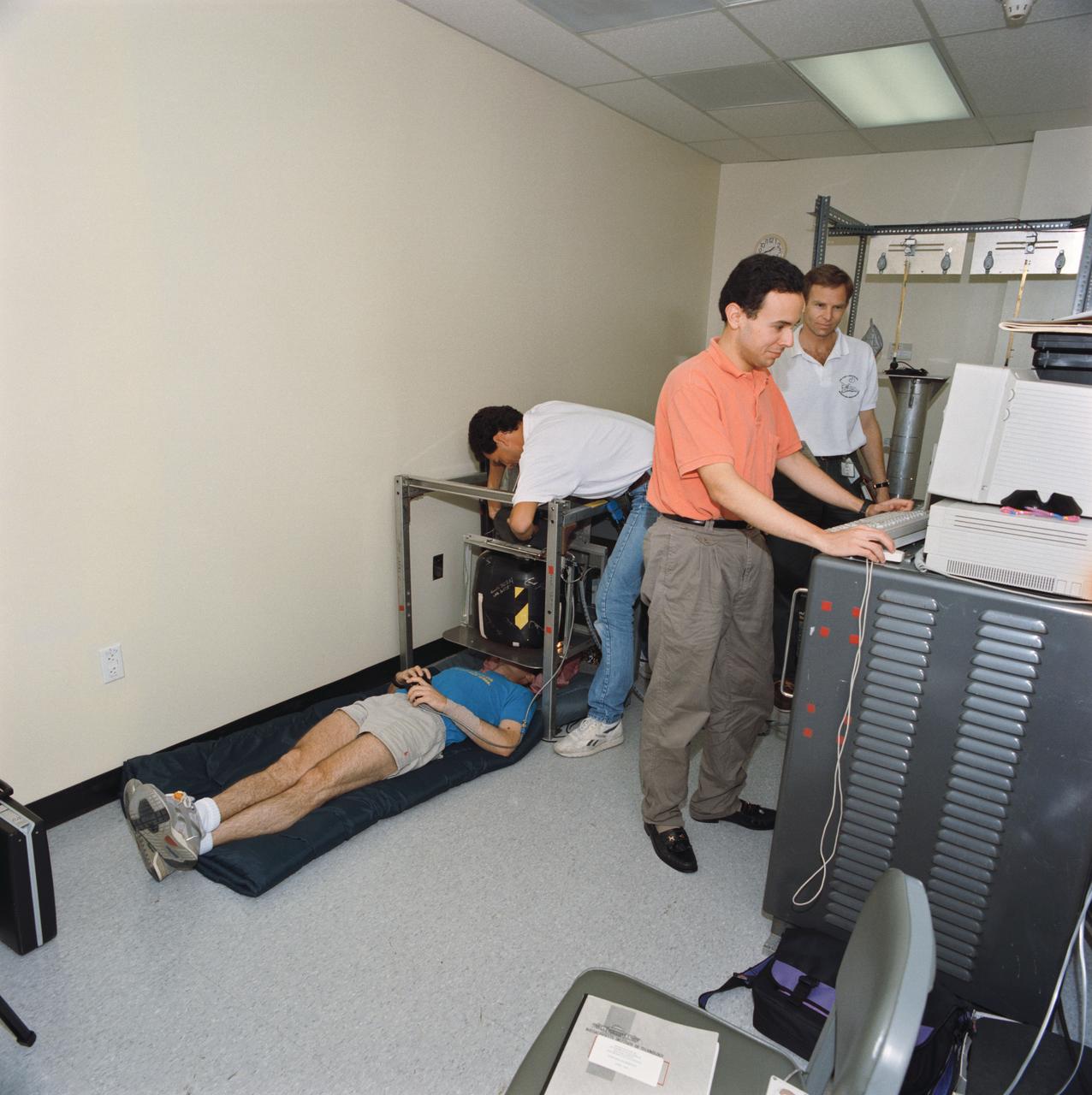
S93-45374 (29 Sept 1993) --- An unidentified STS-58 crewmember participates in a test with the rotating dome experiment. The dome will be flown as part of the Spacelab Life Sciences (SLS-2) payload on next month's scheduled STS-58 mission aboard Columbia.
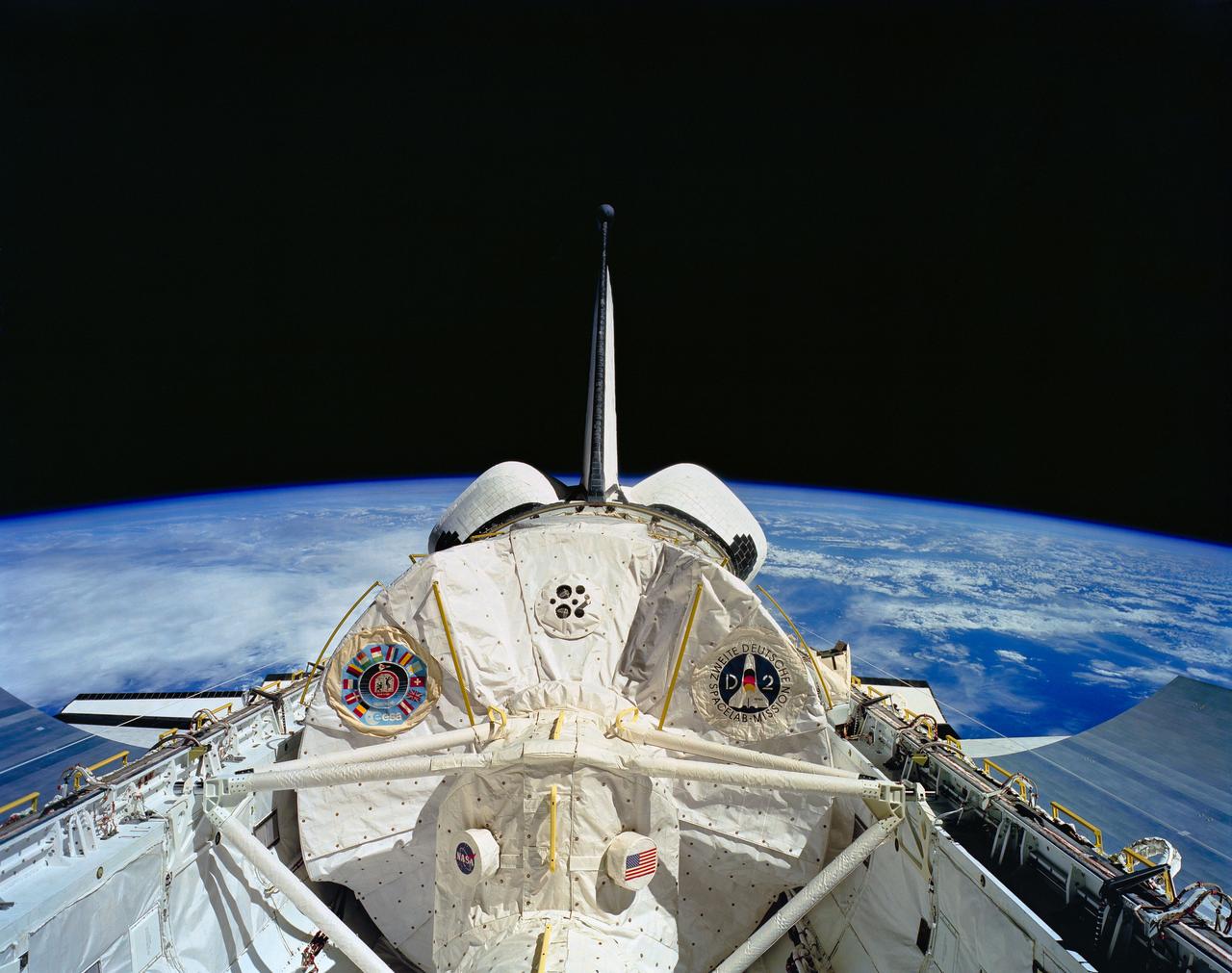
STS055-151B-189 (26 April-6 May 1993) --- Clouds over a wide span of ocean waters form the backdrop for this picture of the Spacelab D-2 Science Module in the Space Shuttle Columbia's cargo bay. A Linhof camera was aimed through the spacecraft's aft flight deck windows to record the scene.
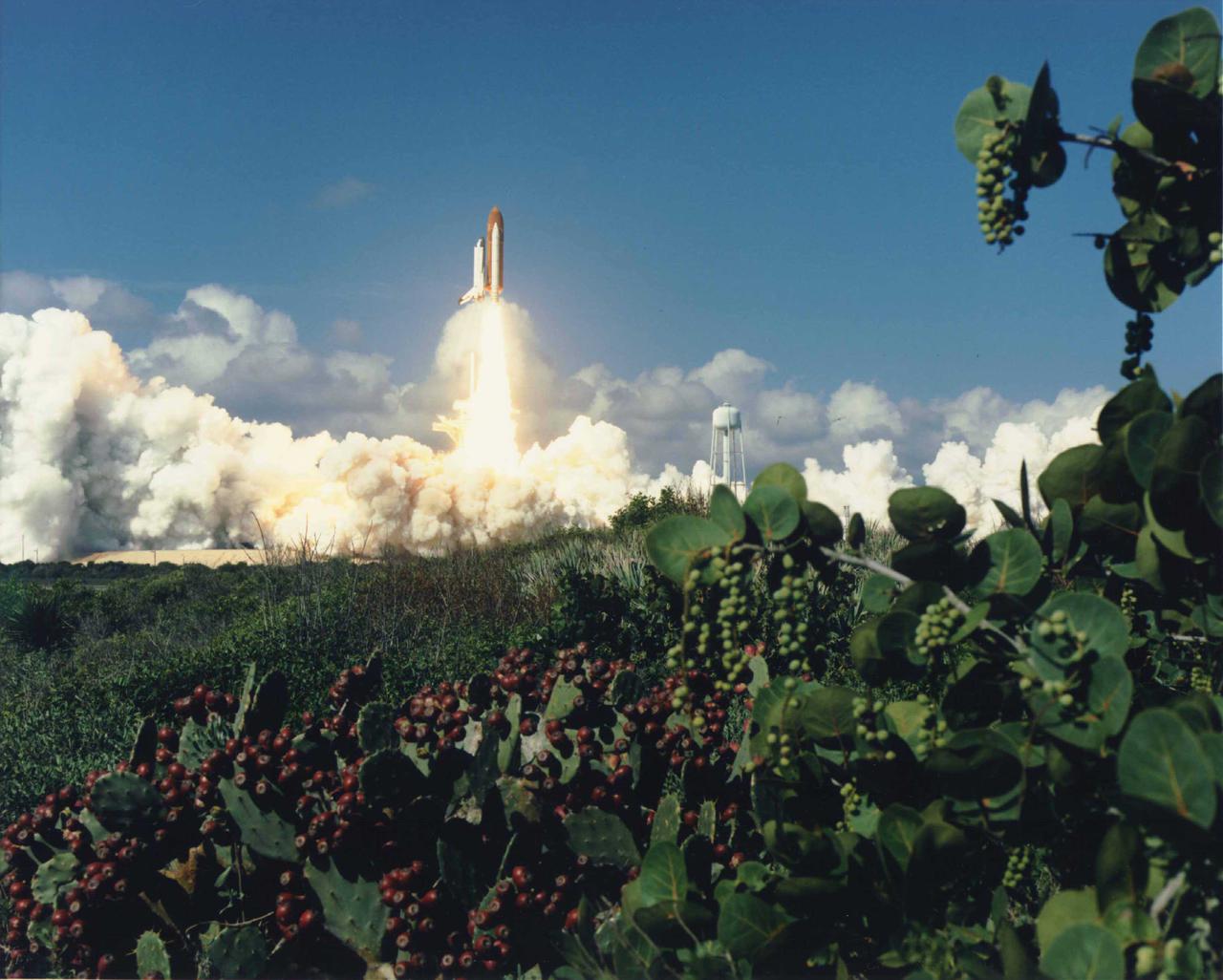
KENNEDY SPACE CENTER, FLA. - The Space Shuttle Columbia climbs a golden tower into a royal blue sky dusted with clouds. The 58th Shuttle flight lifted off from Launch Pad 39B at 10:53:10 a.m. EDT, beginning the longest mission planned in Shuttle program history: two weeks. The Extended Duration Orbiter STS-58 mission will allow the seven-member crew to delve extensively into a number of experiments investigating the adaptation of the human body to space. Spacelab Llife Sciences-2 is the second Spacelab mission dedicated solely to life sciences research.
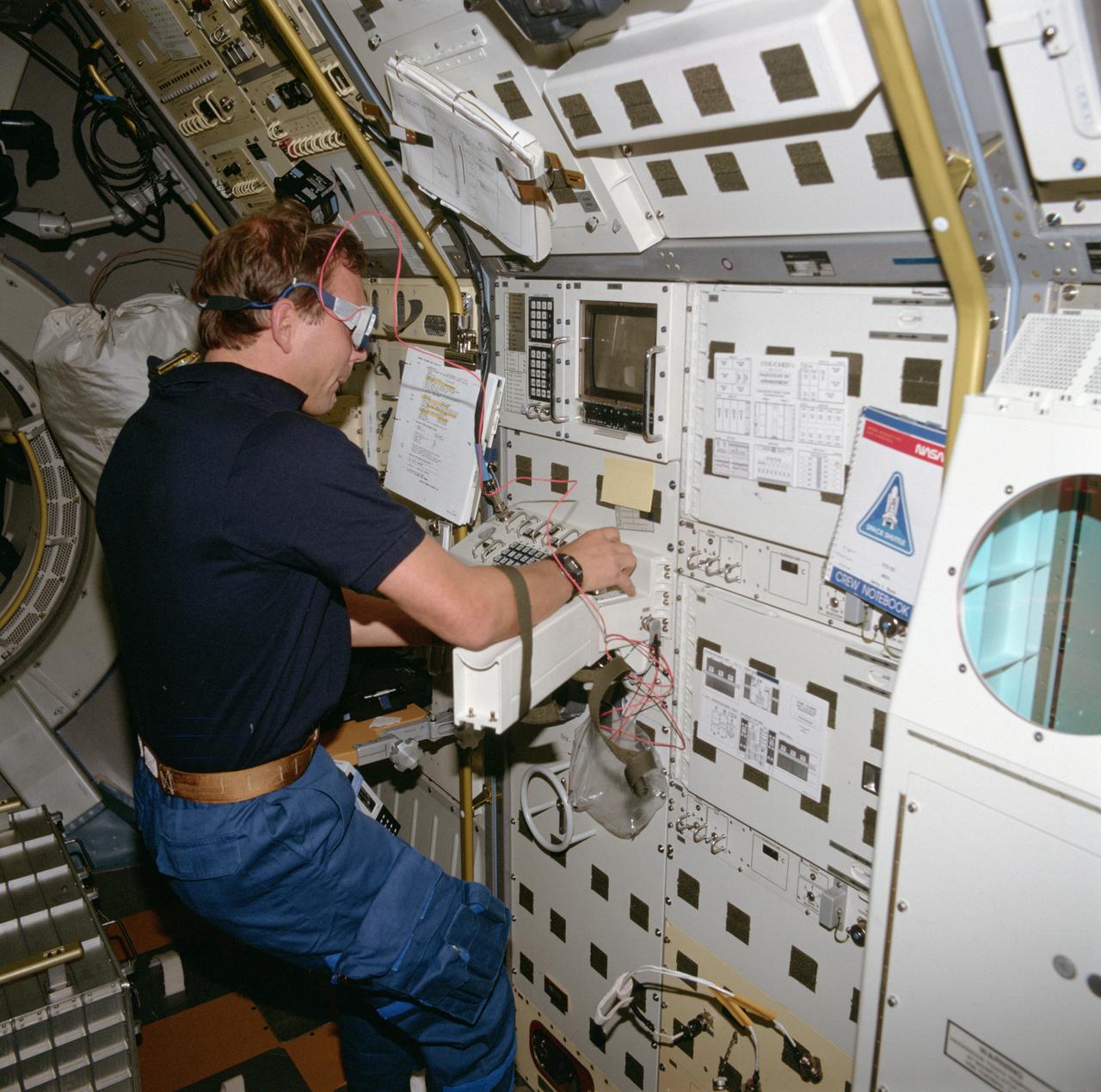
STS055-106-100 (26 April-6 May 1993) --- Hans Schlegel, wearing special glasses, works at the Robotics Experiment (ROTEX) workstation in the science module aboard the Earth-orbiting Space Shuttle Columbia. Schlegel was one of two payload specialists representing the German Aerospace Research Establishment (DLR) on the 10-day Spacelab D-2 mission. ROTEX is a robotic arm that operates within an enclosed workcell in rack 6 of the Spacelab module and uses teleoperation from both an onboard station located nearby in rack 4 and from a station on the ground. The device uses teleprogramming and artificial intelligence to look at the design, verification and operation of advanced autonomous systems for use in future applications.
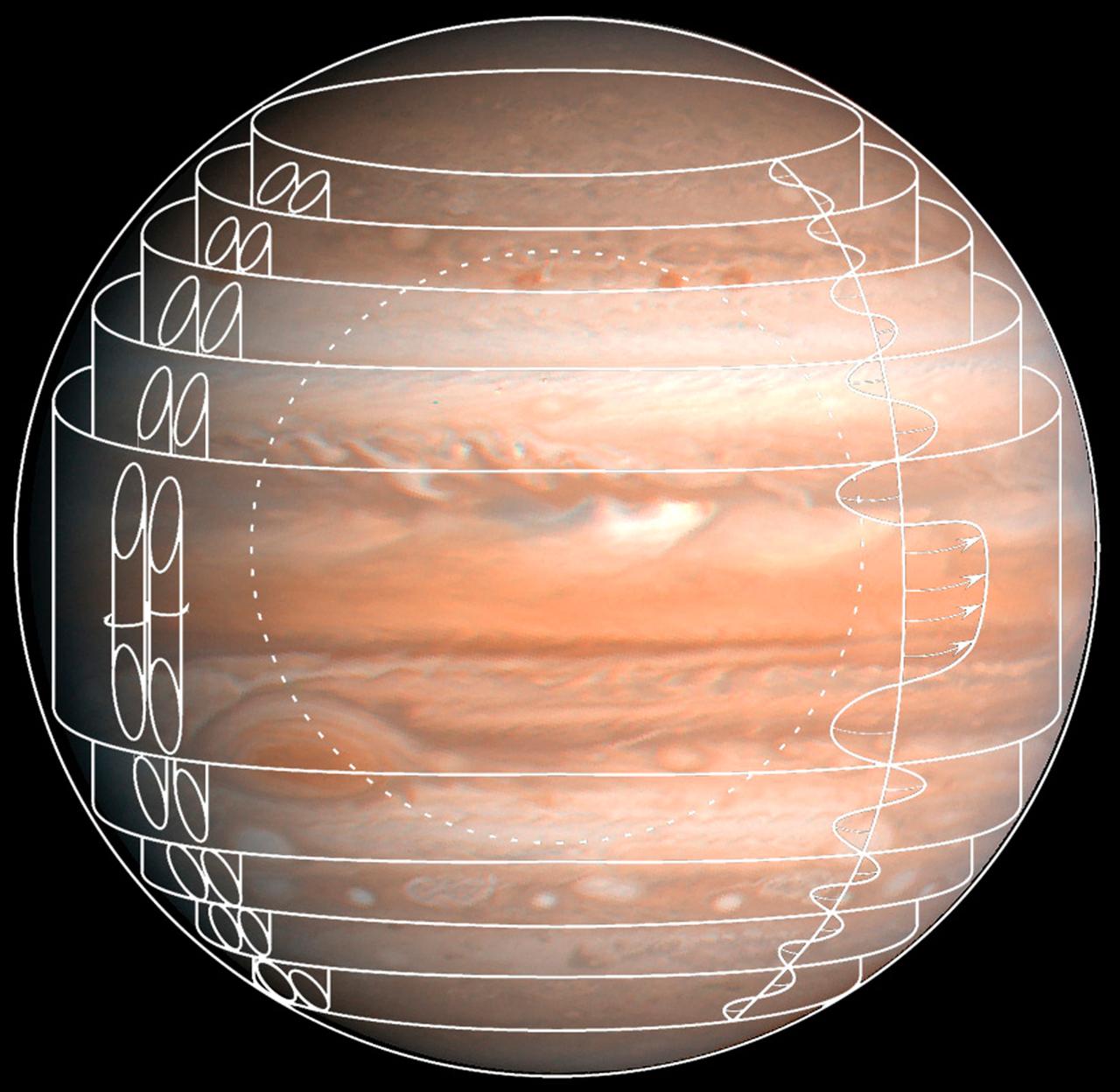
This composite image depicts one set of flow patterns simulated in the Geophysical Fluid Flow Cell (GFFC) that flew on two Spacelab missions. Silicone oil served as the atmosphere around a rotating steel hemisphere (dotted circle) and an electrostatic field pulled the oil inward to mimic gravity's effects during the experiments. The GFFC thus produced flow patterns that simulated conditions inside the atmospheres of Jupiter and the Sun and other stars. GFFC flew on Spacelab-3 in 1985 and U.S. Microgravity Laboratory-2 in 1995. The principal investigator was John Hart of the University of Colorado at Boulder. It was managed by NASA's Marshall Space Flight Center. (Credit: NASA/Marshall Space Flight Center)
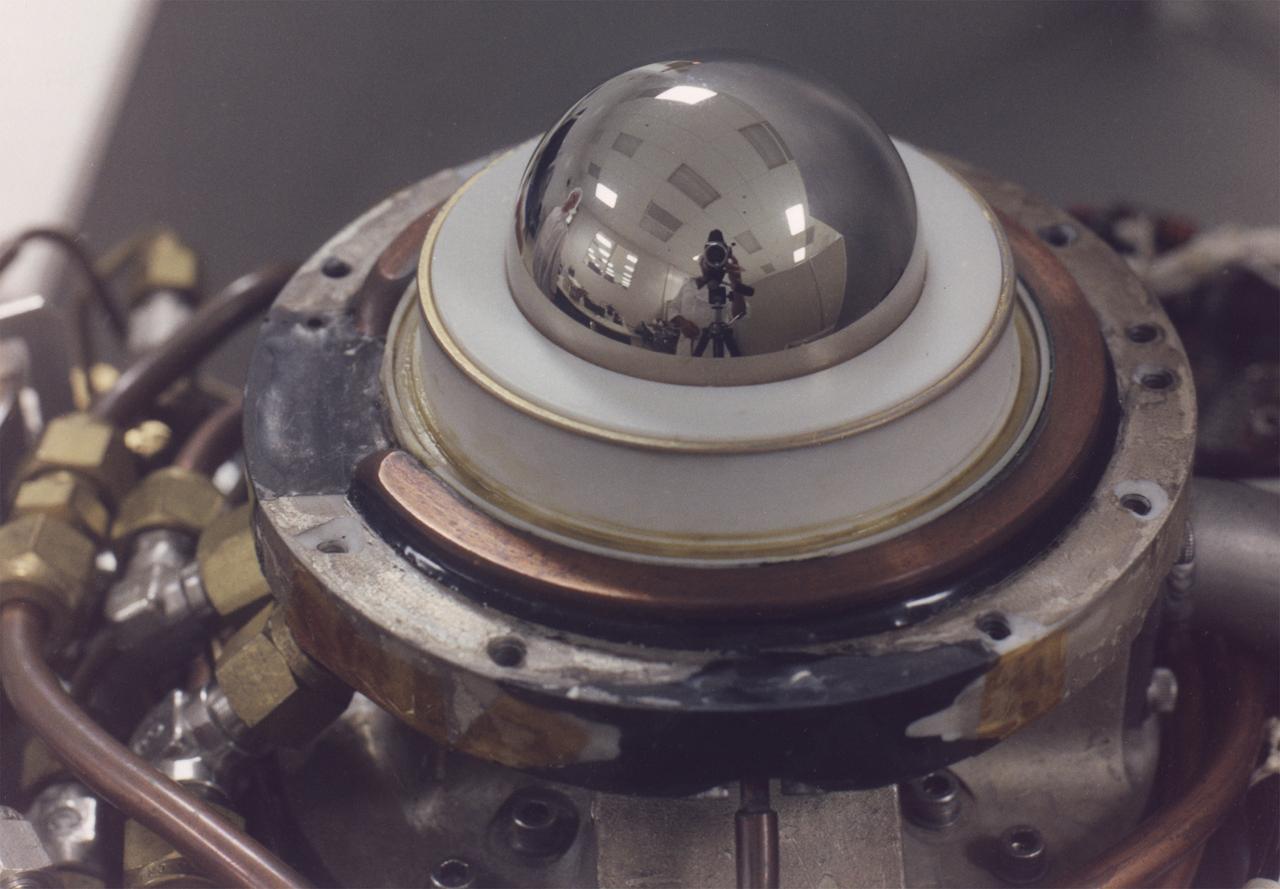
A steel hemisphere was at the core of the Geophysical Fluid Flow Cell (GFFC) that flew on two Spacelab missions. It was capped by a sapphire dome. Silicone oil between the two played the part of a steller atmosphere. An electrostatic field pulled the oil inward to mimic gravity's effects during the experiments. The GFFC thus produced flow patterns that simulated conditions inside the atmospheres of Jupiter and the Sun and other stars. GFFC flew on Spacelab-3 in 1985 and U.S. Microgravity Laboratory-2 in 1995. The principal investigator was John Hart of the University of Colorado at Boulder. It was managed by NASA's Marshall Space Flight Center. (Credit: NASA/Marshall Space Flight Center)
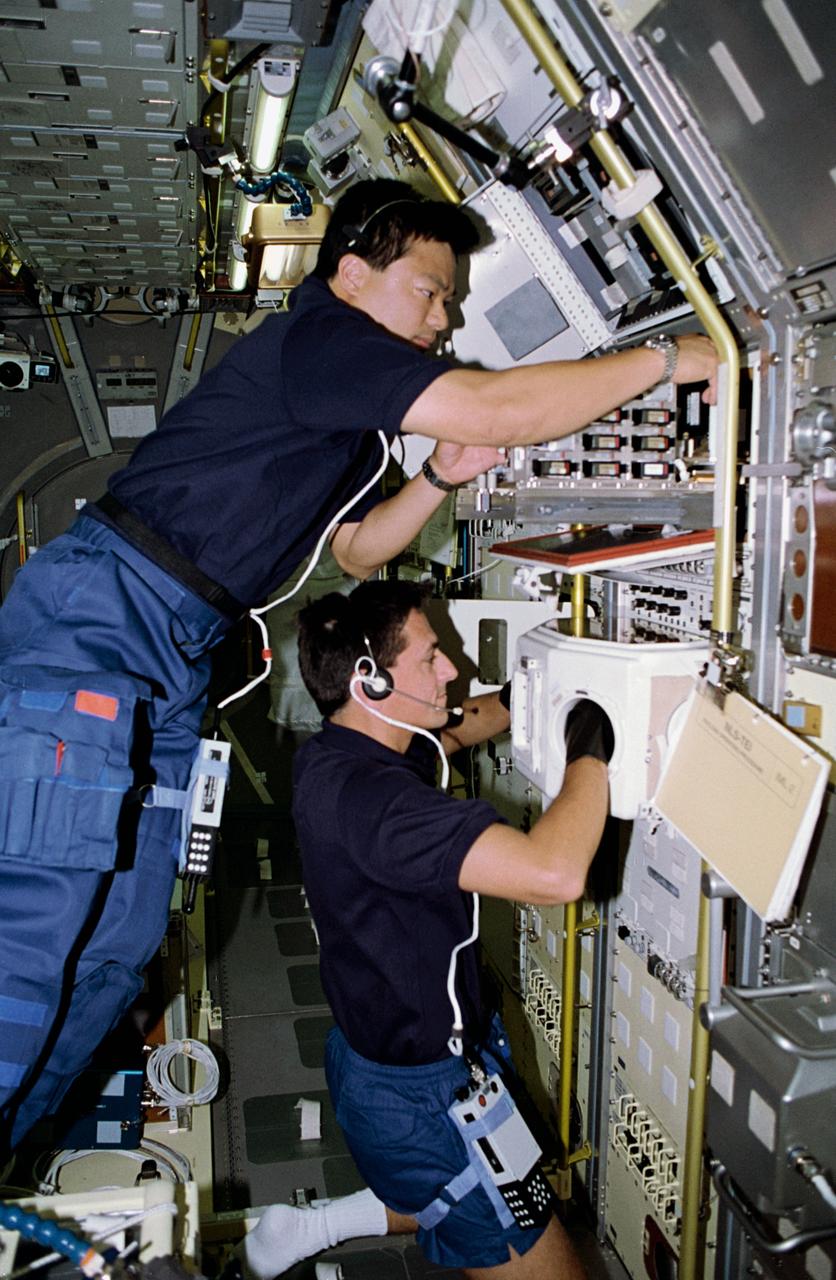
STS-65 Mission Specialist (MS) Leroy Chiao (top) and MS Donald A. Thomas are seen at work in the International Microgravity Laboratory 2 (IML-2) spacelab science module aboard the Space Shuttle Columbia, Orbiter Vehicle (OV) 102. The two crewmembers are conducting experiments at the IML-2 Rack 5 Biorack (BR). Chiao places a sample in the BR incubator as Thomas handles another sample inside the BR glovebox. The glovebox is used to prepare samples for BR and slow rotating centrifuge microscope (NIZEMI) experiments.
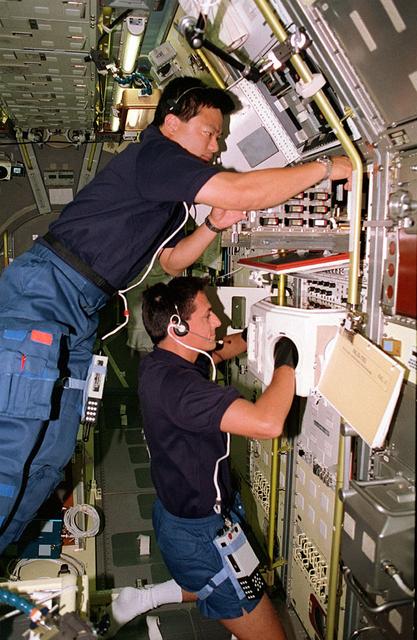
Onboard Space Shuttle Columbia (STS-65) Mission Specialist Leroy Chiao (top) and Mission Specialist Donald A. Thomas are seen at work in the International Microgravity Laboratory 2 (IML-2) spacelab science module. The two crewmembers are conducting experiments at the IML-2 Rack 5 Biorack (BR). Chiao places a sample in the BR incubator as Thomas handles another sample inside the BR glovebox. The glovebox is used to prepare samples for BR and slow rotating centrifuge microscope (NIZEMI) experiments.
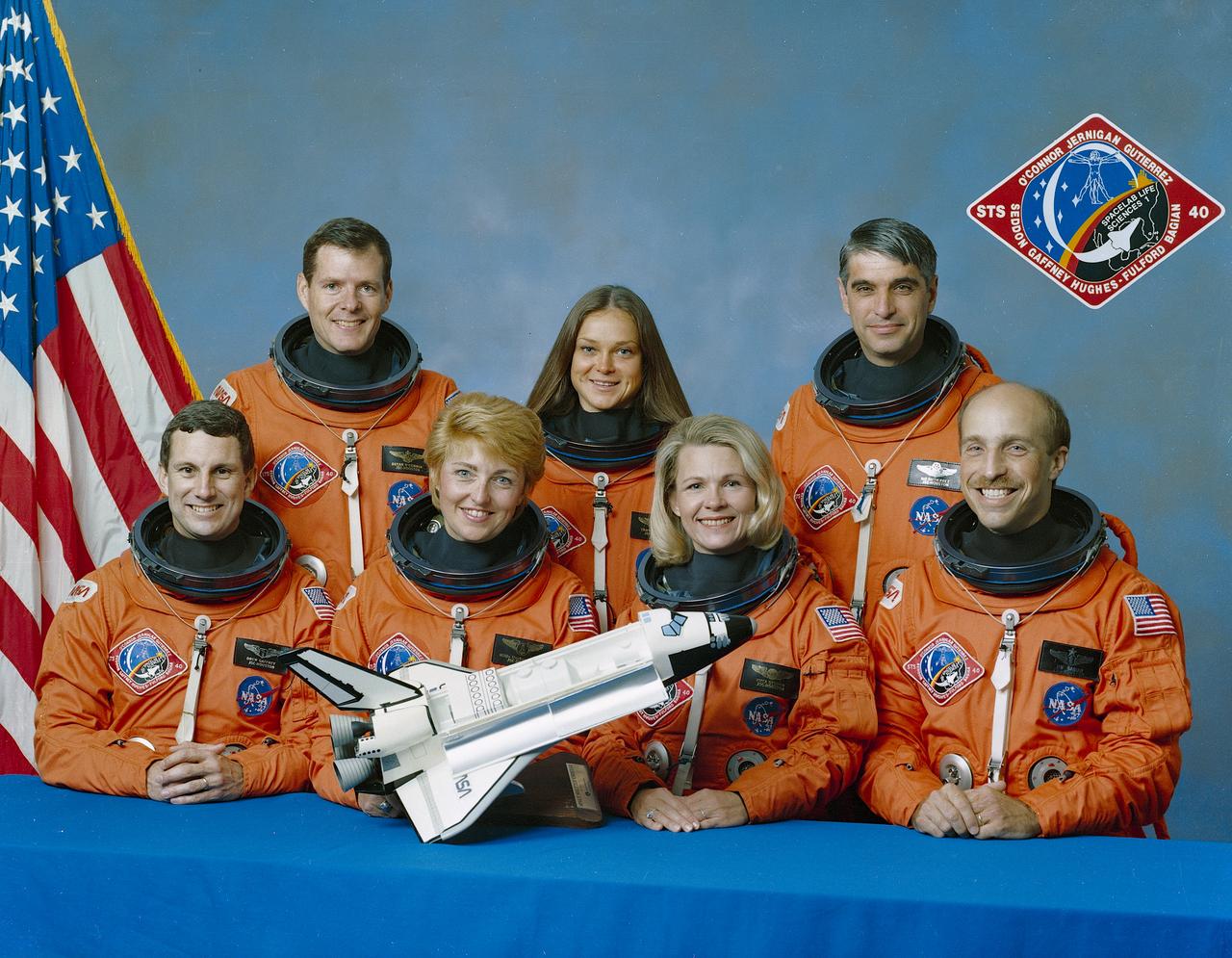
The STS-40 crew portrait includes 7 astronauts. Pictured on the front row from left to right are F. Drew Gaffney, payload specialist 1; Milli-Hughes Fulford, payload specialist 2; M. Rhea Seddon, mission specialist 3; and James P. Bagian, mission specialist 1. Standing in the rear, left to right, are Bryan D. O’Connor, commander; Tamara E. Jernigan, mission specialist 2; and Sidney M. Gutierrez, pilot. Launched aboard the Space Shuttle Columbia on June 5, 1991 at 9:24; am (EDT), the STS-40 mission was the fifth dedicated Spacelab Mission, Spacelab Life Sciences-1 (SLS-1), and the first mission dedicated solely to life sciences.
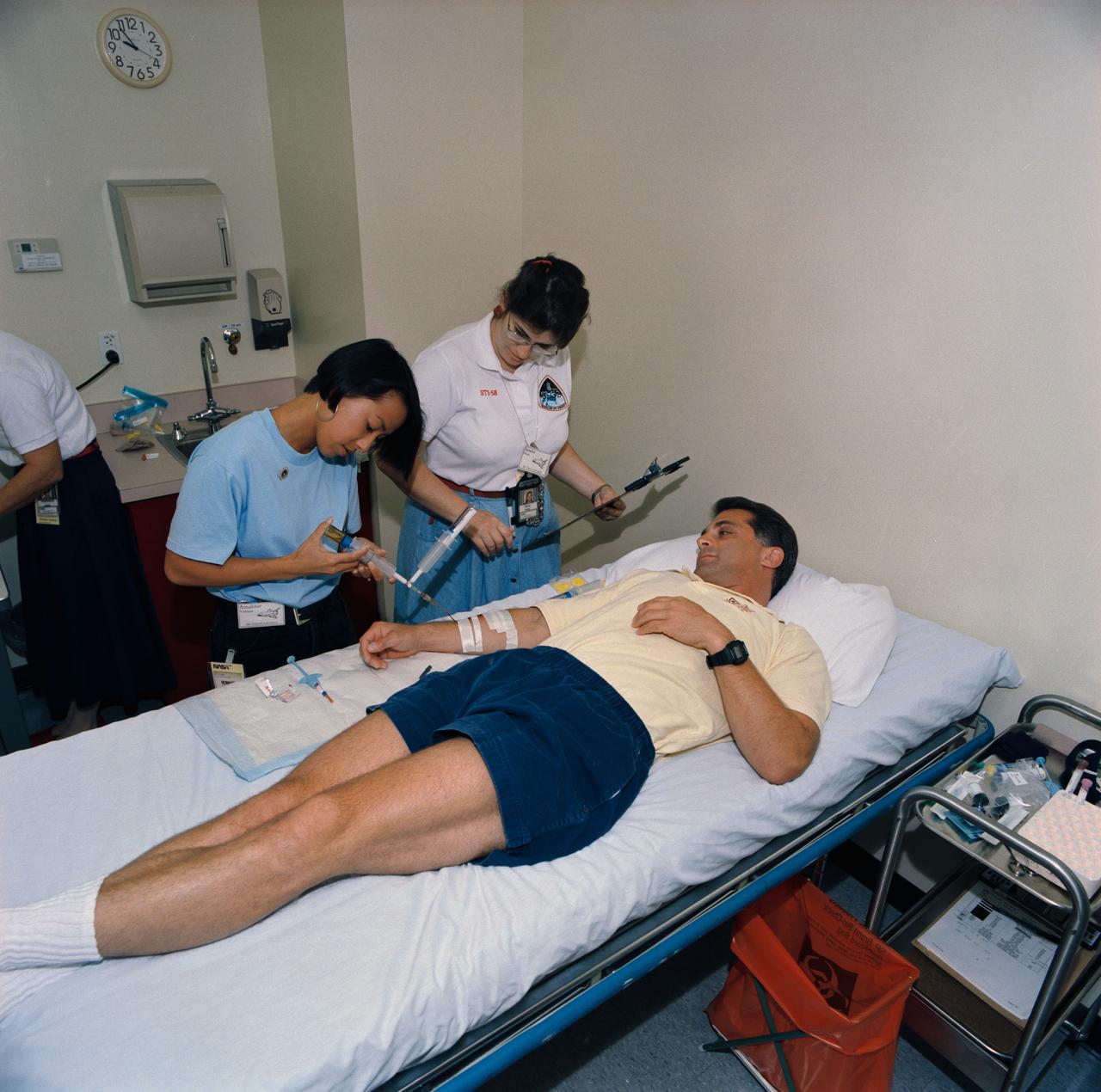
S93-45370 (29 Sept 1993) --- Blood samples from crew members are critical to several Spacelab Life Sciences (SLS-2) investigations. Amalour Veloso (left) and Sandra Prow draw blood from David A. Wolf, mission specialist. Wolf was participating with five other NASA astronauts and a payload specialist on data collection and training in preparation for the two week SLS-2 mission.
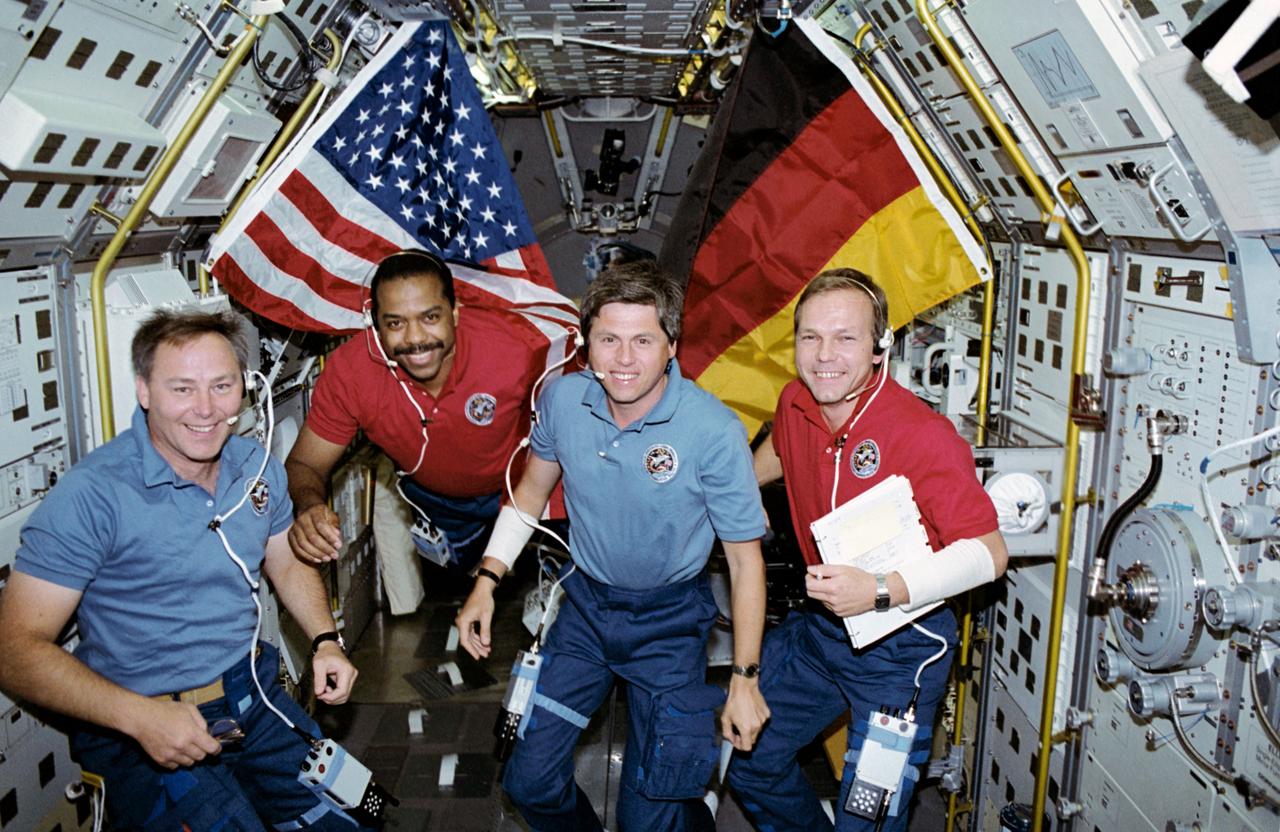
STS-55 crewmembers pose with United States and German flags inside the Spacelab Deutsche 2 (SL-D2) science module located in the payload bay (PLB) of Columbia, Orbiter Vehicle (OV) 102. Wearing communications kit assembly headsets (HDSTs) are (left to right) Mission Specialist 1 (MS1) and Payload Commander (PLC) Jerry L. Ross, MS3 Bernard A. Harris, Jr, German Payload Specialist 1 Ulrich Walter, and Payload Specialist 2 Hans Schlegel.
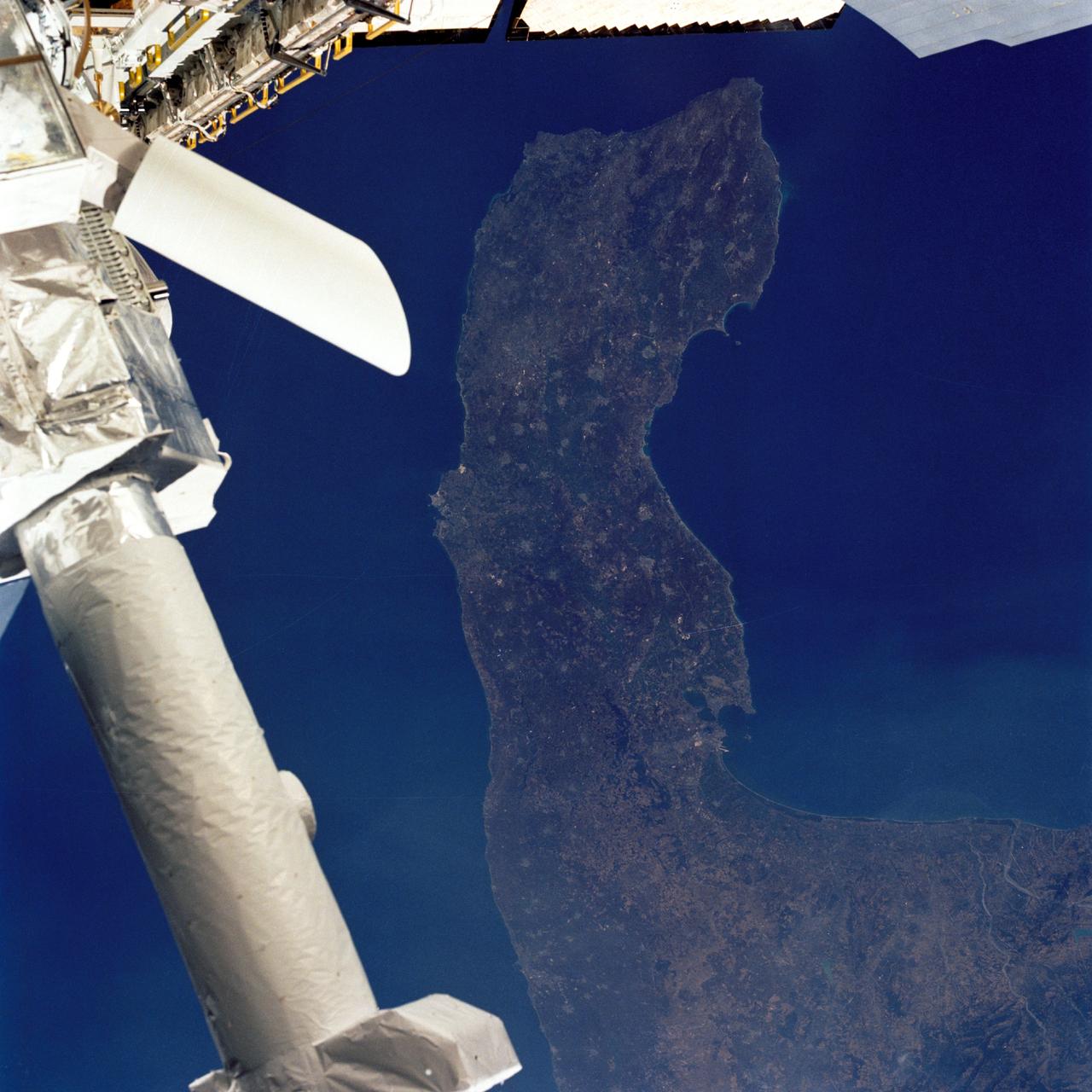
51F-32-024 (29 July - 6 August 1985) --- Italy's “boot heel" surrounded by waters of the Ionian Sea/Golfo di Taranto and the Adriatic Sea is very clearly visible in this scene made with a handheld 70mm camera. Spacelab 2's versatile instrument pointing system (IPS) protrudes from the cargo bay.
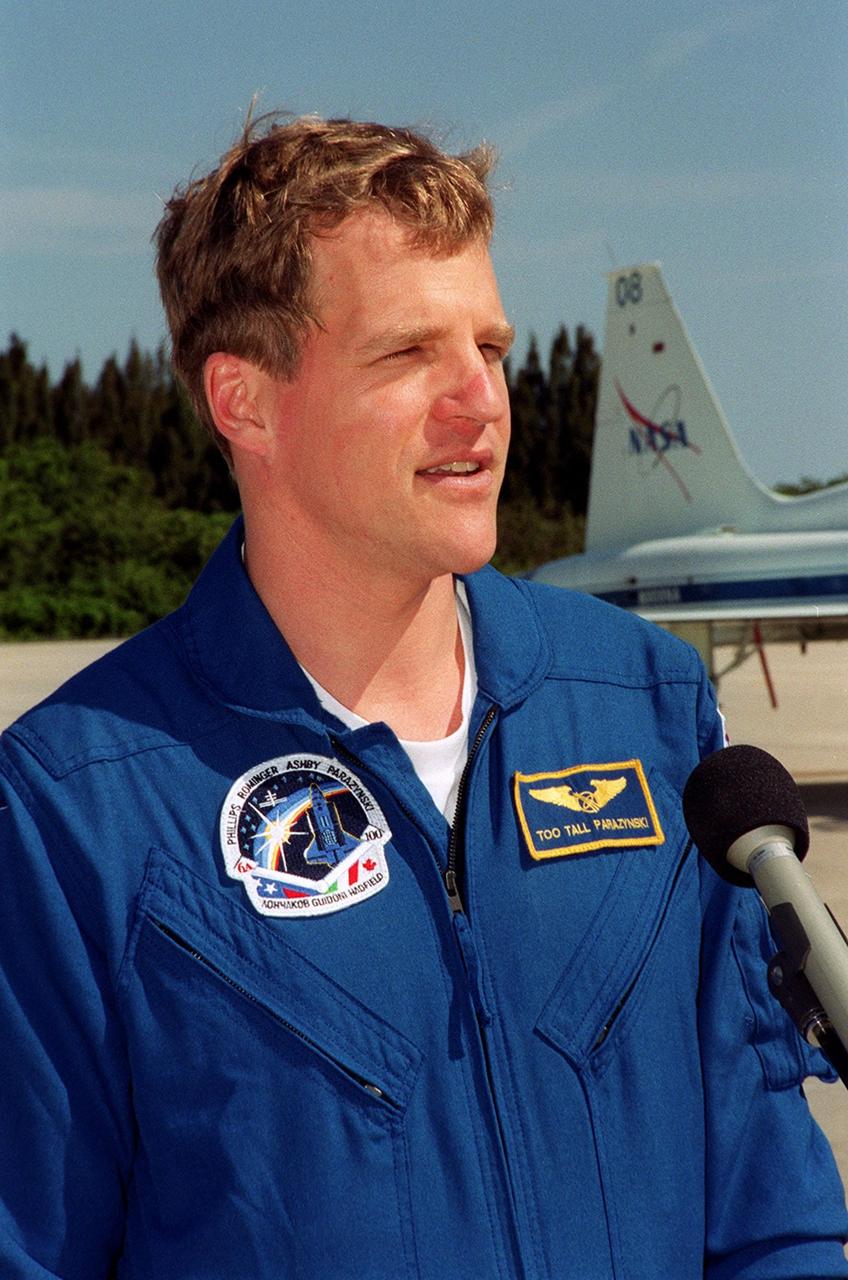
STS-100 Mission Specialist Scott E. Parazynski talks to the media after crew arrival at the Shuttle Landing Facility. The crew is getting ready for launch April 19. The 11-day mission to the International Space Station will deliver and integrate the Spacelab Logistics Pallet/Launch Deployment Assembly, which includes the Space Station Remote Manipulator system and the UHF Antenna, and the Multi-Purpose Logistics Module Raffaello. Liftoff on mission STS-100 is scheduled at 2:41 p.m. EDT
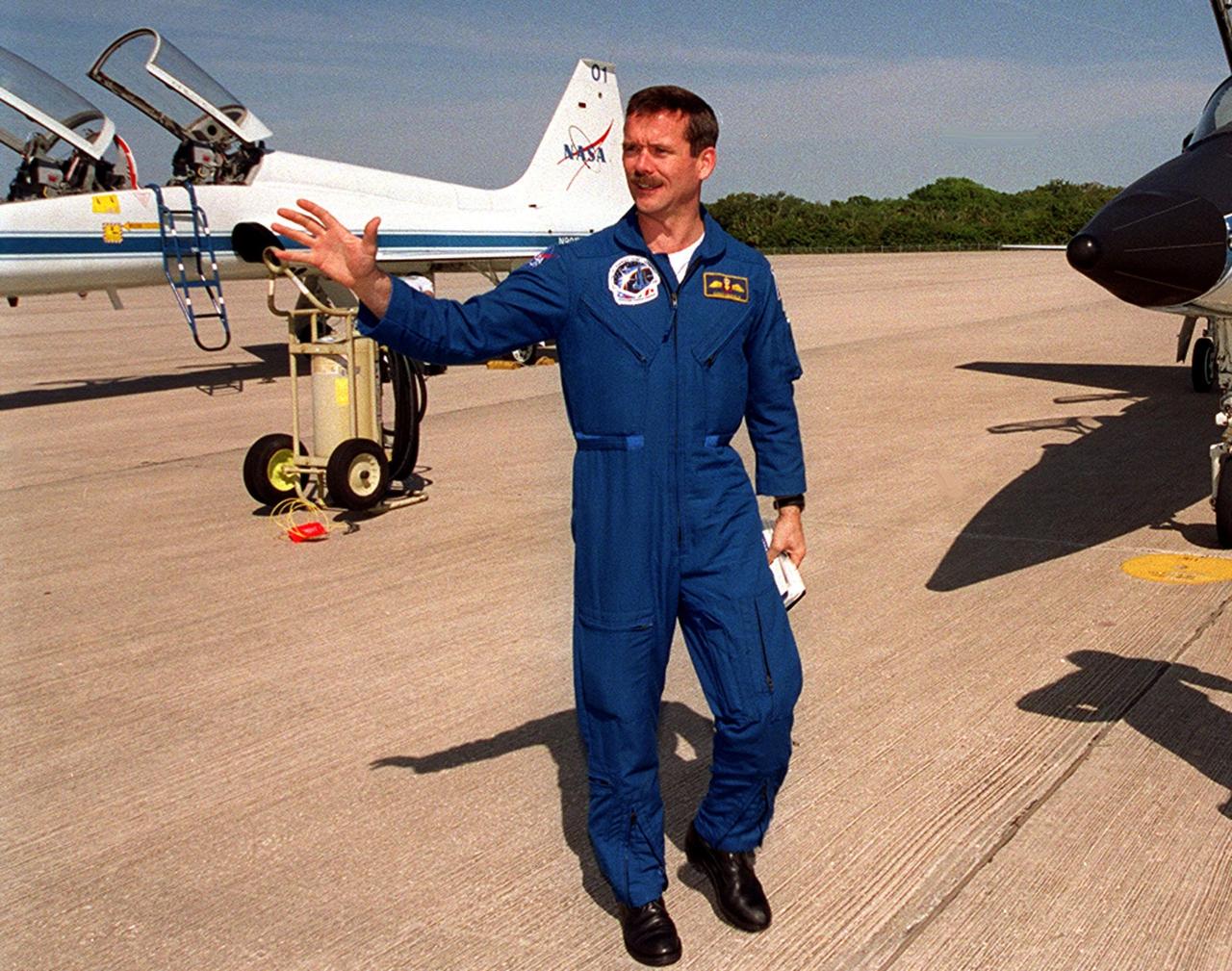
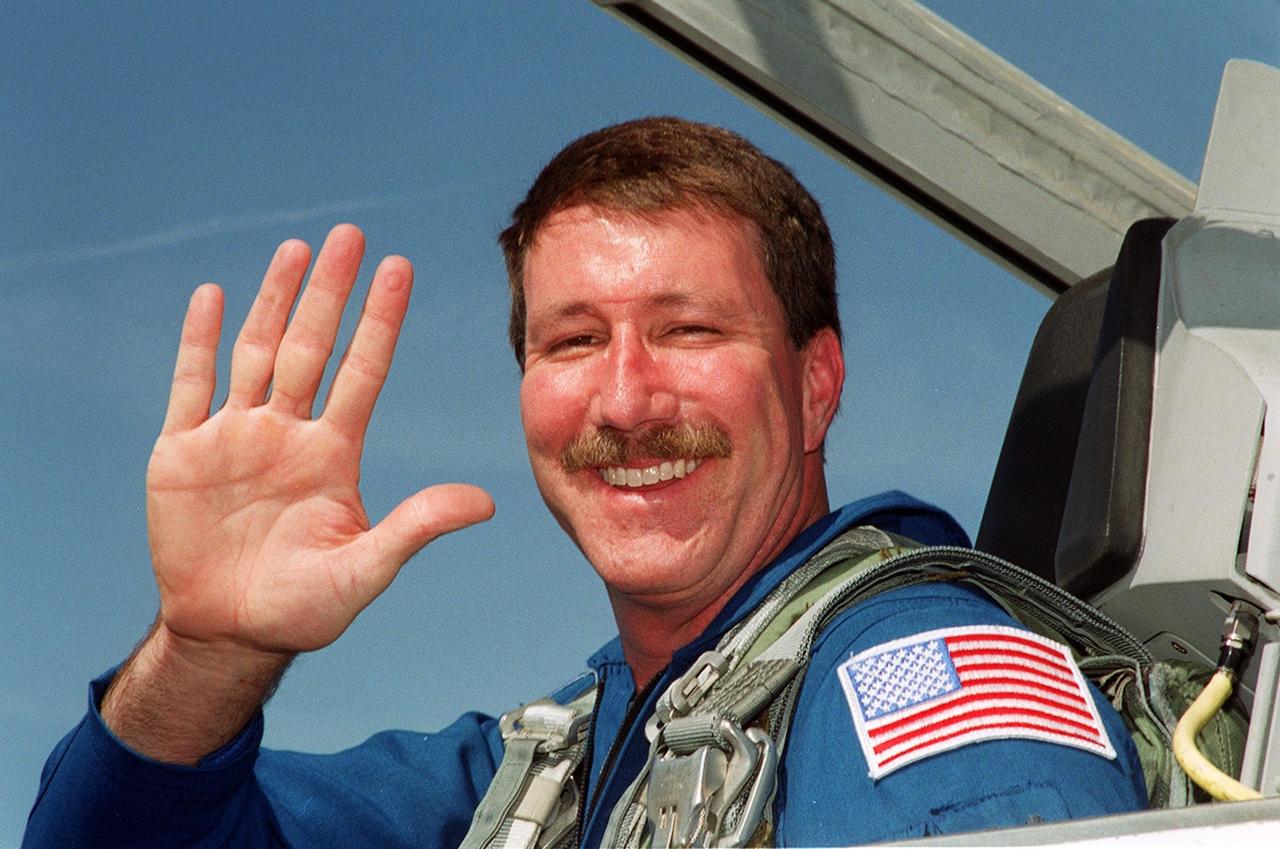
STS-100 Mission Specialist Chris A. Hadfield, who is with the Canadian Space Agency, waves to media after arriving at the KSC Shuttle Landing Facility for launch April 19. The 11-day mission to the International Space Station will deliver and integrate the Spacelab Logistics Pallet/Launch Deployment Assembly, which includes the Space Station Remote Manipulator system and the UHF Antenna, and the Multi-Purpose Logistics Module Raffaello. Liftoff on mission STS-100 is scheduled at 2:41 p.m. EDT April 19
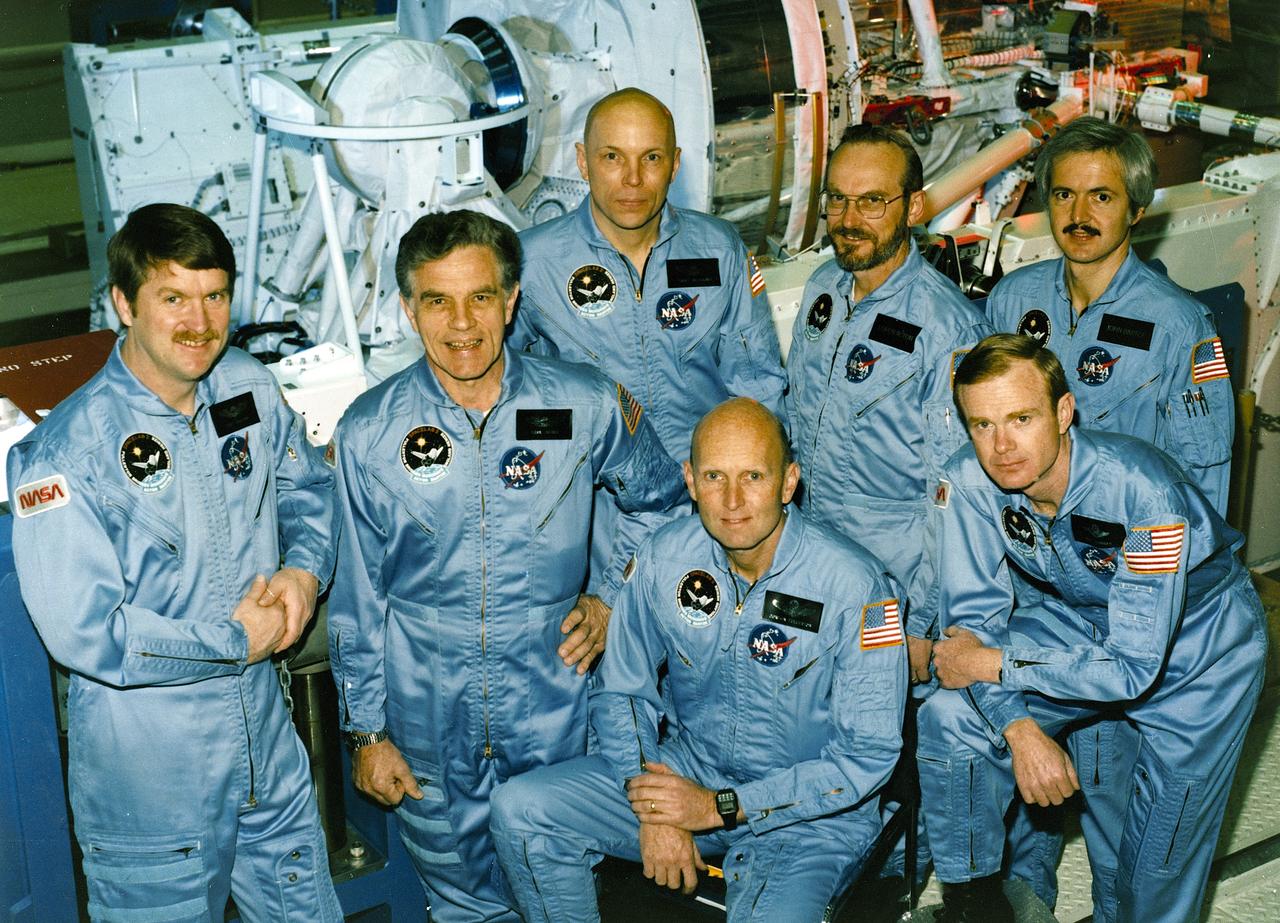
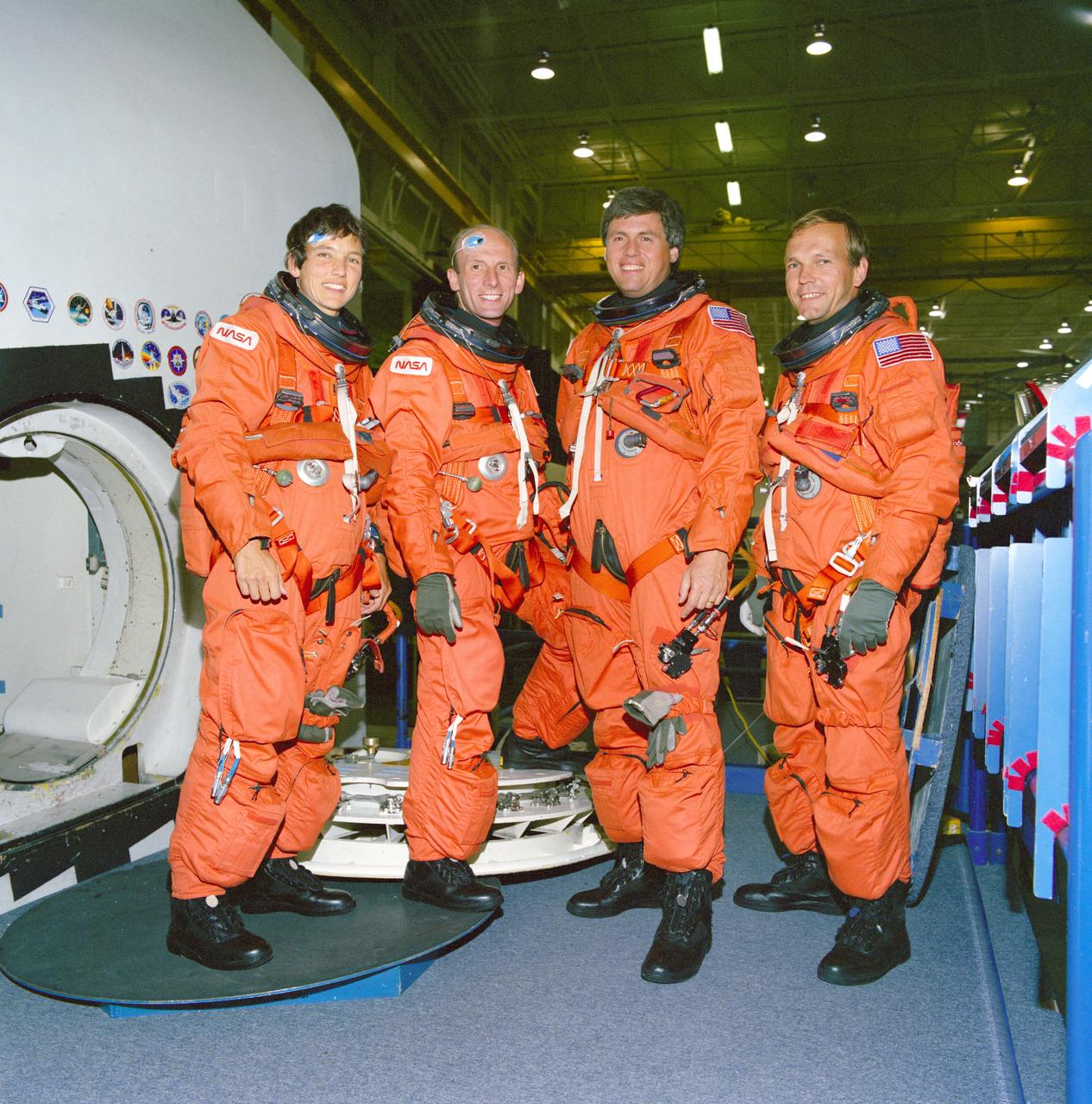
The crew assigned to the STS-51F mission included (kneeling left to right) Gordon Fullerton, commander; and Roy D. Bridges, pilot. Standing, left to right, are mission specialists Anthony W. England, Karl J. Henize, and F. Story Musgrave; and payload specialists Loren W. Acton, and John-David F. Bartoe. Launched aboard the Space Shuttle Challenger on July 29, 1985 at 5:00:00 pm (EDT), the STS-51F mission’s primary payload was the Spacelab-2.
STS-100 Commander Kent V. Rominger arrives at the KSC Shuttle Landing Facility aboard a T-38 jet aircraft to get ready for launch. The 11-day mission to the International Space Station will deliver and integrate the Spacelab Logistics Pallet/Launch Deployment Assembly, which includes the Space Station Remote Manipulator system and the UHF Antenna, and the Multi-Purpose Logistics Module Raffaello. Liftoff on mission STS-100 is scheduled at 2:41 p.m. EDT April 19
A Canadian "handshake" in space occurred on April 28, 2001, as the Canadian-built space station robotic arm (Canadarm-2) transferred its launch cradle over to Endeavor's robotic arm. Marning the controls from the shuttle's aft flight deck, Canadian Mission Specialist Chris A. Hadfield of the Canadian Space Agency (CSA) was instrumental in the activity. The Spacelab pallet that carried the Canadarm2 robotic arm to the station was developed at the Marshall Space Flight Center (MSFC) in Huntsville, Alabama.
STS055-106-048 (26 April-6 May 1993) --- Astronaut Bernard A. Harris, Jr., mission specialist, works with a sample at the Heater Facility, part of the Werkestofflabor material sciences laboratory in the Spacelab D-2 Science Module aboard the Space Shuttle Columbia. Harris was joined by four other NASA astronauts and two German payload specialists for the 10-day mission aboard the Space Shuttle Columbia.
S92-48735 (18 Sept 1992) --- These four Germans have been assigned as payload specialists to support the STS-55\Spacelab D-2 mission. Left to right are Renate Brummer, Gerhard Thiele, Ulrich Walter and Hans Schlegel. Walter and Schlegel are scheduled to fly aboard the Space Shuttle Columbia for the mission, while Brummer and Thiele will serve as alternates and fill supportive roles on the ground. They are seen during a break in training in the Shuttle mockup and integration laboratory at the Johnson Space Center.
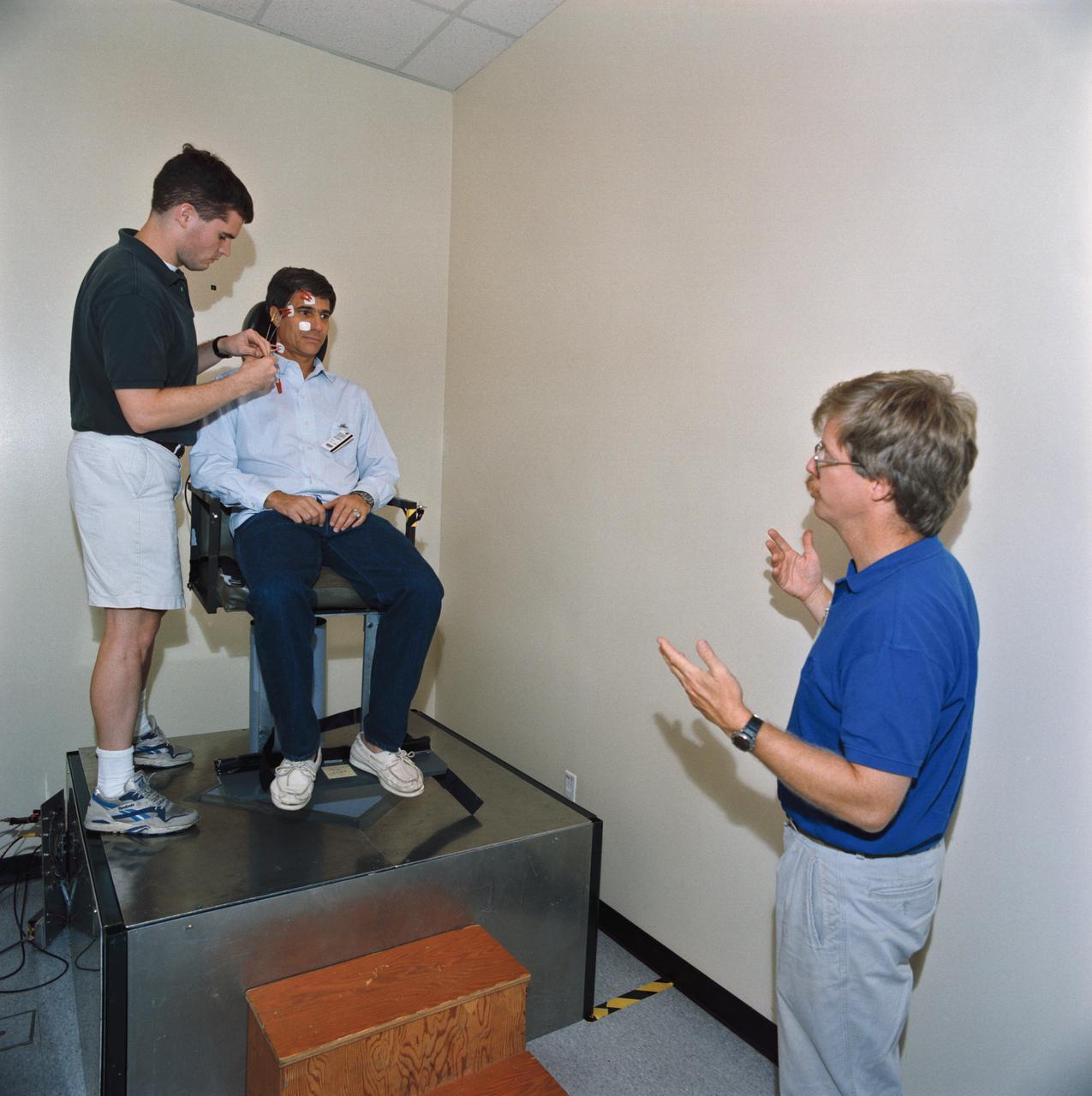
S93-45366 (29 Sept 1993) --- Astronaut John E. Blaha, STS-58 mission commander, sits in a training version of the rotating chair test device. Sensors are attached to Blaha's head and face to record responses to the rotation. Blaha was participating with five other NASA astronauts and a payload specialist for data collection and training in preparation for the two week Spacelab Life Sciences (SLS-2) mission.
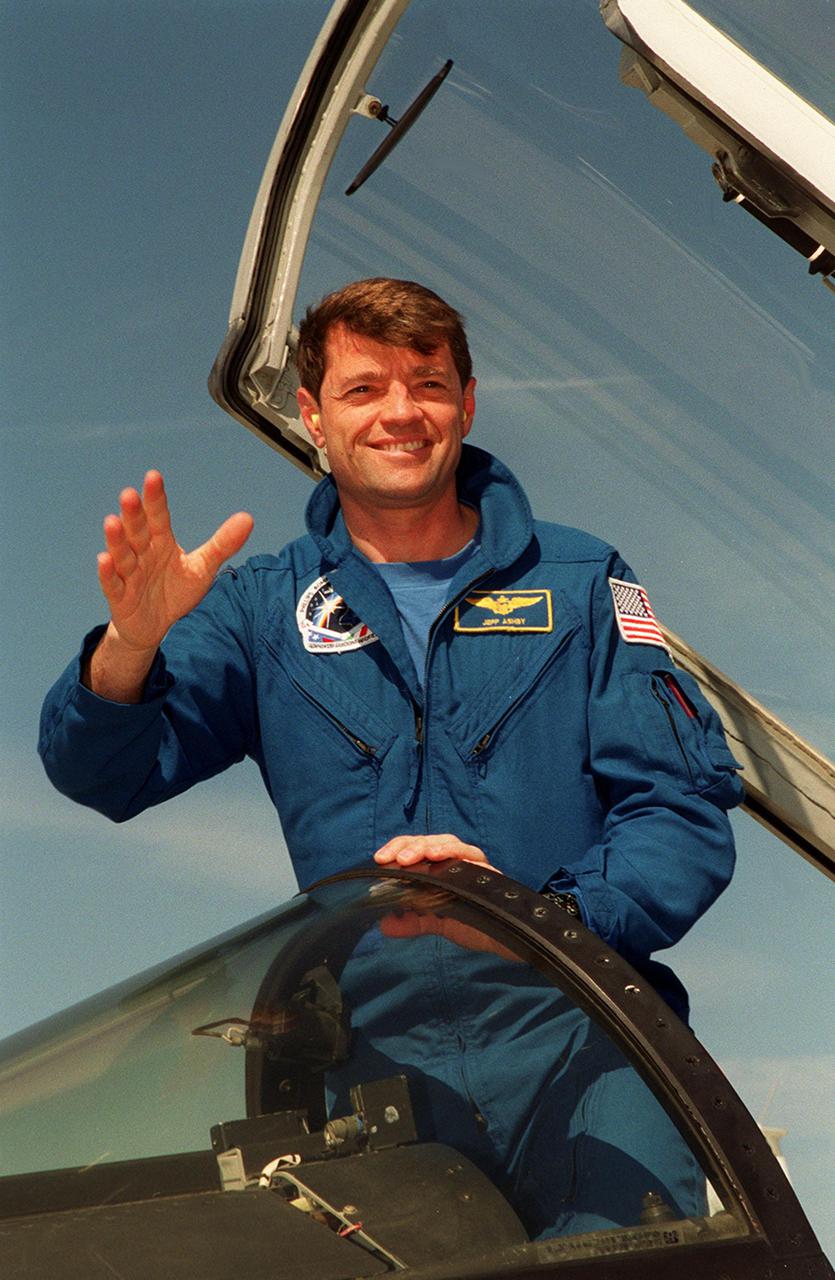
STS-100 Pilot Jeffrey S. Ashby arrives at the KSC Shuttle Landing Facility aboard a T-38 jet aircraft to get ready for launch. The 11-day mission to the International Space Station will deliver and integrate the Spacelab Logistics Pallet_Launch Deployment Assembly, which includes the Space Station Remote Manipulator system and the UHF Antenna, and the Multi-Purpose Logistics Module Raffaello. Liftoff on mission STS-100 is scheduled at 2:41 p.m. EDT April 19

JSC2006-E-43509 (October 2006) --- Computer-generated artist's rendering of the International Space Station after flight 2J/A. U.S. Orbiter delivers Kibo Japanese Experiment Module Exposed Facility (JEM-EF); Kibo Japanese Experiment Logistics Module - Exposed Section (ELM-ES); and Spacelab Pallet - Deployable 2 (SLP-D2).
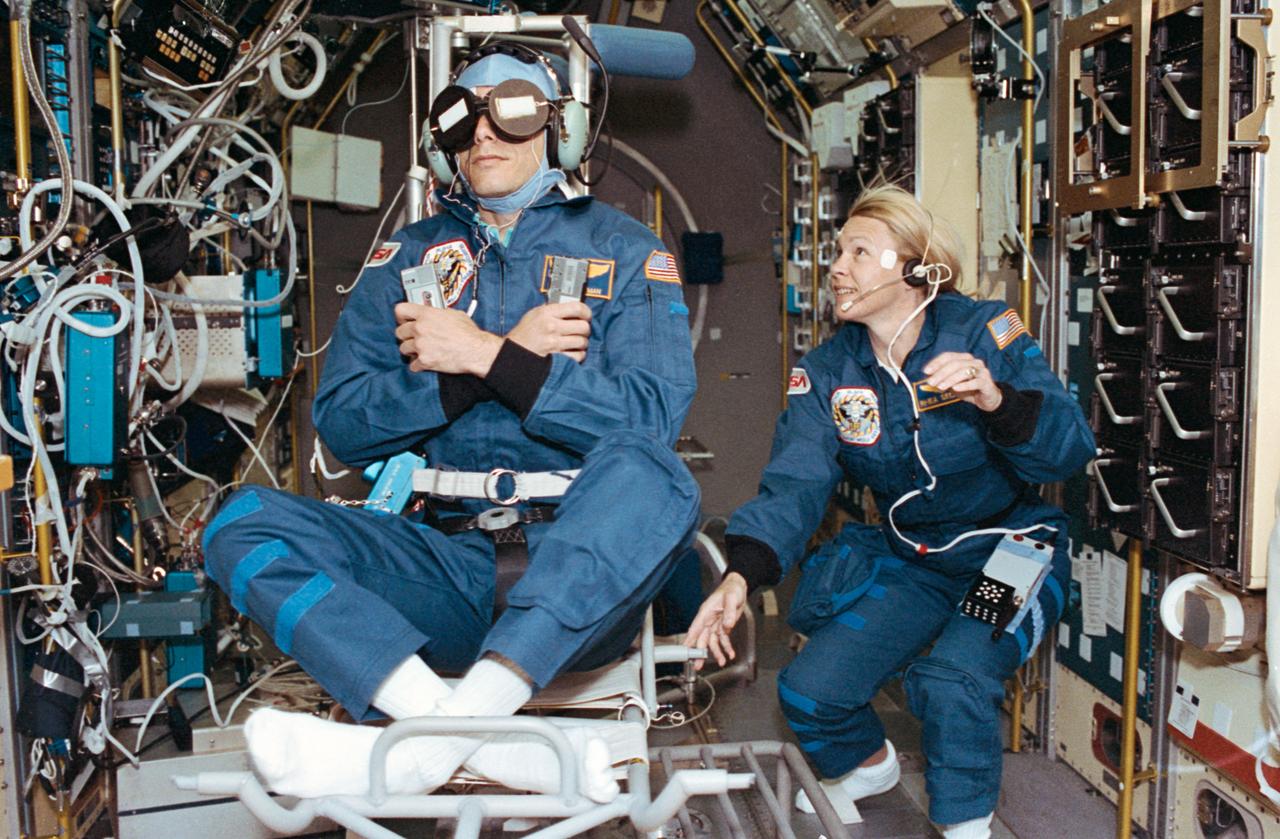
STS058-202-002 (18 Oct.-1 Nov. 1993) --- Astronaut Rhea Seddon, STS-58 payload commander, spins the Spacelab Life Sciences (SLS-2) rotating chair as payload specialist Martin J. Fettman serves as test subject. The two joined five NASA astronauts for fourteen days of medical research aboard the Earth-orbiting space shuttle Columbia. Photo credit: NASA
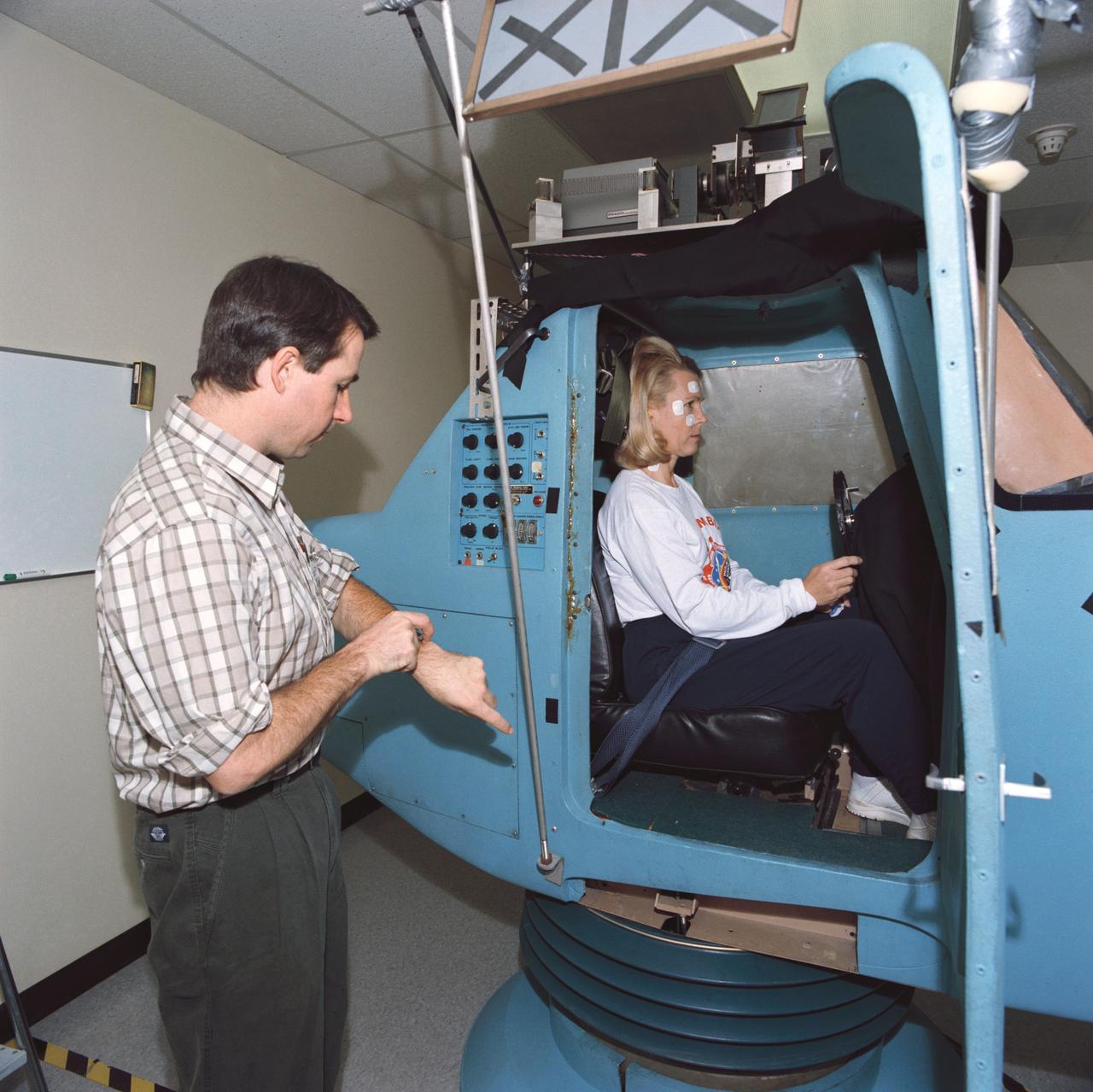
S93-45373 (29 Sept 1993) --- Astronaut Rhea Seddon, STS-58 payload commander, is in a piloting simulator as part of a pre-flight data collection project for neurovestibular functions. The seven Spacelab Life Sciences (SLS-2) crew members devoted a full day to miscellaneous biomedical data collection in preparation for next month's two week mission aboard Columbia.
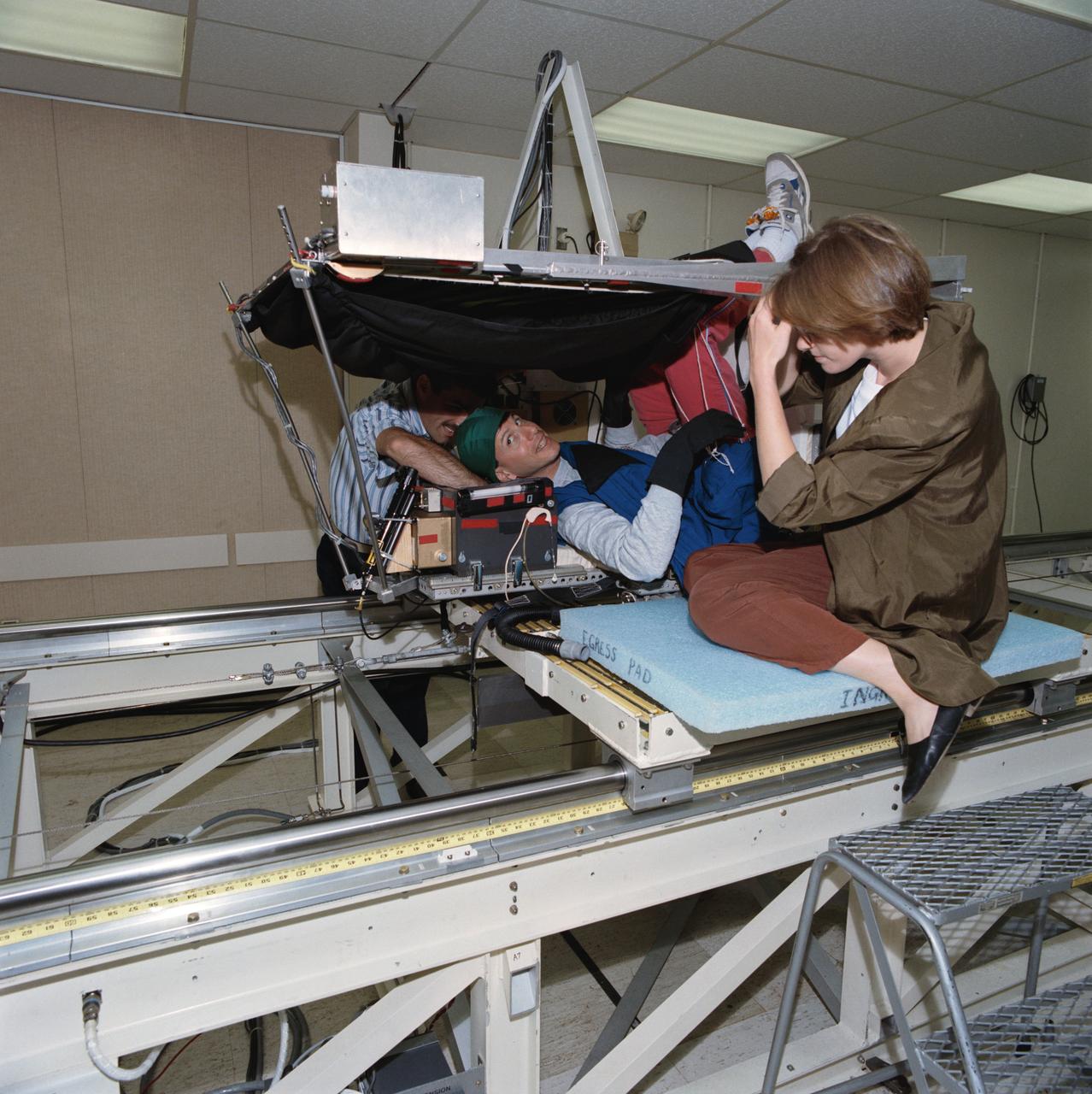
S93-45314 (29 Sept 1993) --- Payload specialist Martin J. Fettman, in an oscillating sled device, participates in a data collection project for neurovestibular functions. The seven Spacelab Life Sciences (SLS-2) crewmembers devoted a full day to miscellaneous biomedical data collection in preparation for next month's two week mission aboard Columbia.

STS-100 Mission Specialist Umberto Guidoni arrives at the KSC Shuttle Landing Facility aboard a T-38 jet aircraft to get ready for launch. Guidoni is with the European Space Agency. The 11-day mission to the International Space Station will deliver and integrate the Spacelab Logistics Pallet/Launch Deployment Assembly, which includes the Space Station Remote Manipulator system and the UHF Antenna, and the Multi-Purpose Logistics Module Raffaello. Liftoff on mission STS-100 is scheduled at 2:41 p.m. EDT April 19
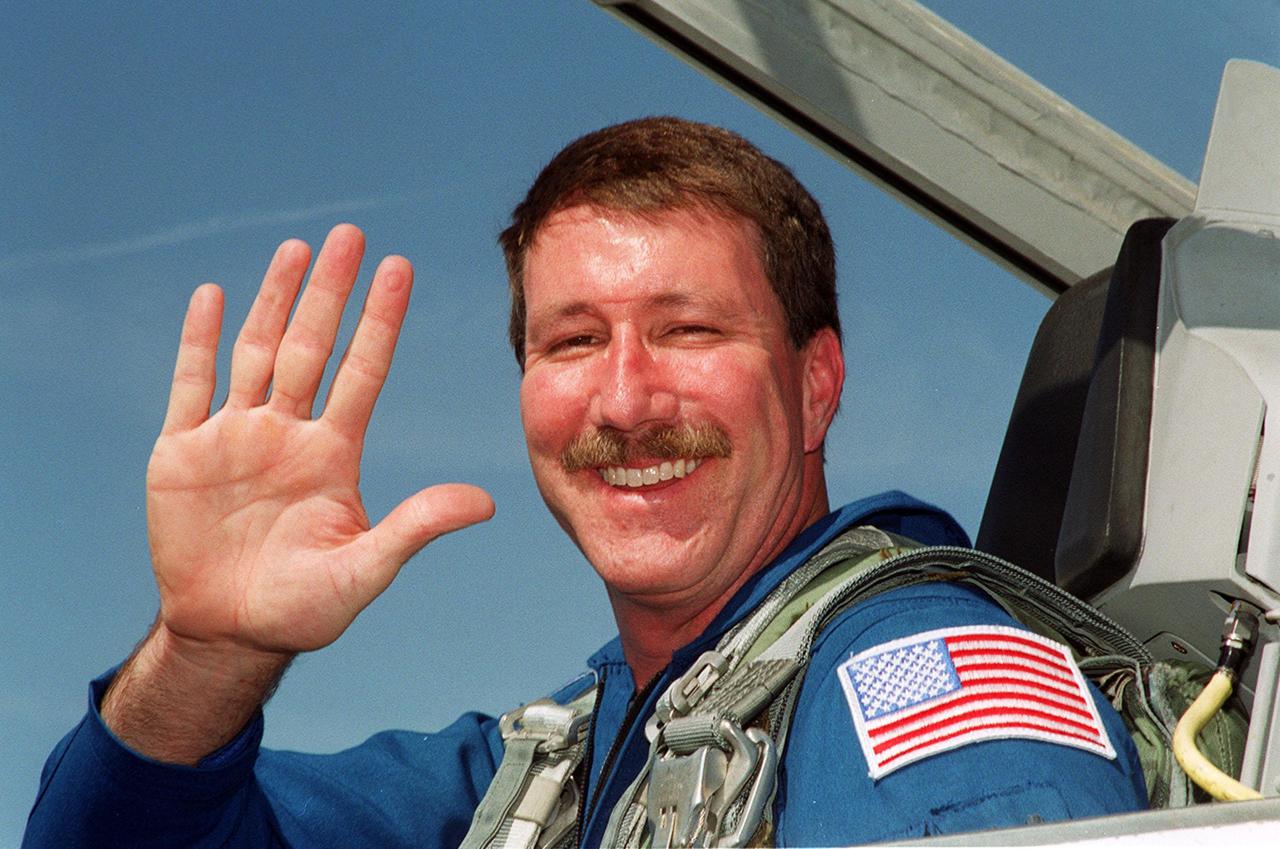
STS-100 Commander Kent V. Rominger arrives at the KSC Shuttle Landing Facility aboard a T-38 jet aircraft to get ready for launch. The 11-day mission to the International Space Station will deliver and integrate the Spacelab Logistics Pallet_Launch Deployment Assembly, which includes the Space Station Remote Manipulator system and the UHF Antenna, and the Multi-Purpose Logistics Module Raffaello. Liftoff on mission STS-100 is scheduled at 2:41 p.m. EDT April 19
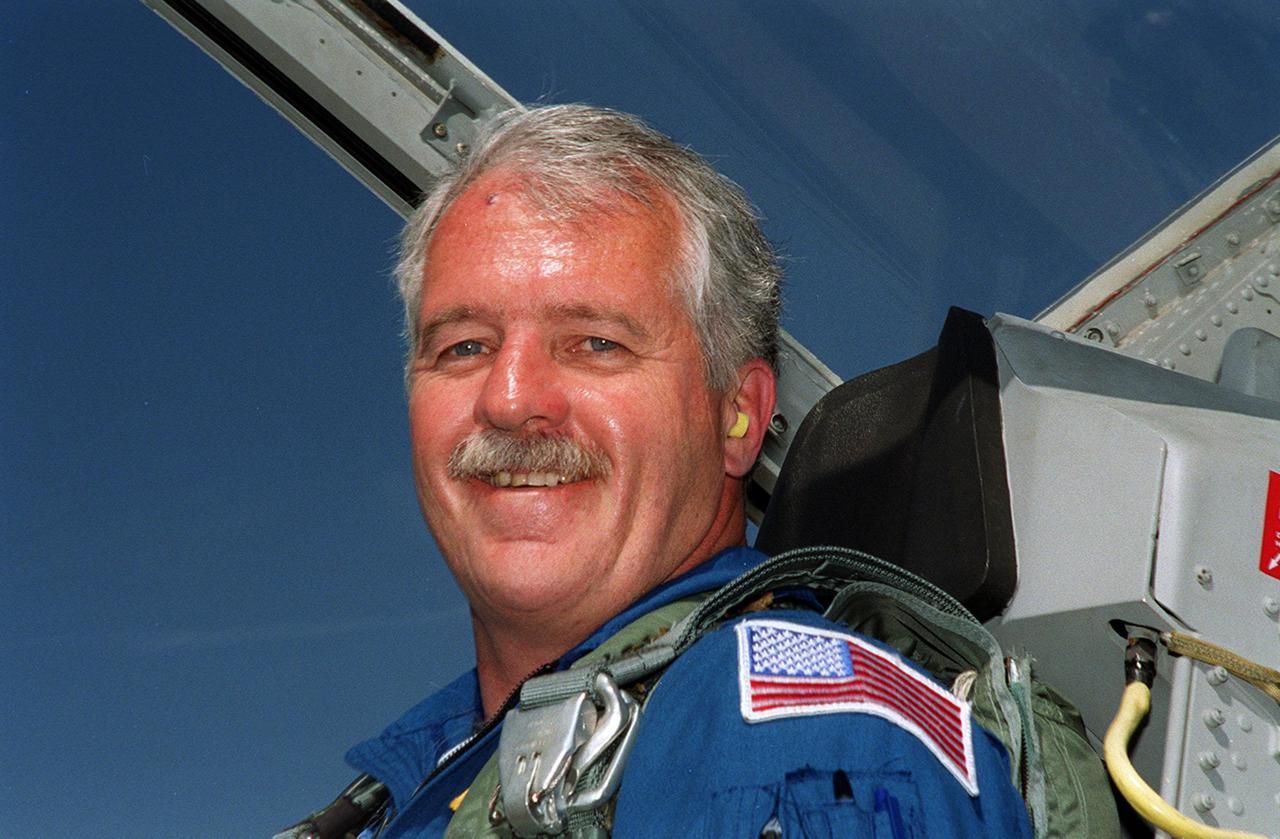
STS-100 Mission Specialist John L. Phillips arrives at the KSC Shuttle Landing Facility aboard a T-38 jet aircraft to get ready for launch. The 11-day mission to the International Space Station will deliver and integrate the Spacelab Logistics Pallet_Launch Deployment Assembly, which includes the Space Station Remote Manipulator system and the UHF Antenna, and the Multi-Purpose Logistics Module Raffaello. Liftoff on mission STS-100 is scheduled at 2:41 p.m. EDT April 19
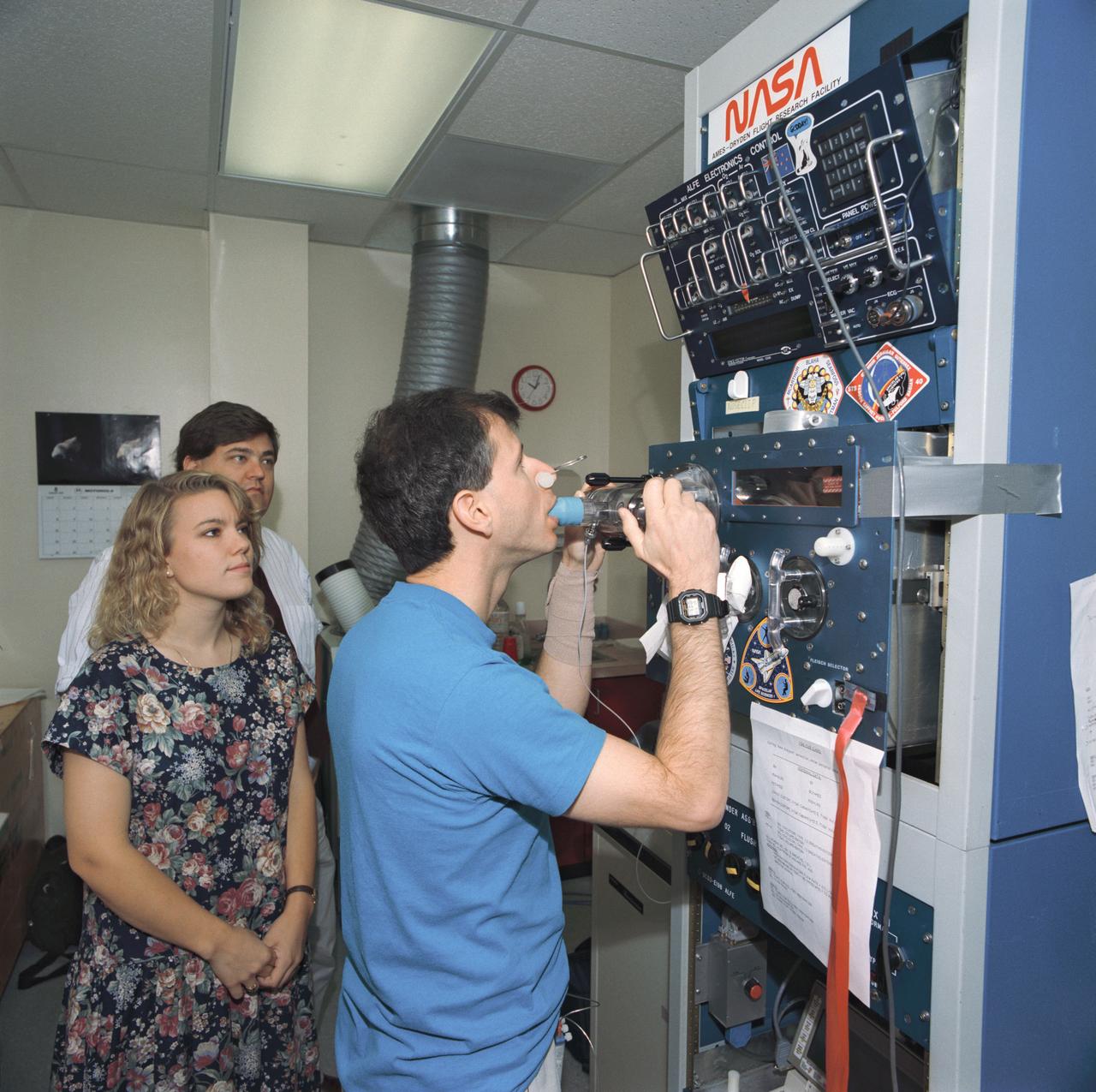
S93-45369 (29 Sept 1993) --- Training on the pre-breathing assembly, Martin J. (Marty) Fettman, DVM, inhales a predetermined gas composition. A gas analyzer mass spectrometer determines the composition of the gases he exhales. The re-breathing assembly and gas analyzer system are part of an investigation that explores how lung function is altered in space flight. The payload specialist for the Spacelab Life Sciences (SLS-2) mission was participating with six NASA astronauts, also assigned to STS-58, for data collection and training.
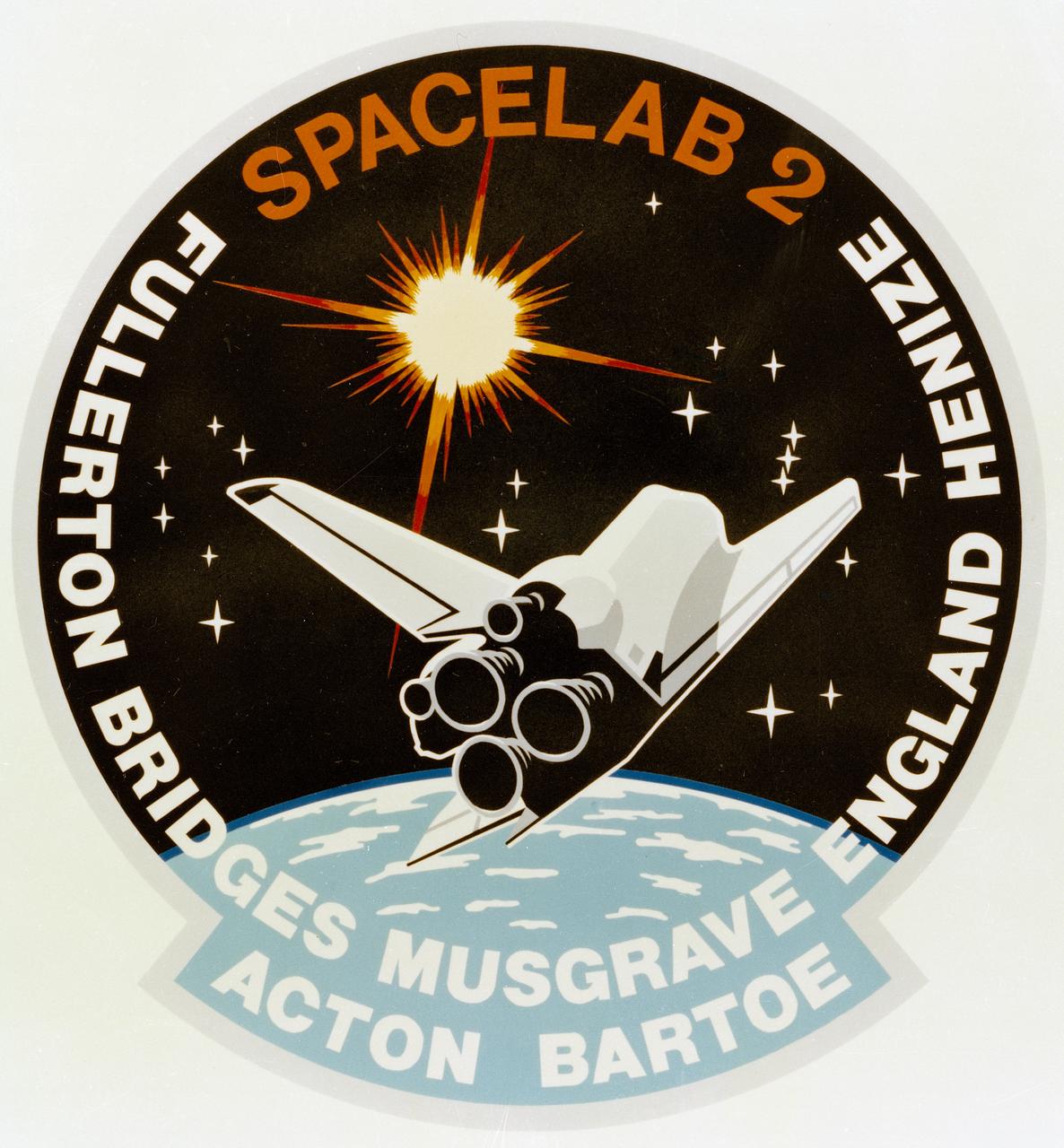
The crewmembers of Space Shuttle mission 51-F have chosen as their insignia this design by Houston artist Skip Bradley. The Space Shuttle Challenger is depicted ascending toward the heavens in search of new knowledge in the field of solar and steallar astronomy, with its Spacelab 2 payload. The constellations Leo and Orion are in the positions they will be in, relative to the sun during the flight. The nineteen stars signify that this will be the 19th STS flight.
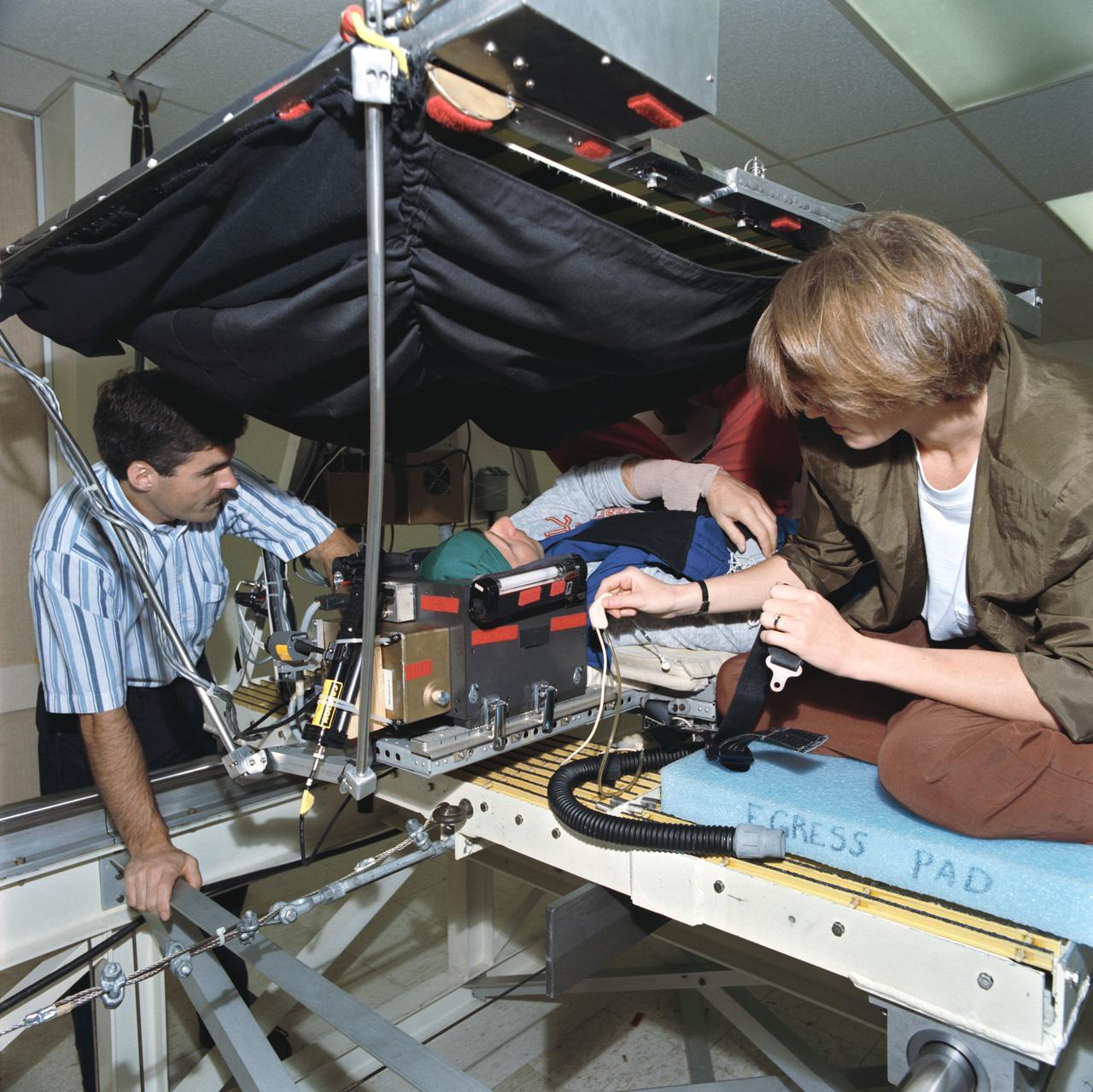
S93-45363 (29 Sept 1993) --- Payload specialist Martin J. Fettman, in an oscillating sled device, participates in a data collection project for neurovestibular functions. The seven Spacelab Life Sciences (SLS-2) crewmembers devoted a full day to miscellaneous biomedical data collection in preparation for next month's two week mission aboard Columbia.
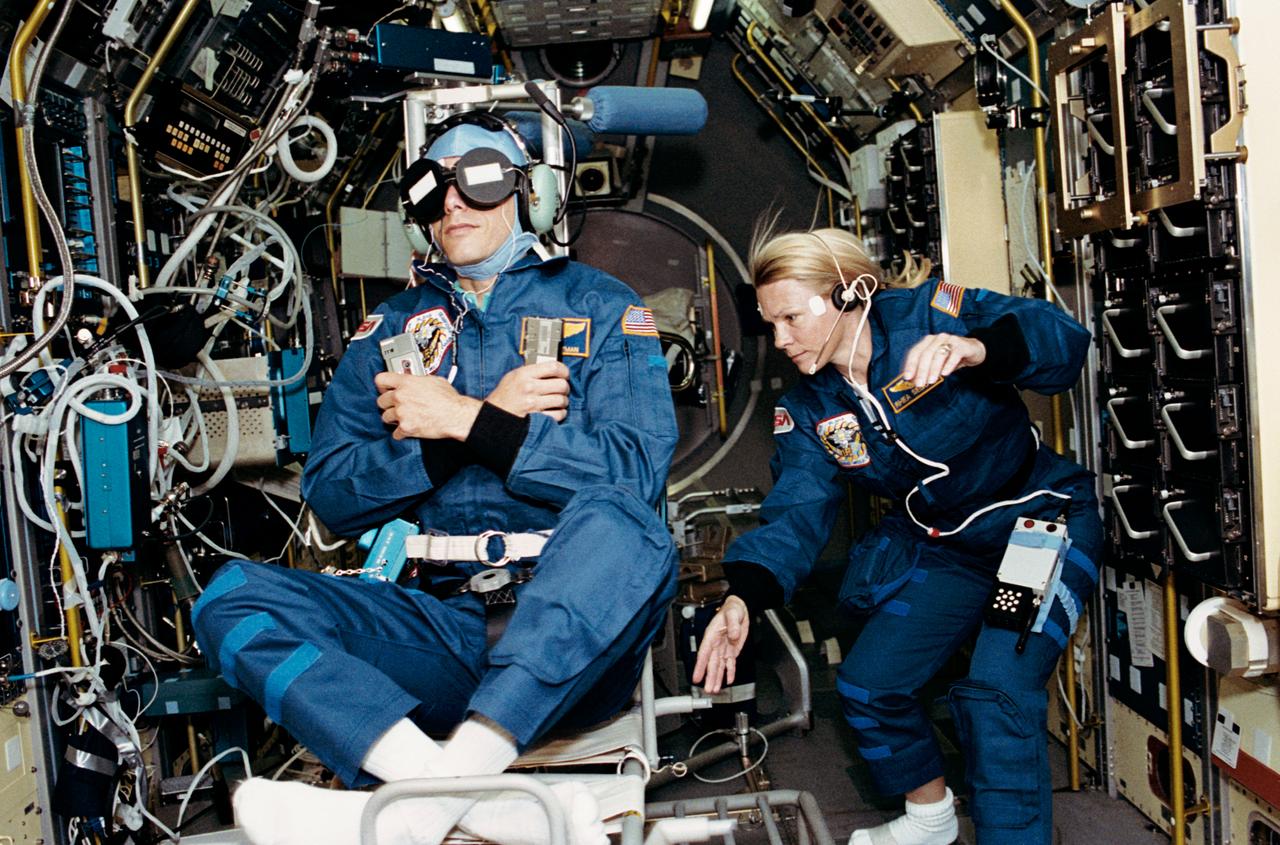
STS058-202-001 (18 Oct.-1 Nov. 1993) --- Astronaut Rhea Seddon, payload commander, spins the Spacelab Life Sciences (SLS-2) rotating chair as payload specialist Martin J. Fettman serves as test subject. The two joined five NASA astronauts for fourteen days of medical research aboard the Earth-orbiting space shuttle Columbia. Photo credit: NASA

STS-100 Pilot Jeffrey S. Ashby arrives at the KSC Shuttle Landing Facility aboard a T-38 jet aircraft to get ready for launch. The 11-day mission to the International Space Station will deliver and integrate the Spacelab Logistics Pallet/Launch Deployment Assembly, which includes the Space Station Remote Manipulator system and the UHF Antenna, and the Multi-Purpose Logistics Module Raffaello. Liftoff on mission STS-100 is scheduled at 2:41 p.m. EDT April 19
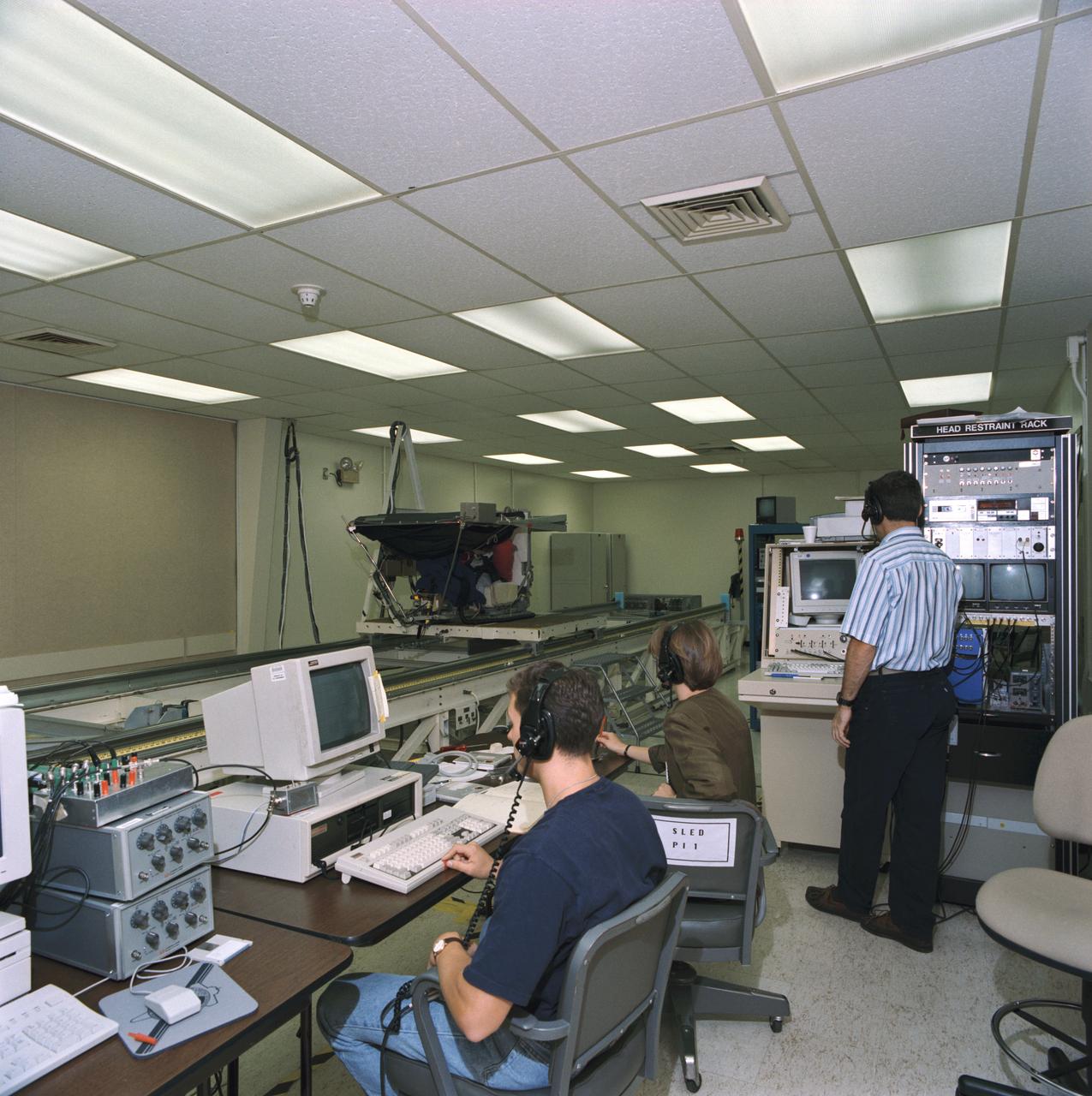
S93-45365 (29 Sept 1993) --- Payload specialist Martin J. Fettman, in an oscillating sled device in upper left, participates in a data collection project for neurovestibular functions. His responses to the sled's movements are recorded by a team of monitors in the foreground. The seven Spacelab Life Sciences (SLS-2) crew members devoted a full day to miscellaneous biomedical data collection in preparation for next month's two week mission aboard Columbia.
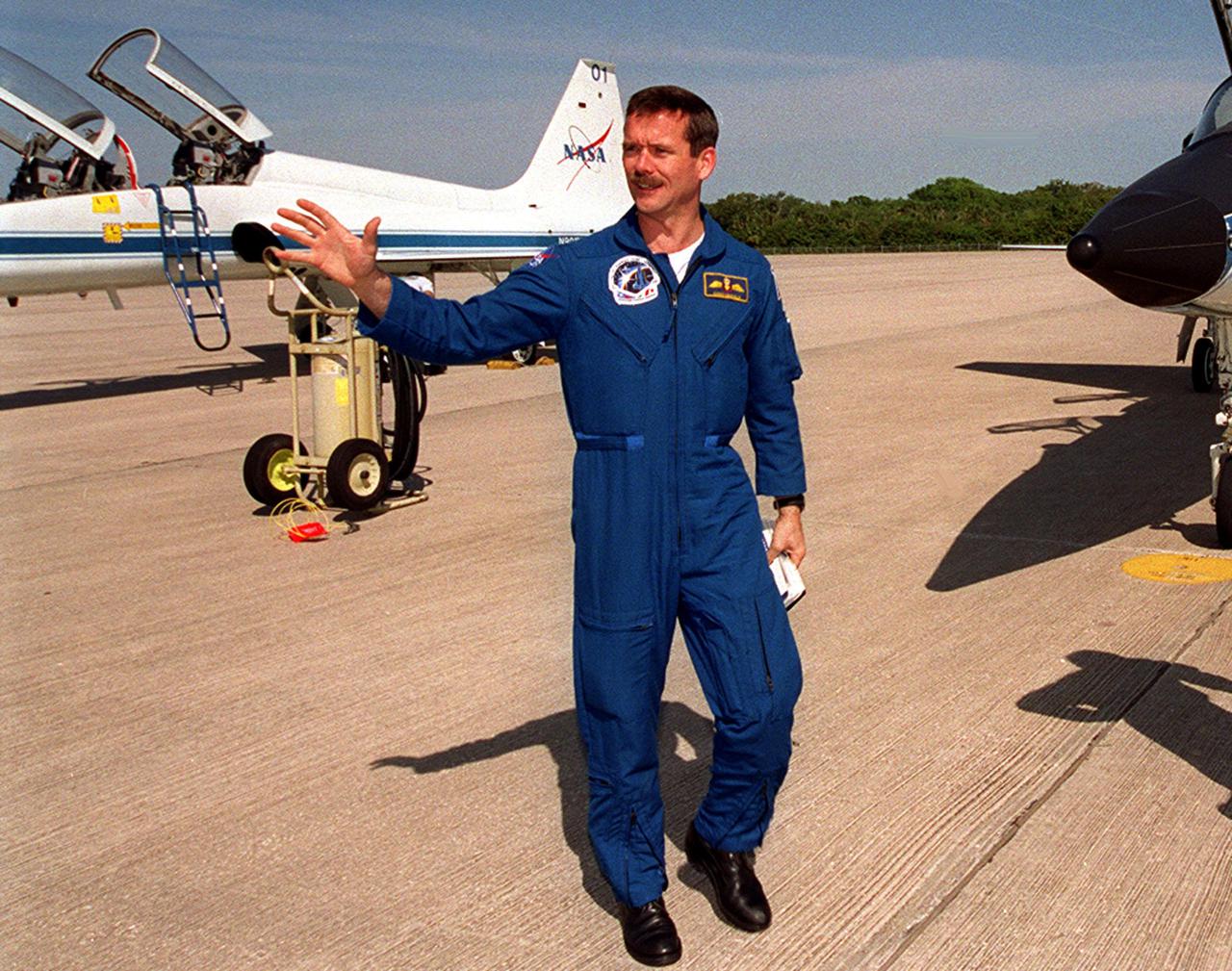
STS-100 Mission Specialist Chris A. Hadfield, who is with the Canadian Space Agency, waves to media after arriving at the KSC Shuttle Landing Facility for launch April 19. The 11-day mission to the International Space Station will deliver and integrate the Spacelab Logistics Pallet_Launch Deployment Assembly, which includes the Space Station Remote Manipulator system and the UHF Antenna, and the Multi-Purpose Logistics Module Raffaello. Liftoff on mission STS-100 is scheduled at 2:41 p.m. EDT April 19

51F-S-061 (29 July 1985) --- The 19th Space Shuttle mission gets off to a beginning as the Challenger soars toward earth orbit where it is scheduled to spend a week for a series of mostly scientific tasks. Challenger carries seven crewmembers and Spacelab 2 science pallets. A number of photographers record the event on camera. Launch occurred at 5:00 p.m. (EDT), July 29, 1985. The photo was taken by Otis Imboden.
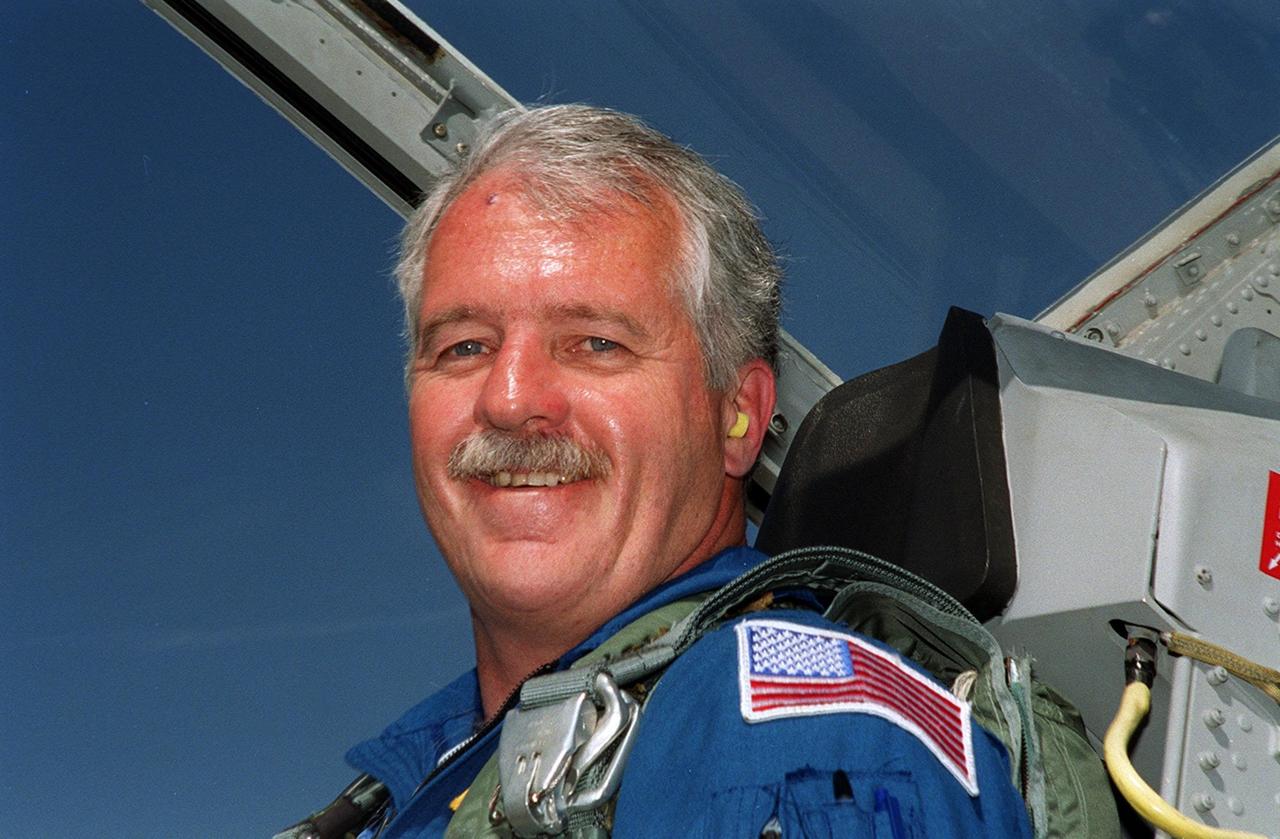
STS-100 Mission Specialist John L. Phillips arrives at the KSC Shuttle Landing Facility aboard a T-38 jet aircraft to get ready for launch. The 11-day mission to the International Space Station will deliver and integrate the Spacelab Logistics Pallet/Launch Deployment Assembly, which includes the Space Station Remote Manipulator system and the UHF Antenna, and the Multi-Purpose Logistics Module Raffaello. Liftoff on mission STS-100 is scheduled at 2:41 p.m. EDT April 19
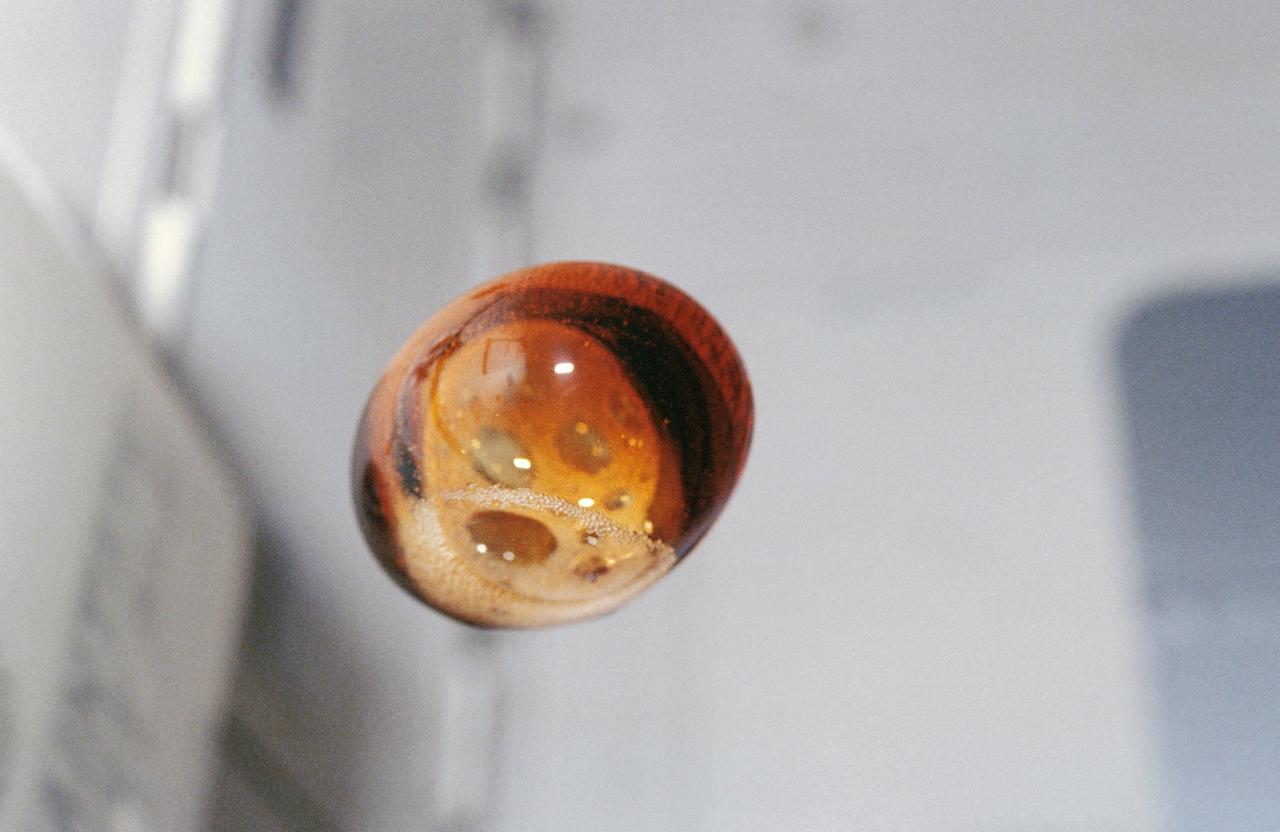
51F-12-034 (29 July-6 Aug 1985) --- A ball of liquid floats aboard Challenger as one of the Spacelab 2 crewmembers continues the ongoing fascination of liquids in weightlessness. Coffe, grape juice, orange juice, strawberry punch and various other beverages have been formed into globules, usually by the means of plastic straws, on a number of previous Shuttle missions as well as earlier NASA spacecraft. A second crewmember photographed this closeup with a 35 mm camera.
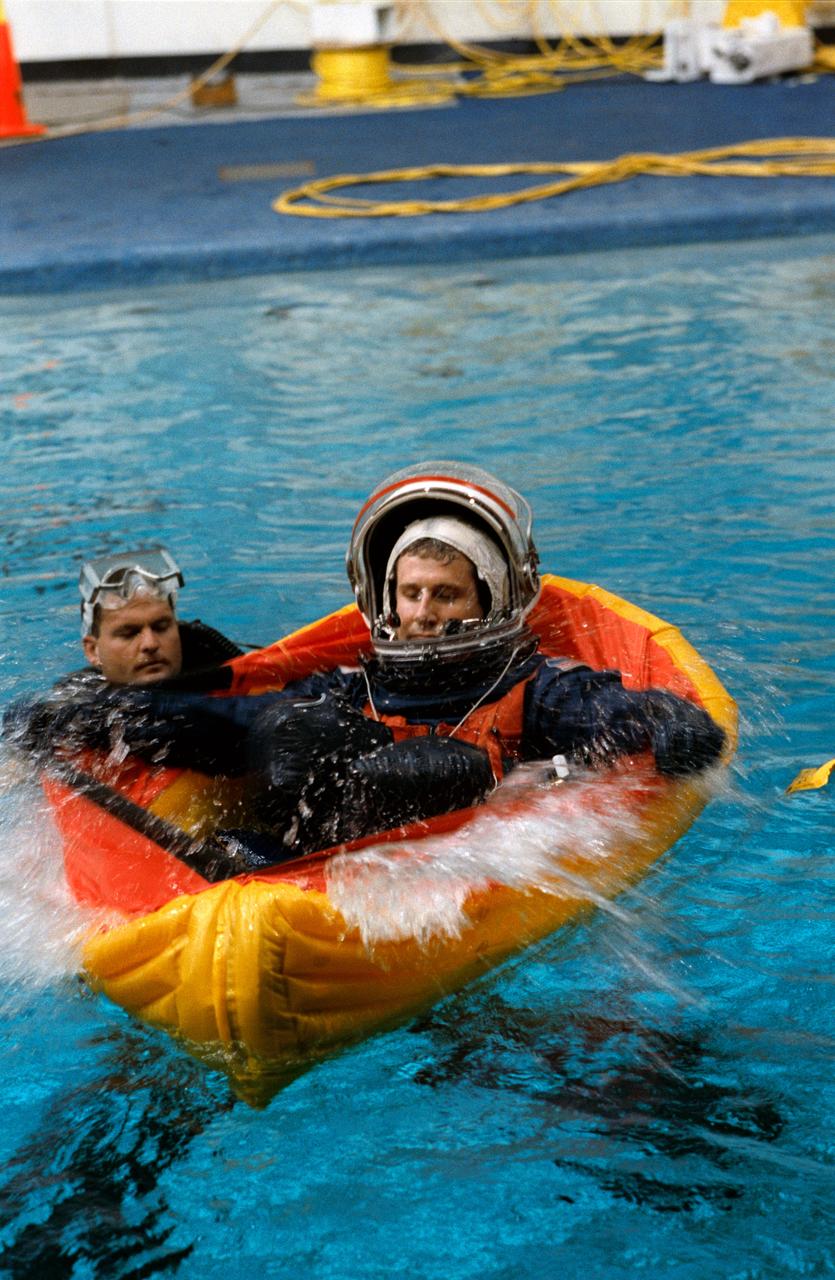
S93-43856 (7 Ssept 1993) --- Navigating a one person life raft, Jay C. Buckey, M.D., participates in emergency bailout training in the Johnson Space Center's (JSC) Weightless Environment Training Facility (WET-F). Dr. Buckey has been assigned as an alternate payload specialist for the Spacelab Life Sciences (SLS-2) mission scheduled for next month. Nearby is a SCUBA-equipped diver who assisted in the training exercises.
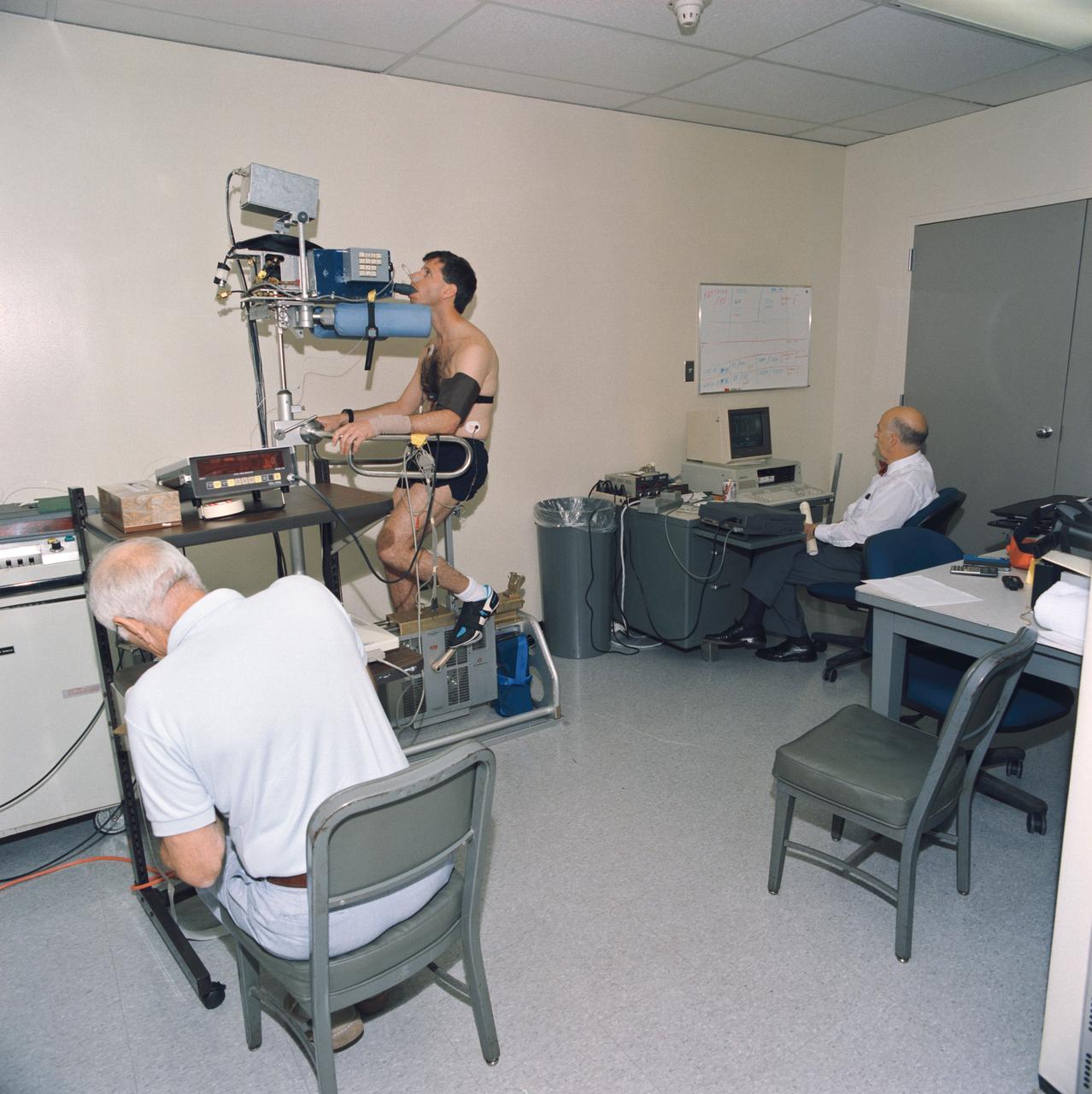
S93-45371 (29 Sept 1993) --- Astride the bicycle ergometer, Martin J. (Marty) Fettman, DVM, breathes quietly into the cardiovascular re-breathing unit during the resting phase of an experiment. The payload specialist for the Spacelab Life Sciences (SLS-2) mission was participating with six NASA astronauts, also assigned to STS-58, for data collection and training.
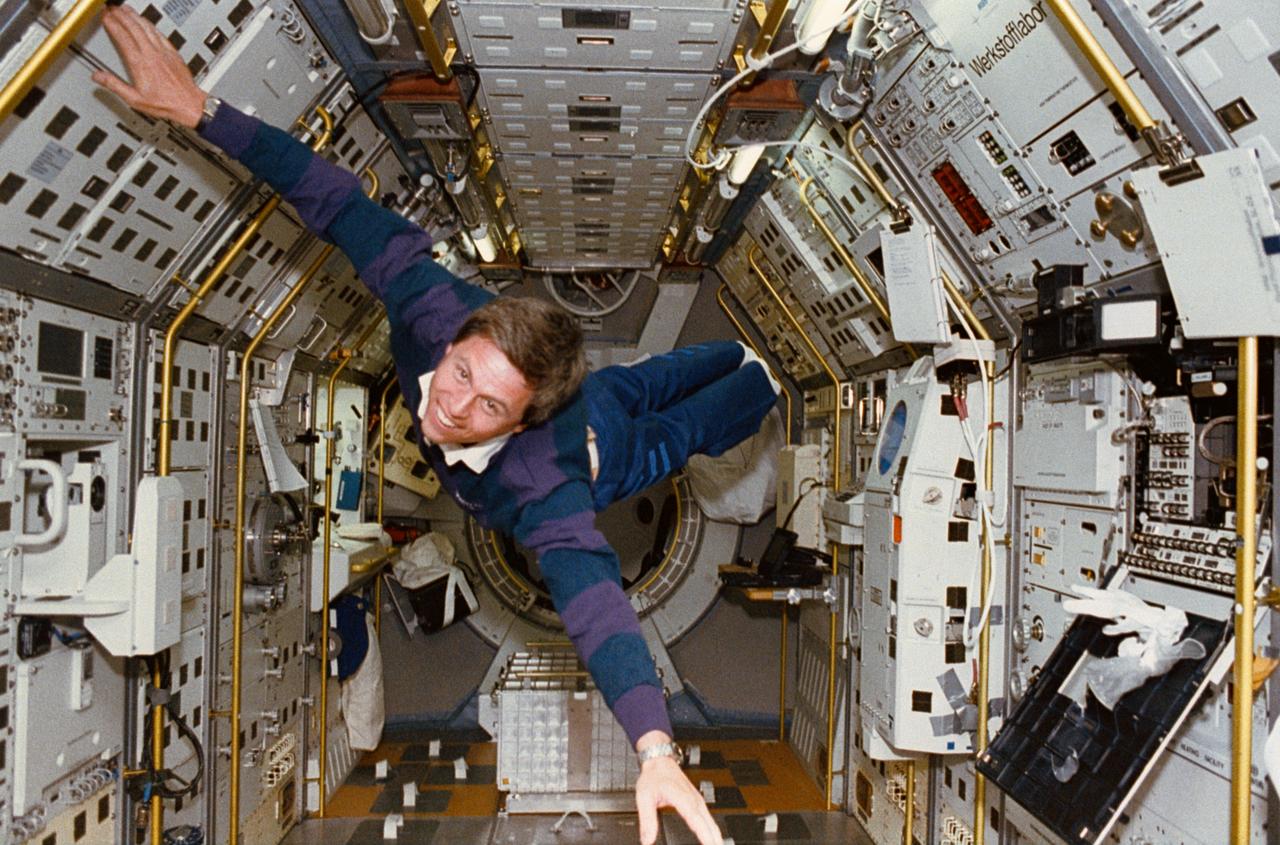
STS055-219-024 (26 April-6 May 1993) --- Ulrich Walter, STS-55 payload specialist representing the German Aerospace Research Establishment (DLR), demonstrates the microgravity aboard the Spacelab D-2 science module in Columbia's cargo bay. The module served as his space laboratory and that of his six crewmates for l0 days.
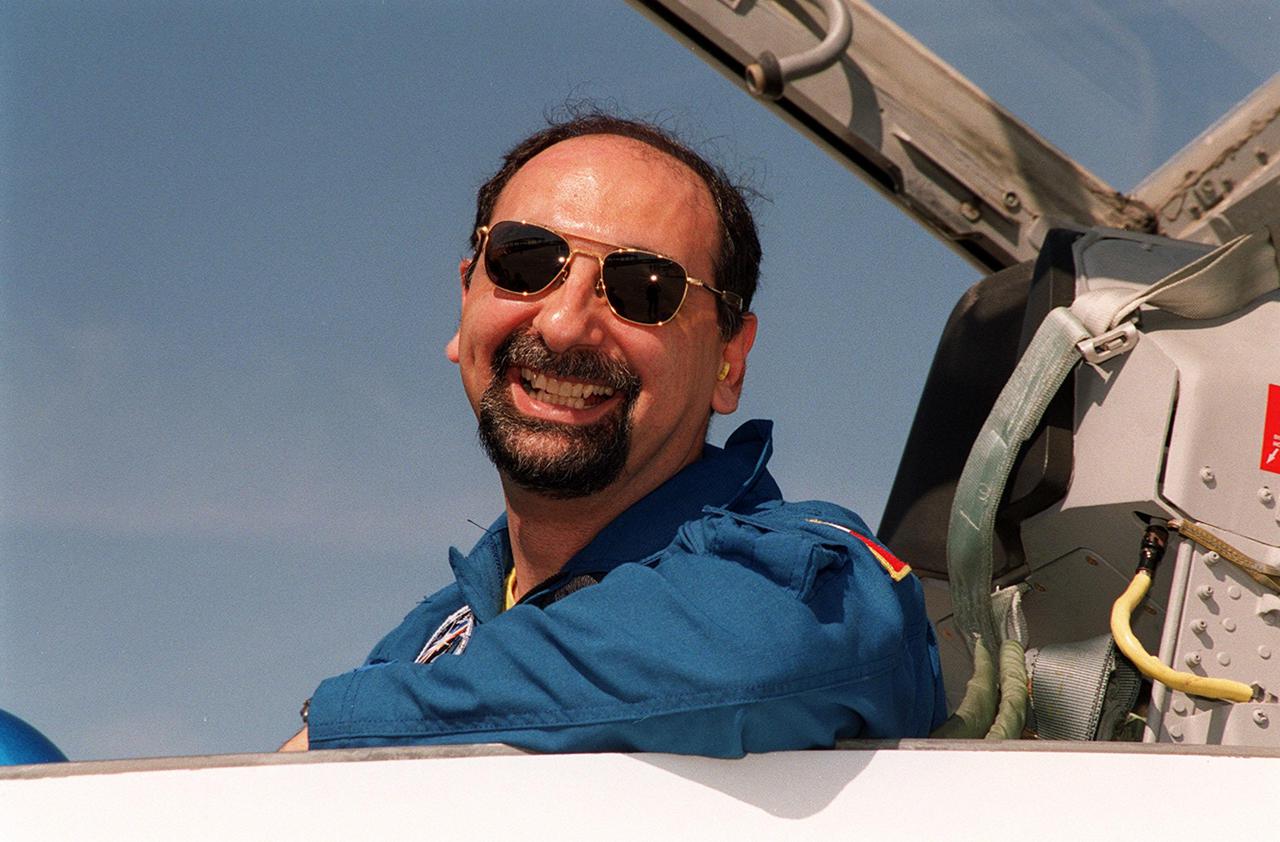
STS-100 Mission Specialist Umberto Guidoni arrives at the KSC Shuttle Landing Facility aboard a T-38 jet aircraft to get ready for launch. Guidoni is with the European Space Agency. The 11-day mission to the International Space Station will deliver and integrate the Spacelab Logistics Pallet_Launch Deployment Assembly, which includes the Space Station Remote Manipulator system and the UHF Antenna, and the Multi-Purpose Logistics Module Raffaello. Liftoff on mission STS-100 is scheduled at 2:41 p.m. EDT April 19
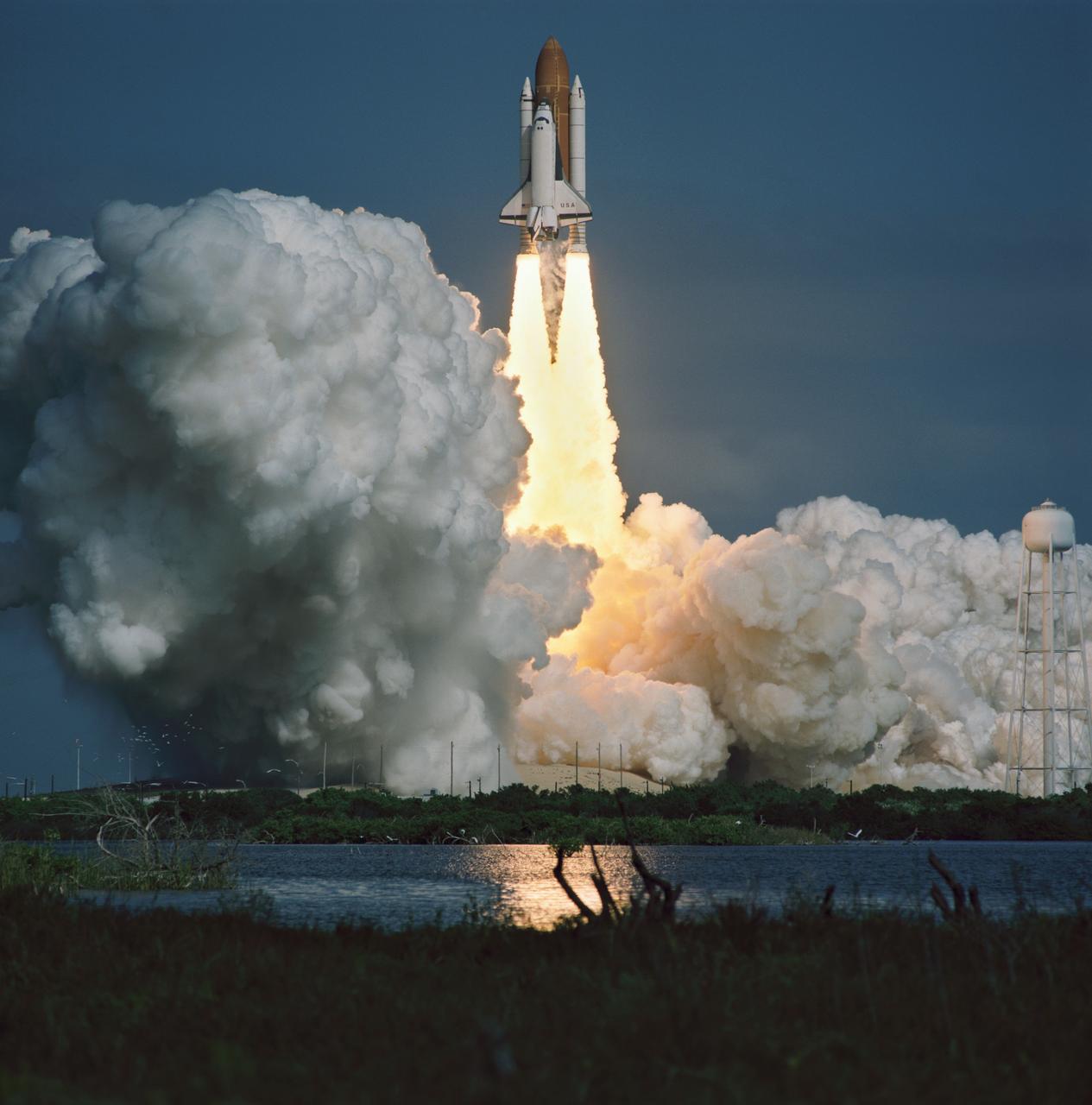
STS058-S-090 (18 Oct 1993) --- Creating large clouds of smoke the Space Shuttle Columbia lifts off from Launch Complex 39 at Kennedy Space Center (KSC). Liftoff occurred at 10:53 a.m. (EDT), October 18, 1993. Along with its Spacelab Life Sciences-2 payload, Columbia carries astronauts John E. Blaha, Richard A. Searfoss, Rhea Seddon, Shannon W. Lucid, David A. Wolf and William S. McArthur along with payload specialist Martin J. Fettman.
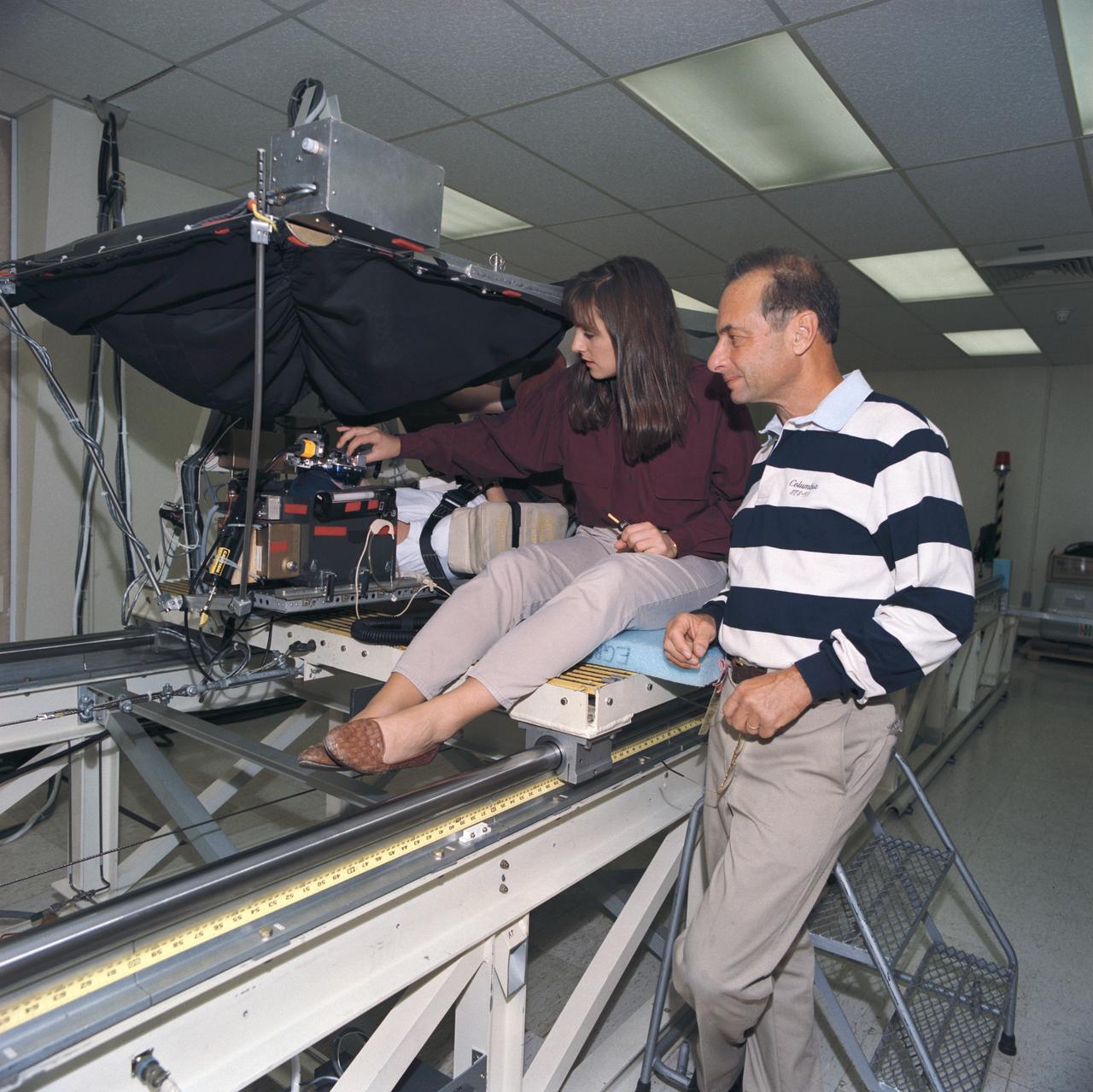
S93-45368 (29 Sept 1993) --- Payload specialist Martin J. Fettman (face obscured), in an oscillating sled device, participates in a data collection project for neurovestibular functions. Assisting the test are Dr. Laurence Young, alternate payload specialist, and an unidentified MIT student. The seven Spacelab Life Sciences (SLS-2) crew members devoted a full day to miscellaneous biomedical data collection in preparation for next month's two week mission aboard Columbia.
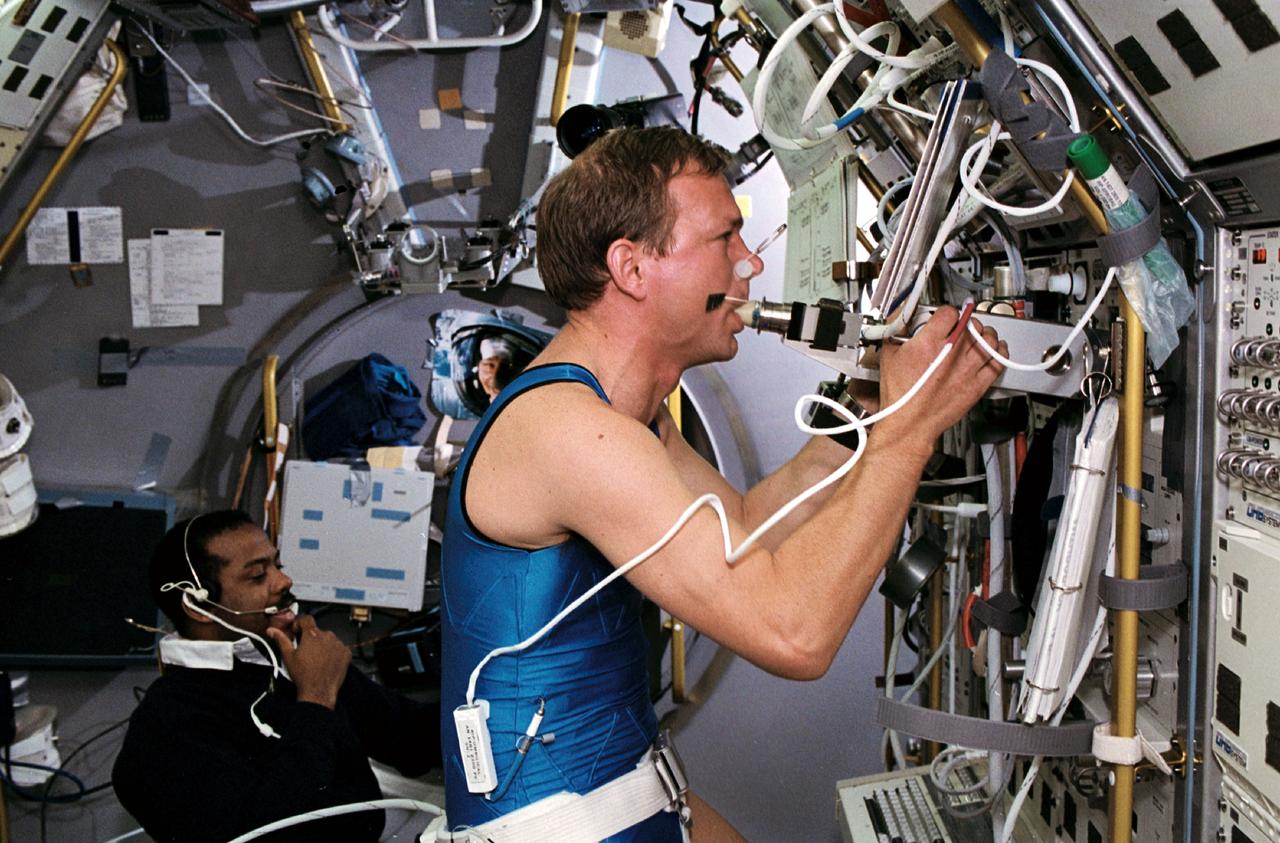
STS055-45-017 (26 April-6 May 1993) --- Hans Schlegel (foreground) participates in the ongoing investigation of human physiology under microgravity conditions as he works out on the ergometer at the Anthrorack. Monitoring the "run" is astronaut Bernard A. Harris, Jr., STS-55 mission specialist. Schlegel is one of two payload specialists representing the German Aerospace Research Establishment (DLR) on the Spacelab D-2 mission.
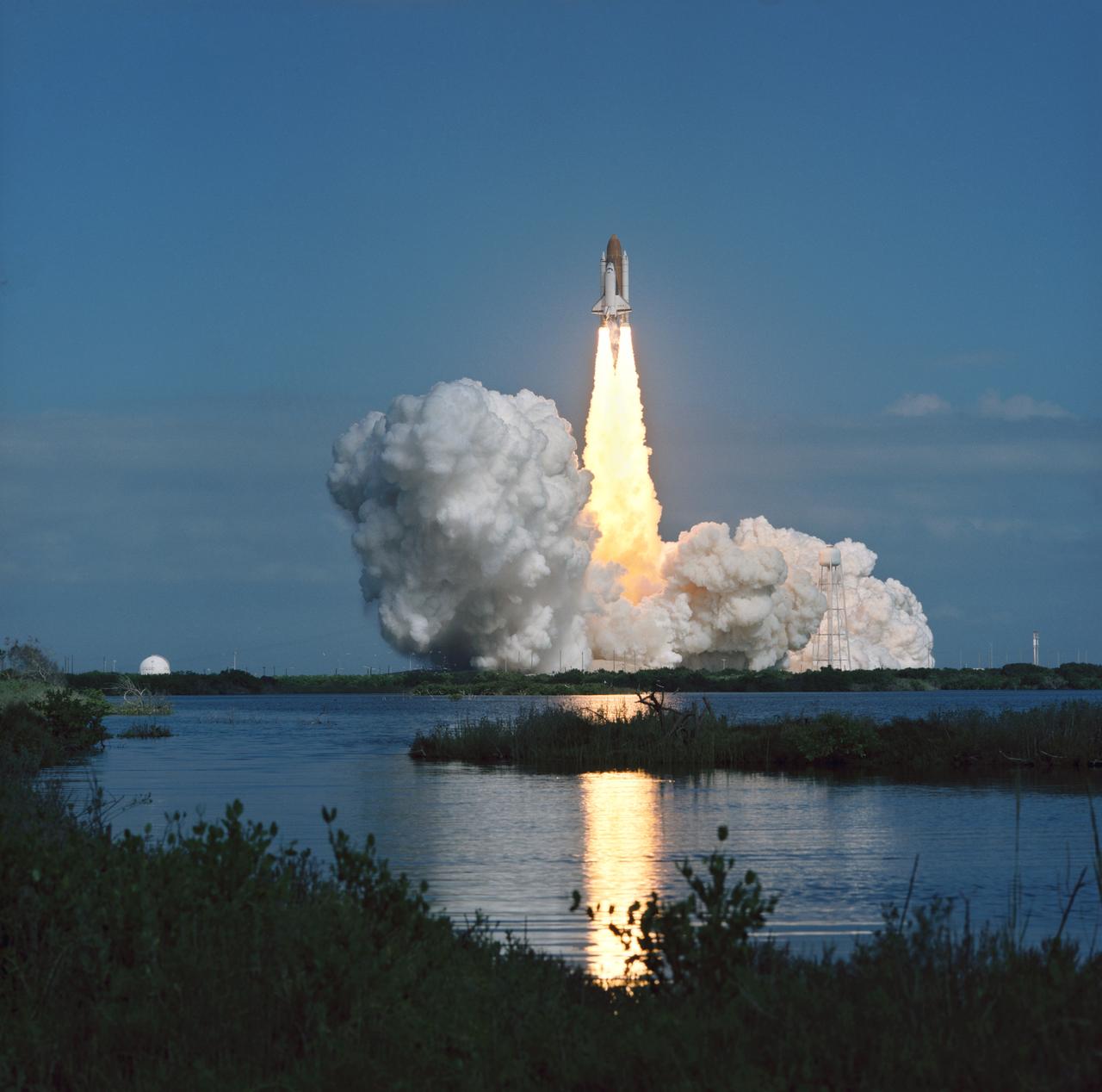
STS058-S-091 (18 Oct 1993) --- A distant shot shows the Space Shuttle Columbia, lifting off from Launch Complex 39 at Kennedy Space Center (KSC), reflecting its image in nearby marsh waters. Launch occurred at 10:53 a.m. (EDT), October 18, 1993. Along with six NASA astronauts and a veterinarian from the private sector, the Spacelab Life Sciences-2 (SLS-2) science module was aboard. Onboard were astronauts John E. Blaha, Richard A. Searfoss, Rhea Seddon, Shannon W. Lucid, David A. Wolf and William S. McArthur along with payload specialist Martin J. Fettman.
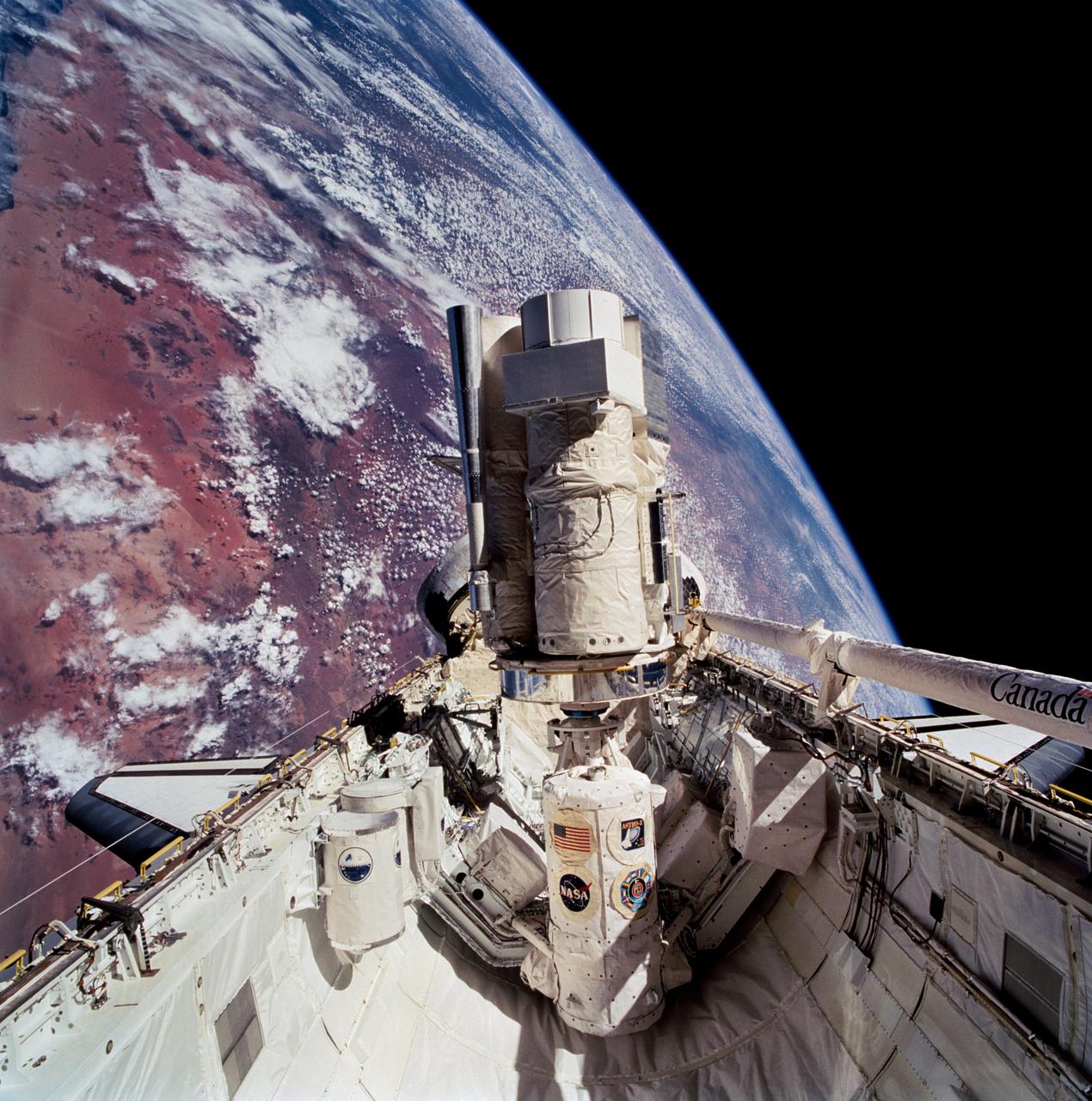
STS067-713-072 (2-18 March 1995) --- This 70mm cargo bay scene, backdropped against a desert area of Namibia, typifies the view that daily greeted the Astro-2 crew members during their almost 17-days aboard the Space Shuttle Endeavour. Positioned on the Spacelab pallet amidst other hardware, the Astro-2 payload is in its operational mode. Visible here are the Instrument Pointing System (IPS), Hopkins Ultraviolet Telescope (HUT), Star Tracker (ST), Ultraviolet Imaging Telescope (UIT), Wisconsin Ultraviolet Photo-Polarimeter Experiment (WUPPE), and Integrated Radiator System (IRS). At this angle, the Optical Sensor Package (OPS) is not seen. The Igloo, which supports the package of experiments, is in center foreground. Two Get-Away Special (GAS) canisters are in lower left foreground. The Extended Duration Orbiter (EDO) pallet, located aft of the cargo bay, is obscured by the Astro-2 payload. The Endeavour was 190 nautical miles above Earth.
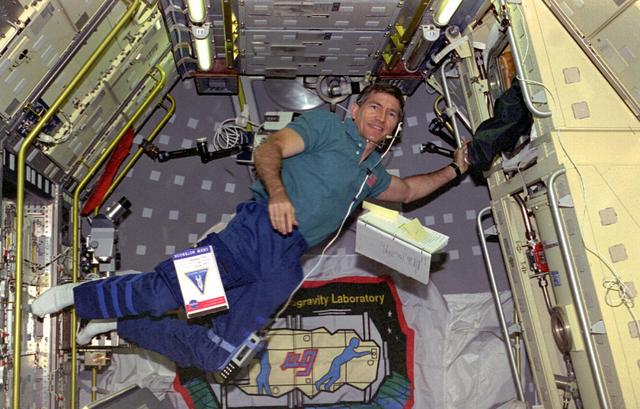
STS073-101-018 (20 October-5 November 1995) --- Payload specialist Fred W. Leslie maneuvers his body to a position conducive to research at the Crystal Growth Furnace (CGF) aboard the science module in the cargo bay of the Earth-orbiting Space Shuttle Columbia. Crystallization has been discovered to be more effectively studied in the weightless environment of space than on Earth, because the gravity-induced phenomena that obscure or change the process or change the process are greatly reduced or eliminated. Leslie was joined by a second guest researcher and five NASA astronauts for 16 full days of in-space research in support of the United States Microgravity Laboratory (USML-2) mission.
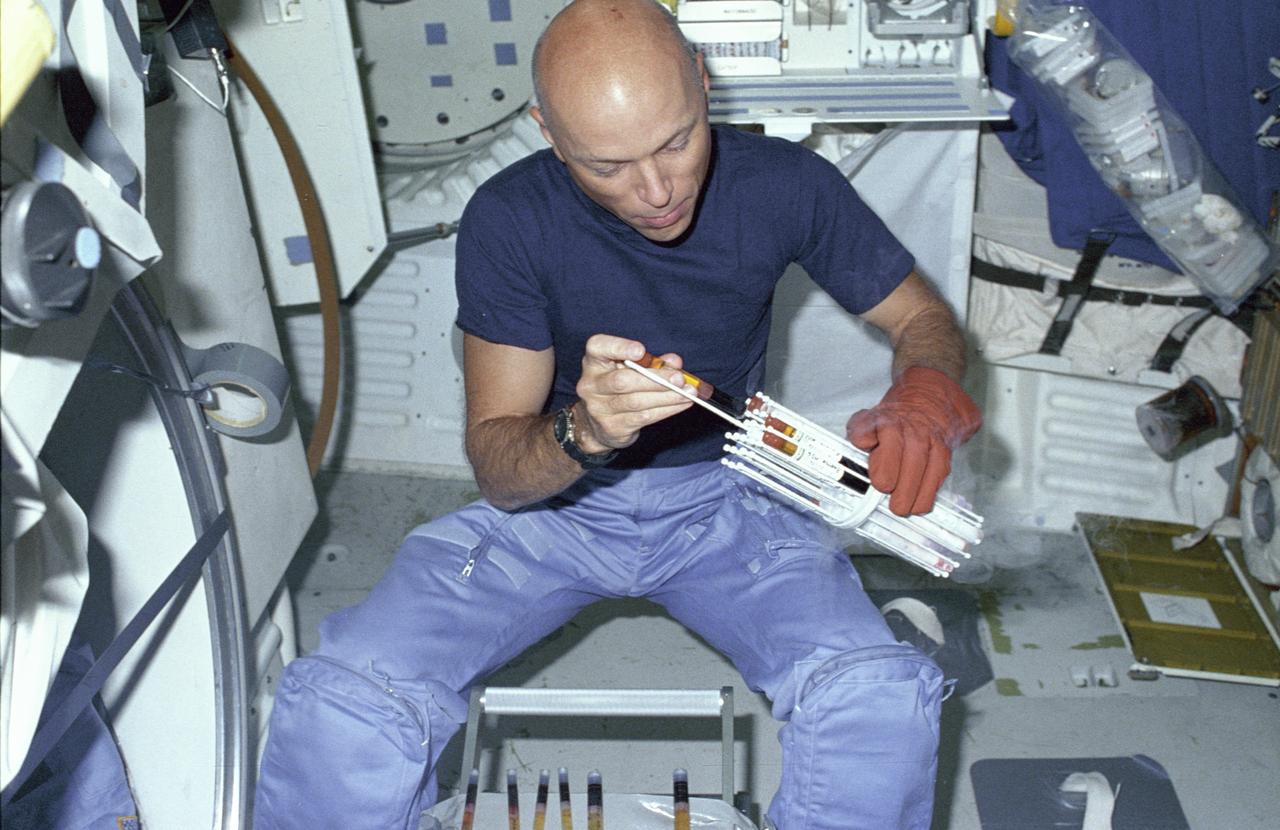
While instruments on the pallets in the payload bay observed the universe, biological experiments were performed in the middeck of the Shuttle Orbiter Challenger. Studying life processes in a microgravity environment can shed new light on the functioning of biological systems on Earth. These investigations can also help us understand how living organisms react to prolonged weightlessness. One such experiment was the vitamin D metabolites and bone demineralization experiment. This investigation measured the vitamin D metabolite levels of crew members to gain information on the cause of bone demineralization and mineral imbalance that occur during prolonged spaceflight as well as on Earth. Research into the biochemical nature of vitamin D has shown that the D-metabolites play a major role in regulating the body's calcium and phosphorus levels. One major function of the most biologically active vitamin D metabolite is to regulate the amount of calcium absorbed from the diet and taken out of bones. This investigation had two phases. The first was the developmental phase, which included extensive testing before flight, and the second, or final phase, involved the postflight analysis of the crew's blood samples. This photograph shows astronaut Story Musgrave in the middeck of the Shuttle Orbiter Challenger, attending to the blood samples he collected from crew members for the experiment.
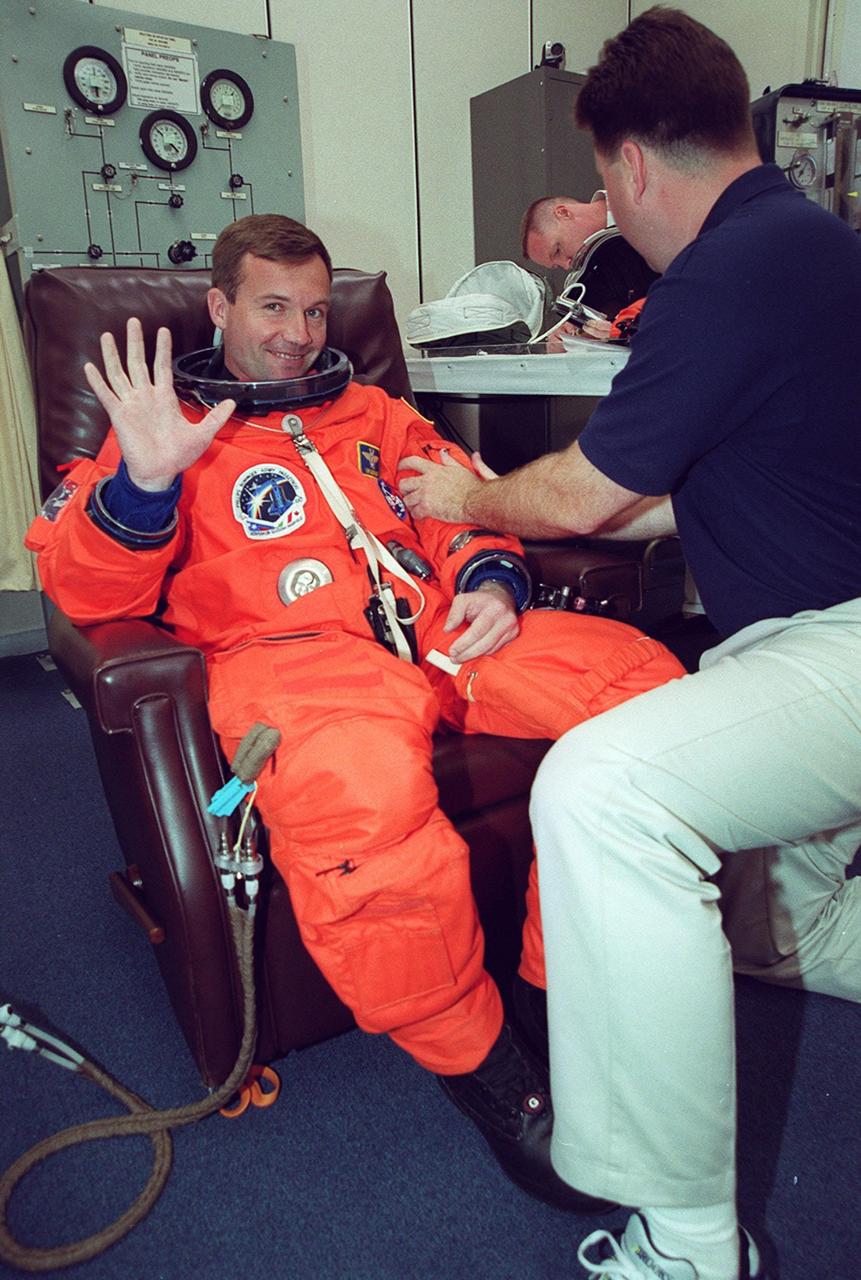
Smiling, STS-100 Mission Specialist Yuri V. Lonchakov waves as he suits up for launch in the Operations and Checkout Building. Lonchakov is with the Russian Aviation and Space Agency. The 11-day mission to the International Space Station will deliver and integrate the Spacelab Logistics Pallet/Launch Deployment Assembly, which includes the Space Station Remote Manipulator system and the UHF Antenna, and the Multi-Purpose Logistics Module Raffaello. The mission includes two planned spacewalks for installation of the SSRMS. The mission is also the inaugural flight of Raffaello, carrying resupply stowage racks and resupply/return stowage platforms. Liftoff on mission STS-100 is scheduled at 2:41 p.m. EDT April 19

KENNEDY SPACE CENTER, FLA. -- Space Shuttle Endeavour leaps from Launch Pad 39A amid billows of smoke and steam as it races into space on mission STS-100. Liftoff of Endeavour on the ninth flight to the International Space Station occurred at 2:40:42 p.m. EDT. The 11-day mission will deliver and integrate the Spacelab Logistics Pallet/Launch Deployment Assembly, which includes the Space Station Remote Manipulator System and the UHF Antenna. The mission includes two planned spacewalks for installation of the SSRMS on the Station. Also onboard is the Multi-Purpose Logistics Module Raffaello, carrying resupply stowage racks and resupply/return stowage platforms
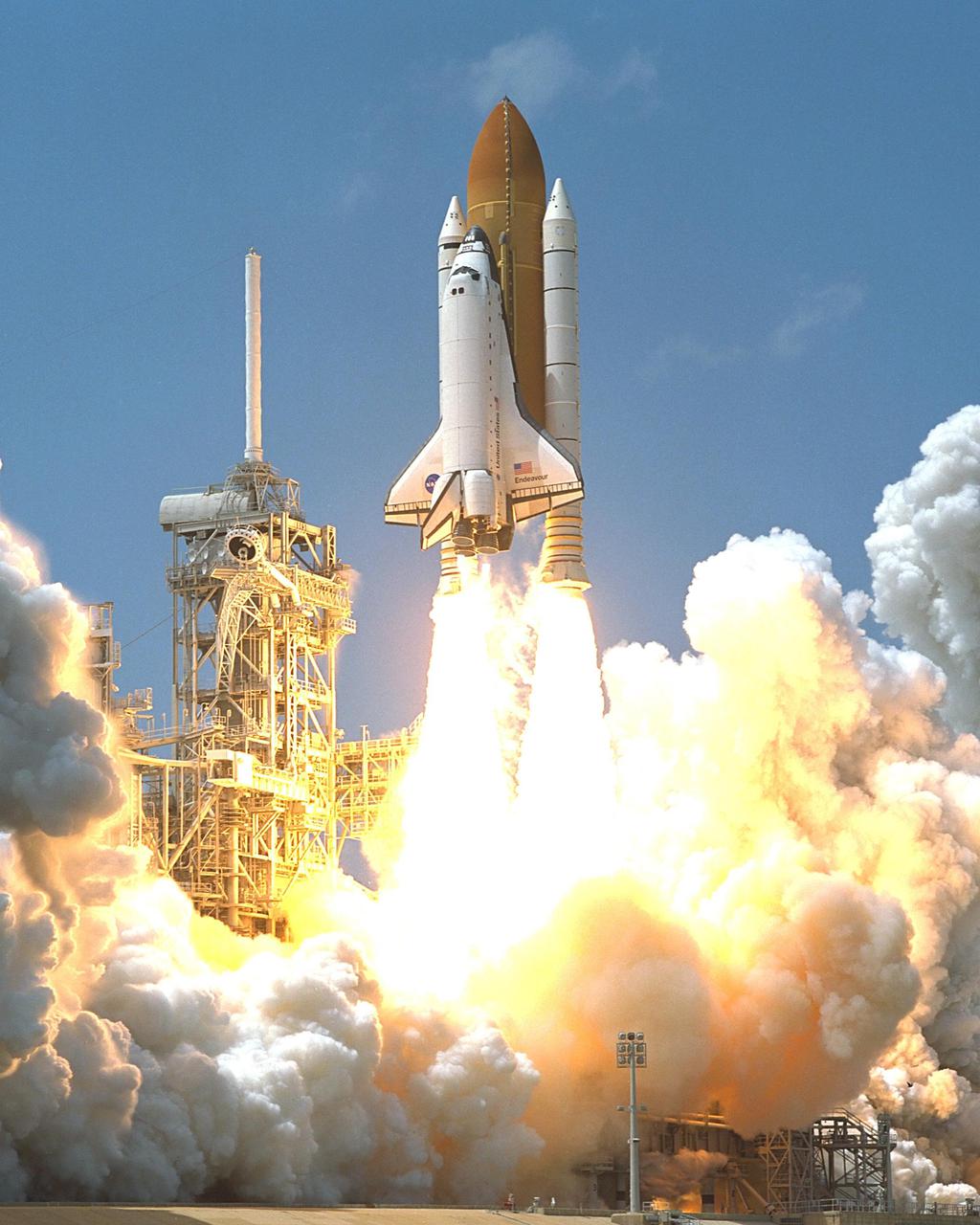
KENNEDY SPACE CENTER, FLA. -- Space Shuttle Endeavour races into space, springing forth from clouds of smoke and steam, on mission STS-100. Liftoff of the ninth flight to the International Space Station occurred at 2:40:42 p.m. EDT. The 11-day mission will deliver and integrate the Spacelab Logistics Pallet_Launch Deployment Assembly, which includes the Space Station Remote Manipulator System and the UHF Antenna. The mission includes two planned spacewalks for installation of the SSRMS on the Station. Also onboard is the Multi-Purpose Logistics Module Raffaello, carrying resupply stowage racks and resupply_return stowage platforms
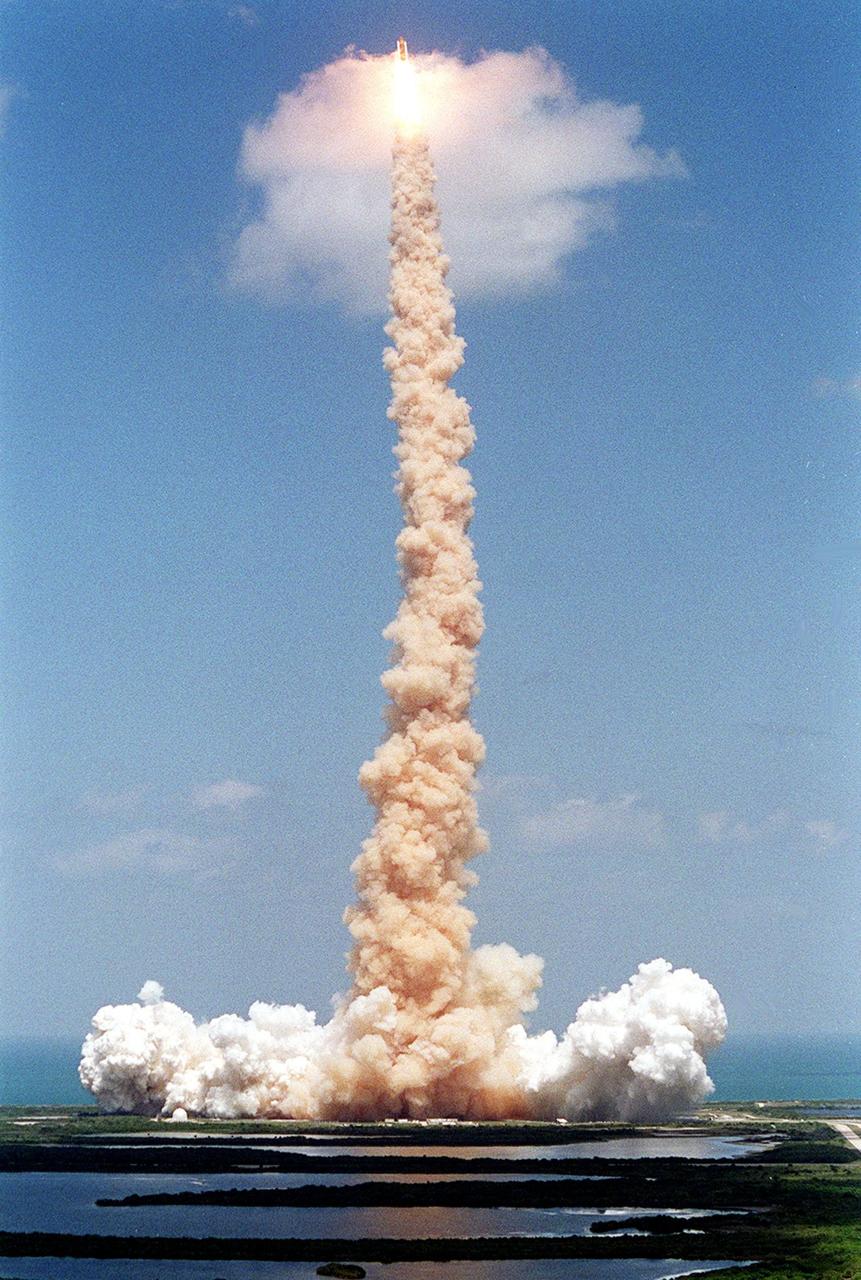
KENNEDY SPACE CENTER, FLA. -- Trailing a plume of smoke, Space Shuttle Endeavour pierces a small cloud, briefly lighting it from within, during launch on mission STS-100. Liftoff of the ninth flight to the International Space Station occurred at 2:40:42 p.m. EDT. The 11-day mission will deliver and integrate the Spacelab Logistics Pallet/Launch Deployment Assembly, which includes the Space Station Remote Manipulator System and the UHF Antenna. The mission includes two planned spacewalks for installation of the SSRMS on the Station. Also onboard is the Multi-Purpose Logistics Module Raffaello, carrying resupply stowage racks and resupply/return stowage platforms
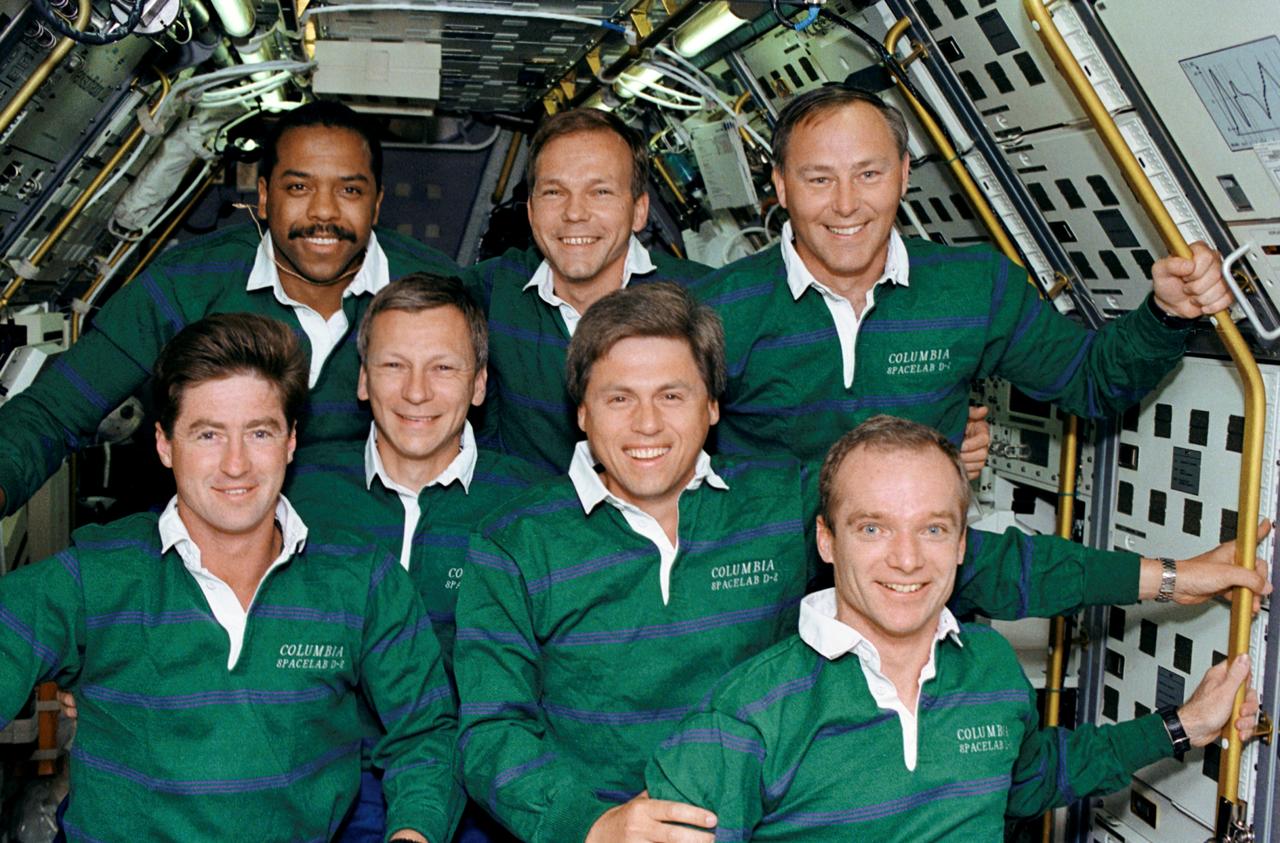
STS055-203-009 (26 April-6 May 1993) --- The seven crew members who spent 10 days aboard the space shuttle Columbia pose for the traditional in-flight portrait in the Spacelab D-2 Science Module. Front, left to right, are Terence T. (Tom) Henricks, Steven R. Nagel, Ulrich Walter and Charles J. Precourt. In the rear are (left to right) Bernard A. Harris Jr., Hans Schlegel and Jerry L. Ross. Nagel served as mission commander; Henricks was the pilot and Ross, the payload commander. Harris and Precourt were mission specialists and Schlegel and Walter were payload specialists representing the German Aerospace Research Establishment (DLR). Photo credit: NASA
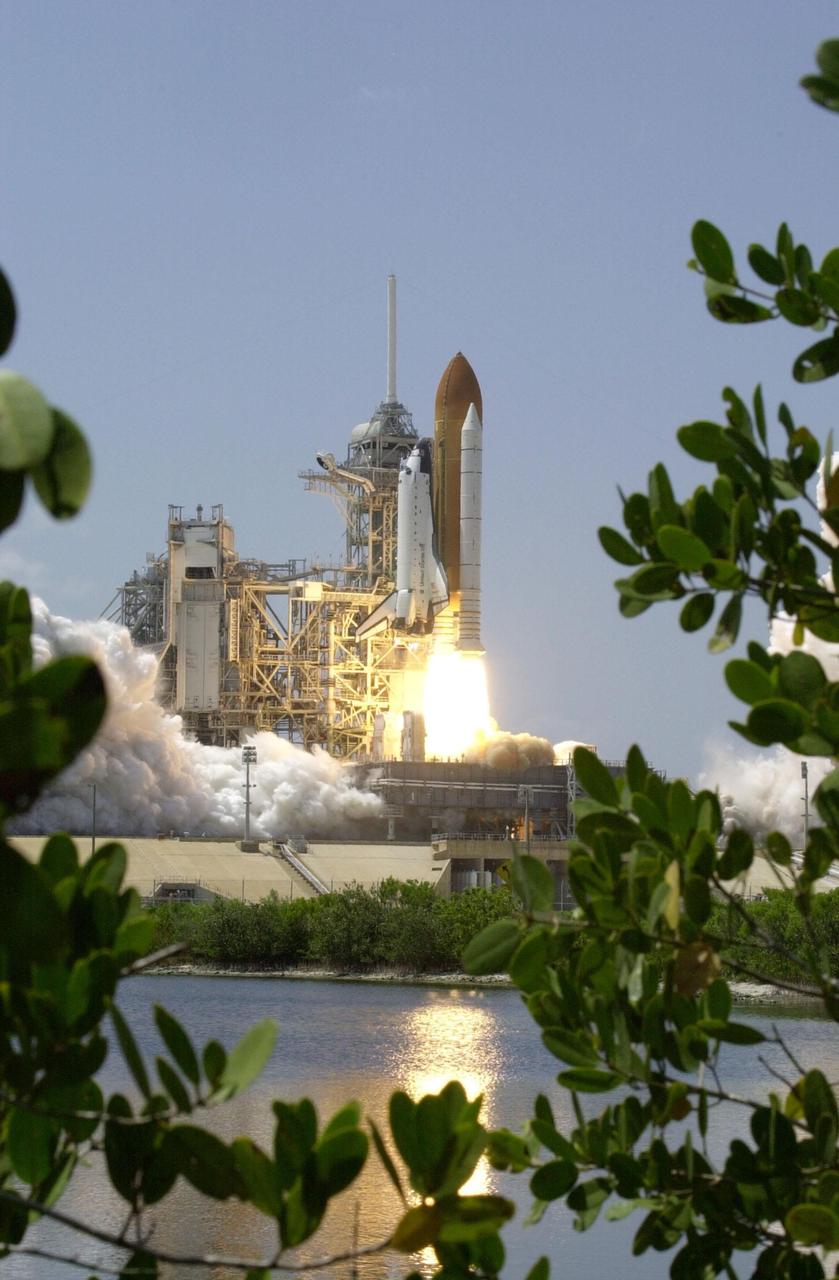
KENNEDY SPACE CENTER, FLA. -- Spring leaves frame the launch of Space Shuttle Endeavour on mission STS-100, the ninth flight to the International Space Station. Liftoff occurred at 2:40:42 p.m. EDT. The 11-day mission will deliver and integrate the Spacelab Logistics Pallet/Launch Deployment Assembly, which includes the Space Station Remote Manipulator System and the UHF Antenna. The mission includes two planned spacewalks for installation of the SSRMS on the Station. Also onboard is the Multi-Purpose Logistics Module Raffaello, carrying resupply stowage racks and resupply/return stowage platform
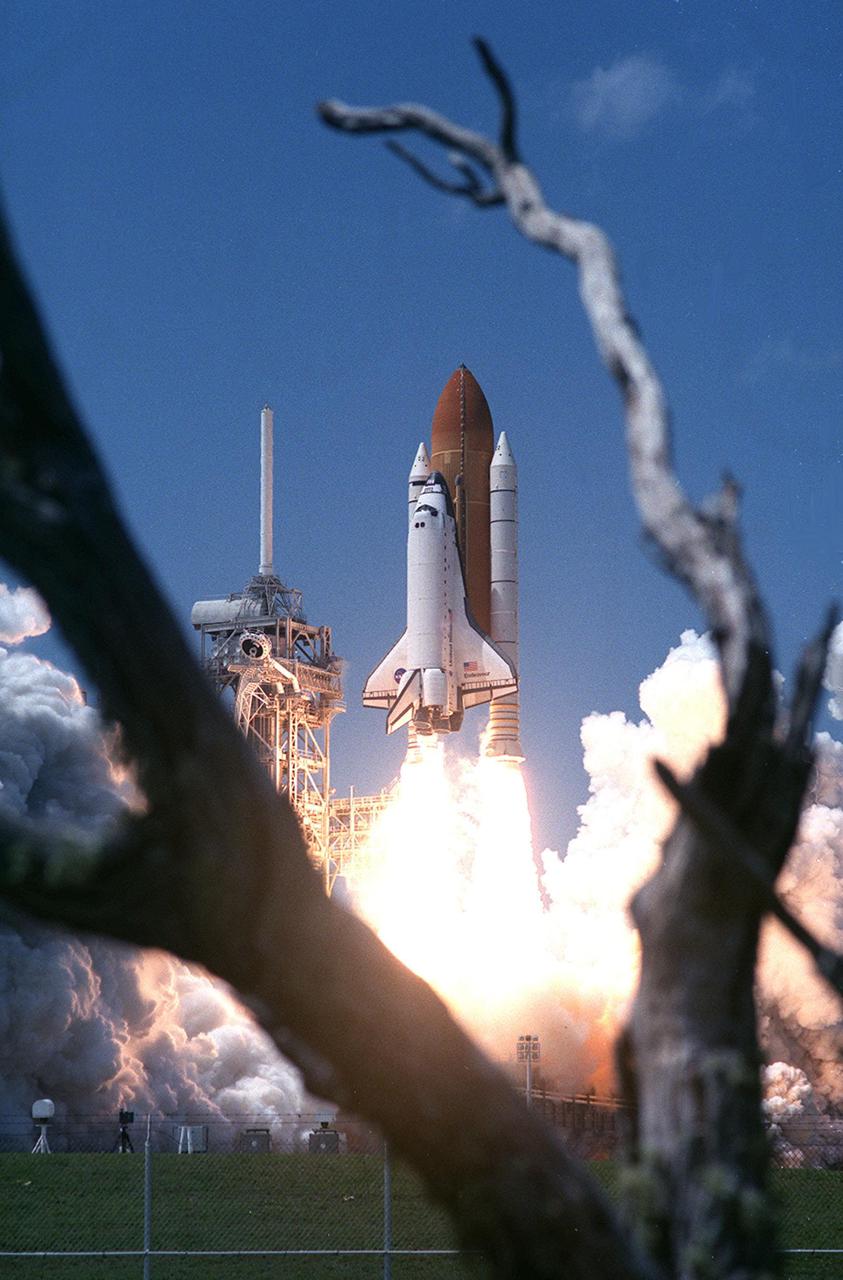
KENNEDY SPACE CENTER, FLA. -- Framed between the branches of a tree, Space Shuttle Endeavour is hurtled into space on mission STS-100. Liftoff of Endeavour on the ninth flight to the International Space Station occurred at 2:40:42 p.m. EDT. The 11-day mission will deliver and integrate the Spacelab Logistics Pallet_Launch Deployment Assembly, which includes the Space Station Remote Manipulator System and the UHF Antenna. The mission includes two planned spacewalks for installation of the SSRMS on the Station. Also onboard is the Multi-Purpose Logistics Module Raffaello, carrying resupply stowage racks and resupply_return stowage platforms
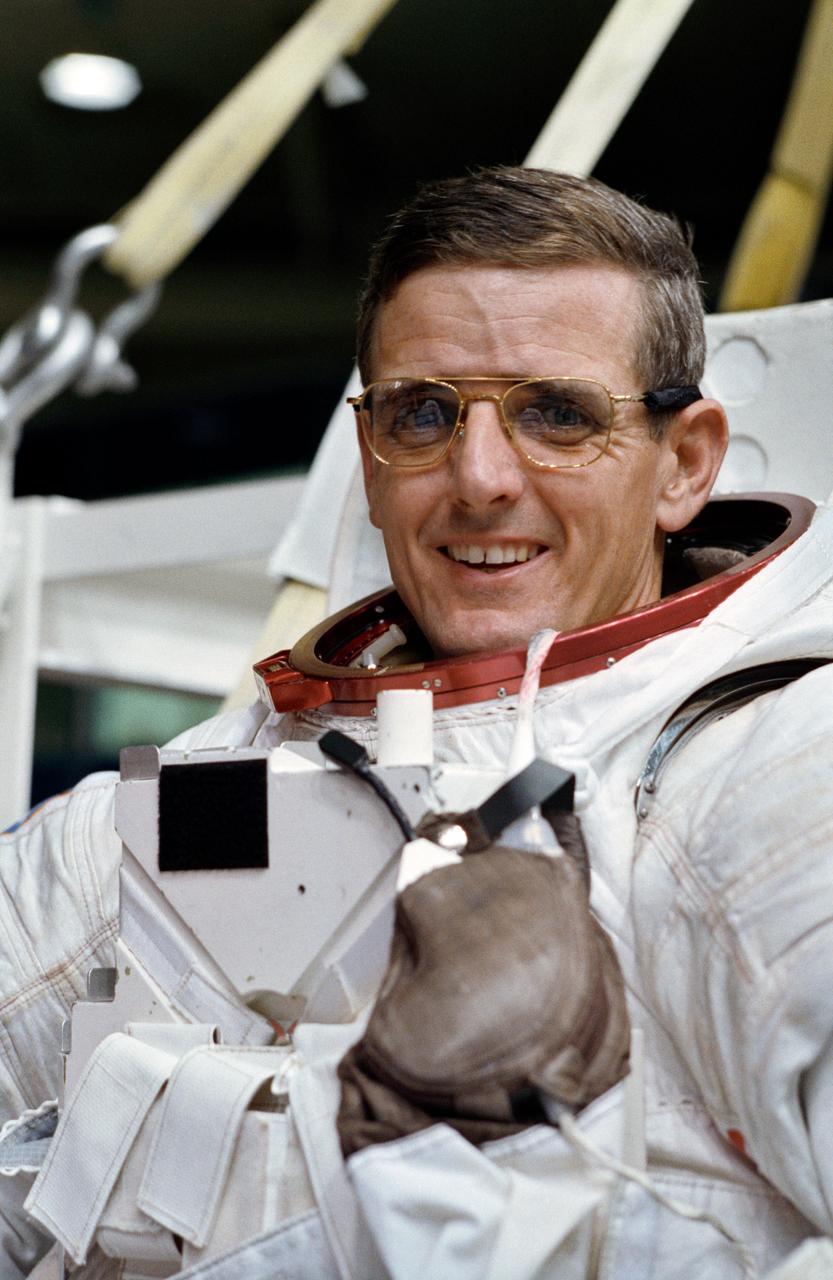
S93-43840 (6 Sept 1993) --- Astronaut William S. McArthur, mission specialist, participates in training for contingency Extravehicular Activity (EVA) for the STS-58 mission. For simulation purposes, McArthur was about to be submerged to a point of neutral buoyancy in the Johnson Space Center's (JSC) Weightless Environment Training Facility (WET-F). Though the Spacelab Life Sciences (SLS-2) mission does not include a planned EVA, all crews designate members to learn proper procedures to perform outside the spacecraft in the event of failure of remote means to accomplish those tasks.
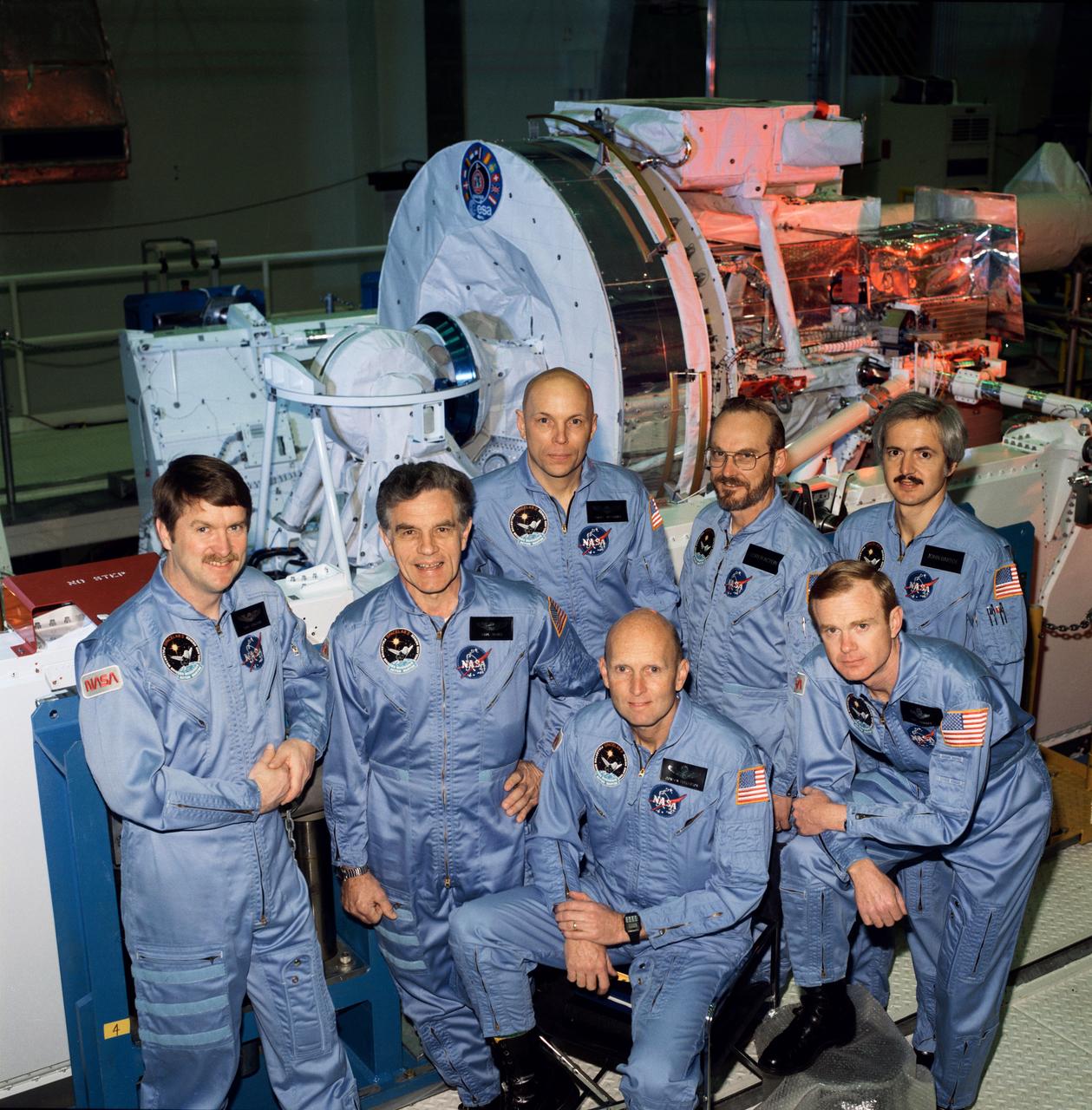
S85-29307 (May 1985) --- The seven crew members for the Space Shuttle STS-51F/Spacelab 2 mission take a pause from a KSC training session to pose for a pre-flight crew portrait. Astronauts C. Gordon Fullerton (kneeling center), mission commander; and Roy D. Bridges (kneeling right), pilot; are flanked by the payload specialists and mission specialists for the mission. Standing (left to right) are astronauts Anthony W. England, Karl J. Henize and Story Musgrave - all mission specialists; and payload specialist Loren Acton and John-David Bartoe.
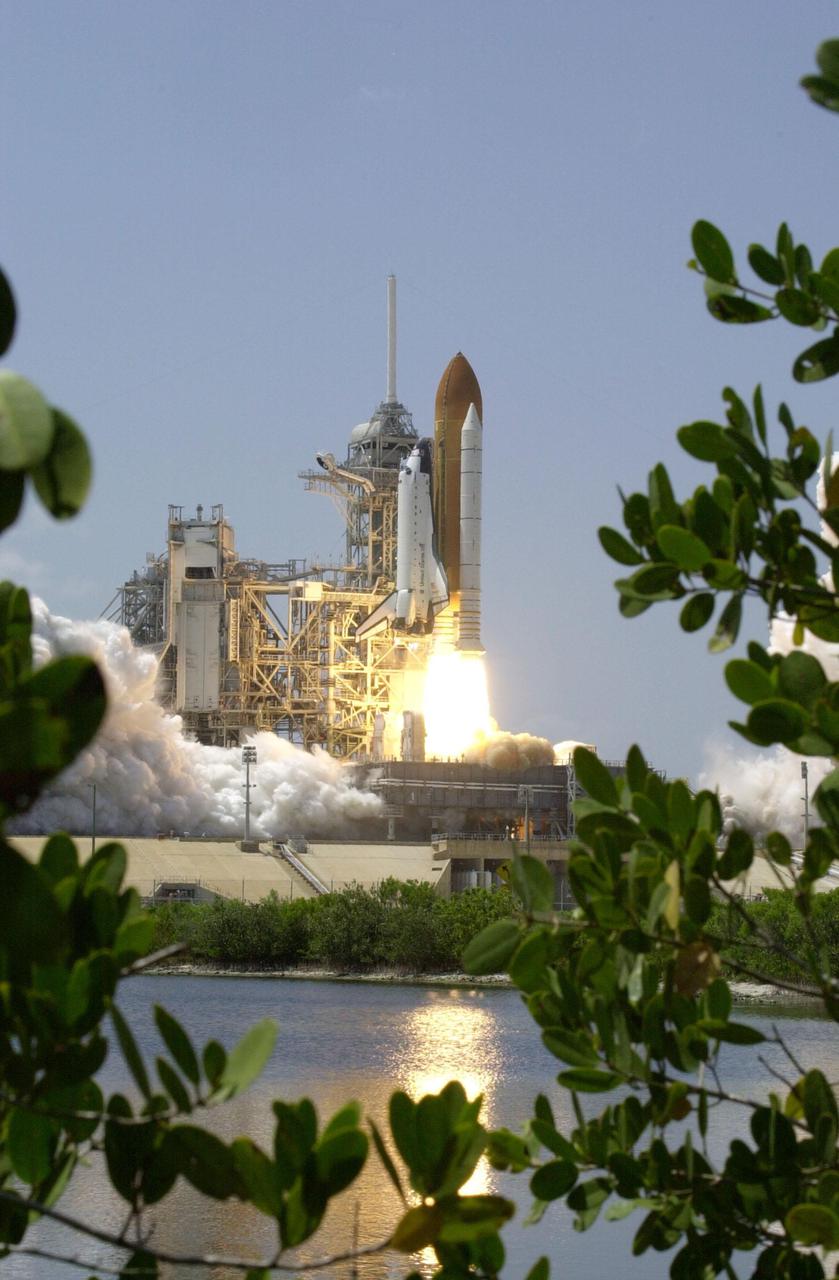
KENNEDY SPACE CENTER, FLA. -- Spring leaves frame the launch of Space Shuttle Endeavour on mission STS-100, the ninth flight to the International Space Station. Liftoff occurred at 2:40:42 p.m. EDT. The 11-day mission will deliver and integrate the Spacelab Logistics Pallet_Launch Deployment Assembly, which includes the Space Station Remote Manipulator System and the UHF Antenna. The mission includes two planned spacewalks for installation of the SSRMS on the Station. Also onboard is the Multi-Purpose Logistics Module Raffaello, carrying resupply stowage racks and resupply_return stowage platform
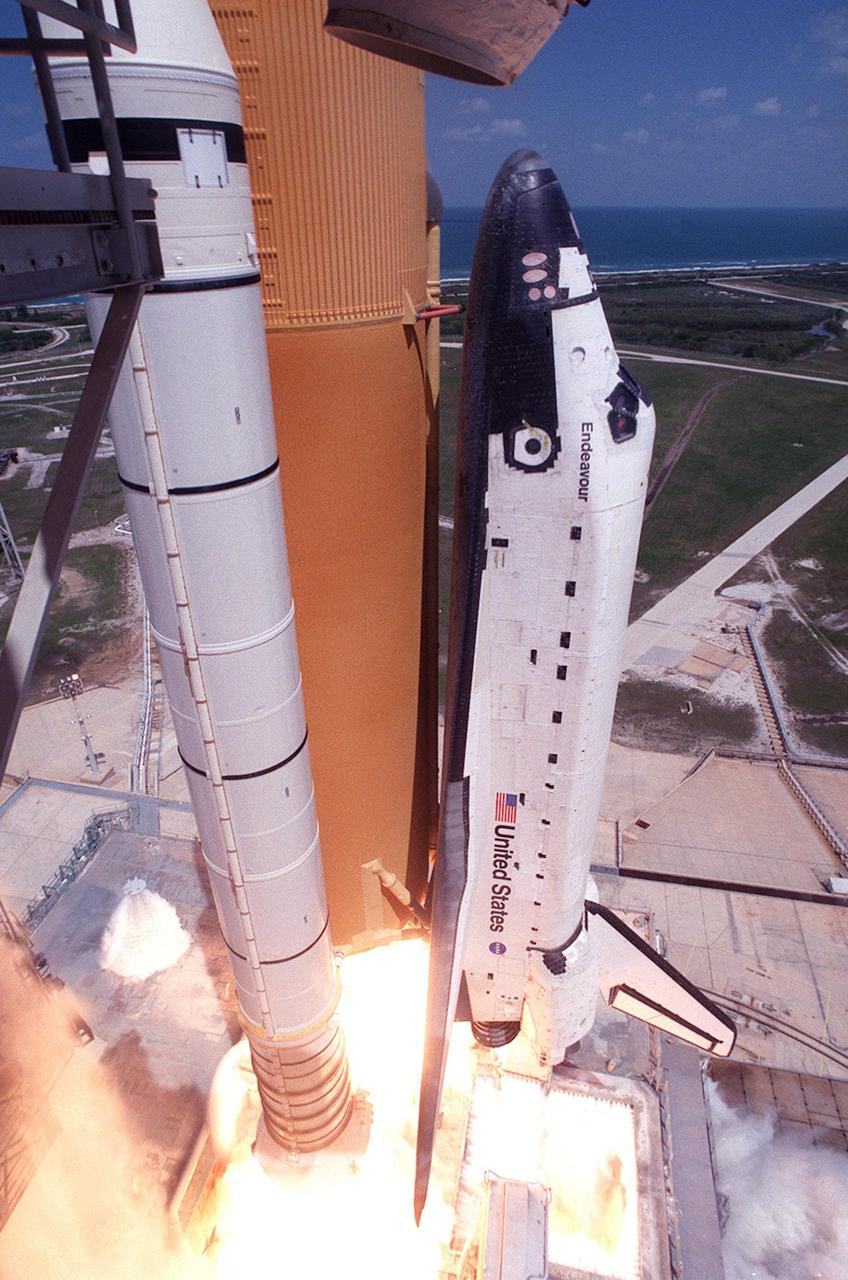
KENNEDY SPACE CENTER, FLA. -- Space Shuttle Endeavour lifts off amid streaming jets of water and steam on mission STS-100. In the background is the Atlantic Ocean. Liftoff of Endeavour on the ninth flight to the International Space Station occurred at 2:40:42 p.m. EDT. The 11-day mission will deliver and integrate the Spacelab Logistics Pallet_Launch Deployment Assembly, which includes the Space Station Remote Manipulator System and the UHF Antenna. The mission includes two planned spacewalks for installation of the SSRMS on the Station. Also onboard is the Multi-Purpose Logistics Module Raffaello, carrying resupply stowage racks and resupply_return stowage platforms
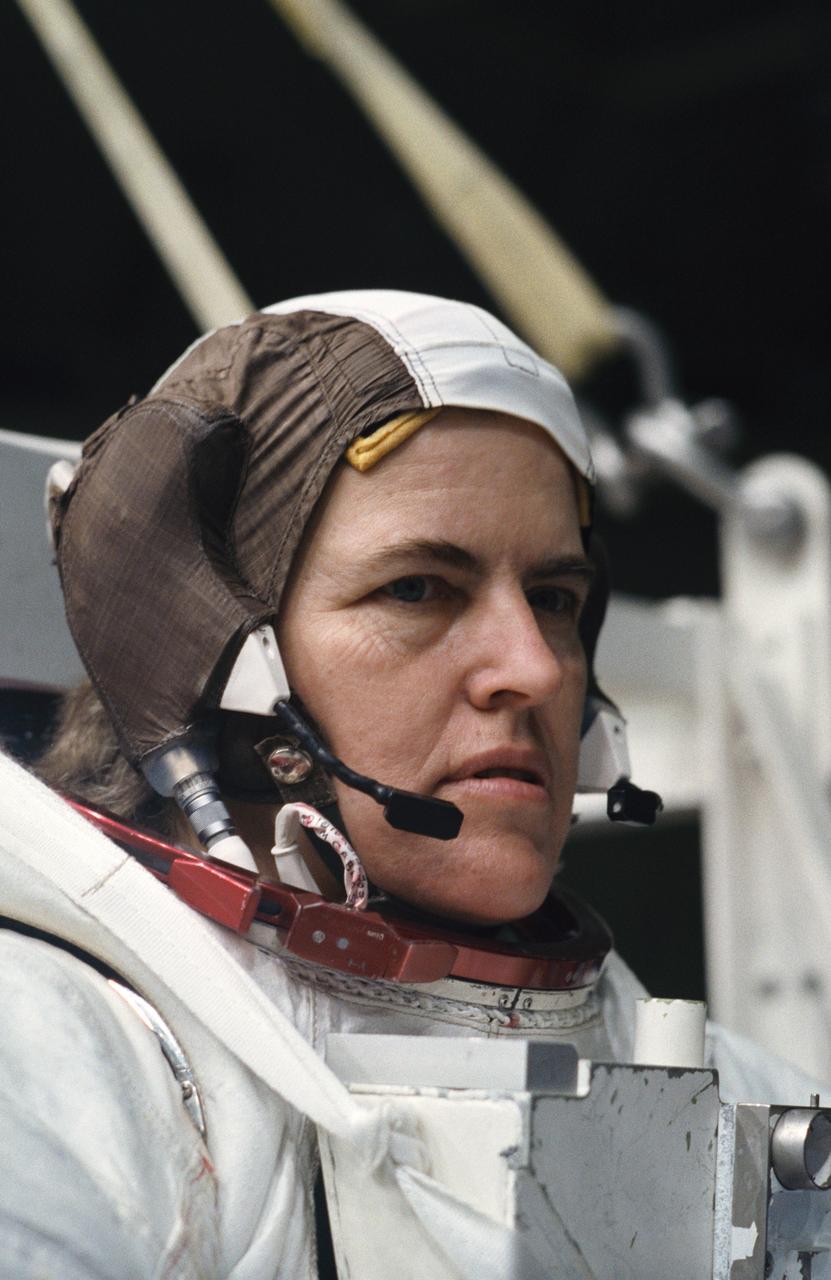
S93-31697 (3 April 1993) --- Astronaut Shannon W. Lucid participates in training for contingency Extravehicular Activity (EVA) for the STS-58 mission. Behind Lucid, sharing a moveable platform with her, is astronaut David A. Wolf (out of frame). For simulation purposes, the two mission specialists were about to be submerged to a point of neutral buoyancy in the Johnson Space Center's (JSC) Weightless Environment Training Facility (WET-F). Though the Spacelab Life Sciences (SLS-2) mission does not include a planned EVA, all crews designate members to learn proper procedures to perform outside the spacecraft in the event of failure of remote means to accomplish those tasks.
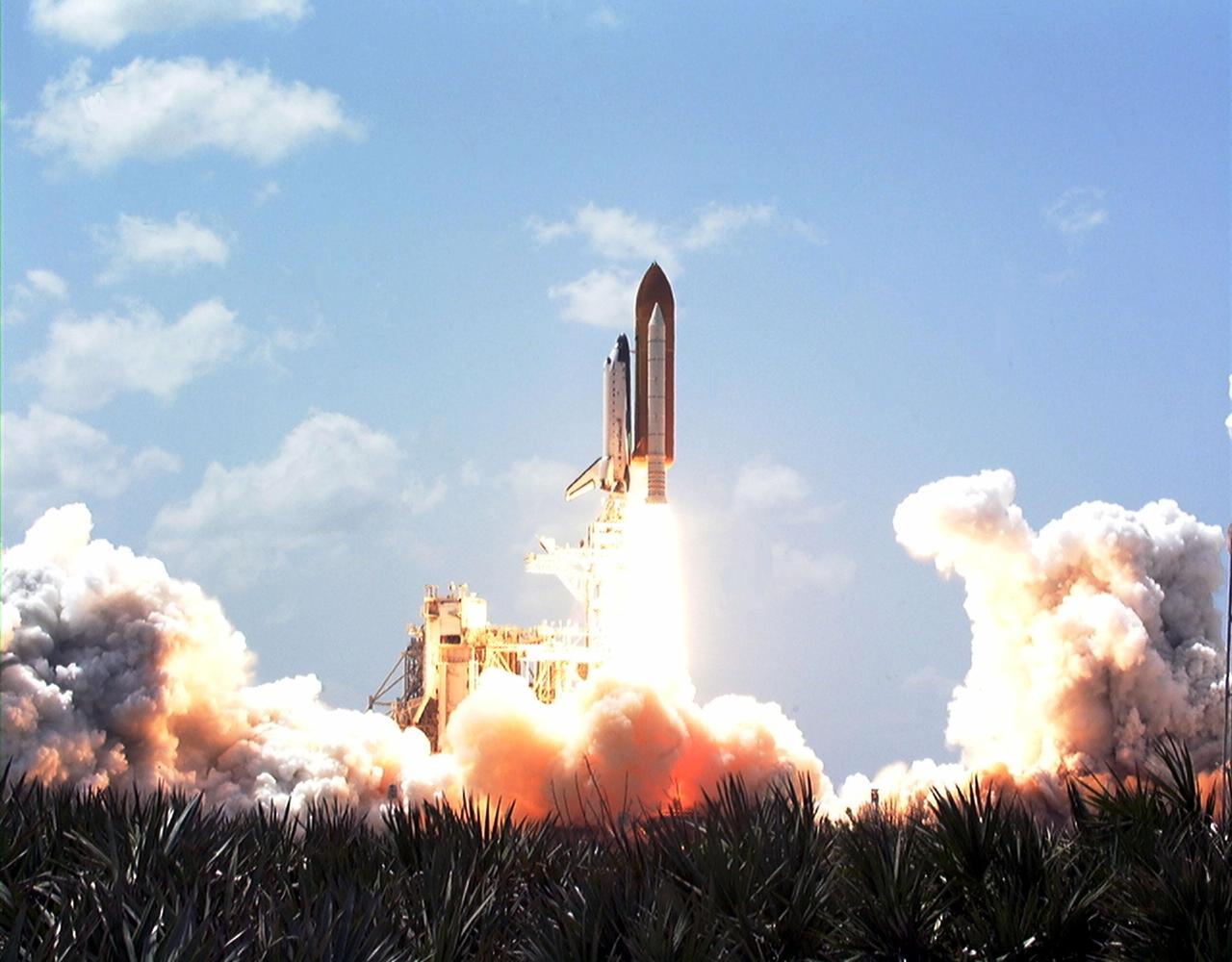
KENNEDY SPACE CENTER, FLA. -- Space Shuttle Endeavour roars into space, leaving orange-hued clouds of smoke and steam behind. Liftoff of the ninth flight to the International Space Station occurred at 2:40:42 p.m. EDT. The 11-day mission will deliver and integrate the Spacelab Logistics Pallet/Launch Deployment Assembly, which includes the Space Station Remote Manipulator System and the UHF Antenna. The mission includes two planned spacewalks for installation of the SSRMS on the Station. Also onboard is the Multi-Purpose Logistics Module Raffaello, carrying resupply stowage racks and resupply/return stowage platforms
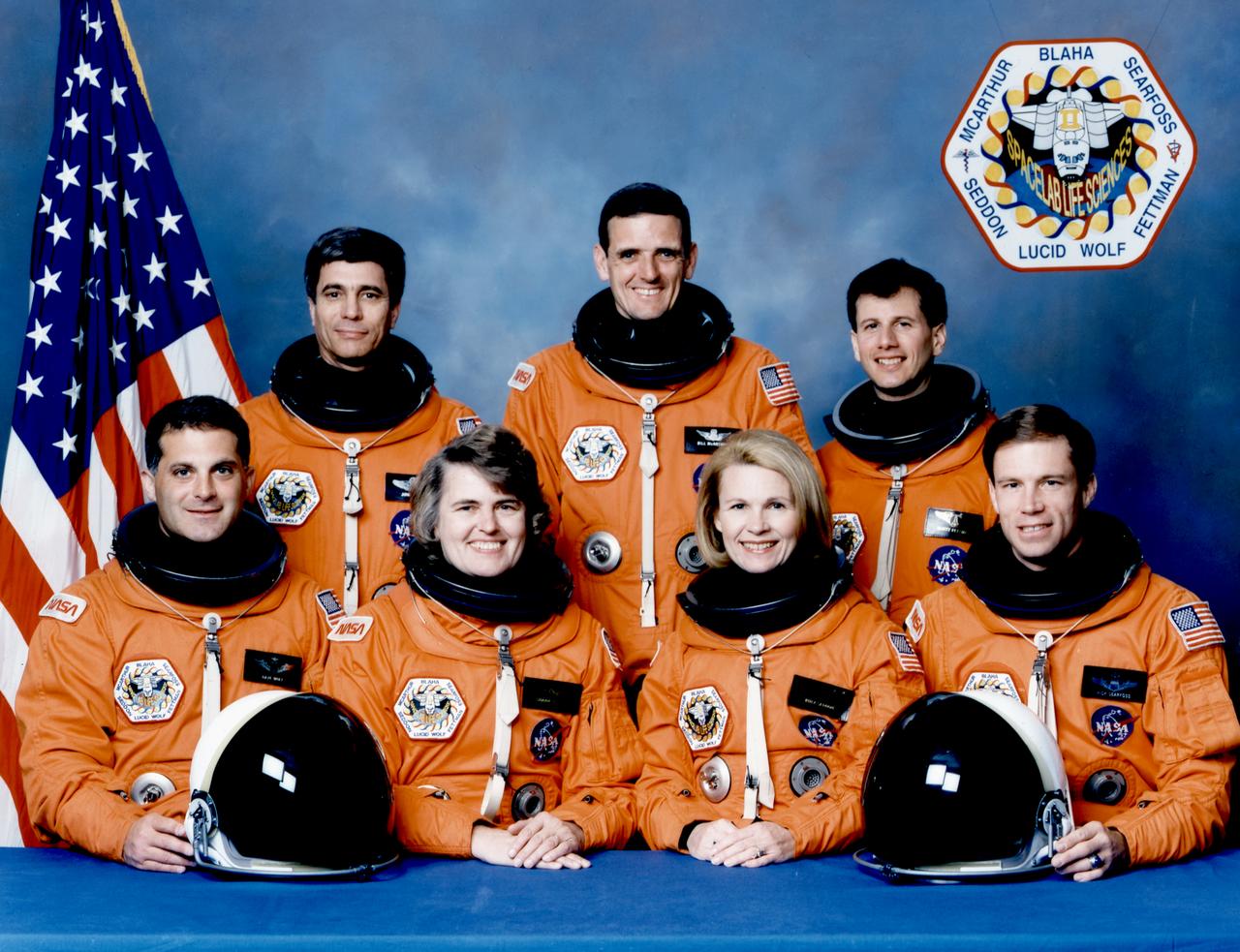
The STS-58 crew portrait includes astronauts (seated left to right) David A. Wolf, Shannon W. Lucid, and Rhea Seddon, all mission specialists; and Richard A. Searfoss, pilot. Standing in the rear, left to right, are John E. Blaha, commander; William S. McArthur, Jr., mission specialist; and Martin J. Fettmen, payload specialist. Launched aboard the Space Shuttle Columbia on October 18, 1993 at 10:53:10 a.m. (EDT), STS-58 served as the second dedicated Spacelab Life Sciences (SLS-2) mission.
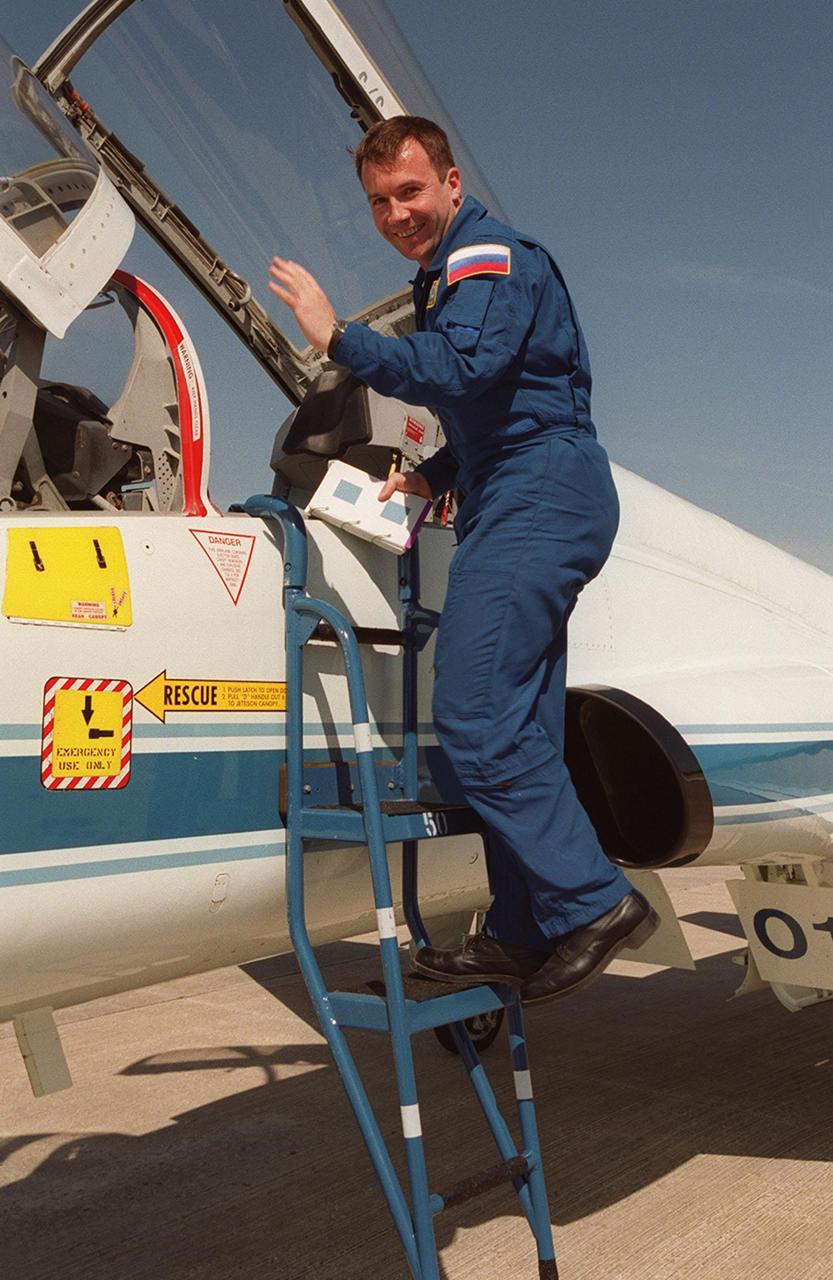
STS-100 Mission Specialist Yuri V. Lonchakov climbs out of the T-38 jet aircraft at the Shuttle Landing Facility. Lonchakov, who is with the Russian Aviation and Space Agency, and the rest of the crew will get ready for launch on April 19. The 11-day mission to the International Space Station will deliver and integrate the Spacelab Logistics Pallet/Launch Deployment Assembly, which includes the Space Station Remote Manipulator system and the UHF Antenna, and the Multi-Purpose Logistics Module Raffaello. Liftoff on mission STS-100 is scheduled at 2:41 p.m. EDT April 19
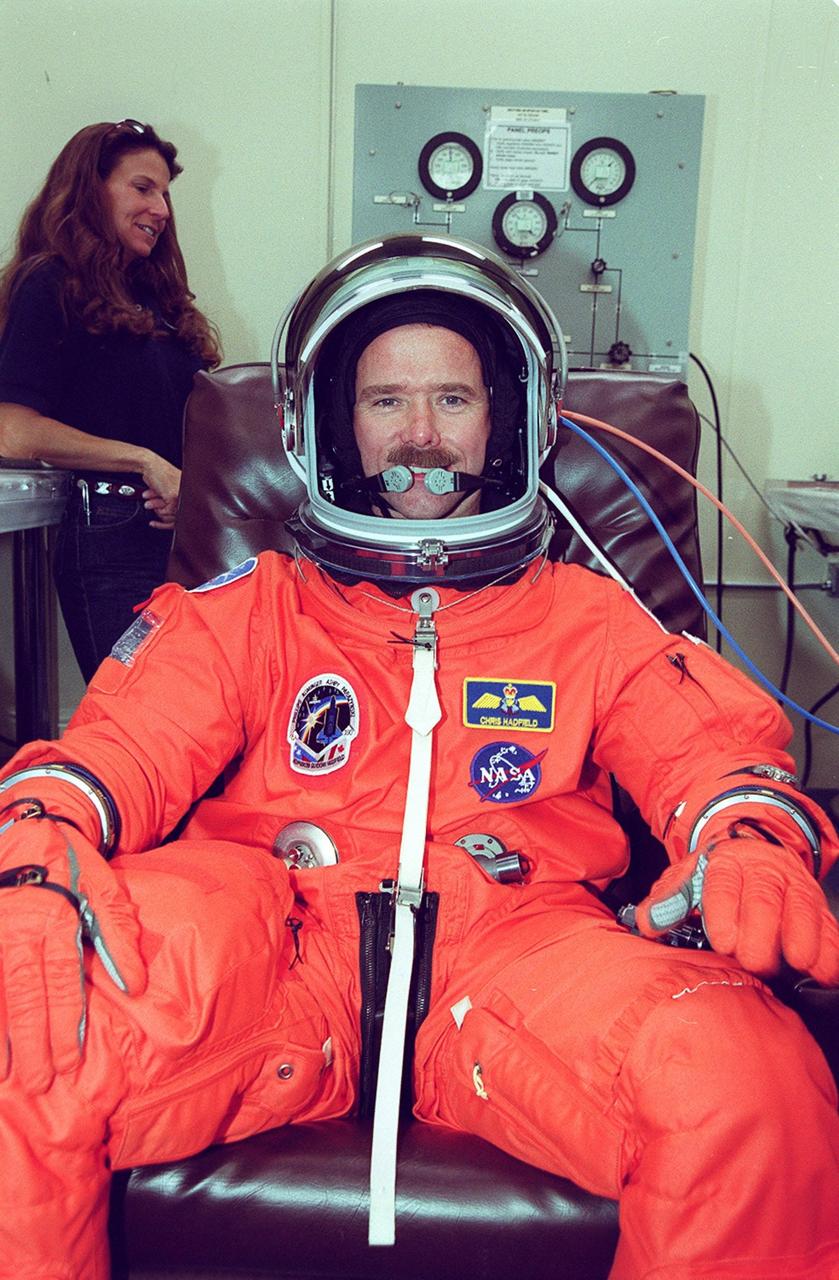
STS-100 Mission Specialist Chris A. Hadfield is ready for launch after suiting up in the Operations and Checkout Building. Hadfield is with the Canadian Space Agency. The 11-day mission to the International Space Station will deliver and integrate the Spacelab Logistics Pallet/Launch Deployment Assembly, which includes the Space Station Remote Manipulator system and the UHF Antenna, and the Multi-Purpose Logistics Module Raffaello. The mission includes two planned spacewalks for installation of the SSRMS. The mission is also the inaugural flight of Raffaello, carrying resupply stowage racks and resupply/return stowage platforms. Liftoff on mission STS-100 is scheduled at 2:41 p.m. EDT April 19
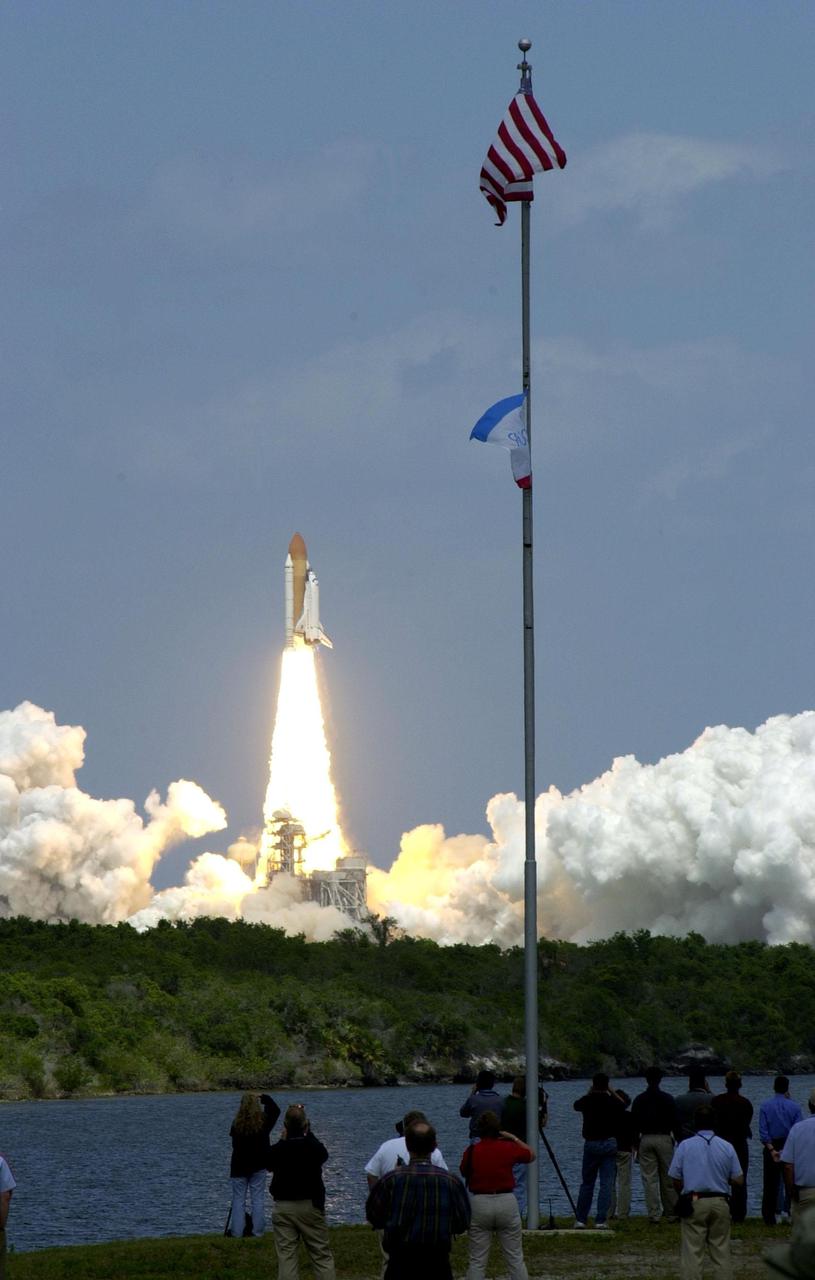
KENNEDY SPACE CENTER, FLA. -- Through a cloud-brushed blue sky, Space Shuttle Endeavour is hurled into space on mission STS-100. Photographers crowd the bank of the turn basin near the flag pole to capture the image on film and video. Liftoff occurred at 2:40:42 p.m. EDT on the ninth flight to the International Space Station. The 11-day mission will deliver and integrate the Spacelab Logistics Pallet_Launch Deployment Assembly, which includes the Space Station Remote Manipulator System and the UHF Antenna. The mission includes two planned spacewalks for installation of the SSRMS on the Station. Also onboard is the Multi-Purpose Logistics Module Raffaello, carrying resupply stowage racks and resupply_return stowage platforms
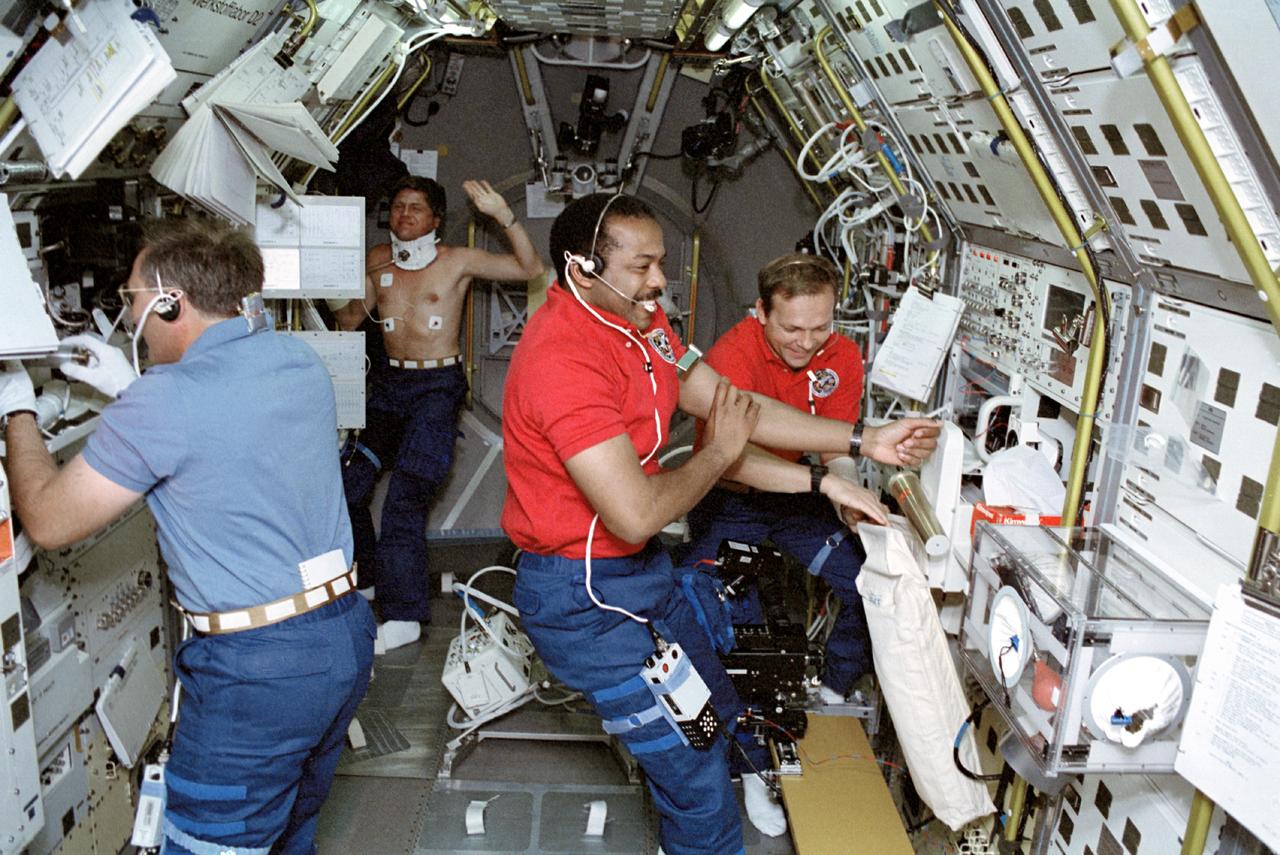
STS055-22-004 (26 April-6 May 1993) --- Four of the seven crew members who spent 10 days aboard the Space Shuttle Columbia are pictured during a brief shift overlap period in the Spacelab D-2 Science Module. Left to right are Jerry L. Ross, Ulrich Walter, Bernard A. Harris, Jr. and Hans Schlegel. Ross, STS-55 payload commander, is changing a sample in a materials processing furnace; Walter, a German payload specialist is in the midst of a baroreflex test and fellow payload specialist Schlegel assists mission specialist and physician Harris with a physiological test at the "Anthrorack".
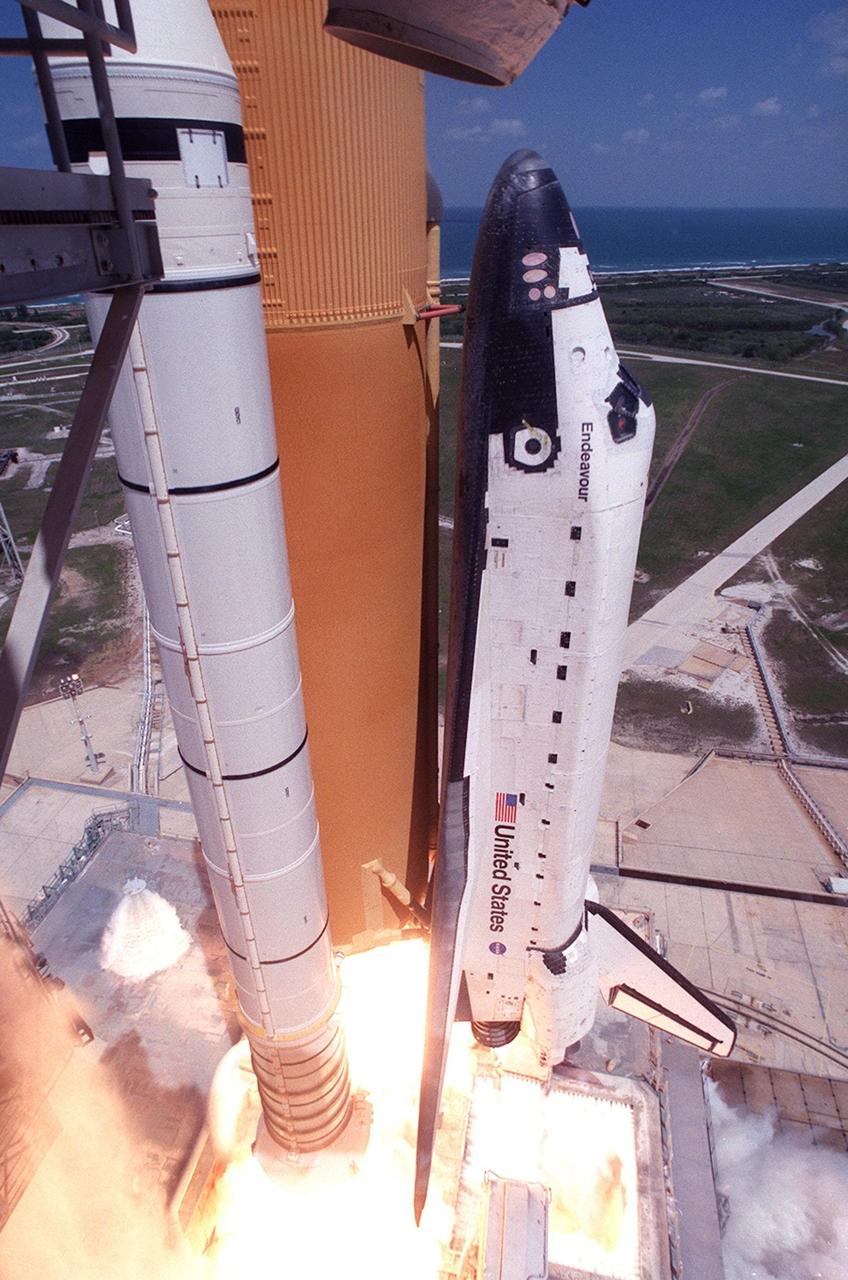
KENNEDY SPACE CENTER, FLA. -- Space Shuttle Endeavour lifts off amid streaming jets of water and steam on mission STS-100. In the background is the Atlantic Ocean. Liftoff of Endeavour on the ninth flight to the International Space Station occurred at 2:40:42 p.m. EDT. The 11-day mission will deliver and integrate the Spacelab Logistics Pallet/Launch Deployment Assembly, which includes the Space Station Remote Manipulator System and the UHF Antenna. The mission includes two planned spacewalks for installation of the SSRMS on the Station. Also onboard is the Multi-Purpose Logistics Module Raffaello, carrying resupply stowage racks and resupply/return stowage platforms
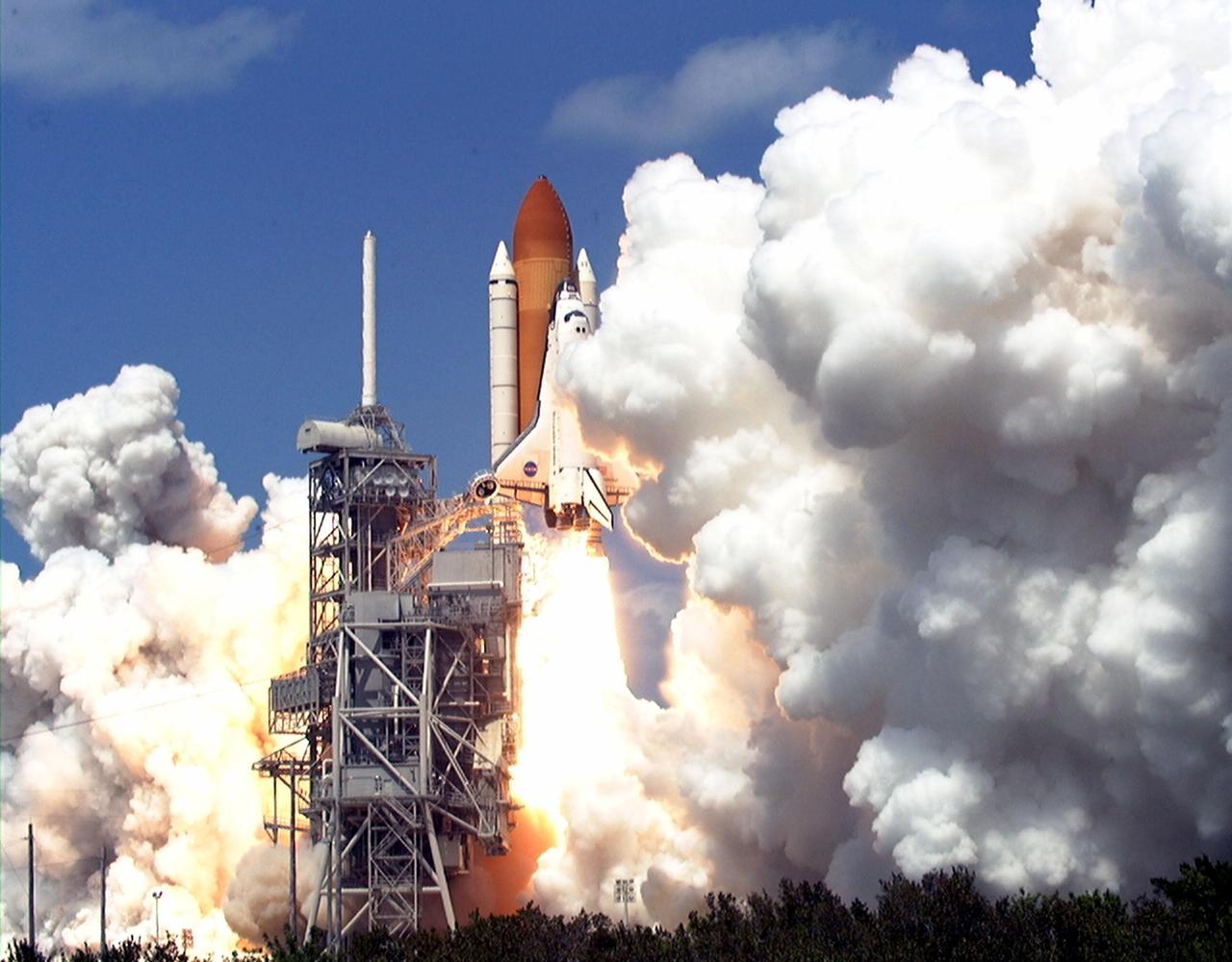
KENNEDY SPACE CENTER, FLA. -- Billows of steam almost obscure Space Shuttle Endeavour as it roars off Launch Pad 39A on mission STS-100. Liftoff of the ninth flight to the International Space Station occurred at 2:40:42 p.m. EDT. The 11-day mission will deliver and integrate the Spacelab Logistics Pallet/Launch Deployment Assembly, which includes the Space Station Remote Manipulator System and the UHF Antenna. The mission includes two planned spacewalks for installation of the SSRMS on the Station. Also onboard is the Multi-Purpose Logistics Module Raffaello, carrying resupply stowage racks and resupply/return stowage platforms
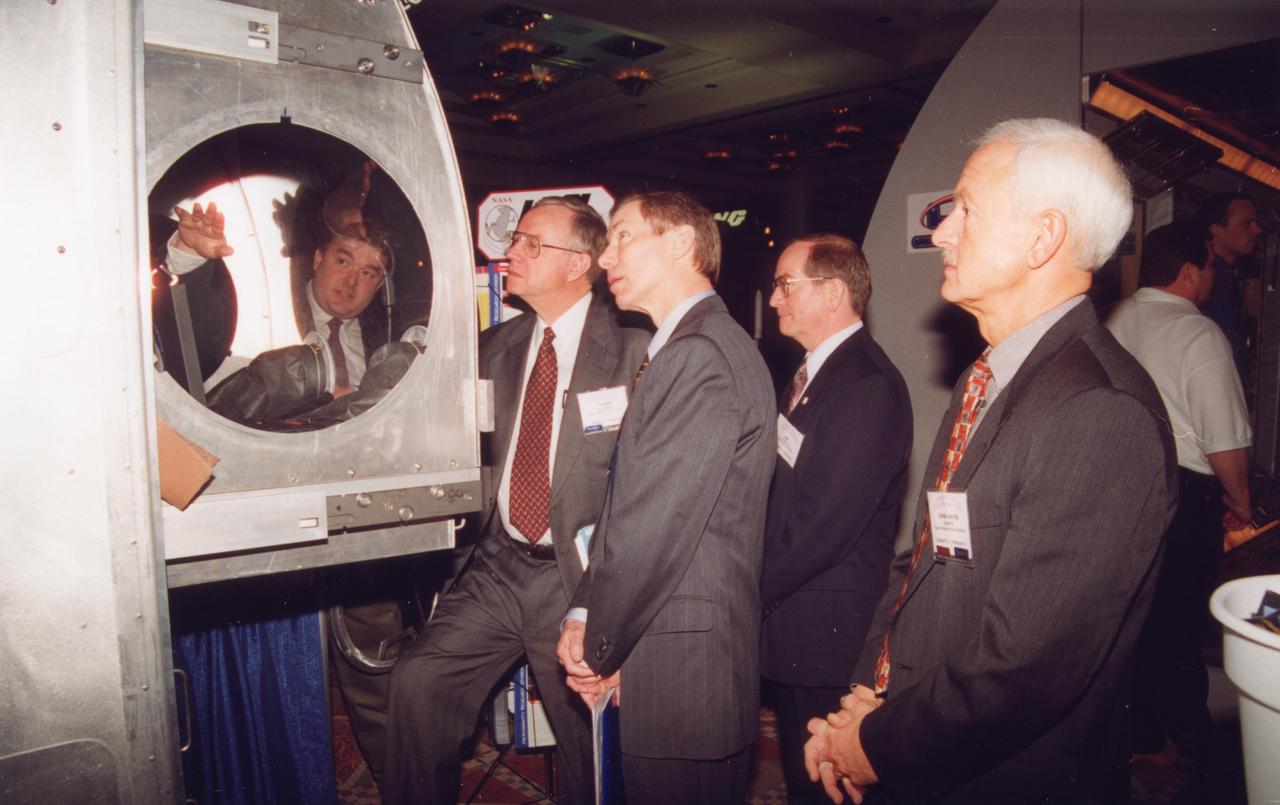
Tim Broach (seen through window) of NASA/Marshall Spce Flight Center (MSFC), demonstrates the working volume inside the Microgravity Sciences Glovebox being developed by the European Space Agency (ESA) for use aboard the U.S. Destiny laboratory module on the International Space Station (ISS). This mockup is the same size as the flight hardware. Observing are Tommy Holloway and Brewster Shaw of The Boeing Co. (center) and John-David Bartoe, ISS research manager at NASA/John Space Center and a payload specialist on Spacelab-2 mission (1985). Photo crdit: NASA/Marshall Space Flight Center (MSFC)

KENNEDY SPACE CENTER, FLA. -- Flames from Space Shuttle Endeavour light up the clouds as the Shuttle races into space on mission STS-100. Liftoff of Endeavour on the ninth flight to the International Space Station occurred at 2:40:42 p.m. EDT. The 11-day mission will deliver and integrate the Spacelab Logistics Pallet/Launch Deployment Assembly, which includes the Space Station Remote Manipulator System and the UHF Antenna. The mission includes two planned spacewalks for installation of the SSRMS on the Station. Also onboard is the Multi-Purpose Logistics Module Raffaello, carrying resupply stowage racks and resupply/return stowage platforms