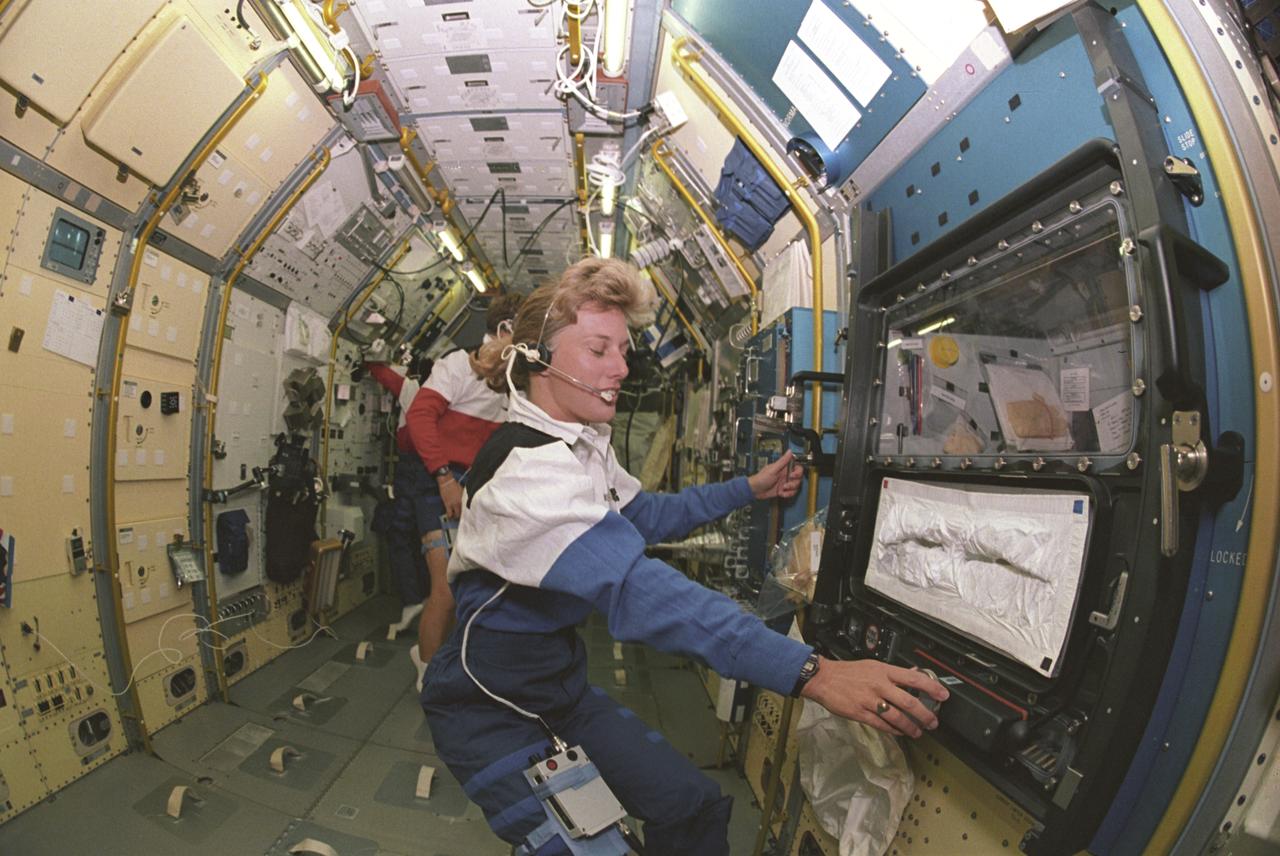
Space Shuttle Endeavour (STS-47) onboard photo of Astronaut Jan Davis inside the Spacelab-J module. Spacelab-J is a combined National Space Development Agency of Japan (NASDA) and NASA mission. The objectives included life sciences, microgravity and technology research.
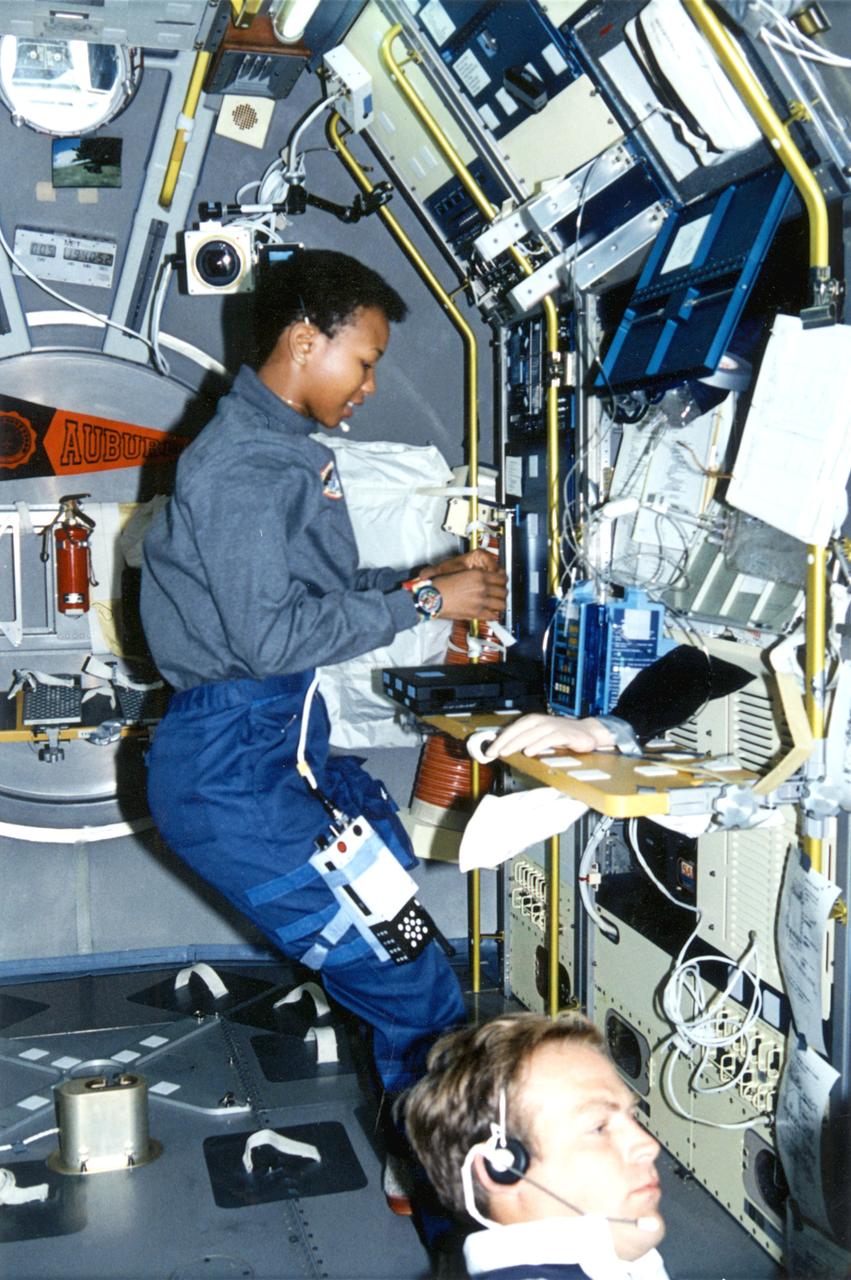
Astronaut Mae Jemison on Spacelab-J.

This photograph of aurora borealis, northern aurora, was taken during the Spacelab-J (SL-J) mission (STS-47). People who live in the northernmost areas like Alaska or work in the southernmost regions like Antarctica often see colorful lights produced by Earth's natural electromagnetic generator; these shimmering expanses of light are auroras, commonly called the northern and southern lights. Charged particles from the magnetosphere follow magnetic fields and are accelerated toward Earth at the magnetic poles where they strike molecules in the upper atmosphere, staining the sky with the red and green lights of oxygen and hydrogen, and the purples and pinks of nitrogen. The altitude and inclination of the Spacelab will give scientists unique views of auroras, which occur at altitudes ranging from about 90 to 300 kilometers (56 to 186 miles). Most views of the auroras have been from the ground where only limited parts can be seen. These Spacelab views will give scientists information on their complex structure and chemical composition. The Spacelab-J was a joint mission of NASA and the National Space Development Agency of Japan (NASDA) utilizing a marned Spacelab module. The mission conducted microgravity investigations in materials and life sciences. The SL-J was launched aboard the Space Shuttle Orbiter Endeavour (STS-47) on September 12, 1992.
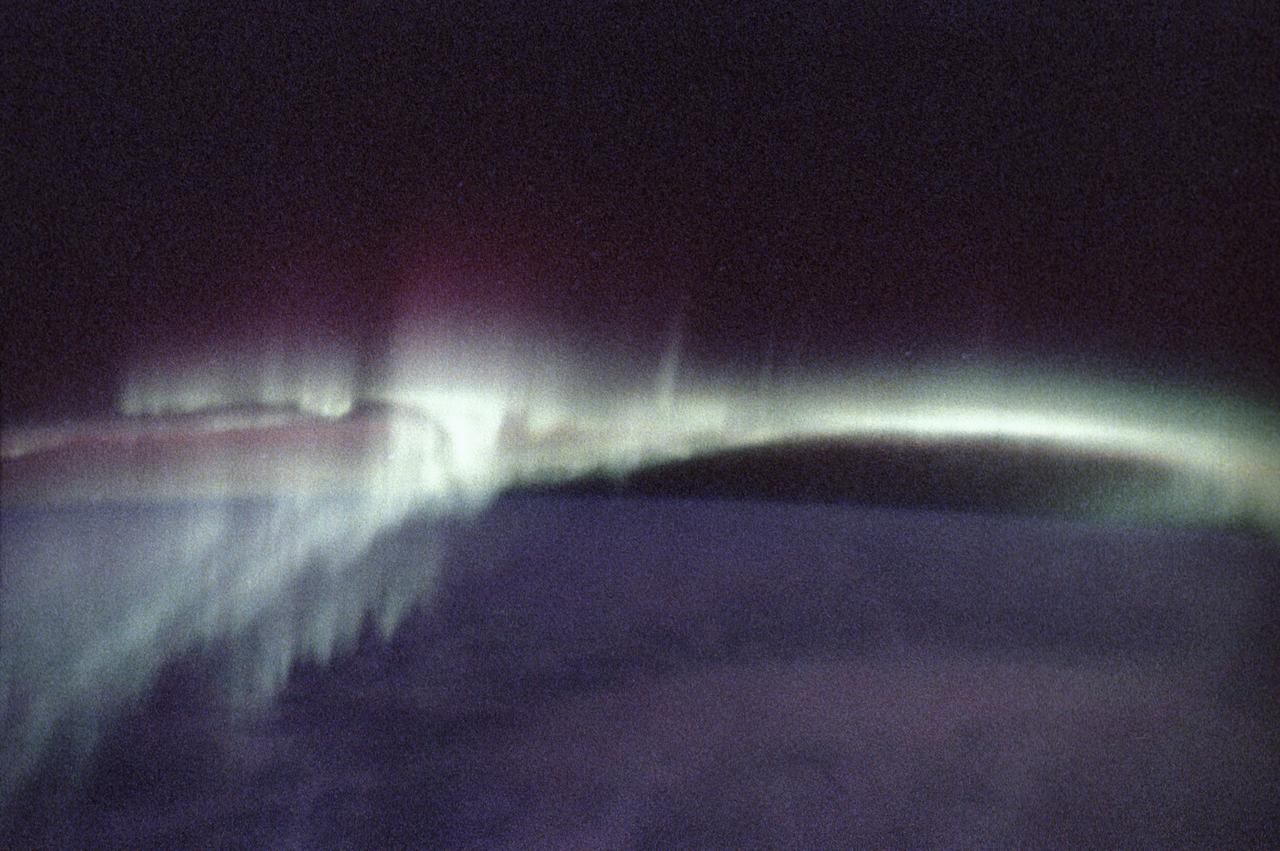
This photograph of aurora borealis, northern aurora, was taken during the Spacelab-J (SL-J) mission (STS-47). People who live in the northernmost areas like Alaska or work in the southernmost regions like Antarctica often see colorful lights produced by Earth's natural electromagnetic generator; these shimmering expanses of light are auroras, commonly called the northern and southern lights. Charged particles from the magnetosphere follow magnetic fields and are accelerated toward Earth at the magnetic poles where they strike molecules in the upper atmosphere, staining the sky with the red and green lights of oxygen and hydrogen, and the purples and pinks of nitrogen. The altitude and inclination of the Spacelab will give scientists unique views of auroras, which occur at altitudes ranging from about 90 to 300 kilometers (56 to 186 miles). Most views of the auroras have been from the ground where only limited parts can be seen. These Skylab views will give scientists information on their complex structure and chemical composition. The Spacelab-J was a joint mission of NASA and the National Space Development Agency of Japan (NASDA) utilizing a marned Spacelab module. The mission conducted microgravity investigations in materials and life sciences. The SL-J was launched aboard the Space Shuttle Orbiter Endeavour (STS-47) on September 12, 1992.
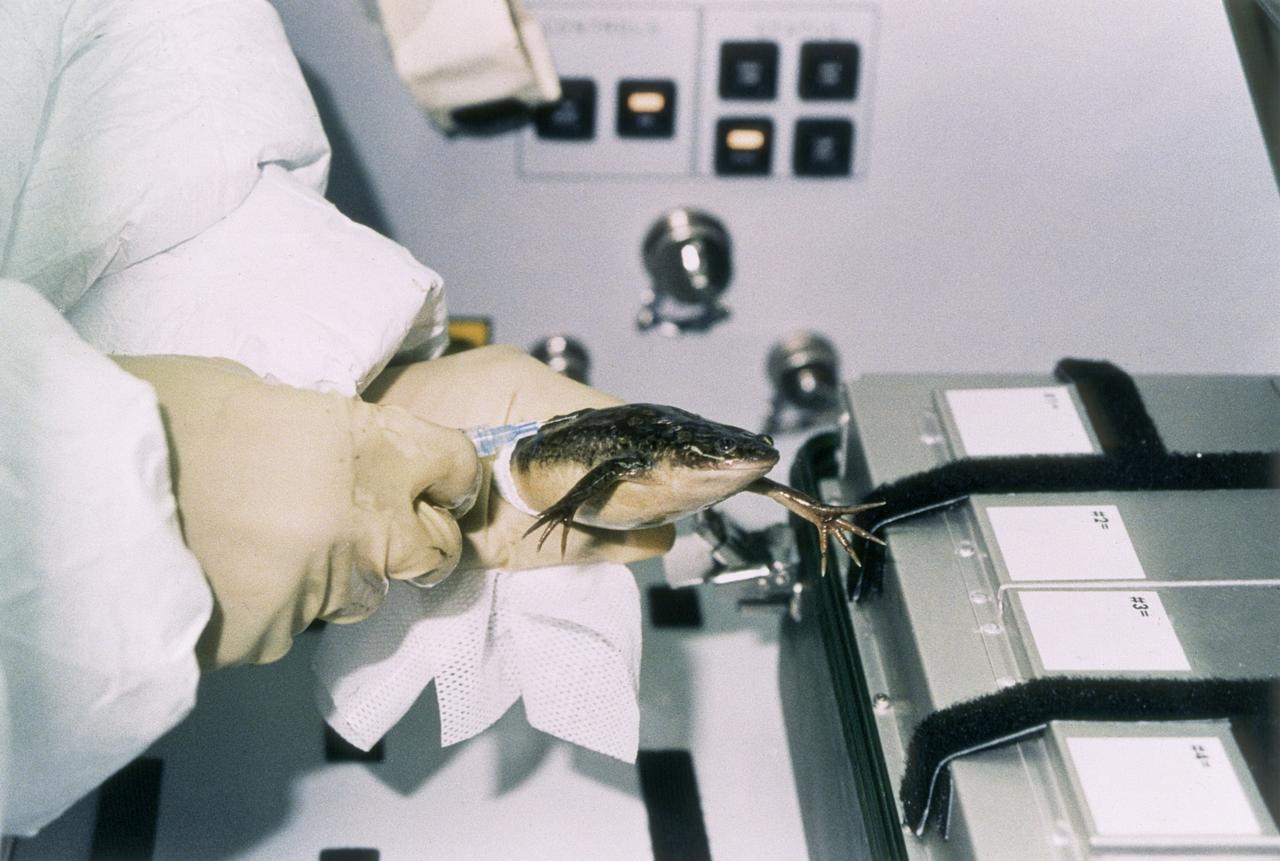
The Spacelab-J (SL-J) mission was a joint venture between NASA and the National Space Development Agency of Japan (NASDA) utilizing a marned Spacelab module. Materials science investigations covered such fields as biotechnology, electronic materials, fluid dynamics and transport phenomena, glasses and ceramics, metals and alloys, and acceleration measurements. Life sciences included experiments on human health, cell separation and biology, developmental biology, animal and human physiology and behavior, space radiation, and biological rhythms. Before long-term space ventures are attempted, numerous questions must be answered: how will gravity play in the early development of an organism, and how will new generations of a species be conceived and develop normally in microgravity. The Effects of Weightlessness on the Development of Amphibian Eggs Fertilized in Space experiment aboard SL-J examined aspects of these questions. To investigate the effect of microgravity on amphibian development, female frogs carried aboard SL-J were induced to ovulate and shed eggs. These eggs were then fertilized in the microgravity environment. Half were incubated in microgravity, while the other half were incubated in a centrifuge that spins to simulate normal gravity. This photograph shows an astronaut working with one of the adult female frogs inside the incubator. The mission also examined the swimming behavior of tadpoles grown in the absence of gravity. The Spacelab-J was launched aboard the Space Shuttle Orbiter Endeavour on September 12, 1992.
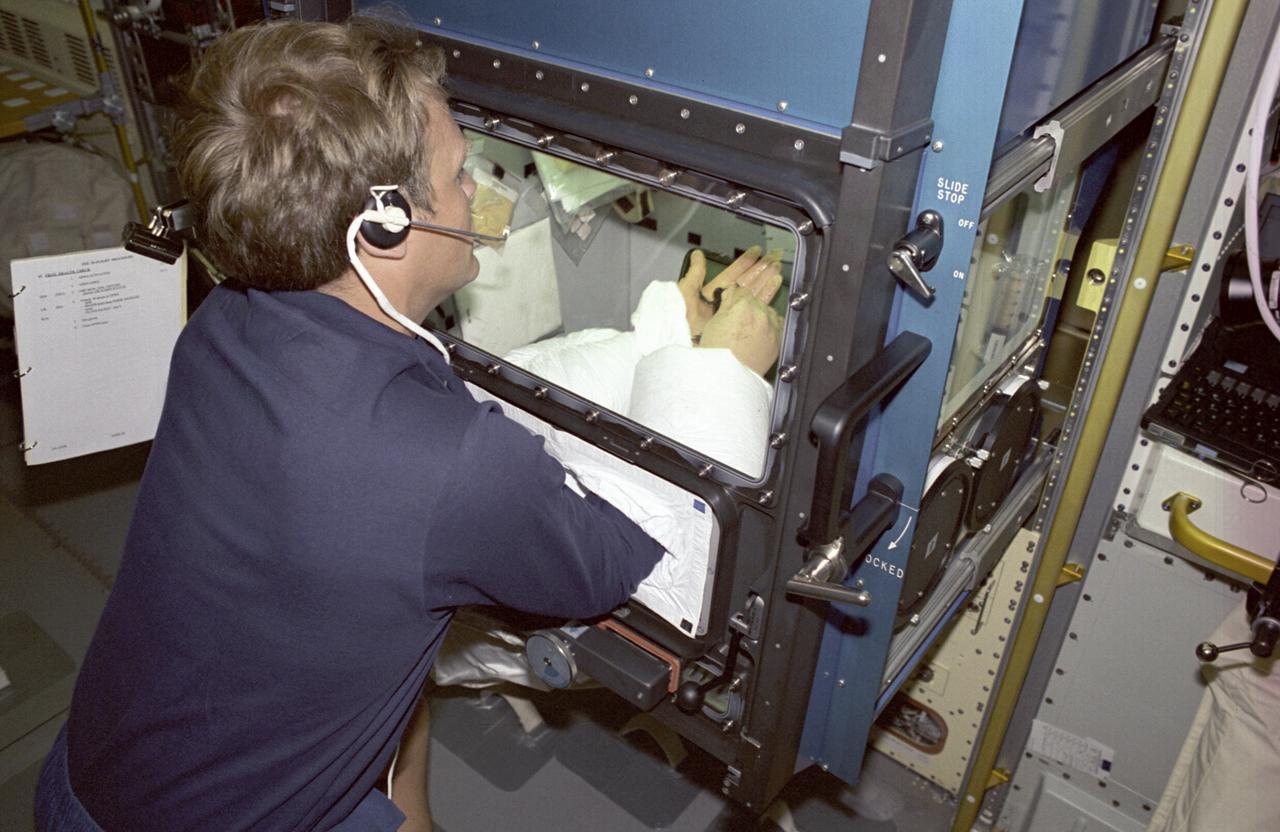
The Spacelab-J (SL-J) mission was a joint venture between NASA and the National Space Development Agency of Japan (NASDA) utilizing a marned Spacelab module. Materials science investigations covered such fields as biotechnology, electronic materials, fluid dynamics and transport phenomena, glasses and ceramics, metals and alloys, and acceleration measurements. Life sciences included experiments on human health, cell separation and biology, developmental biology, animal and human physiology and behavior, space radiation, and biological rhythms. Before long-term space ventures are attempted, numerous questions must be answered: how will gravity play in the early development of an organism, and how will new generations of a species be conceived and develop normally in microgravity. The Effects of Weightlessness on the Development of Amphibian Eggs Fertilized in Space experiment aboard SL-J examined aspects of these questions. To investigate the effect of microgravity on amphibian development, female frogs carried aboard SL-J were induced to ovulate and shed eggs. These eggs were then fertilized in the microgravity environment. Half were incubated in microgravity, while the other half were incubated in a centrifuge that spins to simulate normal gravity. This photograph shows astronaut Mark Lee working with one of the adult female frogs inside the incubator. The mission also examined the swimming behavior of tadpoles grown in the absence of gravity. The Spacelab-J was launched aboard the Space Shuttle Orbiter Endeavour on September 12, 1992.
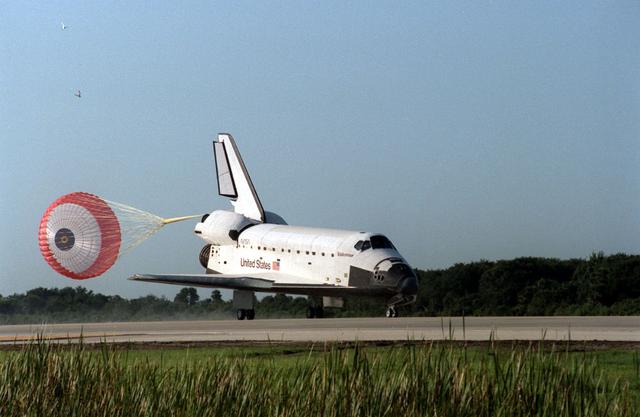
After completion of a seven-day flight mission, the Space Shuttle Orbiter Endeavour (STS-47) landed at Kennedy Space Center's (KSC) Shuttle Landing Facility. Spacelab-J, a joint research venture between NASA and NASDA (National Space Development Agency of Japan) completed a successful mission.
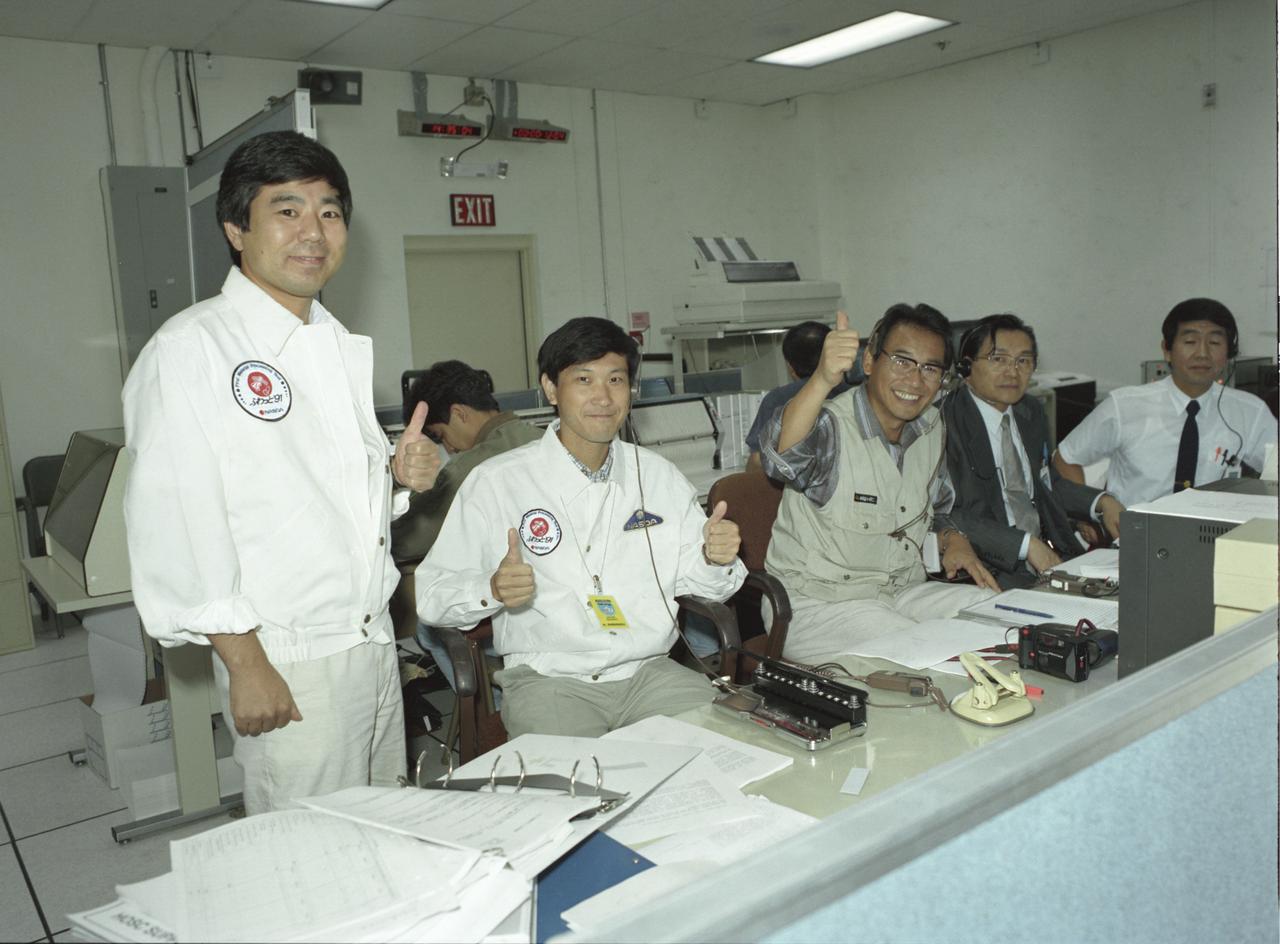
The group of Japanese researchers of the Spacelab-J (SL-J) were thumbs-up in the Payload Operations Control Center (POCC) at the Marshall Space Flight Center after the successful launch of Space Shuttle Orbiter Endeavour that carried their experiments. The SL-J was a joint mission of NASA and the National Space Development Agency of Japan (NASDA) utilizing a marned Spacelab module. The mission conducted microgravity investigations in materials and life sciences. Materials science investigations covered such fields as biotechnology, electronic materials, fluid dynamics and transport phenomena, glasses and ceramics, metals and alloys, and acceleration measurements. Life sciences included experiments on human health, cell separation and biology, developmental biology, animal and human physiology and behavior, space radiation, and biological rhythms. Test subjects included the crew, Japanese koi fish (carp), cultured animal and plant cells, chicken embryos, fruit flies, fungi and plant seeds, frogs, and frog eggs. The POCC was the air/ground communications channel between the astronauts and ground control teams during the Spacelab missions. The Spacelab science operations were a cooperative effort between the science astronaut crew in orbit and their colleagues in the POCC. Spacelab-J was launched aboard the Space Shuttle Orbiter Endeavour on September 12, 1992.
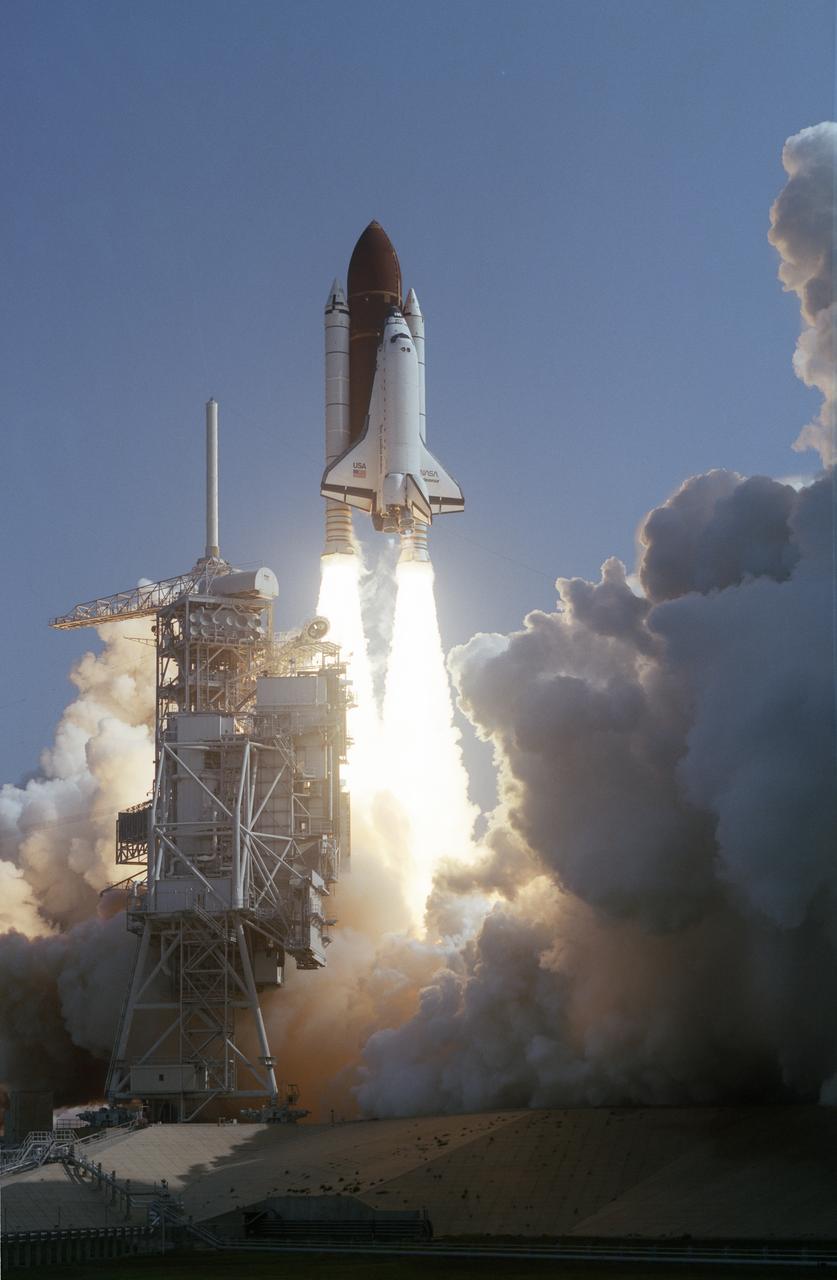
A smooth countdown culminated in a picture-perfect launch as the Space Shuttle Orbiter Endeavour (STS-47) climbed skyward atop a ladder of billowing smoke on September 12, 1992. The primary payload for the plarned seven-day flight was the Spacelab-J science laboratory. The second flight of Endeavour marks a number of historic firsts: the first space flight of an African-American woman, the first Japanese citizen to fly on a Space Shuttle, and the first married couple to fly in space.
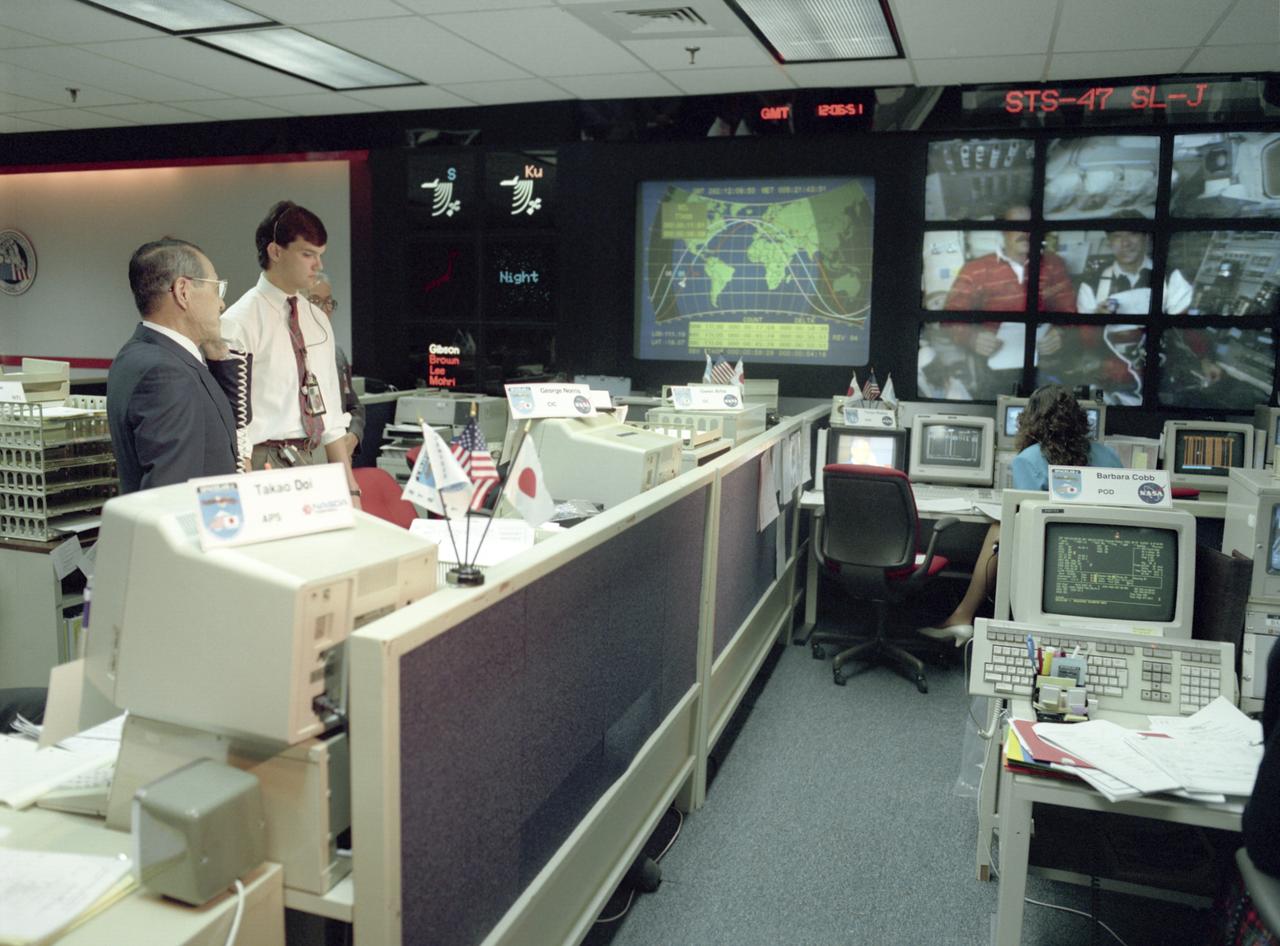
The science laboratory, Spacelab-J (SL-J), flown aboard the STS-47 flight was a joint venture between NASA and the National Space Development Agency of Japan (NASDA) utilizing a manned Spacelab module. The mission conducted 24 materials science and 20 life science experiments, of which 35 were sponsored by NASDA, 7 by NASA, and two collaborative efforts. Materials science investigations covered such fields as biotechnology, electronic materials, fluid dynamics and transport phenomena, glasses and ceramics, metals and alloys, and acceleration measurements. Life sciences included experiments on human health, cell separation and biology, developmental biology, animal and human physiology and behavior, space radiation, and biological rhythms. Test subjects included the crew, Japanese koi fish (carp), cultured animal and plant cells, chicken embryos, fruit flies, fungi and plant seeds, and frogs and frog eggs. From the Huntsville Operations Support Center (HOSC) Spacelab Payload Operations Control Center (SL POCC), NASDA President, Mr. Yamano, speaks to Payload Specialist Mamoru Mohri, a Japanese crew member aboard the STS-47 Spacelab J mission.
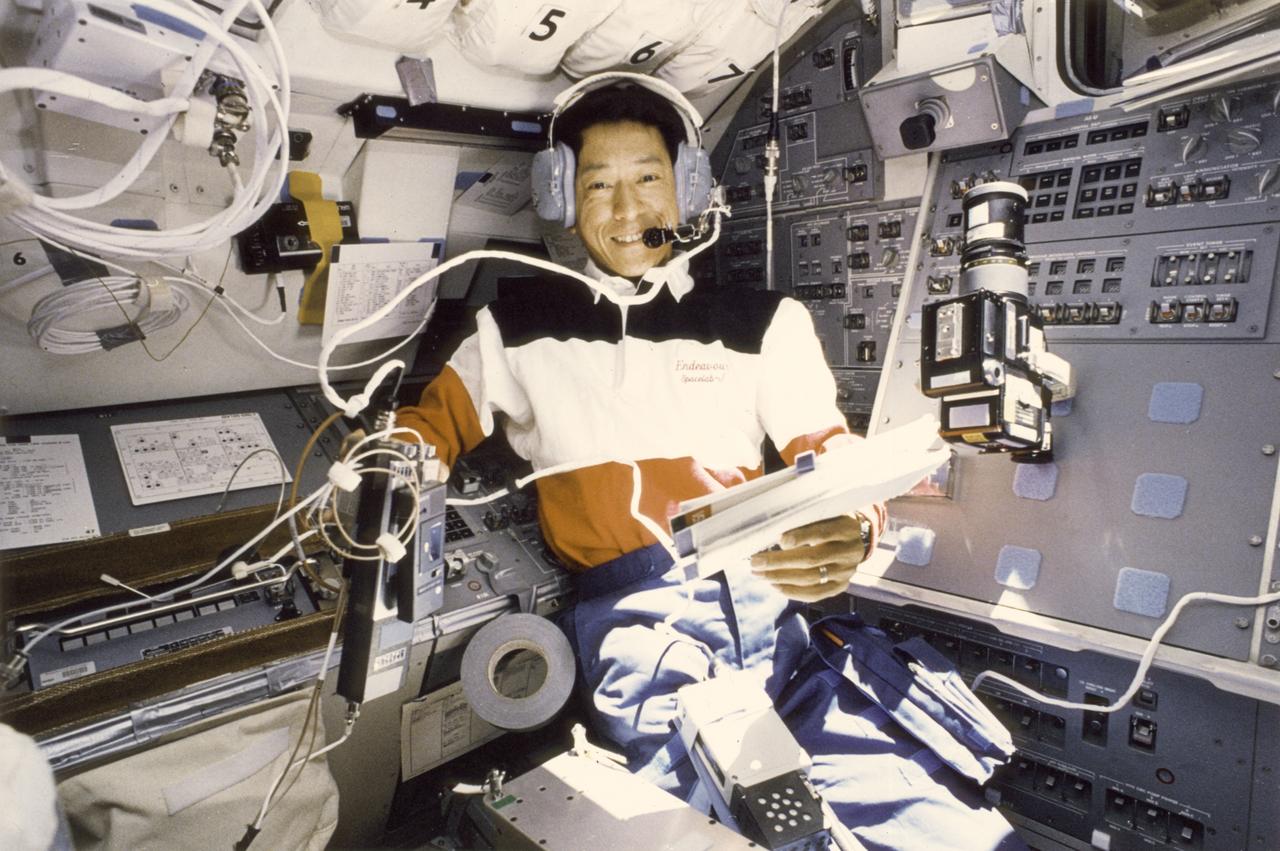
Japanese astronaut, Mamoru Mohri, talks to Japanese students from the aft flight deck of the Space Shuttle Orbiter Endeavour during the Spacelab-J (SL-J) mission. The SL-J mission was a joint venture between NASA and the National Space Development Agency of Japan (NASDA) utilizing a marned Spacelab module. The mission conducted 24 materials science and 20 life science experiments, of which 35 were sponsored by NASDA, 7 by NASA, and two collaborative efforts. Materials science investigations covered such fields as biotechnology, electronic materials, fluid dynamics and transport phenomena, glasses and ceramics, metals and alloys, and acceleration measurements. Life sciences included experiments on human health, cell separation and biology, developmental biology, animal and human physiology and behavior, space radiation, and biological rhythms. Test subjects included the crew, Japanese koi fish (carp), cultured animal and plant cells, chicken embryos, fruit flies, fungi and plant seeds, and frogs and frog eggs. Spacelab-J was launched aboard the Space Shuttle Orbiter Endeavour on September 12, 1992.
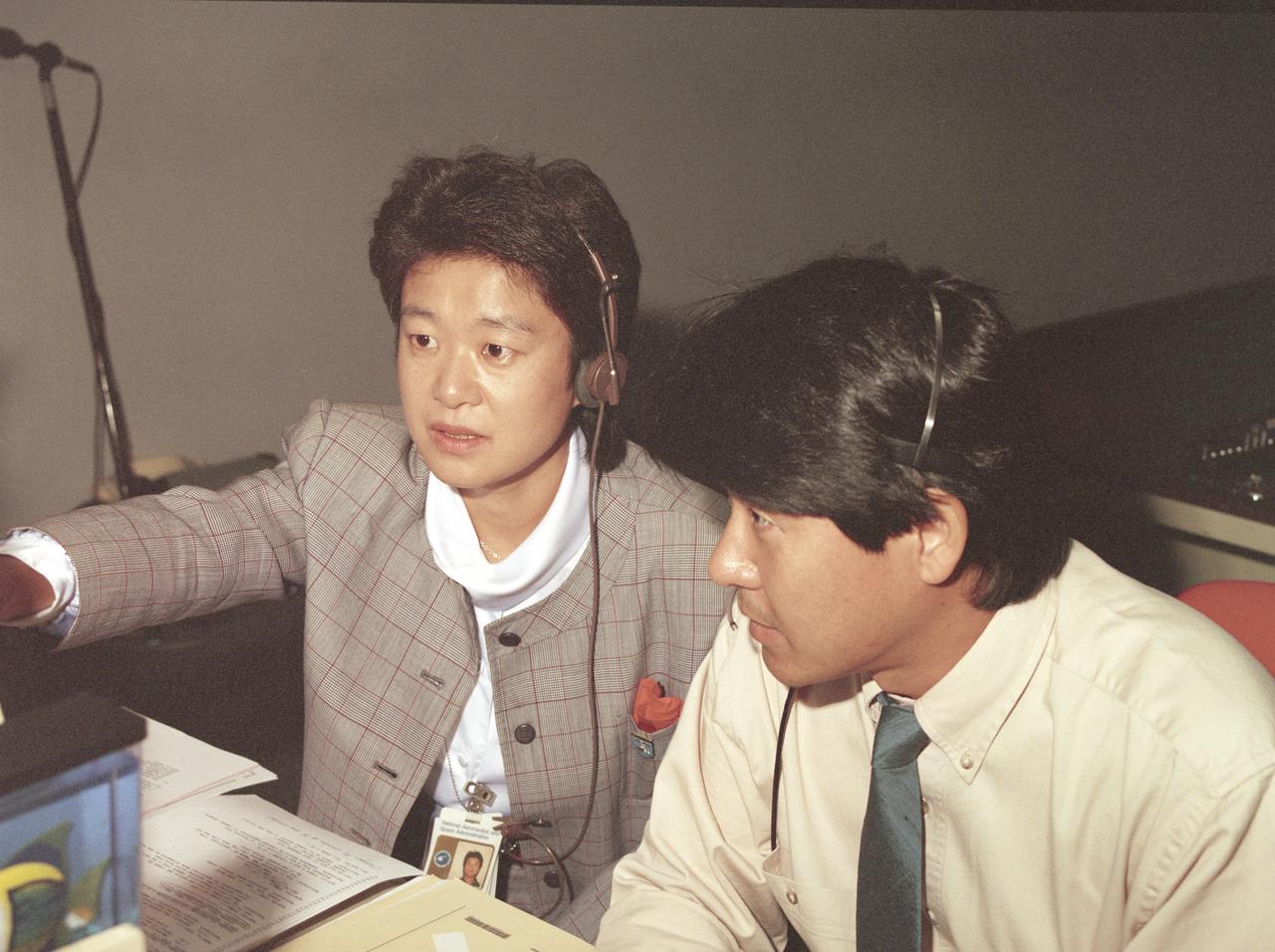
The science laboratory, Spacelab-J (SL-J), flown aboard the STS-47 flight was a joint venture between NASA and the National Space Development Agency of Japan (NASDA) utilizing a manned Spacelab module. The mission conducted 24 materials science and 20 life science experiments, of which 35 were sponsored by NASDA, 7 by NASA, and two collaborative efforts. Materials science investigations covered such fields as biotechnology, electronic materials, fluid dynamics and transport phenomena, glasses and ceramics, metals and alloys, and acceleration measurements. Life sciences included experiments on human health, cell separation and biology, developmental biology, animal and human physiology and behavior, space radiation, and biological rhythms. Test subjects included the crew, Japanese koi fish (carp), cultured animal and plant cells, chicken embryos, fruit flies, fungi and plant seeds, and frogs and frog eggs. Pictured in the Huntsville Operations Support Center (HOSC) Spacelab Payload Operations Control Center (SL POCC) of Marshall Space Flight Center (MSFC) are NASDA alternate payload specialists Dr. Doi and Dr. Mukai.
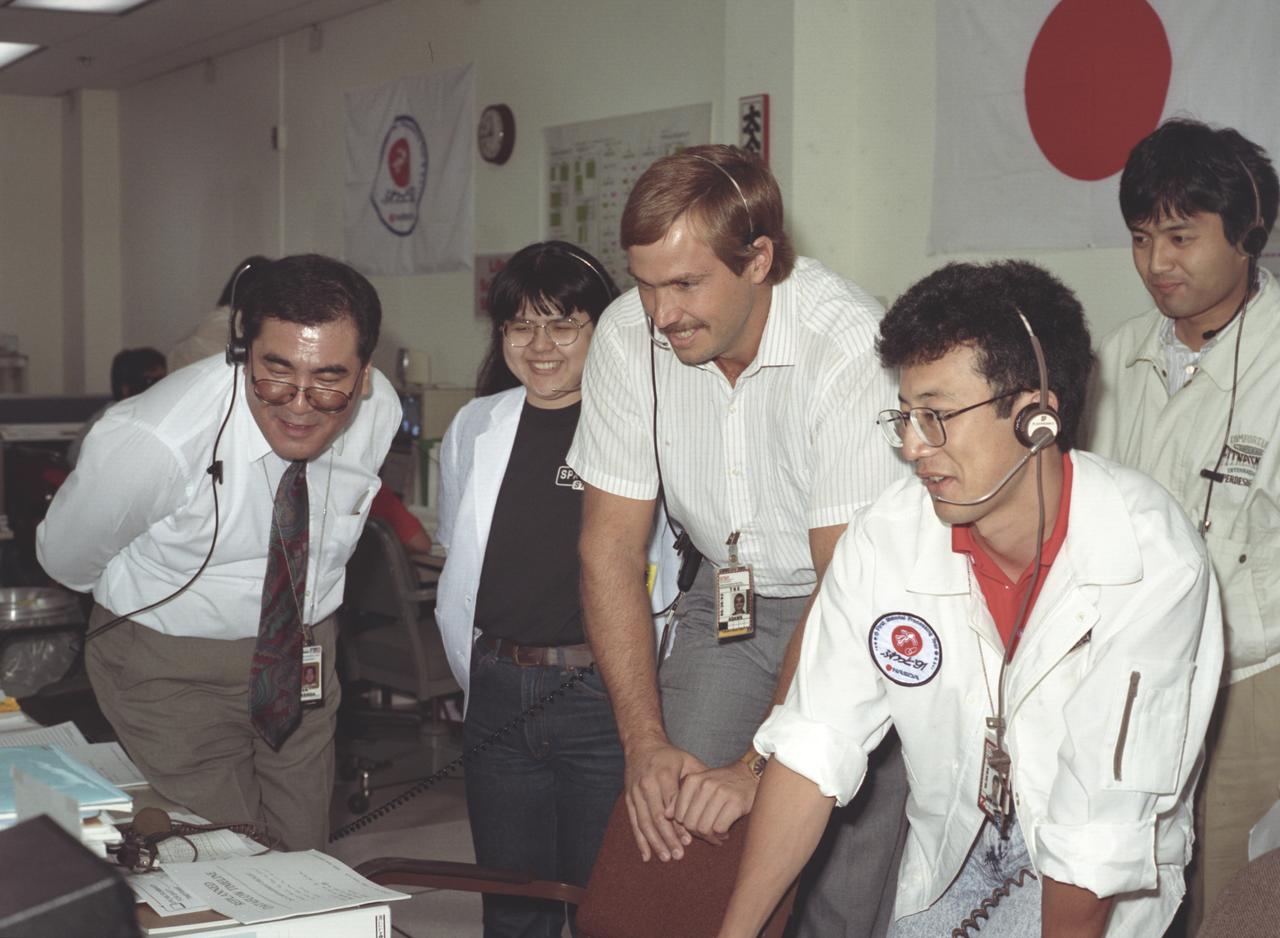
The science laboratory, Spacelab-J (SL-J), flown aboard the STS-47 flight was a joint venture between NASA and the National Space Development Agency of Japan (NASDA) utilizing a manned Spacelab module. The mission conducted 24 materials science and 20 life science experiments, of which 35 were sponsored by NASDA, 7 by NASA, and two collaborative efforts. Materials science investigations covered such fields as biotechnology, electronic materials, fluid dynamics and transport phenomena, glasses and ceramics, metals and alloys, and acceleration measurements. Life sciences included experiments on human health, cell separation and biology, developmental biology, animal and human physiology and behavior, space radiation, and biological rhythms. Test subjects included the crew, Japanese koi fish (carp), cultured animal and plant cells, chicken embryos, fruit flies, fungi and plant seeds, and frogs and frog eggs. Featured together in joint ground activities during the SL-J mission are NASA/NASDA personnel at the Huntsville Operations Support Center (HOSC) Spacelab Payload Operations Control Center (SL POCC) at Marshall Space Flight Center (MSFC).
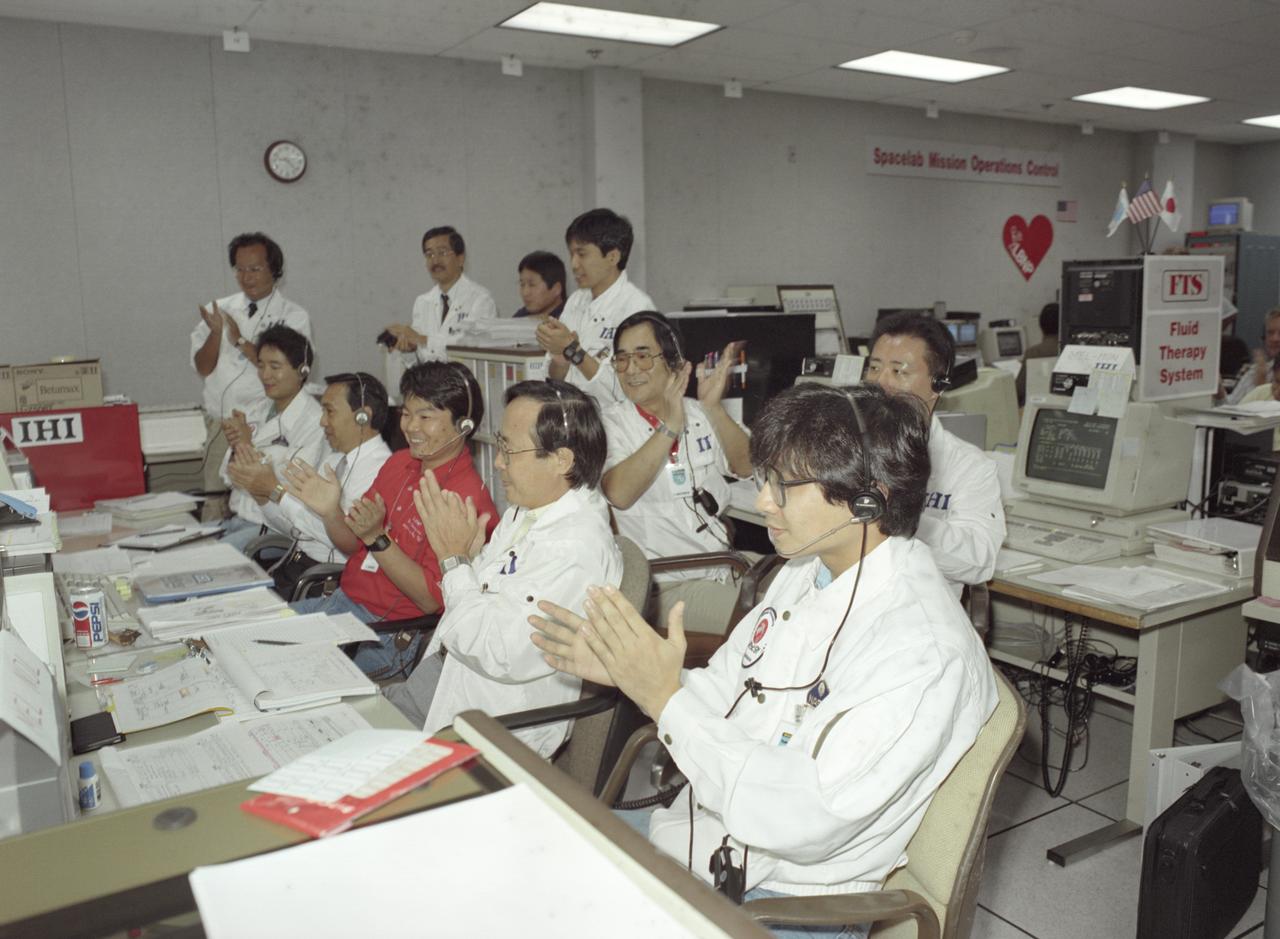
The science laboratory, Spacelab-J (SL-J), flown aboard the STS-47 flight was a joint venture between NASA and the National Space Development Agency of Japan (NASDA) utilizing a manned Spacelab module. The mission conducted 24 materials science and 20 life science experiments, of which 35 were sponsored by NASDA, 7 by NASA, and two collaborative efforts. Materials science investigations covered such fields as biotechnology, electronic materials, fluid dynamics and transport phenomena, glasses and ceramics, metals and alloys, and acceleration measurements. Life sciences included experiments on human health, cell separation and biology, developmental biology, animal and human physiology and behavior, space radiation, and biological rhythms. Test subjects included the crew, Japanese koi fish (carp), cultured animal and plant cells, chicken embryos, fruit flies, fungi and plant seeds, and frogs and frog eggs. Featured together in the Science Operation Area (SOA) are payload specialists’ first Materials Processing Test during NASA/NASDA joint ground activities at the Huntsville Operations Support Center (HOSC) Spacelab Payload Operations Control Center (SL POCC) at Marshall Space Flight Center (MSFC).
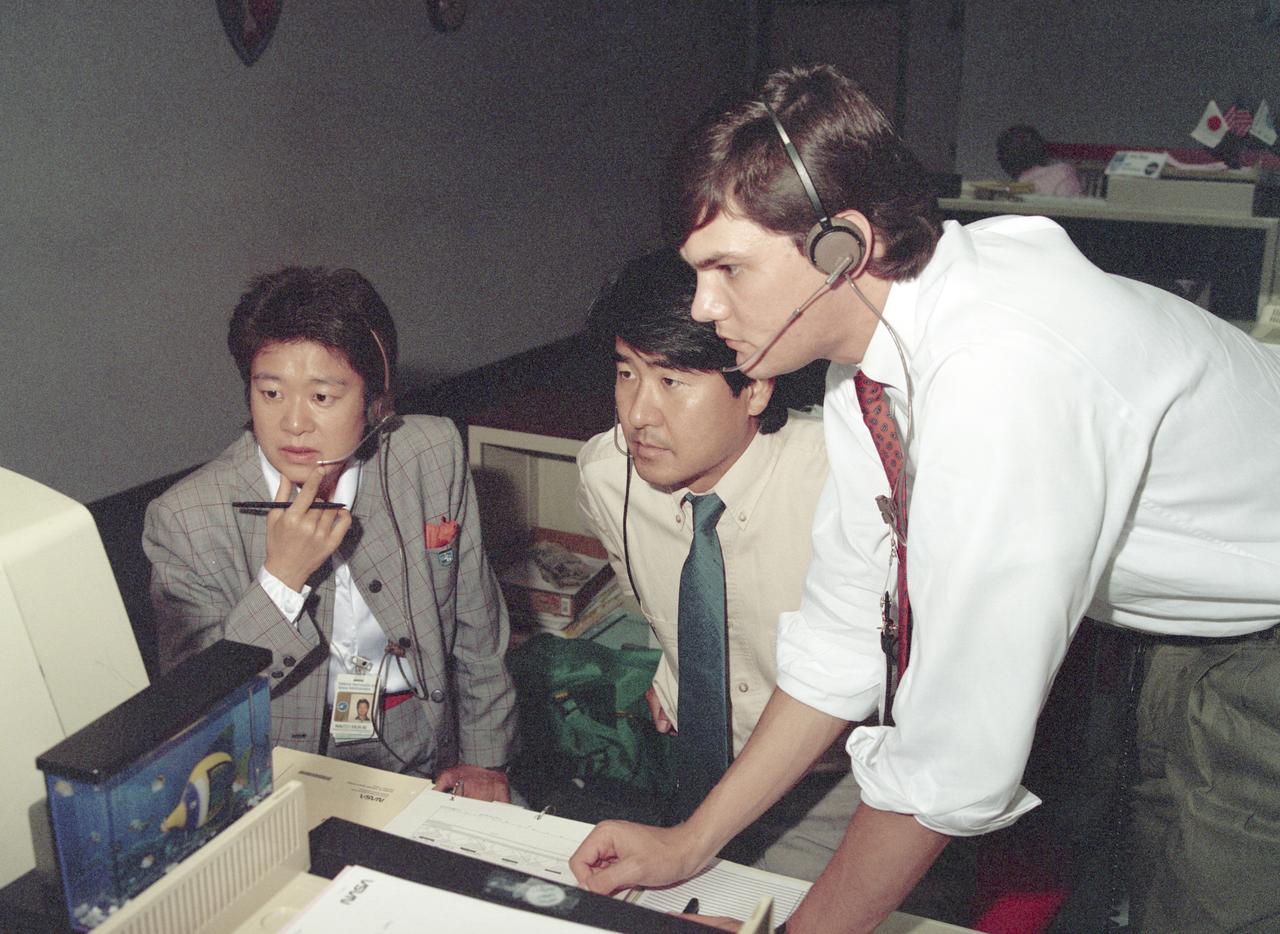
The science laboratory, Spacelab-J (SL-J), flown aboard the STS-47 flight was a joint venture between NASA and the National Space Development Agency of Japan (NASDA) utilizing a manned Spacelab module. The mission conducted 24 materials science and 20 life science experiments, of which 35 were sponsored by NASDA, 7 by NASA, and two collaborative efforts. Materials science investigations covered such fields as biotechnology, electronic materials, fluid dynamics and transport phenomena, glasses and ceramics, metals and alloys, and acceleration measurements. Life sciences included experiments on human health, cell separation and biology, developmental biology, animal and human physiology and behavior, space radiation, and biological rhythms. Test subjects included the crew, Japanese koi fish (carp), cultured animal and plant cells, chicken embryos, fruit flies, fungi and plant seeds, and frogs and frog eggs. Pictured along with George Norris in the Huntsville Operations Support Center (HOSC) Spacelab Payload Operations Control Center (SL POCC) at Marshall Space Flight Center (MSFC) are NASDA alternate payload specialists Dr. Doi and Dr. Mukai.
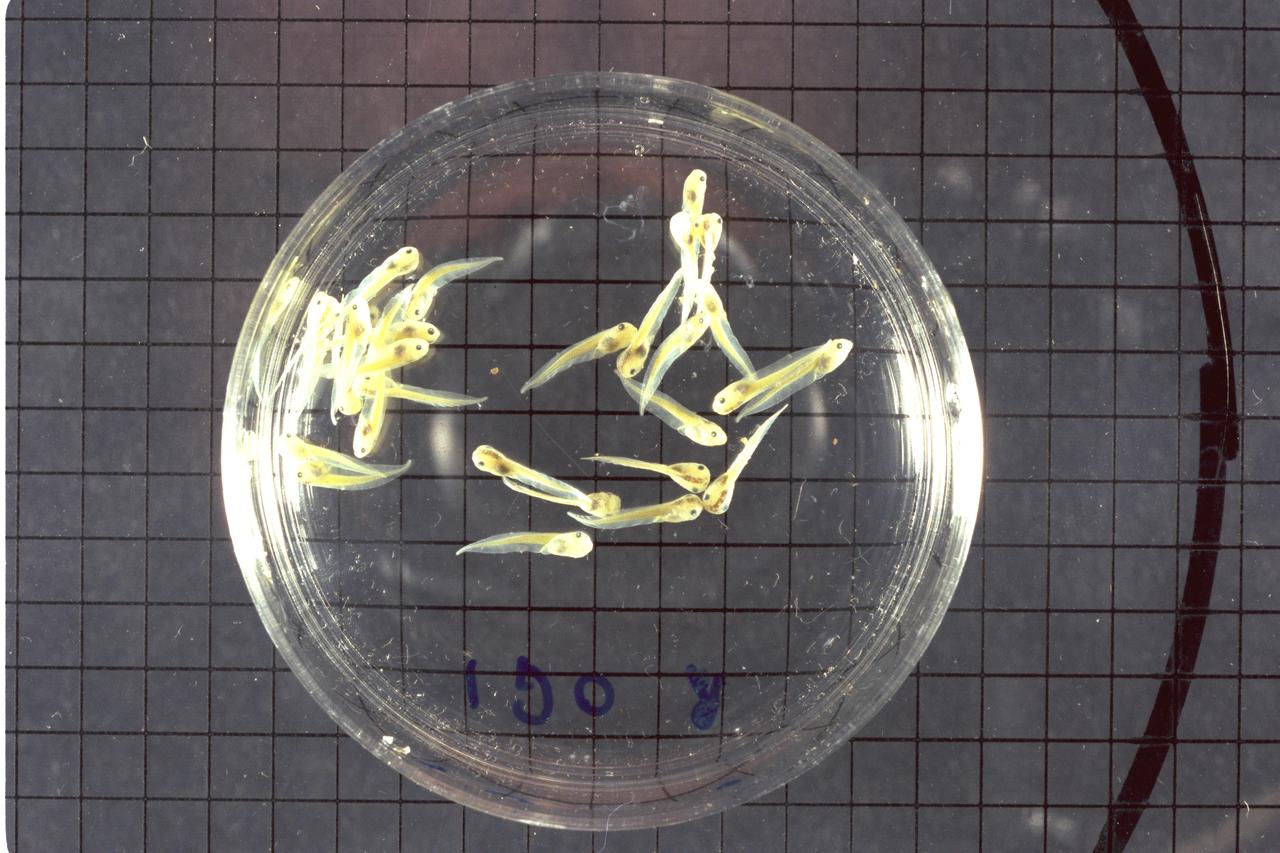
STS-47 Spacelab-J - post flight tadpoles
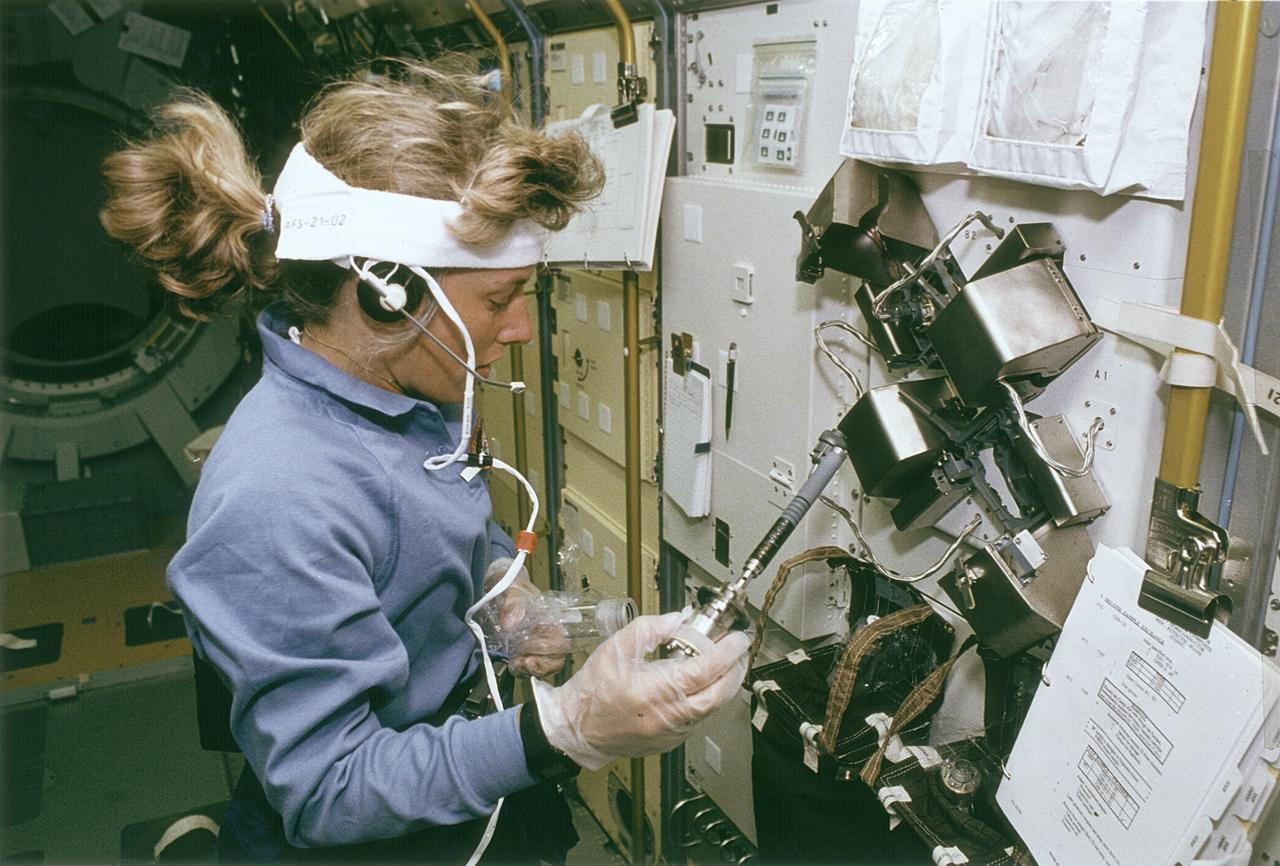
Space Shuttle Endeavour (STS-47) onboard photo of Astronaut N. Jan Davis at work at the Continuous Heating Furnace (CHF) in the Spacelab-J Science Module. Spacelab-J is a combined National Space Development Agency of Japan (NASDA) and NASA mission. The objectives included life sciences, microgravity and technology research.
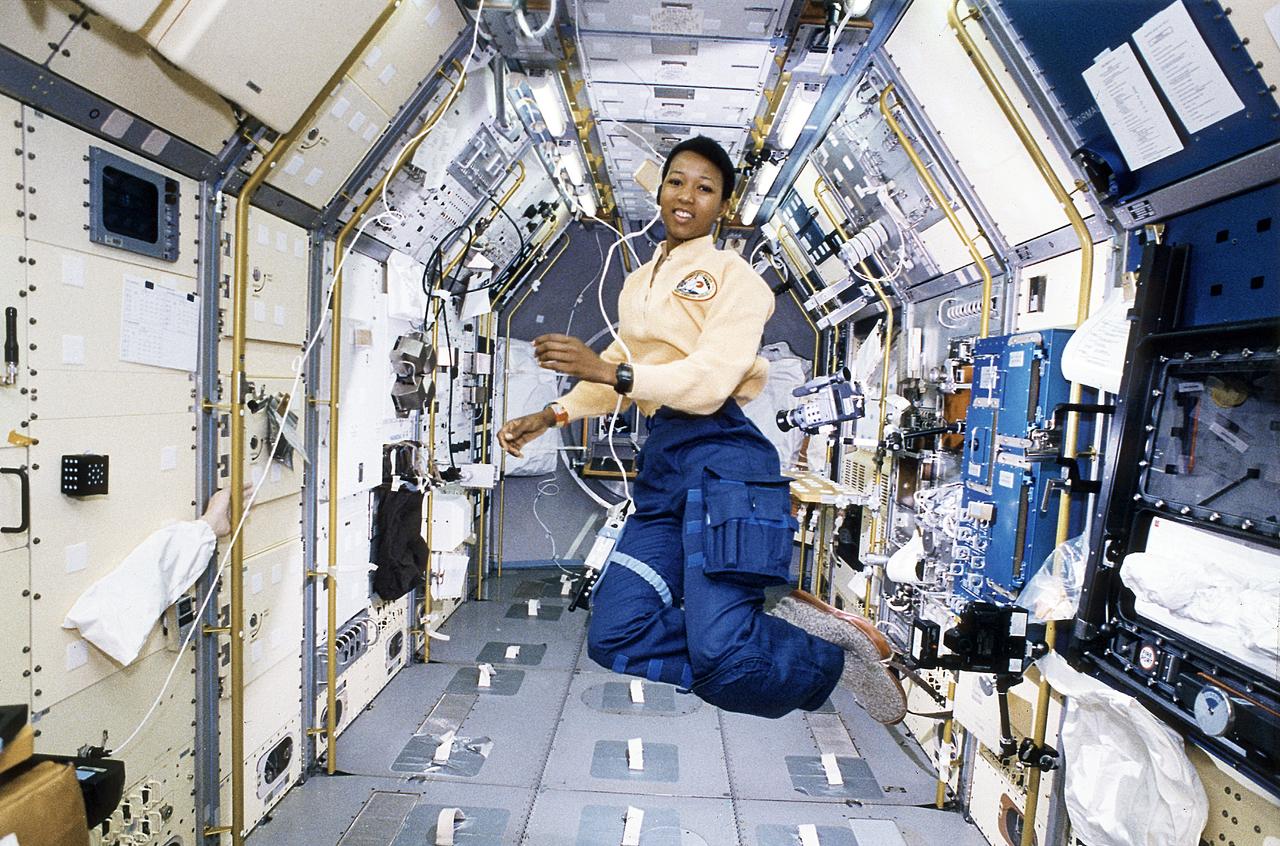
Space Shuttle Endeavour (STS-47) onboard photo of Astronaut Mae Jemison working in Spacelab-J module. Spacelab-J is a combined National Space Development Agency of Japan (NASDA) and NASA mission. The objectives included life sciences, microgravity and technology research.
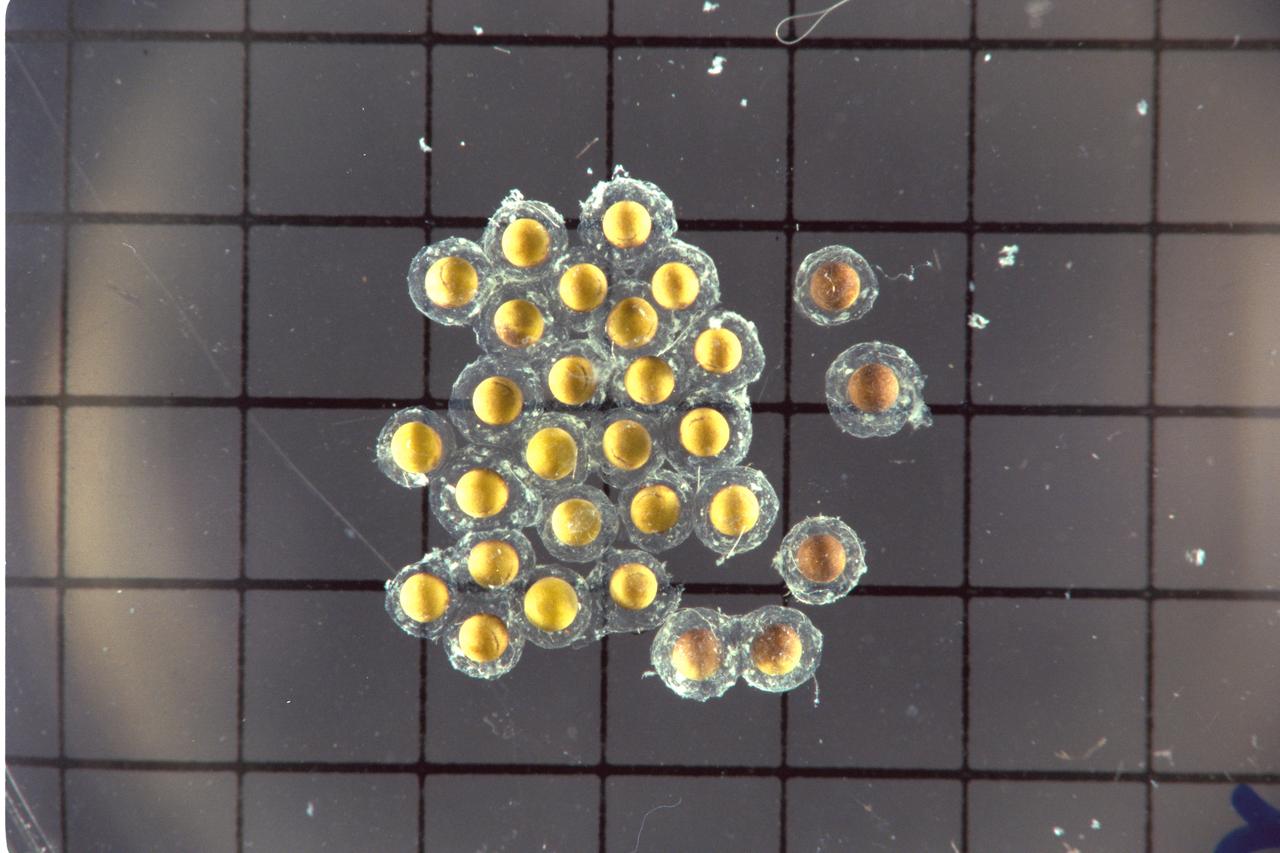
STS-47 Spacelab-J - eggs - post flight data
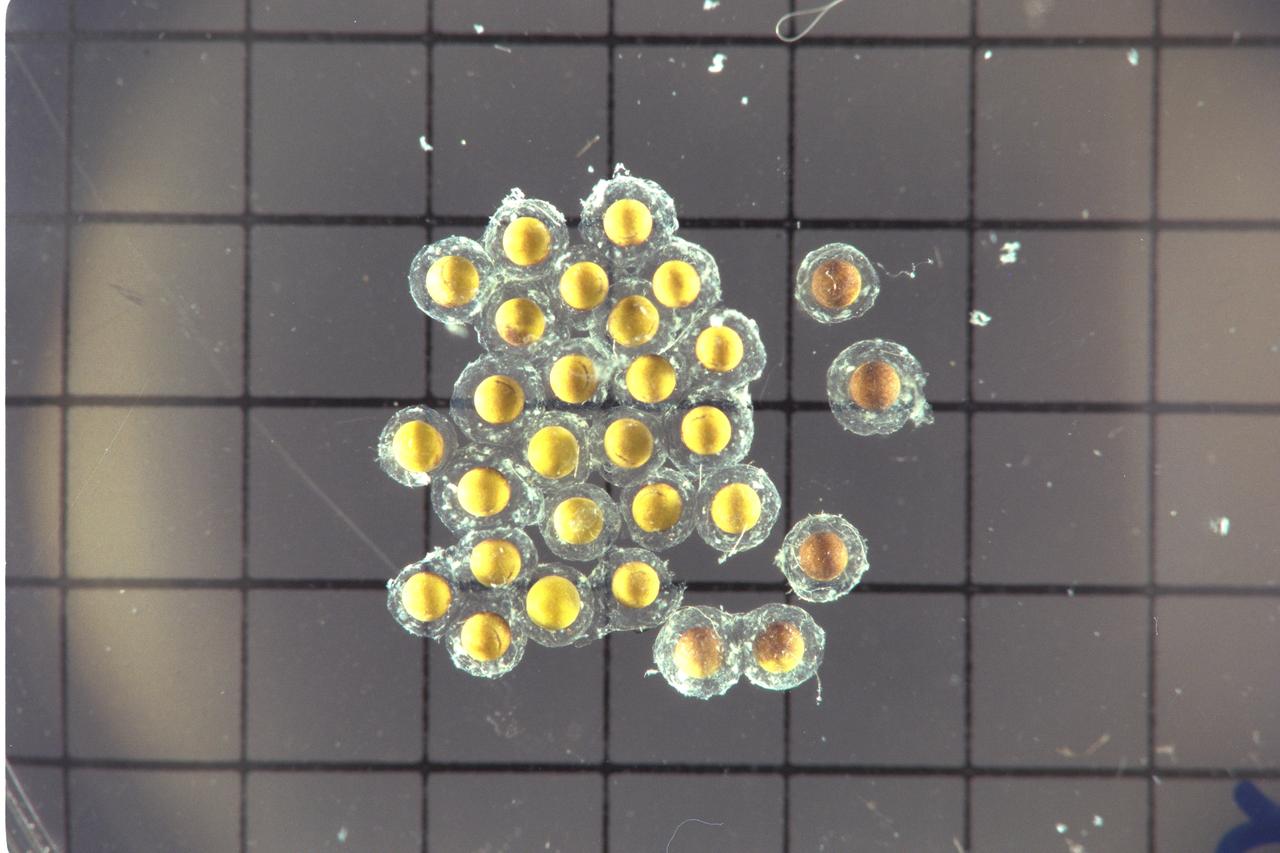
STS-47 Spacelab-J - eggs - post flight data
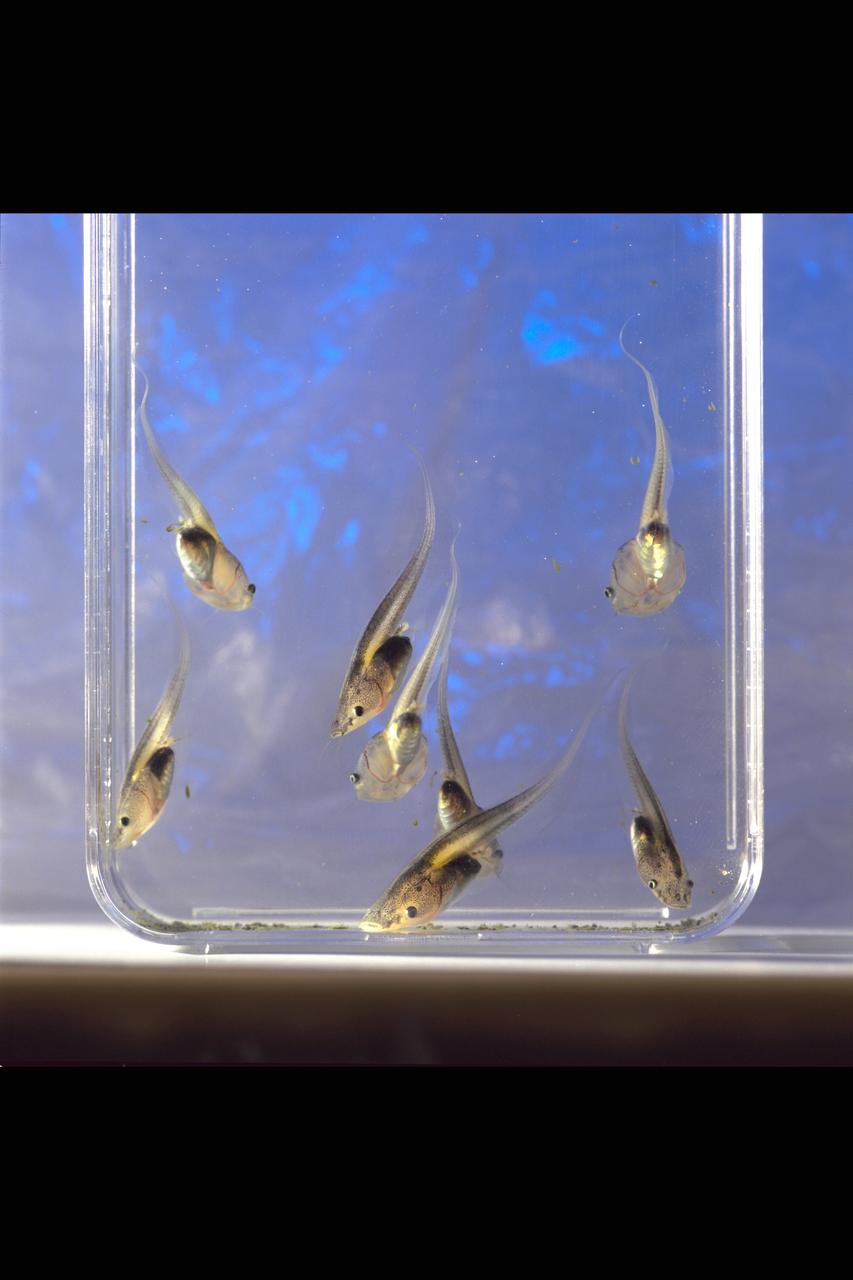
STS-47 Spacelab-J FFE (Frog Embryology Experiment) post flight data - flight frogs from SL-J, ground control tadpoles
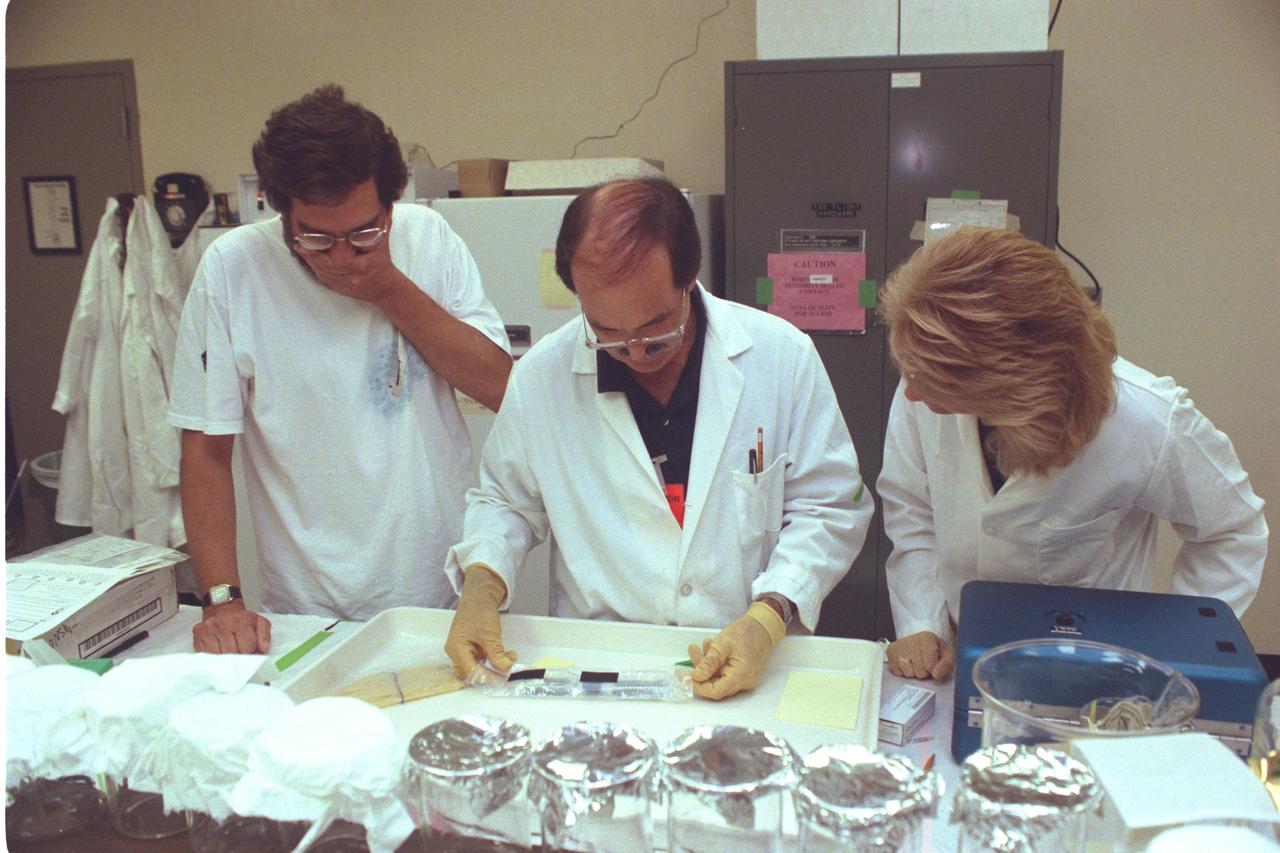
STS-47 Spacelab-J - Ken Souza and team during post flight work at KSC
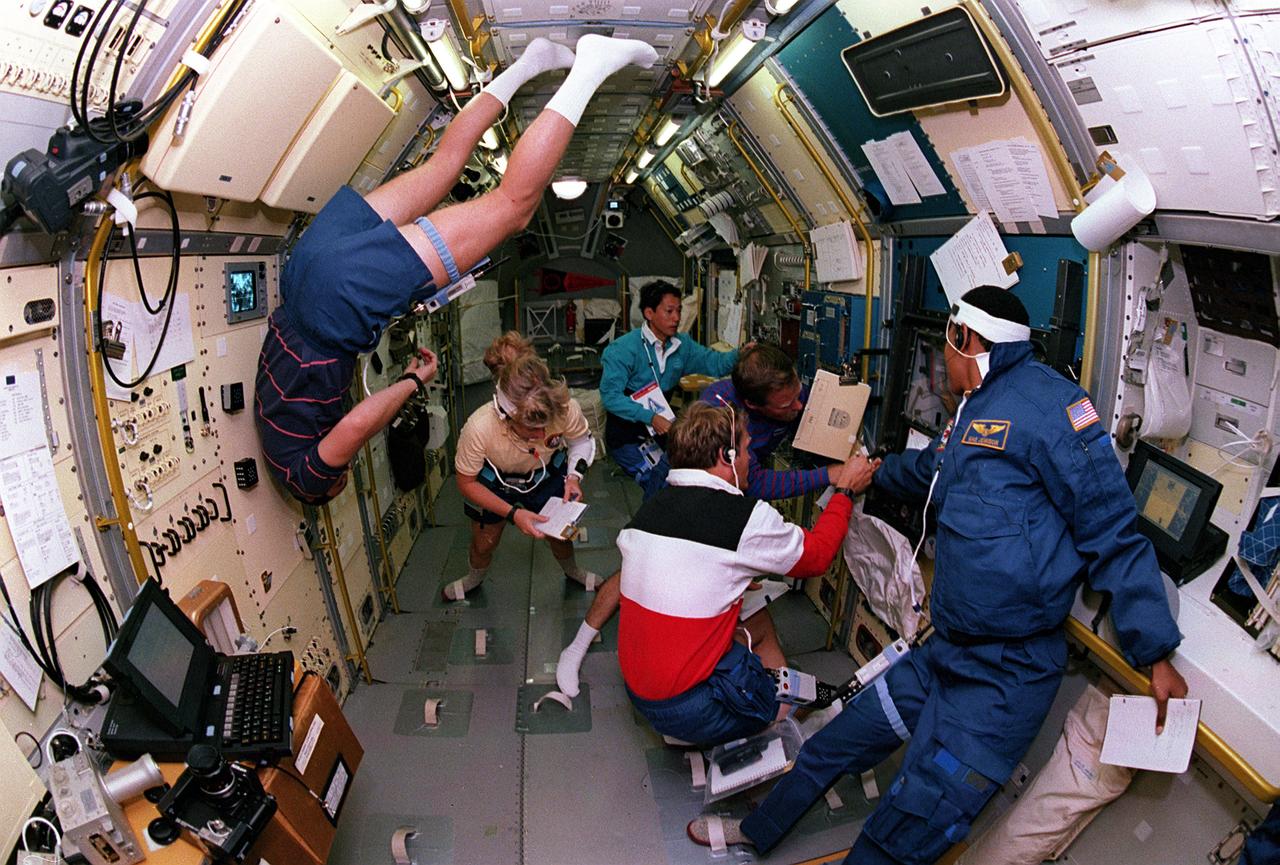
Space Shuttle Endeavour (STS-47) onboard photo of crew members working in the Spacelab-J module.
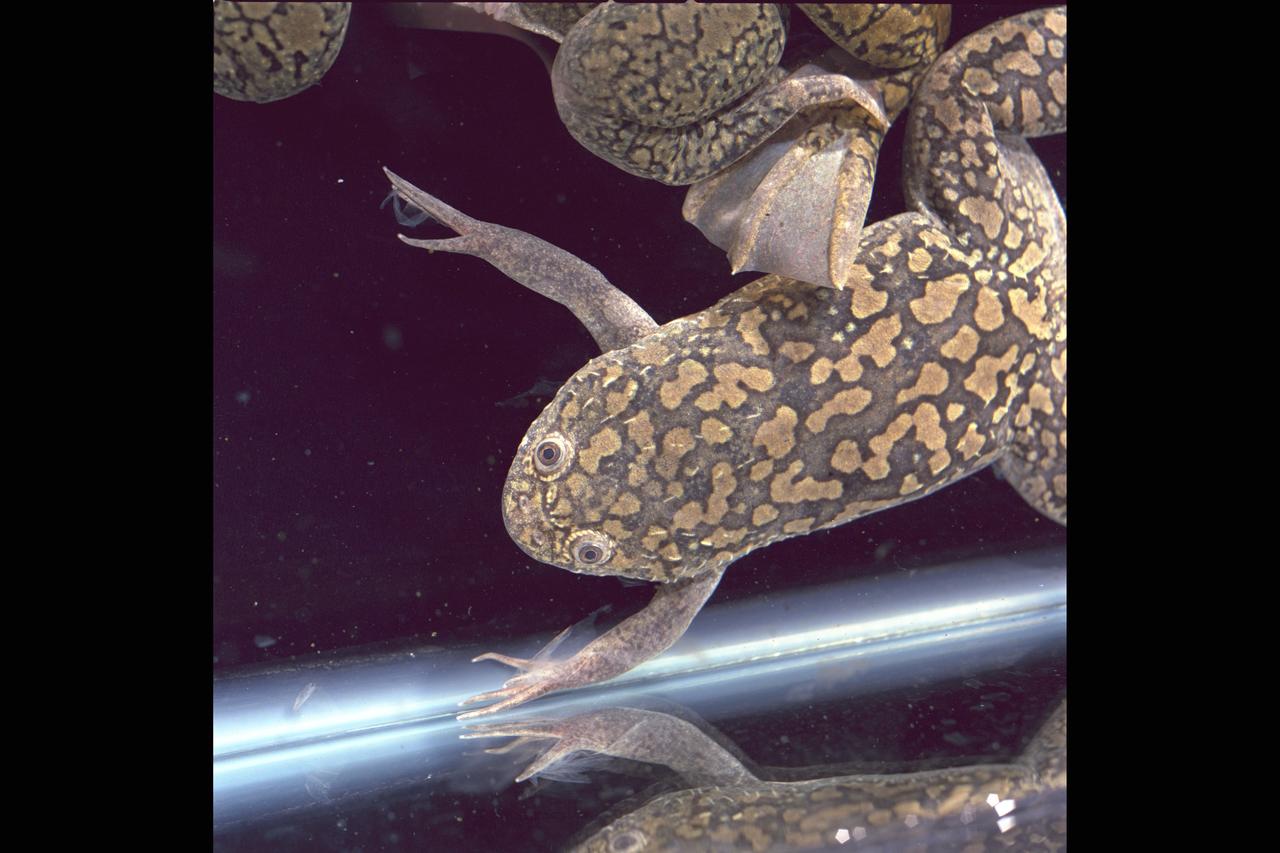
FEE (Frog Embryology Experiment) Spacelab-J flight frogs from ground control tadpoles
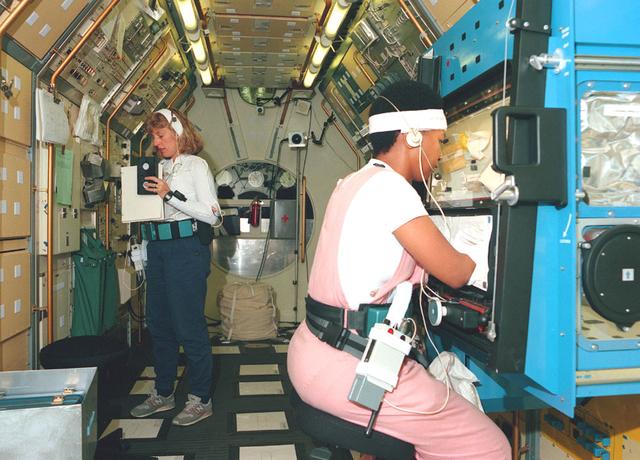
Female astronauts Jan Davis and Mae Jemison undergo training at Marshall's Spacelab-J Crew Training facility.
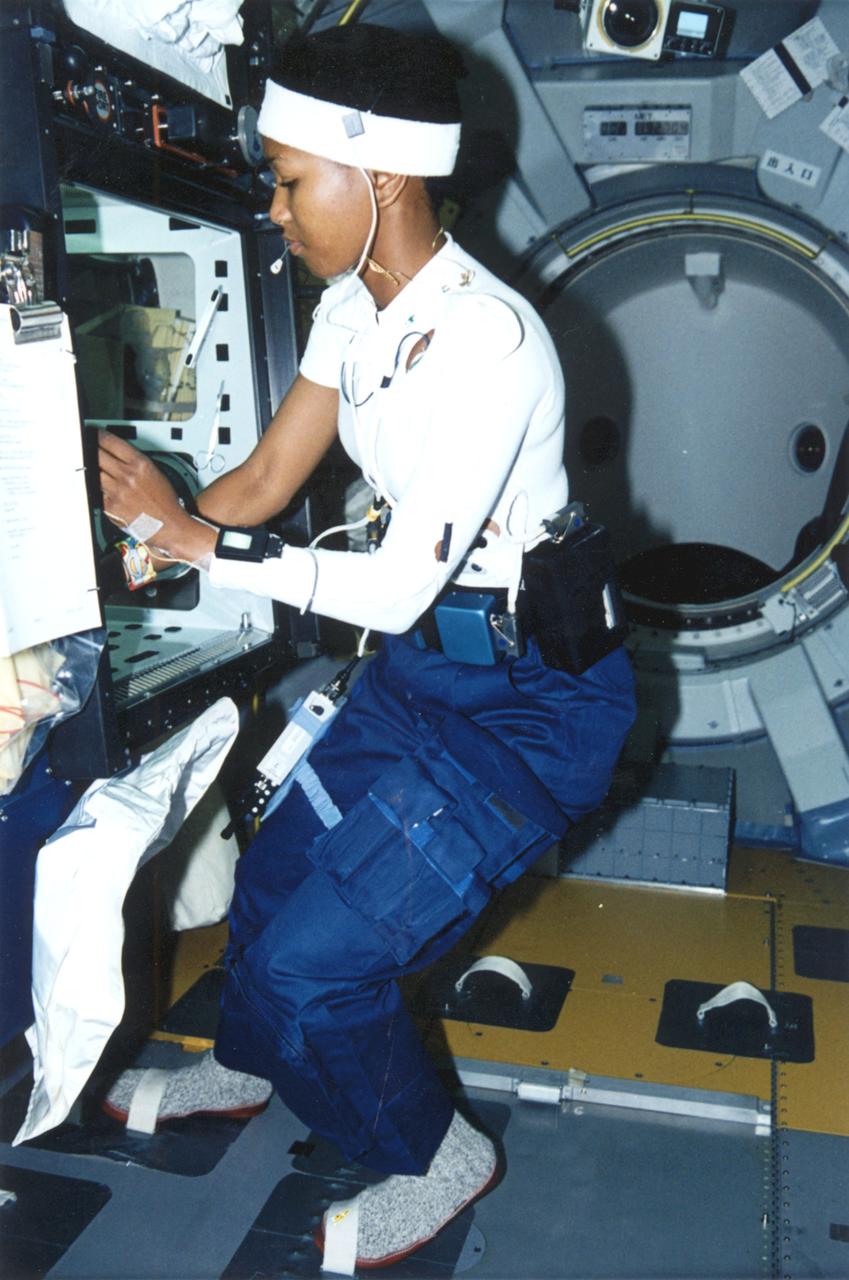
Astronaut Mae Jemison working on experiment.
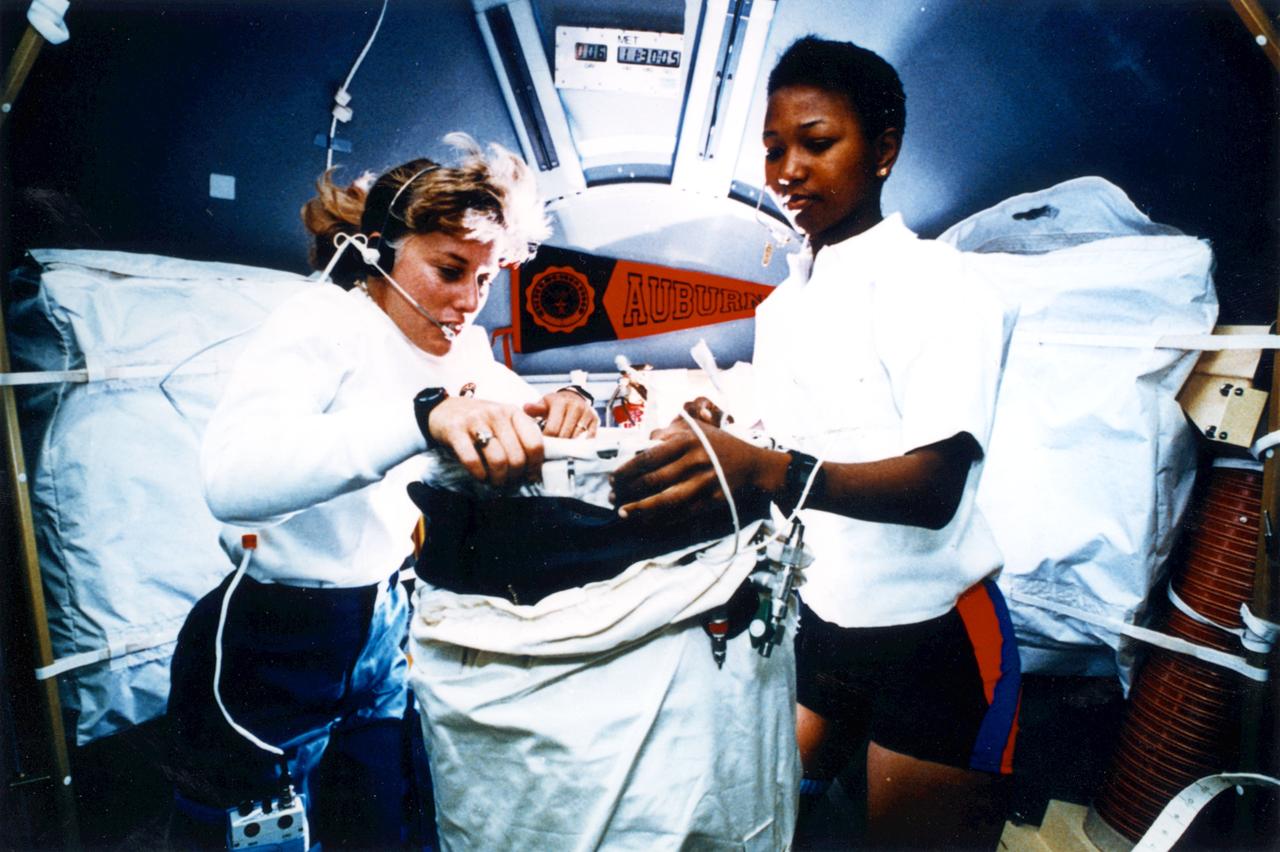
Jan Davis and Mae Jemison working on experiments.
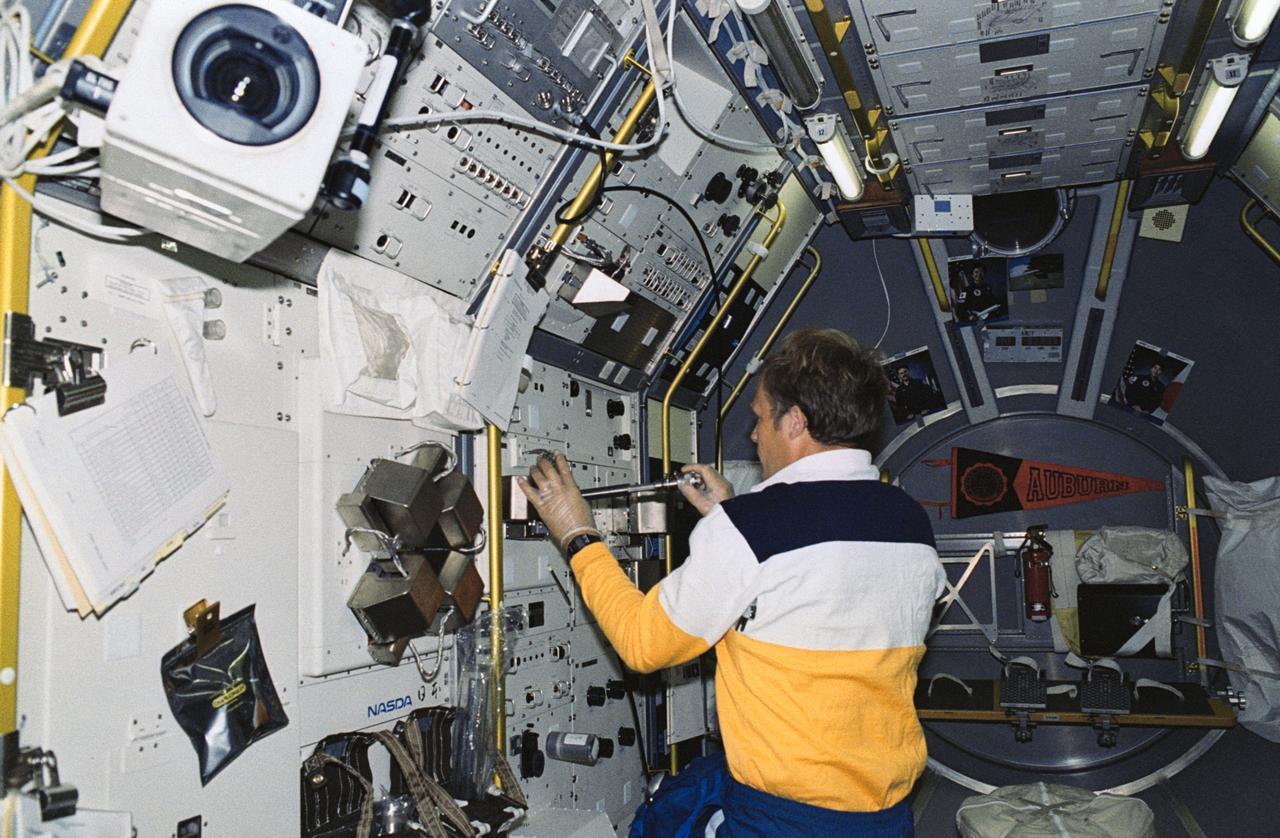
STS047-203-009 (12-20 Sept 1992) --- Astronaut Mark C. Lee, payload commander, inserts a sample into the Gradient Heating Furnace (GHF) in the Spacelab-J Science Module aboard the Earth-orbiting Space Shuttle Endeavour. Lee, along with five other NASA astronauts and a Japanese payload specialist, conducted eight days of research in support of Spacelab-J.
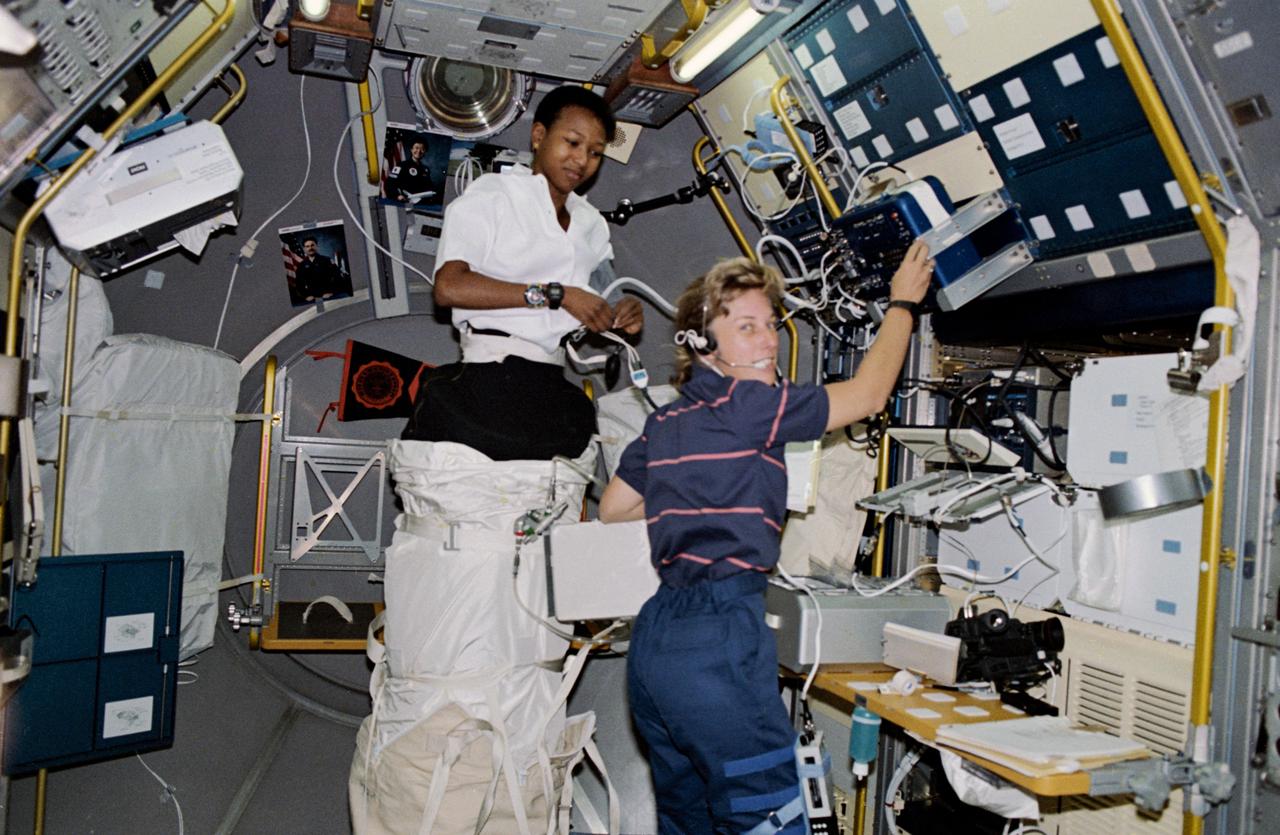
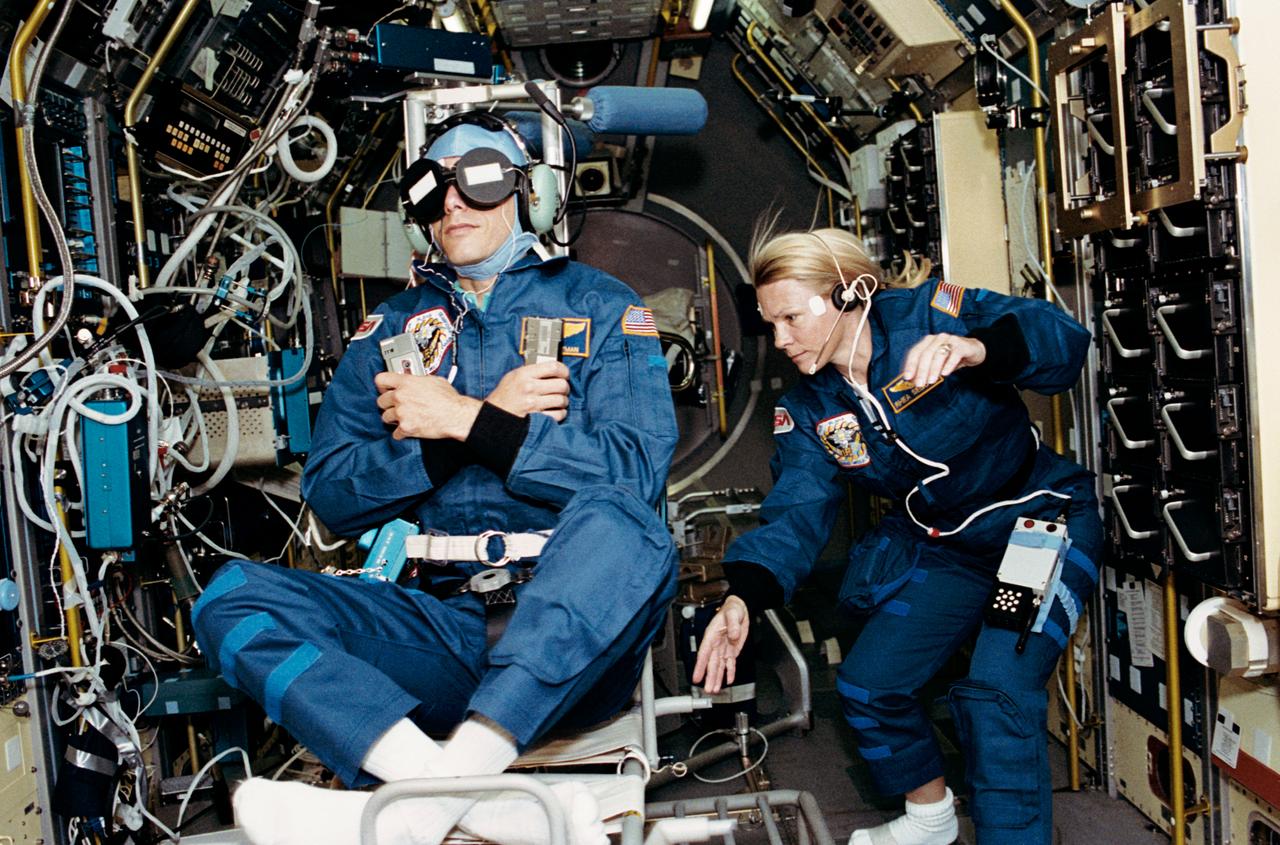
STS047-230-030 (12 - 20 Sept 1992) --- Astronauts Mae C. Jemison (left) and N. Jan Davis, mission specialists, are pictured in the Spacelab-J science module preparing to conduct a session with the Lower Body Negative Pressure (LBNP) experiment. The two joined four other NASA astronauts and a payload specialist representing Japan's National Space Development Agency (NASDA) aboard the Earth-orbiting Space Shuttle Endeavour for eight days of Spacelab-J research.
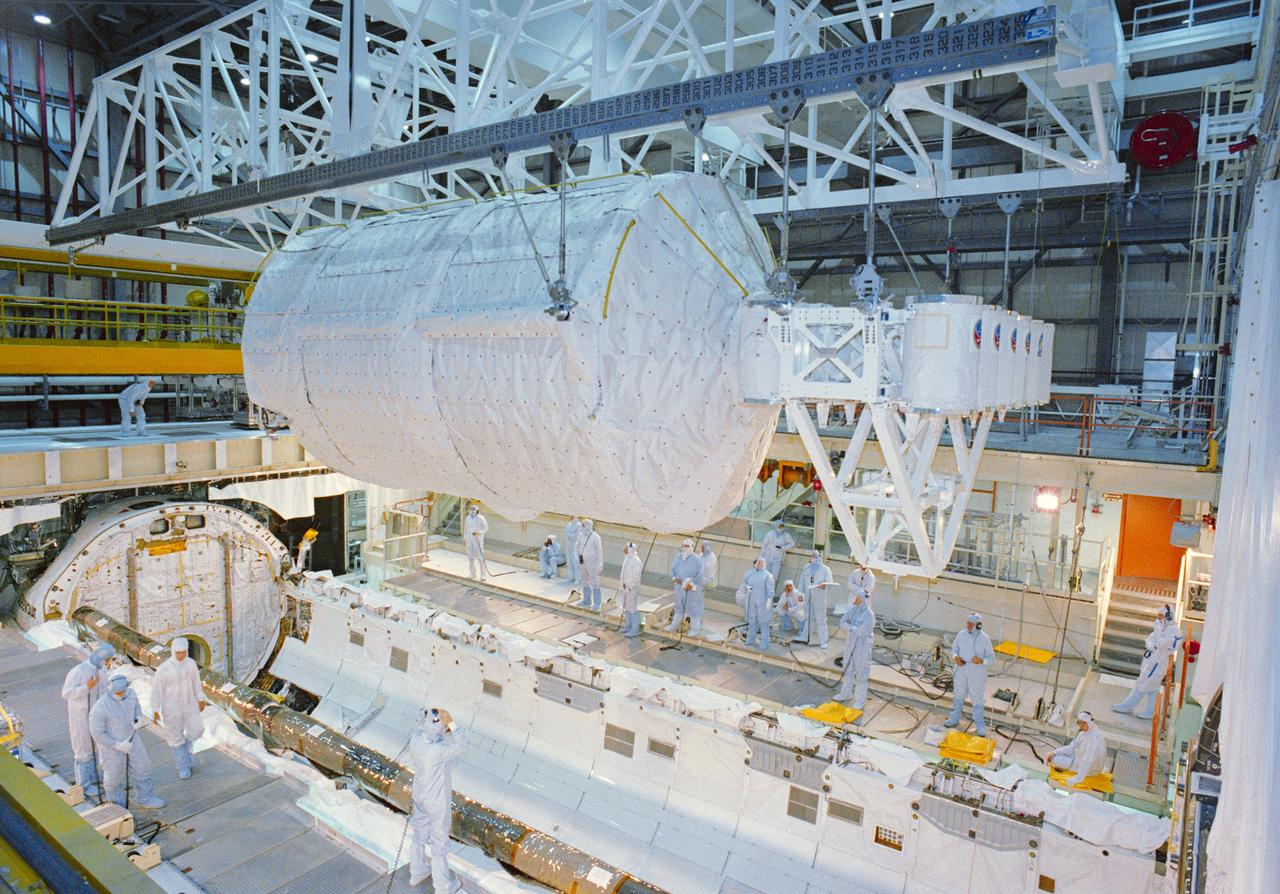
S92-44307 (25 July 1992) --- Technicians, engineers and flight crewmembers look on as the Spacelab-J laboratory module and experiment canister bridge are lowered into Endeavour's cargo bay. The STS-47 crewmembers visited Endeavour, currently undergoing pre-flight processing in a high bay area of the Orbiter Processing Facility at the Kennedy Space Center. The Spacelab-J mission is currently scheduled for September of this year.
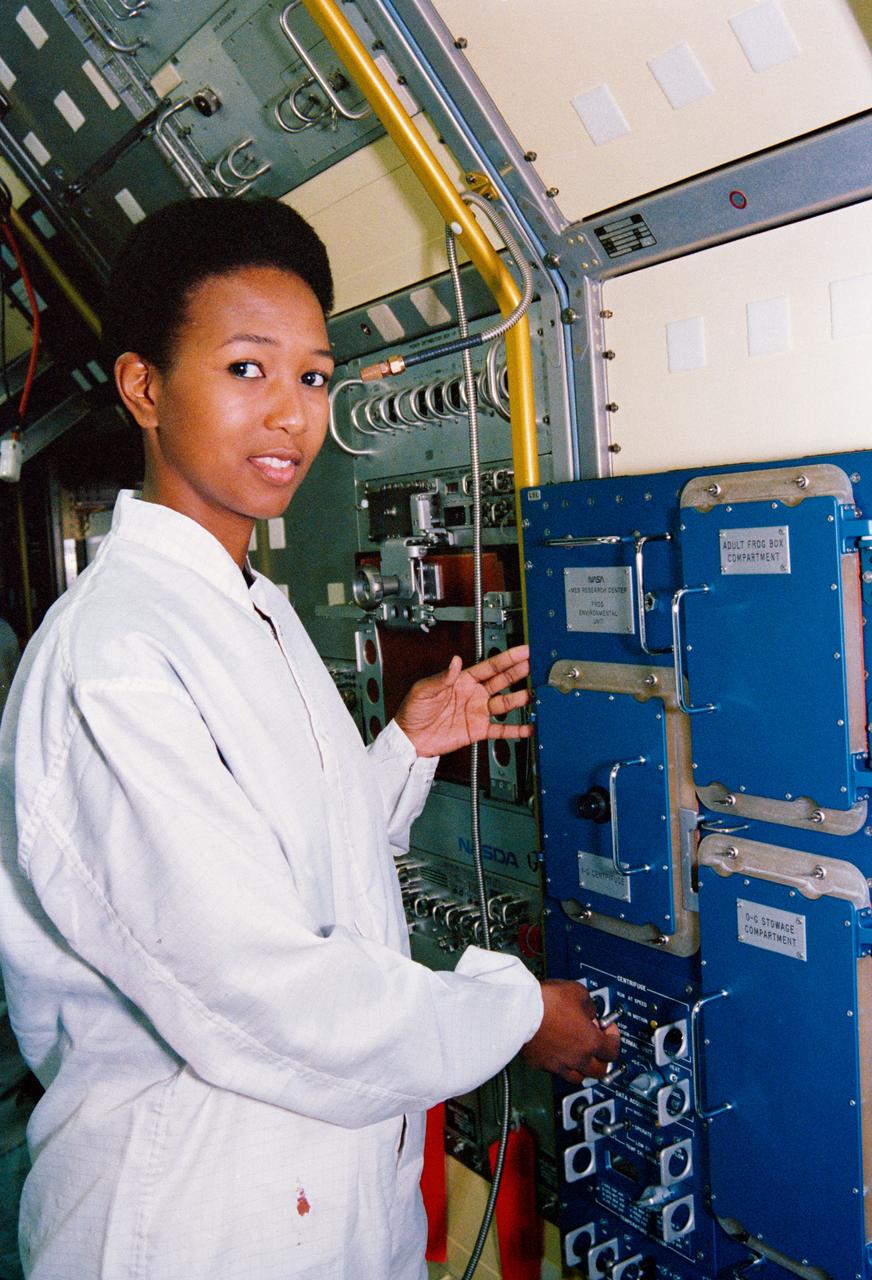
S92-44302 (25 July 1992) --- Astronaut Mae C. Jemison, mission specialist, examines the interior of the Spacelab-J laboratory module installed in Endeavour's cargo bay. The STS-47 crewmembers visited Endeavour, currently undergoing pre-flight processing in a high bay area of the Orbiter Processing Facility at the Kennedy Space Center. The Spacelab-J mission is currently scheduled for September of this year.
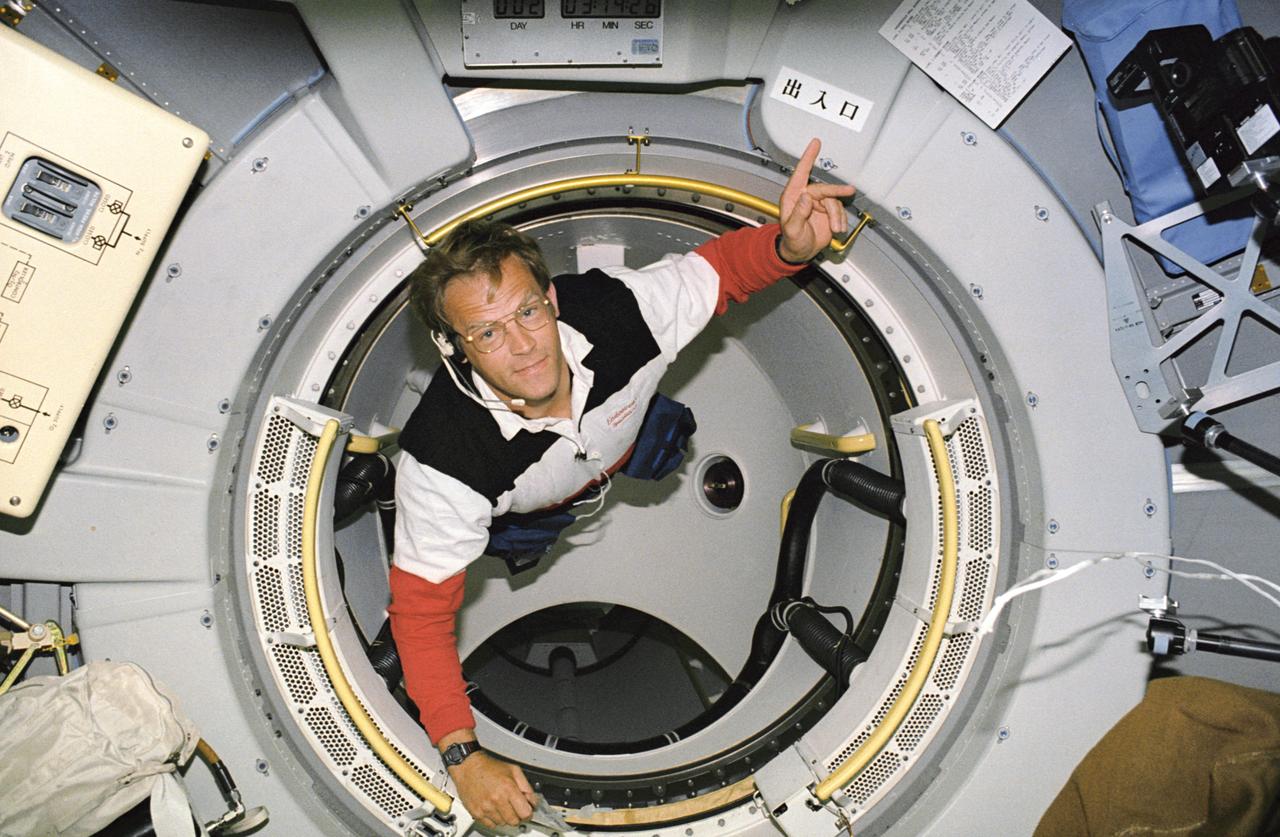
STS047-07-032 (12-20 Sept 1992) --- Astronaut Mark C. Lee, payload commander, floats through the tunnel that connects Spacelab-J's Science Module to the Space Shuttle Endeavour's cabin. Lee was in the midst of a televised "tour" of the shuttle and its primary payload when he pointed to the Japanese sign overhead, which translates to, "EXIT-ENTRANCE". Lee was joined by five NASA astronauts and a Japanese payload specialist for eight-days of research in support of the Spacelab-J project.
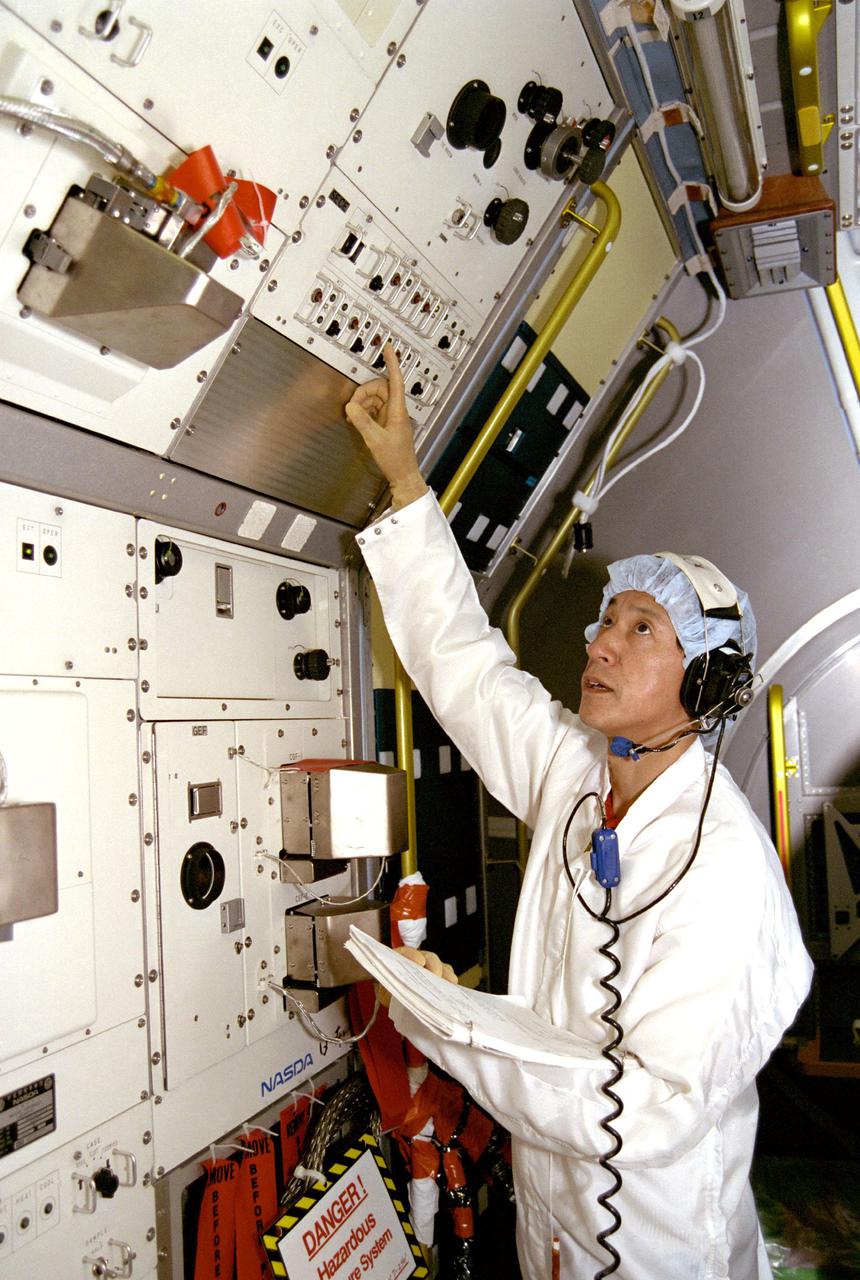
KENNEDY SPACE CENTER, FLA. -- In the Operations and Checkout Building high bay, STS-47 Payload Specialist Dr. Mamoru Mohri is participating in a Mission Sequence Test of the Spacelab-J (SL-J). Also on hand for the test of planned on-orbit activities were Payload Commander Mark Lee and other members of the payload team. Spacelab-J is a joint effort between the Japanese space agency NASDA and NASA, and features an array of 44 life science and materials processing investigations. Dr. Mohri, a payload specialist, will become the first Japanese to fly on the Shuttle.
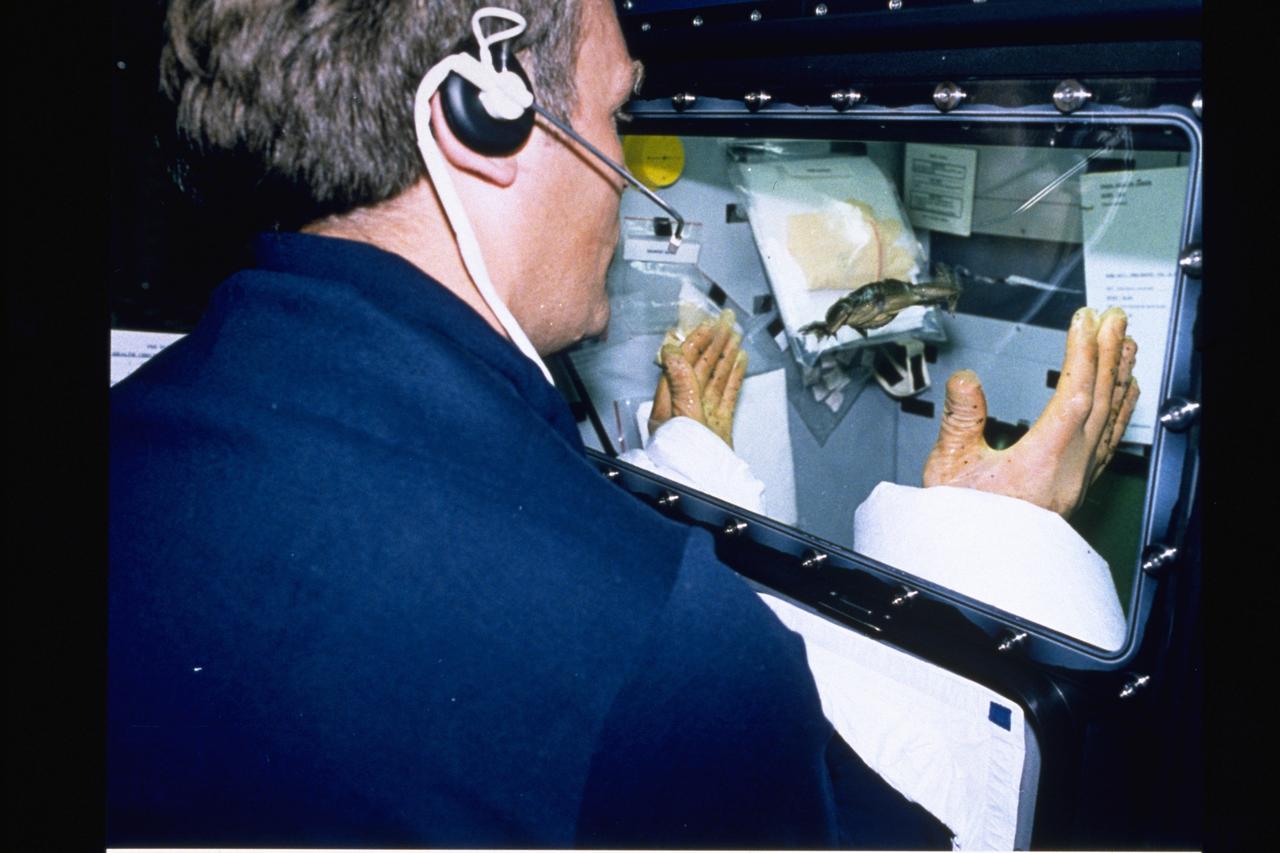
Space Shuttle Endeavour STS-47 Spacelab J mission: Frog Embryology Experiment, Astronaut works with adult frog in 0 gravity using the glovebox to contain and protect the frog during procedures
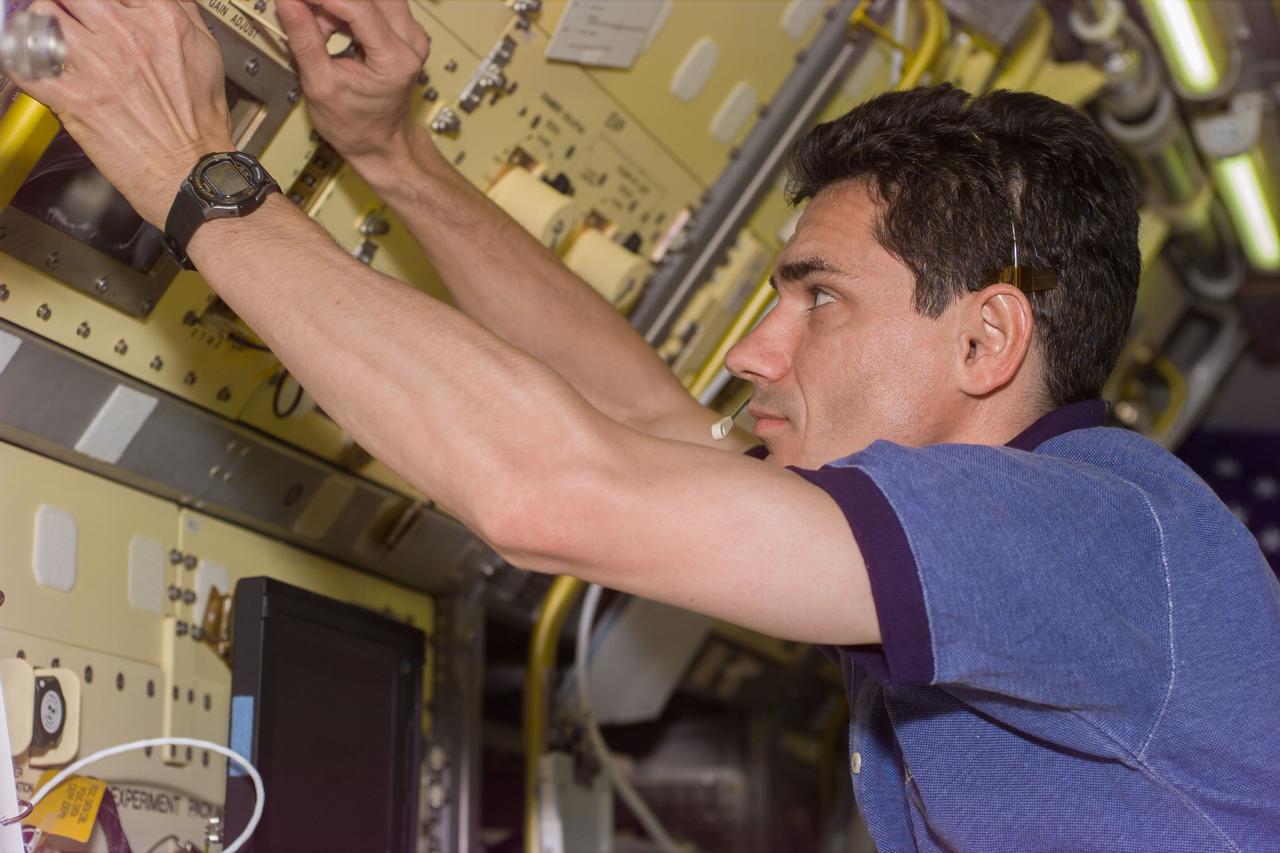
S94-E-5002 (5 July 1997) --- Payload specialist Gregory J. Linteris checks on a combustion experiment onboard the Space Shuttle Columbia's Spacelab Module during flight day five activities.
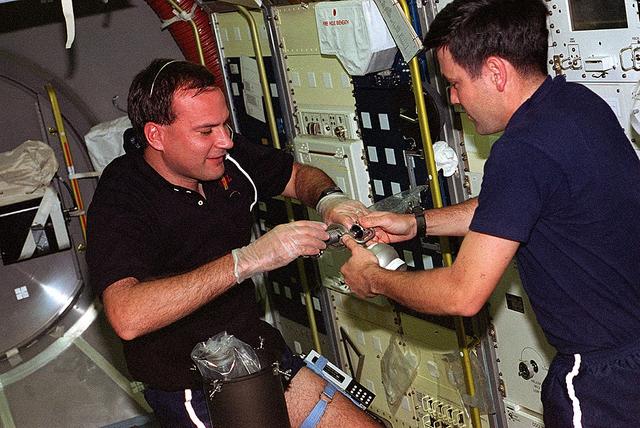
Space Shuttle Columbia (STS-65) onboard photo of Payload specialist Richard J. Hieb (right) and Shuttle Pilot James D. Halsell Jr. working on experiments in the Spacelab in the International Microgravity Laboratory (IML-2).
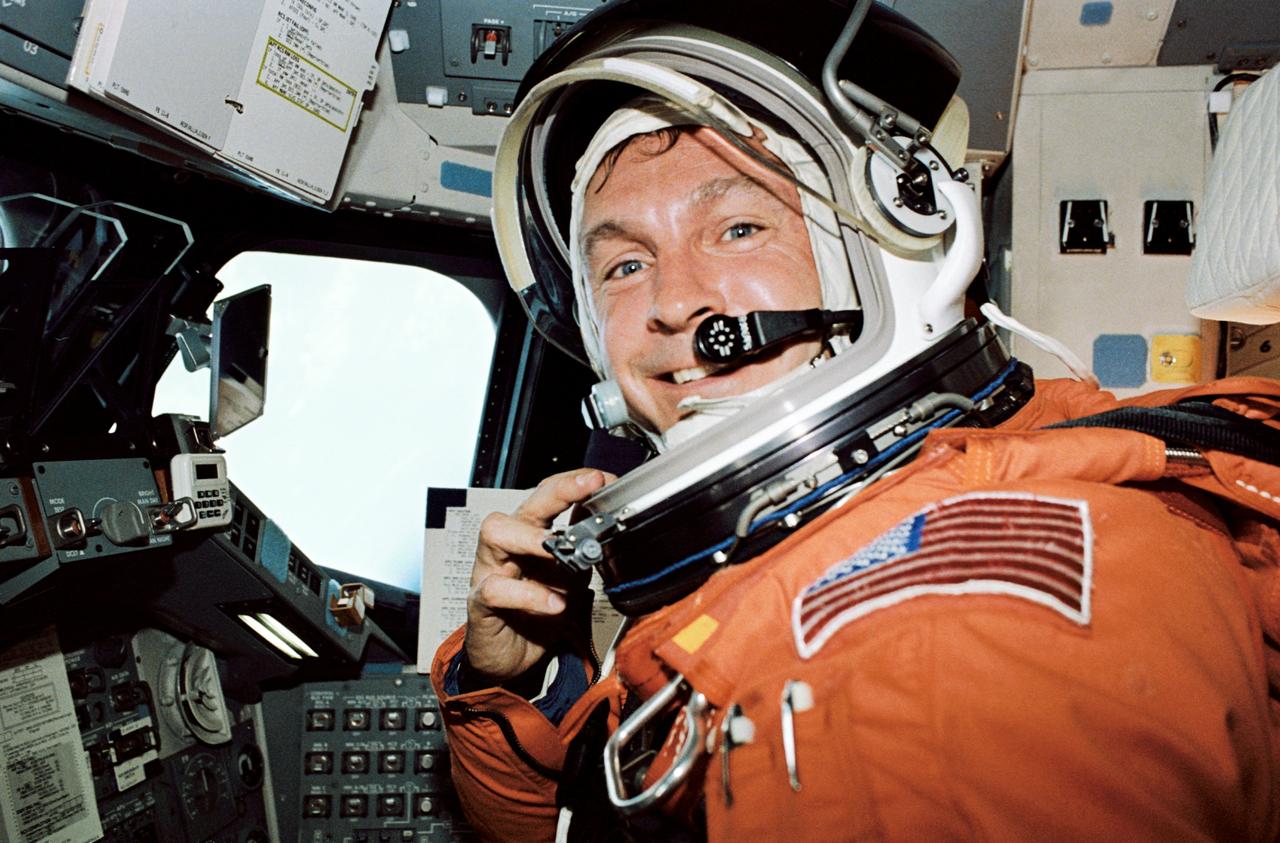
STS047-28-002 (20 Sept. 1992) --- Astronaut Curtis L. Brown, Jr., STS-47 pilot, is photographed at the Space Shuttle Endeavour's pilot station about ten minutes after main engine cutoff on launch day of the eight-day Spacelab-J mission. Wearing the partial-pressure launch and entry suit, Brown shared the forward cabin with astronaut Robert L. Gibson (out of frame at left), mission commander. Endeavour was beginning its second mission in space, this one devoted to research supporting the Spacelab-J mission.
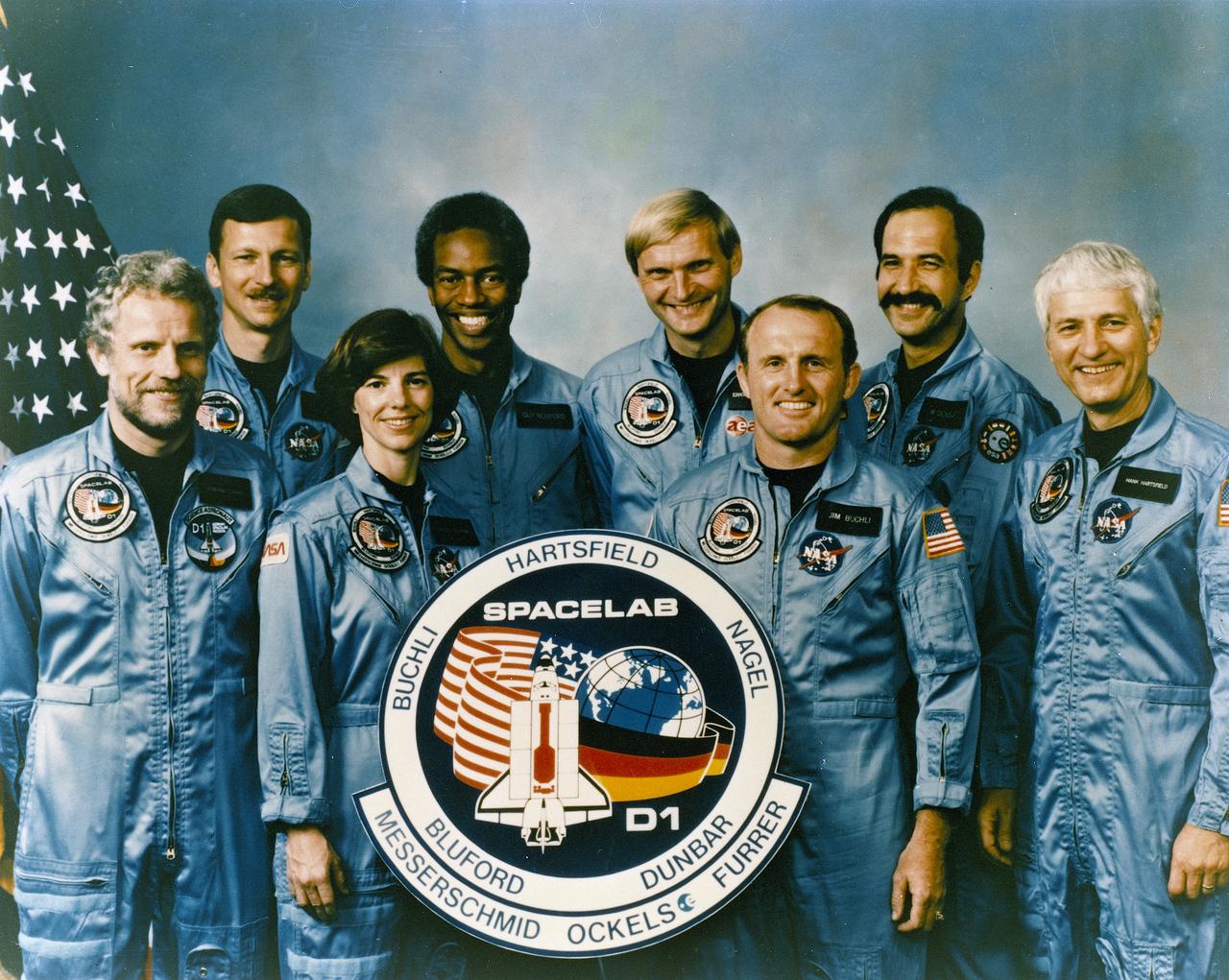
The crew assigned to the STS-61A mission included (front row left to right) Reinhard Furrer, German payload specialist; Bonnie J. Dunbar, mission specialist; and Henry W. Hartsfield, Jr. commander. On the back row, left to right, are Steven R. Nagel, pilot; Guion S. Bluford, mission specialist; Ernst Messerscmid, German payload specialist; and Wubbo J. Ockels, Dutch payload specialist. Launched aboard the Space Shuttle Challenger on October 30, 1985 at 12:00:00 noon (EST), the STS-61A mission’s primary payload was the Spacelab D-1 (German Spacelab mission).
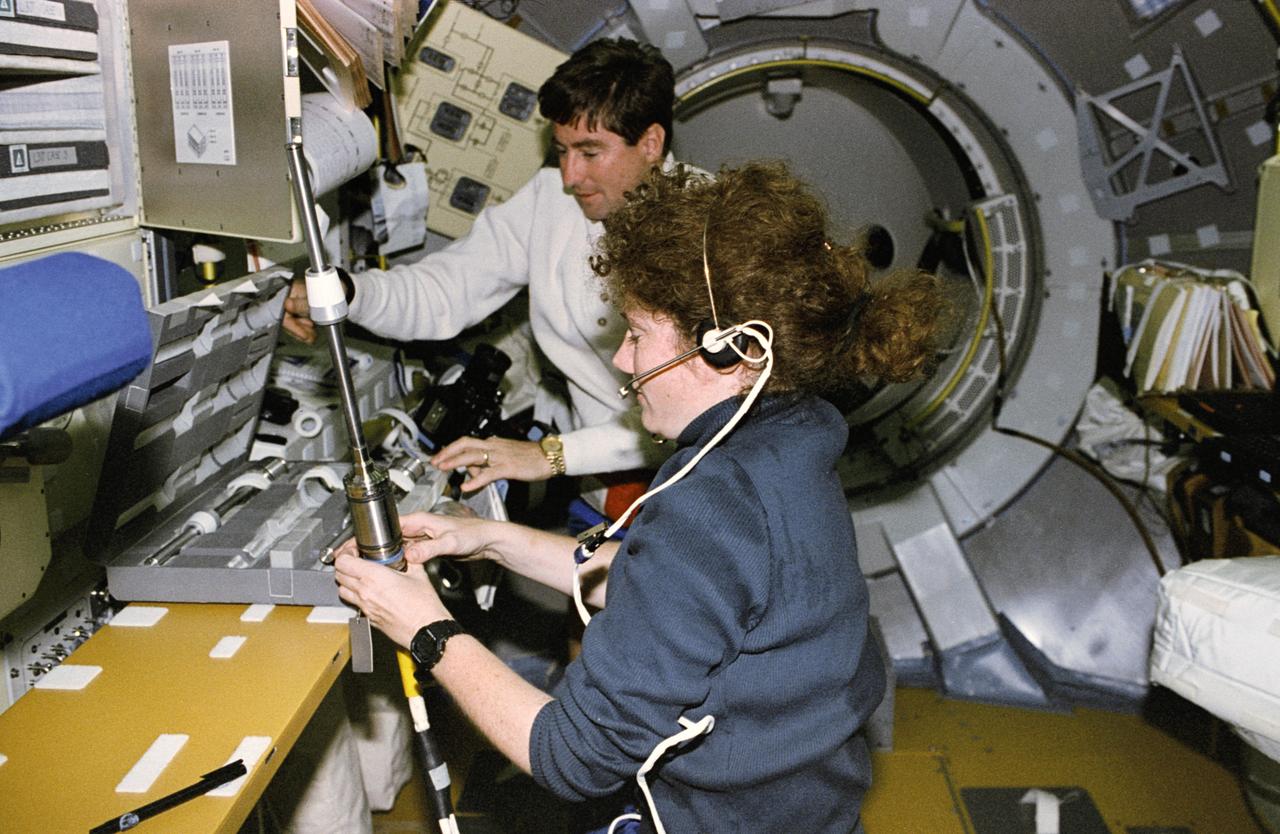
STS078-368-022 (20 June - 7 July 1996) --- Astronauts Susan J. Helms, payload commander, and Terence T. (Tom) Henricks, mission commander, prepare a sample cartridge containing semiconductor crystals for Spacelab research. The crystals were later placed in the Advanced Gradient Heating Furnace (AGHF) in the Life and Microgravity Spacelab (LMS-1) Science Module. The AGHF is designed for directional solidification of the crystals in the sample cartridges. The microgravity of space allows the crystals to grow in a perfect state that can not be accomplished in Earth's gravity.
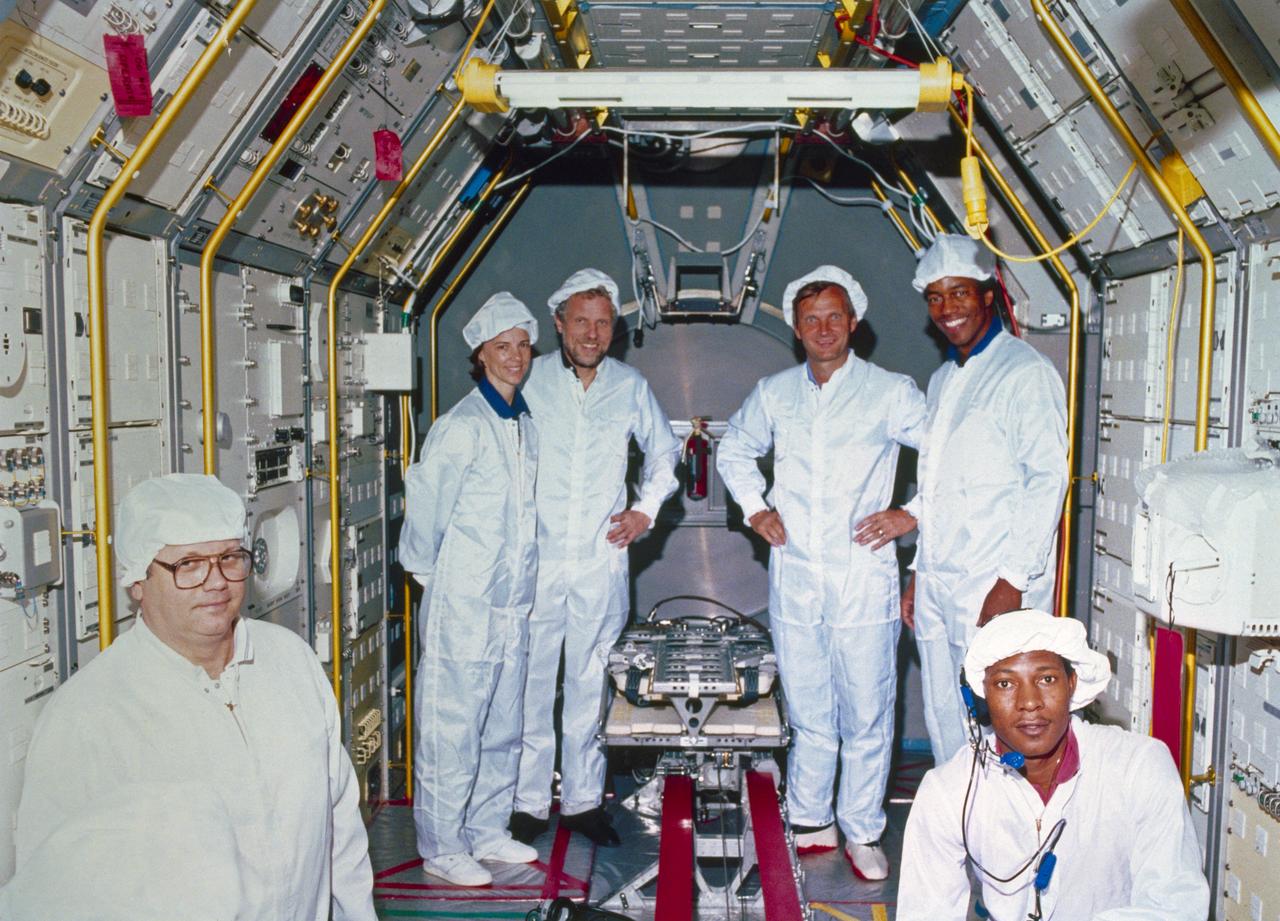
S85-43139 (20 Sept 1985) --- Four members of the STS 61-A/Spacelab D-1 crew and two technicians are shown with a vestibular sled experiment for they will use for extensive research and testing late October and early November are (background, left to right), Astronaut Bonnie J. Dunbar, Reinhard Furrer, Ernst Messerschmid and Guion S. Bluford Jr. The seat shown can be moved back and forth with precisley adjusted accelerations along the fixed rails on the floor of the Spacelab aisle.
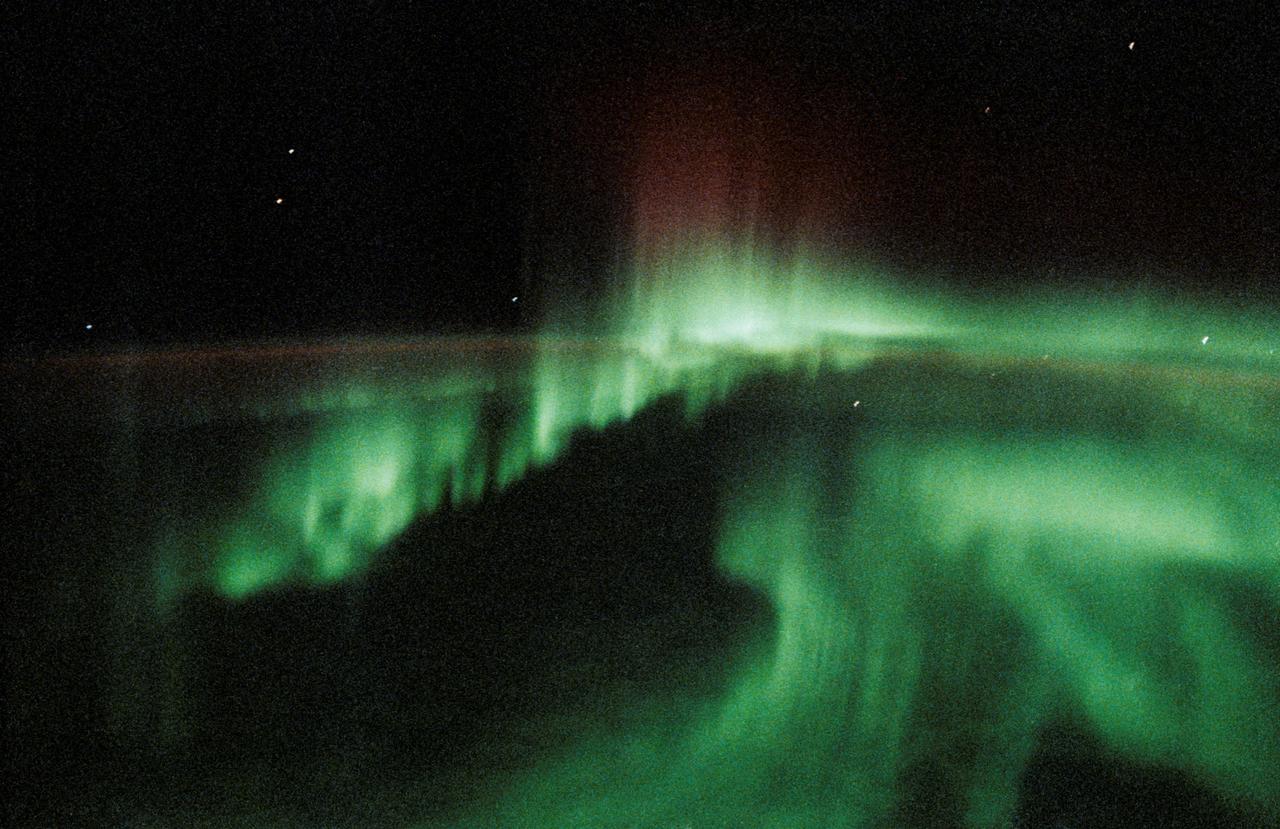
STS047-20-015 (12-20 Sept. 1992) --- This 35mm frame represents one of the more spectacular views of Aurora Australis, photographed by the crew. The crew observed and photographed a great deal of auroral activity from the Earth-orbiting Space Shuttle Endeavour during the eight-day Spacelab-J mission.
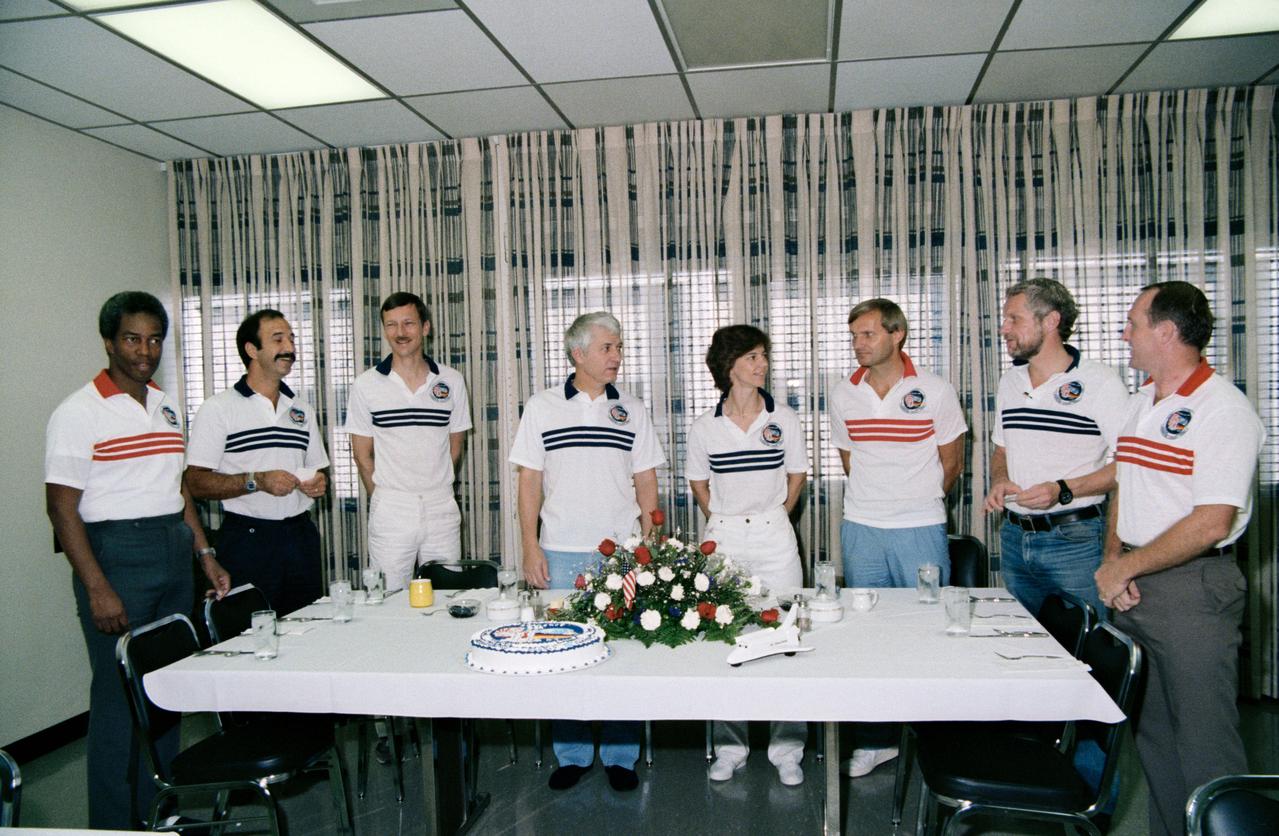
61A-S-016 (30 Oct 1985) --- Standing near their pre-flight breakfast table are the eight crewmembers for the STS 61-A/Spacelab D1 mission. L.-R., Guion S. Bluford, Wubbo J. Ockels, Steven R. Nagel, Henry W. Hartsfield, Bonnie J. Dunbar, Ernst Messerschmid, Reinhard Furrer and James F. Buchli, discuss their upcoming week in space.
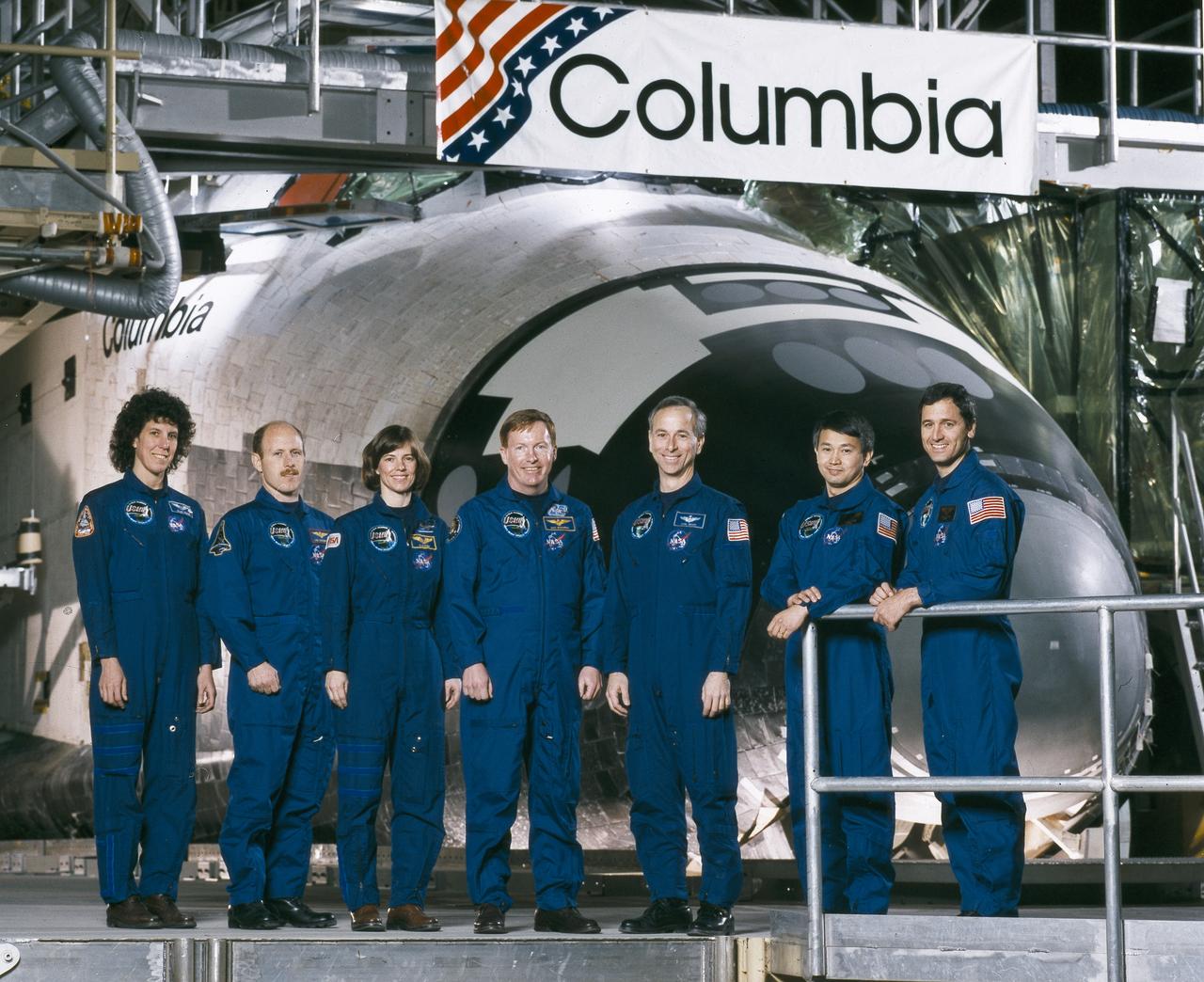
The STS-50 crew portrait includes (from left to right): Ellen S. Baker, mission specialist; Kenneth D. Bowersox, pilot; Bonnie J. Dunbar, payload commander; Richard N. Richards, commander; Carl J. Meade, mission specialist; Eugene H. Trinh, payload specialist; and Lawrence J. DeLucas, payload specialist. Launched aboard the Space Shuttle Columbia on June 25, 1992 at 12:12:23 pm (EDT), the primary payload for the mission was the U.S. Microgravity Laboratory-1 (USML-1) featuring a pressurized Spacelab module.
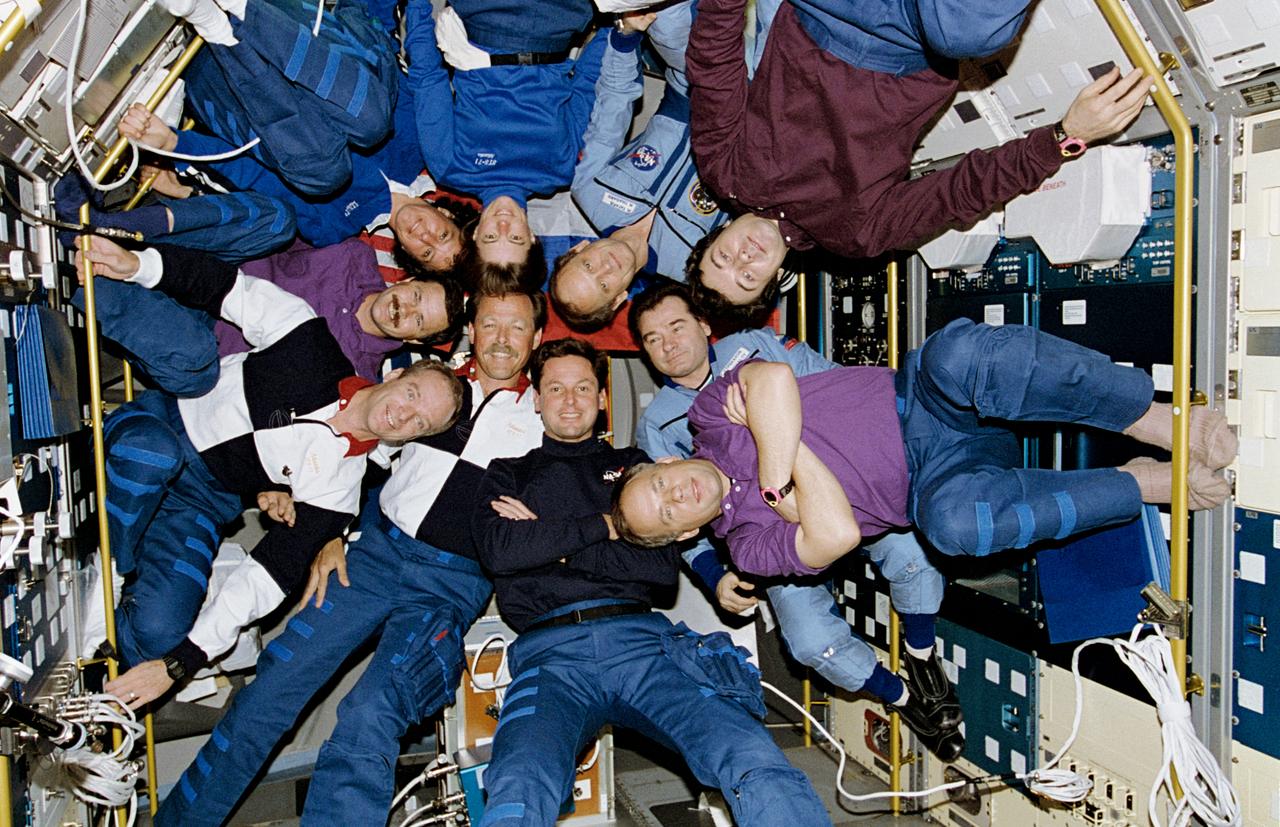
STS071-122-013 (27 June-7 July 1995) --- Inside the space shuttle Atlantis' Spacelab Science Module, the crewmembers of STS-71, Mir-18 and Mir-19 pose for the traditional inflight portrait. For individual identification, hold picture vertically with socked feet of Anatoly Y. Solovyev at bottom center. Clockwise from Solovyev are astronauts Gregory J. Harbaugh, Robert L. Gibson, Charles J. Precourt, Nikolai M. Budarin, Ellen S. Baker, Bonnie J. Dunbar, Norman E. Thagard, and cosmonauts Gennadiy M. Strekalov (at angle) and Vladimir N. Dezhurov.
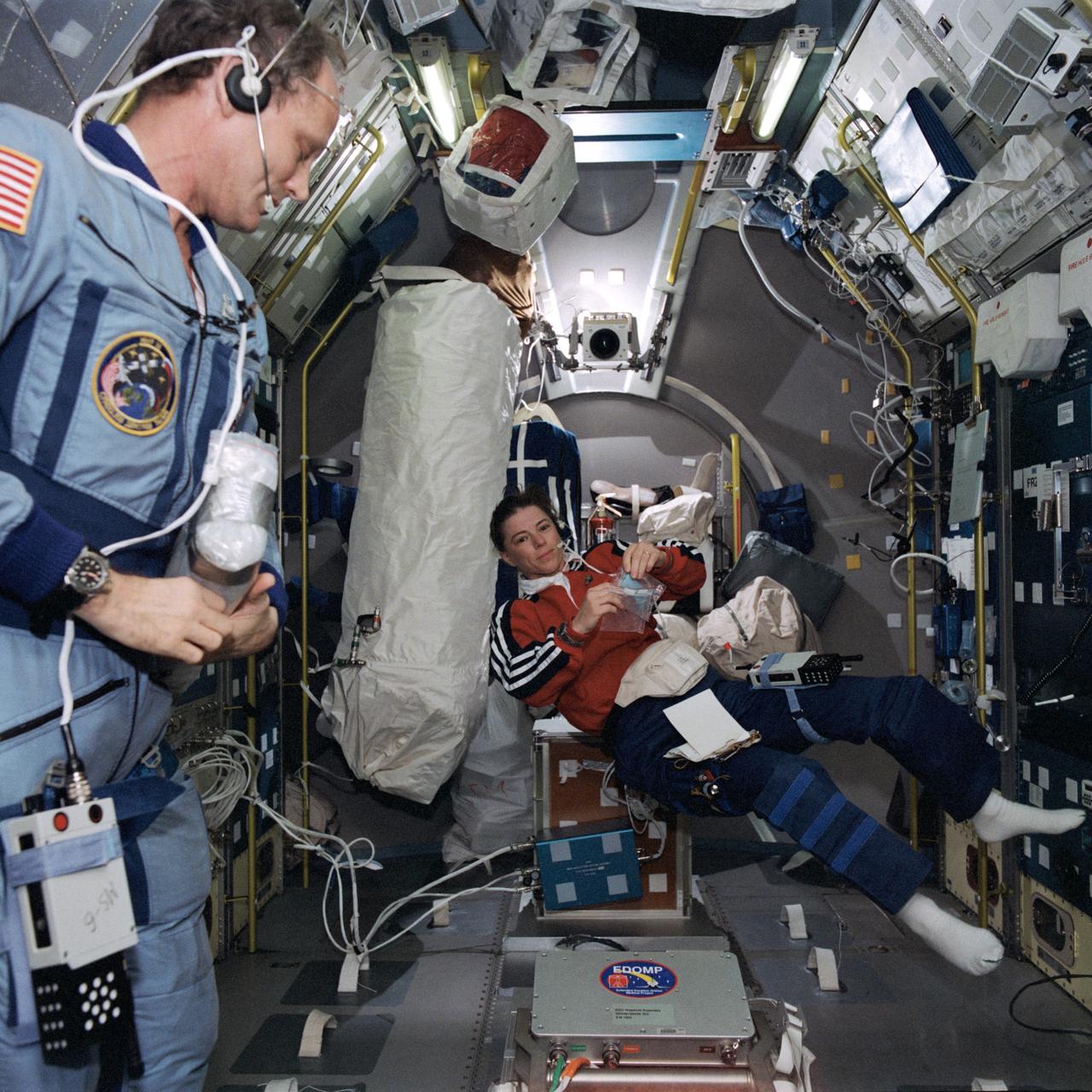
STS071-758-009 (27 June - 7 July 1995) --- Astronaut Bonnie J. Dunbar, mission specialist, floats about in the Spacelab Science Module as astronaut Norman E. Thagard looks on. Thagard, Mir-18 guest cosmonaut researcher, had completed four months in space aboard Russia's Mir Space Station. When this photograph was taken he was undergoing a battery of tests and data collection exercises on Spacelab, onboard the Space Shuttle Atlantis. Dunbar had served as his Mir-18 backup, during a year's training in Russia.
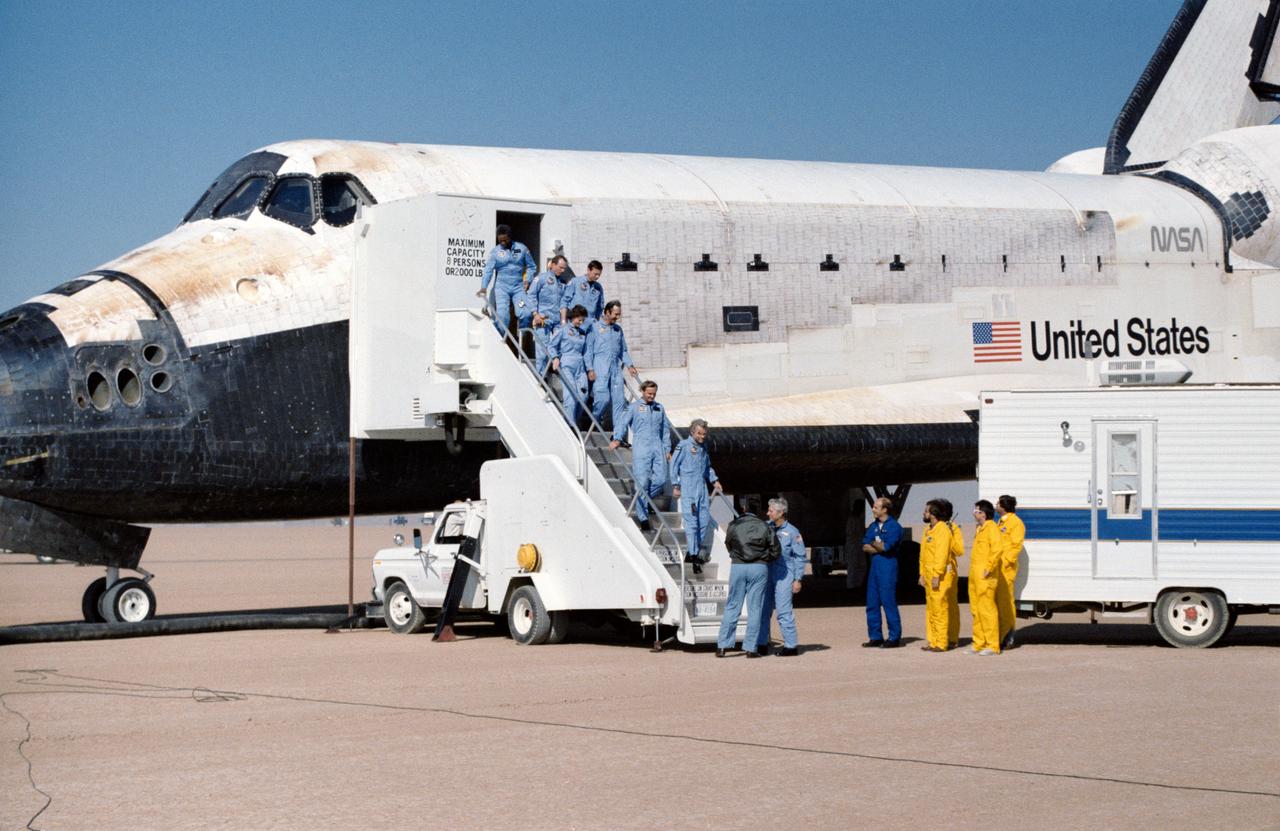
61A-S-140 (6 Nov 1985) --- The record-setting eight crewmembers for STS 61-A file from their "home" for the past week at the completion of a successful Spacelab D-1 mission. Astronaut Henry W. Hartsfield Jr., mission commander, shakes hands with George W. S. Abbey, director of flight crew operations at JSC. Other crewmembers, from left to right, are Astronauts Guion S. Bluford Jr., James F. Buchli, Steven R. Nagel and Bonnie J. Dunbar; and Payload Specialists Wubbo J. Ockels, Ernst Messerschmid and Reinhard Furrer. The Challenger came to a complete stop at 9:45:39 a.m. (PST).
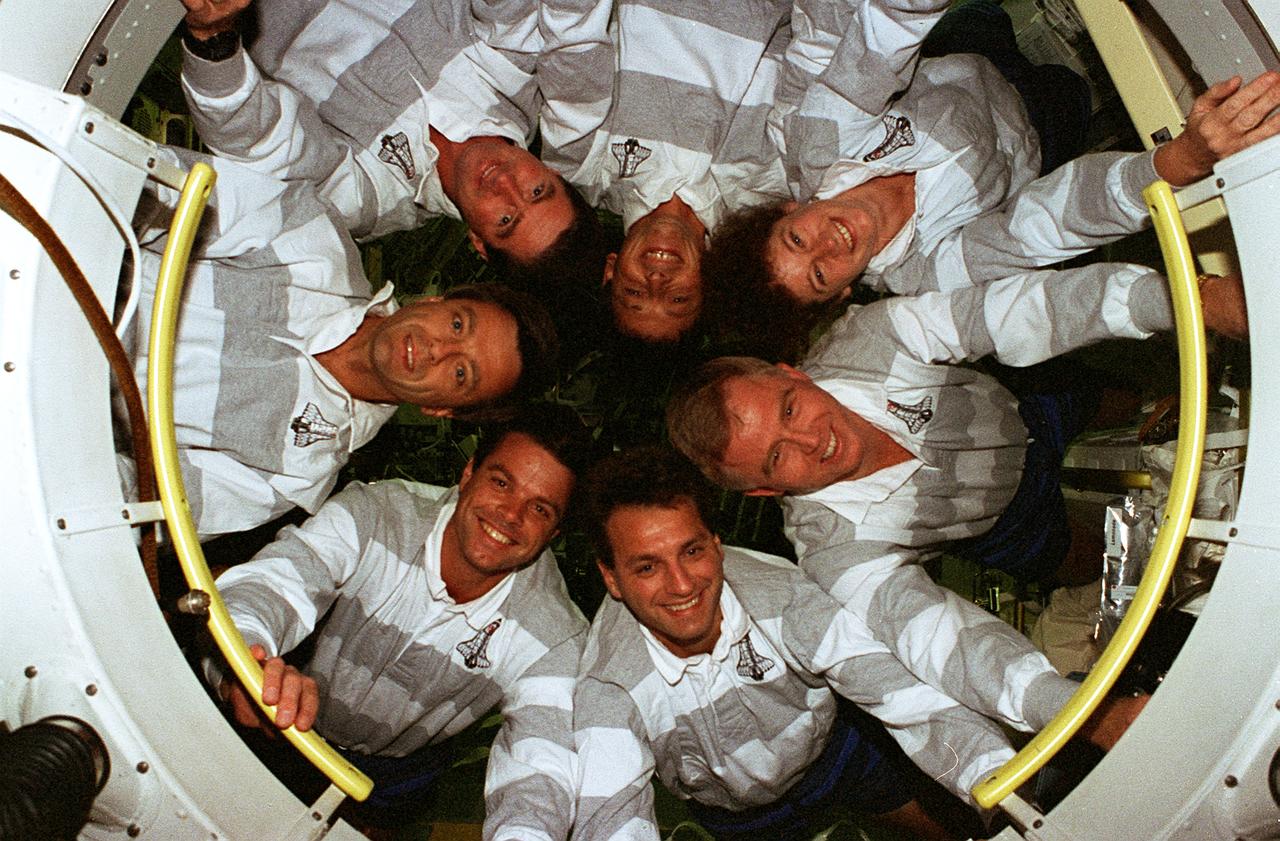
STS078-428-015 (20 June-7 July 1996) --- The crewmembers chose the Life and Microgravity Spacelab (LMS-1) Science Module as a backdrop for their traditional inflight portrait. Hold picture vertically with payload commander Susan J. Helms in lower right. Clockwise from astronaut Helms are Charles J. Brady, Richard M. Linnehan, Kevin R. Kregel, Canadian payload specialist Robert B. Thirsk, Terence T. (Tom) Henricks and French payload specialist Jean-Jacques Favier. Henricks and Kregel are commander and pilot, respectively, with Linnehan and Brady serving as mission specialists.
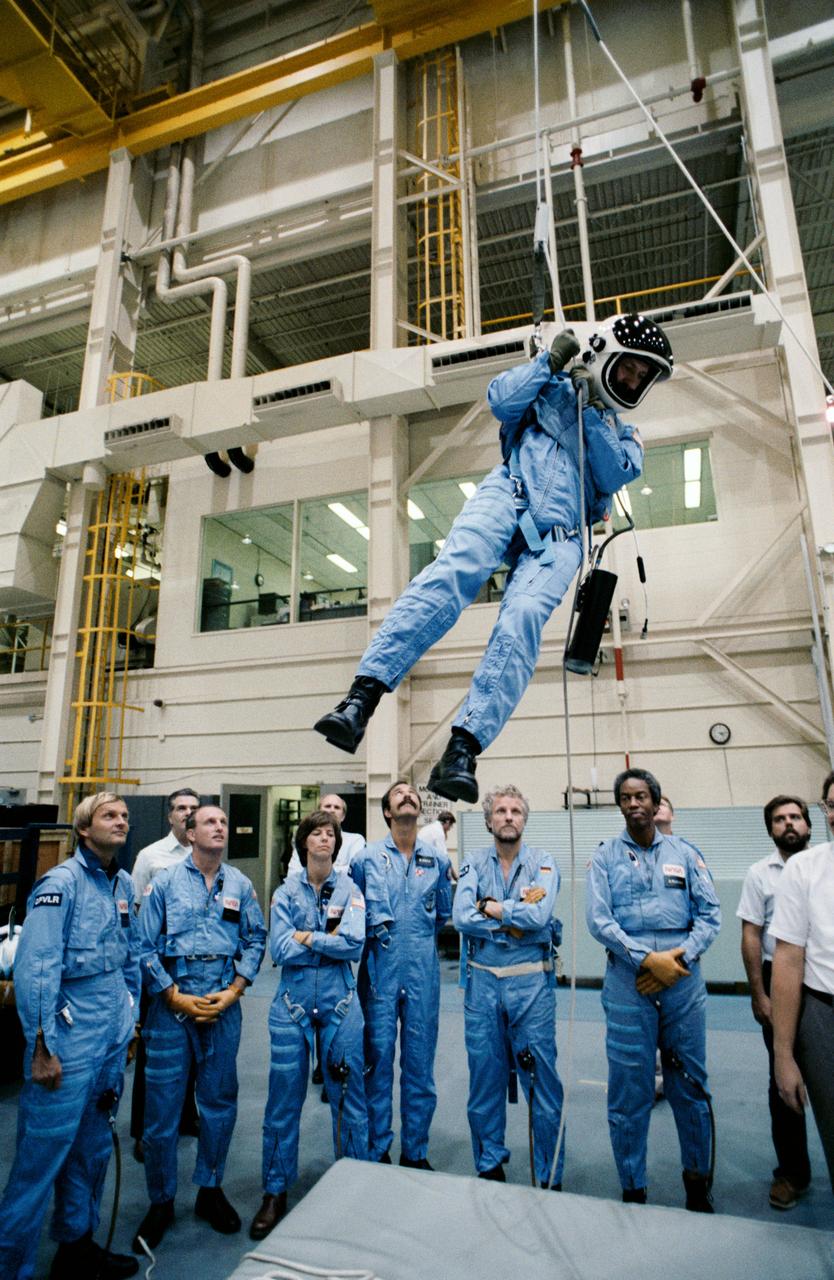
S85-41246 (26 Sept 1985) --- The STS 61-A/Spacelab D-1 crewmembers are seen in this training scene in the Johnson Space Center's Space Shuttle mockup and integration laboratory. Descending from a simulated Shuttle orbiter in distress, using a Sky-Genie device, is Astronaut Henry W. Hartsfield, Jr. mission commander. Watching in blue flight garments are other members of the crew. They are, left to right, Ernst Messerschmid, German payload specialist (PS1); James F. Buchli, NASA mission specialist (MS2); Bonnie J. Dunbar, NASA mission specialist (MS1); Wubbo J. Ockels, Dutch PS3. Not pictured is Steven R. Nagel, pilot. Photo was taken by Otis Imboden.
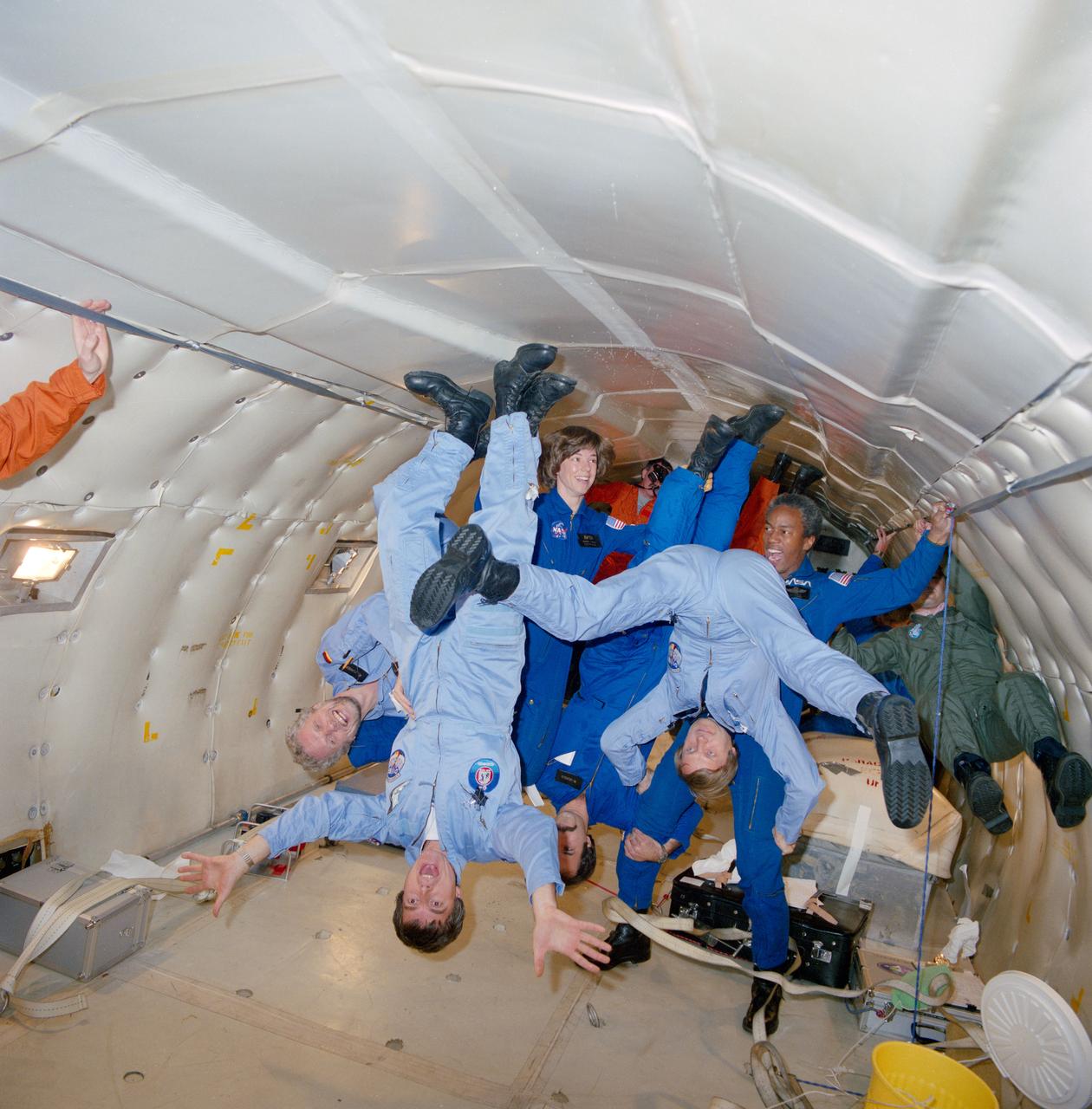
S84-47177 (17 Dec 1984) --- A recent flight in NASA's KC-135 aircraft gave the STS 61-A/Spacelab D-1 crewmembers a chance to get a preview of weightlessness. Mission specialists Bonnie J. Dunbar and Guion S. Bluford appear to be balancing several payload specialists during a few brief moments of microgravity. With heads near the floor are, left to right, Payload Specialists Reinhard Furrer, Ulf Merbold, Wubbo J. Ockels and Ernst Messerschmid. Ockels is from the Netherlands; the others, from Germany, with Merbold serving as backup.
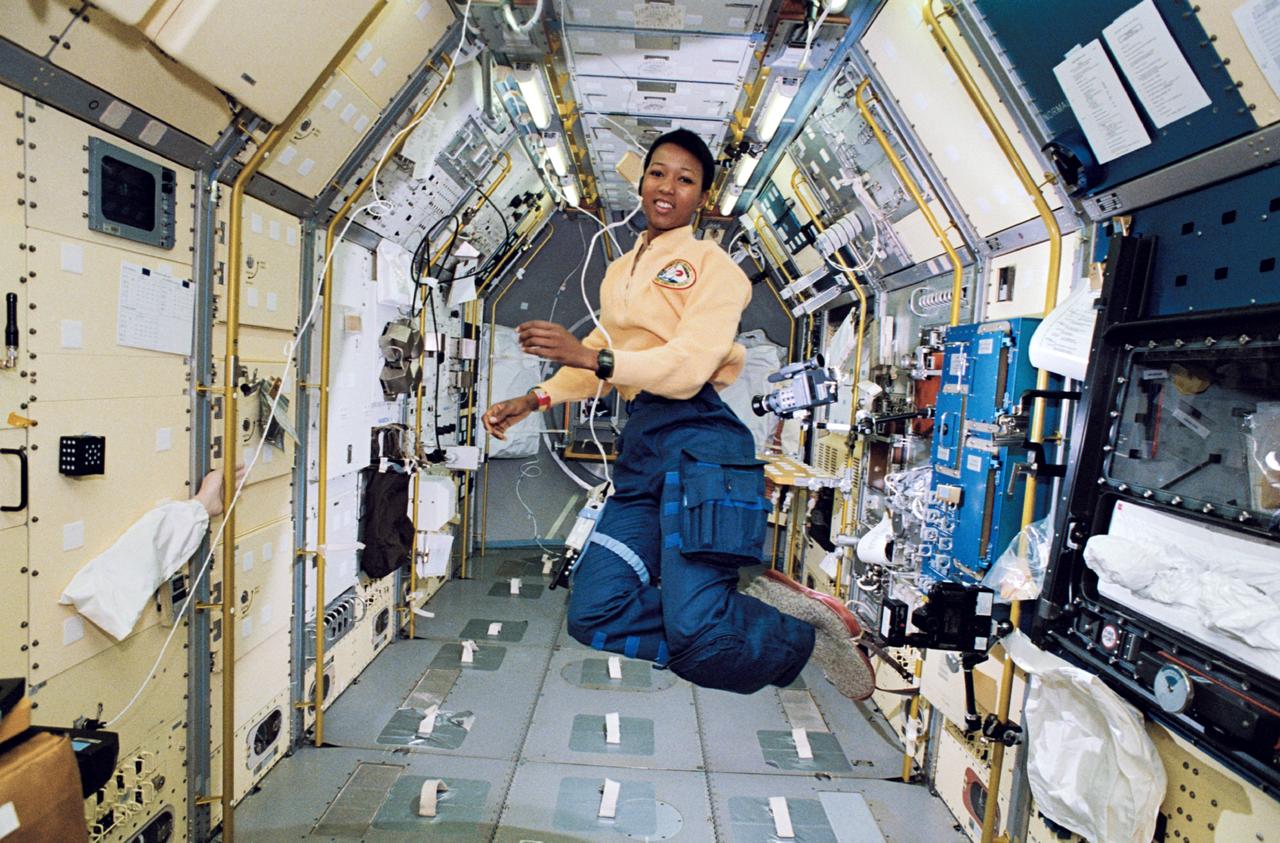
STS047-37-003 (12-20 Sept. 1992) --- Astronaut Mae C. Jemison, STS-47 mission specialist, appears to be clicking her heels in zero-gravity in this 35mm frame photographed in the Science Module aboard the Earth-orbiting Space Shuttle Endeavour. Making her first flight in space, Dr. Jemison was joined by five other NASA astronauts and a Japanese payload specialist for eight days of research in support of the Spacelab-J mission, a joint effort between Japan and the United States.
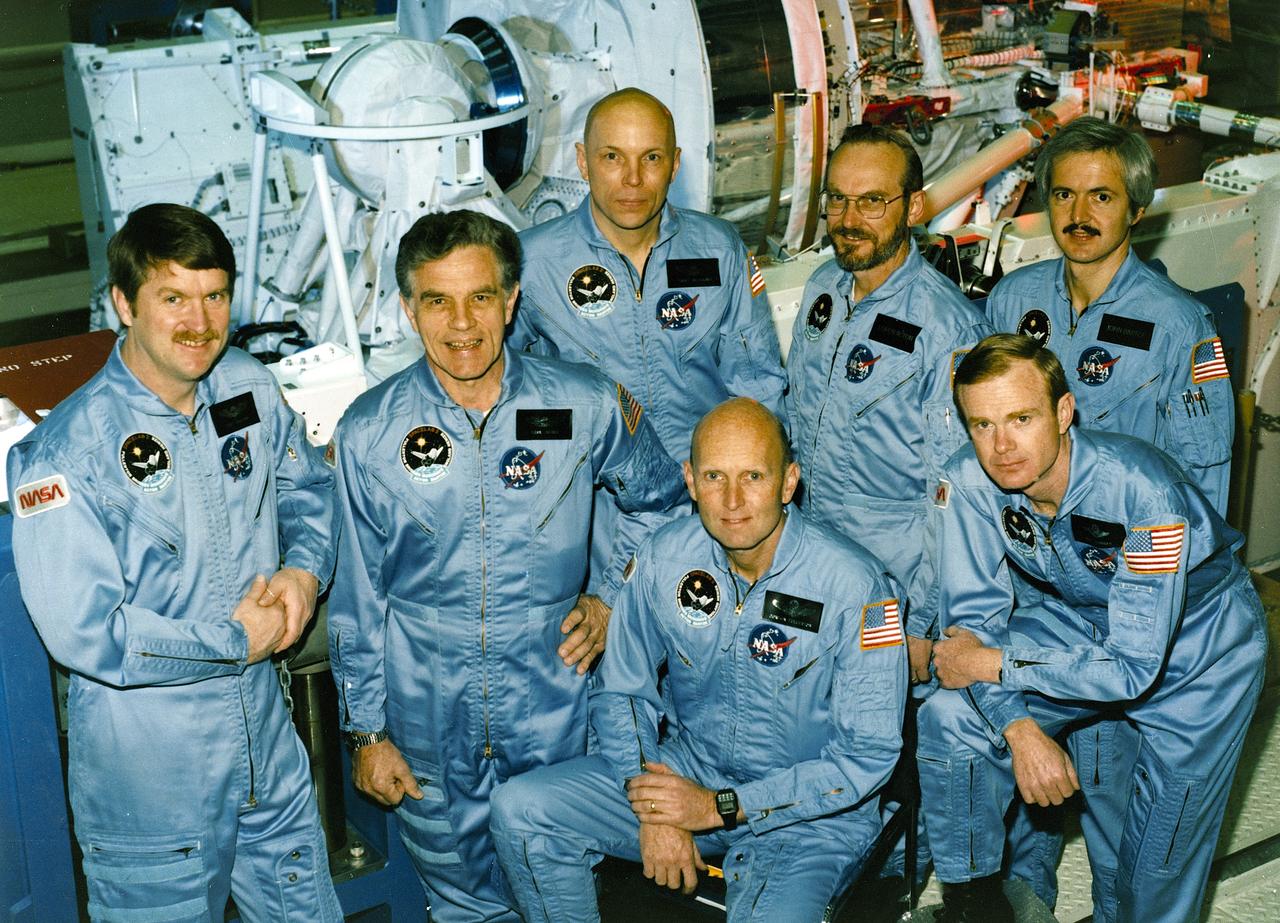
The crew assigned to the STS-51F mission included (kneeling left to right) Gordon Fullerton, commander; and Roy D. Bridges, pilot. Standing, left to right, are mission specialists Anthony W. England, Karl J. Henize, and F. Story Musgrave; and payload specialists Loren W. Acton, and John-David F. Bartoe. Launched aboard the Space Shuttle Challenger on July 29, 1985 at 5:00:00 pm (EDT), the STS-51F mission’s primary payload was the Spacelab-2.
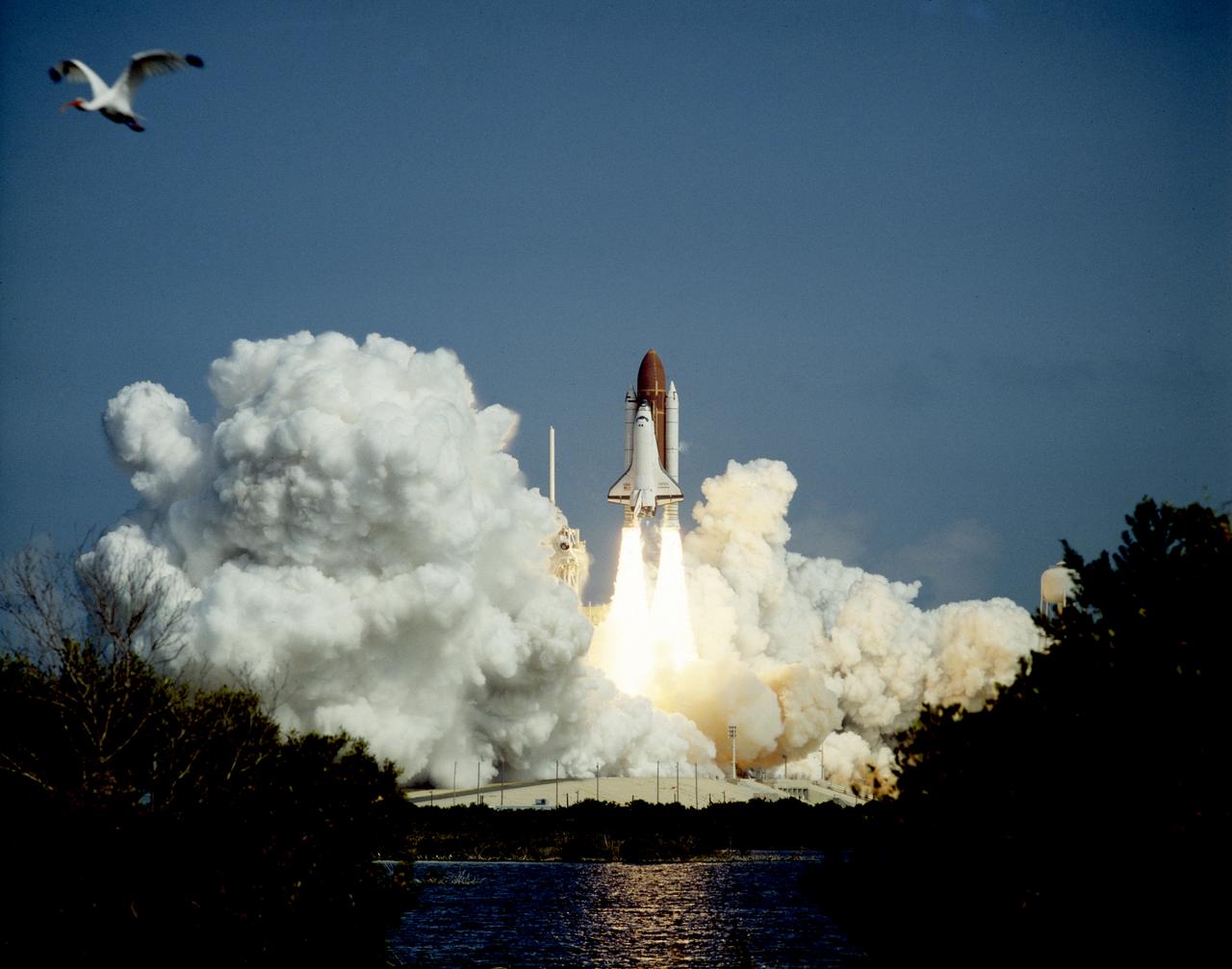
A smooth countdown culminated in a picture-perfect launch as the Space Shuttle Endeavour (STS-47) climbed skyward atop a ladder of billowing smoke. Primary payload for the plarned seven-day flight was Spacelab-J science laboratory. The second flight of Endeavour marks a number of historic firsts: the first space flight of an African-American woman, the first Japanese citizen to fly on a Space Shuttle, and the first married couple to fly in space.
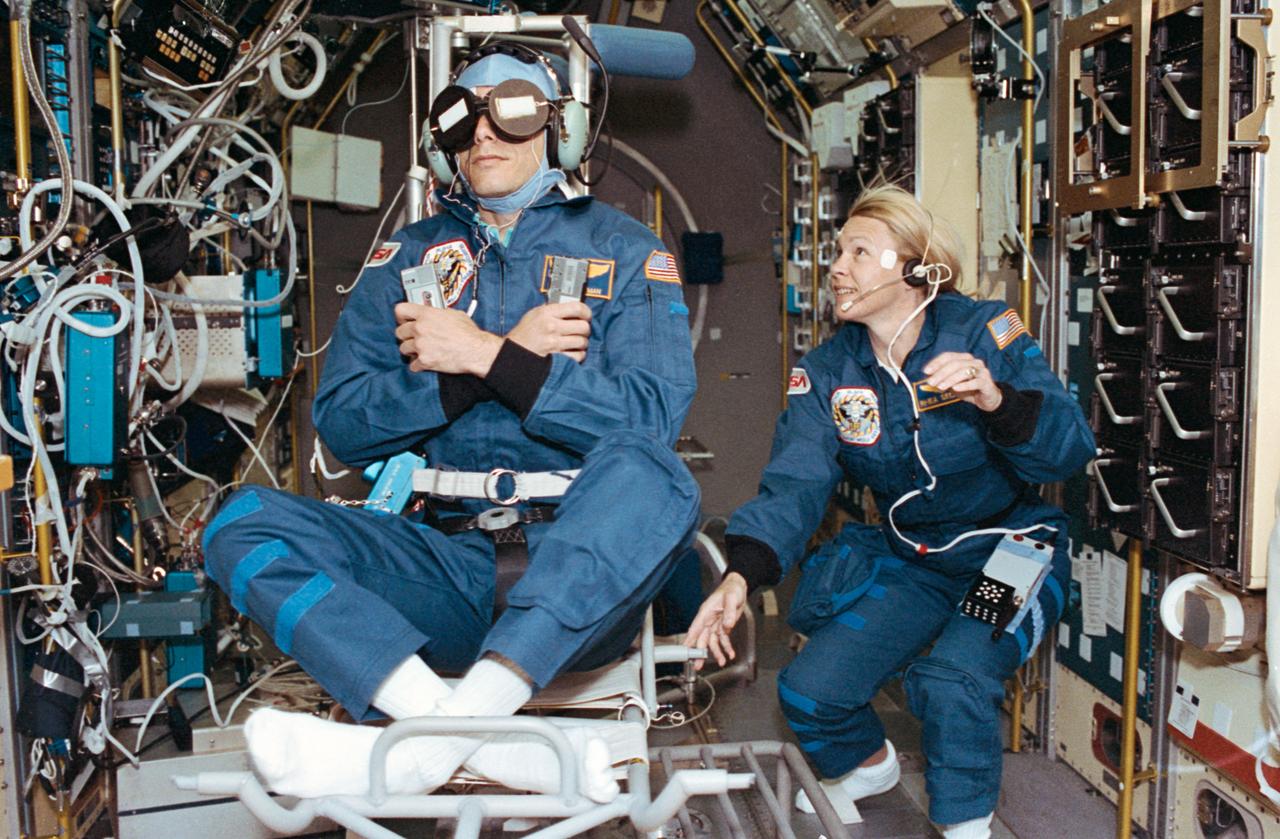
STS058-202-002 (18 Oct.-1 Nov. 1993) --- Astronaut Rhea Seddon, STS-58 payload commander, spins the Spacelab Life Sciences (SLS-2) rotating chair as payload specialist Martin J. Fettman serves as test subject. The two joined five NASA astronauts for fourteen days of medical research aboard the Earth-orbiting space shuttle Columbia. Photo credit: NASA
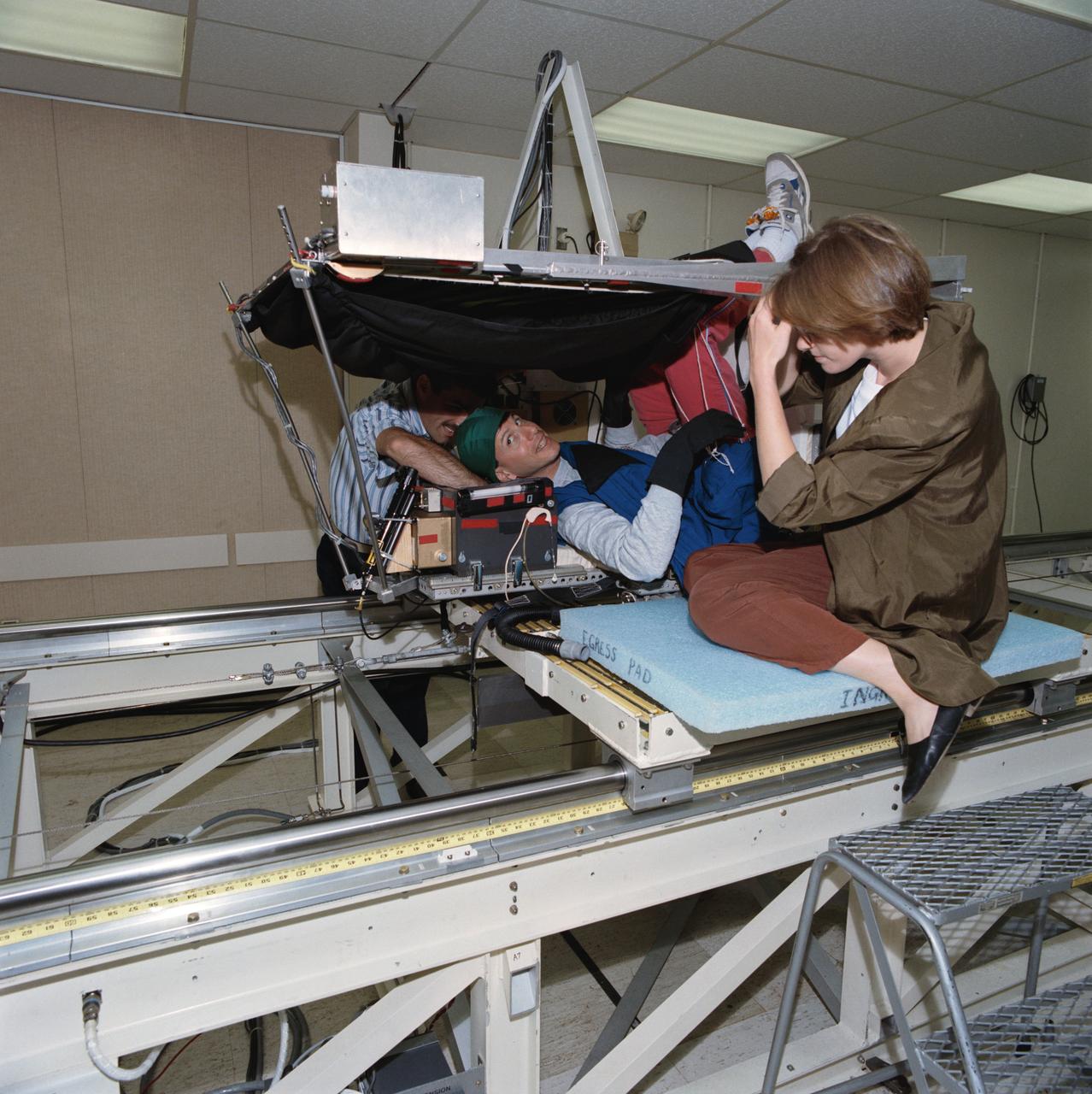
S93-45314 (29 Sept 1993) --- Payload specialist Martin J. Fettman, in an oscillating sled device, participates in a data collection project for neurovestibular functions. The seven Spacelab Life Sciences (SLS-2) crewmembers devoted a full day to miscellaneous biomedical data collection in preparation for next month's two week mission aboard Columbia.
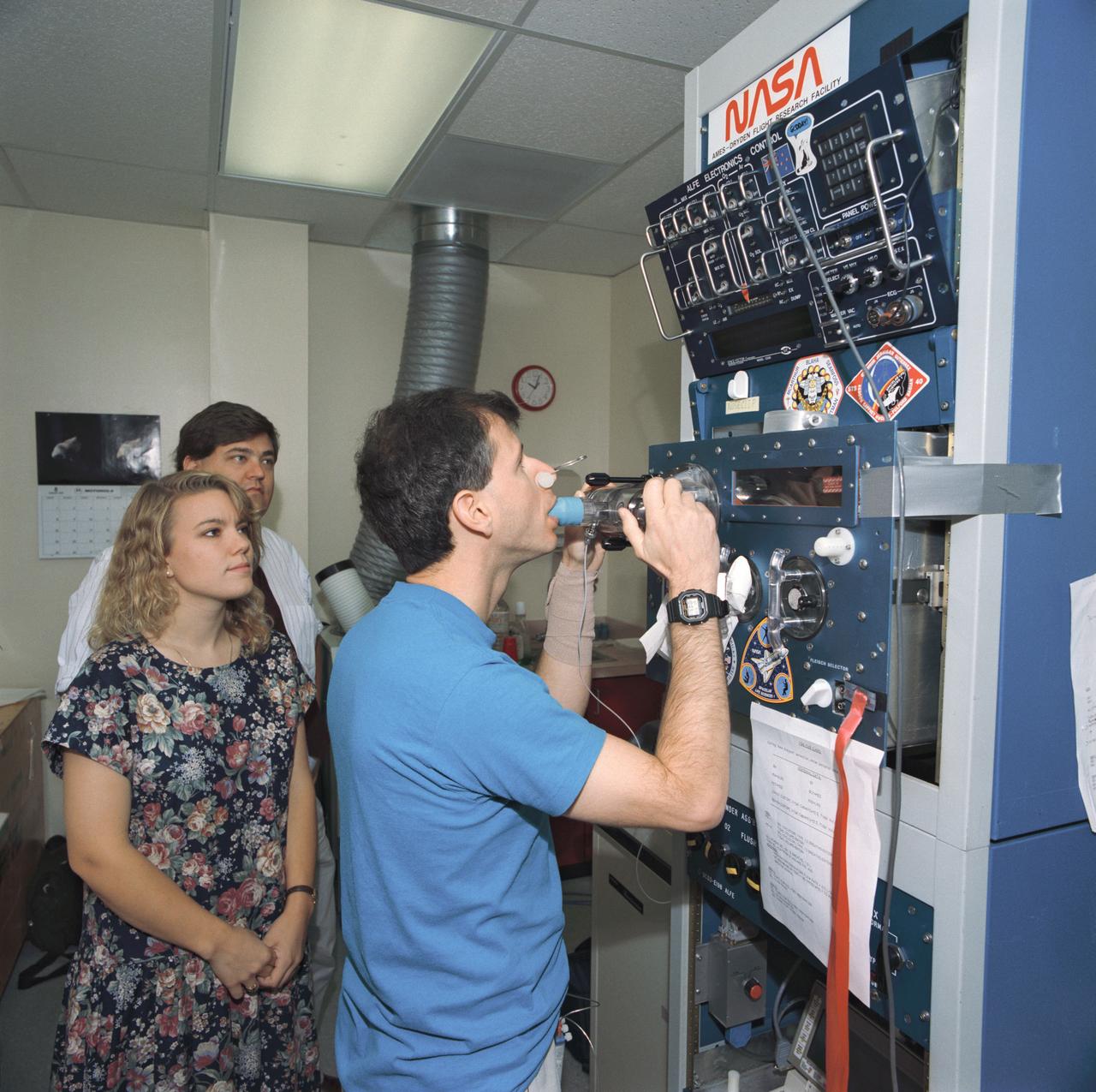
S93-45369 (29 Sept 1993) --- Training on the pre-breathing assembly, Martin J. (Marty) Fettman, DVM, inhales a predetermined gas composition. A gas analyzer mass spectrometer determines the composition of the gases he exhales. The re-breathing assembly and gas analyzer system are part of an investigation that explores how lung function is altered in space flight. The payload specialist for the Spacelab Life Sciences (SLS-2) mission was participating with six NASA astronauts, also assigned to STS-58, for data collection and training.
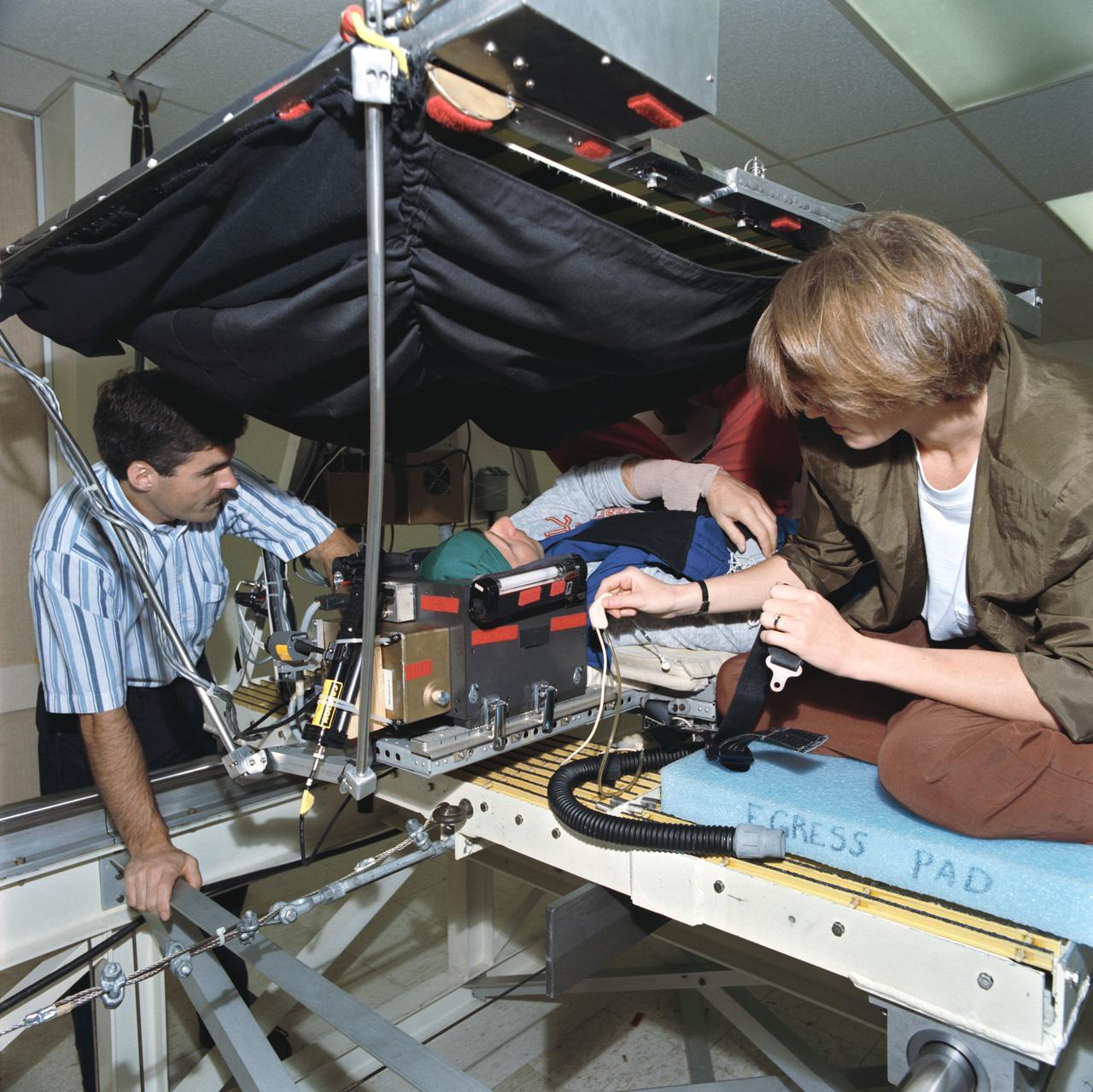
S93-45363 (29 Sept 1993) --- Payload specialist Martin J. Fettman, in an oscillating sled device, participates in a data collection project for neurovestibular functions. The seven Spacelab Life Sciences (SLS-2) crewmembers devoted a full day to miscellaneous biomedical data collection in preparation for next month's two week mission aboard Columbia.
STS058-202-001 (18 Oct.-1 Nov. 1993) --- Astronaut Rhea Seddon, payload commander, spins the Spacelab Life Sciences (SLS-2) rotating chair as payload specialist Martin J. Fettman serves as test subject. The two joined five NASA astronauts for fourteen days of medical research aboard the Earth-orbiting space shuttle Columbia. Photo credit: NASA
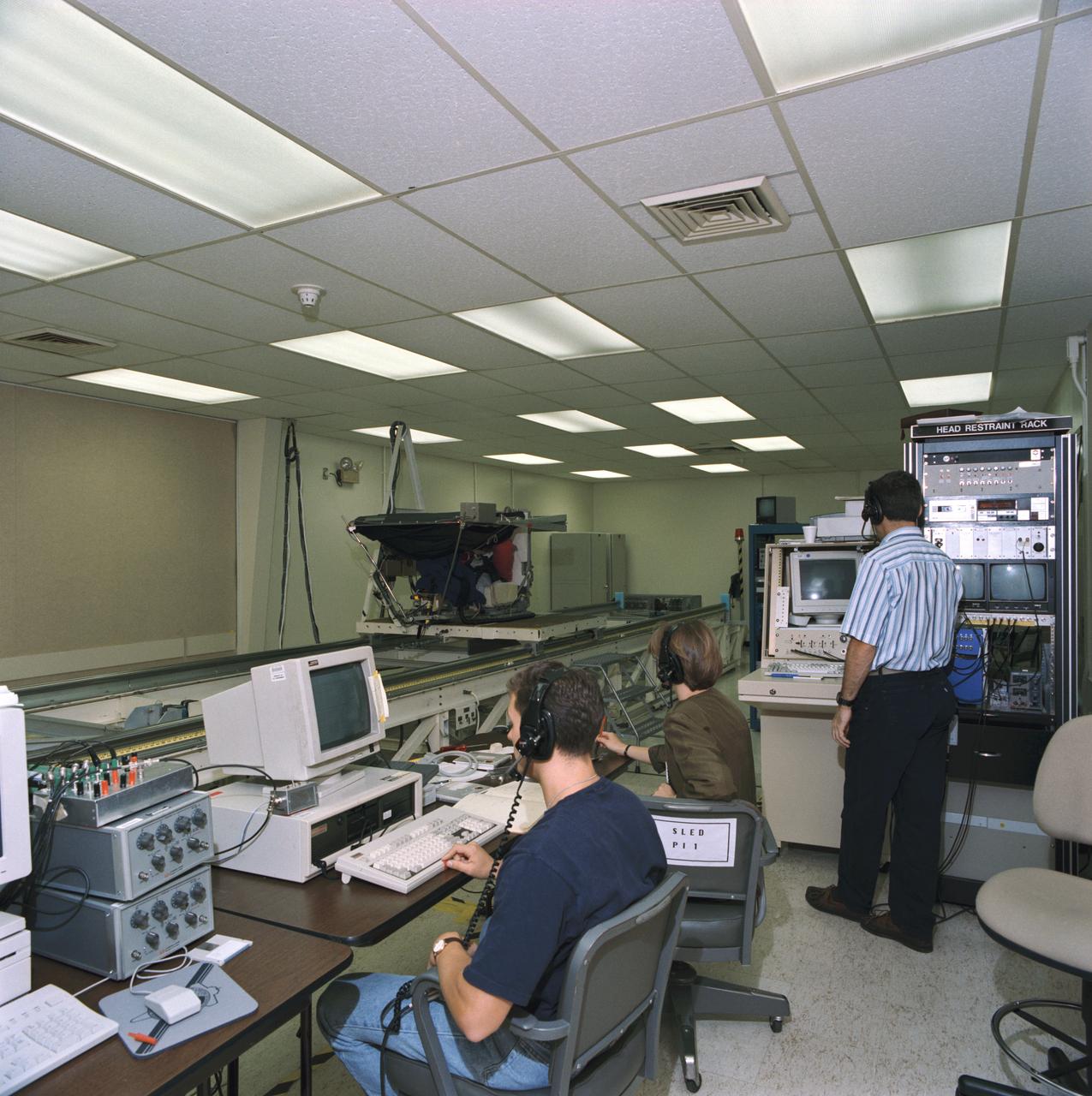
S93-45365 (29 Sept 1993) --- Payload specialist Martin J. Fettman, in an oscillating sled device in upper left, participates in a data collection project for neurovestibular functions. His responses to the sled's movements are recorded by a team of monitors in the foreground. The seven Spacelab Life Sciences (SLS-2) crew members devoted a full day to miscellaneous biomedical data collection in preparation for next month's two week mission aboard Columbia.
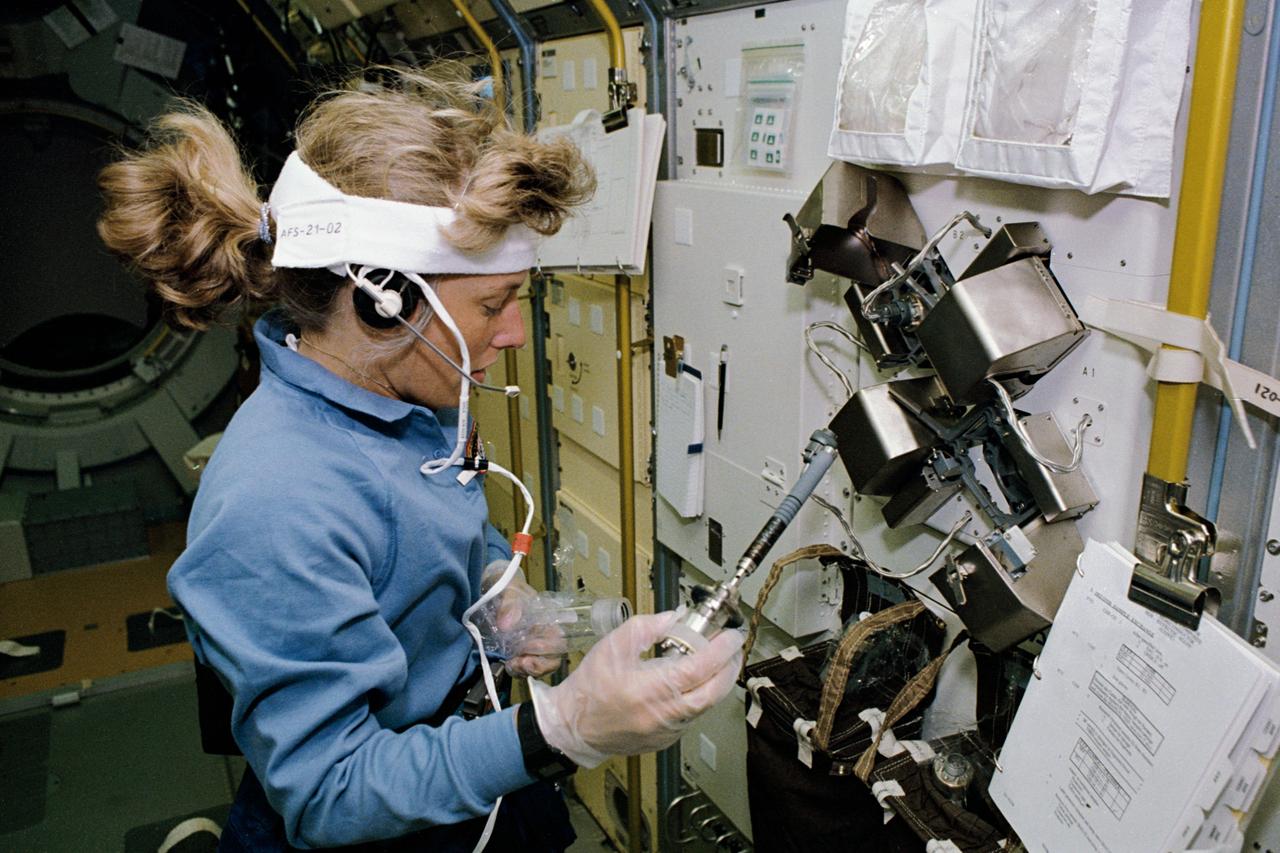
STS047-02-003 (12 - 20 Sept 1992) --- Astronaut N. Jan Davis, mission specialist, works at the Continuous Heating Furnace (CHF) in the Spacelab-J Science Module. This furnace provided temperatures up to 1,300 degrees Celsius and rapid cooling to two sets of samples concurrently. The furnace accommodated in-space experiments in the Fabrication of Si-As-Te:Ni Ternary Amorphous Semiconductor and the Crystal Growth of Compound Semiconductors. These were two of the many experiments designed and monitored by Japan's National Space Development Agency (NASDA).
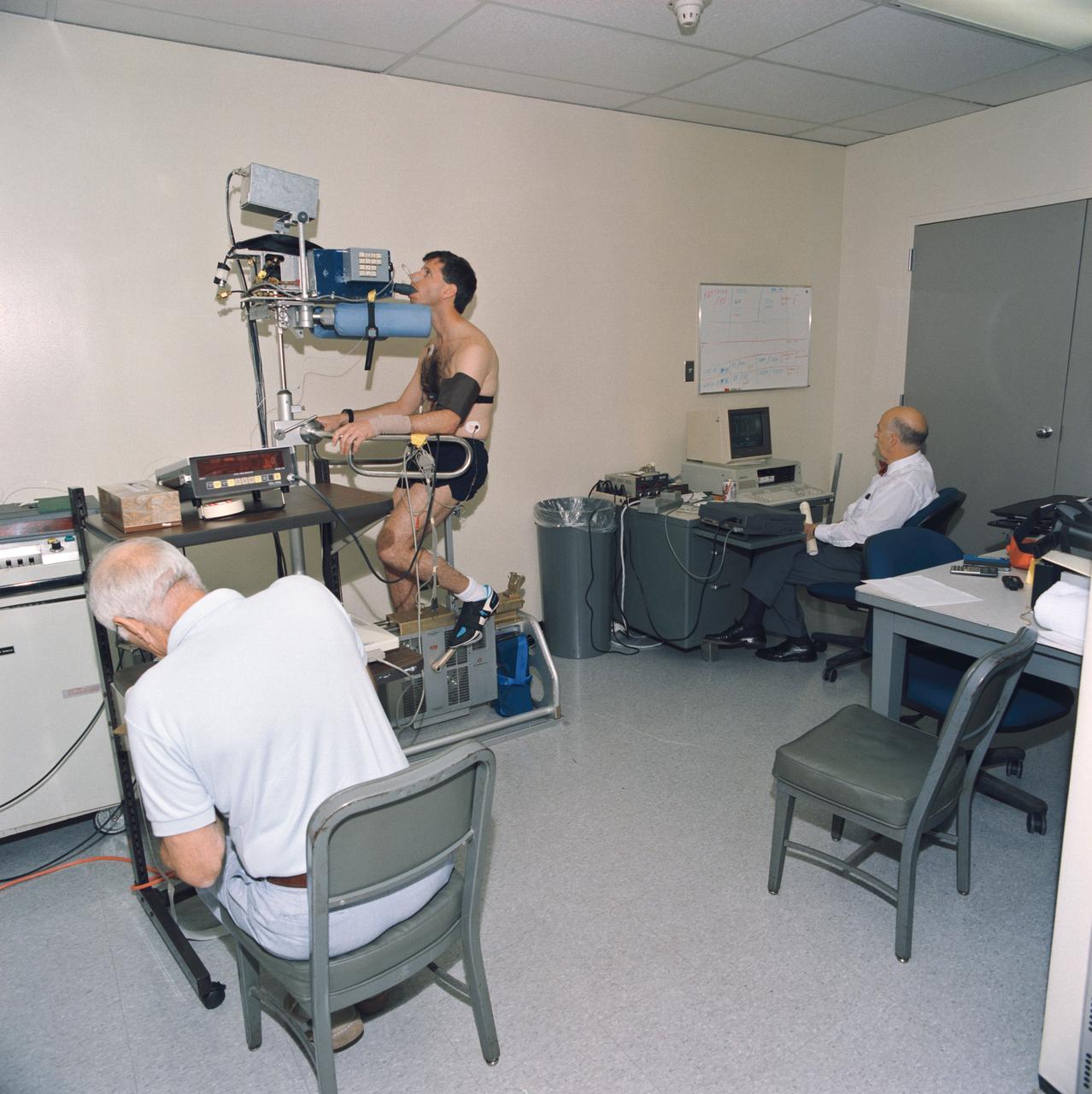
S93-45371 (29 Sept 1993) --- Astride the bicycle ergometer, Martin J. (Marty) Fettman, DVM, breathes quietly into the cardiovascular re-breathing unit during the resting phase of an experiment. The payload specialist for the Spacelab Life Sciences (SLS-2) mission was participating with six NASA astronauts, also assigned to STS-58, for data collection and training.
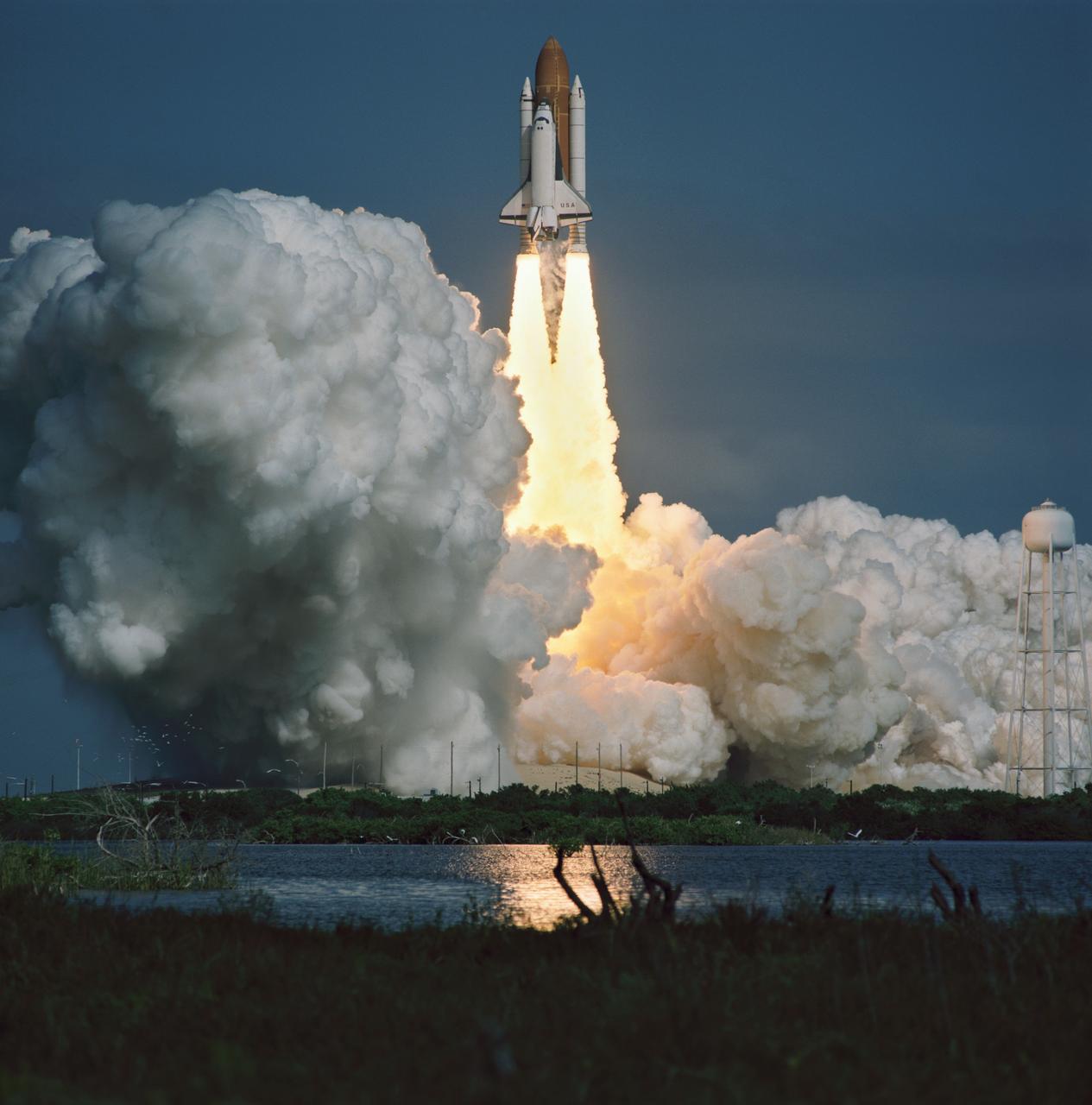
STS058-S-090 (18 Oct 1993) --- Creating large clouds of smoke the Space Shuttle Columbia lifts off from Launch Complex 39 at Kennedy Space Center (KSC). Liftoff occurred at 10:53 a.m. (EDT), October 18, 1993. Along with its Spacelab Life Sciences-2 payload, Columbia carries astronauts John E. Blaha, Richard A. Searfoss, Rhea Seddon, Shannon W. Lucid, David A. Wolf and William S. McArthur along with payload specialist Martin J. Fettman.
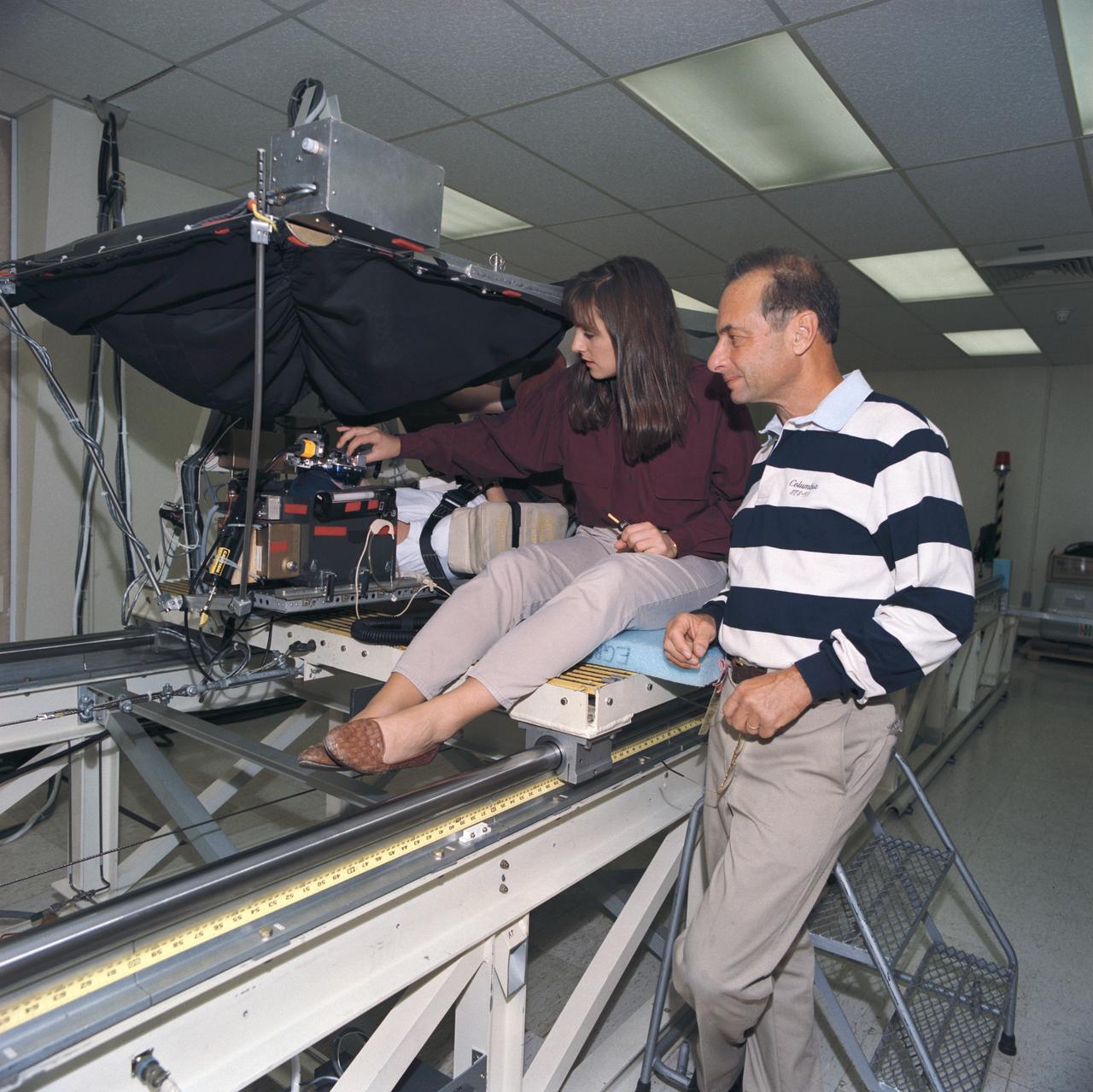
S93-45368 (29 Sept 1993) --- Payload specialist Martin J. Fettman (face obscured), in an oscillating sled device, participates in a data collection project for neurovestibular functions. Assisting the test are Dr. Laurence Young, alternate payload specialist, and an unidentified MIT student. The seven Spacelab Life Sciences (SLS-2) crew members devoted a full day to miscellaneous biomedical data collection in preparation for next month's two week mission aboard Columbia.
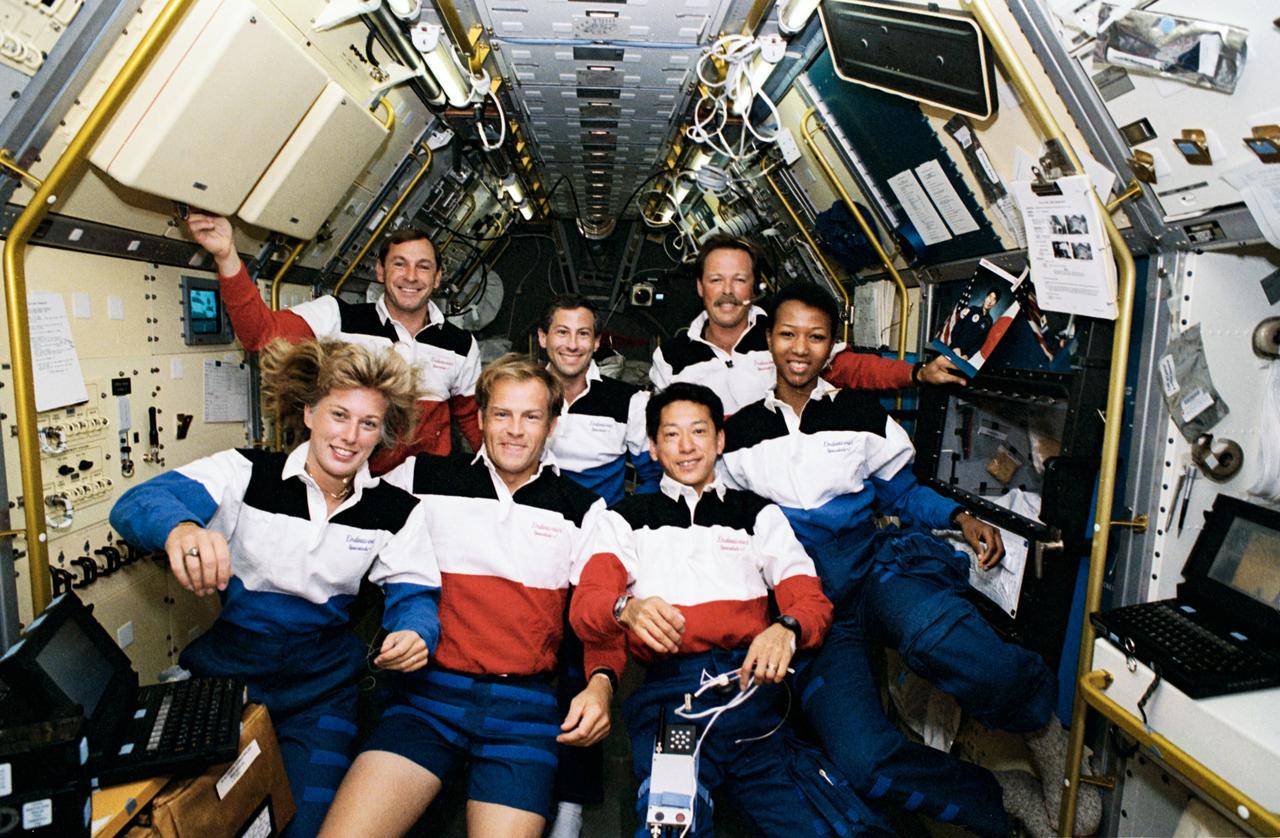
STS047-12-002 (12 - 20 Sept 1992) --- The crew members assemble for their traditional in-flight portrait in this 35mm frame photographed in the Science Module aboard the Earth-orbiting Space Shuttle Endeavour. Left to right (front) are N. Jan Davis, Mark C. Lee and Mamoru Mohri; and (rear) Curtis L. Brown, Jr., Jerome (Jay) Apt, Robert L. Gibson and Mae C. Jemison. The seven spent eight days in space in support of the Spacelab-J mission.
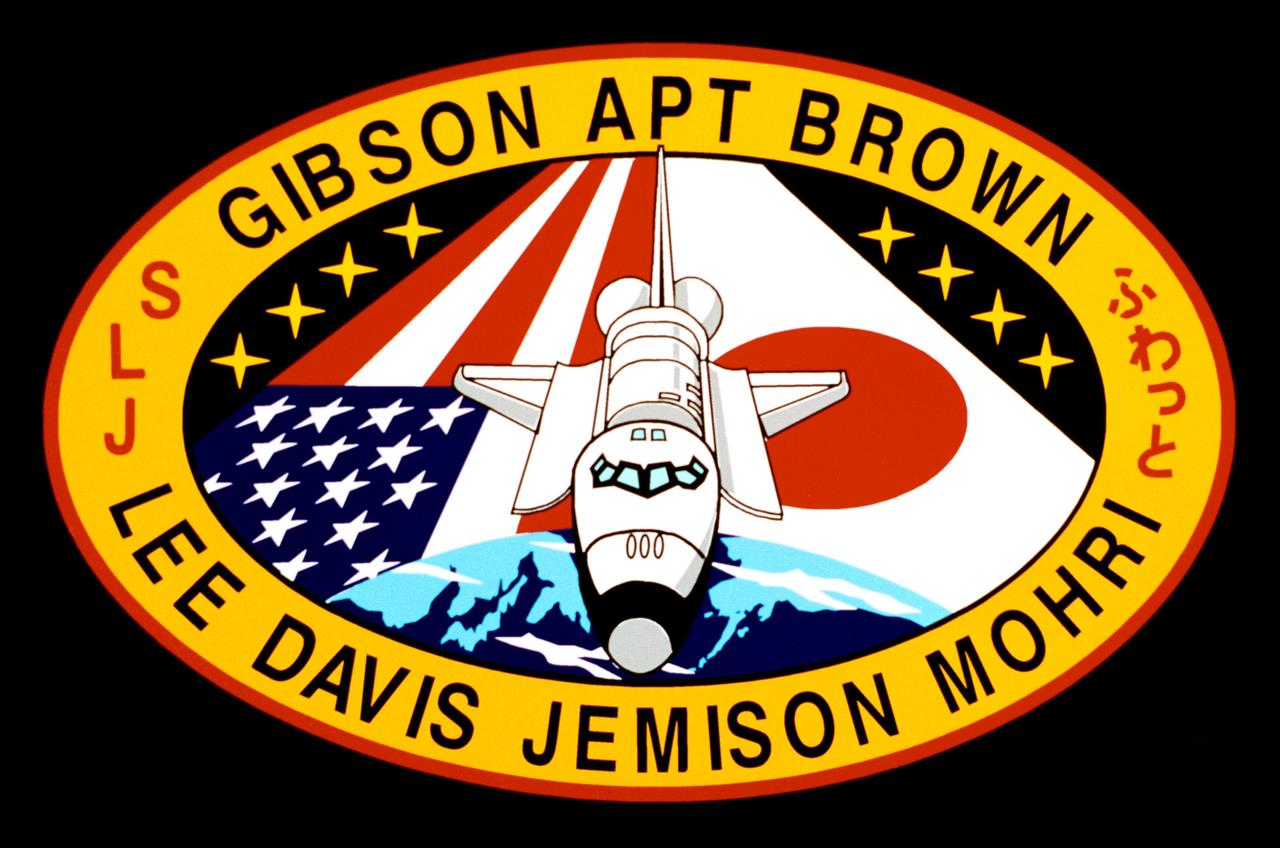
STS047-S-001 (June 1992) --- Designed by its crew members, the STS-47 mission emblem depicts the space shuttle orbiter with the Spacelab module in the cargo bay against a backdrop of the flags of the United States and Japan. The flags symbolize the side-by-side cooperation of the two nations in this mission. The land masses of Japan and Alaska are represented on the emblem, emphasizing the multi-national aspect of the flight as well as the high inclination orbit of 57 degrees. The initials "SLJ" on the left border of the emblem stand for Spacelab Japan; the name generally used for the mission is Spacelab-J. The Japanese characters on the right border form the word Fuwatto which means "weightlessness." The NASA insignia design for space shuttle flights is reserved for use by the astronauts and for other official use as the NASA Administrator may authorize. Public availability has been approved only in the form of illustrations by the various news media. When and if there is any change in this policy, which is not anticipated, it will be publicly announced. Photo credit: NASA
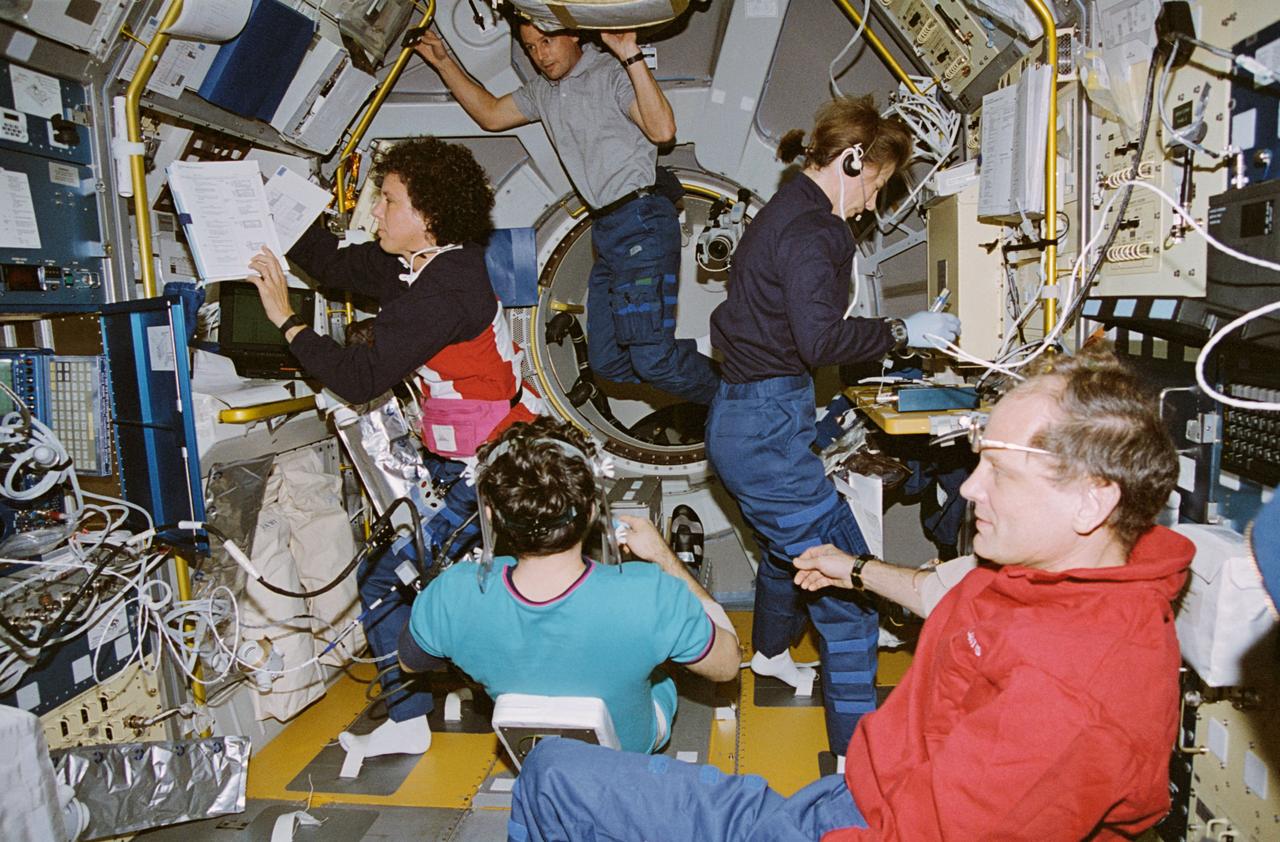
STS071-102-027 (27 June - 7 July 1995) --- Onboard the Spacelab Science Module in the Space Shuttle Atlantis' cargo bay, four astronauts and a cosmonaut team up to collect data from Mir-18 crew members who have been aboard Russia's Mir Space Station for four months. Astronauts Ellen S. Baker (left), Gregory J. Harbaugh (top center) and Bonnie J. Dunbar, STS-71 mission specialists, are joined by astronaut Norman E. Thagard (right) and Vladimir N. Dezhurov (on bicycle ergometer) in the module. Dezhurov was Mir-18 commander and Thagard served as a cosmonaut researcher on the Mir-18 mission. The three STS-71 mission specialists lifted off aboard Atlantis on June 27, 1995, to participate in the historic link-up.
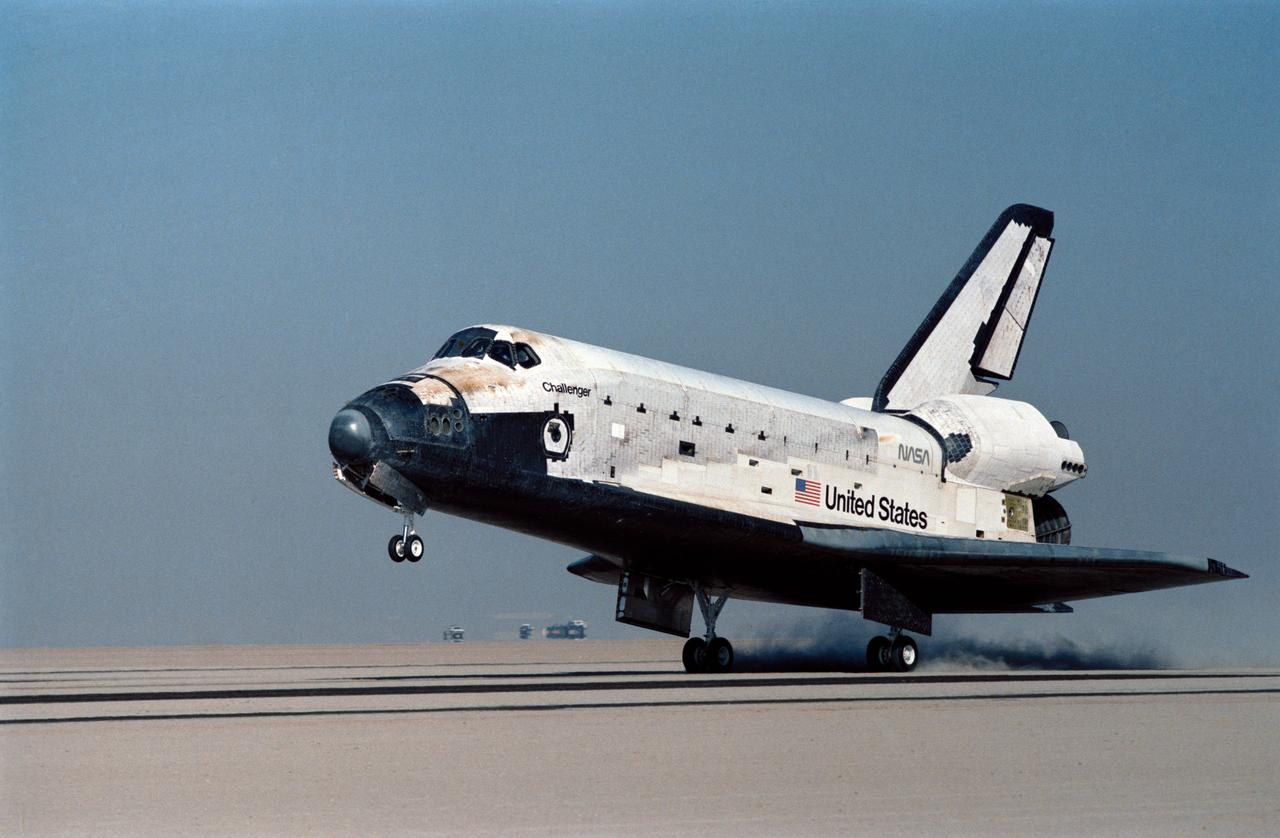
61A-S-139 (6 Nov 1985) --- Eight persons returning from space at one time is a record which was set at 9:45:39 a.m. (PST) today when the Space Shuttle Challenger's wheels came to a stop on the runway at Edwards Air Force Base. The main gear is seen touching down at 9:44:51 a.m. Inside the spacecraft are astronauts Henry W. Hartsfield Jr., Steven R. Nagel, Bonnie J. Dunbar, James F. Buchli, Guion S. Bluford Jr., Reinard Furrer, Ernst Messerschmid and Wubbo J. Ockels. A number of West German and other European experiments were performed during the week-long Spacelab D-1 mission.
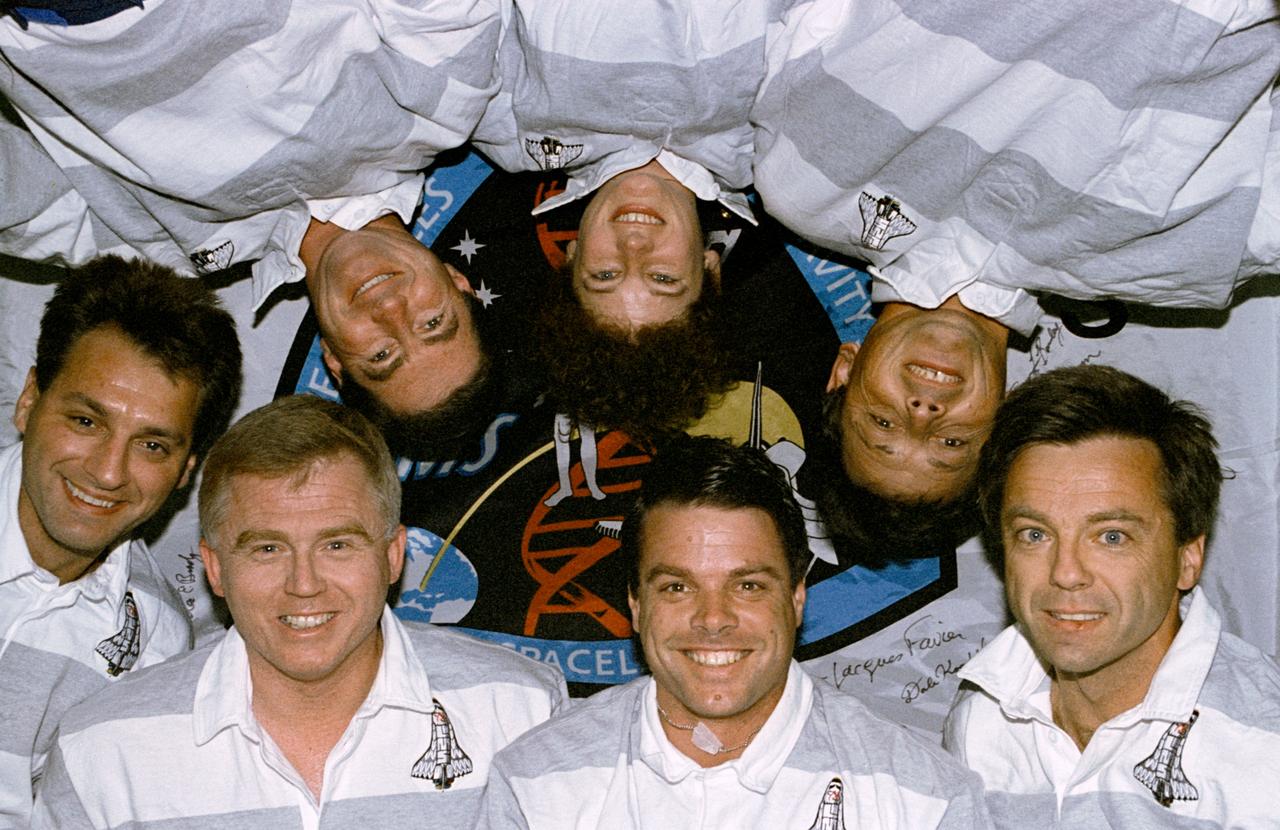
STS078-397-030 (20 June - 7 July 1996) --- Five NASA astronauts and two international payload specialists take a break from a Shuttle duration record-breaker flight to pose for the traditional inflight crew portrait. The photograph should be oriented with payload commander Susan J. Helms at bottom center. Others, clockwise, are French payload specialist Jean-Jacques Favier, Canadian payload specialist Robert B. Thirsk; and astronauts Kevin R. Kregel, pilot; and Charles J. (Chuck) Brady and Richard M. Linnehan, both mission specialists, and Terence T. (Tom) Henricks, mission commander. The crew chose the Life and Microgravity Spacelab (LMS-1) Science Module, situated in the Space Shuttle Columbia's cargo bay, for the portrait setting.
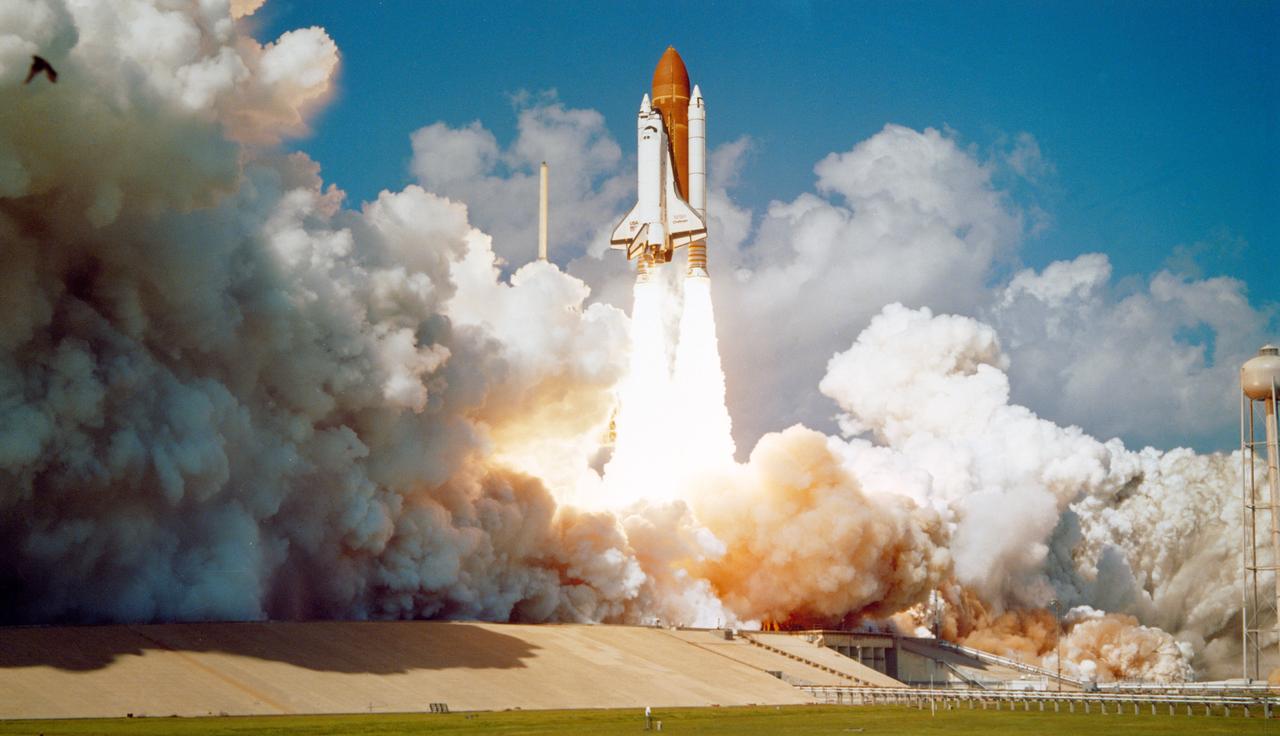
61A-S-018 (30 Oct 1985) --- A record-sized crew of eight persons is lifted toward Earth-orbit as the space shuttle Challenger blasts from the launch pad at Complex 39, Kennedy Space Center (KSC), Florida. Almost all the service structure/gantry is obscured by smoke resulting from the boosters' firing. Inside the spacecraft are astronauts Henry W. Hartsfield, Jr., Steven R. Nagel, Bonnie J. Dunbar, James F. Buchli, Guion S. Bluford, Jr., along with payload specialists Wubbo J. Ockels, Reinhard Furrer and Ernst Messerschmid. Within hours of this photo, the Spacelab D-1 Science Module was activated and crew members were busy performing experiments. Launch occurred at noon (EST), Oct. 30, 1985. Photo credit: NASA
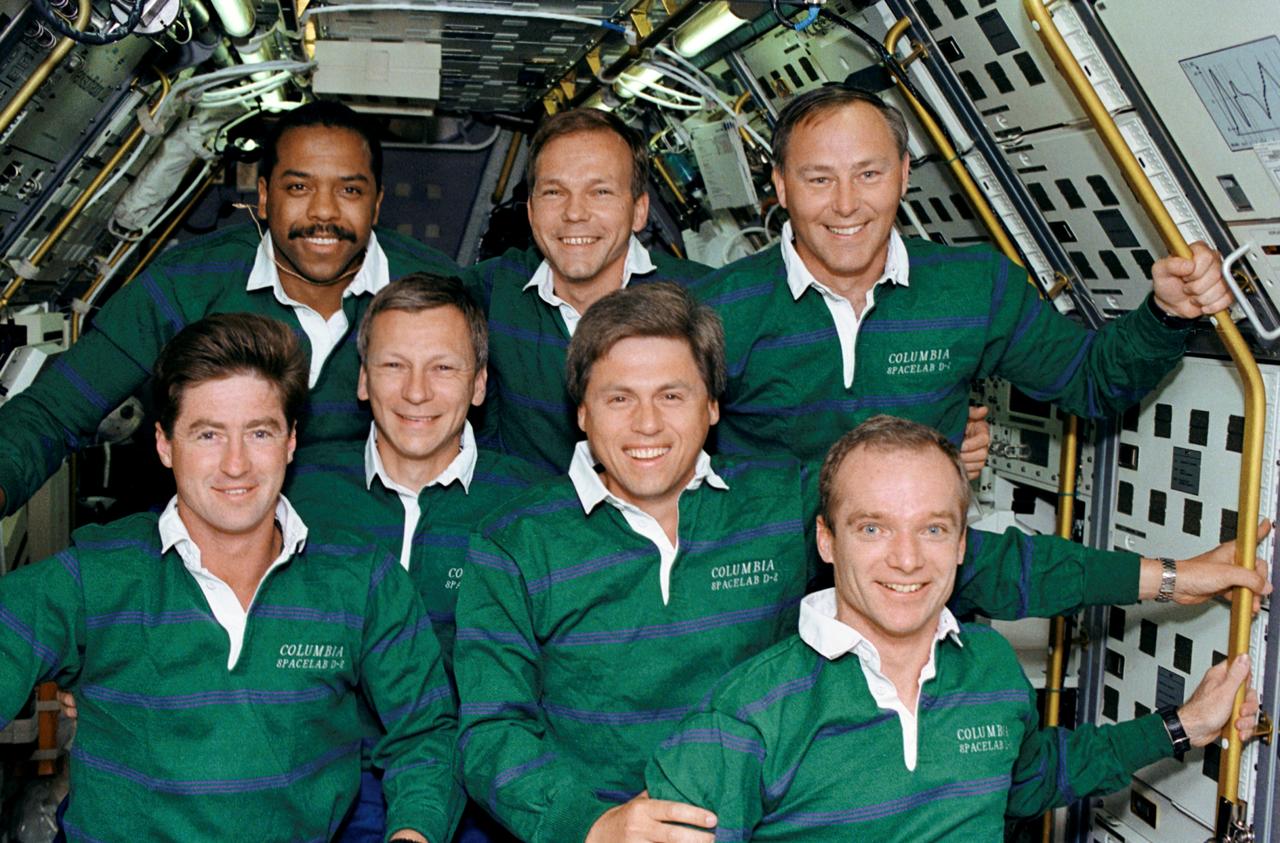
STS055-203-009 (26 April-6 May 1993) --- The seven crew members who spent 10 days aboard the space shuttle Columbia pose for the traditional in-flight portrait in the Spacelab D-2 Science Module. Front, left to right, are Terence T. (Tom) Henricks, Steven R. Nagel, Ulrich Walter and Charles J. Precourt. In the rear are (left to right) Bernard A. Harris Jr., Hans Schlegel and Jerry L. Ross. Nagel served as mission commander; Henricks was the pilot and Ross, the payload commander. Harris and Precourt were mission specialists and Schlegel and Walter were payload specialists representing the German Aerospace Research Establishment (DLR). Photo credit: NASA
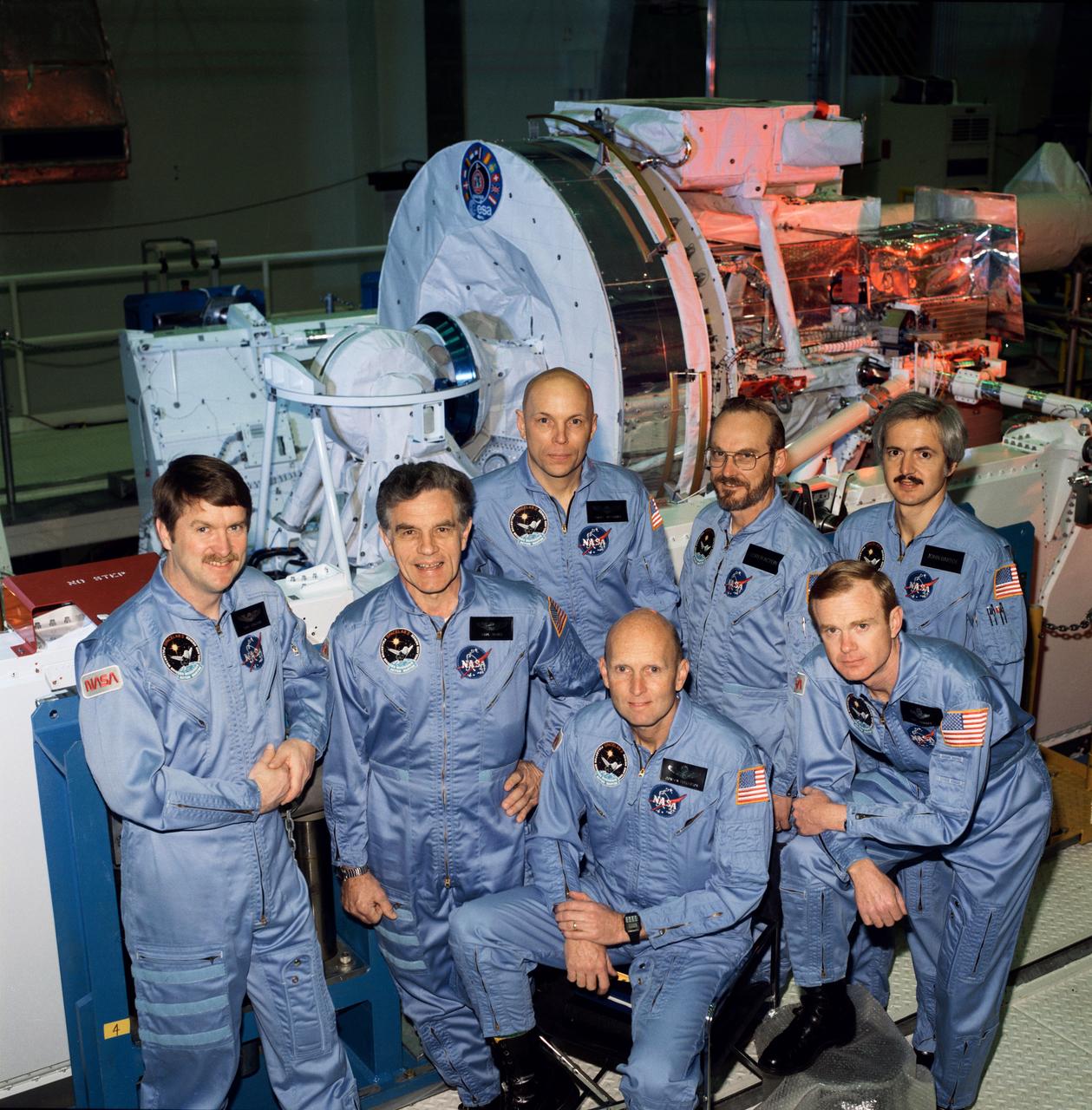
S85-29307 (May 1985) --- The seven crew members for the Space Shuttle STS-51F/Spacelab 2 mission take a pause from a KSC training session to pose for a pre-flight crew portrait. Astronauts C. Gordon Fullerton (kneeling center), mission commander; and Roy D. Bridges (kneeling right), pilot; are flanked by the payload specialists and mission specialists for the mission. Standing (left to right) are astronauts Anthony W. England, Karl J. Henize and Story Musgrave - all mission specialists; and payload specialist Loren Acton and John-David Bartoe.
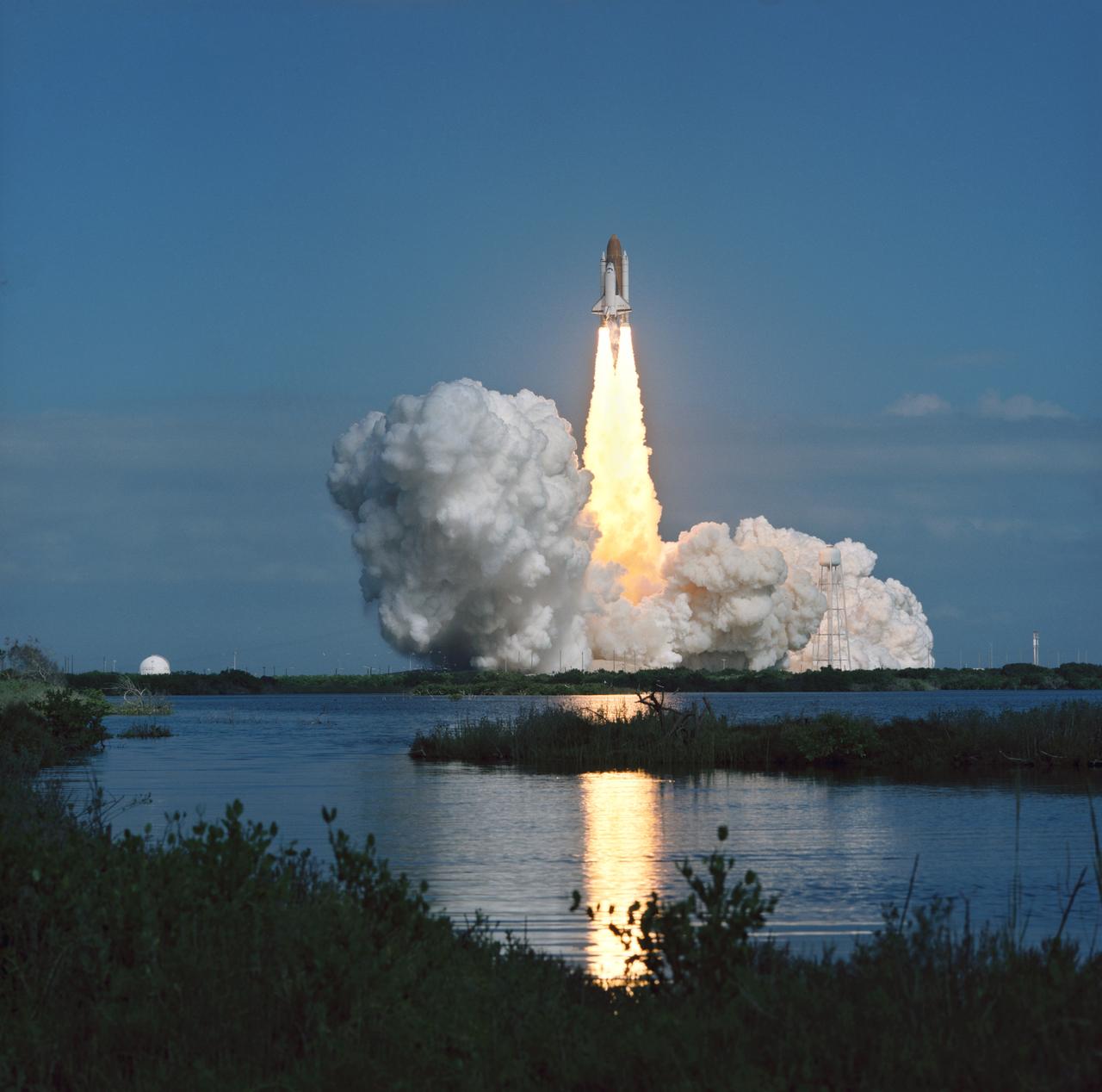
STS058-S-091 (18 Oct 1993) --- A distant shot shows the Space Shuttle Columbia, lifting off from Launch Complex 39 at Kennedy Space Center (KSC), reflecting its image in nearby marsh waters. Launch occurred at 10:53 a.m. (EDT), October 18, 1993. Along with six NASA astronauts and a veterinarian from the private sector, the Spacelab Life Sciences-2 (SLS-2) science module was aboard. Onboard were astronauts John E. Blaha, Richard A. Searfoss, Rhea Seddon, Shannon W. Lucid, David A. Wolf and William S. McArthur along with payload specialist Martin J. Fettman.
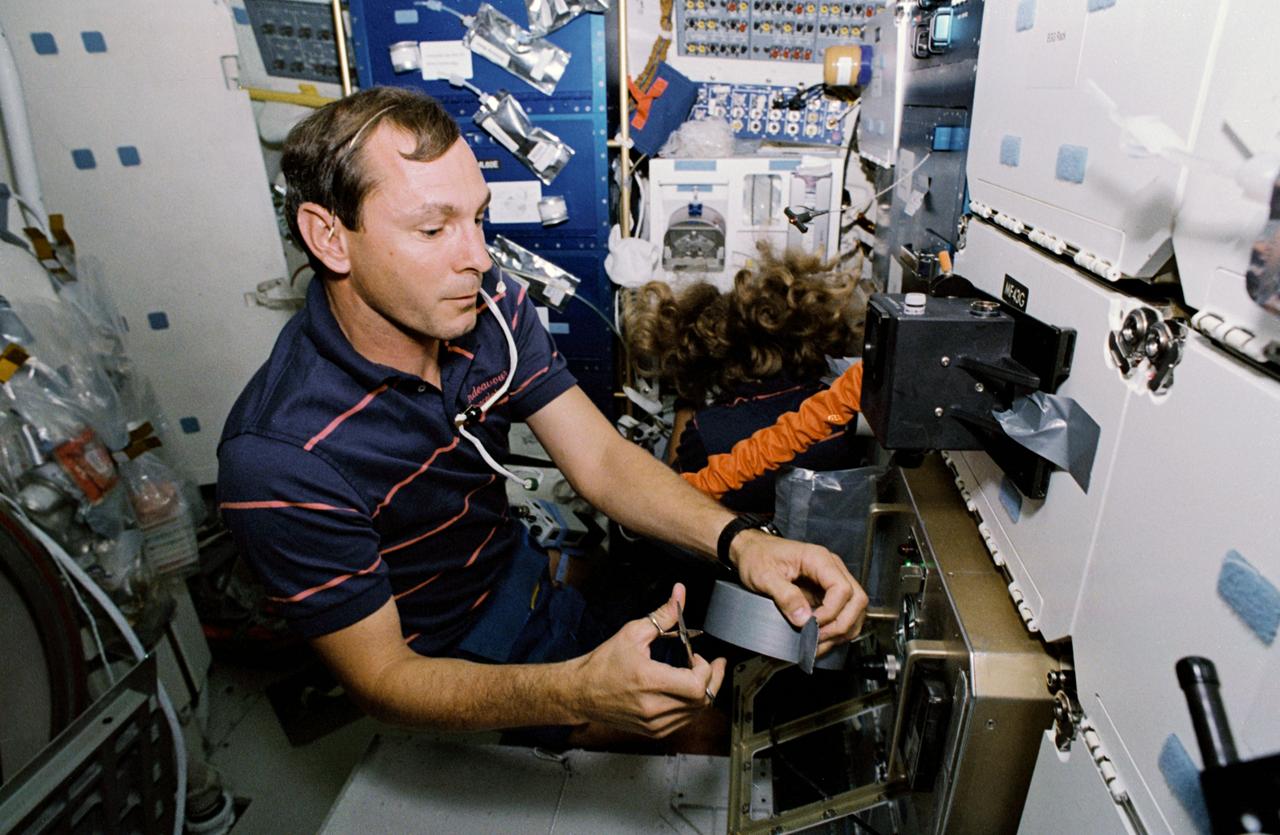
STS047-35-022 (12 - 20 Sept 1992) --- Astronauts Curtis L. Brown, Jr., pilot, and N. Jan Davis, mission specialist, team up to cure a high humidity problem in the hornet experiment in the Spacelab-J Science Module of the Earth-orbiting Space Shuttle Endeavour. Via a jury-rigged hose hook-up, the two were able to blow air from a spacesuit fan into the experiment, thus eliminating condensation that obscured the viewing of the Israeli hornet experiment. The experiment examined the effects of microgravity on the orientation, reproductive capability and social activity of 180 female Oriental Hornets.
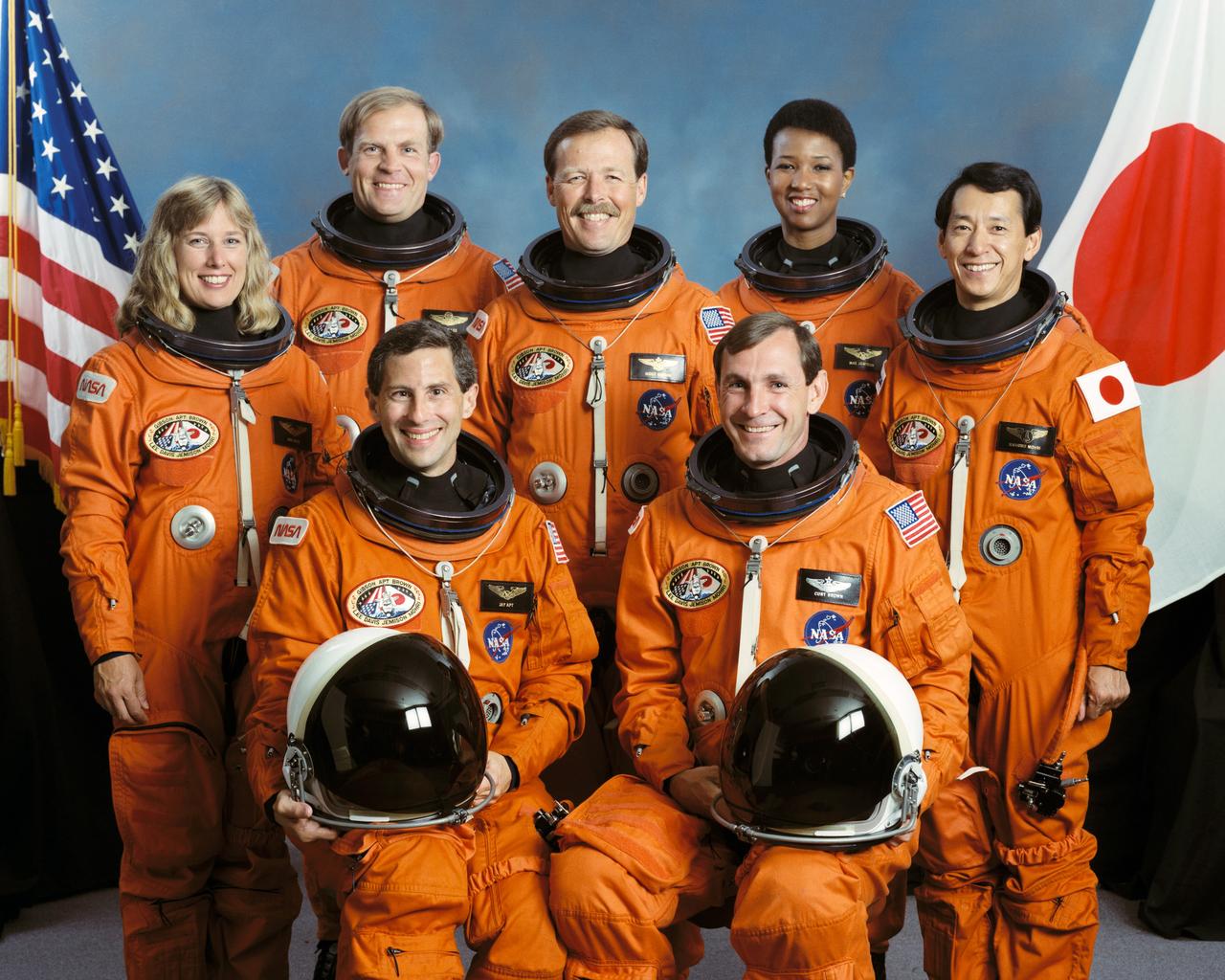
STS047-S-002 (June 1992) --- These seven crew members are currently in training for the STS-47/Spacelab J mission scheduled for later this year. Pictured are (left to right, front) Jerome (Jay) Apt, mission specialist; Curtis L. Brown, pilot; and (left to right, rear) N. Jan Davis, mission specialist; Mark C. Lee, payload commander; Robert L. Gibson, mission commander; Mae C. Jemison, mission specialist; and Mamoru Mohri, payload specialist, representing the National Space Development Agency of Japan (NASDA). This is the Space Shuttle Endeavour's second scheduled mission.

STS047-45-003 (12-20 Sept 1992) --- Payload specialist Mamoru Mohri communicates with students from the aft flight deck of the Earth-orbiting Space Shuttle Endeavour. The communications were an extension of the Shuttle Amateur Radio Experiment (SAREX), which has flown on a number of previous flights. Dr. Mohri represents Japan's National Space Development Agency (NASDA), joining six NASA astronauts for eight-days in space in support of the Spacelab-J mission. Several of the crew members were able to talk with students and other "ham" operators during the mission.
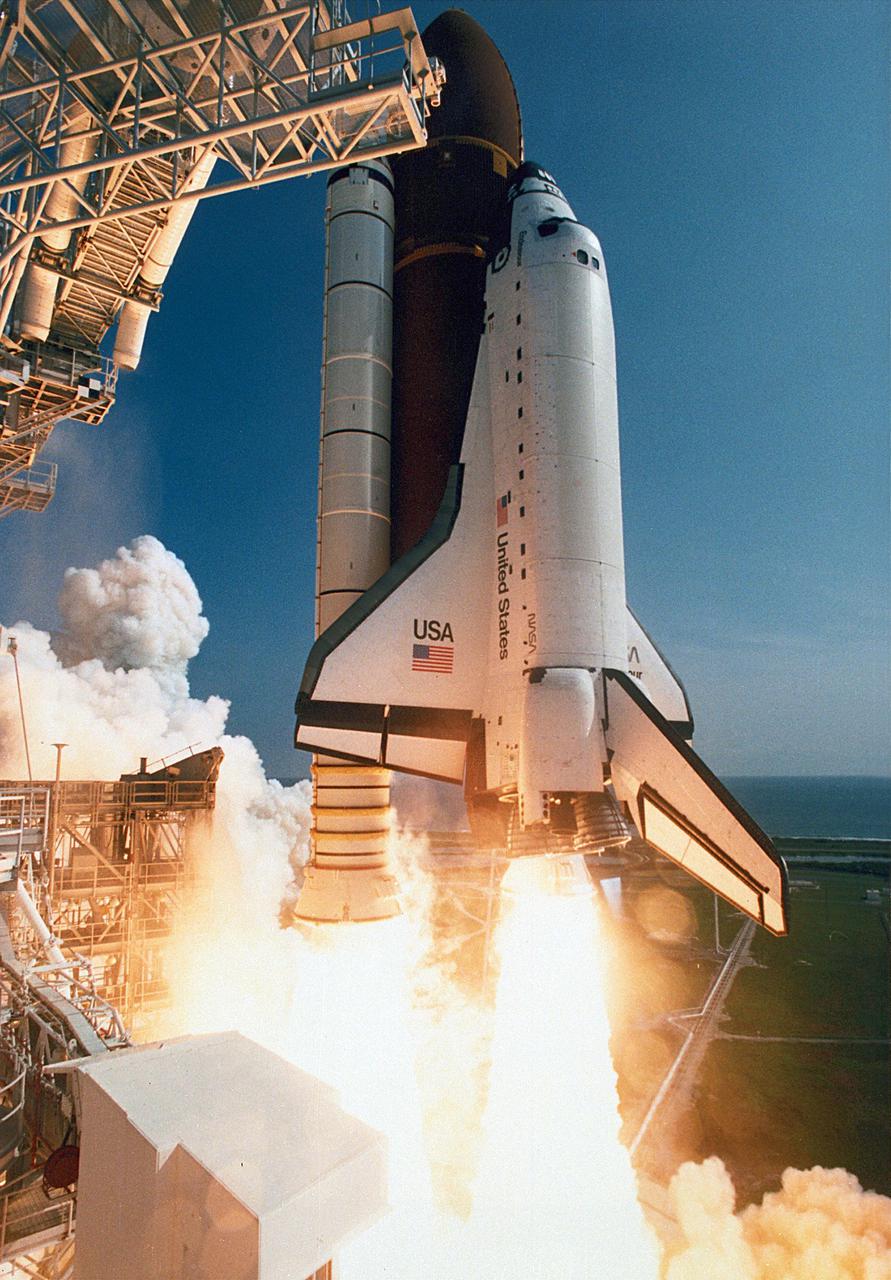
KENNEDY SPACE CENTER, FLA. -- The Space Shuttle Endeavour thunders past the uppermost reaches of the Fixed Service Structure at Launch Pad 39B after an on-schedule liftoff at 10:23:00 a.m. EDT, Sept. 12. Primary payload for the planned seven-day mission STS-47 is the Spacelab-J science laboratory. Mission Commander is Robert L. 'Hoot' Gibson; the Pilot, Curtis L. Brown Jr.; Payload Commander, Mark C. Lee; Mission Specialists, N. Jan Davis and Jay Apt; Science Mission Specialist, Dr. Mae C. Jamison; and Payload Specialist Mamoru Mohri.
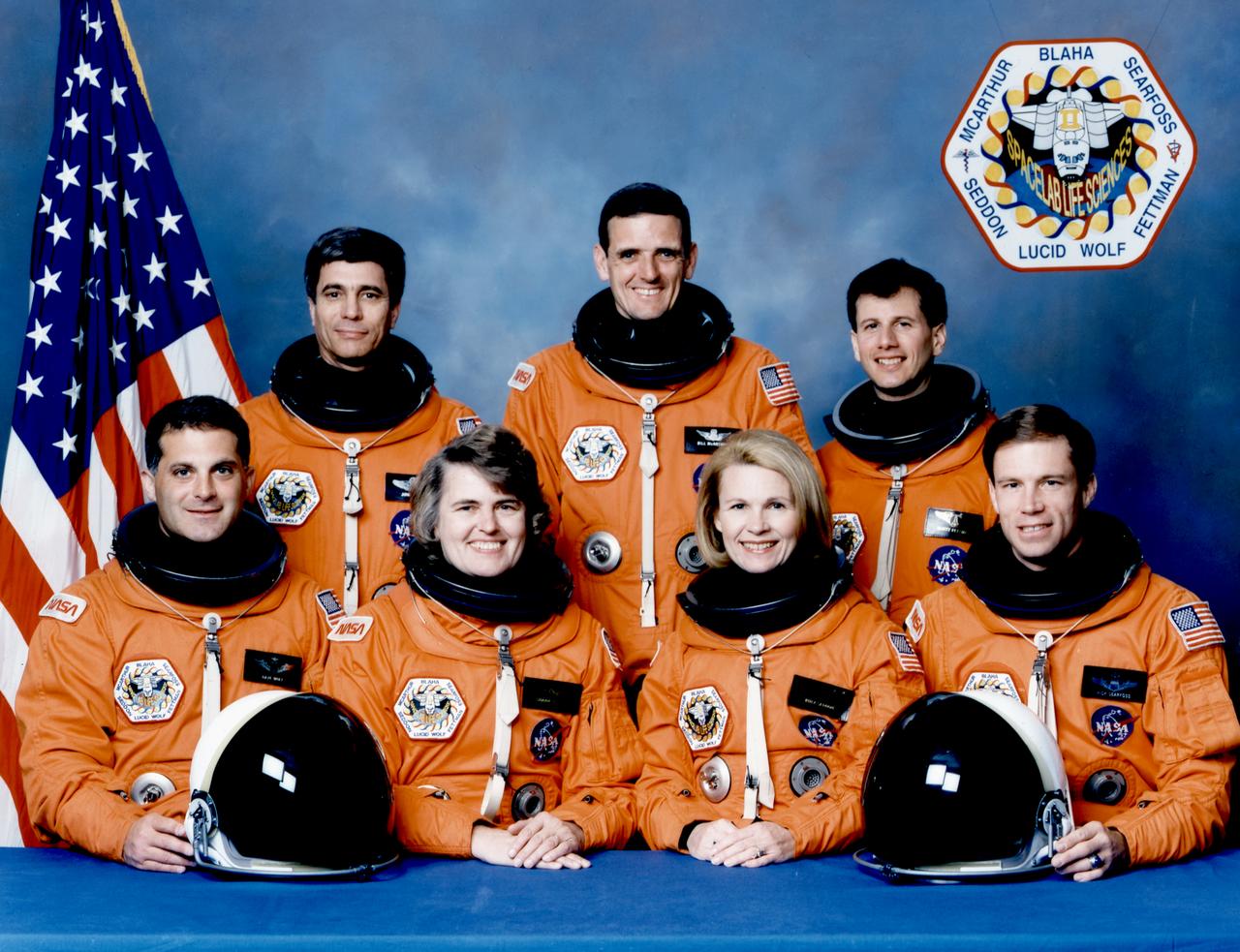
The STS-58 crew portrait includes astronauts (seated left to right) David A. Wolf, Shannon W. Lucid, and Rhea Seddon, all mission specialists; and Richard A. Searfoss, pilot. Standing in the rear, left to right, are John E. Blaha, commander; William S. McArthur, Jr., mission specialist; and Martin J. Fettmen, payload specialist. Launched aboard the Space Shuttle Columbia on October 18, 1993 at 10:53:10 a.m. (EDT), STS-58 served as the second dedicated Spacelab Life Sciences (SLS-2) mission.
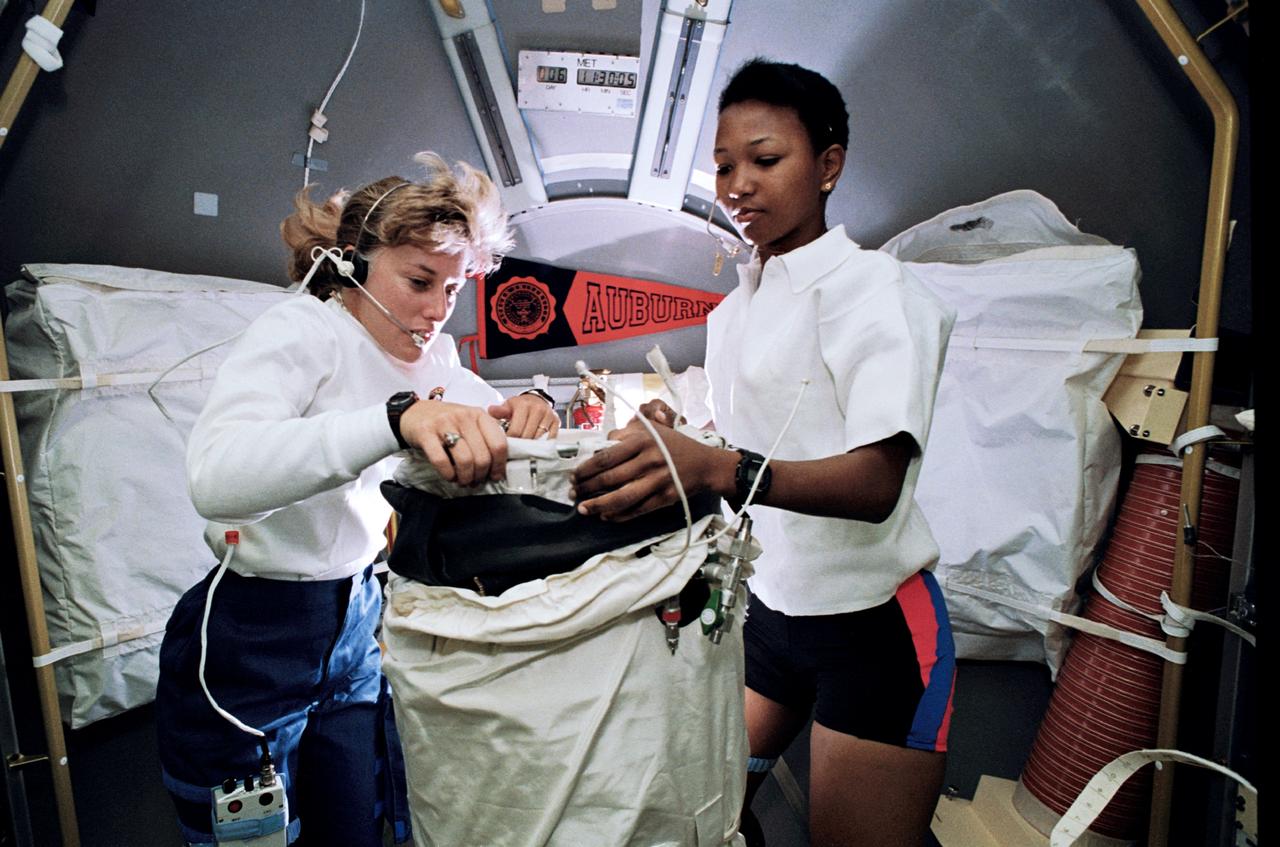
STS047-46-027 (12-20 Sept. 1992) --- Astronauts N. Jan Davis (left) and Mae C. Jemison, STS-47 mission specialists, prepare to deploy the Lower Body Negative Pressure (LBNP) apparatus in this 35mm frame photographed in the Science Module aboard the Earth-orbiting Space Shuttle Endeavour. Making their first flight in space, the two were joined by four other NASA astronauts and a Japanese payload specialist for eight days of research. The Spacelab-J mission is a joint effort between Japan and the United States of America.
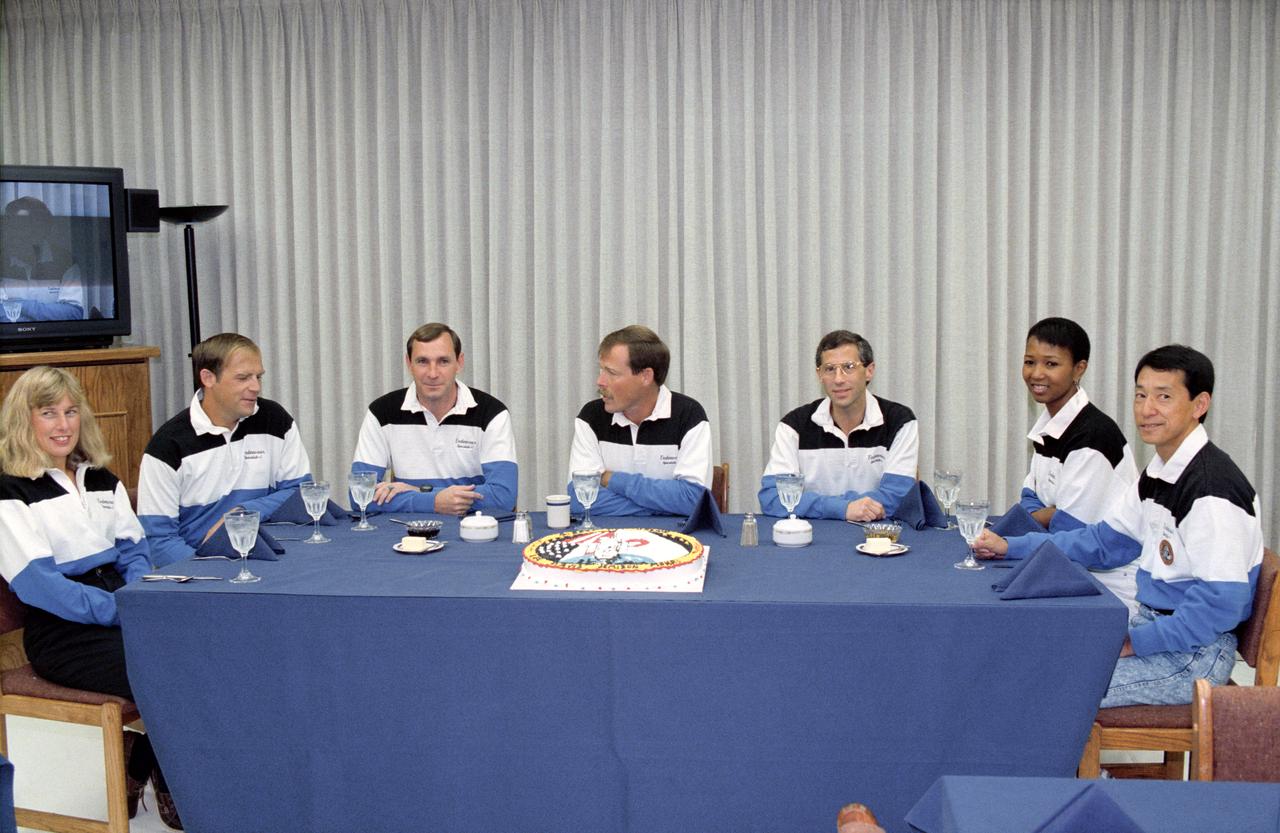
STS047-S-037 (12 Sept 1992) --- The seven crewmembers who will be aboard for Endeavour's second trip into space are about to have a light breakfast prior to the pre-launch suiting up process in the Operations and Checkout Building. Left to right are astronauts N. Jan Davis, Mark C. Lee, Curtis L. Brown Jr., Robert L. Gibson, Jerome (Jay) Apt and Mae C. Jemison; and payload specialist Mamoru Mohri, representing the National Space Development Agency (NASDA) of Japan. This mission will be devoted to support of the Spacelab-J mission, a joint effort between Japan and the United States. Launch occurred at 10:23:00:0680 a.m. (EDT), September 12, 1992.
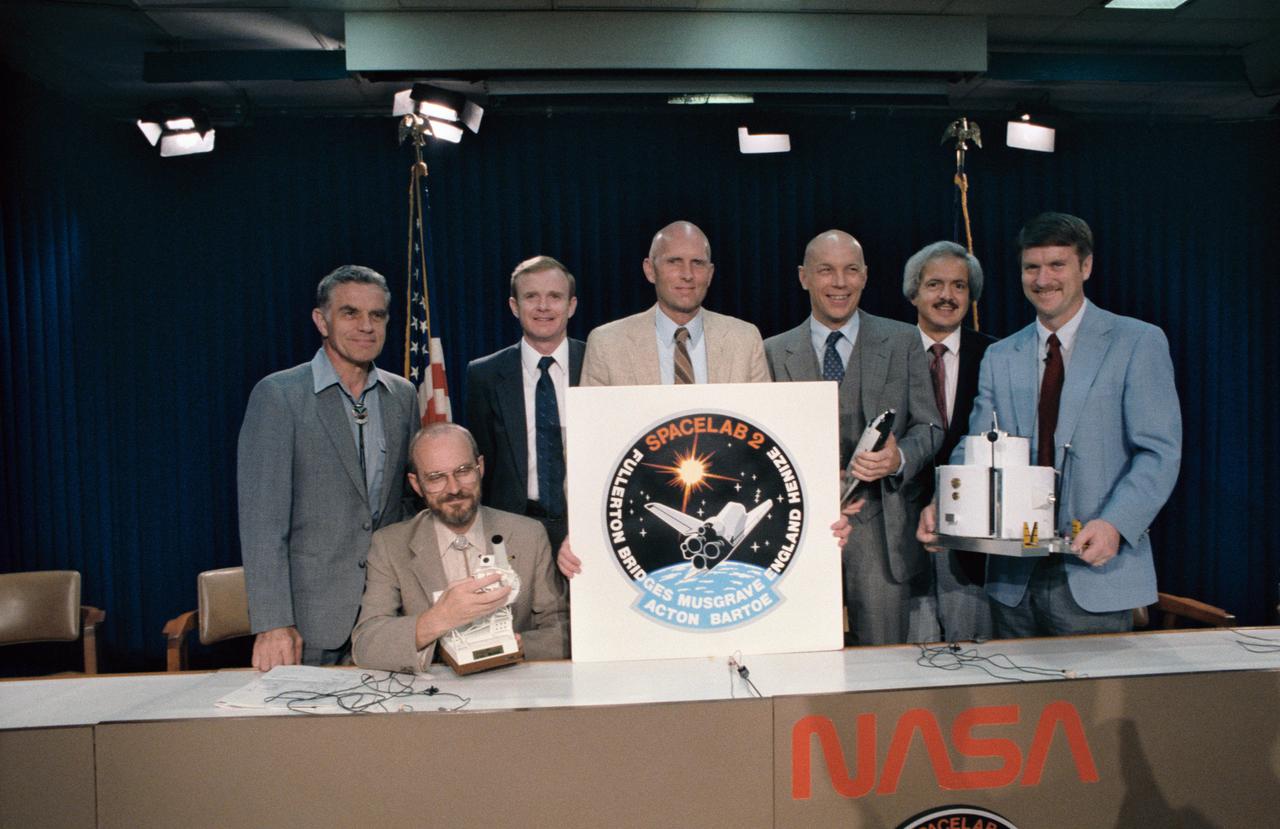
S85-36655 (24 June 1985) --- The seven crewmembers for STS 51-F/Spacelab 2 pose for photographers following their pre-flight press conference in the Johnson Space Center's public affairs facility. Standing, l.-r., are Karl J. Henize, mission specialist; Roy D. Bridges, pilot; C. Gordon Fullerton, mission commander; F. Story Musgrave, mission specialist; John-David Bartoe, payload specialist; and Anthony W. England, mission specialist. Loren W. Acton, payload specialist, is seated. Launch is scheduled for July of this year.
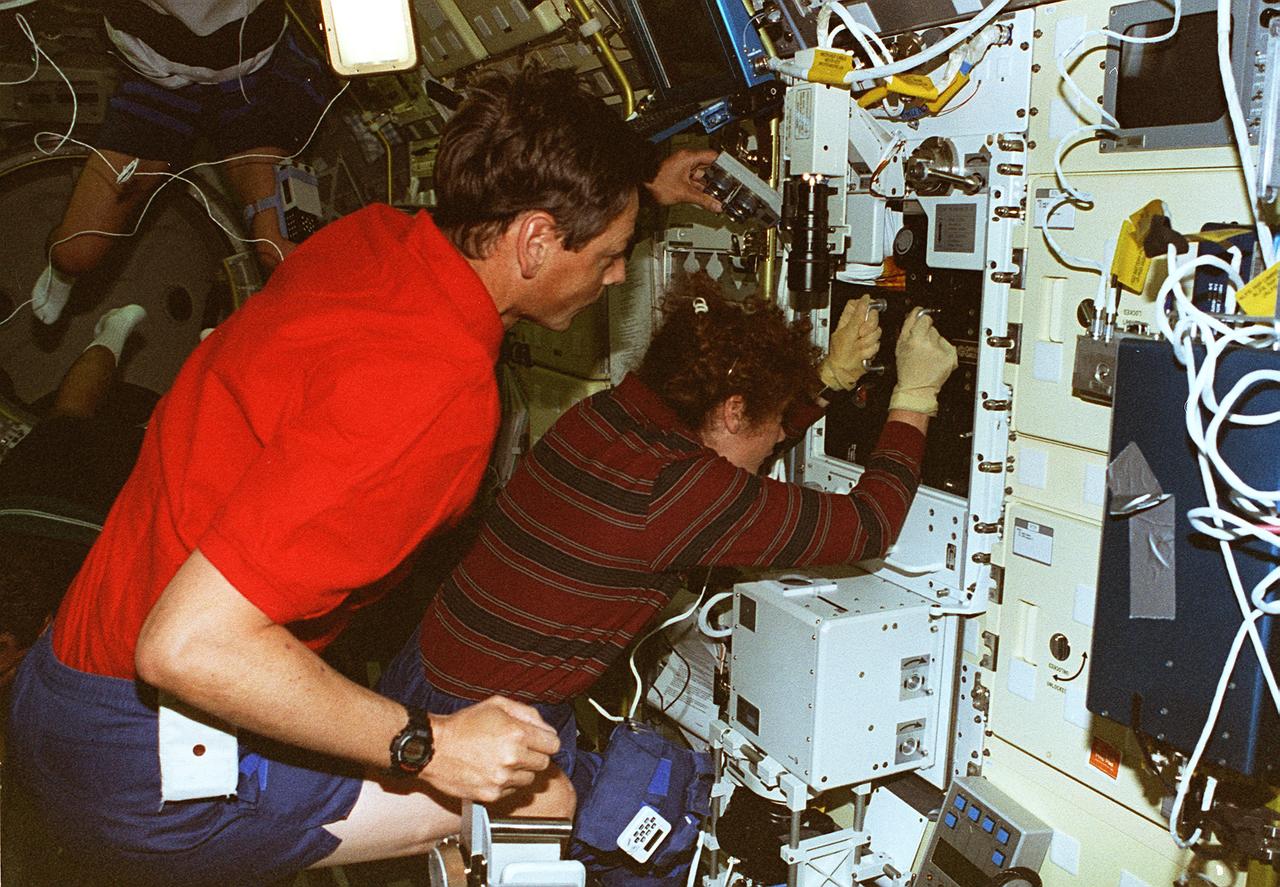
STS078-306-035 (20 June - 7 July 1996) --- Astronaut Susan J. Helms, payload commander, and payload specialist Jean-Jacques Favier, representing the French Space Agency (CNES), insert a test container into the Bubble Drop Particle Unit (BDPU) in the Life and Microgravity Spacelab (LMS-1) Science Module aboard the Space Shuttle Columbia. The fluid in the chamber is heated and the fluid processes are observed by use of three internal cameras mounted inside the BDPU. Investigations in this facility will help characterize interfacial processes involving either bubbles, drops, liquid columns or liquid layers.
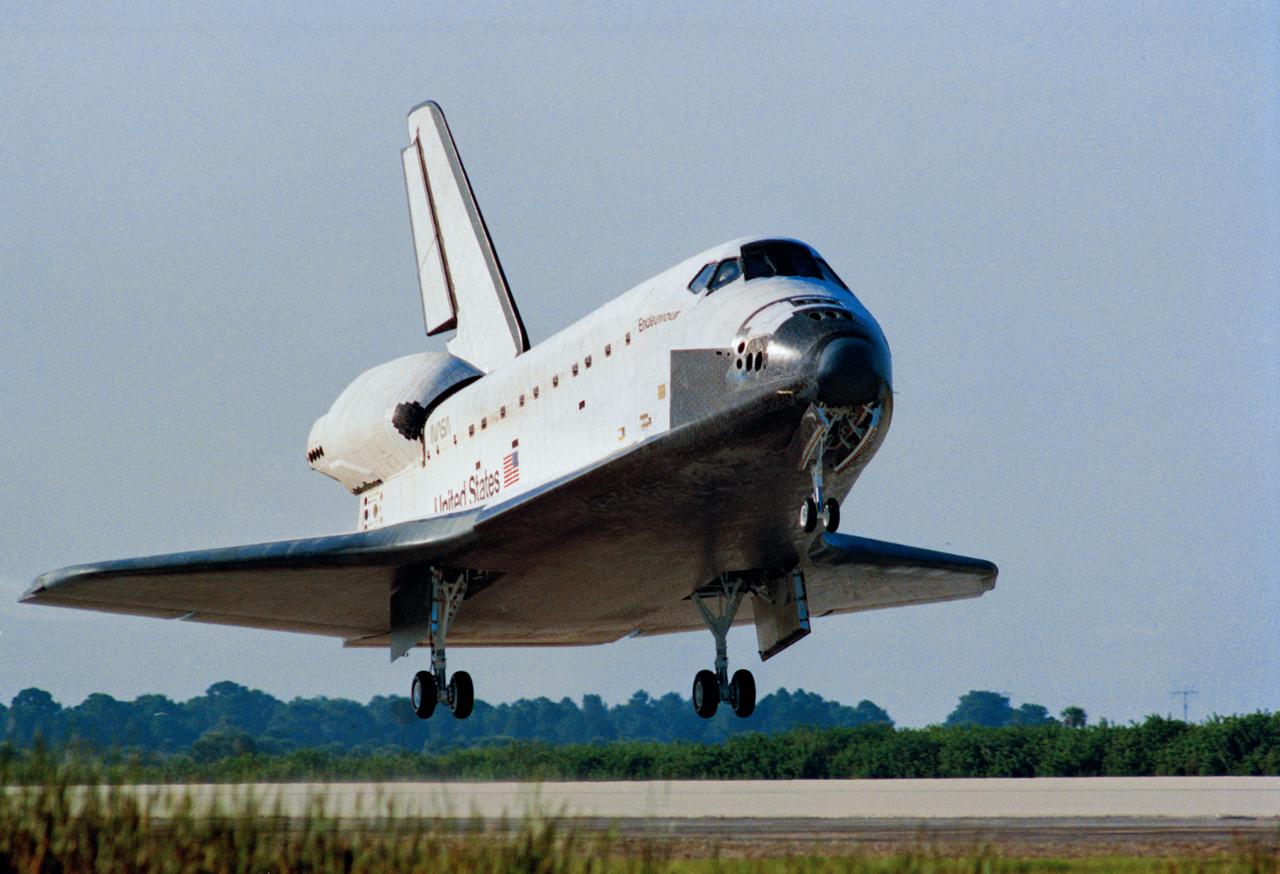
STS047-S-116 (20 Sept 1992) --- The Space Shuttle Endeavour prepares to land on the Kennedy Space Center's Shuttle landing facility runway. The successful landing marked the completion of an eight-day Earth-orbital mission for the orbiter, its seven-member crew and the Spacelab-J payload. Landing occurred at 8:53 a.m. (EDT), September 20, 1992. Onboard the spacecraft were astronauts Robert L. Gibson, Curtis L. Brown Jr., Mark C. Lee, Jerome (Jay) Apt, N. Jan Davis and Mae C. Jemison, along with Japanese payload specialist Dr. Mamoru Mohri.
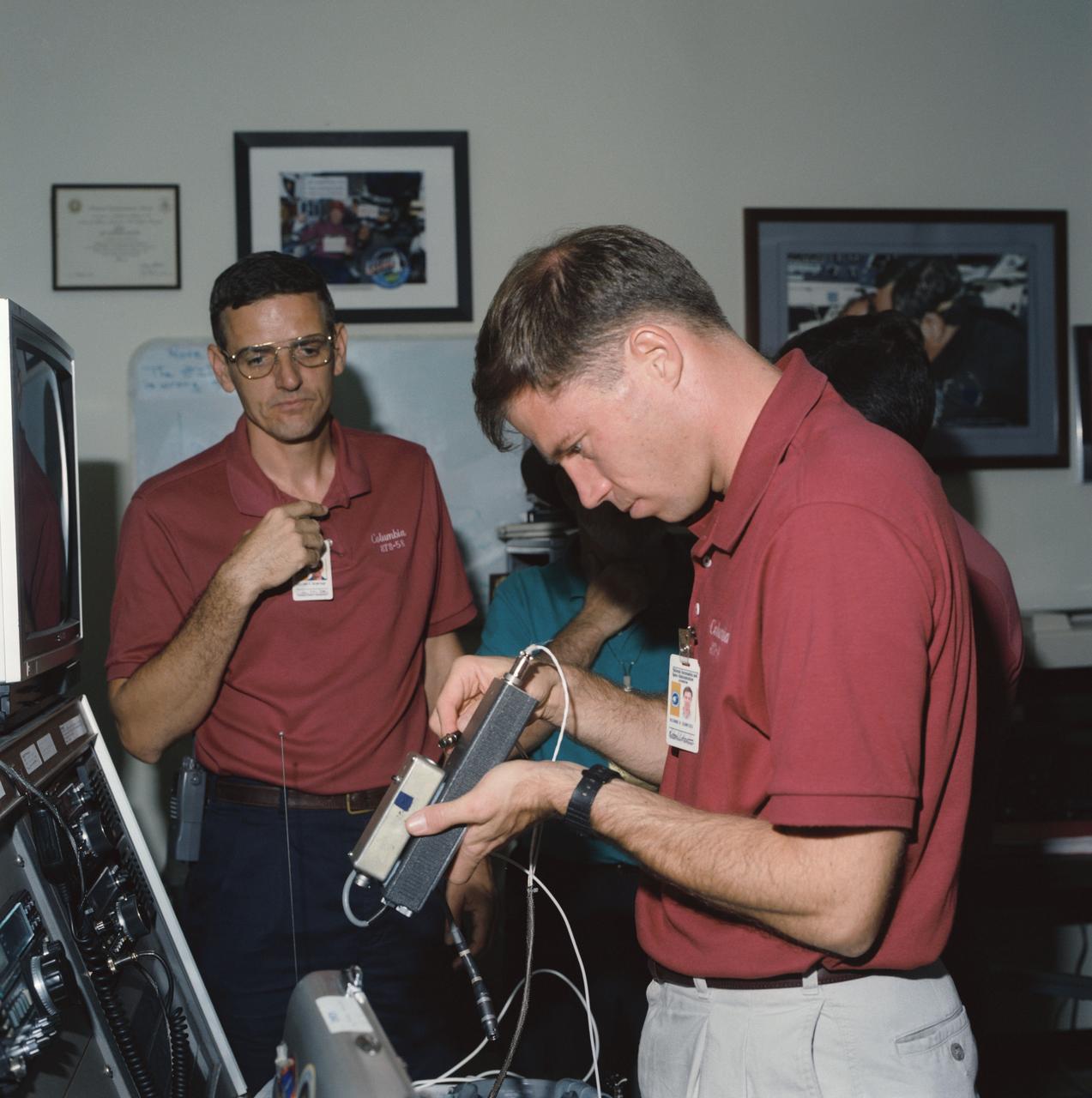
S93-45068 (22 Sept 1993) --- Two members of the STS-58 Spacelab Life Sciences (SLS-2) crew, train with amateur radio equipment at the Johnson Space Center (JSC). They are William S. McArthur (left), mission specialist, and Richard A. Searfoss, pilot. The STS-58 flight will carry the Shuttle Amateur Radio Experiment (SAREX) payload, configuration C, which includes FM voice and packet. Three of the seven crewmembers are licensed amateur radio operators. Searfoss' call letters are KC5CKM; McArthur, KC5ACR; and payload specialist Martin J. Fettman, KC5AXA. Licensed students at a number of schools around the country will have the opportunity to talk directly with the astronauts during the 14-day flight.
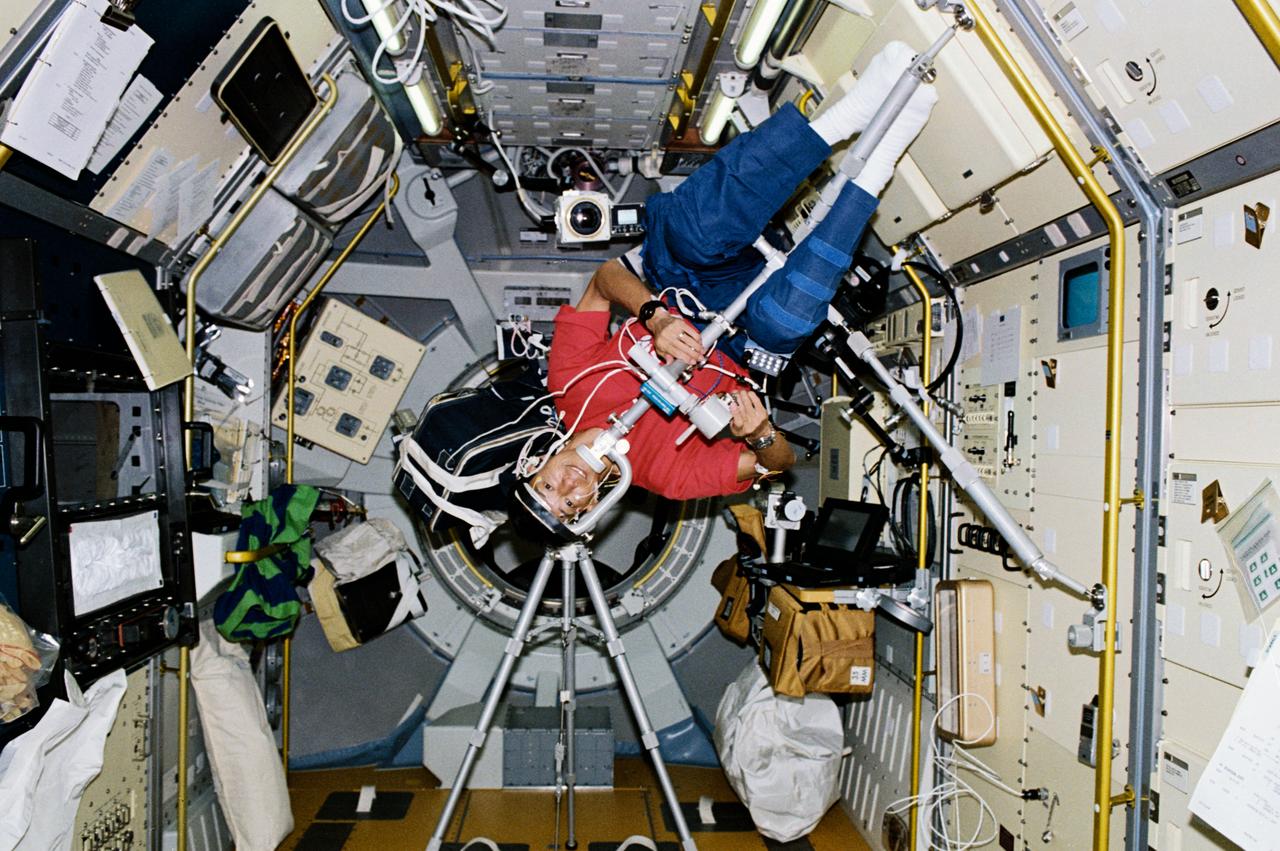
STS047-204-006 (12 - 20 Sept 1992) --- Dr. Mamoru Mohri, payload specialist representing Japan's National Space Development Agency (NASDA), participates in an experiment designed to learn more about Space Adaptation Syndrome (SAS). The experiment is titled, "Comparative Measurement of Visual Stability in Earth and Cosmic Space." During the experiment, Dr. Mohri tracked a flickering light target while eye movements and neck muscle tension were measured. This 45-degree angle position was one of four studied during the eight-day Spacelab-J mission.

STS047-31-009 (12-20 Sept 1992) --- Two NASA astronauts prepare to try their hand at a new method of eating an in-space meal as chopsticks are called upon by a third crew member. Pictured left to right, are Curtis L. Brown, Jr., pilot; payload specialist Mamoru Mohri representing Japan's National Space Development Agency (NASDA); and Robert L. Gibson, mission commander. Several months of training, as well as the eight-days of sharing research on the Spacelab-J mission, allowed the astronauts and payload specialist to learn a great deal about the two cultures.
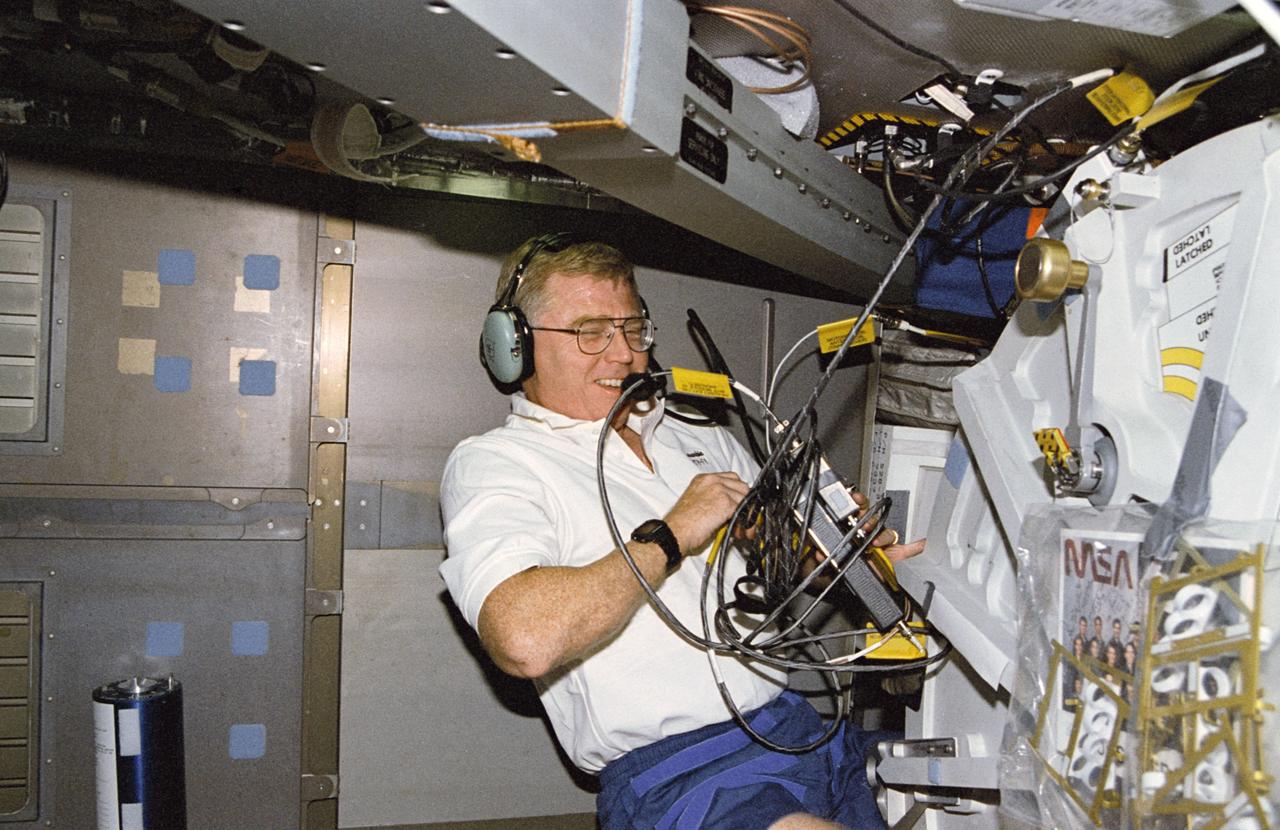
STS078-429-017 (20 June-7 July 1996) --- Aboard the middeck of the Earth-orbiting space shuttle Columbia, astronaut Charles J. Brady, mission specialist and a licensed amateur radio operator or "ham", talks to students on Earth. Some of the crew members devoted some of their off-duty time to continue a long-standing Shuttle tradition of communicating with students and other hams between their shifts of assigned duty. Brady joined four other NASA astronauts and two international payload specialists for almost 17-days of research in support of the Life and Microgravity Spacelab (LMS-1) mission.
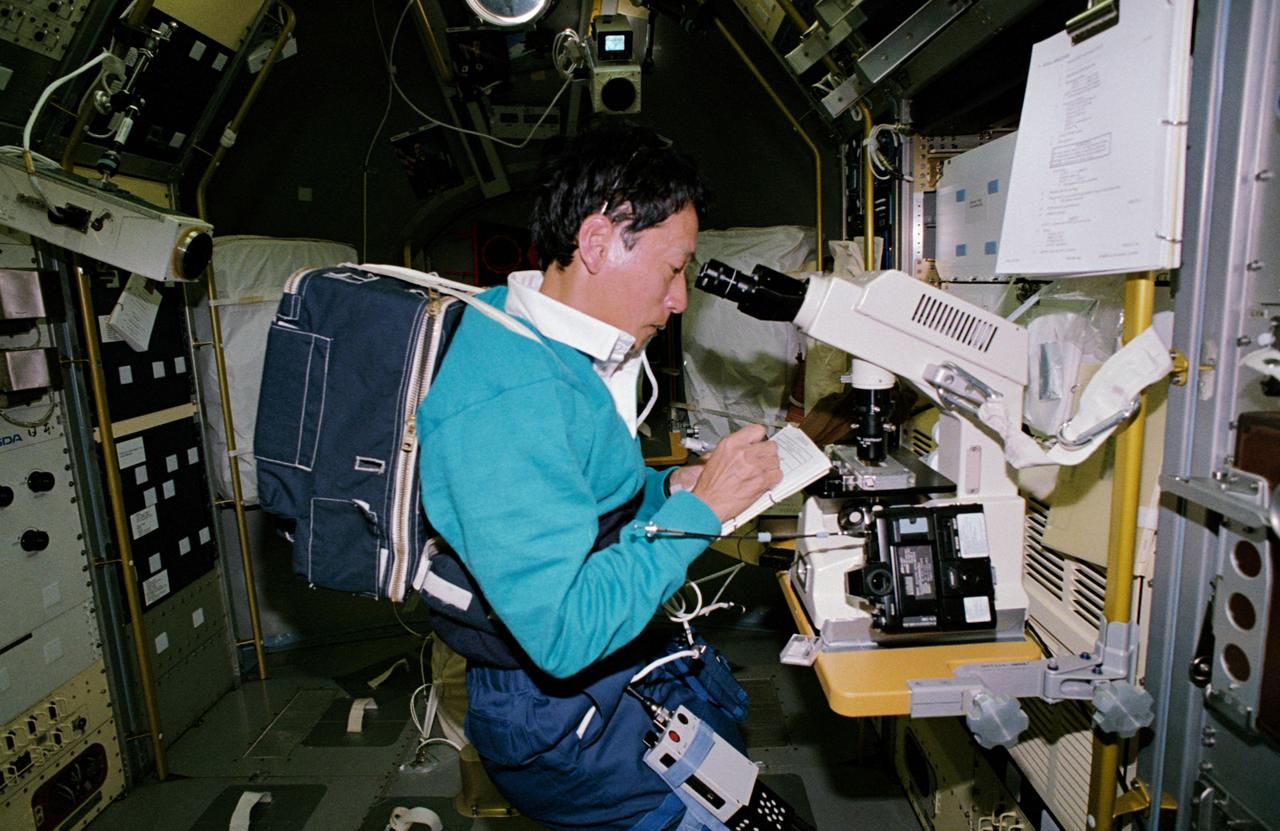
STS047-05-025 (12 - 20 Sept 1992) --- Payload specialist Mamoru Mohri, representing Japan's National Space Development Agency (NASDA), uses a microscope to produce photomicrographs of mammalian cells. The mammal cell structure experiment is one of a large number of tests that were performed during the eight-day Spacelab-J mission. On his back, Dr. Mohri totes a health monitoring experiment. The primary objective of the physiological monitoring system is to observe the health condition of the Japanese payload specialist so that good health can be maintained during and after the spaceflight.
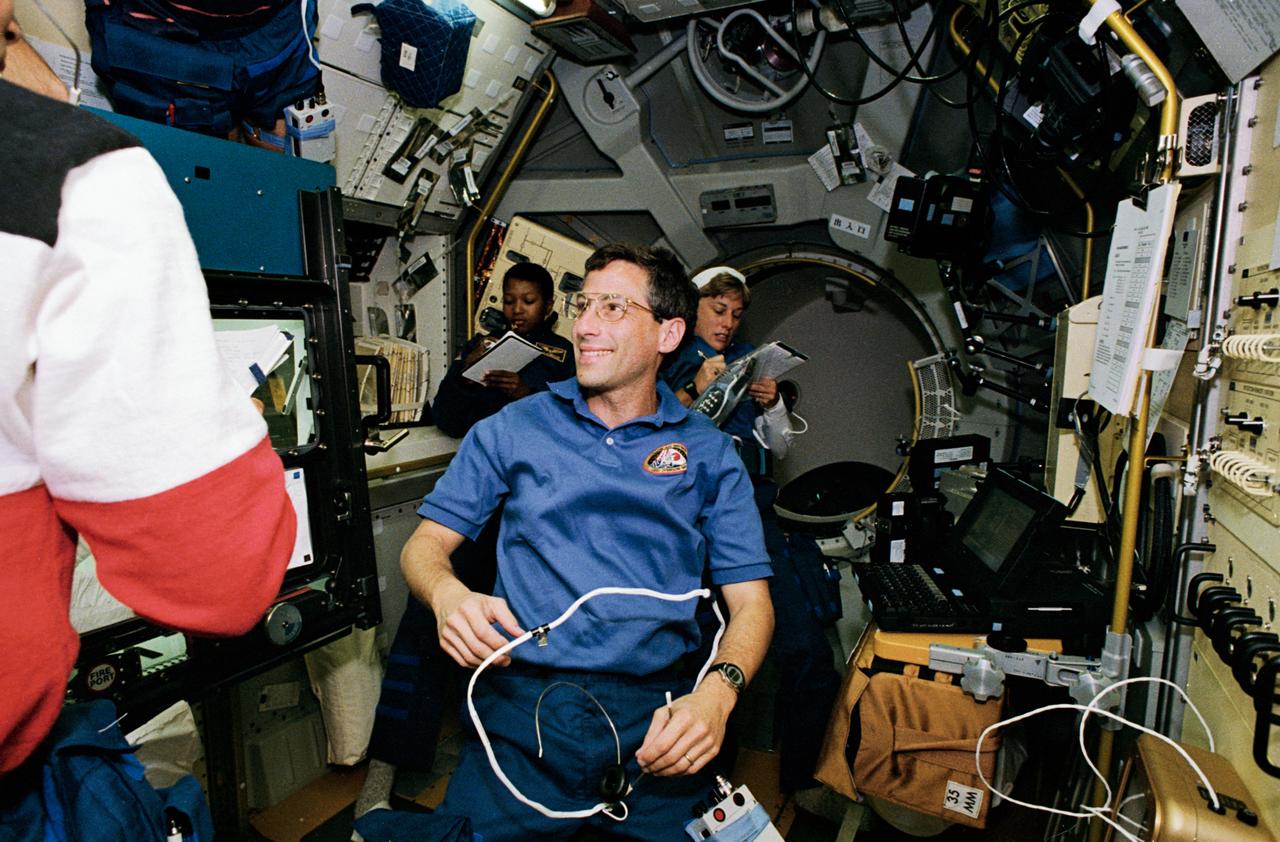
STS047-05-019 (12 - 20 Sept 1992) --- Astronaut Jerome (Jay) Apt, mission specialist, responds to a crew mate's query during a shift change in the Spacelab-J Science Module aboard the Earth-orbiting Space Shuttle Endeavour. Others pictured, left to right, are astronauts Mark C. Lee (immediate foreground, partially out of frame), payload commander; Mae C. Jemison and N. Jan Davis, mission specialists. The four joined two other NASA astronauts and a Japanese payload specialist for eight days aboard Endeavour in support of the joint Japanese-American effort.
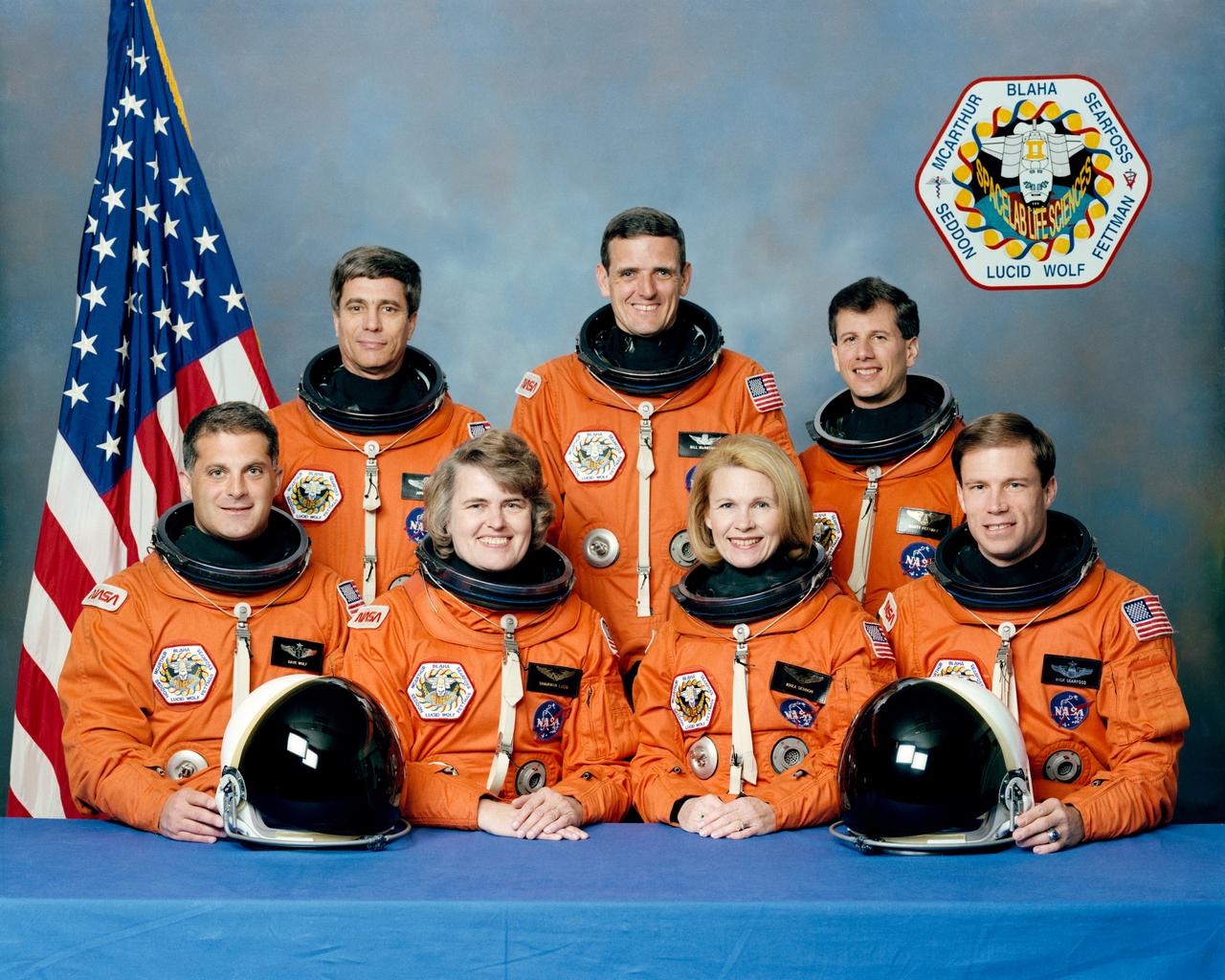
STS058-S-002 (May 1993) --- Wearing training versions of their launch and entry garments, the seven crew members assigned to the Spacelab Life Sciences (SLS-2) mission are pictured in the traditional pre-flight crew portrait. Left to right (front) are David A. Wolf, and Shannon W. Lucid, both mission specialists; Rhea Seddon, payload commander; and Richard A. Searfoss, pilot. Left to right (rear) are John E. Blaha, mission commander; William S. McArthur Jr., mission specialist; and payload specialist Martin J. Fettman, DVM.
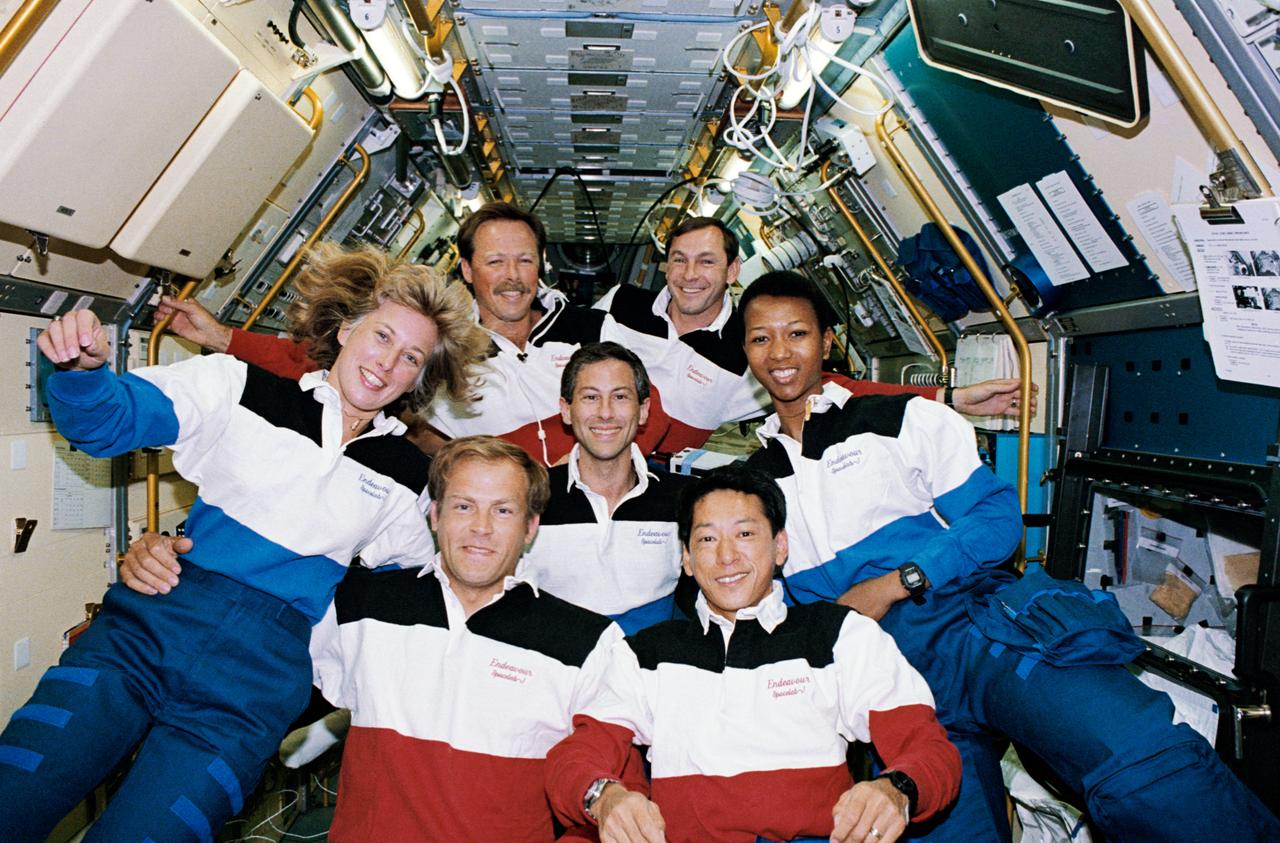
STS047-09-009 (12 - 20 Sept 1992) --- The seven crew members sharing eight days of research in support of Spacelab-J pose for the traditional inflight portrait in the Science Module. Pictured, left to right, back row, are Robert L. Gibson, mission commander; and Curtis L. Brown, Jr., pilot; middle row, N. Jan Davis, Jerome (Jay) Apt and Mae C. Jemison, all mission specialists; and front row, Mark C. Lee, payload commander, and Mamoru Mohri, payload specialist representing Japan's National Space Development Agency (NASDA).
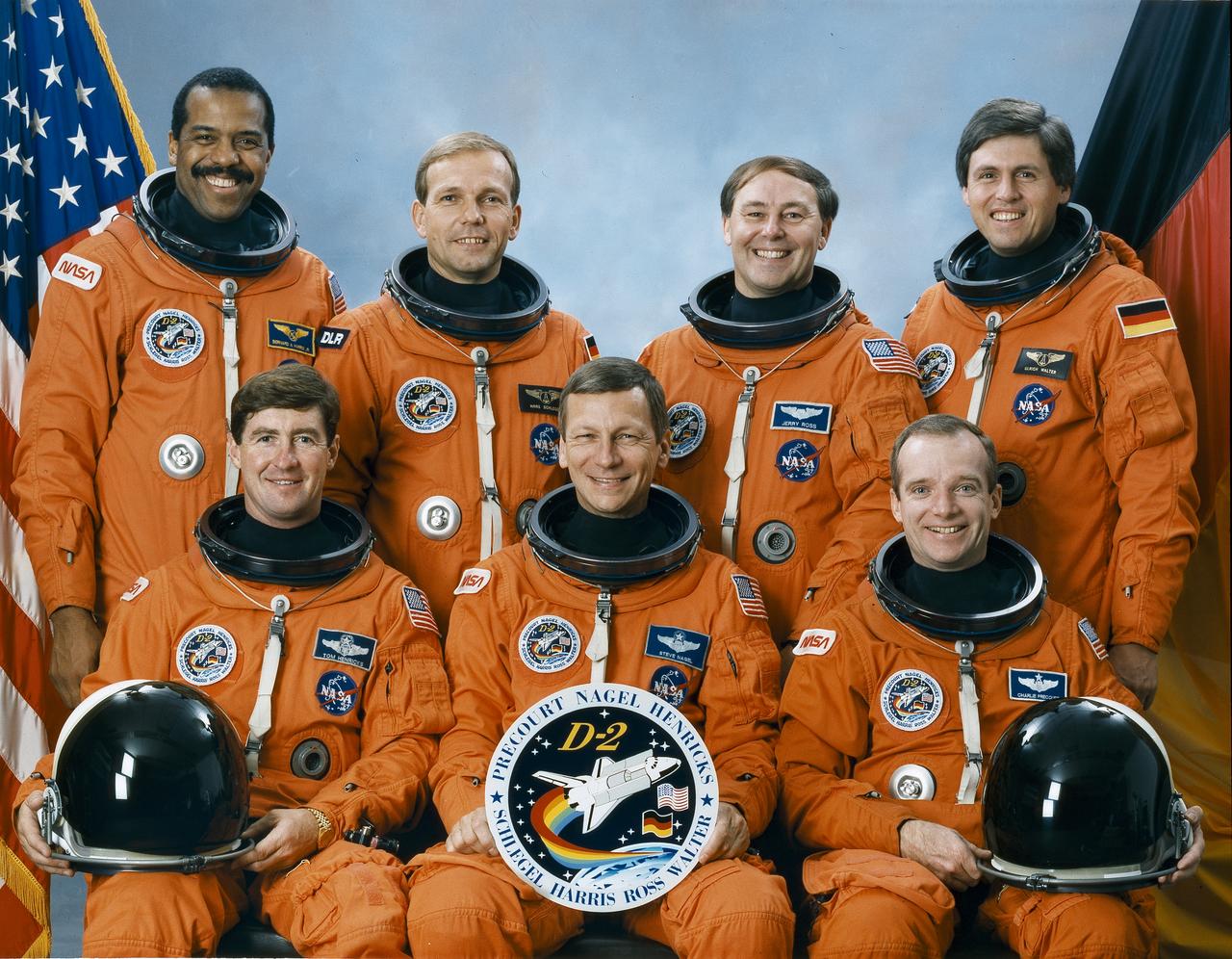
The seven astronauts included in the STS-55 crew portrait are: (front left to right) Terence (Tom) Henricks, pilot; Steven R. Negal, commander; and Charles J. Precourt, mission specialist. On the back row, from left to right, are Bernard A. Harris, mission specialist; Hans Schlegel, payload specialist; Jerry L. Ross, mission specialist; and Ulrich Walter, payload specialist. The crew launched aboard the Space Shuttle Columbia on April 26, 1993 at 10:50:00 am (EDT). The major payload was the German Dedicated Spacelab, D2.
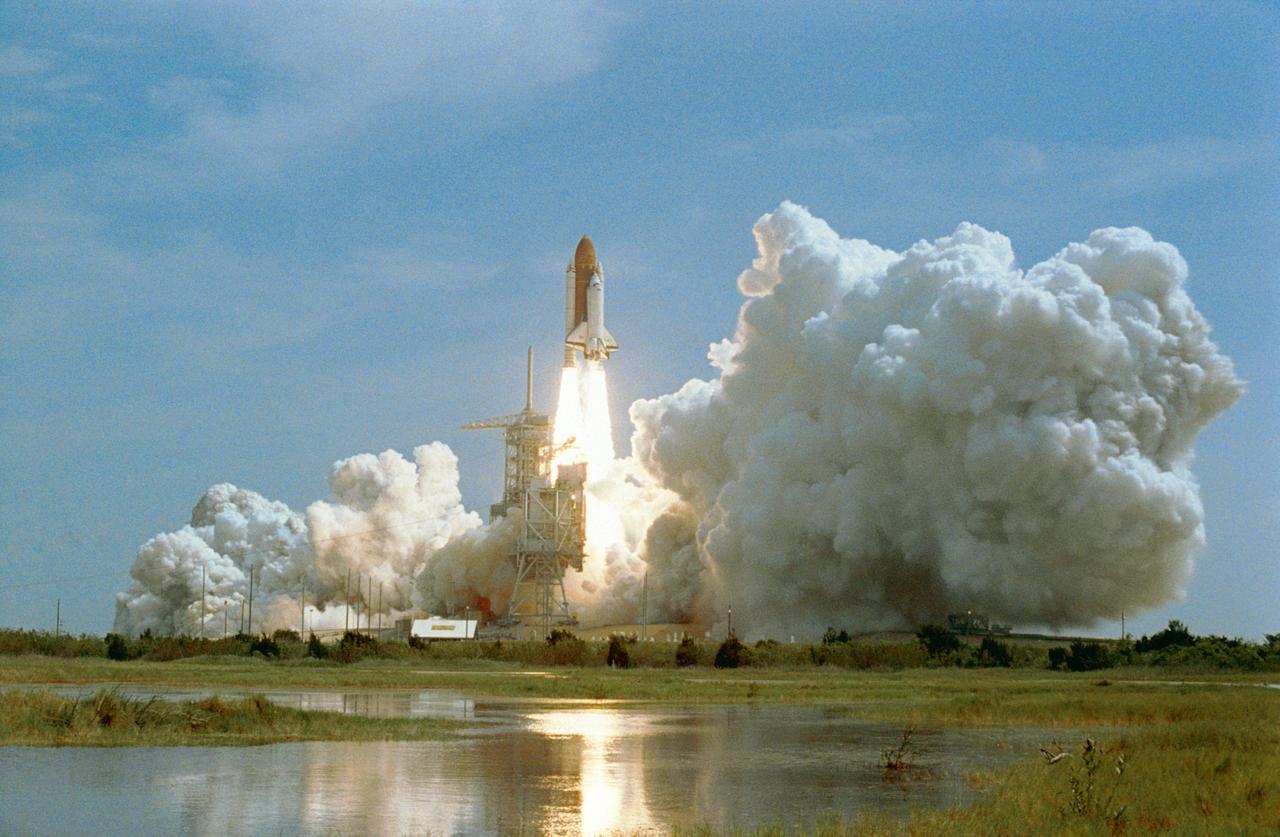
STS055-S-052 (26 April 1993) --- A wide shot shows the STS-55 launch at the Kennedy Space Center. Carrying an international crew of seven and a science laboratory, the Space Shuttle Columbia was on its way for a nine-day Earth-orbital mission in support of the Spacelab D-2 mission. Onboard were astronauts Steven R. Nagel, mission commander; Terence T. (Tom) Henricks, pilot; Jerry L. Ross, payload commander; Charles J. Precourt and Bernard A. Harris Jr., mission specialists; along with German payload specialists Hans Schlegel and Ulrich Walter. Liftoff occurred at 10:50 a.m. (EDT), April 26, 1993.
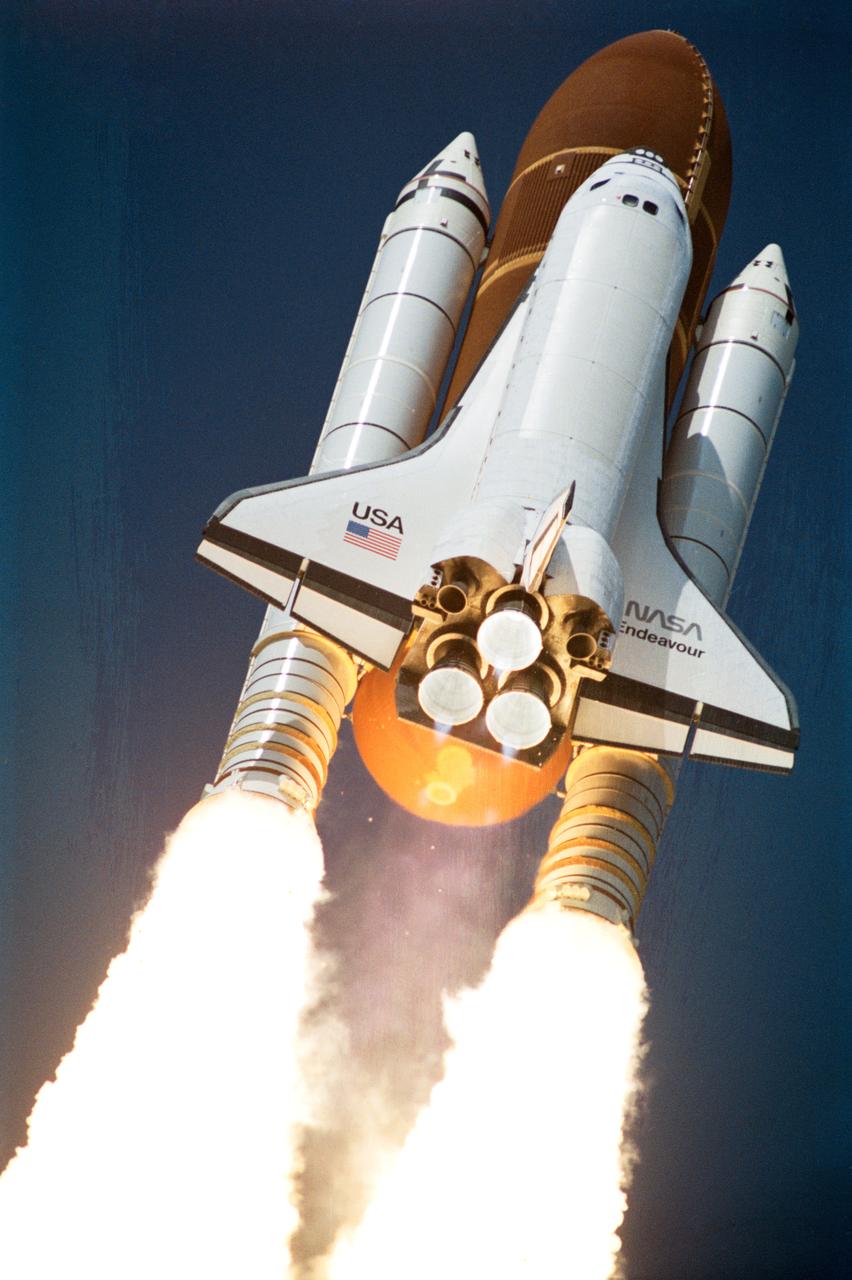
STS047-S-039 (12 Sept 1992) --- A 35mm camera was used to record this low-angle view of the STS-47 launch. With a crew of six NASA astronauts and a Japanese payload specialist onboard, the Space Shuttle Endeavour was heading for its second trip into space. This mission will be devoted to support of the Spacelab-J mission, a joint effort between Japan and the United States. Launch occurred at 10:23:00:0680 a.m. (EDT), September 12, 1992. Onboard were astronauts Robert L. Gibson, mission commander; Curtis L. Brown Jr., pilot; Mark C. Lee, payload commander; and Jerome (Jay) Apt, Mae C. Jemison and N. Jan Davis, mission specialists; along with payload specialist Mamoru Mohri, representing the National Space Development Agency (NASDA) of Japan.
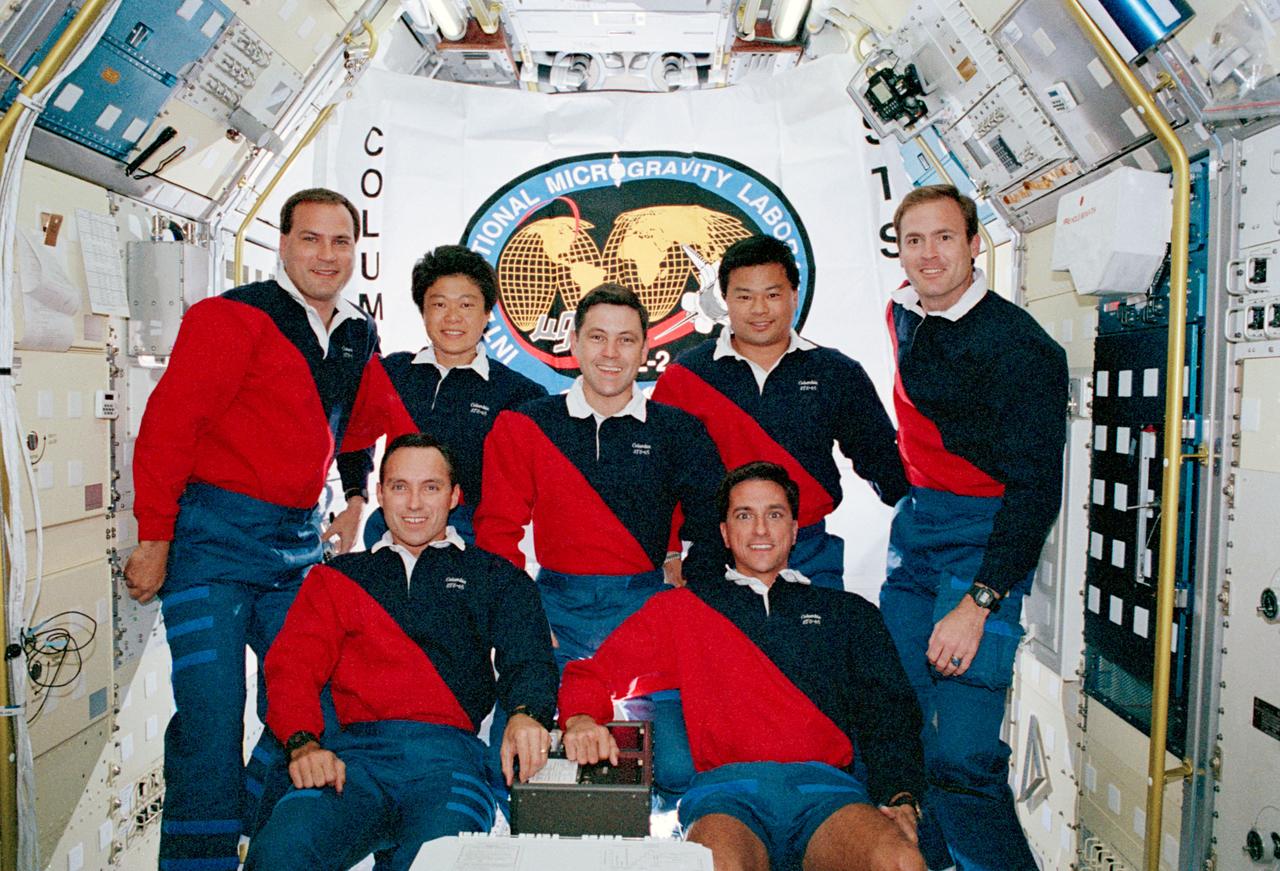
In the spacelab science module aboard the Space Shuttle Columbia, Orbiter Vehicle (OV) 102, the seven crewmembers pose for the traditional onboard (inflight) crew portrait. Displayed in the background is a flag with the International Microgravity Laboratory 2 (IML-2) insignia and Columbia inscribed along the edge. In the front row (left to right) are Mission Specialist (MS) Carl E. Walz and MS Donald A. Thomas. Behind them (left to right) are Payload Commander (PLC) Richard J. Hieb, Payload Specialist Chiaki Mukai, Commander Robert D. Cabana, MS Leroy Chiao, and Pilot James D. Halsell, Jr. Mukai represents the National Space Development Agency (NASDA) of Japan. Crewmembers are wearing their mission polo shirts for the portrait. Inside this module, the crew conducted experiments in support of the IML-2 mission.
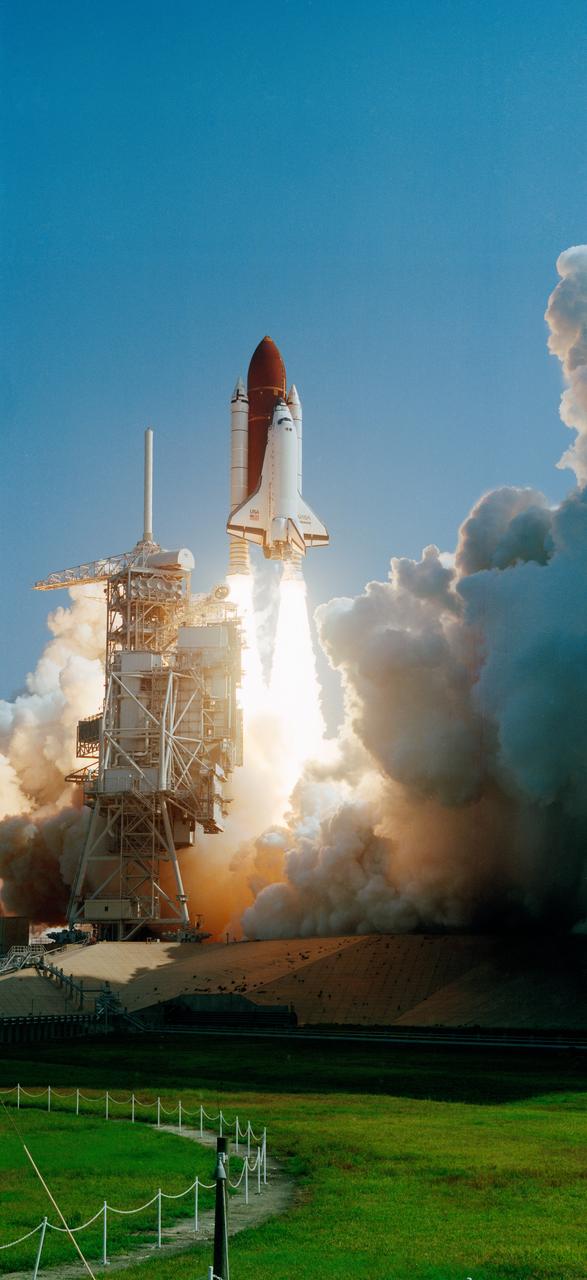
STS047-S-021 (12 Sept 1992) --- With a crew of six NASA astronauts and a Japanese payload specialist onboard, the Space Shuttle Endeavour heads for its second trip into space. This trip will be devoted to support of the Spacelab-J mission, a joint effort between Japan and the United States. Launch occurred at 10:23:00:0680 a.m. (EDT), September 12, 1992. Onboard were astronauts Robert L. Gibson, mission commander; Curtis L. Brown Jr., pilot; Mark C. Lee, payload commander; and Jerome (Jay) Apt, Mae C. Jemison and N. Jan Davis, mission specialists, along with payload specialist Mamoru Mohri, representing the National Space Development Agency of Japan.
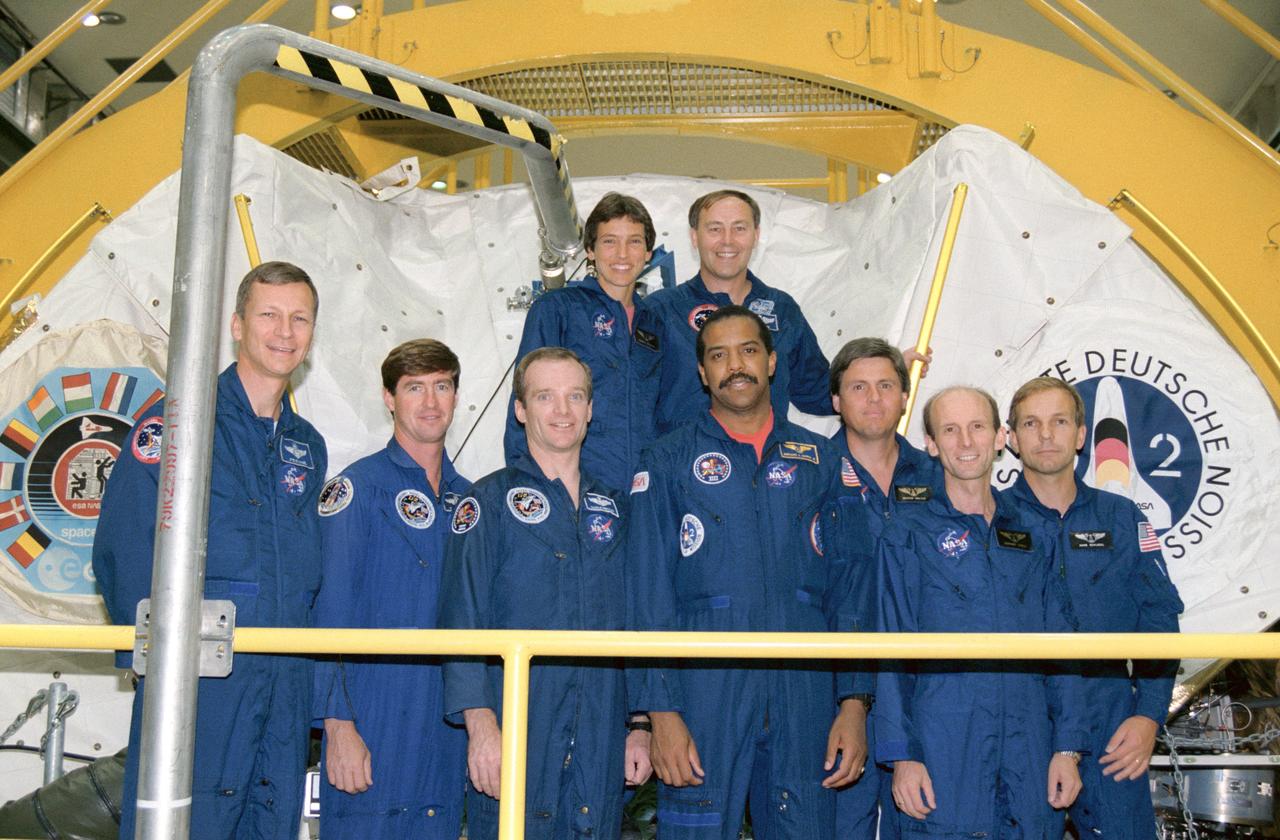
S92-49373 (8 Dec 1992) --- The seven prime flight crewmembers and two alternates assigned to support the STS-55\Spacelab D-2 mission pose with their science module. Left to right (front) are Steven R. Nagel, Terence T. (Tom) Henricks, Charles J. Precourt, Bernard A. Harris Jr., Ulrich Walter, Gerhard Thiele and Hans Schlegel; and (back) Renate Brummer and Jerry L. Ross. Nagel is mission commander; Henricks, pilot; and Ross, payload commander. Harris and Precourt will serve as mission specialists. Walter and Schlegel are scheduled to represent the DLR as payload specialists for the mission, while Brummer and Thiele will serve as alternates and fill supportive roles on the ground. The crew was photographed during a tour of the science module before its integration at Kennedy Space Center (KSC).
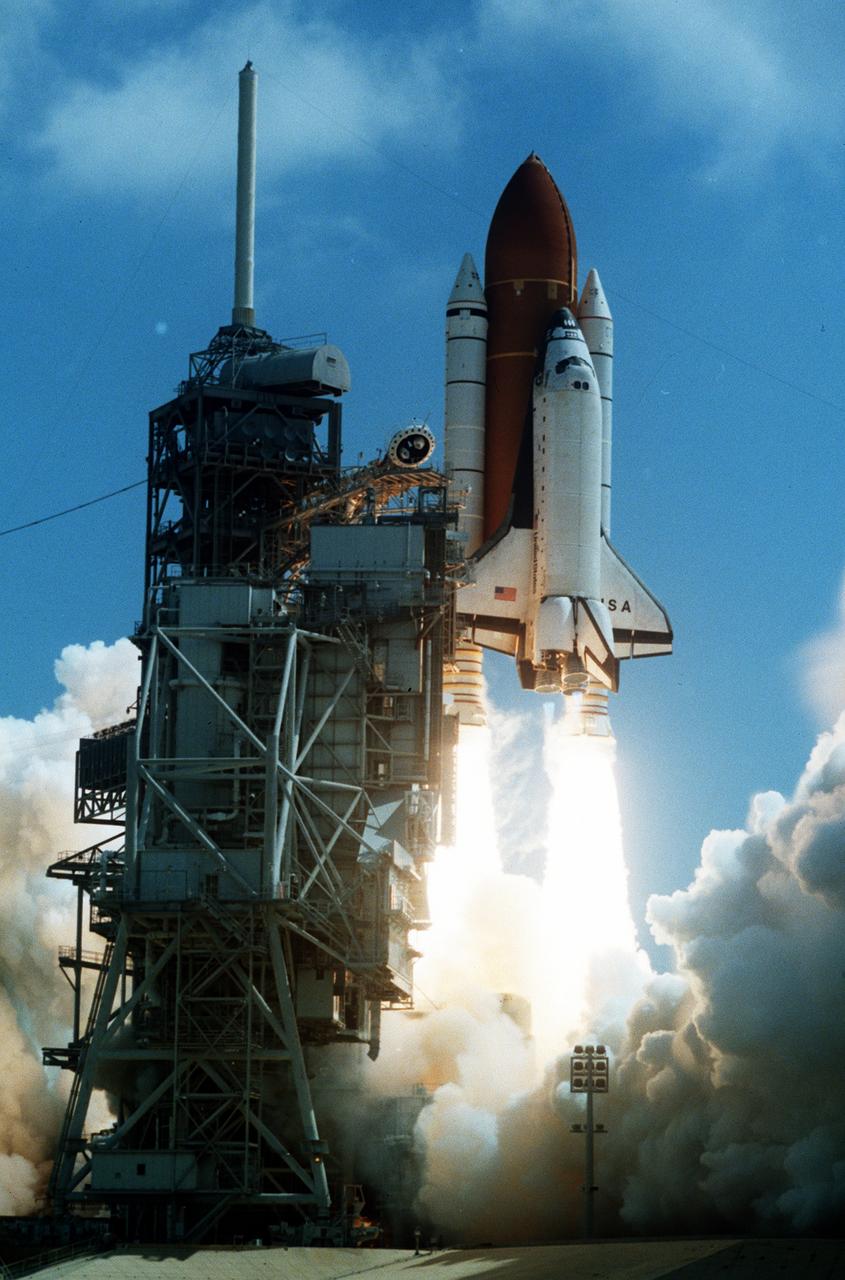
STS078-S-008 (20 June 1996) --- With an international payload and crew aboard, the Space Shuttle Columbia lifts off from Launch Pad 39B, at the Kennedy Space Center (KSC). Possibly expected to be NASA's longest duration Shuttle flight to date, the mission officially began at 10:49:00 a.m. (EDT), June 20, 1996. Onboard for Columbia’s 20th flight were astronauts Terence T. (Tom) Henricks, mission commander; Kevin R. Kregel, pilot; Susan J. Helms, payload commander; and Richard M. Linnehan and Charles E. Brady, Jr., both mission specialists, along with payload specialists Jean-Jacques Favier of the French Space Agency (CNES) and Robert B. Thirsk of the Canadian Space Agency (CSA). Flying in Columbia’s payload bay is the Life and Microgravity Spacelab (LMS), carrying a complement of United States and international experiments.
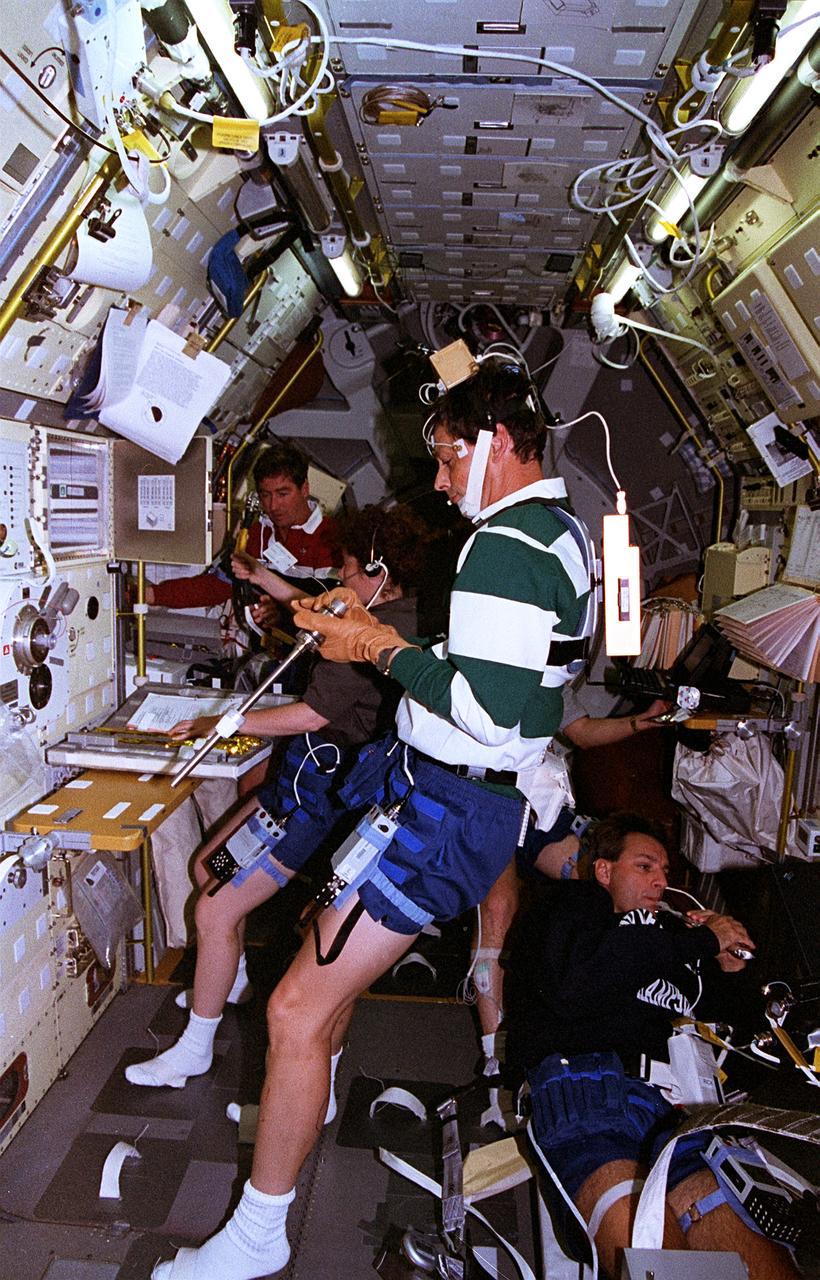
STS078-396-015 (20 June - 7 July 1996) --- Payload specialist Jean-Jacques Favier, representing the French Space Agency (CNES), prepares a sample for the Advanced Gradient Heating Facility (AGHF) while wearing instruments that measure upper body movement. The Torso Rotation Experiment (TRE) complements other vestibular studies that measure differences in the way human beings react physically to their surroundings in microgravity. This is a typical Life and Microgravity Spacelab (LMS-1) mission scene, with several experiments being performed. Astronaut Susan J. Helms, payload commander, assists Favier in the AGHF preparations. Astronaut Richard M. Linnehan (bottom right), mission specialist, tests his muscle response with the Handgrip Dynamometer. Astronaut Thomas T. (Tom) Henricks (far background), mission commander, offers assistance.
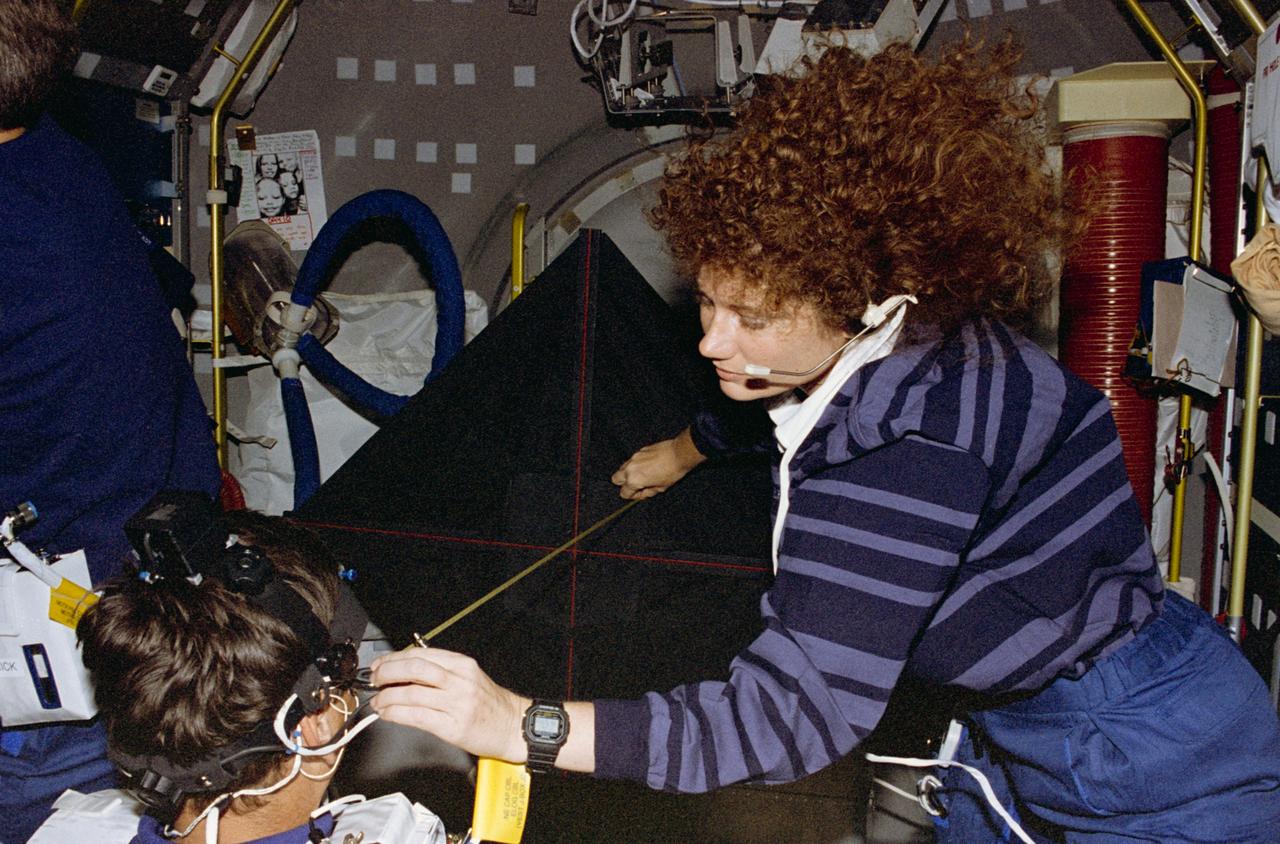
STS078-398-032 (20 June - 7 July 1996) --- Astronaut Susan J. Helms, payload commander, measures the distance between Jean-Jacques Favier’s head and the luminous torque, used for the Canal and Otolith Interaction Study (COIS) on the Life and Microgravity Spacelab (LMS-1) mission. Favier, representing the French Space Agency (CNES), is one of two international payload specialists on the almost-17-day flight. This view shows the Voluntary Head Movement (VHM) segment of the experiment. The VHM is meant to characterize how the coordination of head and eye movement changes as a result of spaceflight. Since most vestibular functions are influenced by gravity, the COIS experiment is meant to measure response differences in microgravity.
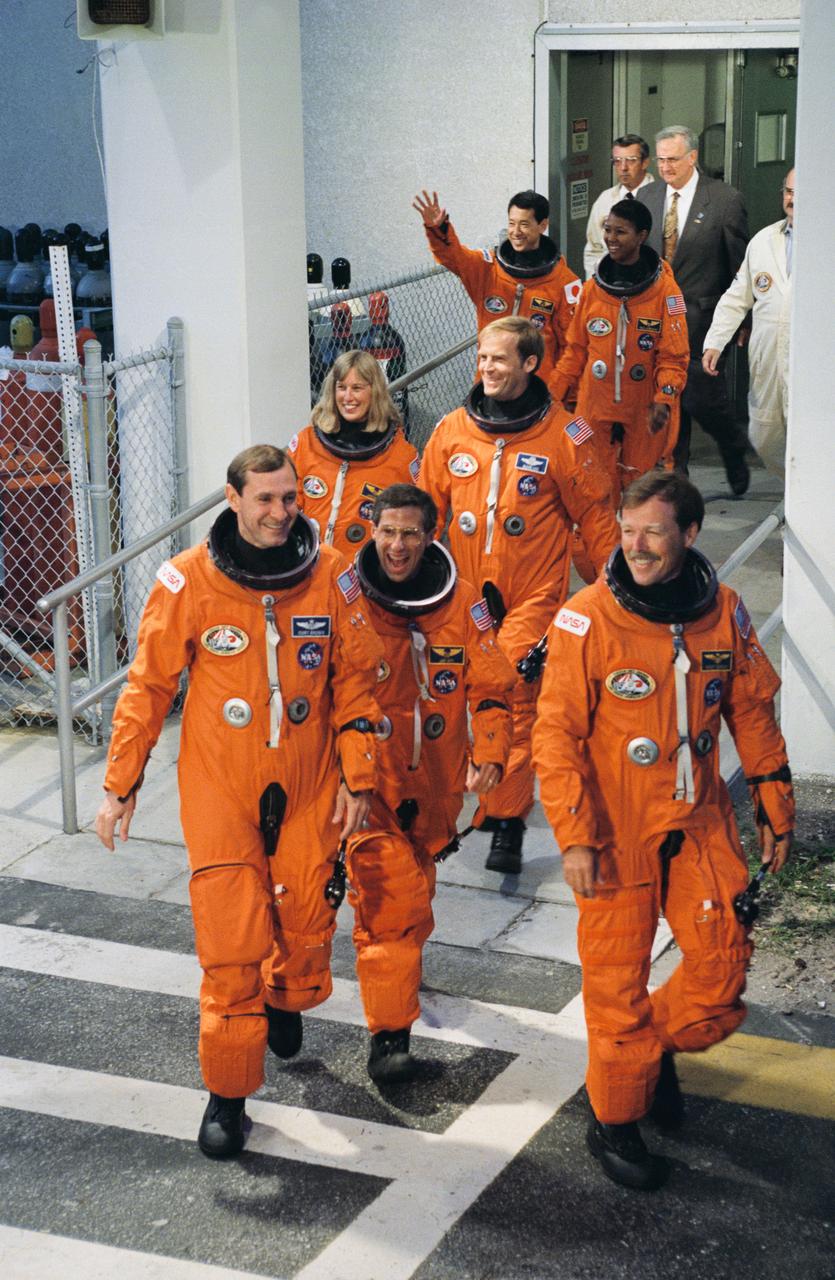
STS047-S-038 (12 Sept 1992) --- The seven crewmembers who will be aboard for Endeavour's second trip into space leave the Operations and Checkout Building to board a van headed for Launch Complex 39. This mission will be devoted to support of the Spacelab-J mission, a joint effort between Japan and the United States. Launch occurred at 10:23:00:0680 a.m. (EDT), September 12, 1992. Onboard were astronauts Robert L. Gibson, mission commander; Curtis L. Brown Jr., pilot; Mark C. Lee, payload commander; and Jerome (Jay) Apt, Mae C. Jemison and N. Jan Davis, mission specialists; along with payload specialist Mamoru Mohri, representing the National Space Development Agency (NASDA) of Japan.
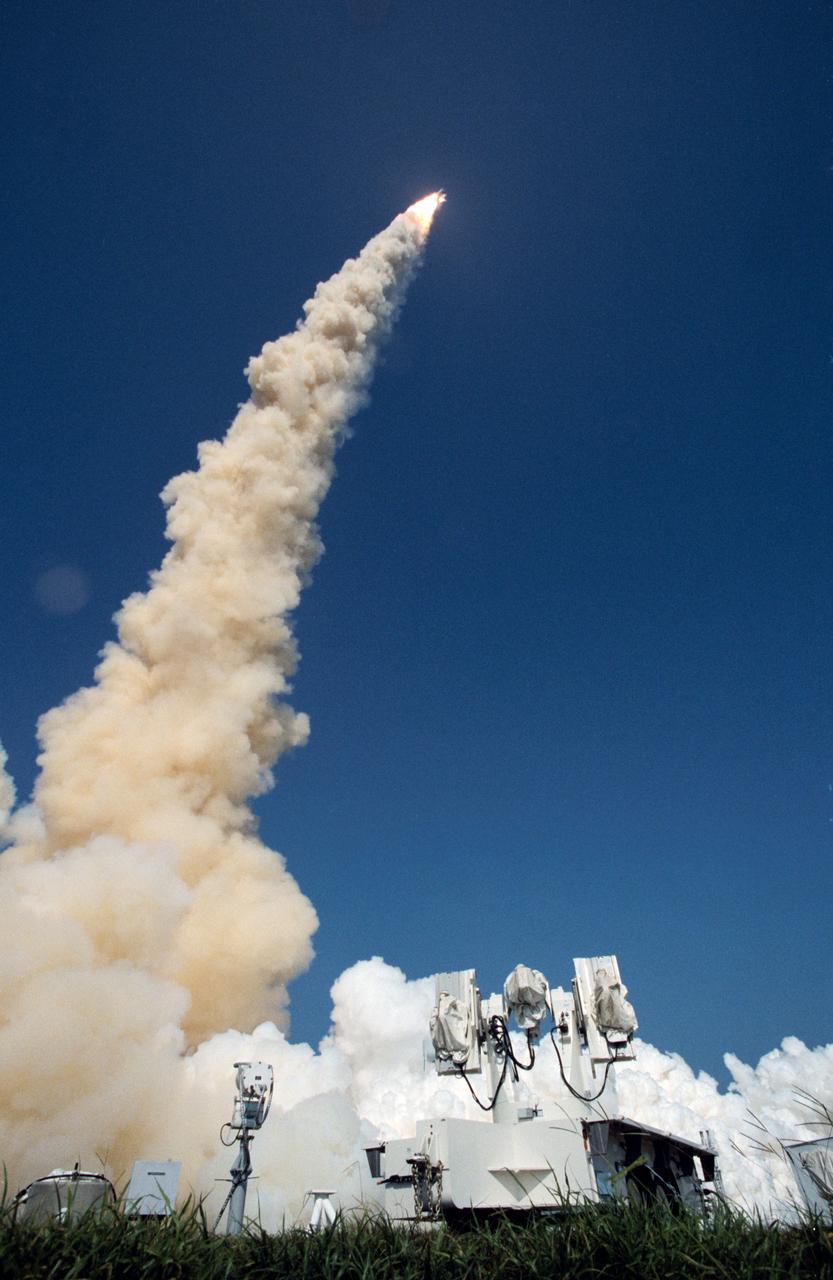
STS047-S-040 (12 Sept 1992) --- A 35mm camera was used to record this distant, low-angle view of the STS-47 launch. With a crew of six NASA astronauts and a Japanese payload specialist onboard, the Space Shuttle Endeavour was heading for its second trip into space. This mission is devoted to support of the Spacelab-J mission, a joint effort between Japan and the United States. Launch occurred at 10:23:00:0680 a.m. (EDT), September 12, 1992. Onboard were astronauts Robert L. Gibson, mission commander; Curtis L. Brown Jr., pilot; Mark C. Lee, payload commander; and Jerome (Jay) Apt, Mae C. Jemison and N. Jan Davis, mission specialists; along with payload specialist Mamoru Mohri, representing the National Space Development Agency (NASDA) of Japan.