Sierra Space Dream Chaser Spaceplane Documentation Photographs

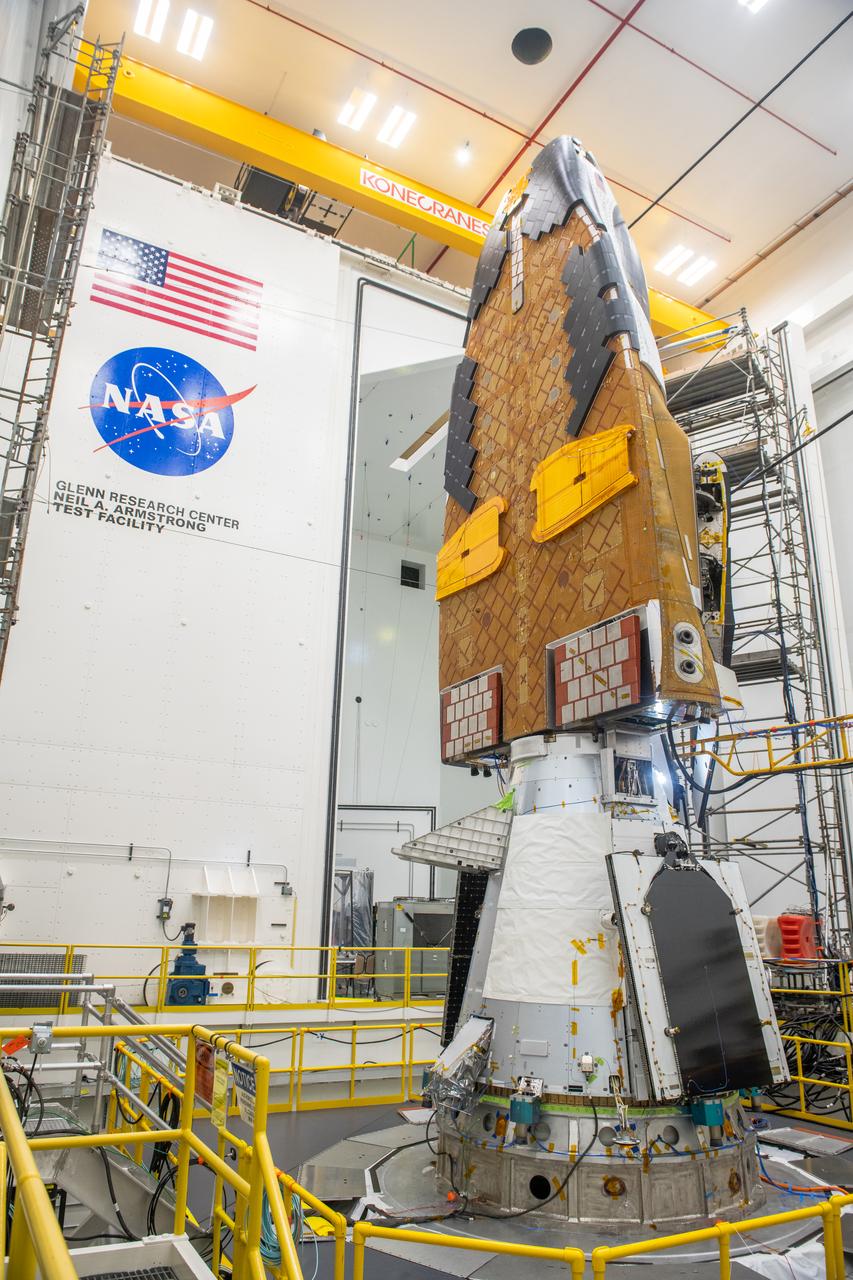
A technician in shown inside Sierra Space’s Dream Chaser spaceplane preparing for vibration testing at the Neil Armstrong Test Facility’s Mechanical Vibration Facility. Using the world’s most powerful spacecraft shaker system in February 2024, NASA exposed Dream Chaser and its Shooting Star cargo module to vibrations like those it will experience during launch and re-entry into the atmosphere. Photo Credit: (NASA/Jordan Salkin)
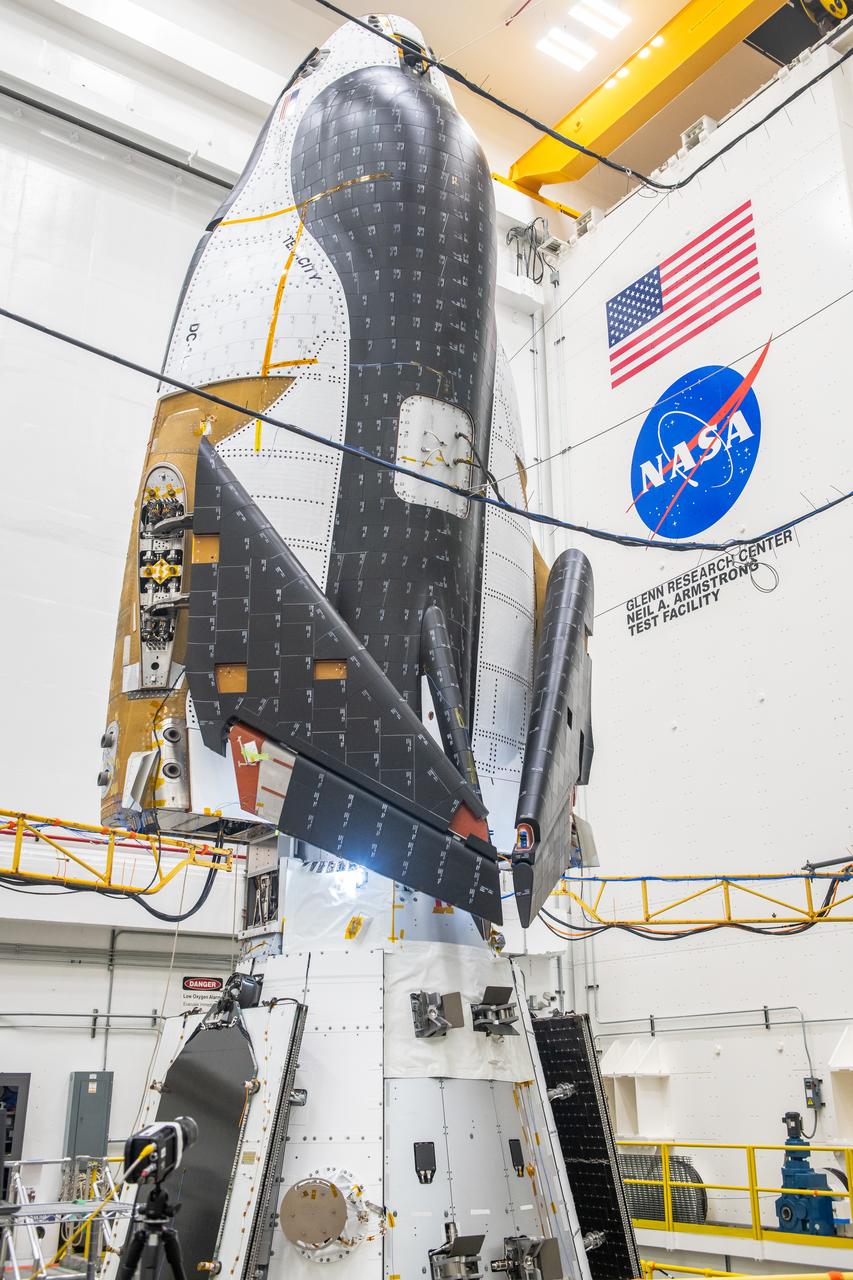
The Neil Armstrong Test Facility, part of NASA’s Glenn Research Center in Cleveland, is home to multiple test facilities, including the Space Environments Complex and the In-Space Propulsion Facility, both stops for Dream Chaser. The complex is home to the Mechanical Vibration Facility, which subjects test articles to the rigorous conditions of launch. While at Armstrong, the Dream Chaser winged spacecraft was stacked atop its Shooting Star cargo module on the vibration table to experience vibrations like those during launch and re-entry to the Earth’s atmosphere.
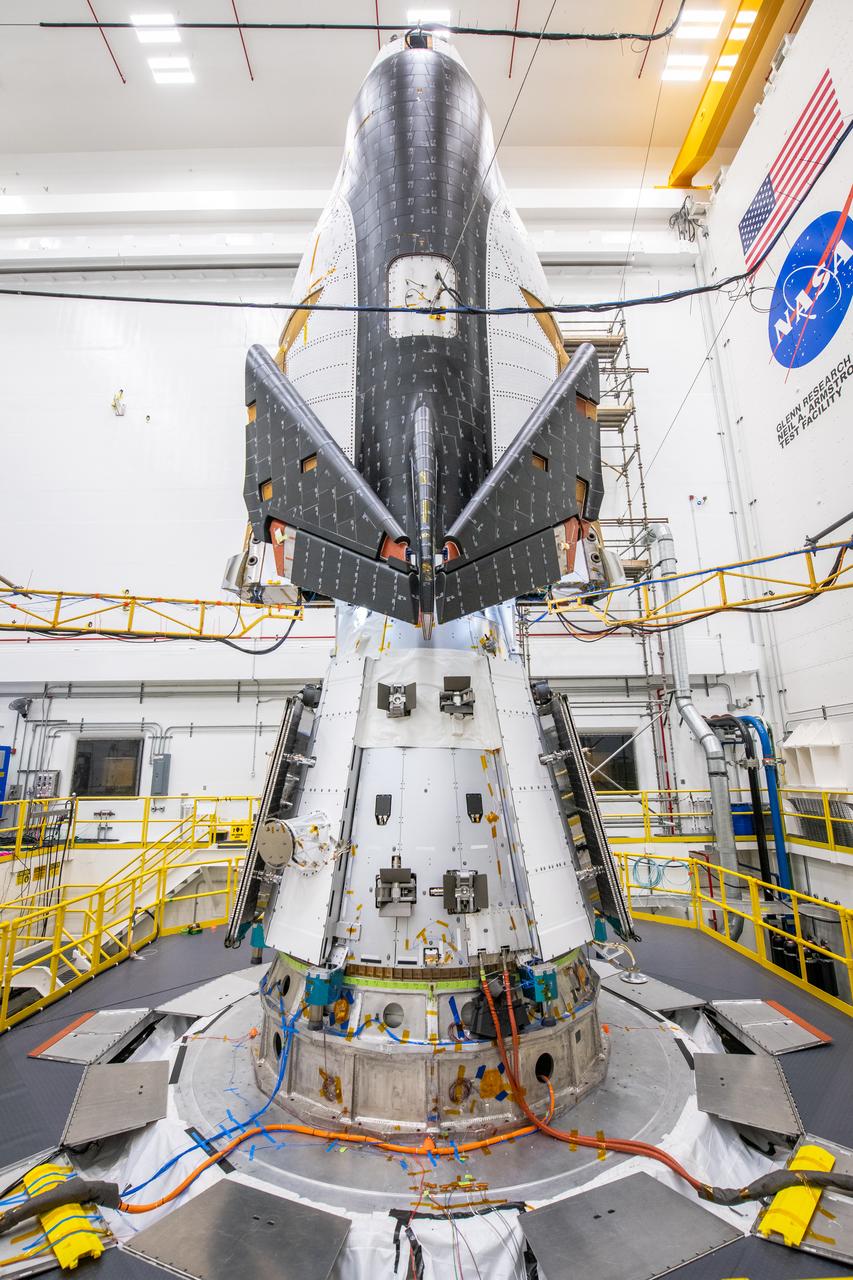
The Neil Armstrong Test Facility, part of NASA’s Glenn Research Center in Cleveland, is home to multiple test facilities, including the Space Environments Complex and the In-Space Propulsion Facility, both stops for Dream Chaser. The complex is home to the Mechanical Vibration Facility, which subjects test articles to the rigorous conditions of launch. While at Armstrong, the Dream Chaser winged spacecraft was stacked atop its Shooting Star cargo module on the vibration table to experience vibrations like those during launch and re-entry to the Earth’s atmosphere.
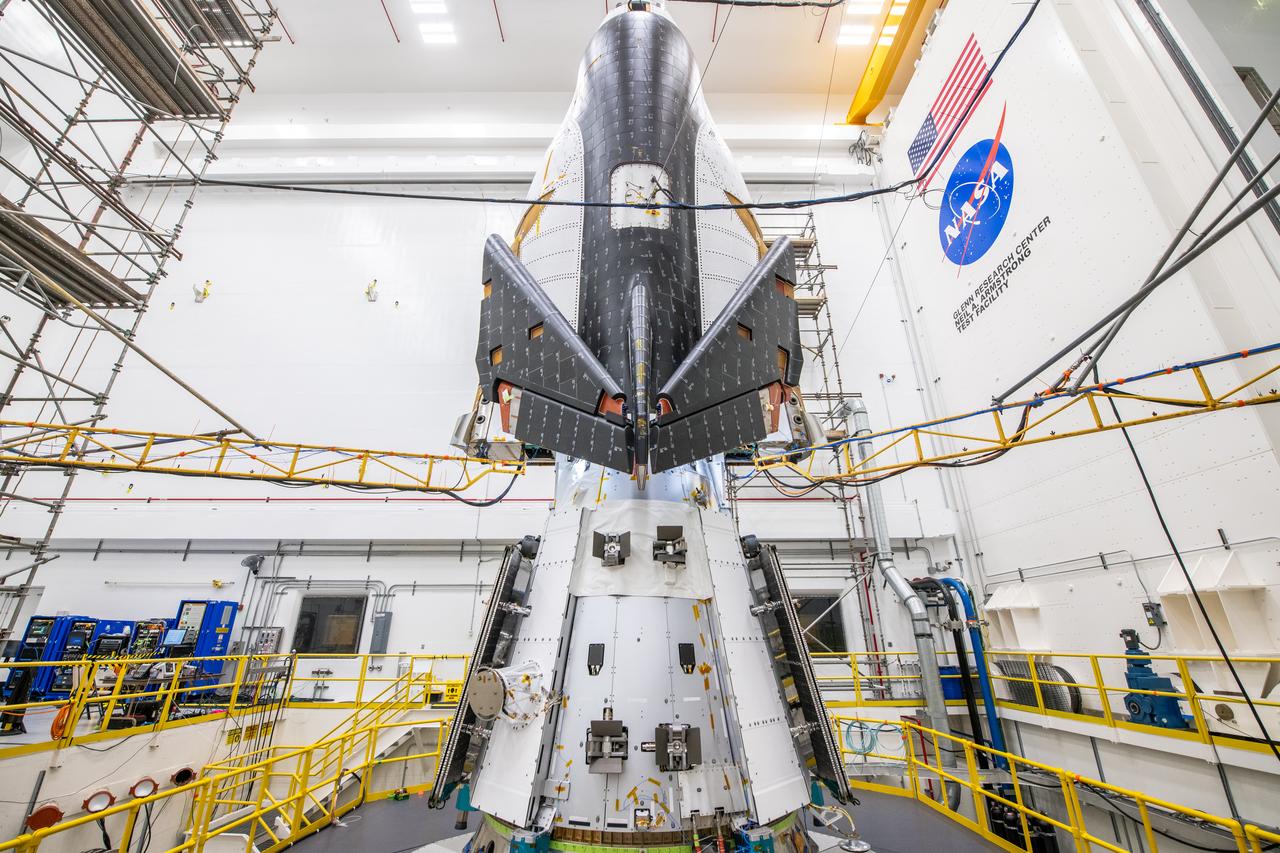
The Neil Armstrong Test Facility, part of NASA’s Glenn Research Center in Cleveland, is home to multiple test facilities, including the Space Environments Complex and the In-Space Propulsion Facility, both stops for Dream Chaser. The complex is home to the Mechanical Vibration Facility, which subjects test articles to the rigorous conditions of launch. While at Armstrong, the Dream Chaser winged spacecraft was stacked atop its Shooting Star cargo module on the vibration table to experience vibrations like those during launch and re-entry to the Earth’s atmosphere.
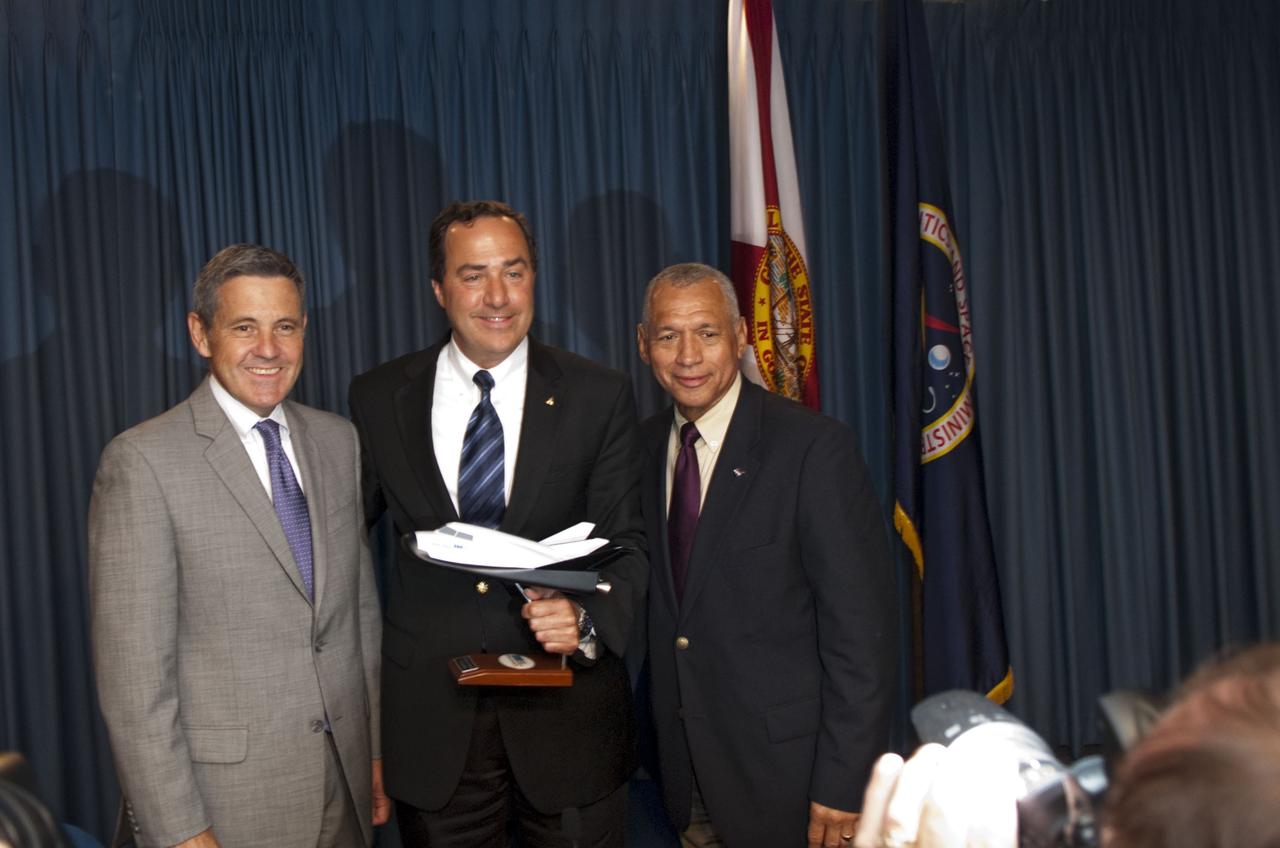
CAPE CANAVERAL, Fla. -- Kennedy Space Center Director Bob Cabana, left, Mark Sirangelo, head of Sierra Nevada Space Systems (SNSS) of Sparks, Nev., and NASA Administrator Charlie Bolden pose for a photo after signing a Space Act Agreement that will offer the company technical capabilities from Kennedy's uniquely skilled work force. Kennedy will help Sierra Nevada with the ground operations support of its lifting body reusable spacecraft called "Dream Chaser," which resembles a smaller version of the space shuttle orbiter. The spacecraft would carry as many as seven astronauts to the space station. Through the new agreement, Kennedy's work force will use its experience of processing the shuttle fleet for 30 years to help Sierra Nevada define and execute Dream Chaser's launch preparations and post-landing activities. In 2010 and 2011, Sierra Nevada was awarded grants as part of the initiative to stimulate the private sector in developing and demonstrating human spaceflight capabilities for NASA's Commercial Crew Program. The goal of the program, which is based in Florida at Kennedy, is to facilitate the development of a U.S. commercial crew space transportation capability by achieving safe, reliable and cost-effective access to and from the space station and future low Earth orbit destinations. Photo credit: NASA/Jim Grossmann
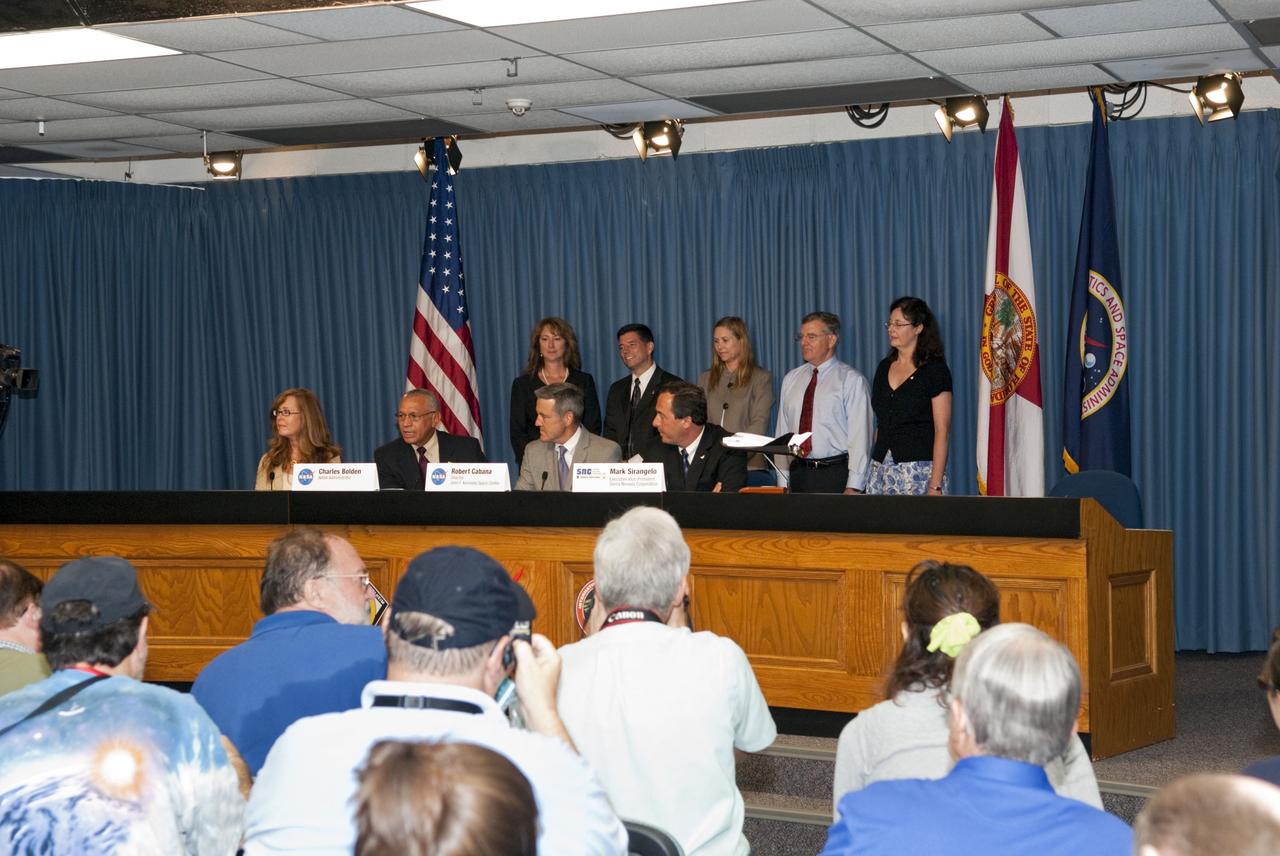
CAPE CANAVERAL, Fla. -- NASA and Sierra Nevada Space Systems (SNSS) of Sparks, Nev., prepare to sign a Space Act Agreement that will offer the company technical capabilities from Kennedy Space Center's uniquely skilled work force. Sitting, from left, are Kennedy Public Affairs Director Lisa Malone; NASA Administrator Charlie Bolden; Kennedy Center Director Bob Cabana; and Mark Sirangelo, head of Sierra Nevada. Standing, from left, are Joyce Riquelme, manager of Kennedy's Center Planning and Development Office; John Curry, director of Sierra Nevada's Systems Integration, Test and Operations; Kennedy Deputy Director Janet Petro; Jim Voss, vice president of Sierra Nevada's Space Exploration Systems; and Merri Sanchez, senior director of Sierra Nevada's Space Exploration Systems. Kennedy will help Sierra Nevada with the ground operations support of its lifting body reusable spacecraft called "Dream Chaser," which resembles a smaller version of the space shuttle orbiter. The spacecraft would carry as many as seven astronauts to the space station. Through the new agreement, Kennedy's work force will use its experience of processing the shuttle fleet for 30 years to help Sierra Nevada define and execute Dream Chaser's launch preparations and post-landing activities. In 2010 and 2011, Sierra Nevada was awarded grants as part of the initiative to stimulate the private sector in developing and demonstrating human spaceflight capabilities for NASA's Commercial Crew Program. The goal of the program, which is based in Florida at Kennedy, is to facilitate the development of a U.S. commercial crew space transportation capability by achieving safe, reliable and cost-effective access to and from the space station and future low Earth orbit destinations. Photo credit: NASA/Jim Grossmann
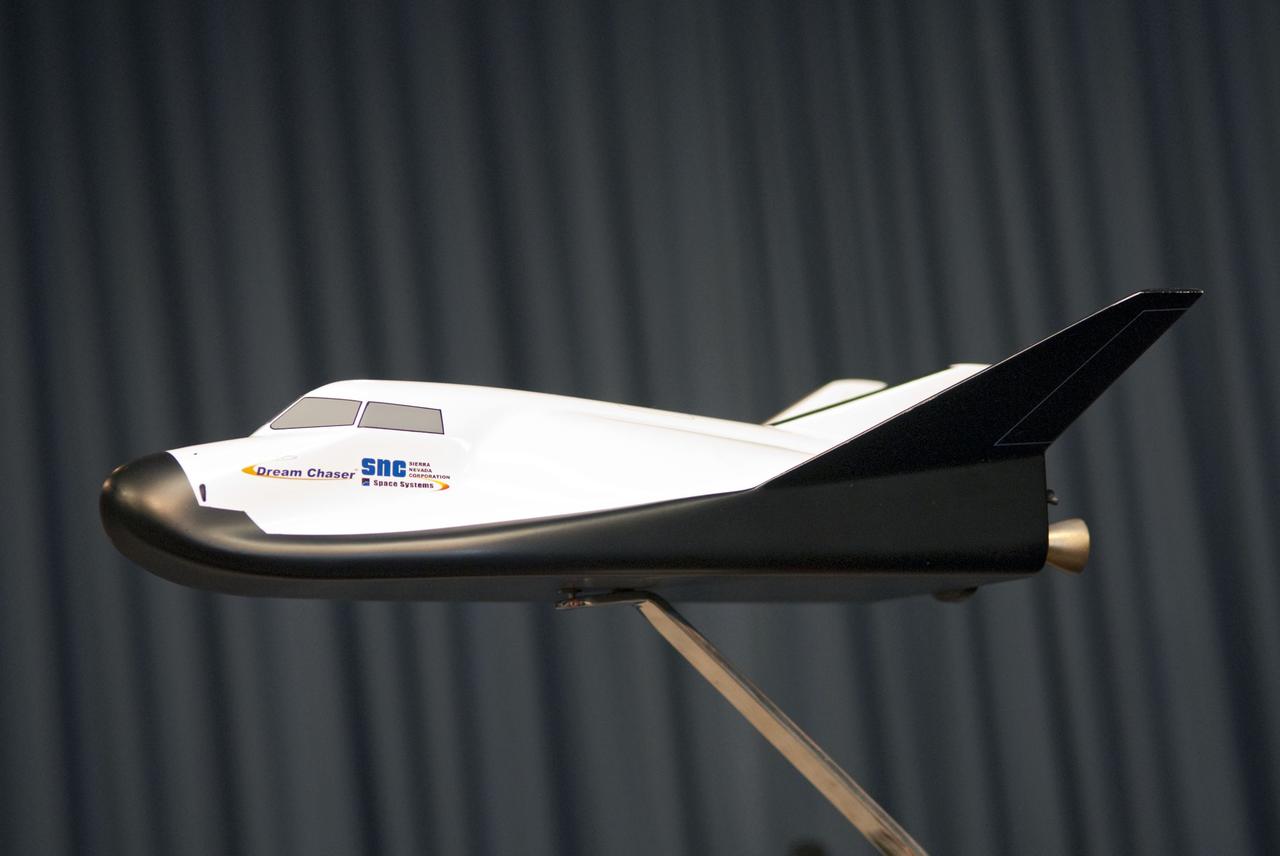
CAPE CANAVERAL, Fla. -- Sierra Nevada Space Systems (SNSS) of Sparks, Nev., and NASA signed a Space Act Agreement that will offer the company technical capabilities from Kennedy's uniquely skilled work force. Kennedy will help Sierra Nevada with the ground operations support of its lifting body reusable spacecraft called "Dream Chaser." The spacecraft, seen here as a display, resembles a smaller version of the space shuttle orbiter. The spacecraft would carry as many as seven astronauts to the space station. Through the new agreement, Kennedy's work force will use its experience of processing the shuttle fleet for 30 years to help Sierra Nevada define and execute Dream Chaser's launch preparations and post-landing activities. In 2010 and 2011, Sierra Nevada was awarded grants as part of the initiative to stimulate the private sector in developing and demonstrating human spaceflight capabilities for NASA's Commercial Crew Program. The goal of the program, which is based in Florida at Kennedy, is to facilitate the development of a U.S. commercial crew space transportation capability by achieving safe, reliable and cost-effective access to and from the space station and future low Earth orbit destinations. Photo credit: NASA/Jim Grossmann
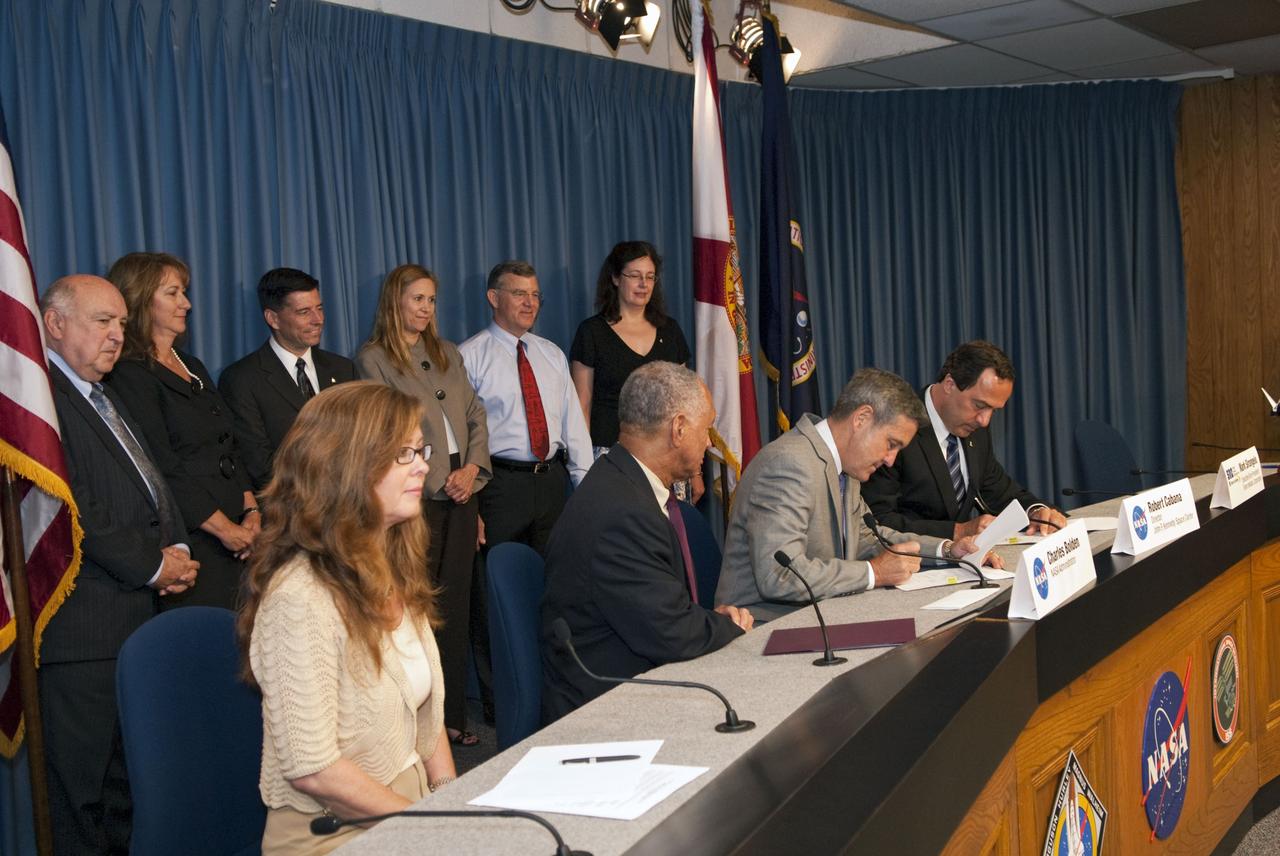
CAPE CANAVERAL, Fla. -- NASA and Sierra Nevada Space Systems (SNSS) of Sparks, Nev., sign a Space Act Agreement that will offer the company technical capabilities from Kennedy Space Center's uniquely skilled work force. Sitting, from left, are Kennedy Public Affairs Director Lisa Malone; NASA Administrator Charlie Bolden; Kennedy Center Director Bob Cabana; and Mark Sirangelo, head of Sierra Nevada. Standing, from left, are Frank DiBello, president of Space Florida; Joyce Riquelme, manager of Kennedy's Center Planning and Development Office; John Curry, director of Sierra Nevada's Systems Integration, Test and Operations; Kennedy Deputy Director Janet Petro; Jim Voss, vice president of Sierra Nevada's Space Exploration Systems; and Merri Sanchez, senior director of Sierra Nevada's Space Exploration Systems. Kennedy will help Sierra Nevada with the ground operations support of its lifting body reusable spacecraft called "Dream Chaser," which resembles a smaller version of the space shuttle orbiter. The spacecraft would carry as many as seven astronauts to the space station. Through the new agreement, Kennedy's work force will use its experience of processing the shuttle fleet for 30 years to help Sierra Nevada define and execute Dream Chaser's launch preparations and post-landing activities. In 2010 and 2011, Sierra Nevada was awarded grants as part of the initiative to stimulate the private sector in developing and demonstrating human spaceflight capabilities for NASA's Commercial Crew Program. The goal of the program, which is based in Florida at Kennedy, is to facilitate the development of a U.S. commercial crew space transportation capability by achieving safe, reliable and cost-effective access to and from the space station and future low Earth orbit destinations. Photo credit: NASA/Jim Grossmann
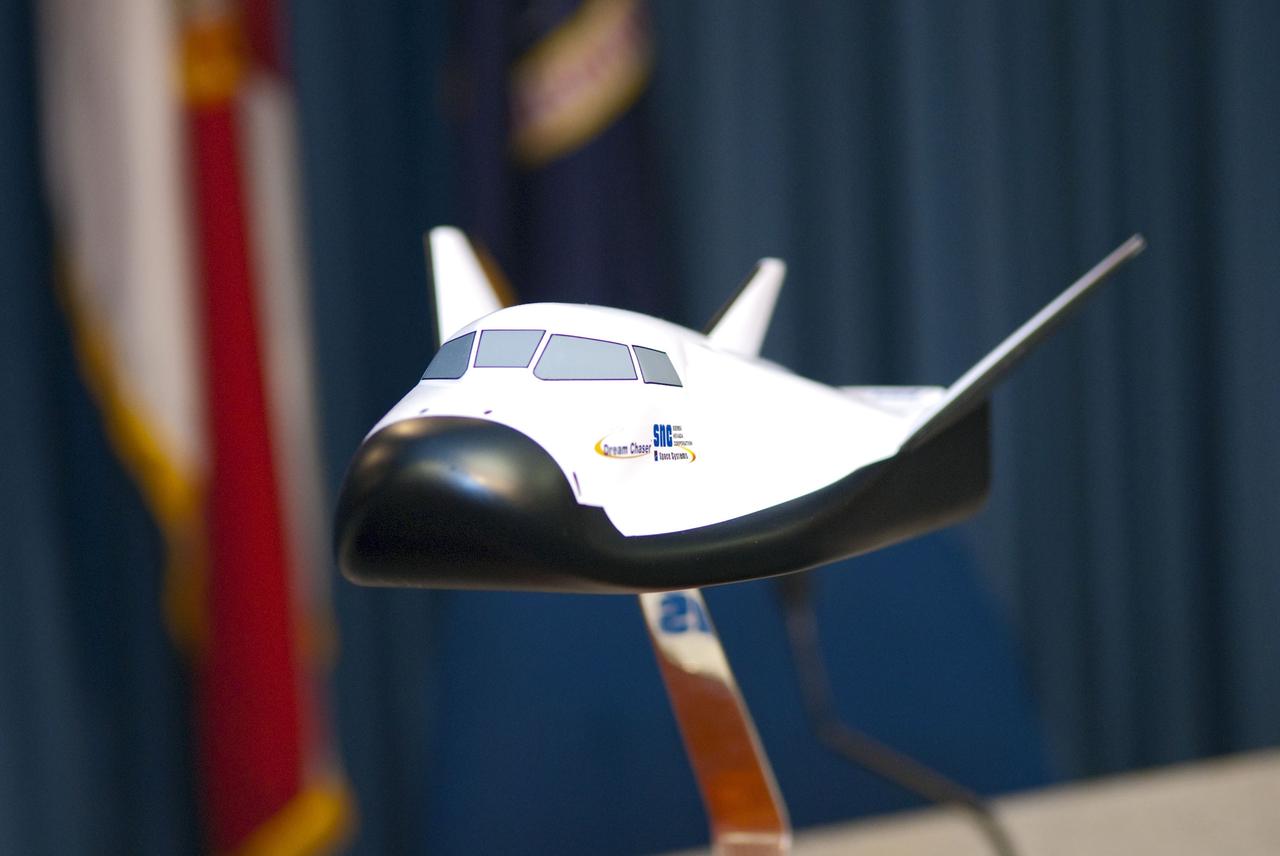
CAPE CANAVERAL, Fla. -- Sierra Nevada Space Systems (SNSS) of Sparks, Nev., and NASA signed a Space Act Agreement that will offer the company technical capabilities from Kennedy's uniquely skilled work force. Kennedy will help Sierra Nevada with the ground operations support of its lifting body reusable spacecraft called "Dream Chaser." The spacecraft, seen here as a display, resembles a smaller version of the space shuttle orbiter. The spacecraft would carry as many as seven astronauts to the space station. Through the new agreement, Kennedy's work force will use its experience of processing the shuttle fleet for 30 years to help Sierra Nevada define and execute Dream Chaser's launch preparations and post-landing activities. In 2010 and 2011, Sierra Nevada was awarded grants as part of the initiative to stimulate the private sector in developing and demonstrating human spaceflight capabilities for NASA's Commercial Crew Program. The goal of the program, which is based in Florida at Kennedy, is to facilitate the development of a U.S. commercial crew space transportation capability by achieving safe, reliable and cost-effective access to and from the space station and future low Earth orbit destinations. Photo credit: NASA/Jim Grossmann
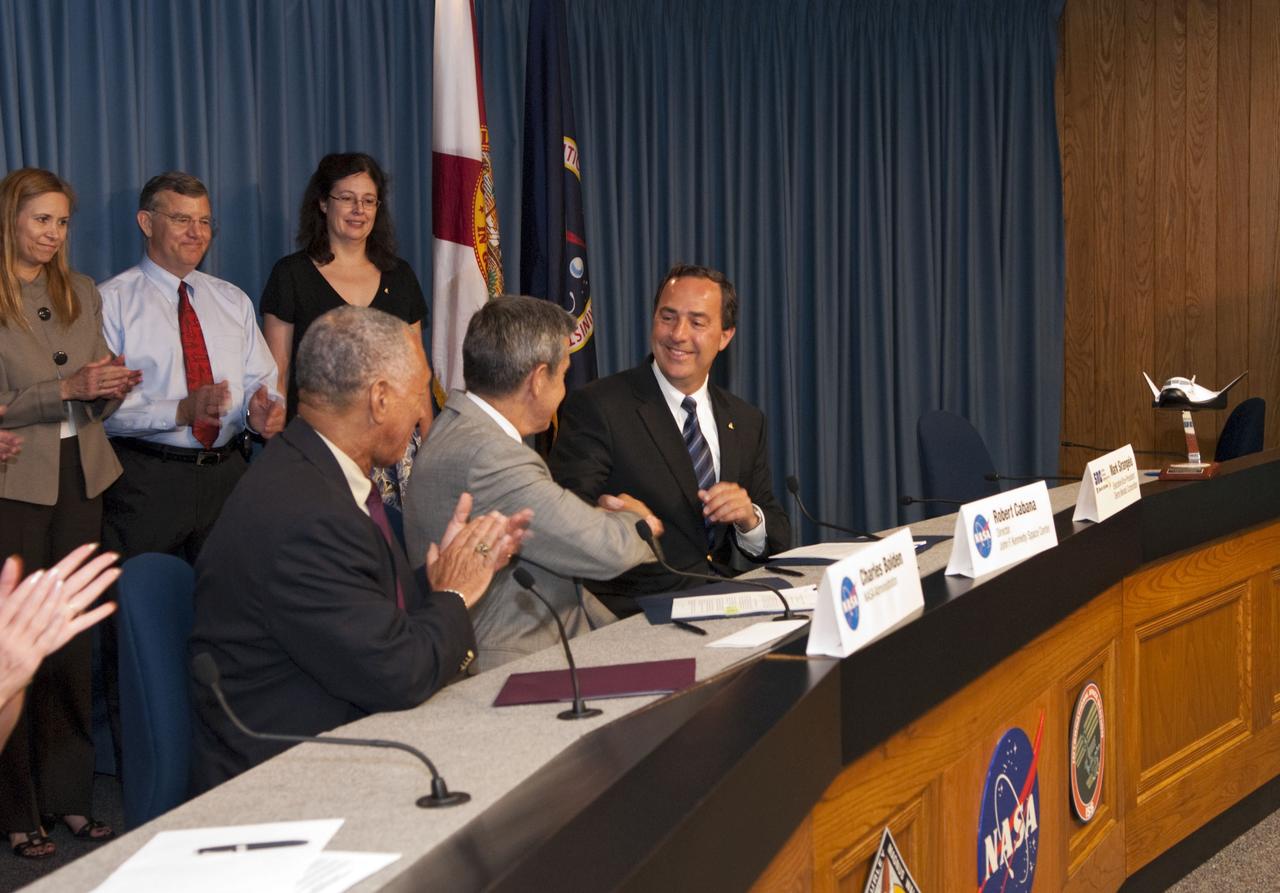
CAPE CANAVERAL, Fla. -- NASA and Sierra Nevada Space Systems (SNSS) of Sparks, Nev., enter into a Space Act Agreement that will offer the company technical capabilities from Kennedy Space Center's uniquely skilled work force. Sitting, from left, are NASA Administrator Charlie Bolden; Kennedy Center Director Bob Cabana; and Mark Sirangelo, head of Sierra Nevada. Standing, from left, Kennedy Deputy Director Janet Petro; Jim Voss, vice president of Sierra Nevada's Space Exploration Systems; and Merri Sanchez, senior director of Sierra Nevada's Space Exploration Systems. Kennedy will help Sierra Nevada with the ground operations support of its lifting body reusable spacecraft called "Dream Chaser," which resembles a smaller version of the space shuttle orbiter. The spacecraft would carry as many as seven astronauts to the space station. Through the new agreement, Kennedy's work force will use its experience of processing the shuttle fleet for 30 years to help Sierra Nevada define and execute Dream Chaser's launch preparations and post-landing activities. In 2010 and 2011, Sierra Nevada was awarded grants as part of the initiative to stimulate the private sector in developing and demonstrating human spaceflight capabilities for NASA's Commercial Crew Program. The goal of the program, which is based in Florida at Kennedy, is to facilitate the development of a U.S. commercial crew space transportation capability by achieving safe, reliable and cost-effective access to and from the space station and future low Earth orbit destinations. Photo credit: NASA/Jim Grossmann
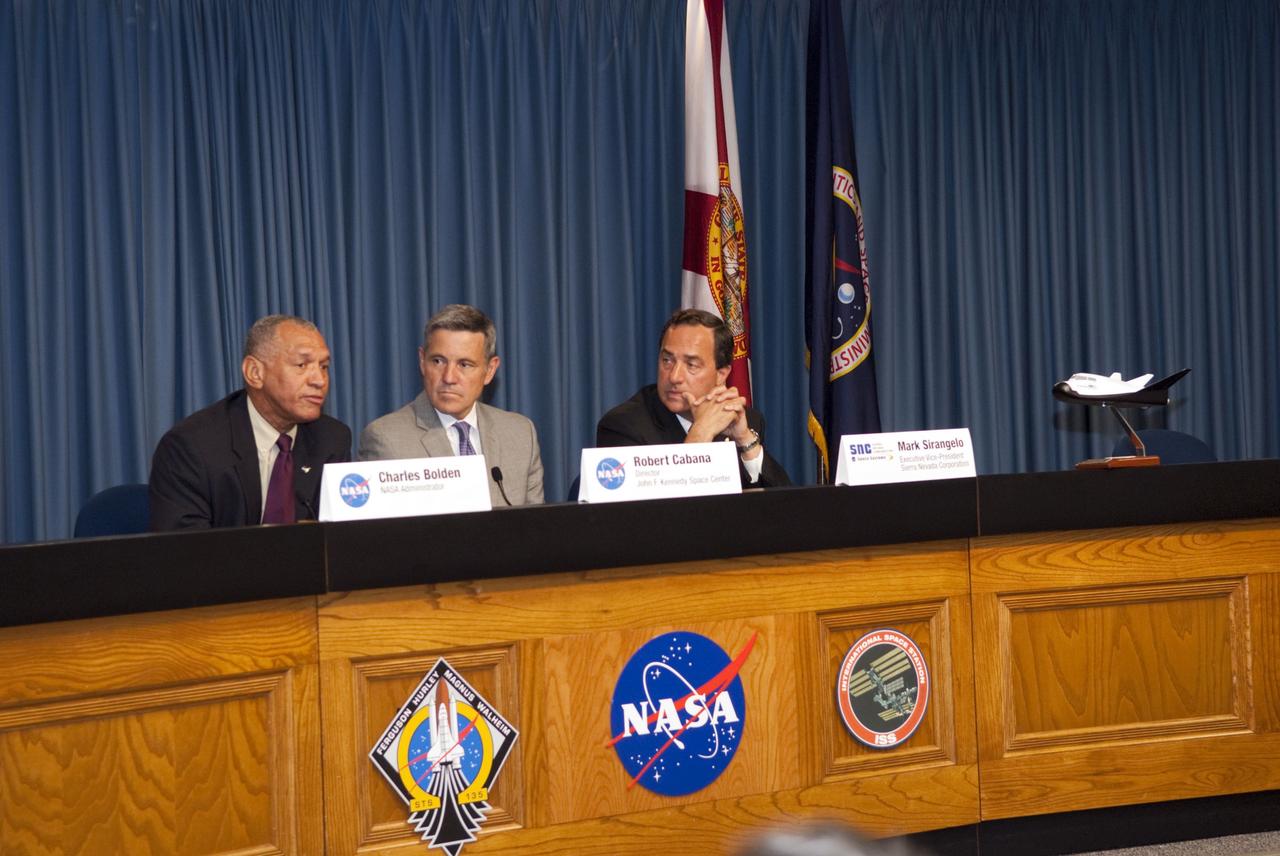
CAPE CANAVERAL, Fla. -- NASA Administrator Charlie Bolden, left, Kennedy Space Center Director Bob Cabana, and Mark Sirangelo, head of Sierra Nevada Space Systems (SNSS) of Sparks, Nev., talk to media after signing a Space Act Agreement that will offer the company technical capabilities from Kennedy's uniquely skilled work force. Kennedy will help Sierra Nevada with the ground operations support of its lifting body reusable spacecraft called "Dream Chaser," which resembles a smaller version of the space shuttle orbiter. The spacecraft would carry as many as seven astronauts to the space station. Through the new agreement, Kennedy's work force will use its experience of processing the shuttle fleet for 30 years to help Sierra Nevada define and execute Dream Chaser's launch preparations and post-landing activities. In 2010 and 2011, Sierra Nevada was awarded grants as part of the initiative to stimulate the private sector in developing and demonstrating human spaceflight capabilities for NASA's Commercial Crew Program. The goal of the program, which is based in Florida at Kennedy, is to facilitate the development of a U.S. commercial crew space transportation capability by achieving safe, reliable and cost-effective access to and from the space station and future low Earth orbit destinations. Photo credit: NASA/Jim Grossmann
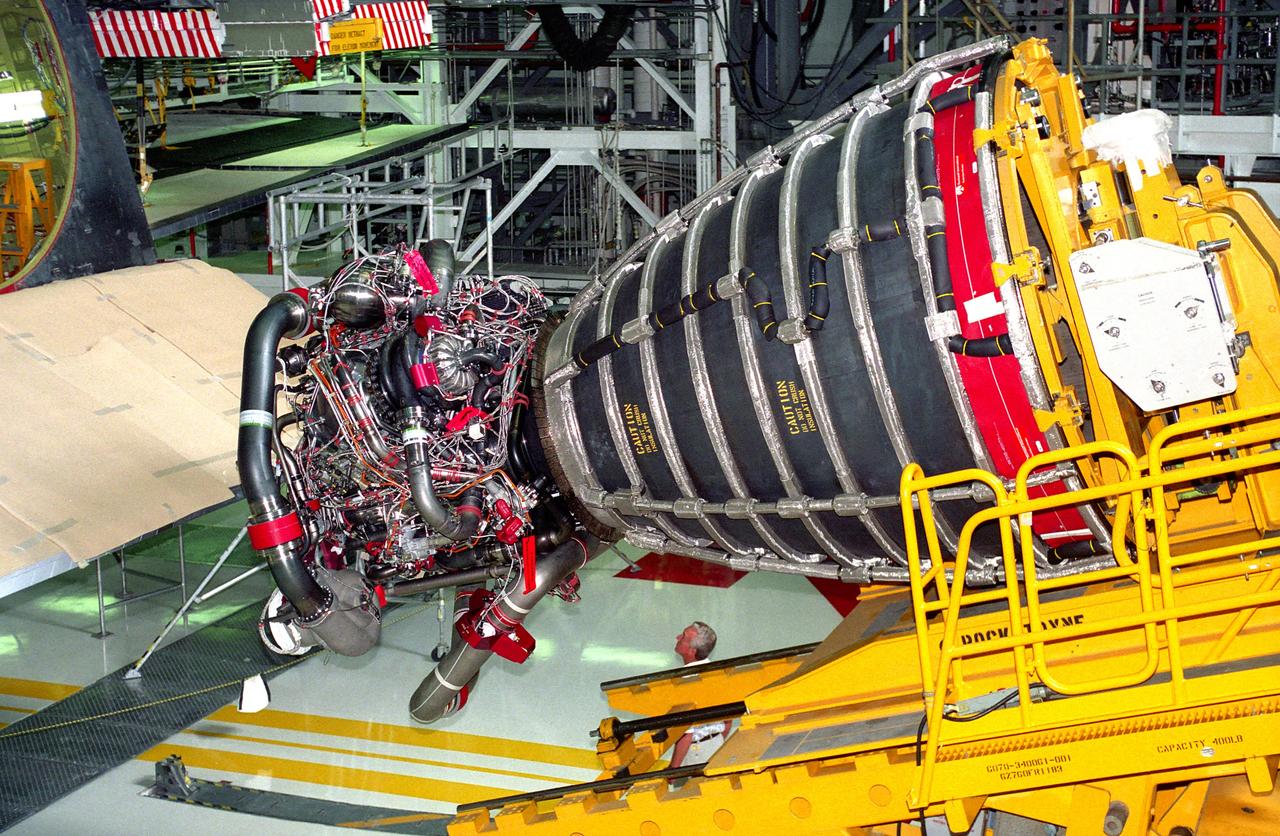
KENNEDY SPACE CENTER, FLA. - Space Shuttle Main Engine (SSME) No. 2036, the first of the new Block 1 engines to fly, awaits installation into position one of the orbiter Discovery in Orbiter Processing Facility 2 during preparation of the spaceplane for the STS-70 mission. The advanced powerplant features a new high-pressure liquid oxygen turbopump, a two-duct powerhead, a baffleless main injector, a single-coil heat exchanger and start sequence modifications. These modifications are designed to improve both engine performance and safety.
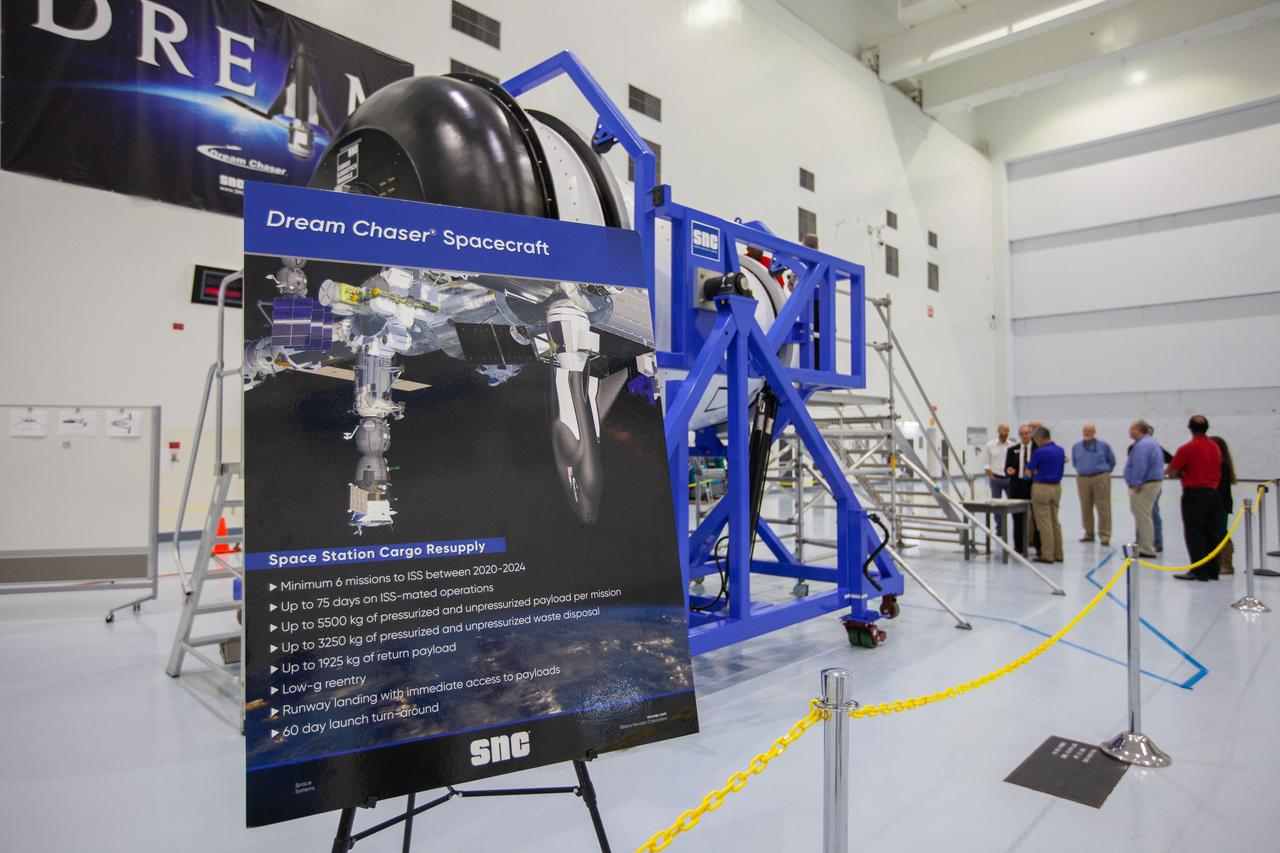
A mockup of the cargo logistics module for Sierra Nevada Corporation’s Dream Chaser, the company’s reusable spaceplane, arrived at the Space Station Processing Facility (SSPF) at NASA’s Kennedy Space Center in Florida in August. On Sept. 20, 2019, senior leadership had the opportunity to view the cargo module in the SSPF high bay. The SSPF is providing support for current and future NASA and commercial provider programs, including Commercial Resupply Services, Artemis 1, sending the first woman and next man to the Moon, and deep space destinations including Mars.
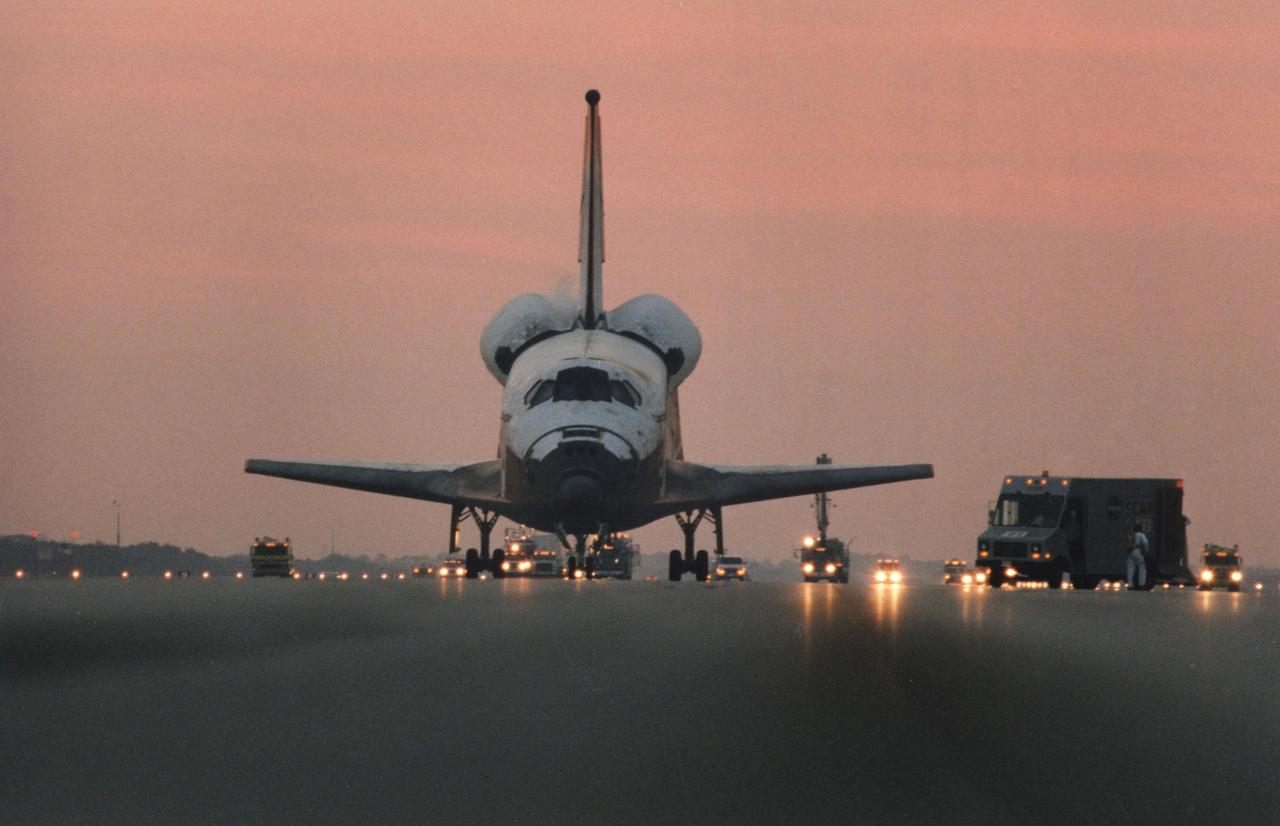
KENNEDY SPACE CENTER, FLA. -- Recovery convoy equipment greets the orbiter Columbia following main gear touchdown at 6:49:05 a.m. EST, Dec. 7, on Runway 33 of KSC’s Shuttle Landing Facility. The return to Earth of NASA’s oldest spaceplane occurred just moments before sunrise. This was the 33rd landing at KSC in Shuttle program history.
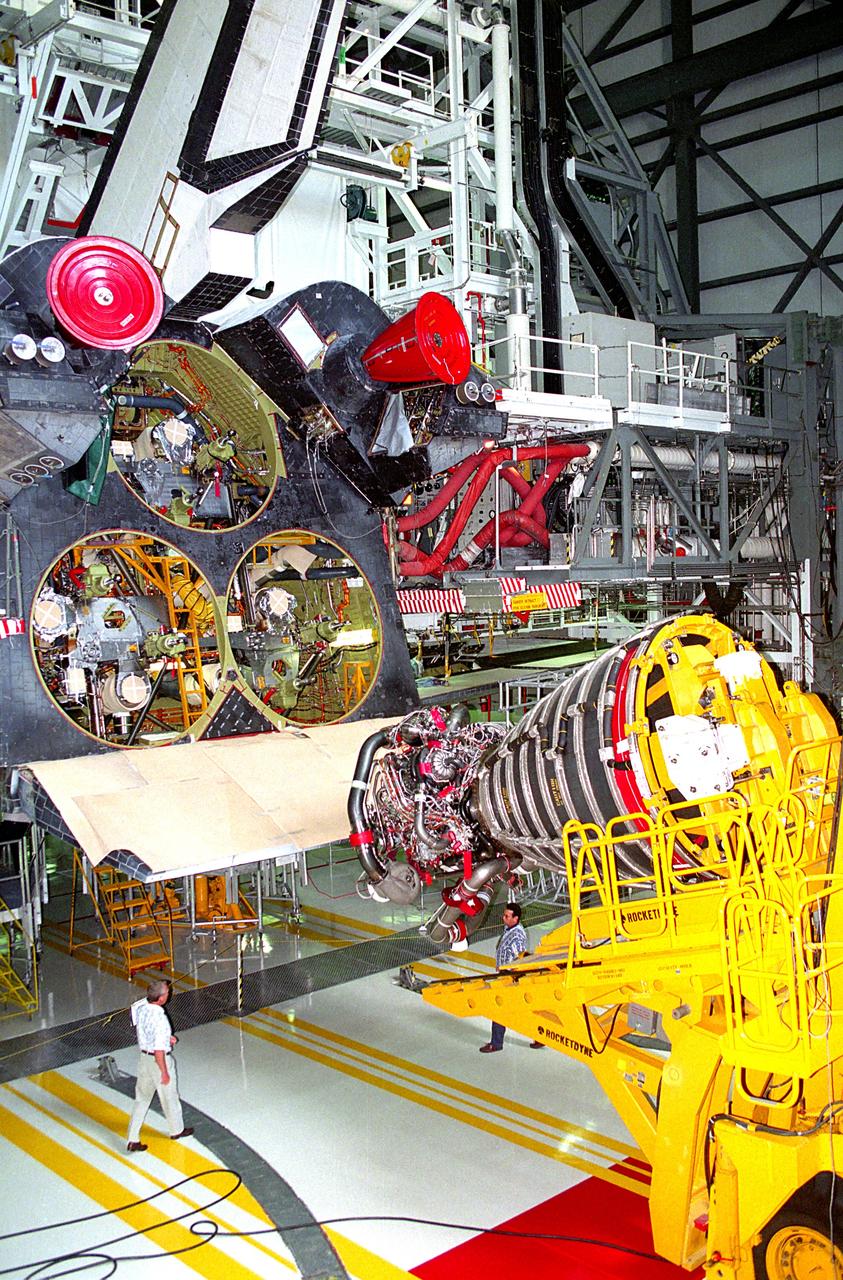
KENNEDY SPACE CENTER, FLA. - A Space Shuttle Main Engine (SSME) hoist prepares to lift the first Block 1 engine to be installed in an orbiter into the number one position on Discovery while the spaceplane is being prepared for the STS-70 mission in the high bay of Orbiter Processing Facility 2. The new engine, SSME No. 2036, features a new high-pressure liquid oxygen turbopump, a two-duct powerhead, a baffleless main injector, a single-coil heat exchanger and start sequence modifications. The other two main engines to be used during the liftoff of the STS-70 mission are of the existing Phase II design.
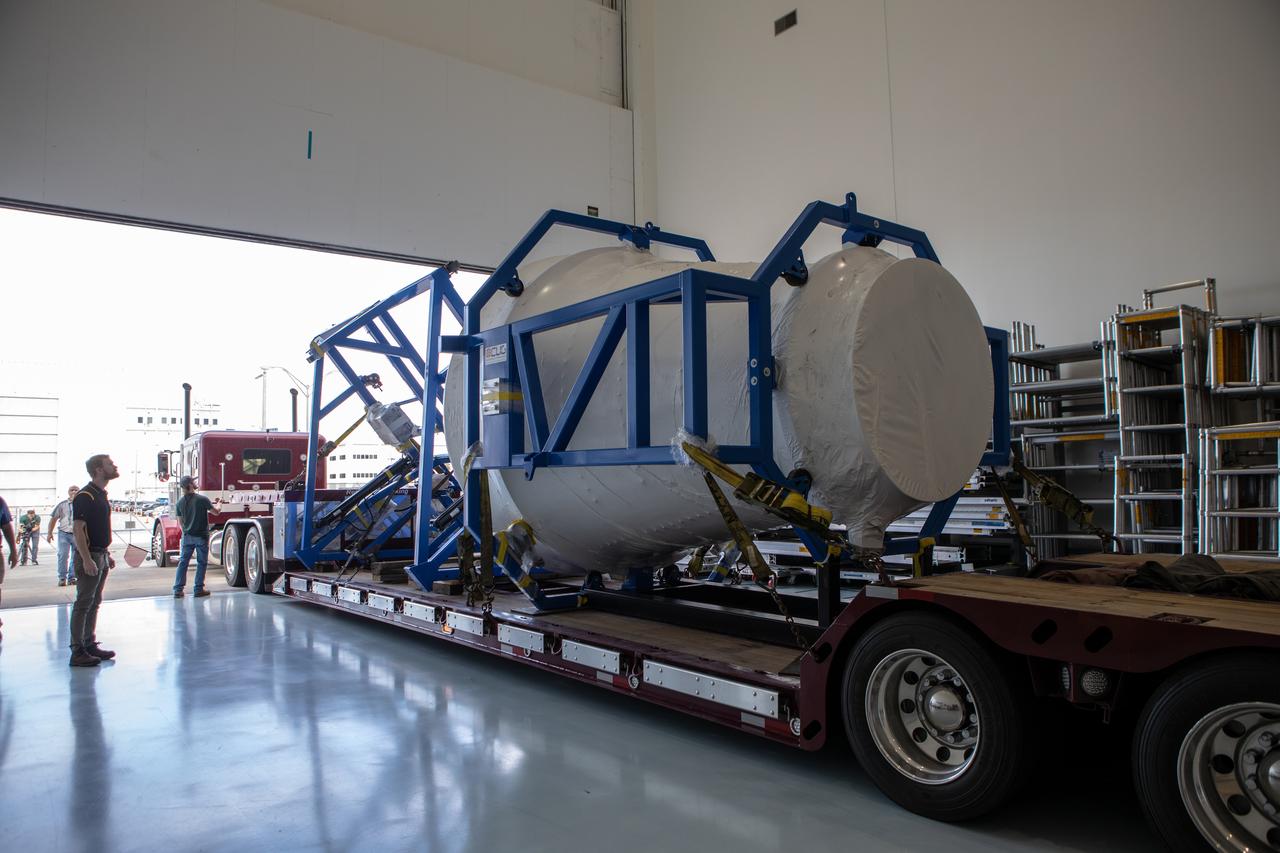
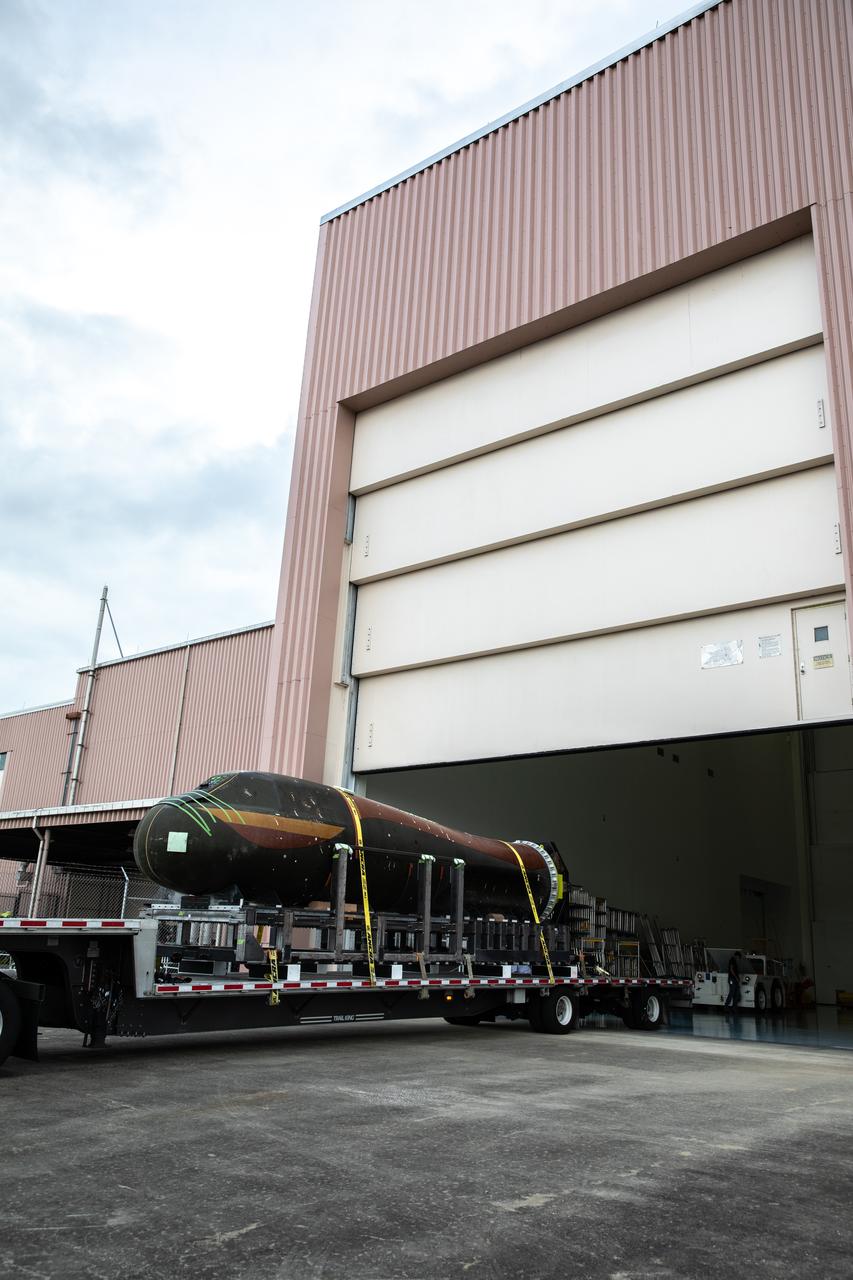
A truck carrying the cargo logistics module for Sierra Nevada Corporation’s Dream Chaser, the company’s reusable spaceplane, enters the Space Station Processing Facility high bay at NASA’s Kennedy Space Center in Florida on Aug. 27, 2019. The cargo module – a 15-foot attachment to Dream Chaser – provides extra storage for payloads and provides cargo disposal upon re-entry into Earth’s atmosphere. Dream Chaser will deliver more than 12,000 pounds of cargo to the International Space Station under the agency’s Commercial Resupply Services 2 contract. The spacecraft and cargo module will begin resupply and return services missions to the space station in late 2021.
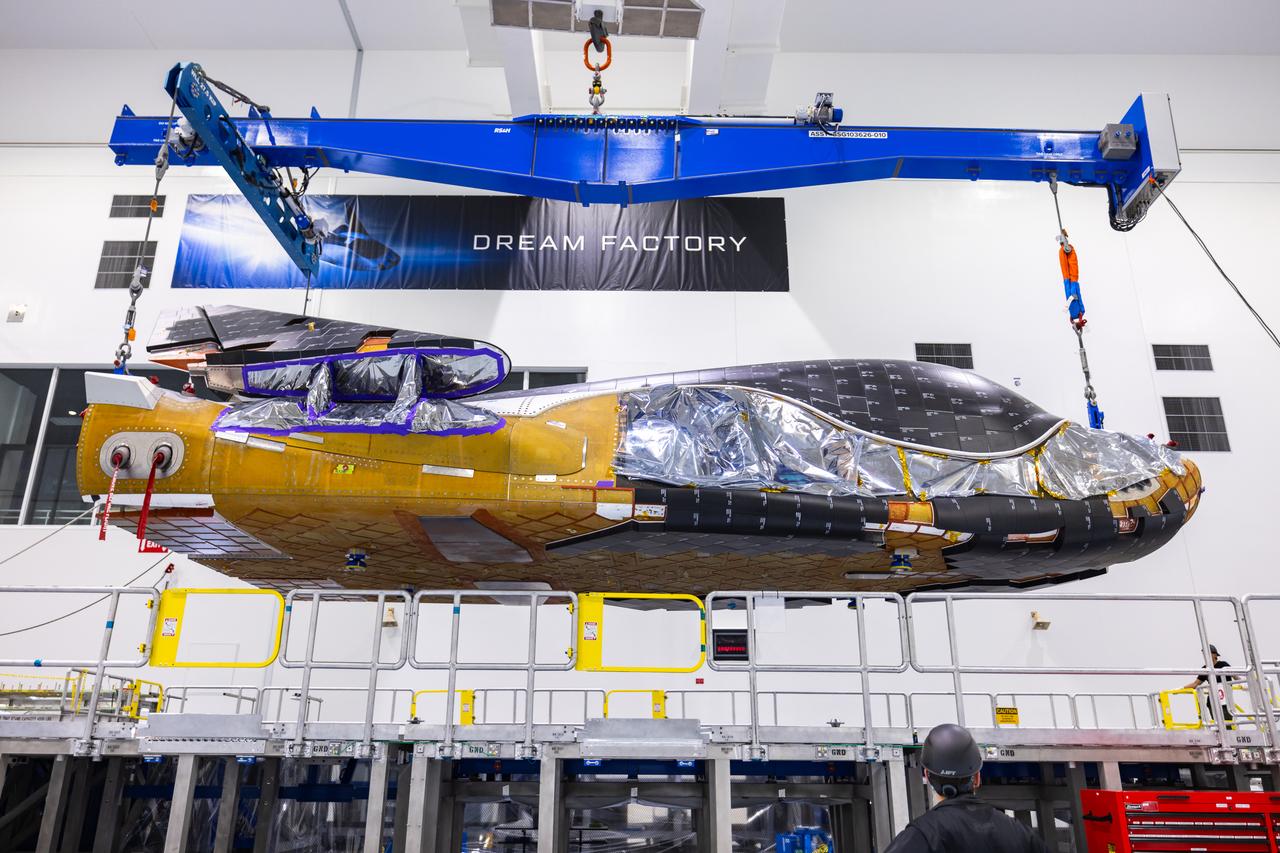
Dream Chaser Tenacity, Sierra Space's uncrewed cargo spaceplane is lifted and moved by crane inside the Space Systems Processing Facility (SSPF) at NASA’s Kennedy Space Center in Florida on Monday, May 20, 2024. Dream Chaser Tenacity will undergo final testing and prelaunch processing inside the high bay of the SSPF ahead of its inaugural launch atop a ULA (United Launch Alliance) Vulcan rocket from nearby Cape Canaveral Space Force Station. The reusable transportation system is contracted to perform a minimum of seven cargo missions to the International Space Station as part of the agency’s efforts to expand commercial resupply services to low Earth orbit.
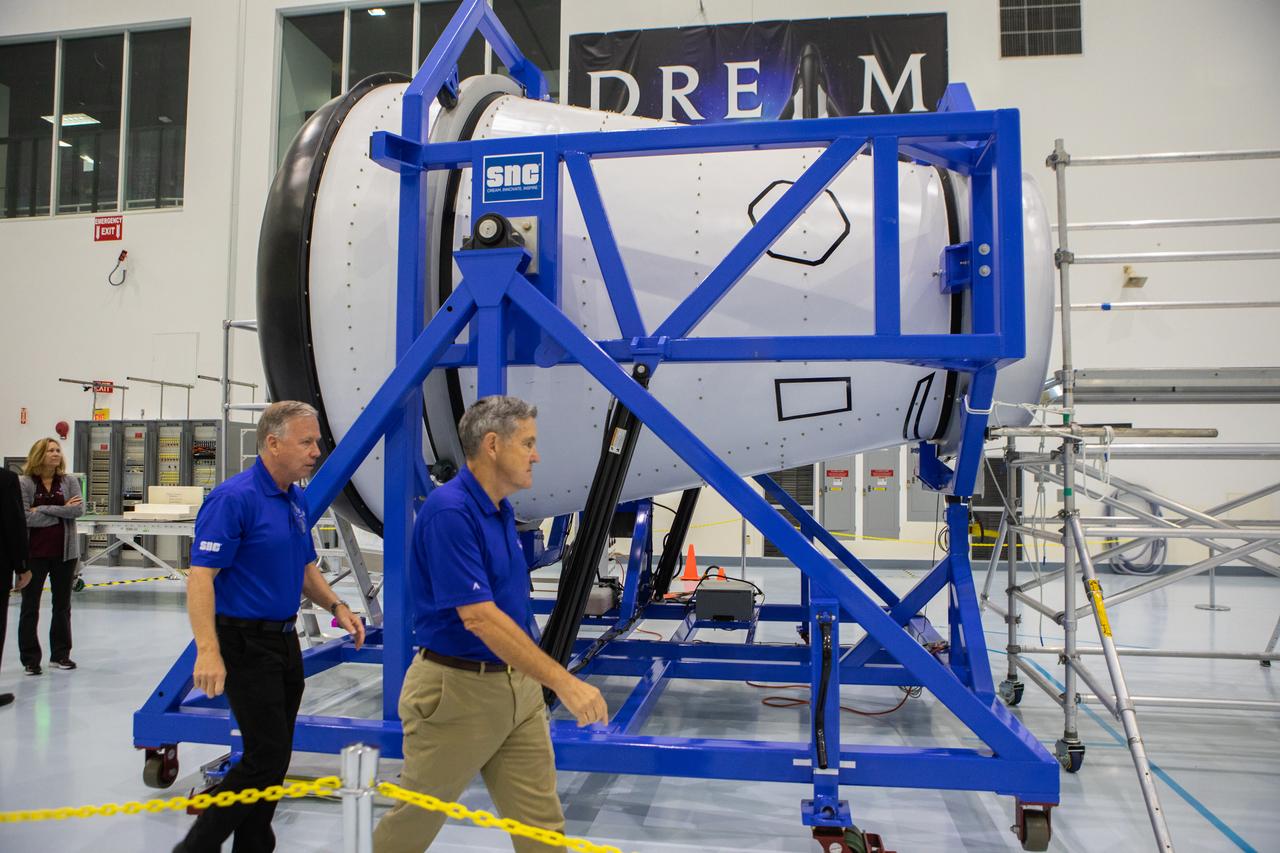
A mockup of the cargo logistics module for Sierra Nevada Corporation’s Dream Chaser, the company’s reusable spaceplane, arrived at the Space Station Processing Facility (SSPF) at NASA’s Kennedy Space Center in Florida in August. On Sept. 20, 2019, senior leadership had the opportunity to view the cargo module in the SSPF high bay. Kennedy Center Director Bob Cabana, at right, views the cargo module with Steve Lindsey, vice president, Space Exploration Systems, Sierra Nevada Corporation. The SSPF is providing support for current and future NASA and commercial provider programs, including Commercial Resupply Services, Artemis 1, sending the first woman and next man to the Moon, and deep space destinations including Mars.
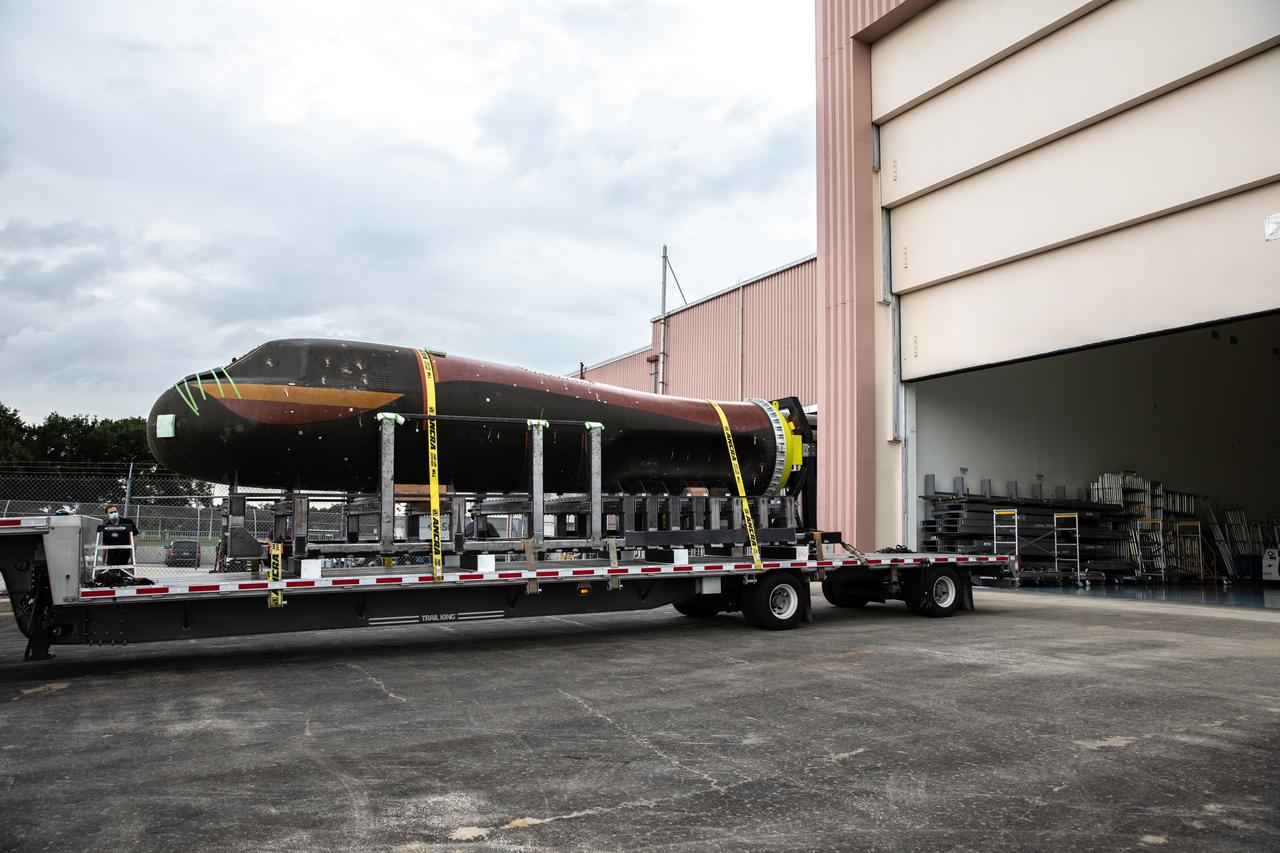
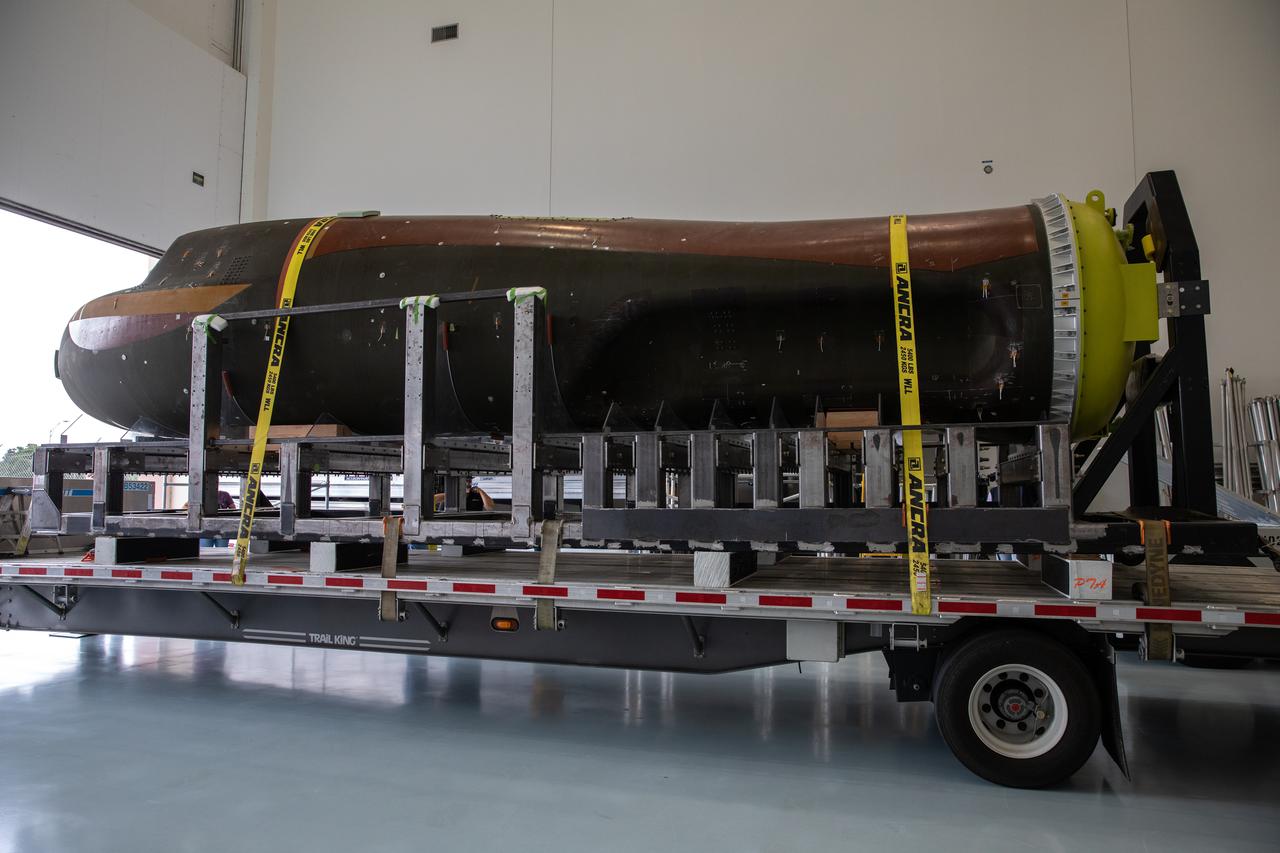
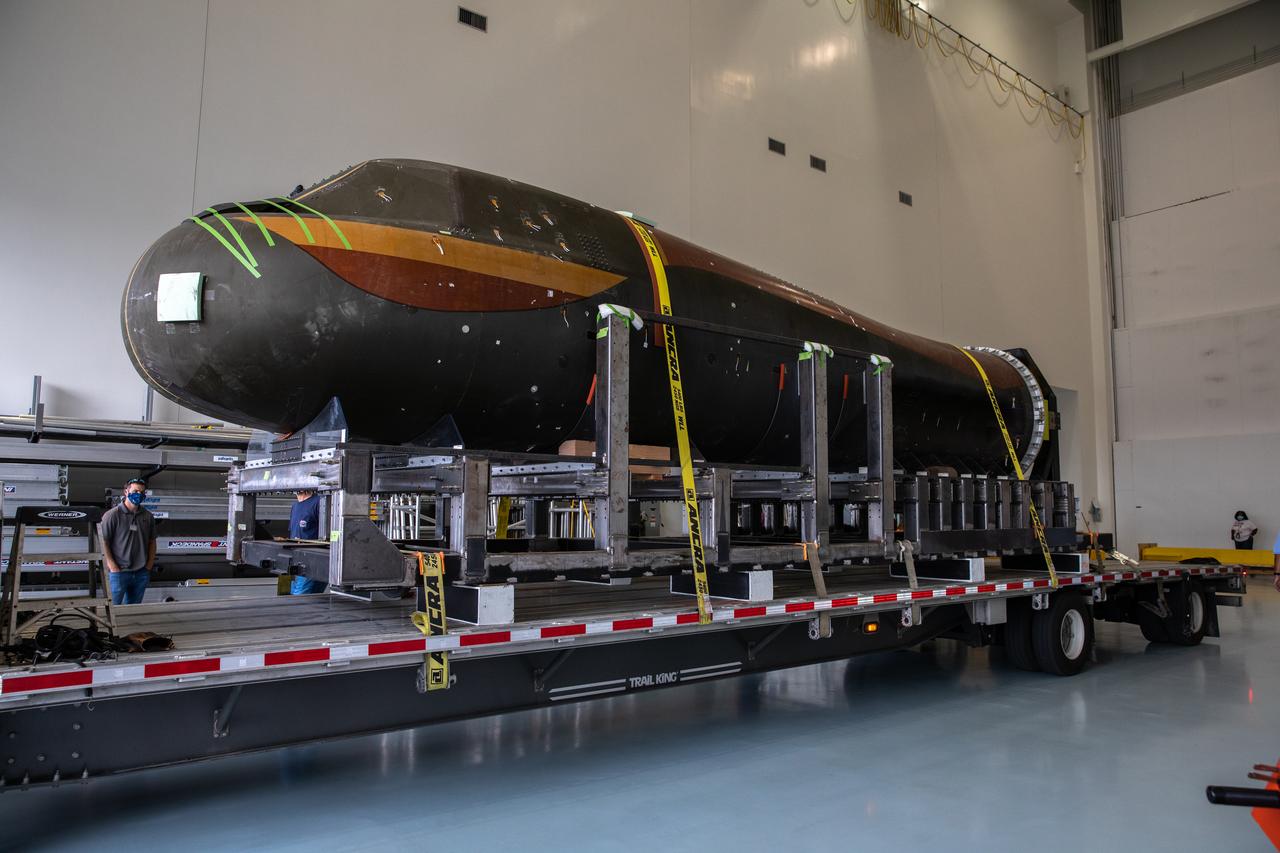
Sierra Nevada Corporation’s (SNC) Dream Chaser pressure test article arrives by flatbed truck at the Space Station Processing Facility at NASA’s Kennedy Space Center in Florida on June 3, 2020, from Louisville, Colorado. The test article is similar to the actual pressurized cabin being used in the Dream Chaser spaceplane for Commercial Resupply Services-2 (CRS-2) missions. NASA selected Dream Chaser to provide cargo delivery, return and disposal service for the International Space Station under the CRS-2 contract. The test article will remain at Kennedy while SNC engineers use it to develop and verify refurbishment operations that will be used on Dream Chaser between flights.
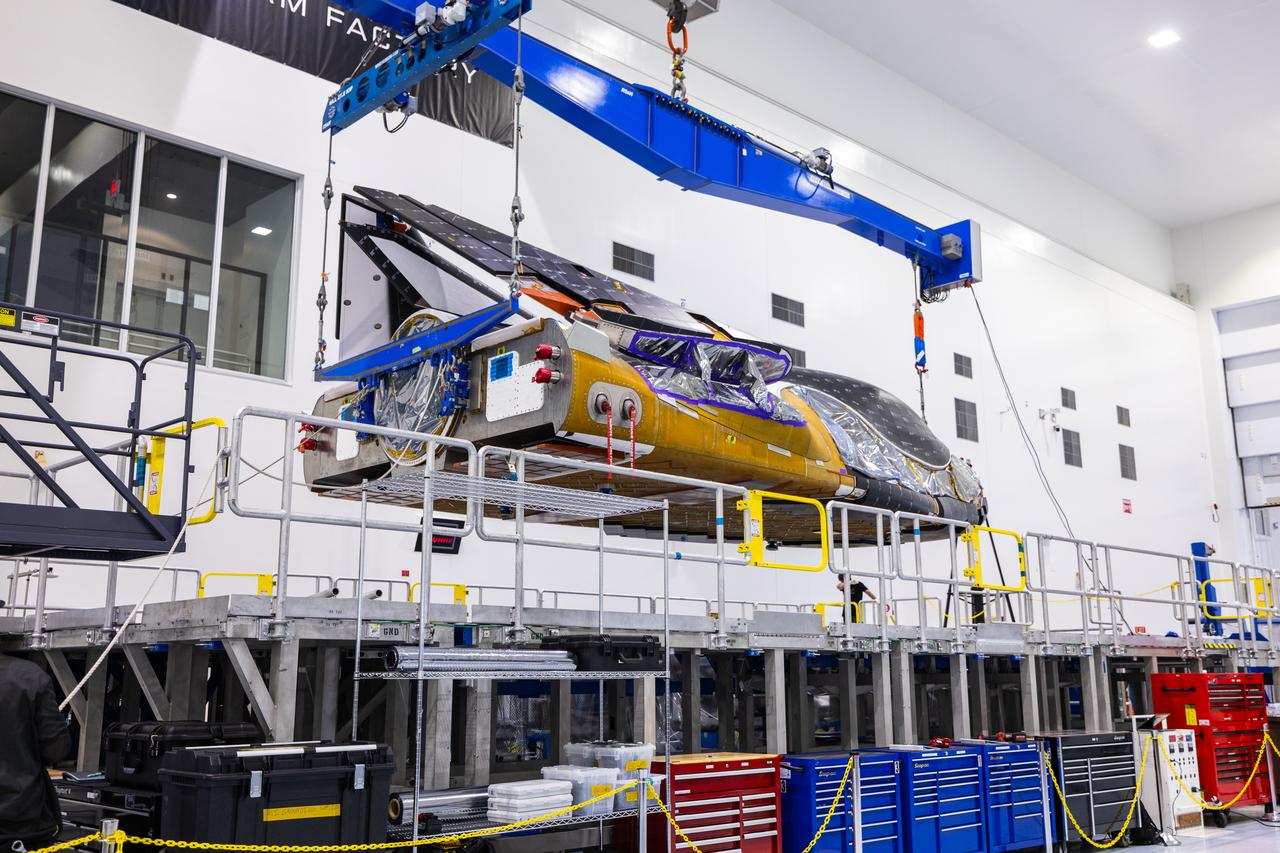
Dream Chaser Tenacity, Sierra Space's uncrewed cargo spaceplane is lifted and moved by crane inside the Space Systems Processing Facility (SSPF) at NASA’s Kennedy Space Center in Florida on Monday, May 20, 2024. Dream Chaser Tenacity will undergo final testing and prelaunch processing inside the high bay of the SSPF ahead of its inaugural launch atop a ULA (United Launch Alliance) Vulcan rocket from nearby Cape Canaveral Space Force Station. The reusable transportation system is contracted to perform a minimum of seven cargo missions to the International Space Station as part of the agency’s efforts to expand commercial resupply services to low Earth orbit.
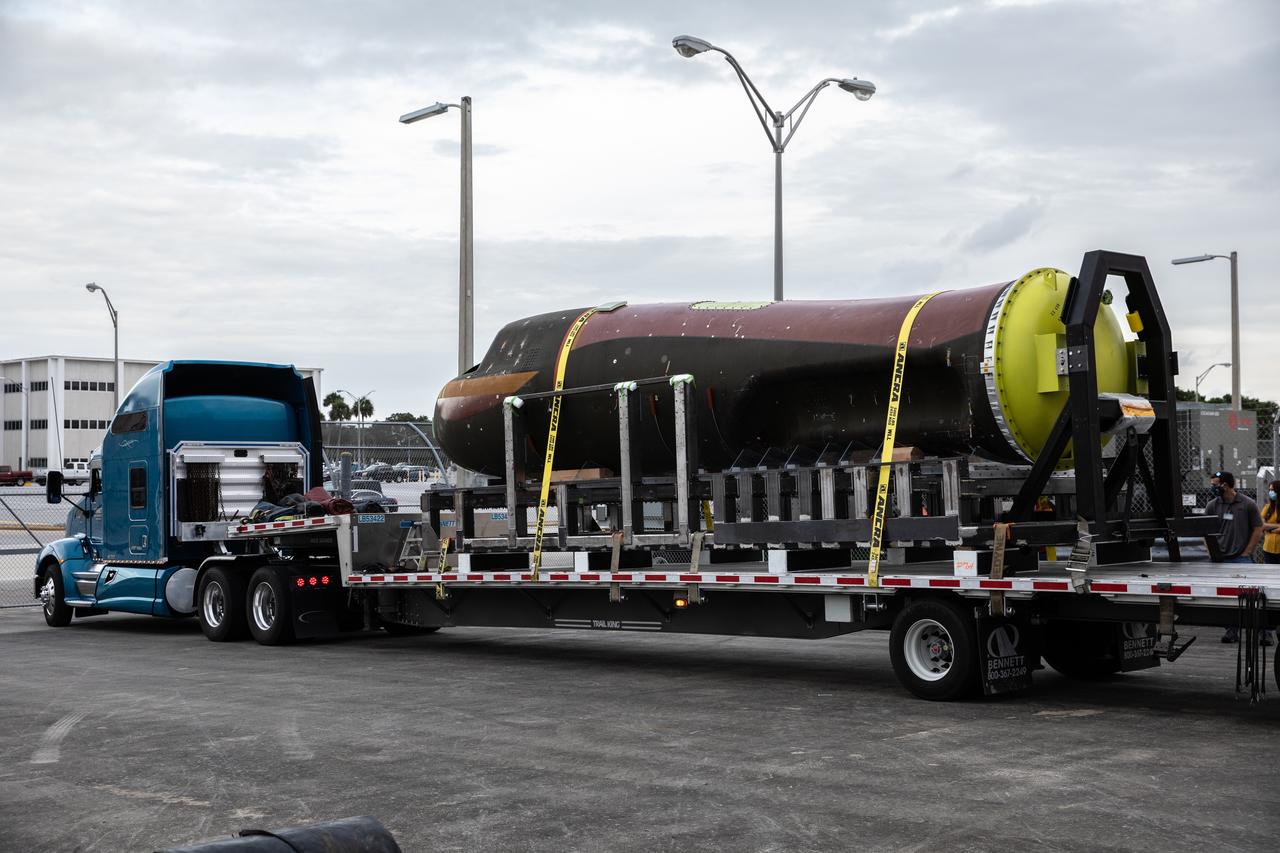
Sierra Nevada Corporation’s (SNC) Dream Chaser pressure test article arrives by flatbed truck at NASA’s Kennedy Space Center in Florida on June 3, 2020, from Louisville, Colorado. It will be transported to the high bay in the Space Station Processing Facility. The test article is similar to the actual pressurized cabin being used in the Dream Chaser spaceplane for Commercial Resupply Services-2 (CRS-2) missions. NASA selected Dream Chaser to provide cargo delivery, return and disposal service for the International Space Station under the CRS-2 contract. The test article will remain at Kennedy while SNC engineers use it to develop and verify refurbishment operations that will be used on Dream Chaser between flights.
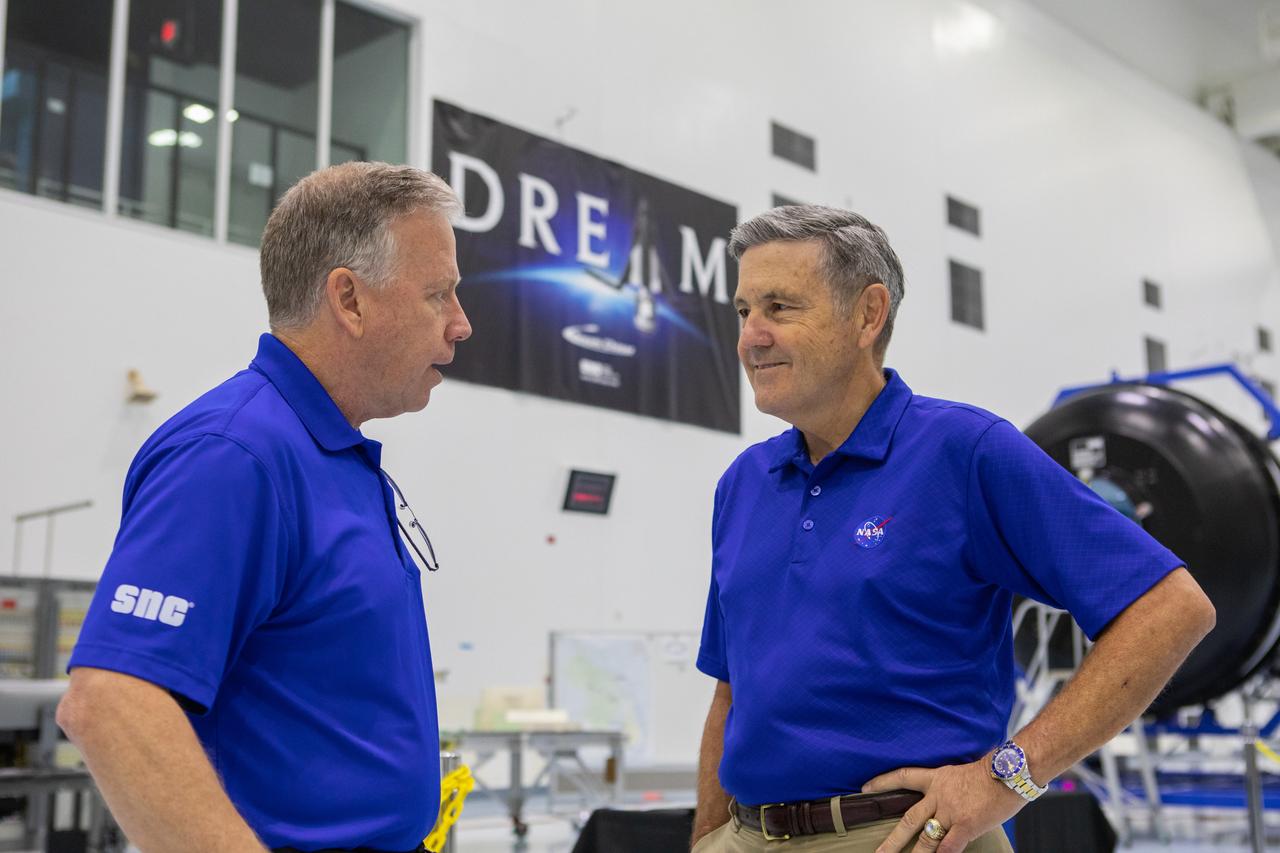
A mockup of the cargo logistics module for Sierra Nevada Corporation’s Dream Chaser, the company’s reusable spaceplane, arrived at the Space Station Processing Facility (SSPF) at NASA’s Kennedy Space Center in Florida in August. On Sept. 20, 2019, senior leadership had the opportunity to view the cargo module in the SSPF high bay. Kennedy Center Director Bob Cabana, at right, speaks with Steve Lindsey, vice president, Space Exploration Systems, Sierra Nevada Corporation. The SSPF is providing support for current and future NASA and commercial provider programs, including Commercial Resupply Services, Artemis 1, sending the first woman and next man to the Moon, and deep space destinations including Mars.
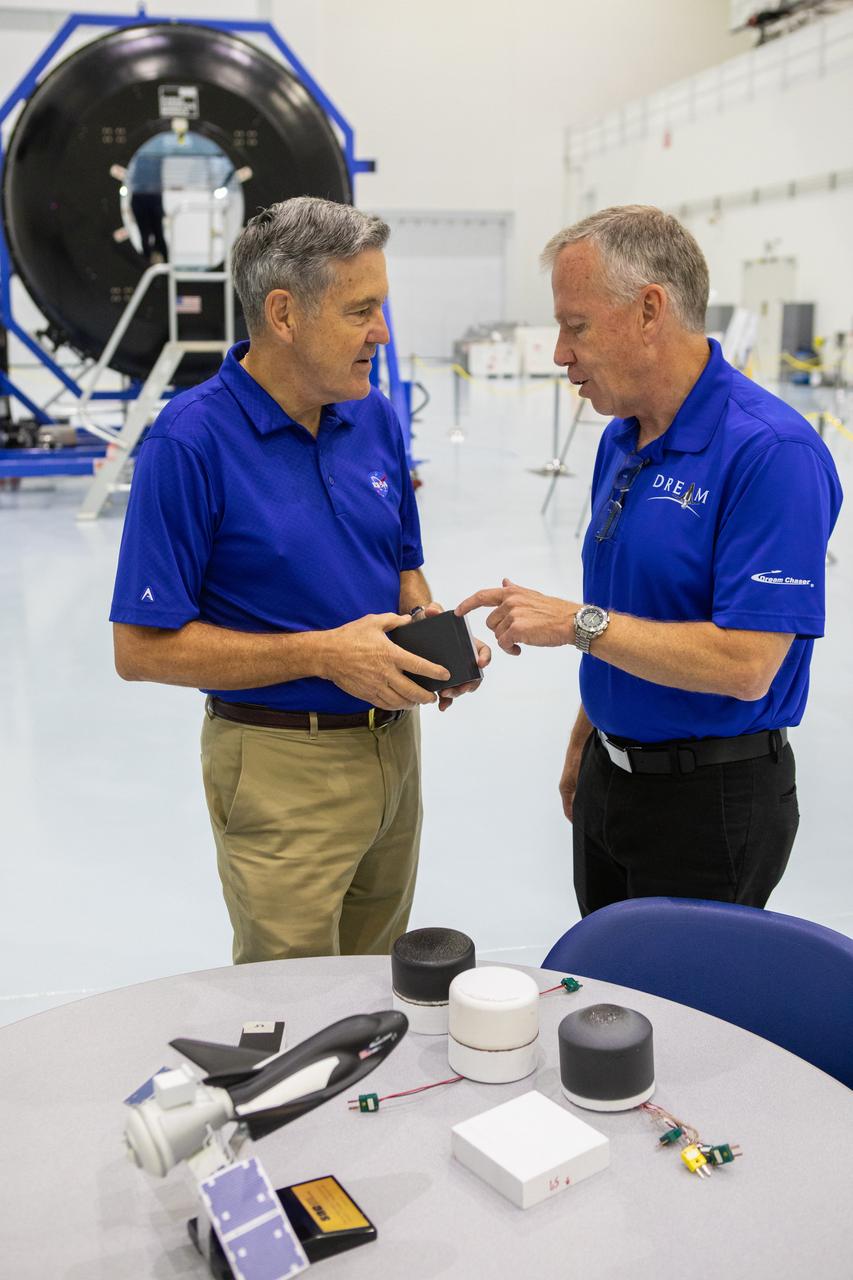
A mockup of the cargo logistics module for Sierra Nevada Corporation’s Dream Chaser, the company’s reusable spaceplane, arrived at the Space Station Processing Facility (SSPF) at NASA’s Kennedy Space Center in Florida in August. On Sept. 20, 2019, senior leadership had the opportunity to view the cargo module in the SSPF high bay. Kennedy Center Director Bob Cabana, left, speaks to Steve Lindsey, vice president, Space Exploration Systems, Sierra Nevada Corporation. The SSPF is providing support for current and future NASA and commercial provider programs, including Commercial Resupply Services, Artemis 1, sending the first woman and next man to the Moon, and deep space destinations including Mars.
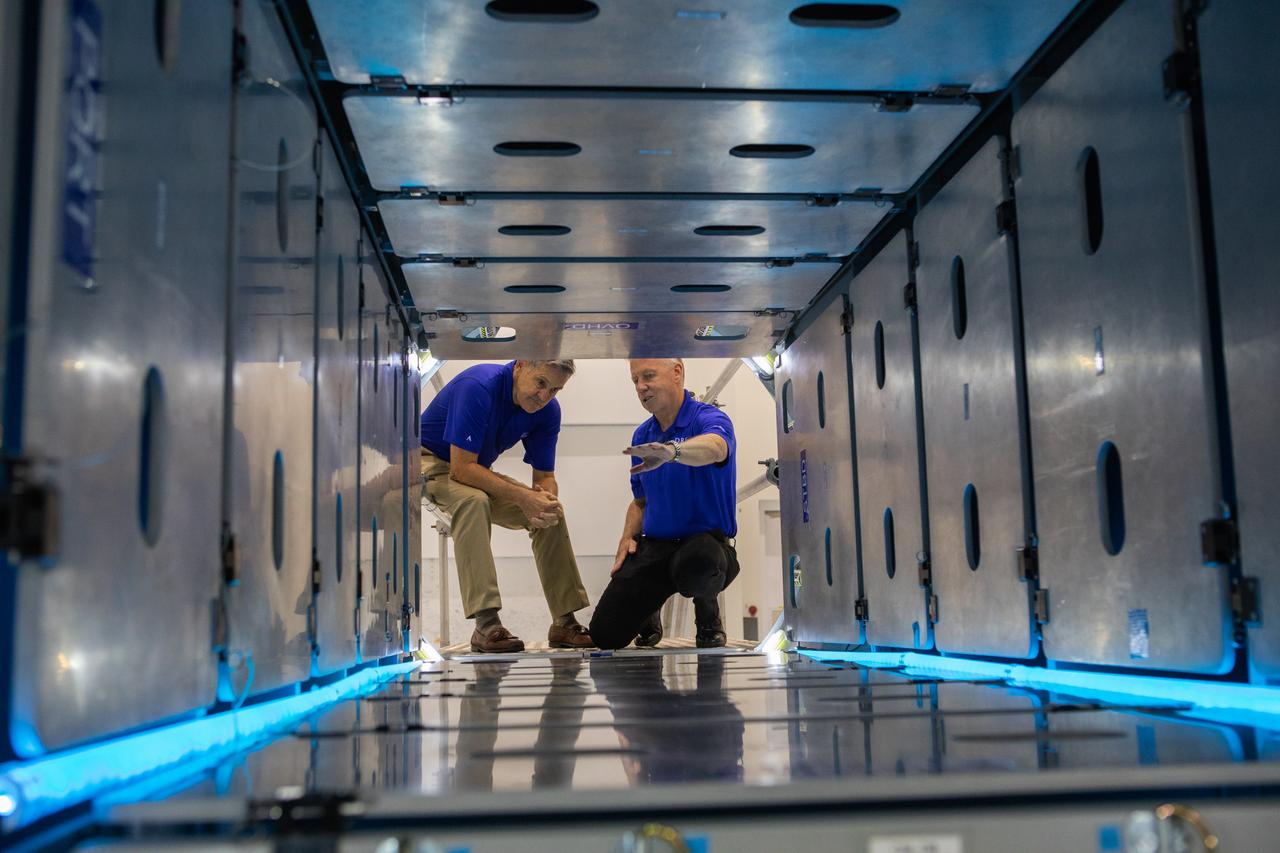
A mockup of the cargo logistics module for Sierra Nevada Corporation’s Dream Chaser, the company’s reusable spaceplane, arrived at the Space Station Processing Facility (SSPF) at NASA’s Kennedy Space Center in Florida in August. On Sept. 20, 2019, senior leadership had the opportunity to view the cargo module in the SSPF high bay. Kennedy Center Director Bob Cabana, views the interior of the cargo module with Steve Lindsey, vice president, Space Exploration Systems, Sierra Nevada Corporation. The SSPF is providing support for current and future NASA and commercial provider programs, including Commercial Resupply Services, Artemis 1, sending the first woman and next man to the Moon, and deep space destinations including Mars.
Sierra Nevada Corporation’s (SNC) Dream Chaser pressure test article is moved into the low bay of the Space Station Processing Facility at NASA’s Kennedy Space Center in Florida on June 3, 2020. The test article was shipped from Louisville, Colorado. It is similar to the actual pressurized cabin being used in the Dream Chaser spaceplane for Commercial Resupply Services-2 (CRS-2) missions. NASA selected Dream Chaser to provide cargo delivery, return and disposal service for the International Space Station under the CRS-2 contract. The test article will remain at Kennedy while SNC engineers use it to develop and verify refurbishment operations that will be used on Dream Chaser between flights.
Sierra Nevada Corporation’s (SNC) Dream Chaser pressure test article is moved into the low bay of the Space Station Processing Facility at NASA’s Kennedy Space Center in Florida on June 3, 2020. The test article was shipped from Louisville, Colorado. It is similar to the actual pressurized cabin being used in the Dream Chaser spaceplane for Commercial Resupply Services-2 (CRS-2) missions. NASA selected Dream Chaser to provide cargo delivery, return and disposal service for the International Space Station under the CRS-2 contract. The test article will remain at Kennedy while SNC engineers use it to develop and verify refurbishment operations that will be used on Dream Chaser between flights.
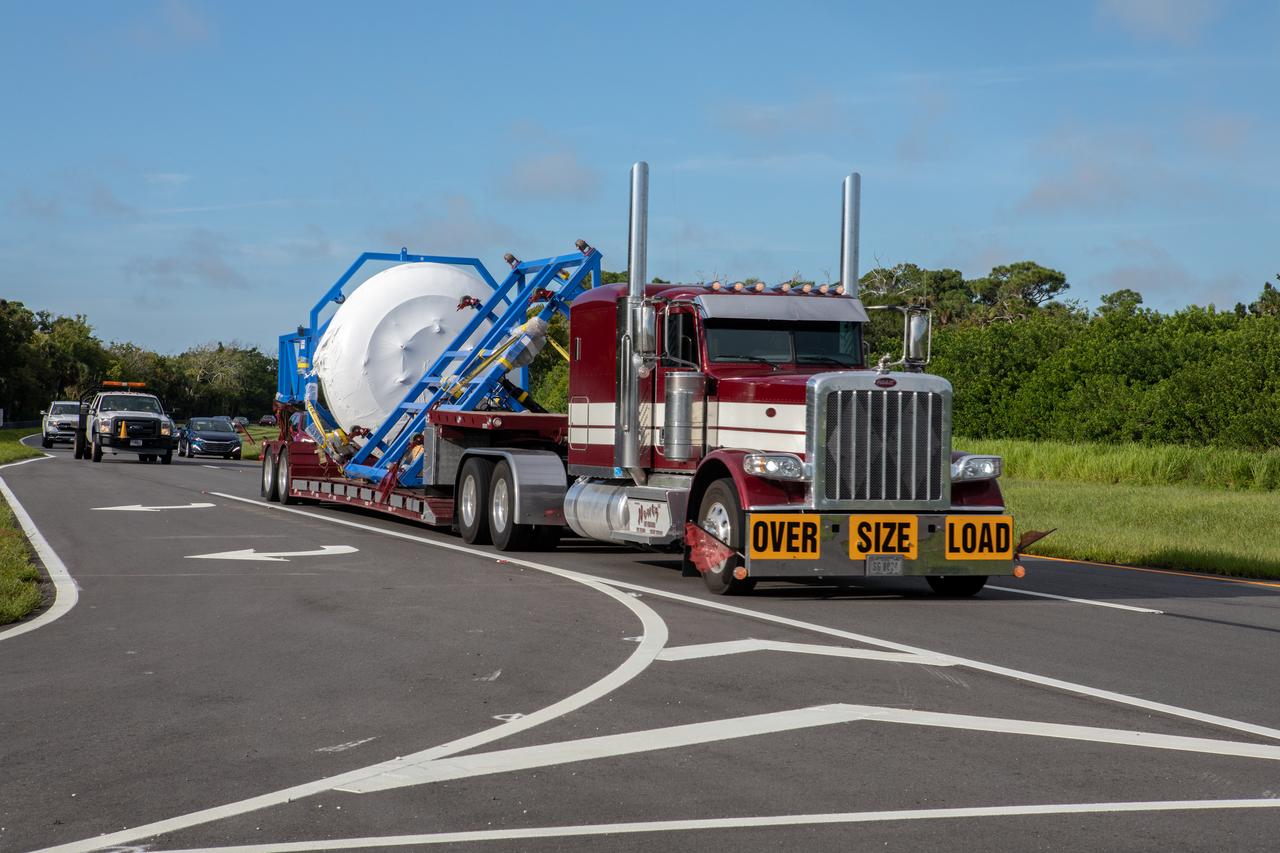
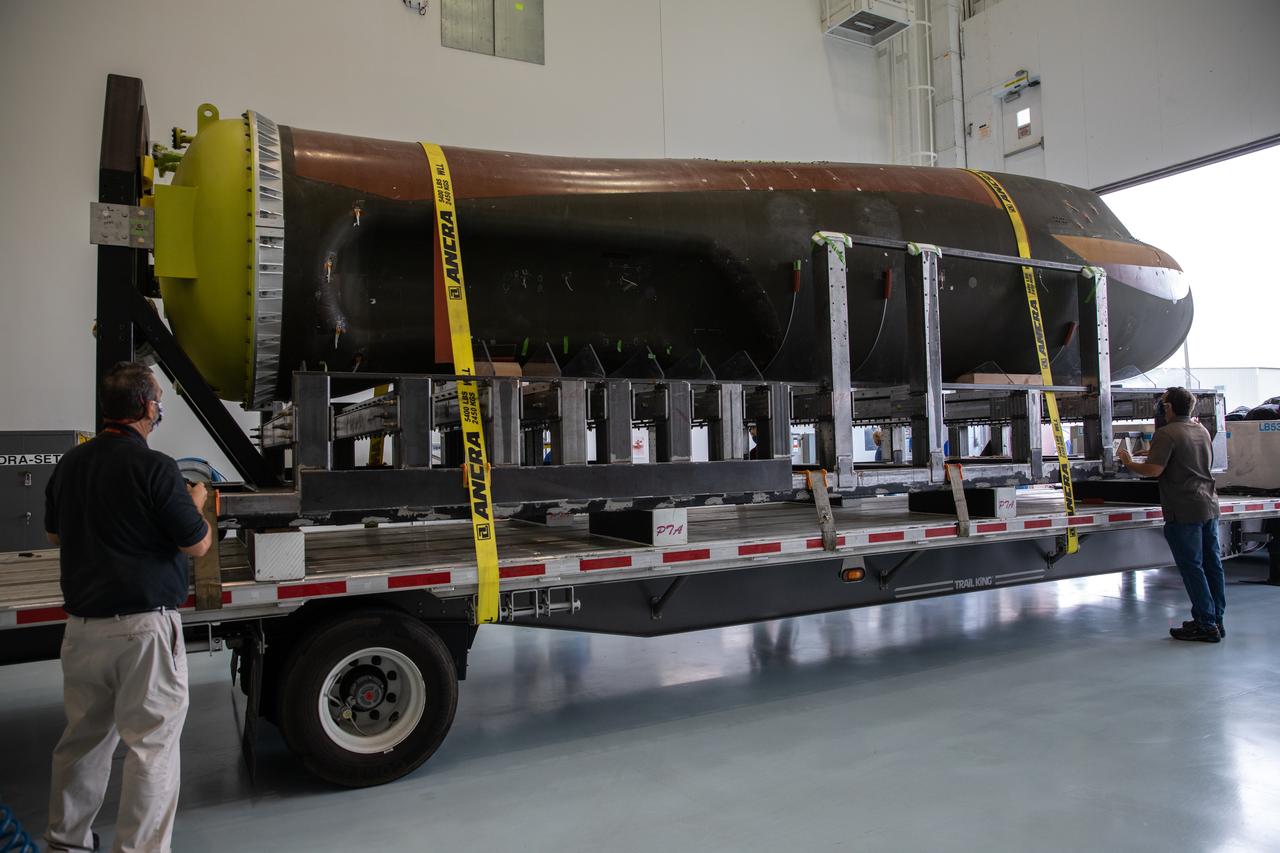
The cargo logistics module for Sierra Nevada Corporation’s Dream Chaser, the company’s reusable spaceplane, is in transit to the Space Station Processing Facility at NASA’s Kennedy Space Center in Florida on Aug. 27, 2019. The cargo module – a 15-foot attachment to Dream Chaser – provides extra storage for payloads and provides cargo disposal upon re-entry into Earth’s atmosphere. Dream Chaser will deliver more than 12,000 pounds of cargo to the International Space Station under NASA’s Commercial Resupply Services 2 contract. The spacecraft and cargo module will begin resupply and return services missions to the space station in late 2021.
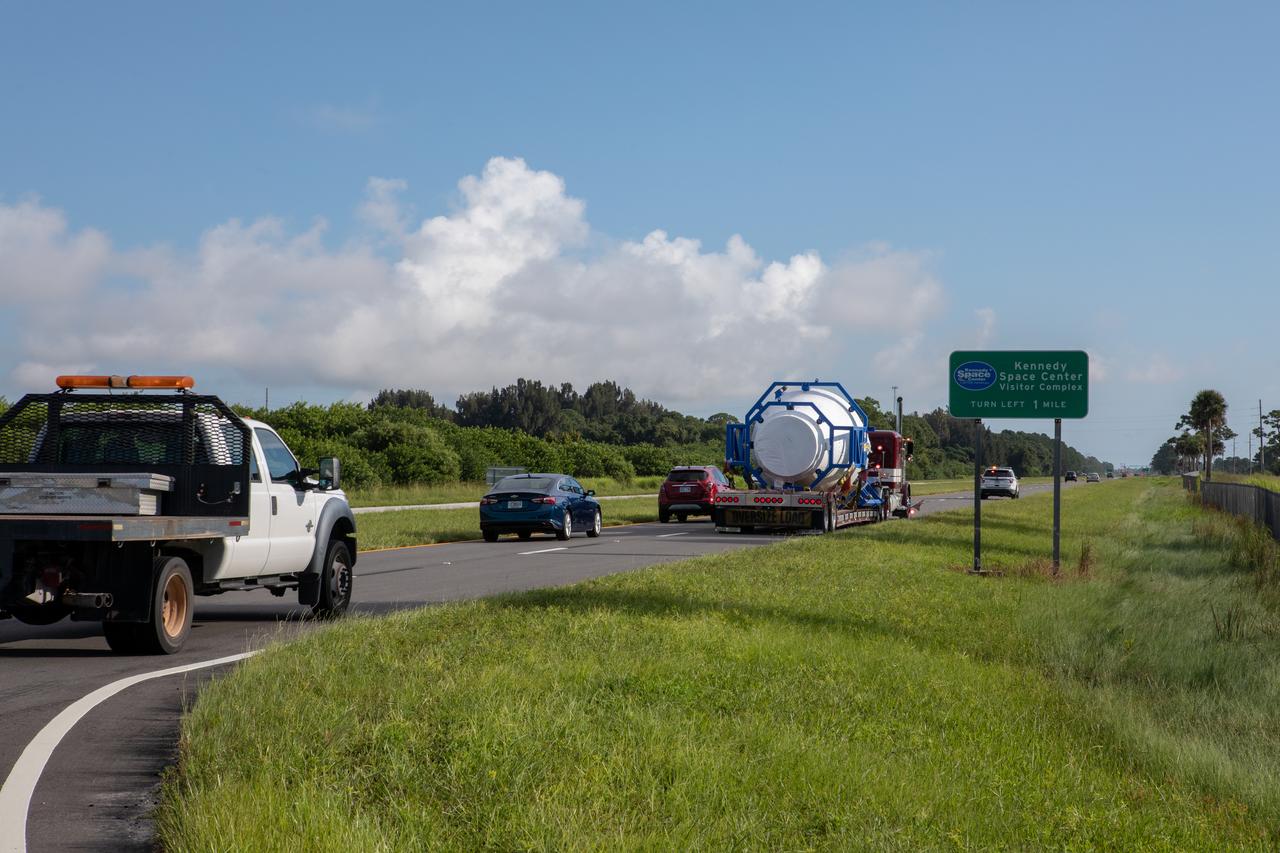
The cargo logistics module for Sierra Nevada Corporation’s Dream Chaser, the company’s reusable spaceplane, arrives at NASA’s Kennedy Space Center in Florida on Aug. 27, 2019. The cargo module – secured atop a truck – is being taken to Kennedy’s Space Station Processing Facility. A 15-foot attachment to Dream Chaser, the cargo module provides extra storage for payloads and provides cargo disposal upon re-entry into Earth’s atmosphere. Dream Chaser will deliver more than 12,000 pounds of cargo to the International Space Station under NASA’s Commercial Resupply Services 2 contract. The spacecraft and cargo module will begin resupply and return services missions to the space station in late 2021.
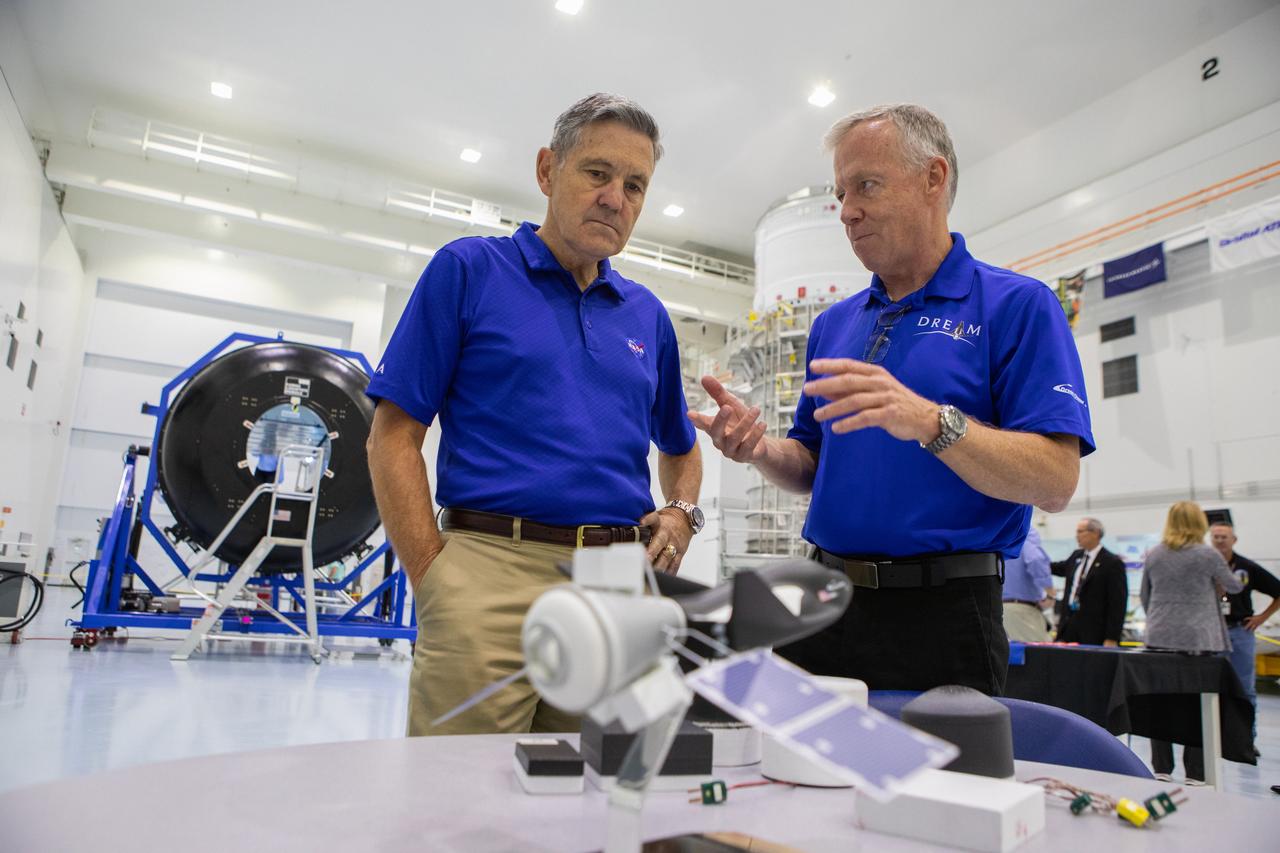
A mockup of the cargo logistics module for Sierra Nevada Corporation’s Dream Chaser, the company’s reusable spaceplane, arrived at the Space Station Processing Facility (SSPF) at NASA’s Kennedy Space Center in Florida in August. On Sept. 20, 2019, senior leadership had the opportunity to view the cargo module in the SSPF high bay. Kennedy Center Director Bob Cabana, left, speaks to Steve Lindsey, vice president, Space Exploration Systems, Sierra Nevada Corporation. The SSPF is providing support for current and future NASA and commercial provider programs, including Commercial Resupply Services, Artemis 1, sending the first woman and next man to the Moon, and deep space destinations including Mars.
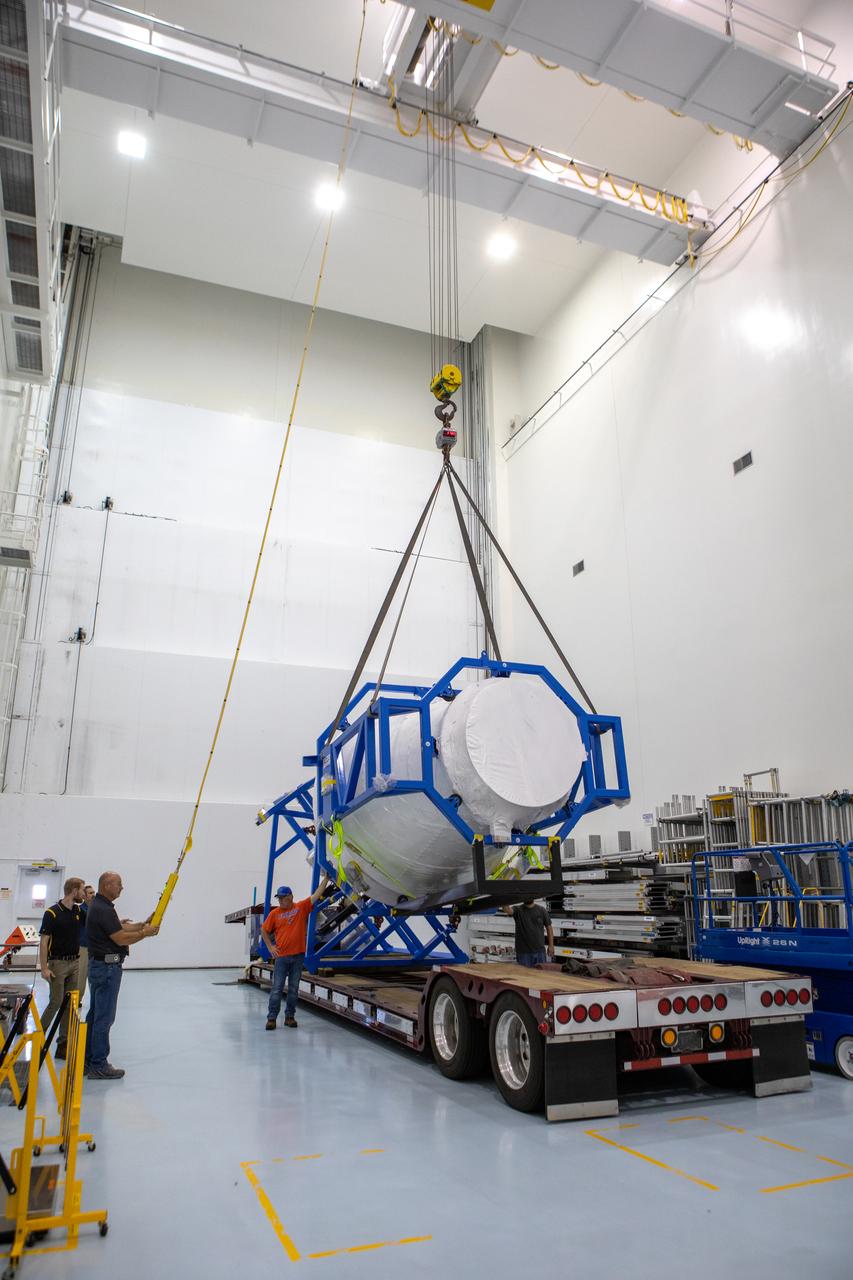
The cargo logistics module for Sierra Nevada Corporation’s Dream Chaser, the company’s reusable spaceplane, is lifted from the bed of a truck following its arrival at the Space Station Processing Facility high bay at NASA’s Kennedy Space Center in Florida on Aug. 27, 2019. The cargo module – a 15-foot attachment to Dream Chaser – provides extra storage for payloads and provides cargo disposal upon re-entry into Earth’s atmosphere. Dream Chaser will deliver more than 12,000 pounds of cargo to the International Space Station under the agency’s Commercial Resupply Services 2 contract. The spacecraft and cargo module will begin resupply and return services missions to the space station in late 2021.
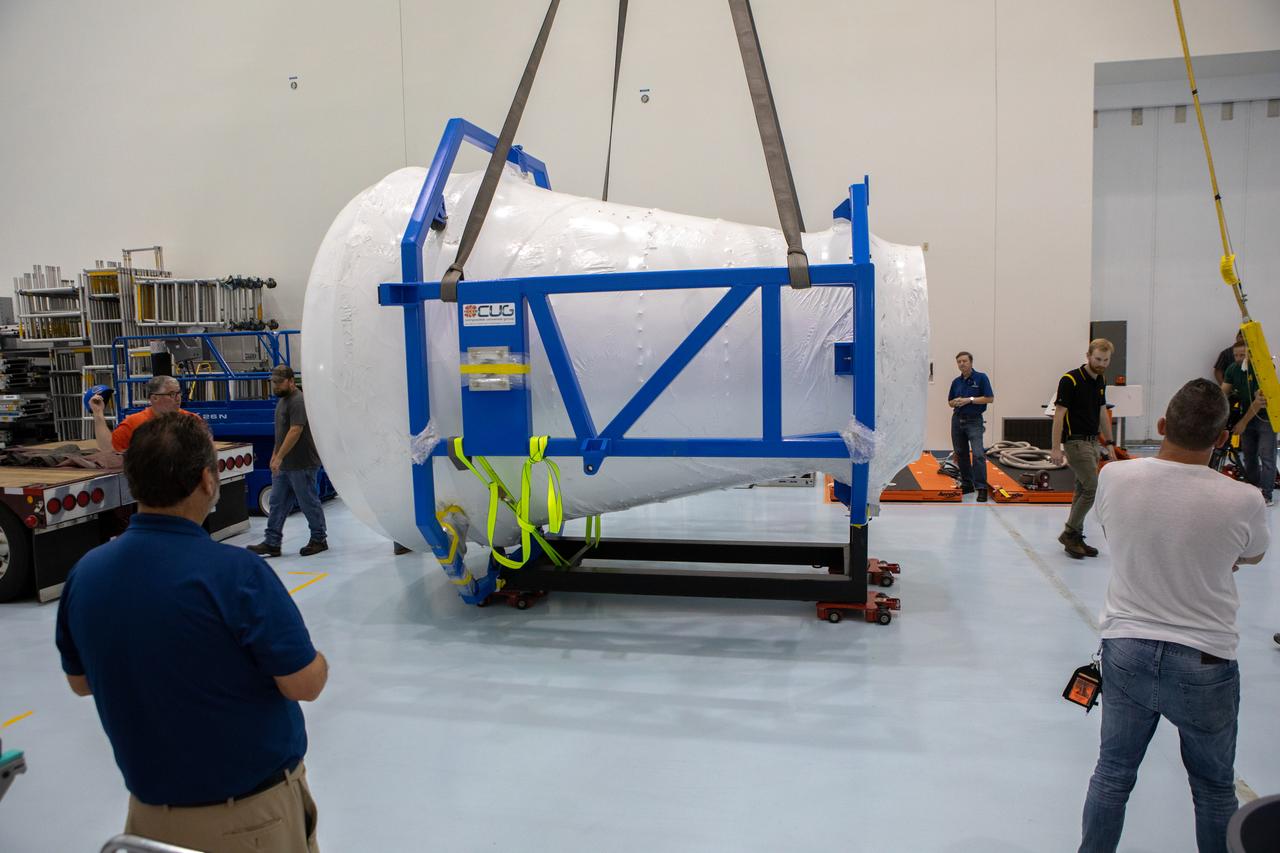
The cargo logistics module for Sierra Nevada Corporation’s Dream Chaser, the company’s reusable spaceplane, arrives at the Space Station Processing Facility high bay at NASA’s Kennedy Space Center in Florida on Aug. 27, 2019. The cargo module – a 15-foot attachment to Dream Chaser – provides extra storage for payloads and provides cargo disposal upon re-entry into Earth’s atmosphere. Dream Chaser will deliver more than 12,000 pounds of cargo to the International Space Station under the agency’s Commercial Resupply Services 2 contract. The spacecraft and cargo module will begin resupply and return services missions to the space station in late 2021.
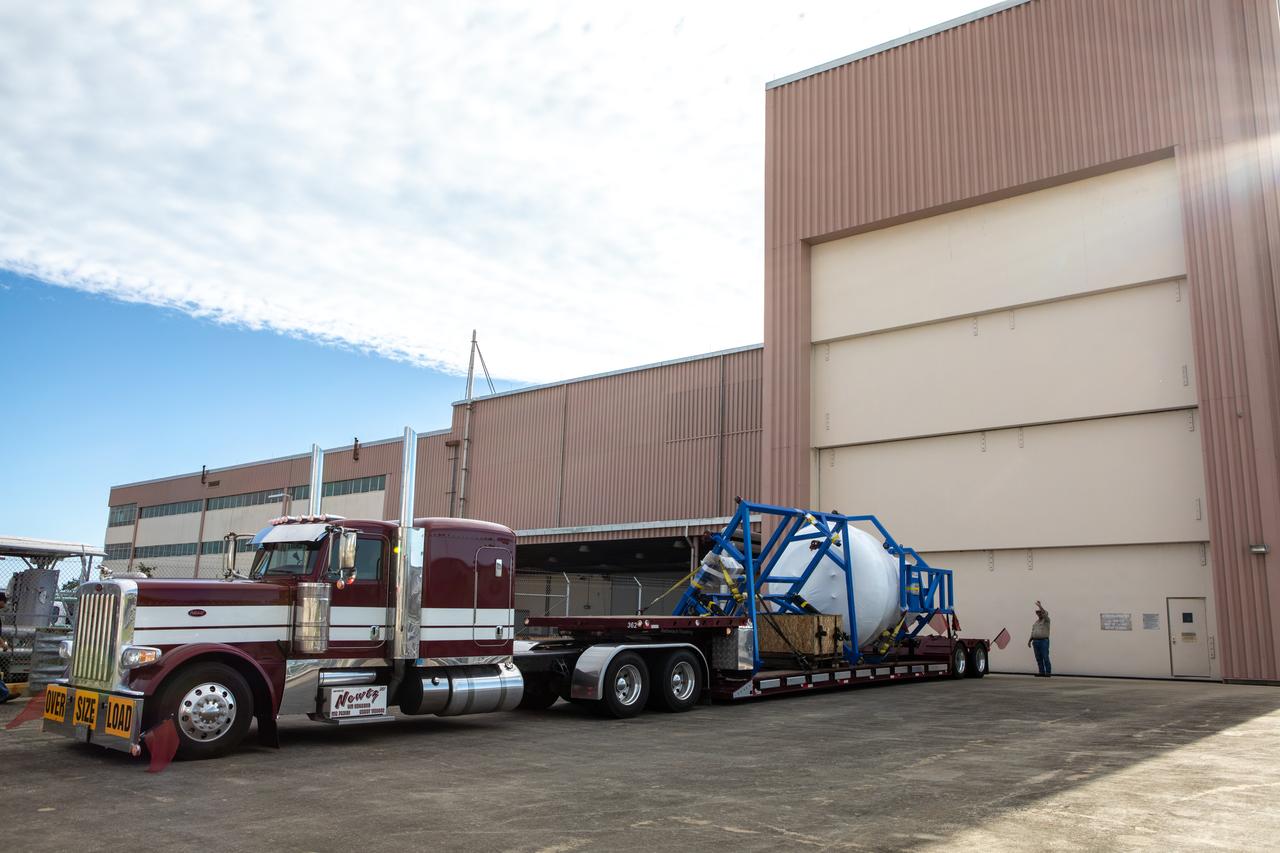
A truck carrying the cargo logistics module for Sierra Nevada Corporation’s Dream Chaser, the company’s reusable spaceplane, arrives at the Space Station Processing Facility high bay entrance at NASA’s Kennedy Space Center in Florida on Aug. 27, 2019. The cargo module – a 15-foot attachment to Dream Chaser – provides extra storage for payloads and provides cargo disposal upon re-entry into Earth’s atmosphere. Dream Chaser will deliver more than 12,000 pounds of cargo to the International Space Station under the agency’s Commercial Resupply Services 2 contract. The spacecraft and cargo module will begin resupply and return services missions to the space station in late 2021.
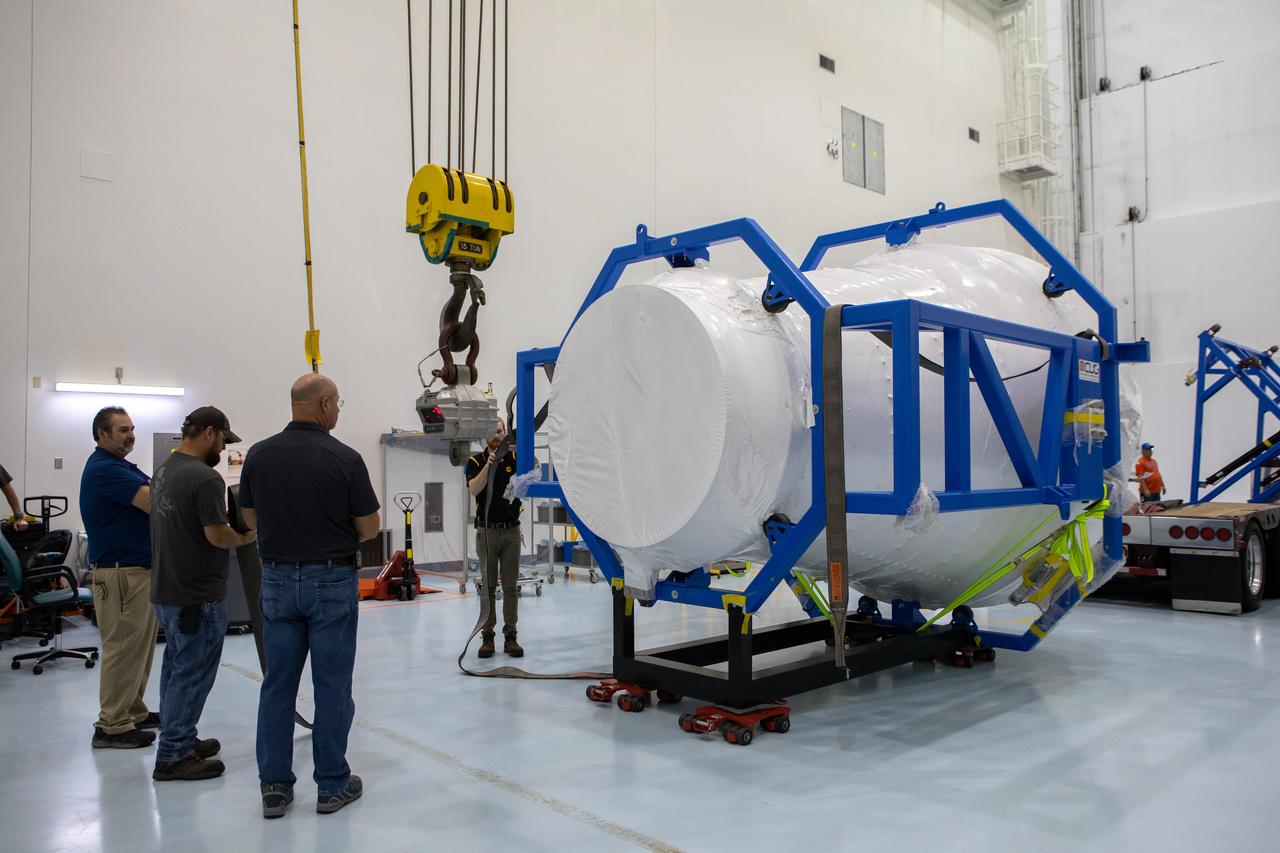
Sierra Nevada Corporation’s (SNC) Dream Chaser pressure test article is moved into the low bay of the Space Station Processing Facility at NASA’s Kennedy Space Center in Florida on June 3, 2020. The test article was shipped from Louisville, Colorado. It is similar to the actual pressurized cabin being used in the Dream Chaser spaceplane for Commercial Resupply Services-2 (CRS-2) missions. NASA selected Dream Chaser to provide cargo delivery, return and disposal service for the International Space Station under the CRS-2 contract. The test article will remain at Kennedy while SNC engineers use it to develop and verify refurbishment operations that will be used on Dream Chaser between flights.
The cargo logistics module for Sierra Nevada Corporation’s Dream Chaser, the company’s reusable spaceplane, is photographed inside the Space Station Processing Facility high bay at NASA’s Kennedy Space Center in Florida following its arrival on Aug. 27, 2019. The cargo module – a 15-foot attachment to Dream Chaser – provides extra storage for payloads and provides cargo disposal upon re-entry into Earth’s atmosphere. Dream Chaser will deliver more than 12,000 pounds of cargo to the International Space Station under the agency’s Commercial Resupply Services 2 contract. The spacecraft and cargo module will begin resupply and return services missions to the space station in late 2021.
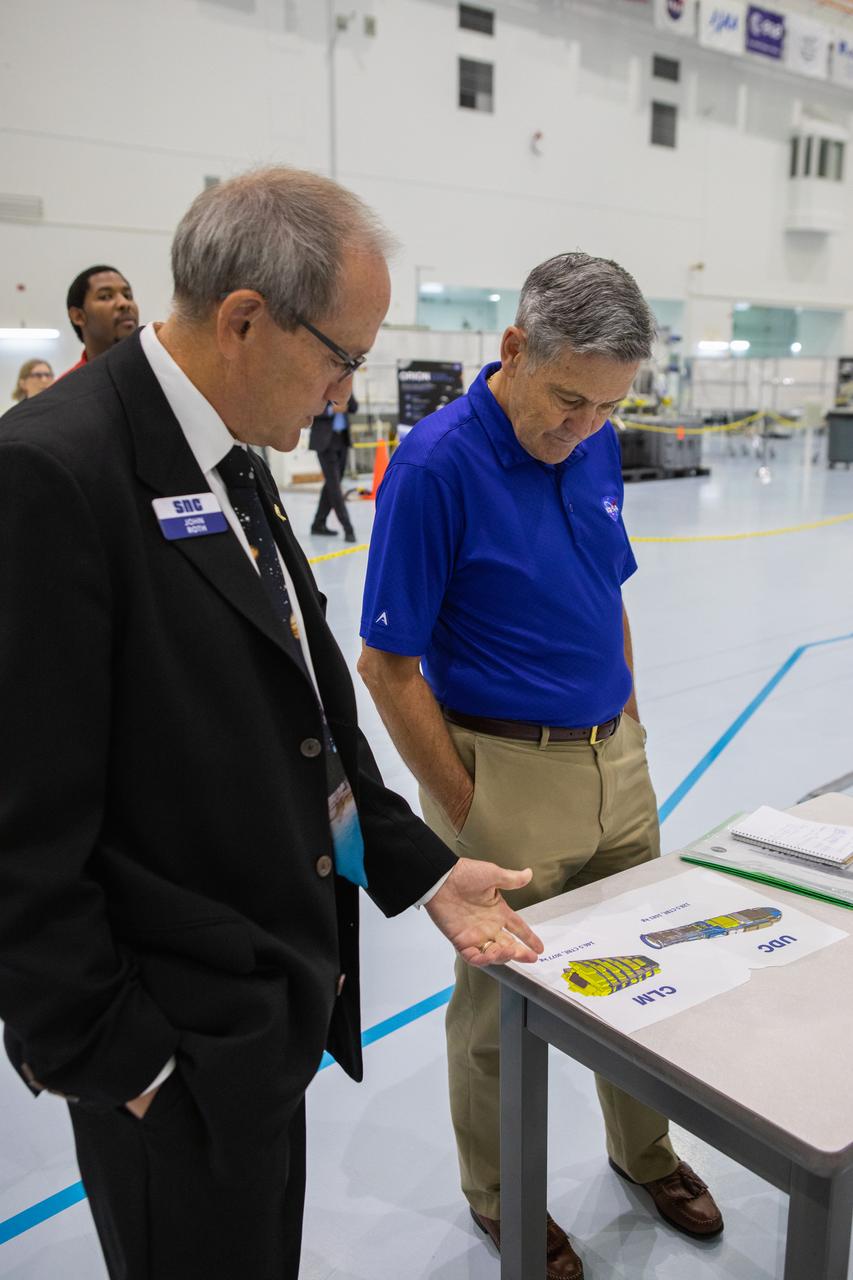
A mockup of the cargo logistics module for Sierra Nevada Corporation’s Dream Chaser, the company’s reusable spaceplane, arrived at the Space Station Processing Facility (SSPF) at NASA’s Kennedy Space Center in Florida in August. On Sept. 20, 2019, senior leadership had the opportunity to view the cargo module in the SSPF high bay. Kennedy Center Director Bob Cabana, at right, listens to John Roth, vice president, Business Development Space Systems, Sierra Nevada Corporation. The SSPF is providing support for current and future NASA and commercial provider programs, including Commercial Resupply Services, Artemis 1, sending the first woman and next man to the Moon, and deep space destinations including Mars.
Sierra Nevada Corporation’s (SNC) Dream Chaser pressure test article arrives by flatbed truck at the Space Station Processing Facility at NASA’s Kennedy Space Center in Florida on June 3, 2020, from Louisville, Colorado. The test article is similar to the actual pressurized cabin being used in the Dream Chaser spaceplane for Commercial Resupply Services-2 (CRS-2) missions. NASA selected Dream Chaser to provide cargo delivery, return and disposal service for the International Space Station under the CRS-2 contract. The test article will remain at Kennedy while SNC engineers use it to develop and verify refurbishment operations that will be used on Dream Chaser between flights.
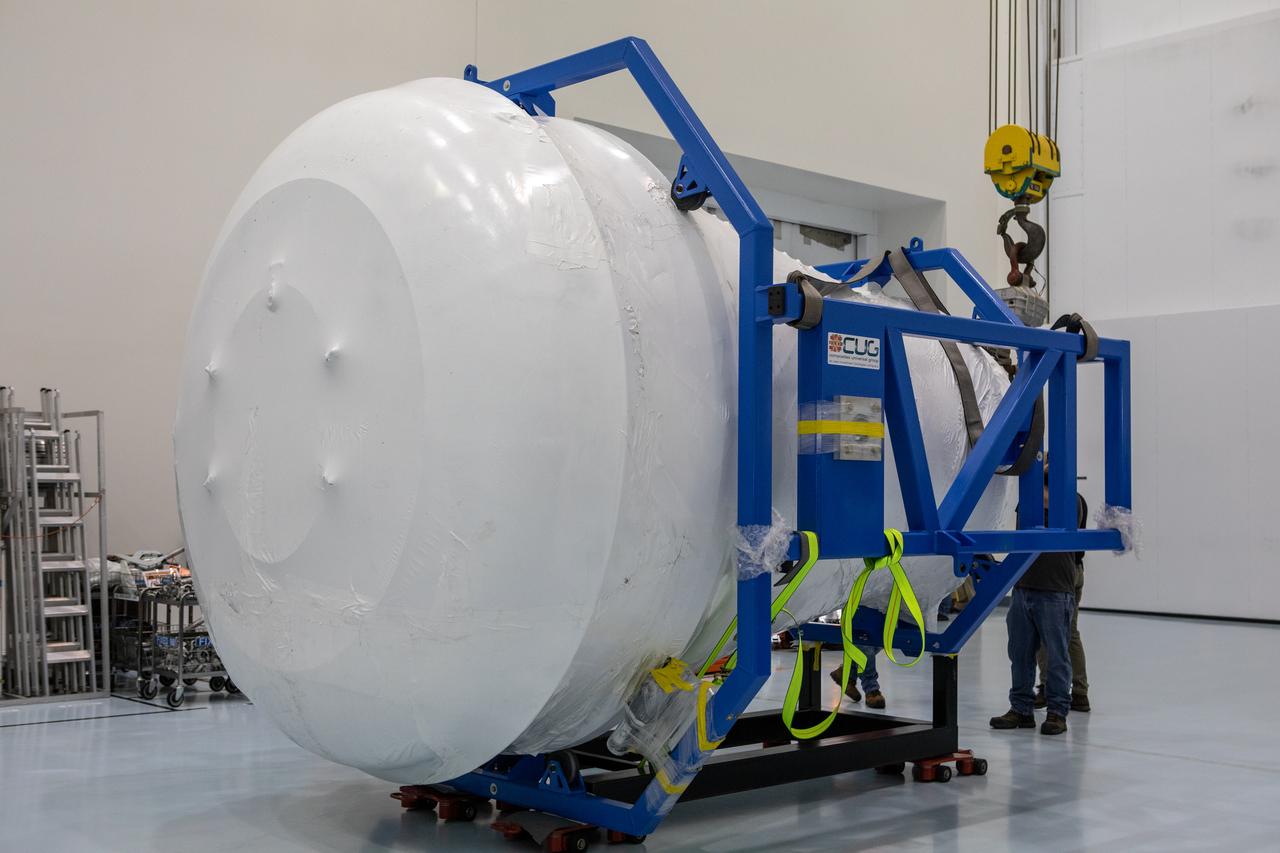
The cargo logistics module for Sierra Nevada Corporation’s Dream Chaser, the company’s reusable spaceplane, is photographed inside the Space Station Processing Facility high bay at NASA’s Kennedy Space Center in Florida following its arrival on Aug. 27, 2019. The cargo module – a 15-foot attachment to Dream Chaser – provides extra storage for payloads and provides cargo disposal upon re-entry into Earth’s atmosphere. Dream Chaser will deliver more than 12,000 pounds of cargo to the International Space Station under the agency’s Commercial Resupply Services 2 contract. The spacecraft and cargo module will begin resupply and return services missions to the space station in late 2021.
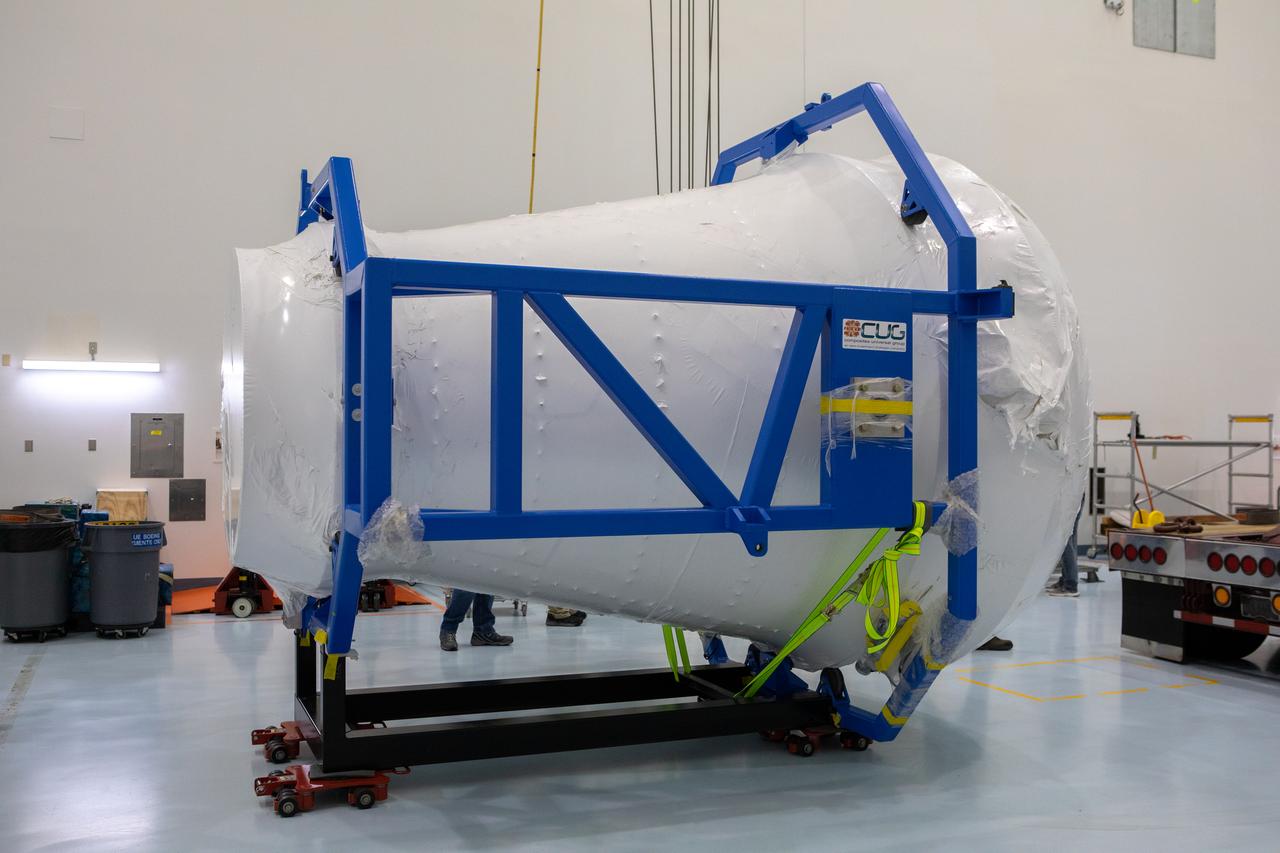
The cargo logistics module for Sierra Nevada Corporation’s Dream Chaser, the company’s reusable spaceplane, is photographed inside the Space Station Processing Facility high bay at NASA’s Kennedy Space Center in Florida following its arrival on Aug. 27, 2019. The cargo module – a 15-foot attachment to Dream Chaser – provides extra storage for payloads and provides cargo disposal upon re-entry into Earth’s atmosphere. Dream Chaser will deliver more than 12,000 pounds of cargo to the International Space Station under the agency’s Commercial Resupply Services 2 contract. The spacecraft and cargo module will begin resupply and return services missions to the space station in late 2021.
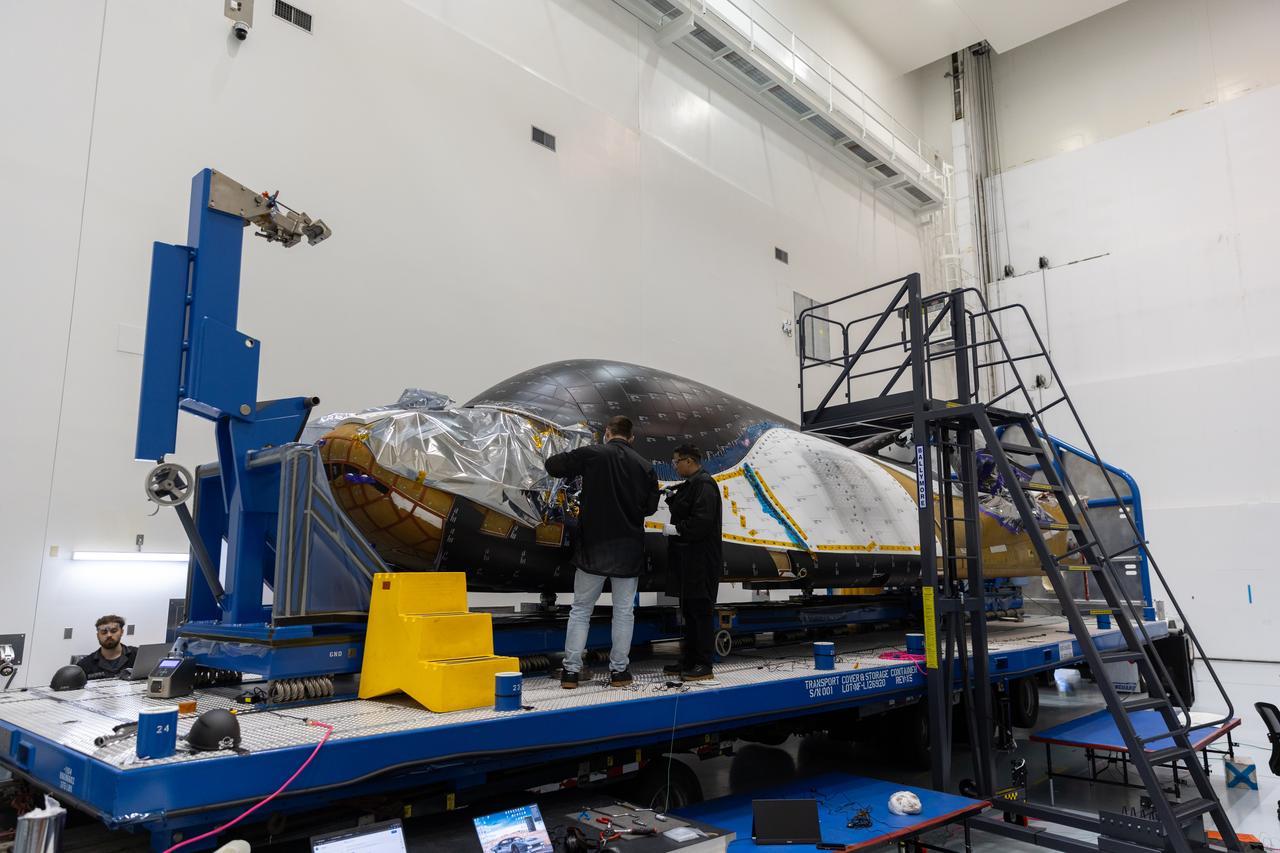
Teams process Dream Chaser Tenacity, Sierra Space's uncrewed cargo spaceplane, inside the Space Systems Processing Facility (SSPF) at NASA’s Kennedy Space Center in Florida on Monday, May 20, 2024, following its arrival from the agency's Neil Armstrong Test Facility in Ohio. Dream Chaser Tenacity will undergo final testing and prelaunch processing inside the high bay of the SSPF ahead of its inaugural launch atop a ULA (United Launch Alliance) Vulcan rocket from nearby Cape Canaveral Space Force Station. The reusable transportation system is contracted to perform a minimum of seven cargo missions to the International Space Station as part of the agency’s efforts to expand commercial resupply services to low Earth orbit.
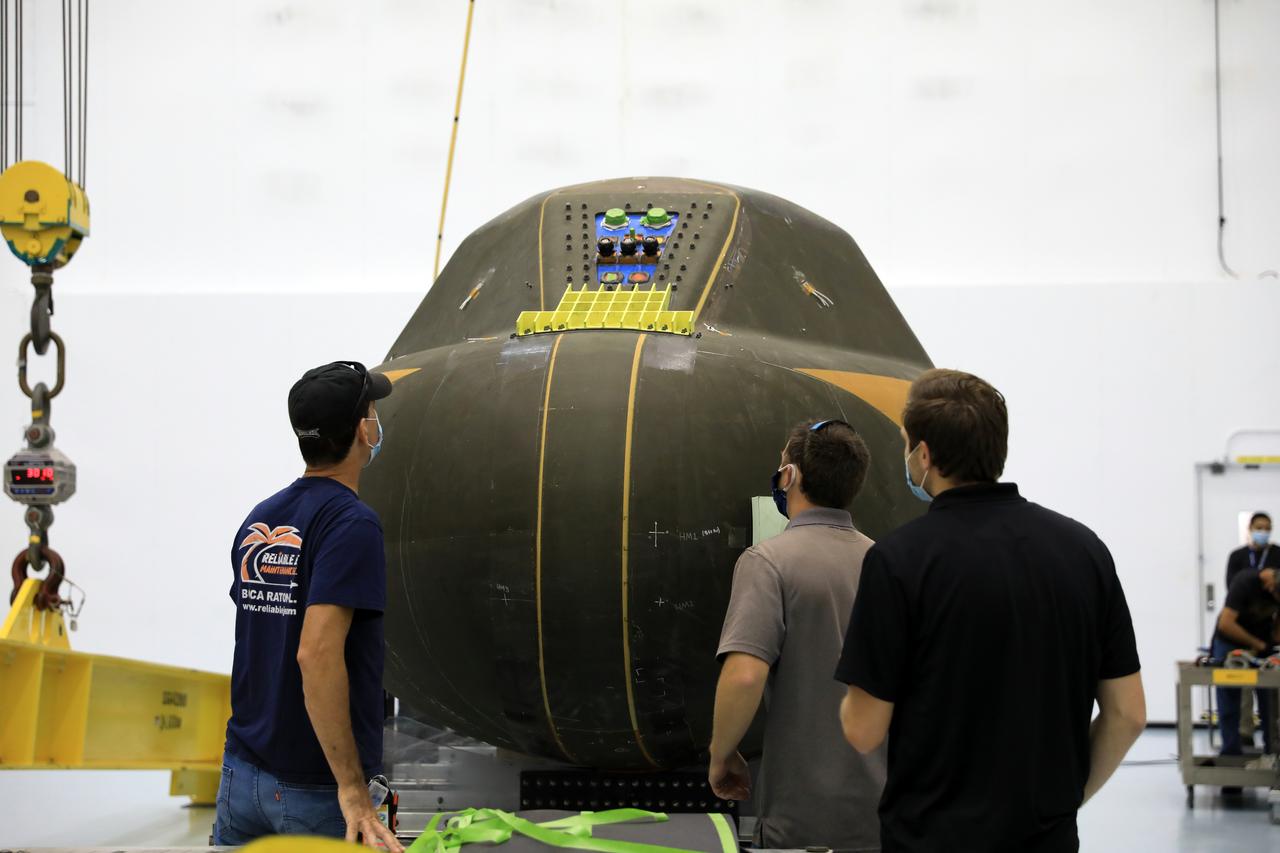
Inside the low bay of the Space Station Processing Facility at NASA’s Kennedy Space Center in Florida, workers monitor the progress as Sierra Nevada Corporation’s (SNC) Dream Chaser pressure test article on its support structure is lowered by crane away from the flatbed truck on June 3, 2020, for its move into the high bay. The test article was shipped from Louisville, Colorado. It is similar to the actual pressurized cabin being used in the Dream Chaser spaceplane for Commercial Resupply Services-2 (CRS-2) missions. NASA selected Dream Chaser to provide cargo delivery, return and disposal service for the International Space Station under the CRS-2 contract. The test article will remain at Kennedy while SNC engineers use it to develop and verify refurbishment operations that will be used on Dream Chaser between flights.
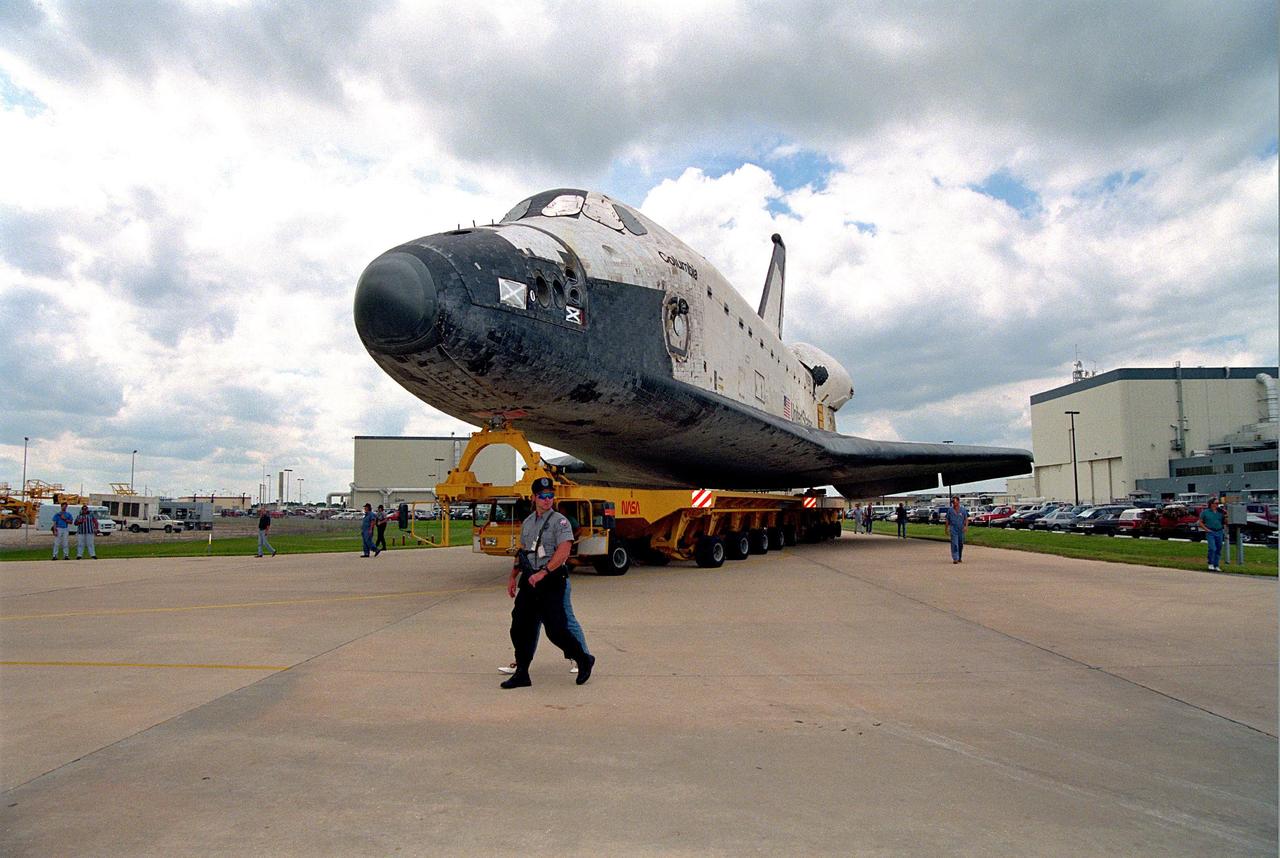
KENNEDY SPACE CENTER, FLA. -- The orbiter Columbia completes the short journey from Orbiter Processing Facility Bay 1 to the Vehicle Assembly Building (VAB). During its approximately one-week stay inside the VAB, the spaceplane will be mated to the external tank and twin solid rocket boosters, and electrical and mechanical interfaces will be verified. Rollout to Launch Pad 39B is planned for Oct. 16, where the two primary payloads of the upcoming STS-80 mission -- the Wake Shield Facility-3 (WSF-3) and Orbiting and Retrievable Far and Extreme Ultraviolet Spectrograph-Shuttle Pallet Satellite-2 (ORFEUS-SPAS-2) -- will be installed. Liftoff on the final Shuttle flight of 1996 is targeted for no earlier than Nov 8 at 2:47 p.m. EST.
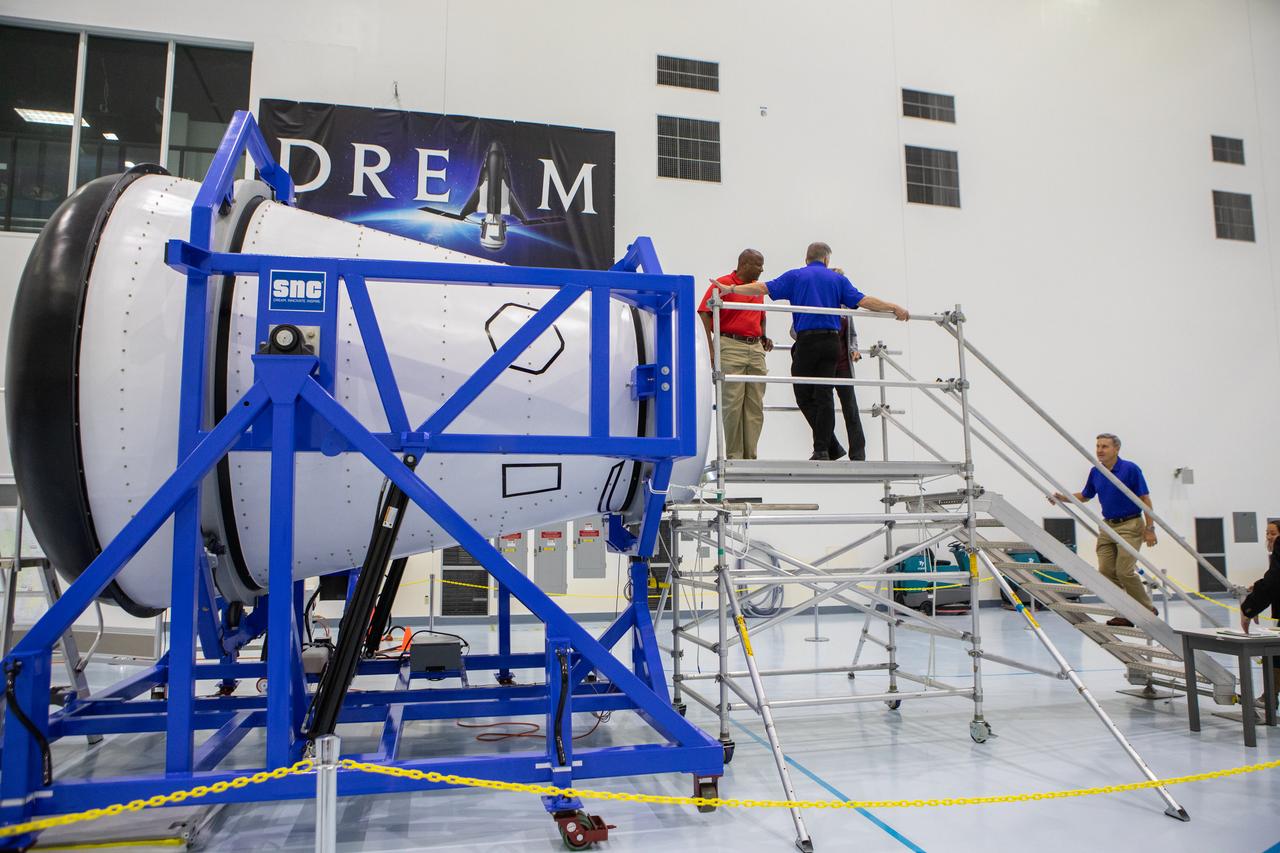
A mockup of the cargo logistics module for Sierra Nevada Corporation’s Dream Chaser, the company’s reusable spaceplane, arrived at the Space Station Processing Facility (SSPF) at NASA’s Kennedy Space Center in Florida in August. On Sept. 20, 2019, senior leadership had the opportunity to view the cargo module in the SSPF high bay. From left are Kelvin Manning, Kennedy associate director, technical; Steve Lindsey, vice president, Space Exploration Systems, Sierra Nevada Corporation; behind Lindsey is Kennedy Deputy Director Janet Petro; and ascending the stairs is Kennedy Center Director Bob Cabana. The SSPF is providing support for current and future NASA and commercial provider programs, including Commercial Resupply Services, Artemis 1, sending the first woman and next man to the Moon, and deep space destinations including Mars.
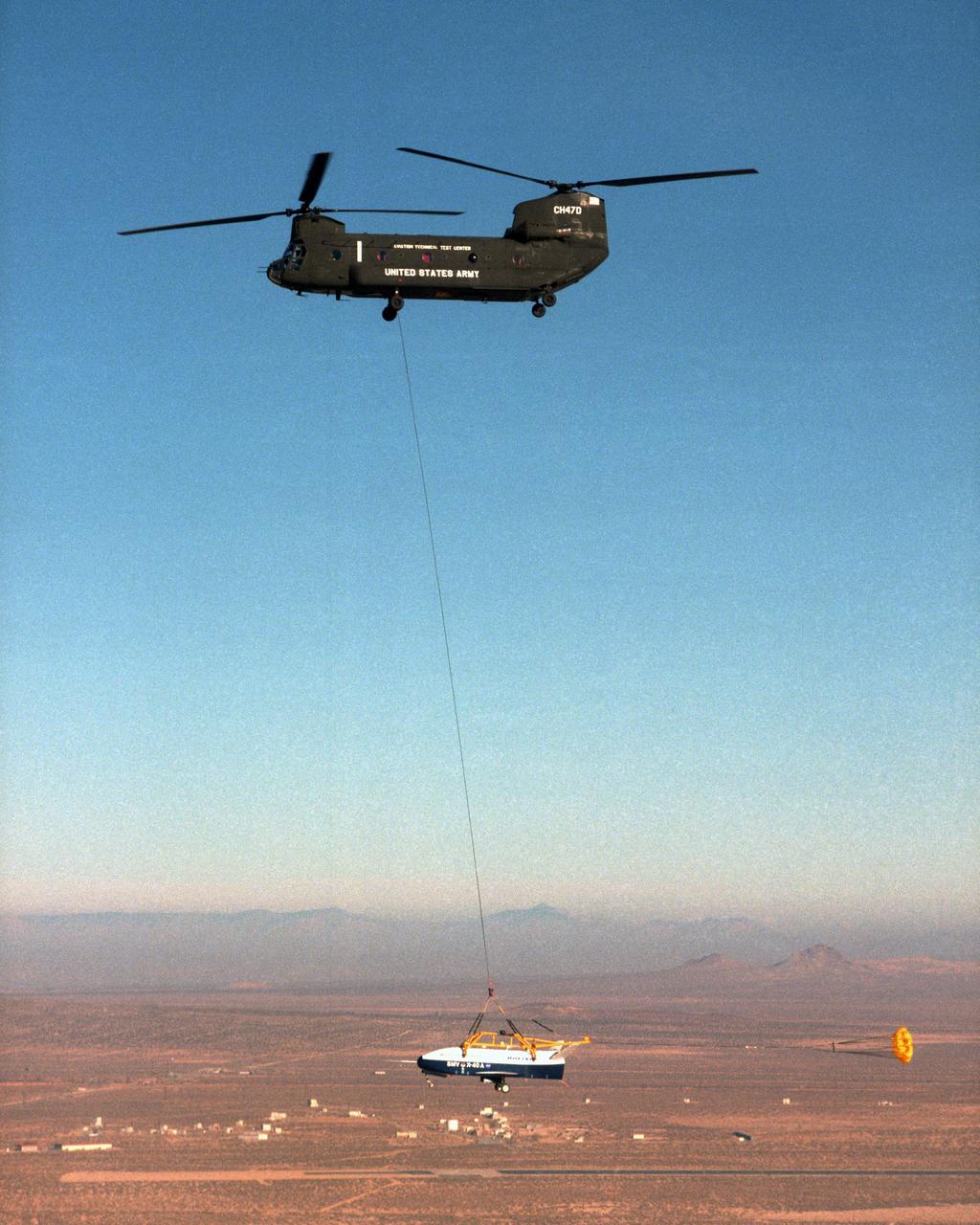
With a small stabilization parachute trailing behind, the X-40 sub-scale technology demonstrator is suspended under a U.S. Army CH-47 Chinook cargo helicopter during a captive-carry test flight at NASA's Dryden Flight Research Center, Edwards, California. The captive carry flights are designed to verify the X-40's navigation and control systems, rigging angles for its sling, and stability and control of the helicopter while carrying the X-40 on a tether. Following a series of captive-carry flights, the X-40 made free flights from a launch altitude of about 15,000 feet above ground, gliding to a fully autonomous landing. The X-40 is an unpowered 82 percent scale version of the X-37, a Boeing-developed spaceplane designed to demonstrate various advanced technologies for development of future lower-cost access to space vehicles.
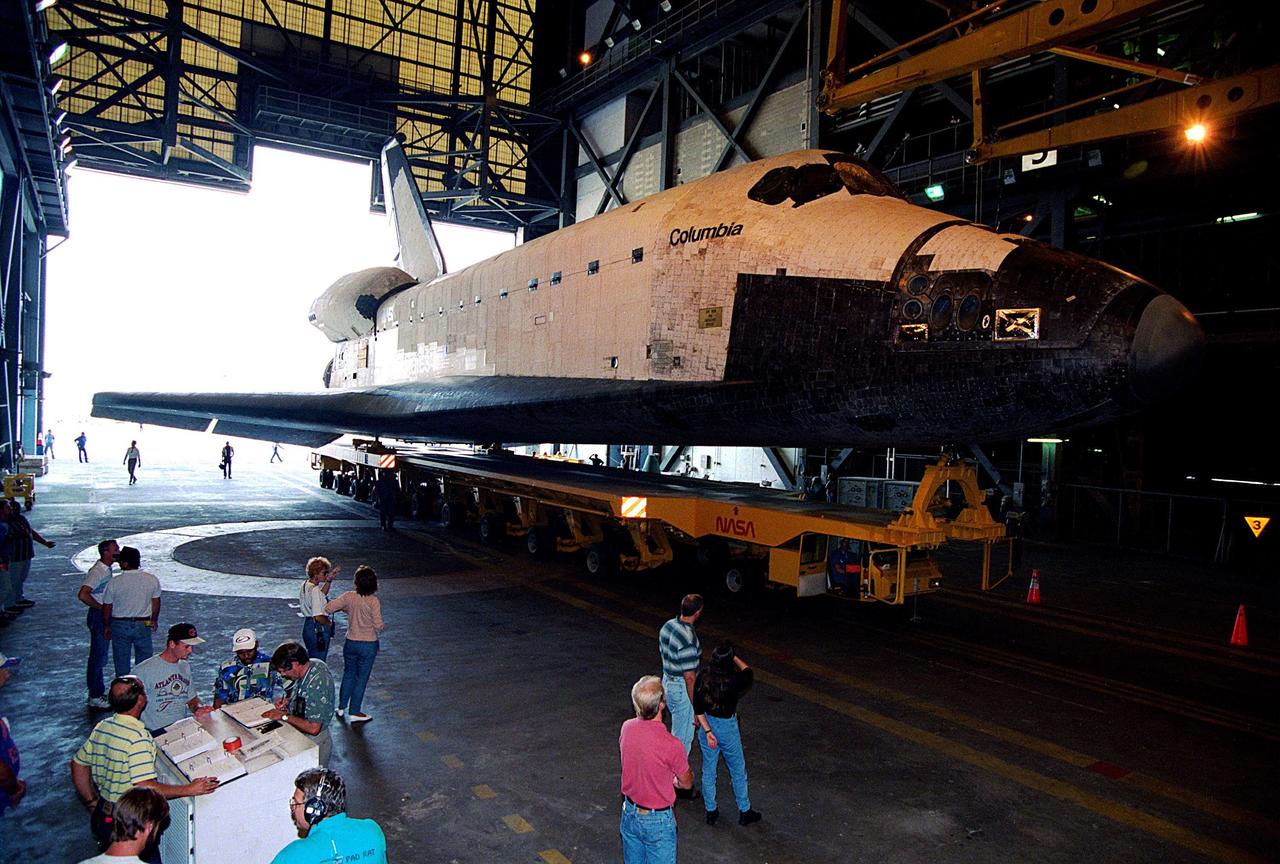
KENNEDY SPACE CENTER, FLA. -- The orbiter Columbia completes the short journey from Orbiter Processing Facility Bay 1 to the Vehicle Assembly Building (VAB). During its approximately one-week stay inside the VAB, the spaceplane will be mated to the external tank and twin solid rocket boosters, and electrical and mechanical interfaces will be verified. Rollout to Launch Pad 39B is planned for Oct. 16, where the two primary payloads of the upcoming STS-80 mission -- the Wake Shield Facility-3 (WSF-3) and Orbiting and Retrievable Far and Extreme Ultraviolet Spectrograph-Shuttle Pallet Satellite-2 (ORFEUS-SPAS-2) -- will be installed. Liftoff on the final Shuttle flight of 1996 is targeted for no earlier than Nov 8 at 2:47 p.m. EST
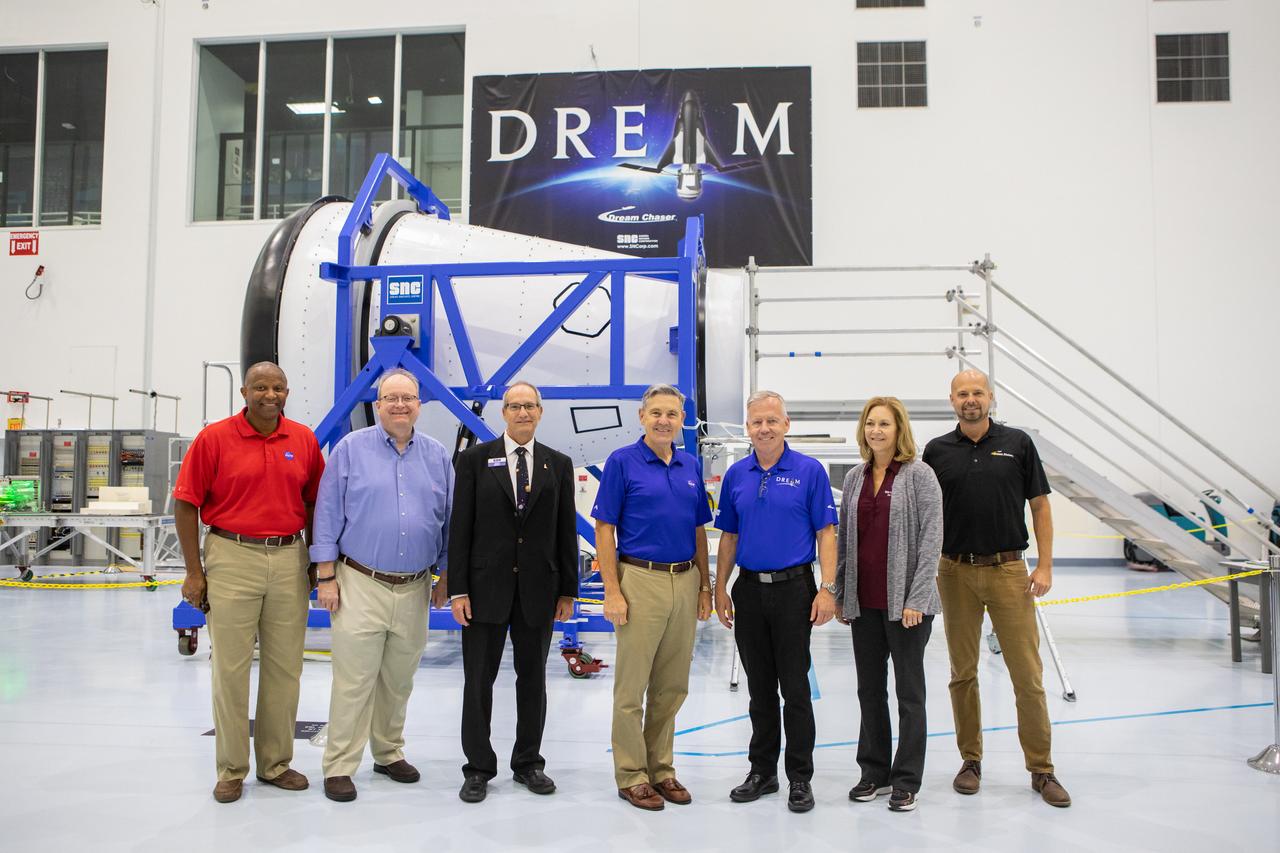
A mockup of the cargo logistics module for Sierra Nevada Corporation’s Dream Chaser, the company’s reusable spaceplane, arrived at the Space Station Processing Facility (SSPF) at NASA’s Kennedy Space Center in Florida in August. On Sept. 20, 2019, senior leadership had the opportunity to view the cargo module in the SSPF high bay. From left are Kelvin Manning, Kennedy associate director, technical; Burt Summerfield, associate director, management; John Roth, vice president, Business Development Space Systems, Sierra Nevada Corporation; Kennedy Center Director Bob Cabana; Steve Lindsey, vice president, Space Exploration Systems, Sierra Nevada Corporation; Kennedy Deputy Director Janet Petro; and Nate Wood, Sierra Nevada Corporation. The SSPF is providing support for current and future NASA and commercial provider programs, including Commercial Resupply Services, Artemis 1, sending the first woman and next man to the Moon, and deep space destinations including Mars.
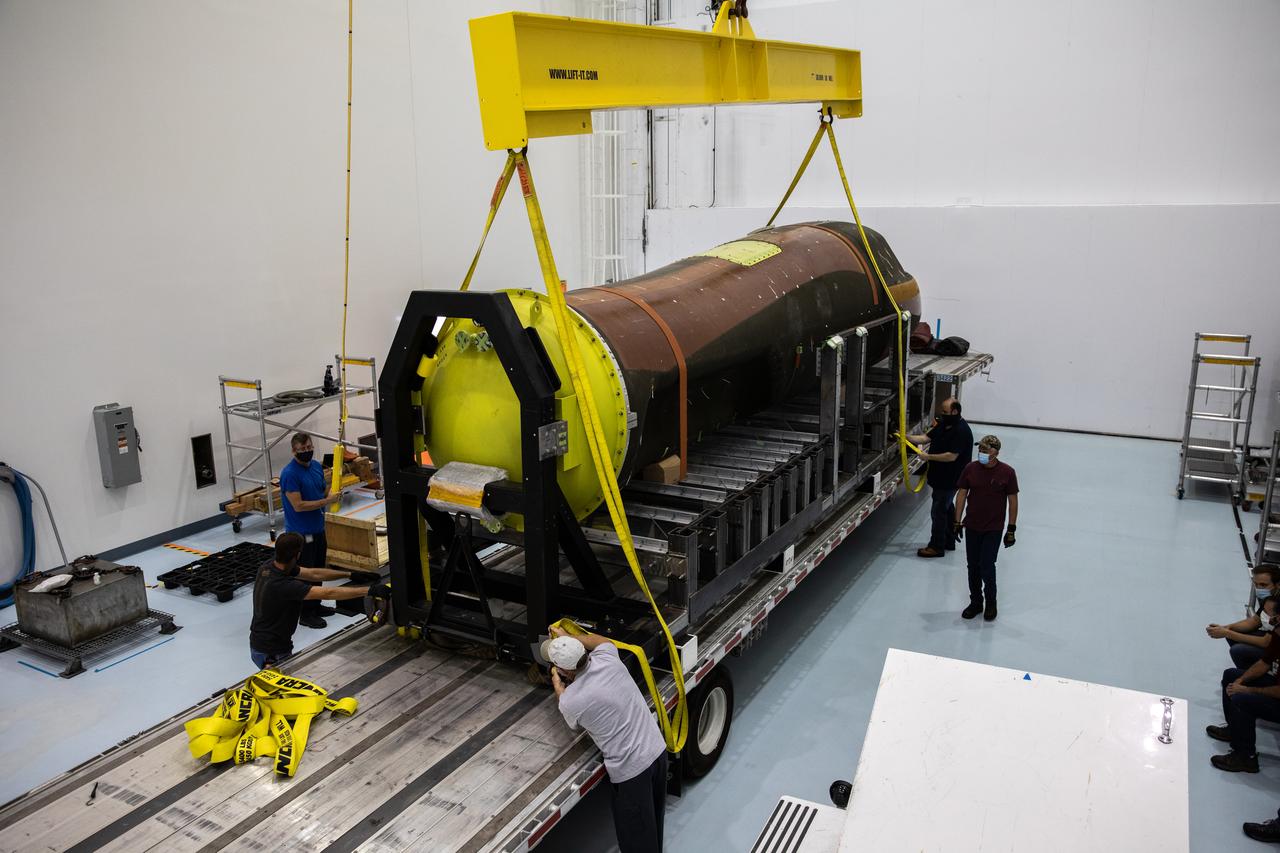
Sierra Nevada Corporation’s (SNC) Dream Chaser pressure test article is moved into the low bay of the Space Station Processing Facility at NASA’s Kennedy Space Center in Florida on June 3, 2020. Workers attach a crane to the test article to begin lifting it off of the flatbed truck. The test article was shipped from Louisville, Colorado. It is similar to the actual pressurized cabin being used in the Dream Chaser spaceplane for Commercial Resupply Services-2 (CRS-2) missions. NASA selected Dream Chaser to provide cargo delivery, return and disposal service for the International Space Station under the CRS-2 contract. The test article will remain at Kennedy while SNC engineers use it to develop and verify refurbishment operations that will be used on Dream Chaser between flights.
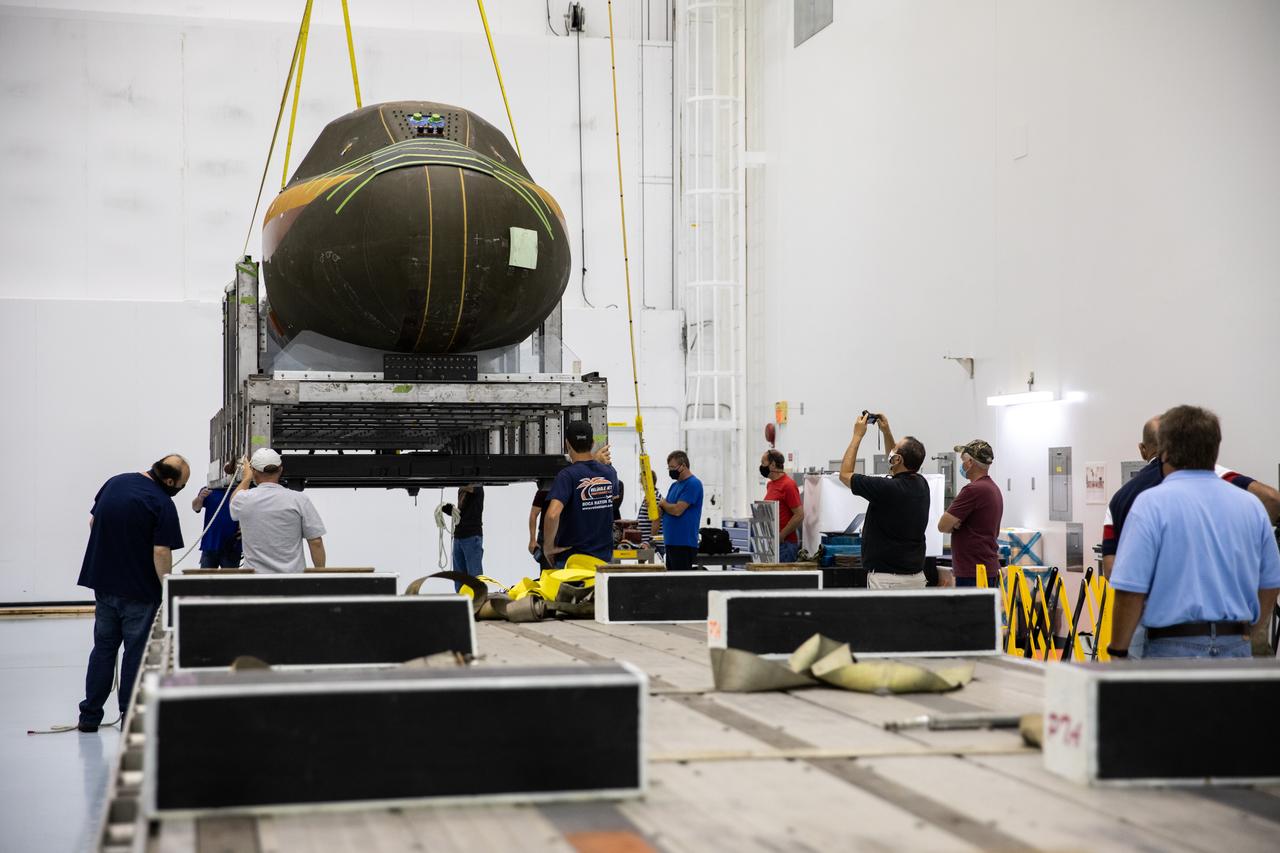
Inside the low bay of the Space Station Processing Facility at NASA’s Kennedy Space Center in Florida, Sierra Nevada Corporation’s (SNC) Dream Chaser pressure test article on its support structure is lifted up by crane from the flatbed truck on June 3, 2020, for its move into the high bay. The test article was shipped from Louisville, Colorado. It is similar to the actual pressurized cabin being used in the Dream Chaser spaceplane for Commercial Resupply Services-2 (CRS-2) missions. NASA selected Dream Chaser to provide cargo delivery, return and disposal service for the International Space Station under the CRS-2 contract. The test article will remain at Kennedy while SNC engineers use it to develop and verify refurbishment operations that will be used on Dream Chaser between flights.
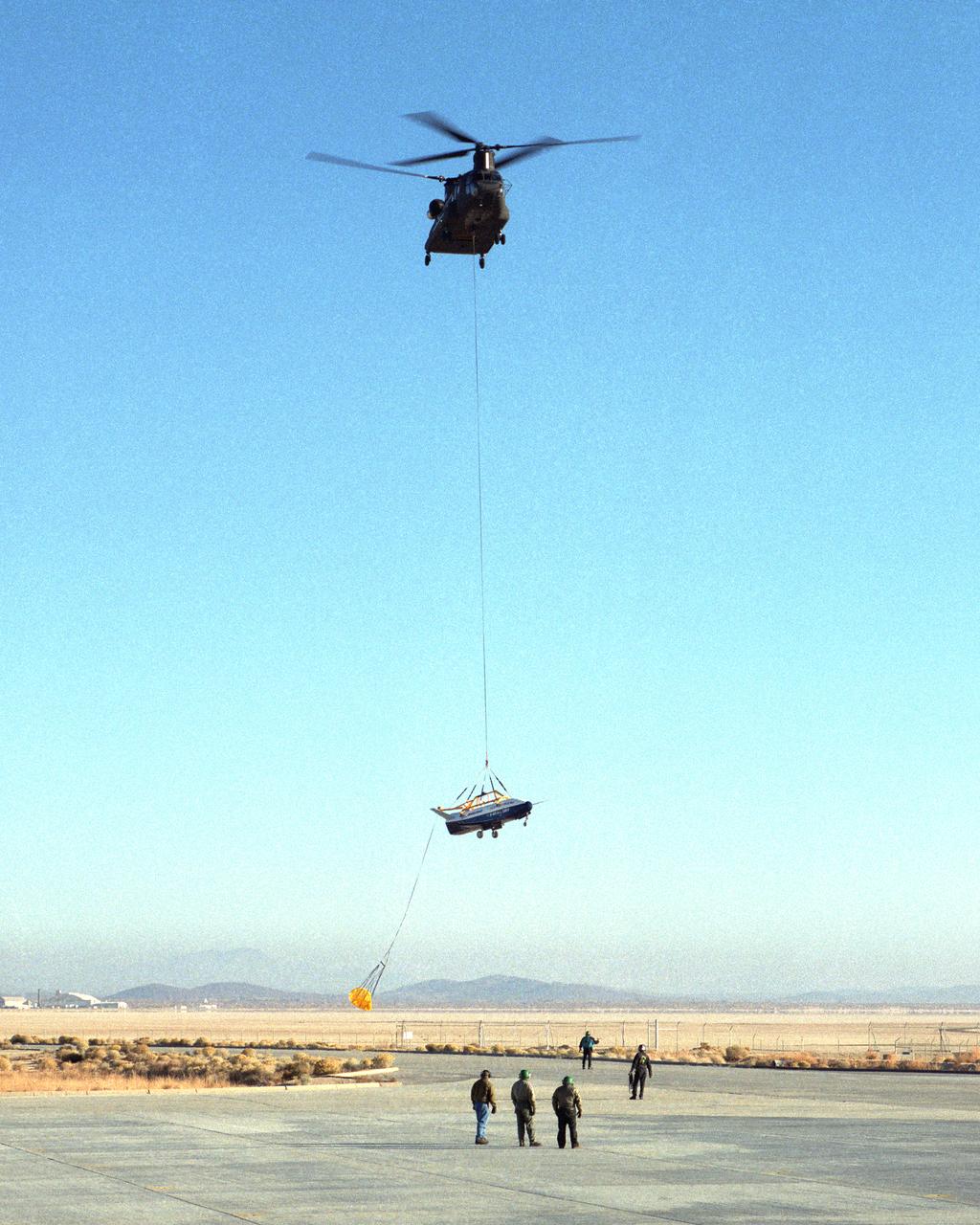
A U.S. Army CH-47 Chinook helicopter slowly lowers the X-40 sub-scale technology demonstrator to the ground under the watchful eyes of ground crew at the conclusion of a captive-carry test flight at NASA's Dryden Flight Research Center, Edwards, California. Several captive-carry flights were conducted to check out all operating systems and procedures before the X-40 made its first free flight at Edwards, gliding to a fully-autonomous approach and landing on the Edwards runway. The X-40 is an unpowered 82 percent scale version of the X-37, a Boeing-developed spaceplane designed to demonstrate various advanced technologies for development of future lower-cost access to space vehicles. Flight tests of the X-40 are designed to reduce the risks associated with research flights of the larger, more complex X-37.
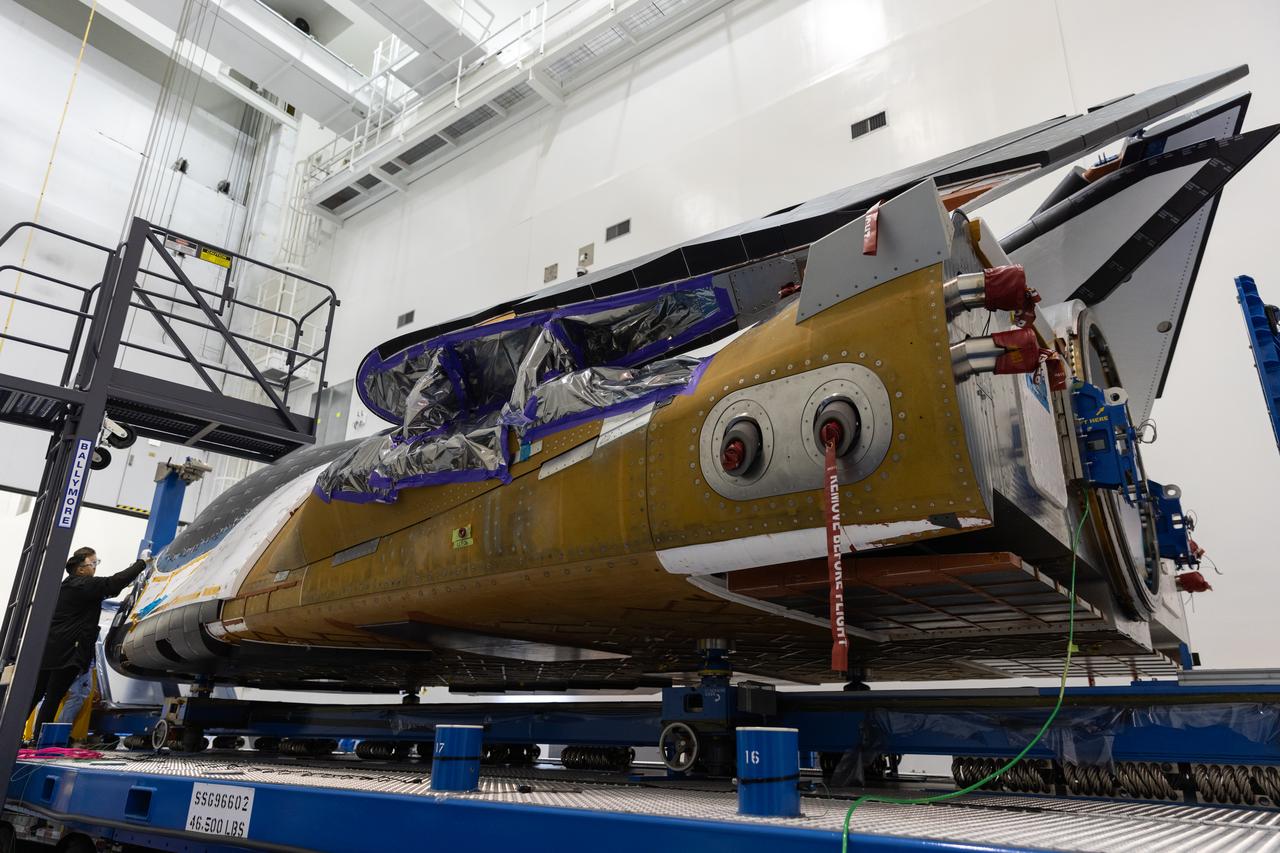
Teams process Dream Chaser Tenacity, Sierra Space's uncrewed cargo spaceplane, inside the Space Systems Processing Facility (SSPF) at NASA’s Kennedy Space Center in Florida on Monday, May 20, 2024, following its arrival from the agency's Neil Armstrong Test Facility in Ohio. Dream Chaser Tenacity will undergo final testing and prelaunch processing inside the high bay of the SSPF ahead of its inaugural launch atop a ULA (United Launch Alliance) Vulcan rocket from nearby Cape Canaveral Space Force Station. The reusable transportation system is contracted to perform a minimum of seven cargo missions to the International Space Station as part of the agency’s efforts to expand commercial resupply services to low Earth orbit.
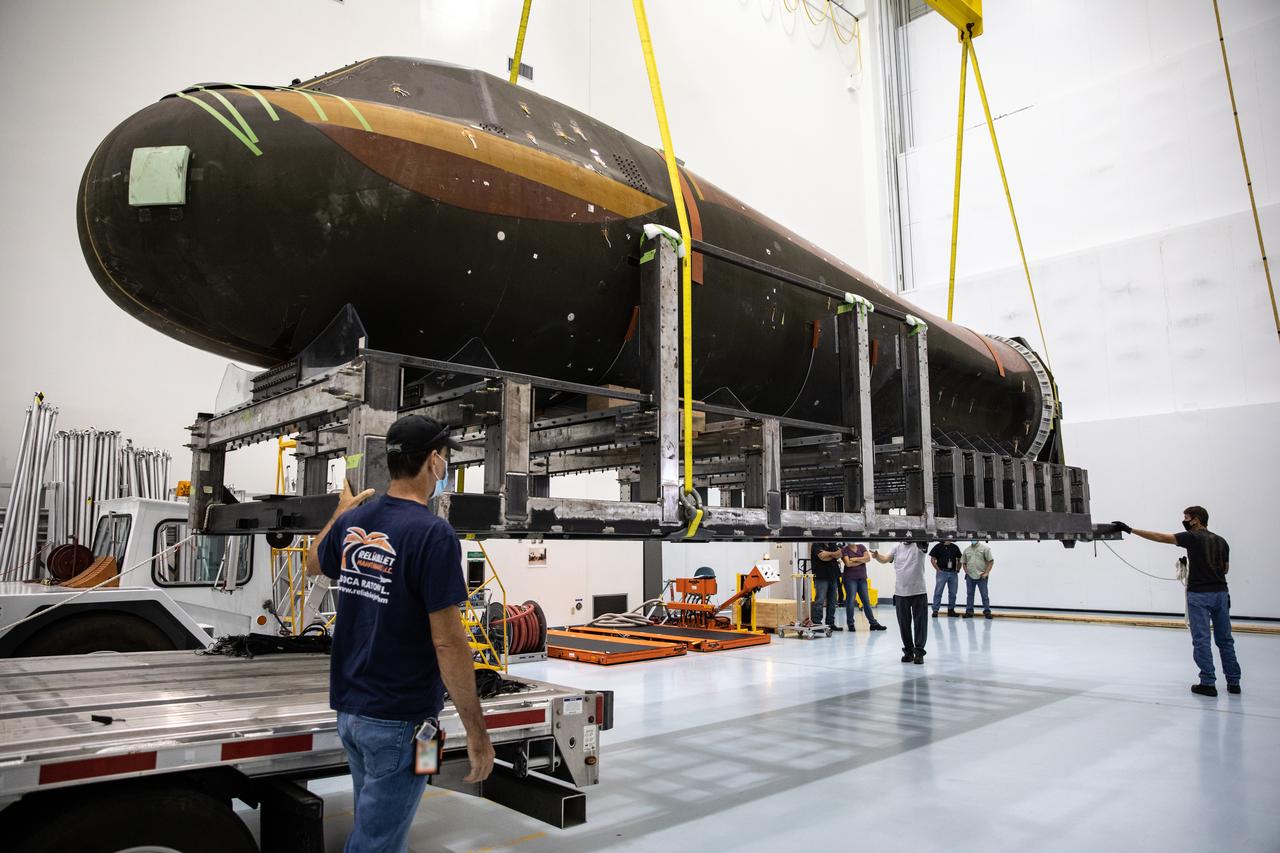
Inside the low bay of the Space Station Processing Facility at NASA’s Kennedy Space Center in Florida, Sierra Nevada Corporation’s (SNC) Dream Chaser pressure test article on its support structure is lifted up by crane from the flatbed truck on June 3, 2020, for its move into the high bay. The test article was shipped from Louisville, Colorado. It is similar to the actual pressurized cabin being used in the Dream Chaser spaceplane for Commercial Resupply Services-2 (CRS-2) missions. NASA selected Dream Chaser to provide cargo delivery, return and disposal service for the International Space Station under the CRS-2 contract. The test article will remain at Kennedy while SNC engineers use it to develop and verify refurbishment operations that will be used on Dream Chaser between flights.
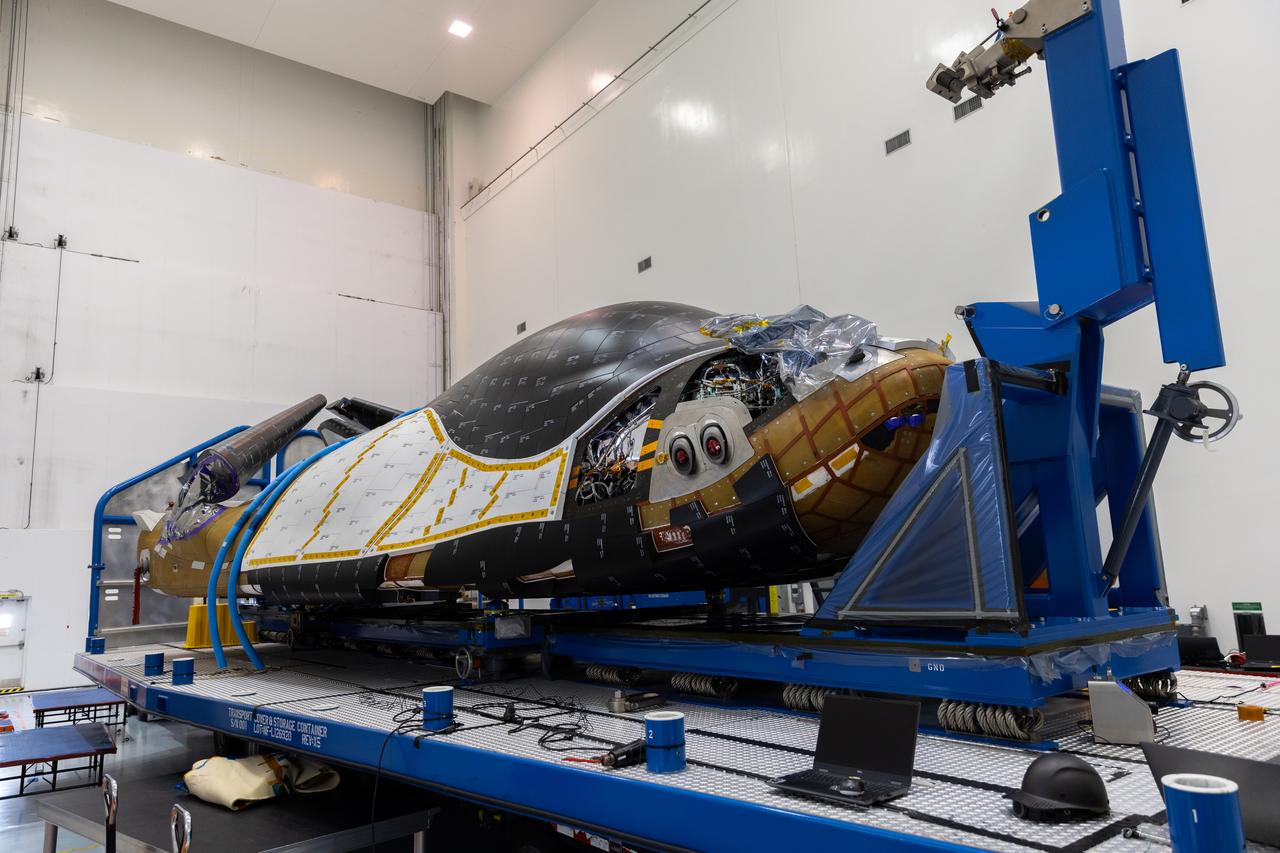
Dream Chaser Tenacity, Sierra Space's uncrewed cargo spaceplane is processed inside the Space Systems Processing Facility (SSPF) at NASA’s Kennedy Space Center in Florida on Monday, May 20, 2024, after arriving by truck inside a climate-controlled transportation container, completing the journey from the agency's Neil Armstrong Test Facility in Ohio. Dream Chaser Tenacity will undergo final testing and prelaunch processing inside the high bay of the SSPF ahead of its inaugural launch atop a ULA (United Launch Alliance) Vulcan rocket from nearby Cape Canaveral Space Force Station. The reusable transportation system is contracted to perform a minimum of seven cargo missions to the International Space Station as part of the agency’s efforts to expand commercial resupply services to low Earth orbit.
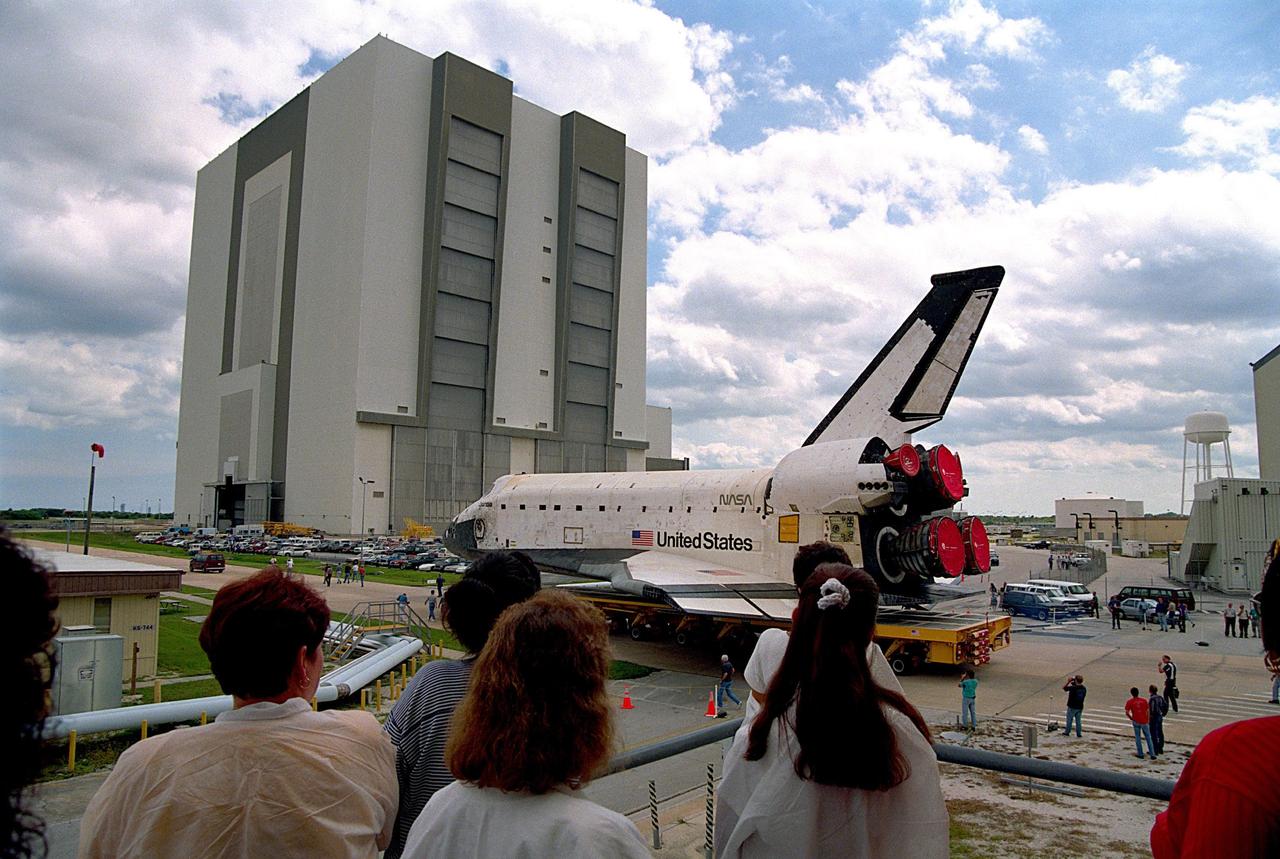
KENNEDY SPACE CENTER, FLA. -- The orbiter Columbia completes the short journey from Orbiter Processing Facility Bay 1 to the Vehicle Assembly Building (VAB). During its approximately one-week stay inside the VAB, the spaceplane will be mated to the external tank and twin solid rocket boosters, and electrical and mechanical interfaces will be verified. Rollout to Launch Pad 39B is planned for Oct. 16, where the two primary payloads of the upcoming STS-80 mission -- the Wake Shield Facility-3 (WSF-3) and Orbiting and Retrievable Far and Extreme Ultraviolet Spectrograph-Shuttle Pallet Satellite-2 (ORFEUS-SPAS-2) -- will be installed. Liftoff on the final Shuttle flight of 1996 is targeted for no earlier than Nov 8 at 2:47 p.m. EST
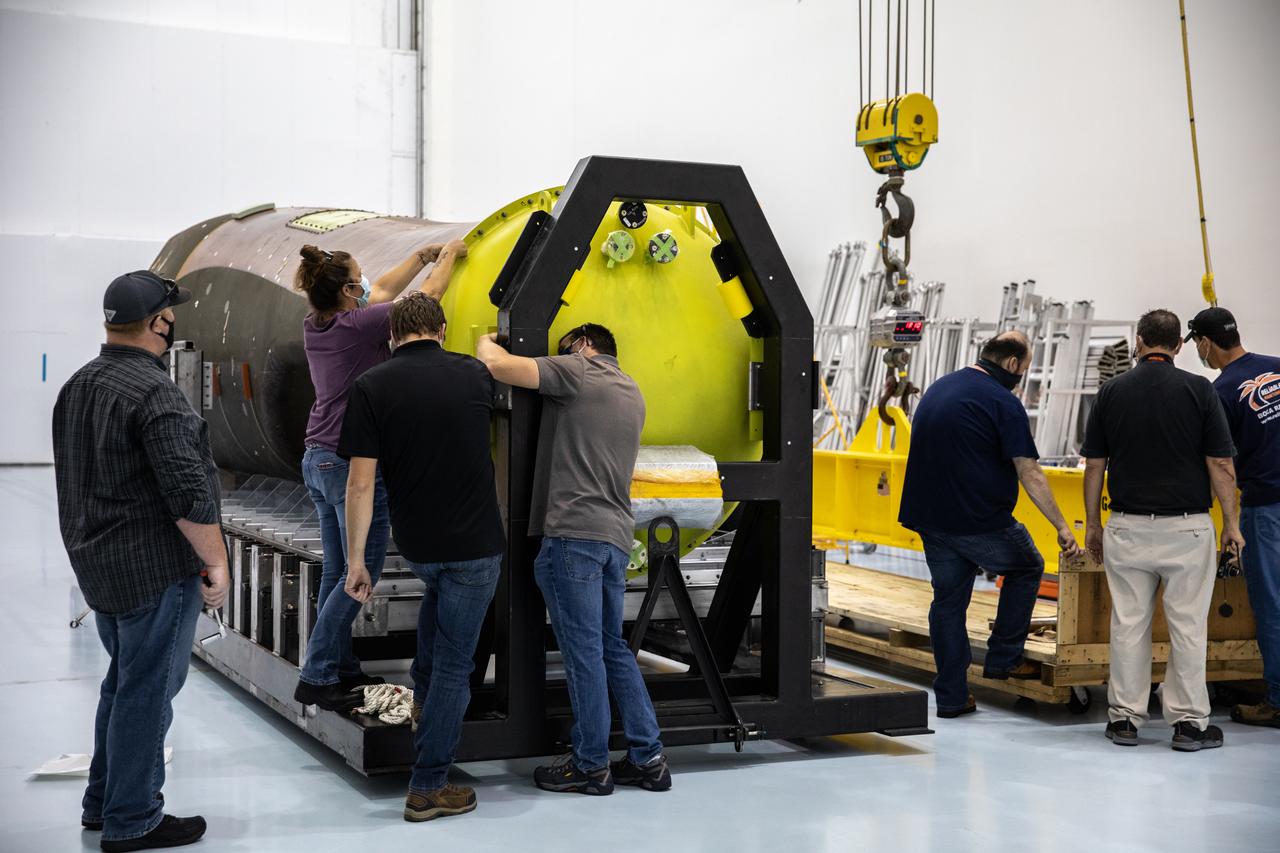
Inside the low bay of the Space Station Processing Facility at NASA’s Kennedy Space Center in Florida, workers assist as Sierra Nevada Corporation’s (SNC) Dream Chaser pressure test article on its support structure is lowered by crane on June 3, 2020, for its move into the high bay. The test article was shipped from Louisville, Colorado. It is similar to the actual pressurized cabin being used in the Dream Chaser spaceplane for Commercial Resupply Services-2 (CRS-2) missions. NASA selected Dream Chaser to provide cargo delivery, return and disposal service for the International Space Station under the CRS-2 contract. The test article will remain at Kennedy while SNC engineers use it to develop and verify refurbishment operations that will be used on Dream Chaser between flights.
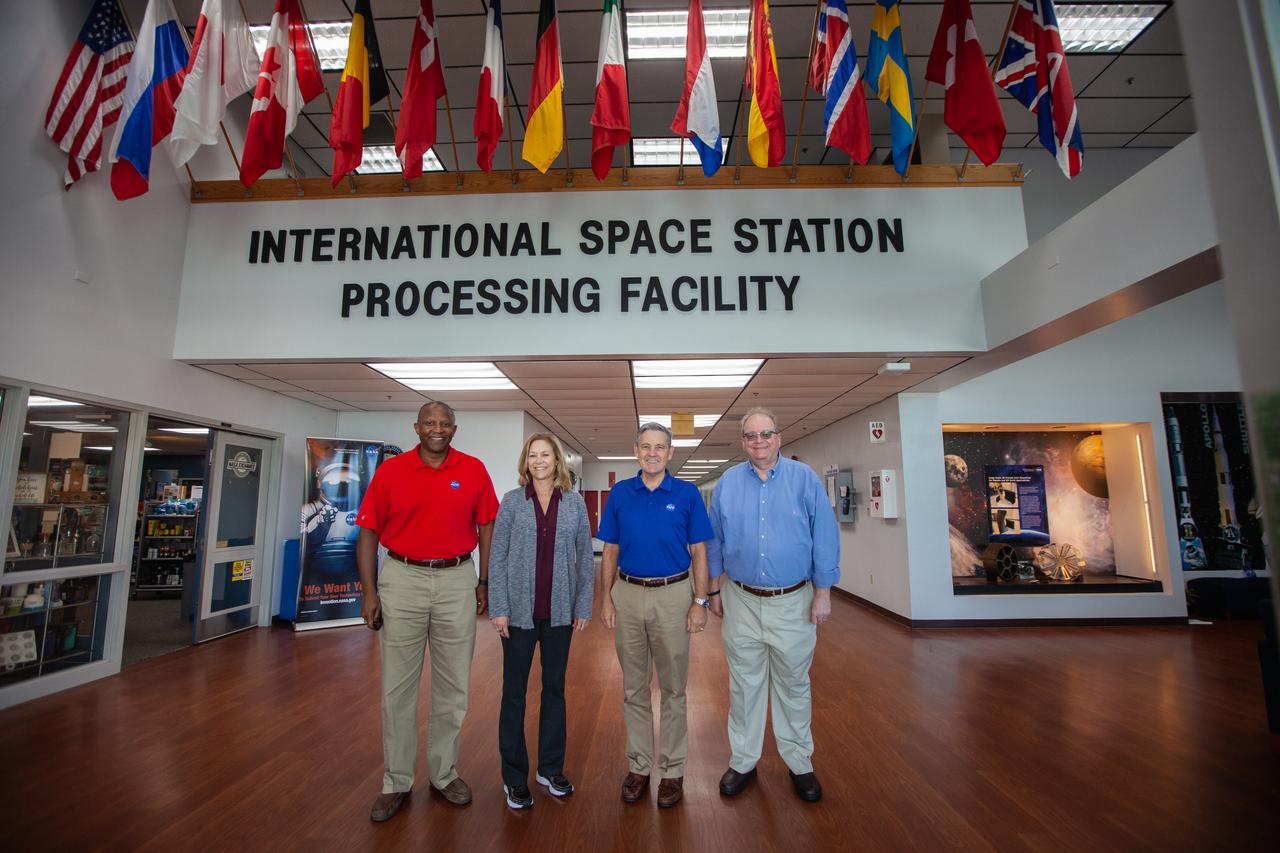
A mockup of the cargo logistics module for Sierra Nevada Corporation’s Dream Chaser, the company’s reusable spaceplane, arrived at the Space Station Processing Facility (SSPF) at NASA’s Kennedy Space Center in Florida in August. On Sept. 20, 2019, senior leadership had the opportunity to view the cargo module in the SSPF high bay. From left, are Kelvin Manning, Kennedy associate director, technical; Kennedy Deputy Director Janet Petro; Kennedy Center Director Bob Cabana; and Burt Summerfield, Kennedy associate director, management. The SSPF is providing support for current and future NASA and commercial provider programs, including Commercial Resupply Services, Artemis 1, sending the first woman and next man to the Moon, and deep space destinations including Mars.
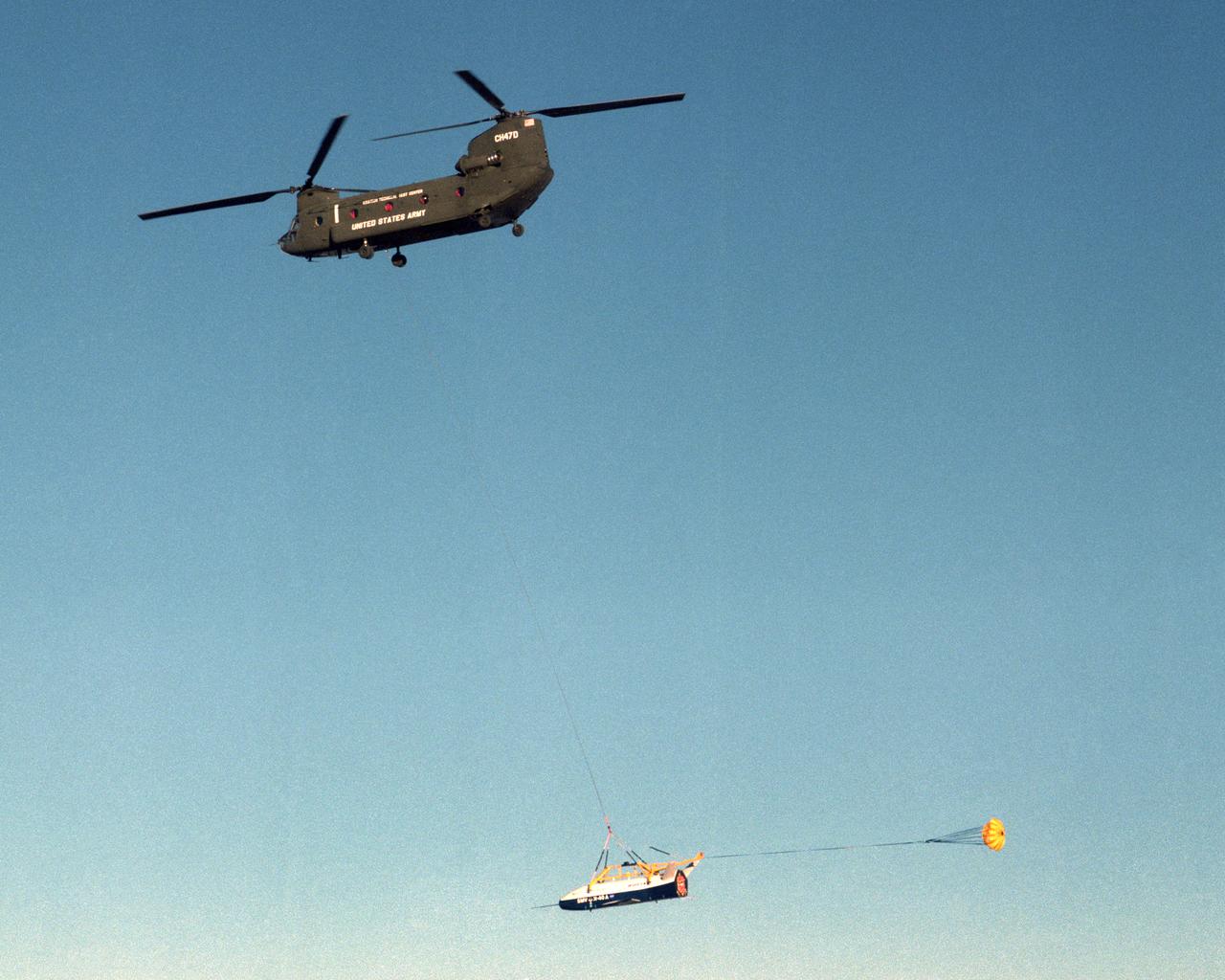
The X-40 sub-scale technology demonstrator is suspended under a U.S. Army CH-47 Chinook cargo helicopter during a captive-carry test flight at NASA's Dryden Flight Research Center, Edwards, California. The captive carry flights are designed to verify the X-40's navigation and control systems, rigging angles for its sling, and stability and control of the helicopter while carrying the X-40 on a tether. Following a series of captive-carry flights, the X-40 made free flights from a launch altitude of about 15,000 feet above ground, gliding to a fully autonomous landing. The X-40 is an unpowered 82 percent scale version of the X-37, a Boeing-developed spaceplane designed to demonstrate various advanced technologies for development of future lower-cost access to space vehicles.
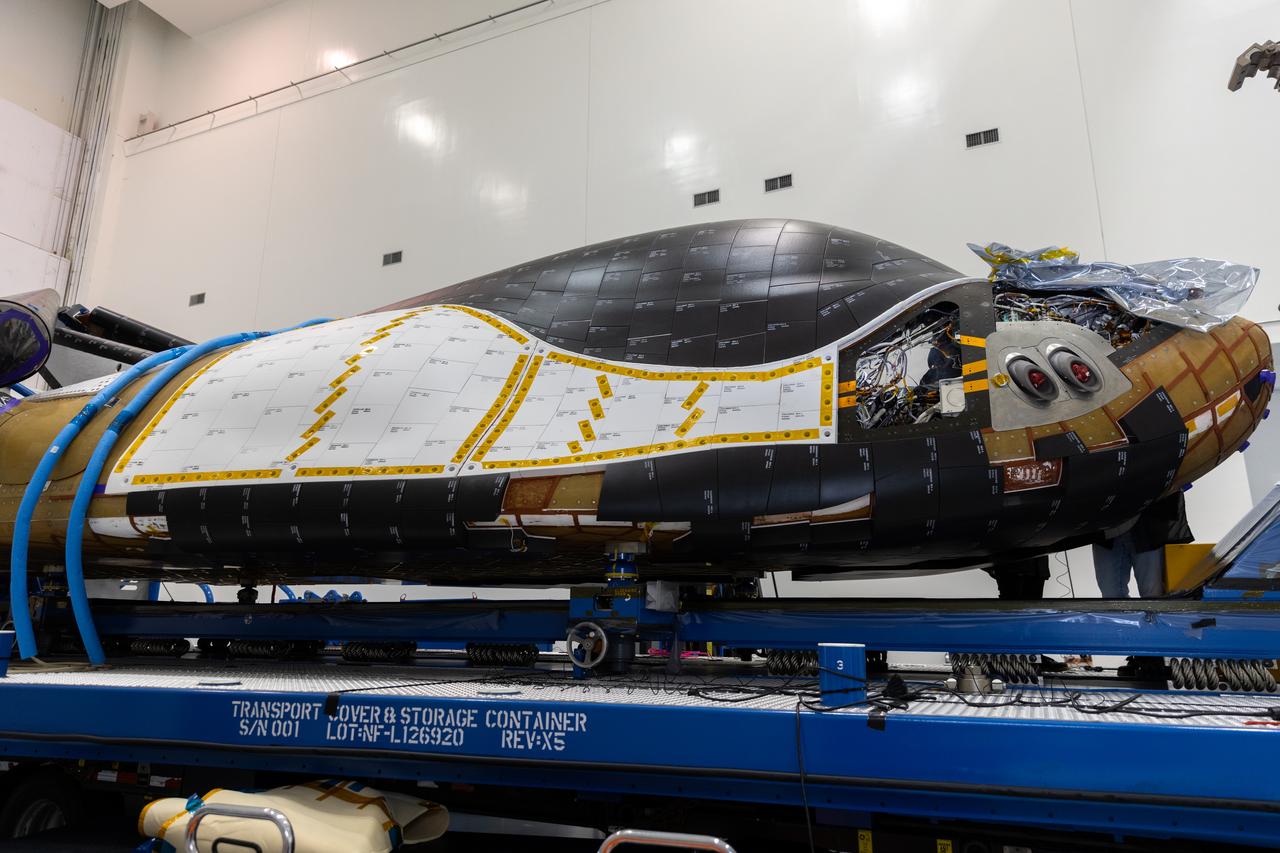
Dream Chaser Tenacity, Sierra Space's uncrewed cargo spaceplane is processed inside the Space Systems Processing Facility (SSPF) at NASA’s Kennedy Space Center in Florida on Monday, May 20, 2024, after arriving by truck inside a climate-controlled transportation container, completing the journey from the agency's Neil Armstrong Test Facility in Ohio. Dream Chaser Tenacity will undergo final testing and prelaunch processing inside the high bay of the SSPF ahead of its inaugural launch atop a ULA (United Launch Alliance) Vulcan rocket from nearby Cape Canaveral Space Force Station. The reusable transportation system is contracted to perform a minimum of seven cargo missions to the International Space Station as part of the agency’s efforts to expand commercial resupply services to low Earth orbit.
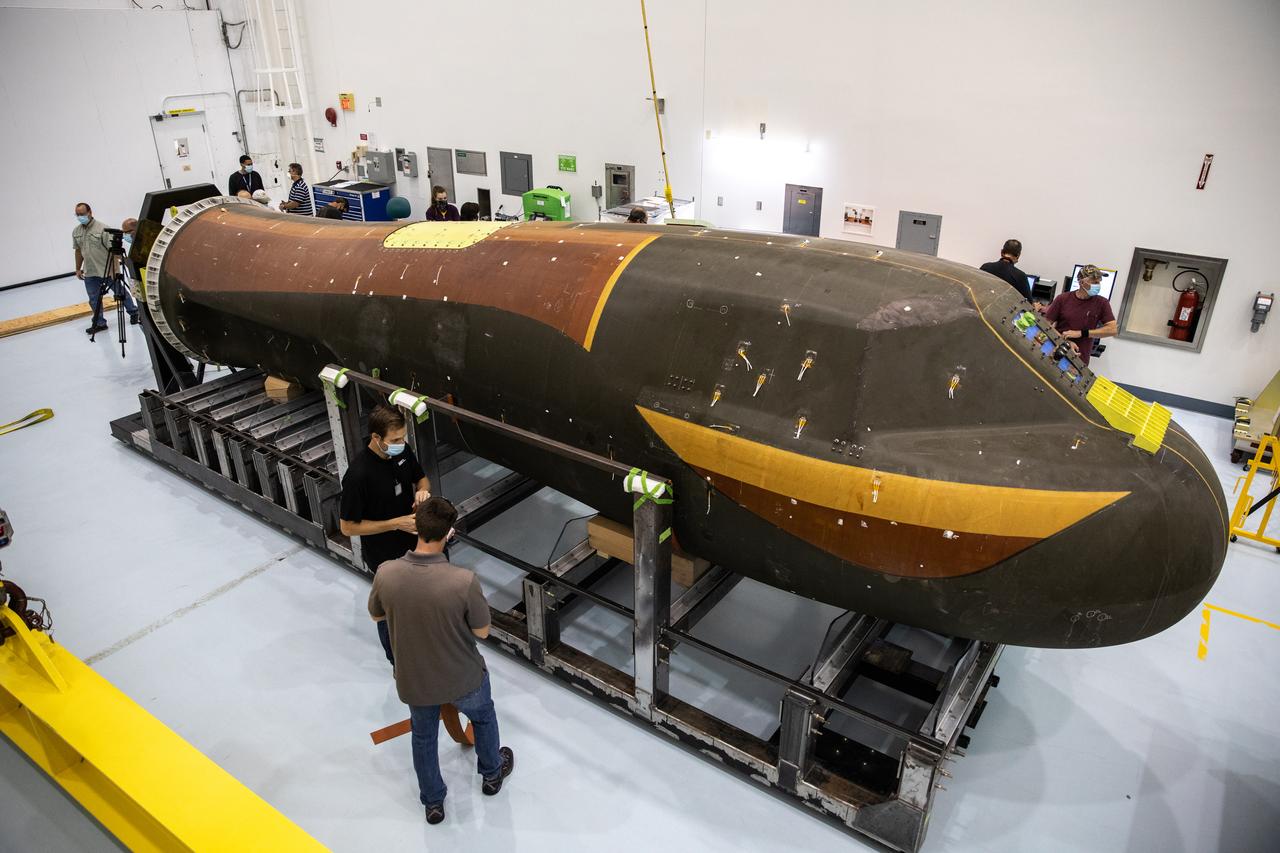
Inside the low bay of the Space Station Processing Facility at NASA’s Kennedy Space Center in Florida, workers assist as Sierra Nevada Corporation’s (SNC) Dream Chaser pressure test article on its support structure is lowered by crane on June 3, 2020, for its move into the high bay. The test article was shipped from Louisville, Colorado. It is similar to the actual pressurized cabin being used in the Dream Chaser spaceplane for Commercial Resupply Services-2 (CRS-2) missions. NASA selected Dream Chaser to provide cargo delivery, return and disposal service for the International Space Station under the CRS-2 contract. The test article will remain at Kennedy while SNC engineers use it to develop and verify refurbishment operations that will be used on Dream Chaser between flights.
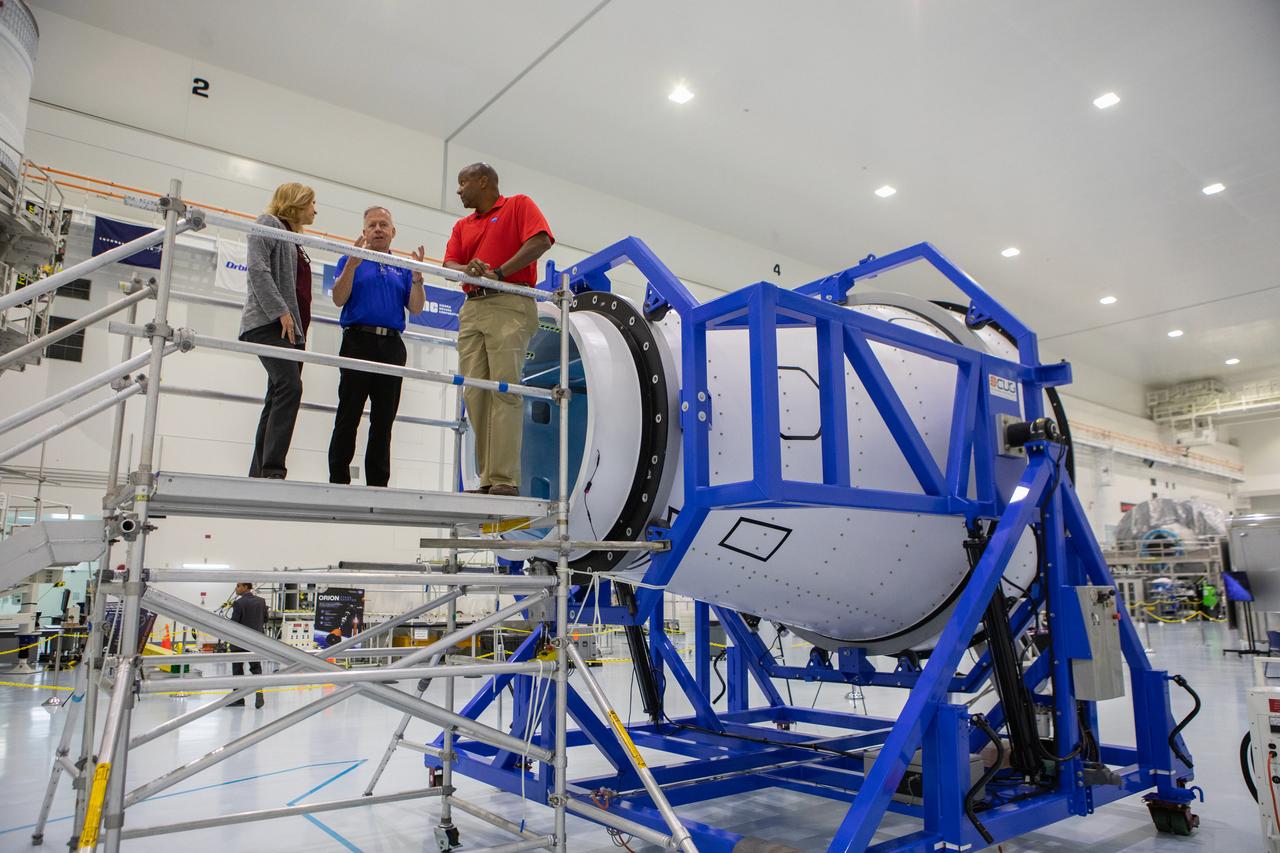
A mockup of the cargo logistics module for Sierra Nevada Corporation’s Dream Chaser, the company’s reusable spaceplane, arrived at the Space Station Processing Facility (SSPF) at NASA’s Kennedy Space Center in Florida in August. On Sept. 20, 2019, senior leadership had the opportunity to view the cargo module in the SSPF high bay. From left are Kennedy Deputy Director Janet Petro; Steve Lindsey, vice president, Space Exploration Systems, Sierra Nevada Corporation; and Kelvin Manning, Kennedy associate director, technical. The SSPF is providing support for current and future NASA and commercial provider programs, including Commercial Resupply Services, Artemis 1, sending the first woman and next man to the Moon, and deep space destinations including Mars.
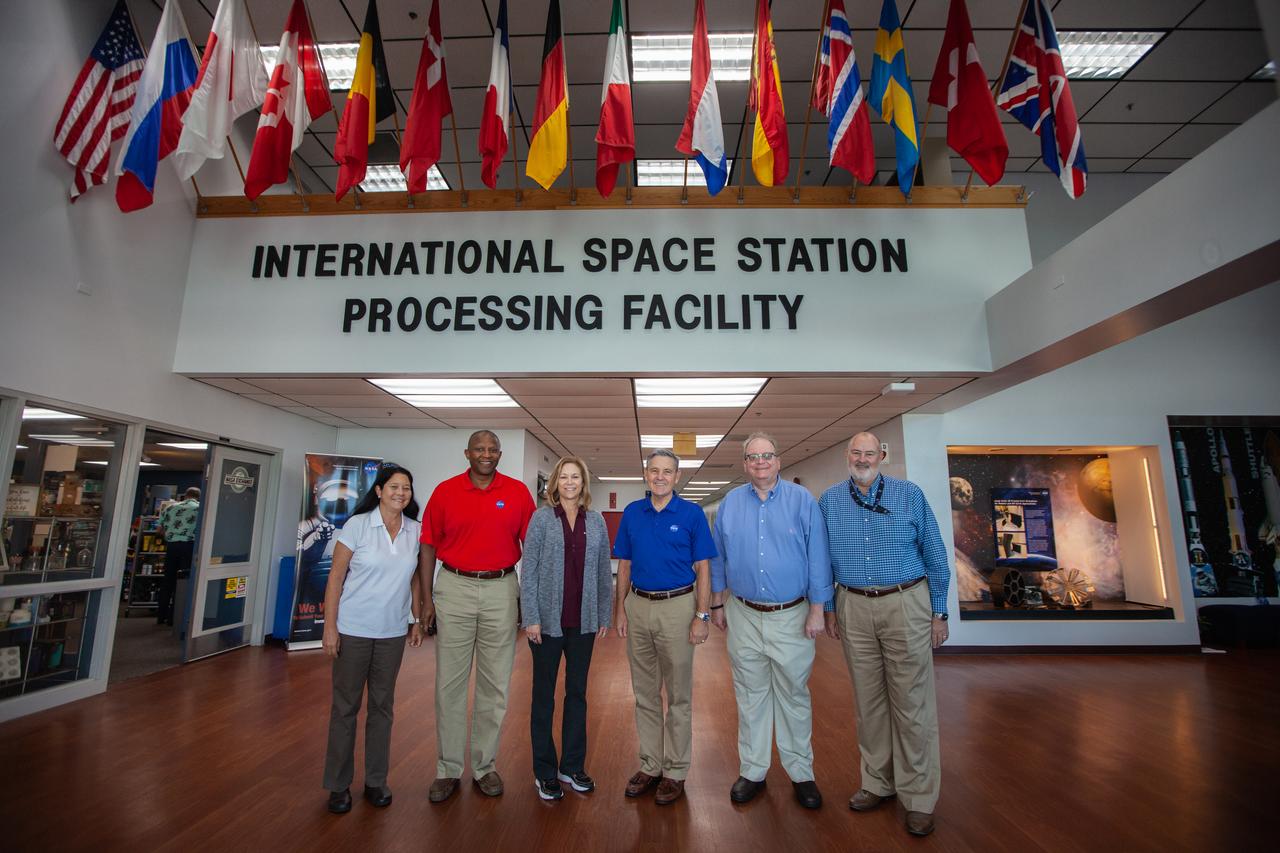
A mockup of the cargo logistics module for Sierra Nevada Corporation’s Dream Chaser, the company’s reusable spaceplane, arrived at the Space Station Processing Facility (SSPF) at NASA’s Kennedy Space Center in Florida in August. On Sept. 20, 2019, senior leadership had the opportunity to view the cargo module in the SSPF high bay. From left, are Josie Burnett, director of Exploration Research and Technology Programs; Kelvin Manning, Kennedy associate director, technical; Kennedy Deputy Director Janet Petro; Kennedy Center Director Bob Cabana; Burt Summerfield, Kennedy associate director, management; and Ronnie Lawson, deputy director of Exploration Research and Technology Programs. The SSPF is providing support for current and future NASA and commercial provider programs, including Commercial Resupply Services, Artemis 1, sending the first woman and next man to the Moon, and deep space destinations including Mars.

A mockup of the cargo logistics module for Sierra Nevada Corporation’s Dream Chaser, the company’s reusable spaceplane, arrived at the Space Station Processing Facility (SSPF) at NASA’s Kennedy Space Center in Florida in August. On Sept. 20, 2019, senior leadership had the opportunity to view the cargo module in the SSPF high bay. From left are Kelvin Manning, Kennedy associate director, technical; Steve Lindsey, vice president, Space Exploration Systems, Sierra Nevada Corporation; Kennedy Deputy Director Janet Petro; and Kennedy Center Director Bob Cabana. The SSPF is providing support for current and future NASA and commercial provider programs, including Commercial Resupply Services, Artemis 1, sending the first woman and next man to the Moon, and deep space destinations including Mars.
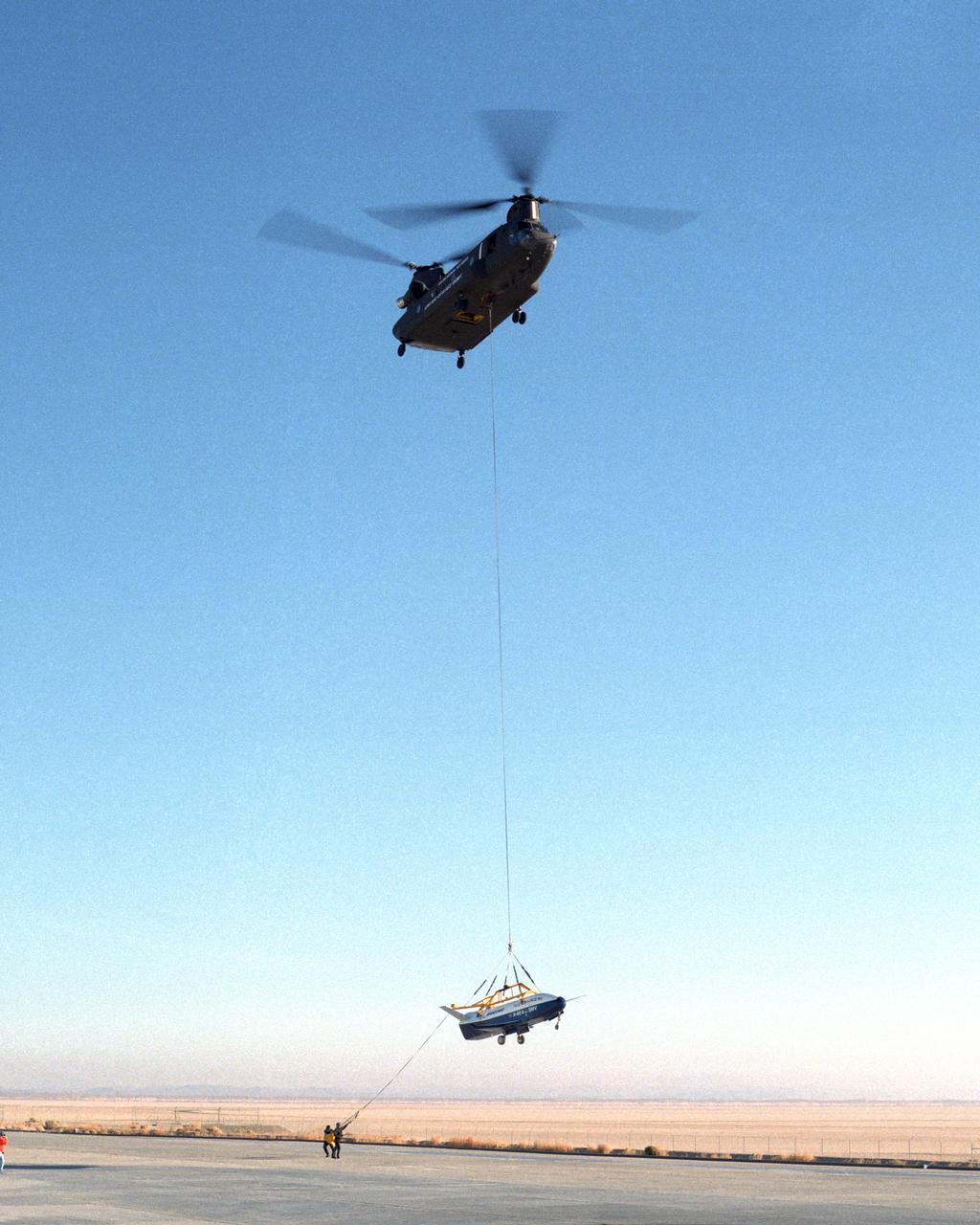
Ground crewmen help guide the alignment of the X-40 technology demonstrator as the experimental craft is gently lowered to the ground by a U.S. Army CH-47 Chinook cargo helicopter following a captive-carry test flight at NASA's Dryden Flight Research Center, Edwards, California. The X-40 is an unpowered 82 percent scale version of the X-37, a Boeing-developed spaceplane designed to demonstrate various advanced technologies for development of future lower-cost access to space vehicles. The X-37 will be carried into space aboard a space shuttle and then released to perform various maneuvers and a controlled re-entry through the Earth's atmosphere to an airplane-style landing on a runway, controlled entirely by pre-programmed computer software. Following a series of captive-carry flights, the X-40 made several free flights from a launch altitude of about 15,000 feet above ground, gliding to a fully autonomous landing. The captive carry flights helped verify the X-40's navigation and control systems, rigging angles for its sling, and stability and control of the helicopter while carrying the X-40 on a tether.
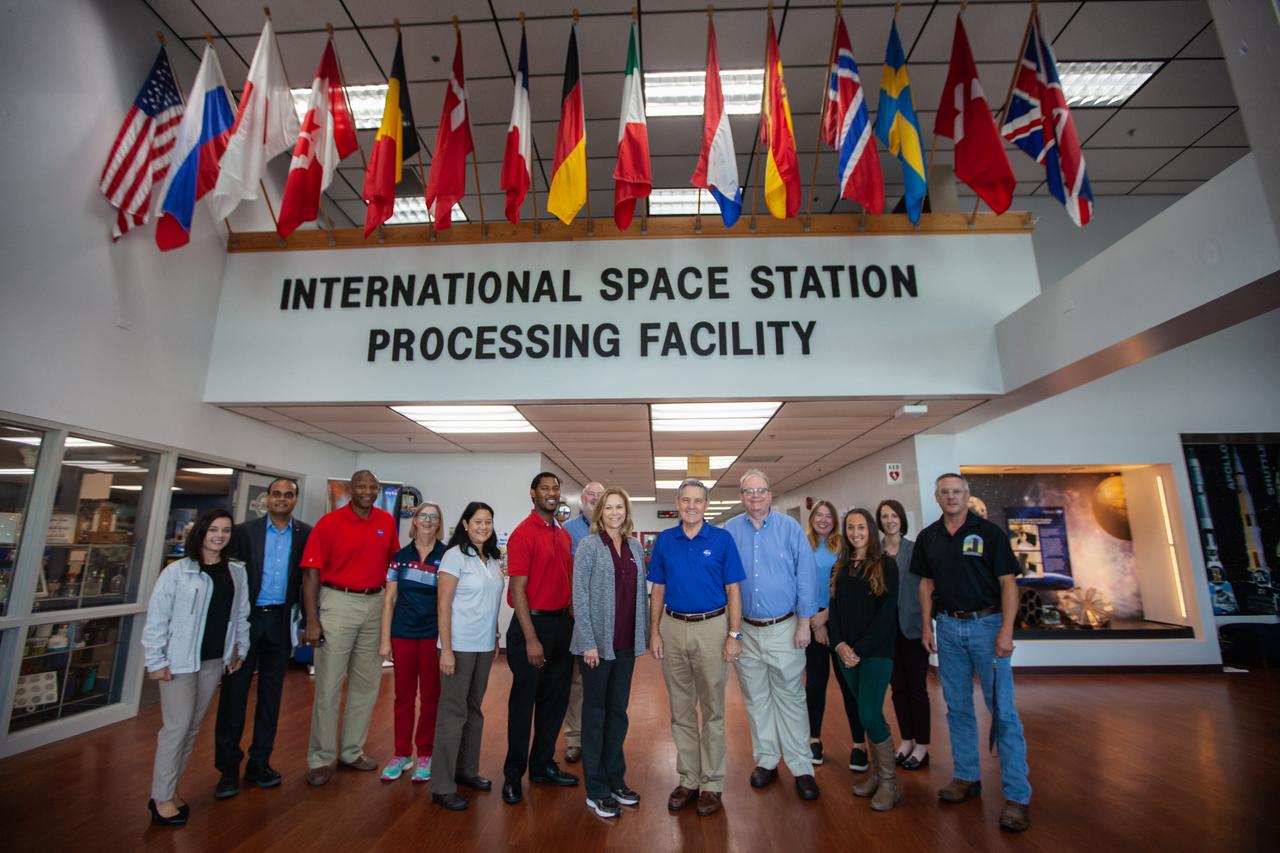
A mockup of the cargo logistics module for Sierra Nevada Corporation’s Dream Chaser, the company’s reusable spaceplane, arrived at the Space Station Processing Facility (SSPF) at NASA’s Kennedy Space Center in Florida in August. On Sept. 20, 2019, senior leadership had the opportunity to view the cargo module in the SSPF high bay. Third from left is Kelvin Manning, Kennedy associate director, technical; fifth from left is Josie Burnett, director of Exploration Research and Technology Programs. In the center are Kennedy Deputy Director Janet Petro and Kennedy Center Director Bob Cabana. Behind Petro is Ronnie Lawson, deputy director of Exploration Research and Technology Programs. To Cabana’s right is Burt Summerfield, associate director, management. At far right is James Wood, chief engineer for the Launch Services Program with the Engineering Directorate. The SSPF is providing support for current and future NASA and commercial provider programs, including Commercial Resupply Services, Artemis 1, sending the first woman and next man to the Moon, and deep space destinations including Mars.
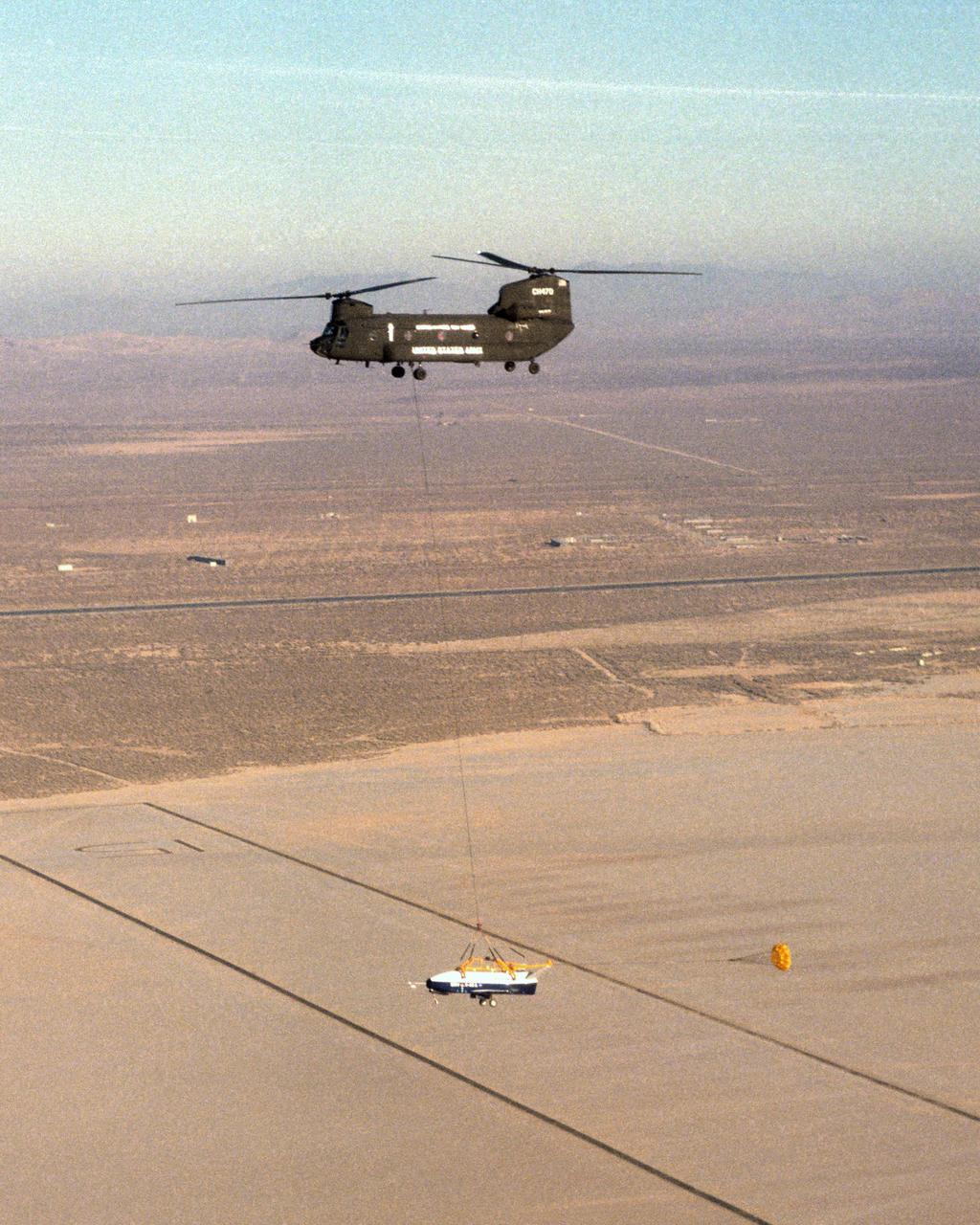
The X-40 sub-scale technology demonstrator and its U.S. Army CH-47 Chinook helicopter mothership fly over a dry lakebed runway during a captive-carry test flight from NASA's Dryden Flight Research Center, Edwards, California. The X-40 is attached to a sling which is suspended from the CH-47 by a 110-foot-long cable during the tests, while a small parachute trails behind to provide stability. The captive carry flights are designed to verify the X-40's navigation and control systems, rigging angles for its sling, and stability and control of the helicopter while carrying the X-40 on a tether. Following a series of captive-carry flights, the X-40 made free flights from a launch altitude of about 15,000 feet above ground, gliding to a fully autonomous landing. The X-40 is an unpowered 82 percent scale version of the X-37, a Boeing-developed spaceplane designed to demonstrate various advanced technologies for development of future lower-cost access to space vehicles.
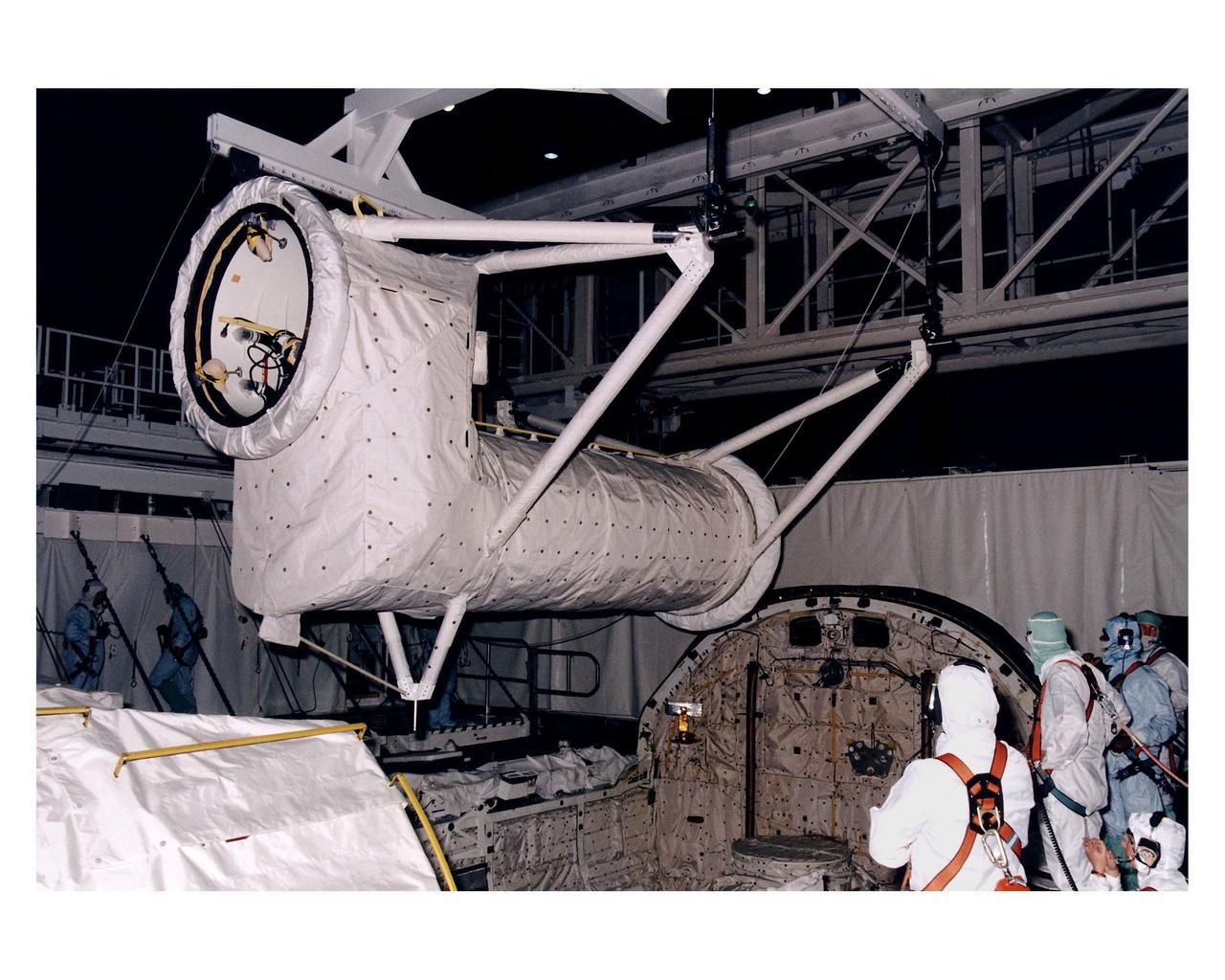
The Spacelab long transfer tunnel that leads from the Space Shuttle Orbiter Columbia’s crew airlock to the Microgravity Science Laboratory-1 (MSL-1) Spacelab module in the spaceplane’s payload bay is removed in Orbiter Processing Facility 1. The tunnel was taken out to allow better access to the MSL-1 module during reservicing operations to prepare it for its reflight as MSL-1R. That mission is now scheduled to lift off July 1. This was the first time that this type of payload was reserviced without removing it from the payload bay. This new procedure pioneers processing efforts for quick relaunch turnaround times for future payloads. The Spacelab module was scheduled to fly again with the full complement of STS-83 experiments after that mission was cut short due to a faulty fuel cell. During the scheduled 16-day reflight, the experiments will be used to test some of the hardware, facilities and procedures that are planned for use on the International Space Station while the flight crew conducts combustion, protein crystal growth and materials processing experiments