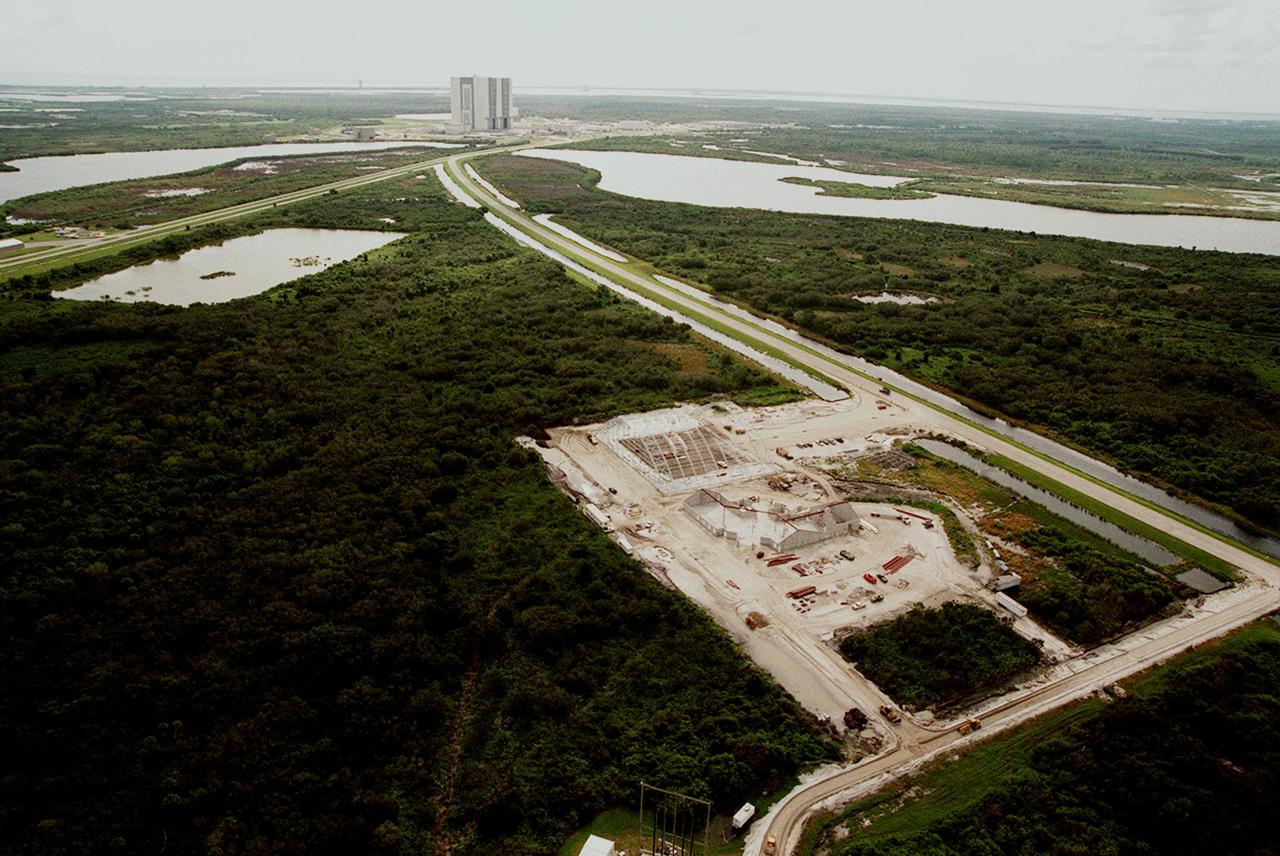
An aerial view reveals (foreground) the ongoing construction of an $8 million Reusable Launch Vehicle (RLV) Support Complex at Kennedy Space Center. At left is a multi-purpose hangar and at right a building for related ground support equipment and administrative/ technical support. In the background is the Vehicle Assembly Building. The road at right is the tow-way. The RLV complex will be available to accommodate the Space Shuttle; the X-34 RLV technology demonstrator; the L-1011 carrier aircraft for Pegasus and X-34; and other RLV and X-vehicle programs. The complex is jointly funded by the Spaceport Florida Authority, NASA's Space Shuttle Program and KSC. The facility will be operational in early 2000.
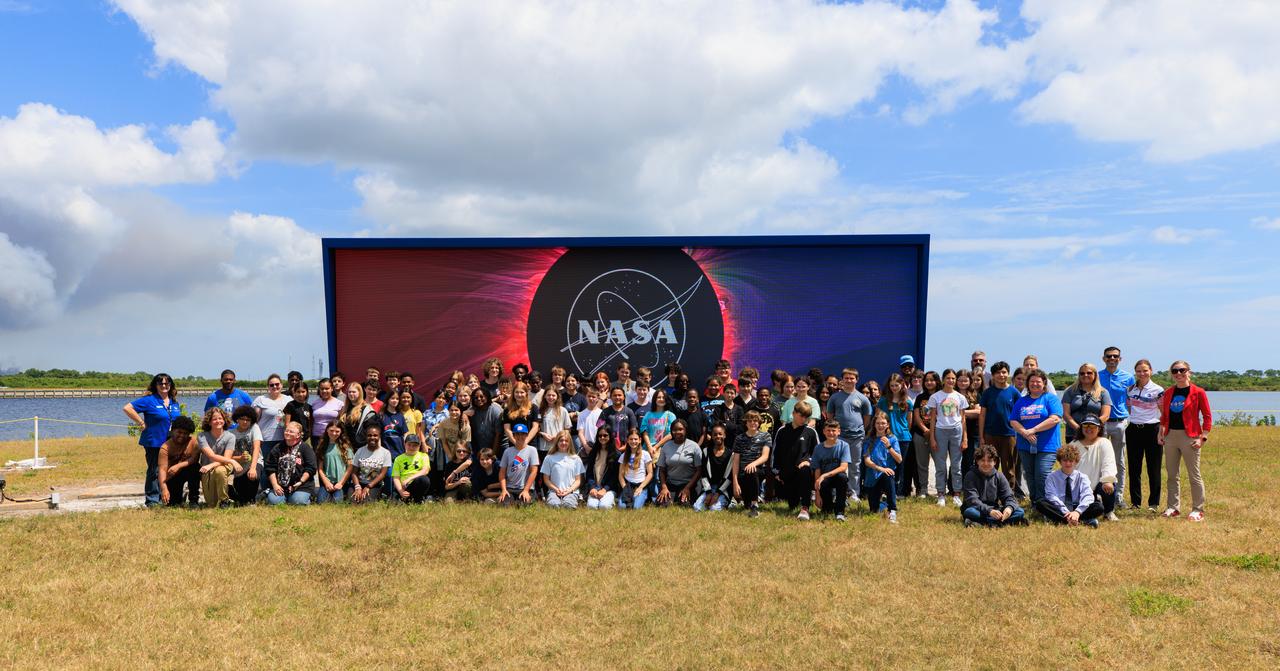
Students from Andrew Jackson Middle School in Titusville, Florida, pose for a photo in front of the iconic countdown clock at NASA’s Kennedy Space Center in Florida on Tuesday, April 2, 2024. As part of the agency’s NextGen STEM project, the students joined others from across the country who participated virtually for an environmentally focused Earth Day briefing held inside Kennedy’s news auditorium to discuss how technology and science coexist with nature at the spaceport.

Students from Andrew Jackson Middle School in Titusville, Florida, pose for a photo with one of the Artemis crew transportation vehicles in front of the Vehicle Assembly Building at NASA’s Kennedy Space Center in Florida on Tuesday, April 2, 2024. As part of NASA’s NextGen STEM project, the students joined others from across the country who participated virtually for an environmentally focused Earth Day briefing held inside Kennedy’s news auditorium to discuss how technology and science coexist with nature at the spaceport.
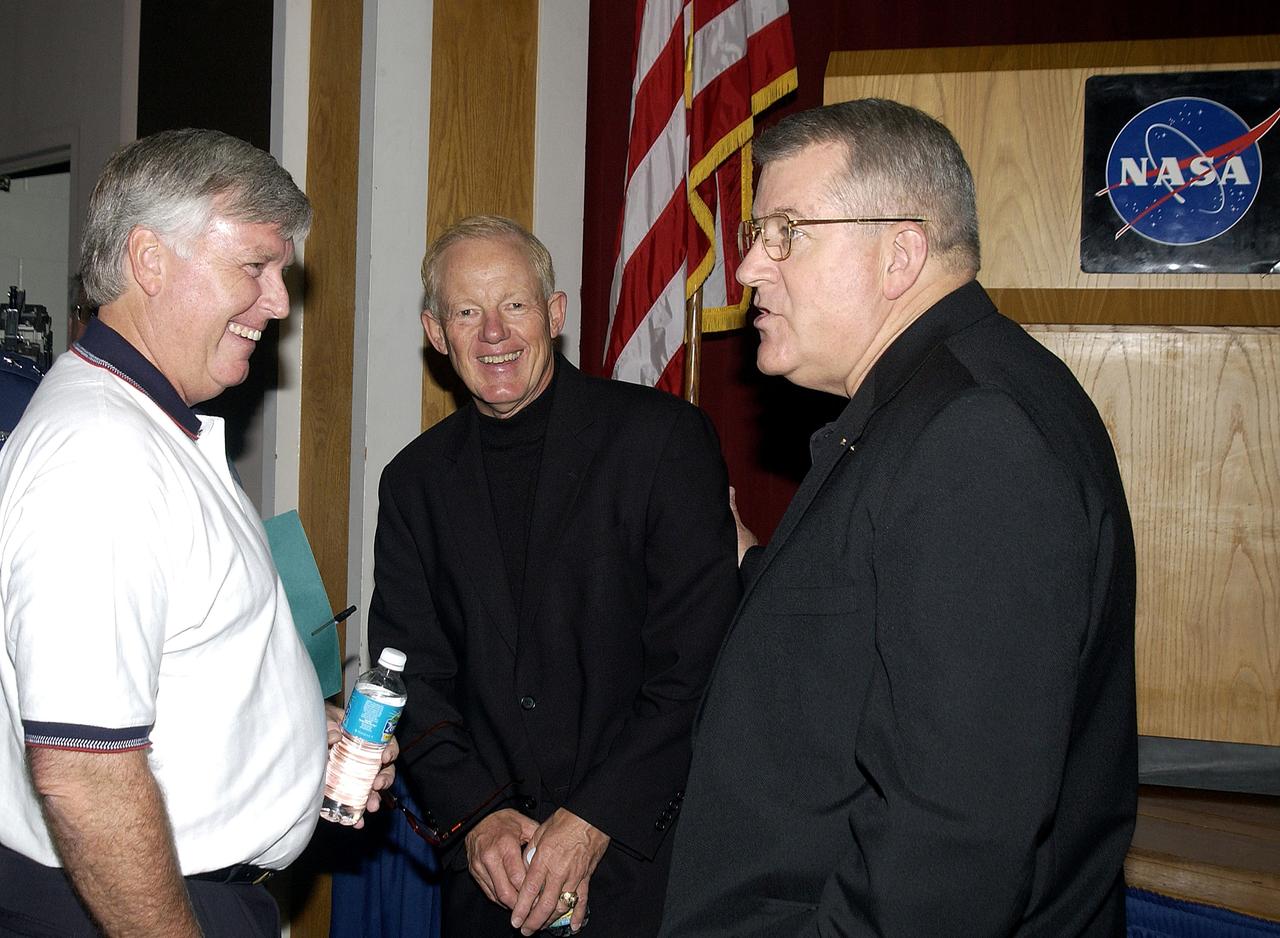
KENNEDY SPACE CENTER, FLA. - Before the start of the kickoff presentation for Spaceport Super Safety and Health Day, Center Director Jim Kennedy (left) chats with guest speaker Capt. Charles Plumb (USNR retired) and United Space Alliance Vice President and Deputy Program Manager, Florida Operations, Bill Pickavance. Spaceport Super Safety and Health Day is an annual event at KSC and Cape Canaveral Air Force Station dedicated to reinforcing safe and healthful behaviors in the workforce. Safety Awards were also given to individuals and groups.
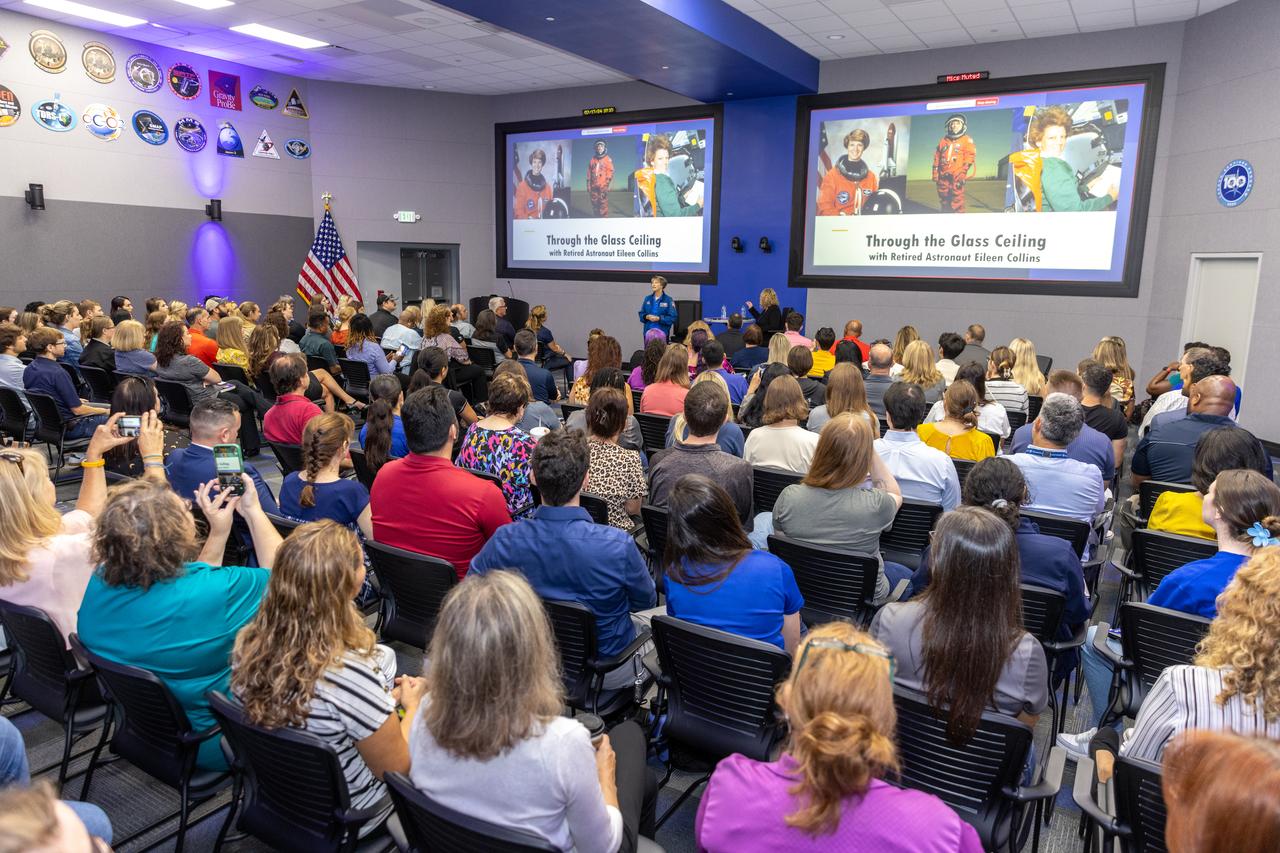
Retired NASA astronaut Eileen Collins participates in a special presentation and question and answer session inside the Neil A. Armstrong Operations and Checkout Building’s Mission Briefing Room at the agency’s Kennedy Space Center in Florida on Wednesday, July 17, 2024. Collins visited NASA Kennedy in celebration of the 25th anniversary of becoming the first woman to command a space mission during STS-93, in which space shuttle Columbia lifted off from the spaceport’s Launch Complex 39B on July 23, 1999.
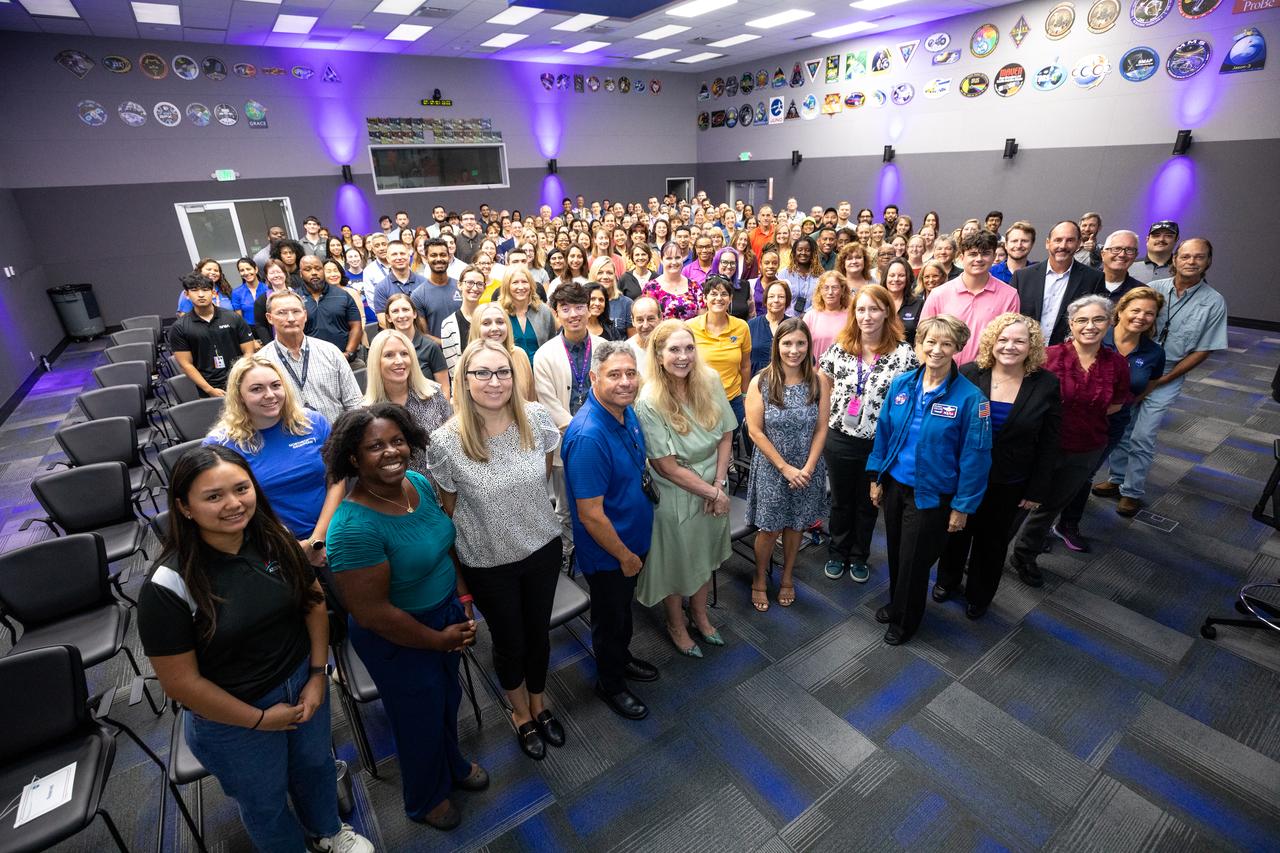
Retired NASA astronaut Eileen Collins poses with NASA employees and contractors after participating in a special presentation and question and answer session inside the Neil A. Armstrong Operations and Checkout Building’s Mission Briefing Room at the agency’s Kennedy Space Center in Florida on Wednesday, July 17, 2024. Collins visited NASA Kennedy in celebration of the 25th anniversary of becoming the first woman to command a space mission during STS-93, in which space shuttle Columbia lifted off from the spaceport’s Launch Complex 39B on July 23, 1999.

Teams from NASA’s Kennedy Space Center in Florida integrate NASA’s Artemis III SLS (Space Launch System) core stage engine section with its boat-tail inside the spaceport’s Vehicle Assembly Building on Wednesday, July 30, 2025. The boat-tail is a fairing-like structure that protects the bottom end of the core stage, while the engine section is one the most complex and intricate parts of the rocket stage that will help power the Artemis missions to the Moon.
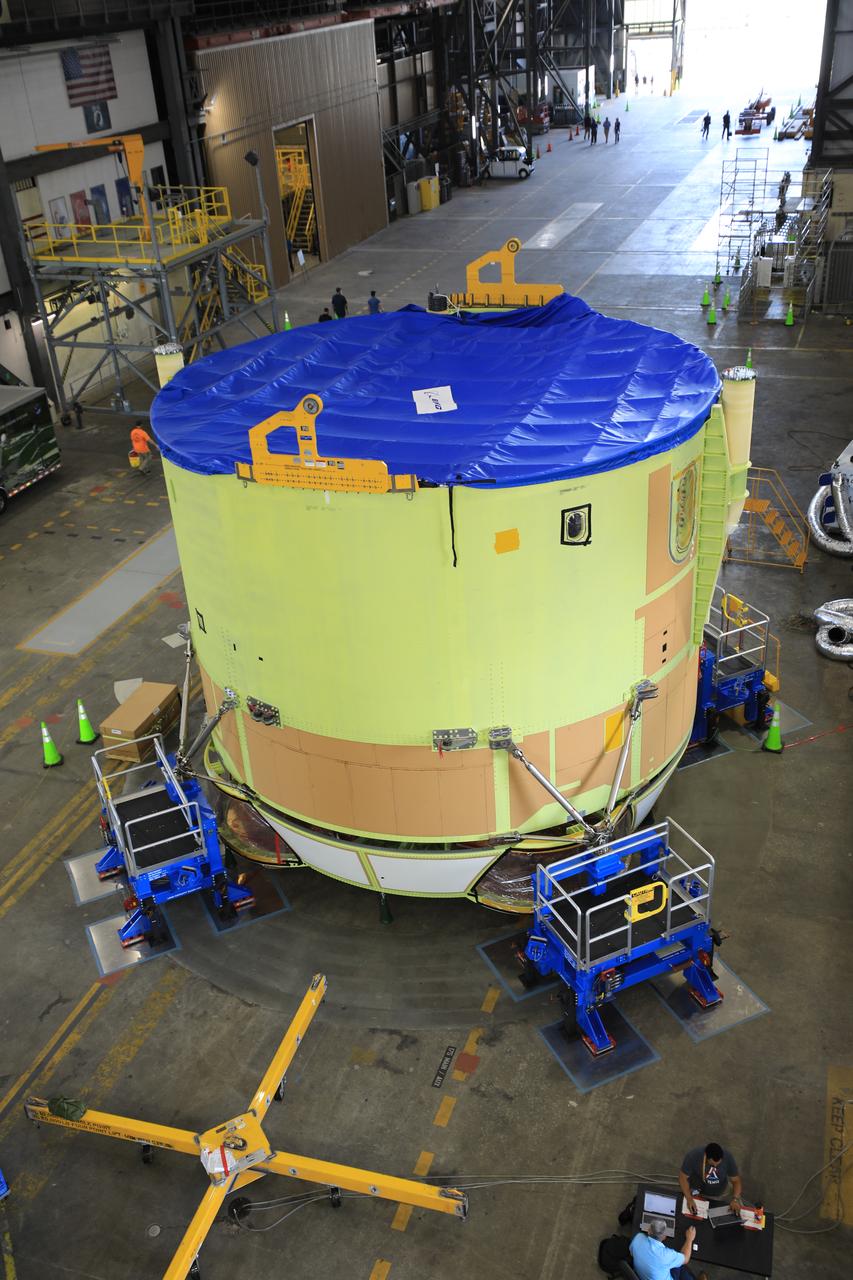
Teams from NASA’s Kennedy Space Center in Florida integrate NASA’s Artemis III SLS (Space Launch System) core stage engine section with its boat-tail inside the spaceport’s Vehicle Assembly Building on Wednesday, July 30, 2025. The boat-tail is a fairing-like structure that protects the bottom end of the core stage, while the engine section is one the most complex and intricate parts of the rocket stage that will help power the Artemis missions to the Moon.
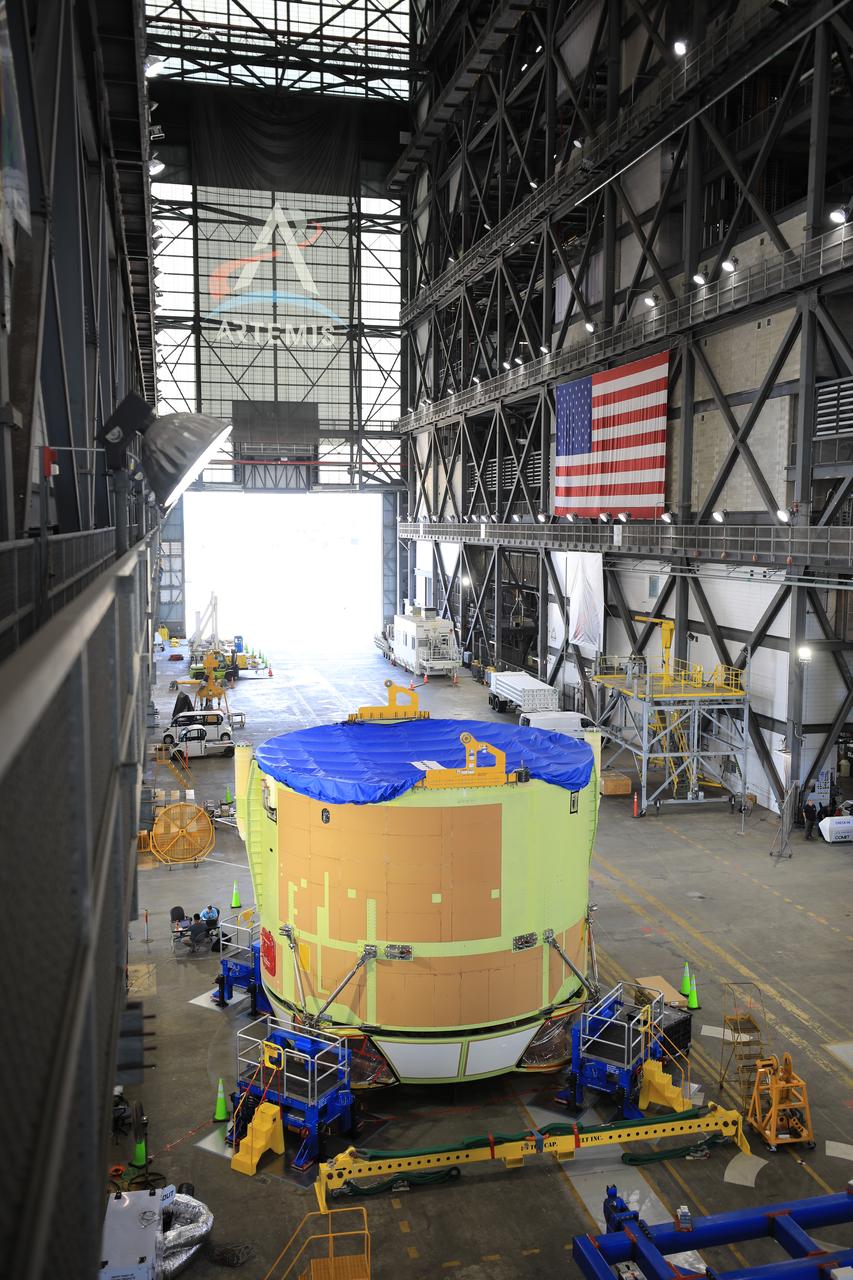
Teams from NASA’s Kennedy Space Center in Florida integrate NASA’s Artemis III SLS (Space Launch System) core stage engine section with its boat-tail inside the spaceport’s Vehicle Assembly Building on Wednesday, July 30, 2025. The boat-tail is a fairing-like structure that protects the bottom end of the core stage, while the engine section is one the most complex and intricate parts of the rocket stage that will help power the Artemis missions to the Moon.
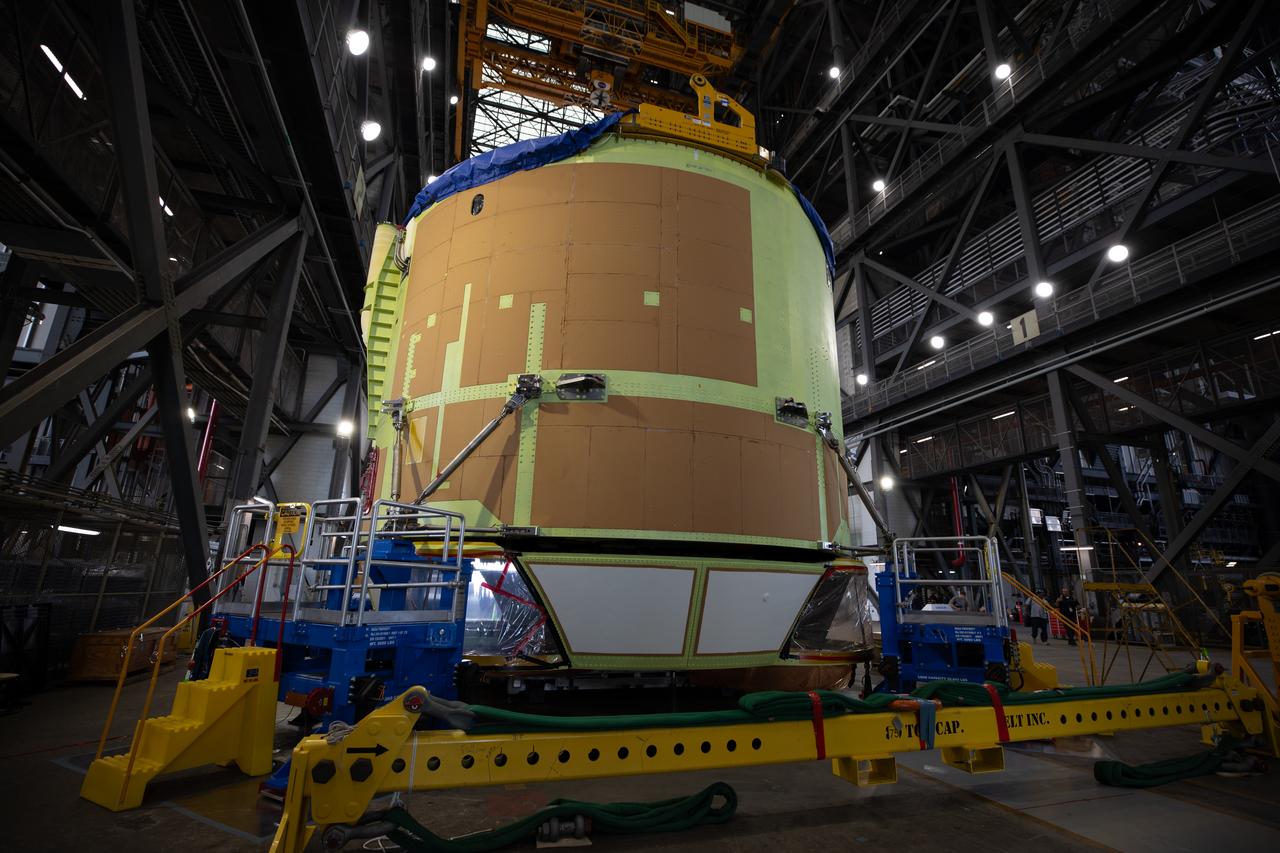
Teams from NASA’s Kennedy Space Center in Florida integrate NASA’s Artemis III SLS (Space Launch System) core stage engine section with its boat-tail inside the spaceport’s Vehicle Assembly Building on Wednesday, July 30, 2025. The boat-tail is a fairing-like structure that protects the bottom end of the core stage, while the engine section is one the most complex and intricate parts of the rocket stage that will help power the Artemis missions to the Moon.
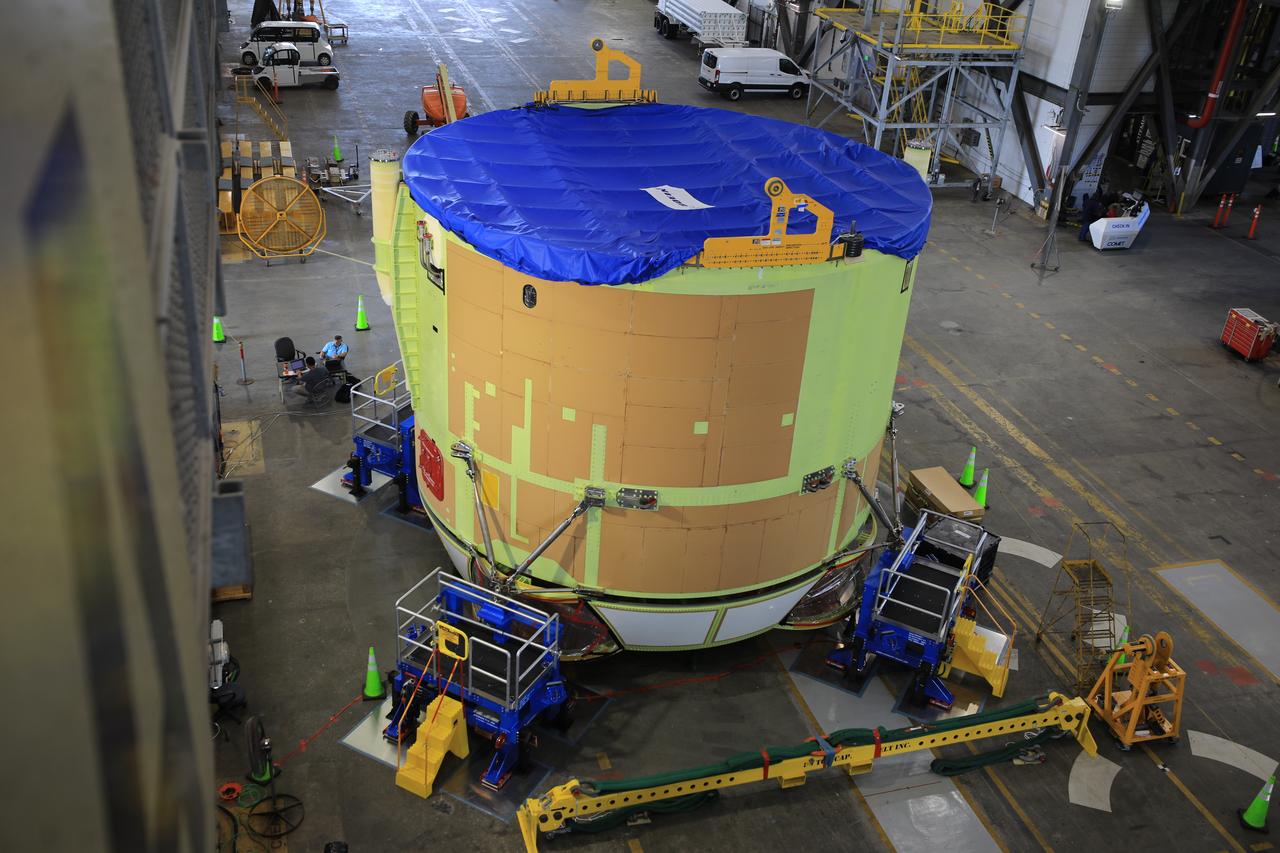
Teams from NASA’s Kennedy Space Center in Florida integrate NASA’s Artemis III SLS (Space Launch System) core stage engine section with its boat-tail inside the spaceport’s Vehicle Assembly Building on Wednesday, July 30, 2025. The boat-tail is a fairing-like structure that protects the bottom end of the core stage, while the engine section is one the most complex and intricate parts of the rocket stage that will help power the Artemis missions to the Moon.
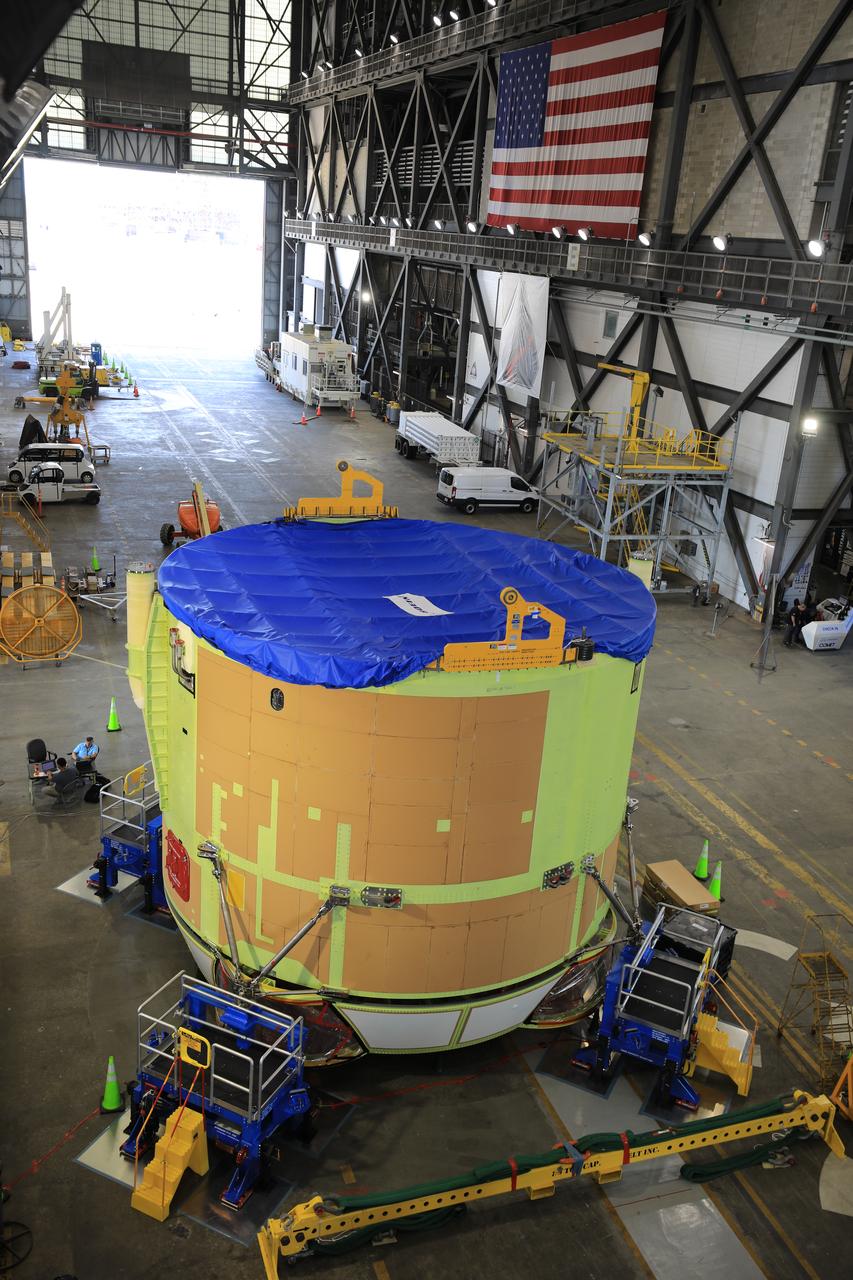
Teams from NASA’s Kennedy Space Center in Florida integrate NASA’s Artemis III SLS (Space Launch System) core stage engine section with its boat-tail inside the spaceport’s Vehicle Assembly Building on Wednesday, July 30, 2025. The boat-tail is a fairing-like structure that protects the bottom end of the core stage, while the engine section is one the most complex and intricate parts of the rocket stage that will help power the Artemis missions to the Moon.
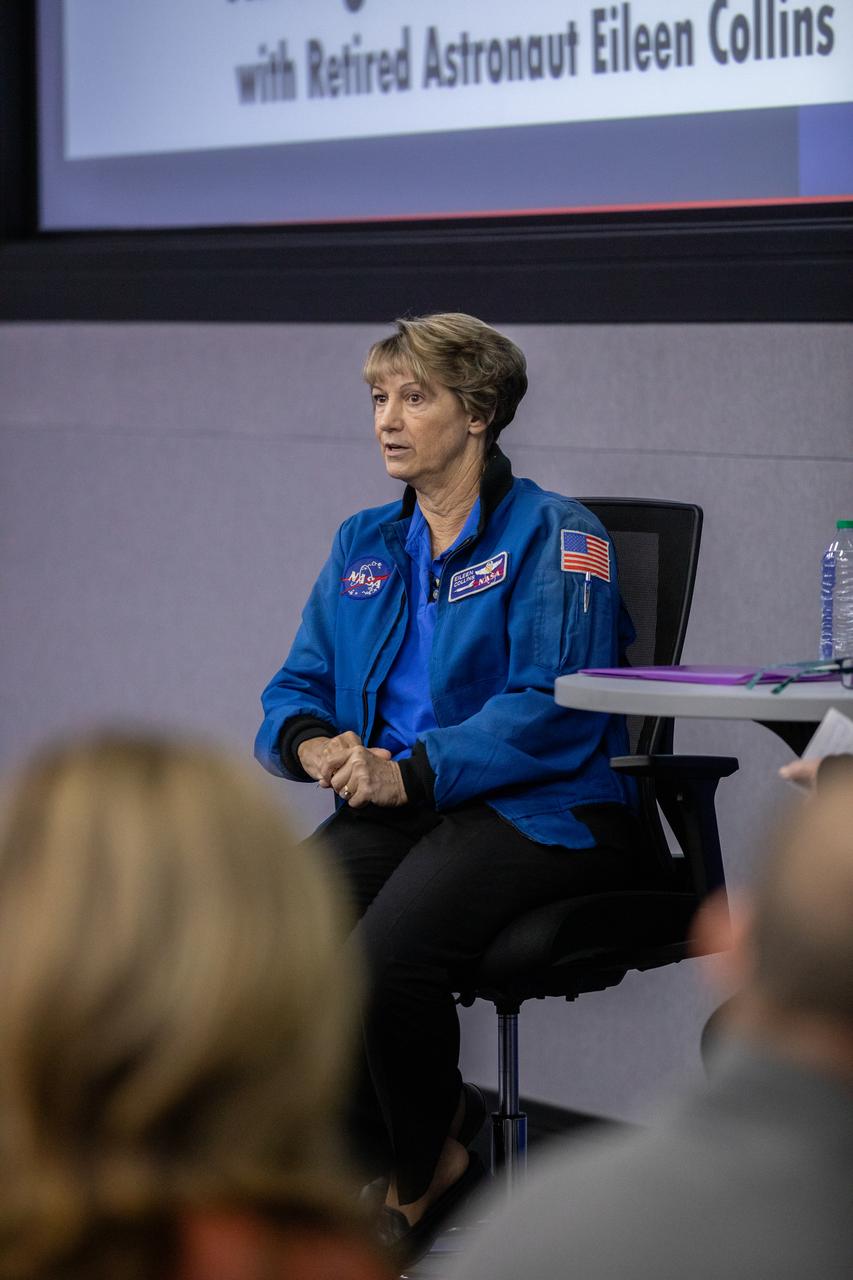
Retired NASA astronaut Eileen Collins participates in a special presentation and question and answer session inside the Neil A. Armstrong Operations and Checkout Building’s Mission Briefing Room at the agency’s Kennedy Space Center in Florida on Wednesday, July 17, 2024. Collins visited NASA Kennedy in celebration of the 25th anniversary of becoming the first woman to command a space mission during STS-93, in which space shuttle Columbia lifted off from the spaceport’s Launch Complex 39B on July 23, 1999.

Teams from NASA’s Kennedy Space Center in Florida integrate NASA’s Artemis III SLS (Space Launch System) core stage engine section with its boat-tail inside the spaceport’s Vehicle Assembly Building on Wednesday, July 30, 2025. The boat-tail is a fairing-like structure that protects the bottom end of the core stage, while the engine section is one the most complex and intricate parts of the rocket stage that will help power the Artemis missions to the Moon.
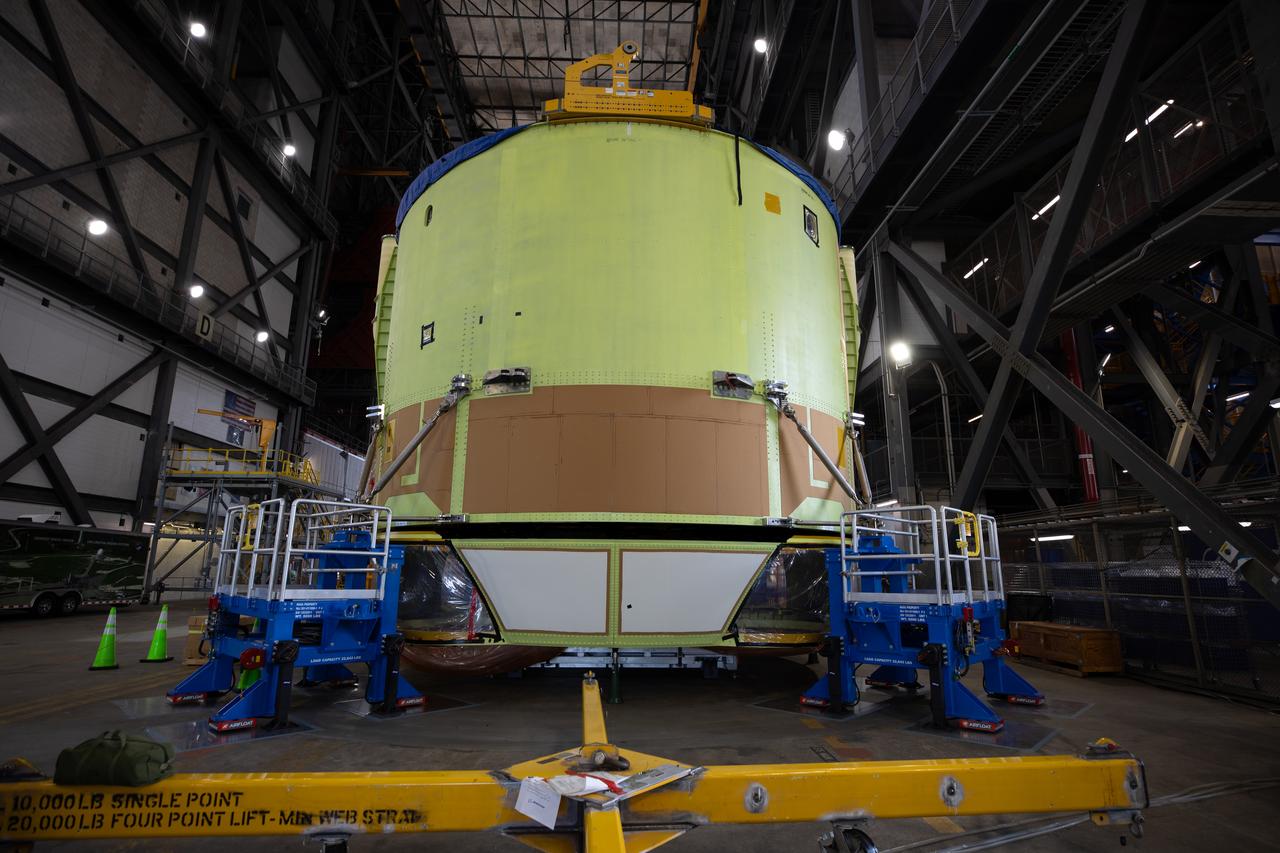
Teams from NASA’s Kennedy Space Center in Florida integrate NASA’s Artemis III SLS (Space Launch System) core stage engine section with its boat-tail inside the spaceport’s Vehicle Assembly Building on Wednesday, July 30, 2025. The boat-tail is a fairing-like structure that protects the bottom end of the core stage, while the engine section is one the most complex and intricate parts of the rocket stage that will help power the Artemis missions to the Moon.
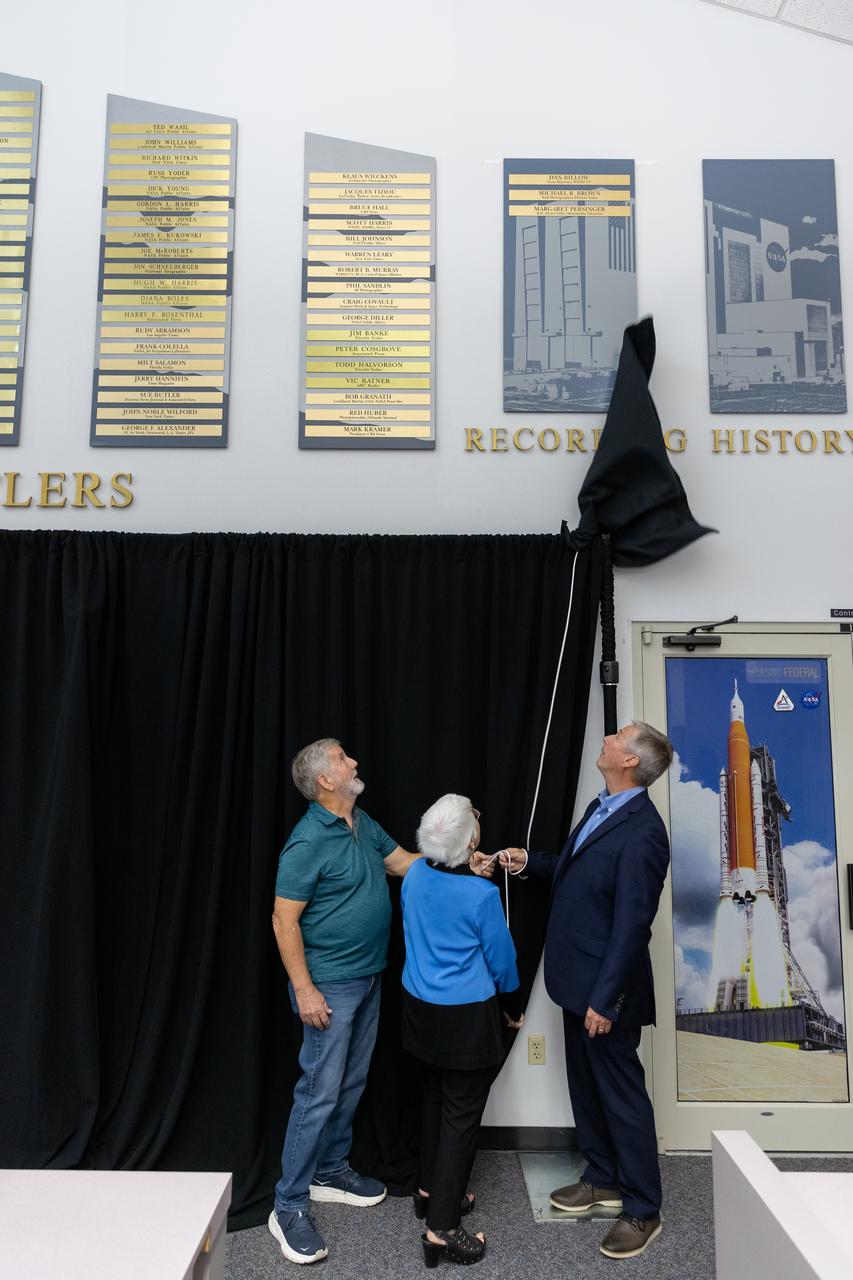
Mike Brown, Maggie Persinger, and Dan Billow were honored May 15, 2024, during the 2024 Kennedy Chroniclers ceremony at the Press Site at NASA’s Kennedy Space Center in Florida. Three brass plates bearing their names were added to the wall of the “bull pen,” where reporters traditionally gather to cover launches and events at NASA Kennedy. The three were honored for their efforts in helping tell the story of America’s space program, primarily from the Florida spaceport. They were nominated by their peers and selected by a panel of NASA officials and current space reporters.
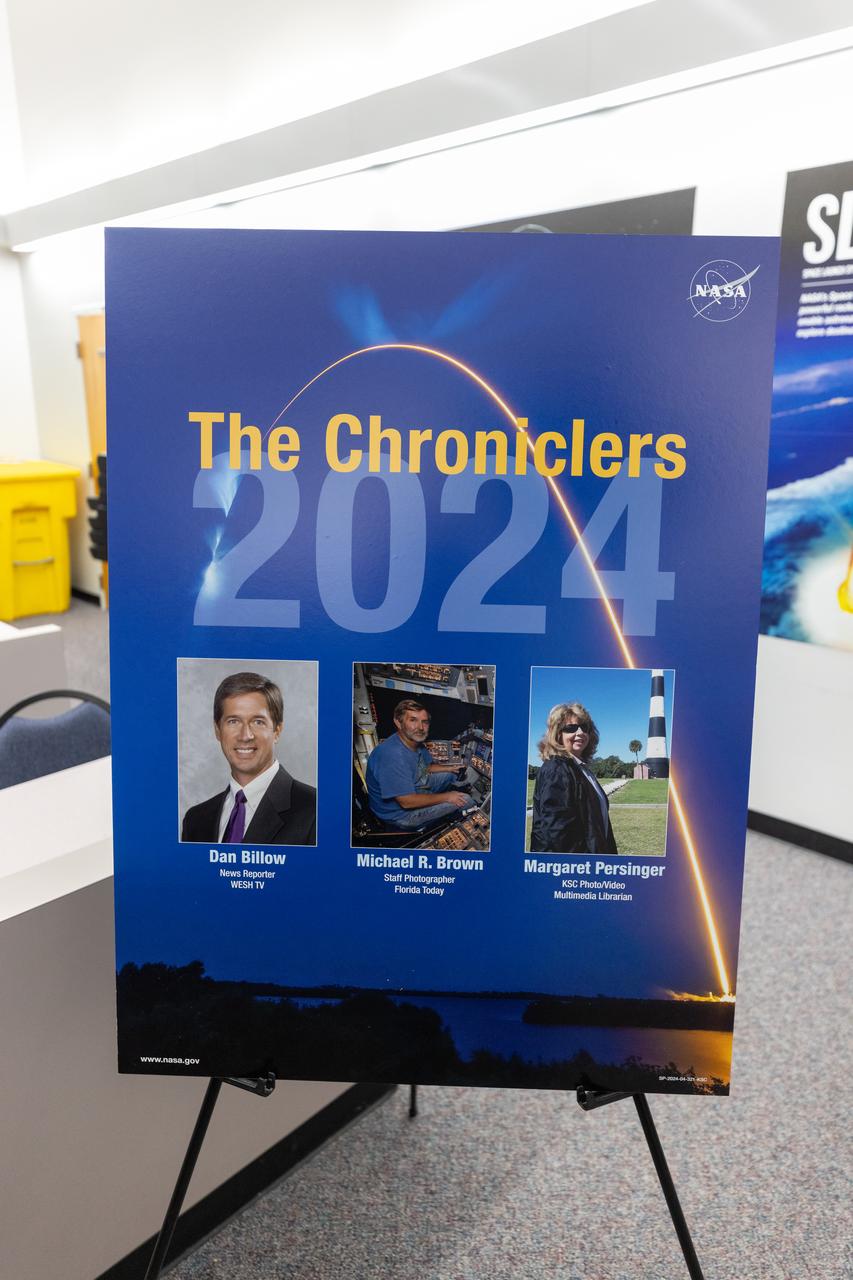
Dan Billow, Mike Brown, and Maggie Persinger were honored May 15, 2024, during the 2024 Kennedy Chroniclers ceremony at the Press Site at NASA’s Kennedy Space Center in Florida. Three brass plates bearing their names were added to the wall of the “bull pen,” where reporters traditionally gather to cover launches and events at NASA Kennedy. The three were honored for their efforts in helping tell the story of America’s space program, primarily from the Florida spaceport. They were nominated by their peers and selected by a panel of NASA officials and current space reporters.
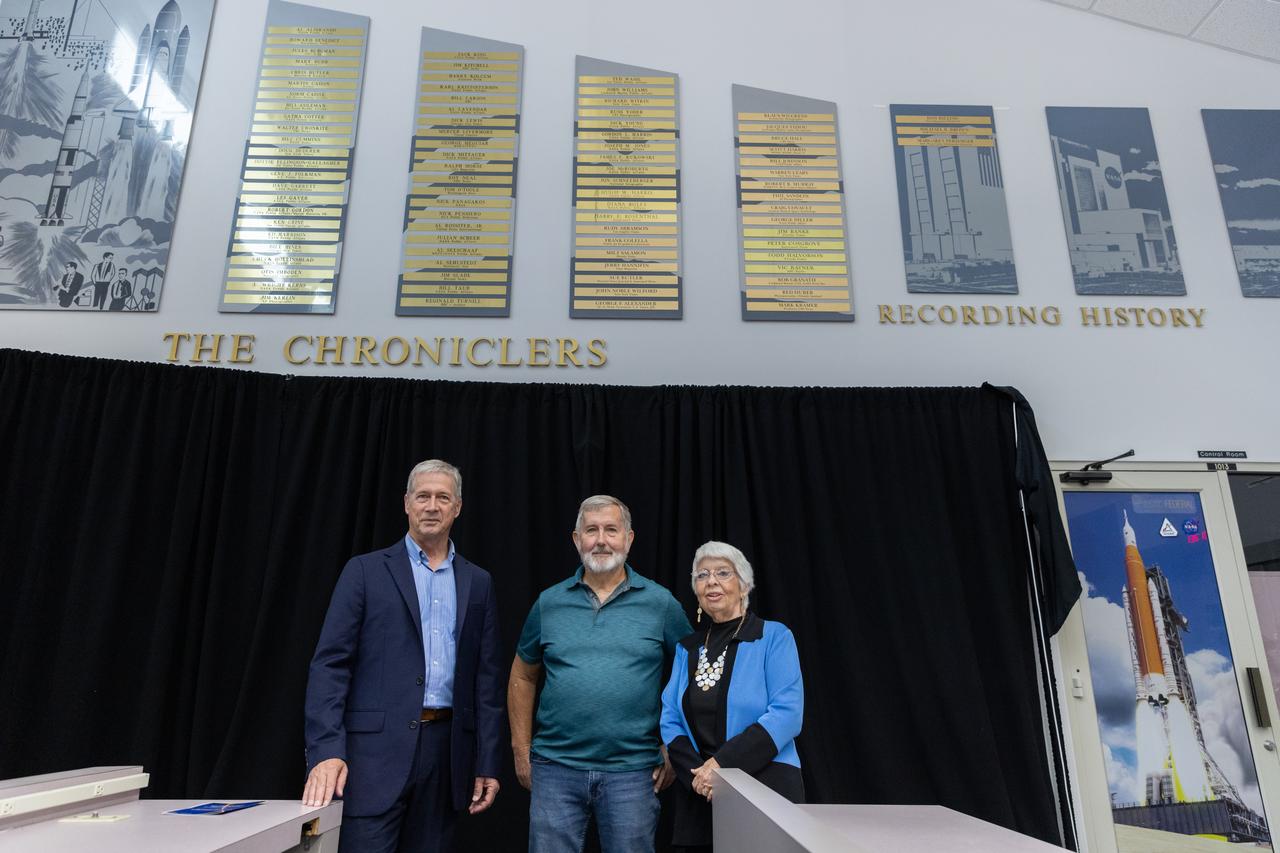
Dan Billow, Mike Brown, and Maggie Persinger were honored May 15, 2024, during the 2024 Kennedy Chroniclers ceremony at the Press Site at NASA’s Kennedy Space Center in Florida. Three brass plates bearing their names were added to the wall of the “bull pen,” where reporters traditionally gather to cover launches and events at NASA Kennedy. The three were honored for their efforts in helping tell the story of America’s space program, primarily from the Florida spaceport. They were nominated by their peers and selected by a panel of NASA officials and current space reporters.
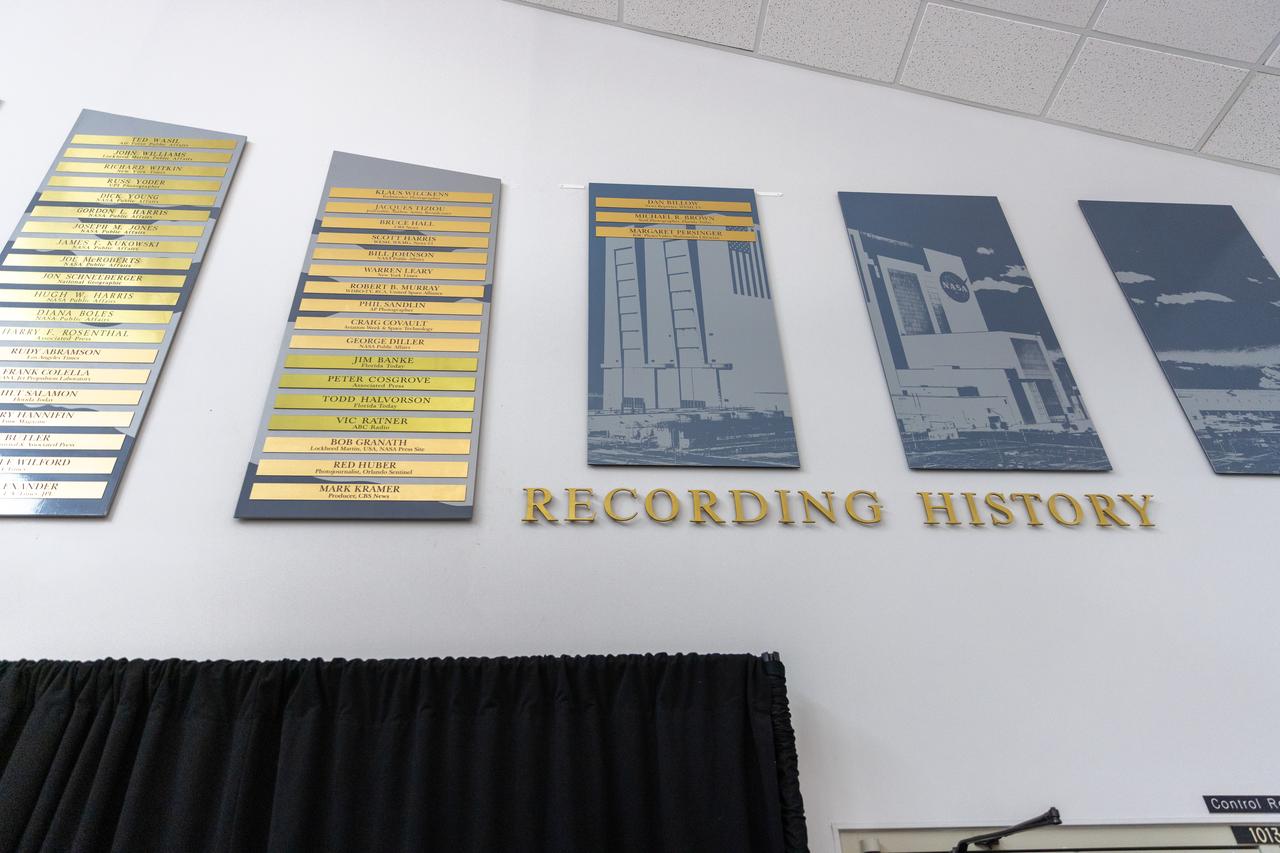
Dan Billow, Mike Brown, and Maggie Persinger were honored May 15, 2024, during the 2024 Kennedy Chroniclers ceremony at the Press Site at NASA’s Kennedy Space Center in Florida. Three brass plates bearing their names were added to the wall of the “bull pen,” where reporters traditionally gather to cover launches and events at NASA Kennedy. The three were honored for their efforts in helping tell the story of America’s space program, primarily from the Florida spaceport. They were nominated by their peers and selected by a panel of NASA officials and current space reporters.
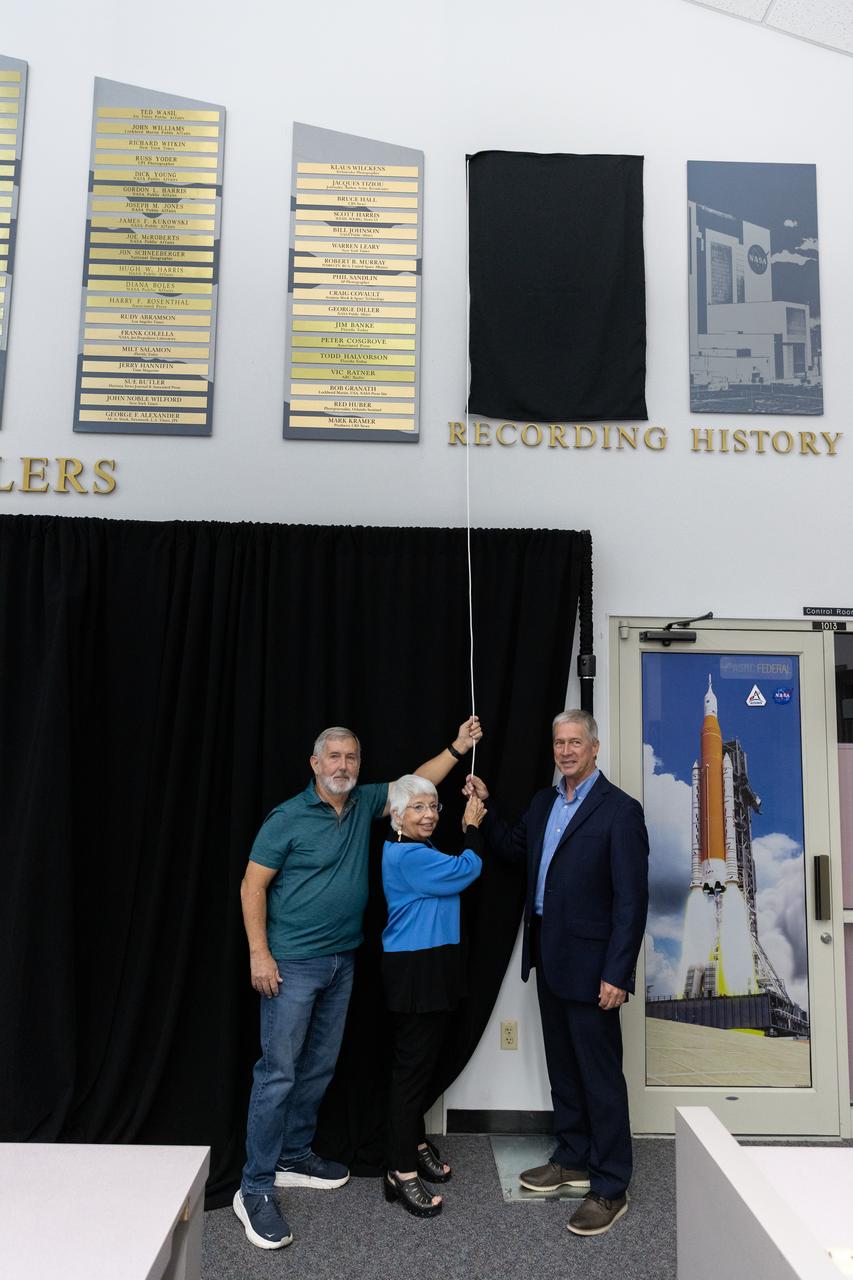
Mike Brown, Maggie Persinger, and Dan Billow were honored May 15, 2024, during the 2024 Kennedy Chroniclers ceremony at the Press Site at NASA’s Kennedy Space Center in Florida. Three brass plates bearing their names were added to the wall of the “bull pen,” where reporters traditionally gather to cover launches and events at NASA Kennedy. The three were honored for their efforts in helping tell the story of America’s space program, primarily from the Florida spaceport. They were nominated by their peers and selected by a panel of NASA officials and current space reporters.
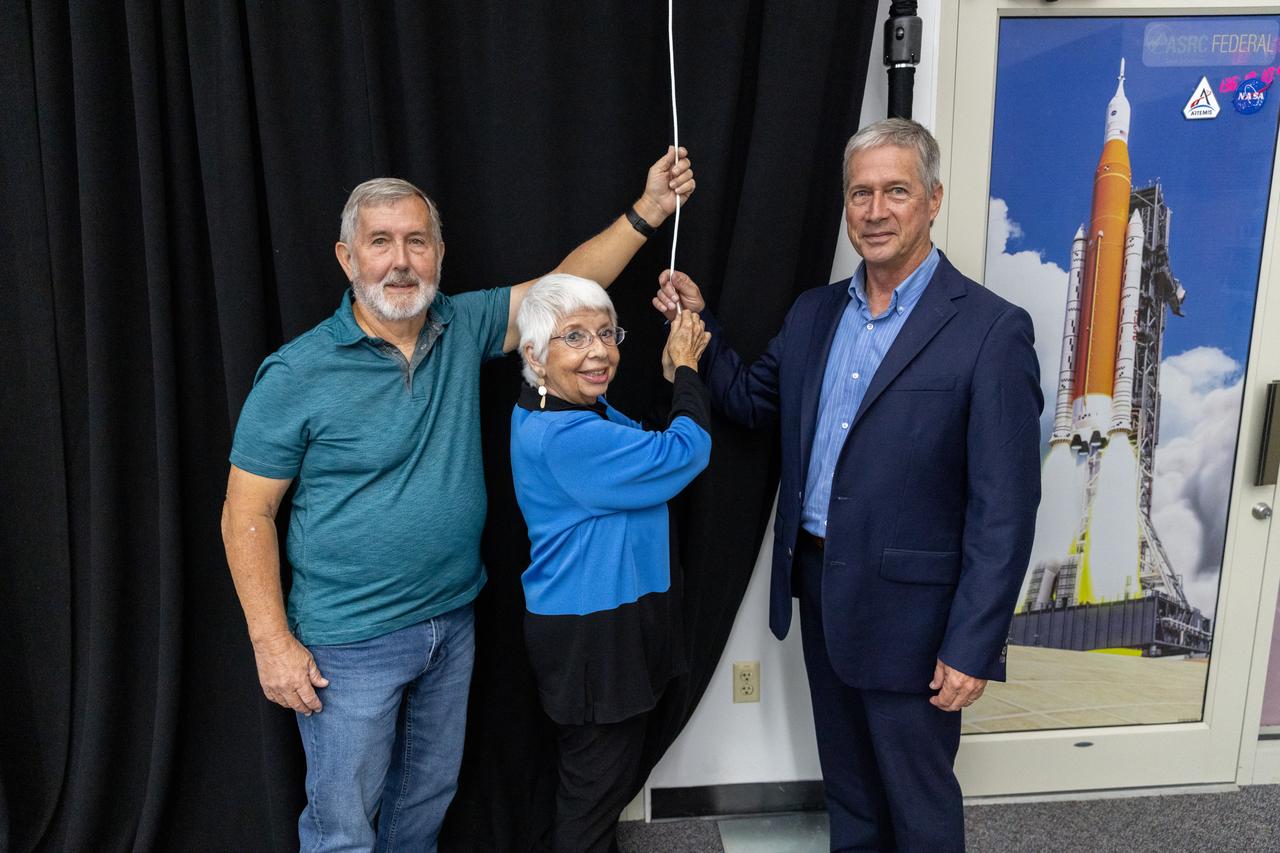
Mike Brown, Maggie Persinger, and Dan Billow were honored May 15, 2024, during the 2024 Kennedy Chroniclers ceremony at the Press Site at NASA’s Kennedy Space Center in Florida. Three brass plates bearing their names were added to the wall of the “bull pen,” where reporters traditionally gather to cover launches and events at NASA Kennedy. The three were honored for their efforts in helping tell the story of America’s space program, primarily from the Florida spaceport. They were nominated by their peers and selected by a panel of NASA officials and current space reporters.
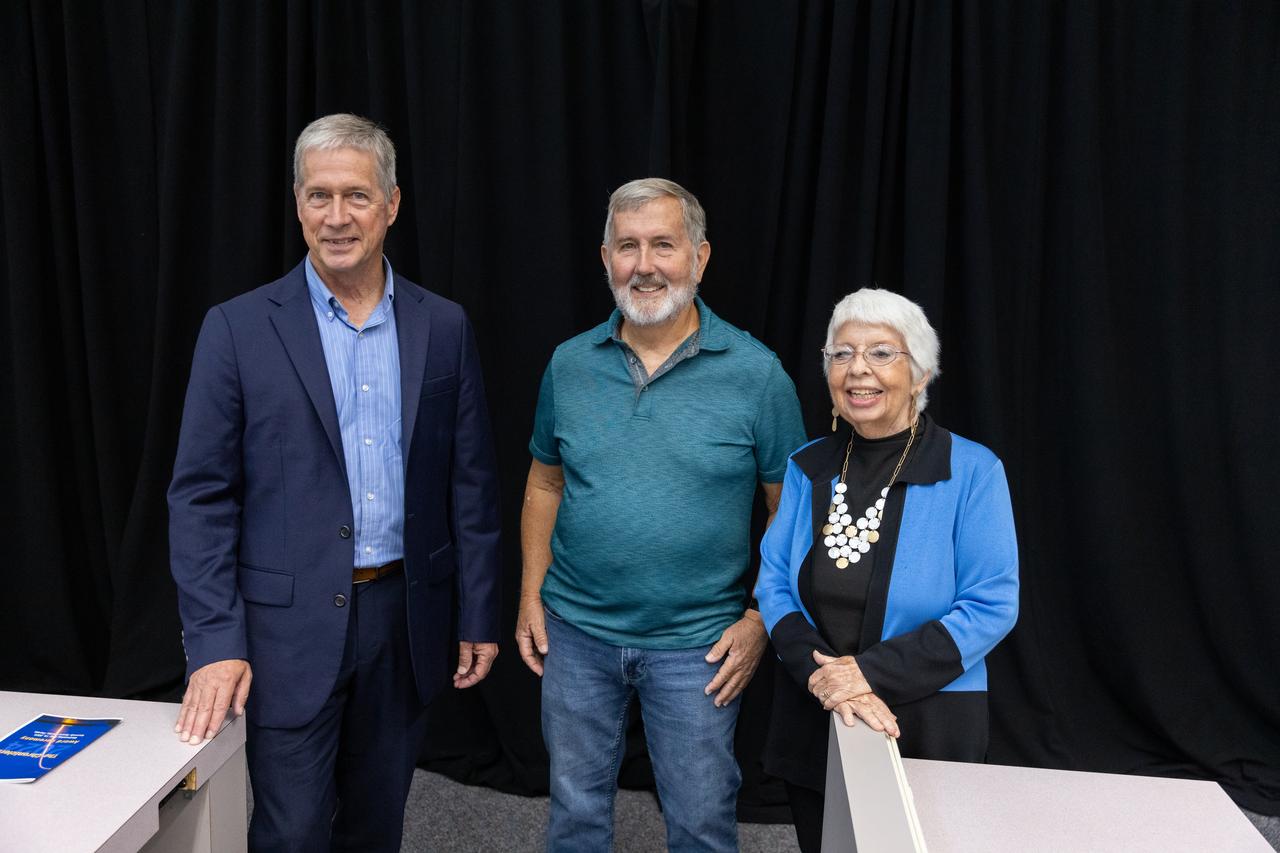
Dan Billow, Mike Brown, and Maggie Persinger were honored May 15, 2024, during the 2024 Kennedy Chroniclers ceremony at the Press Site at NASA’s Kennedy Space Center in Florida. Three brass plates bearing their names were added to the wall of the “bull pen,” where reporters traditionally gather to cover launches and events at NASA Kennedy. The three were honored for their efforts in helping tell the story of America’s space program, primarily from the Florida spaceport. They were nominated by their peers and selected by a panel of NASA officials and current space reporters.
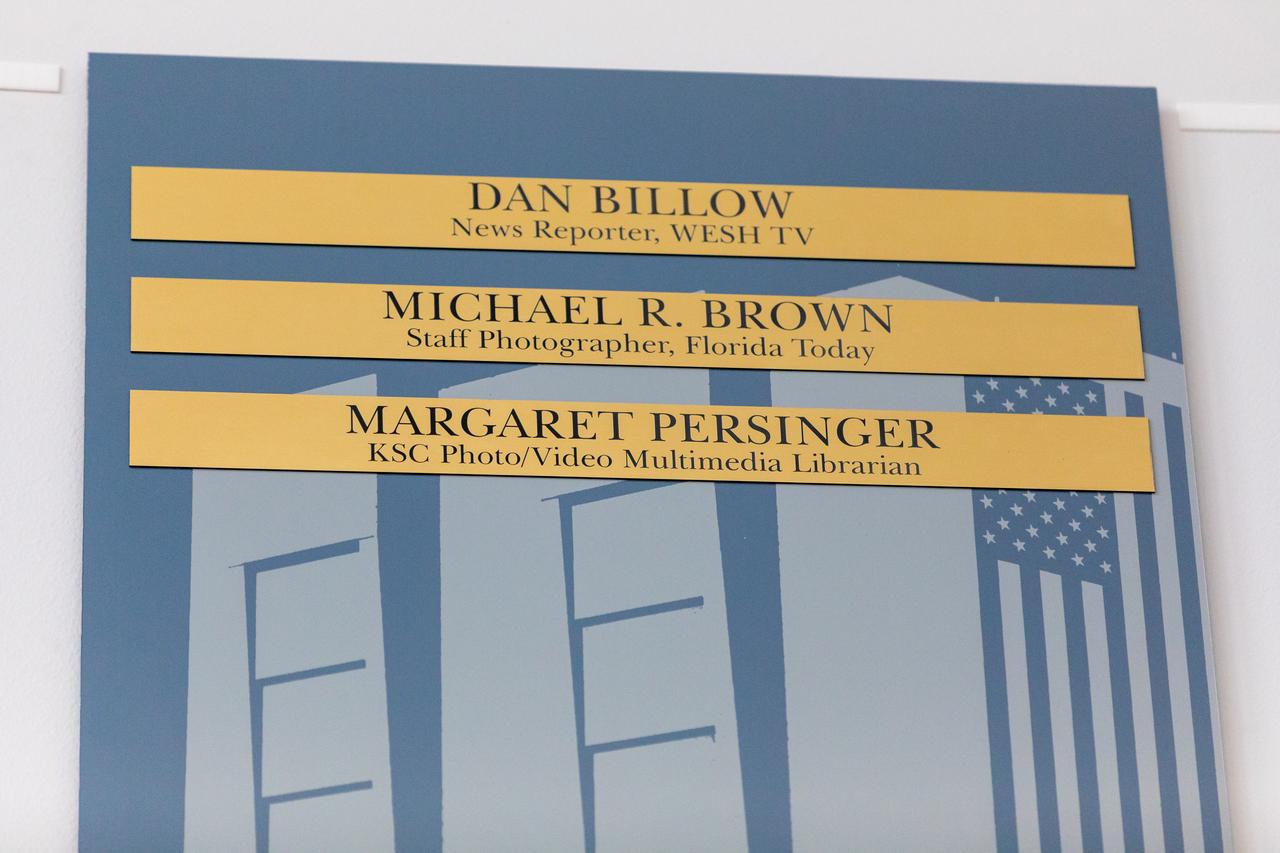
Dan Billow, Mike Brown, and Maggie Persinger were honored May 15, 2024, during the 2024 Kennedy Chroniclers ceremony at the Press Site at NASA’s Kennedy Space Center in Florida. Three brass plates bearing their names were added to the wall of the “bull pen,” where reporters traditionally gather to cover launches and events at NASA Kennedy. The three were honored for their efforts in helping tell the story of America’s space program, primarily from the Florida spaceport. They were nominated by their peers and selected by a panel of NASA officials and current space reporters.
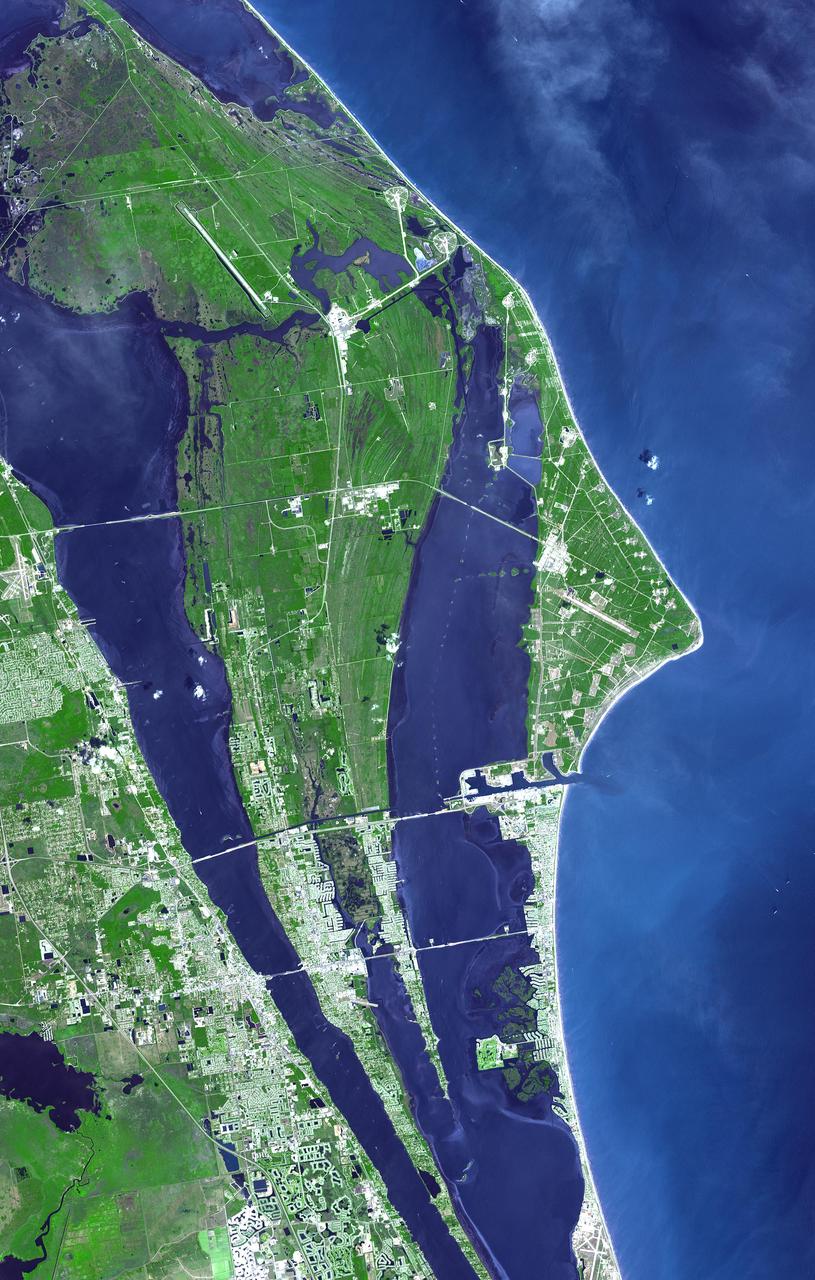
The John F. Kennedy Space Center, America spaceport, is located along Florida eastern shore on Cape Canaveral. Established as NASA Launch Operations Center on July 1, 1962, This image was acquired by NASA Terra spacecraft.
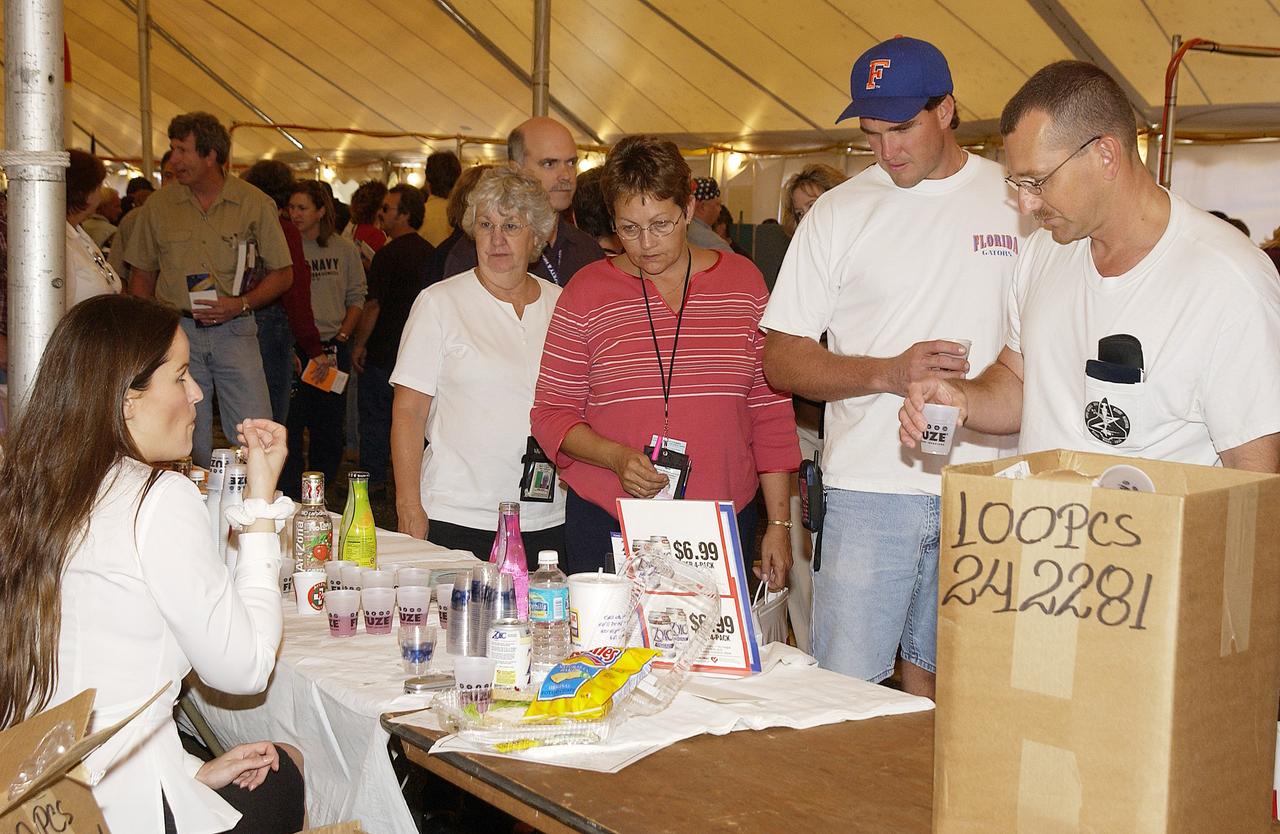
KENNEDY SPACE CENTER, FLA. - One of many vendors displaying their products during the Spaceport Super Safety and Health Day at KSC and Cape Canaveral Air Force Station, Florida Power and Light draws a crowd during a demonstration. The annual KSC event is dedicated to reinforcing safe and healthful behaviors in the workforce.
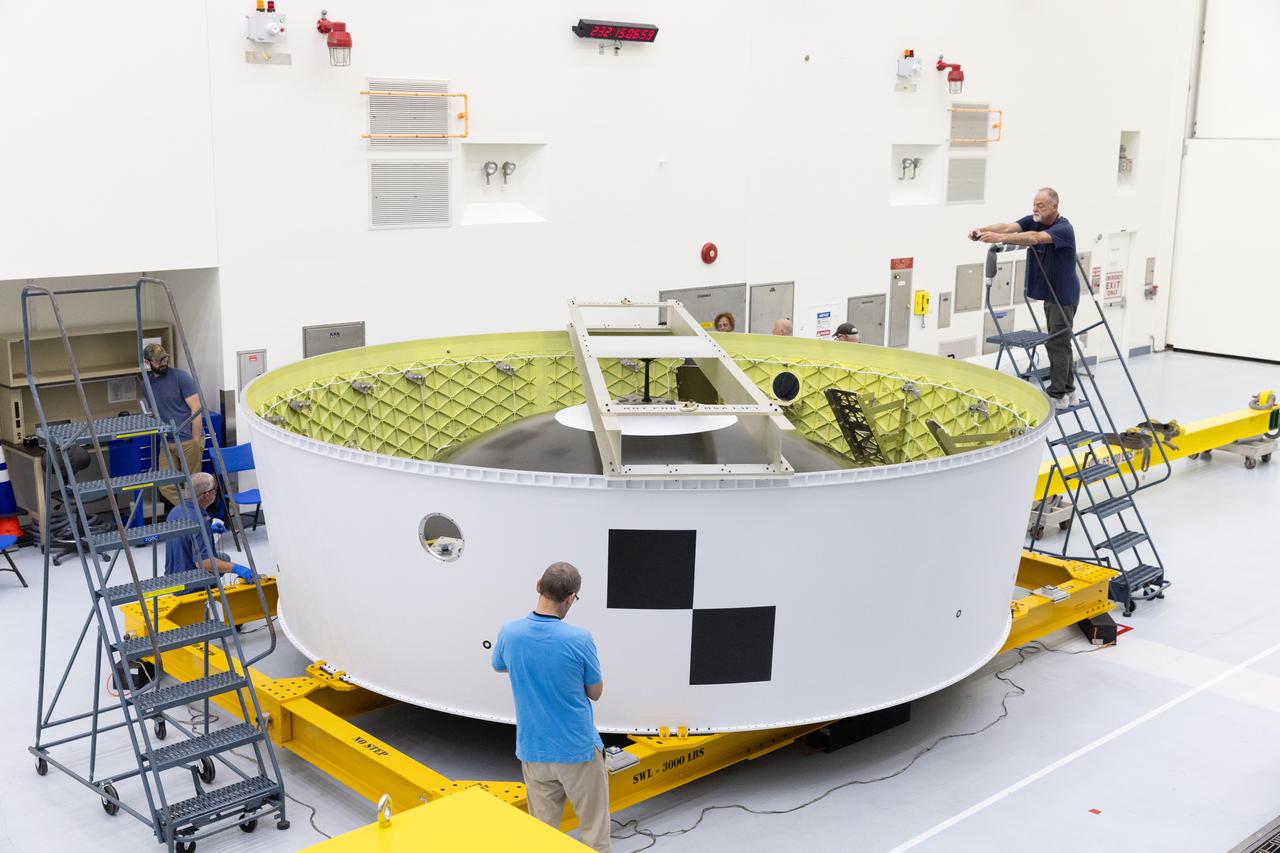
Technicians at NASA’s Kennedy Space Center in Florida complete routine inspections the Artemis II Orion stage adapter on Wednesday, Aug. 20, 2025, to the spaceport’s Multi-Payload Processing Facility to undergo CubeSat integration following its arrival from the agency’s Marshall Space Flight Center in Huntsville, Alabama. NASA Marshall built the Orion stage adapter which connects to the SLS (Space Launch System) rocket’s interim cryogenic propulsion stage to the Orion spacecraft and protects Orion from flammable gases generated during launch. The Artemis II test flight will take four astronauts around the Moon and return them back home in early 2026.
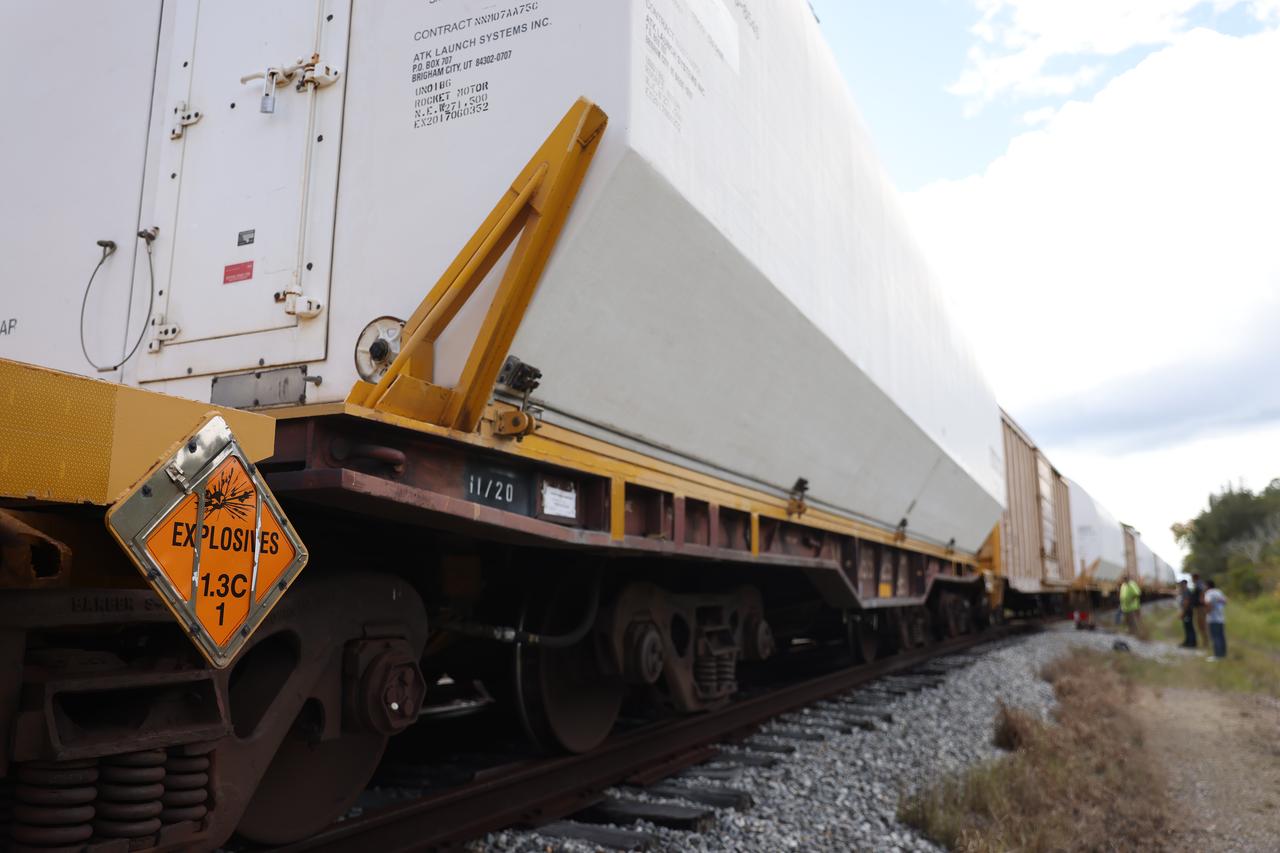
The 10 booster motor segments that will form the NASA Space Launch System rocket’s twin, five-segment solid rocket boosters for the agency’s Artemis II mission, arrive at Kennedy Space Center on Thursday, Sept. 28, 2023. Due to their weight, the booster motor segments traveled by rail across eight states in specialized transporters to the Florida spaceport. Teams with NASA’s Exploration Ground Systems will process each of the segments at Kennedy in preparation for launch. Artemis II astronauts Reid Wiseman, Victor Glover, Christina Koch, and Jeremy Hansen will blast off from Kennedy, traveling around the Moon on the first crewed mission under Artemis that will test all of the Orion spacecraft’s systems.
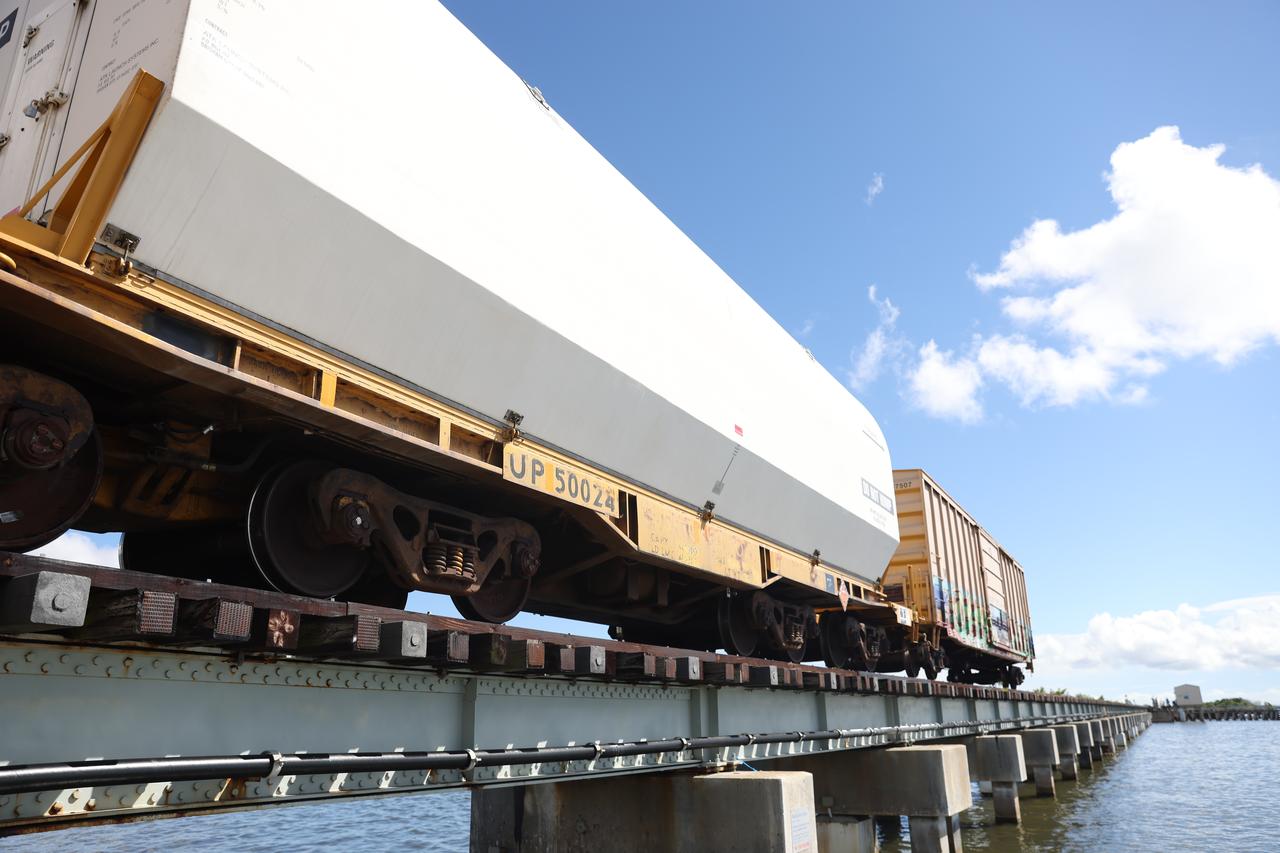
The 10 booster motor segments that will form the NASA Space Launch System rocket’s twin, five-segment solid rocket boosters for the agency’s Artemis II mission, arrive at Kennedy Space Center on Thursday, Sept. 28, 2023. Due to their weight, the booster motor segments traveled by rail across eight states in specialized transporters to the Florida spaceport. Teams with NASA’s Exploration Ground Systems will process each of the segments at Kennedy in preparation for launch. Artemis II astronauts Reid Wiseman, Victor Glover, Christina Koch, and Jeremy Hansen will blast off from Kennedy, traveling around the Moon on the first crewed mission under Artemis that will test all of the Orion spacecraft’s systems.
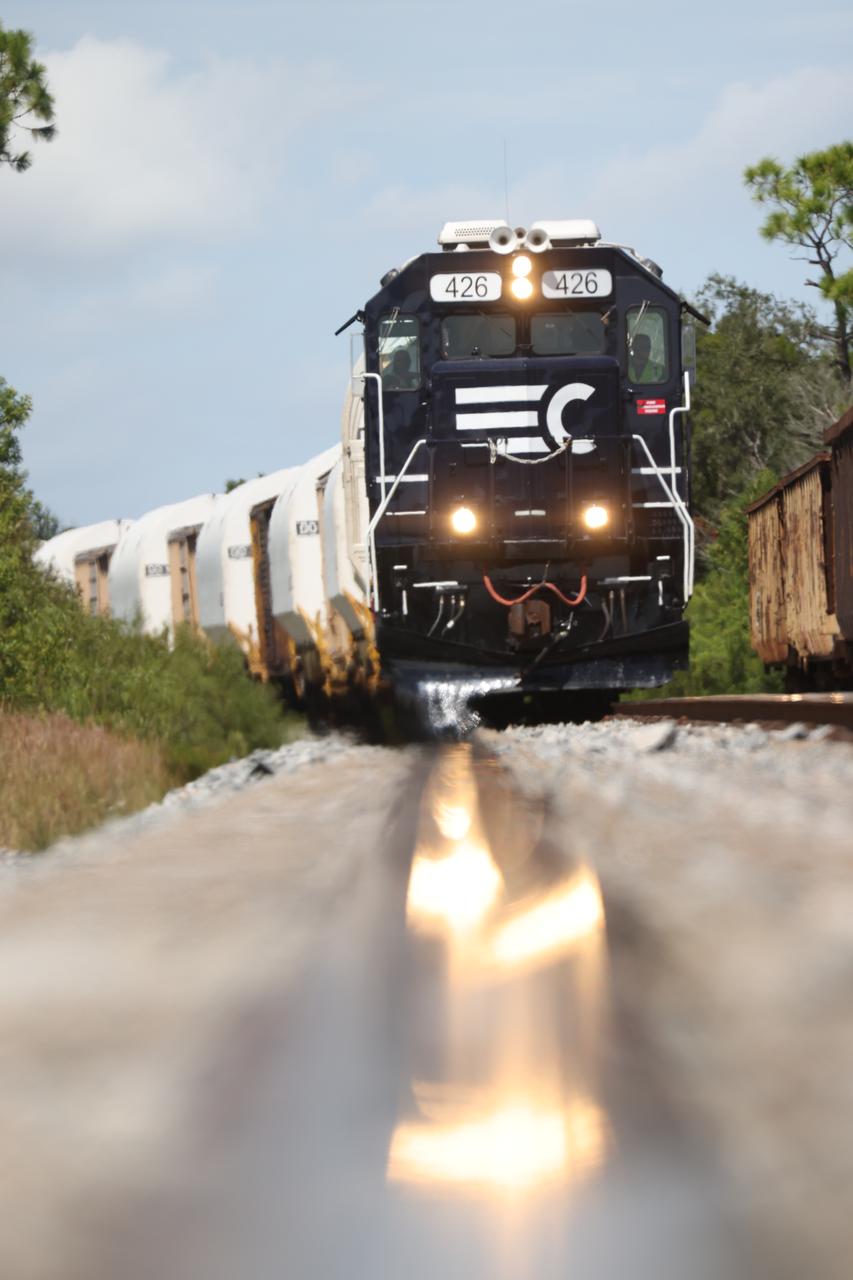
The 10 booster motor segments that will form the NASA Space Launch System rocket’s twin, five-segment solid rocket boosters for the agency’s Artemis II mission, arrive at Kennedy Space Center on Monday, Sept. 25, 2023. Due to their weight, the booster motor segments traveled by rail across eight states in specialized transporters to the Florida spaceport. Teams with NASA’s Exploration Ground Systems will process each of the segments at Kennedy in preparation for launch. Artemis II astronauts Reid Wiseman, Victor Glover, Christina Koch, and Jeremy Hansen will blast off from Kennedy, traveling around the Moon on the first crewed mission under Artemis that will test all of the Orion spacecraft’s systems.

The 10 booster motor segments that will form the NASA Space Launch System rocket’s twin, five-segment solid rocket boosters for the agency’s Artemis II mission, arrive at Kennedy Space Center on Monday, Sept. 25, 2023. Due to their weight, the booster motor segments traveled by rail across eight states in specialized transporters to the Florida spaceport. Teams with NASA’s Exploration Ground Systems will process each of the segments at Kennedy in preparation for launch. Artemis II astronauts Reid Wiseman, Victor Glover, Christina Koch, and Jeremy Hansen will blast off from Kennedy, traveling around the Moon on the first crewed mission under Artemis that will test all of the Orion spacecraft’s systems.
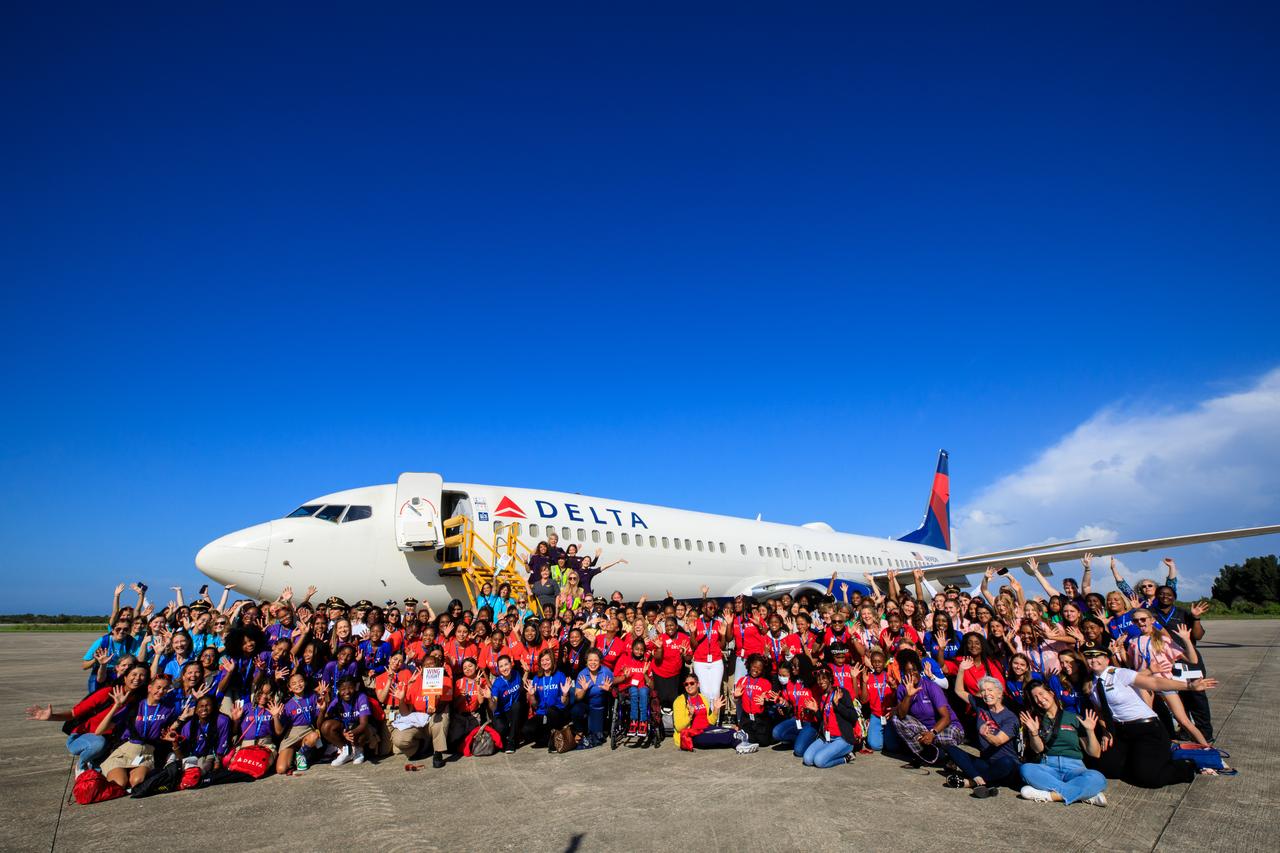
Students from various schools and organizations with a STEM (science, technology, engineering, math) focus are photographed with employees from NASA’s Kennedy Space Center at the Launch and Landing Facility following their arrival to Kennedy on Friday, Sept. 22, 2023, as part of Delta Air Lines’ Women Inspiring Our Next Generation (WING) flight. The all-female flight crew brought girls from Atlanta, Georgia, ranging in age from 12 to 18, to learn about the various careers available at the Florida spaceport. While at Kennedy, the group had the opportunity to view center facilities, hear from a panel of women with a combination of careers from Kennedy and Delta, and tour the visitor complex.

Students from various schools and organizations with a STEM (science, technology, engineering, math) focus are photographed with employees from NASA’s Kennedy Space Center at the Launch and Landing Facility following their arrival to Kennedy on Friday, Sept. 22, 2023, as part of Delta Air Lines’ Women Inspiring Our Next Generation (WING) flight. The all-female flight crew brought girls from Atlanta, Georgia, ranging in age from 12 to 18, to learn about the various careers available at the Florida spaceport. While at Kennedy, the group had the opportunity to view center facilities, hear from a panel of women with a combination of careers from Kennedy and Delta, and tour the visitor complex.
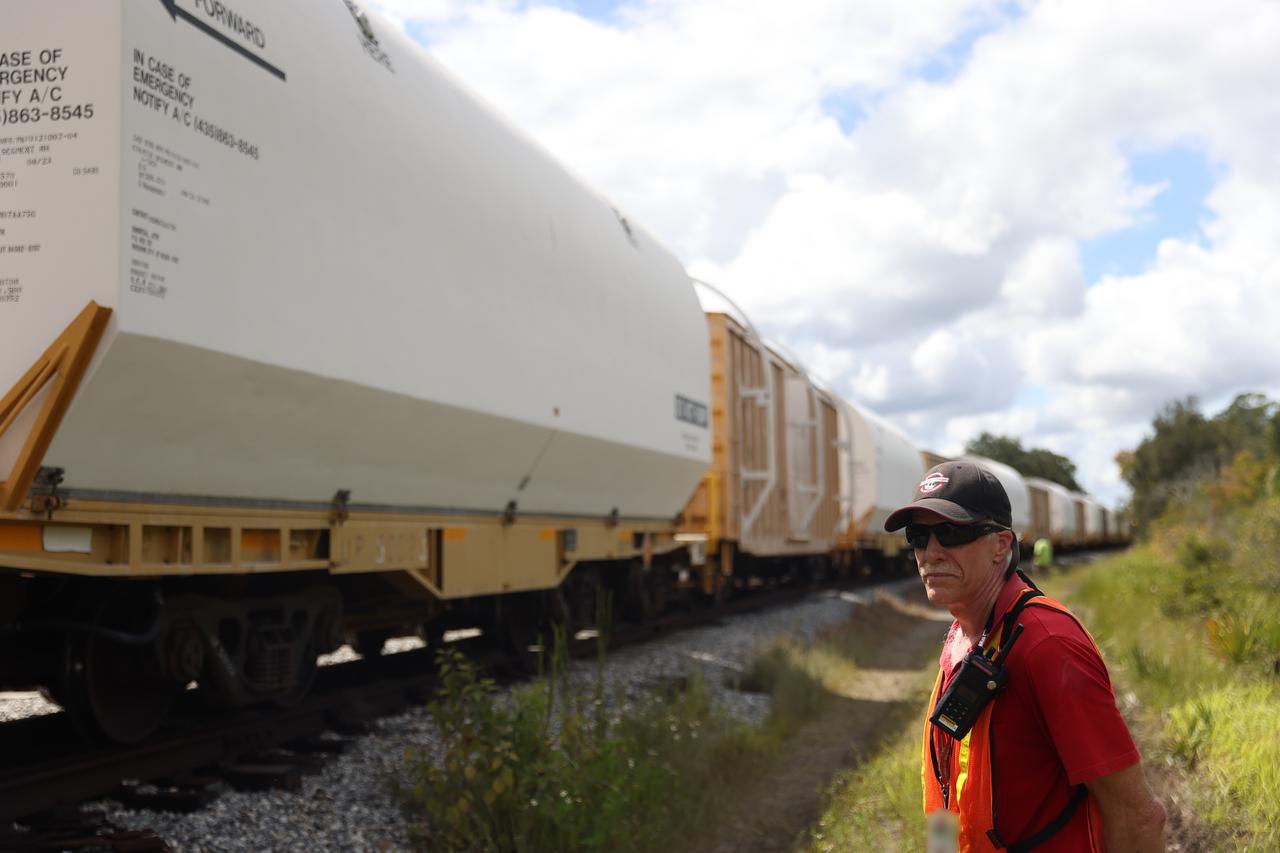
The 10 booster motor segments that will form the NASA Space Launch System rocket’s twin, five-segment solid rocket boosters for the agency’s Artemis II mission, arrive at Kennedy Space Center on Thursday, Sept. 28, 2023. Due to their weight, the booster motor segments traveled by rail across eight states in specialized transporters to the Florida spaceport. Teams with NASA’s Exploration Ground Systems will process each of the segments at Kennedy in preparation for launch. Artemis II astronauts Reid Wiseman, Victor Glover, Christina Koch, and Jeremy Hansen will blast off from Kennedy, traveling around the Moon on the first crewed mission under Artemis that will test all of the Orion spacecraft’s systems.
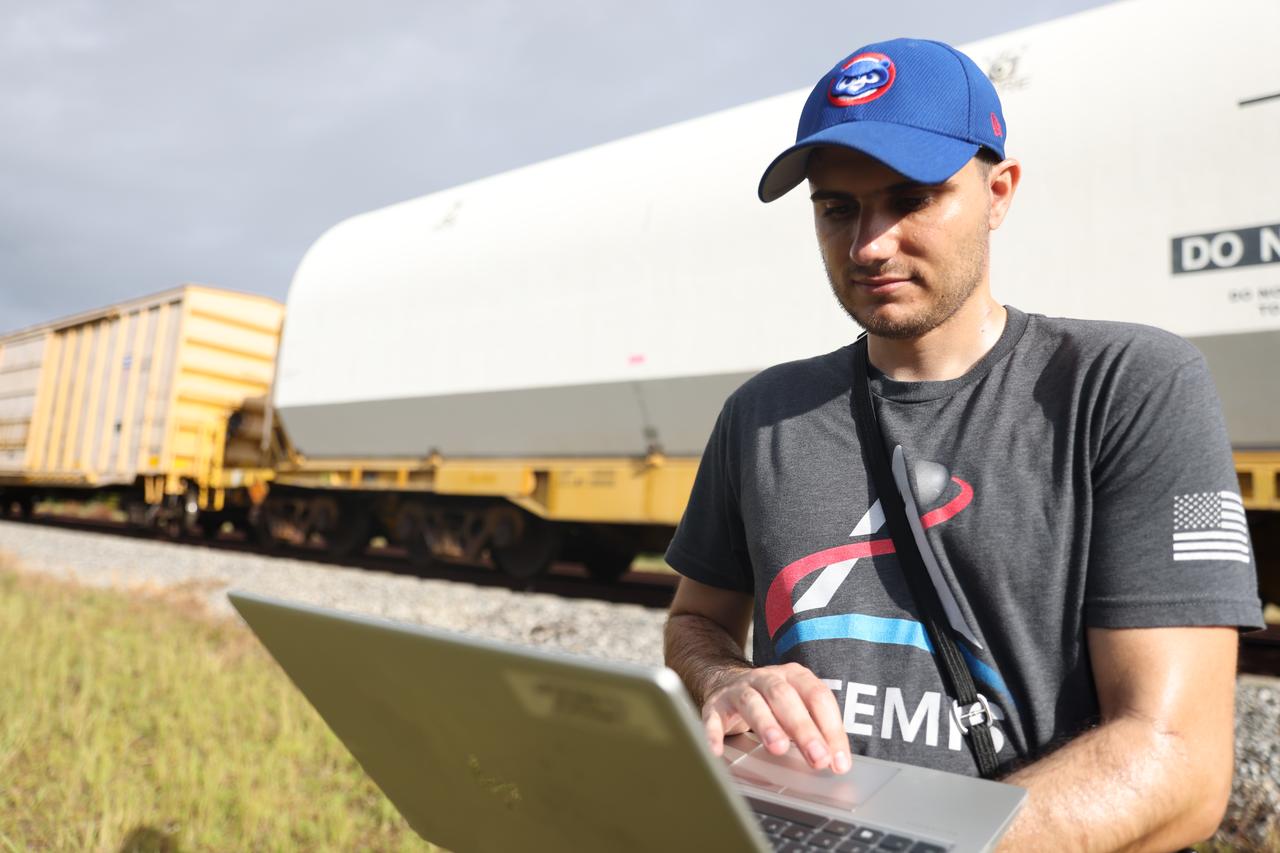
The 10 booster motor segments that will form the NASA Space Launch System rocket’s twin, five-segment solid rocket boosters for the agency’s Artemis II mission, arrive at Kennedy Space Center on Thursday, Sept. 28, 2023. Due to their weight, the booster motor segments traveled by rail across eight states in specialized transporters to the Florida spaceport. Teams with NASA’s Exploration Ground Systems will process each of the segments at Kennedy in preparation for launch. Artemis II astronauts Reid Wiseman, Victor Glover, Christina Koch, and Jeremy Hansen will blast off from Kennedy, traveling around the Moon on the first crewed mission under Artemis that will test all of the Orion spacecraft’s systems.

The 10 booster motor segments that will form the NASA Space Launch System rocket’s twin, five-segment solid rocket boosters for the agency’s Artemis II mission, arrive at Kennedy Space Center on Thursday, Sept. 28, 2023. Due to their weight, the booster motor segments traveled by rail across eight states in specialized transporters to the Florida spaceport. Teams with NASA’s Exploration Ground Systems will process each of the segments at Kennedy in preparation for launch. Artemis II astronauts Reid Wiseman, Victor Glover, Christina Koch, and Jeremy Hansen will blast off from Kennedy, traveling around the Moon on the first crewed mission under Artemis that will test all of the Orion spacecraft’s systems.
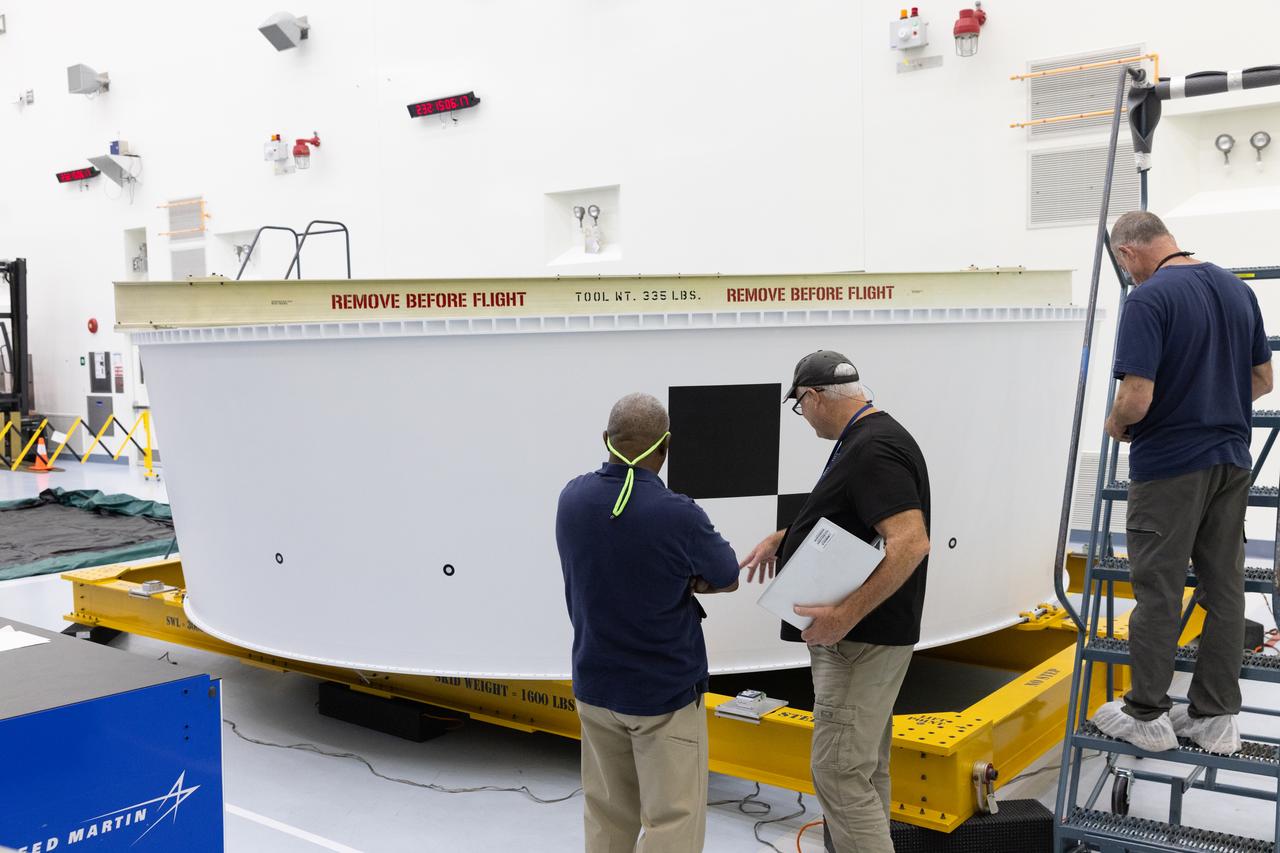
Technicians at NASA’s Kennedy Space Center in Florida complete routine inspections the Artemis II Orion stage adapter on Wednesday, Aug. 20, 2025, to the spaceport’s Multi-Payload Processing Facility to undergo CubeSat integration following its arrival from the agency’s Marshall Space Flight Center in Huntsville, Alabama. NASA Marshall built the Orion stage adapter which connects to the SLS (Space Launch System) rocket’s interim cryogenic propulsion stage to the Orion spacecraft and protects Orion from flammable gases generated during launch. The Artemis II test flight will take four astronauts around the Moon and return them back home in early 2026.
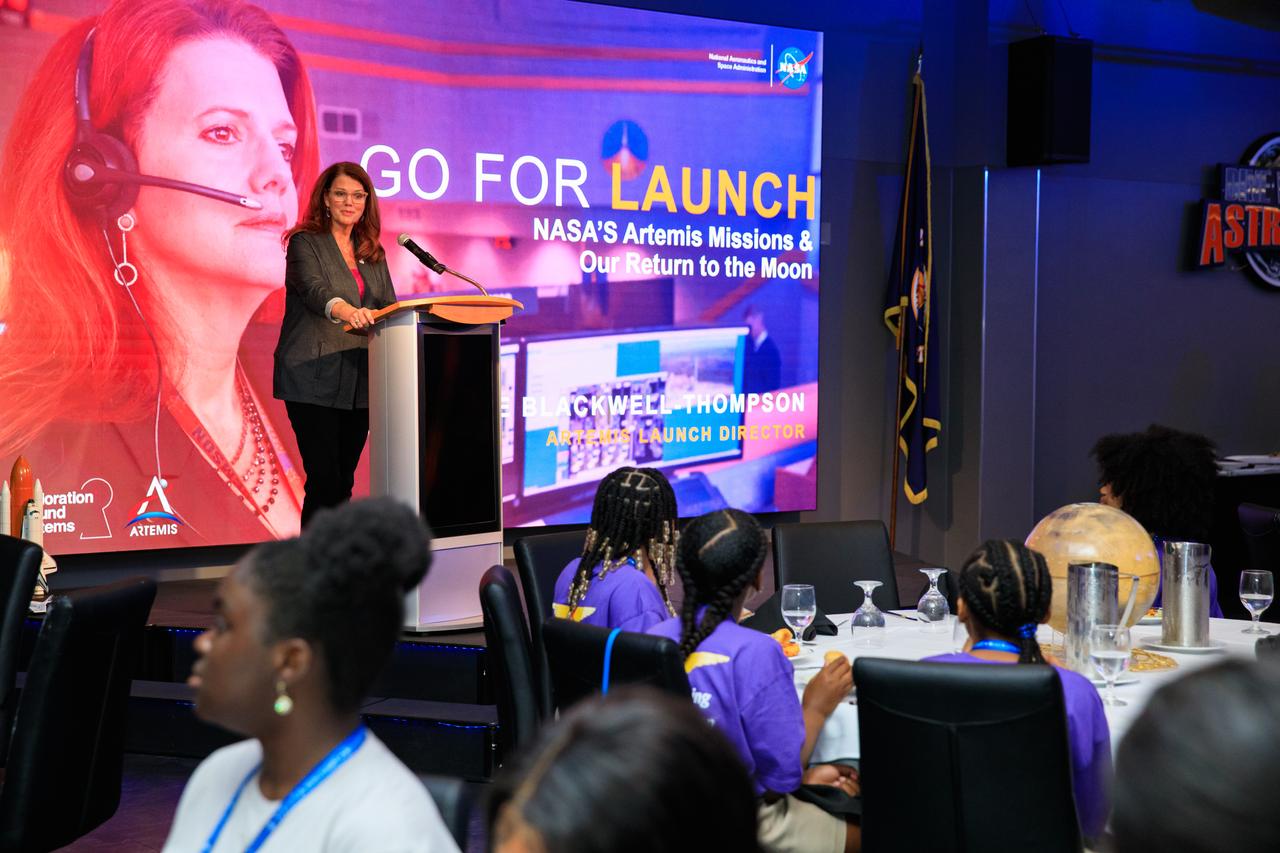
NASA Artemis Launch Director Charlie Blackwell-Thompson speaks to students from Delta Air Lines’ Women Inspiring Our Next Generation (WING) flight on Friday, Sept. 22, 2023, at Kennedy Space Center. On a flight originating from Atlanta, Georgia, an all-female crew flew girls from a variety of schools and organizations with a STEM (science, technology, engineering, math) focus to Kennedy to learn about the various careers available at the Florida spaceport. While at Kennedy, the group had the opportunity to view center facilities, hear from a panel of women with a combination of careers from Kennedy and Delta, and tour the visitor complex.

Technicians at NASA’s Kennedy Space Center in Florida complete routine inspections the Artemis II Orion stage adapter on Wednesday, Aug. 20, 2025, to the spaceport’s Multi-Payload Processing Facility to undergo CubeSat integration following its arrival from the agency’s Marshall Flight Center in Huntsville, Alabama. NASA Marshall built the Orion stage adapter which connects to the SLS (Space Launch System) rocket’s interim cryogenic propulsion stage to the Orion spacecraft and protects Orion from flammable gases generated during launch. The Artemis II test flight will take four astronauts around the Moon and return them back home in early 2026.
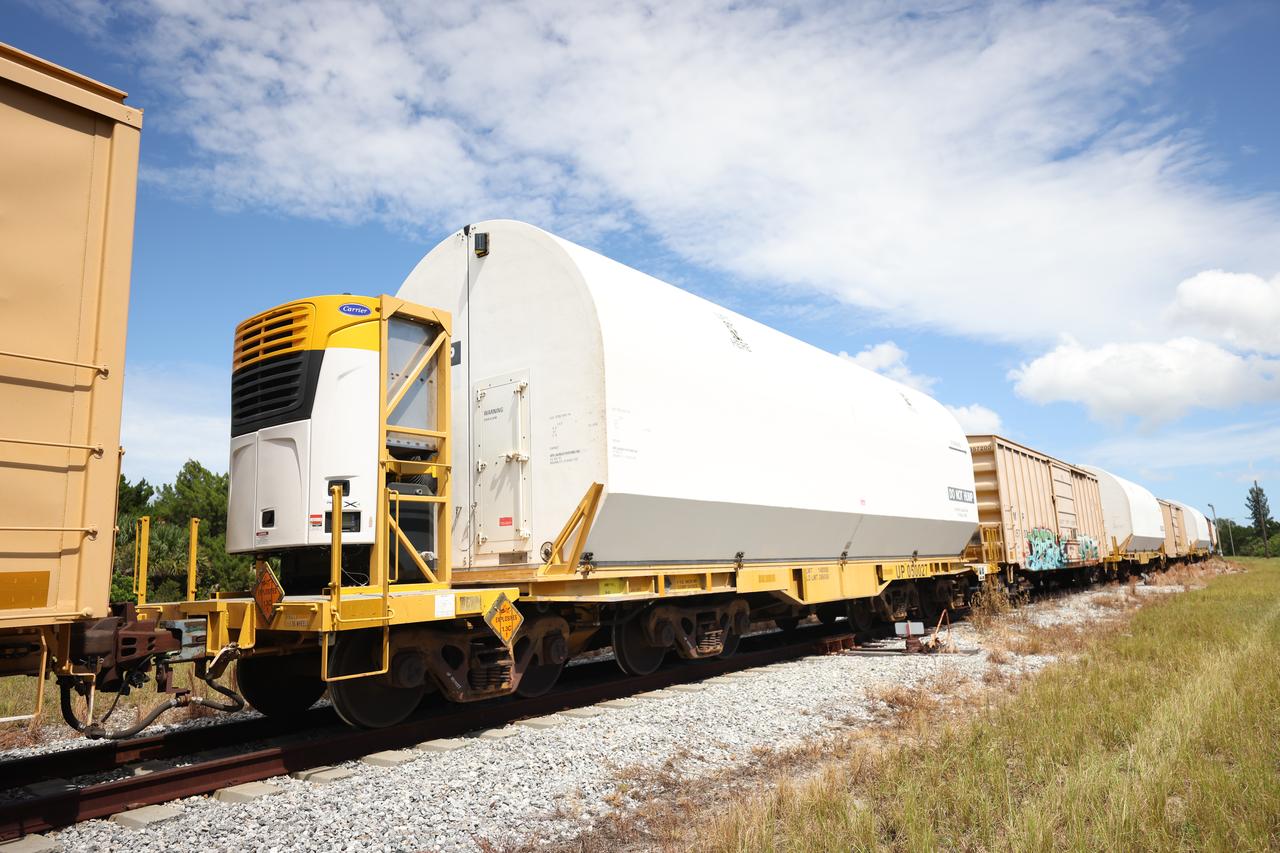
The 10 booster motor segments that will form the NASA Space Launch System rocket’s twin, five-segment solid rocket boosters for the agency’s Artemis II mission, arrive at Kennedy Space Center on Monday, Sept. 25, 2023. Due to their weight, the booster motor segments traveled by rail across eight states in specialized transporters to the Florida spaceport. Teams with NASA’s Exploration Ground Systems will process each of the segments at Kennedy in preparation for launch. Artemis II astronauts Reid Wiseman, Victor Glover, Christina Koch, and Jeremy Hansen will blast off from Kennedy, traveling around the Moon on the first crewed mission under Artemis that will test all of the Orion spacecraft’s systems.
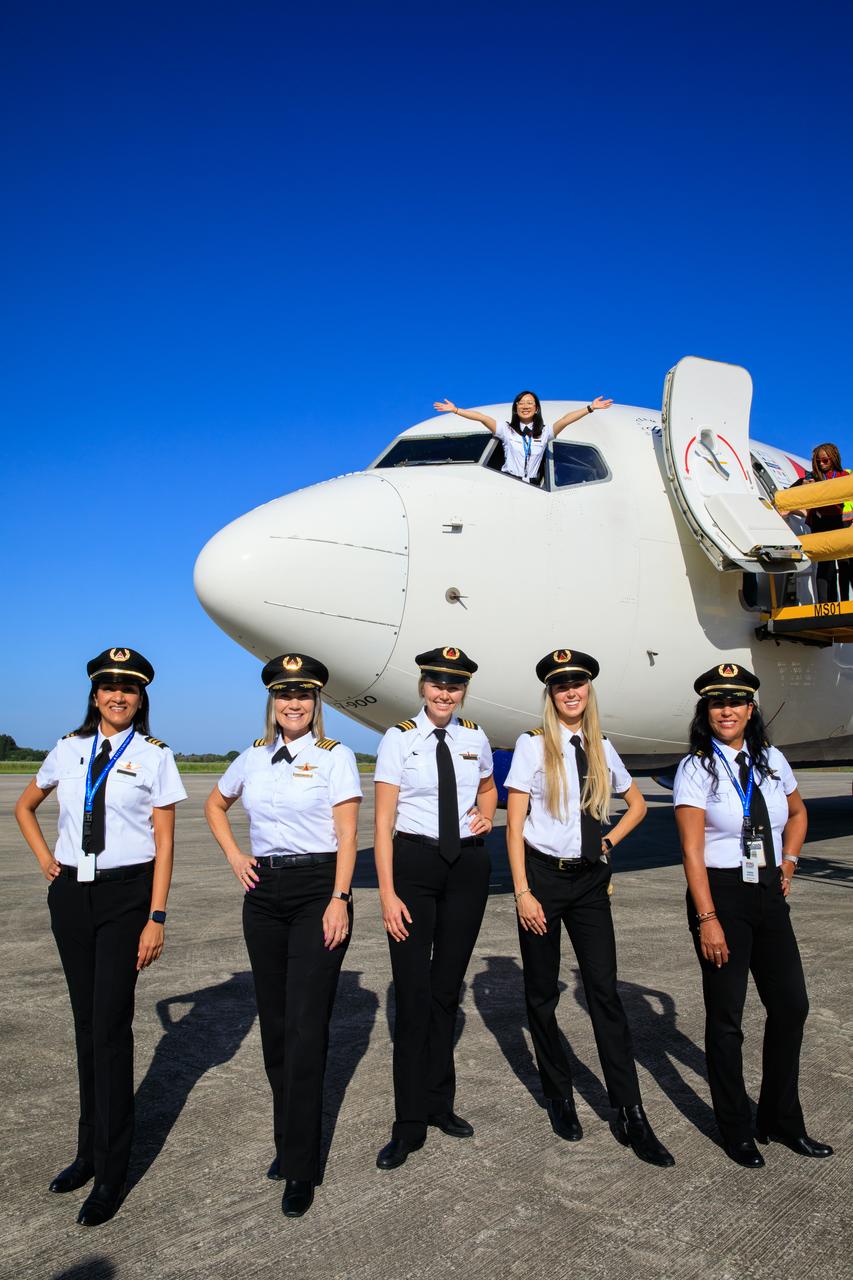
The all-female flight crew for Delta Air Lines’ Women Inspiring Our Next Generation (WING) flight poses for a photograph after touching down at the Launch and Landing Facility at NASA’s Kennedy Space Center on Friday, Sept. 22, 2023. The flight brought girls from Atlanta, Georgia, ranging in age from 12 to 18, to learn about the various careers available at the Florida spaceport. While at Kennedy, the group had the opportunity to view center facilities, hear from a panel of women with a combination of careers from Kennedy and Delta, and tour the visitor complex.
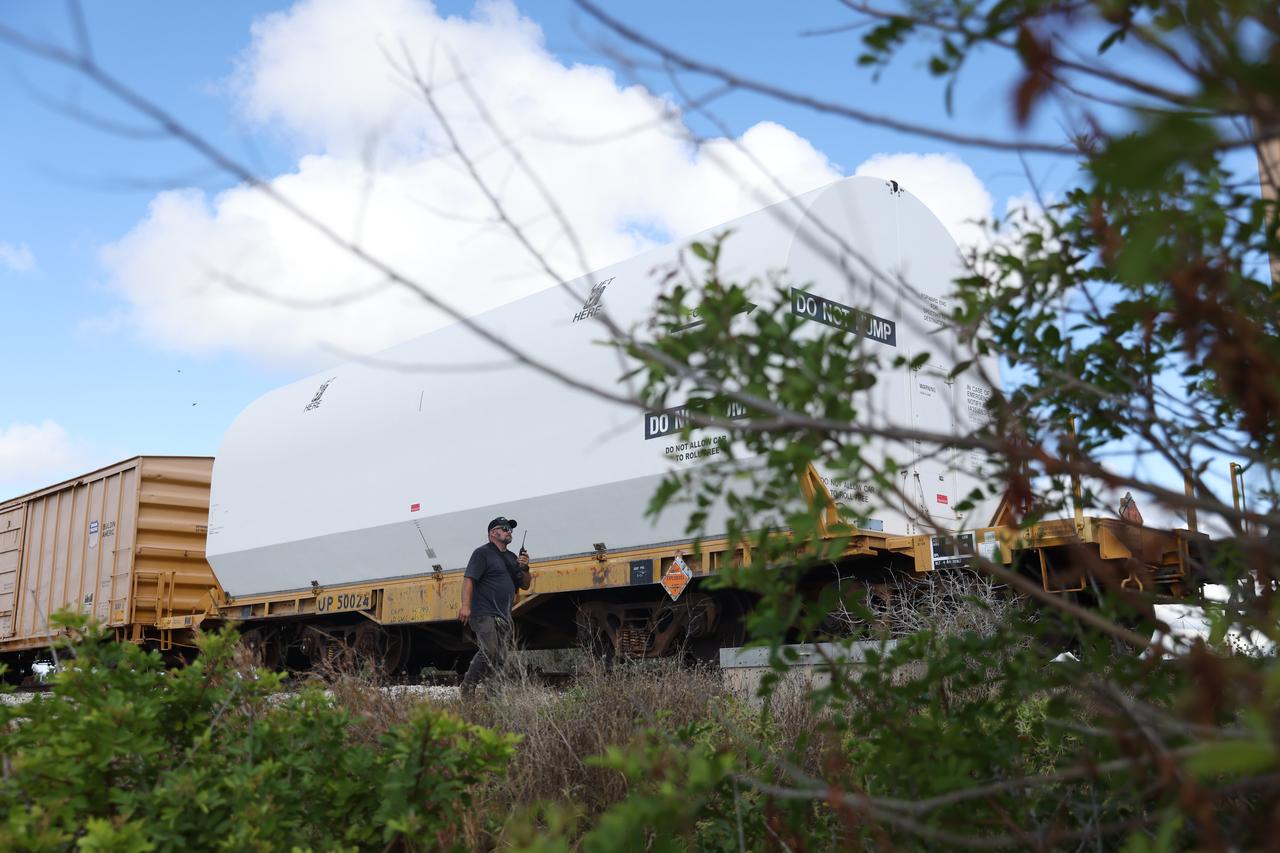
The 10 booster motor segments that will form the NASA Space Launch System rocket’s twin, five-segment solid rocket boosters for the agency’s Artemis II mission, arrive at Kennedy Space Center on Thursday, Sept. 28, 2023. Due to their weight, the booster motor segments traveled by rail across eight states in specialized transporters to the Florida spaceport. Teams with NASA’s Exploration Ground Systems will process each of the segments at Kennedy in preparation for launch. Artemis II astronauts Reid Wiseman, Victor Glover, Christina Koch, and Jeremy Hansen will blast off from Kennedy, traveling around the Moon on the first crewed mission under Artemis that will test all of the Orion spacecraft’s systems.
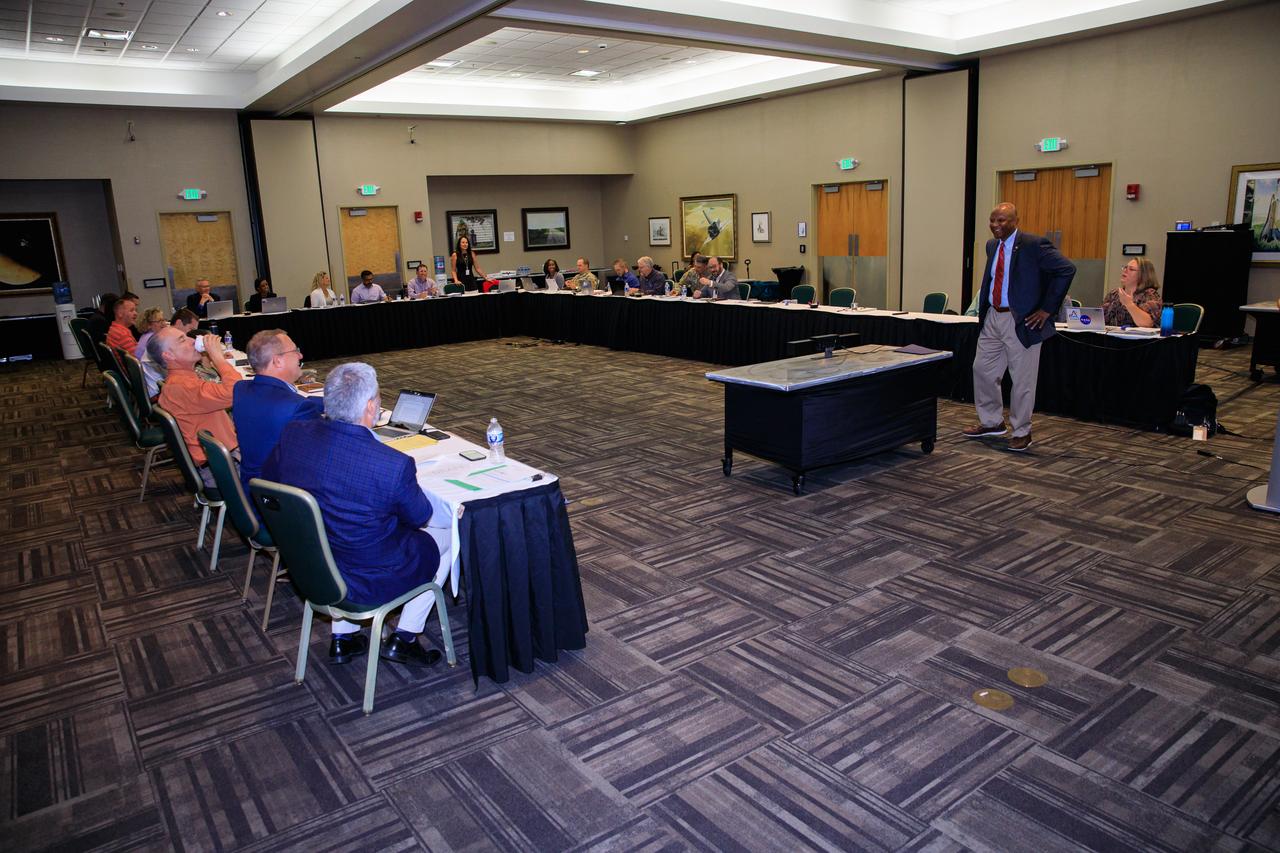
Kelvin Manning, deputy director of NASA’s Kennedy Space Center, addresses attendees at the Spaceport Industry Summit on June 14, 2023, at the Florida spaceport. The National Spaceport Interagency Working Group was visiting Kennedy and other spaceports in the United Stations to collect feedback on a draft national spaceport strategy.
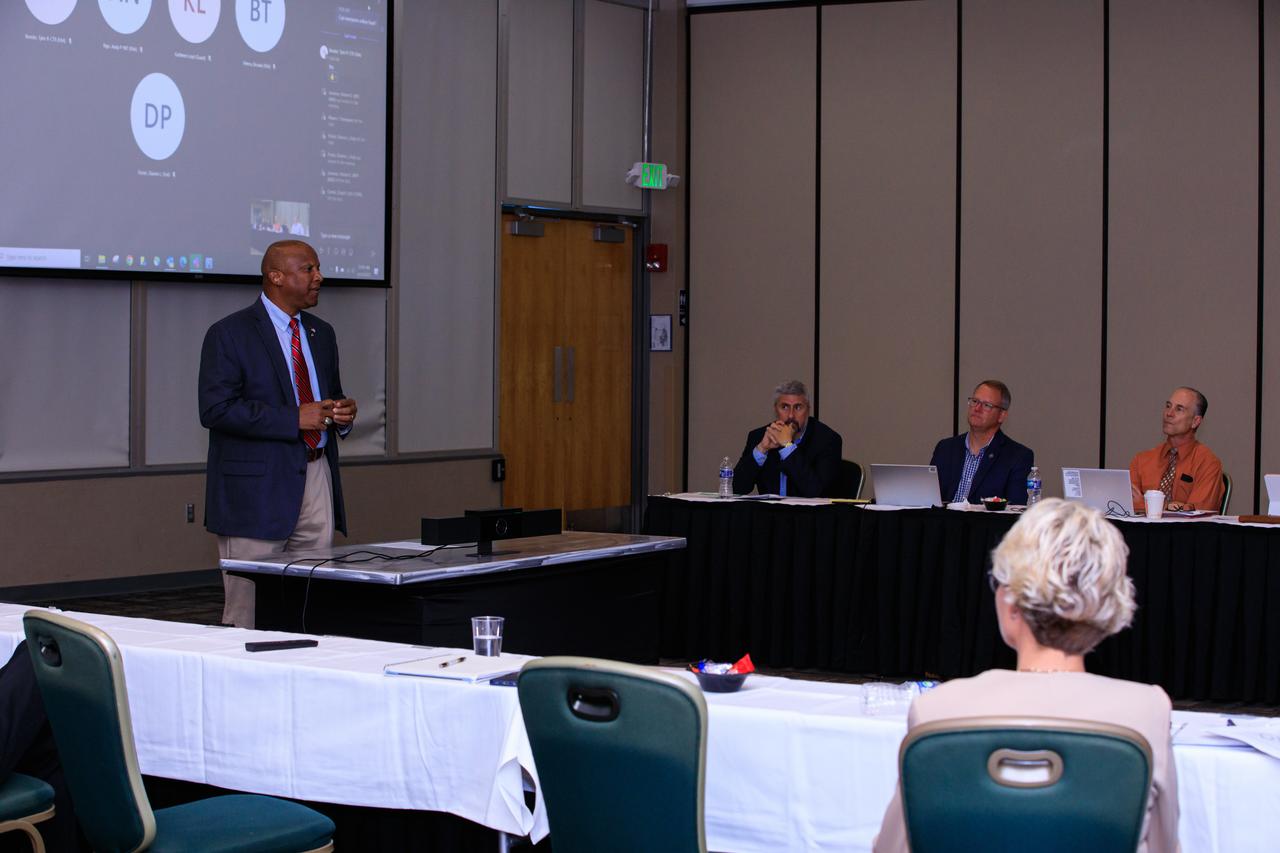
Kelvin Manning, deputy director of NASA’s Kennedy Space Center, addresses attendees at the Spaceport Industry Summit on June 14, 2023, at the Florida spaceport. The National Spaceport Interagency Working Group was visiting Kennedy and other spaceports in the United Stations to collect feedback on a draft national spaceport strategy.

KENNEDY SPACE CENTER, FLA. - Suzy Cunningham sings the national anthem to kick off Center Director Jim Kennedy’s first all-hands meeting conducted for employees. She is senior spaceport manager, NASA/Air Force Spaceport Planning and Customer Service Office. Making presentations were Dr. Woodrow Whitlow Jr., KSC deputy director; Tim Wilson, assistant chief engineer for Shuttle; and Bill Pickavance, vice president and deputy program manager, Florida operations, United Space Alliance. Representatives from the Shuttle program and contractor team were on hand to discuss the Columbia Accident Investigation Board report and where KSC stands in its progress toward return to flight.
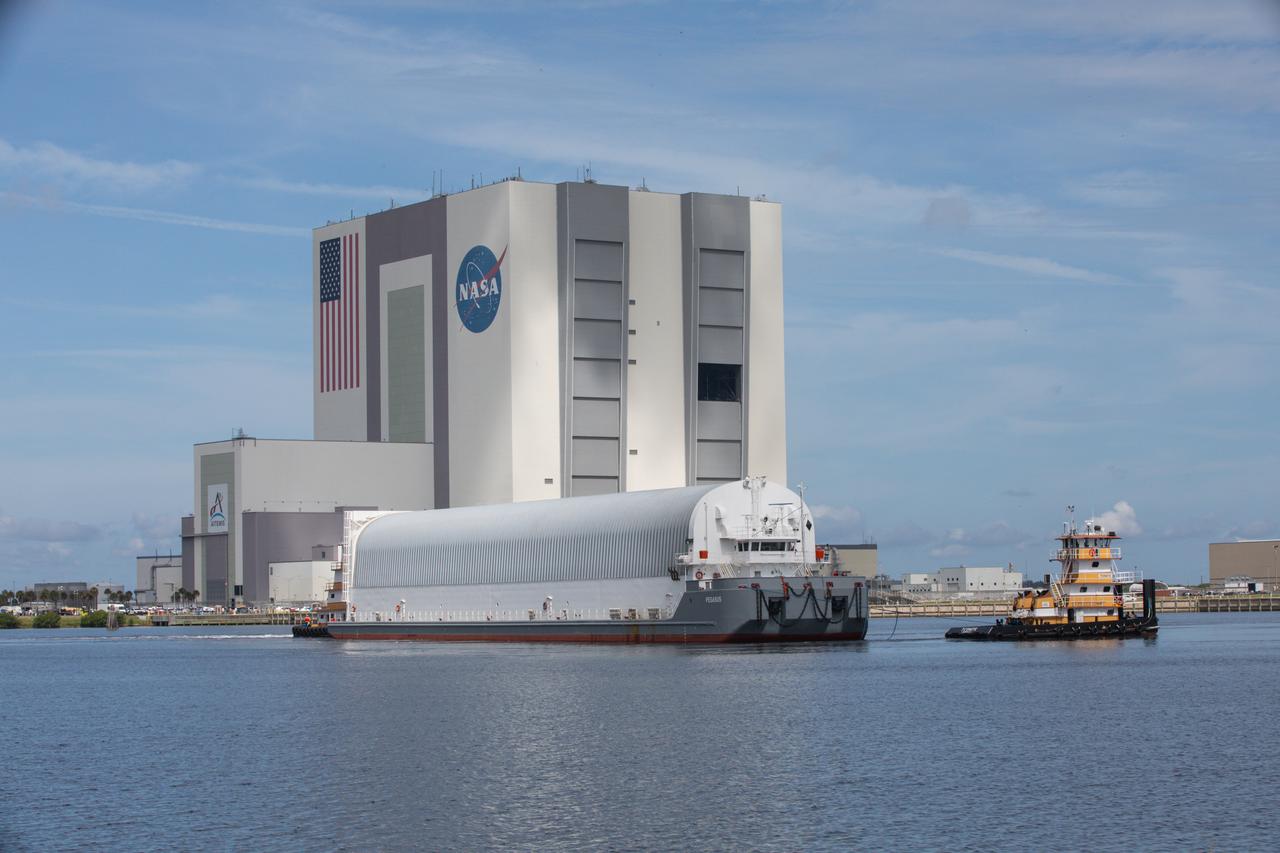
NASA’s Pegasus barge, carrying the agency’s massive SLS (Space Launch System) core stage, arrives at NASA’s Kennedy Space Center Complex 39 turn basin wharf in Florida on Tuesday, July 23, 2024, after journeying from the agency’s Michoud Assembly Facility in New Orleans. The core stage is the next piece of Artemis hardware to arrive at the spaceport and will be offloaded and moved to NASA Kennedy’s Vehicle Assembly Building, where it will be prepared for integration ahead of the Artemis II launch.
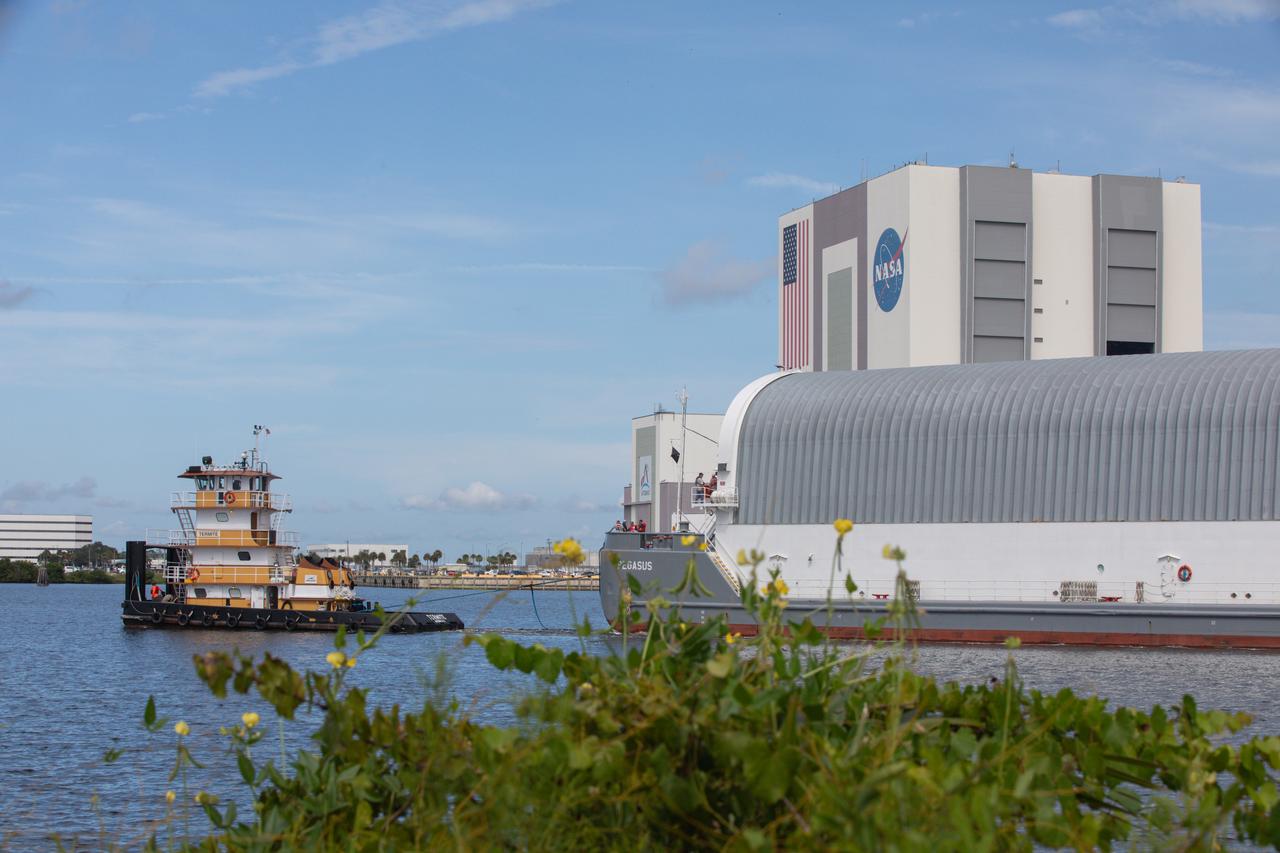
NASA’s Pegasus barge, carrying the agency’s massive SLS (Space Launch System) core stage, arrives at NASA’s Kennedy Space Center Complex 39 turn basin wharf in Florida on Tuesday, July 23, 2024, after journeying from the agency’s Michoud Assembly Facility in New Orleans. The core stage is the next piece of Artemis hardware to arrive at the spaceport and will be offloaded and moved to NASA Kennedy’s Vehicle Assembly Building, where it will be prepared for integration ahead of the Artemis II launch.
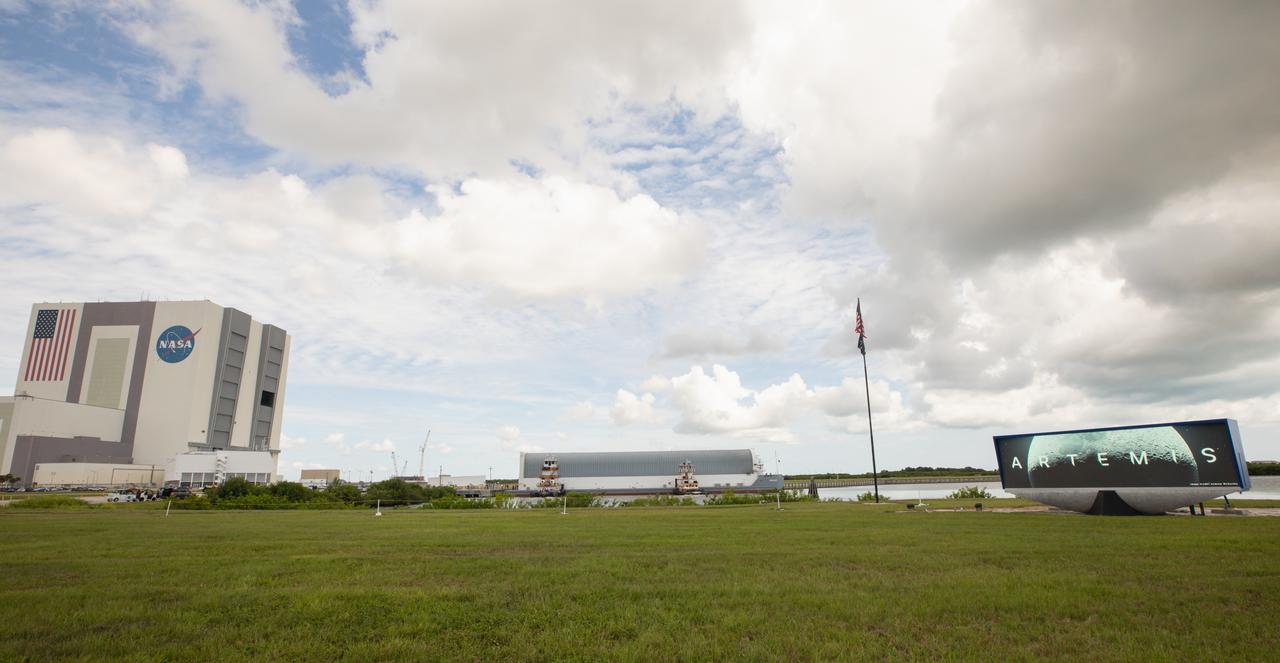
NASA’s Pegasus barge, carrying the agency’s massive SLS (Space Launch System) core stage, arrives at NASA’s Kennedy Space Center Complex 39 turn basin wharf in Florida on Tuesday, July 23, 2024, after journeying from the agency’s Michoud Assembly Facility in New Orleans. The core stage is the next piece of Artemis hardware to arrive at the spaceport and will be offloaded and moved to NASA Kennedy’s Vehicle Assembly Building, where it will be prepared for integration ahead of the Artemis II launch.
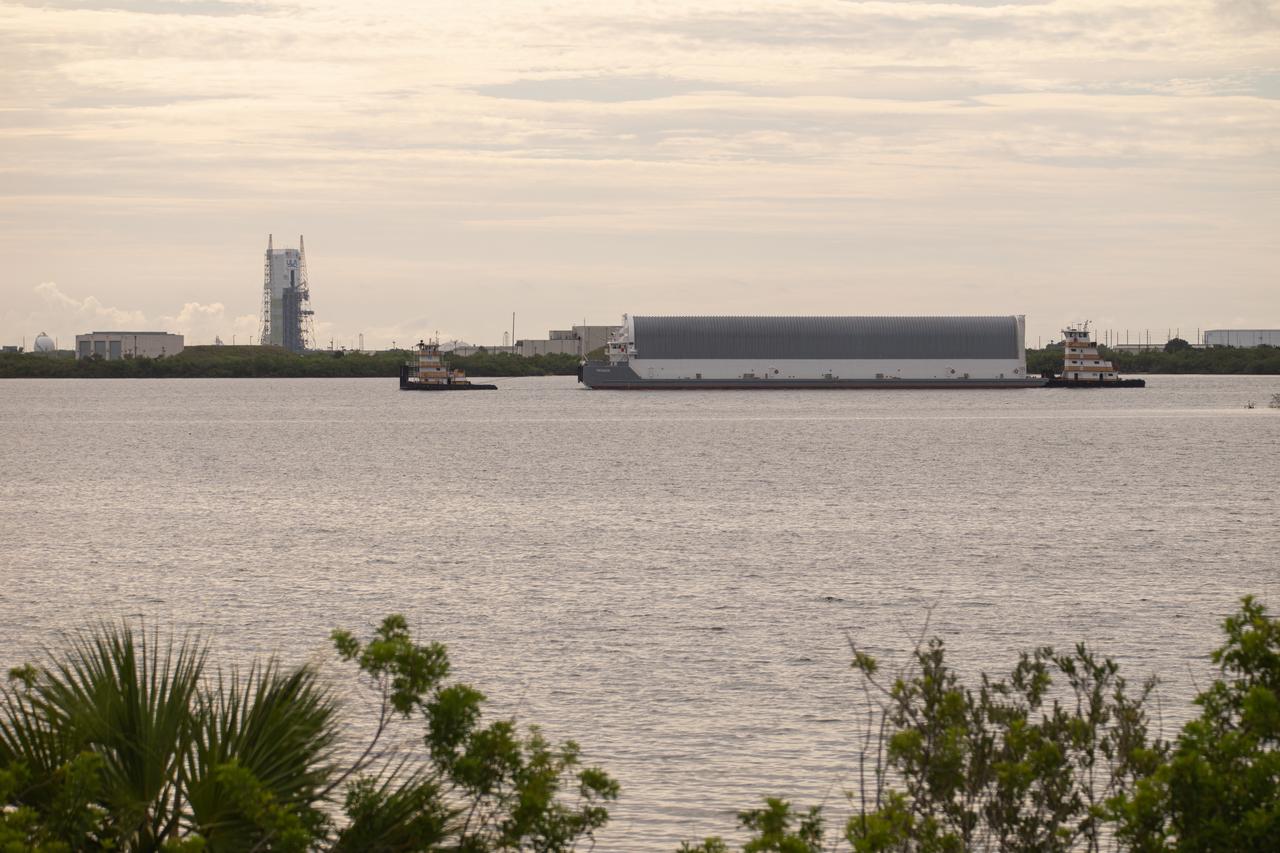
NASA’s Pegasus barge, carrying the agency’s massive SLS (Space Launch System) core stage, arrives at NASA’s Kennedy Space Center Complex 39 turn basin wharf in Florida on Tuesday, July 23, 2024, after journeying from the agency’s Michoud Assembly Facility in New Orleans. The core stage is the next piece of Artemis hardware to arrive at the spaceport and will be offloaded and moved to NASA Kennedy’s Vehicle Assembly Building, where it will be prepared for integration ahead of the Artemis II launch.
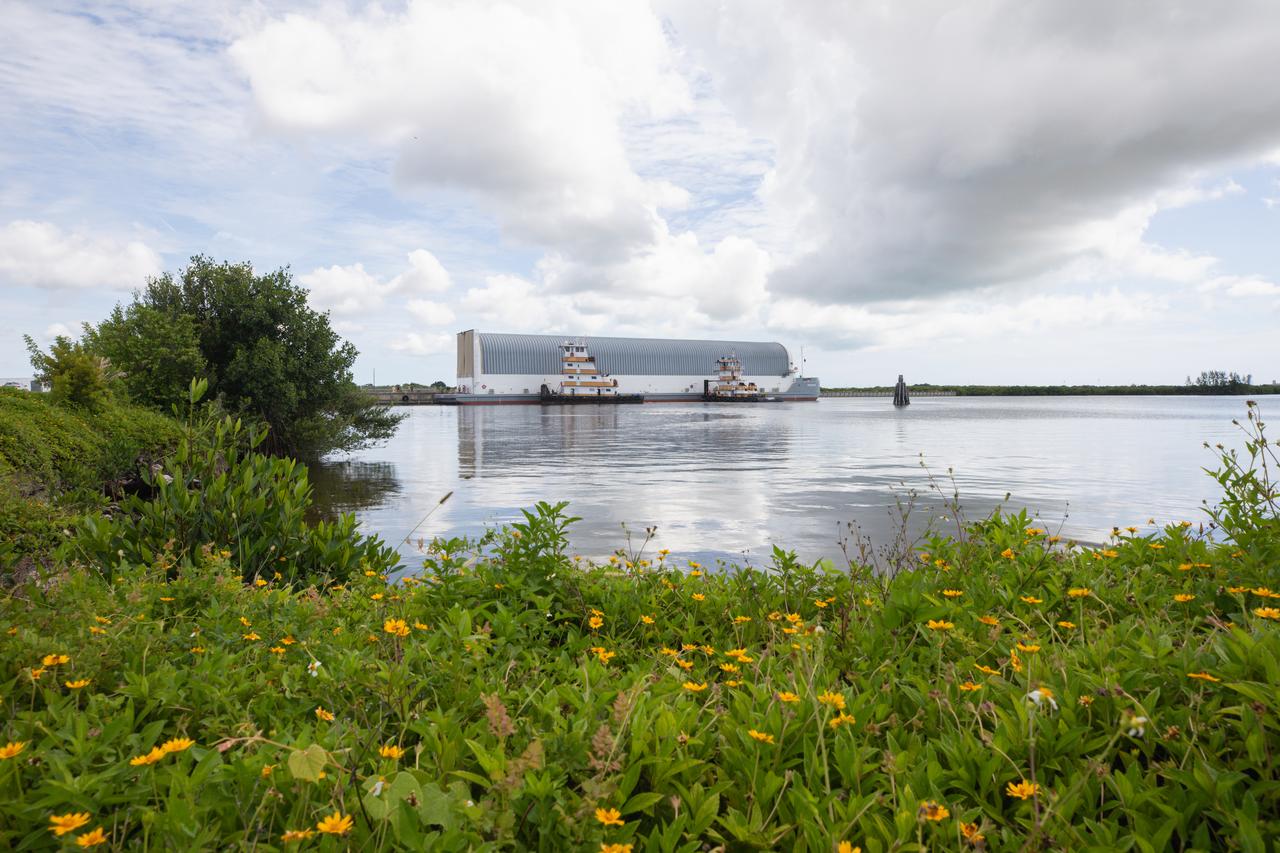
NASA’s Pegasus barge, carrying the agency’s massive SLS (Space Launch System) core stage, arrives at NASA’s Kennedy Space Center Complex 39 turn basin wharf in Florida on Tuesday, July 23, 2024, after journeying from the agency’s Michoud Assembly Facility in New Orleans. The core stage is the next piece of Artemis hardware to arrive at the spaceport and will be offloaded and moved to NASA Kennedy’s Vehicle Assembly Building, where it will be prepared for integration ahead of the Artemis II launch.

NASA’s Pegasus barge, carrying the agency’s massive SLS (Space Launch System) core stage, arrives at NASA’s Kennedy Space Center Complex 39 turn basin wharf in Florida on Tuesday, July 23, 2024, after journeying from the agency’s Michoud Assembly Facility in New Orleans. The core stage is the next piece of Artemis hardware to arrive at the spaceport and will be offloaded and moved to NASA Kennedy’s Vehicle Assembly Building, where it will be prepared for integration ahead of the Artemis II launch.
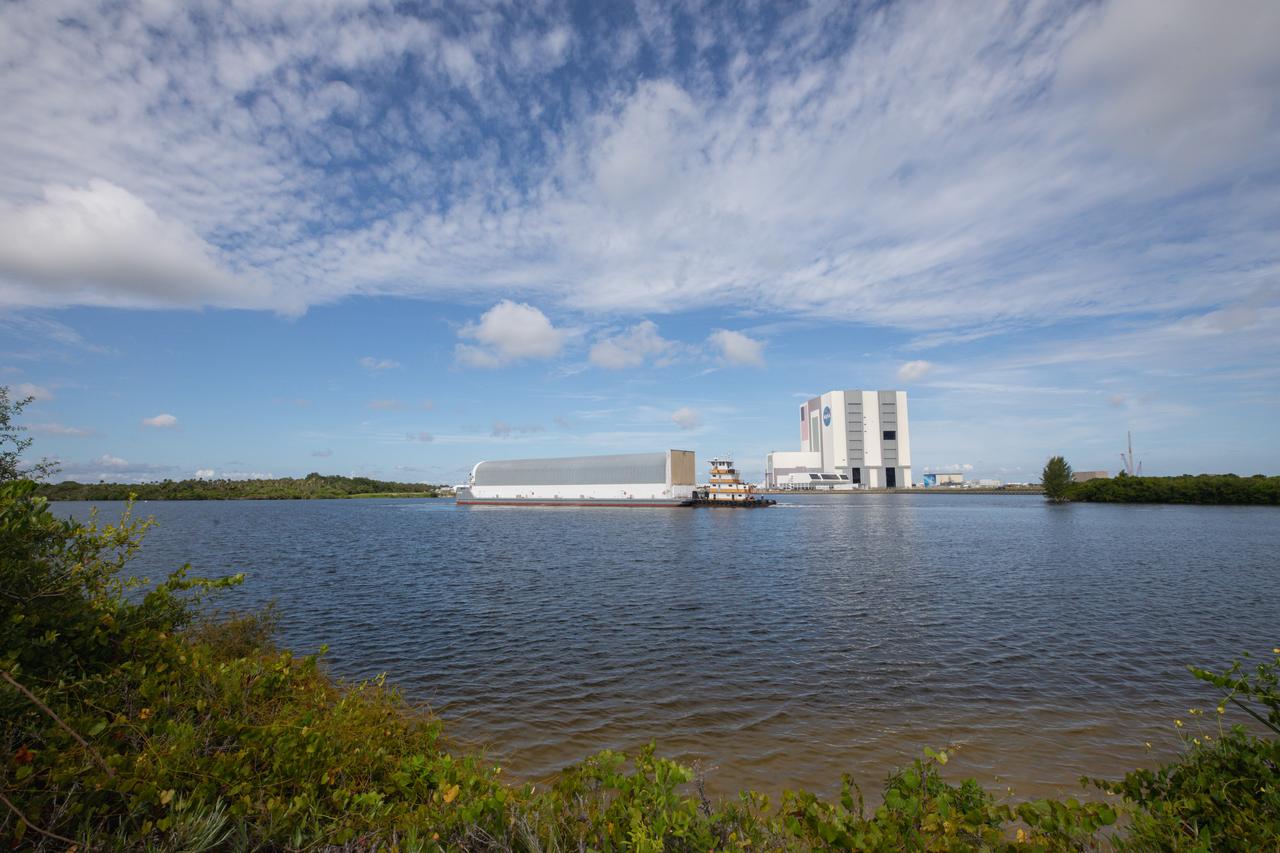
NASA’s Pegasus barge, carrying the agency’s massive SLS (Space Launch System) core stage, arrives at NASA’s Kennedy Space Center Complex 39 turn basin wharf in Florida on Tuesday, July 23, 2024, after journeying from the agency’s Michoud Assembly Facility in New Orleans. The core stage is the next piece of Artemis hardware to arrive at the spaceport and will be offloaded and moved to NASA Kennedy’s Vehicle Assembly Building, where it will be prepared for integration ahead of the Artemis II launch.
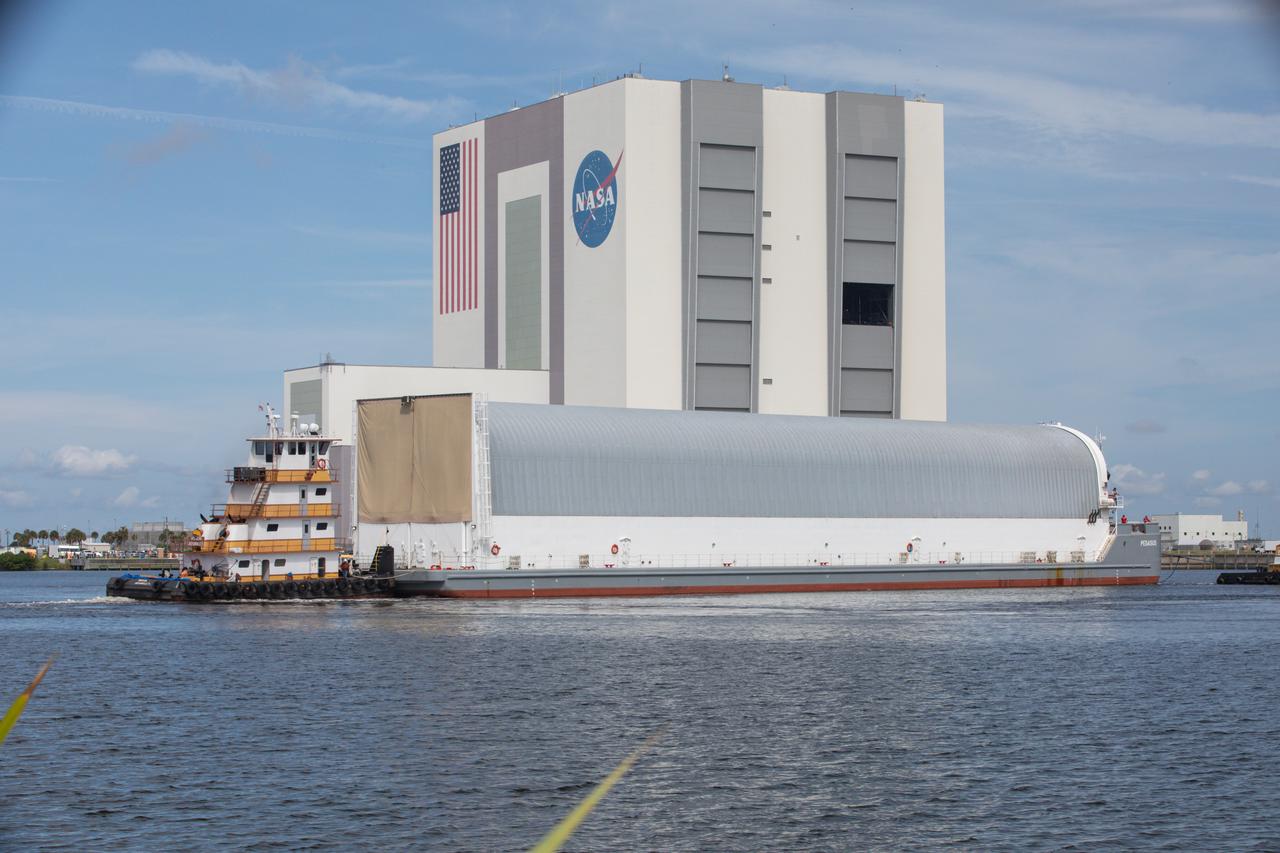
NASA’s Pegasus barge, carrying the agency’s massive SLS (Space Launch System) core stage, arrives at NASA’s Kennedy Space Center Complex 39 turn basin wharf in Florida on Tuesday, July 23, 2024, after journeying from the agency’s Michoud Assembly Facility in New Orleans. The core stage is the next piece of Artemis hardware to arrive at the spaceport and will be offloaded and moved to NASA Kennedy’s Vehicle Assembly Building, where it will be prepared for integration ahead of the Artemis II launch.

NASA’s Kennedy Space Center senior managers (on right, front to back) Janet Sellars, director of Human Resources; Kimberlyn B. Carter, associate program manager for Exploration Ground Systems; Barbara L. Brown, director of Exploration Research and Technology Programs; and Hortense Blackwell, director of Center Engagement and Business Integration Services, pose with members of the all-female flight crew for Delta Air Lines’ Women Inspiring Our Next Generation (WING) flight after the crew touched down at the Launch and Landing Facility at NASA’s Kennedy Space Center on Friday, Sept. 22, 2023. The flight brought girls from Atlanta, Georgia, ranging in age from 12 to 18, to learn about the various careers available at the Florida spaceport. While at Kennedy, the group had the opportunity to view center facilities, hear from a panel of women with a combination of careers from Kennedy and Delta, and tour the visitor complex.
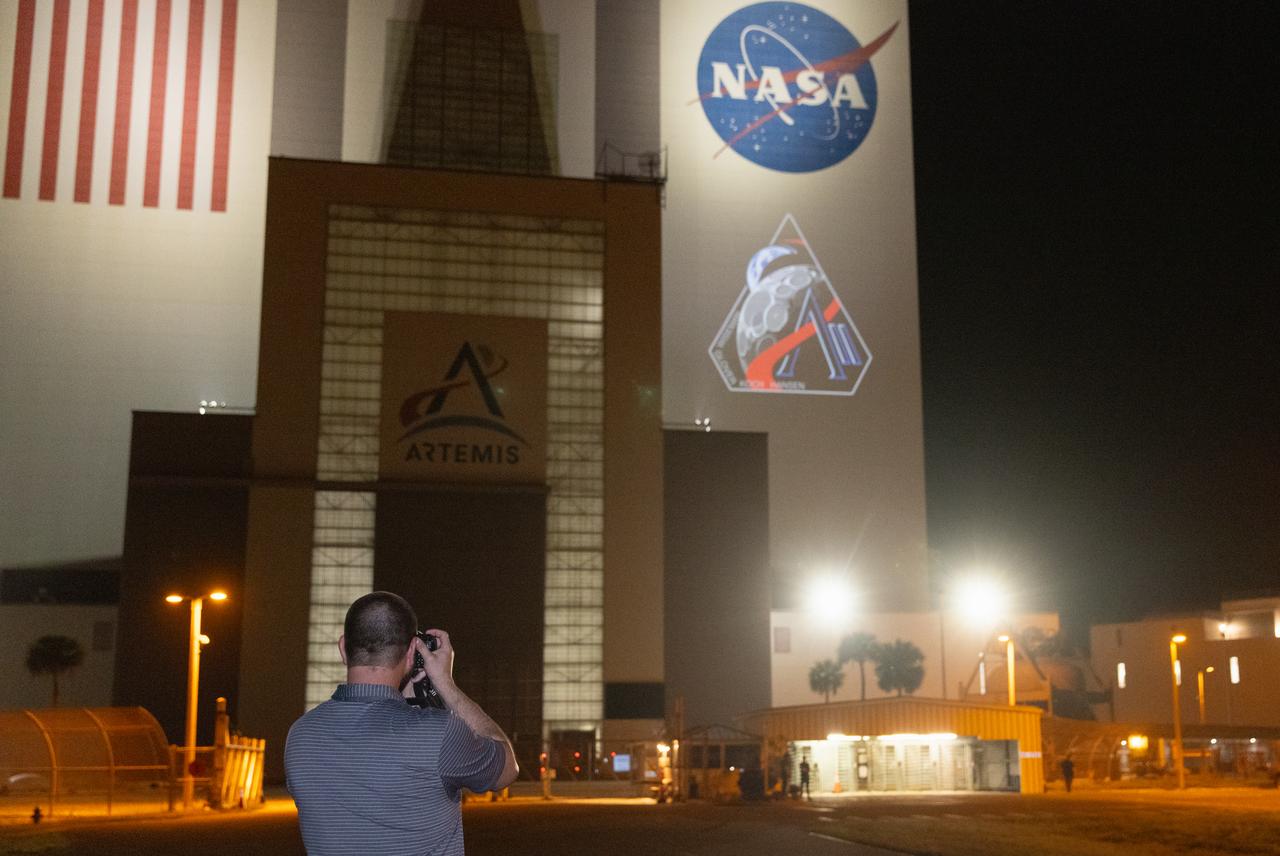
Employees at NASA’s Kennedy Space Center in Florida take photos of the official Artemis II mission crew insignia projected on the exterior of the spaceport’s Vehicle Assembly Building on Friday, April 4, 2025. The patch designates the mission as “AII,” signifying not only the second major flight of the Artemis campaign, but also an endeavor of discovery that seeks to explore for all and by all. Framed in Apollo 8’s famous Earthrise photo, the scene of the Earth and the Moon represents the dual nature of human spaceflight, both equally compelling: The Moon represents our exploration destination, focused on discovery of the unknown. The Earth represents home, focused on the perspective we gain when we look back at our shared planet and learn what it is to be uniquely human. The orbit around Earth highlights the ongoing exploration missions that have enabled Artemis to set sights on a long-term presence on the Moon and soon, Mars.
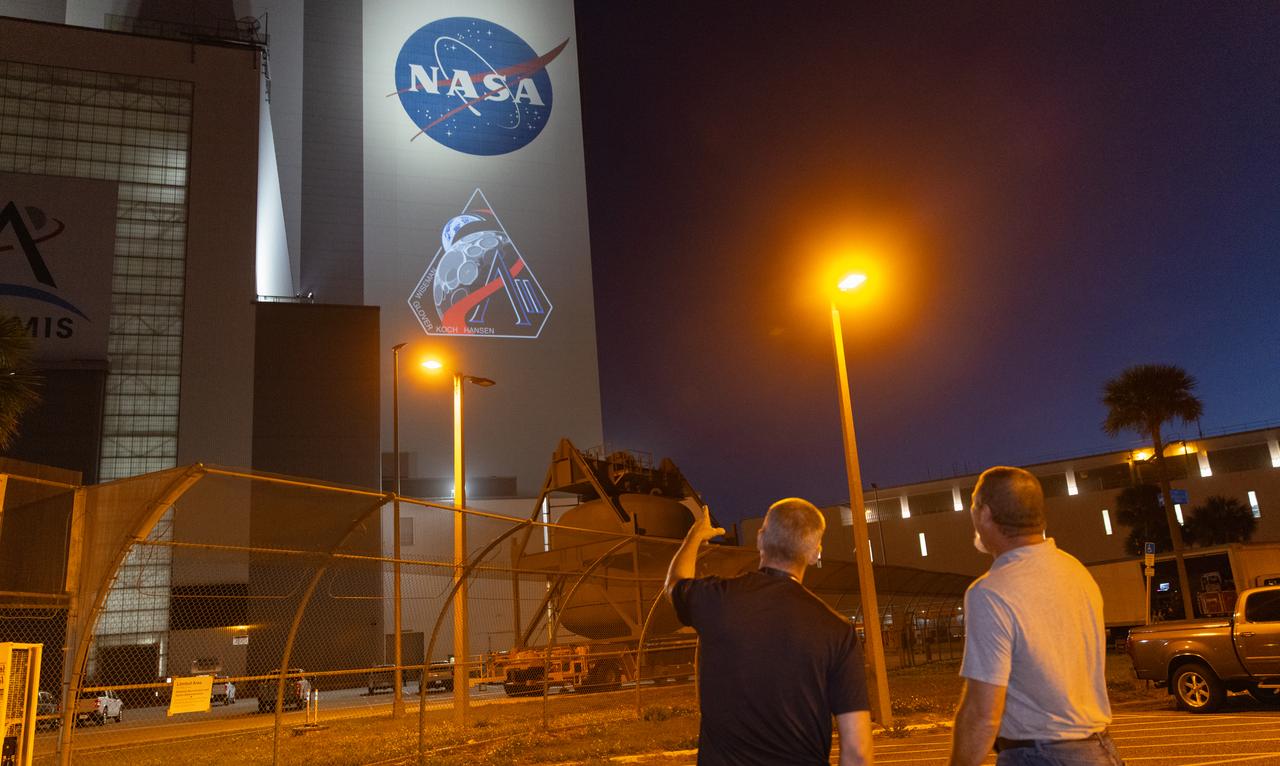
Employees at NASA’s Kennedy Space Center in Florida take photos of the official Artemis II mission crew insignia projected on the exterior of the spaceport’s Vehicle Assembly Building on Friday, April 4, 2025. The patch designates the mission as “AII,” signifying not only the second major flight of the Artemis campaign, but also an endeavor of discovery that seeks to explore for all and by all. Framed in Apollo 8’s famous Earthrise photo, the scene of the Earth and the Moon represents the dual nature of human spaceflight, both equally compelling: The Moon represents our exploration destination, focused on discovery of the unknown. The Earth represents home, focused on the perspective we gain when we look back at our shared planet and learn what it is to be uniquely human. The orbit around Earth highlights the ongoing exploration missions that have enabled Artemis to set sights on a long-term presence on the Moon and soon, Mars.
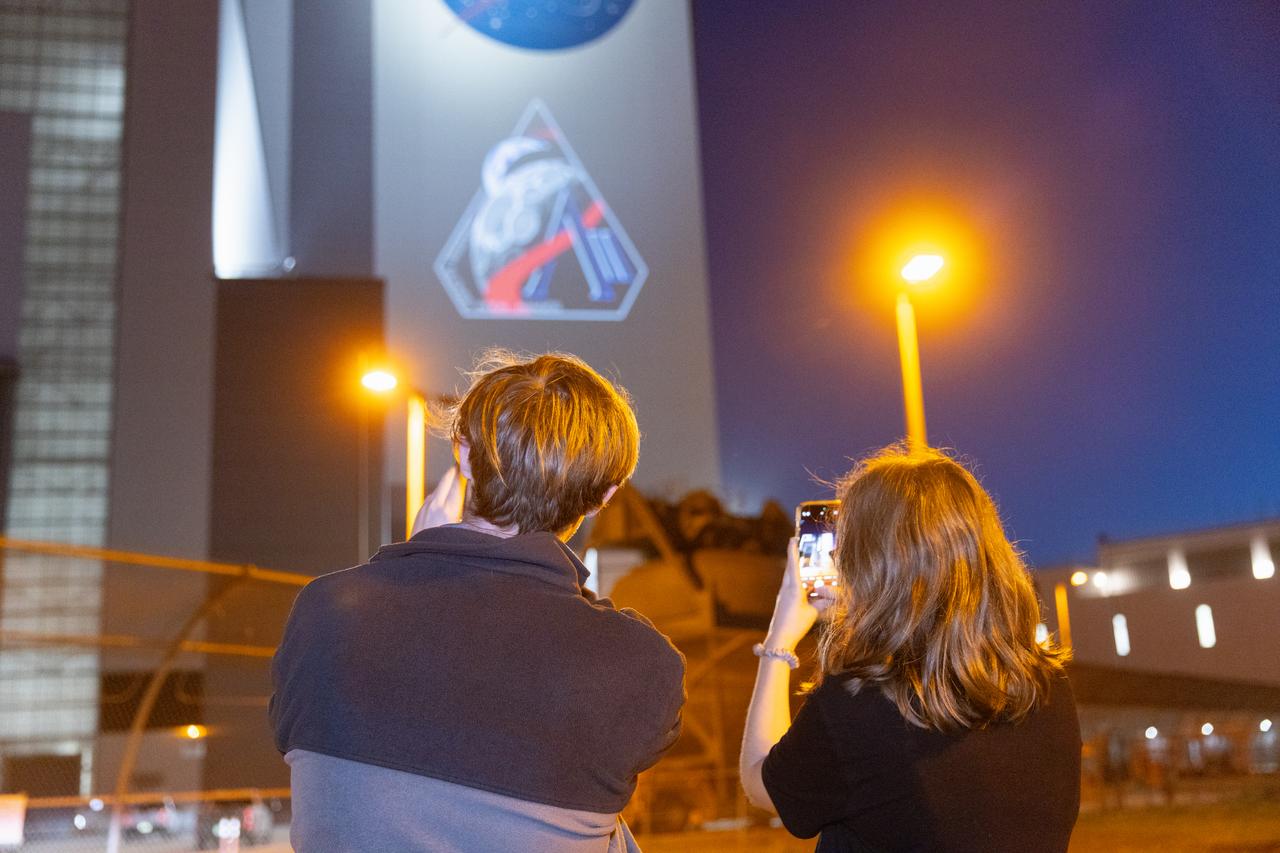
Employees at NASA’s Kennedy Space Center in Florida take photos of the official Artemis II mission crew insignia projected on the exterior of the spaceport’s Vehicle Assembly Building on Friday, April 4, 2025. The patch designates the mission as “AII,” signifying not only the second major flight of the Artemis campaign, but also an endeavor of discovery that seeks to explore for all and by all. Framed in Apollo 8’s famous Earthrise photo, the scene of the Earth and the Moon represents the dual nature of human spaceflight, both equally compelling: The Moon represents our exploration destination, focused on discovery of the unknown. The Earth represents home, focused on the perspective we gain when we look back at our shared planet and learn what it is to be uniquely human. The orbit around Earth highlights the ongoing exploration missions that have enabled Artemis to set sights on a long-term presence on the Moon and soon, Mars.
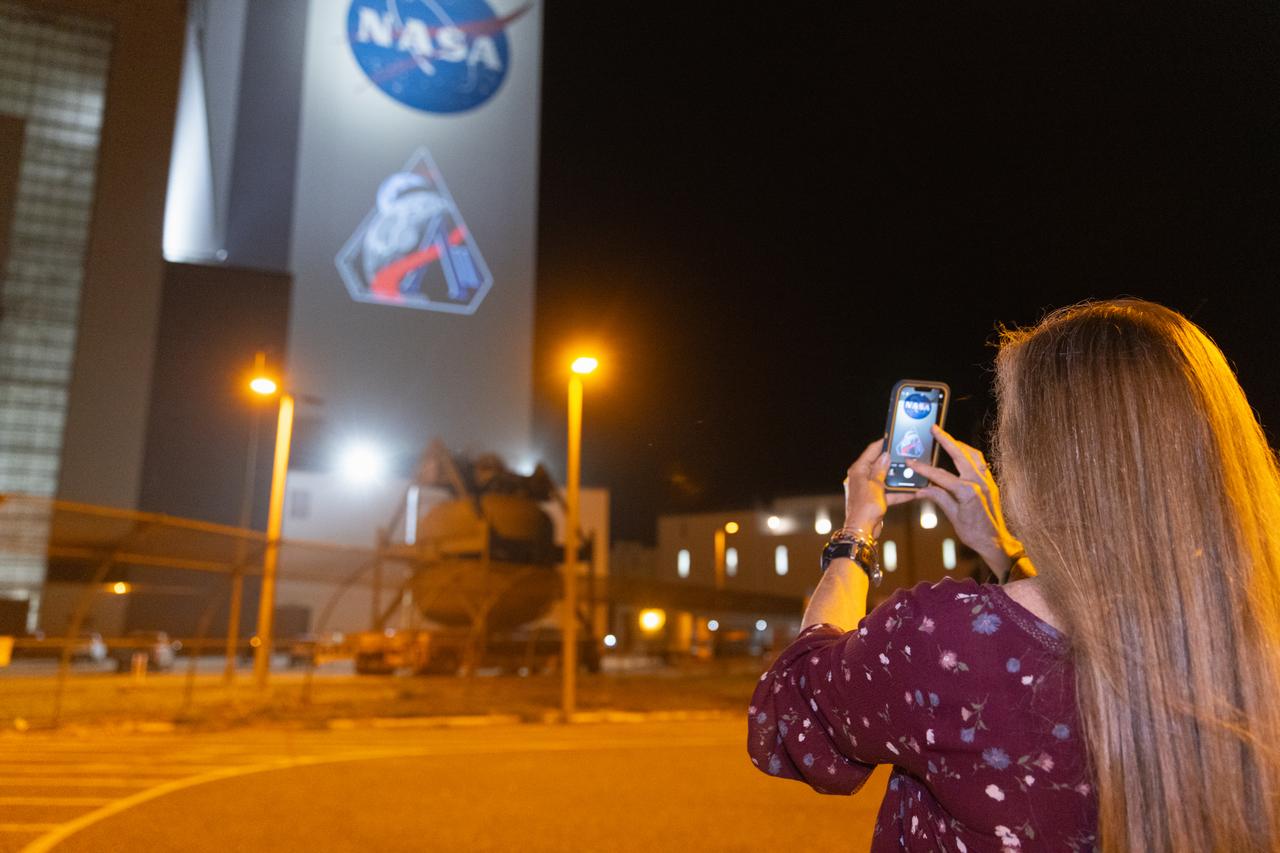
Employees at NASA’s Kennedy Space Center in Florida take photos of the official Artemis II mission crew insignia projected on the exterior of the spaceport’s Vehicle Assembly Building on Friday, April 4, 2025. The patch designates the mission as “AII,” signifying not only the second major flight of the Artemis campaign, but also an endeavor of discovery that seeks to explore for all and by all. Framed in Apollo 8’s famous Earthrise photo, the scene of the Earth and the Moon represents the dual nature of human spaceflight, both equally compelling: The Moon represents our exploration destination, focused on discovery of the unknown. The Earth represents home, focused on the perspective we gain when we look back at our shared planet and learn what it is to be uniquely human. The orbit around Earth highlights the ongoing exploration missions that have enabled Artemis to set sights on a long-term presence on the Moon and soon, Mars.
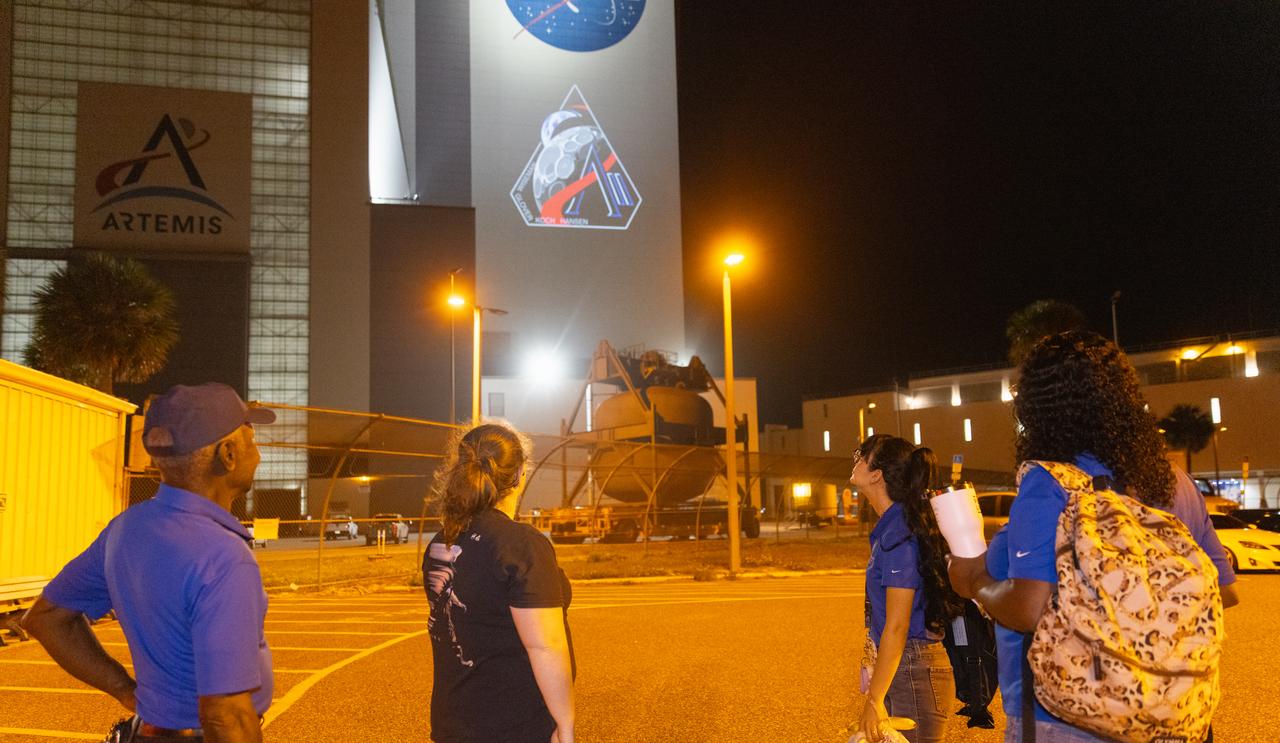
Employees at NASA’s Kennedy Space Center in Florida take photos of the official Artemis II mission crew insignia projected on the exterior of the spaceport’s Vehicle Assembly Building on Friday, April 4, 2025. The patch designates the mission as “AII,” signifying not only the second major flight of the Artemis campaign, but also an endeavor of discovery that seeks to explore for all and by all. Framed in Apollo 8’s famous Earthrise photo, the scene of the Earth and the Moon represents the dual nature of human spaceflight, both equally compelling: The Moon represents our exploration destination, focused on discovery of the unknown. The Earth represents home, focused on the perspective we gain when we look back at our shared planet and learn what it is to be uniquely human. The orbit around Earth highlights the ongoing exploration missions that have enabled Artemis to set sights on a long-term presence on the Moon and soon, Mars.
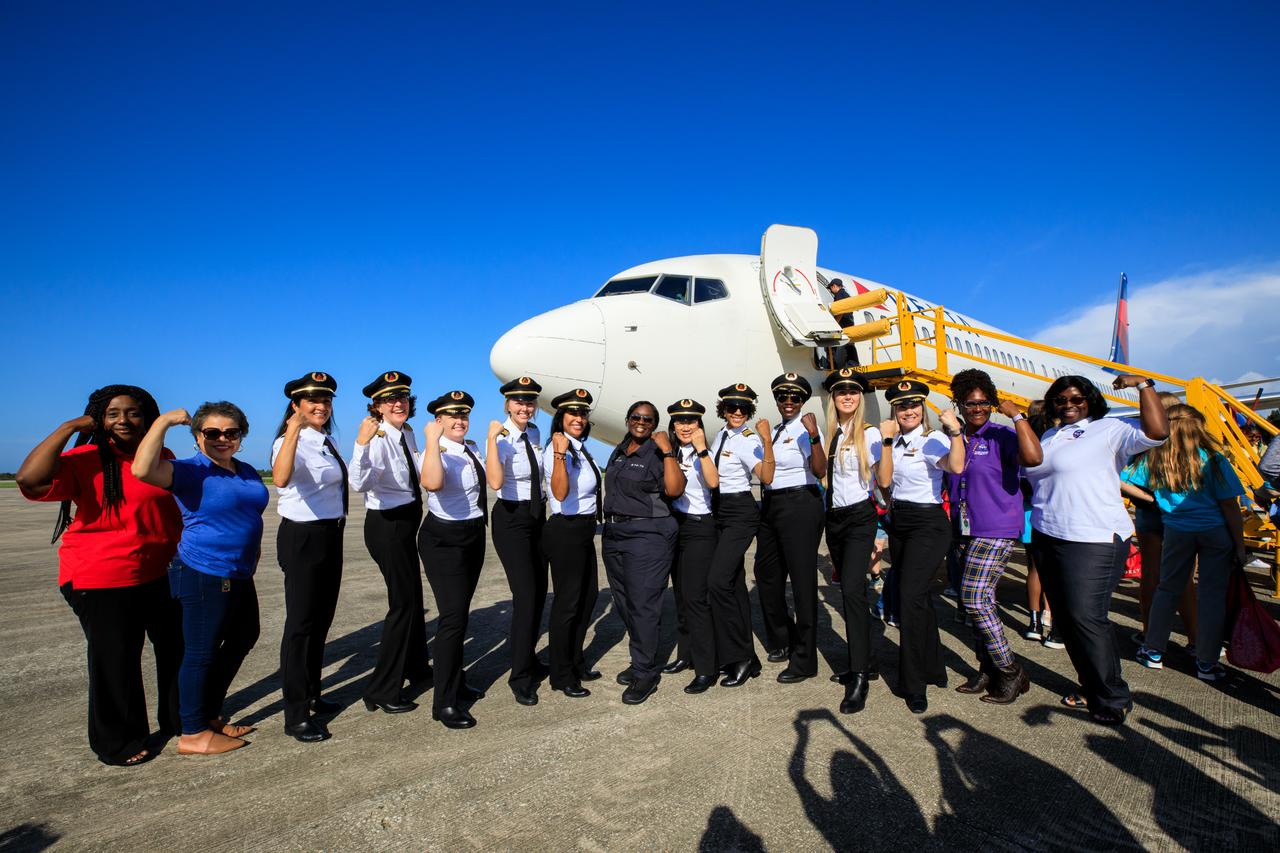
From left, NASA’s Kennedy Space Center senior managers Barbara L. Brown, director of Exploration Research and Technology Programs; Janet Sellars, director of Human Resources; Hortense Blackwell, director of Center Engagement and Business Integration Services; and Kimberlyn B. Carter, associate program manager for Exploration Ground Systems pose with members of the all-female crew for Delta Air Lines’ Women Inspiring Our Next Generation (WING) flight after the crew touched down at the Launch and Landing Facility at Kennedy on Friday, Sept. 22, 2023. The flight brought girls from Atlanta, Georgia, ranging in age from 12 to 18, to learn about the various careers available at the Florida spaceport. While at Kennedy, the group had the opportunity to view center facilities, hear from a panel of women with a combination of careers from Kennedy and Delta, and tour the visitor complex.
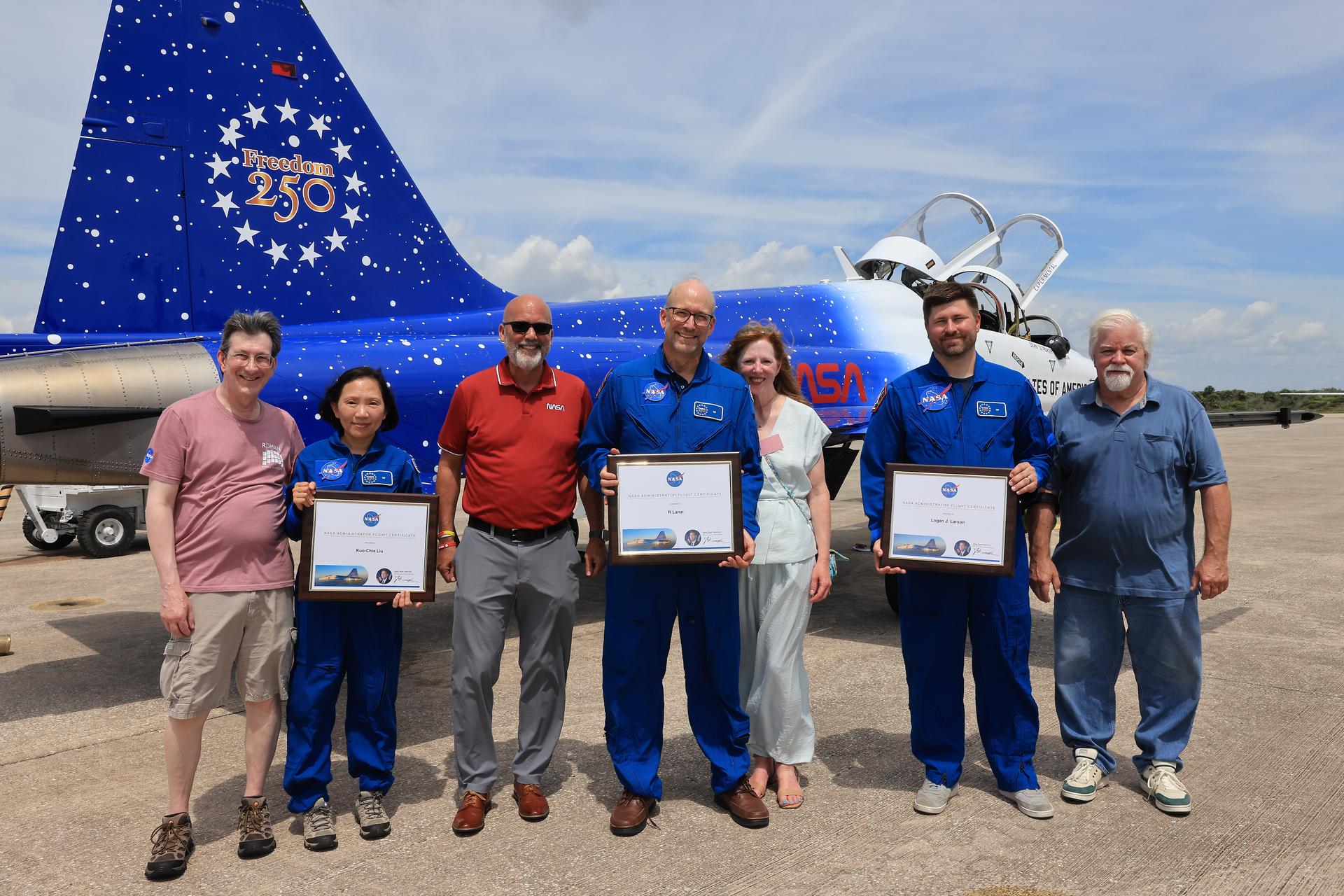
As part of NASA Administrator Jared Isaacman’s Flight Experience Award program, NASA employees Kuo-Chia “Alice” Liu, Raymond “Jim” Lanzi, and Logan Larson receive awards from NASA Kennedy’s Director of Human Capital Office, Mike Beaupre, on Thursday, June 18, 2026, at the Launch and Landing Facility at the agency’s Kennedy Space Center in Florida. Awardees suited up in NASA flight suits, completed pre-flight briefings at the spaceport’s Launch and Landing Facility, received awards from NASA Kennedy’s Director of Human Capital Office, Mike Beaupre, and experienced a unique flight aboard the administrator’s personal F-5 aircraft. The ride-along flight experience award program highlights NASA’s commitment to celebrating excellence across the workforce.
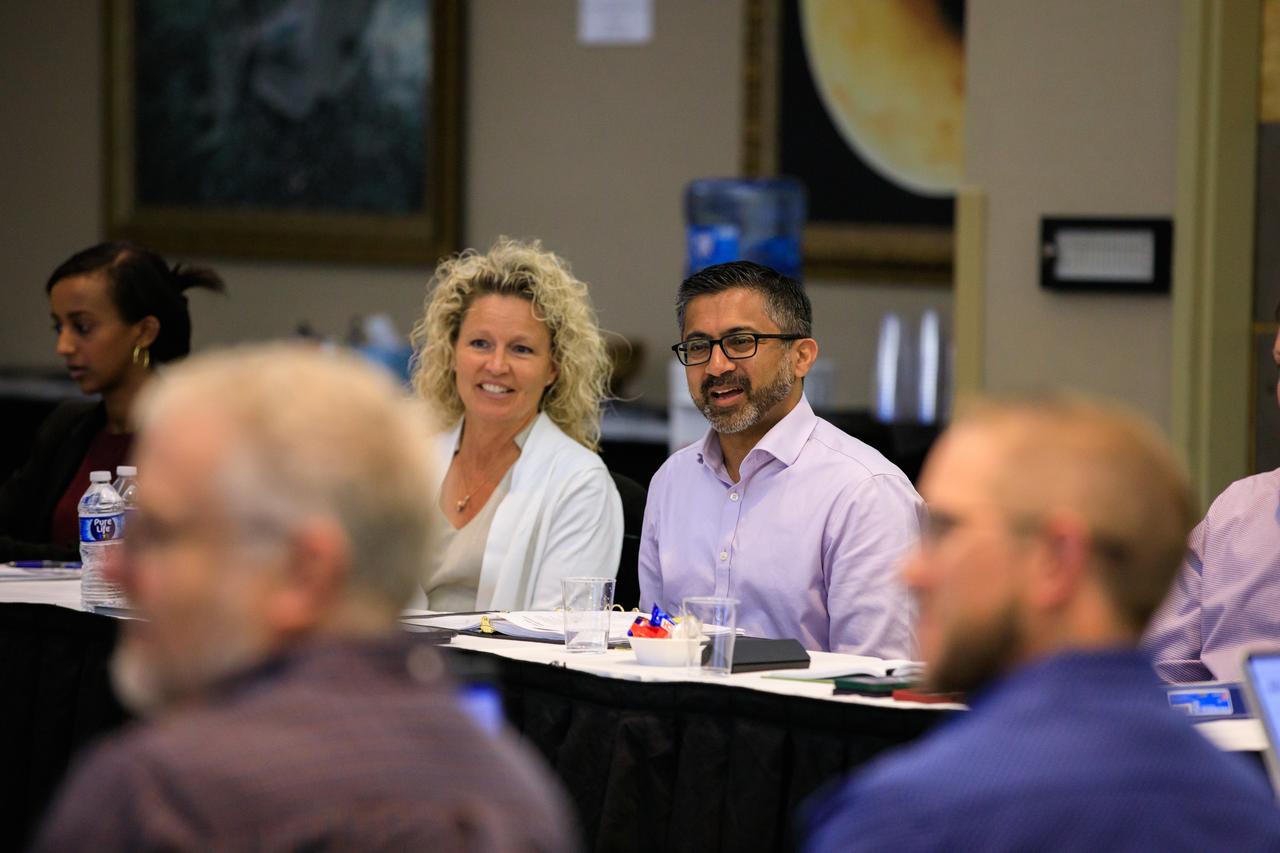
Pam Underwood, at left, director of the Office of Spaceports for the Federal Aviation Administration, and Chirag Parikh, executive secretary of the National Space Council, attend a meeting during the Spaceport Industry Summit on June 14, 2023, at NASA’s Kennedy Space Center in Florida. The National Spaceport Interagency Working Group was visiting Kennedy and other spaceports in the United States to collect feedback on a draft national spaceport strategy.
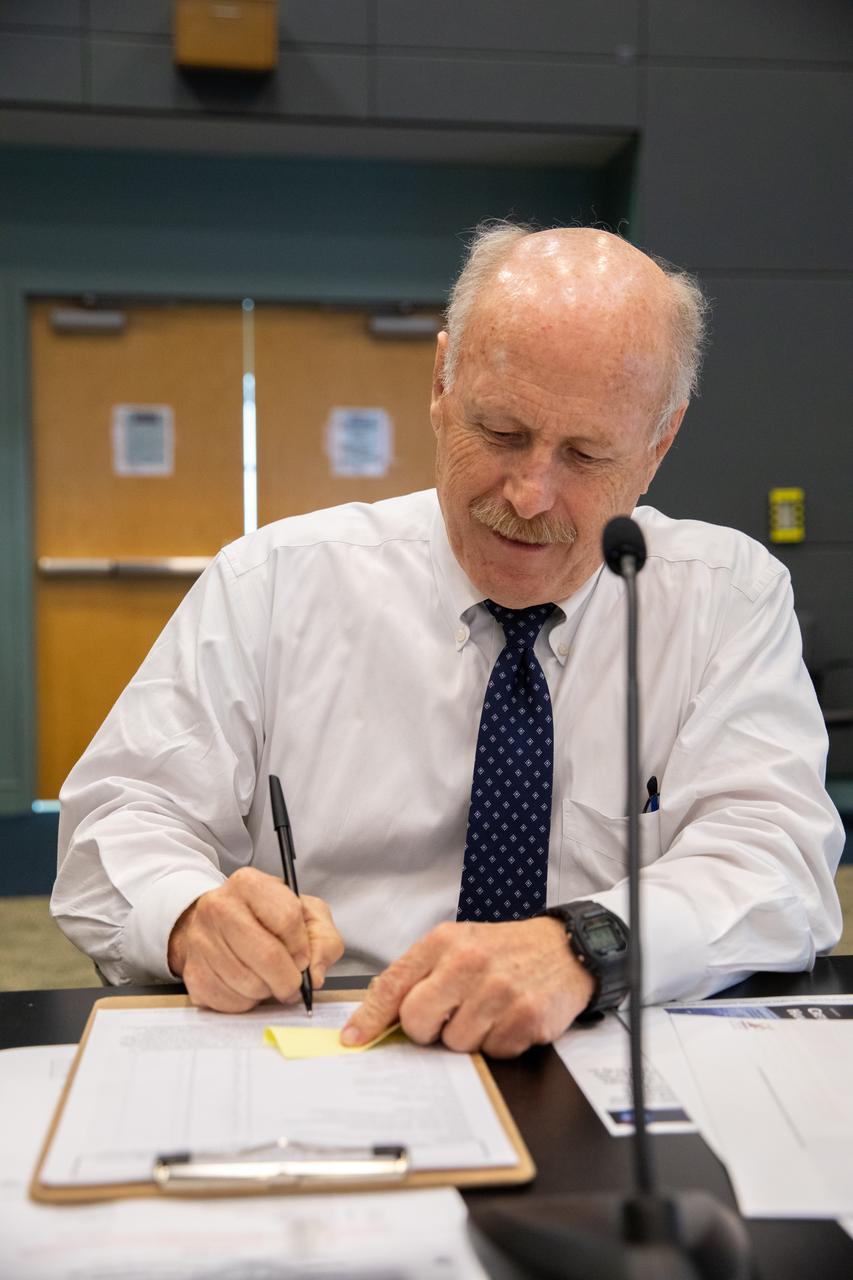
Ken Bowersox, associate administrator, Human Exploration and Operations Mission Directorate, NASA Headquarters, participates in NASA’s SpaceX Crew-7 Flight Readiness Review at Kennedy Space Center on Monday, Aug. 21, 2023. The mission is targeted to lift off from the Florida spaceport’s Launch Complex 39A at 3:49 a.m. EDT Friday, Aug. 25, 2023. NASA astronaut Jasmin Moghbeli, ESA (European Space Agency) astronaut Andreas Mogensen, JAXA (Japan Aerospace Exploration Agency) astronaut Satoshi Furukawa, and Roscosmos cosmonaut Konstantin Borisov will fly to the International Space Station aboard SpaceX’s Dragon spacecraft, powered by the company’s Falcon 9 rocket.
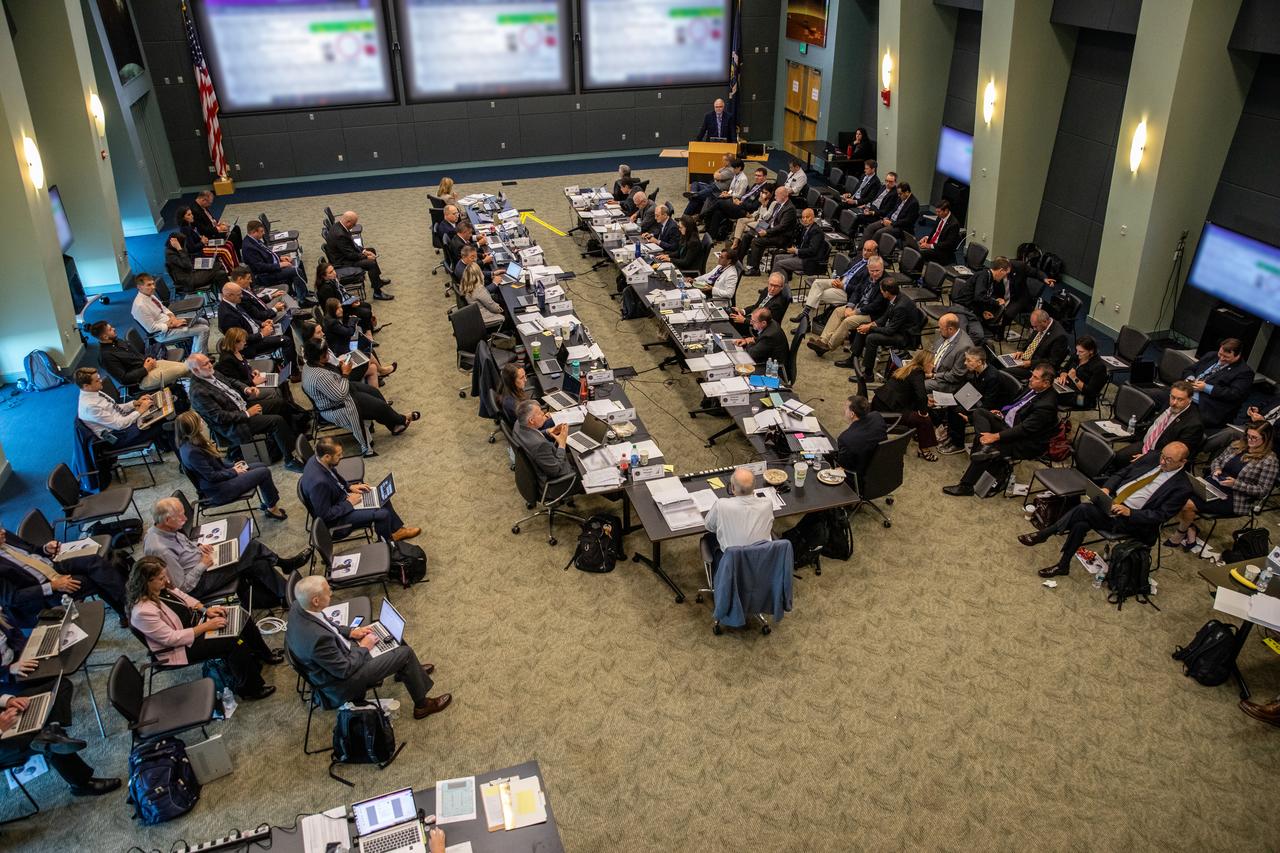
NASA’s SpaceX Crew-7 Flight Readiness Review takes place at Kennedy Space Center on Monday, Aug. 21, 2023. The mission is targeted to lift off from the Florida spaceport’s Launch Complex 39A at 3:49 a.m. EDT Friday, Aug. 25, 2023. NASA astronaut Jasmin Moghbeli, ESA (European Space Agency) astronaut Andreas Mogensen, JAXA (Japan Aerospace Exploration Agency) astronaut Satoshi Furukawa, and Roscosmos cosmonaut Konstantin Borisov will fly to the International Space Station aboard SpaceX’s Dragon spacecraft, powered by the company’s Falcon 9 rocket.
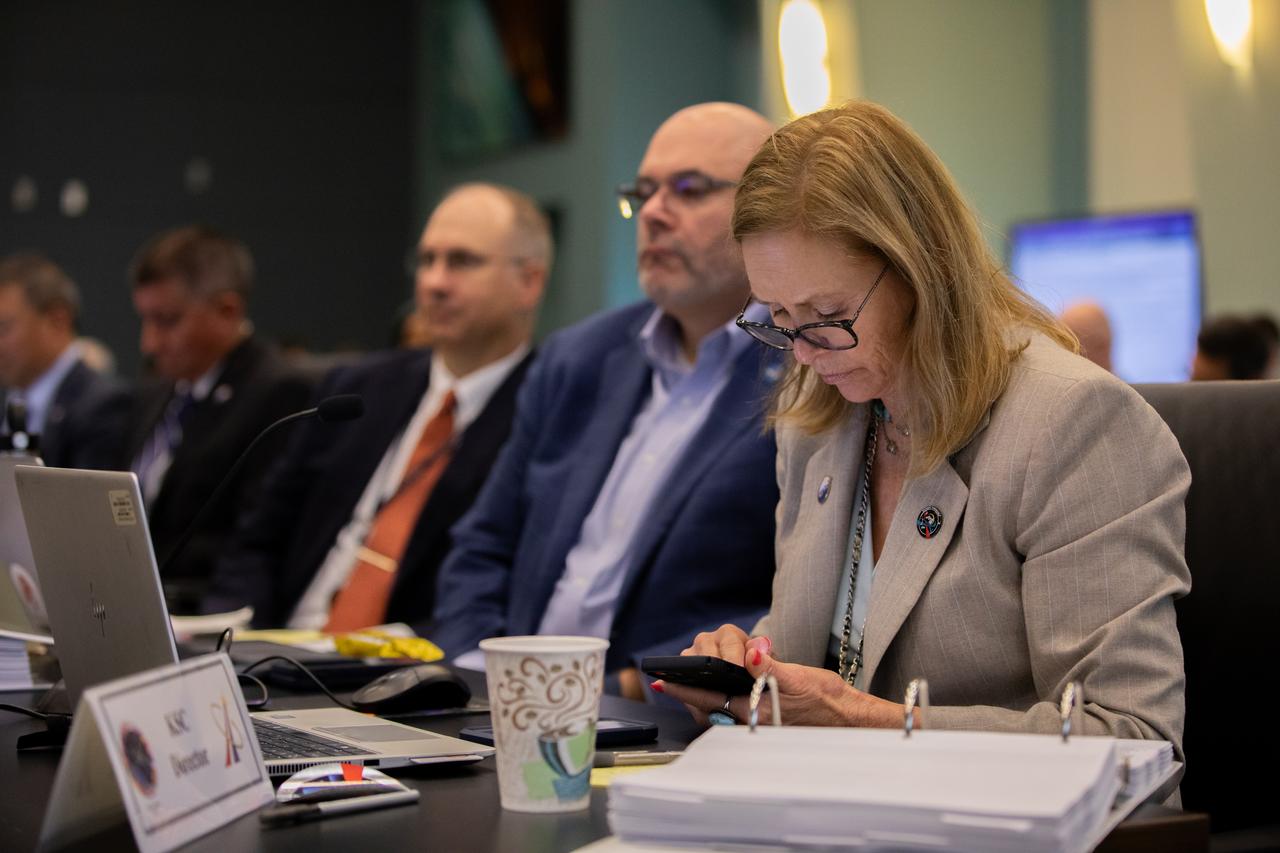
Kennedy Space Center Director Janet Petro participates in NASA’s SpaceX Crew-7 Flight Readiness Review at Kennedy Space Center on Monday, Aug. 21, 2023. The mission is targeted to lift off from the Florida spaceport’s Launch Complex 39A at 3:49 a.m. EDT Friday, Aug. 25, 2023. NASA astronaut Jasmin Moghbeli, ESA (European Space Agency) astronaut Andreas Mogensen, JAXA (Japan Aerospace Exploration Agency) astronaut Satoshi Furukawa, and Roscosmos cosmonaut Konstantin Borisov will fly to the International Space Station aboard SpaceX’s Dragon spacecraft, powered by the company’s Falcon 9 rocket.
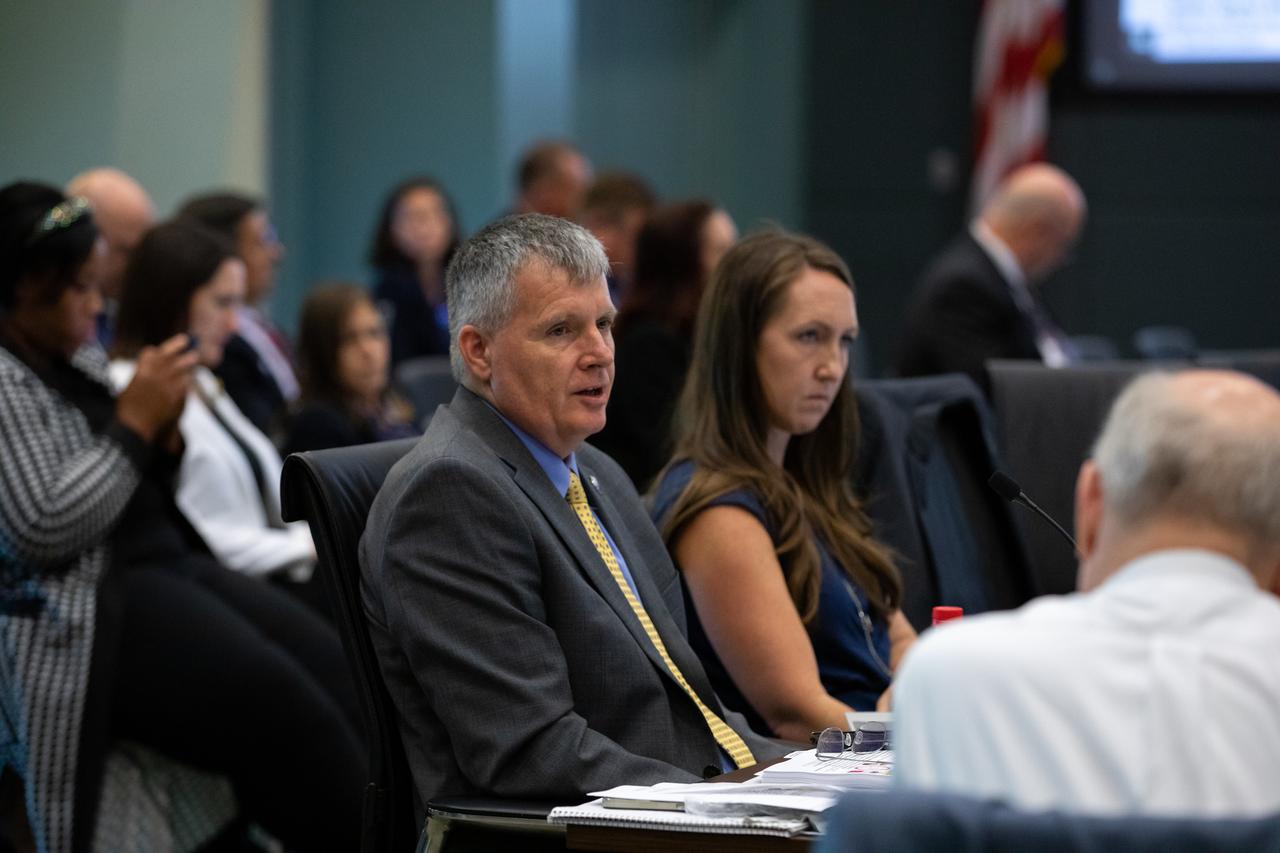
Steve Stich, manager of NASA’s Commercial Crew Program at Kennedy Space Center, participates in NASA’s SpaceX Crew-7 Flight Readiness Review at the Florida spaceport on Monday, Aug. 21, 2023. The mission is targeted to lift off from Kennedy’s Launch Complex 39A at 3:49 a.m. EDT Friday, Aug. 25, 2023. NASA astronaut Jasmin Moghbeli, ESA (European Space Agency) astronaut Andreas Mogensen, JAXA (Japan Aerospace Exploration Agency) astronaut Satoshi Furukawa, and Roscosmos cosmonaut Konstantin Borisov will fly to the International Space Station aboard SpaceX’s Dragon spacecraft, powered by the company’s Falcon 9 rocket.

NASA Associate Administrator Bob Cabana participates in NASA’s SpaceX Crew-7 Flight Readiness Review at Kennedy Space Center on Monday, Aug. 21, 2023. The mission is targeted to lift off from the Florida spaceport’s Launch Complex 39A at 3:49 a.m. EDT Friday, Aug. 25, 2023. NASA astronaut Jasmin Moghbeli, ESA (European Space Agency) astronaut Andreas Mogensen, JAXA (Japan Aerospace Exploration Agency) astronaut Satoshi Furukawa, and Roscosmos cosmonaut Konstantin Borisov will fly to the International Space Station aboard SpaceX’s Dragon spacecraft, powered by the company’s Falcon 9 rocket.
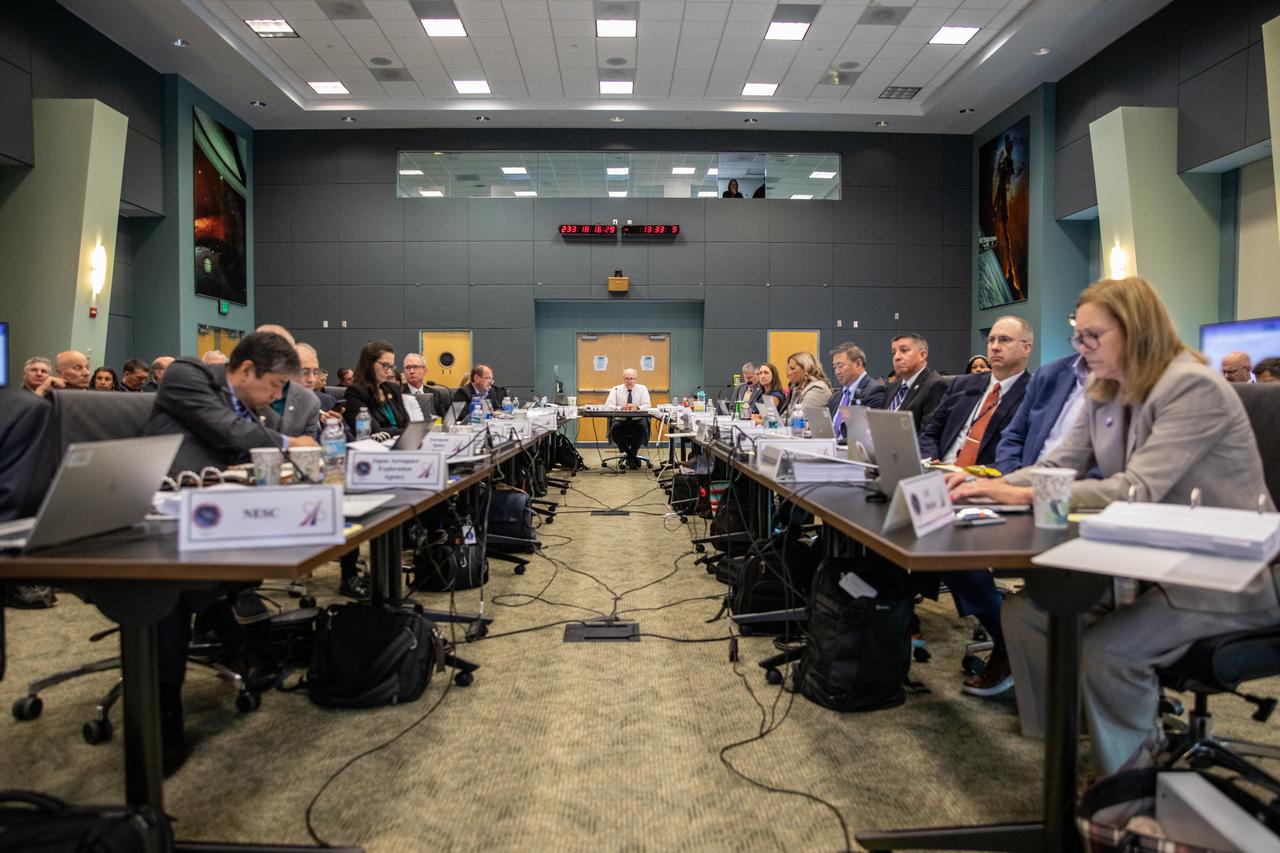
NASA’s SpaceX Crew-7 Flight Readiness Review takes place at Kennedy Space Center on Monday, Aug. 21, 2023. The mission is targeted to lift off from the Florida spaceport’s Launch Complex 39A at 3:49 a.m. EDT Friday, Aug. 25, 2023. NASA astronaut Jasmin Moghbeli, ESA (European Space Agency) astronaut Andreas Mogensen, JAXA (Japan Aerospace Exploration Agency) astronaut Satoshi Furukawa, and Roscosmos cosmonaut Konstantin Borisov will fly to the International Space Station aboard SpaceX’s Dragon spacecraft, powered by the company’s Falcon 9 rocket.

Ken Bowersox, associate administrator, Human Exploration and Operations Mission Directorate, NASA Headquarters participates in NASA’s SpaceX Crew-7 Flight Readiness Review at Kennedy Space Center on Monday, Aug. 21, 2023. The mission is targeted to lift off from the Florida spaceport’s Launch Complex 39A at 3:49 a.m. EDT Friday, Aug. 25, 2023. NASA astronaut Jasmin Moghbeli, ESA (European Space Agency) astronaut Andreas Mogensen, JAXA (Japan Aerospace Exploration Agency) astronaut Satoshi Furukawa, and Roscosmos cosmonaut Konstantin Borisov will fly to the International Space Station aboard SpaceX’s Dragon spacecraft, powered by the company’s Falcon 9 rocket.
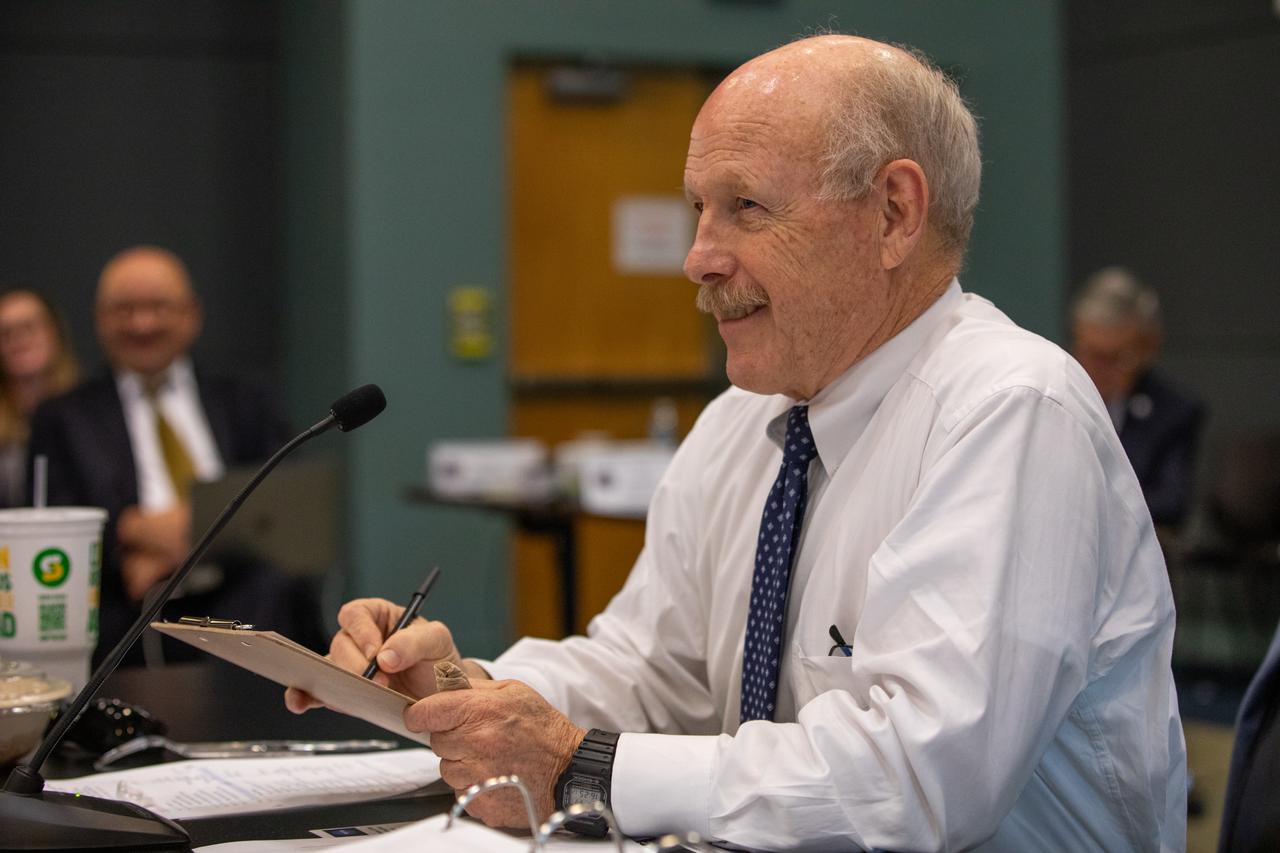
Ken Bowersox, associate administrator, Human Exploration and Operations Mission Directorate, NASA Headquarters, participates in NASA’s SpaceX Crew-7 Flight Readiness Review at Kennedy Space Center on Monday, Aug. 21, 2023. The mission is targeted to lift off from the Florida spaceport’s Launch Complex 39A at 3:49 a.m. EDT Friday, Aug. 25, 2023. NASA astronaut Jasmin Moghbeli, ESA (European Space Agency) astronaut Andreas Mogensen, JAXA (Japan Aerospace Exploration Agency) astronaut Satoshi Furukawa, and Roscosmos cosmonaut Konstantin Borisov will fly to the International Space Station aboard SpaceX’s Dragon spacecraft, powered by the company’s Falcon 9 rocket.
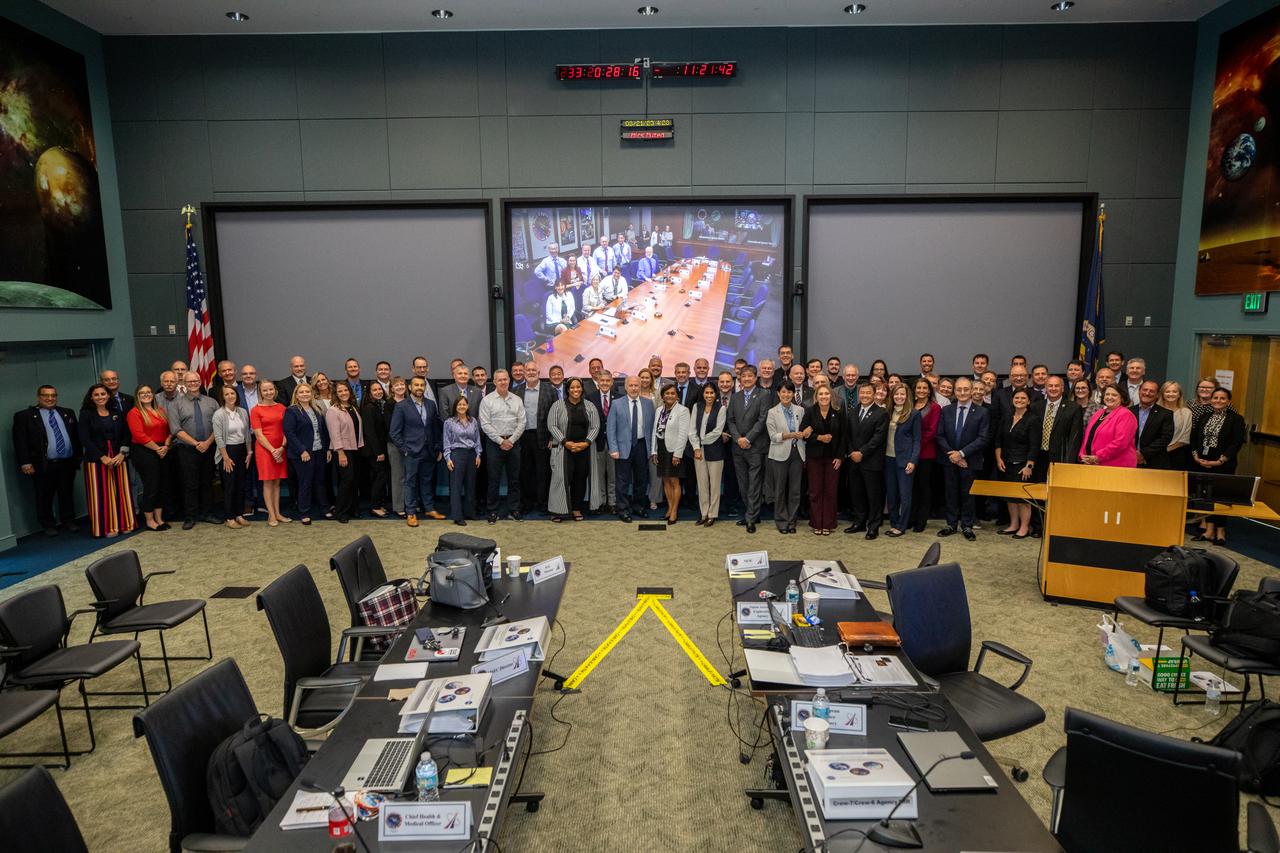
Managers with NASA and SpaceX, along with international partners, pose for a photo after completion of NASA’s SpaceX Crew-7 Flight Readiness Review at Kennedy Space Center on Monday, Aug. 21, 2023. The mission is targeted to lift off from the Florida spaceport’s Launch Complex 39A at 3:49 a.m. EDT Friday, Aug. 25, 2023. NASA astronaut Jasmin Moghbeli, ESA (European Space Agency) astronaut Andreas Mogensen, JAXA (Japan Aerospace Exploration Agency) astronaut Satoshi Furukawa, and Roscosmos cosmonaut Konstantin Borisov will fly to the International Space Station aboard SpaceX’s Dragon spacecraft, powered by the company’s Falcon 9 rocket.

NASA’s SLS (Space Launch System) core stage for the Artemis III mission undergoes prelaunch processing inside High Bay 2 of the Vehicle Assembly Building at NASA’s Kennedy Space Center in Florida on Tuesday, May 12, 2026. This marks the first time core stage assembly operations for Artemis missions have been conducted at the spaceport. Artemis III will launch astronauts to low Earth orbit aboard the Orion spacecraft on top of SLS to test rendezvous and docking capabilities between Orion and commercial spacecraft needed to land Artemis IV astronauts on the Moon in 2028.

Nancy Bray, director of Spaceport Integration and Services at NASA's Kennedy Space Center, left, is joined by Myrna Scott, center, and Dr. David Tipton, chief of Aerospace Medicine and Occupational Health, in cutting a ceremonial ribbon dedicating the Randal E. Scott Radiological Control Center at the Florida spaceport. Myrna Scott is the widow of Randy Scott, who was a professional health physicist of more than 40 years. He served as the Florida spaceport's Radiation Protection Officer for 14 years until his death June 17, 2016.

Nancy Bray, director of Spaceport Integration and Services at NASA's Kennedy Space Center, left, is joined by Myrna Scott, center, and Dr. David Tipton, chief of Aerospace Medicine and Occupational Health, in cutting a ceremonial ribbon dedicating the Randal E. Scott Radiological Control Center at the Florida spaceport. Myrna Scott is the widow of Randy Scott, who was a professional health physicist of more than 40 years. He served as the Florida spaceport's Radiation Protection Officer for 14 years until his death June 17, 2016.

Nancy Bray, director of Spaceport Integration and Services at NASA's Kennedy Space Center, left, is joined by Myrna Scott, center, and Dr. David Tipton, chief of Aerospace Medicine and Occupational Health, in cutting a ceremonial ribbon dedicating the Randal E. Scott Radiological Control Center at the Florida spaceport. Myrna Scott is the widow of Randy Scott, who was a professional health physicist of more than 40 years. He served as the Florida spaceport's Radiation Protection Officer for 14 years until his death June 17, 2016.
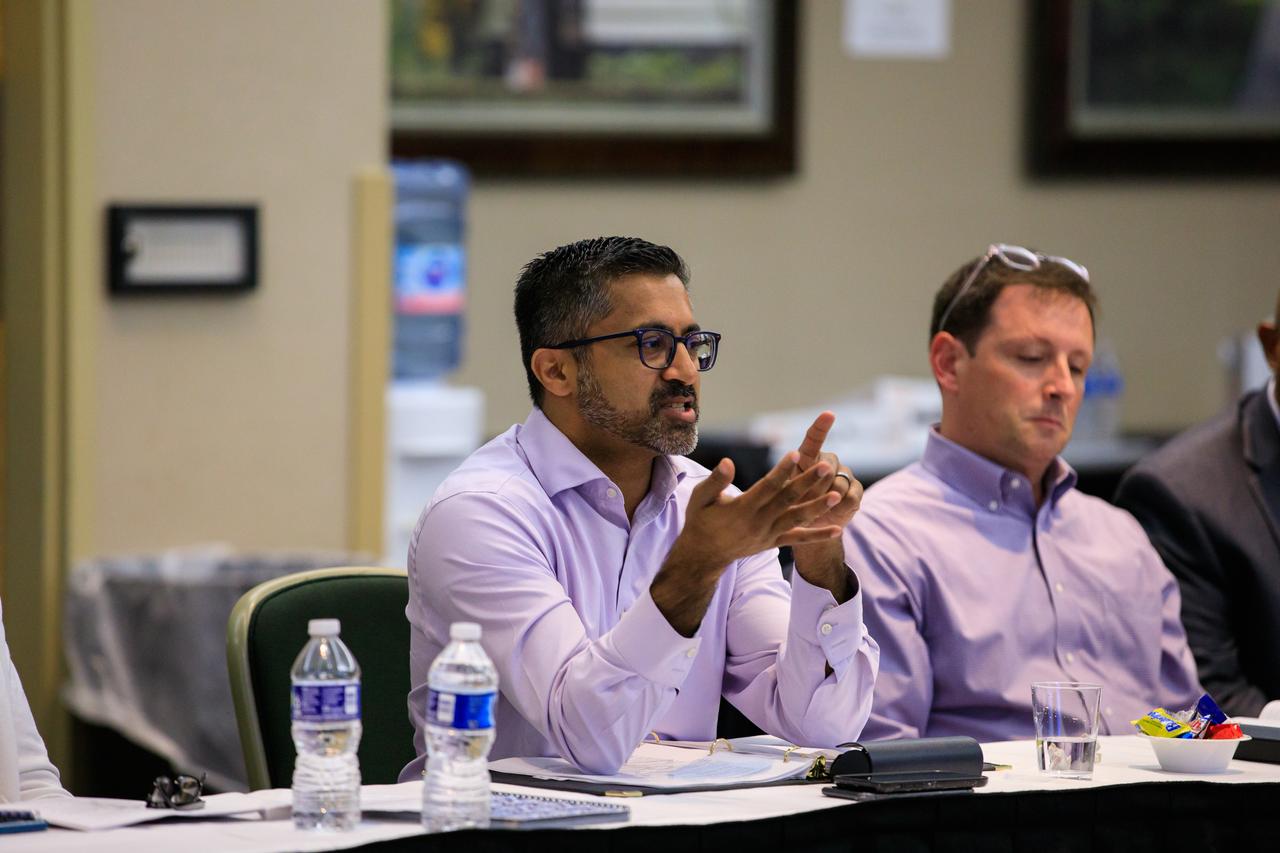
Chirag Parikh, at left, executive secretary of the National Space Council, and Johnathan Pellish, director of civil space policy for the National Space Council, attend discussions at the Spaceport Industry Summit on June 14, 2023, at NASA’s Kennedy Space Center in Florida. The National Spaceport Interagency Working Group was visiting Kennedy and other spaceports in the United States to collect feedback on a draft national spaceport strategy.
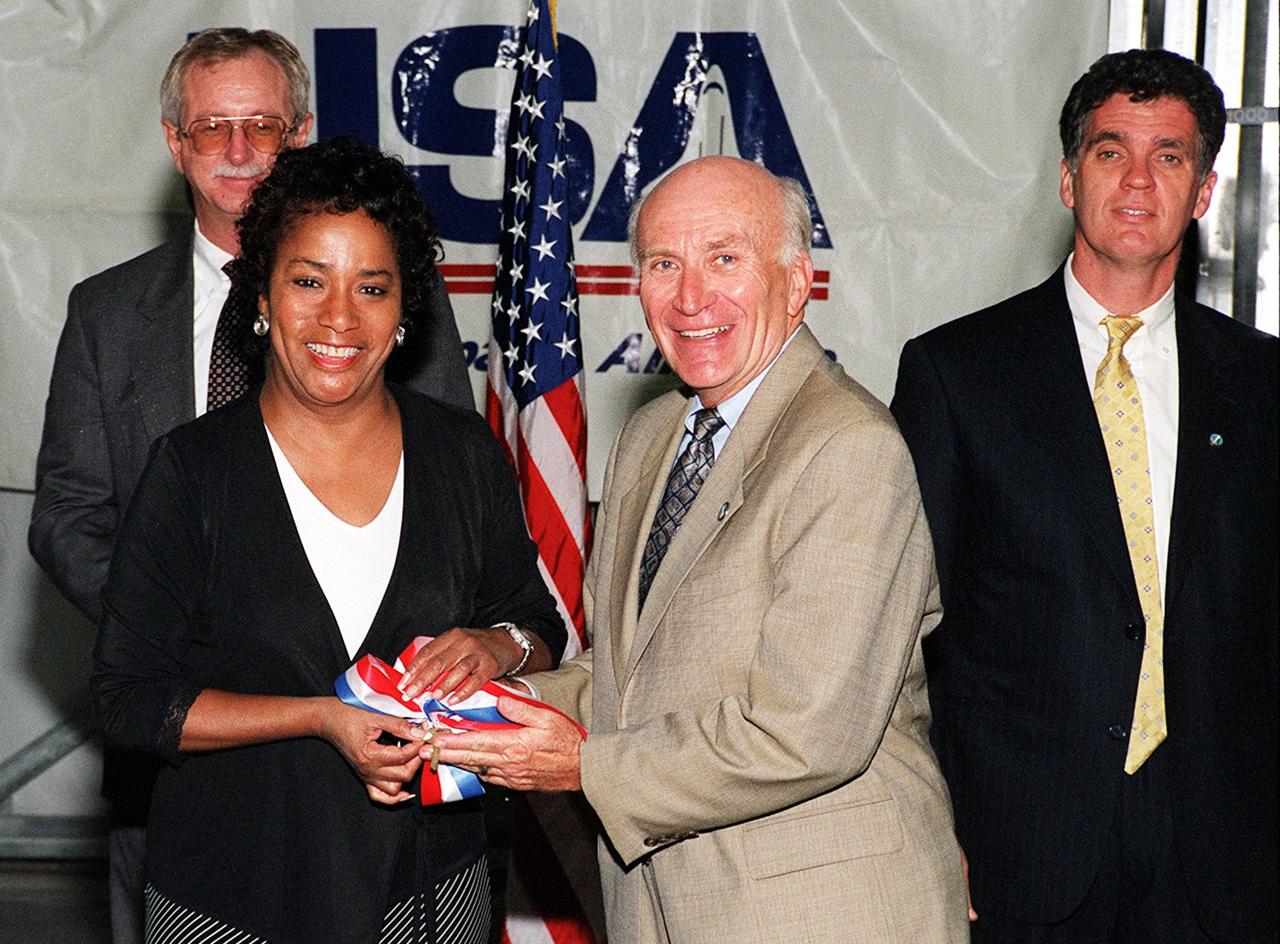
KENNEDY SPACE CENTER, Fla. -- After the signing of a lease agreement between Spaceport Florida Authority (SFA) and United Space Alliance (USA) for the use of a hangar at Kennedy Space Center, (foreground left) Marcie Harris, USA site director, and (foreground right) Ed Gormel, Spaceport Florida executive director, hold a symbolic ribbon. Behind them are (left) Greg Popp, Spaceport Florida business manager, and (right) Congressman Dave Weldon. The hangar was originally developed by the state as part of a joint NASA/SFA Reusable Launch Vehicle Support Complex at KSC. USA plans to use the state-developed 50,000-square-foot facility to store and maintain Space Shuttle ground equipment
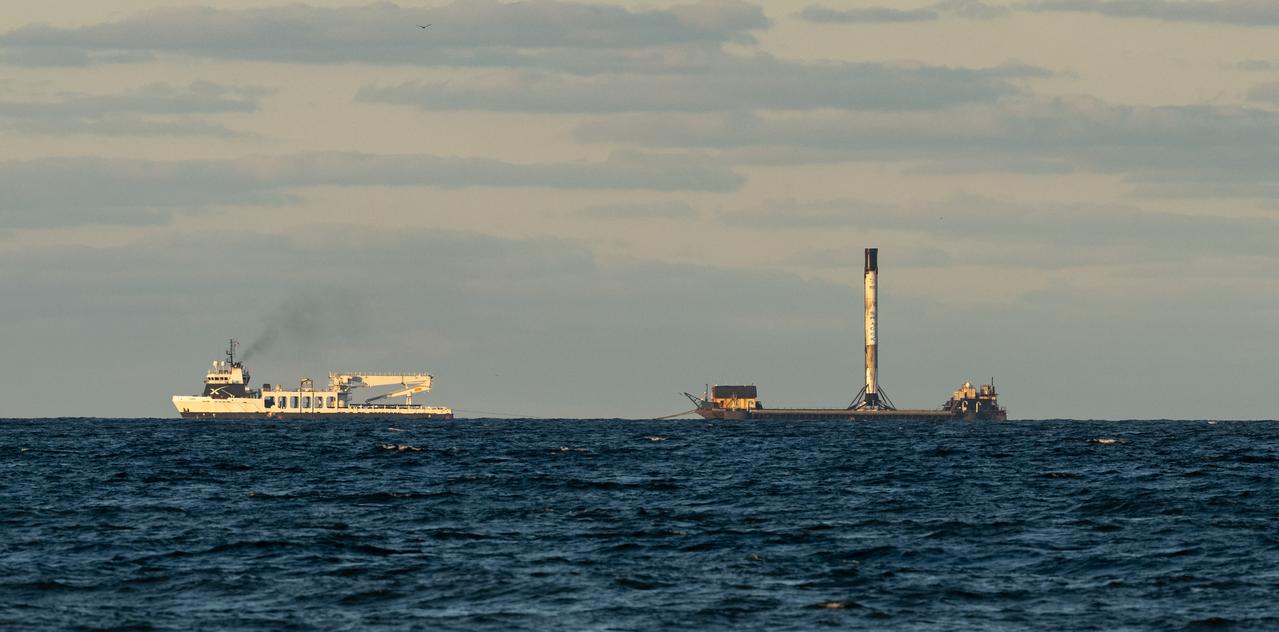
The Falcon 9 rocket booster used for NASA’s SpaceX Crew-5 launch sits atop the autonomous spaceport drone ship (ASDS), named Just Read the Instructions (JRTI), as it is towed into Port Canaveral by the SpaceX multi-purpose recovery ship Doug, Saturday, Oct. 8, 2022, in Cape Canaveral, Florida. NASA’s SpaceX Crew-5 mission is the fifth crew rotation mission of the SpaceX Crew Dragon spacecraft and Falcon 9 rocket to the International Space Station as part of the agency’s Commercial Crew Program. NASA astronauts Nicole Mann and Josh Cassada, Japan Aerospace Exploration Agency (JAXA) astronaut Koichi Wakata, and Roscosmos cosmonaut Anna Kikina launched on Oct. 5 from Launch Complex 39A at the Kennedy Space Center. Photo Credit: (NASA/Bill Ingalls)
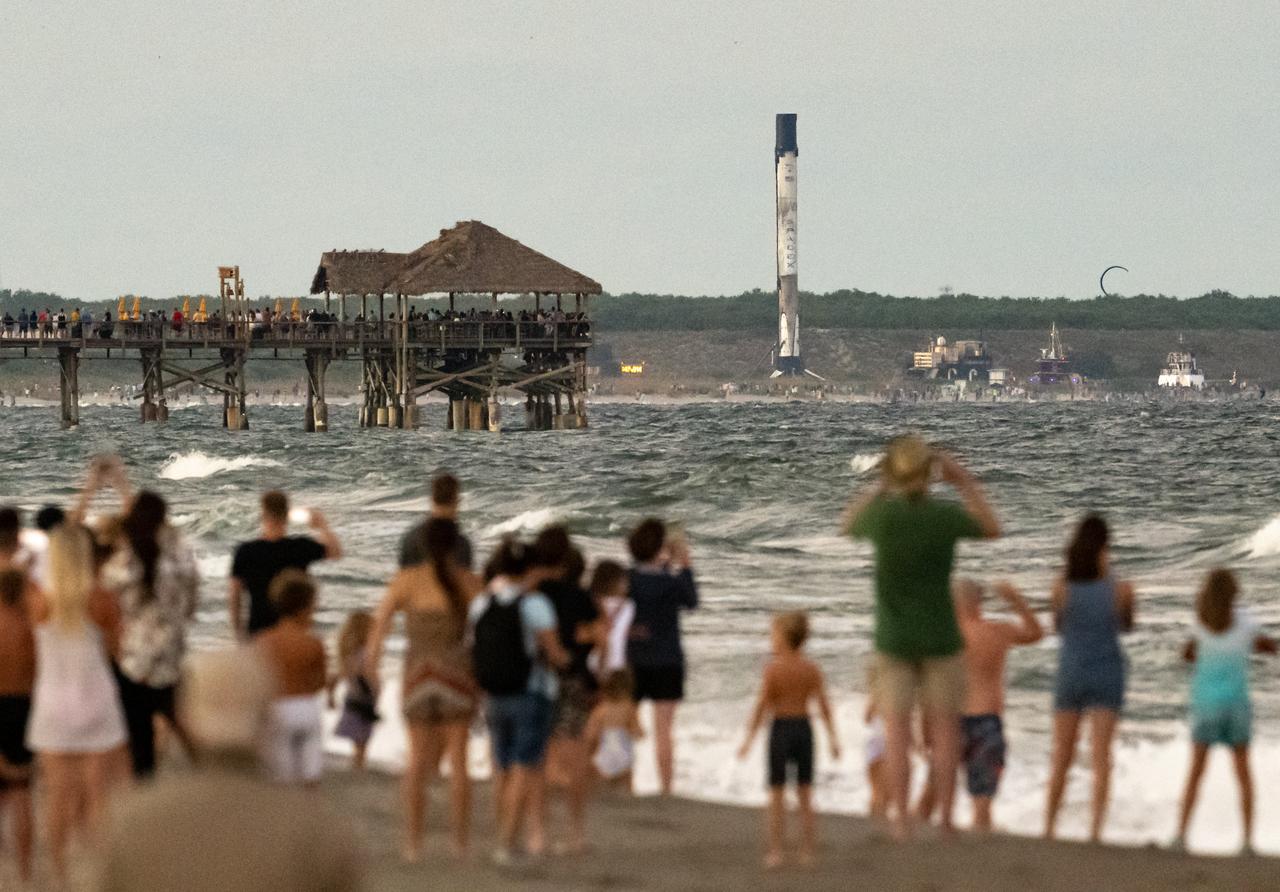
Beach goers watch as the Falcon 9 rocket booster used for NASA’s SpaceX Crew-5 launch, sitting atop the autonomous spaceport drone ship (ASDS), is towed into Port Canaveral, Saturday, Oct. 8, 2022, in Cape Canaveral, Florida. NASA’s SpaceX Crew-5 mission is the fifth crew rotation mission of the SpaceX Crew Dragon spacecraft and Falcon 9 rocket to the International Space Station as part of the agency’s Commercial Crew Program. NASA astronauts Nicole Mann and Josh Cassada, Japan Aerospace Exploration Agency (JAXA) astronaut Koichi Wakata, and Roscosmos cosmonaut Anna Kikina launched on Oct. 5 from Launch Complex 39A at the Kennedy Space Center. Photo Credit: (NASA/Bill Ingalls)
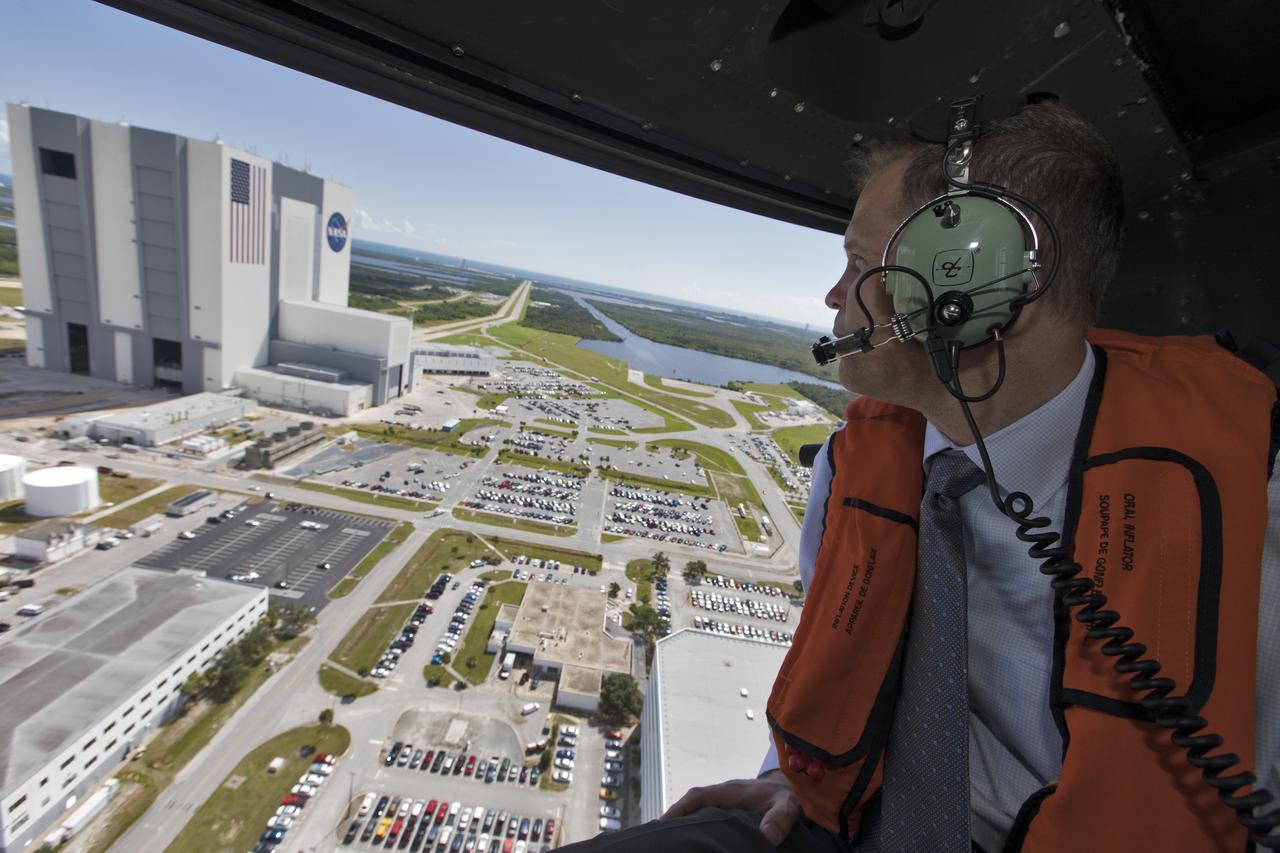
NASA Administrator Jim Bridenstine made his first official visit to the agency's Kennedy Space Center on Monday, Aug. 6, 2018. His up-close look at the premier, multi-user spaceport began with a helicopter tour over the bustling Florida spaceport that included the iconic Vehicle Assembly Building.
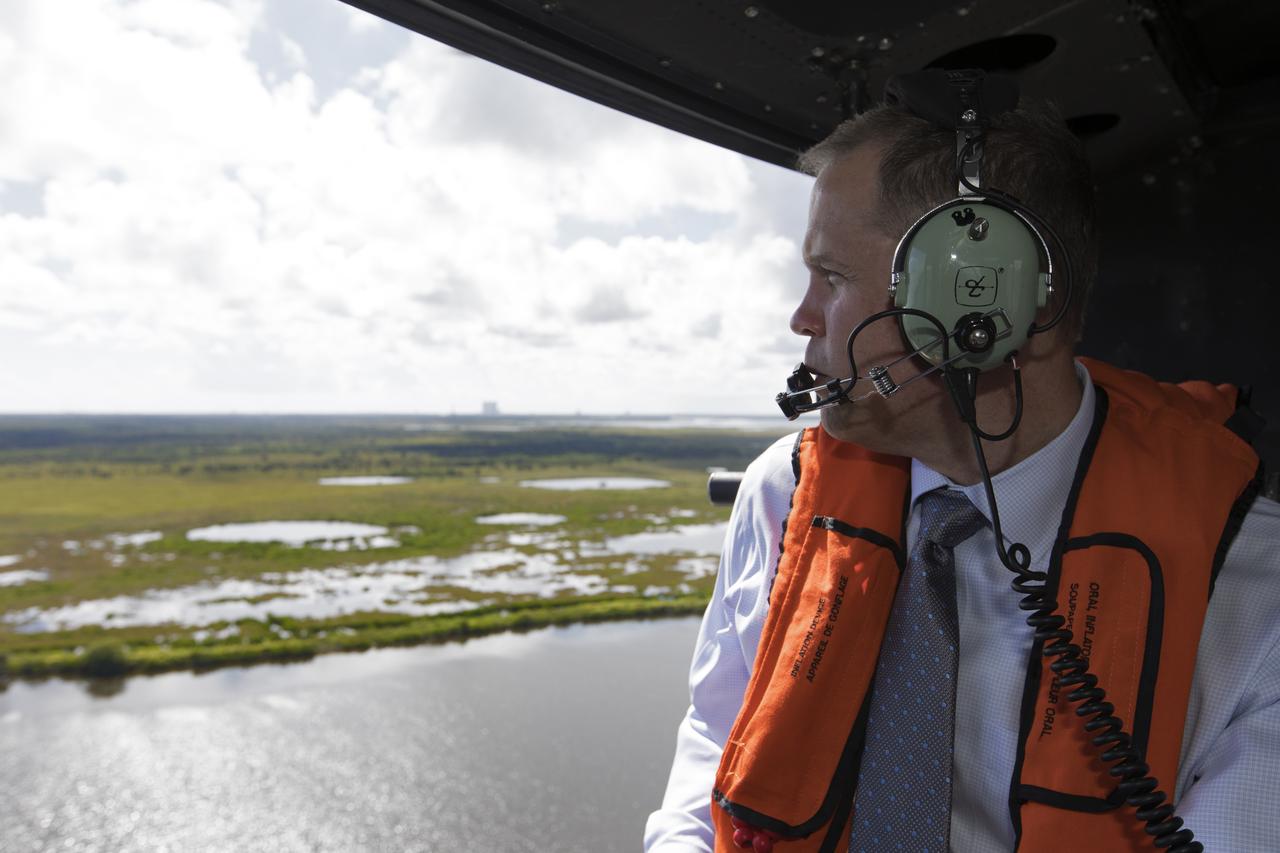
NASA Administrator Jim Bridenstine made his first official visit to the agency's Kennedy Space Center on Monday, Aug. 6, 2018. His up-close look at the premier, multi-user spaceport began with a helicopter tour over the bustling Florida spaceport.
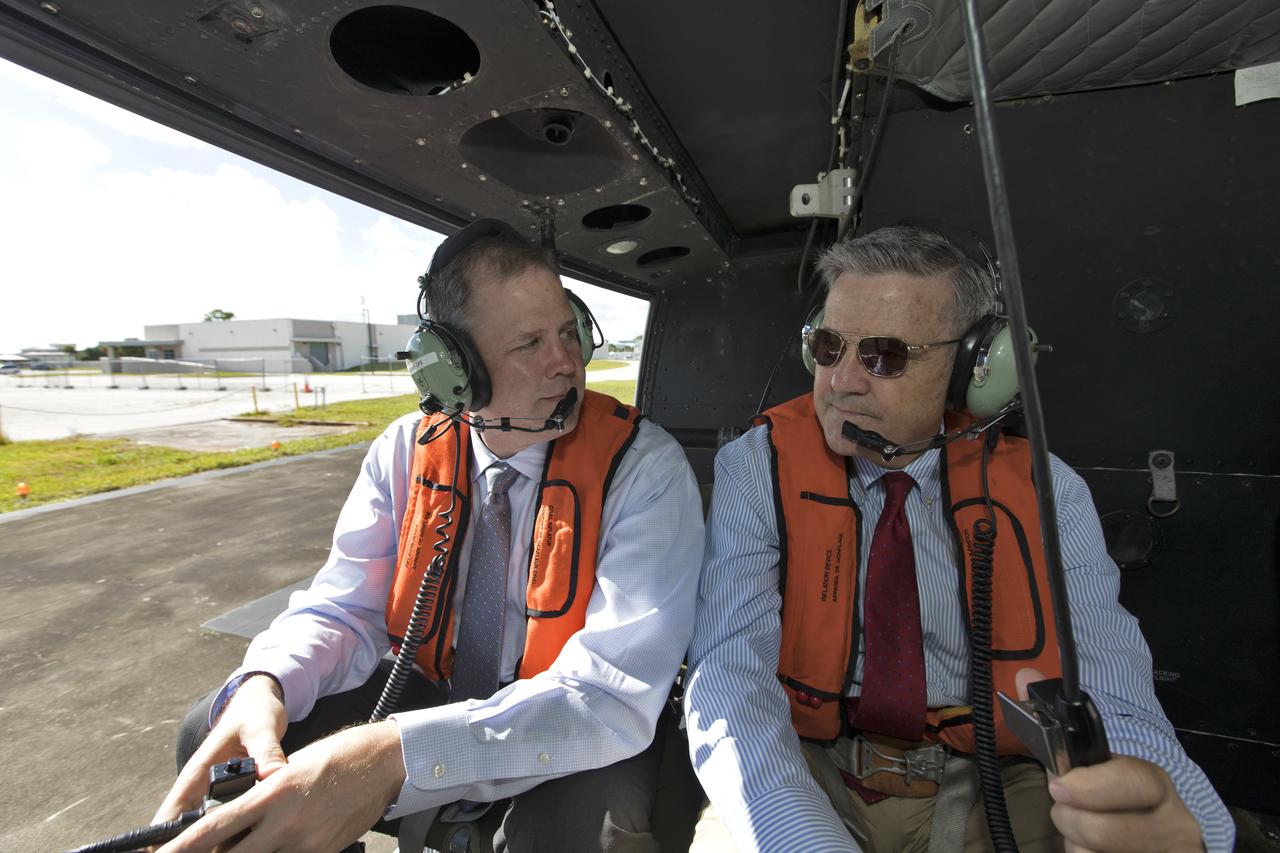
NASA Administrator Jim Bridenstine, left, made his first official visit to the agency's Kennedy Space Center on Monday, Aug. 6, 2018. His up-close look at the premier, multi-user spaceport began with Center Director Bob Cabana giving the administrator a helicopter tour over the bustling Florida spaceport.
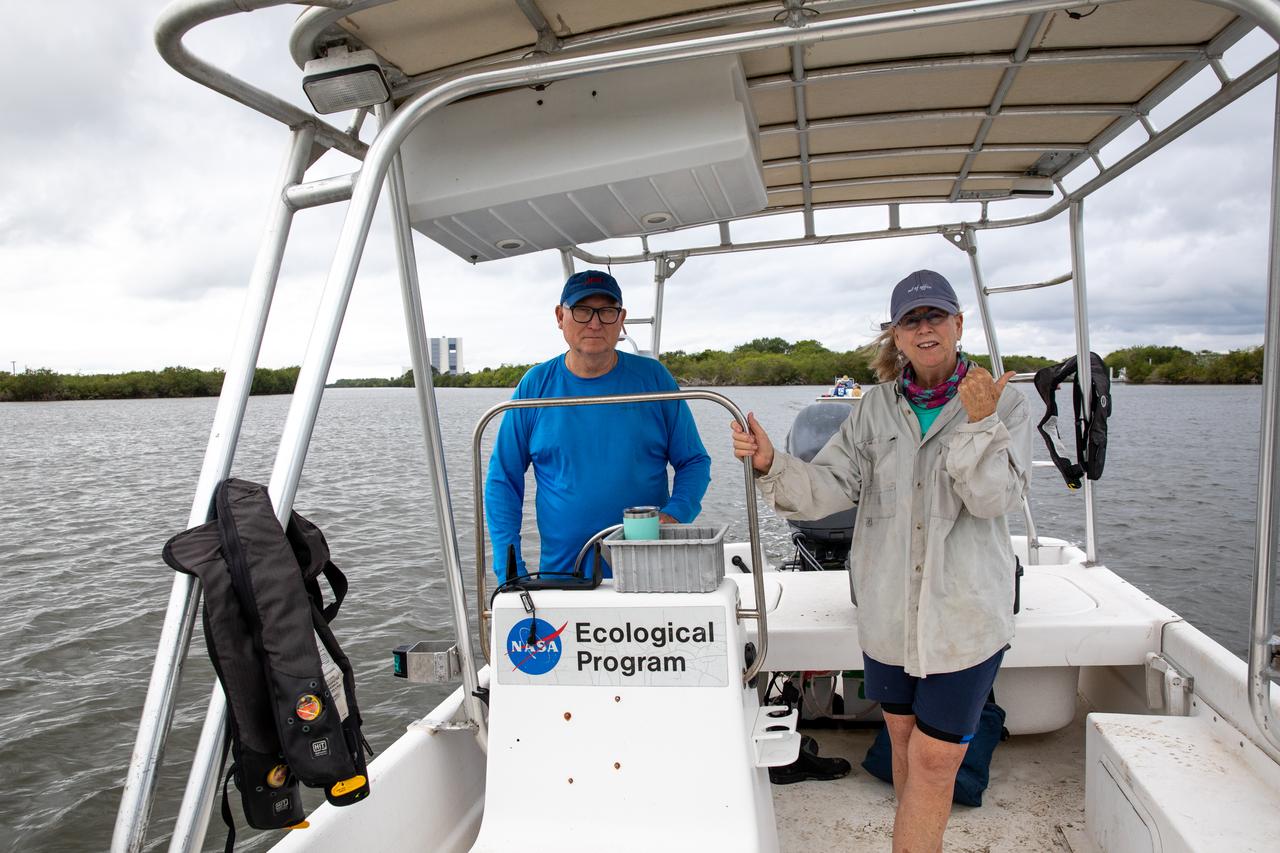
Kennedy Space Center’s Doug Scheidt (left), an ecologist working on NASA’s Environmental and Medical Contract (NEMCON), and Jane Provancha, manager of the ecological group for NEMCON, oversee seagrass restoration efforts at the Florida spaceport on March 29, 2023. Kennedy’s Environmental Management Branch is working to plant a minimum of 28,000 shoots of seagrass divided into 18 sites across three areas at the Florida spaceport as part of a pilot project for seagrass restoration efforts. The project will look at the feasibility of replanting seagrass in Kennedy waters and, if successful, could lead to the spaceport becoming a donor site where shoots of grass can be broken off and relocated to other areas within Kennedy or along the Indian River Lagoon to promote growth.
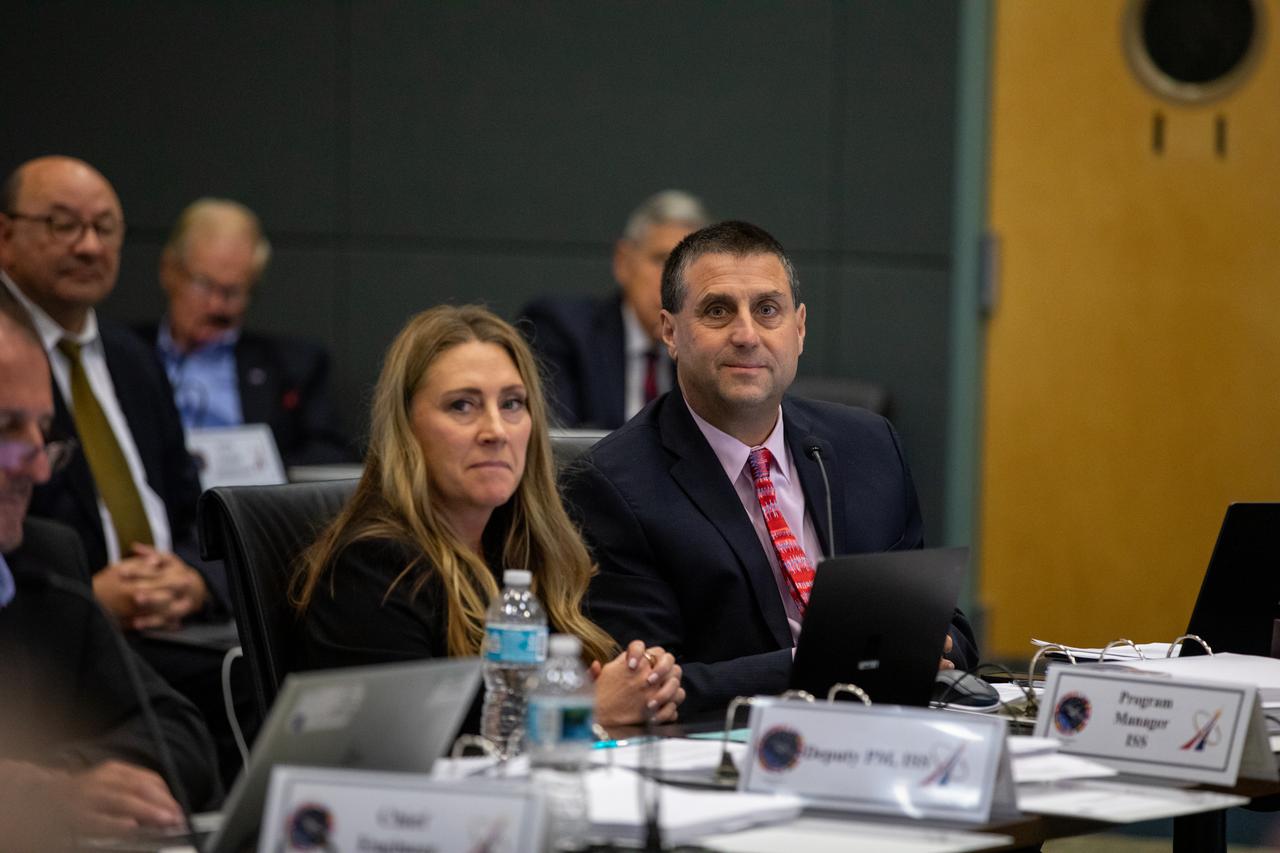
From left, Dana Weigel, International Space Station deputy program manager, and Joel Montalbano, manager, International Space Station Program, Johnson Space Center, participate in NASA’s SpaceX Crew-7 Flight Readiness Review at the Florida spaceport on Monday, Aug. 21, 2023. The mission is targeted to lift off from Kennedy’s Launch Complex 39A at 3:49 a.m. EDT Friday, Aug. 25, 2023. NASA astronaut Jasmin Moghbeli, ESA (European Space Agency) astronaut Andreas Mogensen, JAXA (Japan Aerospace Exploration Agency) astronaut Satoshi Furukawa, and Roscosmos cosmonaut Konstantin Borisov will fly to the International Space Station aboard SpaceX’s Dragon spacecraft, powered by the company’s Falcon 9 rocket.
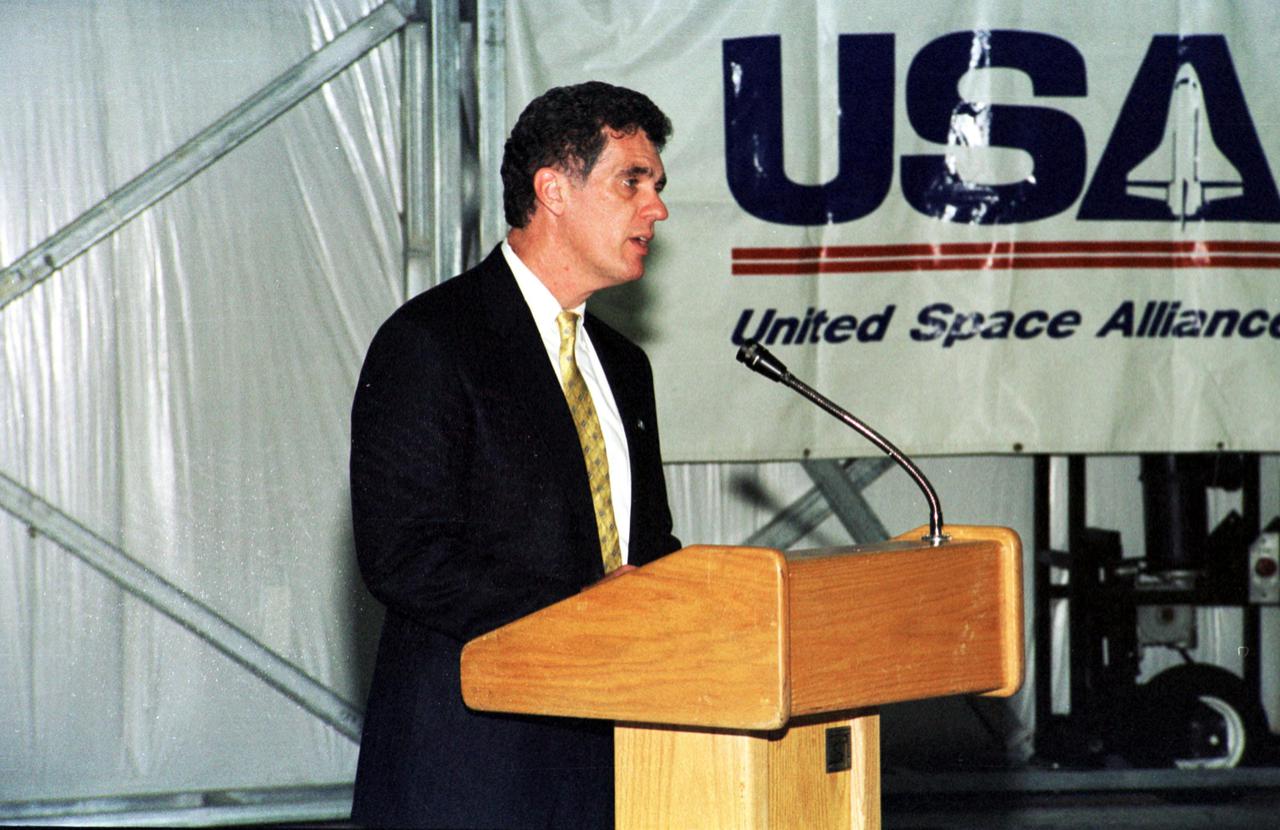
KENNEDY SPACE CENTER, Fla. -- Congressman Dave Weldon (R-Palm Bay) speaks to attendees at the signing of a lease agreement between Spaceport Florida Authority and United Space Alliance (USA) for the use of a hangar. The hangar was originally developed by the state as part of a joint NASA_ Spaceport Florida Authority (SFA) Reusable Launch Vehicle Support Complex at Kennedy Space Center. USA plans to use the state-developed 50,000-square-foot facility to store and maintain Space Shuttle ground equipment
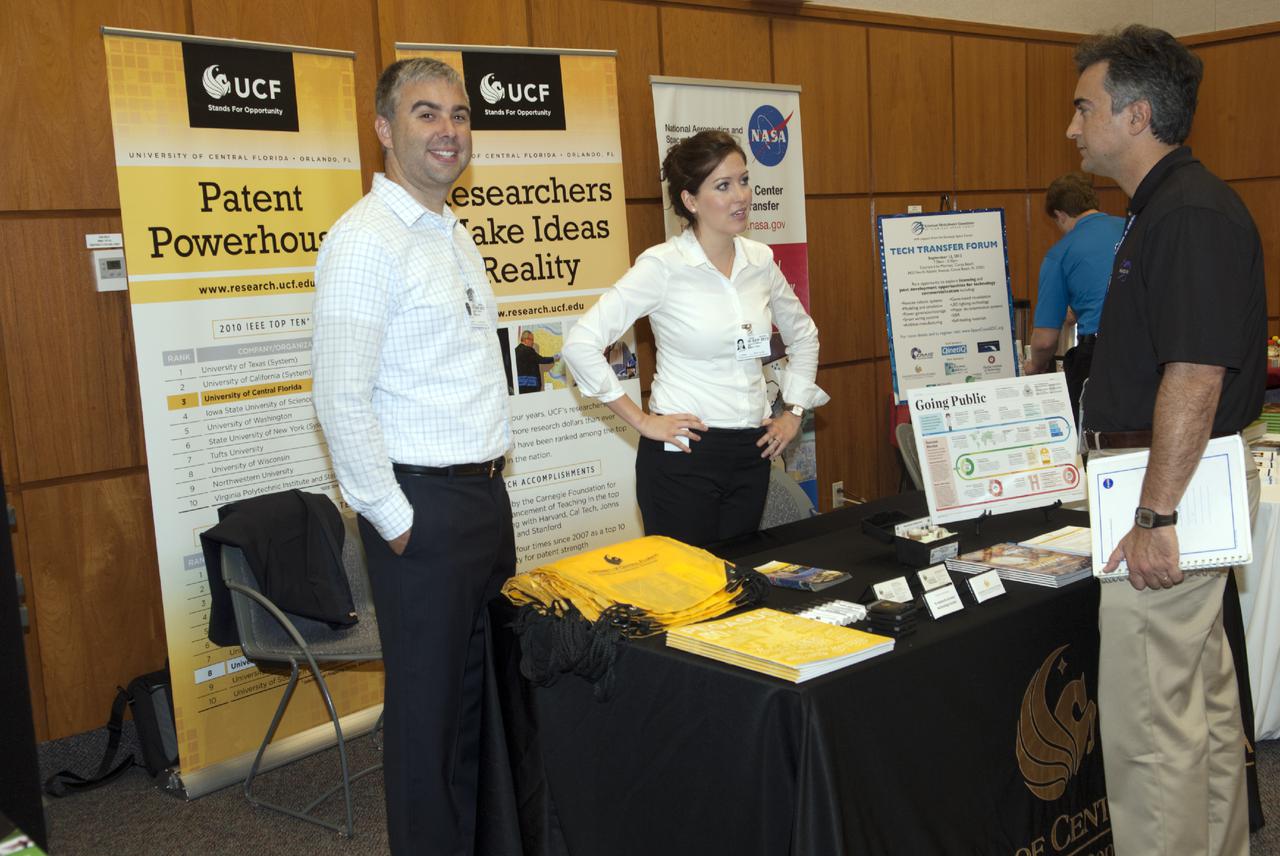
CAPE CANAVERAL, Fla. -- At the Kennedy Space Center in Florida, representatives of the University of Central Florida talk with guests at the Innovation Expo KSC Showcase. The event gave Kennedy employees an opportunity to meet 12 NASA partners and see how the Center Planning and Development Directorate is transforming Kennedy into a multi-user spaceport through partnerships and resource planning. The 17-booth exhibit consists of 12 partner booths along with Spaceport Planning, Partnership Development and Research and Technology offices. Photo credit: NASA_Charisse Nahser
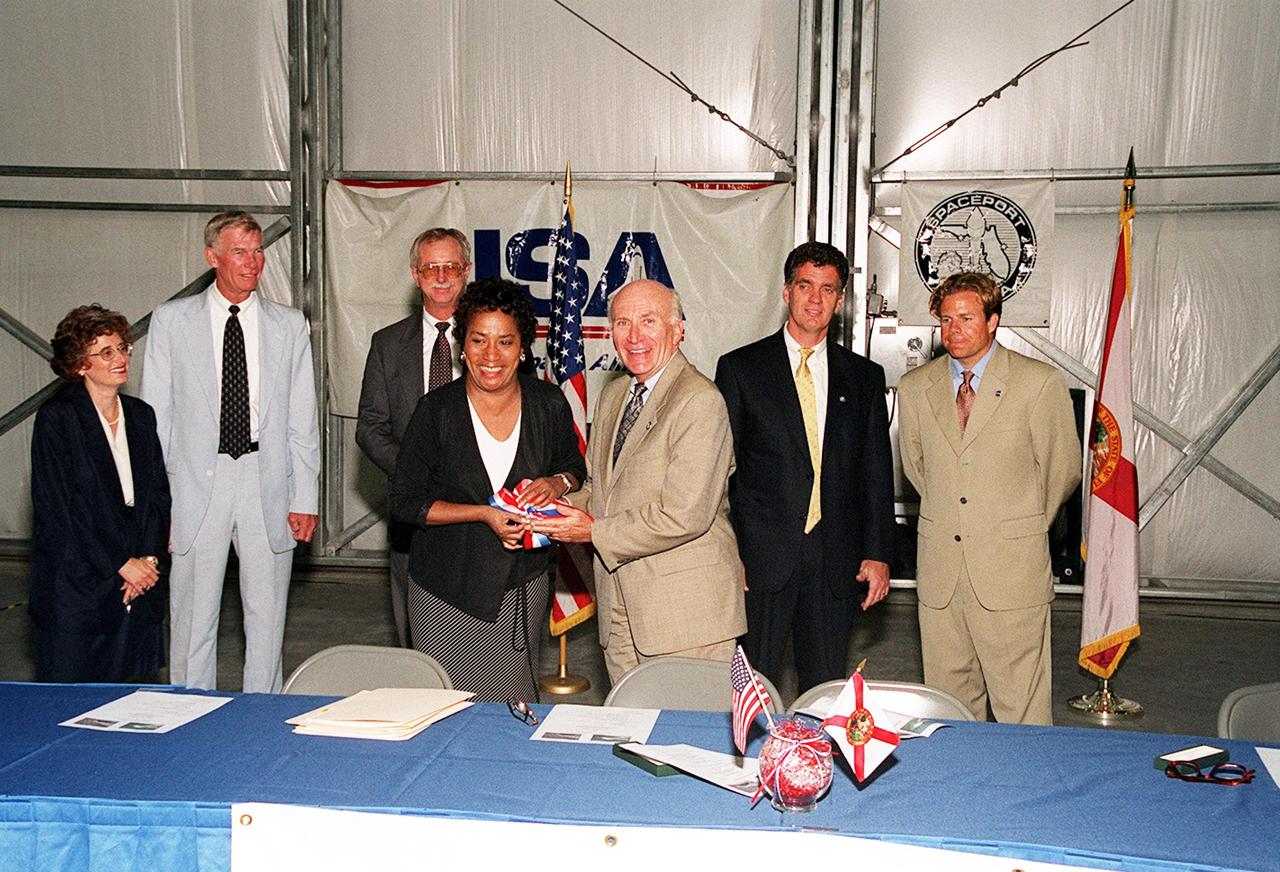
KENNEDY SPACE CENTER, Fla. -- After the signing of a lease agreement between Spaceport Florida Authority (SFA) and United Space Alliance (USA) for the use of a hangar at Kennedy Space Center, (foreground left) Marcie Harris, USA site director, and (foreground right) Ed Gormel, Spaceport Florida executive director, hold a symbolic ribbon. Behind them are (left to right) Rochelle Cooper, USA associate general counsel; Marv Jones, KSC associate director; Greg Popp, Spaceport Florida business manager; Congressman Dave Weldon; and State Rep. Mike Haridopolos. The hangar was originally developed by the state as part of a joint NASA/SFA Reusable Launch Vehicle Support Complex at KSC. USA plans to use the state-developed 50,000-square-foot facility to store and maintain Space Shuttle ground equipment
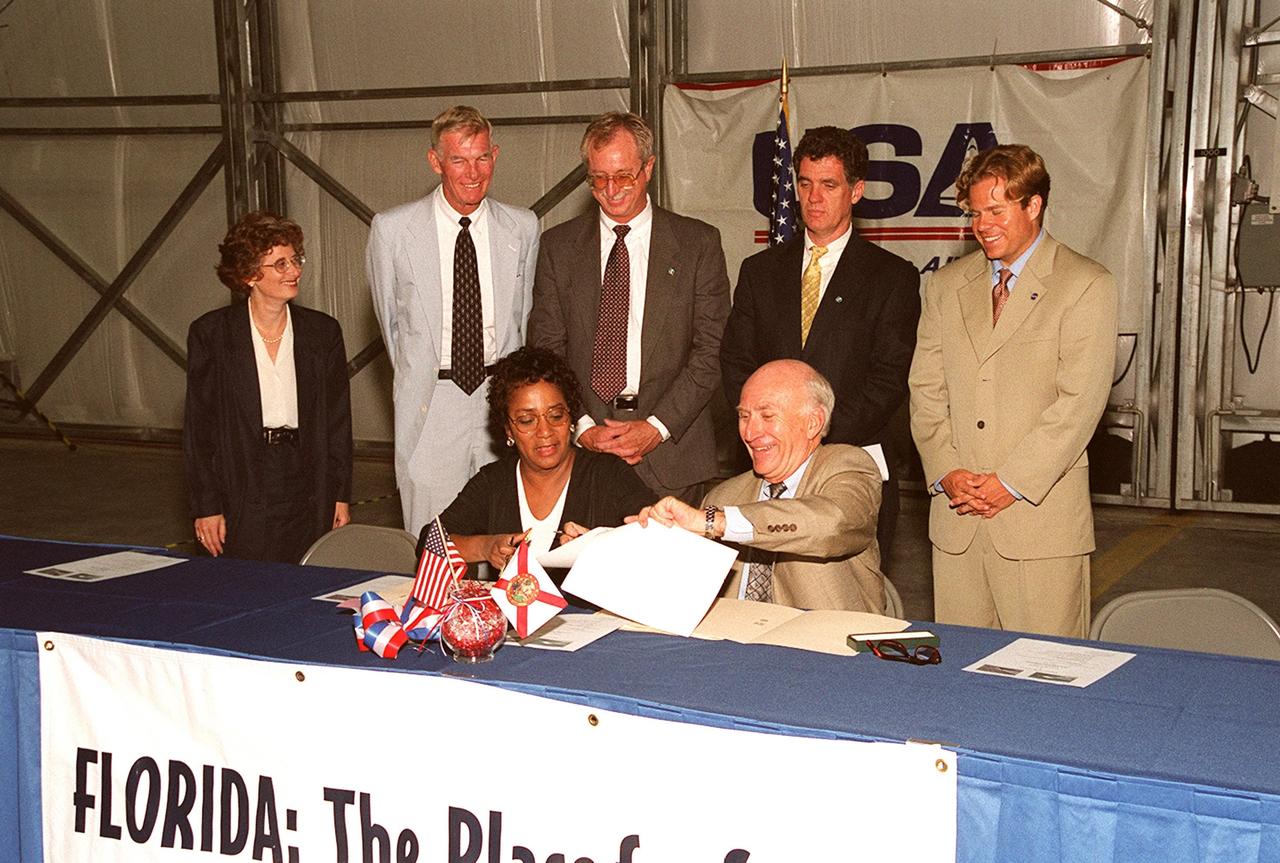
KENNEDY SPACE CENTER, Fla. -- The signing of a lease agreement between Spaceport Florida Authority (SFA) and United Space Alliance (USA) for the use of a hangar at Kennedy Space Center brings smiles to the participants. Seated at the table are (left) Marcie Harris, USA Site Director, and (right) Ed Gormel, Spaceport Florida Executive Director. Observing behind them are (left to right) Rochelle Cooper, USA associate general counsel; Marv Jones, KSC associate director; Greg Popp, Spaceport Florida business manager; Congressman Dave Weldon; and State Rep. Mike Haridopolos. The hangar was originally developed by the state as part of a joint NASA/SFA Reusable Launch Vehicle Support Complex at KSC. USA plans to use the state-developed 50,000-square-foot facility to store and maintain Space Shuttle ground equipment
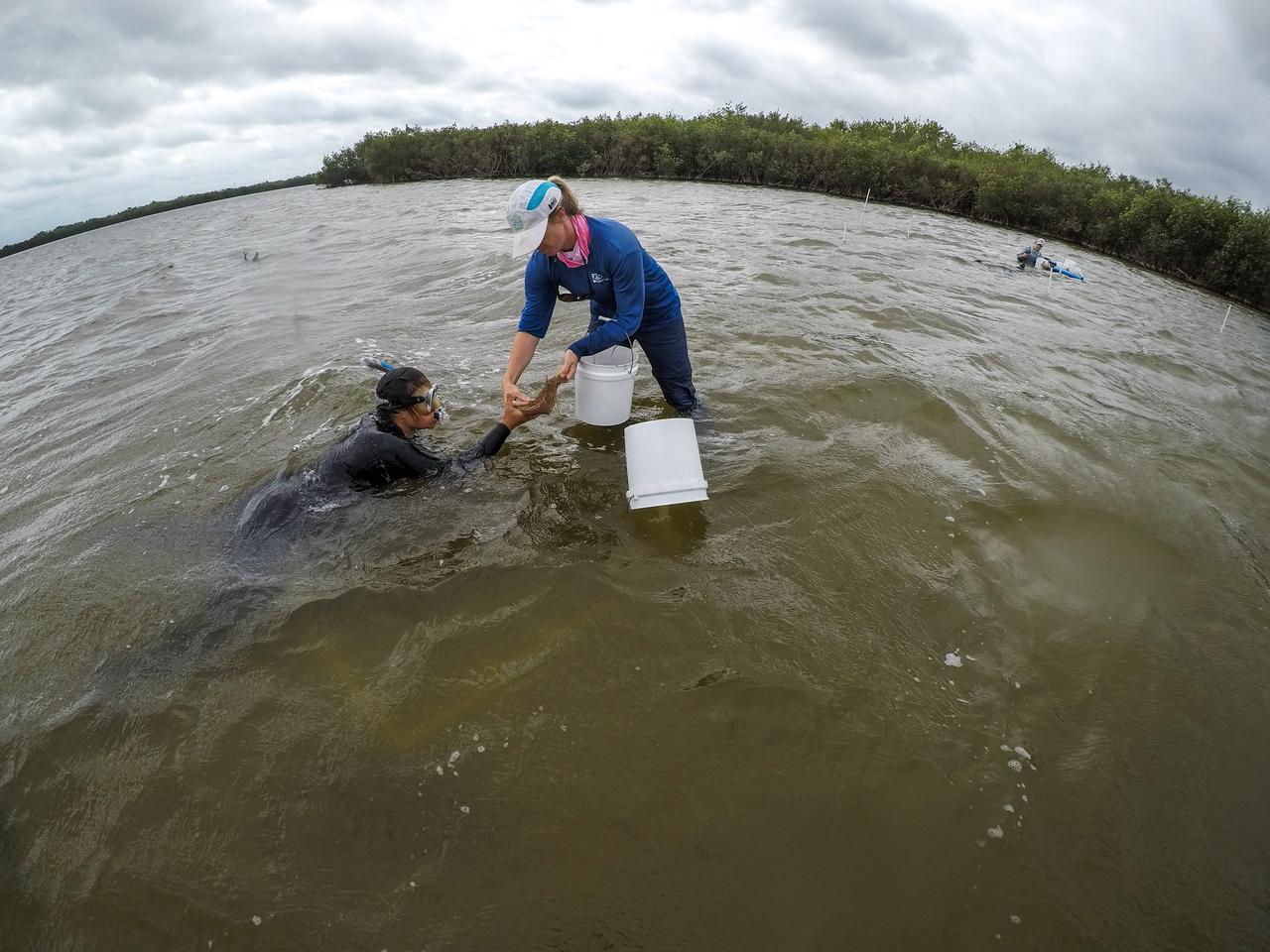
Members of the Florida Oceanographic Society plant seagrass in the Banana River – one of three bodies of water that make up the Indian River Lagoon (IRL) – at NASA’s Kennedy Space Center in Florida on March 29, 2023. Kennedy’s Environmental Management Branch is working to plant a minimum of 28,000 shoots of seagrass divided into 18 sites across three areas at the Florida spaceport as part of a pilot project for seagrass restoration efforts. The project will look at the feasibility of replanting seagrass in Kennedy waters and, if successful, could lead to the spaceport becoming a donor site where shoots of grass can be broken off and relocated to other areas within Kennedy or along the IRL to promote growth.
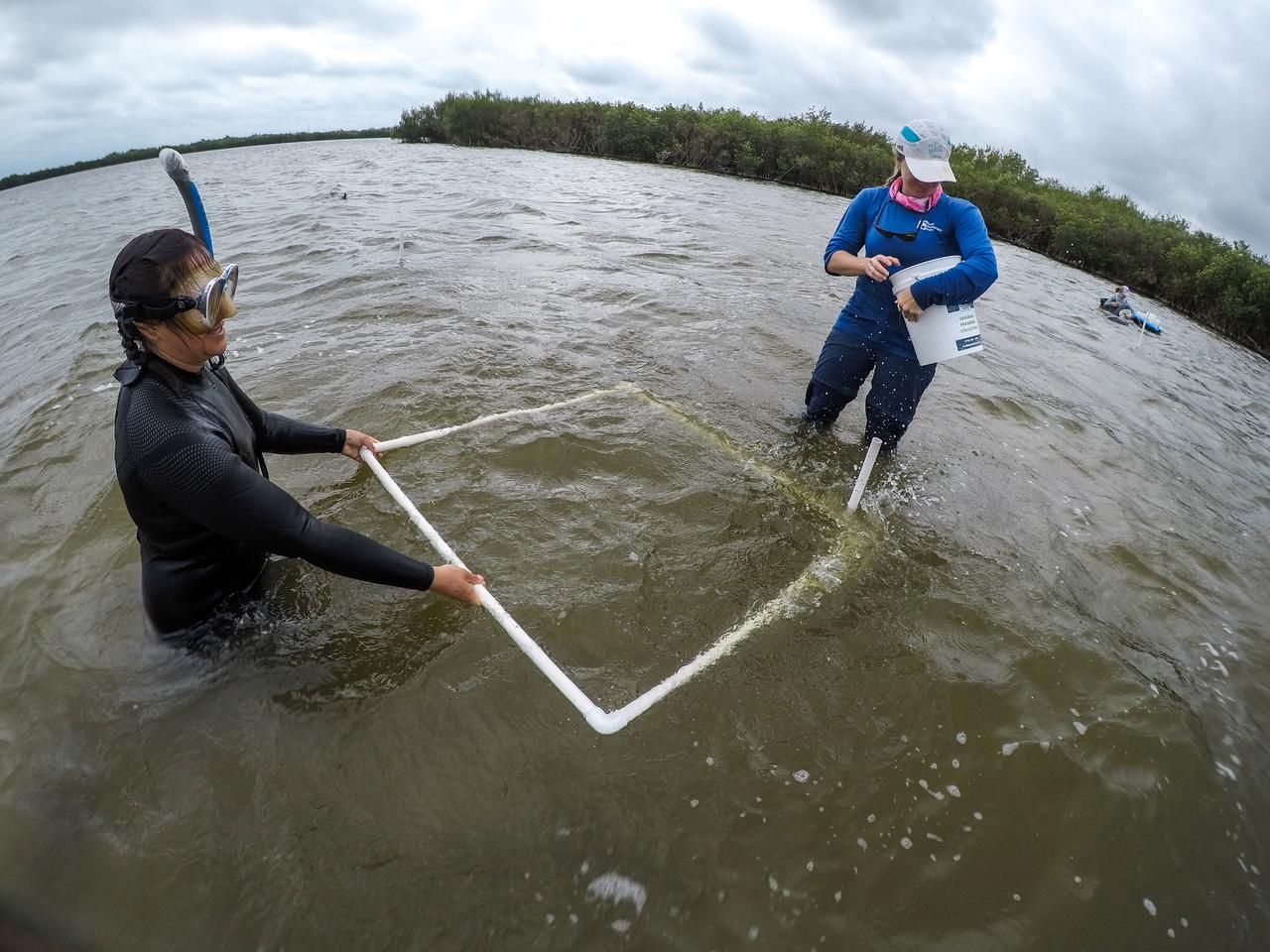
Members of the Florida Oceanographic Society prepare to plant seagrass in the Banana River – one of three bodies of water that make up the Indian River Lagoon (IRL) – at NASA’s Kennedy Space Center in Florida on March 29, 2023. Kennedy’s Environmental Management Branch is working to plant a minimum of 28,000 shoots of seagrass divided into 18 sites across three areas at the Florida spaceport as part of a pilot project for seagrass restoration efforts. The project will look at the feasibility of replanting seagrass in Kennedy waters and, if successful, could lead to the spaceport becoming a donor site where shoots of grass can be broken off and relocated to other areas within Kennedy or along the IRL to promote growth.
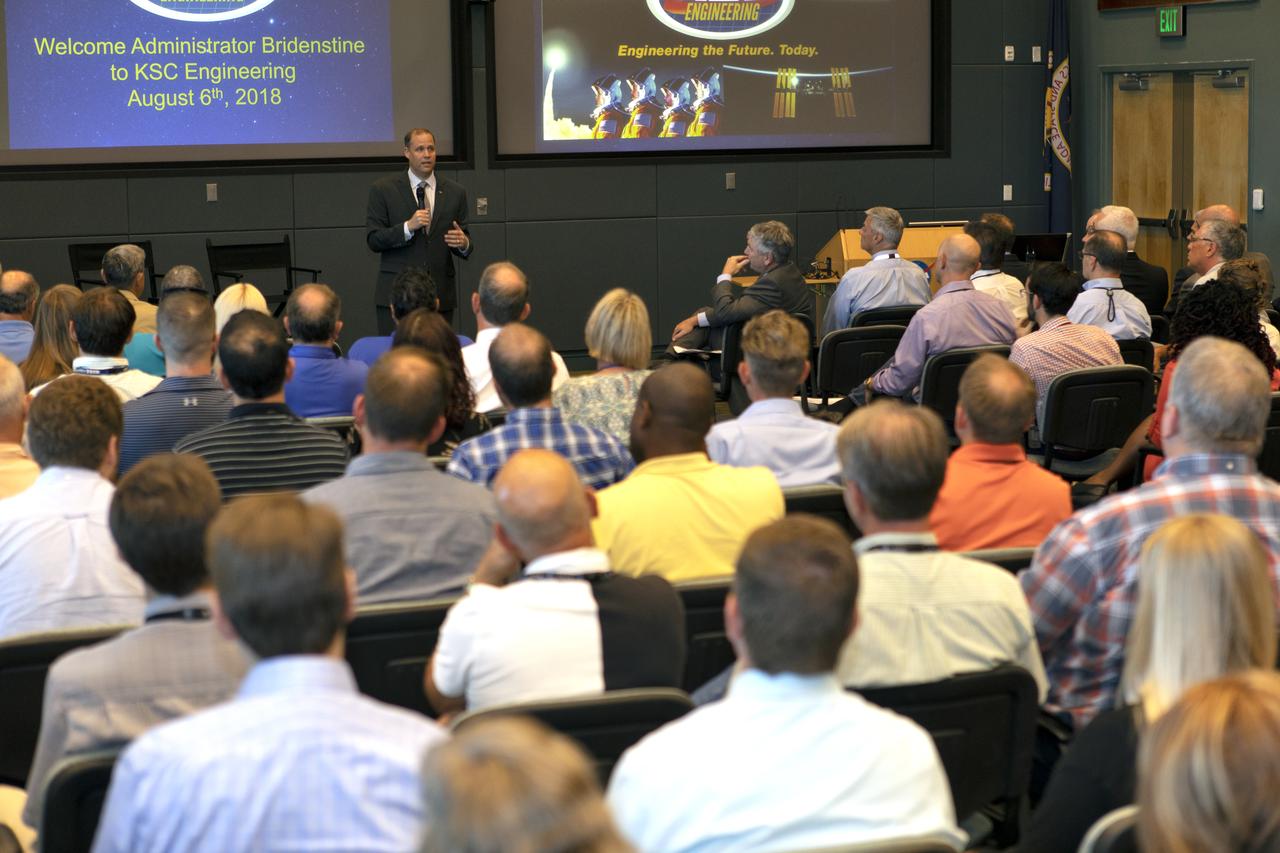
NASA Kennedy Space Center Engineering Directorate employees listen to a presentation by the agency's Administrator Jim Bridenstine. He made his first official visit to the Florida spaceport on Aug. 6 and 7, 2018.
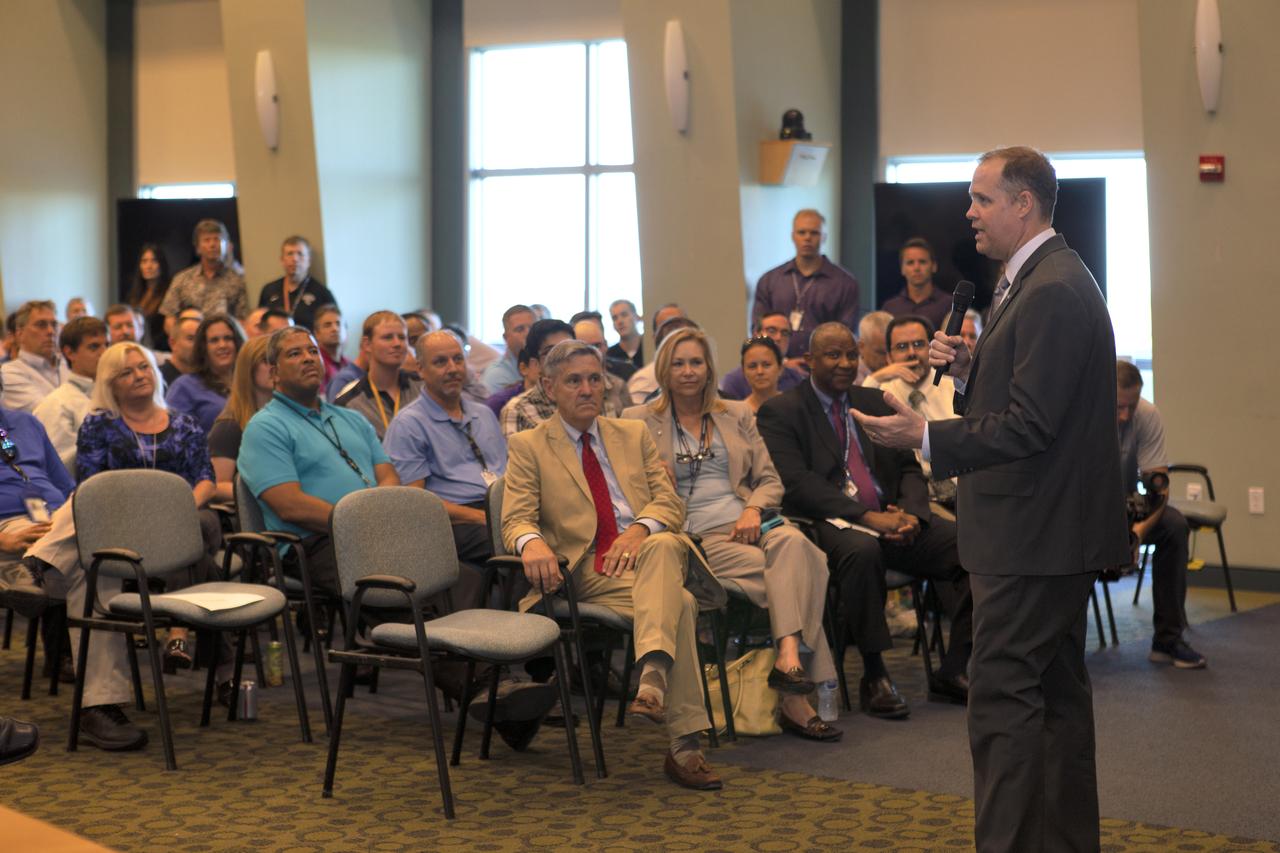
NASA Kennedy Space Center Engineering Directorate employees listen to a presentation by the agency's Administrator Jim Bridenstine. He made his first official visit to the Florida spaceport on Aug. 6 and 7, 2018.
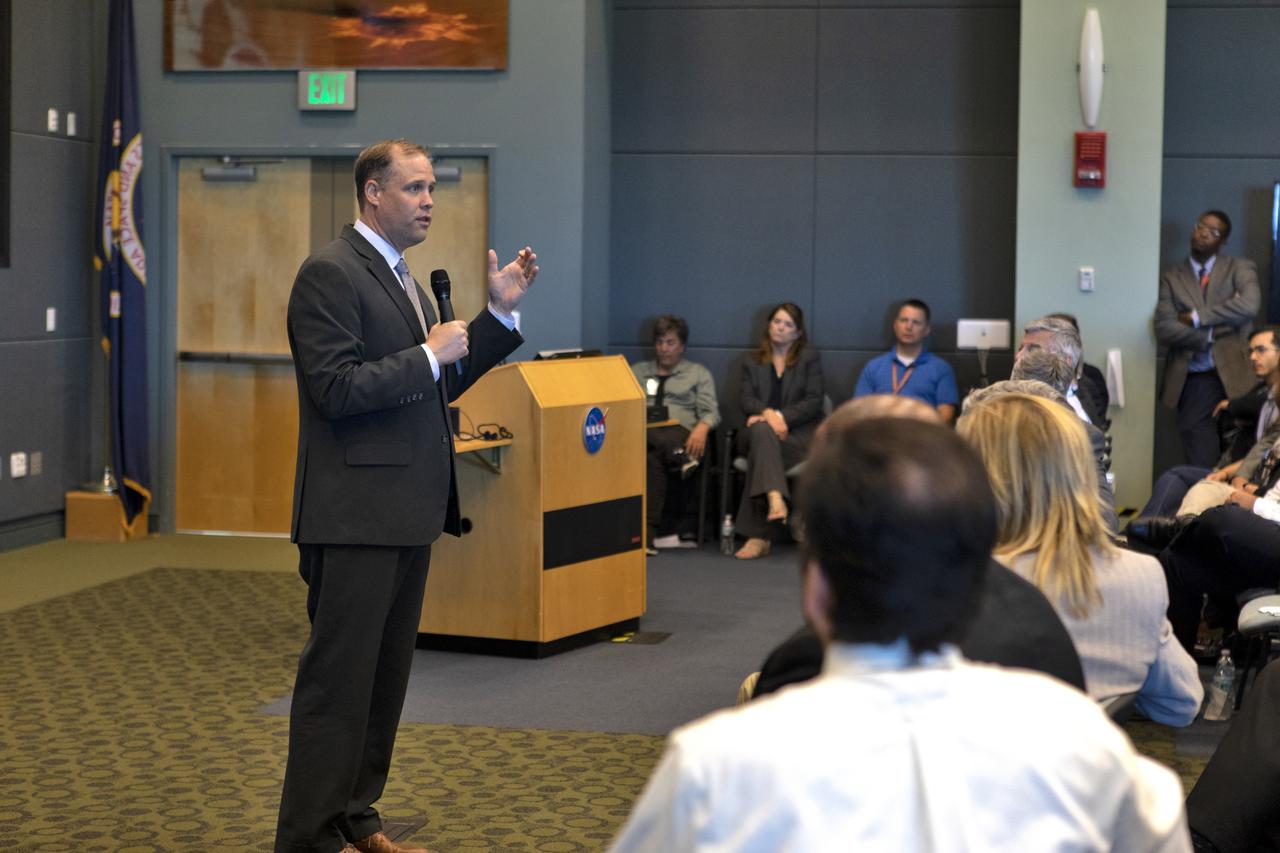
NASA Kennedy Space Center Engineering Directorate employees listen to a presentation by the agency's Administrator Jim Bridenstine. He made his first official visit to the Florida spaceport on Aug. 6 and 7, 2018.
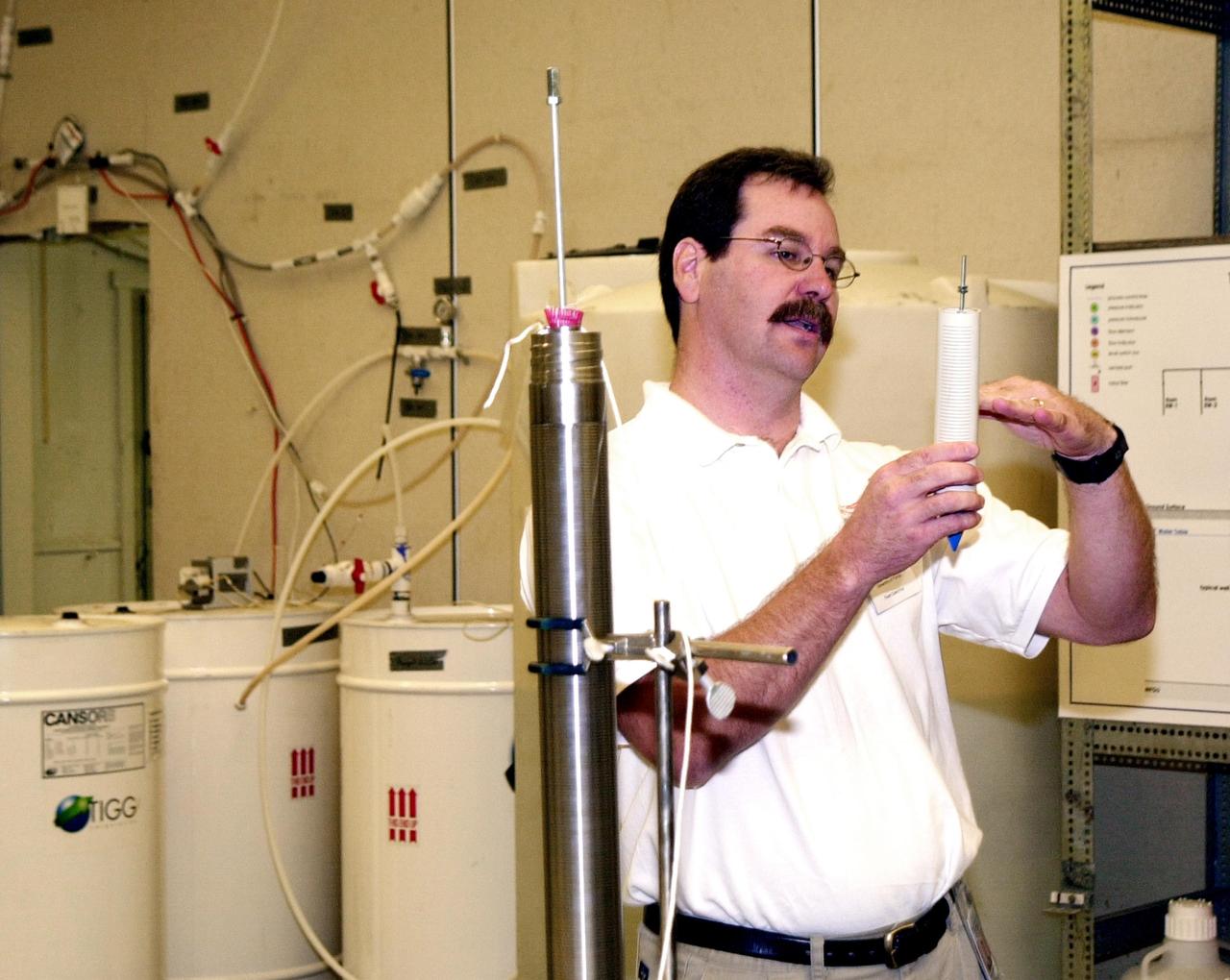
KENNEDY SPACE CENTER, FLA. - New methods of environmental cleanup are explained to government and business representatives, scientists and engineers during a presentation at Launch Complex 34-A, Cape Canaveral Spaceport. Making the presentation is Mike Annable with the University of Florida.
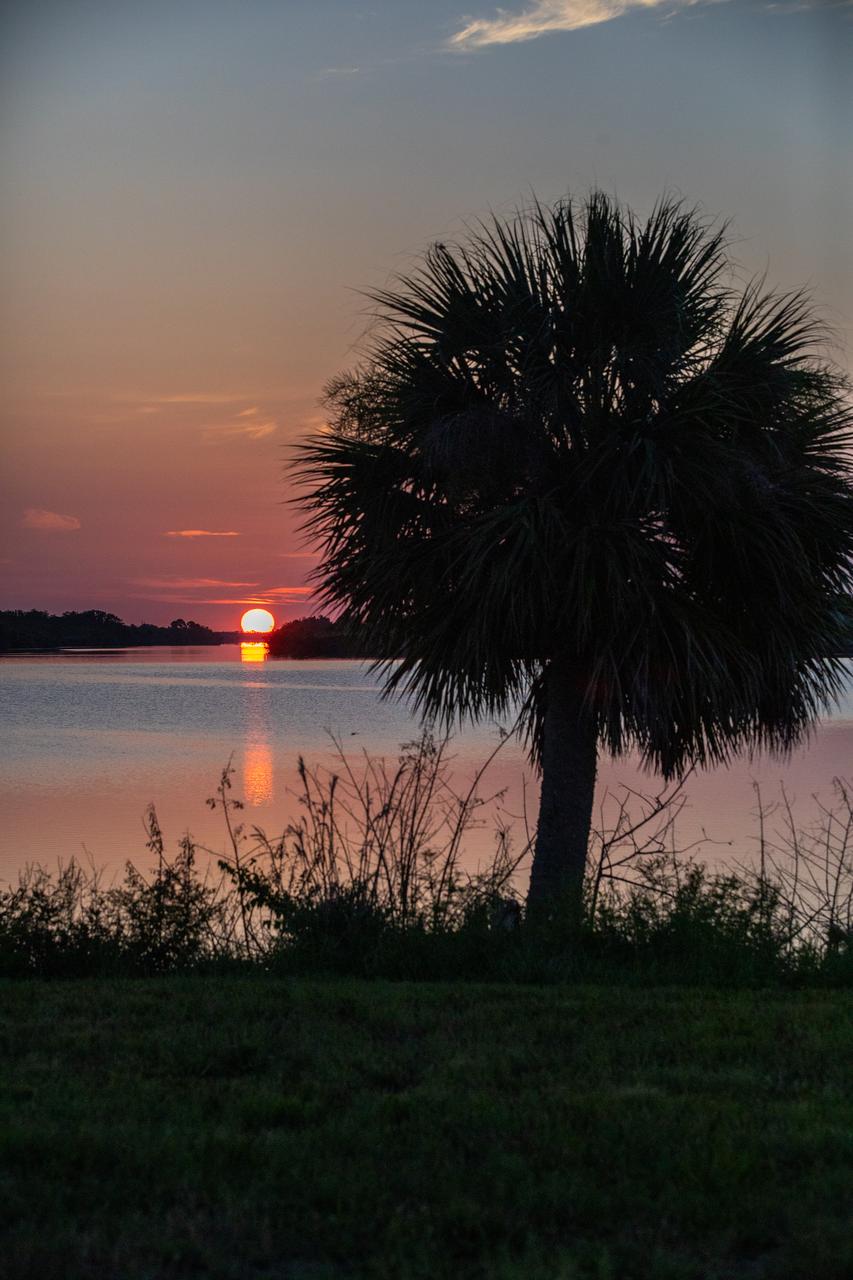
A sunrise over NASA’s Kennedy Space Center in Florida is captured on July 15, 2020. A multi-user spaceport, Kennedy has partnerships with both government and commercial entities, providing the facilities and infrastructure necessary for venturing to space.

Cucumbers are grown in a controlled environment chamber at NASA’s Kennedy Space Center on April 17, 2023. The activity is taking place inside the Plant Production Area at the Florida spaceport’s Space Station Processing Facility.

Melons are grown in a controlled environment chamber at NASA’s Kennedy Space Center on April 17, 2023. The activity is taking place inside the Plant Production Area at the Florida spaceport’s Space Station Processing Facility.
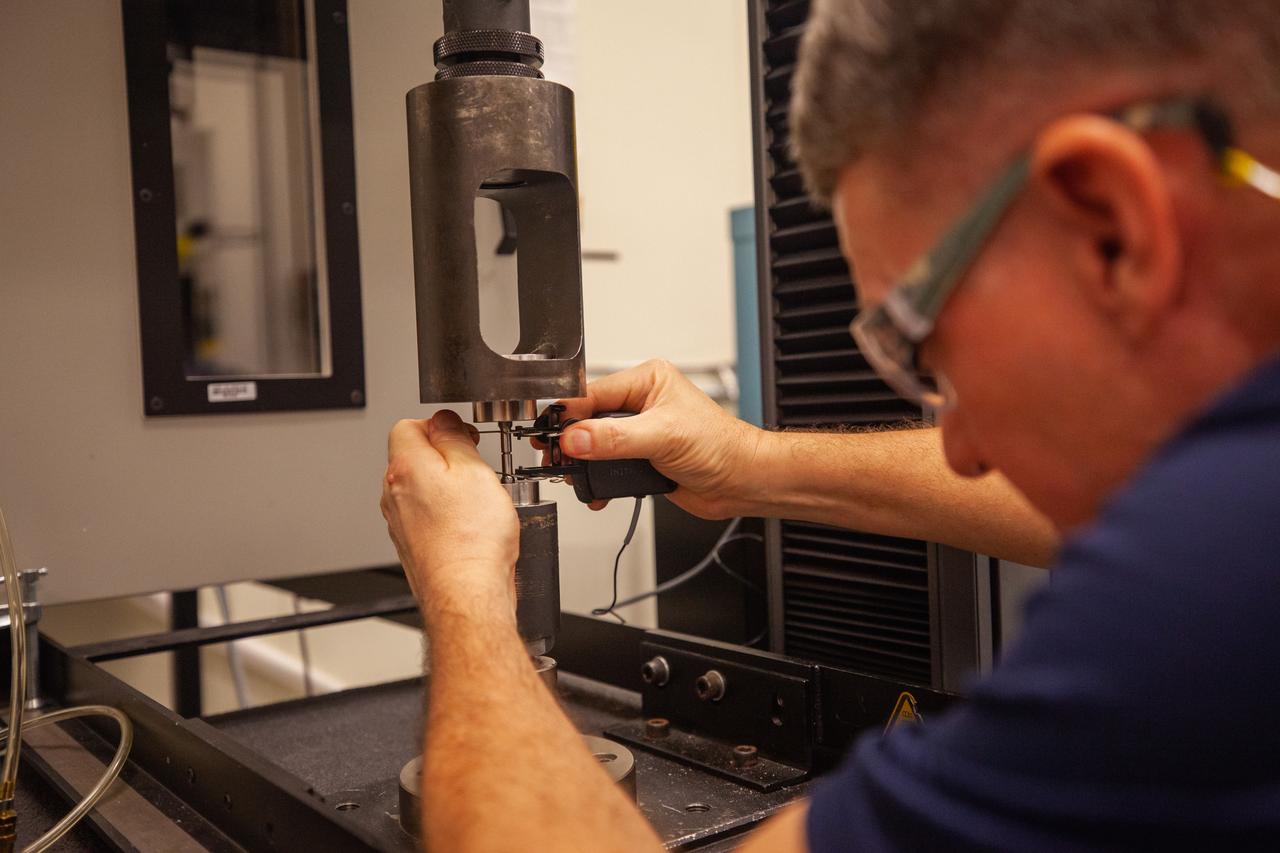
Brian Cheshire, an engineer in the Mechanical and Environmental Testing Lab at NASA’s Kennedy Space Center, works in front of an Instron inside a lab at the Florida spaceport’s Operations and Checkout Building on Oct. 6, 2020.
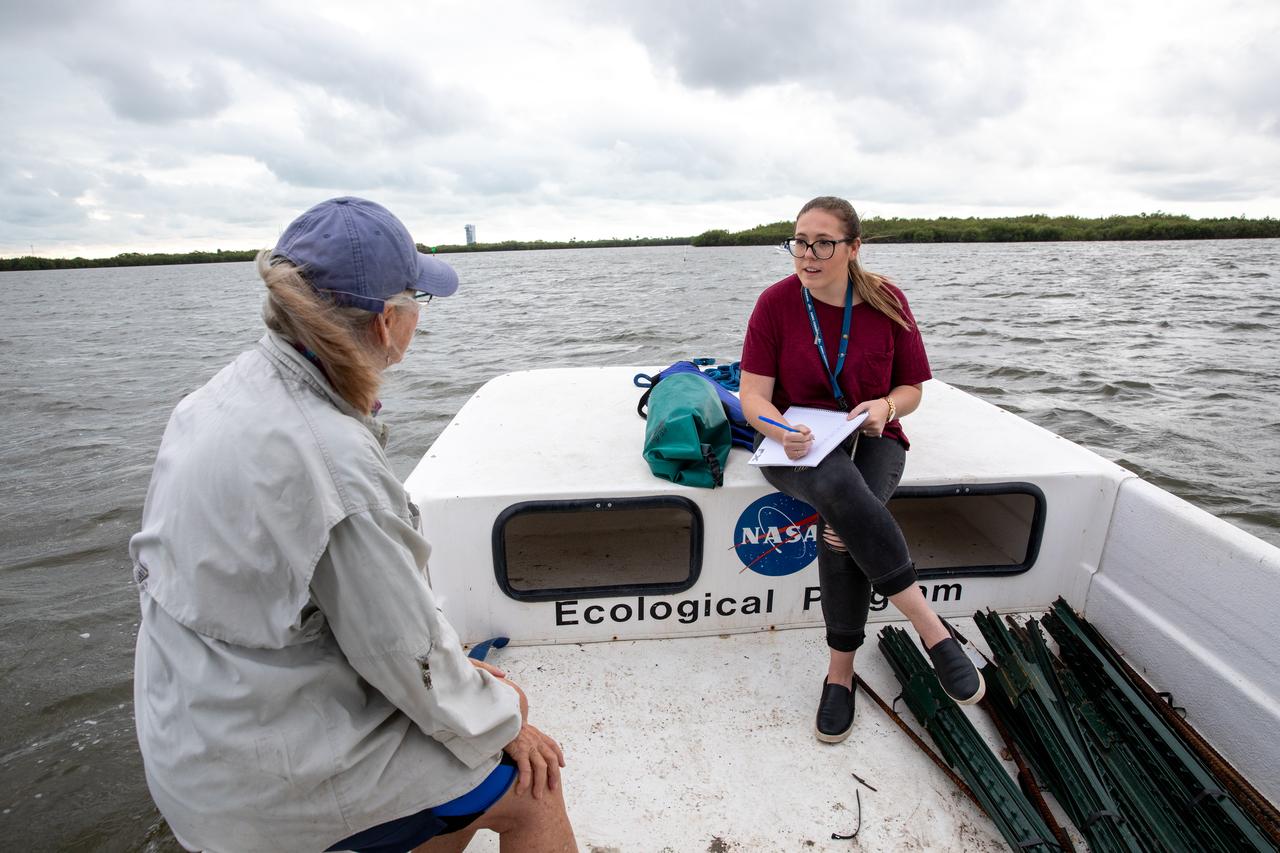
Kennedy Space Center Public Affairs Writer Danielle Sempsrott (right) interviews Jane Provancha, manager of the ecological group for NASA’s Environmental and Medical Contract (NEMCON) at Kennedy, for a web feature highlighting seagrass restoration efforts taking place at the Florida spaceport on March 29, 2023. Kennedy’s Environmental Management Branch is working to plant a minimum of 28,000 shoots of seagrass divided into 18 sites across three areas at the Florida spaceport as part of a pilot project for seagrass restoration efforts. The project will look at the feasibility of replanting seagrass in Kennedy waters and, if successful, could lead to the spaceport becoming a donor site where shoots of grass can be broken off and relocated to other areas within Kennedy or along the Indian River Lagoon to promote growth.
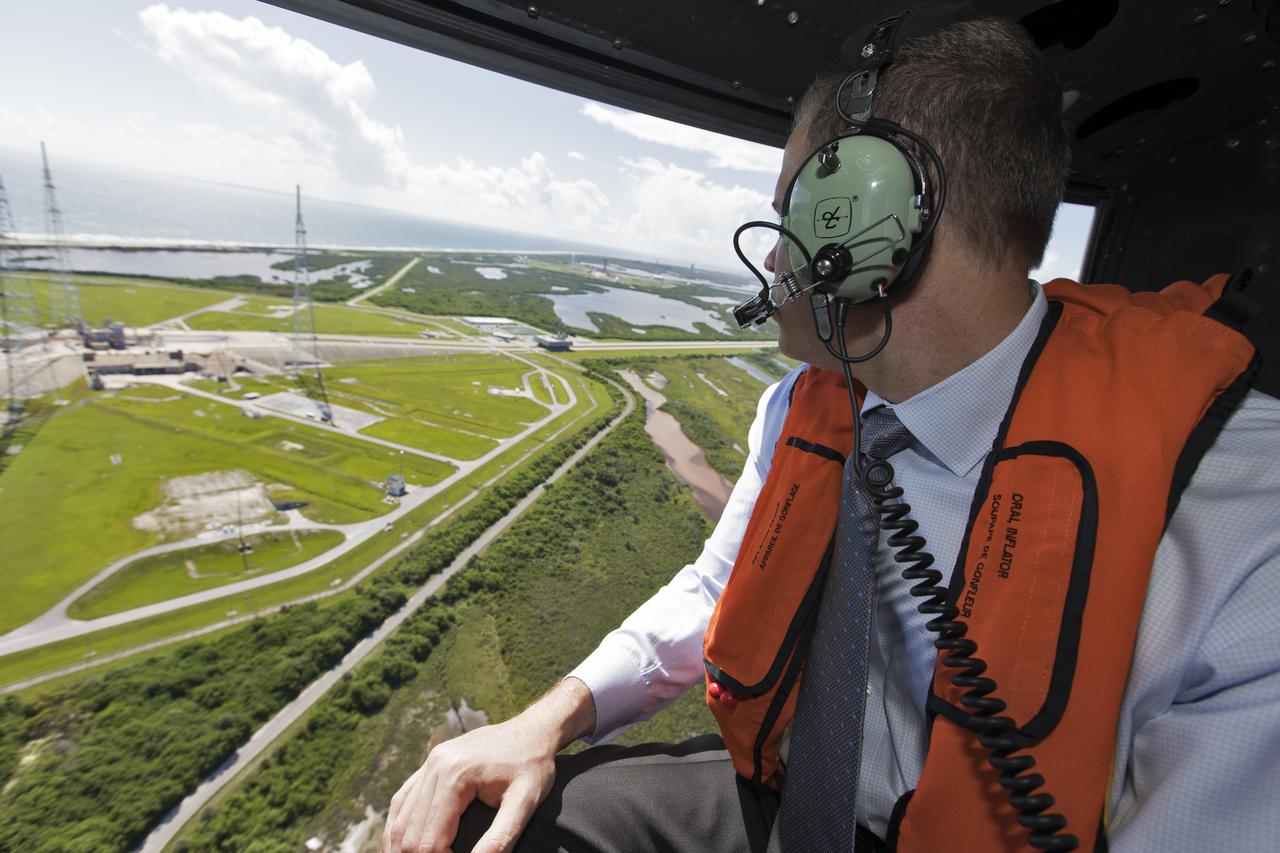
NASA Administrator Jim Bridenstine made his first official visit to the agency's Kennedy Space Center on Monday, Aug. 6, 2018. His up-close look at the premier, multi-user spaceport began with a helicopter tour over the bustling Florida spaceport that included the center's Launch Complex 39B. This will be the site where NASA's Space Launch System rocket and Orion spacecraft will liftoff on trips to the Moon, Mars and beyond.
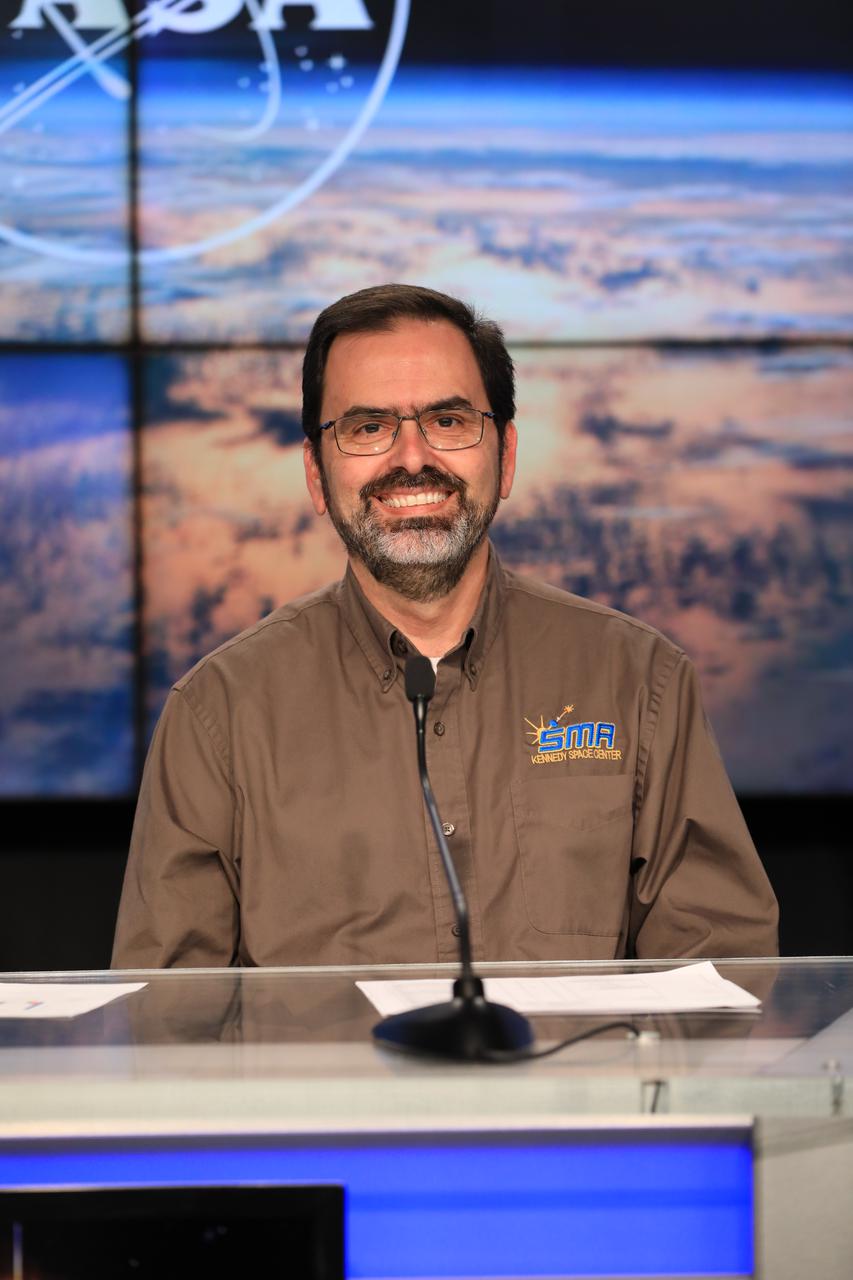
Director of Safety and Mission Assurance Ronnie Rodriguez participates in the Safety Starts With You Leadership Panel on Jan. 25, 2022, at NASA’s Kennedy Space Center in Florida. The panel discussion featured senior leaders from the spaceport addressing ways employees can focus on safely completing mission objectives in the new year. Other panelists included Kennedy Space Center Director Janet Petro, Director of Spaceport Integration and Services Nancy Bray, and Exploration Ground Systems Chief of Staff Sasha Sims.