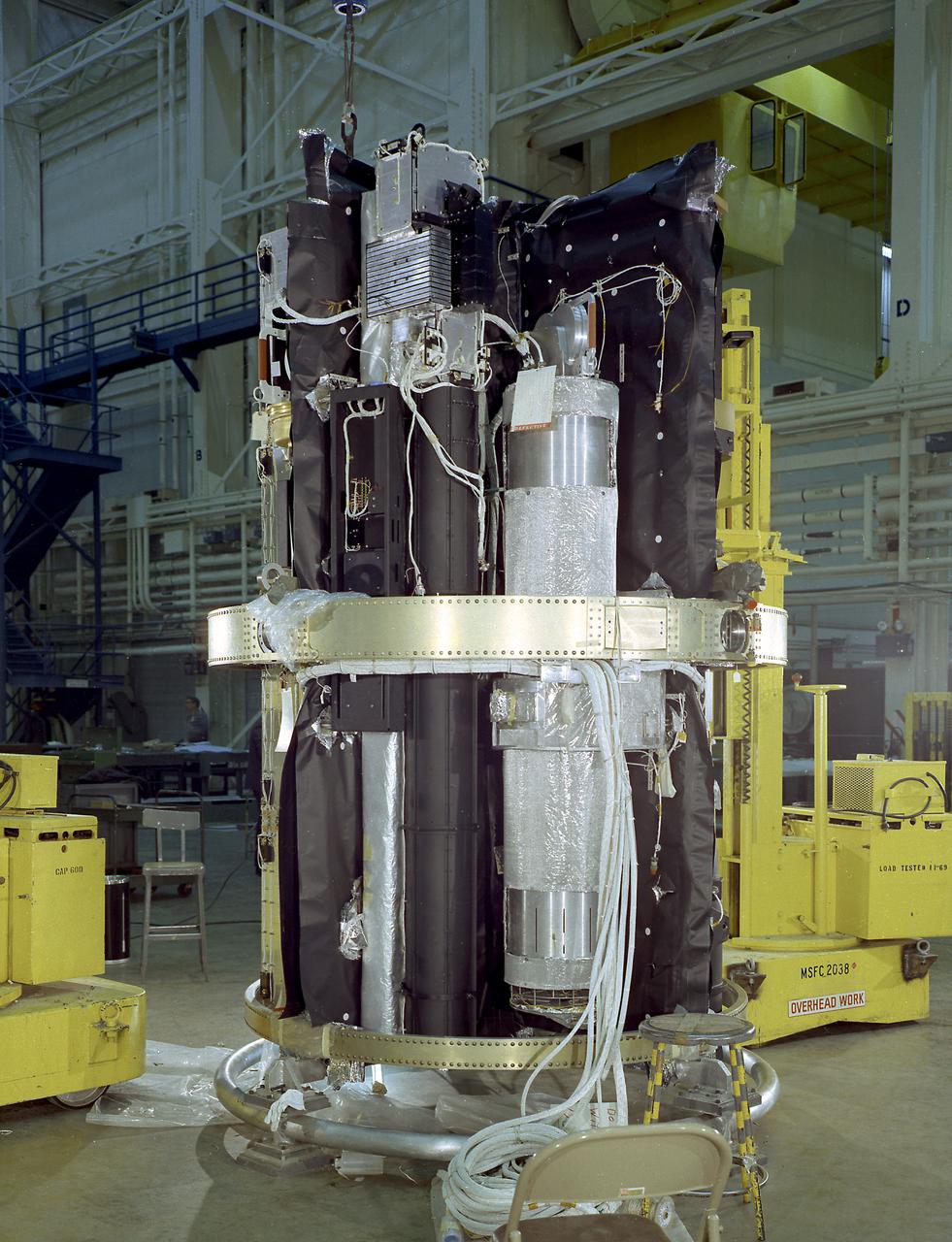
The Apollo Telescope Mount (ATM), designed and developed by the Marshall Space Flight Center, served as the primary scientific instrument unit aboard the Skylab. The ATM contained eight complex astronomical instruments designed to observe the Sun over a wide spectrum from visible light to x-rays. This image shows the ATM spar assembly. All solar telescopes, the fine Sun sensors, and some auxiliary systems are mounted on the spar, a cruciform lightweight perforated metal mounting panel that divides the 10-foot long canister lengthwise into four equal compartments. The spar assembly was nested inside a cylindrical canister that fit into the rack, a complex frame, and was protected by the solar shield.
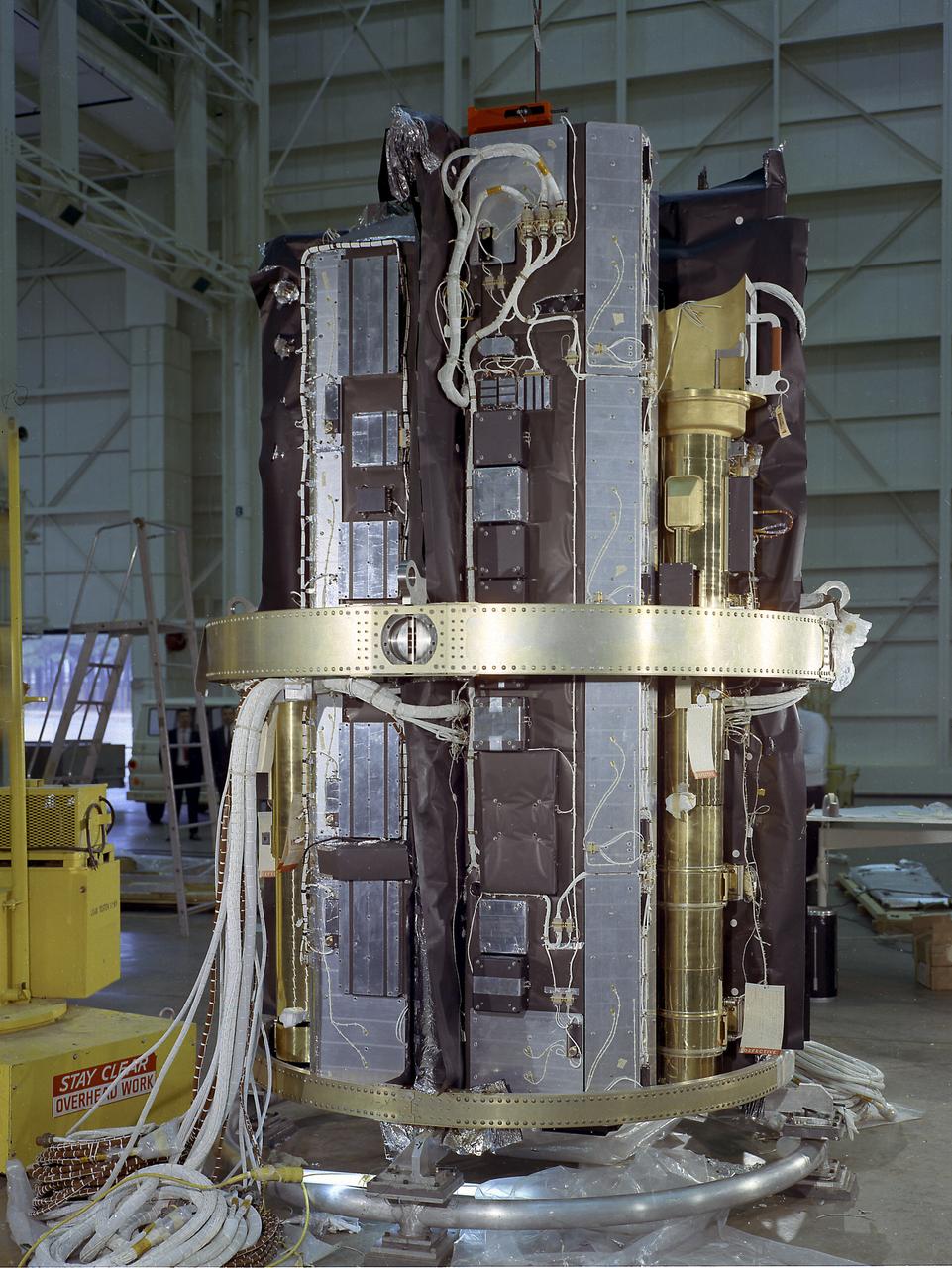
The Apollo Telescope Mount (ATM), designed and developed by the Marshall Space Flight Center, served as the primary scientific instrument unit aboard the Skylab. The ATM contained eight complex astronomical instruments designed to observe the Sun over a wide spectrum from visible light to x-rays. This image shows the ATM spar assembly. All solar telescopes, the fine Sun sensors, and some auxiliary systems are mounted on the spar, a cruciform lightweight perforated metal mounting panel that divides the 10-foot long canister lengthwise into four equal compartments. The spar assembly was nested inside a cylindrical canister that fit into the rack, a complex frame, and was protected by the solar shield.
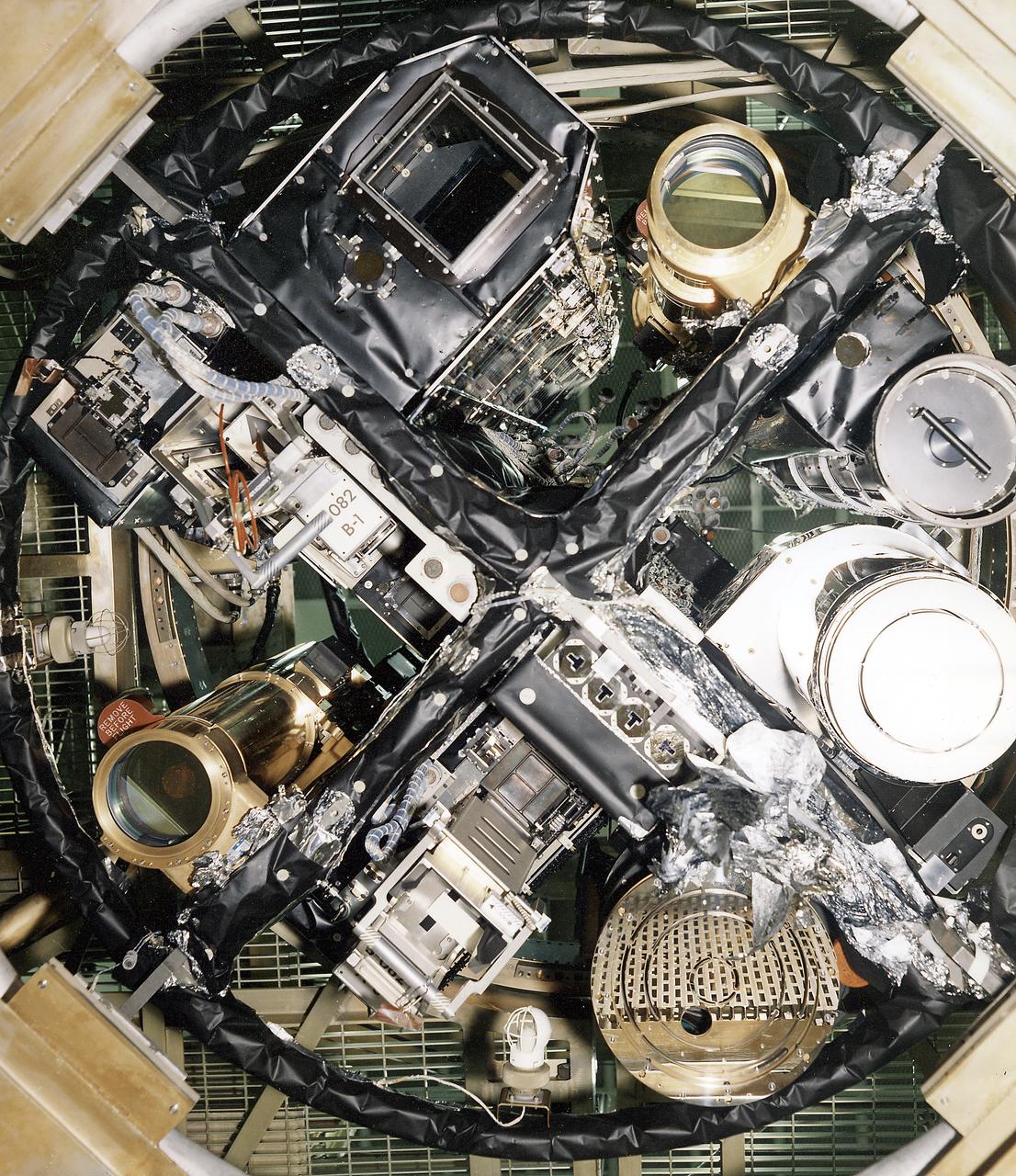
The Apollo Telescope Mount (ATM) was designed and developed by the Marshall Space Flight Center and served as the primary scientific instrument unit aboard Skylab (1973-1979). The ATM contained eight complex astronomical instruments designed to observe the Sun over a wide spectrum from visible light to x-rays. This image depicts the sun end and spar of the ATM flight unit showing individual telescopes. All solar telescopes, the fine Sun sensors, and some auxiliary systems are mounted on the spar, a cruciform lightweight perforated metal mounting panel that divides the canister lengthwise into four equal compartments. The spar assembly was nested inside a cylindrical canister that fit into a complex frame named the rack, and was protected by the solar shield.
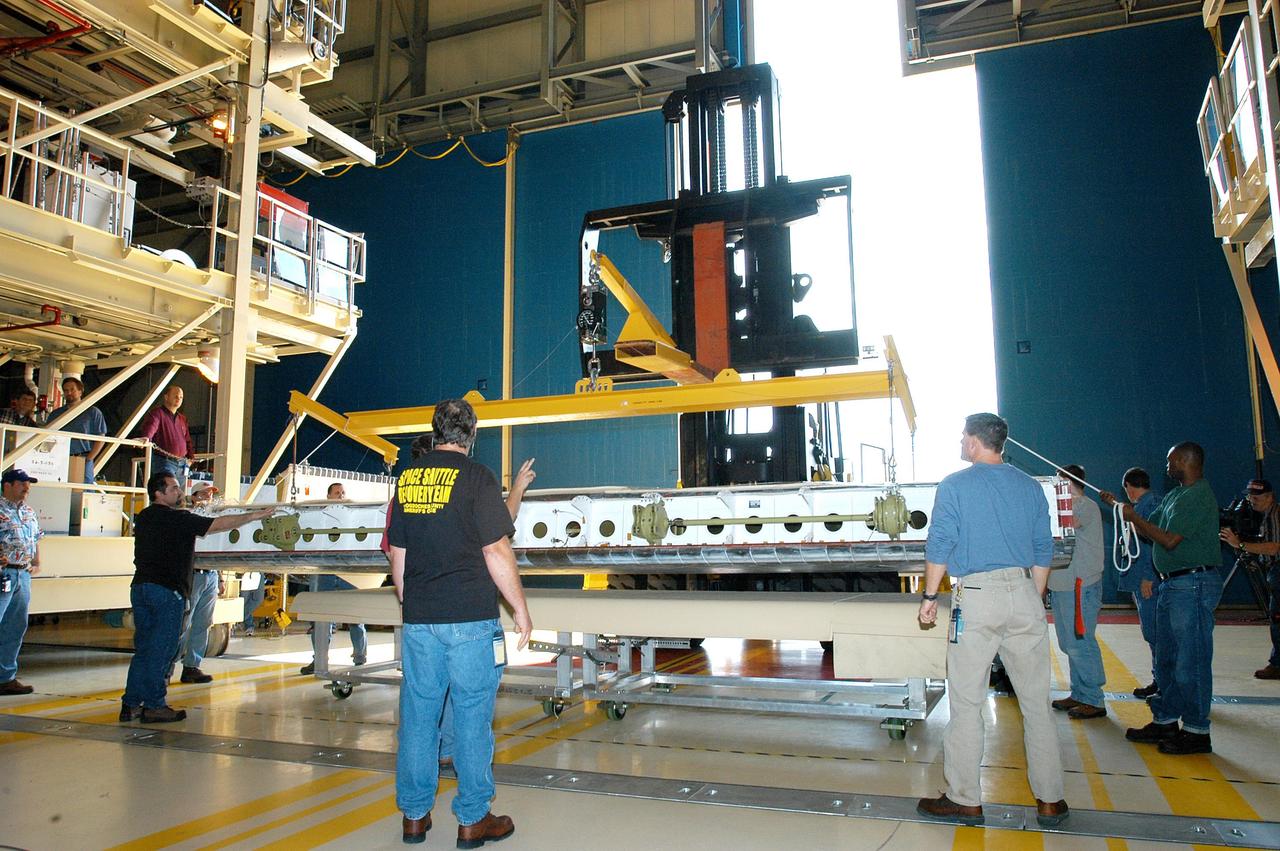
KENNEDY SPACE CENTER, FLA. - Workers in the Orbiter Processing Facility help prepare the body flap for lifting prior to installation on the orbiter Discovery. The body flap is an aluminum structure consisting of ribs, spars, skin panels and a trailing edge assembly. It thermally shields the three main engines during entry and provides pitch control trim during landing approach. Discovery is being processed for launch on the first Return to Flight mission, STS-114.
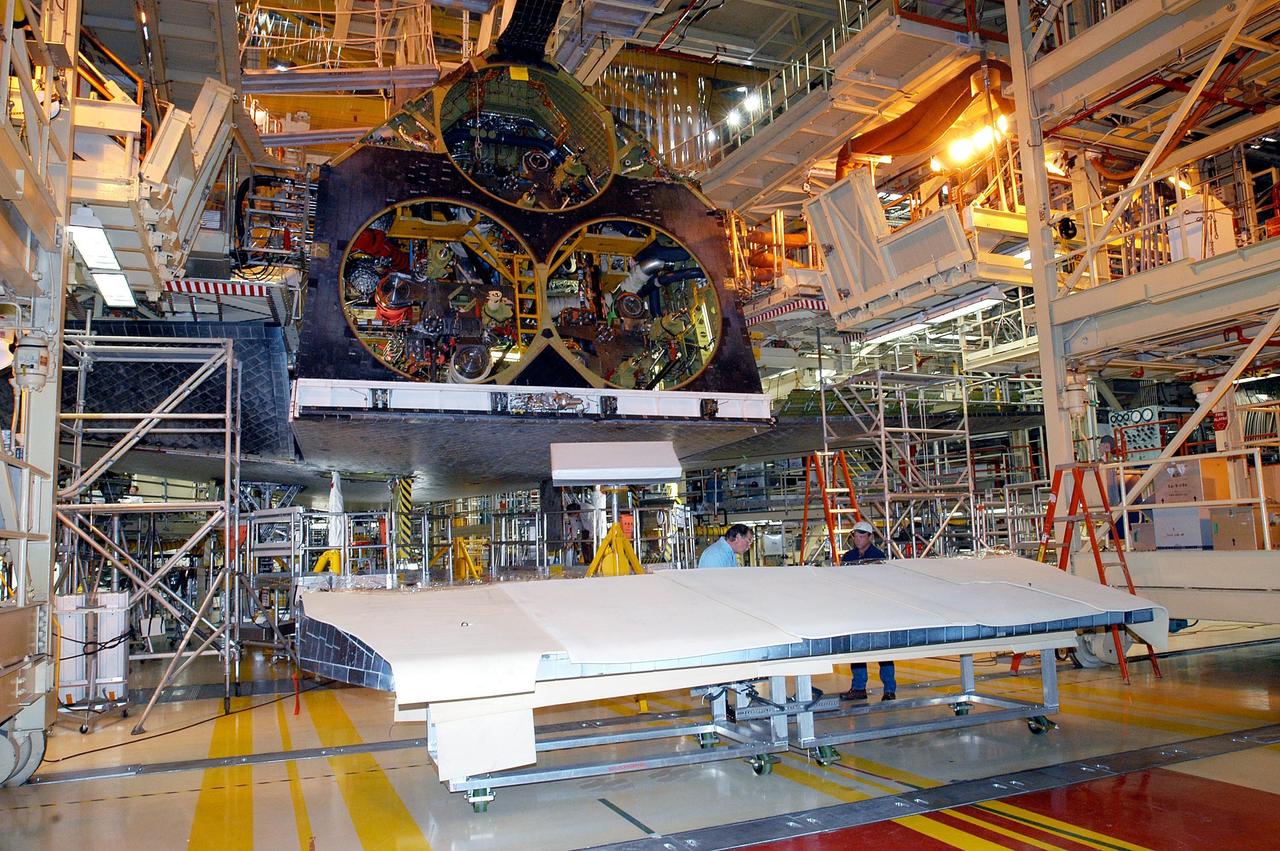
KENNEDY SPACE CENTER, FLA. - In the Orbiter Processing Facility, the body flap for the orbiter Discovery is prepared for installation. The body flap is an aluminum structure consisting of ribs, spars, skin panels and a trailing edge assembly. It thermally shields the three main engines during entry and provides pitch control trim during landing approach. Discovery is being processed for launch on the first Return to Flight mission, STS-114.
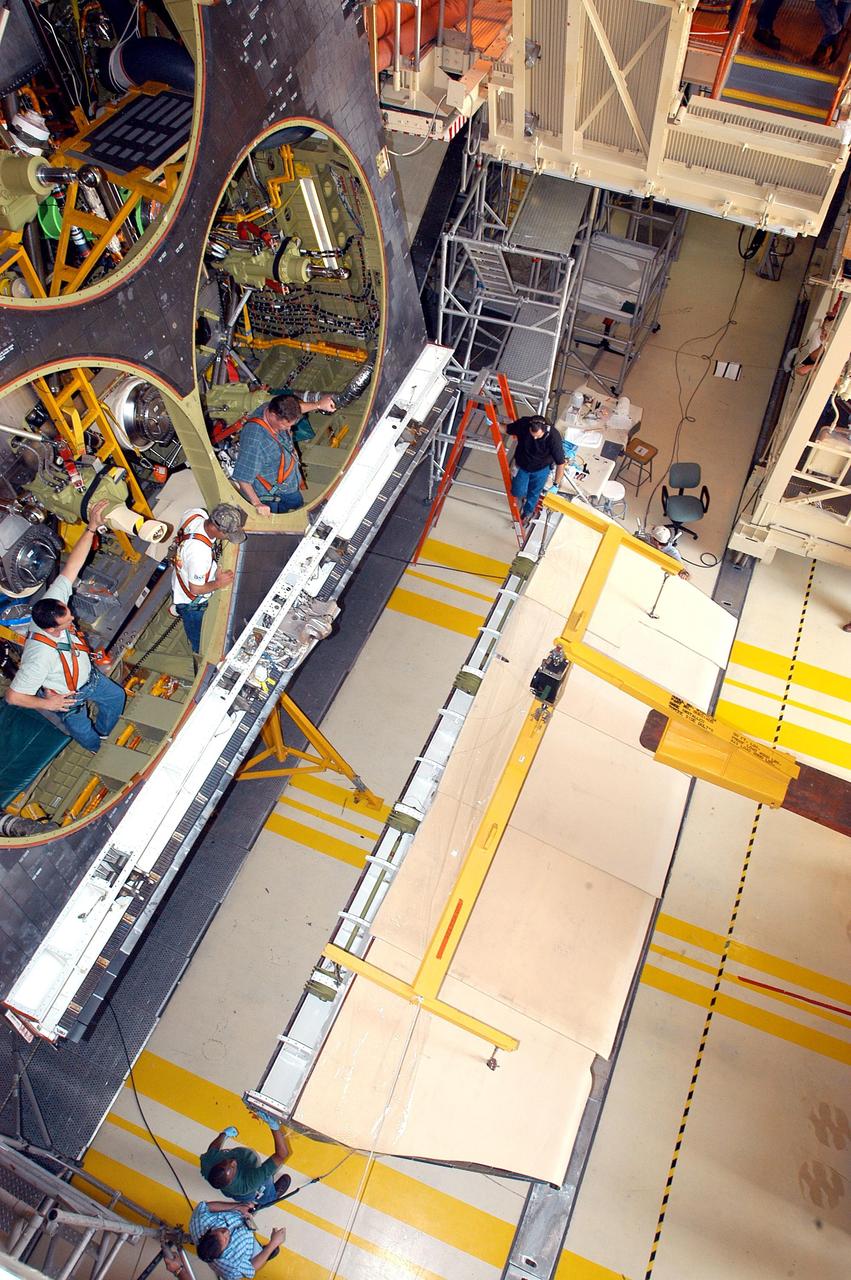
KENNEDY SPACE CENTER, FLA. - A Hyster forklift in the Orbiter Processing Facility moves the body flap toward the aft of the orbiter Discovery. The body flap is an aluminum structure consisting of ribs, spars, skin panels and a trailing edge assembly. It thermally shields the three main engines during entry and provides pitch control trim during landing approach. Discovery is being processed for launch on the first Return to Flight mission, STS-114.
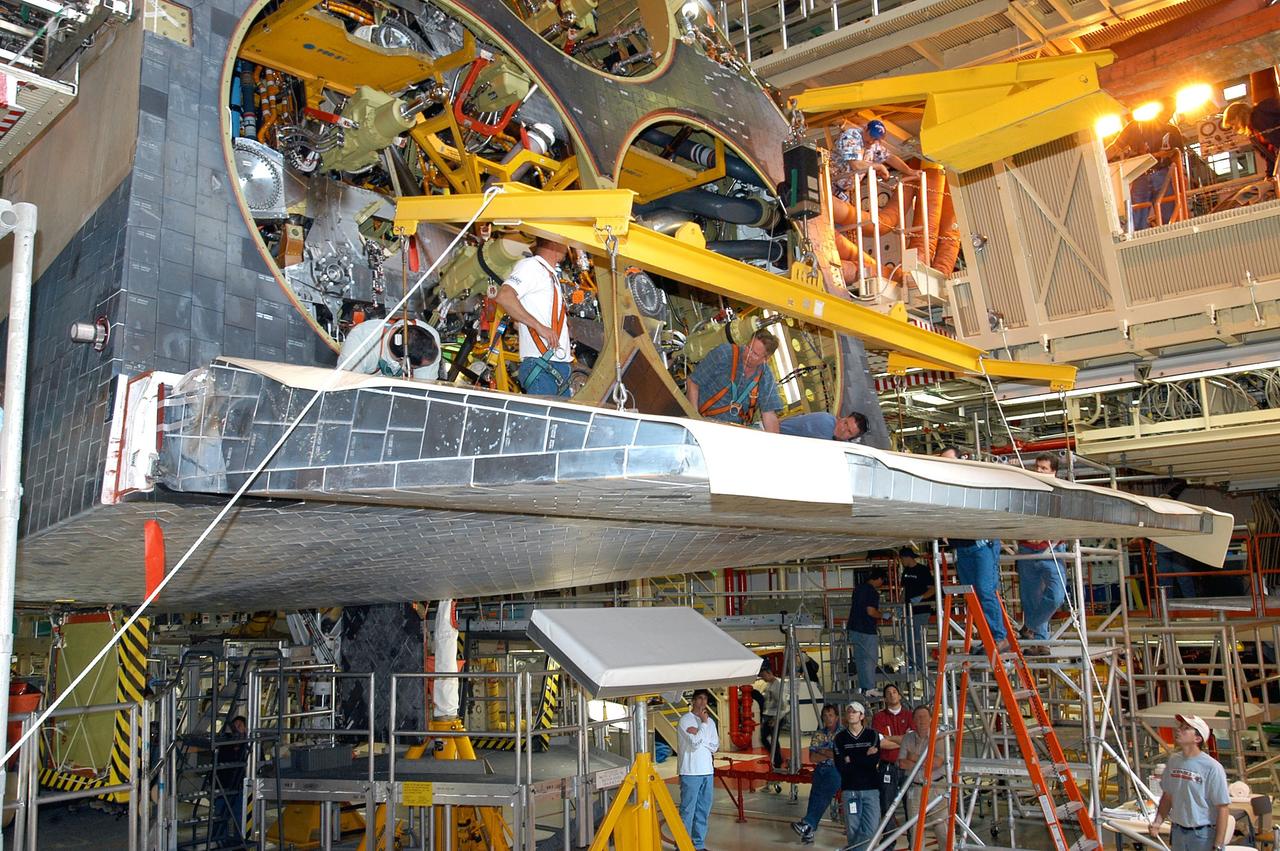
KENNEDY SPACE CENTER, FLA. - The body flap is installed on the orbiter Discovery. The body flap is an aluminum structure consisting of ribs, spars, skin panels and a trailing edge assembly. It thermally shields the three main engines during entry and provides pitch control trim during landing approach. Discovery is being processed for launch on the first Return to Flight mission, STS-114.
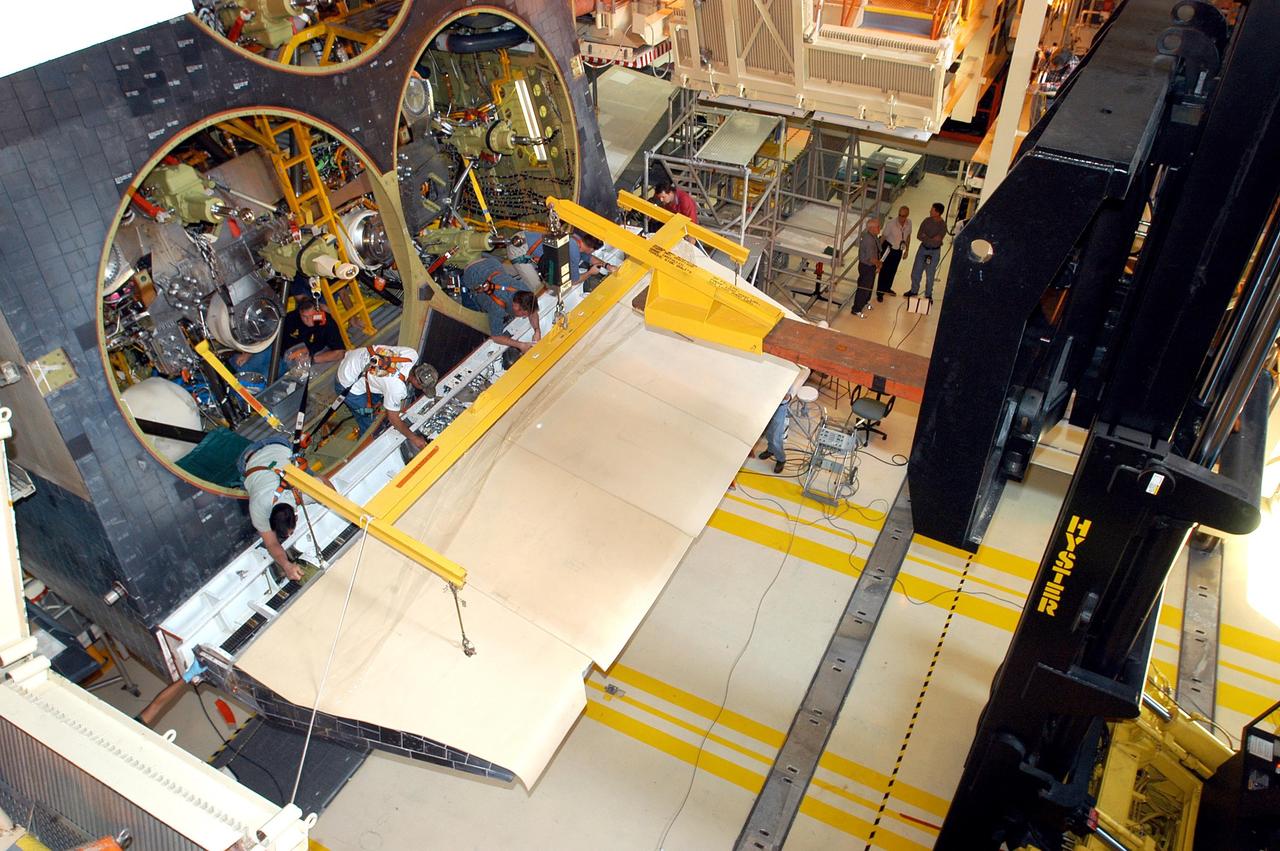
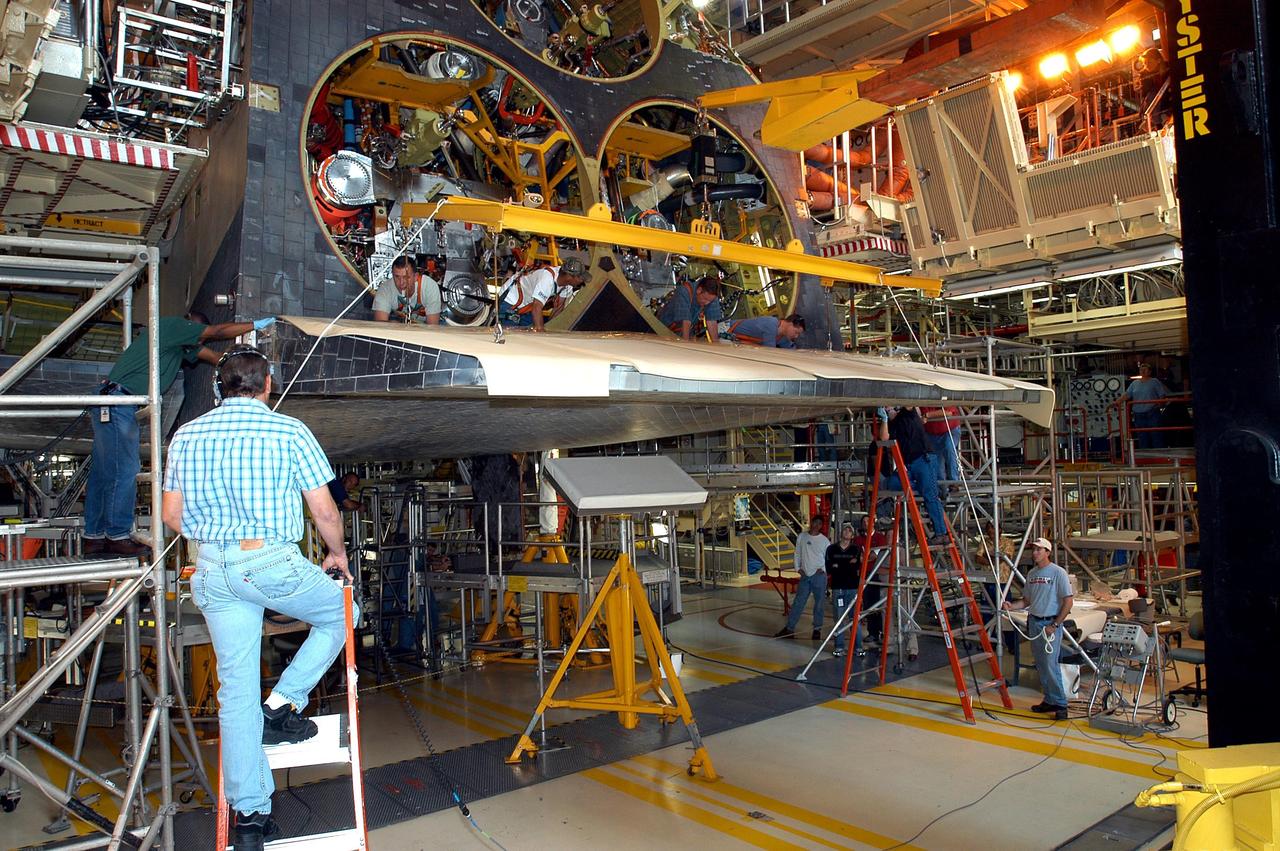
KENNEDY SPACE CENTER, FLA. - In the Orbiter Processing Facility, A Hyster forklift supports the body flap as workers secure it to the orbiter Discovery. The body flap is an aluminum structure consisting of ribs, spars, skin panels and a trailing edge assembly. It thermally shields the three main engines during entry and provides pitch control trim during landing approach. Discovery is being processed for launch on the first Return to Flight mission, STS-114.
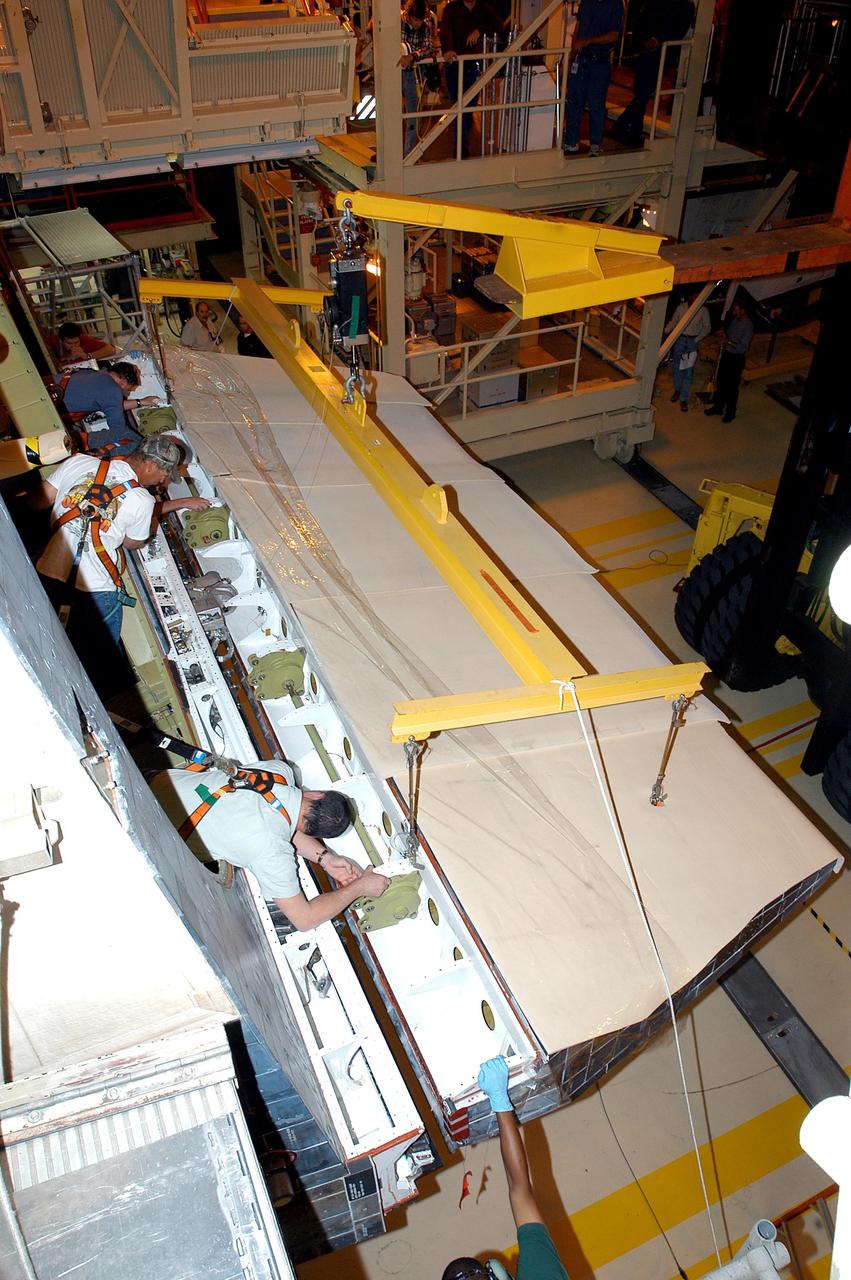
KENNEDY SPACE CENTER, FLA. - Workers in the Orbiter Processing Facility help move the body flap into position on the orbiter Discovery. The body flap is an aluminum structure consisting of ribs, spars, skin panels and a trailing edge assembly. It thermally shields the three main engines during entry and provides pitch control trim during landing approach. Discovery is being processed for launch on the first Return to Flight mission, STS-114.
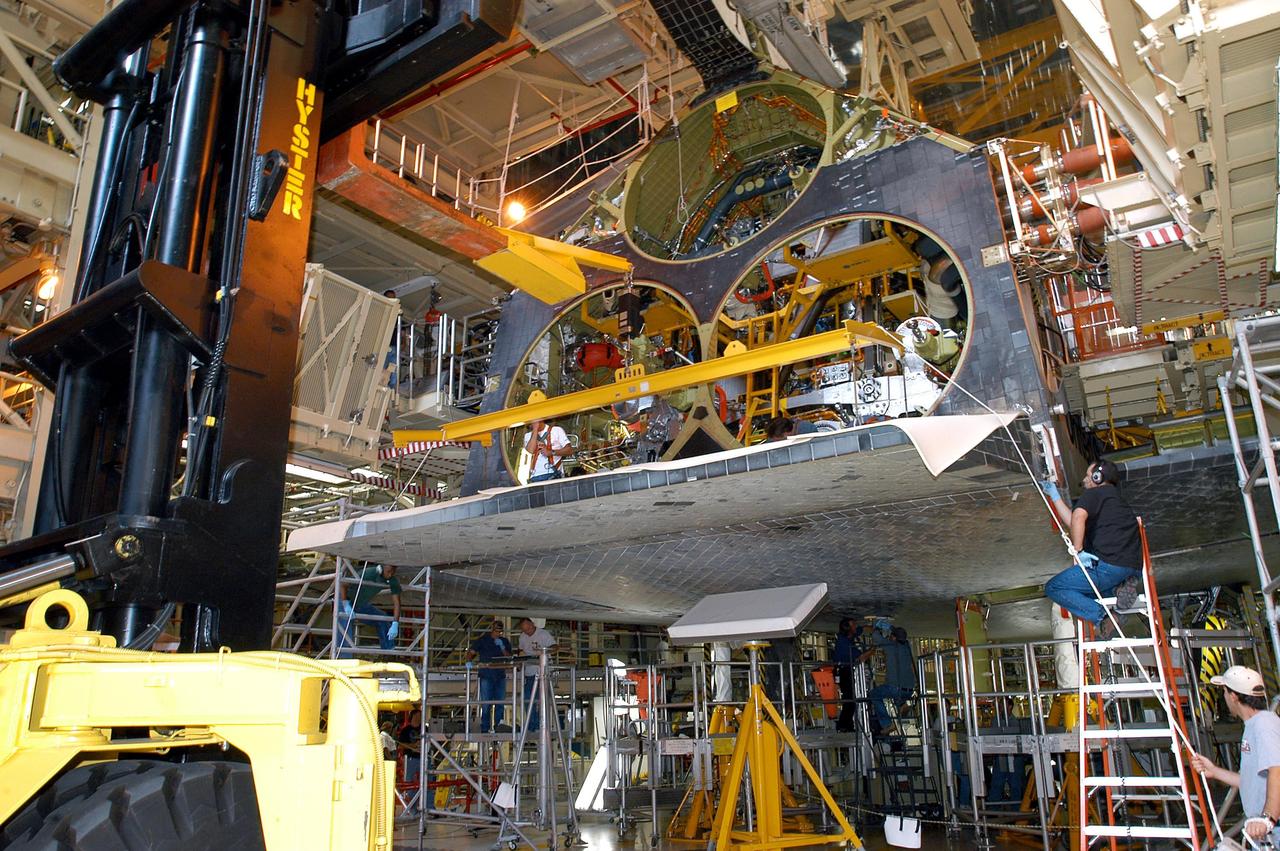
KENNEDY SPACE CENTER, FLA. - The body flap is installed on the orbiter Discovery. The body flap is an aluminum structure consisting of ribs, spars, skin panels and a trailing edge assembly. It thermally shields the three main engines during entry and provides pitch control trim during landing approach. Discovery is being processed for launch on the first Return to Flight mission, STS-114.
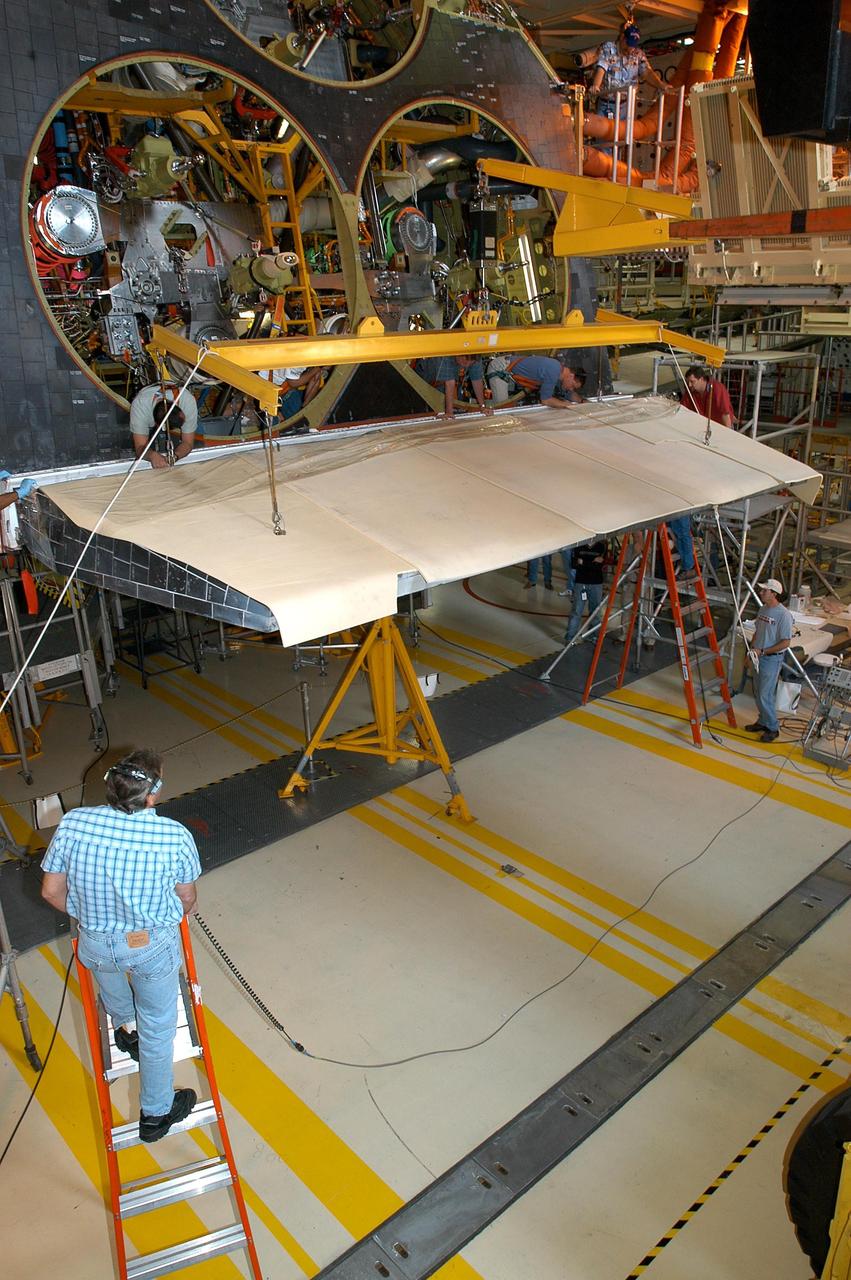
KENNEDY SPACE CENTER, FLA. - A worker on a ladder (lower left) observes installation of the body flap onto the orbiter Discovery. The body flap is an aluminum structure consisting of ribs, spars, skin panels and a trailing edge assembly. It thermally shields the three main engines during entry and provides pitch control trim during landing approach. Discovery is being processed for launch on the first Return to Flight mission, STS-114.
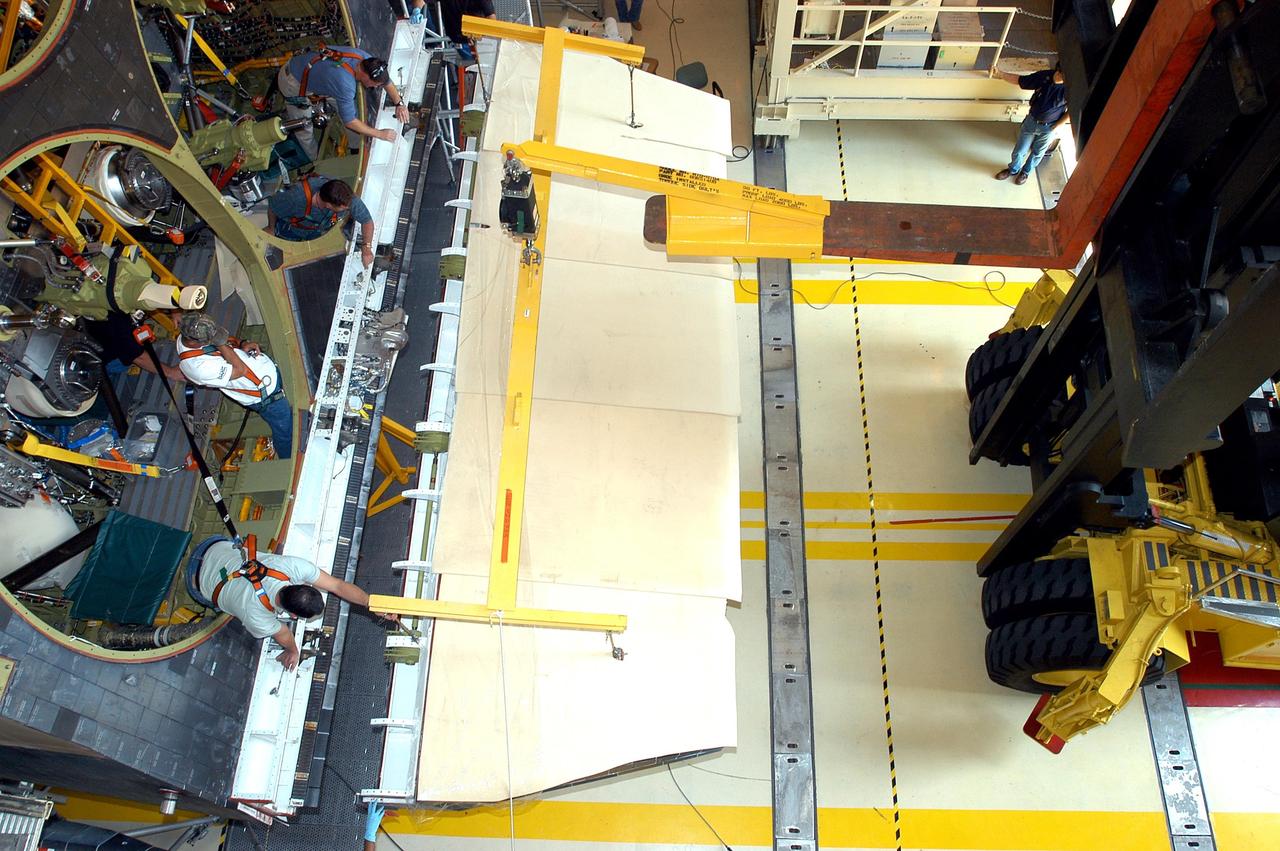
KENNEDY SPACE CENTER, FLA. - In the Orbiter Processing Facility, the body flap is moved into position for installation on the orbiter Discovery. The body flap is an aluminum structure consisting of ribs, spars, skin panels and a trailing edge assembly. It thermally shields the three main engines during entry and provides pitch control trim during landing approach. Discovery is being processed for launch on the first Return to Flight mission, STS-114.
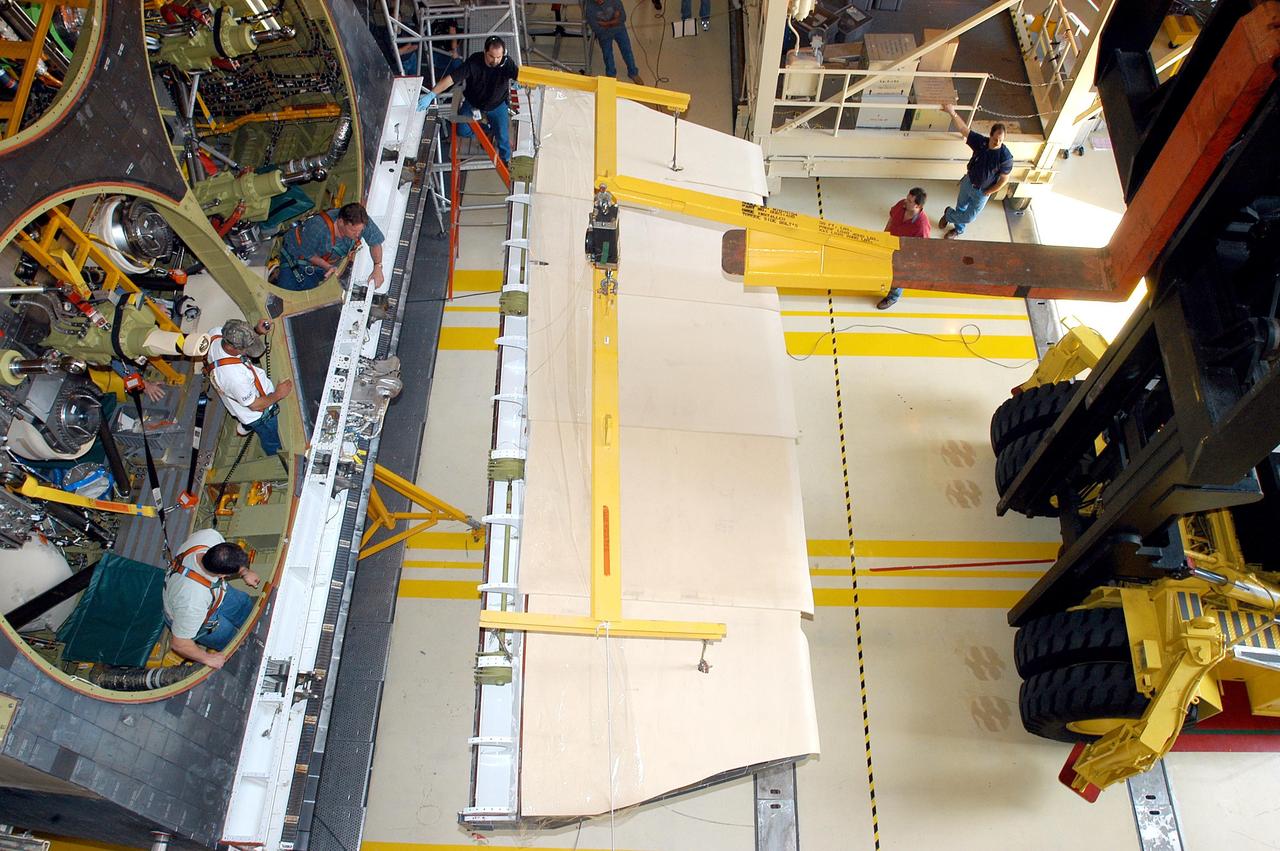
KENNEDY SPACE CENTER, FLA. - Workers on ladders (left and right) check installation of the body flap onto the orbiter Discovery. The body flap is an aluminum structure consisting of ribs, spars, skin panels and a trailing edge assembly. It thermally shields the three main engines during entry and provides pitch control trim during landing approach. Discovery is being processed for launch on the first Return to Flight mission, STS-114.
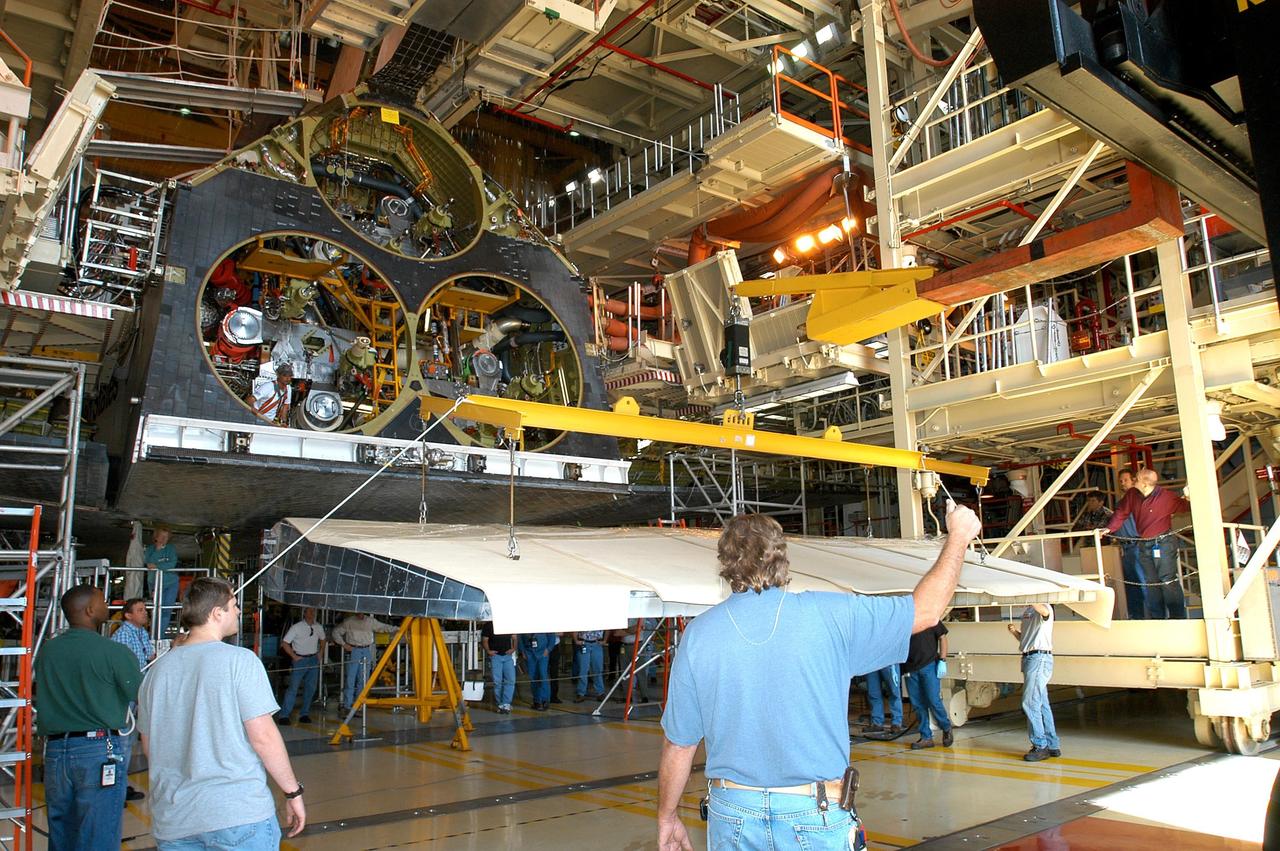
KENNEDY SPACE CENTER, FLA. - In the Orbiter Processing Facility, the body flap is moved into position for installation on the orbiter Discovery. The body flap is an aluminum structure consisting of ribs, spars, skin panels and a trailing edge assembly. It thermally shields the three main engines during entry and provides pitch control trim during landing approach. Discovery is being processed for launch on the first Return to Flight mission, STS-114.
KENNEDY SPACE CENTER, FLA. - A Hyster forklift in the Orbiter Processing Facility lifts the body flap to be installed on the orbiter Discovery. The body flap is an aluminum structure consisting of ribs, spars, skin panels and a trailing edge assembly. It thermally shields the three main engines during entry and provides pitch control trim during landing approach. Discovery is being processed for launch on the first Return to Flight mission, STS-114.
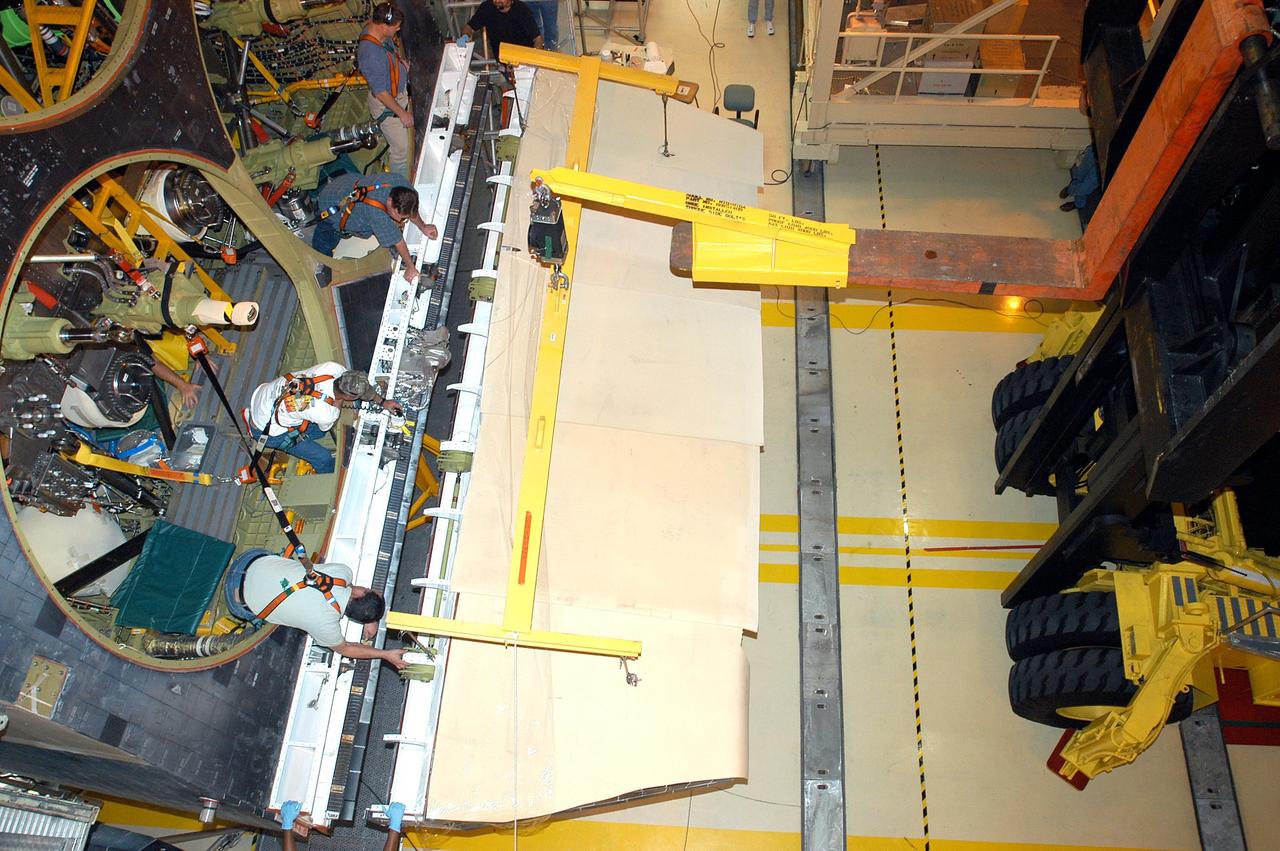
KENNEDY SPACE CENTER, FLA. - Workers in the Orbiter Processing Facility lean toward the body flap to be installed on the orbiter Discovery. The body flap is an aluminum structure consisting of ribs, spars, skin panels and a trailing edge assembly. It thermally shields the three main engines during entry and provides pitch control trim during landing approach. Discovery is being processed for launch on the first Return to Flight mission, STS-114.
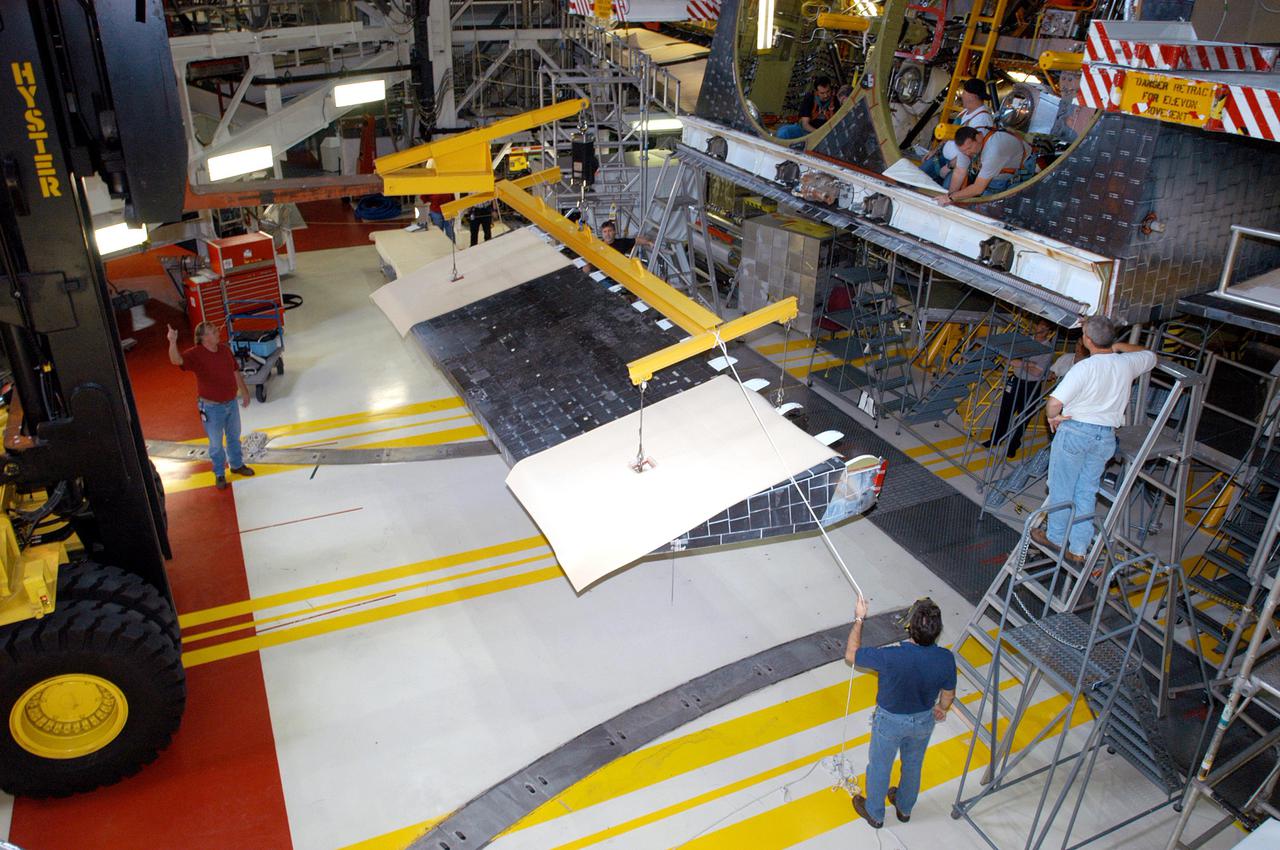
KENNEDY SPACE CENTER, FLA. - In the Orbiter Processing Facility, workers help guide the body flap toward the orbiter Atlantis for installation. The body flap is an aluminum structure consisting of ribs, spars, skin panels and a trailing edge assembly. It thermally shields the three Space Shuttle Main Engines during entry and provides the orbiter with pitch control trim during its atmospheric flight after entry. Atlantis is being processed for its mission, designated STS-121, this summer to the International Space Station. The launch planning window is July 12 - August 3.
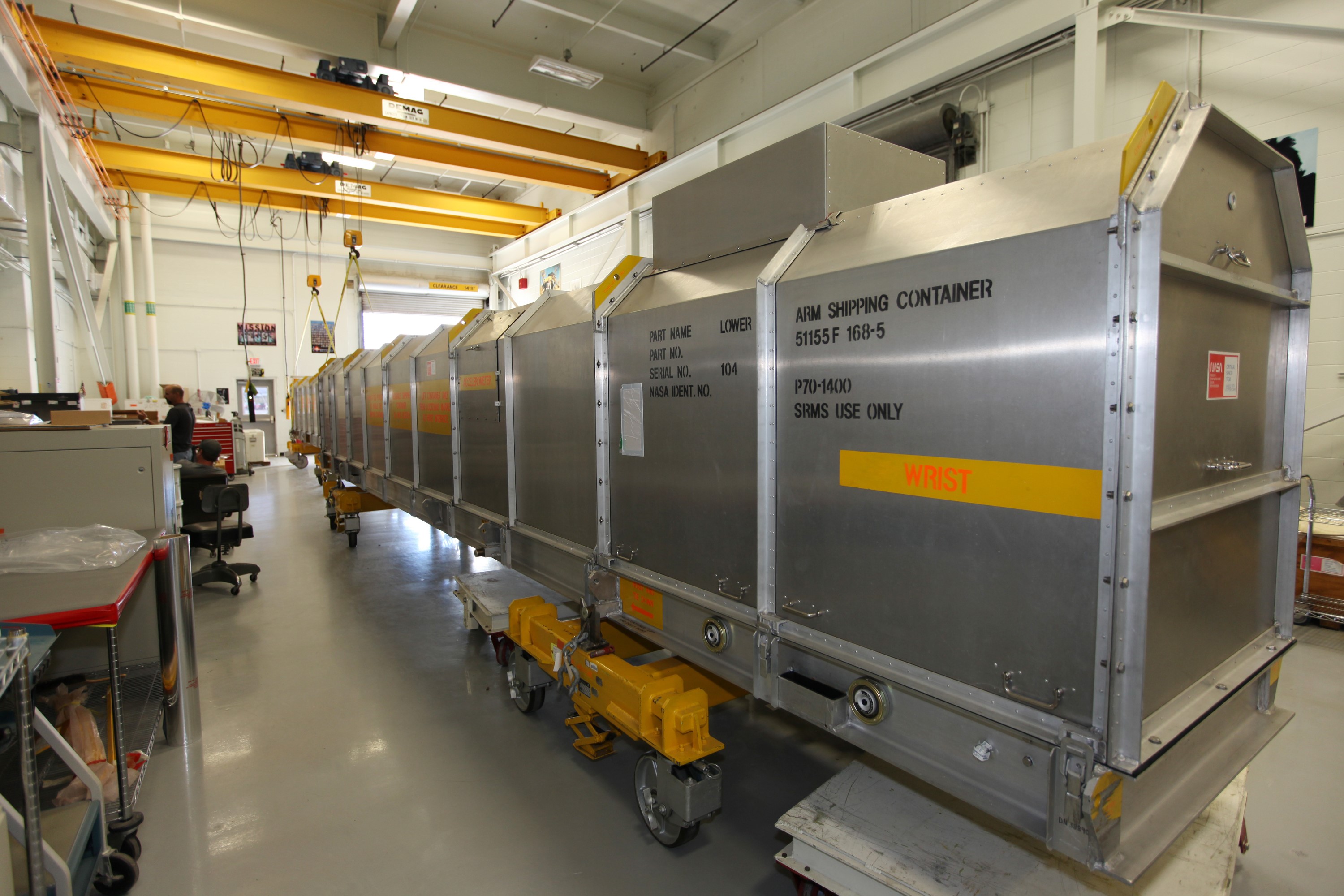
CAPE CANAVERAL, Fla. - Inside the Vehicle Assembly Building at NASA’s Kennedy Space Center in Florida, the remote manipulator system, or RMS, has been crated and prepared for shipment back to the Canadian Space Agency. The RMS, also called the Canadarm, was manufactured for NASA’s Space Shuttle Program by SPAR Aerospace Ltd., which later became a part of MD Robotics in Ontario, Canada. During shuttle missions, the RMS was attached in the payload bay. Mission specialists operated the arm to remove payloads from the payload bay and hand them off to the larger Canadarm 2 on the International Space Station. The shuttle arm also was used during astronaut spacewalks. Photo credit: NASA/Kim Shiflett
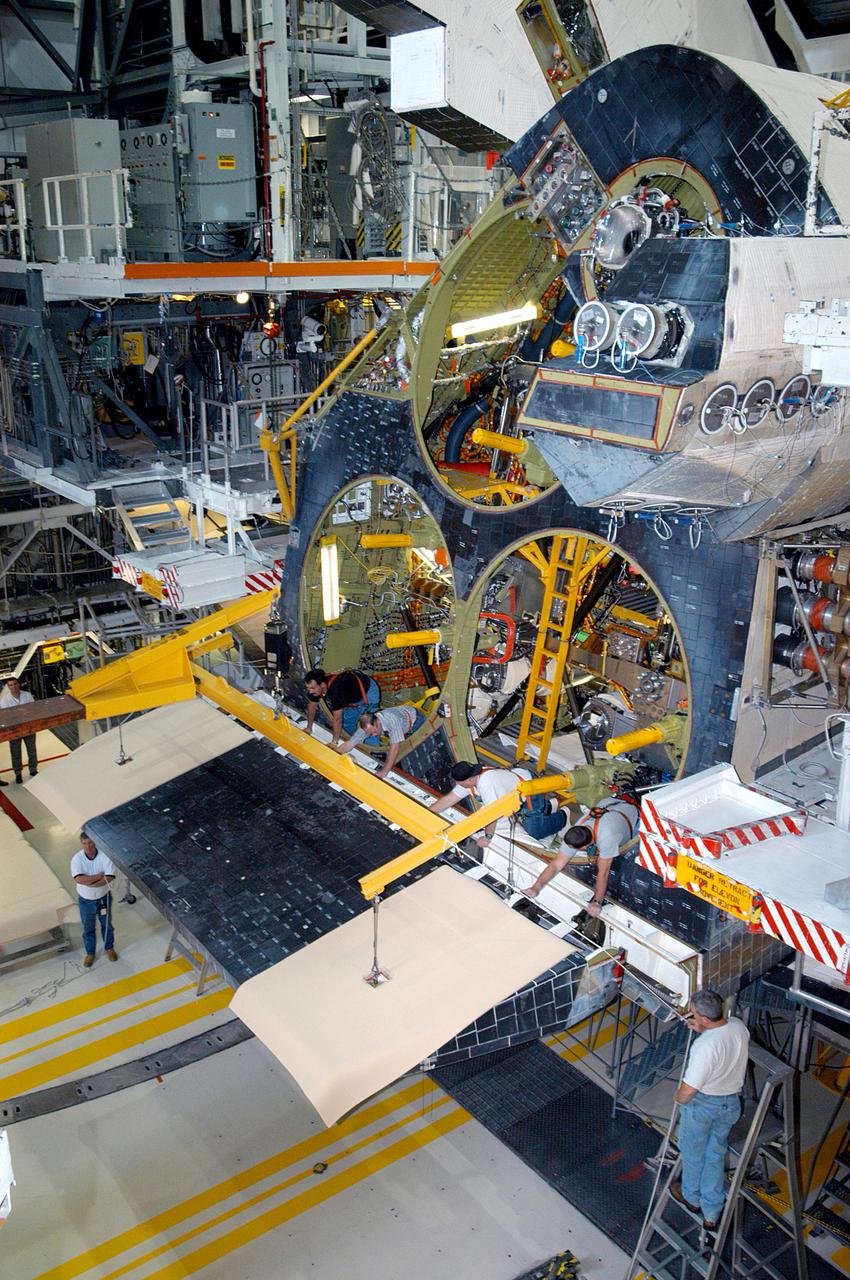
KENNEDY SPACE CENTER, FLA. - In the Orbiter Processing Facility, workers inside the openings for the Space Shuttle Main Engines reach out to install the body flap, suspended behind the orbiter Atlantis. The body flap is an aluminum structure consisting of ribs, spars, skin panels and a trailing edge assembly. It thermally shields the three Space Shuttle Main Engines during entry and provides the orbiter with pitch control trim during its atmospheric flight after entry. Atlantis is being processed for its mission, designated STS-121, this summer to the International Space Station. The launch planning window is July 12 - August 3.
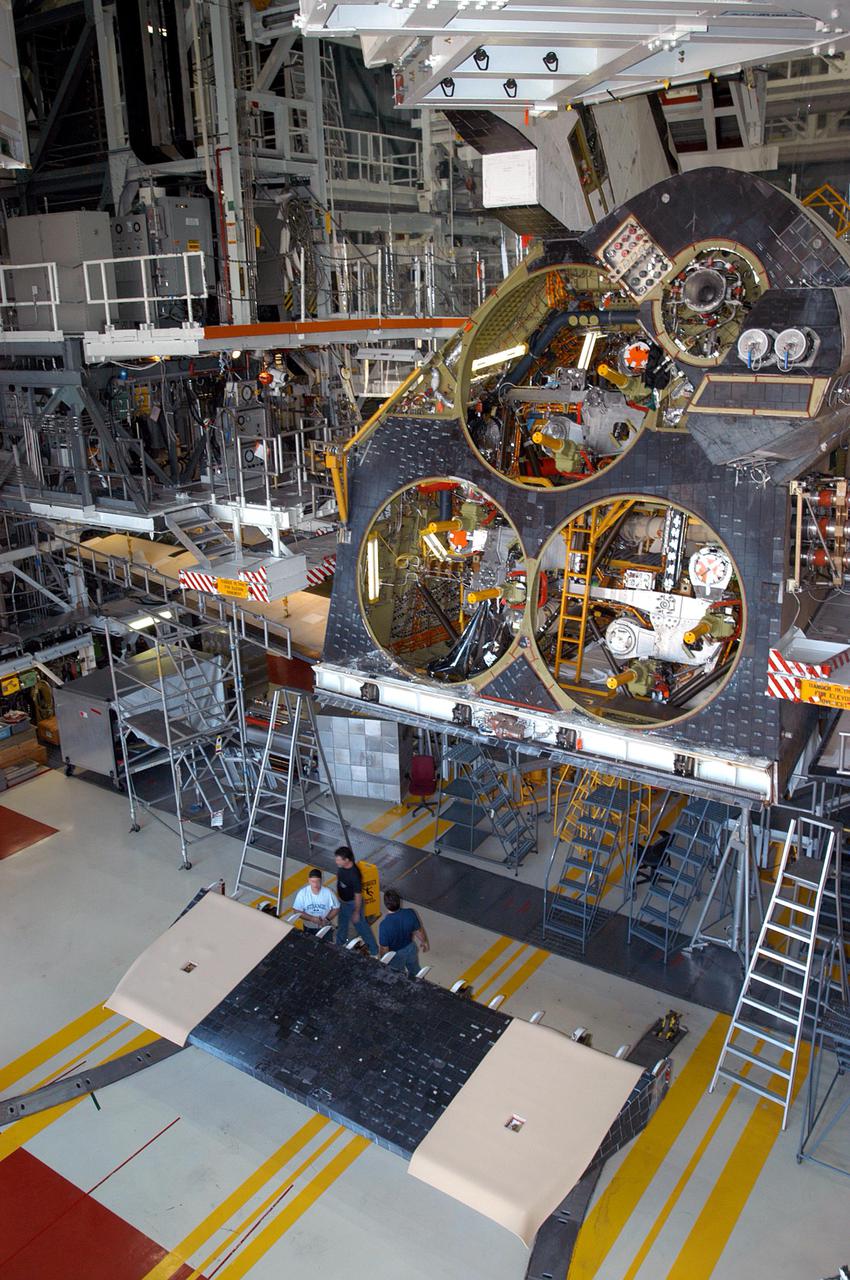
KENNEDY SPACE CENTER, FLA. - In the Orbiter Processing Facility, workers on the floor get ready to install the body flap on the orbiter Atlantis, behind them. The body flap is an aluminum structure consisting of ribs, spars, skin panels and a trailing edge assembly. It thermally shields the three Space Shuttle Main Engines during entry and provides the orbiter with pitch control trim during its atmospheric flight after entry. Atlantis is being processed for its mission, designated STS-121, this summer to the International Space Station. The launch planning window is July 12 - August 3.
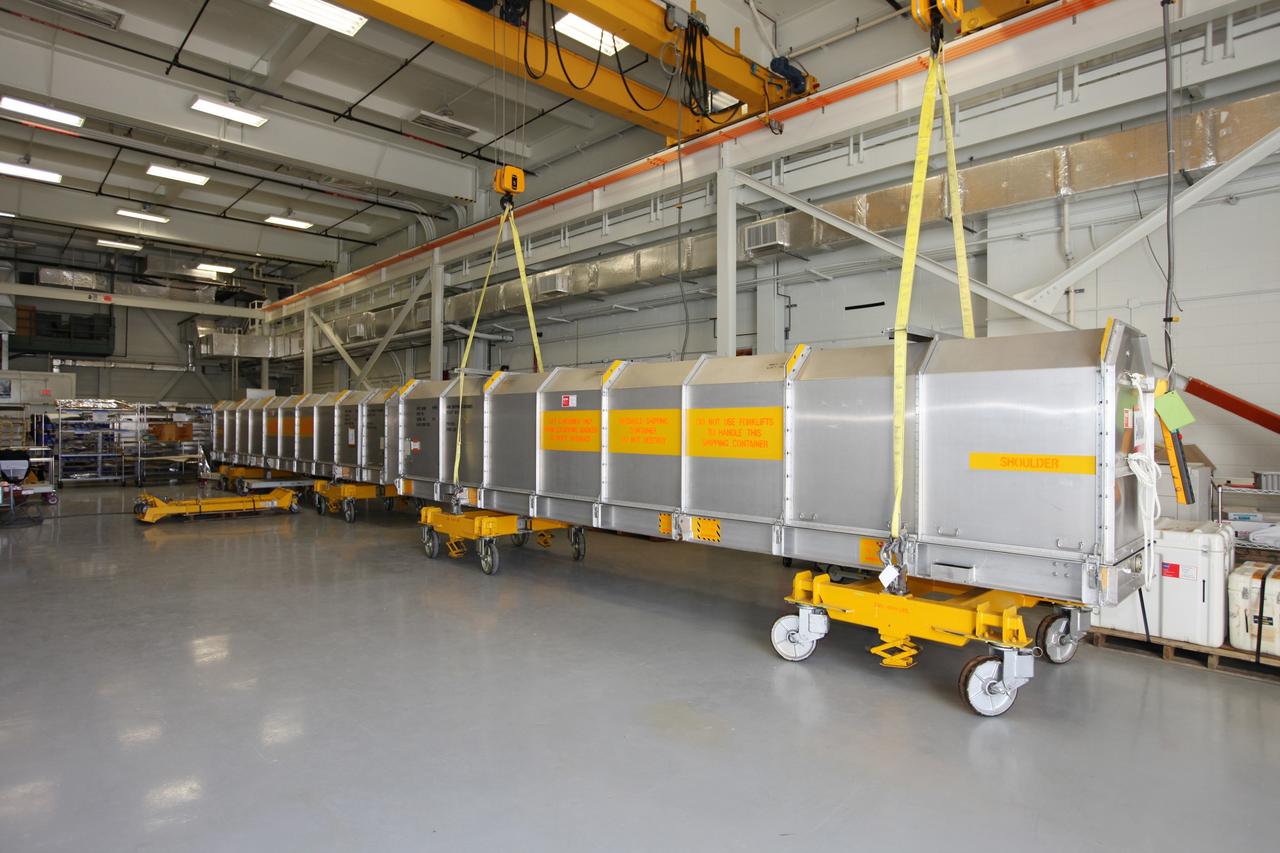
CAPE CANAVERAL, Fla. - Inside the Vehicle Assembly Building at NASA’s Kennedy Space Center in Florida, the remote manipulator system, or RMS, has been crated and prepared for shipment back to the Canadian Space Agency. The RMS, also called the Canadarm, was manufactured for NASA’s Space Shuttle Program by SPAR Aerospace Ltd., which later became a part of MD Robotics in Ontario, Canada. During shuttle missions, the RMS was attached in the payload bay. Mission specialists operated the arm to remove payloads from the payload bay and hand them off to the larger Canadarm 2 on the International Space Station. The shuttle arm also was used during astronaut spacewalks. Photo credit: NASA/Kim Shiflett
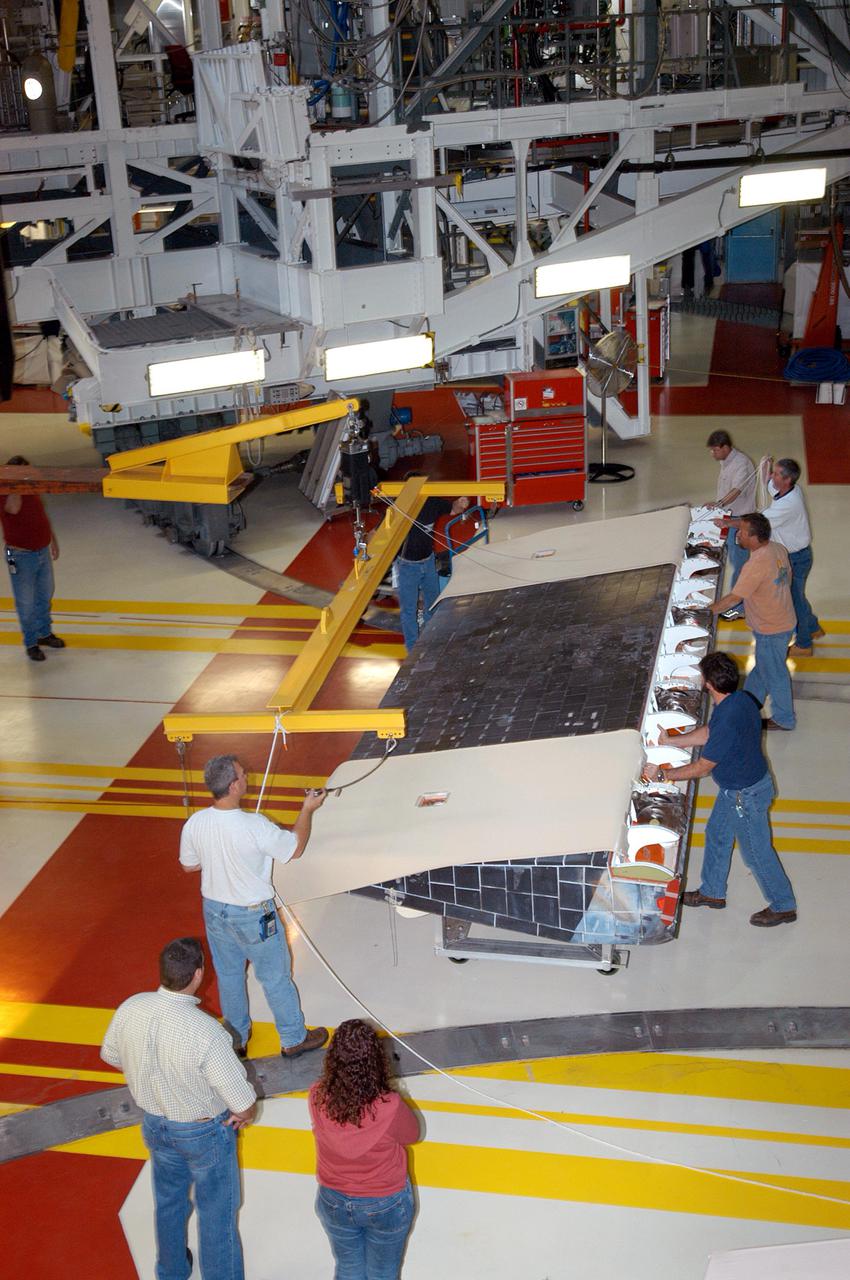
KENNEDY SPACE CENTER, FLA. - In the Orbiter Processing Facility, workers on the floor prepare to attach a crane to the body flap for the orbiter Atlantis. The crane will lift the body flap for installation on the orbiter. The body flap is an aluminum structure consisting of ribs, spars, skin panels and a trailing edge assembly. It thermally shields the three Space Shuttle Main Engines during entry and provides the orbiter with pitch control trim during its atmospheric flight after entry. Atlantis is being processed for its mission, designated STS-121, this summer to the International Space Station. The launch planning window is July 12 - August 3.
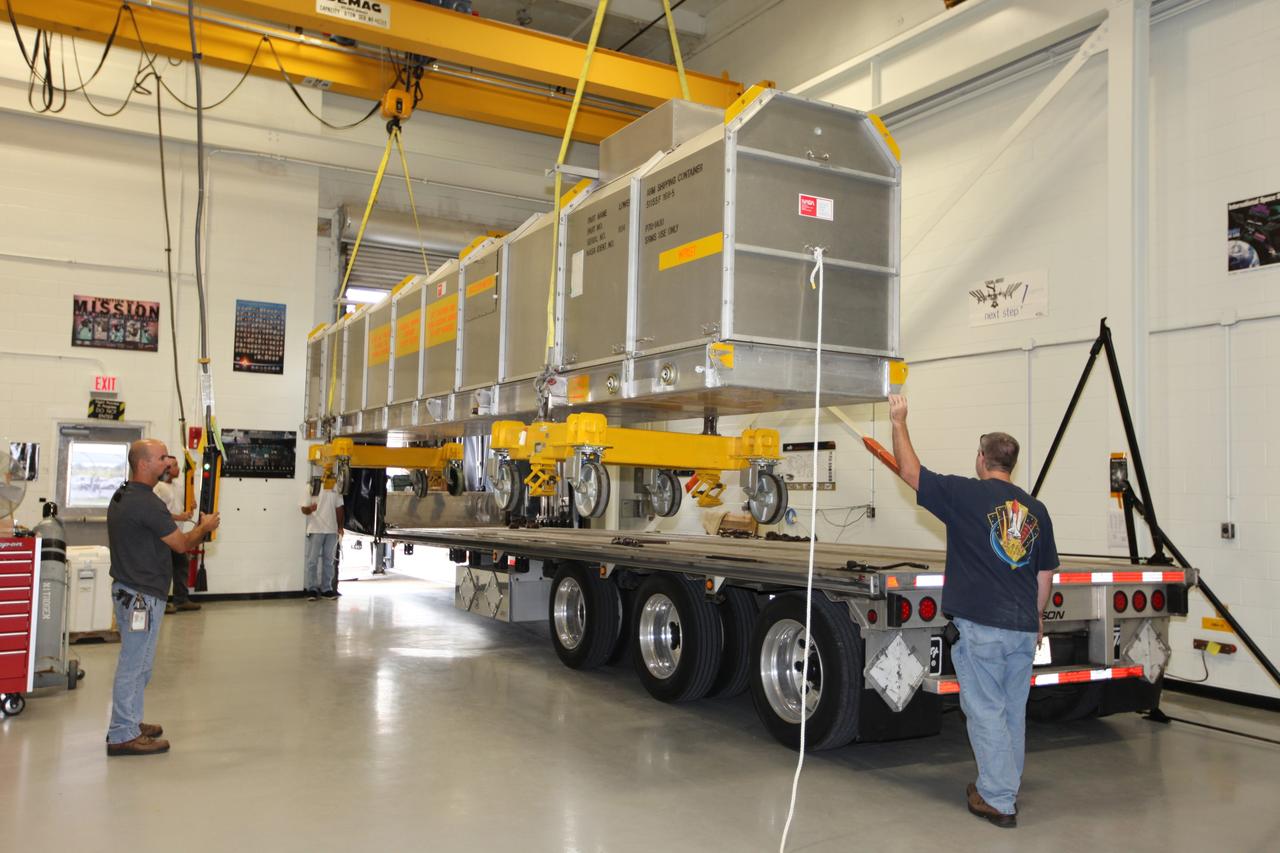
CAPE CANAVERAL, Fla. - Inside the Vehicle Assembly Building at NASA’s Kennedy Space Center in Florida, United Space Alliance workers monitor the progress as the container holding the remote manipulator system, or RMS, is lowered onto a flatbed truck for shipment back to the Canadian Space Agency. The RMS, also called the Canadarm, was manufactured for NASA’s Space Shuttle Program by SPAR Aerospace Ltd., which later became a part of MD Robotics in Ontario, Canada. During shuttle missions, the RMS was attached in the payload bay. Mission specialists operated the arm to remove payloads from the payload bay and hand them off to the larger Canadarm 2 on the International Space Station. The shuttle arm also was used during astronaut spacewalks. Photo credit: NASA/Kim Shiflett
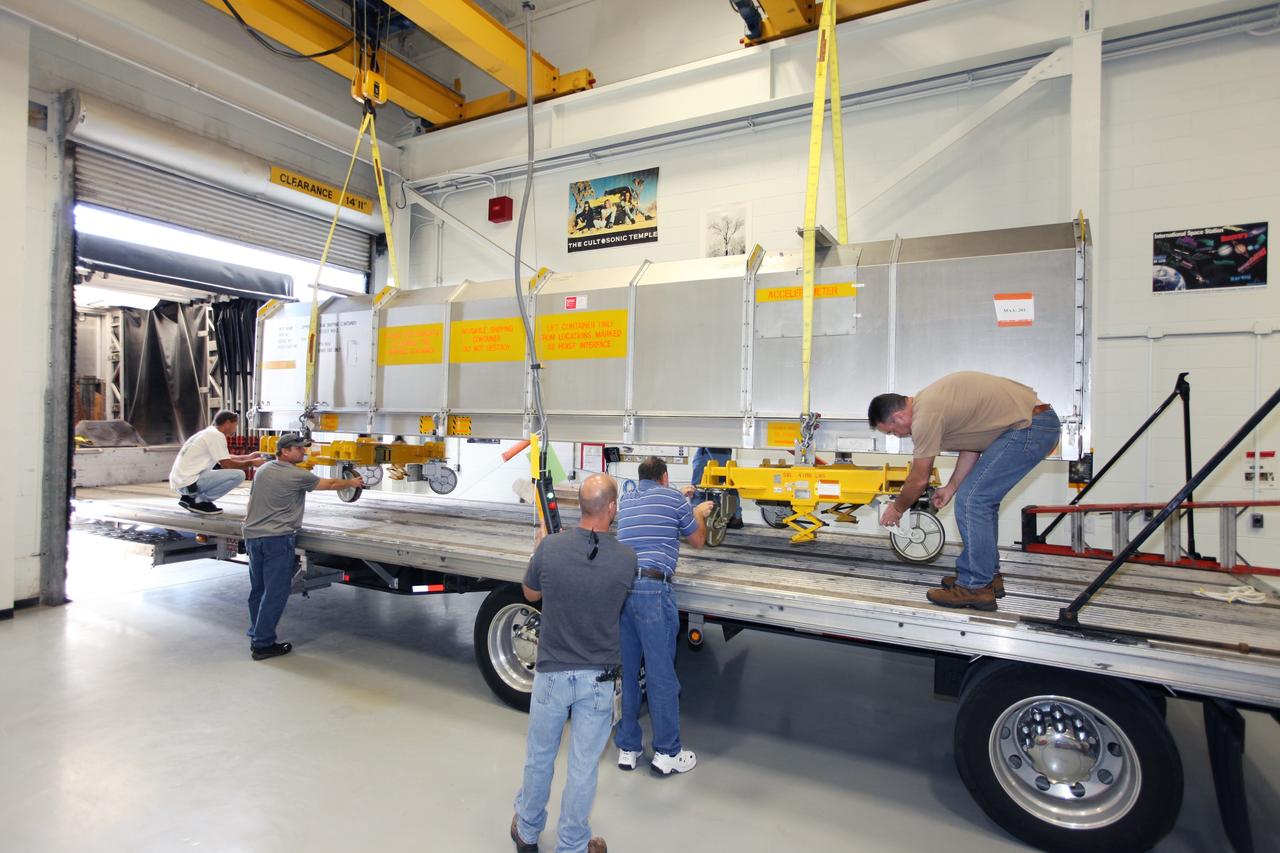
CAPE CANAVERAL, Fla. - Inside the Vehicle Assembly Building at NASA’s Kennedy Space Center in Florida, United Space Alliance workers help guide the container holding the remote manipulator system, or RMS, onto a flatbed truck for shipment back to the Canadian Space Agency. The RMS, also called the Canadarm, was manufactured for NASA’s Space Shuttle Program by SPAR Aerospace Ltd., which later became a part of MD Robotics in Ontario, Canada. During shuttle missions, the RMS was attached in the payload bay. Mission specialists operated the arm to remove payloads from the payload bay and hand them off to the larger Canadarm 2 on the International Space Station. The shuttle arm also was used during astronaut spacewalks. Photo credit: NASA/Kim Shiflett
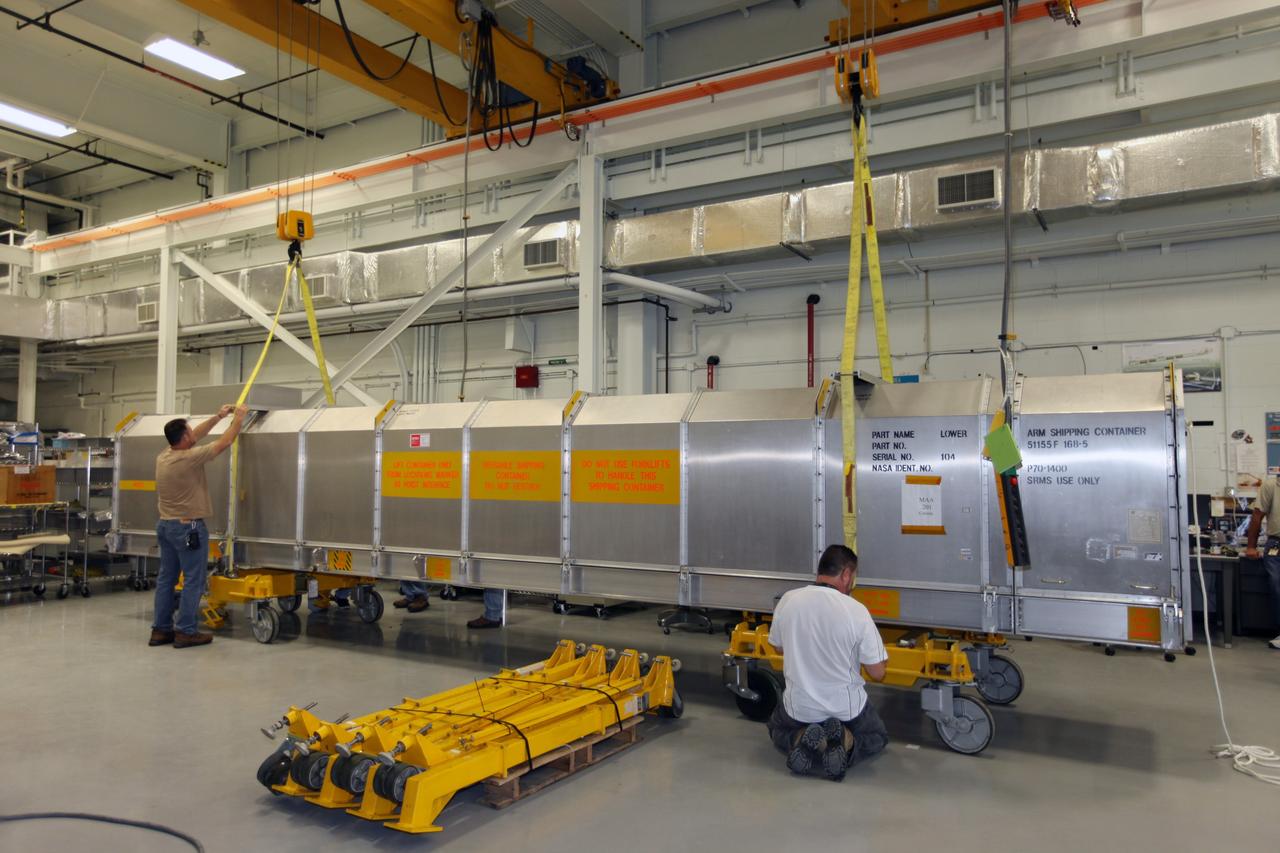
CAPE CANAVERAL, Fla. - Inside the Vehicle Assembly Building at NASA’s Kennedy Space Center in Florida, United Space Alliance workers attach lifting cranes to the container holding the remote manipulator system, or RMS. The RMS is placed on a flatbed truck for shipment back to the Canadian Space Agency. The RMS, also called the Canadarm, was manufactured for NASA’s Space Shuttle Program by SPAR Aerospace Ltd., which later became a part of MD Robotics in Ontario, Canada. During shuttle missions, the RMS was attached in the payload bay. Mission specialists operated the arm to remove payloads from the payload bay and hand them off to the larger Canadarm 2 on the International Space Station. The shuttle arm also was used during astronaut spacewalks. Photo credit: NASA/Kim Shiflett
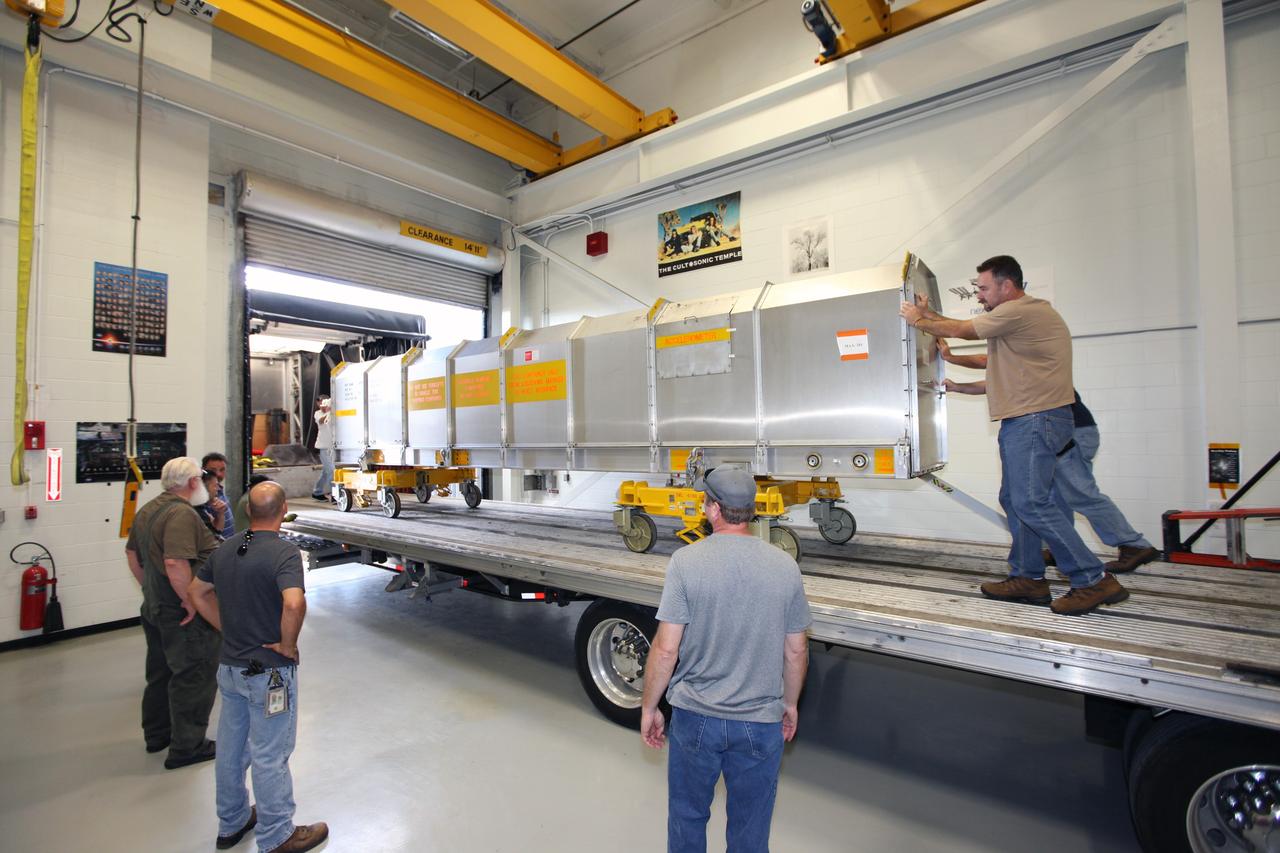
CAPE CANAVERAL, Fla. - Inside the Vehicle Assembly Building at NASA’s Kennedy Space Center in Florida, United Space Alliance workers position the container holding the remote manipulator system, or RMS, onto a flatbed truck for shipment back to the Canadian Space Agency. The RMS, also called the Canadarm, was manufactured for NASA’s Space Shuttle Program by SPAR Aerospace Ltd., which later became a part of MD Robotics in Ontario, Canada. During shuttle missions, the RMS was attached in the payload bay. Mission specialists operated the arm to remove payloads from the payload bay and hand them off to the larger Canadarm 2 on the International Space Station. The shuttle arm also was used during astronaut spacewalks. Photo credit: NASA/Kim Shiflett
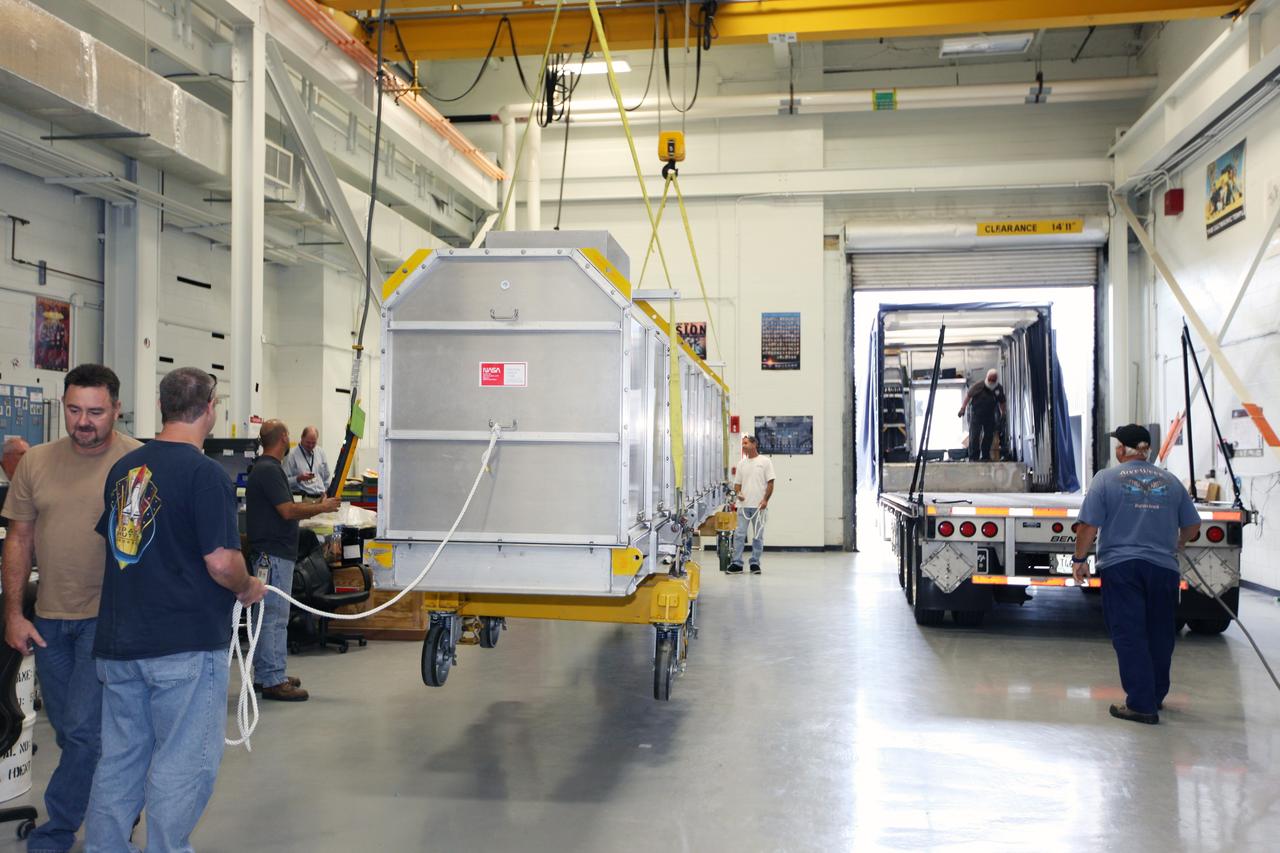
CAPE CANAVERAL, Fla. - Inside the Vehicle Assembly Building at NASA’s Kennedy Space Center in Florida, United Space Alliance workers monitor the progress as the container holding the remote manipulator system, or RMS, is lifted. The RMS will be placed on a flatbed truck for shipment back to the Canadian Space Agency. The RMS, also called the Canadarm, was manufactured for NASA’s Space Shuttle Program by SPAR Aerospace Ltd., which later became a part of MD Robotics in Ontario, Canada. During shuttle missions, the RMS was attached in the payload bay. Mission specialists operated the arm to remove payloads from the payload bay and hand them off to the larger Canadarm 2 on the International Space Station. The shuttle arm also was used during astronaut spacewalks. Photo credit: NASA/Kim Shiflett
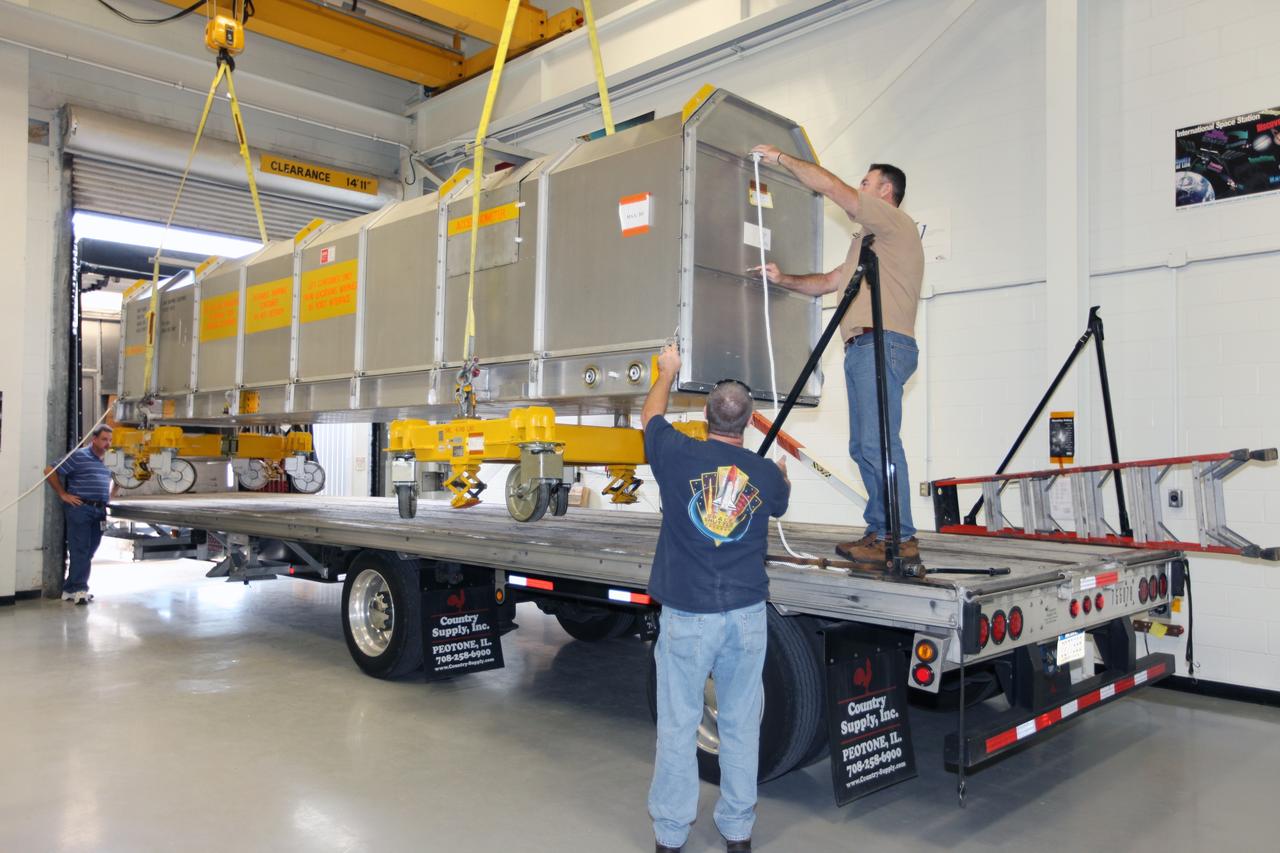
CAPE CANAVERAL, Fla. - Inside the Vehicle Assembly Building at NASA’s Kennedy Space Center in Florida, United Space Alliance workers help guide the container holding the remote manipulator system, or RMS, onto a flatbed truck for shipment back to the Canadian Space Agency. The RMS, also called the Canadarm, was manufactured for NASA’s Space Shuttle Program by SPAR Aerospace Ltd., which later became a part of MD Robotics in Ontario, Canada. During shuttle missions, the RMS was attached in the payload bay. Mission specialists operated the arm to remove payloads from the payload bay and hand them off to the larger Canadarm 2 on the International Space Station. The shuttle arm also was used during astronaut spacewalks. Photo credit: NASA/Kim Shiflett
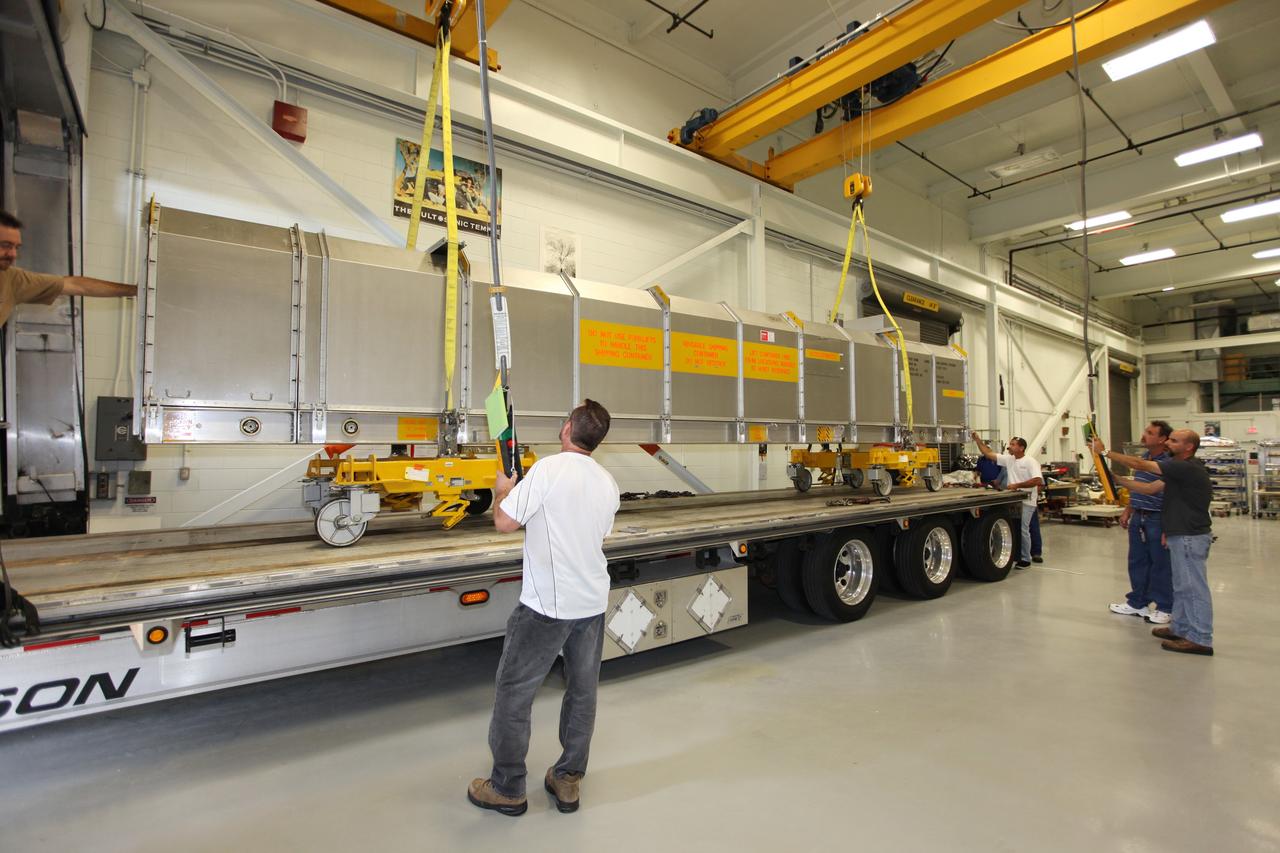
CAPE CANAVERAL, Fla. - Inside the Vehicle Assembly Building at NASA’s Kennedy Space Center in Florida, United Space Alliance workers monitor the progress as the container holding the remote manipulator system, or RMS, is lowered onto a flatbed truck for shipment back to the Canadian Space Agency. The RMS, also called the Canadarm, was manufactured for NASA’s Space Shuttle Program by SPAR Aerospace Ltd., which later became a part of MD Robotics in Ontario, Canada. During shuttle missions, the RMS was attached in the payload bay. Mission specialists operated the arm to remove payloads from the payload bay and hand them off to the larger Canadarm 2 on the International Space Station. The shuttle arm also was used during astronaut spacewalks. Photo credit: NASA/Kim Shiflett
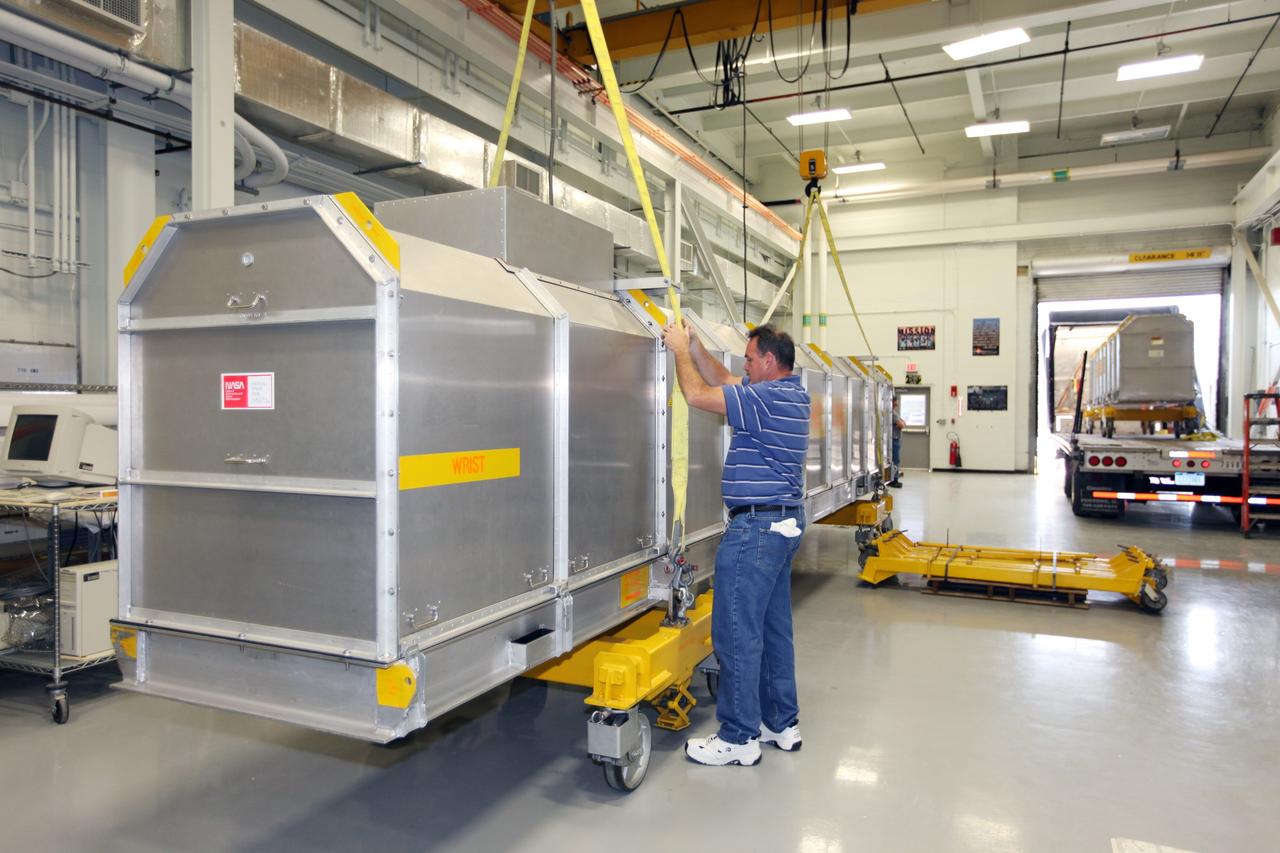
CAPE CANAVERAL, Fla. - Inside the Vehicle Assembly Building at NASA’s Kennedy Space Center in Florida, a United Space Alliance worker attaches lifting cranes to the container holding the remote manipulator system, or RMS. The RMS will be placed on a flatbed truck for shipment back to the Canadian Space Agency. The RMS, also called the Canadarm, was manufactured for NASA’s Space Shuttle Program by SPAR Aerospace Ltd., which later became a part of MD Robotics in Ontario, Canada. During shuttle missions, the RMS was attached in the payload bay. Mission specialists operated the arm to remove payloads from the payload bay and hand them off to the larger Canadarm 2 on the International Space Station. The shuttle arm also was used during astronaut spacewalks. Photo credit: NASA/Kim Shiflett
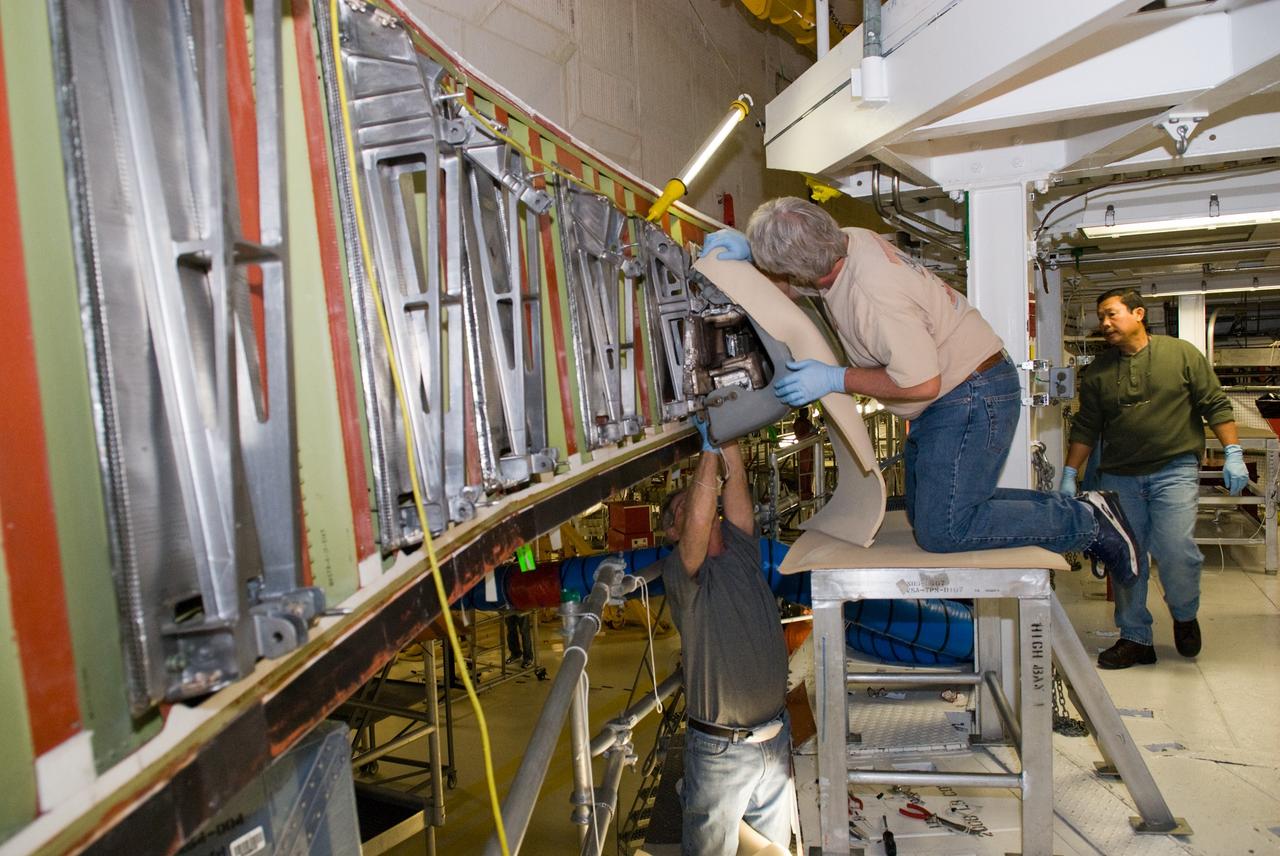
CAPE CANAVERAL, Fla. - In Orbiter Processing Facility-1 at NASA's Kennedy Space Center in Florida, United Space Alliance technicians cover a reinforced carbon carbon panel, or RCC panel, removed from a wing leading edge of space shuttle Atlantis. Inspection and maintenance of the RCC panels and the wing leading edge are standard procedure between shuttle missions. The RCC panels, components of the shuttle's thermal protection system, are placed in protective coverings while the structural edge of the wing -- the orange and green area behind the panels -- undergoes spar corrosion inspection to verify the structural integrity of the wing. Atlantis is next slated to deliver an Integrated Cargo Carrier and Russian-built Mini Research Module to the International Space Station on the STS-132 mission. The second in a series of new pressurized components for Russia, the module will be permanently attached to the Zarya module. Three spacewalks are planned to store spare components outside the station, including six spare batteries, a boom assembly for the Ku-band antenna and spares for the Canadian Dextre robotic arm extension. A radiator, airlock and European robotic arm for the Russian Multi-purpose Laboratory Module also are payloads on the flight. Launch is targeted for May 14, 2010. Photo credit: NASA/Glenn Benson
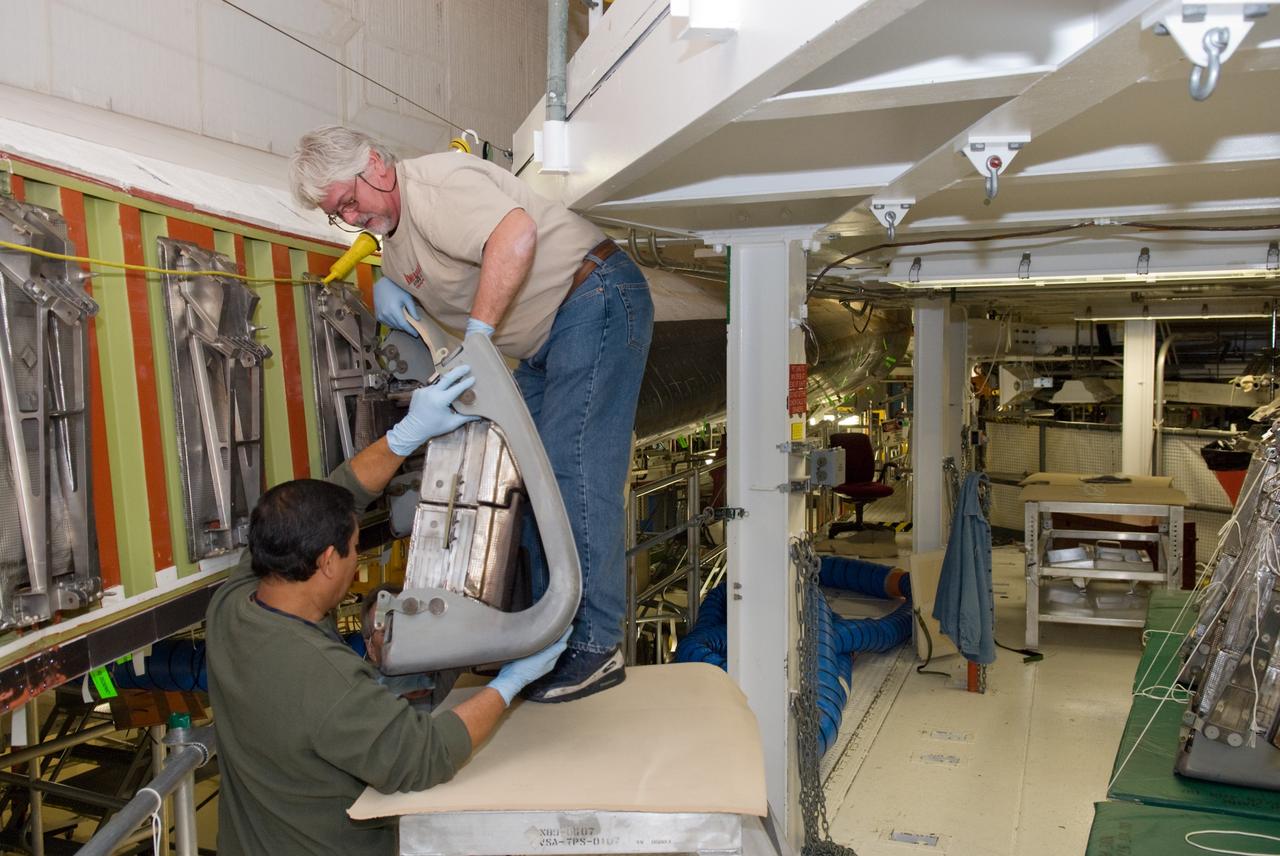
CAPE CANAVERAL, Fla. - In Orbiter Processing Facility-1 at NASA's Kennedy Space Center in Florida, United Space Alliance technicians remove a reinforced carbon carbon panel, or RCC panel, from a wing leading edge of space shuttle Atlantis. Inspection and maintenance of the RCC panels and the wing leading edge are standard procedure between shuttle missions. The RCC panels, components of the shuttle's thermal protection system, are placed in protective coverings while the structural edge of the wing -- the orange and green area behind the panels -- undergoes spar corrosion inspection to verify the structural integrity of the wing. Atlantis is next slated to deliver an Integrated Cargo Carrier and Russian-built Mini Research Module to the International Space Station on the STS-132 mission. The second in a series of new pressurized components for Russia, the module will be permanently attached to the Zarya module. Three spacewalks are planned to store spare components outside the station, including six spare batteries, a boom assembly for the Ku-band antenna and spares for the Canadian Dextre robotic arm extension. A radiator, airlock and European robotic arm for the Russian Multi-purpose Laboratory Module also are payloads on the flight. Launch is targeted for May 14, 2010. Photo credit: NASA/Glenn Benson
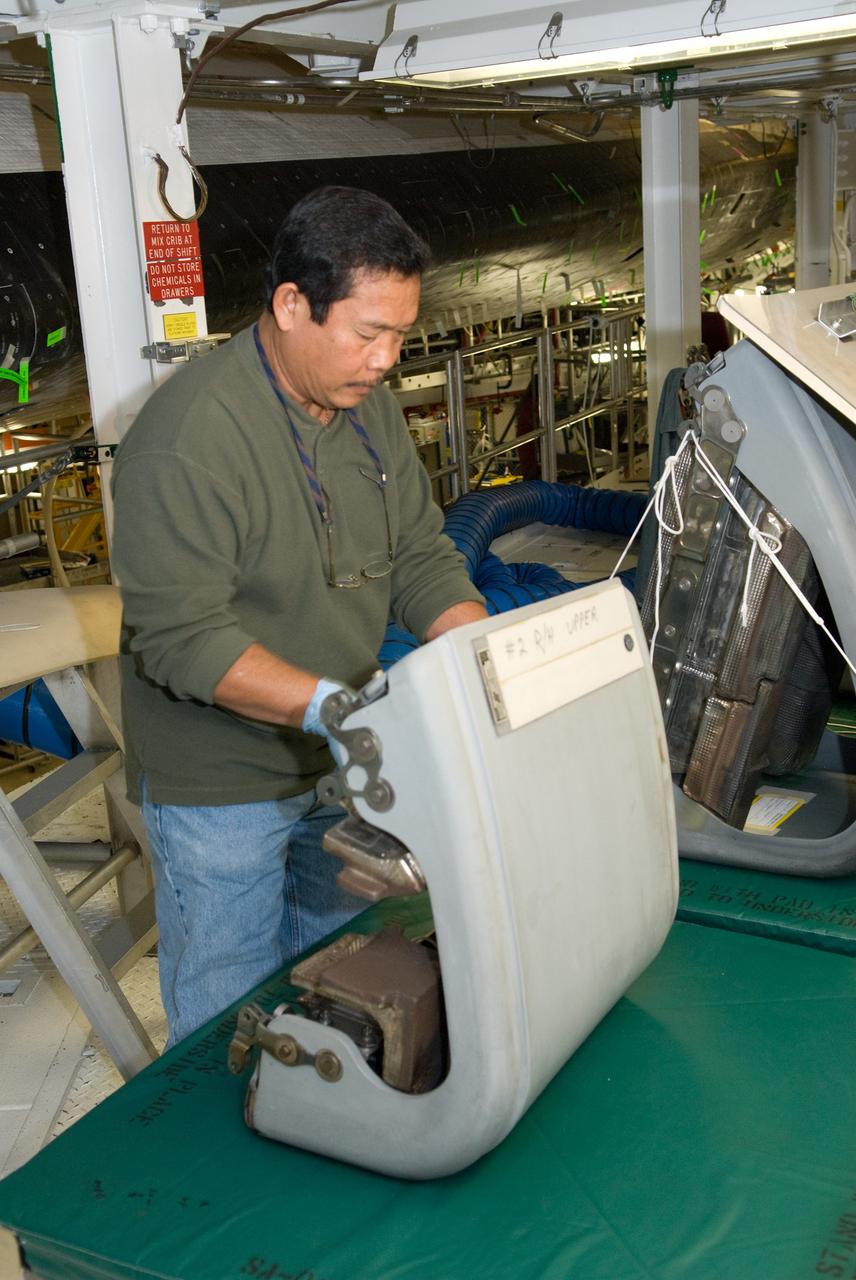
CAPE CANAVERAL, Fla. - In Orbiter Processing Facility-1 at NASA's Kennedy Space Center in Florida, a United Space Alliance technician inspects a reinforced carbon carbon panel, or RCC panel, removed from a wing leading edge of space shuttle Atlantis. Inspection and maintenance of the RCC panels and the wing leading edge are standard procedure between shuttle missions. The RCC panels, components of the shuttle's thermal protection system, are placed in protective coverings while the structural edge of the wing -- the orange and green area behind the panels -- undergoes spar corrosion inspection to verify the structural integrity of the wing. Atlantis is next slated to deliver an Integrated Cargo Carrier and Russian-built Mini Research Module to the International Space Station on the STS-132 mission. The second in a series of new pressurized components for Russia, the module will be permanently attached to the Zarya module. Three spacewalks are planned to store spare components outside the station, including six spare batteries, a boom assembly for the Ku-band antenna and spares for the Canadian Dextre robotic arm extension. A radiator, airlock and European robotic arm for the Russian Multi-purpose Laboratory Module also are payloads on the flight. Launch is targeted for May 14, 2010. Photo credit: NASA/Glenn Benson
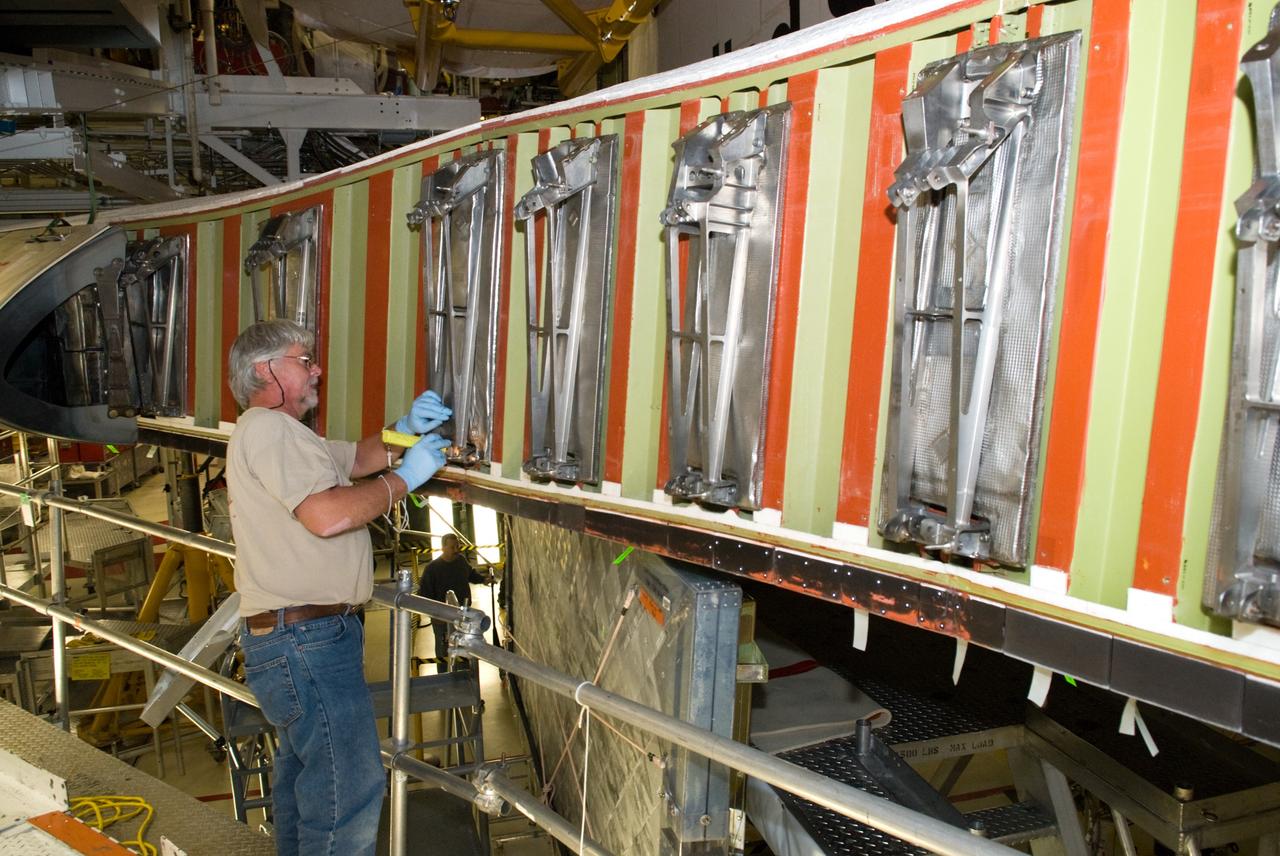
CAPE CANAVERAL, Fla. - In Orbiter Processing Facility-1 at NASA's Kennedy Space Center in Florida, a United Space Alliance technician inspects a wing leading edge of space shuttle Atlantis following removal of the reinforced carbon carbon panels, or RCC panels. Inspection and maintenance of the RCC panels and the wing leading edge are standard procedure between shuttle missions. The RCC panels, components of the shuttle's thermal protection system, are placed in protective coverings while the structural edge of the wing -- the orange and green area behind the panels -- undergoes spar corrosion inspection to verify the structural integrity of the wing. Atlantis is next slated to deliver an Integrated Cargo Carrier and Russian-built Mini Research Module to the International Space Station on the STS-132 mission. The second in a series of new pressurized components for Russia, the module will be permanently attached to the Zarya module. Three spacewalks are planned to store spare components outside the station, including six spare batteries, a boom assembly for the Ku-band antenna and spares for the Canadian Dextre robotic arm extension. A radiator, airlock and European robotic arm for the Russian Multi-purpose Laboratory Module also are payloads on the flight. Launch is targeted for May 14, 2010. Photo credit: NASA/Glenn Benson
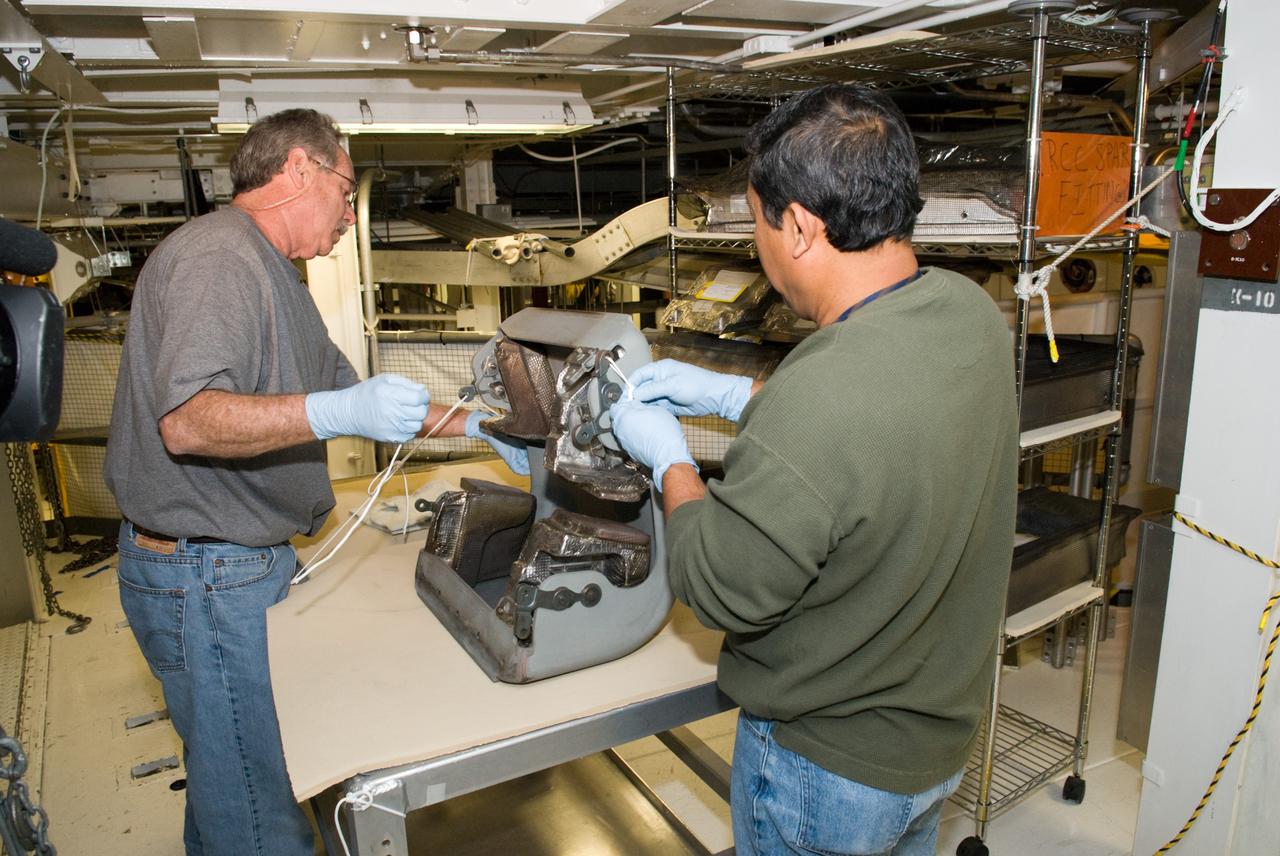
CAPE CANAVERAL, Fla. - In Orbiter Processing Facility-1 at NASA's Kennedy Space Center in Florida, United Space Alliance technicians prepare to cover a reinforced carbon carbon panel, or RCC panel, removed from a wing leading edge of space shuttle Atlantis. Inspection and maintenance of the RCC panels and the wing leading edge are standard procedure between shuttle missions. The RCC panels, components of the shuttle's thermal protection system, are placed in protective coverings while the structural edge of the wing -- the orange and green area behind the panels -- undergoes spar corrosion inspection to verify the structural integrity of the wing. Atlantis is next slated to deliver an Integrated Cargo Carrier and Russian-built Mini Research Module to the International Space Station on the STS-132 mission. The second in a series of new pressurized components for Russia, the module will be permanently attached to the Zarya module. Three spacewalks are planned to store spare components outside the station, including six spare batteries, a boom assembly for the Ku-band antenna and spares for the Canadian Dextre robotic arm extension. A radiator, airlock and European robotic arm for the Russian Multi-purpose Laboratory Module also are payloads on the flight. Launch is targeted for May 14, 2010. Photo credit: NASA/Glenn Benson