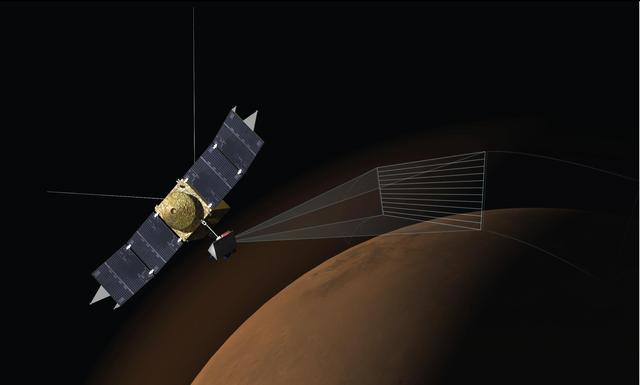
This artist concept depicts the Imaging Ultraviolet Spectrograph IUVS on NASA MAVEN spacecraft scanning the upper atmosphere of Mars. IUVS uses limb scans to map the chemical makeup and vertical structure across Mars upper atmosphere.
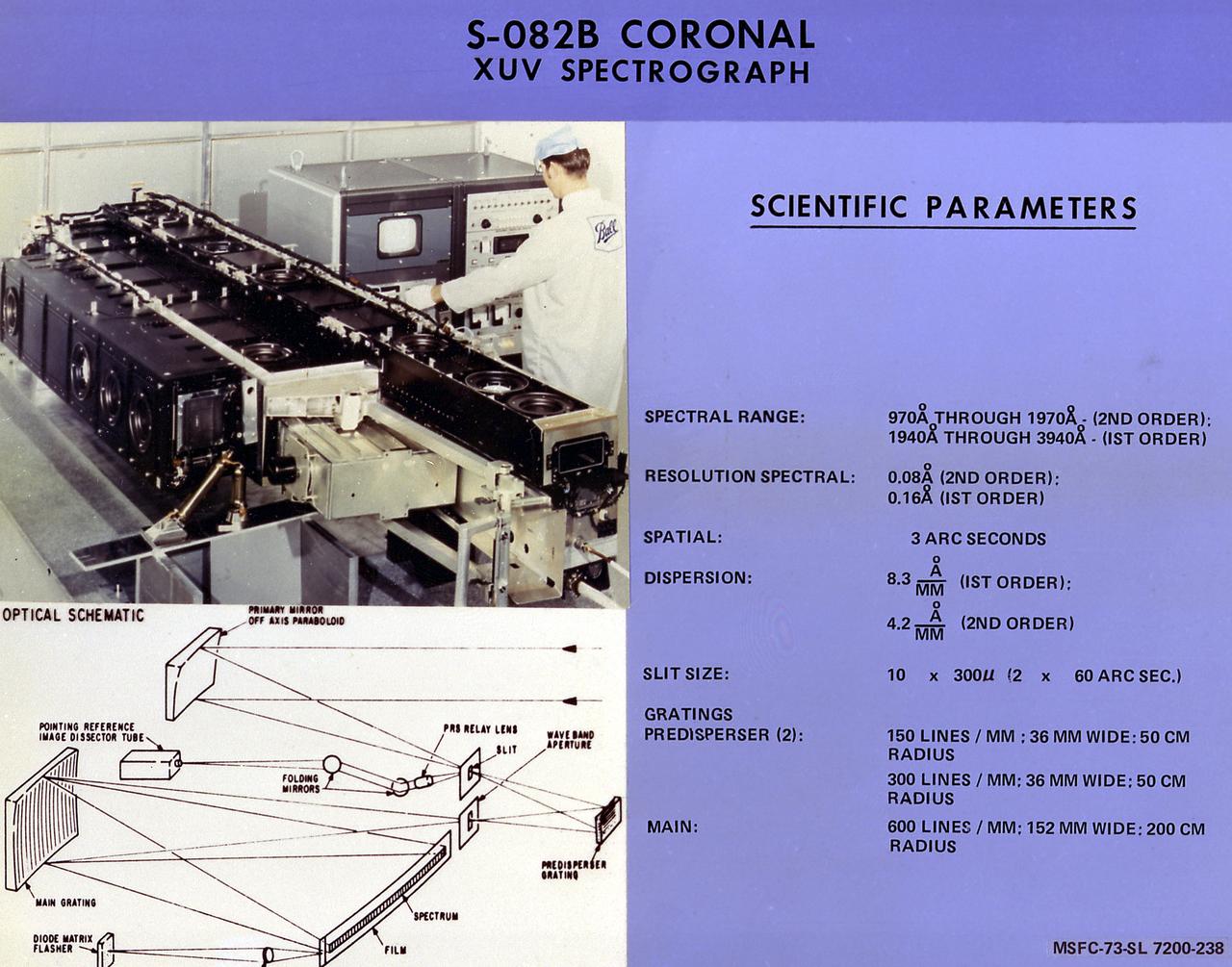
This 1973 chart details Skylab's Ultraviolet (UV) Spectrograph, an Apollo Telescope Mount instrument. Its telescope, with camera and TV capability, photographed the Sun in selected ultraviolet wavelengths. The spectrograph was used to record the spectrum of UV emissions, such as flares or filaments, from a small individual feature on the solar disc. Real-time TV was used by the crew to monitor performance of the telescope, transmit to the ground and record. The exposed films were retrieved by astronaut extravehicular activities. The Marshall Space Flight Center had program management responsibility for the development of the Skylab hardware and experiments.
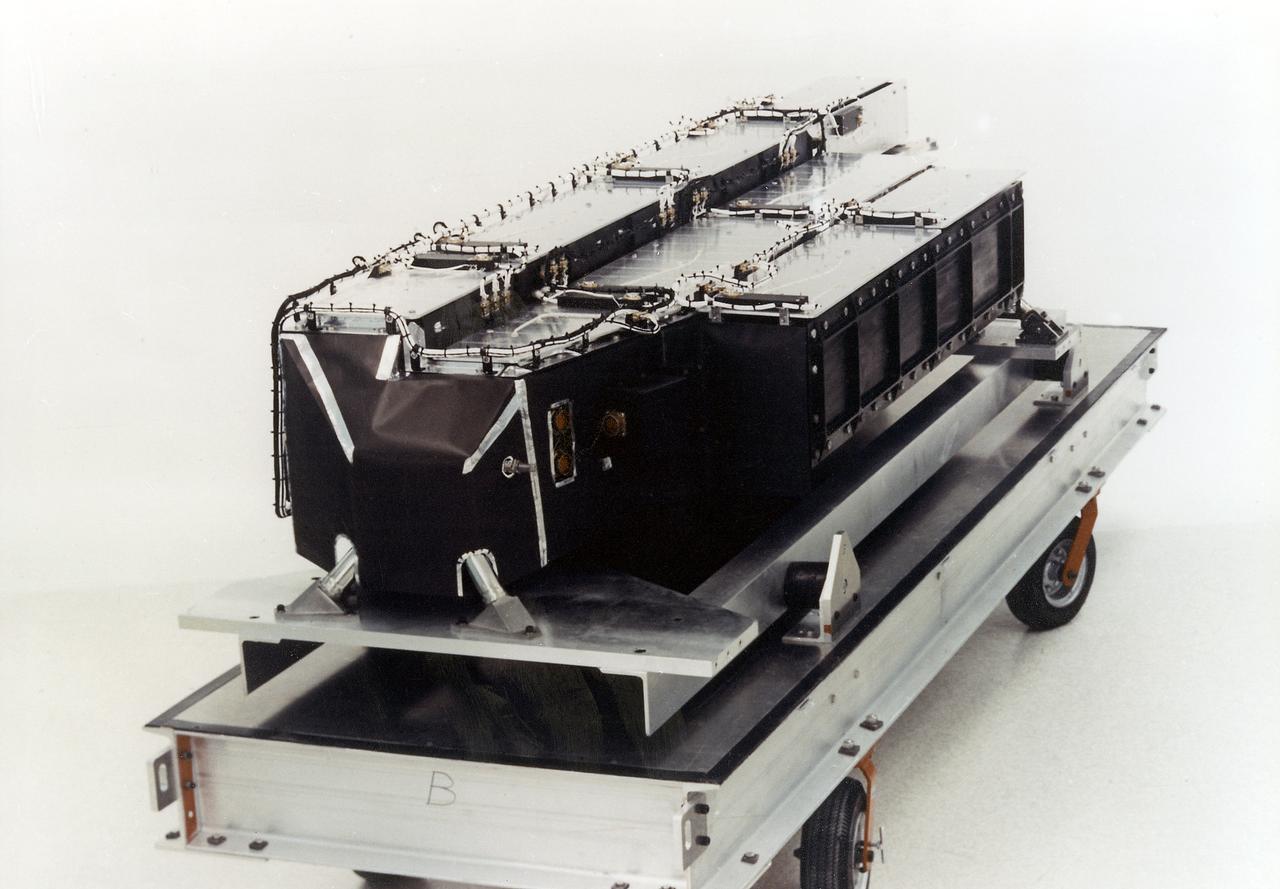
This 1970 photograph shows the Skylab's Ultraviolet (UV) Spectrograph, an Apollo Telescope Mount instrument. Its telescope, with camera and TV capability, photographed the Sun in selected ultraviolet wavelengths. The spectrograph was used to record the spectrum of UV emissions, such as flares or filaments, from a small individual feature on the solar disc. Real-time TV was used by the crew to monitor the performance of the telescope, transmit to the ground, and record. The exposed films were retrieved by astronaut extravehicular activities. The Marshall Space Flight Center had program management responsibility for the development of the Skylab hardware and experiments.
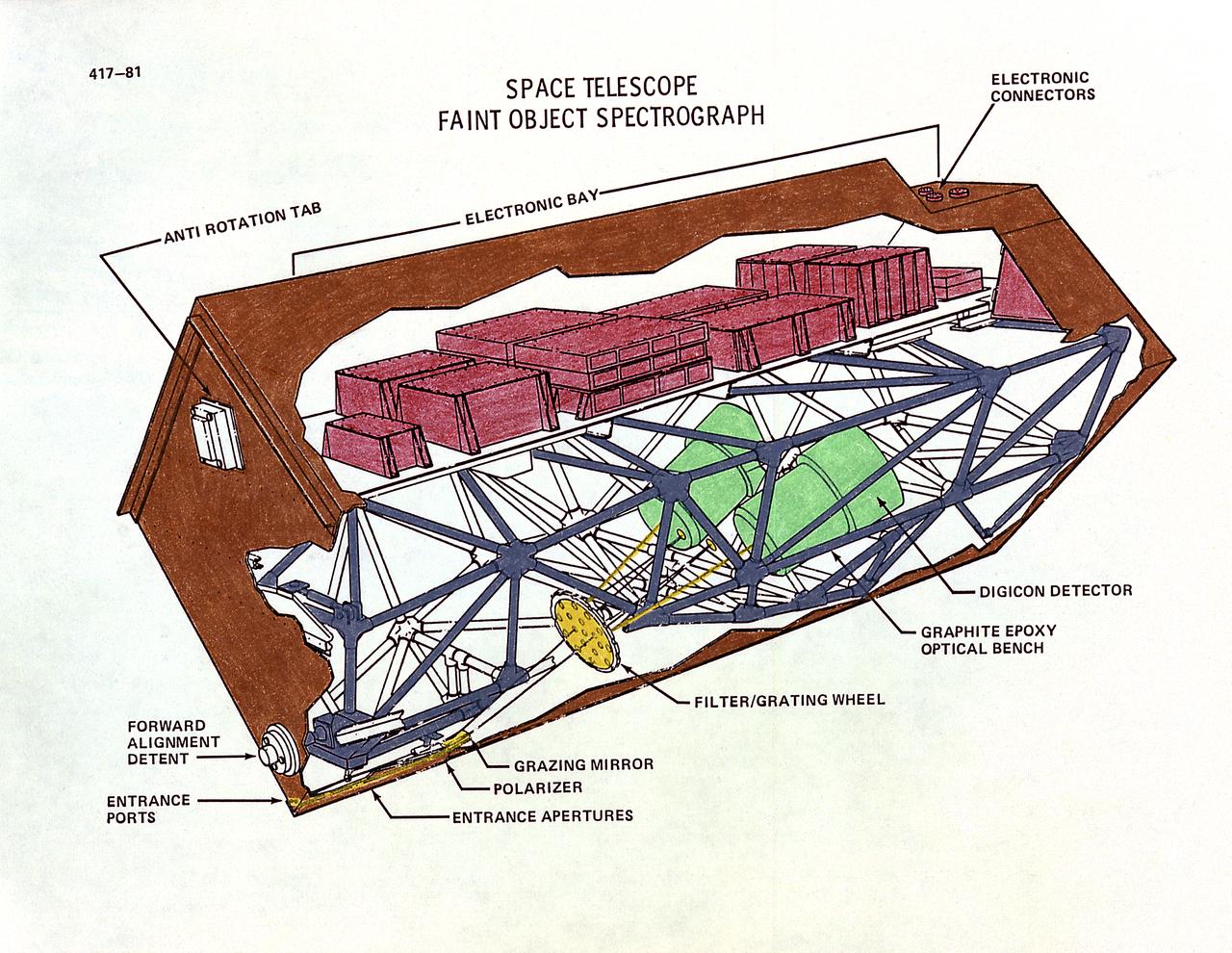
This drawing illustrates the Hubble Space Telescope's (HST's), Faint Object Spectrograph (FOS). The HST's two spectrographs, the Goddard High-Resolution Spectrograph and the FOS, can detect a broader range of wavelengths than is possible from the Earth because there is no atmosphere to absorb certain wavelengths. Scientists can determine the chemical composition, temperature, pressure, and turbulence of the stellar atmosphere producing the light, all from spectral data. The FOC can detect detail in very faint objects, such as those at great distances, and light ranging from ultraviolet to red spectral bands. Both spectrographs operate in essentially the same way. The incoming light passes through a small entrance aperture, then passes through filters and diffraction gratings, that work like prisms. The filter or grating used determines what range of wavelength will be examined and in what detail. Then the spectrograph detectors record the strength of each wavelength band and sends it back to Earth. The purpose of the HST, the most complex and sensitive optical telescope ever made, is to study the cosmos from a low-Earth orbit. By placing the telescope in space, astronomers are able to collect data that is free of the Earth's atmosphere. The HST views galaxies, stars, planets, comets, possibly other solar systems, and even unusual phenomena such as quasars, with 10 times the clarity of ground-based telescopes. The HST was deployed from the Space Shuttle Discovery (STS-31 mission) into Earth orbit in April 1990. The Marshall Space Flight Center had responsibility for design, development, and construction of the HST. The Perkin-Elmer Corporation, in Danbury, Cornecticut, developed the optical system and guidance sensors.
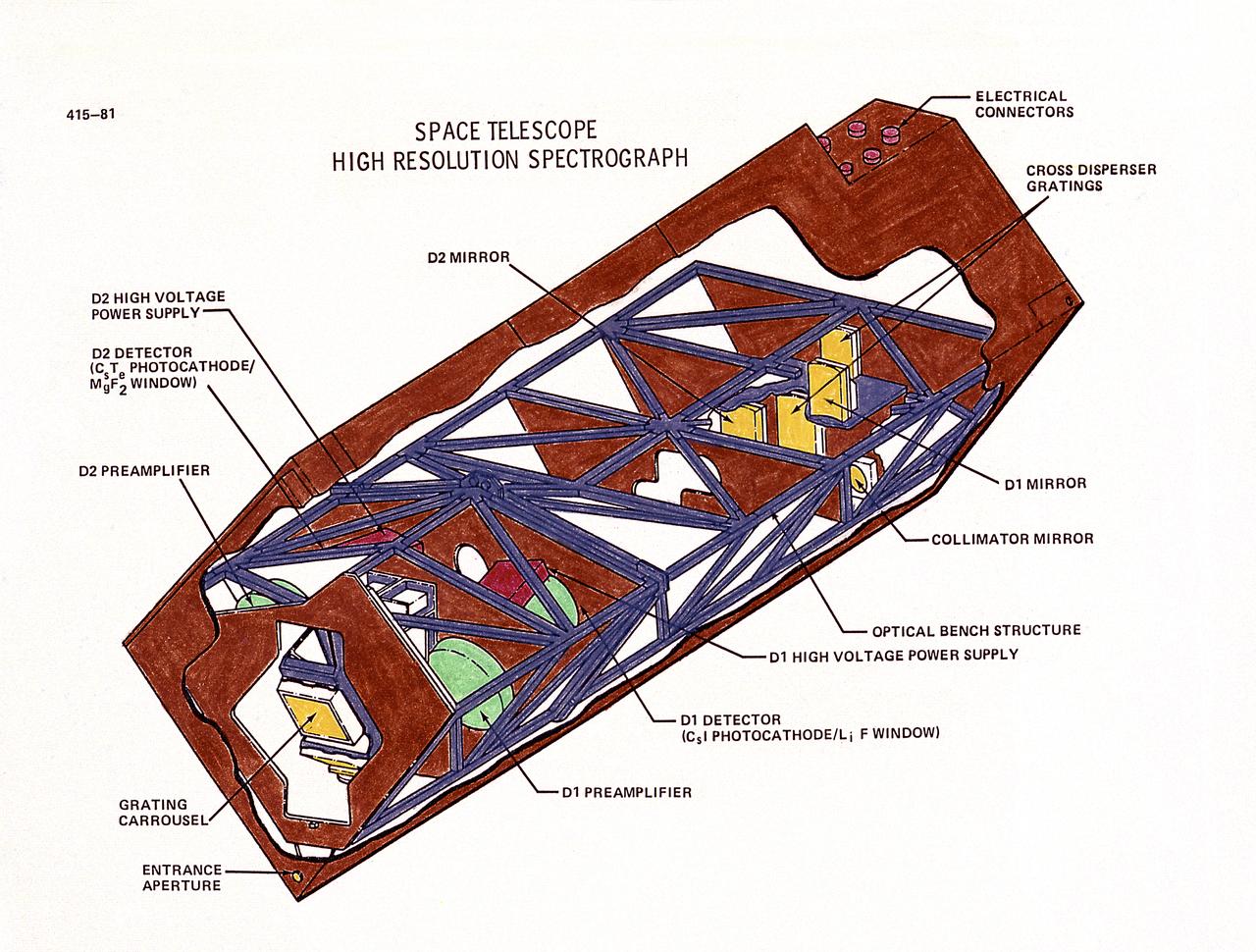
This drawing illustrates the Hubble Space Telescope's (HST's), Goddard High-Resolution Spectrograph (GHRS). The HST's two spectrographs, the GHRS and the Faint Object Spectrograph (FOS), can detect a broader range of wavelengths than is possible from Earth because there is no atmosphere to absorb certain wavelengths. Scientists can determine the chemical composition, temperature, pressure, and turbulence of the stellar atmosphere producing the light, all from spectral data. The GHRS can detect fine details in the light from somewhat brighter objects but only ultraviolet light. Both spectrographs operate in essentially the same way. The incoming light passes through a small entrance aperture, then passes through filters and diffraction gratings, that work like prisms. The filter or grating used determines what range of wavelength will be examined and in what detail. Then the spectrograph detectors record the strength of each wavelength band and sends it back to Earth. The purpose of the HST, the most complex and sensitive optical telescope ever made, is to study the cosmos from a low-Earth orbit. By placing the telescope in space, astronomers are able to collect data that is free of the Earth's atmosphere. The HST views galaxies, stars, planets, comets, possibly other solar systems, and even unusual phenomena such as quasars, with 10 times the clarity of ground-based telescopes. The HST was deployed from the Space Shuttle Discovery (STS-31 mission) into Earth orbit in April 1990. The Marshall Space Flight Center had responsibility for design, development, and construction of the HST. The Perkin-Elmer Corporation, in Danbury, Cornecticut, developed the optical system and guidance sensors.

This chart details Skylab's X-Ray Spectrographic Telescope, an Apollo Telescope Mount facility. It was designed to sequentially photograph solar flares and other active regions in the x-ray spectrum. The Marshall Flight Center had program management responsibility for the development of Skylab hardware and experiments.
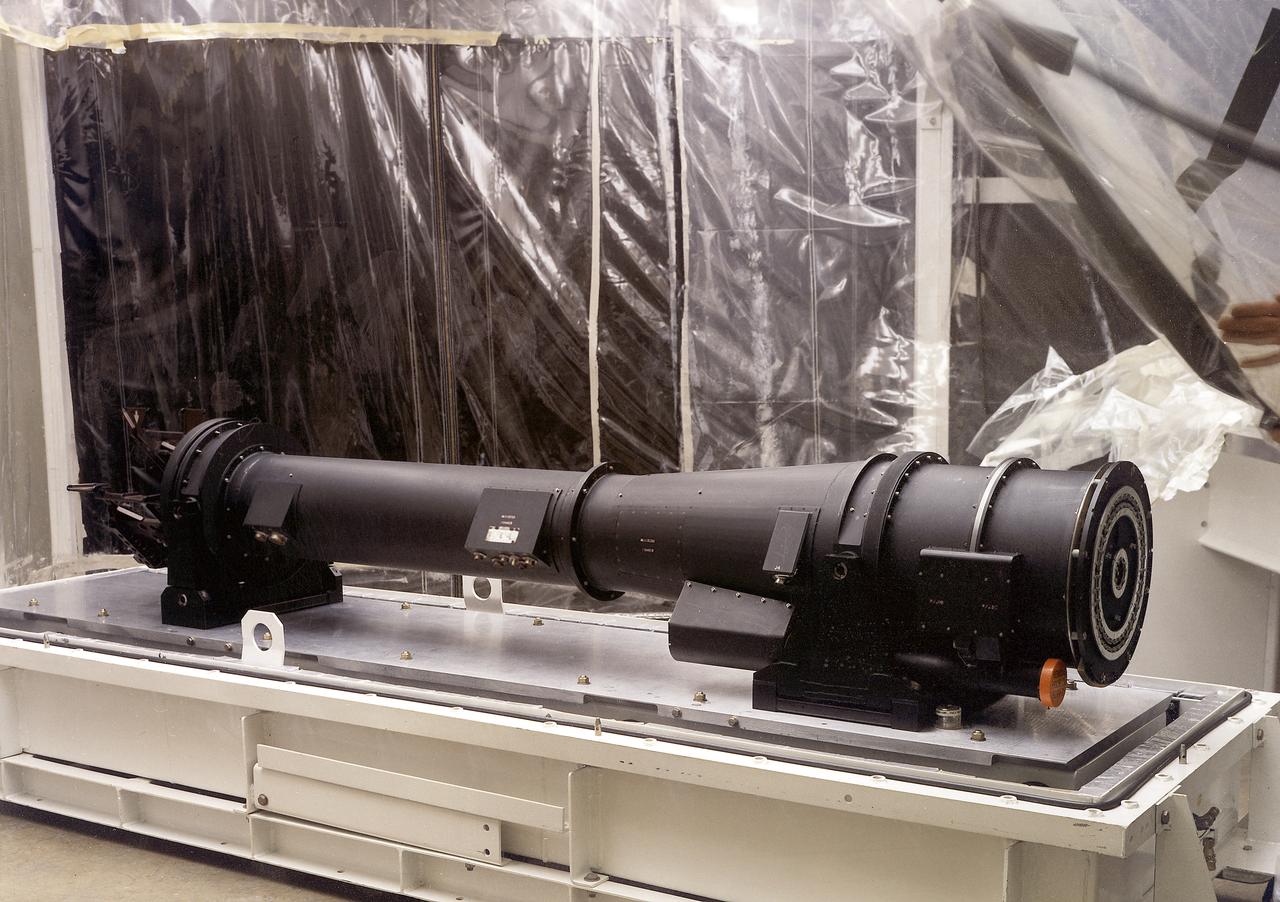
This photograph details Skylab's X-Ray Spectrographic Telescope, an Apollo Telescope Mount facility. It was designed to sequentially photograph solar flares and other active regions in x-ray spectrum. The Marshall Space Flight Center had program management responsibility for the development of Skylab hardware and experiments.

Armstrong videographer Mike Agnew operates spectrograph instrument on the 20th to prepare for eclipse day, the 21st. Photo Credit: (NASA/Carla Thomas)
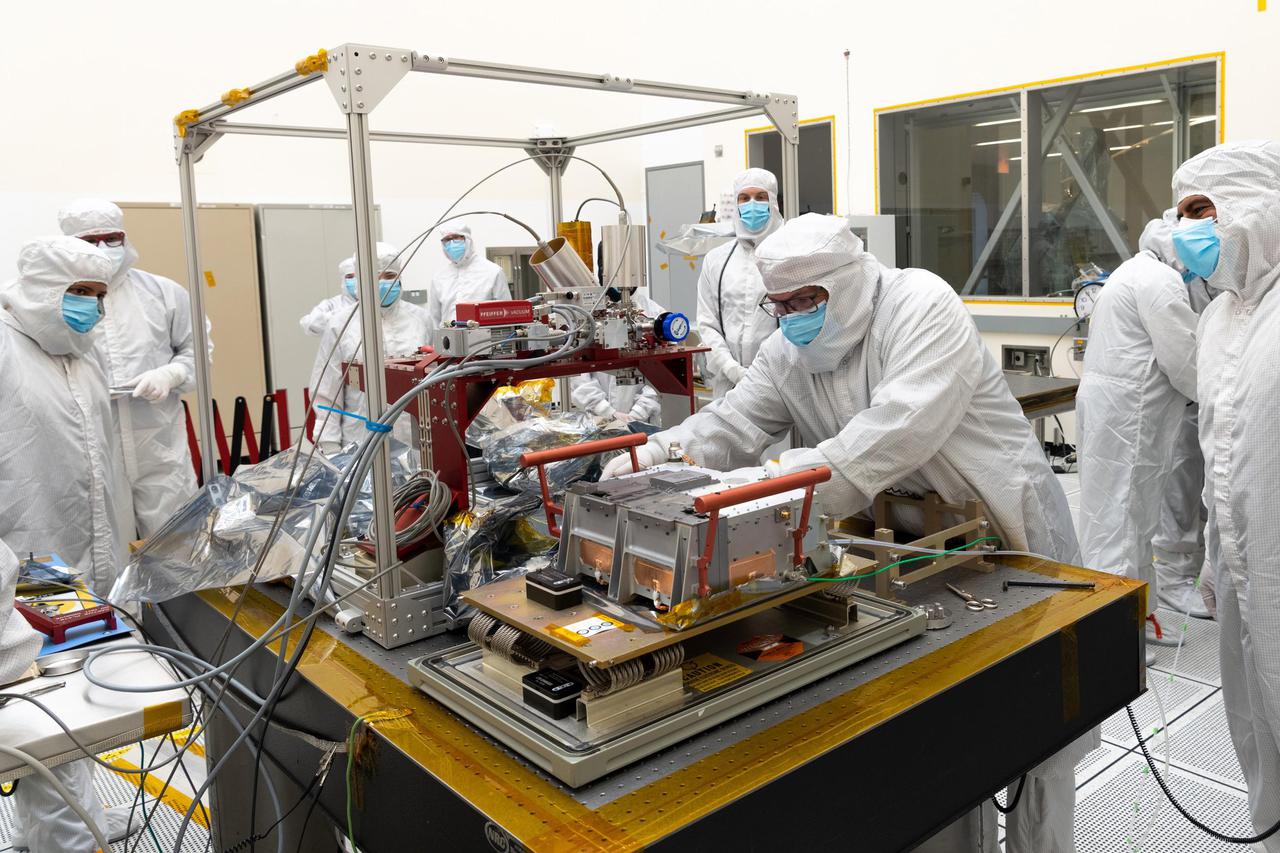
Engineers and technicians examine and test the first of NASA's Europa Clipper's science instruments to be delivered to the agency's Jet Propulsion Laboratory in Southern California. The ultraviolet spectrograph, called Europa-UVS and led by the Southwest Research Institute in San Antonio, Texas, will be integrated into the spacecraft during the phase of the mission called assembly, test, and launch operations. Europa-UVS is part of a payload of nine science instruments aboard Europa Clipper. In this photo, captured in February 2022, the instrument's custom testing equipment is seen at left, with a boxy, red frame. The instrument itself is seen at right. During testing, technicians shined ultraviolet light into the instrument's front aperture. With an internal global ocean under a thick layer of ice, Jupiter's moon Europa may have the potential to harbor existing life. Europa Clipper will swoop around Jupiter in an elliptical orbit, dipping close to the moon on each flyby to collect data. Understanding Europa's habitability will help scientists better understand how life developed on Earth and the potential for finding life beyond our planet. Europa Clipper is set to launch in 2024. Europa-UVS will search above the surface of Europa for signs of potential plumes that may be venting subsurface water into space. The instrument collects ultraviolet light, then separates the wavelengths of that light to help determine the composition of the moon's surface and gases in the atmosphere. https://photojournal.jpl.nasa.gov/catalog/PIA24897
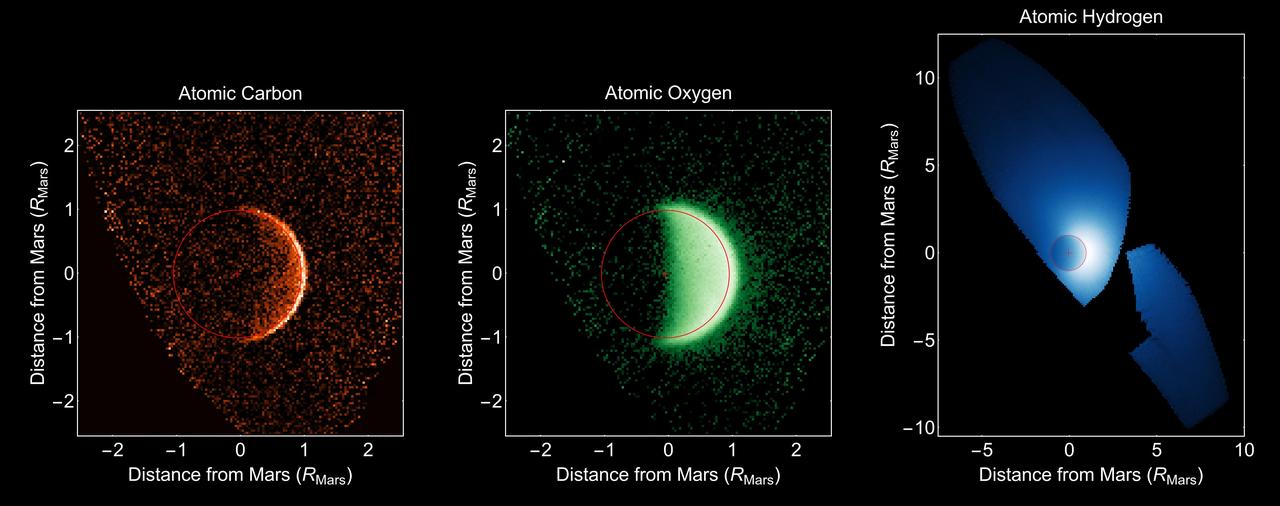
Three views of an escaping atmosphere around Mars, obtained by NASA MAVEN Imaging Ultraviolet Spectrograph, are shown here.

S69-40740 (July 1969) --- Dr. Ross Taylor (seated), Australian National University, and John Allen, Brown and Root-Northrop technician, review preliminary data from the optical emission spectrograph in the Spectrographic Laboratory of the Physical-Chemical Test Laboratory. Tests were being conducted on lunar surface material collected by astronauts Neil A. Armstrong and Edwin E. Aldrin Jr. during their lunar surface extravehicular activity on July 20, 1969.
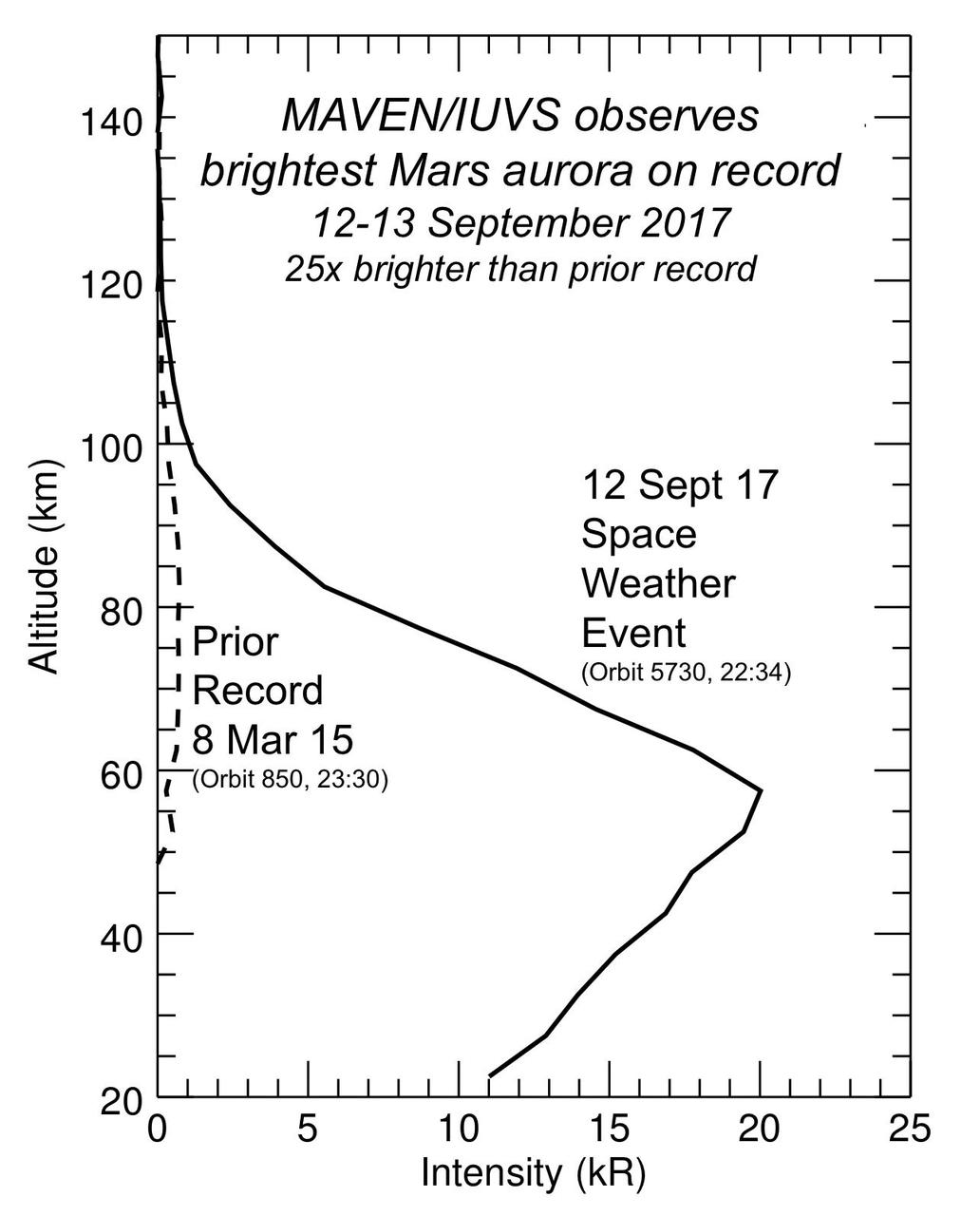
These profiles show the brightness of aurora emission in Mars' atmosphere at different altitudes. The data are from observations by the Imaging Ultraviolet Spectrograph instrument (IUVS) on NASA's Mars Atmosphere and Volatile Evolution orbiter, or MAVEN. The solid black profile on the right shows the aurora during a September 2017 solar storm. Barely visible along the vertical axis is a dashed profile representing the previous brightest aurora seen by MAVEN, which occurred in March 2015. The recent event is more than 25 times brighter than the previous brightest aurora seen by MAVEN, which has been orbiting Mars since September 2014. https://photojournal.jpl.nasa.gov/catalog/PIA21857
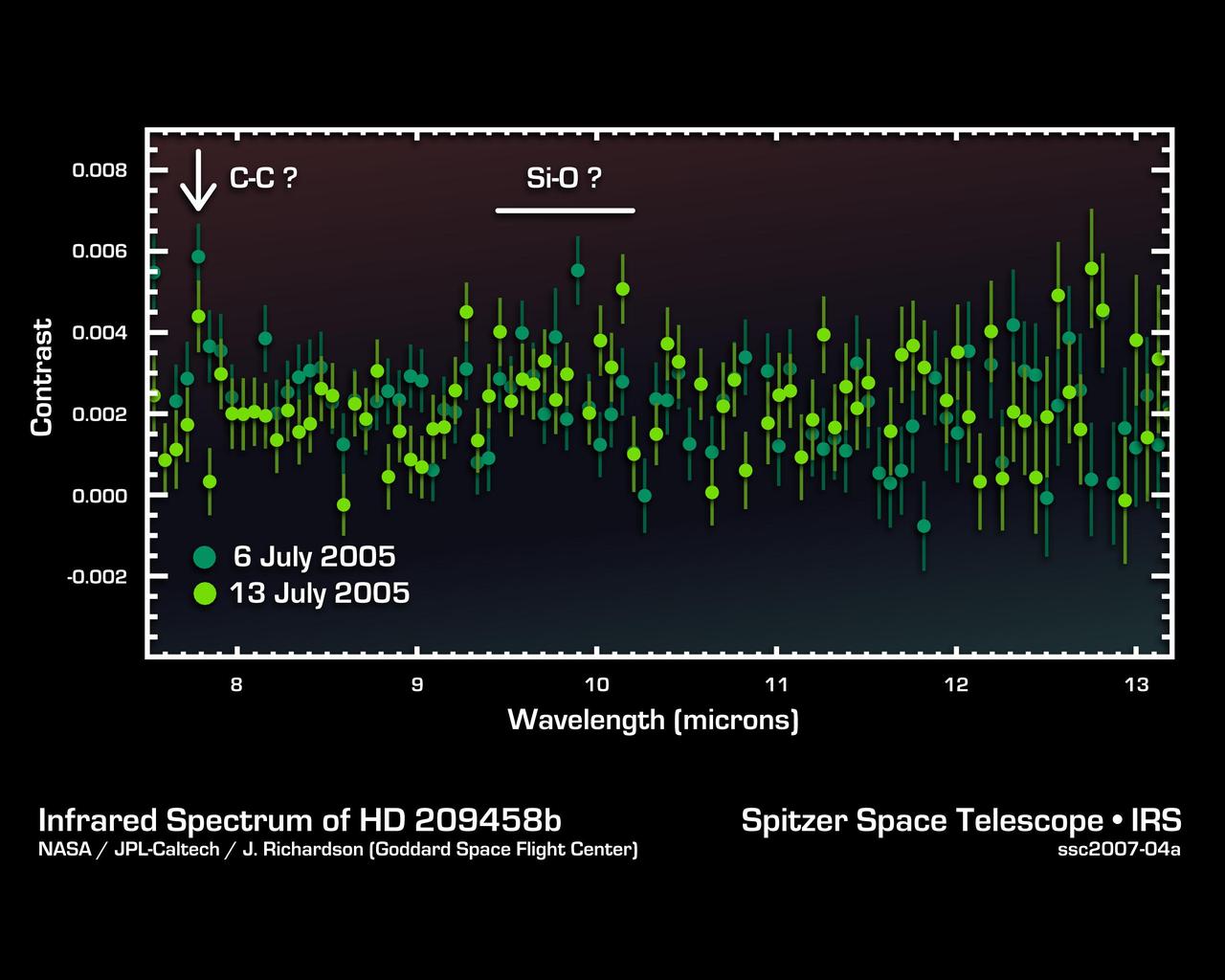
This infrared data from NASA's Spitzer Space Telescope -- called a spectrum -- tells astronomers that a distant gas planet, a so-called "hot Jupiter" called HD 209458b, might be smothered with high clouds. It is one of the first spectra of an alien world. A spectrum is created when an instrument called a spectrograph cracks light from an object open into a rainbow of different wavelengths. Patterns or ripples within the spectrum indicate the presence, or absence, of molecules making up the object. Astronomers using Spitzer's spectrograph were able to obtain infrared spectra for two so-called "transiting" hot-Jupiter planets using the "secondary eclipse" technique. In this method, the spectrograph first collects the combined infrared light from the planet plus its star, then, as the planet is eclipsed by the star, the infrared light of just the star. Subtracting the latter from the former reveals the planet's own rainbow of infrared colors. When astronomers first saw the infrared spectrum above, they were shocked. It doesn't look anything like what theorists had predicted. For example, theorists thought there'd be signatures of water in the wavelength ranges of 8 to 9 microns. The fact that water is not detected might indicate that it is hidden under a thick blanket of high, dry clouds. In addition, the spectrum shows signs of silicate dust -- tiny grains of sand -- in the wavelength range of 9 to 10 microns. This suggests that the planet's skies could be filled with high clouds of dust unlike anything seen in our own solar system. There is also an unidentified molecular signature at 7.78 microns. Future observations using Spitzer's spectrograph should be able to determine the nature of the mysterious feature. This spectrum was produced by Dr. Jeremy Richardson of NASA's Goddard Space Flight Center, Greenbelt, Md. and his colleagues. The data were taken by Spitzer's infrared spectrograph on July 6 and 13, 2005. http://photojournal.jpl.nasa.gov/catalog/PIA09197
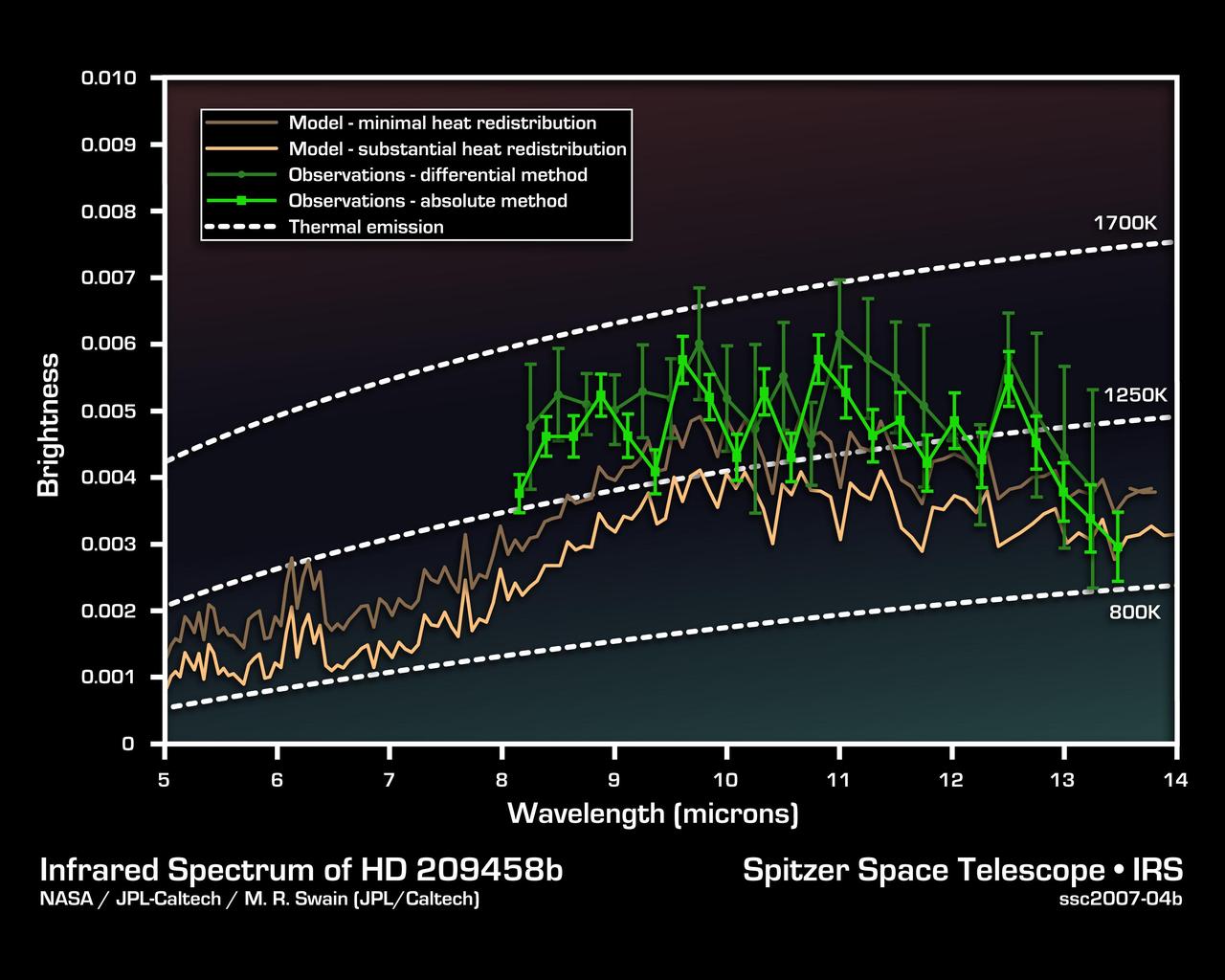
This infrared data from NASA's Spitzer Space Telescope -- called a spectrum -- tells astronomers that a distant gas planet, a so-called "hot Jupiter" called HD 209458b, might be smothered with high clouds. It is one of the first spectra of an alien world. A spectrum is created when an instrument called a spectrograph cracks light from an object open into a rainbow of different wavelengths. Patterns or ripples within the spectrum indicate the presence, or absence, of molecules making up the object. Astronomers using Spitzer's spectrograph were able to obtain infrared spectra for two so-called "transiting" hot-Jupiter planets using the "secondary eclipse" technique. In this method, the spectrograph first collects the combined infrared light from the planet plus its star, then, as the planet is eclipsed by the star, the infrared light of just the star. Subtracting the latter from the former reveals the planet's own rainbow of infrared colors. When astronomers first saw the infrared spectrum above, they were shocked. It doesn't look anything like what theorists had predicted. For example, theorists thought there'd be signatures of water in the wavelength ranges of 8 to 9 microns. The fact that water is not detected might indicate that it is hidden under a thick blanket of high, dry clouds. In addition, the spectrum shows signs of silicate dust -- tiny grains of sand -- in the wavelength range of 9 to 10 microns. This suggests that the planet's skies could be filled with high clouds of dust unlike anything seen in our own solar system. There is also an unidentified molecular signature at 7.78 microns. Future observations using Spitzer's spectrograph should be able to determine the nature of the mysterious feature. This spectrum was produced by Dr. Jeremy Richardson of NASA's Goddard Space Flight Center, Greenbelt, Md. and his colleagues. The data were taken by Spitzer's infrared spectrograph on July 6 and 13, 2005. http://photojournal.jpl.nasa.gov/catalog/PIA09198
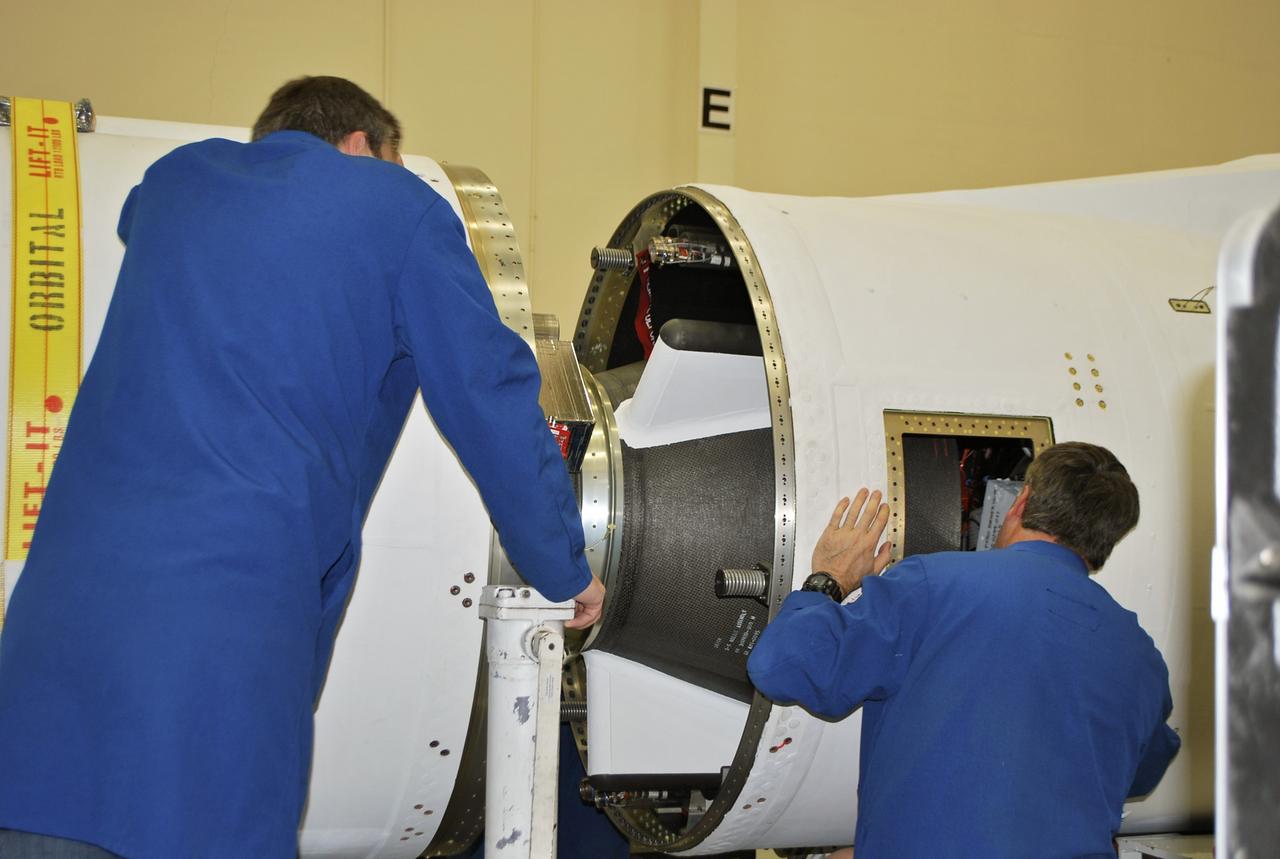
VANDENBERG AFB, Calif. – Technicians monitor the movement of the second stage of an Orbital Sciences Pegasus rocket into the first stage before a separation test is conducted. The Pegasus is being processed to launch NASA's Interface Region Imaging Spectrograph mission, known as IRIS. Photo credit: Randy Beaudoin, VAFB
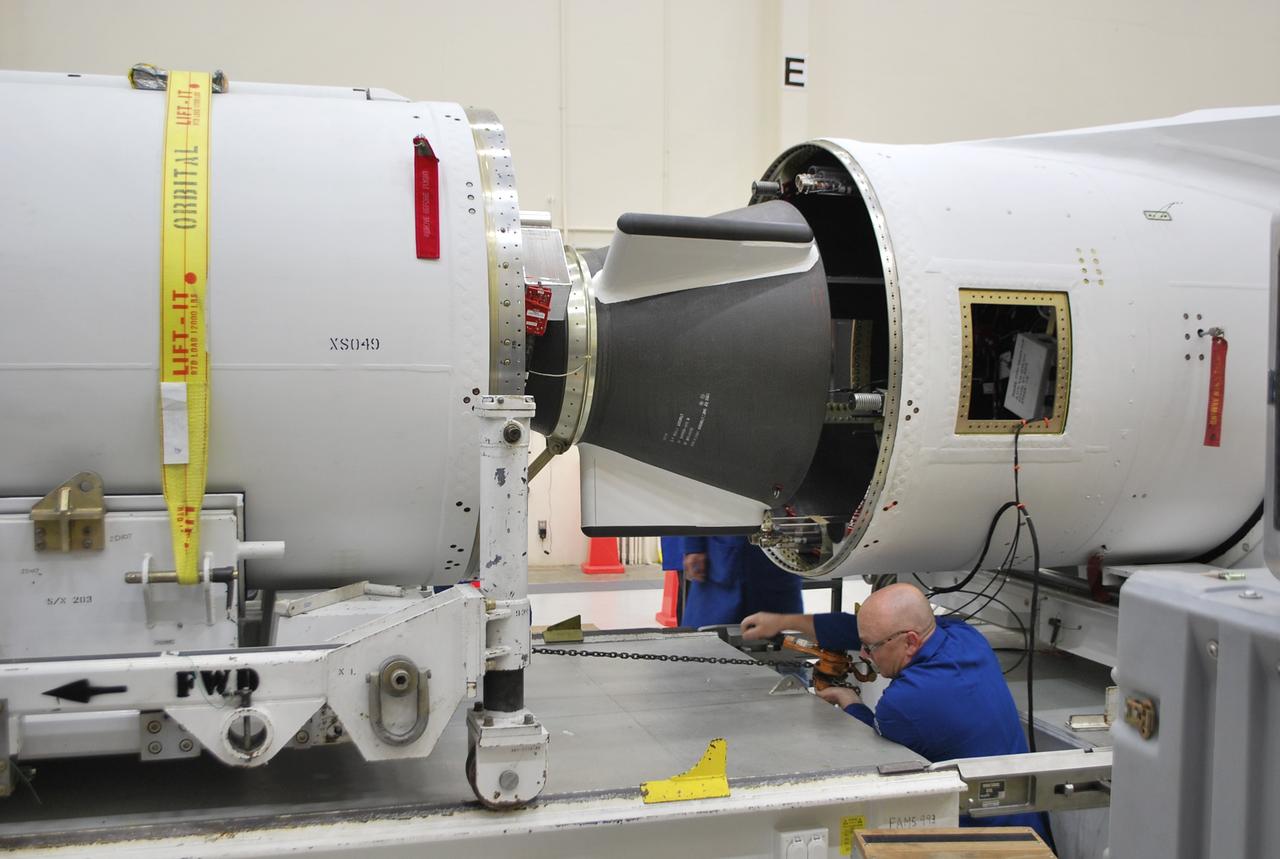
VANDENBERG AFB, Calif. – A technician moves the second stage of an Orbital Sciences Pegasus rocket into the first stage before a separation test is conducted. The Pegasus is being processed to launch NASA's Interface Region Imaging Spectrograph mission, known as IRIS. Photo credit: Randy Beaudoin, VAFB
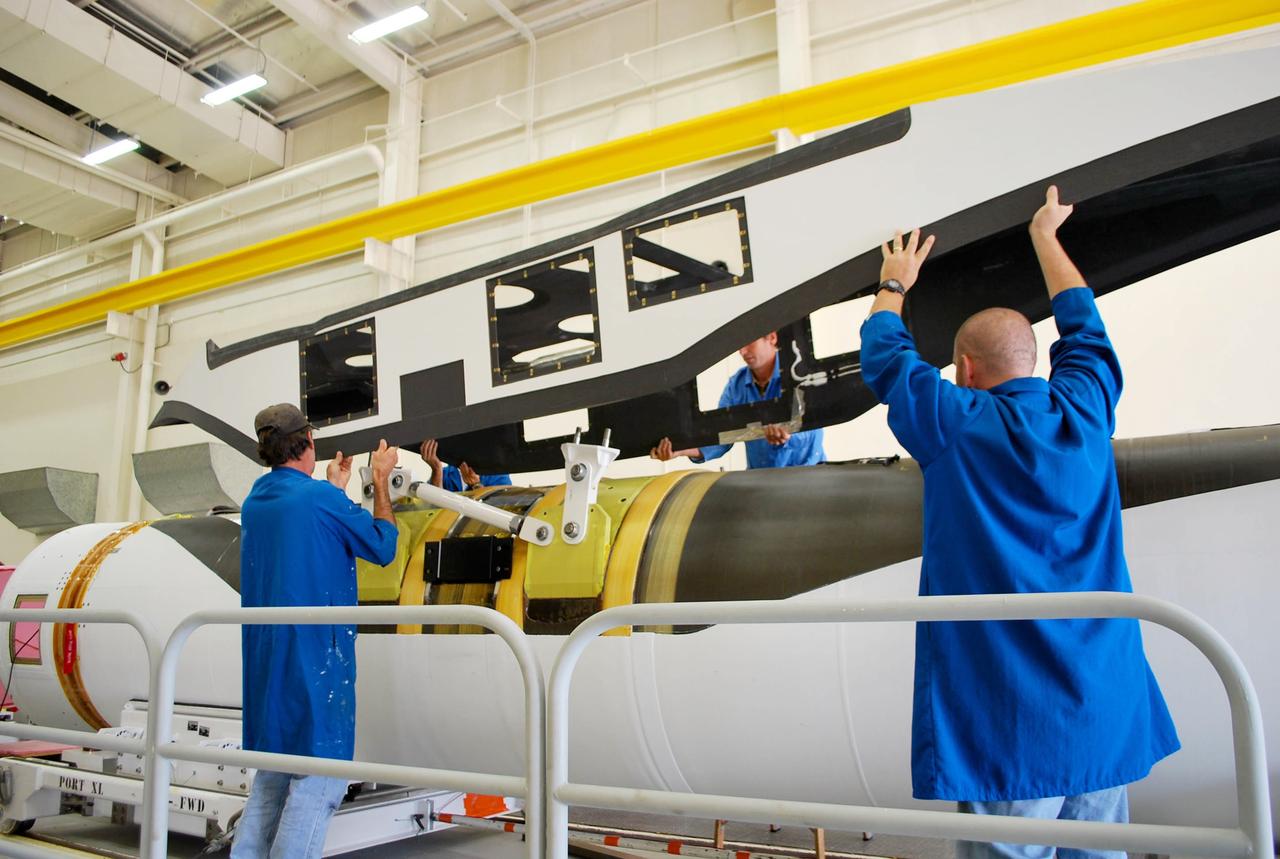
VANDENBERG AFB, Calif. – Technicians perform a fit check on an Orbital Sciences Pegasus rocket as the launcher is processed for the Interface Region Imaging Spectrograph mission known as IRIS. The technicians are attaching the portion of the Pegasus that joins the wing to the fuselage, a piece called a fillet. Photo credit: VAFB/Randy Beaudoin
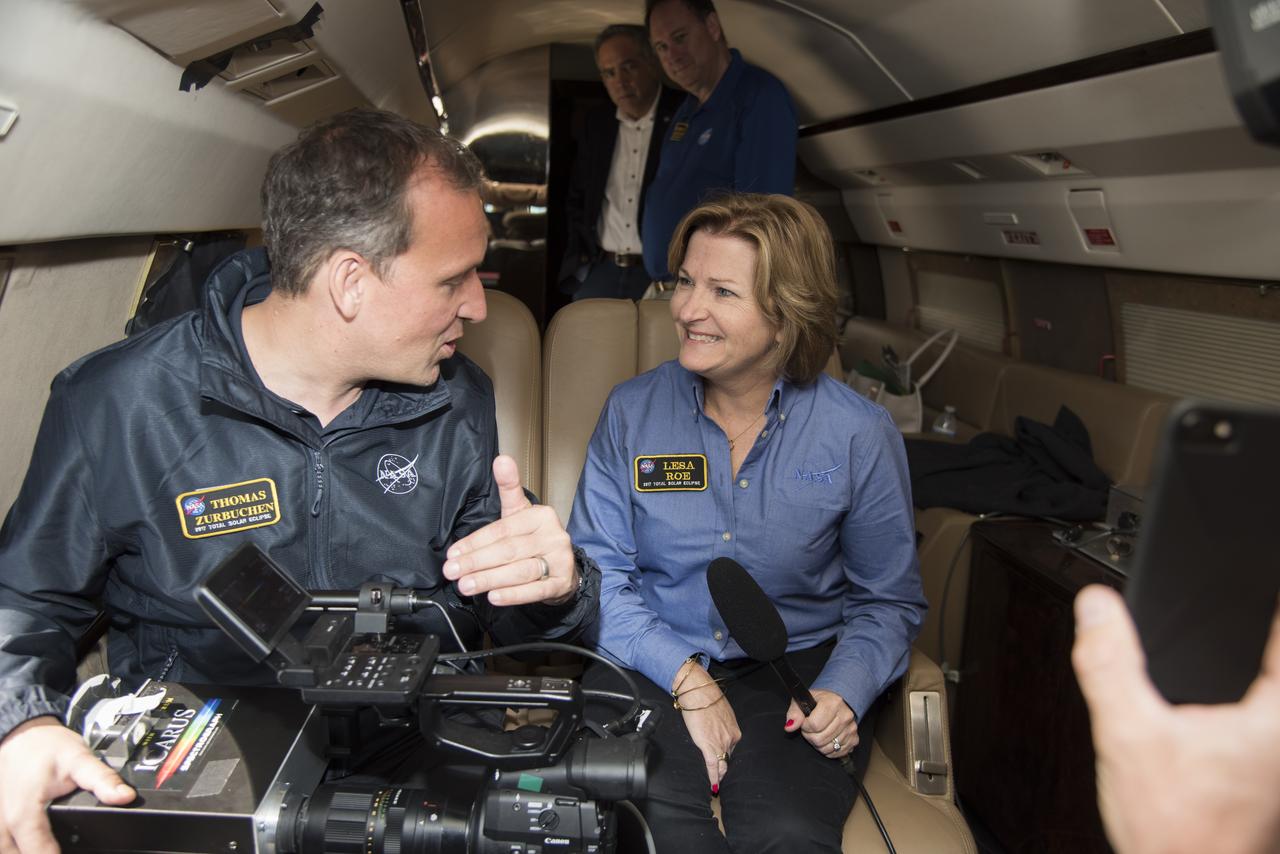
NASA's Thomas Zurbuchen, AA for science mission directorate explains to Lesa Roe, acting deputy administrator, how the spectrograph showing different colors correlate to different elements, such as helium, in the Sun's atmosphere. Photo Credit: (NASA/Carla Thomas)
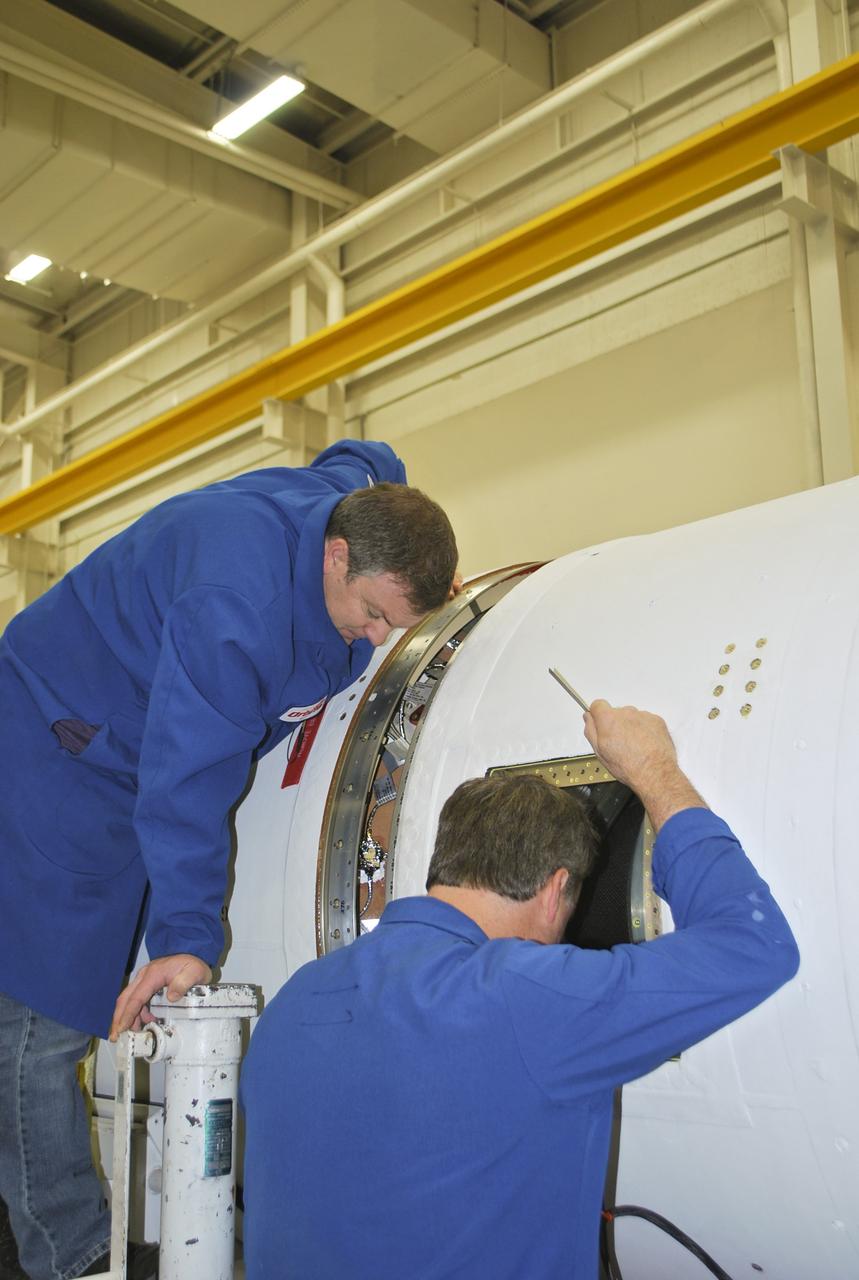
VANDENBERG AFB, Calif. – Technicians monitor the movement of the second stage of an Orbital Sciences Pegasus rocket into the first stage before a separation test is conducted. The Pegasus is being processed to launch NASA's Interface Region Imaging Spectrograph mission, known as IRIS. Photo credit: Randy Beaudoin, VAFB
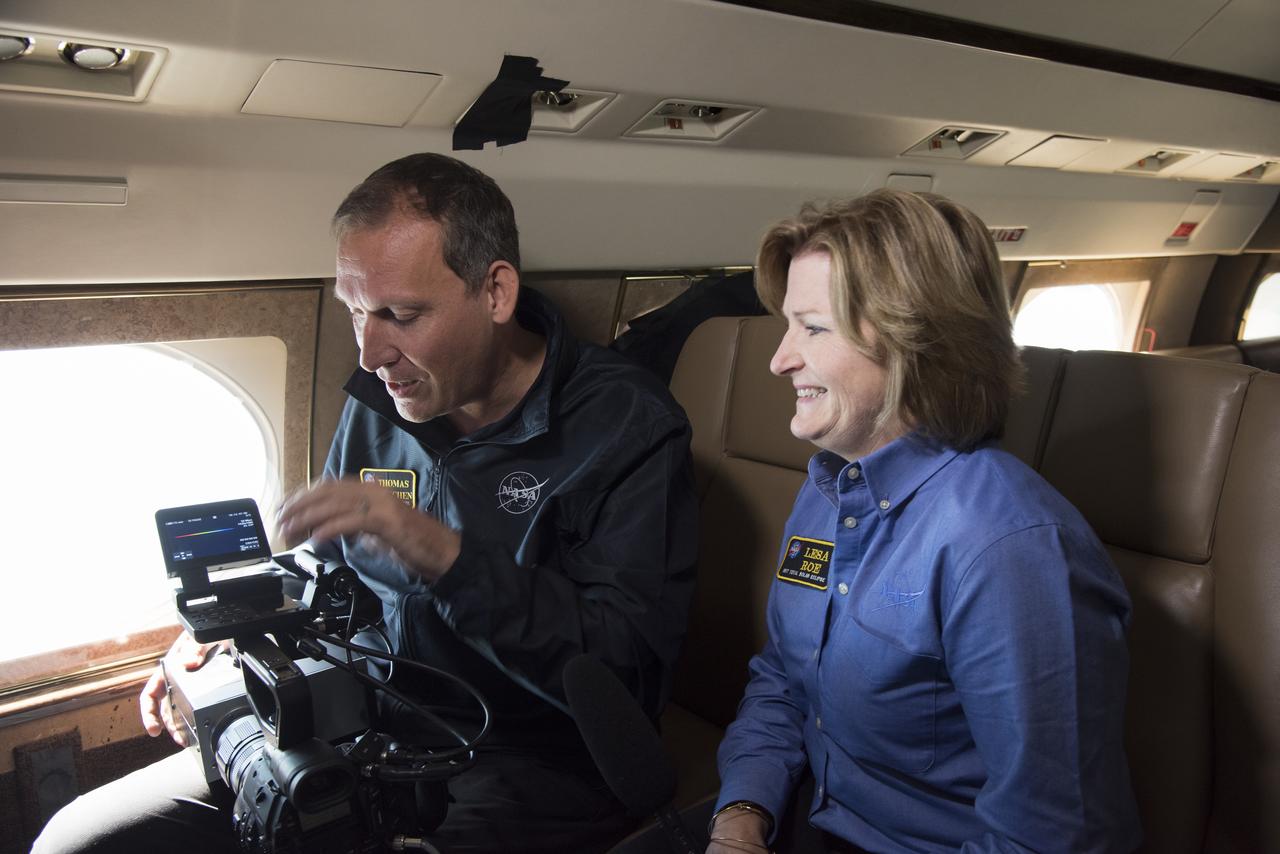
NASA's Thomas Zurbuchen, AA for science mission directorate explains to Lesa Roe, acting deputy administrator, how the spectrograph showing different colors correlate to different elements, such as helium, in the Sun's atmosphere. Photo Credit: (NASA/Carla Thomas)
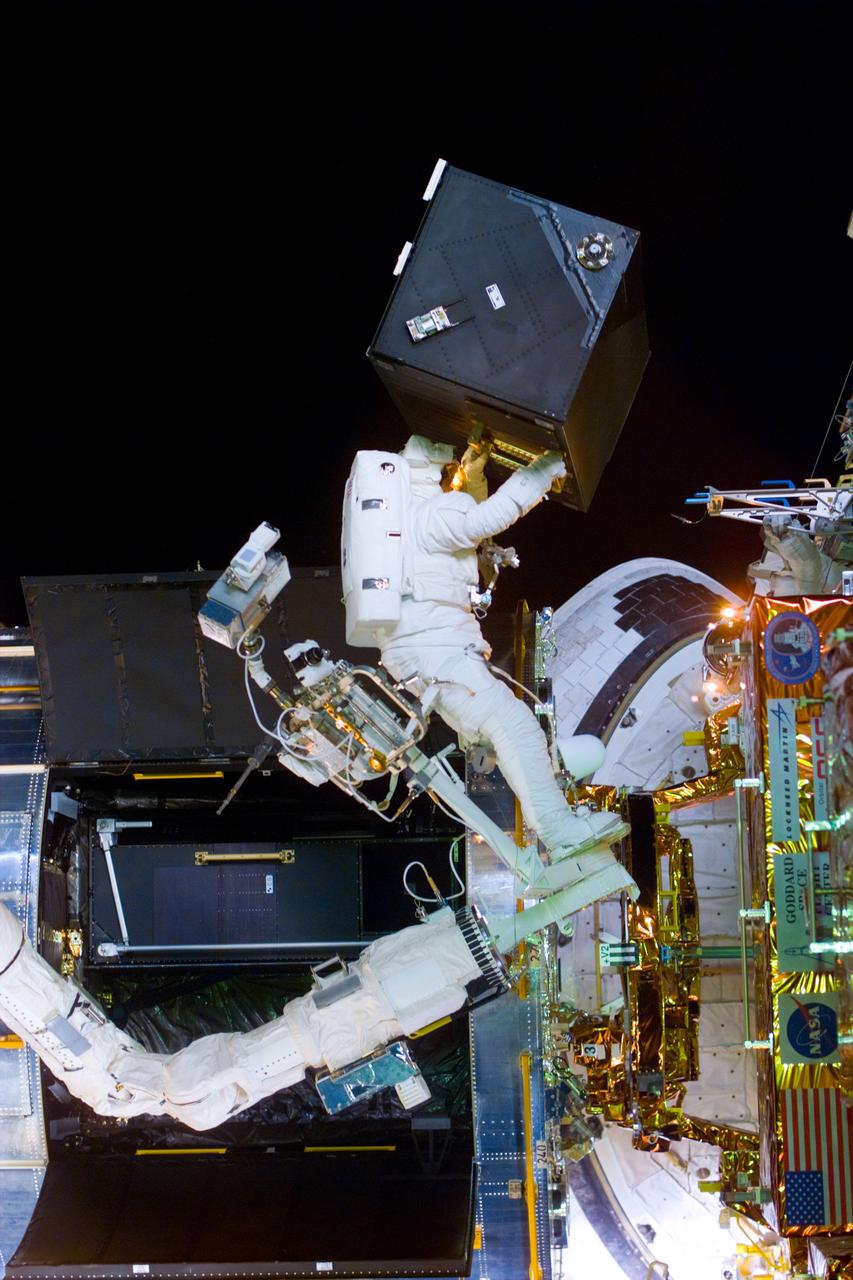
S82-E-5317 (14 Feb. 1997) --- Astronaut Steven L. Smith, STS-82 mission specialist, on arm with Faint Object Spectrograph (FOS) after removal from Hubble Space Telescope (HST). This view was taken with an Electronic Still Camera (ESC).
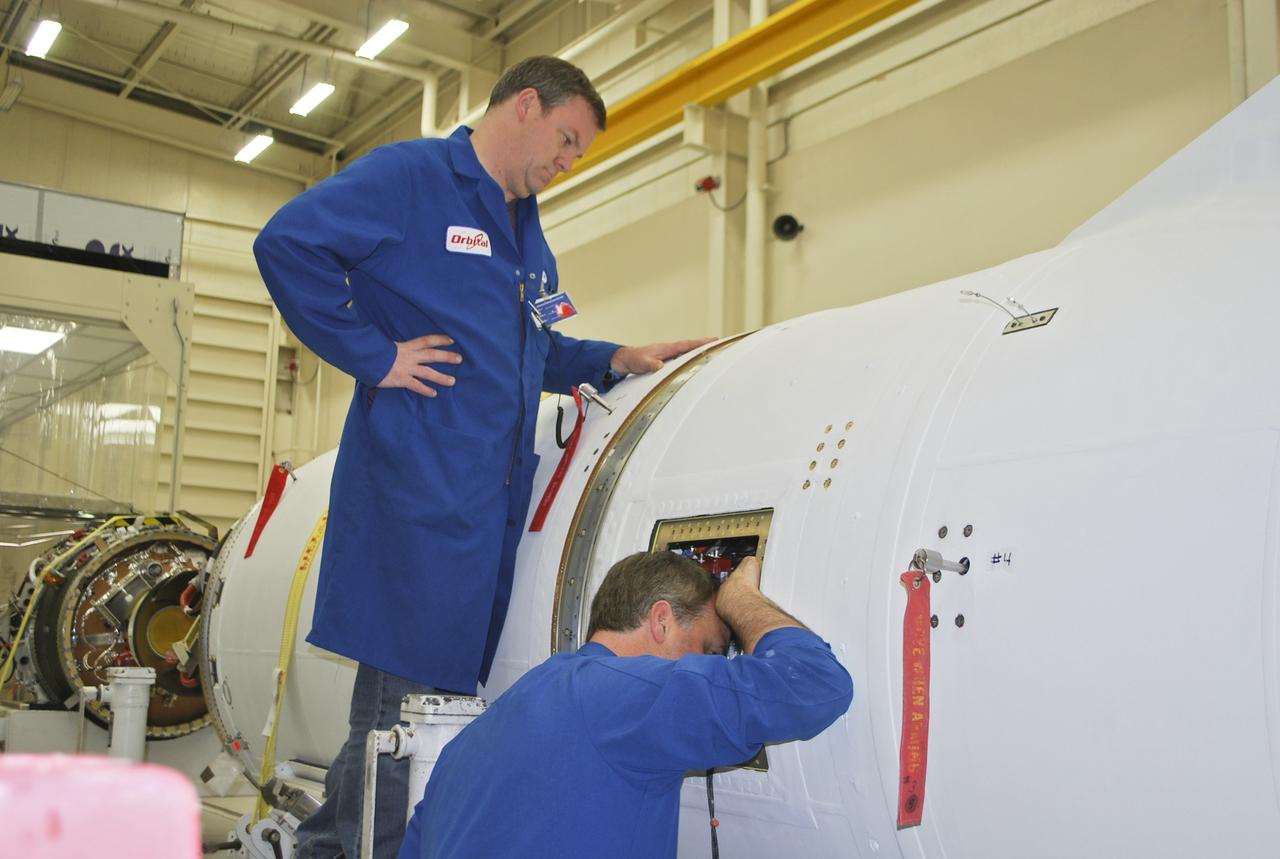
VANDENBERG AFB, Calif. – Technicians monitor the movement of the second stage of an Orbital Sciences Pegasus rocket into the first stage before a separation test is conducted. The Pegasus is being processed to launch NASA's Interface Region Imaging Spectrograph mission, known as IRIS. Photo credit: Randy Beaudoin, VAFB

VANDENBERG AFB, Calif. – Technicians perform a fit check on an Orbital Sciences Pegasus rocket as the launcher is processed for the Interface Region Imaging Spectrograph mission known as IRIS. The technicians are attaching the portion of the Pegasus that joins the wing to the fuselage, a piece called a fillet. Photo credit: VAFB/Randy Beaudoin
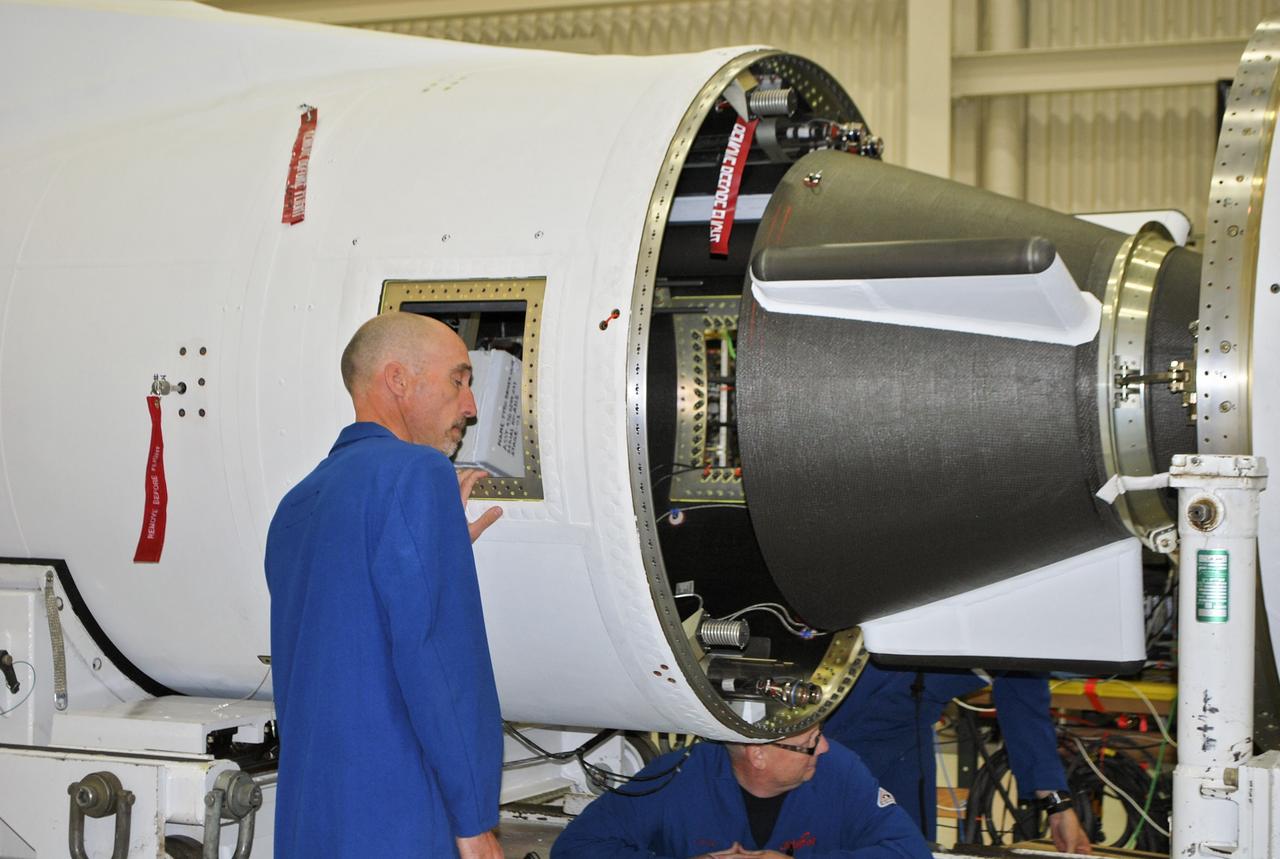
VANDENBERG AFB, Calif. – A technician monitors the movement of the second stage of an Orbital Sciences Pegasus rocket into the first stage before a separation test is conducted. The Pegasus is being processed to launch NASA's Interface Region Imaging Spectrograph mission, known as IRIS. Photo credit: Randy Beaudoin, VAFB
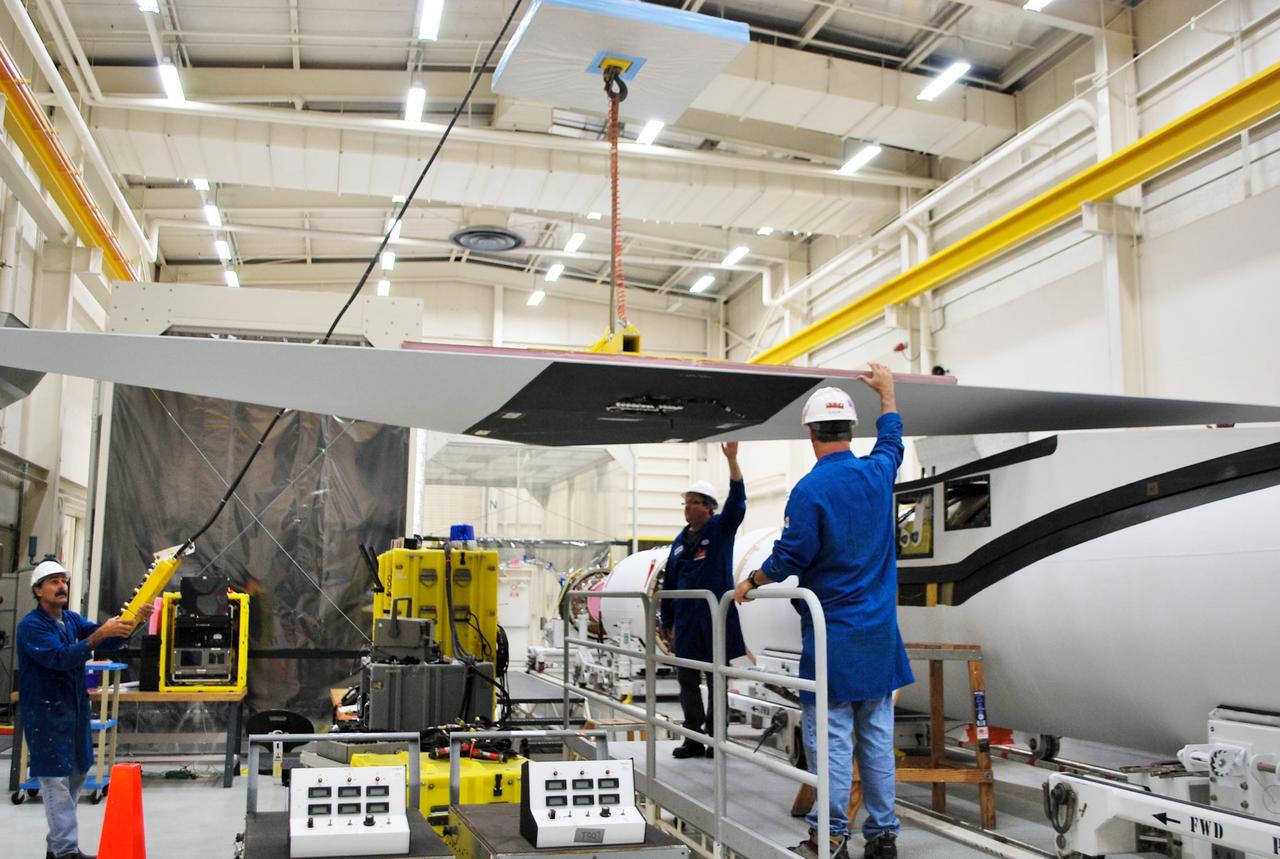
VANDENBERG AFB, Calif. – Technicians perform a fit check on an Orbital Sciences Pegasus rocket as the launcher is processed for the Interface Region Imaging Spectrograph mission known as IRIS. The technicians are attaching the wing of the Pegasus to the fuselage. Photo credit: VAFB/Randy Beaudoin
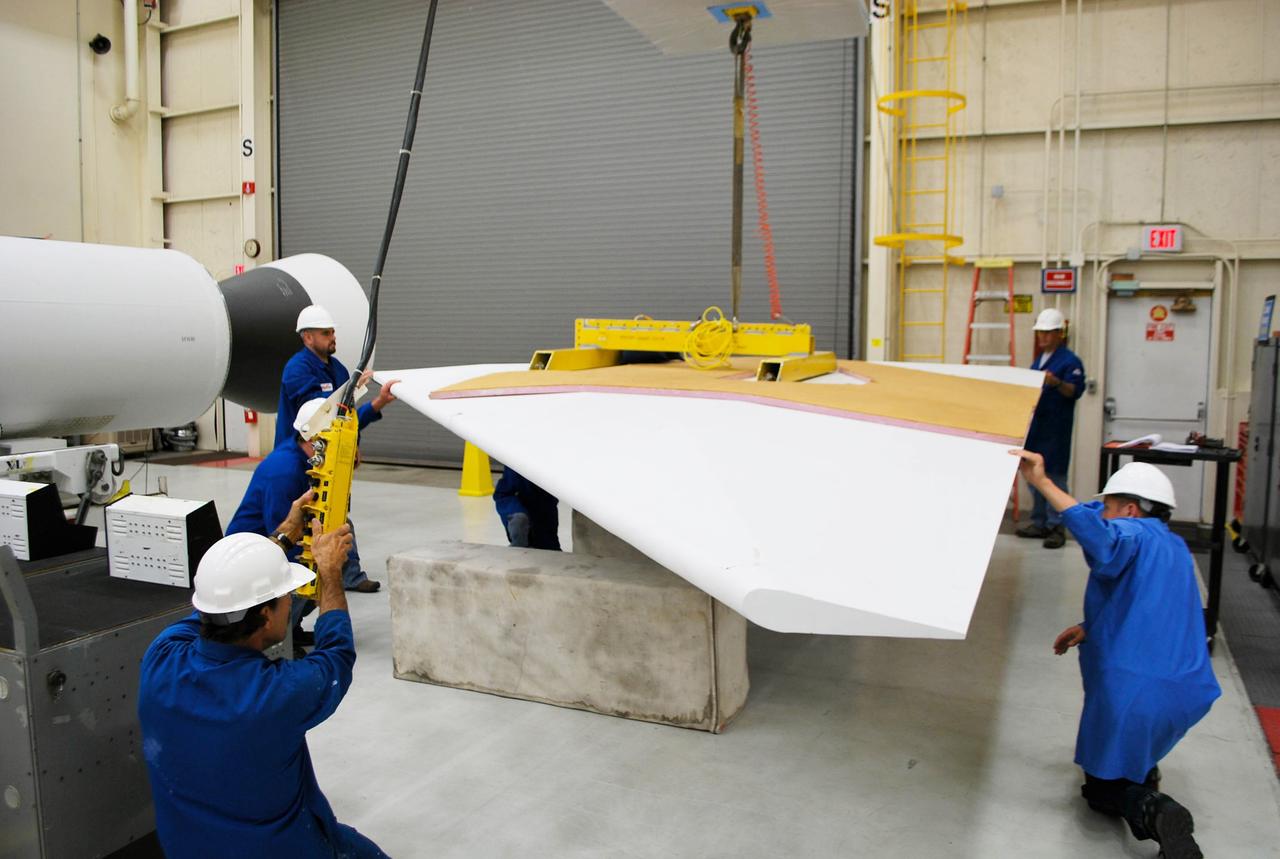
VANDENBERG AFB, Calif. – Technicians perform a fit check on an Orbital Sciences Pegasus rocket as the launcher is processed for the Interface Region Imaging Spectrograph mission known as IRIS. The technicians are attaching the wing of the Pegasus to the fuselage. Photo credit: VAFB/Randy Beaudoin
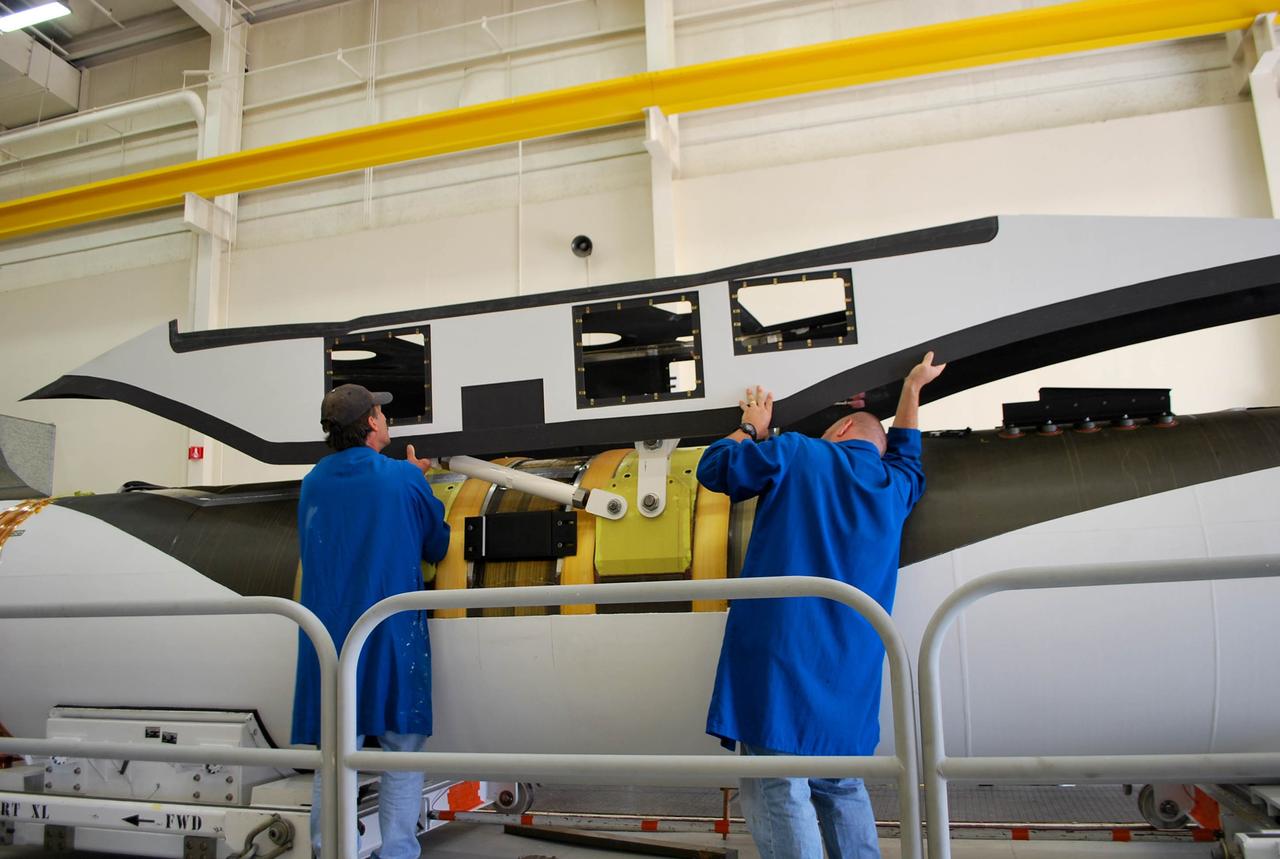
VANDENBERG AFB, Calif. – Technicians perform a fit check on an Orbital Sciences Pegasus rocket as the launcher is processed for the Interface Region Imaging Spectrograph mission known as IRIS. The technicians are attaching the portion of the Pegasus that joins the wing to the fuselage, a piece called a fillet. Photo credit: VAFB/Randy Beaudoin

VANDENBERG AFB, Calif. – Technicians perform a fit check on an Orbital Sciences Pegasus rocket as the launcher is processed for the Interface Region Imaging Spectrograph mission known as IRIS. The technicians are attaching the portion of the Pegasus that joins the wing to the fuselage, a piece called a fillet. Photo credit: VAFB/Randy Beaudoin
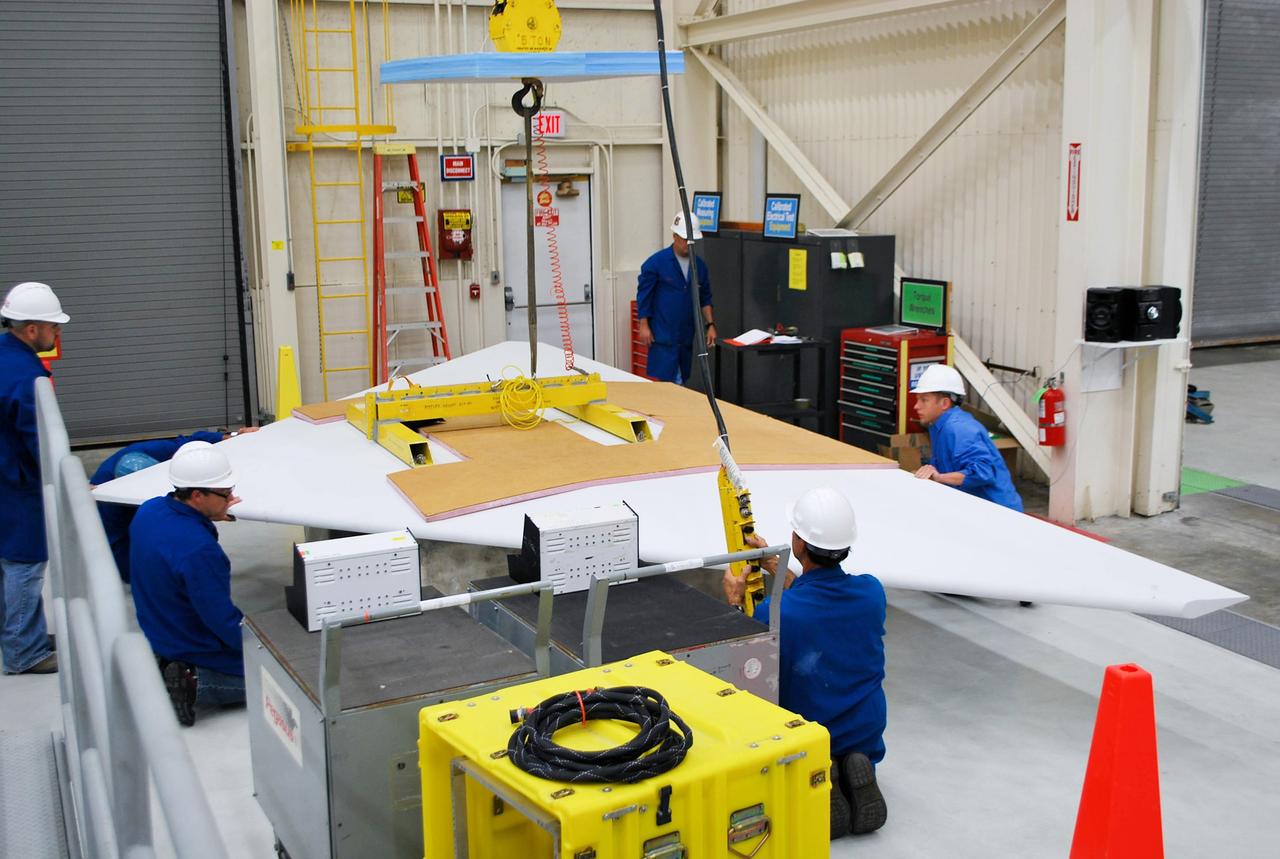
VANDENBERG AFB, Calif. – Technicians perform a fit check on an Orbital Sciences Pegasus rocket as the launcher is processed for the Interface Region Imaging Spectrograph mission known as IRIS. The technicians are attaching the wing of the Pegasus to the fuselage. Photo credit: VAFB/Randy Beaudoin
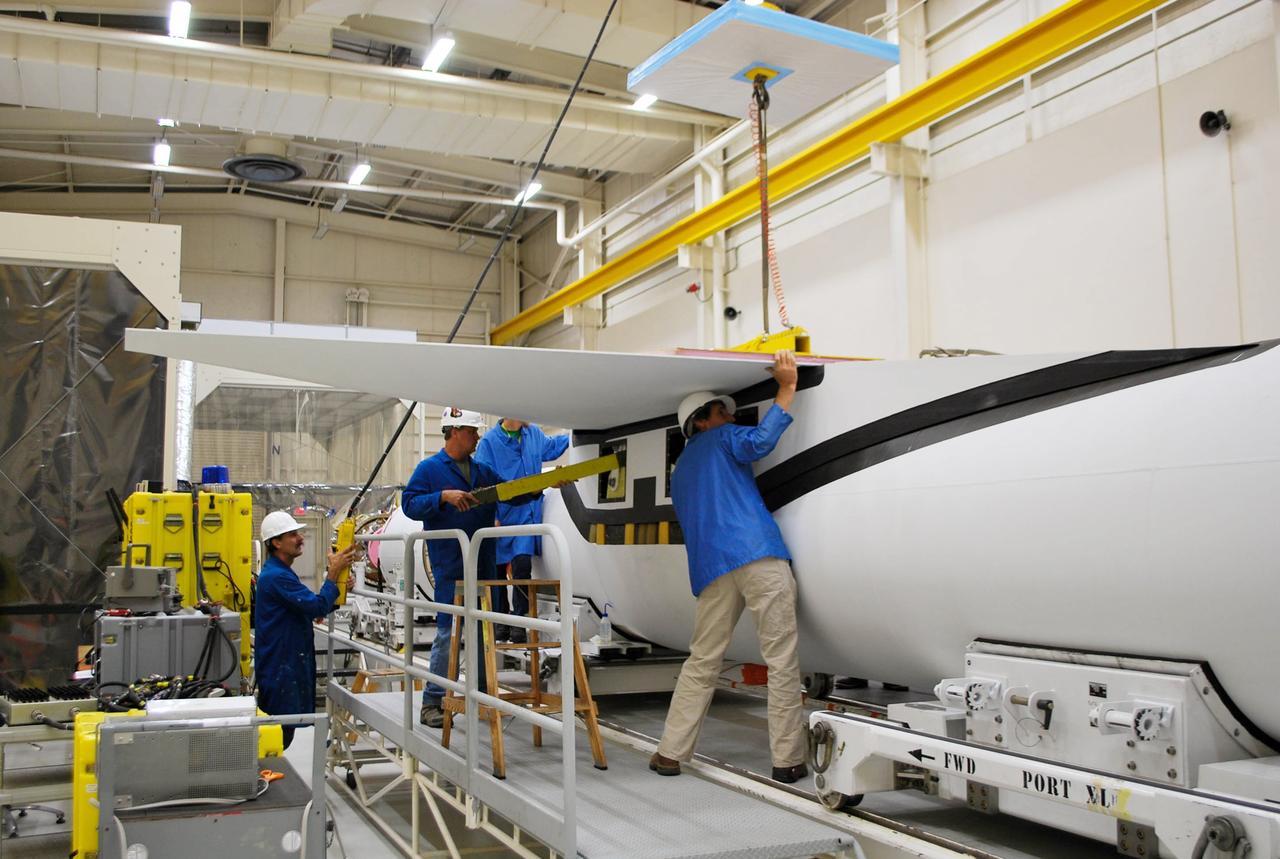
VANDENBERG AFB, Calif. – Technicians perform a fit check on an Orbital Sciences Pegasus rocket as the launcher is processed for the Interface Region Imaging Spectrograph mission known as IRIS. The technicians are attaching the wing of the Pegasus to the fuselage. Photo credit: VAFB/Randy Beaudoin
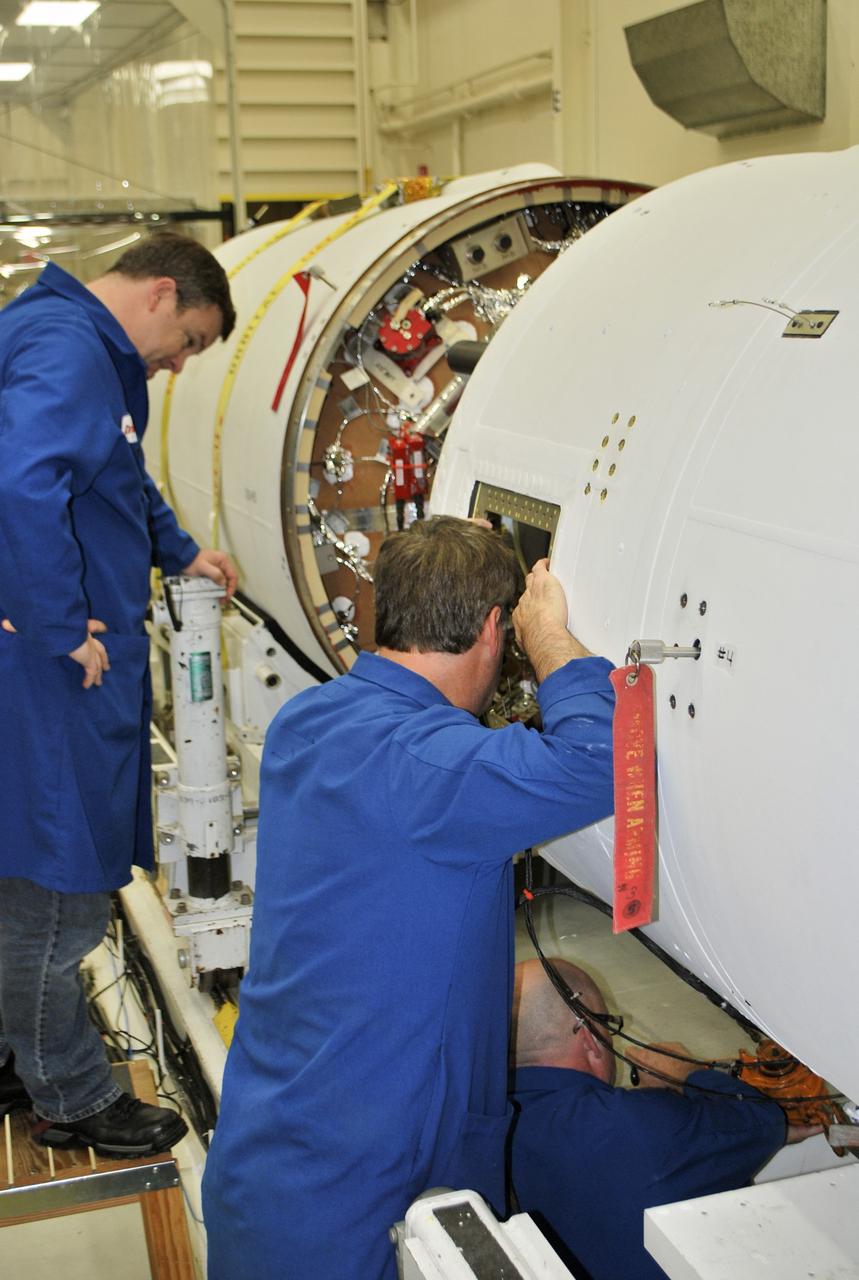
VANDENBERG AFB, Calif. – Technicians monitor the movement of the second stage of an Orbital Sciences Pegasus rocket into the first stage before a separation test is conducted. The Pegasus is being processed to launch NASA's Interface Region Imaging Spectrograph mission, known as IRIS. Photo credit: Randy Beaudoin, VAFB
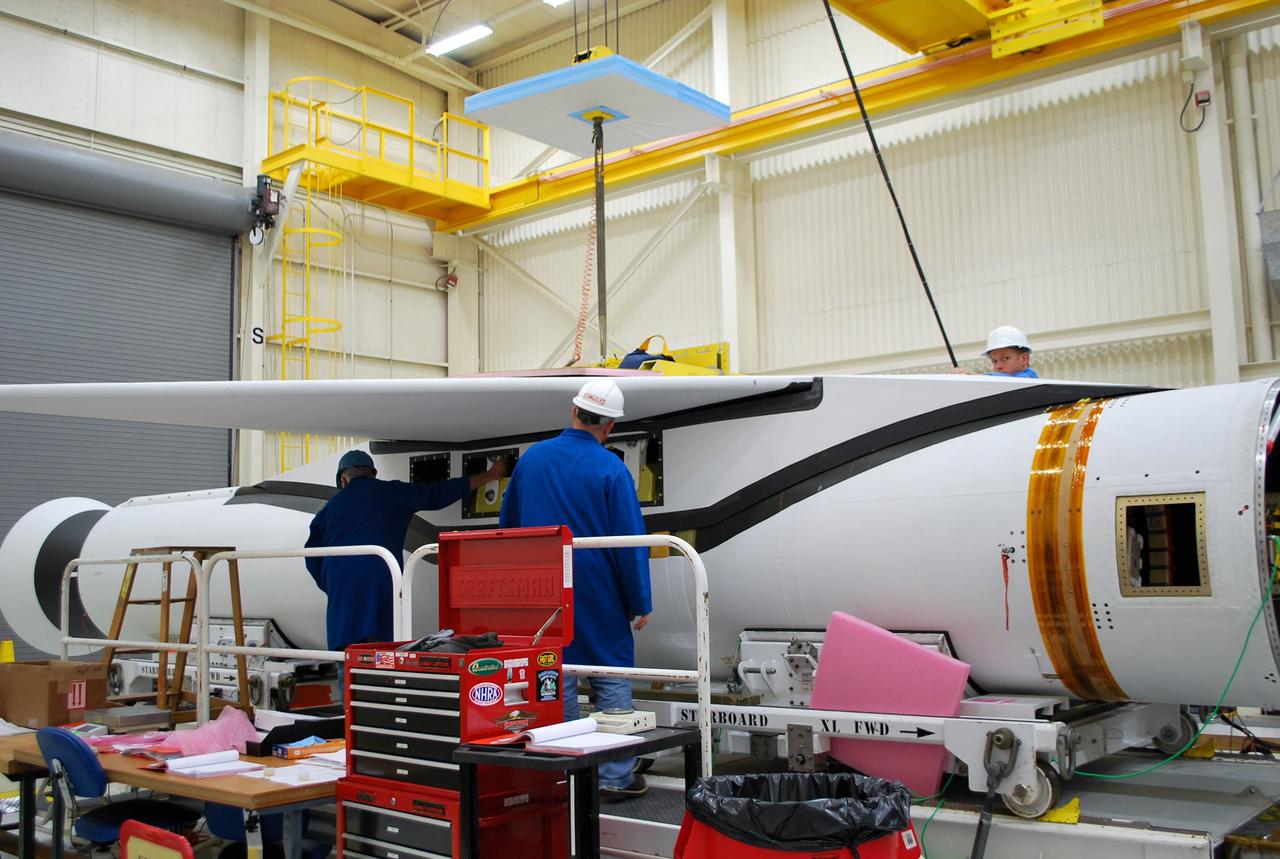
VANDENBERG AFB, Calif. – Technicians perform a fit check on an Orbital Sciences Pegasus rocket as the launcher is processed for the Interface Region Imaging Spectrograph mission known as IRIS. The technicians are attaching the wing of the Pegasus to the fuselage. Photo credit: VAFB/Randy Beaudoin
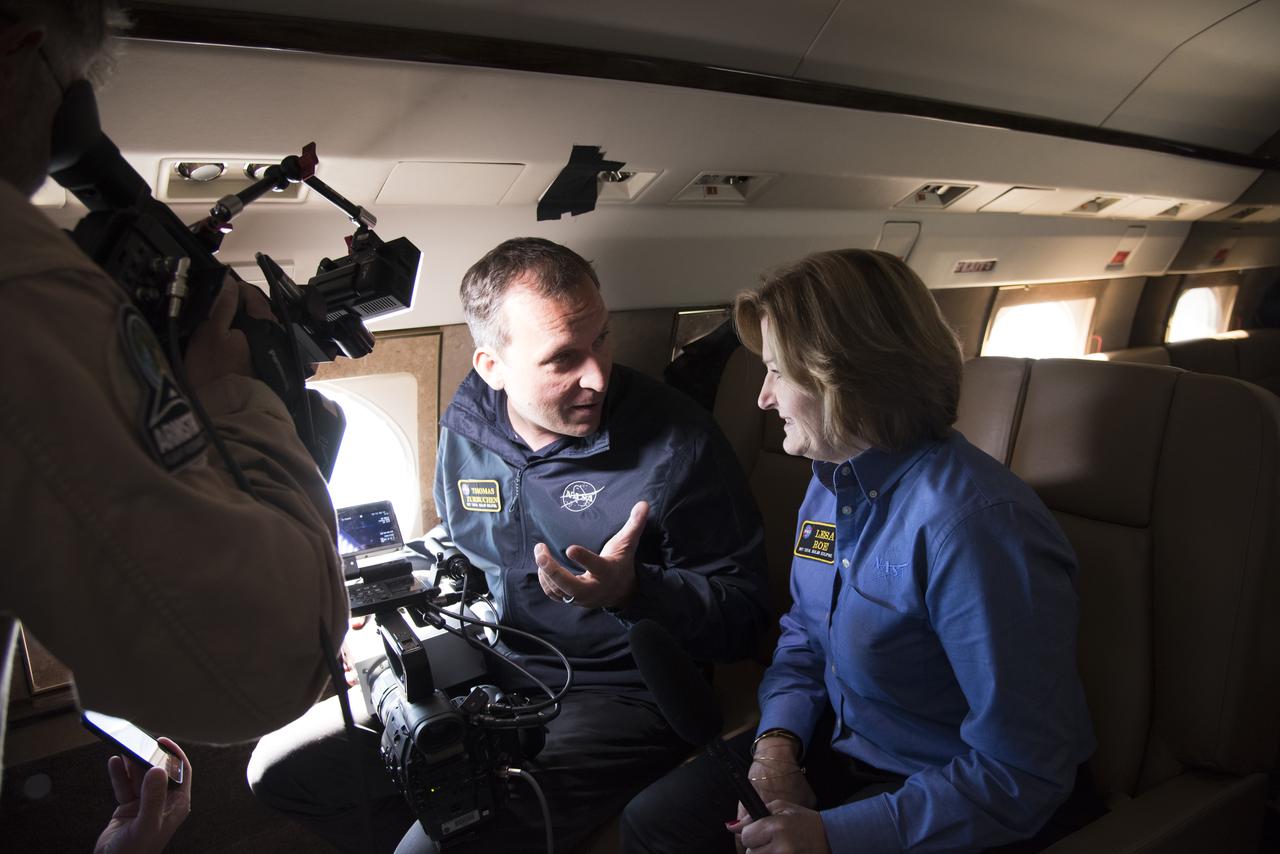
NASA's Thomas Zurbuchen, AA for science mission directorate explains to Lesa Roe, acting deputy administrator, how the spectrograph showing different colors correlate to different elements, such as helium, in the Sun's atmosphere. Photo Credit: (NASA/Carla Thomas)
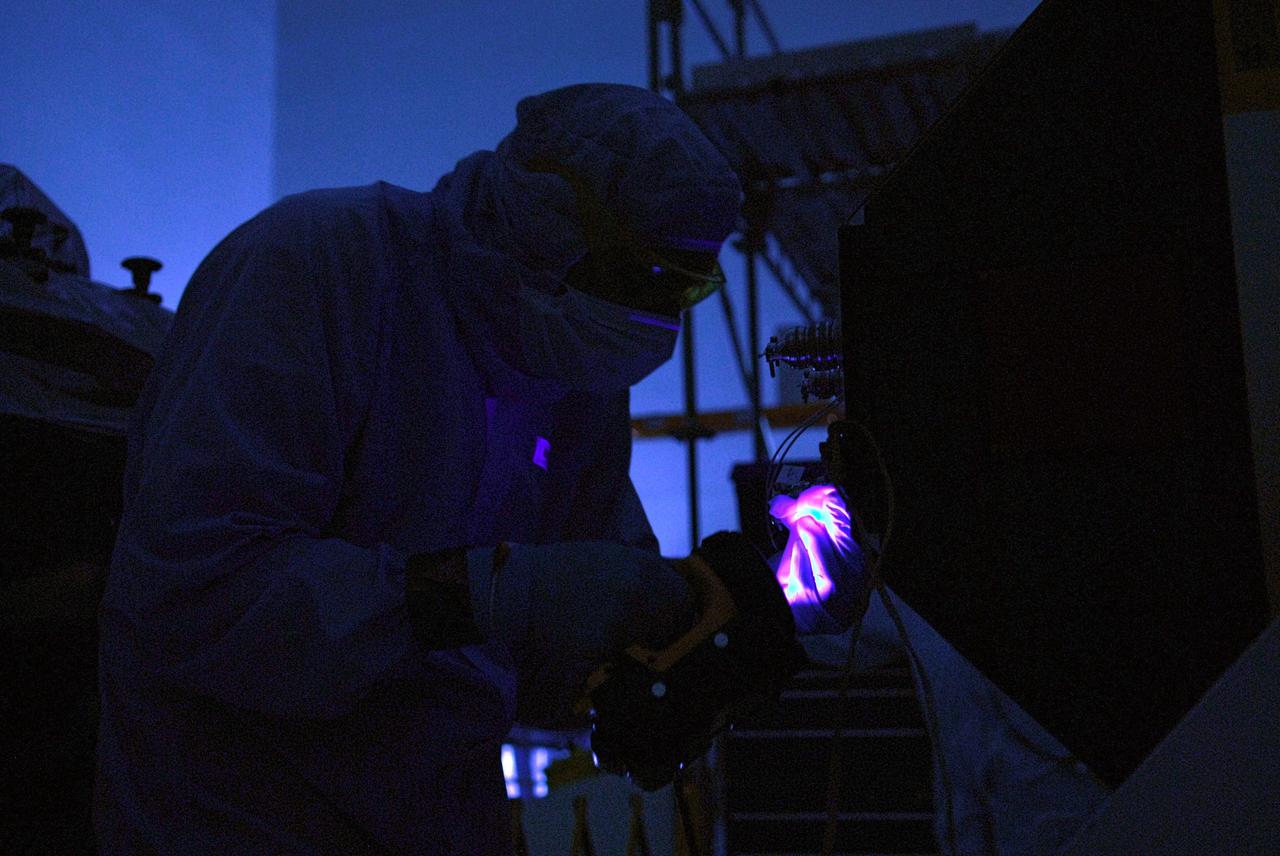
CAPE CANAVERAL, Fla. – In the clean room of the Payload Hazardous Processing Facility at NASA's Kennedy Space Center, a worker from NASA's Goddard Space Flight Center uses black light inspection for a thorough cleaning of the Cosmic Origins Spectrograph, or COS. Black light inspection uses UVA fluorescence to detect possible particulate microcontamination, minute cracks or fluid leaks. The COS will be installed on the Hubble Space Telescope on space shuttle Atlantis' STS-125 mission. COS will be the most sensitive ultraviolet spectrograph ever flown on Hubble and will probe the "cosmic web" - the large-scale structure of the universe whose form is determined by the gravity of dark matter and is traced by galaxies and intergalactic gas. The COS far-ultraviolet channel has a sensitivity 30 times greater than that of previous spectroscopic instruments for the detection of extremely low light levels. Launch of Atlantis on the STS-125 mission is targeted for Oct. 8. Photo credit: NASA/Kim Shiflett
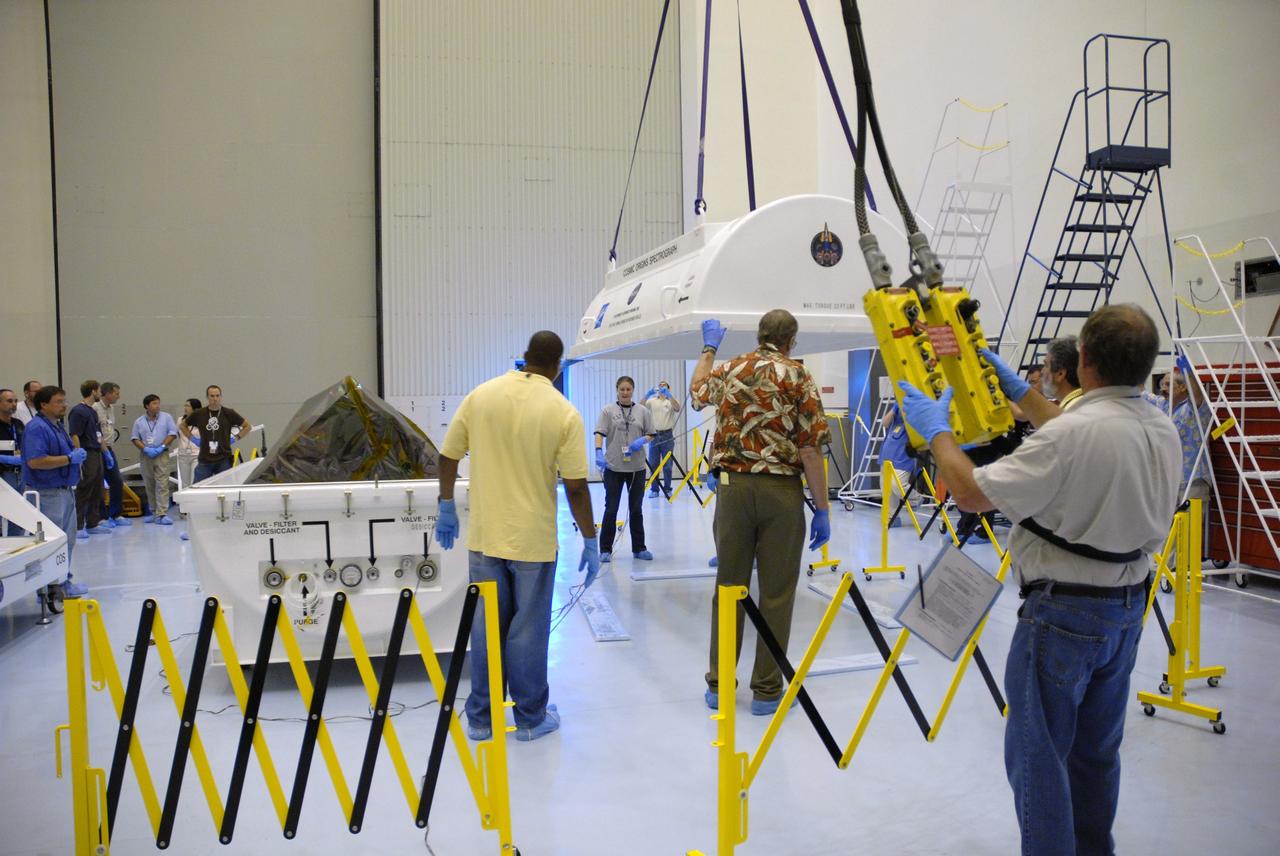
CAPE CANAVERAL, Fla. – In the airlock of the Payload Hazardous Servicing Facility at NASA's Kennedy Space Center, workers from NASA's Goddard Space Flight Center remove the top from the transportation canister in which the Cosmic Origins Spectrograph, or COS, arrived. The COS will be installed on the Hubble Space Telescope on space shuttle Atlantis' STS-125 mission. COS will be the most sensitive ultraviolet spectrograph ever flown on Hubble and will probe the "cosmic web" - the large-scale structure of the universe whose form is determined by the gravity of dark matter and is traced by galaxies and intergalactic gas. COS's far-ultraviolet channel has a sensitivity 30 times greater than that of previous spectroscopic instruments for the detection of extremely low light levels. Launch of STS-125 is targeted for Oct. 8. Photo credit: NASA/Jack Pfaller
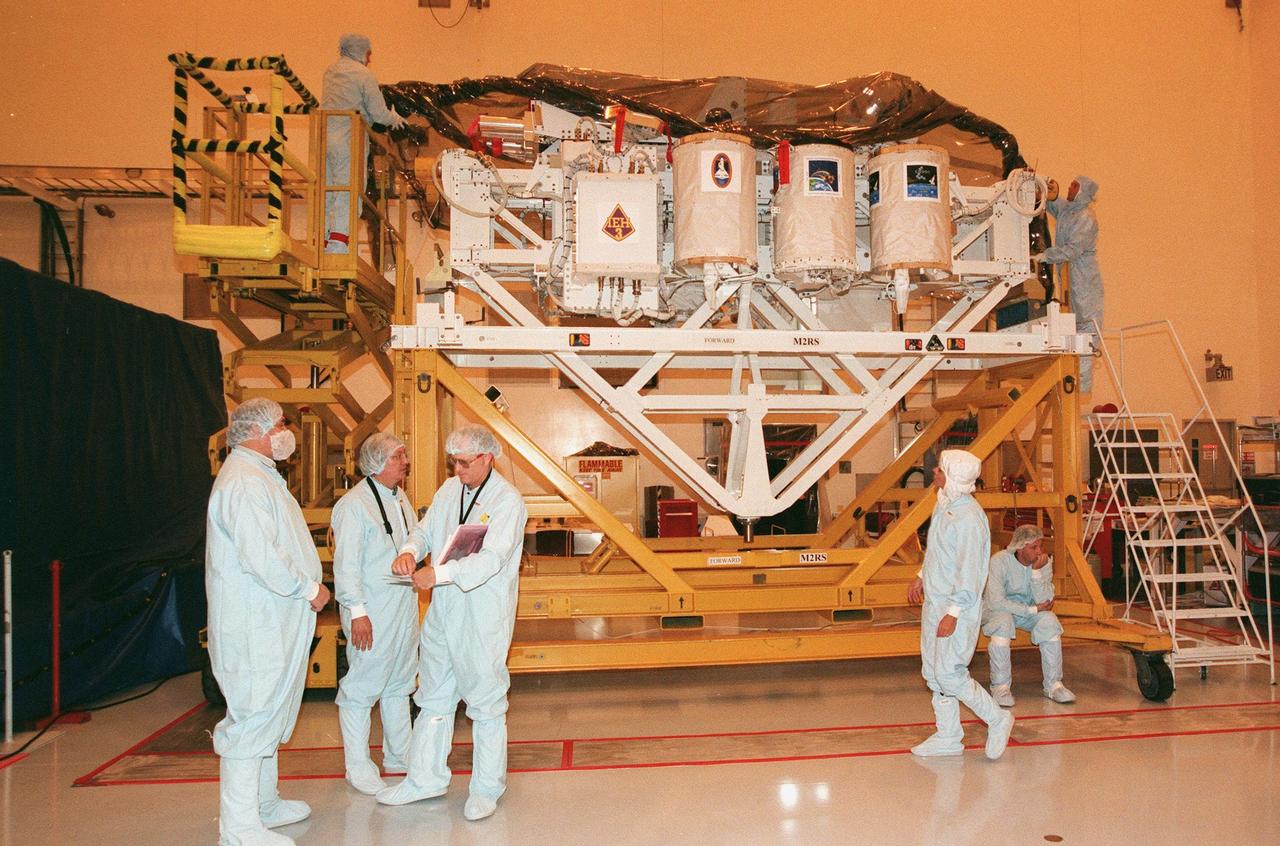
KENNEDY SPACE CENTER, FLA. The International Extreme Ultraviolet Hitchhiker-3 (IEH-3), one of the payloads for the STS-95 mission, is prepared for launch in the Multi-Payload Processing Facility. IEH-3 is comprised of seven experiments, including one that will be deployed on Flight Day 3. It is the small, non-recoverable Petite Amateur Navy Satellite (PANSAT) which will store and transmit digital communications. Other IEH investigations are the Solar Constant Experiment (SOLCON), Solar Extreme Ultraviolet Hitchhiker (SEH), Spectrograph/Telescope for Astronomical Research (STAR-LITE), Ultraviolet Spectrograph Telescope for Astronomical Research (UVSTAR), Consortium for Materials Development in Space Complex Autonomous Payloads (CONCAP-IV) for growing thin films via physical vapor transport, and two Get-Away Special (GAS) canister experiments. The experiments will be mounted on a hitchhiker bridge in Discovery's payload bay

CAPE CANAVERAL, Fla. – In the clean room of the Payload Hazardous Processing Facility at NASA's Kennedy Space Center, an overhead crane moves the Cosmic Origins Spectrograph, or COS, toward a protective enclosure on the Orbital Replacement Unit Carrier, part of the payload for the fifth and final Hubble servicing mission, STS-125. Other payloads include the Flight Support System, the Super Lightweight Interchangeable Carrier and the Multi-Use Lightweight Equipment, or MULE, carrier. COS will be the most sensitive ultraviolet spectrograph ever flown on Hubble and will probe the "cosmic web" - the large-scale structure of the universe whose form is determined by the gravity of dark matter and is traced by galaxies and intergalactic gas. The COS far-ultraviolet channel has a sensitivity 30 times greater than that of previous spectroscopic instruments for the detection of extremely low light levels. Launch of Atlantis on the STS-125 mission is targeted for Oct. 8. Photo credit: NASA/Kim Shiflett
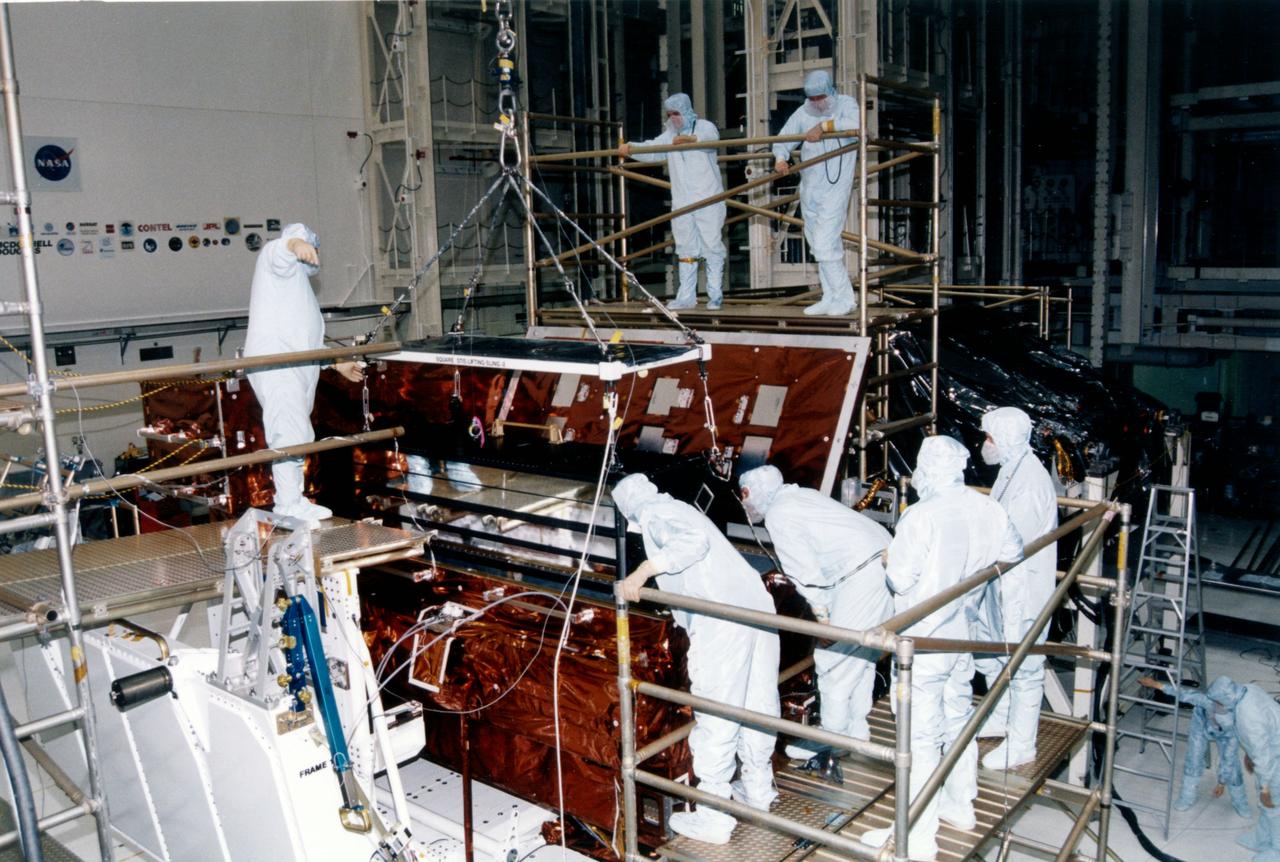
KENNEDY SPACE CENTER, FLORIDA STS-82 PREPARATIONS VIEW --- Payload processing workers in the Kennedy Space Center (KSC) Vertical Processing Facility (VPF) prepare to integrate the Space Telescope Imaging Spectrograph (STIS), suspended at center, into the Orbiter Replacement Unit (ORU) Carrier and Scientific Instrument Protective Enclosure (SIPE). STIS will replace the Goddard High Resolution Spectrograph (GHRS) on the Hubble Space Telescope (HST). Four of the seven STS-82 crew members will perform a series of spacewalks to replace two scientific instruments with two new instruments, including STIS, and perform other tasks during the second HST servicing mission. HST was deployed nearly seven years ago and was initially serviced in 1993.
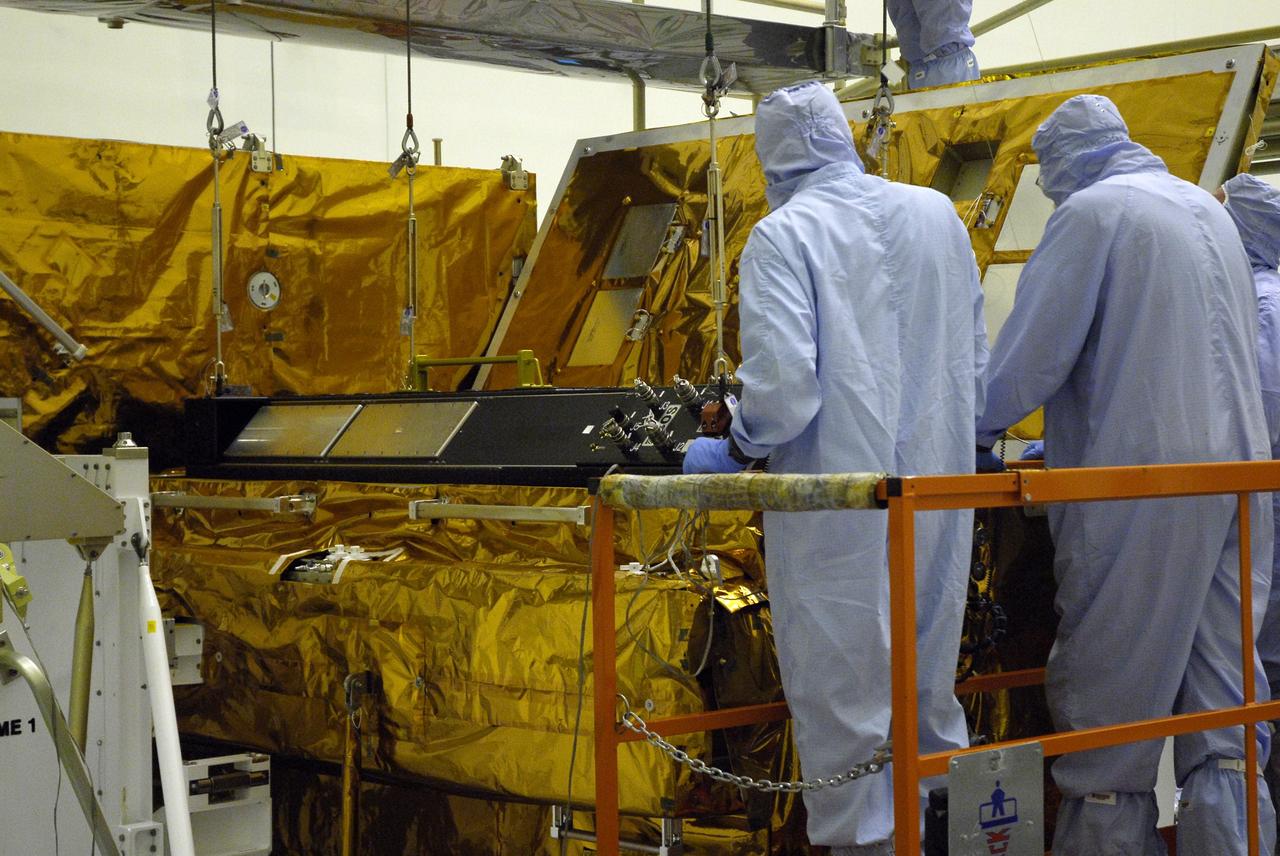
CAPE CANAVERAL, Fla. – In the clean room of the Payload Hazardous Processing Facility at NASA's Kennedy Space Center, an overhead crane settles the Cosmic Origins Spectrograph, or COS, in a protective enclosure on the Orbital Replacement Unit Carrier, part of the payload for the fifth and final Hubble servicing mission, STS-125. Other payloads include the Flight Support System, the Super Lightweight Interchangeable Carrier and the Multi-Use Lightweight Equipment, or MULE, carrier. COS will be the most sensitive ultraviolet spectrograph ever flown on Hubble and will probe the "cosmic web" - the large-scale structure of the universe whose form is determined by the gravity of dark matter and is traced by galaxies and intergalactic gas. The COS far-ultraviolet channel has a sensitivity 30 times greater than that of previous spectroscopic instruments for the detection of extremely low light levels. Launch of Atlantis on the STS-125 mission is targeted for Oct. 8. Photo credit: NASA/Kim Shiflett
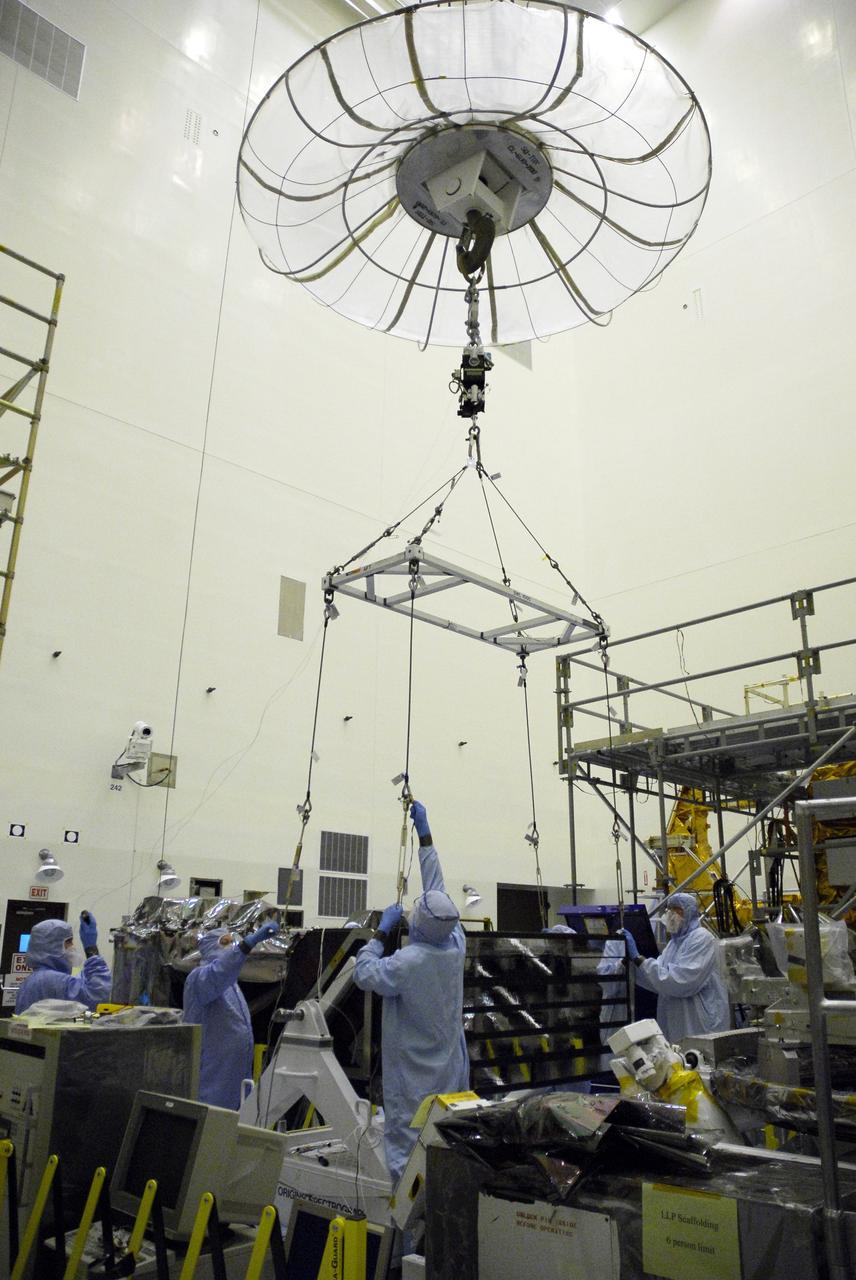
CAPE CANAVERAL, Fla. – In the clean room of the Payload Hazardous Processing Facility at NASA's Kennedy Space Center, workers prepare to attach an overhead crane to the Cosmic Origins Spectrograph, or COS. The COS will be lifted and moved to a protective enclosure on the Orbital Replacement Unit Carrier, part of the payload for the fifth and final Hubble servicing mission, STS-125. Other payloads include the Flight Support System, the Super Lightweight Interchangeable Carrier and the Multi-Use Lightweight Equipment, or MULE, carrier. COS will be the most sensitive ultraviolet spectrograph ever flown on Hubble and will probe the "cosmic web" - the large-scale structure of the universe whose form is determined by the gravity of dark matter and is traced by galaxies and intergalactic gas. The COS far-ultraviolet channel has a sensitivity 30 times greater than that of previous spectroscopic instruments for the detection of extremely low light levels. Launch of Atlantis on the STS-125 mission is targeted for Oct. 8. Photo credit: NASA/Kim Shiflett
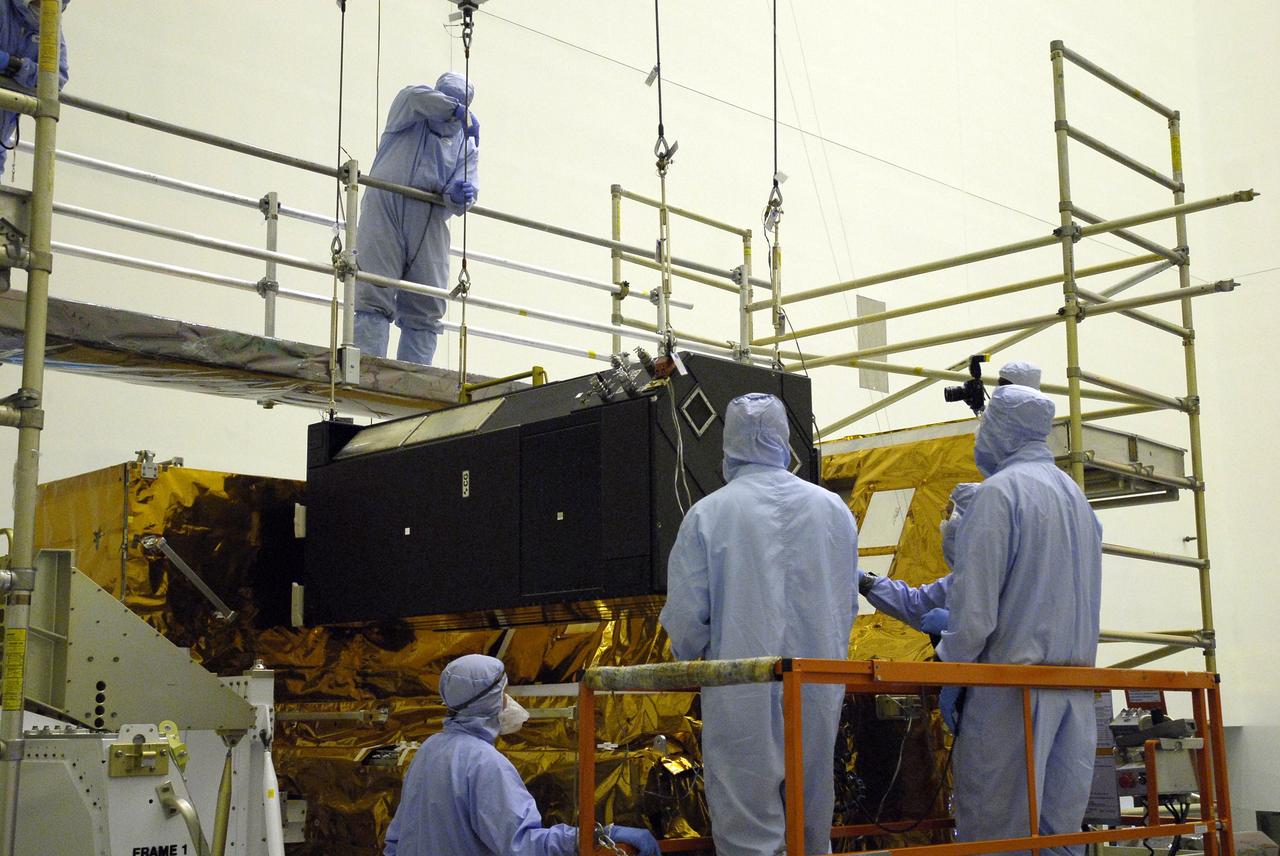
CAPE CANAVERAL, Fla. – In the clean room of the Payload Hazardous Processing Facility at NASA's Kennedy Space Center, an overhead crane lowers the Cosmic Origins Spectrograph, or COS, into a protective enclosure on the Orbital Replacement Unit Carrier, part of the payload for the fifth and final Hubble servicing mission, STS-125. Other payloads include the Flight Support System, the Super Lightweight Interchangeable Carrier and the Multi-Use Lightweight Equipment, or MULE, carrier. COS will be the most sensitive ultraviolet spectrograph ever flown on Hubble and will probe the "cosmic web" - the large-scale structure of the universe whose form is determined by the gravity of dark matter and is traced by galaxies and intergalactic gas. The COS far-ultraviolet channel has a sensitivity 30 times greater than that of previous spectroscopic instruments for the detection of extremely low light levels. Launch of Atlantis on the STS-125 mission is targeted for Oct. 8. Photo credit: NASA/Kim Shiflett

CAPE CANAVERAL, Fla. – In the clean room of the Payload Hazardous Processing Facility at NASA's Kennedy Space Center, a worker from NASA's Goddard Space Flight Center uses black light inspection for a thorough cleaning of the Cosmic Origins Spectrograph, or COS. Black light inspection uses UVA fluorescence to detect possible particulate microcontamination, minute cracks or fluid leaks. The COS will be installed on the Hubble Space Telescope on space shuttle Atlantis' STS-125 mission. COS will be the most sensitive ultraviolet spectrograph ever flown on Hubble and will probe the "cosmic web" - the large-scale structure of the universe whose form is determined by the gravity of dark matter and is traced by galaxies and intergalactic gas. The COS far-ultraviolet channel has a sensitivity 30 times greater than that of previous spectroscopic instruments for the detection of extremely low light levels. Launch of Atlantis on the STS-125 mission is targeted for Oct. 8. Photo credit: NASA/Kim Shiflett
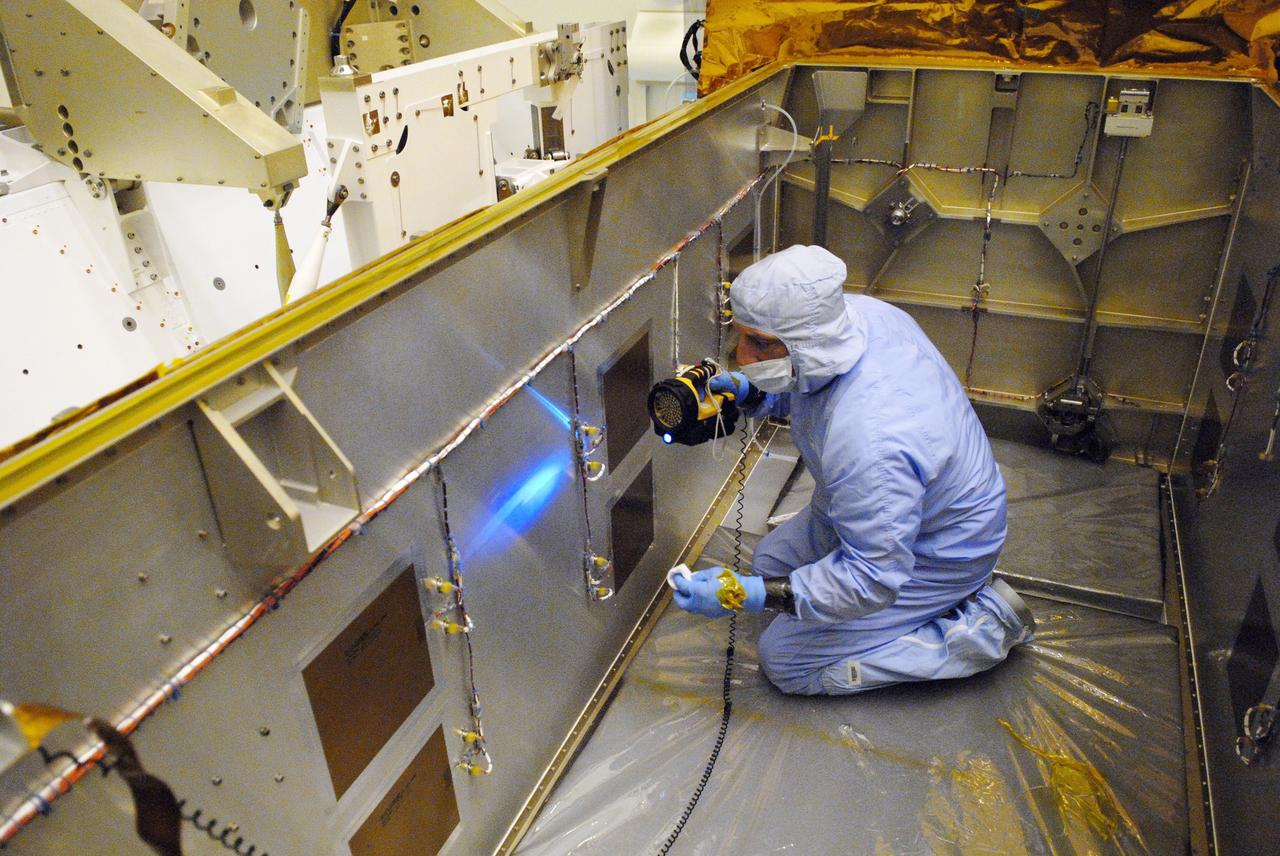
CAPE CANAVERAL, Fla. – In the clean room of the Payload Hazardous Processing Facility at NASA's Kennedy Space Center, workers from NASA's Goddard Space Flight Center use black light inspection for a thorough cleaning of the protective carrier for the Cosmic Origins Spectrograph, or COS. Black light inspection uses UVA fluorescence to detect possible particulate microcontamination, minute cracks or fluid leaks. The COS will be installed on the Hubble Space Telescope on space shuttle Atlantis' STS-125 mission. COS will be the most sensitive ultraviolet spectrograph ever flown on Hubble and will probe the "cosmic web" - the large-scale structure of the universe whose form is determined by the gravity of dark matter and is traced by galaxies and intergalactic gas. The COS far-ultraviolet channel has a sensitivity 30 times greater than that of previous spectroscopic instruments for the detection of extremely low light levels. Launch of Atlantis on the STS-125 mission is targeted for Oct. 8. Photo credit: NASA/Kim Shiflett
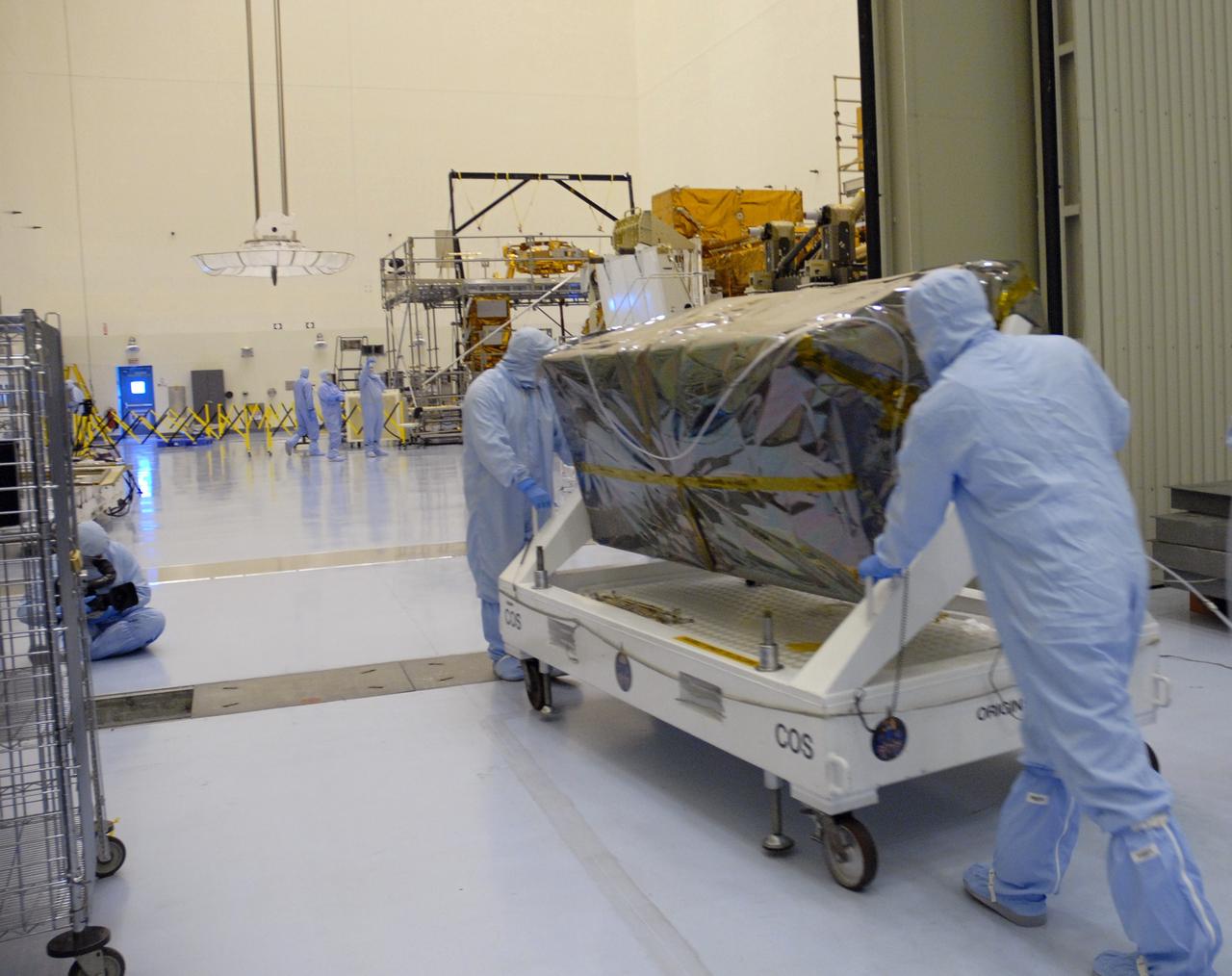
CAPE CANAVERAL, Fla. – At NASA's Kennedy Space Center, workers from NASA's Goddard Space Flight Center roll the Cosmic Origins Spectrograph, or COS, into the clean room of the Payload Hazardous Servicing Facility. The COS will be installed on the Hubble Space Telescope on space shuttle Atlantis' STS-125 mission. COS will be the most sensitive ultraviolet spectrograph ever flown on Hubble and will probe the "cosmic web" - the large-scale structure of the universe whose form is determined by the gravity of dark matter and is traced by galaxies and intergalactic gas. COS's far-ultraviolet channel has a sensitivity 30 times greater than that of previous spectroscopic instruments for the detection of extremely low light levels. Launch of STS-125 is targeted for Oct. 8. Photo credit: NASA/Jack Pfaller
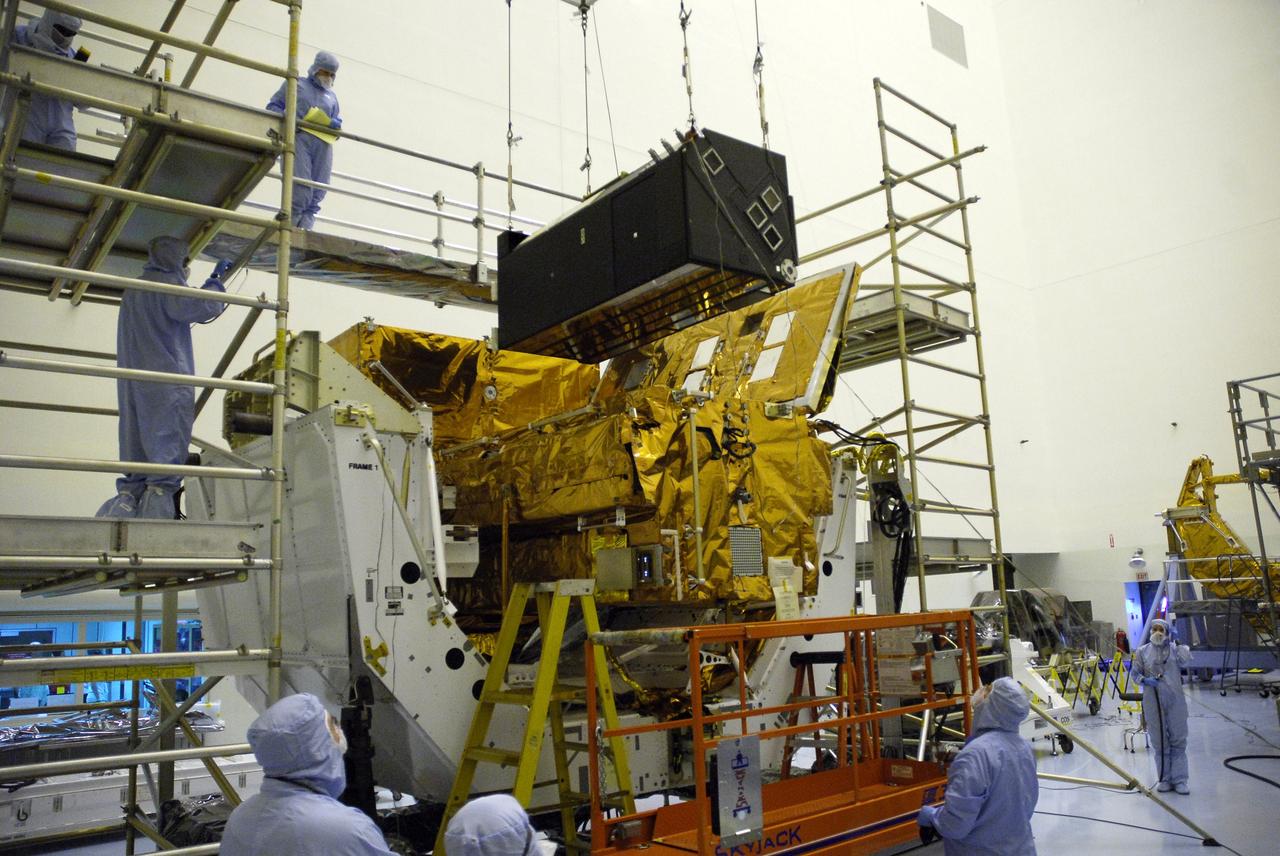
CAPE CANAVERAL, Fla. – In the clean room of the Payload Hazardous Processing Facility at NASA's Kennedy Space Center, an overhead crane lowers the Cosmic Origins Spectrograph, or COS, toward a protective enclosure on the Orbital Replacement Unit Carrier, part of the payload for the fifth and final Hubble servicing mission, STS-125. Other payloads include the Flight Support System, the Super Lightweight Interchangeable Carrier and the Multi-Use Lightweight Equipment, or MULE, carrier. COS will be the most sensitive ultraviolet spectrograph ever flown on Hubble and will probe the "cosmic web" - the large-scale structure of the universe whose form is determined by the gravity of dark matter and is traced by galaxies and intergalactic gas. The COS far-ultraviolet channel has a sensitivity 30 times greater than that of previous spectroscopic instruments for the detection of extremely low light levels. Launch of Atlantis on the STS-125 mission is targeted for Oct. 8. Photo credit: NASA/Kim Shiflett
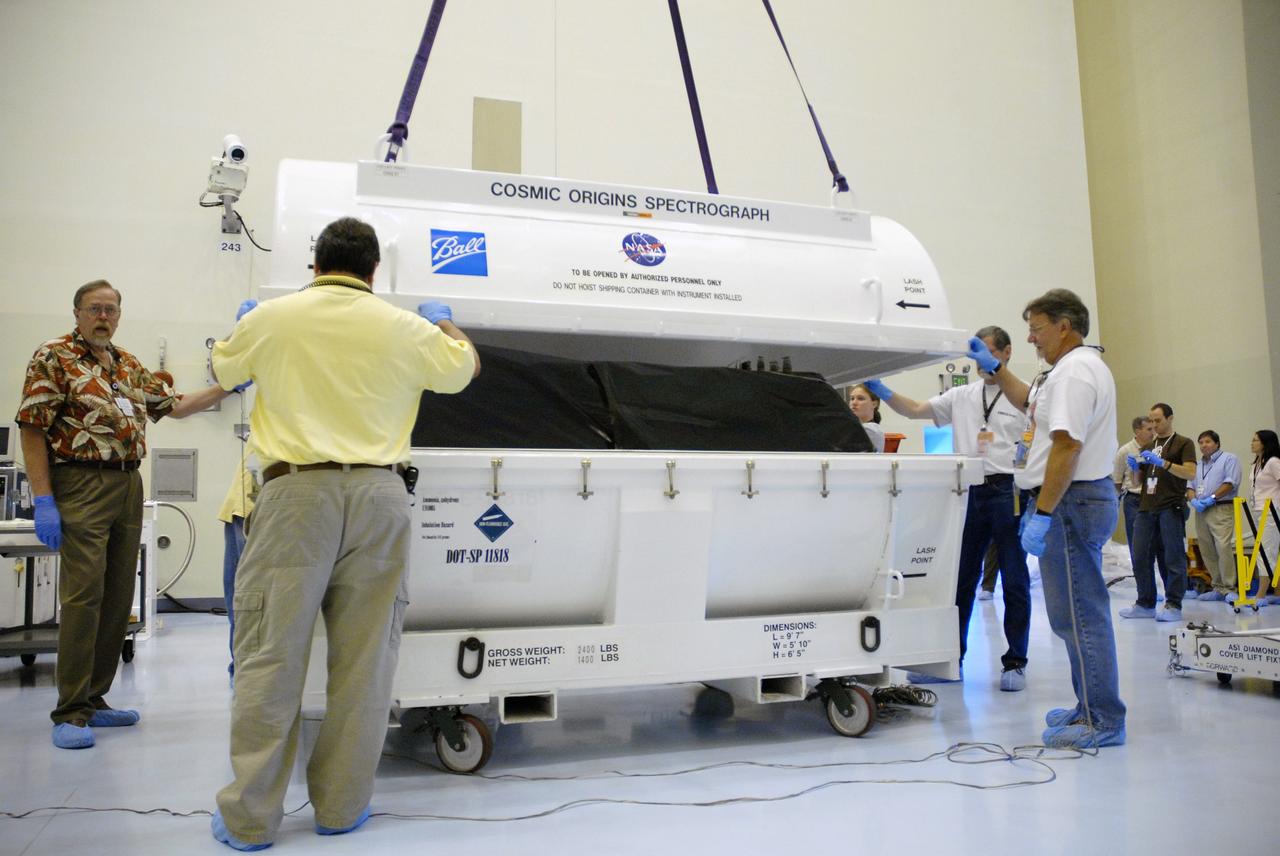
CAPE CANAVERAL, Fla. – In the airlock of the Payload Hazardous Servicing Facility at NASA's Kennedy Space Center, workers from NASA's Goddard Space Flight Center open the transportation canister in which the Cosmic Origins Spectrograph, or COS, is protected. The COS will be installed on the Hubble Space Telescope on space shuttle Atlantis' STS-125 mission. COS will be the most sensitive ultraviolet spectrograph ever flown on Hubble and will probe the "cosmic web" - the large-scale structure of the universe whose form is determined by the gravity of dark matter and is traced by galaxies and intergalactic gas. COS's far-ultraviolet channel has a sensitivity 30 times greater than that of previous spectroscopic instruments for the detection of extremely low light levels. Launch of STS-125 is targeted for Oct. 8. Photo credit: NASA/Jack Pfaller
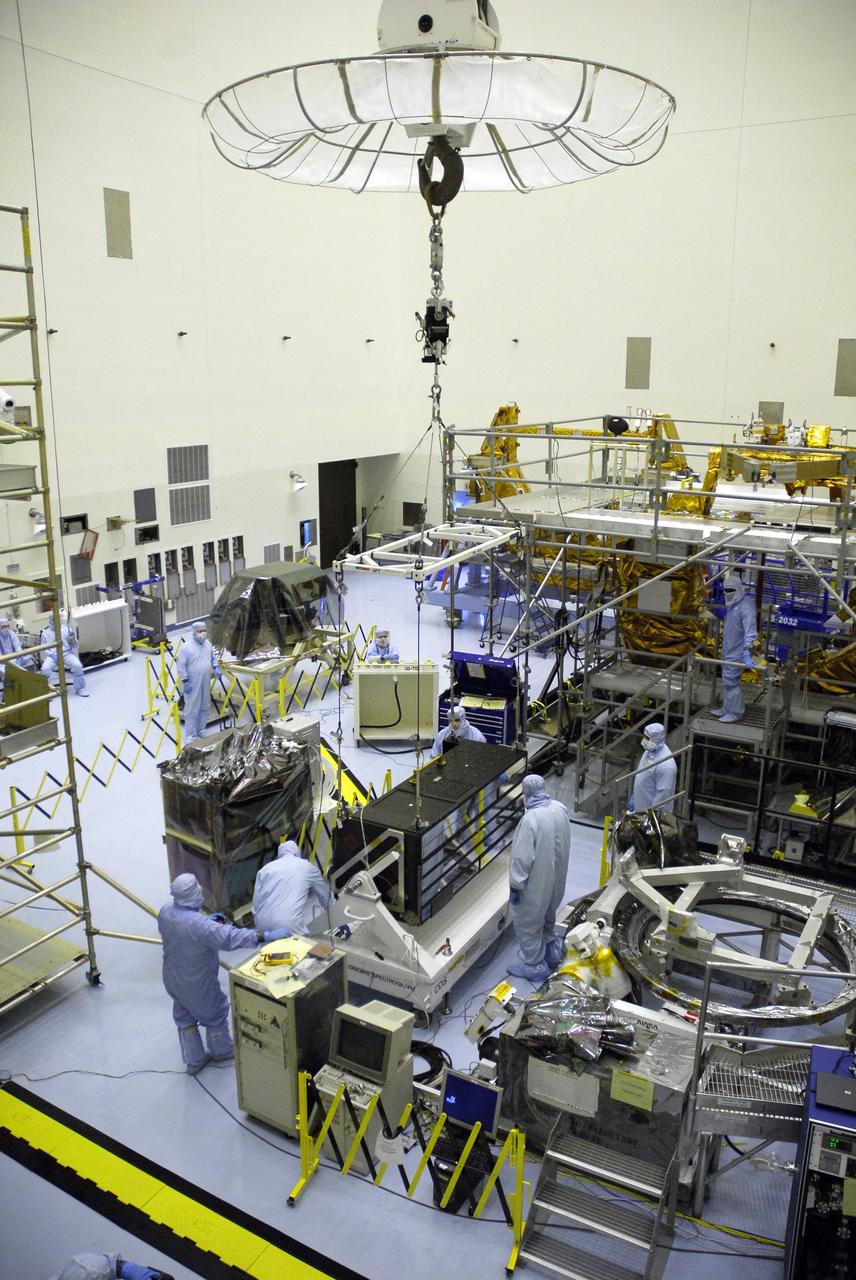
CAPE CANAVERAL, Fla. – In the clean room of the Payload Hazardous Processing Facility at NASA's Kennedy Space Center, an overhead crane lifts the Cosmic Origins Spectrograph, or COS. The COS is being lifted and moved to a protective enclosure on the Orbital Replacement Unit Carrier, part of the payload for the fifth and final Hubble servicing mission, STS-125. Other payloads include the Flight Support System, the Super Lightweight Interchangeable Carrier and the Multi-Use Lightweight Equipment, or MULE, carrier. COS will be the most sensitive ultraviolet spectrograph ever flown on Hubble and will probe the "cosmic web" - the large-scale structure of the universe whose form is determined by the gravity of dark matter and is traced by galaxies and intergalactic gas. The COS far-ultraviolet channel has a sensitivity 30 times greater than that of previous spectroscopic instruments for the detection of extremely low light levels. Launch of Atlantis on the STS-125 mission is targeted for Oct. 8. Photo credit: NASA/Kim Shiflett

CAPE CANAVERAL, Fla. – In the clean room of the Payload Hazardous Processing Facility at NASA's Kennedy Space Center, workers attach an overhead crane to the Cosmic Origins Spectrograph, or COS. The COS is being lifted and moved to a protective enclosure on the Orbital Replacement Unit Carrier, part of the payload for the fifth and final Hubble servicing mission, STS-125. Other payloads include the Flight Support System, the Super Lightweight Interchangeable Carrier and the Multi-Use Lightweight Equipment, or MULE, carrier. COS will be the most sensitive ultraviolet spectrograph ever flown on Hubble and will probe the "cosmic web" - the large-scale structure of the universe whose form is determined by the gravity of dark matter and is traced by galaxies and intergalactic gas. The COS far-ultraviolet channel has a sensitivity 30 times greater than that of previous spectroscopic instruments for the detection of extremely low light levels. Launch of Atlantis on the STS-125 mission is targeted for Oct. 8. Photo credit: NASA/Kim Shiflett
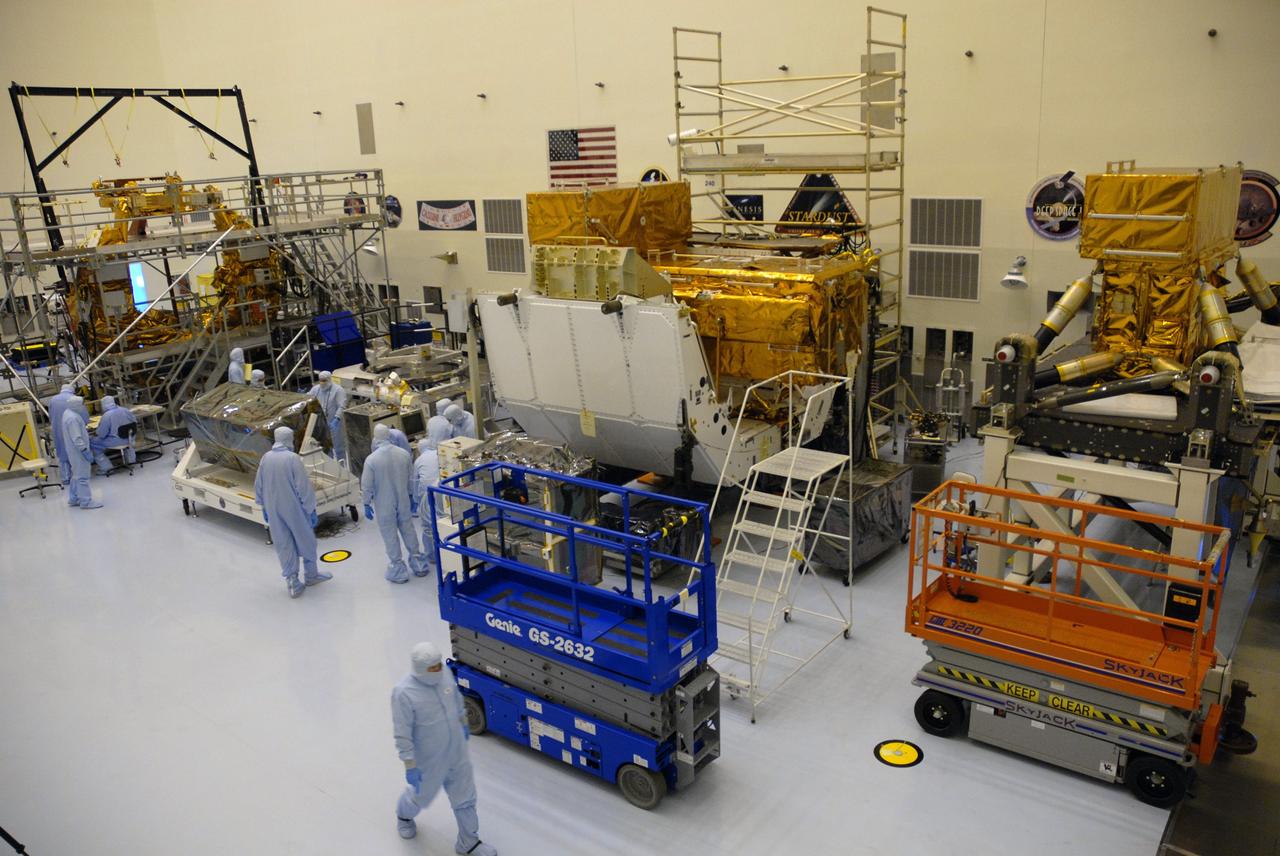
CAPE CANAVERAL, Fla. – At NASA's Kennedy Space Center, workers from NASA's Goddard Space Flight Center roll the Cosmic Origins Spectrograph, or COS, into position in the clean room of the Payload Hazardous Servicing Facility for instrument testing and integration with the Flight Support System carrier. The COS will be installed on the Hubble Space Telescope on space shuttle Atlantis' STS-125 mission. COS will be the most sensitive ultraviolet spectrograph ever flown on Hubble and will probe the "cosmic web" - the large-scale structure of the universe whose form is determined by the gravity of dark matter and is traced by galaxies and intergalactic gas. COS's far-ultraviolet channel has a sensitivity 30 times greater than that of previous spectroscopic instruments for the detection of extremely low light levels. Launch of STS-125 is targeted for Oct. 8. Photo credit: NASA/Jack Pfaller
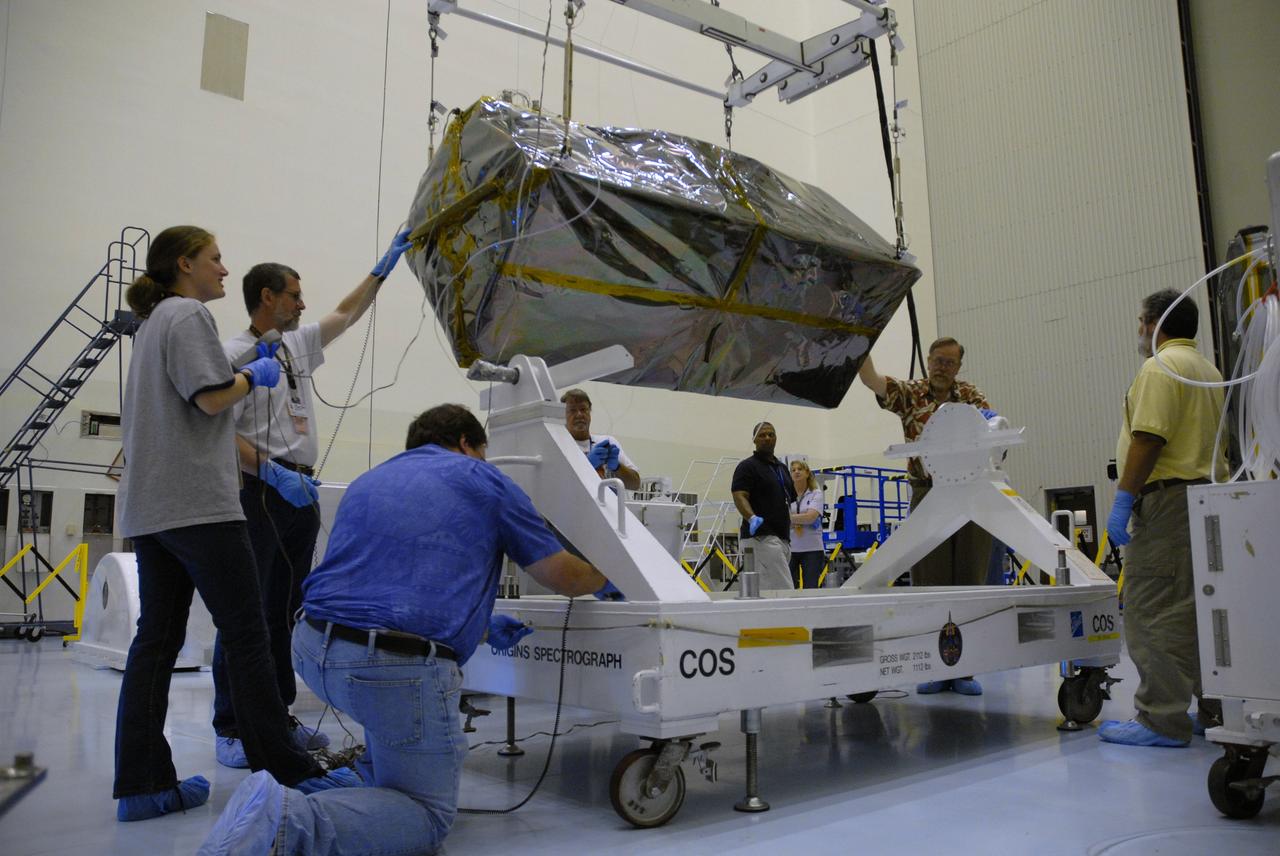
CAPE CANAVERAL, Fla. – In the airlock of the Payload Hazardous Servicing Facility at NASA's Kennedy Space Center, workers from NASA's Goddard Space Flight Center lift the Cosmic Origins Spectrograph, or COS, from its transportation canister onto a dolly for its move into the clean room. The COS will be installed on the Hubble Space Telescope on space shuttle Atlantis' STS-125 mission. COS will be the most sensitive ultraviolet spectrograph ever flown on Hubble and will probe the "cosmic web" - the large-scale structure of the universe whose form is determined by the gravity of dark matter and is traced by galaxies and intergalactic gas. COS's far-ultraviolet channel has a sensitivity 30 times greater than that of previous spectroscopic instruments for the detection of extremely low light levels. Launch of STS-125 is targeted for Oct. 8. Photo credit: NASA/Jack Pfaller
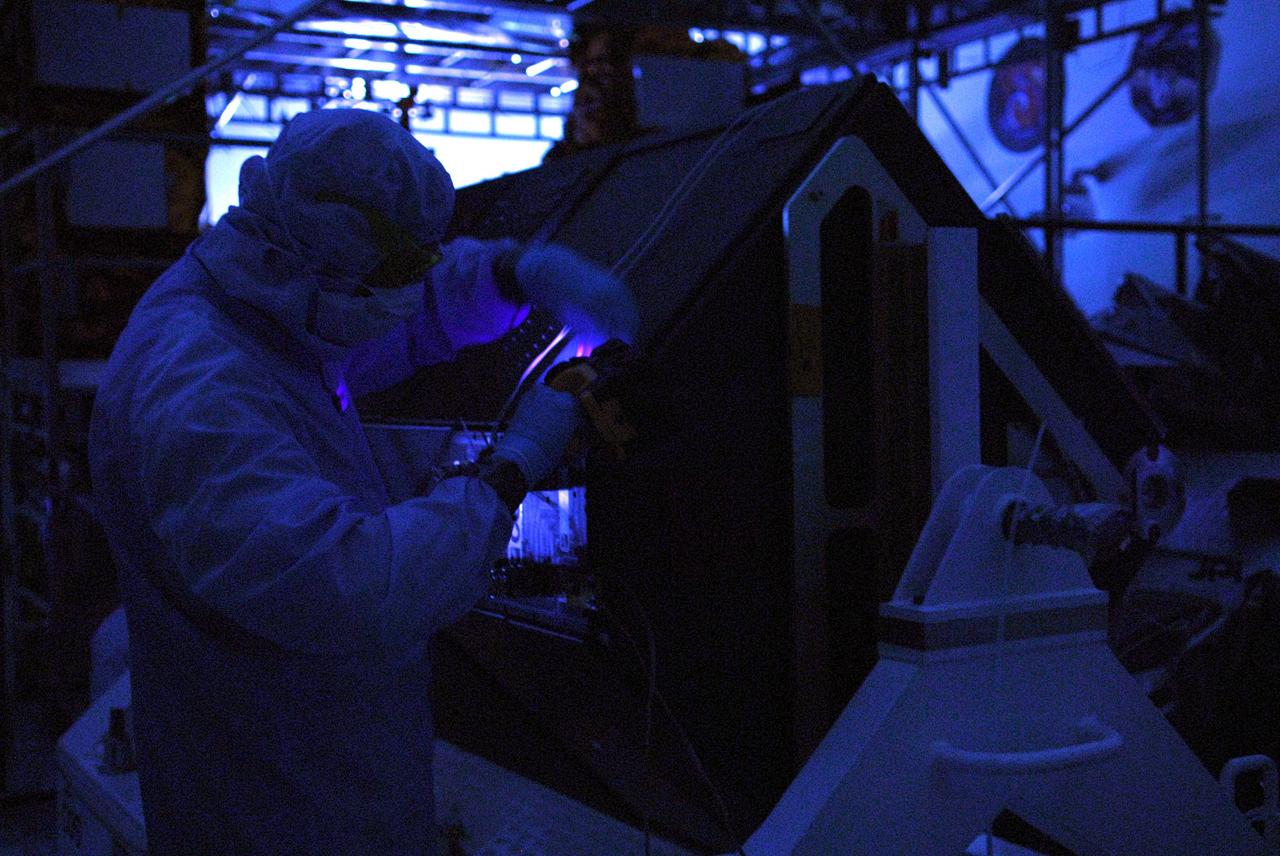
CAPE CANAVERAL, Fla. – In the clean room of the Payload Hazardous Processing Facility at NASA's Kennedy Space Center, a worker from NASA's Goddard Space Flight Center uses black light inspection for a thorough cleaning of the Cosmic Origins Spectrograph, or COS. Black light inspection uses UVA fluorescence to detect possible particulate microcontamination, minute cracks or fluid leaks. The COS will be installed on the Hubble Space Telescope on space shuttle Atlantis' STS-125 mission. COS will be the most sensitive ultraviolet spectrograph ever flown on Hubble and will probe the "cosmic web" - the large-scale structure of the universe whose form is determined by the gravity of dark matter and is traced by galaxies and intergalactic gas. The COS far-ultraviolet channel has a sensitivity 30 times greater than that of previous spectroscopic instruments for the detection of extremely low light levels. Launch of Atlantis on the STS-125 mission is targeted for Oct. 8. Photo credit: NASA/Kim Shiflett
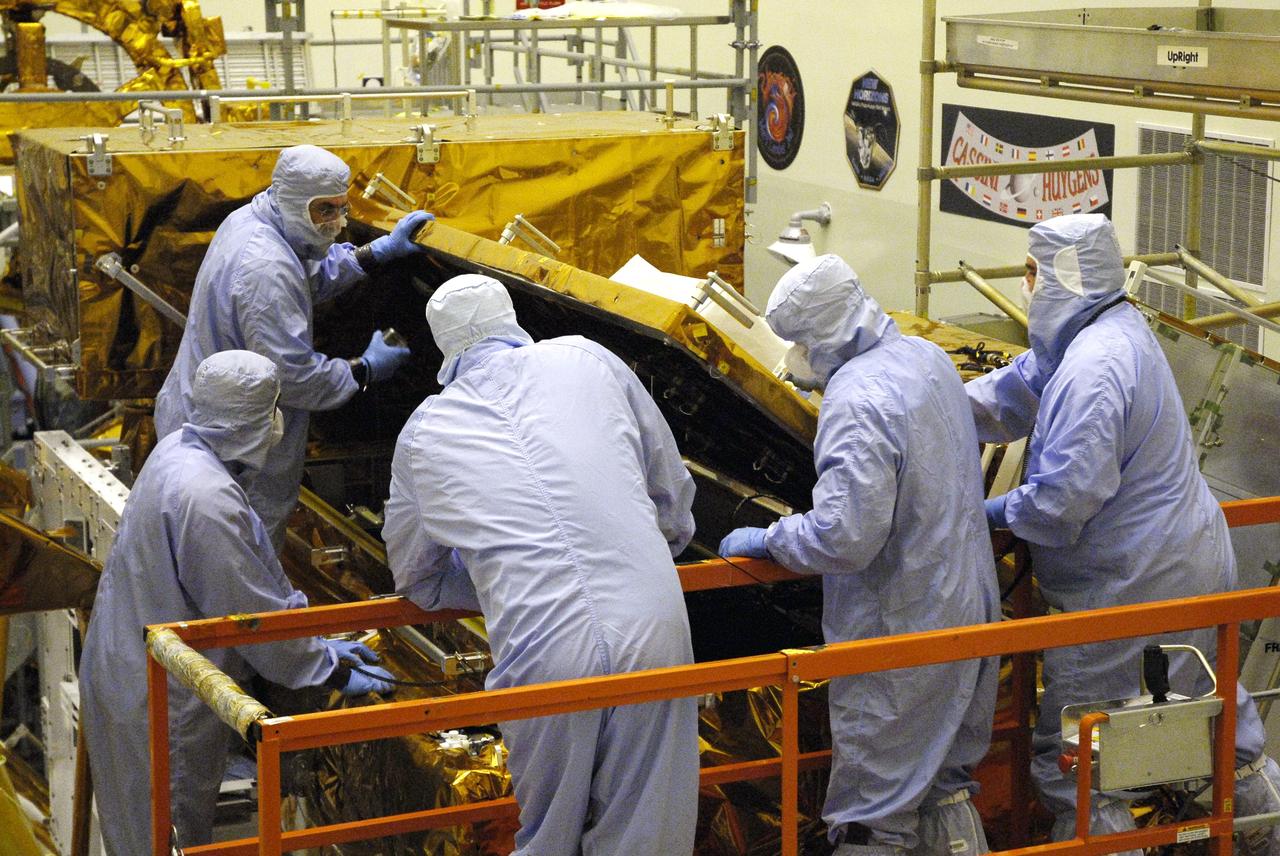
CAPE CANAVERAL, Fla. – In the Payload Hazardous Servicing Facility at NASA’s Kennedy Space Center, crew members with the STS-125 mission get a close look at some of the equipment associated with their mission to service NASA’s Hubble Space Telescope. In the foreground, center, are Mission Specialists Mike Massimino and Michael Good, looking at the box containing the Cosmic Origins Spectrograph, or COS, on the orbital replacement unit carrier. COS will be the most sensitive ultraviolet spectrograph ever flown on Hubble and will probe the "cosmic web" - the large-scale structure of the universe whose form is determined by the gravity of dark matter and is traced by galaxies and intergalactic gas. The STS-125 crew is taking part in a crew equipment interface test, which provides experience handling tools, equipment and hardware they will use on their mission. Space shuttle Atlantis is targeted to launch on the STS-125 mission Oct. 10. Photo credit: NASA/Kim Shiflett
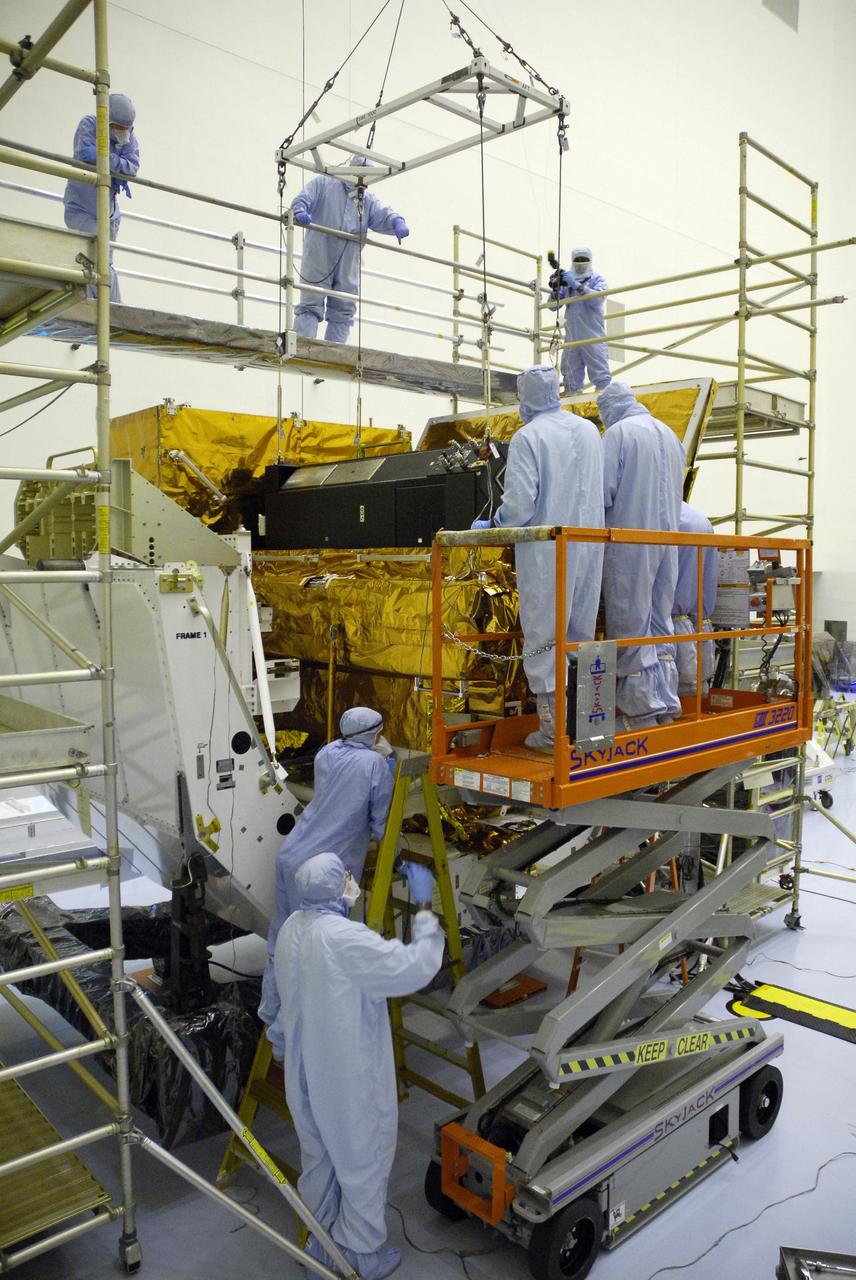
CAPE CANAVERAL, Fla. – In the clean room of the Payload Hazardous Processing Facility at NASA's Kennedy Space Center, an overhead crane lowers the Cosmic Origins Spectrograph, or COS, into a protective enclosure on the Orbital Replacement Unit Carrier, part of the payload for the fifth and final Hubble servicing mission, STS-125. Other payloads include the Flight Support System, the Super Lightweight Interchangeable Carrier and the Multi-Use Lightweight Equipment, or MULE, carrier. COS will be the most sensitive ultraviolet spectrograph ever flown on Hubble and will probe the "cosmic web" - the large-scale structure of the universe whose form is determined by the gravity of dark matter and is traced by galaxies and intergalactic gas. The COS far-ultraviolet channel has a sensitivity 30 times greater than that of previous spectroscopic instruments for the detection of extremely low light levels. Launch of Atlantis on the STS-125 mission is targeted for Oct. 8. Photo credit: NASA/Kim Shiflett
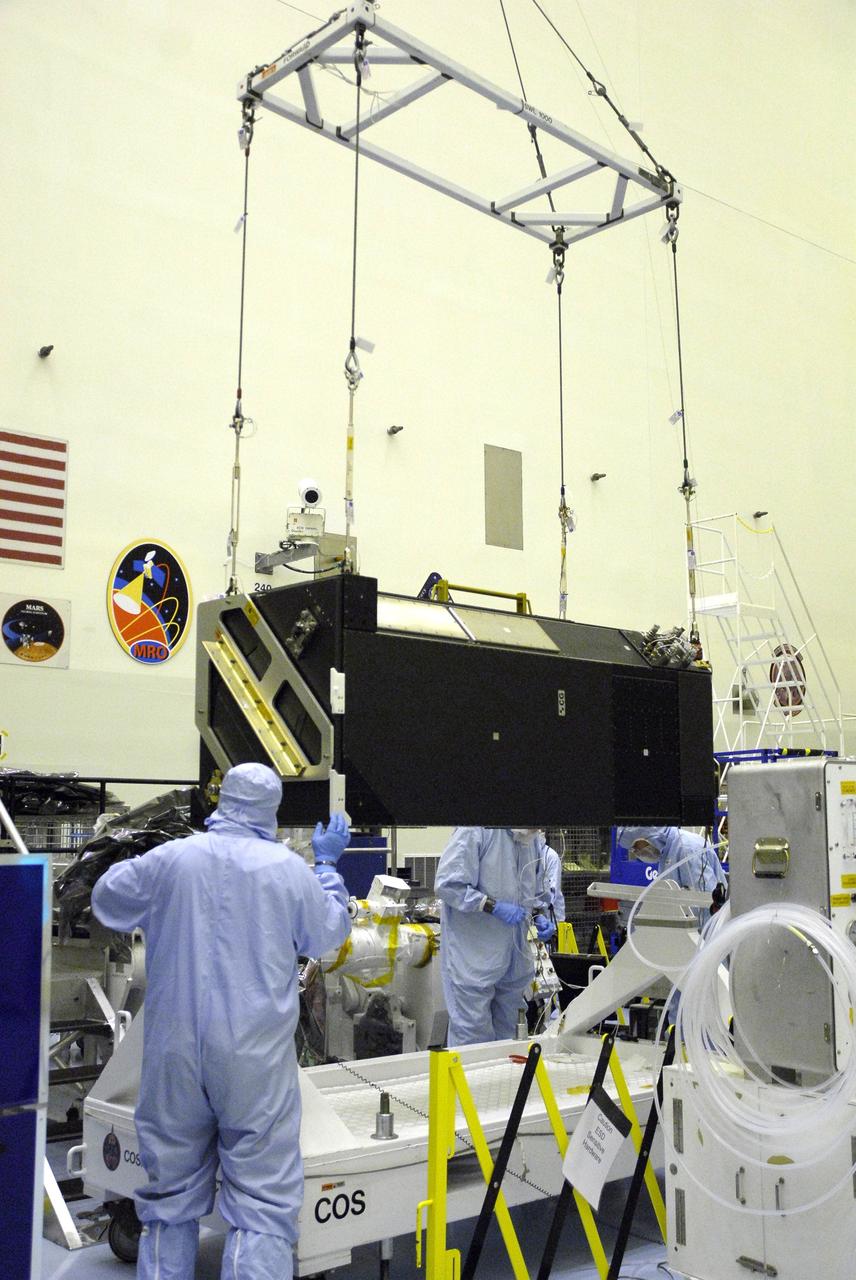
CAPE CANAVERAL, Fla. – In the clean room of the Payload Hazardous Processing Facility at NASA's Kennedy Space Center, an overhead crane lifts the Cosmic Origins Spectrograph, or COS. The COS is being lifted and moved to a protective enclosure on the Orbital Replacement Unit Carrier, part of the payload for the fifth and final Hubble servicing mission, STS-125. Other payloads include the Flight Support System, the Super Lightweight Interchangeable Carrier and the Multi-Use Lightweight Equipment, or MULE, carrier. COS will be the most sensitive ultraviolet spectrograph ever flown on Hubble and will probe the "cosmic web" - the large-scale structure of the universe whose form is determined by the gravity of dark matter and is traced by galaxies and intergalactic gas. The COS far-ultraviolet channel has a sensitivity 30 times greater than that of previous spectroscopic instruments for the detection of extremely low light levels. Launch of Atlantis on the STS-125 mission is targeted for Oct. 8. Photo credit: NASA/Kim Shiflett
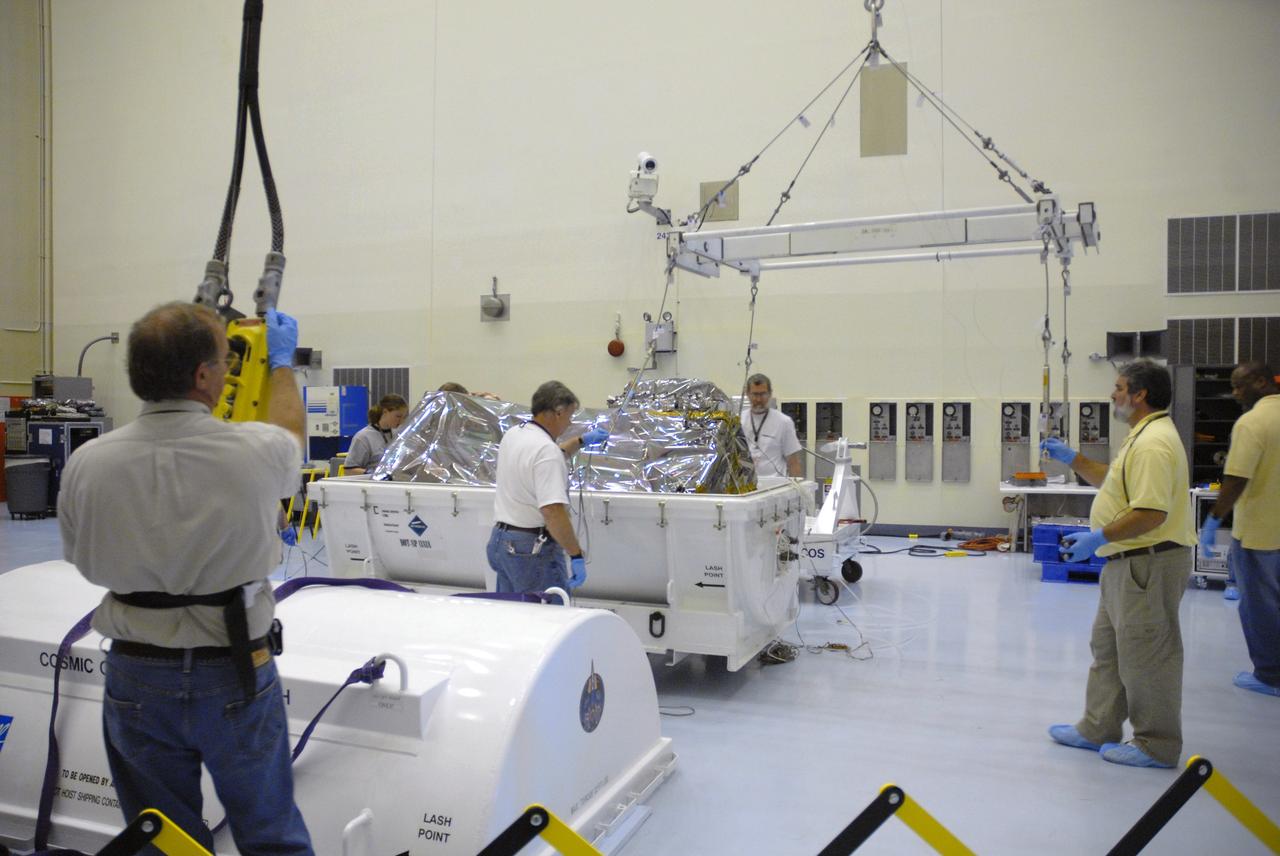
CAPE CANAVERAL, Fla. – In the airlock of the Payload Hazardous Servicing Facility at NASA's Kennedy Space Center, workers from NASA's Goddard Space Flight Center examine the Cosmic Origins Spectrograph, or COS, after the top from its transportation canister is removed. The COS will be installed on the Hubble Space Telescope on space shuttle Atlantis' STS-125 mission. COS will be the most sensitive ultraviolet spectrograph ever flown on Hubble and will probe the "cosmic web" - the large-scale structure of the universe whose form is determined by the gravity of dark matter and is traced by galaxies and intergalactic gas. COS's far-ultraviolet channel has a sensitivity 30 times greater than that of previous spectroscopic instruments for the detection of extremely low light levels. Launch of STS-125 is targeted for Oct. 8. Photo credit: NASA/Jack Pfaller
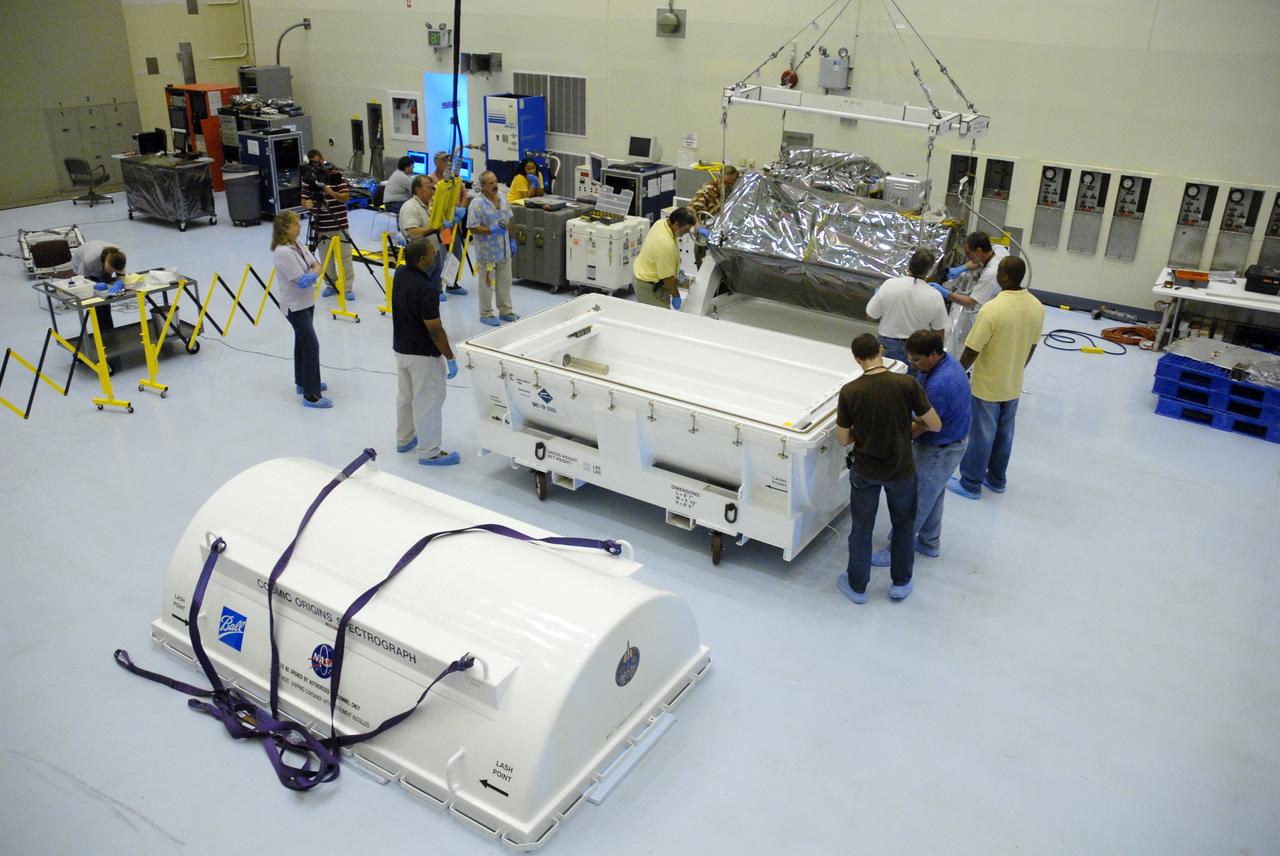
CAPE CANAVERAL, Fla. – In the airlock of the Payload Hazardous Servicing Facility at NASA's Kennedy Space Center, workers from NASA's Goddard Space Flight Center lower the Cosmic Origins Spectrograph, or COS, onto a dolly for its move into the clean room. The COS will be installed on the Hubble Space Telescope on space shuttle Atlantis' STS-125 mission. COS will be the most sensitive ultraviolet spectrograph ever flown on Hubble and will probe the "cosmic web" - the large-scale structure of the universe whose form is determined by the gravity of dark matter and is traced by galaxies and intergalactic gas. COS's far-ultraviolet channel has a sensitivity 30 times greater than that of previous spectroscopic instruments for the detection of extremely low light levels. Launch of STS-125 is targeted for Oct. 8. Photo credit: NASA/Jack Pfaller

CAPE CANAVERAL, Fla. – In the clean room of the Payload Hazardous Processing Facility at NASA's Kennedy Space Center, an overhead crane lifts the Cosmic Origins Spectrograph, or COS. The COS is being lifted and moved to a protective enclosure on the Orbital Replacement Unit Carrier, part of the payload for the fifth and final Hubble servicing mission, STS-125. Other payloads include the Flight Support System, the Super Lightweight Interchangeable Carrier and the Multi-Use Lightweight Equipment, or MULE, carrier. COS will be the most sensitive ultraviolet spectrograph ever flown on Hubble and will probe the "cosmic web" - the large-scale structure of the universe whose form is determined by the gravity of dark matter and is traced by galaxies and intergalactic gas. The COS far-ultraviolet channel has a sensitivity 30 times greater than that of previous spectroscopic instruments for the detection of extremely low light levels. Launch of Atlantis on the STS-125 mission is targeted for Oct. 8. Photo credit: NASA/Kim Shiflett
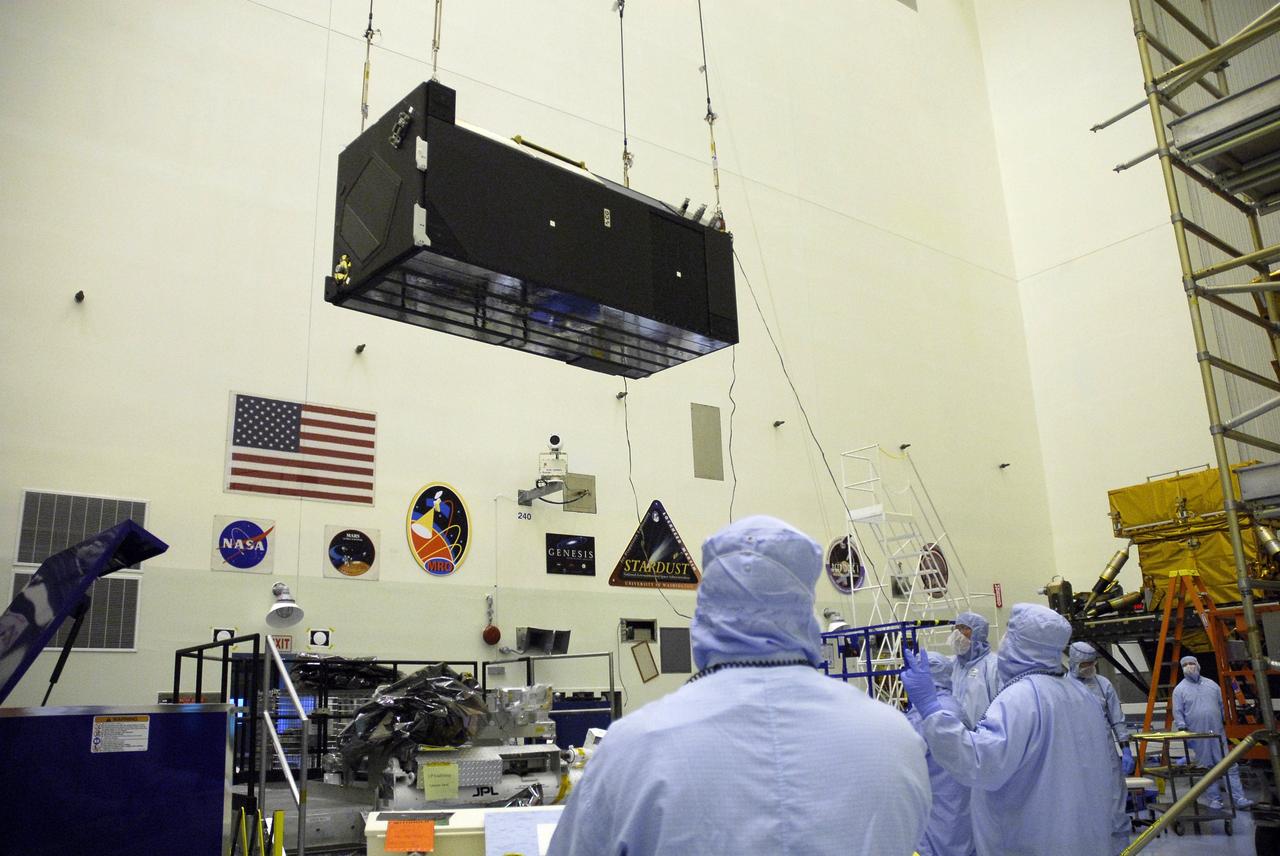
CAPE CANAVERAL, Fla. – In the clean room of the Payload Hazardous Processing Facility at NASA's Kennedy Space Center, an overhead crane moves the Cosmic Origins Spectrograph, or COS, toward a protective enclosure on the Orbital Replacement Unit Carrier, part of the payload for the fifth and final Hubble servicing mission, STS-125. Other payloads include the Flight Support System, the Super Lightweight Interchangeable Carrier and the Multi-Use Lightweight Equipment, or MULE, carrier. COS will be the most sensitive ultraviolet spectrograph ever flown on Hubble and will probe the "cosmic web" - the large-scale structure of the universe whose form is determined by the gravity of dark matter and is traced by galaxies and intergalactic gas. The COS far-ultraviolet channel has a sensitivity 30 times greater than that of previous spectroscopic instruments for the detection of extremely low light levels. Launch of Atlantis on the STS-125 mission is targeted for Oct. 8. Photo credit: NASA/Kim Shiflett
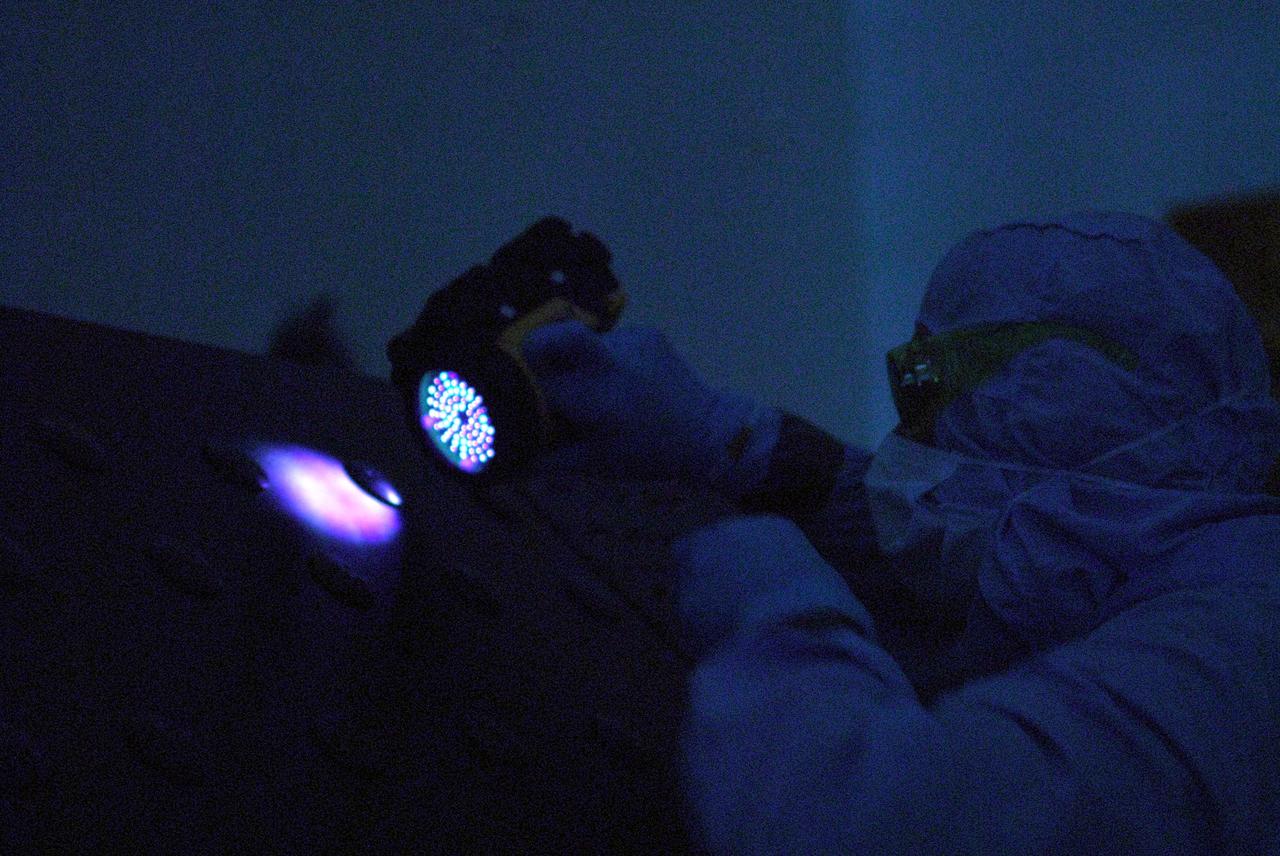
CAPE CANAVERAL, Fla. –In the clean room of the Payload Hazardous Processing Facility at NASA's Kennedy Space Center, a worker from NASA's Goddard Space Flight Center uses black light inspection for a thorough cleaning of the Cosmic Origins Spectrograph, or COS. Black light inspection uses UVA fluorescence to detect possible particulate microcontamination, minute cracks or fluid leaks. The COS will be installed on the Hubble Space Telescope on space shuttle Atlantis' STS-125 mission. COS will be the most sensitive ultraviolet spectrograph ever flown on Hubble and will probe the "cosmic web" - the large-scale structure of the universe whose form is determined by the gravity of dark matter and is traced by galaxies and intergalactic gas. The COS far-ultraviolet channel has a sensitivity 30 times greater than that of previous spectroscopic instruments for the detection of extremely low light levels. Launch of Atlantis on the STS-125 mission is targeted for Oct. 8. Photo credit: NASA/Kim Shiflett
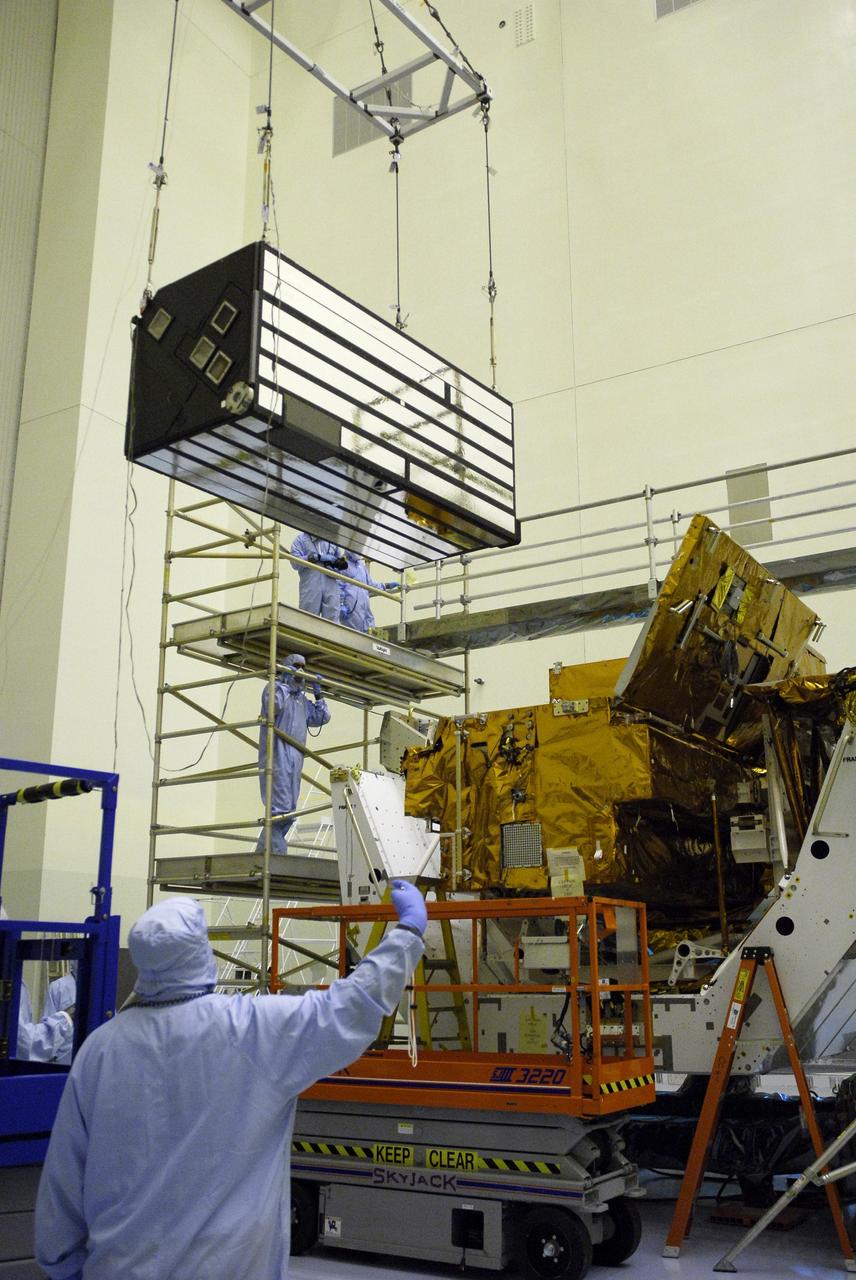
CAPE CANAVERAL, Fla. – In the clean room of the Payload Hazardous Processing Facility at NASA's Kennedy Space Center, an overhead crane lowers the Cosmic Origins Spectrograph, or COS, toward a protective enclosure on the Orbital Replacement Unit Carrier, part of the payload for the fifth and final Hubble servicing mission, STS-125. Other payloads include the Flight Support System, the Super Lightweight Interchangeable Carrier and the Multi-Use Lightweight Equipment, or MULE, carrier. COS will be the most sensitive ultraviolet spectrograph ever flown on Hubble and will probe the "cosmic web" - the large-scale structure of the universe whose form is determined by the gravity of dark matter and is traced by galaxies and intergalactic gas. The COS far-ultraviolet channel has a sensitivity 30 times greater than that of previous spectroscopic instruments for the detection of extremely low light levels. Launch of Atlantis on the STS-125 mission is targeted for Oct. 8. Photo credit: NASA/Kim Shiflett

CAPE CANAVERAL, Fla. –The outside of the Cosmic Origins Spectrograph, or COS, is seen before black light inspection in the clean room of the Payload Hazardous Processing Facility at NASA's Kennedy Space Center. Black light inspection uses UVA fluorescence to detect possible particulate microcontamination, minute cracks or fluid leaks. The COS will be installed on the Hubble Space Telescope on space shuttle Atlantis' STS-125 mission. COS will be the most sensitive ultraviolet spectrograph ever flown on Hubble and will probe the "cosmic web" - the large-scale structure of the universe whose form is determined by the gravity of dark matter and is traced by galaxies and intergalactic gas. The COS far-ultraviolet channel has a sensitivity 30 times greater than that of previous spectroscopic instruments for the detection of extremely low light levels. Launch of Atlantis on the STS-125 mission is targeted for Oct. 8. Photo credit: NASA/Kim Shiflett
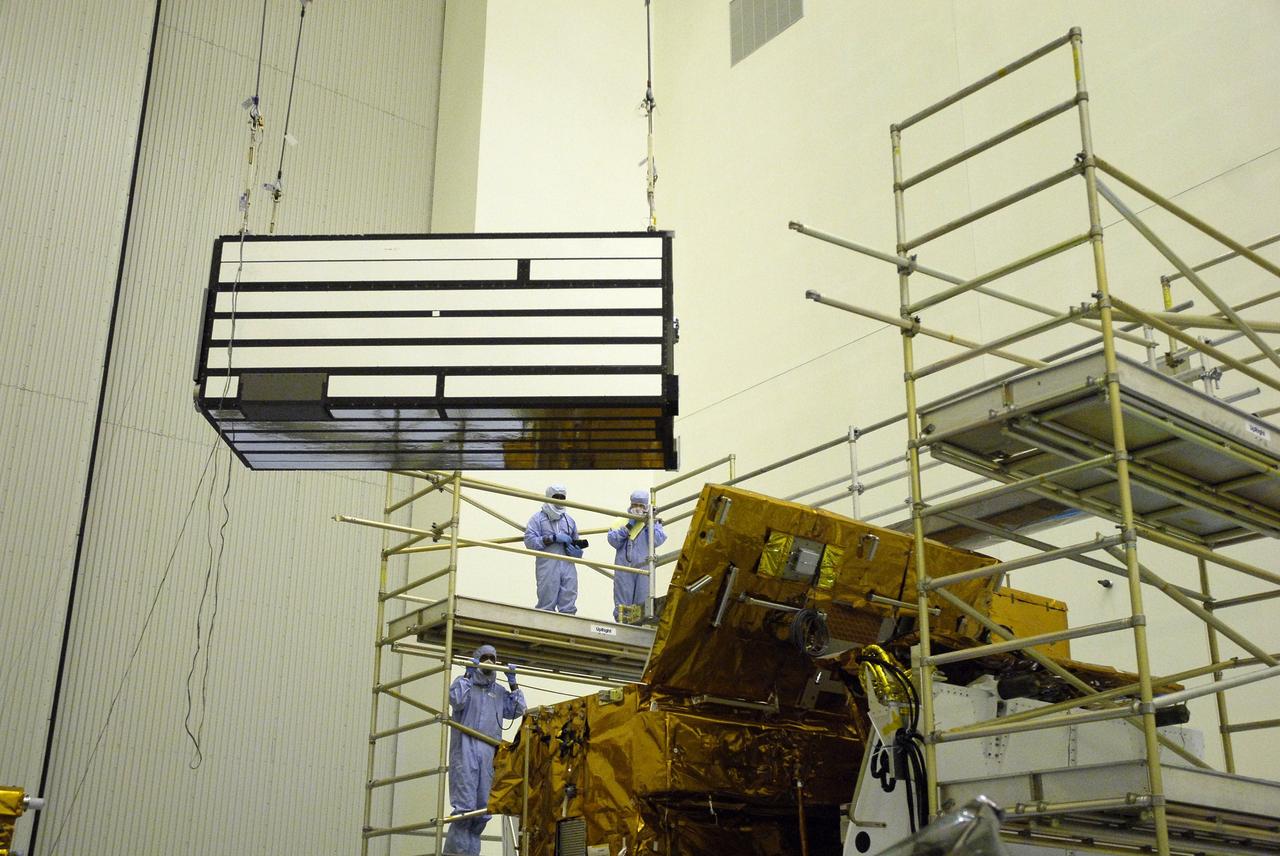
CAPE CANAVERAL, Fla. – In the clean room of the Payload Hazardous Processing Facility at NASA's Kennedy Space Center, an overhead crane lowers the Cosmic Origins Spectrograph, or COS, toward a protective enclosure on the Orbital Replacement Unit Carrier, part of the payload for the fifth and final Hubble servicing mission, STS-125. Other payloads include the Flight Support System, the Super Lightweight Interchangeable Carrier and the Multi-Use Lightweight Equipment, or MULE, carrier. COS will be the most sensitive ultraviolet spectrograph ever flown on Hubble and will probe the "cosmic web" - the large-scale structure of the universe whose form is determined by the gravity of dark matter and is traced by galaxies and intergalactic gas. The COS far-ultraviolet channel has a sensitivity 30 times greater than that of previous spectroscopic instruments for the detection of extremely low light levels. Launch of Atlantis on the STS-125 mission is targeted for Oct. 8. Photo credit: NASA/Kim Shiflett
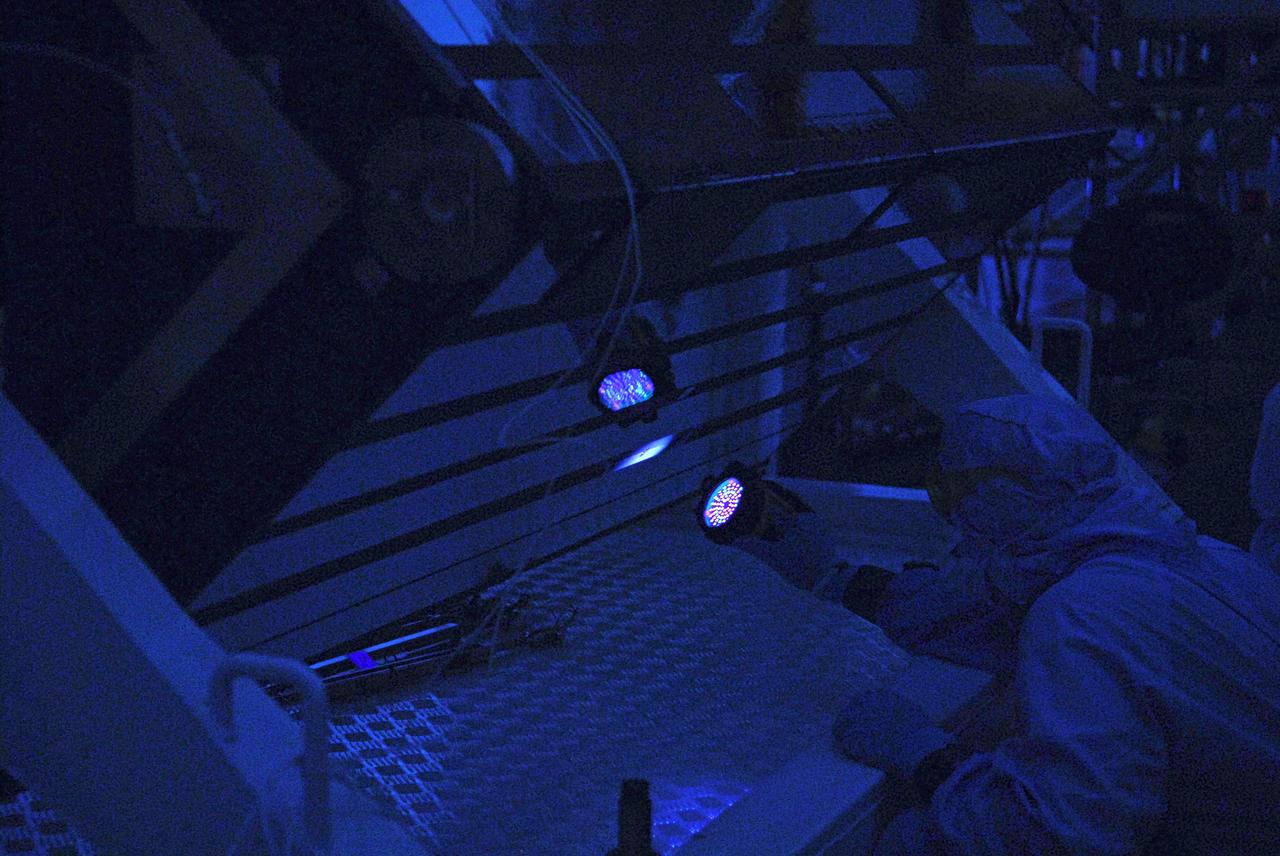
CAPE CANAVERAL, Fla. – In the clean room of the Payload Hazardous Processing Facility at NASA's Kennedy Space Center, a worker from NASA's Goddard Space Flight Center uses black light inspection for a thorough cleaning of the Cosmic Origins Spectrograph, or COS. Black light inspection uses UVA fluorescence to detect possible particulate microcontamination, minute cracks or fluid leaks. The COS will be installed on the Hubble Space Telescope on space shuttle Atlantis' STS-125 mission. COS will be the most sensitive ultraviolet spectrograph ever flown on Hubble and will probe the "cosmic web" - the large-scale structure of the universe whose form is determined by the gravity of dark matter and is traced by galaxies and intergalactic gas. The COS far-ultraviolet channel has a sensitivity 30 times greater than that of previous spectroscopic instruments for the detection of extremely low light levels. Launch of Atlantis on the STS-125 mission is targeted for Oct. 8. Photo credit: NASA/Kim Shiflett
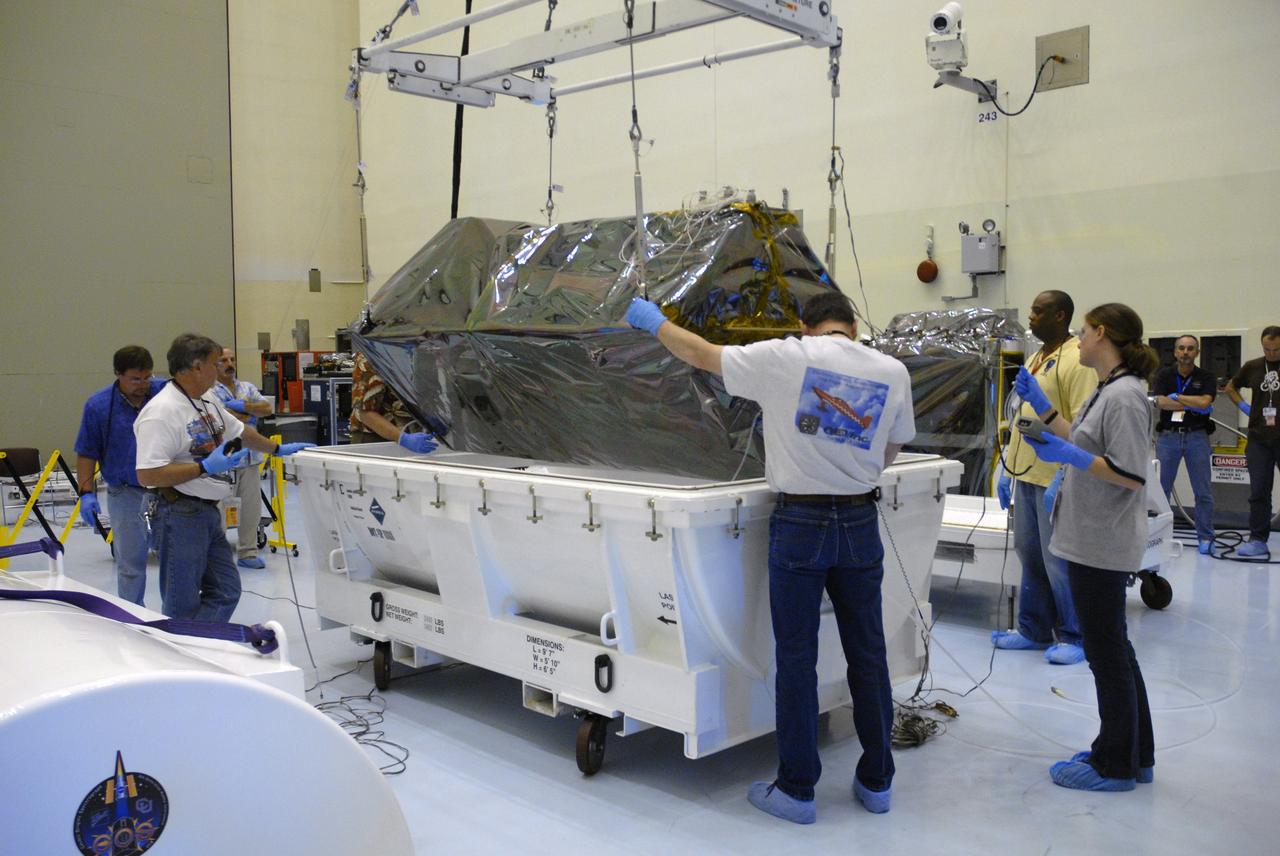
CAPE CANAVERAL, Fla. – In the airlock of the Payload Hazardous Servicing Facility at NASA's Kennedy Space Center, workers from NASA's Goddard Space Flight Center prepare to lift the Cosmic Origins Spectrograph, or COS, from its transportation canister. The COS will be installed on the Hubble Space Telescope on space shuttle Atlantis' STS-125 mission. COS will be the most sensitive ultraviolet spectrograph ever flown on Hubble and will probe the "cosmic web" - the large-scale structure of the universe whose form is determined by the gravity of dark matter and is traced by galaxies and intergalactic gas. COS's far-ultraviolet channel has a sensitivity 30 times greater than that of previous spectroscopic instruments for the detection of extremely low light levels. Launch of STS-125 is targeted for Oct. 8. Photo credit: NASA/Jack Pfaller
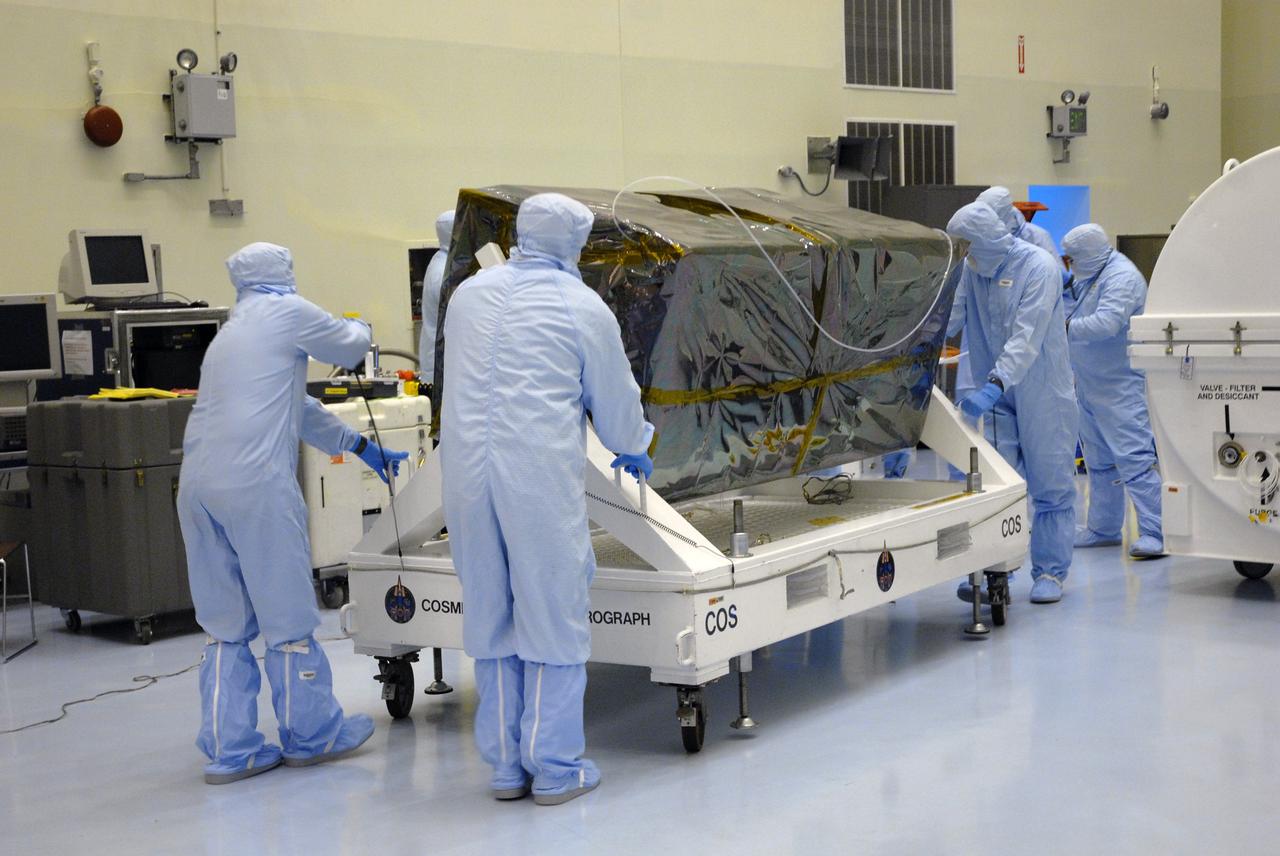
CAPE CANAVERAL, Fla. – At NASA's Kennedy Space Center, workers from NASA's Goddard Space Flight Center roll the Cosmic Origins Spectrograph, or COS, from the airlock, where it was removed from the shipping container, to the clean room of the Payload Hazardous Servicing Facility. The COS will be installed on the Hubble Space Telescope on space shuttle Atlantis' STS-125 mission. COS will be the most sensitive ultraviolet spectrograph ever flown on Hubble and will probe the "cosmic web" - the large-scale structure of the universe whose form is determined by the gravity of dark matter and is traced by galaxies and intergalactic gas. COS's far-ultraviolet channel has a sensitivity 30 times greater than that of previous spectroscopic instruments for the detection of extremely low light levels. Launch of STS-125 is targeted for Oct. 8. Photo credit: NASA/Jack Pfaller

CAPE CANAVERAL, Fla. – At NASA's Kennedy Space Center, workers from NASA's Goddard Space Flight Center roll the Cosmic Origins Spectrograph, or COS, into position in the clean room of the Payload Hazardous Servicing Facility for instrument testing. The COS will be installed on the Hubble Space Telescope on space shuttle Atlantis' STS-125 mission. COS will be the most sensitive ultraviolet spectrograph ever flown on Hubble and will probe the "cosmic web" - the large-scale structure of the universe whose form is determined by the gravity of dark matter and is traced by galaxies and intergalactic gas. COS's far-ultraviolet channel has a sensitivity 30 times greater than that of previous spectroscopic instruments for the detection of extremely low light levels. Launch of STS-125 is targeted for Oct. 8. Photo credit: NASA/Jack Pfaller
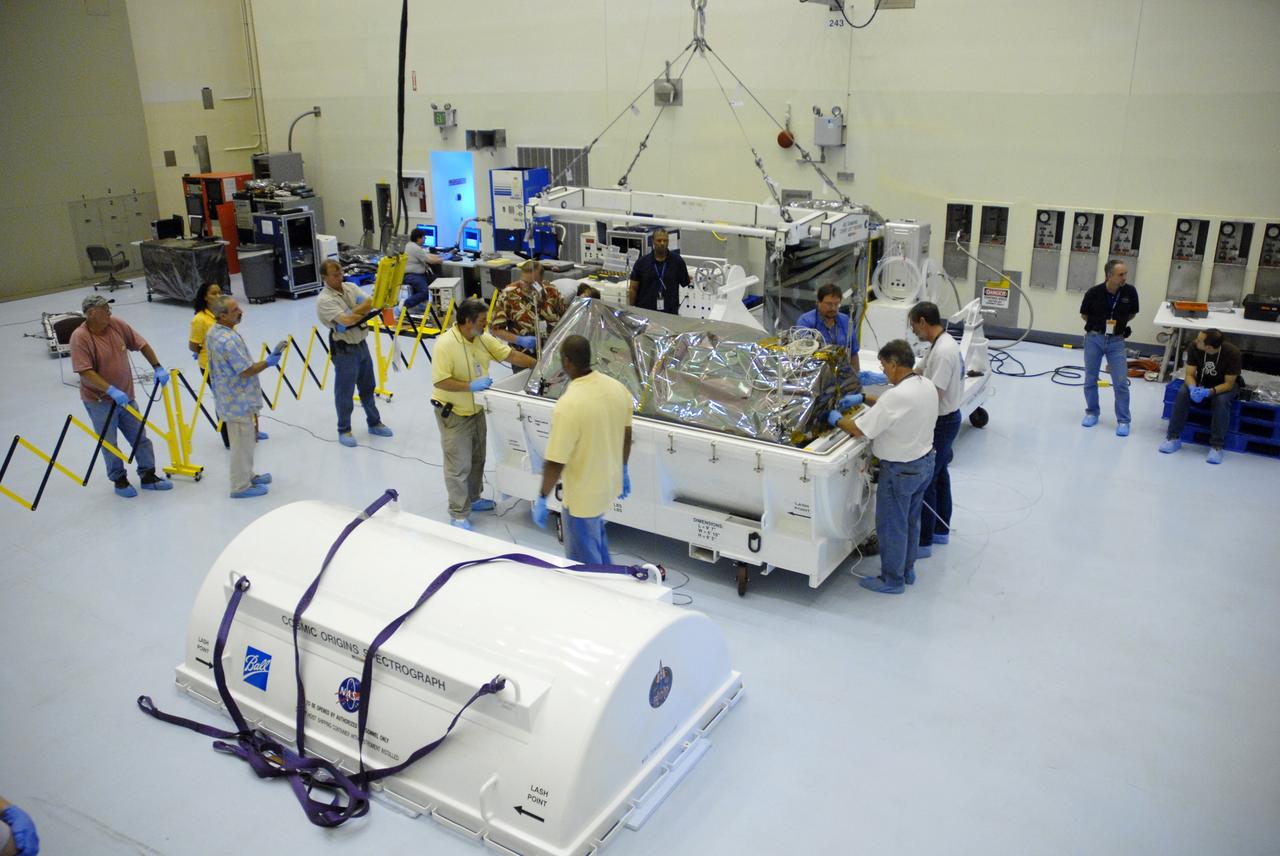
CAPE CANAVERAL, Fla. – In the airlock of the Payload Hazardous Servicing Facility at NASA's Kennedy Space Center, workers from NASA's Goddard Space Flight Center prepare to remove the Cosmic Origins Spectrograph, or COS, from its transportation canister. The COS will be installed on the Hubble Space Telescope on space shuttle Atlantis' STS-125 mission. COS will be the most sensitive ultraviolet spectrograph ever flown on Hubble and will probe the "cosmic web" - the large-scale structure of the universe whose form is determined by the gravity of dark matter and is traced by galaxies and intergalactic gas. COS's far-ultraviolet channel has a sensitivity 30 times greater than that of previous spectroscopic instruments for the detection of extremely low light levels. Launch of STS-125 is targeted for Oct. 8. Photo credit: NASA/Jack Pfaller
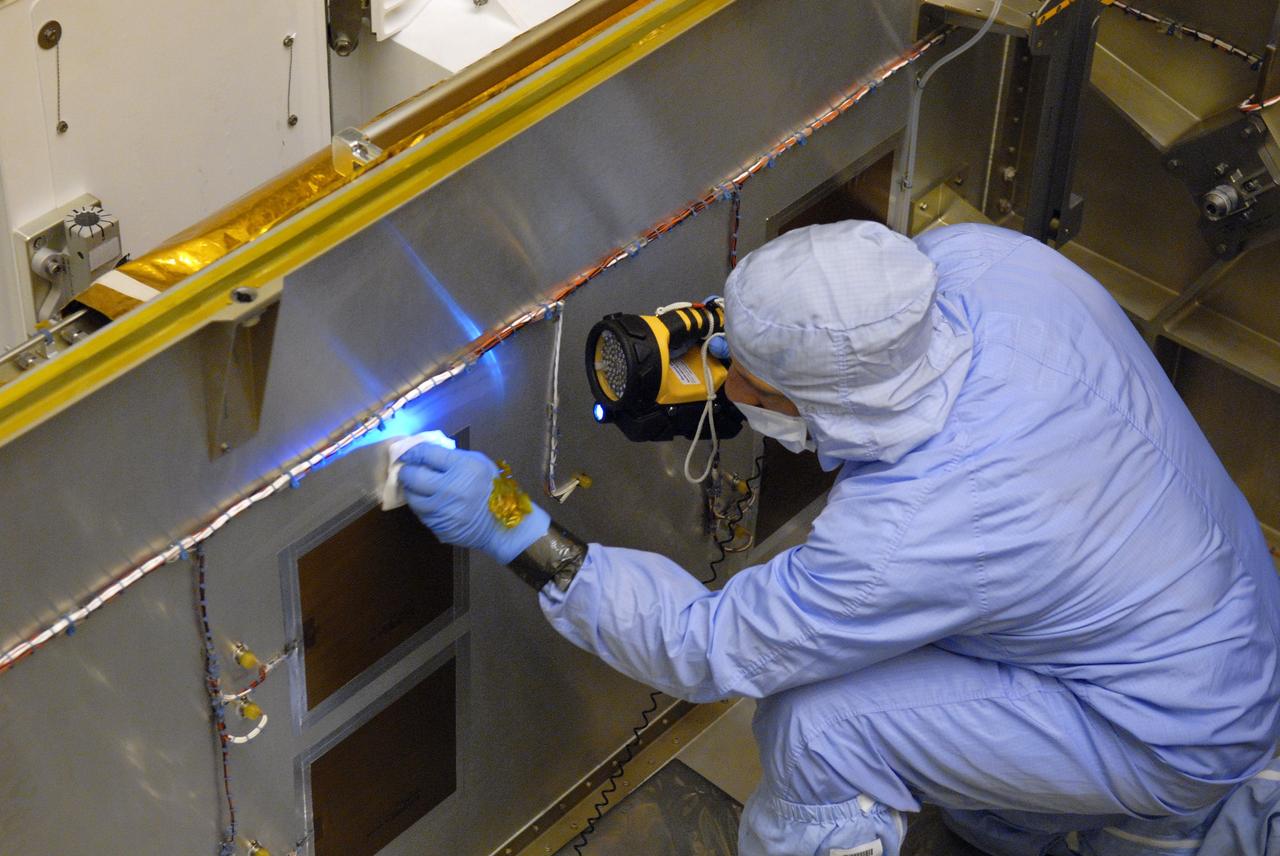
CAPE CANAVERAL, Fla. – In the clean room of the Payload Hazardous Processing Facility at NASA's Kennedy Space Center, workers from NASA's Goddard Space Flight Center use black light inspection for a thorough cleaning of the protective carrier for the Cosmic Origins Spectrograph, or COS. Black light inspection uses UVA fluorescence to detect possible particulate microcontamination, minute cracks or fluid leaks. The COS will be installed on the Hubble Space Telescope on space shuttle Atlantis' STS-125 mission. COS will be the most sensitive ultraviolet spectrograph ever flown on Hubble and will probe the "cosmic web" - the large-scale structure of the universe whose form is determined by the gravity of dark matter and is traced by galaxies and intergalactic gas. The COS far-ultraviolet channel has a sensitivity 30 times greater than that of previous spectroscopic instruments for the detection of extremely low light levels. Launch of Atlantis on the STS-125 mission is targeted for Oct. 8. Photo credit: NASA/Kim Shiflett
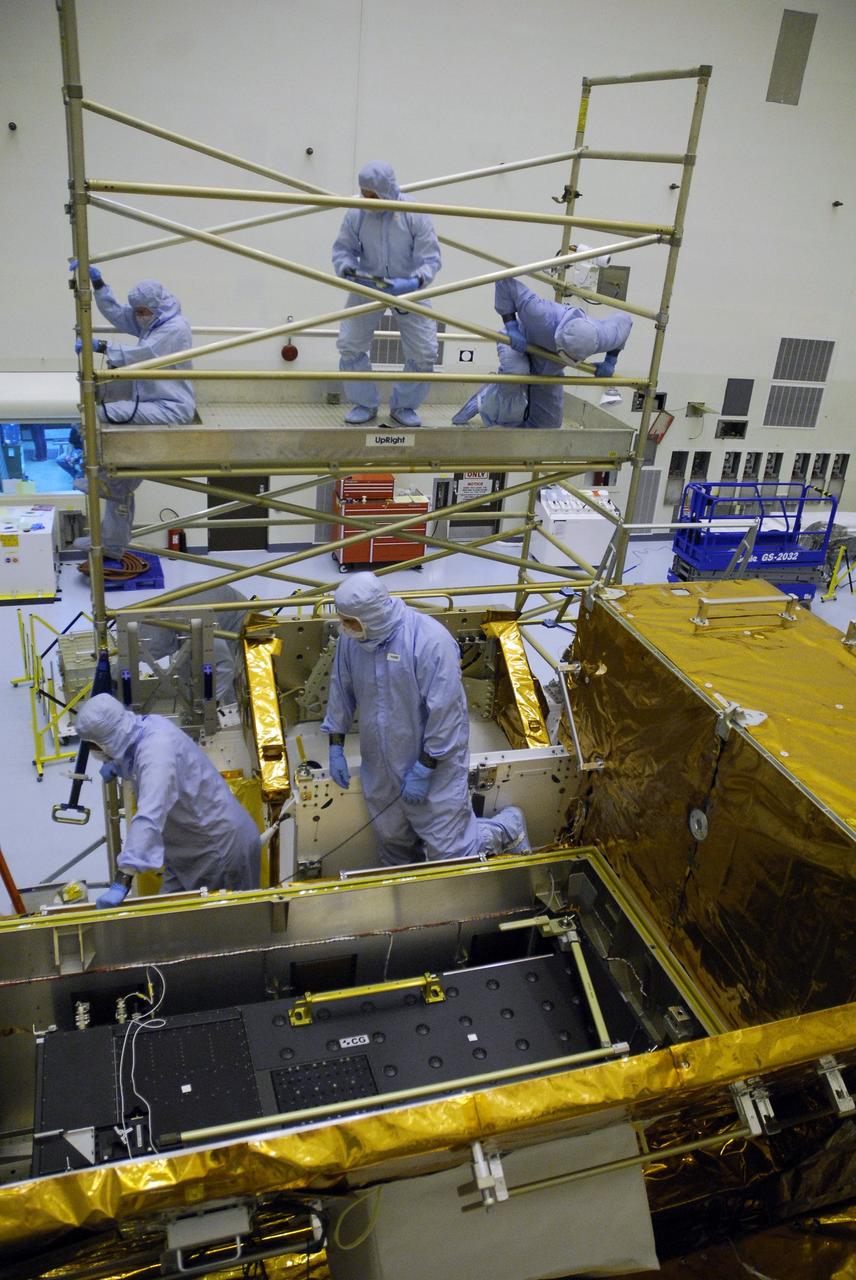
CAPE CANAVERAL, Fla. – In the Payload Hazardous Servicing Facility at NASA’s Kennedy Space Center, crew members with the STS-125 mission get a close look at some of the equipment associated with their mission to service NASA’s Hubble Space Telescope. Looking at the box containing the Cosmic Origins Spectrograph, or COS, on the orbital replacement unit carrier are Mission Specialist Michael Good (upper right, on stand) and HST inspectors. COS will be the most sensitive ultraviolet spectrograph ever flown on Hubble and will probe the "cosmic web" - the large-scale structure of the universe whose form is determined by the gravity of dark matter and is traced by galaxies and intergalactic gas. The STS-125 crew is taking part in a crew equipment interface test, which provides experience handling tools, equipment and hardware they will use on their mission. Space shuttle Atlantis is targeted to launch on the STS-125 mission Oct. 10. Photo credit: NASA/Kim Shiflett
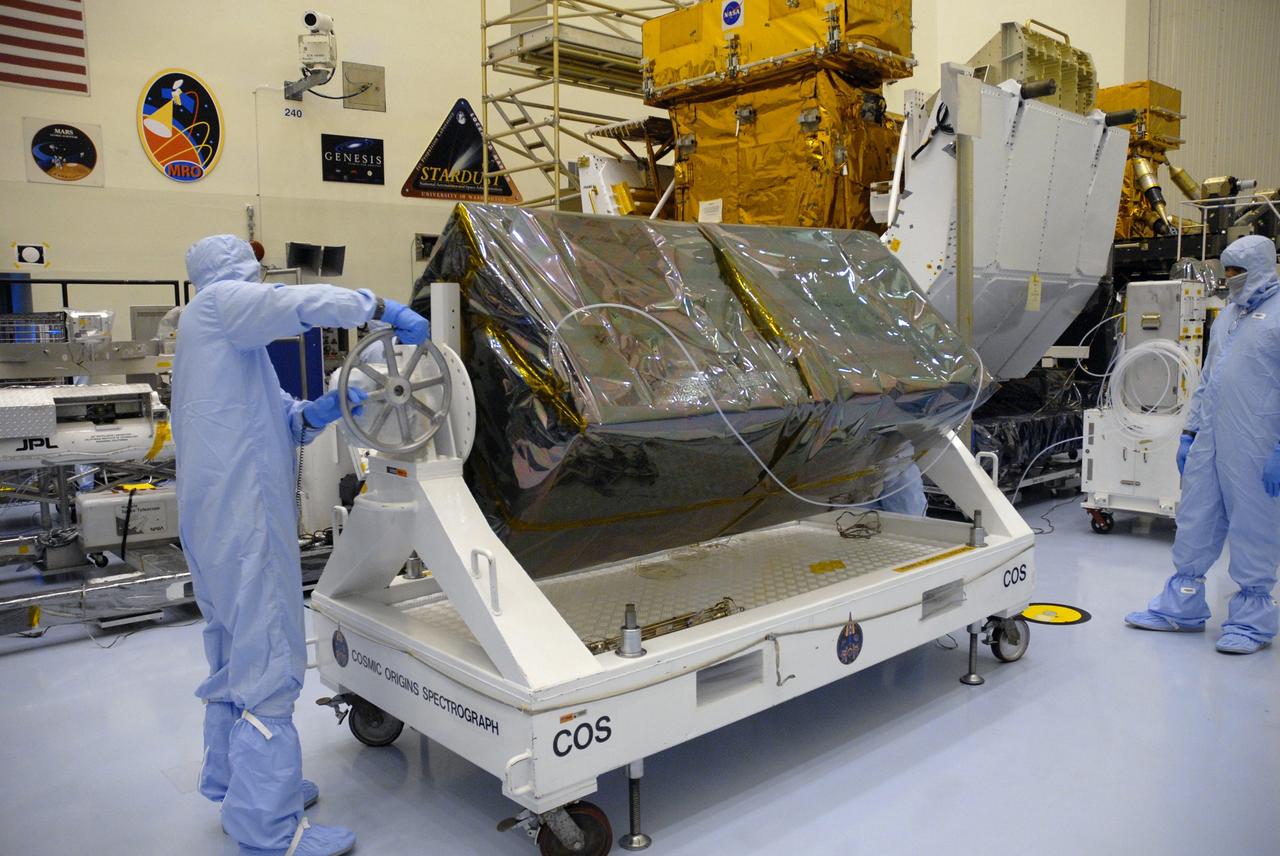
CAPE CANAVERAL, Fla. – At NASA's Kennedy Space Center, workers from NASA's Goddard Space Flight Center prepare the Cosmic Origins Spectrograph, or COS, for instrument testing and integration with the Flight Support System carrier in the clean room of the Payload Hazardous Servicing Facility. The COS will be installed on the Hubble Space Telescope on space shuttle Atlantis' STS-125 mission. COS will be the most sensitive ultraviolet spectrograph ever flown on Hubble and will probe the "cosmic web" - the large-scale structure of the universe whose form is determined by the gravity of dark matter and is traced by galaxies and intergalactic gas. COS's far-ultraviolet channel has a sensitivity 30 times greater than that of previous spectroscopic instruments for the detection of extremely low light levels. Launch of STS-125 is targeted for Oct. 8. Photo credit: NASA/Jack Pfaller
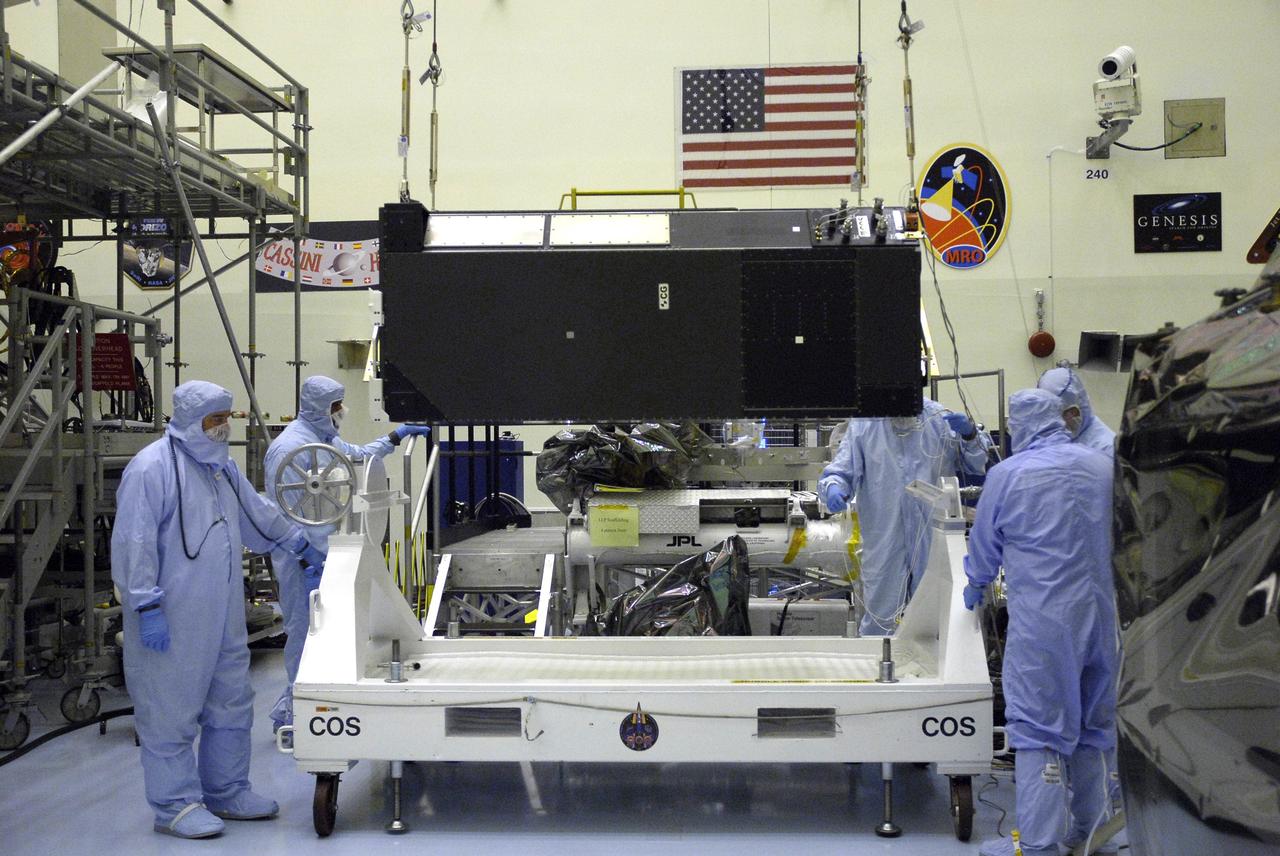
CAPE CANAVERAL, Fla. – In the clean room of the Payload Hazardous Processing Facility at NASA's Kennedy Space Center, an overhead crane lifts the Cosmic Origins Spectrograph, or COS. The COS is being lifted and moved to a protective enclosure on the Orbital Replacement Unit Carrier, part of the payload for the fifth and final Hubble servicing mission, STS-125. Other payloads include the Flight Support System, the Super Lightweight Interchangeable Carrier and the Multi-Use Lightweight Equipment, or MULE, carrier. COS will be the most sensitive ultraviolet spectrograph ever flown on Hubble and will probe the "cosmic web" - the large-scale structure of the universe whose form is determined by the gravity of dark matter and is traced by galaxies and intergalactic gas. The COS far-ultraviolet channel has a sensitivity 30 times greater than that of previous spectroscopic instruments for the detection of extremely low light levels. Launch of Atlantis on the STS-125 mission is targeted for Oct. 8. Photo credit: NASA/Kim Shiflett
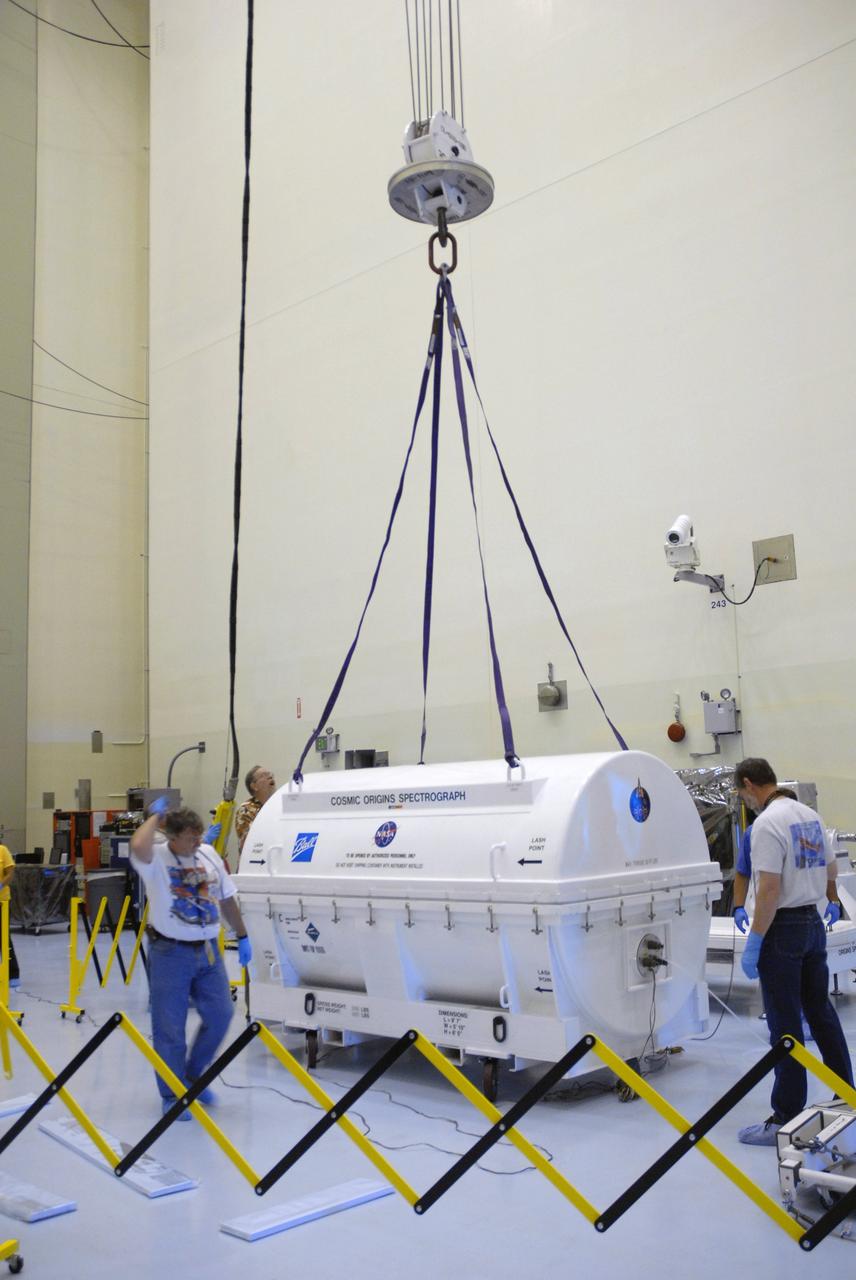
CAPE CANAVERAL, Fla. – At NASA's Kennedy Space Center, workers from NASA's Goddard Space Flight Center receive the Cosmic Origins Spectrograph, or COS, secured in its transportation canister, in the airlock of the Payload Hazardous Servicing Facility. The COS will be installed on the Hubble Space Telescope on space shuttle Atlantis' STS-125 mission. COS will be the most sensitive ultraviolet spectrograph ever flown on Hubble and will probe the "cosmic web" - the large-scale structure of the universe whose form is determined by the gravity of dark matter and is traced by galaxies and intergalactic gas. COS's far-ultraviolet channel has a sensitivity 30 times greater than that of previous spectroscopic instruments for the detection of extremely low light levels. Launch of STS-125 is targeted for Oct. 8. Photo credit: NASA/Jack Pfaller
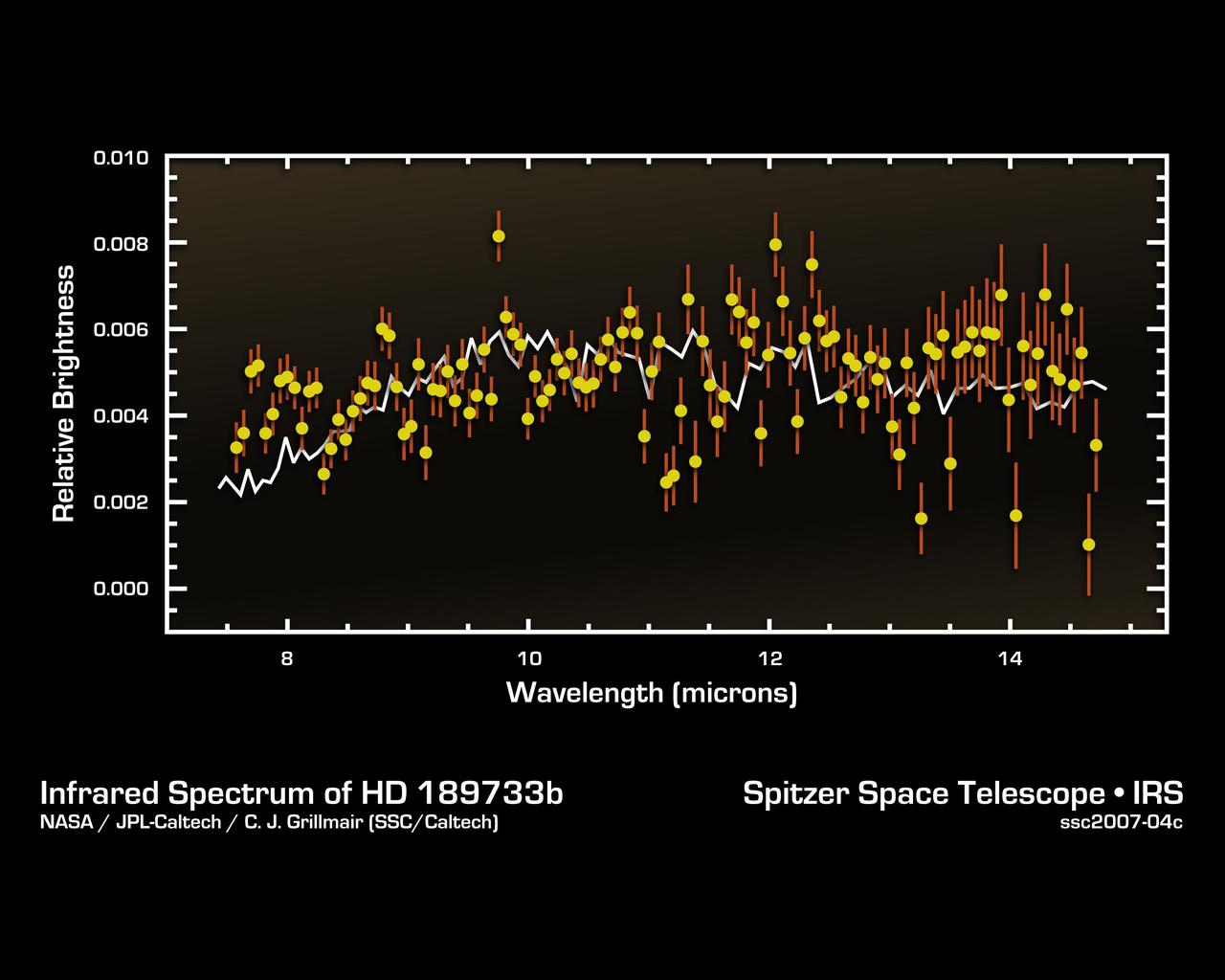
This infrared data from NASA's Spitzer Space Telescope -- called a spectrum -- tells astronomers that a distant gas planet, a so-called "hot Jupiter" called HD 189733b, might be smothered with high clouds. It is one of the first spectra of an alien world. A spectrum is created when an instrument called a spectrograph cracks light from an object open into a rainbow of different wavelengths. Patterns or ripples within the spectrum indicate the presence, or absence, of molecules making up the object. Astronomers using Spitzer's spectrograph were able to obtain infrared spectra for two so-called "transiting" hot-Jupiter planets using the "secondary eclipse" technique. In this method, the spectrograph first collects the combined infrared light from the planet plus its star, then, as the planet is eclipsed by the star, the infrared light of just the star. Subtracting the latter from the former reveals the planet's own rainbow of infrared colors. Astronomers were perplexed when they first saw the infrared spectrum above. It doesn't look anything like what theorists had predicted. Theorists thought the spectra of hot, Jupiter-like planets like this one would be filled with the signatures of molecules in the planets' atmospheres. But the spectrum doesn't show any molecules, and is instead what astronomers call "flat." For example, theorists thought there'd be a strong signature of water in the form of a big drop in the wavelength range between 7 and 10 microns. The fact that water is not detected may indicate that it is hidden underneath a thick blanket of high, dry clouds. The average brightness of the spectrum is also a bit lower than theoretical predictions, suggesting that very high winds are rapidly moving the terrific heat of the noonday sun from the day side of HD 189733b to the night side. This spectrum was produced by Dr. Carl Grillmair of NASA's Spitzer Science Center at the California Institute of Technology in Pasadena, Calif., and his colleagues. The data were taken by Spitzer's infrared spectrograph on November 22, 2006. http://photojournal.jpl.nasa.gov/catalog/PIA09199
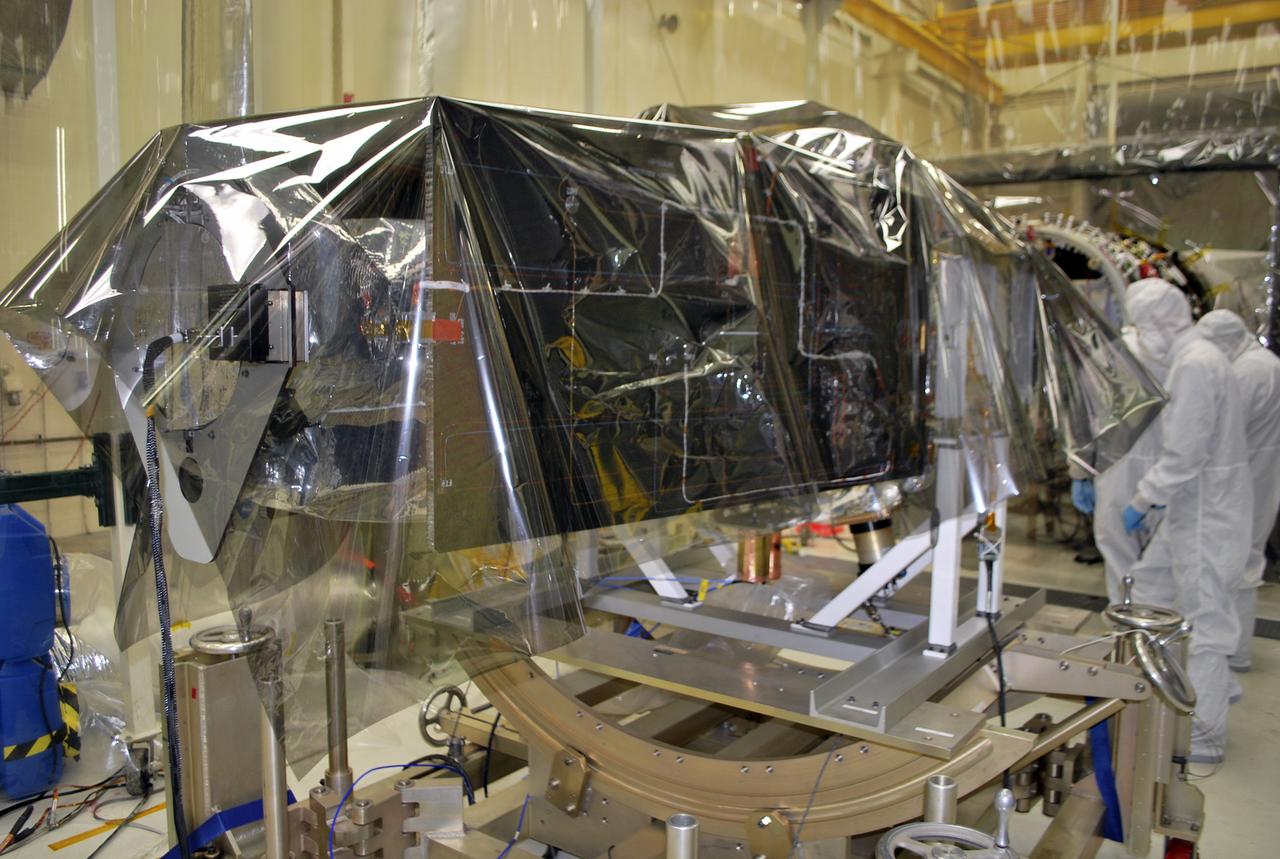
VANDENBERG AFB, Calif. – Technicians process NASA's IRIS spacecraft for launch aboard an Orbital Pegasus XL rocket. Working inside a clean room tent at Vandenberg, the technicians will conduct numerous tests and assembly operations on the spacecraft and rocket ahead of the launch. IRIS is short for Interface Region Imaging Spectrograph and the spacecraft's mission will improve our understanding of how heat and energy move through the deepest levels of the sun’s atmosphere, thereby increasing our ability to forecast space weather. Photo credit: VAFB_Randy Beaudoin
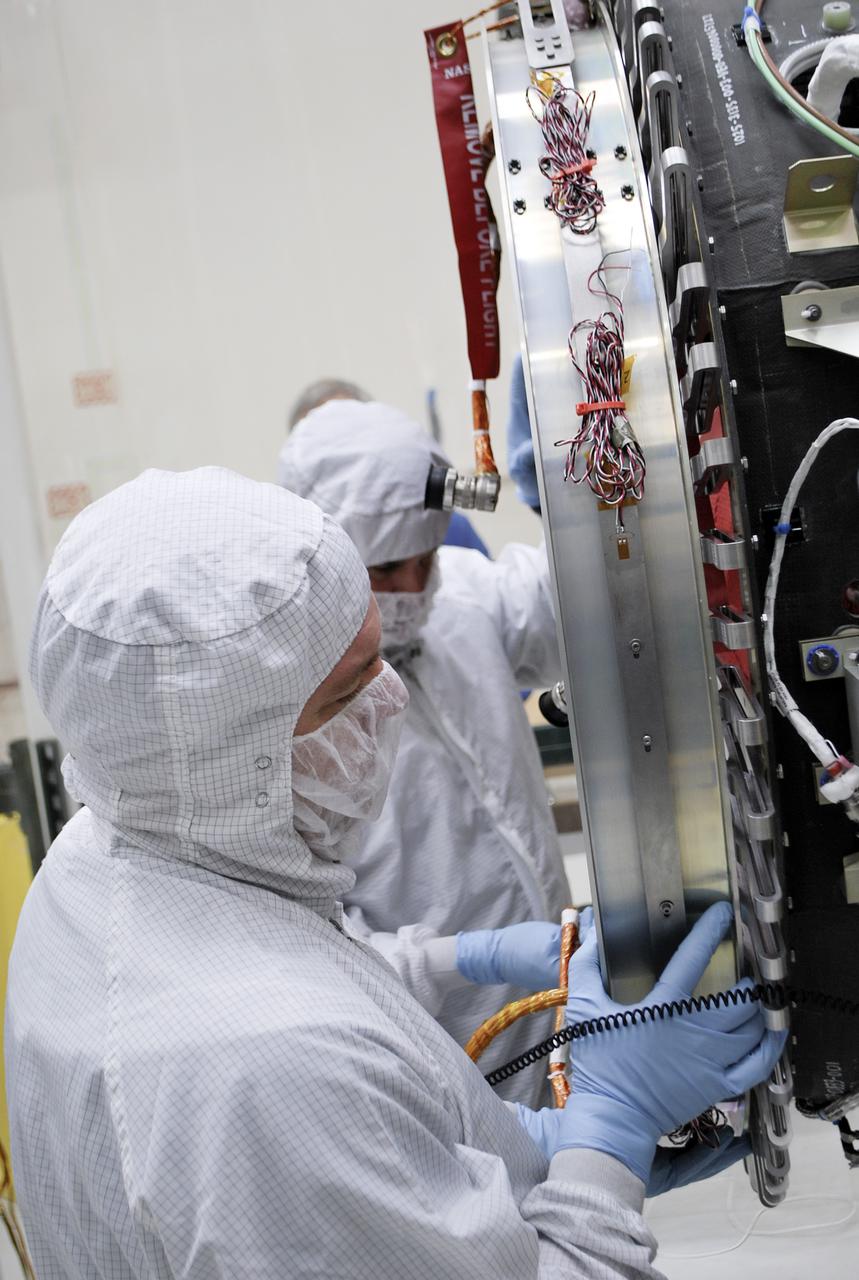
VANDENBERG AFB, Calif. – Technicians test fit the separation system that will push NASA's IRIS spacecraft away from an Orbital Pegasus XL rocket when IRIS reaches its proper orbit after launch. IRIS is short for Interface Region Imaging Spectrograph and the spacecraft's mission will improve our understanding of how heat and energy move through the deepest levels of the sun’s atmosphere, thereby increasing our ability to forecast space weather. Photo credit: VAFB_Randy Beaudoin

VANDENBERG AFB, Calif. – Technicians get ready to lift NASA's IRIS spacecraft at Vandenberg where the spacecraft will be readied for launch aboard an Orbital Sciences Pegasus XL rocket. IRIS is short for Interface Region Imaging Spectrograph and the spacecraft's mission will improve our understanding of how heat and energy move through the deepest levels of the sun’s atmosphere, thereby increasing our ability to forecast space weather. Photo credit: VAFB_Doug Gruber
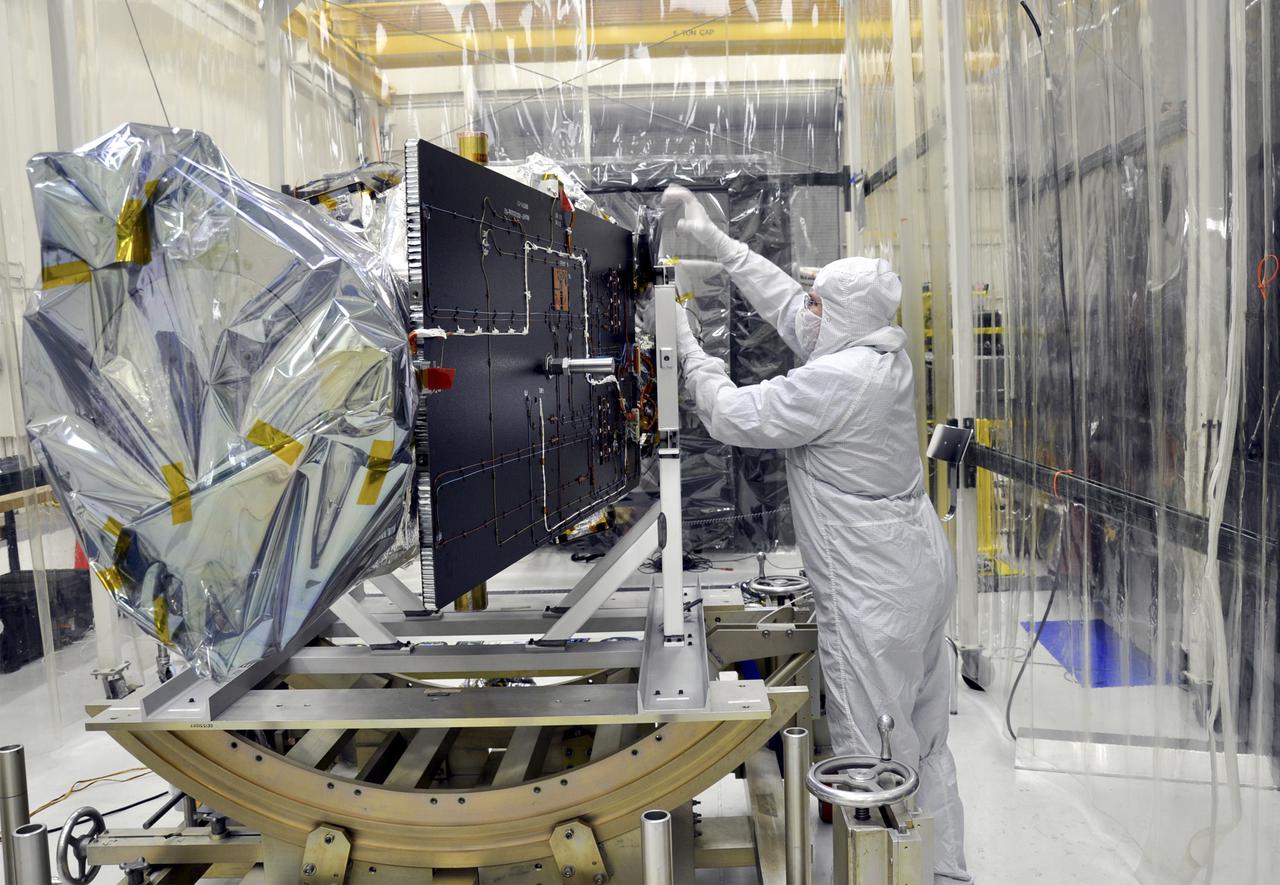
VANDENBERG AFB, Calif. – A technician removes protective Mylar wrapping from NASA's IRIS spacecraft in a clean room at Vandenberg where the spacecraft will be readied for launch aboard an Orbital Sciences Pegasus XL rocket. IRIS is short for Interface Region Imaging Spectrograph and the spacecraft's mission will improve our understanding of how heat and energy move through the deepest levels of the sun’s atmosphere, thereby increasing our ability to forecast space weather. Photo credit: VAFB_Randy Beaudoin
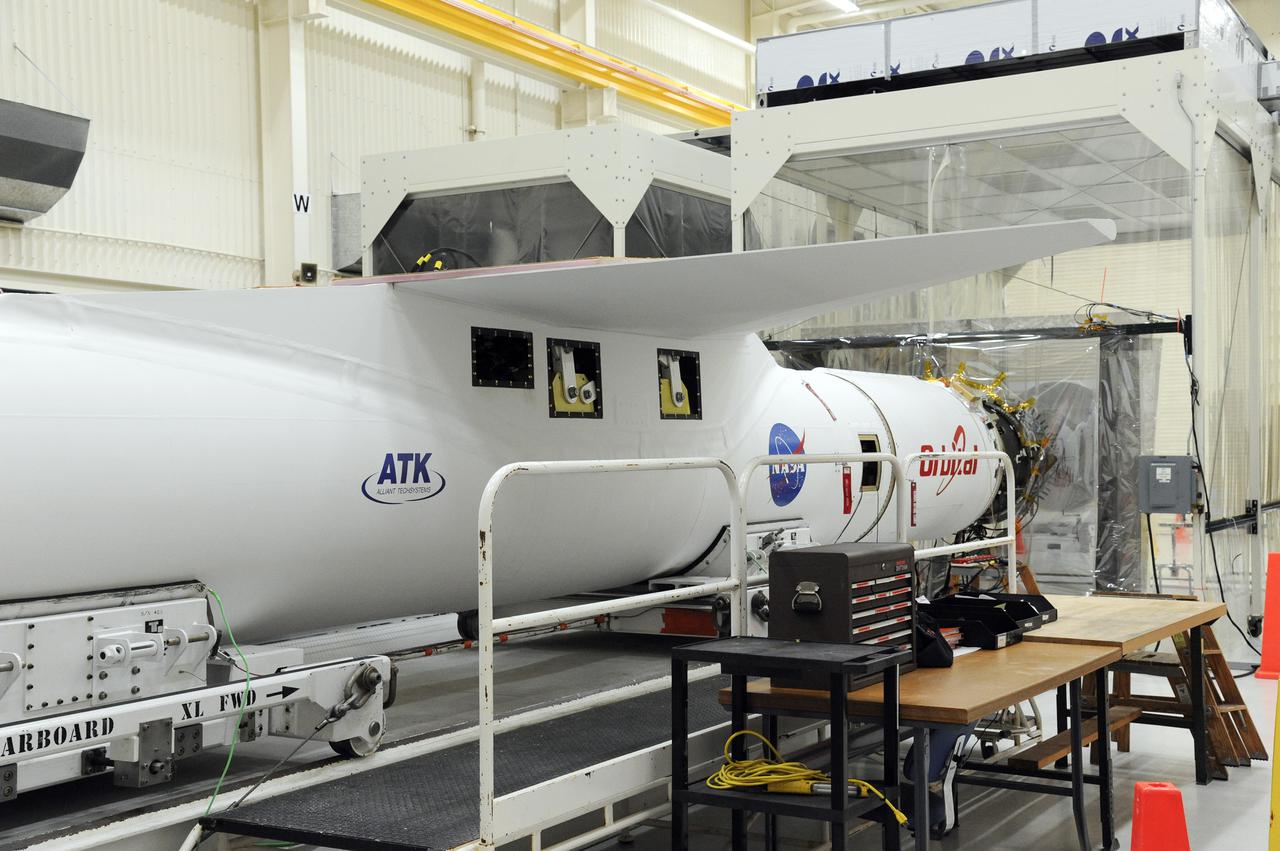
VANDENBERG AFB, Calif. – An Orbital Sciences Pegasus XL rocket that will carry NASA's IRIS spacecraft is positioned for processing at Vandenberg. IRIS is short for Interface Region Imaging Spectrograph and the spacecraft's mission will improve our understanding of how heat and energy move through the deepest levels of the sun’s atmosphere, thereby increasing our ability to forecast space weather. Photo credit: VAFB_Tony Vauelin
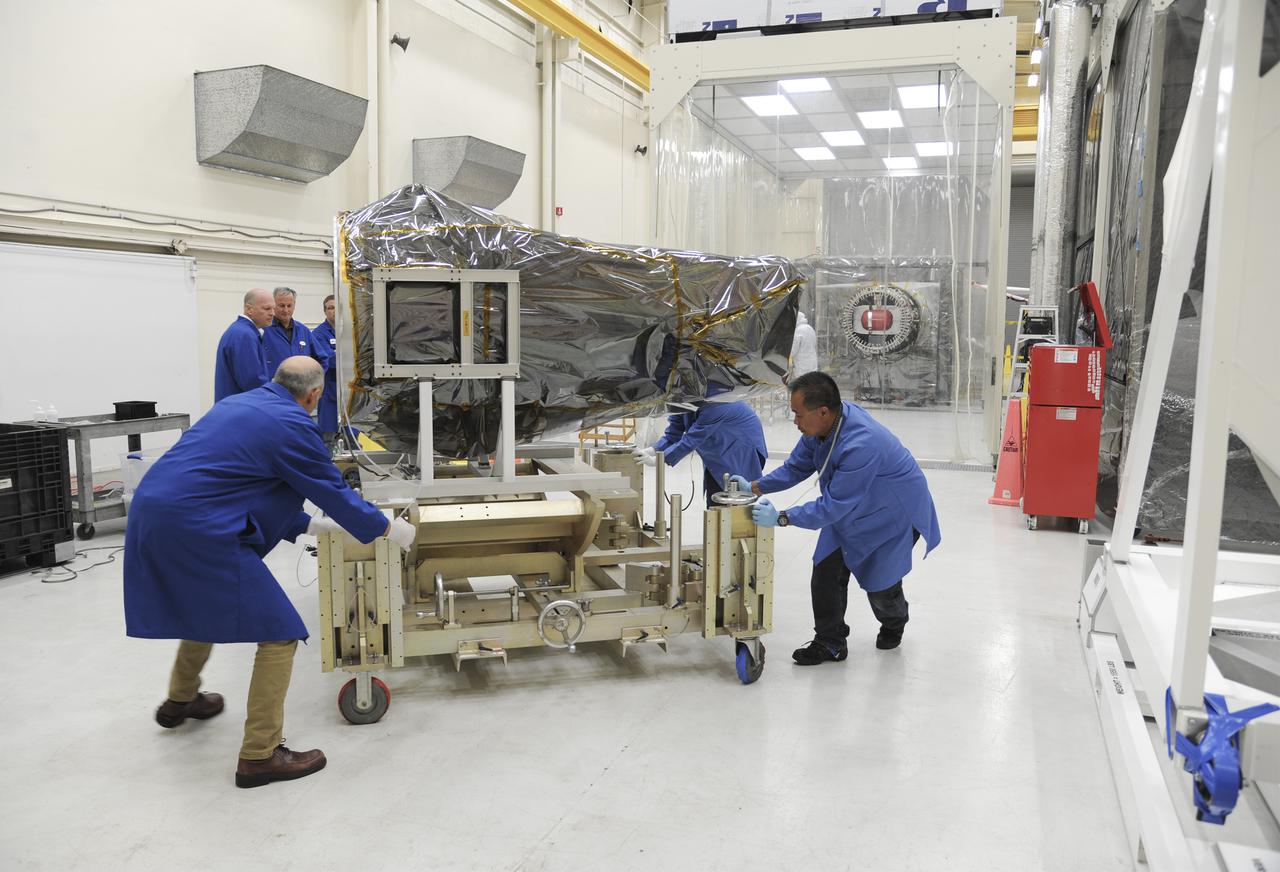
VANDENBERG AFB, Calif. – Technicians move NASA's IRIS spacecraft at Vandenberg where the spacecraft will be readied for launch aboard an Orbital Sciences Pegasus XL rocket. IRIS is short for Interface Region Imaging Spectrograph and the spacecraft's mission will improve our understanding of how heat and energy move through the deepest levels of the sun’s atmosphere, thereby increasing our ability to forecast space weather. Photo credit: VAFB_Doug Gruber
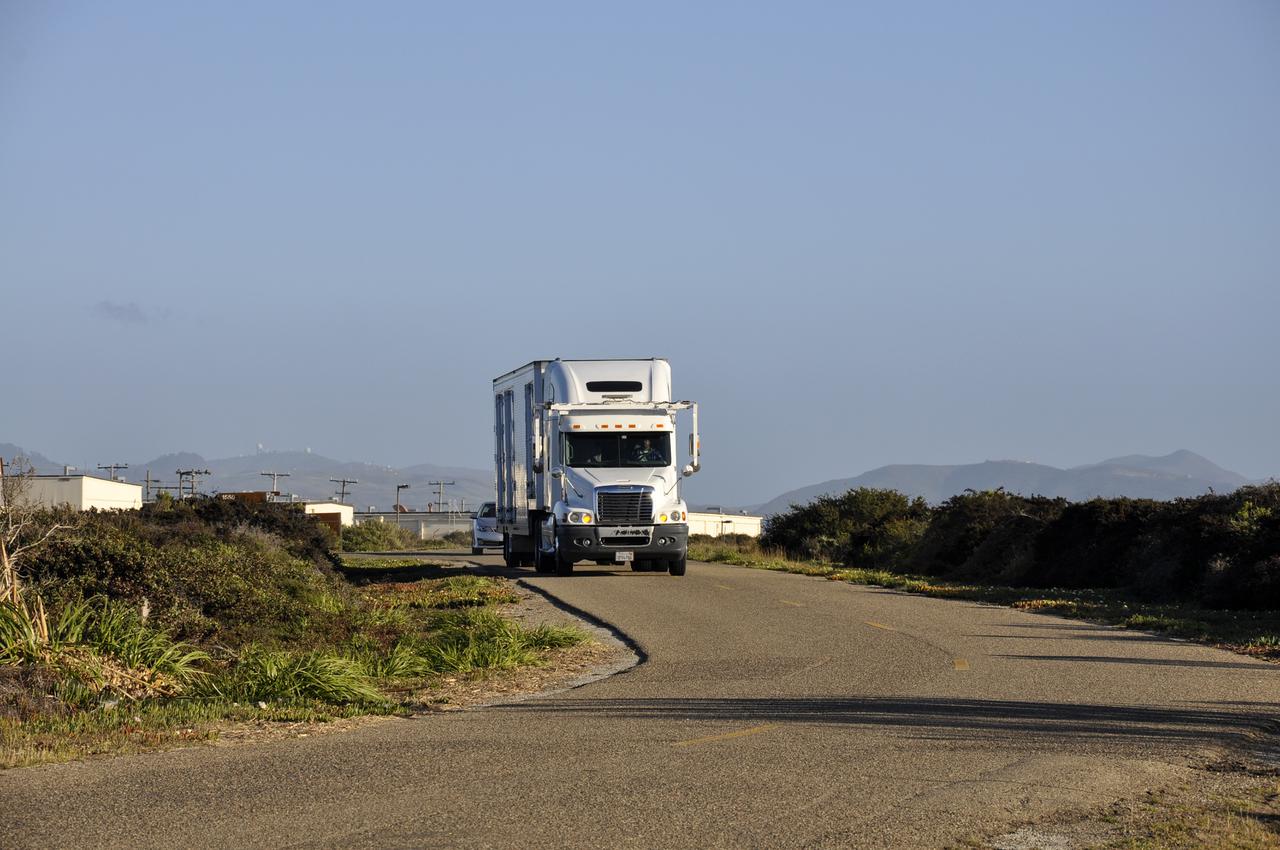
VANDENBERG AFB, Calif. – A truck carrying NASA's IRIS spacecraft nears the processing facility at Vandenberg where the spacecraft will be readied for launch aboard an Orbital Sciences Pegasus XL rocket. IRIS is short for Interface Region Imaging Spectrograph and the spacecraft's mission will improve our understanding of how heat and energy move through the deepest levels of the sun’s atmosphere, thereby increasing our ability to forecast space weather. Photo credit: VAFB_Randy Beaudoin
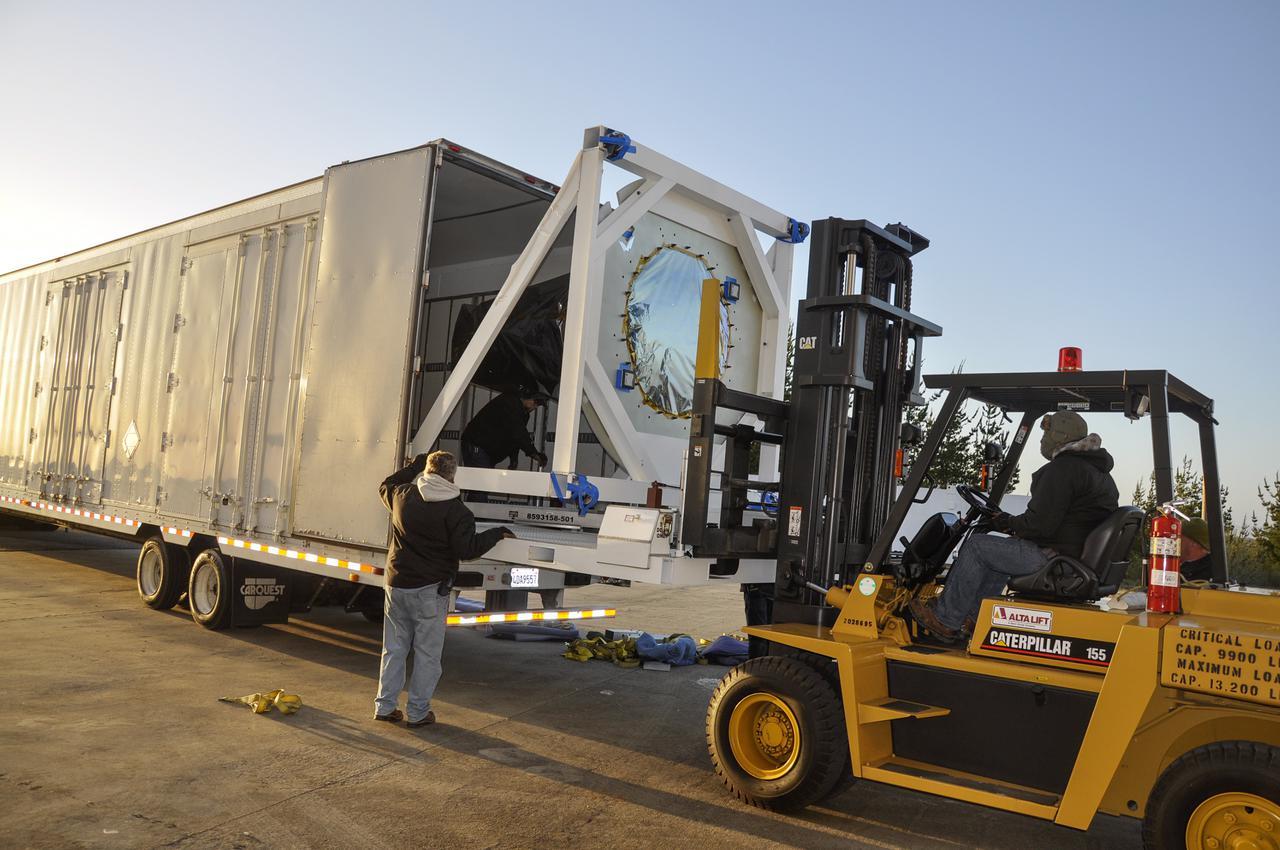
VANDENBERG AFB, Calif. – Workers unload NASA's IRIS spacecraft from a truck at the processing facility at Vandenberg where the spacecraft will be readied for launch aboard an Orbital Sciences Pegasus XL rocket. IRIS is short for Interface Region Imaging Spectrograph and the spacecraft's mission will improve our understanding of how heat and energy move through the deepest levels of the sun’s atmosphere, thereby increasing our ability to forecast space weather. Photo credit: VAFB_Randy Beaudoin
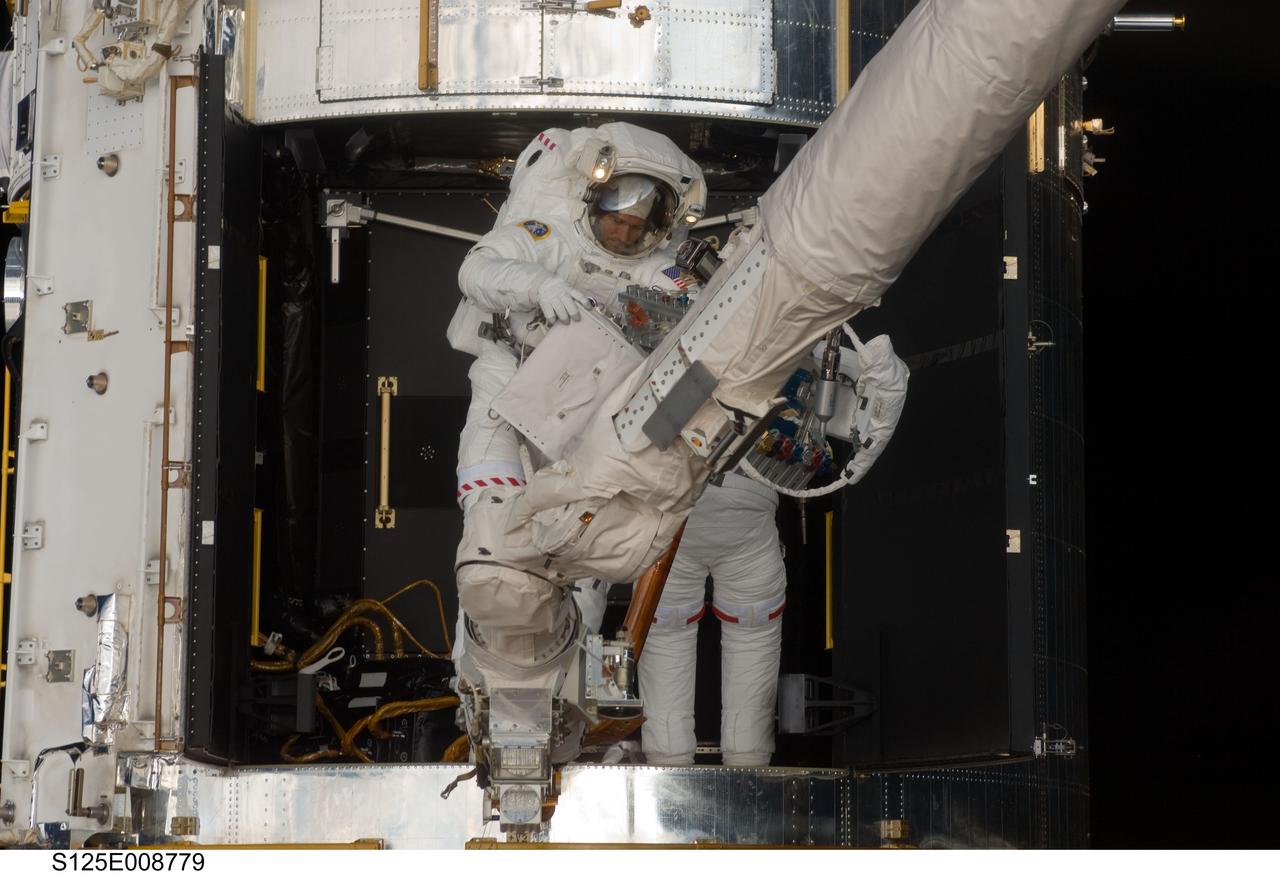
S125-E-008779 (17 May 2009) --- Astronauts Michael Good and Mike Massimino (partially obscured), both STS-125 mission specialists, participate in the mission?s fourth session of extravehicular activity (EVA) as work continues to refurbish and upgrade the Hubble Space Telescope. During the eight-hour, two-minute spacewalk, Massimino and Good continued repairs and improvements to the Space Telescope Imaging Spectrograph (STIS) that will extend the Hubble?s life into the next decade.

VANDENBERG AFB, Calif. – NASA's IRIS spacecraft stands in a clean room at Vandenberg where the spacecraft will be readied for launch aboard an Orbital Sciences Pegasus XL rocket. IRIS is short for Interface Region Imaging Spectrograph and the spacecraft's mission will improve our understanding of how heat and energy move through the deepest levels of the sun’s atmosphere, thereby increasing our ability to forecast space weather. Photo credit: VAFB_Randy Beaudoin
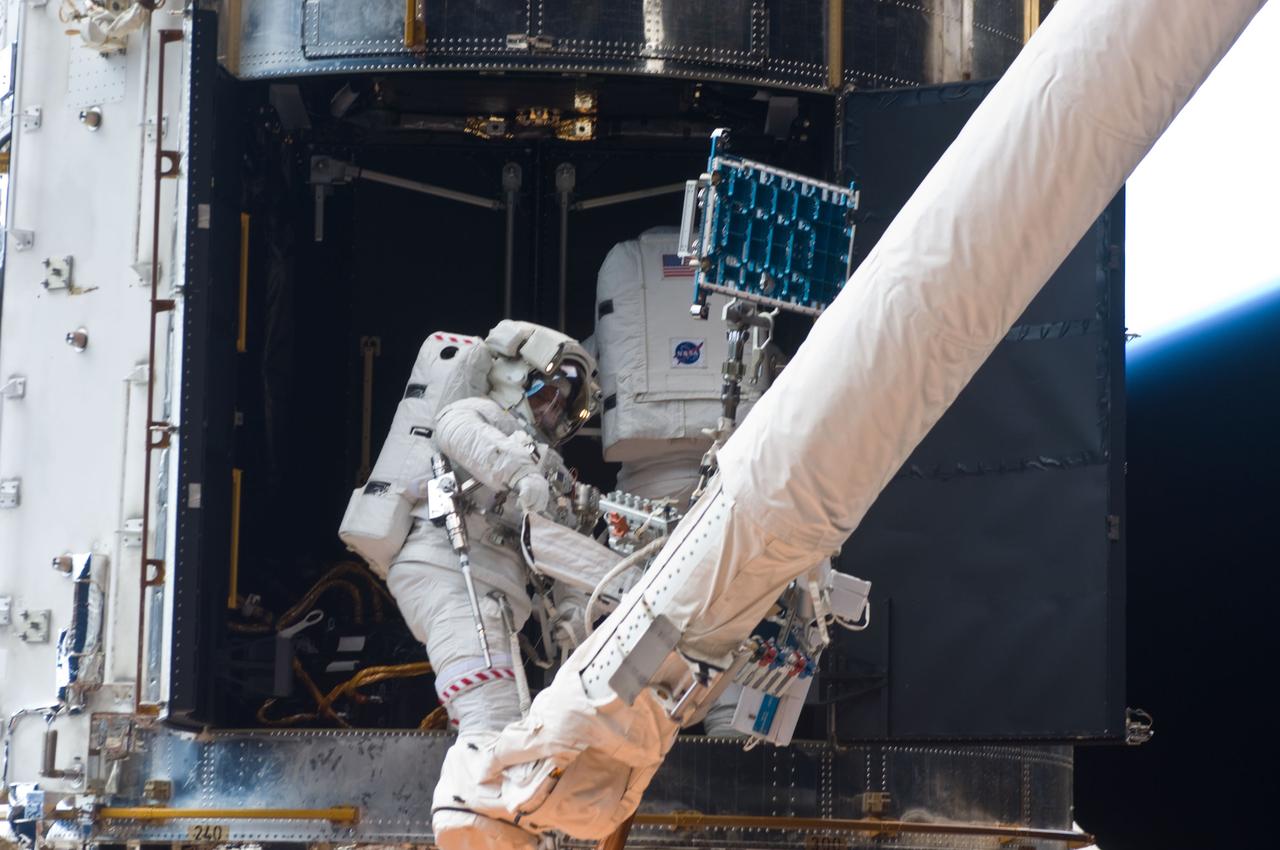
S125-E-008633 (17 May 2009) --- Astronauts Michael Good (left) and Mike Massimino, both STS-125 mission specialists, participate in the mission?s fourth session of extravehicular activity (EVA) as work continues to refurbish and upgrade the Hubble Space Telescope. During the eight-hour, two-minute spacewalk, Massimino and Good continued repairs and improvements to the Space Telescope Imaging Spectrograph (STIS) that will extend the Hubble?s life into the next decade.
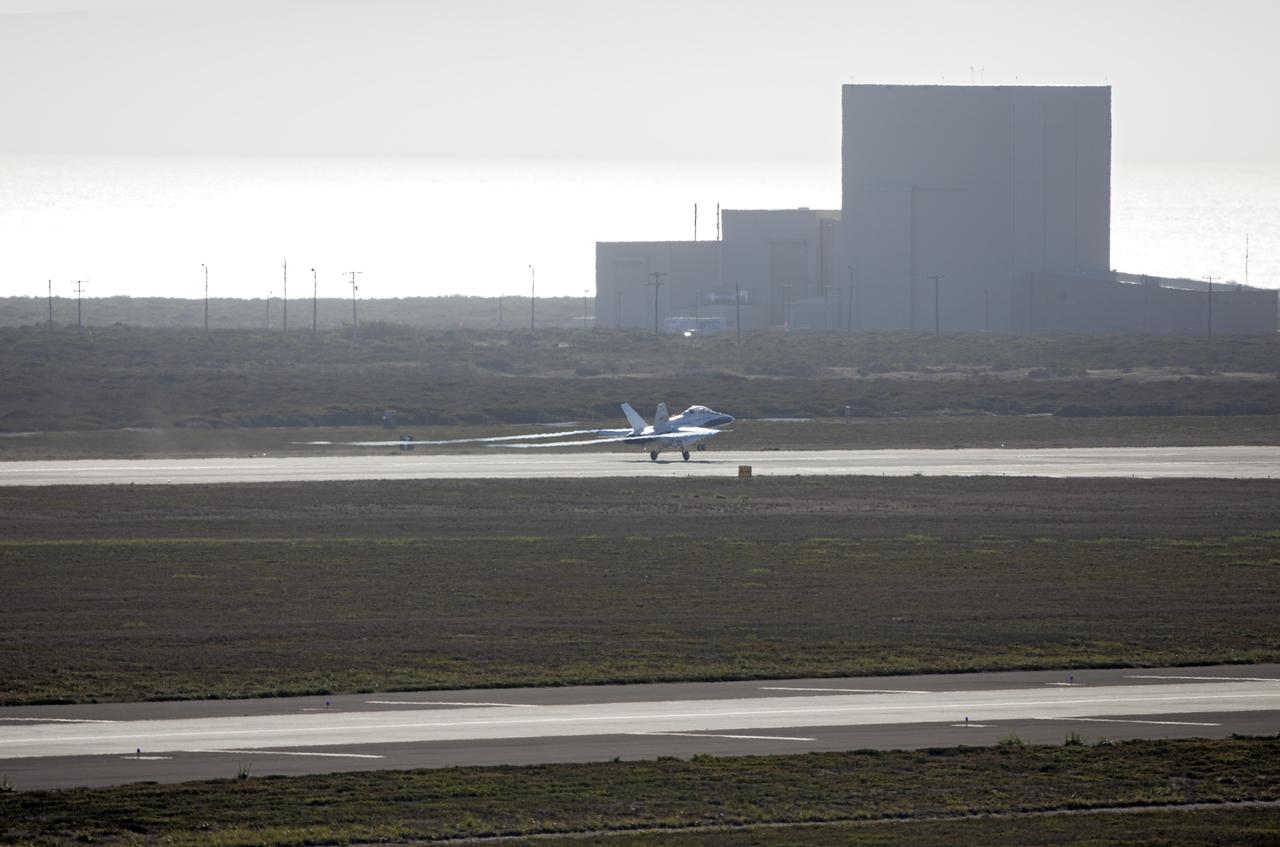
VANDENBERG AIR FORCE BASE, Calif. – A NASA F-18 takes off from Vandenberg Air Force Base, Calif., on a mission to record the launch of NASA's IRIS spacecraft into low-Earth orbit. IRIS, short for Interface Region Imaging Spectrograph, was launched aboard an Orbital Sciences Pegasus XL rocket released from an L-1011 carrier aircraft. Photo credit: NASA/Daniel Casper
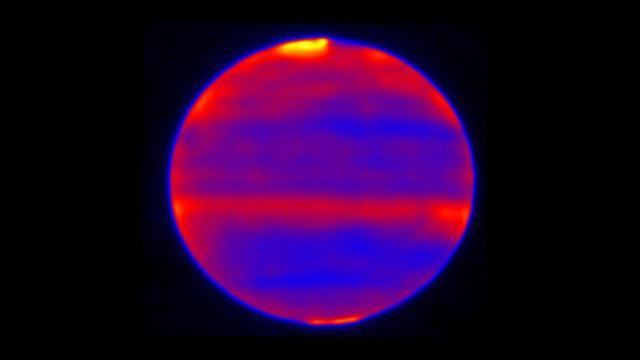
Sensitive to Jupiter's stratospheric temperatures, these infrared images were recorded by the Cooled Mid-Infrared Camera and Spectrograph (COMICS) at the Subaru Telescope on the summit of Mauna Kea, Hawaii. Scientists used red, blue and yellow to infuse this infrared image; regions of the atmosphere that are more yellow and red indicate the hotter areas. This highlights the auroral heating that occurs at Jupiter's poles, where energy from the solar wind and magnetosphere are deposited. This image was captured on Jan. 12, 2017. https://photojournal.jpl.nasa.gov/catalog/PIA22774
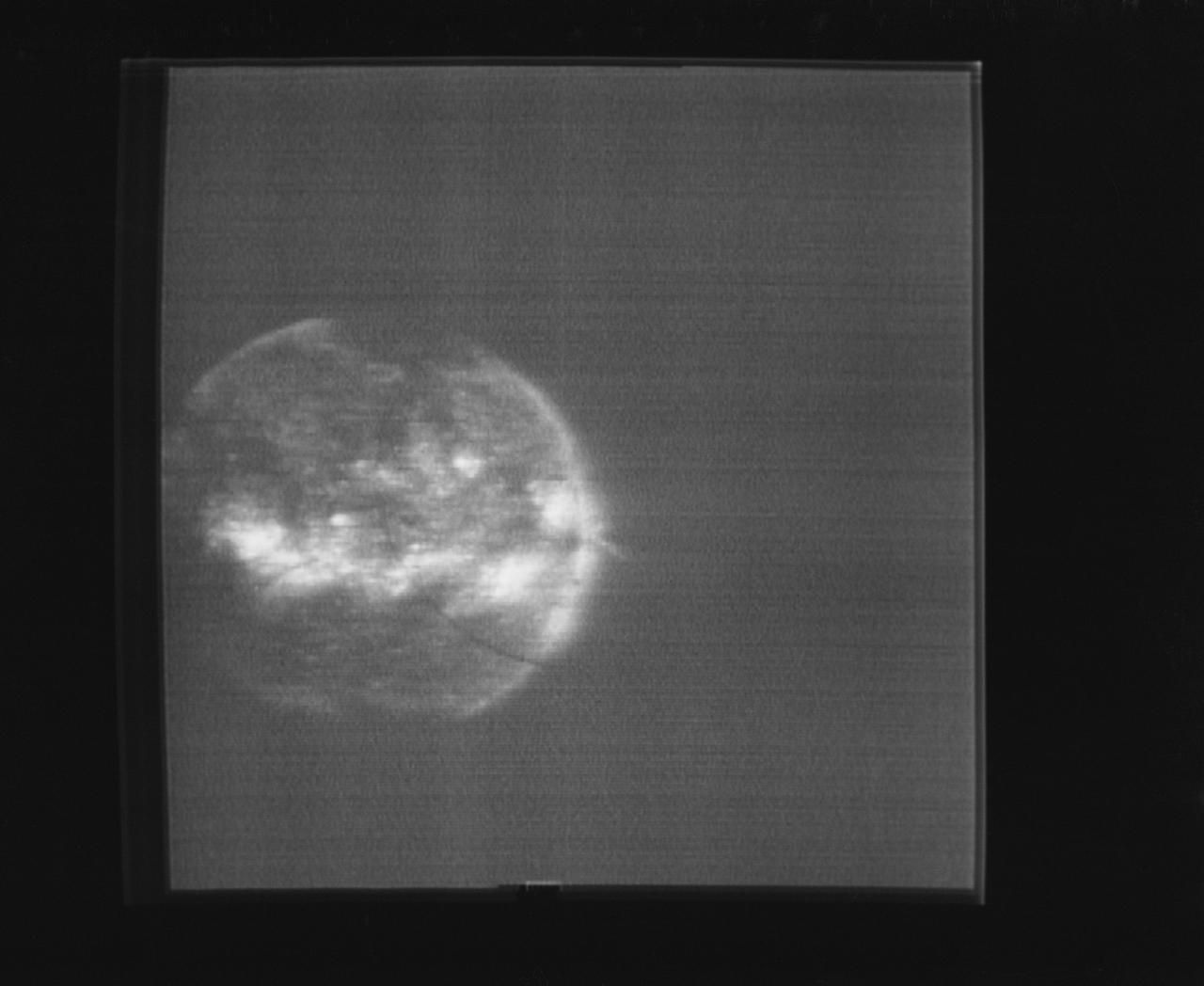
S74-15696 (1974) --- The solar disk photographed through the Skylab S082 Ultraviolet Spectrograph/Heliograph can be seen in this reproduction taken from a television tranmission made by a TV camera aboard the Skylab space station in Earth orbit. The S082 experiment is located in the Apollo Telescope Mount. This spectroheliogram shows specific emission features greatly enhanced over photographs of the solar disk in white light. Photo credit: NASA
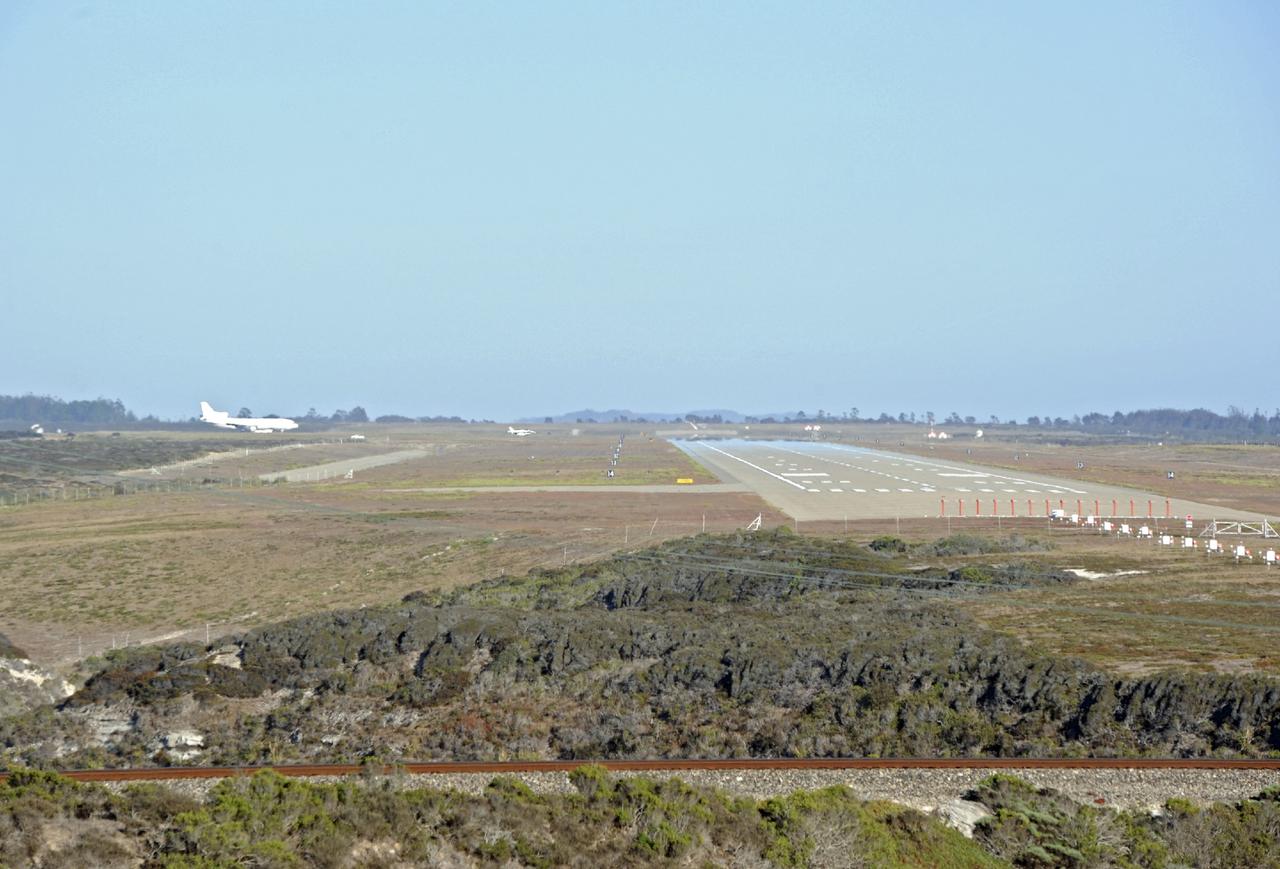
VANDENBERG AIR FORCE BASE, Calif. – A NASA F-18 and an Orbital Sciences L-1011 carrier aircraft taxi to the runway at Vandenberg Air Force Base, Calif., before taking off on a mission to launch NASA's IRIS spacecraft into low-Earth orbit. IRIS, short for Interface Region Imaging Spectrograph, was launched aboard an Orbital Sciences Pegasus XL rocket released from the L-1011. Photo credit: VAFB/ Chris Wiant
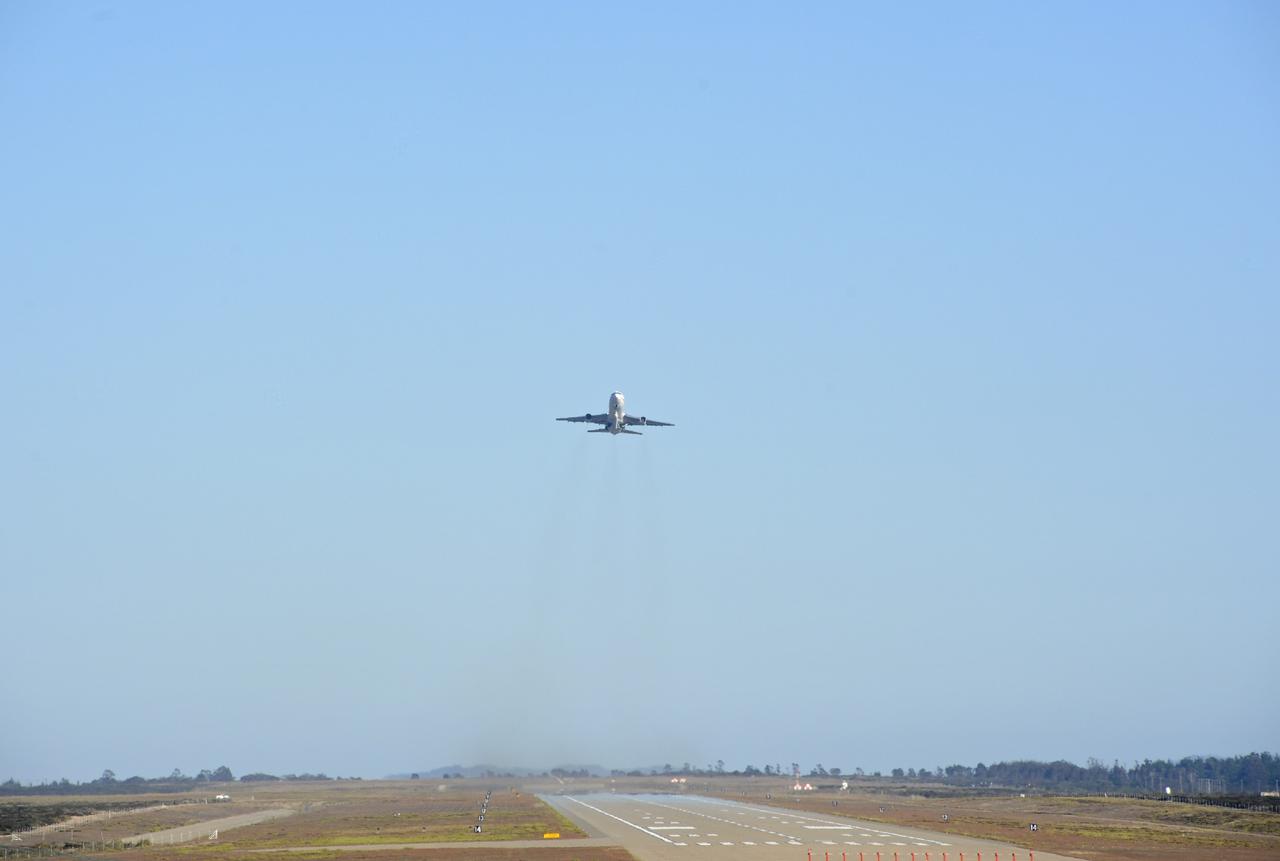
VANDENBERG AIR FORCE BASE, Calif. – An Orbital Sciences L-1011 carrier aircraft takes off from Vandenberg Air Force Base, Calif., on a mission to launch NASA's IRIS spacecraft into low-Earth orbit. IRIS, short for Interface Region Imaging Spectrograph, was launched aboard an Orbital Sciences Pegasus XL rocket released from the L-1011.Photo credit: VAFB/Chris Wiant
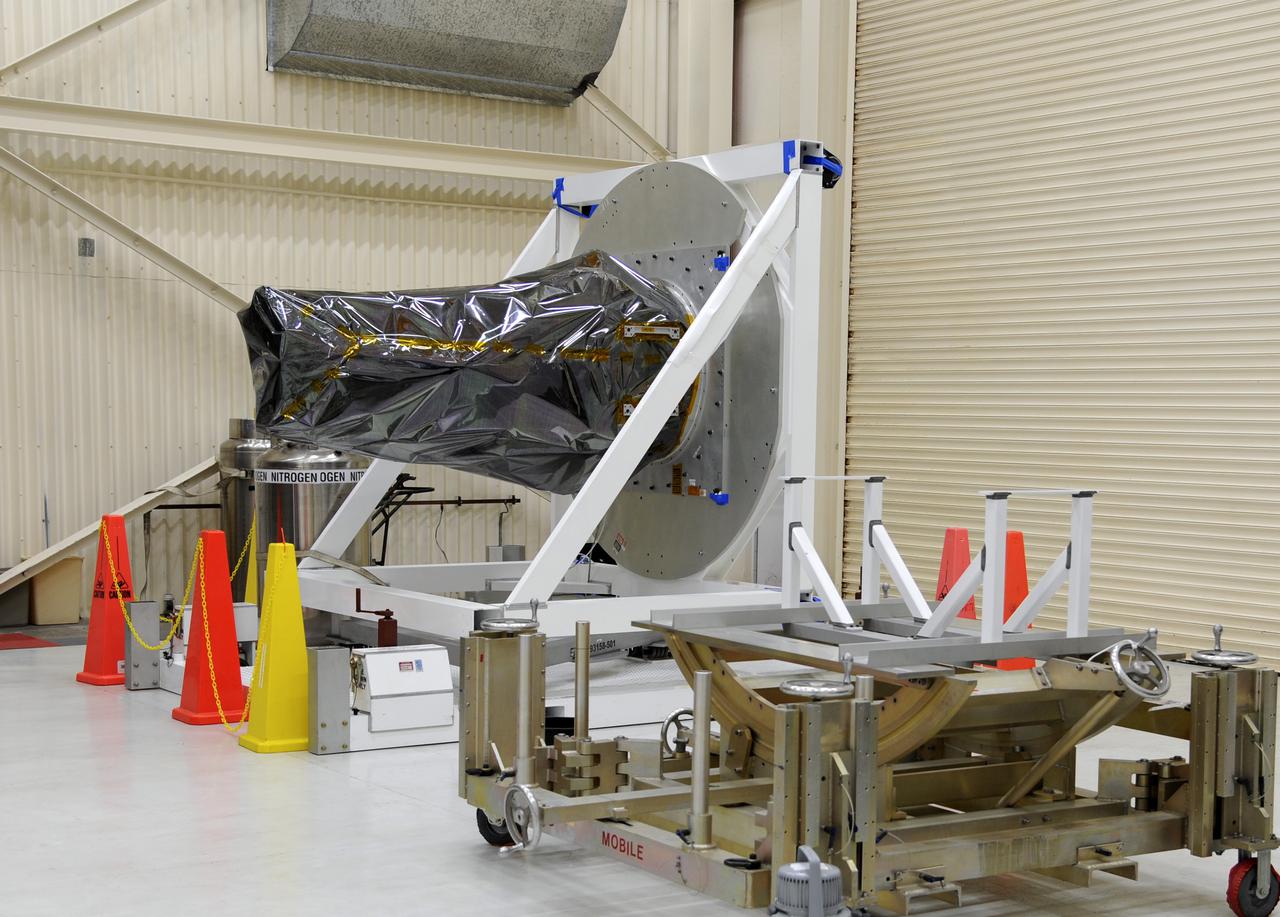
VANDENBERG AFB, Calif. – NASA's IRIS spacecraft at Vandenberg where the spacecraft will be readied for launch aboard an Orbital Sciences Pegasus XL rocket. IRIS is short for Interface Region Imaging Spectrograph and the spacecraft's mission will improve our understanding of how heat and energy move through the deepest levels of the sun’s atmosphere, thereby increasing our ability to forecast space weather. Photo credit: VAFB_Doug Gruber
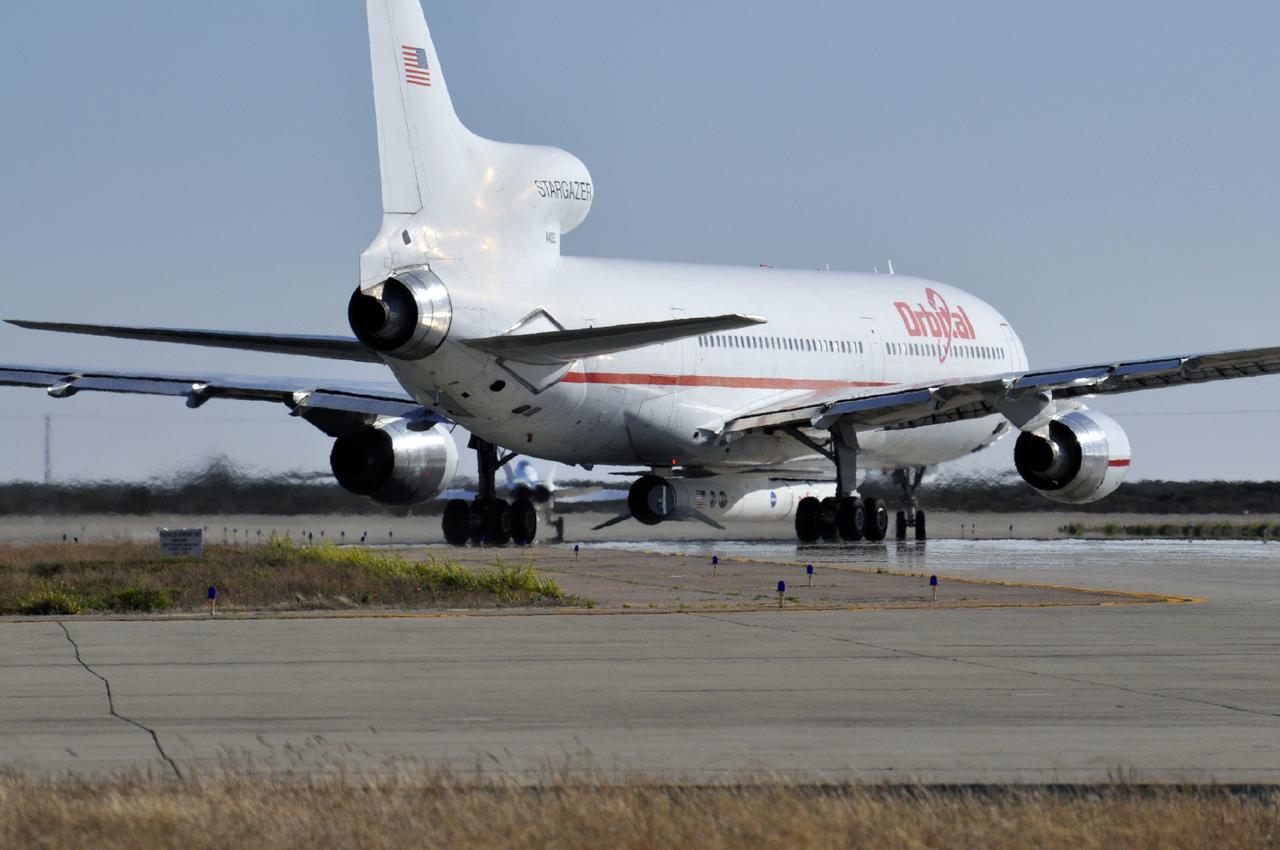
VANDENBERG AIR FORCE BASE, Calif. – An Orbital Sciences L-1011 carrier aircraft taxis to the runway at Vandenberg Air Force Base, Calif., before taking off on a mission to launch NASA's IRIS spacecraft into low-Earth orbit. IRIS, short for Interface Region Imaging Spectrograph, was launched aboard an Orbital Sciences Pegasus XL rocket released from the L-1011. Photo credit: VAFB/Randy Beaudoin
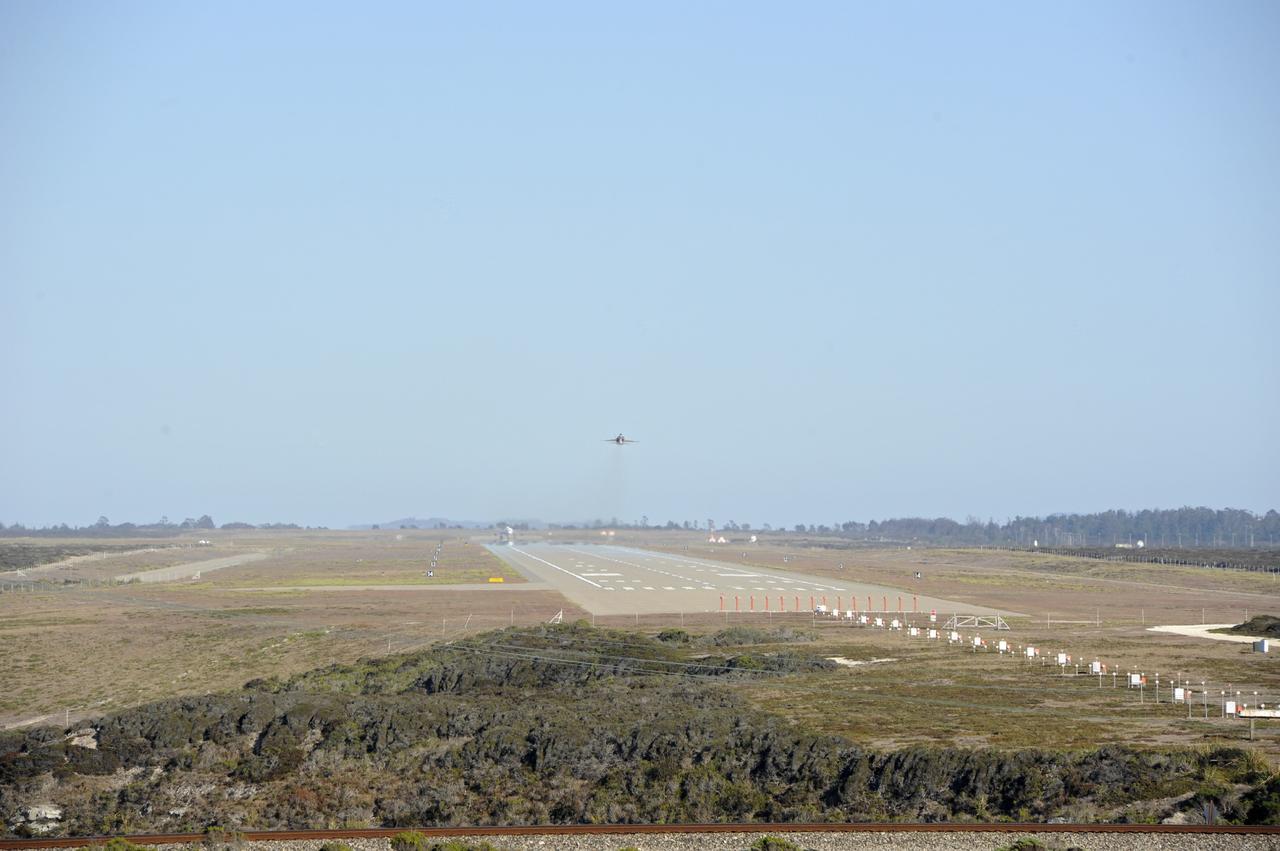
VANDENBERG AIR FORCE BASE, Calif. – A NASA F-18 takes off from Vandenberg Air Force Base, Calif., on a mission to record the launch of NASA's IRIS spacecraft into low-Earth orbit. IRIS, short for Interface Region Imaging Spectrograph, was launched aboard an Orbital Sciences Pegasus XL rocket released from an L-1011 carrier aircraft. Photo credit: VAFB/Chris Wiant
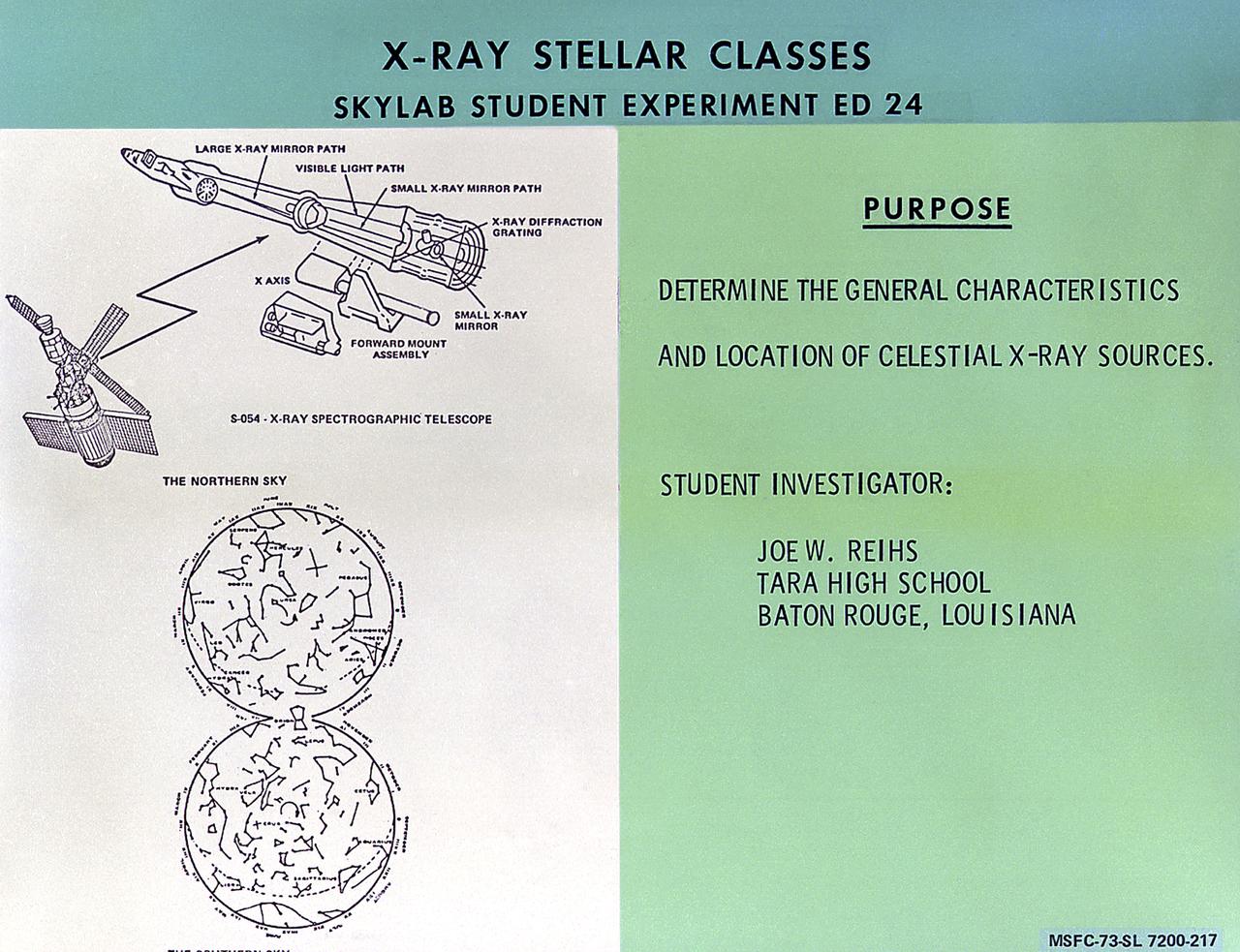
This chart describes the Skylab student experiment X-Ray Stellar Classes, proposed by Joe Reihs of Baton Rouge, Louisiana. This experiment utilized Skylab's X-Ray Spectrographic Telescope to observe and determine the general characteristics and location of x-ray sources. In March 1972, NASA and the National Science Teachers Association selected 25 experiment proposals for flight on Skylab. Science advisors from the Marshall Space Flight Center aided and assisted the students in developing the proposals for flight on Skylab.
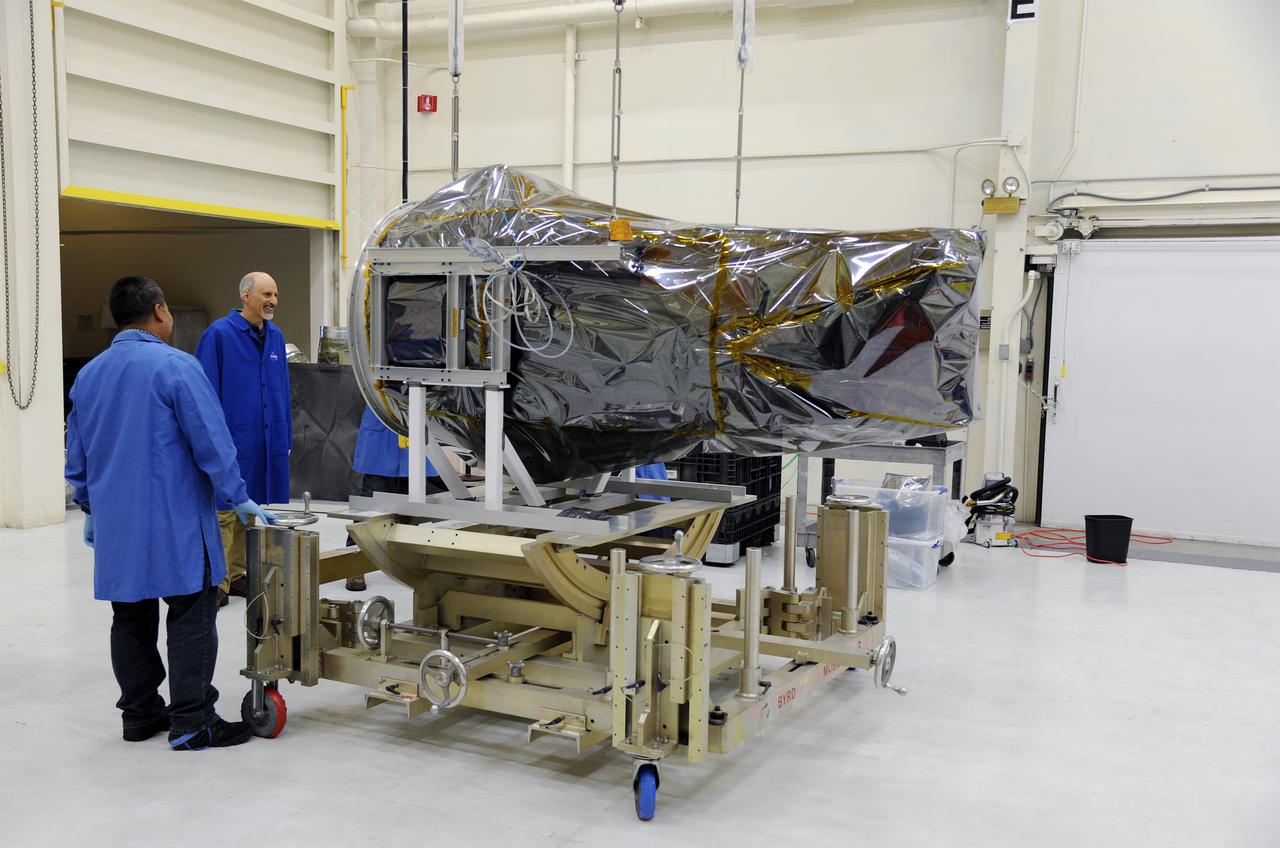
VANDENBERG AFB, Calif. – Technicians connect NASA's IRIS spacecraft to a fixture at Vandenberg where the spacecraft will be readied for launch aboard an Orbital Sciences Pegasus XL rocket. IRIS is short for Interface Region Imaging Spectrograph and the spacecraft's mission will improve our understanding of how heat and energy move through the deepest levels of the sun’s atmosphere, thereby increasing our ability to forecast space weather. Photo credit: VAFB_Doug Gruber
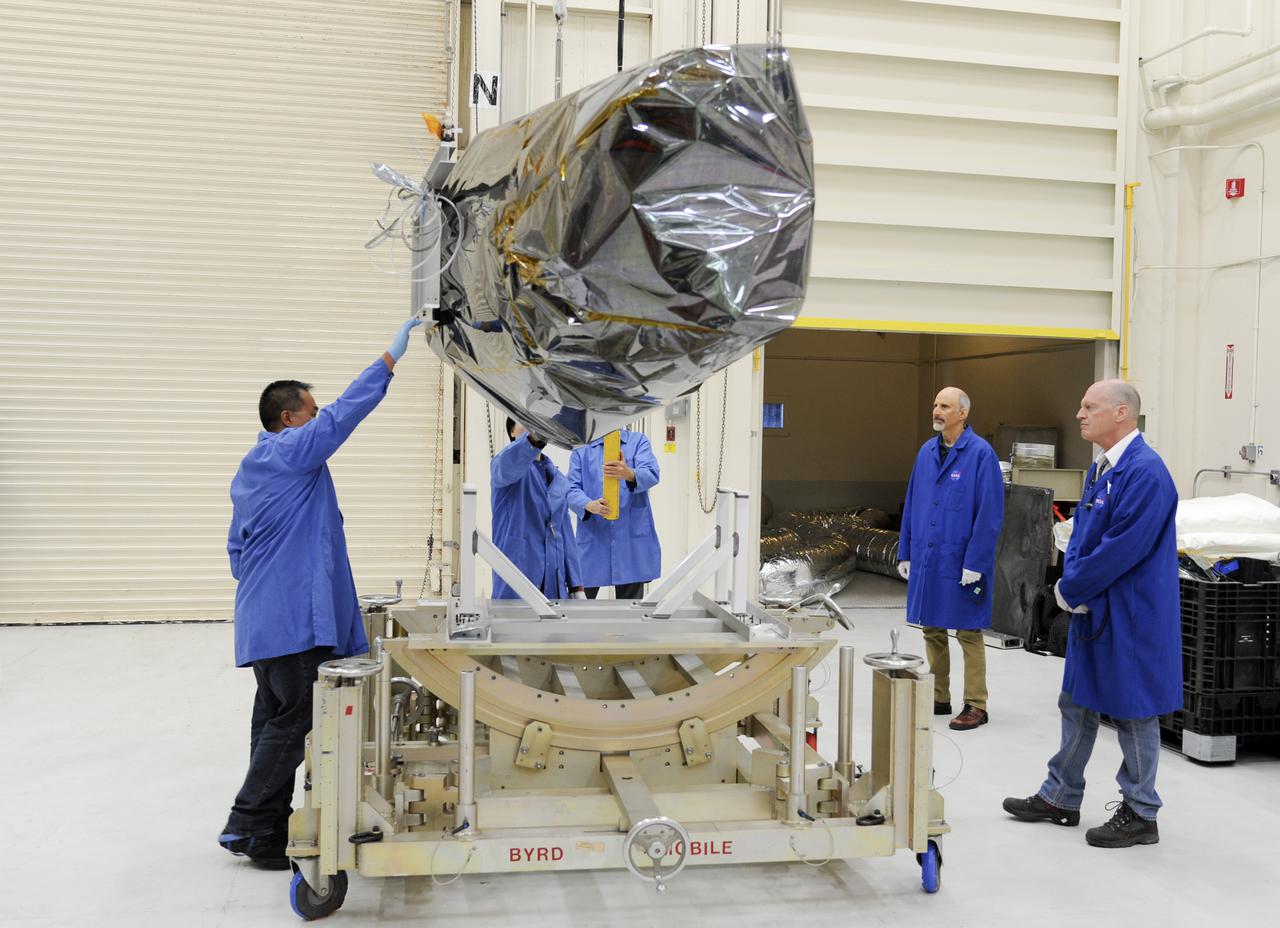
VANDENBERG AFB, Calif. – Technicians move NASA's IRIS spacecraft at Vandenberg where the spacecraft will be readied for launch aboard an Orbital Sciences Pegasus XL rocket. IRIS is short for Interface Region Imaging Spectrograph and the spacecraft's mission will improve our understanding of how heat and energy move through the deepest levels of the sun’s atmosphere, thereby increasing our ability to forecast space weather. Photo credit: VAFB_Doug Gruber
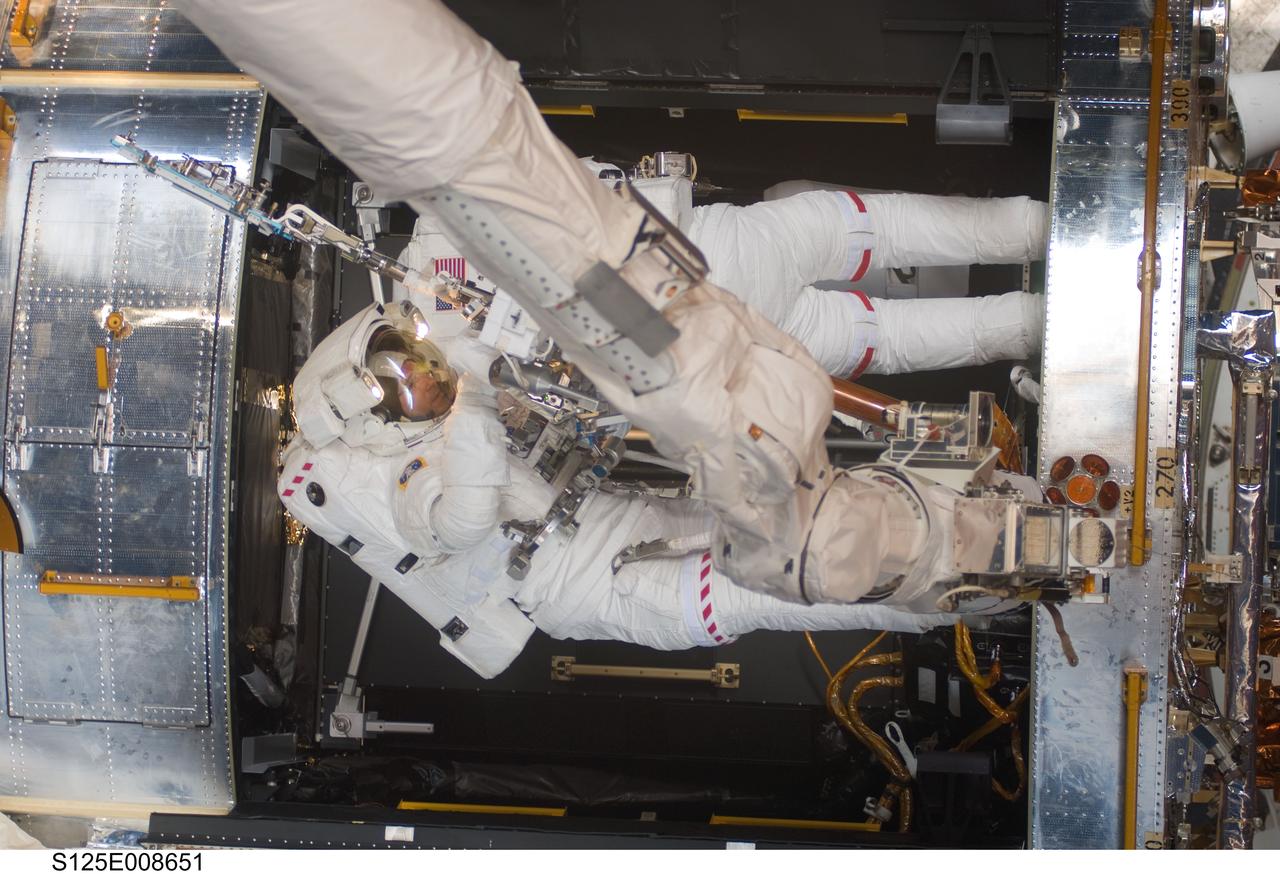
S125-E-008651 (17 May 2009) --- Astronauts Michael Good (bottom) and Mike Massimino, both STS-125 mission specialists, participate in the mission?s fourth session of extravehicular activity (EVA) as work continues to refurbish and upgrade the Hubble Space Telescope. During the eight-hour, two-minute spacewalk, Massimino and Good continued repairs and improvements to the Space Telescope Imaging Spectrograph (STIS) that will extend the Hubble?s life into the next decade.
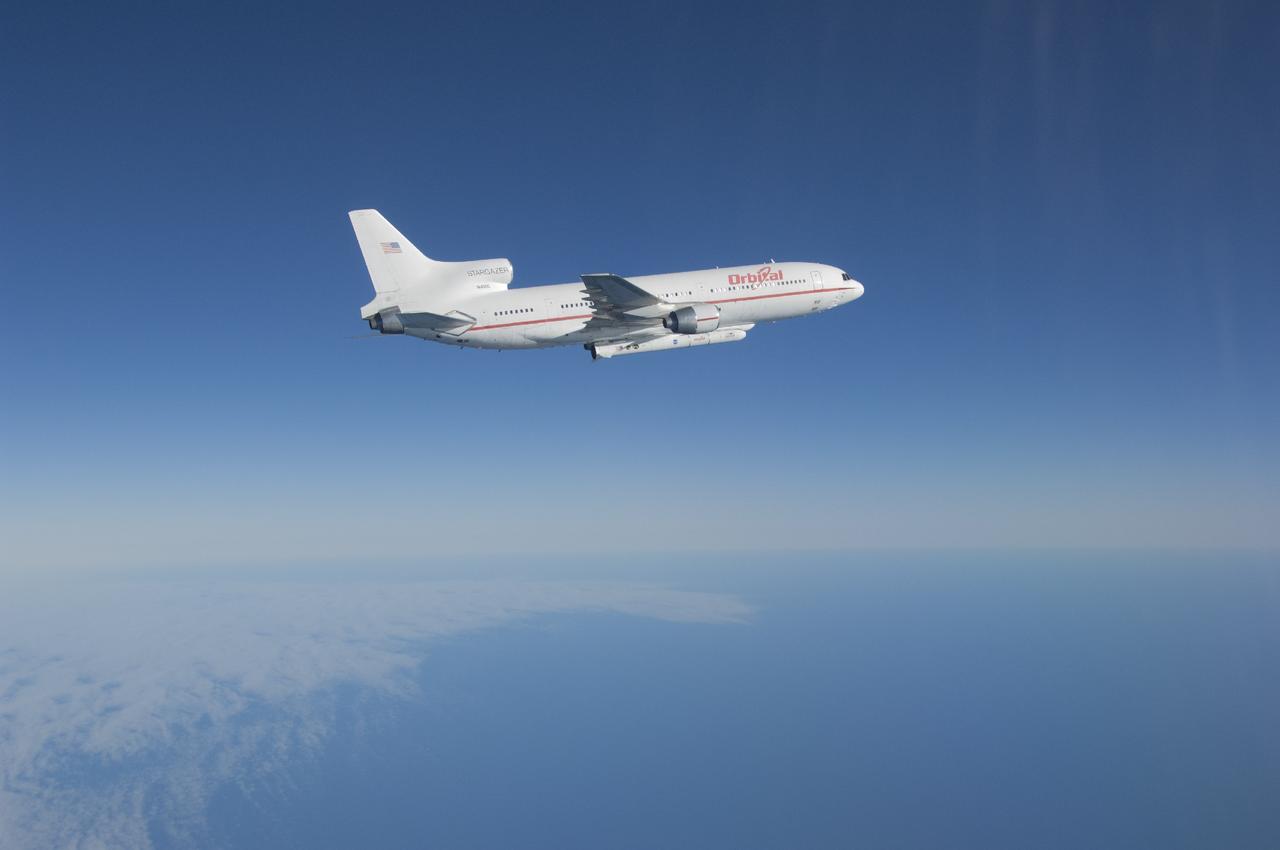
VANDENBERG AFB, Calif. – An Orbital Sciences L-1011 carrier aircraft flies over the Pacific Ocean off the California coast on a mission to launch NASA's IRIS spacecraft into low-Earth orbit. IRIS, short for Interface Region Imaging Spectrograph, was launched aboard an Orbital Sciences Pegasus XL rocket released from the bottom of the L-1011.Photo credit: NASA/Lori Losey
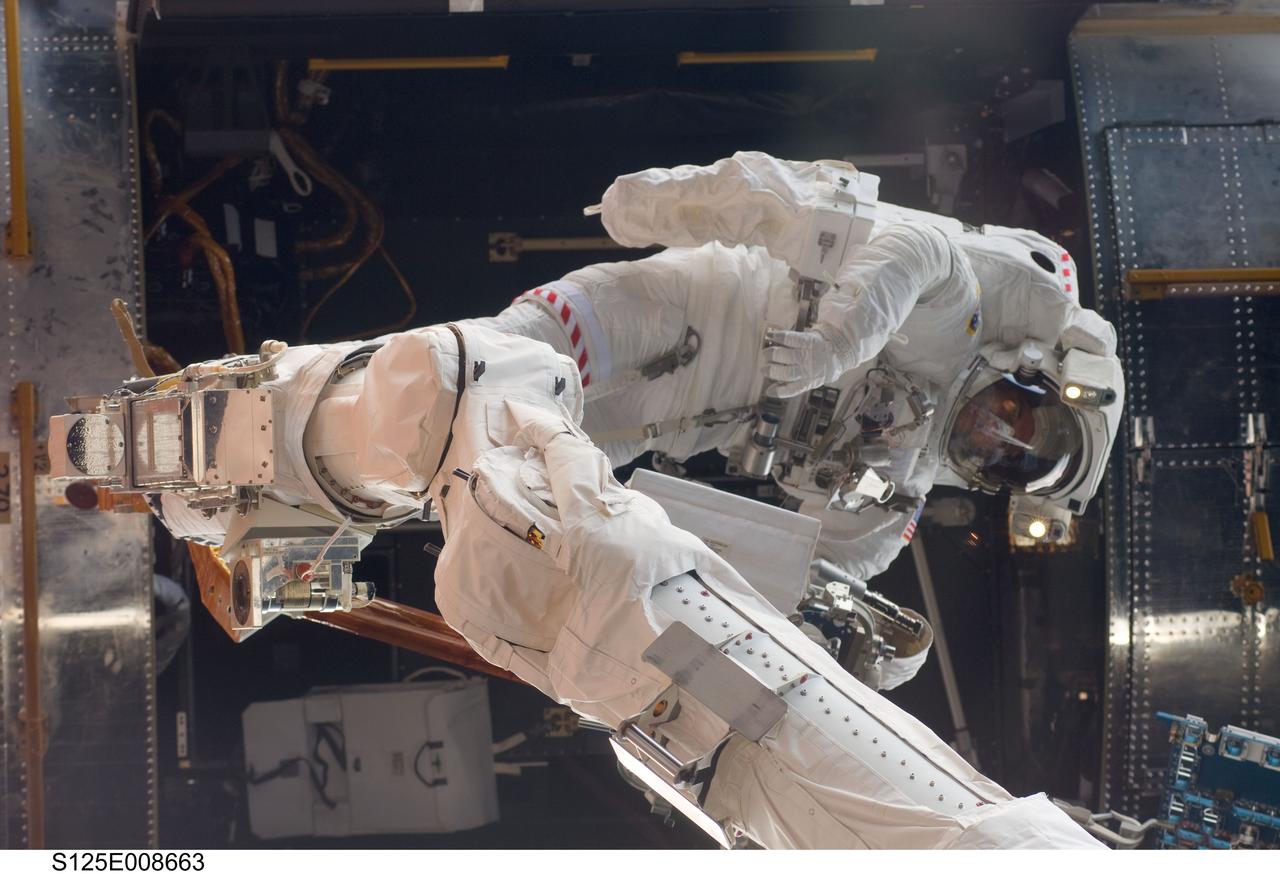
S125-E-008663 (17 May 2009) --- Astronaut Michael Good, STS-125 mission specialist, participates in the mission?s fourth session of extravehicular activity (EVA) as work continues to refurbish and upgrade the Hubble Space Telescope. During the eight-hour, two-minute spacewalk, Good and astronaut Mike Massimino (out of frame), mission specialist, continued repairs and improvements to the Space Telescope Imaging Spectrograph (STIS) that will extend the Hubble?s life into the next decade.
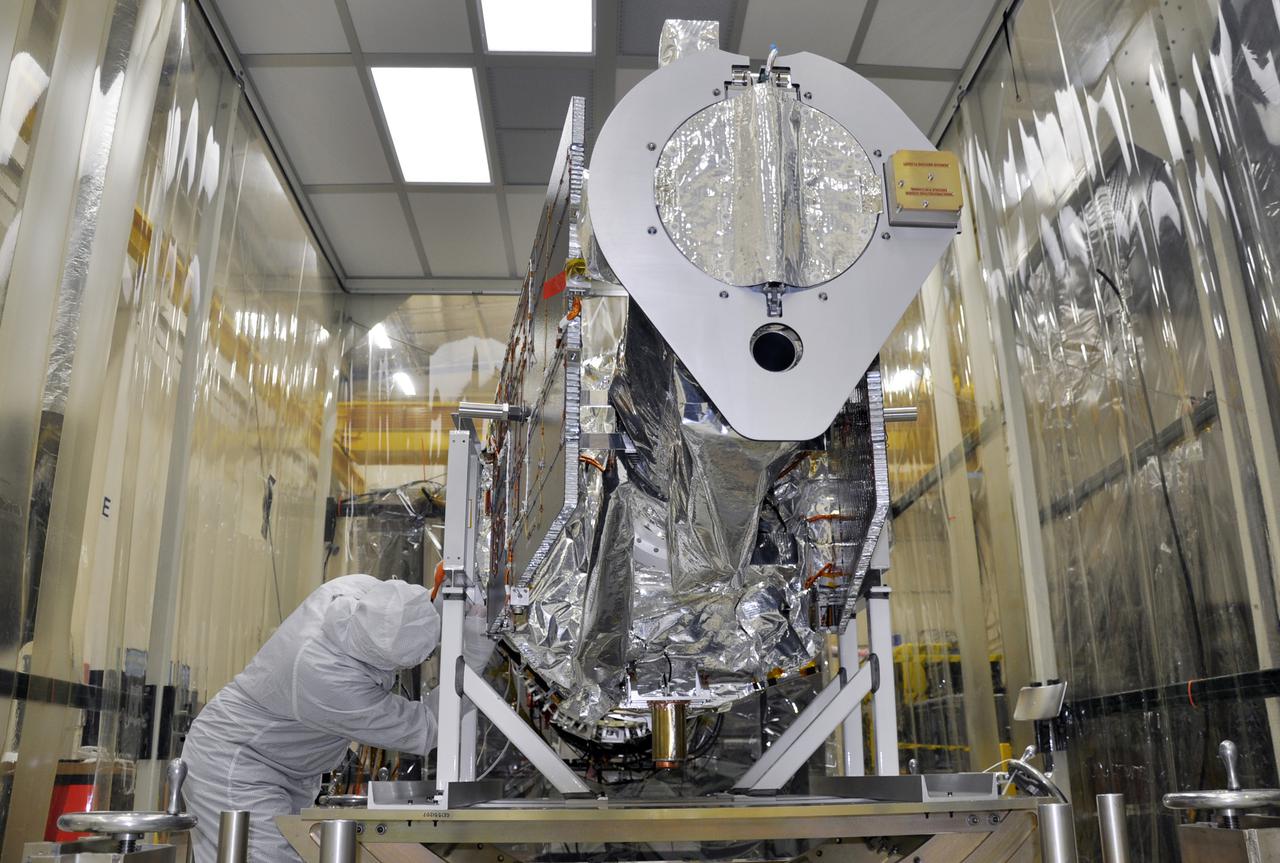
VANDENBERG AFB, Calif. – A technician finishes removing protective Mylar wrapping from NASA's IRIS spacecraft in a clean room at Vandenberg where the spacecraft will be readied for launch aboard an Orbital Sciences Pegasus XL rocket. IRIS is short for Interface Region Imaging Spectrograph and the spacecraft's mission will improve our understanding of how heat and energy move through the deepest levels of the sun’s atmosphere, thereby increasing our ability to forecast space weather. Photo credit: VAFB_Randy Beaudoin
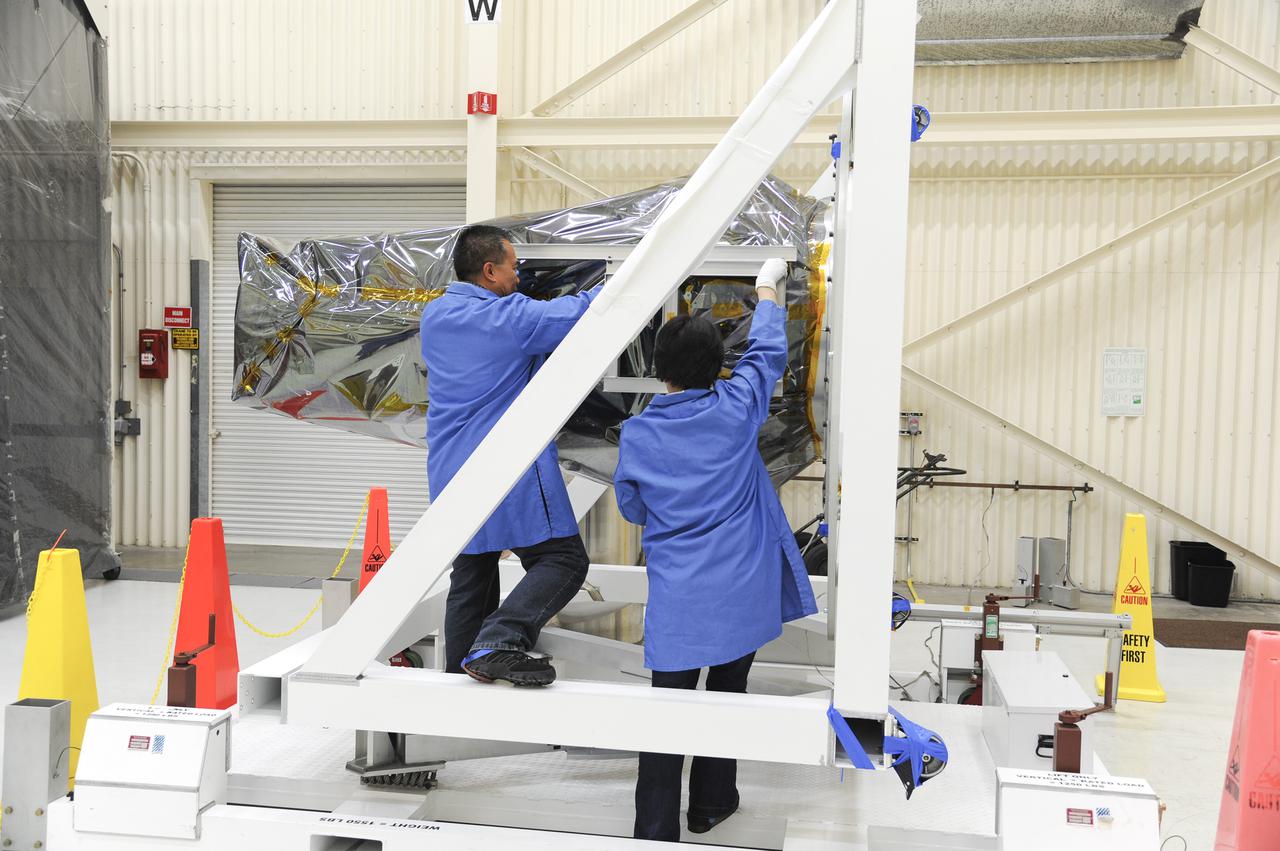
VANDENBERG AFB, Calif. – Technicians begin processing NASA's IRIS spacecraft at Vandenberg where the spacecraft will be readied for launch aboard an Orbital Sciences Pegasus XL rocket. IRIS is short for Interface Region Imaging Spectrograph and the spacecraft's mission will improve our understanding of how heat and energy move through the deepest levels of the sun’s atmosphere, thereby increasing our ability to forecast space weather. Photo credit: VAFB_Doug Gruber