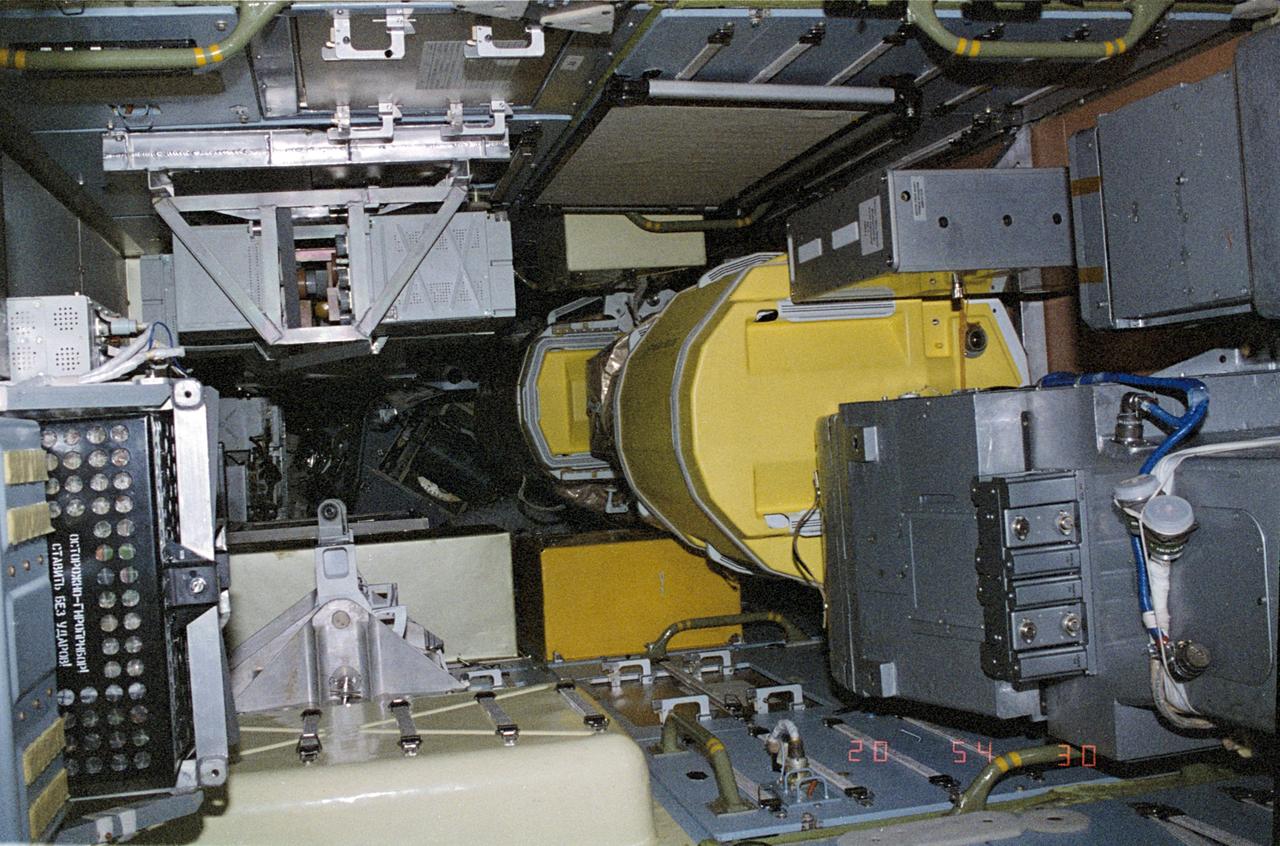
NM18-307-019 (March-July 1995) --- This photograph was taken by one of the Mir-18 crew members shortly after the arrival of the Spektr module. The spacecraft contained yet unopened gear and supplies for the Mir crews. This image was one of many shown at a July 18 press conference in Houston.
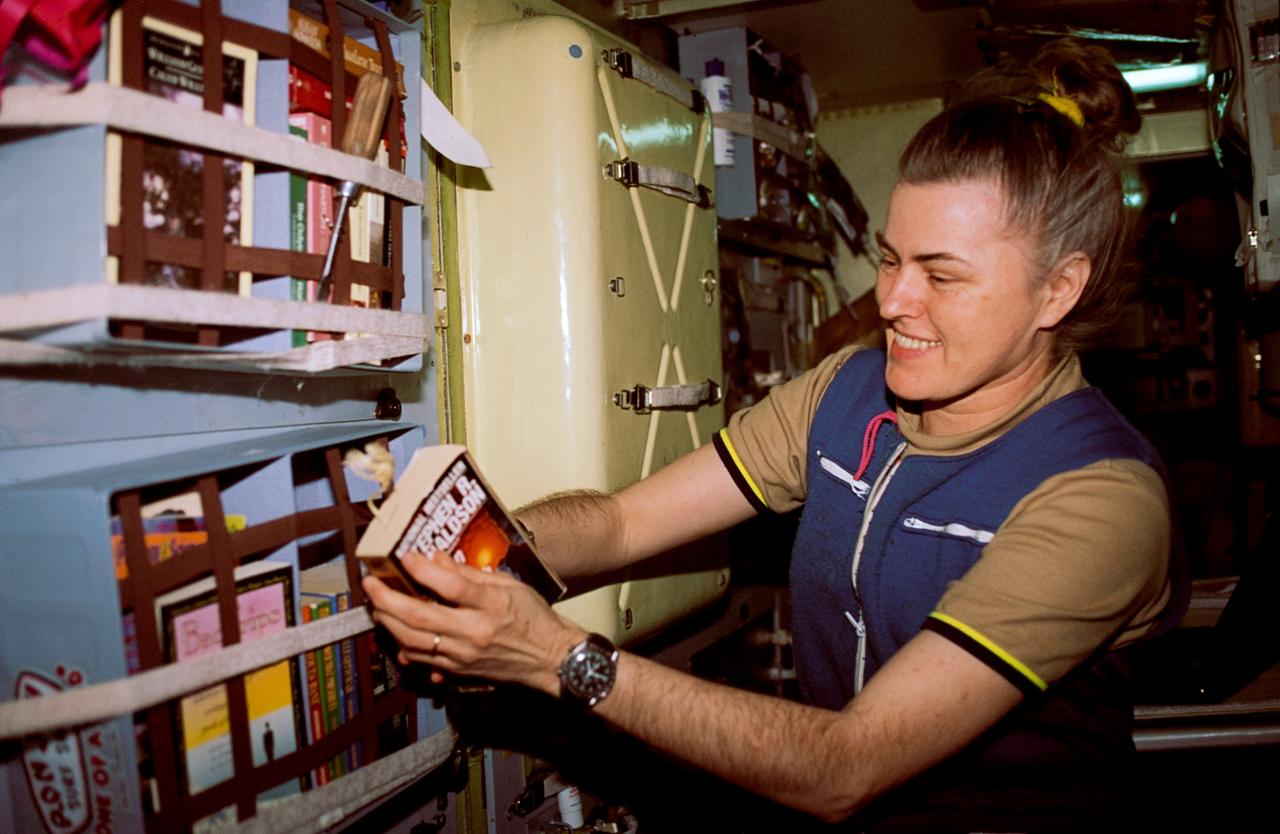
NM22-427-012 (16-26 Sept. 1996) --- During off-duty time on the Spektr Module aboard the Earth-orbiting Mir Space Station, astronaut Shannon W. Lucid, cosmonaut guest researcher, retrieves a book from her personal library. Lucid, dropped off in March by the STS-76 crew members, was nearing the end of 188 consecutive days in space before returning to Earth with the STS-79 crew. She worked with a total of five cosmonauts at various times during that stay.
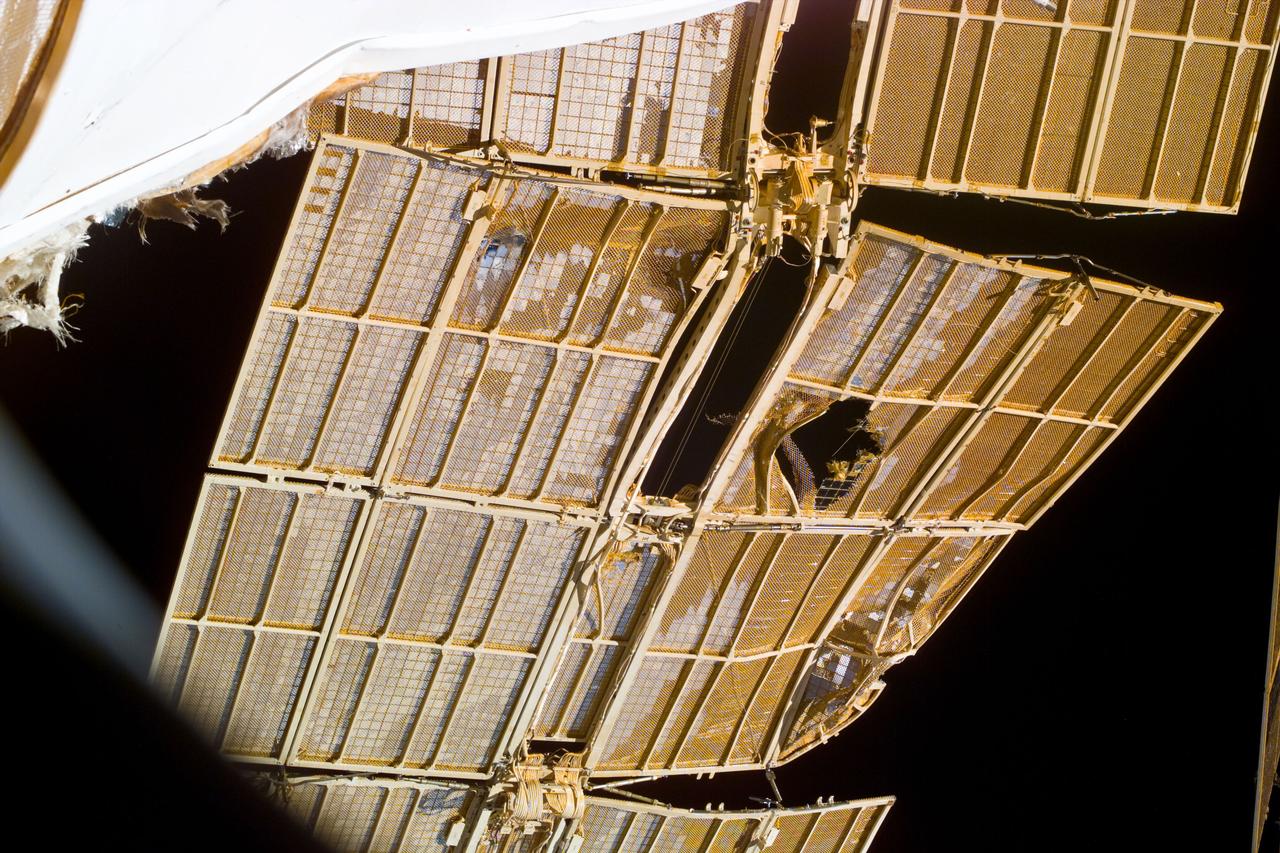
S89-E-5190 (25 Jan 1998) --- This Electronic Still Camera (ESC) image shows the Russian Mir Space Station's damaged solar array panel. The solar array panel was damaged as a result of an impact with an unmanned Progress re-supply ship which collided with the Mir on June 25, 1997, causing the Spektr Module to depressurize. This ESC view was taken on January 25, 1998 at 16:56:30 GMT.
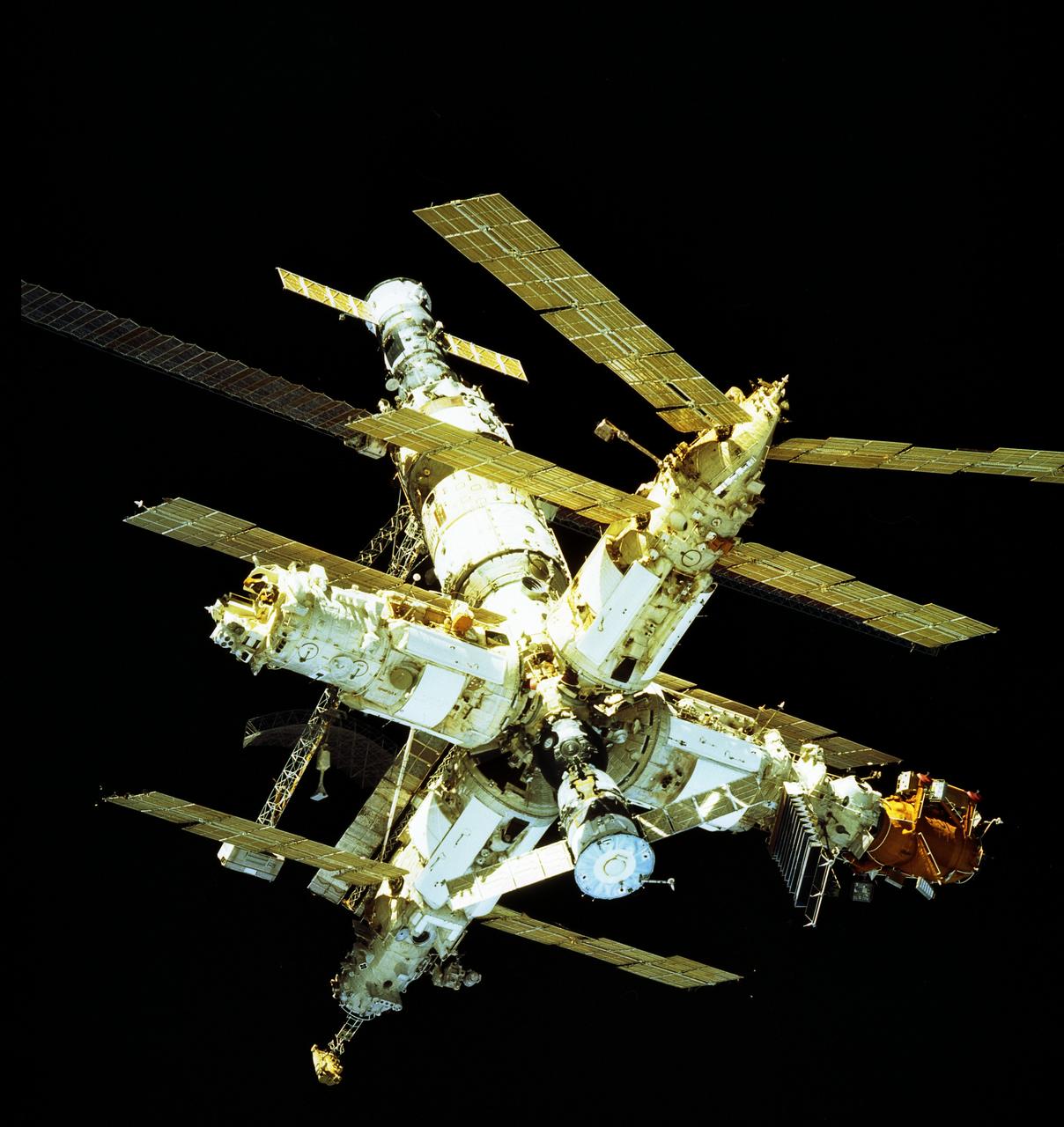
This is a view of the Russian Mir Space Station photographed by a crewmember of the fifth Shuttle/Mir docking mission, STS-81. The image shows: upper center - Progress supply vehicle, Kvant-1 module, and Core module; center left - Priroda module; center right - Spektr module; bottom left - Kvant-2 module; bottom center - Soyuz; and bottom right - Kristall module and Docking module. The Progress was an unmarned, automated version of the Soyuz crew transfer vehicle, designed to resupply the Mir. The Kvant-1 provided research in the physics of galaxies, quasars, and neutron stars, by measuring electromagnetic spectra and x-ray emissions. The Core module served as the heart of the space station and contained the primary living and working areas, life support, and power, as well as the main computer, communications, and control equipment. Priroda's main purpose was Earth remote sensing. The Spektr module provided Earth observation. It also supported research into biotechnology, life sciences, materials science, and space technologies. American astronauts used the Spektr as their living quarters. Kvant-2 was a scientific and airlock module, providing biological research, Earth observations, and EVA (extravehicular activity) capability. The Soyuz typically ferried three crewmembers to and from the Mir. A main purpose of the Kristall module was to develop biological and materials production technologies in the space environment. The Docking module made it possible for the Space Shuttle to dock easily with the Mir. The journey of the 15-year-old Russian Mir Space Station ended March 23, 2001, as the Mir re-entered the Earth's atmosphere and fell into the south Pacific Ocean.
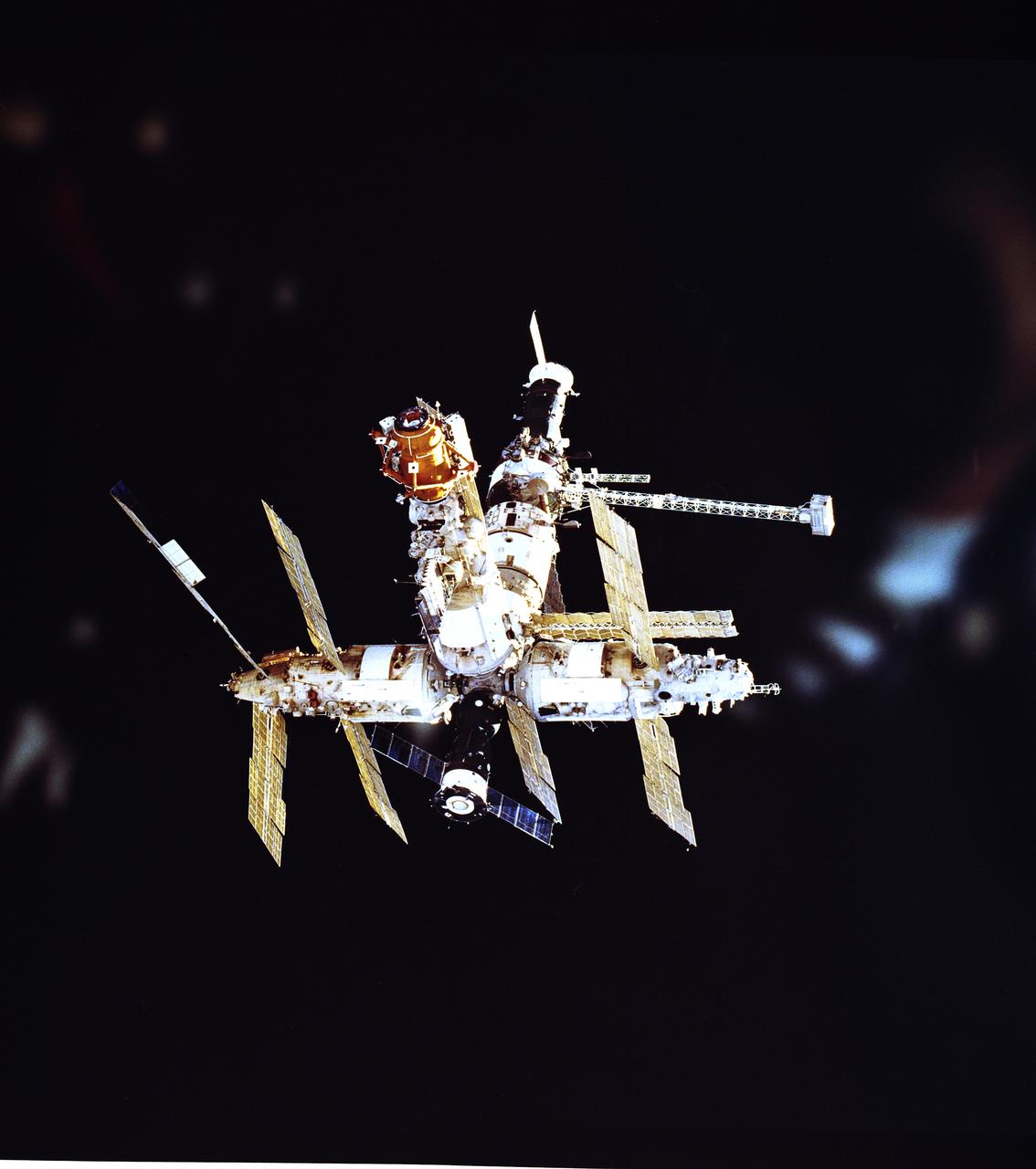
This is a view of the Russian Mir Space Station photographed by a crewmember of the second Shuttle/Mir docking mission, STS-74. The image shows: top - Progress supply vehicle, Kvant-1 module, and the Core module; middle left - Spektr module; middle center - Kristall module and Docking module; middle right - Kvant-2 module; and bottom - Soyuz. The Progress was an unmarned, automated version of the Soyuz crew transfer vehicle, designed to resupply the Mir. The Kvant-1 provided research in the physics of galaxies, quasars, and neutron stars by measuring electromagnetic spectra and x-ray emissions. The Core module served as the heart of the space station and contained the primary living and working areas, life support, and power, as well as the main computer, communications, and control equipment. The Spektr module provided Earth observation. It also supported research into biotechnology, life sciences, materials science, and space technologies. American astronauts used the Spektr as their living quarters. A main purpose of the Kristall module was to develop biological and materials production technologies in the space environment. The Docking module made it possible for the Space Shuttle to dock easily with the Mir. Kvant-2 was a scientific and airlock module, providing biological research, Earth observations, and EVA (extravehicular activity) capability. The Soyuz typically ferried three crewmembers to and from the Mir. The journey of the 15-year-old Russian Mir Space Station ended March 23, 2001, as the Mir re-entered the Earth's atmosphere and fell into the south Pacific Ocean.
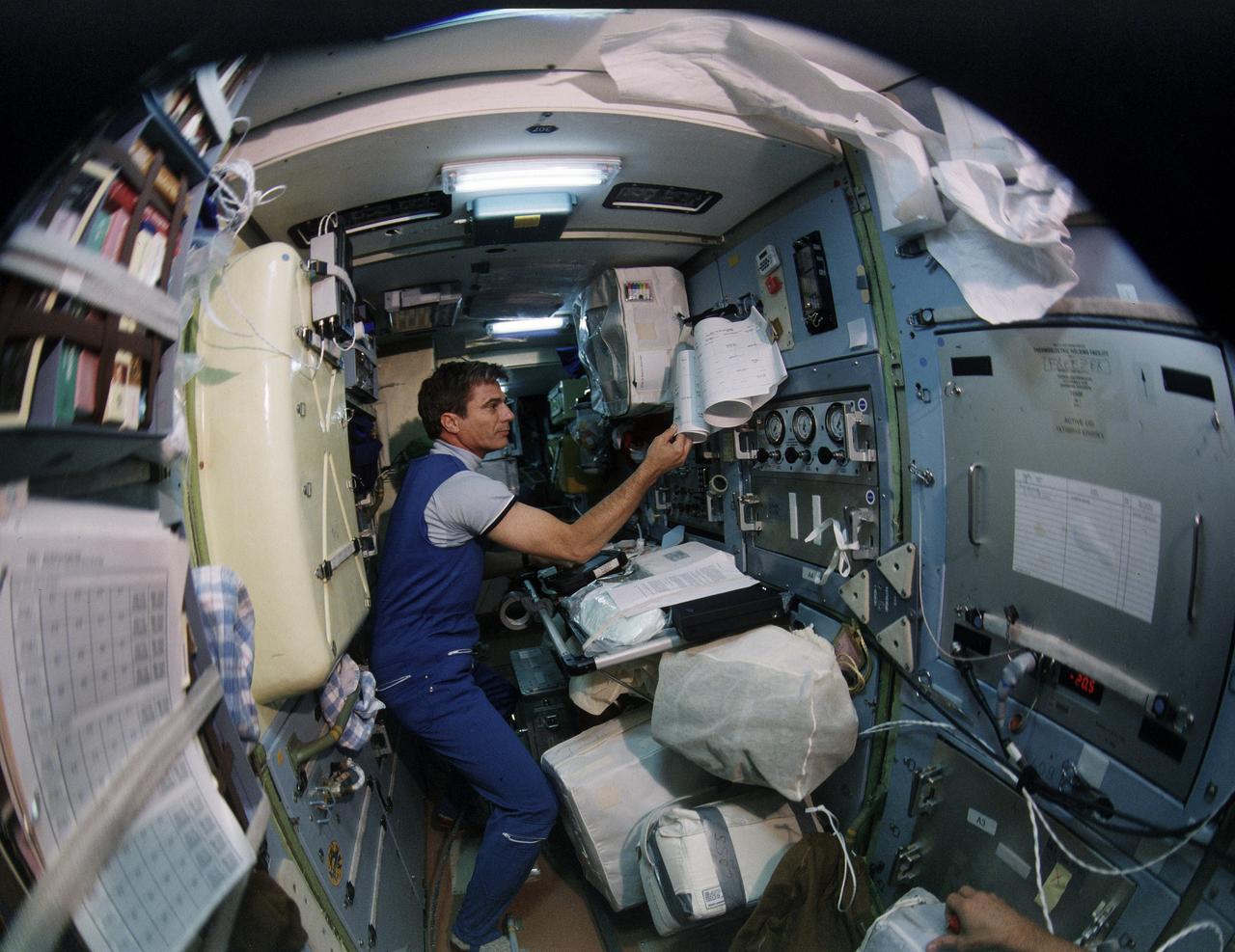
STS079-S-062 (16-26 Sept. 1996) --- Astronaut John E. Blaha, here serving as a cosmonaut guest researcher onboard Russia's Mir Space Station, is pictured on the Spektr Module during his "move" from the Space Shuttle Atlantis. During the STS-79 mission, the crew used an IMAX camera to document activities aboard the space shuttle Atlantis and the various Mir modules. A hand-held version of the 65mm camera system accompanied the STS-79 crew into space in Atlantis' crew cabin. NASA has flown IMAX camera systems on many shuttle missions, including a special cargo bay camera's coverage of other recent Shuttle-Mir rendezvous and/or docking missions.
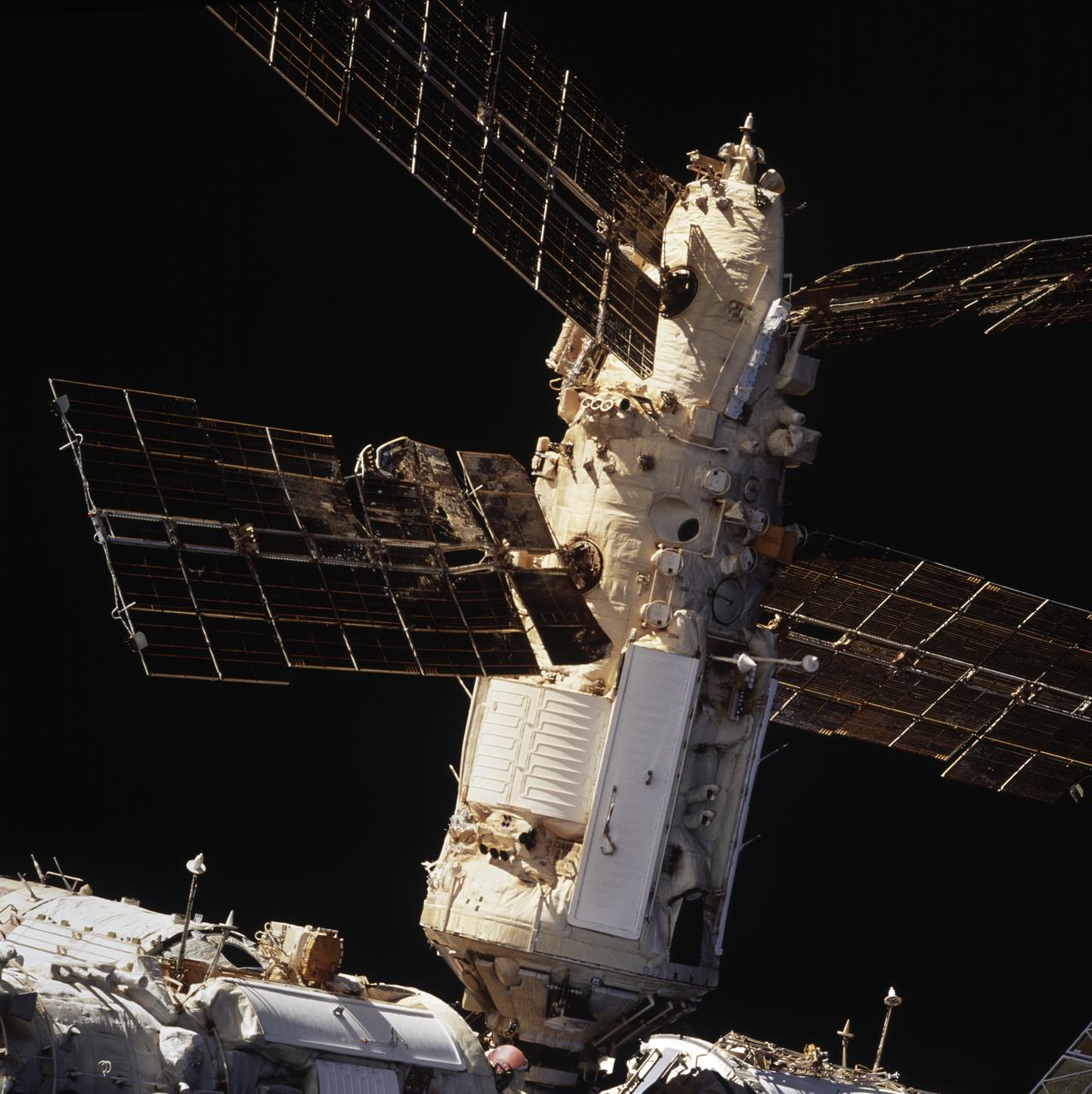
STS086-720-007 (25 Sept.-6 Oct. 1997) --- A 70mm view of Russia’s Mir Space Station’s Spektr Module shows the backside of a solar array panel and damage incurred by the impact of a Russian unmanned Progress re-supply ship which collided with the space station on June 25, 1997, causing Spektr to depressurize. A radiator, which also was struck by the Progress, is out of view from this angle. Photo credit: NASA
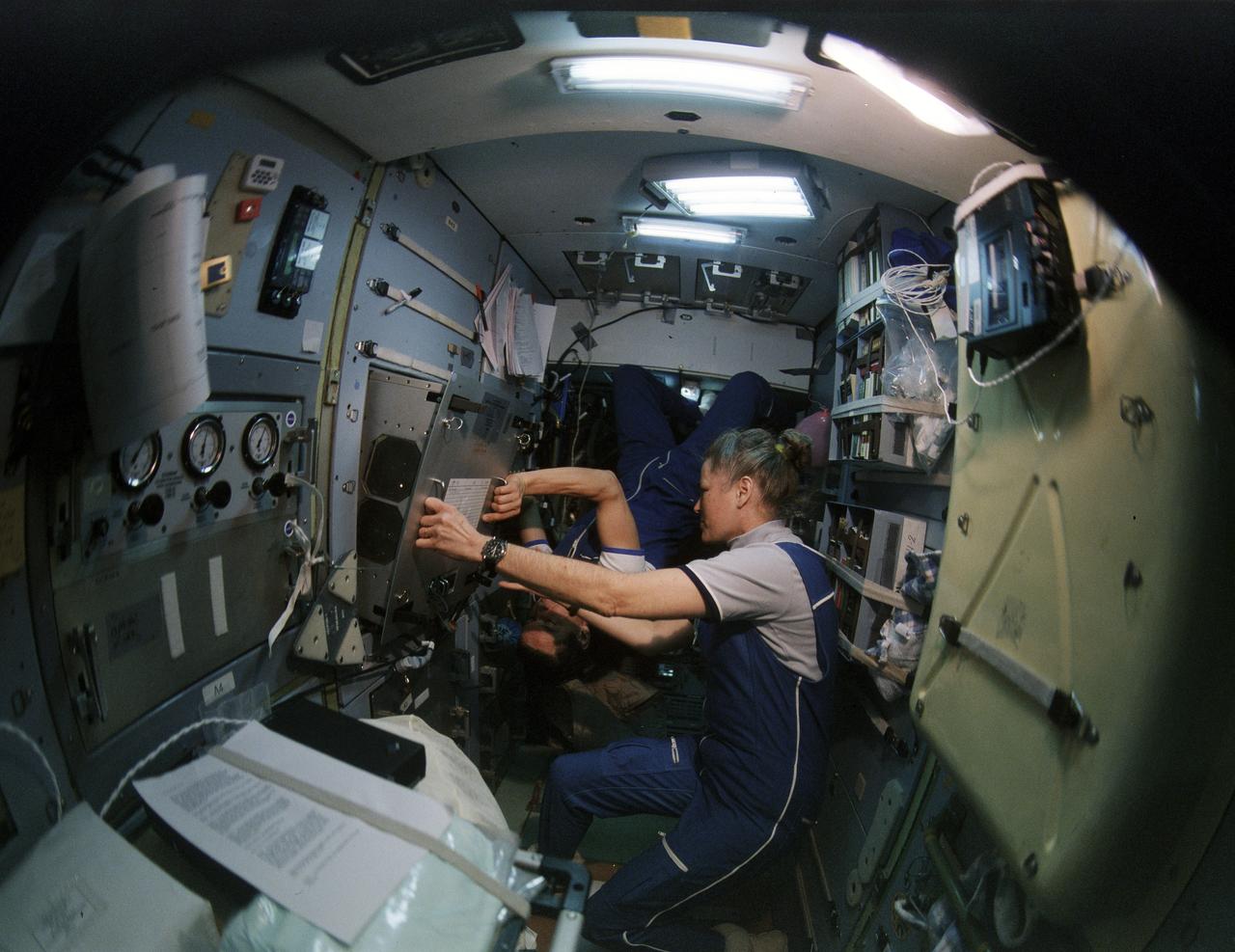
STS079-S-082 (16-26 Sept. 1996) --- Cosmonaut guest researcher Shannon W. Lucid and Valeri G. Korzun, her Mir-22 commander, are pictured on the Spektr Module aboard Russia's Earth-orbiting Mir Space Station. Korzun was the third of four commanders that Lucid served with during her record-setting 188 consecutive days in space. Later, Lucid returned to Earth with her fourth commander-astronaut William F. Readdy-and five other NASA astronauts to complete the STS-79 mission. During the STS-79 mission, the crew used an IMAX camera to document activities aboard the space shuttle Atlantis and the various Mir modules. A hand-held version of the 65mm camera system accompanied the STS-79 crew into space in Atlantis' crew cabin. NASA has flown IMAX camera systems on many Shuttle missions, including a special cargo bay camera's coverage of other recent Shuttle-Mir rendezvous and/or docking missions.
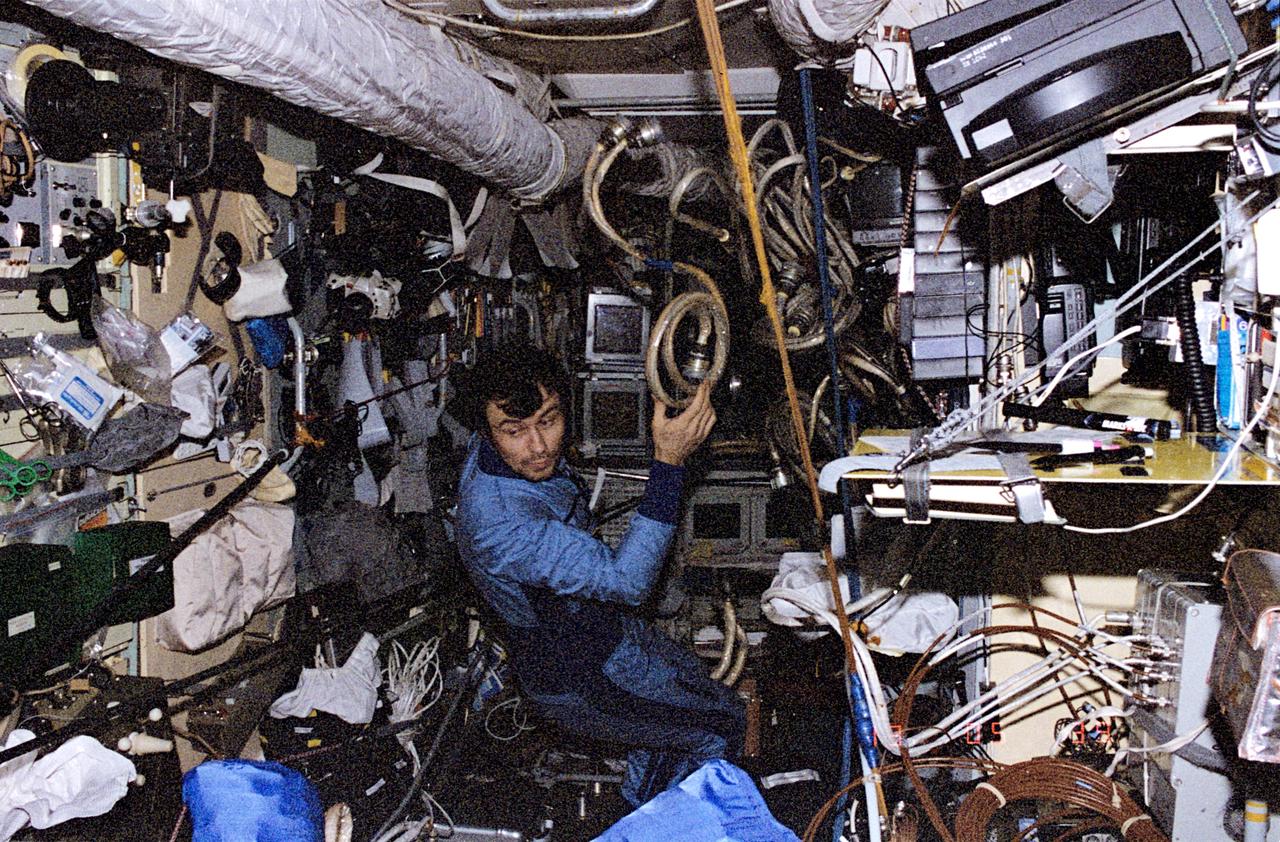
NM18-307-014 (March-July 1995) --- Onboard Mir's Spektr module, cosmonaut Vladimir N. Dezhurov re-routes cables as part of the module's activation process. This visual was one of many shown by the Mir-18 crew at a press conference on July 18 in Houston.
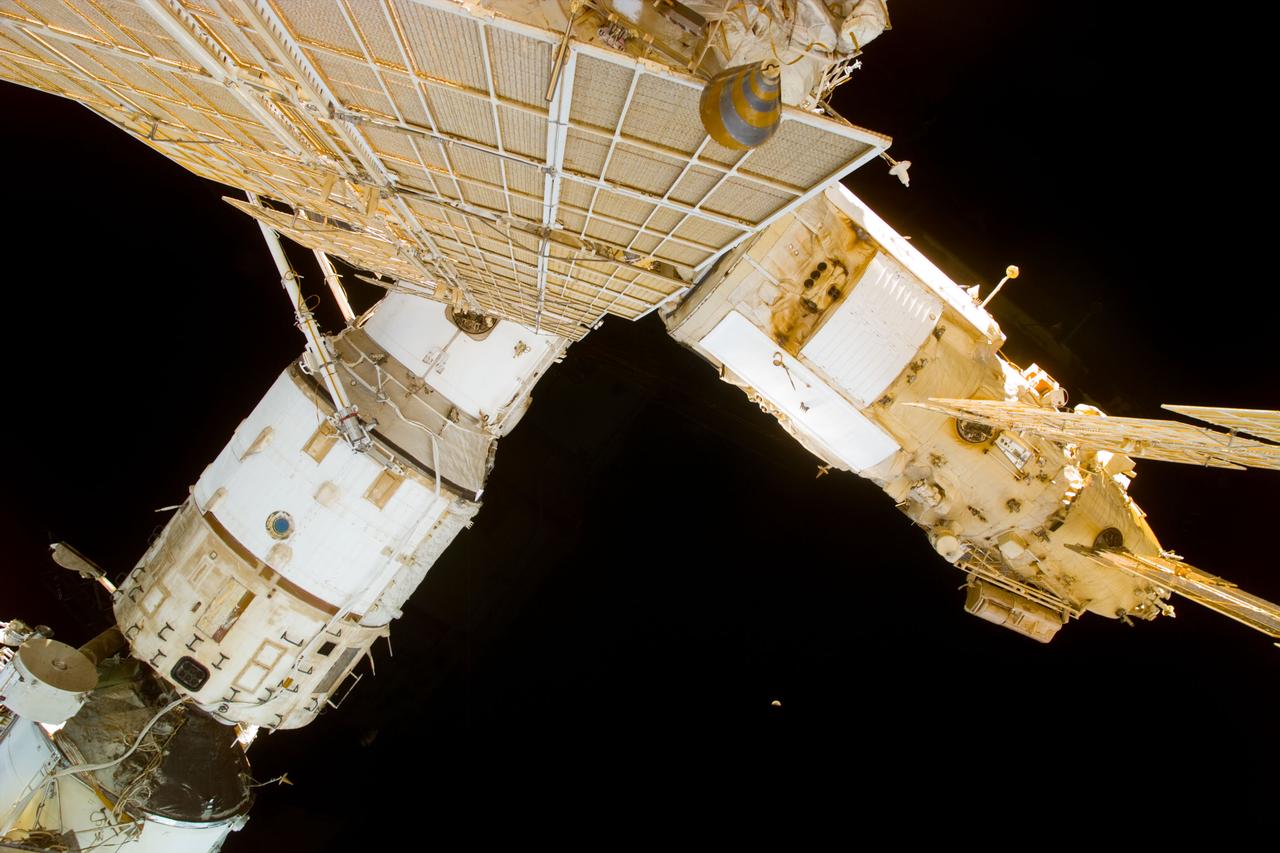
STS081-E-05501 (16 Jan. 1997) --- A view of several elements of the Russia's Mir Space Station complex as seen from the Space Shuttle Atlantis, to which it is docked for several days. The scene was recorded with an Electronic Still Camera (ESC) by one of the STS-81 crewmembers.
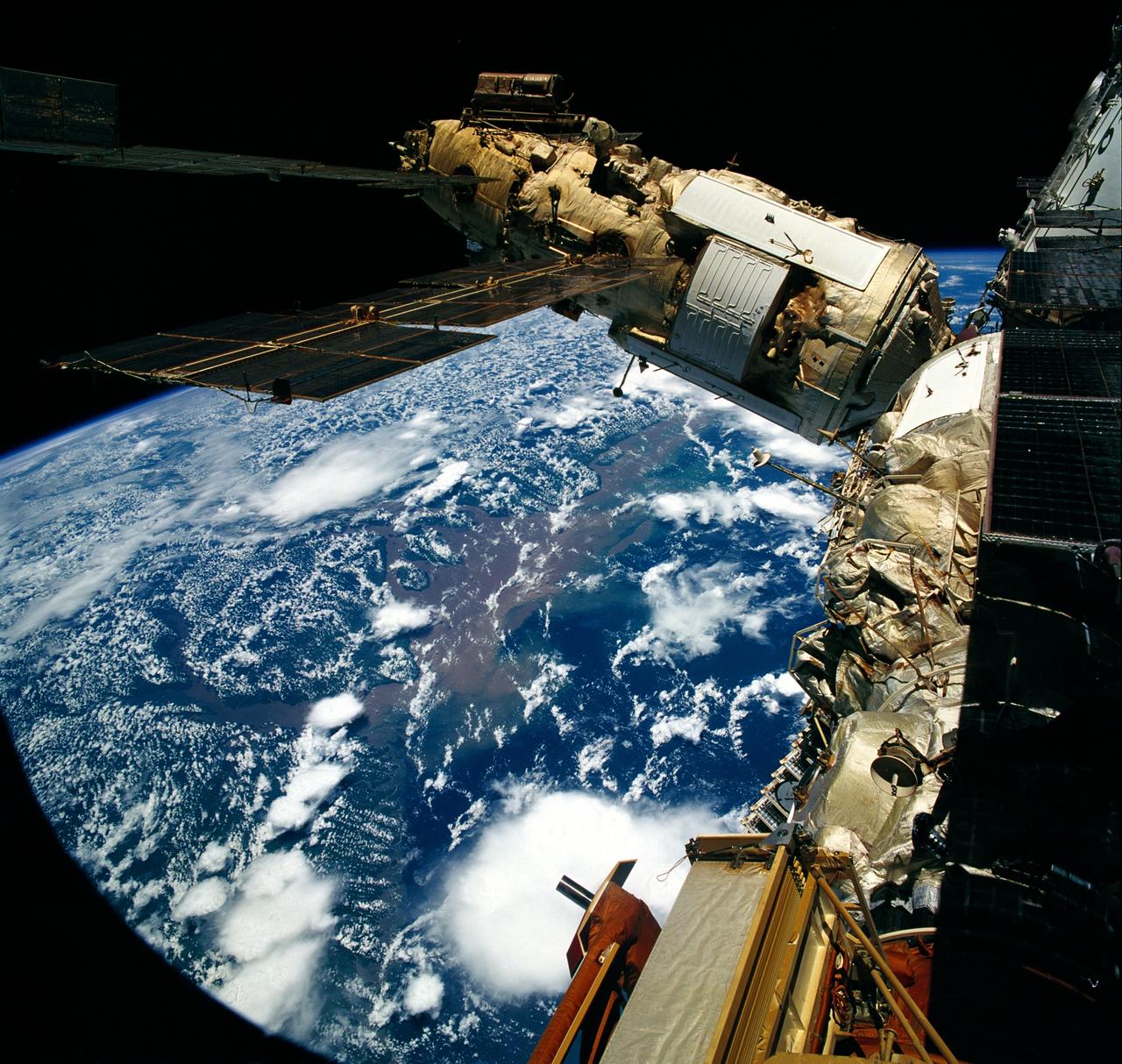
STS076-708-031 (22 - 31 March 1996) --- Clouds over Brazil form the backdrop for this 70mm image showing the Spektr Module and other components of Russia's Mir Space Station. The photograph was taken after Space Shuttle Atlantis docked with the Mir Space Station on March 23, 1996. The delta of the giant Amazon River is at frame center.
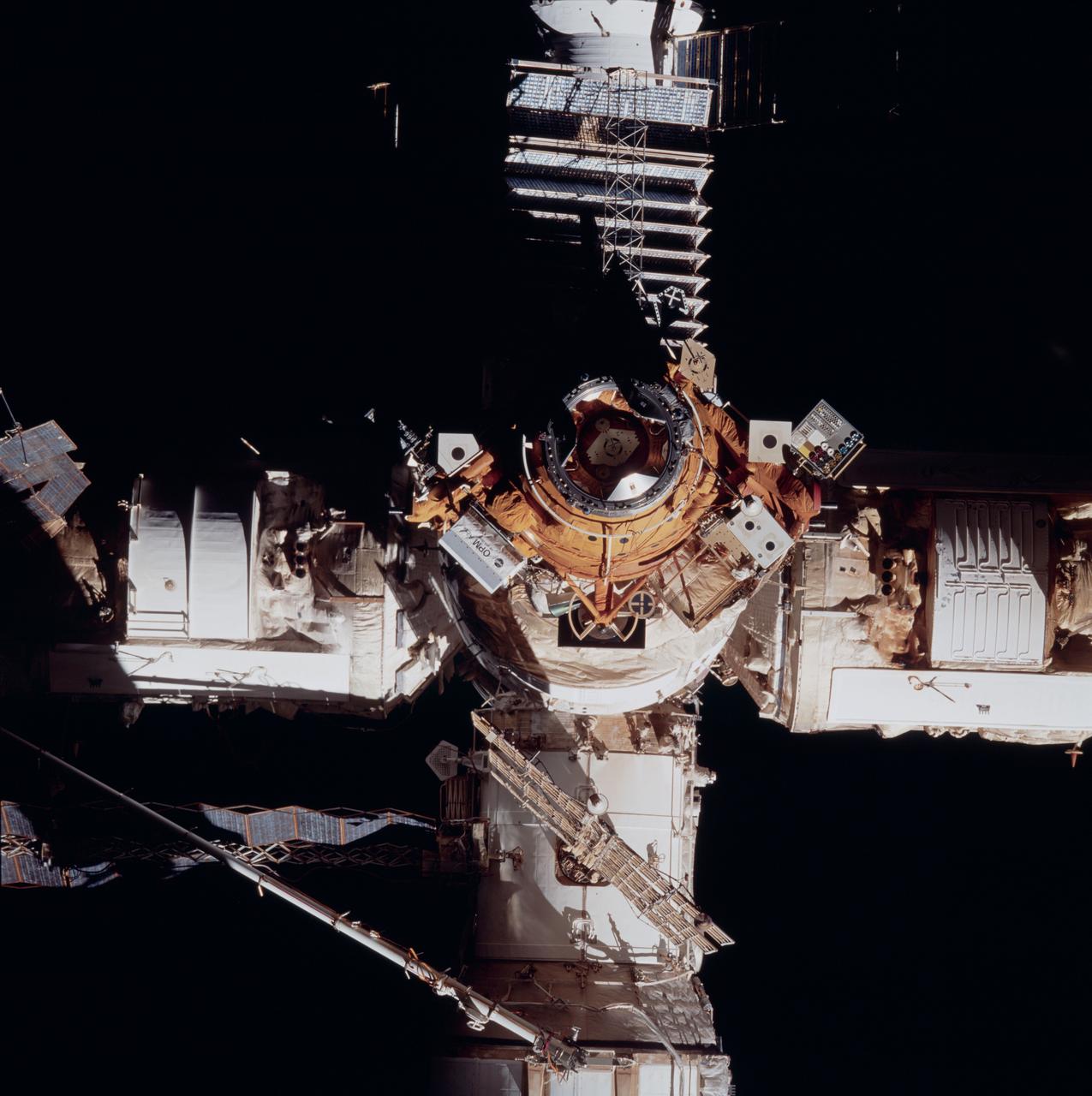
STS084-730-002 (15-24 May 1997) --- A Space Shuttle Atlantis point-of-view frame showing the docking port and target during separation from with Russia's Mir Space Station. The picture should be held with the retracted Kristall solar array at right. Other elements partially visible are Kvant-2 (top), Spektr (bottom) and Core Module (left).
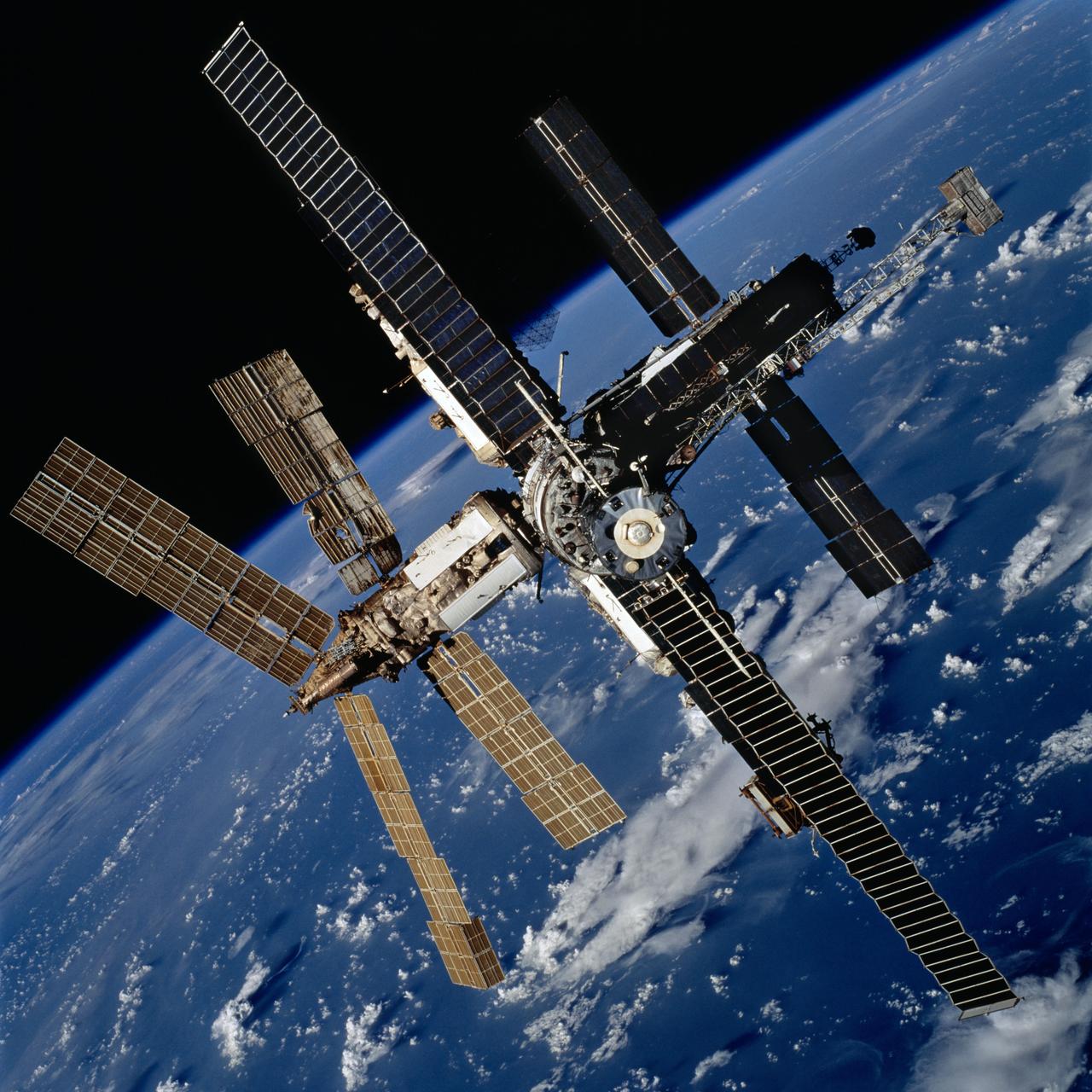
STS086-710-007 (25 Sept - 6 Oct 1997) --- A 70mm view of Russia?s Mir Space Station backdropped against a cloud-covered Earth was photographed during a fly-around by the Space Shuttle Atlantis following the conclusion of joint docking activities between the Mir-24 and STS-86 crews. One of the solar array panels on the Spektr Module shows damage incurred during the impact of a Russian unmanned Progress re-supply ship with collided with the space station on June 25, 1997.
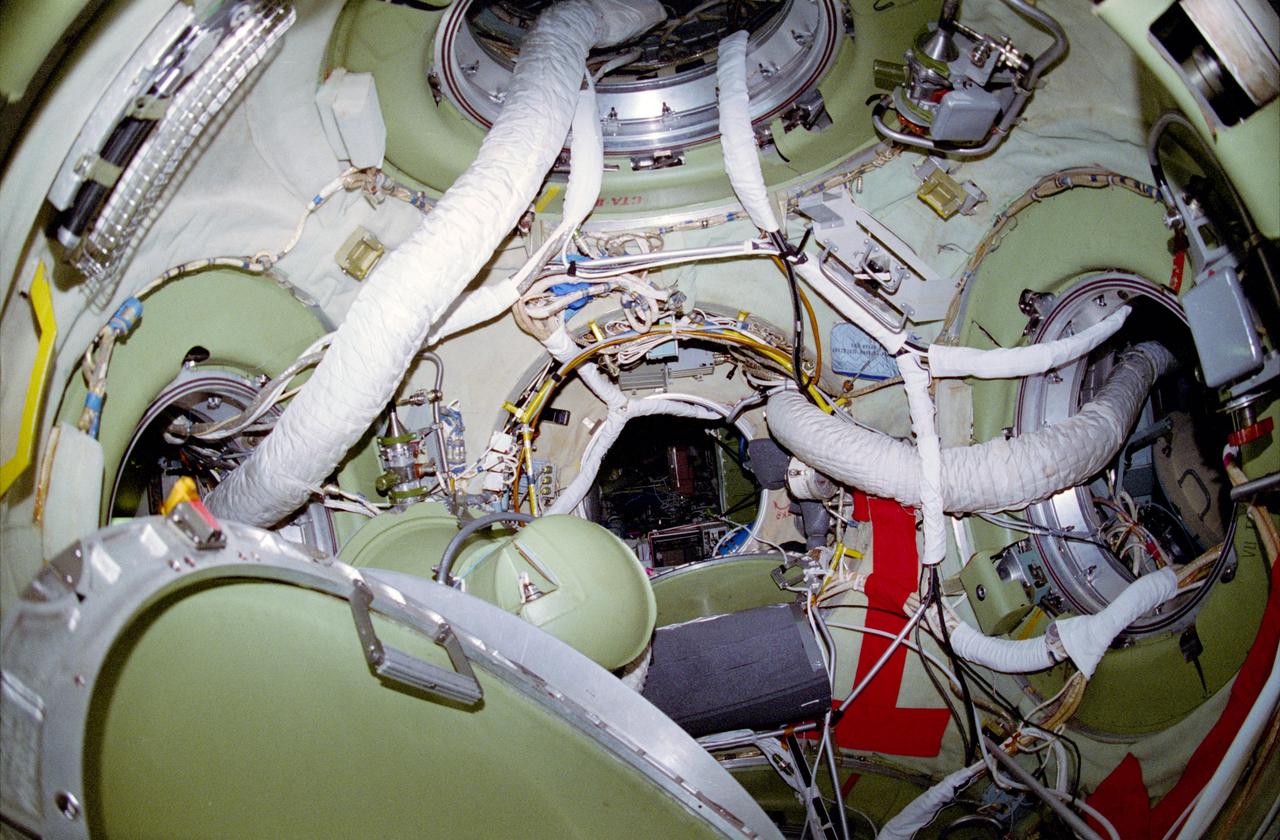
STS084-305-018 (15-24 May 1997) --- As seen from the docked Soyuz hatchway, this 35mm view shows the interior of a Russian Mir Space Station node connected to Kristall (bottom), Priroda (top), Mir Core Module (center), Kvant-2 (left) and Spektr (right). The Mir-23 and STS-84 crew members spent several days sharing joint activities in Earth-orbit as part of an ongoing cooperative program between the Russian Space Agency (RSA) and National Aeronautics and Space Administration (NASA).
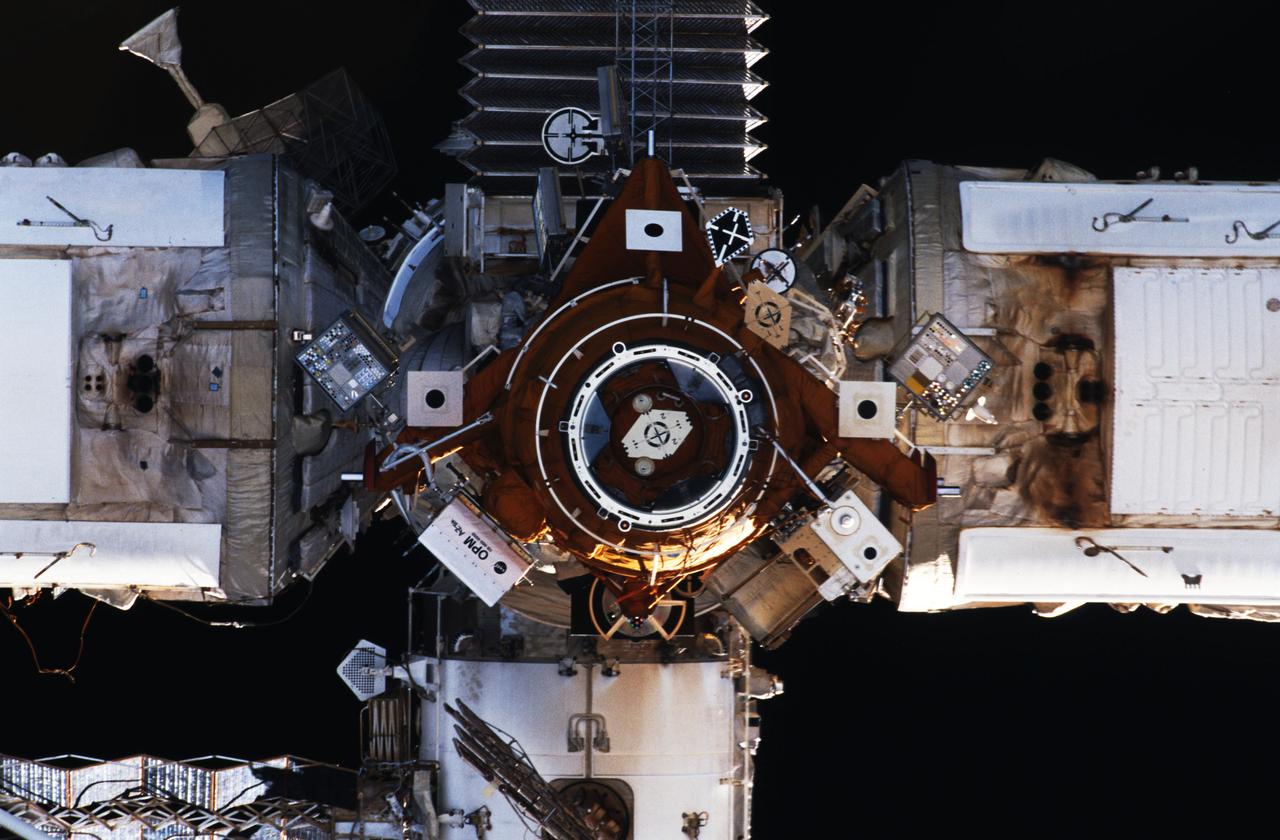
STS084-350-023 (15-24 May 1997) --- A Space Shuttle point-of-view frame showing the docking port and target during rendezvous with Russia's Mir Space Station. The picture should be held horizontally with the retracted Kristall solar array at top. Other elements partially visible are Kvant-2 (left), Spektr (right) and Core Module (bottom).
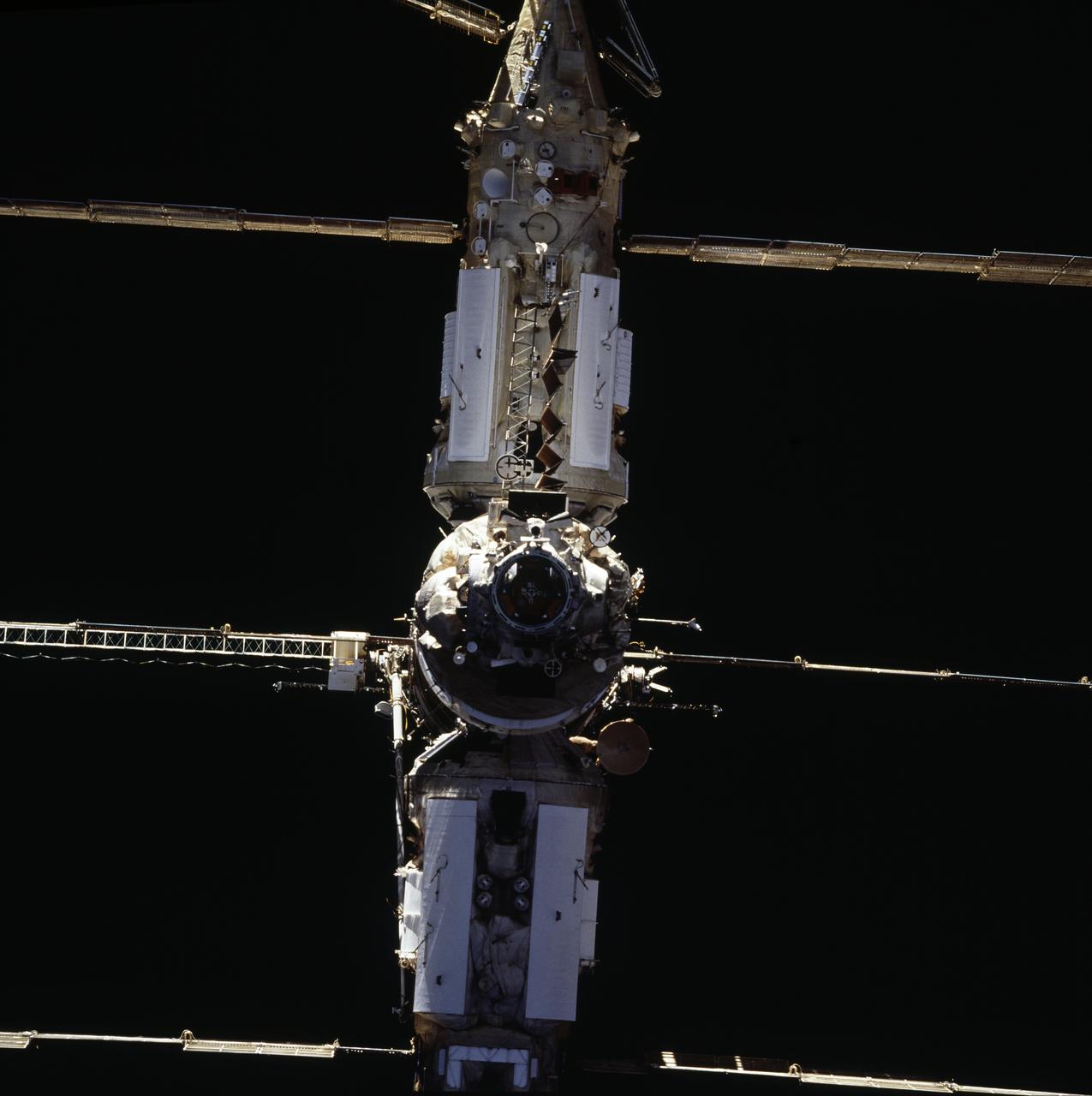
STS071-701-025 (29 June 1995) --- The approach for the June 29, 1995, link-up of the Russian Mir Space Station and the space shuttle Atlantis was recorded with a 70mm handheld camera from the aft flight deck of the Space Shuttle Atlantis. The Androgynous Peripheral Docking System (APDS) and the Kristall Module on Mir are at center frame. Later, five NASA astronauts and two Russian cosmonauts boarded Mir. The occasion was just two and a half weeks prior to the 20th anniversary of the Apollo-Soyuz Test Project (ASTP) docking in Earth-orbit.
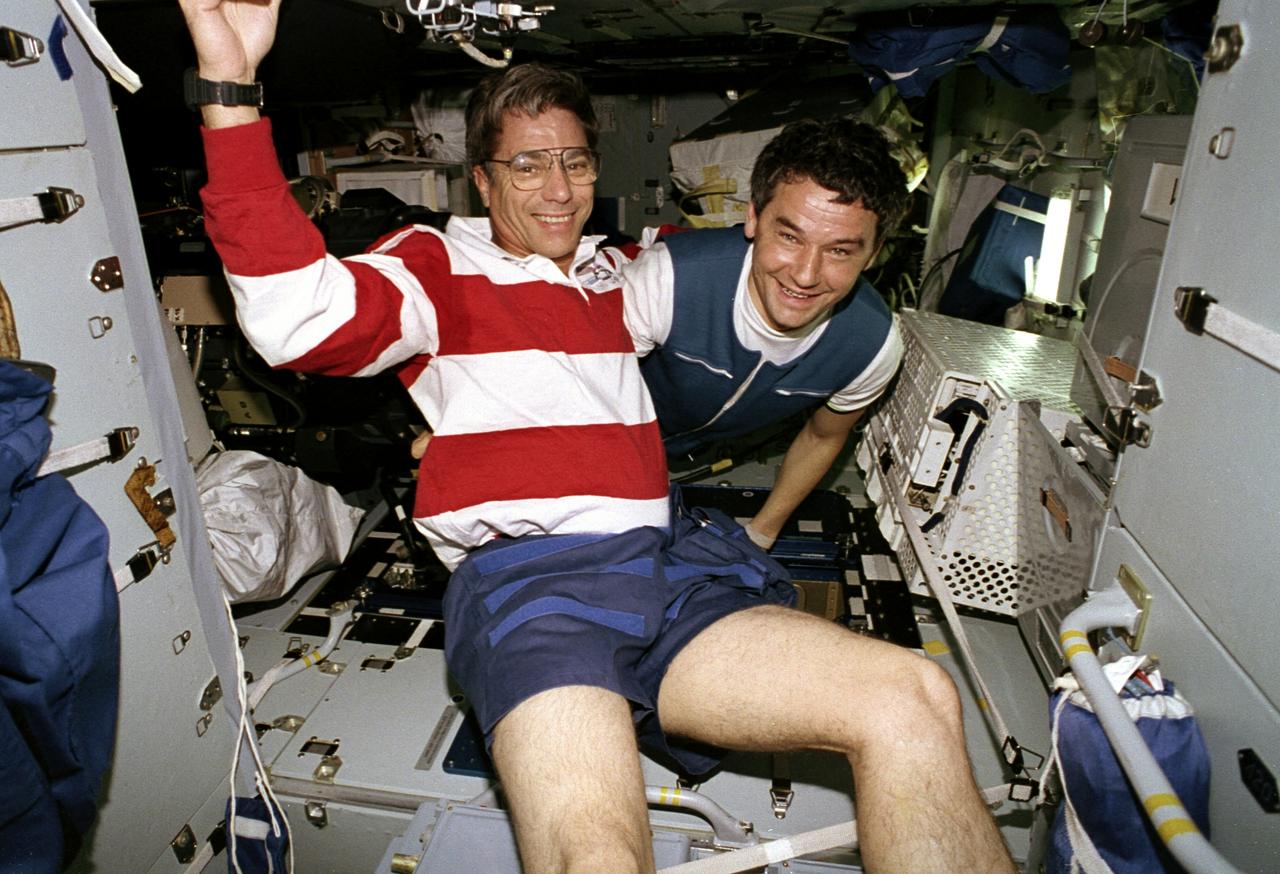
STS079-350-028 (16-26 Sept. 1996) --- Aboard Russian Mir Space Station's Spektr Module, astronaut John E. Blaha, now a cosmonaut guest researcher, visits with Valeri G. Korzun, his mission commander for Mir-22. This photograph is one of fifteen 35mm frames (along with four 70mm frames) of still photography documenting the activities of NASA's STS-79 mission, which began with a Sept. 16, 1996, liftoff from Launch Pad 39A the Kennedy Space Center (KSC) and ended with a landing at KSC on September 26, 1996. Onboard for the launch were astronauts William F. Readdy, commander; Terrence W. Wilcutt, pilot; Blaha, Jerome (Jay) Apt, Thomas D. Akers and Carl E. Walz, all mission specialists. On flight day 4, the crew docked with Mir. Shannon W. Lucid, who had spent six months aboard Mir, switched cosmonaut guest researcher roles with Blaha. The latter joined fellow Mir-22 crewmembers Korzun, and Aleksandr Y. Kaleri, flight engineer.