MESSENGER puts its Stamp on History

Speakers at the first-day-of-issue event for the United States Postal Service’s new stamp celebrating NASA’s James Webb Space Telescope (JWST), autograph a piece of mail with the stamp on it, Thursday, Sept. 8, 2022, at the Smithsonian’s National Postal Museum in Washington. The stamp, which features an illustration of the observatory, honors Webb’s mission to explore the unknown in our universe – solving mysteries in our solar system, looking beyond to distant worlds around other stars, and probing the structures and origins of our universe and our place in it. Photo Credit: (NASA/Aubrey Gemignani)

Lisa Whitehead of the United States Postal Service sings the national anthem at the first-day-of-issue event for the United States Postal Service’s new stamp celebrating NASA’s James Webb Space Telescope (JWST) on Thursday, Sept. 8, 2022, at the Smithsonian’s National Postal Museum in Washington. The stamp, which features an illustration of the observatory, honors Webb’s mission to explore the unknown in our universe – solving mysteries in our solar system, looking beyond to distant worlds around other stars, and probing the structures and origins of our universe and our place in it. Photo Credit: (NASA/Aubrey Gemignani)

NASA Associate Administrator and former astronaut Bob Cabana provides remarks at the first-day-of-issue event for the United States Postal Service’s new stamp celebrating NASA’s James Webb Space Telescope (JWST) on Thursday, Sept. 8, 2022, at the Smithsonian’s National Postal Museum in Washington. The stamp, which features an illustration of the observatory, honors Webb’s mission to explore the unknown in our universe – solving mysteries in our solar system, looking beyond to distant worlds around other stars, and probing the structures and origins of our universe and our place in it. Photo Credit: (NASA/Aubrey Gemignani)

NASA Associate Administrator and former astronaut Bob Cabana provides remarks at the first-day-of-issue event for the United States Postal Service’s new stamp celebrating NASA’s James Webb Space Telescope (JWST) on Thursday, Sept. 8, 2022, at the Smithsonian’s National Postal Museum in Washington. The stamp, which features an illustration of the observatory, honors Webb’s mission to explore the unknown in our universe – solving mysteries in our solar system, looking beyond to distant worlds around other stars, and probing the structures and origins of our universe and our place in it. Photo Credit: (NASA/Aubrey Gemignani)
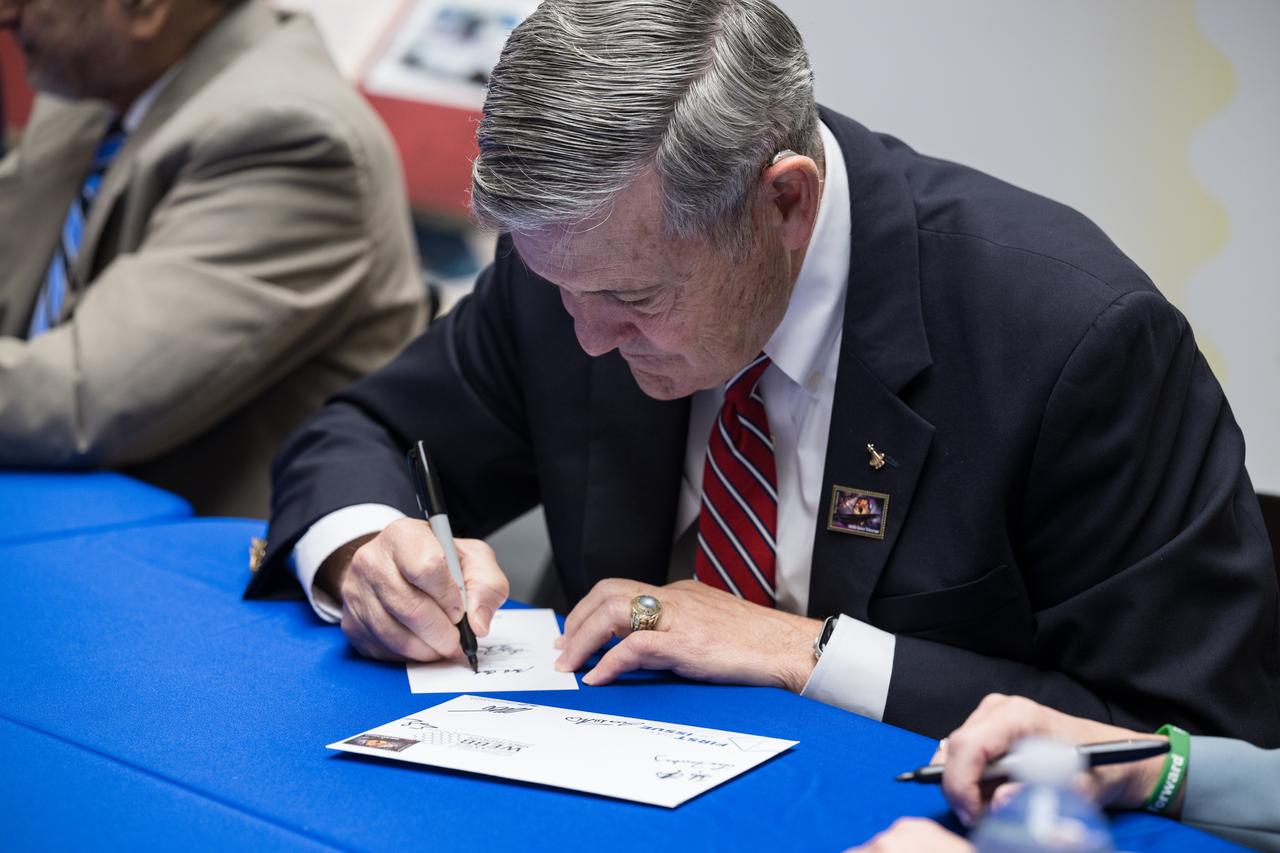
NASA Associate Administrator and former astronaut Bob Cabana, autographs a piece of mail with the United States Postal Service’s new stamp celebrating NASA’s James Webb Space Telescope (JWST) on it, at the first-day-of-issue event, Thursday, Sept. 8, 2022, at the Smithsonian’s National Postal Museum in Washington. The stamp, which features an illustration of the observatory, honors Webb’s mission to explore the unknown in our universe – solving mysteries in our solar system, looking beyond to distant worlds around other stars, and probing the structures and origins of our universe and our place in it. Photo Credit: (NASA/Aubrey Gemignani)

NASA Associate Administrator and former astronaut Bob Cabana provides remarks at the first-day-of-issue event for the United States Postal Service’s new stamp celebrating NASA’s James Webb Space Telescope (JWST) on Thursday, Sept. 8, 2022, at the Smithsonian’s National Postal Museum in Washington. The stamp, which features an illustration of the observatory, honors Webb’s mission to explore the unknown in our universe – solving mysteries in our solar system, looking beyond to distant worlds around other stars, and probing the structures and origins of our universe and our place in it. Photo Credit: (NASA/Aubrey Gemignani)

NASA’s Goddard Space Flight Center Webb Deputy Observatory Project Scientist, Erin Smith, provides remarks at the first-day-of-issue event for the United States Postal Service’s new stamp celebrating NASA’s James Webb Space Telescope (JWST) on Thursday, Sept. 8, 2022, at the Smithsonian’s National Postal Museum in Washington. The stamp, which features an illustration of the observatory, honors Webb’s mission to explore the unknown in our universe – solving mysteries in our solar system, looking beyond to distant worlds around other stars, and probing the structures and origins of our universe and our place in it. Photo Credit: (NASA/Aubrey Gemignani)
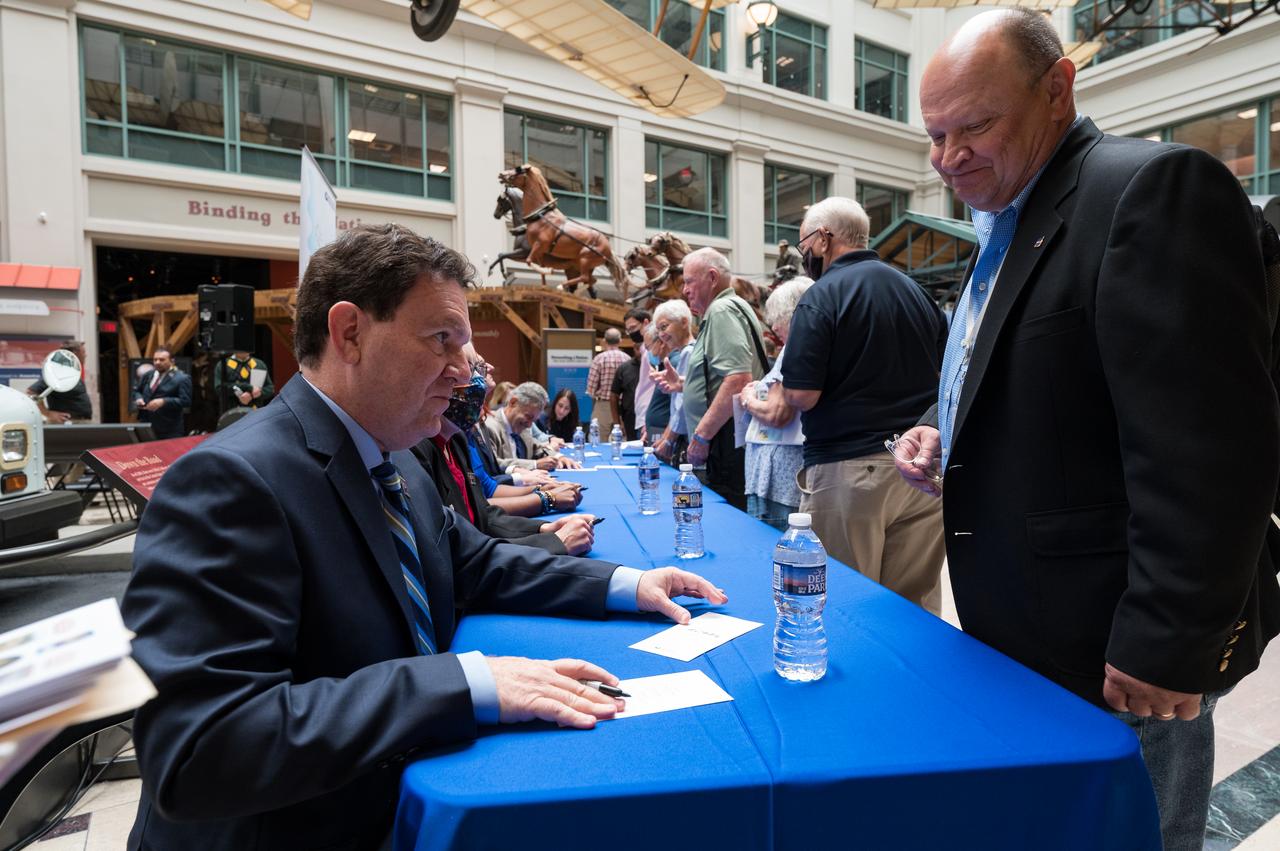
NASA’s Goddard Space Flight Center Webb Optical Telescope Element Manager, Lee Feinberg, autographs a piece of mail with the United States Postal Service’s new stamp celebrating NASA’s James Webb Space Telescope (JWST) on it, at the first-day-of-issue event, Thursday, Sept. 8, 2022, at the Smithsonian’s National Postal Museum in Washington. The stamp, which features an illustration of the observatory, honors Webb’s mission to explore the unknown in our universe – solving mysteries in our solar system, looking beyond to distant worlds around other stars, and probing the structures and origins of our universe and our place in it. Photo Credit: (NASA/Aubrey Gemignani)
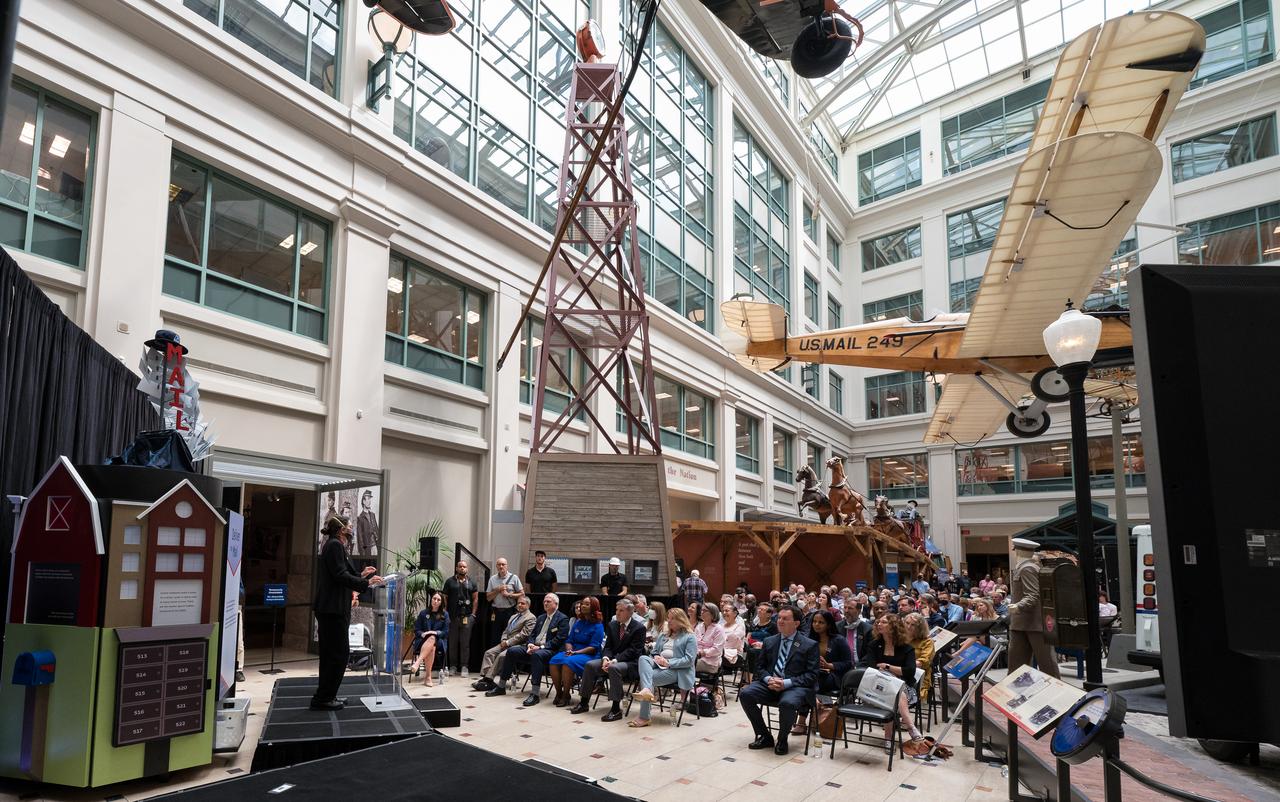
NASA’s Goddard Space Flight Center Webb Deputy Observatory Project Scientist, Erin Smith, provides remarks at the first-day-of-issue event for the United States Postal Service’s new stamp celebrating NASA’s James Webb Space Telescope (JWST) on Thursday, Sept. 8, 2022, at the Smithsonian’s National Postal Museum in Washington. The stamp, which features an illustration of the observatory, honors Webb’s mission to explore the unknown in our universe – solving mysteries in our solar system, looking beyond to distant worlds around other stars, and probing the structures and origins of our universe and our place in it. Photo Credit: (NASA/Aubrey Gemignani)
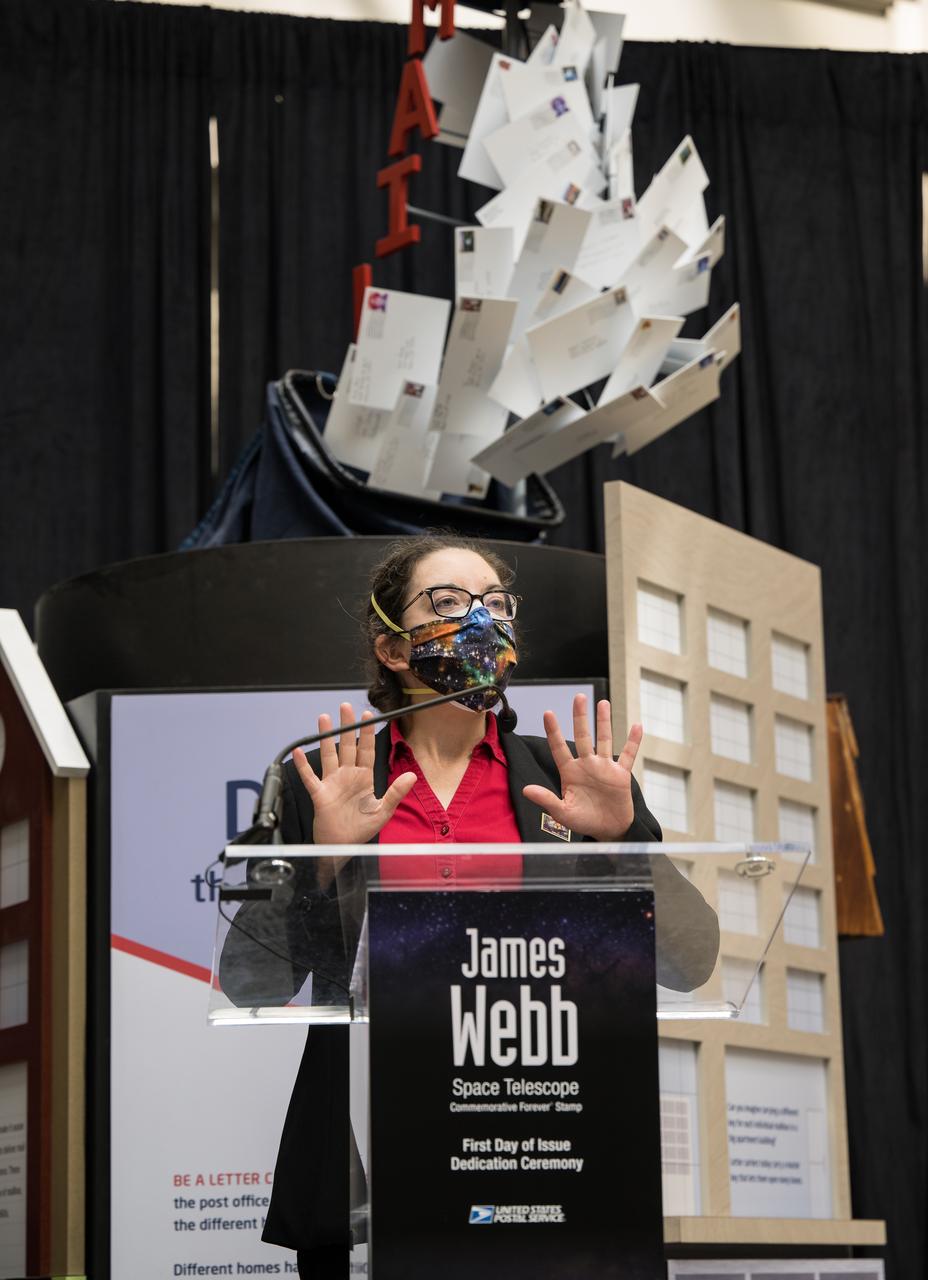
NASA’s Goddard Space Flight Center Webb Deputy Observatory Project Scientist, Erin Smith, provides remarks at the first-day-of-issue event for the United States Postal Service’s new stamp celebrating NASA’s James Webb Space Telescope (JWST) on Thursday, Sept. 8, 2022, at the Smithsonian’s National Postal Museum in Washington. The stamp, which features an illustration of the observatory, honors Webb’s mission to explore the unknown in our universe – solving mysteries in our solar system, looking beyond to distant worlds around other stars, and probing the structures and origins of our universe and our place in it. Photo Credit: (NASA/Aubrey Gemignani)
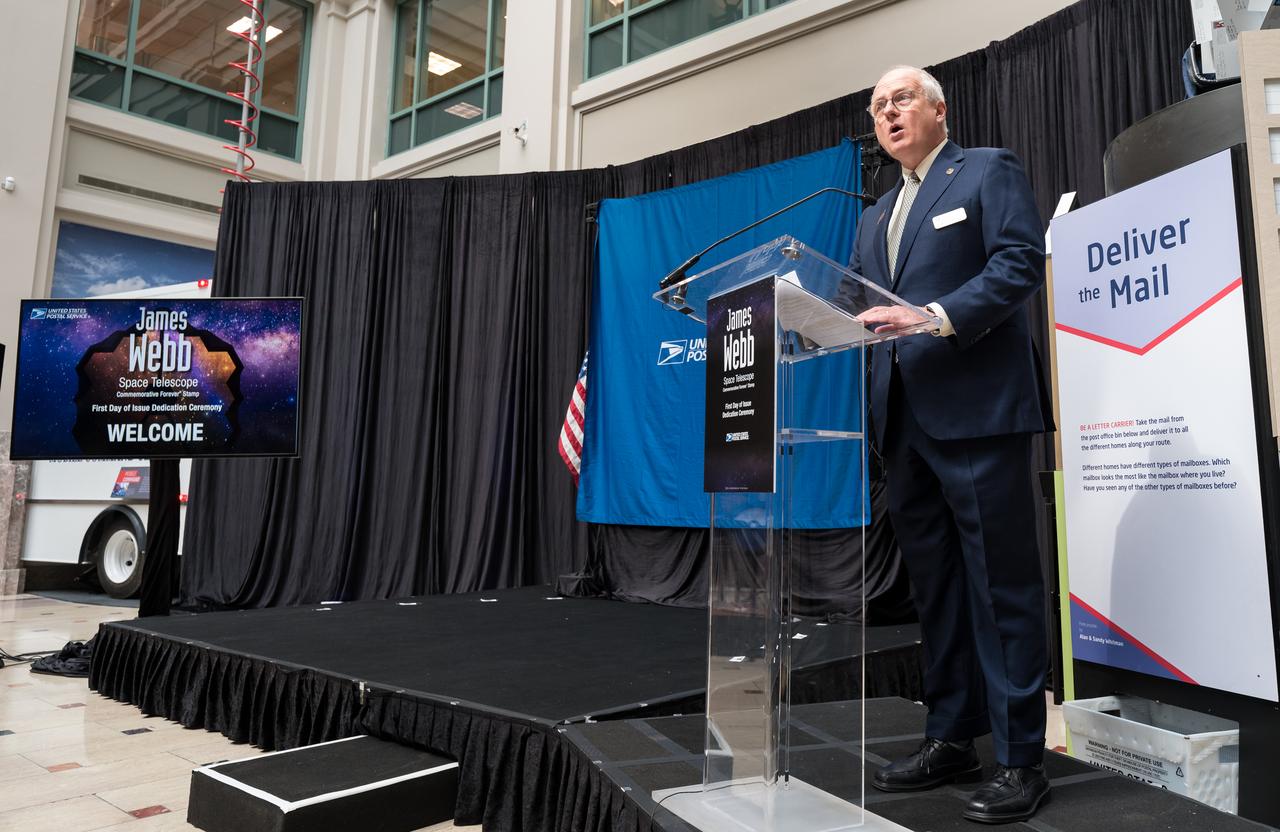
National Postal Museum Deputy Director, Toby Mensforth, provides remarks at the first-day-of-issue event for the United States Postal Service’s new stamp celebrating NASA’s James Webb Space Telescope (JWST) on Thursday, Sept. 8, 2022, at the Smithsonian’s National Postal Museum in Washington. The stamp, which features an illustration of the observatory, honors Webb’s mission to explore the unknown in our universe – solving mysteries in our solar system, looking beyond to distant worlds around other stars, and probing the structures and origins of our universe and our place in it. Photo Credit: (NASA/Aubrey Gemignani)
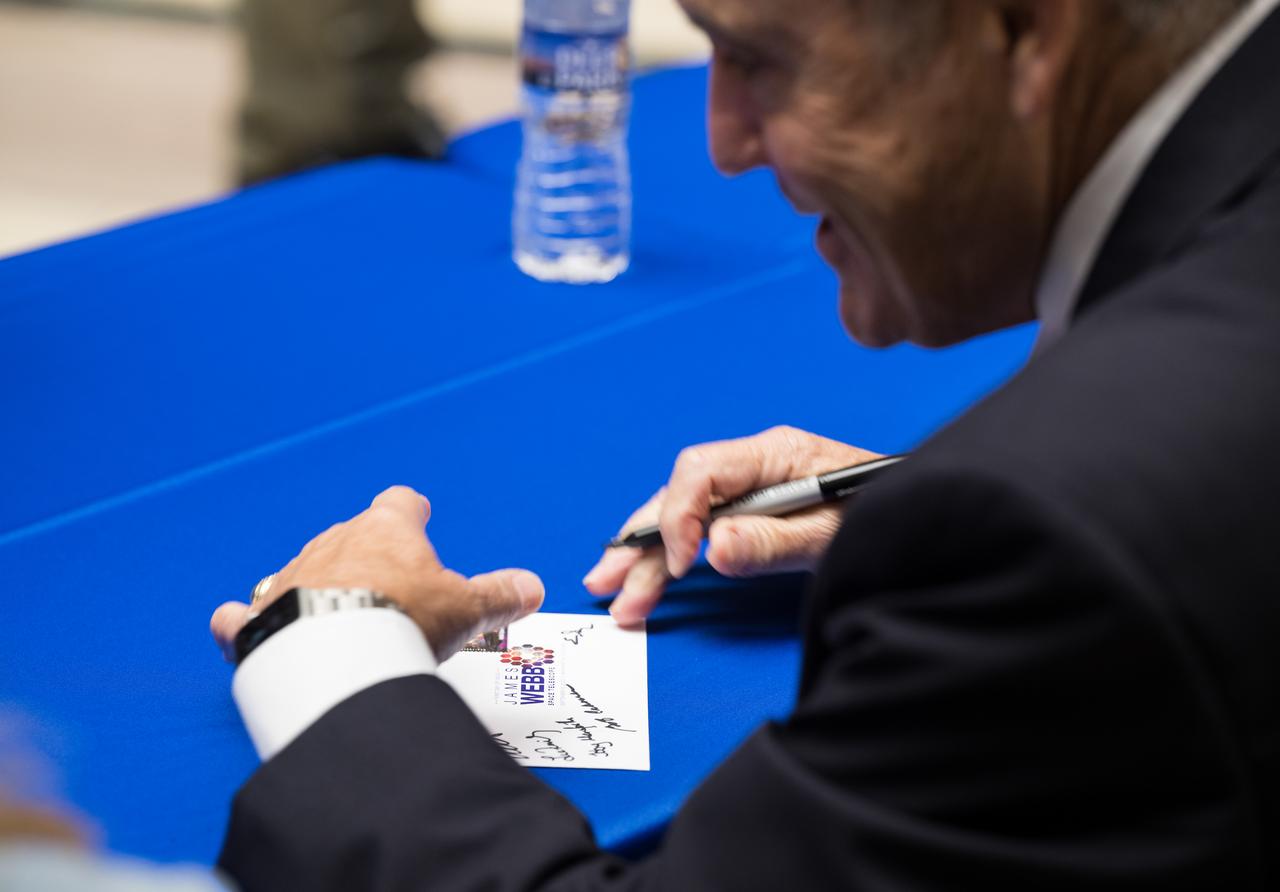
NASA Associate Administrator and former astronaut Bob Cabana, autographs a piece of mail with the United States Postal Service’s new stamp celebrating NASA’s James Webb Space Telescope (JWST) on it, at the first-day-of-issue event, Thursday, Sept. 8, 2022, at the Smithsonian’s National Postal Museum in Washington. The stamp, which features an illustration of the observatory, honors Webb’s mission to explore the unknown in our universe – solving mysteries in our solar system, looking beyond to distant worlds around other stars, and probing the structures and origins of our universe and our place in it. Photo Credit: (NASA/Aubrey Gemignani)
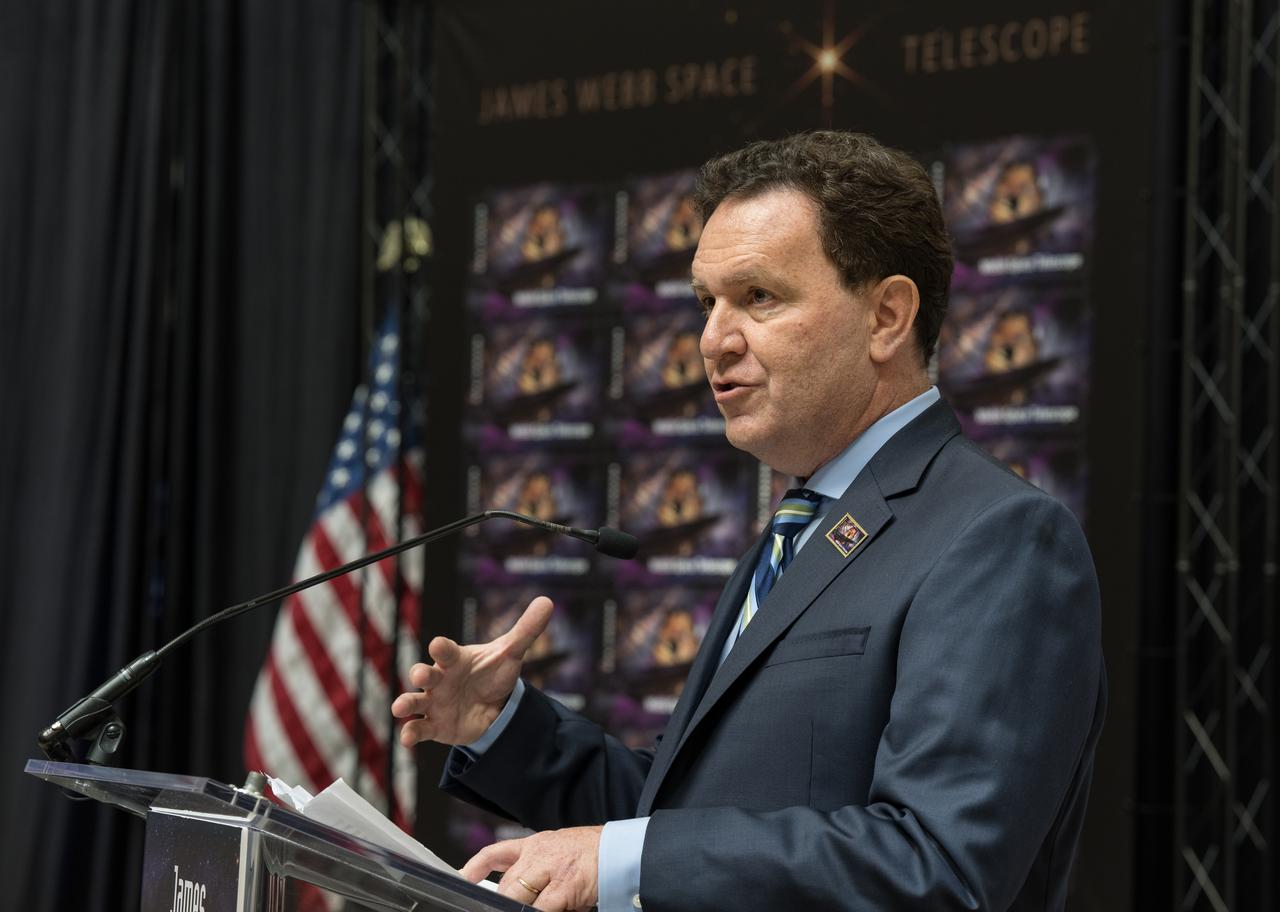
NASA’s Goddard Space Flight Center Webb Optical Telescope Element Manager, Lee Feinberg, provides remarks at the first-day-of-issue event for the United States Postal Service’s new stamp celebrating NASA’s James Webb Space Telescope (JWST) on Thursday, Sept. 8, 2022, at the Smithsonian’s National Postal Museum in Washington. The stamp, which features an illustration of the observatory, honors Webb’s mission to explore the unknown in our universe – solving mysteries in our solar system, looking beyond to distant worlds around other stars, and probing the structures and origins of our universe and our place in it. Photo Credit: (NASA/Aubrey Gemignani)
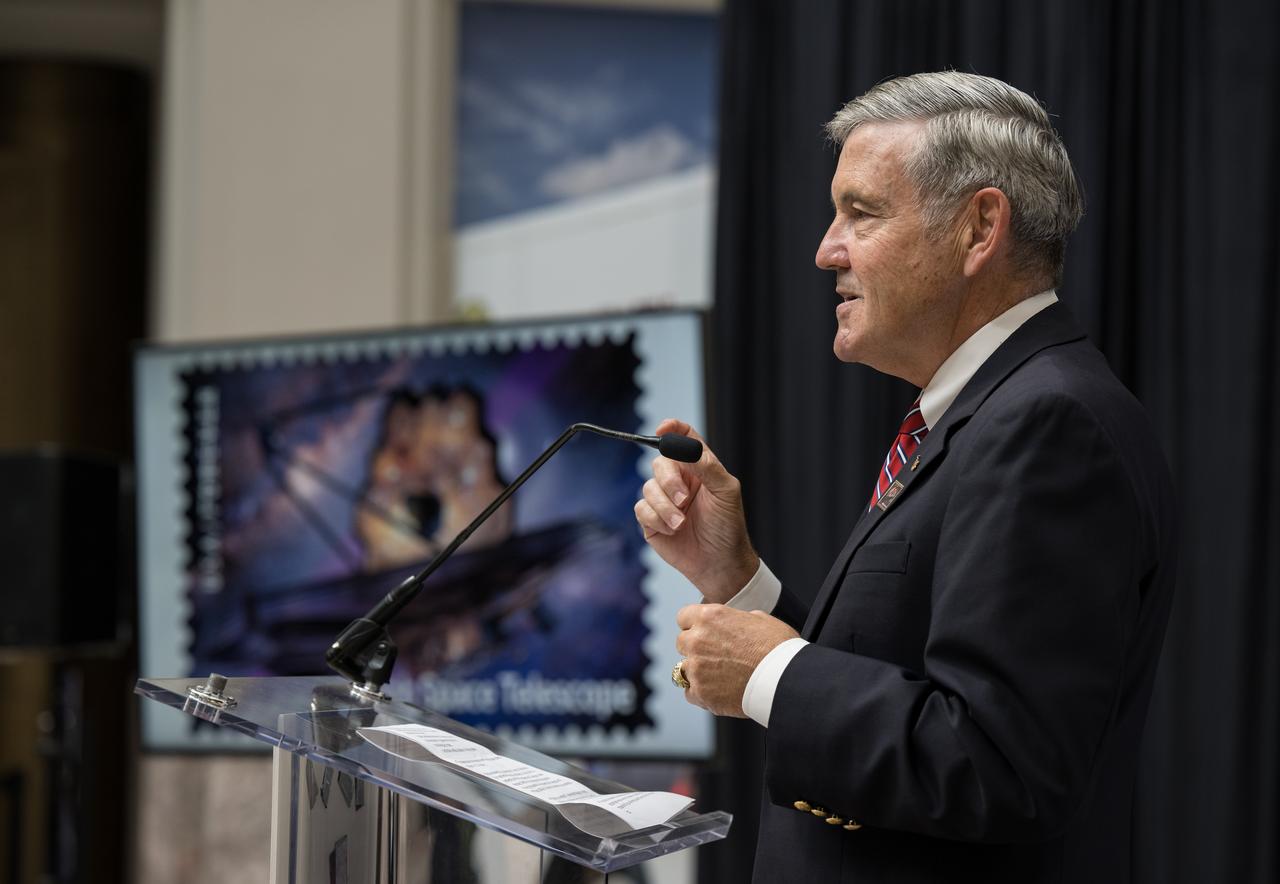
NASA Associate Administrator and former astronaut Bob Cabana provides remarks at the first-day-of-issue event for the United States Postal Service’s new stamp celebrating NASA’s James Webb Space Telescope (JWST) on Thursday, Sept. 8, 2022, at the Smithsonian’s National Postal Museum in Washington. The stamp, which features an illustration of the observatory, honors Webb’s mission to explore the unknown in our universe – solving mysteries in our solar system, looking beyond to distant worlds around other stars, and probing the structures and origins of our universe and our place in it. Photo Credit: (NASA/Aubrey Gemignani)
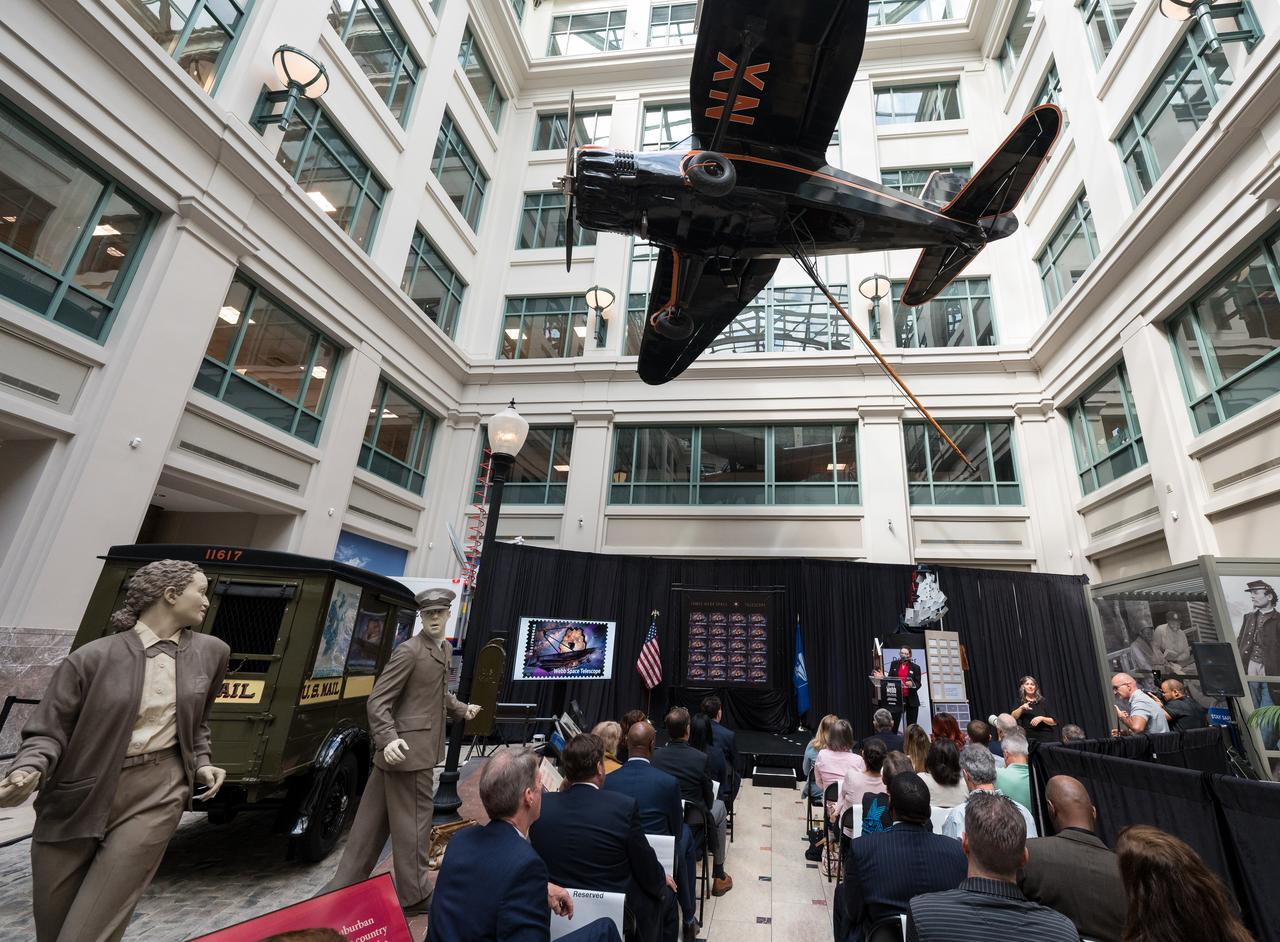
NASA’s Goddard Space Flight Center Webb Deputy Observatory Project Scientist, Erin Smith, provides remarks at the first-day-of-issue event for the United States Postal Service’s new stamp celebrating NASA’s James Webb Space Telescope (JWST) on Thursday, Sept. 8, 2022, at the Smithsonian’s National Postal Museum in Washington. The stamp, which features an illustration of the observatory, honors Webb’s mission to explore the unknown in our universe – solving mysteries in our solar system, looking beyond to distant worlds around other stars, and probing the structures and origins of our universe and our place in it. Photo Credit: (NASA/Aubrey Gemignani)

NASA’s Goddard Space Flight Center Webb Deputy Observatory Project Scientist, Erin Smith, provides remarks at the first-day-of-issue event for the United States Postal Service’s new stamp celebrating NASA’s James Webb Space Telescope (JWST) on Thursday, Sept. 8, 2022, at the Smithsonian’s National Postal Museum in Washington. The stamp, which features an illustration of the observatory, honors Webb’s mission to explore the unknown in our universe – solving mysteries in our solar system, looking beyond to distant worlds around other stars, and probing the structures and origins of our universe and our place in it. Photo Credit: (NASA/Aubrey Gemignani)
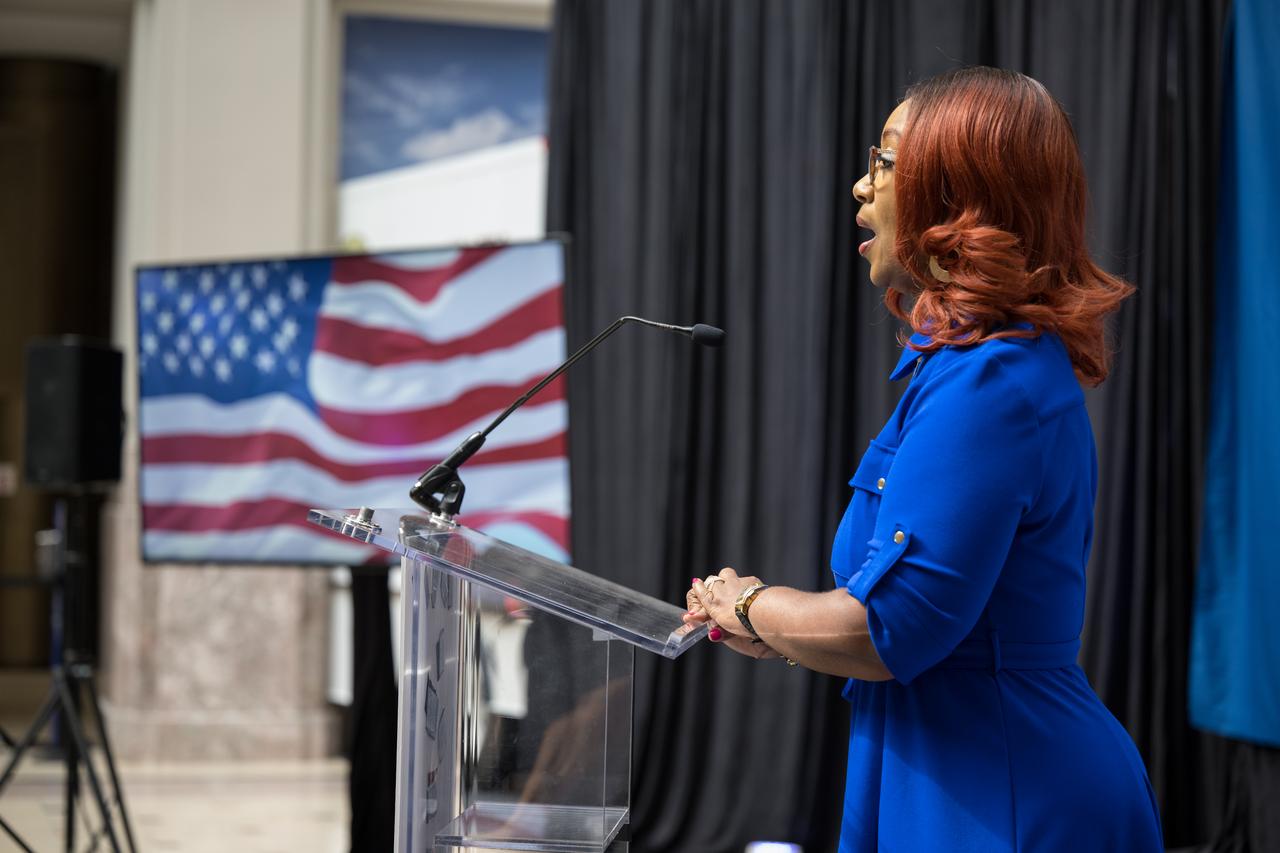
Lisa Whitehead of the United States Postal Service sings the national anthem at the first-day-of-issue event for the United States Postal Service’s new stamp celebrating NASA’s James Webb Space Telescope (JWST) on Thursday, Sept. 8, 2022, at the Smithsonian’s National Postal Museum in Washington. The stamp, which features an illustration of the observatory, honors Webb’s mission to explore the unknown in our universe – solving mysteries in our solar system, looking beyond to distant worlds around other stars, and probing the structures and origins of our universe and our place in it. Photo Credit: (NASA/Aubrey Gemignani)
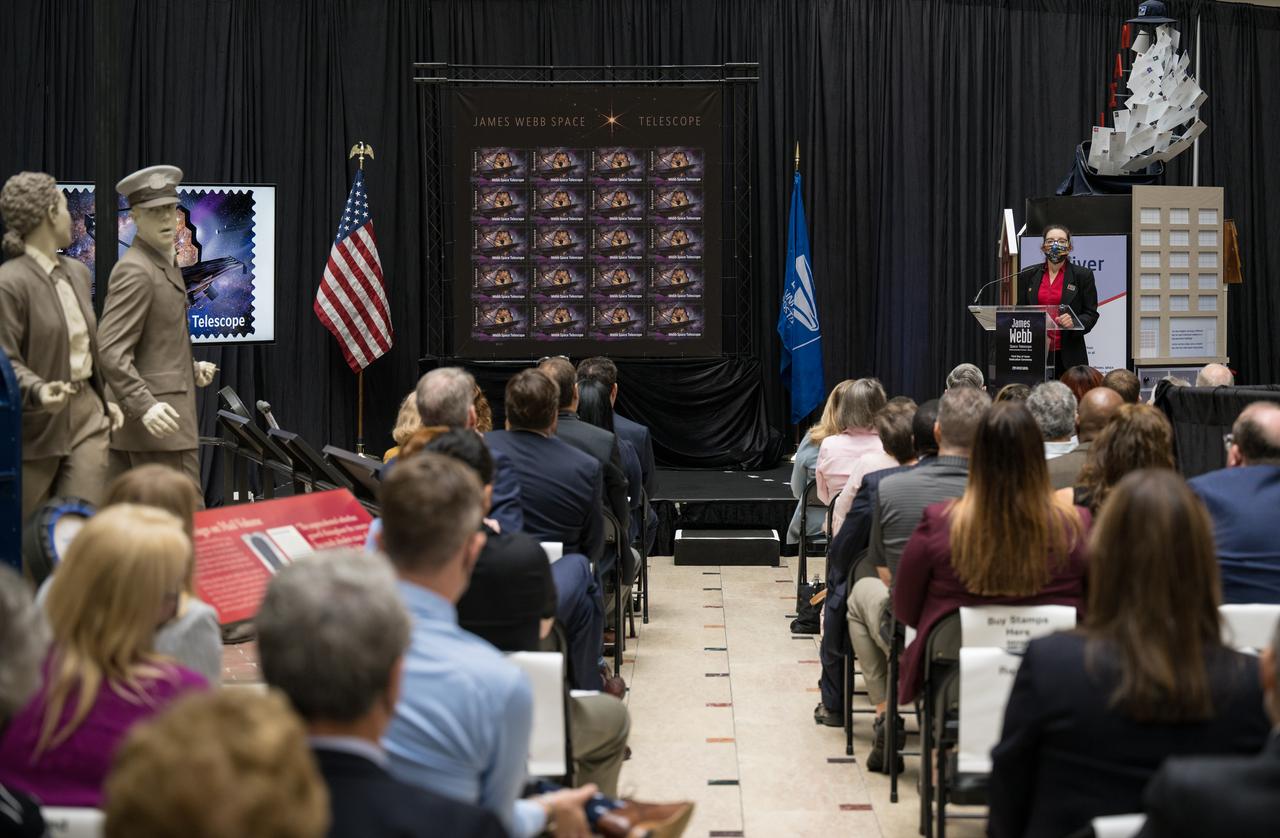
NASA’s Goddard Space Flight Center Webb Deputy Observatory Project Scientist, Erin Smith, provides remarks at the first-day-of-issue event for the United States Postal Service’s new stamp celebrating NASA’s James Webb Space Telescope (JWST) on Thursday, Sept. 8, 2022, at the Smithsonian’s National Postal Museum in Washington. The stamp, which features an illustration of the observatory, honors Webb’s mission to explore the unknown in our universe – solving mysteries in our solar system, looking beyond to distant worlds around other stars, and probing the structures and origins of our universe and our place in it. Photo Credit: (NASA/Aubrey Gemignani)
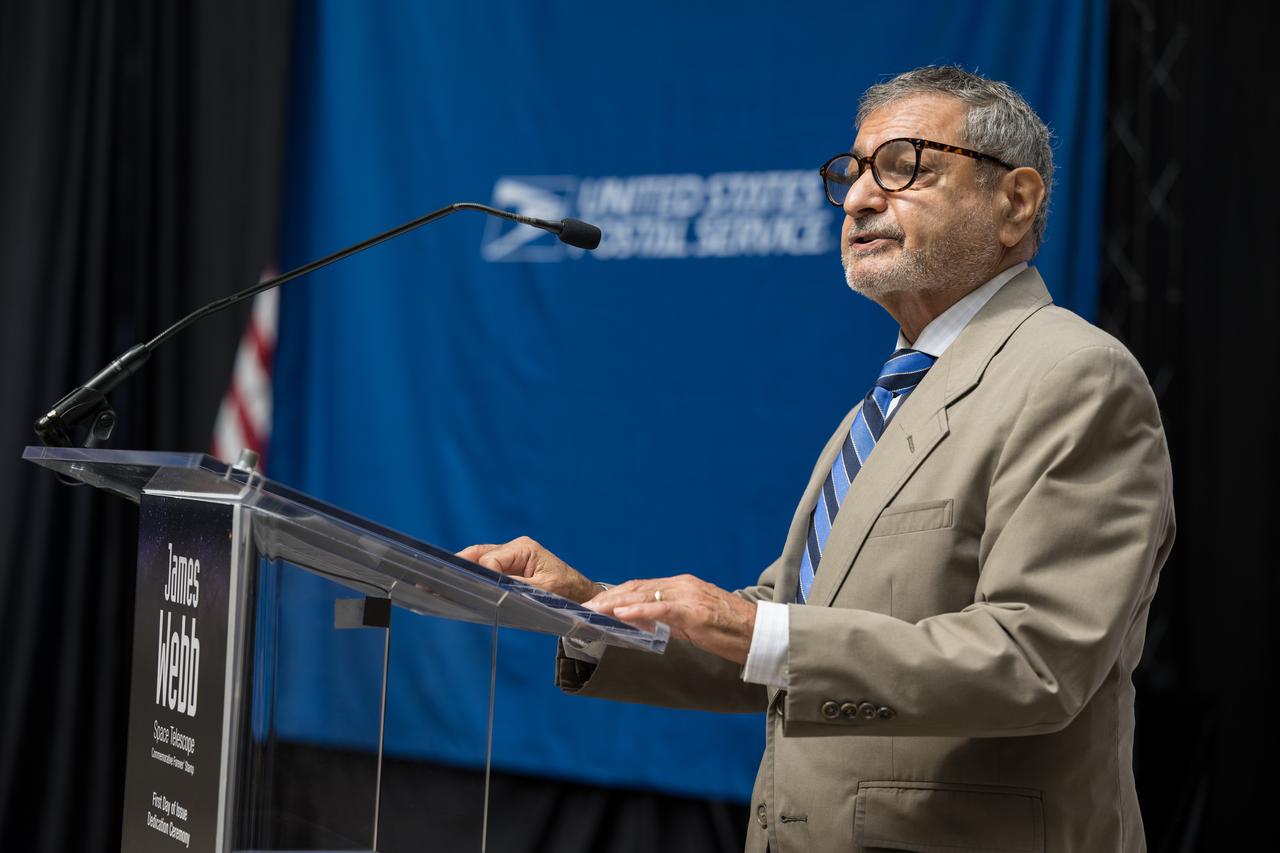
United States Postal Service Vice Chairman, Board of Governors, Anton Hajjar, provides remarks at the first-day-of-issue event for the United States Postal Service’s new stamp celebrating NASA’s James Webb Space Telescope (JWST) on Thursday, Sept. 8, 2022, at the Smithsonian’s National Postal Museum in Washington. The stamp, which features an illustration of the observatory, honors Webb’s mission to explore the unknown in our universe – solving mysteries in our solar system, looking beyond to distant worlds around other stars, and probing the structures and origins of our universe and our place in it. Photo Credit: (NASA/Aubrey Gemignani)
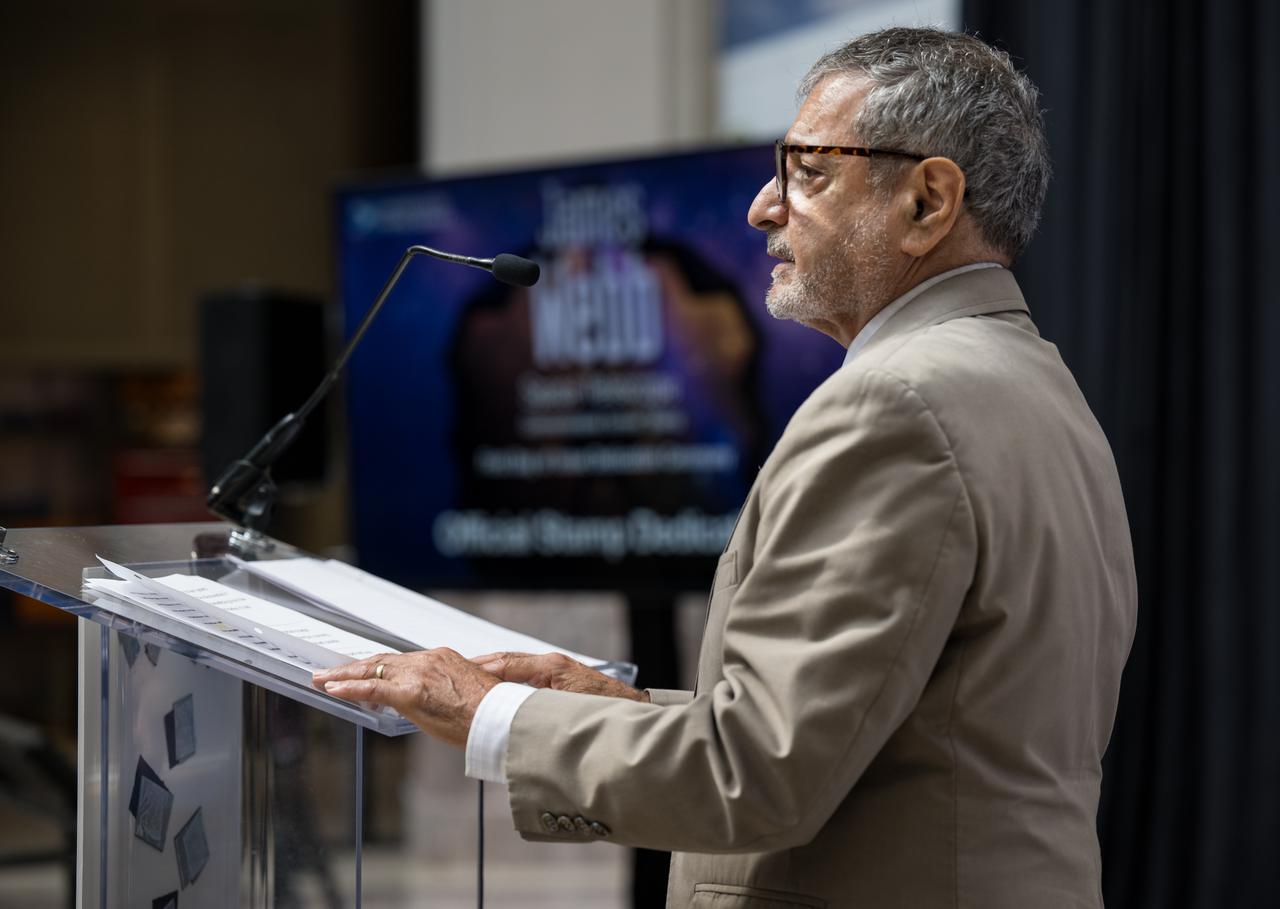
United States Postal Service Vice Chairman, Board of Governors, Anton Hajjar, provides remarks at the first-day-of-issue event for the United States Postal Service’s new stamp celebrating NASA’s James Webb Space Telescope (JWST) on Thursday, Sept. 8, 2022, at the Smithsonian’s National Postal Museum in Washington. The stamp, which features an illustration of the observatory, honors Webb’s mission to explore the unknown in our universe – solving mysteries in our solar system, looking beyond to distant worlds around other stars, and probing the structures and origins of our universe and our place in it. Photo Credit: (NASA/Aubrey Gemignani)

NASA public affairs specialist Alice Fisher introduces the first speaker at the first-day-of-issue event for the United States Postal Service’s new stamp celebrating NASA’s James Webb Space Telescope (JWST) on Thursday, Sept. 8, 2022, at the Smithsonian’s National Postal Museum in Washington. The stamp, which features an illustration of the observatory, honors Webb’s mission to explore the unknown in our universe – solving mysteries in our solar system, looking beyond to distant worlds around other stars, and probing the structures and origins of our universe and our place in it. Photo Credit: (NASA/Aubrey Gemignani)
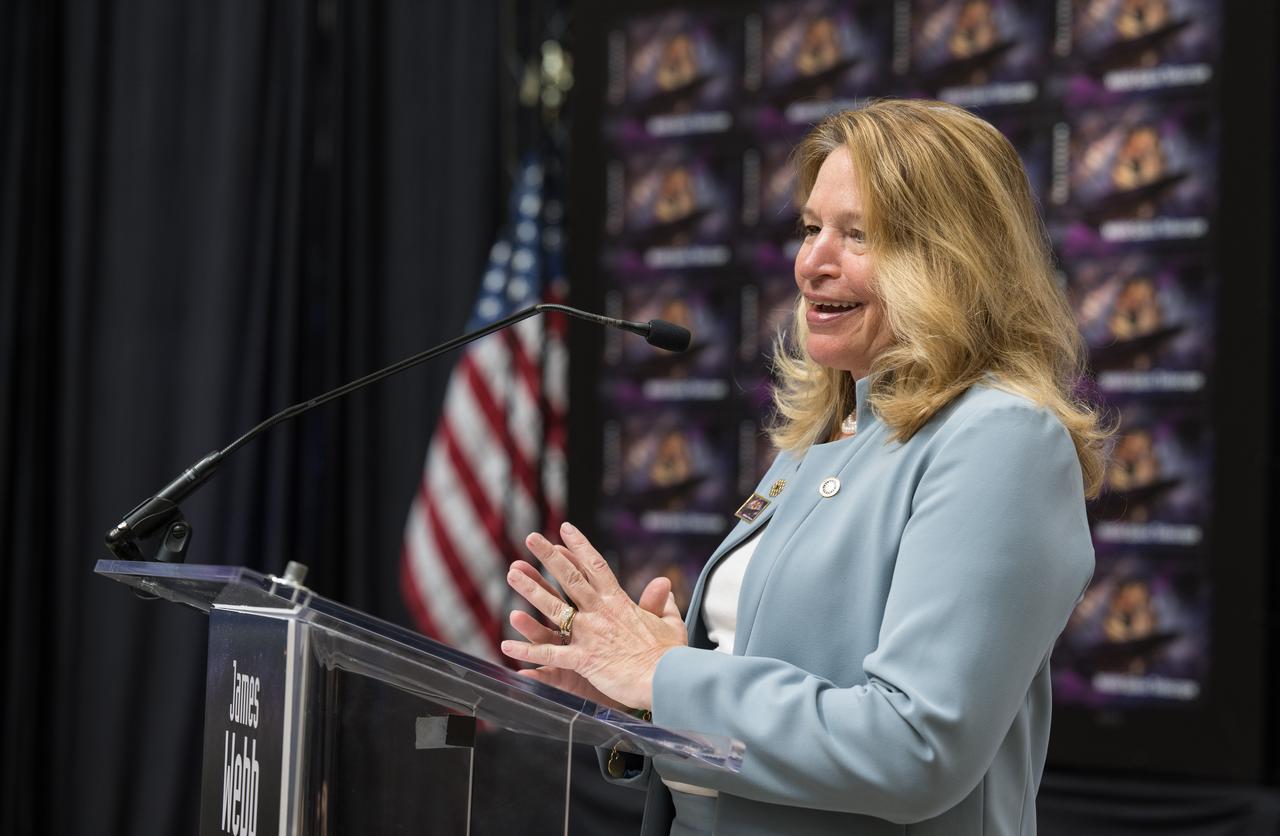
Smithsonian Institution Under Secretary for Service and Research, Ellen Stofan, provides remarks at the first-day-of-issue event for the United States Postal Service’s new stamp celebrating NASA’s James Webb Space Telescope (JWST) on Thursday, Sept. 8, 2022, at the Smithsonian’s National Postal Museum in Washington. The stamp, which features an illustration of the observatory, honors Webb’s mission to explore the unknown in our universe – solving mysteries in our solar system, looking beyond to distant worlds around other stars, and probing the structures and origins of our universe and our place in it. Photo Credit: (NASA/Aubrey Gemignani)
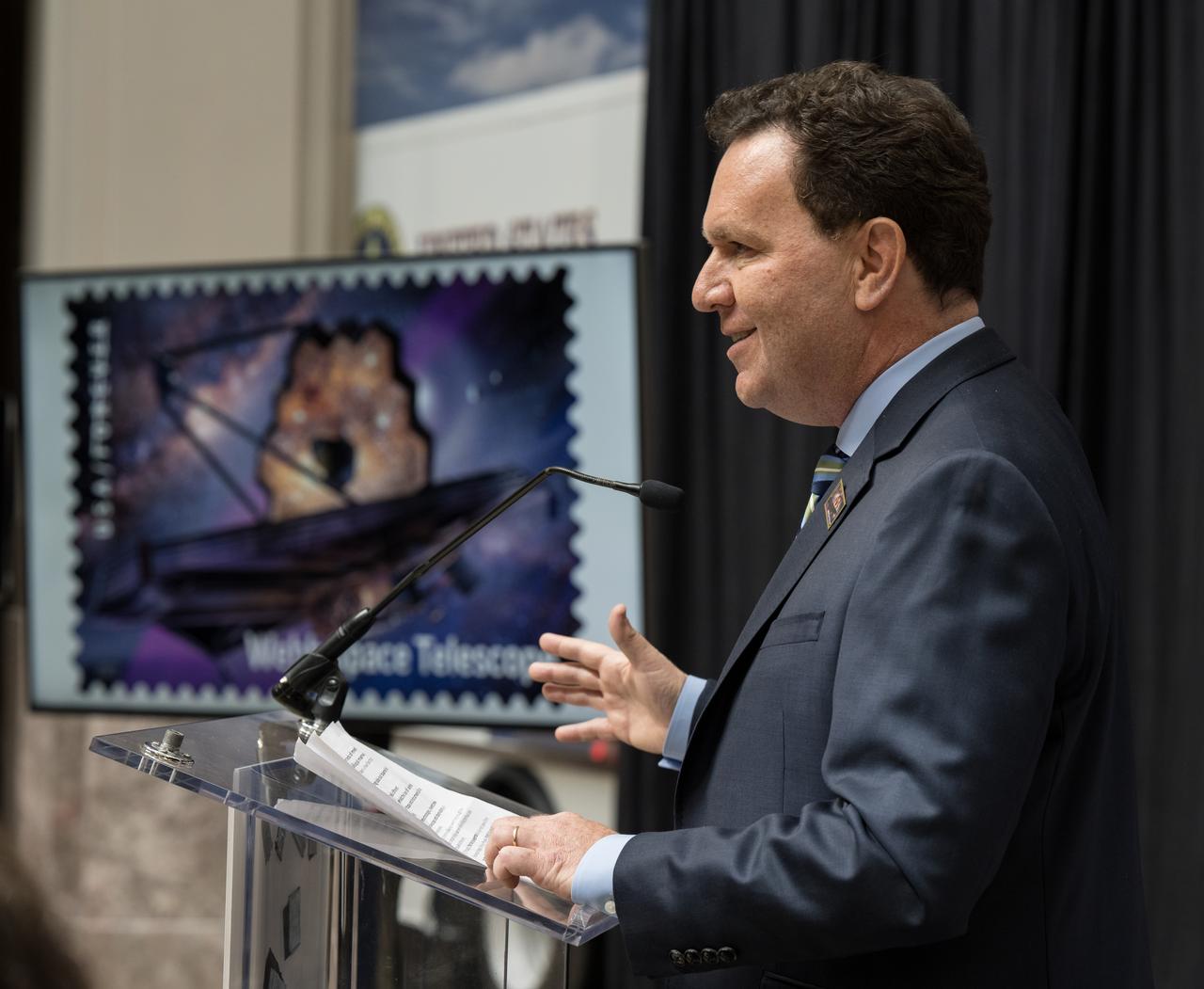
NASA’s Goddard Space Flight Center Webb Optical Telescope Element Manager, Lee Feinberg, provides remarks at the first-day-of-issue event for the United States Postal Service’s new stamp celebrating NASA’s James Webb Space Telescope (JWST) on Thursday, Sept. 8, 2022, at the Smithsonian’s National Postal Museum in Washington. The stamp, which features an illustration of the observatory, honors Webb’s mission to explore the unknown in our universe – solving mysteries in our solar system, looking beyond to distant worlds around other stars, and probing the structures and origins of our universe and our place in it. Photo Credit: (NASA/Aubrey Gemignani)

Smithsonian Institution Under Secretary for Service and Research, Ellen Stofan, provides remarks at the first-day-of-issue event for the United States Postal Service’s new stamp celebrating NASA’s James Webb Space Telescope (JWST) on Thursday, Sept. 8, 2022, at the Smithsonian’s National Postal Museum in Washington. The stamp, which features an illustration of the observatory, honors Webb’s mission to explore the unknown in our universe – solving mysteries in our solar system, looking beyond to distant worlds around other stars, and probing the structures and origins of our universe and our place in it. Photo Credit: (NASA/Aubrey Gemignani)
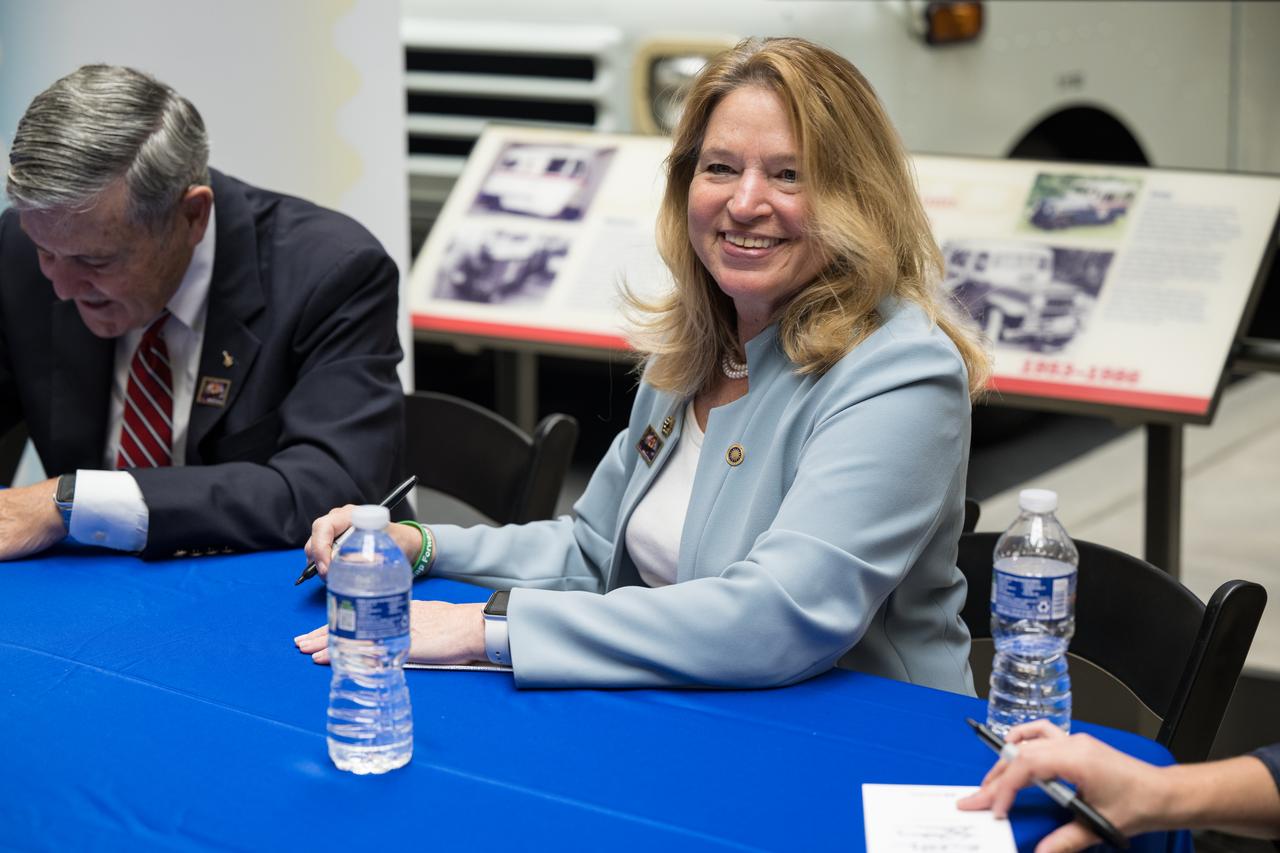
Smithsonian Institution Under Secretary for Service and Research, Ellen Stofan, autographs a piece of mail with the United States Postal Service’s new stamp celebrating NASA’s James Webb Space Telescope (JWST) on it, at the first-day-of-issue event, Thursday, Sept. 8, 2022, at the Smithsonian’s National Postal Museum in Washington. The stamp, which features an illustration of the observatory, honors Webb’s mission to explore the unknown in our universe – solving mysteries in our solar system, looking beyond to distant worlds around other stars, and probing the structures and origins of our universe and our place in it. Photo Credit: (NASA/Aubrey Gemignani)
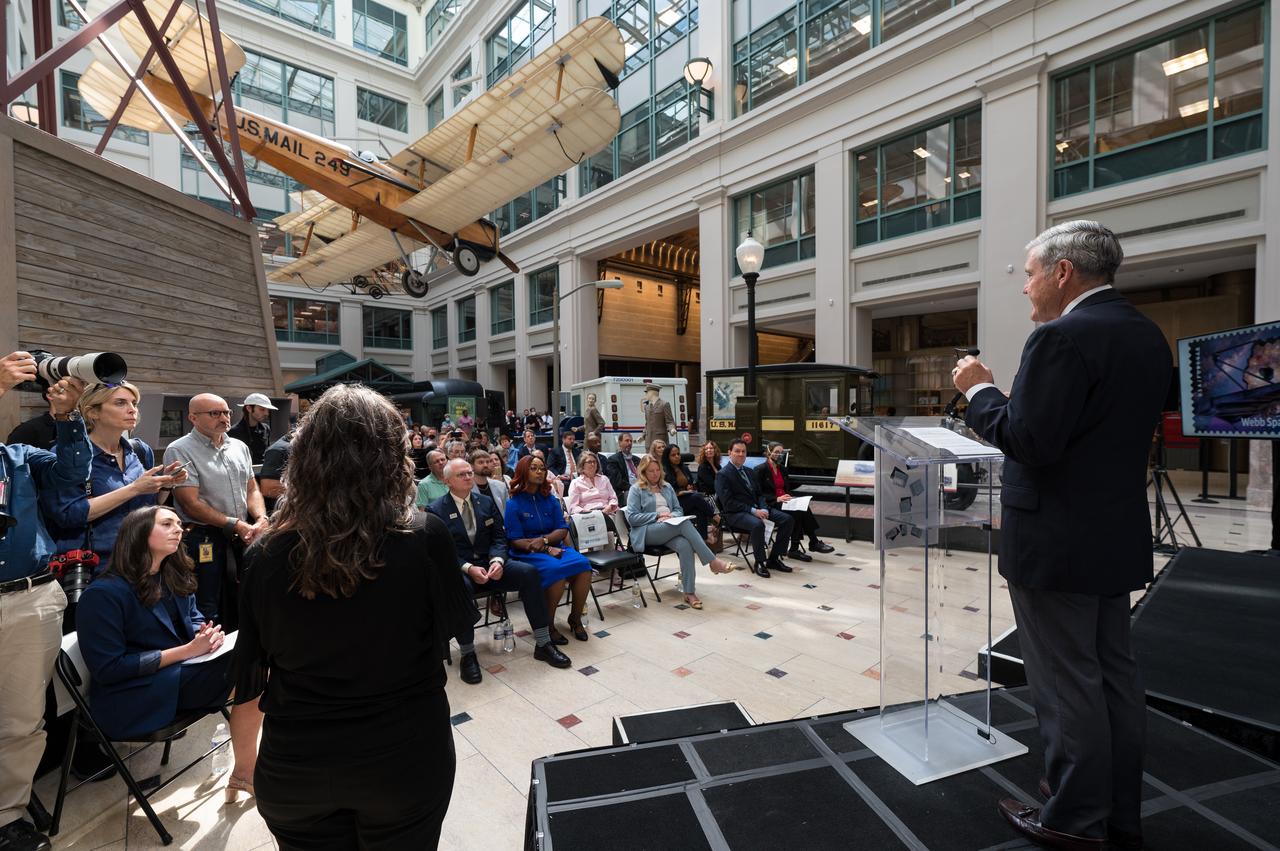
NASA Associate Administrator and former astronaut Bob Cabana provides remarks at the first-day-of-issue event for the United States Postal Service’s new stamp celebrating NASA’s James Webb Space Telescope (JWST) on Thursday, Sept. 8, 2022, at the Smithsonian’s National Postal Museum in Washington. The stamp, which features an illustration of the observatory, honors Webb’s mission to explore the unknown in our universe – solving mysteries in our solar system, looking beyond to distant worlds around other stars, and probing the structures and origins of our universe and our place in it. Photo Credit: (NASA/Aubrey Gemignani)
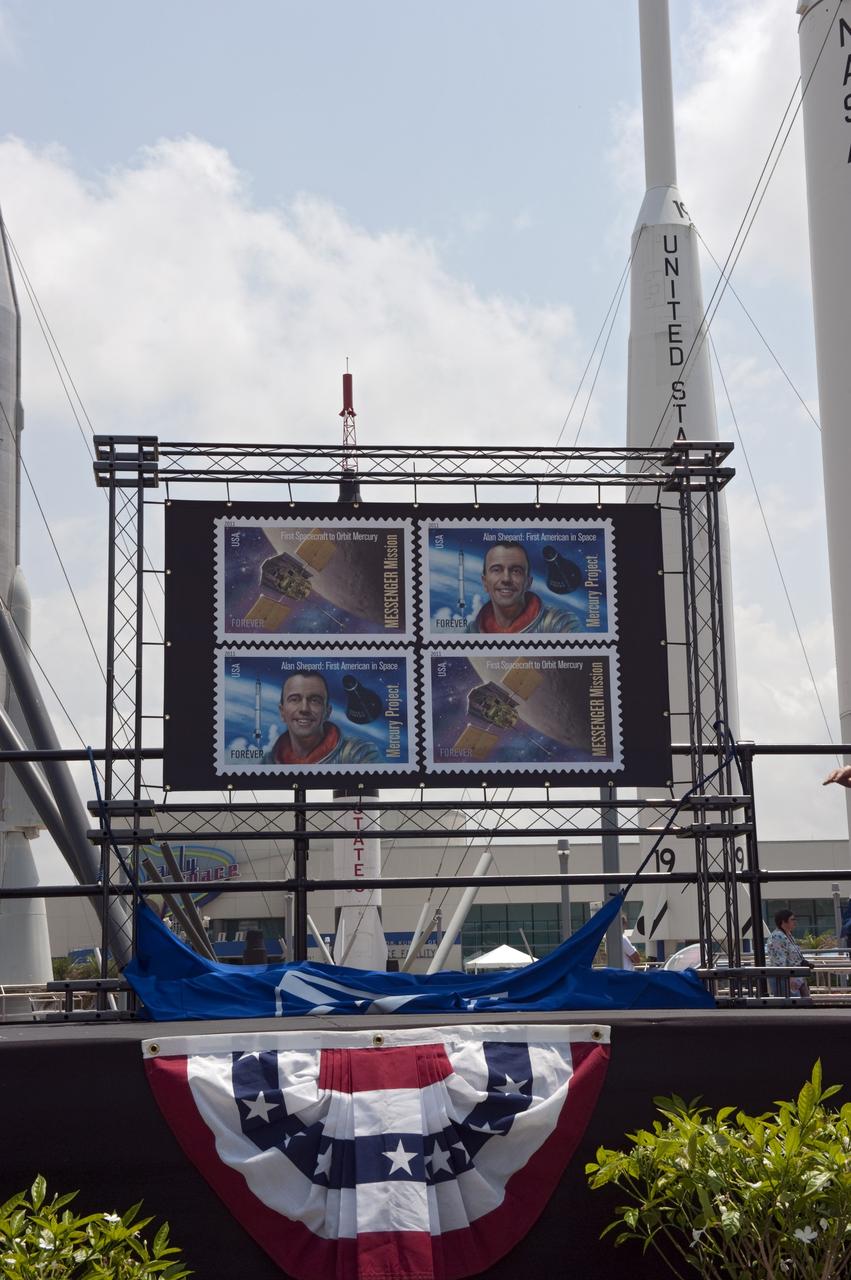
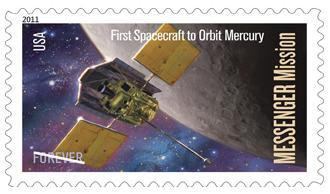
CAPE CANAVERAL, Fla. -- In the Rocket Garden at NASA's Kennedy Space Center Visitor Complex in Florida, a United States Postal Service poster reveals the two new stamps that commemorate the 50th anniversary of human spaceflight. One stamp commemorates NASA's Project Mercury and Alan Shepard's historic launch on May 5, 1961, aboard the spacecraft Freedom 7. The second stamp honors NASA's MESSENGER, which reached Mercury in March to become the first spacecraft to orbit the planet. The two missions frame a remarkable 50-year period in which America advanced space exploration through more than 1,500 crewed and uncrewed flights. Photo credit: NASA/Kim Shiflett
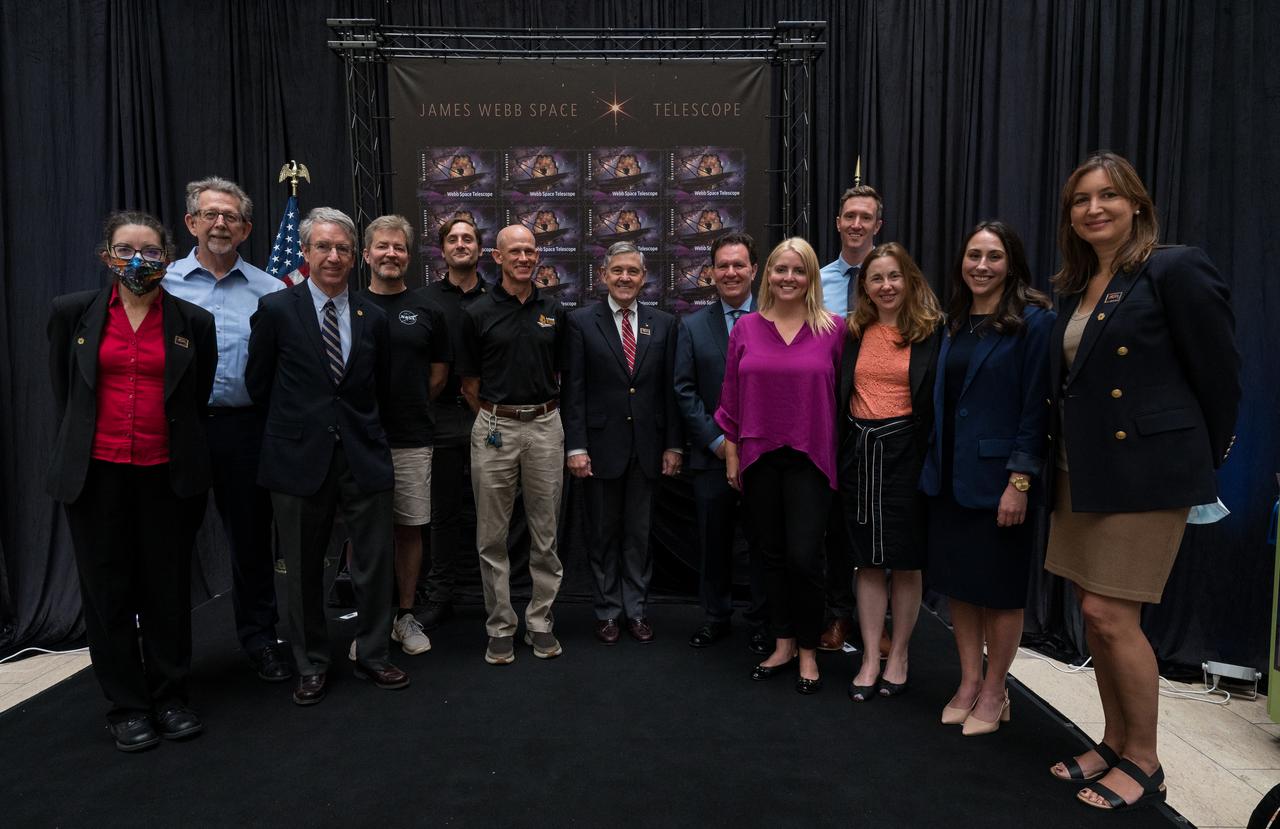
James Webb Space Telescope team members pose for a photo at the first-day-of-issue event for the United States Postal Service’s new stamp celebrating NASA’s James Webb Space Telescope (JWST) on Thursday, Sept. 8, 2022, at the Smithsonian’s National Postal Museum in Washington. The stamp, which features an illustration of the observatory, honors Webb’s mission to explore the unknown in our universe – solving mysteries in our solar system, looking beyond to distant worlds around other stars, and probing the structures and origins of our universe and our place in it. Photo Credit: (NASA/Aubrey Gemignani)
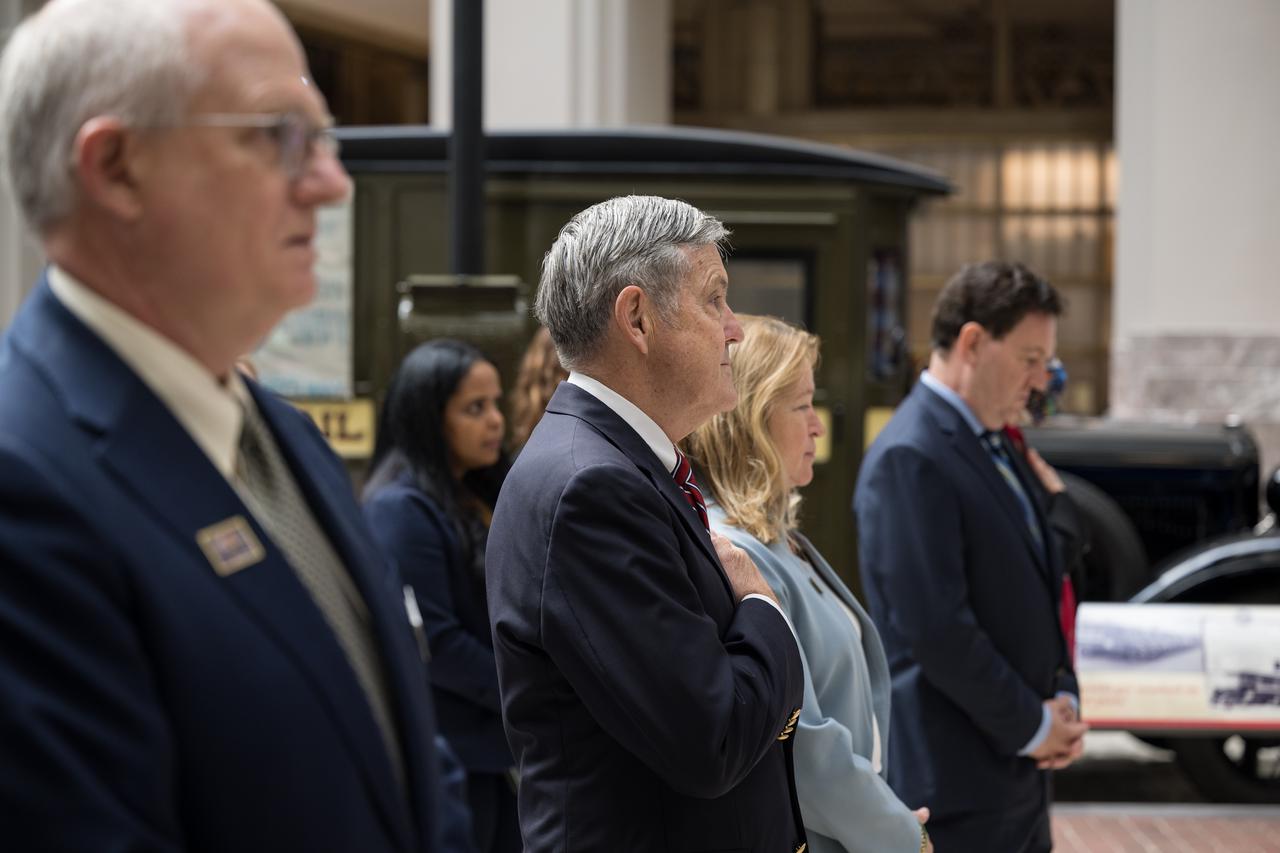
NASA Associate Administrator and former astronaut, Bob Cabana, second from left, and Smithsonian Institution Under Secretary for Service and Research, Ellen Stofan, third from left, are seen during the singing of the national anthem at the first-day-of-issue event for the United States Postal Service’s new stamp celebrating NASA’s James Webb Space Telescope (JWST) on Thursday, Sept. 8, 2022, at the Smithsonian’s National Postal Museum in Washington. The stamp, which features an illustration of the observatory, honors Webb’s mission to explore the unknown in our universe – solving mysteries in our solar system, looking beyond to distant worlds around other stars, and probing the structures and origins of our universe and our place in it. Photo Credit: (NASA/Aubrey Gemignani)
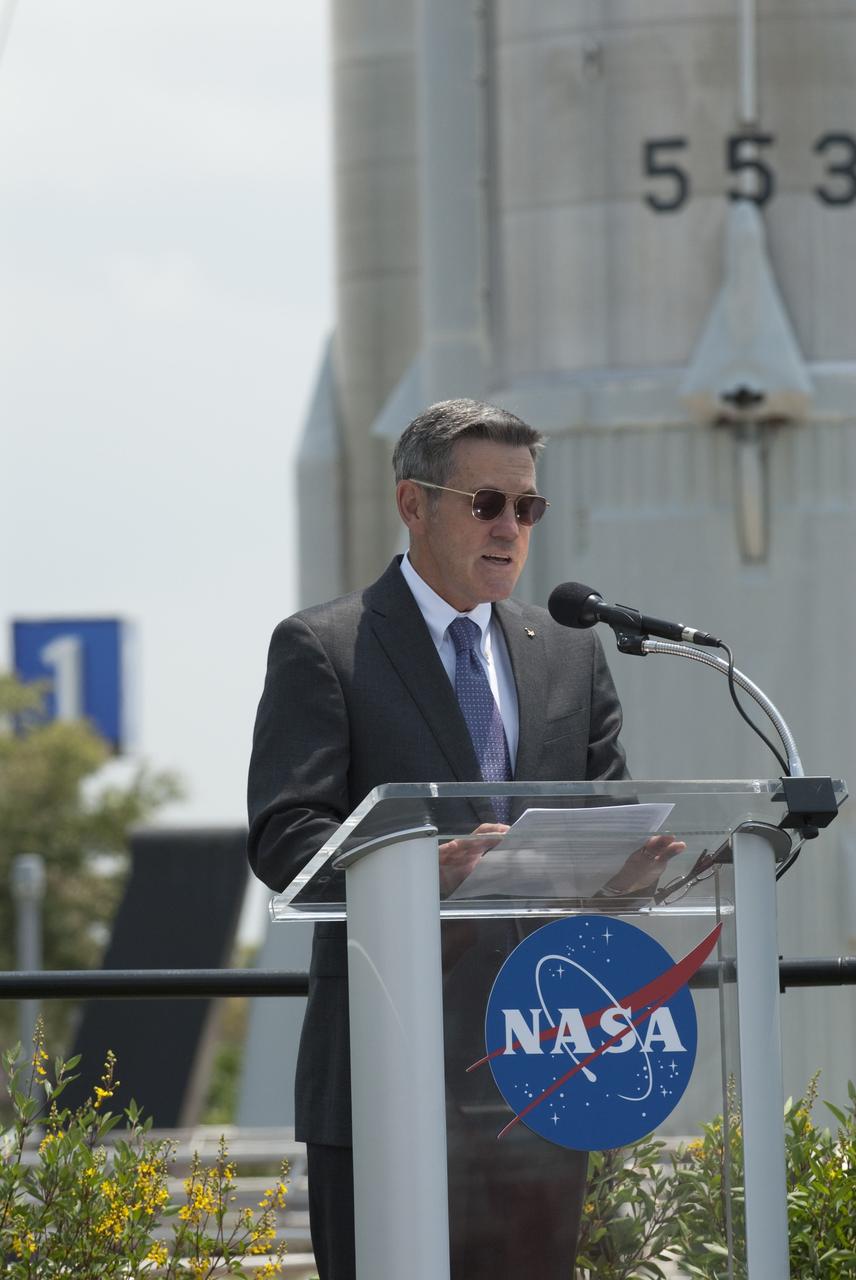
CAPE CANAVERAL, Fla. -- In the Rocket Garden at NASA's Kennedy Space Center Visitor Complex in Florida, Center Director Bob Cabana addresses the audience to announce the United States Postal Service unveiling of two new stamps to commemorate the 50th anniversary of human spaceflight. One stamp commemorates NASA's Project Mercury and Alan Shepard's historic launch on May 5, 1961, aboard the spacecraft Freedom 7. The second stamp honors NASA's MESSENGER, which reached Mercury in March to become the first spacecraft to orbit the planet. The two missions frame a remarkable 50-year period in which America advanced space exploration through more than 1,500 crewed and uncrewed flights. Photo credit: NASA/Kim Shiflett
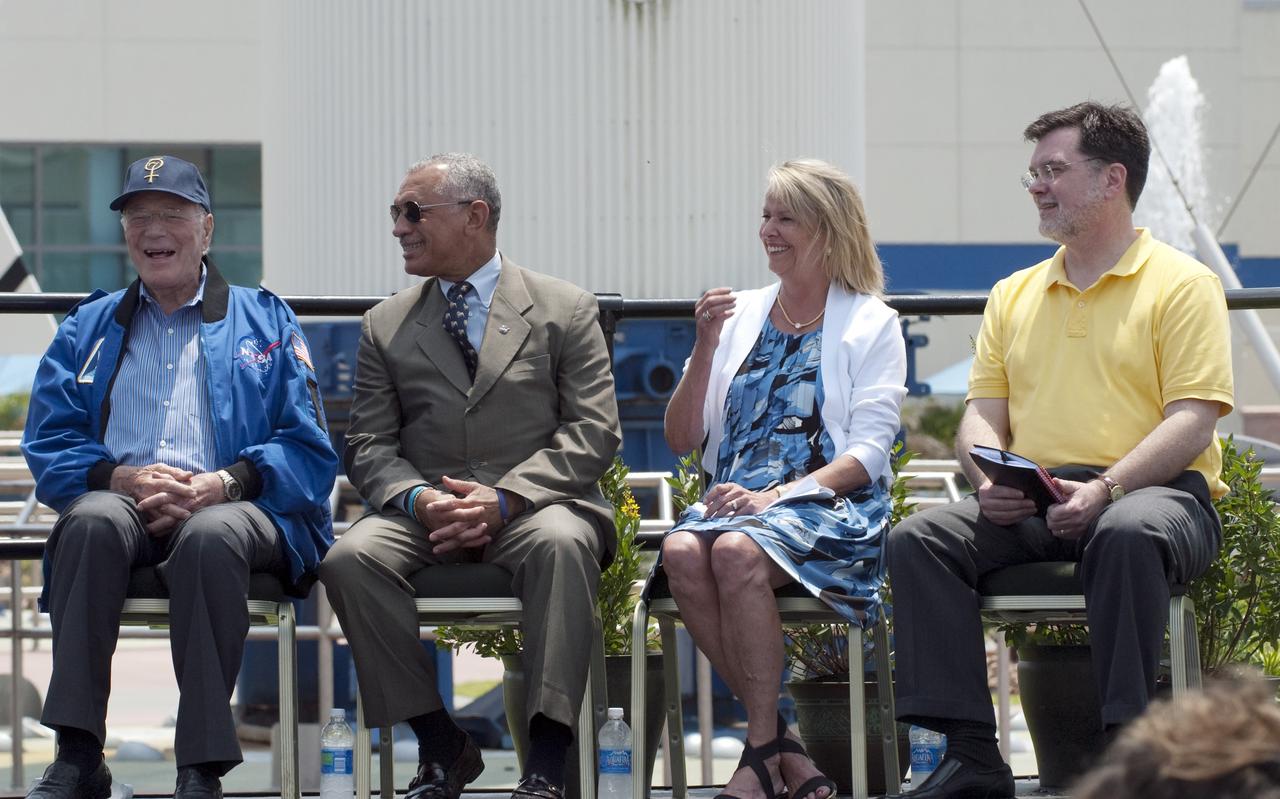
CAPE CANAVERAL, Fla. -- In the Rocket Garden at NASA's Kennedy Space Center Visitor Complex in Florida, Mercury Astronaut Scott Carpenter, NASA Administrator Charlie Bolden, Julie Jenkins, daughter of Mercury Astronaut Alan Shepard, and NASA's Deputy Director for Planetary Science, Jim Adams, enjoy a light moment during an event unveiling two new stamps to commemorate the 50th anniversary of human spaceflight from the United States Postal Service. One stamp commemorates NASA's Project Mercury and Alan Shepard's historic launch on May 5, 1961, aboard the spacecraft Freedom 7. The second stamp honors NASA's MESSENGER, which reached Mercury in March to become the first spacecraft to orbit the planet. The two missions frame a remarkable 50-year period in which America advanced space exploration through more than 1,500 crewed and uncrewed flights. Photo credit: NASA/Kim Shiflett
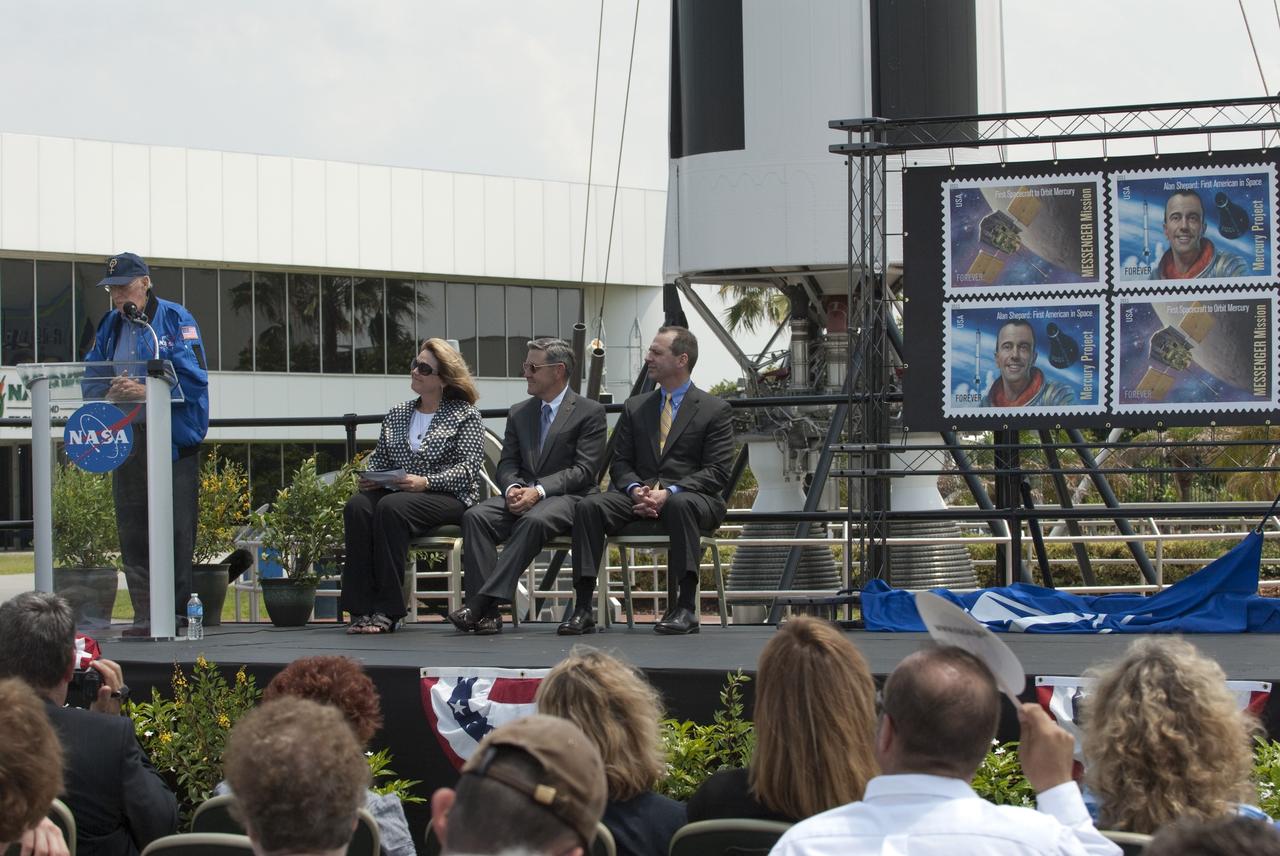
CAPE CANAVERAL, Fla. -- In the Rocket Garden at NASA's Kennedy Space Center Visitor Complex in Florida, Mercury Astronaut Scott Carpenter speaks to the audience gathered for the unveiling of two new stamps that commemorate the 50th anniversary of human spaceflight from the United States Postal Service. Listening to him speak is Director of Education and External Relations for Kennedy, Cheryl Hurst (left), Center Director, Bob Cabana and United States Postal Service Official Steve Massey. One stamp commemorates NASA's Project Mercury and Alan Shepard's historic launch on May 5, 1961, aboard the spacecraft Freedom 7. The second stamp honors NASA's MESSENGER, which reached Mercury in March to become the first spacecraft to orbit the planet. The two missions frame a remarkable 50-year period in which America advanced space exploration through more than 1,500 crewed and uncrewed flights. Photo credit: NASA/Kim Shiflett

CAPE CANAVERAL, Fla. -- In the Rocket Garden at NASA's Kennedy Space Center Visitor Complex in Florida, Mercury Astronaut Scott Carpenter addresses the audience during an event unveiling two new stamps to commemorate the 50th anniversary of human spaceflight from the United States Postal Service. One stamp commemorates NASA's Project Mercury and Alan Shepard's historic launch on May 5, 1961, aboard the spacecraft Freedom 7. The second stamp honors NASA's MESSENGER, which reached Mercury in March to become the first spacecraft to orbit the planet. The two missions frame a remarkable 50-year period in which America advanced space exploration through more than 1,500 crewed and uncrewed flights. Photo credit: NASA/Kim Shiflett

CAPE CANAVERAL, Fla. -- In the Rocket Garden at NASA's Kennedy Space Center Visitor Complex in Florida, United States Postal Service official Steve Massey and Mercury Astronaut Scott Carpenter shake hands after unveiling the two new stamps that commemorate the 50th anniversary of human spaceflight. One stamp commemorates NASA's Project Mercury and Alan Shepard's historic launch on May 5, 1961, aboard the spacecraft Freedom 7. The second stamp honors NASA's MESSENGER, which reached Mercury in March to become the first spacecraft to orbit the planet. The two missions frame a remarkable 50-year period in which America advanced space exploration through more than 1,500 crewed and uncrewed flights. Photo credit: NASA/Kim Shiflett

CAPE CANAVERAL, Fla. -- In the Rocket Garden at NASA's Kennedy Space Center Visitor Complex in Florida, United States Postal Service official Steve Massey addresses the audience during an event unveiling two new stamps that commemorate the 50th anniversary of human spaceflight from the United States Postal Service. One stamp commemorates NASA's Project Mercury and Alan Shepard's historic launch on May 5, 1961, aboard the spacecraft Freedom 7. The second stamp honors NASA's MESSENGER, which reached Mercury in March to become the first spacecraft to orbit the planet. The two missions frame a remarkable 50-year period in which America advanced space exploration through more than 1,500 crewed and uncrewed flights. Photo credit: NASA/Kim Shiflett
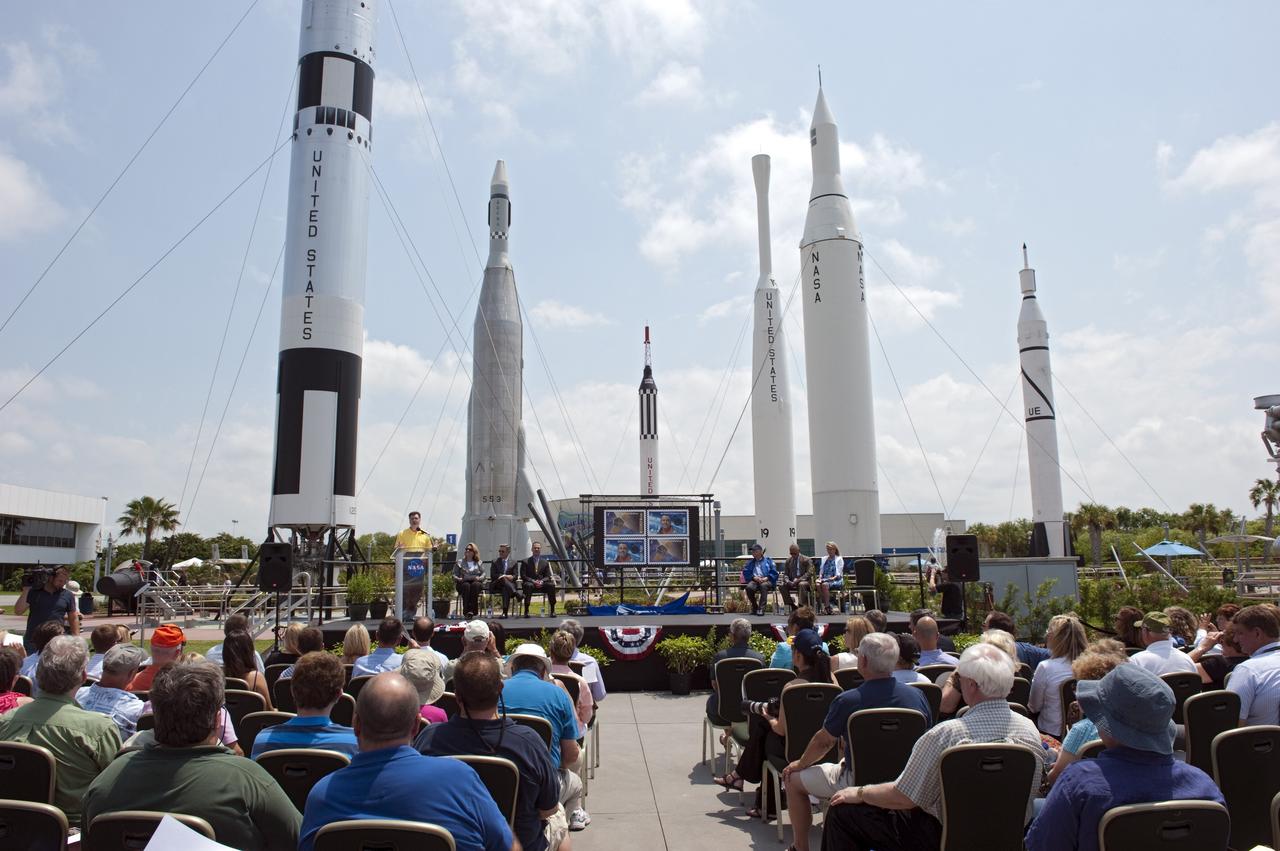
CAPE CANAVERAL, Fla. -- In the Rocket Garden at NASA's Kennedy Space Center Visitor Complex in Florida, NASA's Deputy Director for Planetary Science, Jim Adams speaks to the audience after the unveiling of the two new stamps that commemorate the 50th anniversary of human spaceflight designed by the United States Postal Service. One stamp commemorates NASA's Project Mercury and Alan Shepard's historic launch on May 5, 1961, aboard the spacecraft Freedom 7. The second stamp honors NASA's MESSENGER, which reached Mercury in March to become the first spacecraft to orbit the planet. The two missions frame a remarkable 50-year period in which America advanced space exploration through more than 1,500 crewed and uncrewed flights. Photo credit: NASA/Kim Shiflett
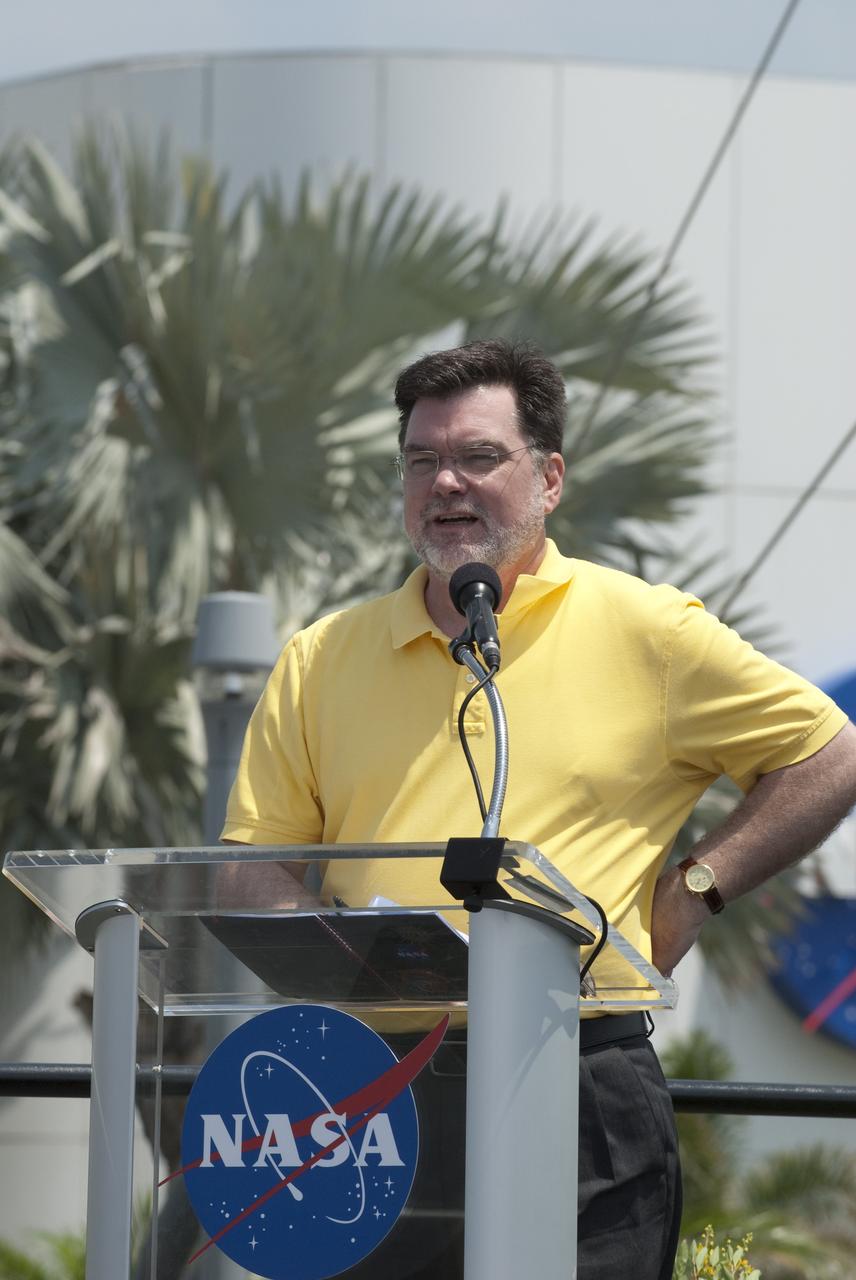
CAPE CANAVERAL, Fla. -- In the Rocket Garden at NASA's Kennedy Space Center Visitor Complex in Florida, NASA's Deputy Director for Planetary Science, Jim Adams speaks to the audience in attendance for the United States Postal Service unveiling of two new stamps that commemorates the 50th anniversary of human spaceflight. One stamp commemorates NASA's Project Mercury and Alan Shepard's historic launch on May 5, 1961, aboard the spacecraft Freedom 7. The second stamp honors NASA's MESSENGER, which reached Mercury in March to become the first spacecraft to orbit the planet. The two missions frame a remarkable 50-year period in which America advanced space exploration through more than 1,500 crewed and uncrewed flights. Photo credit: NASA/Kim Shiflett
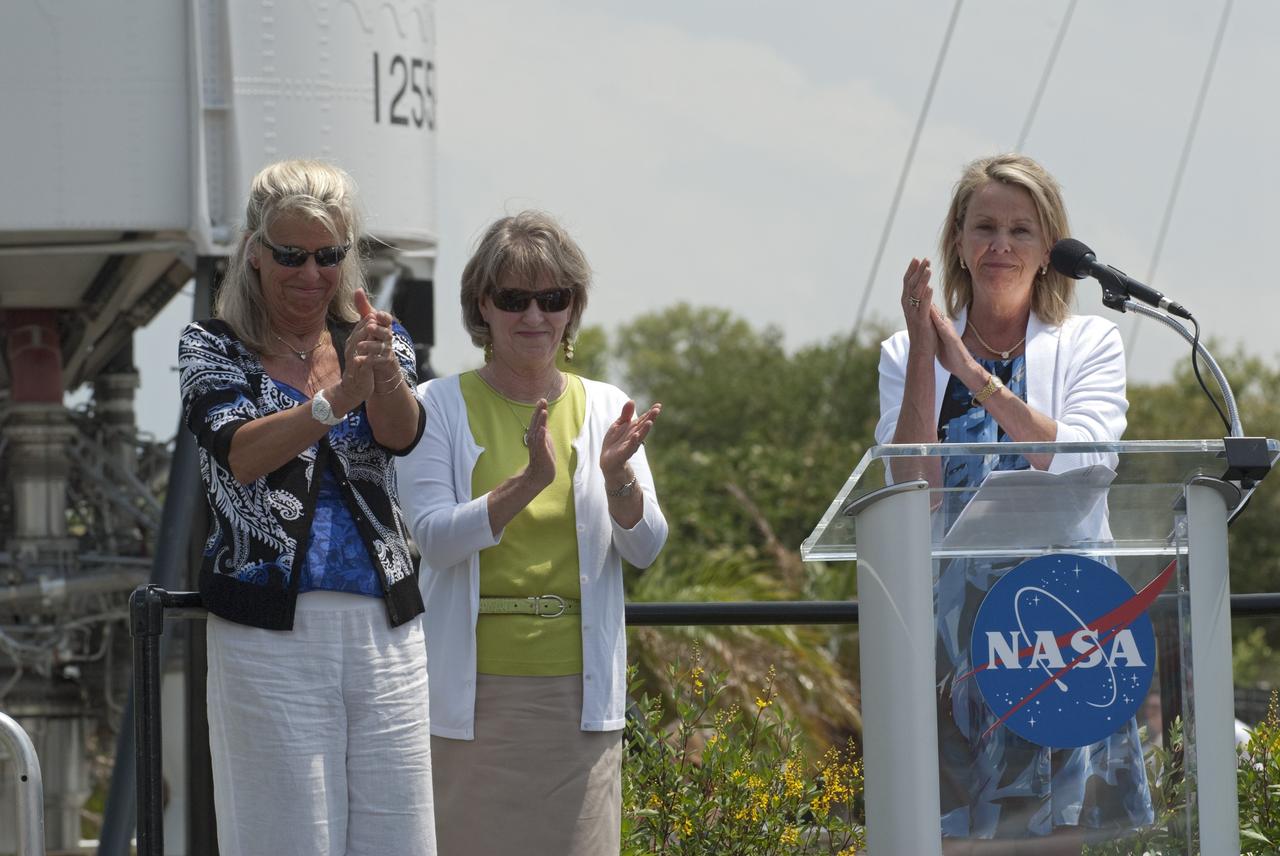
CAPE CANAVERAL, Fla. -- In the Rocket Garden at NASA's Kennedy Space Center Visitor Complex in Florida, Laura Churchley (left), Alice Wackerman and Julie Jenkins, daughters of Mercury Astronaut Alan Shepard, applaud during an event unveiling two new stamps to commemorate the 50th anniversary of human spaceflight from the United States Postal Service. One stamp commemorates NASA's Project Mercury and Alan Shepard's historic launch on May 5, 1961, aboard the spacecraft Freedom 7. The second stamp honors NASA's MESSENGER, which reached Mercury in March to become the first spacecraft to orbit the planet. The two missions frame a remarkable 50-year period in which America advanced space exploration through more than 1,500 crewed and uncrewed flights. Photo credit: NASA/Kim Shiflett
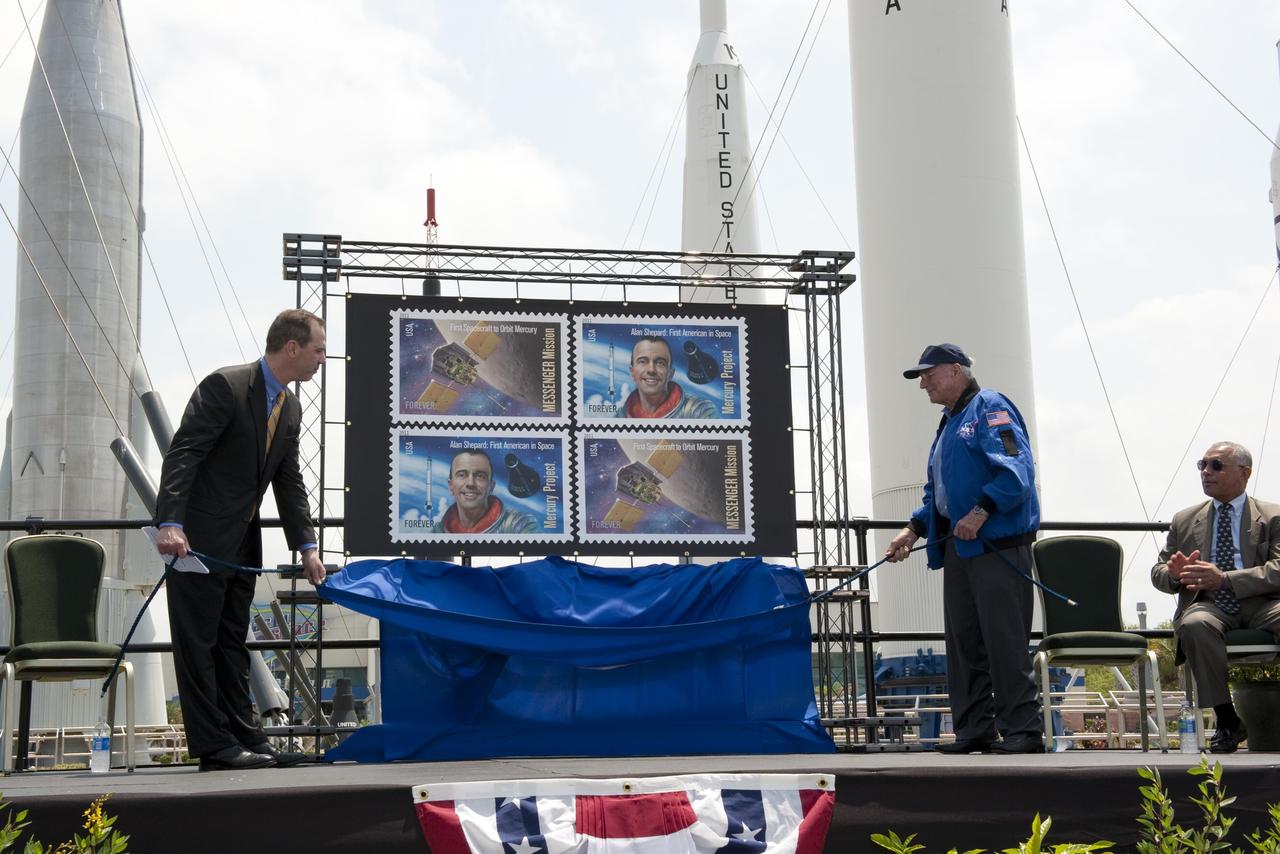
CAPE CANAVERAL, Fla. -- In the Rocket Garden at NASA's Kennedy Space Center Visitor Complex in Florida, United States Postal Service official Steve Massey and Mercury Astronaut Scott Carpenter have the honor of unveiling the two new stamps that commemorate the 50th anniversary of human spaceflight. Applauding the unveiling is NASA Administrator, Charlie Bolden. One stamp commemorates NASA's Project Mercury and Alan Shepard's historic launch on May 5, 1961, aboard the spacecraft Freedom 7. The second stamp honors NASA's MESSENGER, which reached Mercury in March to become the first spacecraft to orbit the planet. The two missions frame a remarkable 50-year period in which America advanced space exploration through more than 1,500 crewed and uncrewed flights. Photo credit: NASA/Kim Shiflett
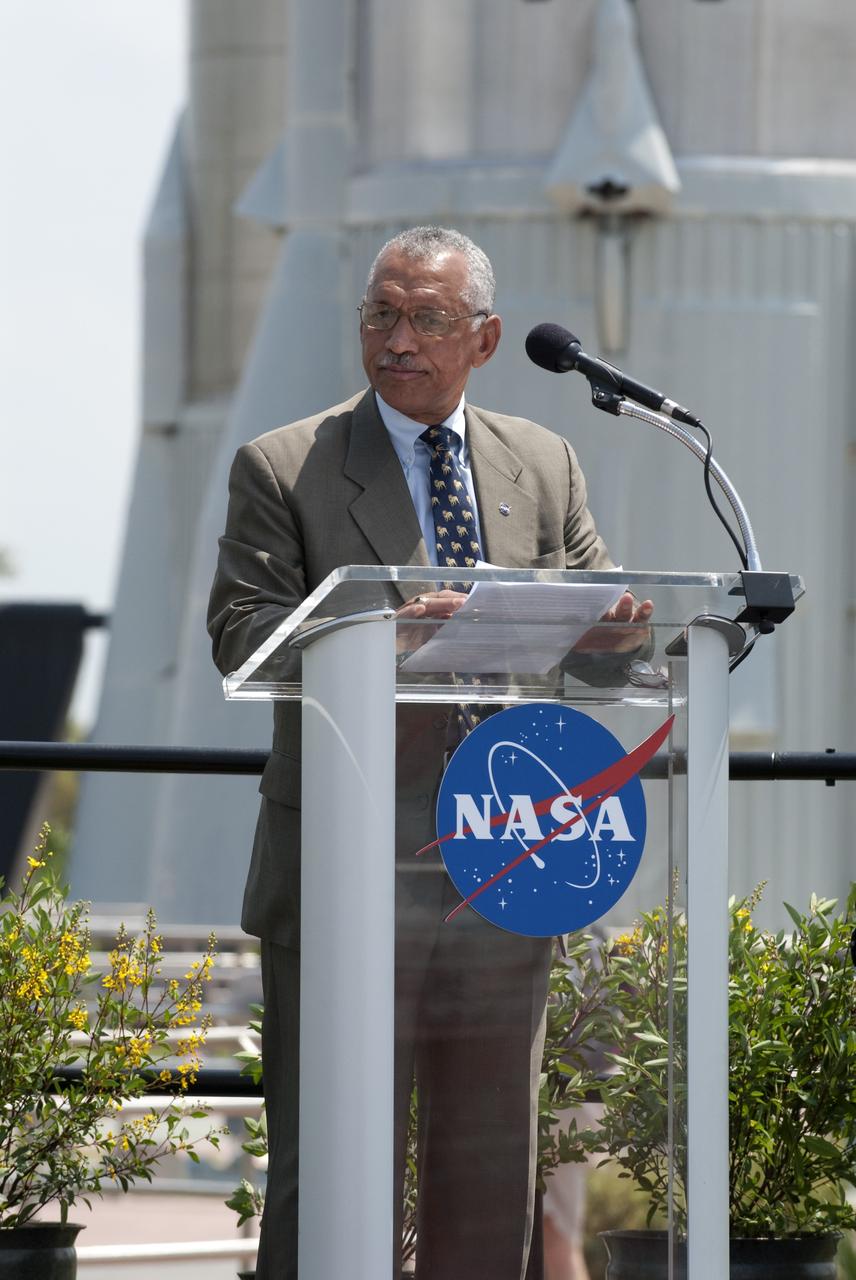
CAPE CANAVERAL, Fla. -- In the Rocket Garden at NASA's Kennedy Space Center Visitor Complex in Florida, NASA Administrator Charlie Bolden speaks to the audience in attendance for the United States Postal Service unveiling of two new stamps to commemorate the 50th anniversary of human spaceflight. One stamp commemorates NASA's Project Mercury and Alan Shepard's historic launch on May 5, 1961, aboard the spacecraft Freedom 7. The second stamp honors NASA's MESSENGER, which reached Mercury in March to become the first spacecraft to orbit the planet. The two missions frame a remarkable 50-year period in which America advanced space exploration through more than 1,500 crewed and uncrewed flights. Photo credit: NASA/Kim Shiflett
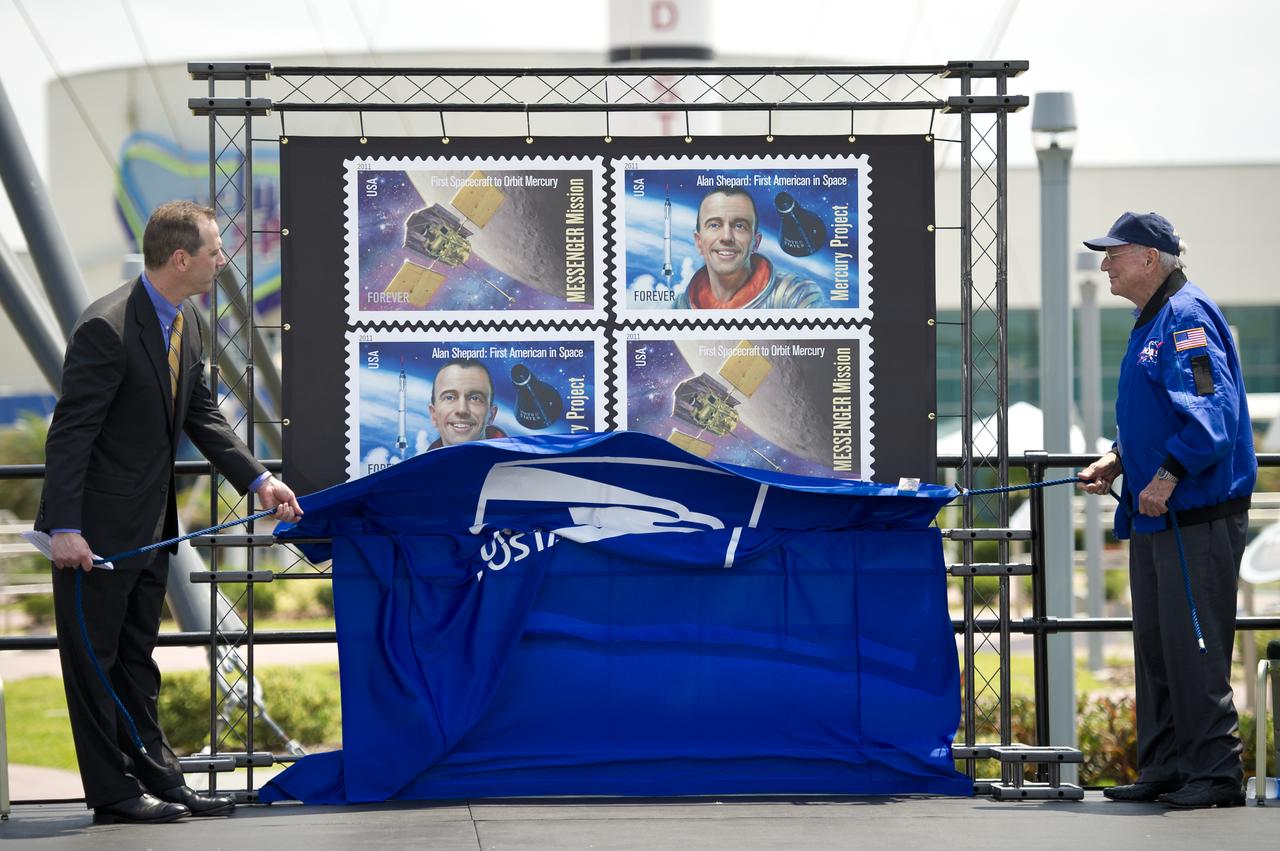
United States Postal Service Vice President of Finance Steve Masse, left, and NASA Mercury Astronaut Scott Carpenter, unveil two USPS stamps to commemorate and celebrate 50 years of US Spaceflight and the MESSENGER program during an event, Wednesday, May 4, 2011 at the NASA Kennedy Space Center in Cape Canaveral, Fla. One stamp commemorates NASA’s Project Mercury, America’s first manned spaceflight program, and NASA astronaut Alan Shepard’s historic flight on May 5, 1961, aboard spacecraft Freedom 7. The other stamp draws attention to NASA’s unmanned MESSENGER mission, a scientific investigation of the planet Mercury. On March 17, 2011, MESSENGER became the first spacecraft to enter into orbit around Mercury. Photo Credit: (NASA/Bill Ingalls)

Altrameise Myers, Tech Sgt., 45th Space Wing sings the National Anthem during the start of a ceremony where two USPS stamps where unveiled to commemorate and celebrate 50 years of US Spaceflight and the MESSENGER program during an event, Wednesday, May 4, 2011 at the NASA Kennedy Space Center in Cape Canaveral, Fla. One stamp commemorates NASA’s Project Mercury, America’s first manned spaceflight program, and NASA astronaut Alan Shepard’s historic flight on May 5, 1961, aboard spacecraft Freedom 7. The other stamp draws attention to NASA’s unmanned MESSENGER mission, a scientific investigation of the planet Mercury. On March 17, 2011, MESSENGER became the first spacecraft to enter into orbit around Mercury. Photo Credit: (NASA/Bill Ingalls)

Patty Carpenter, wife of NASA Mercury Astronaut Scott Carpenter, left, Daughters of NASA astronaut Alan Shepard, Laura Shepard Churchley, and, Alice Wackermann, right, sing the National Anthem during an unveiling ceremony of two USPS stamps that commemorate and celebrate 50 years of US Spaceflight and the MESSENGER program during an event, Wednesday, May 4, 2011 at the NASA Kennedy Space Center in Cape Canaveral, Fla. One stamp commemorates NASA’s Project Mercury, America’s first manned spaceflight program, and NASA astronaut Alan Shepard’s historic flight on May 5, 1961, aboard spacecraft Freedom 7. The other stamp draws attention to NASA’s unmanned MESSENGER mission, a scientific investigation of the planet Mercury. On March 17, 2011, MESSENGER became the first spacecraft to enter into orbit around Mercury. Photo Credit: (NASA/Bill Ingalls)
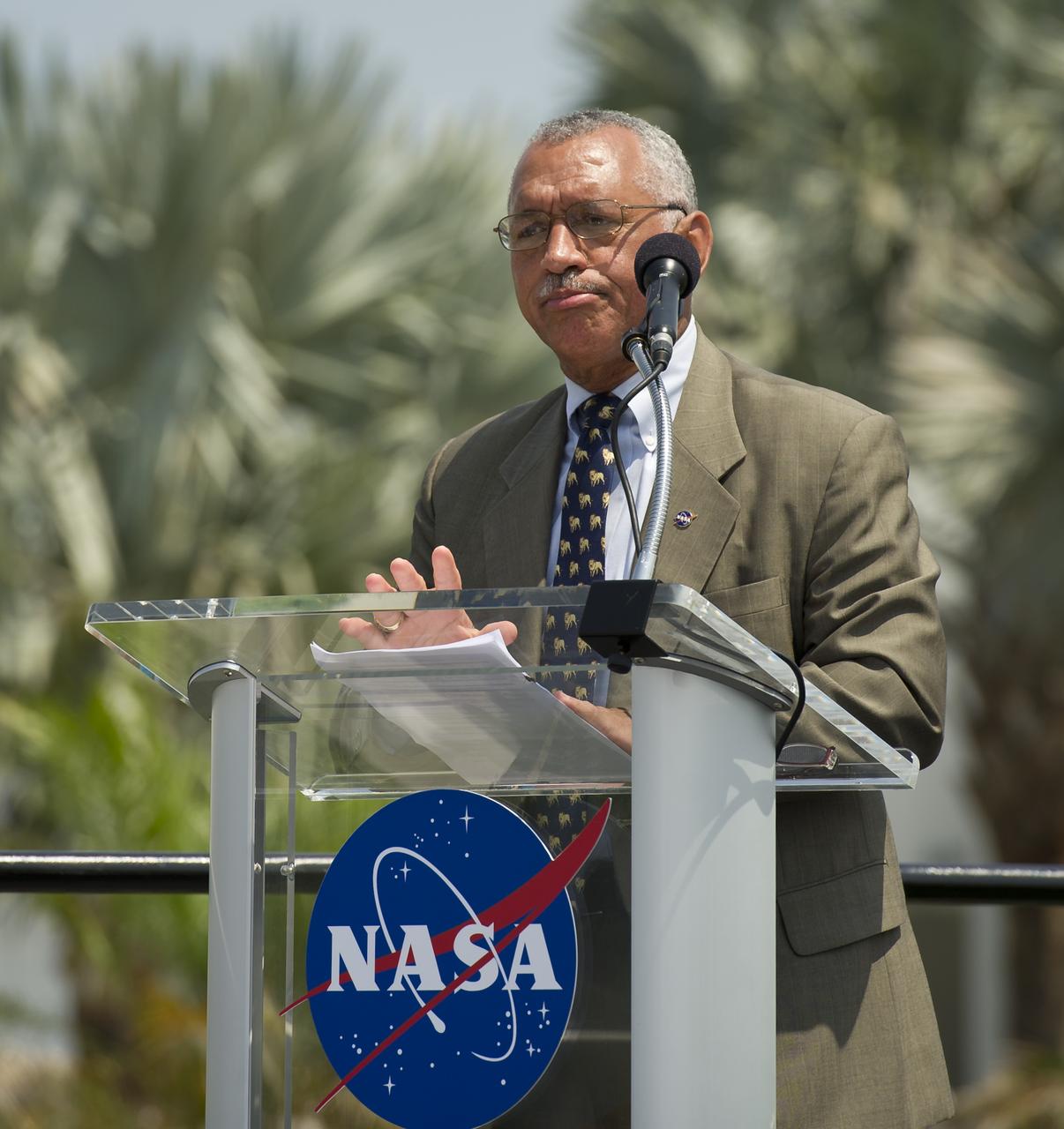
NASA Administrator Charles Boldin speaks during an unveiling ceremony of two USPS stamps that commemorate and celebrate 50 years of US Spaceflight and the MESSENGER program during an event, Wednesday, May 4, 2011 at the NASA Kennedy Space Center in Cape Canaveral, Fla. One stamp commemorates NASA’s Project Mercury, America’s first manned spaceflight program, and NASA astronaut Alan Shepard’s historic flight on May 5, 1961, aboard spacecraft Freedom 7. The other stamp draws attention to NASA’s unmanned MESSENGER mission, a scientific investigation of the planet Mercury. On March 17, 2011, MESSENGER became the first spacecraft to enter into orbit around Mercury. Photo Credit: (NASA/Bill Ingalls)
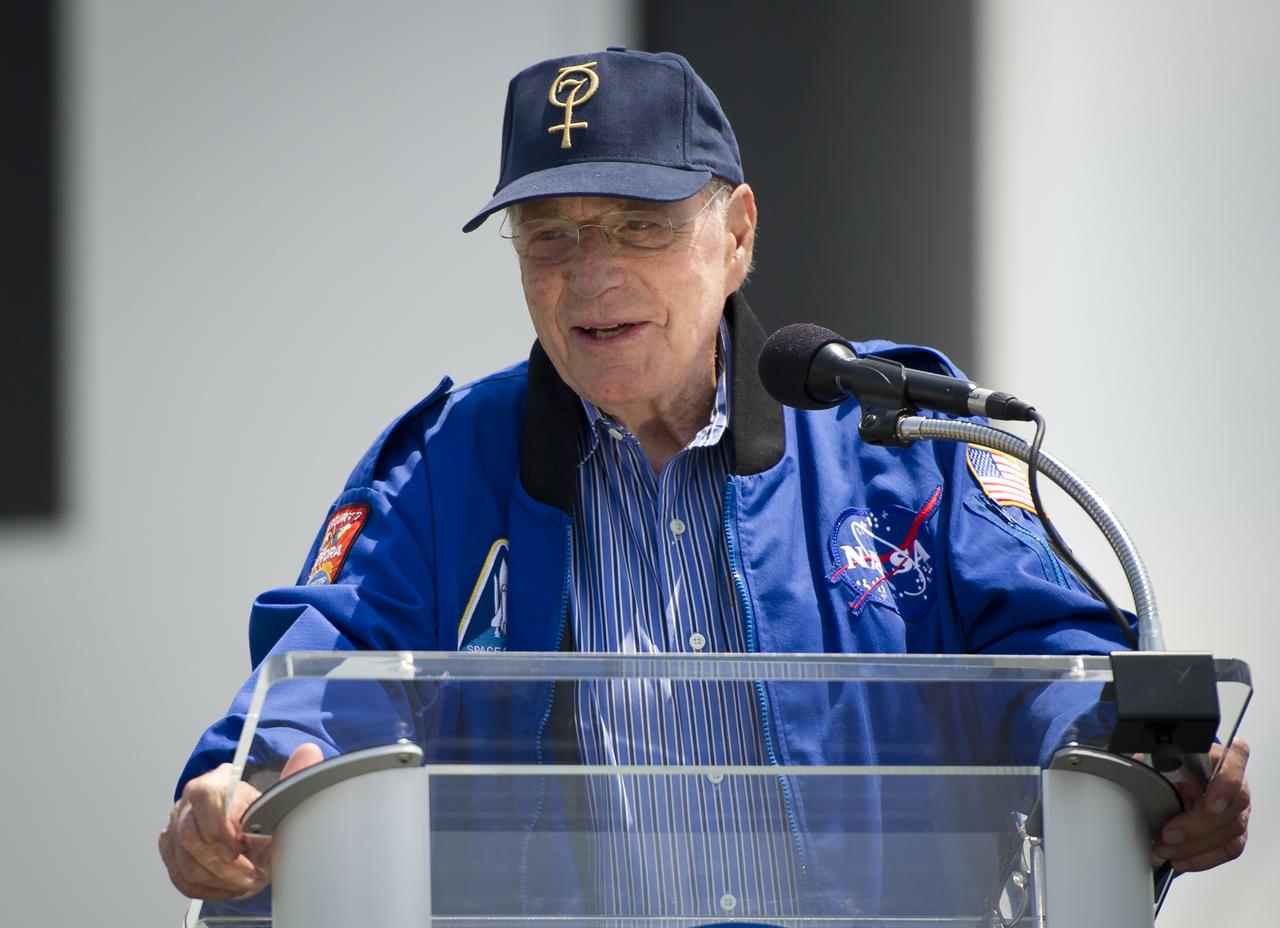
NASA Mercury Astronaut Scott Carpenter speaks during an unveiling ceremony of two USPS stamps that commemorate and celebrate 50 years of US Spaceflight and the MESSENGER program during an event, Wednesday, May 4, 2011 at the NASA Kennedy Space Center in Cape Canaveral, Fla. One stamp commemorates NASA’s Project Mercury, America’s first manned spaceflight program, and NASA astronaut Alan Shepard’s historic flight on May 5, 1961, aboard spacecraft Freedom 7. The other stamp draws attention to NASA’s unmanned MESSENGER mission, a scientific investigation of the planet Mercury. On March 17, 2011, MESSENGER became the first spacecraft to enter into orbit around Mercury. Photo Credit: (NASA/Bill Ingalls)
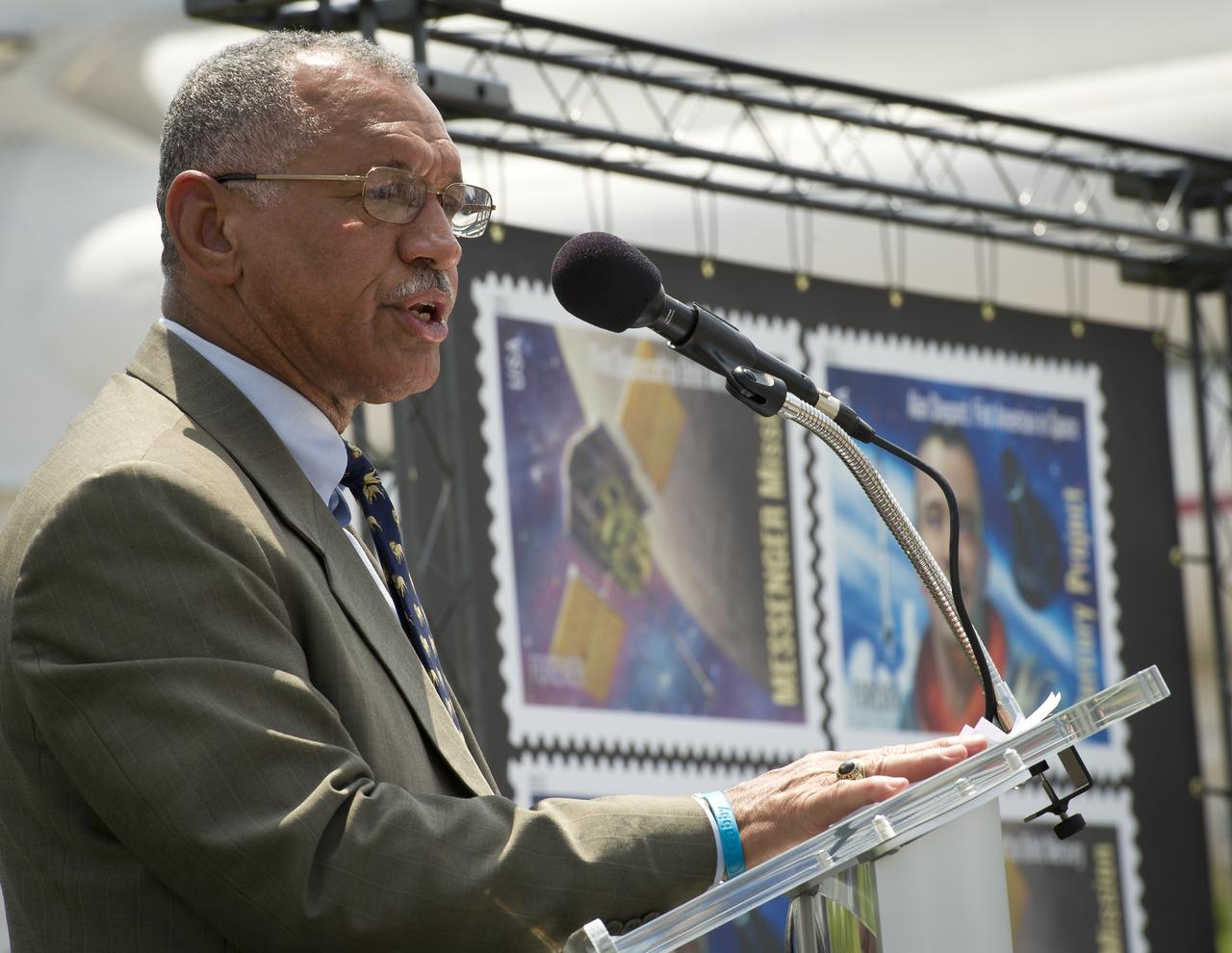
NASA Administrator Charles Boldin speaks during an unveiling ceremony of two USPS stamps that commemorate and celebrate 50 years of US Spaceflight and the MESSENGER program during an event, Wednesday, May 4, 2011 at the NASA Kennedy Space Center in Cape Canaveral, Fla. One stamp commemorates NASA’s Project Mercury, America’s first manned spaceflight program, and NASA astronaut Alan Shepard’s historic flight on May 5, 1961, aboard spacecraft Freedom 7. The other stamp draws attention to NASA’s unmanned MESSENGER mission, a scientific investigation of the planet Mercury. On March 17, 2011, MESSENGER became the first spacecraft to enter into orbit around Mercury. Photo Credit: (NASA/Bill Ingalls)
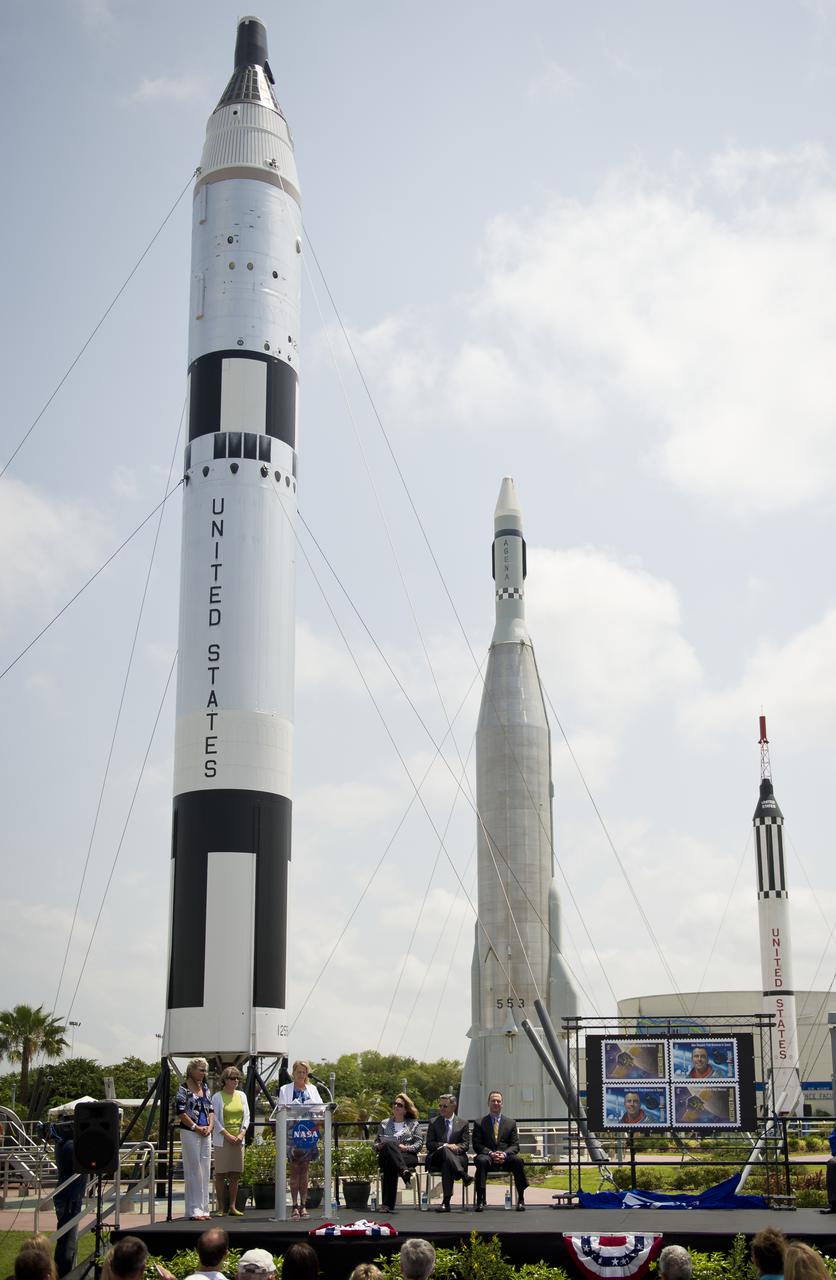
Daughters of NASA astronaut Alan Shepard, Laura Shepard Churchley, standing left, Alice Wackermann and Julie Jenkins, standing right, speak during an unveiling ceremony of two USPS stamps that commemorate and celebrate 50 years of US Spaceflight and the MESSENGER program during an event, Wednesday, May 4, 2011 at the NASA Kennedy Space Center in Cape Canaveral, Fla. One stamp commemorates NASA’s Project Mercury, America’s first manned spaceflight program, and NASA astronaut Alan Shepard’s historic flight on May 5, 1961, aboard spacecraft Freedom 7. The other stamp draws attention to NASA’s unmanned MESSENGER mission, a scientific investigation of the planet Mercury. On March 17, 2011, MESSENGER became the first spacecraft to enter into orbit around Mercury. Photo Credit: (NASA/Bill Ingalls)

Jim Adams, NASA Deputy Director, Planetary Science Division, Science Mission Directorate, speaks during an unveiling ceremony of two USPS stamps that commemorate and celebrate 50 years of US Spaceflight and the MESSENGER program during an event, Wednesday, May 4, 2011 at the NASA Kennedy Space Center in Cape Canaveral, Fla. One stamp commemorates NASA’s Project Mercury, America’s first manned spaceflight program, and NASA astronaut Alan Shepard’s historic flight on May 5, 1961, aboard spacecraft Freedom 7. The other stamp draws attention to NASA’s unmanned MESSENGER mission, a scientific investigation of the planet Mercury. On March 17, 2011, MESSENGER became the first spacecraft to enter into orbit around Mercury. Photo Credit: (NASA/Bill Ingalls)
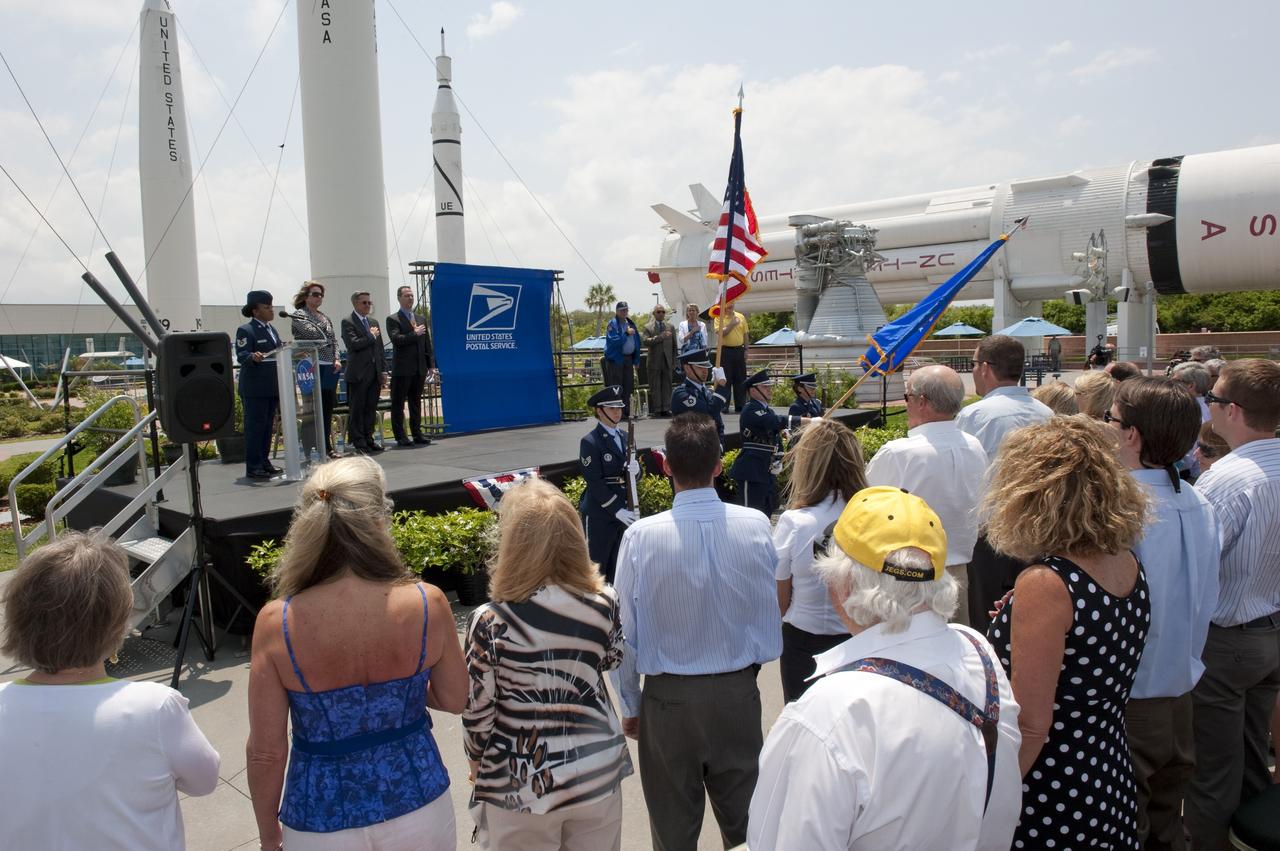
CAPE CANAVERAL, Fla. -- In the Rocket Garden at NASA's Kennedy Space Center Visitor Complex in Florida, the audience and speakers stand for the Pledge of Allegiance and the singing of the National Anthem by a member of the 45th Space Wing Honor Guard from Patrick Air Force Base in Florida. Also on stage are, from left, Director of Education and External Relations for Kennedy Cheryl Hurst, Center Director Bob Cabana and United States Postal Service official Steve Massey, Mercury Astronaut Scott Carpenter, NASA Administrator, Charlie Bolden, Julie Jenkins and NASA's Deputy Director for Planetary Science, Jim Adams, all in attendance for the United States Postal Service unveiling of two new stamps to commemorate the 50th anniversary of human spaceflight. One stamp commemorates NASA's Project Mercury and Alan Shepard's historic launch on May 5, 1961, aboard the spacecraft Freedom 7. The second stamp honors NASA's MESSENGER, which reached Mercury in March to become the first spacecraft to orbit the planet. The two missions frame a remarkable 50-year period in which America advanced space exploration through more than 1,500 crewed and uncrewed flights. Photo credit: NASA/Kim Shiflett
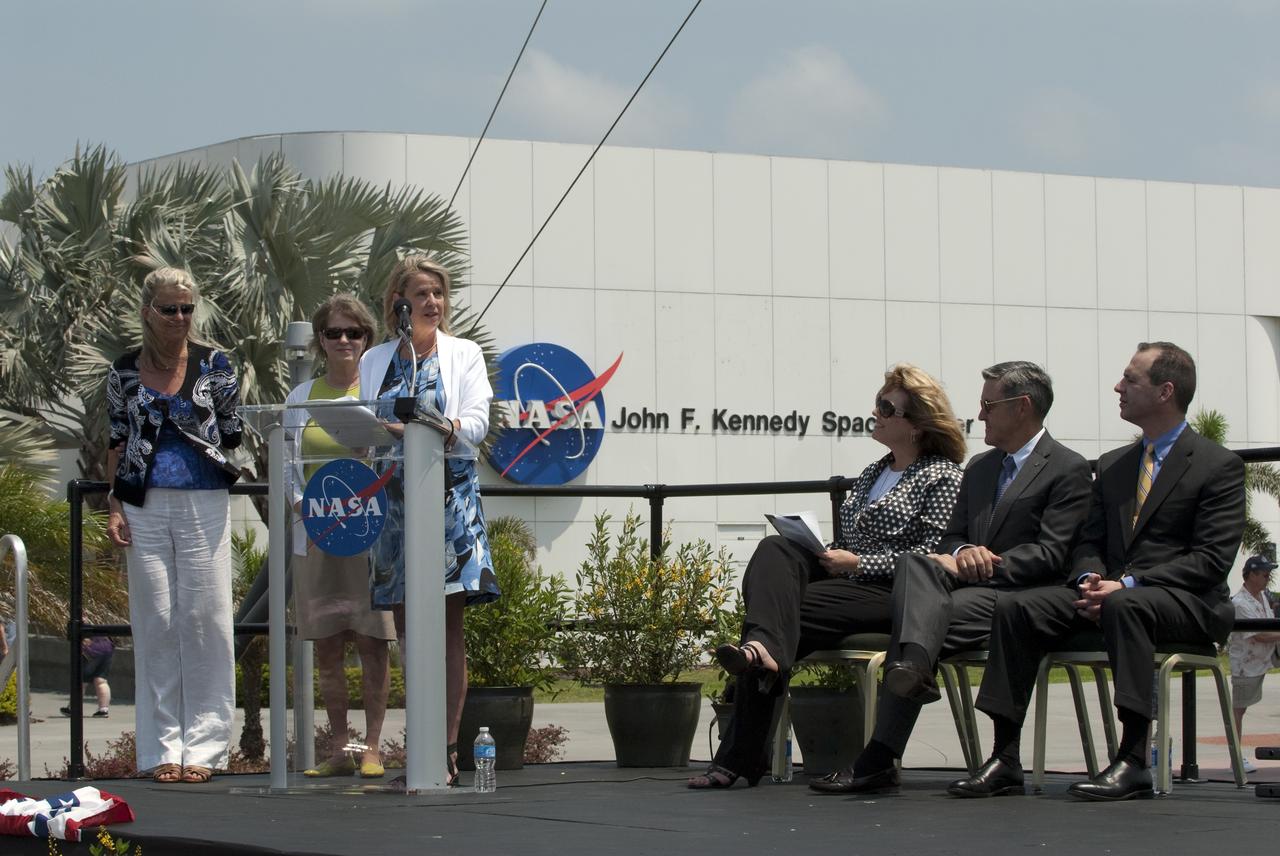
CAPE CANAVERAL, Fla. -- In the Rocket Garden at NASA's Kennedy Space Center Visitor Complex in Florida, Laura Churchley (left), Alice Wackerman and Julie Jenkins, daughters of Mercury Astronaut Alan Shepard, speak to the audience in attendance for the United States Postal Service unveiling of two new stamps to commemorate the 50th anniversary of human spaceflight. Listening to them speak is Director of Education and External Relations for Kennedy, Cheryl Hurst (left), Kennedy Center Director, Bob Cabana and United States Postal Service official Steve Massey. One stamp commemorates NASA's Project Mercury and Alan Shepard's historic launch on May 5, 1961, aboard the spacecraft Freedom 7. The second stamp honors NASA's MESSENGER, which reached Mercury in March to become the first spacecraft to orbit the planet. The two missions frame a remarkable 50-year period in which America advanced space exploration through more than 1,500 crewed and uncrewed flights. Photo credit: NASA/Kim Shiflett
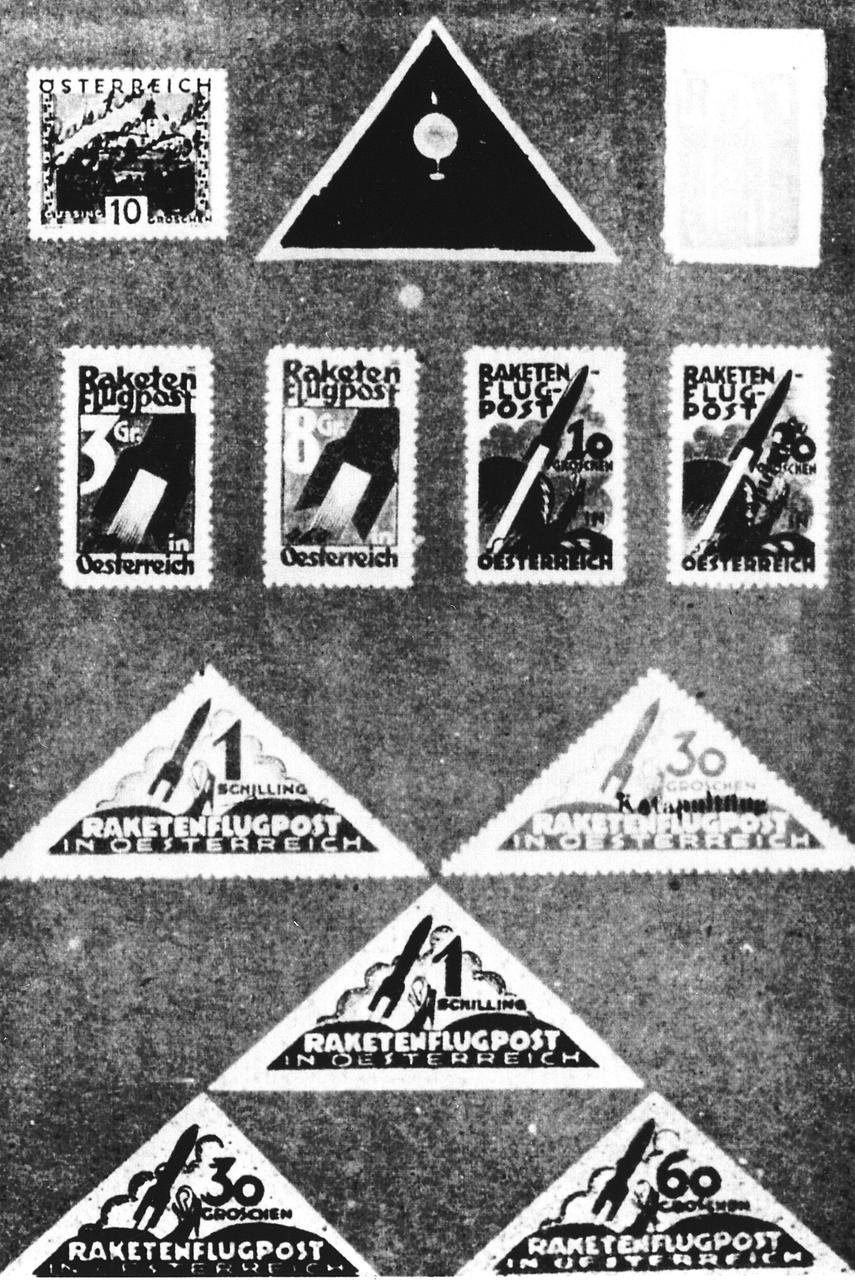
In the 19th Century, experiments in America, Europe, and elsewhere attempted to build postal rockets to deliver mail from one location to another. The idea was more novel than successful. Many stamps used in these early postal rockets have become collector's items.
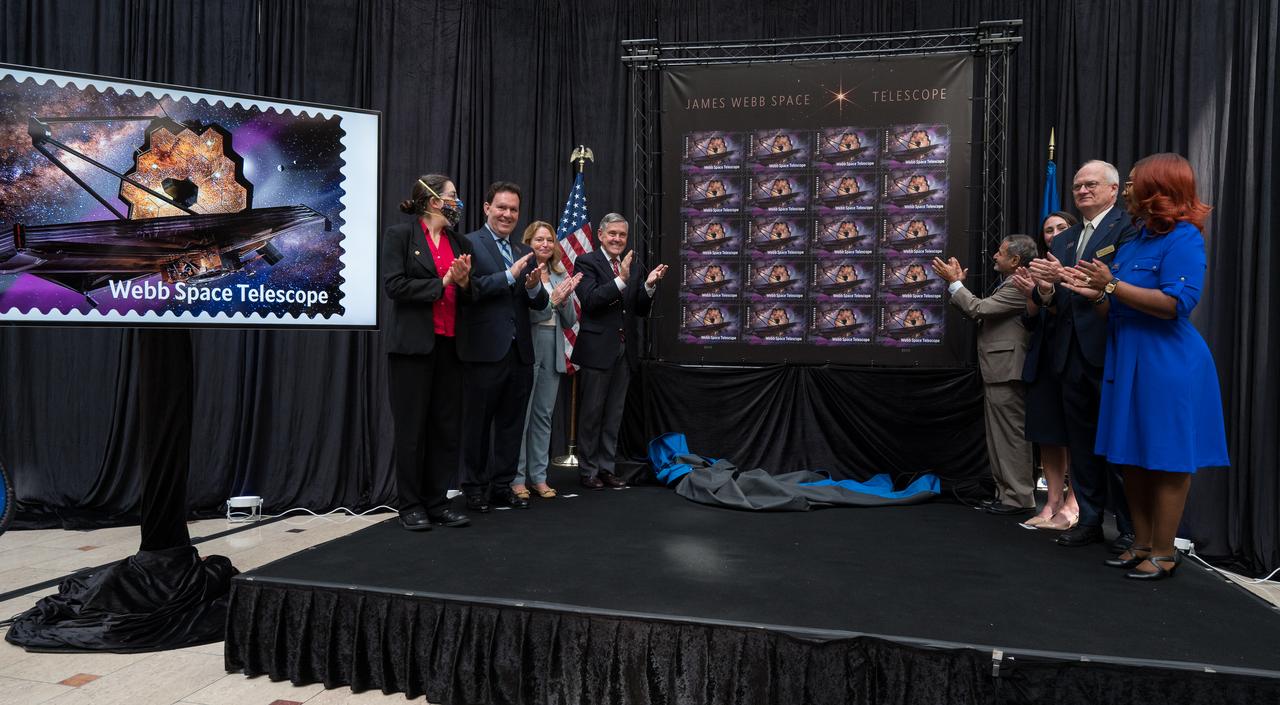
From left to right, NASA’s Goddard Space Flight Center Webb Deputy Observatory Project Scientist, Erin Smith, NASA’s Goddard Space Flight Center Webb Optical Telescope Element Manager, Lee Feinberg, Smithsonian Institution Under Secretary for Service and Research, Ellen Stofan, NASA Associate Administrator and former astronaut Bob Cabana, United States Postal Service Vice Chairman, Board of Governors, Anton Hajjar, NASA public affairs specialist Alice Fisher, National Postal Museum Deputy Director, Toby Mensforth, and Lisa Whitehead, USPS, applaud after unveiling the United States Postal Service’s new stamp celebrating NASA’s James Webb Space Telescope (JWST) at the first-day-of-issue event on Thursday, Sept. 8, 2022, at the Smithsonian’s National Postal Museum in Washington. The stamp, which features an illustration of the observatory, honors Webb’s mission to explore the unknown in our universe – solving mysteries in our solar system, looking beyond to distant worlds around other stars, and probing the structures and origins of our universe and our place in it. Photo Credit: (NASA/Aubrey Gemignani)
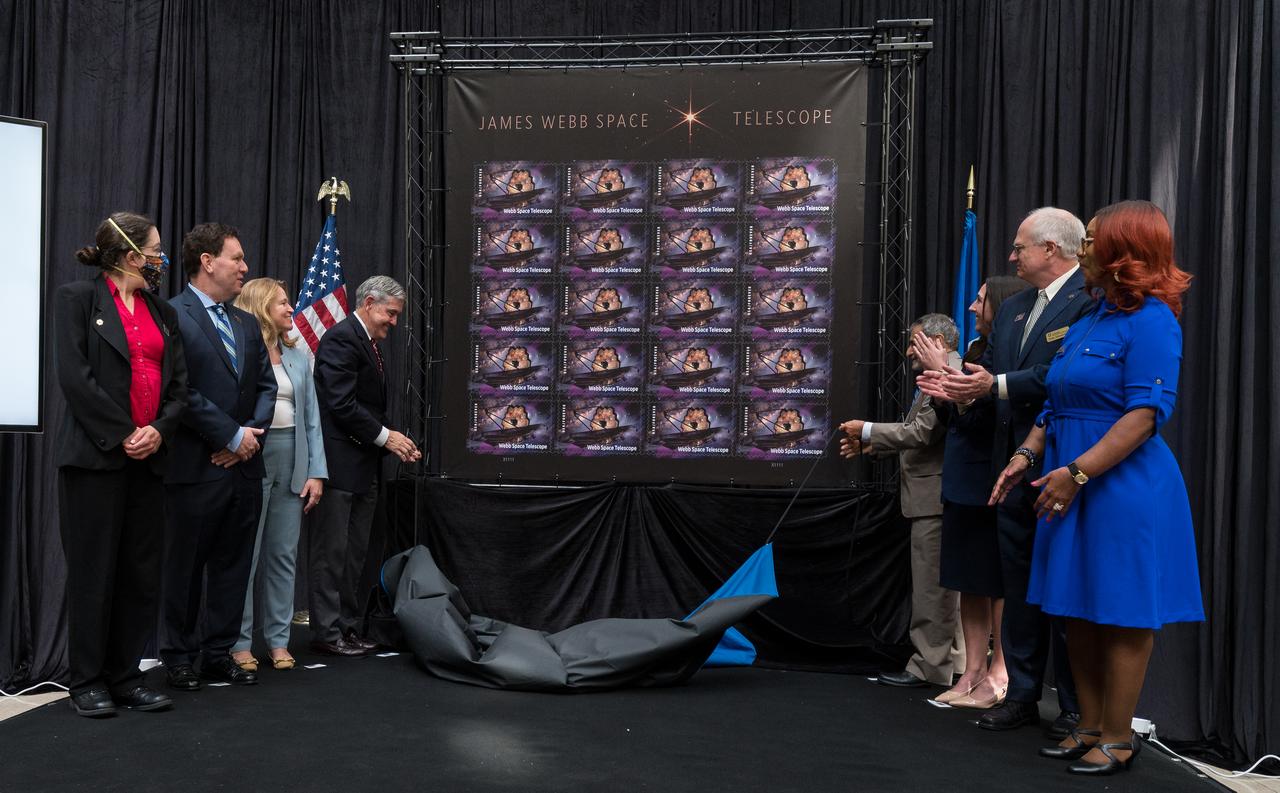
From left to right, NASA’s Goddard Space Flight Center Webb Deputy Observatory Project Scientist, Erin Smith, NASA’s Goddard Space Flight Center Webb Optical Telescope Element Manager, Lee Feinberg, Smithsonian Institution Under Secretary for Service and Research, Ellen Stofan, NASA Associate Administrator and former astronaut Bob Cabana, United States Postal Service Vice Chairman, Board of Governors, Anton Hajjar, NASA public affairs specialist Alice Fisher, National Postal Museum Deputy Director, Toby Mensforth, and Lisa Whitehead, USPS, unveil the United States Postal Service’s new stamp celebrating NASA’s James Webb Space Telescope (JWST) at the first-day-of-issue event on Thursday, Sept. 8, 2022, at the Smithsonian’s National Postal Museum in Washington. The stamp, which features an illustration of the observatory, honors Webb’s mission to explore the unknown in our universe – solving mysteries in our solar system, looking beyond to distant worlds around other stars, and probing the structures and origins of our universe and our place in it. Photo Credit: (NASA/Aubrey Gemignani)
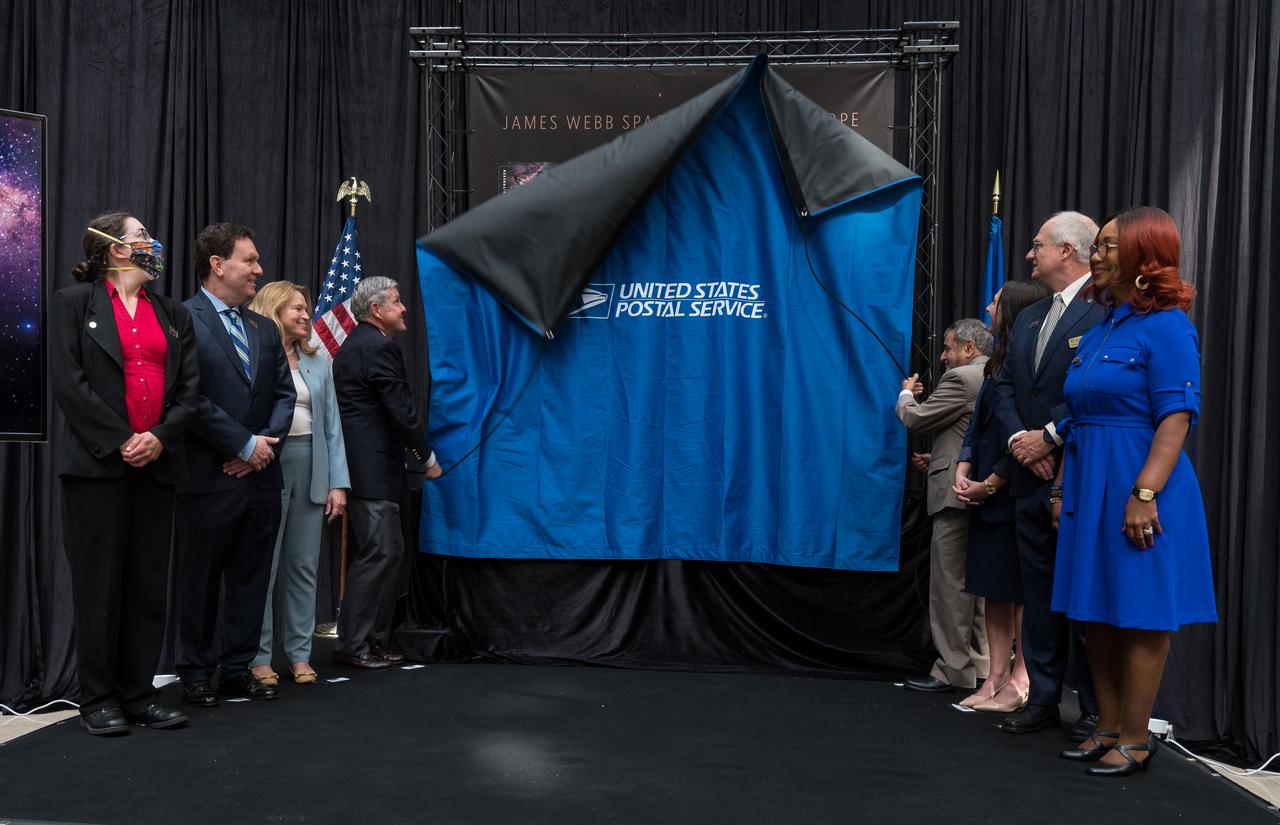
From left to right, NASA’s Goddard Space Flight Center Webb Deputy Observatory Project Scientist, Erin Smith, NASA’s Goddard Space Flight Center Webb Optical Telescope Element Manager, Lee Feinberg, Smithsonian Institution Under Secretary for Service and Research, Ellen Stofan, NASA Associate Administrator and former astronaut Bob Cabana, United States Postal Service Vice Chairman, Board of Governors, Anton Hajjar, NASA public affairs specialist Alice Fisher, National Postal Museum Deputy Director, Toby Mensforth, and Lisa Whitehead, USPS, unveil the United States Postal Service’s new stamp celebrating NASA’s James Webb Space Telescope (JWST) at the first-day-of-issue event on Thursday, Sept. 8, 2022, at the Smithsonian’s National Postal Museum in Washington. The stamp, which features an illustration of the observatory, honors Webb’s mission to explore the unknown in our universe – solving mysteries in our solar system, looking beyond to distant worlds around other stars, and probing the structures and origins of our universe and our place in it. Photo Credit: (NASA/Aubrey Gemignani)
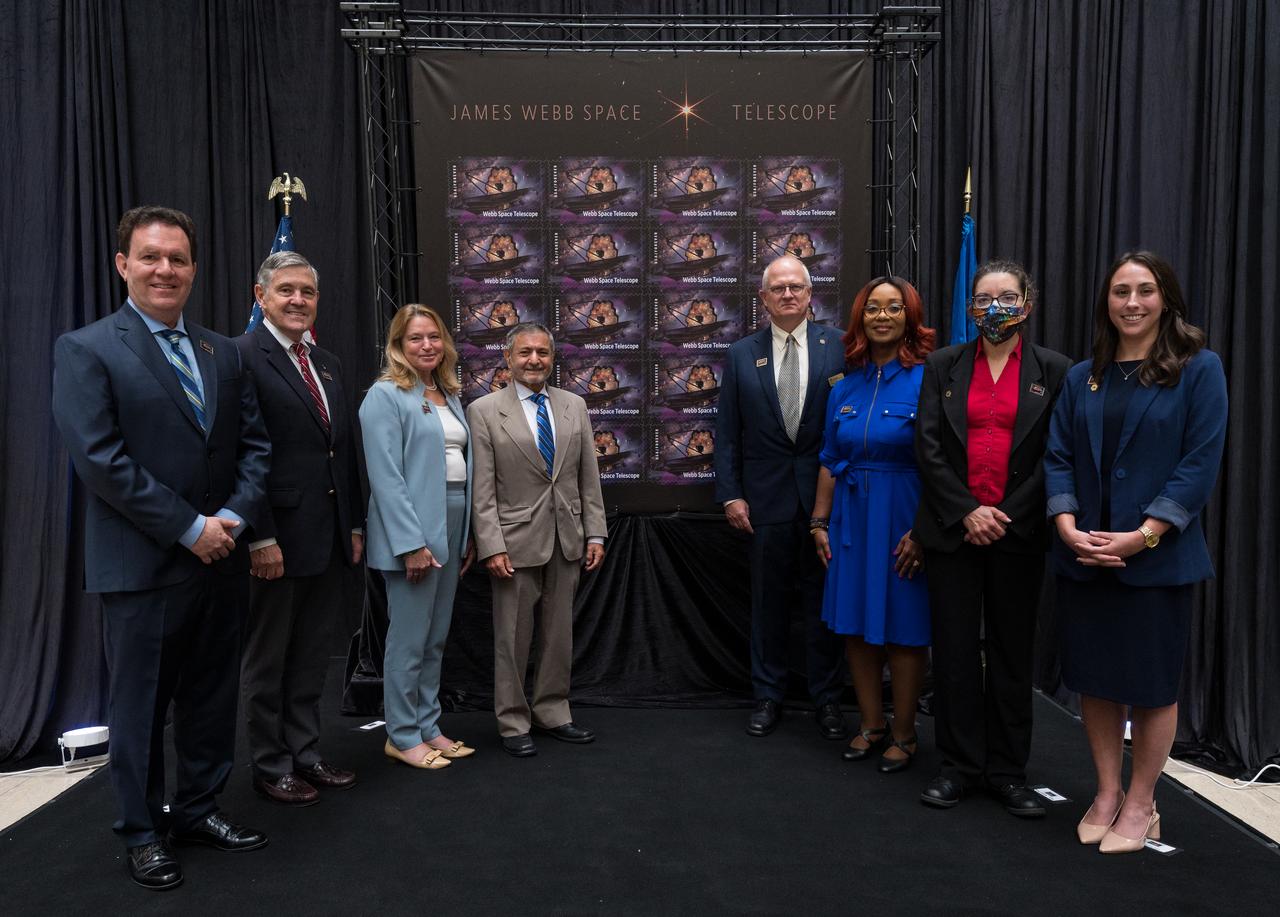
From left to right, NASA’s Goddard Space Flight Center Webb Optical Telescope Element Manager, Lee Feinberg, NASA Associate Administrator and former astronaut Bob Cabana, Smithsonian Institution Under Secretary for Service and Research, Ellen Stofan, United States Postal Service Vice Chairman, Board of Governors, Anton Hajjar, National Postal Museum Deputy Director Toby Mensforth, Lisa Whitehead, USPS, NASA’s Goddard Space Flight Center Webb Deputy Observatory Project Scientist, Erin Smith, and NASA public affairs specialist, Alice Fisher, pose for a photo at the conclusion of the first-day-of-issue event for the United States Postal Service’s new stamp celebrating NASA’s James Webb Space Telescope (JWST) on Thursday, Sept. 8, 2022, at the Smithsonian’s National Postal Museum in Washington. The stamp, which features an illustration of the observatory, honors Webb’s mission to explore the unknown in our universe – solving mysteries in our solar system, looking beyond to distant worlds around other stars, and probing the structures and origins of our universe and our place in it. Photo Credit: (NASA/Aubrey Gemignani)
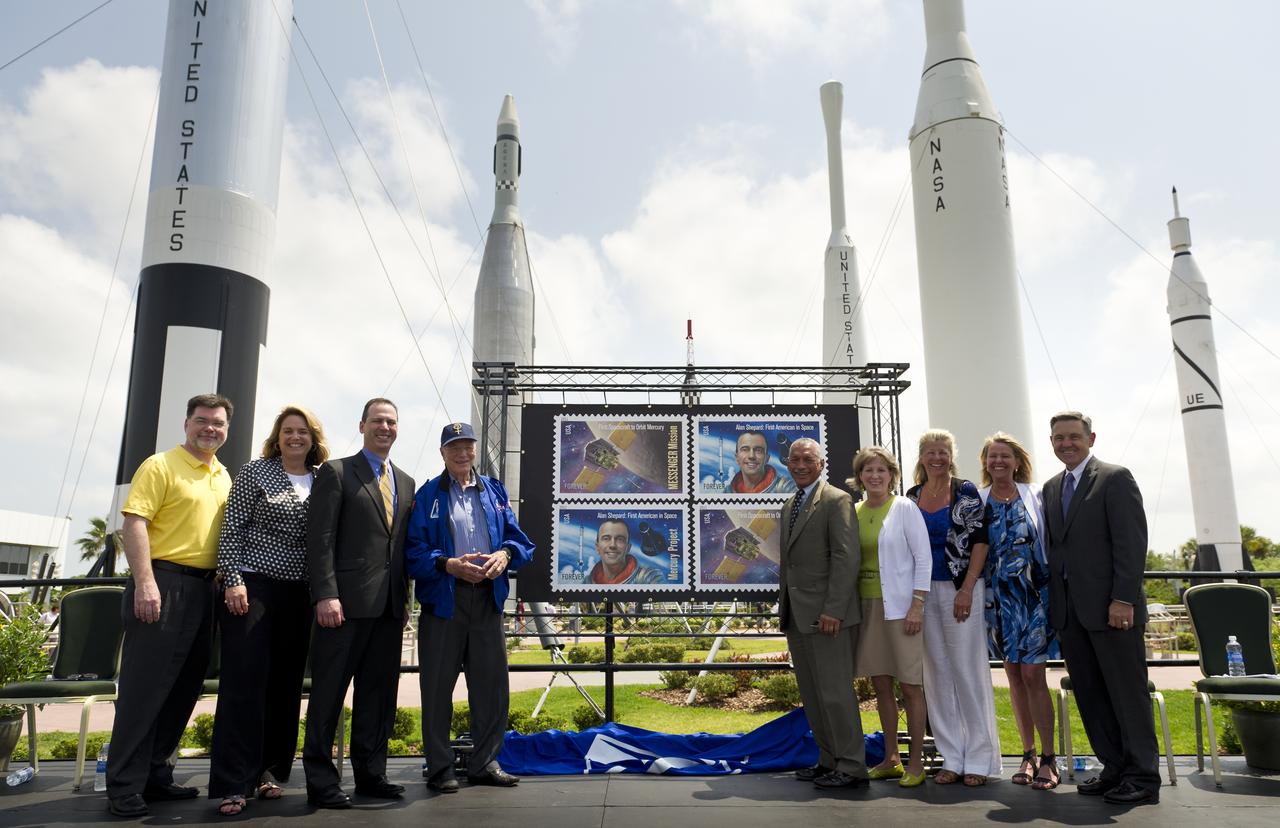
From left, NASA Deputy Director, Planetary Science Division, Science Mission Directorate, Jim Adams, NASA Kennedy Space Center Director of Education and External Relations Cheryl Hurst, United States Postal Service Vice President of Finance Steve Masse, NASA Mercury Astronaut Scott Carpenter, NASA Administrator Charles Boldin, Daughters of NASA astronaut Alan Shepard, Alice Wackermann, Laura Shepard Churchley, and Julie Jenkins, and NASA Kennedy Space Center Director Robert Cabana pose for a photograph during an unveiling ceremony of two USPS stamps that commemorate and celebrate 50 years of US Spaceflight and the MESSENGER program during an event, Wednesday, May 4, 2011 at the NASA Kennedy Space Center in Cape Canaveral, Fla. One stamp commemorates NASA’s Project Mercury, America’s first manned spaceflight program, and NASA astronaut Alan Shepard’s historic flight on May 5, 1961, aboard spacecraft Freedom 7. The other stamp draws attention to NASA’s unmanned MESSENGER mission, a scientific investigation of the planet Mercury. On March 17, 2011, MESSENGER became the first spacecraft to enter into orbit around Mercury. Photo Credit: (NASA/Bill Ingalls)
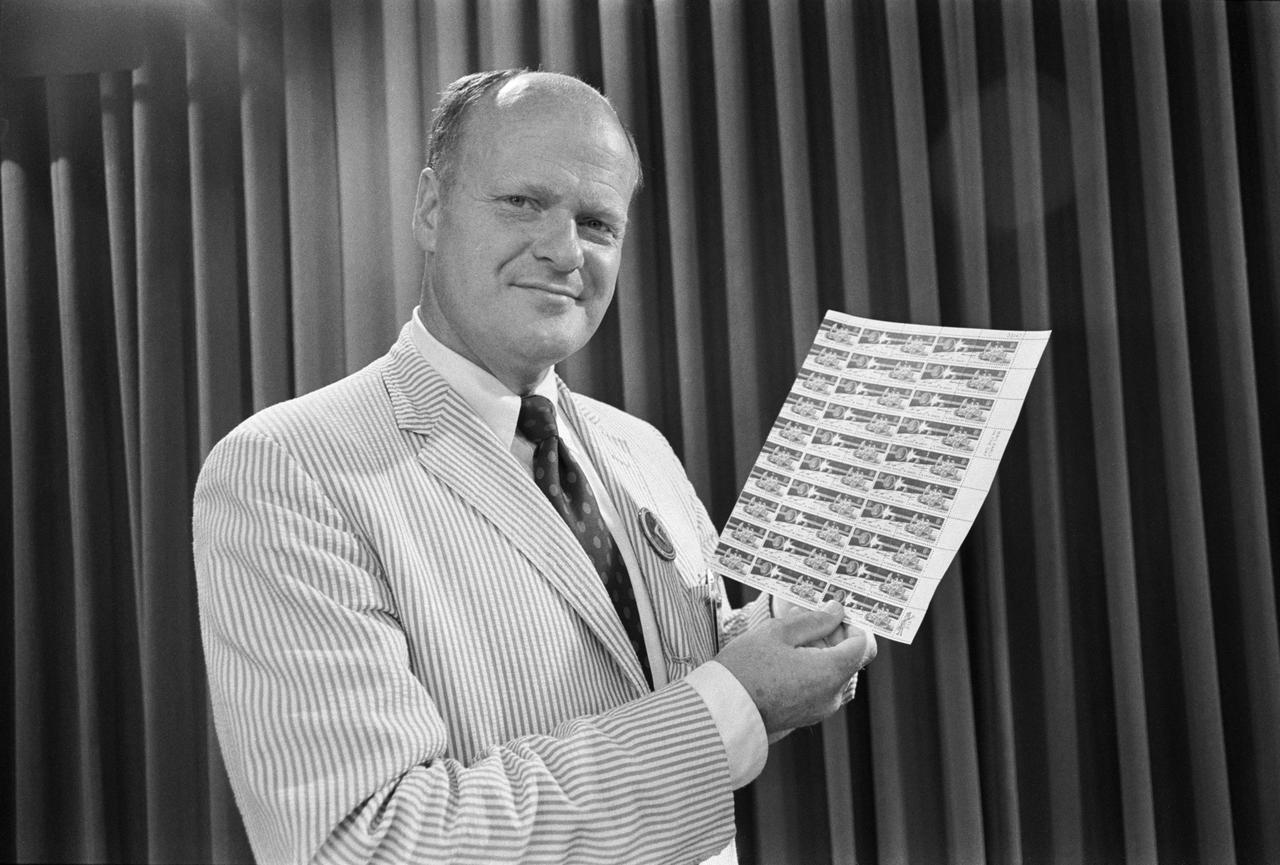
S71-41694 (2 Aug. 1971) --- Artist Robert McCall of Paradise Valley, Arizona, holds a sheet of commemorative postage stamps commemorating the Apollo 15 lunar landing mission. McCall was chose by the U.S. Postal Service to design the eight-cent stamp which heralds: "United States in Space -- A Decade of Achievement." McCall, who has maintained a close tie with the space program for many years, has been commissioned by the National Aeronautics and Space Administration to portray Apollo 15 activities from the Mission Control Center at the Manned Spacecraft Center, Houston, Texas.
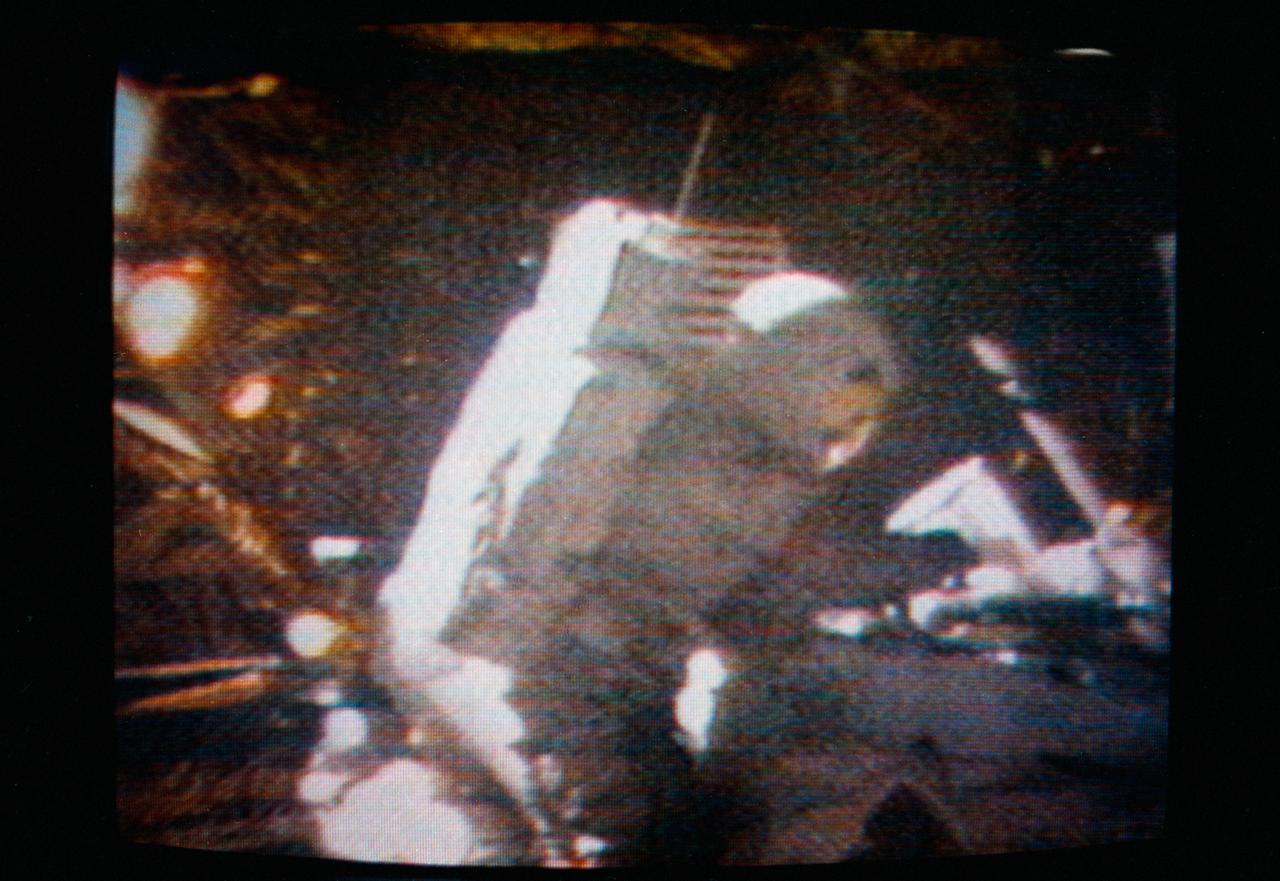
S71-43785 (2 Aug. 1971) --- Astronaut David R. Scott, Apollo 15 commander, performs the act of cancelling the first Apollo 15 commemorative postage stamp on the moon, as seen in this color reproduction taken from a transmission made by the RCA color television camera mounted on the Lunar Roving Vehicle. Scott holds a stamp cancellation device in his right hand. The new commemorative postage stamp heralds: "United States in Space -- A Decade of Achievement." The U.S. Postal Service chose artist Robert McCall of Paradise Valley, Arizona, to design the new U.S. eight-cent stamp. The stamp cancellation occurred toward the end of the third and final lunar surface extravehicular activity by astronauts Scott and James B. Irwin, lunar module pilot.
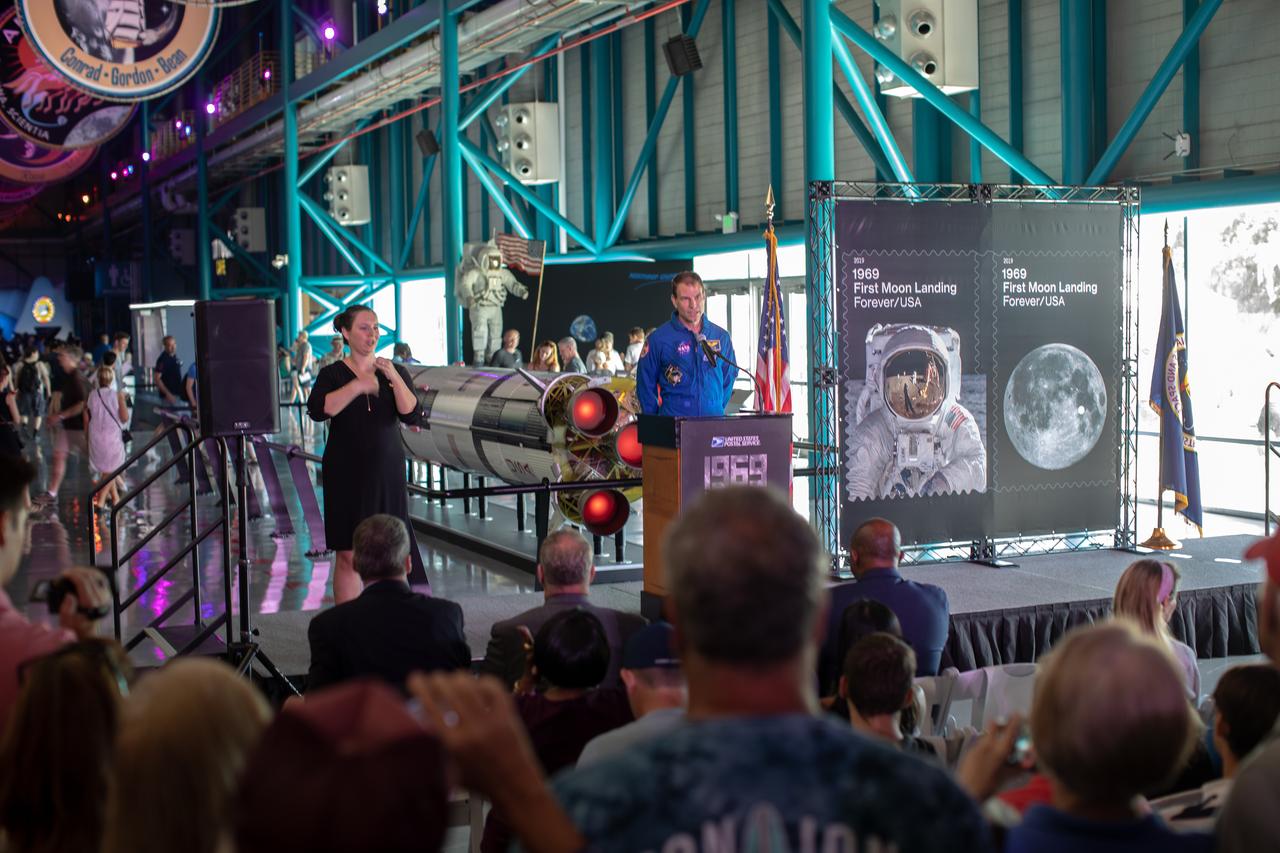
Astronaut Stan Love speaks at Kennedy Space Center’s Apollo/Saturn V Center on Friday, July 19, 2019. Love addressed a crowd at the Florida spaceport during a 50th Anniversary celebration of the Apollo 11 mission. The U.S. Postal Service issued two forever stamps to honor the historic moment. The event marked the first day of issue for the special stamps.
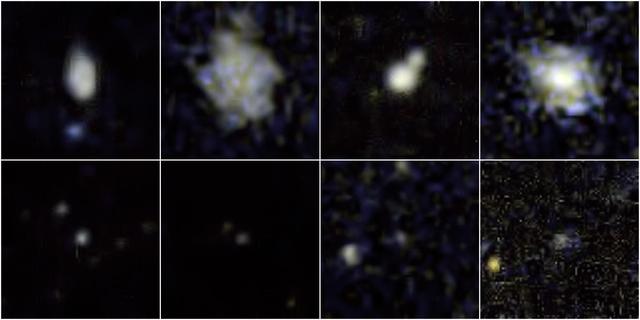
These postage-stamp images taken by NASA Galaxy Evolution Explorer are helping to solve a mystery -- why do the littlest of galaxies produce the biggest of star explosions, or supernovae?
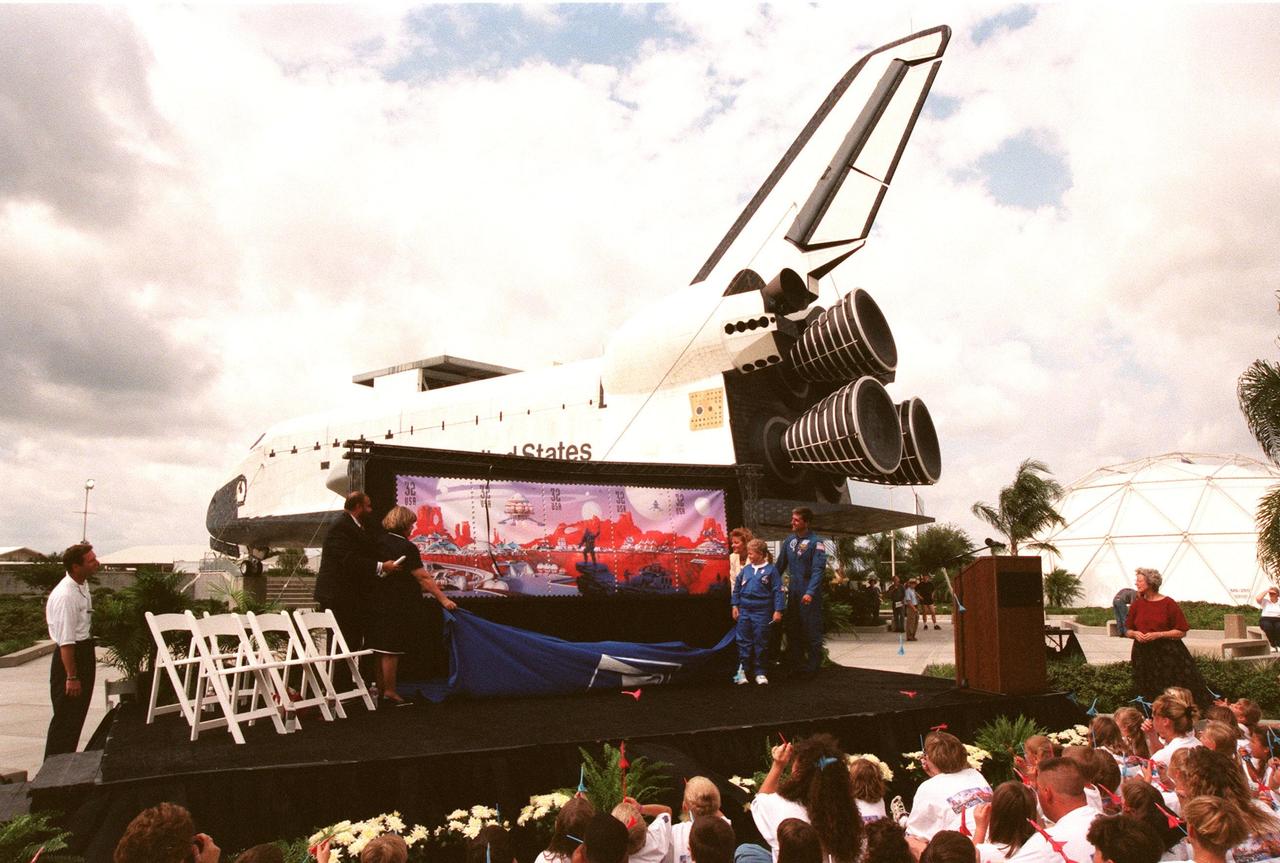
The U.S. Postal Service unveils its newest series of stamps, Space Discovery, at the KSC Visitor Complex. The event coincided with NASA's 40th anniversary on this date. Participating in the unveiling are (left to right) Barry Ziehl, U.S. Postal Service; JoAnn Morgan, KSC associate director of advanced development and shuttle upgrades; Karla Corcoran, Postal Service inspector general; Kristene A. Graves, a student from Lewis Carroll Elementary School ; and Dr. Donald Thomas, astronaut and veteran of four Shuttle missions. Behind them is the mockup of an orbiter. During the ceremony, Kristene read her essay "My Stamp Adventure" that she had written for an area-wide contest for the event. The stamps were designed by renowned aerospace artist Attila Heija. The strip of five individual stamps together make up a futuristic scene complete with space vehicles, a futuristic space city, and space explorers. The stamps are available nationwide beginning Oct. 1
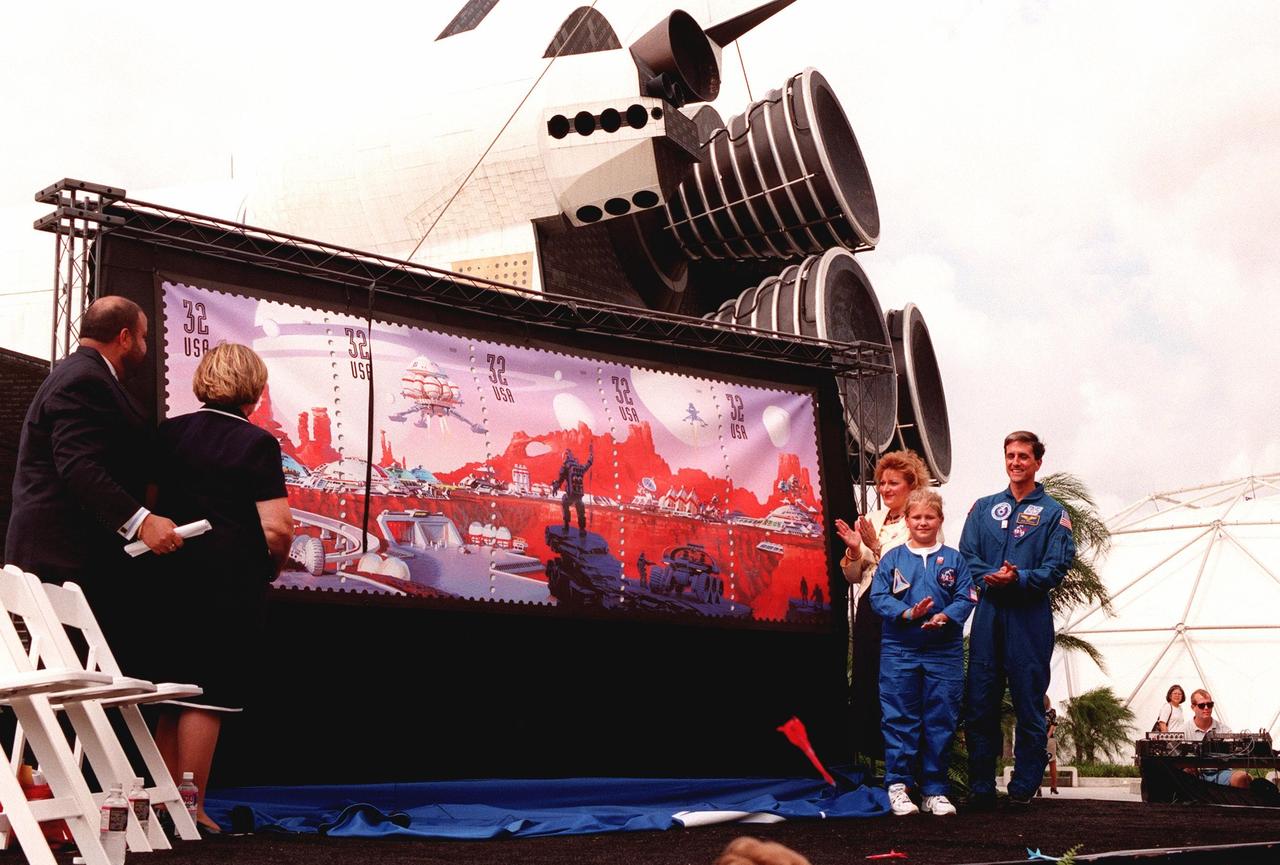
Applauding the unveiling of the U.S. Postal Service's newest series of stamps, Space Discovery, are are (left to right) Barry Ziehl, U.S. Postal Service; JoAnn Morgan, KSC associate director of advanced development and shuttle upgrades; Karla Corcoran, Postal Service inspector general; Kristene A. Graves, a student from Lewis Carroll Elementary School; and Dr. Donald Thomas, astronaut and veteran of four Shuttle missions. During the ceremony, Kristene read her essay "My Stamp Adventure" that she had written for an area-wide contest for the event. The unveiling took place at the KSC Visitor Complex and coincided with NASA's 40th anniversary on this date. Behind the large display can be seen the mockup of an orbiter. The stamps were designed by renowned aerospace artist Attila Heija. The strip of five individual stamps together make up a futuristic scene complete with space vehicles, a futuristic space city, and space explorers. The stamps are available nationwide beginning Oct. 1
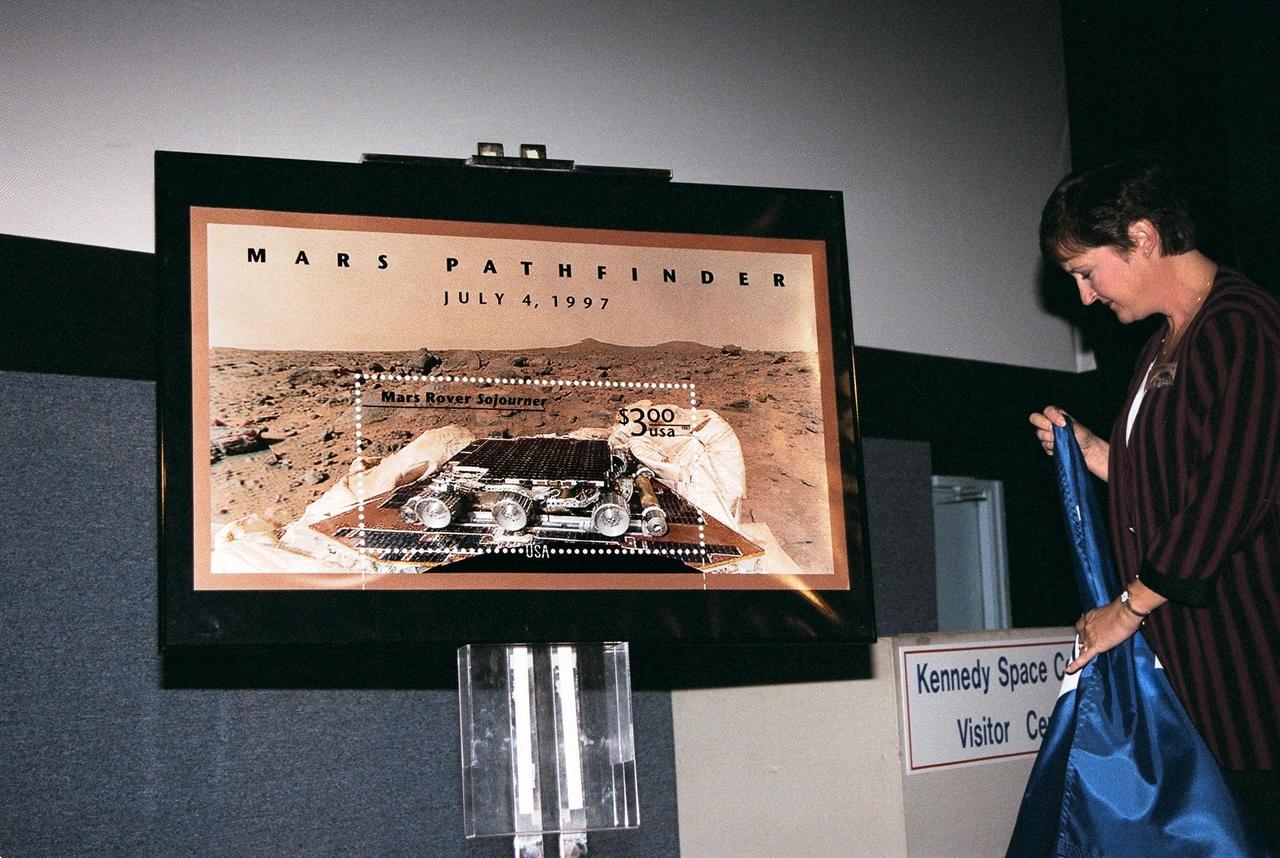
Nancy Warren, supervisor of stamp distribution for the U.S. Post Office, unveils the $3 commemorative Mars Pathfinder postage stamp at Kennedy Space Center's Visitor Complex on the second day of its issue. The stamp was first issued on Dec. 10 at the Jet Propulsion Laboratory, Pasadena, Calif. It depicts the Sojourner rover at rest on the Pathfinder spacecraft with a panoramic Martian view that is based on one of the first mission images sent back to Earth
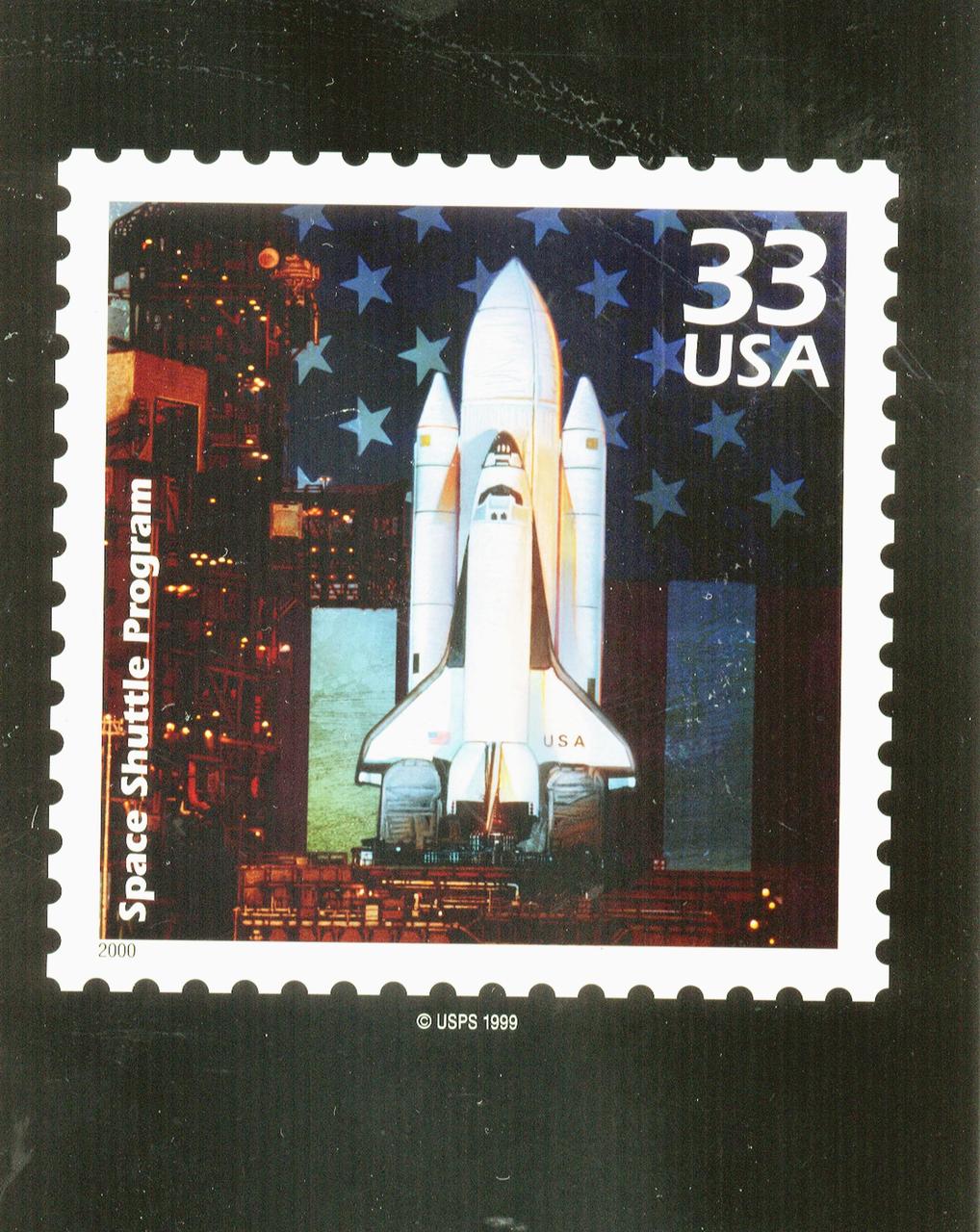
One of a new series of U.S. Postage stamps, The 1980s, is unveiled at the KSC Visitors Complex. The stamp, shown here, is the Space Shuttle Columbia, first launched in April 1981. This collection of stamps is the ninth in the Post Office's "Celebrate the Century" commemorative series honoring the last 100 years of American history. Taking part in the "First Day of Issue Ceremony" were astronaut Richard Linnehan, U.S. Representative, 15th Congressional District, Dave Weldon, U.S. Postal Service District Manager Viki Brennan, Center Director Roy Bridges and President of the Visitor Complex Rick Abramson
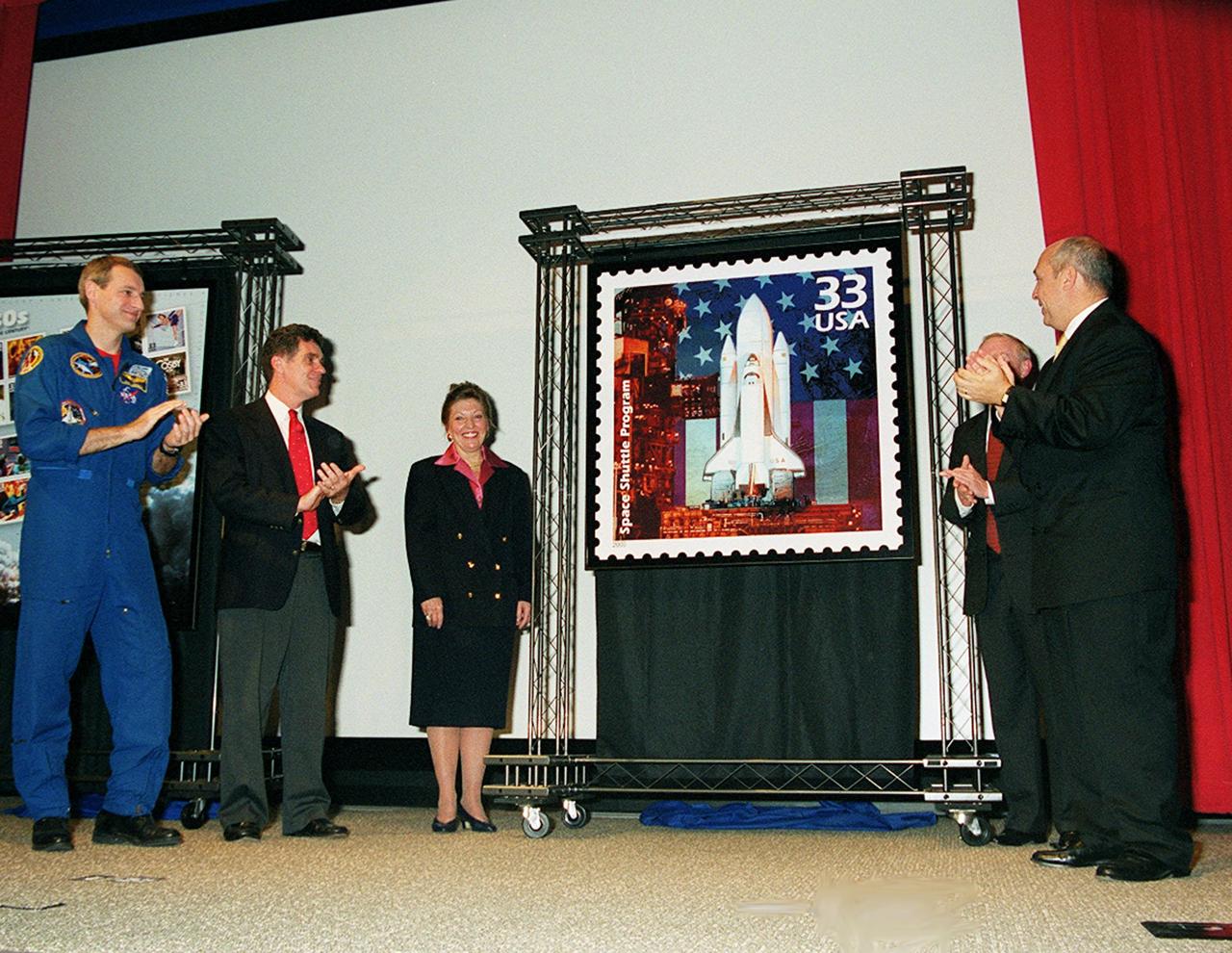
One of a new series of U.S. Postage stamps, The 1980s, is unveiled at the KSC Visitors Complex. The stamp, shown here, is the Space Shuttle Columbia, first launched in April 1981. This collection of stamps is the ninth in the Post Office's "Celebrate the Century" commemorative series honoring the last 100 years of American history. Taking part in the "First Day of Issue Ceremony" are (left to right) astronaut Richard Linnehan, U.S. Representative, 15th Congressional District, Dave Weldon, U.S. Postal Service District Manager Viki Brennan, Center Director Roy Bridges and President of the Visitor Complex Rick Abramson
One of a new series of U.S. Postage stamps, The 1980s, is unveiled at the KSC Visitors Complex. The stamp, shown here, is the Space Shuttle Columbia, first launched in April 1981. This collection of stamps is the ninth in the Post Office's "Celebrate the Century" commemorative series honoring the last 100 years of American history. Taking part in the "First Day of Issue Ceremony" are (left to right) astronaut Richard Linnehan, U.S. Representative, 15th Congressional District, Dave Weldon, U.S. Postal Service District Manager Viki Brennan, Center Director Roy Bridges and President of the Visitor Complex Rick Abramson
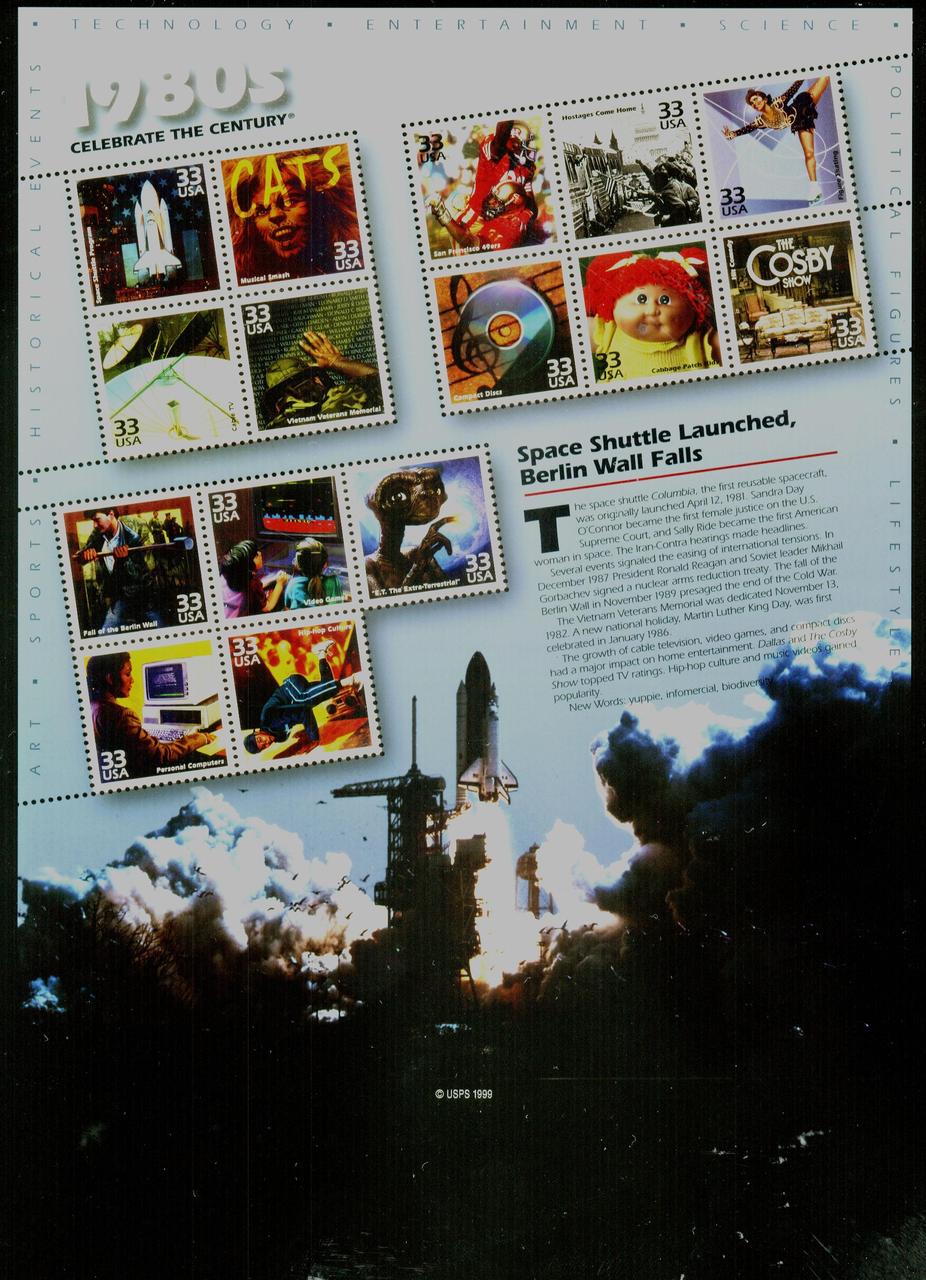
A new series of U.S. Postage stamps, The 1980s, is unveiled at the KSC Visitors Complex. Taking part in the "First Day of Issue Ceremony" were astronaut Richard Linnehan, U.S. Representative, 15th Congressional District, Dave Weldon, U.S. Postal Service District Manager Viki Brennan, Center Director Roy Bridges and President of the Visitor Complex Rick Abramson. Among the stamps issued is one of Space Shuttle Columbia (upper left corner), first launched in April 1981. This collection of stamps is the ninth in the Post Office's "Celebrate the Century" commemorative series honoring the last 100 years of American history
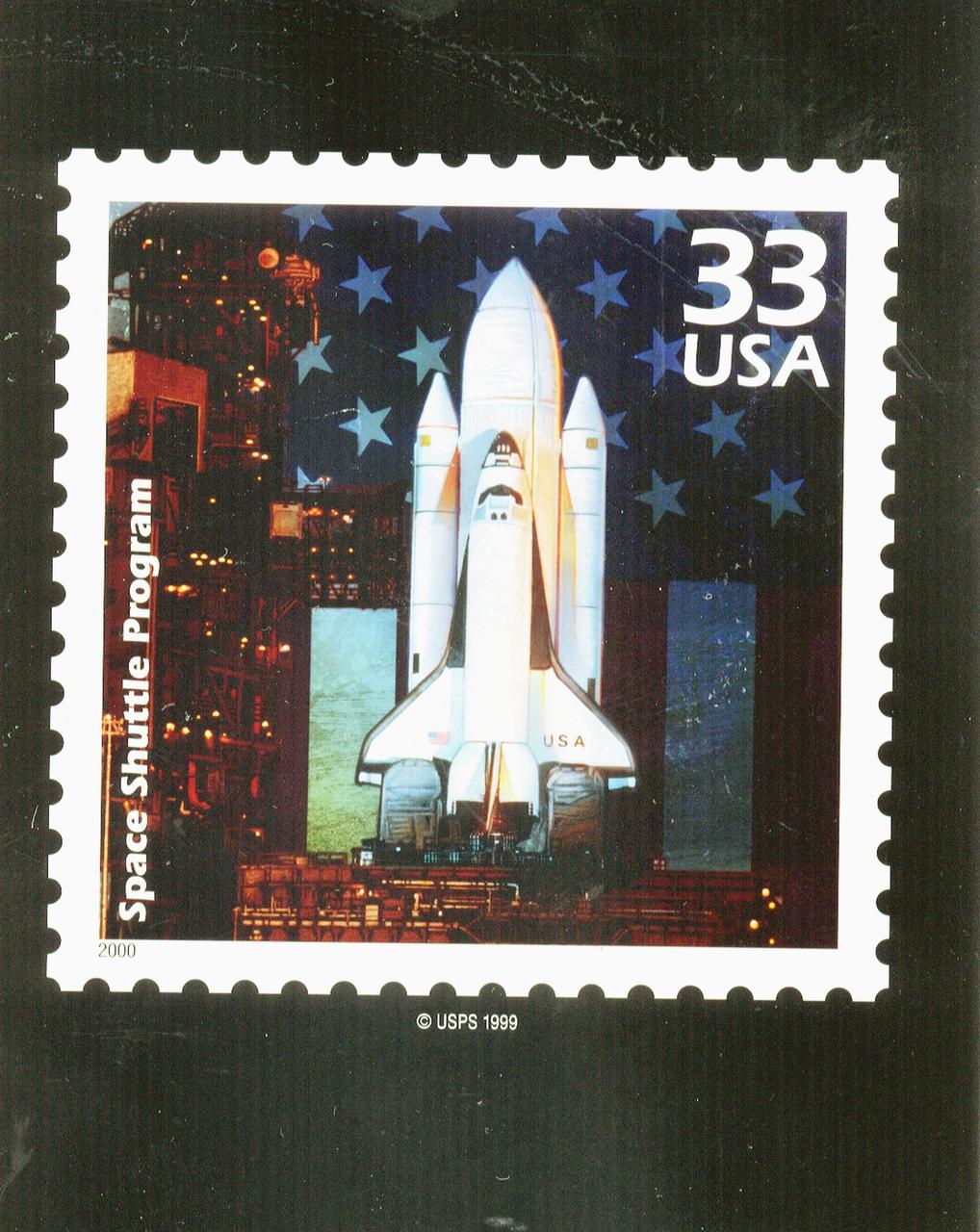
One of a new series of U.S. Postage stamps, The 1980s, is unveiled at the KSC Visitors Complex. The stamp, shown here, is the Space Shuttle Columbia, first launched in April 1981. This collection of stamps is the ninth in the Post Office's "Celebrate the Century" commemorative series honoring the last 100 years of American history. Taking part in the "First Day of Issue Ceremony" were astronaut Richard Linnehan, U.S. Representative, 15th Congressional District, Dave Weldon, U.S. Postal Service District Manager Viki Brennan, Center Director Roy Bridges and President of the Visitor Complex Rick Abramson
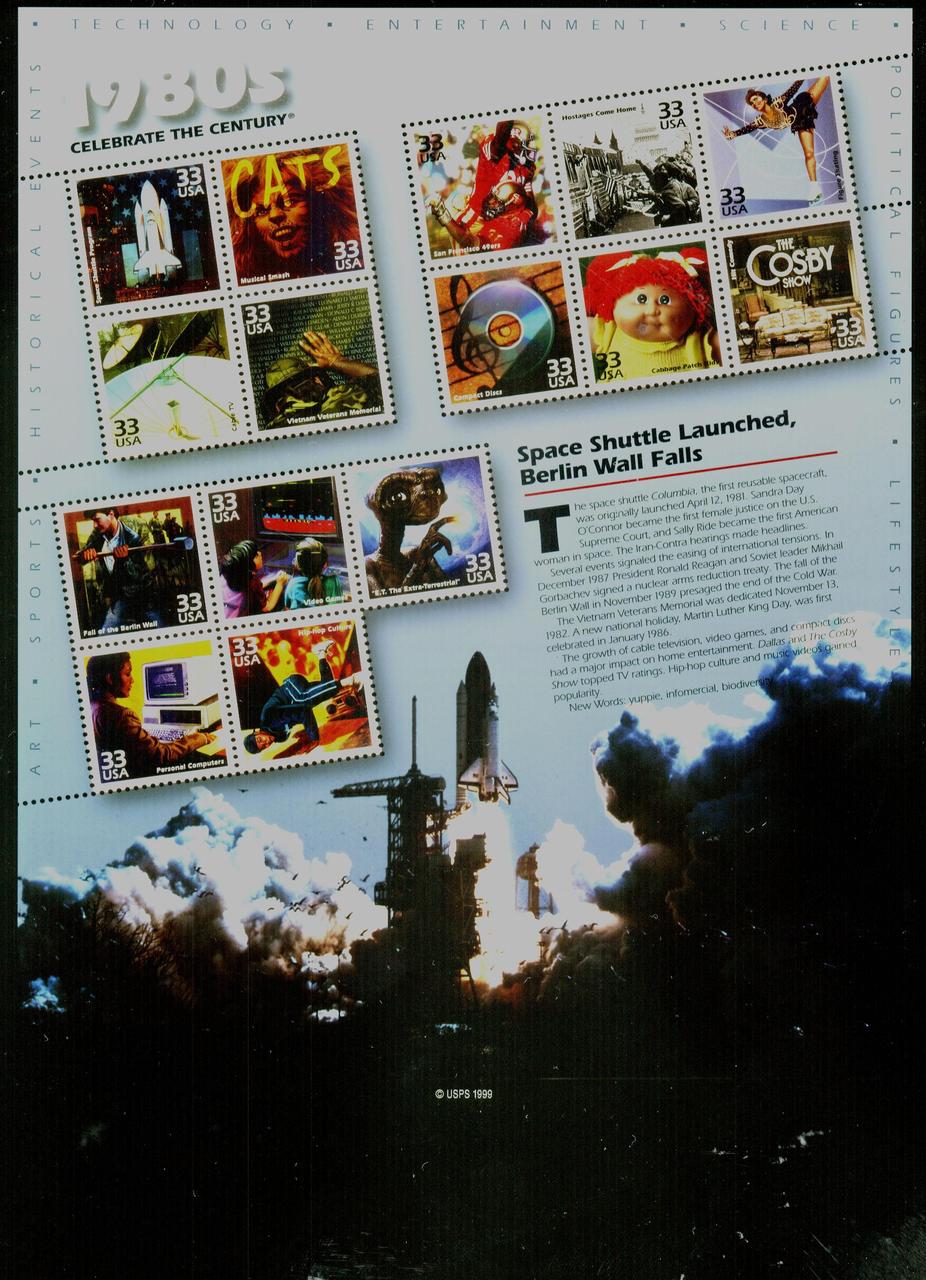
A new series of U.S. Postage stamps, The 1980s, is unveiled at the KSC Visitors Complex. Taking part in the "First Day of Issue Ceremony" were astronaut Richard Linnehan, U.S. Representative, 15th Congressional District, Dave Weldon, U.S. Postal Service District Manager Viki Brennan, Center Director Roy Bridges and President of the Visitor Complex Rick Abramson. Among the stamps issued is one of Space Shuttle Columbia (upper left corner), first launched in April 1981. This collection of stamps is the ninth in the Post Office's "Celebrate the Century" commemorative series honoring the last 100 years of American history
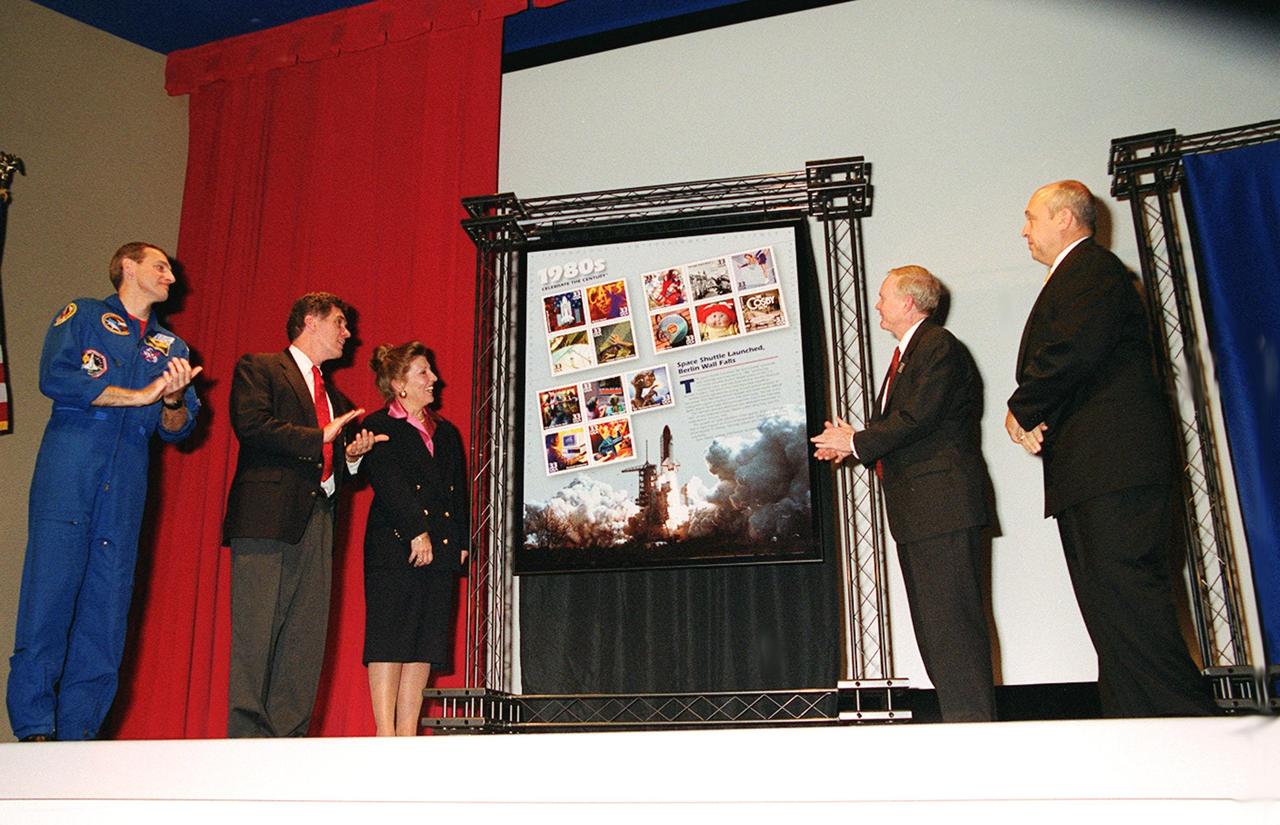
A new series of U.S. Postage stamps, The 1980s, is unveiled at the KSC Visitors Complex. Shown taking part in the "First Day of Issue Ceremony" are (left to right) astronaut Richard Linnehan, U.S. Representative, 15th Congressional District, Dave Weldon, U.S. Postal Service District Manager Viki Brennan, Center Director Roy Bridges and President of the Visitor Complex Rick Abramson. Among the stamps issued is one of Space Shuttle Columbia, first launched in April 1981. This collection of stamps is the ninth in the Post Office's "Celebrate the Century" commemorative series honoring the last 100 years of American history
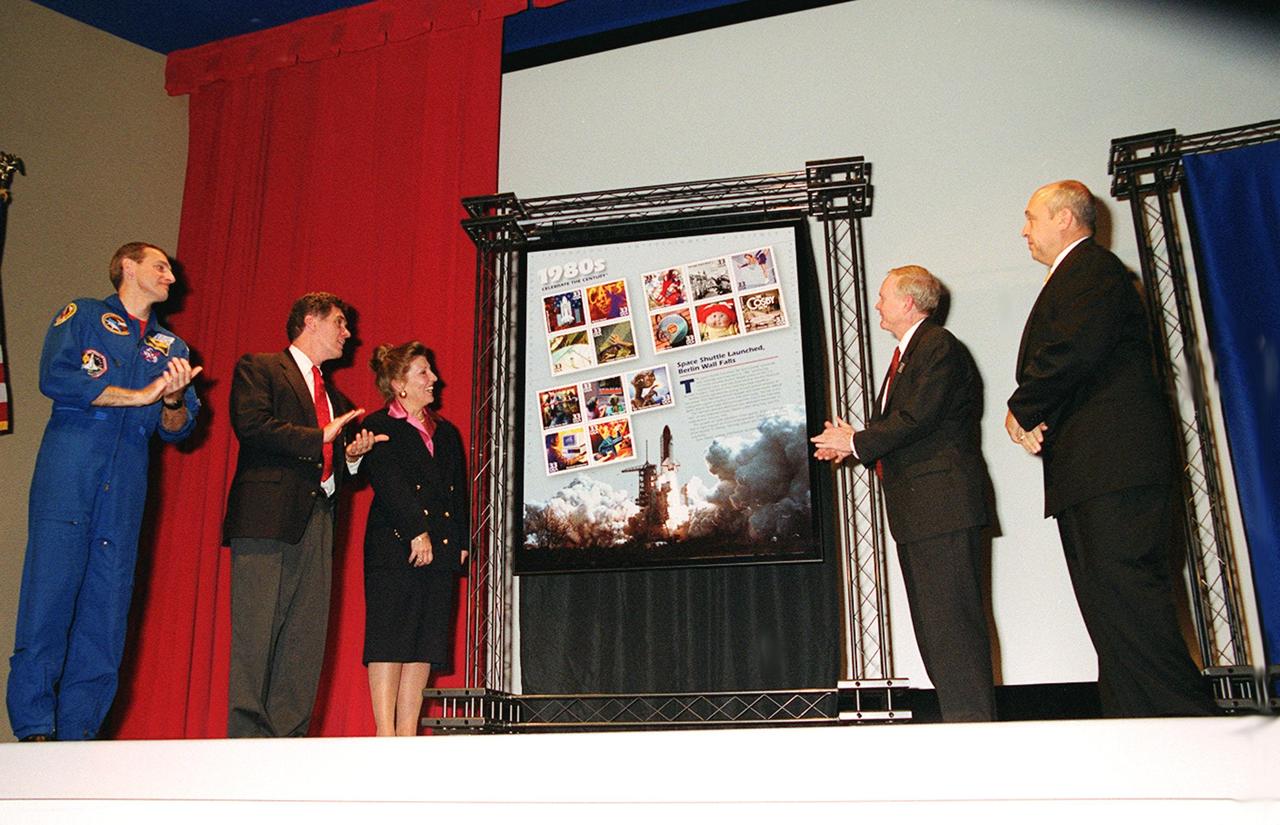
A new series of U.S. Postage stamps, The 1980s, is unveiled at the KSC Visitors Complex. Shown taking part in the "First Day of Issue Ceremony" are (left to right) astronaut Richard Linnehan, U.S. Representative, 15th Congressional District, Dave Weldon, U.S. Postal Service District Manager Viki Brennan, Center Director Roy Bridges and President of the Visitor Complex Rick Abramson. Among the stamps issued is one of Space Shuttle Columbia, first launched in April 1981. This collection of stamps is the ninth in the Post Office's "Celebrate the Century" commemorative series honoring the last 100 years of American history

This charged couple device CCD is part of the CheMin instrument on NASA Curiosity rover. When CheMin directs X-rays at a sample of soil, this imager, which is the size of a postage stamp, detects both the position and energy of each X-ray photon.
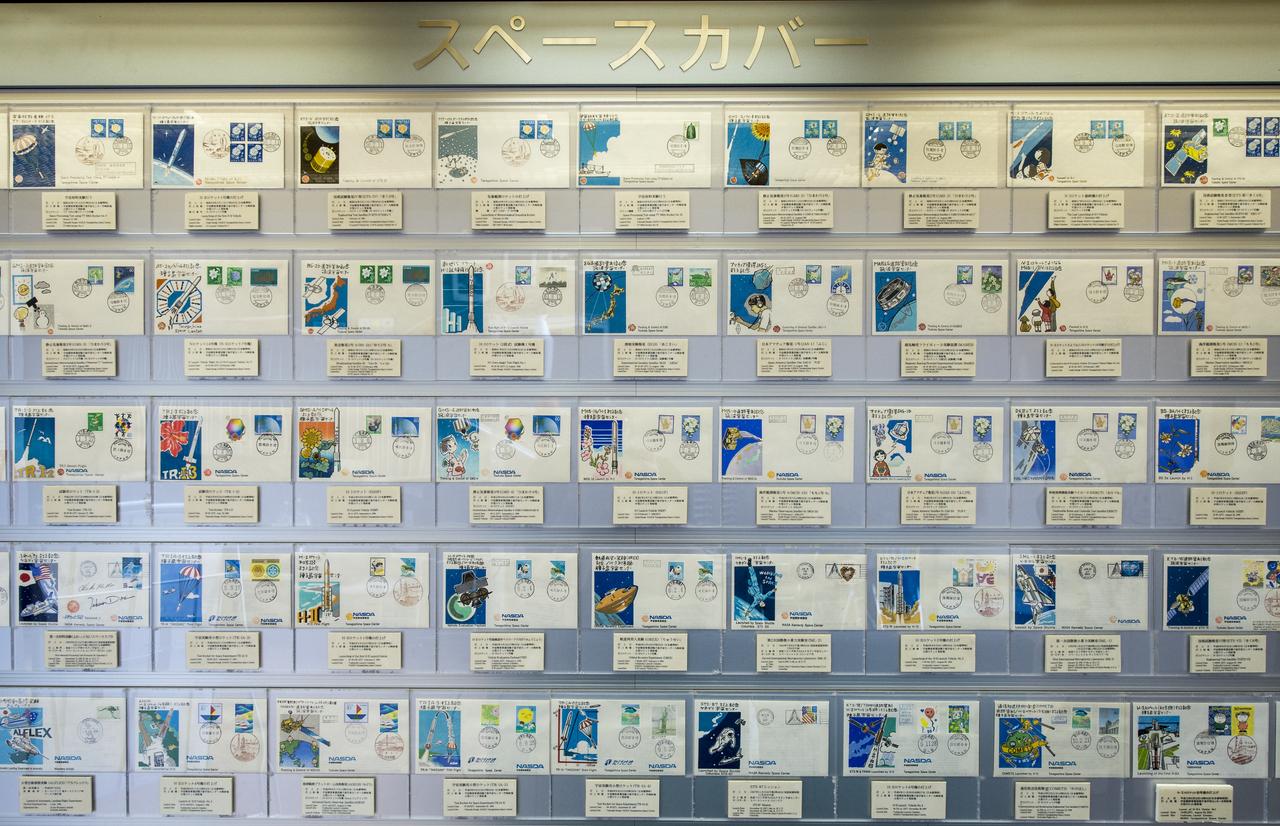
Envelopes with stamps depicting various space missions are shown at the visitor's center of the Tanegashima Space Center (TNSC), Sunday, Feb. 23, 2014, Tanegashima Island, Japan. A Japanese H-IIA rocket carrying the NASA-Japan Aerospace Exploration Agency (JAXA), Global Precipitation Measurement (GPM) Core Observatory is planned for launch from the space center on Feb. 28, 2014. Once launched, the GPM spacecraft will collect information that unifies data from an international network of existing and future satellites to map global rainfall and snowfall every three hours. Photo Credit: (NASA/Bill Ingalls)
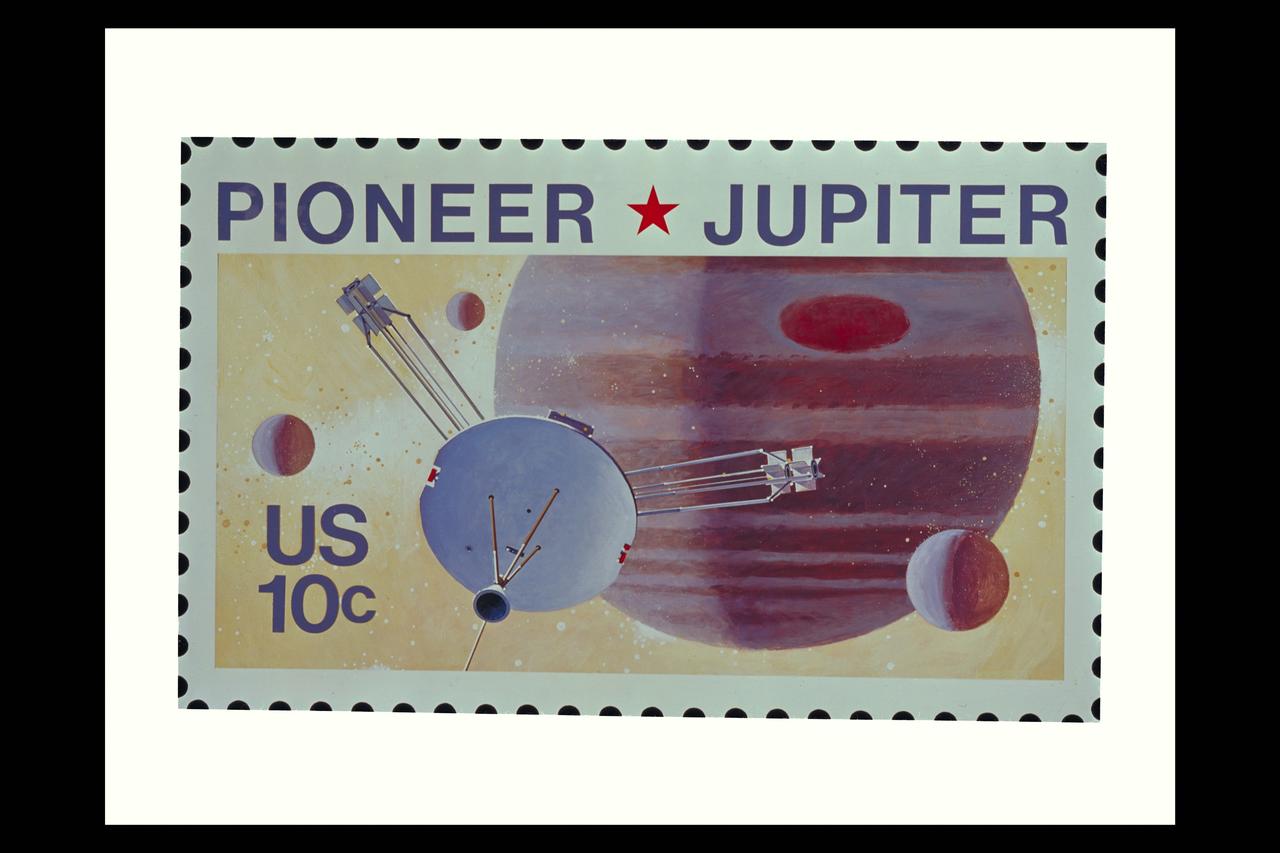
Artwork for the U. S. Postage Stamp released in commemoration of the Pioneer 10 to Jupiter Mission released February 28, 1975 in a ceremony at Ames Research Center
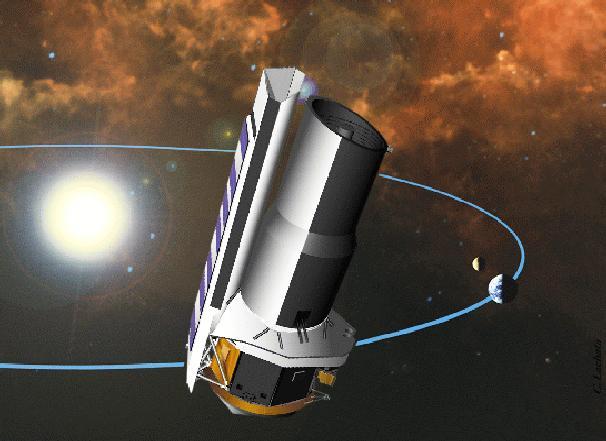
This image was used in a contest to rename the Space InfraRed Telescope Facility SIRTF, now known as the Spitzer Space Telescope.
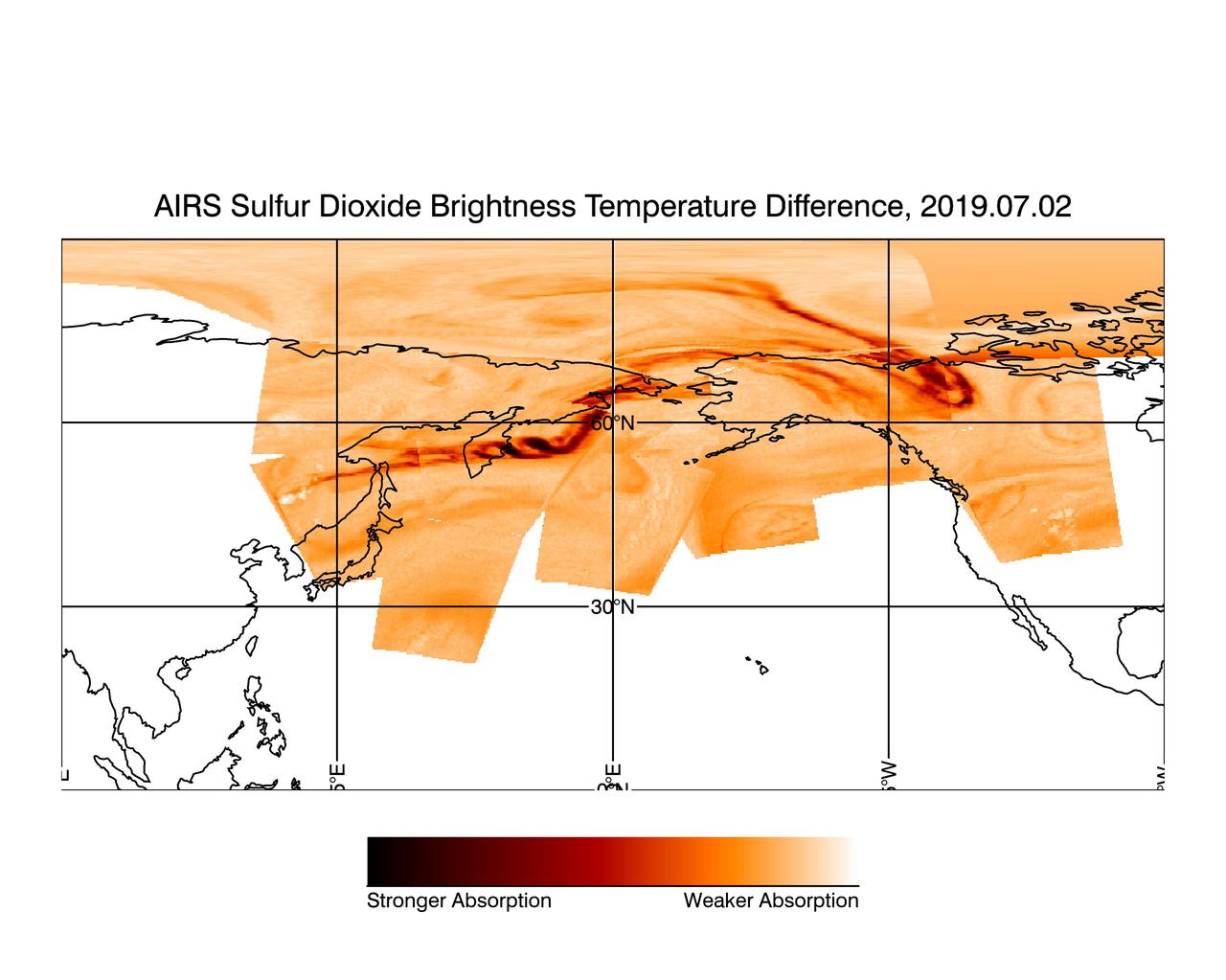
Dormant since 1924, the Raikoke Volcano on Russia's Kuril Islands began erupting on June 22, 2019. In this image made with data from the Atmospheric Infrared Sounder on NASA's Aqua satellite, sulfur dioxide (SO2) in the volcanic plume is observed over several overpasses on July 2, 2019, days after the Raikoke volcanic eruption. SO2 absorbs infrared radiance emitted from Earth's surface and the lower atmosphere in proportion with the quantity of SO2 present in the plume. Areas with higher quantities of sulfur dioxide are shown in dark red while areas with lower quantities of sulfur dioxide are shown in light orange. Areas where data was not included in the image, due to the lack of plume in those regions, are shown in white. The image combines multiple granules of AIRS data taken throughout the day. Each data granule collected by the instrument is outlined in green, with its corresponding time stamp (in UTC) printed in white. https://photojournal.jpl.nasa.gov/catalog/PIA23421
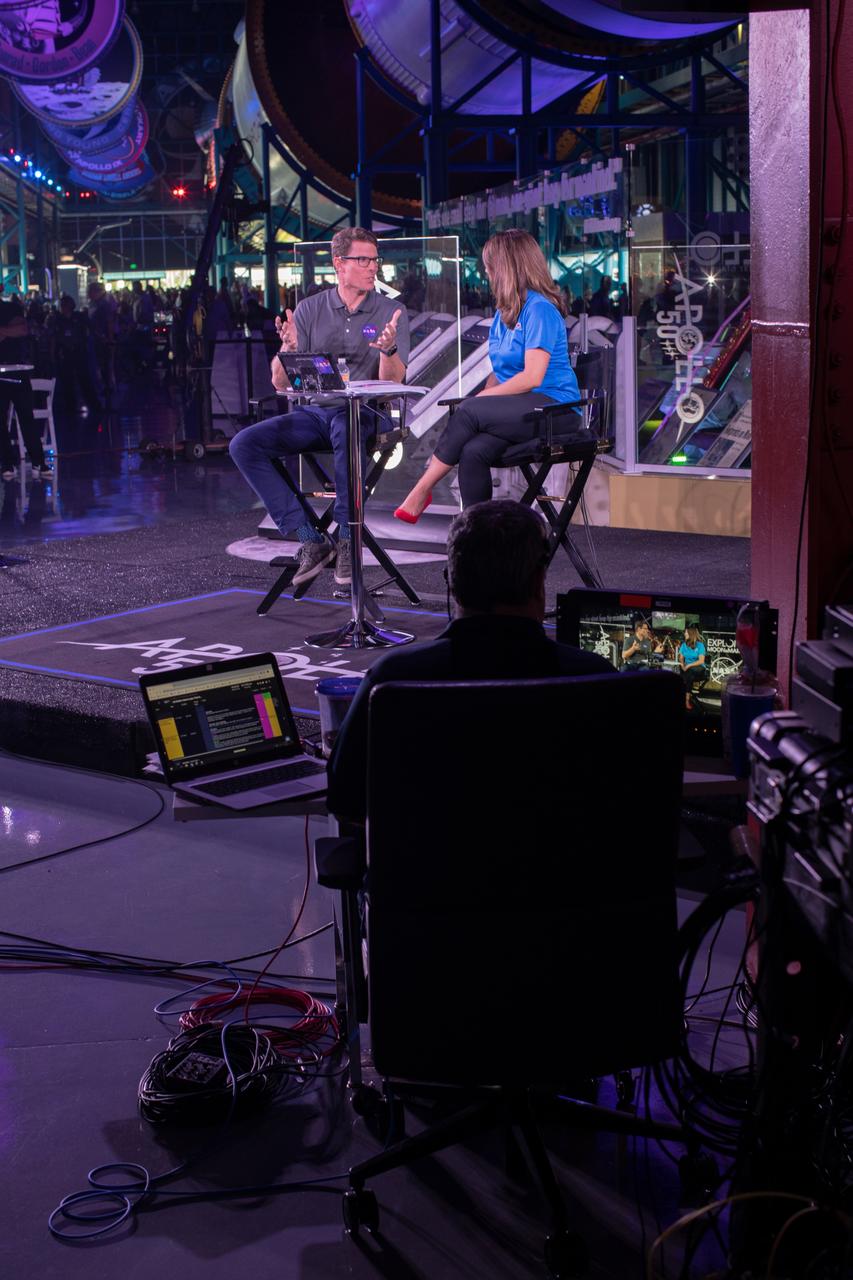
Derrol Nail, left, and Marie Lewis, NASA Office of Communications, host a special Apollo 11 show titled “NASA’s Giant Leaps: Past and Future” on July 19, 2019. The show, which honored the heroes of Apollo and examined NASA’s future plans, was broadcast live from Kennedy Space Center’s Apollo/Saturn V Center in Florida. It featured segments from across the nation, including The National Mall in Washington, NASA’s Johnson Space Center in Houston, Neil Armstrong’s hometown of Wapakoneta, Ohio, and the Apollo 11 command module on display at the Museum of Flight in Seattle.
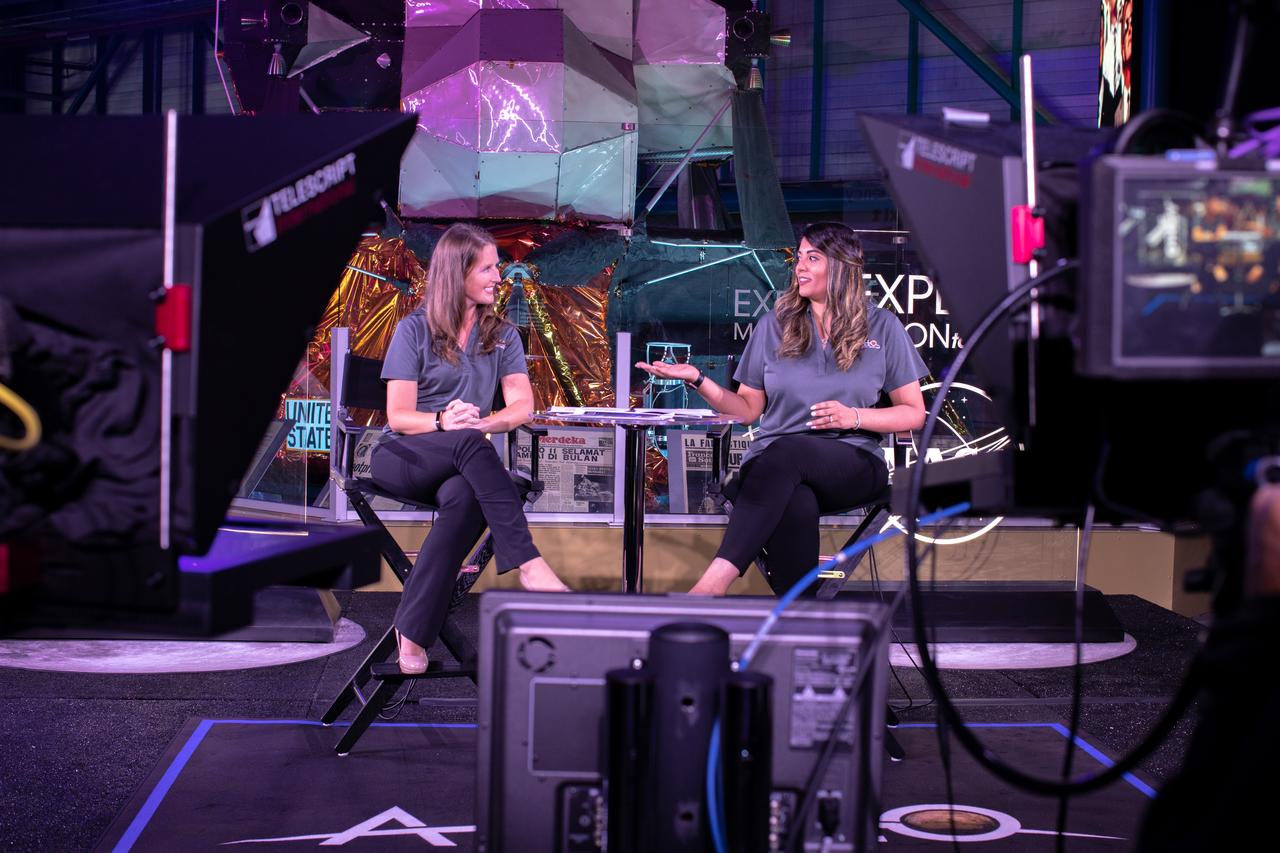
Stephanie Martin, left, NASA Office of Communications, and Nilufar Ramji, NASA Office of STEM Engagement, host a live broadcast of “STEM Forward to the Moon” on July 19, 2019 from Kennedy Space Center’s Apollo/Saturn V Center in Florida. The special program featured kids participating in Moon landing simulations at four museums throughout the country: Cosmosphere in Hutchinson, Kansas; Saint Louis Science Center; Columbia Memorial Space Center in Downey, California; and Arizona Science Center in Phoenix.
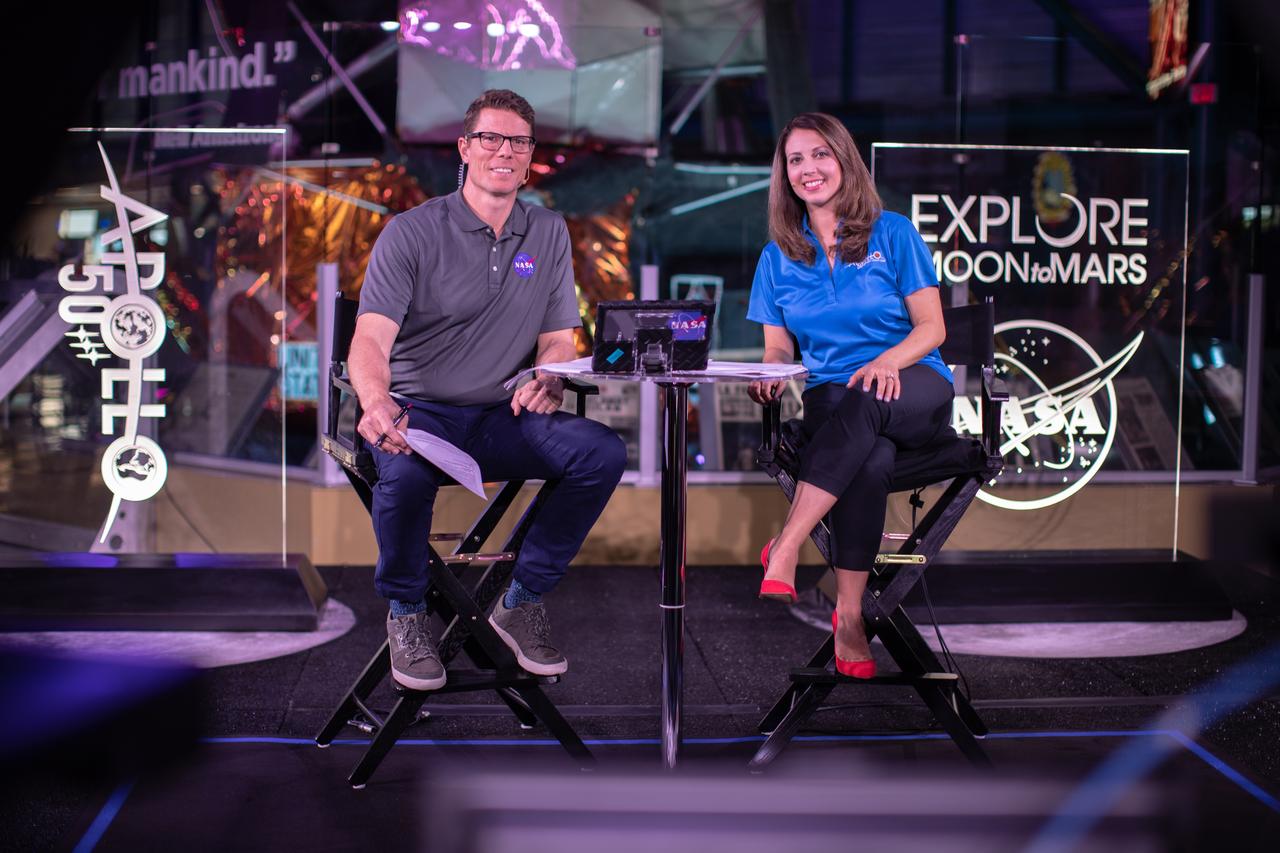
Derrol Nail, left, and Marie Lewis, NASA Office of Communications, host a special Apollo 11 show titled “NASA’s Giant Leaps: Past and Future” on July 19, 2019. The show, which honored the heroes of Apollo and examined NASA’s future plans, was broadcast live from Kennedy Space Center’s Apollo/Saturn V Center in Florida. It featured segments from across the nation, including The National Mall in Washington, NASA’s Johnson Space Center in Houston, Neil Armstrong’s hometown of Wapakoneta, Ohio, and the Apollo 11 command module on display at the Museum of Flight in Seattle.
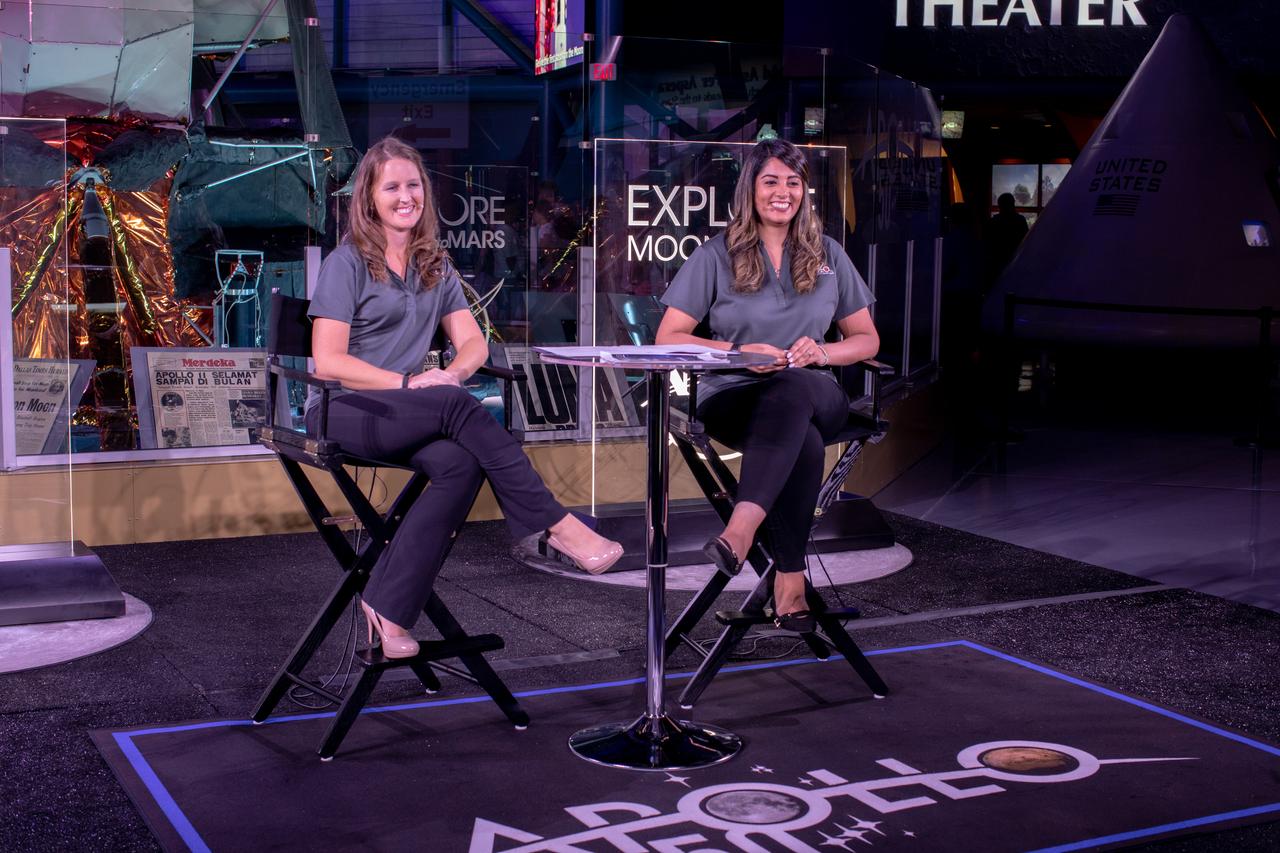
Stephanie Martin, left, NASA Office of Communications, and Nilufar Ramji, NASA Office of STEM Engagement, host a live broadcast of “STEM Forward to the Moon” on July 19, 2019 from Kennedy Space Center’s Apollo/Saturn V Center in Florida. The special program featured kids participating in Moon landing simulations at four museums throughout the country: Cosmosphere in Hutchinson, Kansas; Saint Louis Science Center; Columbia Memorial Space Center in Downey, California; and Arizona Science Center in Phoenix.
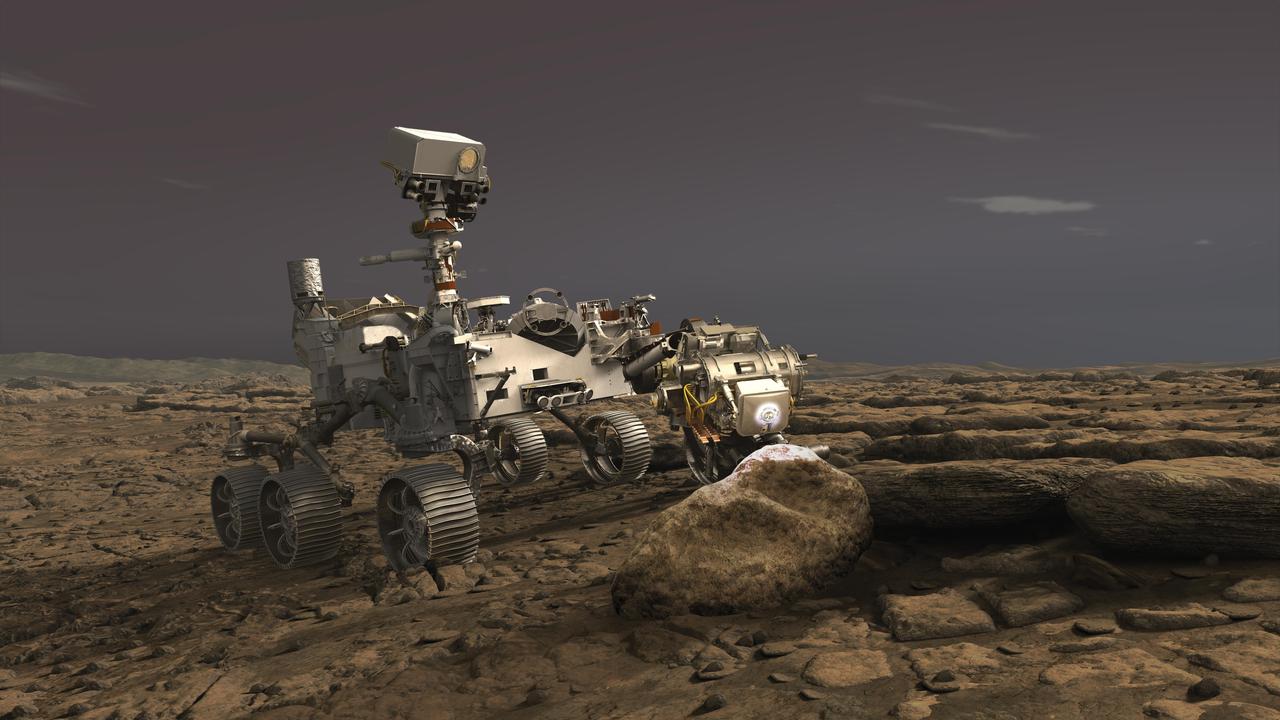
In this illustration, NASA's Perseverance rover uses its Planetary Instrument for X-ray Lithochemistry (PIXL) instrument to analyze a rock on the surface of Mars. PIXL uses a focused X-ray beam to analyze the chemistry of features as small as a grain of sand. The tiny but powerful beam causes rocks to fluoresce, or produce a glow. While the glow is invisible to the human eye, it is detectable by the instrument and varies according to the rock's elemental chemistry. PIXL scan the beam across the surface of the rock to produce a postage-stamp-sized map of the rock's chemistry at the end of an overnight scan. PIXL also has an optical fiducial system (OFS) that includes white "flood lights" — seen on the rock in this artist's concept — that is used together with a pattern of red lasers to illuminate the rock while its camera captures images of the mapped area. The pictures are used for multiple purposes: PIXL analyzes them on board to work out where the target is — in 3D — and move itself into the right position for science collection and the safety of the instrument. The pictures are also downlinked to Earth so scientists can see exactly where each measurement was taken. This allows scientists to tie chemistry accurately to rock texture, which helps them to determine how these features formed and whether they were biological in nature. https://photojournal.jpl.nasa.gov/catalog/PIA23719
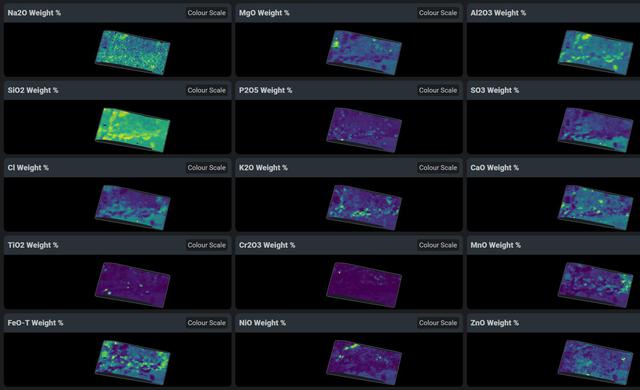
This data shows chemicals detected within a single rock on Mars by the Planetary Instrument for X-ray Lithochemistry (PIXL), one of the instruments on the end of the robotic arm aboard NASA's Perseverance Mars rover. PIXL allows scientists to study where specific chemicals can be found within an area as small as a postage stamp. A key objective for Perseverance's mission on Mars is astrobiology, including the search for signs of ancient microbial life. The rover will characterize the planet's geology and past climate, pave the way for human exploration of the Red Planet, and be the first mission to collect and cache Martian rock and regolith (broken rock and dust). Subsequent NASA missions, in cooperation with ESA (European Space Agency), would send spacecraft to Mars to collect these sealed samples from the surface and return them to Earth for in-depth analysis. The Mars 2020 Perseverance mission is part of NASA's Moon to Mars exploration approach, which includes Artemis missions to the Moon that will help prepare for human exploration of the Red Planet. https://photojournal.jpl.nasa.gov/catalog/PIA24762
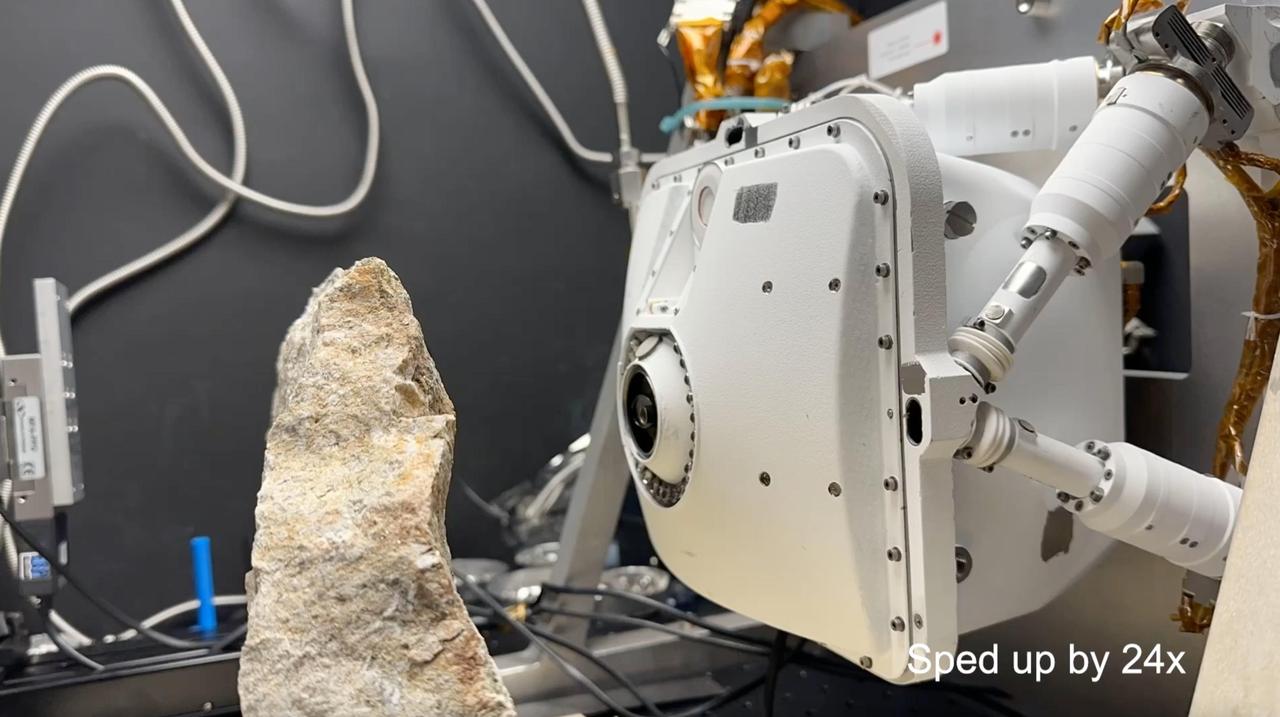
This time-lapse video, which has been sped up by 24 times, uses an engineering model of one of the instruments aboard NASA's Perseverance Mars rover to show how the instrument evaluates safe placement against a rock. If it's determined to be safe, the rover places the instrument, called the Planetary Instrument for X-ray Lithochemistry (PIXL), close to the targeted rock for science observations. This test occurred at NASA's Jet Propulsion Laboratory in Southern California on June 8, 2023. Located on the end of Perseverance's robotic arm, PIXL scans postage stamp-size areas on rocks with an X-ray beam the width of a human hair, determining which elements are present. Scientists use this information to infer what minerals and chemicals are in a rock and help decide whether Perseverance should collect a rock core using its drill. The X-ray beam exits the circular opening at the center of PIXL; colored LED lights around that circle can light up a surface, allowing an internal camera to take images. Those images allow PIXL to autonomously place itself – very slowly and precisely – as little as 1 inch (2.5 centimeters) away from a surface to collect its data. A key objective for Perseverance's mission on Mars is astrobiology, including the search for signs of ancient microbial life. The rover will characterize the planet's geology and past climate, pave the way for human exploration of the Red Planet, and be the first mission to collect and cache Martian rock and regolith (broken rock and dust). Subsequent NASA missions, in cooperation with ESA (European Space Agency), would send spacecraft to Mars to collect these sealed samples from the surface and return them to Earth for in-depth analysis. The Mars 2020 Perseverance mission is part of NASA's Moon to Mars exploration approach, which includes Artemis missions to the Moon that will help prepare for human exploration of the Red Planet. Animation available at https://photojournal.jpl.nasa.gov/catalog/PIA26204