
This NASA Hubble Space Telescope (HST) image of the Trifid Nebula reveals a stellar nursery being torn apart by a nearby massive star. Embryonic stars are forming within an ill-fated cloud of dust and gas, which is destined to be eaten away by the glare from the massive neighbor. The cloud is about 8 light years away from the nebula' s central star. This stellar activity is a beautiful example of how the life cycle of stars like our Sun is intimately cornected with their more powerful siblings. Residing in the constellation Sagittarius, the Trifid Nebula is about 9,000 light years from Earth.

This image from NASA Spitzer Space Telescope shows what lies near the sword of the constellation Orion -- an active stellar nursery containing thousands of young stars and developing protostars. Many will turn out like our sun.
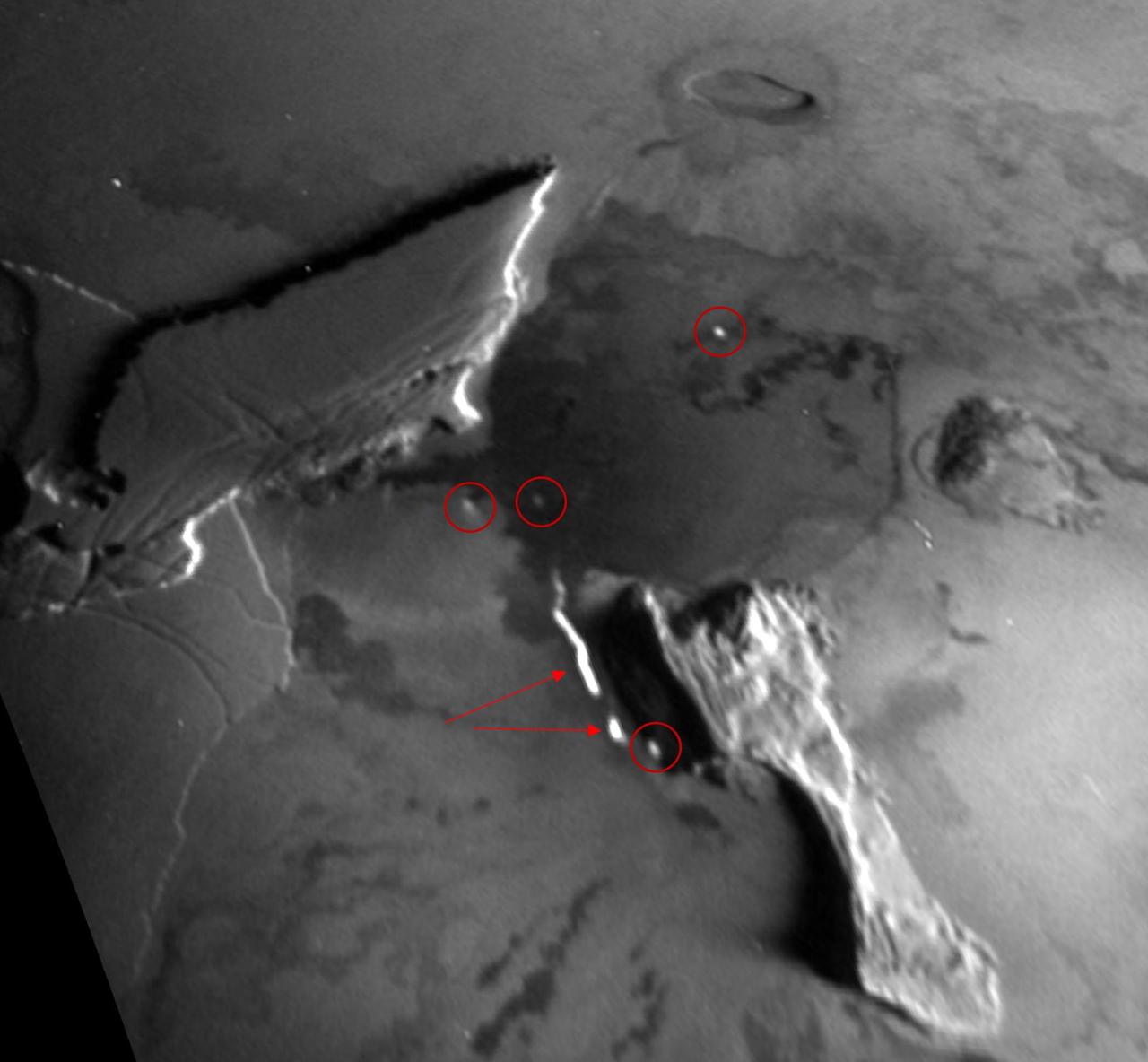
Red circles and arrows point to glowing thermal emission from active lava breakouts observed by the Stellar Reference Unit (SRU) on NASA's Juno spacecraft on Dec. 30, 2023, in the Zal Montes-Patera complex on Io. https://photojournal.jpl.nasa.gov/catalog/PIA26521

NASA Hubble Space Telescope captures the chaotic activity atop a three-light-year-tall pillar of gas and dust that is being eaten away by the brilliant light from nearby bright stars in a tempestuous stellar nursery called the Carina Nebula.
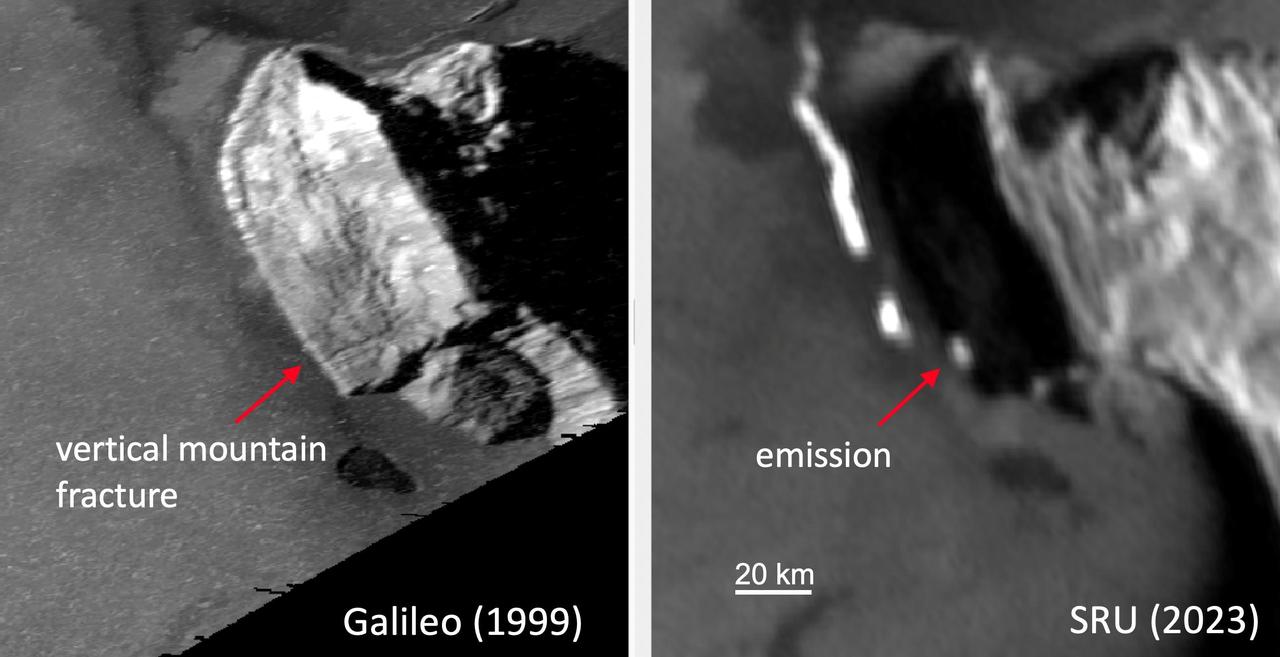
While imaging Io's night side under illumination from Jupiter-shine on Dec. 30, 2023, the Stellar Reference Unit (SRU) on NASA's Juno spacecraft observed an unprecedented glow from active lava at the base of a mountain on Io (red arrow, right panel). The thermal emission signature was located at the base of the western flank of South Zal Mons. Sunlit imagery of the region by captured by NASA's Galileo mission circa 1999 (at left) shows a vertical mountain fracture running from the top of the mountain to the location of the SRU-observed "glow" (red arrow, left panel). One hypothesis is that an extension of the mountain fracture created a fissure vent that allows lava to escape to the surface at this location. https://photojournal.jpl.nasa.gov/catalog/PIA26522
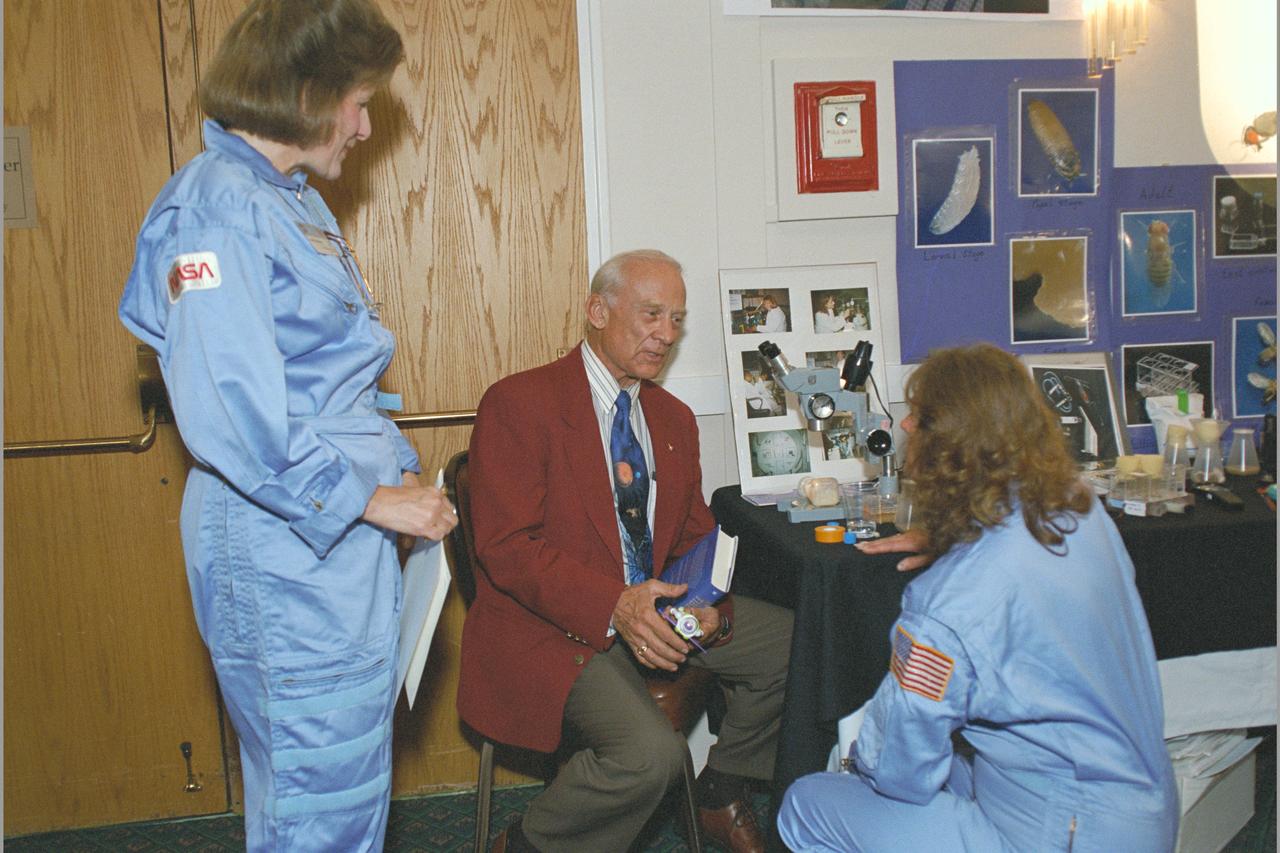
1996 'STELLAR' program commencement activities. Special guest Astronaut Buzz Aldrin drops by to tour and chat. Aldrin was attending his book signing at US Space Camp earlier in the day.

The smudge of stars at the center of this NASA/ESA Hubble Space Telescope image is a galaxy known as UGC 5797. UGC 5797 is an emission line galaxy, meaning that it is currently undergoing active star formation. The result is a stellar population that is constantly being refurbished as massive bright blue stars form. Galaxies with prolific star formation are not only veiled in a blue tint, but are key to the continuation of a stellar cycle. In this image UGC 5797 appears in front of a background of spiral galaxies. Spiral galaxies have copious amounts of dust and gas — the main ingredient for stars — and therefore often also belong to the class of emission line galaxies. Spiral galaxies have disk-like shapes that drastically vary in appearance depending on the angle at which they are observed. The collection of spiral galaxies in this frame exhibits this attribute acutely: Some are viewed face-on, revealing the structure of the spiral arms, while the two in the bottom left are seen edge-on, appearing as plain streaks in the sky. There are many spiral galaxies, with varying colors and at different angles, sprinkled across this image — just take a look. Credit: ESA/Hubble & NASA, Acknowledgement: Luca Limatola
![In celebration of the International Year of Astronomy 2009, NASA's Great Observatories -- the Hubble Space Telescope, the Spitzer Space Telescope, and the Chandra X-ray Observatory -- have produced a matched trio of images of the central region of our Milky Way galaxy. Each image shows the telescope's different wavelength view of the galactic center region, illustrating the unique science each observatory conducts. In this spectacular image, observations using infrared light and X-ray light see through the obscuring dust and reveal the intense activity near the galactic core. Note that the center of the galaxy is located within the bright white region to the right of and just below the middle of the image. The entire image width covers about one-half a degree, about the same angular width as the full moon. Spitzer's infrared-light observations provide a detailed and spectacular view of the galactic center region [Figure 1 (top frame of poster)]. The swirling core of our galaxy harbors hundreds of thousands of stars that cannot be seen in visible light. These stars heat the nearby gas and dust. These dusty clouds glow in infrared light and reveal their often dramatic shapes. Some of these clouds harbor stellar nurseries that are forming new generations of stars. Like the downtown of a large city, the center of our galaxy is a crowded, active, and vibrant place. Although best known for its visible-light images, Hubble also observes over a limited range of infrared light [Figure 2 (middle frame of poster)]. The galactic center is marked by the bright patch in the lower right. Along the left side are large arcs of warm gas that have been heated by clusters of bright massive stars. In addition, Hubble uncovered many more massive stars across the region. Winds and radiation from these stars create the complex structures seen in the gas throughout the image.This sweeping panorama is one of the sharpest infrared pictures ever made of the galactic center region. X-rays detected by Chandra expose a wealth of exotic objects and high-energy features [Figure 3 (bottom frame of poster)]. In this image, pink represents lower energy X-rays and blue indicates higher energy. Hundreds of small dots show emission from material around black holes and other dense stellar objects. A supermassive black hole -- some four million times more massive than the Sun -- resides within the bright region in the lower right. The diffuse X-ray light comes from gas heated to millions of degrees by outflows from the supermassive black hole, winds from giant stars, and stellar explosions. This central region is the most energetic place in our galaxy. http://photojournal.jpl.nasa.gov/catalog/PIA12348](https://images-assets.nasa.gov/image/PIA12348/PIA12348~medium.jpg)
In celebration of the International Year of Astronomy 2009, NASA's Great Observatories -- the Hubble Space Telescope, the Spitzer Space Telescope, and the Chandra X-ray Observatory -- have produced a matched trio of images of the central region of our Milky Way galaxy. Each image shows the telescope's different wavelength view of the galactic center region, illustrating the unique science each observatory conducts. In this spectacular image, observations using infrared light and X-ray light see through the obscuring dust and reveal the intense activity near the galactic core. Note that the center of the galaxy is located within the bright white region to the right of and just below the middle of the image. The entire image width covers about one-half a degree, about the same angular width as the full moon. Spitzer's infrared-light observations provide a detailed and spectacular view of the galactic center region [Figure 1 (top frame of poster)]. The swirling core of our galaxy harbors hundreds of thousands of stars that cannot be seen in visible light. These stars heat the nearby gas and dust. These dusty clouds glow in infrared light and reveal their often dramatic shapes. Some of these clouds harbor stellar nurseries that are forming new generations of stars. Like the downtown of a large city, the center of our galaxy is a crowded, active, and vibrant place. Although best known for its visible-light images, Hubble also observes over a limited range of infrared light [Figure 2 (middle frame of poster)]. The galactic center is marked by the bright patch in the lower right. Along the left side are large arcs of warm gas that have been heated by clusters of bright massive stars. In addition, Hubble uncovered many more massive stars across the region. Winds and radiation from these stars create the complex structures seen in the gas throughout the image.This sweeping panorama is one of the sharpest infrared pictures ever made of the galactic center region. X-rays detected by Chandra expose a wealth of exotic objects and high-energy features [Figure 3 (bottom frame of poster)]. In this image, pink represents lower energy X-rays and blue indicates higher energy. Hundreds of small dots show emission from material around black holes and other dense stellar objects. A supermassive black hole -- some four million times more massive than the Sun -- resides within the bright region in the lower right. The diffuse X-ray light comes from gas heated to millions of degrees by outflows from the supermassive black hole, winds from giant stars, and stellar explosions. This central region is the most energetic place in our galaxy. http://photojournal.jpl.nasa.gov/catalog/PIA12348
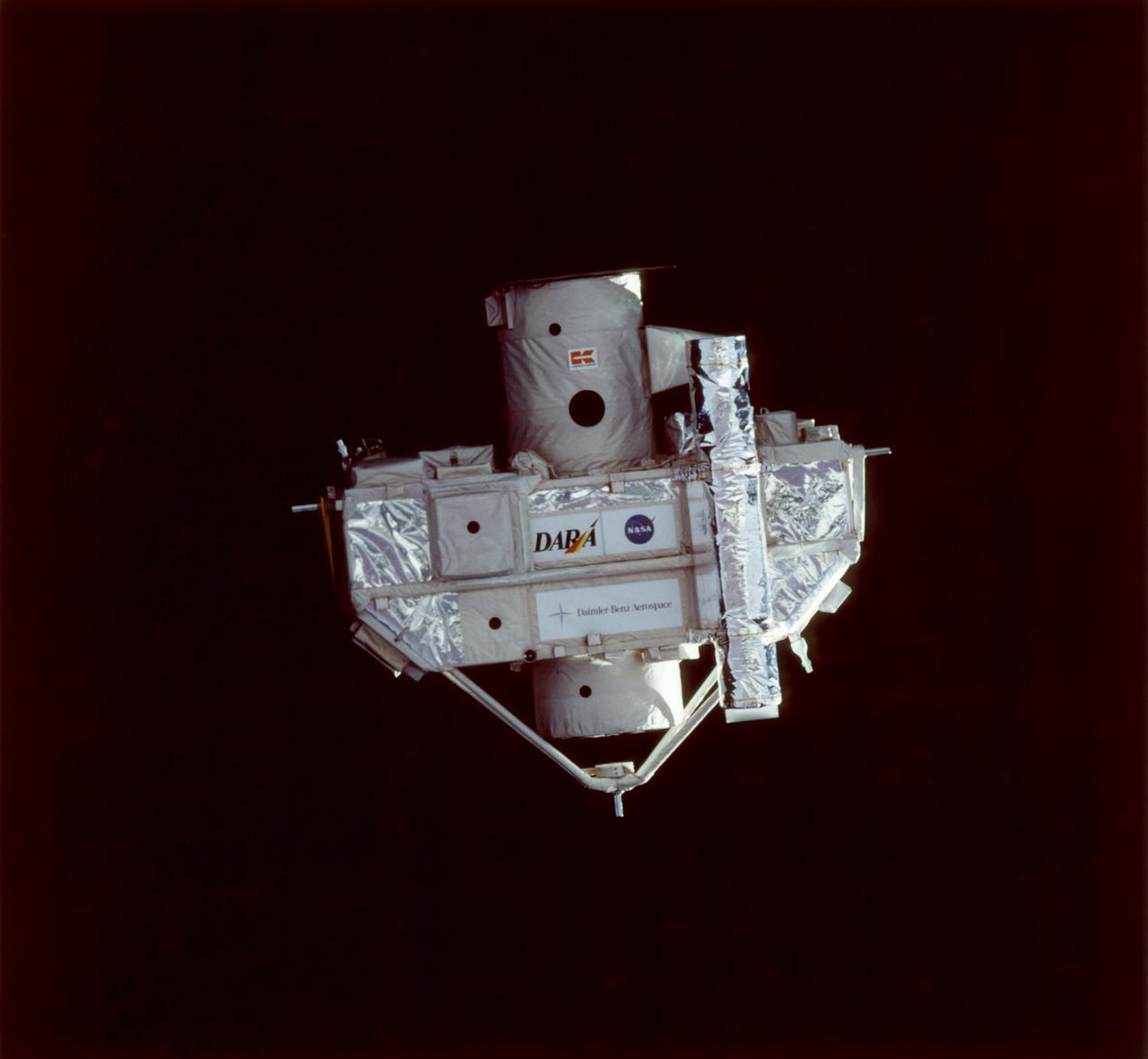
This STS-80 onboard photograph shows the Orbiting Retrievable Far and Extreme Ultraviolet Spectrometer-Shuttle Pallet Satellite II (ORFEUS-SPAS II), photographed during approach by the Space Shuttle Orbiter Columbia for retrieval. Built by the German Space Agency, DARA, the ORFEUS-SPAS II, a free-flying satellite, was dedicated to astronomical observations at very short wavelengths to: investigate the nature of hot stellar atmospheres, investigate the cooling mechanisms of white dwarf stars, determine the nature of accretion disks around collapsed stars, investigate supernova remnants, and investigate the interstellar medium and potential star-forming regions. Some 422 observations of almost 150 astronomical objects were completed, including the Moon, nearby stars, distant Milky Way stars, stars in other galaxies, active galaxies, and quasar 3C273. The STS-80 mission was launched November 19, 1996.
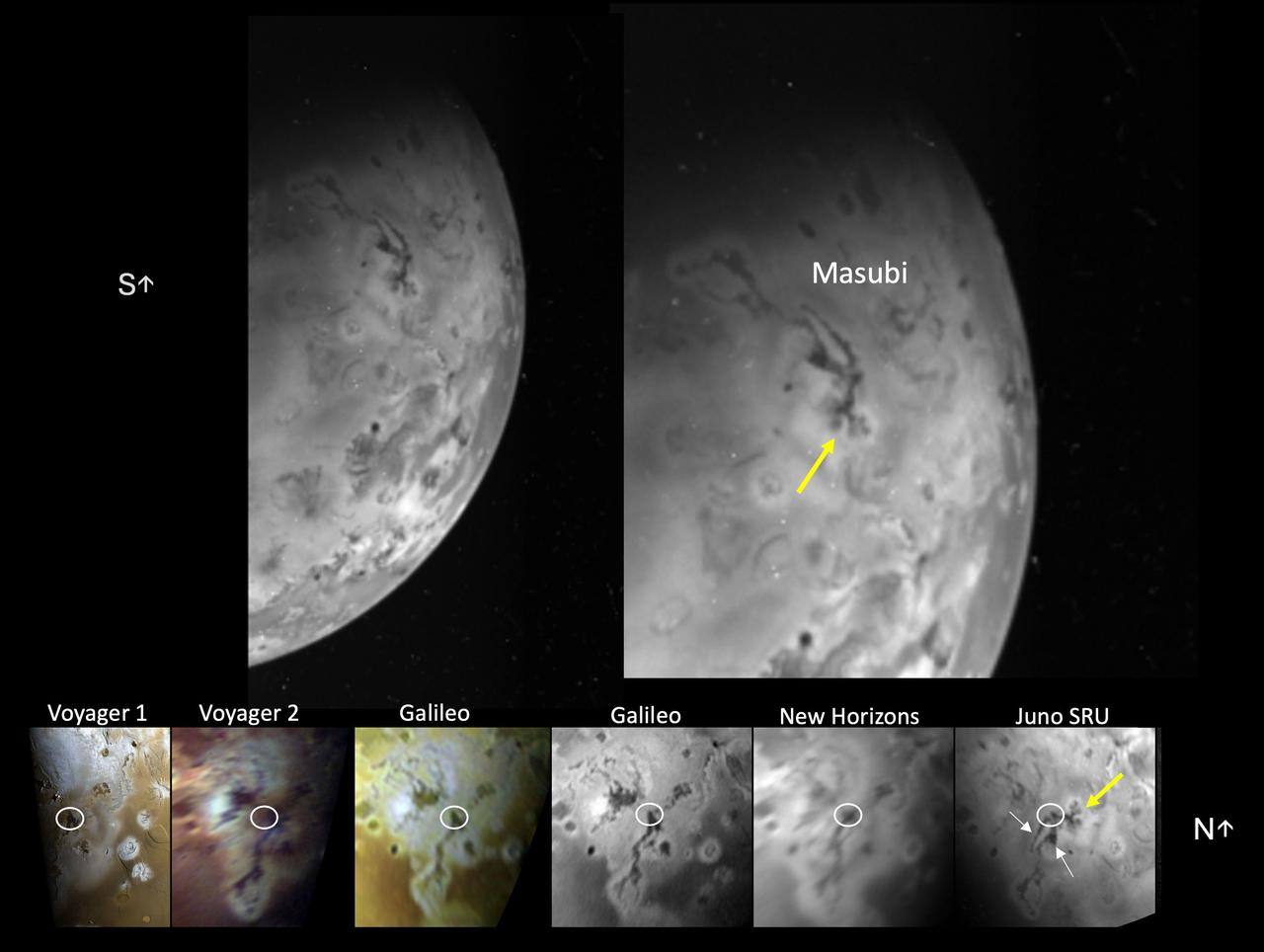
The Stellar Reference Unit (SRU) on NASA's Juno spacecraft collected this visible wavelength image of Io's night side while the surface was illuminated by Jupiter-shine on April 4, 2024. The image features the large compound flow field, Masubi, located on Io's southern hemisphere. Masubi was first observed by NASA's Voyager 1 in 1979 and has continued to expand ever since. A co-registered time sequence of Masubi observations covering 45 years is shown in the bottom panel. The location of the plume first observed by Galileo is circled in white in each image of the time sequence. The SRU observed even further expansion of pre-existing flows (white arrows) and two new flows with multiple lobes (yellow arrow). As of April 4, 2024, Masubi's total compound flow length is about 994 miles (1,600 kilometers), making it the longest currently active lava flow in the solar system. https://photojournal.jpl.nasa.gov/catalog/PIA26524
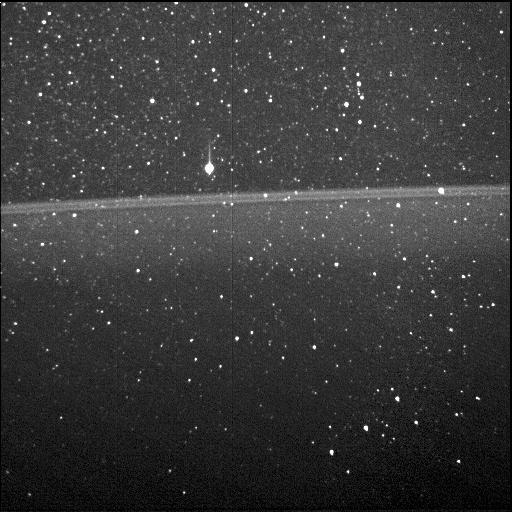
As NASA's Juno spacecraft flew through the narrow gap between Jupiter's radiation belts and the planet during its first science flyby, Perijove 1, on August 27, 2016, the Stellar Reference Unit (SRU-1) star camera collected the first image of Jupiter's ring taken from the inside looking out. The bright bands in the center of the image are the main ring of Jupiter's ring system. While taking the ring image, the SRU was viewing the constellation Orion. The bright star above the main ring is Betelgeuse, and Orion's belt can be seen in the lower right. Juno's Radiation Monitoring Investigation actively retrieves and analyzes the noise signatures from penetrating radiation in the images of the spacecraft's star cameras and science instruments at Jupiter. https://photojournal.jpl.nasa.gov/catalog/PIA21644
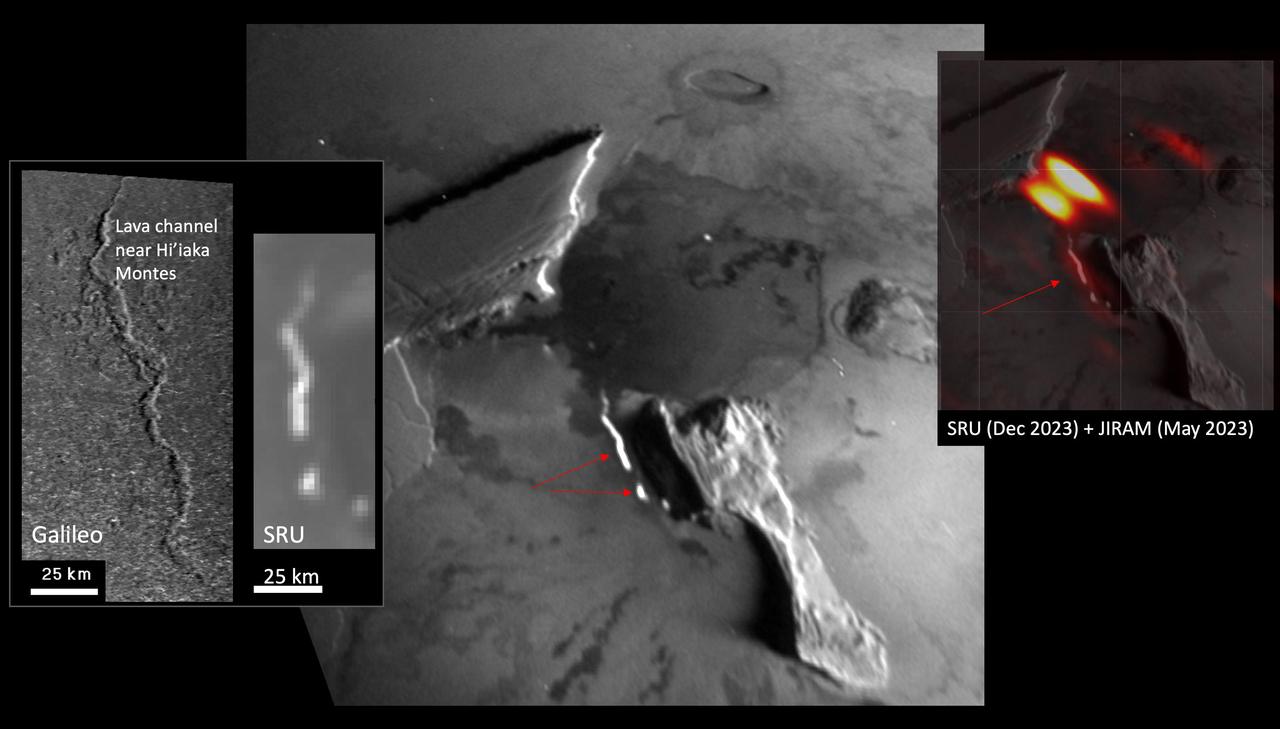
The Stellar Reference Unit (SRU) on NASA's Juno spacecraft made this first-of-a-kind observation on Dec. 30, 2023, of an elongated, 40-mile-long (65-kilometer-long), curvy thermal emission feature and a shorter linear emission segment to the west of South Zal Mons. The resolution is 0.6 miles (1 kilometer) per pixel. The feature is suspected to be an active lava channel, given the similarity of its morphology to that of the two previously identified lava channels on Io. The shape of the Ionian lava channel near Hi'iaka Montes is compared to the SRU emission feature in the left panel. Juno's infrared camera, JIRAM, observed a long thermal emission "hot spot" at lower resolution (19 miles, or 30 kilometers, per pixel) in May 2023 at the same location (JIRAM infrared data is overlaid on the SRU image in the right panel, illustrating the overlap). https://photojournal.jpl.nasa.gov/catalog/PIA26523
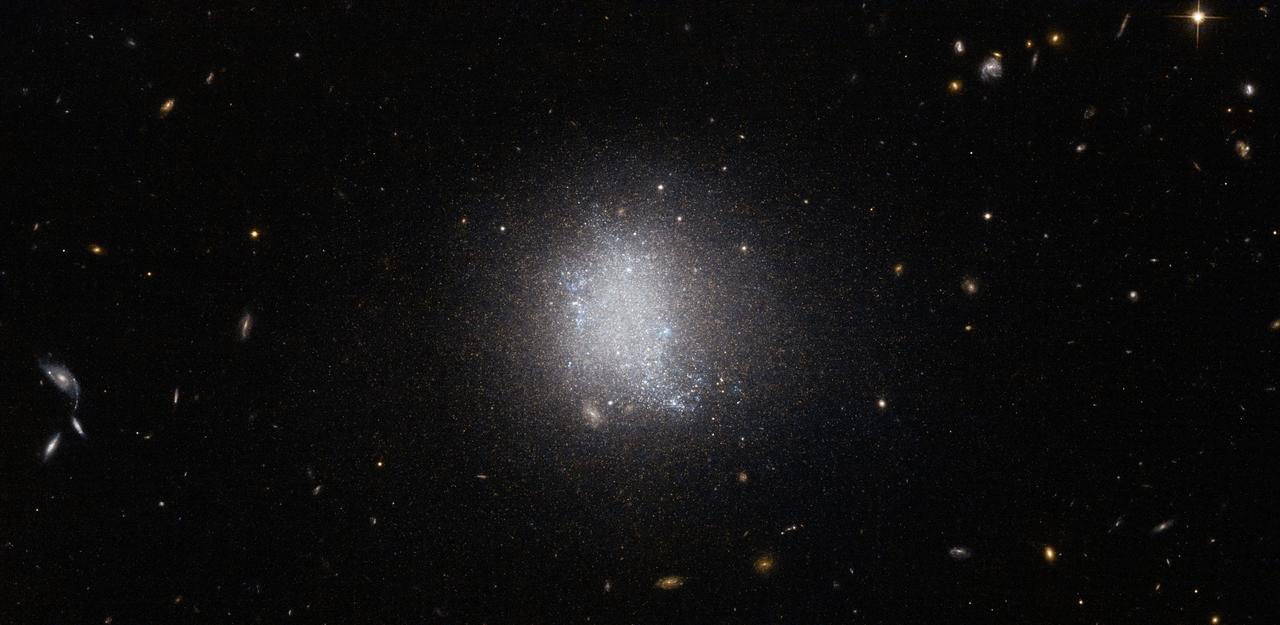
The smudge of stars at the center of this NASA/ESA Hubble Space Telescope image is a galaxy known as UGC 5797. UGC 5797 is an emission line galaxy, meaning that it is currently undergoing active star formation. The result is a stellar population that is constantly being refurbished as massive bright blue stars form. Galaxies with prolific star formation are not only veiled in a blue tint, but are key to the continuation of a stellar cycle. In this image UGC 5797 appears in front of a background of spiral galaxies. Spiral galaxies have copious amounts of dust and gas — the main ingredient for stars — and therefore often also belong to the class of emission line galaxies. Spiral galaxies have disk-like shapes that drastically vary in appearance depending on the angle at which they are observed. The collection of spiral galaxies in this frame exhibits this attribute acutely: Some are viewed face-on, revealing the structure of the spiral arms, while the two in the bottom left are seen edge-on, appearing as plain streaks in the sky. There are many spiral galaxies, with varying colors and at different angles, sprinkled across this image — just take a look. Credit: ESA/Hubble & NASA, Acknowledgement: Luca Limatola <b><a href="http://www.nasa.gov/audience/formedia/features/MP_Photo_Guidelines.html" rel="nofollow">NASA image use policy.</a></b> <b><a href="http://www.nasa.gov/centers/goddard/home/index.html" rel="nofollow">NASA Goddard Space Flight Center</a></b> enables NASA’s mission through four scientific endeavors: Earth Science, Heliophysics, Solar System Exploration, and Astrophysics. Goddard plays a leading role in NASA’s accomplishments by contributing compelling scientific knowledge to advance the Agency’s mission. <b>Follow us on <a href="http://twitter.com/NASAGoddardPix" rel="nofollow">Twitter</a></b> <b>Like us on <a href="http://www.facebook.com/pages/Greenbelt-MD/NASA-Goddard/395013845897?ref=tsd" rel="nofollow">Facebook</a></b> <b>Find us on <a href="http://instagrid.me/nasagoddard/?vm=grid" rel="nofollow">Instagram</a></b>
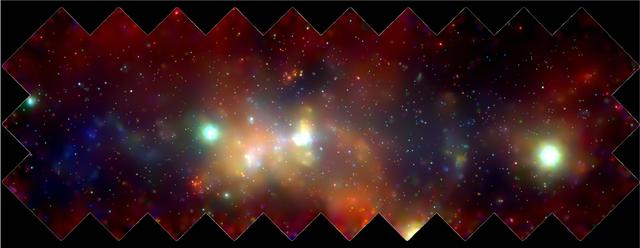
The Chandra X-Ray Observatory (CXO) has made a sturning, high-energy panorama of the central regions of our Milky Way galaxy. The findings are an important step toward understanding the most active area of the Milky Way as well as other galaxies throughout the universe. This 400 by 900-light-year mosaic of several CXO images reveals hundreds of white dwarf stars, neutron stars, and black holes bathed in an incandescent fog of miltimillion-degree gas. The diffuse x-ray emission seems to be related to the turmoil and density of matter in the inner Milky Way. Stars are forming there at a much more rapid rate than in the galactic "suburbs." Many of the most massive stars in the galaxy are located in the galactic center and are furiously boiling off their outer layers in searing stellar winds. Supernova explosions are far more common in the region and send shock waves booming through the inner galaxy. The super massive black hole at the center of the galaxy is located inside the bright white patch in the center of the image. The colors indicate x-ray energy bands-red (low), green (medial), and blue (high). A supernova occurs when a massive star has used up its nuclear fuel and the pressure drops in the central core of the star. The matter in the core is crushed by gravity to higher and higher densities, and temperatures reach billions of degrees. Under these extreme conditions, nuclear reactions occur violently and catastrophically reversing the collapse. A thermonuclear shock wave races through the now expanding stellar debris, fusing lighter elements into heavier ones and producing a brilliant visual outburst. (Photo credit: NASA/UMass/D. Wang et al)

This image composite compares the well-known visible-light picture of the glowing Trifid Nebula (left panel) with infrared views from NASA's Spitzer Space Telescope (remaining three panels). The Trifid Nebula is a giant star-forming cloud of gas and dust located 5,400 light-years away in the constellation Sagittarius. The false-color Spitzer images reveal a different side of the Trifid Nebula. Where dark lanes of dust are visible trisecting the nebula in the visible-light picture, bright regions of star-forming activity are seen in the Spitzer pictures. All together, Spitzer uncovered 30 massive embryonic stars and 120 smaller newborn stars throughout the Trifid Nebula, in both its dark lanes and luminous clouds. These stars are visible in all the Spitzer images, mainly as yellow or red spots. Embryonic stars are developing stars about to burst into existence. Ten of the 30 massive embryos discovered by Spitzer were found in four dark cores, or stellar "incubators," where stars are born. Astronomers using data from the Institute of Radioastronomy millimeter telescope in Spain had previously identified these cores but thought they were not quite ripe for stars. Spitzer's highly sensitive infrared eyes were able to penetrate all four cores to reveal rapidly growing embryos. http://photojournal.jpl.nasa.gov/catalog/PIA07225
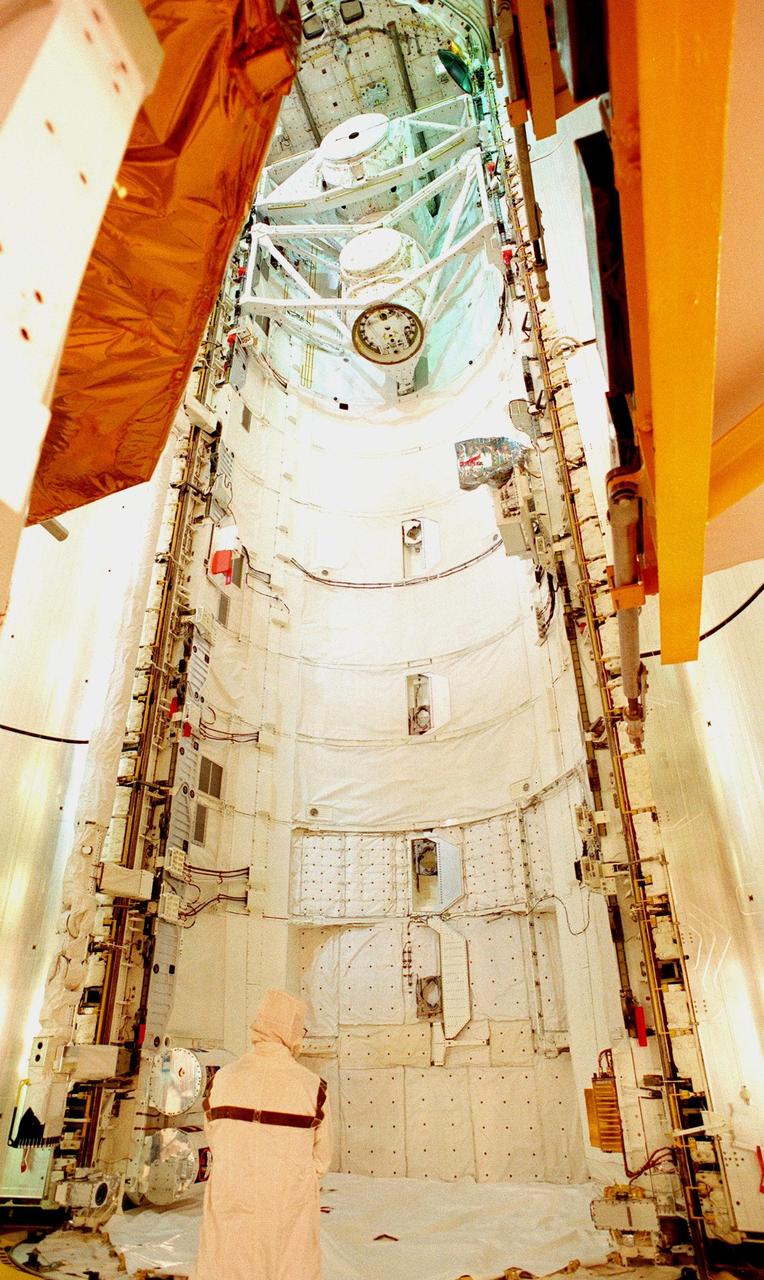
The open doors of the payload bay on Space Shuttle Discovery await the transfer of four of the payloads on mission STS-95: the SPACEHAB single module, Spartan, the Hubble Space Telescope Orbiting Systems Test Platform (HOST), and the International Extreme Ultraviolet Hitchhiker (IEH-3). At the top of bay are the airlock (used for depressurization and repressurization during extravehicular activity and transfer to Mir) and the tunnel adapter (enables the flight crew members to transfer from the pressurized middeck crew compartment to Spacelab's pressurized shirt-sleeve environment). SPACEHAB involves experiments on space flight and the aging process. Spartan is a solar physics spacecraft designed to perform remote sensing of the hot outer layers of the sun's atmosphere or corona. HOST carries four experiments to validate components planned for installation during the third Hubble Space Telescope servicing mission and to evaluate new technologies in an Earth-orbiting environment. IEH-3 comprises several experiments that will study the Jovian planetary system, hot stars, planetary and reflection nebulae, other stellar objects and their environments through remote observation of EUV/FUV emissions; study spacecraft interactions, Shuttle glow, thruster firings, and contamination; and measure the solar constant and identify variations in the value during a solar cycle. Discovery is scheduled to launch on Oct. 29, 1998
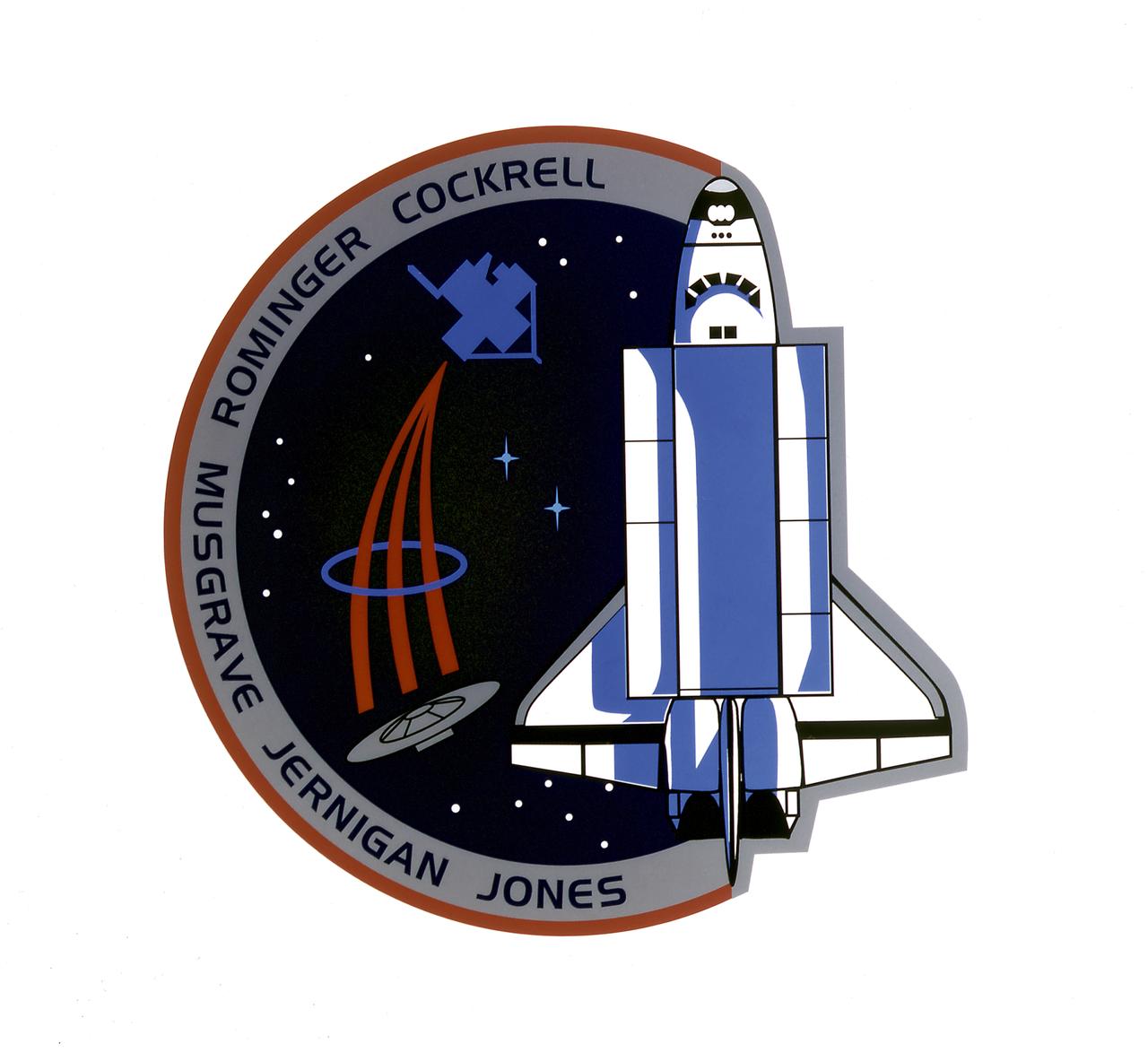
This mission patch for mission STS-80 depicts the Space Shuttle Columbia and the two research satellites its crew deployed into the blue field of space. The uppermost satellite is the Orbiting Retrievable Far and Extreme Ultraviolet Spectrograph-Shuttle Pallet Satellite (ORFEUS-SPAS), a telescope aimed at unraveling the life cycles of stars and understanding the gases that drift between them. The lower satellite is the Wake Shield Facility (WSF), flying for the third time. It will use the vacuum of space to create advanced semiconductors for the nation's electronics industry. ORFEUS and WSF are joined by the symbol of the Astronaut Corps, representing the human contribution to scientific progress in space. The two bright blue stars represent the mission's Extravehicular Activities (EVA), final rehearsals for techniques and tools to be used in assembly of the International Space Station (ISS). Surrounding Columbia is a constellation of 16 stars, one for each day of the mission, representing the stellar talents of the ground and flight teams that share the goal of expanding knowledge through a permanent human presence in space.
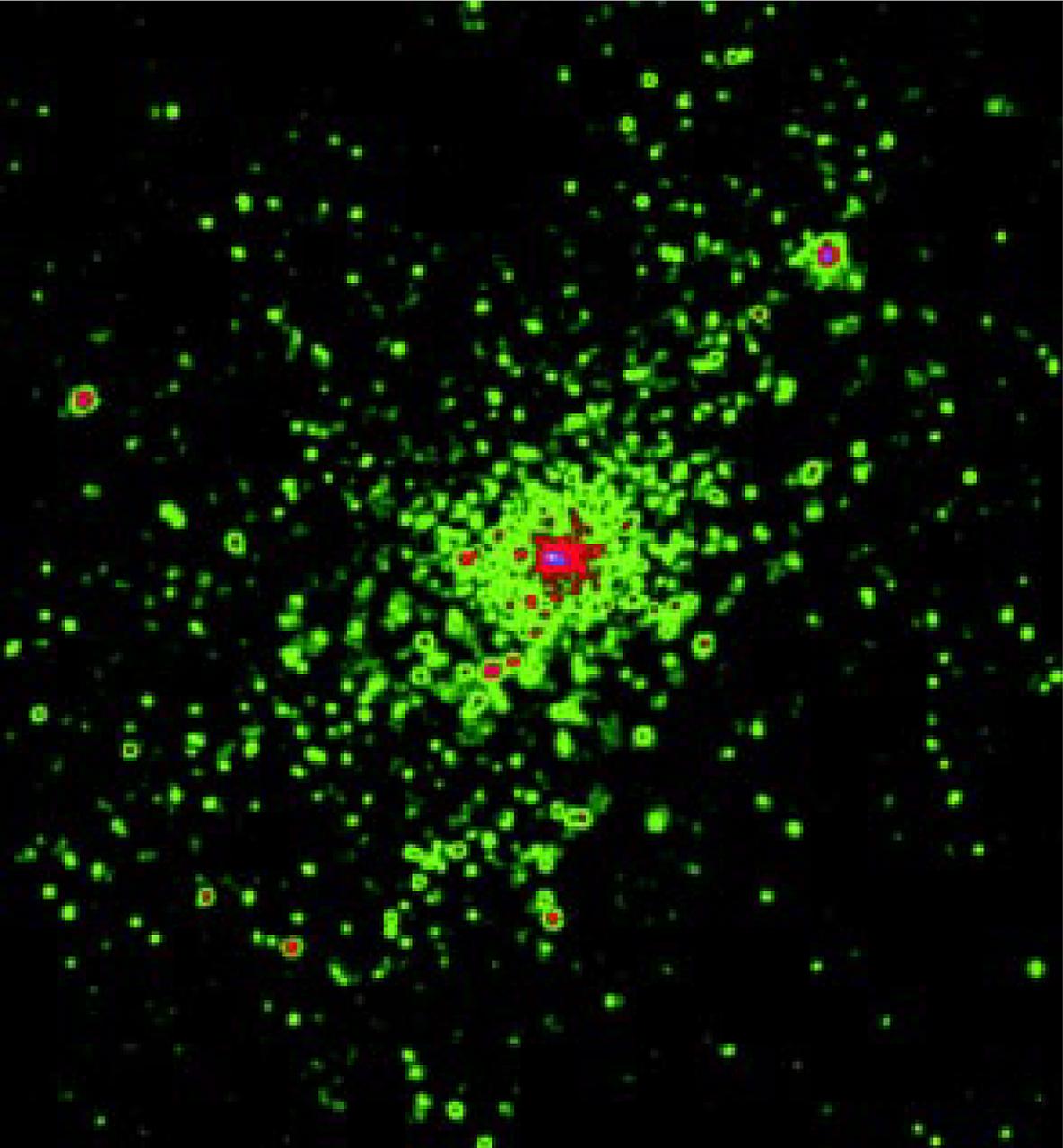
NGC 3603 is a bustling region of star birth in the Carina spiral arm of the Milky Way galaxy, about 20,000 light-years from Earth. For the first time, this Chandra image resolves the multitude of individual x-ray sources in this star-forming region. (The intensity of the x-rays observed by Chandra are depicted by the various colors in this image. Green represents lower intensity sources, while purple and red indicate increasing x-ray intensity.) Specifically, the Chandra image reveals dozens of extremely massive stars born in a burst of star formation about 2 million years ago. This region's activities may be indicative of what is happening in other distant "starburst" galaxies (bright galaxies flush with new stars). In the case of NGC 3603, scientists now believe that these x-rays are emitted from massive stars and stellar winds, since the stars are too young to have produced supernovae or have evolved into neutron stars. The Chandra observations of NGC 3603 may provide new clues about x-ray emission in starburst galaxies as well as star formation itself. (Photo credit: NASA/GSFC/M. Corcoran et al)
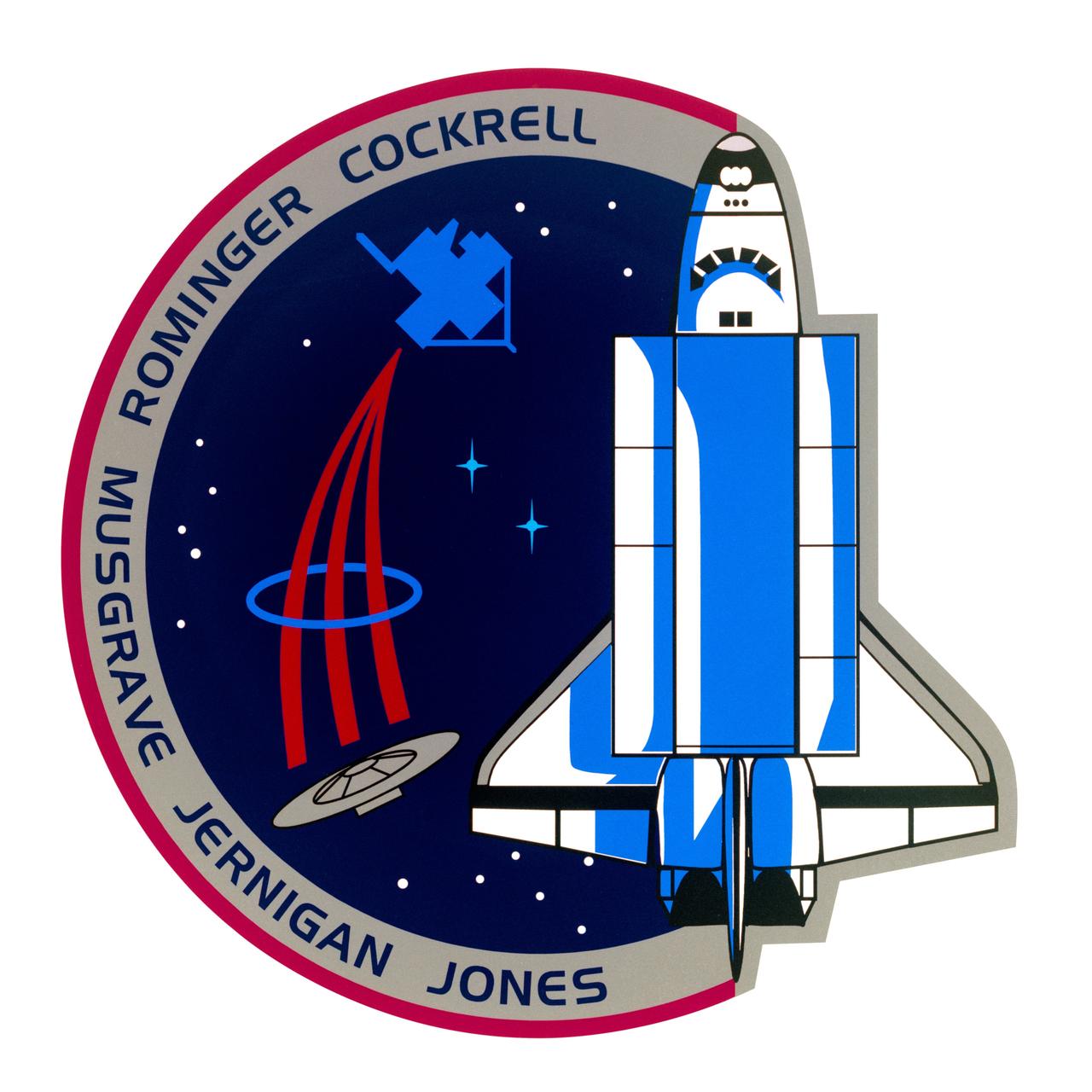
STS080-S-001 (August 1996) --- This STS-80 mission patch depicts the space shuttle Columbia and the two research satellites its crew will deploy into the blue field of space. The uppermost satellite is the Orbiting Retrievable Far and Extreme Ultraviolet Spectrograph-Shuttle Pallet Satellite (ORFEUS-SPAS), a telescope aimed at unraveling the life cycles of stars and understanding the gases that drift between them. The lower satellite is the Wake Shield Facility (WSF), flying for the third time. It will use the vacuum of space to create advanced semiconductors for the nation’s electronics industry. ORFEUS and WSF are joined by the symbol of the Astronaut Corps, representing the human contribution to scientific progress in space. The two bright blue stars represent the mission’s extravehicular activities (EVA), final rehearsals for techniques and tools to be used in assembly of the International Space Station (ISS). Surrounding Columbia is a constellation of 16 stars, one for each day of the mission, representing the stellar talents of the ground and flight teams that share the goal of expanding knowledge through a permanent human presence in space. The NASA insignia design for space shuttle flights is reserved for use by the astronauts and for other official use as the NASA Administrator may authorize. Public availability has been approved only in the forms of illustrations by the various news media. When and if there is any change in this policy, which is not anticipated, the change will be publicly announced. Photo credit: NASA

The Crab Nebula is a supernova remnant, all that remains of a tremendous stellar explosion. Observers in China and Japan recorded the supernova nearly 1,000 years ago, in 1054. Credit: NASA, ESA, J. Hester and A. Loll (Arizona State University) The Hubble Space Telescope is a project of international cooperation between NASA and the European Space Agency. NASA's Goddard Space Flight Center manages the telescope. The Space Telescope Science Institute conducts Hubble science operations. Goddard is responsible for HST project management, including mission and science operations, servicing missions, and all associated development activities. To learn more about the Hubble Space Telescope go here: <a href="http://www.nasa.gov/mission_pages/hubble/main/index.html" rel="nofollow">www.nasa.gov/mission_pages/hubble/main/index.html</a> <b><a href="http://www.nasa.gov/centers/goddard/home/index.html" rel="nofollow">NASA Goddard Space Flight Center</a></b> is home to the nation's largest organization of combined scientists, engineers and technologists that build spacecraft, instruments and new technology to study the Earth, the sun, our solar system, and the universe. <b>Follow us on <a href="http://twitter.com/NASA_GoddardPix" rel="nofollow">Twitter</a></b> <b>Join us on <a href="http://www.facebook.com/pages/Greenbelt-MD/NASA-Goddard/395013845897?ref=tsd" rel="nofollow">Facebook</a><b> </b></b>

This black-and-white visible wavelength (450-1,100 nm) image of Io's surface was taken by the Stellar Reference Unit (SRU) aboard NASA's Juno spacecraft during a close flyby of the volcanic moon on Dec. 30, 2023. The image was taken from a distance of about 932 miles (1,500 kilometers) over the night side of Io in a region dimly illuminated by Jupiter-shine. It is Juno's highest resolution image of Io, at about half- to three-quarters of a mile (895 to 1,230 meters) per pixel. The image covers the Zal Montes-Patera complex (the two mountains and large dark patera at the center of the image) and the western portion of the Tonatiuh eruptive center (at left edge of left image and top edge of right image). The left panel is the raw SRU image, and the right panel shows the image projected onto the surface of Io with north up. The image reveals fresh new lava flows at Zal Patera (the large dark patera between the two mountains) with possible jets of sulfur dioxide gas at the flow fronts. The SRU's sensitivity at near-infrared wavelengths enabled detection of thermal emission signatures from multiple active lava breakouts in Zal Patera and at the base of South Zal Mons (the lower mountain in the image at right). An unprecedented elongated, curved emission feature is observed to the west of South Zal Mons and is suspected to be an active lava channel. The image also captures the first high-resolution view of Tonatiuh's geomorphology. The SRU observes a fresh (dark) crenulated lava flow at Tonatiuh (left edge of left image and top edge of right image), showing that this volcano's flows are consistent with an insulated Promethean-style compound flow field. The lava flow is 98 by 11 miles (158 by 18 kilometers). The SRU collects images of star fields to provide star positions used for attitude determination. Designed for low-light conditions, the camera has proved itself a valuable science tool, discovering shallow lightning in Jupiter's atmosphere, imaging the planet's enigmatic ring system, finding hints of recent surface activity on Europa, and now providing a view of Io's volcanoes in action. https://photojournal.jpl.nasa.gov/catalog/PIA26489

In 1986, NASA introduced a Shuttle-borne ultraviolet observatory called Astro. The Astro Observatory was designed to explore the universe by observing and measuring the ultraviolet radiation from celestial objects. Astronomical targets of observation selected for Astro missions included planets, stars, star clusters, galaxies, clusters of galaxies, quasars, remnants of exploded stars (supernovae), clouds of gas and dust (nebulae), and the interstellar medium. Astro-1 used a Spacelab pallet system with an instrument pointing system and a cruciform structure for bearing the three ultraviolet instruments mounted in a parallel configuration. The three instruments were: The Hopkins Ultraviolet Telescope (HUT), which was designed to obtain far-ultraviolet spectroscopic data from white dwarfs, emission nebulae, active galaxies, and quasars; the Wisconsin Ultraviolet Photo-Polarimeter Experiment (WUPPE) which was to study polarized ultraviolet light from magnetic white dwarfs, binary stars, reflection nebulae, and active galaxies; and the Ultraviolet Imaging Telescope (UIT) which was to record photographic images in ultraviolet light of galaxies, star clusters, and nebulae. The star trackers that supported the instrument pointing system were also mounted on the cruciform. Also in the payload bay was the Broad Band X-Ray Telescope (BBXRT), which was designed to obtain high-resolution x-ray spectra from stellar corona, x-ray binary stars, active galactic nuclei, and galaxy clusters. Managed by the Marshall Space Flight Center, the Astro-1 observatory was launched aboard the Space Shuttle Orbiter Columbia (STS-35) on December 2, 1990.

This photograph was taken during the integration of the Astro-1 mission payloads at the Kennedy Space Center on March 20, 1990, showing the Broad Band X-Ray Telescope (BBXRT) at the left, as three telescopes for the Astro-1 Observatory are settled into the Orbiter Columbia payload bay. Above Earth's atmospheric interference, Astro-1 would make precise measurements of objects such as planets, stars, and galaxies in relatively small fields of view and would observe and measure ultraviolet radiation from celestial objects. The Astro-1 used a Spacelab pallet system with an instrument pointing system and a cruciform structure for bearing the three ultraviolet instruments mounted in a parallel configuration. The three instruments were: The Hopkins Ultraviolet Telescope (HUT), which was designed to obtain far-ultraviolet spectroscopic data from white dwarfs, emission nebulae, active galaxies, and quasars; the Wisconsin Ultraviolet Photo-Polarimeter Experiment (WUPPE) which was to study polarized ultraviolet light from magnetic white dwarfs, binary stars, reflection nebulae, and active galaxies; and the Ultraviolet Imaging Telescope (UIT), which was to record photographic images in ultraviolet light of galaxies, star clusters, and nebulae. The star trackers that supported the instrument pointing system, were also mounted on the cruciform. Also in the payload bay was the Broad Band X-Ray Telescope (BBXRT), which was designed to obtain high-resolution x-ray spectra from stellar corona, x-ray binary stars, active galactic nuclei, and galaxy clusters. Managed by the Marshall Space Flight Center, the Astro-1 observatory was launched aboard the Space Shuttle Orbiter Columbia (STS-35) on December 2, 1990.

NASA image release April 22, 2010 NASA's Hubble Space Telescope captured this billowing cloud of cold interstellar gas and dust rising from a tempestuous stellar nursery located in the Carina Nebula, 7,500 light-years away in the southern constellation Carina. This pillar of dust and gas serves as an incubator for new stars and is teeming with new star-forming activity. Hot, young stars erode and sculpt the clouds into this fantasy landscape by sending out thick stellar winds and scorching ultraviolet radiation. The low-density regions of the nebula are shredded while the denser parts resist erosion and remain as thick pillars. In the dark, cold interiors of these columns new stars continue to form. In the process of star formation, a disk around the proto-star slowly accretes onto the star's surface. Part of the material is ejected along jets perpendicular to the accretion disk. The jets have speeds of several hundreds of miles per second. As these jets plow into the surround nebula, they create small, glowing patches of nebulosity, called Herbig-Haro (HH) objects. Long streamers of gas can be seen shooting in opposite directions off the pedestal on the upper right-hand side of the image. Another pair of jets is visible in a peak near the top-center of the image. These jets (known as HH 901 and HH 902, respectively) are common signatures of the births of new stars. This image celebrates the 20th anniversary of Hubble's launch and deployment into an orbit around Earth. Hubble's Wide Field Camera 3 observed the pillar on Feb. 1-2, 2010. The colors in this composite image correspond to the glow of oxygen (blue), hydrogen and nitrogen (green), and sulfur (red). Object Names: HH 901, HH 902 Image Type: Astronomical Credit: NASA, ESA, and M. Livio and the Hubble 20th Anniversary Team (STScI) To read learn more about this image go to: <a href="http://www.nasa.gov/mission_pages/hubble/science/hubble20th-img.html" rel="nofollow">www.nasa.gov/mission_pages/hubble/science/hubble20th-img....</a> <b><a href="http://www.nasa.gov/centers/goddard/home/index.html" rel="nofollow">NASA Goddard Space Flight Center</a></b> is home to the nation's largest organization of combined scientists, engineers and technologists that build spacecraft, instruments and new technology to study the Earth, the sun, our solar system, and the universe.

What looks much like craggy mountains on a moonlit evening is actually the edge of a nearby, young, star-forming region NGC 3324 in the Carina Nebula. Captured in infrared light by the Near-Infrared Camera (NIRCam) on NASA’s James Webb Space Telescope, this image reveals previously obscured areas of star birth. Called the Cosmic Cliffs, the region is actually the edge of a gigantic, gaseous cavity within NGC 3324, roughly 7,600 light-years away. The cavernous area has been carved from the nebula by the intense ultraviolet radiation and stellar winds from extremely massive, hot, young stars located in the center of the bubble, above the area shown in this image. The high-energy radiation from these stars is sculpting the nebula’s wall by slowly eroding it away. NIRCam – with its crisp resolution and unparalleled sensitivity – unveils hundreds of previously hidden stars, and even numerous background galaxies. Several prominent features in this image are described below. • The “steam” that appears to rise from the celestial “mountains” is actually hot, ionized gas and hot dust streaming away from the nebula due to intense, ultraviolet radiation. • Dramatic pillars rise above the glowing wall of gas, resisting the blistering ultraviolet radiation from the young stars. • Bubbles and cavities are being blown by the intense radiation and stellar winds of newborn stars. • Protostellar jets and outflows, which appear in gold, shoot from dust-enshrouded, nascent stars. • A “blow-out” erupts at the top-center of the ridge, spewing gas and dust into the interstellar medium. • An unusual “arch” appears, looking like a bent-over cylinder. This period of very early star formation is difficult to capture because, for an individual star, it lasts only about 50,000 to 100,000 years – but Webb’s extreme sensitivity and exquisite spatial resolution have chronicled this rare event. Located roughly 7,600 light-years away, NGC 3324 was first catalogued by James Dunlop in 1826. Visible from the Southern Hemisphere, it is located at the northwest corner of the Carina Nebula (NGC 3372), which resides in the constellation Carina. The Carina Nebula is home to the Keyhole Nebula and the active, unstable supergiant star called Eta Carinae. NIRCam was built by a team at the University of Arizona and Lockheed Martin’s Advanced Technology Center.

The Cat's Eye Nebula, one of the first planetary nebulae discovered, also has one of the most complex forms known to this kind of nebula. Eleven rings, or shells, of gas make up the Cat's Eye. The full beauty of the Cat's Eye Nebula is revealed in this detailed view from NASA's Hubble Space Telescope. The image from Hubble's Advanced Camera for Surveys (ACS) shows a bull's eye pattern of eleven or even more concentric rings, or shells, around the Cat's Eye. Each 'ring' is actually the edge of a spherical bubble seen projected onto the sky -- that's why it appears bright along its outer edge. Observations suggest the star ejected its mass in a series of pulses at 1,500-year intervals. These convulsions created dust shells, each of which contain as much mass as all of the planets in our solar system combined (still only one percent of the Sun's mass). These concentric shells make a layered, onion-skin structure around the dying star. The view from Hubble is like seeing an onion cut in half, where each skin layer is discernible. The bull's-eye patterns seen around planetary nebulae come as a surprise to astronomers because they had no expectation that episodes of mass loss at the end of stellar lives would repeat every 1,500 years. Several explanations have been proposed, including cycles of magnetic activity somewhat similar to our own Sun's sunspot cycle, the action of companion stars orbiting around the dying star, and stellar pulsations. Another school of thought is that the material is ejected smoothly from the star, and the rings are created later on due to formation of waves in the outflowing material. Credit: NASA, ESA, HEIC, and The Hubble Heritage Team (STScI/AURA) Acknowledgment: R. Corradi (Isaac Newton Group of Telescopes, Spain) and Z. Tsvetanov (NASA) The Hubble Space Telescope is a project of international cooperation between NASA and the European Space Agency. NASA's Goddard Space Flight Center manages the telescope. The Space Telescope Science Institute conducts Hubble science operations. Goddard is responsible for HST project management, including mission and science operations, servicing missions, and all associated development activities. To learn more about the Hubble Space Telescope go here: <a href="http://www.nasa.gov/mission_pages/hubble/main/index.html" rel="nofollow">www.nasa.gov/mission_pages/hubble/main/index.html</a> <b><a href="http://www.nasa.gov/audience/formedia/features/MP_Photo_Guidelines.html" rel="nofollow">NASA image use policy.</a></b> <b><a href="http://www.nasa.gov/centers/goddard/home/index.html" rel="nofollow">NASA Goddard Space Flight Center</a></b> enables NASA’s mission through four scientific endeavors: Earth Science, Heliophysics, Solar System Exploration, and Astrophysics. Goddard plays a leading role in NASA’s accomplishments by contributing compelling scientific knowledge to advance the Agency’s mission. <b>Follow us on <a href="http://twitter.com/NASAGoddardPix" rel="nofollow">Twitter</a></b> <b>Like us on <a href="http://www.facebook.com/pages/Greenbelt-MD/NASA-Goddard/395013845897?ref=tsd" rel="nofollow">Facebook</a></b> <b>Find us on <a href="http://instagram.com/nasagoddard?vm=grid" rel="nofollow">Instagram</a></b>
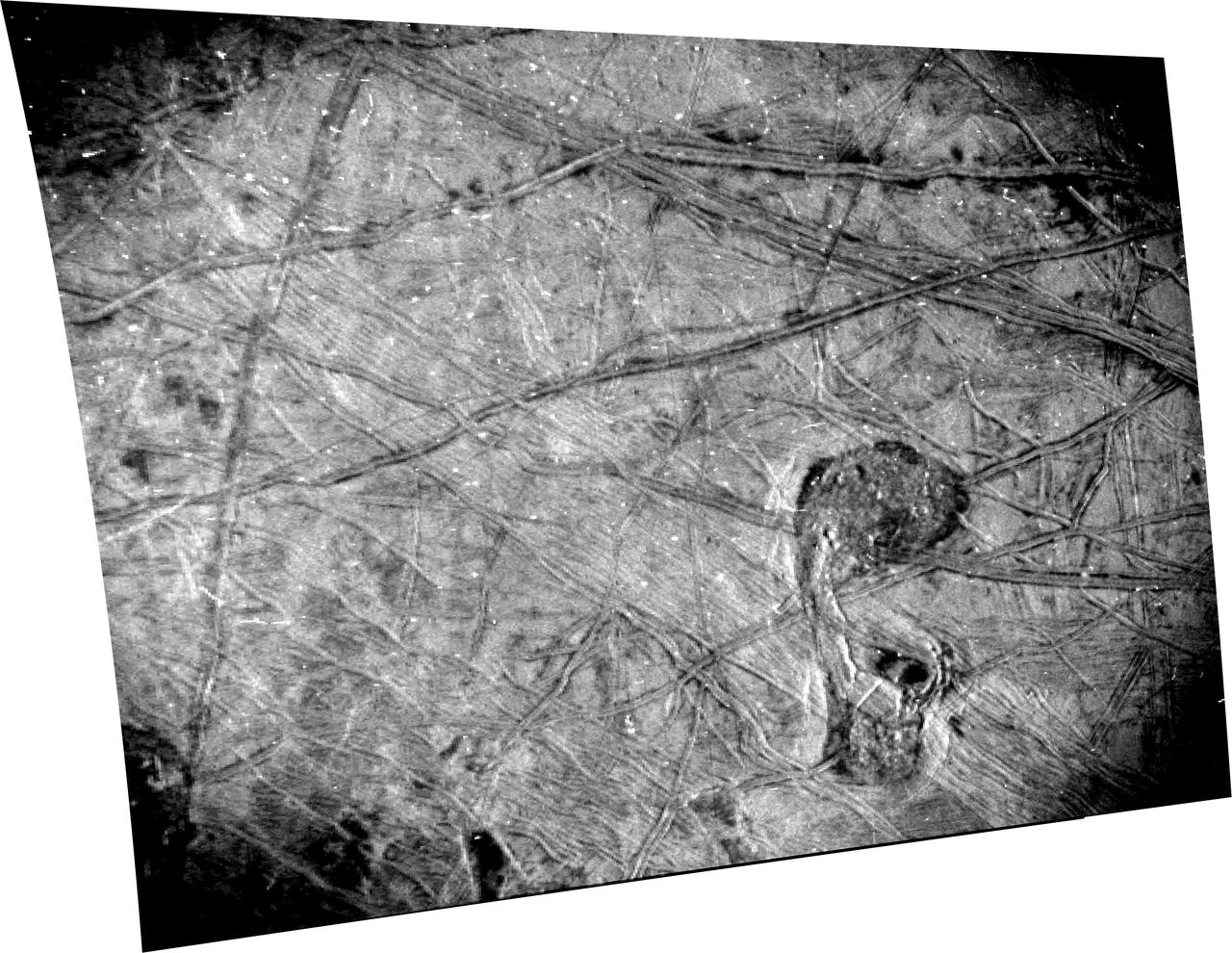
This black-and-white image of Europa's surface was taken by the Stellar Reference Unit (SRU) aboard NASA's Juno spacecraft during a Sept. 29, 2022, flyby of the Jovian moon. The image shows a region crisscrossed with a network of fine grooves and sets of complicated double ridges (pairs of long parallel lines indicating elevated features in the ice). In the upper right corner are dark stains possibly linked to cryovolcanic plume activity (the bubbling up of liquid from beneath the ice). Just below center and to the right is a surface feature that members of the Juno science team refer to as "the Platypus." This location of surface disruption (called "chaos" in the field of planetary science) measures 42 miles (67 kilometers) north-south and 23 miles (37 kilometers) east-west. (The feature's shape has previously been compared to a musical symbol for a quarter note.) The small white dots that pepper the image are signatures of penetrating high-energy particles from the severe radiation environment around the moon. The image was taken at a distance of about 256 miles (412 kilometers) over the night side of Europa in a region dimly illuminated by Jupiter-shine. It is Juno's highest resolution image of the moon, at 840 to 1,115 feet per pixel (256 to 340 meters per pixel) and covers about 93 by 125 miles (150 by 200 kilometers) of Europa's surface. The SRU collects images of star fields to provide star positions used for attitude determination. Designed for low-light conditions, the camera has proved itself a valuable science tool, discovering shallow lightning in Jupiter's atmosphere, imaging the planet's enigmatic ring system, and now providing a glimpse of Europa's most fascinating geologic formations. https://photojournal.jpl.nasa.gov/catalog/PIA26332
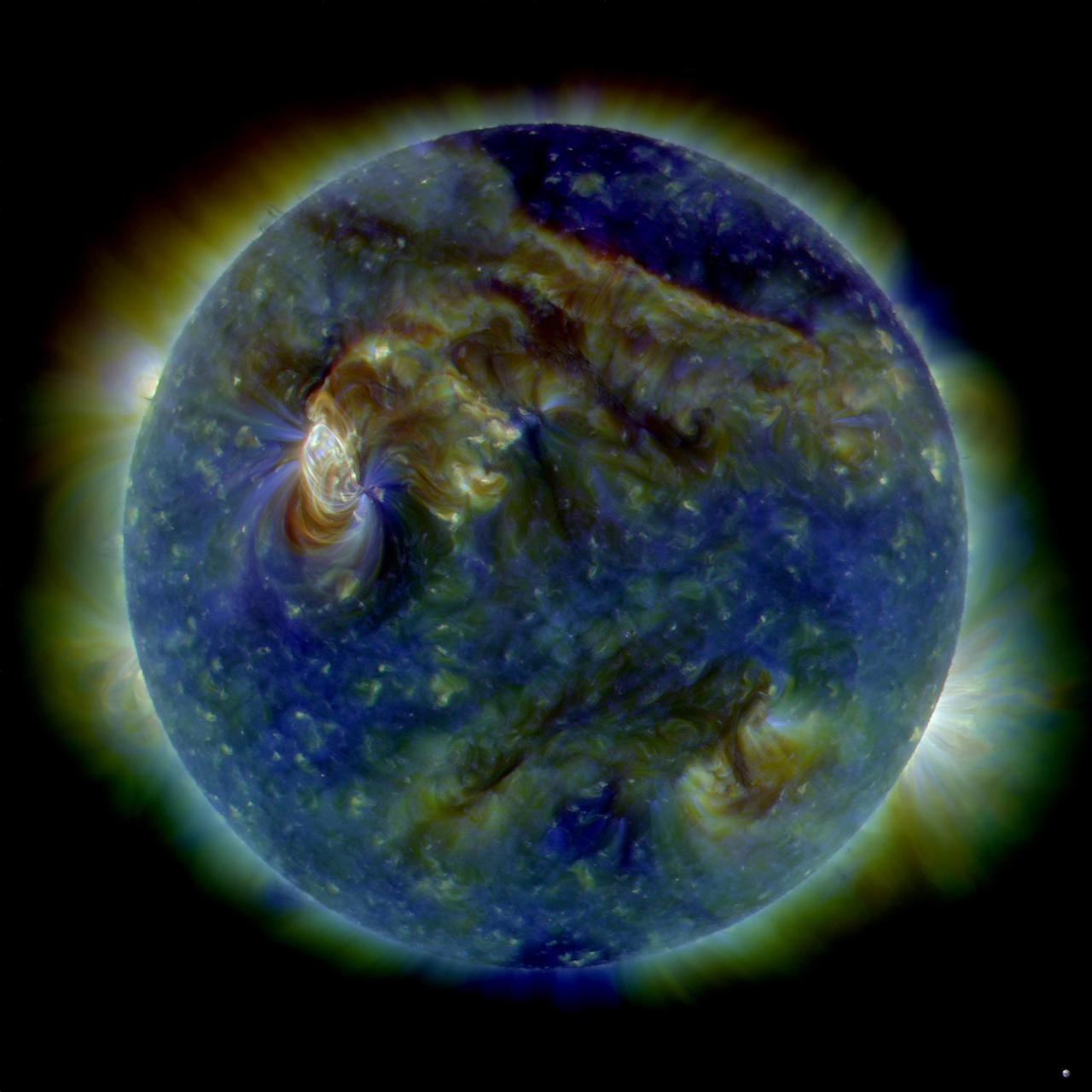
NASA image release August 6, 2010 On August 1, 2010, almost the entire Earth-facing side of the sun erupted in a tumult of activity. This image from the Solar Dynamics Observatory of the news-making solar event on August 1 shows the C3-class solar flare (white area on upper left), a solar tsunami (wave-like structure, upper right), multiple filaments of magnetism lifting off the stellar surface, large-scale shaking of the solar corona, radio bursts, a coronal mass ejection and more. This multi-wavelength extreme ultraviolet snapshot from the Solar Dynamics Observatory shows the sun's northern hemisphere in mid-eruption. Different colors in the image represent different gas temperatures. Earth's magnetic field is still reverberating from the solar flare impact on August 3, 2010, which sparked aurorae as far south as Wisconsin and Iowa in the United States. Analysts believe a second solar flare is following behind the first flare and could re-energize the fading geomagnetic storm and spark a new round of Northern Lights. Credit: NASA/SDO/AIA <b><a href="http://www.nasa.gov/centers/goddard/home/index.html" rel="nofollow">NASA Goddard Space Flight Center</a></b> is home to the nation's largest organization of combined scientists, engineers and technologists that build spacecraft, instruments and new technology to study the Earth, the sun, our solar system, and the universe. <b>Follow us on <a href="http://twitter.com/NASA_GoddardPix" rel="nofollow">Twitter</a></b> <b>Join us on <a href="http://www.facebook.com/pages/Greenbelt-MD/NASA-Goddard/395013845897?ref=tsd" rel="nofollow">Facebook</a><b> </b></b>
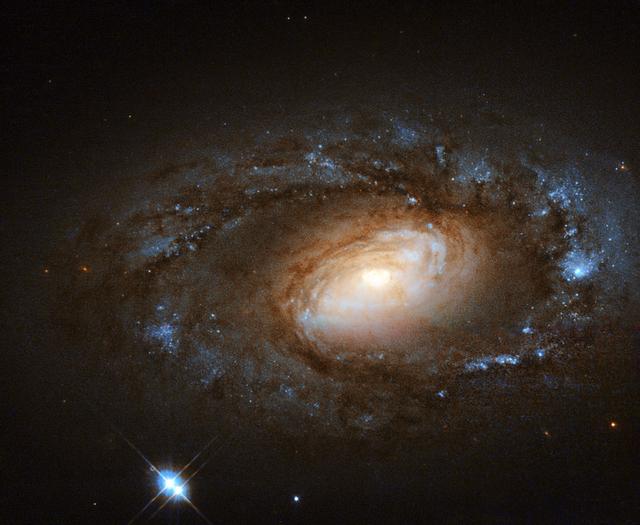
The NASA/ESA Hubble Space Telescope observes some of the most beautiful galaxies in our skies — spirals sparkling with bright stellar nurseries, violent duos ripping gas and stars away from one another as they tangle together, and ethereal irregular galaxies that hang like flocks of birds suspended in the blackness of space. However, galaxies, like humans, are not all supermodels. This little spiral, known as NGC 4102, has a different kind of appeal, with its tightly-wound spiral arms and understated, but charming, appearance. NGC 4102 lies in the northern constellation of Ursa Major (The Great Bear). It contains what is known as a LINER, or low-ionization nuclear emission-line region, meaning that its nucleus emits particular types of radiation — specifically, emission from weakly-ionized or neutral atoms of certain elements. Even in this sense, NGC 4102 is not special; around one third of all nearby galaxies are thought to be LINER galaxies. Many LINER galaxies also contain intense regions of star formation. This is thought to be intrinsically linked to their centers but just why, is still a mystery for astronomers — either the starbursts pour fuel inwards to fuel the LINERs, or this active central region triggers the starbursts. NGC 4102 does indeed contain a starburst region towards its center, where stars are being created at a rate much more furious than in a normal galaxy. This star formation is taking place within a small rotating disk, around 1000 light-years in diameter and with a mass some three billion times the mass of the sun. This image uses infrared and visible observations taken using Hubble’s Wide Field Planetary Camera 2. Credit: ESA/Hubble, NASA and S. Smartt (Queen's University Belfast) Acknowledgement: Renaud Houdinet <b><a href="http://www.nasa.gov/audience/formedia/features/MP_Photo_Guidelines.html" rel="nofollow">NASA image use policy.</a></b> <b><a href="http://www.nasa.gov/centers/goddard/home/index.html" rel="nofollow">NASA Goddard Space Flight Center</a></b> enables NASA’s mission through four scientific endeavors: Earth Science, Heliophysics, Solar System Exploration, and Astrophysics. Goddard plays a leading role in NASA’s accomplishments by contributing compelling scientific knowledge to advance the Agency’s mission. <b>Follow us on <a href="http://twitter.com/NASAGoddardPix" rel="nofollow">Twitter</a></b> <b>Like us on <a href="http://www.facebook.com/pages/Greenbelt-MD/NASA-Goddard/395013845897?ref=tsd" rel="nofollow">Facebook</a></b> <b>Find us on <a href="http://instagram.com/nasagoddard?vm=grid" rel="nofollow">Instagram</a></b>
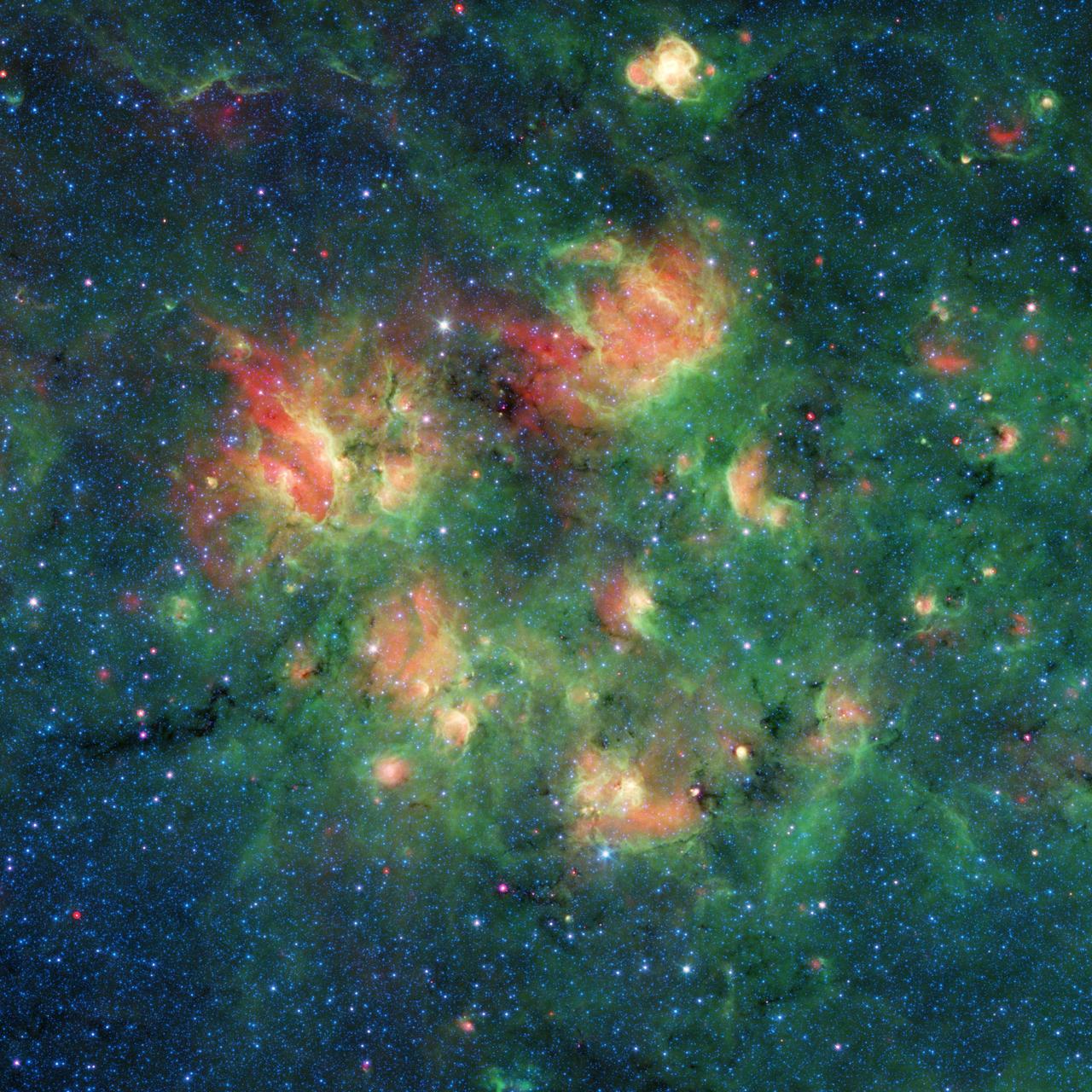
This infrared image from NASA's Spitzer Space Telescope shows a cloud of gas and dust full of bubbles, which are inflated by wind and radiation from massive young stars. Each bubble is filled with hundreds to thousands of stars, which form from dense clouds of gas and dust. The bubbles are estimated to be 10 to 30 light-years across, based on what astronomers know about them and other cosmic bubbles. However, determining the exact sizes of individual bubbles can be difficult, because their distance from Earth is challenging to measure and objects appear smaller the farther away they are. Flows of particles called stellar winds emitted by the stars, as well as the pressure of the light those winds produce, can push the surrounding material outward, sometimes creating a distinct perimeter. In Figure 1, the yellow circles and ovals outline more than 30 bubbles. This active region of star formation is located inside the Milky Way galaxy, in the constellation Aquila (also known as the Eagle). Black veins running throughout the cloud are regions of especially dense cold dust and gas where even more new stars are likely to form. The colors in this image represent different wavelengths of infrared light. Blue represents a wavelength of light primarily emitted by stars; dust and organic molecules called hydrocarbons appear green, and warm dust that's been heated by stars appears red. Also visible are four bow shocks — red arcs of warm dust formed as winds from fast-moving stars push aside dust grains scattered sparsely through most of the nebula. The locations of the bow shocks are indicated by squares in Figure 1. Figure 2 shows zoomed-in views of the four bow shocks. The bubbles and bow shocks in this image were identified as part of The Milky Way Project, a citizen science initiative on Zooniverse.org that seeks to map star formation throughout the galaxy. Participating citizen scientists looked through images from Spitzer's public data archive and identified as many bubbles as they could. More than 78,000 unique user accounts contributed. Astronomers running this program recently published a catalog of the bubble candidates that multiple citizen scientists had identified. The full Milky Way Project catalogs, which list a total of 2,600 bubbles and 599 bow shocks, are described in a paper published recently in Monthly Notices of the Royal Astronomical Society. Animation available at https://photojournal.jpl.nasa.gov/catalog/PIA23402
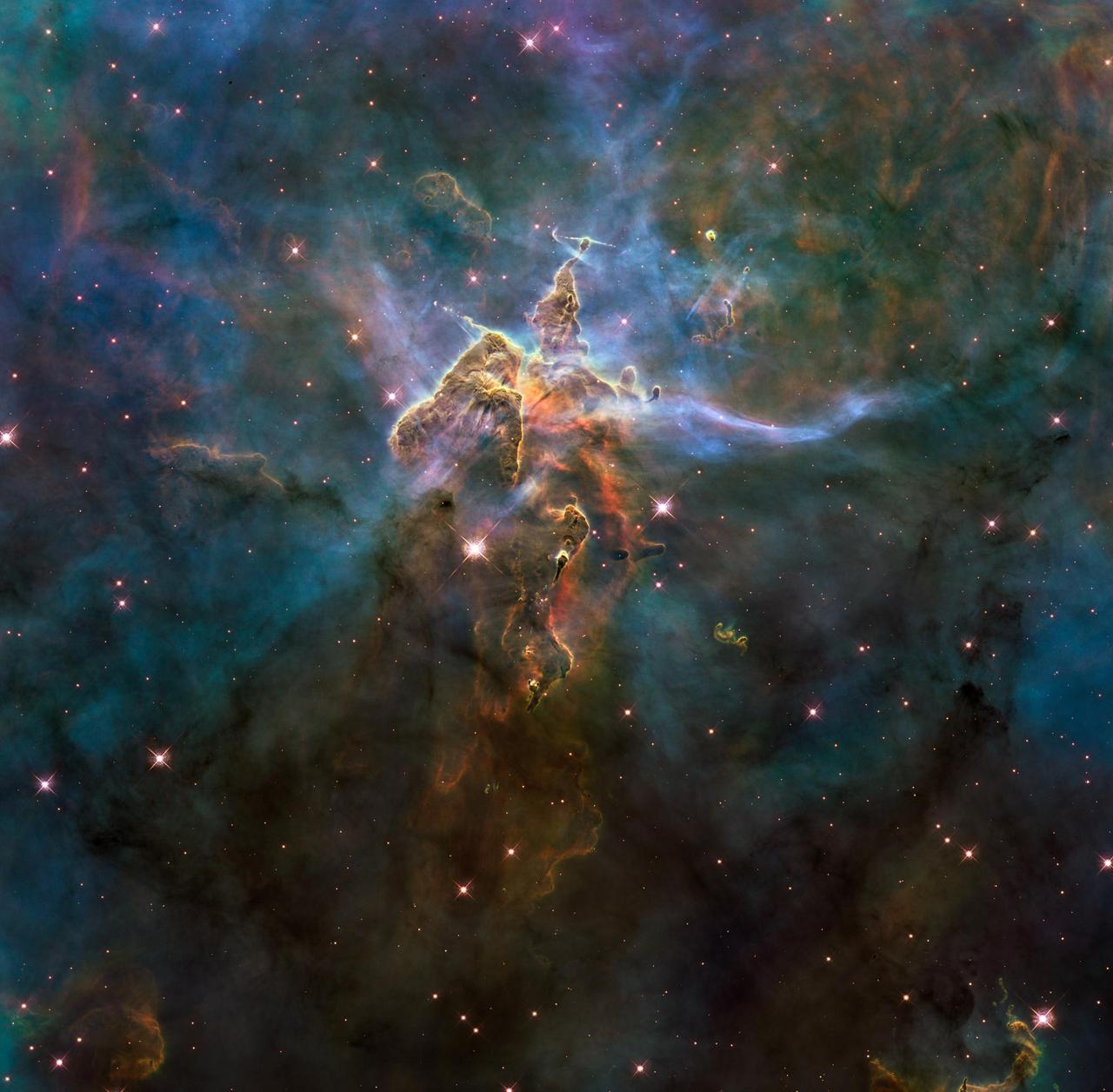
NASA image release April 22, 2010 This craggy fantasy mountaintop enshrouded by wispy clouds looks like a bizarre landscape from Tolkien's "The Lord of the Rings" or a Dr. Seuss book, depending on your imagination. The NASA Hubble Space Telescope photograph, which is stranger than fiction, captures the chaotic activity atop a three-light-year-tall pillar of gas and dust that is being eaten away by the brilliant light from nearby bright stars. The pillar is also being assaulted from within, as infant stars buried inside it fire off jets of gas that can be seen streaming from towering peaks. This turbulent cosmic pinnacle lies within a tempestuous stellar nursery called the Carina Nebula, located 7,500 light-years away in the southern constellation Carina. The image marks the 20th anniversary of Hubble's launch and deployment into Earth orbit. Scorching radiation and fast winds (streams of charged particles) from hot newborn stars in the nebula are shaping and compressing the pillar, causing new stars to form within it. Streamers of hot ionized gas can be seen flowing off the ridges of the structure, and wispy veils of dust, illuminated by starlight, float around its peaks. The pillar is resisting being eroded by radiation much like a towering butte in Utah's Monument Valley withstands erosion by water and wind. Nestled inside this dense mountain are fledgling stars. Long streamers of gas can be seen shooting in opposite directions off the pedestal at the top of the image. Another pair of jets is visible at another peak near the center of the image. These jets are the signpost for new star birth. The jets are launched by swirling disks around the stars, as these disks allow material to slowly accrete onto the stars' surfaces. Hubble's Wide Field Camera 3 observed the pillar on Feb. 1-2, 2010. The colors in this composite image correspond to the glow of oxygen (blue), hydrogen and nitrogen (green), and sulfur (red). Object Names: HH 901, HH 902 Image Type: Astronomical Credit: NASA, ESA, and M. Livio and the Hubble 20th Anniversary Team (STScI) To read learn more about this image go to: <a href="http://www.nasa.gov/mission_pages/hubble/science/hubble20th-img.html" rel="nofollow">www.nasa.gov/mission_pages/hubble/science/hubble20th-img....</a> <b><a href="http://www.nasa.gov/centers/goddard/home/index.html" rel="nofollow">NASA Goddard Space Flight Center</a></b> is home to the nation's largest organization of combined scientists, engineers and technologists that build spacecraft, instruments and new technology to study the Earth, the sun, our solar system, and the universe.

Image release June 22, 2010 A spectacular new NASA/ESA Hubble Space Telescope image — one of the largest ever released of a star-forming region — highlights N11, part of a complex network of gas clouds and star clusters within our neighbouring galaxy, the Large Magellanic Cloud. This region of energetic star formation is one of the most active in the nearby Universe. The Large Magellanic Cloud contains many bright bubbles of glowing gas. One of the largest and most spectacular has the name LHA 120-N 11, from its listing in a catalogue compiled by the American astronomer and astronaut Karl Henize in 1956, and is informally known as N11. Close up, the billowing pink clouds of glowing gas make N11 resemble a puffy swirl of fairground candy floss. From further away, its distinctive overall shape led some observers to nickname it the Bean Nebula. The dramatic and colourful features visible in the nebula are the telltale signs of star formation. N11 is a well-studied region that extends over 1000 light-years. It is the second largest star-forming region within the Large Magellanic Cloud and has produced some of the most massive stars known. It is the process of star formation that gives N11 its distinctive look. Three successive generations of stars, each of which formed further away from the centre of the nebula than the last, have created shells of gas and dust. These shells were blown away from the newborn stars in the turmoil of their energetic birth and early life, creating the ring shapes so prominent in this image. Beans are not the only terrestrial shapes to be found in this spectacular high resolution image from the NASA/ESA Hubble Space Telescope. In the upper left is the red bloom of nebula LHA 120-N 11A. Its rose-like petals of gas and dust are illuminated from within, thanks to the radiation from the massive hot stars at its centre. N11A is relatively compact and dense and is the site of the most recent burst of star development in the region. Other star clusters abound in N11, including NGC 1761 at the bottom of the image, which is a group of massive hot young stars busily pouring intense ultraviolet radiation out into space. Although it is much smaller than our own galaxy, the Large Magellanic Cloud is a very vigorous region of star formation. Studying these stellar nurseries helps astronomers understand a lot more about how stars are born and their ultimate development and lifespan. Both the Large Magellanic Cloud and its small companion, the Small Magellanic Cloud, are easily seen with the unaided eye and have always been familiar to people living in the southern hemisphere. The credit for bringing these galaxies to the attention of Europeans is usually given to Portuguese explorer Fernando de Magellan and his crew, who viewed it on their 1519 sea voyage. However, the Persian astronomer Abd Al-Rahman Al Sufi and the Italian explorer Amerigo Vespucci recorded the Large Magellanic Cloud in 964 and 1503 respectively. Credit: NASA, ESA and Jesús Maíz Apellániz (Instituto de Astrofísica de Andalucía, Spain) To learn more about Hubble go to: <a href="http://www.nasa.gov/mission_pages/hubble/main/index.html" rel="nofollow">www.nasa.gov/mission_pages/hubble/main/index.html</a> <b><a href="http://www.nasa.gov/centers/goddard/home/index.html" rel="nofollow">NASA Goddard Space Flight Center</a></b> is home to the nation's largest organization of combined scientists, engineers and technologists that build spacecraft, instruments and new technology to study the Earth, the sun, our solar system, and the universe.

This image depicts a vast canyon of dust and gas in the Orion Nebula from a 3-D computer model based on observations by NASA's Hubble Space Telescope and created by science visualization specialists at the Space Telescope Science Institute (STScI) in Baltimore, Md. A 3-D visualization of this model takes viewers on an amazing four-minute voyage through the 15-light-year-wide canyon. Credit: NASA, G. Bacon, L. Frattare, Z. Levay, and F. Summers (STScI/AURA) Go here to learn more about Hubble 3D: <a href="http://www.nasa.gov/topics/universe/features/hubble_imax_premiere.html" rel="nofollow">www.nasa.gov/topics/universe/features/hubble_imax_premier...</a> or <a href="http://www.imax.com/hubble/" rel="nofollow">www.imax.com/hubble/</a> Take an exhilarating ride through the Orion Nebula, a vast star-making factory 1,500 light-years away. Swoop through Orion's giant canyon of gas and dust. Fly past behemoth stars whose brilliant light illuminates and energizes the entire cloudy region. Zoom by dusty tadpole-shaped objects that are fledgling solar systems. This virtual space journey isn't the latest video game but one of several groundbreaking astronomy visualizations created by specialists at the Space Telescope Science Institute (STScI) in Baltimore, the science operations center for NASA's Hubble Space Telescope. The cinematic space odysseys are part of the new Imax film "Hubble 3D," which opens today at select Imax theaters worldwide. The 43-minute movie chronicles the 20-year life of Hubble and includes highlights from the May 2009 servicing mission to the Earth-orbiting observatory, with footage taken by the astronauts. The giant-screen film showcases some of Hubble's breathtaking iconic pictures, such as the Eagle Nebula's "Pillars of Creation," as well as stunning views taken by the newly installed Wide Field Camera 3. While Hubble pictures of celestial objects are awe-inspiring, they are flat 2-D photographs. For this film, those 2-D images have been converted into 3-D environments, giving the audience the impression they are space travelers taking a tour of Hubble's most popular targets. "A large-format movie is a truly immersive experience," says Frank Summers, an STScI astronomer and science visualization specialist who led the team that developed the movie visualizations. The team labored for nine months, working on four visualization sequences that comprise about 12 minutes of the movie. "Seeing these Hubble images in 3-D, you feel like you are flying through space and not just looking at picture postcards," Summers continued. "The spacescapes are all based on Hubble images and data, though some artistic license is necessary to produce the full depth of field needed for 3-D." The most ambitious sequence is a four-minute voyage through the Orion Nebula's gas-and-dust canyon, about 15 light-years across. During the ride, viewers will see bright and dark, gaseous clouds; thousands of stars, including a grouping of bright, hefty stars called the Trapezium; and embryonic planetary systems. The tour ends with a detailed look at a young circumstellar disk, which is much like the structure from which our solar system formed 4.5 billion years ago. Based on a Hubble image of Orion released in 2006, the visualization was a collaborative effort between science visualization specialists at STScI, including Greg Bacon, who sculpted the Orion Nebula digital model, with input from STScI astronomer Massimo Roberto; the National Center for Supercomputing Applications at the University of Illinois at Urbana-Champaign; and the Spitzer Science Center at the California Institute of Technology in Pasadena. For some of the sequences, STScI imaging specialists developed new techniques for transforming the 2-D Hubble images into 3-D. STScI image processing specialists Lisa Frattare and Zolt Levay, for example, created methods of splitting a giant gaseous pillar in the Carina Nebula into multiple layers to produce a 3-D effect, giving the structure depth. The Carina Nebula is a nursery for baby stars. Frattare painstakingly removed the thousands of stars in the image so that Levay could separate the gaseous layers on the isolated Carina pillar. Frattare then replaced the stars into both foreground and background layers to complete the 3-D model. For added effect, the same separation was done for both visible and infrared Hubble images, allowing the film to cross-fade between wavelength views in 3-D. In another sequence viewers fly into a field of 170,000 stars in the giant star cluster Omega Centauri. STScI astronomer Jay Anderson used his stellar database to create a synthetic star field in 3-D that matches recent razor-sharp Hubble photos. The film's final four-minute sequence takes viewers on a voyage from our Milky Way Galaxy past many of Hubble's best galaxy shots and deep into space. Some 15,000 galaxies from Hubble's deepest surveys stretch billions of light-years across the universe in a 3-D sequence created by STScI astronomers and visualizers. The view dissolves into a cobweb that traces the universe's large-scale structure, the backbone from which galaxies were born. In addition to creating visualizations, STScI's education group also provided guidance on the "Hubble 3D" Educator Guide, which includes standards-based lesson plans and activities about Hubble and its mission. Students will use the guide before or after seeing the movie. "The guide will enhance the movie experience for students and extend the movie into classrooms," says Bonnie Eisenhamer, STScI's Hubble Formal Education manager. The Hubble Space Telescope is a project of international cooperation between NASA and the European Space Agency (ESA) and is managed by NASA’s Goddard Space Flight Center (GSFC) in Greenbelt, Md. The Space Telescope Science Institute (STScI) conducts Hubble science operations. The institute is operated for NASA by the Association of Universities for Research in Astronomy, Inc., Washington, D.C.