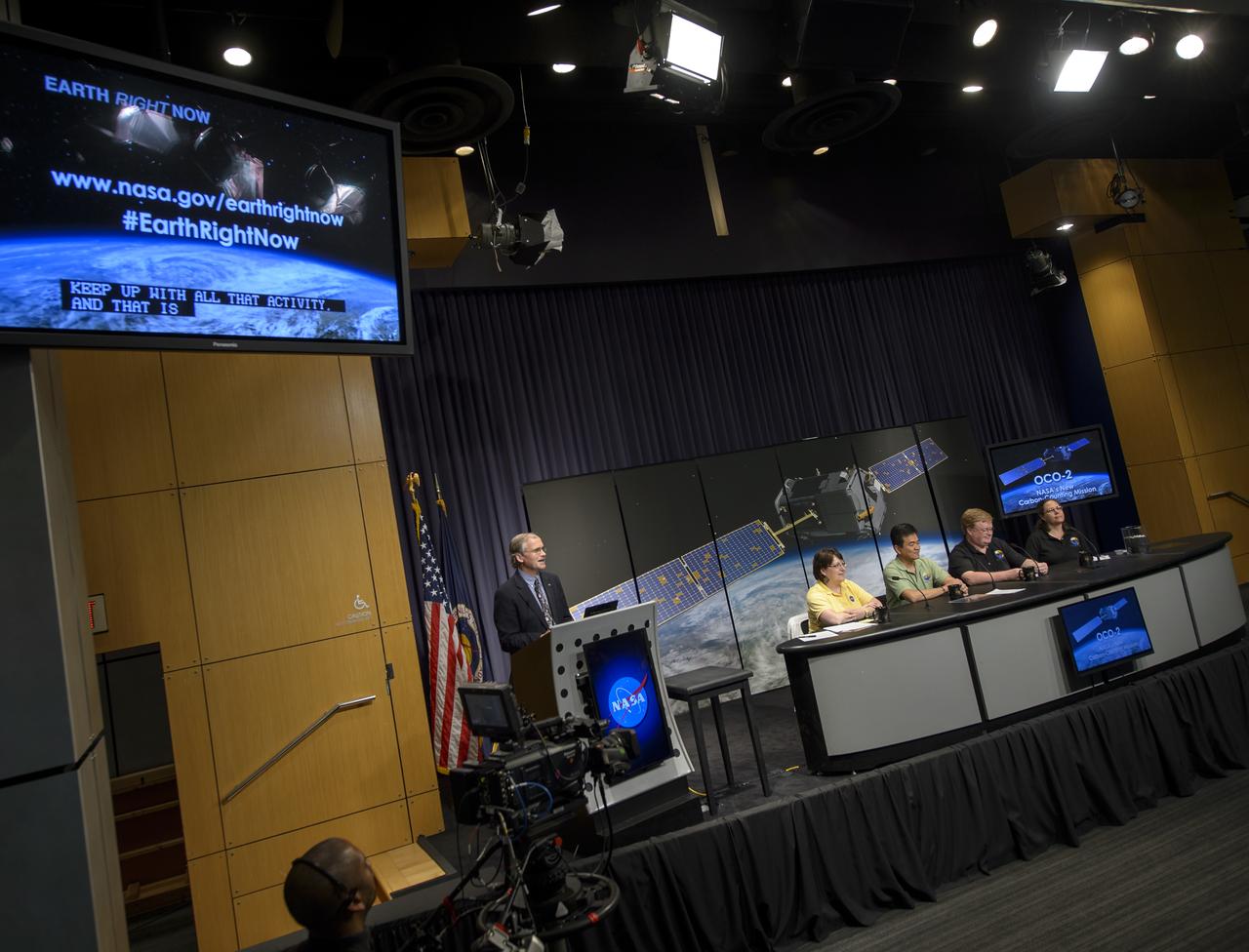
NASA Headquarters Public Affairs Officer Steve Cole, standing, moderates a Orbiting Carbon Observatory-2 (OCO-2) briefing with (from left), Betsy Edwards, OCO-2 program executive with the Science Mission Directorate at NASA Headquarters, Ralph Basilio, OCO-2 project manager with NASA’s Jet Propulsion Laboratory (JPL) in Pasadena, California, Mike Gunson, OCO-2 project scientist with JPL, and Annmarie Eldering, OCO-2 deputy project scientist JPL, , Thursday, June 12, 2014, at NASA Headquarters in Washington. OCO-2, NASA’s first spacecraft dedicated to studying carbon dioxide, is set for a July 1, 2014 launch from Vandenberg Air Force Base in California. Its mission is to measure the global distribution of carbon dioxide, the leading human-produced greenhouse gas driving changes in Earth’s climate. Photo Credit: (NASA/Bill Ingalls)
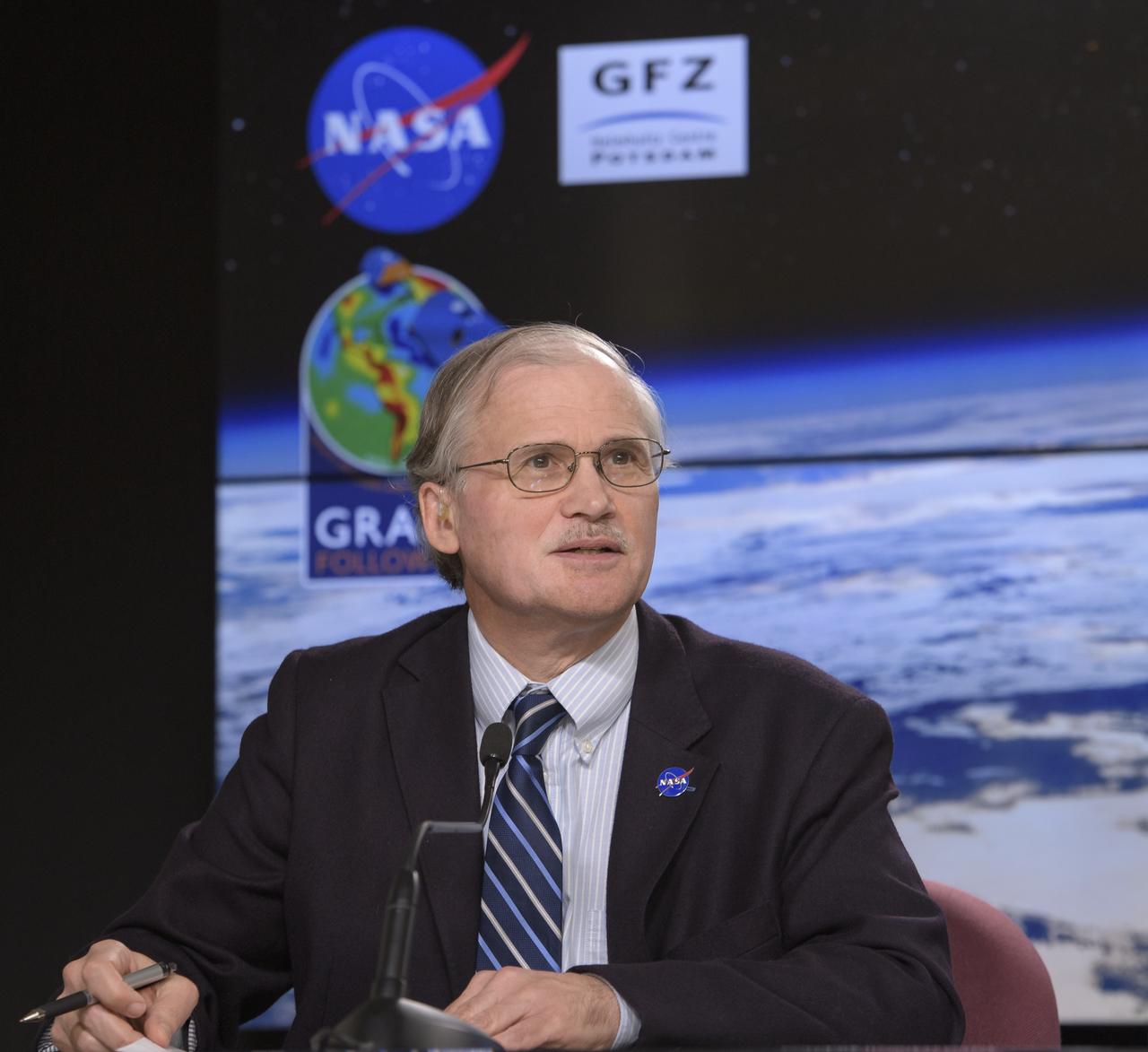
NASA Headquarters Public Affairs Officer Steve Cole moderates a Gravity Recovery and Climate Experiment Follow-On (GRACE-FO) mission prelaunch media briefing, Monday, May 21, 2018, at Vandenberg Air Force Base in California. The twin GRACE-FO spacecraft will measure changes in how mass is redistributed within and among Earth's atmosphere, oceans, land and ice sheets, as well as within Earth itself. Photo Credit: (NASA/Bill Ingalls)
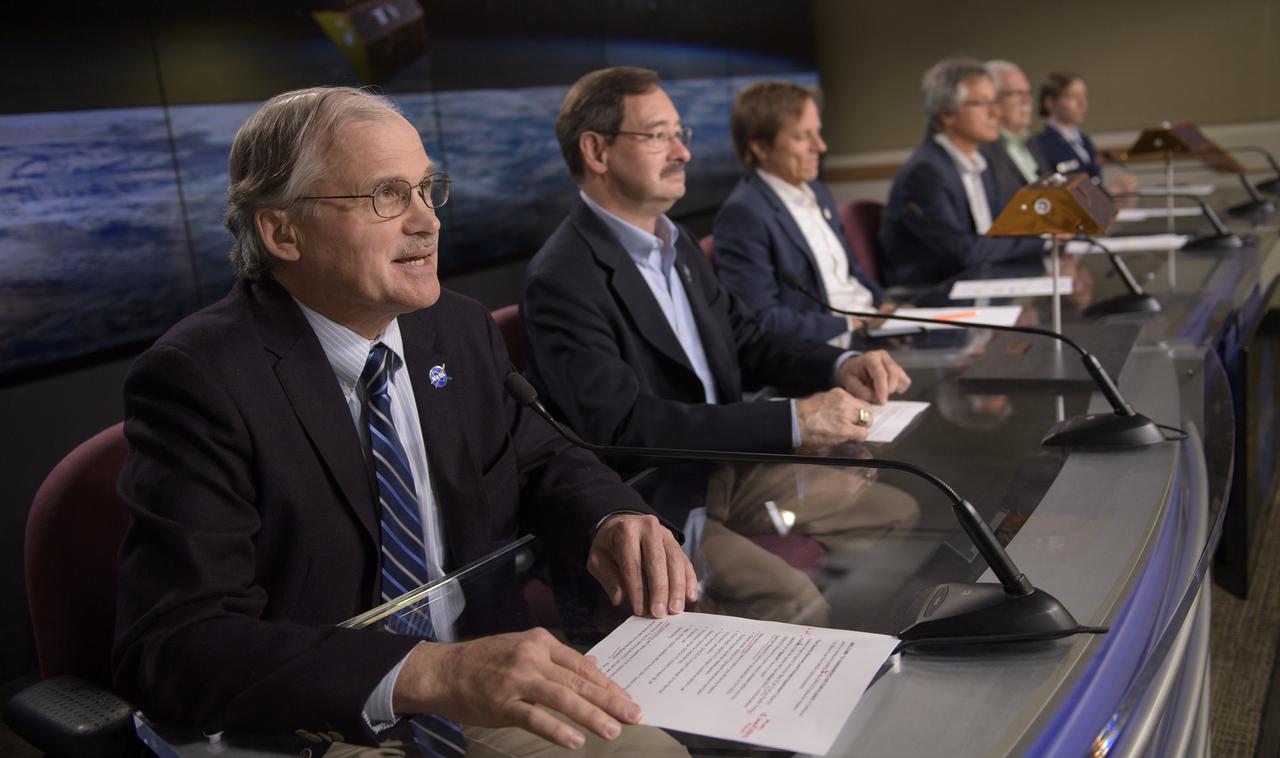
NASA Headquarters Public Affairs Officer Steve Cole, left, moderates the Gravity Recovery and Climate Experiment Follow-On (GRACE-FO) mission prelaunch media briefing with David Jarrett, GRACE-FO program executive in the Earth Science Division at NASA Headquarters; Frank Webb, GRACE-FO project scientist at JPL; Frank Flechtner, GRACE-FO project manager for the German Research Centre for Geosciences (GFZ) in Potsdam, Germany; Phil Morton, NASA GRACE-FO project manager at JPL; and Capt. Jennifer Haden, weather officer, 30th Space Wing, Vandenberg Air Force Base, right, Monday, May 21, 2018, at Vandenberg Air Force Base in California. The twin GRACE-FO spacecraft will measure changes in how mass is redistributed within and among Earth's atmosphere, oceans, land and ice sheets, as well as within Earth itself. Photo Credit: (NASA/Bill Ingalls)
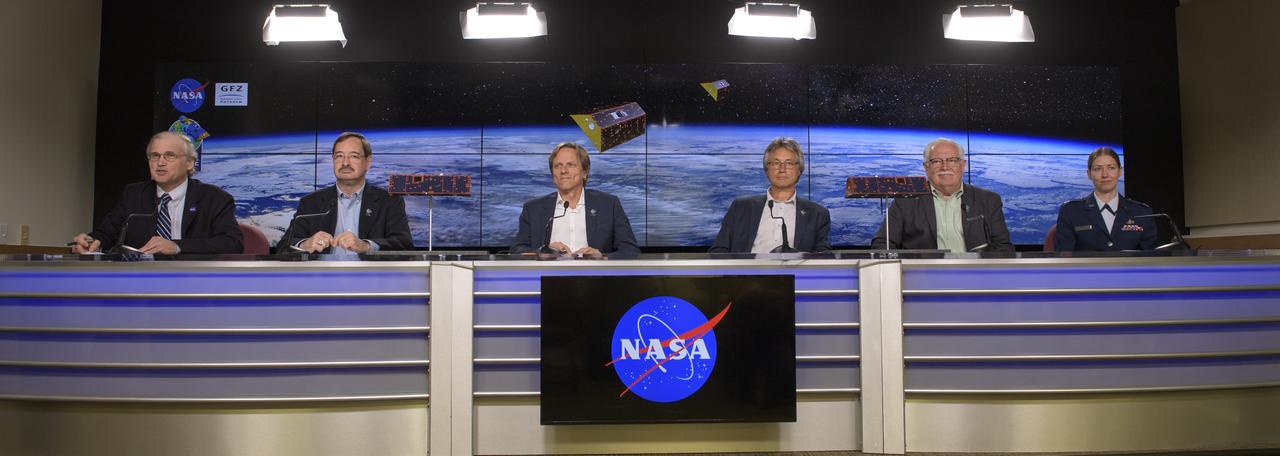
NASA Headquarters Public Affairs Officer Steve Cole, left, moderates the Gravity Recovery and Climate Experiment Follow-On (GRACE-FO) mission prelaunch media briefing with David Jarrett, GRACE-FO program executive in the Earth Science Division at NASA Headquarters; Frank Webb, GRACE-FO project scientist at JPL; Frank Flechtner, GRACE-FO project manager for the German Research Centre for Geosciences (GFZ) in Potsdam, Germany; Phil Morton, NASA GRACE-FO project manager at JPL; and Capt. Jennifer Haden, weather officer, 30th Space Wing, Vandenberg Air Force Base, right, Monday, May 21, 2018, at Vandenberg Air Force Base in California. The twin GRACE-FO spacecraft will measure changes in how mass is redistributed within and among Earth's atmosphere, oceans, land and ice sheets, as well as within Earth itself. Photo Credit: (NASA/Bill Ingalls)
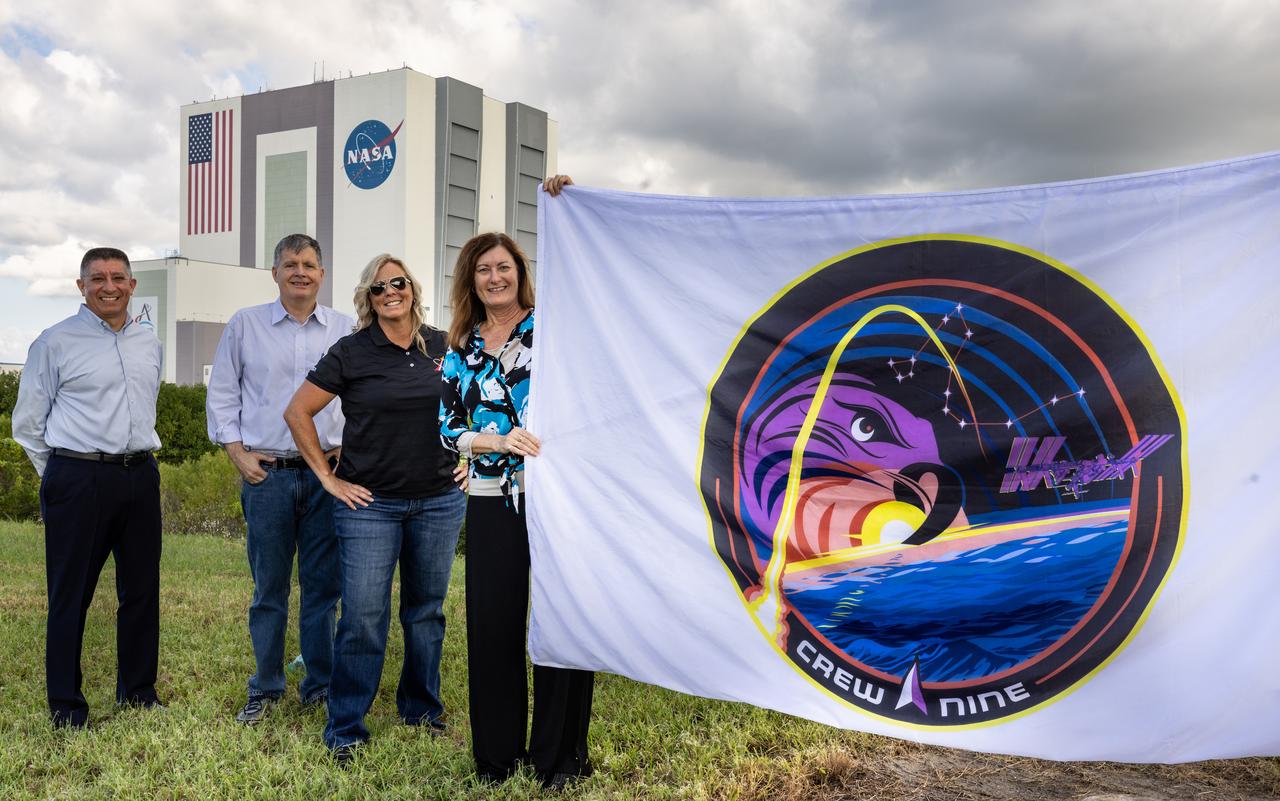
From left, Richard Jones, CCP (Commercial Crew Program) deputy program manager at NASA’s Johnson Space Center in Houston; Steve Stich, program manager for CCP; Dana Hutcherson, CCP deputy program manager at NASA’s Kennedy Space Center in Florida; and Deb Cole, CCP technical manager, pose with the agency’s SpaceX Crew-9 mission flag near the countdown clock at the NASA News Center at Kennedy on Tuesday, Sept. 24, 2024. The Crew-9 mission will send NASA astronaut Nick Hague and Roscosmos cosmonaut Aleksandr Gorbunov to the International Space Station aboard SpaceX’s Dragon spacecraft and Falcon 9 rocket.
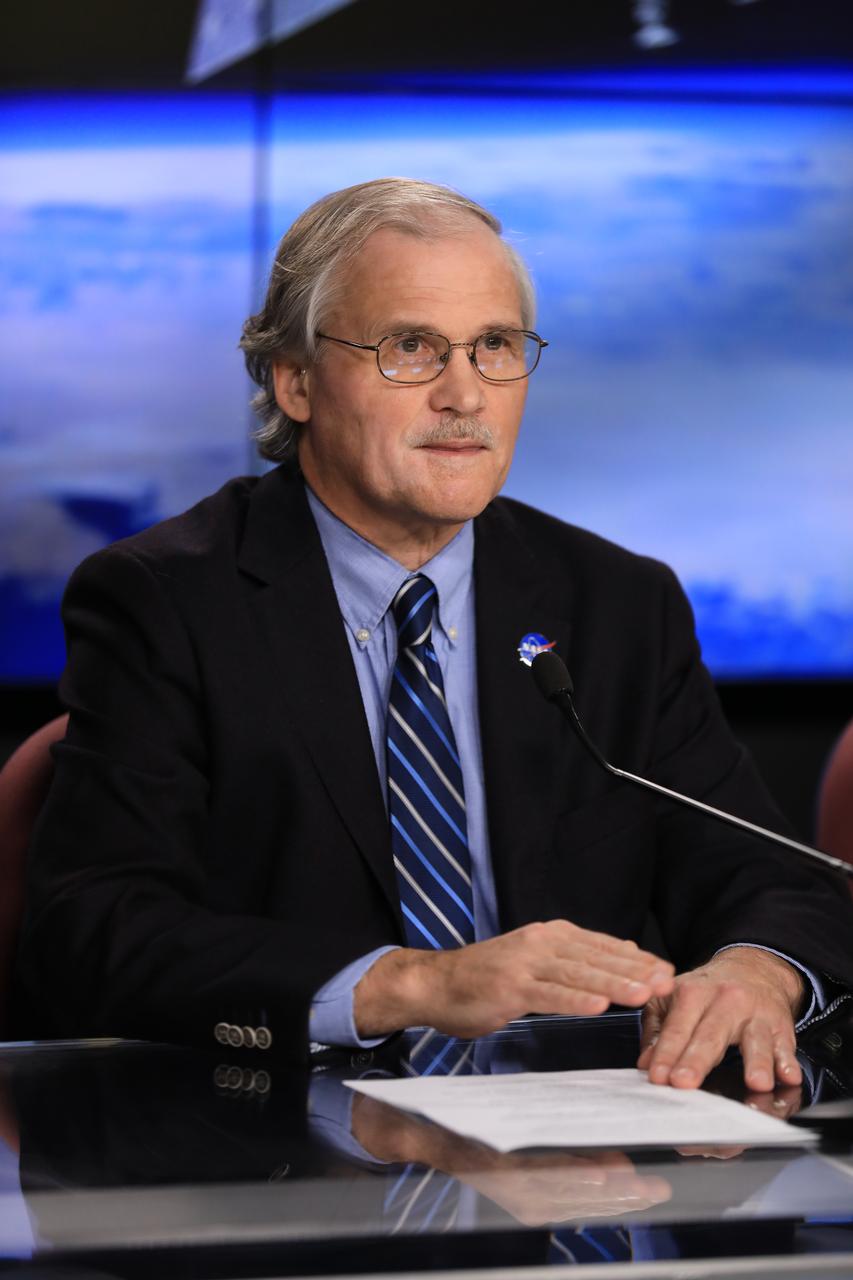
At Vandenberg Air Force Base in California, Steve Cole of NASA Communications, speaks to members of the media during a briefing focused on research planned for the Joint Polar Satellite System-1, or JPSS-1. Built by Ball Aerospace and Technologies Corp. of Boulder, Colorado, JPSS is the first in a series four next-generation environmental satellites in a collaborative program between the NOAA and NASA. Liftoff atop a United Launch Alliance Delta II rocket is scheduled to take place from Vandenberg's Space Launch Complex 2 at 1:47 a.m. PST (4:47 a.m. EST), on Nov. 14, 2017.
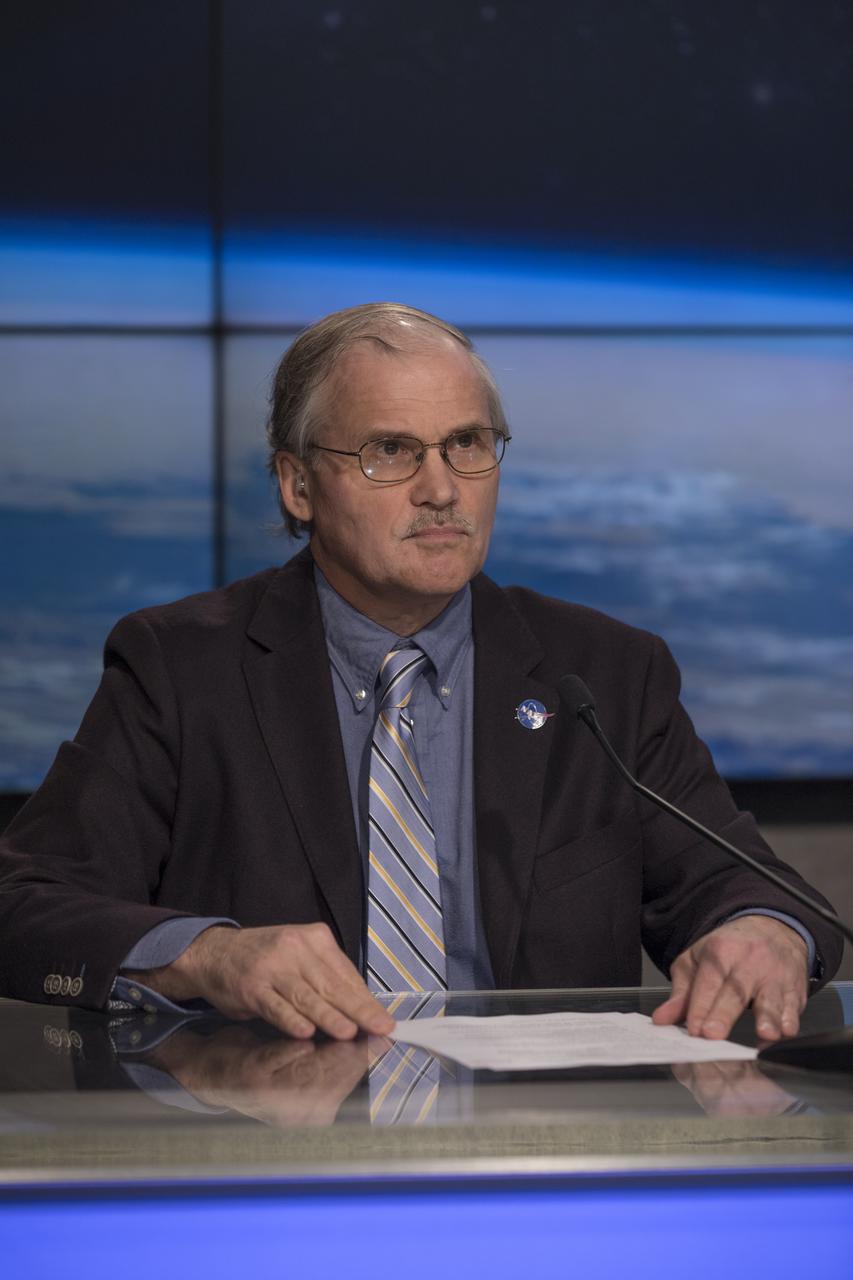
In the Kennedy Space Center's Press Site auditorium, Steve Cole of NASA Communications speaks to members of the media at a mission briefing on National Oceanic and Atmospheric Administration's, or NOAA's, Geostationary Operational Environmental Satellite, or GOES-S. The spacecraft is the second satellite in a series of next-generation NOAA weather satellites. It will launch to a geostationary position over the U.S. to provide images of storms and help predict weather forecasts, severe weather outlooks, watches, warnings, lightning conditions and longer-term forecasting. GOES-S is slated to lift off at 5:02 p.m. EST on March 1, 2018 aboard a United Launch Alliance Atlas V rocket.
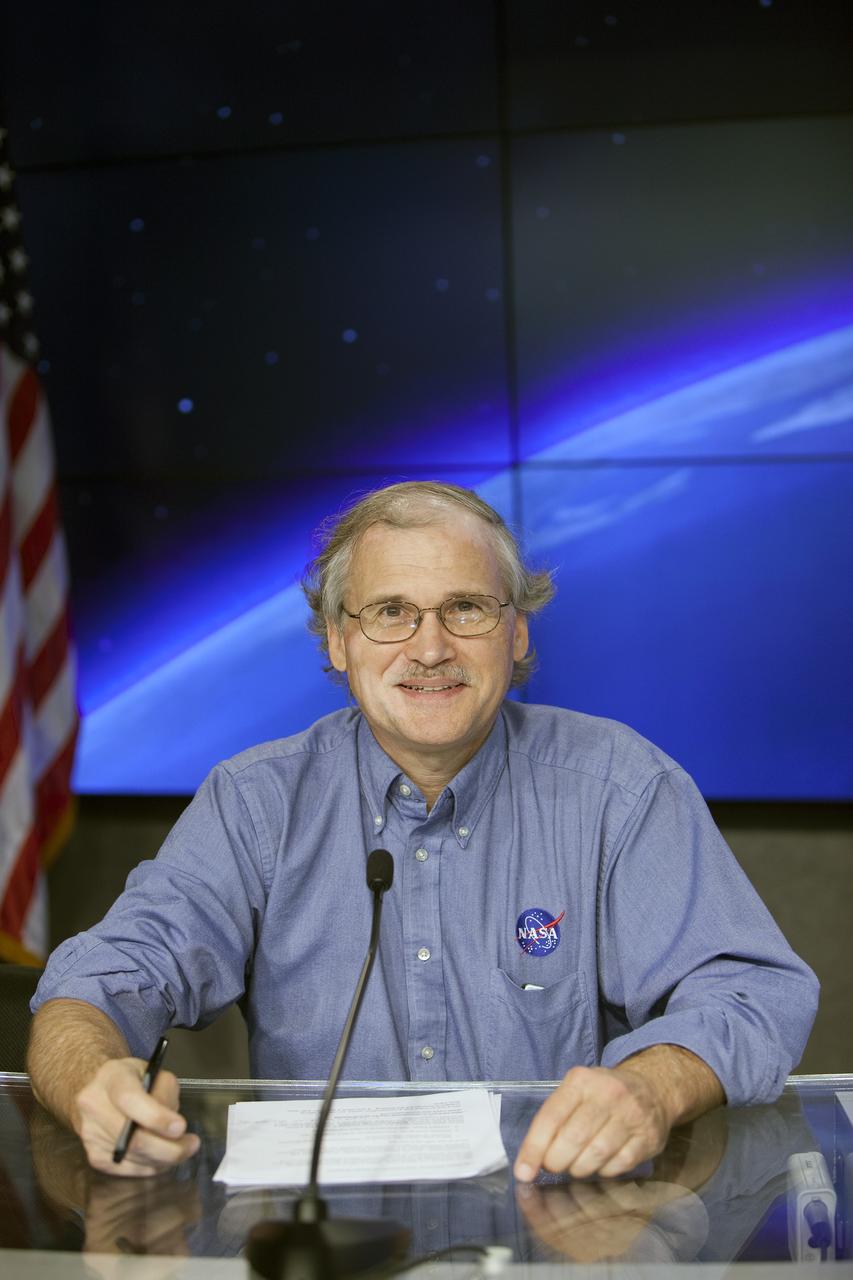
CAPE CANAVERAL, Fla. – Steve Cole, NASA Public Affairs, moderates the ISS Earth Science: Tracking Ocean Winds Panel briefing for media representatives in Kennedy Space Center’s Press Site auditorium in preparation for the launch of the SpaceX CRS-4 mission to resupply the International Space Station. The mission is the fourth of 12 SpaceX flights NASA contracted with the company to resupply the space station. It will be the fifth trip by a Dragon spacecraft to the orbiting laboratory. The spacecraft’s 2.5 tons of supplies, science experiments, and technology demonstrations include critical materials to support 255 science and research investigations that will occur during the station's Expeditions 41 and 42. Liftoff is targeted for an instantaneous window at 2:14 a.m. EDT. To learn more about the mission, visit http://www.nasa.gov/mission_pages/station/structure/launch/index.html. Photo credit: NASA/Jim Grossmann
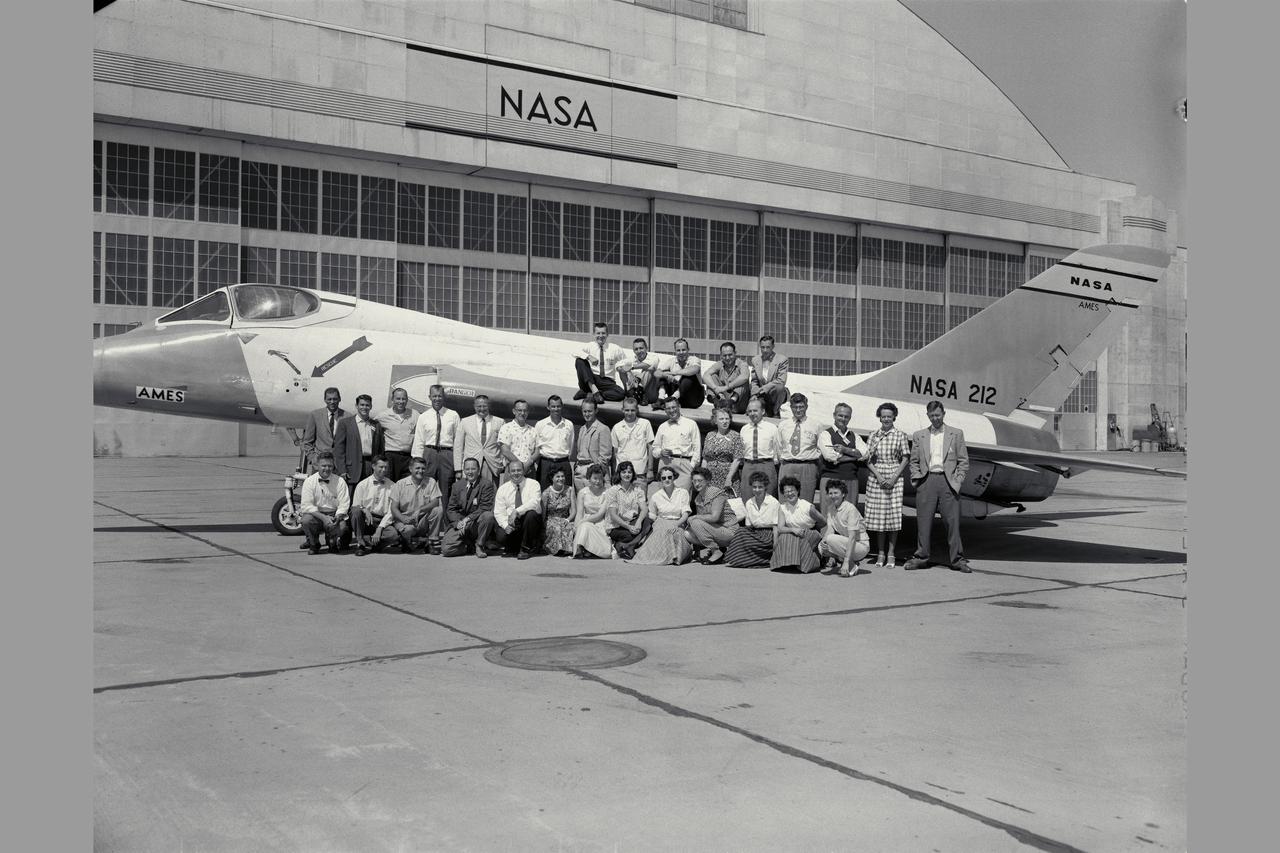
FLIGHT RESEARCH BRANCH PERSONNEL-1959. FRONT ROW: George Rathert, Stu Brown, Norm McFadden, Howard Turner, Gus Brunner, Venia McCloud, Violet Shaw, Kay Rizzi, Yvonne Settle, Genevieve Ziegler, Anita Palmer, Grace Carpenter, Evelyn Olson. SECOND ROW: Bill Triplett, Alan Faye, Dick Bray, Seth Anderson, Steve Belsley, Hervey Quigley, Hank Cole, Elwood Stewart, Don Higdon, Maurie White, Dorothea Wilkinson, Dick Vomaske, Stew Rolls, Mel Sadoff, Mary Thompson, Brent Creer. BACK ROW: Ron Gerdes, Joe Douvillier, John Stewart, Rod Wingrove, Walter McNeill. Note: Used in publication in Flight Research at Ames; 57 Years of Development and Validation of Aeronautical Technology NASA SP-1998-3300 fig 89
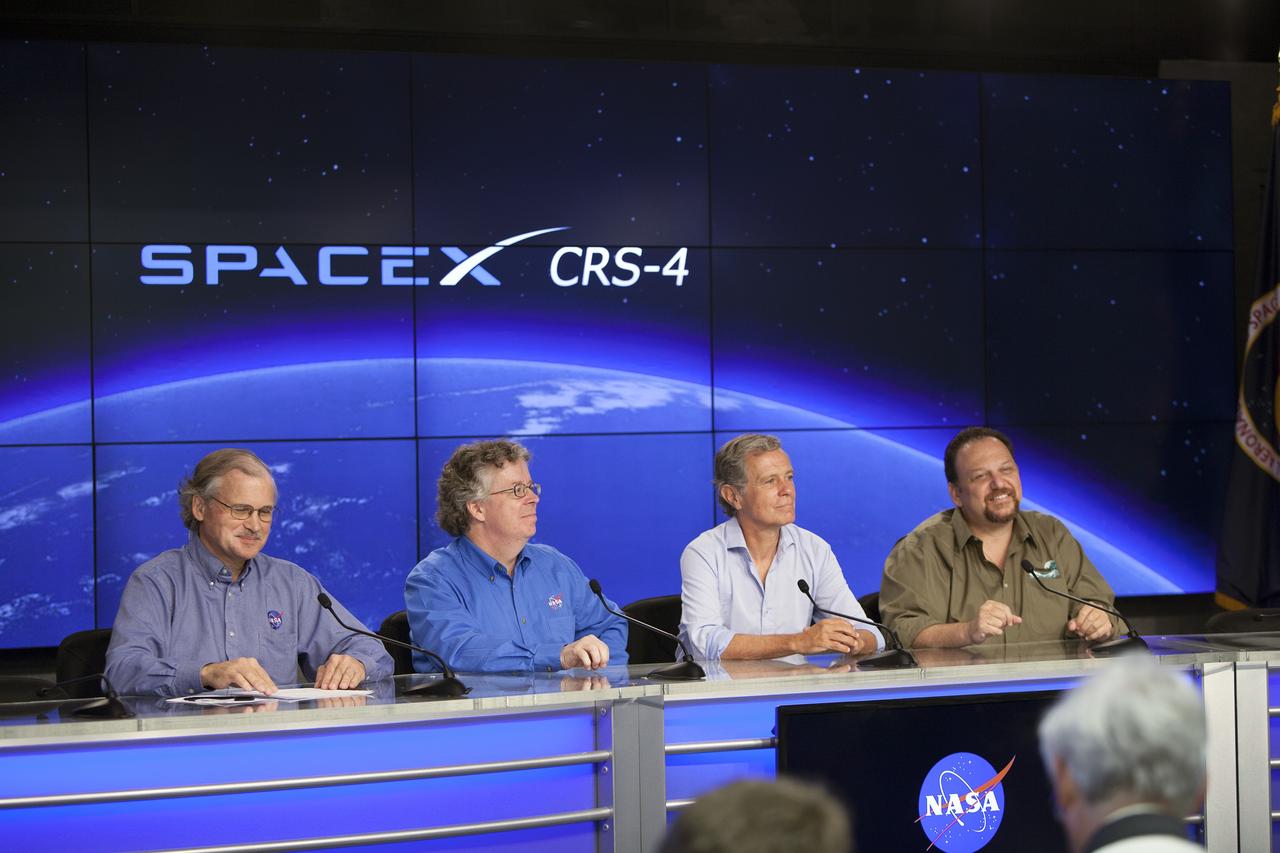
CAPE CANAVERAL, Fla. – Members of an ISS Earth Science: Tracking Ocean Winds Panel brief media representatives in Kennedy Space Center’s Press Site auditorium in preparation for the launch of the SpaceX CRS-4 mission to resupply the International Space Station. From left are Steve Cole, NASA Public Affairs, Steve Volz, associate director for flight programs, Earth Science Division, Science Mission Directorate, NASA Headquarters, Ernesto Rodriquez, ISS RapidScat project scientist, NASA Jet Propulsion Laboratory or JPL, and Howard Eisen, ISS RapidScat project manager, JPL. The mission is the fourth of 12 SpaceX flights NASA contracted with the company to resupply the space station. It will be the fifth trip by a Dragon spacecraft to the orbiting laboratory. The spacecraft’s 2.5 tons of supplies, science experiments, and technology demonstrations include critical materials to support 255 science and research investigations that will occur during the station's Expeditions 41 and 42. Liftoff is targeted for an instantaneous window at 2:14 a.m. EDT. To learn more about the mission, visit http://www.nasa.gov/mission_pages/station/structure/launch/index.html. Photo credit: NASA/Jim Grossmann
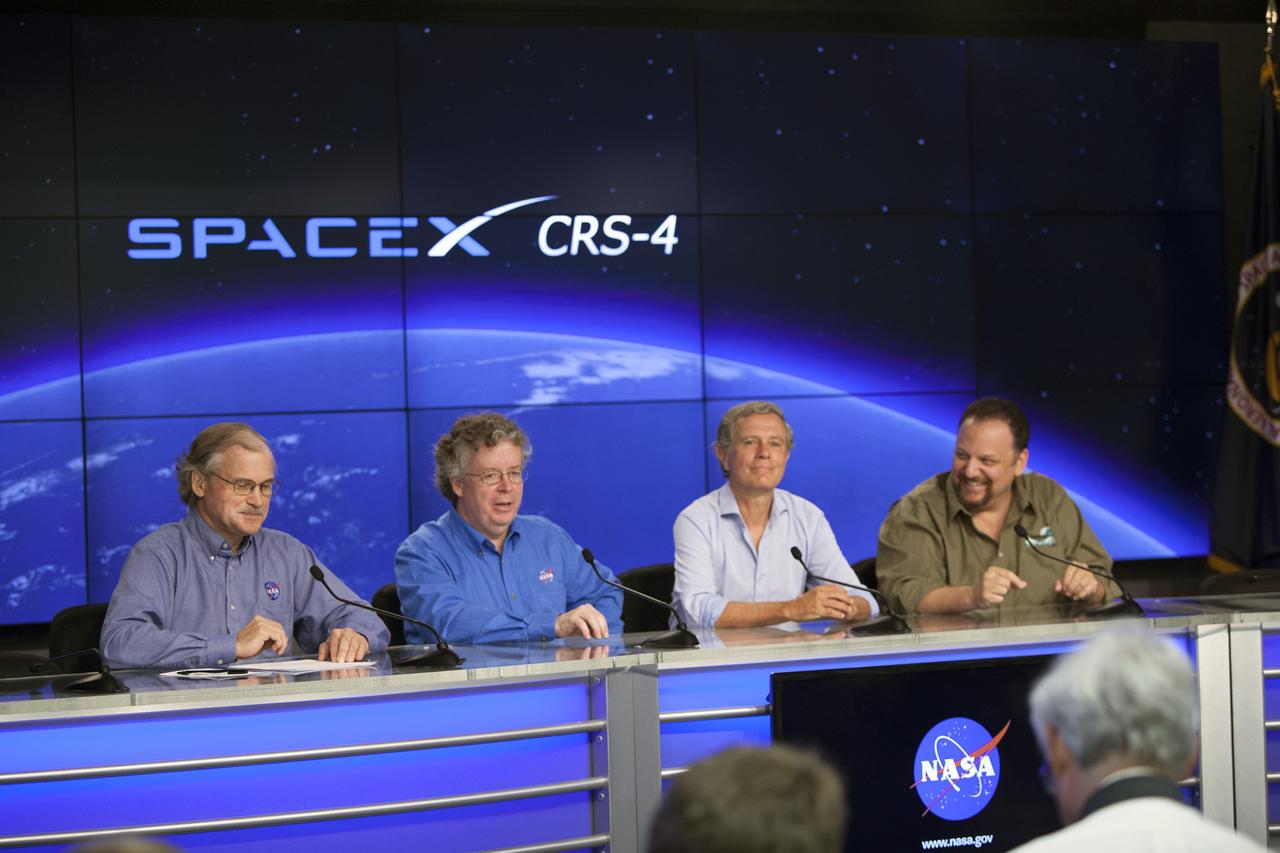
CAPE CANAVERAL, Fla. – Members of an ISS Earth Science: Tracking Ocean Winds Panel brief media representatives in Kennedy Space Center’s Press Site auditorium in preparation for the launch of the SpaceX CRS-4 mission to resupply the International Space Station. From left are Steve Cole, NASA Public Affairs, Steve Volz, associate director for flight programs, Earth Science Division, Science Mission Directorate, NASA Headquarters, Ernesto Rodriquez, ISS RapidScat project scientist, NASA Jet Propulsion Laboratory or JPL, and Howard Eisen, ISS RapidScat project manager, JPL. The mission is the fourth of 12 SpaceX flights NASA contracted with the company to resupply the space station. It will be the fifth trip by a Dragon spacecraft to the orbiting laboratory. The spacecraft’s 2.5 tons of supplies, science experiments, and technology demonstrations include critical materials to support 255 science and research investigations that will occur during the station's Expeditions 41 and 42. Liftoff is targeted for an instantaneous window at 2:14 a.m. EDT. To learn more about the mission, visit http://www.nasa.gov/mission_pages/station/structure/launch/index.html. Photo credit: NASA/Jim Grossmann
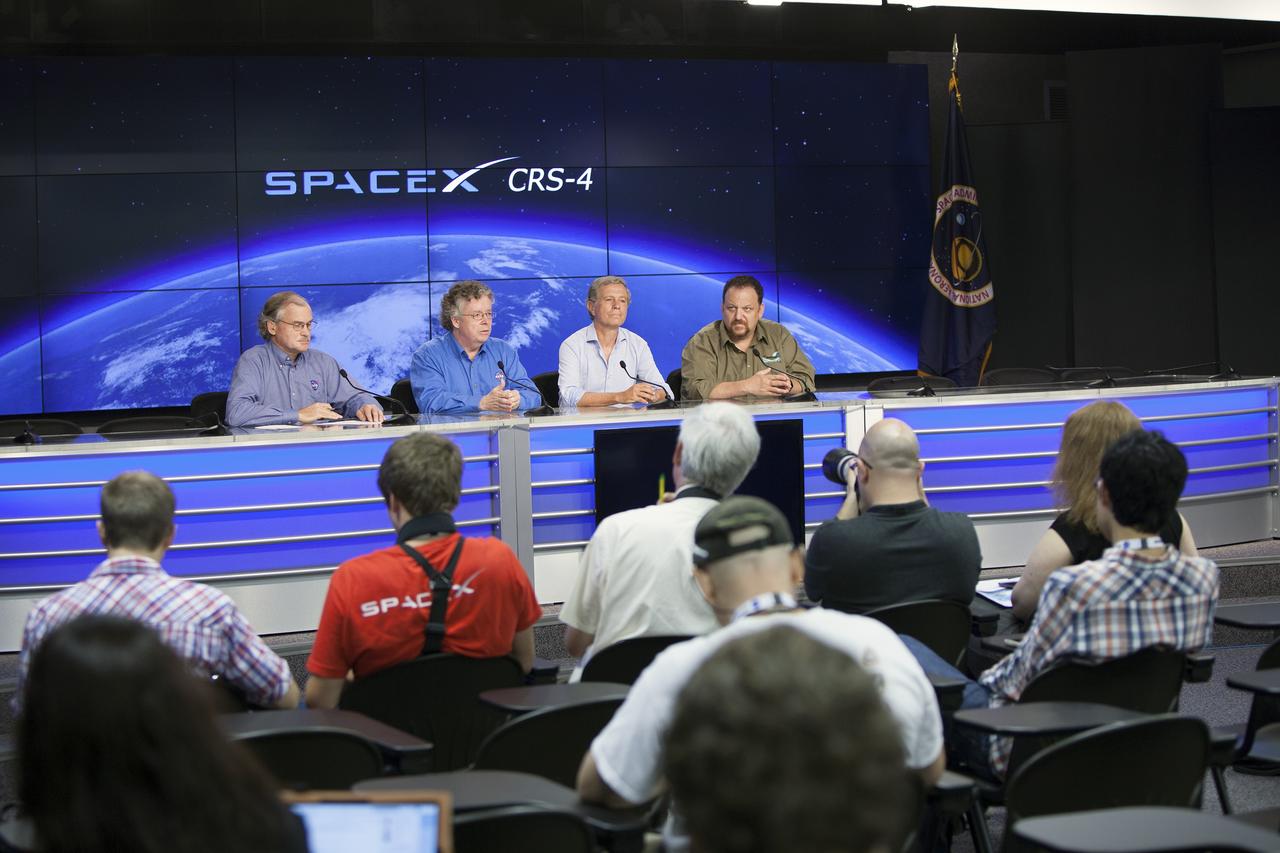
CAPE CANAVERAL, Fla. – Media representatives ask questions of the ISS Earth Science: Tracking Ocean Winds Panel in Kennedy Space Center’s Press Site auditorium in preparation for the launch of the SpaceX CRS-4 mission to resupply the International Space Station. On the dais from left are Steve Cole, NASA Public Affairs, Steve Volz, associate director for flight programs, Earth Science Division, Science Mission Directorate, NASA Headquarters, Ernesto Rodriquez, ISS RapidScat project scientist, NASA Jet Propulsion Laboratory or JPL, and Howard Eisen, ISS RapidScat project manager, JPL. The mission is the fourth of 12 SpaceX flights NASA contracted with the company to resupply the space station. It will be the fifth trip by a Dragon spacecraft to the orbiting laboratory. The spacecraft’s 2.5 tons of supplies, science experiments, and technology demonstrations include critical materials to support 255 science and research investigations that will occur during the station's Expeditions 41 and 42. Liftoff is targeted for an instantaneous window at 2:14 a.m. EDT. To learn more about the mission, visit http://www.nasa.gov/mission_pages/station/structure/launch/index.html. Photo credit: NASA/Jim Grossmann
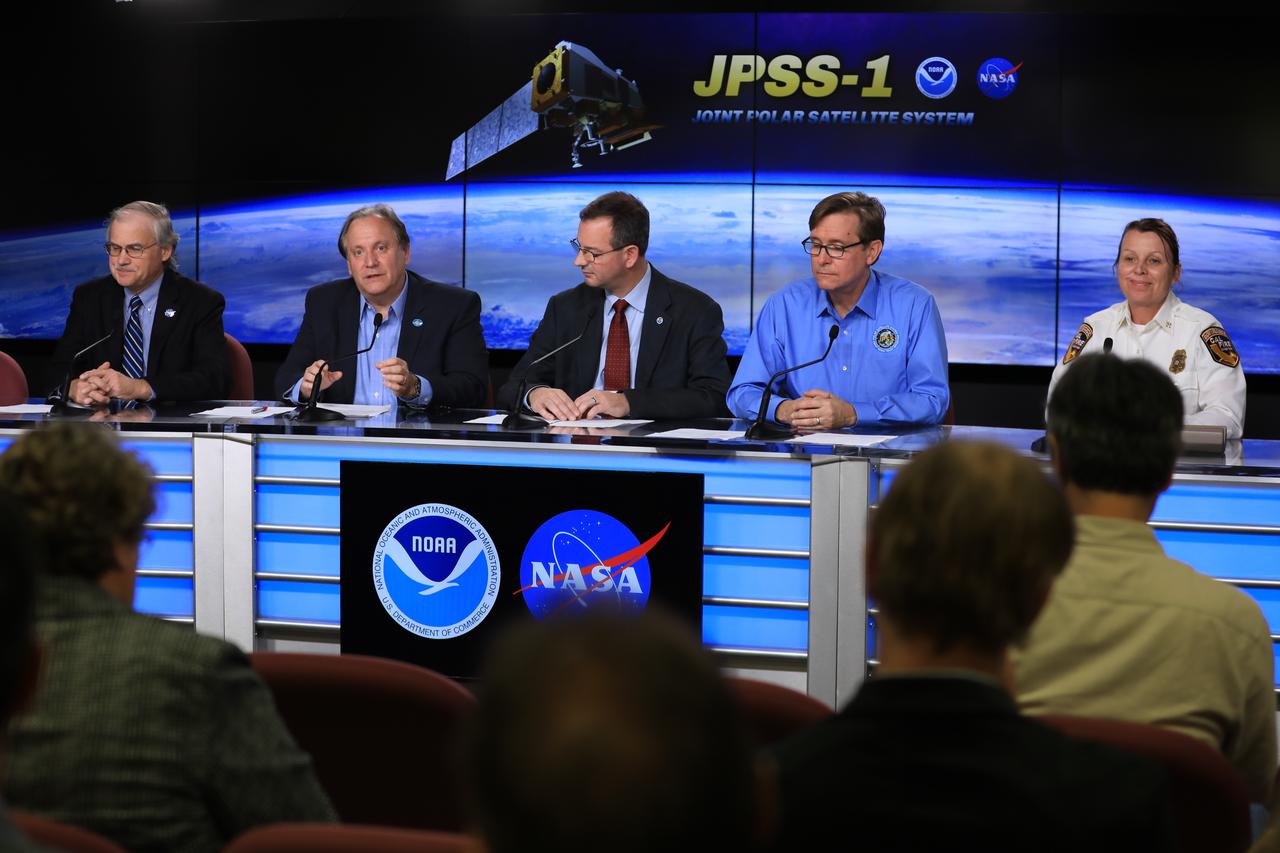
At Vandenberg Air Force Base in California, leaders from NASA, NOAA and the California Department of Forestry and Fire Protection speak to members of the media during a briefing focused on research planned for the Joint Polar Satellite System-1, or JPSS-1. Participants from left are Steve Cole of NASA Communications, Mitch Goldberg, NOAA's chief program scientist for the Joint Polar Satellite System, Joe Pica, director of NOAA’s National Weather Service Office of Observations, James Gleason, NASA senior project scientist for the Joint Polar Satellite System, and Jana Luis, division chief Predictive Services at the California Department of Forestry and Fire Protection. Built by Ball Aerospace and Technologies Corp. of Boulder, Colorado, JPSS is the first in a series four next-generation environmental satellites in a collaborative program between the NOAA and NASA. Liftoff atop a United Launch Alliance Delta II rocket is scheduled to take place from Vandenberg's Space Launch Complex 2 at 1:47 a.m. PST (4:47 a.m. EST), on Nov. 14, 2017.
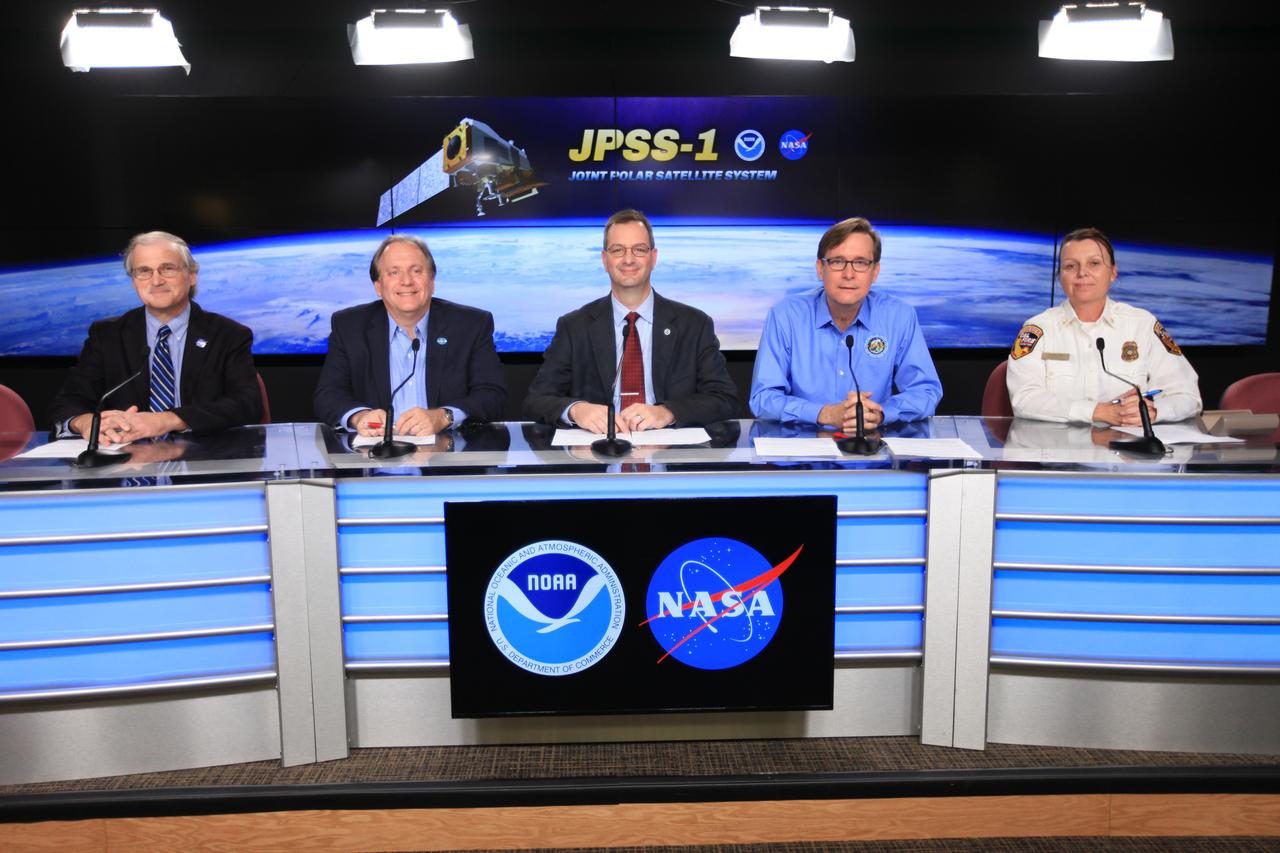
At Vandenberg Air Force Base in California, leaders from NASA, NOAA and the California Department of Forestry and Fire Protection speak to members of the media during a briefing focused on research planned for the Joint Polar Satellite System-1, or JPSS-1. Participants from left are Steve Cole of NASA Communications, Mitch Goldberg, NOAA's chief program scientist for the Joint Polar Satellite System, Joe Pica, director of NOAA’s National Weather Service Office of Observations, James Gleason, NASA senior project scientist for the Joint Polar Satellite System, and Jana Luis, division chief Predictive Services at the California Department of Forestry and Fire Protection. Built by Ball Aerospace and Technologies Corp. of Boulder, Colorado, JPSS is the first in a series four next-generation environmental satellites in a collaborative program between the NOAA and NASA. Liftoff atop a United Launch Alliance Delta II rocket is scheduled to take place from Vandenberg's Space Launch Complex 2 at 1:47 a.m. PST (4:47 a.m. EST), on Nov. 14, 2017.

At Vandenberg Air Force Base in California, leaders from NASA, NOAA and the California Department of Forestry and Fire Protection speak to members of the media during a briefing focused on research planned for the Joint Polar Satellite System-1, or JPSS-1. Participants from left are Steve Cole of NASA Communications, Mitch Goldberg, NOAA's chief program scientist for the Joint Polar Satellite System, Joe Pica, director of NOAA’s National Weather Service Office of Observations, James Gleason, NASA senior project scientist for the Joint Polar Satellite System, and Jana Luis, division chief Predictive Services at the California Department of Forestry and Fire Protection. Built by Ball Aerospace and Technologies Corp. of Boulder, Colorado, JPSS is the first in a series four next-generation environmental satellites in a collaborative program between the NOAA and NASA. Liftoff atop a United Launch Alliance Delta II rocket is scheduled to take place from Vandenberg's Space Launch Complex 2 at 1:47 a.m. PST (4:47 a.m. EST), on Nov. 14, 2017.
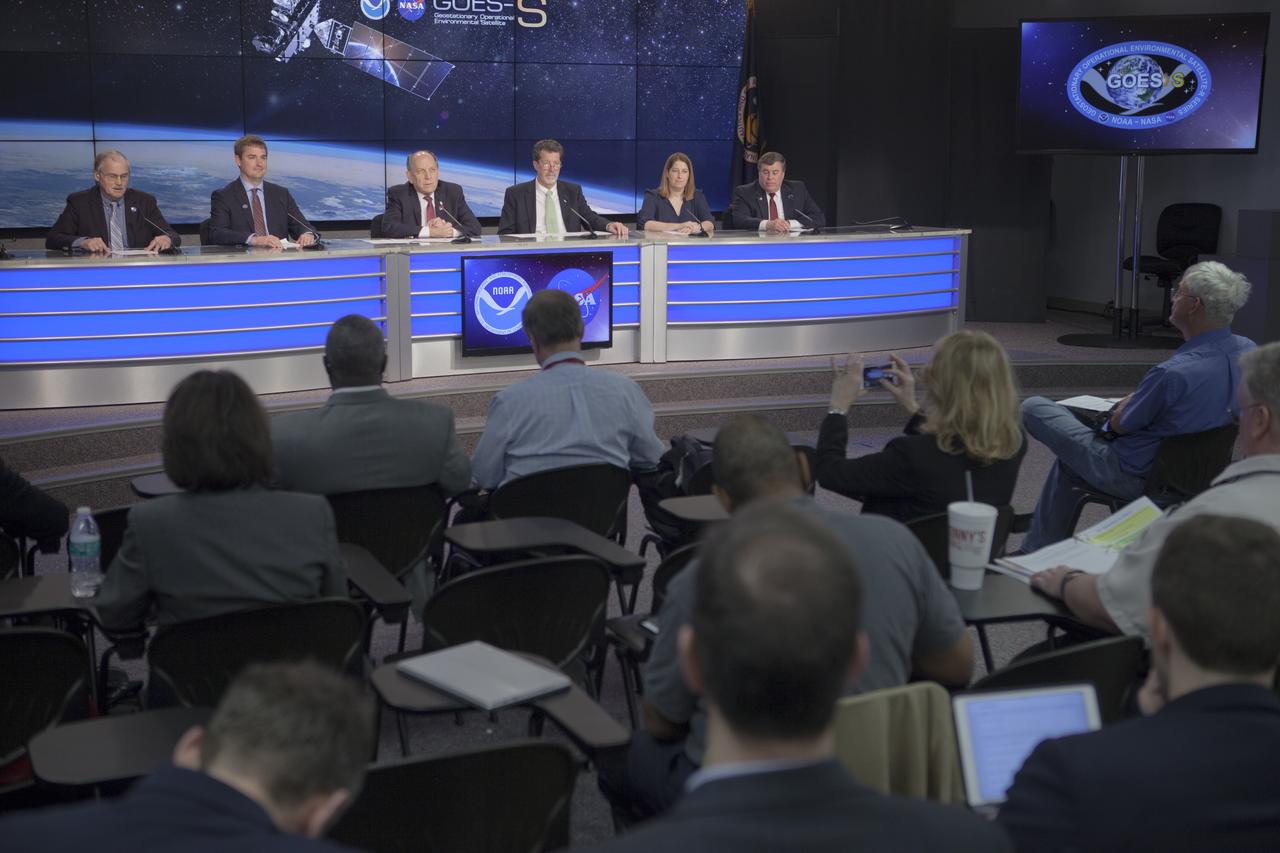
In the Kennedy Space Center's Press Site auditorium, members of the media participate in a mission briefing on National Oceanic and Atmospheric Administration's, or NOAA's, Geostationary Operational Environmental Satellite, or GOES-S. Briefing participants from left are: Steve Cole of NASA Communications; Dan Lindsey, GOES-R senior scientific advisor for NOAA; Louis Uccellini, director of the National Weather Service for NOAA; Jim Roberts, a scientist with the Earth System Research Laboratory's Office of Atmospheric Research for NOAA; Kristin Calhoun, a research scientist with NOAA's National Severe Storms Laboratory, and George Morrow, deputy director of NASA's Goddard Space Flight Center in Greenbelt, Maryland. GOES-S is the second satellite in a series of next-generation NOAA weather satellites. It will launch to a geostationary position over the U.S. to provide images of storms and help predict weather forecasts, severe weather outlooks, watches, warnings, lightning conditions and longer-term forecasting. GOES-S is slated to lift off at 5:02 p.m. EST on March 1, 2018 aboard a United Launch Alliance Atlas V rocket.
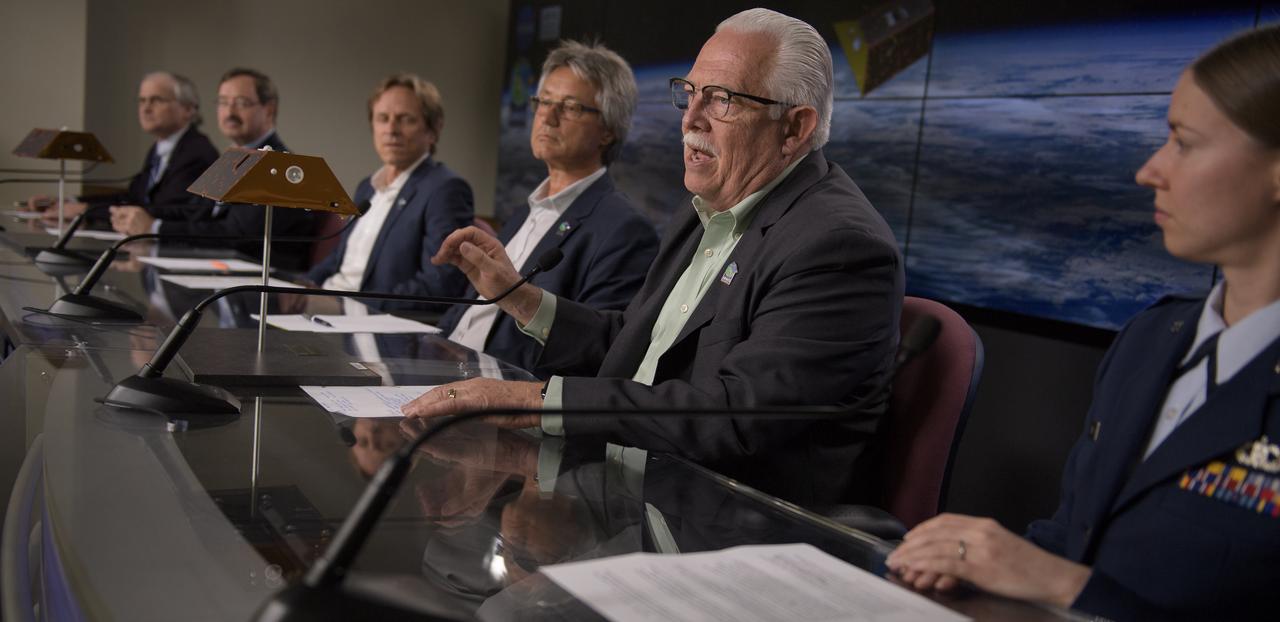
Phil Morton, NASA GRACE-FO project manager at JPL, second from right, discusses the Gravity Recovery and Climate Experiment Follow-On (GRACE-FO) mission during a prelaunch media briefing, Monday, May 21, 2018, at Vandenberg Air Force Base in California. The twin GRACE-FO spacecraft will measure changes in how mass is redistributed within and among Earth's atmosphere, oceans, land and ice sheets, as well as within Earth itself. Photo Credit: (NASA/Bill Ingalls)