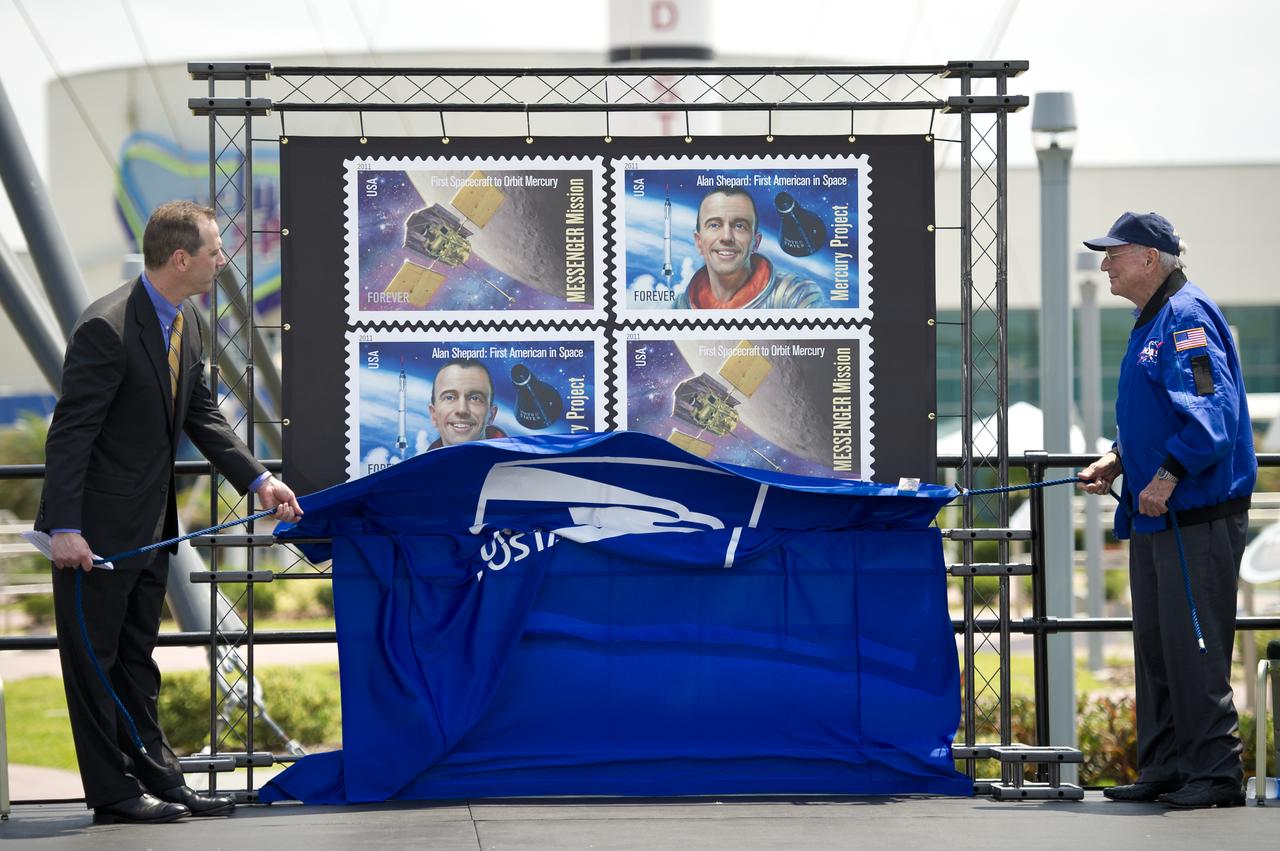
United States Postal Service Vice President of Finance Steve Masse, left, and NASA Mercury Astronaut Scott Carpenter, unveil two USPS stamps to commemorate and celebrate 50 years of US Spaceflight and the MESSENGER program during an event, Wednesday, May 4, 2011 at the NASA Kennedy Space Center in Cape Canaveral, Fla. One stamp commemorates NASA’s Project Mercury, America’s first manned spaceflight program, and NASA astronaut Alan Shepard’s historic flight on May 5, 1961, aboard spacecraft Freedom 7. The other stamp draws attention to NASA’s unmanned MESSENGER mission, a scientific investigation of the planet Mercury. On March 17, 2011, MESSENGER became the first spacecraft to enter into orbit around Mercury. Photo Credit: (NASA/Bill Ingalls)
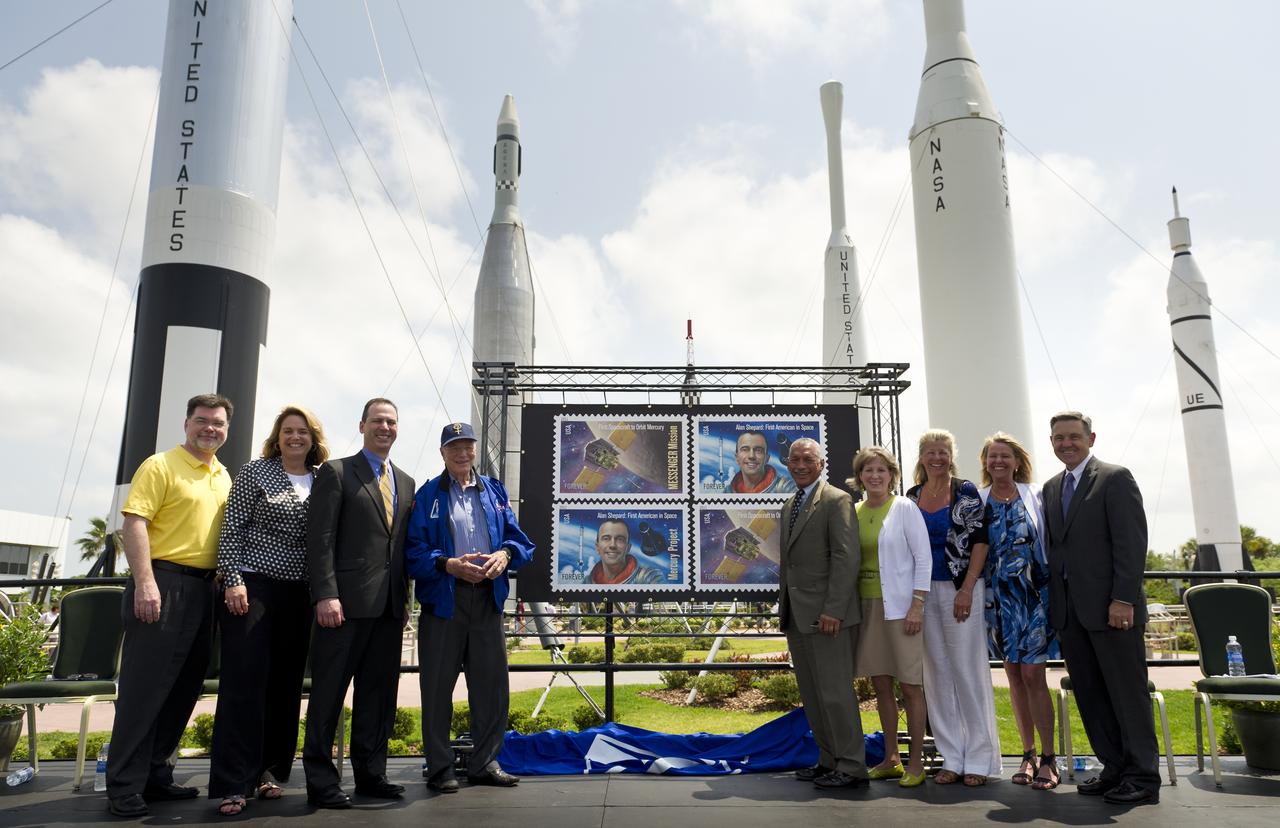
From left, NASA Deputy Director, Planetary Science Division, Science Mission Directorate, Jim Adams, NASA Kennedy Space Center Director of Education and External Relations Cheryl Hurst, United States Postal Service Vice President of Finance Steve Masse, NASA Mercury Astronaut Scott Carpenter, NASA Administrator Charles Boldin, Daughters of NASA astronaut Alan Shepard, Alice Wackermann, Laura Shepard Churchley, and Julie Jenkins, and NASA Kennedy Space Center Director Robert Cabana pose for a photograph during an unveiling ceremony of two USPS stamps that commemorate and celebrate 50 years of US Spaceflight and the MESSENGER program during an event, Wednesday, May 4, 2011 at the NASA Kennedy Space Center in Cape Canaveral, Fla. One stamp commemorates NASA’s Project Mercury, America’s first manned spaceflight program, and NASA astronaut Alan Shepard’s historic flight on May 5, 1961, aboard spacecraft Freedom 7. The other stamp draws attention to NASA’s unmanned MESSENGER mission, a scientific investigation of the planet Mercury. On March 17, 2011, MESSENGER became the first spacecraft to enter into orbit around Mercury. Photo Credit: (NASA/Bill Ingalls)
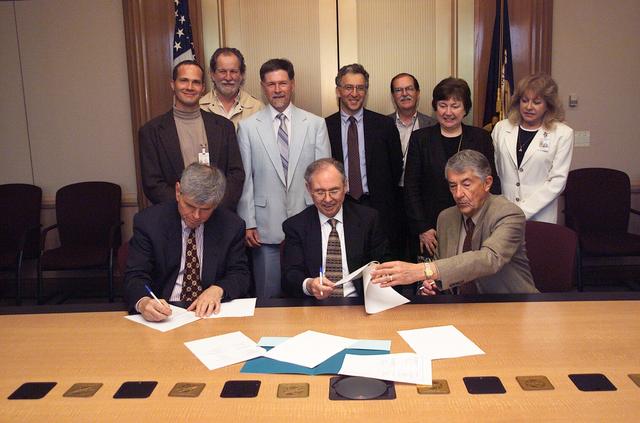
Memorandum of Understanding (MOU) to establish a Unmanned Aerial Vehicles (UAV) Applications Center at NASA Research Park (NRP) was signed into being by (L-R) John Bassett Clark University, Worcester, Mass., Dr. Henry McDonald, Director of Ames Research Center and Paul Coleman, Girvan Institute (a non-profit organization lockated in NASA Research Park). Witnessed by (Back Row, L-R) Steve Douagan, Dave Peterson, Jim Brass, Stan Herwitz, Ken Souza, Estelle Condon, Carolina Blake.
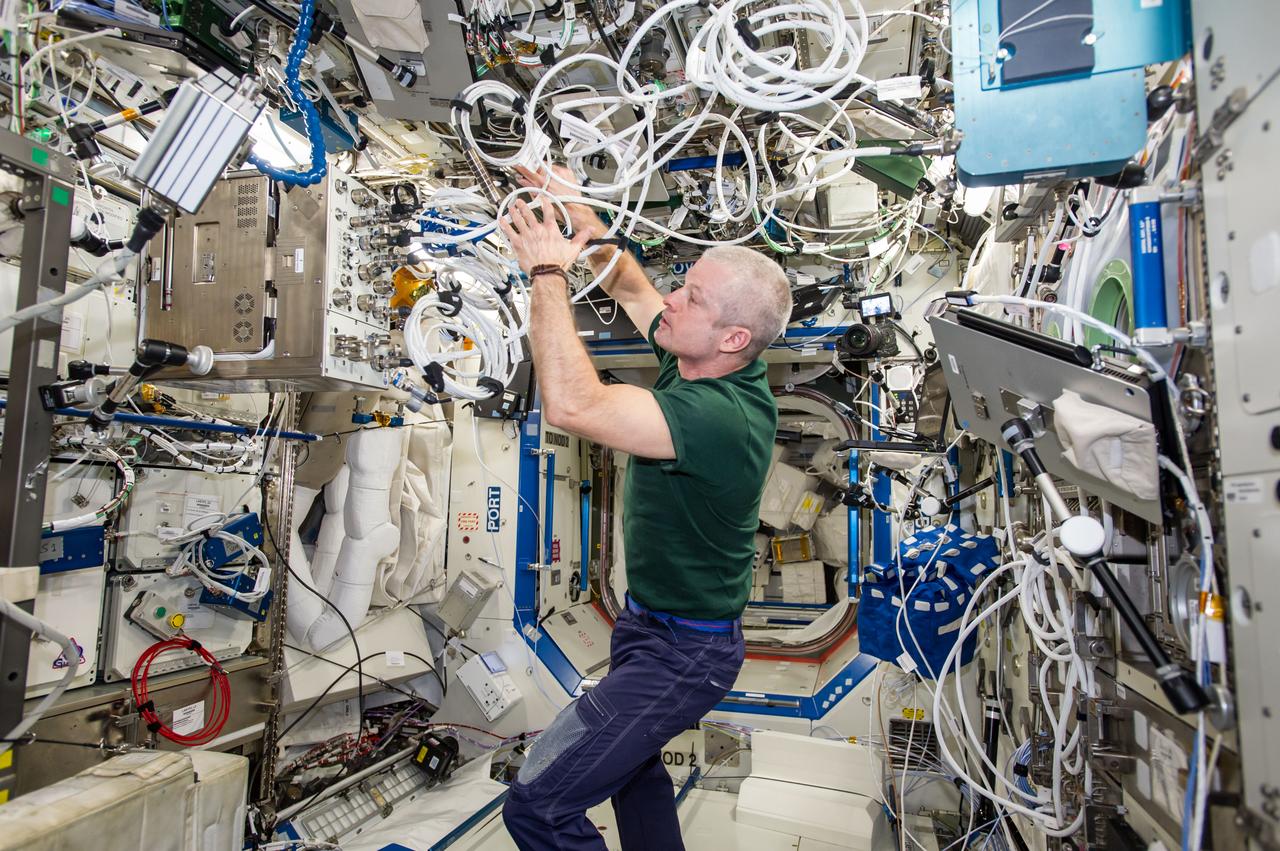
ISS040-E-123262 (2 Sept. 2014) --- NASA astronaut Steve Swanson, Expedition 40 commander, sets up the Portable Pulmonary Function System hardware for Sprint VO2max sessions in the Destiny laboratory of the International Space Station. The Sprint experiment measures the effectiveness of high-intensity, low-volume exercise training in minimizing the loss of muscle mass and bone density that occurs during spaceflight.
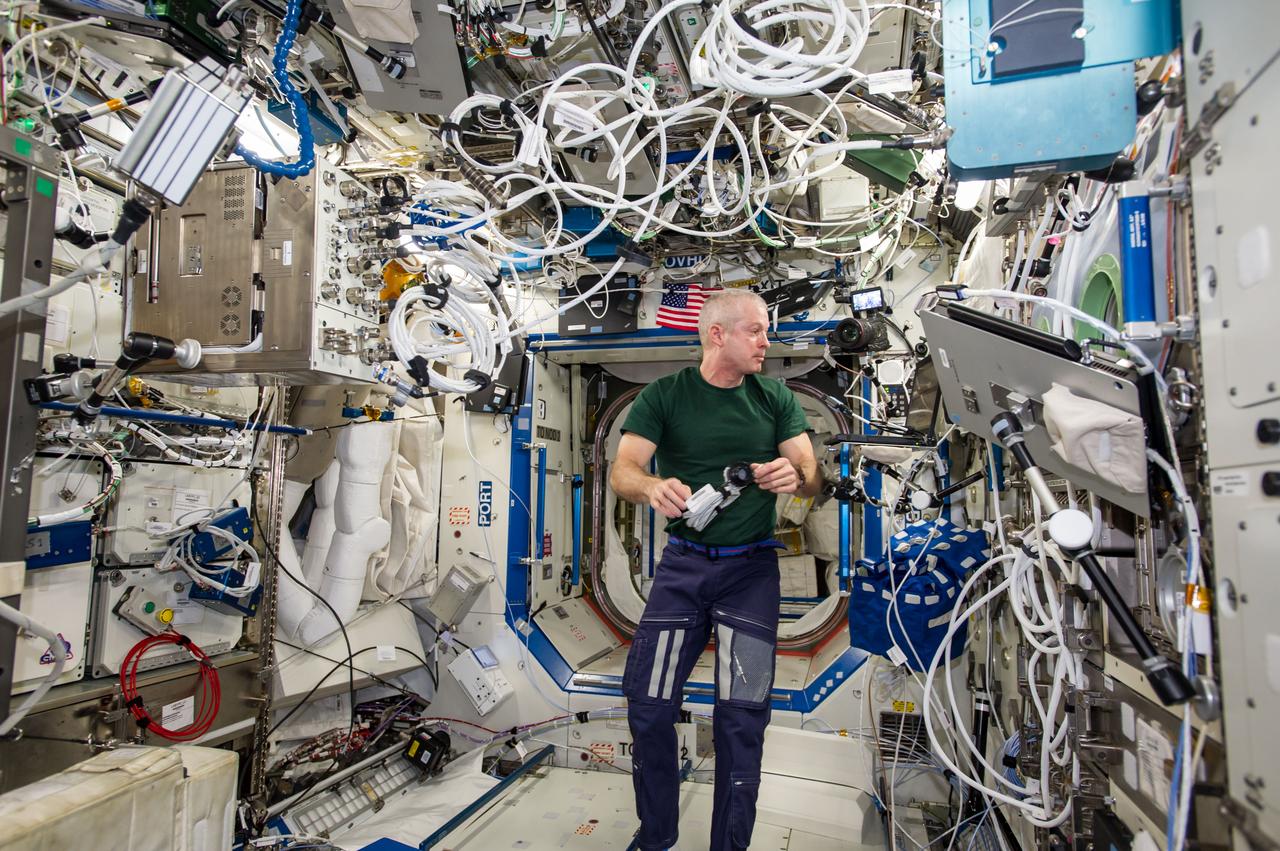
ISS040-E-123259 (2 Sept. 2014) --- NASA astronaut Steve Swanson, Expedition 40 commander, prepares to set up the Portable Pulmonary Function System hardware for Sprint VO2max sessions in the Destiny laboratory of the International Space Station. The Sprint experiment measures the effectiveness of high-intensity, low-volume exercise training in minimizing the loss of muscle mass and bone density that occurs during spaceflight.
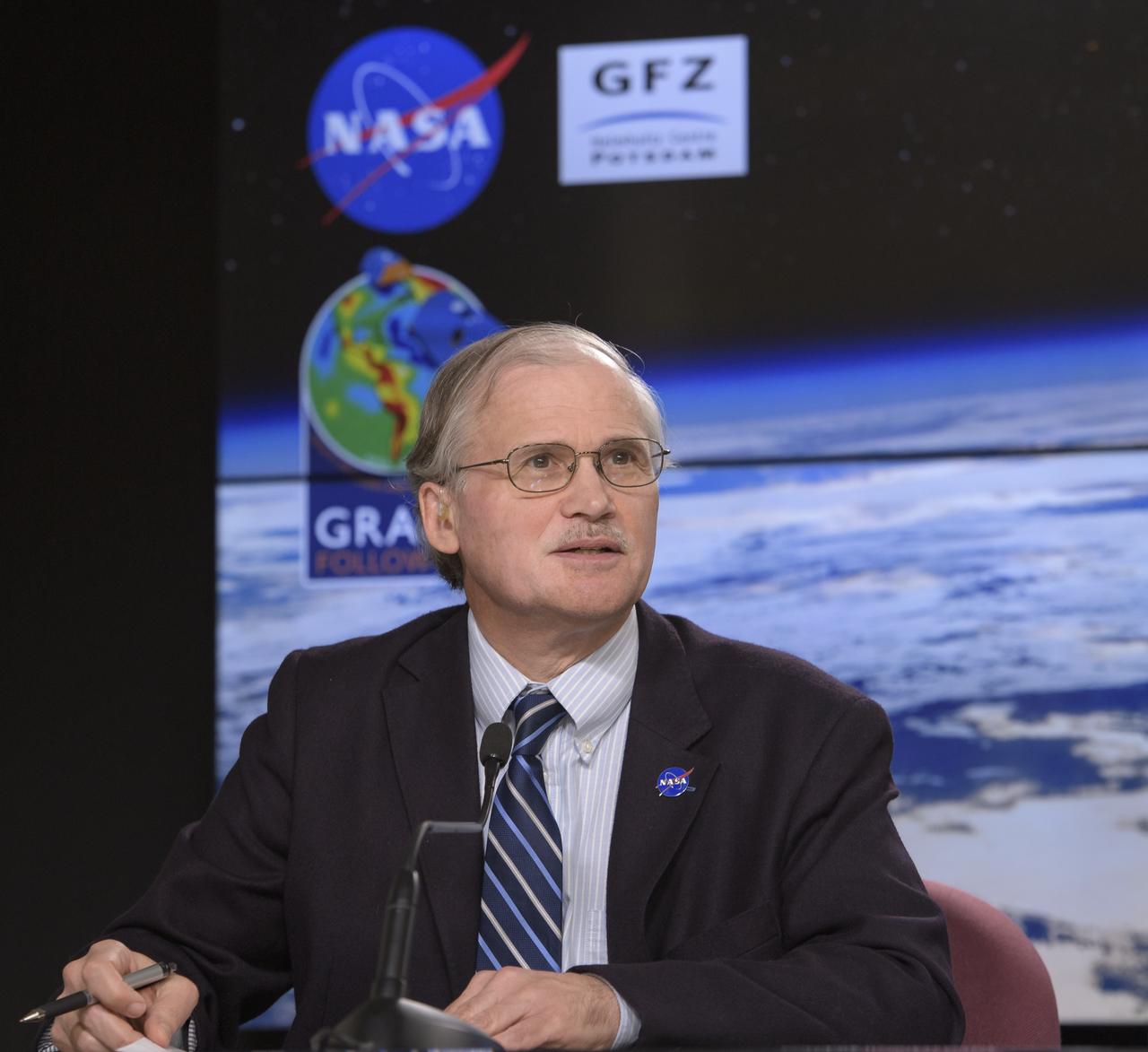
NASA Headquarters Public Affairs Officer Steve Cole moderates a Gravity Recovery and Climate Experiment Follow-On (GRACE-FO) mission prelaunch media briefing, Monday, May 21, 2018, at Vandenberg Air Force Base in California. The twin GRACE-FO spacecraft will measure changes in how mass is redistributed within and among Earth's atmosphere, oceans, land and ice sheets, as well as within Earth itself. Photo Credit: (NASA/Bill Ingalls)
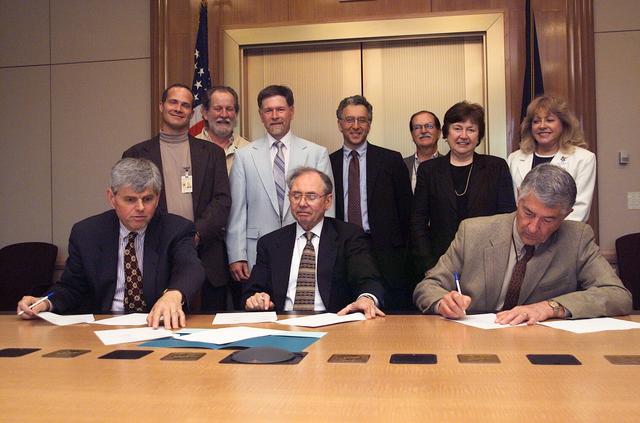
Memorandum of Understanding (MOU) to establish a Unmanned Aerial Vehicles (UAV) Applications Center at NASA Research Park (NRP) was signed into being by (L-R) John Bassett Clark University, Worcester, Mass., Dr. Henry McDonald, Director of Ames Research Center and Paul Coleman, Girvan Institute (a non-profit organization lockated in NASA Research Park). Witnessed by (Back Row, L-R) Steve Douagan, Dave Peterson, Jim Brass, Stan Herwitz, Ken Souza, Estelle Condon, Carolina Blake.

ISS039-E-008066 (30 March 2014) --- NASA astronaut Steve Swanson, Expedition 39 flight engineer, participates in body mass measurement/Russian biomedical routine assessments in the Zvezda Service Module of the International Space Station. Looking on is Russian cosmonaut Alexander Skvortsov, flight engineer representing the Russian Federal Space Agency (Roscosmos).
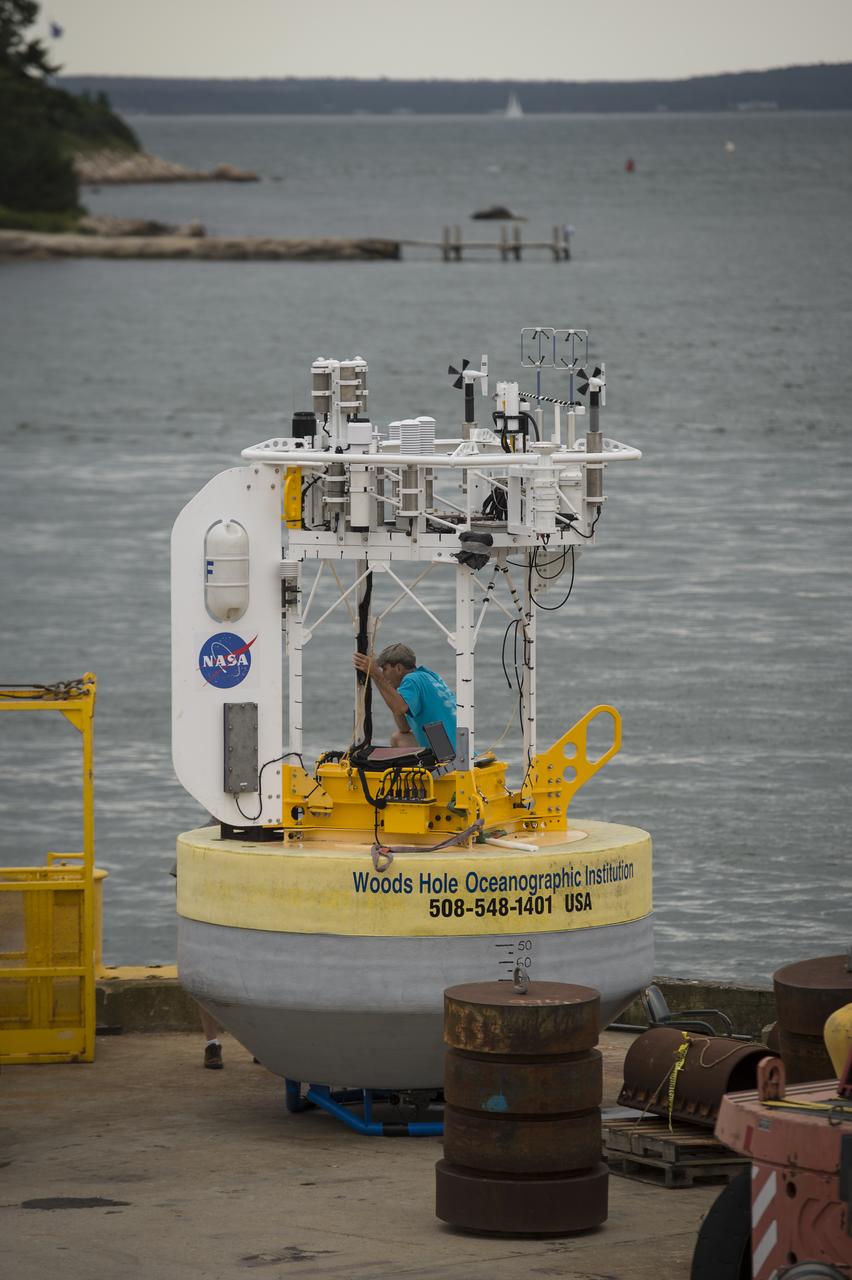
Woods Hole Oceanographic Institution Senior Engineer Steve Faluotico works on the SPURS buoy prior to it being loaded onto the Institute's research vessel Knorr, Tuesday, Sept. 4, 2012, in Woods Hole, Mass. The SPURS buoy will be deployed in the Atlantic Ocean as part of the Salinity Processes in the Upper Ocean Regional Study (SPURS) which is set to sail on Sept. 6. The NASA-sponsored expedition will sail to the North Atlantic's saltiest spot to get a detailed, 3-D picture of how salt content fluctuates in the ocean's upper layers and how these variations are related to shifts in rainfall patterns around the planet. Photo Credit: (NASA/Bill Ingalls)
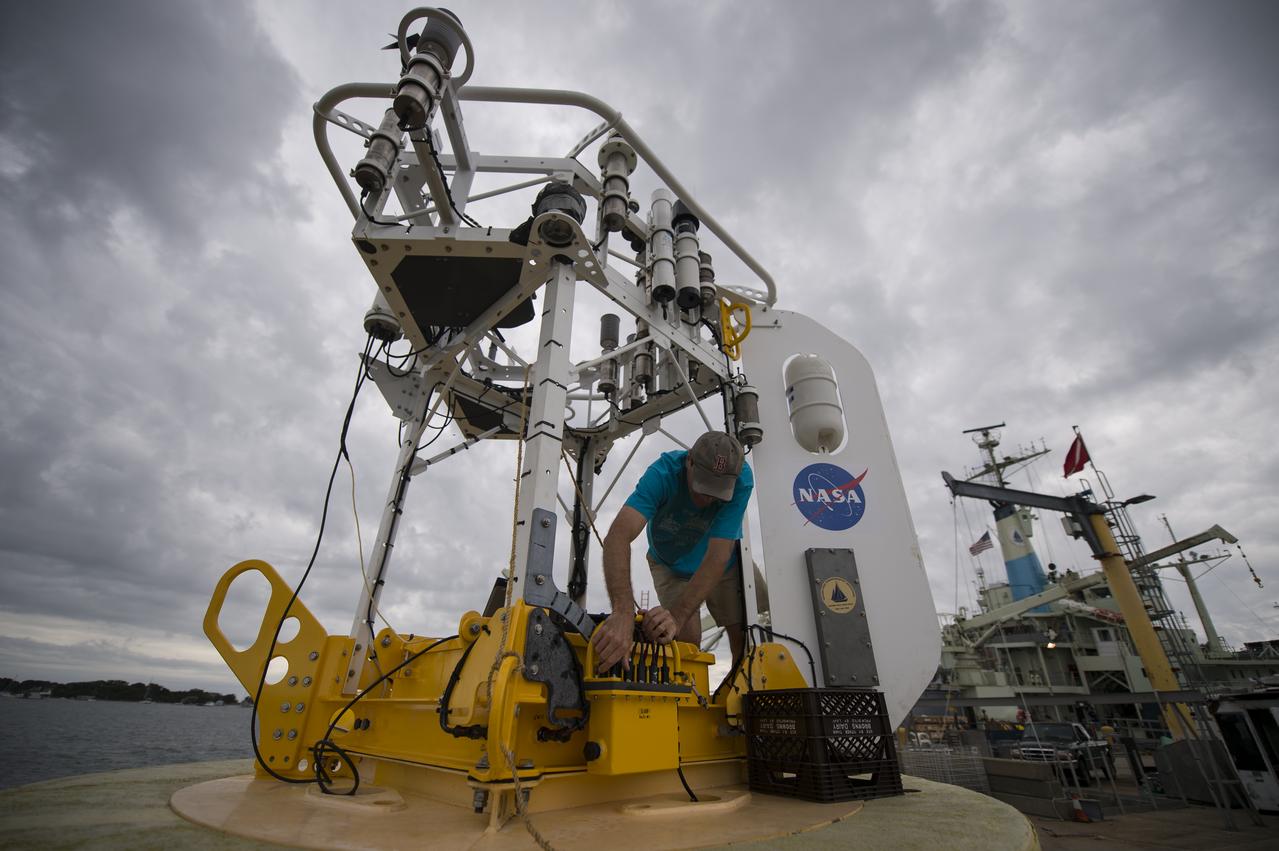
Woods Hole Oceanographic Institution Senior Engineer Steve Faluotico works on the SPURS buoy prior to it being loaded onto the Institute's research vessel Knorr, Tuesday, Sept. 4, 2012, in Woods Hole, Mass. The SPURS buoy will be deployed in the Atlantic Ocean as part of the Salinity Processes in the Upper Ocean Regional Study (SPURS) which is set to sail on Sept. 6. The NASA-sponsored expedition will sail to the North Atlantic's saltiest spot to get a detailed, 3-D picture of how salt content fluctuates in the ocean's upper layers and how these variations are related to shifts in rainfall patterns around the planet. Photo Credit: (NASA/Bill Ingalls)
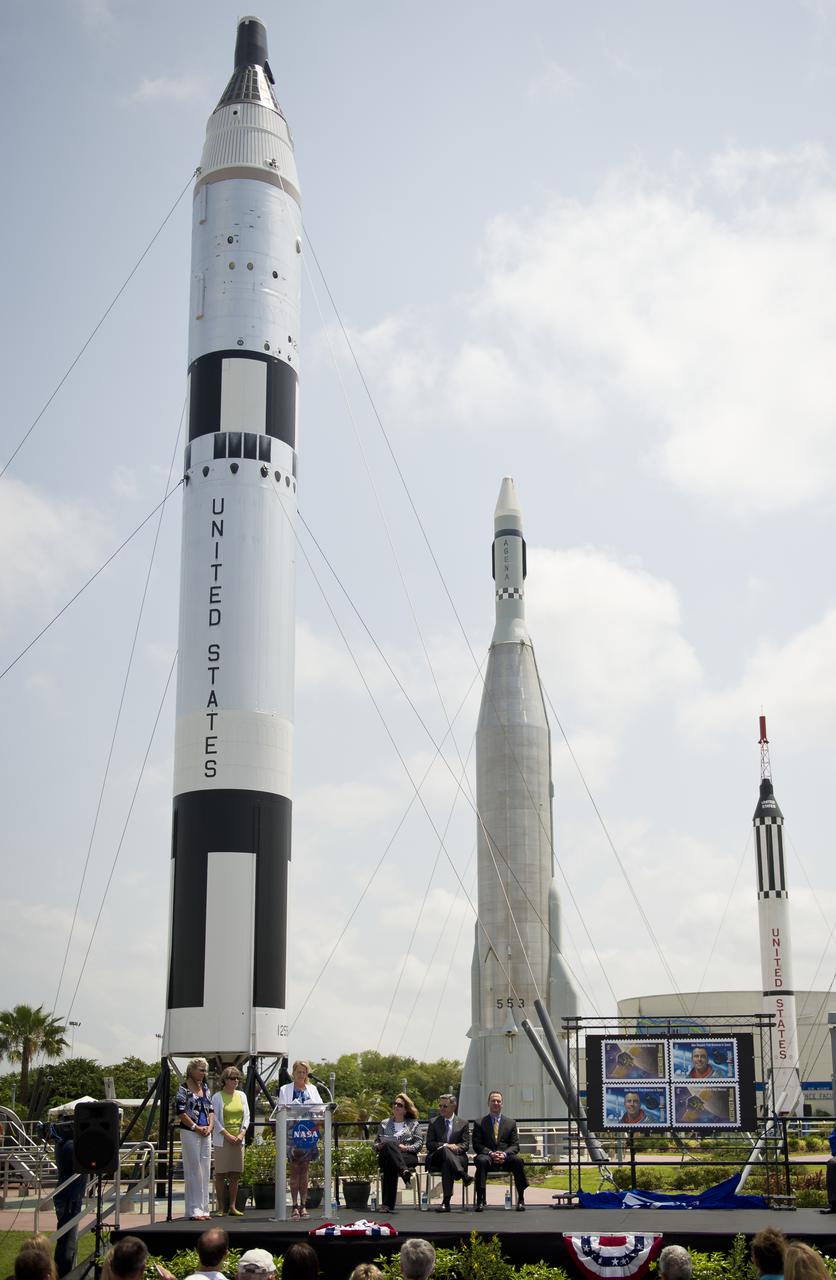
Daughters of NASA astronaut Alan Shepard, Laura Shepard Churchley, standing left, Alice Wackermann and Julie Jenkins, standing right, speak during an unveiling ceremony of two USPS stamps that commemorate and celebrate 50 years of US Spaceflight and the MESSENGER program during an event, Wednesday, May 4, 2011 at the NASA Kennedy Space Center in Cape Canaveral, Fla. One stamp commemorates NASA’s Project Mercury, America’s first manned spaceflight program, and NASA astronaut Alan Shepard’s historic flight on May 5, 1961, aboard spacecraft Freedom 7. The other stamp draws attention to NASA’s unmanned MESSENGER mission, a scientific investigation of the planet Mercury. On March 17, 2011, MESSENGER became the first spacecraft to enter into orbit around Mercury. Photo Credit: (NASA/Bill Ingalls)
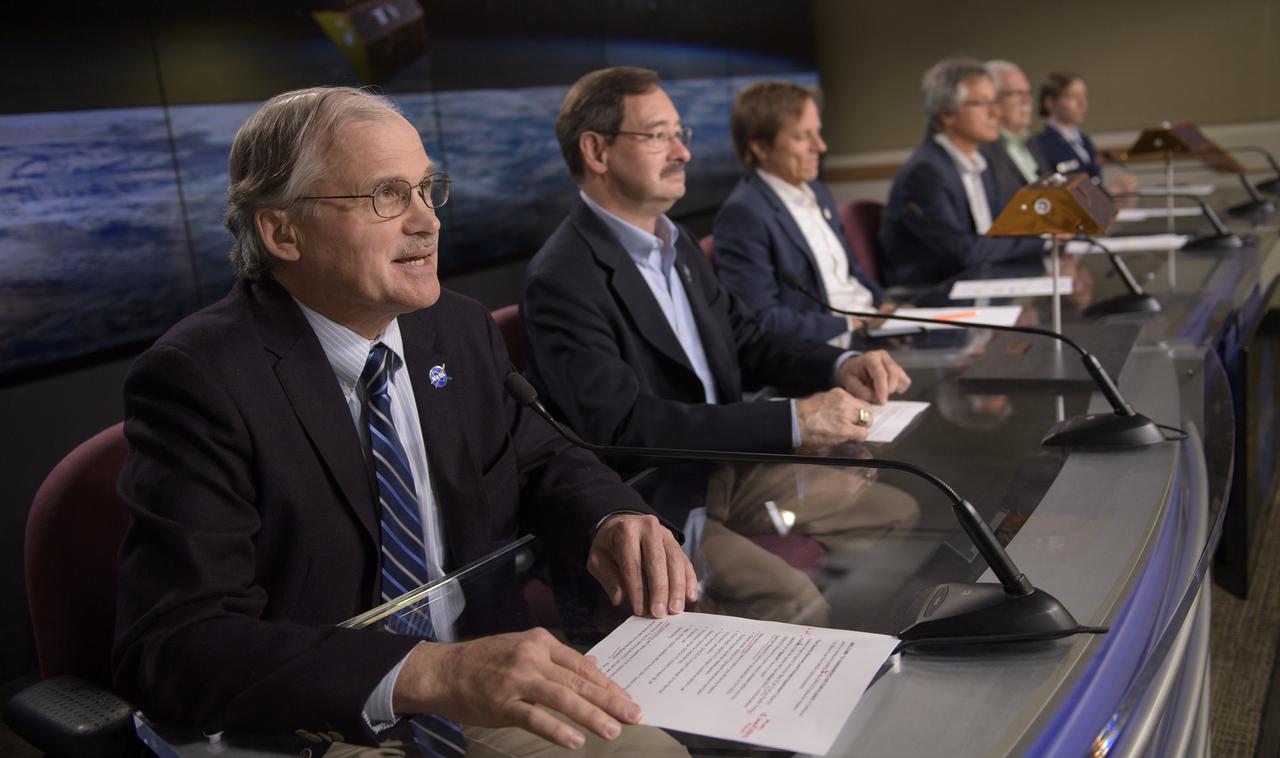
NASA Headquarters Public Affairs Officer Steve Cole, left, moderates the Gravity Recovery and Climate Experiment Follow-On (GRACE-FO) mission prelaunch media briefing with David Jarrett, GRACE-FO program executive in the Earth Science Division at NASA Headquarters; Frank Webb, GRACE-FO project scientist at JPL; Frank Flechtner, GRACE-FO project manager for the German Research Centre for Geosciences (GFZ) in Potsdam, Germany; Phil Morton, NASA GRACE-FO project manager at JPL; and Capt. Jennifer Haden, weather officer, 30th Space Wing, Vandenberg Air Force Base, right, Monday, May 21, 2018, at Vandenberg Air Force Base in California. The twin GRACE-FO spacecraft will measure changes in how mass is redistributed within and among Earth's atmosphere, oceans, land and ice sheets, as well as within Earth itself. Photo Credit: (NASA/Bill Ingalls)
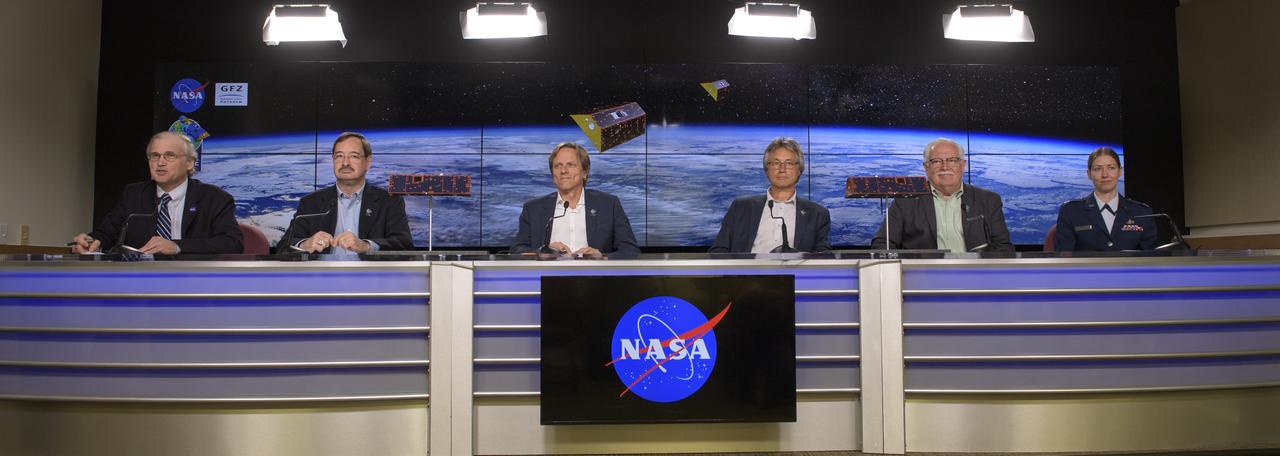
NASA Headquarters Public Affairs Officer Steve Cole, left, moderates the Gravity Recovery and Climate Experiment Follow-On (GRACE-FO) mission prelaunch media briefing with David Jarrett, GRACE-FO program executive in the Earth Science Division at NASA Headquarters; Frank Webb, GRACE-FO project scientist at JPL; Frank Flechtner, GRACE-FO project manager for the German Research Centre for Geosciences (GFZ) in Potsdam, Germany; Phil Morton, NASA GRACE-FO project manager at JPL; and Capt. Jennifer Haden, weather officer, 30th Space Wing, Vandenberg Air Force Base, right, Monday, May 21, 2018, at Vandenberg Air Force Base in California. The twin GRACE-FO spacecraft will measure changes in how mass is redistributed within and among Earth's atmosphere, oceans, land and ice sheets, as well as within Earth itself. Photo Credit: (NASA/Bill Ingalls)