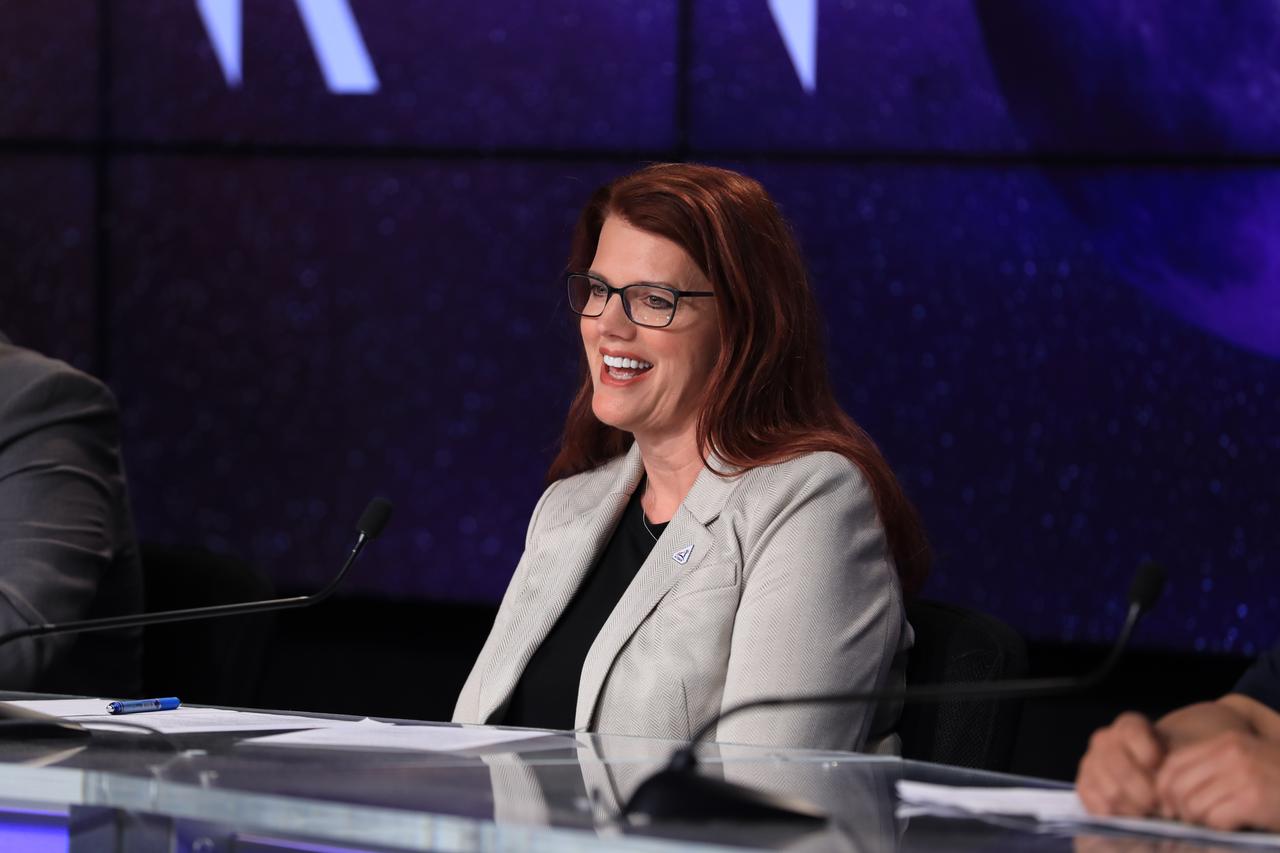
NASA’s Artemis Launch Director Charlie Blackwell-Thompson participates in an Artemis I student media briefing inside the John Holliman Auditorium of the News Center at Kennedy Space Center in Florida on Jan. 19, 2023. As part of NASA’s NextGen STEM project, students from Florida’s St. Cloud High School and Storm Grove Middle School in Vero Beach participated in person during the briefing, while middle and high school students across the country had the opportunity to ask questions of the panel via phone to discuss the Artemis I mission and the agency’s future of human space exploration.
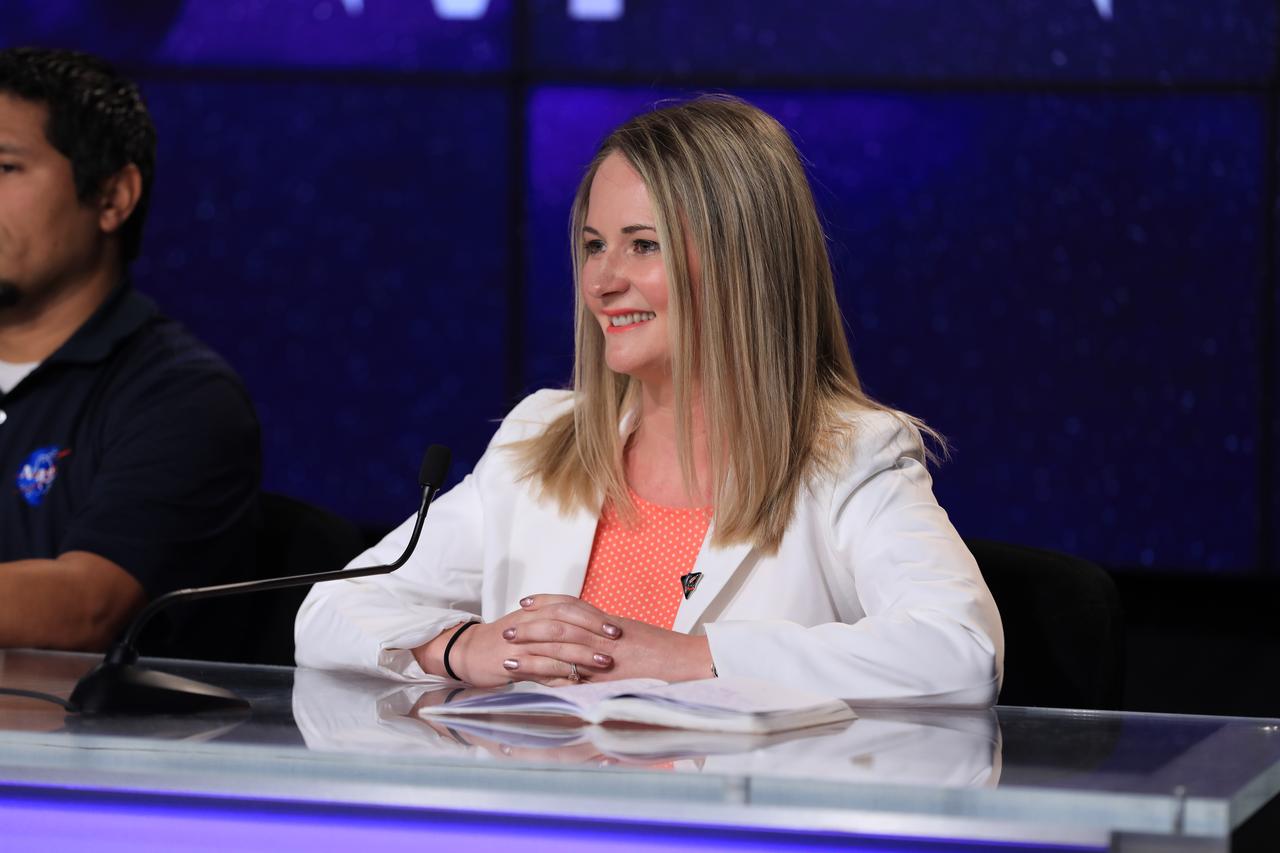
Space Launch Delta 45 Weather Officer Melody Lovin participates in an Artemis I student media briefing inside the John Holliman Auditorium of the News Center at NASA’s Kennedy Space Center in Florida on Jan. 19, 2023. As part of NASA’s NextGen STEM project, students from Florida’s St. Cloud High School and Storm Grove Middle School in Vero Beach participated in person during the briefing, while middle and high school students across the country had the opportunity to ask questions of the panel via phone to discuss the Artemis I mission and the agency’s future of human space exploration.
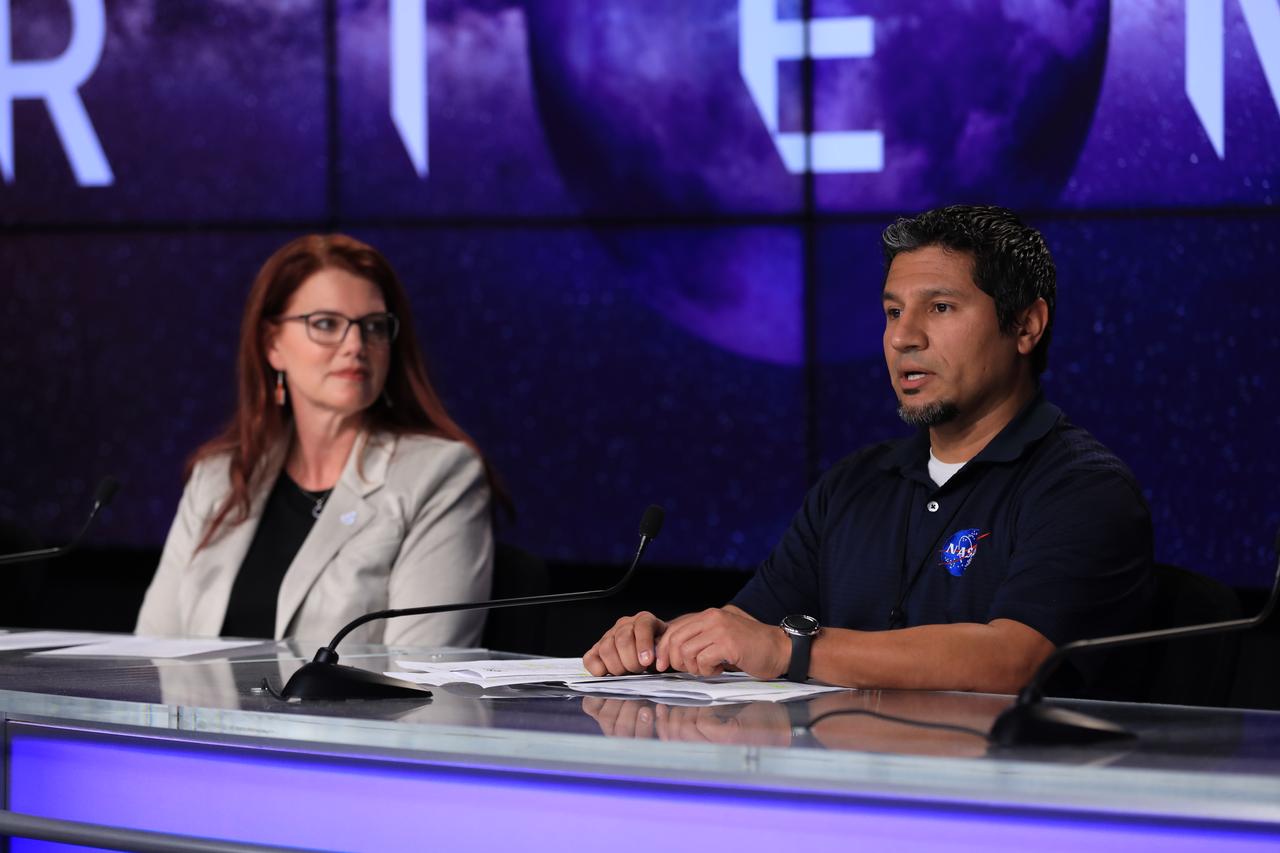
From left, NASA’s Artemis Launch Director Charlie Blackwell-Thompson and Space Launch System Resident Management Office Manager Elkin Norena participate in an Artemis I student media briefing inside the John Holliman Auditorium of the News Center at Kennedy Space Center in Florida on Jan. 19, 2023. As part of NASA’s NextGen STEM project, students from Florida’s St. Cloud High School and Storm Grove Middle School in Vero Beach participated in person during the briefing, while middle and high school students across the country had the opportunity to ask questions of the panel via phone to discuss the Artemis I mission and the agency’s future of human space exploration.
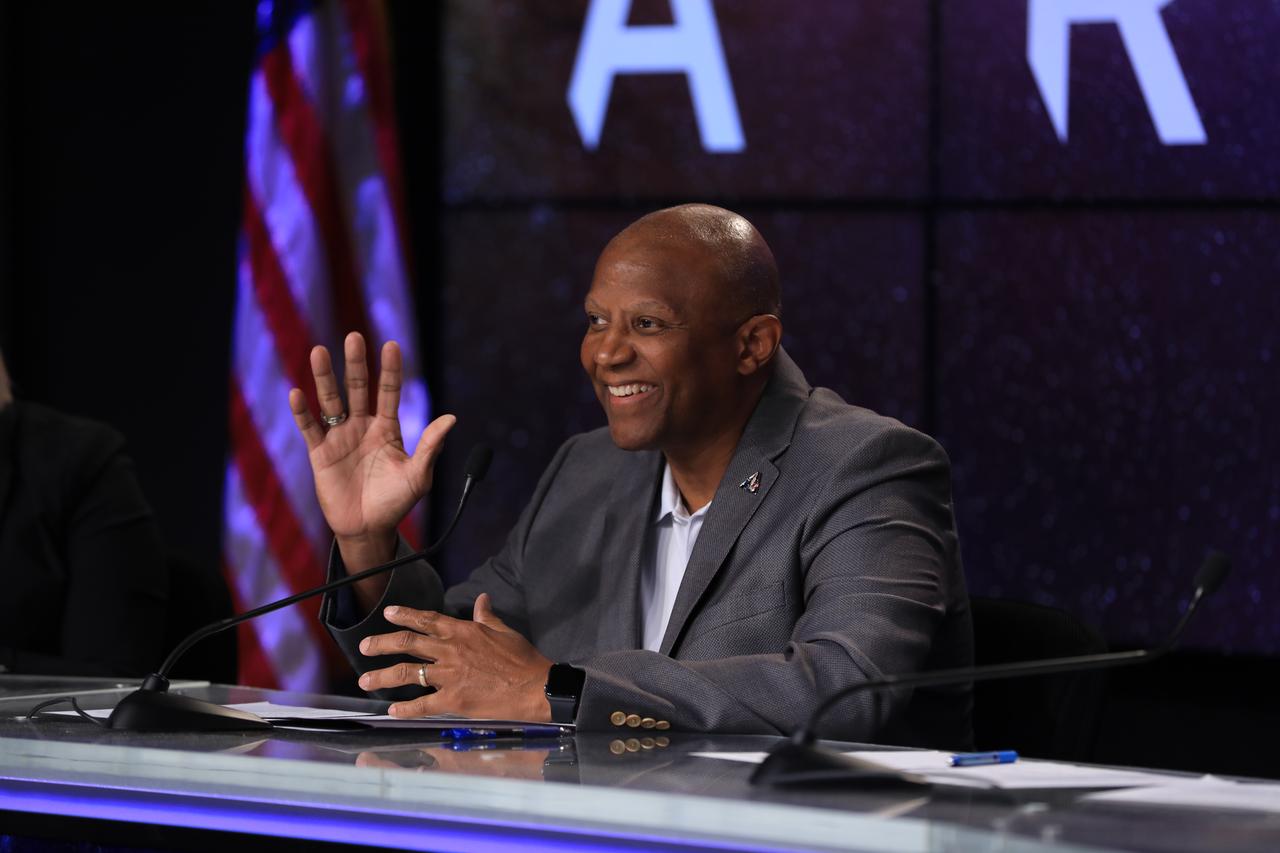
Kennedy Space Center Deputy Director Kelvin Manning participates in an Artemis I student media briefing inside the John Holliman Auditorium of the News Center at the Florida spaceport on Jan. 19, 2023. As part of NASA’s NextGen STEM project, students from Florida’s St. Cloud High School and Storm Grove Middle School in Vero Beach participated in person during the briefing, while middle and high school students across the country had the opportunity to ask questions of the panel via phone to discuss the Artemis I mission and the agency’s future of human space exploration.
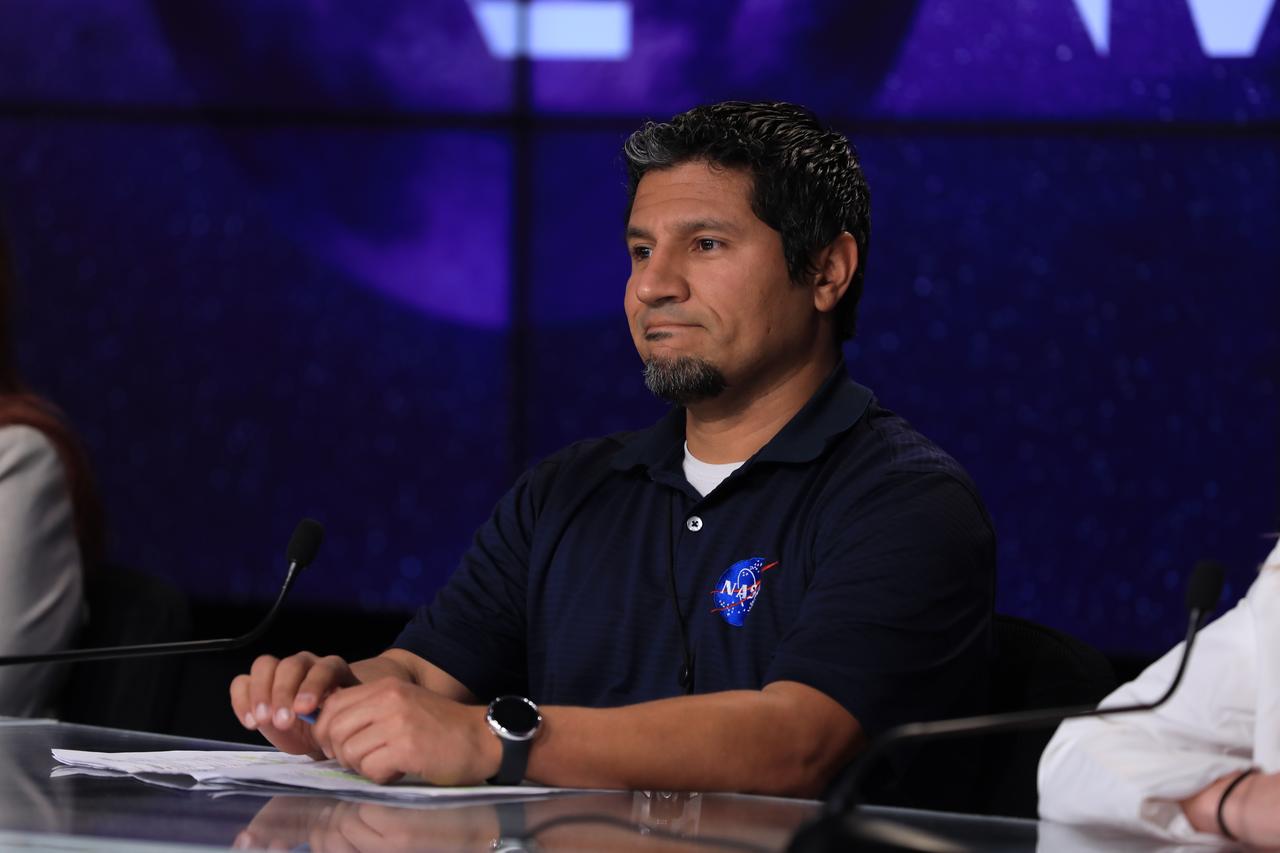
NASA’s Space Launch System Resident Management Office Manager Elkin Norena participates in an Artemis I student media briefing inside the John Holliman Auditorium of the News Center at Kennedy Space Center in Florida on Jan. 19, 2023. As part of NASA’s NextGen STEM project, students from Florida’s St. Cloud High School and Storm Grove Middle School in Vero Beach participated in person during the briefing, while middle and high school students across the country had the opportunity to ask questions of the panel via phone to discuss the Artemis I mission and the agency’s future of human space exploration.
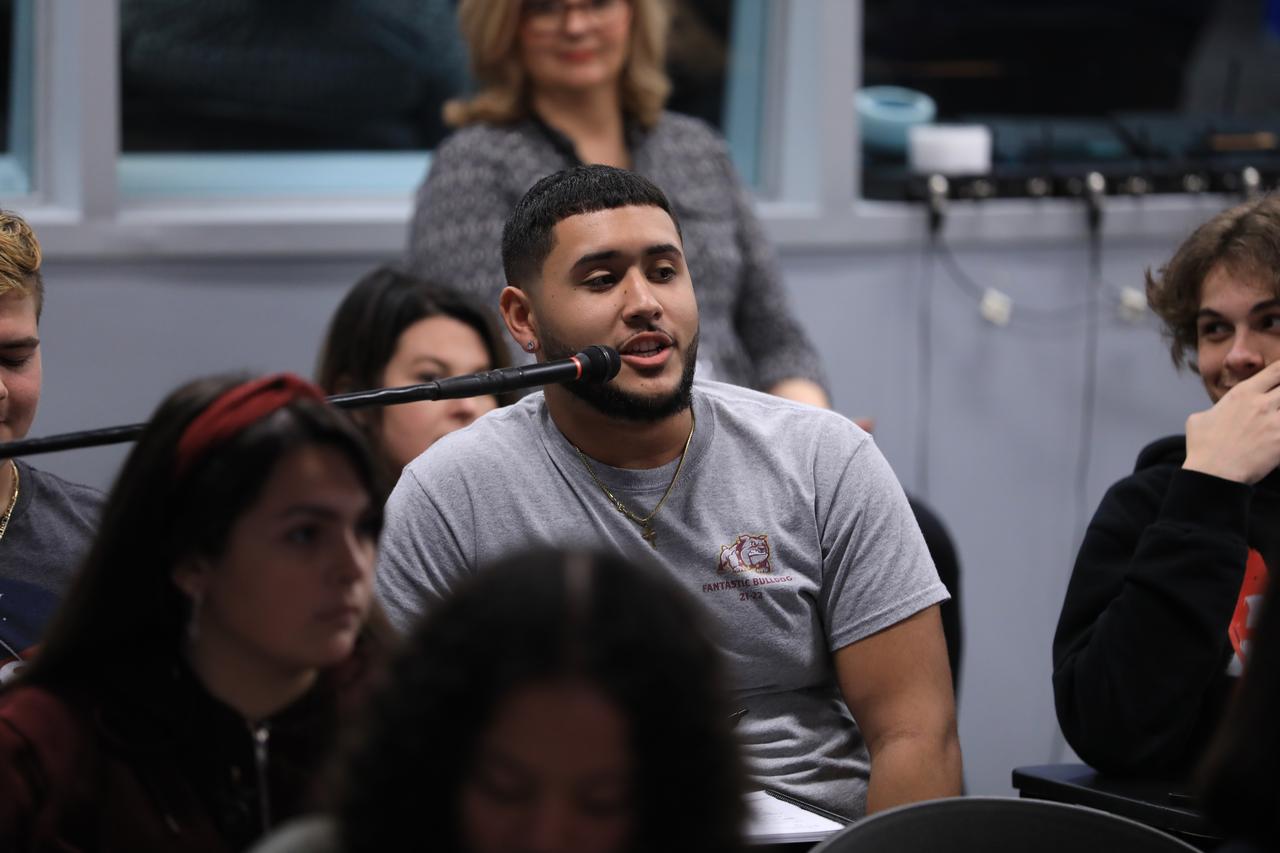
As part of NASA’s NextGen STEM project, students from Florida’s St. Cloud High School and Storm Grove Middle School in Vero Beach participate in an Artemis I student media briefing inside the John Holliman Auditorium of the News Center at NASA’s Kennedy Space Center in Florida on Jan. 19, 2023. Along with the students participating in person, middle and high school students across the country had the opportunity to ask questions of the panel via phone to discuss the Artemis I mission and the agency’s future of human space exploration.
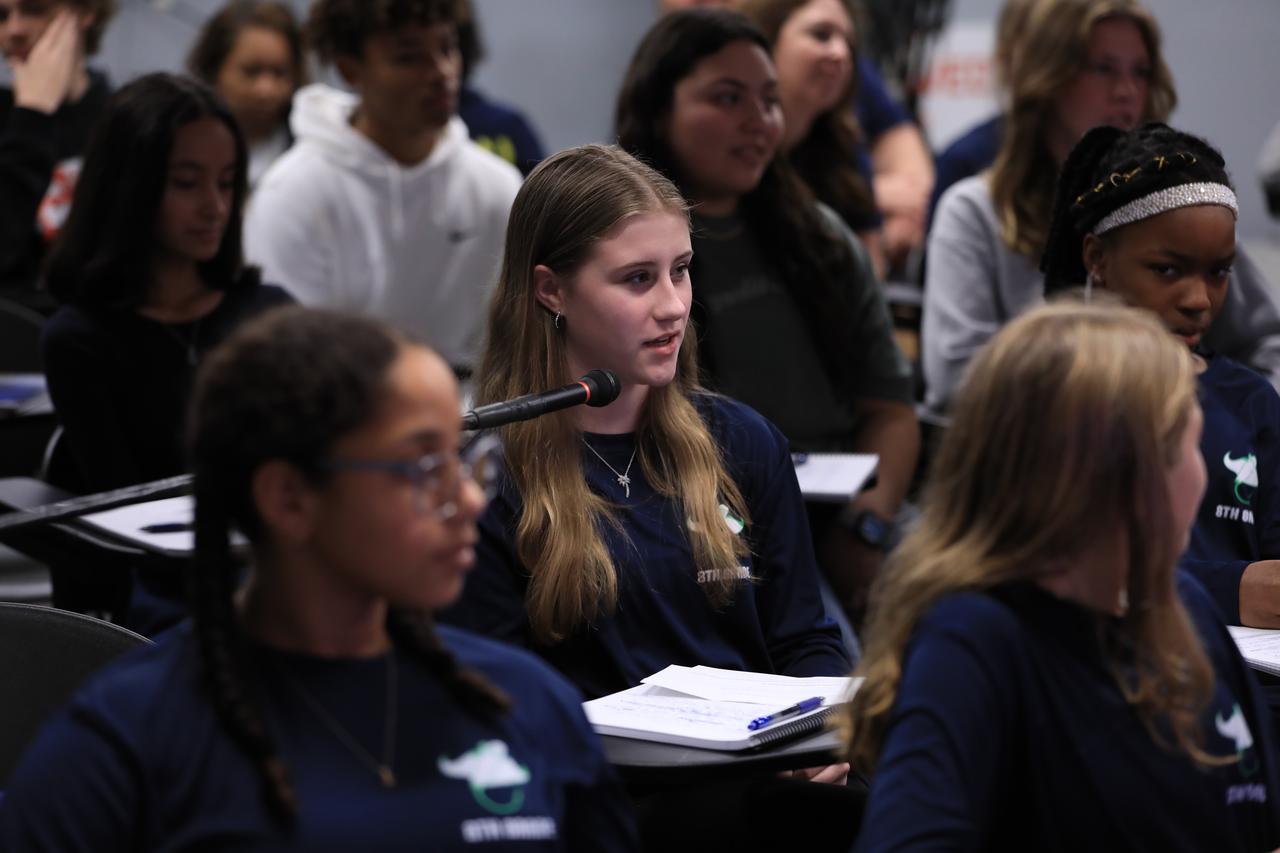
As part of NASA’s NextGen STEM project, students from Florida’s St. Cloud High School and Storm Grove Middle School in Vero Beach participate in an Artemis I student media briefing inside the John Holliman Auditorium of the News Center at NASA’s Kennedy Space Center in Florida on Jan. 19, 2023. Along with the students participating in person, middle and high school students across the country had the opportunity to ask questions of the panel via phone to discuss the Artemis I mission and the agency’s future of human space exploration.
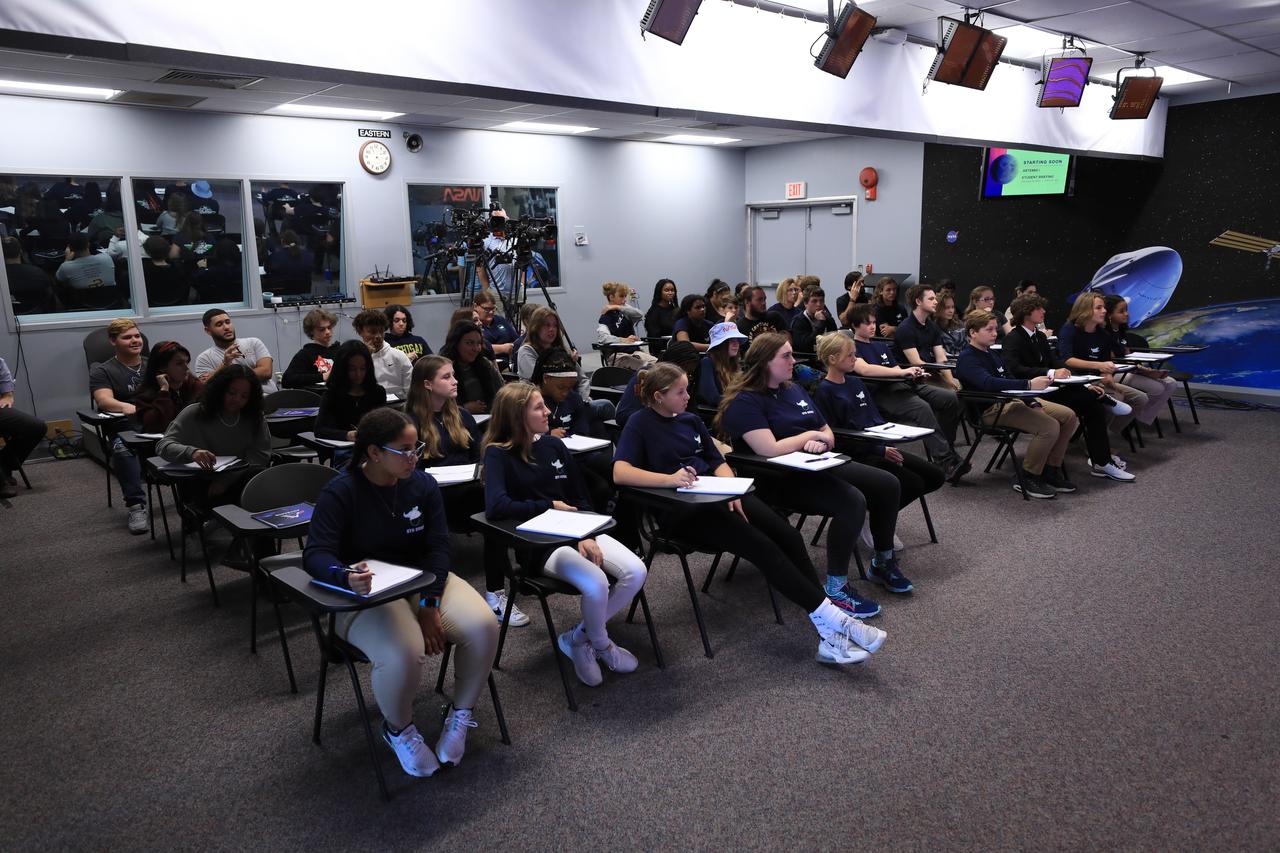
As part of NASA’s NextGen STEM project, students from Florida’s St. Cloud High School and Storm Grove Middle School in Vero Beach participate in an Artemis I student media briefing inside the John Holliman Auditorium of the News Center at NASA’s Kennedy Space Center in Florida on Jan. 19, 2023. Along with the students participating in person, middle and high school students across the country had the opportunity to ask questions of the panel via phone to discuss the Artemis I mission and the agency’s future of human space exploration.
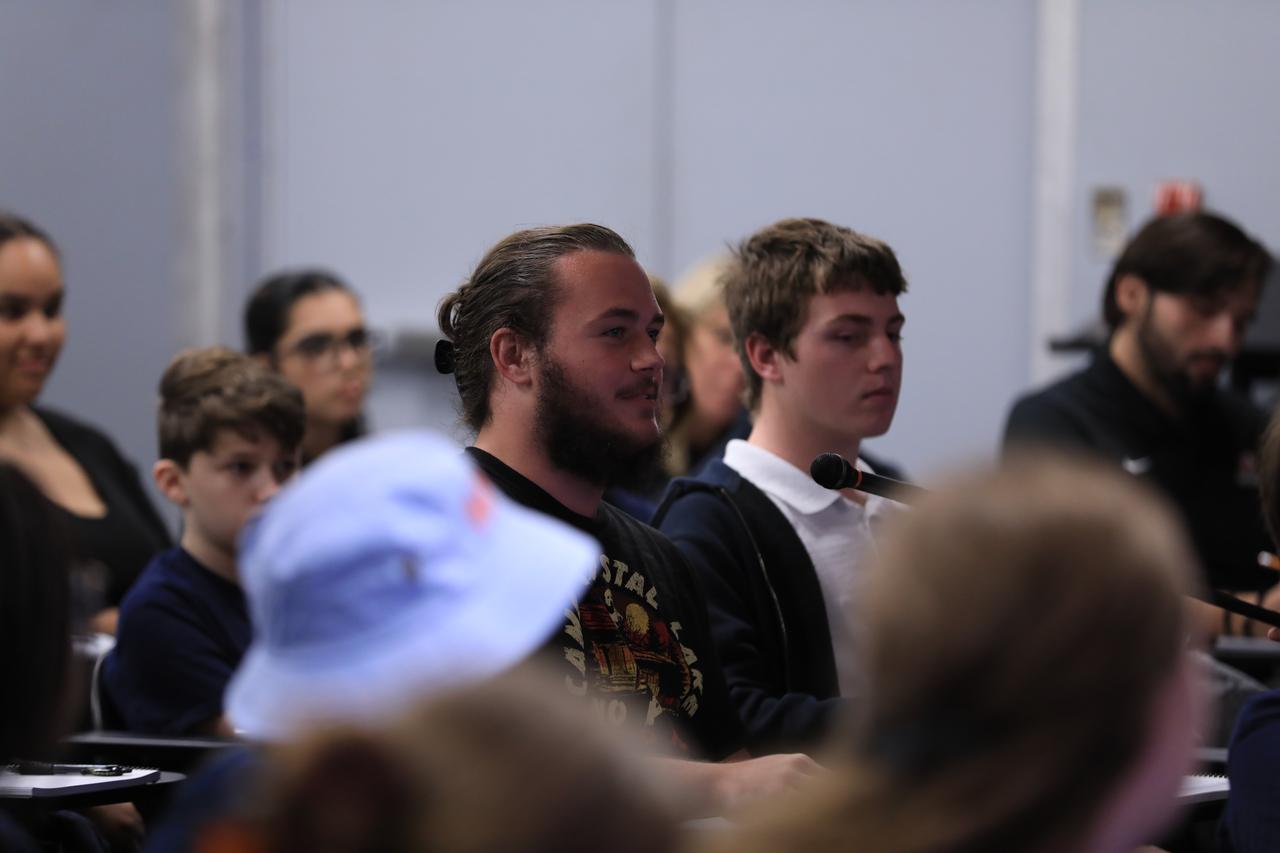
As part of NASA’s NextGen STEM project, students from Florida’s St. Cloud High School and Storm Grove Middle School in Vero Beach participate in an Artemis I student media briefing inside the John Holliman Auditorium of the News Center at NASA’s Kennedy Space Center in Florida on Jan. 19, 2023. Along with the students participating in person, middle and high school students across the country had the opportunity to ask questions of the panel via phone to discuss the Artemis I mission and the agency’s future of human space exploration.
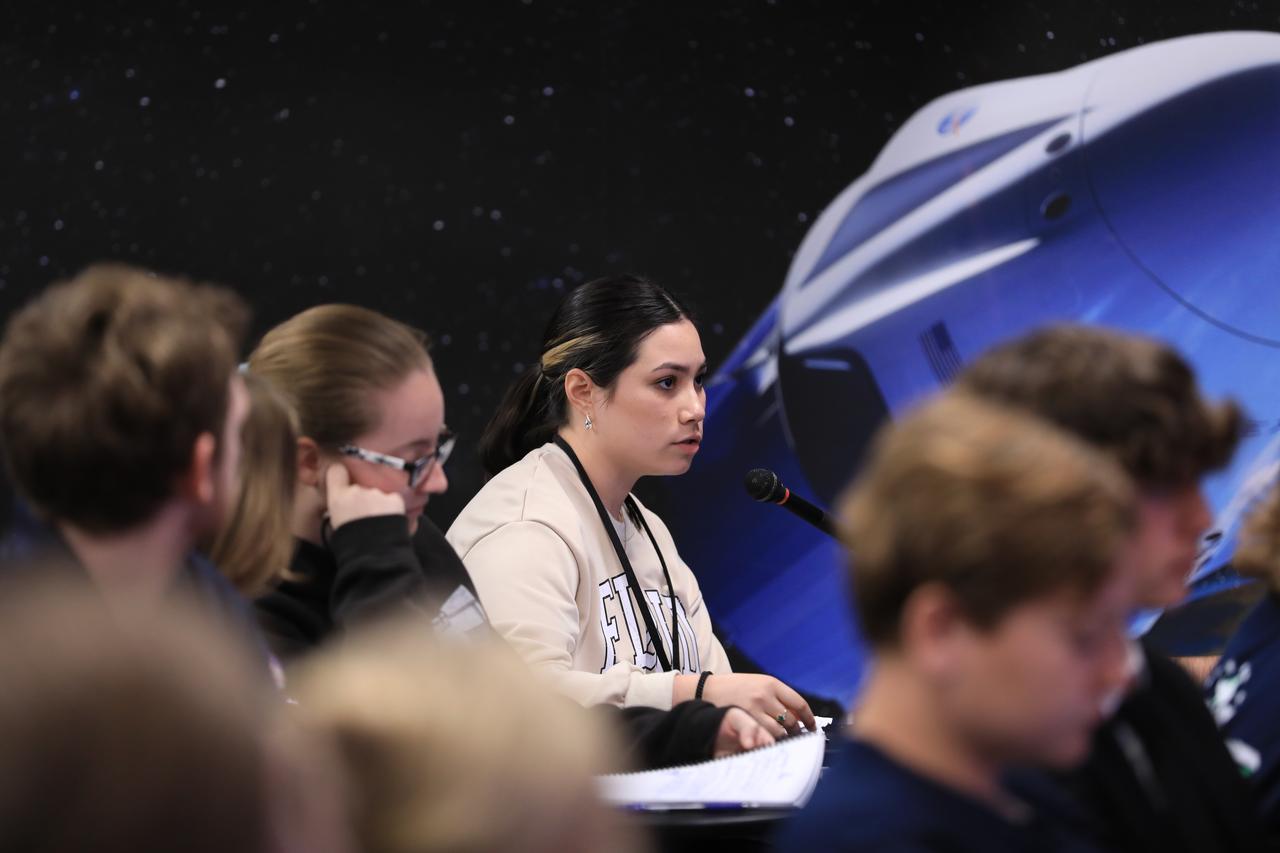
As part of NASA’s NextGen STEM project, students from Florida’s St. Cloud High School and Storm Grove Middle School in Vero Beach participate in an Artemis I student media briefing inside the John Holliman Auditorium of the News Center at NASA’s Kennedy Space Center in Florida on Jan. 19, 2023. Along with the students participating in person, middle and high school students across the country had the opportunity to ask questions of the panel via phone to discuss the Artemis I mission and the agency’s future of human space exploration.
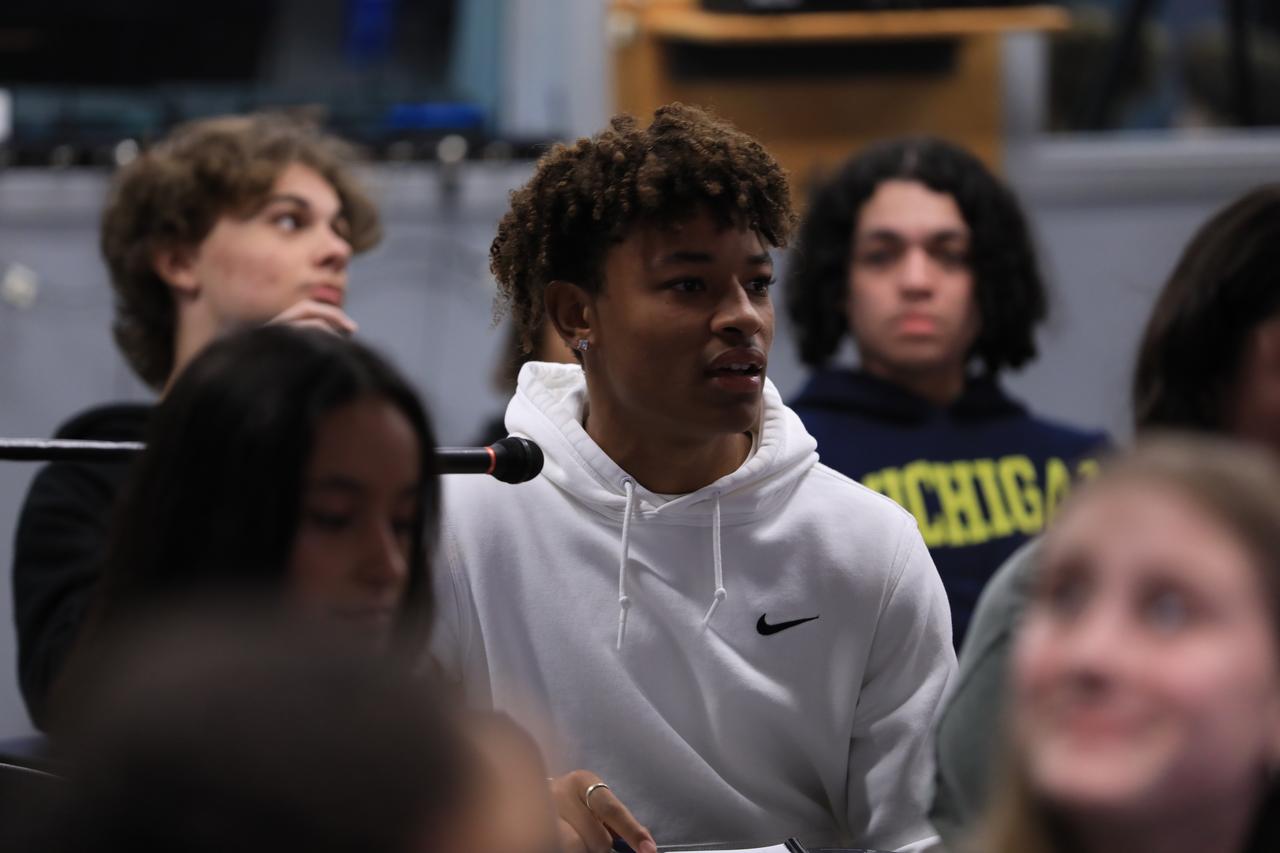
As part of NASA’s NextGen STEM project, students from Florida’s St. Cloud High School and Storm Grove Middle School in Vero Beach participate in an Artemis I student media briefing inside the John Holliman Auditorium of the News Center at NASA’s Kennedy Space Center in Florida on Jan. 19, 2023. Along with the students participating in person, middle and high school students across the country had the opportunity to ask questions of the panel via phone to discuss the Artemis I mission and the agency’s future of human space exploration.
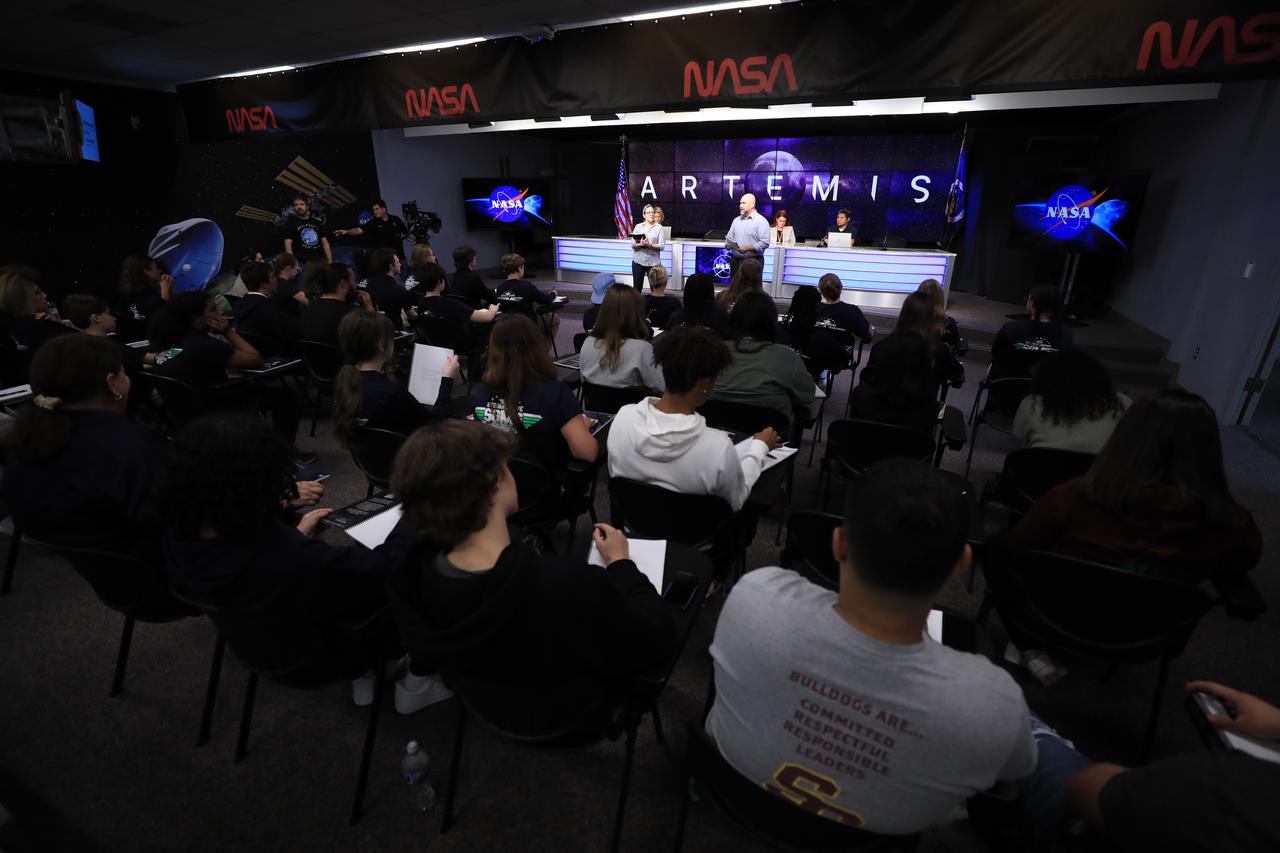
As part of NASA’s NextGen STEM project, Public Affairs Writers Danielle Sempsrott (left) and Jason Costa address students from Florida’s St. Cloud High School and Storm Grove Middle School in Vero Beach during an Artemis I student media briefing inside the John Holliman Auditorium of the News Center at NASA’s Kennedy Space Center in Florida on Jan. 19, 2023. Participants in the briefing included Kennedy Space Center Deputy Director Kelvin Manning, Artemis Launch Director Charlie Blackwell-Thompson, Manager of the Space Launch System Resident Management Office Elkin Norena, and Space Launch Delta 45 Weather Officer Melody Lovin. Along with the students participating in person, middle and high school students across the country had the opportunity to ask questions of the panel via phone to discuss the Artemis I mission and the agency’s future of human space exploration.
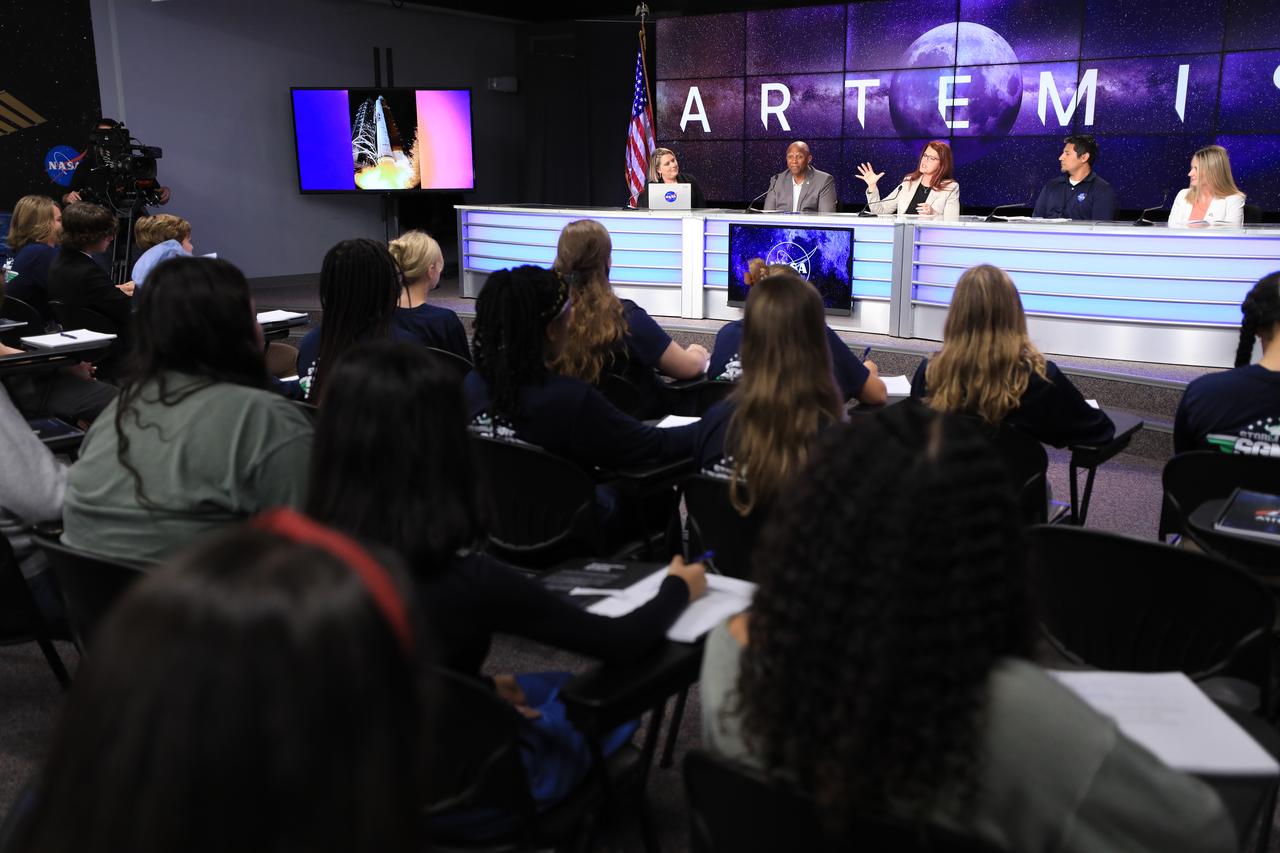
From left, NASA Communications’ Leah Martin, Kennedy Space Center Deputy Director Kelvin Manning, Artemis Launch Director Charlie Blackwell-Thompson, Space Launch System Resident Management Office Manager Elkin Norena, and Space Launch Delta 45 Weather Officer Melody Lovin participate in an Artemis I student media briefing inside the John Holliman Auditorium of the News Center at the Florida spaceport on Jan. 19, 2023. As part of NASA’s NextGen STEM project, students from Florida’s St. Cloud High School and Storm Grove Middle School in Vero Beach participated in person during the briefing, while middle and high school students across the country had the opportunity to ask questions of the panel via phone to discuss the Artemis I mission and the agency’s future of human space exploration.
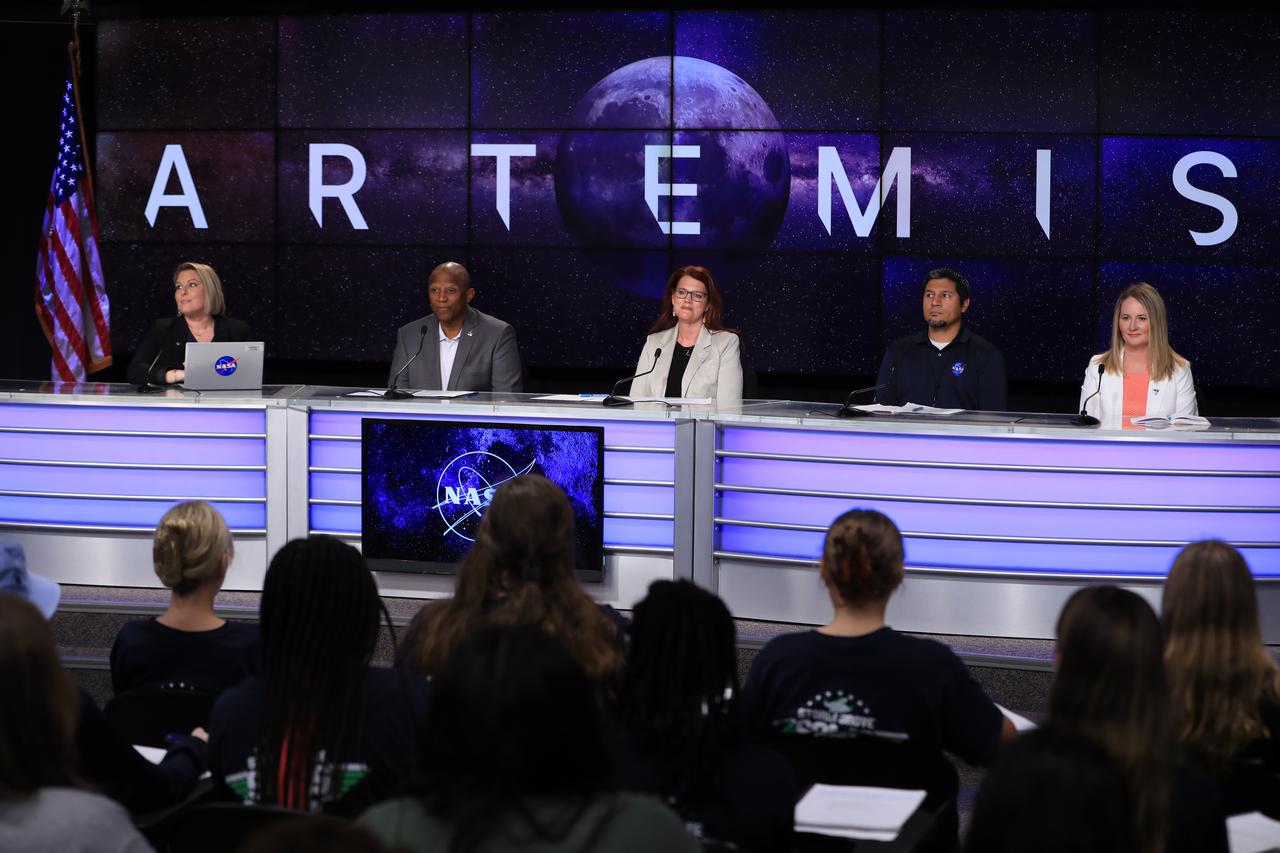
From left, NASA Communications’ Leah Martin, Kennedy Space Center Deputy Director Kelvin Manning, Artemis Launch Director Charlie Blackwell-Thompson, Space Launch System Resident Management Office Manager Elkin Norena, and Space Launch Delta 45 Weather Officer Melody Lovin participate in an Artemis I student media briefing inside the John Holliman Auditorium of the News Center on Jan. 19, 2023, at the Florida spaceport. As part of NASA’s NextGen STEM project, students from Florida’s St. Cloud High School and Storm Grove Middle School in Vero Beach, participated in person during the briefing, while middle and high school students across the country had the opportunity to ask questions of the panel via phone to discuss the Artemis I mission and the agency’s future of human space exploration.
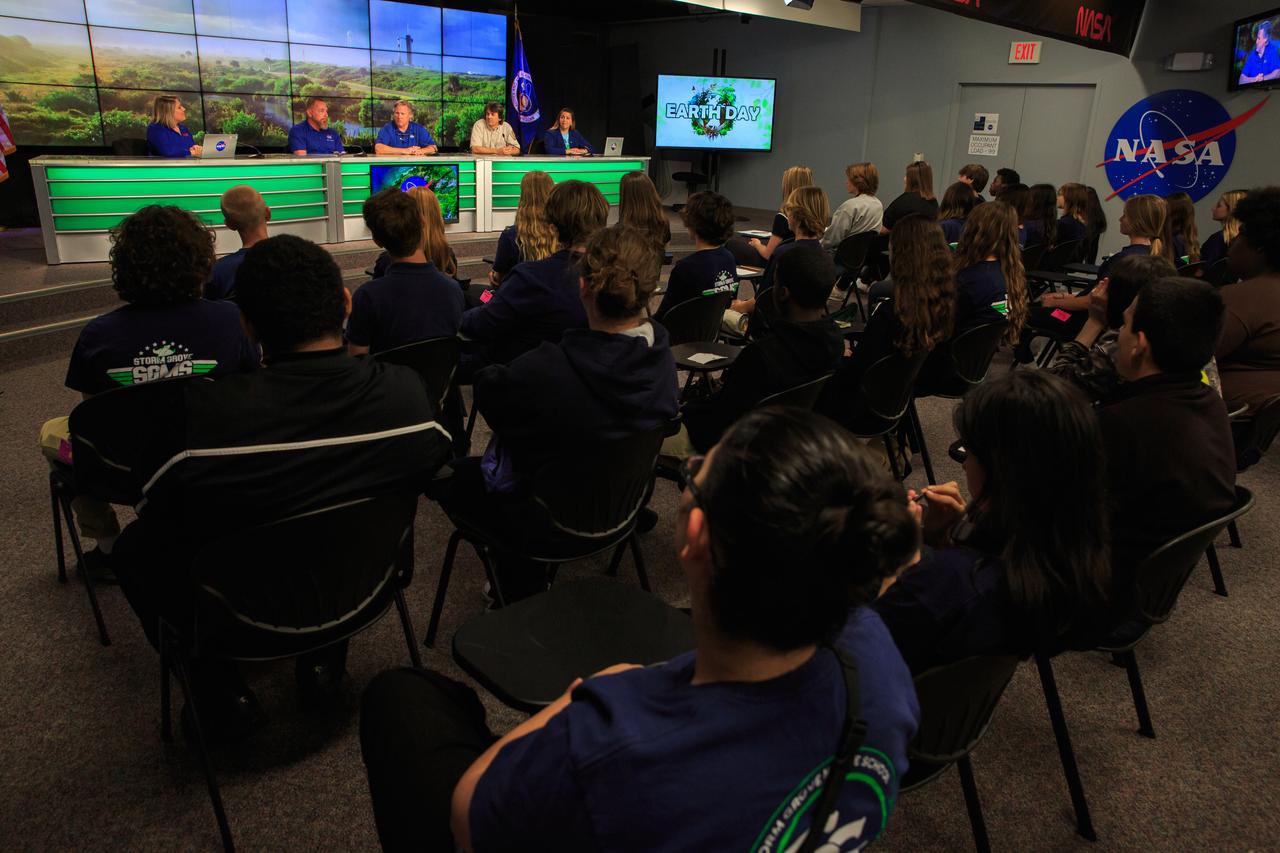
As part of NASA’s NextGen STEM project, students from Florida’s Montverde Academy, Storm Grove Middle School, and Whispering Pines School, as well as a homeschool collective from Georgia, participate in an environmentally focused Earth Day briefing inside the News Auditorium at NASA’s Kennedy Space Center in Florida on April 20, 2023. Along with the students participating in person, middle- and high-school students across the country had the opportunity to ask questions of the panel via phone to discuss how technology and science coexist with nature at Kennedy.
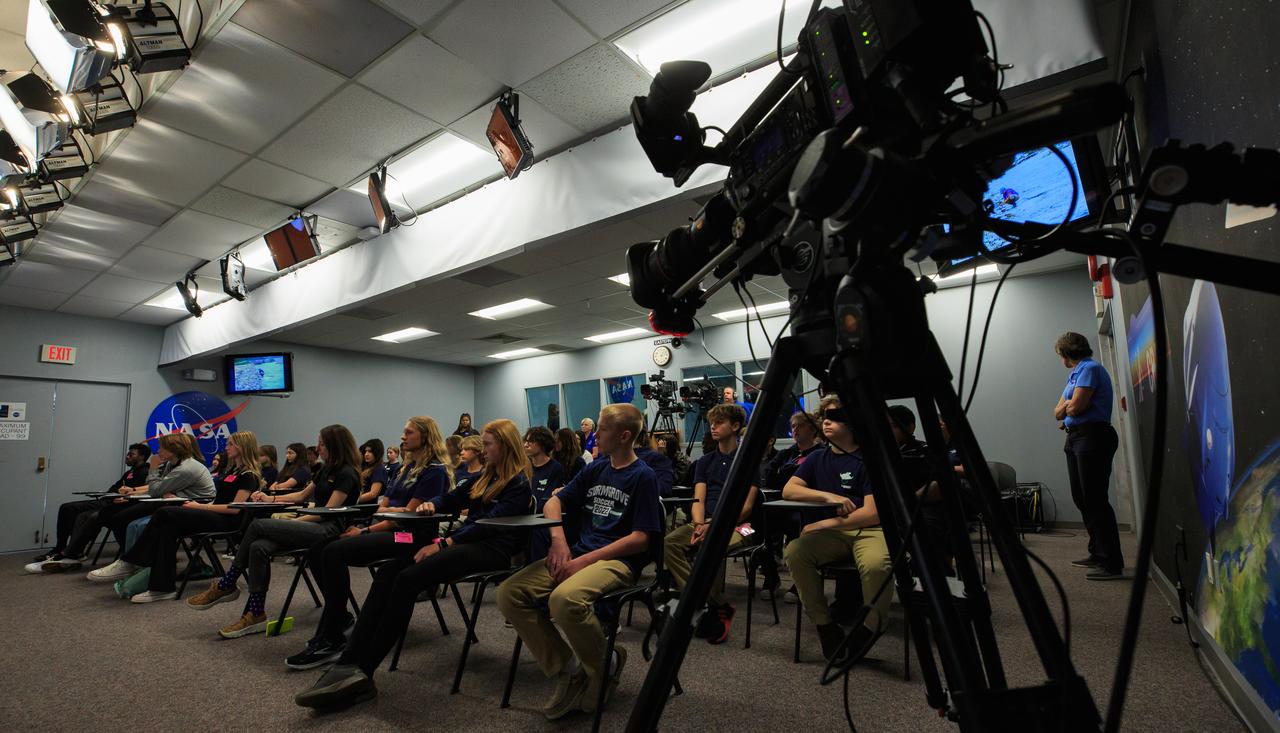
As part of NASA’s NextGen STEM project, students from Florida’s Montverde Academy, Storm Grove Middle School, and Whispering Pines School, as well as a homeschool collective from Georgia, participate in an environmentally focused Earth Day briefing inside the News Auditorium at NASA’s Kennedy Space Center in Florida on April 20, 2023. Along with the students participating in person, middle- and high-school students across the country had the opportunity to ask questions of the panel via phone to discuss how technology and science coexist with nature at Kennedy.
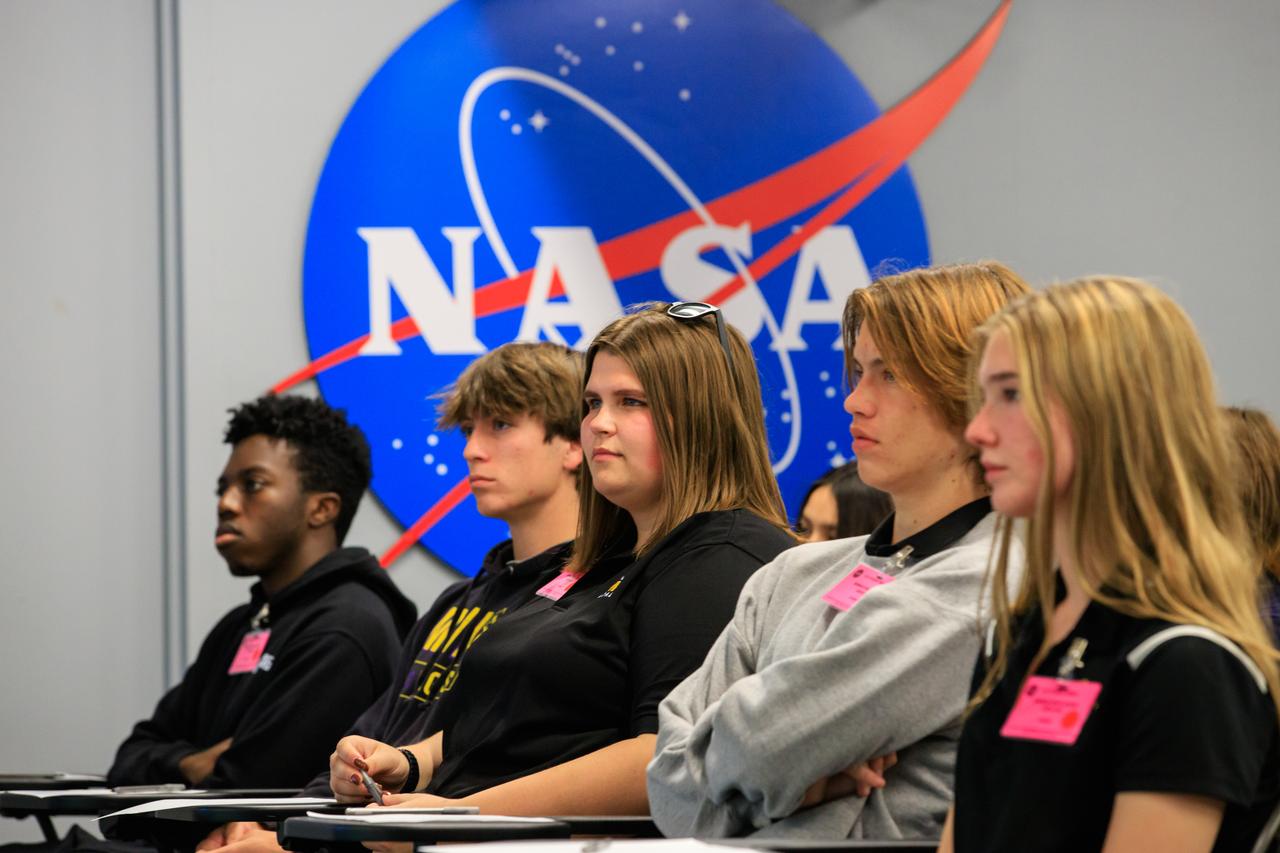
As part of NASA’s NextGen STEM project, students from Florida’s Montverde Academy, Storm Grove Middle School, and Whispering Pines School, as well as a homeschool collective from Georgia, participate in an environmentally focused Earth Day briefing inside the News Auditorium at NASA’s Kennedy Space Center in Florida on April 20, 2023. Along with the students participating in person, middle- and high-school students across the country had the opportunity to ask questions of the panel via phone to discuss how technology and science coexist with nature at Kennedy.
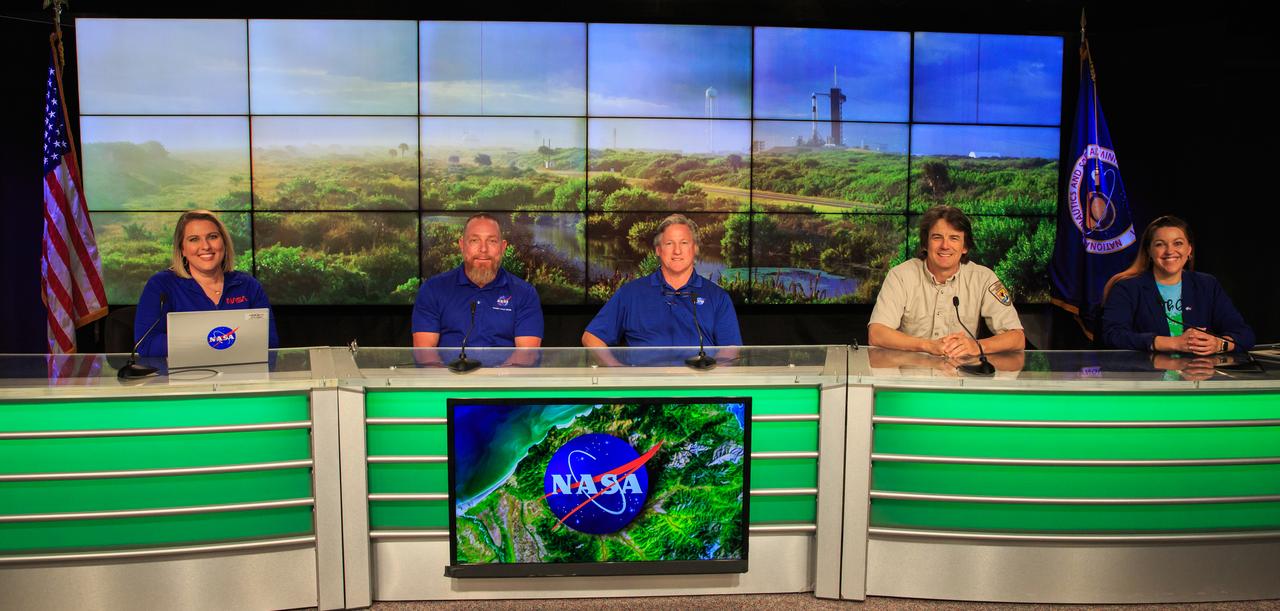
From left, NASA Communications’ Leah Martin; Environmental Planning Group Lead in Kennedy Space Center's Environmental Management Branch Don Dankert; Kennedy Environmental Protection Specialist Jeff Collins; Florida Fish and Wildlife Conservation Commission Officer Stanley Howater; and Stennis Space Center's Kelly McCarthy participate in an environmentally focused Earth Day briefing inside the News Auditorium at the Florida spaceport on April 20, 2023. As part of NASA’s NextGen STEM project, students from Florida’s Montverde Academy, Storm Grove Middle School, and Whispering Pines School, as well as a homeschool collective from Georgia, participated in person during the briefing, while middle- and high-school students across the country had the opportunity to ask questions of the panel via phone to discuss how technology and science coexist with nature at Kennedy.
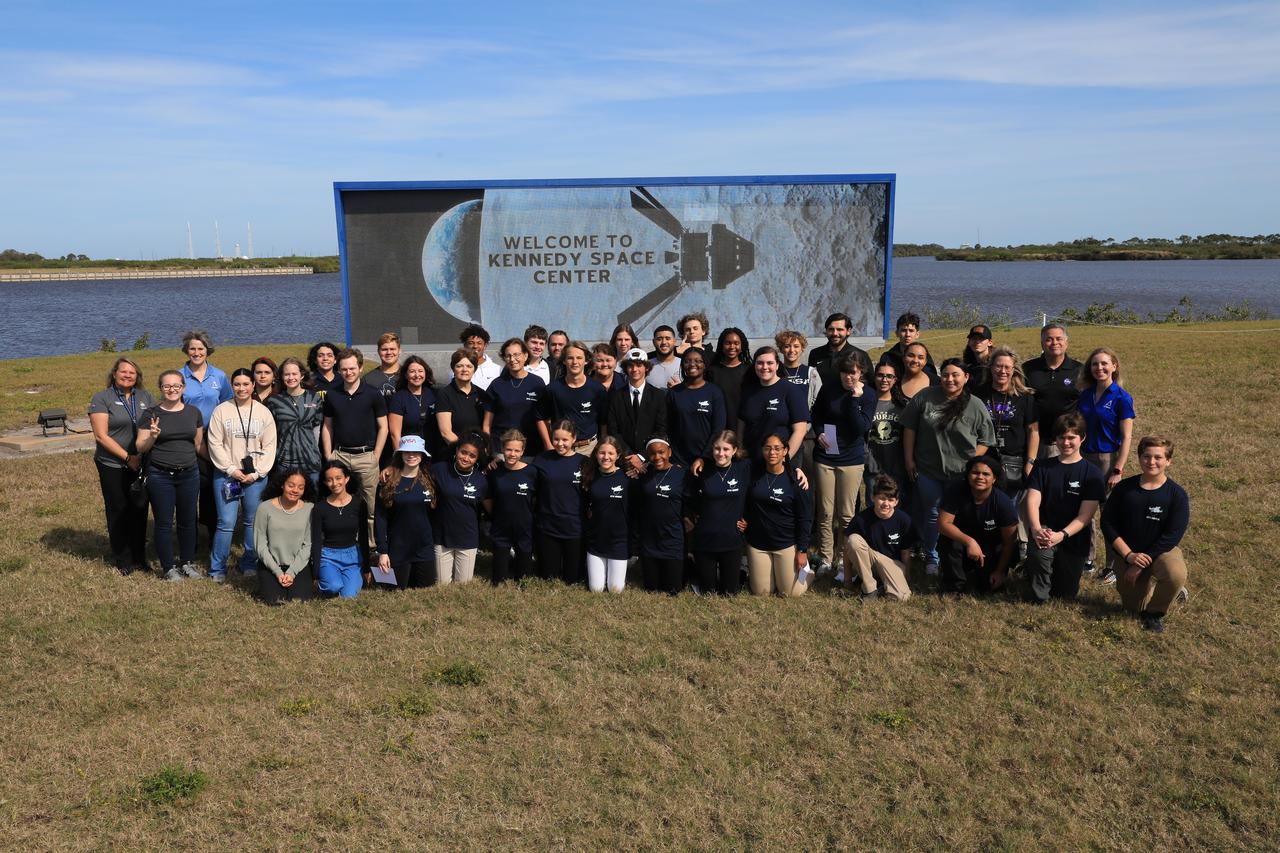
Students from Florida’s St. Cloud High School and Storm Grove Middle School in Vero Beach pose in front of the countdown clock at NASA’s Kennedy Space Center in Florida on Jan. 19, 2023. As part of NASA’s NextGen STEM project, students were invited to tour the facilities at the spaceport before participating in a televised briefing inside the John Holliman Auditorium of the News Center, featuring Kennedy Space Center Deputy Director Kelvin Manning; Artemis Launch Director Charlie Blackwell-Thompson; Manager of the Space Launch System Resident Management Office Elkin Norena; and Space Launch Delta 45 Weather Officer Melody Lovin. Along with the students participating in person, middle and high school students across the country had the opportunity to ask questions of the panel via phone to discuss the Artemis I mission and the agency’s future of human space exploration.
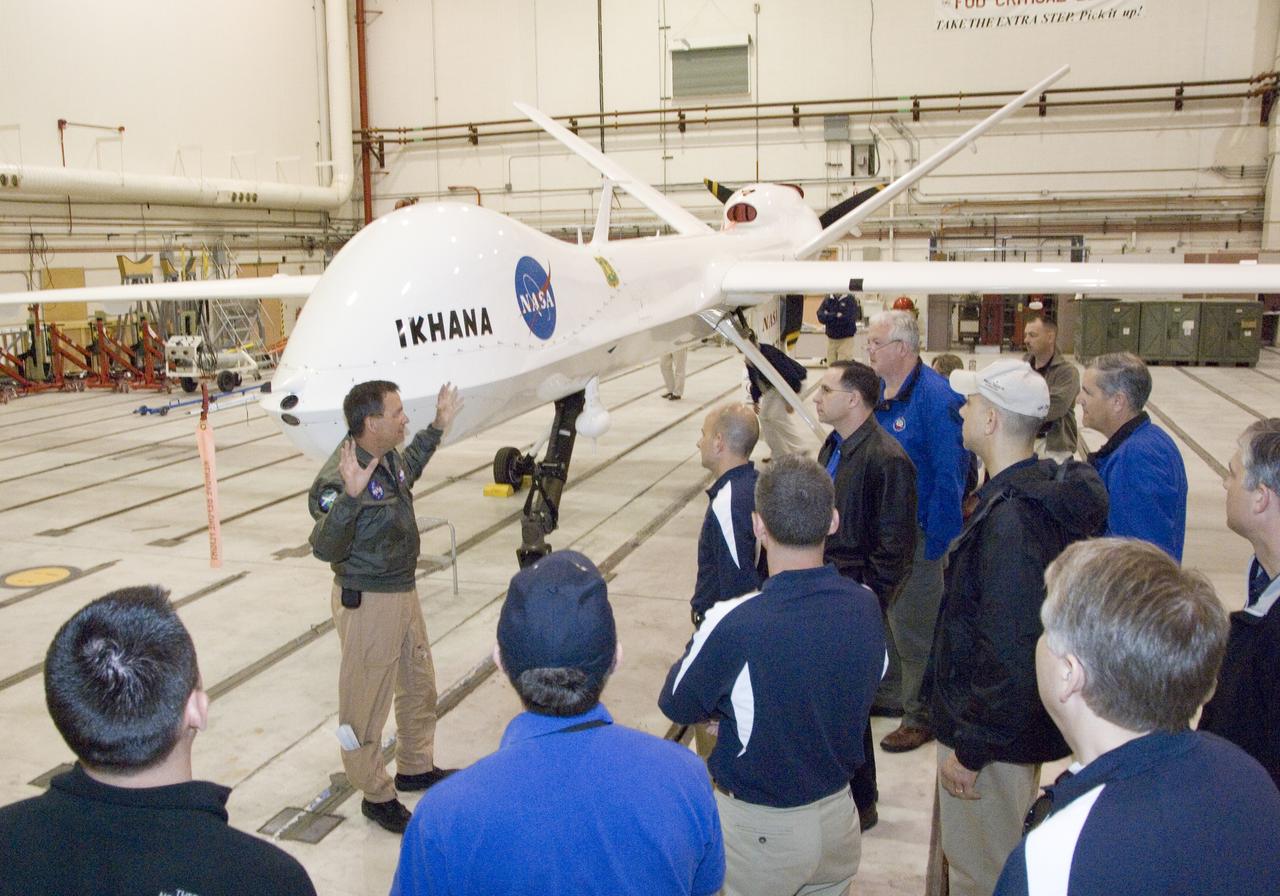
Industrial College of the Armed Forces students on a VIP tour receive a briefing on the Ikhana unmanned air vehicle from NASA Dryden pilot Mark Pestana.
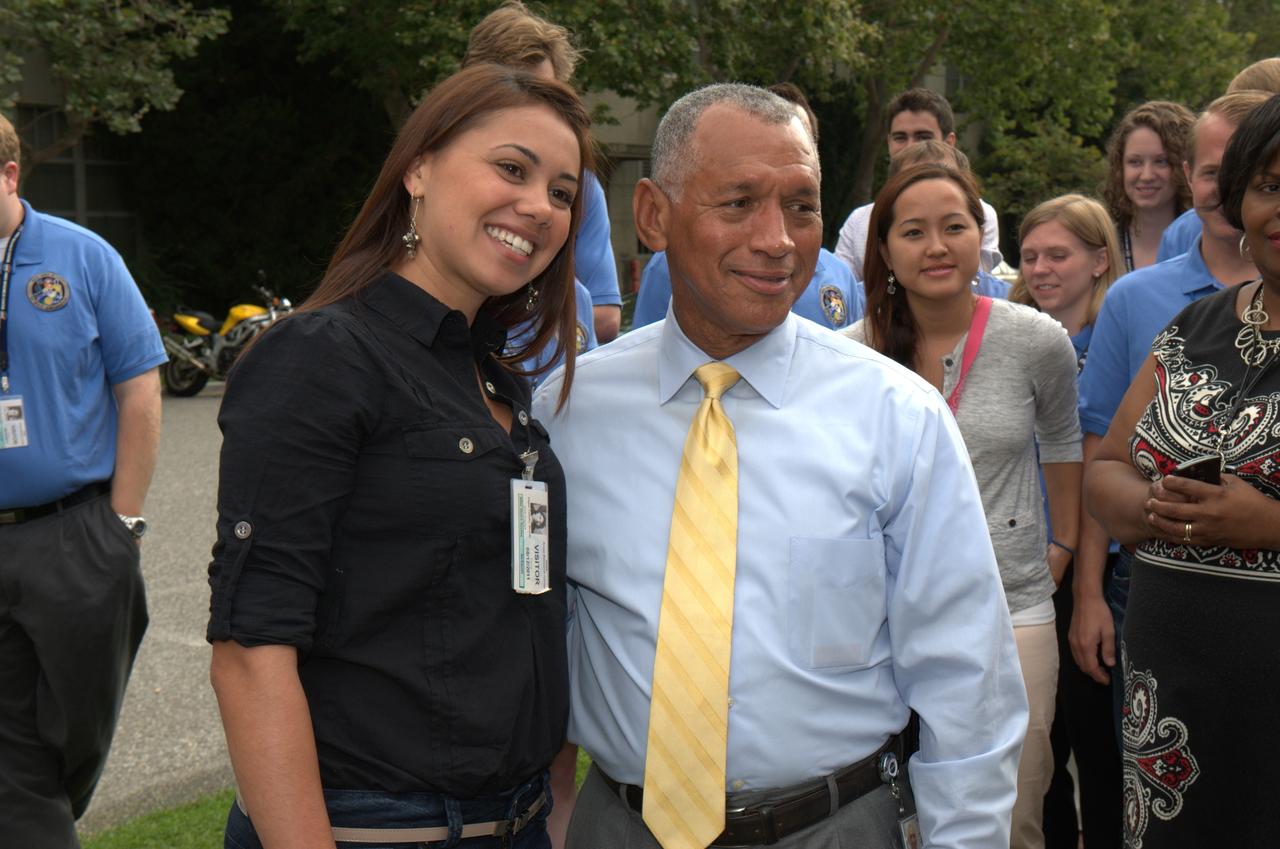
NASA Administrator Charlie Bolden, Jr. visits NASA Ames Research Center: meets with students and delivers a briefing to staff at a all-hands meeting
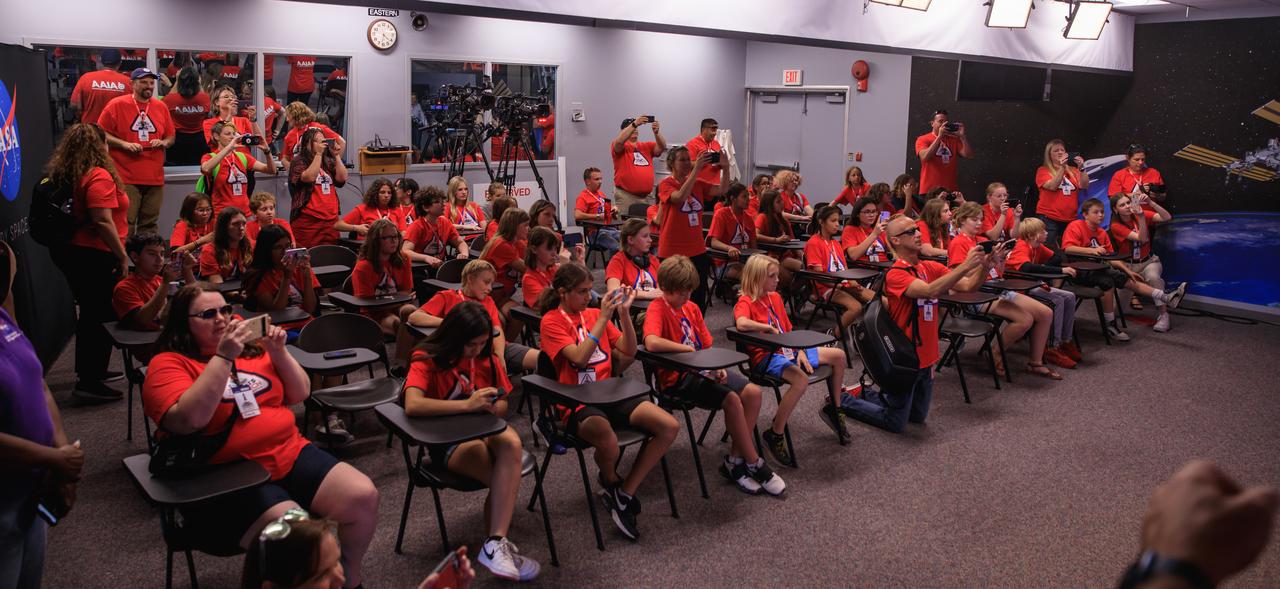
A group of students and their chaperones gather in the John Holliman Auditorium of the News Center for a mock news briefing during a tour of NASA’s Kennedy Space Center in Florida on Oct. 6, 2022. The middle-school students, from the Boys and Girls Clubs of the Flathead Indian Reservation in Montana, are visiting the space center with the Students to Launch program. Students to Launch engages students in STEM (science, technology, engineering and mathematics) and creates awareness of careers in the space program.
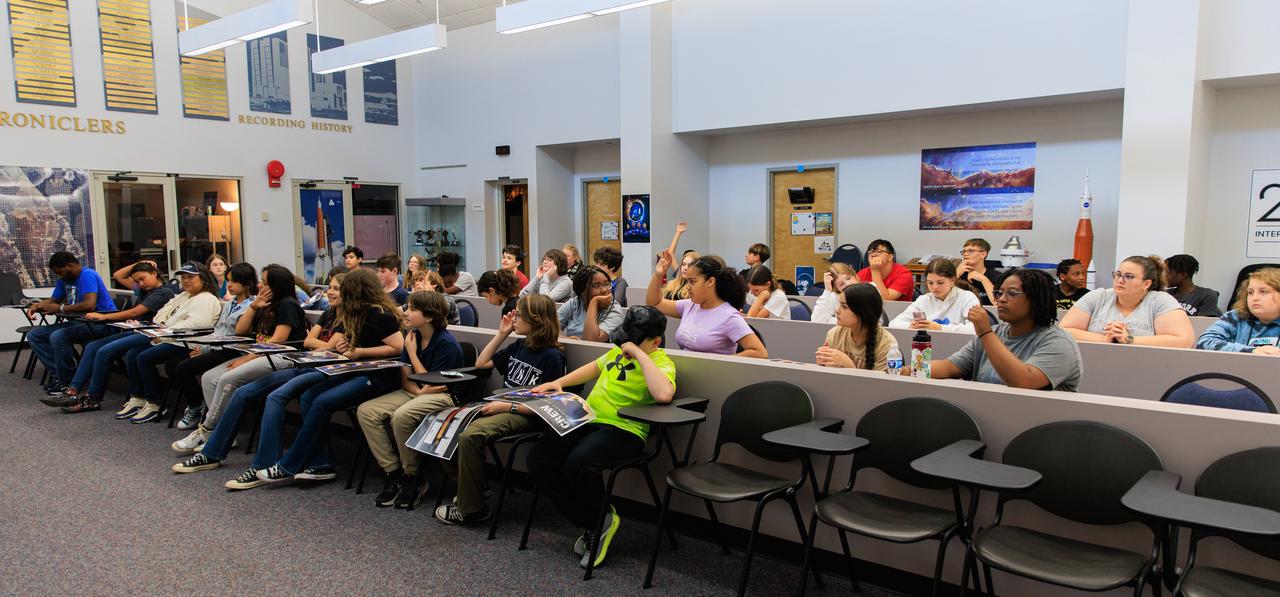
As part of NASA’s NextGen STEM project, students from Andrew Jackson Middle School in Titusville, Florida, participate in an environmentally focused Earth Day briefing on Tuesday, April 2, 2024, inside NASA News Center’s “bullpen” at the agency’s Kennedy Space Center in Florida. Along with the students participating in person, middle school students from across the country participated virtually by asking questions to the panel to discuss how technology and science coexist with nature at Kennedy.
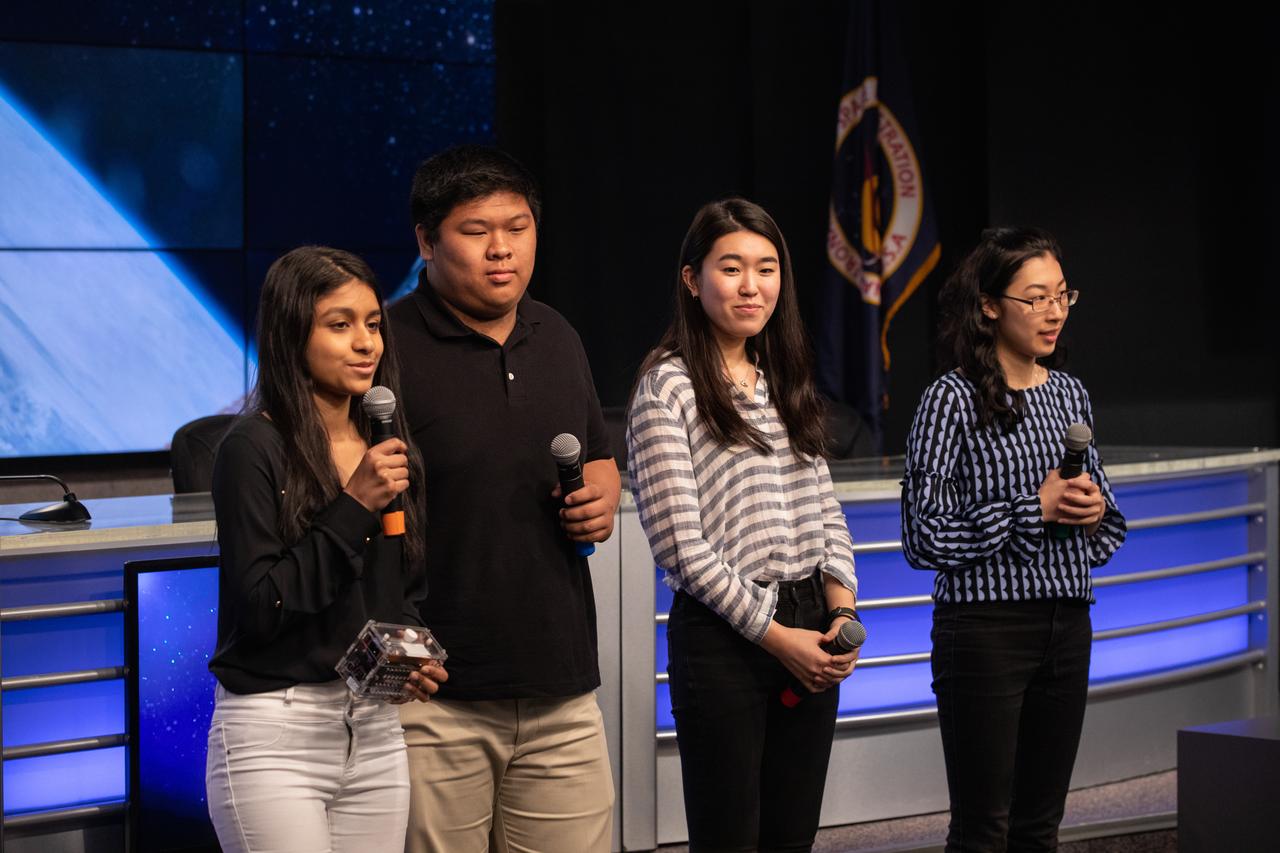
From left, high school student Aarthi Vijayakumar, MIT student David Li, and high school students Michelle Sung and Rebecca Li talk about their winning Genes in Space experiment for NASA during a What’s On Board science briefing to NASA Social participants at the agency’s Kennedy Space Center in Florida on April 29, 2019. The briefing was held for SpaceX’s 17th Commercial Resupply Services (CRS-17) mission to the International Space Station. NASA’s Orbiting Carbon Observatory-3 (OCO-3) and Space Test Program-Houston 6 (STP-H6) are two of the experiments that also will be delivered to the space station on CRS-17. The SpaceX Falcon 9 rocket and Dragon cargo module are scheduled to launch no earlier than May 3, 2019, from Space Launch Complex 40 on Cape Canaveral Air Force Station in Florida.
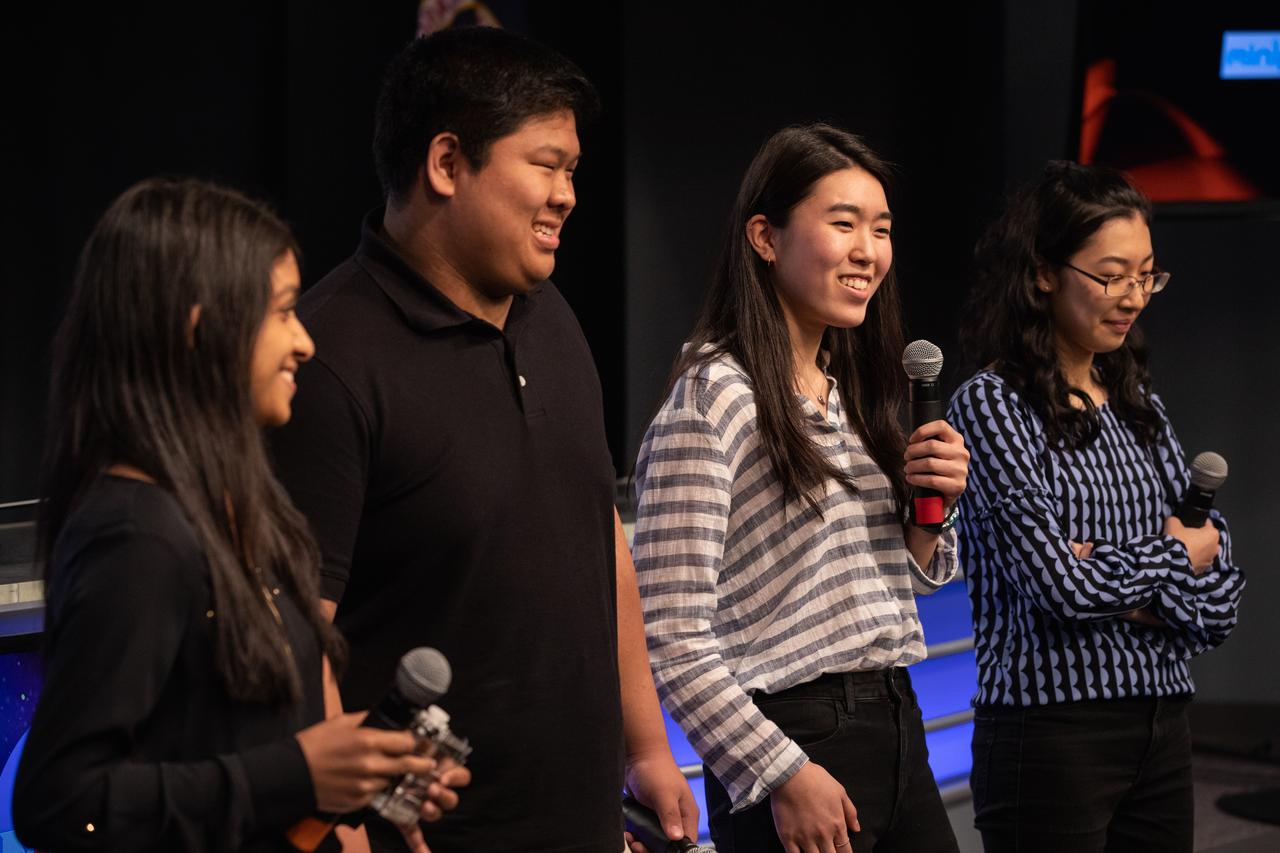
From left, high school student Aarthi Vijayakumar, MIT student David Li, and high school students Michelle Sung and Rebecca Li talk about their winning Genes in Space experiment for NASA during a What’s On Board science briefing to NASA Social participants at the agency’s Kennedy Space Center in Florida on April 29, 2019. The briefing was held for SpaceX’s 17th Commercial Resupply Services (CRS-17) mission to the International Space Station. NASA’s Orbiting Carbon Observatory-3 (OCO-3) and Space Test Program-Houston 6 (STP-H6) are two of the experiments that also will be delivered to the space station on CRS-17. The SpaceX Falcon 9 rocket and Dragon cargo module are scheduled to launch no earlier than May 3, 2019, from Space Launch Complex 40 on Cape Canaveral Air Force Station in Florida.
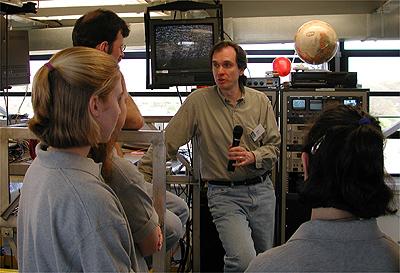
The first NASA Dropping In a Microgravity Environment (DIME) student competition pilot project came to a conclusion at the Glenn Research Center in April 2001. The competition involved high-school student teams who developed the concept for a microgravity experiment and prepared an experiment proposal. The two student teams - COSI Academy, sponsored by the Columbus Center of Science and Industry, and another team from Cincinnati, Ohio's Sycamore High School, designed a microgravity experiment, fabricated the experimental apparatus, and visited NASA Glenn to operate their experiment in the 2.2 Second Drop Tower. Here, students are briefed by NASA engineer Daniel Dietrich at the top of the drop tower. This image is from a digital still camera; higher resolution is not available.
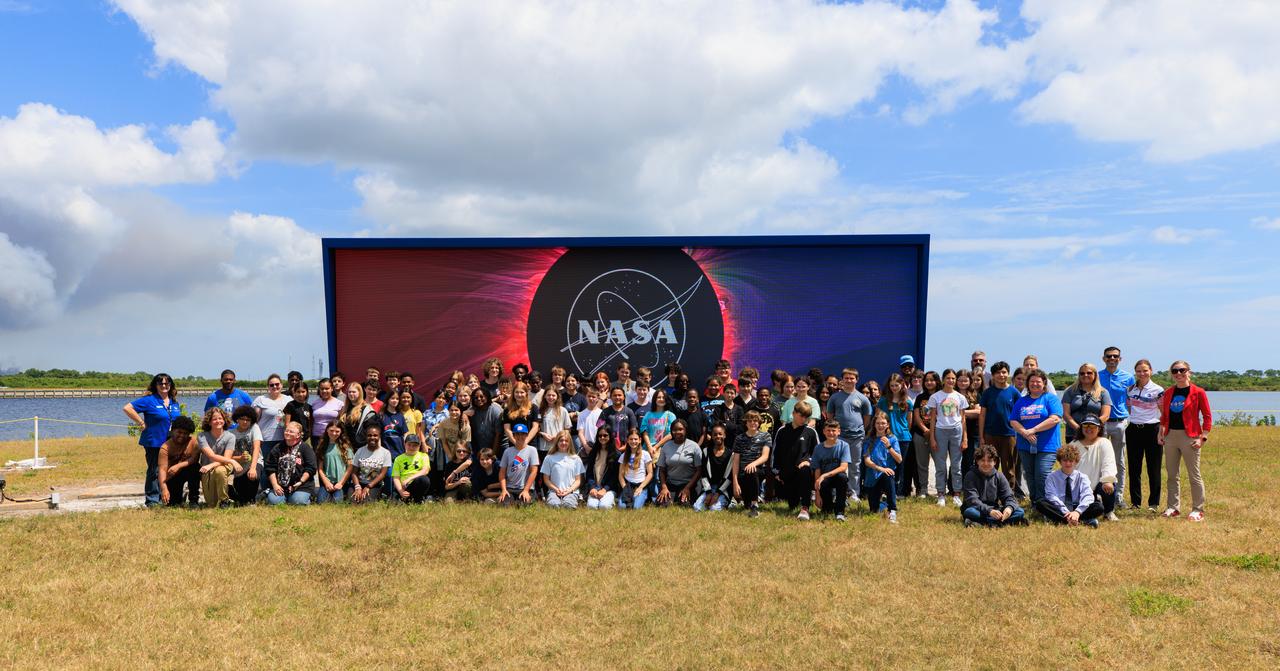
Students from Andrew Jackson Middle School in Titusville, Florida, pose for a photo in front of the iconic countdown clock at NASA’s Kennedy Space Center in Florida on Tuesday, April 2, 2024. As part of the agency’s NextGen STEM project, the students joined others from across the country who participated virtually for an environmentally focused Earth Day briefing held inside Kennedy’s news auditorium to discuss how technology and science coexist with nature at the spaceport.

Students from Andrew Jackson Middle School in Titusville, Florida, pose for a photo with one of the Artemis crew transportation vehicles in front of the Vehicle Assembly Building at NASA’s Kennedy Space Center in Florida on Tuesday, April 2, 2024. As part of NASA’s NextGen STEM project, the students joined others from across the country who participated virtually for an environmentally focused Earth Day briefing held inside Kennedy’s news auditorium to discuss how technology and science coexist with nature at the spaceport.

NASA Chief Technologist Douglas Terrier, right, being briefed on student-developed precision atmospheric laser technology mounted on a remotely-operated rover at Harding University in Searcy, Arkansas, while attending “NASA Day in Arkansas” hosted at the university on Jan. 27, 2020.
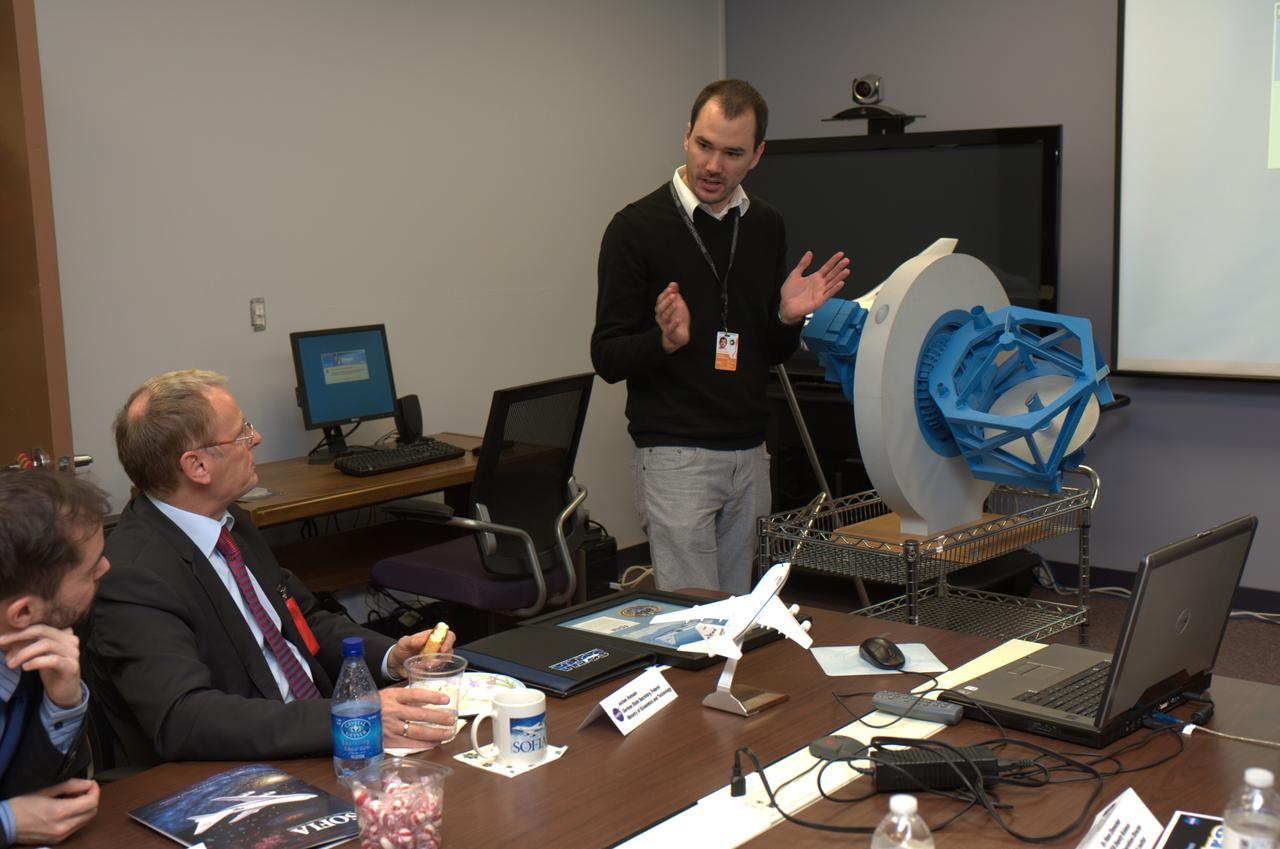
German Deligation visits Ames SOFIA Science Office for briefing. Left to right Jochen Homann, German State Secretary Federal Ministry of Economics and Technology, and Manuel Wiedemann, post-doctorate student from the Deutsches SOFIA Institute, University of Stuttgart.
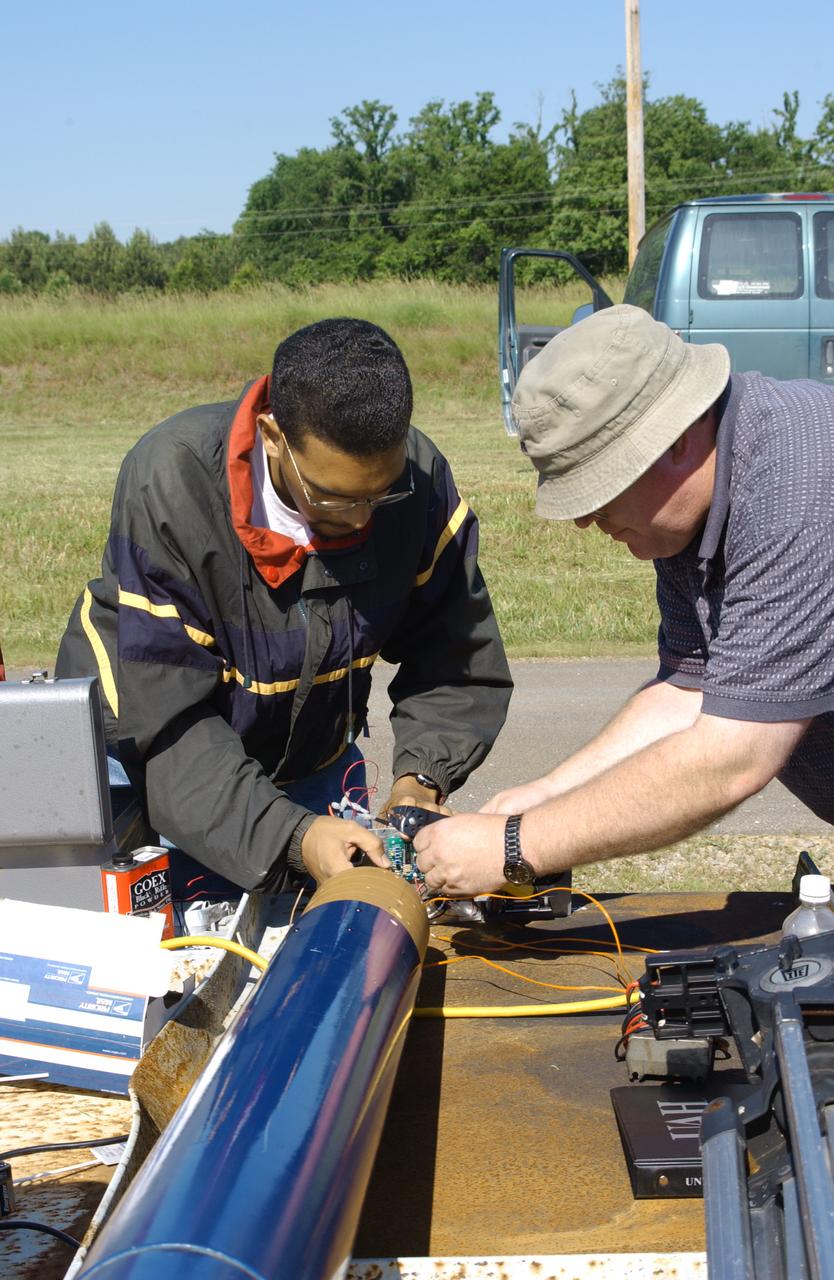
Filled with anticipation, students from two local universities, the University of Alabama in Huntsville (UAH), and Alabama Agricultural Mechanical University (AM), counted down to launch the rockets they designed and built at the Army test site on Redstone Arsenal in Huntsville, Alabama. The projected two-mile high launch culminated more than a year's work and demonstrated the student team's ability to meet the challenge set by the Marshall Space Flight Center's (MSFC) Student Launch Initiative (SLI) program to apply science and math to experience, judgment, and common sense, and proved to NASA officials that they have successfully built reusable launch vehicles (RLVs), another challenge set by NASA's SLI program. MSFC's SLI program is an educational effort that aims to motivate students to pursue careers in science, math, and engineering. It provides the students with hands-on, practical aerospace experience. In this picture, a student from AM and his mentor install their payload into the launch vehicle which was built by the team of UAH students. The scientific payload, developed and built by the team of AM students, measured the amount of hydrogen produced during electroplating with nickel in a brief period of micrgravity.
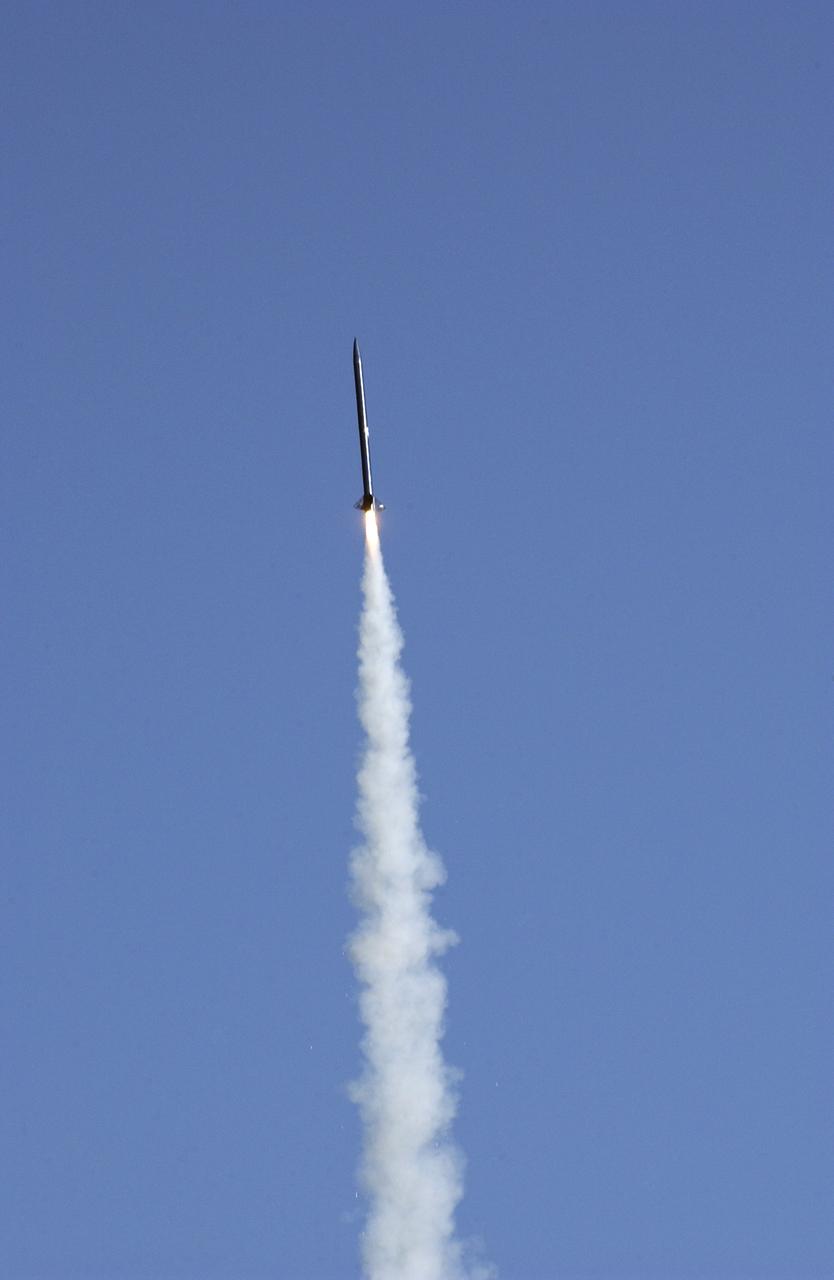
Filled with anticipation, students from two local universities, the University of Alabama in Huntsville (UAH), and Alabama Agricultural Mechanical University (AM), counted down to launch the rockets they designed and built at the Army test site on Redstone Arsenal in Huntsville, Alabama. The projected two-mile high launch culminated more than a year's work and demonstrated the student team's ability to meet the challenge set by the Marshall Space Flight Center's (MSFC) Student Launch Initiative (SLI) program to apply science and math to experience, judgment, and common sense, and proved to NASA officials that they have successfully built reusable launch vehicles (RLVs), another challenge set by NASA's SLI program. MSFC's SLI program is an educational effort that aims to motivate students to pursue careers in science, math, and engineering. It provides the students with hands-on, practical aerospace experience. In this picture, the combined efforts of students from UAH and AM sent this rocket soaring into flight. Students at UAH built the rocket and AM students developed its scientific payload, an experiment that measures the amount of hydrogen produced during electroplating with nickel in a brief period of micrgravity.
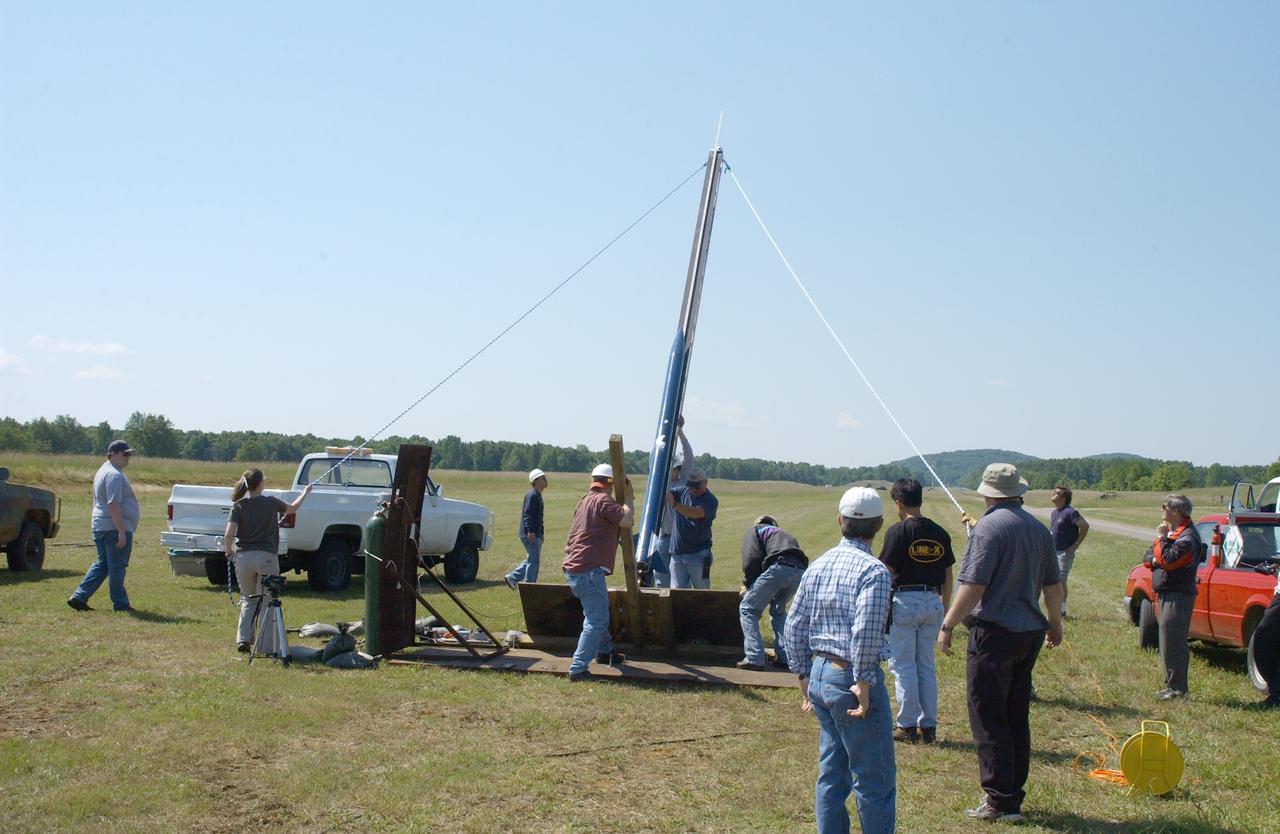
Filled with anticipation, students from two local universities, the University of Alabama in Huntsville (UAH), and Alabama Agricultural Mechanical University (AM), counted down to launch the rockets they designed and built at the Army test site on Redstone Arsenal in Huntsville, Alabama. The projected two-mile high launch culminated more than a year's work and demonstrated the student team's ability to meet the challenge set by the Marshall Space Flight Center's (MSFC) Student Launch Initiative (SLI) Program to apply science and math to experience, judgment, and common sense, and proved to NASA officials that they have successfully built reusable launch vehicles (RLVs), another challenge set by NASA's SLI program. MSFC's SLI program is an educational effort that aims to motivate students to pursue careers in science, math, and engineering. It provides the students with hands-on, practical aerospace experience. In this picture, the university students prepare their rocket for flight on the launch pad. Students at UAH built the rocket and AM students developed its scientific payload, an experiment that measures the amount of hydrogen produced during electroplating with nickel in a brief period of micrgravity.
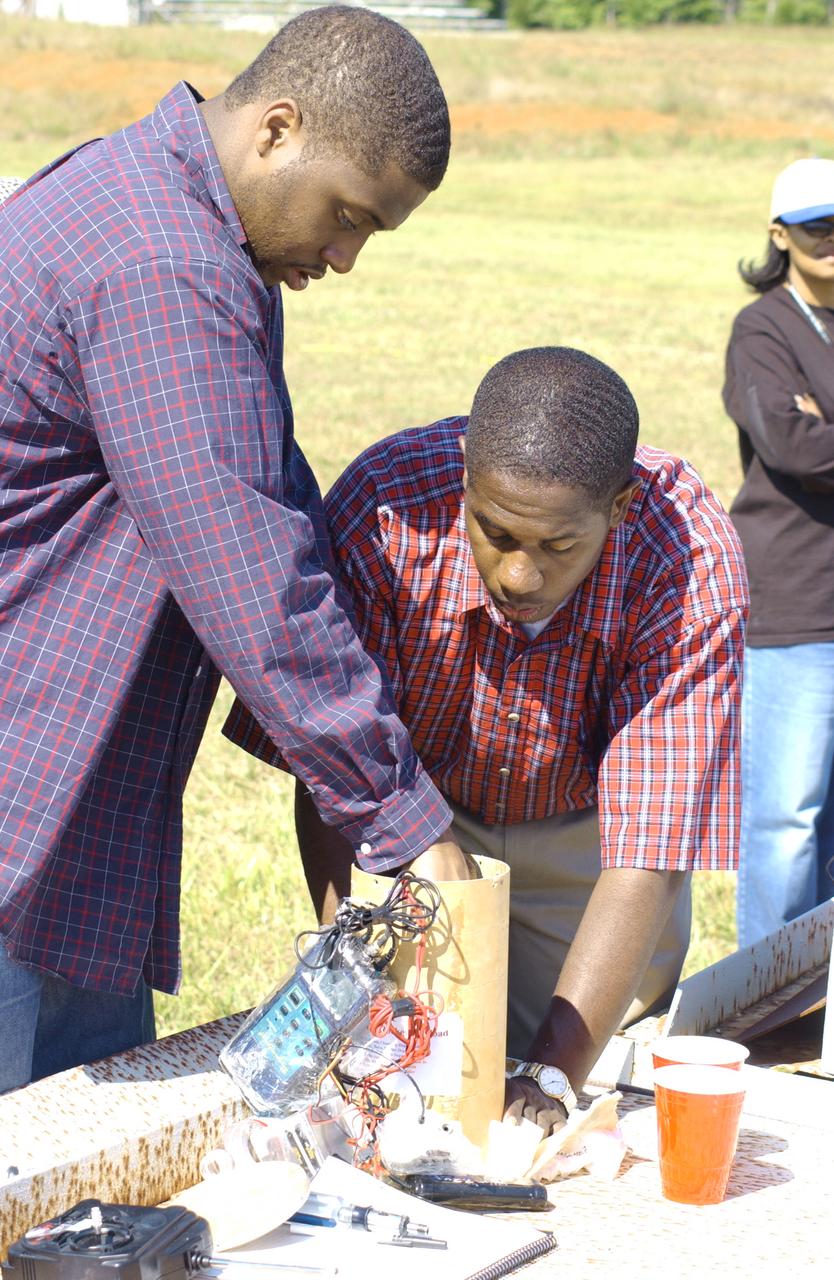
Filled with anticipation, students from two local universities, the University of Alabama in Huntsville (UAH), and Alabama Agricultural Mechanical University (AM), counted down to launch the rockets they designed and built at the Army test site on Redstone Arsenal in Huntsville, Alabama. The projected two-mile high launch culminated more than a year's work and demonstrated the student team's ability to meet the challenge set by the Marshall Space Flight Center's (MSFC) Student Launch Initiative (SLI) program to apply science and math to experience, judgment, and common sense, and proved to NASA officials that they have successfully built reusable launch vehicles (RLVs), another challenge set by NASA's SLI program. MSFC's SLI program is an educational effort that aims to motivate students to pursue careers in science, math, and engineering. It provides the students with hands-on, practical aerospace experience. UAH students designed and built the rocket and AM students designed the payload. In this picture, AM students prepare their payload, an experiment that measures the amount of hydrogen produced during electroplating with nickel in a brief period of micrgravity, prior to launch.
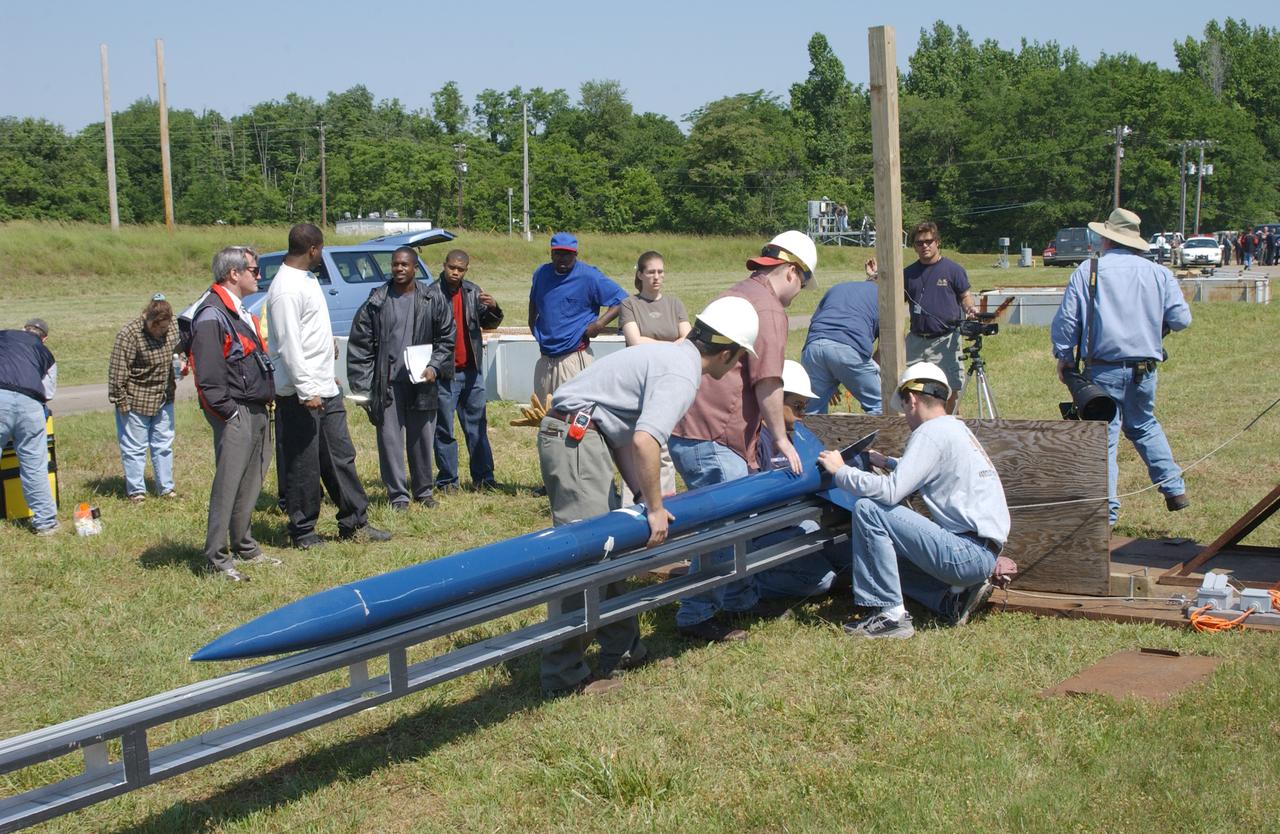
Filled with anticipation, students from two local universities, the University of Alabama in Huntsville (UAH), and Alabama Agricultural Mechanical University (AM), counted down to launch the rockets they designed and built at the Army test site on Redstone Arsenal in Huntsville, Alabama. The projected two-mile high launch culminated more than a year's work and demonstrated the student team's ability to meet the challenge set by the Marshall Space Flight Center's (MSFC) Student Launch Initiative (SLI) program to apply science and math to experience, judgment, and common sense, and proved to NASA officials that they have successfully built reusable launch vehicles (RLVs), another challenge set by NASA's SLI program. MSFC's SLI program is an educational effort that aims to motivate students to pursue careers in science, math, and engineering. It provides the students with hands-on, practical aerospace experience. In this picture, the University students prepare their rocket for launch. Students at UAH built the rocket and AM students developed its scientific payload, an experiment that measures the amount of hydrogen produced during electroplating with nickel in a brief period of micrgravity.
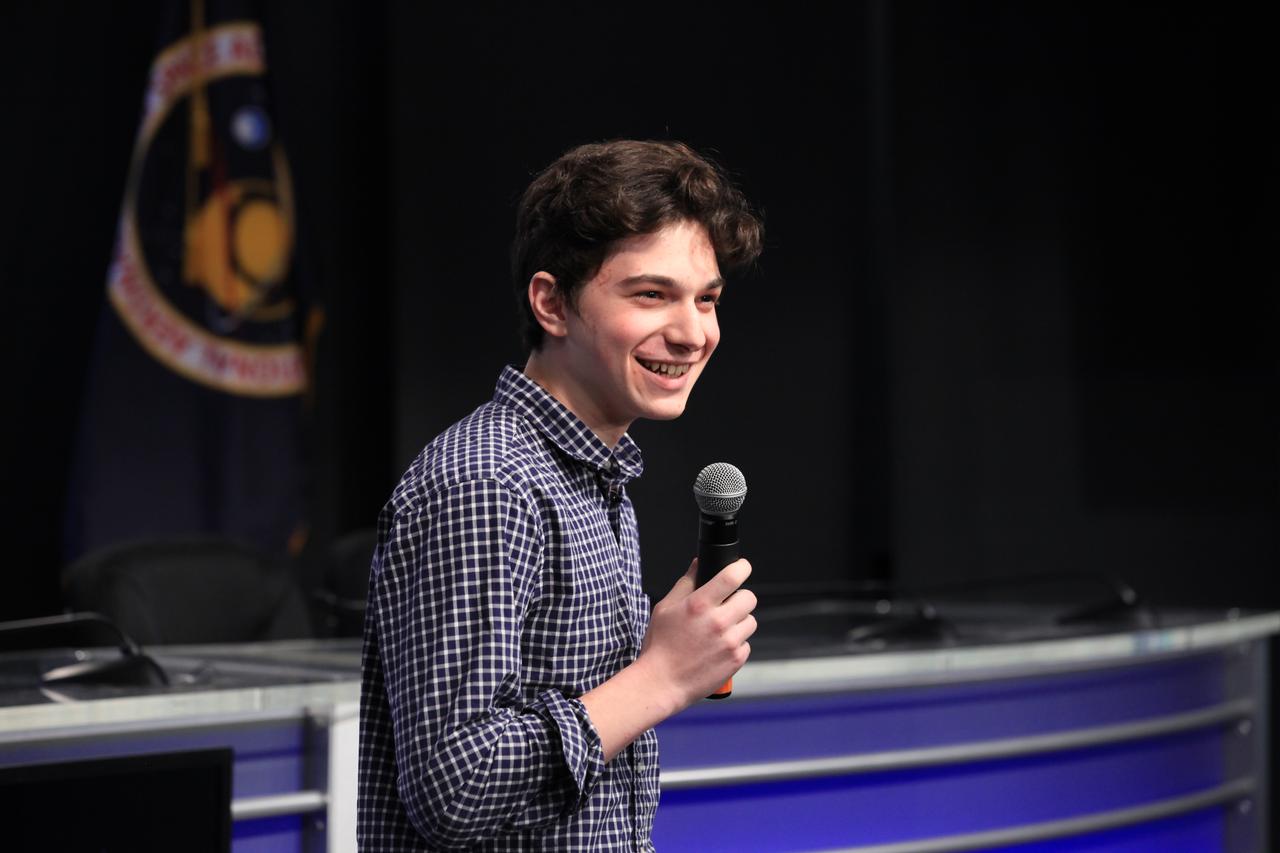
Julian Rubinfien, student winner of the Genes in Space competition, discusses his Genes in Space II winning experiment during a "What's on Board" science briefing to NASA Social participants at NASA's Kennedy Space Center in Florida. The briefing was for Orbital ATK's seventh commercial resupply services mission, CRS-7, to the International Space Station. Orbital ATK's Cygnus pressurized cargo module is set to launch on the United Launch Alliance Atlas V rocket from Space Launch Complex 41 at Cape Canaveral Air Force Station on April 18. Liftoff is scheduled for 11:11 a.m. EDT.
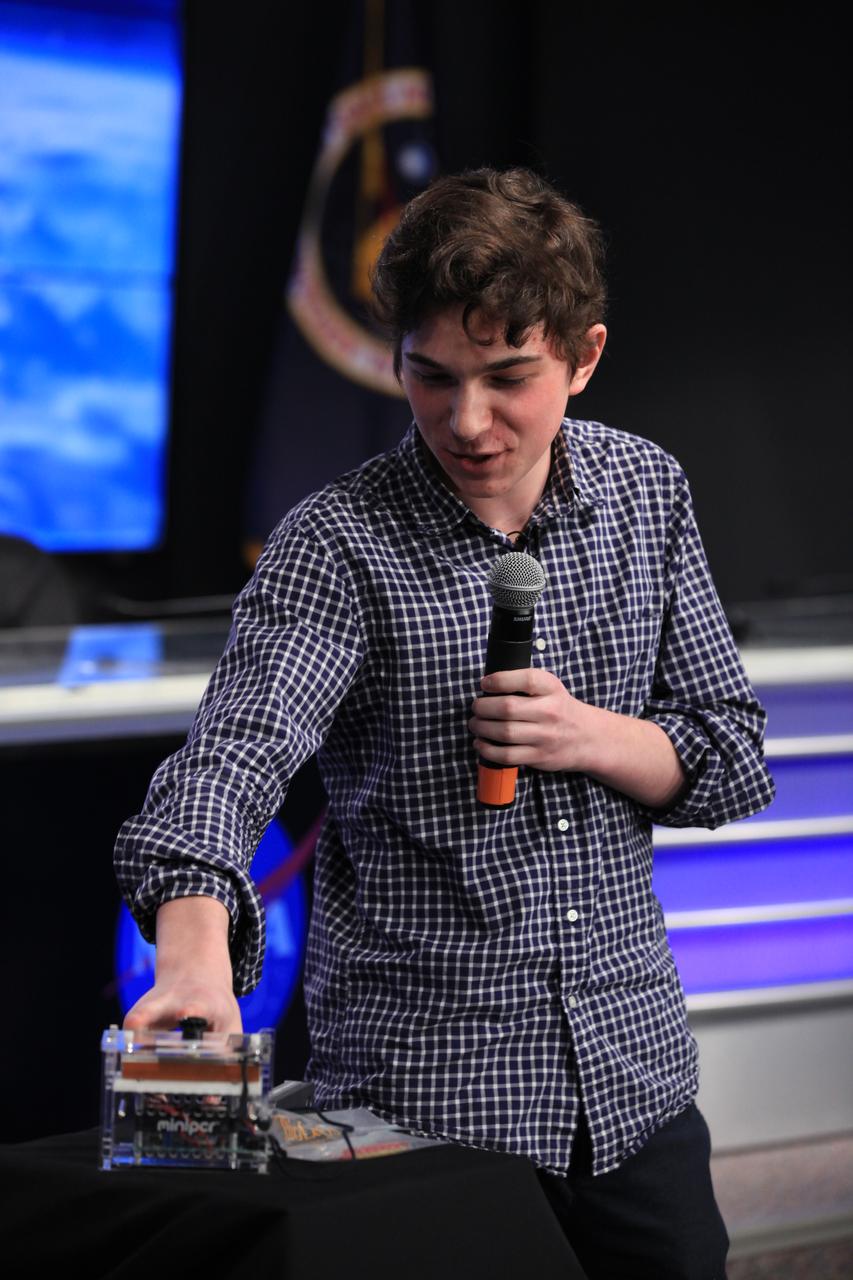
Julian Rubinfien, student Genes in Space II winner, explains his experiment during a "What's on Board" science briefing to NASA Social participants at the agency's Kennedy Space Center in Florida. The briefing was for Orbital ATK's seventh commercial resupply services mission, CRS-7, to the International Space Station. Orbital ATK's Cygnus pressurized cargo module is set to launch on the United Launch Alliance Atlas V rocket from Space Launch Complex 41 at Cape Canaveral Air Force Station on April 18. Liftoff is scheduled for 11:11 a.m. EDT.
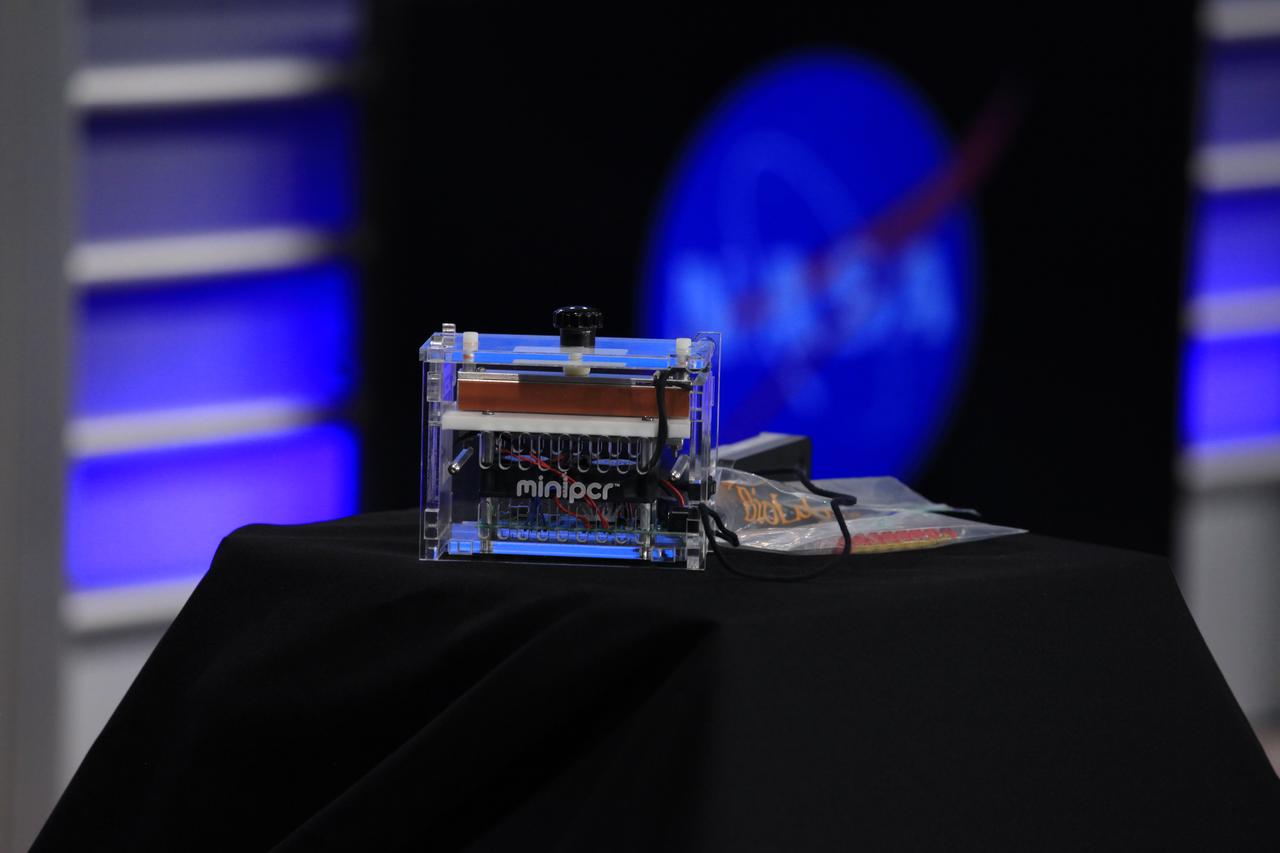
An example of the Genes in Space II winning student experiment is on display during a "What's on Board" science briefing to NASA Social participants at the agency's Kennedy Space Center in Florida. The briefing was for Orbital ATK's seventh commercial resupply services mission, CRS-7, to the International Space station. Orbital ATK's Cygnus pressurized cargo module is set to launch on the United Launch Alliance Atlas V rocket from Space Launch Complex 41 at Cape Canaveral Air Force Station on April 18. Liftoff is scheduled for 11:11 a.m. EDT.
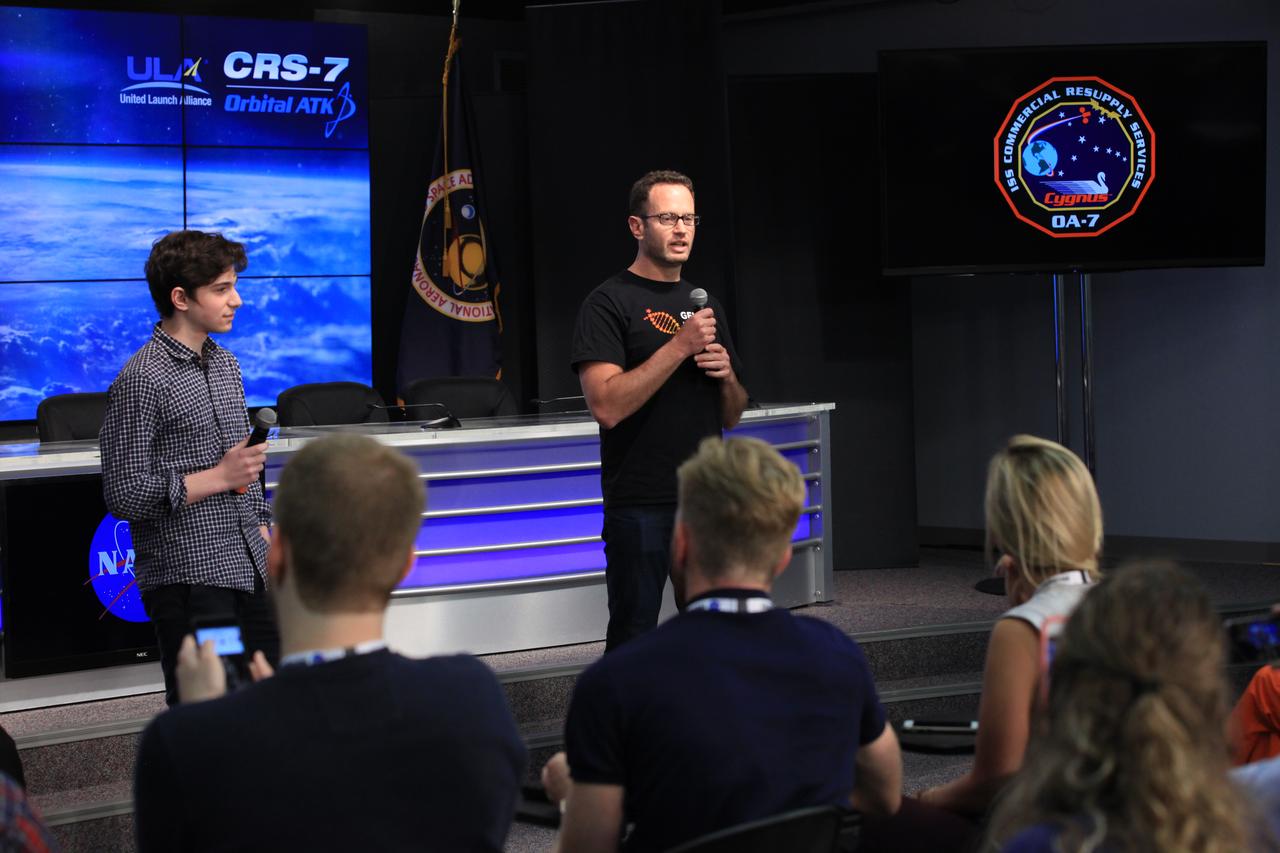
Dr. Sebastian Kraves, at right, co-founder of Genes in Space, discusses the winning experiment for Genes in Space II, during a "What's on Board" science briefing to NASA Social participants at the agency's Kennedy Space Center in Florida. At left is Julian Rubinfien, the student winner of this year's Genes in Space competition. The briefing was for Orbital ATK's seventh commercial resupply services missions, CRS-7, to the International Space Station. Orbital ATK's Cygnus pressurized cargo module is set to launch on the United Launch Alliance Atlas V rocket from Space Launch Complex 41 at Cape Canaveral Air Force Station on April 18. Liftoff is scheduled for 11:11 a.m. EDT.

As part of NASA’s NextGen STEM project, students from Andrew Jackson Middle School in Titusville, Florida, participate in an environmentally focused Earth Day briefing on Tuesday, April 2, 2024, inside the news auditorium at the agency’s Kennedy Space Center in Florida. Along with the students participating in person, middle school students from across the country participated virtually to discuss how technology and science coexist with nature at Kennedy with panel participants. The panelists from left to right are Messod Bendayan, NASA Communications; Kelly McCarthy, NASA’s Office of STEM Engagement, Bob Kline, Kennedy’s Environmental Assurance Branch; Spencer Davis, Kennedy’s Exploration Ground Systems; Kim King-Wrenn, Merritt Island National Wildlife Refuge.
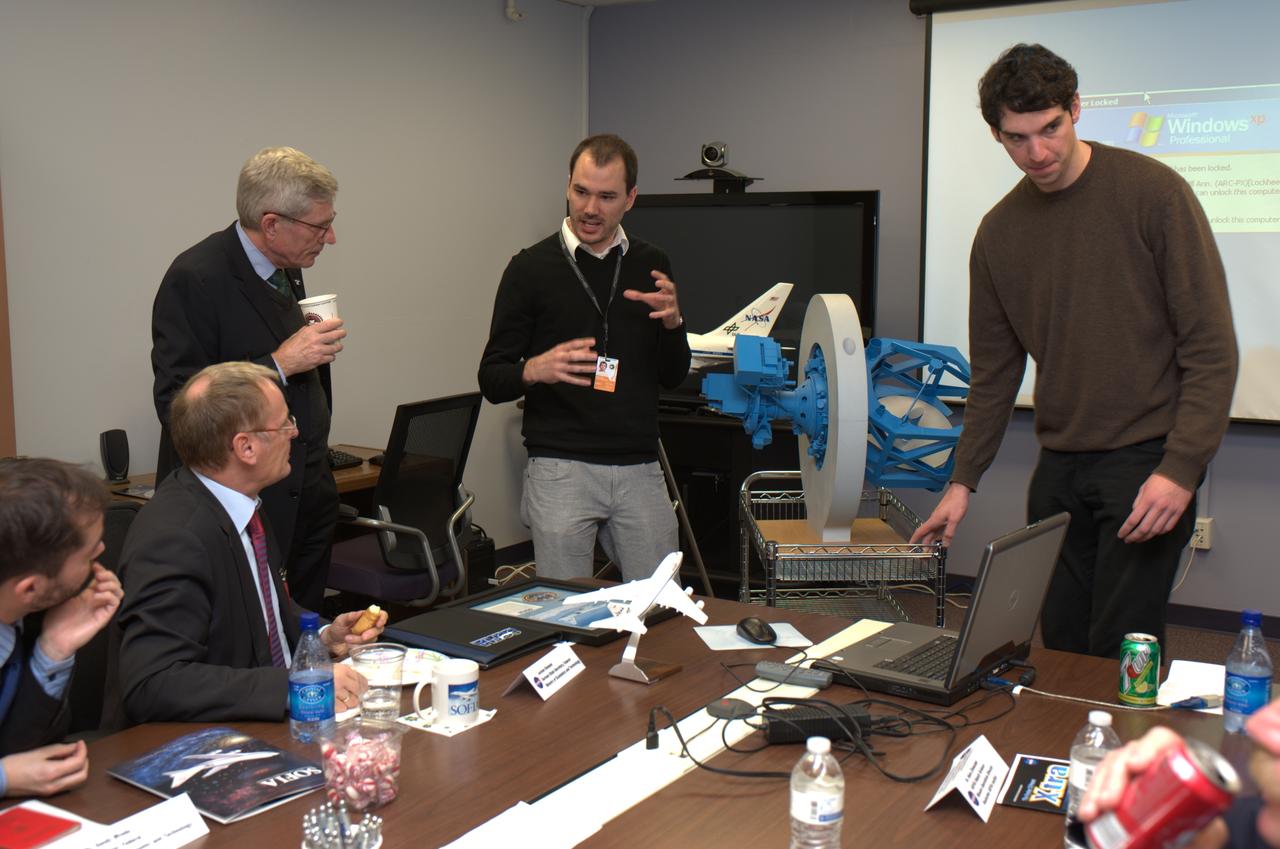
German Deligation visits Ames SOFIA Science Office for briefing. Left to right Jochen Homann, German State Secretary Federal Ministry of Economics and Technology, Dr. Benno Bunse, President & CEO, German American Chamber of Commerce, New York, Manuel Wiedemann, post-doctorate student from the Deutsches SOFIA Institute, University of Stuttgart.
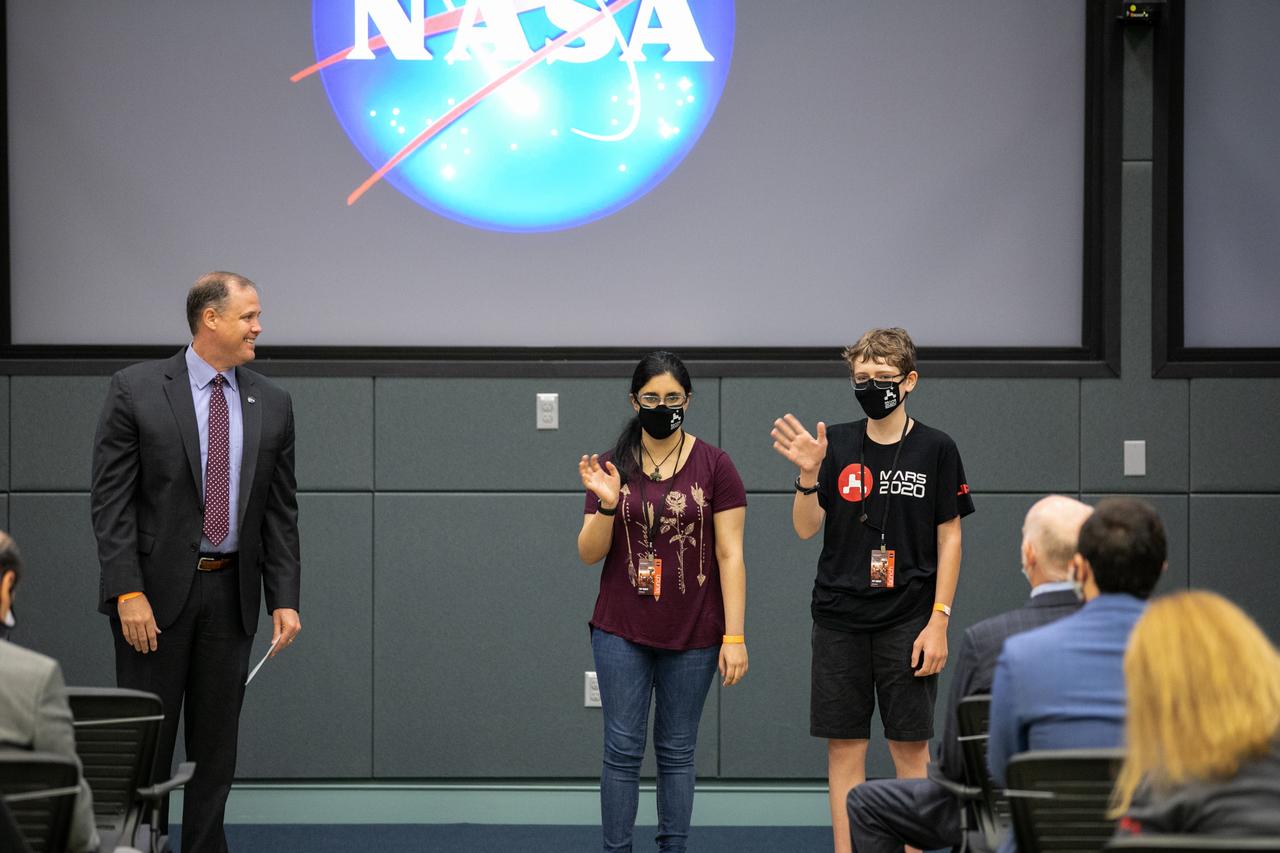
NASA Administrator Jim Bridenstine participates in a Mars 2020 VIP briefing at the Operations and Support Building II at NASA’s Kennedy Space Center in Florida on July 30, 2020. Also joining him are students Vaneeza Rupani and Alex Mather. Rupani named the Ingenuity helicopter, and Mather named the Perseverance rover. The briefing took place before launch of the rover and helicopter on a United Launch Alliance Atlas V 541 rocket from Space Launch Complex 41 at nearby Cape Canaveral Air Force Station. Liftoff occurred at 7:50 a.m. EDT. The rover is part of NASA’s Mars Exploration Program, a long-term effort of robotic exploration of the Red Planet. The rover will search for habitable conditions in the ancient past and signs of past microbial life on Mars. The Launch Services Program at Kennedy is responsible for launch management.
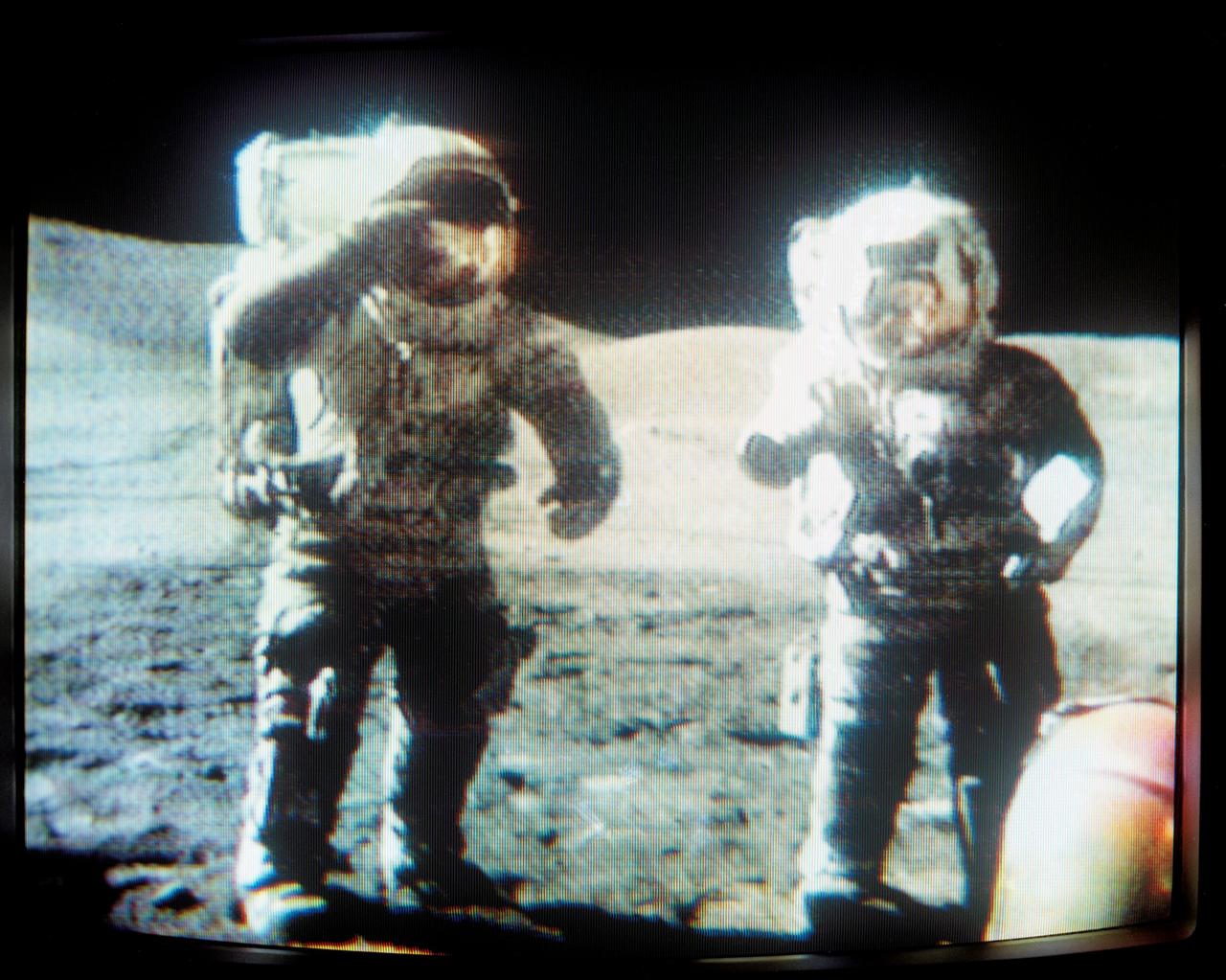
S72-55420 (13 Dec. 1972) --- Astronauts Eugene A. Cernan (on left) and Harrison H. Schmitt pay their respects and send their best wishes to the members of the International Youth Science Tour, who were visiting the Manned Spacecraft Center, in brief ceremonies near the close of the third Apollo 17 extravehicular activity (EVA) at the Taurus-Littrow landing site. This picture is a reproduction taken from a color television transmission made by the color RCA TV camera mounted on the lunar roving vehicle. Noting that they had collected a very significant rock composed of many fragments, Schmitt said, "A portion of a rock will be sent to a representative agency or museum in each of the countries represented by the young people in Houston today..." The more than 70 foreign students were in the U.S. visiting space research and science centers. In his closing remarks to the students Cernan remarked, "We salute you, promise of the future."
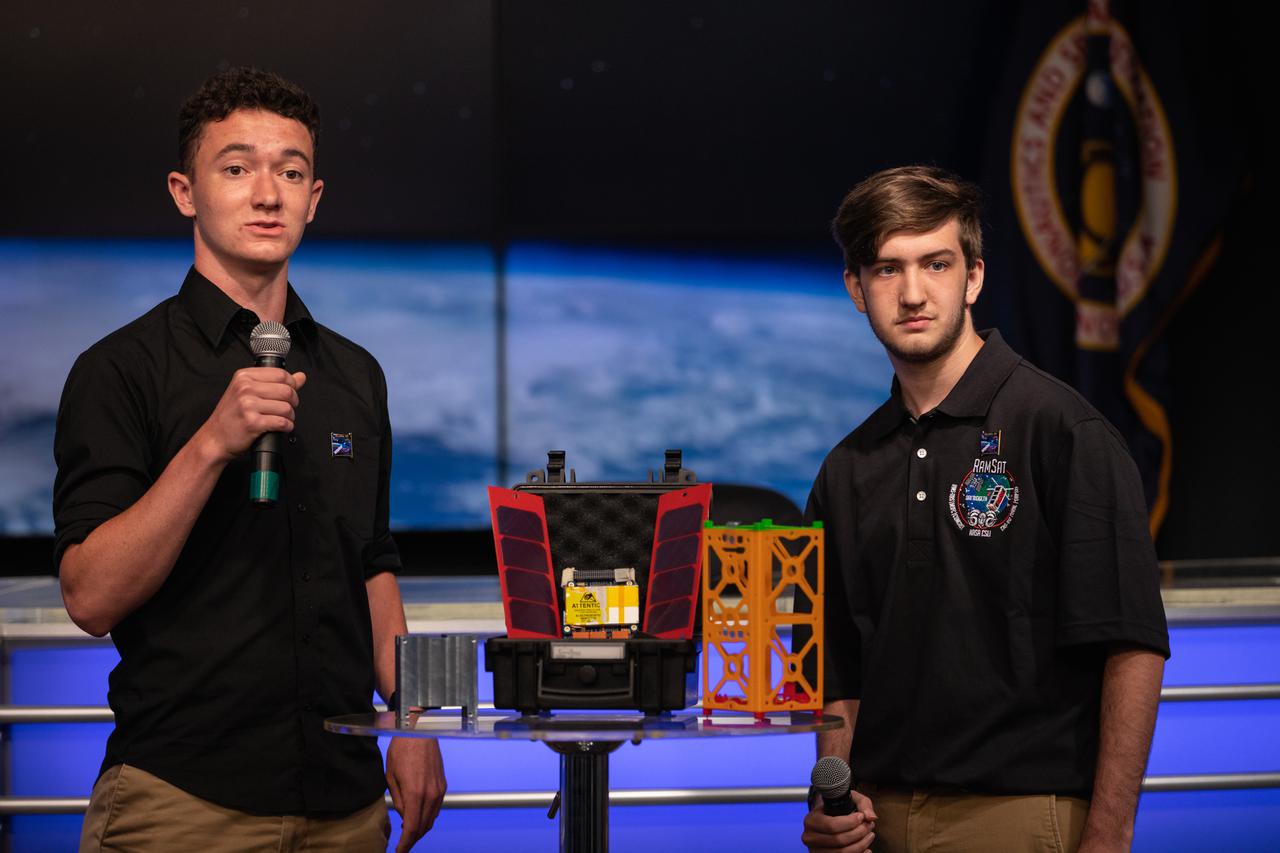
Students Joe Blair, at left, and Jonathon Bonamarte, describe a CubeSat, called RamSat, during a What’s On Board Science Briefing on June 2, 2021, at Kennedy Space Center in Florida for SpaceX’s 22nd Commercial Resupply Services Mission for NASA to the International Space Station. The small research satellite was developed by students and faculty at Robertsville Middle School in Oak Ridge, Tennessee. RamSat will observe forest regrowth in the Gatlinburg, Tennessee area which was devastated by wildfires in 2016. RamSat is the sole payload of the 36th Educational Launch of Nanosatellites (ELaNa) mission and was selected through NASA’s CubeSat Launch Initiative (CSLI). The SpaceX Falcon 9 rocket with the Dragon capsule atop is scheduled to launch at 1:29 p.m. EDT on Thursday, June 3, from the center’s Launch Complex 39A. Dragon will deliver more than 7,300 pounds of cargo and science experiments to the space station.
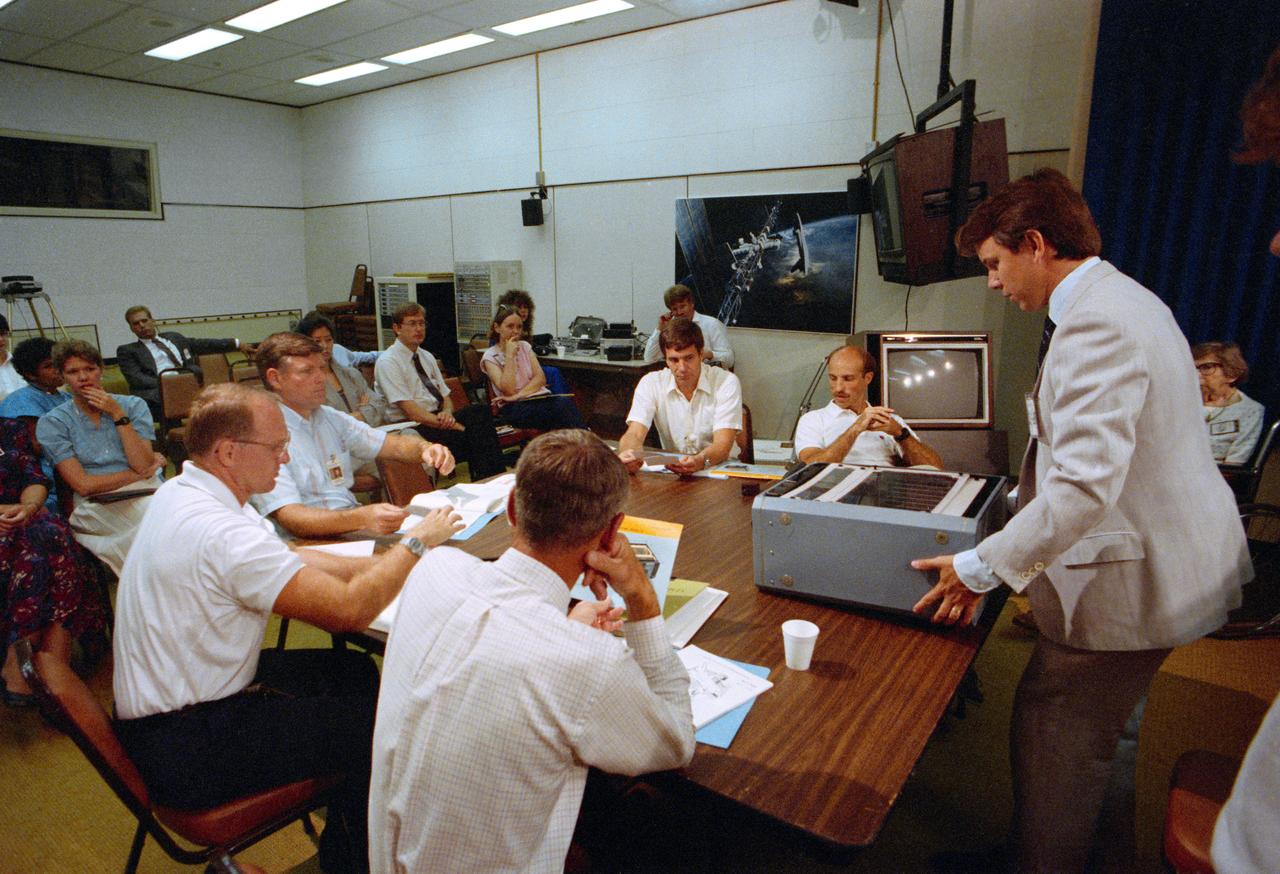
S88-44661 (13 Aug 1988) --- Tom Kestler, with Orthopaedic Hospital, USC, one of the sponsor representatives for student experimenter Andrew Fras explains components of Fras' experiment. It will be carried onboard theDiscovery for NASA's STS-29 mission next year. His primary audience is made up of members of the STS-29 crew who will monitor in-space operation of the experiment, titled "Effects of Weightlessness on Bone Healing." Crewmembers, clockwise around the table from the left, are Astronauts Robert C. Springer, James F. Buchli, Michael L. Coats, John E. Blaha and James P. Bagian. Seated in far right background is Dr. June Marshall of the University of Southern California School of Medicine, the student's sponsoring organization.
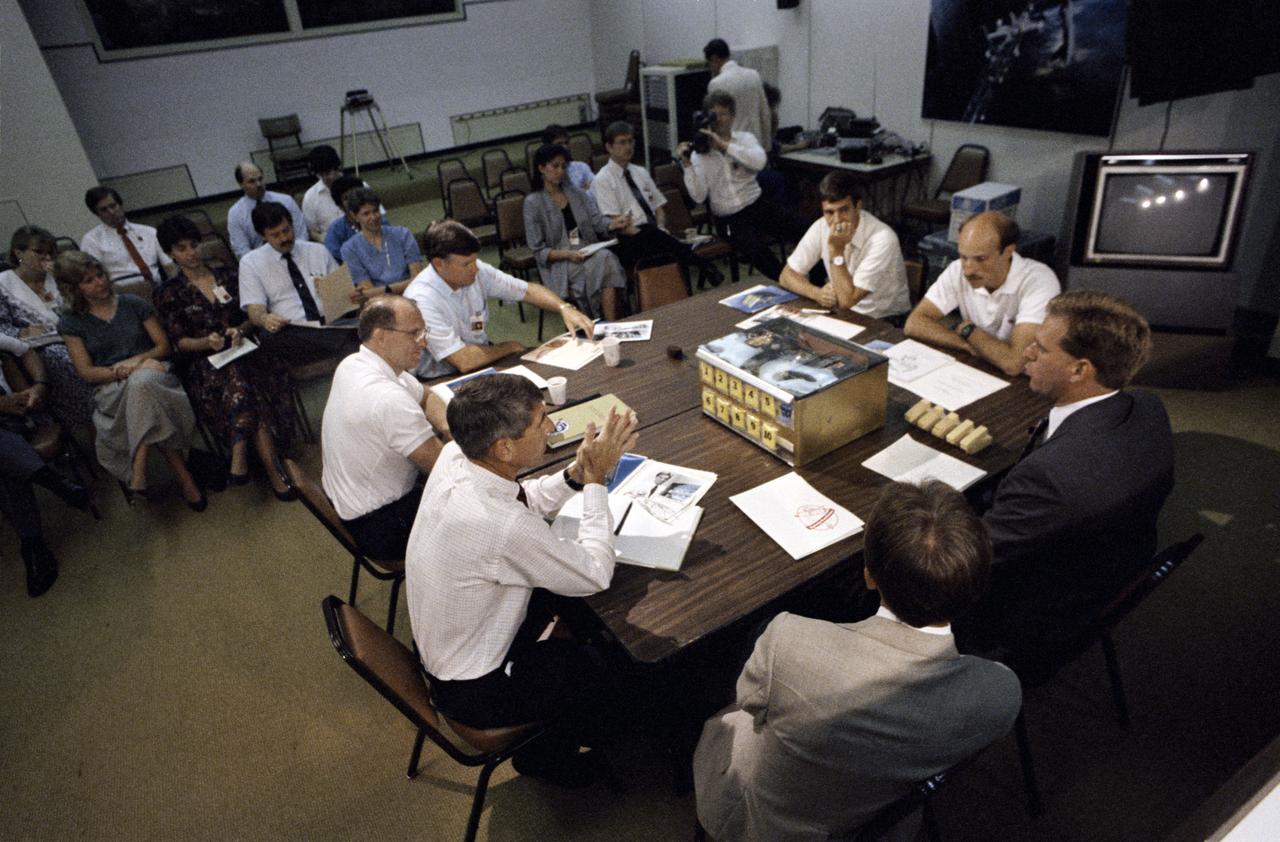
S88-44517 (13 Aug 1988) --- Student experimenter John C. Vellinger, right, explains operation of an incubator used in his experiment to be carried onboard the Discovery for NASA's STS-29 mission next year. His primary audience is made up of STS-29's five-man crew, who will monitor in-space operation of the experiment, titled "Chicken Embryo Development in Space." Kentucky Fried Chicken.

A What’s On Board Briefing for SpaceX’s 19th Commercial Resupply Services (CRS-19) mission for NASA to the International Space Station took place on Dec. 3, 2019, at the agency’s Kennedy Space Center in Florida. Rosa Reyna gonzales, student researcher for AzTechSat-1, the first Mexican-developed nanosatellite to be launched from the space station, discusses her role in the experiment and how the investigation will demonstrate communication between a CubeSat and the GlobalStar Constellation satellite network in low-Earth orbit. The SpaceX Falcon 9 rocket and Dragon cargo module are scheduled to launch on Dec. 4, 2019, from Space Launch Complex 40 on Cape Canaveral Air Force Station in Florida.
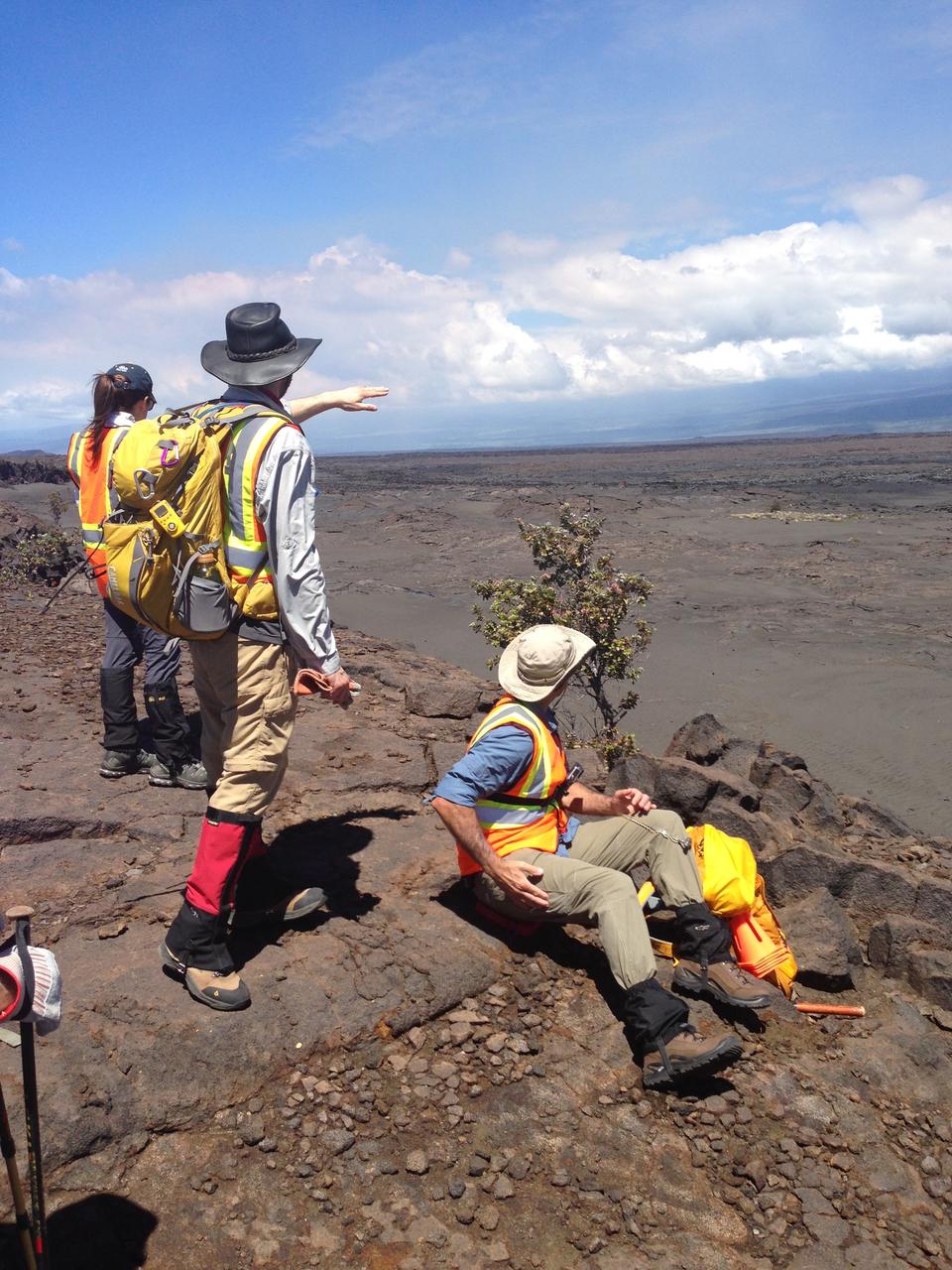
Briefing Hiking a lava field demands good preparation. Here, the team leaders brief the crew, scientists and student journalists on the route they’ll take down a scarp to the site of Kilauea’s December 1974 eruption. Credit: NASA/GSFC/Lora Bleacher In June, five student journalists from Stony Brook University packed their hiking boots and hydration packs and joined a NASA-funded science team for 10 days on the lava fields of Kilauea, an active Hawaiian volcano. Kilauea’s lava fields are an ideal place to test equipment designed for use on Earth’s moon or Mars, because volcanic activity shaped so much of those terrains. The trip was part of an interdisciplinary program called RIS4E – short for Remote, In Situ, and Synchrotron Studies for Science and Exploration – which is designed to prepare for future exploration of the moon, near-Earth asteroids and the moons of Mars. To read reports from the RIS4E journalism students about their experiences in Hawaii, visit <a href="http://ReportingRIS4E.com" rel="nofollow">ReportingRIS4E.com</a> <b><a href="http://www.nasa.gov/audience/formedia/features/MP_Photo_Guidelines.html" rel="nofollow">NASA image use policy.</a></b> <b><a href="http://www.nasa.gov/centers/goddard/home/index.html" rel="nofollow">NASA Goddard Space Flight Center</a></b> enables NASA’s mission through four scientific endeavors: Earth Science, Heliophysics, Solar System Exploration, and Astrophysics. Goddard plays a leading role in NASA’s accomplishments by contributing compelling scientific knowledge to advance the Agency’s mission. <b>Follow us on <a href="http://twitter.com/NASAGoddardPix" rel="nofollow">Twitter</a></b> <b>Like us on <a href="http://www.facebook.com/pages/Greenbelt-MD/NASA-Goddard/395013845897?ref=tsd" rel="nofollow">Facebook</a></b> <b>Find us on <a href="http://instagrid.me/nasagoddard/?vm=grid" rel="nofollow">Instagram</a></b>
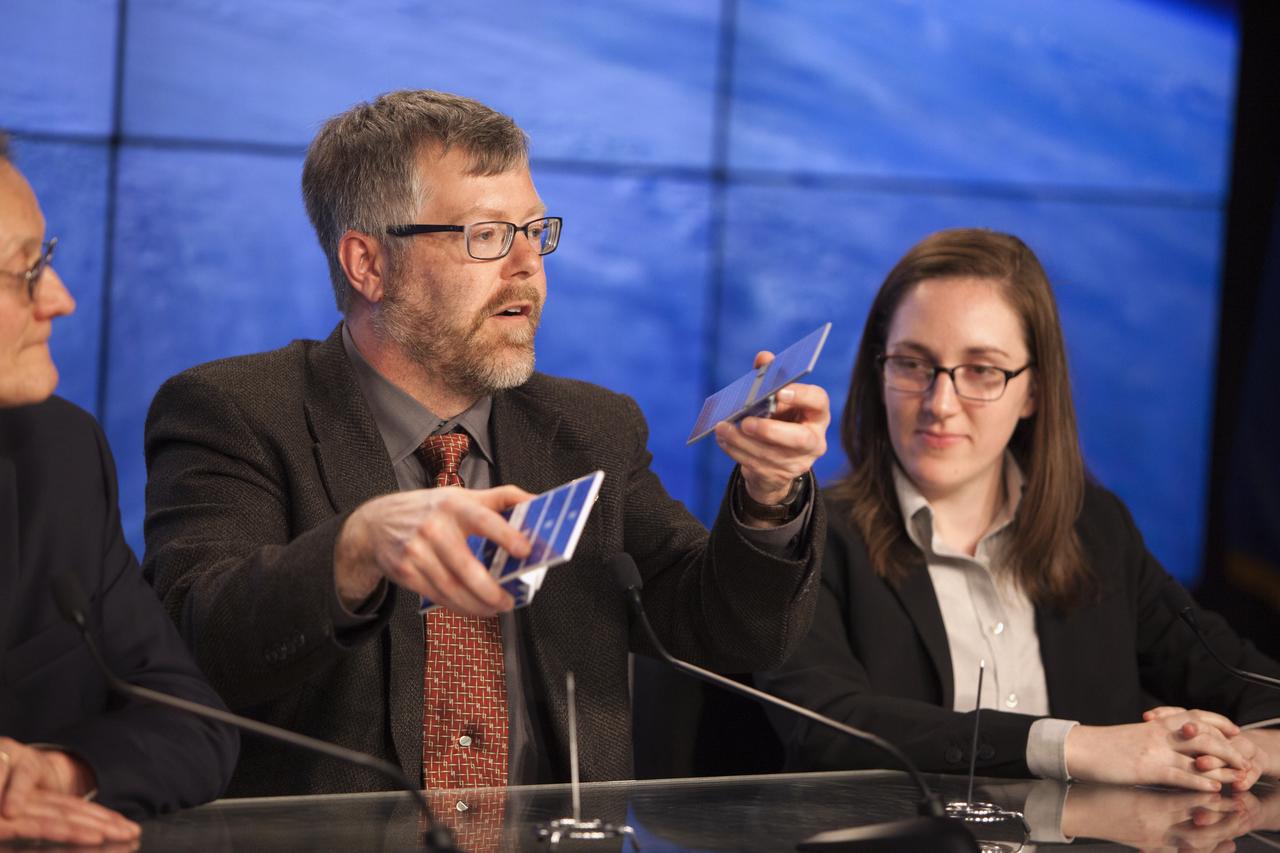
In the Kennedy Space Center’s Press Site auditorium, NASA and industry leaders speak to members of the media during a mission science briefing for the agency’s Cyclone Global Navigation Satellite System, or CYGNSS, spacecraft. From left are: Dr. Chris Ruf, CYGNSS principal investigator, Department of Climate and Space Sciences and Engineering at the University of Michigan; Aaron Ridley, CYGNSS constellation scientist in the Climate and Space Department at the University of Michigan in Ann Arbor, Michigan; and Mary Morris, doctoral student in the Department of Climate and Space Sciences and Engineering at the University of Michigan. The eight CYGNSS satellites will make frequent and accurate measurements of ocean surface winds throughout the life cycle of tropical storms and hurricanes. The data will help scientists probe key air-sea interaction processes that take place near the core of storms, which are rapidly changing and play a crucial role in the beginning and intensification of hurricanes.
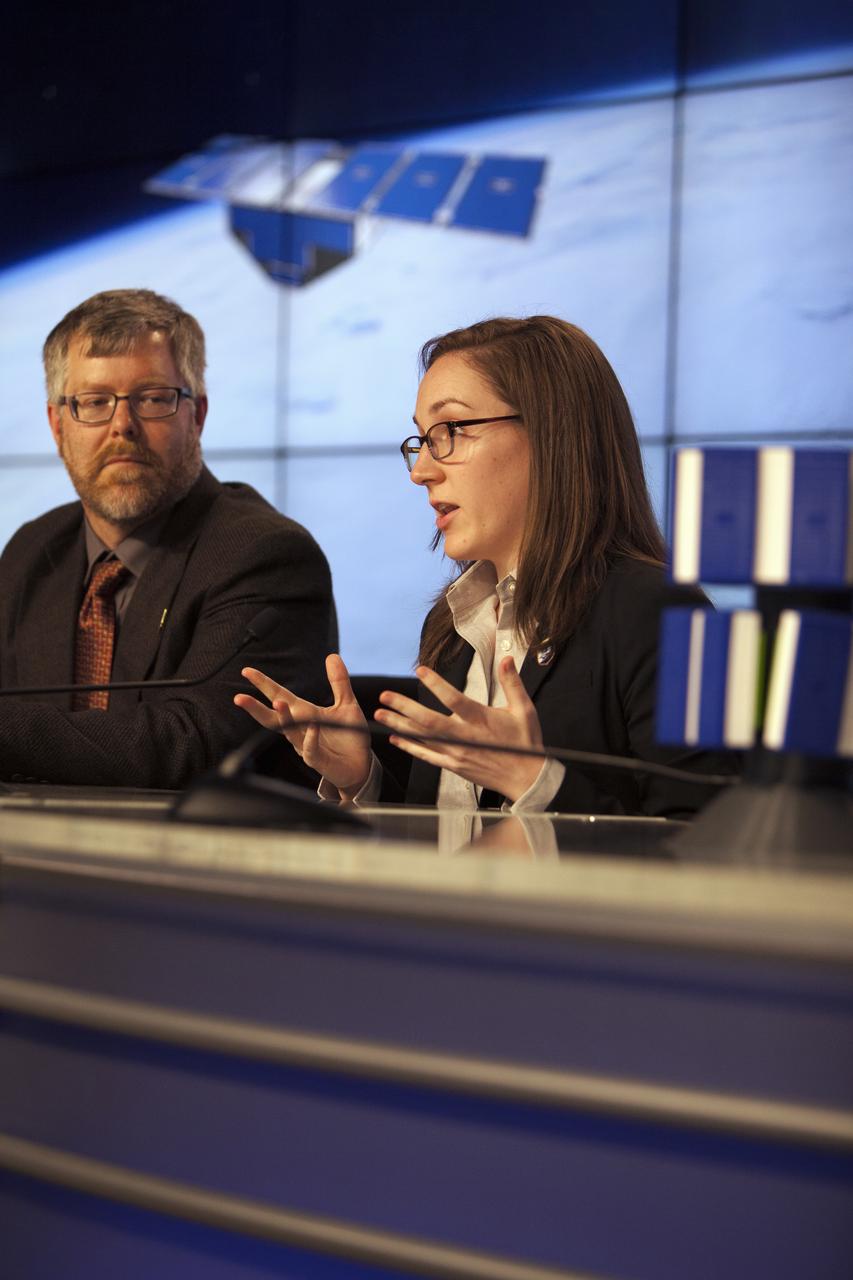
In the Kennedy Space Center’s Press Site auditorium, NASA and industry leaders speak to members of the media during a mission science briefing for the agency’s Cyclone Global Navigation Satellite System, or CYGNSS, spacecraft. From left are: Aaron Ridley, CYGNSS constellation scientist in the Climate and Space Department at the University of Michigan in Ann Arbor, Michigan; and Mary Morris, doctoral student in the Department of Climate and Space Sciences and Engineering at the University of Michigan. The eight CYGNSS satellites will make frequent and accurate measurements of ocean surface winds throughout the life cycle of tropical storms and hurricanes. The data will help scientists probe key air-sea interaction processes that take place near the core of storms, which are rapidly changing and play a crucial role in the beginning and intensification of hurricanes.

In the Kennedy Space Center’s Press Site auditorium, NASA and industry leaders speak to members of the media during a mission science briefing for the agency’s Cyclone Global Navigation Satellite System, or CYGNSS, spacecraft. From left are: Sean Potter of NASA Communications; Dr. Chris Ruf, CYGNSS principal investigator, Department of Climate and Space Sciences and Engineering at the University of Michigan; Aaron Ridley, CYGNSS constellation scientist in the Climate and Space Department at the University of Michigan in Ann Arbor, Michigan; and Mary Morris, doctoral student in the Department of Climate and Space Sciences and Engineering at the University of Michigan. The eight CYGNSS satellites will make frequent and accurate measurements of ocean surface winds throughout the life cycle of tropical storms and hurricanes. The data will help scientists probe key air-sea interaction processes that take place near the core of storms, which are rapidly changing and play a crucial role in the beginning and intensification of hurricanes.
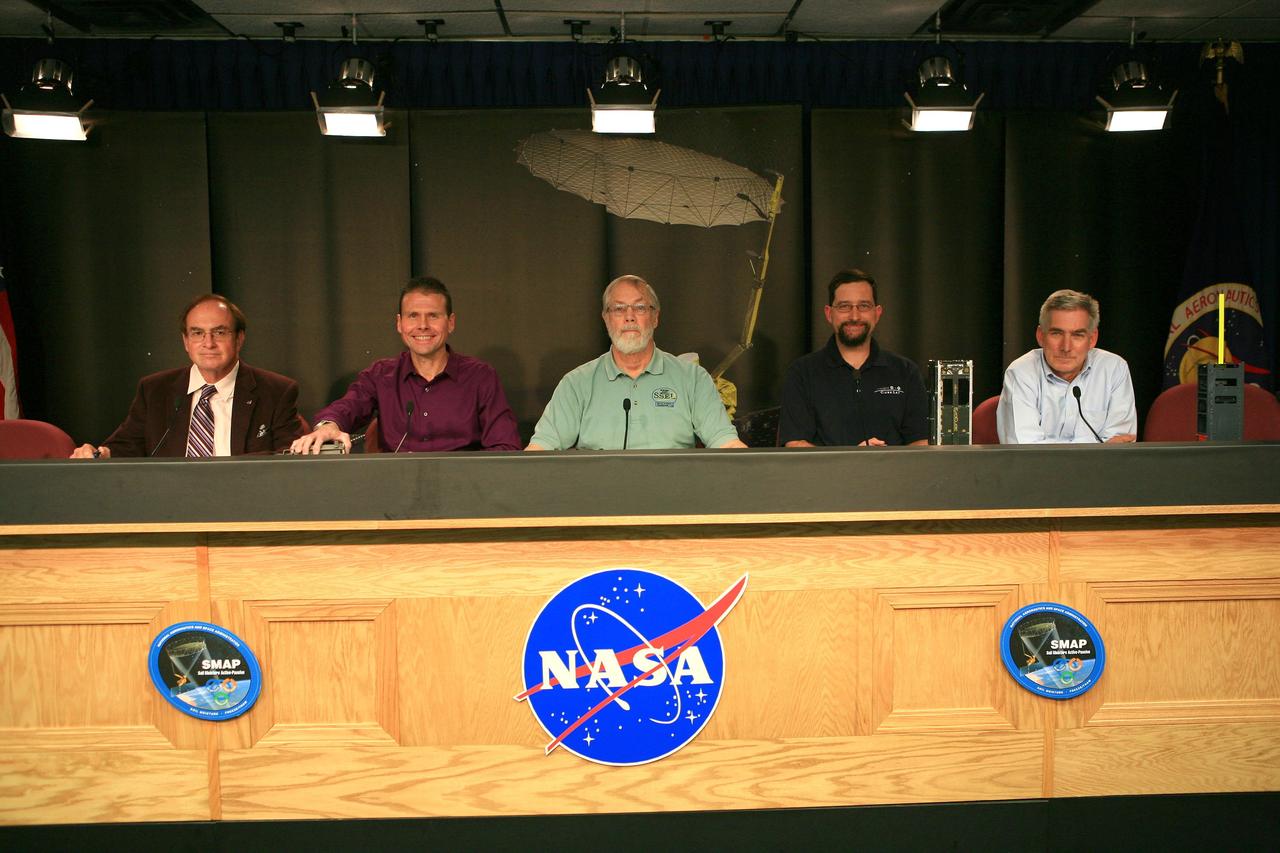
VANDENBERG AIR FORCE BASE, California– At Vandenberg Air Force Base, California, agency leaders held an Educational Launch of Nanosatellites, or ELaNa, CubeSat briefing to discuss three small research satellites that are being flown as auxiliary payloads on the SMAP mission. More than 100 university students have been involved in the design, development and construction of the CubeSats. Presenting the mission science objectives for the ELaNa CubeSats are George Diller of NASA Public Affairs, Scott Higginbotham, NASA ELaNa-X Mission Manager at the Kennedy Space Center, Florida, Dave Klumpar, Firebird-II principal investigator and director of the Space Science and Engineering Laboratory at Montana State University in Bozeman, Montana, Jordi Puig-Sauri, EXOCUBE principal investigator at the California Polytechnic State University in San Luis Obispo, California, and David Rider, GRIFEX principal investigator at Jet Propulsion Laboratory, Pasadena, California. Photo credit: NASA/Kim Shiflett
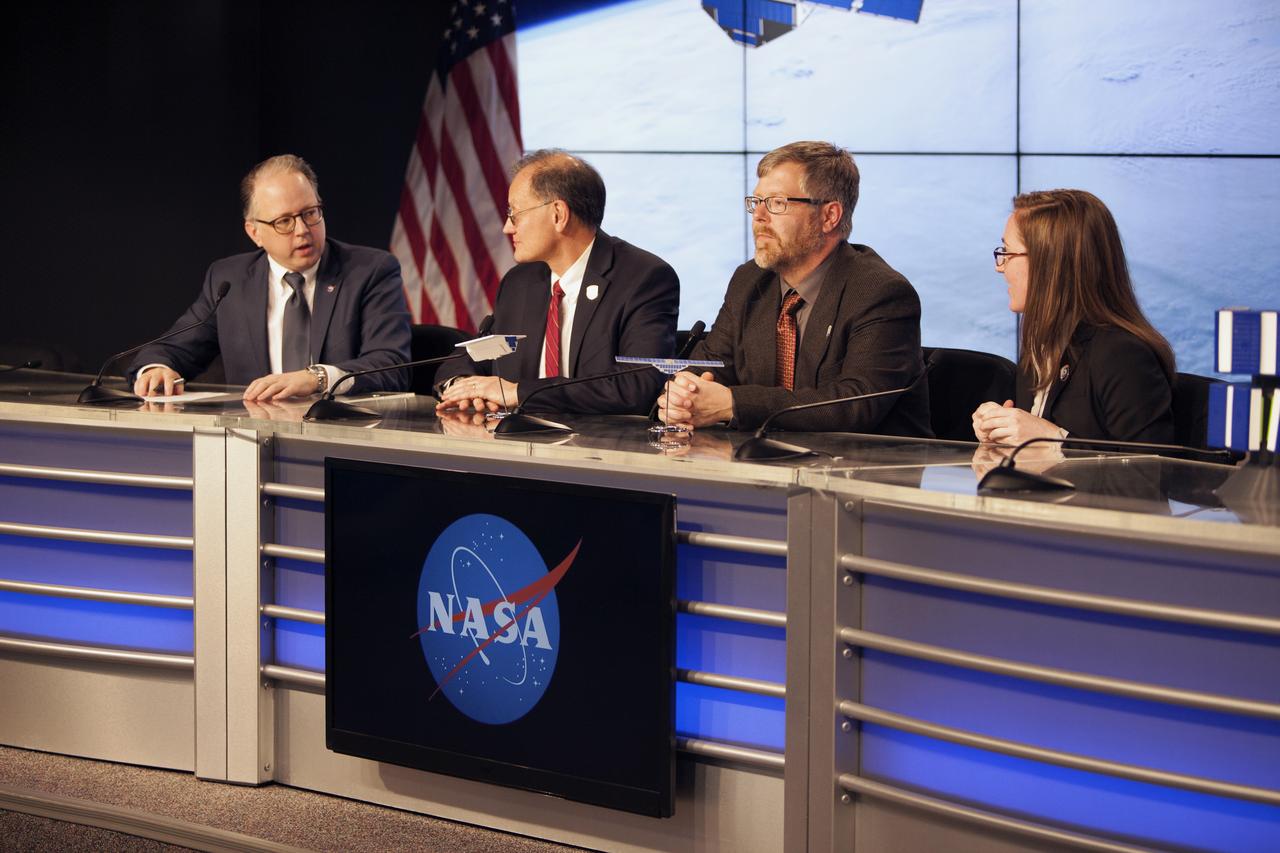
In the Kennedy Space Center’s Press Site auditorium, NASA and industry leaders speak to members of the media during a mission science briefing for the agency’s Cyclone Global Navigation Satellite System, or CYGNSS, spacecraft. From left are: Sean Potter of NASA Communications; Dr. Chris Ruf, CYGNSS principal investigator, Department of Climate and Space Sciences and Engineering at the University of Michigan; Aaron Ridley, CYGNSS constellation scientist in the Climate and Space Department at the University of Michigan in Ann Arbor, Michigan; and Mary Morris, doctoral student in the Department of Climate and Space Sciences and Engineering at the University of Michigan. The eight CYGNSS satellites will make frequent and accurate measurements of ocean surface winds throughout the life cycle of tropical storms and hurricanes. The data will help scientists probe key air-sea interaction processes that take place near the core of storms, which are rapidly changing and play a crucial role in the beginning and intensification of hurricanes.
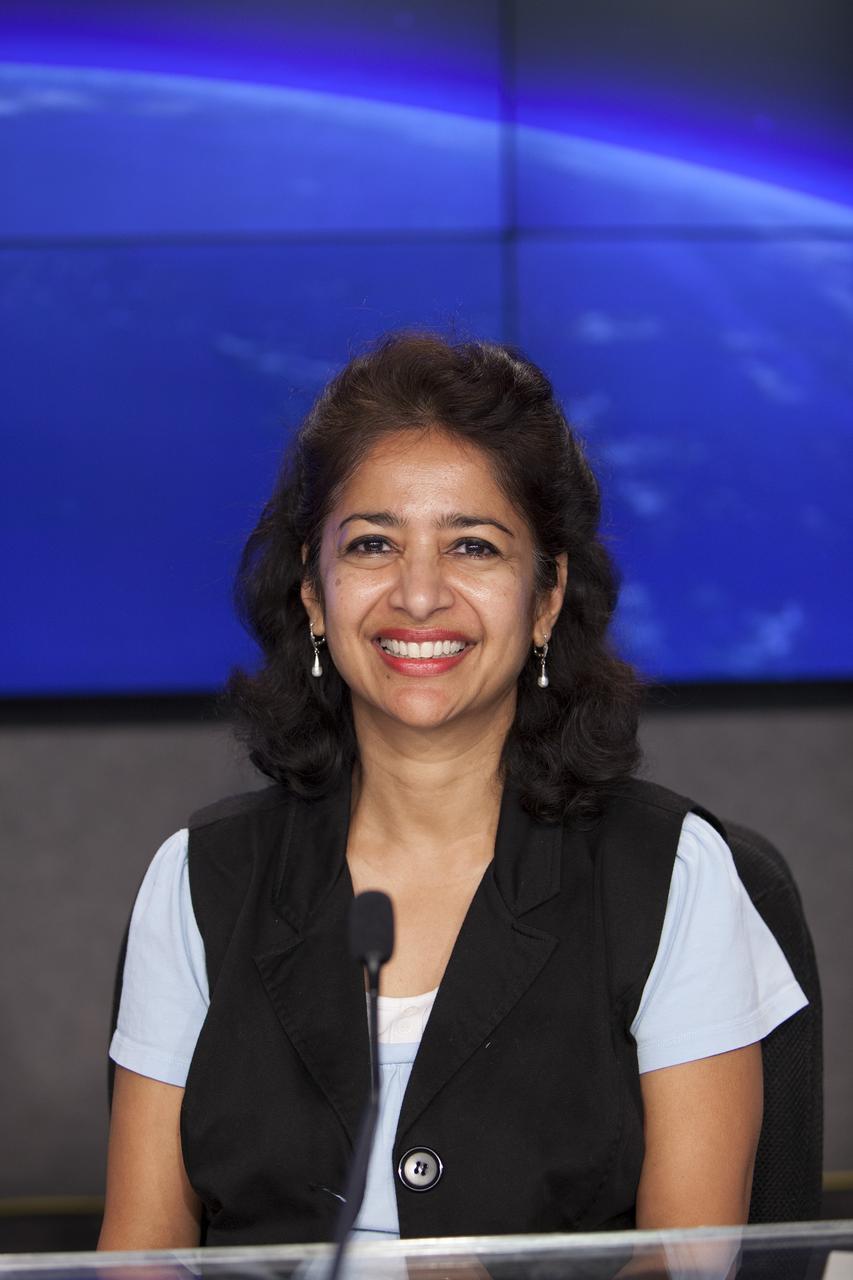
CAPE CANAVERAL, Fla. – Sharmila Bhattacharya, principal investigator, Ames Student Fruit-Fly Experiment, NASA Ames Research Center, briefs media representatives in Kennedy Space Center’s Press Site auditorium in preparation for the launch of the SpaceX CRS-4 mission to resupply the International Space Station. Bhattacharya is a member of the ISS Science Panel on Model Organisms. The mission is the fourth of 12 SpaceX flights NASA contracted with the company to resupply the space station. It will be the fifth trip by a Dragon spacecraft to the orbiting laboratory. The spacecraft’s 2.5 tons of supplies, science experiments, and technology demonstrations include critical materials to support 255 science and research investigations that will occur during the station's Expeditions 41 and 42. Liftoff is targeted for an instantaneous window at 2:14 a.m. EDT. To learn more about the mission, visit http://www.nasa.gov/mission_pages/station/structure/launch/index.html. Photo credit: NASA/Jim Grossmann
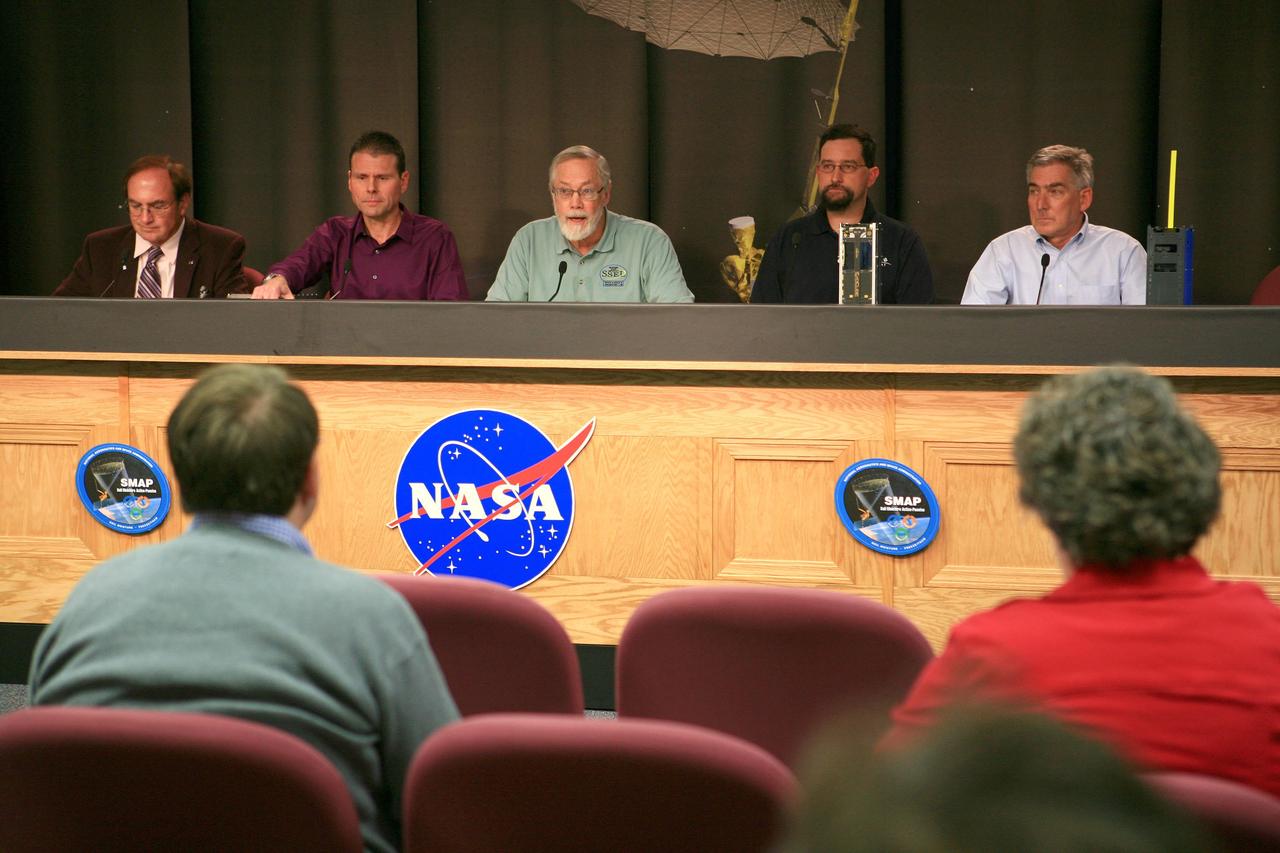
VANDENBERG AIR FORCE BASE, California– At Vandenberg Air Force Base, California, agency leaders held an Educational Launch of Nanosatellites, or ELaNa, CubeSat briefing to discuss three small research satellites that are being flown as auxiliary payloads on the SMAP mission. More than 100 university students have been involved in the design, development and construction of the CubeSats. Presenting the mission science objectives for the ELaNa CubeSats are George Diller of NASA Public Affairs, Scott Higginbotham, NASA ELaNa-X Mission Manager at the Kennedy Space Center, Florida, Dave Klumpar, Firebird-II principal investigator and director of the Space Science and Engineering Laboratory at Montana State University in Bozeman, Montana, Jordi Puig-Sauri, EXOCUBE principal investigator at the California Polytechnic State University in San Luis Obispo, California, and David Rider, GRIFEX principal investigator at Jet Propulsion Laboratory, Pasadena, California. Photo credit: NASA/Kim Shiflett
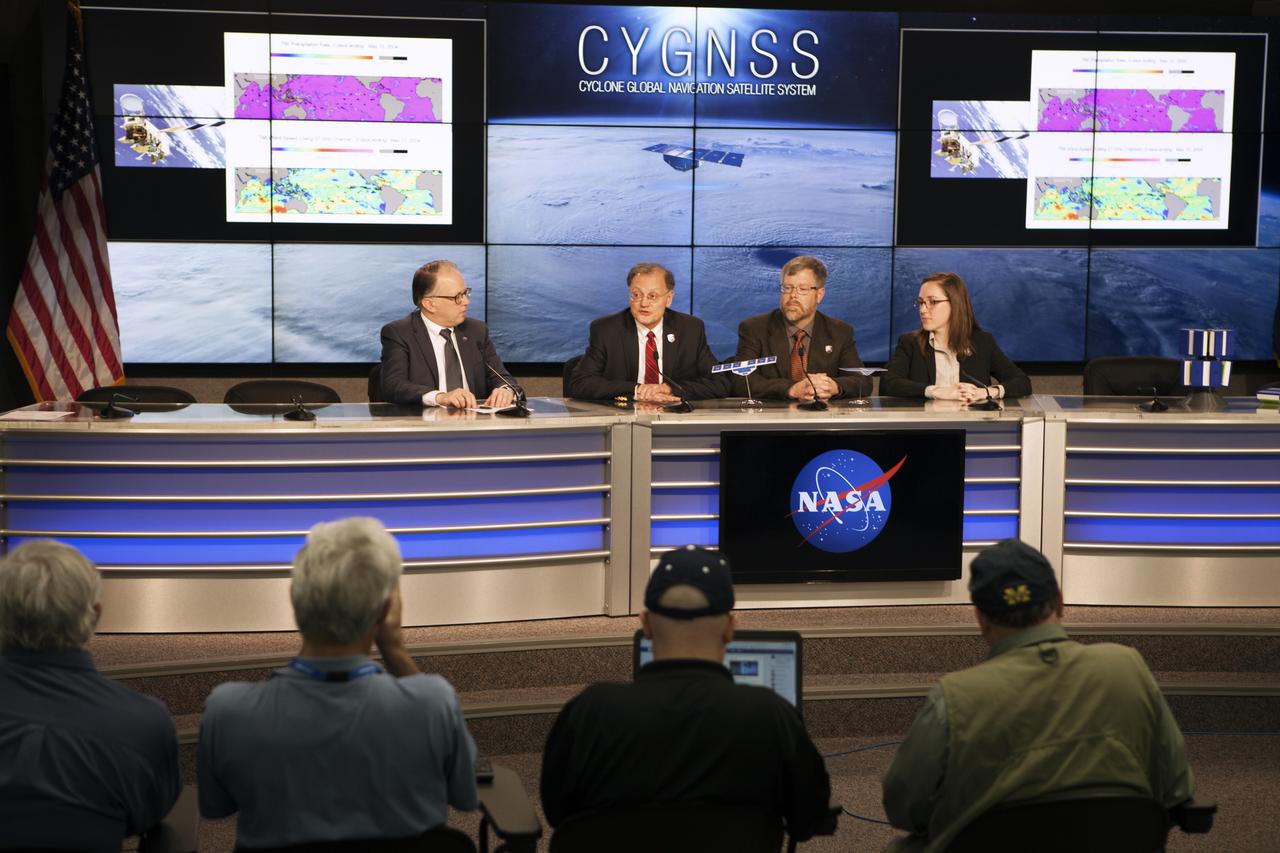
In the Kennedy Space Center’s Press Site auditorium, NASA and industry leaders speak to members of the media during a mission science briefing for the agency’s Cyclone Global Navigation Satellite System, or CYGNSS, spacecraft. From left are: Sean Potter of NASA Communications; Dr. Chris Ruf, CYGNSS principal investigator, Department of Climate and Space Sciences and Engineering at the University of Michigan; Aaron Ridley, CYGNSS constellation scientist in the Climate and Space Department at the University of Michigan in Ann Arbor, Michigan; and Mary Morris, doctoral student in the Department of Climate and Space Sciences and Engineering at the University of Michigan. The eight CYGNSS satellites will make frequent and accurate measurements of ocean surface winds throughout the life cycle of tropical storms and hurricanes. The data will help scientists probe key air-sea interaction processes that take place near the core of storms, which are rapidly changing and play a crucial role in the beginning and intensification of hurricanes.
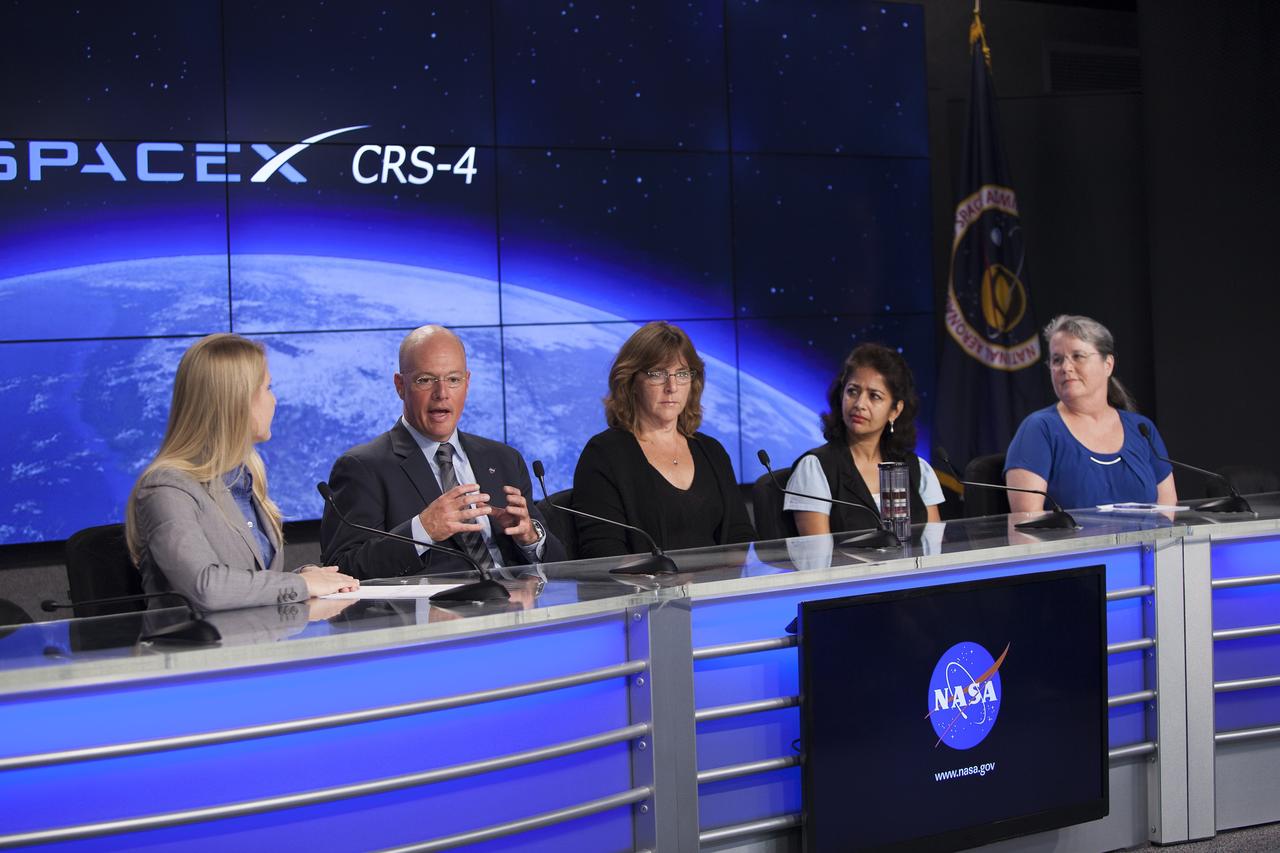
CAPE CANAVERAL, Fla. – Members of an ISS Science Panel on Model Organisms brief media representatives in Kennedy Space Center’s Press Site auditorium in preparation for the launch of the SpaceX CRS-4 mission to resupply the International Space Station. From left are Stephanie Schierholz, NASA Public Affairs, Marshall Porterfield, division director, Space Life and Physical Sciences, HEOMD, Shiela Neilsen, principal investigator, Micro-8, University of Montana, Sharmila Bhattacharya, principal investigator, Ames Student Fruit-Fly Experiment, NASA Ames Research Center, and Ruth Globus, project scientist, Rodent Habitat/Rodent Research-1, NASA Ames. The mission is the fourth of 12 SpaceX flights NASA contracted with the company to resupply the space station. It will be the fifth trip by a Dragon spacecraft to the orbiting laboratory. The spacecraft’s 2.5 tons of supplies, science experiments, and technology demonstrations include critical materials to support 255 science and research investigations that will occur during the station's Expeditions 41 and 42. Liftoff is targeted for an instantaneous window at 2:14 a.m. EDT. To learn more about the mission, visit http://www.nasa.gov/mission_pages/station/structure/launch/index.html. Photo credit: NASA/Jim Grossmann
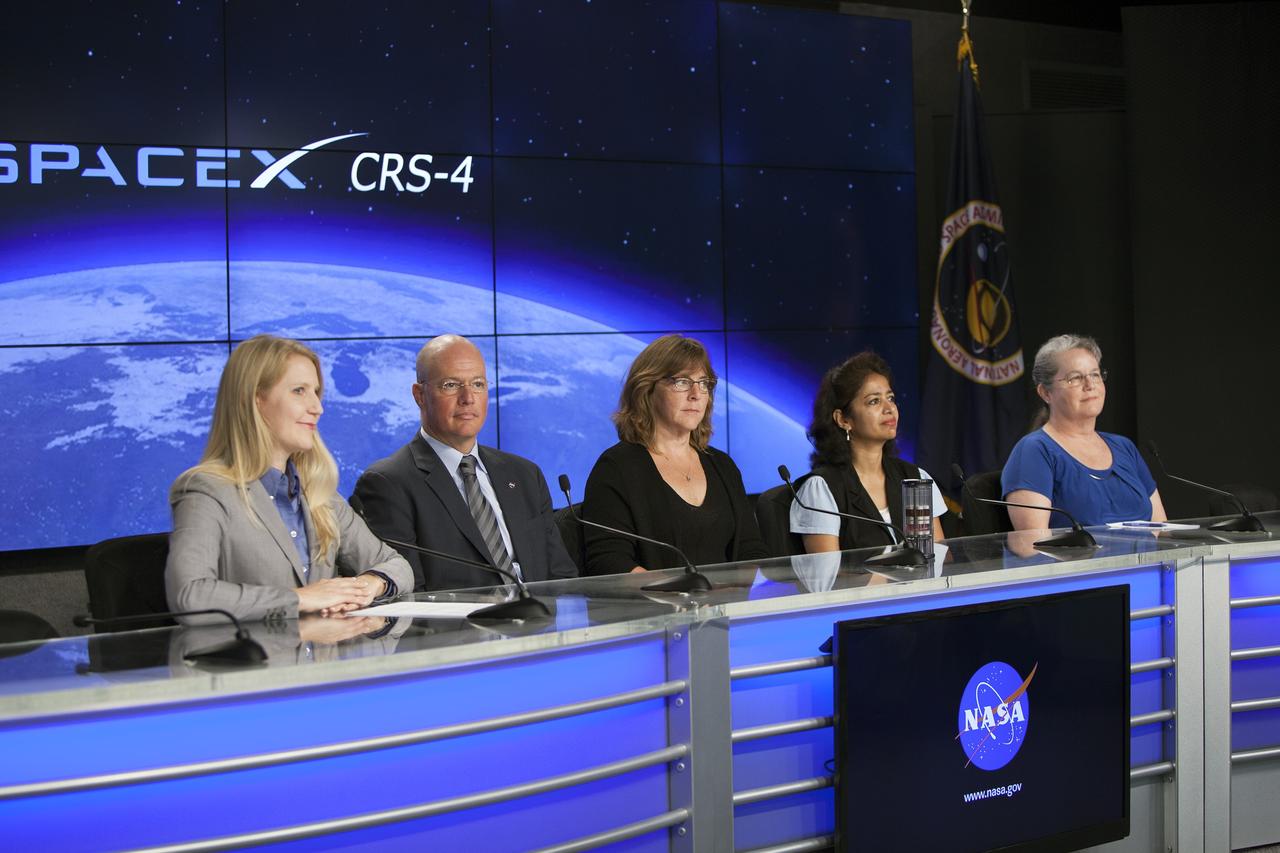
CAPE CANAVERAL, Fla. – Members of an ISS Science Panel on Model Organisms brief media representatives in Kennedy Space Center’s Press Site auditorium in preparation for the launch of the SpaceX CRS-4 mission to resupply the International Space Station. From left are Stephanie Schierholz, NASA Public Affairs, Marshall Porterfield, division director, Space Life and Physical Sciences, HEOMD, Shiela Neilsen, principal investigator, Micro-8, University of Montana, Sharmila Bhattacharya, principal investigator, Ames Student Fruit-Fly Experiment, NASA Ames Research Center, and Ruth Globus, project scientist, Rodent Habitat/Rodent Research-1, NASA Ames. The mission is the fourth of 12 SpaceX flights NASA contracted with the company to resupply the space station. It will be the fifth trip by a Dragon spacecraft to the orbiting laboratory. The spacecraft’s 2.5 tons of supplies, science experiments, and technology demonstrations include critical materials to support 255 science and research investigations that will occur during the station's Expeditions 41 and 42. Liftoff is targeted for an instantaneous window at 2:14 a.m. EDT. To learn more about the mission, visit http://www.nasa.gov/mission_pages/station/structure/launch/index.html. Photo credit: NASA/Jim Grossmann
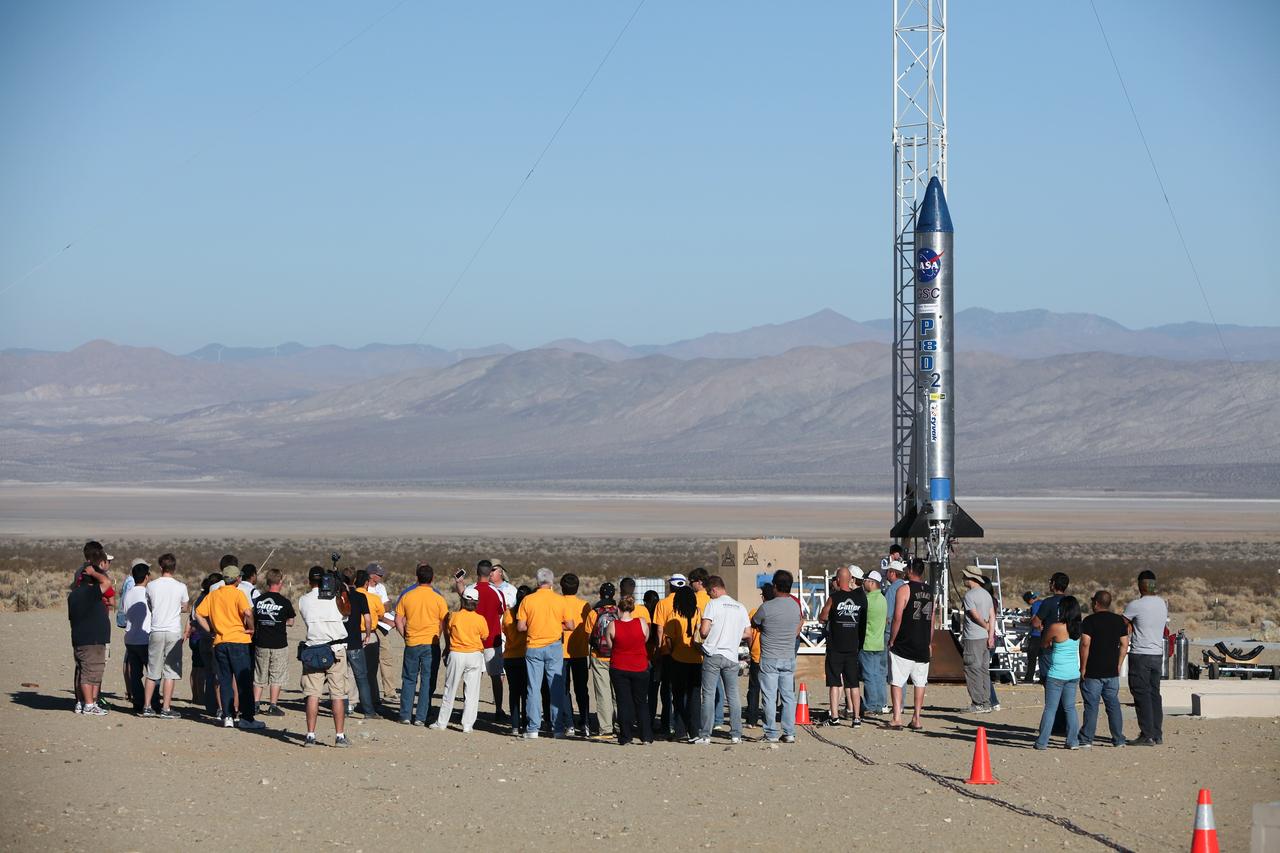
MOJAVE DESERT, Calif. – In the Mojave Desert in California, students and engineers participate in a pre-launch briefing before the lift off of the Garvey Spacecraft Corporation's Prospector P-18D rocket. The rocket is scheduled to launch the RUBICS-1 payload on a high-altitude, suborbital flight. The rocket will carry four satellites made from four-inch cube sections. The rocket reached a peak altitude of about 9,000 feet, however the parachute deployed prematurely and the vehicle continued on its trajectory, coasting and tumbling to a hard landing on its side. In spite of the rough ride, all four CubeSats were recovered. PhoneSat and RUBICS received data in flight, but sustained structural damage. CP-9 and StangSat fared better, and their teams are working to recover as much information as possible. Collectively known as CubeSats, the satellites were designed to record shock, vibrations and heat inside the rocket. The results will be used to prove or strengthen their designs before they are carried into orbit in 2014 on a much larger rocket. Built by several different organizations, including a university, a NASA field center and a high school, the spacecraft are four-inch cubes designed to fly on their own eventually, but will remain firmly attached to the rocket during the upcoming mission. For more information, visit http://www.nasa.gov/mission_pages/smallsats/elana/cubesatlaunchpreview.html Photo credit: NASA/Dimitri Gerondidakis
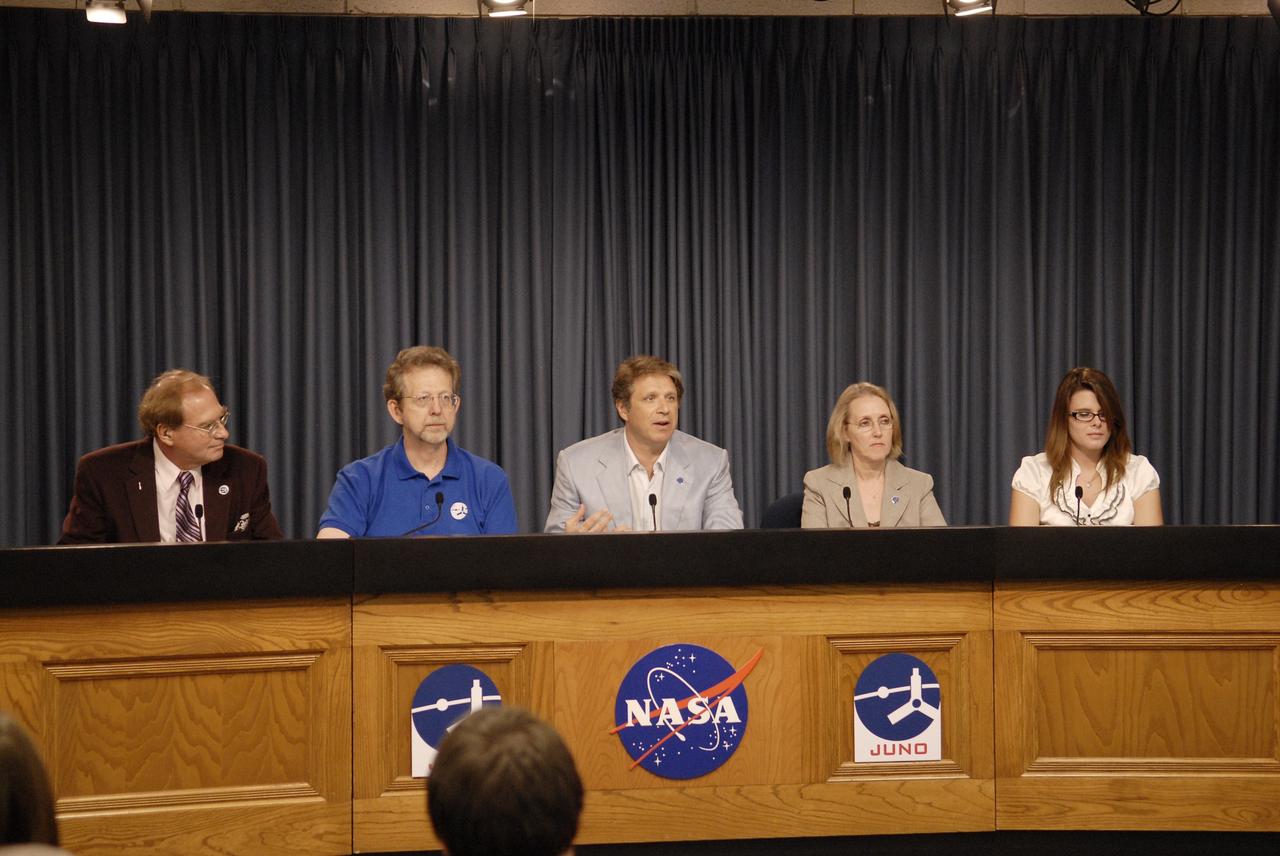
CAPE CANAVERAL, Fla. -- In the Press Site auditorium at NASA's Kennedy Space Center in Florida, a briefing was held to update media on the upcoming launch of NASA's Juno spacecraft. Seen here are NASA Panel Moderator and Public Affairs Officer George Diller (left), Jim Green, director of the Planetary Science Division at Headquarters in Washington, D.C.; Scott Bolton, Juno principal investigator with the Southwest Research Institute in San Antonio, Texas; Jan Chodas, Juno project manager with the Jet Propulsion Laboratory in Pasadena, Calif., and Kaelyn Badura, Pine Ridge High School, Deltona, Fla. high school student, Juno Education program participant and Goldstone Apple Valley Radio Telescope Project participant. Juno is scheduled to launch aboard an United Launch Alliance Atlas V from Cape Canaveral, Fla. Aug. 5.The solar-powered spacecraft will orbit Jupiter's poles 33 times to find out more about the gas giant's origins, structure, atmosphere and magnetosphere and investigate the existence of a solid planetary core. For more information visit: www.nasa.gov/juno. Photo credit: NASA/Gianni M. Woods
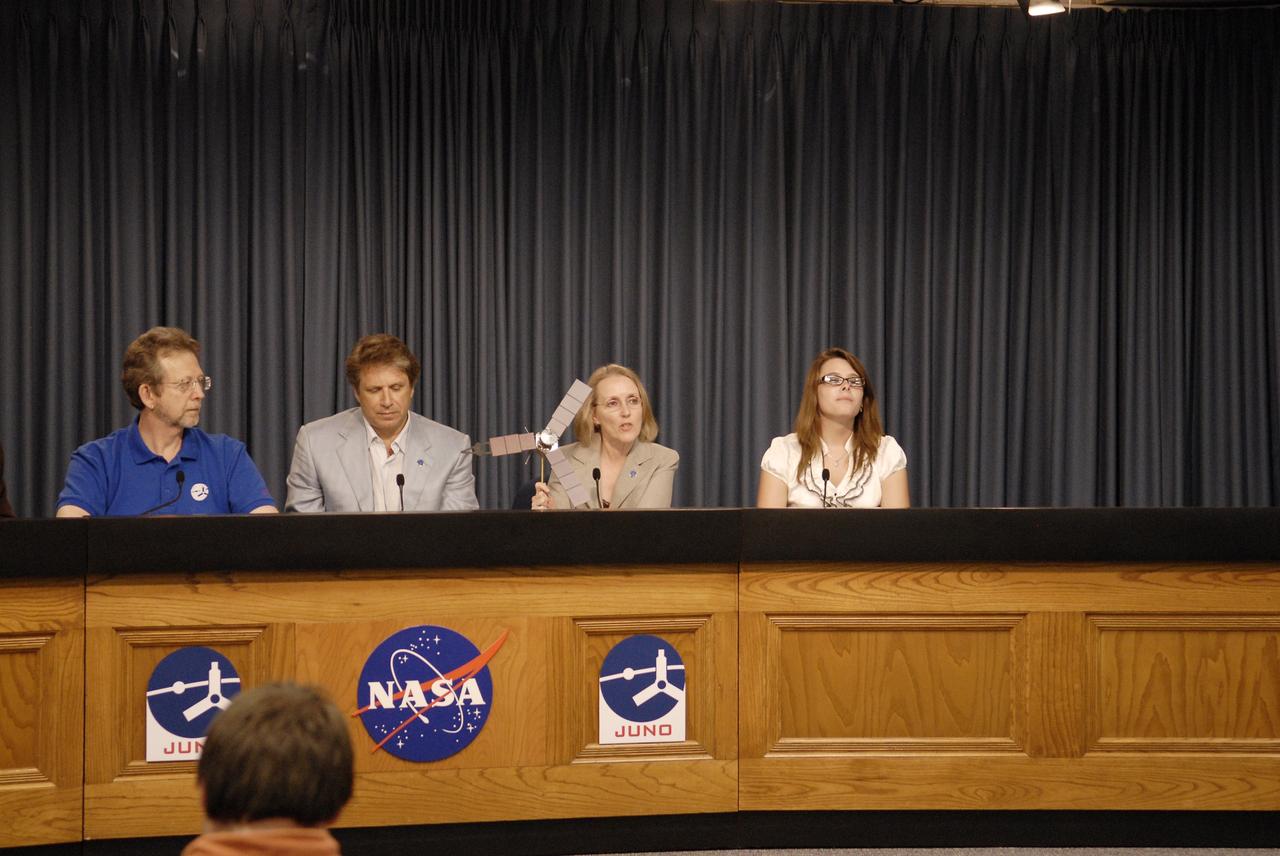
CAPE CANAVERAL, Fla. -- In the Press Site auditorium at NASA's Kennedy Space Center in Florida, a briefing was held to update media on the upcoming launch of NASA's Juno spacecraft. Seen here are Jim Green, director of the Planetary Science Division at Headquarters in Washington, D.C.; Scott Bolton, Juno principal investigator with the Southwest Research Institute in San Antonio, Texas; Jan Chodas, Juno project manager with the Jet Propulsion Laboratory in Pasadena, Calif., and Kaelyn Badura, Pine Ridge High School, Deltona, Fla. high school student, Juno Education program participant and Goldstone Apple Valley Radio Telescope Project participant. Juno is scheduled to launch aboard an United Launch Alliance Atlas V from Cape Canaveral, Fla. Aug. 5.The solar-powered spacecraft will orbit Jupiter's poles 33 times to find out more about the gas giant's origins, structure, atmosphere and magnetosphere and investigate the existence of a solid planetary core. For more information visit: www.nasa.gov/juno. Photo credit: NASA/Gianni M. Woods
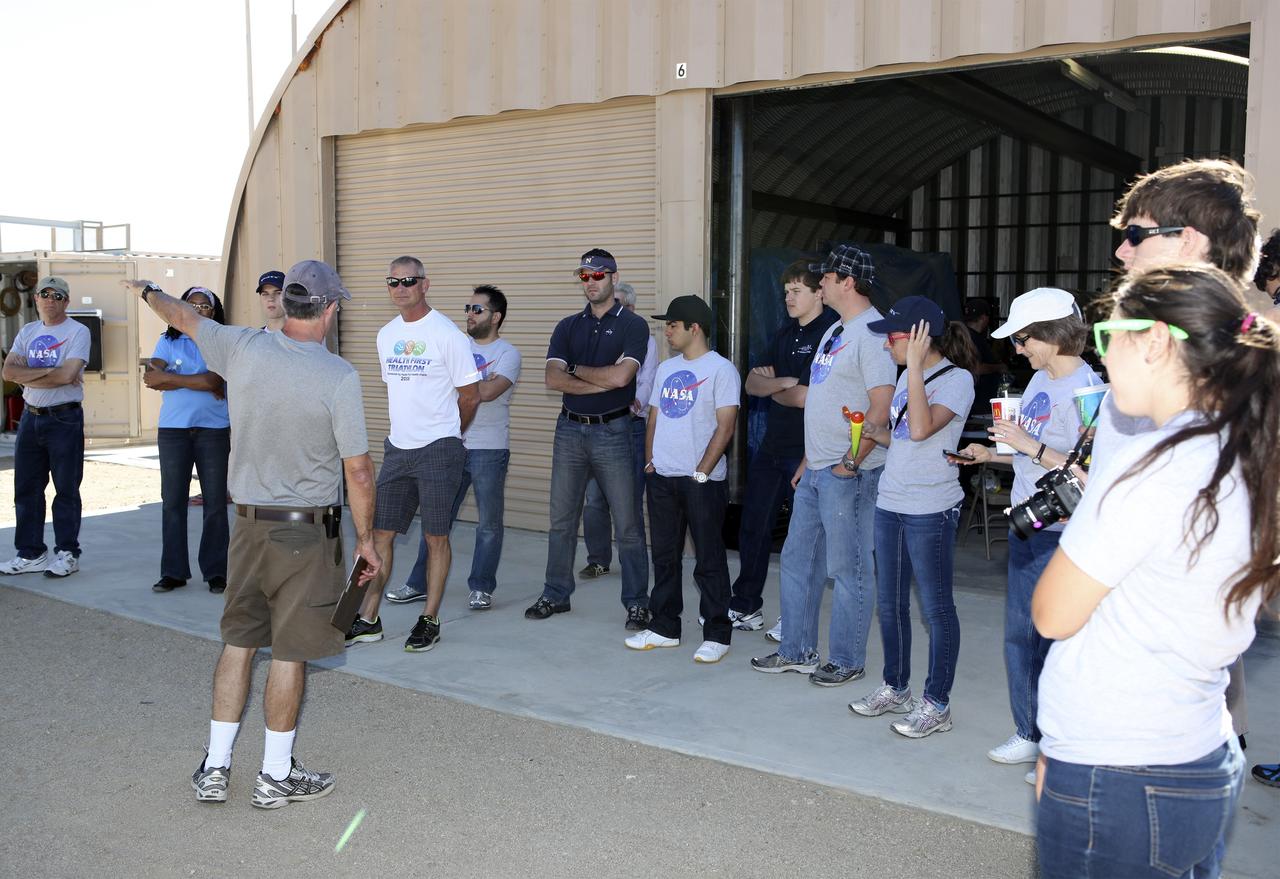
MOJAVE DESERT, Calif. – In the Mojave Desert in California, students and engineers participate in a pre-task briefing as preparations continue for the June 15 launch of a Garvey Spacecraft Corporation Prospector P-18D rocket on a high-altitude, suborbital flight. The rocket will carry four satellites made from four-inch cube section. Collectively known as CubeSats, the satellites will record shock, vibrations and heat inside the rocket. They will not be released during the test flight, but the results will be used to prove or strengthen their designs before they are carried into orbit in 2014 on a much larger rocket. A new, lightweight carrier is also being tested for use on future missions to deploy the small spacecraft. The flight also is being watched closely as a model for trying out new or off-the-shelf technologies quickly before putting them in the pipeline for use on NASA's largest launchers. Built by several different organizations, including a university, a NASA field center and a high school, the spacecraft are four-inch cubes designed to fly on their own eventually, but will remain firmly attached to the rocket during the upcoming mission. For more information, visit http://www.nasa.gov/mission_pages/smallsats/elana/cubesatlaunchpreview.html Photo credit: NASA/Dimitri Gerondidakis
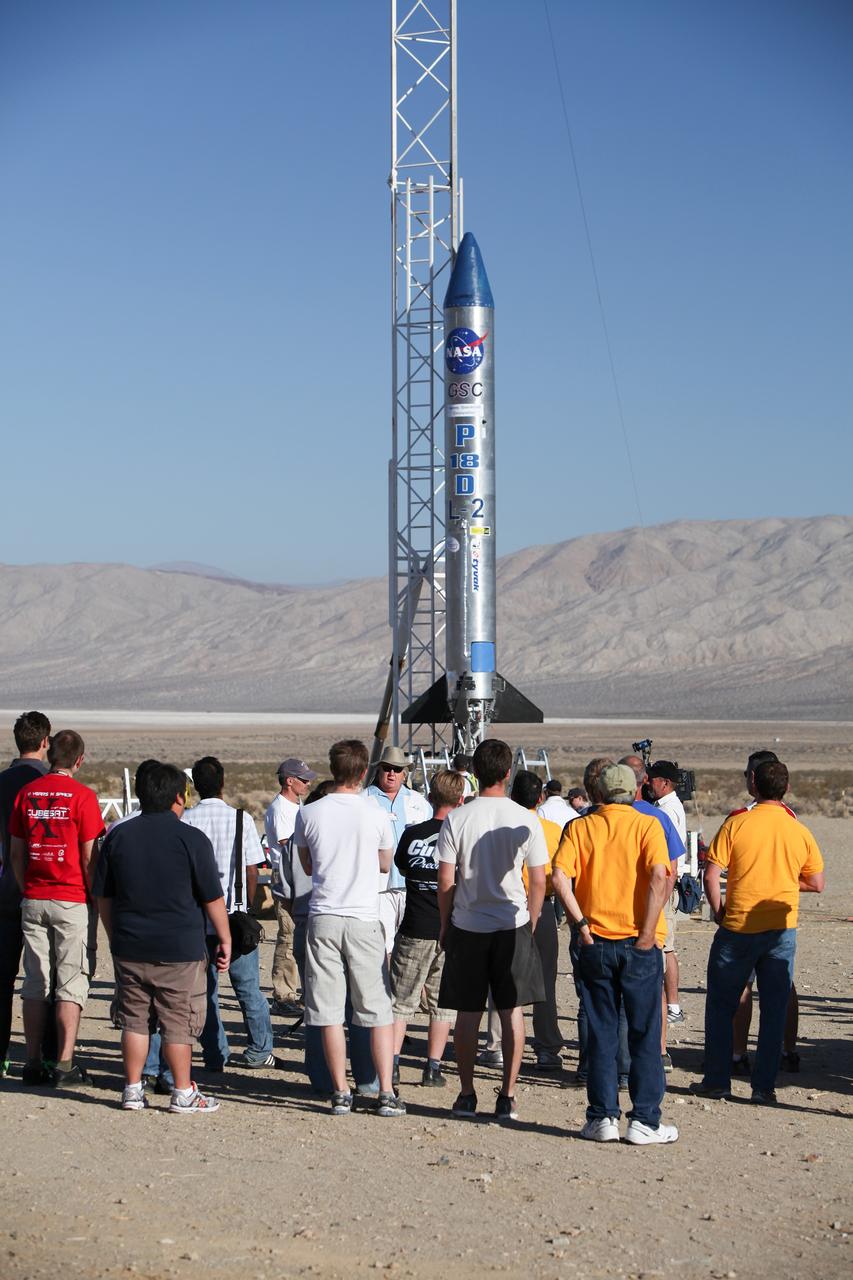
MOJAVE DESERT, Calif. – In the Mojave Desert in California, students and engineers participate in a pre-launch briefing before the lift off of the Garvey Spacecraft Corporation's Prospector P-18D rocket. The rocket is scheduled to launch the RUBICS-1 payload on a high-altitude, suborbital flight. The rocket will carry four satellites made from four-inch cube sections. The rocket reached a peak altitude of about 9,000 feet, however the parachute deployed prematurely and the vehicle continued on its trajectory, coasting and tumbling to a hard landing on its side. In spite of the rough ride, all four CubeSats were recovered. PhoneSat and RUBICS received data in flight, but sustained structural damage. CP-9 and StangSat fared better, and their teams are working to recover as much information as possible. Collectively known as CubeSats, the satellites were designed to record shock, vibrations and heat inside the rocket. The results will be used to prove or strengthen their designs before they are carried into orbit in 2014 on a much larger rocket. Built by several different organizations, including a university, a NASA field center and a high school, the spacecraft are four-inch cubes designed to fly on their own eventually, but will remain firmly attached to the rocket during the upcoming mission. For more information, visit http://www.nasa.gov/mission_pages/smallsats/elana/cubesatlaunchpreview.html Photo credit: NASA/Dimitri Gerondidakis
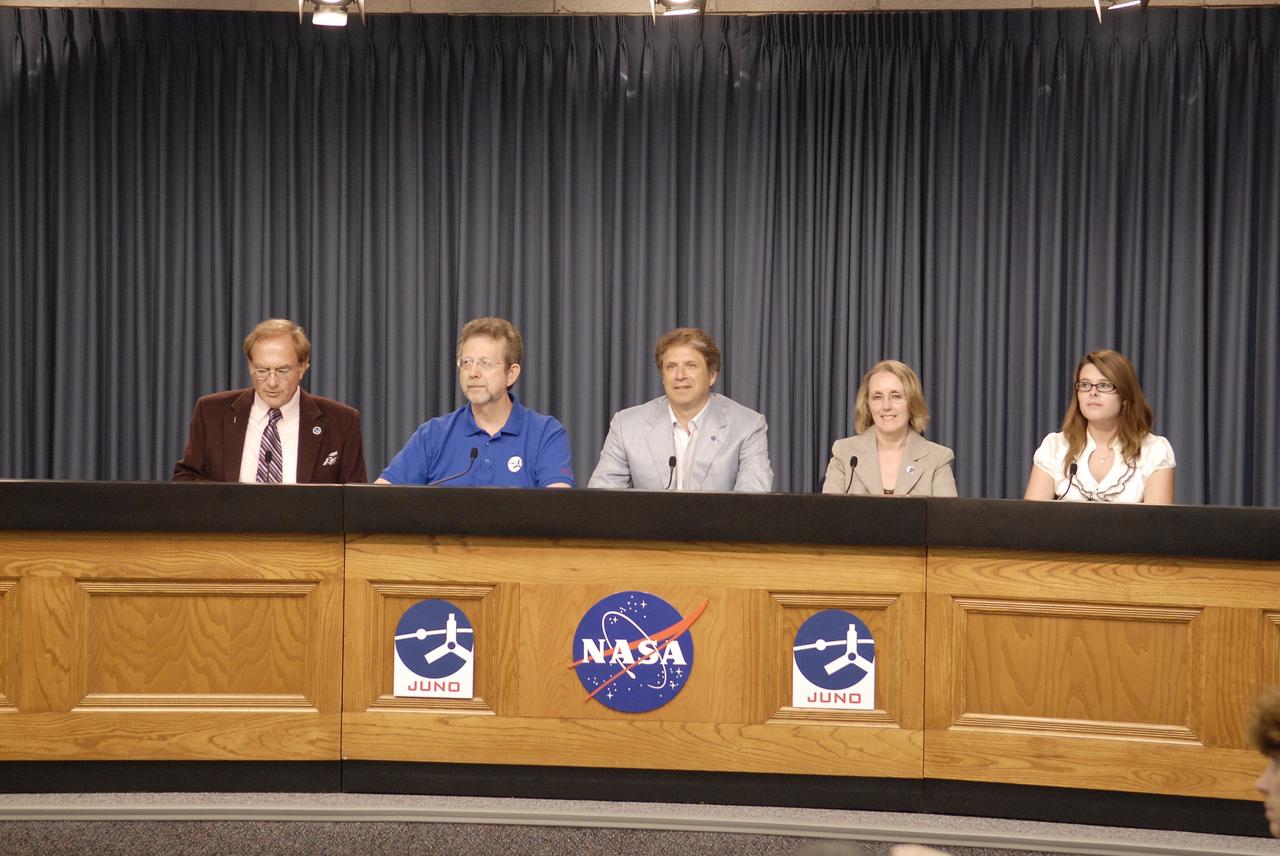
CAPE CANAVERAL, Fla. -- In the Press Site auditorium at NASA's Kennedy Space Center in Florida, a briefing was held to update media on the upcoming launch of NASA's Juno spacecraft. Seen here are NASA Panel Moderator and Public Affairs Officer George Diller (left), Jim Green, director of the Planetary Science Division at Headquarters in Washington, D.C.; Scott Bolton, Juno principal investigator with the Southwest Research Institute in San Antonio, Texas; Jan Chodas, Juno project manager with the Jet Propulsion Laboratory in Pasadena, Calif., and Kaelyn Badura, Pine Ridge High School, Deltona, Fla. high school student, Juno Education program participant and Goldstone Apple Valley Radio Telescope Project participant. Juno is scheduled to launch aboard an United Launch Alliance Atlas V from Cape Canaveral, Fla. Aug. 5.The solar-powered spacecraft will orbit Jupiter's poles 33 times to find out more about the gas giant's origins, structure, atmosphere and magnetosphere and investigate the existence of a solid planetary core. For more information visit: www.nasa.gov/juno. Photo credit: NASA/Gianni M. Woods
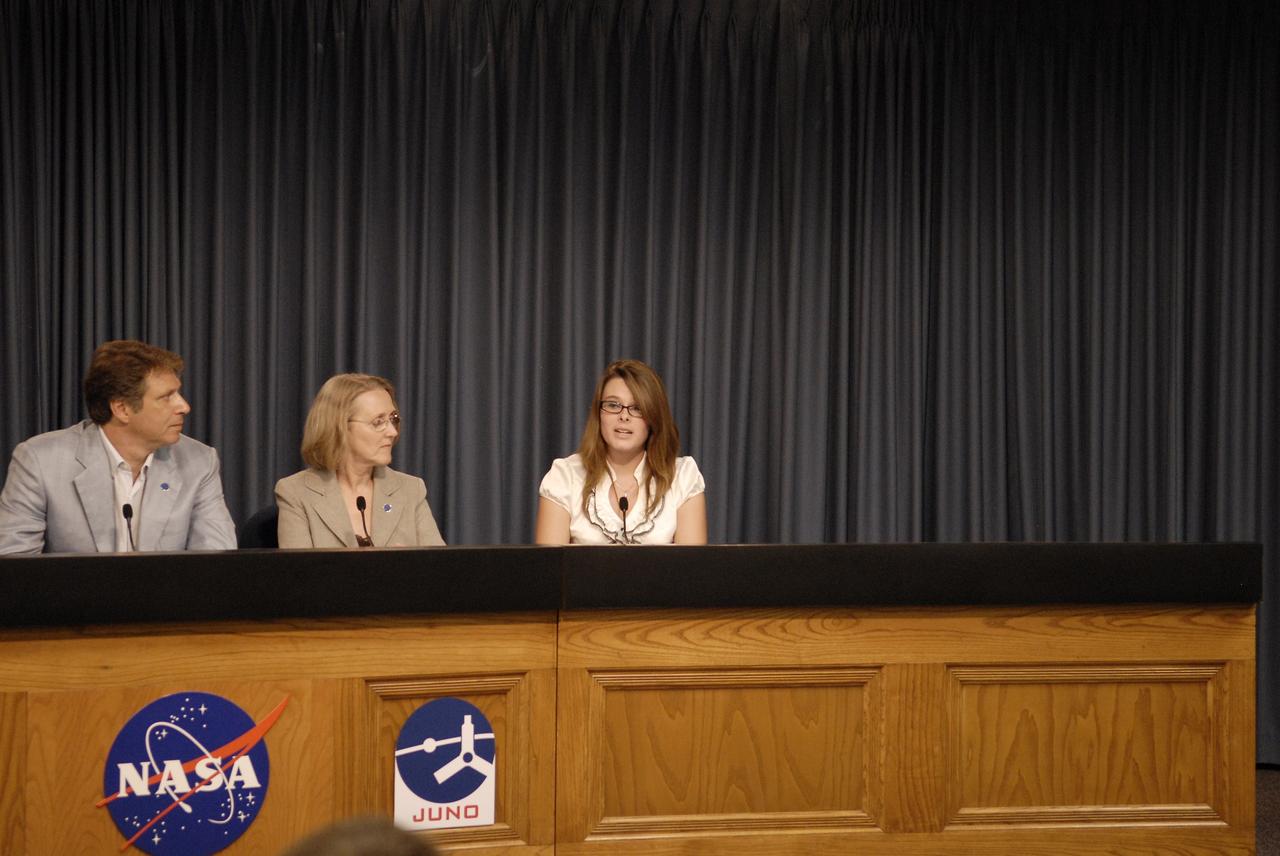
CAPE CANAVERAL, Fla. -- In the Press Site auditorium at NASA's Kennedy Space Center in Florida, a briefing was held to update media on the upcoming launch of NASA's Juno spacecraft. Seen here are Scott Bolton, Juno principal investigator with the Southwest Research Institute in San Antonio, Texas; Jan Chodas, Juno project manager with the Jet Propulsion Laboratory in Pasadena, Calif., and Kaelyn Badura, Pine Ridge High School, Deltona, Fla. high school student, Juno Education program participant and Goldstone Apple Valley Radio Telescope Project participant. Juno is scheduled to launch aboard an United Launch Alliance Atlas V from Cape Canaveral, Fla. Aug. 5.The solar-powered spacecraft will orbit Jupiter's poles 33 times to find out more about the gas giant's origins, structure, atmosphere and magnetosphere and investigate the existence of a solid planetary core. For more information visit: www.nasa.gov/juno. Photo credit: NASA/Gianni M. Woods
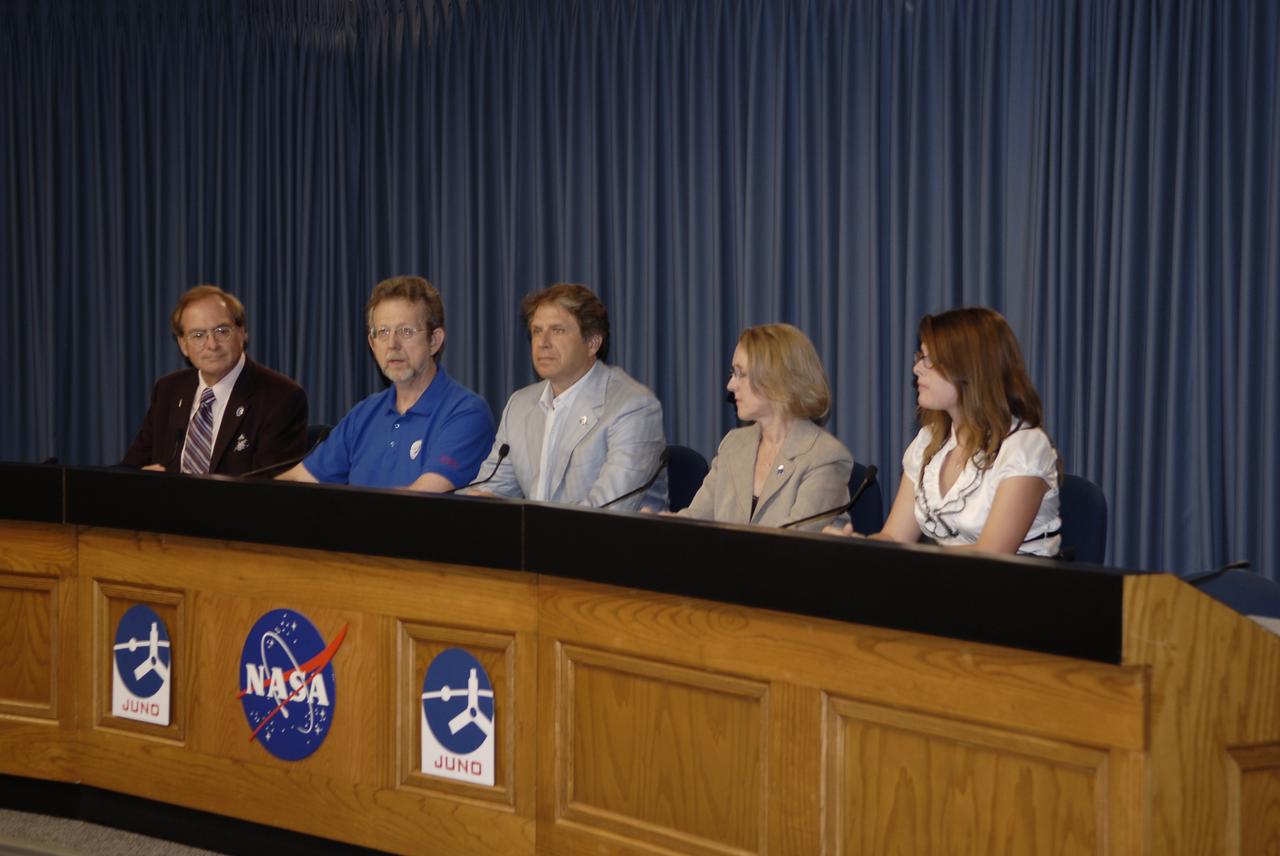
CAPE CANAVERAL, Fla. -- In the Press Site auditorium at NASA's Kennedy Space Center in Florida, a briefing was held to update media on the upcoming launch of NASA's Juno spacecraft. Seen here are NASA Panel Moderator and Public Affairs Officer George Diller (left), Jim Green, director of the Planetary Science Division at Headquarters in Washington, D.C.; Scott Bolton, Juno principal investigator with the Southwest Research Institute in San Antonio, Texas; Jan Chodas, Juno project manager with the Jet Propulsion Laboratory in Pasadena, Calif., and Kaelyn Badura, Pine Ridge High School, Deltona, Fla. high school student, Juno Education program participant and Goldstone Apple Valley Radio Telescope Project participant. Juno is scheduled to launch aboard an United Launch Alliance Atlas V from Cape Canaveral, Fla. Aug. 5.The solar-powered spacecraft will orbit Jupiter's poles 33 times to find out more about the gas giant's origins, structure, atmosphere and magnetosphere and investigate the existence of a solid planetary core. For more information visit: www.nasa.gov/juno. Photo credit: NASA/Gianni M. Woods

CAPE CANAVERAL, Fla. -- In the Press Site auditorium at NASA's Kennedy Space Center in Florida, a briefing was held to update media on the upcoming launch of NASA's Juno spacecraft. Seen here are NASA Panel Moderator and Public Affairs Officer George Diller (left), Jim Green, director of the Planetary Science Division at Headquarters in Washington, D.C.; Scott Bolton, Juno principal investigator with the Southwest Research Institute in San Antonio, Texas; Jan Chodas, Juno project manager with the Jet Propulsion Laboratory in Pasadena, Calif., and Kaelyn Badura, Pine Ridge High School, Deltona, Fla. high school student, Juno Education program participant and Goldstone Apple Valley Radio Telescope Project participant. Juno is scheduled to launch aboard an United Launch Alliance Atlas V from Cape Canaveral, Fla. Aug. 5.The solar-powered spacecraft will orbit Jupiter's poles 33 times to find out more about the gas giant's origins, structure, atmosphere and magnetosphere and investigate the existence of a solid planetary core. For more information visit: www.nasa.gov/juno. Photo credit: NASA/Gianni M. Woods
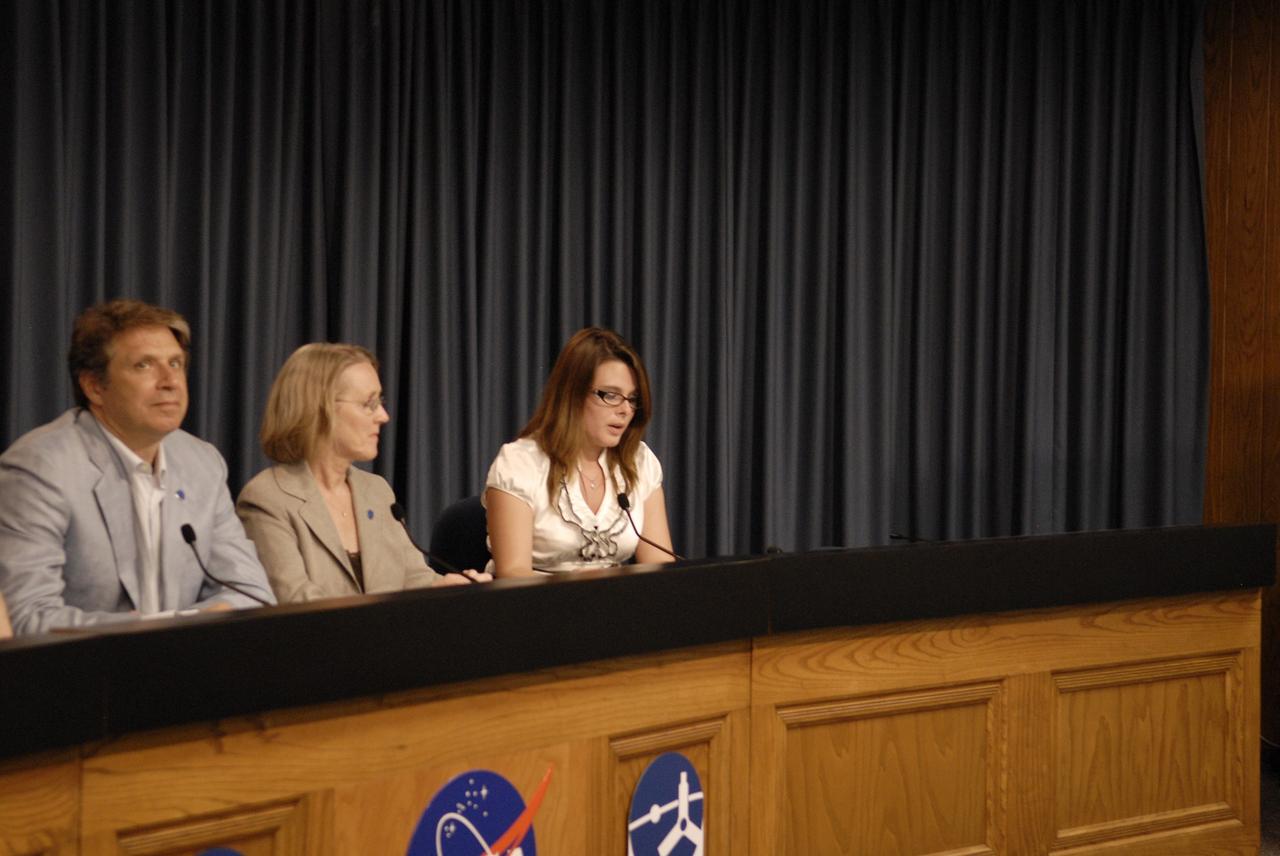
CAPE CANAVERAL, Fla. -- In the Press Site auditorium at NASA's Kennedy Space Center in Florida, a briefing was held to update media on the upcoming launch of NASA's Juno spacecraft. Seen here are Scott Bolton, Juno principal investigator with the Southwest Research Institute in San Antonio, Texas; Jan Chodas, Juno project manager with the Jet Propulsion Laboratory in Pasadena, Calif., and Kaelyn Badura, Pine Ridge High School, Deltona, Fla. high school student, Juno Education program participant and Goldstone Apple Valley Radio Telescope Project participant. Juno is scheduled to launch aboard an United Launch Alliance Atlas V from Cape Canaveral, Fla. Aug. 5.The solar-powered spacecraft will orbit Jupiter's poles 33 times to find out more about the gas giant's origins, structure, atmosphere and magnetosphere and investigate the existence of a solid planetary core. For more information visit: www.nasa.gov/juno. Photo credit: NASA/Gianni M. Woods
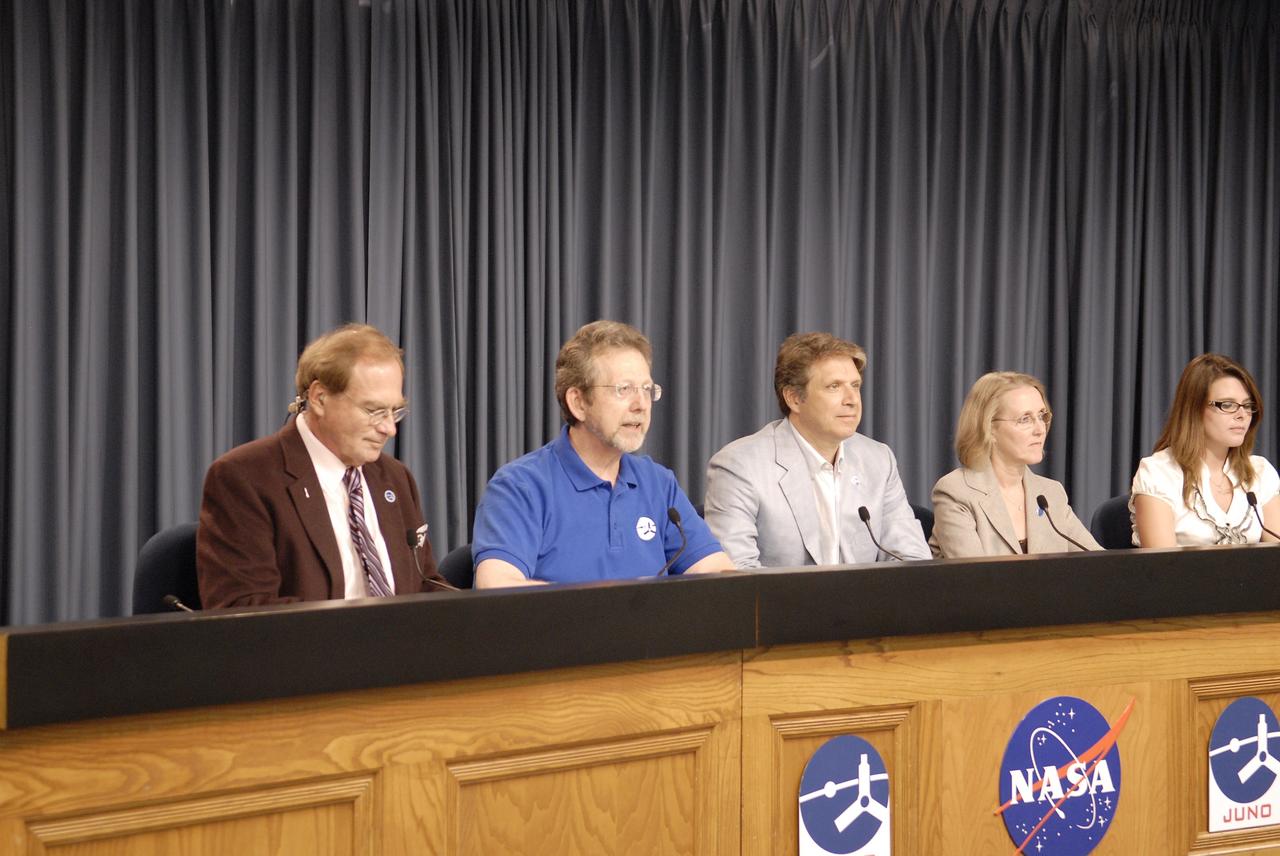
CAPE CANAVERAL, Fla. -- In the Press Site auditorium at NASA's Kennedy Space Center in Florida, a briefing was held to update media on the upcoming launch of NASA's Juno spacecraft. Seen here are NASA Panel Moderator and Public Affairs Officer George Diller (left), Jim Green, director of the Planetary Science Division at Headquarters in Washington, D.C.; Scott Bolton, Juno principal investigator with the Southwest Research Institute in San Antonio, Texas; Jan Chodas, Juno project manager with the Jet Propulsion Laboratory in Pasadena, Calif., and Kaelyn Badura, Pine Ridge High School, Deltona, Fla. high school student, Juno Education program participant and Goldstone Apple Valley Radio Telescope Project participant. Juno is scheduled to launch aboard an United Launch Alliance Atlas V from Cape Canaveral, Fla. Aug. 5.The solar-powered spacecraft will orbit Jupiter's poles 33 times to find out more about the gas giant's origins, structure, atmosphere and magnetosphere and investigate the existence of a solid planetary core. For more information visit: www.nasa.gov/juno. Photo credit: NASA/Gianni M. Woods