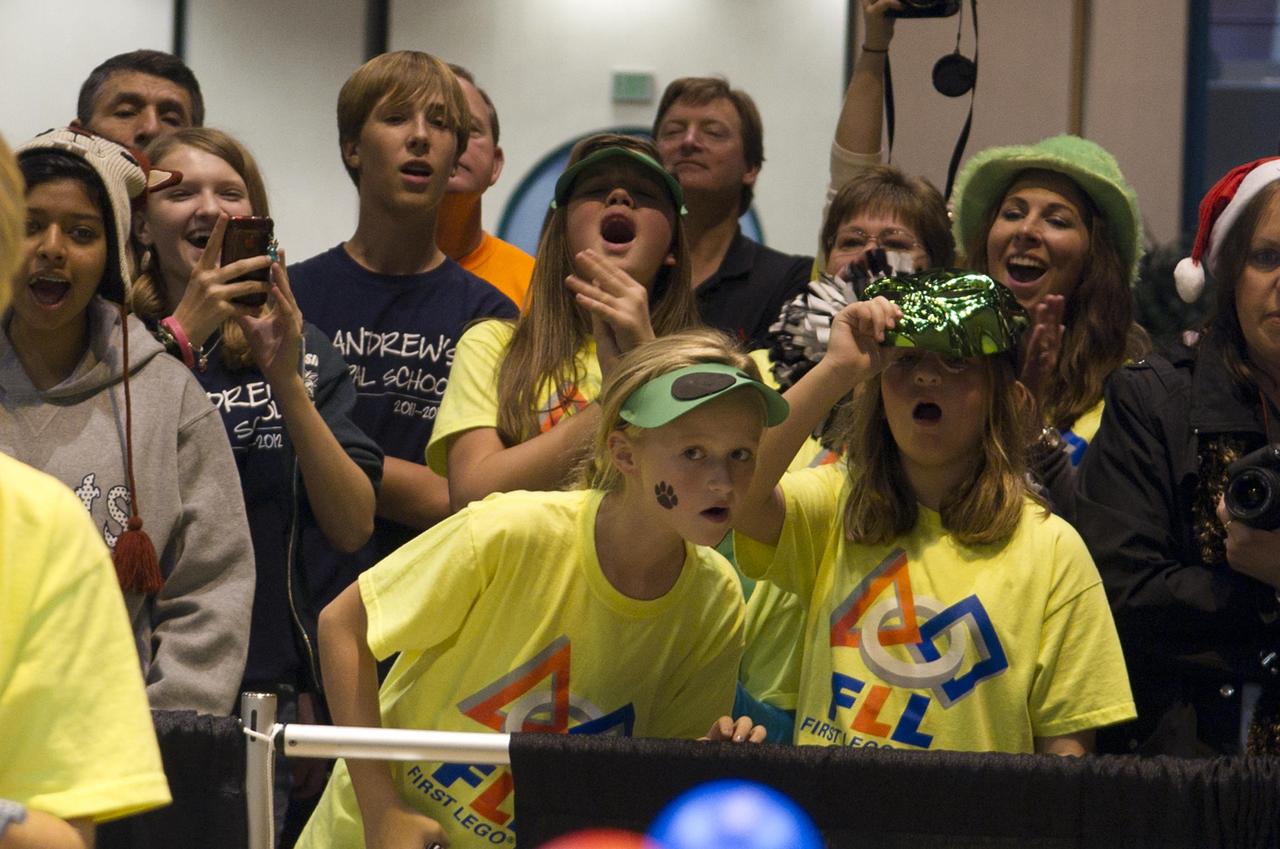
Observers cheer on student teams during the 2012 FIRST LEGO League Mississippi Championship Tournament in Hattiesburg, Miss., on Dec. 1. The annual competition attracted 46 teams from across Mississippi.

Mississippi students monitor performance of their robots during the 2012 FIRST LEGO League Mississippi Championship Tournament in Hattiesburg, Miss., on Dec. 1. The tournament is an annual high-energy robotics competition for children 9-14.
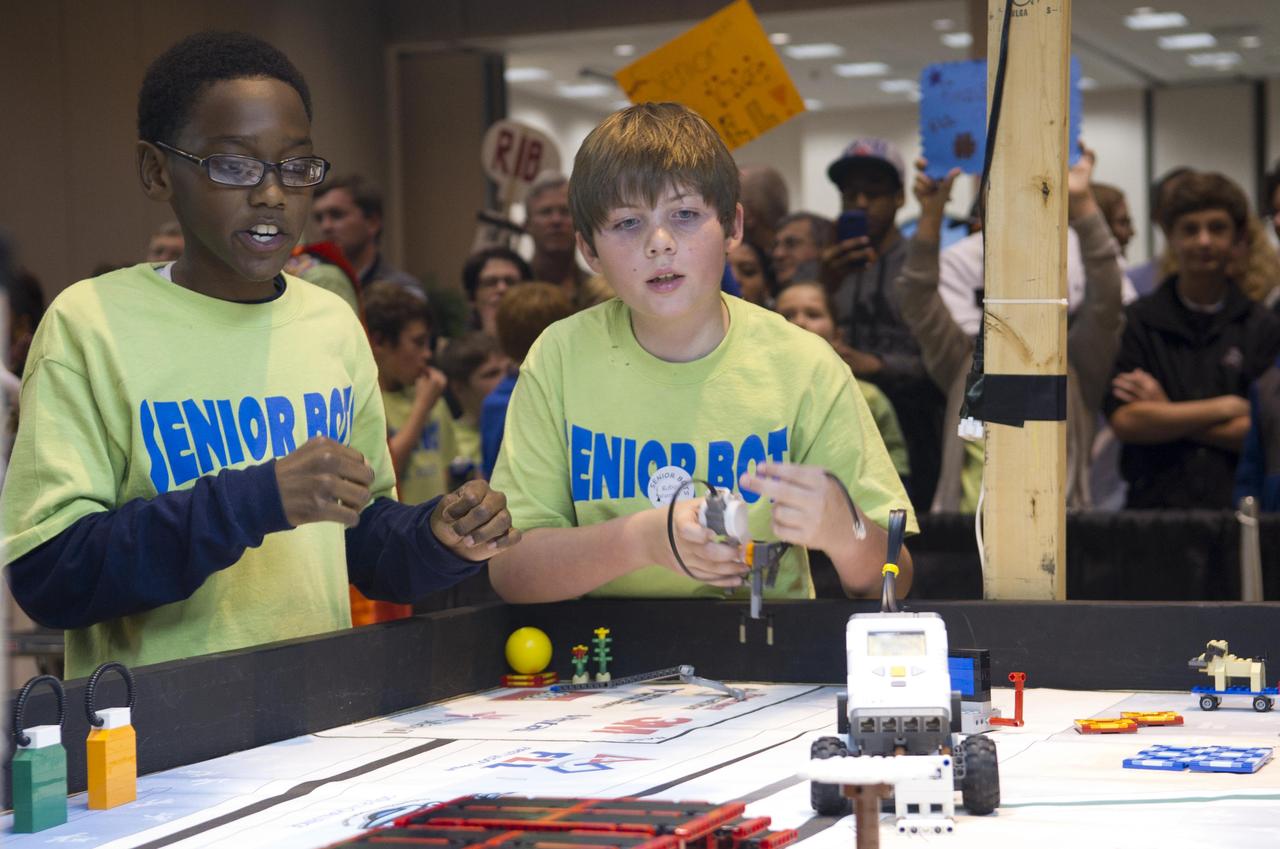
Mississippi students monitor performance of their robots during the 2012 FIRST LEGO League Mississippi Championship Tournament in Hattiesburg, Miss., on Dec. 1. The tournament is an annual high-energy robotics competition for children 9-14.
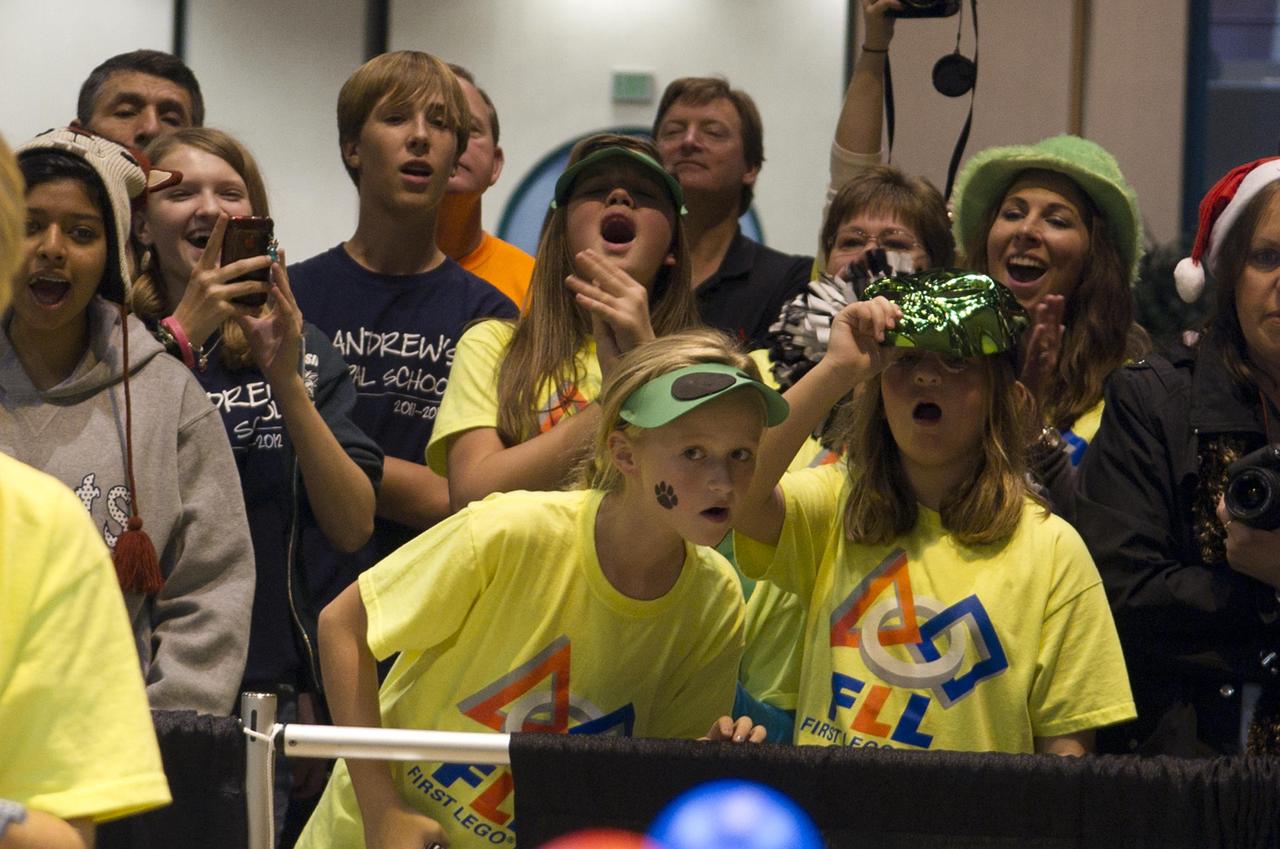
Observers cheer on student teams during the 2012 FIRST LEGO League Mississippi Championship Tournament in Hattiesburg, Miss., on Dec. 1. The annual competition attracted 46 teams from across Mississippi.
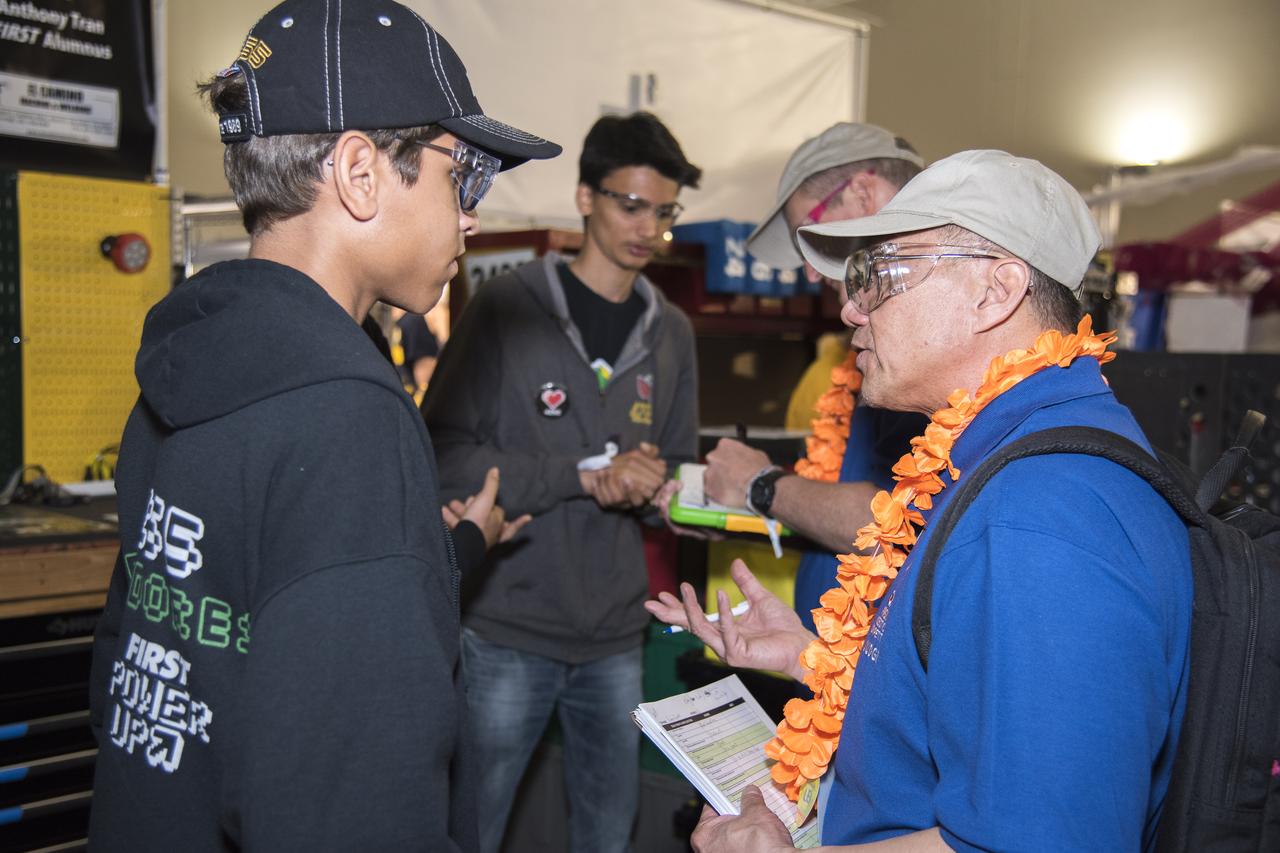
NASA systems engineer, Daniel Eng, right, talks with student participants at the 2019 Aerospace Valley Robotics Competition at the Palmdale Aerospace Academy in Palmdale, California.
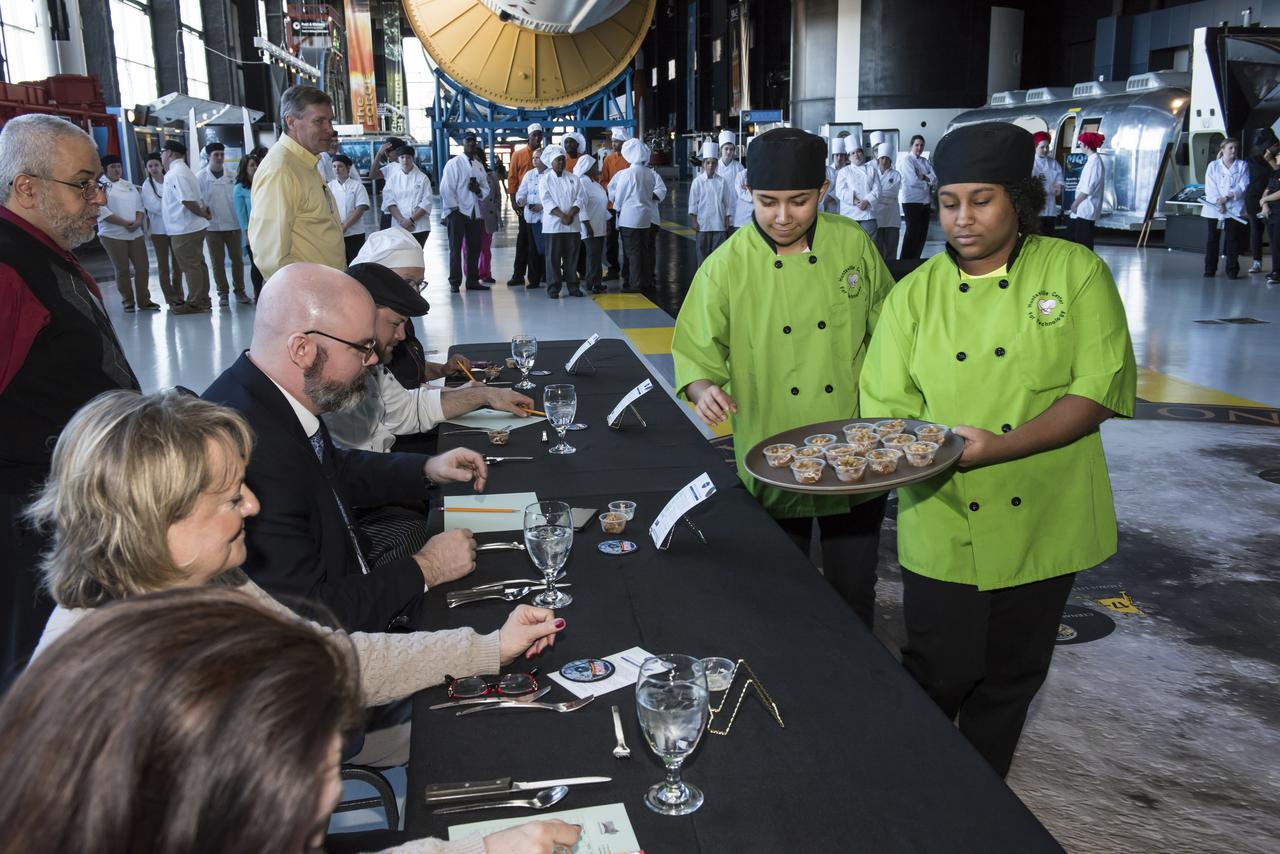
2017 "HIGH SCHOOL STUDENTS UNITED WITH NASA TO CREATE HARDWARE" (HUNCH) STUDENT CULINARY COMPETITION AT THE U.S. SPACE AND ROCKET CENTER. THE STUDENTS DEVELOPED RECIPES FOR DESSERT TREATS FOR ASTRONAUTS IN SPACE
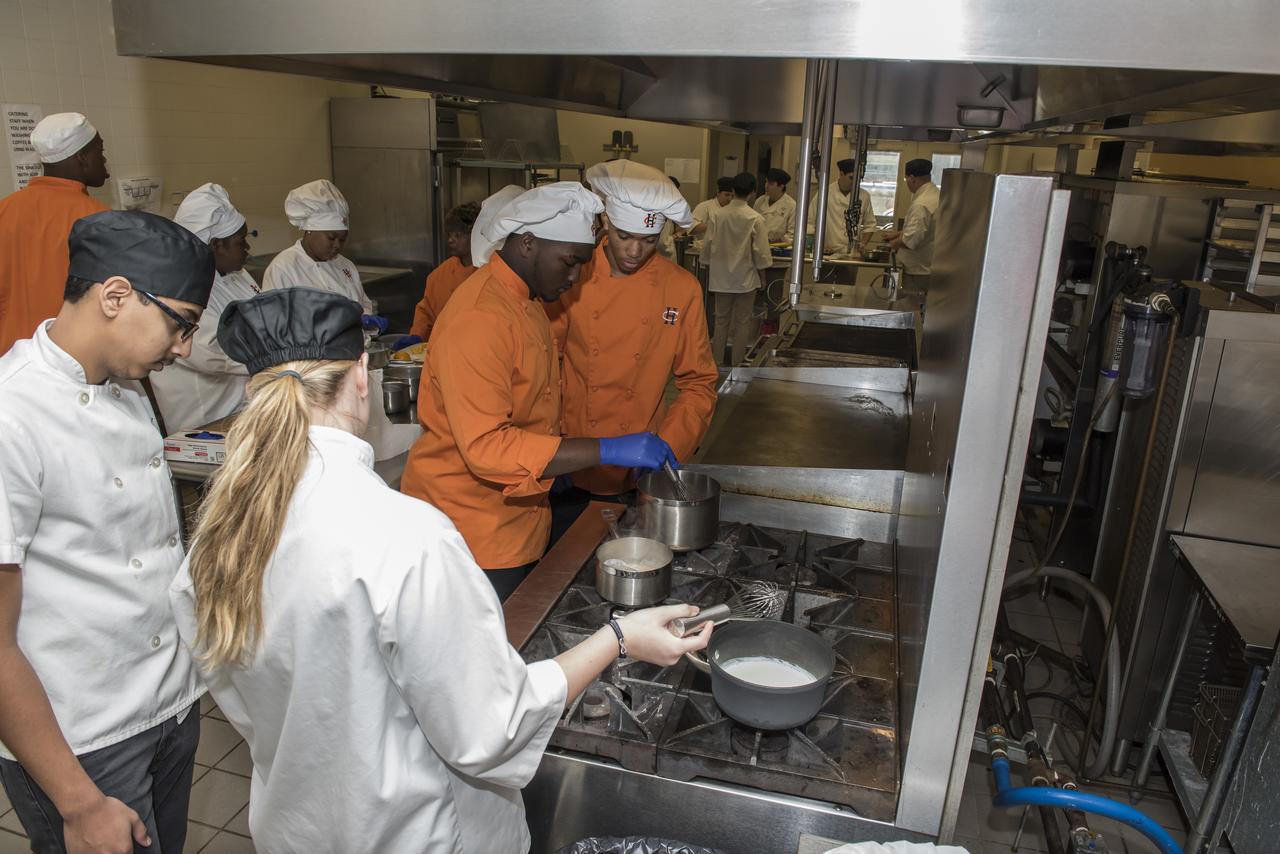
2017 "HIGH SCHOOL STUDENTS UNITED WITH NASA TO CREATE HARDWARE" (HUNCH) STUDENT CULINARY COMPETITION AT THE U.S. SPACE AND ROCKET CENTER. THE STUDENTS DEVELOPED RECIPES FOR DESSERT TREATS FOR ASTRONAUTS IN SPACE
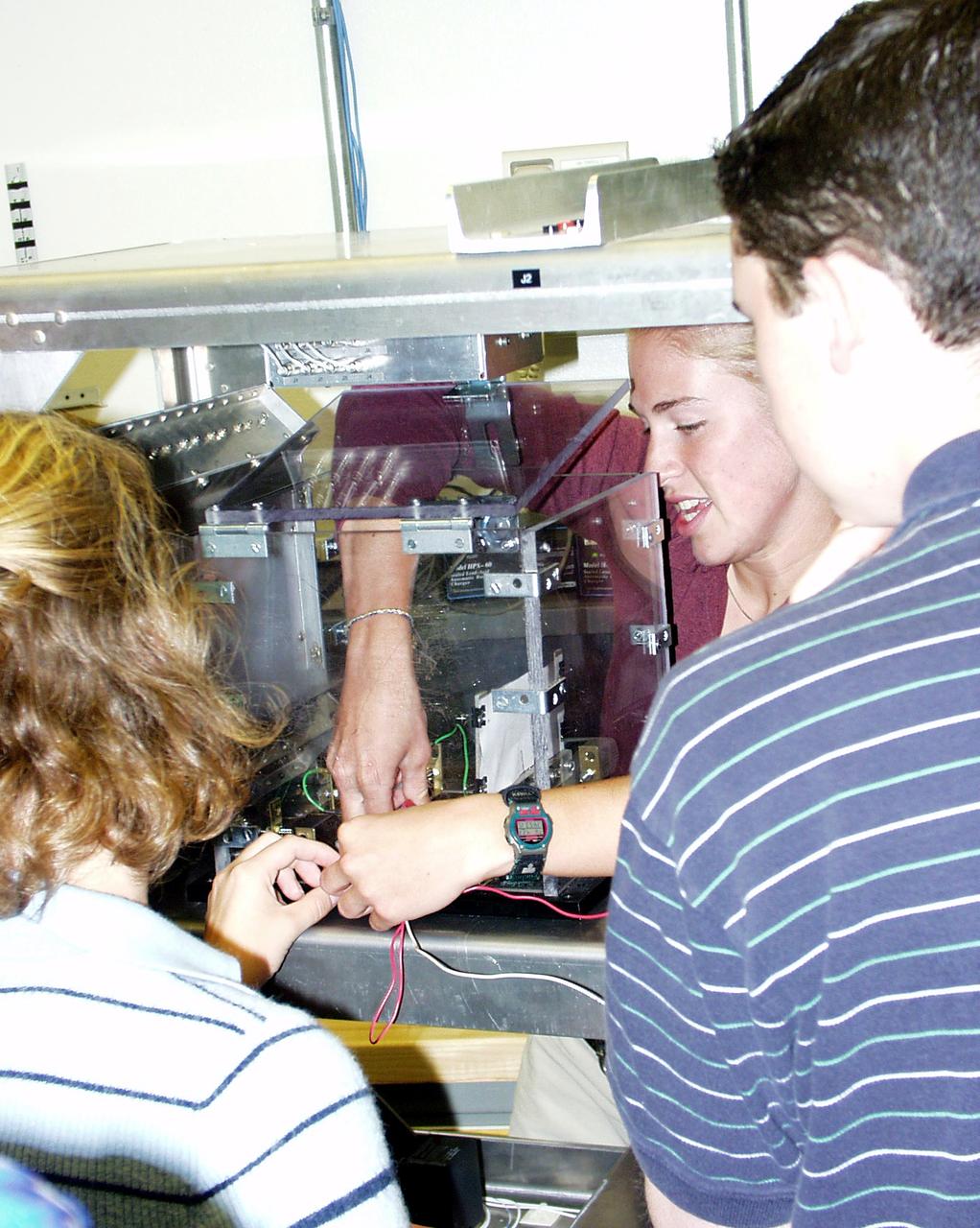
Students prepare their experiment apparatus for free-fall during the second Dropping in a Microgravity Environment (DIME) competition held April 23-25, 2002, at NASA's Glenn Research Center. Competitors included two teams from Sycamore High School, Cincinnati, OH, and one each from Bay High School, Bay Village, OH, and COSI Academy, Columbus, OH. DIME is part of NASA's education and outreach activities. Details are on line at http://microgravity.grc.nasa.gov/DIME_2002.html.
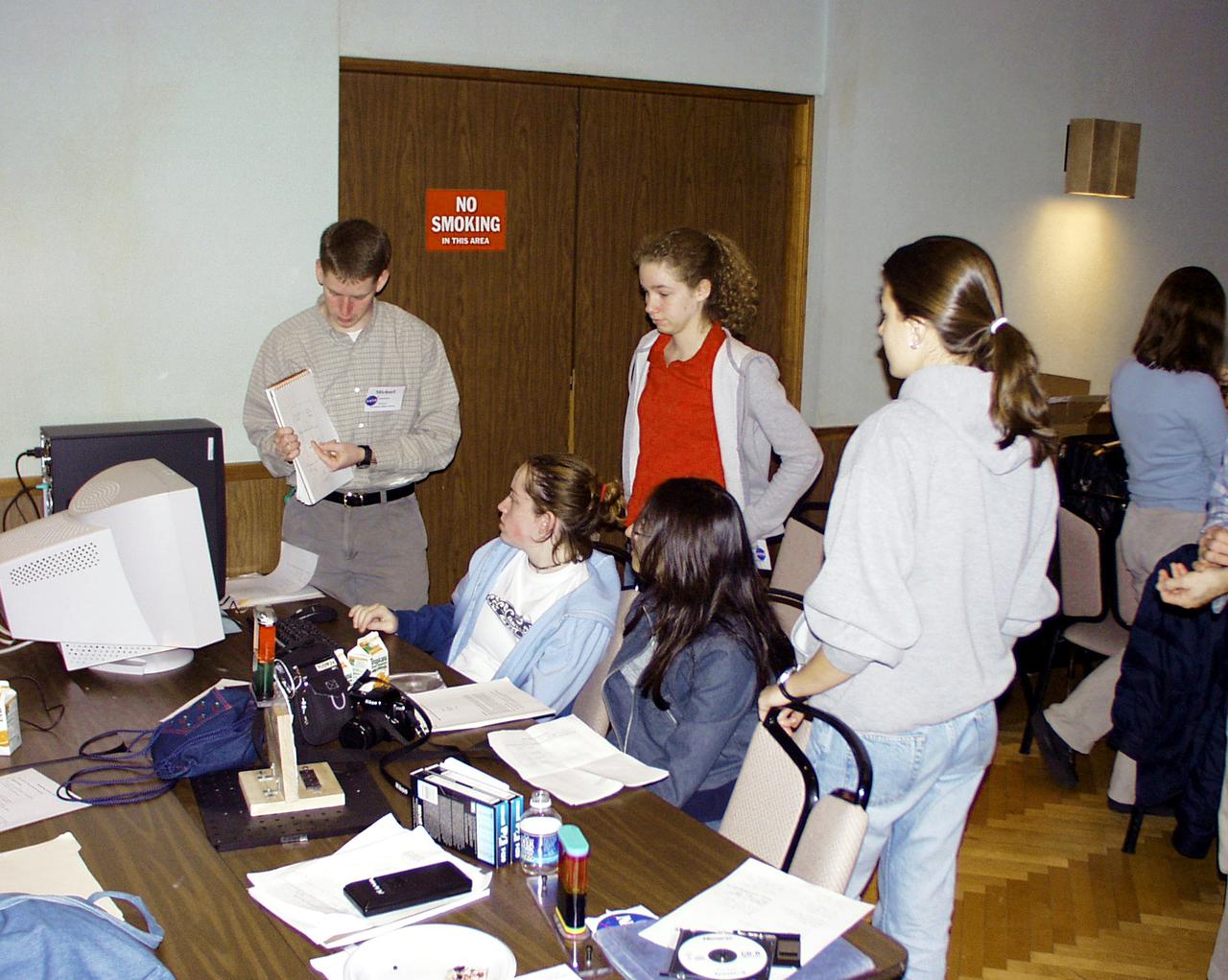
Students discuss fine points of their final design for the Drop Tower experiment during the second Dropping in a Microgravity Environment (DIME) competition held April 23-25, 2002, at NASA's Glenn Research Center. Competitors included two teams from Sycamore High School, Cincinnati, OH, and one each from Bay High School, Bay Village, OH, and COSI Academy, Columbus, OH. DIME is part of NASA's education and outreach activities. Details are on line at http://microgravity.grc.nasa.gov/DIME_2002.html.
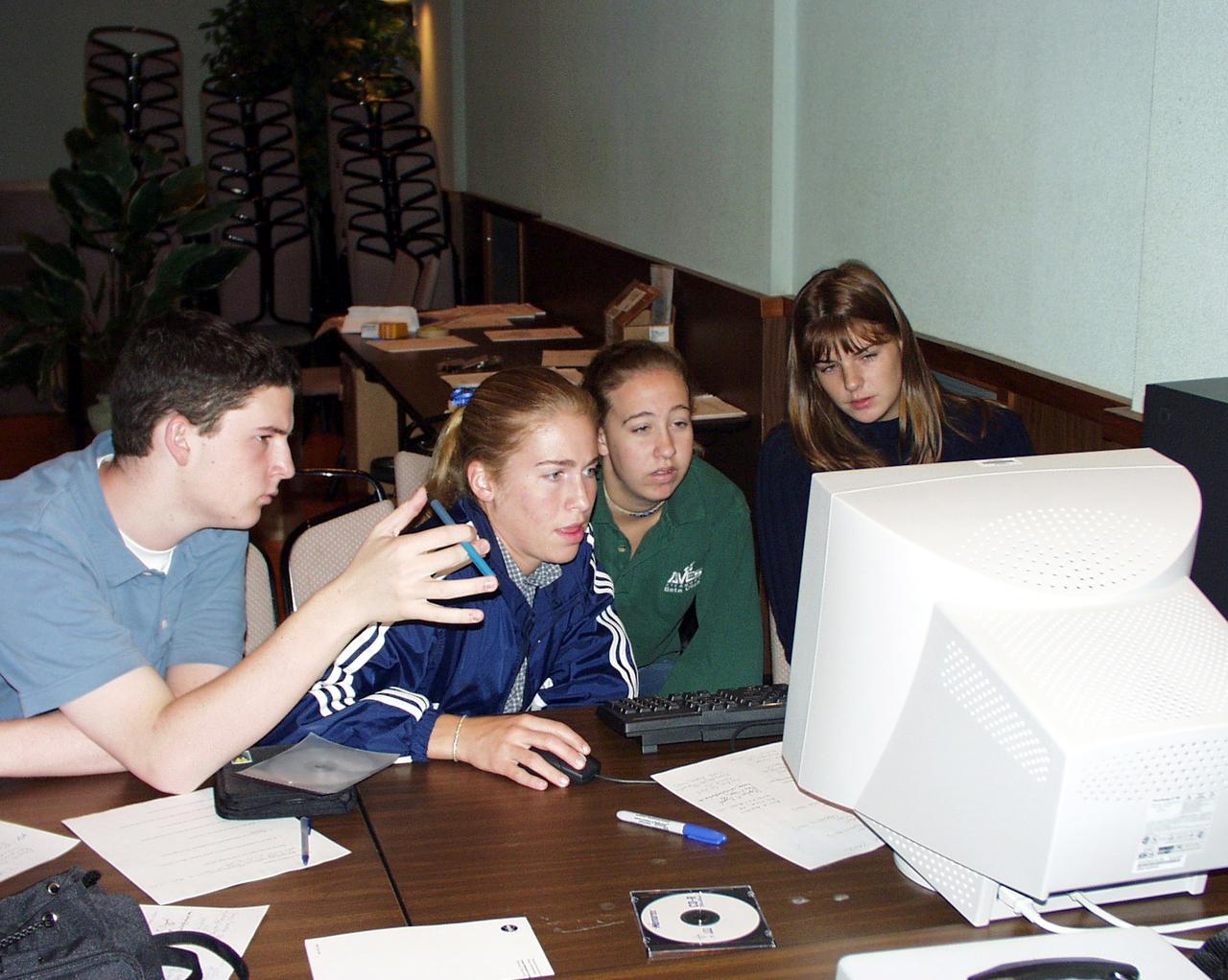
Students discuss fine points of their final design for the drop tower experiment during the second Dropping in a Microgravity Environment (DIME) competition held April 23-25, 2002, at NASA's Glenn Research Center. Competitors included two teams from Sycamore High School, Cincinnati, OH, and one each from Bay High School, Bay Village, OH, and COSI Academy, Columbus, OH. DIME is part of NASA's education and outreach activities. Details are on line at http://microgravity.grc.nasa.gov/DIME_2002.html.
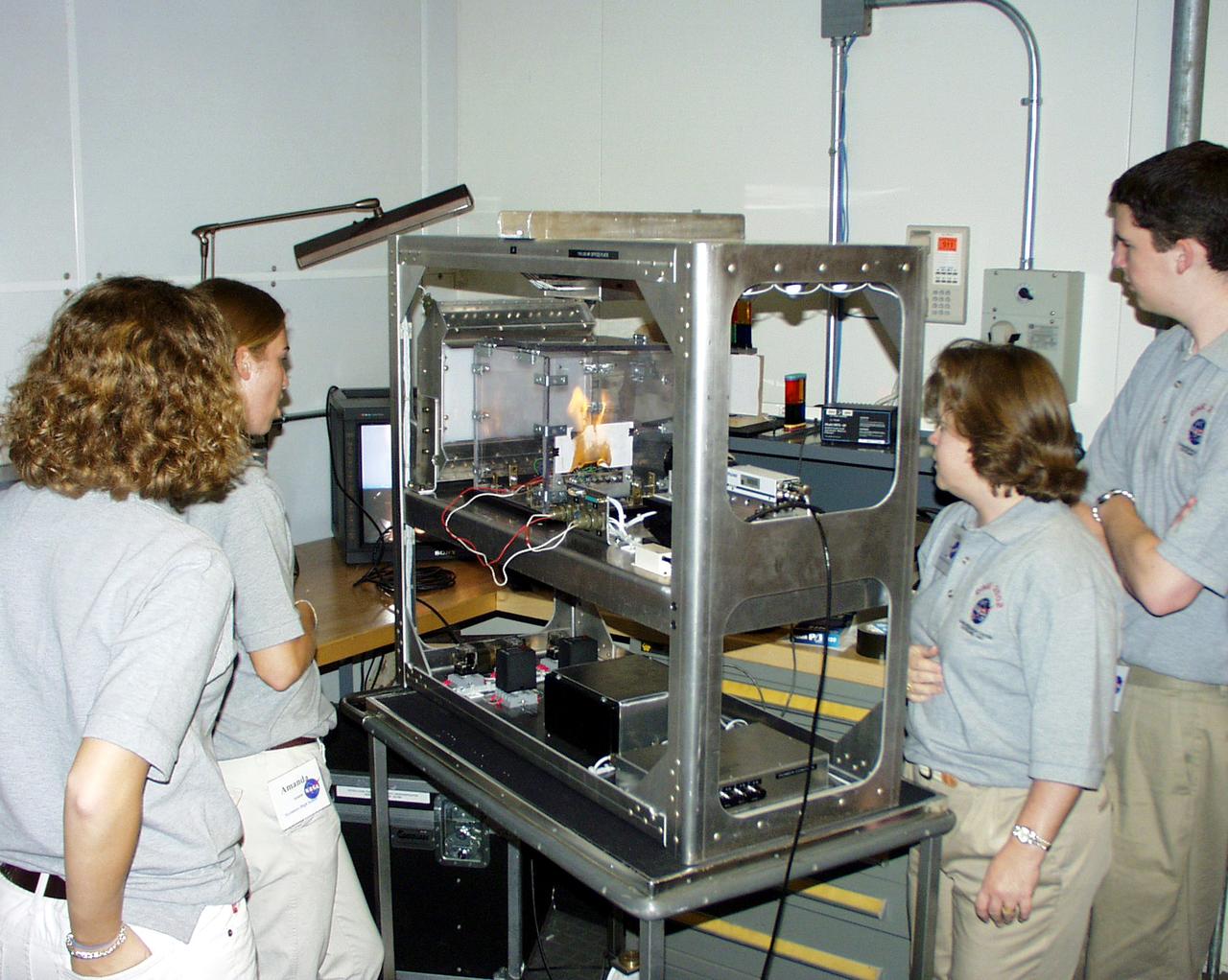
Students watch a test run on their experiment before the actual drop. They designed and built their apparatus to fit within a NASA-provided drop structure. This was part of the second Dropping in a Microgravity Environment (DIME) competition held April 23-25, 2002, at NASA's Glenn Research Center. Competitors included two teams from Sycamore High School, Cincinnati, OH, and one each from Bay High School, Bay Village, OH, and COSI Academy, Columbus, OH. DIME is part of NASA's education and outreach activities. Details are on line at http://microgravity.grc.nasa.gov/DIME_2002.html.
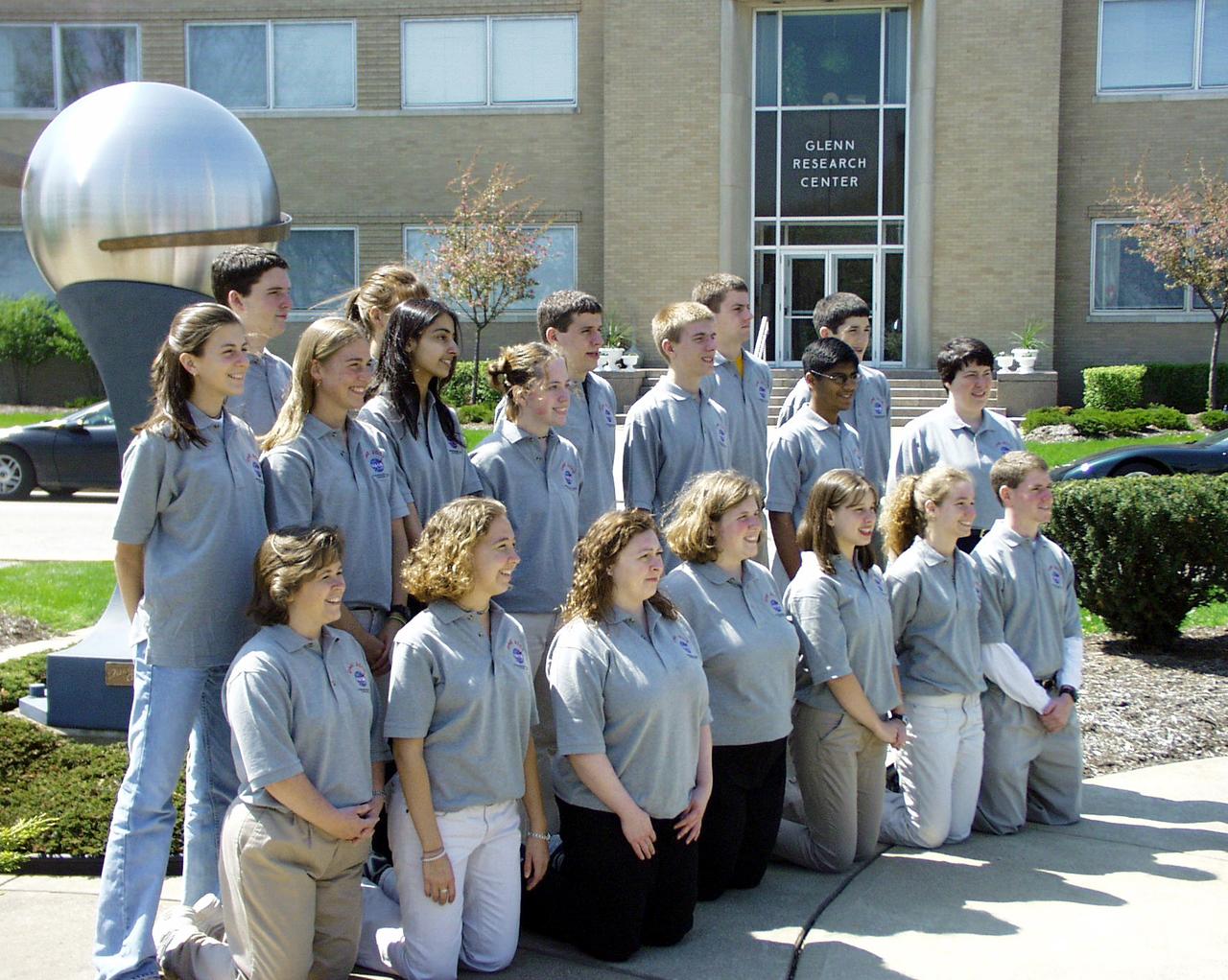
Students from the four teams pose in front of he NASA Glenn Administration Building alongside the NASA Glenn Time Capsule. The students participated in the second Dropping in a Microgravity Environment (DIME) competition held April 23-25, 2002, at NASA's Glenn Research Center. Competitors included two teams from Sycamore High School, Cincinnati, OH, and one each from Bay High School, Bay Village, OH, and COSI Academy, Columbus, OH. DIME is part of NASA's education and outreach activities. Details are on line at http://microgravity.grc.nasa.gov/DIME_2002.html.
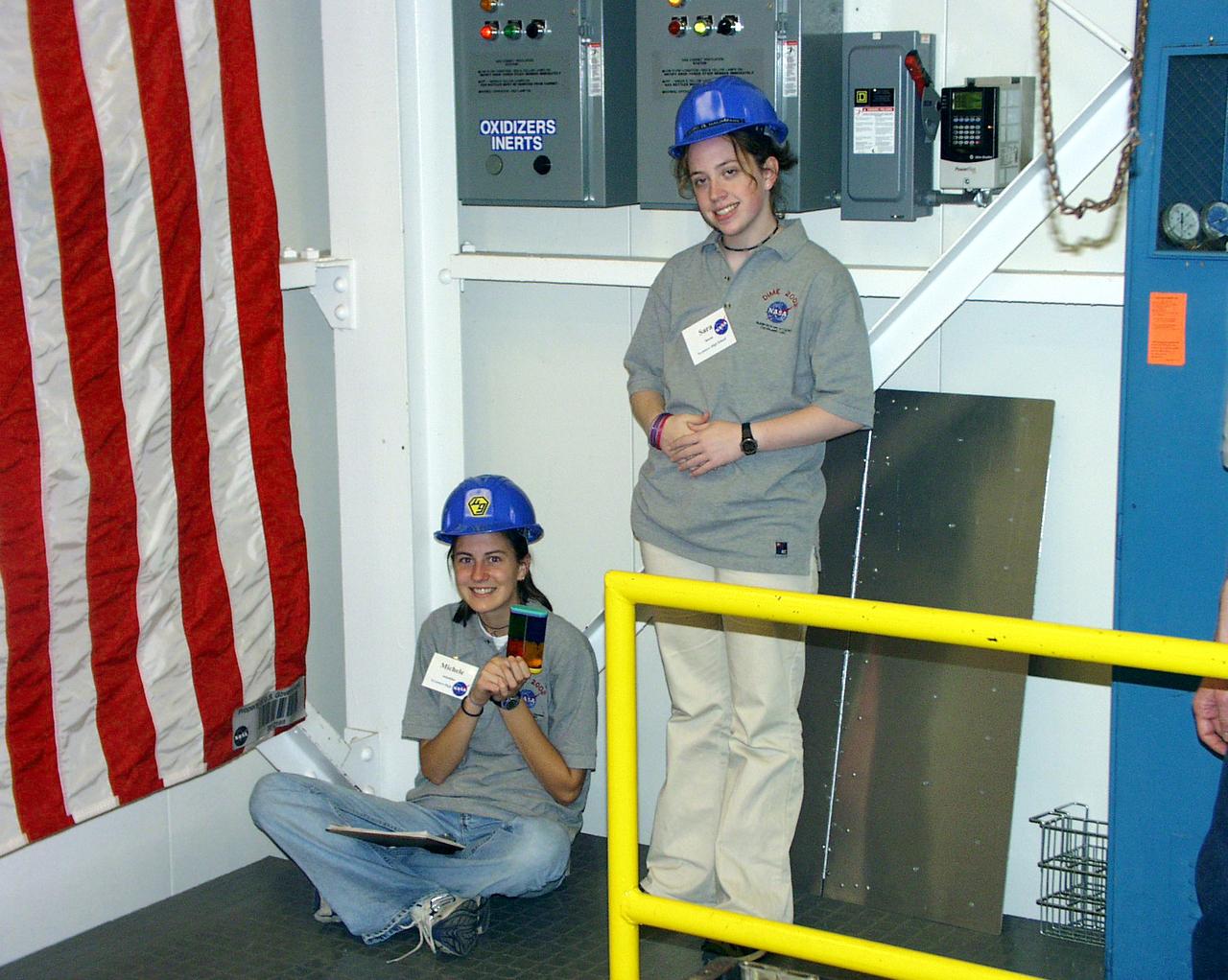
Students pause while waiting their turn at the 2.2-second Drop Tower during the second Dropping in a Microgravity Environment (DIME) competition held April 23-25, 2002, at NASA's Glenn Research Center. Competitors included two teams from Sycamore High School, Cincinnati, OH, and one each from Bay High School, Bay Village, OH, and COSI Academy, Columbus, OH. DIME is part of NASA's education and outreach activities. Details are on line at http://microgravity.grc.nasa.gov/DIME_2002.html.
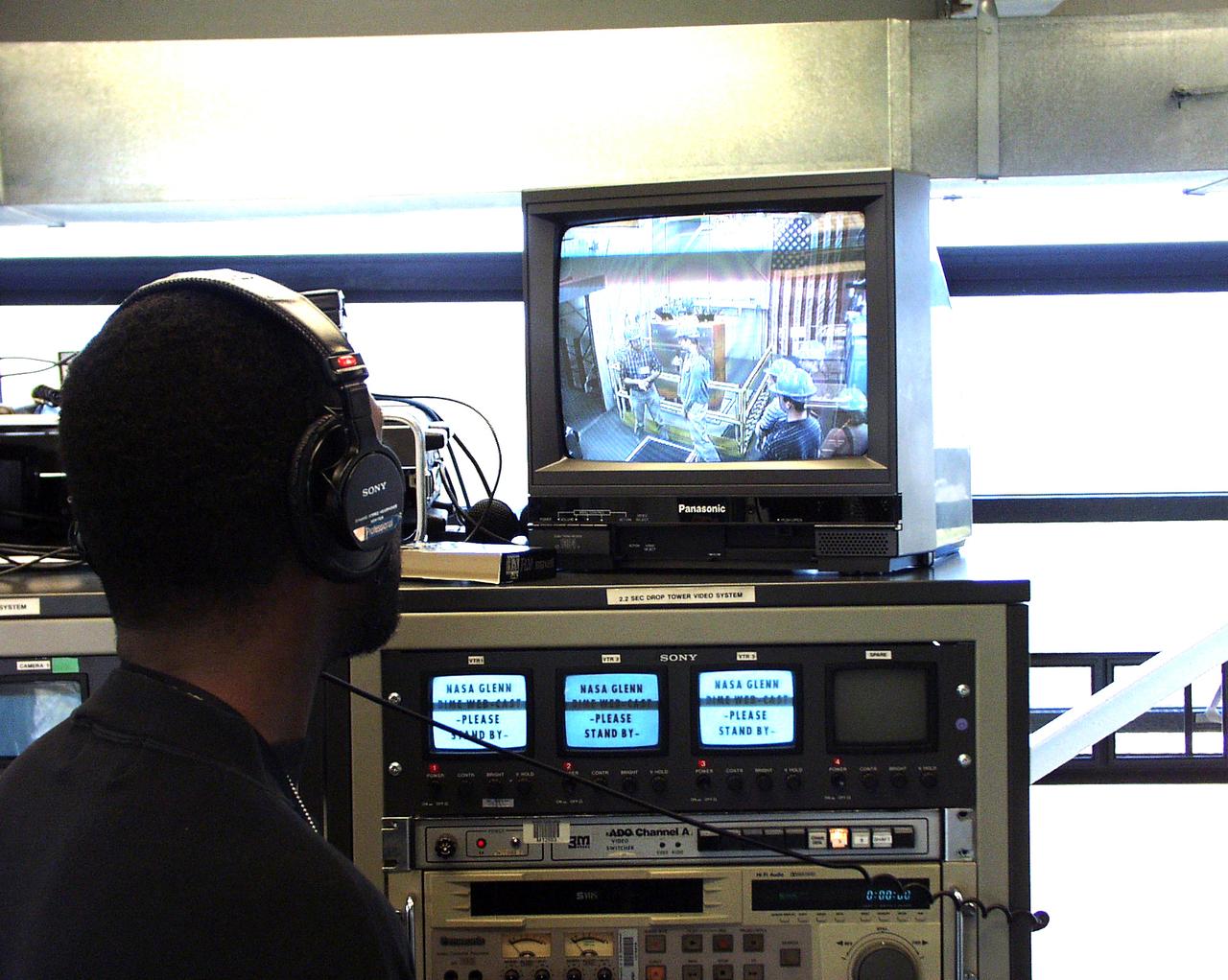
A NASA test conductor at the top of the 2.2-second Drop Tower monitors a student lecture at a lower level. This was part of the Microgravity Environment (DIME) competition held April 23-25, 2002, at NASA's Glenn Research Center. Competitors included two teams from Sycamore High School, Cincinnati, OH, and one each from Bay High School, Bay Village, OH, and COSI Academy, Columbus, OH. DIME is part of NASA's education and outreach activities. Details are on line at http://microgravity.grc.nasa.gov/DIME_2002.html.
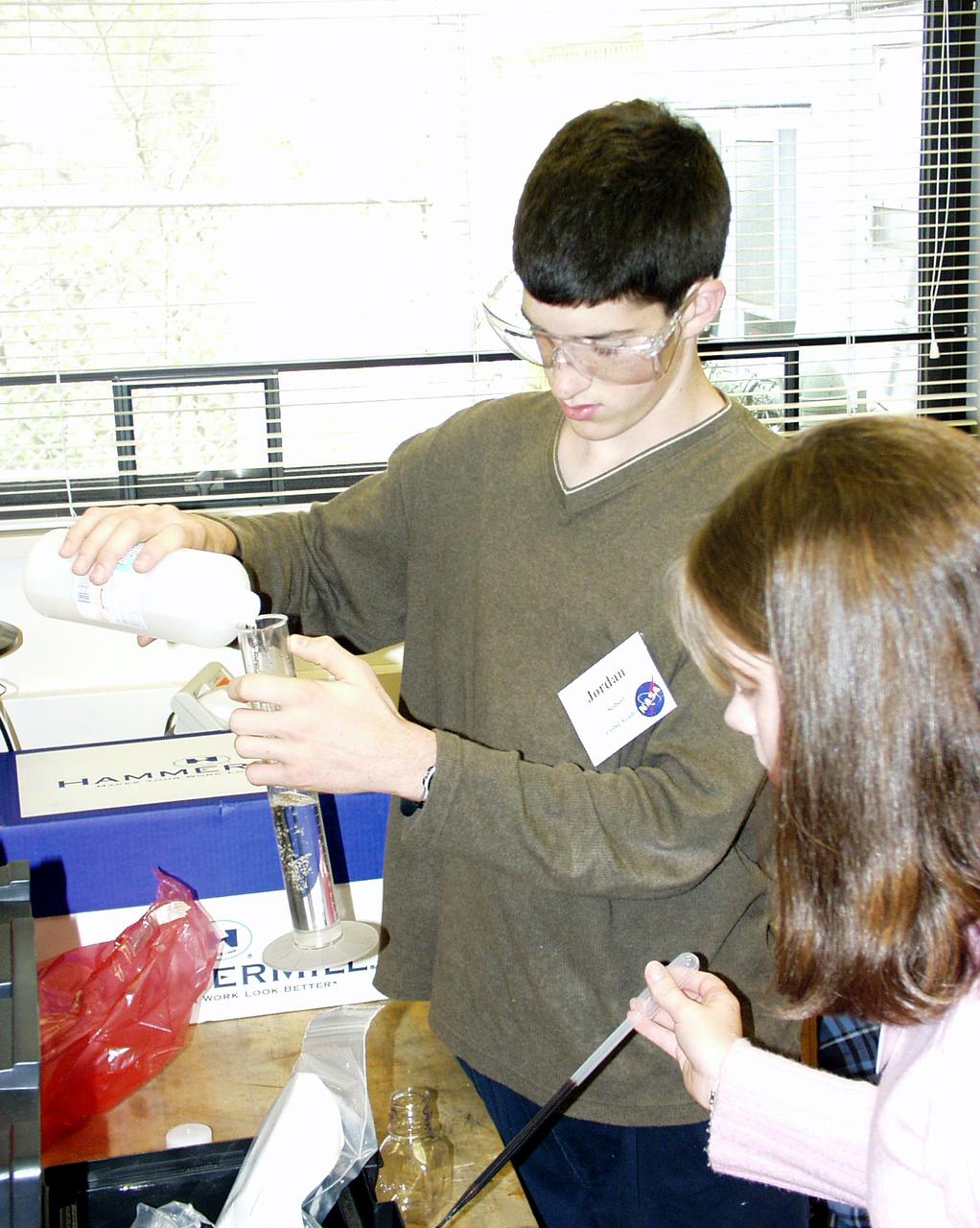
Students prepare to load fluids in their experiment apparatus during the Microgravity Environment (DIME) competition held April 23-25, 2002, at NASA's Glenn Research Center. Competitors included two teams from Sycamore High School, Cincinnati, OH, and one each from Bay High School, Bay Village, OH, and COSI Academy, Columbus, OH. DIME is part of NASA's education and outreach activities. Details are on line at http://microgravity.grc.nasa.gov/DIME_2002.html.
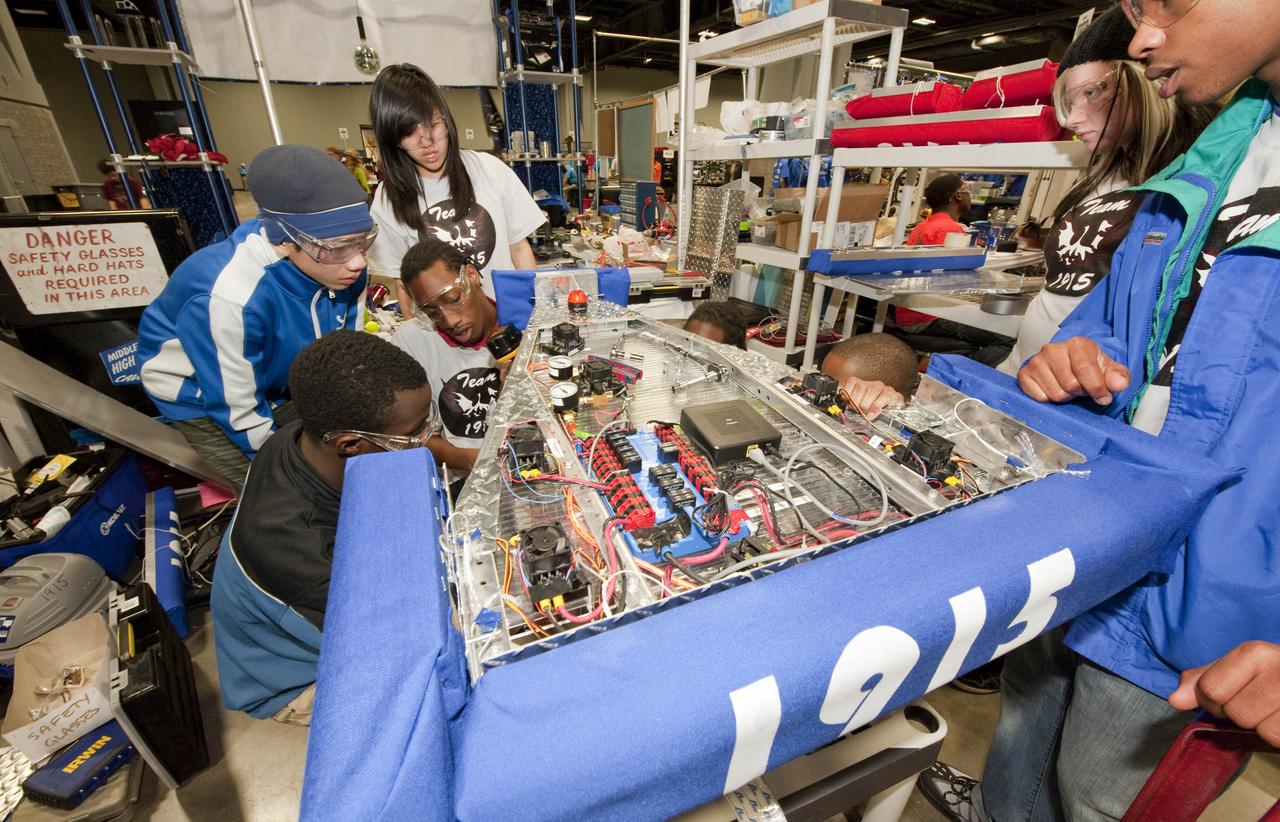
Students from McKinley Tech High School in Washington, D.C., work on their robot in the "Pit Area" as they prepare to compete in the First Robotics Competition, Friday, March 5, 2010, in Washington. The student competition is called "For Inspiration and Recognition of Science and Technology," or FIRST. The program was founded in 1989 by inventor Dean Kamen to inspire an appreciation of science and technology in young people, their schools and communities. Photo Credit: (NASA/Paul E. Alers)
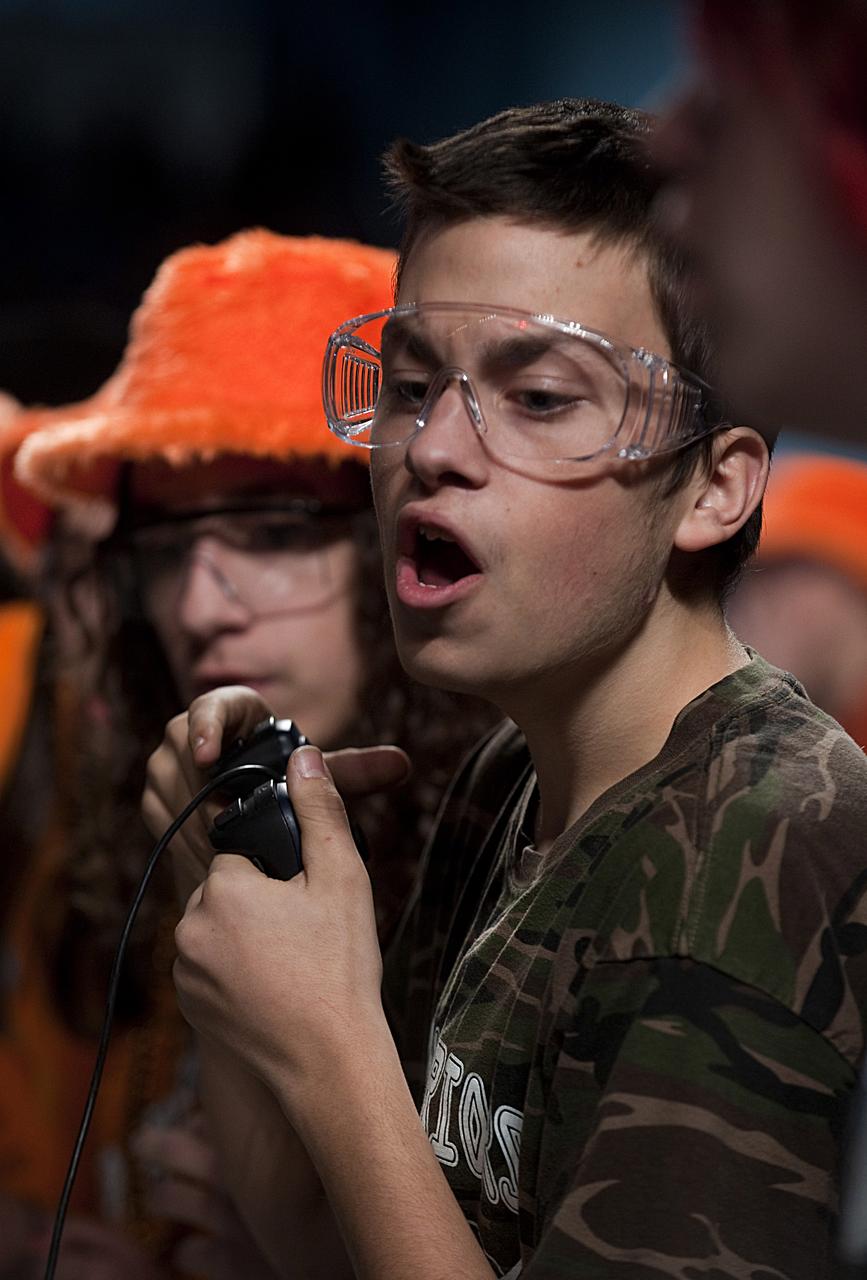
A student member of the team 768 "Technowarriors" from Woodlawn High School in Maryland runs a controller while competing in a match during the second day of the First Robotics Competition, Saturday, March 6, 2010, in Washington. The student competition is called "For Inspiration and Recognition of Science and Technology", or FIRST. The program was founded in 1989 by Dean Kamen to inspire an appreciation of science and technology in young people, their schools and communities. Photo Credit: (NASA/Paul E. Alers)
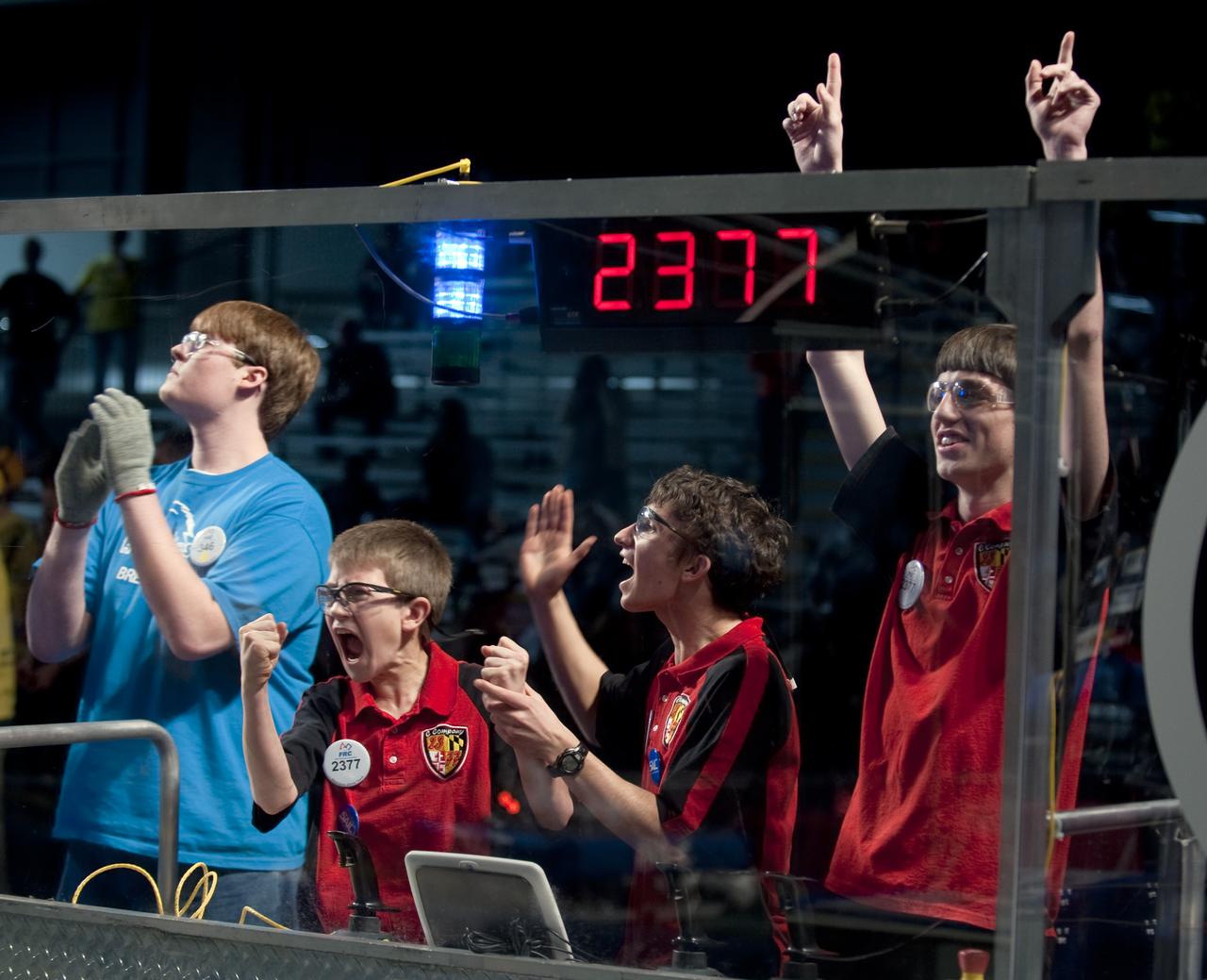
Members of team 2377, in red, from Chesapeake High School in Maryland, react following a match during the second day of competition at the First Robotics Competition, Saturday, March 6, 2010, in Washington. The student competition is called "For Inspiration and Recognition of Science and Technology", or FIRST. The program was founded in 1989 by Dean Kamen to inspire an appreciation of science and technology in young people, their schools and communities. Photo Credit: (NASA/Paul E. Alers)
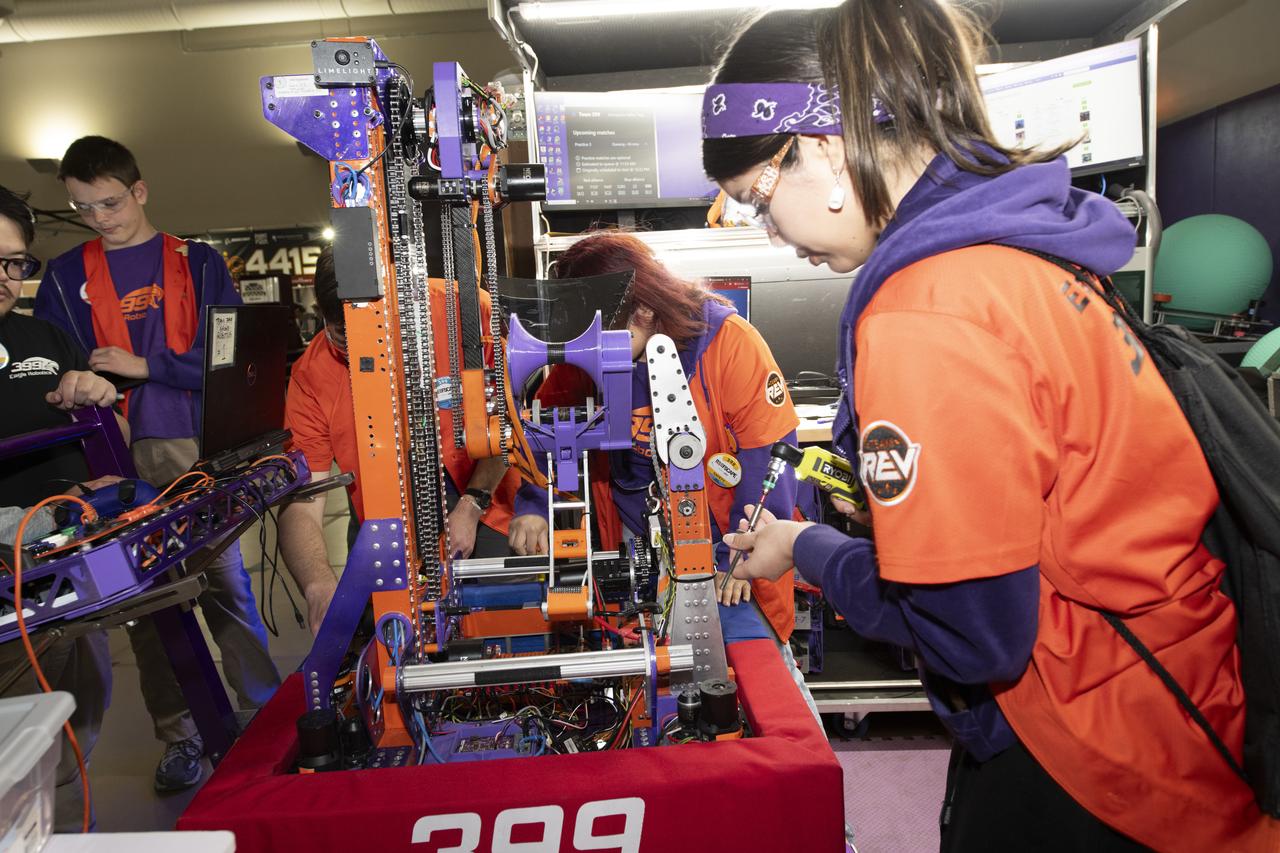
Students from Eagle Robotics, Team 399, supported by volunteers from NASA’s Armstrong Flight Research Center in Edwards, California, adjust their robot during the 2025 Aerospace Valley FIRST Robotics Competition in Lancaster, California, on April 3, 2025.

Students from the University of Alabama prepare to enter the simulated lunar regolith competition area with their prototype lunar robot during the finals for NASA’s 2026 Lunabotics Challenge competition on Wednesday, May 19, 2026, inside the Astronauts Memorial Foundation’s Center for Space Education at the Kennedy Space Center Visitor Complex in Florida. Forty-seven teams from around the U.S. designed and built remote-controlled robots capable of traversing challenging lunar terrain while constructing regolith-based berm under conditions similar to those the agency will face as it returns to the lunar surface through Artemis.

Students from San Diego State University prepare to enter the simulated lunar regolith competition area with their prototype lunar robot during the finals for NASA’s 2026 Lunabotics Challenge competition on Wednesday, May 20, 2026, inside the Astronauts Memorial Foundation’s Center for Space Education at the Kennedy Space Center Visitor Complex in Florida. Forty-seven teams from around the U.S. designed and built remote-controlled robots capable of traversing challenging lunar terrain while constructing regolith-based berm under conditions similar to those the agency will face as it returns to the lunar surface through Artemis.

Students from the University of Alabama prepare to enter the simulated lunar regolith competition area with their prototype lunar robot during the finals for NASA’s 2026 Lunabotics Challenge competition on Thursday, May 20, 2026, inside the Astronauts Memorial Foundation’s Center for Space Education at the Kennedy Space Center Visitor Complex in Florida. Forty-seven teams from around the U.S. designed and built remote-controlled robots capable of traversing challenging lunar terrain while constructing regolith-based berm under conditions similar to those the agency will face as it returns to the lunar surface through Artemis.

Students from Michigan Technological University accept an award during NASA’s 2026 Lunabotics Challenge competition on Thursday, May 21, 2026, inside the Astronauts Memorial Foundation’s Center for Space Education at the Kennedy Space Center Visitor Complex in Florida. Forty-seven teams from around the U.S. designed and built remote-controlled robots capable of traversing challenging lunar terrain while constructing regolith-based berm under conditions similar to those the agency will face as it returns to the lunar surface through Artemis.

Students from the University of Alabama accept the Caterpillar Autonomy Award during NASA’s 2026 Lunabotics Challenge competition on Thursday, May 21, 2026, inside the Astronauts Memorial Foundation’s Center for Space Education at the Kennedy Space Center Visitor Complex in Florida. Forty-seven teams from around the U.S. designed and built remote-controlled robots capable of traversing challenging lunar terrain while constructing regolith-based berm under conditions similar to those the agency will face as it returns to the lunar surface through Artemis.

Students from the University of Virginia accept an award during NASA’s 2026 Lunabotics Challenge competition on Thursday, May 21, 2026, inside the Astronauts Memorial Foundation’s Center for Space Education at the Kennedy Space Center Visitor Complex in Florida. Forty-seven teams from around the U.S. designed and built remote-controlled robots capable of traversing challenging lunar terrain while constructing regolith-based berm under conditions similar to those the agency will face as it returns to the lunar surface through Artemis.
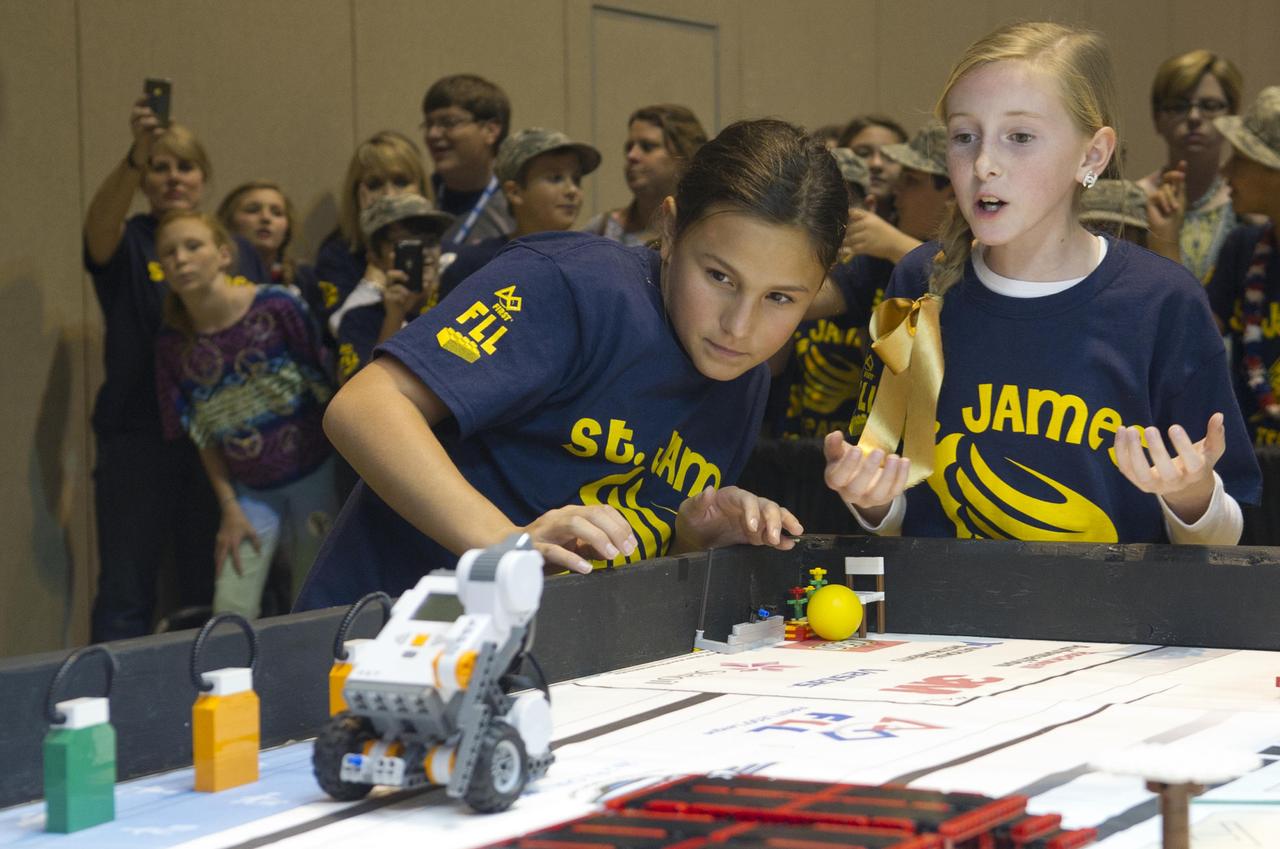
Two students anxiously watch their robot during the 2012 FIRST LEGO League Mississippi Championship Tournament in Hattiesburg, Miss., on Dec. 1. In addition to competing with robots, students presented research on this year's 'Senior Solutions' theme, which focused on addressing problems faced by senior adults.
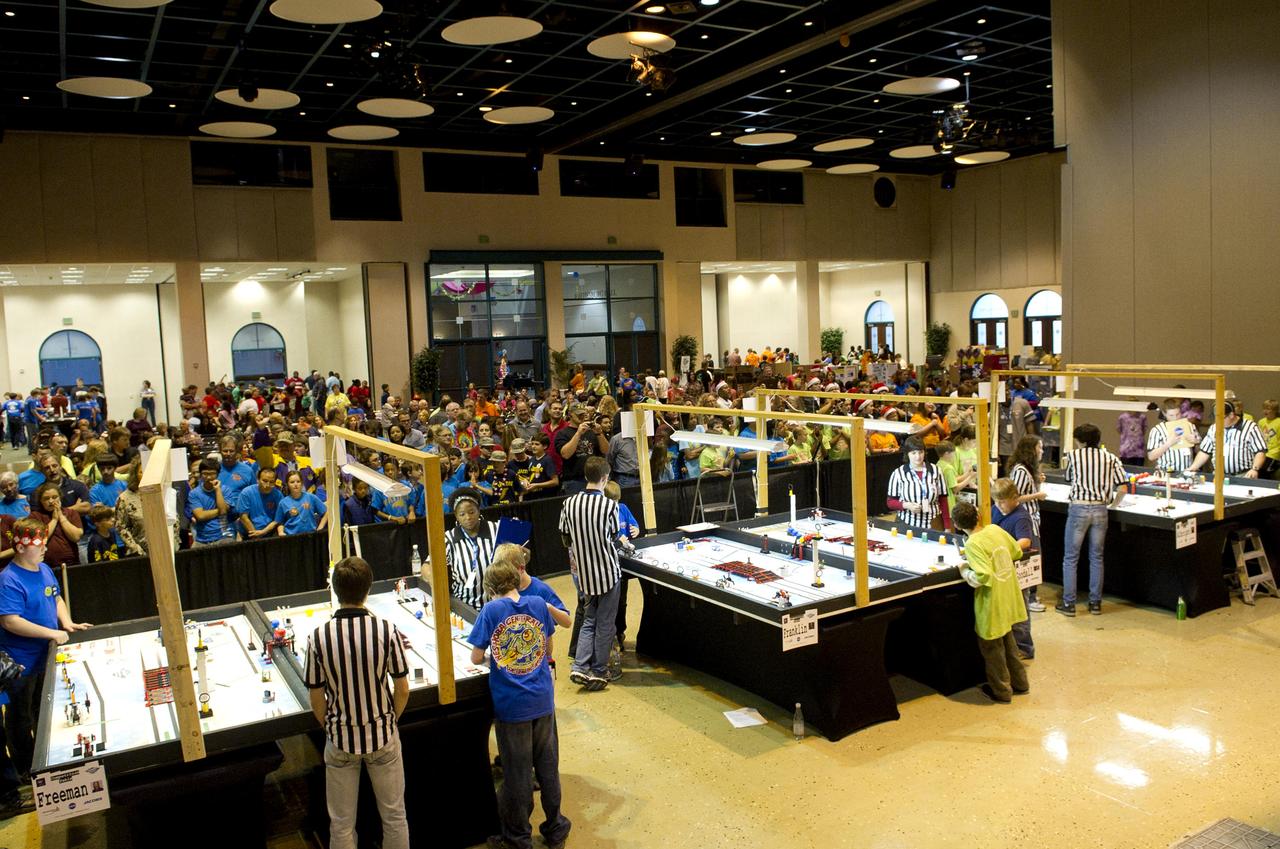
The 2012 FIRST LEGO League Mississippi Championship Tournament in Hattiesburg, Miss., on Dec. 1, drew 46 teams from across Mississippi. The focus of the annual competition celebrates science and technology through hands-on participation and learning.
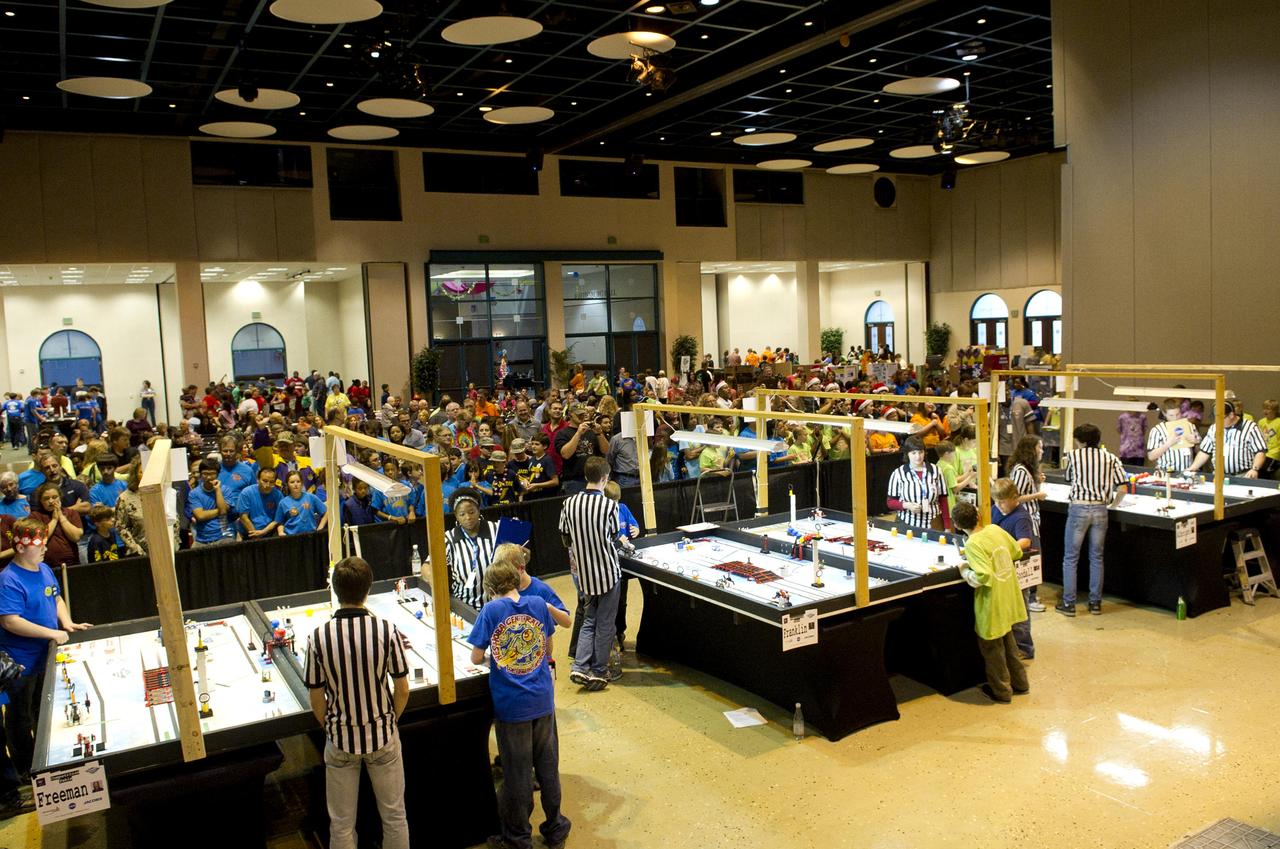
The 2012 FIRST LEGO League Mississippi Championship Tournament in Hattiesburg, Miss., on Dec. 1, drew 46 teams from across Mississippi. The focus of the annual competition celebrates science and technology through hands-on participation and learning.
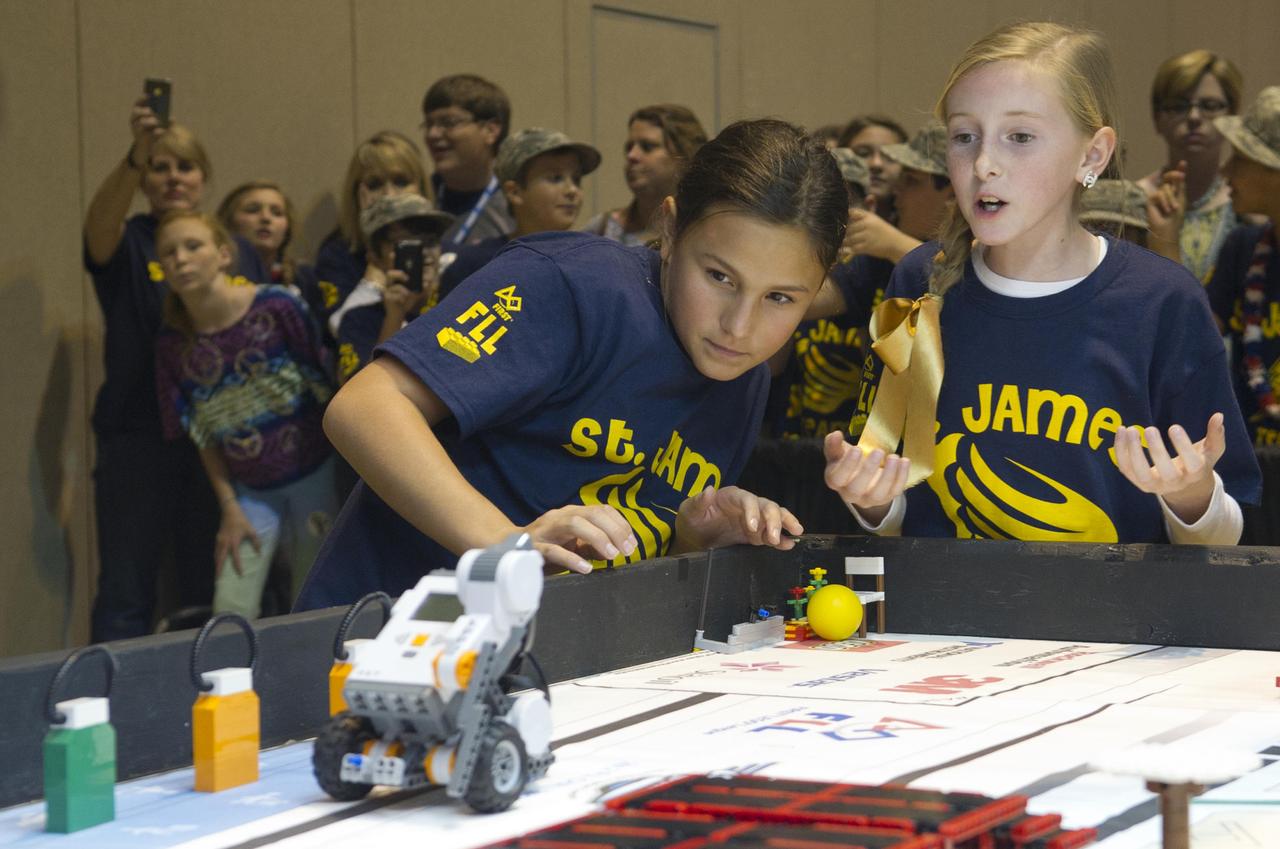
Two students anxiously watch their robot during the 2012 FIRST LEGO League Mississippi Championship Tournament in Hattiesburg, Miss., on Dec. 1. In addition to competing with robots, students presented research on this year's 'Senior Solutions' theme, which focused on addressing problems faced by senior adults.

Students from Michigan Technological University prepare their prototype lunar robot for its turn during the finals for NASA’s 2026 Lunabotics Challenge competition on Wednesday, May 20, 2026, inside the Astronauts Memorial Foundation’s Center for Space Education at the Kennedy Space Center Visitor Complex in Florida. Forty-seven teams from around the U.S. designed and built remote-controlled robots capable of traversing challenging lunar terrain while constructing regolith-based berm under conditions similar to those the agency will face as it returns to the lunar surface through Artemis.

Students from the University of Virginia prepare their prototype lunar robot for its turn during the finals for NASA’s 2026 Lunabotics Challenge competition on Wednesday, May 20, 2026, inside the Astronauts Memorial Foundation’s Center for Space Education at the Kennedy Space Center Visitor Complex in Florida. Forty-seven teams from around the U.S. designed and built remote-controlled robots capable of traversing challenging lunar terrain while constructing regolith-based berm under conditions similar to those the agency will face as it returns to the lunar surface through Artemis.

Students from Michigan Technological University prepare their prototype lunar robot for its turn during the finals for NASA’s 2026 Lunabotics Challenge competition on Wednesday, May 20, 2026, inside the Astronauts Memorial Foundation’s Center for Space Education at the Kennedy Space Center Visitor Complex in Florida. Forty-seven teams from around the U.S. designed and built remote-controlled robots capable of traversing challenging lunar terrain while constructing regolith-based berm under conditions similar to those the agency will face as it returns to the lunar surface through Artemis.

Students from Iowa State University prepare their prototype lunar robot for its turn during the finals for NASA’s 2026 Lunabotics Challenge competition on Wednesday, May 20, 2026, inside the Astronauts Memorial Foundation’s Center for Space Education at the Kennedy Space Center Visitor Complex in Florida. Forty-seven teams from around the U.S. designed and built remote-controlled robots capable of traversing challenging lunar terrain while constructing regolith-based berm under conditions similar to those the agency will face as it returns to the lunar surface through Artemis.
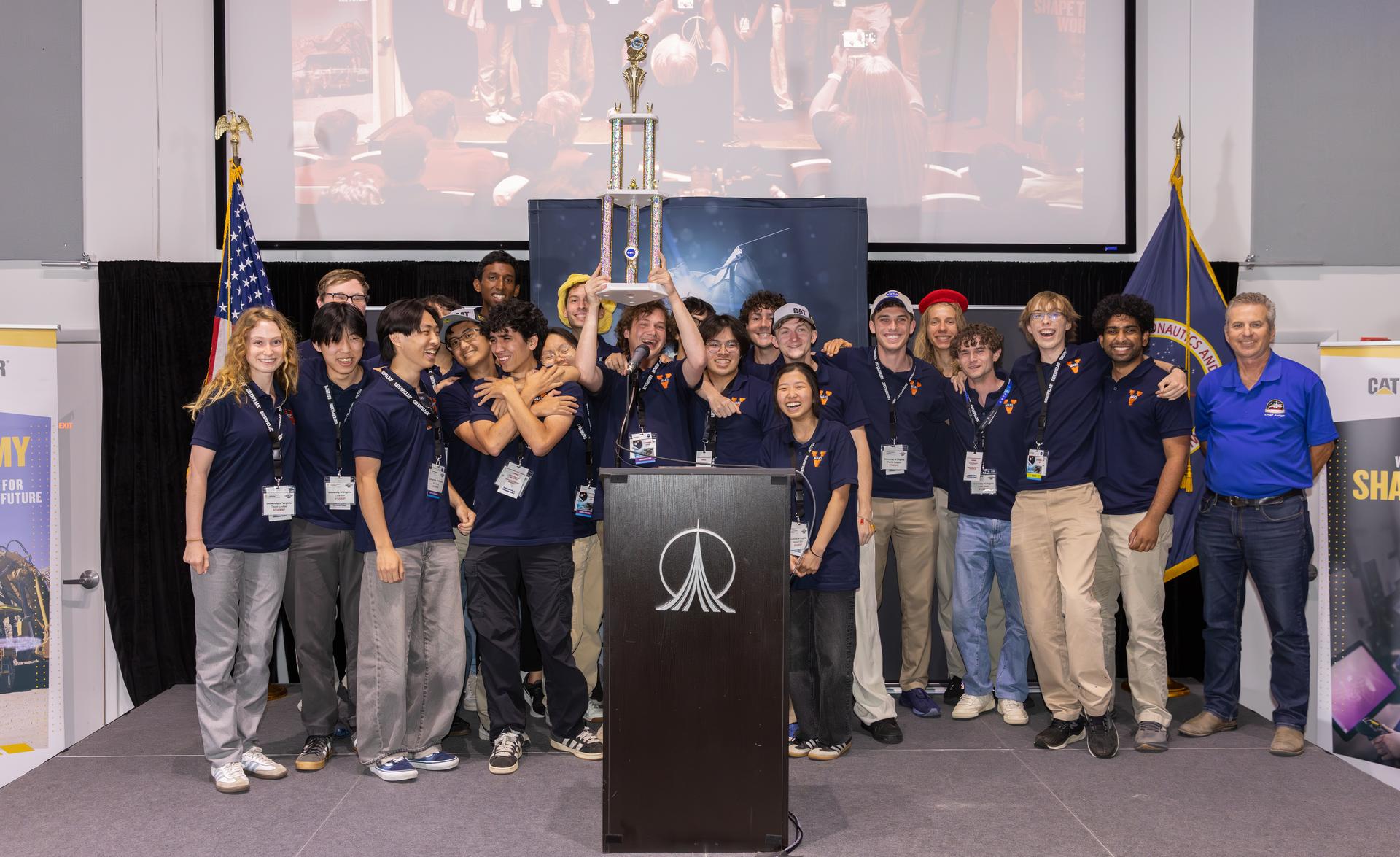
Students from the University of Virginia pose for a photograph after winning the grand prize during NASA’s 2026 Lunabotics Challenge competition on Thursday, May 21, 2026, inside the Astronauts Memorial Foundation’s Center for Space Education at the Kennedy Space Center Visitor Complex in Florida. Forty-seven teams from around the U.S. designed and built remote-controlled robots capable of traversing challenging lunar terrain while constructing regolith-based berm under conditions similar to those the agency will face as it returns to the lunar surface through Artemis.

Students from San Diego State University prepare their prototype lunar robot for its turn during the finals for NASA’s 2026 Lunabotics Challenge competition on Wednesday, May 20, 2026, inside the Astronauts Memorial Foundation’s Center for Space Education at the Kennedy Space Center Visitor Complex in Florida. Forty-seven teams from around the U.S. designed and built remote-controlled robots capable of traversing challenging lunar terrain while constructing regolith-based berm under conditions similar to those the agency will face as it returns to the lunar surface through Artemis.

Students from New Mexico Tech prepare their prototype lunar robot for its turn during the finals for NASA’s 2026 Lunabotics Challenge competition on Tuesday, May 19, 2026, inside the Astronauts Memorial Foundation’s Center for Space Education at the Kennedy Space Center Visitor Complex in Florida. Forty-seven teams from around the U.S. designed and built remote-controlled robots capable of traversing challenging lunar terrain while constructing regolith-based berm under conditions similar to those the agency will face as it returns to the lunar surface through Artemis.

Students from the University of Utah prepare their prototype lunar robot for its turn during the finals for NASA’s 2026 Lunabotics Challenge competition on Tuesday, May 19, 2026, inside the Astronauts Memorial Foundation’s Center for Space Education at the Kennedy Space Center Visitor Complex in Florida. Forty-seven teams from around the U.S. designed and built remote-controlled robots capable of traversing challenging lunar terrain while constructing regolith-based berm under conditions similar to those the agency will face as it returns to the lunar surface through Artemis.
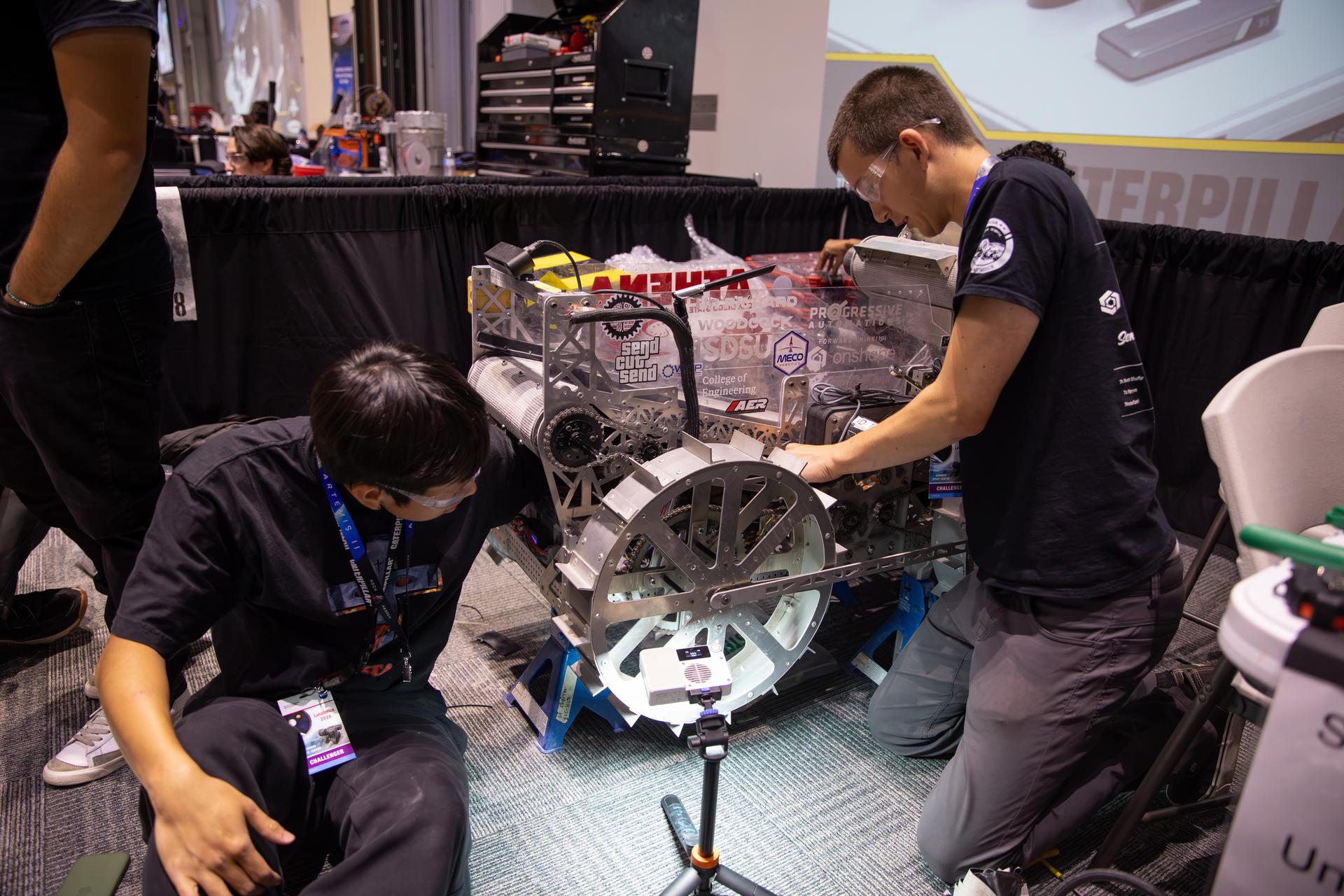
Students from San Diego State University prepare their prototype lunar robot for its turn during the finals for NASA’s 2026 Lunabotics Challenge competition on Tuesday, May 19, 2026, inside the Astronauts Memorial Foundation’s Center for Space Education at the Kennedy Space Center Visitor Complex in Florida. Forty-seven teams from around the U.S. designed and built remote-controlled robots capable of traversing challenging lunar terrain while constructing regolith-based berm under conditions similar to those the agency will face as it returns to the lunar surface through Artemis.

Students from the University of Virginia prepare their prototype lunar robot for its turn during the finals for NASA’s 2026 Lunabotics Challenge competition on Tuesday, May 19, 2026, inside the Astronauts Memorial Foundation’s Center for Space Education at the Kennedy Space Center Visitor Complex in Florida. Forty-seven teams from around the U.S. designed and built remote-controlled robots capable of traversing challenging lunar terrain while constructing regolith-based berm under conditions similar to those the agency will face as it returns to the lunar surface through Artemis.
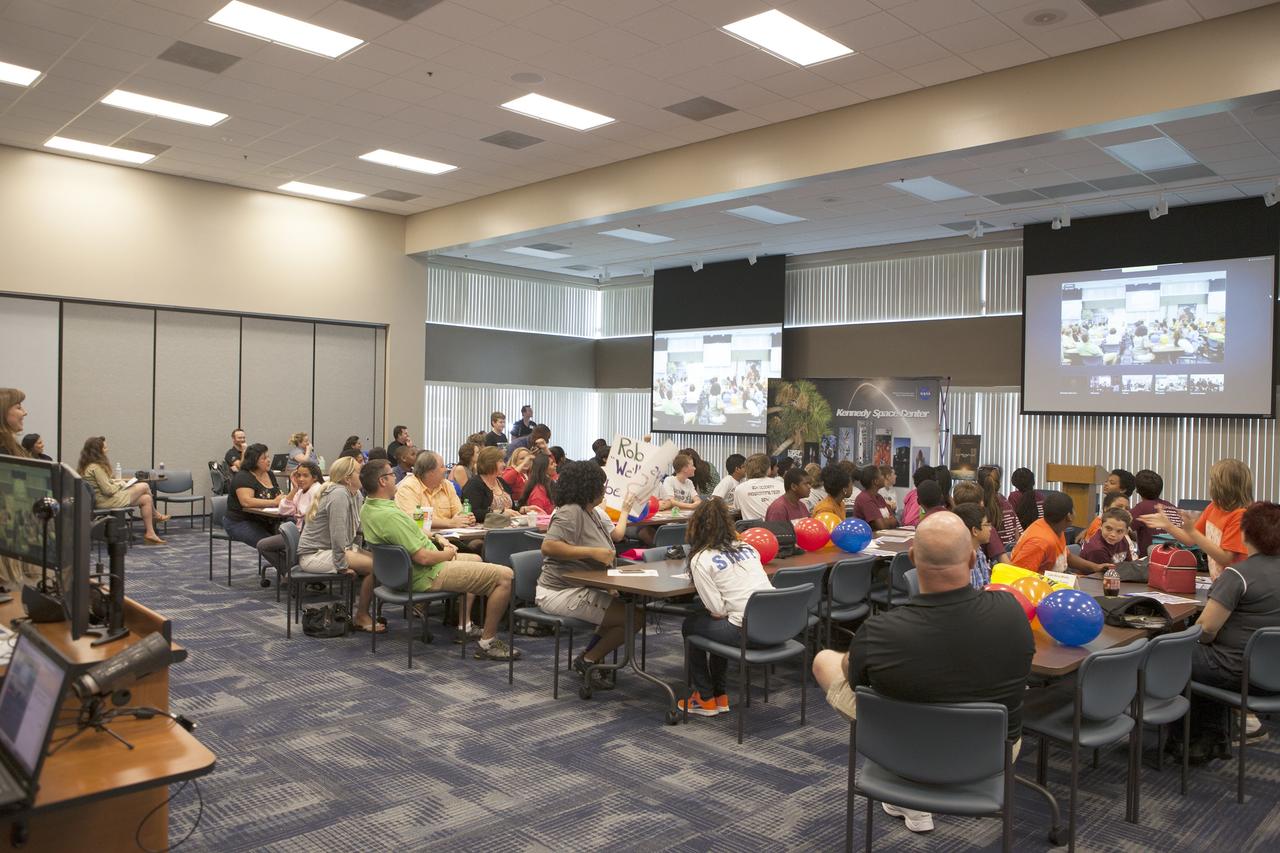
CAPE CANAVERAL, Fla. – Florida middle school students and their teachers greet students from other locations via webex before the start of the Zero Robotics finals competition. The Florida teams are at the Space Station Processing Facility at NASA's Kennedy Space Center in Florida. Students designed software to control Synchronized Position Hold Engage and Reorient Experimental Satellites, or SPHERES, and competed with other teams locally. The Zero Robotics is a robotics programming competition where the robots are SPHERES. The competition starts online, where teams program the SPHERES to solve an annual challenge. After several phases of virtual competition in a simulation environment that mimics the real SPHERES, finalists are selected to compete in a live championship aboard the space station. Students compete to win a technically challenging game by programming their strategies into the SPHERES satellites. The programs are autonomous and the students cannot control the satellites during the test. Photo credit: NASA/Daniel Casper
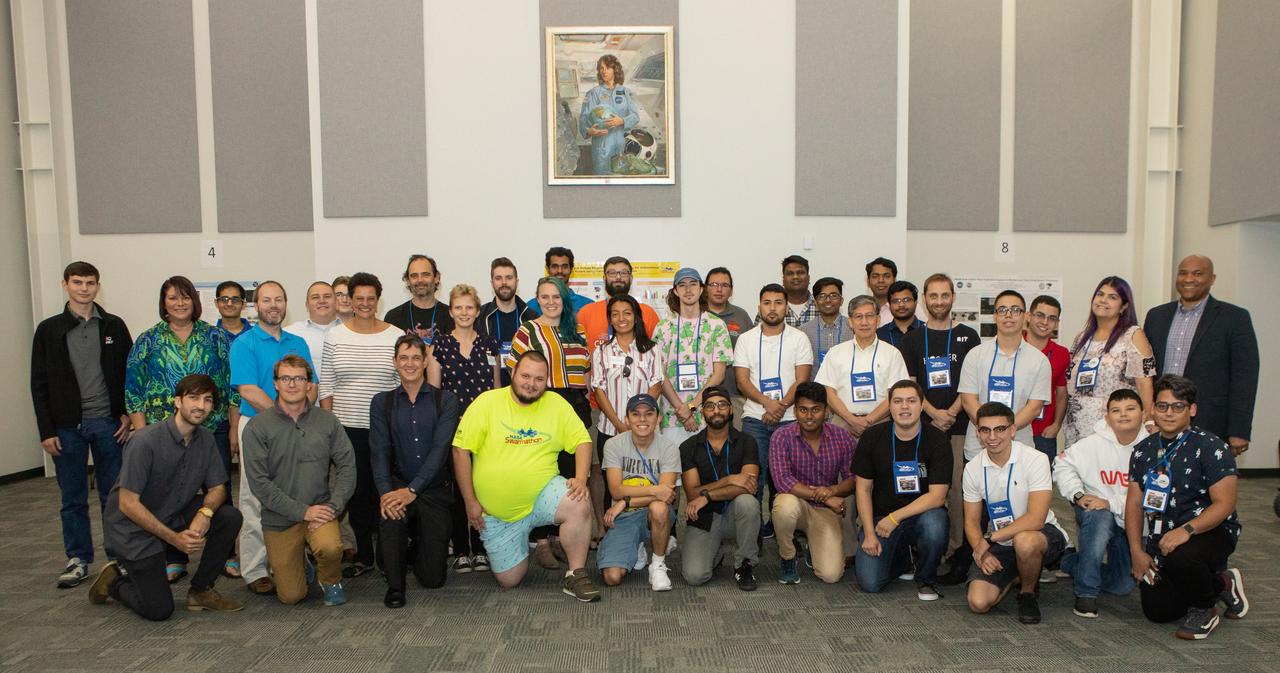
Swarmathon University Competition 2019 organizers, mentors, guest speakers and student teams gather for a group photo on June 11, 2019 at the Kennedy Space Center Visitor Complex in Florida. The University of New Mexico was the host for the physical competition held in May 2019. The student teams were at Kennedy to participate in a student/mentor panel, hear from speakers, get a behind-the-scenes tour of Kennedy Space Center, dine with an astronaut and receive awards during an awards ceremony. During Swarmathon University Challenge IV, students developed algorithms for robotic swarms that are robust and adaptable like the foraging strategies of ant colonies. The fourth and final Swarmathon was a combined virtual and physical competition.
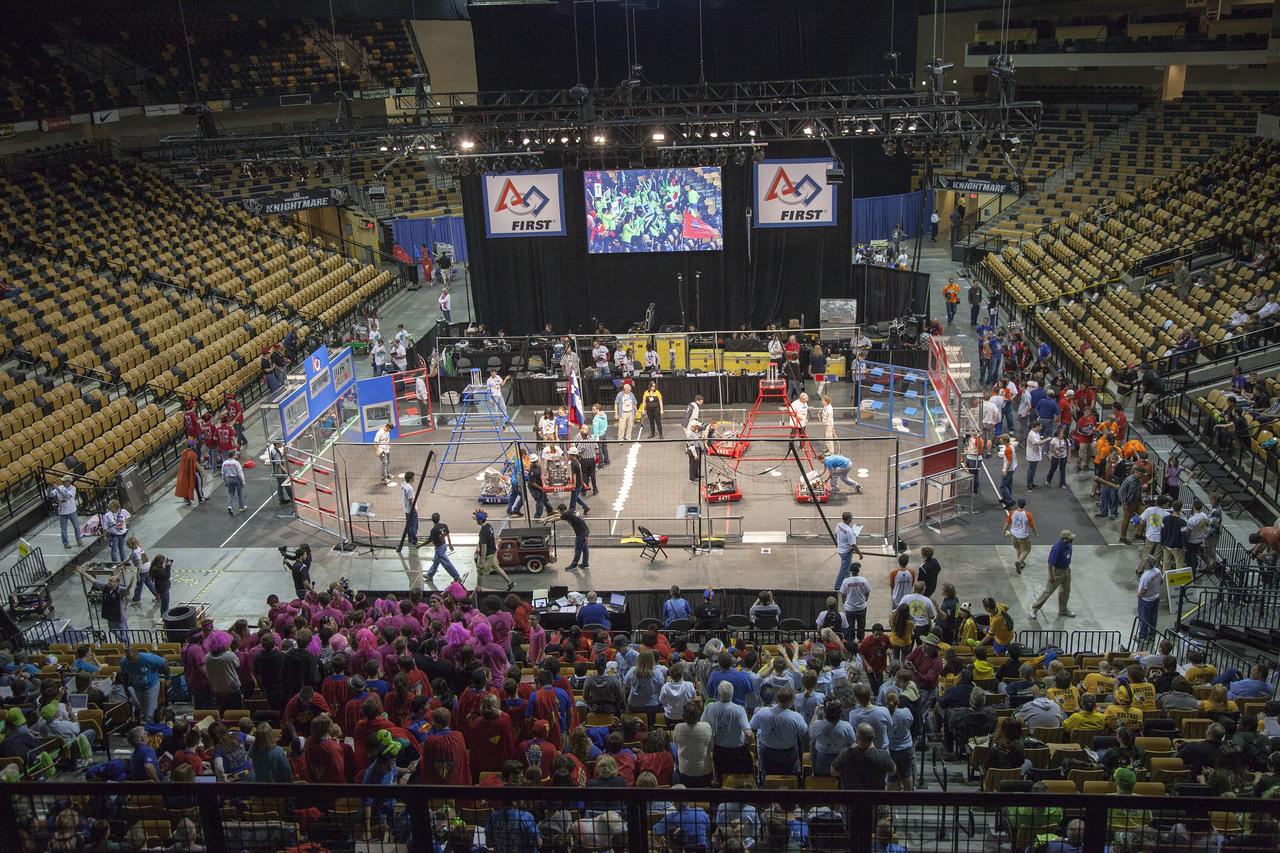
ORLANDO, Fla. – Teams of high school students prepare robots for competition in the University of Central Florida Arena as part of the FIRST Robotics Competition's 2013 Orlando Regional. The student-built robots were required to throw discs into boxes or make climbs to score points. Photo credit: NASA/Frankie Martin
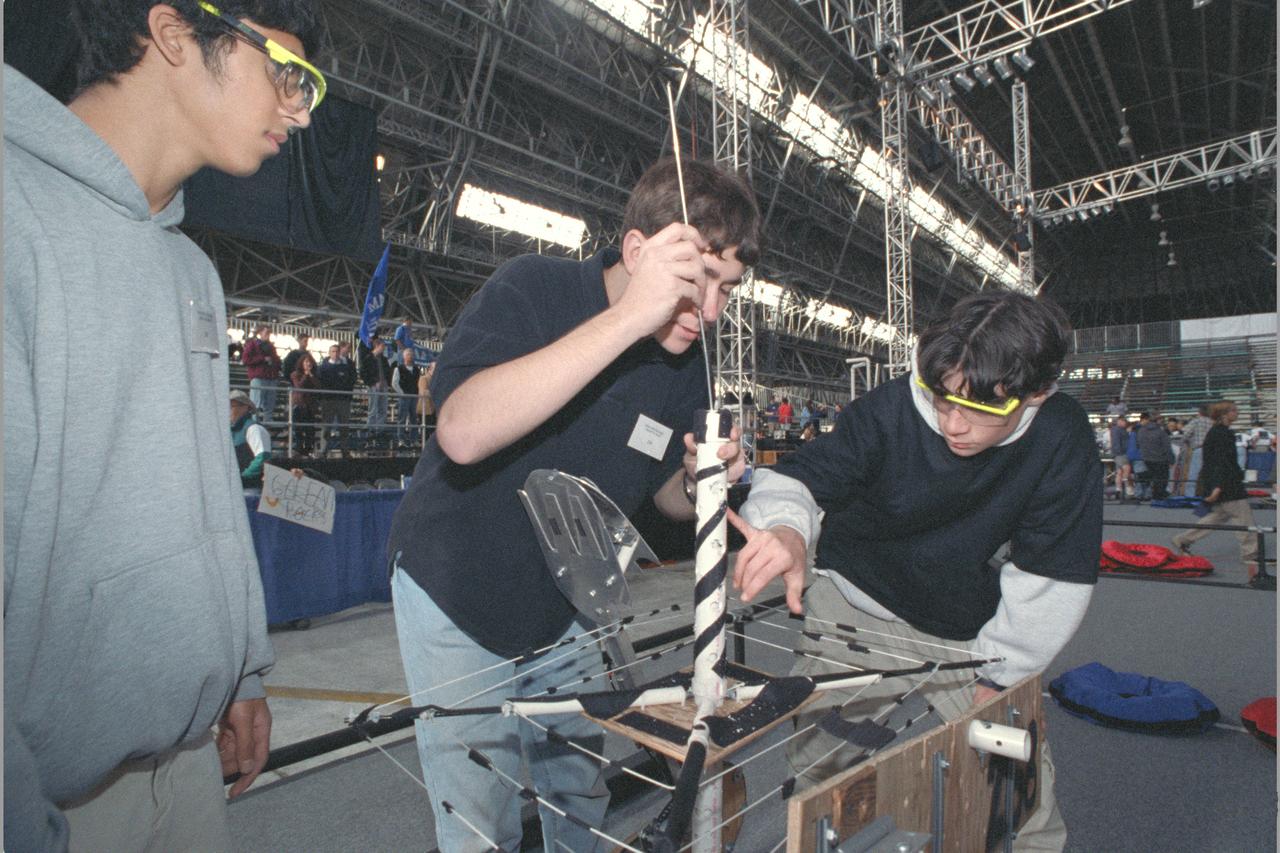
NASA AMES sponsored FIRST (Inspiration and Recognition of Science and Technology) Western Regional Robot Games Student competition in Hangar Students making repairs between matches
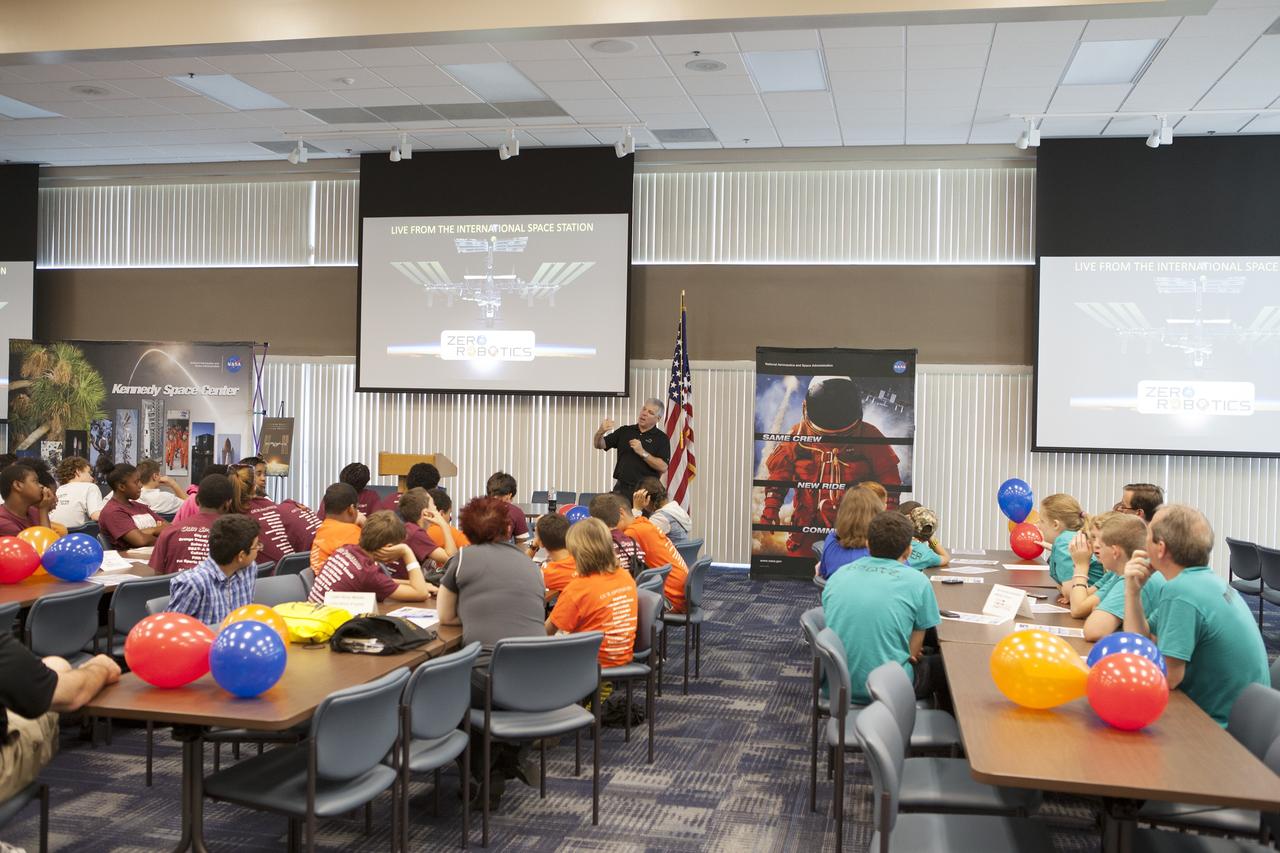
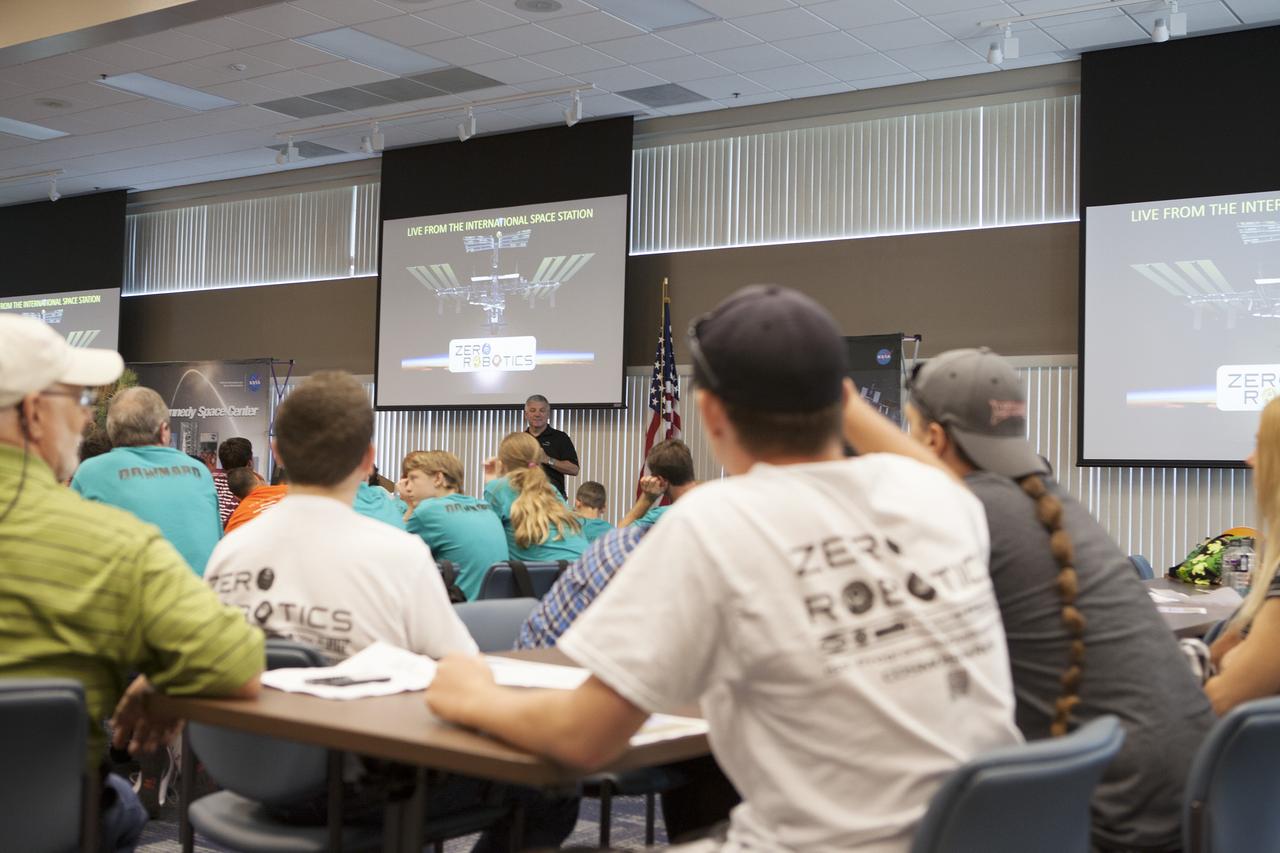
CAPE CANAVERAL, Fla. – Former astronaut Greg Johnson, executive director of the Center for the Advancement of Science in Space, talks to Florida middle school students and their teachers before the start of the Zero Robotics finals competition at NASA Kennedy Space Center's Space Station Processing Facility in Florida. Students designed software to control Synchronized Position Hold Engage and Reorient Experimental Satellites, or SPHERES, and competed with other teams locally. The Zero Robotics is a robotics programming competition where the robots are SPHERES. The competition starts online, where teams program the SPHERES to solve an annual challenge. After several phases of virtual competition in a simulation environment that mimics the real SPHERES, finalists are selected to compete in a live championship aboard the space station. Students compete to win a technically challenging game by programming their strategies into the SPHERES satellites. The programs are autonomous and the students cannot control the satellites during the test. Photo credit: NASA/Daniel Casper
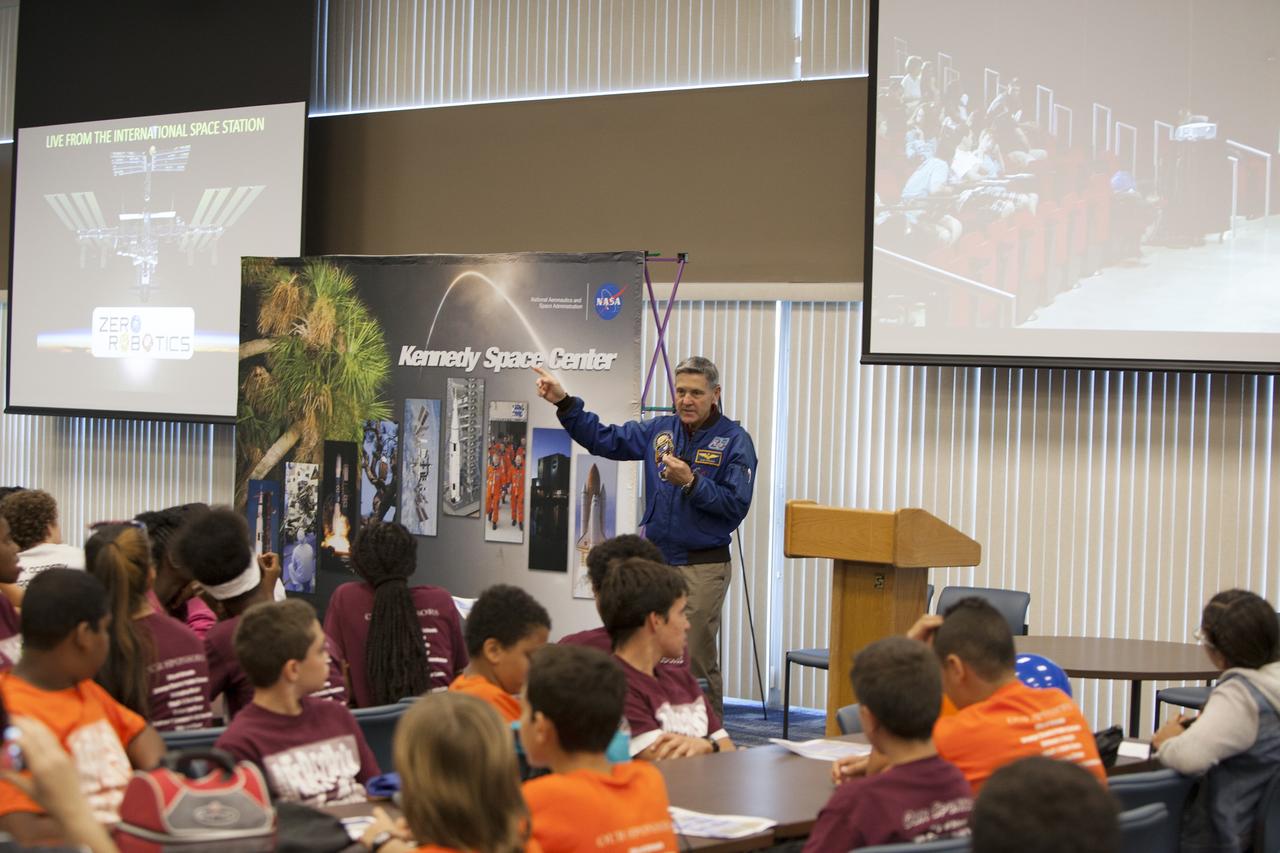
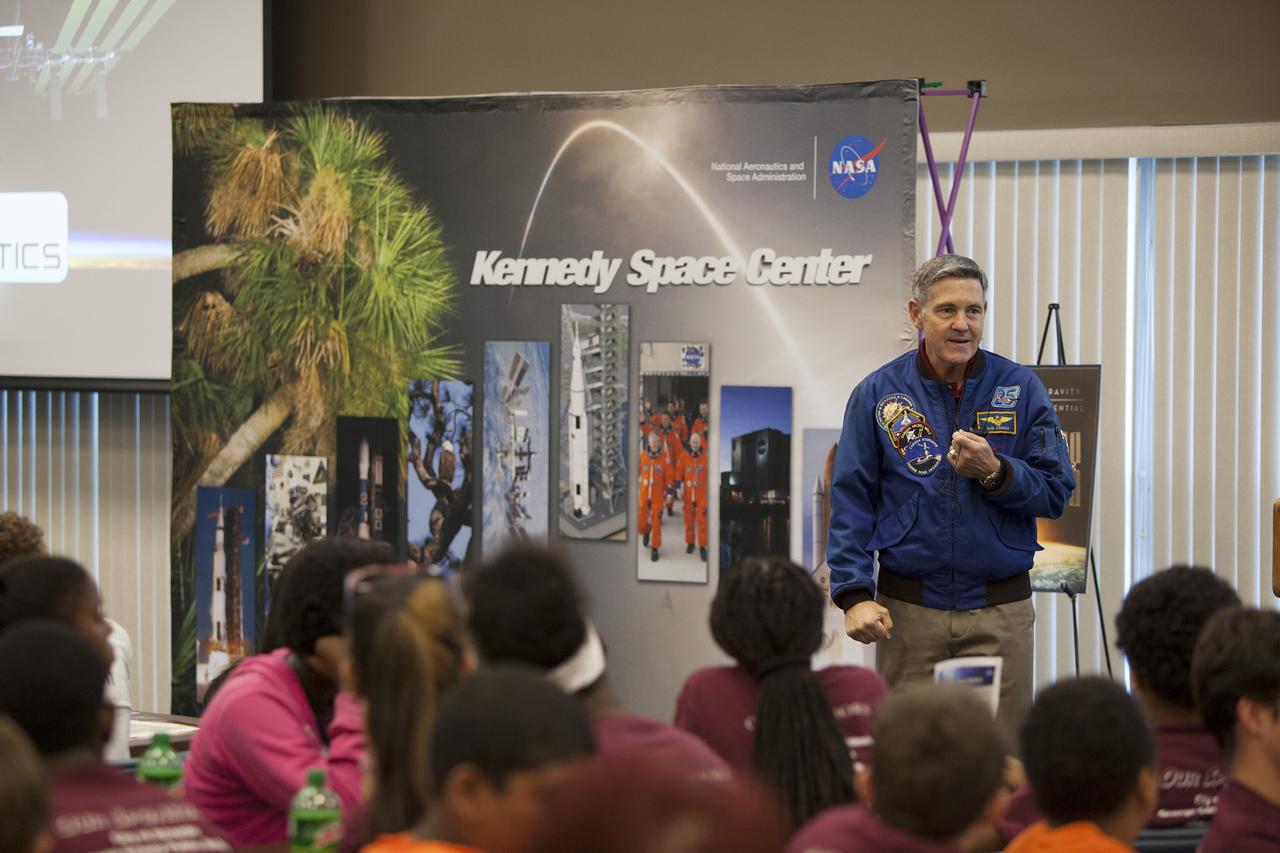
CAPE CANAVERAL, Fla. – Kennedy Space Center Director and former astronaut Bob Cabana, talks to Florida middle school students and their teachers during the Zero Robotics finals competition at the center's Space Station Processing Facility in Florida. Students designed software to control Synchronized Position Hold Engage and Reorient Experimental Satellites, or SPHERES, and competed with other teams locally. The Zero Robotics is a robotics programming competition where the robots are SPHERES. The competition starts online, where teams program the SPHERES to solve an annual challenge. After several phases of virtual competition in a simulation environment that mimics the real SPHERES, finalists are selected to compete in a live championship aboard the space station. Students compete to win a technically challenging game by programming their strategies into the SPHERES satellites. The programs are autonomous and the students cannot control the satellites during the test. Photo credit: NASA/Daniel Casper
CAPE CANAVERAL, Fla. – Former astronaut Greg Johnson, executive director of the Center for the Advancement of Science in Space, talks to Florida middle school students and their teachers before the start of the Zero Robotics finals competition at NASA Kennedy Space Center's Space Station Processing Facility in Florida. Students designed software to control Synchronized Position Hold Engage and Reorient Experimental Satellites, or SPHERES, and competed with other teams locally. The Zero Robotics is a robotics programming competition where the robots are SPHERES. The competition starts online, where teams program the SPHERES to solve an annual challenge. After several phases of virtual competition in a simulation environment that mimics the real SPHERES, finalists are selected to compete in a live championship aboard the space station. Students compete to win a technically challenging game by programming their strategies into the SPHERES satellites. The programs are autonomous and the students cannot control the satellites during the test. Photo credit: NASA/Daniel Casper
CAPE CANAVERAL, Fla. – Kennedy Space Center Director and former astronaut Bob Cabana, talks to Florida middle school students and their teachers during the Zero Robotics finals competition at the center's Space Station Processing Facility in Florida. Students designed software to control Synchronized Position Hold Engage and Reorient Experimental Satellites, or SPHERES, and competed with other teams locally. The Zero Robotics is a robotics programming competition where the robots are SPHERES. The competition starts online, where teams program the SPHERES to solve an annual challenge. After several phases of virtual competition in a simulation environment that mimics the real SPHERES, finalists are selected to compete in a live championship aboard the space station. Students compete to win a technically challenging game by programming their strategies into the SPHERES satellites. The programs are autonomous and the students cannot control the satellites during the test. Photo credit: NASA/Daniel Casper
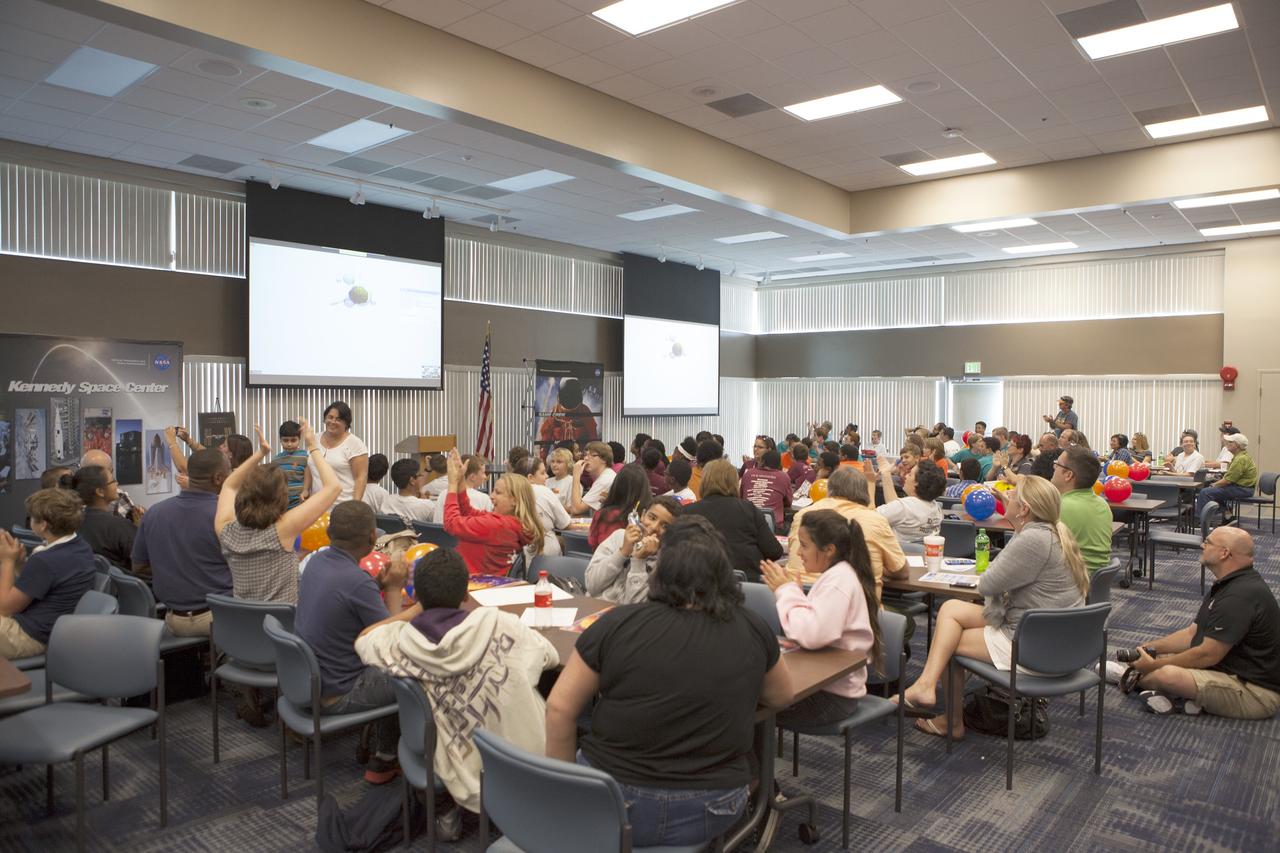
CAPE CANAVERAL, Fla. – Florida middle school students and their teachers watch the Zero Robotics finals competition broadcast live via webex from the International Space Station. The Florida teams are at the Space Station Processing Facility at NASA's Kennedy Space Center in Florida. Students designed software to control Synchronized Position Hold Engage and Reorient Experimental Satellites, or SPHERES, and competed with other teams locally. The Zero Robotics is a robotics programming competition where the robots are SPHERES. The competition starts online, where teams program the SPHERES to solve an annual challenge. After several phases of virtual competition in a simulation environment that mimics the real SPHERES, finalists are selected to compete in a live championship aboard the space station. Students compete to win a technically challenging game by programming their strategies into the SPHERES satellites. The programs are autonomous and the students cannot control the satellites during the test. Photo credit: NASA/Daniel Casper
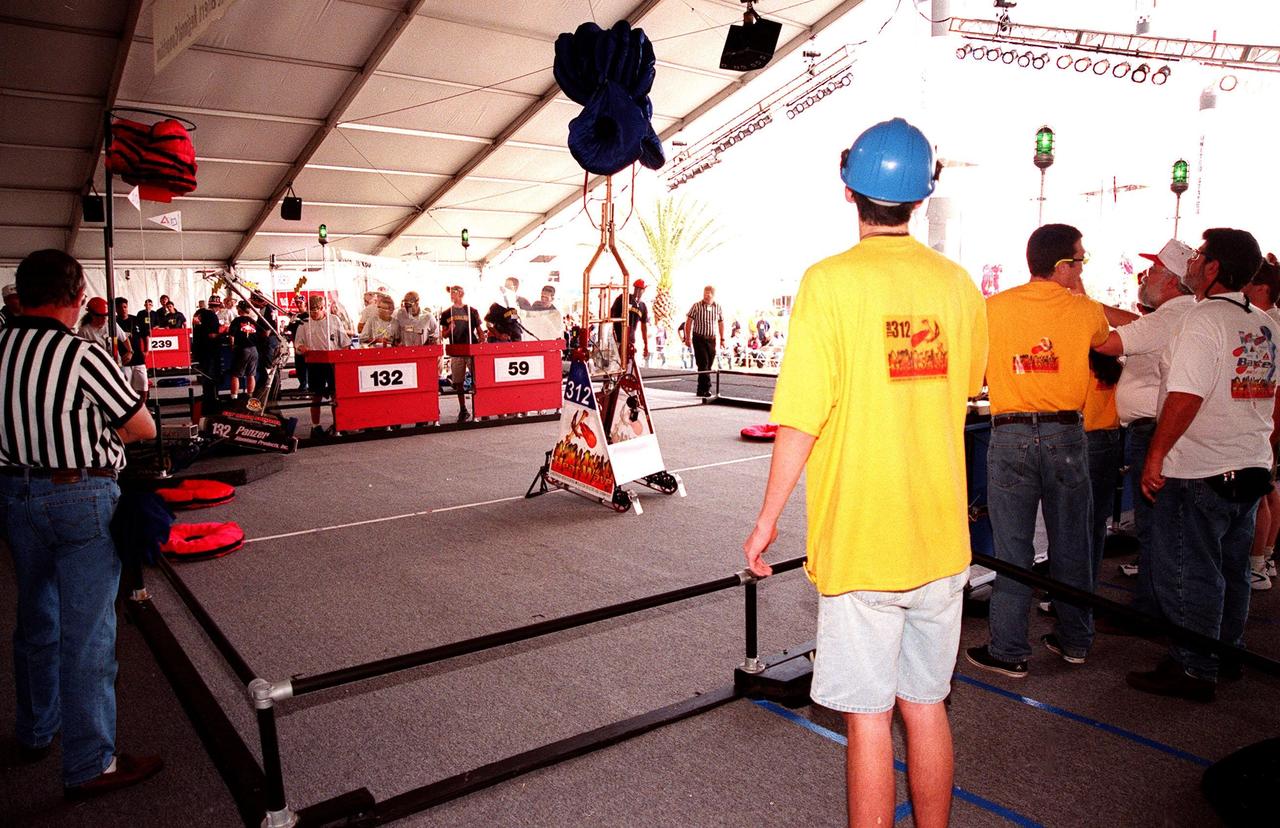
During final matches at the 1999 Southeastern Regional robotic competition at the KSC Visitor Complex, referees in opposite corners and student teams watch as two robots raise their pillow disks to a height of eight feet, one of the goals of the competition. Thirty schools from around the country have converged at KSC for the event that pits gladiator robots against each other in an athletic-style competition. The robots have to retrieve the pillow disks from the floor, climb onto a platform (with flags), as well as raise the cache of pillows, maneuvered by student teams behind protective walls. KSC is hosting the event being sponsored by the nonprofit organization For Inspiration and Recognition of Science and Technology, known as FIRST. The FIRST robotics competition is designed to provide students with a hands-on, inside look at engineering and other professional careers by pairing engineers and corporations with student teams
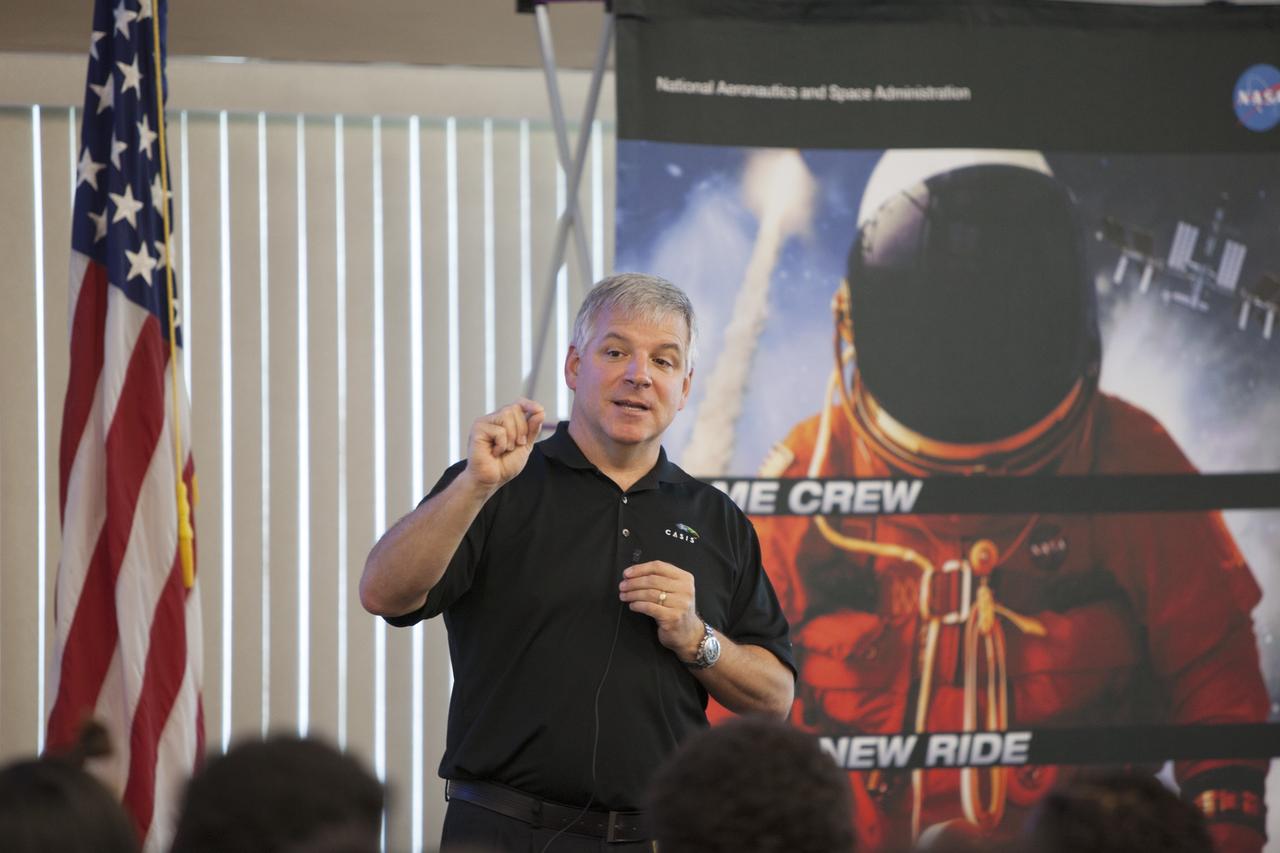
CAPE CANAVERAL, Fla. – Former astronaut Greg Johnson, executive director of the Center for the Advancement of Science in Space, talks to Florida middle school students and their teachers before the start of the Zero Robotics finals competition at NASA Kennedy Space Center's Space Station Processing Facility in Florida. Students designed software to control Synchronized Position Hold Engage and Reorient Experimental Satellites, or SPHERES, and competed with other teams locally. The Zero Robotics is a robotics programming competition where the robots are SPHERES. The competition starts online, where teams program the SPHERES to solve an annual challenge. After several phases of virtual competition in a simulation environment that mimics the real SPHERES, finalists are selected to compete in a live championship aboard the space station. Students compete to win a technically challenging game by programming their strategies into the SPHERES satellites. The programs are autonomous and the students cannot control the satellites during the test. Photo credit: NASA/Daniel Casper
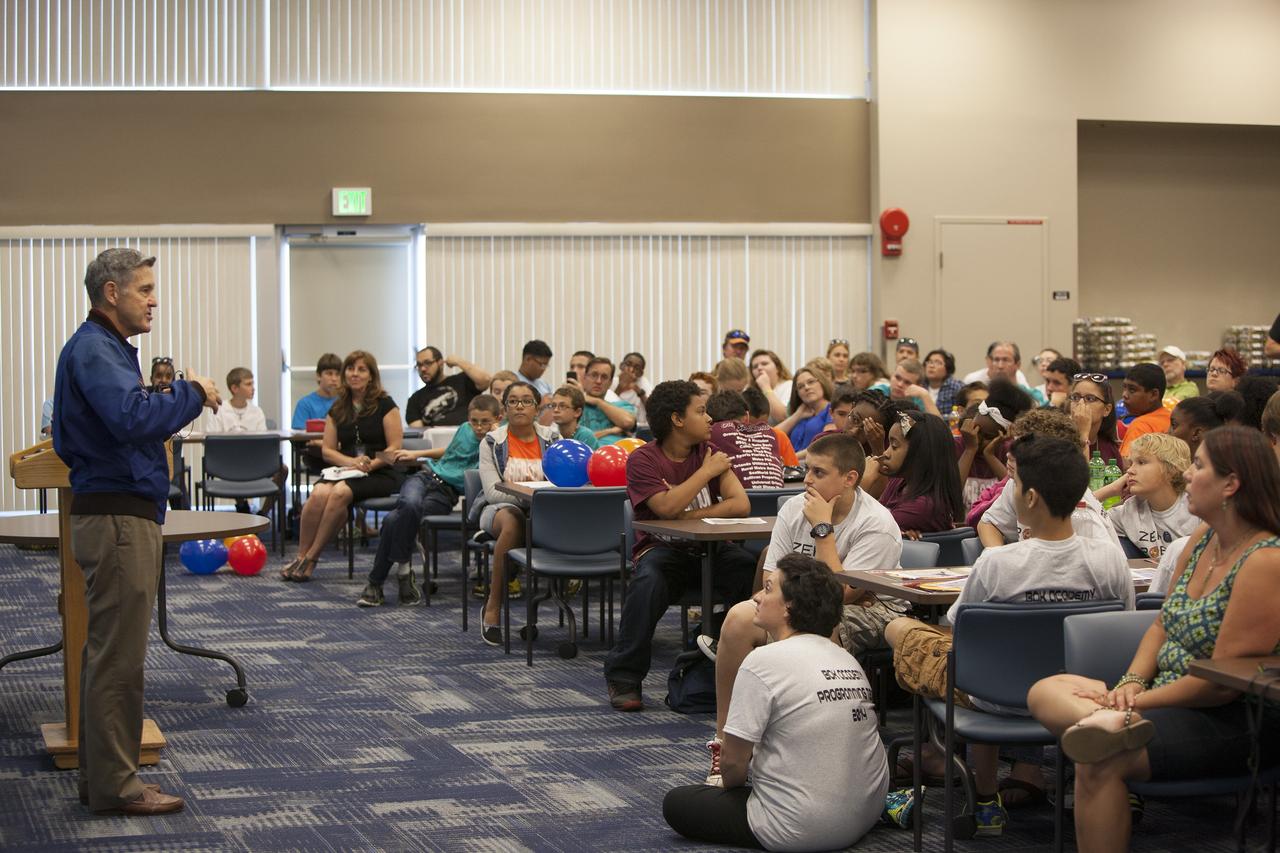
CAPE CANAVERAL, Fla. – Kennedy Space Center Director and former astronaut Bob Cabana, talks to Florida middle school students and their teachers during the Zero Robotics finals competition at the center's Space Station Processing Facility in Florida. Students designed software to control Synchronized Position Hold Engage and Reorient Experimental Satellites, or SPHERES, and competed with other teams locally. The Zero Robotics is a robotics programming competition where the robots are SPHERES. The competition starts online, where teams program the SPHERES to solve an annual challenge. After several phases of virtual competition in a simulation environment that mimics the real SPHERES, finalists are selected to compete in a live championship aboard the space station. Students compete to win a technically challenging game by programming their strategies into the SPHERES satellites. The programs are autonomous and the students cannot control the satellites during the test. Photo credit: NASA/Daniel Casper
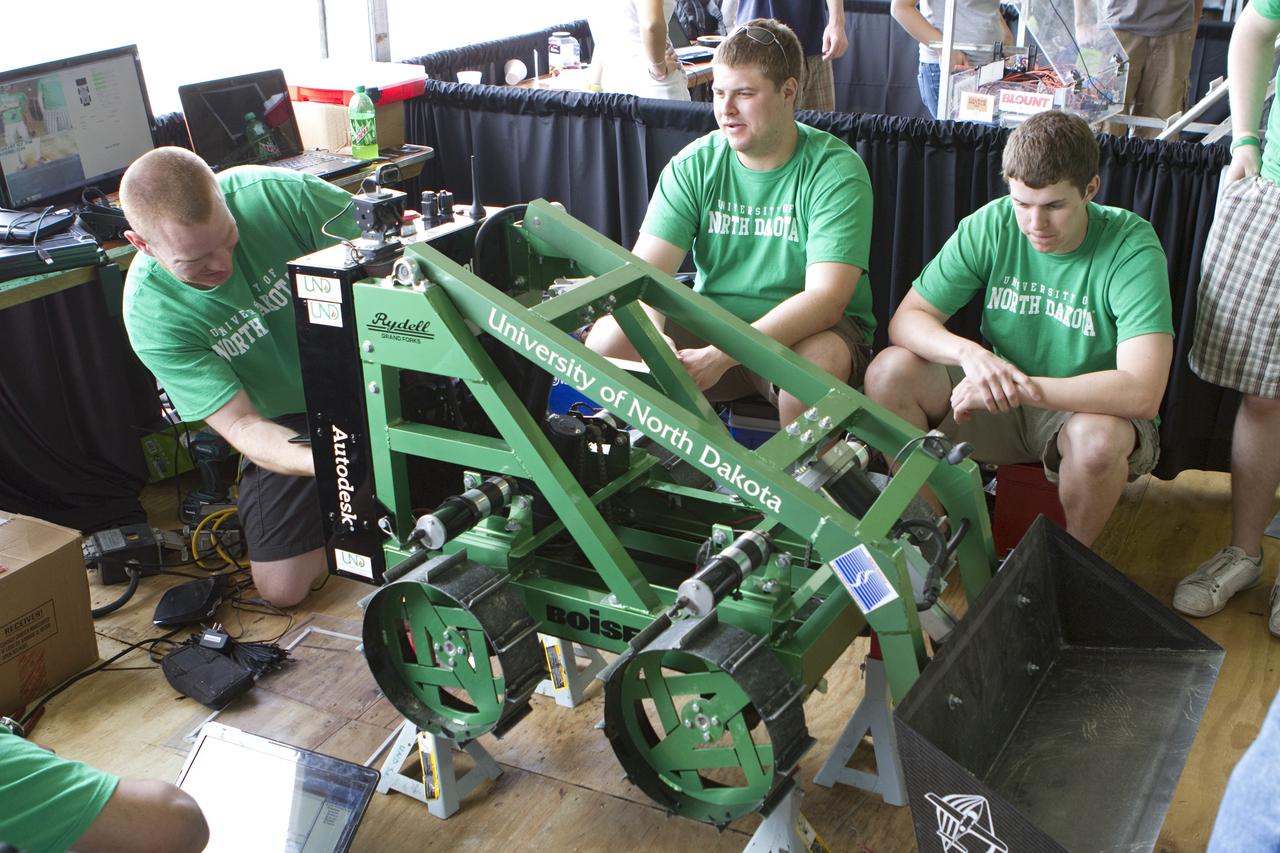
CAPE CANAVERAL, Fla. -- University students prepare for NASA's second annual Lunabotics Mining Competition at the Kennedy Space Center Visitor Complex in Florida. Thirty-six teams of undergraduate and graduate students from the United States, Bangladesh, Canada, Colombia and India will participate in NASA's Lunabotics Mining Competition May 26 - 28. The competition is designed to engage and retain students in science, technology, engineering and mathematics (STEM). Teams will maneuver their remote controlled or autonomous excavators, called lunabots, in about 60 tons of ultra-fine simulated lunar soil, called BP-1. The competition is an Exploration Systems Mission Directorate project managed by Kennedy's Education Division. The event also provides a competitive environment that could result in innovative ideas and solutions for NASA's future excavation of the moon. Photo credit: NASA/Cory Huston
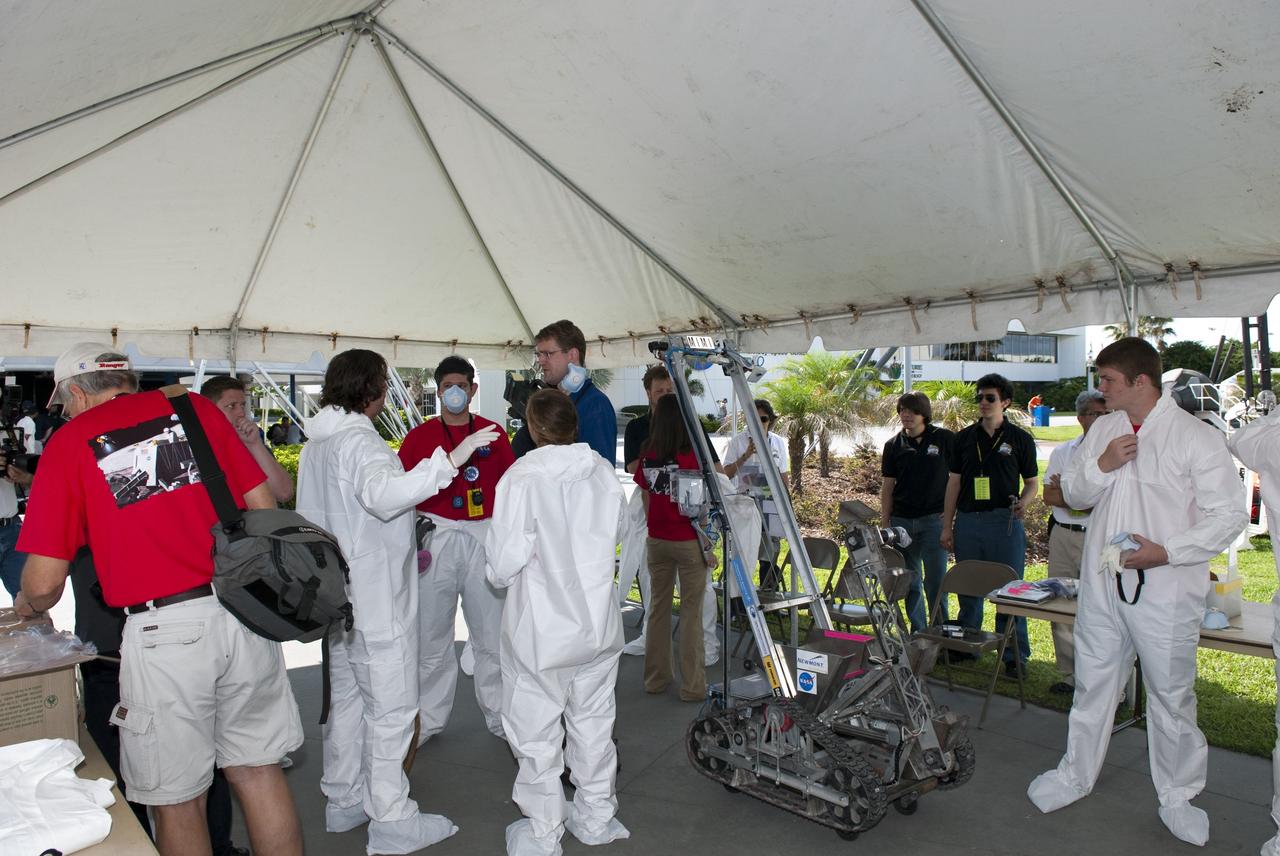
CAPE CANAVERAL, Fla. -- University students make final preparations for NASA's second annual Lunabotics Mining Competition at the Kennedy Space Center Visitor Complex in Florida. Thirty-six teams of undergraduate and graduate students from the United States, Bangladesh, Canada, Colombia and India will participate in NASA's Lunabotics Mining Competition May 26 - 28 at the agency's Kennedy Space Center in Florida. The competition is designed to engage and retain students in science, technology, engineering and mathematics (STEM). Teams will maneuver their remote controlled or autonomous excavators, called lunabots, in about 60 tons of ultra-fine simulated lunar soil, called BP-1. The competition is an Exploration Systems Mission Directorate project managed by Kennedy's Education Division. The event also provides a competitive environment that could result in innovative ideas and solutions for NASA's future excavation of the moon. Photo credit: NASA/Jim Grossmann
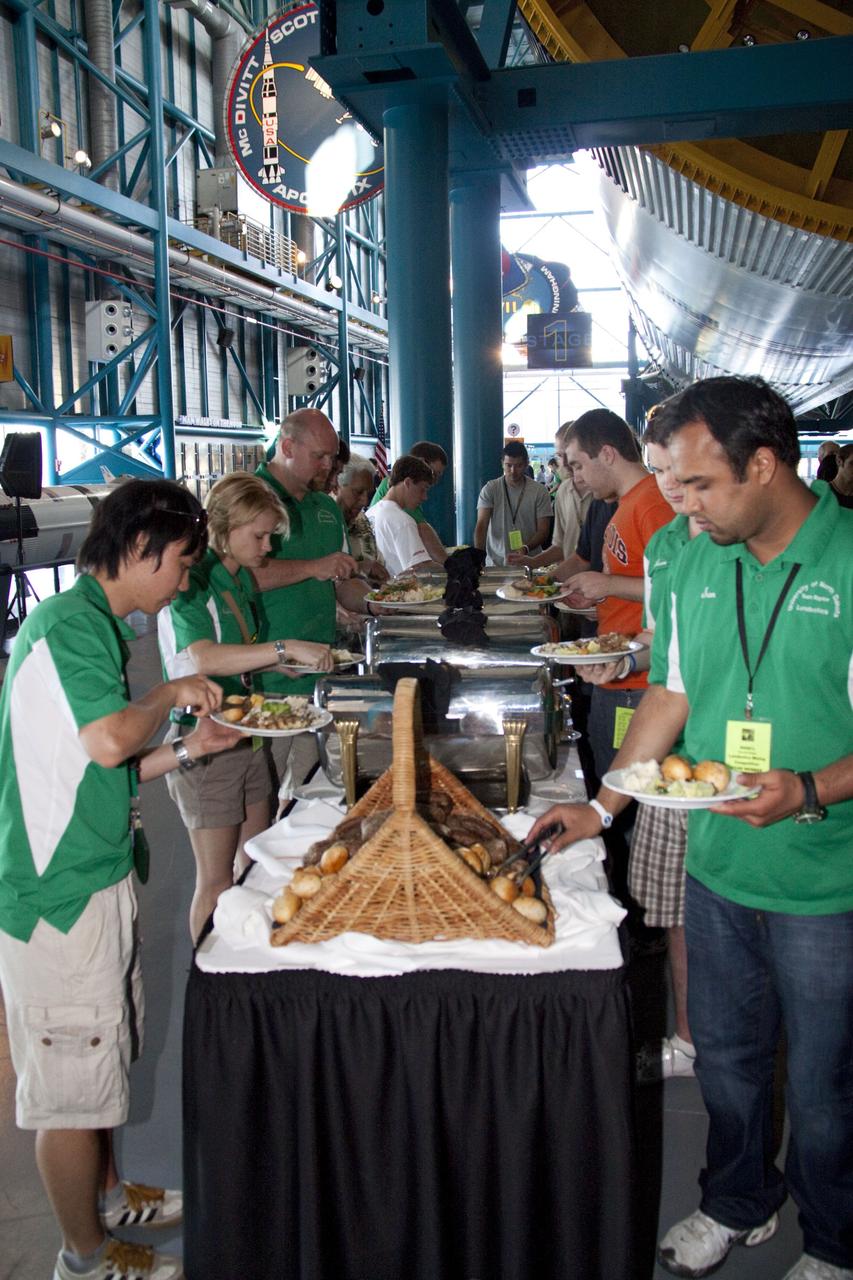
CAPE CANAVERAL, Fla. -- At NASA Kennedy Space Center's Apollo/Saturn V Center, university students take part in an award ceremony for NASA's second annual Lunabotics Mining Competition. Thirty-six teams of undergraduate and graduate students from the United States, Bangladesh, Canada, Colombia and India participated in NASA's Lunabotics Mining Competition May 26 - 28 at the agency's Kennedy Space Center in Florida. The competition is designed to engage and retain students in science, technology, engineering and mathematics (STEM). Teams will maneuver their remote controlled or autonomous excavators, called lunabots, in about 60 tons of ultra-fine simulated lunar soil, called BP-1. The competition is an Exploration Systems Mission Directorate project managed by Kennedy's Education Division. The event also provides a competitive environment that could result in innovative ideas and solutions for NASA's future excavation of the moon. Photo credit: NASA/Jack Pfaller
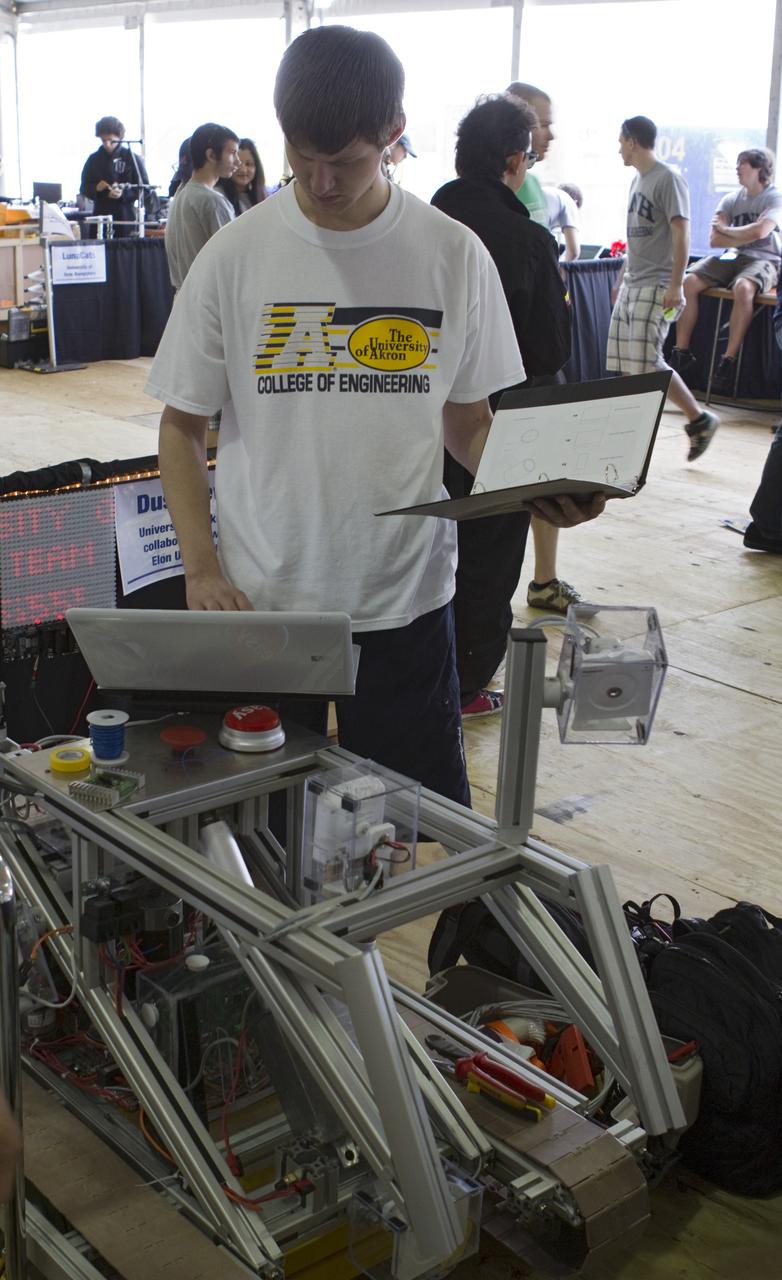
CAPE CANAVERAL, Fla. -- University students prepare for NASA's second annual Lunabotics Mining Competition at the Kennedy Space Center Visitor Complex in Florida. Thirty-six teams of undergraduate and graduate students from the United States, Bangladesh, Canada, Colombia and India will participate in NASA's Lunabotics Mining Competition May 26 - 28. The competition is designed to engage and retain students in science, technology, engineering and mathematics (STEM). Teams will maneuver their remote controlled or autonomous excavators, called lunabots, in about 60 tons of ultra-fine simulated lunar soil, called BP-1. The competition is an Exploration Systems Mission Directorate project managed by Kennedy's Education Division. The event also provides a competitive environment that could result in innovative ideas and solutions for NASA's future excavation of the moon. Photo credit: NASA/Cory Huston
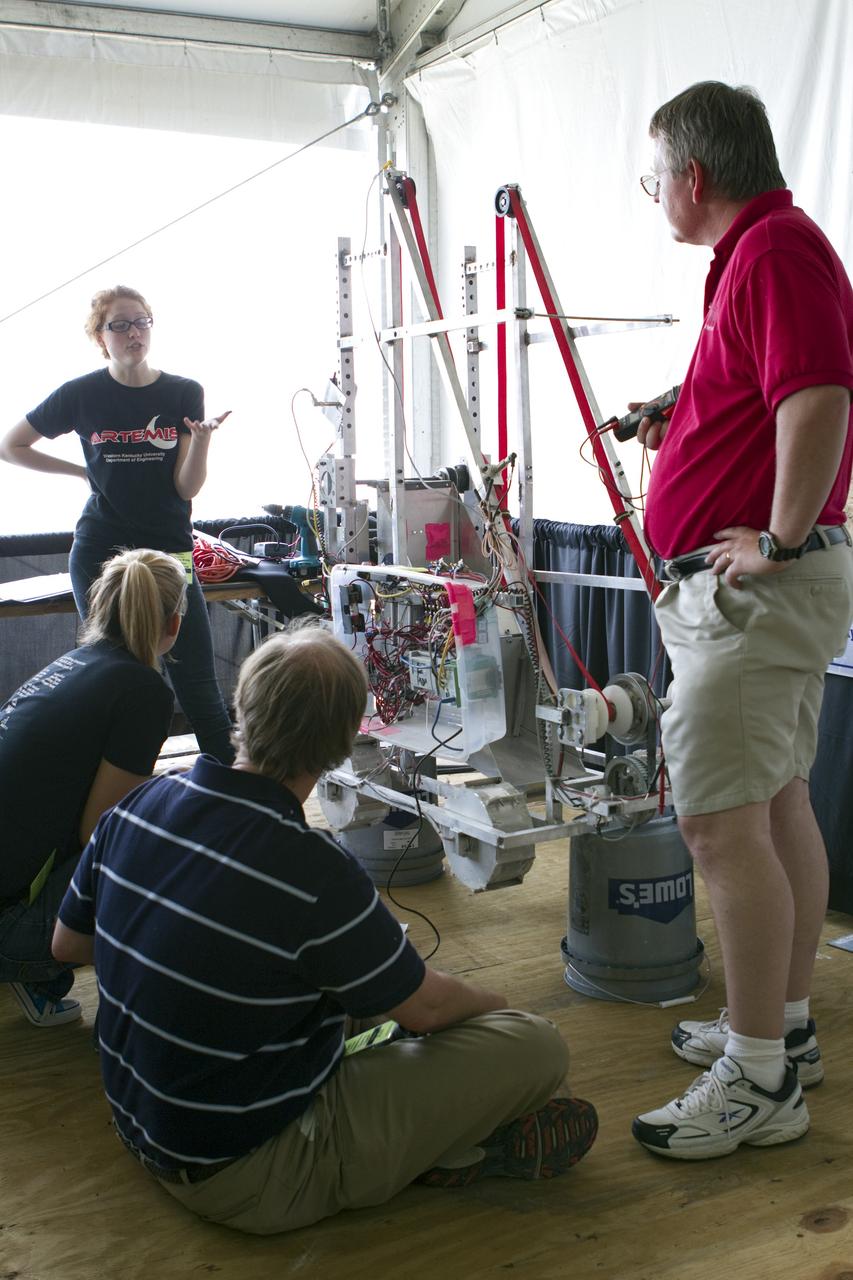
CAPE CANAVERAL, Fla. -- University students prepare for NASA's second annual Lunabotics Mining Competition at the Kennedy Space Center Visitor Complex in Florida. Thirty-six teams of undergraduate and graduate students from the United States, Bangladesh, Canada, Colombia and India will participate in NASA's Lunabotics Mining Competition May 26 - 28. The competition is designed to engage and retain students in science, technology, engineering and mathematics (STEM). Teams will maneuver their remote controlled or autonomous excavators, called lunabots, in about 60 tons of ultra-fine simulated lunar soil, called BP-1. The competition is an Exploration Systems Mission Directorate project managed by Kennedy's Education Division. The event also provides a competitive environment that could result in innovative ideas and solutions for NASA's future excavation of the moon. Photo credit: NASA/Cory Huston
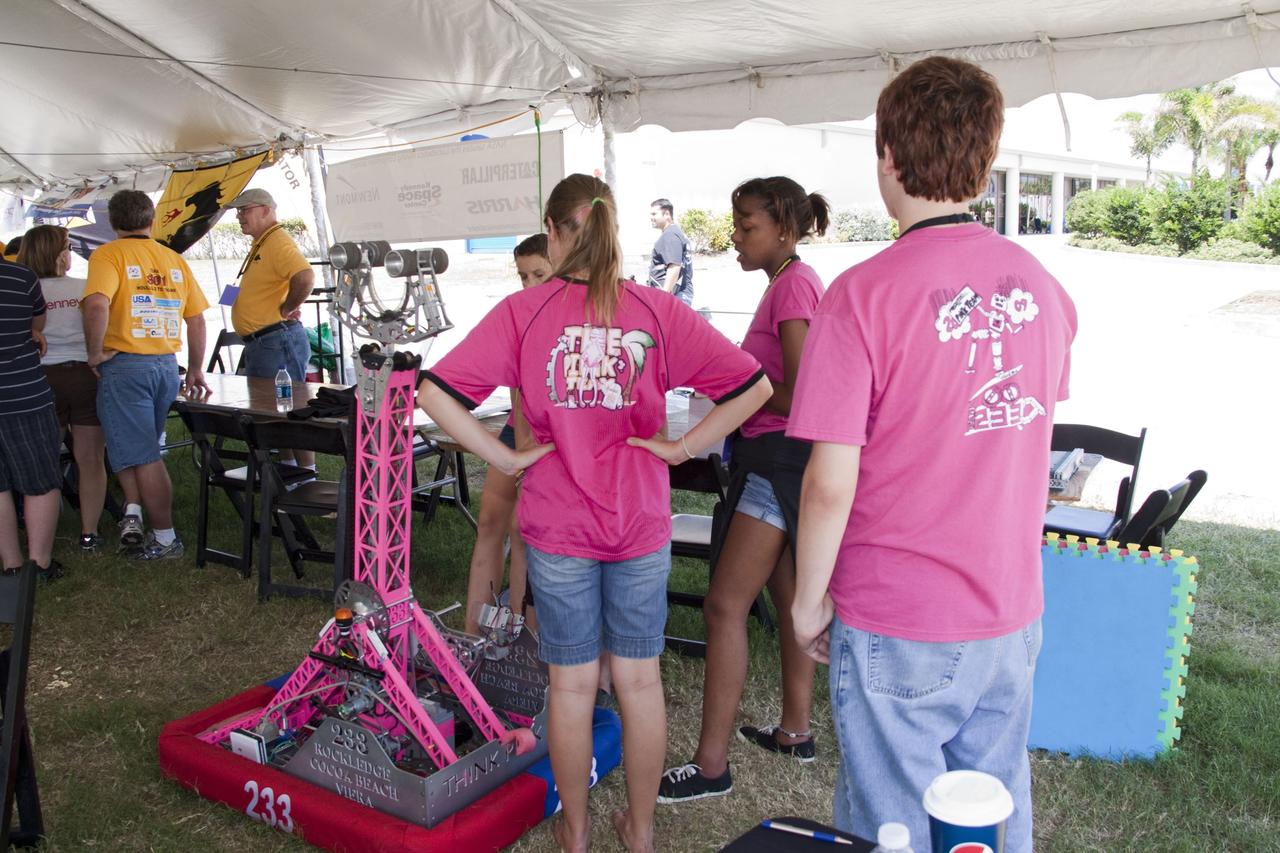
CAPE CANAVERAL, Fla. -- University students wait their turn to compete in NASA's second annual Lunabotics Mining Competition at the Kennedy Space Center Visitor Complex in Florida. Thirty-six teams of undergraduate and graduate students from the United States, Bangladesh, Canada, Colombia and India will participate in NASA's Lunabotics Mining Competition May 26 - 28 at the agency's Kennedy Space Center in Florida. The competition is designed to engage and retain students in science, technology, engineering and mathematics (STEM). Teams will maneuver their remote controlled or autonomous excavators, called lunabots, in about 60 tons of ultra-fine simulated lunar soil, called BP-1. The competition is an Exploration Systems Mission Directorate project managed by Kennedy's Education Division. The event also provides a competitive environment that could result in innovative ideas and solutions for NASA's future excavation of the moon. Photo credit: NASA/Jack Pfaller
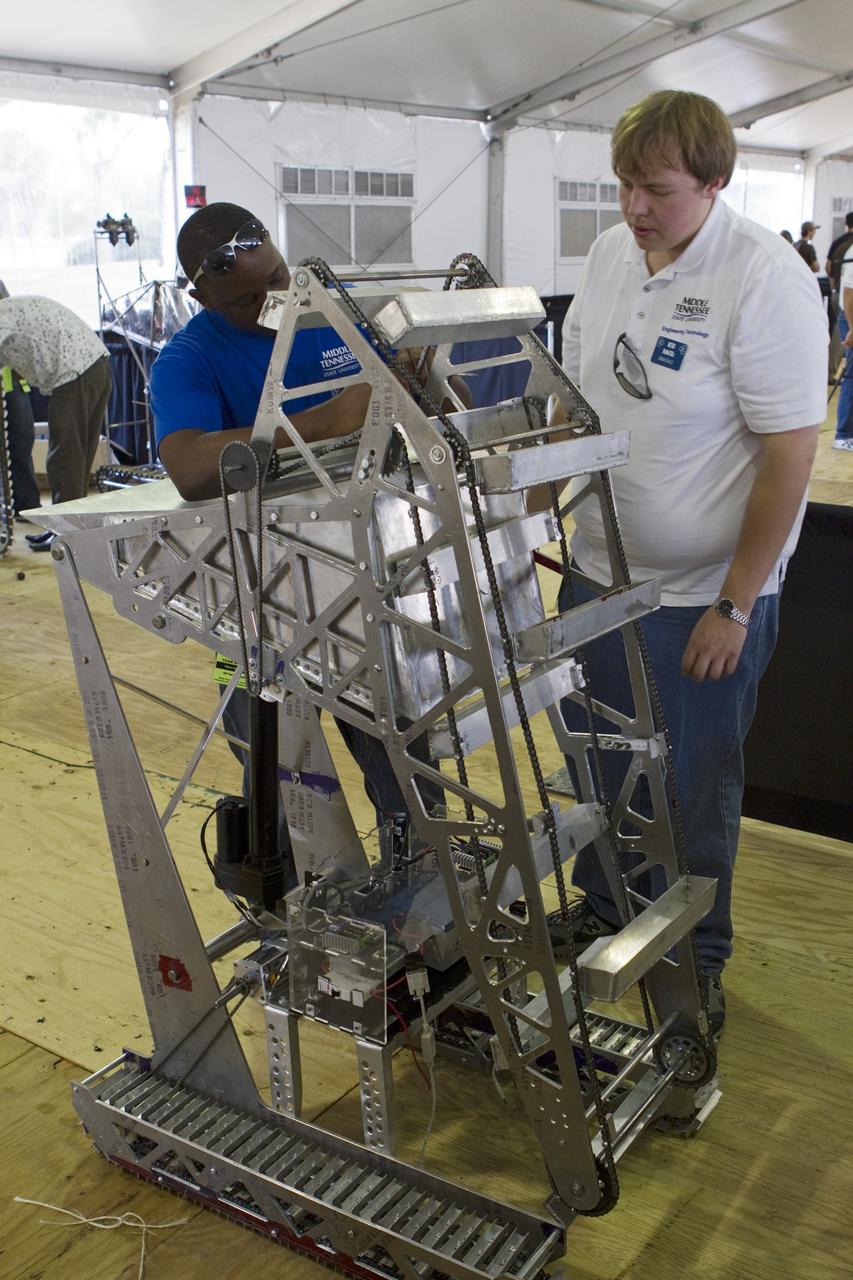
CAPE CANAVERAL, Fla. -- University students prepare for NASA's second annual Lunabotics Mining Competition at the Kennedy Space Center Visitor Complex in Florida. Thirty-six teams of undergraduate and graduate students from the United States, Bangladesh, Canada, Colombia and India will participate in NASA's Lunabotics Mining Competition May 26 - 28. The competition is designed to engage and retain students in science, technology, engineering and mathematics (STEM). Teams will maneuver their remote controlled or autonomous excavators, called lunabots, in about 60 tons of ultra-fine simulated lunar soil, called BP-1. The competition is an Exploration Systems Mission Directorate project managed by Kennedy's Education Division. The event also provides a competitive environment that could result in innovative ideas and solutions for NASA's future excavation of the moon. Photo credit: NASA/Cory Huston
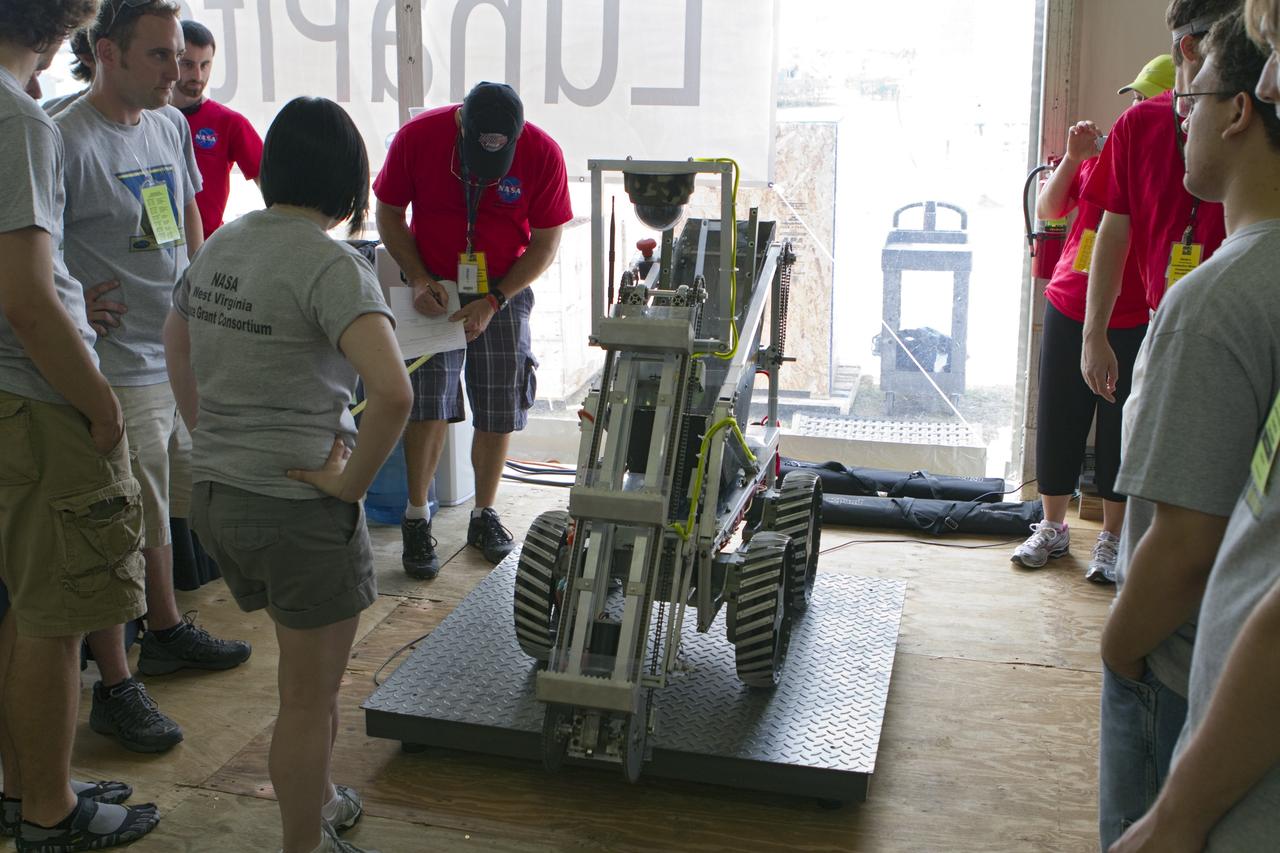
CAPE CANAVERAL, Fla. -- University students prepare for NASA's second annual Lunabotics Mining Competition at the Kennedy Space Center Visitor Complex in Florida. Thirty-six teams of undergraduate and graduate students from the United States, Bangladesh, Canada, Colombia and India will participate in NASA's Lunabotics Mining Competition May 26 - 28. The competition is designed to engage and retain students in science, technology, engineering and mathematics (STEM). Teams will maneuver their remote controlled or autonomous excavators, called lunabots, in about 60 tons of ultra-fine simulated lunar soil, called BP-1. The competition is an Exploration Systems Mission Directorate project managed by Kennedy's Education Division. The event also provides a competitive environment that could result in innovative ideas and solutions for NASA's future excavation of the moon. Photo credit: NASA/Cory Huston
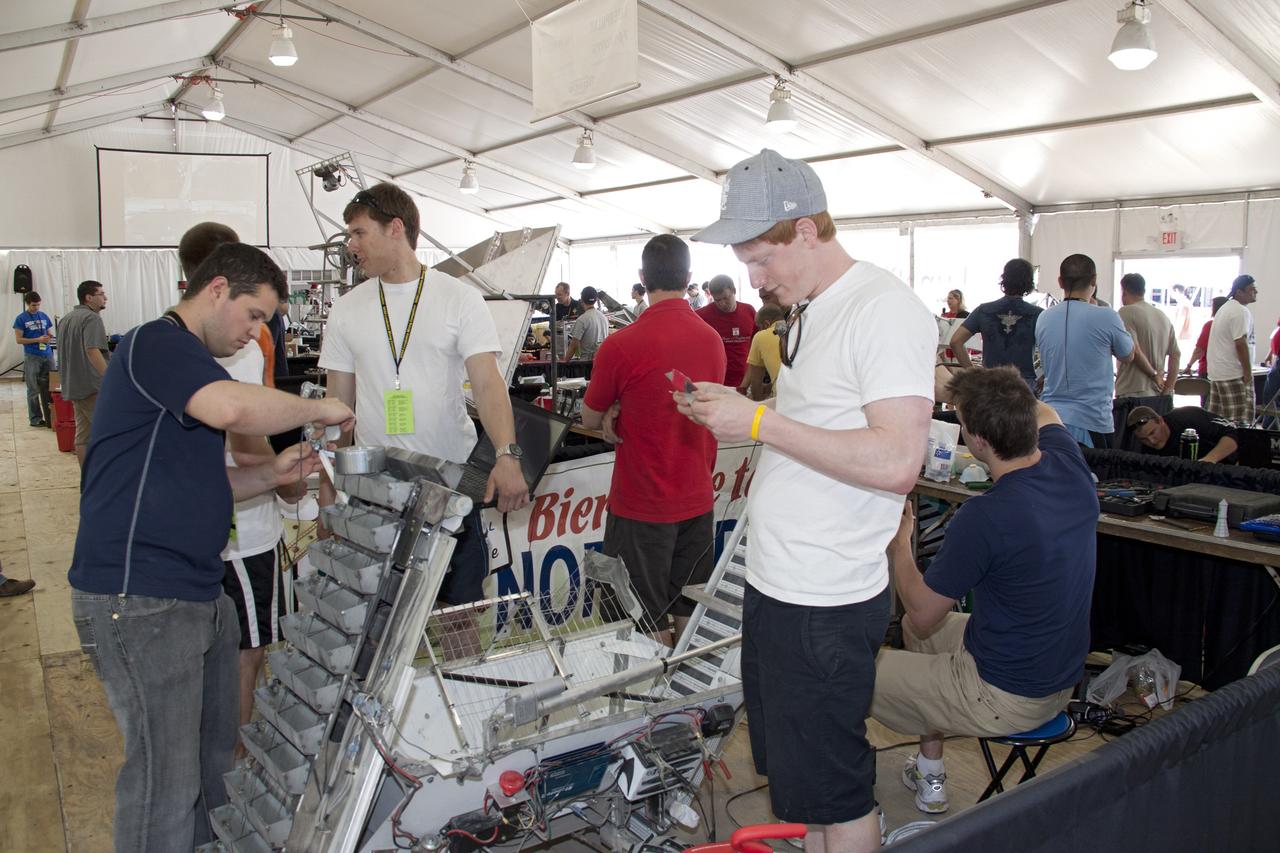
CAPE CANAVERAL, Fla. -- University students prepare for NASA's second annual Lunabotics Mining Competition at the Kennedy Space Center Visitor Complex in Florida. Thirty-six teams of undergraduate and graduate students from the United States, Bangladesh, Canada, Colombia and India will participate in NASA's Lunabotics Mining Competition May 26 - 28 at the agency's Kennedy Space Center in Florida. The competition is designed to engage and retain students in science, technology, engineering and mathematics (STEM). Teams will maneuver their remote controlled or autonomous excavators, called lunabots, in about 60 tons of ultra-fine simulated lunar soil, called BP-1. The competition is an Exploration Systems Mission Directorate project managed by Kennedy's Education Division. The event also provides a competitive environment that could result in innovative ideas and solutions for NASA's future excavation of the moon. Photo credit: NASA/Jack Pfaller
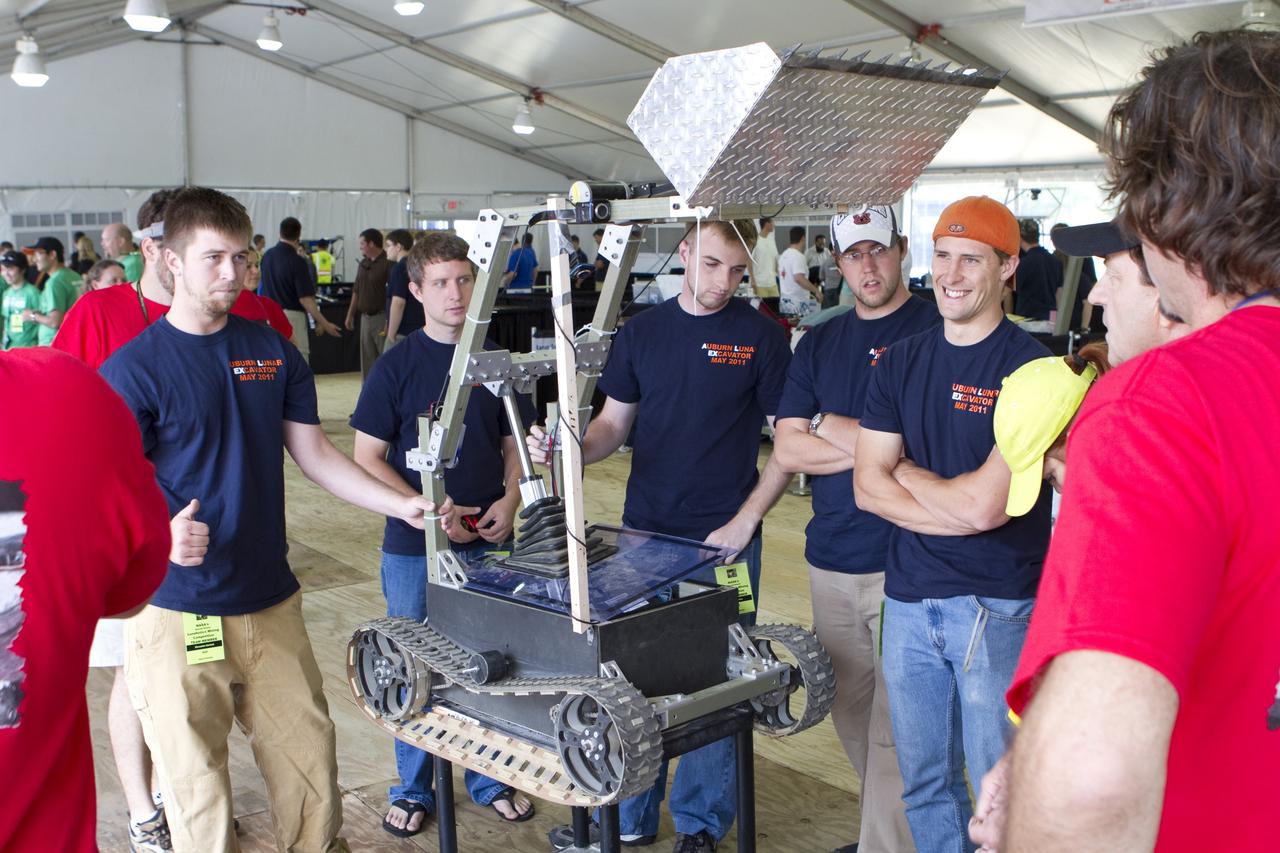
CAPE CANAVERAL, Fla. -- University students prepare for NASA's second annual Lunabotics Mining Competition at the Kennedy Space Center Visitor Complex in Florida. Thirty-six teams of undergraduate and graduate students from the United States, Bangladesh, Canada, Colombia and India will participate in NASA's Lunabotics Mining Competition May 26 - 28. The competition is designed to engage and retain students in science, technology, engineering and mathematics (STEM). Teams will maneuver their remote controlled or autonomous excavators, called lunabots, in about 60 tons of ultra-fine simulated lunar soil, called BP-1. The competition is an Exploration Systems Mission Directorate project managed by Kennedy's Education Division. The event also provides a competitive environment that could result in innovative ideas and solutions for NASA's future excavation of the moon. Photo credit: NASA/Cory Huston
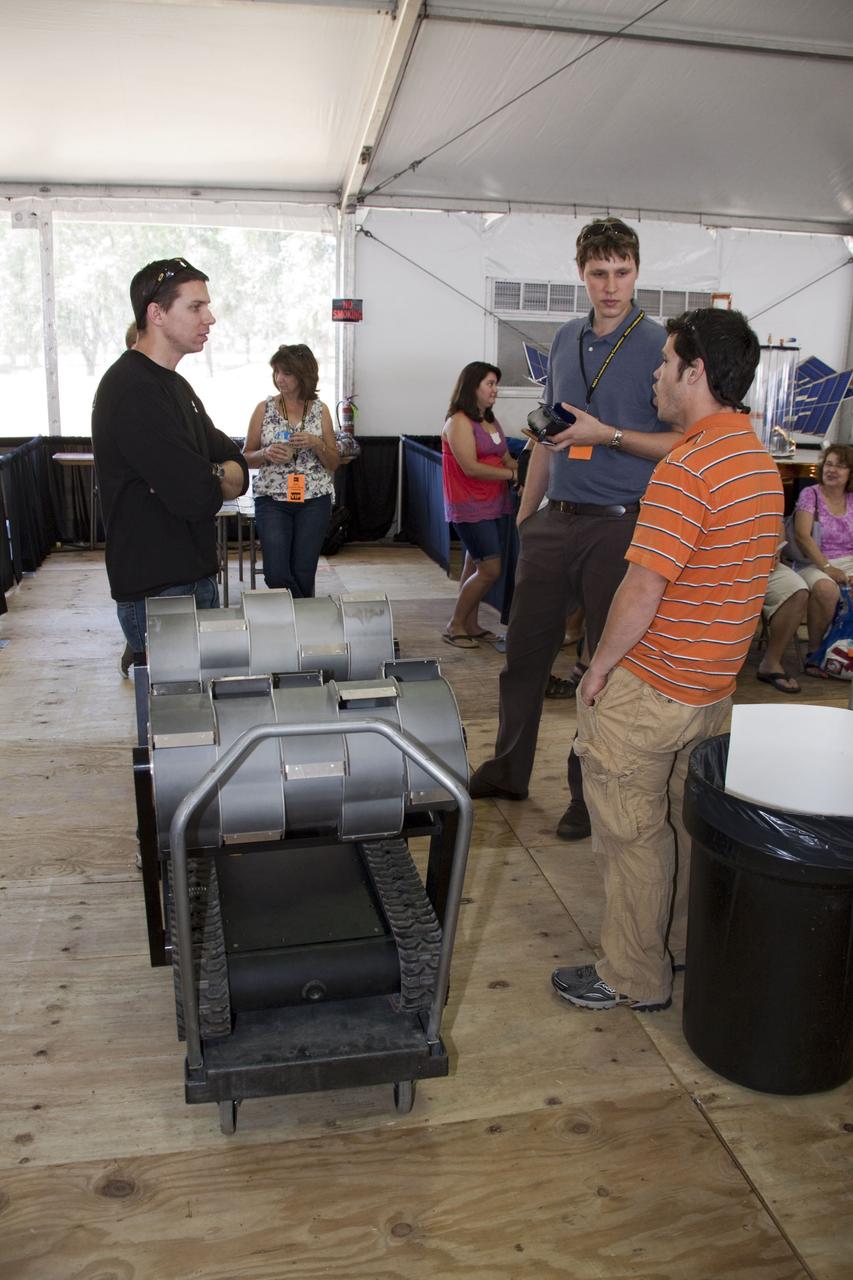
CAPE CANAVERAL, Fla. -- University students wait their turn to compete in NASA's second annual Lunabotics Mining Competition at the Kennedy Space Center Visitor Complex in Florida. Thirty-six teams of undergraduate and graduate students from the United States, Bangladesh, Canada, Colombia and India will participate in NASA's Lunabotics Mining Competition May 26 - 28 at the agency's Kennedy Space Center in Florida. The competition is designed to engage and retain students in science, technology, engineering and mathematics (STEM). Teams will maneuver their remote controlled or autonomous excavators, called lunabots, in about 60 tons of ultra-fine simulated lunar soil, called BP-1. The competition is an Exploration Systems Mission Directorate project managed by Kennedy's Education Division. The event also provides a competitive environment that could result in innovative ideas and solutions for NASA's future excavation of the moon. Photo credit: NASA/Jack Pfaller
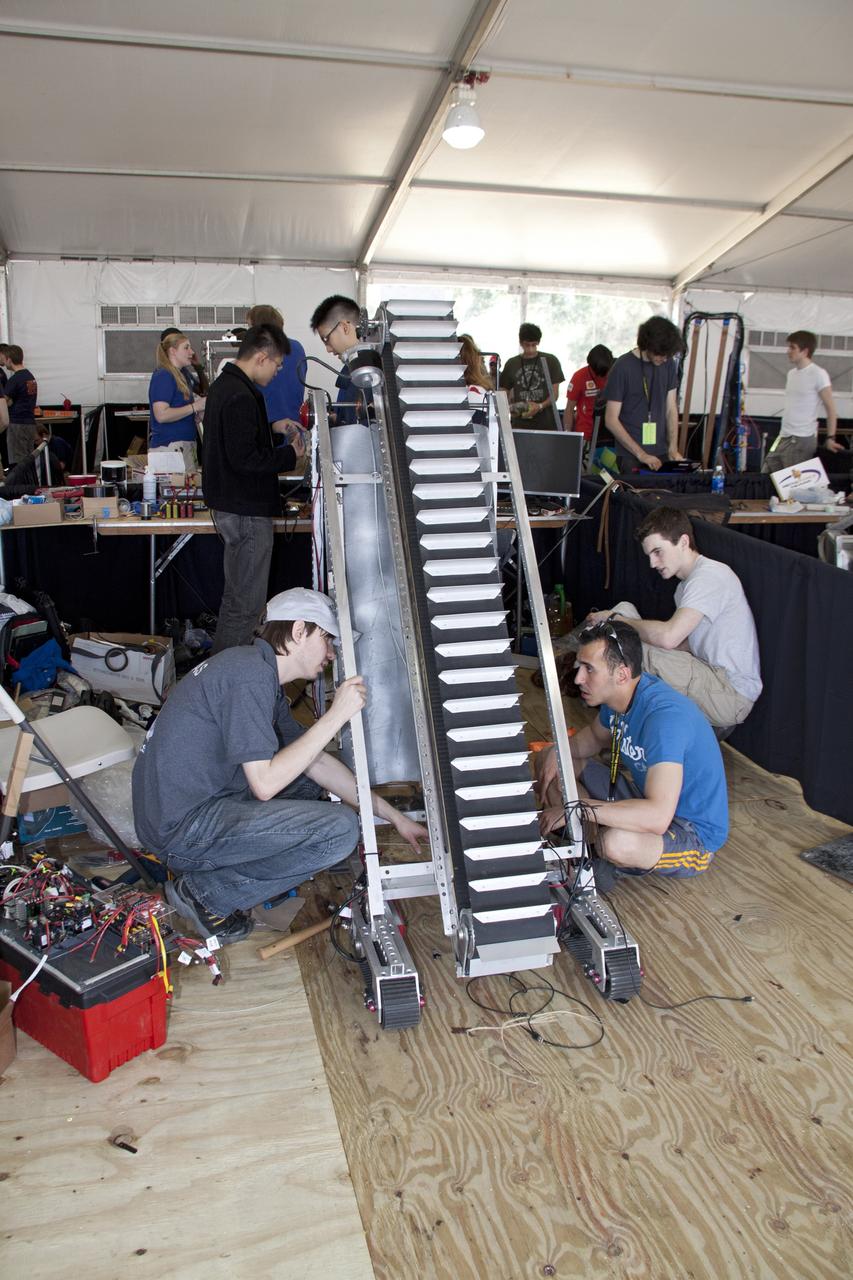
CAPE CANAVERAL, Fla. -- University students prepare for NASA's second annual Lunabotics Mining Competition at the Kennedy Space Center Visitor Complex in Florida. Thirty-six teams of undergraduate and graduate students from the United States, Bangladesh, Canada, Colombia and India will participate in NASA's Lunabotics Mining Competition May 26 - 28 at the agency's Kennedy Space Center in Florida. The competition is designed to engage and retain students in science, technology, engineering and mathematics (STEM). Teams will maneuver their remote controlled or autonomous excavators, called lunabots, in about 60 tons of ultra-fine simulated lunar soil, called BP-1. The competition is an Exploration Systems Mission Directorate project managed by Kennedy's Education Division. The event also provides a competitive environment that could result in innovative ideas and solutions for NASA's future excavation of the moon. Photo credit: NASA/Jack Pfaller
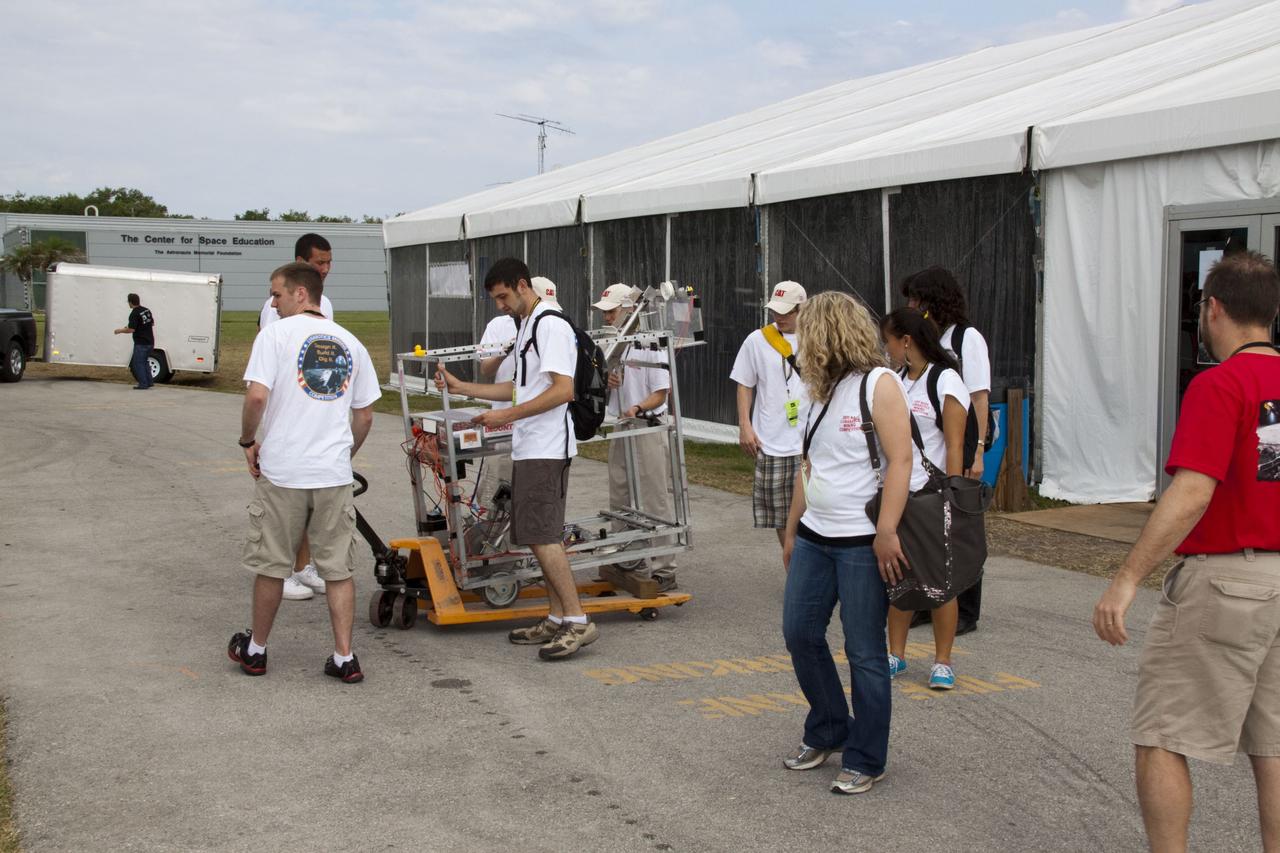
CAPE CANAVERAL, Fla. -- University students prepare for NASA's second annual Lunabotics Mining Competition at the Kennedy Space Center Visitor Complex in Florida. Thirty-six teams of undergraduate and graduate students from the United States, Bangladesh, Canada, Colombia and India will participate in NASA's Lunabotics Mining Competition May 26 - 28 at the agency's Kennedy Space Center in Florida. The competition is designed to engage and retain students in science, technology, engineering and mathematics (STEM). Teams will maneuver their remote controlled or autonomous excavators, called lunabots, in about 60 tons of ultra-fine simulated lunar soil, called BP-1. The competition is an Exploration Systems Mission Directorate project managed by Kennedy's Education Division. The event also provides a competitive environment that could result in innovative ideas and solutions for NASA's future excavation of the moon. Photo credit: NASA/Jack Pfaller
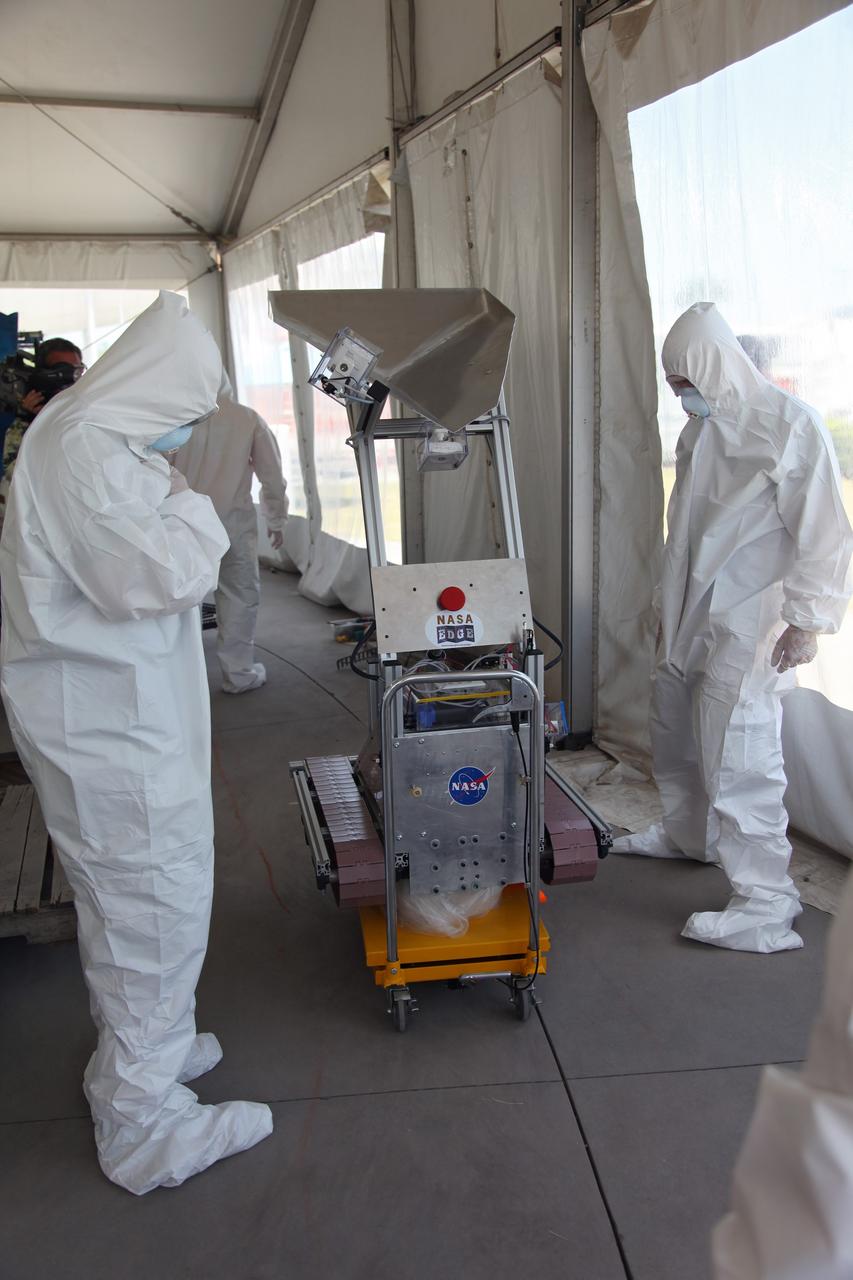
CAPE CANAVERAL, Fla. -- University students prepare for NASA's second annual Lunabotics Mining Competition at the Kennedy Space Center Visitor Complex in Florida. Thirty-six teams of undergraduate and graduate students from the United States, Bangladesh, Canada, Colombia and India will participate in NASA's Lunabotics Mining Competition May 26 - 28 at the agency's Kennedy Space Center in Florida. The competition is designed to engage and retain students in science, technology, engineering and mathematics (STEM). Teams will maneuver their remote controlled or autonomous excavators, called lunabots, in about 60 tons of ultra-fine simulated lunar soil, called BP-1. The competition is an Exploration Systems Mission Directorate project managed by Kennedy's Education Division. The event also provides a competitive environment that could result in innovative ideas and solutions for NASA's future excavation of the moon. Photo credit: NASA/Frankie Martin
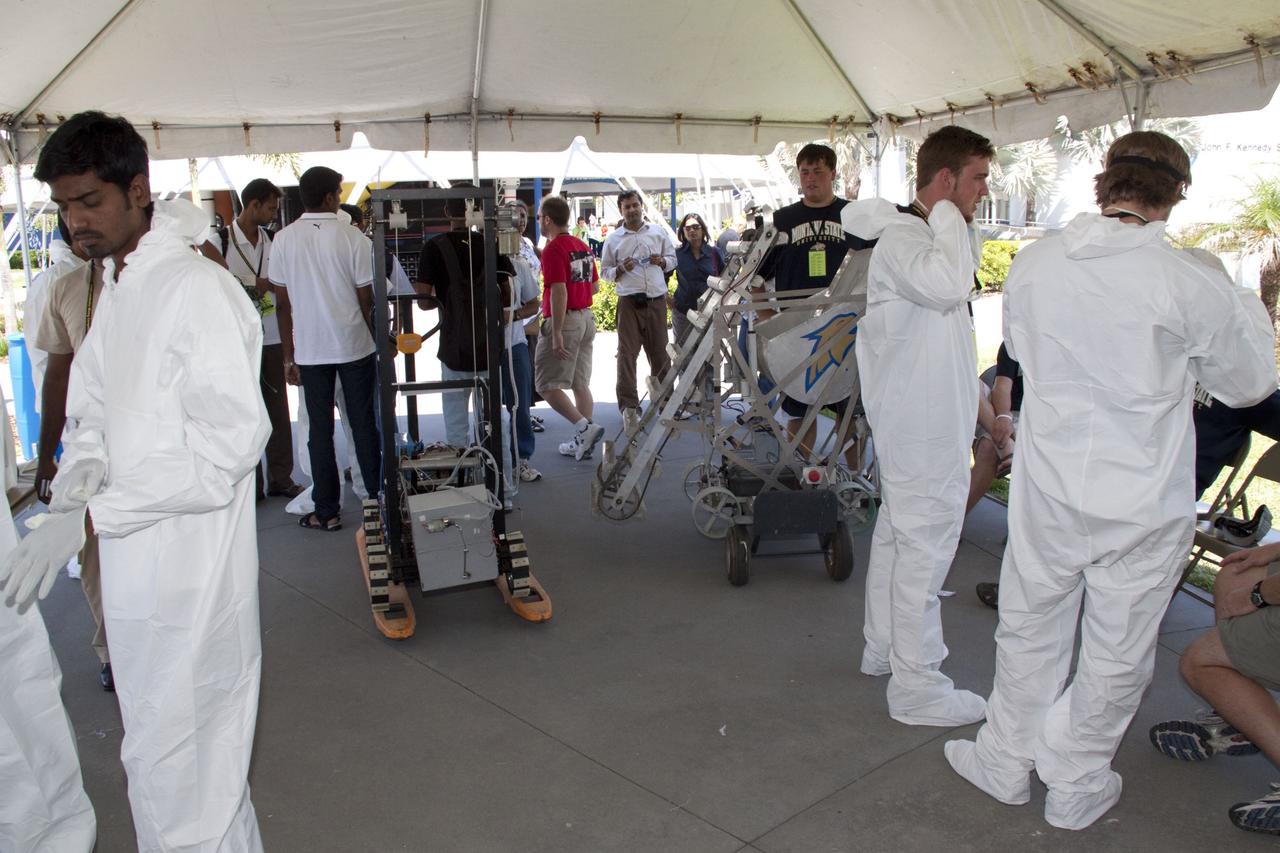
CAPE CANAVERAL, Fla. -- University students wait their turn to compete in NASA's second annual Lunabotics Mining Competition at the Kennedy Space Center Visitor Complex in Florida. Thirty-six teams of undergraduate and graduate students from the United States, Bangladesh, Canada, Colombia and India will participate in NASA's Lunabotics Mining Competition May 26 - 28 at the agency's Kennedy Space Center in Florida. The competition is designed to engage and retain students in science, technology, engineering and mathematics (STEM). Teams will maneuver their remote controlled or autonomous excavators, called lunabots, in about 60 tons of ultra-fine simulated lunar soil, called BP-1. The competition is an Exploration Systems Mission Directorate project managed by Kennedy's Education Division. The event also provides a competitive environment that could result in innovative ideas and solutions for NASA's future excavation of the moon. Photo credit: NASA/Jack Pfaller

CAPE CANAVERAL, Fla. -- University students prepare for NASA's second annual Lunabotics Mining Competition at the Kennedy Space Center Visitor Complex in Florida. Thirty-six teams of undergraduate and graduate students from the United States, Bangladesh, Canada, Colombia and India will participate in NASA's Lunabotics Mining Competition May 26 - 28. The competition is designed to engage and retain students in science, technology, engineering and mathematics (STEM). Teams will maneuver their remote controlled or autonomous excavators, called lunabots, in about 60 tons of ultra-fine simulated lunar soil, called BP-1. The competition is an Exploration Systems Mission Directorate project managed by Kennedy's Education Division. The event also provides a competitive environment that could result in innovative ideas and solutions for NASA's future excavation of the moon. Photo credit: NASA/Cory Huston
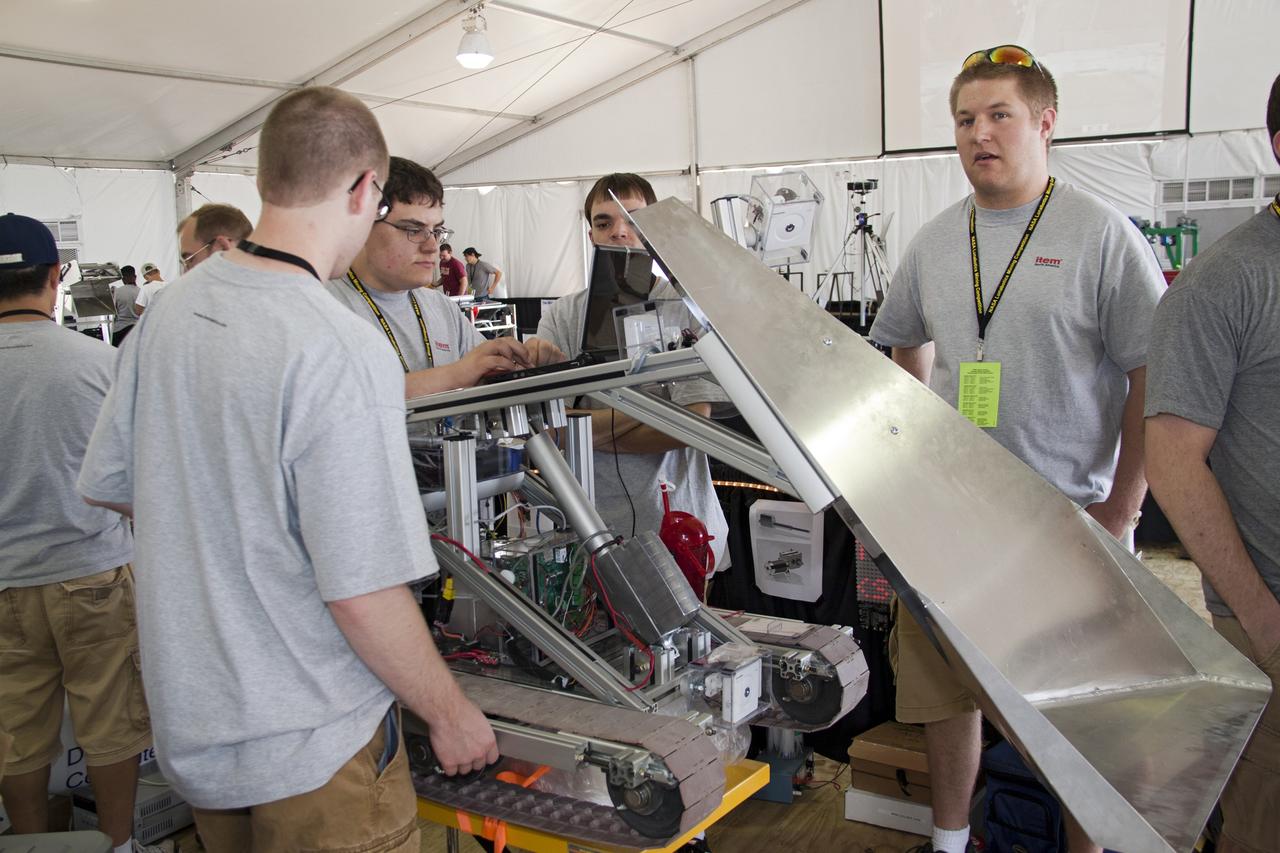
CAPE CANAVERAL, Fla. -- University students make final preparations for NASA's second annual Lunabotics Mining Competition held at the Kennedy Space Center Visitor Complex in Florida. Thirty-six teams of undergraduate and graduate students from the United States, Bangladesh, Canada, Colombia and India will participate in NASA's Lunabotics Mining Competition May 26 - 28 at the agency's Kennedy Space Center in Florida. The competition is designed to engage and retain students in science, technology, engineering and mathematics (STEM). Teams will maneuver their remote controlled or autonomous excavators, called lunabots, in about 60 tons of ultra-fine simulated lunar soil, called BP-1. The competition is an Exploration Systems Mission Directorate project managed by Kennedy's Education Division. The event also provides a competitive environment that could result in innovative ideas and solutions for NASA's future excavation of the moon. Photo credit: NASA/Jack Pfaller
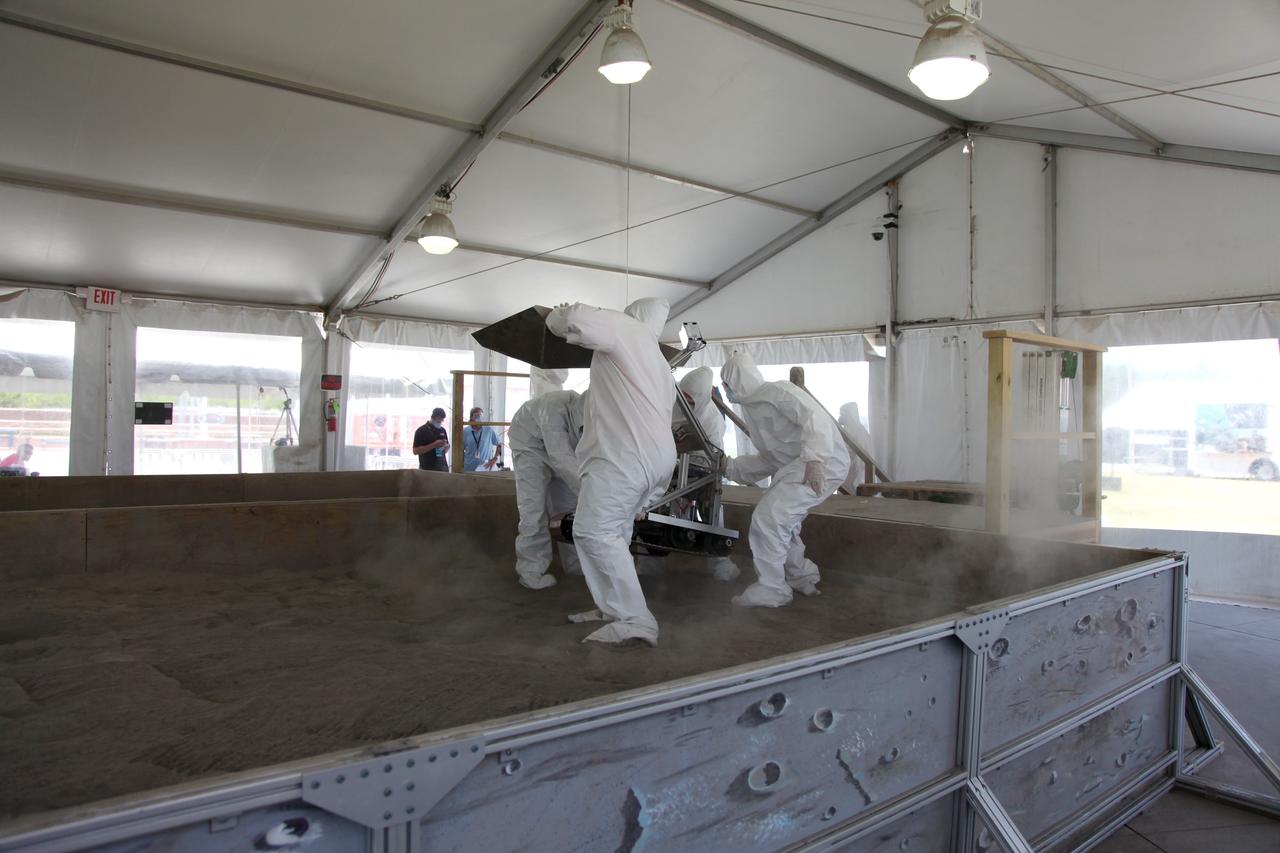
CAPE CANAVERAL, Fla. -- University students prepare for NASA's second annual Lunabotics Mining Competition inside the "Lunarena" at the Kennedy Space Center Visitor Complex in Florida. Thirty-six teams of undergraduate and graduate students from the United States, Bangladesh, Canada, Colombia and India will participate in NASA's Lunabotics Mining Competition May 26 - 28 at the agency's Kennedy Space Center in Florida. The competition is designed to engage and retain students in science, technology, engineering and mathematics (STEM). Teams will maneuver their remote controlled or autonomous excavators, called lunabots, in about 60 tons of ultra-fine simulated lunar soil, called BP-1. The competition is an Exploration Systems Mission Directorate project managed by Kennedy's Education Division. The event also provides a competitive environment that could result in innovative ideas and solutions for NASA's future excavation of the moon. Photo credit: NASA/Frankie Martin
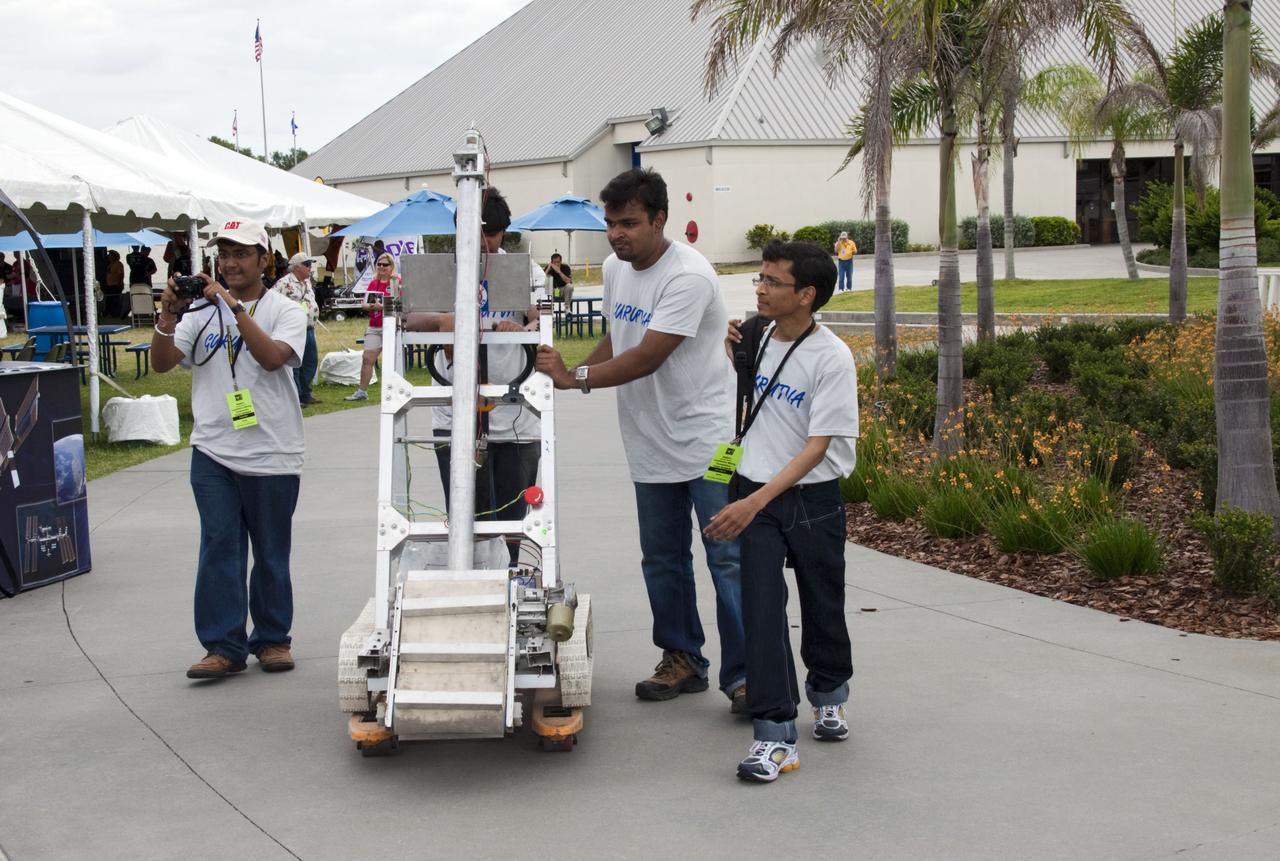
CAPE CANAVERAL, Fla. -- University students make final preparations for NASA's second annual Lunabotics Mining Competition held at the Kennedy Space Center Visitor Complex in Florida. Thirty-six teams of undergraduate and graduate students from the United States, Bangladesh, Canada, Colombia and India will participate in NASA's Lunabotics Mining Competition May 26 - 28 at the agency's Kennedy Space Center in Florida. The competition is designed to engage and retain students in science, technology, engineering and mathematics (STEM). Teams will maneuver their remote controlled or autonomous excavators, called lunabots, in about 60 tons of ultra-fine simulated lunar soil, called BP-1. The competition is an Exploration Systems Mission Directorate project managed by Kennedy's Education Division. The event also provides a competitive environment that could result in innovative ideas and solutions for NASA's future excavation of the moon. Photo credit: NASA/Jack Pfaller
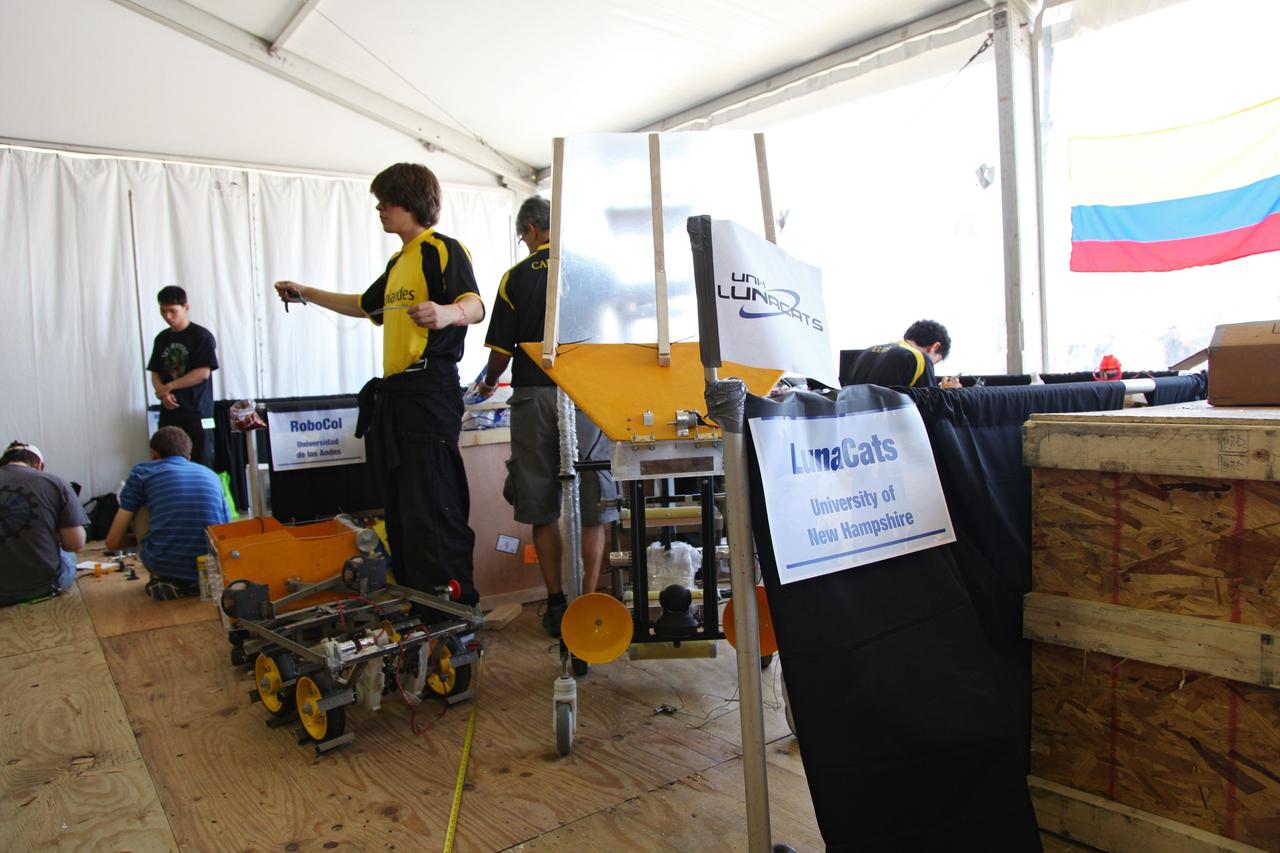
CAPE CANAVERAL, Fla. -- University students prepare for NASA's second annual Lunabotics Mining Competition at the Kennedy Space Center Visitor Complex in Florida. Thirty-six teams of undergraduate and graduate students from the United States, Bangladesh, Canada, Colombia and India will participate in NASA's Lunabotics Mining Competition May 26 - 28 at the agency's Kennedy Space Center in Florida. The competition is designed to engage and retain students in science, technology, engineering and mathematics (STEM). Teams will maneuver their remote controlled or autonomous excavators, called lunabots, in about 60 tons of ultra-fine simulated lunar soil, called BP-1. The competition is an Exploration Systems Mission Directorate project managed by Kennedy's Education Division. The event also provides a competitive environment that could result in innovative ideas and solutions for NASA's future excavation of the moon. Photo credit: NASA/Frankie Martin
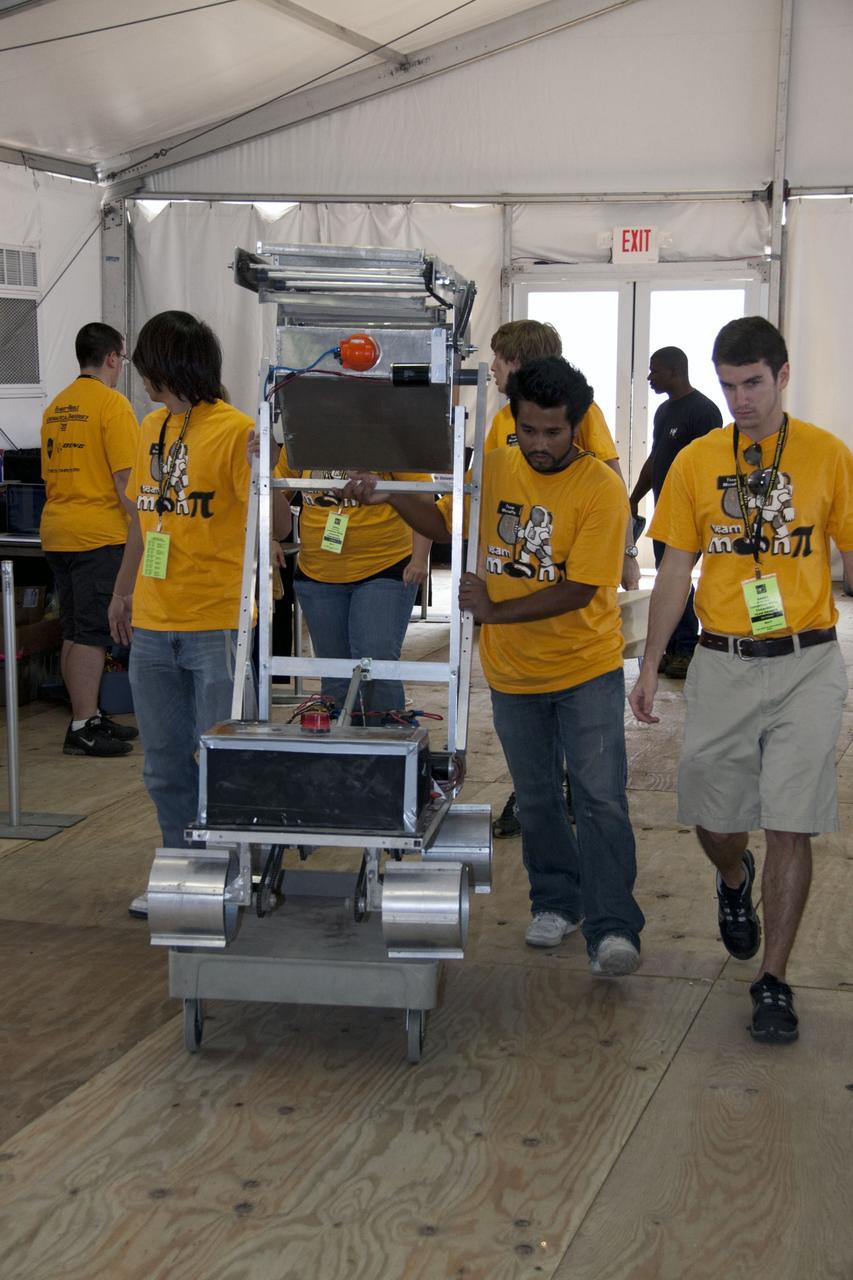
CAPE CANAVERAL, Fla. -- University students make final preparations for NASA's second annual Lunabotics Mining Competition held at the Kennedy Space Center Visitor Complex in Florida. Thirty-six teams of undergraduate and graduate students from the United States, Bangladesh, Canada, Colombia and India will participate in NASA's Lunabotics Mining Competition May 26 - 28 at the agency's Kennedy Space Center in Florida. The competition is designed to engage and retain students in science, technology, engineering and mathematics (STEM). Teams will maneuver their remote controlled or autonomous excavators, called lunabots, in about 60 tons of ultra-fine simulated lunar soil, called BP-1. The competition is an Exploration Systems Mission Directorate project managed by Kennedy's Education Division. The event also provides a competitive environment that could result in innovative ideas and solutions for NASA's future excavation of the moon. Photo credit: NASA/Jack Pfaller
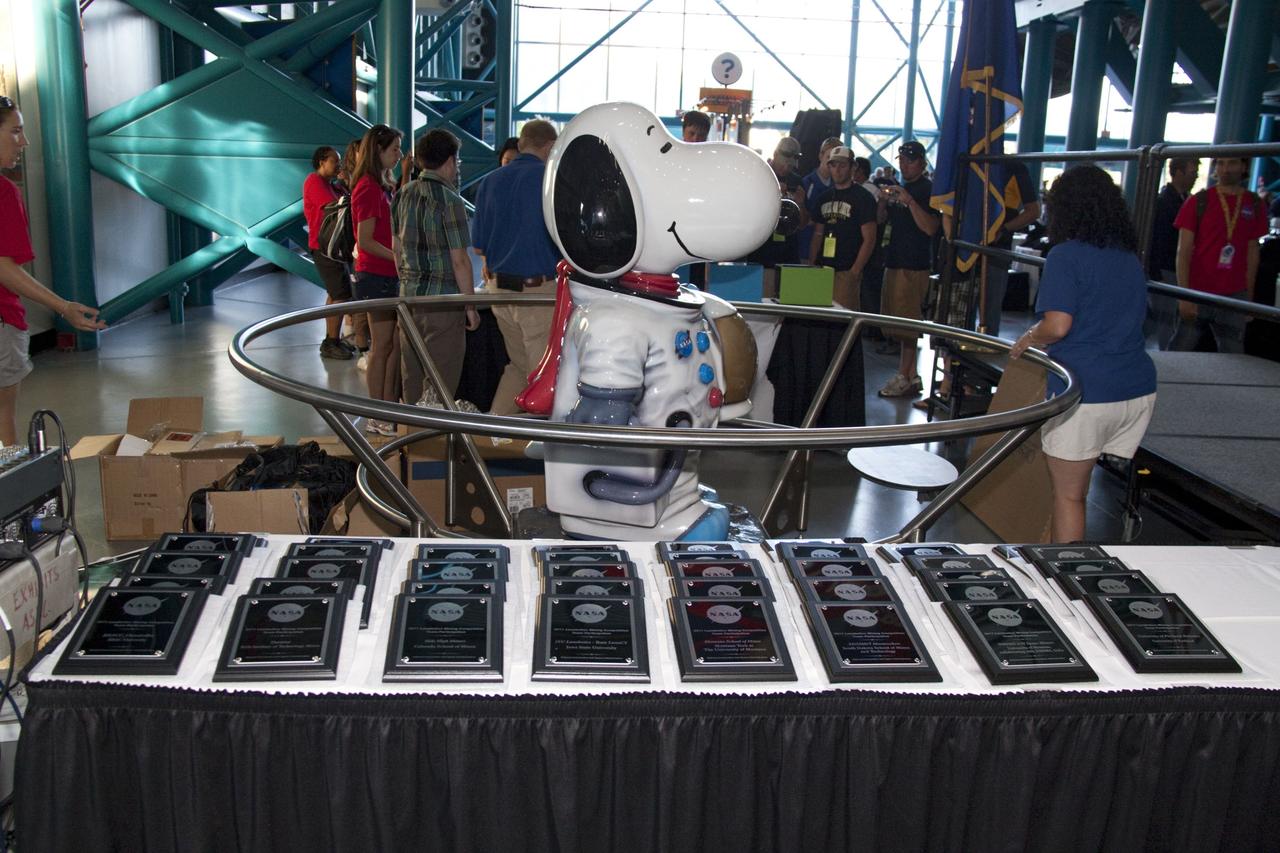
CAPE CANAVERAL, Fla. -- At NASA Kennedy Space Center's Apollo/Saturn V Center, university students take part in an award ceremony for NASA's second annual Lunabotics Mining Competition. Thirty-six teams of undergraduate and graduate students from the United States, Bangladesh, Canada, Colombia and India participated in NASA's Lunabotics Mining Competition May 26 - 28 at the agency's Kennedy Space Center in Florida. The competition is designed to engage and retain students in science, technology, engineering and mathematics (STEM). Teams will maneuver their remote controlled or autonomous excavators, called lunabots, in about 60 tons of ultra-fine simulated lunar soil, called BP-1. The competition is an Exploration Systems Mission Directorate project managed by Kennedy's Education Division. The event also provides a competitive environment that could result in innovative ideas and solutions for NASA's future excavation of the moon. Photo credit: NASA/Jack Pfaller
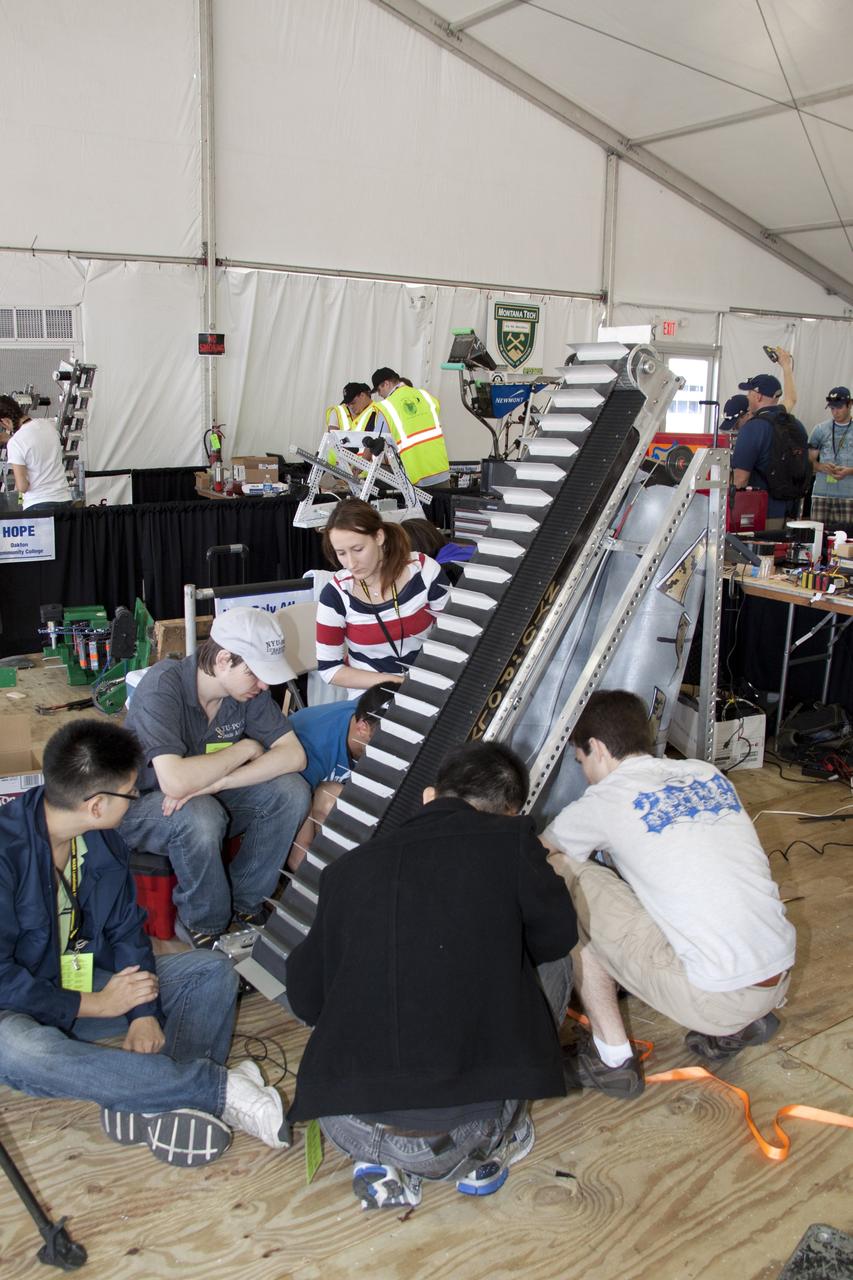
CAPE CANAVERAL, Fla. -- University students prepare for NASA's second annual Lunabotics Mining Competition at the Kennedy Space Center Visitor Complex in Florida. Thirty-six teams of undergraduate and graduate students from the United States, Bangladesh, Canada, Colombia and India will participate in NASA's Lunabotics Mining Competition May 26 - 28 at the agency's Kennedy Space Center in Florida. The competition is designed to engage and retain students in science, technology, engineering and mathematics (STEM). Teams will maneuver their remote controlled or autonomous excavators, called lunabots, in about 60 tons of ultra-fine simulated lunar soil, called BP-1. The competition is an Exploration Systems Mission Directorate project managed by Kennedy's Education Division. The event also provides a competitive environment that could result in innovative ideas and solutions for NASA's future excavation of the moon. Photo credit: NASA/Jack Pfaller
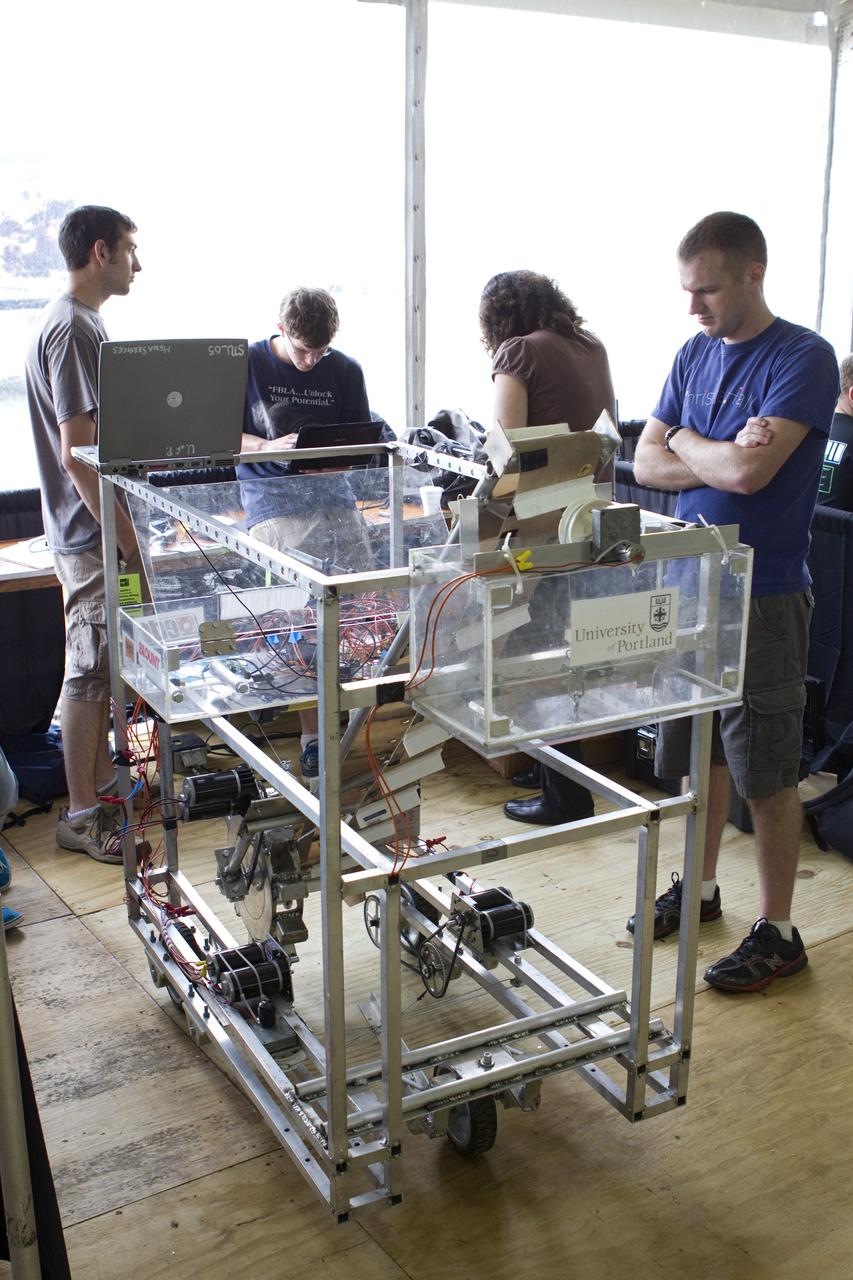
CAPE CANAVERAL, Fla. -- University students prepare for NASA's second annual Lunabotics Mining Competition at the Kennedy Space Center Visitor Complex in Florida. Thirty-six teams of undergraduate and graduate students from the United States, Bangladesh, Canada, Colombia and India will participate in NASA's Lunabotics Mining Competition May 26 - 28. The competition is designed to engage and retain students in science, technology, engineering and mathematics (STEM). Teams will maneuver their remote controlled or autonomous excavators, called lunabots, in about 60 tons of ultra-fine simulated lunar soil, called BP-1. The competition is an Exploration Systems Mission Directorate project managed by Kennedy's Education Division. The event also provides a competitive environment that could result in innovative ideas and solutions for NASA's future excavation of the moon. Photo credit: NASA/Cory Huston
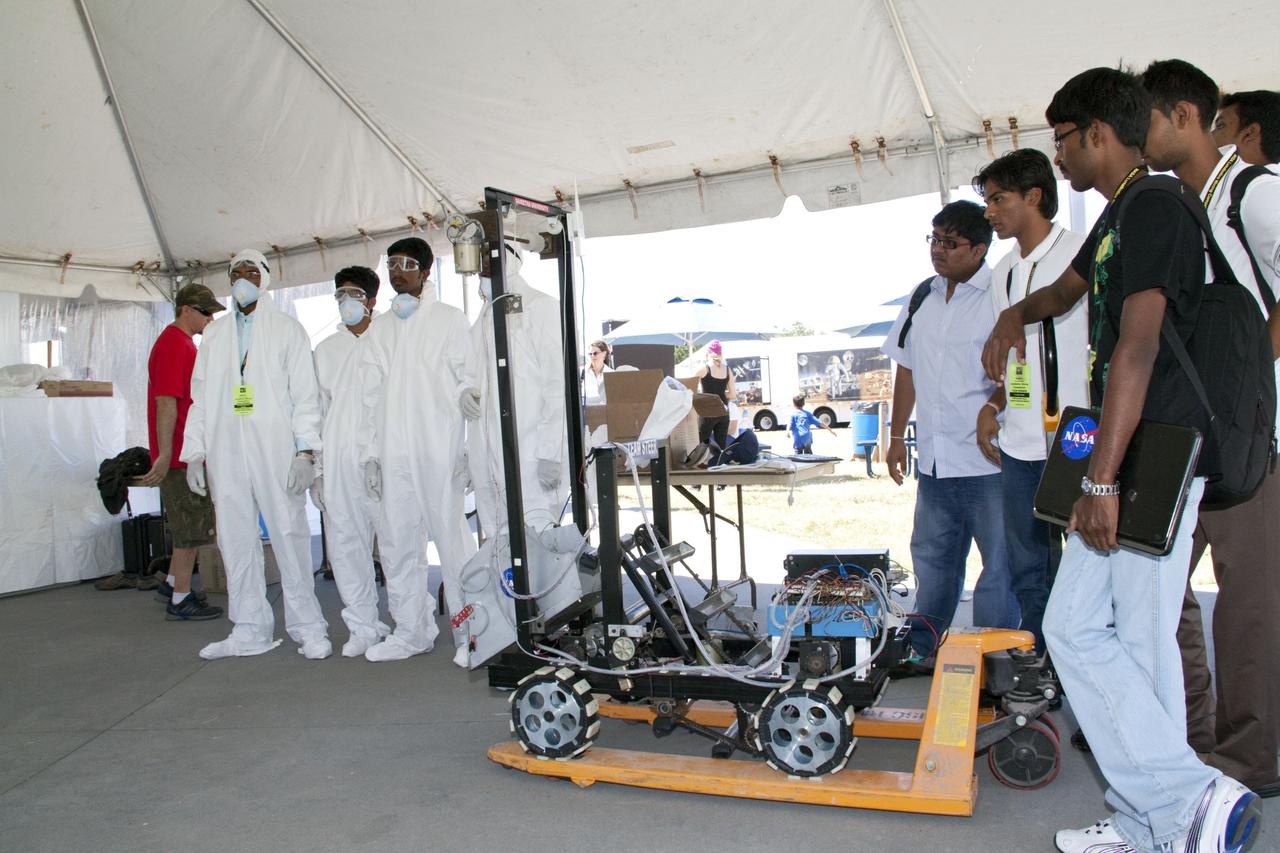
CAPE CANAVERAL, Fla. -- University students wait their turn to compete in NASA's second annual Lunabotics Mining Competition at the Kennedy Space Center Visitor Complex in Florida. Thirty-six teams of undergraduate and graduate students from the United States, Bangladesh, Canada, Colombia and India will participate in NASA's Lunabotics Mining Competition May 26 - 28 at the agency's Kennedy Space Center in Florida. The competition is designed to engage and retain students in science, technology, engineering and mathematics (STEM). Teams will maneuver their remote controlled or autonomous excavators, called lunabots, in about 60 tons of ultra-fine simulated lunar soil, called BP-1. The competition is an Exploration Systems Mission Directorate project managed by Kennedy's Education Division. The event also provides a competitive environment that could result in innovative ideas and solutions for NASA's future excavation of the moon. Photo credit: NASA/Jack Pfaller
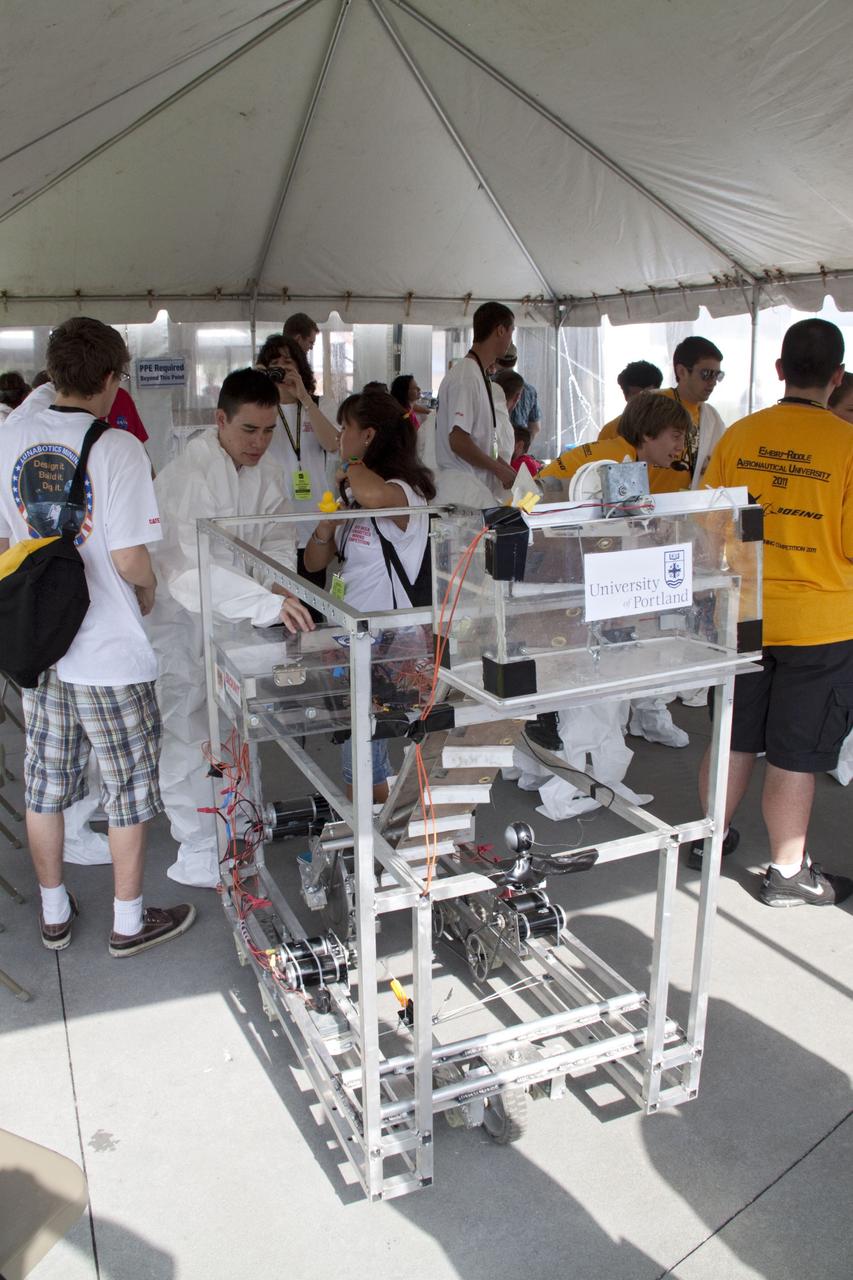
CAPE CANAVERAL, Fla. -- University students make final preparations for NASA's second annual Lunabotics Mining Competition held at the Kennedy Space Center Visitor Complex in Florida. Thirty-six teams of undergraduate and graduate students from the United States, Bangladesh, Canada, Colombia and India will participate in NASA's Lunabotics Mining Competition May 26 - 28 at the agency's Kennedy Space Center in Florida. The competition is designed to engage and retain students in science, technology, engineering and mathematics (STEM). Teams will maneuver their remote controlled or autonomous excavators, called lunabots, in about 60 tons of ultra-fine simulated lunar soil, called BP-1. The competition is an Exploration Systems Mission Directorate project managed by Kennedy's Education Division. The event also provides a competitive environment that could result in innovative ideas and solutions for NASA's future excavation of the moon. Photo credit: NASA/Jack Pfaller
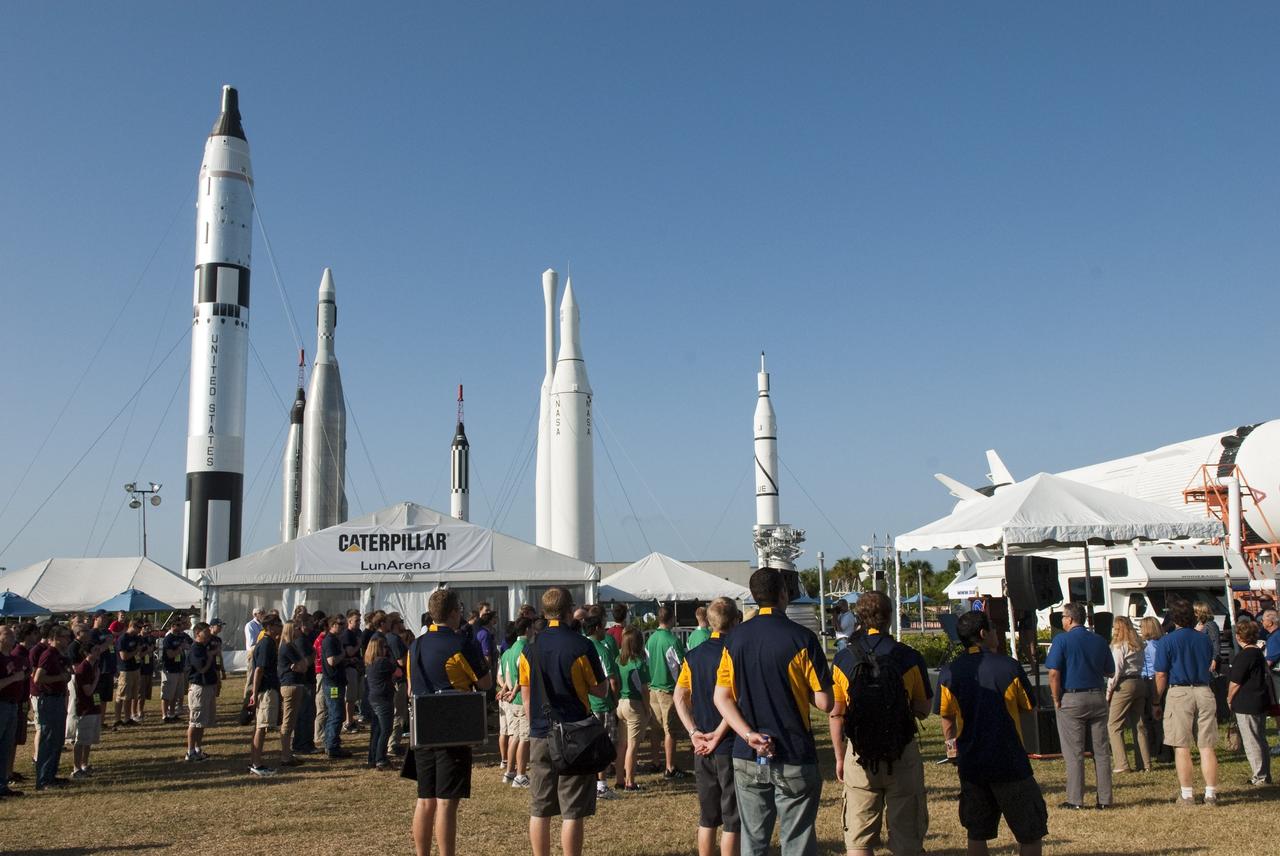
CAPE CANAVERAL, Fla. -- University students gather for the opening ceremony of NASA's second annual Lunabotics Mining Competition at the Kennedy Space Center Visitor Complex in Florida. Thirty-six teams of undergraduate and graduate students from the United States, Bangladesh, Canada, Colombia and India will participate in NASA's Lunabotics Mining Competition May 26 - 28 at the agency's Kennedy Space Center in Florida. The competition is designed to engage and retain students in science, technology, engineering and mathematics (STEM). Teams will maneuver their remote controlled or autonomous excavators, called lunabots, in about 60 tons of ultra-fine simulated lunar soil, called BP-1. The competition is an Exploration Systems Mission Directorate project managed by Kennedy's Education Division. The event also provides a competitive environment that could result in innovative ideas and solutions for NASA's future excavation of the moon. Photo credit: NASA/Jim Grossmann
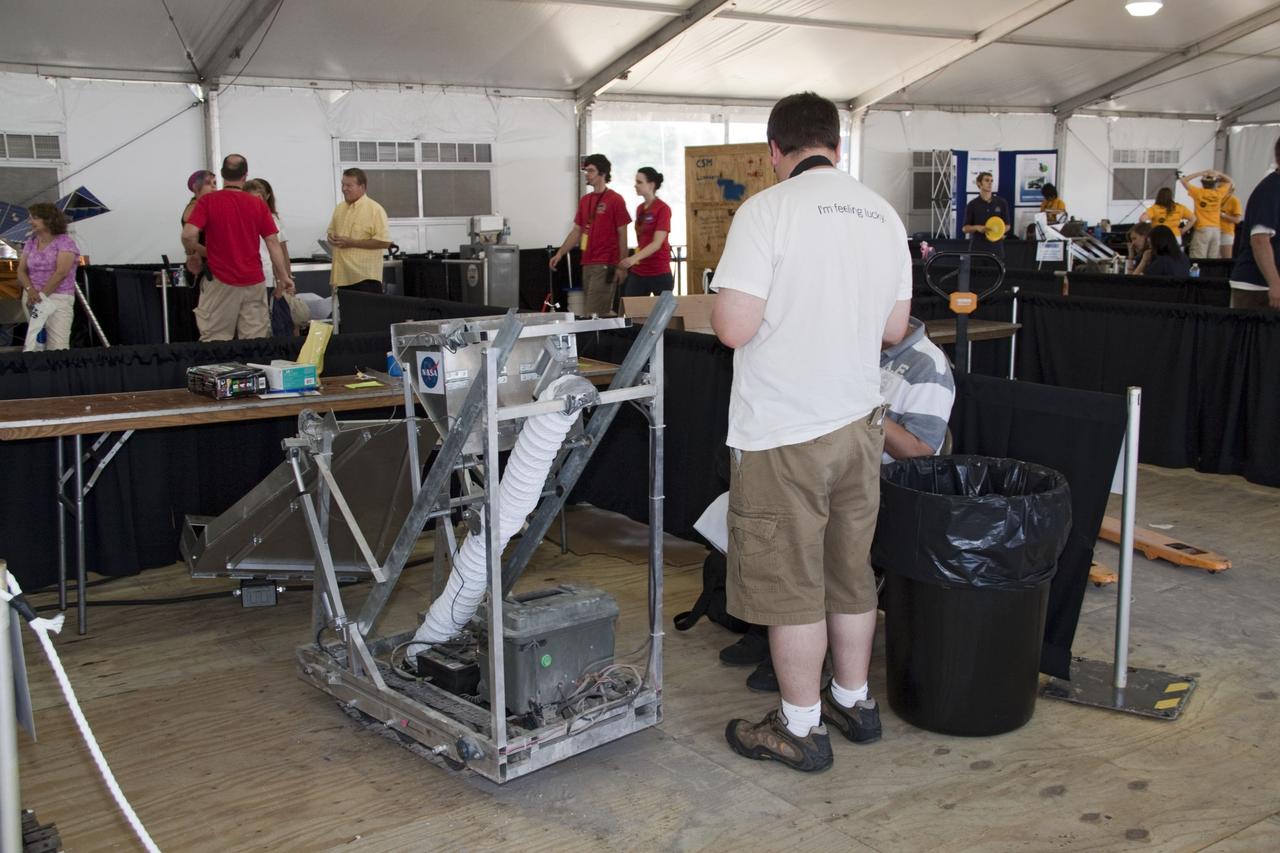
CAPE CANAVERAL, Fla. -- University students wait their turn to compete in NASA's second annual Lunabotics Mining Competition at the Kennedy Space Center Visitor Complex in Florida. hirty-six teams of undergraduate and graduate students from the United States, Bangladesh, Canada, Colombia and India will participate in NASA's Lunabotics Mining Competition May 26 - 28 at the agency's Kennedy Space Center in Florida. The competition is designed to engage and retain students in science, technology, engineering and mathematics (STEM). Teams will maneuver their remote controlled or autonomous excavators, called lunabots, in about 60 tons of ultra-fine simulated lunar soil, called BP-1. The competition is an Exploration Systems Mission Directorate project managed by Kennedy's Education Division. The event also provides a competitive environment that could result in innovative ideas and solutions for NASA's future excavation of the moon. Photo credit: NASA/Jack Pfaller
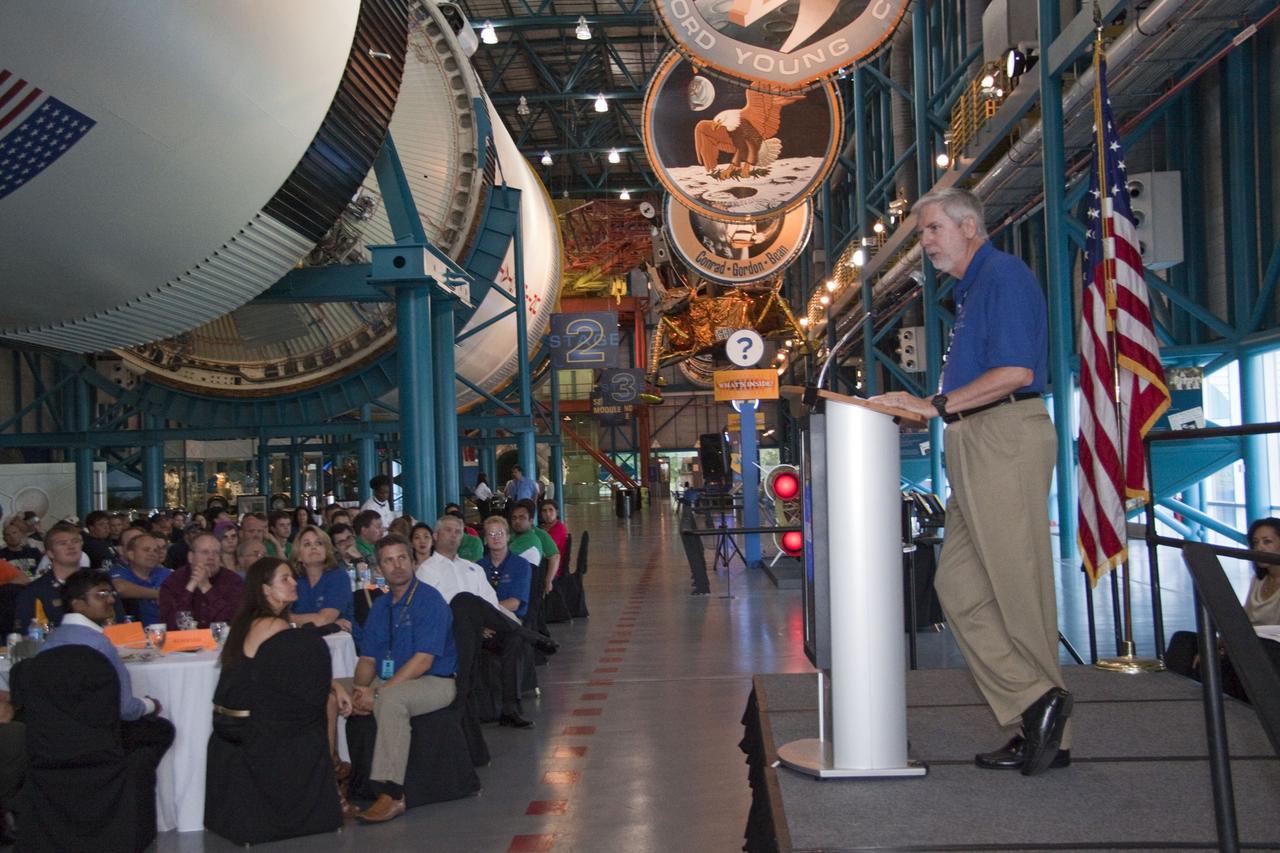
CAPE CANAVERAL, Fla. -- At NASA Kennedy Space Center's Apollo/Saturn V Center, Bill Moore, Visitor Complex chief operating officer speaks to university students at the award ceremony for NASA's second annual Lunabotics Mining Competition. Thirty-six teams of undergraduate and graduate students from the United States, Bangladesh, Canada, Colombia and India participated in NASA's Lunabotics Mining Competition May 26 - 28 at the agency's Kennedy Space Center in Florida. The competition is designed to engage and retain students in science, technology, engineering and mathematics (STEM). Teams will maneuver their remote controlled or autonomous excavators, called lunabots, in about 60 tons of ultra-fine simulated lunar soil, called BP-1. The competition is an Exploration Systems Mission Directorate project managed by Kennedy's Education Division. The event also provides a competitive environment that could result in innovative ideas and solutions for NASA's future excavation of the moon. Photo credit: NASA/Jack Pfaller

CAPE CANAVERAL, Fla. -- University students make final preparations for NASA's second annual Lunabotics Mining Competition at the Kennedy Space Center Visitor Complex in Florida. Thirty-six teams of undergraduate and graduate students from the United States, Bangladesh, Canada, Colombia and India will participate in NASA's Lunabotics Mining Competition May 26 - 28 at the agency's Kennedy Space Center in Florida. The competition is designed to engage and retain students in science, technology, engineering and mathematics (STEM). Teams will maneuver their remote controlled or autonomous excavators, called lunabots, in about 60 tons of ultra-fine simulated lunar soil, called BP-1. The competition is an Exploration Systems Mission Directorate project managed by Kennedy's Education Division. The event also provides a competitive environment that could result in innovative ideas and solutions for NASA's future excavation of the moon. Photo credit: NASA/Jack Pfaller
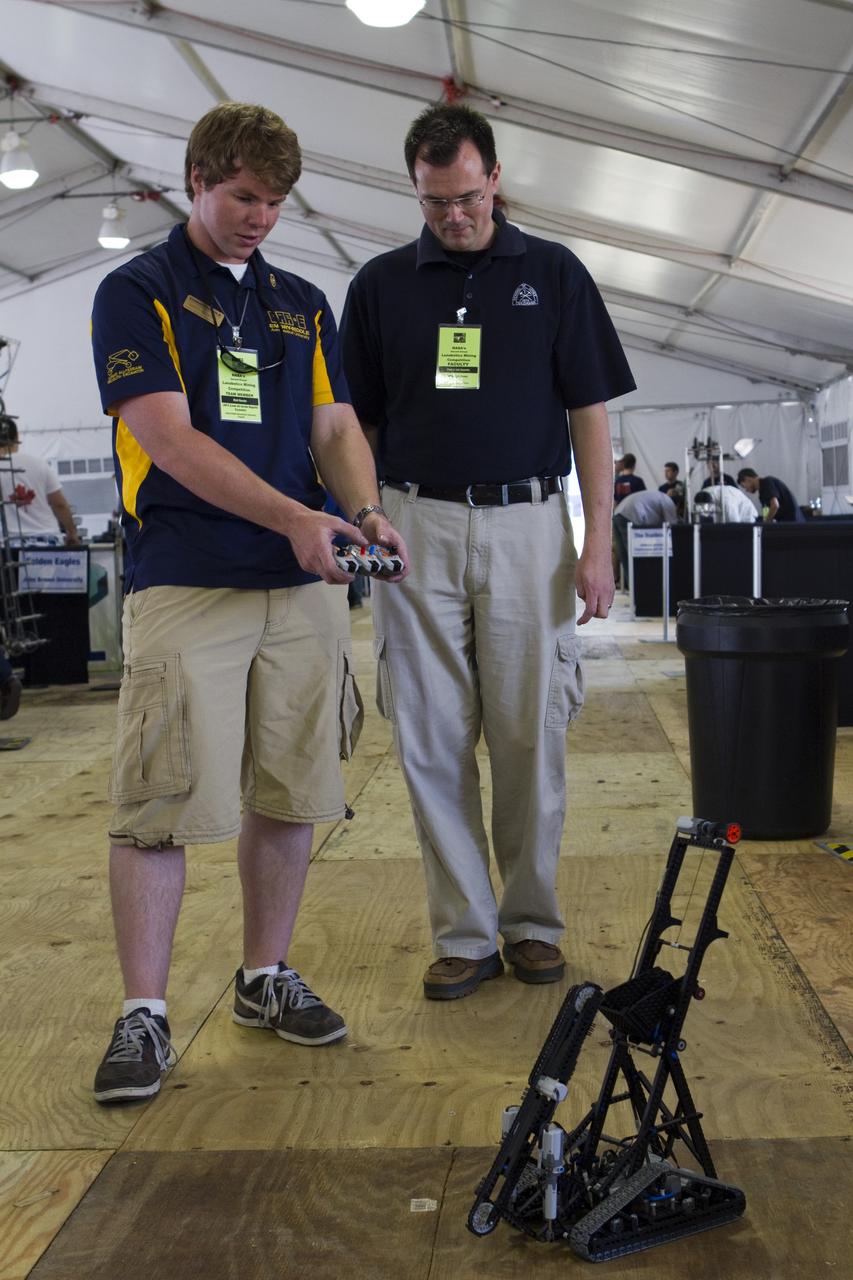
CAPE CANAVERAL, Fla. -- University students prepare for NASA's second annual Lunabotics Mining Competition at the Kennedy Space Center Visitor Complex in Florida. Thirty-six teams of undergraduate and graduate students from the United States, Bangladesh, Canada, Colombia and India will participate in NASA's Lunabotics Mining Competition May 26 - 28. The competition is designed to engage and retain students in science, technology, engineering and mathematics (STEM). Teams will maneuver their remote controlled or autonomous excavators, called lunabots, in about 60 tons of ultra-fine simulated lunar soil, called BP-1. The competition is an Exploration Systems Mission Directorate project managed by Kennedy's Education Division. The event also provides a competitive environment that could result in innovative ideas and solutions for NASA's future excavation of the moon. Photo credit: NASA/Cory Huston
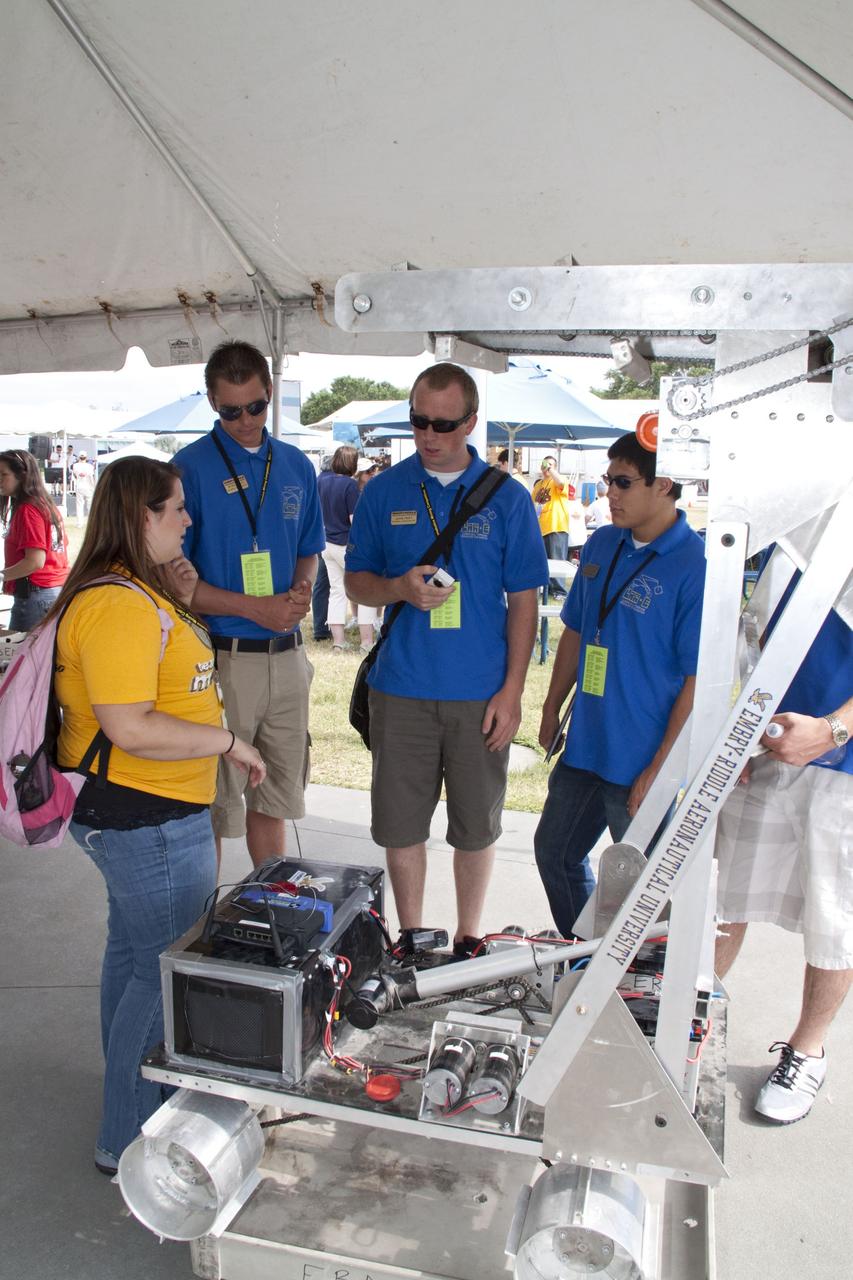
CAPE CANAVERAL, Fla. -- University students make final preparations for NASA's second annual Lunabotics Mining Competition held at the Kennedy Space Center Visitor Complex in Florida. Thirty-six teams of undergraduate and graduate students from the United States, Bangladesh, Canada, Colombia and India will participate in NASA's Lunabotics Mining Competition May 26 - 28 at the agency's Kennedy Space Center in Florida. The competition is designed to engage and retain students in science, technology, engineering and mathematics (STEM). Teams will maneuver their remote controlled or autonomous excavators, called lunabots, in about 60 tons of ultra-fine simulated lunar soil, called BP-1. The competition is an Exploration Systems Mission Directorate project managed by Kennedy's Education Division. The event also provides a competitive environment that could result in innovative ideas and solutions for NASA's future excavation of the moon. Photo credit: NASA/Jack Pfaller
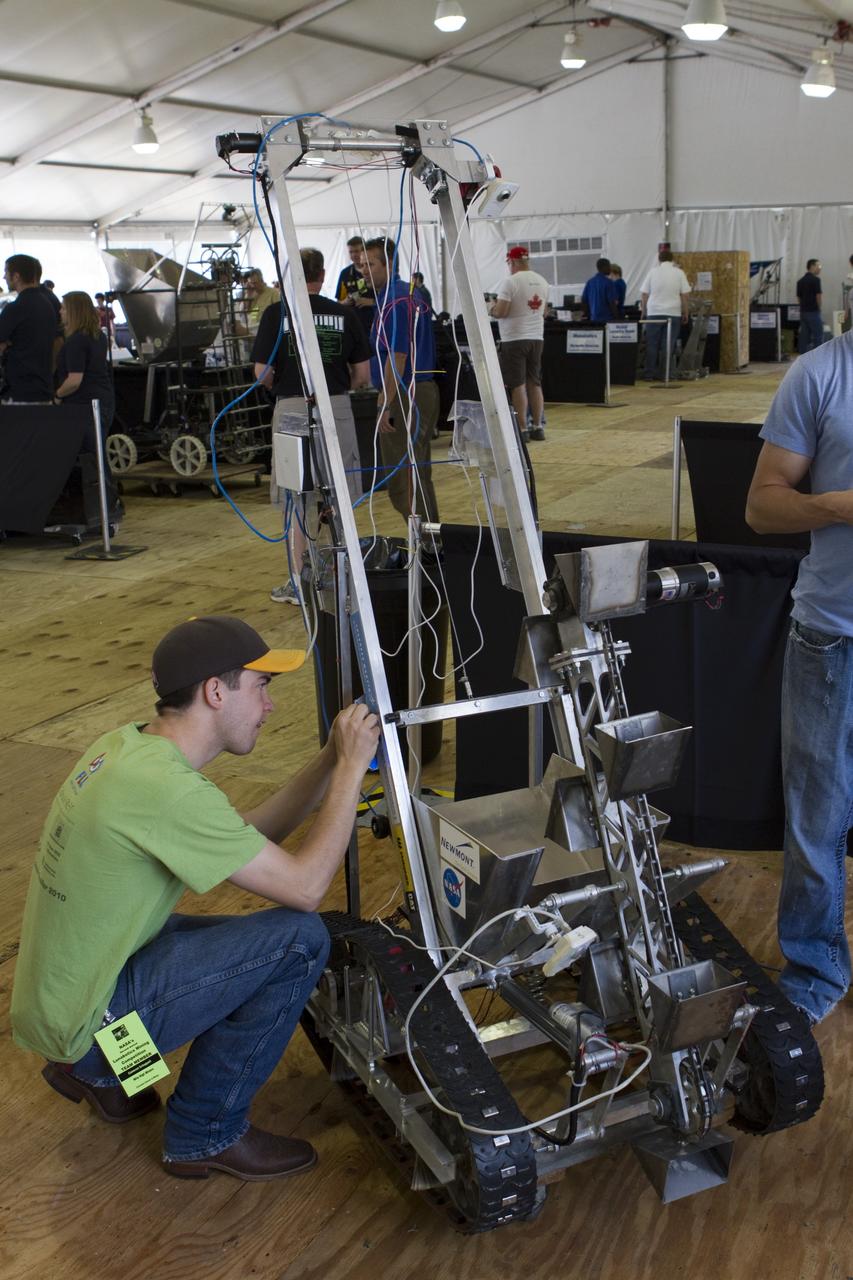
CAPE CANAVERAL, Fla. -- University students prepare for NASA's second annual Lunabotics Mining Competition at the Kennedy Space Center Visitor Complex in Florida. Thirty-six teams of undergraduate and graduate students from the United States, Bangladesh, Canada, Colombia and India will participate in NASA's Lunabotics Mining Competition May 26 - 28. The competition is designed to engage and retain students in science, technology, engineering and mathematics (STEM). Teams will maneuver their remote controlled or autonomous excavators, called lunabots, in about 60 tons of ultra-fine simulated lunar soil, called BP-1. The competition is an Exploration Systems Mission Directorate project managed by Kennedy's Education Division. The event also provides a competitive environment that could result in innovative ideas and solutions for NASA's future excavation of the moon. Photo credit: NASA/Cory Huston
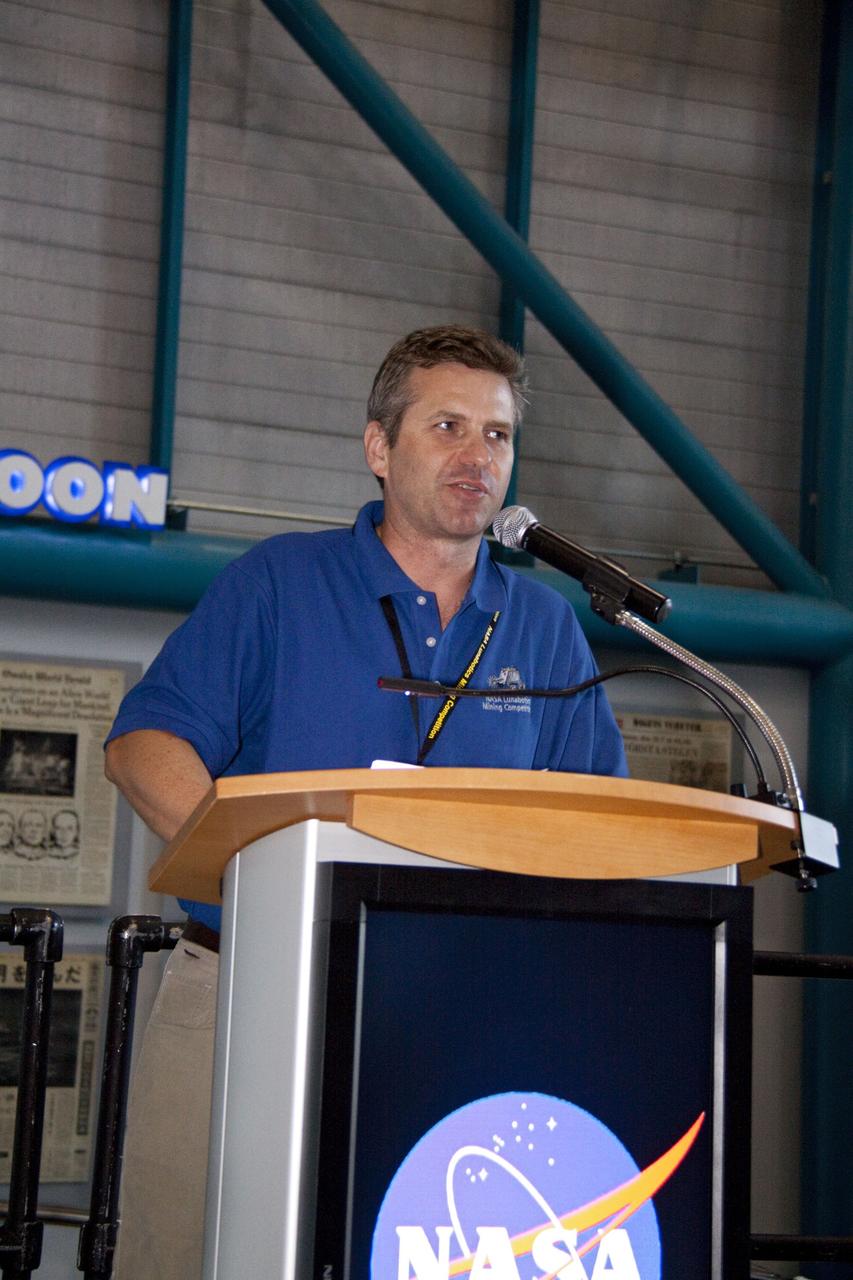
CAPE CANAVERAL, Fla. -- At NASA Kennedy Space Center's Apollo/Saturn V Center, Rob Mueller Kennedy's chief of the Surface Systems Office speaks to university students at the award ceremony for NASA's second annual Lunabotics Mining Competition. Thirty-six teams of undergraduate and graduate students from the United States, Bangladesh, Canada, Colombia and India participated in NASA's Lunabotics Mining Competition May 26 - 28 at the agency's Kennedy Space Center in Florida. The competition is designed to engage and retain students in science, technology, engineering and mathematics (STEM). Teams will maneuver their remote controlled or autonomous excavators, called lunabots, in about 60 tons of ultra-fine simulated lunar soil, called BP-1. The competition is an Exploration Systems Mission Directorate project managed by Kennedy's Education Division. The event also provides a competitive environment that could result in innovative ideas and solutions for NASA's future excavation of the moon. Photo credit: NASA/Jack Pfaller
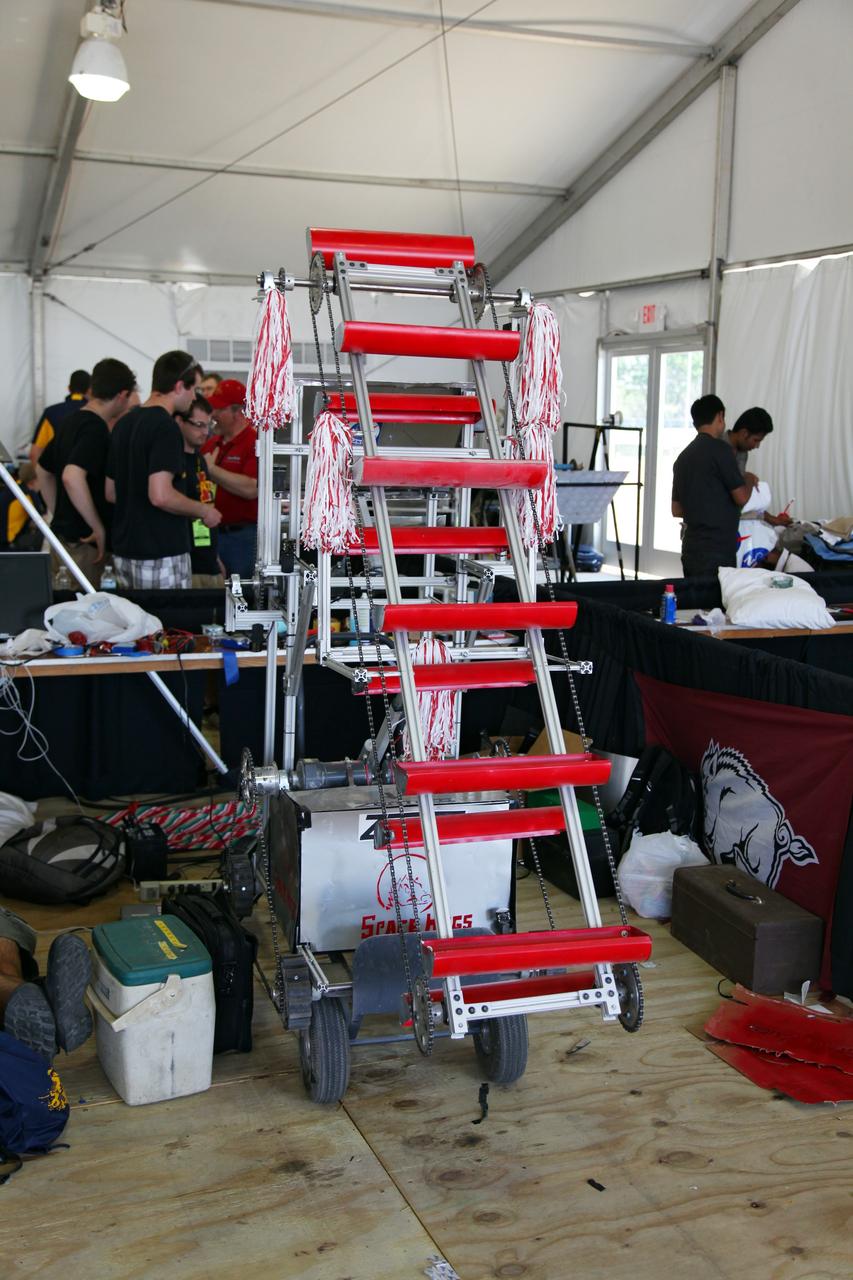
CAPE CANAVERAL, Fla. -- University students prepare for NASA's second annual Lunabotics Mining Competition at the Kennedy Space Center Visitor Complex in Florida. Thirty-six teams of undergraduate and graduate students from the United States, Bangladesh, Canada, Colombia and India will participate in NASA's Lunabotics Mining Competition May 26 - 28 at the agency's Kennedy Space Center in Florida. The competition is designed to engage and retain students in science, technology, engineering and mathematics (STEM). Teams will maneuver their remote controlled or autonomous excavators, called lunabots, in about 60 tons of ultra-fine simulated lunar soil, called BP-1. The competition is an Exploration Systems Mission Directorate project managed by Kennedy's Education Division. The event also provides a competitive environment that could result in innovative ideas and solutions for NASA's future excavation of the moon. Photo credit: NASA/Frankie Martin
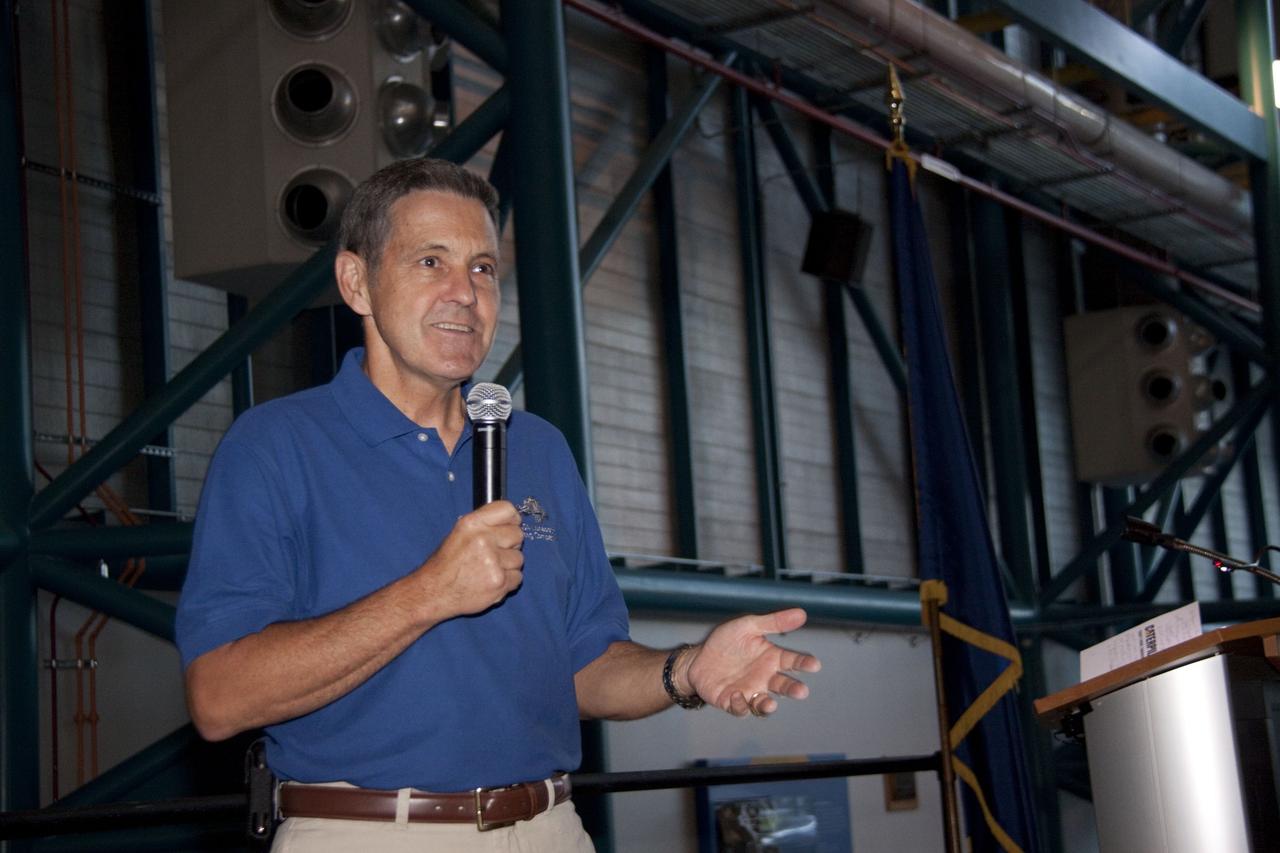
CAPE CANAVERAL, Fla. -- At NASA Kennedy Space Center's Apollo/Saturn V Center, Kennedy Center Director Bob Cabana speaks to university students at the award ceremony for NASA's second annual Lunabotics Mining Competition. Thirty-six teams of undergraduate and graduate students from the United States, Bangladesh, Canada, Colombia and India participated in NASA's Lunabotics Mining Competition May 26 - 28 at the agency's Kennedy Space Center in Florida. The competition is designed to engage and retain students in science, technology, engineering and mathematics (STEM). Teams will maneuver their remote controlled or autonomous excavators, called lunabots, in about 60 tons of ultra-fine simulated lunar soil, called BP-1. The competition is an Exploration Systems Mission Directorate project managed by Kennedy's Education Division. The event also provides a competitive environment that could result in innovative ideas and solutions for NASA's future excavation of the moon. Photo credit: NASA/Jack Pfaller
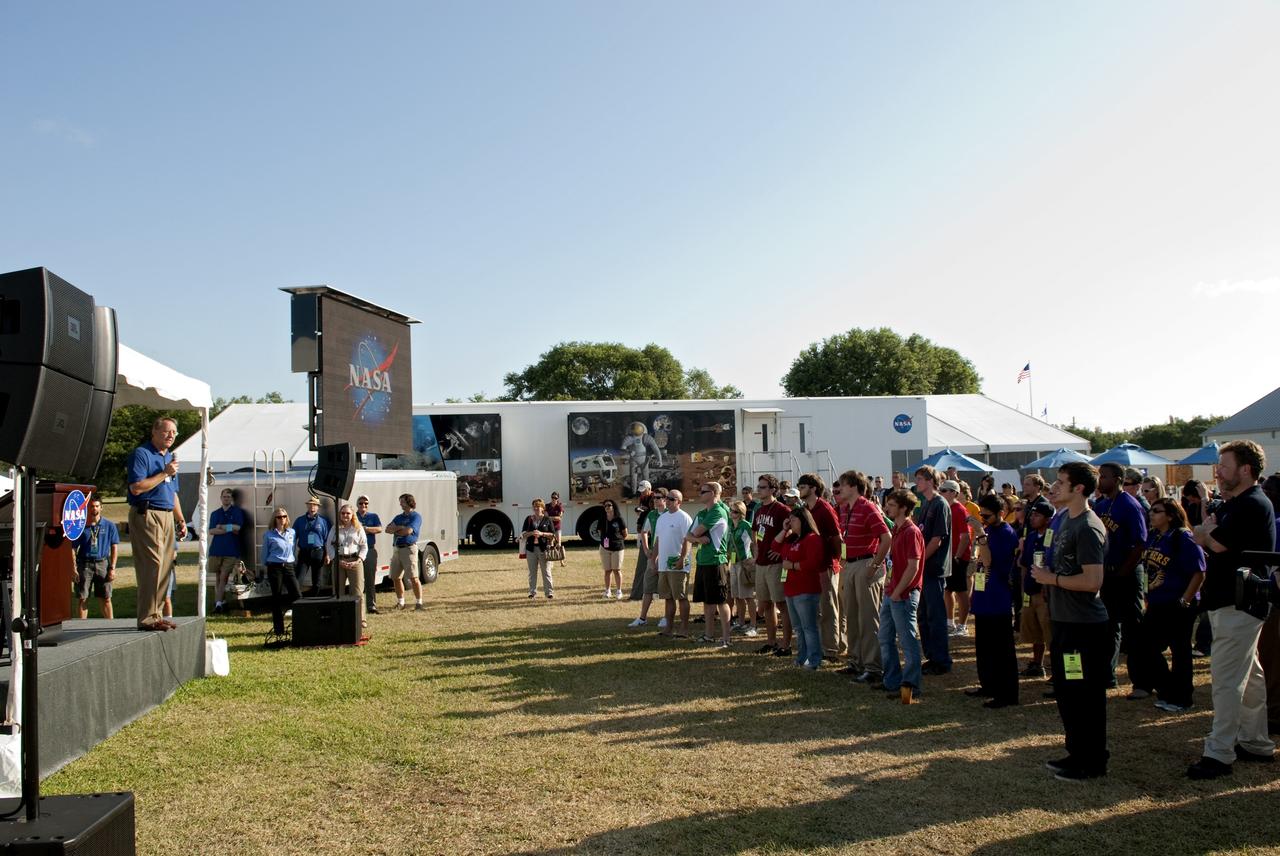
CAPE CANAVERAL, Fla. -- Pat Simpkins, Kennedy Space Center engineering director talks to university students gathered for the opening ceremony of NASA's second annual Lunabotics Mining Competition at the Kennedy Space Center Visitor Complex in Florida. Thirty-six teams of undergraduate and graduate students from the United States, Bangladesh, Canada, Colombia and India will participate in NASA's Lunabotics Mining Competition May 26 - 28 at the agency's Kennedy Space Center in Florida. The competition is designed to engage and retain students in science, technology, engineering and mathematics (STEM). Teams will maneuver their remote controlled or autonomous excavators, called lunabots, in about 60 tons of ultra-fine simulated lunar soil, called BP-1. The competition is an Exploration Systems Mission Directorate project managed by Kennedy's Education Division. The event also provides a competitive environment that could result in innovative ideas and solutions for NASA's future excavation of the moon. Photo credit: NASA/Jim Grossmann
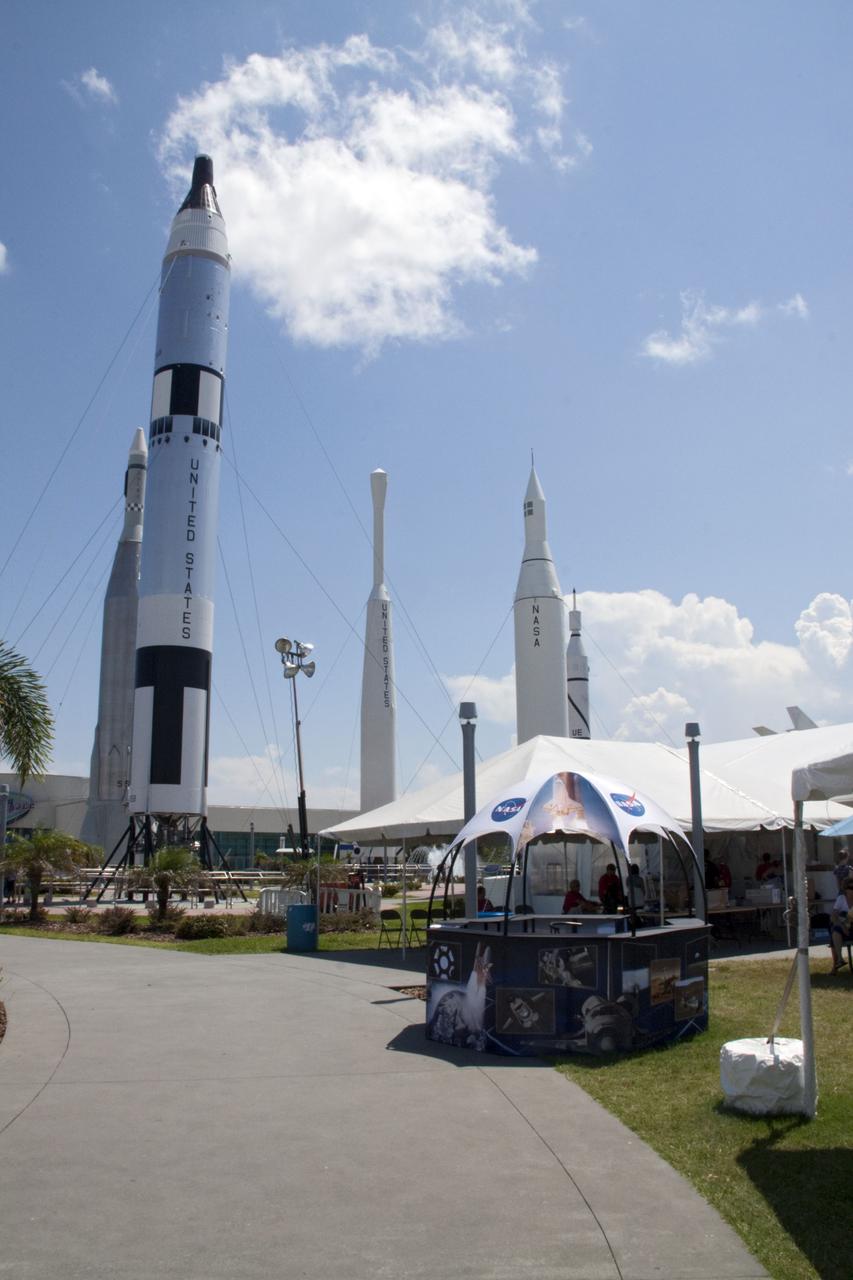
CAPE CANAVERAL, Fla. -- University students wait their turn to compete in NASA's second annual Lunabotics Mining Competition at the Kennedy Space Center Visitor Complex in Florida taking place near the complex's Rocket Garden. Thirty-six teams of undergraduate and graduate students from the United States, Bangladesh, Canada, Colombia and India will participate in NASA's Lunabotics Mining Competition May 26 - 28 at the agency's Kennedy Space Center in Florida. The competition is designed to engage and retain students in science, technology, engineering and mathematics (STEM). Teams will maneuver their remote controlled or autonomous excavators, called lunabots, in about 60 tons of ultra-fine simulated lunar soil, called BP-1. The competition is an Exploration Systems Mission Directorate project managed by Kennedy's Education Division. The event also provides a competitive environment that could result in innovative ideas and solutions for NASA's future excavation of the moon. Photo credit: NASA/Jack Pfaller
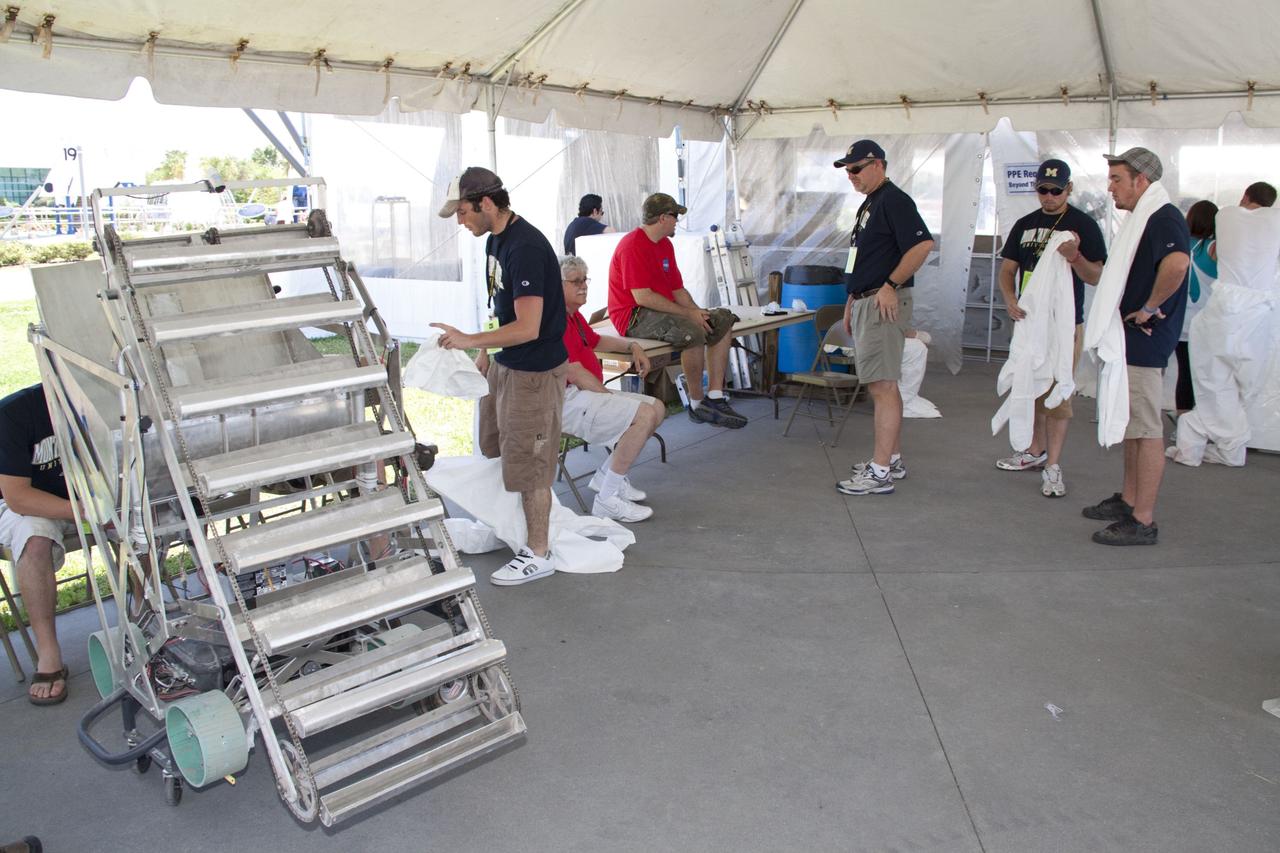
CAPE CANAVERAL, Fla. -- University students wait their turn to compete in NASA's second annual Lunabotics Mining Competition at the Kennedy Space Center Visitor Complex in Florida. Thirty-six teams of undergraduate and graduate students from the United States, Bangladesh, Canada, Colombia and India will participate in NASA's Lunabotics Mining Competition May 26 - 28 at the agency's Kennedy Space Center in Florida. The competition is designed to engage and retain students in science, technology, engineering and mathematics (STEM). Teams will maneuver their remote controlled or autonomous excavators, called lunabots, in about 60 tons of ultra-fine simulated lunar soil, called BP-1. The competition is an Exploration Systems Mission Directorate project managed by Kennedy's Education Division. The event also provides a competitive environment that could result in innovative ideas and solutions for NASA's future excavation of the moon. Photo credit: NASA/Jack Pfaller
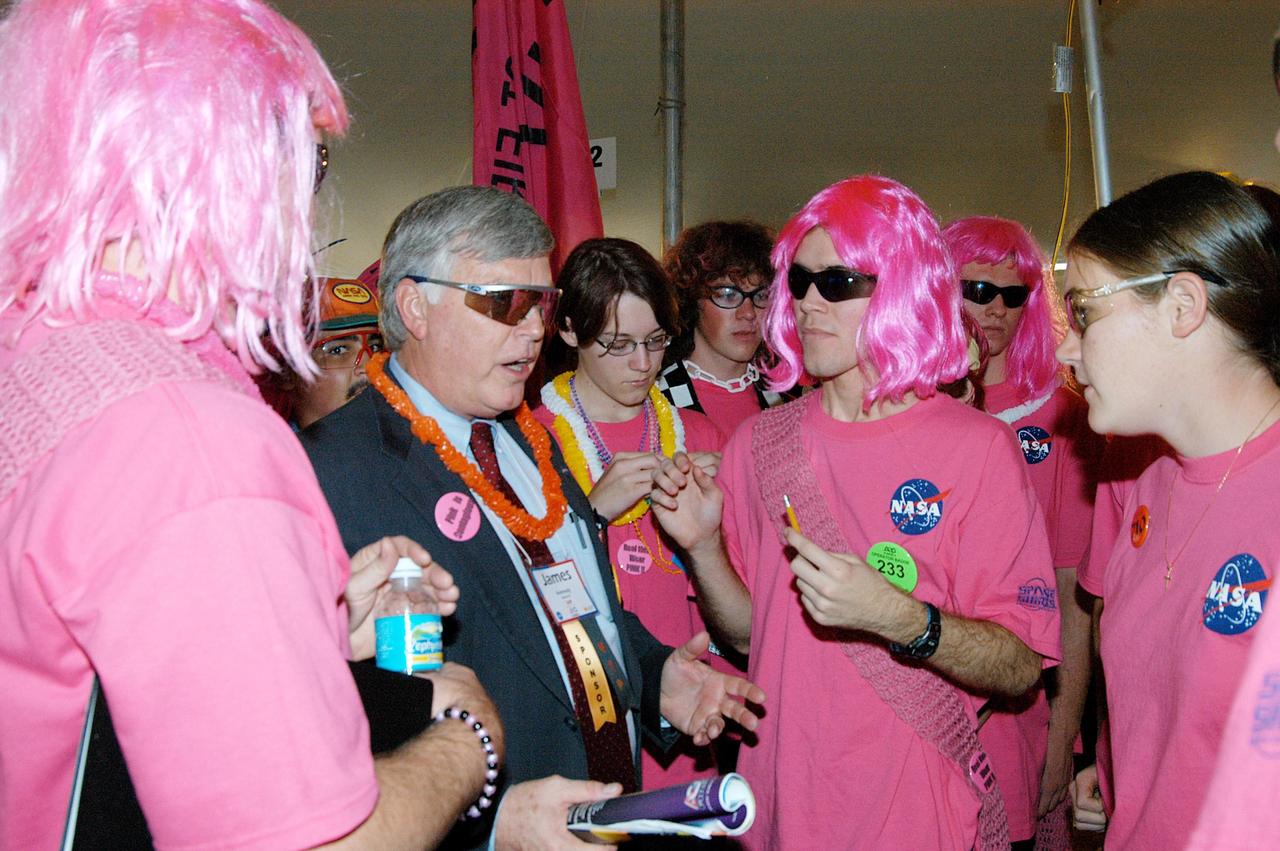
KENNEDY SPACE CENTER, FLA. - Center Director Jim Kennedy joins students on the KSC-sponsored “Pink” team at the 2004 Florida Regional FIRST competition, held at the University of Central Florida. The annual event is hosting 41 teams from Canada, Brazil, Great Britain and the United States. FIRST is a nonprofit organization, For Inspiration and Recognition of Science and Technology, that sponsors the event pitting robots against each other in an athletic-style competition. The FIRST robotics competition is designed to provide students with a hands-on, inside look at engineering and other professional careers, pairing high school students with engineer mentors and corporations.

Kim Stratton, at left, with Caterpillar, talks to students during a Women in STEM breakfast inside the Debus Conference Center at the Kennedy Space Center Visitor Complex in Florida. STEM is science, technology, engineering and math. The special event gave students competing in NASA's 8th Annual Robotic Mining Competition the chance to learn from female NASA scientists, engineers and professionals about their careers and the paths they took to working at Kennedy. The Robotic Mining Competition is a NASA Human Exploration and Operations Mission Directorate project designed to encourage students in STEM fields. The project provides a competitive environment to foster innovative ideas and solutions that could be used on NASA's Journey to Mars.

Kennedy Space Center Deputy Director Janet Petro speaks to students during a Women in STEM mentoring breakfast inside the Debus Conference Center at the Kennedy Space Center Visitor Complex in Florida. STEM is science, technology, engineering and math. The special event gave students competing in NASA's 8th Annual Robotic Mining Competition the chance to learn from female NASA scientists, engineers and professionals about their careers and the paths they took to working at Kennedy. The Robotic Mining Competition is a NASA Human Exploration and Operations Mission Directorate project designed to encourage students in STEM fields. The project provides a competitive environment to foster innovative ideas and solutions that could be used on NASA's Journey to Mars.
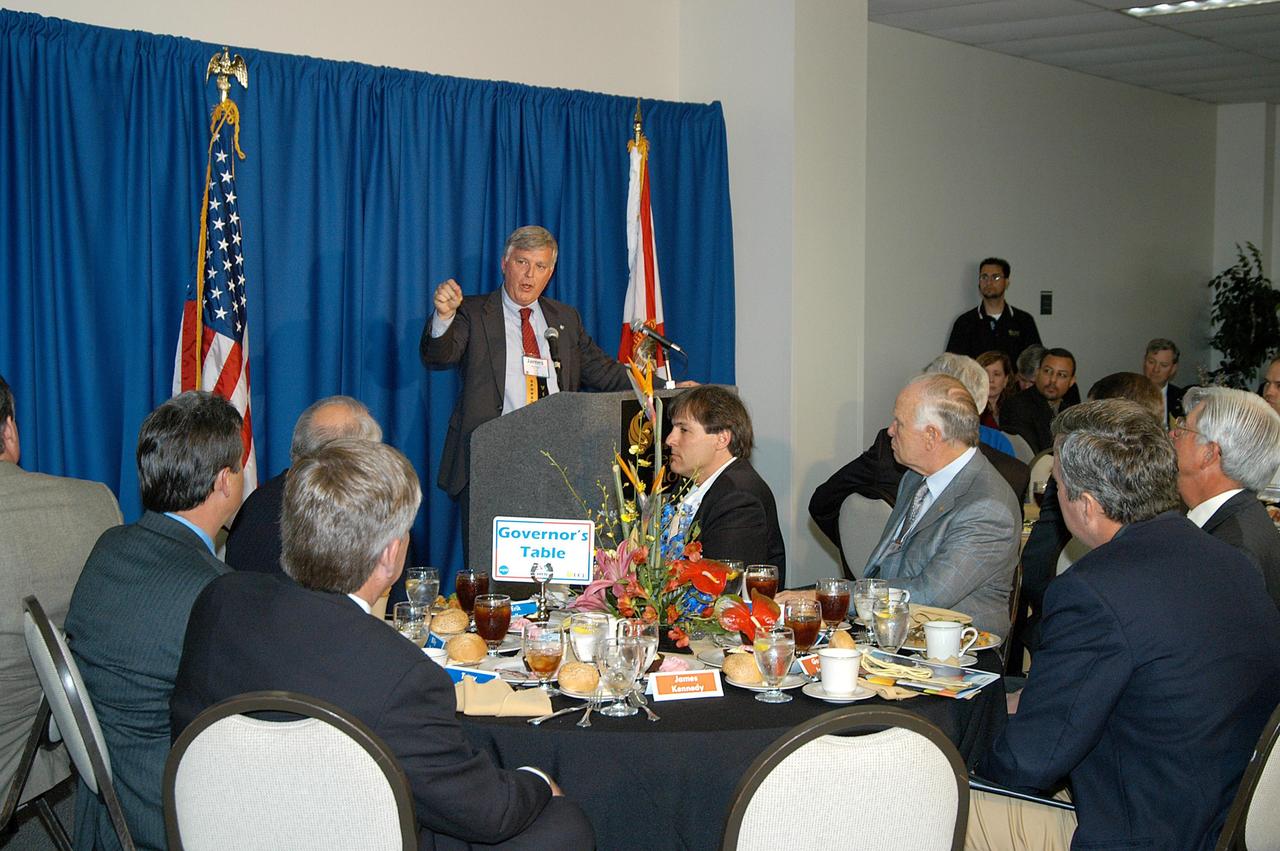
KENNEDY SPACE CENTER, FLA. - During the luncheon held at the 2004 Florida Regional FIRST competition at the University of Central Florida, Center Director Jim Kennedy praises the teamwork of the students involved. The event hosted 41 teams from Canada, Brazil, Great Britain and the United States. Florida Gov. Jeb Bush also spoke at the luncheon. FIRST is a nonprofit organization, For Inspiration and Recognition of Science and Technology, that sponsors the event pitting gladiator robots against each other in an athletic-style competition. The FIRST robotics competition is designed to provide students with a hands-on, inside look at engineering and other professional careers, pairing high school students with engineer mentors and corporations.

Kennedy Space Center Deputy Director Janet Petro speaks to students during a Women in STEM mentoring breakfast inside the Debus Conference Center at the Kennedy Space Center Visitor Complex in Florida. STEM is science, technology, engineering and math. The special event gave students competing in NASA's 8th Annual Robotic Mining Competition the chance to learn from female NASA scientists, engineers and professionals about their careers and the paths they took to working at Kennedy. The Robotic Mining Competition is a NASA Human Exploration and Operations Mission Directorate project designed to encourage students in STEM fields. The project provides a competitive environment to foster innovative ideas and solutions that could be used on NASA's Journey to Mars.

Gioia Massa, at left, a NASA payload scientist, talks to students during a Women in STEM breakfast inside the Debus Conference Center at the Kennedy Space Center Visitor Complex in Florida. STEM is science, technology, engineering and math. The special event gave students competing in NASA's 8th Annual Robotic Mining Competition the chance to learn from female NASA scientists, engineers and professionals about their careers and the paths they took to working at Kennedy. The Robotic Mining Competition is a NASA Human Exploration and Operations Mission Directorate project designed to encourage students in STEM fields. The project provides a competitive environment to foster innovative ideas and solutions that could be used on NASA's Journey to Mars.
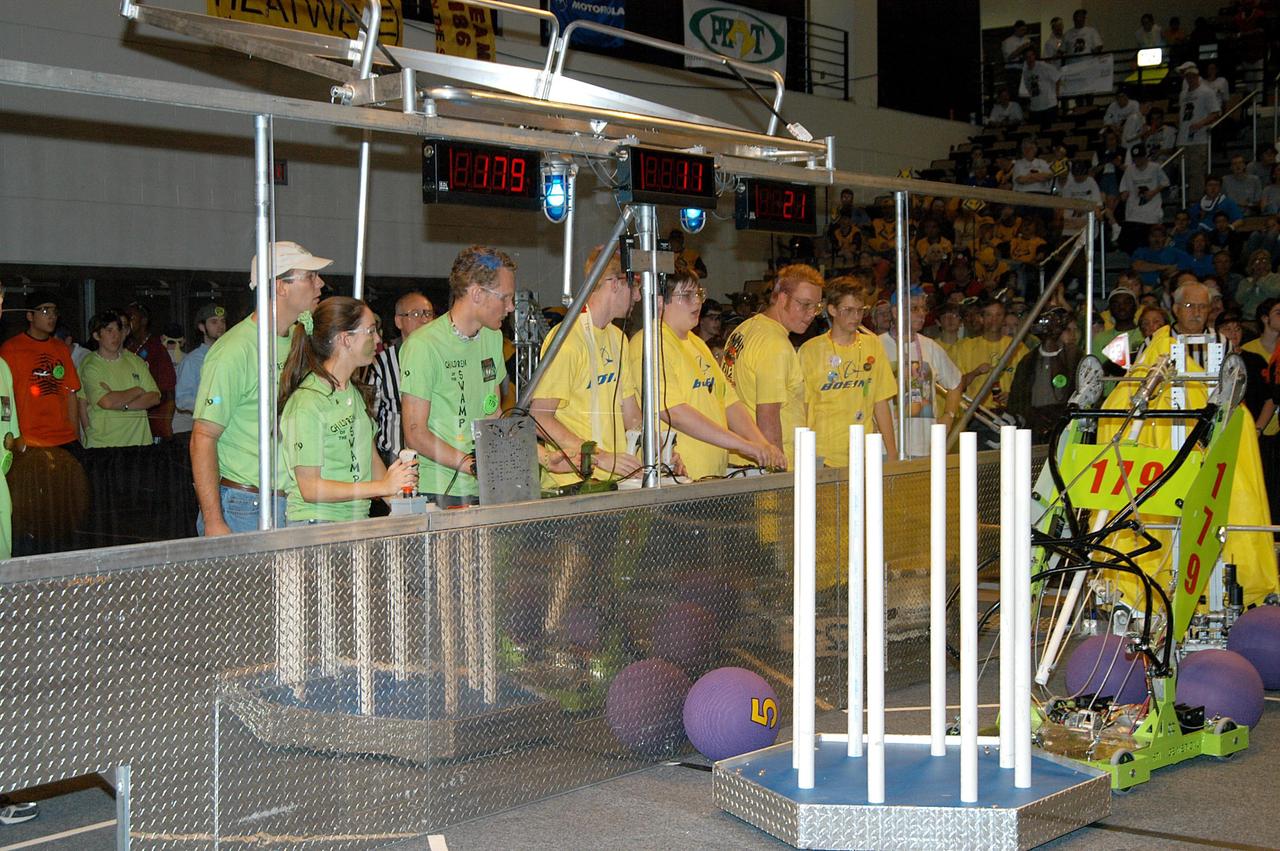
KENNEDY SPACE CENTER, FLA. - Two student teams vie for points during a match at the 2004 Florida Regional FIRST competition, held at the University of Central Florida. The annual event is hosting 41 teams from Canada, Brazil, Great Britain and the United States. FIRST is a nonprofit organization, For Inspiration and Recognition of Science and Technology, that sponsors the event pitting robots against each other in an athletic-style competition. The FIRST robotics competition is designed to provide students with a hands-on, inside look at engineering and other professional careers, pairing high school students with engineer mentors and corporations.
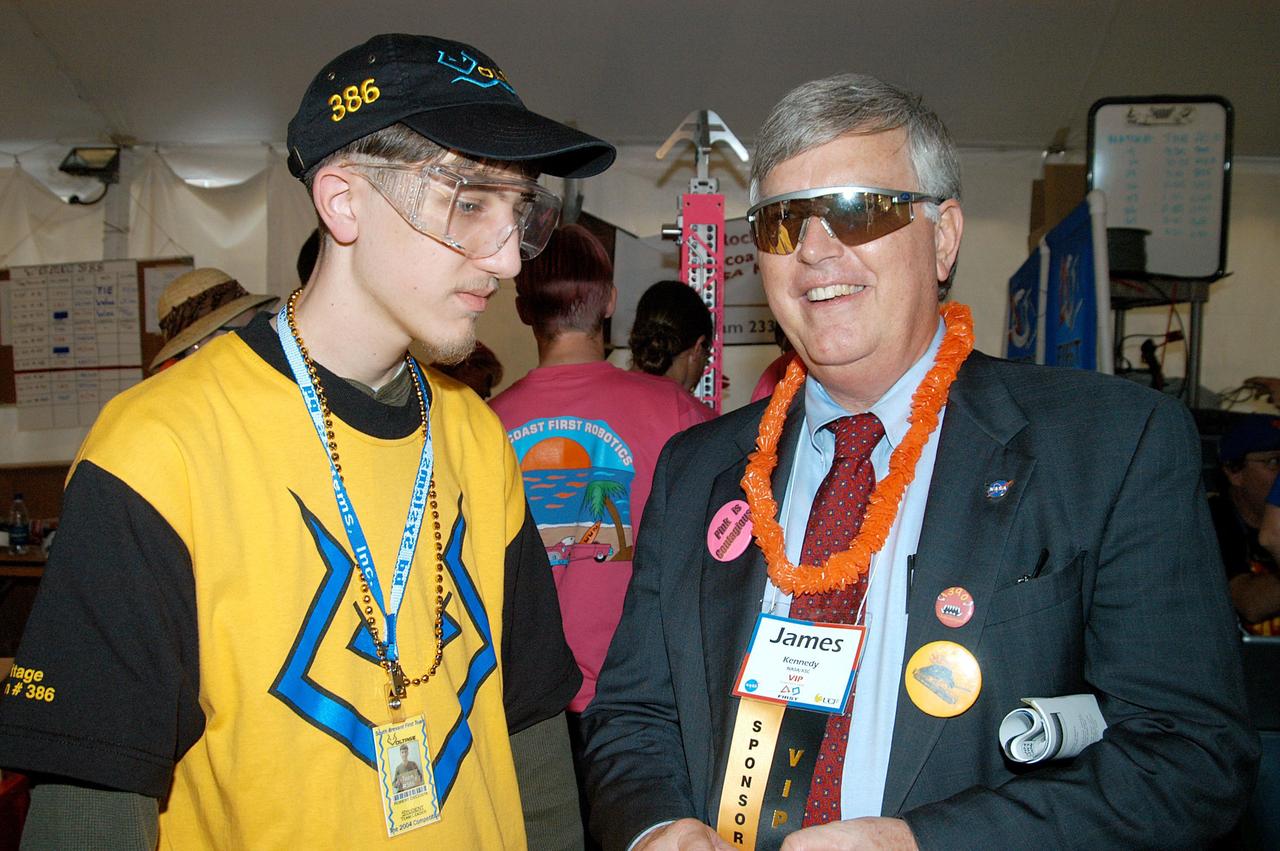
KENNEDY SPACE CENTER, FLA. - Center Director Jim Kennedy talks with a student team member at the 2004 Florida Regional FIRST competition, held at the University of Central Florida. The annual event is hosting 41 teams from Canada, Brazil, Great Britain and the United States. FIRST is a nonprofit organization, For Inspiration and Recognition of Science and Technology, that sponsors the event pitting robots against each other in an athletic-style competition. The FIRST robotics competition is designed to provide students with a hands-on, inside look at engineering and other professional careers, pairing high school students with engineer mentors and corporations.
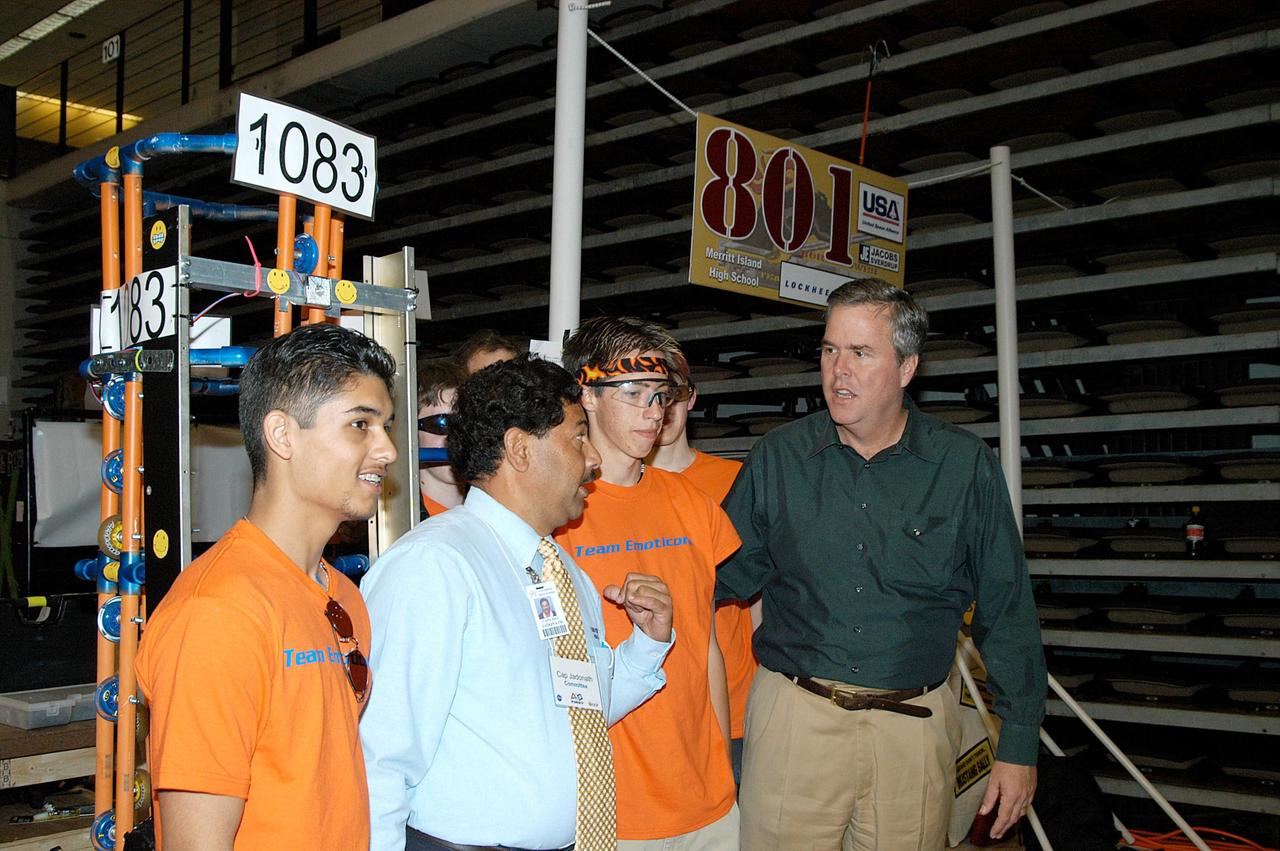
KENNEDY SPACE CENTER, FLA. - Florida Gov. Jeb Bush talks to students competing with their robot at the 2004 Florida Regional FIRST competition, held at the University of Central Florida. Bush and Center Director Jim Kennedy were among observers at the annual event that hosted 41 teams from Canada, Brazil, Great Britain and the United States. FIRST is a nonprofit organization, For Inspiration and Recognition of Science and Technology, that sponsors the event pitting gladiator robots against each other in an athletic-style competition. The FIRST robotics competition is designed to provide students with a hands-on, inside look at engineering and other professional careers, pairing high school students with engineer mentors and corporations.
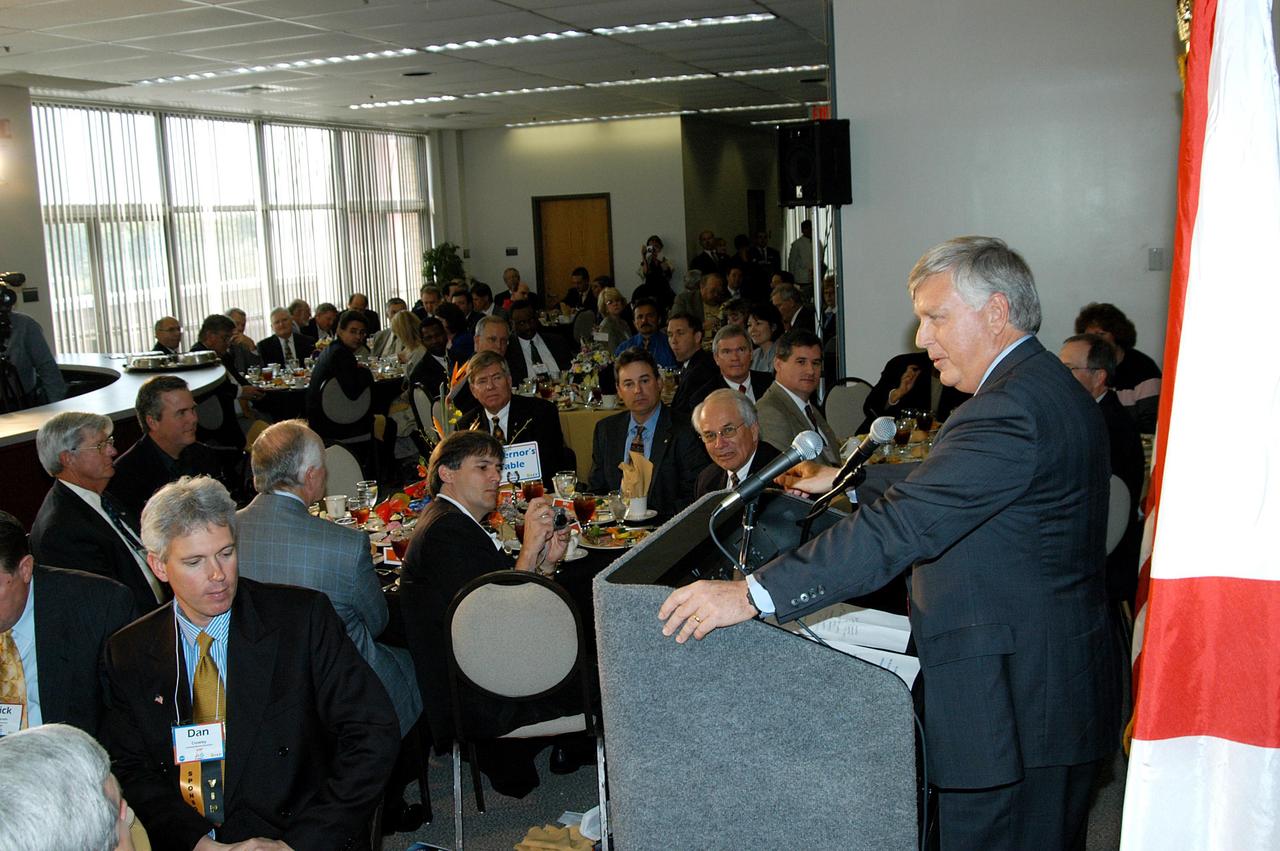
KENNEDY SPACE CENTER, FLA. - During the luncheon held at the 2004 Florida Regional FIRST competition at the University of Central Florida, Center Director Jim Kennedy praises the teamwork of the students involved. The event hosted 41 teams from Canada, Brazil, Great Britain and the United States. Florida Gov. Jeb Bush also spoke at the luncheon. FIRST is a nonprofit organization, For Inspiration and Recognition of Science and Technology, that sponsors the event pitting gladiator robots against each other in an athletic-style competition. The FIRST robotics competition is designed to provide students with a hands-on, inside look at engineering and other professional careers, pairing high school students with engineer mentors and corporations.