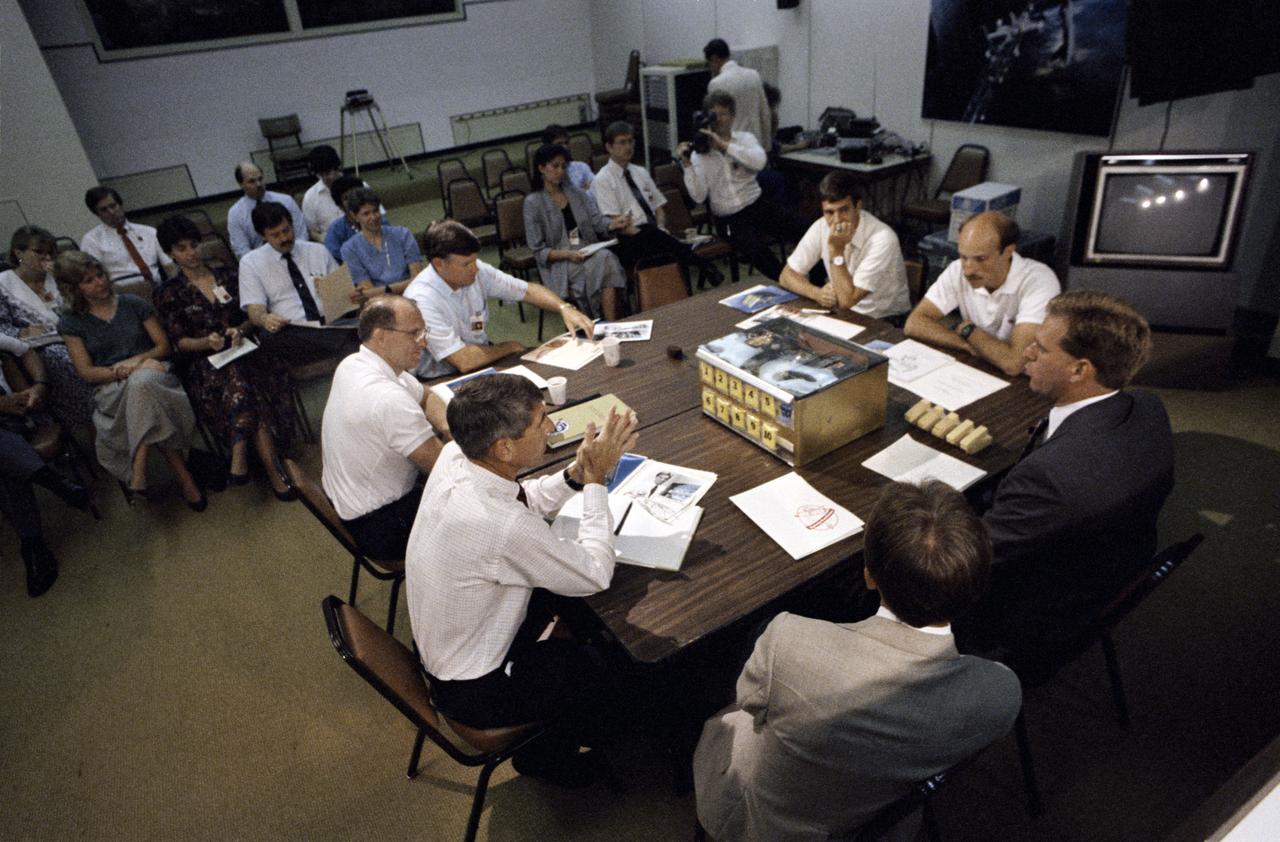
S88-44517 (13 Aug 1988) --- Student experimenter John C. Vellinger, right, explains operation of an incubator used in his experiment to be carried onboard the Discovery for NASA's STS-29 mission next year. His primary audience is made up of STS-29's five-man crew, who will monitor in-space operation of the experiment, titled "Chicken Embryo Development in Space." Kentucky Fried Chicken.
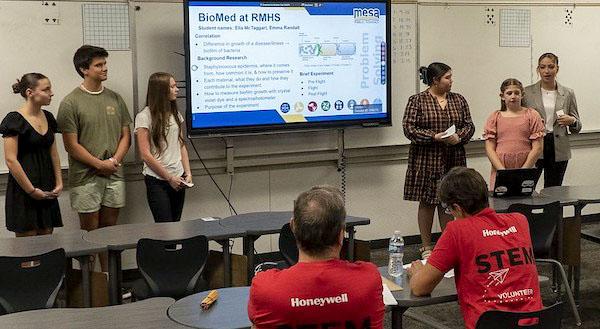
jsc2024e066518 (11/1/2023) --- Mesa Publc School students work together presenting their critical design review to their industry partners Honeywell Aerospace Technologies in their successful bid to be a finalist for the Nanoracks-National Center for Earth and Space Science Education-Surveyor-Student Spaceflight Experiments Program Mission 18 to ISS (Nanoracks-NCESSE-Surveyor-SSEP). Their experiment is The Growth and Mutation of Staphylococcus epidermidis Biofilm in Microgravity.
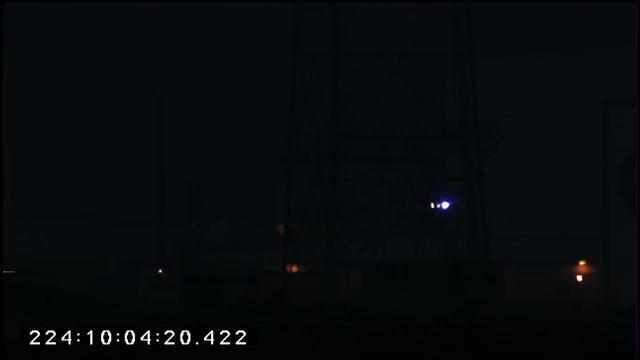
NASA launched a Terrier-Improved Malemute suborbital sounding rocket carrying the RockSat-X payload with university and community college student experiments at 6:04 a.m. EDT Wednesday, Aug. 12, from NASA’s Wallops Flight Facilityin Virginia. More than 60 students and instructors from across the continental United States, Hawaii and Puerto Rico were on hand to witness the launch of their experiments. The payload flew to an altitude of about 97 miles and descended via parachute into the Atlantic Ocean off the coast of Wallops. Payload recovery operations began after lift-off. Developed by students from seven higher education programs, the experiments flew through the RockSat-X program in conjunction with the Colorado Space Grant Consortium. Participating institutions in this flight are the University of Colorado, Boulder; Northwest Nazarene University, Nampa, Idaho; the University of Puerto Rico; the University of Nebraska, Lincoln; Virginia Tech University, Blacksburg; Capitol Technology University, Laurel, Maryland; and University of Hawai'i Community Colleges at the Honolulu, Kapi'olani, Kaua'i, and Windward campuses. The next launch scheduled from Wallops is a NASA Black Brant IX suborbital sounding rocket carrying several technology development instruments. The launch is scheduled between 7 and 7:41 p.m. Sept. 29. The backup launch days are Sept. 30 through Oct. 12. <b><a href="http://www.nasa.gov/audience/formedia/features/MP_Photo_Guidelines.html" rel="nofollow">NASA image use policy.</a></b> <b><a href="http://www.nasa.gov/centers/goddard/home/index.html" rel="nofollow">NASA Goddard Space Flight Center</a></b> enables NASA’s mission through four scientific endeavors: Earth Science, Heliophysics, Solar System Exploration, and Astrophysics. Goddard plays a leading role in NASA’s accomplishments by contributing compelling scientific knowledge to advance the Agency’s mission. <b>Follow us on <a href="http://twitter.com/NASAGoddardPix" rel="nofollow">Twitter</a></b> <b>Like us on <a href="http://www.facebook.com/pages/Greenbelt-MD/NASA-Goddard/395013845897?ref=tsd" rel="nofollow">Facebook</a></b> <b>Find us on <a href="http://instagrid.me/nasagoddard/?vm=grid" rel="nofollow">Instagram</a></b>
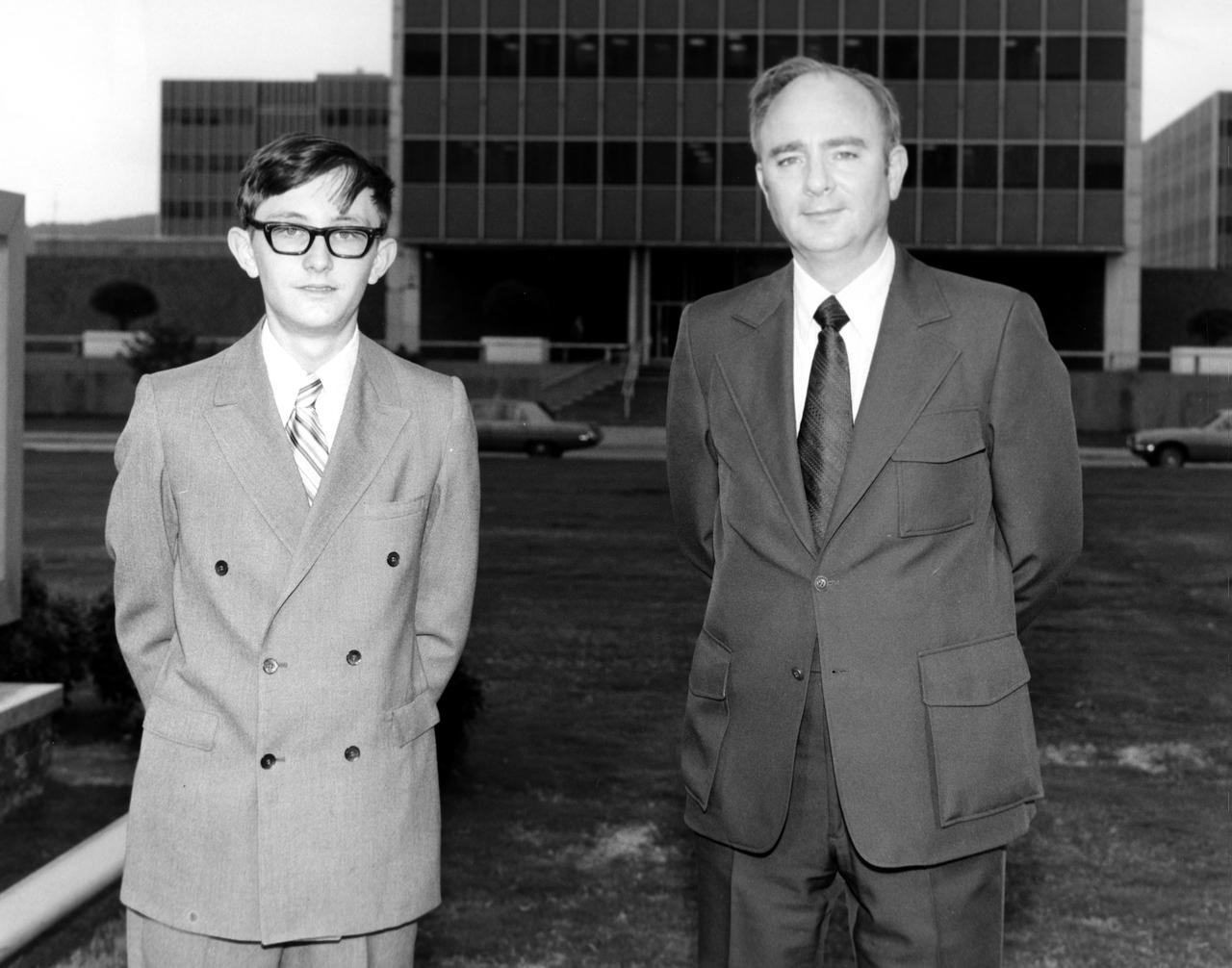
W. Brain Dunlap (left), high school student from Youngstown, Ohio, is pictured here with Harry Coons of the Marshall Space Flight Center (MSFC) during a visit to the center. Dunlap was among 25 winners of a contest in which some 3,500 high school students proposed experiments for the following year’s Skylab mission. The nationwide scientific competition was sponsored by the National Science Teachers Association and the National Aeronautics and Space Administration (NASA). The winning students, along with their parents and sponsor teachers, visited MSFC where they met with scientists and engineers, participated in design reviews for their experiments, and toured MSFC facilities. Of the 25 students, 6 did not see their experiments conducted on Skylab because the experiments were not compatible with Skylab hardware and timelines. Of the 19 remaining, 11 experiments required the manufacture of additional equipment.
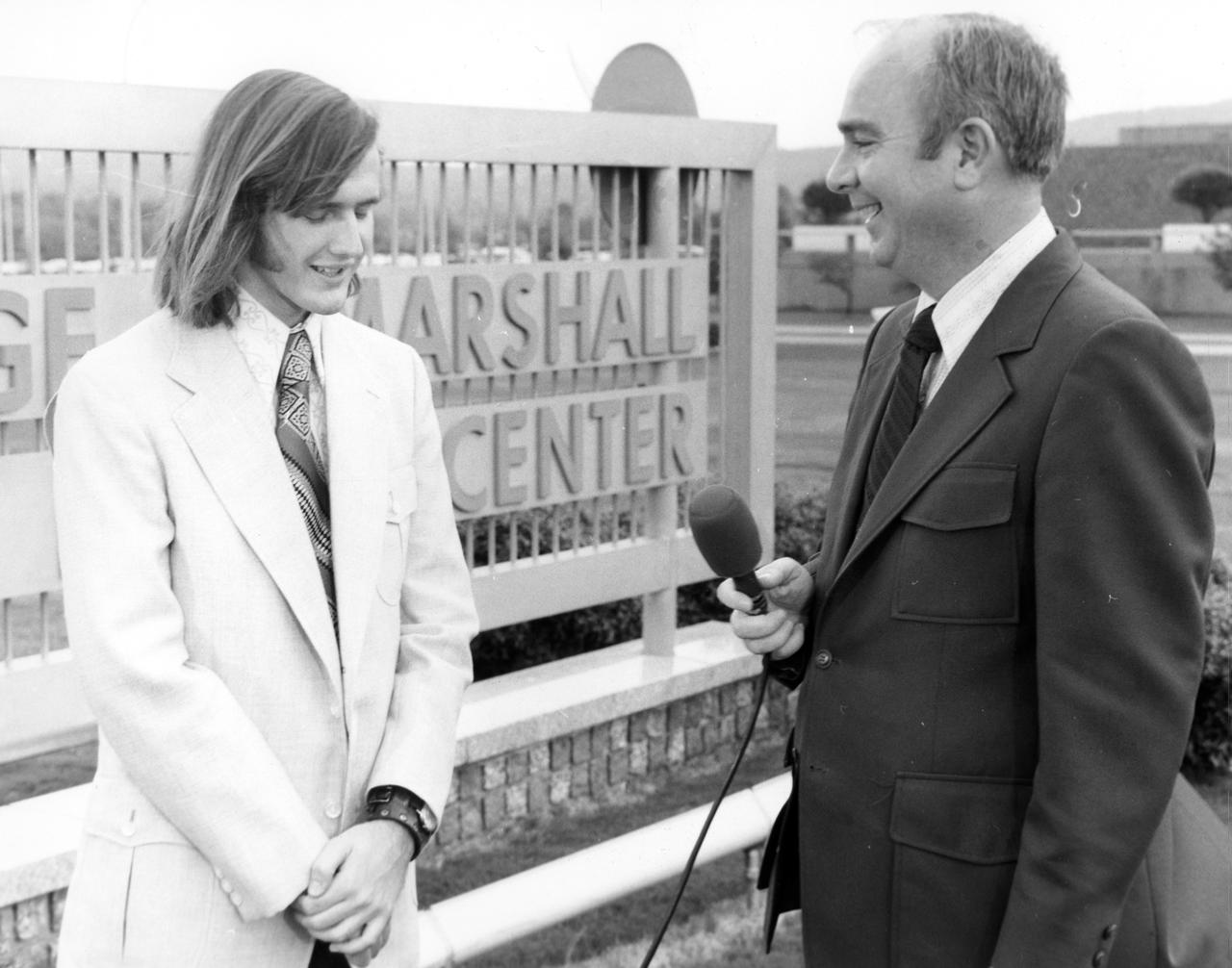
Gregory A. Merkel (left), high school student from Springfield, Massachusetts, is pictured here with Harry Coons of the Marshall Space Flight Center (MSFC) during a visit to the center. Merkel was among 25 winners of a contest in which some 3,500 high school students proposed experiments for the following year’s Skylab mission. The nationwide scientific competition was sponsored by the National Science Teachers Association and the National Aeronautics and Space Administration (NASA). The winning students, along with their parents and sponsor teachers, visited MSFC where they met with scientists and engineers, participated in design reviews for their experiments, and toured MSFC facilities. Of the 25 students, 6 did not see their experiments conducted on Skylab because the experiments were not compatible with Skylab hardware and timelines. Of the 19 remaining, 11 experiments required the manufacture of additional equipment.
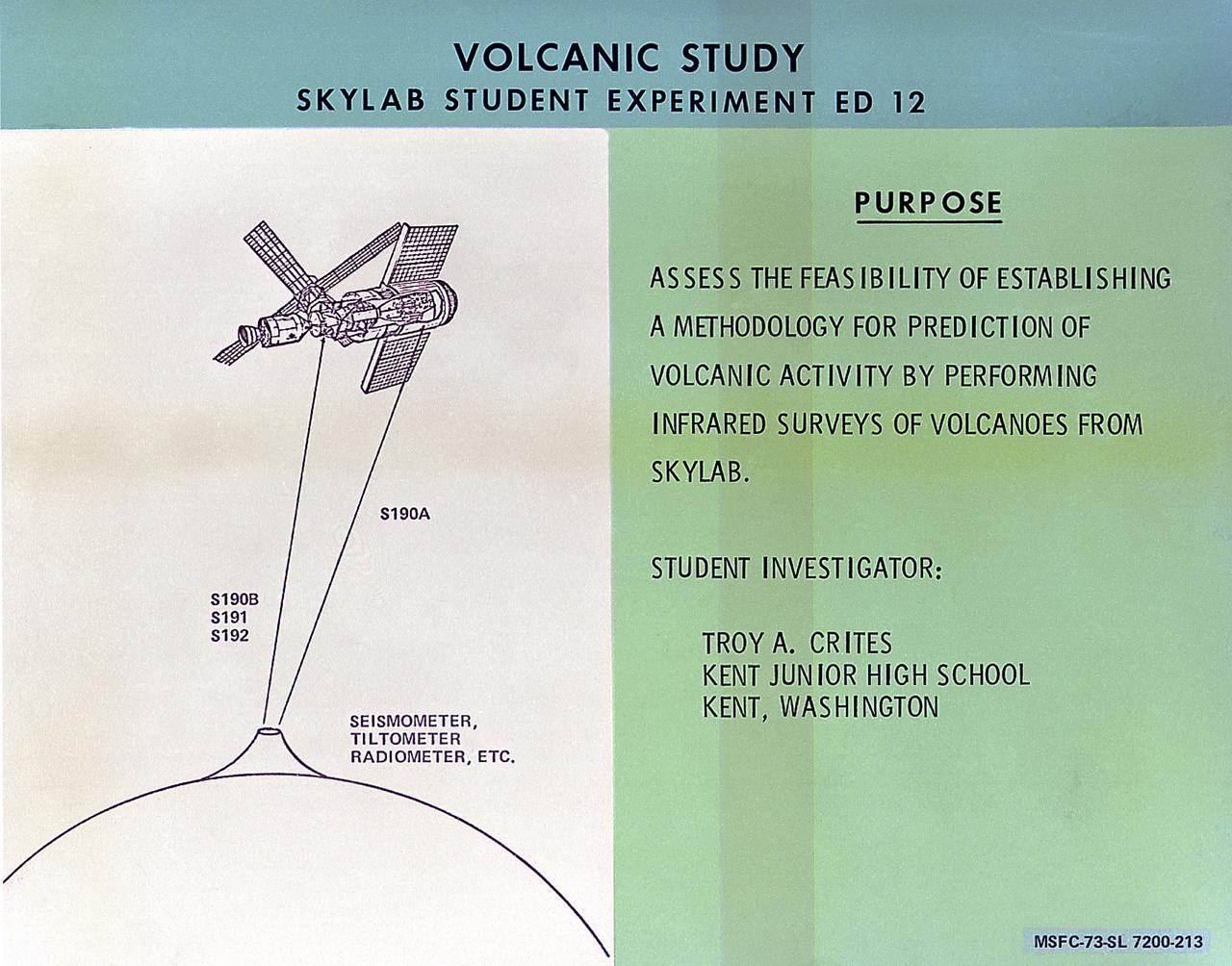
This chart describes the Skylab student experiment Volcanic Study, proposed by Troy A. Crites of Kent, Washington. This experiment utilized Skylab's Earth Resources Experiment sensors to determine if volcanic activity can be predicted using infrared surveys from orbit. In March 1972, NASA and the National Science Teachers Association selected 25 experiment proposals for flight on Skylab. Science advisors from the Marshall Space Flight Center aided and assisted the students in developing the proposals for flight on Skylab.
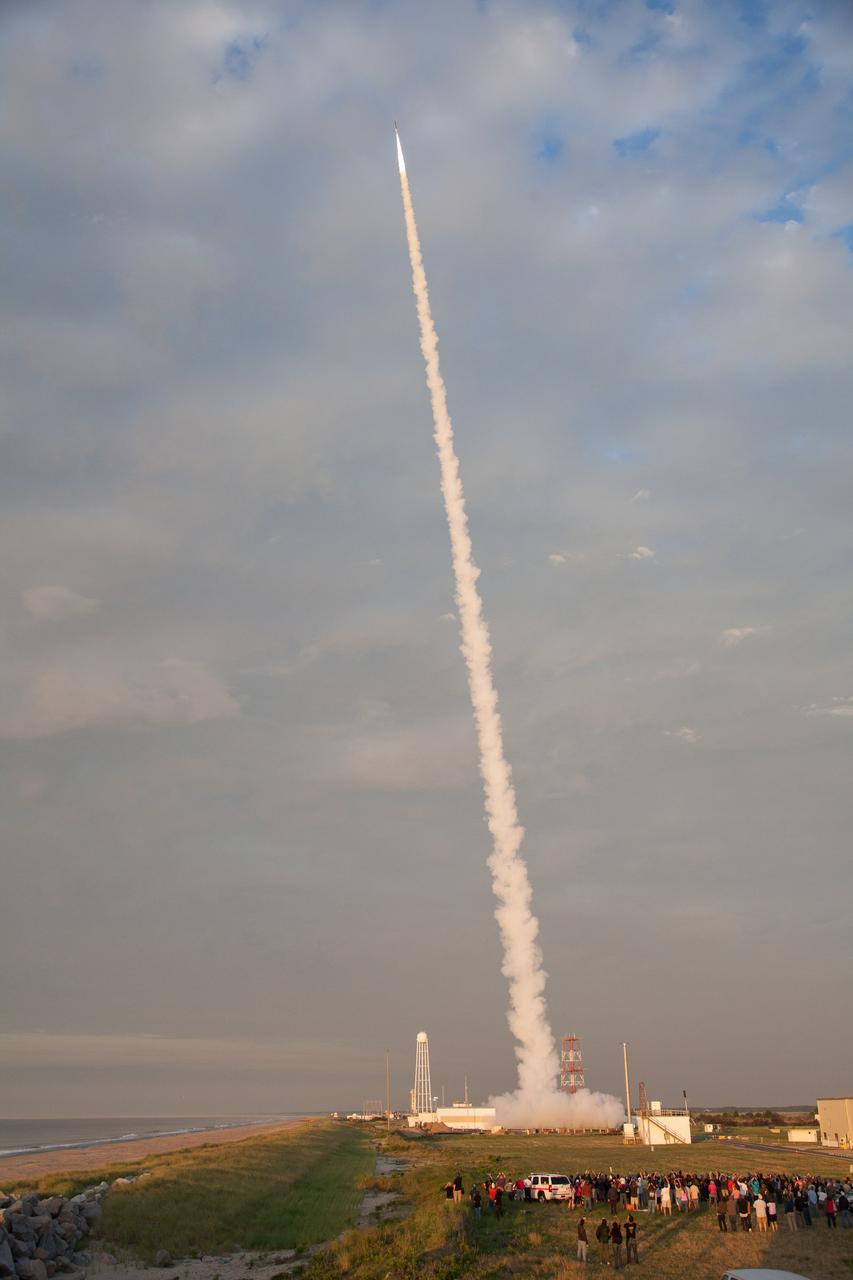
NASA successfully launched a NASA Terrier-Improved Orion suborbital sounding rocket carrying student experiments with the RockOn/RockSat-C programs at 6 a.m., today More than 200 middle school and university students and instructors participating in Rocket Week at Wallops were on hand to witness the launch. Through RockOn and RockSat-C students are learning and applying skills required to develop experiments for suborbital rocket flight. In addition, middle school educators through the Wallops Rocket Academy for Teachers (WRATS) are learning about applying rocketry basics in their curriculum. The payload flew to an altitude of 71.4 miles and descended by parachute into the Atlantic Ocean off the coast of Wallops. Payload recovery is in progress. The next launch from NASA’s Wallops Flight Facility is a Black Brant IX suborbital sounding rocket currently scheduled between 6 and 10 a.m., July 7. For more information on NASA’s Wallops Flight Facility, visit: <a href="http://www.nasa.gov/wallops" rel="nofollow">www.nasa.gov/wallops</a> <b><a href="http://www.nasa.gov/audience/formedia/features/MP_Photo_Guidelines.html" rel="nofollow">NASA image use policy.</a></b> <b><a href="http://www.nasa.gov/centers/goddard/home/index.html" rel="nofollow">NASA Goddard Space Flight Center</a></b> enables NASA’s mission through four scientific endeavors: Earth Science, Heliophysics, Solar System Exploration, and Astrophysics. Goddard plays a leading role in NASA’s accomplishments by contributing compelling scientific knowledge to advance the Agency’s mission. <b>Follow us on <a href="http://twitter.com/NASAGoddardPix" rel="nofollow">Twitter</a></b> <b>Like us on <a href="http://www.facebook.com/pages/Greenbelt-MD/NASA-Goddard/395013845897?ref=tsd" rel="nofollow">Facebook</a></b> <b>Find us on <a href="http://instagrid.me/nasagoddard/?vm=grid" rel="nofollow">Instagram</a></b>

This chart describes the Skylab student experiment Ultraviolet (UV) from Quasars, proposed by John C. Hamilton of Aiea, Hawaii. This experiment utilized Skylab's Ultraviolet Stellar Astronomy equipment to photograph quasars in the UV spectrum and compare those images to existing radio and visible data. In March 1972 NASA and the National Science Teachers Association selected 25 experiment proposals for flight on Skylab. Science advisors from the Marshall Space Flight Center aided and assisted the students in developing the proposals for flight on Skylab.
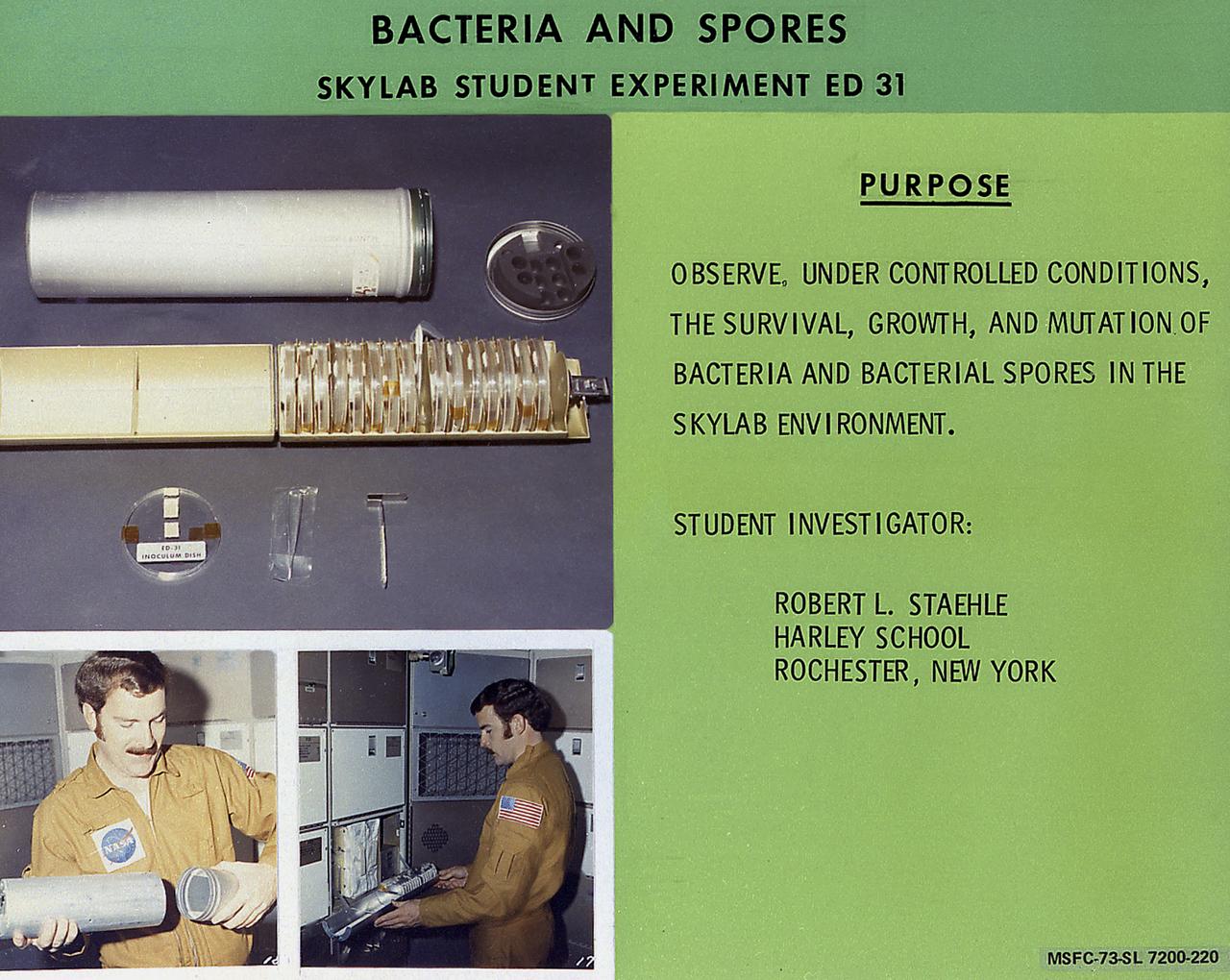
This chart describes the Skylab student experiment Bacteria and Spores, proposed by Robert L. Staehle of Rochester, New York. This experiment was intended to determine the effect of the Skylab environment (particularly weightlessness) on the survival, growth rates, and mutations of certain bacteria and spores. In March 1972, NASA and the National Science Teachers Association selected 25 experiment proposals for flight on Skylab. Science advisors from the Marshall Space Flight Center aided and assisted the students in developing the proposals for flight on Skylab.
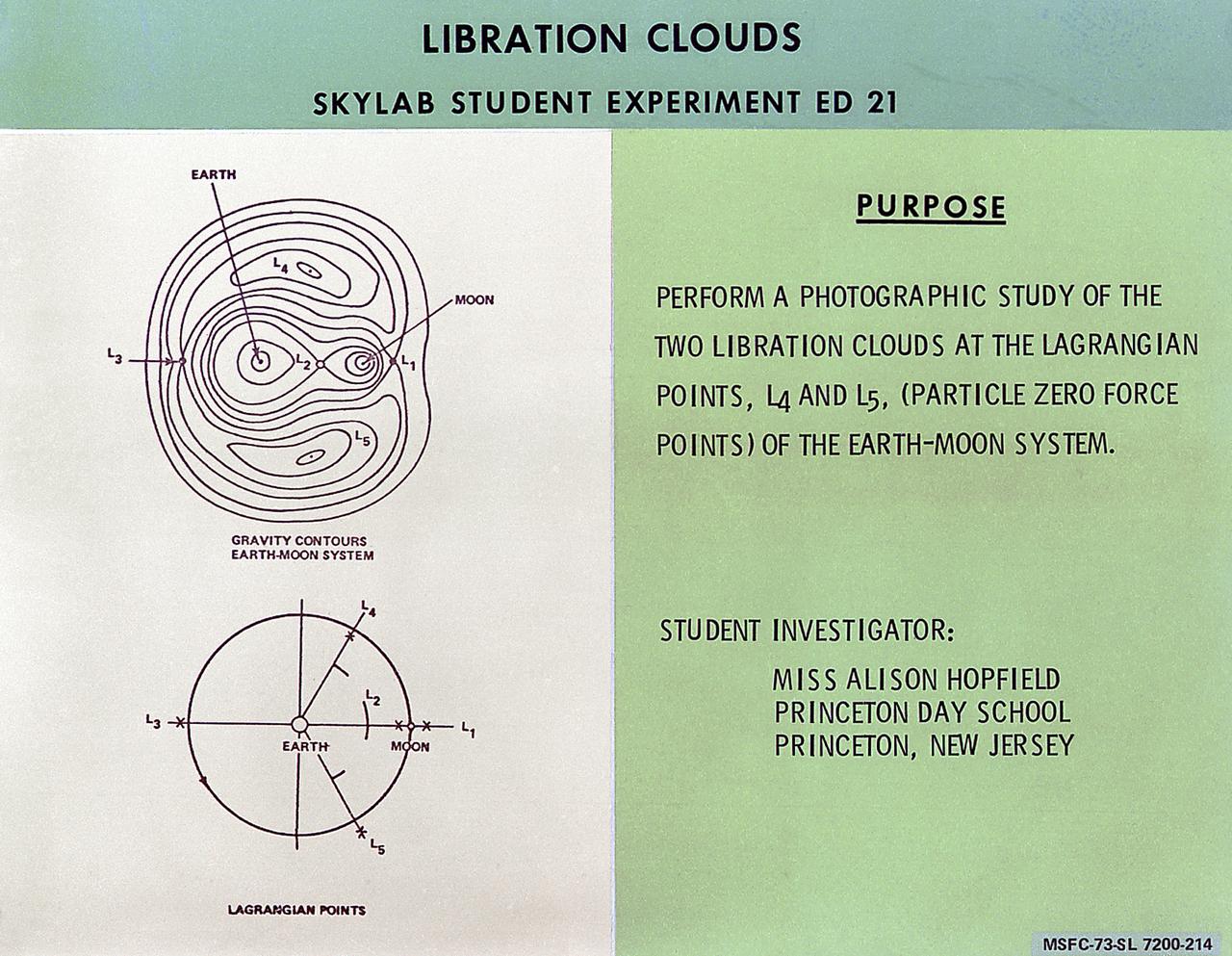
This chart describes the Skylab student experiment Libration Clouds, proposed by Alison Hopfield of Princeton, New Jersey. This experiment utilized Skylab's astronomical telescopes to observe the two zero-force regions (Lagrangian points) within the Earth-Moon System in which small space particles were expected to accumulate. In March 1972, NASA and the National Science Teachers Association selected 25 experiment proposals for flight on Skylab. Science advisors from the Marshall Space Flight Center aided and assisted the students in developing the proposals for flight on Skylab.
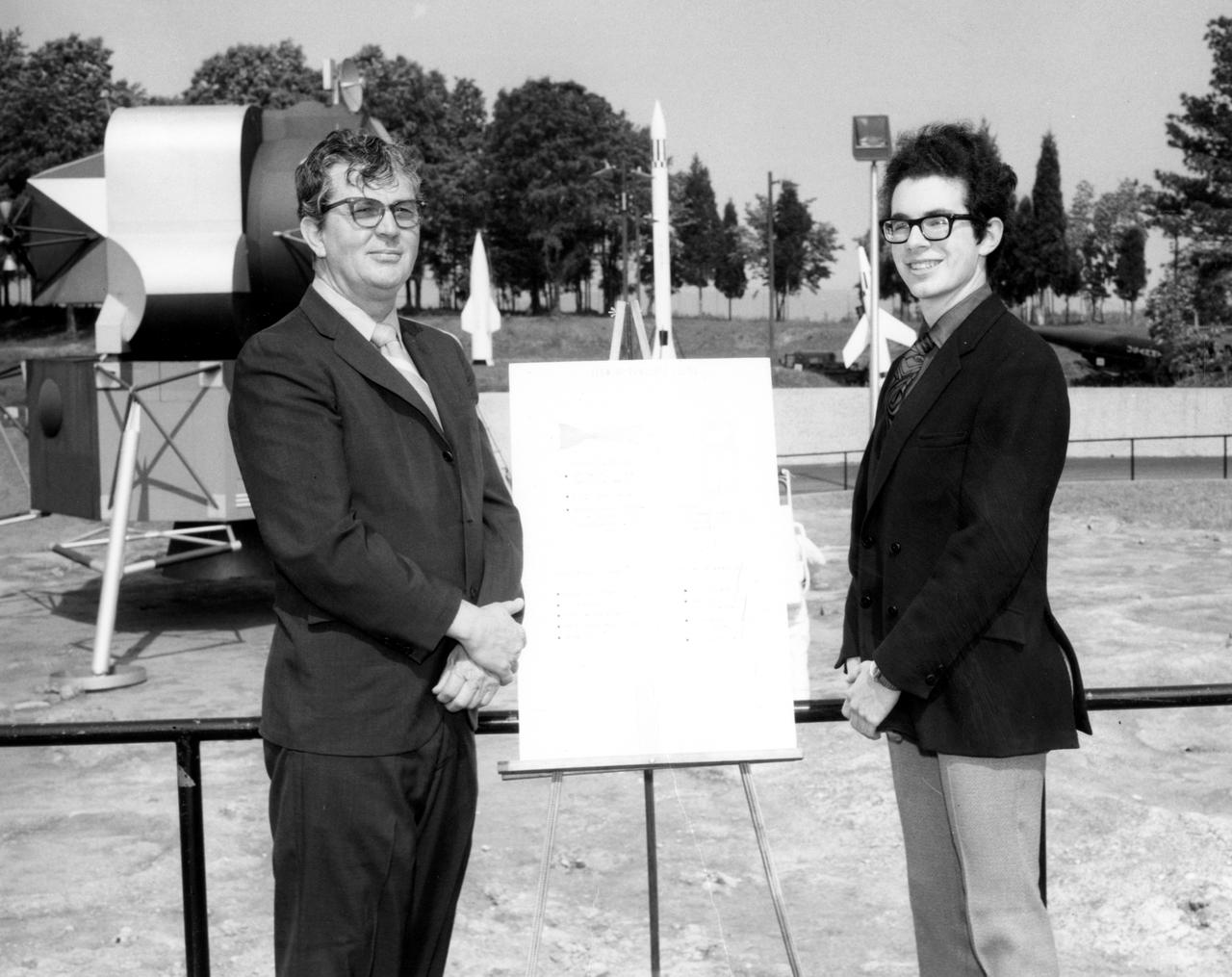
Kirk M. Sherhart, high school student from Berkley, Michigan, discussed a his proposed Skylab experiment with Dr. Robert Head of the Marshall Space Flight Center (MSFC) during his visit to the center. The lunar surface scene in the background is one of many space exhibits at the Alabama Space and Rocket Center in nearby Huntsville, Alabama. Sherhart was among 25 winners of a contest in which some 3,500 high school students proposed experiments for the following year’s Skylab mission. The nationwide scientific competition was sponsored by the National Science Teachers Association and the National Aeronautics and Space Administration (NASA). The winning students, along with their parents and sponsor teachers, visited MSFC where they met with scientists and engineers, participated in design reviews for their experiments, and toured MSFC facilities. Of the 25 students, 6 did not see their experiments conducted on Skylab because the experiments were not compatible with Skylab hardware and timelines. Of the 19 remaining, 11 experiments required the manufacture of additional equipment.
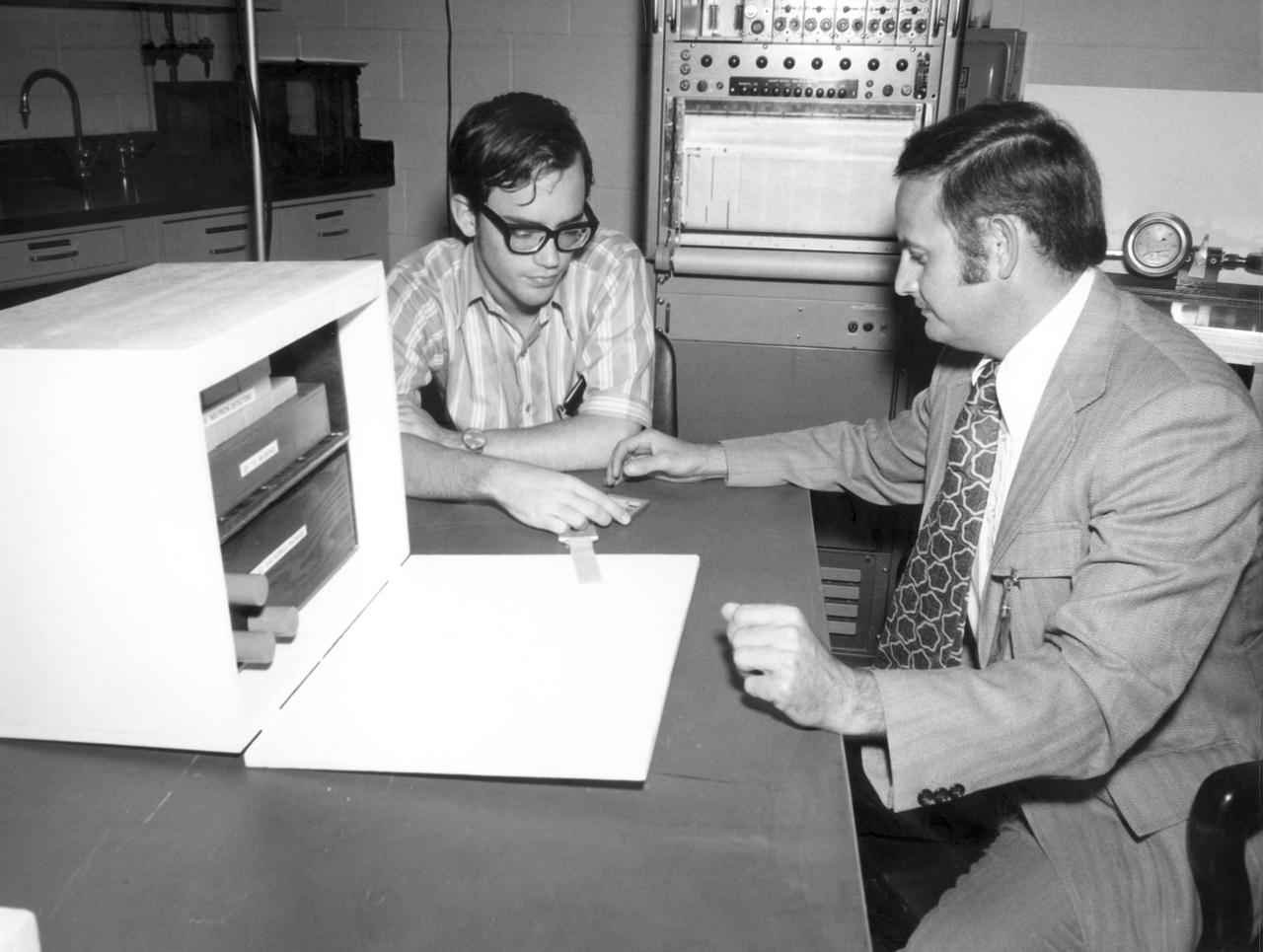
San Antonio, Texas high school student, Terry C. Quist (left), and Dr. Raymond Gause of the Marshall Space Flight Center (MSFC), discuss the student’s experiment to be performed aboard the Skylab the following year. His experiment, “Earth Orbital Neutron Analysis” required detectors such as the one he is examining in this photo. The detector was to be attached to a water tank in Skylab. Neutrons striking the detectors left traces that were brought out by a chemical etching process after the Skylab mission. Quist’s experiment seeked to record neutron hits, count them, and determine their direction. This information was to help determine the source of neutrons in the solar system. Quist was among 25 winners of a contest in which some 3,500 high school students proposed experiments for the following year’s Skylab mission. The nationwide scientific competition was sponsored by the National Science Teachers Association and the National Aeronautics and Space Administration (NASA). The winning students, along with their parents and sponsor teachers, visited MSFC two months earlier where they met with scientists and engineers, participated in design reviews for their experiments, and toured MSFC facilities. Of the 25 students, 6 did not see their experiments conducted on Skylab because the experiments were not compatible with Skylab hardware and timelines. Of the 19 remaining, 11 experiments required the manufacture of additional equipment. The equipment for the experiments was manufactured at MSFC.
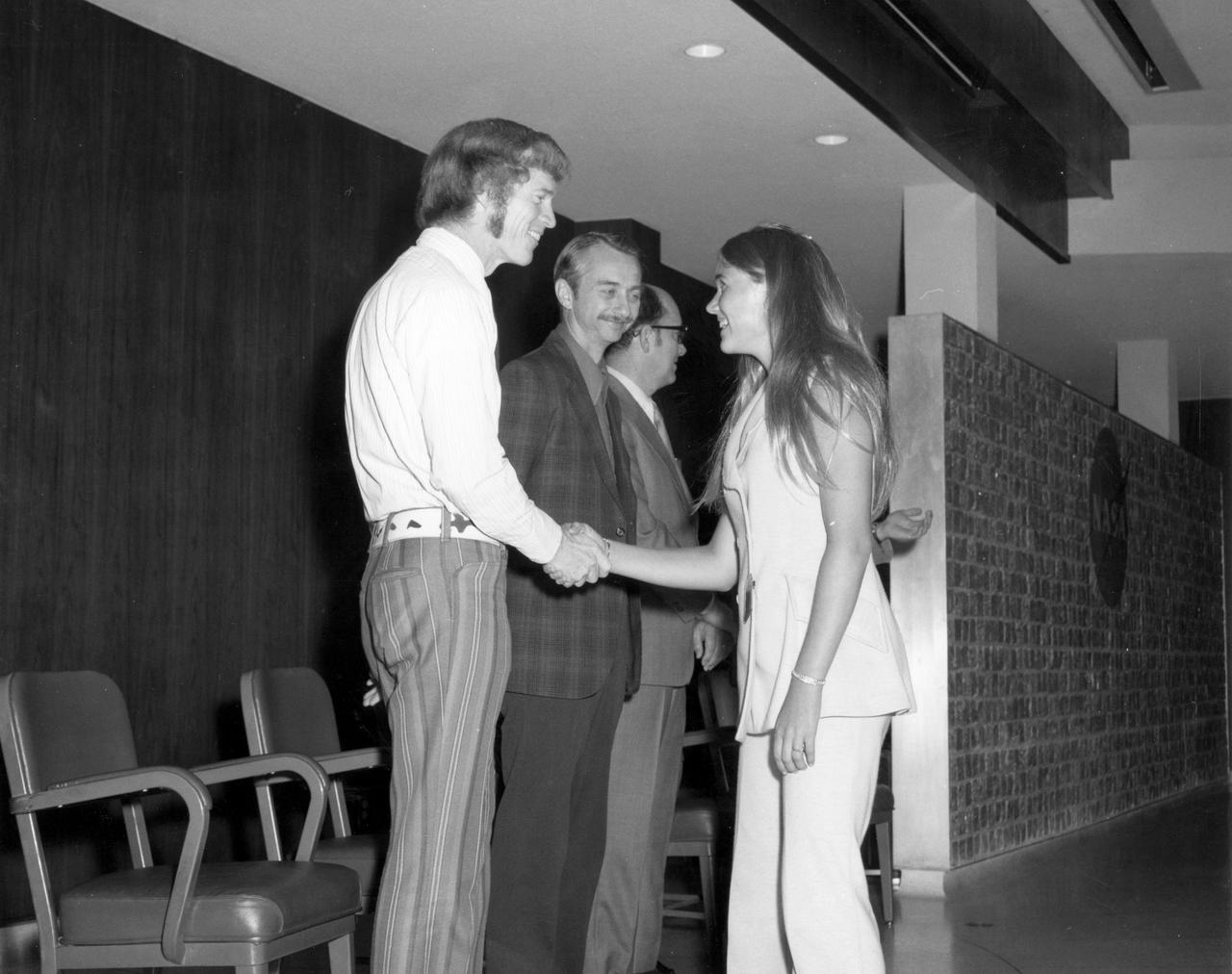
Houston, Texas high school student, Kathy L. Jackson, is greeted by astronauts Russell L. Schweickart (left) and Owen K. Garriott (center), and Marshall Space Flight Center (MSFC) Skylab Program Manager, Leland Belew during a tour of the Marshall Space Flight Center (MSFC). Jackson was among 25 winners of a contest in which some 3,500 high school students proposed experiments for the following year’s Skylab mission. The nationwide scientific competition was sponsored by the National Science Teachers Association and the National Aeronautics and Space Administration (NASA). The winning students, along with their parents and sponsor teachers, visited MSFC where they met with scientists and engineers, participated in design reviews for their experiments, and toured MSFC facilities. Of the 25 students, 6 did not see their experiments conducted on Skylab because the experiments were not compatible with Skylab hardware and timelines. Of the 19 remaining, 11 experiments required the manufacture of additional equipment.
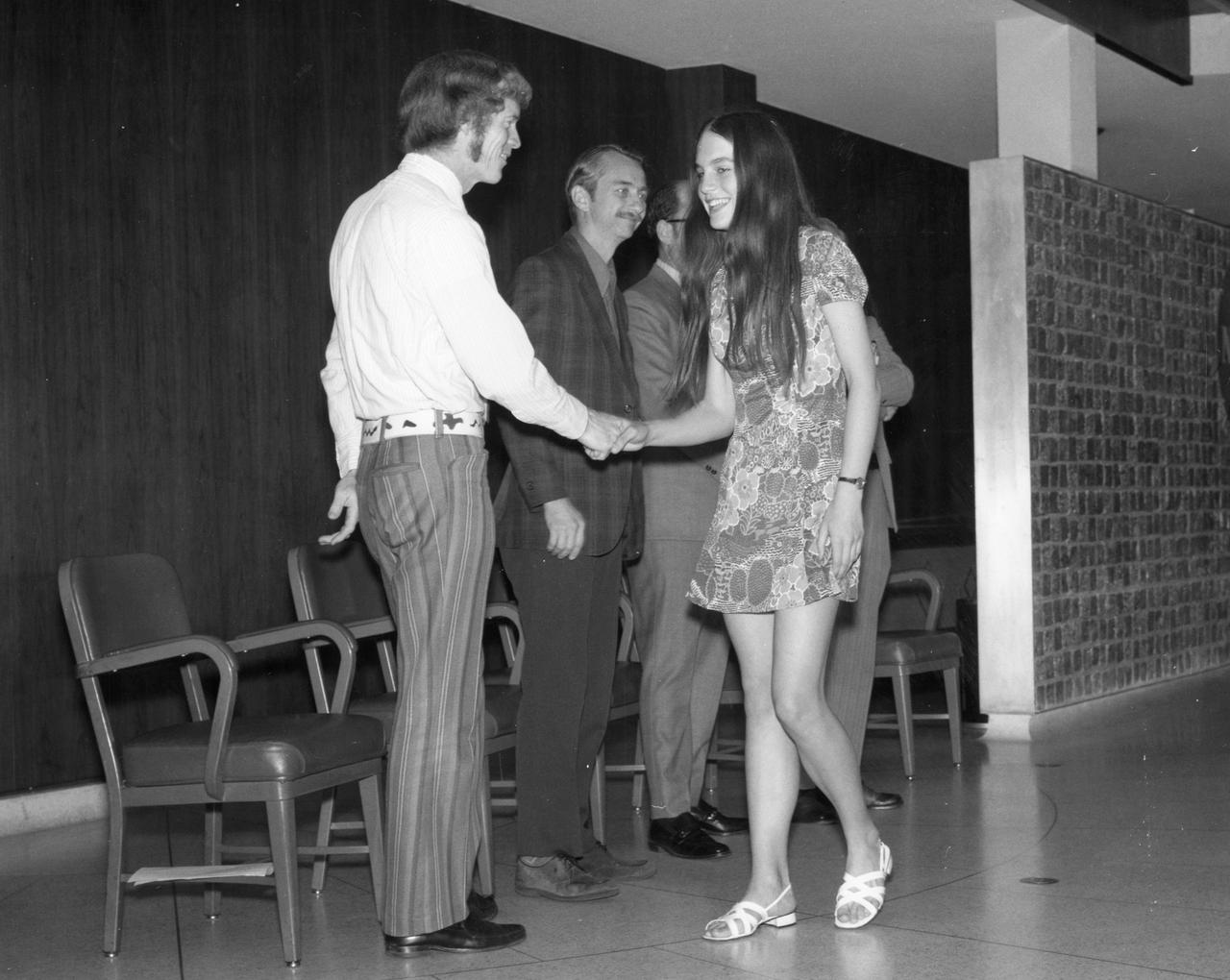
Princeton, New Jersey high school student, Alison Hopfield, is greeted by astronauts Russell L. Schweickart (left) and Owen K. Garriott (center) during a tour of the Marshall Space Flight Center (MSFC). Hopfield was among 25 winners of a contest in which some 3,500 high school students proposed experiments for the following year’s Skylab mission. The nationwide scientific competition was sponsored by the National Science Teachers Association and the National Aeronautics and Space Administration (NASA). The winning students, along with their parents and sponsor teachers, visited MSFC where they met with scientists and engineers, participated in design reviews for their experiments, and toured MSFC facilities. Of the 25 students, 6 did not see their experiments conducted on Skylab because the experiments were not compatible with Skylab hardware and timelines. Of the 19 remaining, 11 experiments required the manufacture of additional equipment.
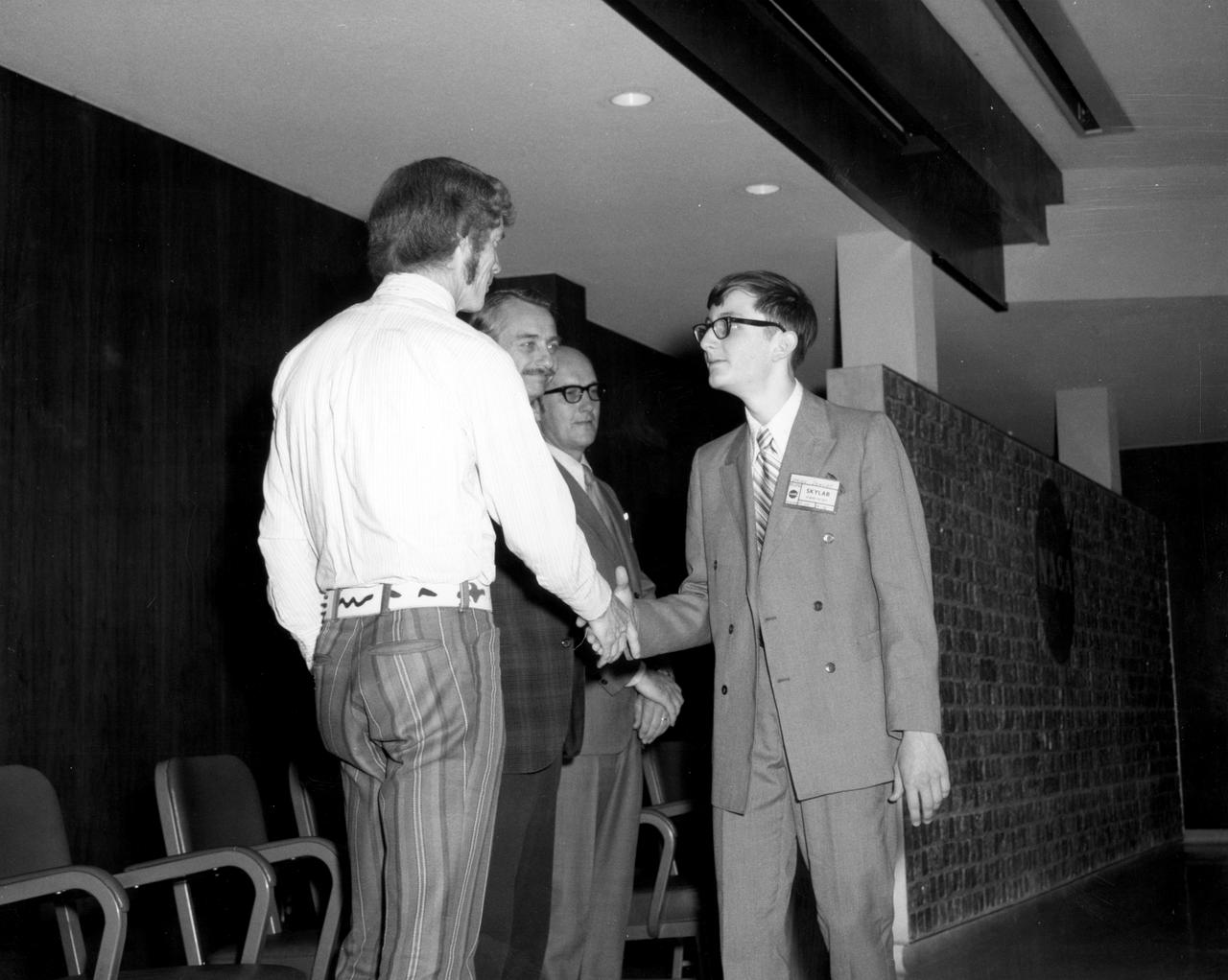
Youngstown, Ohio high school student, W. Brian Dunlap, is greeted by (left to right): Astronauts Russell L. Schweickart, and Owen K. Garriott; Marshall Space Flight Center (MSFC) Skylab Program Manager, Leland Belew; and MSFC Director of Administration and Technical Services, David Newby, during a tour of MSFC. Dunlap was among 25 winners of a contest in which some 3,500 high school students proposed experiments for the following year’s Skylab mission. The nationwide scientific competition was sponsored by the National Science Teachers Association and the National Aeronautics and Space Administration (NASA). The winning students, along with their parents and sponsor teachers, visited MSFC where they met with scientists and engineers, participated in design reviews for their experiments, and toured MSFC facilities. Of the 25 students, 6 did not see their experiments conducted on Skylab because the experiments were not compatible with Skylab hardware and timelines. Of the 19 remaining, 11 experiments required the manufacture of additional equipment.
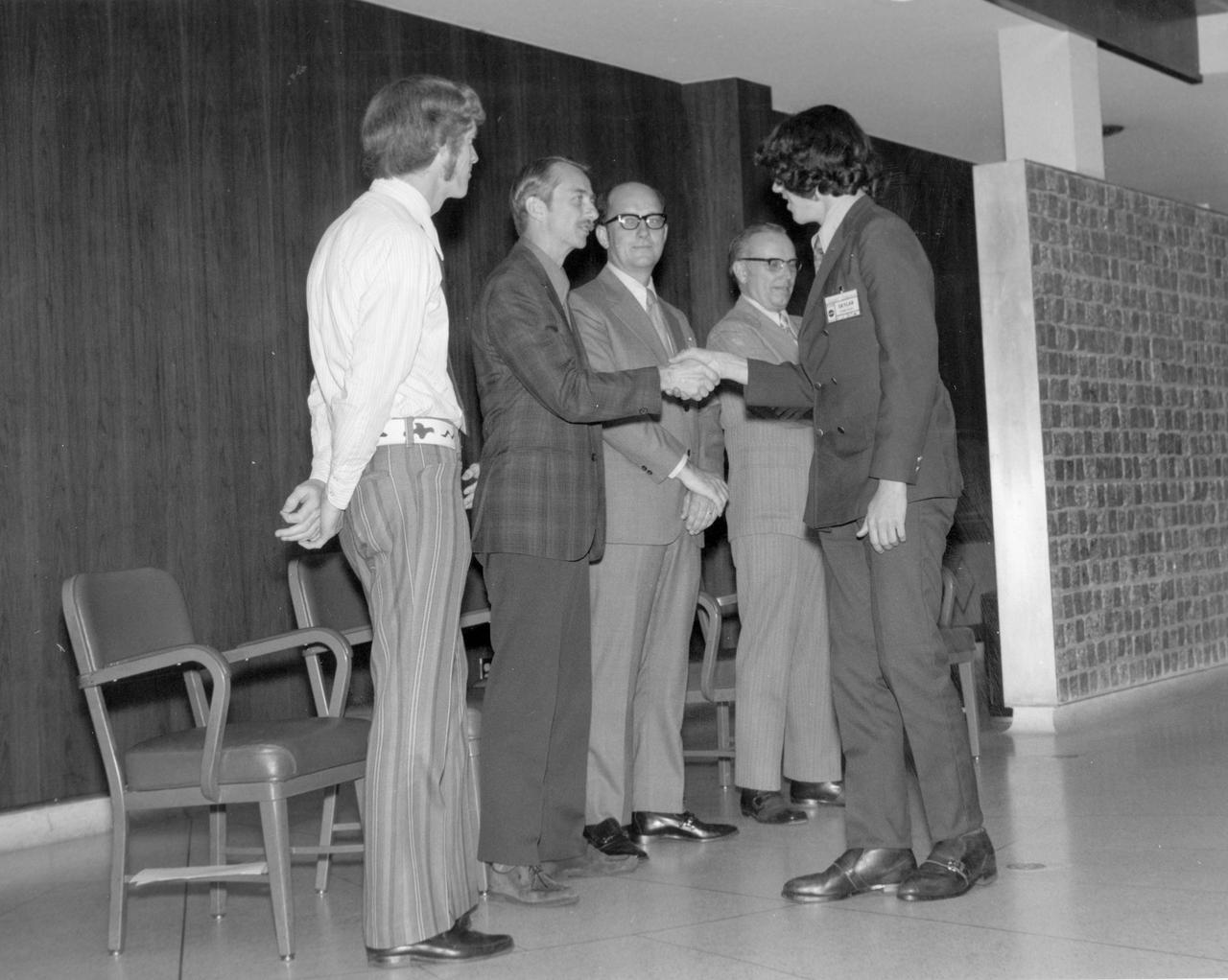
North Rochester, New York high school student, Robert L. Staehle, is greeted by (left to right): Astronauts Russell L. Schweickart, and Owen K. Garriott; Marshall Space Flight Center (MSFC) Skylab Program Manager, Leland Belew; and MSFC Director of Administration and Technical Services, David Newby, during a tour of MSFC. Staehle was among 25 winners of a contest in which some 3,500 high school students proposed experiments for the following year’s Skylab mission. The nationwide scientific competition was sponsored by the National Science Teachers Association and the National Aeronautics and Space Administration (NASA). The winning students, along with their parents and sponsor teachers, visited MSFC where they met with scientists and engineers, participated in design reviews for their experiments, and toured MSFC facilities. Of the 25 students, 6 did not see their experiments conducted on Skylab because the experiments were not compatible with Skylab hardware and timelines. Of the 19 remaining, 11 experiments required the manufacture of additional equipment.
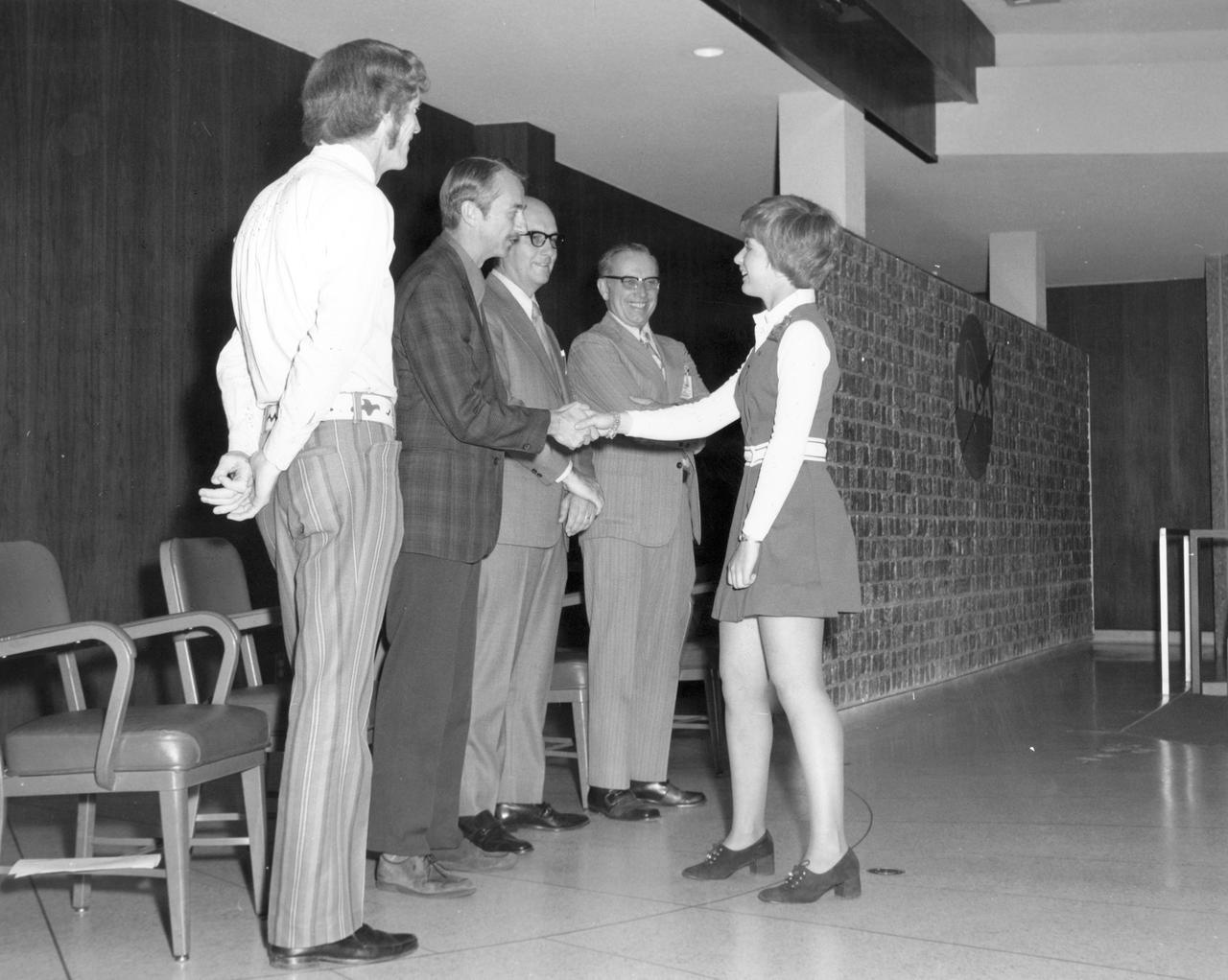
Littleton, Colorado high school student, Cheryl A. Peltz, is greeted by (left to right): Astronauts Russell L. Schweickart, and Owen K. Garriott; Marshall Space Flight Center (MSFC) Skylab Program Manager, Leland Belew; and MSFC Director of Administration and Technical Services, David Newby, during a tour of MSFC. Peltz was among 25 winners of a contest in which some 3,500 high school students proposed experiments for the following year’s Skylab mission. The nationwide scientific competition was sponsored by the National Science Teachers Association and the National Aeronautics and Space Administration (NASA). The winning students, along with their parents and sponsor teachers, visited MSFC where they met with scientists and engineers, participated in design reviews for their experiments, and toured MSFC facilities. Of the 25 students, 6 did not see their experiments conducted on Skylab because the experiments were not compatible with Skylab hardware and timelines. Of the 19 remaining, 11 experiments required the manufacture of additional equipment.
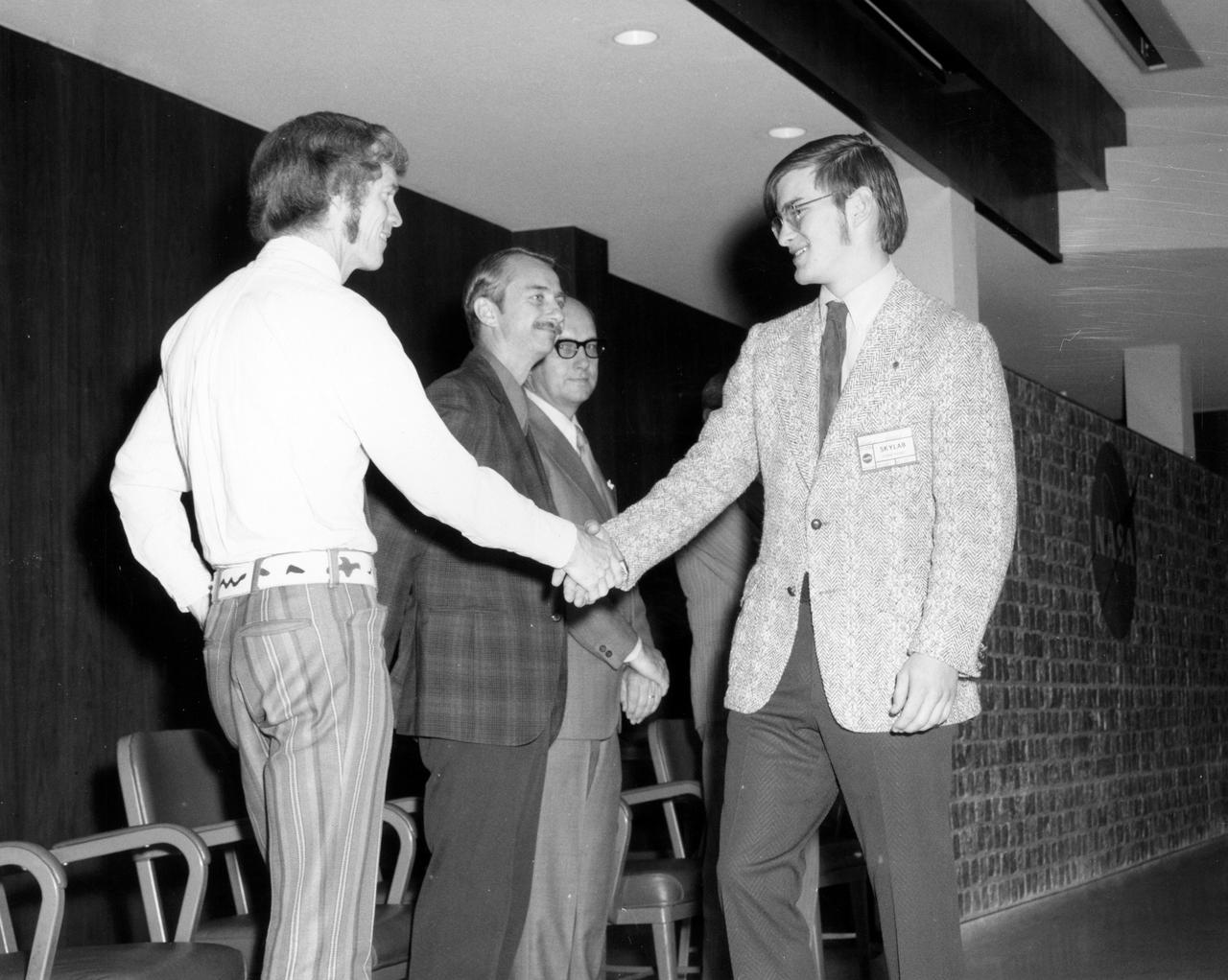
Bayport, New York high school student, James E. Healy, is greeted by (left to right): Astronauts Russell L. Schweickart, and Owen K. Garriott; Marshall Space Flight Center (MSFC) Skylab Program Manager, Leland Belew; and MSFC Director of Administration and Technical Services, David Newby, during a tour of MSFC. Healy was among 25 winners of a contest in which some 3,500 high school students proposed experiments for the following year’s Skylab mission. The nationwide scientific competition was sponsored by the National Science Teachers Association and the National Aeronautics and Space Administration (NASA). The winning students, along with their parents and sponsor teachers, visited MSFC where they met with scientists and engineers, participated in design reviews for their experiments, and toured MSFC facilities. Of the 25 students, 6 did not see their experiments conducted on Skylab because the experiments were not compatible with Skylab hardware and timelines. Of the 19 remaining, 11 experiments required the manufacture of additional equipment.
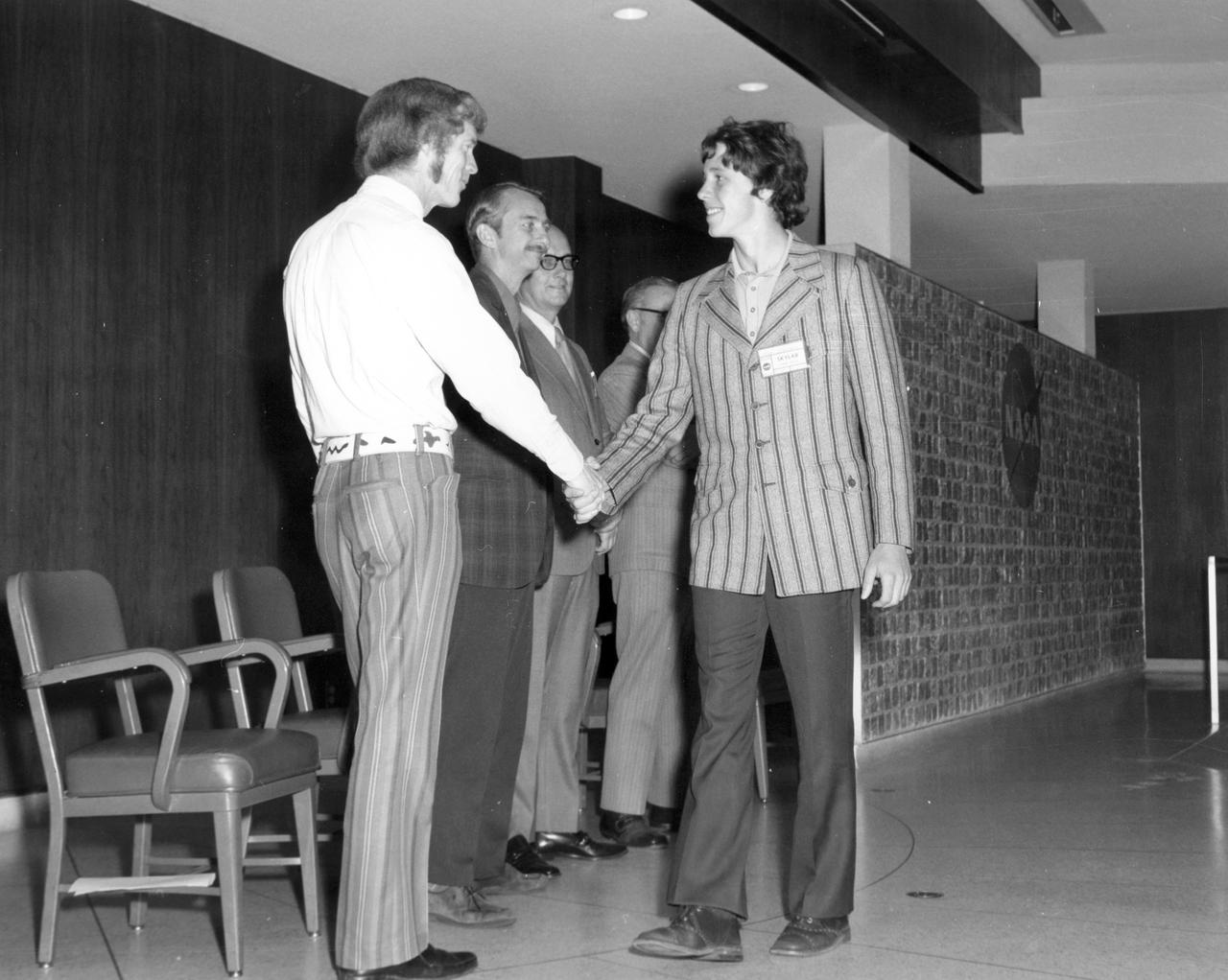
Oshkosh, Wisconsin high school student, Joe B. Zmolek, is greeted by (left to right): Astronauts Russell L. Schweickart, and Owen K. Garriott; Marshall Space Flight Center (MSFC) Skylab Program Manager, Leland Belew; and MSFC Director of Administration and Technical Services, David Newby, during a tour of MSFC. Zmolek was among 25 winners of a contest in which some 3,500 high school students proposed experiments for the following year’s Skylab mission. The nationwide scientific competition was sponsored by the National Science Teachers Association and the National Aeronautics and Space Administration (NASA). The winning students, along with their parents and sponsor teachers, visited MSFC where they met with scientists and engineers, participated in design reviews for their experiments, and toured MSFC facilities. Of the 25 students, 6 did not see their experiments conducted on Skylab because the experiments were not compatible with Skylab hardware and timelines. Of the 19 remaining, 11 experiments required the manufacture of additional equipment.
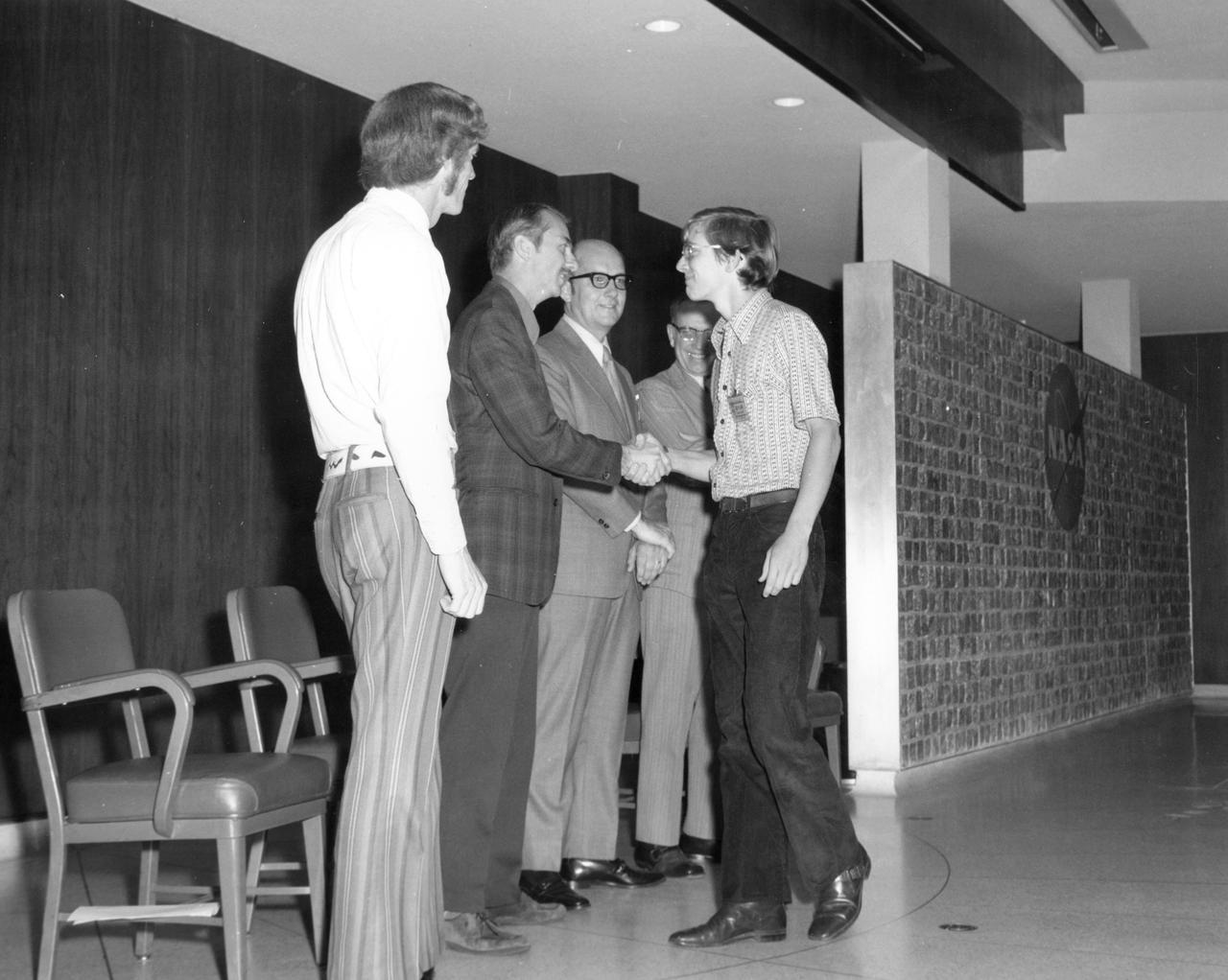
Downey, California high school student, Donald W. Shellack, is greeted by (left to right): Astronauts Russell L. Schweickart, and Owen K. Garriott; Marshall Space Flight Center (MSFC) Skylab Program Manager, Leland Belew; and MSFC Director of Administration and Technical Services, David Newby, during a tour of MSFC. Shellack was among 25 winners of a contest in which some 3,500 high school students proposed experiments for the following year’s Skylab mission. The nationwide scientific competition was sponsored by the National Science Teachers Association and the National Aeronautics and Space Administration (NASA). The winning students, along with their parents and sponsor teachers, visited MSFC where they met with scientists and engineers, participated in design reviews for their experiments, and toured MSFC facilities. Of the 25 students, 6 did not see their experiments conducted on Skylab because the experiments were not compatible with Skylab hardware and timelines. Of the 19 remaining, 11 experiments required the manufacture of additional equipment.
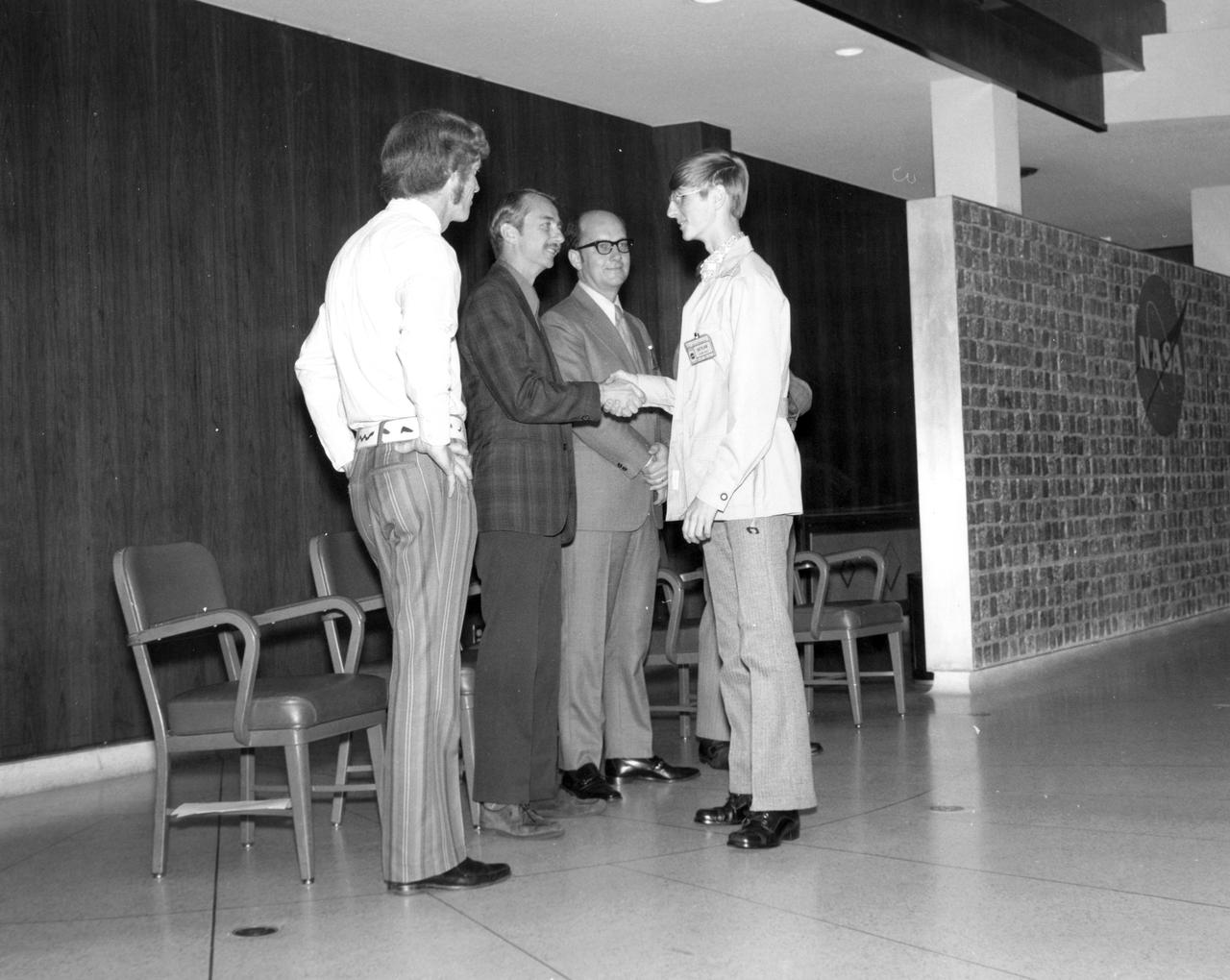
West Point, Nebraska high school student, Joel C. Wordekemper, is greeted by (left to right): Astronauts Russell L. Schweickart, and Owen K. Garriott; Marshall Space Flight Center (MSFC) Skylab Program Manager, Leland Belew; and MSFC Director of Administration and Technical Services, David Newby, during a tour of MSFC. Wordekemper was among 25 winners of a contest in which some 3,500 high school students proposed experiments for the following year’s Skylab mission. The nationwide scientific competition was sponsored by the National Science Teachers Association and the National Aeronautics and Space Administration (NASA). The winning students, along with their parents and sponsor teachers, visited MSFC where they met with scientists and engineers, participated in design reviews for their experiments, and toured MSFC facilities. Of the 25 students, 6 did not see their experiments conducted on Skylab because the experiments were not compatible with Skylab hardware and timelines. Of the 19 remaining, 11 experiments required the manufacture of additional equipment.
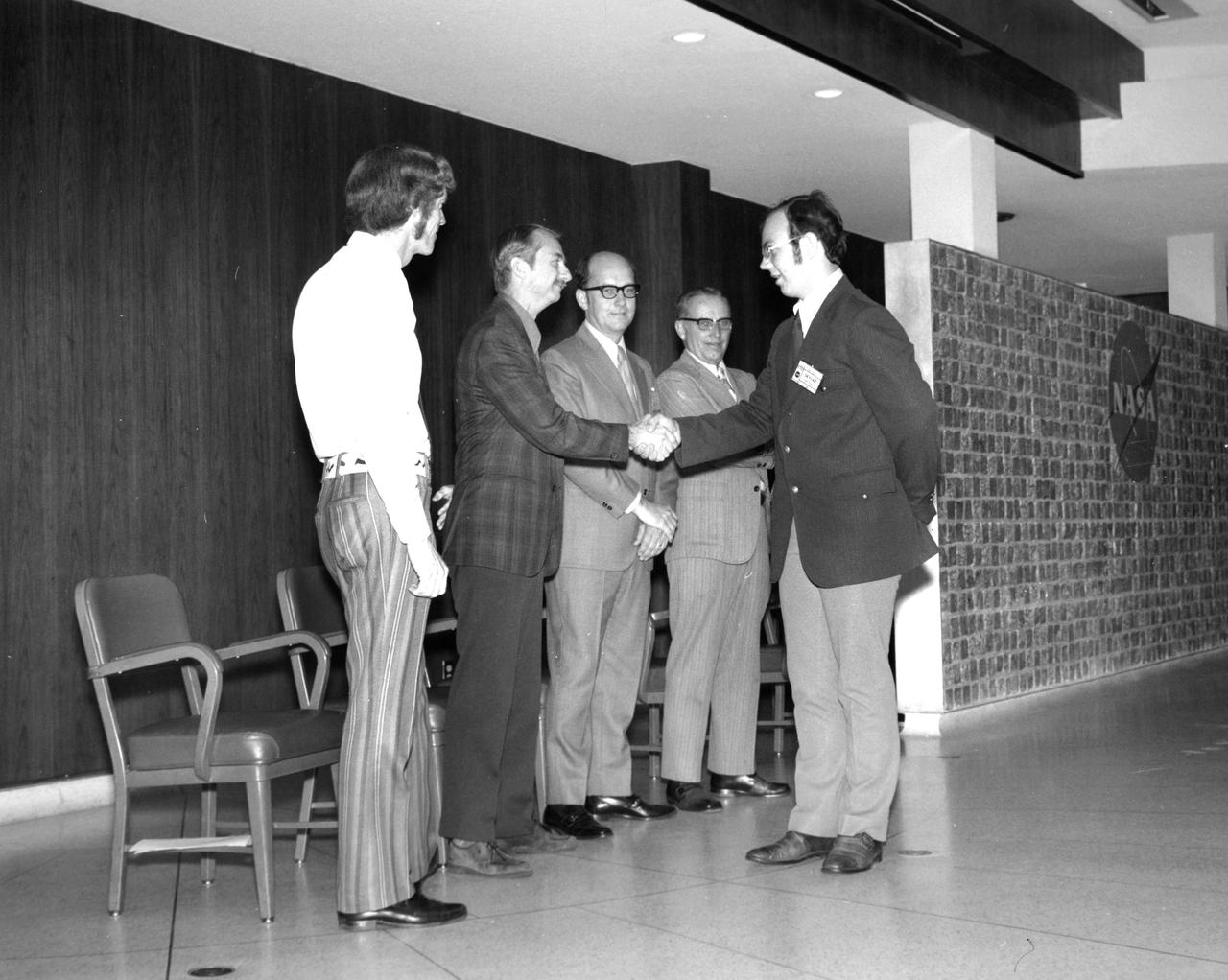
Baton Rouge, Louisiana high school student, Joe W. Reihs, is greeted by (left to right): Astronauts Russell L. Schweickart, and Owen K. Garriott; Marshall Space Flight Center (MSFC) Skylab Program Manager, Leland Belew; and MSFC Director of Administration and Technical Services, David Newby, during a tour of MSFC. Reihs was among 25 winners of a contest in which some 3,500 high school students proposed experiments for the following year’s Skylab mission. The nationwide scientific competition was sponsored by the National Science Teachers Association and the National Aeronautics and Space Administration (NASA). The winning students, along with their parents and sponsor teachers, visited MSFC where they met with scientists and engineers, participated in design reviews for their experiments, and toured MSFC facilities. Of the 25 students, 6 did not see their experiments conducted on Skylab because the experiments were not compatible with Skylab hardware and timelines. Of the 19 remaining, 11 experiments required the manufacture of additional equipment.
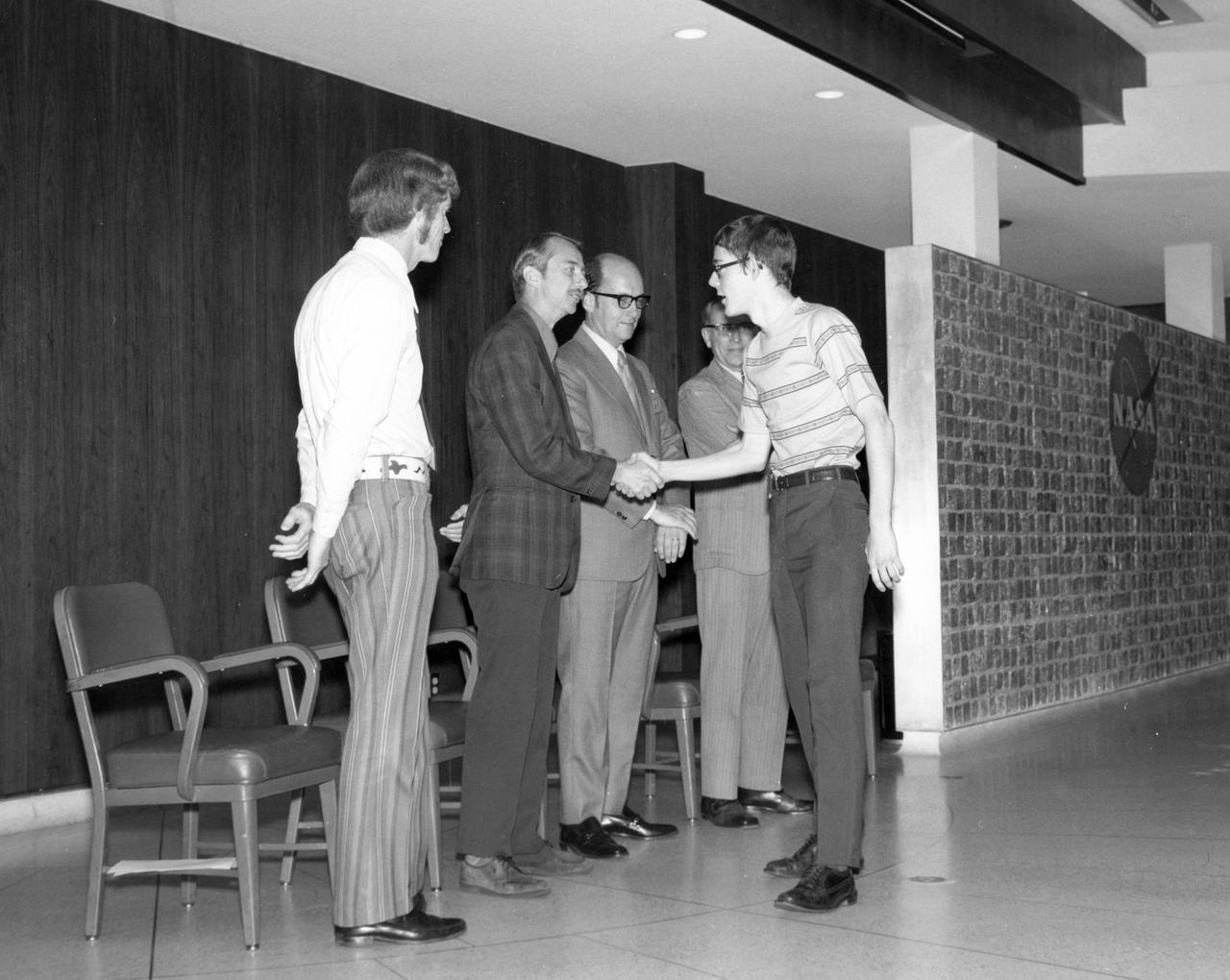
St. Paul, Minnesota high school student, Roger Johnston, is greeted by (left to right): Astronauts Russell L. Schweickart, and Owen K. Garriott; Marshall Space Flight Center (MSFC) Skylab Program Manager, Leland Belew; and MSFC Director of Administration and Technical Services, David Newby, during a tour of MSFC. Johnston was among 25 winners of a contest in which some 3,500 high school students proposed experiments for the following year’s Skylab mission. The nationwide scientific competition was sponsored by the National Science Teachers Association and the National Aeronautics and Space Administration (NASA). The winning students, along with their parents and sponsor teachers, visited MSFC where they met with scientists and engineers, participated in design reviews for their experiments, and toured MSFC facilities. Of the 25 students, 6 did not see their experiments conducted on Skylab because the experiments were not compatible with Skylab hardware and timelines. Of the 19 remaining, 11 experiments required the manufacture of additional equipment.

Atlanta, Georgia high school student, Neal W. Shannon, is greeted by (left to right): Astronauts Russell L. Schweickart, and Owen K. Garriott; Marshall Space Flight Center (MSFC) Skylab Program Manager, Leland Belew; and MSFC Director of Administration and Technical Services, David Newby, during a tour of MSFC. Shannon was among 25 winners of a contest in which some 3,500 high school students proposed experiments for the following year’s Skylab mission. The nationwide scientific competition was sponsored by the National Science Teachers Association and the National Aeronautics and Space Administration (NASA). The winning students, along with their parents and sponsor teachers, visited MSFC where they met with scientists and engineers, participated in design reviews for their experiments, and toured MSFC facilities. Of the 25 students, 6 did not see their experiments conducted on Skylab because the experiments were not compatible with Skylab hardware and timelines. Of the 19 remaining, 11 experiments required the manufacture of additional equipment.
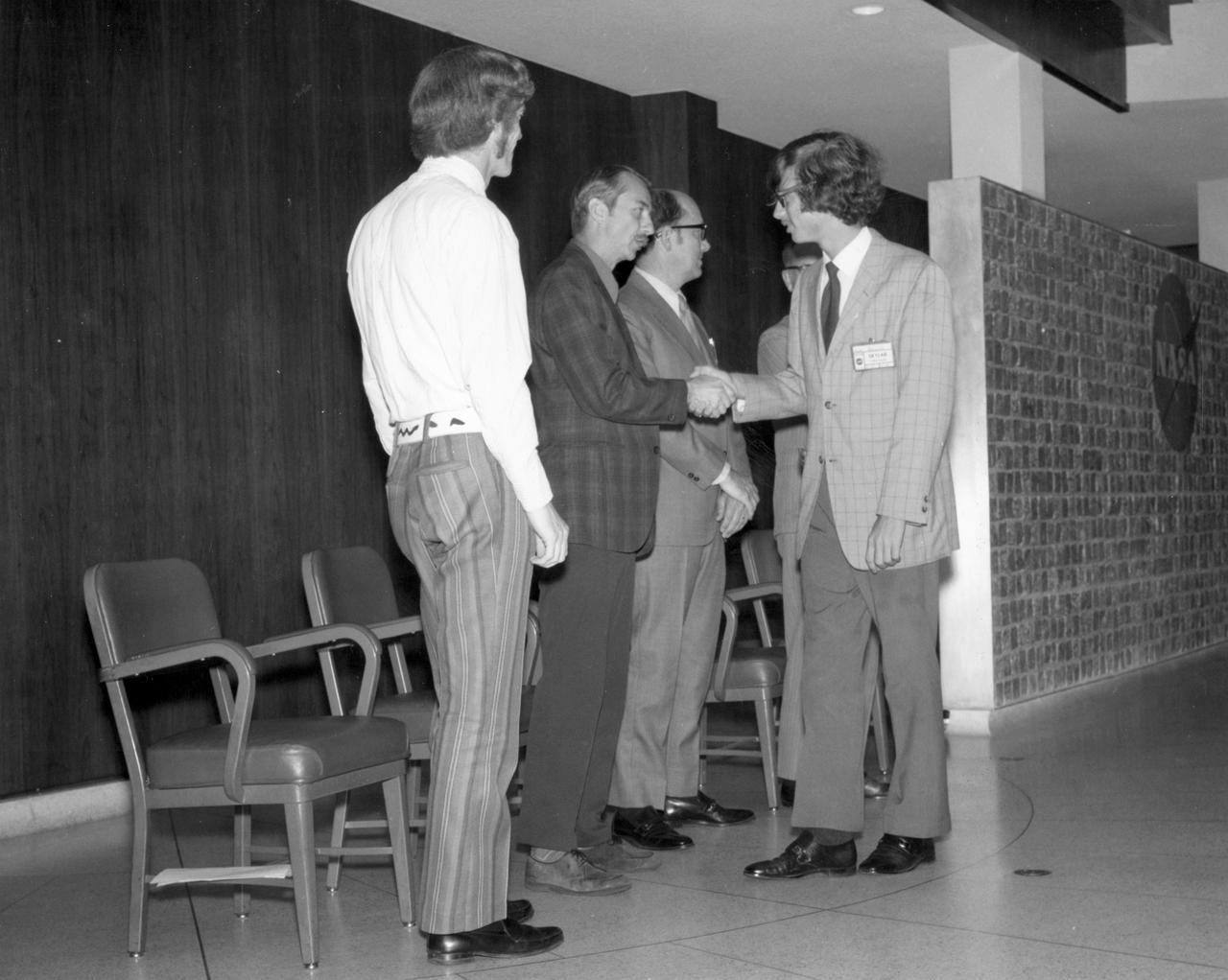
Aiea, Hawaii high school student, John C. Hamilton, is greeted by (left to right): Astronauts Russell L. Schweickart, and Owen K. Garriott; Marshall Space Flight Center (MSFC) Skylab Program Manager, Leland Belew; and MSFC Director of Administration and Technical Services, David Newby, during a tour of MSFC. Hamilton was among 25 winners of a contest in which some 3,500 high school students proposed experiments for the following year’s Skylab mission. The nationwide scientific competition was sponsored by the National Science Teachers Association and the National Aeronautics and Space Administration (NASA). The winning students, along with their parents and sponsor teachers, visited MSFC where they met with scientists and engineers, participated in design reviews for their experiments, and toured MSFC facilities. Of the 25 students, 6 did not see their experiments conducted on Skylab because the experiments were not compatible with Skylab hardware and timelines. Of the 19 remaining, 11 experiments required the manufacture of additional equipment.
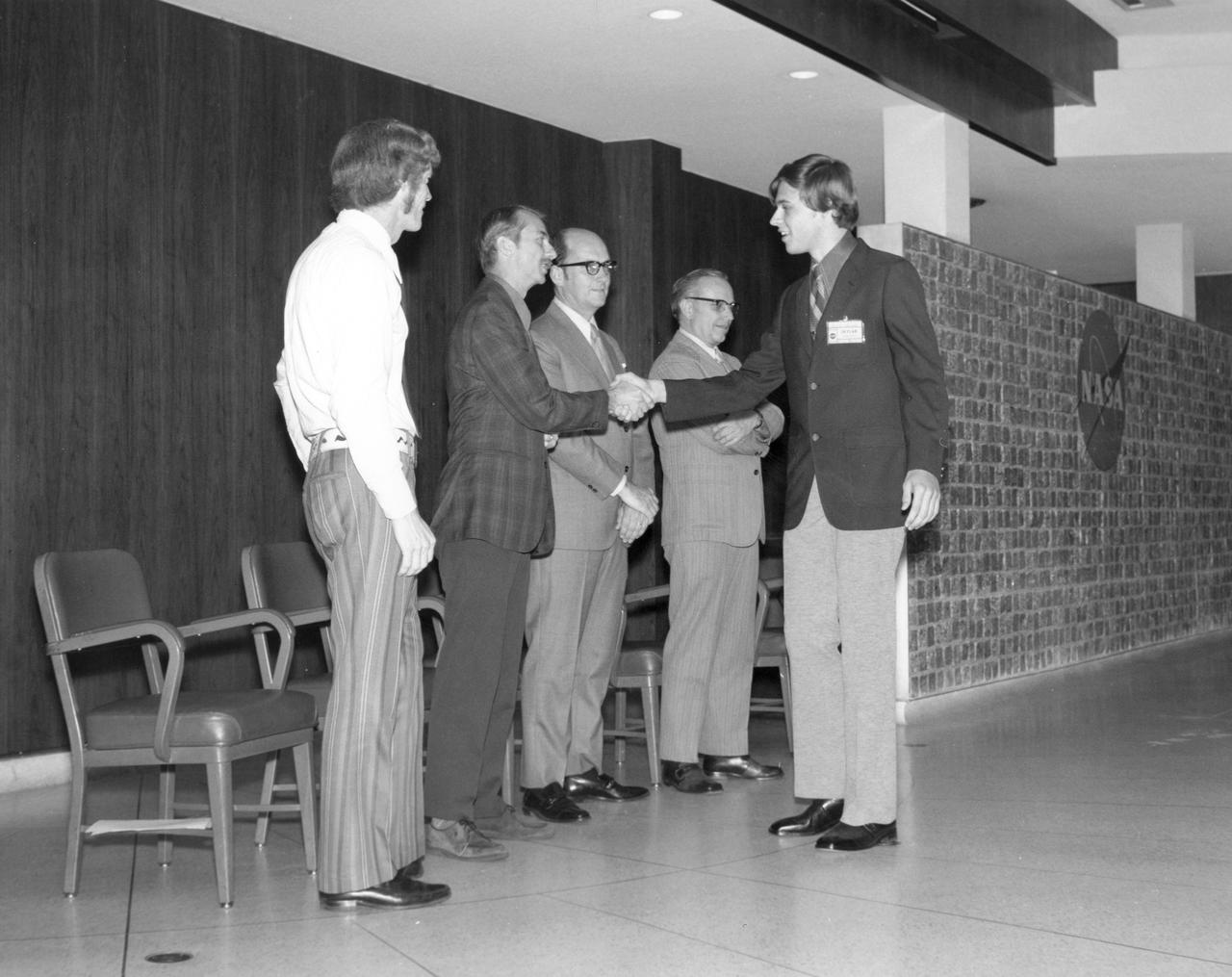
Garland, Texas high school student, Keith D. McGee, is greeted by (left to right): Astronauts Russell L. Schweickart, and Owen K. Garriott; Marshall Space Flight Center (MSFC) Skylab Program Manager, Leland Belew; and MSFC Director of Administration and Technical Services, David Newby, during a tour of MSFC. McGee was among 25 winners of a contest in which some 3,500 high school students proposed experiments for the following year’s Skylab Mission. The nationwide scientific competition was sponsored by the National Science Teachers Association and the National Aeronautics and Space Administration (NASA). The winning students, along with their parents and sponsor teachers, visited MSFC where they met with scientists and engineers, participated in design reviews for their experiments, and toured MSFC facilities. Of the 25 students, 6 did not see their experiments conducted on Skylab because the experiments were not compatible with Skylab hardware and timelines. Of the 19 remaining, 11 experiments required the manufacture of additional equipment.
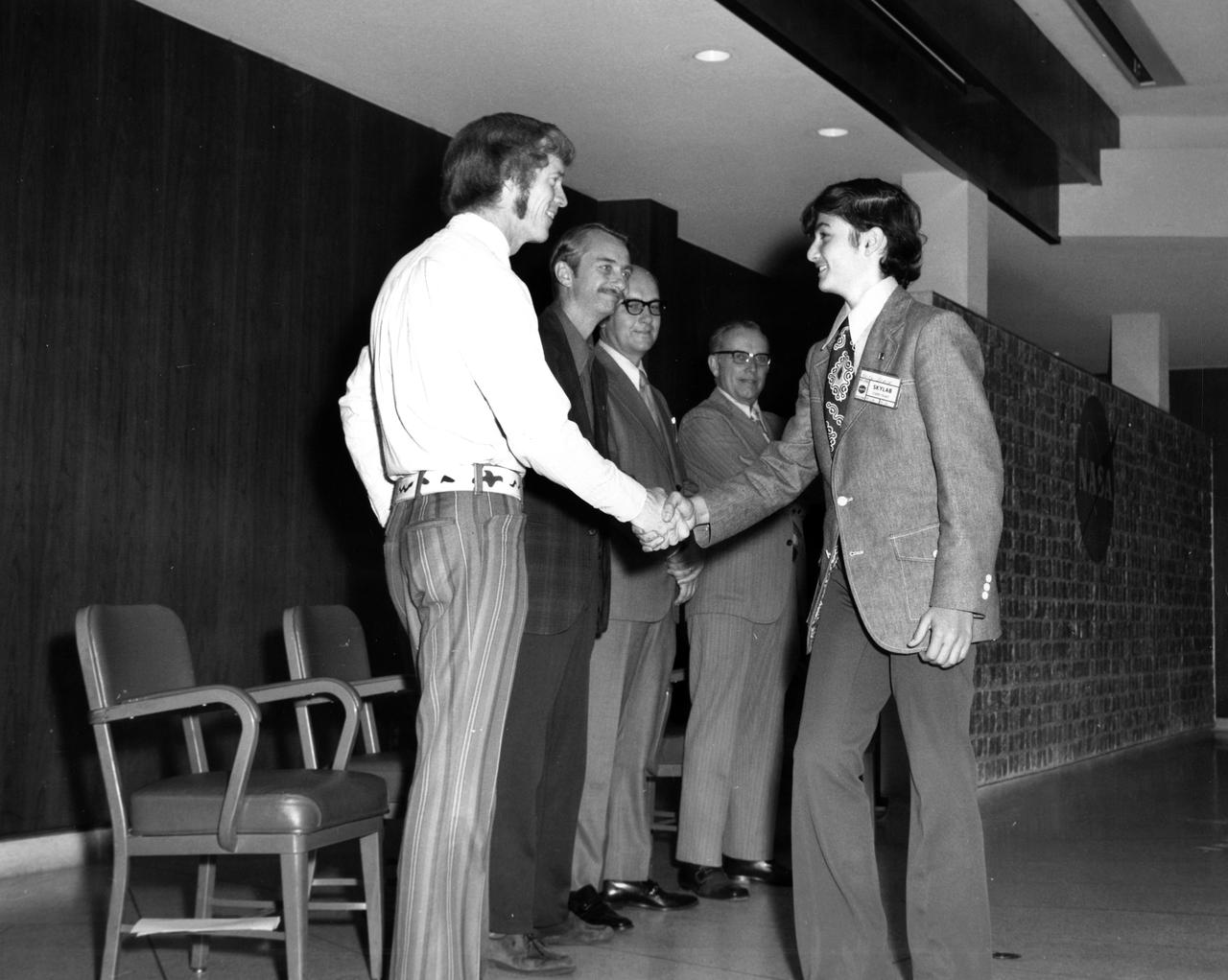
Silverton, Oregon high school student, Daniel C. Bochsler, is greeted by (left to right): Astronauts Russell L. Schweickart, and Owen K. Garriott; Marshall Space Flight Center (MSFC) Skylab Program Manager, Leland Belew; and MSFC Director of Administration and Technical Services, David Newby, during a tour of MSFC. Bochsler was among 25 winners of a contest in which some 3,500 high school students proposed experiments for the following year’s Skylab mission. The nationwide scientific competition was sponsored by the National Science Teachers Association and the National Aeronautics and Space Administration (NASA). The winning students, along with their parents and sponsor teachers, visited MSFC where they met with scientists and engineers, participated in design reviews for their experiments, and toured MSFC facilities. Of the 25 students, 6 did not see their experiments conducted on Skylab because the experiments were not compatible with Skylab hardware and timelines. Of the 19 remaining, 11 experiments required the manufacture of additional equipment.
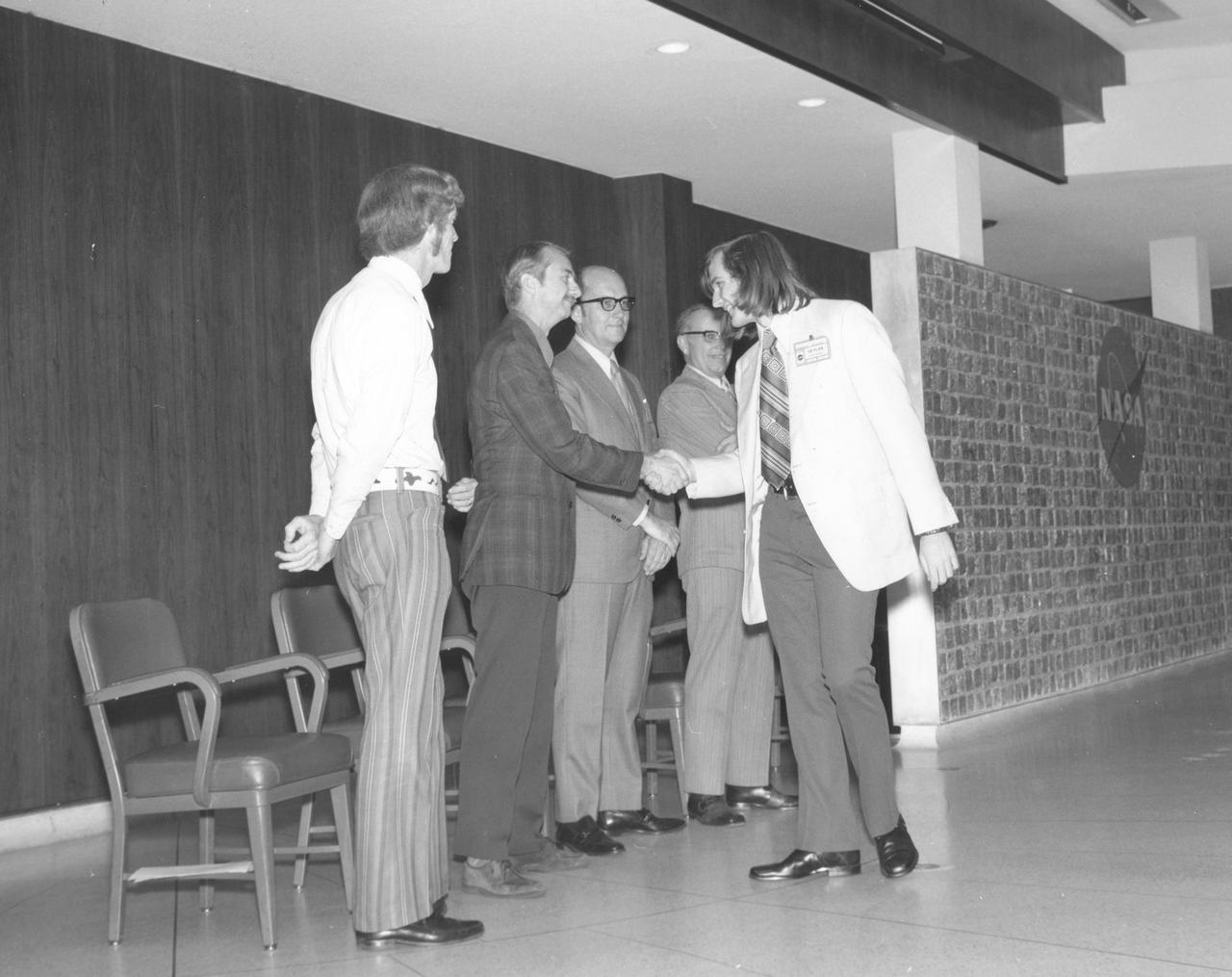
Westbury, New York high school student, Keith L.Stein , is greeted by (left to right): Astronauts Russell L. Schweickart, and Owen K. Garriott; Marshall Space Flight Center (MSFC) Skylab Program Manager, Leland Belew; and MSFC Director of Administration and Technical Services, David Newby, during a tour of MSFC. Stein was among 25 winners of a contest in which some 3,500 high school students proposed experiments for the following year’s Skylab mission. The nationwide scientific competition was sponsored by the National Science Teachers Association and the National Aeronautics and Space Administration (NASA). The winning students, along with their parents and sponsor teachers, visited MSFC where they met with scientists and engineers, participated in design reviews for their experiments, and toured MSFC facilities. Of the 25 students, 6 did not see their experiments conducted on Skylab because the experiments were not compatible with Skylab hardware and timelines. Of the 19 remaining, 11 experiments required the manufacture of additional equipment.
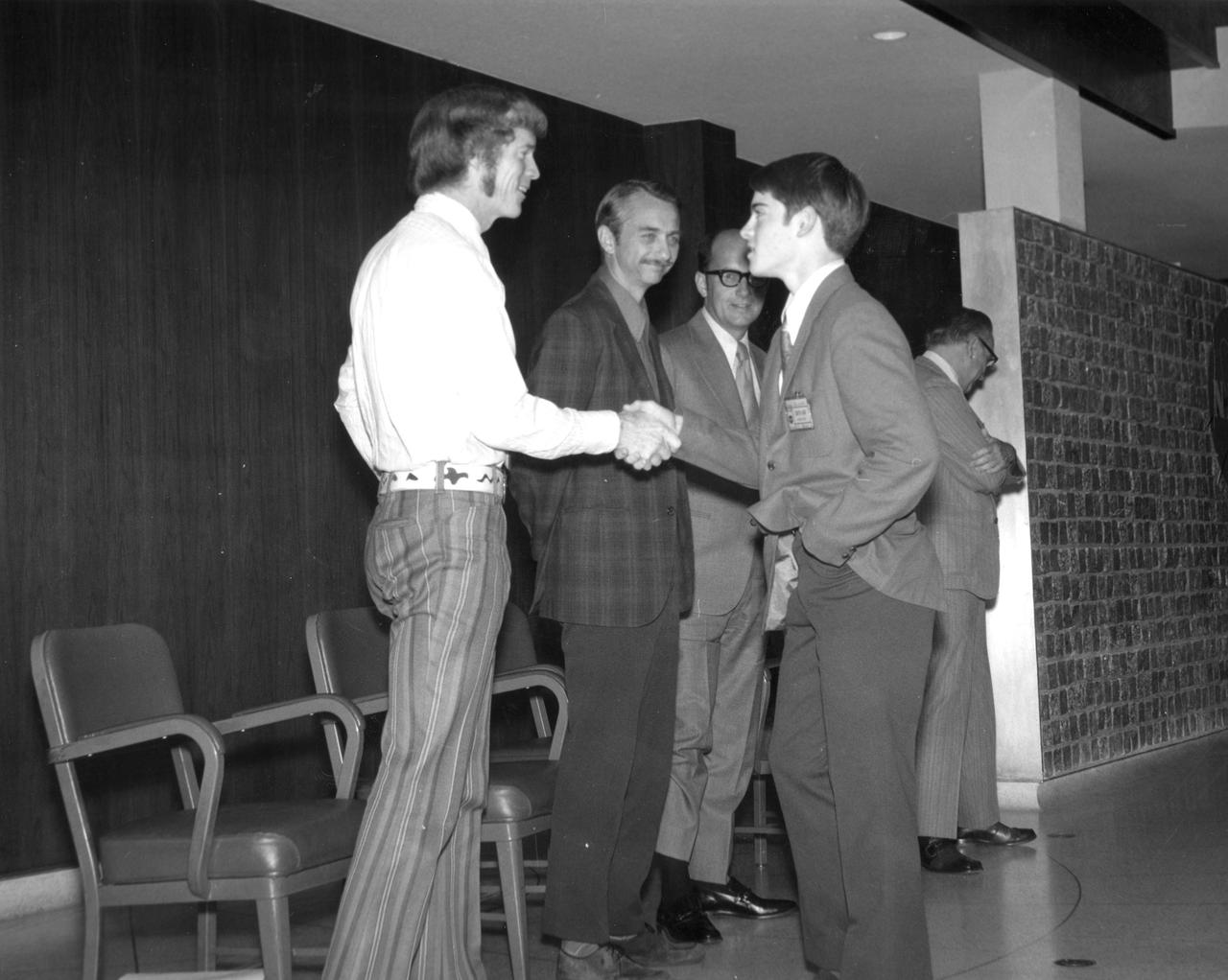
Springfield, Massachusetts high school student, Gregory A. Merkel, is greeted by (left to right): Astronauts Russell L. Schweickart, and Owen K. Garriott; Marshall Space Flight Center (MSFC) Skylab Program Manager, Leland Belew; and MSFC Director of Administration and Technical Services, David Newby, during a tour of MSFC. Merkel was among 25 winners of a contest in which some 3,500 high school students proposed experiments for the following year’s Skylab Mission. The nationwide scientific competition was sponsored by the National Science Teachers Association and the National Aeronautics and Space Administration (NASA). The winning students, along with their parents and sponsor teachers, visited MSFC where they met with scientists and engineers, participated in design reviews for their experiments, and toured MSFC facilities. Of the 25 students, 6 did not see their experiments conducted on Skylab because the experiments were not compatible with Skylab hardware and timelines. Of the 19 remaining, 11 experiments required the manufacture of additional equipment.
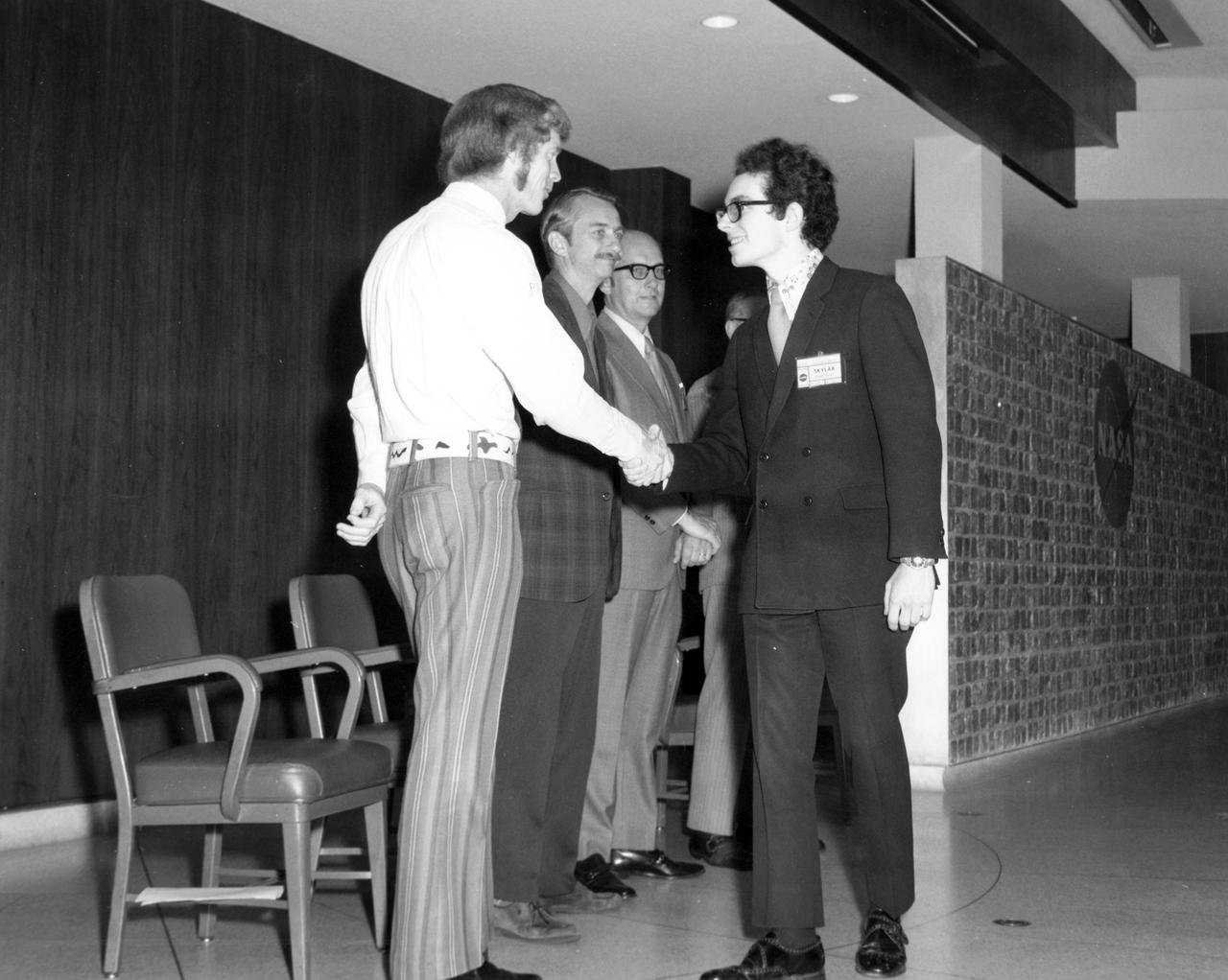
Berkley, Michigan high school student, Kirk M. Sherhart, is greeted by (left to right): Astronauts Russell L. Schweickart, and Owen K. Garriott; Marshall Space Flight Center (MSFC) Skylab Program Manager, Leland Belew; and MSFC Director of Administration and Technical Services, David Newby, during a tour of MSFC. Sherhart was among 25 winners of a contest in which some 3,500 high school students proposed experiments for the following year’s Skylab mission. The nationwide scientific competition was sponsored by the National Science Teachers Association and the National Aeronautics and Space Administration (NASA). The winning students, along with their parents and sponsor teachers, visited MSFC where they met with scientists and engineers, participated in design reviews for their experiments, and toured MSFC facilities. Of the 25 students, 6 did not see their experiments conducted on Skylab because the experiments were not compatible with Skylab hardware and timelines. Of the 19 remaining, 11 experiments required the manufacture of additional equipment.
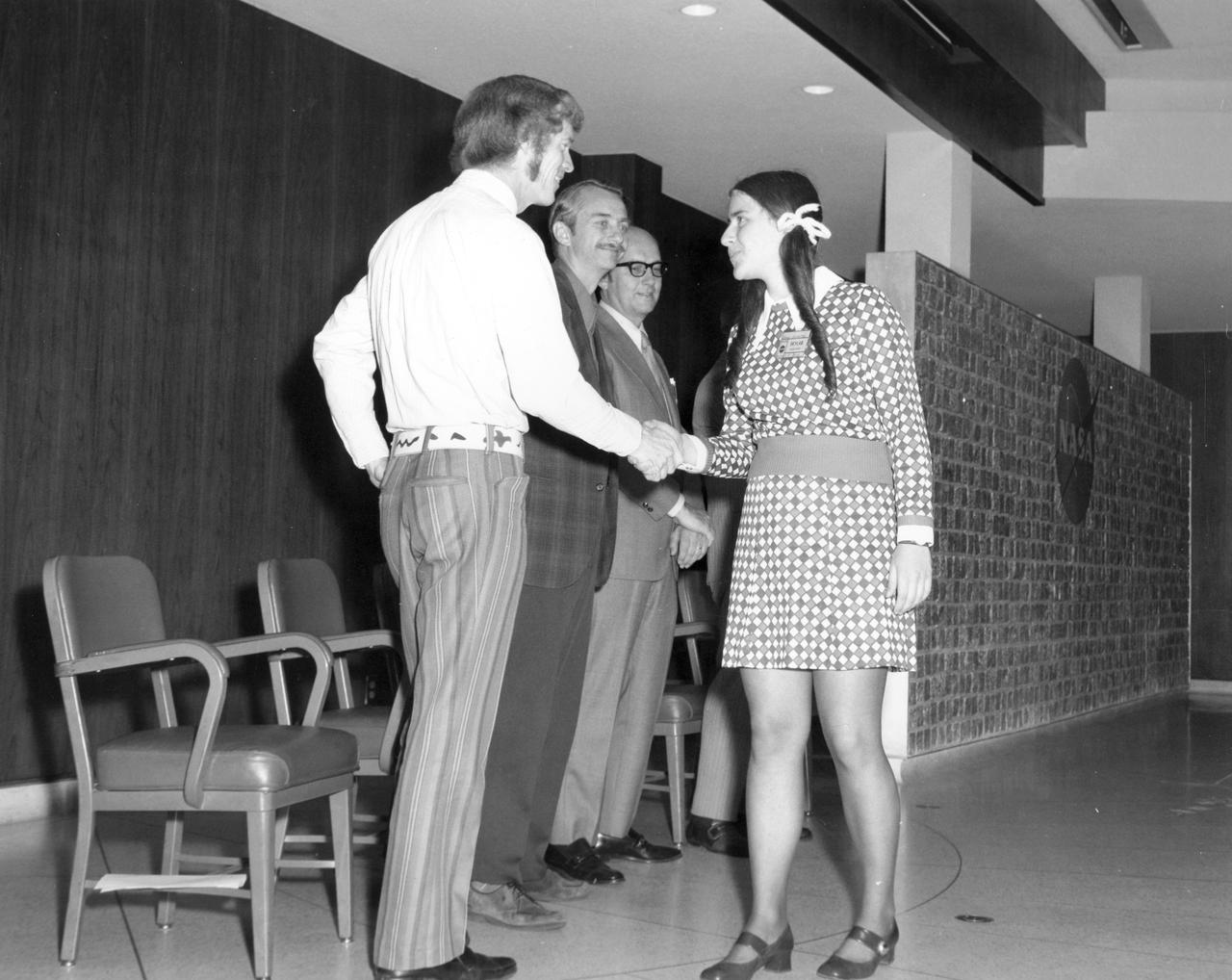
Berkley, California high school student, Jeanne L. Leventhal, is greeted by (left to right): Astronauts Russell L. Schweickart, and Owen K. Garriott; and Marshall Space Flight Center (MSFC) Skylab Program Manager, Leland Belew during a tour of MSFC. Leventhal was among 25 winners of a contest in which some 3,500 high school students proposed experiments for the following year’s Skylab mission. The nationwide scientific competition was sponsored by the National Science Teachers Association and the National Aeronautics and Space Administration (NASA). The winning students, along with their parents and sponsor teachers, visited MSFC where they met with scientists and engineers, participated in design reviews for their experiments, and toured MSFC facilities. Of the 25 students, 6 did not see their experiments conducted on Skylab because the experiments were not compatible with Skylab hardware and timelines. Of the 19 remaining, 11 experiments required the manufacture of additional equipment.
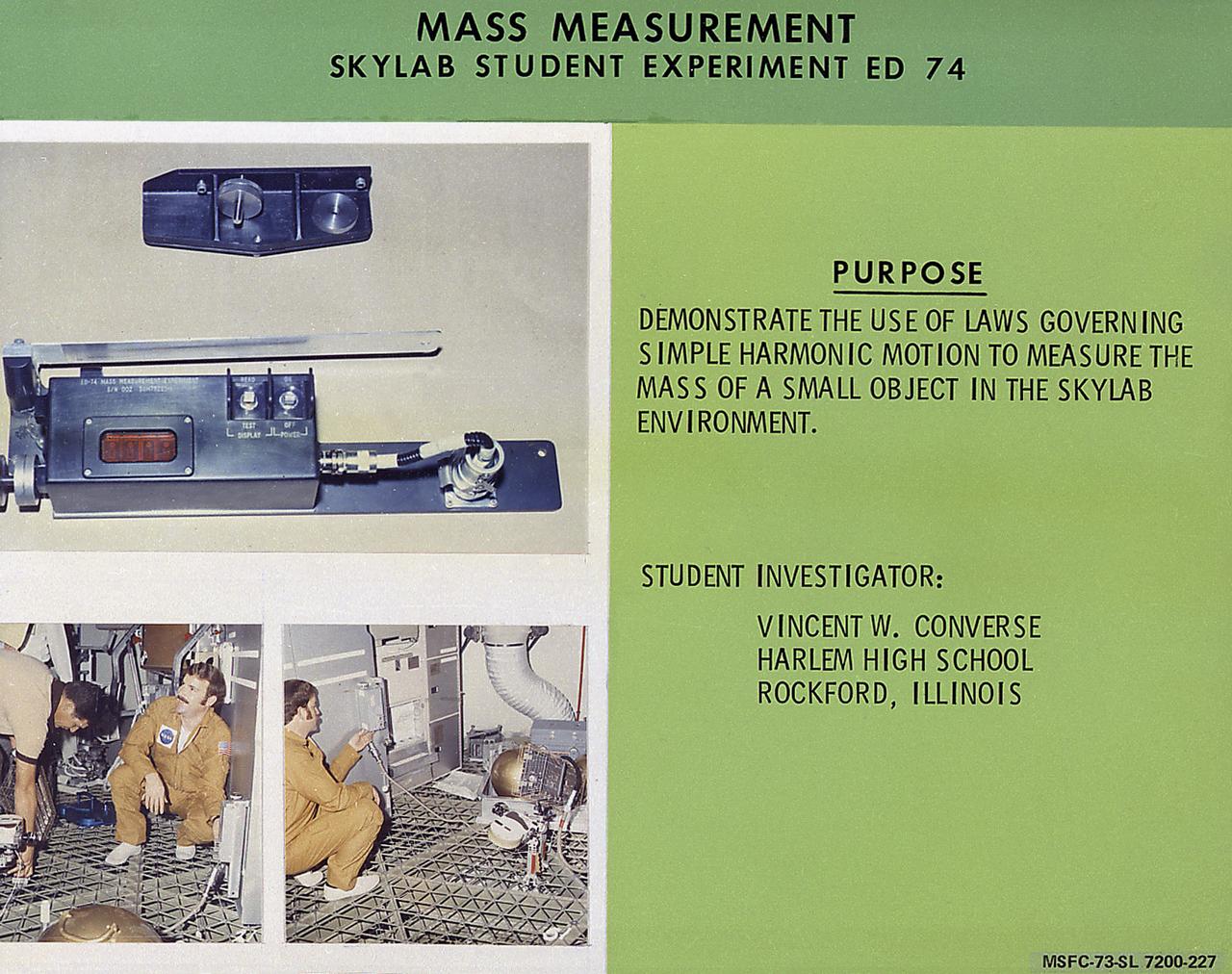
Vincent W. Converse of Rockford, Illinois proposed Skylab's student experiment ED-74, Mass Measurement, to measure mass in a weightless environment. This chart describes Converse's experiment. Mass is the quantity of matter in any object. The gravitational force between an object and the Earth is called weight, which is a result of the Earth's gravity acting upon the object's mass. Even though objects in Skylab were apparently weightless, their mass properties were unchanged. Measurement of mass is therefore an acceptable alternative to measurement of weight. The devices used in this experiment provided accurate mass measurements of the astronauts' weights, intakes, and body wastes throughout the missions. In March 1972, NASA and the National Science Teachers Association selected 25 experiment proposals for flight on Skylab. Science advisors from the Marshall Space Flight Center aided and assisted the students in developing the proposals for flight on Skylab.
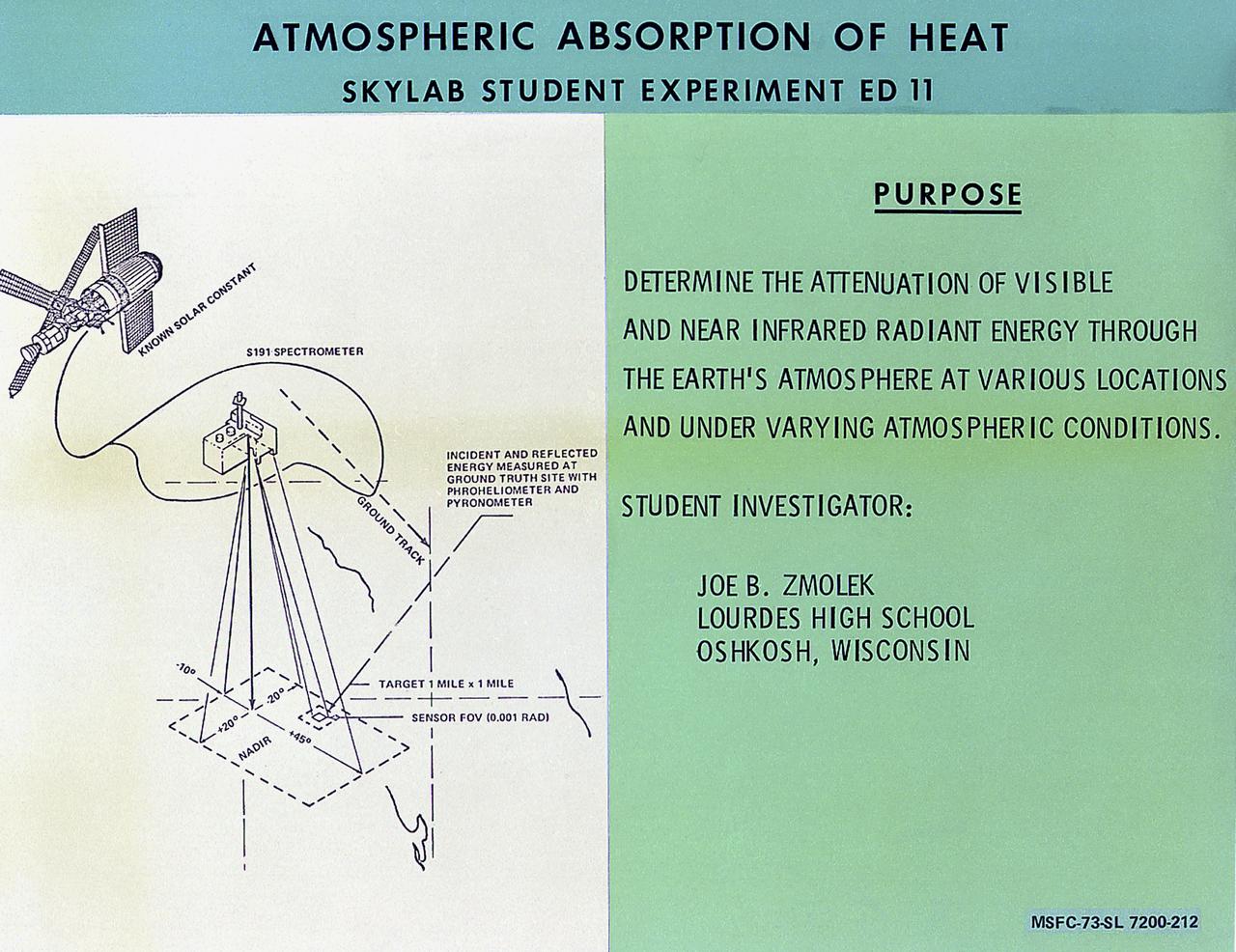
This chart describes the Skylab student experiment, Atmospheric Absorption of Heat, proposed by Joe B. Zmolek of Oshkosh, Wisconsin. This experiment utilized Skylab's Earth Resources Experiment spectrometers to determine the attenuation of radiant energy in the visible and near-infrared spectrums for both densely and sparsely populated areas. In March 1972, NASA and the National Science Teachers Association selected 25 experiment proposals for flight on Skylab. Science advisors from the Marshall Space Flight Center aided and assisted the students in developing the proposals for flight on Skylab.
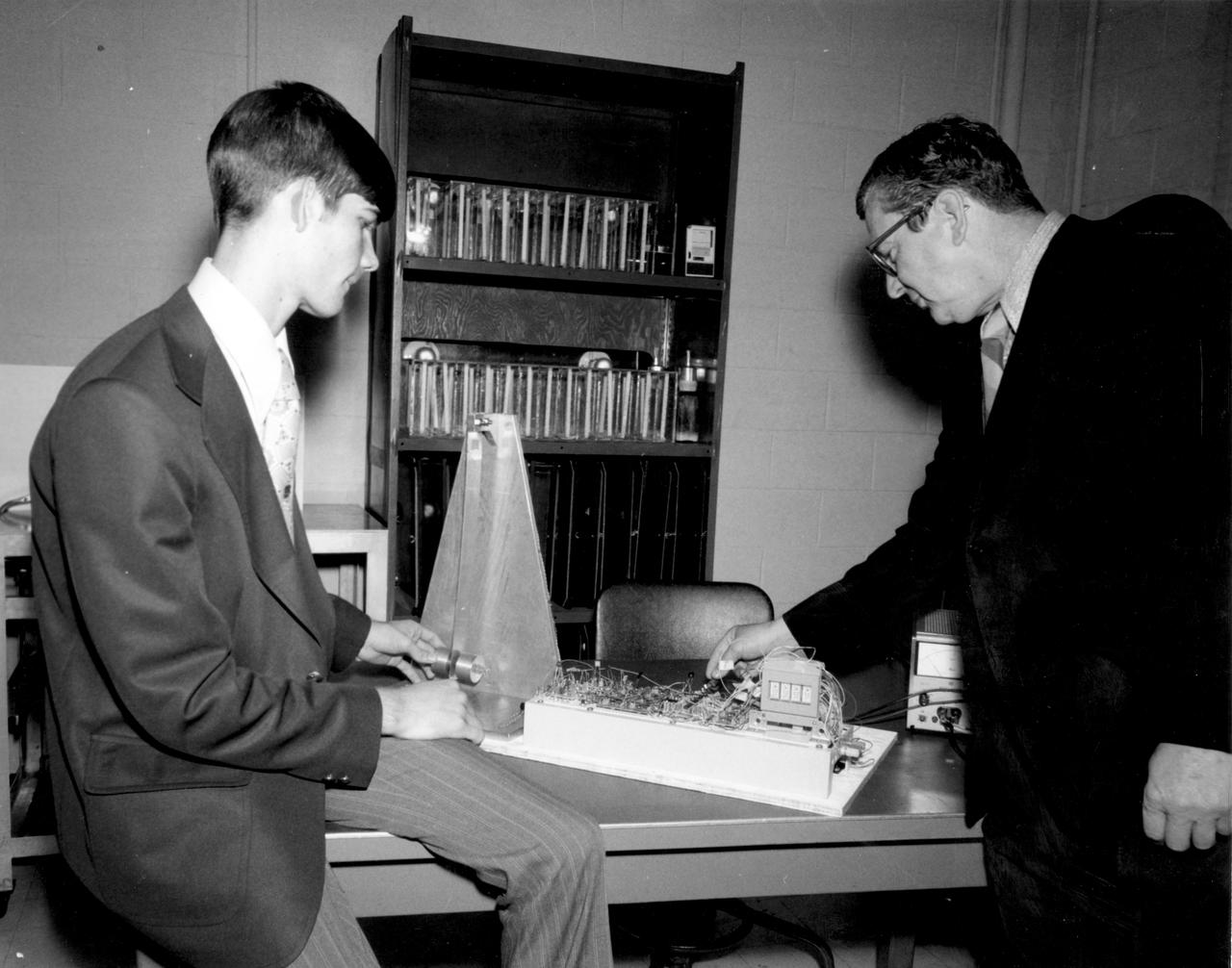
Rockford, Illinois high school student, Vincent Converse (left), and Robert Head of the Marshall Space Flight Center (MSFC), check out the equipment to be used in conducting the student’s experiment aboard the Skylab the following year. His experiment, “Zero Gravity Mass Measurement” used a simple leaf spring with the mass to be weighed attached to the end. An electronic package oscillated the spring at a specific rate and the results were recorded electronically. Converse was among 25 winners of a contest in which some 3,500 high school students proposed experiments for the following year’s Skylab mission. The nationwide scientific competition was sponsored by the National Science Teachers Association and the National Aeronautics and Space Administration (NASA). The winning students, along with their parents and sponsor teachers, visited MSFC two months earlier where they met with scientists and engineers, participated in design reviews for their experiments, and toured MSFC facilities. Of the 25 students, 6 did not see their experiments conducted on Skylab because the experiments were not compatible with Skylab hardware and timelines. Of the 19 remaining, 11 experiments required the manufacture of additional equipment.
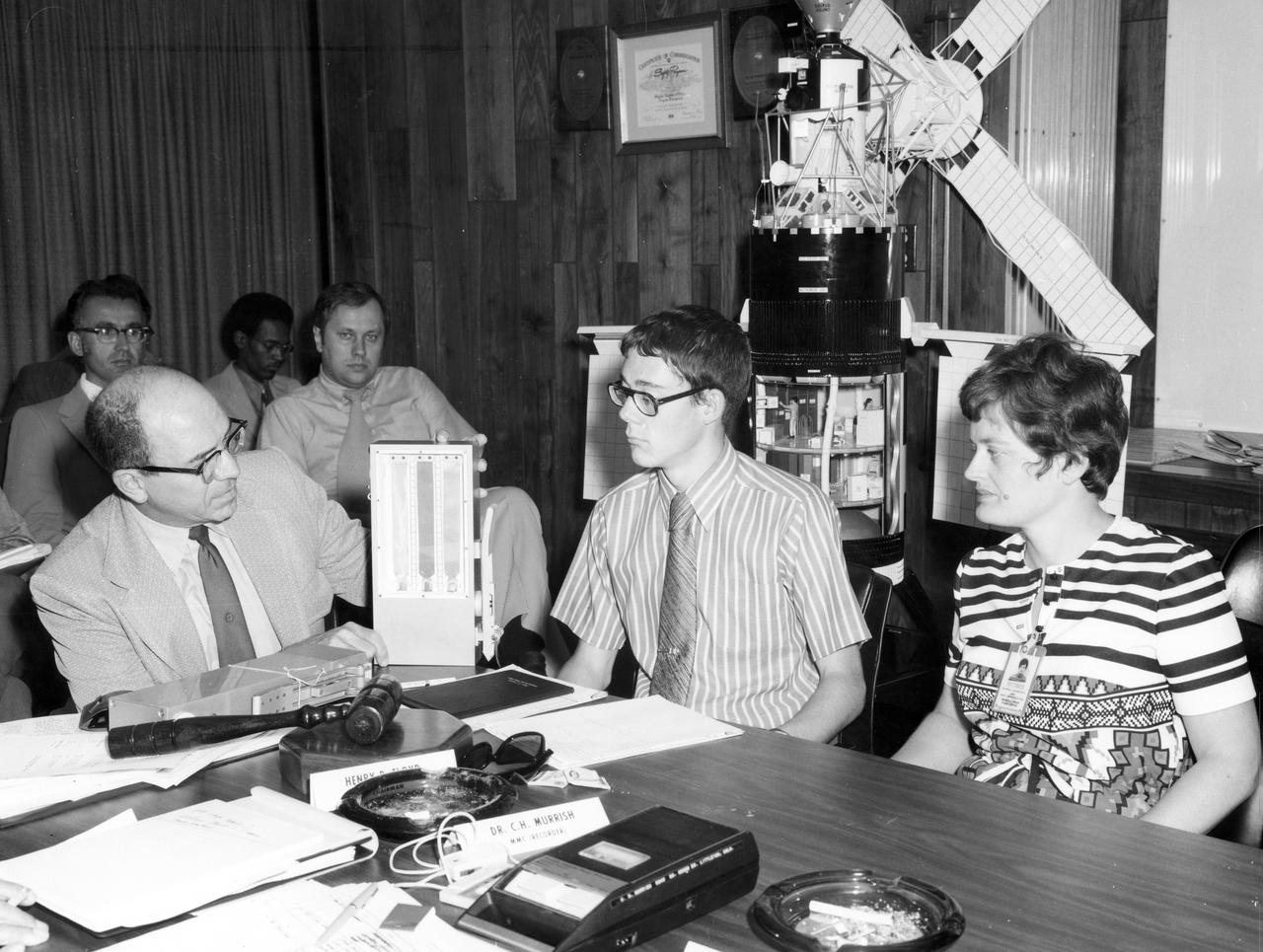
St. Paul Minnesota high school student, Roger Johnston (center), Gene Vacca (left) of NASA Headquarters, and Ann Whitaker of the Marshall Space Flight Center (MSFC) discuss the equipment to be used for the student’s experiment, “Capillary Action Studies in a State of Free Fall”, to be performed aboard the Skylab the following year. Johnston was among 25 winners of a contest in which some 3,500 high school students proposed experiments for the following year’s Skylab mission. The nationwide scientific competition was sponsored by the National Science Teachers Association and the National Aeronautics and Space Administration (NASA). The winning students, along with their parents and sponsor teachers, visited MSFC two months earlier where they met with scientists and engineers, participated in design reviews for their experiments, and toured MSFC facilities. Of the 25 students, 6 did not see their experiments conducted on Skylab because the experiments were not compatible with Skylab hardware and timelines. Of the 19 remaining, 11 experiments required the manufacture of additional equipment. The equipment for the experiments was manufactured at MSFC.
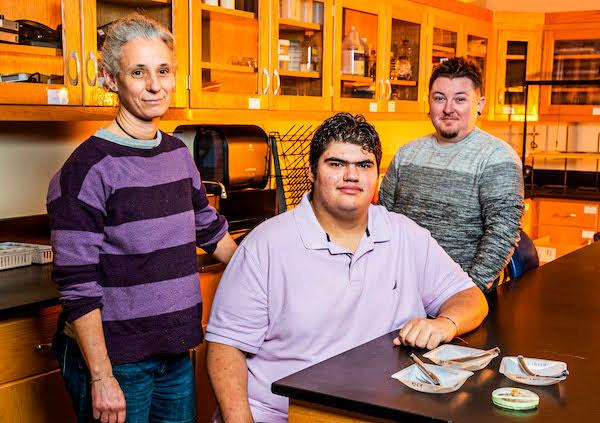
jsc2023e065204 (12/20/2022) --- The Collin College team work on their experiment, which will be included in the Nanoracks-National Center for Earth and Space Science Education-Orbiter-Student Spaceflight Experiments Program Mission 17 to ISS (Nanoracks-NCESSE-Orbiter-SSEP). The team is comprised of (left to right) Dr. Tamara Basham, Stefano Sacripanti and Henry Elmendorf.
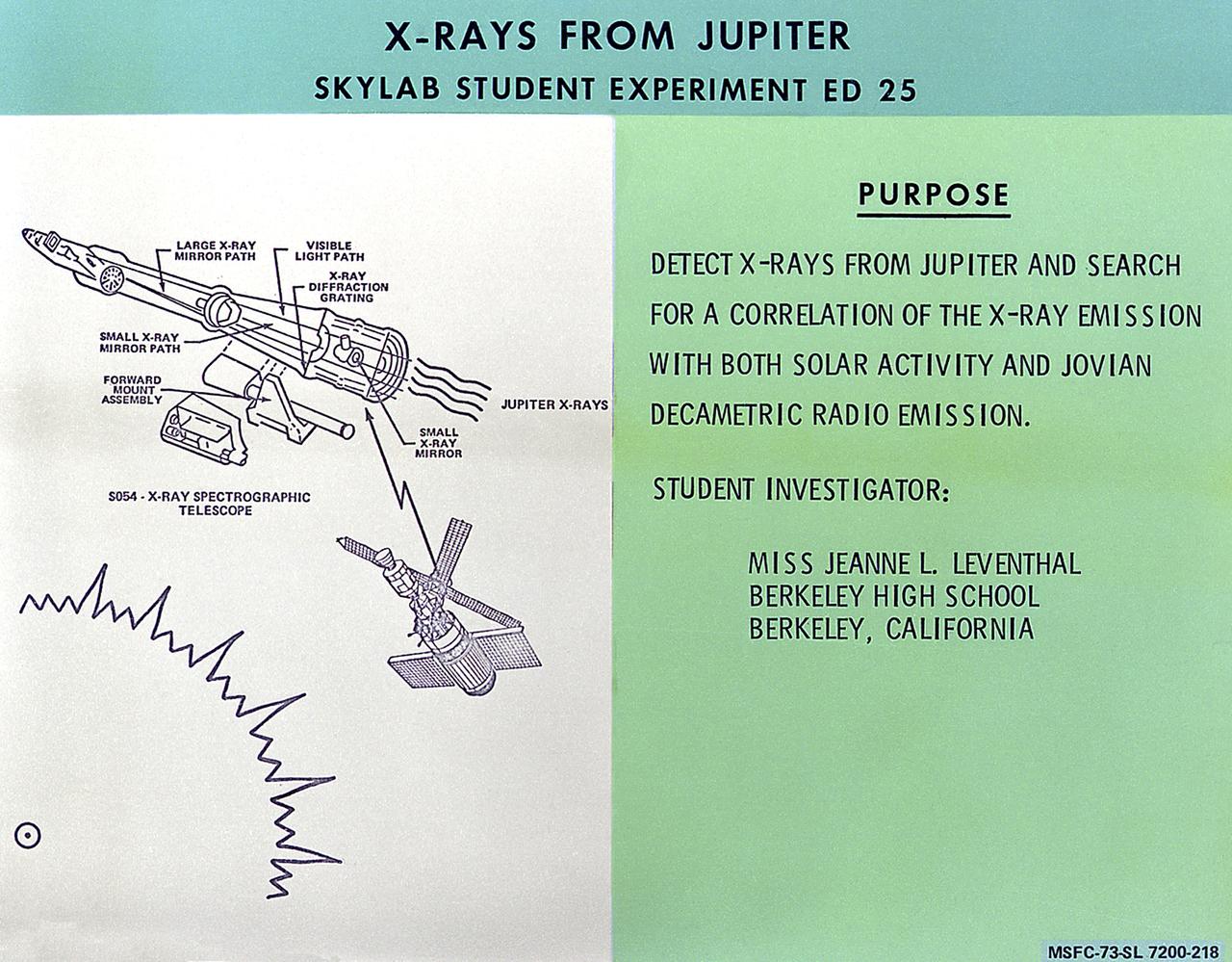
This chart describes the Skylab student experiment X-Rays from Jupiter, proposed by Jearne Leventhal of Berkeley, California. This experiment was an investigation to detect x-rays from the planet Jupiter and determine any correlation with solar flare activity. In March 1972, NASA and the National Science Teachers Association selected 25 experiment proposals for flight on Skylab. Science advisors from the Marshall Space Flight Center aided and assisted the students in developing the proposals for flight on Skylab.
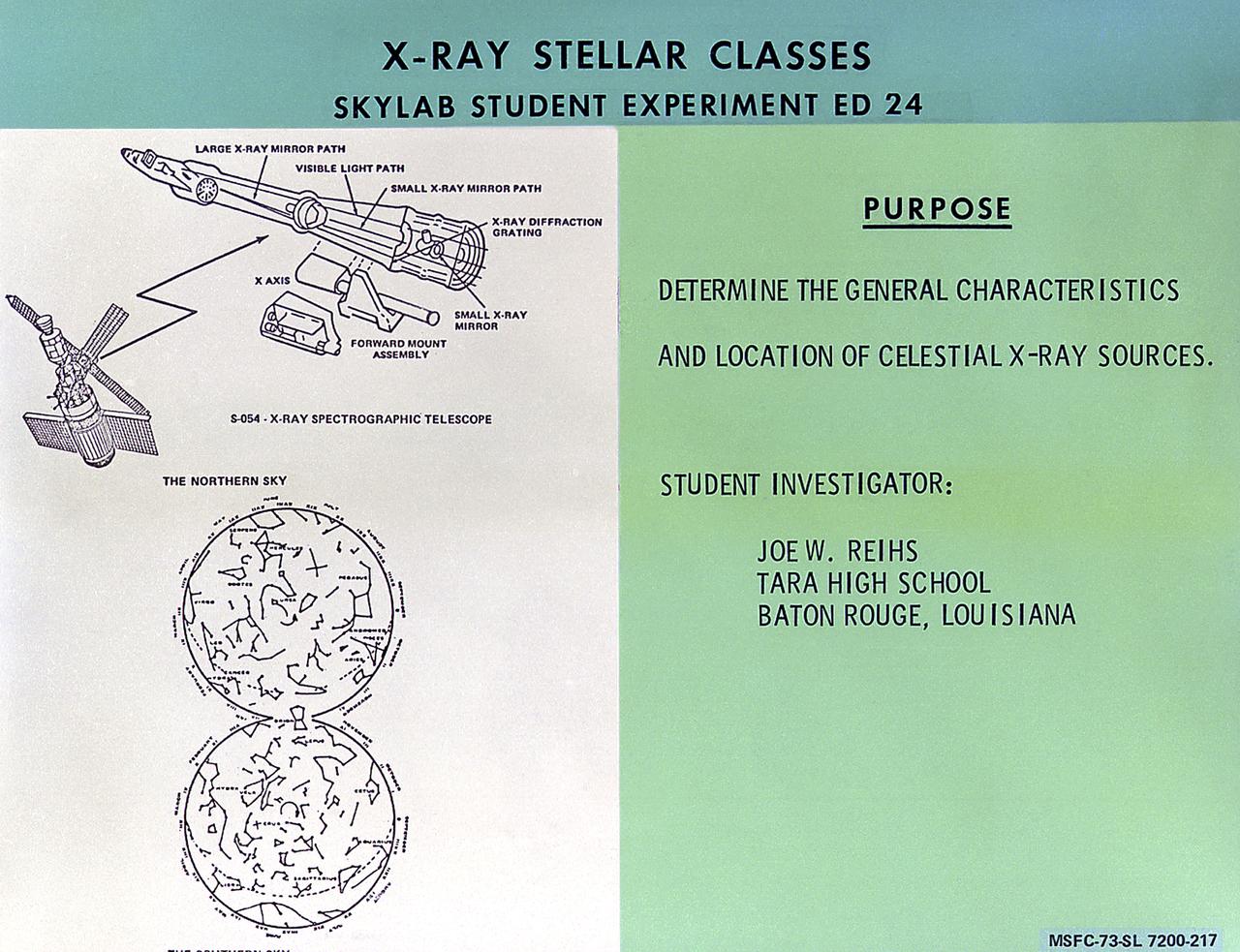
This chart describes the Skylab student experiment X-Ray Stellar Classes, proposed by Joe Reihs of Baton Rouge, Louisiana. This experiment utilized Skylab's X-Ray Spectrographic Telescope to observe and determine the general characteristics and location of x-ray sources. In March 1972, NASA and the National Science Teachers Association selected 25 experiment proposals for flight on Skylab. Science advisors from the Marshall Space Flight Center aided and assisted the students in developing the proposals for flight on Skylab.
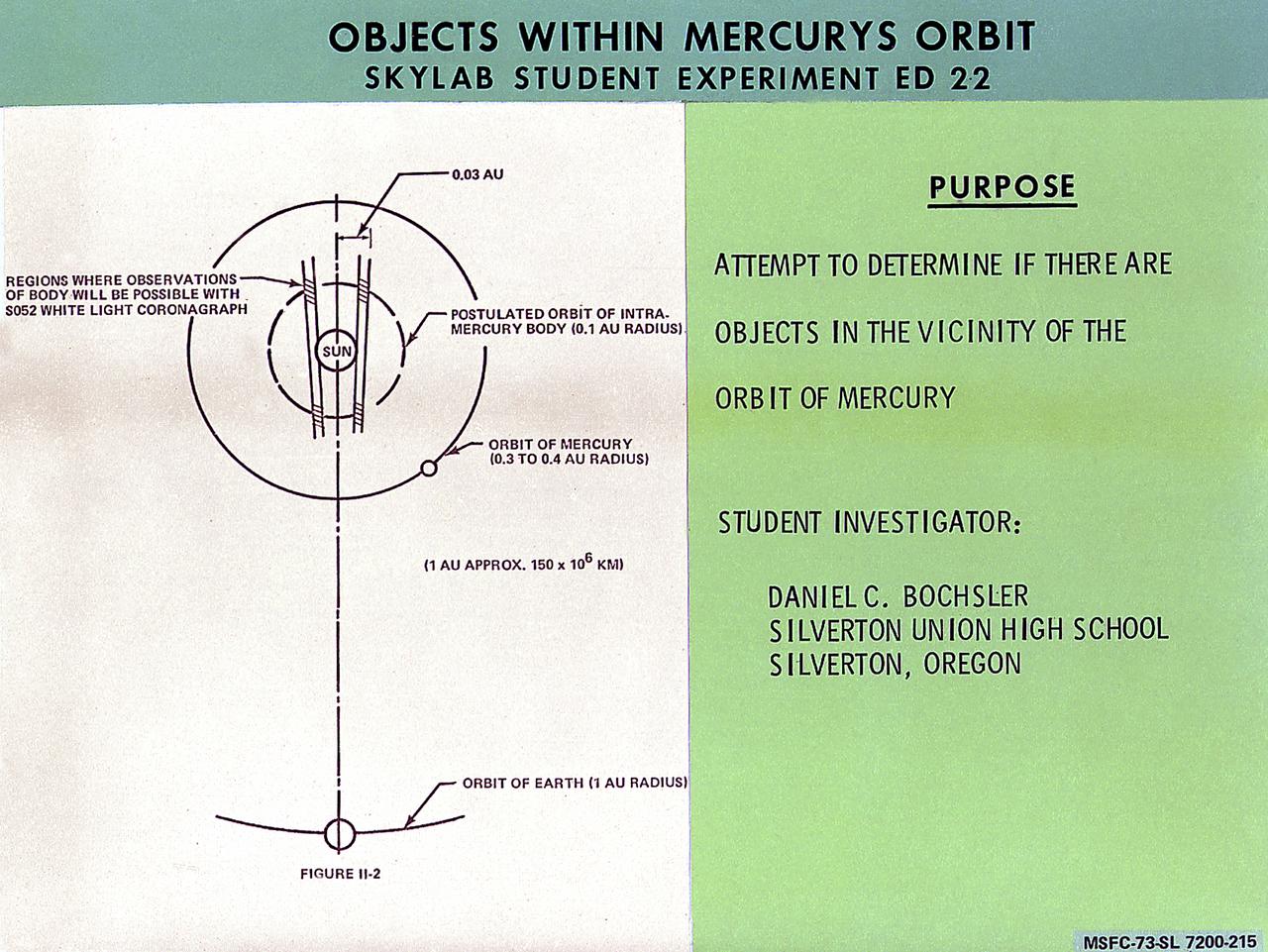
This chart describes the Skylab student experiment Objects Within Mercury's Orbit, proposed by Daniel C. Bochsler of Silverton, Oregon. This experiment utilized Skylab's White Light Coronagraph telescope to identify any objects orbiting the Sun within the orbit of Mercury. In March 1972, NASA and the National Science Teachers Association selected 25 experiment proposals for flight on Skylab. Science advisors from the Marshall Space Flight Center aided and assisted the students in developing the proposals for flight on Skylab.
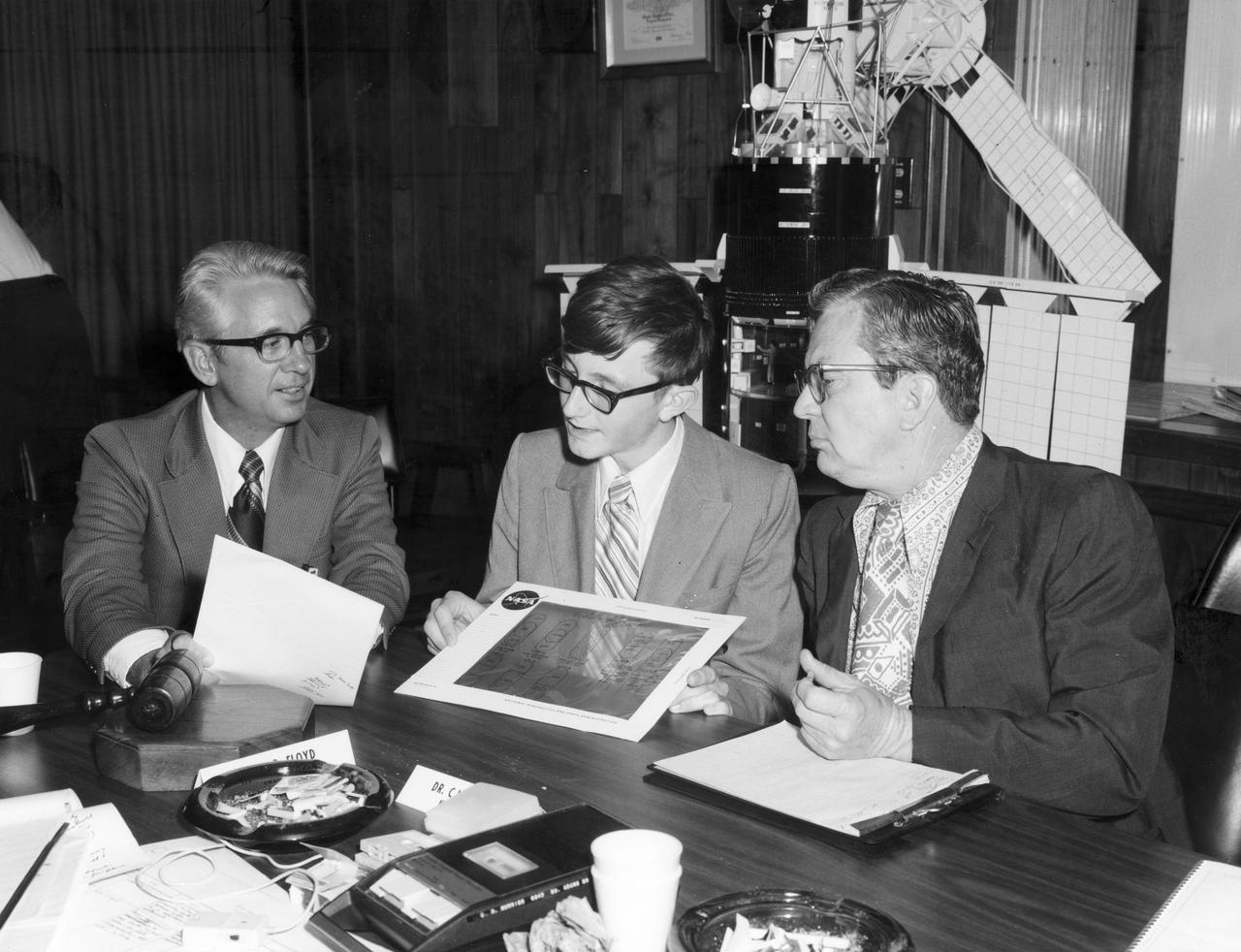
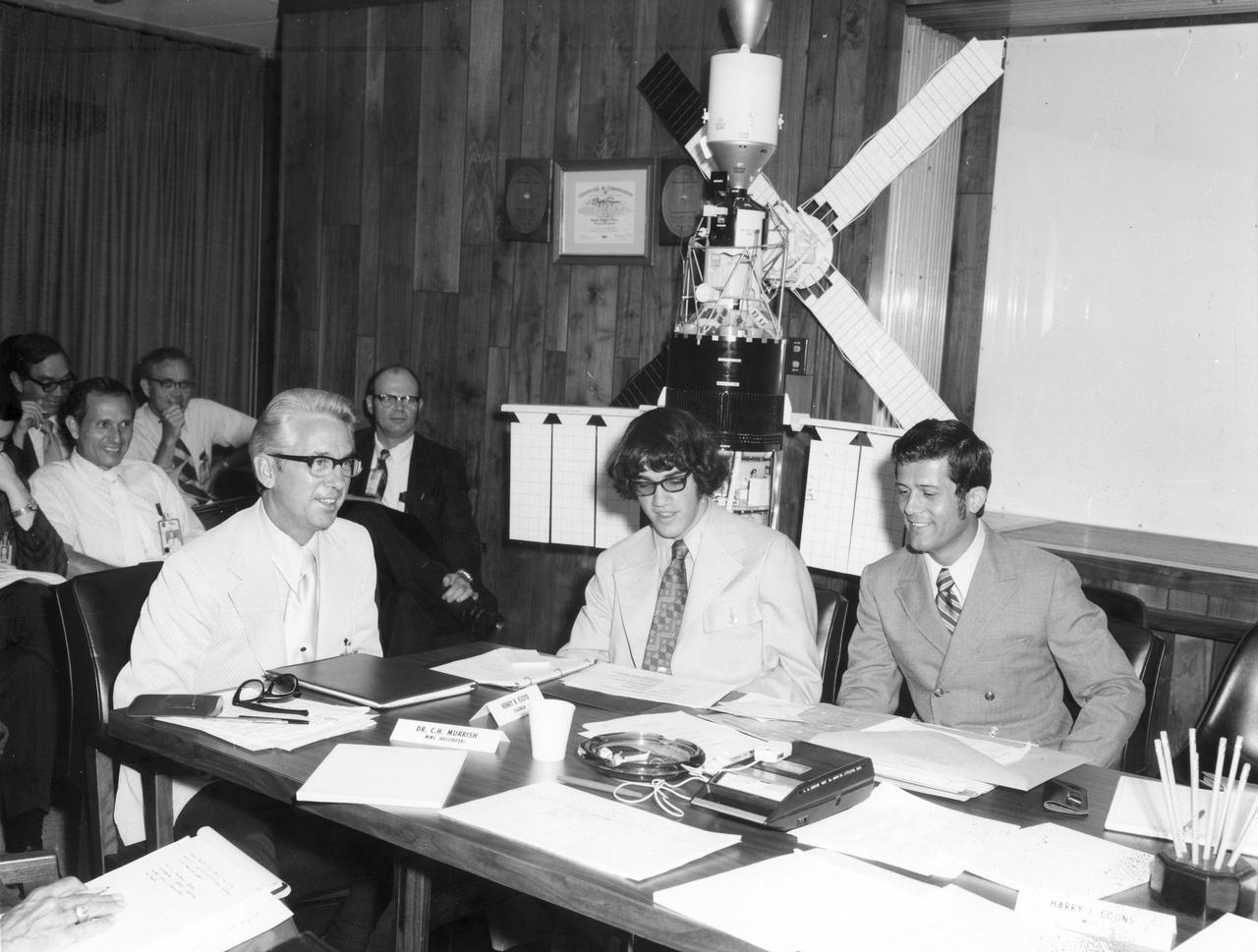
Youngstown, Ohio high school student, W. Brian Dunlap (center), discusses with Dr. Robert Head (right), and Henry Floyd, both of the Marshall Space Flight Center (MSFC), his experiment to be performed aboard the Skylab the following year. His experiment, “Wave Motion Trough A Liquid in Zero Gravity” used a container attached to the end of a leaf spring which was oscillated at specific rates using two thickness differentiated types of liquids. Dunlap was among 25 winners of a contest in which some 3,500 high school students proposed experiments for the following year’s Skylab mission. The nationwide scientific competition was sponsored by the National Science Teachers Association and the National Aeronautics and Space Administration (NASA). The winning students, along with their parents and sponsor teachers, visited MSFC where they met with scientists and engineers, participated in design reviews for their experiments, and toured MSFC facilities. Of the 25 students, 6 did not see their experiments conducted on Skylab because the experiments were not compatible with Skylab hardware and timelines. Of the 19 remaining, 11 experiments required the manufacture of additional equipment. The equipment for the experiments was manufactured at MSFC.
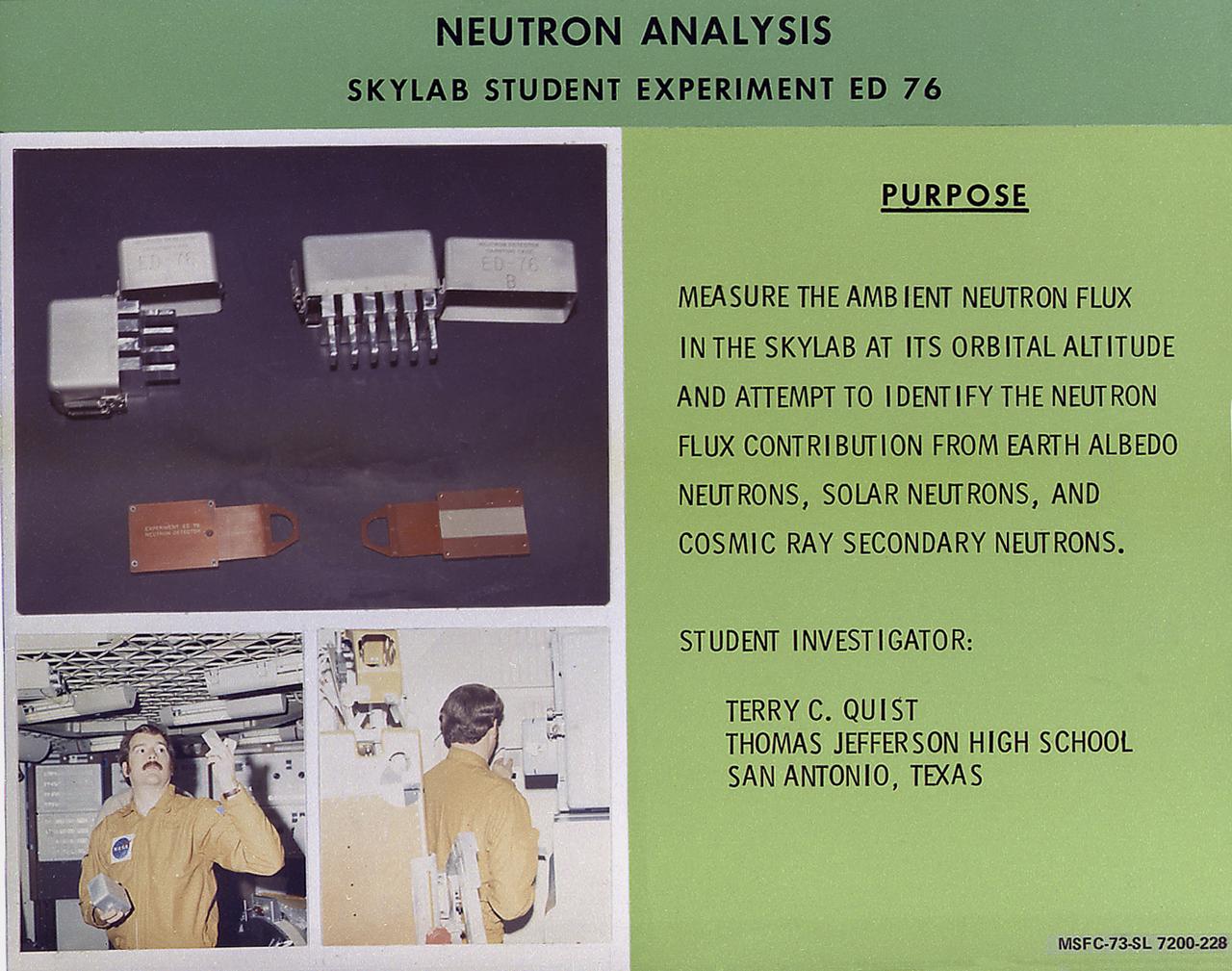
The rate of neutron flow is commonly referred to as a flux. The measurement of neutron fluxes in Skylab was the subject of a proposal by Terry Quist of San Antonio, Texas. This chart describes Quist's experiment, Neutron Analysis, Skylab student experiment ED-76. These measurements were considered important not only by NASA but also by the scientific community for four reasons. High energy neutrons can be harmful to human tissue if they are present in significant quantities. Fluxes of neutrons can damage film and other sensitive experimental equipment in a marner similar to those produced by x-rays or other radiation. Furthermore, neutron fluxes can be used as a calibration source for other space-oriented particle physics experiments. Finally, neutron fluxes can affect sensitive x-ray and gamma-ray astronomy observations. Quist's objectives were to measure the neutron fluxes present in Skylab and, with the assistance of NASA and other physicists, to attempt determination of their origin as well as their energy range or spectrum. This experiment had stimulated interest in further studies of neutron phenomena in space. In March 1972, NASA and the National Science Teachers Association selected 25 experiment proposals for flight on Skylab. Science advisors from the Marshall Space Flight Center aided and assisted the students in developing the proposals for flight on Skylab.
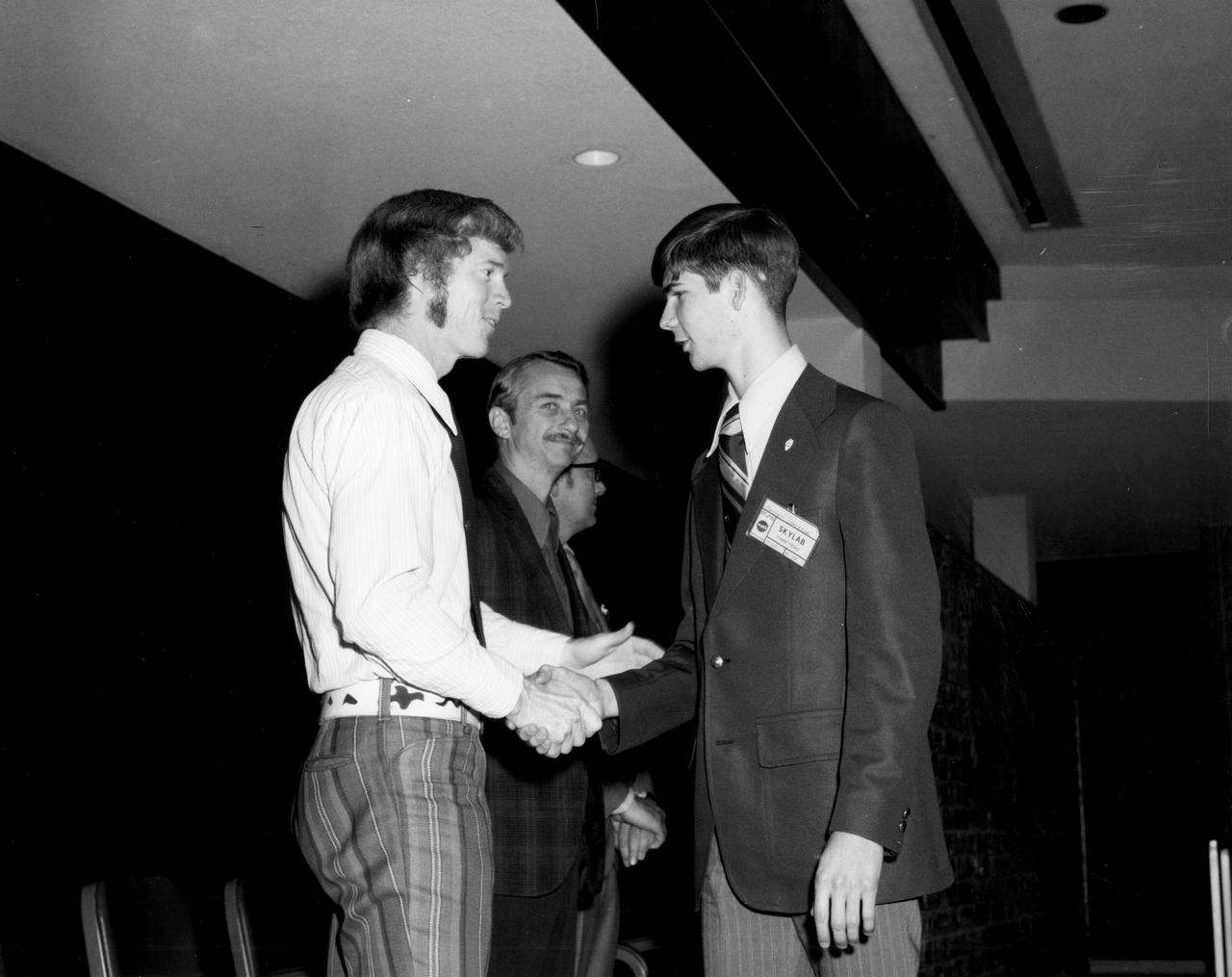
Rockford, Illinois high school student, Vincent Converse (right), is greeted by astronauts Russell L. Schweickart and Owen K. Garriott during a tour of the Marshall Space Flight Center (MSFC). Converse was among 25 winners of a contest in which some 3,500 high school students proposed experiments for the following year’s Skylab mission. His experiment, “Zero Gravity Mass Measurement” used a simple leaf spring with the mass to be weighed attached to the end. An electronic package oscillated the spring at a specific rate and the results were recorded electronically. The nationwide scientific competition was sponsored by the National Science Teachers Association and the National Aeronautics and Space Administration (NASA). The winning students, along with their parents and sponsor teachers, visited MSFC where they met with scientists and engineers, participated in design reviews for their experiments, and toured MSFC facilities. Of the 25 students, 6 did not see their experiments conducted on Skylab because the experiments were not compatible with Skylab hardware and timelines. Of the 19 remaining, 11 experiments required the manufacture of additional equipme
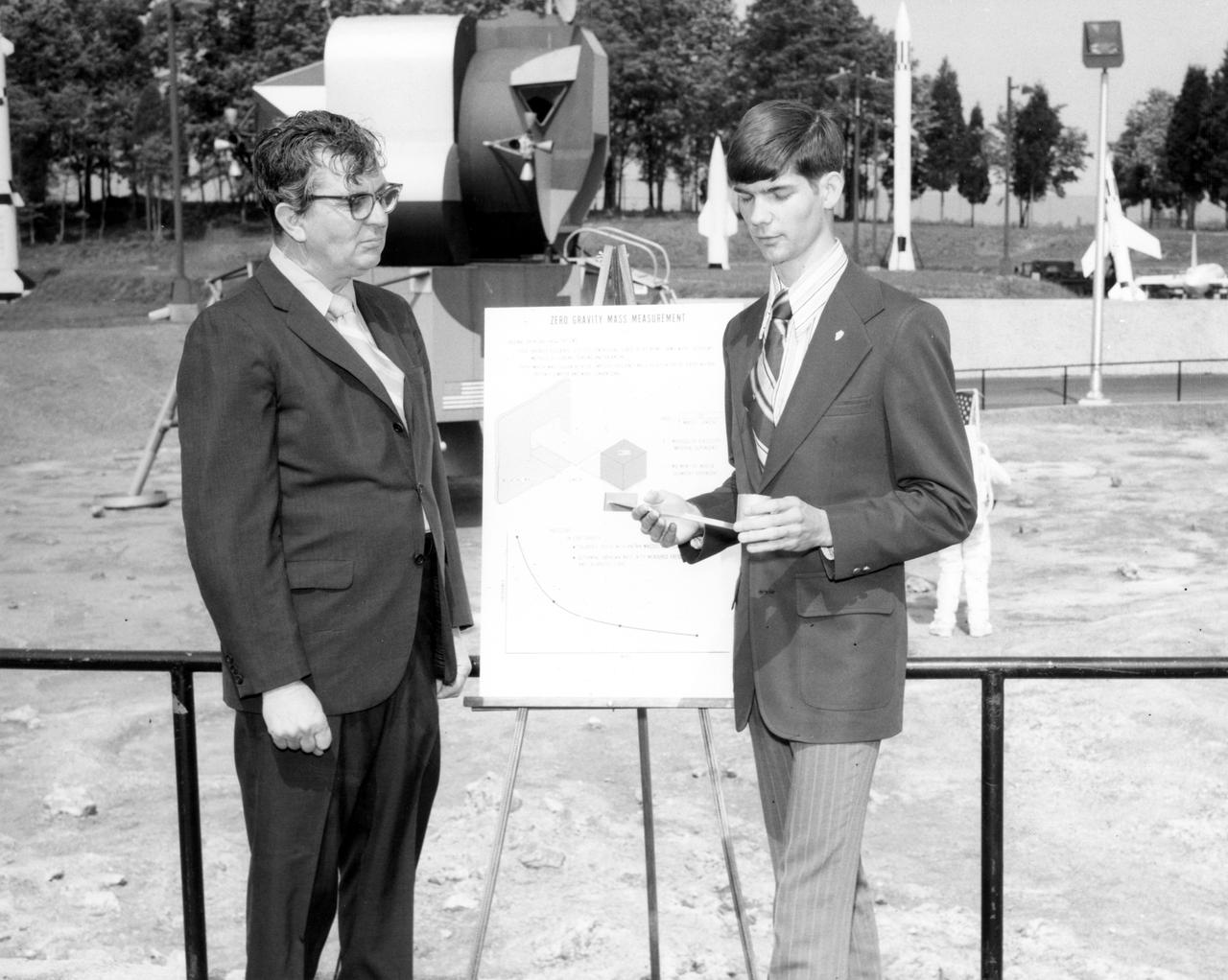
Vincent W. Converse, high school student from Rockford, Illinois, discussed a mass measurement device he proposed for the Skylab mission with Dr. Robert Head of the Marshall Space Flight Center (MSFC) during his visit to the center. The lunar surface scene in the background is one of many space exhibits at the Alabama Space and Rocket Center in nearby Huntsville, Alabama. Converse was among 25 winners of a contest in which some 3,500 high school students proposed experiments for the following year’s Skylab mission. The nationwide scientific competition was sponsored by the National Science Teachers Association and the National Aeronautics and Space Administration (NASA). The winning students, along with their parents and sponsor teachers, visited MSFC where they met with scientists and engineers, participated in design reviews for their experiments, and toured MSFC facilities. Of the 25 students, 6 did not see their experiments conducted on Skylab because the experiments were not compatible with Skylab hardware and timelines. Of the 19 remaining, 11 experiments required the manufacture of additional equipment.
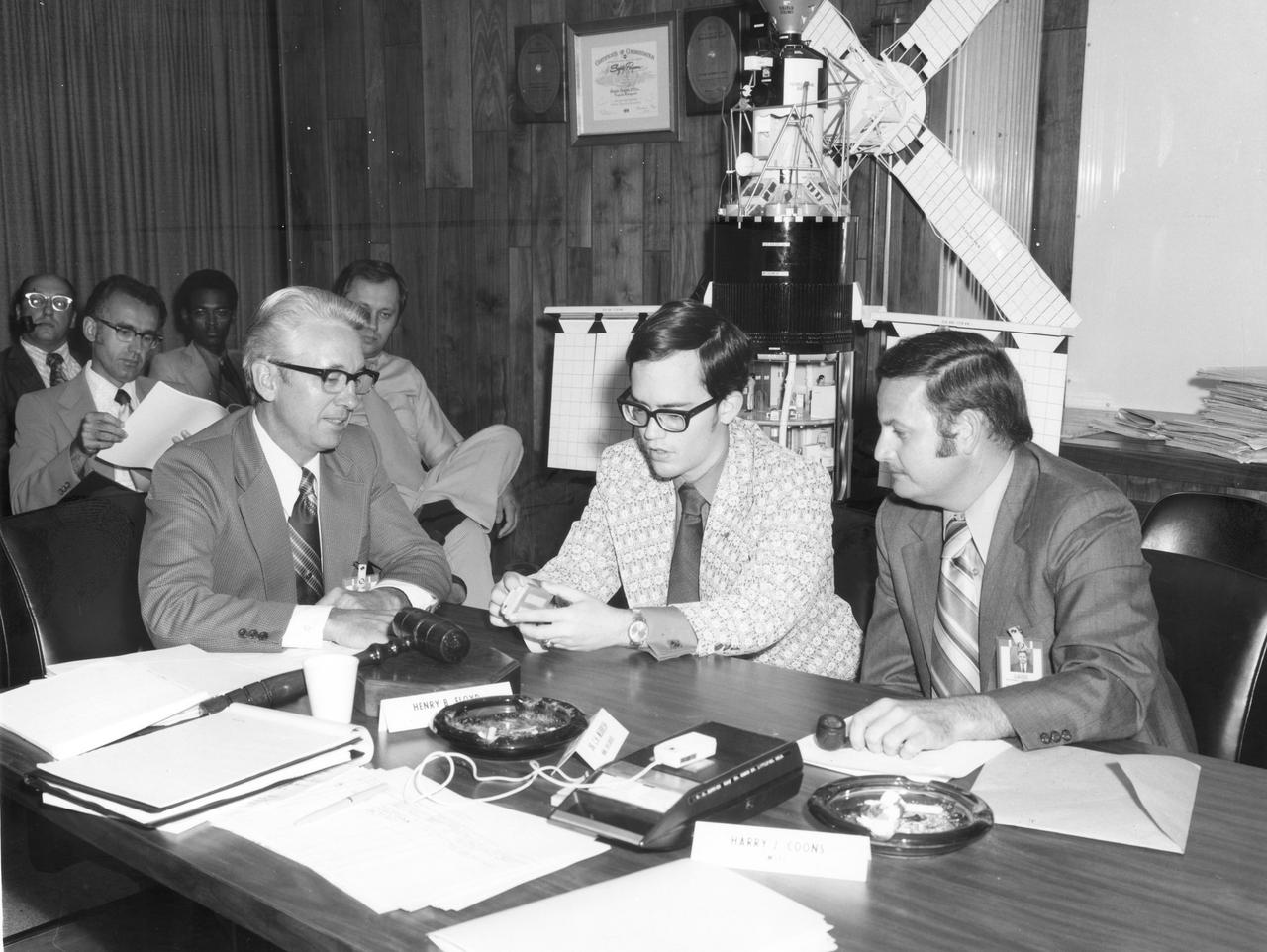
Terry C. Quist (center), high school student from San Antonio, Texas, discusses his proposed Skylab experiment with Marshall Space Flight Center’s (MSFC) Henry Floyd (left), coordinator of the Skylab Student Experiment Project, and DR. Raymond Gause, scientific advisor to Quist. The student’s experiment, “Earth Orbital Neutron Analysis”, was aimed at learning more about the source of neutrons in the solar system by seeking the number and direction from which each comes. Quist was among the 25 winners of a contest in which some 3,500 high school students proposed experiments for the following year’s Skylab mission. Of the 25 students, 6 did not see their experiments conducted on Skylab because the experiments were not compatible with Skylab hardware and timelines. Of the 19 remaining, 11 experiments required the manufacture of equipment, such as Quist’s experiment, which required detector hardware.
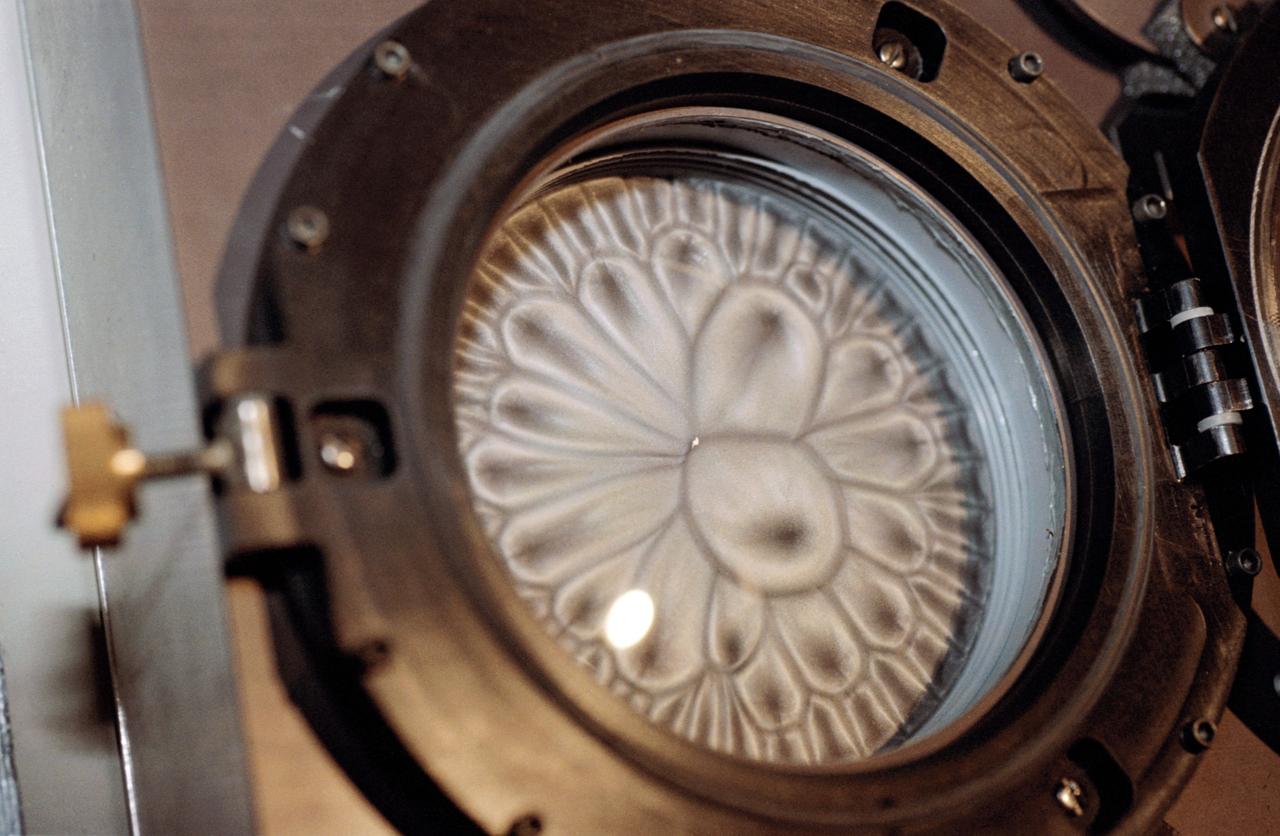
STS-42 closeup view shows Student Experiment 81-09 (SE 81-09), Convection in Zero Gravity experiment, with radial pattern caused by convection induced by heating an oil and aluminum powder mixture in the weightlessness of space. While the STS-42 crewmembers activated the Shuttle Student Involvement Program (SSIP) experiment on Discovery's, Orbiter Vehicle (OV) 103's, middeck, Scott Thomas, the student who designed the experiment, was able to observe the procedures via downlinked television (TV) in JSC's Mission Control Center (MCC). Thomas, now a physics doctoral student at the University of Texas, came up with the experiment while he participated in the SSIP as a student at Richland High School in Johnstown, Pennsylvia.

This chart describes the Skylab student experiment Ultraviolet (UV) From Pulsars, proposed by Neal W. Sharnon of Atlanta, Georgia. This experiment was to observe several pulsars with Skylab's UV spectrometer to determine their intensities in that portion of their spectra. A more detailed description of a pulsar's electromagnetic emission profile would be expected to further define means by which its energy is released. Unfortunately, upon examination of the photographic plates containing the data from the experiment, it was found that an alignment error of the spectrometer prevented detection of any of the pulsars. In March 1972, NASA and the National Science Teachers Association selected 25 experiment proposals for flight on Skylab. Science advisors from the Marshall Space Flight Center aided and assisted the students in developing the proposals for flight on Skylab.
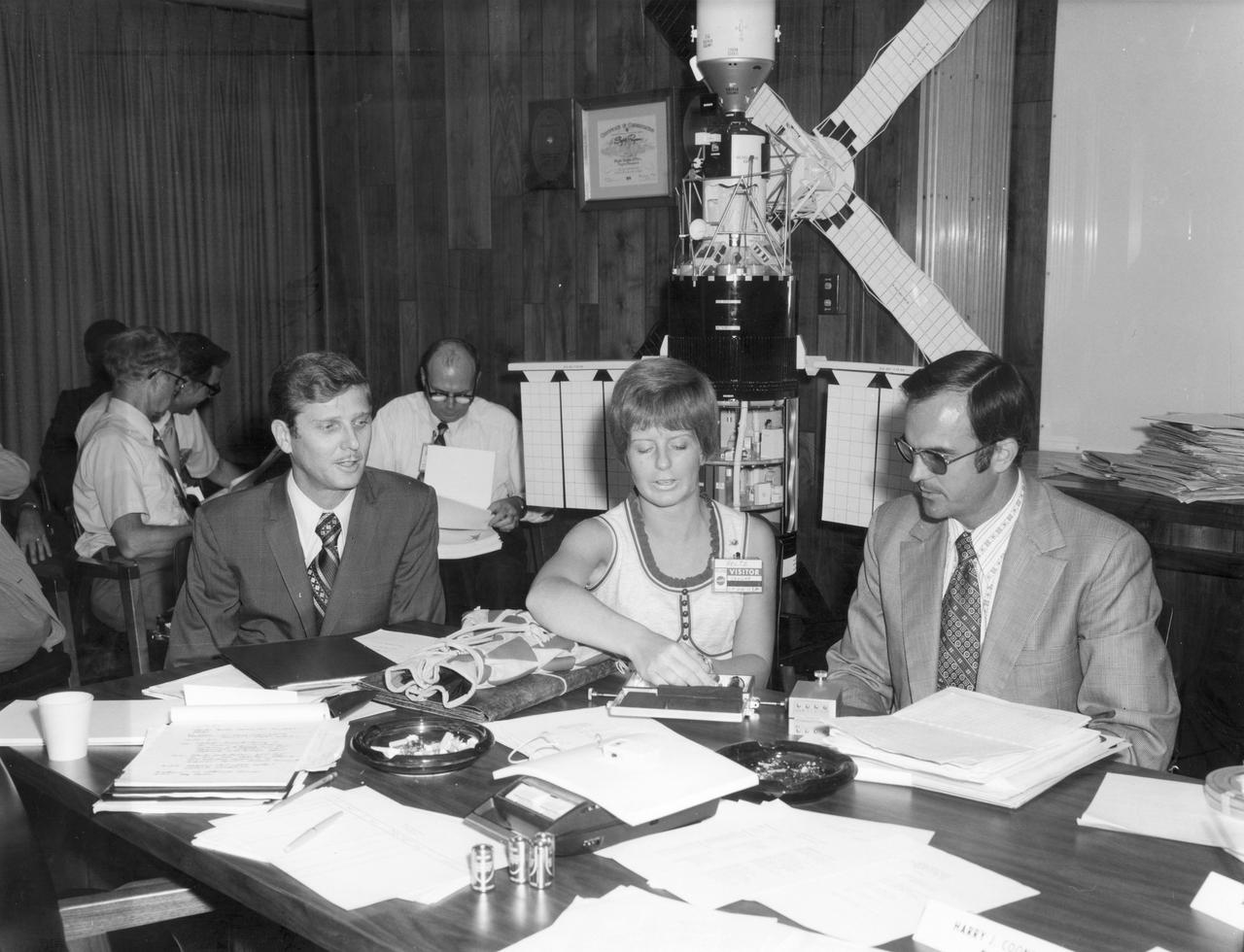
Miss Cheryl Peltz, high school student from Littleton, Colorado, discusses her “Cytoplasmic Streaming in Zero Gravity” experiment with Ed Armstrong (left) of the NASA Manned Spacecraft Center, and her advisor Charles Cothran (right) of the NASA Marshall Space Flight Center (MSFC). She was one of the 25 winners of a contest in which some 3,500 high school students proposed experiments for the following year’s Skylab Mission. Of the 25 students, 6 did not see their experiments conducted on Skylab because the experiments were not compatible with Skylab hardware and timelines. Of the 19 remaining, 11 experiments required the manufacture of equipment, of which Miss Peltz’s was one.
Robert L. Staehle (center), high school student from Harley School, Rochester New York, talks with Steven Hall (advisor to Staehle) and Henry Floyd, both of the Marshall Space Flight Center (MSFC) about his experiment “Behavior of Bacteria and Bacterial Spores in the Skylab Space Environment”. He was one of the 25 winners of a contest in which some 3,500 high school students proposed experiments for the following year’s Skylab mission. Of the 25 students, 6 did not see their experiments conducted on Skylab because the experiments were not compatible with Skylab hardware and timelines. Of the 19 remaining, 11 experiments required the manufacture of equipment.
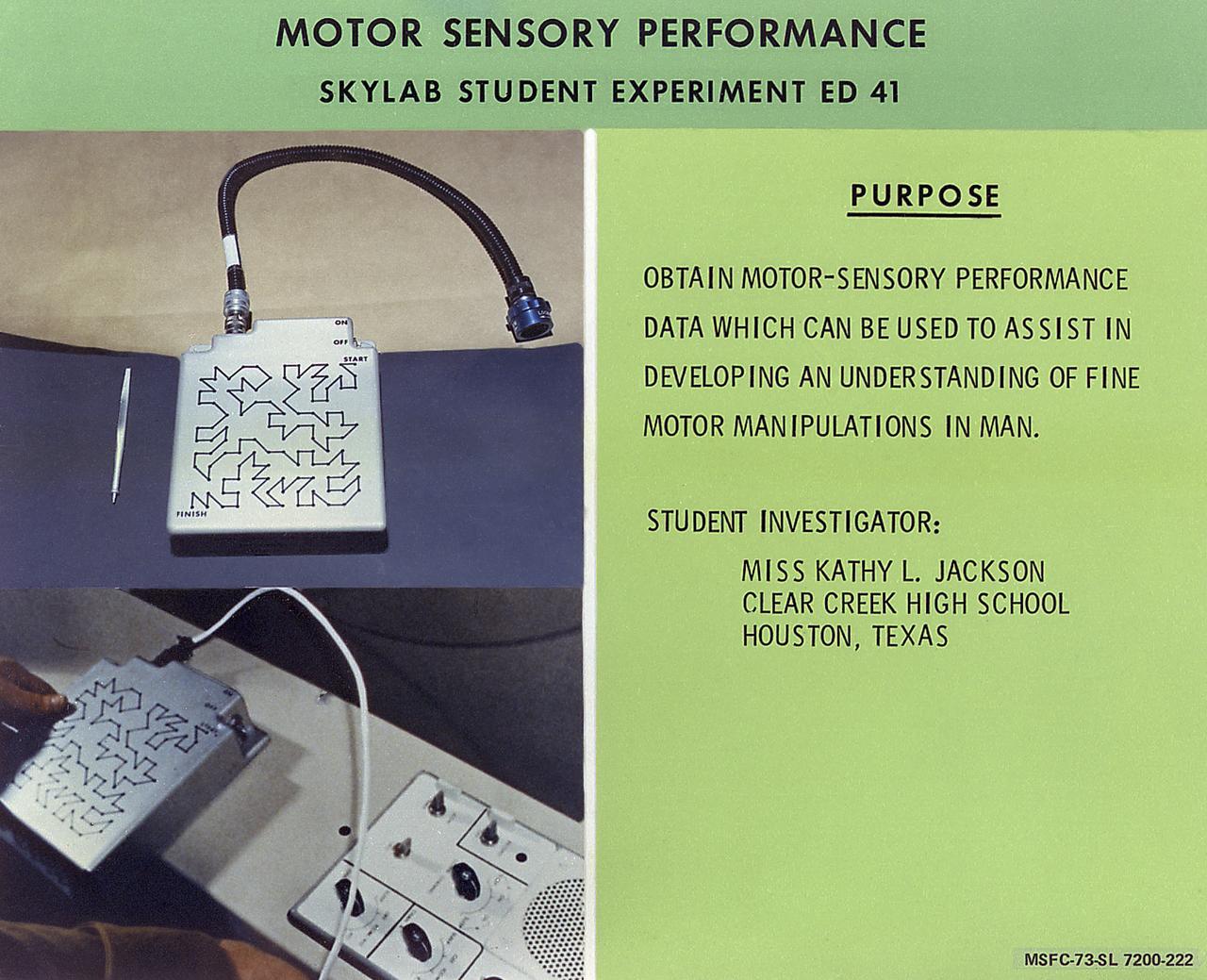
This chart describes the Skylab student experiment Motor Sensory Performance, proposed by Kathy L. Jackson of Houston, Texas. Her proposal was a very simple but effective test to measure the potential degradation of man's motor-sensory skills while weightless. Without knowing whether or not man can retain a high level of competency in the performance of various tasks after long exposure to weightlessness, this capability could not be fully known. Skylab, with its long-duration missions, provided an ideal testing situation. The experiment Kathy Jackson proposed was similar in application to the tasks involved in docking one spacecraft to another using manual control. It required one of the greatest tests of the motor-sensory capabilities of man. In March 1972, NASA and the National Science Teachers Association selected 25 experiment proposals for flight on Skylab. Science advisors from the Marshall Space Flight Center aided and assisted the students in developing the proposals for flight on Skylab.
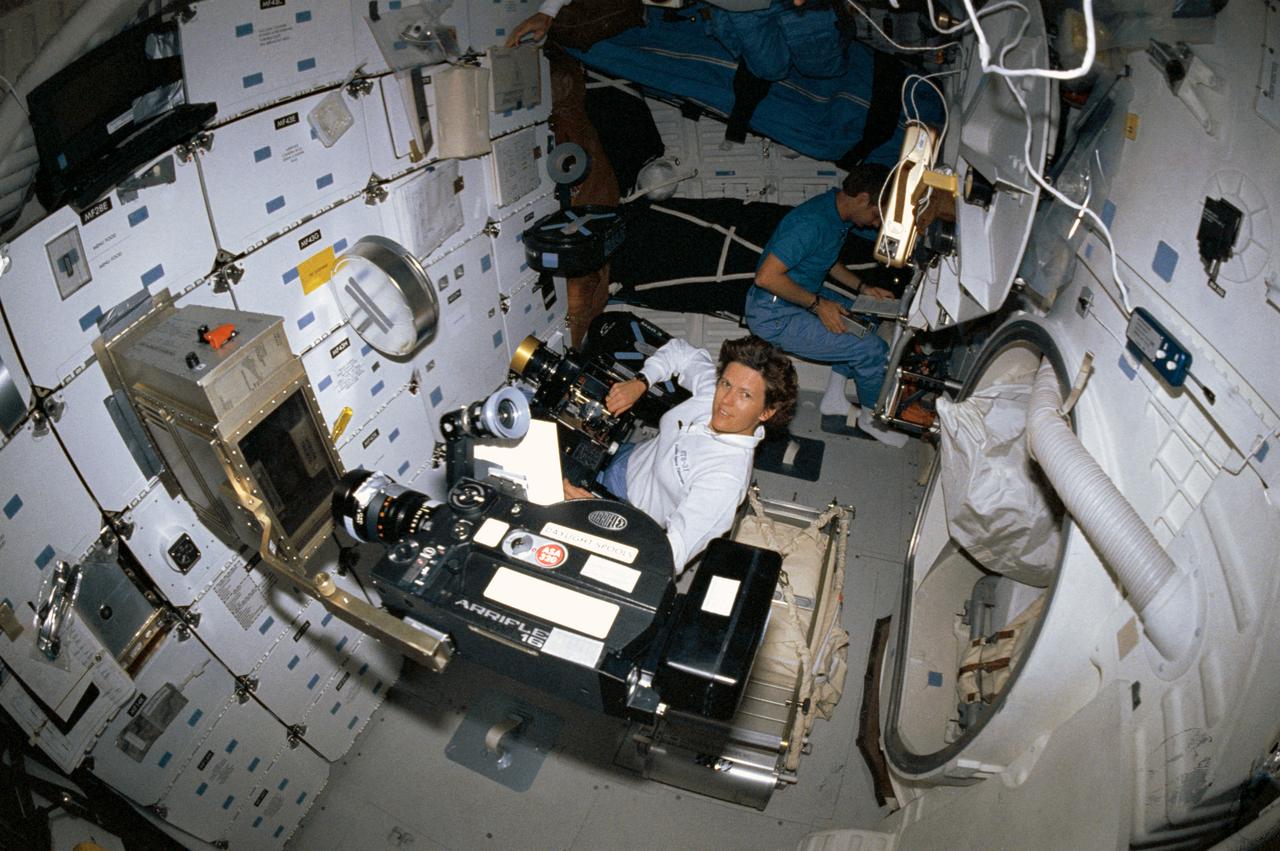
STS031-05-002 (24-29 April 1990) --- A 35mm camera with a "fish eye" lens captured this high angle image on Discovery's middeck. Astronaut Kathryn D. Sullivan works with the IMAX camera in foreground, while Astronaut Steven A. Hawley consults a checklist in corner. An Arriflex motion picture camera records student ion arc experiment in apparatus mounted on stowage locker. The experiment was the project of Gregory S. Peterson, currently a student at Utah State University.
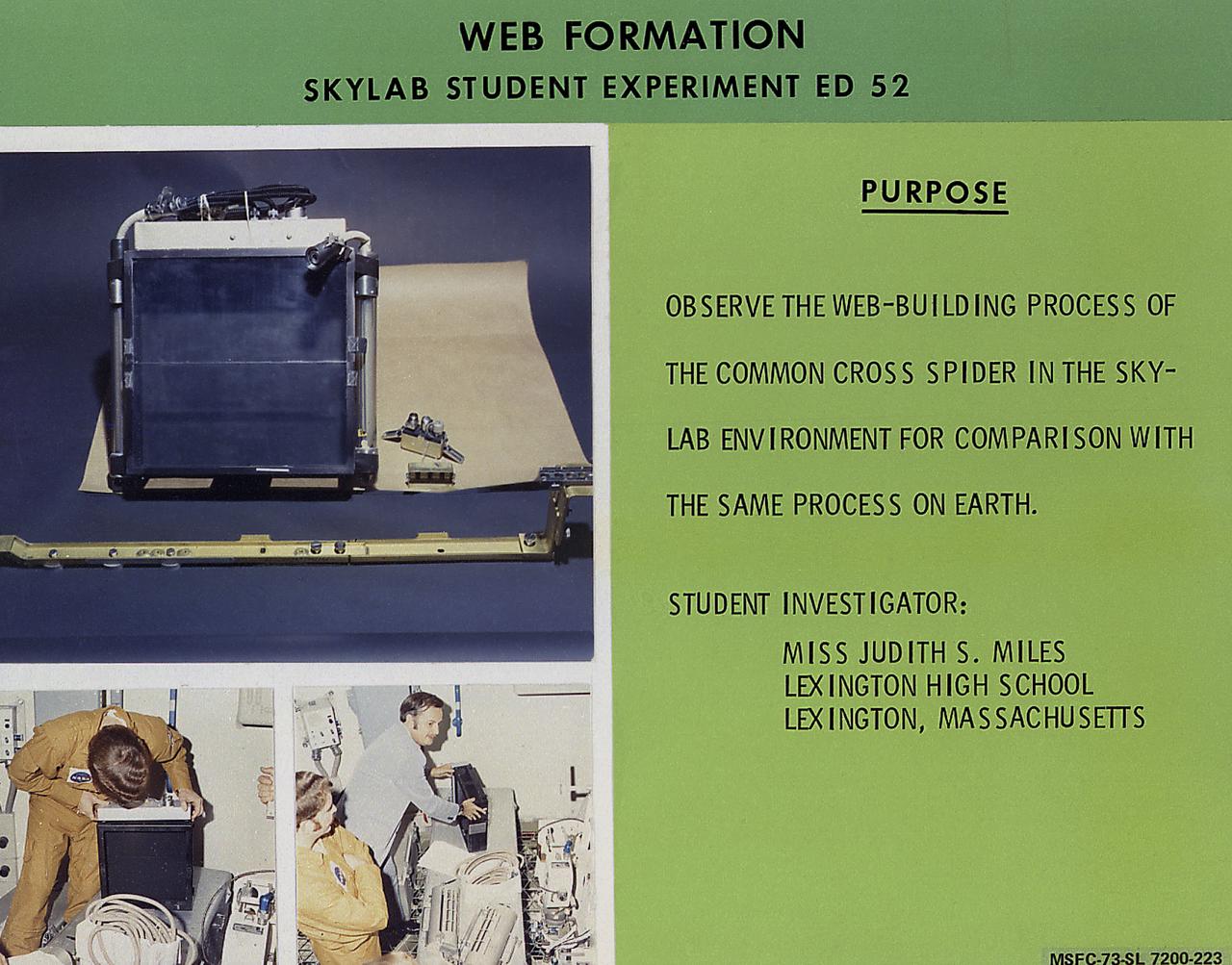
This chart describes the Skylab student experiment Web Formation. Judith S. Miles of Lexington High School, Lexington, Massachusetts, proposed a study of the spider's behavior in a weightless environment. The geometrical structure of the web of the orb-weaving spider provides a good measure of the condition of its central nervous system. Since the spider senses its own weight to determine the required thickness of web material and uses both the wind and gravity to initiate construction of its web, the lack of gravitational force in Skylab provided a new and different stimulus to the spider's behavioral response. Two common cross spiders, Arabella and Anita, were used for the experiment aboard the Skylab-3 mission. After initial disoriented attempts, both spiders produced almost Earth-like webs once they had adapted to weightlessness. In March 1972, NASA and the National Science Teachers Association selected 25 experiment proposals for flight on Skylab. Science advisors from the Marshall Space Flight Center aided and assisted the students in developing the proposals for flight on Skylab.
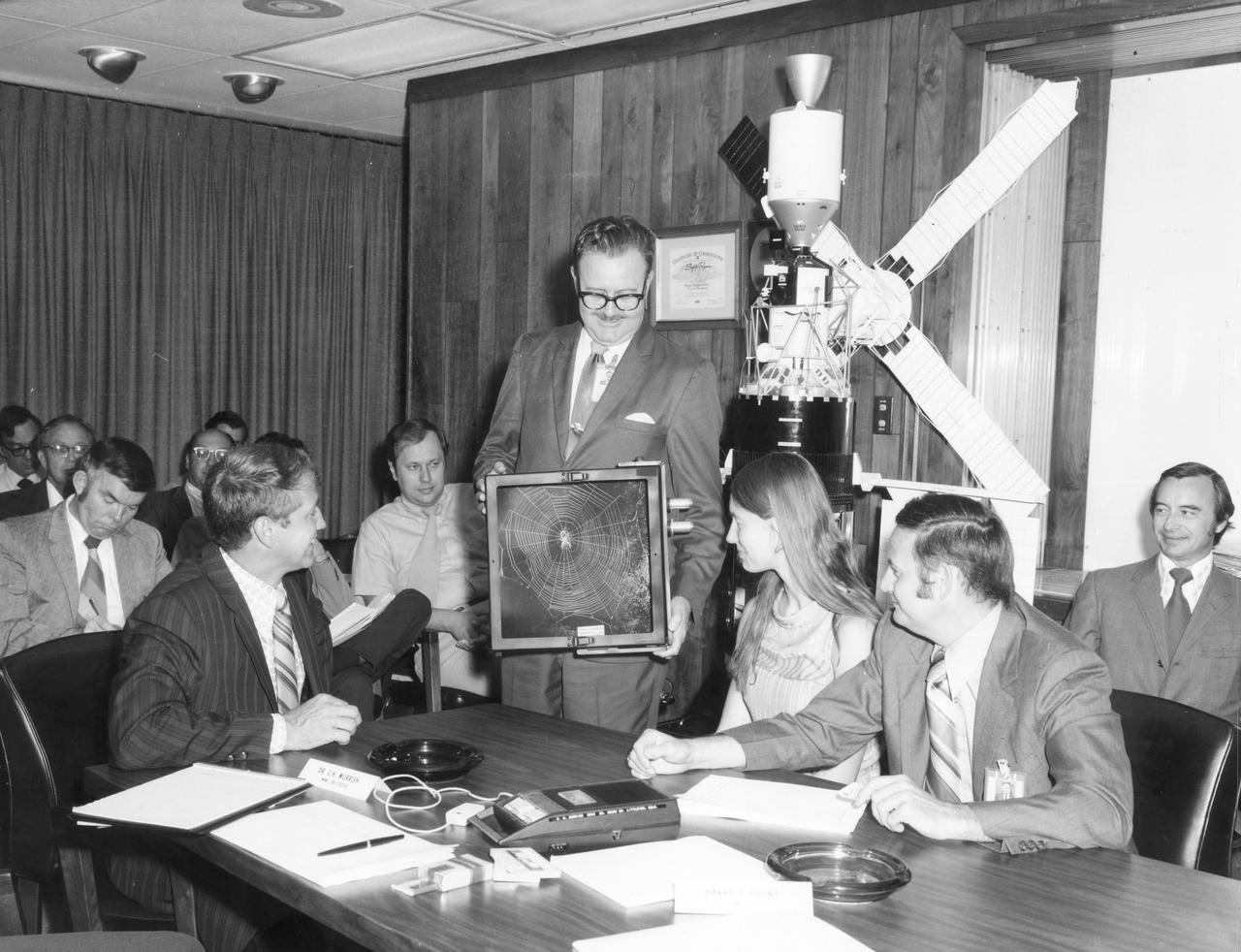
Lexington, Massachusetts high school student, Judith Miles, discusses her proposed Skylab experiment with engineers and scientists during a design review of the experiment equipment. At left is Ron Pavlue of Kennedy Space Flight Center (KSC), holding a box is Keith Demorest of Marshall Space Flight Center (MSFC). Right of Miles is Dr. Raymond Gause, also of MSFC, who is Miles’ scientific advisor. In her experiment, called the “Web Formation in Zero Gravity”, spiders were released into a box and their actions recorded to determine how well they adapt to the absence of gravity. Spiders are known to adapt quickly to other changes in the environment but nothing was known of their ability to adapt to weightlessness. At the same time spiders were weaving webs in Earth orbit, similar spiders were spinning webs in identical boxes on Earth under full gravity conditions. Miles was among the 25 winners of a contest in which some 3,500 high school students proposed experiments for the following year’s Skylab mission. Of the 25 students, 6 did not see their experiments conducted on Skylab because the experiments were not compatible with Skylab hardware and timelines. Of the 19 remaining, 11 experiments required the manufacture of equipment.
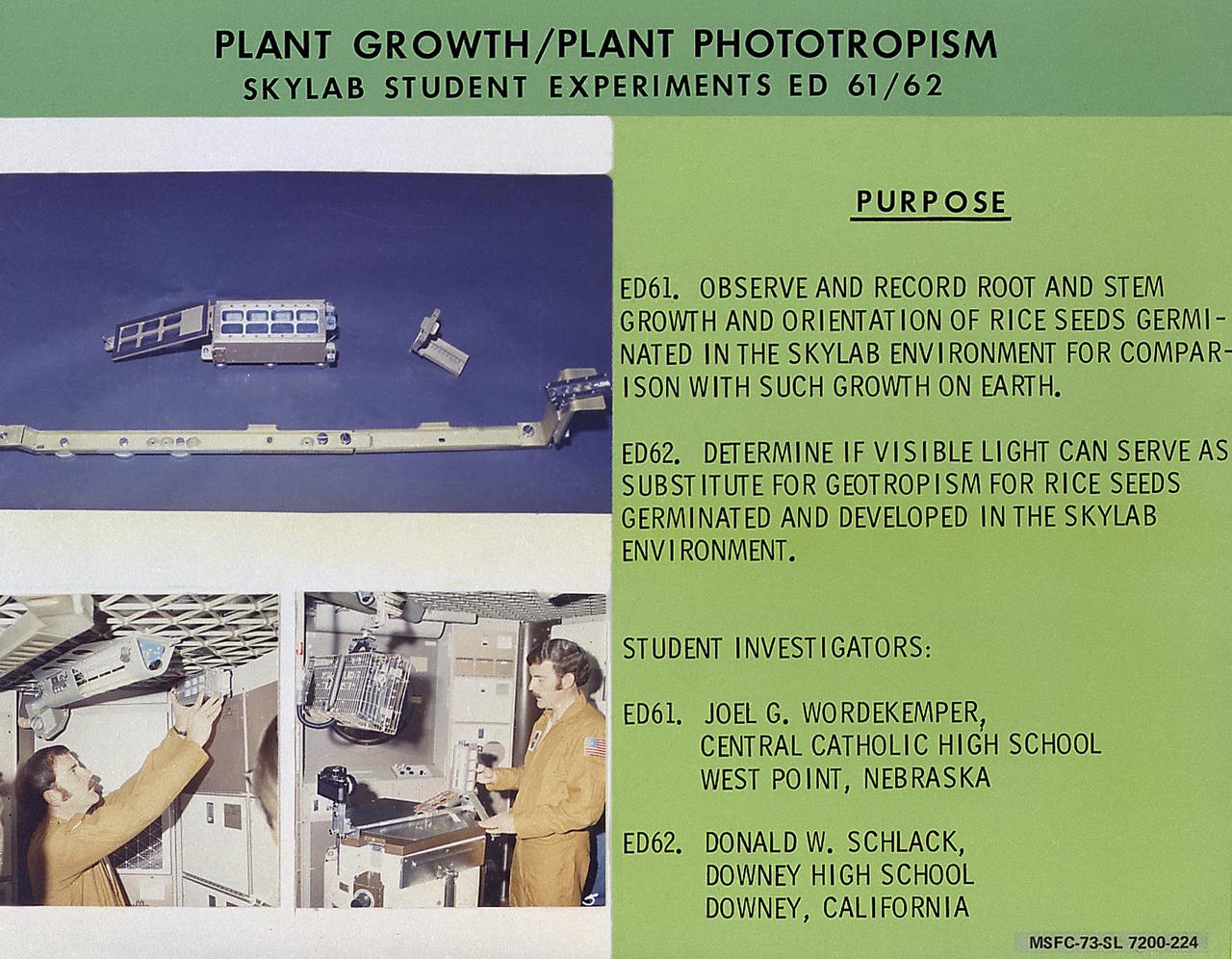
This chart describes the Skylab student experiment ED-61, Plant Growth, and experiment ED-62, Plant Phototropism. Two similar proposals were submitted by Joel G. Wordekemper of West Point, Nebraska, and Donald W. Schlack of Downey, California. Wordekemper's experiment (ED-61) was to see how the lack of gravity would affect the growth of roots and stems of plants. Schlack's experiment (ED-62) was to study the effect of light on a seed developing in zero gravity. The growth container of the rice seeds for their experiment consisted of eight compartments arranged in two parallel rows of four. Each had two windowed surfaces to allow periodic photography of the developing seedlings. In March 1972, NASA and the National Science Teachers Association selected 25 experiment proposals for flight on Skylab. Science advisors from the Marshall Space Flight Center aided and assisted the students in developing the proposals for flight on Skylab.
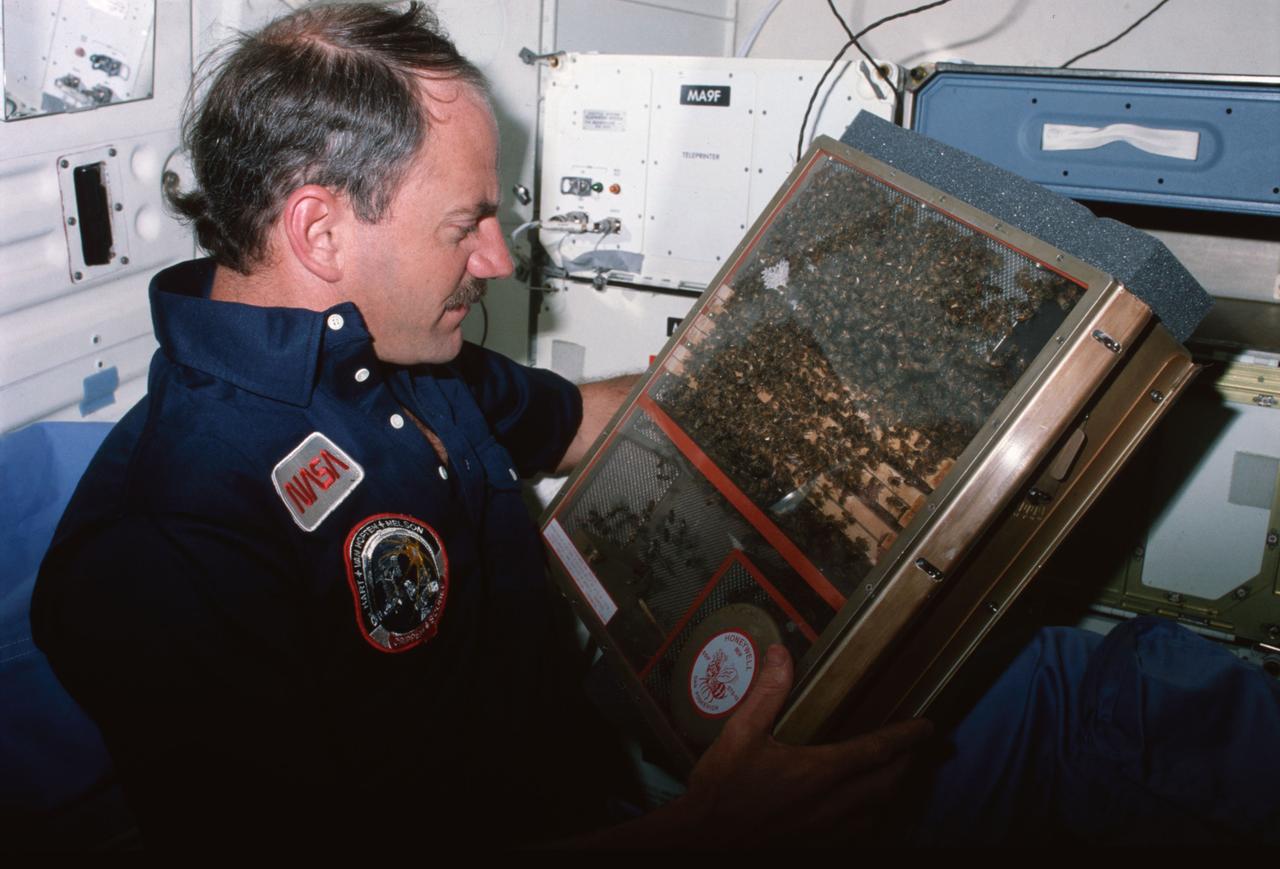
41C-05-188 (12 April 1984) --- Astronaut James D. van Hoften, mission specialist, holds an aluminum box, full of honeybees. The experiment in Earth-orbit is duplicated with another colony of the young honeycomb builders on Earth. Dan Poskevich submitted the experiment to NASA as part of the Shuttle student involvement program.
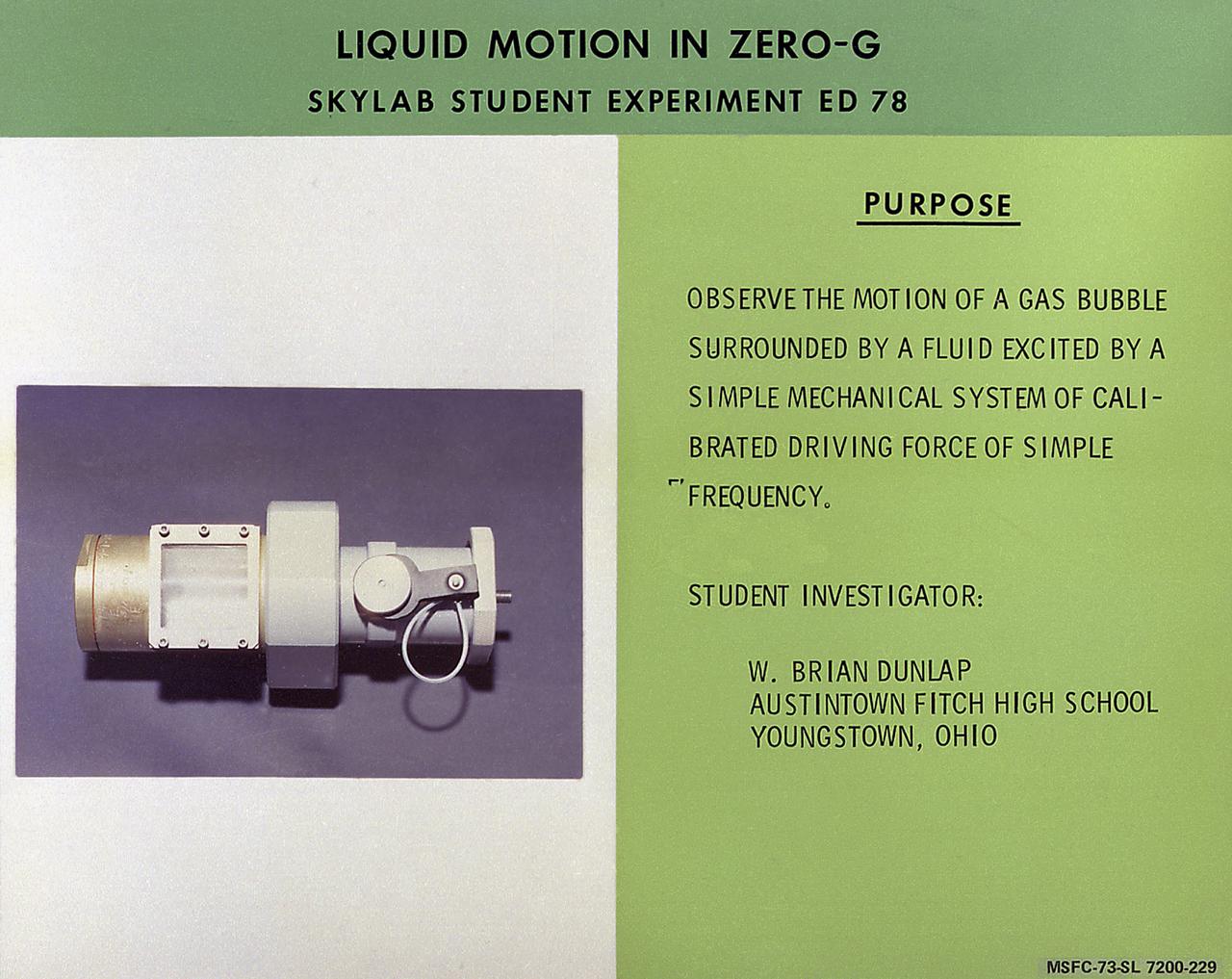
W. Brian Dunlap of Youngstown, Ohio, proposed Skylab student experiment ED-78, Liquid Motion in Zero-G, a study of wave motion in a liquid. He was particularly interested in comparing surface waves over a liquid in zero-gravity with those occurring on Earth. In space, with the absence of gravity, a liquid does not necessarily take the shape of its container as it does on Earth. Adhesion forces may hold the liquid in contact with its container, but the liquid can also assume a free-floating condition. It was in this latter state that Dunlap wished to examine the behavior of surface waves. Data were recorded on videotape and subsequently converted to 16-mm film. Dunlap analyzed these data to determine periods of oscillation of free-floating globules and found agreement with the theory to be much better than expected. In March 1972, NASA and the National Science Teachers Association selected 25 experiment proposals for flight on Skylab. Science advisors from the Marshall Space Flight Center aided and assisted the students in developing the proposals for flight on Skylab.
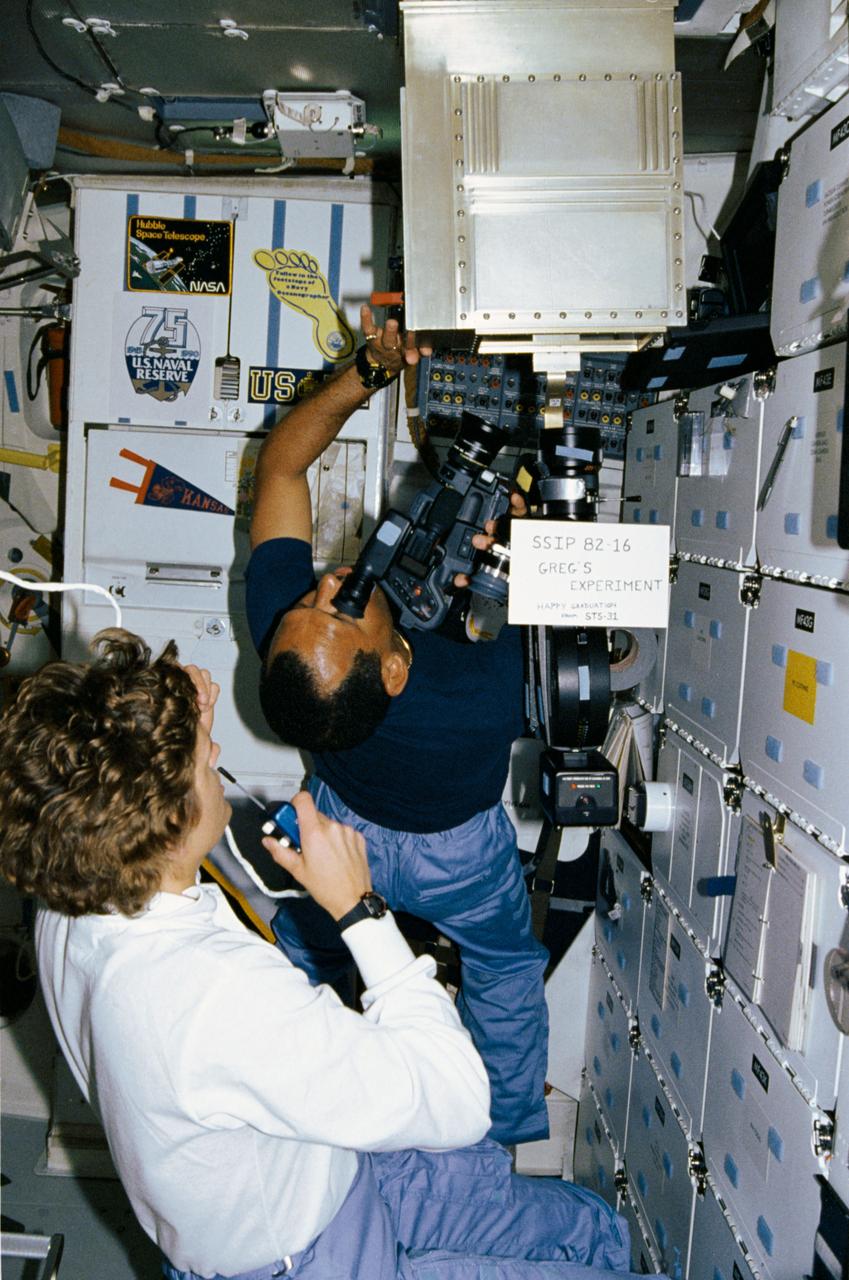
STS-31 Mission Specialist (MS) Kathryn D. Sullivan monitors and advises ground controllers of the activity inside the Student Experiment (SE) 82-16, Ion arc - studies of the effects of microgravity and a magnetic field on an electric arc, mounted in front of the middeck lockers aboard Discovery, Orbiter Vehicle (OV) 103. Pilot Charles F. Bolden uses a video camera and an ARRIFLEX motion picture camera to record the activity inside the special chamber. A sign in front of the experiment reads "SSIP 82-16 Greg's Experiment Happy Graduation from STS-31." SSIP stands for Shuttle Student Involvement Program. Gregory S. Peterson who developed the experiment (Greg's Experiment) is a student at Utah State University and monitored the experiment's operation from JSC's Mission Control Center (MCC) during the flight. Decals displayed in the background on the orbiter galley represent the Hubble Space Telescope (HST), the United States (U.S.) Naval Reserve, Navy Oceanographers, U.S. Navy, and University of Kansas.
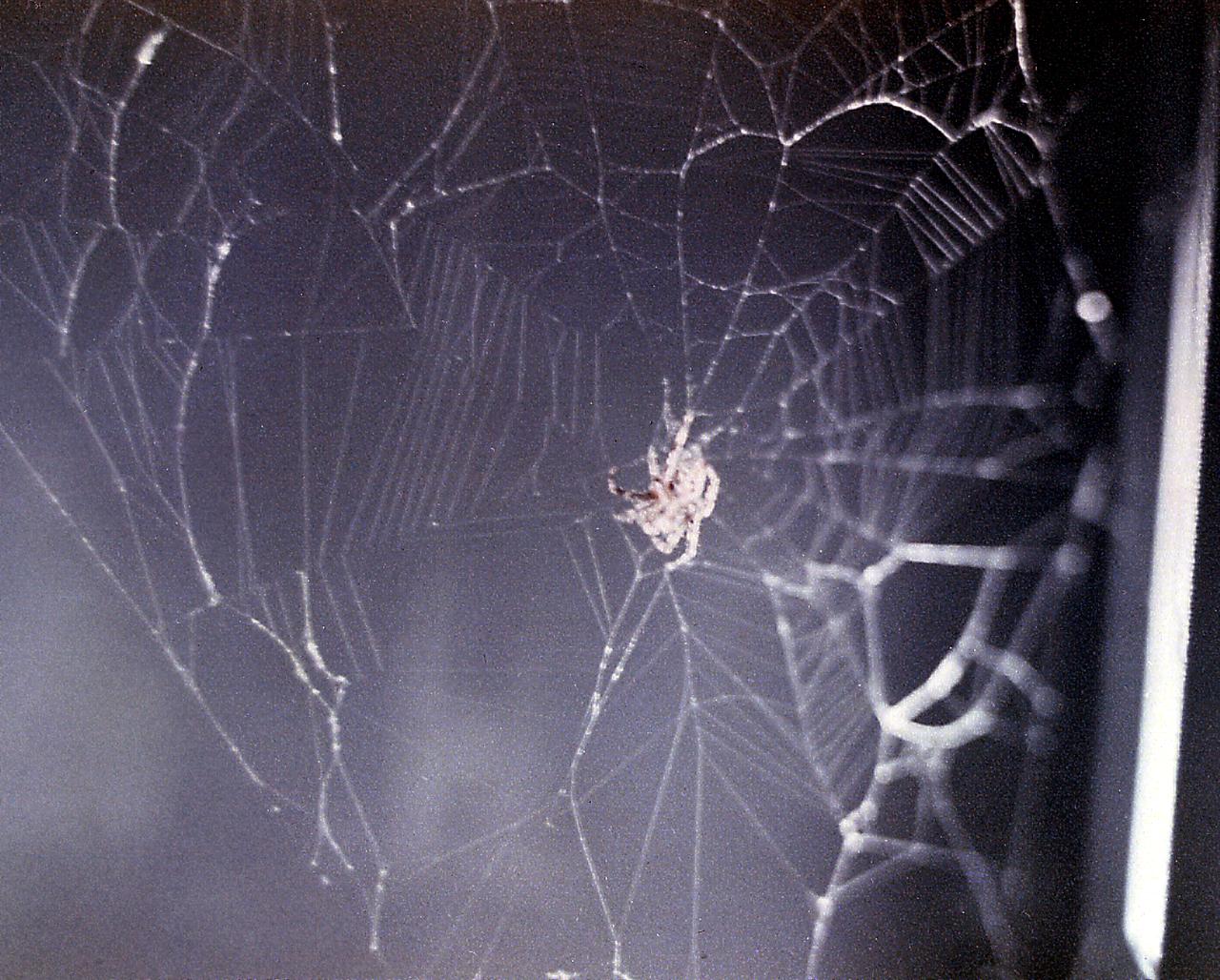
Judith S. Miles of Lexington High School, Lexington, Massachusetts, proposed skylab student experiment ED-52, Web Formation. This experiment was a study of a spider's behavior in a weightless environment. The geometrical structure of the web of the orb-weaving spider provides a good measure of the condition of its central nervous system. Since the spider senses its own weight to determine the required thickness of web material and uses both the wind and gravity to initiate construction of its web, the lack of gravitational force in Skylab provided a new and different stimulus to the spider's behavioral response. Two common cross spiders, Arabella and Anita, were used for the experiment aboard the Skylab-3 mission. After initial disoriented attempts, both spiders produced almost Earth-like webs once they had adapted to weightlessness. This photograph is of Arabella, a cross spider, in her initial attempt at spirning a web. This picture was taken by the crew of the Skylab 3 mission before Arabella adapted to her new environment.
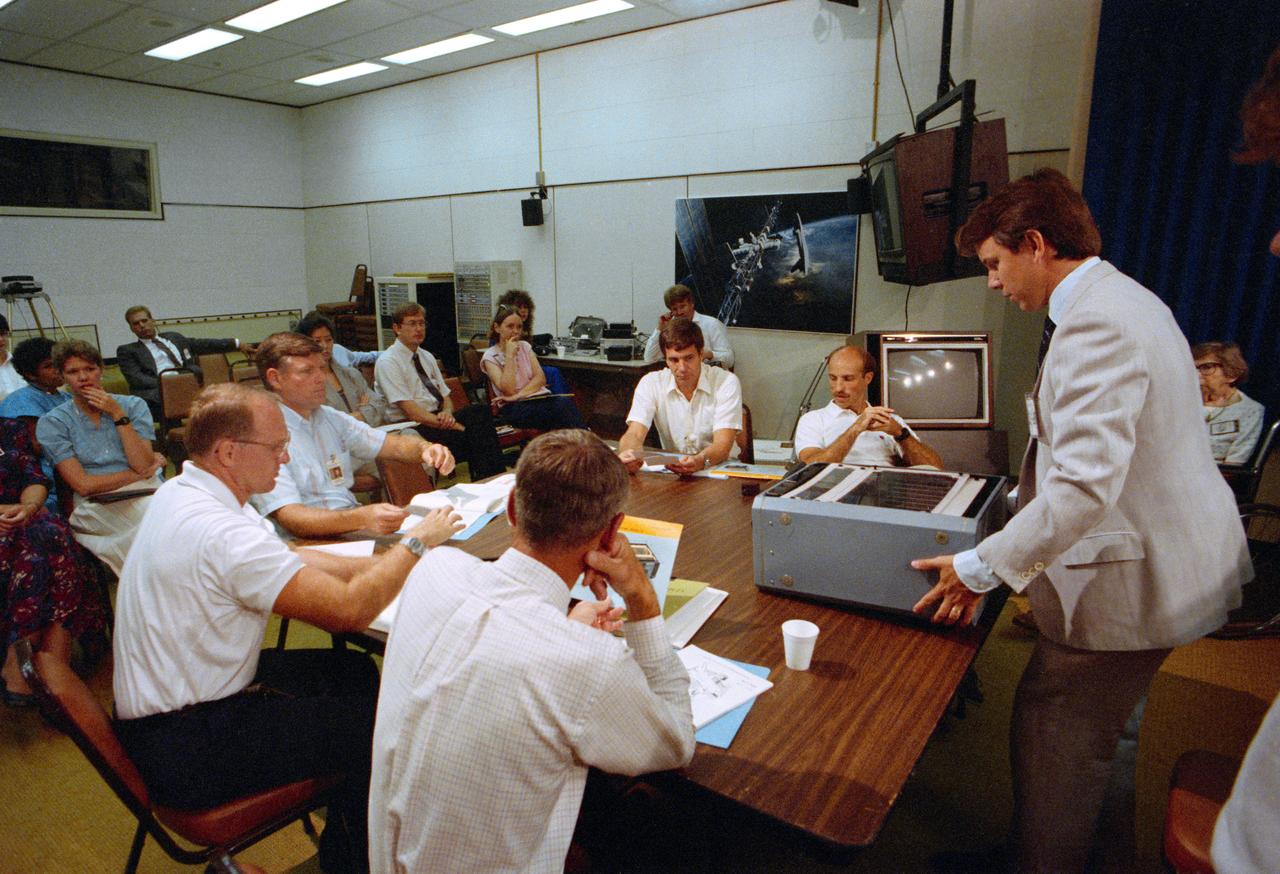
S88-44661 (13 Aug 1988) --- Tom Kestler, with Orthopaedic Hospital, USC, one of the sponsor representatives for student experimenter Andrew Fras explains components of Fras' experiment. It will be carried onboard theDiscovery for NASA's STS-29 mission next year. His primary audience is made up of members of the STS-29 crew who will monitor in-space operation of the experiment, titled "Effects of Weightlessness on Bone Healing." Crewmembers, clockwise around the table from the left, are Astronauts Robert C. Springer, James F. Buchli, Michael L. Coats, John E. Blaha and James P. Bagian. Seated in far right background is Dr. June Marshall of the University of Southern California School of Medicine, the student's sponsoring organization.
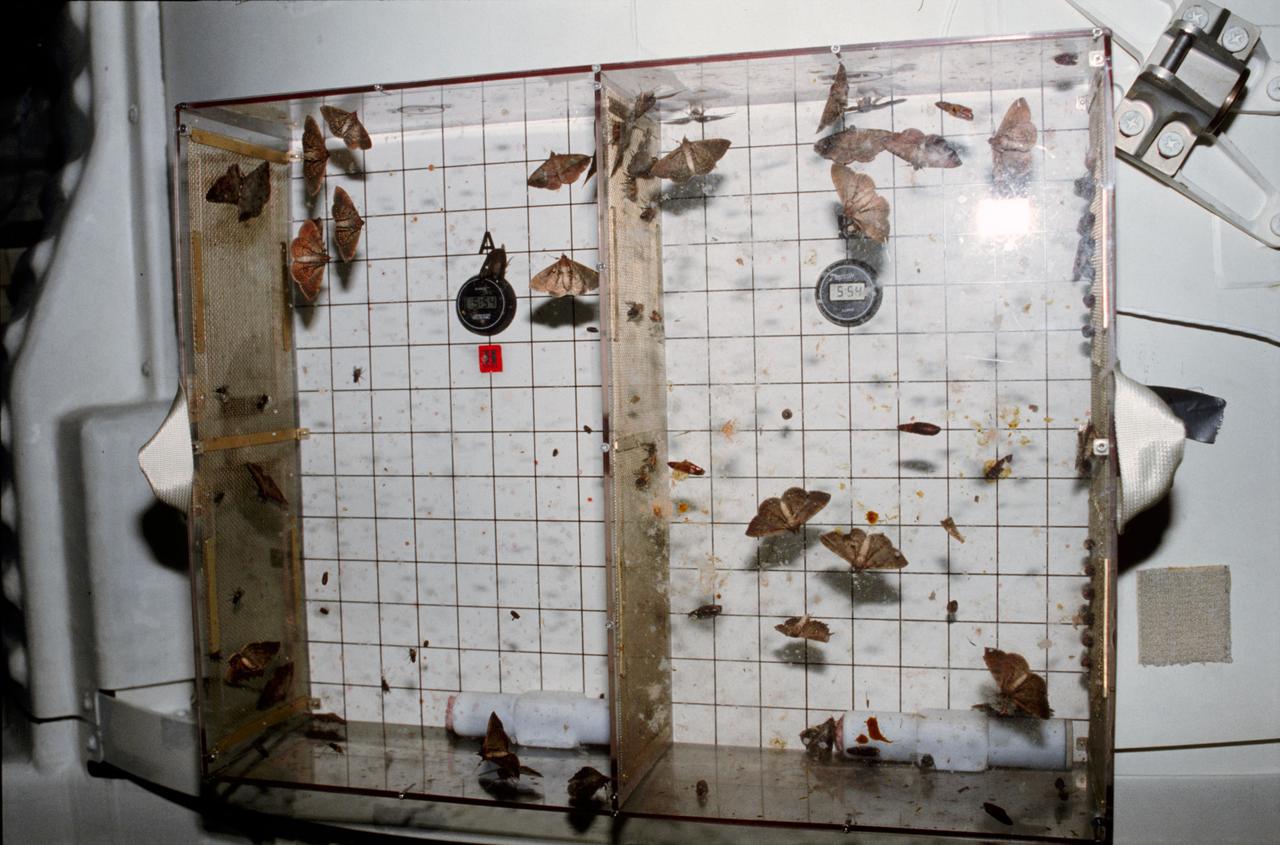
STS003-23-175 (22-30 March 1982) --- Student Experiment 81-8 (SE-81-8) Insect Flight Motion Study taped to the airlock on aft middeck of space shuttle Columbia. Photo credit: NASA
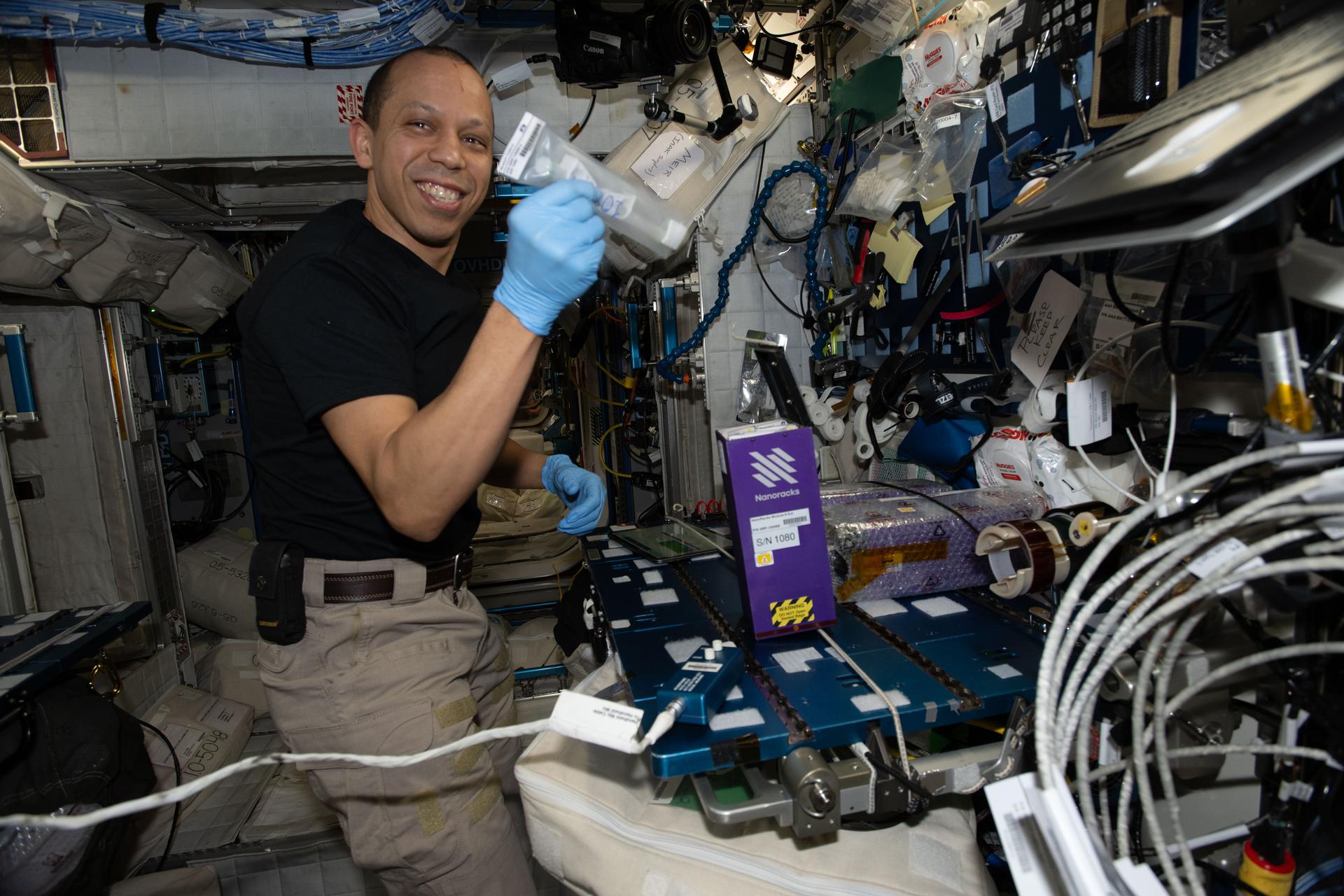
iss074e0590901 (May 18, 2026) --- NASA astronaut and Expedition 74 flight engineer Chris Williams activates sample‑containing tubes for a variety of student‑designed experiments using NanoRacks research hardware. The tubes were filled with biological and material samples to help expand knowledge of space phenomena and inspire junior high and high school students to consider scientific, technical, and engineering careers. Credit: NASA/Jack Hathaway
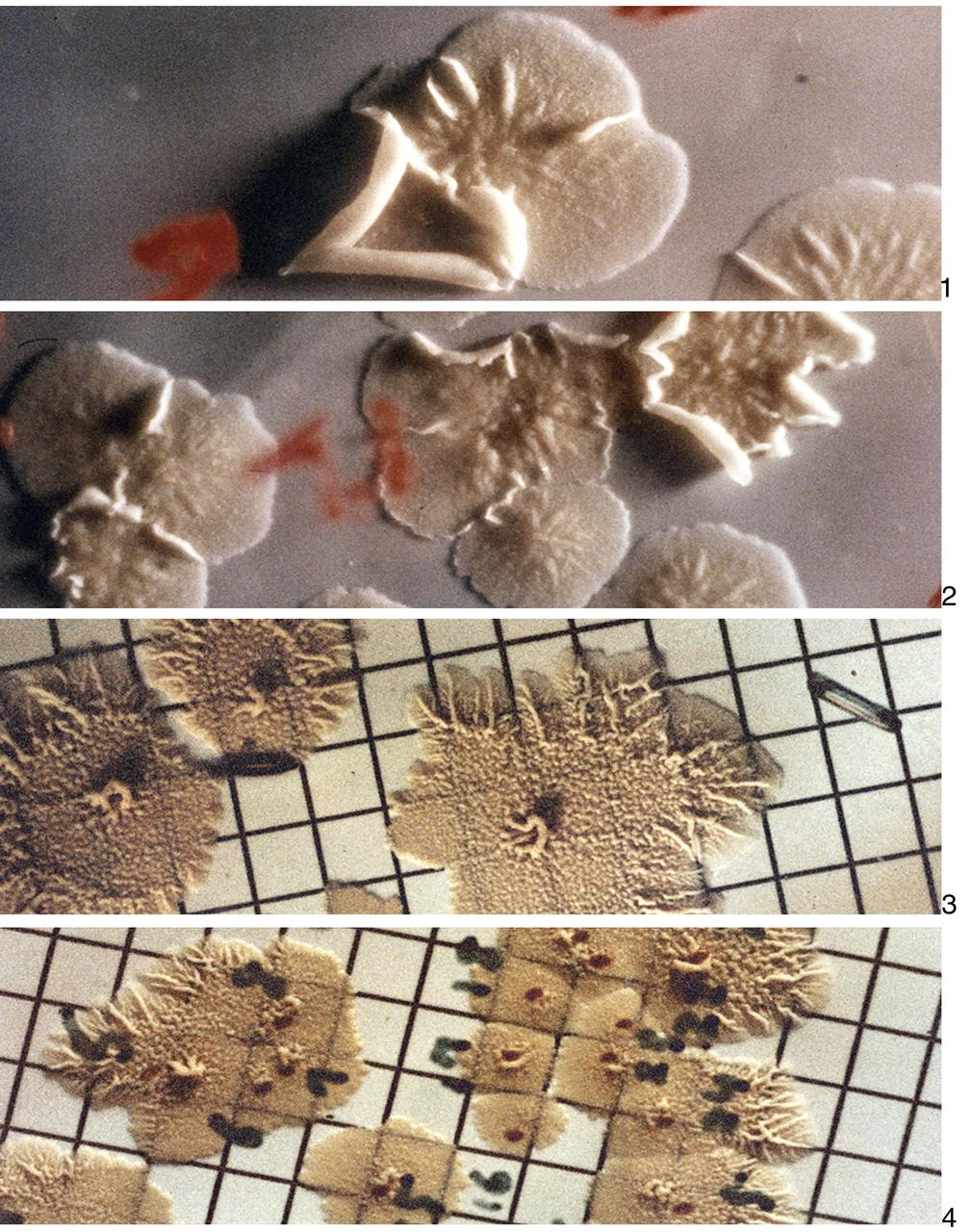
Pictures 1 and 2 show samples of Bacillus Subtillus grown during the first performance of Robert Staehle's experiment (ED-31) aboard Skylab. Pictures 3 and 4 show colonies of the same bacteria that developed during the second performance of the experiment. The experiment ED-31 was proposed by Robert L. Staehle of Rochester, New York to determine the effect of the Skylab environment (particularly weightlessness) on the survival, growth rates, and mutations of certain bacteria and spores.
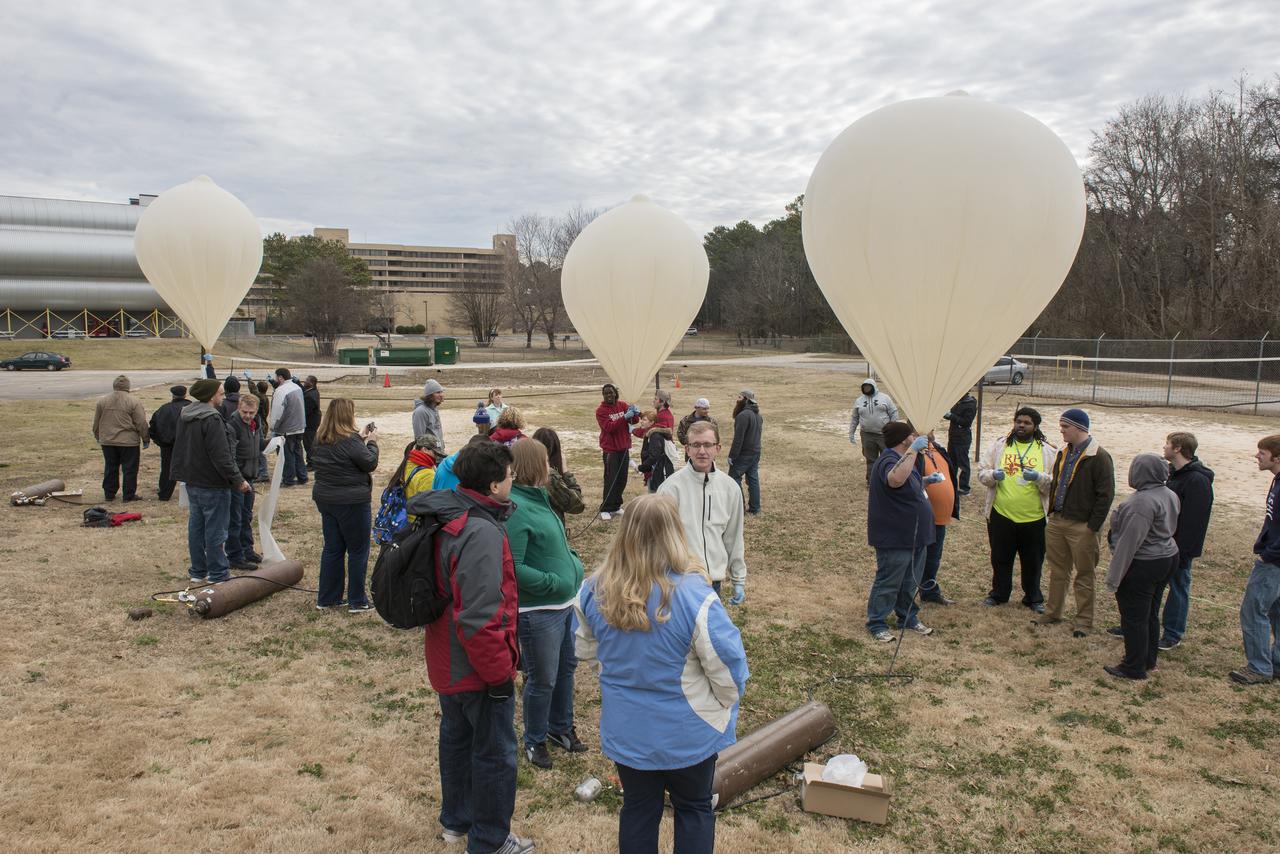
STUDENTS FROM COMMUNITY COLLEGES THROUGHOUT THE SOUTH CAME TOGETHER AT THE U.S. SPACE AND ROCKET CENTER FOR THE BALLOONSAT LAUNCH EVENT. EACH COMMUNITY COLLEGE TEAM ASSEMBLED ITS OWN PAYLOAD, DESIGNED TO DOWNLOAD SCIENTIFIC AND ATMOSPHERIC INFORMATION, AND THEN 2 WEATHER BALLOONS WERE SENT ALOFT TO APPROXIMATELY 100,000 FEET WITH THE PAYLOADS. THE PAYLOADS WERE RECOVERED IN N. GEORGIA AND TAKEN BACK TO THE INDIVIDUAL SCHOOLS FOR DOWNLOADING.
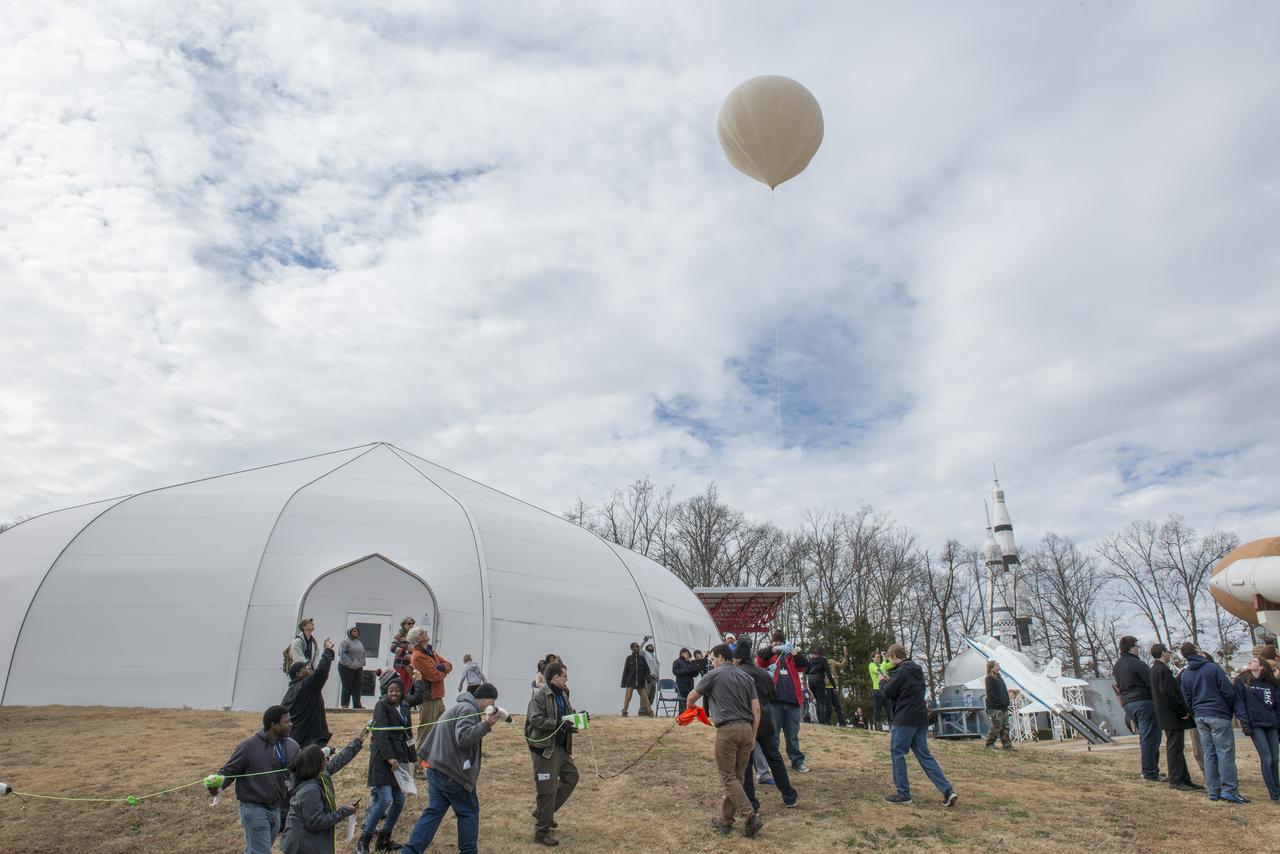
STUDENTS FROM COMMUNITY COLLEGES THROUGHOUT THE SOUTH CAME TOGETHER AT THE U.S. SPACE AND ROCKET CENTER FOR THE BALLOONSAT LAUNCH EVENT. EACH COMMUNITY COLLEGE TEAM ASSEMBLED ITS OWN PAYLOAD, DESIGNED TO DOWNLOAD SCIENTIFIC AND ATMOSPHERIC INFORMATION, AND THEN 2 WEATHER BALLOONS WERE SENT ALOFT TO APPROXIMATELY 100,000 FEET WITH THE PAYLOADS. THE PAYLOADS WERE RECOVERED IN N. GEORGIA AND TAKEN BACK TO THE INDIVIDUAL SCHOOLS FOR DOWNLOADING.
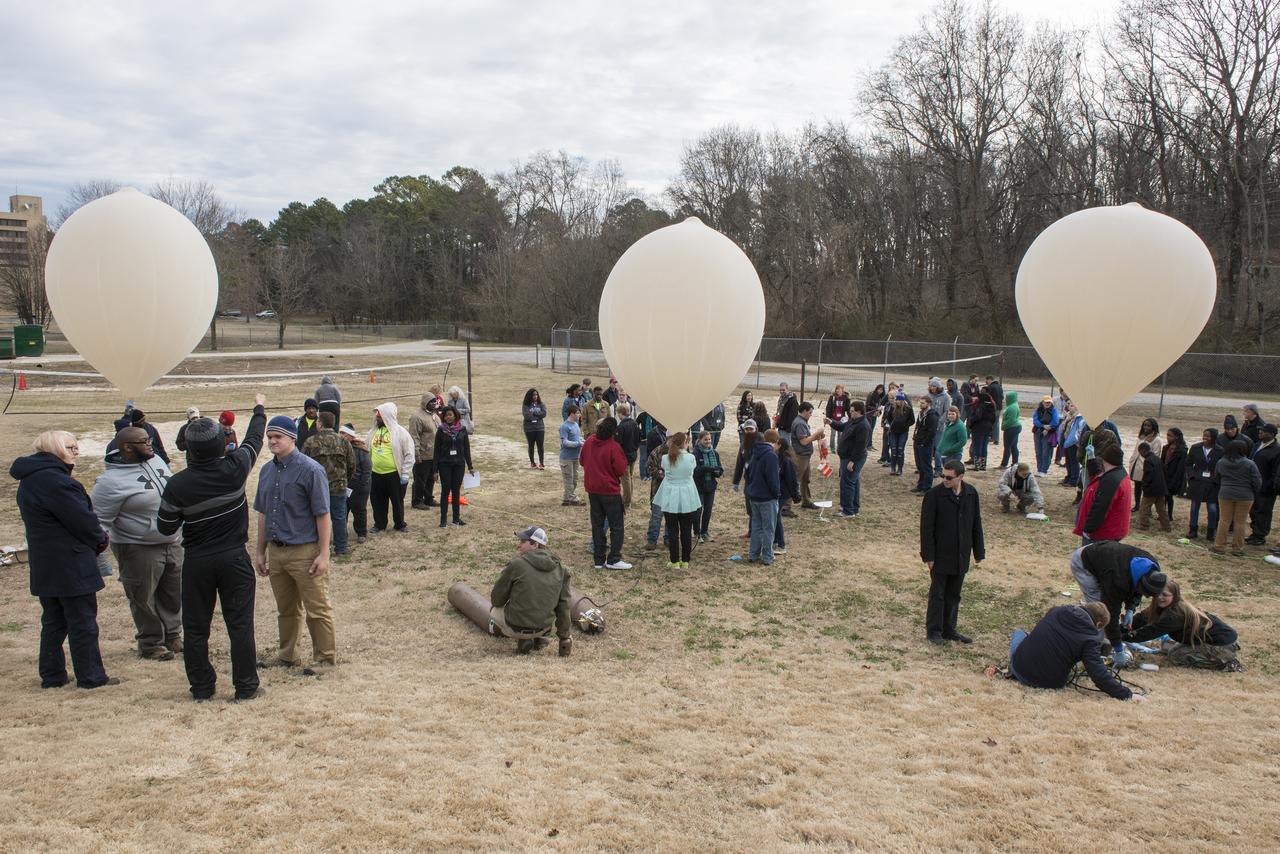
STUDENTS FROM COMMUNITY COLLEGES THROUGHOUT THE SOUTH CAME TOGETHER AT THE U.S. SPACE AND ROCKET CENTER FOR THE BALLOONSAT LAUNCH EVENT. EACH COMMUNITY COLLEGE TEAM ASSEMBLED ITS OWN PAYLOAD, DESIGNED TO DOWNLOAD SCIENTIFIC AND ATMOSPHERIC INFORMATION, AND THEN 2 WEATHER BALLOONS WERE SENT ALOFT TO APPROXIMATELY 100,000 FEET WITH THE PAYLOADS. THE PAYLOADS WERE RECOVERED IN N. GEORGIA AND TAKEN BACK TO THE INDIVIDUAL SCHOOLS FOR DOWNLOADING.
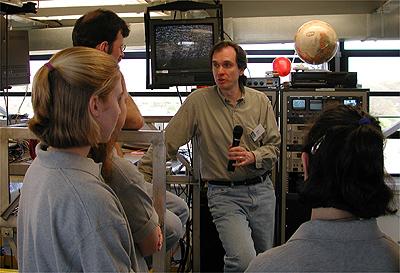
The first NASA Dropping In a Microgravity Environment (DIME) student competition pilot project came to a conclusion at the Glenn Research Center in April 2001. The competition involved high-school student teams who developed the concept for a microgravity experiment and prepared an experiment proposal. The two student teams - COSI Academy, sponsored by the Columbus Center of Science and Industry, and another team from Cincinnati, Ohio's Sycamore High School, designed a microgravity experiment, fabricated the experimental apparatus, and visited NASA Glenn to operate their experiment in the 2.2 Second Drop Tower. Here, students are briefed by NASA engineer Daniel Dietrich at the top of the drop tower. This image is from a digital still camera; higher resolution is not available.
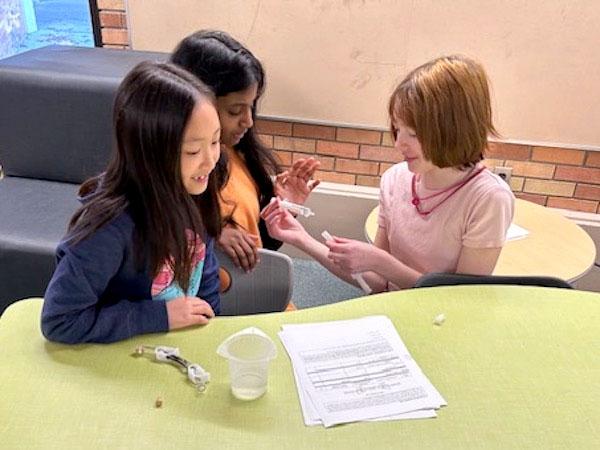
jsc2024e066530 (10/4/2024) --- Creek Valley Elementary School students prepare their experiment, Does Gravity Affect the Germination Growth of Raspberry Seeds, for space. Their experiment is part of the Nanoracks-National Center for Earth and Space Science Education-Surveyor-Student Spaceflight Experiments Program Mission 18 to ISS (Nanoracks-NCESSE-Surveyor-SSEP).
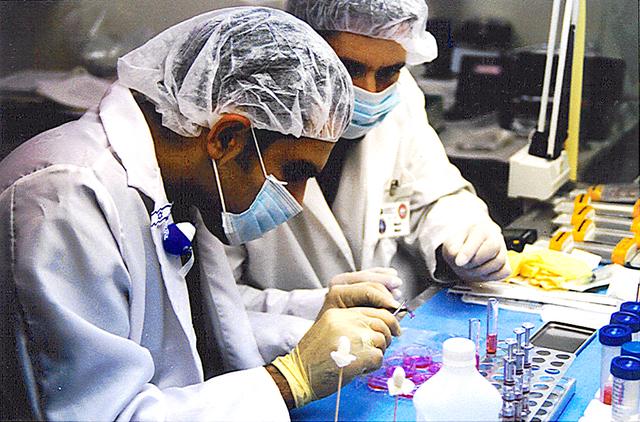
Experiments to seek solutions for a range of biomedical issues are at the heart of several investigations that will be hosted by the Commercial Instrumentation Technology Associates (ITA), Inc. Biomedical Experiments (CIBX-2) payload. CIBX-2 is unique, encompassing more than 20 separate experiments including cancer research, commercial experiments, and student hands-on experiments from 10 schools as part of ITA's ongoing University Among the Stars program. Student Marnix Aklian and ITA's Mark Bem prepare biological samples for flight as part of ITA's hands-on student outreach program on STS-95. Similar activities are a part of the CIBX-2 payload. The experiments are sponsored by NASA's Space Product Development Program (SPD).
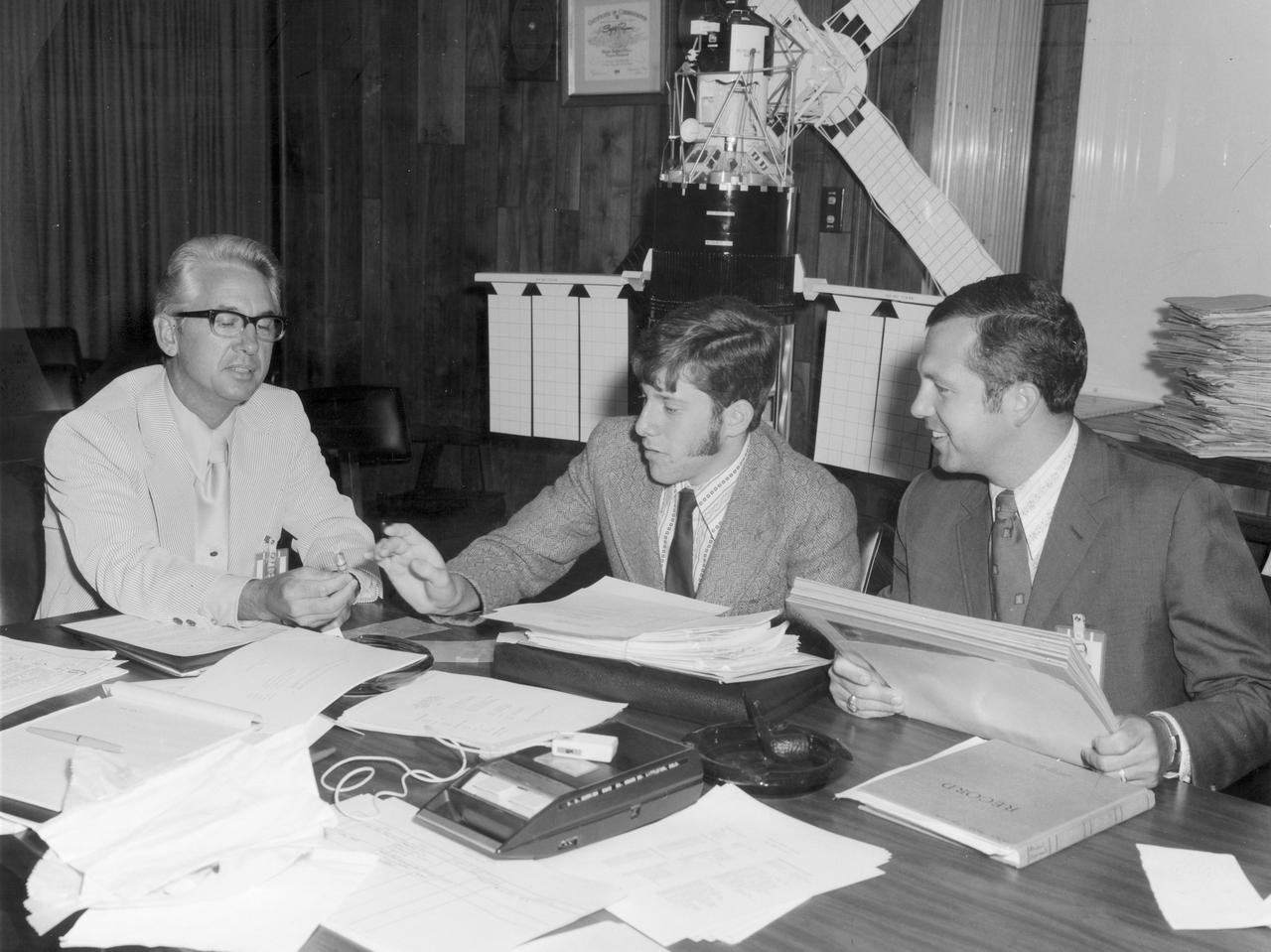
Todd Meister(center), high school student of the Bronx High School of Science, discusses his experiment “An Invitro Study of Selected Isolated Immune Phenomena” with his advisor, Dr. Robert Allen (right) and Henry Floyd, both of the Marshall Space Flight Center (MSFC). His experiment was aimed at discovering whether or not the absence of gravity affects the representative life processes. Meister was one of the 25 winners of a contest in which some 3,500 high school students proposed experiments for the following year’s Skylab mission. Of the 25 students, 6 did not see their experiments conducted on Skylab because the experiments were not compatible with Skylab hardware and timelines. Of the 19 remaining, 11 experiments required the manufacture of equipment.
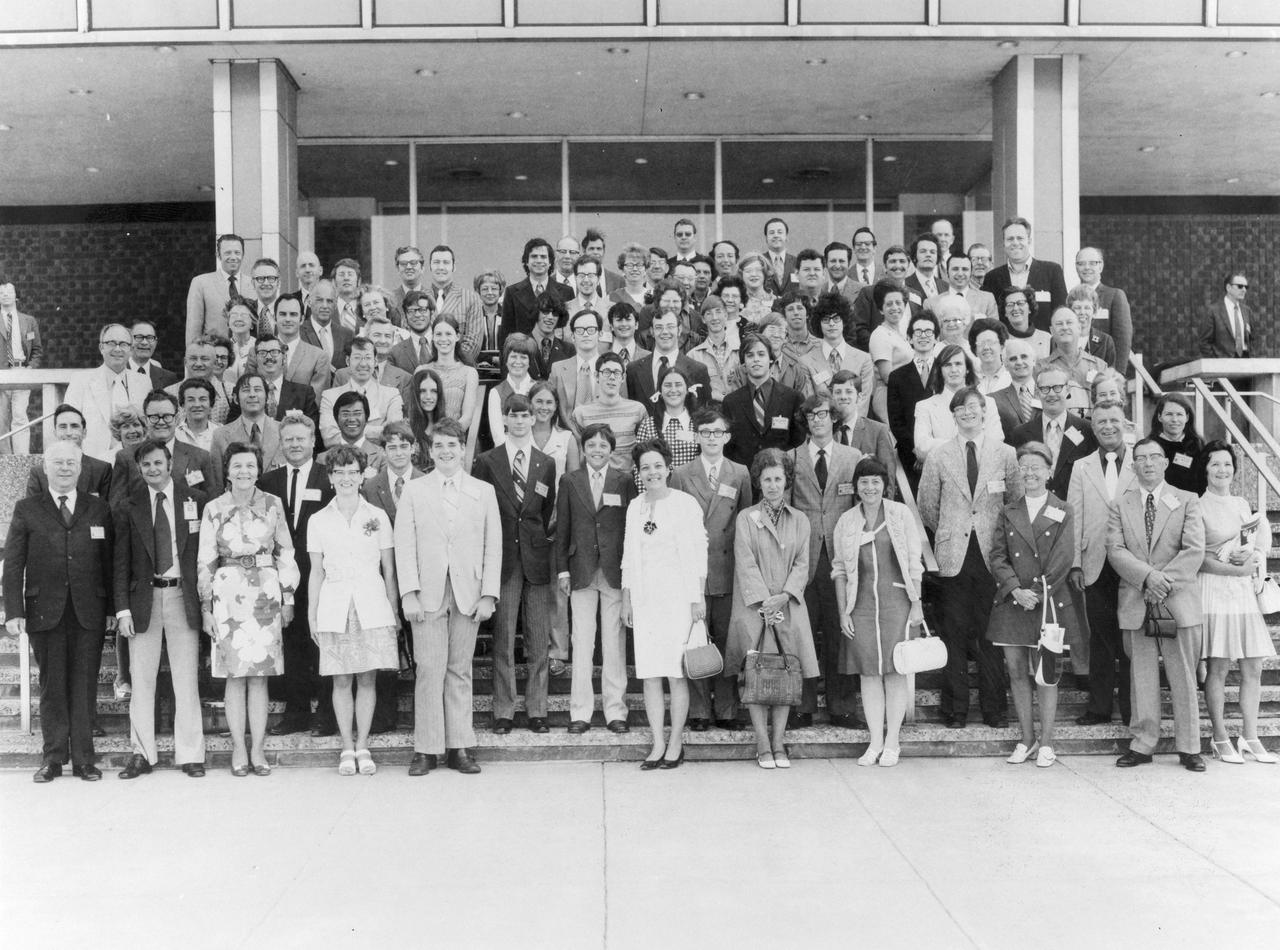
One of the most successful of the Skylab educational efforts was the Skylab Student Project. A nationwide scientific competition was sponsored by the National Science Teachers Association and the National Aeronautics and Space Administration (NASA) in which secondary students were encouraged to submit proposals for experiments to be conducted on Skylan in Earth orbit the following year. After the official announcement of this project, over 4,000 students responded with 3,409 proposals. The winning 25 students, along with their parents and sponsor teachers, visited Marshall Space Flight Center (MSFC), the lead center for Skylab, where they met with scientists and engineers, participated in design reviews for their experiments, and toured MSFC facilities. Of the 25 students, 6 did not see their experiments conducted on Skylab because the experiments were not compatible with Skylab hardware and timelines. Of the 19 remaining, 11 experiments required the manufacture of additional equipment. This photograph is a group shot of the 25 winners, parents, and sponsors when they met for the first time on the steps of Building 4200 at MSFC in the Spring of 1972.
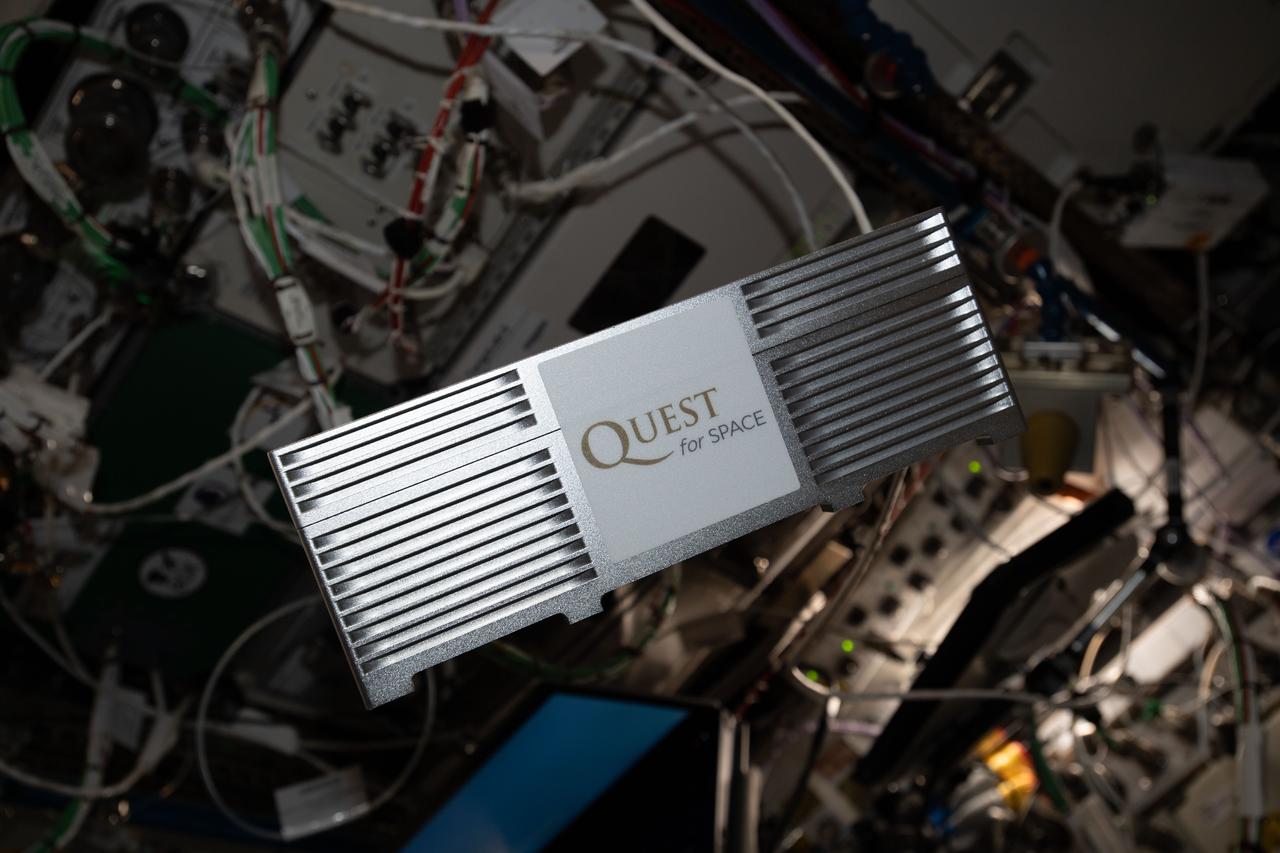
iss062e034557 (2/19/2020) --- A view of the Quest Institute-NanoLab Unit 3 investigation aboard the International Space Station (ISS). Quest Institute-NanoLab Unit 3 contains 15 Nano-Lab experiments from students in the United States and Singapore. Student-developed spaceflight experiments empower students with real-world science experience.
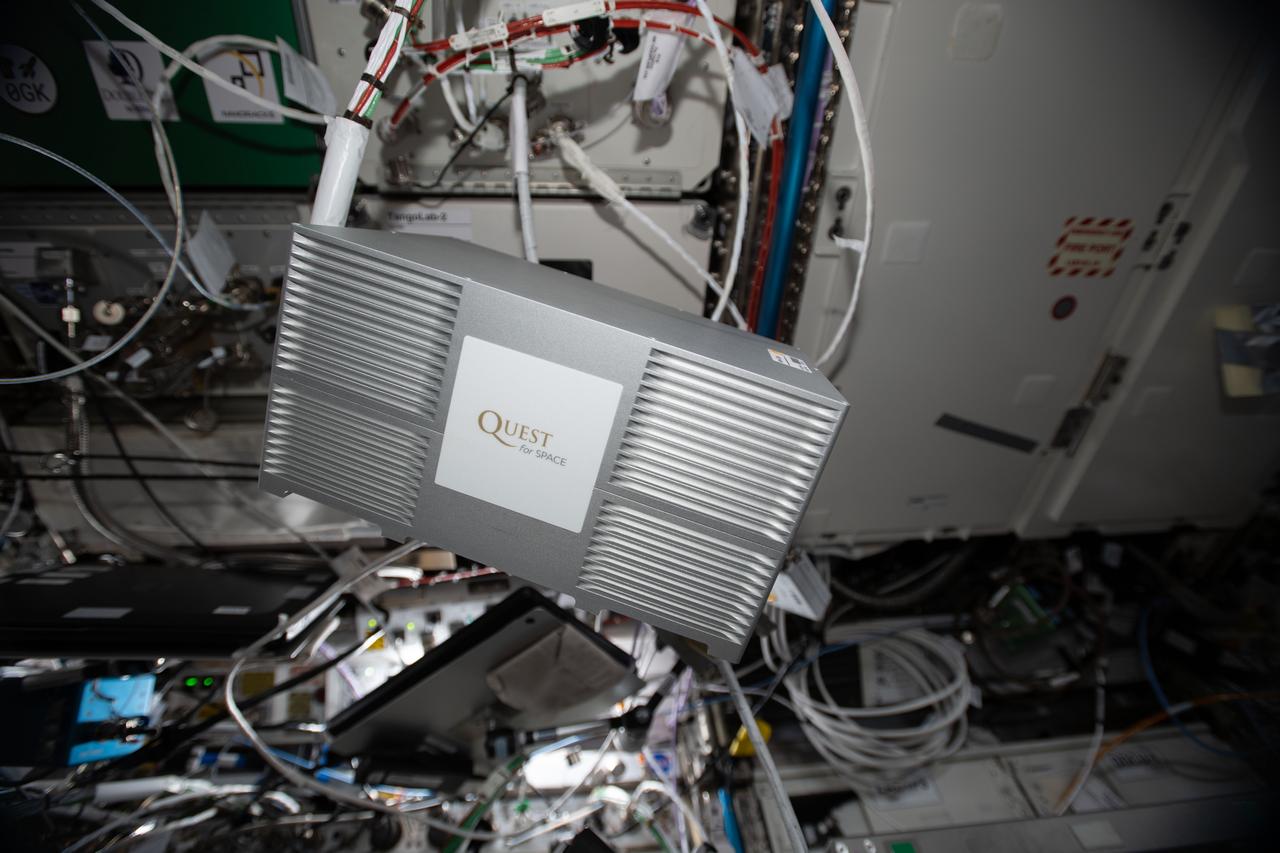
iss062e102749 (3/19/2020) --- A view of the Quest Institute-NanoLab Unit 3 investigation aboard the International Space Station (ISS). Quest Institute-NanoLab Unit 3 contains 15 Nano-Lab experiments from students in the United States and Singapore. Student-developed spaceflight experiments empower students with real-world science experience.
COTS-2 Student Spaceflight Experiments Program (SSEP)
COTS-2 Student Spaceflight Experiments Program (SSEP)
COTS-2 Student Spaceflight Experiments Program (SSEP)
COTS-2 Student Spaceflight Experiments Program (SSEP)
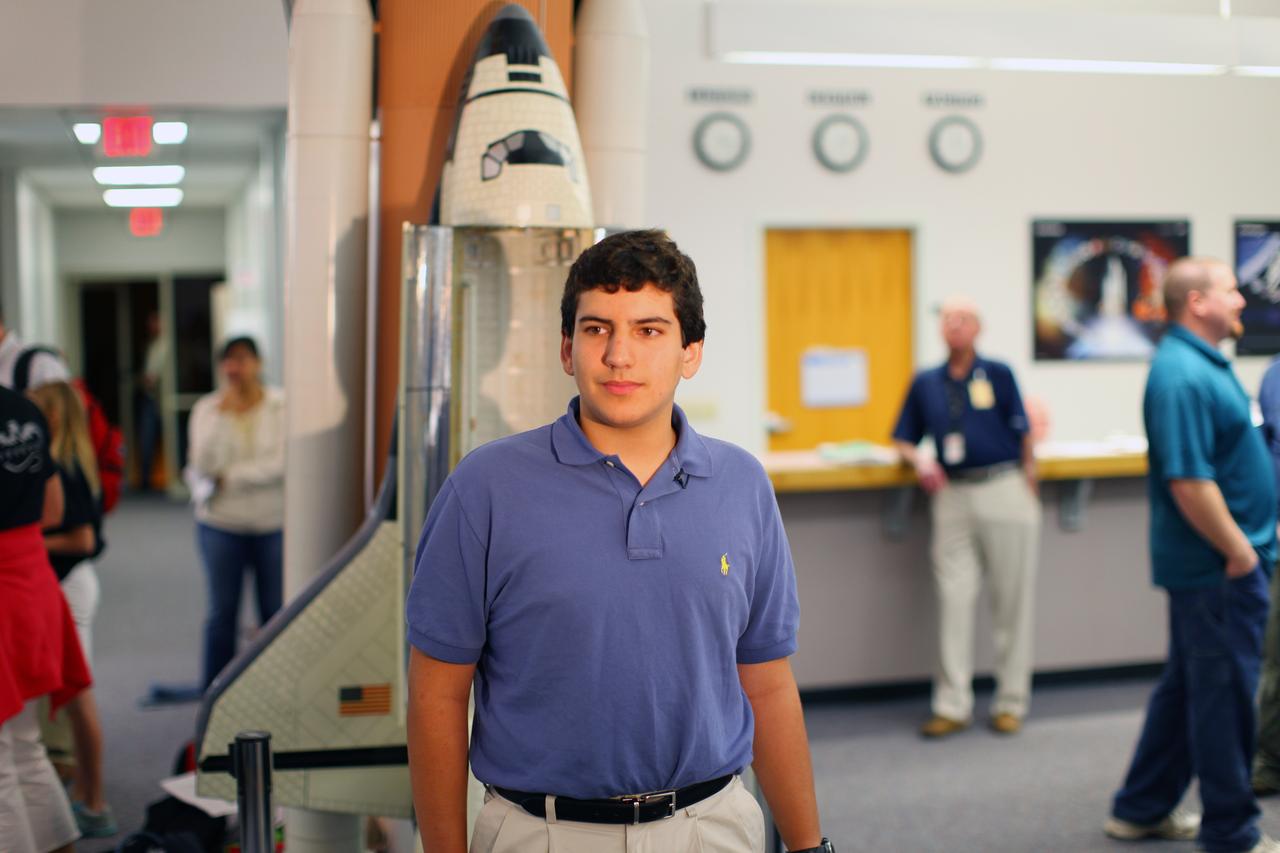
COTS-2 Student Spaceflight Experiments Program (SSEP)
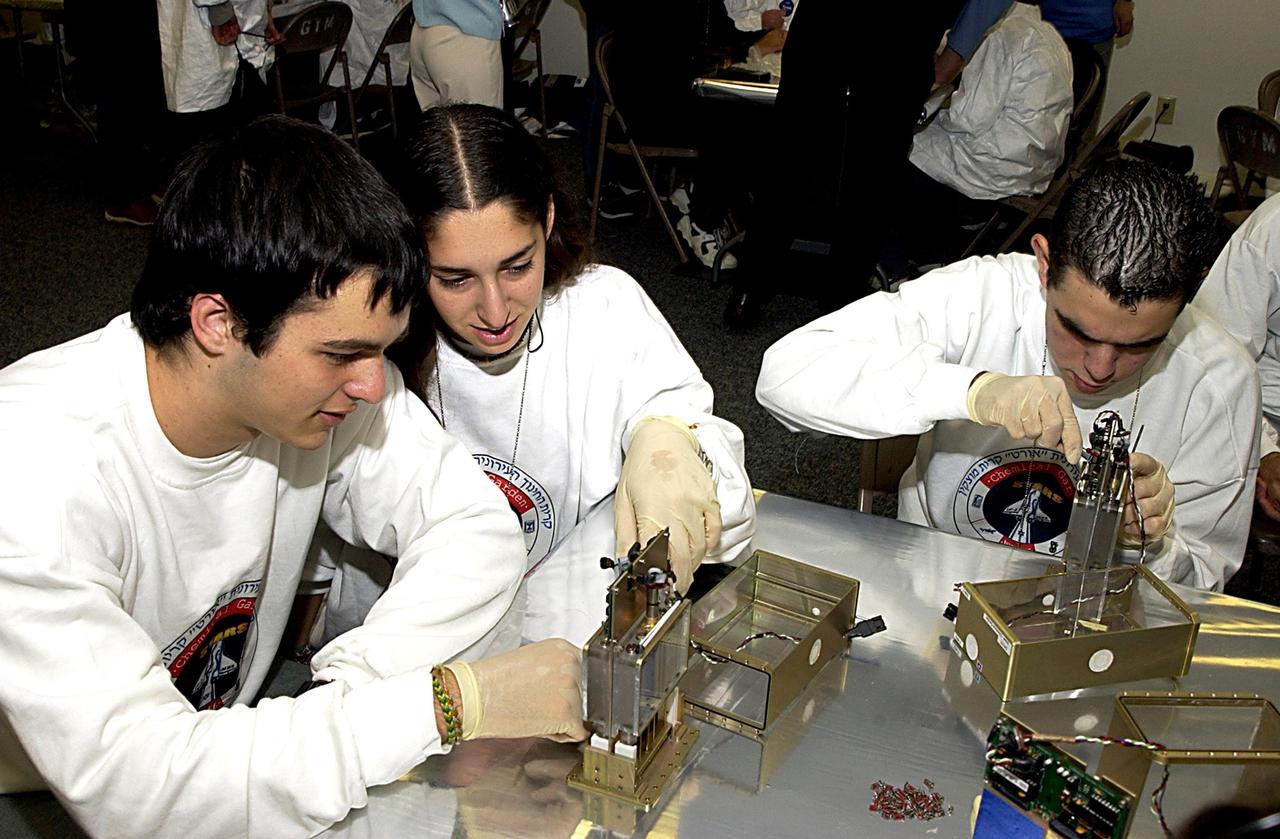
KENNEDY SPACE CENTER, FLA. - Students work on their experiments that will fly in SPACEHAB on Space Shuttle Columbia on mission STS-107. SPACEHAB's complement of commercial experiments includes six educational experiments designed and developed by students in six different countries under the auspices of Space Technology and Research Students (STARS), a global education program managed by SPACEHAB subsidiary Space Media. The countries represented are Australia, China, Israel, Japan, Liechtenstein and the United States. The student investigators who conceived these experiments will monitor their operations in space. The experiments will be housed in BioServe Space Technologies' Isothermal Containment Module (ICM --a small temperature-controlled facility that provides experiment support such as physical containment, lighting, and video imaging) and stowed in a middeck-size locker aboard the SPACEHAB Research Double Module.
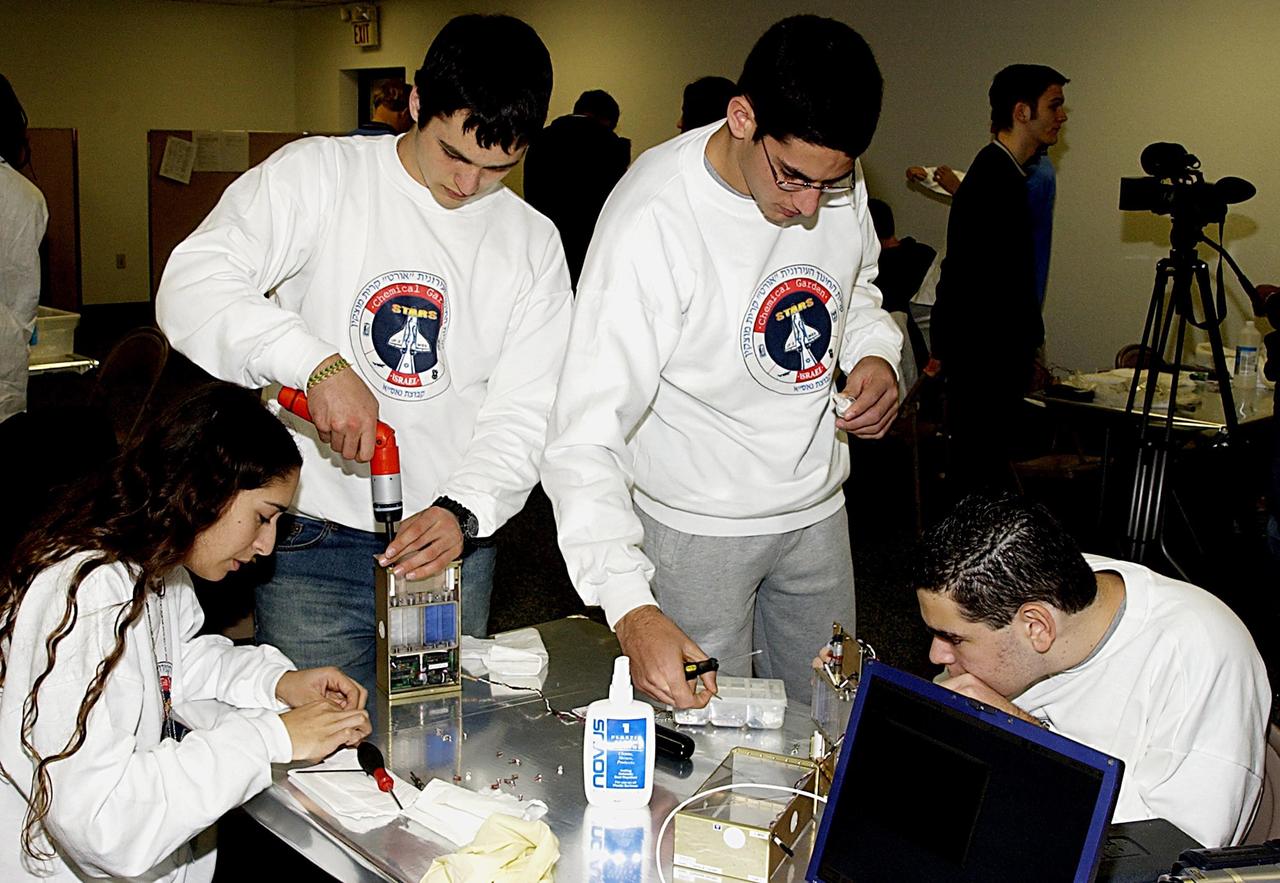
KENNEDY SPACE CENTER, FLA. -- Students work on their experiments that will fly in SPACEHAB on Space Shuttle Columbia on mission STS-107. SPACEHAB's complement of commercial experiments includes six educational experiments designed and developed by students in six different countries under the auspices of Space Technology and Research Students (STARS), a global education program managed by SPACEHAB subsidiary Space Media. The countries represented are Australia, China, Israel, Japan, Liechtenstein and the United States. The student investigators who conceived these experiments will monitor their operations in space. The experiments will be housed in BioServe Space Technologies' Isothermal Containment Module (ICM --a small temperature-controlled facility that provides experiment support such as physical containment, lighting, and video imaging) and stowed in a middeck-size locker aboard the SPACEHAB Research Double Module.
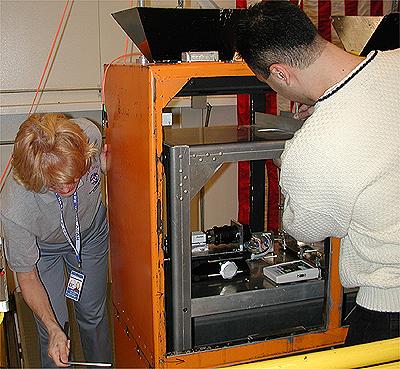
The first NASA Dropping In a Microgravity Environment (DIME) student competition pilot project came to a conclusion at the Glenn Research Center in April 2001. The competition involved high-school student teams who developed the concept for a microgravity experiment and prepared an experiment proposal. The two student teams - COSI Academy, sponsored by the Columbus Center of Science and Industry, and another team from Cincinnati, Ohio's Sycamore High School, designed a microgravity experiment, fabricated the experimental apparatus, and visited NASA Glenn to operate their experiment in the 2.2 Second Drop Tower. Here Carol Hodanbosi of the National Center for Microgravity Research and Jose Carrion, a lab mechanic with AKAC, prepare a student experiment package (inside the silver-colored frame) inside the orange-colored drag shield that encloses all experiment hardware. This image is from a digital still camera; higher resolution is not available.
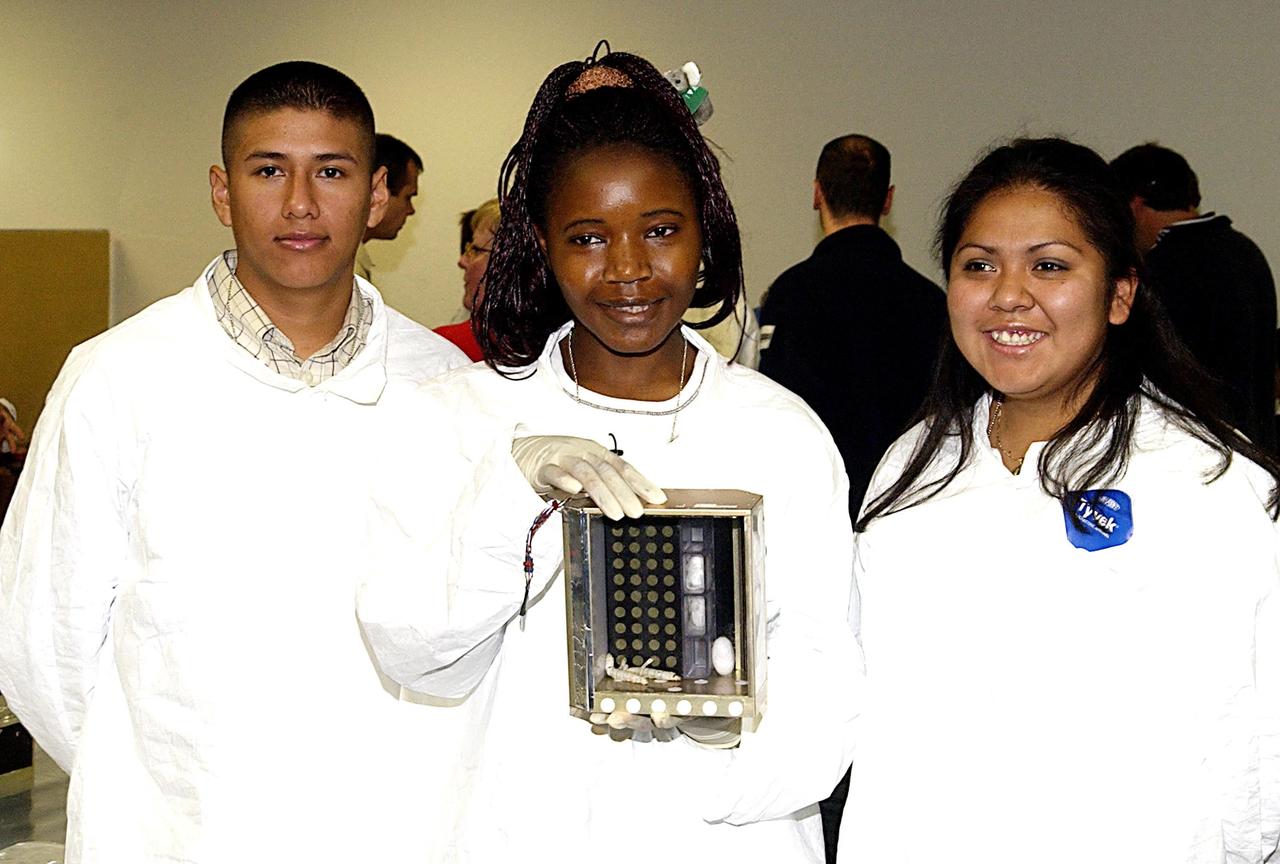
KENNEDY SPACE CENTER, FLA. -- Students show off one of the experiments that will fly in SPACEHAB on Space Shuttle Columbia on mission STS-107. SPACEHAB's complement of commercial experiments includes six educational experiments designed and developed by students in six different countries under the auspices of Space Technology and Research Students (STARS), a global education program managed by SPACEHAB subsidiary Space Media. The countries represented are Australia, China, Israel, Japan, Liechtenstein and the United States. The student investigators who conceived these experiments will monitor their operations in space. The experiments will be housed in BioServe Space Technologies' Isothermal Containment Module (ICM --a small temperature-controlled facility that provides experiment support such as physical containment, lighting, and video imaging) and stowed in a middeck-size locker aboard the SPACEHAB Research Double Module.
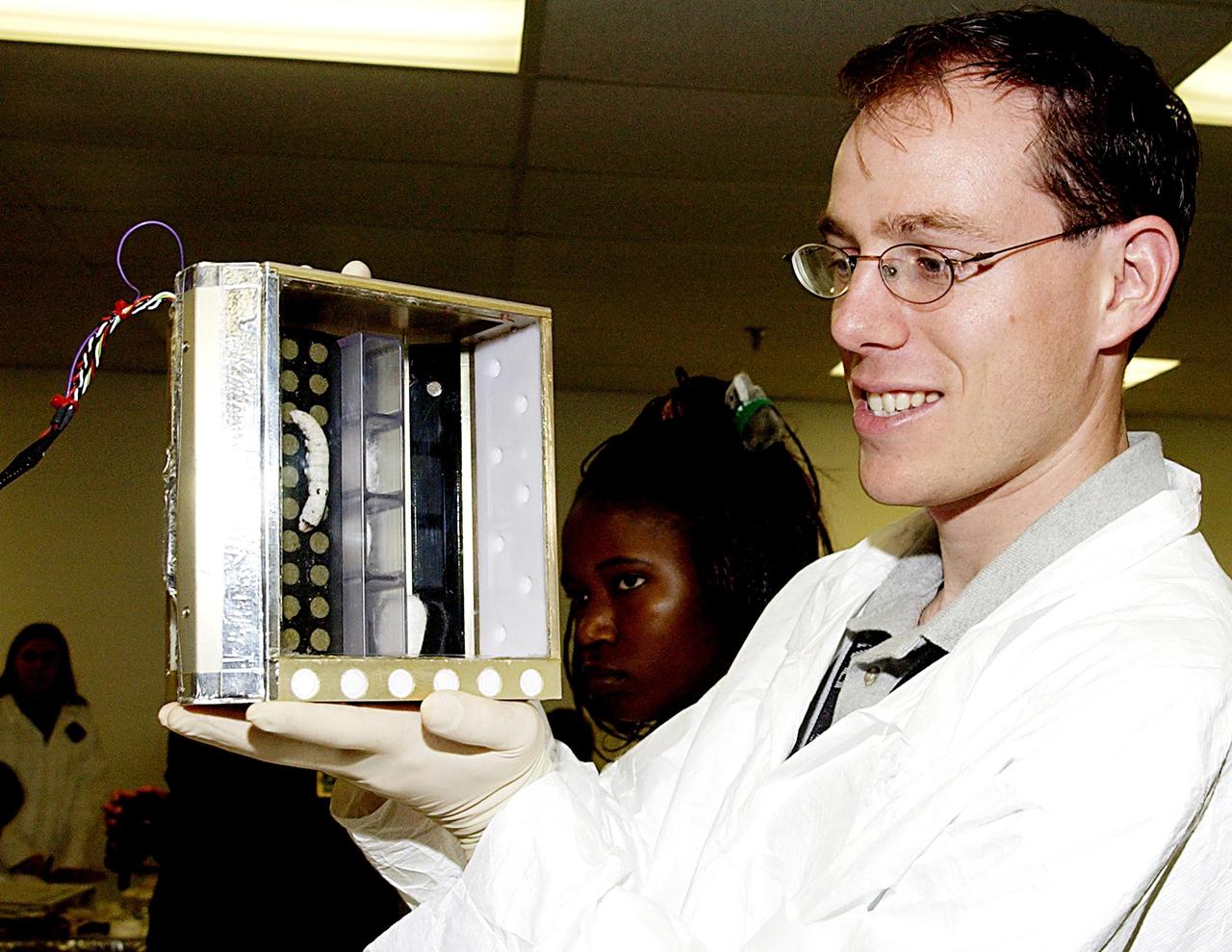
KENNEDY SPACE CENTER, FLA. - A student shows off one of the experiments that will fly in SPACEHAB on Space Shuttle Columbia on mission STS-107. SPACEHAB's complement of commercial experiments includes six educational experiments designed and developed by students in six different countries under the auspices of Space Technology and Research Students (STARS), a global education program managed by SPACEHAB subsidiary Space Media. The countries represented are Australia, China, Israel, Japan, Liechtenstein and the United States. The student investigators who conceived these experiments will monitor their operations in space. The experiments will be housed in BioServe Space Technologies' Isothermal Containment Module (ICM --a small temperature-controlled facility that provides experiment support such as physical containment, lighting, and video imaging) and stowed in a middeck-size locker aboard the SPACEHAB Research Double Module.
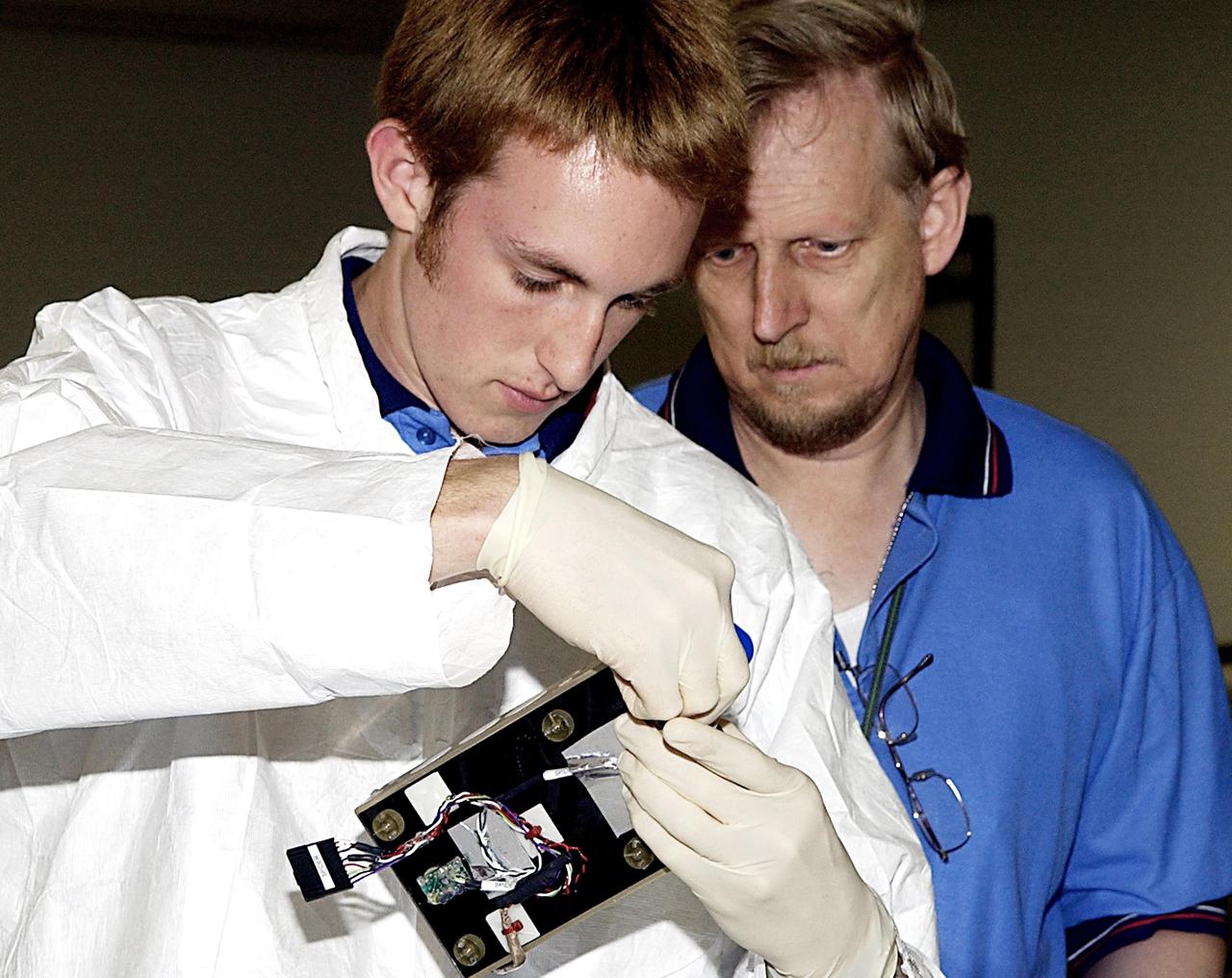
KENNEDY SPACE CENTER, FLA. - A student works on an experiment that will fly in SPACEHAB on Space Shuttle Columbia on mission STS-107. SPACEHAB's complement of commercial experiments includes six educational experiments designed and developed by students in six different countries under the auspices of Space Technology and Research Students (STARS), a global education program managed by SPACEHAB subsidiary Space Media. The countries represented are Australia, China, Israel, Japan, Liechtenstein and the United States. The student investigators who conceived these experiments will monitor their operations in space. The experiments will be housed in BioServe Space Technologies' Isothermal Containment Module (ICM --a small temperature-controlled facility that provides experiment support such as physical containment, lighting, and video imaging) and stowed in a middeck-size locker aboard the SPACEHAB Research Double Module.
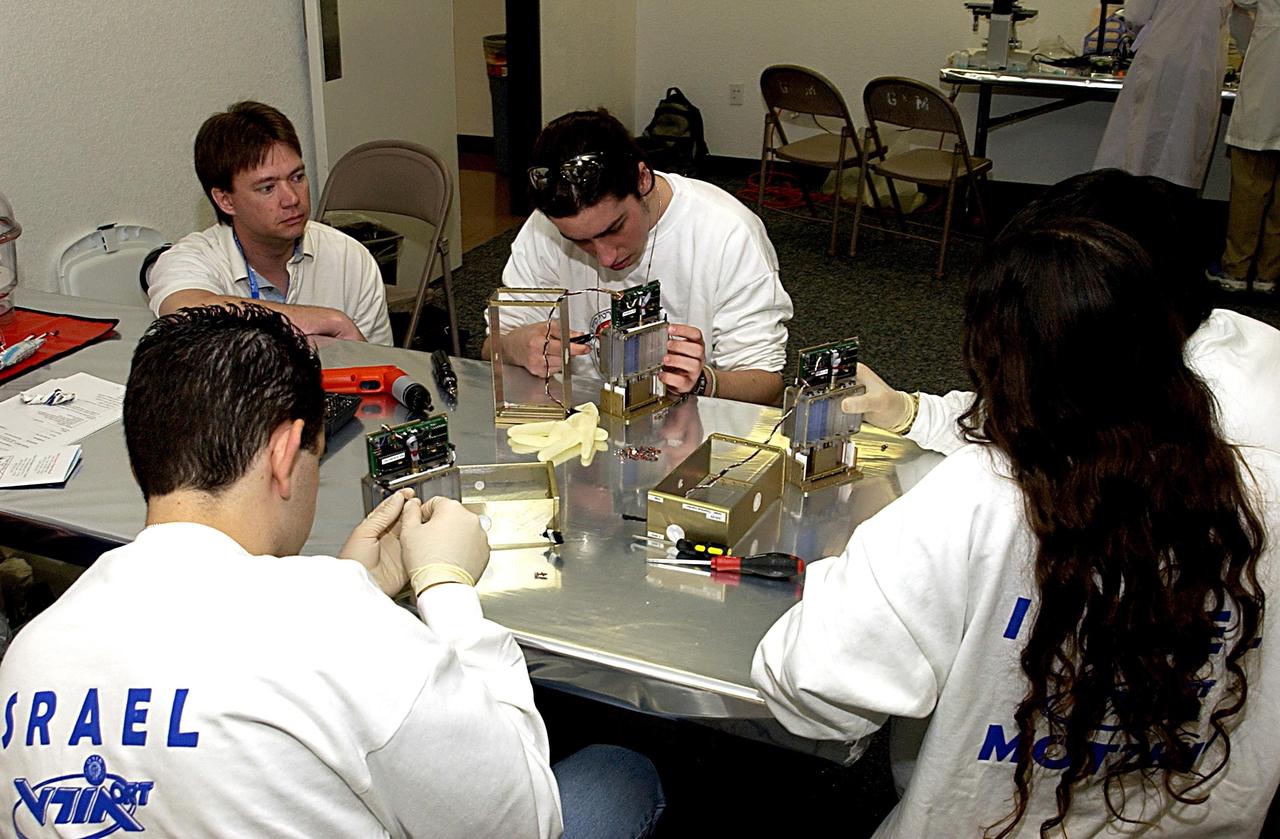
KENNEDY SPACE CENTER, FLA. - Students work on their experiments that will fly in SPACEHAB on Space Shuttle Columbia on mission STS-107. SPACEHAB's complement of commercial experiments includes six educational experiments designed and developed by students in six different countries under the auspices of Space Technology and Research Students (STARS), a global education program managed by SPACEHAB subsidiary Space Media. The countries represented are Australia, China, Israel, Japan, Liechtenstein and the United States. The student investigators who conceived these experiments will monitor their operations in space. The experiments will be housed in BioServe Space Technologies' Isothermal Containment Module (ICM --a small temperature-controlled facility that provides experiment support such as physical containment, lighting, and video imaging) and stowed in a middeck-size locker aboard the SPACEHAB Research Double Module.
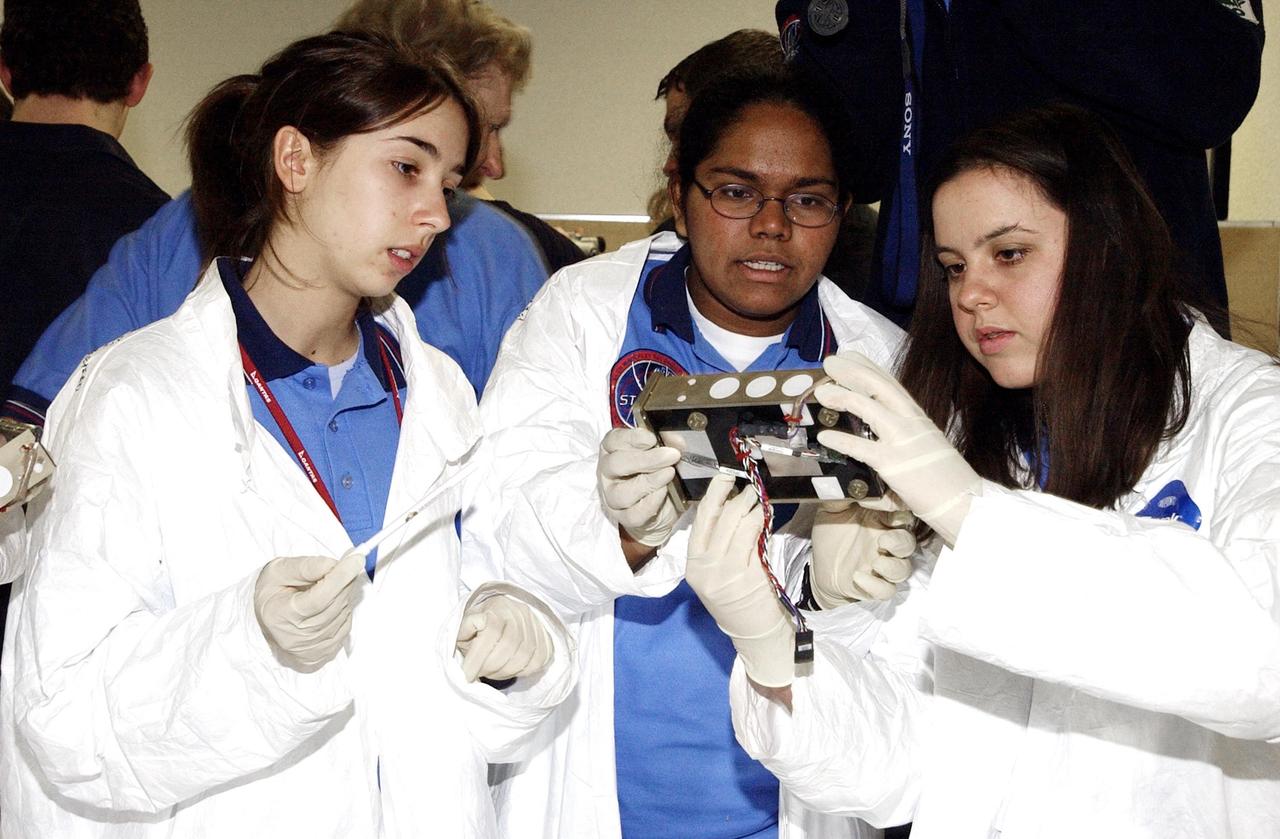
KENNEDY SPACE CENTER, FLA. -- Students work on their experiments that will fly in SPACEHAB on Space Shuttle Columbia on mission STS-107. SPACEHAB's complement of commercial experiments includes six educational experiments designed and developed by students in six different countries under the auspices of Space Technology and Research Students (STARS), a global education program managed by SPACEHAB subsidiary Space Media. The countries represented are Australia, China, Israel, Japan, Liechtenstein and the United States. The student investigators who conceived these experiments will monitor their operations in space. The experiments will be housed in BioServe Space Technologies' Isothermal Containment Module (ICM --a small temperature-controlled facility that provides experiment support such as physical containment, lighting, and video imaging) and stowed in a middeck-size locker aboard the SPACEHAB Research Double Module.
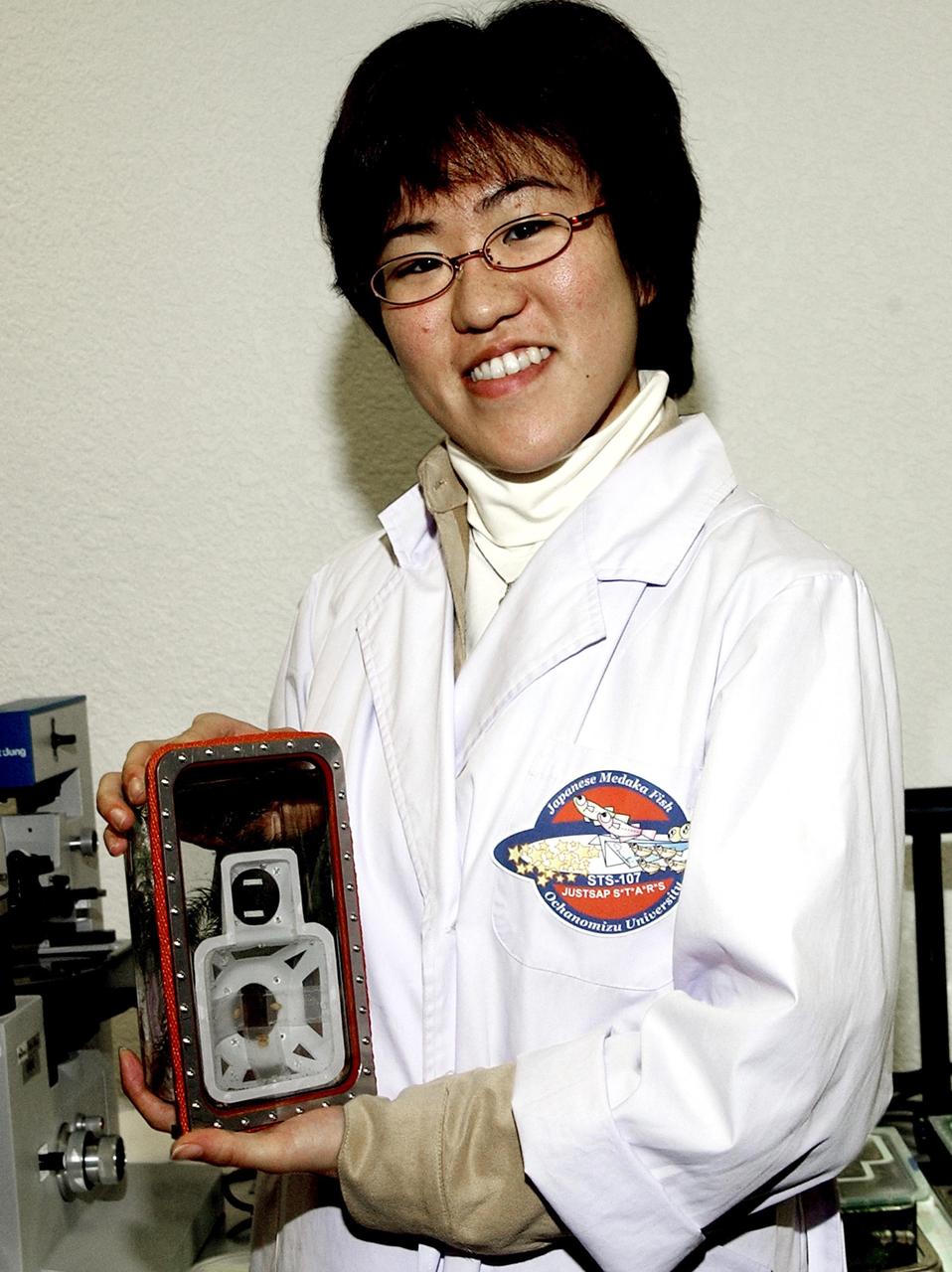
KENNEDY SPACE CENTER, FLA. -- A student displays an experiment that will fly in SPACEHAB on Space Shuttle Columbia on mission STS-107. SPACEHAB's complement of commercial experiments includes six educational experiments designed and developed by students in six different countries under the auspices of Space Technology and Research Students (STARS), a global education program managed by SPACEHAB subsidiary Space Media. The countries represented are Australia, China, Israel, Japan, Liechtenstein and the United States. The student investigators who conceived these experiments will monitor their operations in space. The experiments will be housed in BioServe Space Technologies' Isothermal Containment Module (ICM --a small temperature-controlled facility that provides experiment support such as physical containment, lighting, and video imaging) and stowed in a middeck-size locker aboard the SPACEHAB Research Double Module.
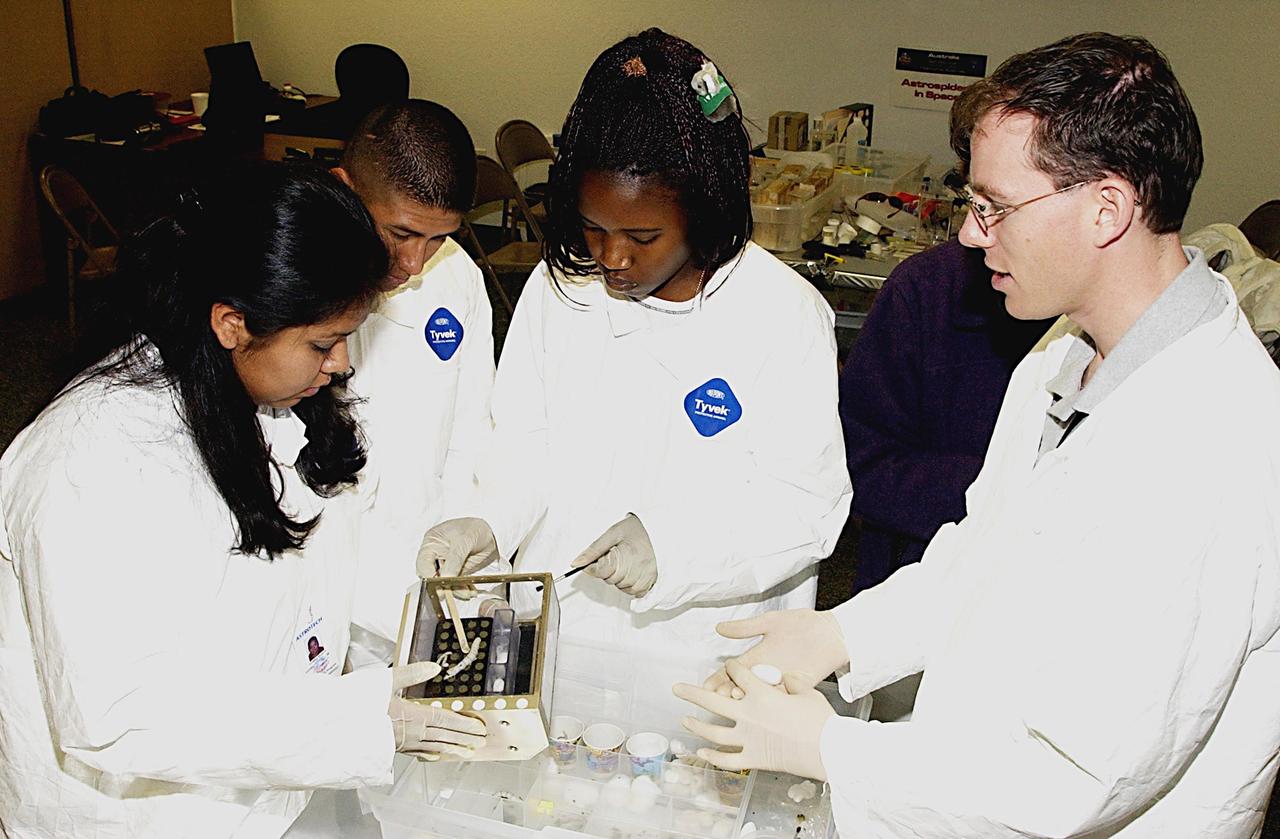
KENNEDY SPACE CENTER, FLA. - Students work on their experiments that will fly in SPACEHAB on Space Shuttle Columbia on mission STS-107. SPACEHAB's complement of commercial experiments includes six educational experiments designed and developed by students in six different countries under the auspices of Space Technology and Research Students (STARS), a global education program managed by SPACEHAB subsidiary Space Media. The countries represented are Australia, China, Israel, Japan, Liechtenstein and the United States. The student investigators who conceived these experiments will monitor their operations in space. The experiments will be housed in BioServe Space Technologies' Isothermal Containment Module (ICM --a small temperature-controlled facility that provides experiment support such as physical containment, lighting, and video imaging) and stowed in a middeck-size locker aboard the SPACEHAB Research Double Module.
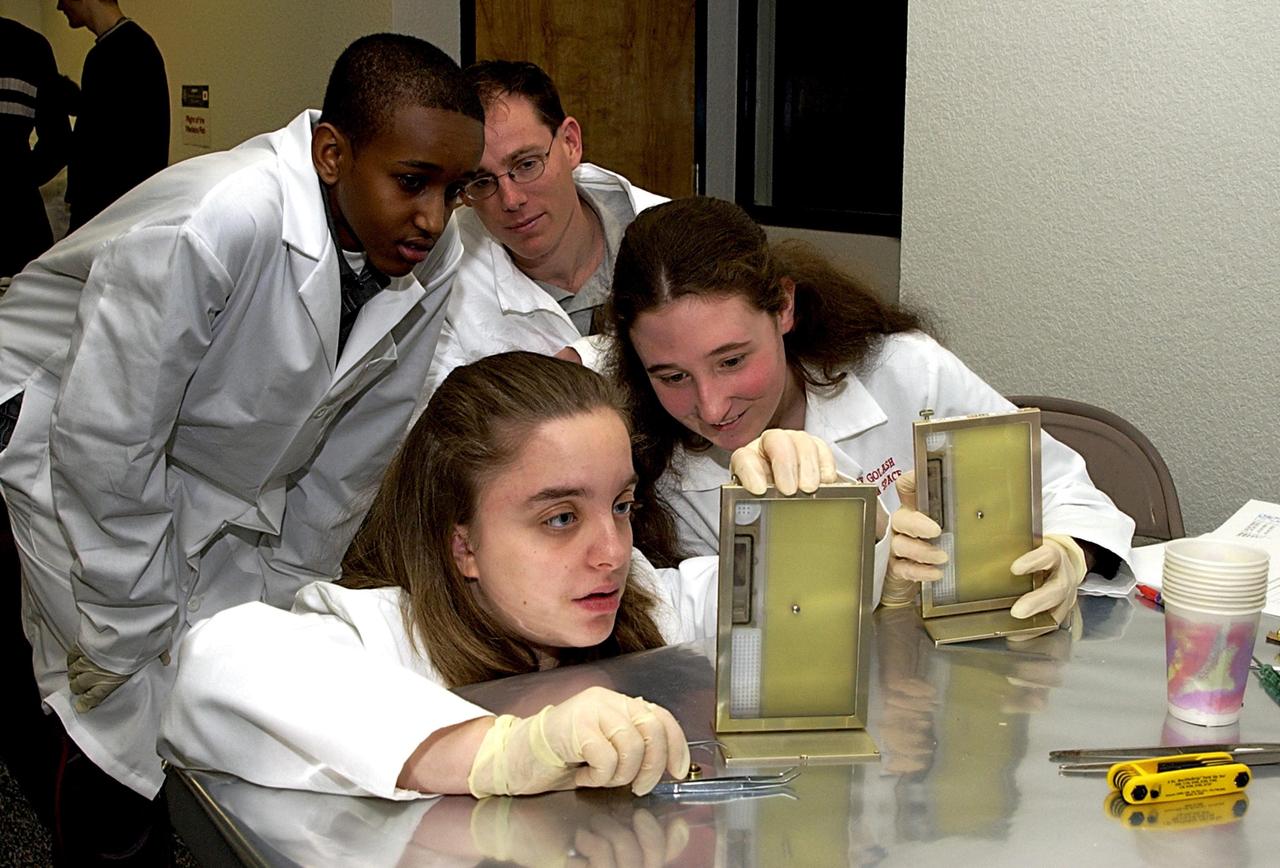
KENNEDY SPACE CENTER, FLA. - Students check on their experiments that will fly in SPACEHAB on Space Shuttle Columbia on mission STS-107. SPACEHAB's complement of commercial experiments includes six educational experiments designed and developed by students in six different countries under the auspices of Space Technology and Research Students (STARS), a global education program managed by SPACEHAB subsidiary Space Media. The countries represented are Australia, China, Israel, Japan, Liechtenstein and the United States. The student investigators who conceived these experiments will monitor their operations in space. The experiments will be housed in BioServe Space Technologies' Isothermal Containment Module (ICM --a small temperature-controlled facility that provides experiment support such as physical containment, lighting, and video imaging) and stowed in a middeck-size locker aboard the SPACEHAB Research Double Module.
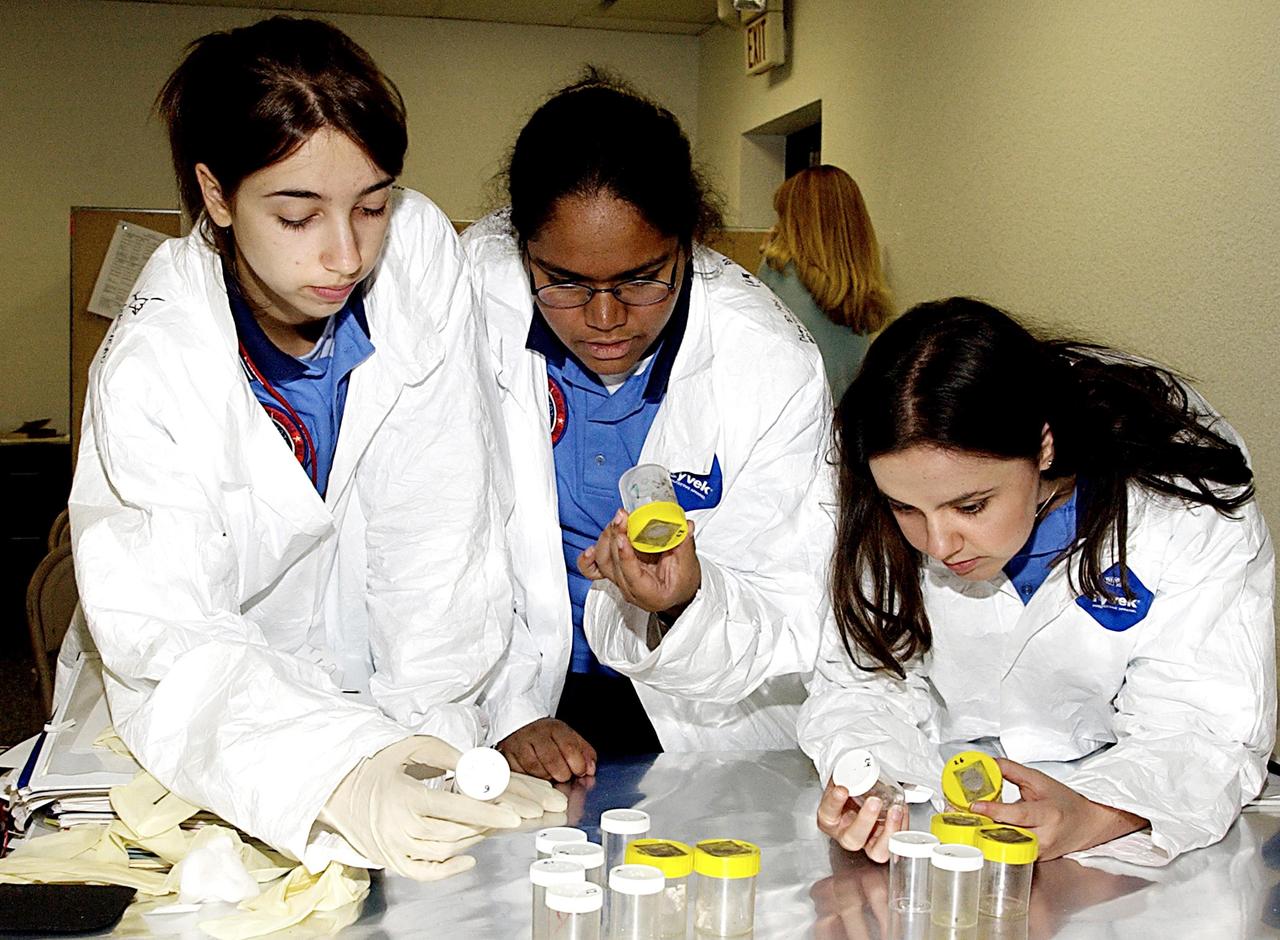
KENNEDY SPACE CENTER, FLA. - Students check out their experiments that will fly in SPACEHAB on Space Shuttle Columbia on mission STS-107. SPACEHAB's complement of commercial experiments includes six educational experiments designed and developed by students in six different countries under the auspices of Space Technology and Research Students (STARS), a global education program managed by SPACEHAB subsidiary Space Media. The countries represented are Australia, China, Israel, Japan, Liechtenstein and the United States. The student investigators who conceived these experiments will monitor their operations in space. The experiments will be housed in BioServe Space Technologies' Isothermal Containment Module (ICM --a small temperature-controlled facility that provides experiment support such as physical containment, lighting, and video imaging) and stowed in a middeck-size locker aboard the SPACEHAB Research Double Module.
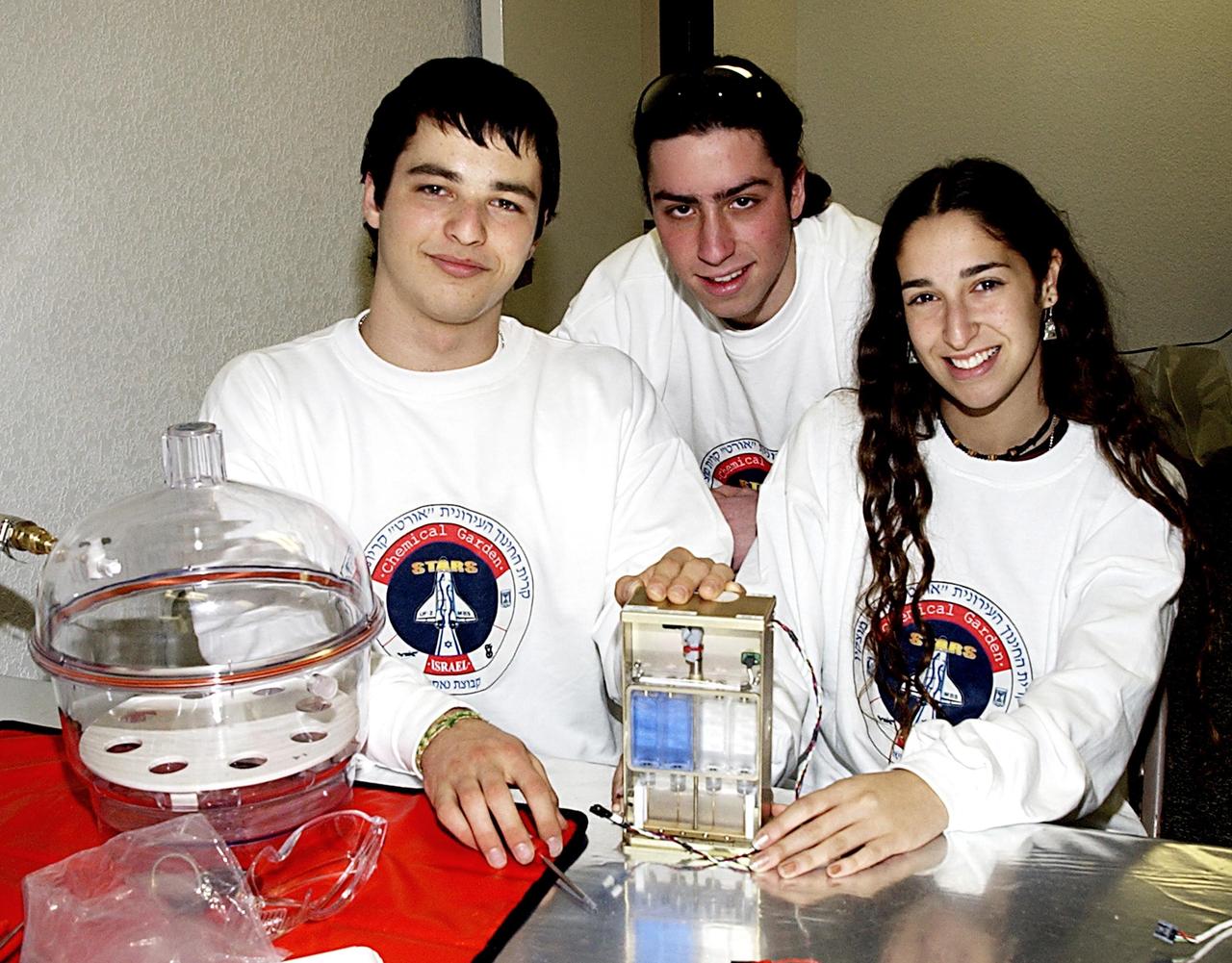
KENNEDY SPACE CENTER, FLA. -- Students display an experiment that will fly in SPACEHAB on Space Shuttle Columbia on mission STS-107. SPACEHAB's complement of commercial experiments includes six educational experiments designed and developed by students in six different countries under the auspices of Space Technology and Research Students (STARS), a global education program managed by SPACEHAB subsidiary Space Media. The countries represented are Australia, China, Israel, Japan, Liechtenstein and the United States. The student investigators who conceived these experiments will monitor their operations in space. The experiments will be housed in BioServe Space Technologies' Isothermal Containment Module (ICM --a small temperature-controlled facility that provides experiment support such as physical containment, lighting, and video imaging) and stowed in a middeck-size locker aboard the SPACEHAB Research Double Module.
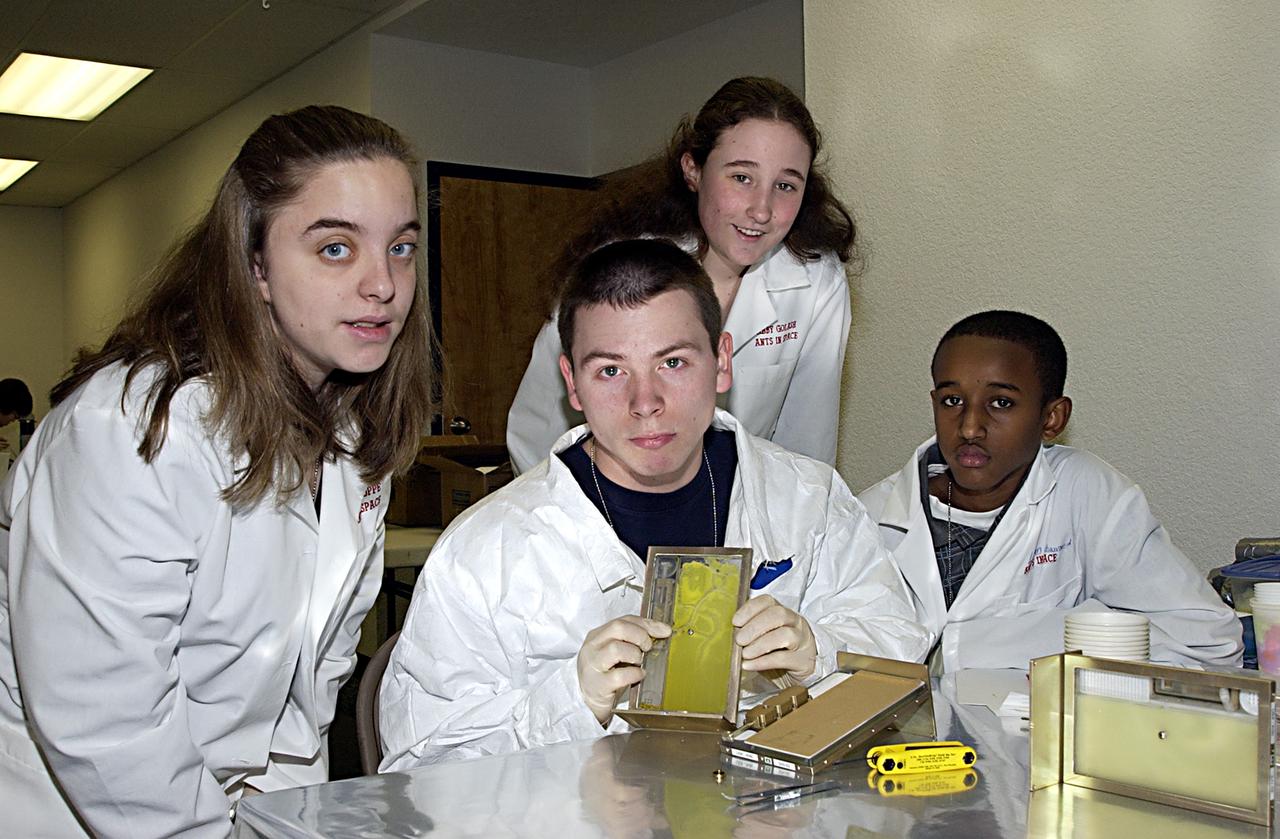
Students display an experiment that will fly in SPACEHAB on Space Shuttle Columbia on mission STS-107. SPACEHAB's complement of commercial experiments includes six educational experiments designed and developed by students in six different countries under the auspices of Space Technology and Research Students (STARS), a global education program managed by SPACEHAB subsidiary Space Media. The countries represented are Australia, China, Israel, Japan, Liechtenstein and the United States. The student investigators who conceived these experiments will monitor their operations in space. The experiments will be housed in BioServe Space Technologies' Isothermal Containment Module (ICM --a small temperature-controlled facility that provides experiment support such as physical containment, lighting, and video imaging) and stowed in a middeck-size locker aboard the SPACEHAB Research Double Module.
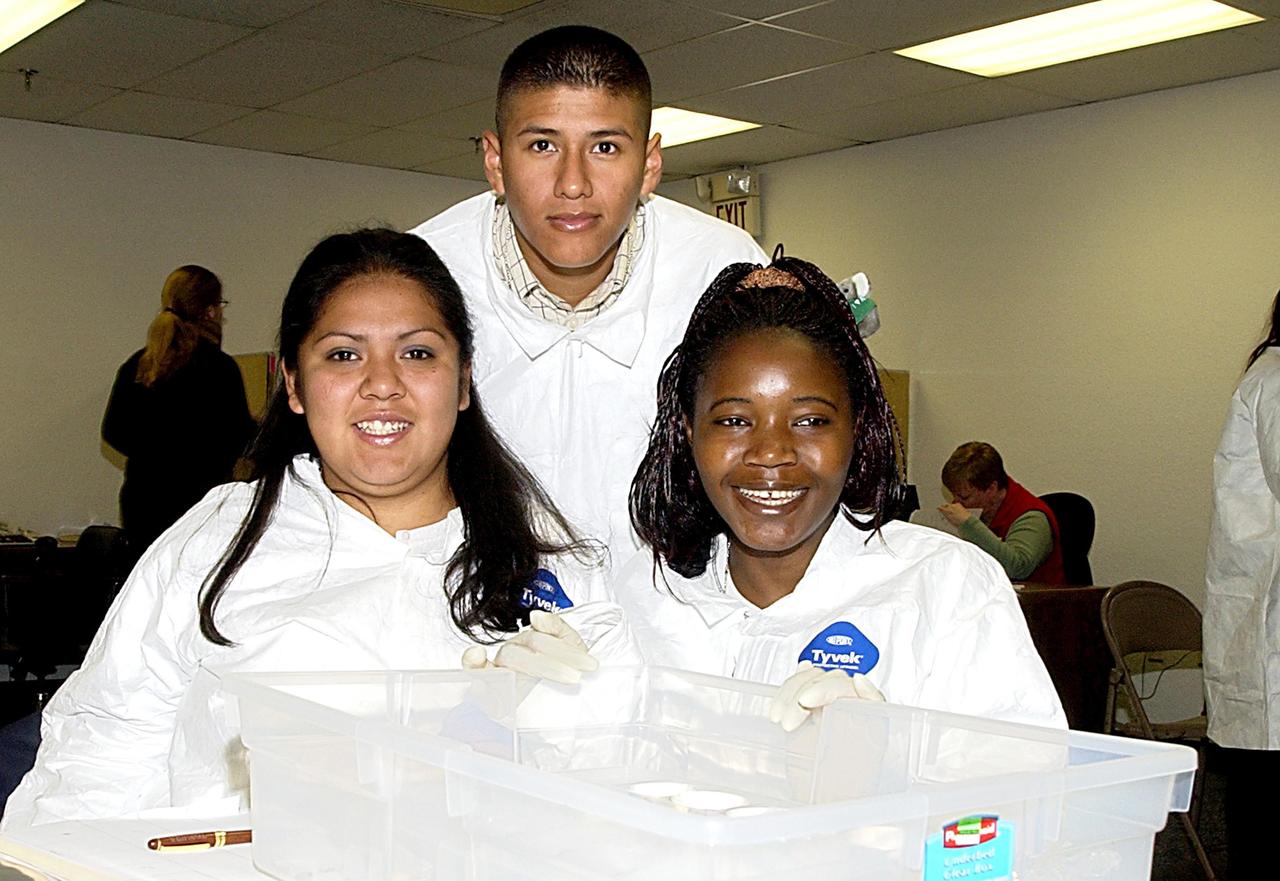
KENNEDY SPACE CENTER, FLA. - Students look over their experiments that will fly in SPACEHAB on Space Shuttle Columbia on mission STS-107. SPACEHAB's complement of commercial experiments includes six educational experiments designed and developed by students in six different countries under the auspices of Space Technology and Research Students (STARS), a global education program managed by SPACEHAB subsidiary Space Media. The countries represented are Australia, China, Israel, Japan, Liechtenstein and the United States. The student investigators who conceived these experiments will monitor their operations in space. The experiments will be housed in BioServe Space Technologies' Isothermal Containment Module (ICM --a small temperature-controlled facility that provides experiment support such as physical containment, lighting, and video imaging) and stowed in a middeck-size locker aboard the SPACEHAB Research Double Module.
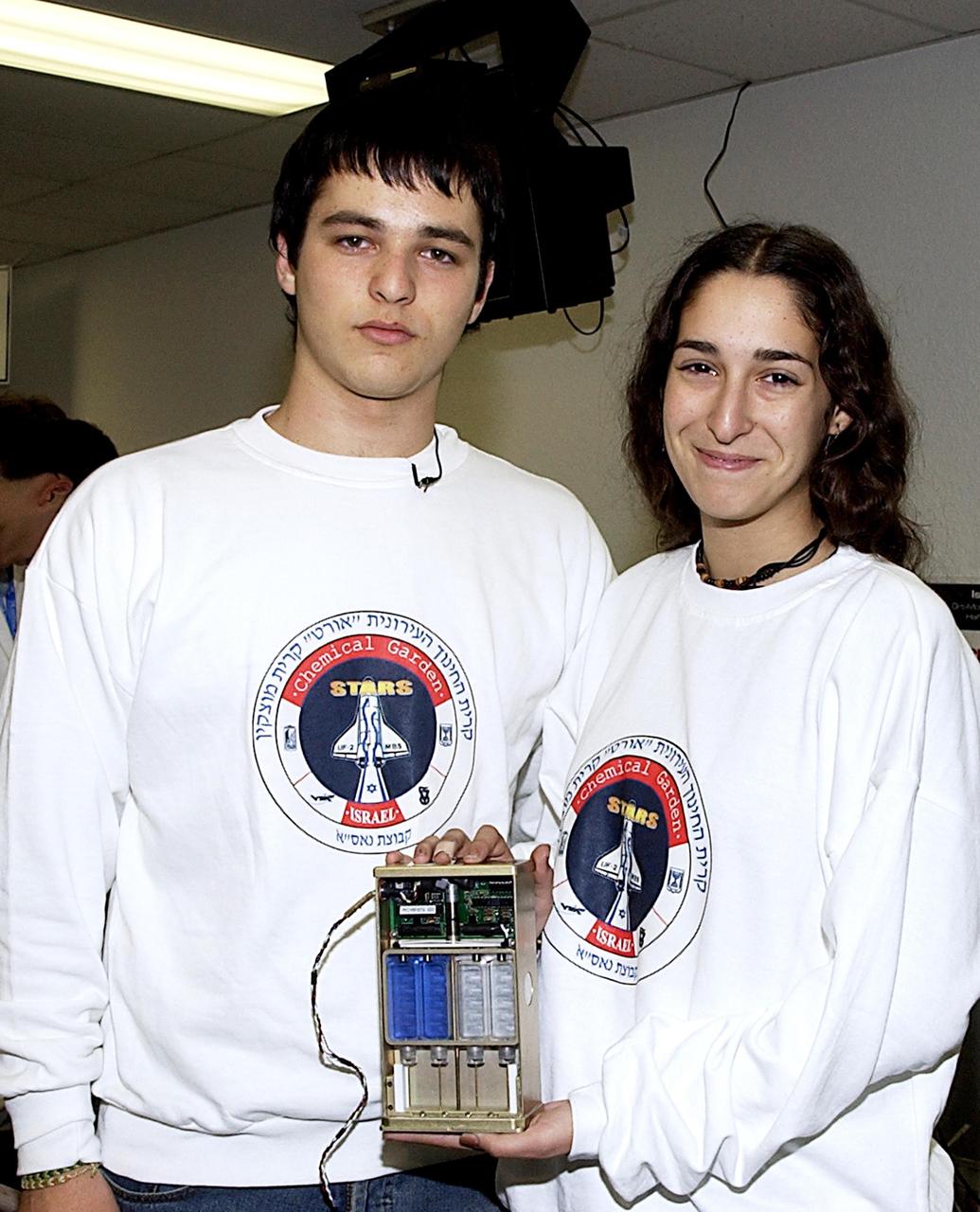
KENNEDY SPACE CENTER, FLA. -- Students show off one of the experiments that will fly in SPACEHAB on Space Shuttle Columbia on mission STS-107. SPACEHAB's complement of commercial experiments includes six educational experiments designed and developed by students in six different countries under the auspices of Space Technology and Research Students (STARS), a global education program managed by SPACEHAB subsidiary Space Media. The countries represented are Australia, China, Israel, Japan, Liechtenstein and the United States. The student investigators who conceived these experiments will monitor their operations in space. The experiments will be housed in BioServe Space Technologies' Isothermal Containment Module (ICM --a small temperature-controlled facility that provides experiment support such as physical containment, lighting, and video imaging) and stowed in a middeck-size locker aboard the SPACEHAB Research Double Module.
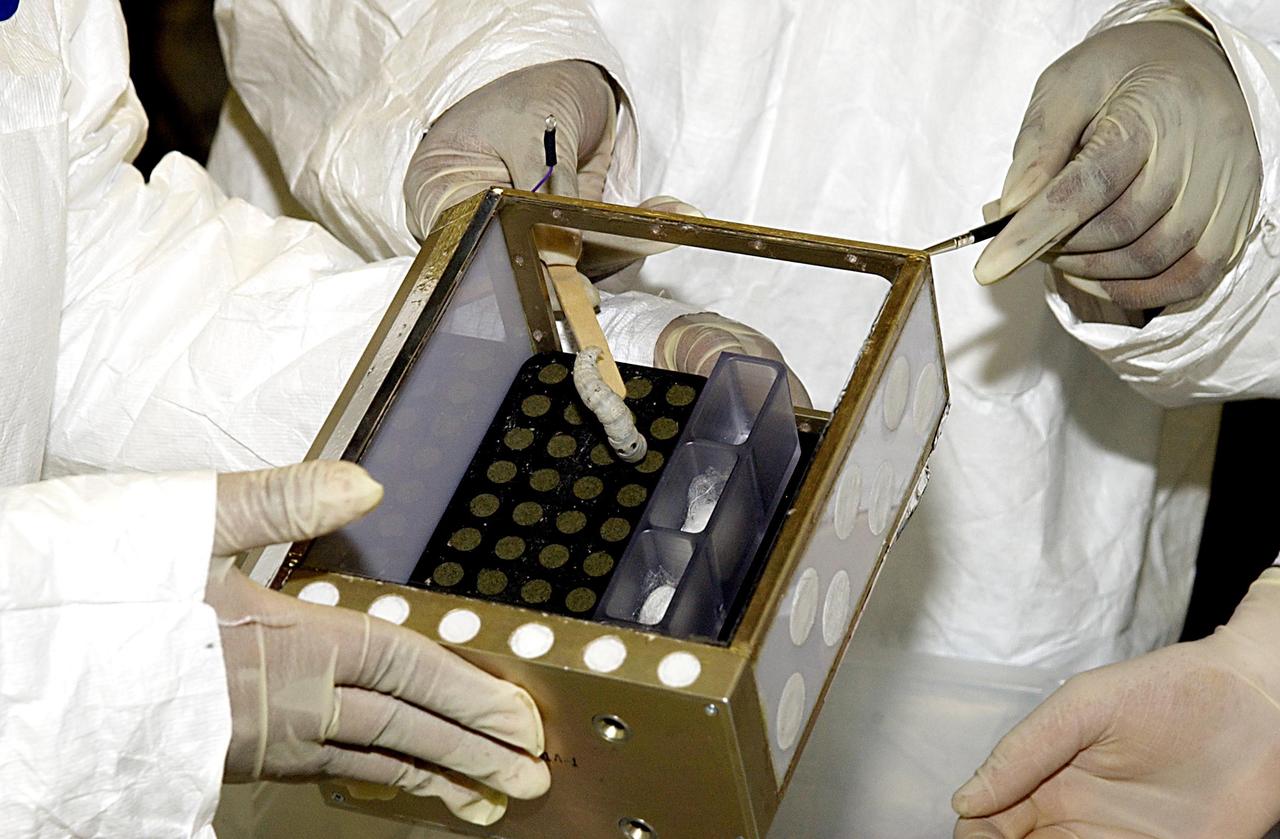
KENNEDY SPACE CENTER, FLA. - Students work on their experiments that will fly in SPACEHAB on Space Shuttle Columbia on mission STS-107. SPACEHAB's complement of commercial experiments includes six educational experiments designed and developed by students in six different countries under the auspices of Space Technology and Research Students (STARS), a global education program managed by SPACEHAB subsidiary Space Media. The countries represented are Australia, China, Israel, Japan, Liechtenstein and the United States. The student investigators who conceived these experiments will monitor their operations in space. The experiments will be housed in BioServe Space Technologies' Isothermal Containment Module (ICM --a small temperature-controlled facility that provides experiment support such as physical containment, lighting, and video imaging) and stowed in a middeck-size locker aboard the SPACEHAB Research Double Module.
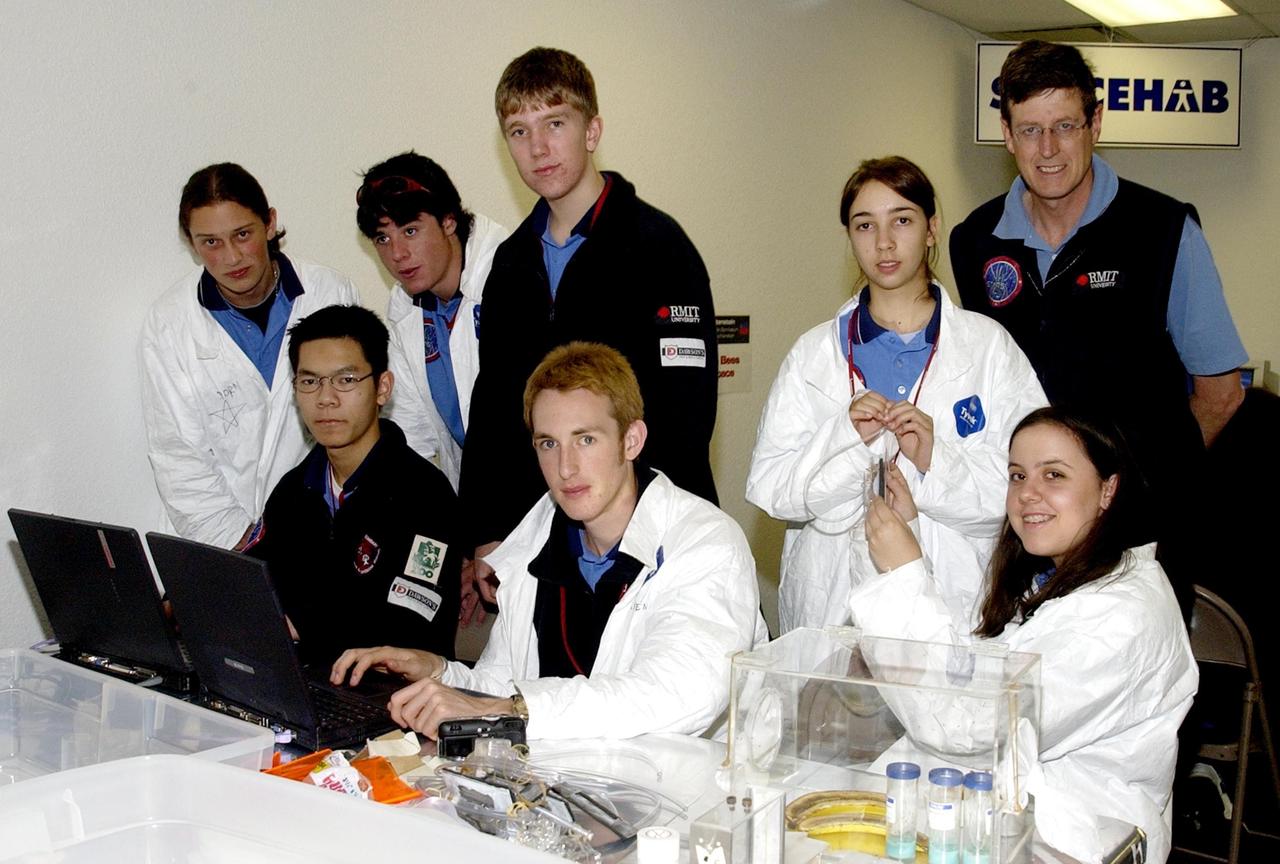
KENNEDY SPACE CENTER, FLA. - Students pause during their work on their experiments that will fly in SPACEHAB on Space Shuttle Columbia on mission STS-107. SPACEHAB's complement of commercial experiments includes six educational experiments designed and developed by students in six different countries under the auspices of Space Technology and Research Students (STARS), a global education program managed by SPACEHAB subsidiary Space Media. The countries represented are Australia, China, Israel, Japan, Liechtenstein and the United States. The student investigators who conceived these experiments will monitor their operations in space. The experiments will be housed in BioServe Space Technologies' Isothermal Containment Module (ICM --a small temperature-controlled facility that provides experiment support such as physical containment, lighting, and video imaging) and stowed in a middeck-size locker aboard the SPACEHAB Research Double Module.
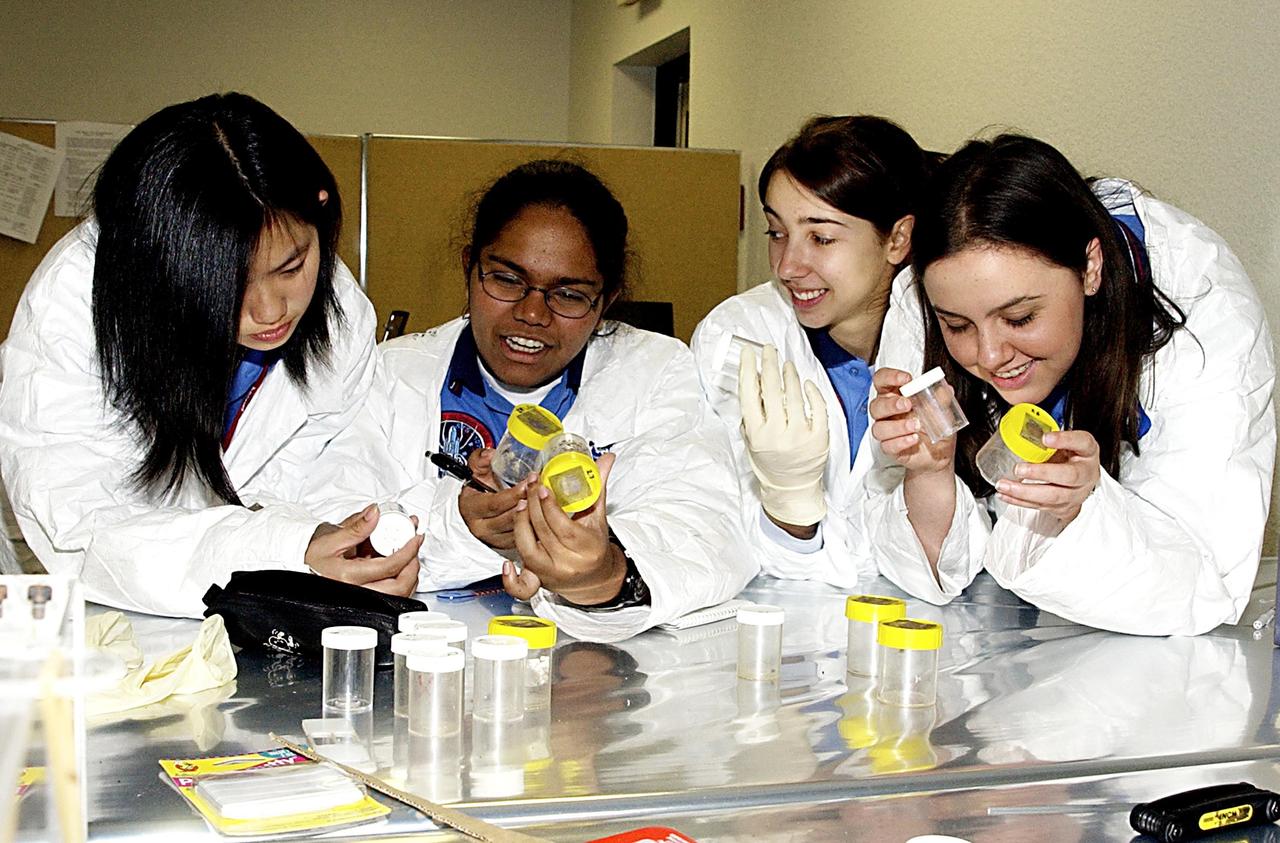
KENNEDY SPACE CENTER, FLA. -- Students check out their experiments that will fly in SPACEHAB on Space Shuttle Columbia on mission STS-107. SPACEHAB's complement of commercial experiments includes six educational experiments designed and developed by students in six different countries under the auspices of Space Technology and Research Students (STARS), a global education program managed by SPACEHAB subsidiary Space Media. The countries represented are Australia, China, Israel, Japan, Liechtenstein and the United States. The student investigators who conceived these experiments will monitor their operations in space. The experiments will be housed in BioServe Space Technologies' Isothermal Containment Module (ICM --a small temperature-controlled facility that provides experiment support such as physical containment, lighting, and video imaging) and stowed in a middeck-size locker aboard the SPACEHAB Research Double Module.
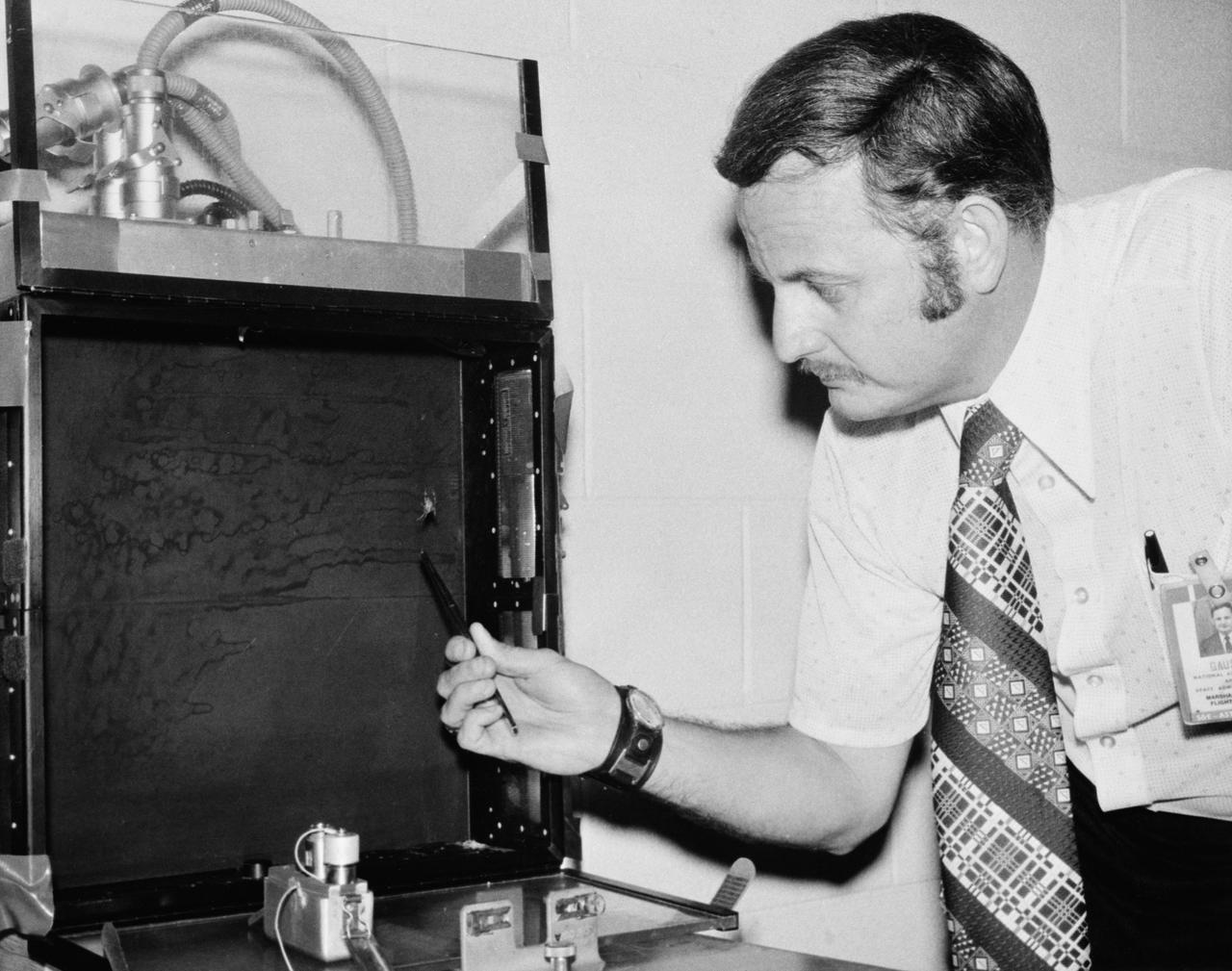
S73-32499 (July 1973) --- Dr. Ray Gause of the NASA Marshall Space Flight Center (MSFC) places dinner, in the form of a housefly, in the web of Arabella - the prime spider for the ED-52 Web Formation Experiment. Arabella can be delineated near the end of the black pen in Dr. Gause's hand. The experiment is one of 25 student experiments accepted for the Skylab program and will be performed during the Skylab 3 mission. Judy Miles, a 17-year-old high school student from Lexington, Massachusetts, is the student experimenter and Dr. Gause is the NASA student advisor. Photo credit: NASA
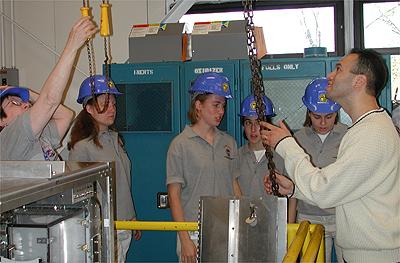
The first NASA Dropping In a Microgravity Environment (DIME) student competition pilot project came to a conclusion at the Glenn Research Center in April 2001. The competition involved high-school student teams who developed the concept for a microgravity experiment and prepared an experiment proposal. The two student teams - COSI Academy, sponsored by the Columbus Center of Science and Industry, and another team from Cincinnati, Ohio's Sycamore High School, designed a microgravity experiment, fabricated the experimental apparatus, and visited NASA Glenn to operate their experiment in the 2.2 Second Drop Tower. Here, students from Sycamore High School in Cincinnati, Ohio, help a NASA technician prepare their experiment. This image is from a digital still camera; higher resolution is not available.
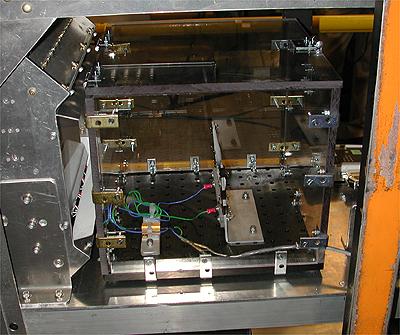
The first NASA Dropping In a Microgravity Environment (DIME) student competition pilot project came to a conclusion at the Glenn Research Center in April 2001. The competition involved high-school student teams who developed the concept for a microgravity experiment and prepared an experiment proposal. The two student teams - COSI Academy, sponsored by the Columbus Center of Science and Industry, and another team from Cincinnati, Ohio's Sycamore High School, designed a microgravity experiment, fabricated the experimental apparatus, and visited NASA Glenn to operate their experiment in the 2.2 Second Drop Tower. This is the interior of the Sycamore High School (Cincinnati, Ohio) students' experiment to observe the flame spreading on a 100 percent cotton T-shirt under low-g. This image is from a digital still camera; higher resolution is not available.
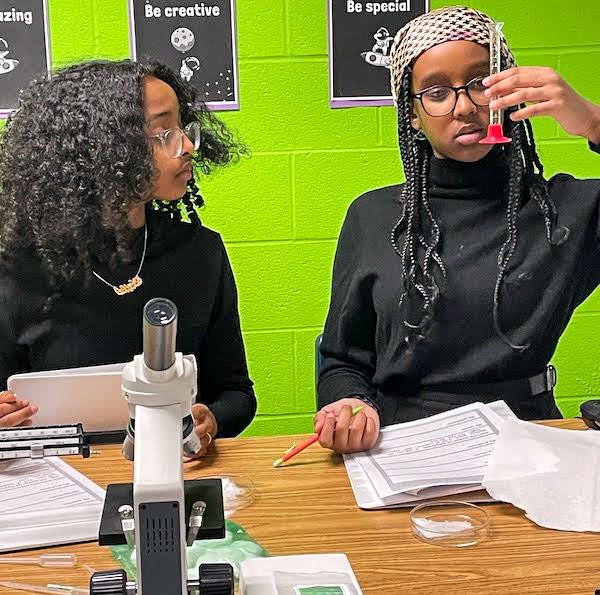
jsc2023e065211 (1/19/2023) --- Harmon Middle School student researchers work on their experiment, Bamboo Growth in Microgravity, which will be included in the Nanoracks-National Center for Earth and Space Science Education-Orbiter-Student Spaceflight Experiments Program Mission 17 to ISS (Nanoracks-NCESSE-Orbiter-SSEP).
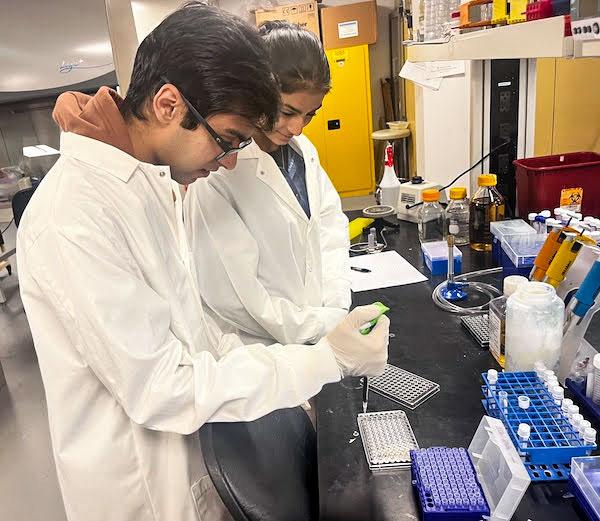
jsc2023e065219 (2/3/2023) --- Student researchers work on their experiment, The Effect of Microgravity on Telomerase Activity and Efficiency in Saccharomyces cerevisiae, which will be included in the Nanoracks-National Center for Earth and Space Science Education-Orbiter-Student Spaceflight Experiments Program Mission 17 to ISS (Nanoracks-NCESSE-Orbiter-SSEP).