
Astronomers have discovered a massive cluster of young galaxies forming in the distant universe. The growing galactic metropolis is known as COSMOS-AzTEC3. This image was taken Japan Subaru telescope atop Mauna Kea in Hawaii.

This false-color image of Jupiter was taken on May 18, 2017, with a mid-infrared filter centered at a wavelength of 8.8 microns, at the Subaru Telescope in Hawaii, in collaboration with observations of Jupiter by NASA's Juno mission. The selected wavelength is sensitive to Jupiter's tropospheric temperatures and the thickness of a cloud near the condensation level of ammonia gas. The Great Red Spot appears distinctively at the lower center of the planet as a cold region with a thick cloud layer. It is surrounded by a warm and relatively clear periphery. To its northwest is a turbulent and chaotic region where bands of gas that is warm and dry alternate with bands of gas that is cold and moist. This image, taken a few hours before Juno's sixth close approach to Jupiter, shows the detailed atmospheric structure of the Great Red Spot and its surroundings that the Juno mission will encounter on its seventh closest approach to Jupiter on July 10, 2017, Pacific Time (July 11, Universal Time). The instrument used to take this image is Cooled Mid-Infrared Camera and Spectrometer (COMICS) of the National Astronomical Observatory of Japan's Subaru Telescope on Hawaii's Maunakea peak. https://photojournal.jpl.nasa.gov/catalog/PIA21714
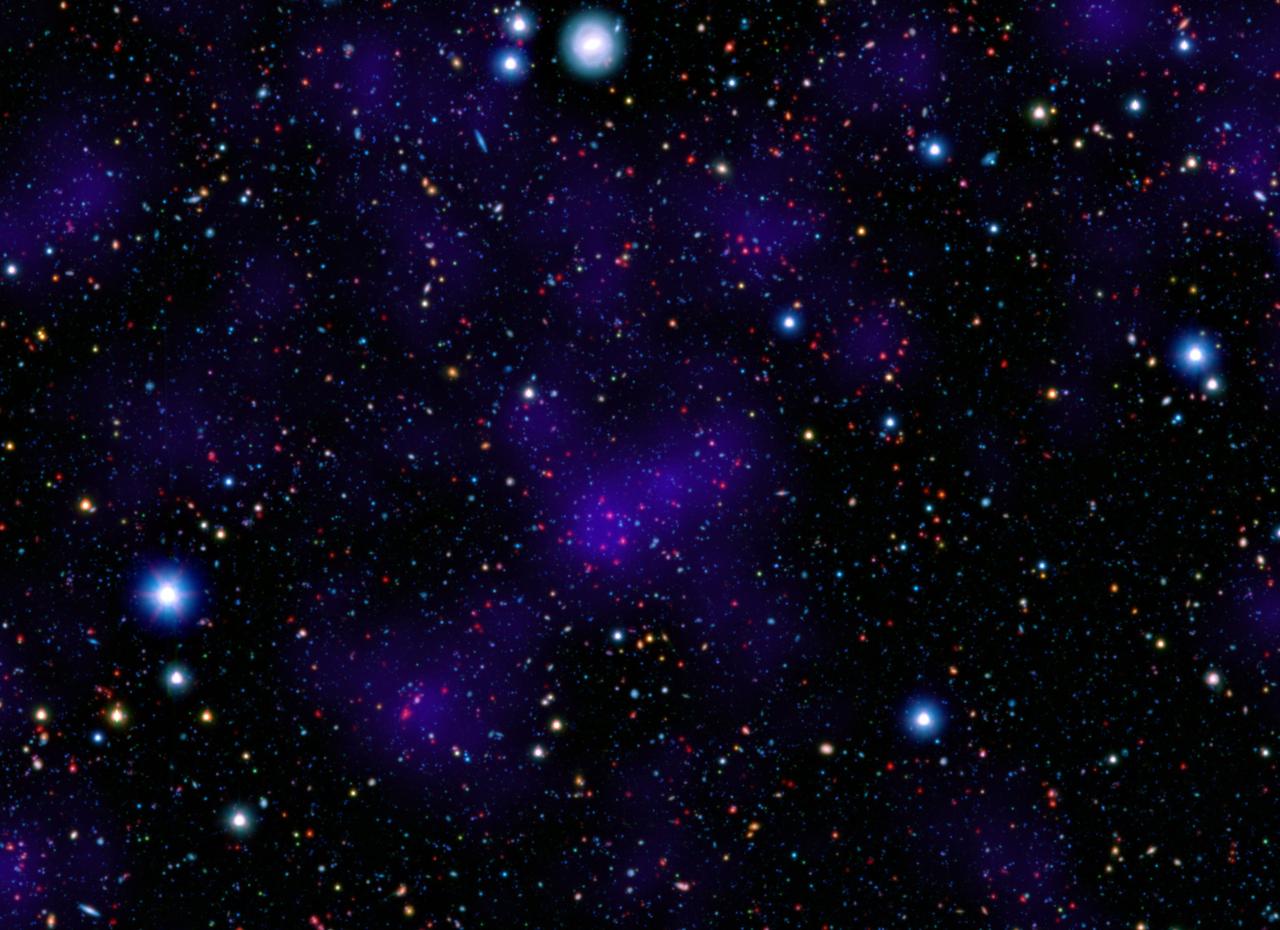
NASA Spitzer Space Telescope contributed to the infrared component of the observations of a surprisingly large collections of galaxies red dots in center. Shorter-wavelength infrared and visible data are provided by Japan Subaru telescope.
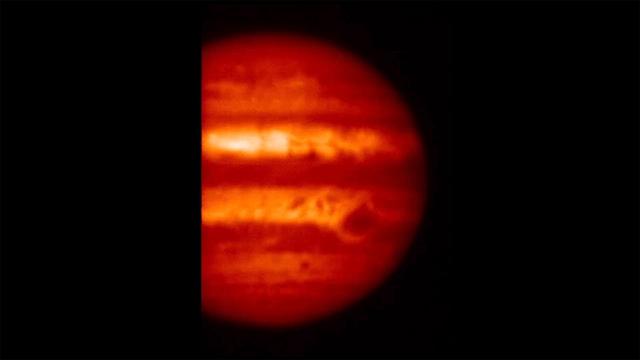
This video shows Jupiter as revealed by a powerful telescope and a mid-infrared filter sensitive to the giant planet's tropospheric temperatures and cloud thickness. It combines observations made on Jan. 14, 2017, using the Subaru Telescope in Hawaii. The filter used admits infrared light centered on a wavelength of 8.8 microns. The video includes interpolated frames for smoother apparent motion. The instrument used to take this image is Cooled Mid-Infrared Camera and Spectrometer (COMICS) of the National Astronomical Observatory of Japan's Subaru Telescope on the Maunakea volcano. Animations are available at https://photojournal.jpl.nasa.gov/catalog/PIA21715
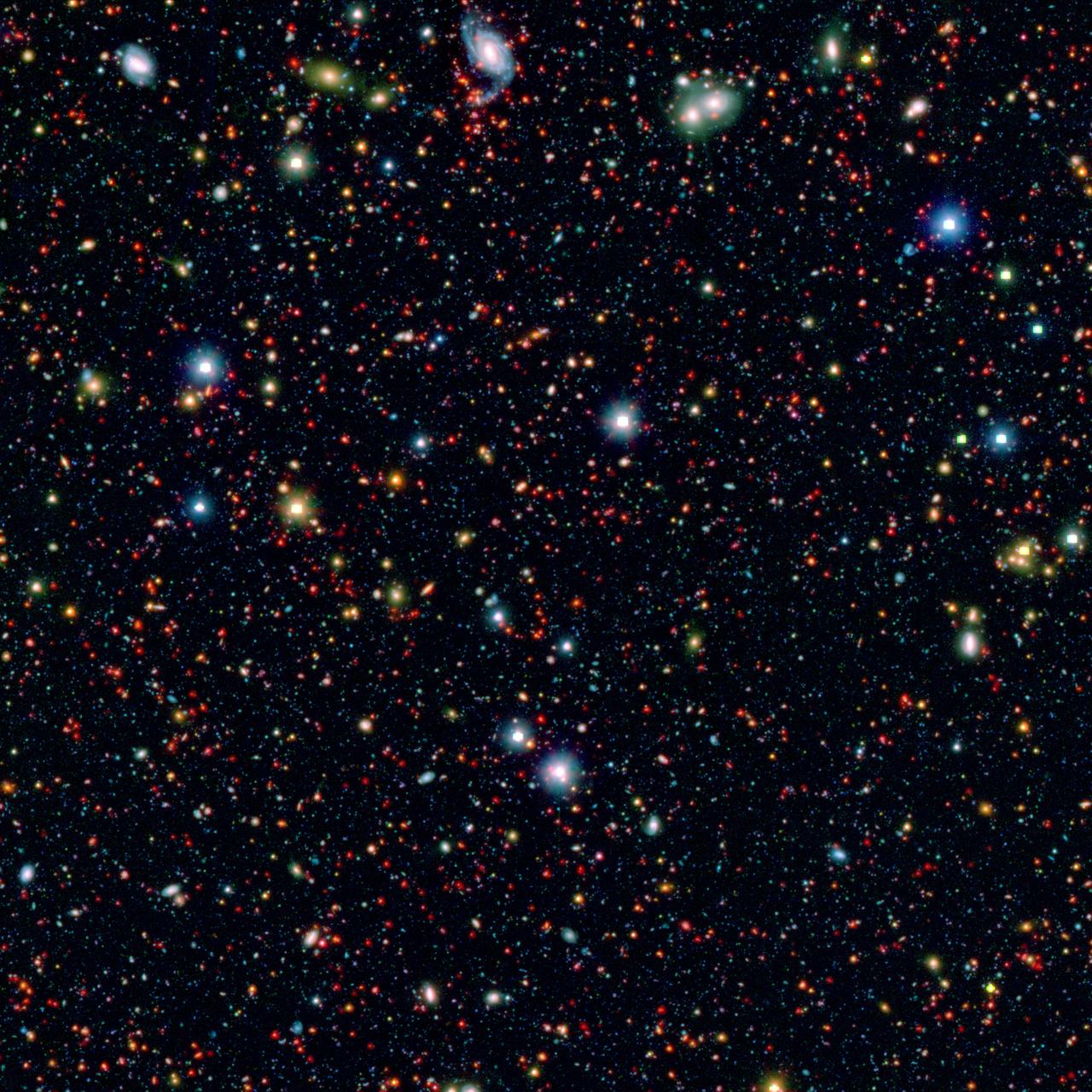
Millions of galaxies populate the patch of sky known as the COSMOS field, short for Cosmic Evolution Survey, a portion of which is shown here. Even the smallest dots in this image are galaxies, some up to 12 billion light-years away.
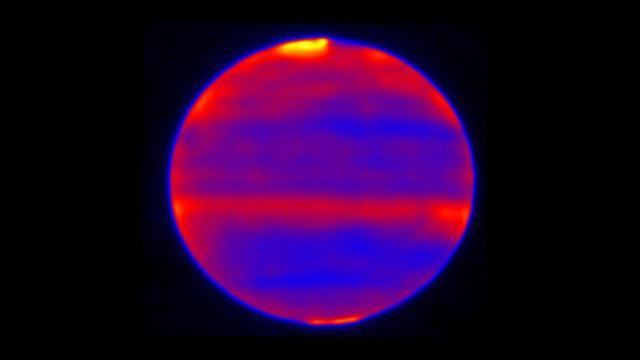
Sensitive to Jupiter's stratospheric temperatures, these infrared images were recorded by the Cooled Mid-Infrared Camera and Spectrograph (COMICS) at the Subaru Telescope on the summit of Mauna Kea, Hawaii. Scientists used red, blue and yellow to infuse this infrared image; regions of the atmosphere that are more yellow and red indicate the hotter areas. This highlights the auroral heating that occurs at Jupiter's poles, where energy from the solar wind and magnetosphere are deposited. This image was captured on Jan. 12, 2017. https://photojournal.jpl.nasa.gov/catalog/PIA22774
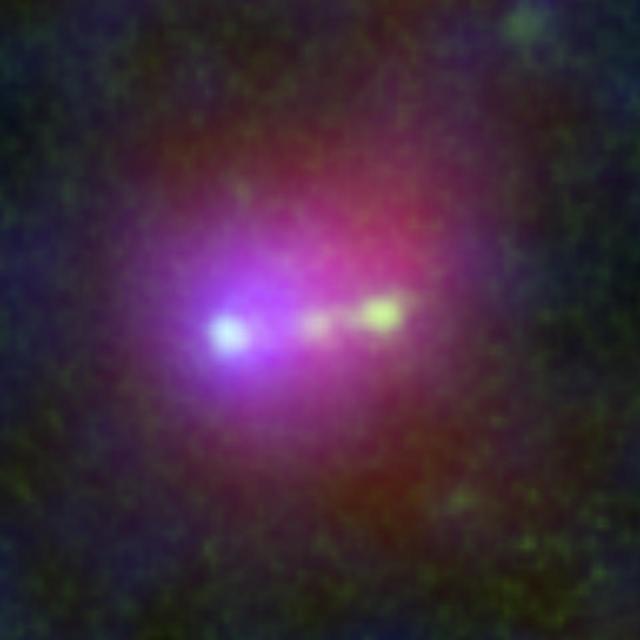
The big blob-like structure shown here, named Himiko after the legendary ancient queen of Japan, turns out to be three galaxies thought to be in the process of merging into one.

Sensitive to Jupiter's stratospheric temperatures, these infrared images were recorded by the Cooled Mid-Infrared Camera and Spectrograph (COMICS) at the Subaru Telescope on the summit of Mauna Kea, Hawaii. Areas of the atmosphere that are more yellow and red indicate the hotter regions. Aurora produce enhanced and variable heating at Jupiter's poles. The heating occurs when the magnetosphere and the solar wind interact and deposit energy into Jupiter's atmosphere. Images were captured less than a day apart, from Jan. 11-12, 2017, and illustrate how quickly the atmosphere varied in response to the solar wind. https://photojournal.jpl.nasa.gov/catalog/PIA22775

Caption: Glowing a dark magenta, the newly discovered exoplanet GJ 504b weighs in with about four times Jupiter's mass, making it the lowest-mass planet ever directly imaged around a star like the sun. Credit: NASA/Goddard/S. Wiessinger Using infrared data from the Subaru Telescope in Hawaii, an international team of astronomers has imaged a giant planet around the bright star GJ 504. Several times the mass of Jupiter and similar in size, the new world, dubbed GJ 504b, is the lowest-mass planet ever detected around a star like the sun using direct imaging techniques. "If we could travel to this giant planet, we would see a world still glowing from the heat of its formation with a color reminiscent of a dark cherry blossom, a dull magenta," said Michael McElwain, a member of the discovery team at NASA's Goddard Space Flight Center in Greenbelt, Md. "Our near-infrared camera reveals that its color is much more blue than other imaged planets, which may indicate that its atmosphere has fewer clouds." Read more: <a href="http://1.usa.gov/15Ba6fI" rel="nofollow">1.usa.gov/15Ba6fI</a> <b><a href="http://www.nasa.gov/audience/formedia/features/MP_Photo_Guidelines.html" rel="nofollow">NASA image use policy.</a></b> <b><a href="http://www.nasa.gov/centers/goddard/home/index.html" rel="nofollow">NASA Goddard Space Flight Center</a></b> enables NASA’s mission through four scientific endeavors: Earth Science, Heliophysics, Solar System Exploration, and Astrophysics. Goddard plays a leading role in NASA’s accomplishments by contributing compelling scientific knowledge to advance the Agency’s mission. <b>Follow us on <a href="http://twitter.com/NASA_GoddardPix" rel="nofollow">Twitter</a></b> <b>Like us on <a href="http://www.facebook.com/pages/Greenbelt-MD/NASA-Goddard/395013845897?ref=tsd" rel="nofollow">Facebook</a></b> <b>Find us on <a href="http://instagram.com/nasagoddard?vm=grid" rel="nofollow">Instagram</a></b>