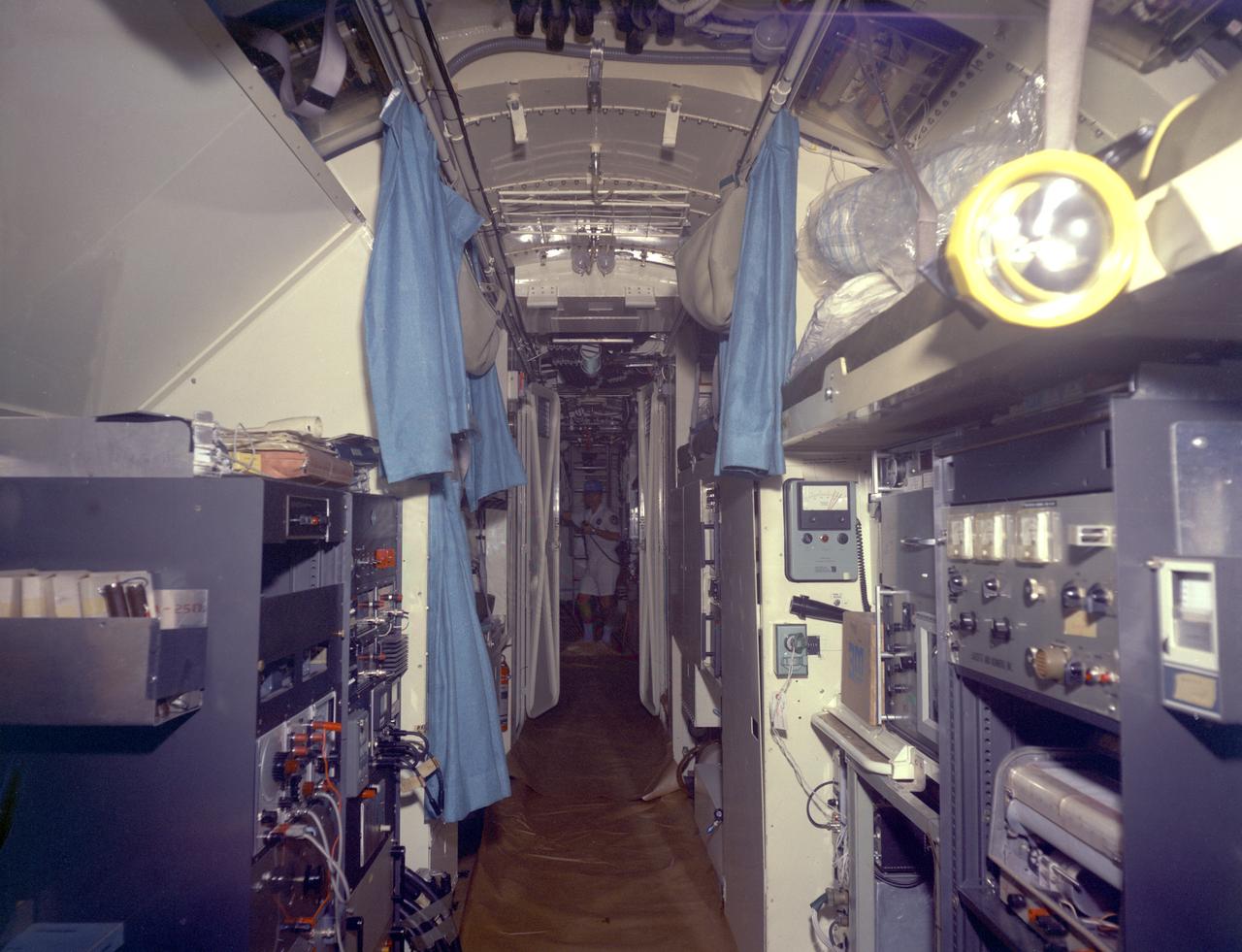
This is an interior view of the living quarters of the deep-sea research submarine "Ben Franklin." Named for American patriot and inventor Ben Franklin, who discovered the Gulf Steam, the 50-foot Ben Franklin was built between 1966 and 1968 in Switzerland for deep- ocean explorer Jacques Piccard and the Grumman Aircraft Engineering Corporation. The submersible made a famous 30-day drift dive off the East Coast of the United States and Canada in 1969 mapping the Gulf Stream's currents and sea life, and also made space exploration history by studying the behavior of aquanauts in a sealed, self-contained, self-sufficient capsule for NASA. On July 14, 1969, the Ben Franklin was towed to the high-velocity center of the Stream off the coast of Palm Beach, Florida. With a NASA observer on board, the sub descended to 1,000 feet off of Riviera Beach, Florida and drifted 1,400 miles north with the current for more than four weeks, reemerging near Maine. During the course of the dive, NASA conducted exhaustive analyses of virtually every aspect of onboard life. They measured sleep quality and patterns, sense of humor and behavioral shifts, physical reflexes, and the effect of a long-term routine on the crew. The submarine's record-shattering dive influenced the design of Apollo and Skylab missions and continued to guide NASA scientists as they devised future marned space-flight missions.
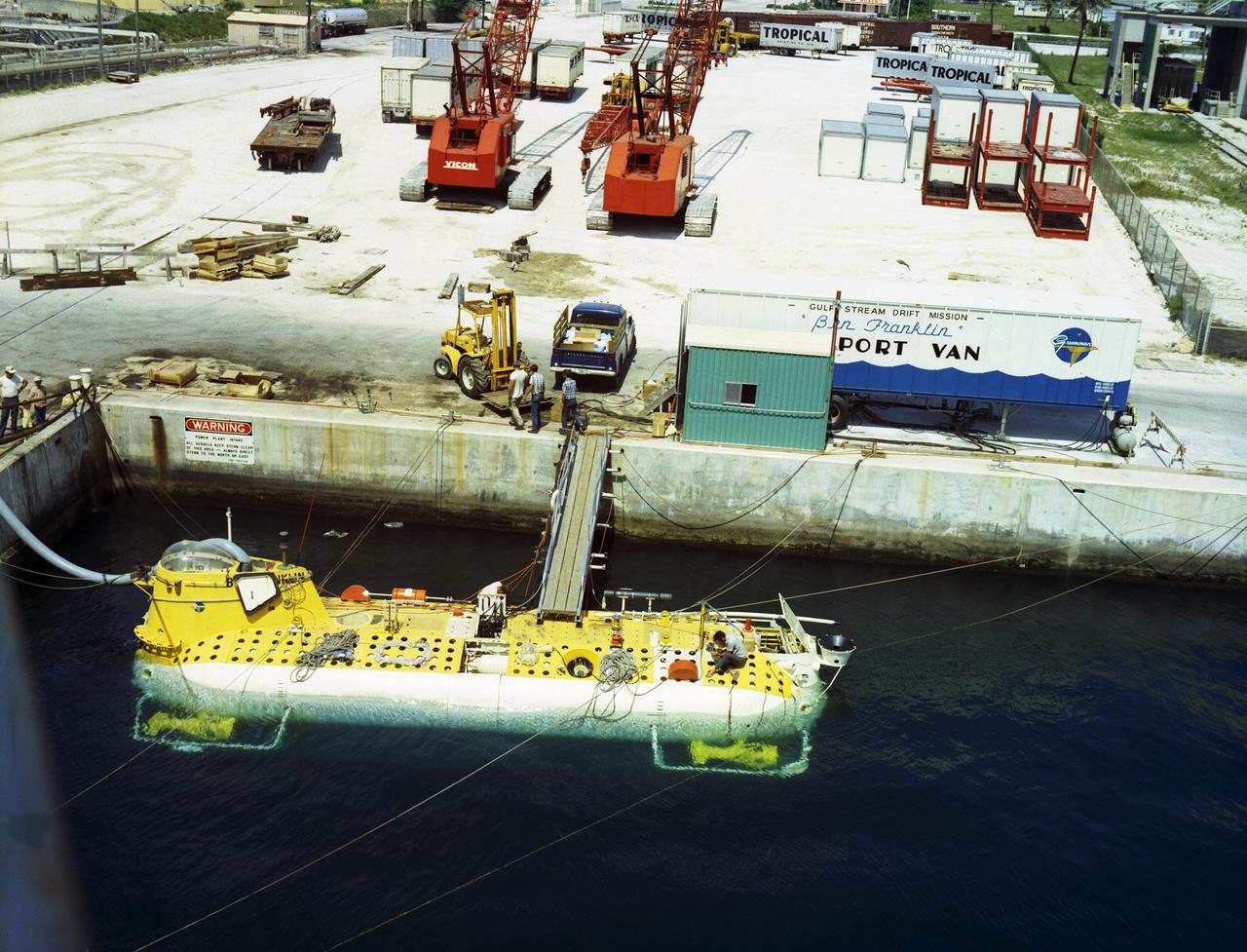
This is an aerial view of the deep-sea research submarine "Ben Franklin" at dock. Named for American patriot and inventor Ben Franklin, who discovered the Gulf Steam, the 50-foot Ben Franklin was built between 1966 and 1968 in Switzerland for deep-ocean explorer Jacques Piccard and the Grumman Aircraft Engineering Corporation. The submersible made a famous 30-day drift dive off the East Coast of the United States and Canada in 1969 mapping the Gulf Stream's currents and sea life, and also made space exploration history by studying the behavior of aquanauts in a sealed, self-contained, self-sufficient capsule for NASA. On July 14, 1969, the Ben Franklin was towed to the high-velocity center of the Stream off the coast of Palm Beach, Florida. With a NASA observer on board, the sub descended to 1,000 feet off of Riviera Beach, Florida and drifted 1,400 miles north with the current for more than four weeks, reemerging near Maine. During the course of the dive, NASA conducted exhaustive analyses of virtually every aspect of onboard life. They measured sleep quality and patterns, sense of humor and behavioral shifts, physical reflexes, and the effects of a long-term routine on the crew. The submarine's record-shattering dive influenced the design of Apollo and Skylab missions and continued to guide NASA scientists as they devised future marned space-flight missions.
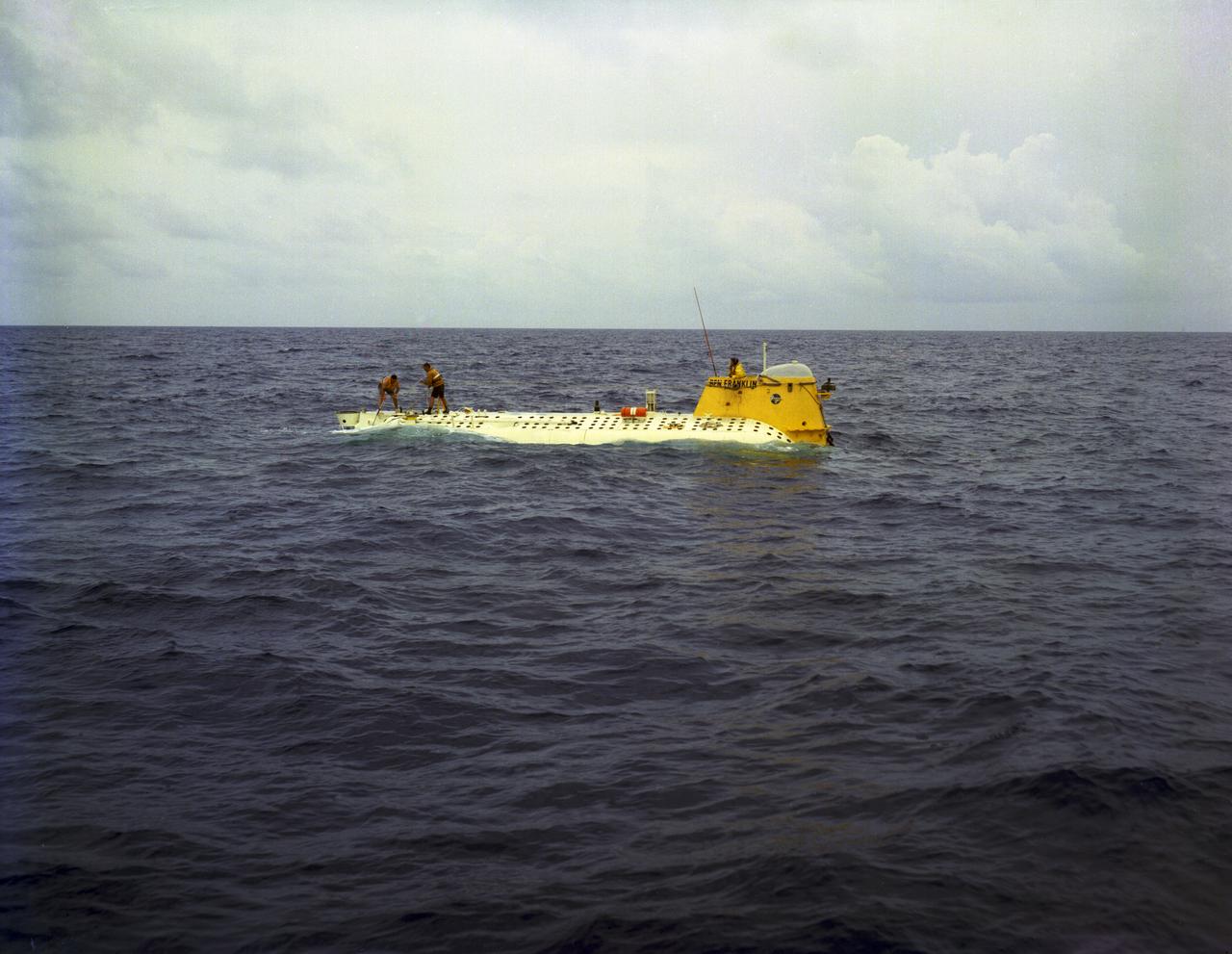
In this photograph, the deep-sea Research Submarine "Ben Franklin" drifts off the East Coast of the United States (U.S.) prior to submerging into the ocean. Named for American patriot and inventor Ben Franklin, who discovered the Gulf Steam, the 50-foot Ben Franklin was built between 1966 and 1968 in Switzerland for deep-ocean explorer Jacques Piccard and the Grumman Aircraft Engineering Corporation. The submersible made a famous 30-day drift dive off the East Coast of the United States and Canada in 1969 mapping the Gulf Stream's currents and sea life, and also made space exploration history by studying the behavior of aquanauts in a sealed, self-contained, self-sufficient capsule for NASA. On July 14, 1969, the Ben Franklin was towed to the high-velocity center of the Stream off the coast of Palm Beach, Florida. With a NASA observer on board, the sub descended to 1,000 feet off of Riviera Beach, Florida and drifted 1,400 miles north with the current for more than four weeks, reemerging near Maine. During the course of the dive, NASA conducted exhaustive analyses of virtually every aspect of onboard life. They measured sleep quality and patterns, sense of humor and behavioral shifts, physical reflexes, and the effects of a long-term routine on the crew. The submarine's record-shattering dive influenced the design of Apollo and Skylab missions and continued to guide NASA scientists as they devised future marned space-flight missions.
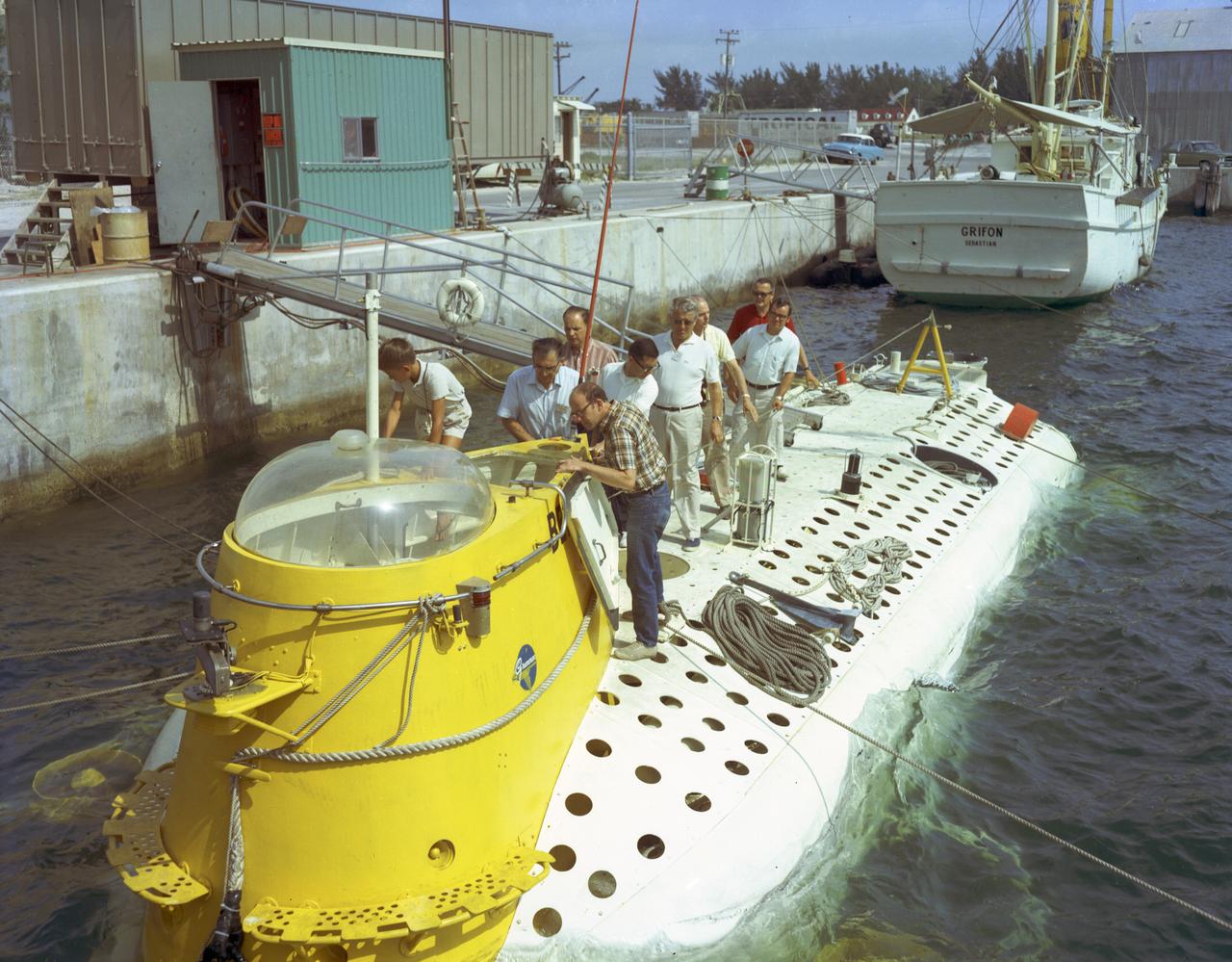
This photograph depicts Dr. von Braun (fourth from far right) and other NASA officials surveying the deep-sea research submarine "Ben Franklin." Named for American patriot and inventor Ben Franklin, who discovered the Gulf Steam, the 50-foot Ben Franklin was built between 1966 and 1968 in Switzerland for deep-ocean explorer Jacques Piccard and the Grumman Aircraft Engineering Corporation. The submersible made a famous 30-day drift dive off the East Coast of the United States and Canada in 1969 mapping the Gulf Stream's currents and sea life, and also made space exploration history by studying the behavior of aquanauts in a sealed, self-contained, self-sufficient capsule for NASA. On July 14, 1969, the Ben Franklin was towed to the high-velocity center of the Stream off the coast of Palm Beach, Florida. With a NASA observer on board, the sub descended to 1,000 feet off of Riviera Beach, Florida and drifted 1,400 miles north with the current for more than four weeks, reemerging near Maine. During the course of the dive, NASA conducted exhaustive analyses of virtually every aspect of onboard life. They measured sleep quality and patterns, sense of humor and behavioral shifts, physical reflexes, and the effects of a long-term routine on the crew. The submarine's record-shattering dive influenced the design of Apollo and Skylab missions and continued to guide NASA scientists as they devised future marned space-flight missions.
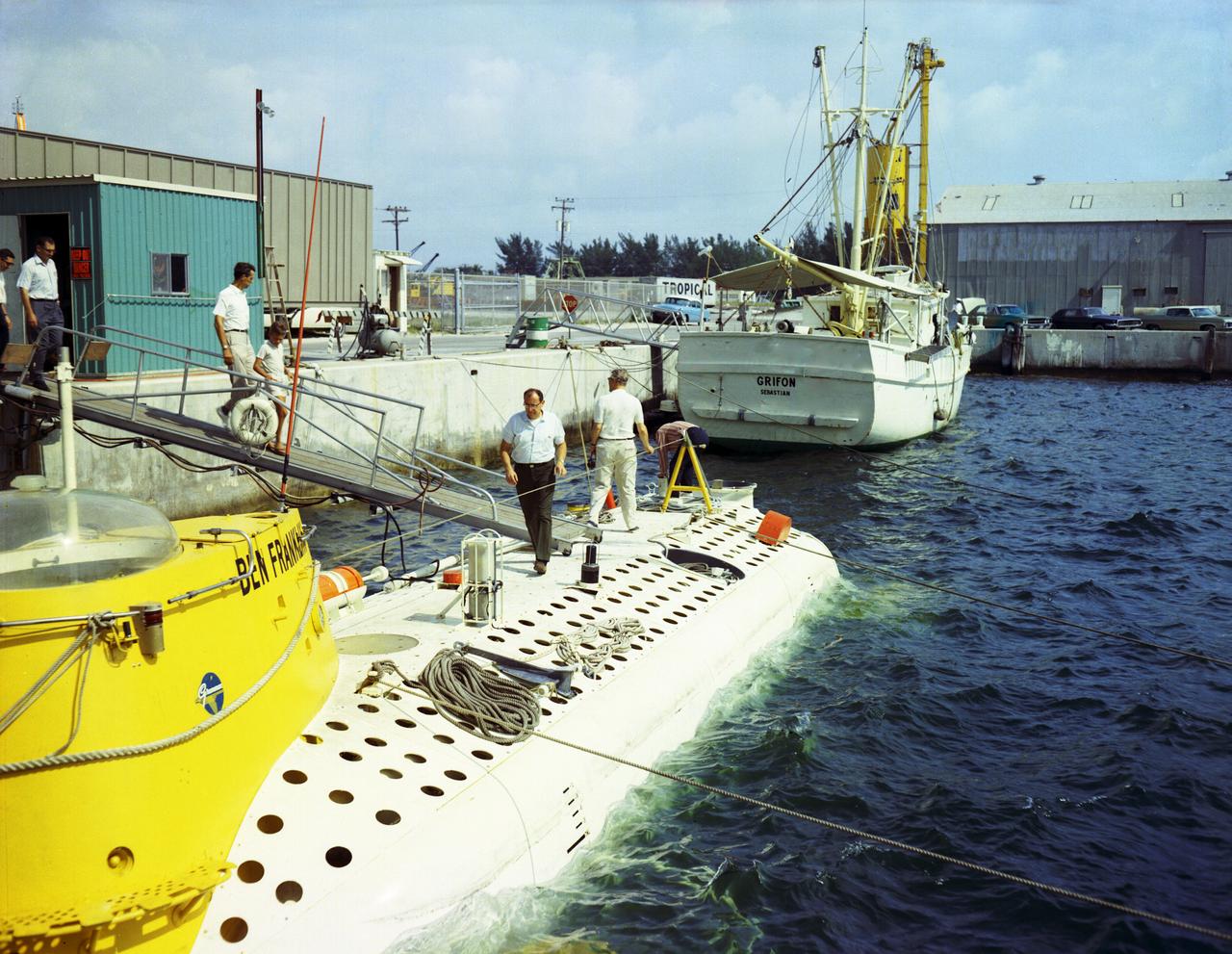
This photograph depicts Dr. von Braun (at right, showing his back) and other NASA officials surveying the deep-sea research submarine "Ben Franklin." Named for American patriot and inventor Ben Franklin, who discovered the Gulf Steam, the 50-foot Ben Franklin was built between 1966 and 1968 in Switzerland for deep-ocean explorer Jacques Piccard and the Grumman Aircraft Engineering Corporation. The submersible made a famous 30-day drift dive off the East Coast of the United States and Canada in 1969 mapping the Gulf Stream's currents and sea life, and also made space exploration history by studying the behavior of aquanauts in a sealed, self-contained, self-sufficient capsule for NASA. On July 14, 1969, the Ben Franklin was towed to the high-velocity center of the Stream off the coast of Palm Beach, Florida. With a NASA observer on board, the sub descended to 1,000 feet off of Riviera Beach, Florida and drifted 1,400 miles north with the current for more than four weeks, reemerging near Maine. During the course of the dive, NASA conducted exhaustive analyses of virtually every aspect of onboard life. They measured sleep quality and patterns, sense of humor and behavioral shifts, physical reflexes, and the effects of a long-term routine on the crew. The submarine's record-shattering dive influenced the design of Apollo and Skylab missions and continued to guide NASA scientists as they devised future marned space-flight missions.
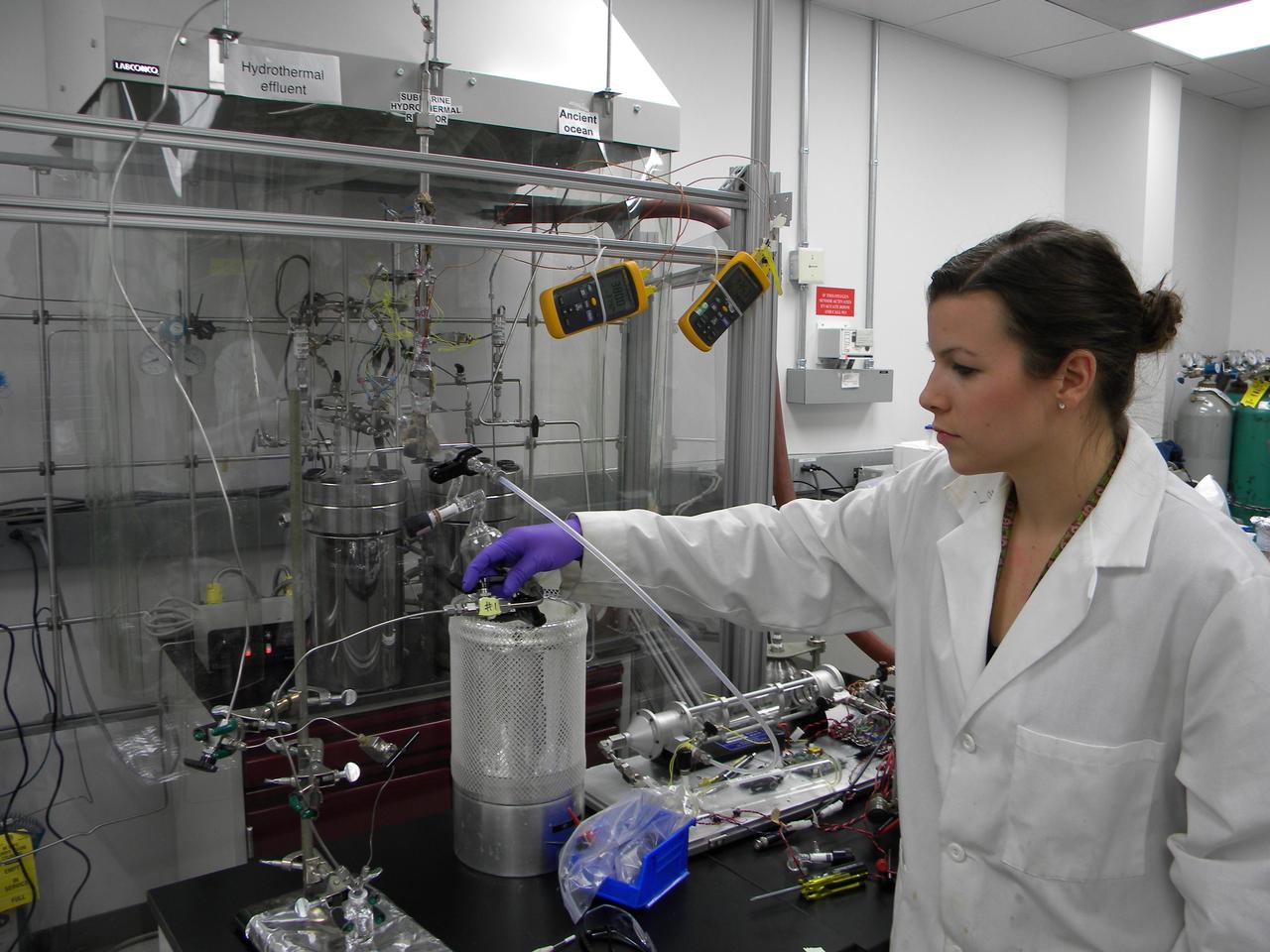
A team of scientists at NASA Jet Propulsion Laboratory is testing whether organic molecules can be brewed in a simulated ocean vent. Pictured here is Lauren White, a member of the NASA Astrobiology Icy Worlds team.

Historical Navy submarine with shadow of P-3 (sub chaser Orion in overlight
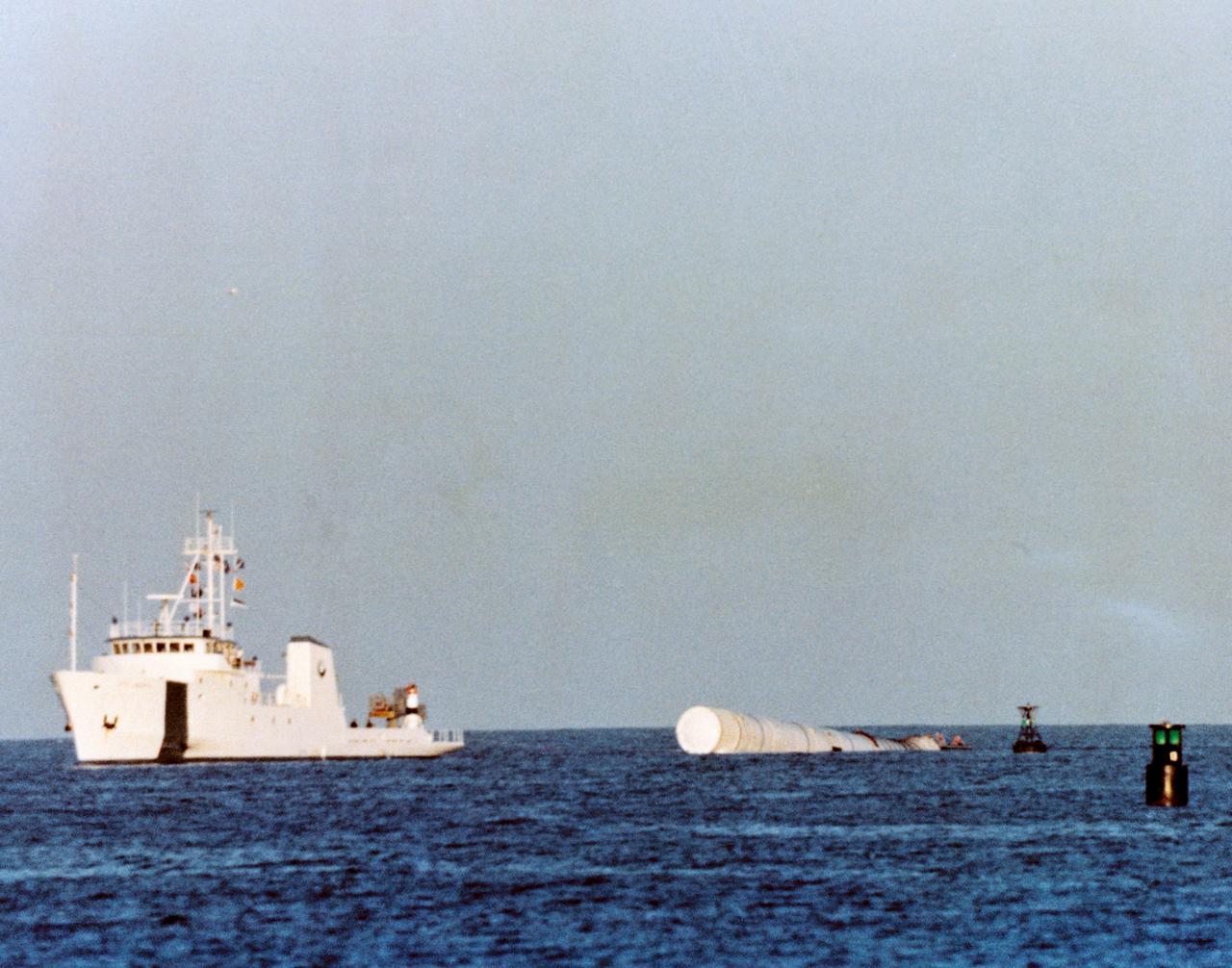
S81-30953 (13 April 1981) --- With one of the two expended solid rocket boosters from the launch of the space shuttle Columbia in tow, the recovery ship UTC Liberty heads toward the Trident Submarine Basin at Port Canaveral, south of NASA's Kennedy Space Center (KSC). The ship, built especially for the task of recovering expended boosters and their parachutes, is bound for ran overnight berth in the submarine basin, before continuing tomorrow toward recovery facilities at KSC. Photo credit: NASA
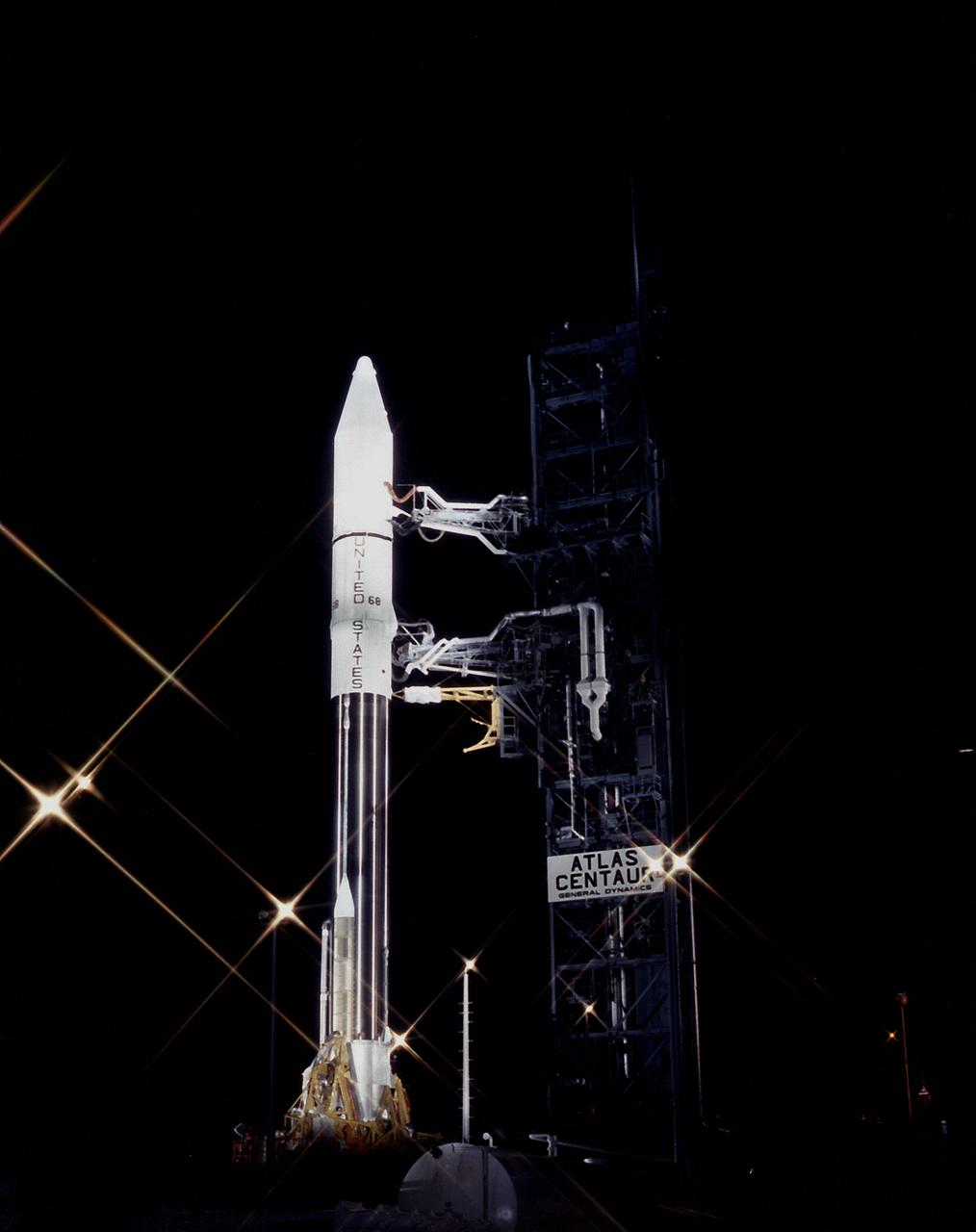
The Atlas-Centaur, AC-68 vehicle, with the FLTSATCOM (F-8 Communication Satellite) aboard, on the Complex 36 at the Cape Canaveral Air Force Station. The FLTSATCOM will provide communications for ships and submarines at sea, planes in the air and military ground units throughout the world. It will also provide instant communications between the President and the Commanding Officers.
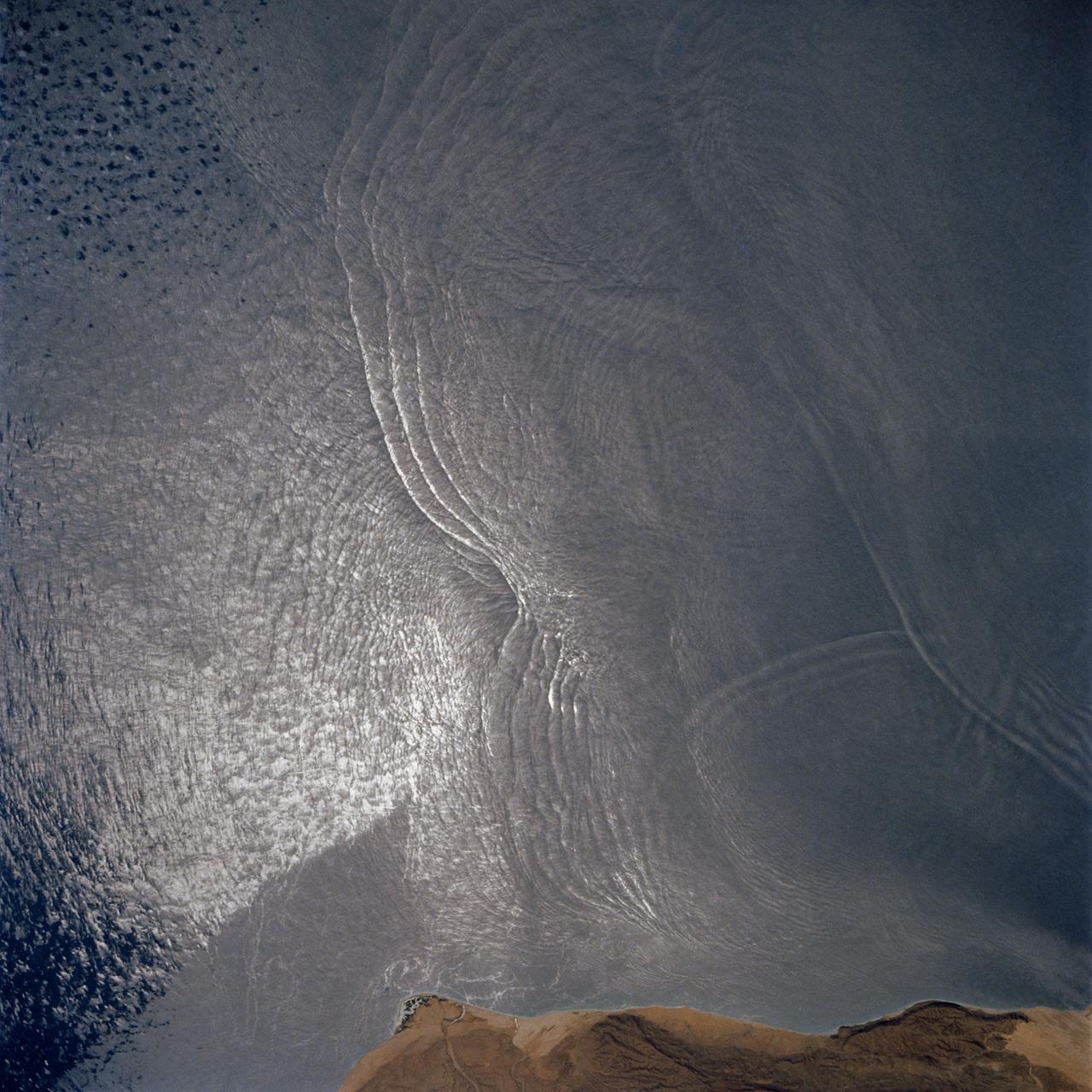
The arculate fronts of these apparently converging internal waves off the northeast coast of Somalia (11.5N, 51.5E) probably were produced by interaction with two parallel submarine canyons off the Horn of Africa. Internal waves are packets of tidally generated waves traveling within the ocean at varying depths and are not detectable by any surface disturbance.
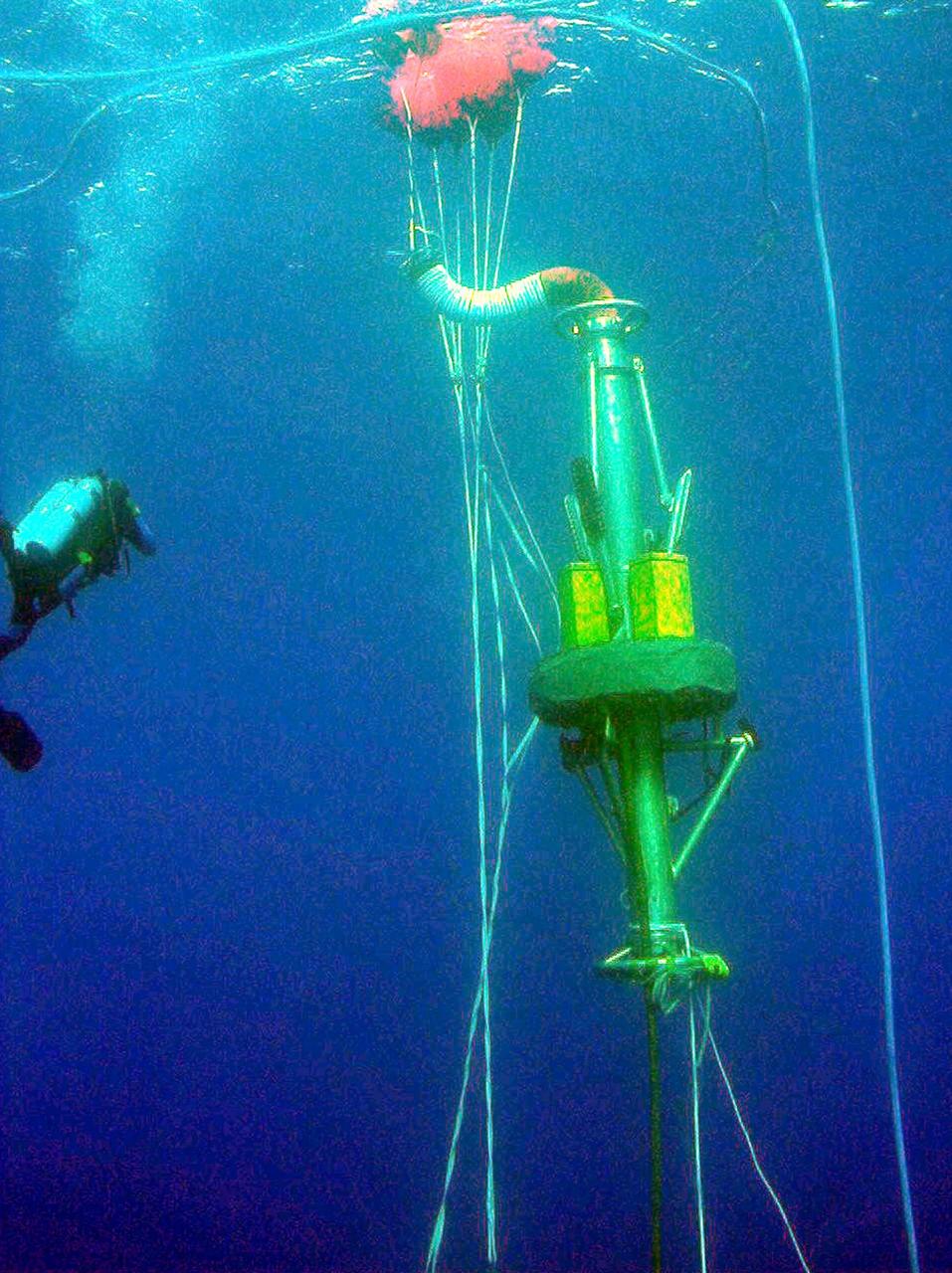
KENNEDY SPACE CENTER, FLA. -- A Diver Operator Plug (DOP) is being pulled down into the ocean by a newly designed one-man submarine known as DeepWorker 2000. The activity is part of an operation to attach the plug to a mockup of a solid rocket booster nozzle. DeepWorker 2000 is being tested on its ability to duplicate the sometimes hazardous job United Space Alliance (USA) divers perform to recover the expended boosters in the ocean after a launch. The boosters splash down in an impact area about 140 miles east of Jacksonville and after recovery are towed back to KSC for refurbishment by the specially rigged recovery ships. DeepWorker 2000 will be used in a demonstration during retrieval operations after the upcoming STS-101 launch. The submarine pilot will demonstrate capabilities to cut tangled parachute riser lines using a manipulator arm and attach the DOP to extract water and provide flotation for the booster. DeepWorker 2000 was built by Nuytco Research Ltd., North Vancouver, British Columbia. It is 8.25 feet long, 5.75 feet high, and weighs 3,800 pounds. USA is a prime contractor to NASA for the Space Shuttle program
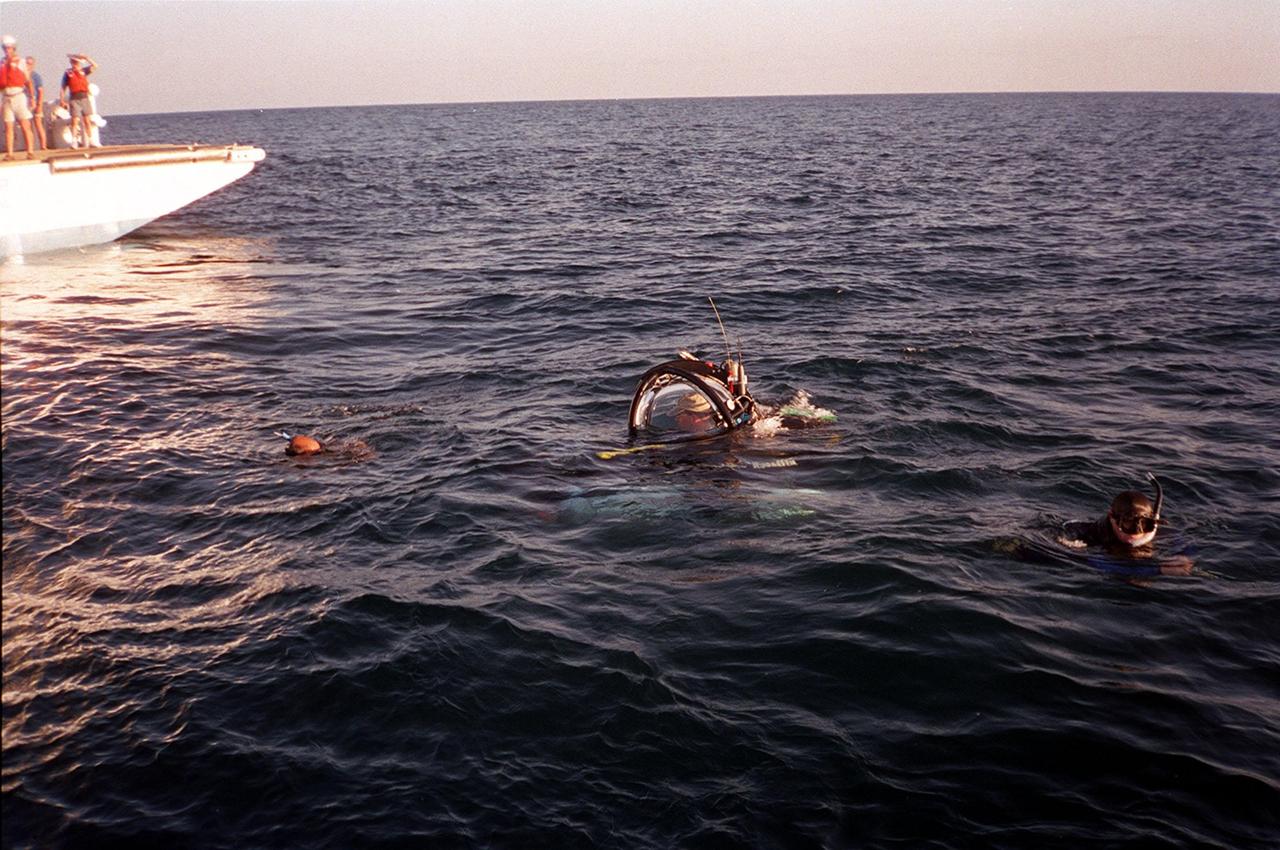
KENNEDY SPACE CENTER, FLA. -- The one-man submarine known as DeepWorker 2000 is tested in Atlantic waters near Cape Canaveral, Fla. Nearby are divers; inside the sub is the pilot, Anker Rasmussen. The sub is being tested on its ability to duplicate the sometimes hazardous job United Space Alliance (USA) divers perform to recover the expended boosters in the ocean after a launch. The boosters splash down in an impact area about 140 miles east of Jacksonville and after recovery are towed back to KSC for refurbishment by the specially rigged recovery ships. DeepWorker 2000 will be used in a demonstration during retrieval operations after the upcoming STS-101 launch. The submarine pilot will demonstrate capabilities to cut tangled parachute riser lines using a manipulator arm and attach a Diver Operator Plug to extract water and provide flotation for the booster. DeepWorker 2000 was built by Nuytco Research Ltd., North Vancouver, British Columbia. It is 8.25 feet long, 5.75 feet high, and weighs 3,800 pounds. USA is a prime contractor to NASA for the Space Shuttle program
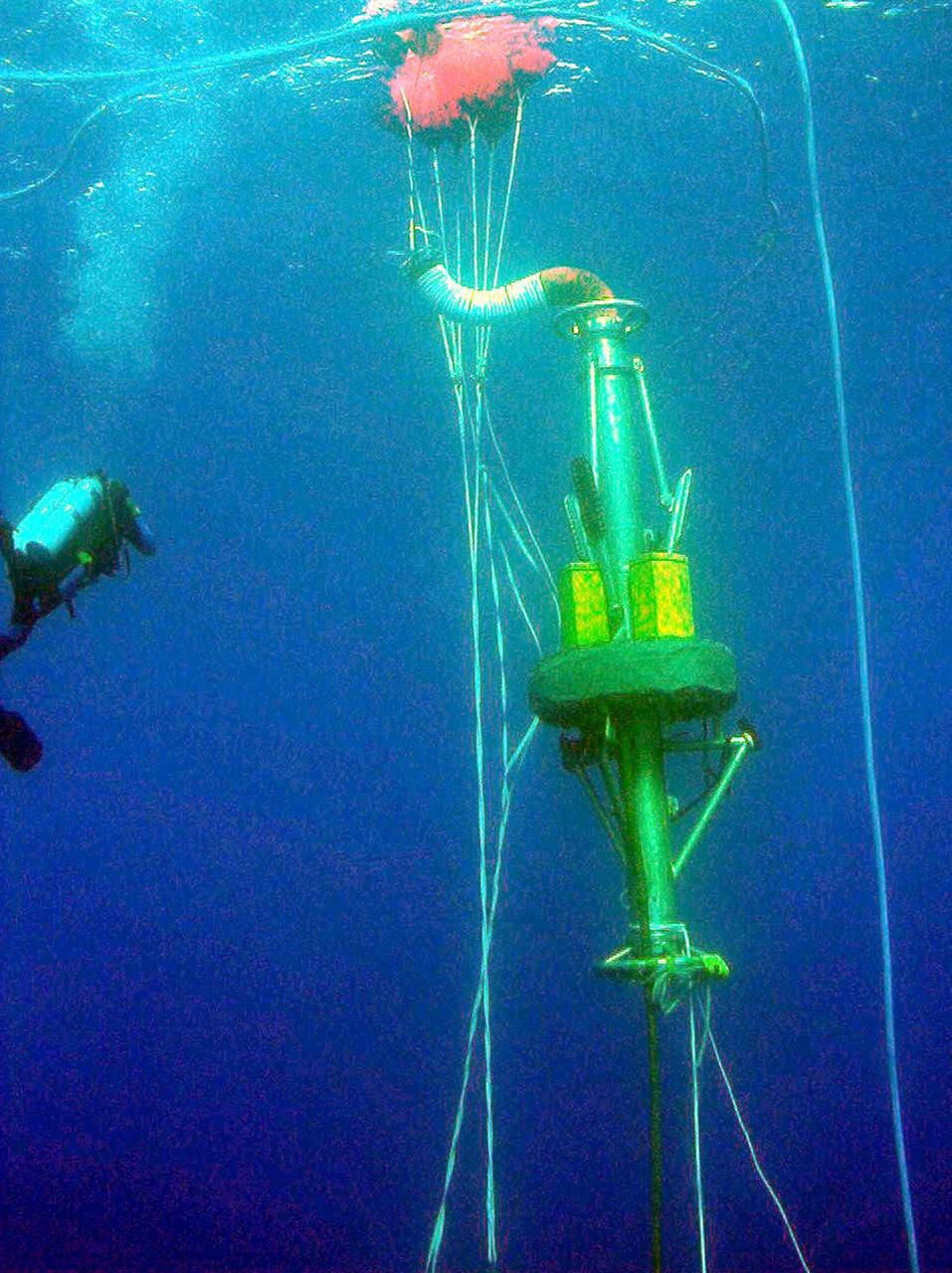
KENNEDY SPACE CENTER, FLA. -- A Diver Operator Plug (DOP) is being pulled down into the ocean by a newly designed one-man submarine known as DeepWorker 2000. The activity is part of an operation to attach the plug to a mockup of a solid rocket booster nozzle. DeepWorker 2000 is being tested on its ability to duplicate the sometimes hazardous job United Space Alliance (USA) divers perform to recover the expended boosters in the ocean after a launch. The boosters splash down in an impact area about 140 miles east of Jacksonville and after recovery are towed back to KSC for refurbishment by the specially rigged recovery ships. DeepWorker 2000 will be used in a demonstration during retrieval operations after the upcoming STS-101 launch. The submarine pilot will demonstrate capabilities to cut tangled parachute riser lines using a manipulator arm and attach the DOP to extract water and provide flotation for the booster. DeepWorker 2000 was built by Nuytco Research Ltd., North Vancouver, British Columbia. It is 8.25 feet long, 5.75 feet high, and weighs 3,800 pounds. USA is a prime contractor to NASA for the Space Shuttle program
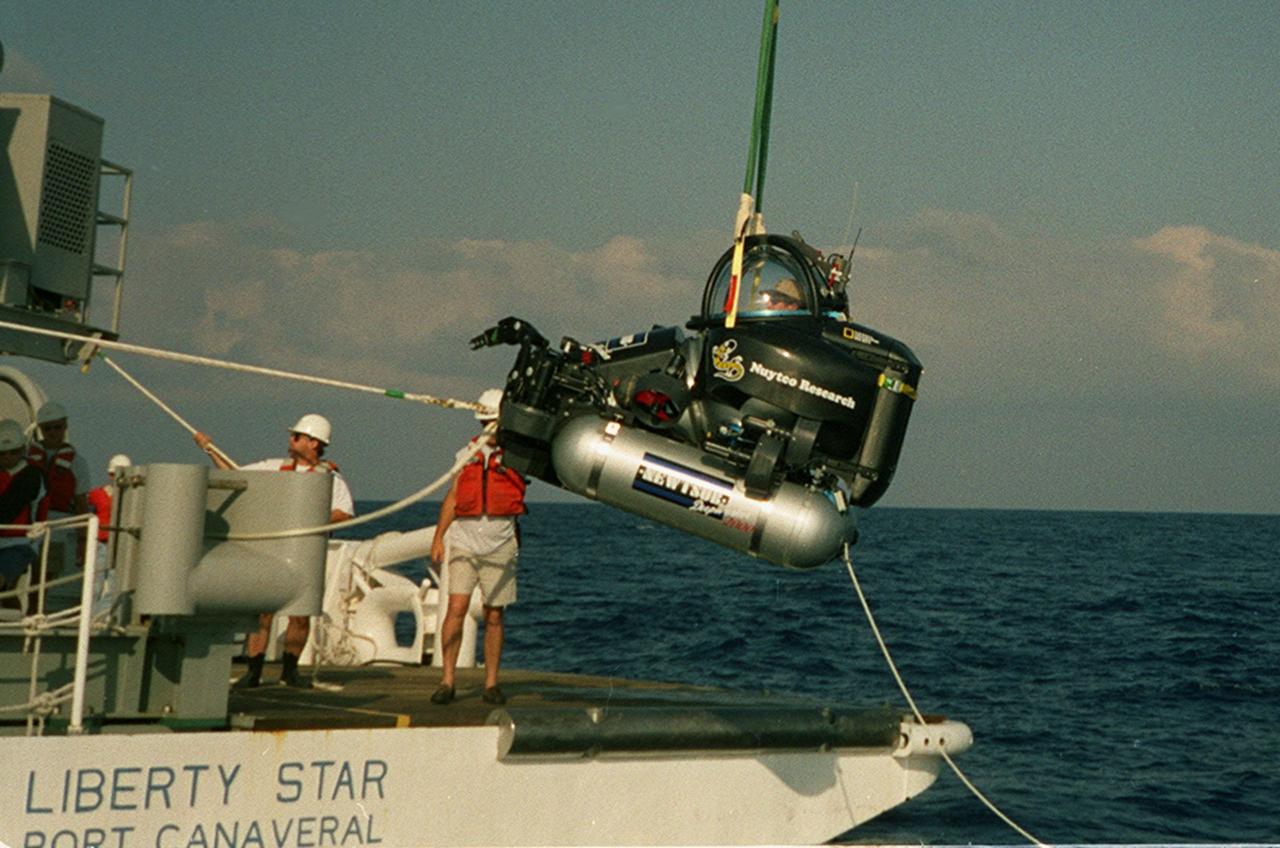
KENNEDY SPACE CENTER, FLA. -- After a successful dive, the one-man submarine known as DeepWorker 2000 is lifted from Atlantic waters near Cape Canaveral, Fla., onto the deck of the Liberty Star, one of two KSC solid rocket booster recovery ships. Inside the sub is the pilot, Anker Rasmussen. The sub is being tested on its ability to duplicate the sometimes hazardous job United Space Alliance (USA) divers perform to recover the expended boosters in the ocean after a launch. The boosters splash down in an impact area about 140 miles east of Jacksonville and after recovery are towed back to KSC for refurbishment by the specially rigged recovery ships. DeepWorker 2000 will be used in a demonstration during retrieval operations after the upcoming STS-101 launch. The submarine pilot will demonstrate capabilities to cut tangled parachute riser lines using a manipulator arm and attach a Diver Operator Plug to extract water and provide flotation for the booster. DeepWorker 2000 was built by Nuytco Research Ltd., North Vancouver, British Columbia. It is 8.25 feet long, 5.75 feet high, and weighs 3,800 pounds. USA is a prime contractor to NASA for the Space Shuttle program
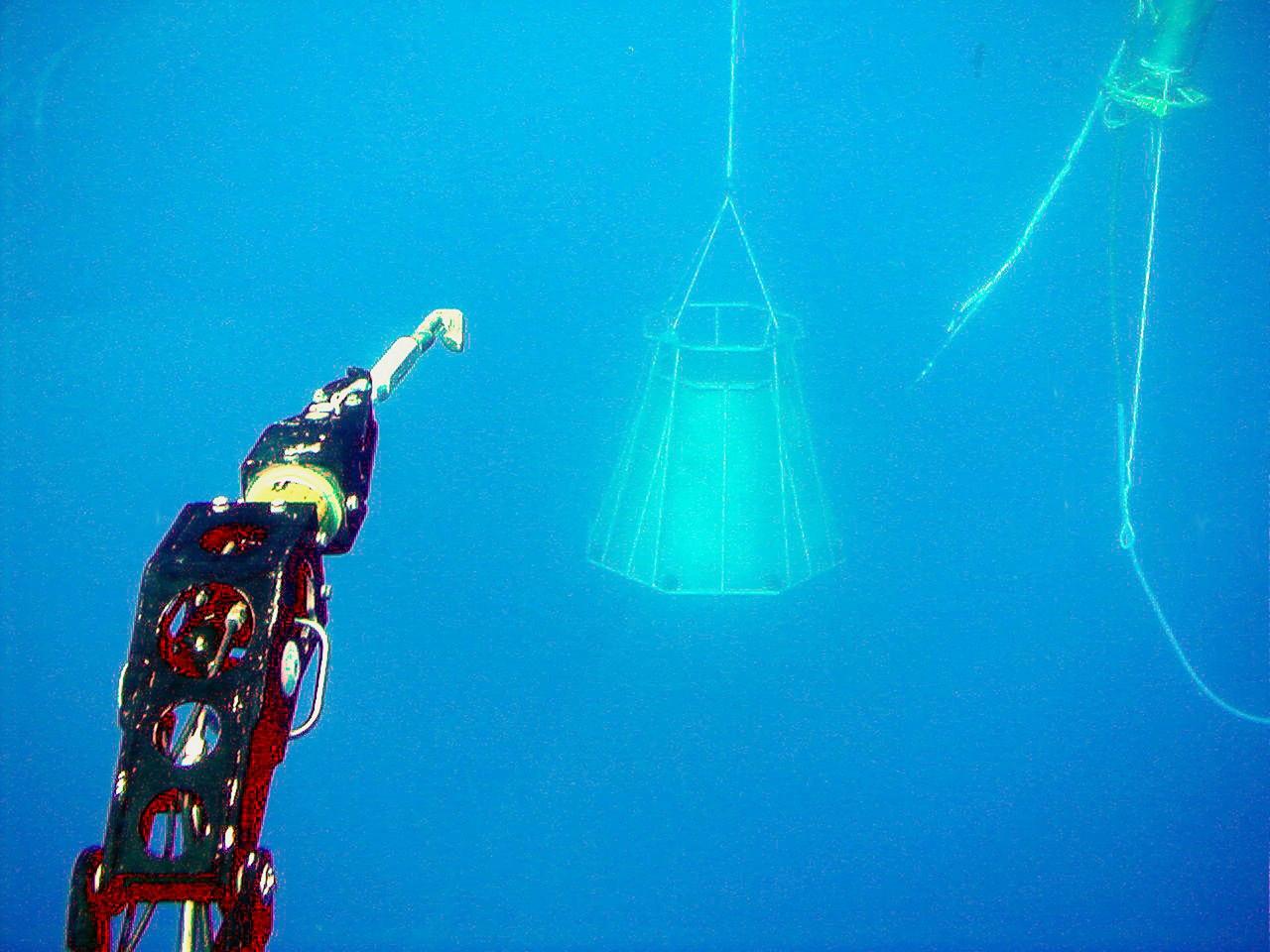
KENNEDY SPACE CENTER, FLA. -- At left, a manipulator arm on a one-man submarine demonstrates its ability to cut tangled parachute riser lines and place a Diver Operator Plug (top right) inside a mock solid rocket booster nozzle (center). Known as DeepWorker 2000, the sub is being tested on its ability to duplicate the sometimes hazardous job United Space Alliance (USA) divers perform to recover the expended boosters in the ocean after a launch. The boosters splash down in an impact area about 140 miles east of Jacksonville and after recovery are towed back to KSC for refurbishment by the specially rigged recovery ships. DeepWorker 2000 will be used in a demonstration during retrieval operations after the upcoming STS-101 launch. The submarine pilot will demonstrate capabilities to cut tangled parachute riser lines using a manipulator arm and attach the DOP to extract water and provide flotation for the booster. DeepWorker 2000 was built by Nuytco Research Ltd., North Vancouver, British Columbia. It is 8.25 feet long, 5.75 feet high, and weighs 3,800 pounds. USA is a prime contractor to NASA for the Space Shuttle program
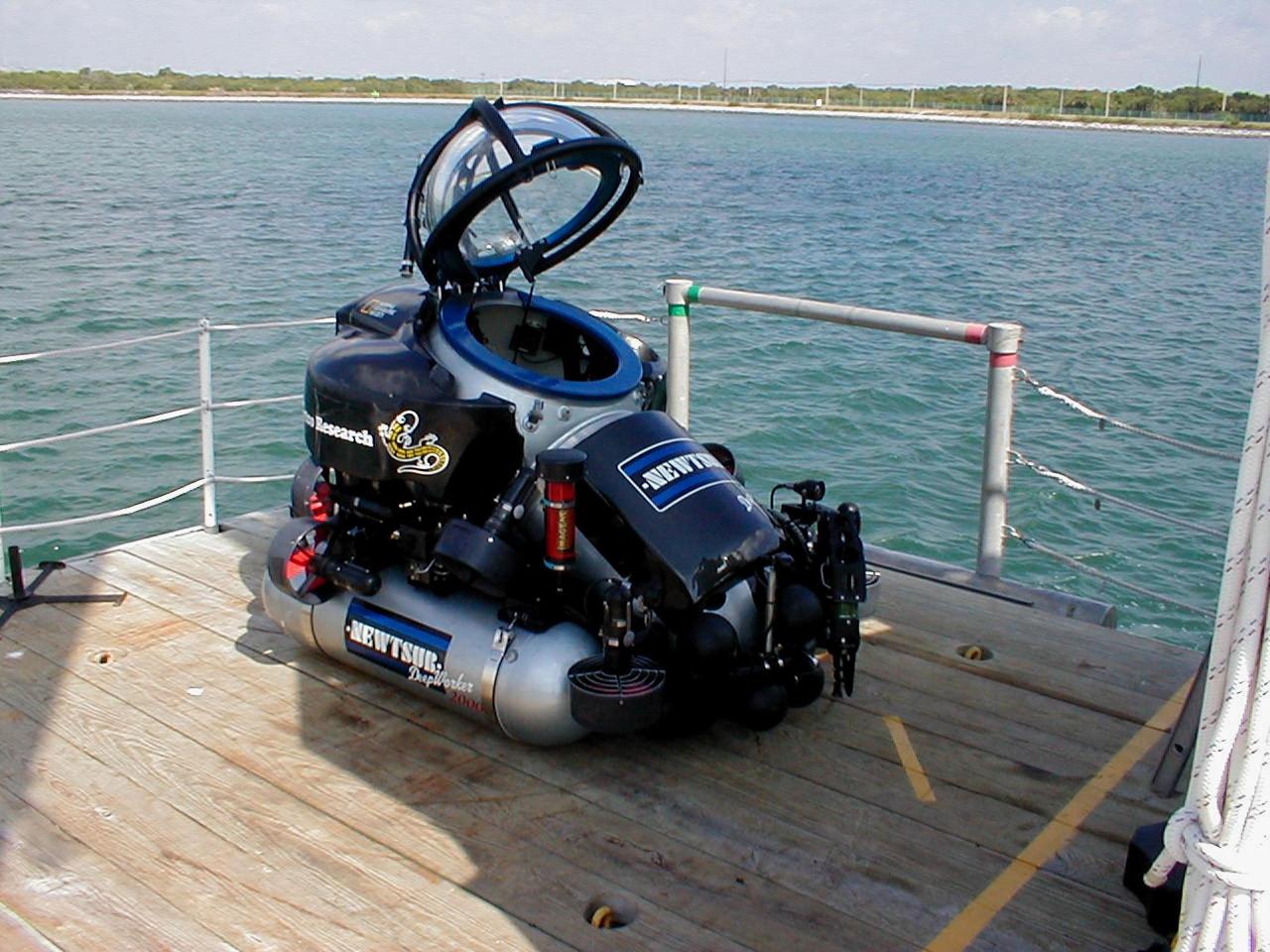
KENNEDY SPACE CENTER, FLA. -- The one-man submarine dubbed DeepWorker 2000 sits on the deck of Liberty Star, one of two KSC solid rocket booster recovery ships. The sub is being tested on its ability to duplicate the sometimes hazardous job United Space Alliance (USA) divers perform to recover the expended boosters in the ocean after a launch. The boosters splash down in an impact area about 140 miles east of Jacksonville and after recovery are towed back to KSC for refurbishment by the specially rigged recovery ships. DeepWorker 2000 will be used in a demonstration during retrieval operations after the upcoming STS-101 launch. The submarine pilot will demonstrate capabilities to cut tangled parachute riser lines using a manipulator arm and attach a Diver Operator Plug to extract water and provide flotation for the booster. DeepWorker 2000 was built by Nuytco Research Ltd., North Vancouver, British Columbia. It is 8.25 feet long, 5.75 feet high, and weighs 3,800 pounds. USA is a prime contractor to NASA for the Space Shuttle program
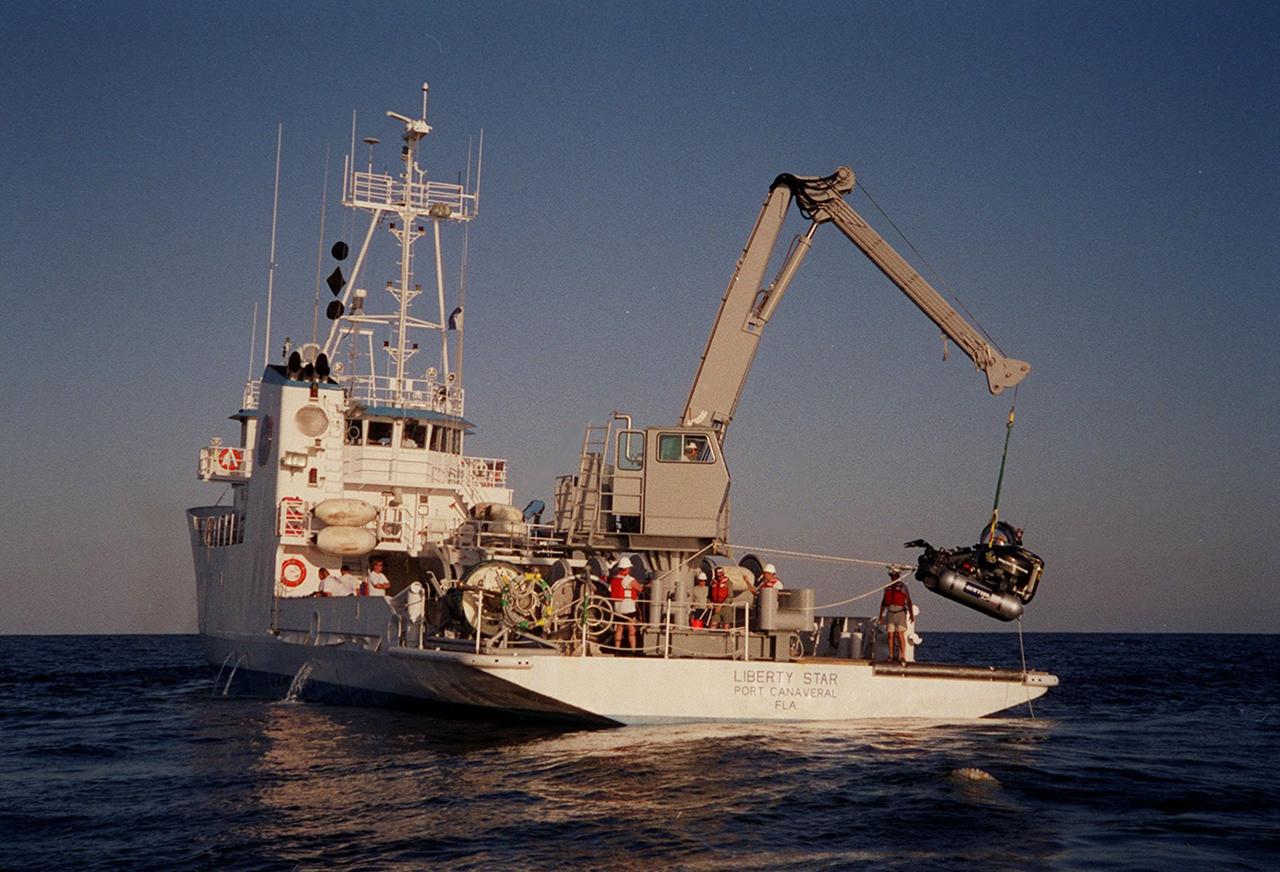
KENNEDY SPACE CENTER, FLA. -- From the deck of Liberty Star, one of two KSC solid rocket booster recovery ships, a crane lowers a one-man submarine into the ocean near Cape Canaveral, Fla. Called DeepWorker 2000, the sub is being tested on its ability to duplicate the sometimes hazardous job United Space Alliance (USA) divers perform to recover the expended boosters in the ocean after a launch. The boosters splash down in an impact area about 140 miles east of Jacksonville and after recovery are towed back to KSC for refurbishment by the specially rigged recovery ships. DeepWorker 2000 will be used in a demonstration during retrieval operations after the upcoming STS-101 launch. The submarine pilot will demonstrate capabilities to cut tangled parachute riser lines using a manipulator arm and attach a Diver Operator Plug to extract water and provide flotation for the booster. DeepWorker 2000 was built by Nuytco Research Ltd., North Vancouver, British Columbia. It is 8.25 feet long, 5.75 feet high, and weighs 3,800 pounds. USA is a prime contractor to NASA for the Space Shuttle program
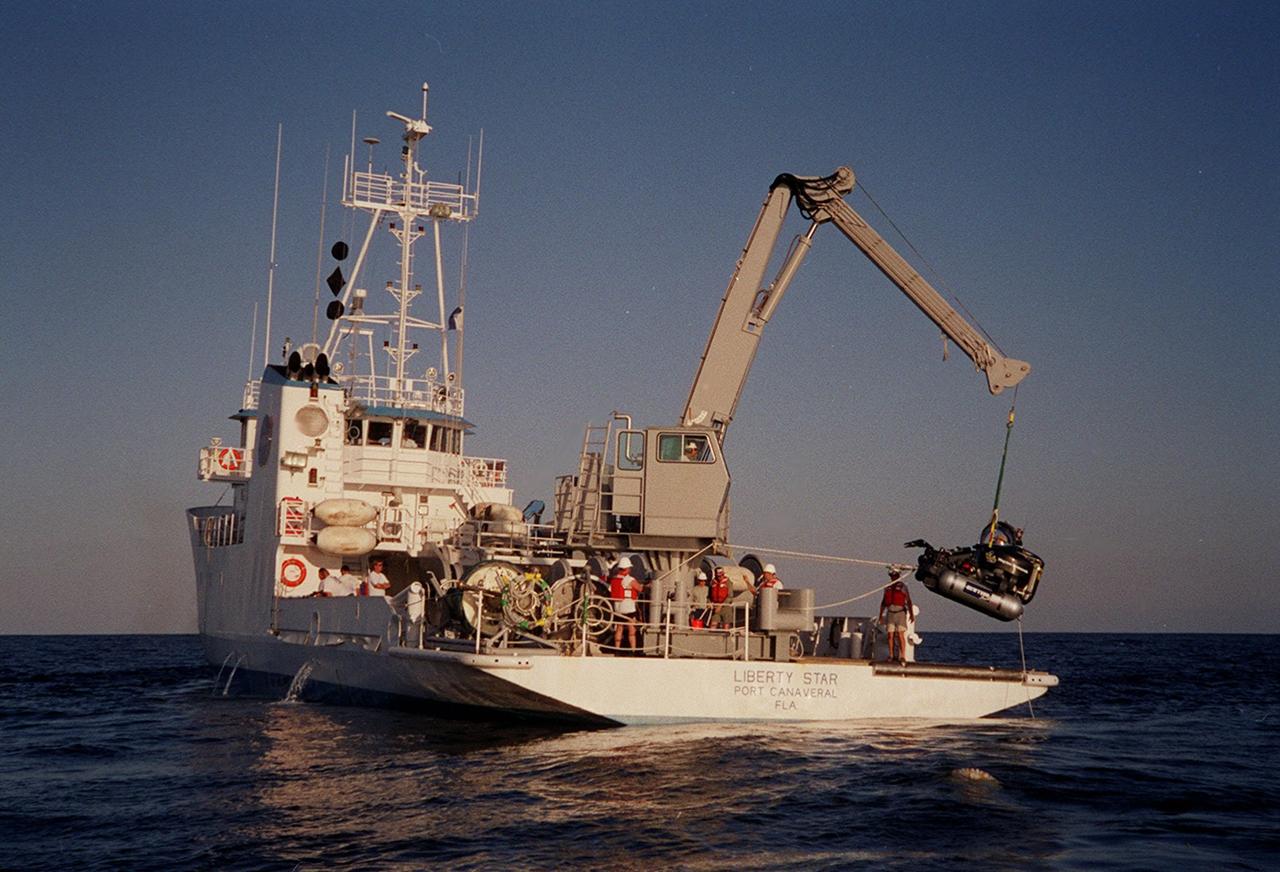
KENNEDY SPACE CENTER, FLA. -- From the deck of Liberty Star, one of two KSC solid rocket booster recovery ships, a crane lowers a one-man submarine into the ocean near Cape Canaveral, Fla. Called DeepWorker 2000, the sub is being tested on its ability to duplicate the sometimes hazardous job United Space Alliance (USA) divers perform to recover the expended boosters in the ocean after a launch. The boosters splash down in an impact area about 140 miles east of Jacksonville and after recovery are towed back to KSC for refurbishment by the specially rigged recovery ships. DeepWorker 2000 will be used in a demonstration during retrieval operations after the upcoming STS-101 launch. The submarine pilot will demonstrate capabilities to cut tangled parachute riser lines using a manipulator arm and attach a Diver Operator Plug to extract water and provide flotation for the booster. DeepWorker 2000 was built by Nuytco Research Ltd., North Vancouver, British Columbia. It is 8.25 feet long, 5.75 feet high, and weighs 3,800 pounds. USA is a prime contractor to NASA for the Space Shuttle program
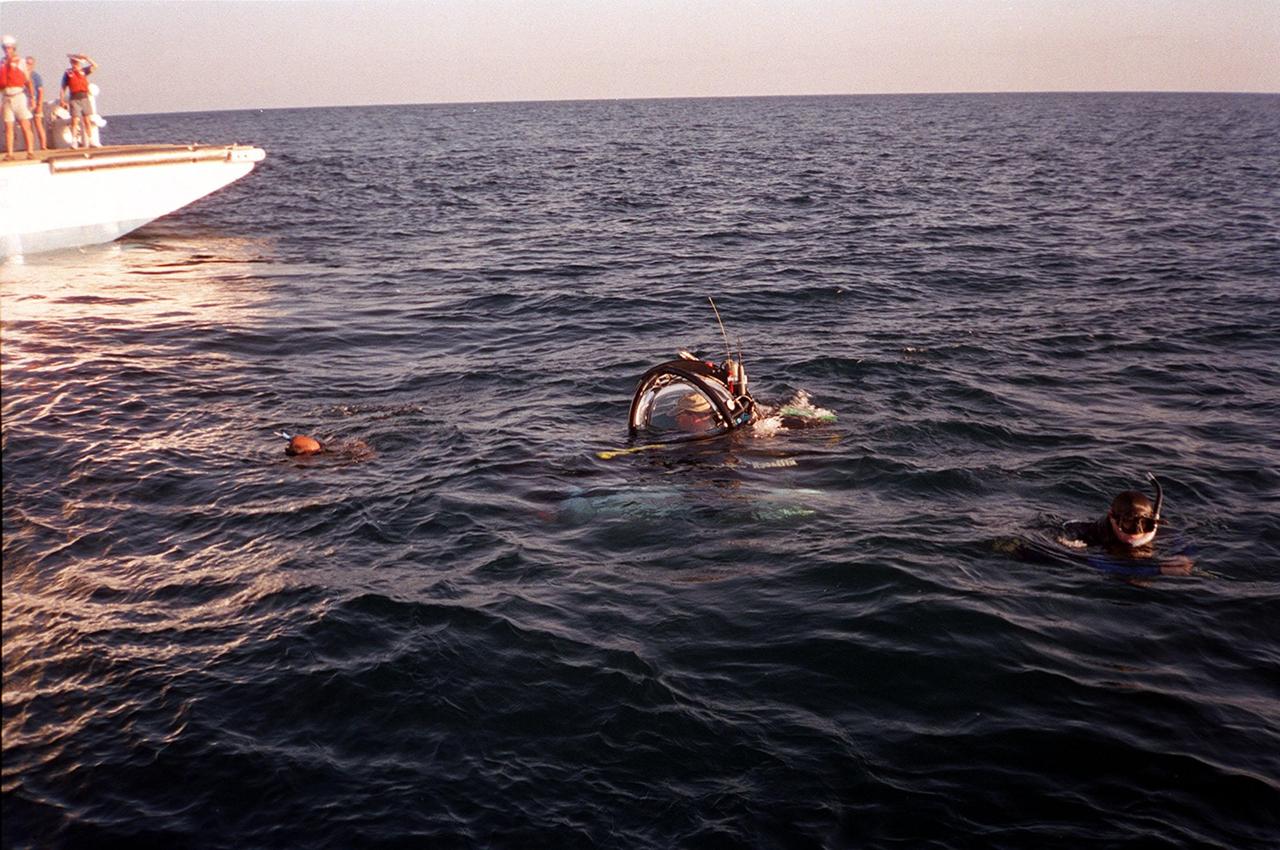
KENNEDY SPACE CENTER, FLA. -- The one-man submarine known as DeepWorker 2000 is tested in Atlantic waters near Cape Canaveral, Fla. Nearby are divers; inside the sub is the pilot, Anker Rasmussen. The sub is being tested on its ability to duplicate the sometimes hazardous job United Space Alliance (USA) divers perform to recover the expended boosters in the ocean after a launch. The boosters splash down in an impact area about 140 miles east of Jacksonville and after recovery are towed back to KSC for refurbishment by the specially rigged recovery ships. DeepWorker 2000 will be used in a demonstration during retrieval operations after the upcoming STS-101 launch. The submarine pilot will demonstrate capabilities to cut tangled parachute riser lines using a manipulator arm and attach a Diver Operator Plug to extract water and provide flotation for the booster. DeepWorker 2000 was built by Nuytco Research Ltd., North Vancouver, British Columbia. It is 8.25 feet long, 5.75 feet high, and weighs 3,800 pounds. USA is a prime contractor to NASA for the Space Shuttle program
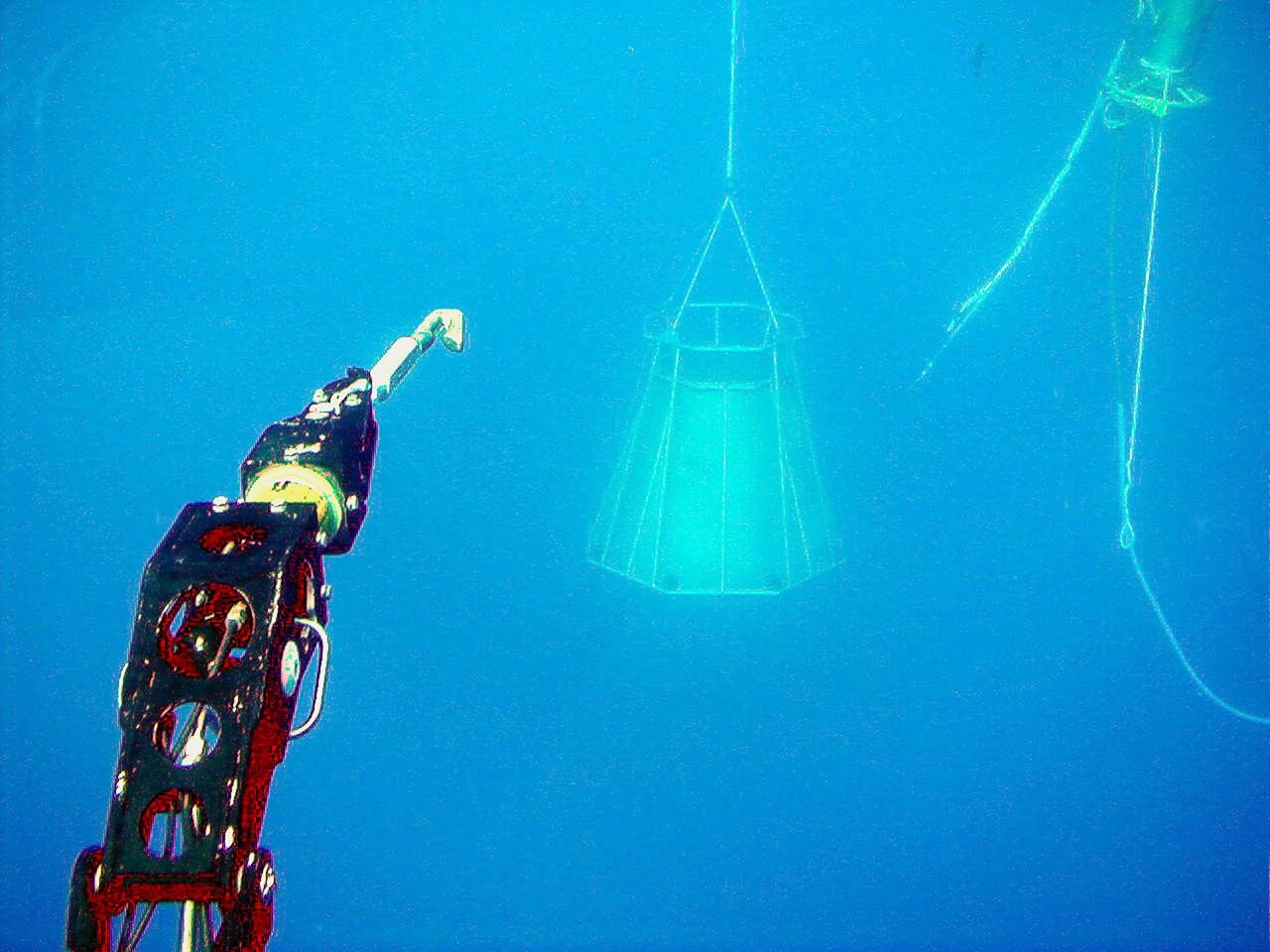
KENNEDY SPACE CENTER, FLA. -- At left, a manipulator arm on a one-man submarine demonstrates its ability to cut tangled parachute riser lines and place a Diver Operator Plug (top right) inside a mock solid rocket booster nozzle (center). Known as DeepWorker 2000, the sub is being tested on its ability to duplicate the sometimes hazardous job United Space Alliance (USA) divers perform to recover the expended boosters in the ocean after a launch. The boosters splash down in an impact area about 140 miles east of Jacksonville and after recovery are towed back to KSC for refurbishment by the specially rigged recovery ships. DeepWorker 2000 will be used in a demonstration during retrieval operations after the upcoming STS-101 launch. The submarine pilot will demonstrate capabilities to cut tangled parachute riser lines using a manipulator arm and attach the DOP to extract water and provide flotation for the booster. DeepWorker 2000 was built by Nuytco Research Ltd., North Vancouver, British Columbia. It is 8.25 feet long, 5.75 feet high, and weighs 3,800 pounds. USA is a prime contractor to NASA for the Space Shuttle program
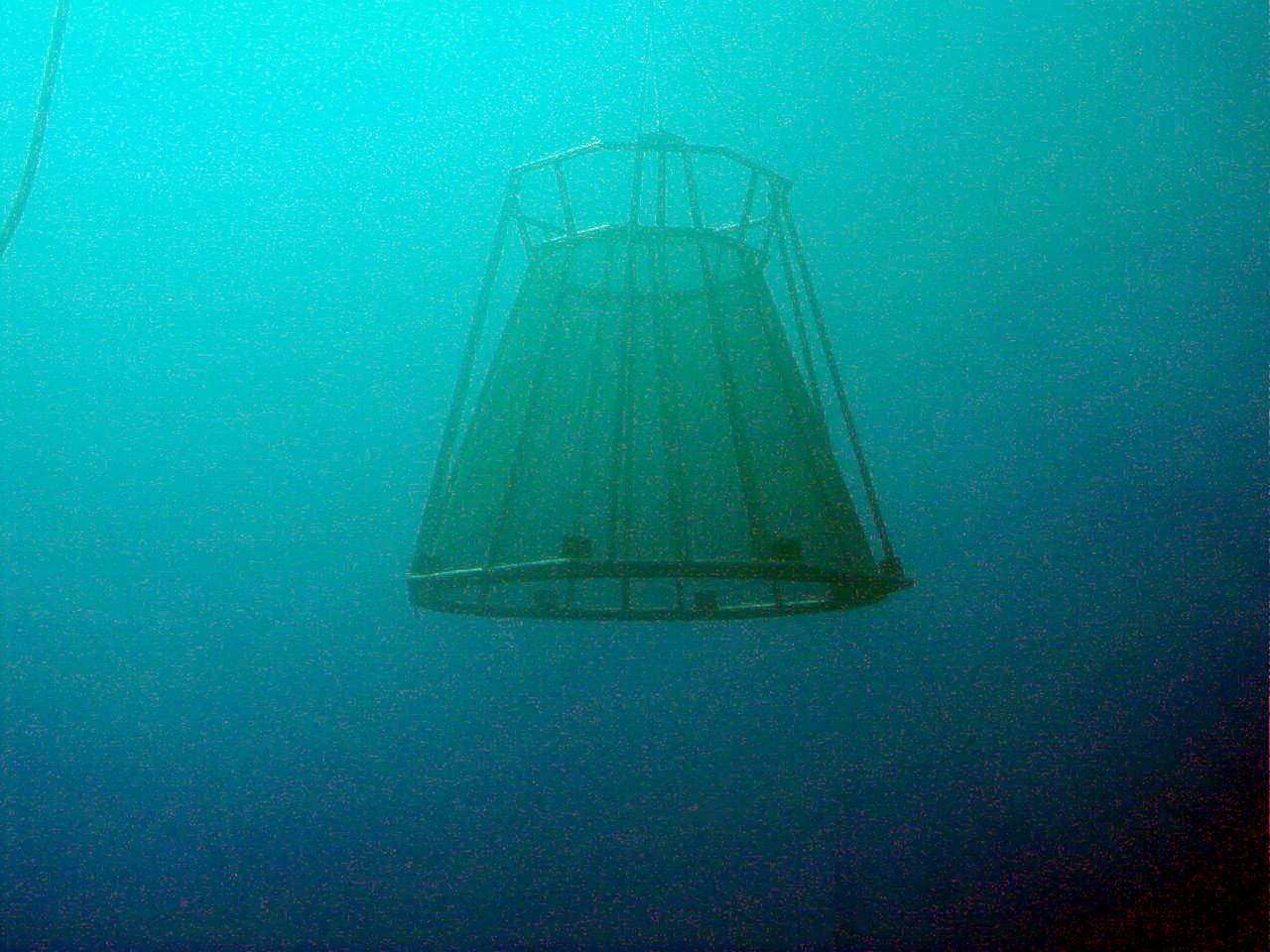
KENNEDY SPACE CENTER, FLA. -- A mockup of a solid rocket booster nozzle is lowered into the waters of the Atlantic during a test of a new booster retrieval method. A one-man submarine known as DeepWorker 2000 is being tested on its ability to duplicate the sometimes hazardous job United Space Alliance (USA) divers perform to recover the expended boosters in the ocean after a launch. The boosters splash down in an impact area about 140 miles east of Jacksonville and after recovery are towed back to KSC for refurbishment by the specially rigged recovery ships. DeepWorker 2000 will be used in a demonstration during retrieval operations after the upcoming STS-101 launch. The submarine pilot will demonstrate capabilities to cut tangled parachute riser lines using a manipulator arm and attach a Diver Operator Plug to extract water and provide flotation for the booster. DeepWorker 2000 was built by Nuytco Research Ltd., North Vancouver, British Columbia. It is 8.25 feet long, 5.75 feet high, and weighs 3,800 pounds. USA is a prime contractor to NASA for the Space Shuttle program
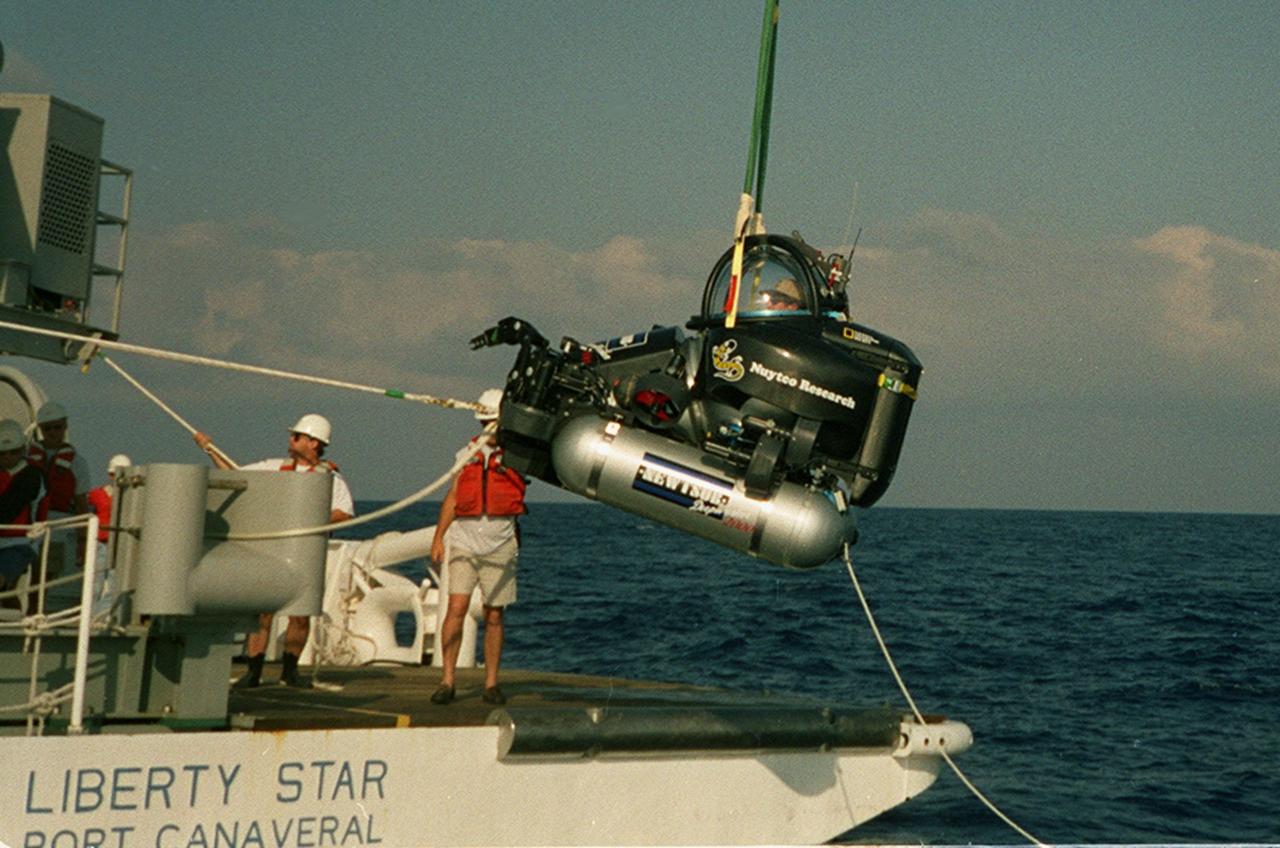
KENNEDY SPACE CENTER, FLA. -- After a successful dive, the one-man submarine known as DeepWorker 2000 is lifted from Atlantic waters near Cape Canaveral, Fla., onto the deck of the Liberty Star, one of two KSC solid rocket booster recovery ships. Inside the sub is the pilot, Anker Rasmussen. The sub is being tested on its ability to duplicate the sometimes hazardous job United Space Alliance (USA) divers perform to recover the expended boosters in the ocean after a launch. The boosters splash down in an impact area about 140 miles east of Jacksonville and after recovery are towed back to KSC for refurbishment by the specially rigged recovery ships. DeepWorker 2000 will be used in a demonstration during retrieval operations after the upcoming STS-101 launch. The submarine pilot will demonstrate capabilities to cut tangled parachute riser lines using a manipulator arm and attach a Diver Operator Plug to extract water and provide flotation for the booster. DeepWorker 2000 was built by Nuytco Research Ltd., North Vancouver, British Columbia. It is 8.25 feet long, 5.75 feet high, and weighs 3,800 pounds. USA is a prime contractor to NASA for the Space Shuttle program
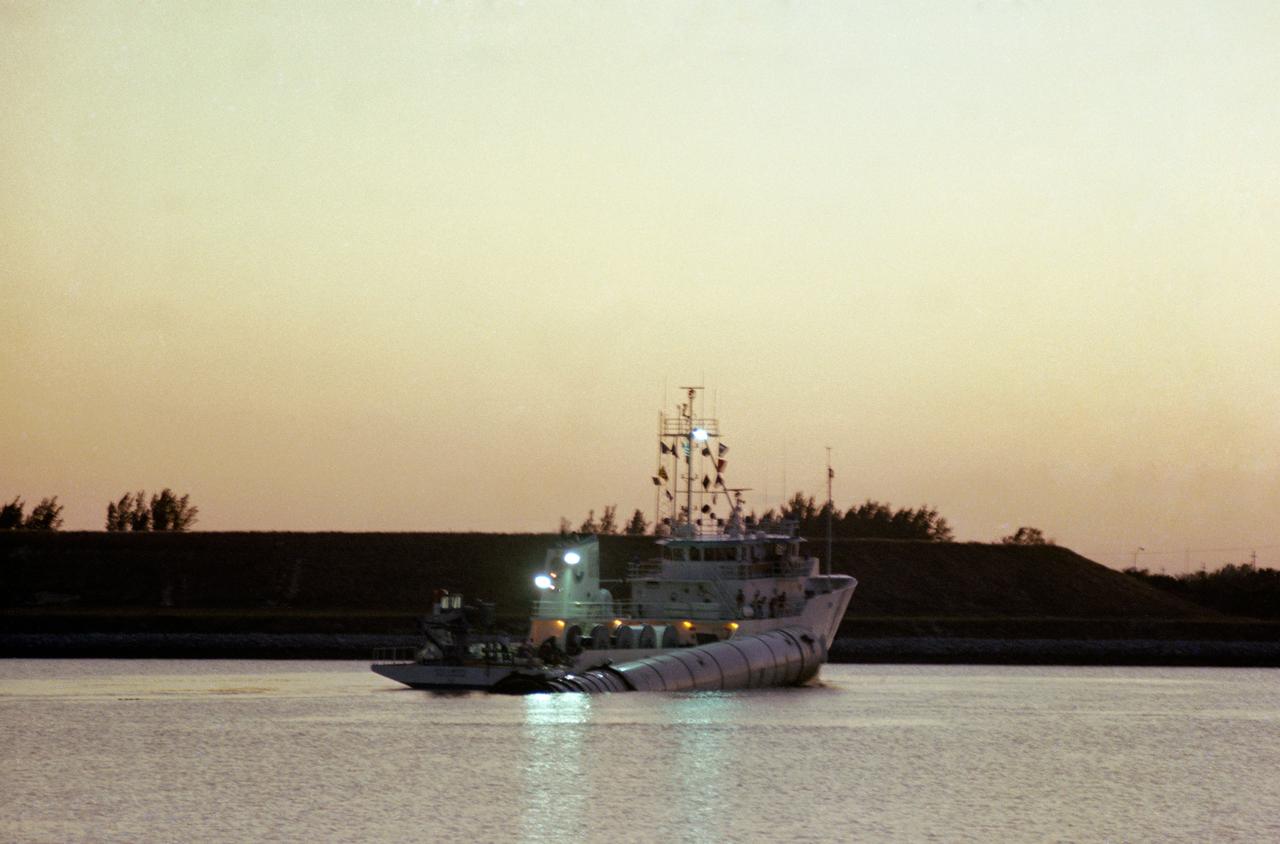
S81-31308 (13 April 1981) --- The solid rocket booster recovery ship UTC Liberty heads for Cape Canaveral Air Force Station after retrieving one of the two booster casings from the launch of Columbia, America?s first space shuttle in orbit. The vessel had been tied up overnight at the Trident Submarine Basin at Port Canaveral, from which point this photograph was made. The boosters and the parachutes that bring them to safe landings in the Atlantic east of NASA's Kennedy Space Center are recovered at sea, dewatered and towed to processing facilities at Cape Canaveral Air Force Station. Photo credit: NASA
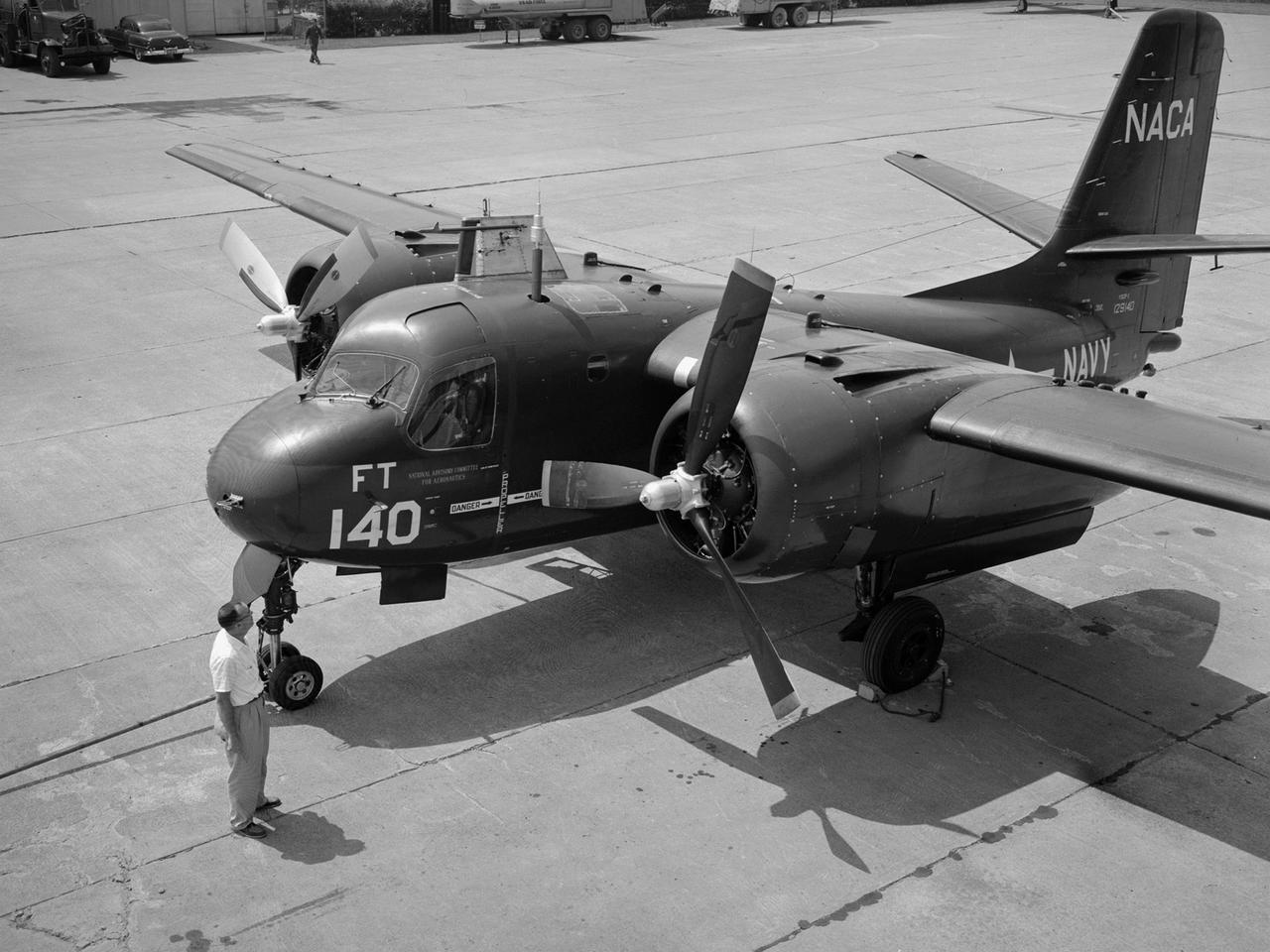
The NACA’s Lewis Flight Propulsion Laboratory acquired the Grumman S2F-1 Tracker from the Navy in 1955 to study icing instrumentation. Lewis’s icing research program was winding down at the time. The use of jet engines was increasing thus reducing the threat of ice accumulation. Nonetheless Lewis continued research on the instrumentation used to detect icing conditions. The S2F-1 Tracker was a carrier-based submarine hunter for the Navy. Grumman developed the Tracker as a successor to its Korean War-era Guardian patrol aircraft. Prototypes first flew in late 1952 and battle-ready versions entered Naval service in early 1954. The Navy utilized the Trackers to protect fleets from attack.

S129-E-007324 (21 Nov. 2009) --- One of the crew members onboard the space shuttle Atlantis recorded this still image of the Bahamas' lengthy narrow Eleuthra Island. Like most of the Bahama Islands, Eleuthra is composed mainly of limestone and coral, and rises from a vast submarine plateau. The island, 80 miles (133 kilometers) long, about two miles (three kilometers) wide and covering an area of 164 square miles (425 square kilometers), is generally low and flat, has many mangrove swamps, brackish lakes, coral reefs and shoals, and many miles of sandy beaches.

L59-1497-6 Maxime A. Faget was born in British Honduras in 1921, the son of an honored physician of the U.S. Public Health Service. In 1943 he earned a B.S. in mechanical engineering from Louisiana State University. After service as a navy submarine officer, he joined the Langley staff in 1946 as a member of the Pilotless Aircraft Research Division. His early work for PARD involved the invention of choking inlets for ramjets and a flight Mach meter. Photograph published in Engineer in Charge: A History of the Langley Aeronautical Laboratory, 1917-1958 by James R. Hansen. Page 379.
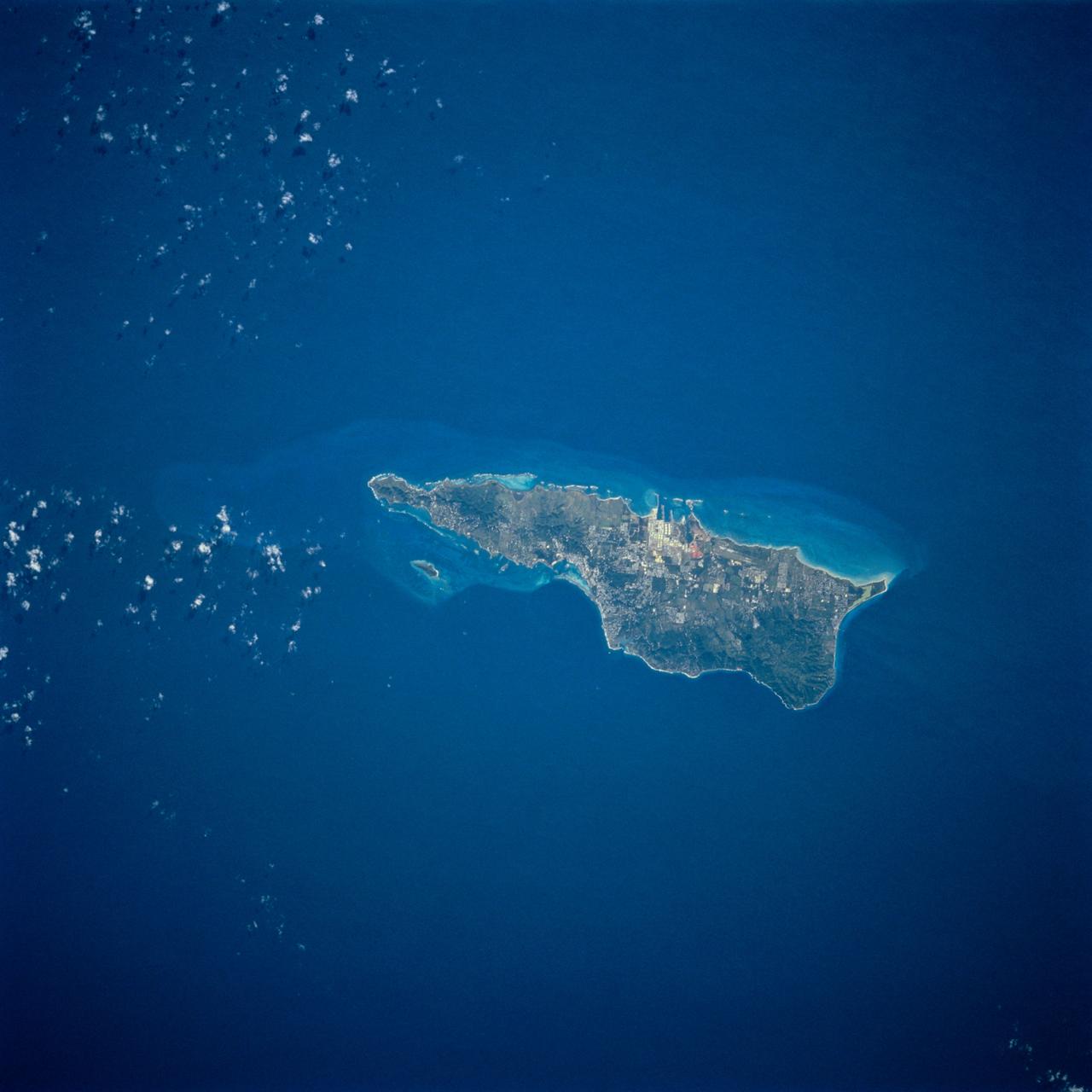
STS054-74-049 (13-19 Jan. 1993) --- St. Croix is the largest, and most industrial of the U.S. Virgin Islands. This photograph captures St. Croix's features in great detail. The large industrial complex in the middle of the southern shore is the world's largest petroleum refinery. The main city, Christiansted, can be seen across the island on the north shore. The reefs around the eastern end of St. Croix are preserved as a submarine national park -- Buck Island Reef National Park -- around the small island off the north shore of the eastern end of St. Croix.
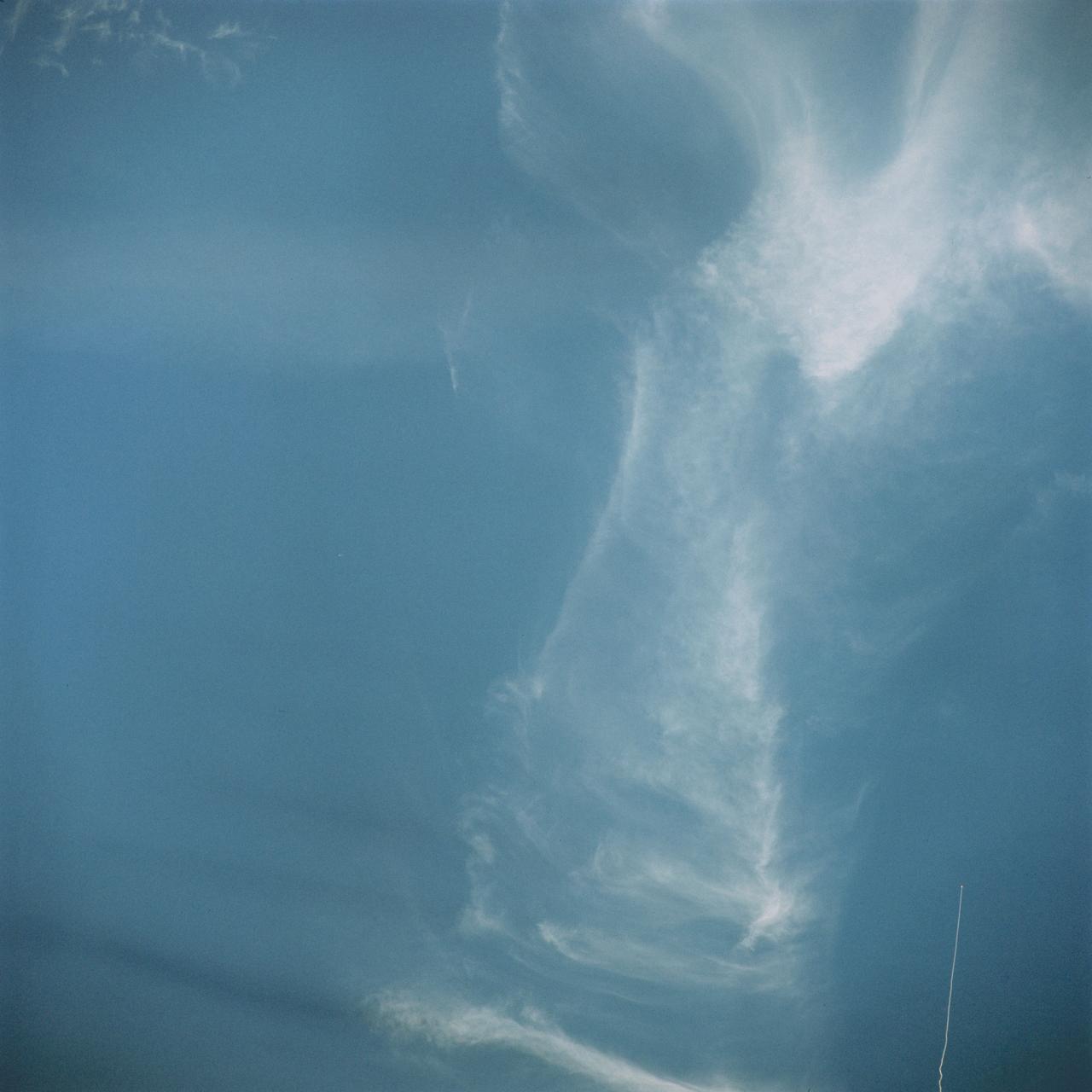
S65-63797 (12 Dec. 1965) --- Polaris, underwater launch, missile and trail, off Florida, as seen from the Gemini-7 spacecraft during its 31st revolution of Earth. Photo credit: NASA
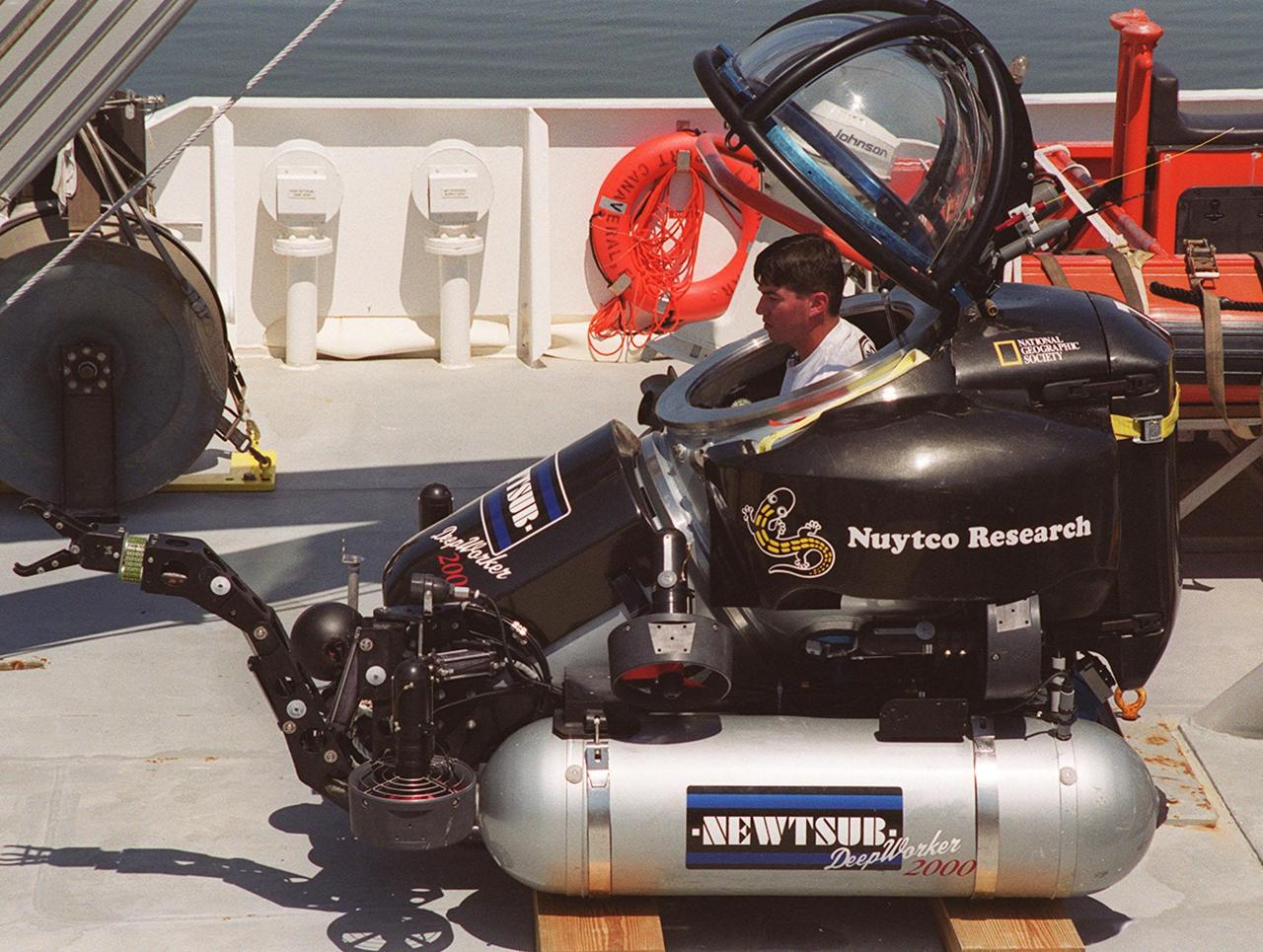
The one-man submarine dubbed DeepWorker 2000 sits on the deck of Liberty Star, one of two KSC solid rocket booster recovery ships. Inside the sub is the pilot, Anker Rasmussen. The sub is being tested on its ability to duplicate the sometimes hazardous job United Space Alliance (USA) divers perform to recover the expended boosters in the ocean after a launch. The boosters splash down in an impact area about 140 miles east of Jacksonville and after recovery are towed back to KSC for refurbishment by the specially rigged recovery ships. DeepWorker 2000 was built by Nuytco Research Ltd., North Vancouver, British Columbia. It is 8.25 feet long, 5.75 feet high, and weighs 3,800 pounds. USA is a prime contractor to NASA for the Space Shuttle program
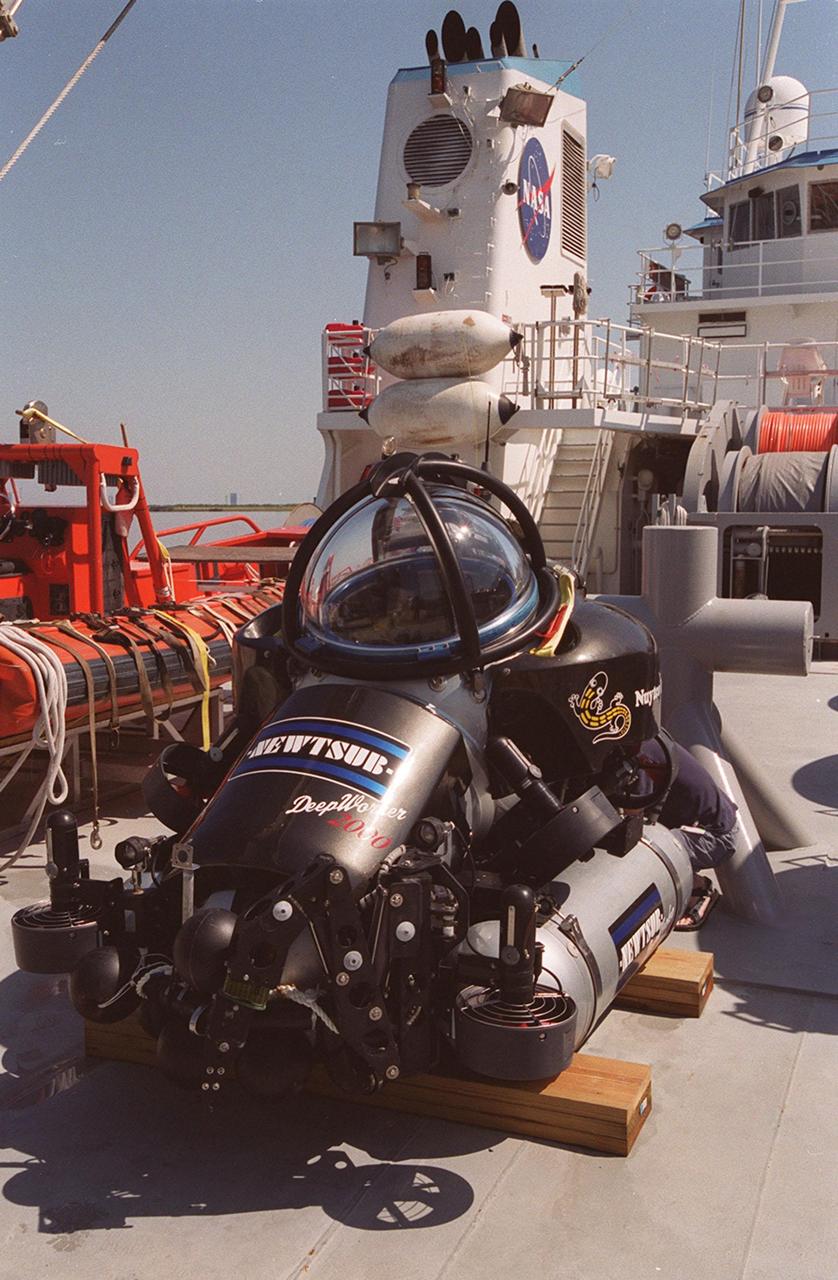
The one-man submarine dubbed DeepWorker 2000 sits on the deck of Liberty Star, one of two KSC solid rocket booster recovery ships. The sub is being tested on its ability to duplicate the sometimes hazardous job United Space Alliance (USA) divers perform to recover the expended boosters in the ocean after a launch. The boosters splash down in an impact area about 140 miles east of Jacksonville and after recovery are towed back to KSC for refurbishment by the specially rigged recovery ships. DeepWorker 2000 was built by Nuytco Research Ltd., North Vancouver, British Columbia. It is 8.25 feet long, 5.75 feet high, and weighs 3,800 pounds. USA is a prime contractor to NASA for the Space Shuttle program
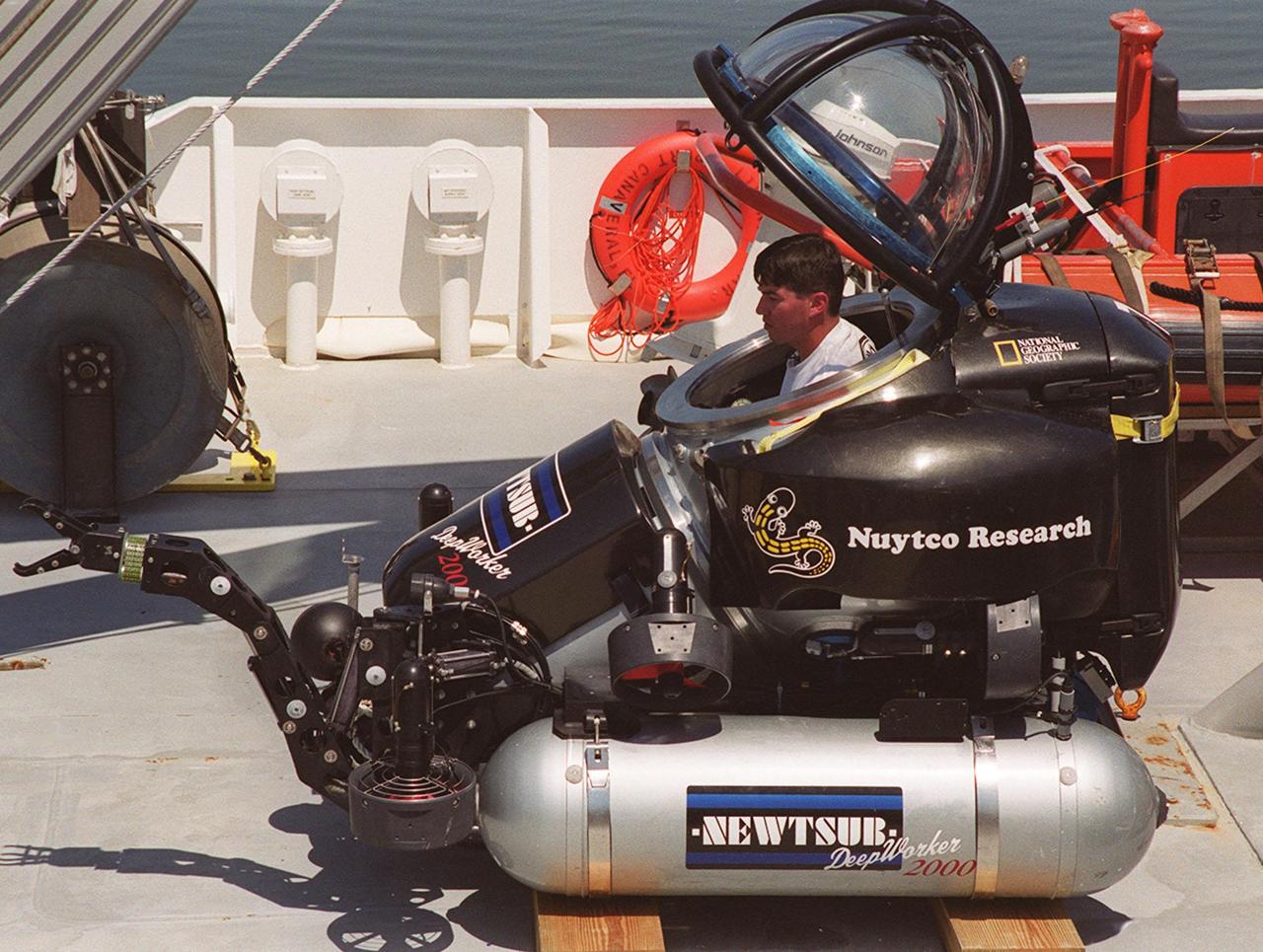
The one-man submarine dubbed DeepWorker 2000 sits on the deck of Liberty Star, one of two KSC solid rocket booster recovery ships. Inside the sub is the pilot, Anker Rasmussen. The sub is being tested on its ability to duplicate the sometimes hazardous job United Space Alliance (USA) divers perform to recover the expended boosters in the ocean after a launch. The boosters splash down in an impact area about 140 miles east of Jacksonville and after recovery are towed back to KSC for refurbishment by the specially rigged recovery ships. DeepWorker 2000 was built by Nuytco Research Ltd., North Vancouver, British Columbia. It is 8.25 feet long, 5.75 feet high, and weighs 3,800 pounds. USA is a prime contractor to NASA for the Space Shuttle program
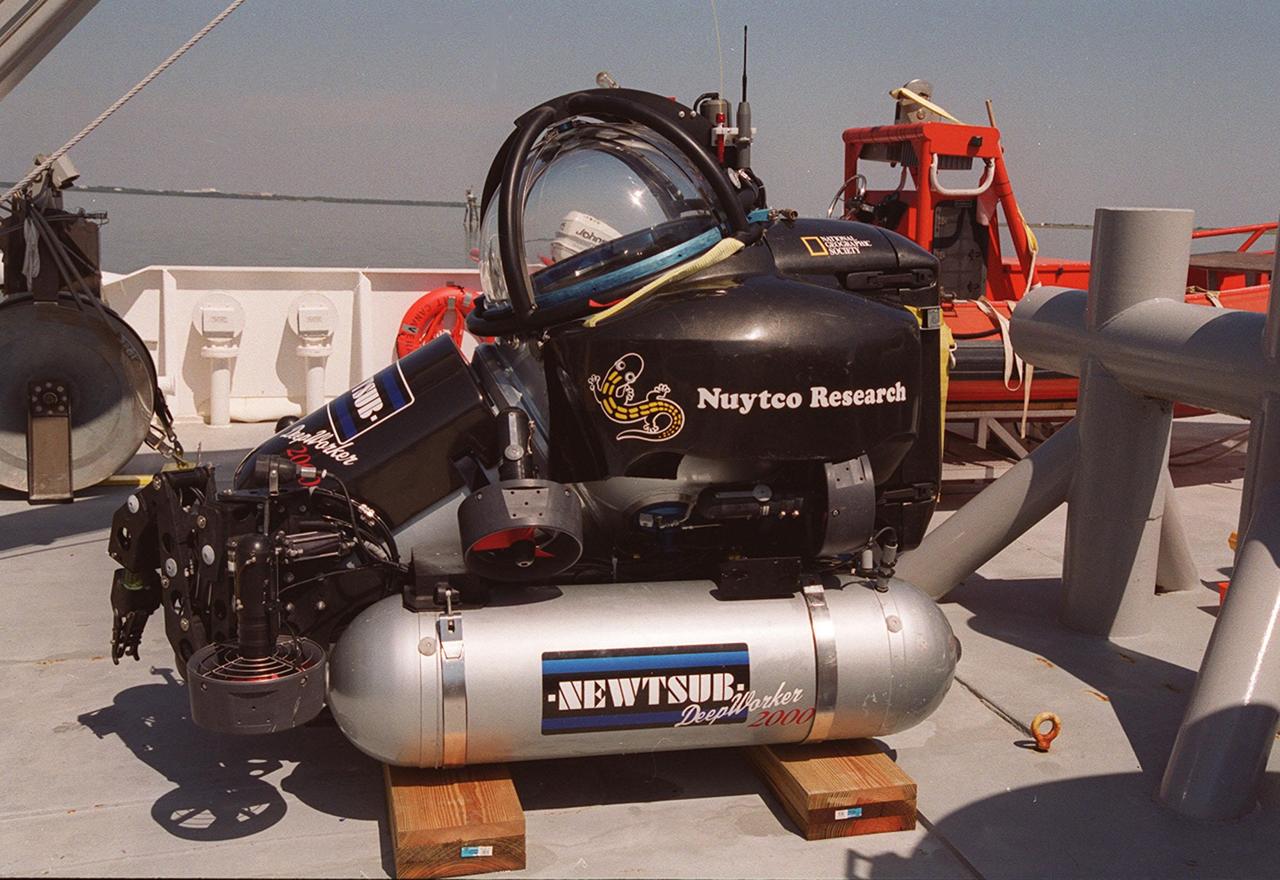
The one-man submarine dubbed DeepWorker 2000 sits on the deck of Liberty Star, one of two KSC solid rocket booster recovery ships. The sub is being tested on its ability to duplicate the sometimes hazardous job United Space Alliance (USA) divers perform to recover the expended boosters in the ocean after a launch. The boosters splash down in an impact area about 140 miles east of Jacksonville and after recovery are towed back to KSC for refurbishment by the specially rigged recovery ships. DeepWorker 2000 was built by Nuytco Research Ltd., North Vancouver, British Columbia. It is 8.25 feet long, 5.75 feet high, and weighs 3,800 pounds. USA is a prime contractor to NASA for the Space Shuttle program
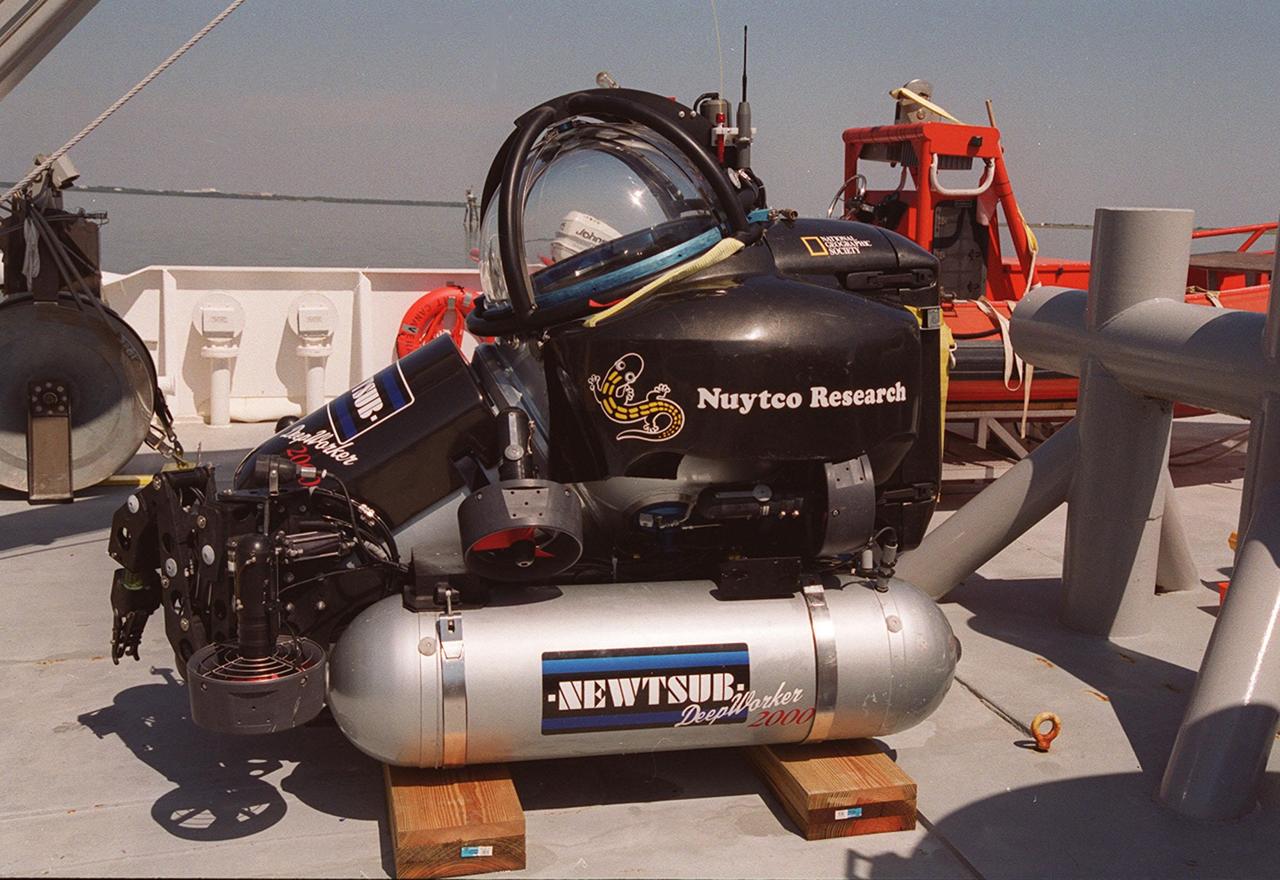
The one-man submarine dubbed DeepWorker 2000 sits on the deck of Liberty Star, one of two KSC solid rocket booster recovery ships. The sub is being tested on its ability to duplicate the sometimes hazardous job United Space Alliance (USA) divers perform to recover the expended boosters in the ocean after a launch. The boosters splash down in an impact area about 140 miles east of Jacksonville and after recovery are towed back to KSC for refurbishment by the specially rigged recovery ships. DeepWorker 2000 was built by Nuytco Research Ltd., North Vancouver, British Columbia. It is 8.25 feet long, 5.75 feet high, and weighs 3,800 pounds. USA is a prime contractor to NASA for the Space Shuttle program
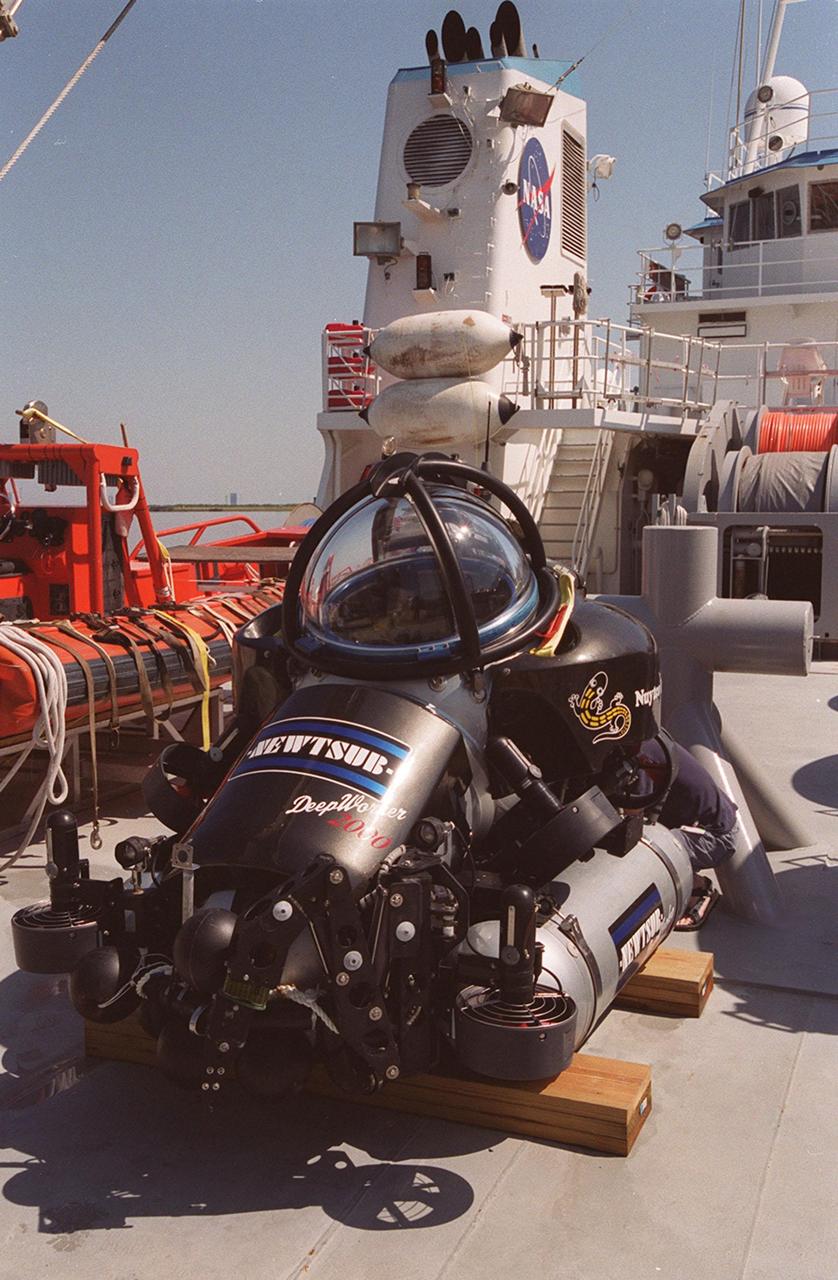
The one-man submarine dubbed DeepWorker 2000 sits on the deck of Liberty Star, one of two KSC solid rocket booster recovery ships. The sub is being tested on its ability to duplicate the sometimes hazardous job United Space Alliance (USA) divers perform to recover the expended boosters in the ocean after a launch. The boosters splash down in an impact area about 140 miles east of Jacksonville and after recovery are towed back to KSC for refurbishment by the specially rigged recovery ships. DeepWorker 2000 was built by Nuytco Research Ltd., North Vancouver, British Columbia. It is 8.25 feet long, 5.75 feet high, and weighs 3,800 pounds. USA is a prime contractor to NASA for the Space Shuttle program
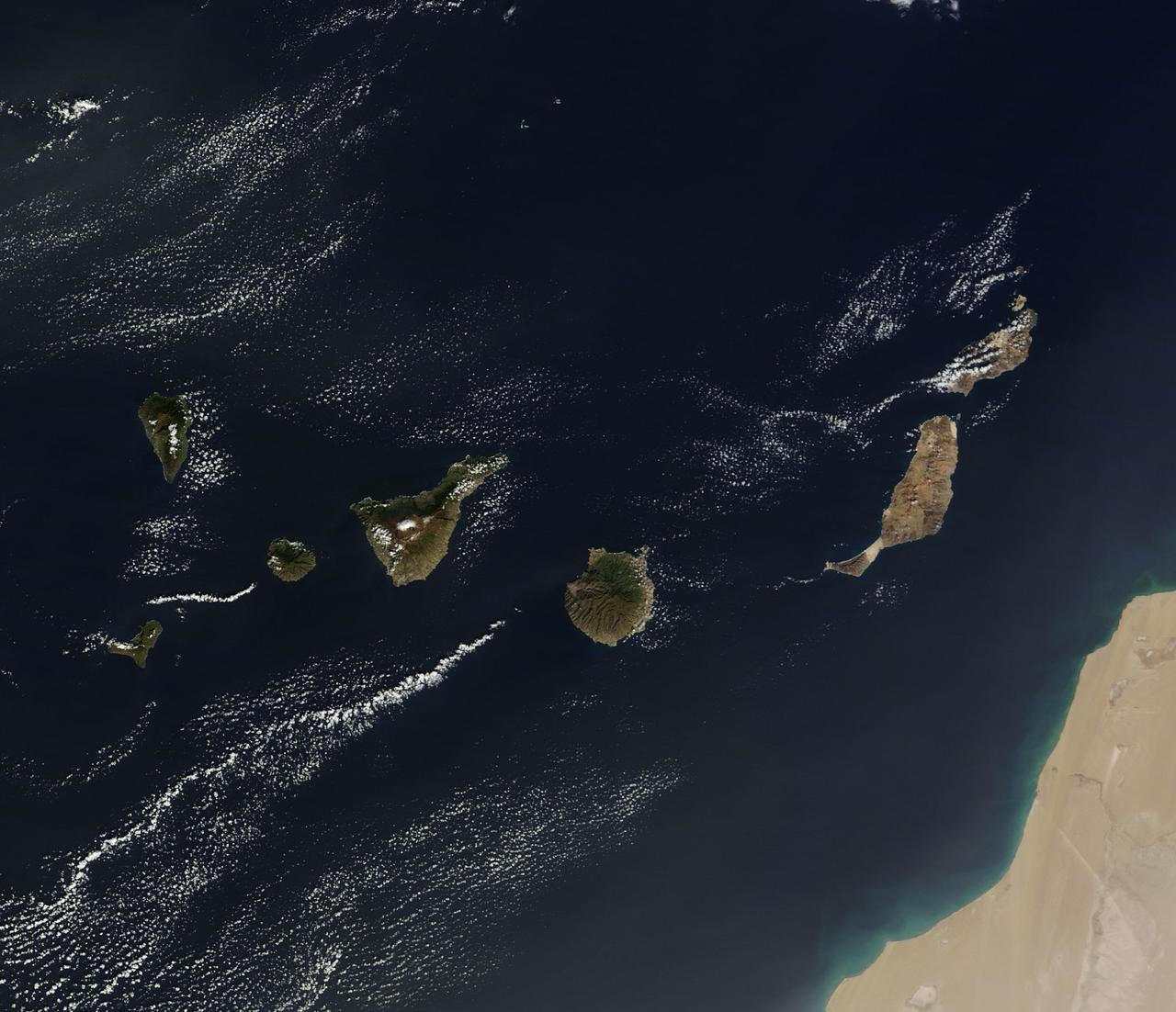
On December 10, 2013 the Moderate Resolution Imaging Spectroradiometer (MODIS) aboard NASA’s Terra satellite flew across the central Atlantic Ocean and captured a true-color image of the Canary Islands. Lying off of the coast of Western Sahara and Morocco, the islands were created by successive submarine volcanic eruptions which raised the ocean floor vertically until some of land rose above sea level. The oldest islands lie in the east and the youngest in the west. From east to west, the major islands seen in this image are: Lanzarote, Fuerteventura, Gran Canaria, Tenerife, La Gomera, La Palmera and El Hierro. While the creation of the islands began in the Late Cretaceous Period (70 – 80 million years ago), active volcanic activity continues. In 2011, a spectacular submarine eruption occurred just off the shore of El Hierro. The volcano became quiet again, but very recently increasing earthquakes and changing height of El Hierro suggested the volcano may again be entering an active eruptive phase. On December 27 the island’s volcano monitoring agency had raised the volcanic eruption risk for El Hierro to “yellow” – a code that means increasing activity but no eruption imminent. That afternoon a magnitude 5.1 earthquake struck offshore at El Hierro. The epicenter was 9 miles (15 km) deep, and it was one of the largest quakes ever recorded at the island. Credit: NASA/GSFC/Jeff Schmaltz/MODIS Land Rapid Response Team <b><a href="http://www.nasa.gov/audience/formedia/features/MP_Photo_Guidelines.html" rel="nofollow">NASA image use policy.</a></b> <b><a href="http://www.nasa.gov/centers/goddard/home/index.html" rel="nofollow">NASA Goddard Space Flight Center</a></b> enables NASA’s mission through four scientific endeavors: Earth Science, Heliophysics, Solar System Exploration, and Astrophysics. Goddard plays a leading role in NASA’s accomplishments by contributing compelling scientific knowledge to advance the Agency’s mission. <b>Follow us on <a href="http://twitter.com/NASA_GoddardPix" rel="nofollow">Twitter</a></b> <b>Like us on <a href="http://www.facebook.com/pages/Greenbelt-MD/NASA-Goddard/395013845897?ref=tsd" rel="nofollow">Facebook</a></b> <b>Find us on <a href="http://instagram.com/nasagoddard?vm=grid" rel="nofollow">Instagram</a></b>
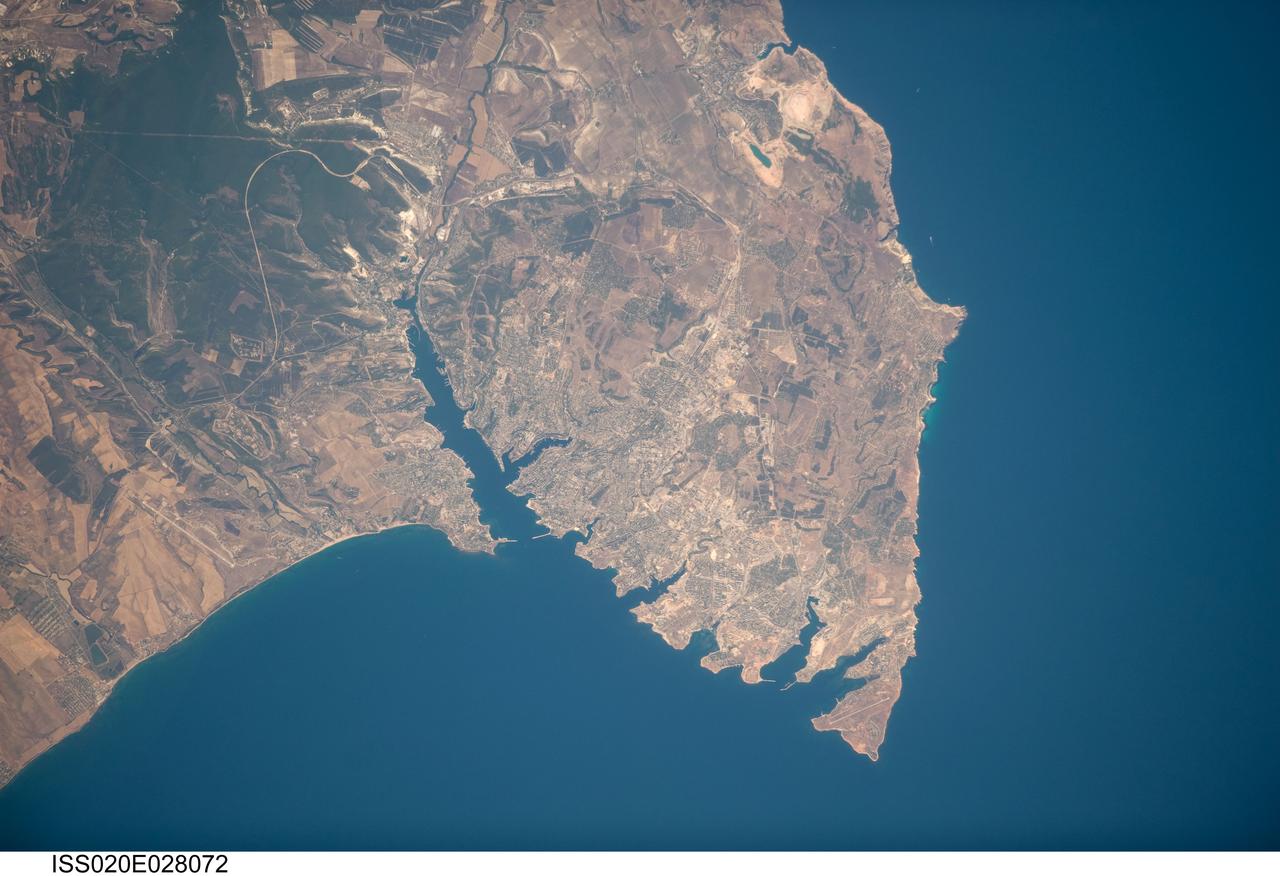
ISS020-E-028072 (5 Aug. 2009) --- Sevastopol, Ukraine is featured in this image photographed by an Expedition 20 crew member on the International Space Station. The port city of Sevastopol is located in southernmost Ukraine on the Crimean Peninsula. The city is an important naval base due to the numerous inlets and bays along the coastline (bottom center). During the Cold War, the city was the base of the Soviet Black Sea Fleet, but now services vessels of both the Ukraine and Russia. The main economy of the city is based on trade and shipbuilding, but Sevastopol is also a popular tourist and resort destination for visitors from the Commonwealth of Independent Countries (formed from former Soviet Republics). This photograph highlights the jagged coastline of the southern Crimean Peninsula and the various docking areas of Sevastopol. The urban area is light gray, and is bounded to the north and west by the Black Sea, to the south by vegetated (light green) and fallow (tan) agricultural fields, and to the east by the city of Inkerman and green vegetated uplands to the northwest of the Crimean Mountains. The city of Balaklava to the south houses another relic of the Cold War ? an underground Soviet submarine base that is now open to the public as a monument. The Chernaya River issues into the Black Sea near Inkerman, flowing into the Sevastopol Inlet to the west.
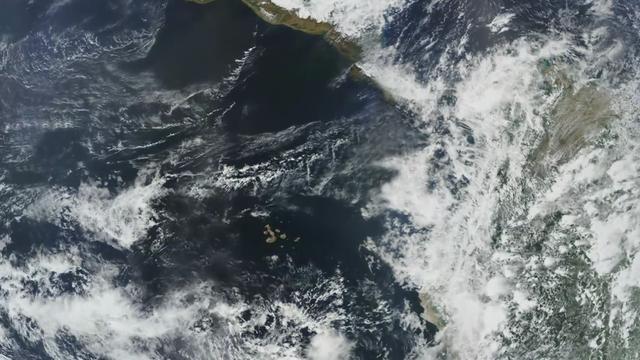
Completed: 07-16-2009 Straddling the equator approximately 1000 kilometers to the west of the South American mainland, the Galapagos Islands lie within the heart of the equatorial current system. Rising from the sea floor, the volcanic islands of the Galapagos are set on top of a large submarine platform. The main portion of the Galapagos platform is relatively flat and less than 1000 meters in depth. The steepest slopes are found along the western and southern flanks of the platform with a gradual slope towards the east. The interactions of the Galapagos and the oceanic currents create vastly different environmental regimes which not only isolates one part of the Archipelago from the other but allows penguins to live along the equator on the western part of the Archipelago and tropical corals around the islands to the north. The islands are relatively new in geologic terms with the youngest islands in the west still exhibiting periodic eruptions from their massive volcanic craters. Please give credit for this item to: NASA/Goddard Space Flight Center, The SeaWiFS Project and GeoEye, Scientific Visualization Studio. NOTE: All SeaWiFS images and data presented on this web site are for research and educational use only. All commercial use of SeaWiFS data must be coordinated with GeoEye (http://www.geoeye.com). To download this video go to: <a href="http://svs.gsfc.nasa.gov/goto?3628" rel="nofollow">svs.gsfc.nasa.gov/goto?3628</a> <b><a href="http://www.nasa.gov/centers/goddard/home/index.html" rel="nofollow">NASA Goddard Space Flight Center</a></b> is home to the nation's largest organization of combined scientists, engineers and technologists that build spacecraft, instruments and new technology to study the Earth, the sun, our solar system, and the universe.
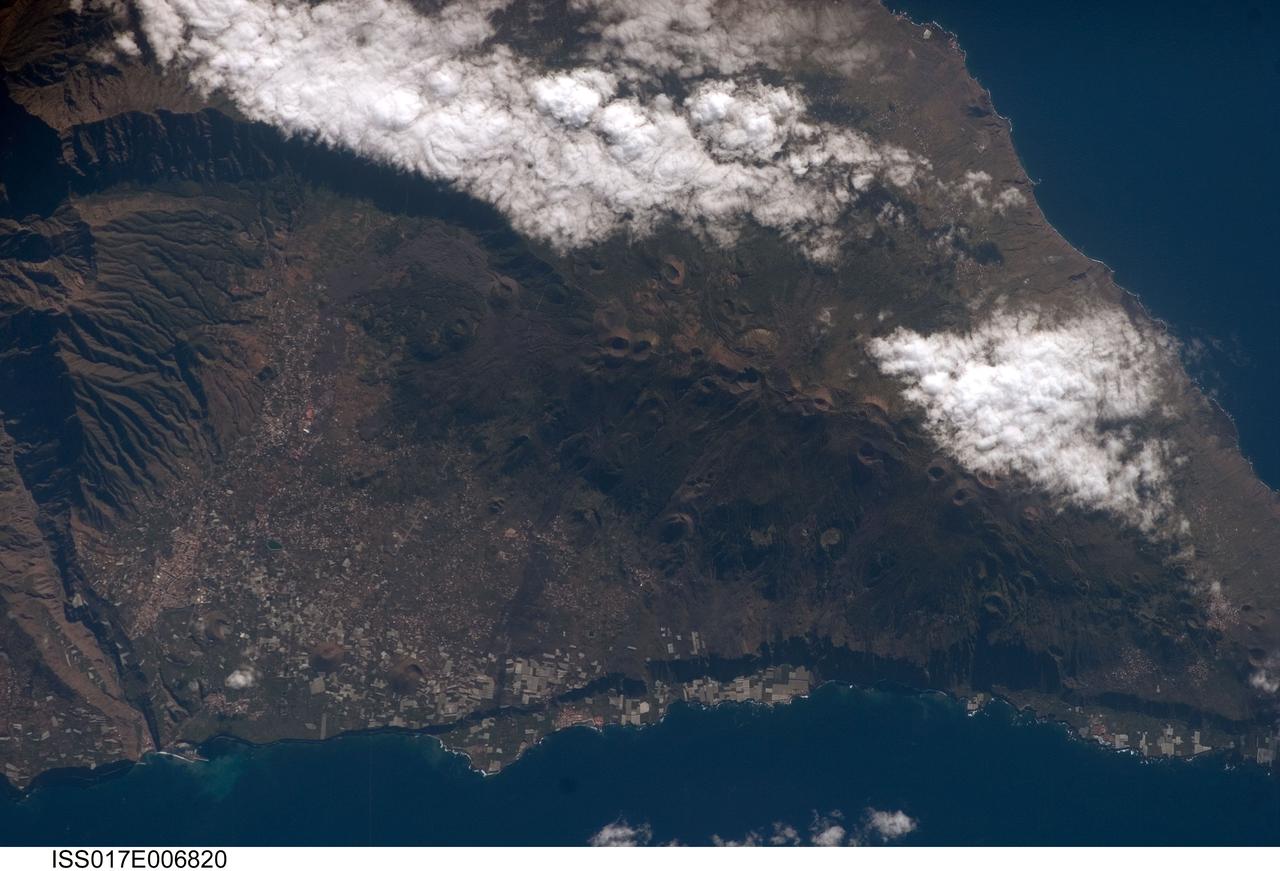
ISS017-E-006820 (13 May 2008) --- Isla de la Palma in the Canary Islands is featured in this image photographed by an Expedition 17 crewmember on the International Space Station. The Canary Islands, a group of volcanic islands, lie just off the west coast of Morocco in the Atlantic Ocean; at the northwest end of the chain of islands is Isla de la Palma. According to scientists, the island started forming as a submarine volcano approximately 3-4 million years ago. Subaerial (above the water surface) volcanic activity and island formation began around 2 million years ago. Most geologists believe the Canary Islands formed over the remnants of an old "hotspot" in the mantle, or mantle plume. The residual hotspot melting produced the magma that resulted in the Canary Island volcanoes. While there is little evidence to support the current existence of a mantle plume, volcanic activity is still taking place -- the most recent lava flows on Isla de Palma were erupted in 1971. In addition to volcanic hazards, the Canary Islands are also subject to occasional dust storms originating in the Sahara Desert. This view highlights volcanic landforms on the southern portion of Isla de Palma. The elongated, 1949-meter high Cumbre Vieja volcanic center is characterized by numerous cinder cones, craters, and gray lava flows that punctuate the green vegetated hillslopes. To the north, the cities of El Paso and Los Llanos de Aridanes nestle against collapsed fragments of the Caldera Taburiente (left), formed by massive slope failure of an older volcanic center to the north. Tourism is a major component of the local economy, but the high mountains and clear air of Isla de la Palma are also attractive to astronomers -- several large observatories (not shown) are located along the northern edge of the Caldera Taburiente.
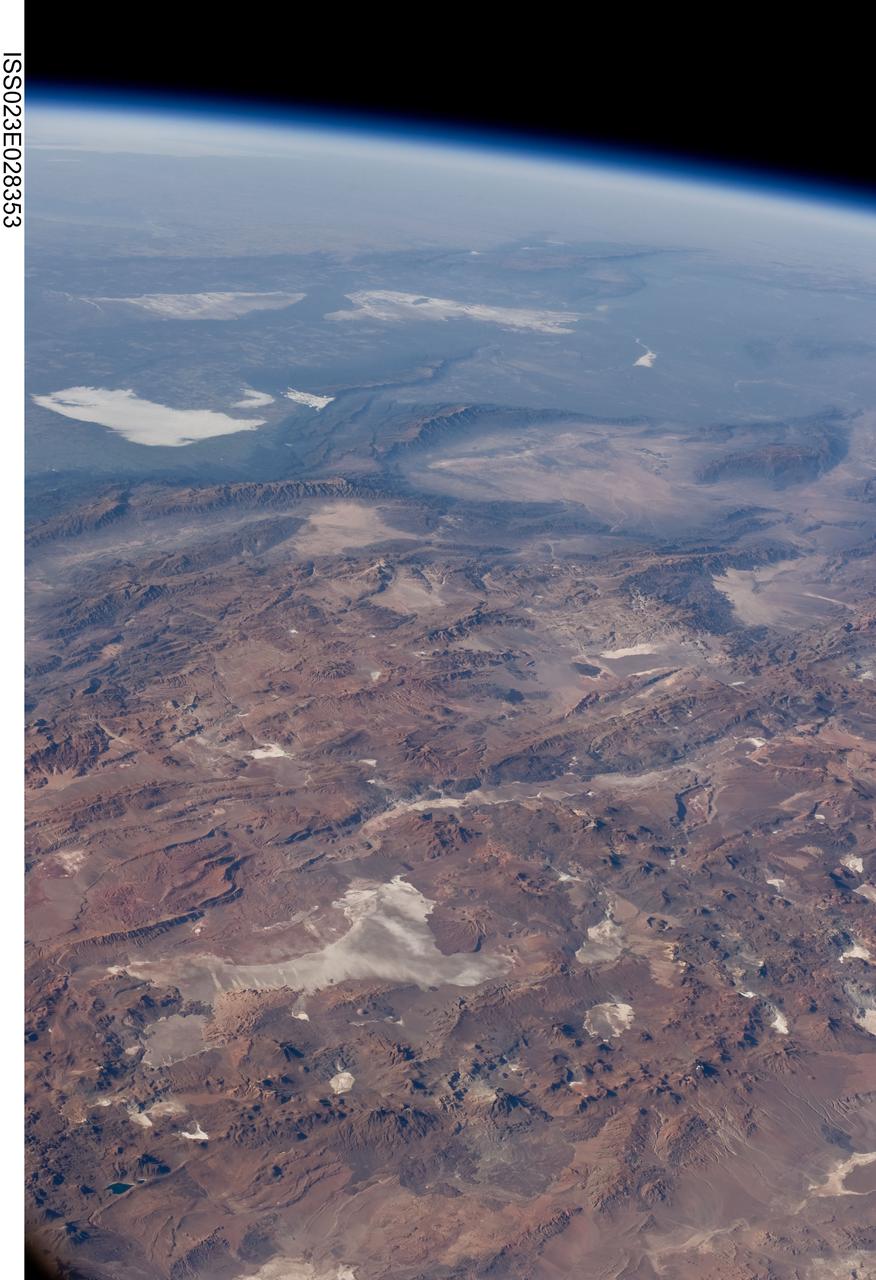
ISS023-E-028353 (26 April 2010) --- Central Andes Mountains, Salar de Arizaro, Argentina are featured in this image photographed by an Expedition 23 crew member on the International Space Station. The high plains (3,000 to greater than 5,000 meters elevation, 13,000 to 19,000 feet) of the Andes Mountains, also known as the Puna, appear in the foreground of this photograph, with a line of young volcanoes facing the much lower Atacama Desert (1,000–2,000 meters elevation). Several large dry lakes, marked by light-toned salt crusts, occupy the basins between major thrust faults in the Puna. Salar de Arizaro (foreground) is the largest of the dry lakes in this view (salar means waterless salt flat in Spanish). This panorama was taken by a station crew member looking southeast across the South American continent when the ISS was almost directly over the Atacama Desert near Chile’s Pacific coast. The Atlantic Ocean coastline (River Plate where Argentina’s capital city of Buenos Aires is located) is dimly visible at top left. A striking geological and landscape contrast is visible at center which separates two distinct geological zones, namely the Puna and the Sierras Pampeanas. The Sierras Pampeanas Mountains are lower in elevation and have few young volcanoes, in contrast to the Puna. Sharp-crested ranges are separated by wide, low valleys in this region. The Salinas Grandes—ephemeral shallow salt lakes at top left (salina means salt lake in Spanish) — occupies one of these valleys. The general color change from reds and browns in the foreground to blues and greens in the upper part of the image reflects the major climatic regions, namely the deserts of the Atacama and Puna, versus the low grassy plains of central Argentina where rainfall is sufficient to promote lush prairie grass growth—known famously as the pampas in Argentina. The Salinas Grandes mark an intermediate semiarid region. What accounts for the changes in landscape? The geology of this part of the Andes is a result of the eastward subduction of the Nazca tectonic plate underneath South America. Investigations using seismic data suggest that the Puna is underlain by a steeply dipping sector of the subducting Nazca plate. The Sierras Pampeanas zone however, is underlain by a sector of the Nazca plate that is almost horizontal, possibly due to the subduction of a submarine mountain range known as the Juan Fernandez Ridge. In the simplest terms, ridges are topographic highs that are difficult to stuff down subduction zones, with profound effects on the volcanism and structures of the upper plate.
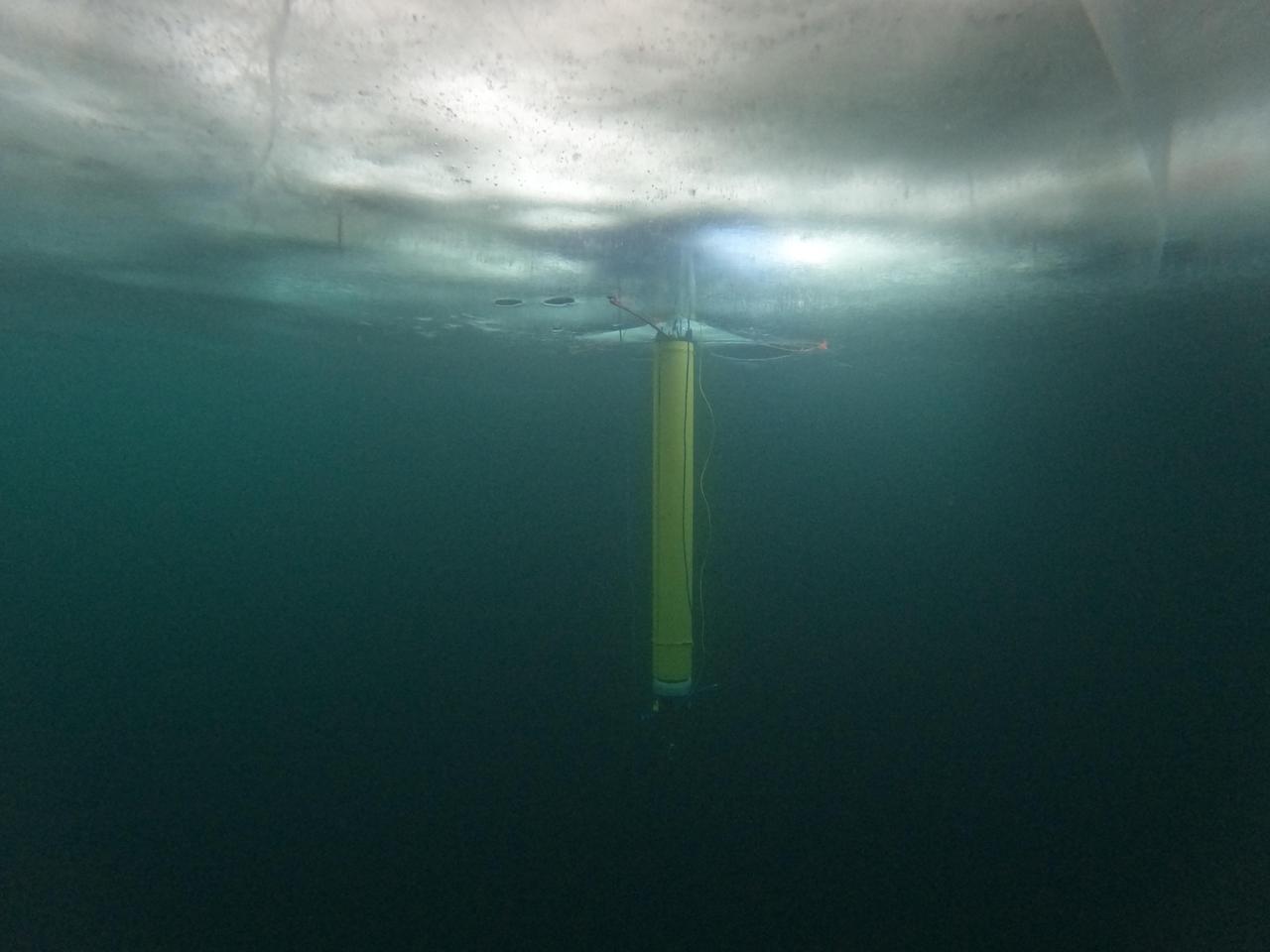
A prototype of an autonomous robot, part of a project called IceNode being developed at NASA's Jet Propulsion Laboratory, is seen from beneath the frozen surface of Lake Superior, off Michigan's Upper Peninsula. The three thin legs of the robot's "landing gear" affix it to the icy ceiling. A remote camera captured the image during a field test in 2022. The IceNode project envisions a fleet of such robots to venture beneath Antarctic ice shelves and gather data that would help scientists calculate how rapidly the ice shelves there are melting – and how fast that melting could cause global sea levels to rise. Each about 8 feet (2.4 meters) long and 10 inches (25 centimeters) in diameter, the robots use three-legged "landing gear" that springs out from one end to attach the robot to the underside of the ice. Rather than using propulsion, the robots would autonomously position themselves with the help of novel algorithms based on models of ocean currents. Released from a borehole or a vessel in the open ocean, the robots would ride those currents on a long journey beneath an ice shelf. They would target the underwater area known as the "grounding zone," where floating ice shelves, ocean, and land meet, deep inside unmapped cavities where the ice may be melting the fastest. Each robot would detach a ballast and rise up to affix itself to the underside of the ice, where their suite of sensors would measure how fast warm, salty ocean water is circulating up to melt the ice, and how quickly cold meltwater is sinking. As conceived, the IceNode fleet would operate for up to a year, continuously capturing data, including seasonal fluctuations. Then the robots would detach themselves from the ice, drift back out to open ocean, and transmit their data via satellite. This test was conducted through the U.S. Navy Arctic Submarine Laboratory's biennial Ice Camp, a three-week operation that provides researchers a temporary base camp from which to conduct field work in the harsh Arctic environment. IceNode has been funded through JPL's internal research and technology development program and its Earth Science and Technology Directorate. JPL is managed for NASA by Caltech in Pasadena, California. https://photojournal.jpl.nasa.gov/catalog/PIA26421
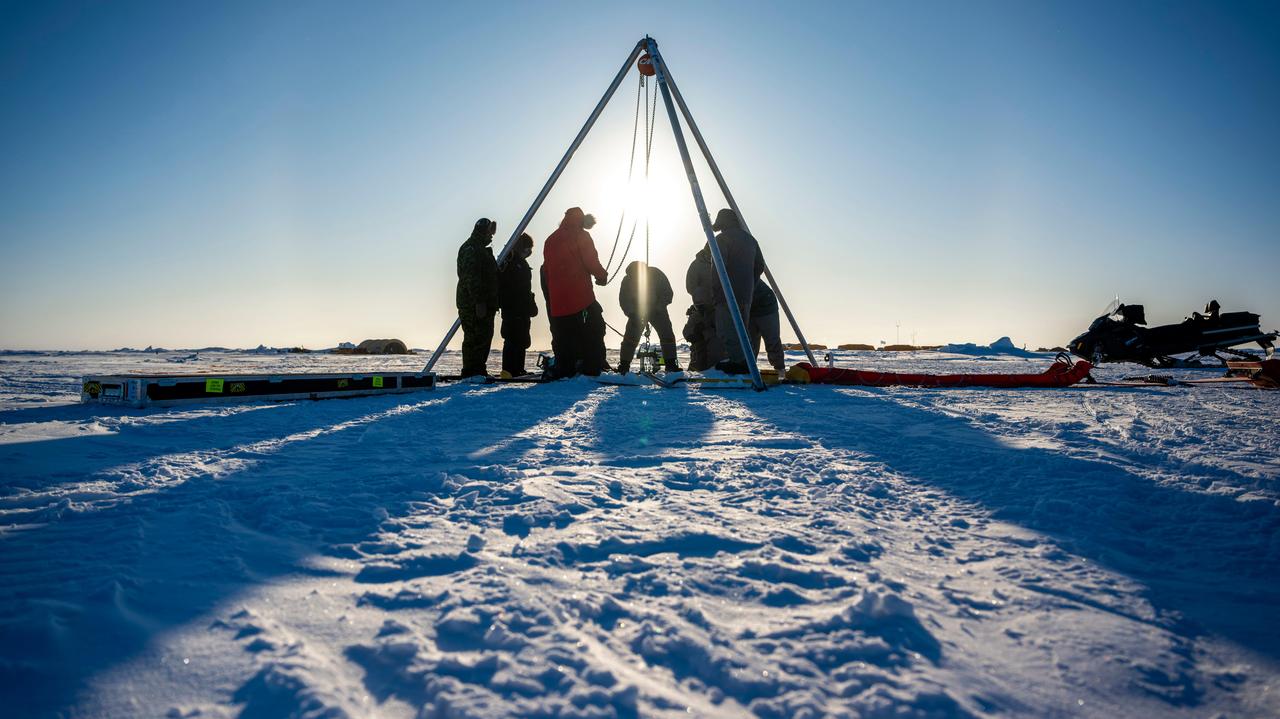
A prototype of an autonomous robot, part of a project called IceNode being developed at NASA's Jet Propulsion Laboratory, was tested in the Beaufort Sea north of Alaska in March 2024. The project envisions a fleet of such robots to venture beneath Antarctic ice shelves and gather data that would help scientists calculate how rapidly the ice shelves there are melting – and how fast that melting could cause global sea levels to rise. This image, as well as Figures A and B, shows the team lowering the prototype through a borehole in the sea ice. During this Arctic field test, the robot descended on a tether about 330 feet (100 meters) into the ocean, where its instruments gathered salinity, temperature, and flow data. The team also conducted tests to determine adjustments that would enable them to take the robot off-tether. Each about 8 feet (2.4 meters) long and 10 inches (25 centimeters) in diameter, the robots use three-legged "landing gear" that springs out from one end to attach the robot to the underside of the ice. Rather than using propulsion, the robots would autonomously position themselves with the help of novel algorithms based on models of ocean currents. Released from a borehole or a vessel in the open ocean, the robots would ride those currents on a long journey beneath an ice shelf. They would target the underwater area known as the "grounding zone," where floating ice shelves, ocean, and land meet, deep inside unmapped cavities where the ice may be melting the fastest. Each robot would detach a ballast and rise up to affix itself to the underside of the ice, where their suite of sensors would measure how fast warm, salty ocean water is circulating up to melt the ice, and how quickly cold meltwater is sinking. As conceived, the IceNode fleet would operate for up to a year, continuously capturing data, including seasonal fluctuations. Then the robots would detach themselves from the ice, drift back out to open ocean, and transmit their data via satellite. This test was conducted through the U.S. Navy Arctic Submarine Laboratory's biennial Ice Camp, a three-week operation that provides researchers a temporary base camp from which to conduct field work in the harsh Arctic environment. IceNode has been funded through JPL's internal research and technology development program and its Earth Science and Technology Directorate. JPL is managed for NASA by Caltech in Pasadena, California. https://photojournal.jpl.nasa.gov/catalog/PIA26349