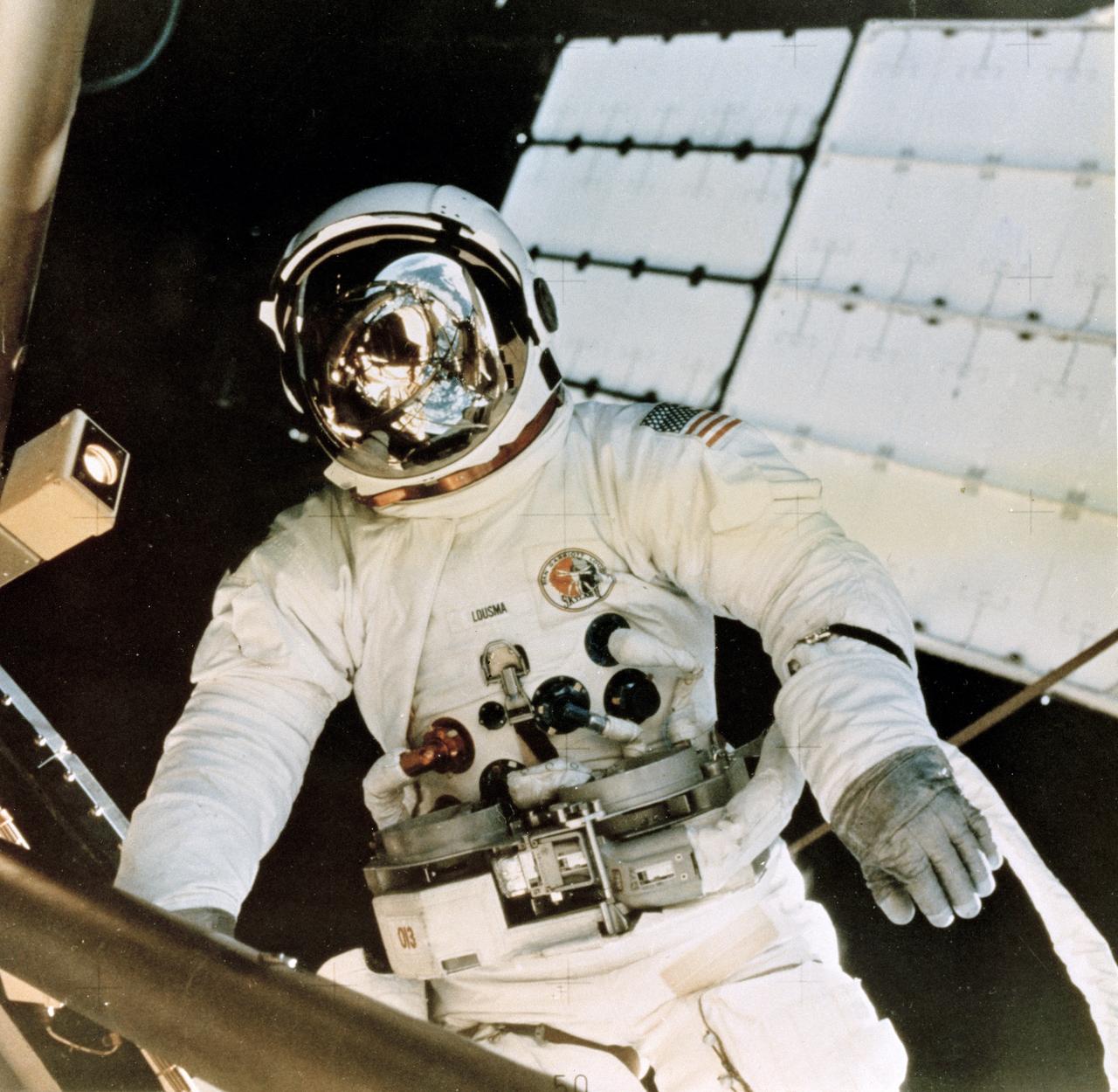
Skylab-3 was the second marned mission in the skylab project. The crew spent 59 days in orbit. In this photo, Astronaut Jack Lousma deploys the Twin Pole Sun Shield created by Marshall Space Flight Center team members to replace the micrometeoroid shield, a thin protective cylinder surrounding the workshop protecting it from tiny space particles and the sun's scorching heat. The shield was damaged during the Skylab-2 mission.
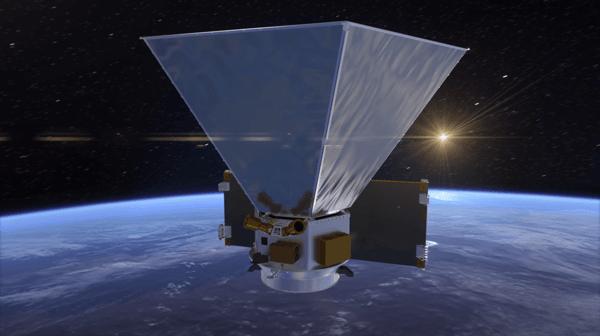
NASA's SPHEREx mission will study the universe's early expansion, the history of galaxies, and the composition of planetary systems. This animation shows the preliminary design for the spacecraft, including hexagonal sun shields that will help keep the instruments cool. Movie available at https://photojournal.jpl.nasa.gov/catalog/PIA23869

Sara Susca, deputy payload manager and payload systems engineer for the NASA's SPHEREx mission, looks up at one of the spacecraft's photon shields at the agency's Jet Propulsion Laboratory in Southern California in October 2023. Short for Specto-Photometer for the History of the Universe, Epoch of Reionization and Ices Explorer, SPHEREx will create a map of the cosmos like no other, imaging the entire sky and gathering information about millions of galaxies. With this map, scientists will study what happened in the first fraction of a second after the big bang, the history of galaxy evolution, and the origins of water in planetary systems in our galaxy. Three concentric photon shields will surround the SPHEREx telescope to protect it from nearby light sources that could overwhelm its detectors. The shields will primarily block light from the Sun and the Earth. They also block heat; SPHEREx needs to be kept cold – below minus 350 degrees Fahrenheit (about minus 210 degrees Celsius). That's because SPHEREx detects infrared light, which is sometimes called heat radiation because it's emitted by anything warm. The heat from SPHEREx's own detectors could overwhelm their ability to image faint cosmic objects, so the spacecraft needs a way to cool the detectors down. The spacecraft stands almost 8.5 feet tall (2.6 meters) and stretches nearly 10.5 feet (3.2 meters) wide. https://photojournal.jpl.nasa.gov/catalog/PIA25784

NASA's SPHEREx mission will operate in low Earth orbit, detecting hundreds of millions of stars and galaxies and creating the first all-sky spectroscopic survey in the near-infrared. This artist's concept shows the spacecraft and its distinctive conical photon shields, which protect SPHEREx's telescope from infrared light and heat from the Sun and Earth. Short for Spectro-Photometer for the History of the Universe, Epoch of Reionization and Ices Explorer, SPHEREx will create a map of the cosmos like no other. Using a technique called spectroscopy to image the entire sky in 102 wavelengths of infrared light, SPHEREx will gather information about the composition of and distance to millions of galaxies and stars. With this map, scientists will study what happened in the first fraction of a second after the big bang, how galaxies formed and evolved, and the origins of water in planetary systems in our galaxy. https://photojournal.jpl.nasa.gov/catalog/PIA26531
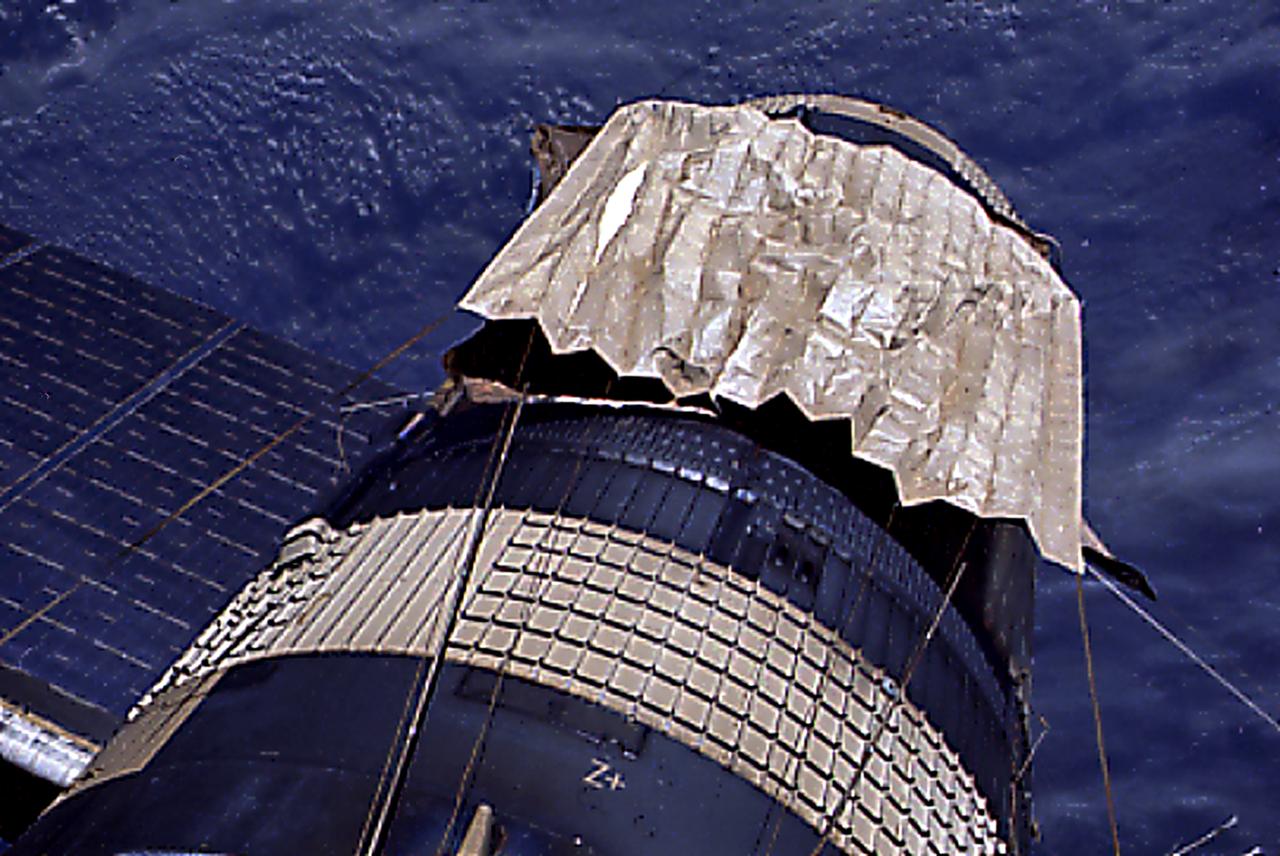
Shortly after liftoff on May 14, 1973, atmospheric drag tore off the thin metallic shield of Skylab that was designed to protect her from micro-meteorites and the Sun's intense heat. The Skylab-2 crew deployed a parasol sunshield to protect the orbiting laboratory. Concern over the possibility that materials used for the parasol would deteriorate with prolonged exposure to the Sun's rays prompted the installation of a second sunshield during the Skylab-3 mission. This time, the crew exited the space station and installed a twin-pole device to position the shield over the parasol. This photograph was taken by the Skylab-4 mission.
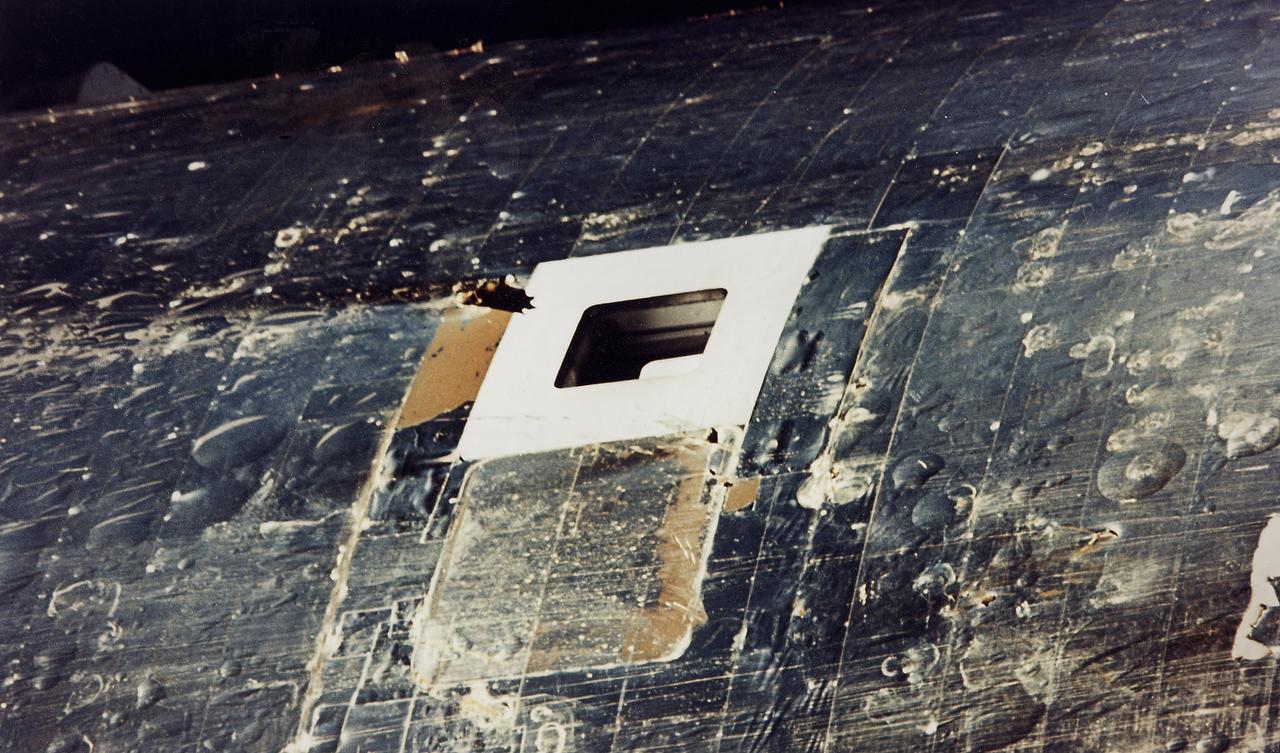
The Saturn V vehicle, carrying the unmarned orbital workshop for the Skylab-1 mission, lifted off successfully and all systems performed normally. Sixty-three seconds into flight, engineers in the operation support and control center saw an unexpected telemetry indication that signalled that damages occurred on one solar array and the micrometeoroid shield during the launch. The micrometeoroid shield, a thin protective cylinder surrounding the workshop protecting it from tiny space particles and the sun's scorching heat, ripped loose from its position around the workshop. This caused the loss of one solar wing and jammed the other. Still unoccupied, the Skylab was stricken with the loss of the heat shield and sunlight beat mercilessly on the lab's sensitive skin. Internal temperatures soared, rendering the the station uninhabitable, threatening foods, medicines, films, and experiments. This image shows the sun-ravaged skin of the Orbital Workshop, bared by the missing heat shield, with blister scars and tarnish from temperatures that reached 300 degrees F. The rectangular opening at the upper center is the scientific airlock through which the parasol to protect the workshop from sun's rays was later deployed. This view was taken during a fly-around inspection by the Skylab-2 crew. The Marshall Space Flight Center had a major role in developing the procedures to repair the damaged Skylab.
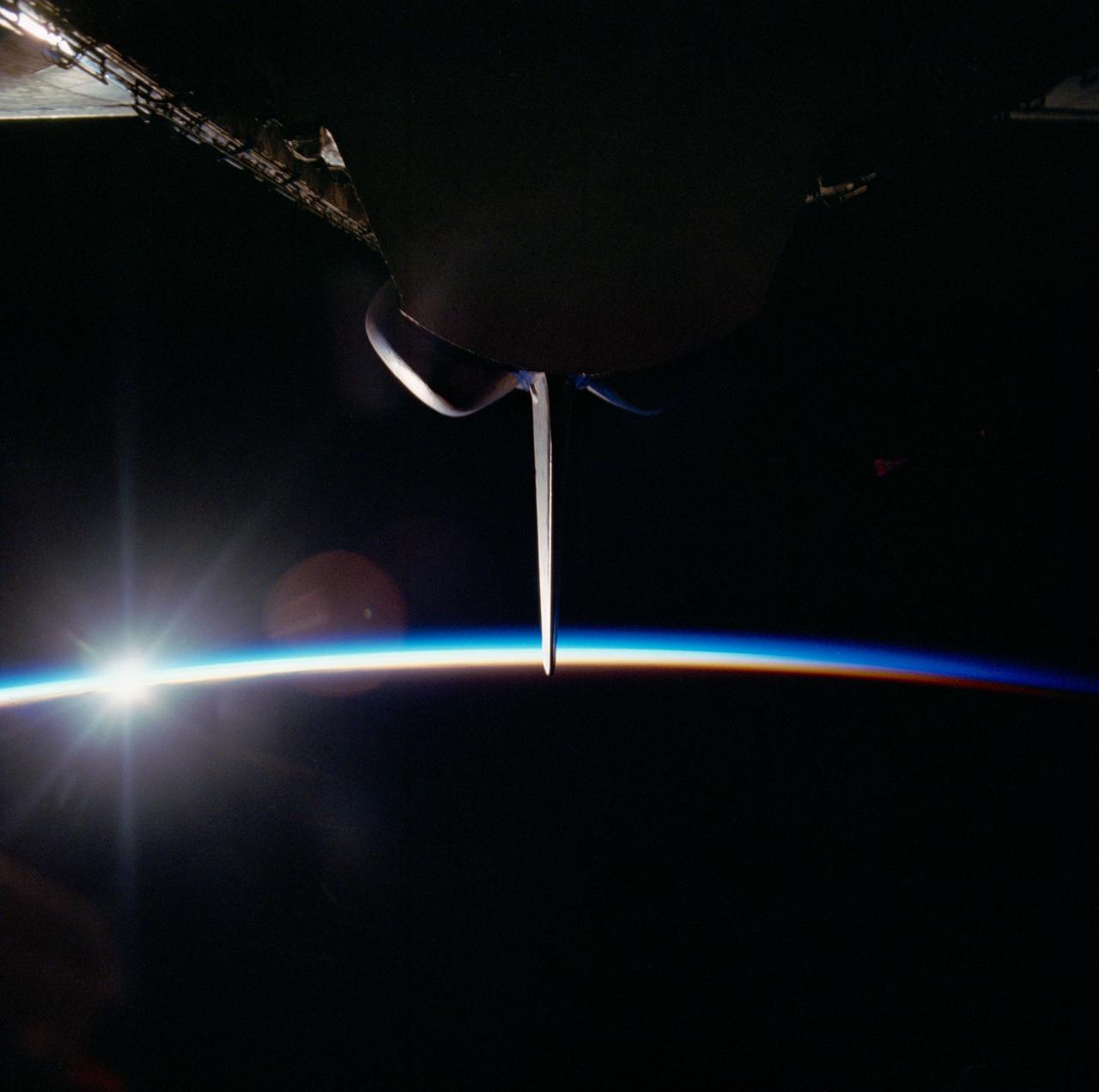
S82-39796 (11-16 Nov. 1982) --- A ?night? scene of the STS-5 space shuttle Columbia in orbit over Earth?s glowing horizon was captured by an astronaut crew member aiming a 70mm handheld camera through the aft windows of the flight deck. The aft section of the cargo bay contains two closed protective shields for satellites which were deployed on the flight. The nearest ?cradle? or shield houses the Satellite Business System?s (SBS-3) spacecraft and is visible in this frame while the Telesta Canada ANIK C-3 shield is out of view. The vertical stabilizer, illuminated by the sun, is flanked by two orbital maneuvering system (OMS) pods. Photo credit: NASA

THE SOLAR PROBE PLUS CUP INSTRUMENT WILL BE PART OF THE SOLAR PROBE PLUS MISSION TO STUDY THE SUN. THE CUP WILL FLY ON THE SPACECRAFT ON THE OUTSIDE OF THE SHIELD AND WILL "CATCH" CHARGED PARTICLES FROM THE SUN AND ANALYZE THEM. A TEAM FROM THE HARVARD SMITHSONIAN ASTROPHYSICS OBSERVATORY IS BUILDING THIS INSTRUMENT AND TESTED AN ENGINEERING MODEL OF THE CUP IN AN ENVIRONMENTAL TEST FACILITY AT NASA'S MARSHALL SPACE FLIGHT CENTER.INSIDE THE VACUUM CHAMBER, THE PROBE WAS EXPOSED TO AN ENVIRONMENTAL CONDITIONS SIMILAR TO THOSE FOUND IN SPACE

This poster artfully depicts Solar Surfing, an early stage NASA study to support potential future missions that could travel closer to the Sun’s surface than ever before. The solar transition region, a very thin layer near the Sun’s surface, is of great interest to heliophysicists. In this zone, temperatures range from 10,000 to 1.8 million degrees Fahrenheit. The NASA Innovative Advanced Concepts (NIAC) program funds a study by a team at NASA’s Kennedy Space Center in Florida to further research a novel, highly reflective coating for a solar shield that could allow spacecraft to approach the Sun close enough to investigate this exciting region – about 500,000 miles from the surface. The better heliophysicists understand the Sun and how it generates energy, the better they can make predictions of the Sun’s effect on our planet – and improve our everyday communications, electronics, and transportation.
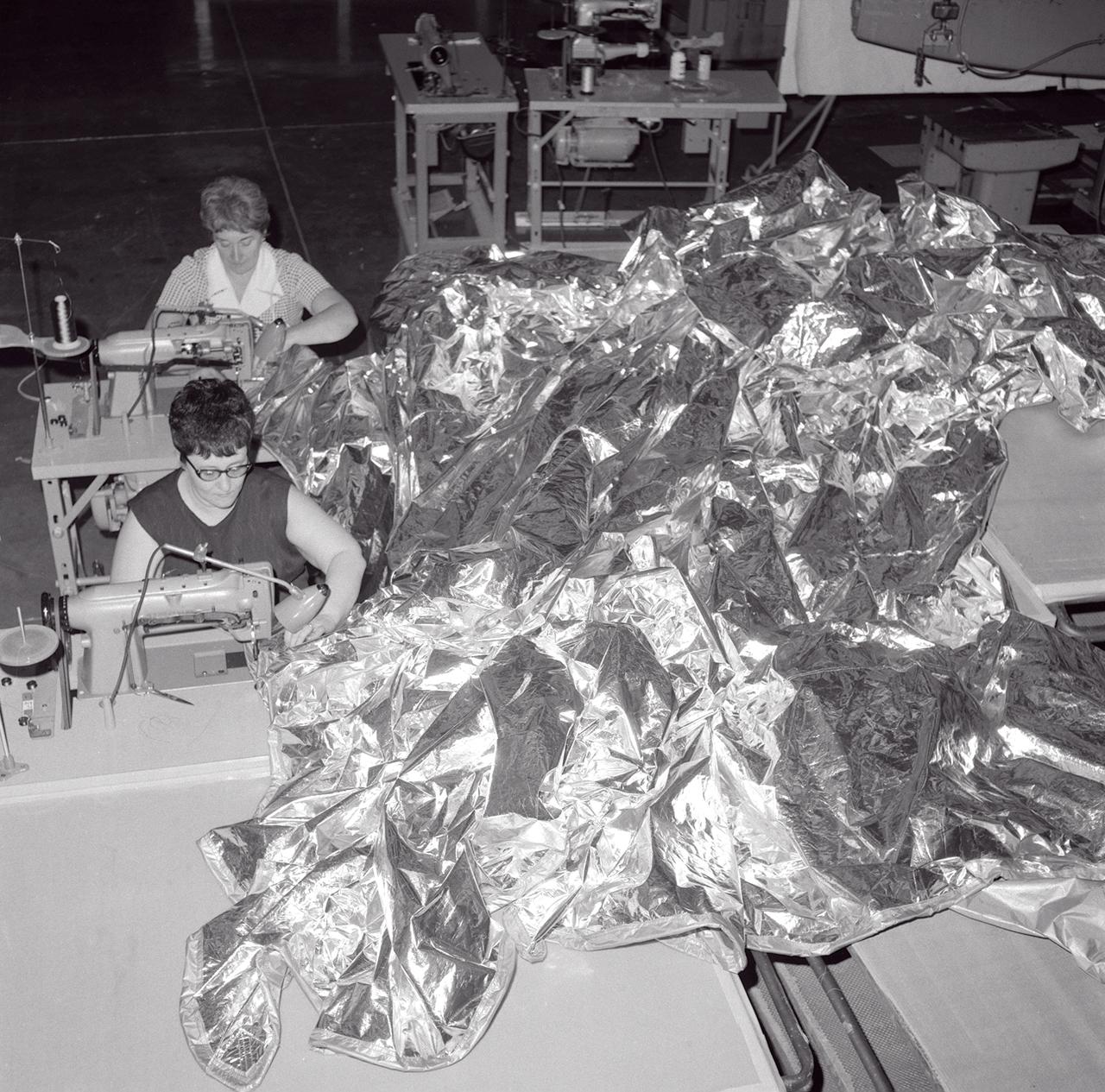
Two seamstresses stitch together a sun-shade for Skylab Orbital Workshop (OWS), the first U.S. experimental space station in orbit, which lost its thermal protection shield during the launch on May 14, 1973. Without the heat shield, the temperature inside the Orbital Workshop became dangerously high, rendering the workshop uninhabitable and threatened deterioration of the interior insulation and adhesive. Engineers and scientists at Marshall Space Flight Center (MSFC) worked tirelessly around the clock on the emergency repair procedure. The Skylab crew and the repair kits were launched just 11 days after the incident. The crew successfully deployed the twin-pole sail parasol sun-shade during their EVA (Extravehicular Activity) the next day.
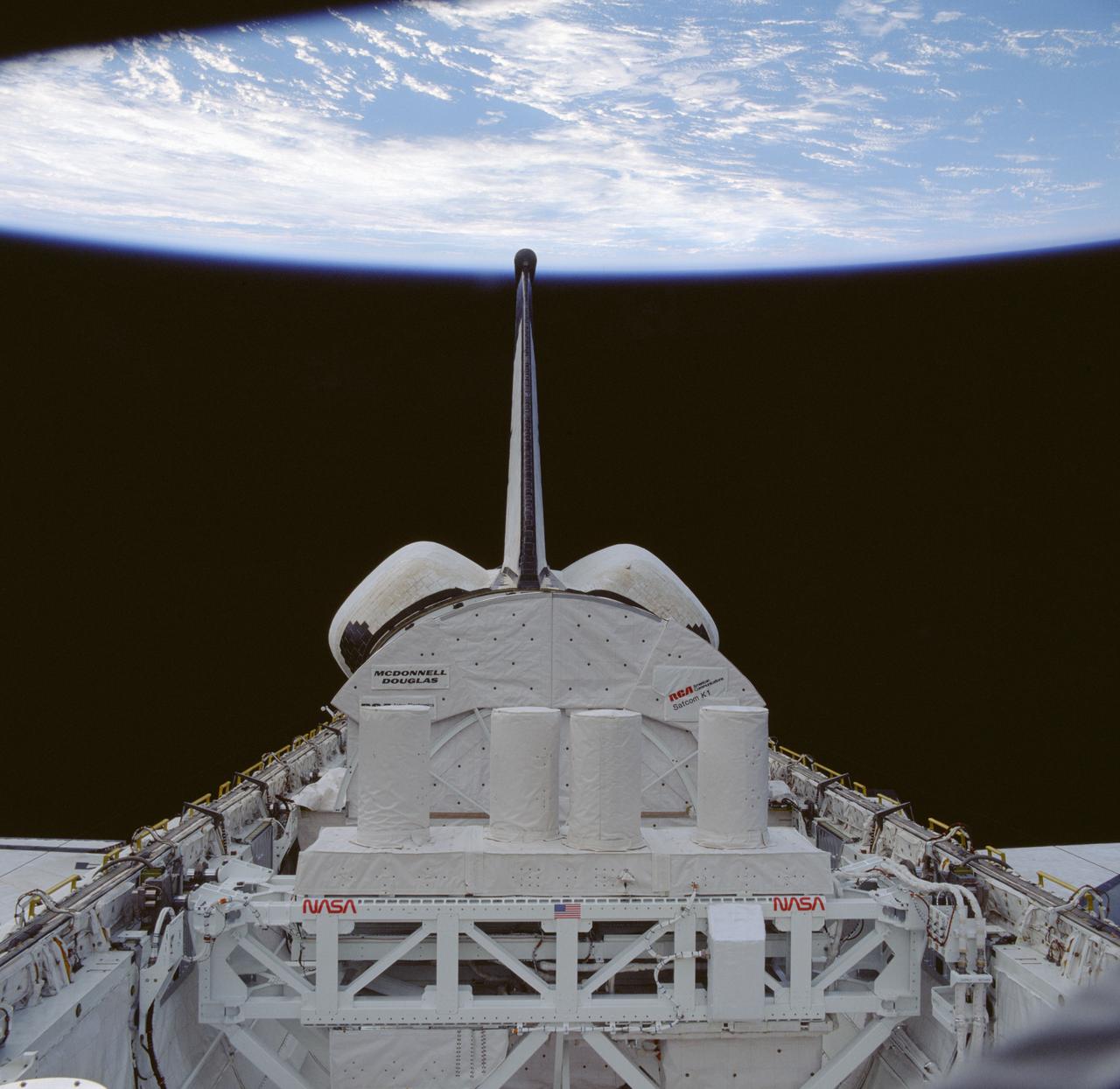
61C-39-002 (12-17 Jan 1986) --- This view of the cargo bay of the Earth-orbiting Space Shuttle Columbia reveals some of the STS 61-C mission payloads. The materials science laboratory (MSL-2), sponsored by the Marshall Space Flight Center (MSFC), is in the foreground. A small portion of the first Hitchhiker payload, sponsored by the Goddard Space Flight Center (GSFC), is in the immediate foreground, mounted to the spacecraft's starboard side. The closed sun shield for the now-vacated RCA SATCOM K-1 communications satellite is behind the MSL. Completely out of view, behind the shield, are 13 getaway specials in canisters. Clouds over ocean and the blackness of space share the backdrop for the 70mm camera's frame.
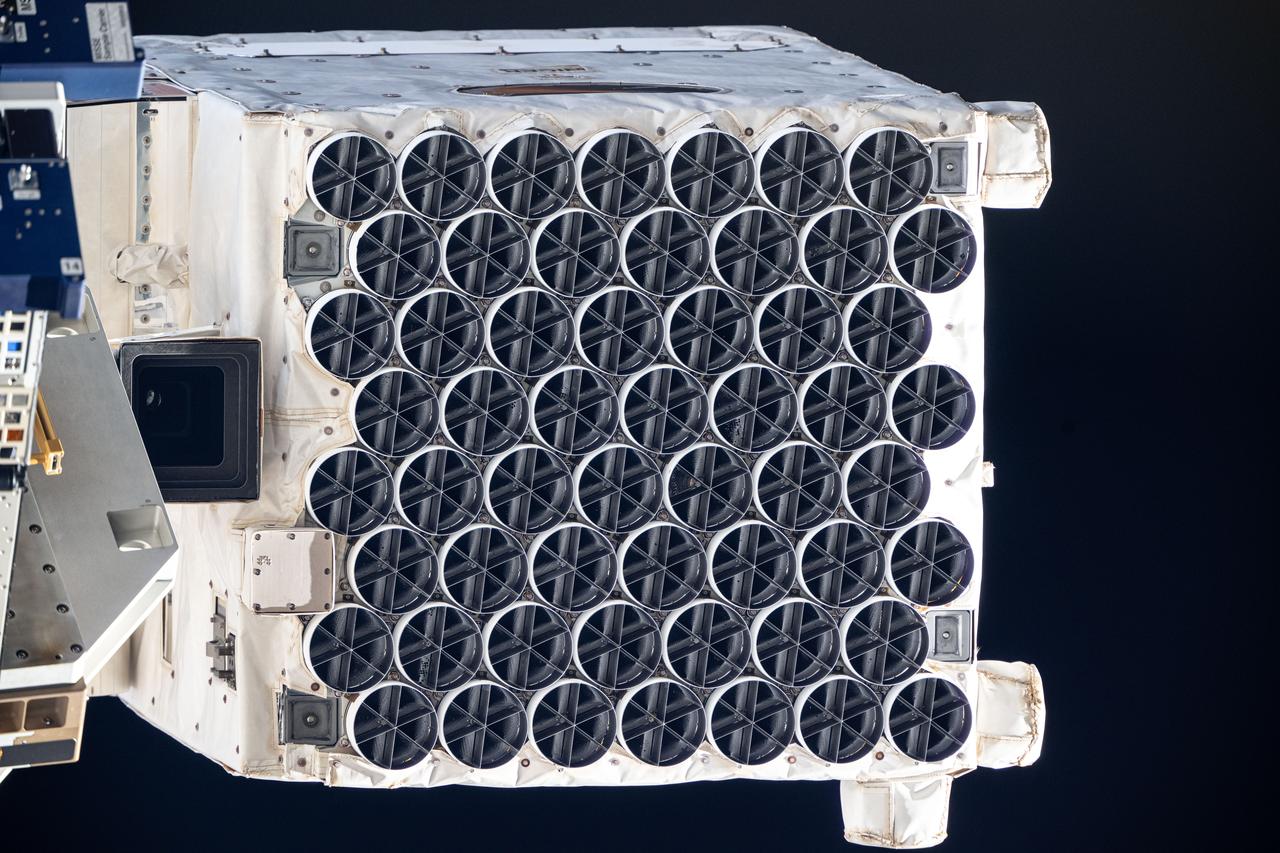
iss072e371351 (Dec. 17, 2024) --- The NICER (Neutron star Interior Composition Explorer) X-ray telescope is pictured installed on the starboard side of the International Space Station's integrated truss segment. NICER's 56 X-ray concentrators are covered by thermal shields, or filters, that block ultraviolet, infrared, and visible light while allowing X-rays to pass through to the mirrors underneath enabling the observation of neutron stars. Several thermal shields have been damaged allowing unwanted sunlight to "leak" into the astrophysics instrument interfering with X-ray measurements. NASA astronauts Nick Hague and Sun Williams will conduct a spacewalk on Jan. 16 to patch the damaged thermal shields and restore NICER for daytime scientific operations.
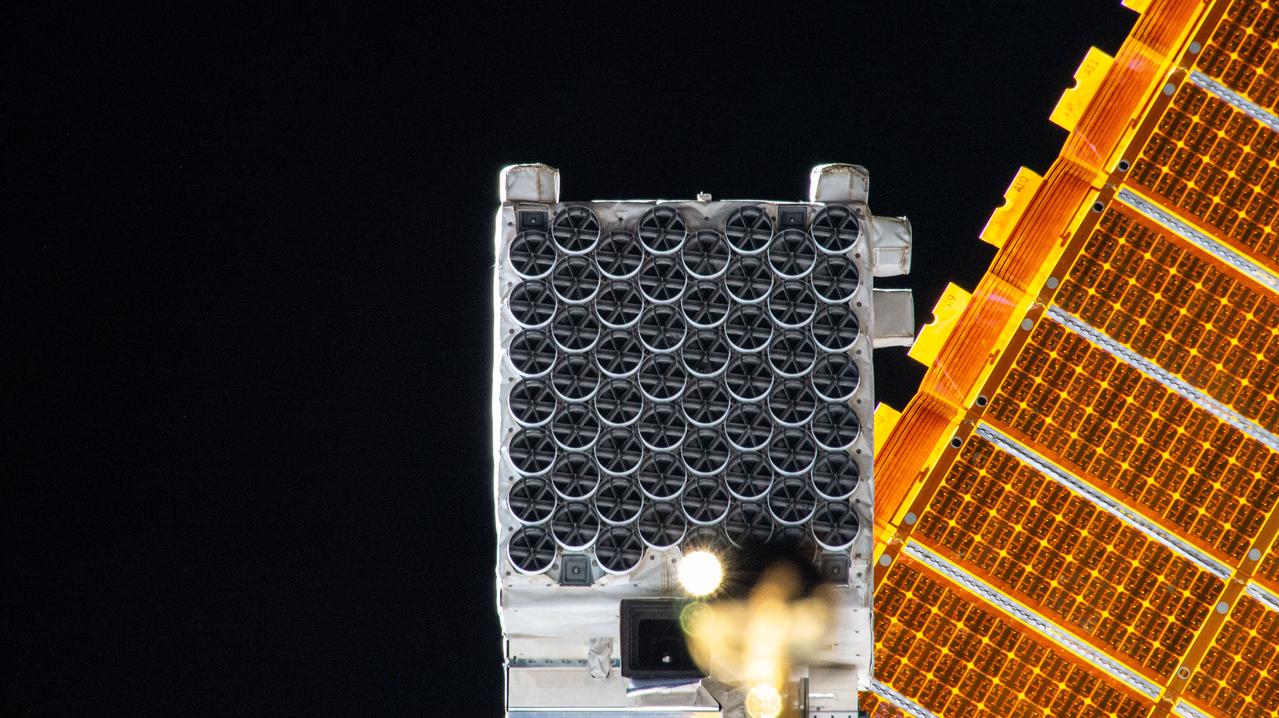
iss072e371305 (Dec. 17, 2024) --- The NICER (Neutron star Interior Composition Explorer) X-ray telescope is pictured installed on the starboard side of the International Space Station's integrated truss segment. NICER's 56 X-ray concentrators are covered by thermal shields, or filters, that block ultraviolet, infrared, and visible light while allowing X-rays to pass through to the mirrors underneath enabling the observation of neutron stars. Several thermal shields have been damaged allowing unwanted sunlight to "leak" into the astrophysics instrument interfering with X-ray measurements. NASA astronauts Nick Hague and Sun Williams will conduct a spacewalk on Jan. 16 to patch the damaged thermal shields and restore NICER for daytime scientific operations.
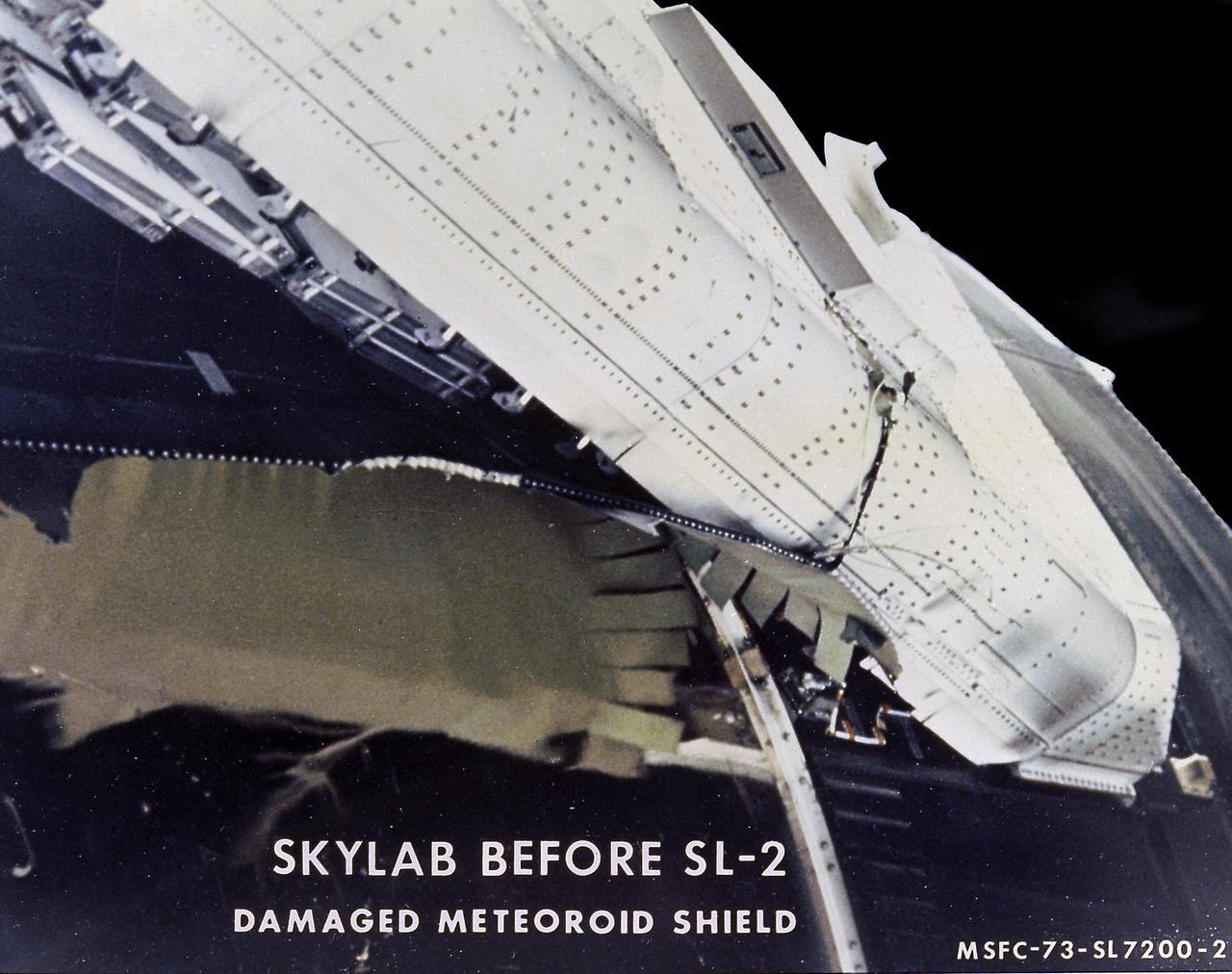
The Saturn V vehicle, carrying the unmarned orbital workshop for the Skylab-1 mission, lifted off successfully and all systems performed normally. Sixty-three seconds into flight, engineers in the operation support and control center saw an unexpected telemetry indication that signalled that damages occurred on one solar array and the micrometeoroid shield during the launch. The micrometeoroid shield, a thin protective cylinder surrounding the workshop protecting it from tiny space particles and the sun's scorching heat, ripped loose from its position around the workshop. This caused the loss of one solar wing and jammed the other. Still unoccupied, the Skylab was stricken with the loss of the heat shield and sunlight beat mercilessly on the lab's sensitive skin. Internal temperatures soared, rendering the station uninhabitable, threatening foods, medicines, films, and experiments. This image, taken during a fly-around inspection by the Skylab-2 crew, shows the damaged meteoroid shield being held by a thin aluminum strap entangled with green-hued remnants of the lost heat shield. The Marshall Space Flight Center (MSFC) developed, tested, rehearsed, and approved three repair options. These options included a parasol sunshade and a twin-pole sunshade to restore the temperature inside the workshop, and a set of metal cutting tools to free the jammed solar panel.
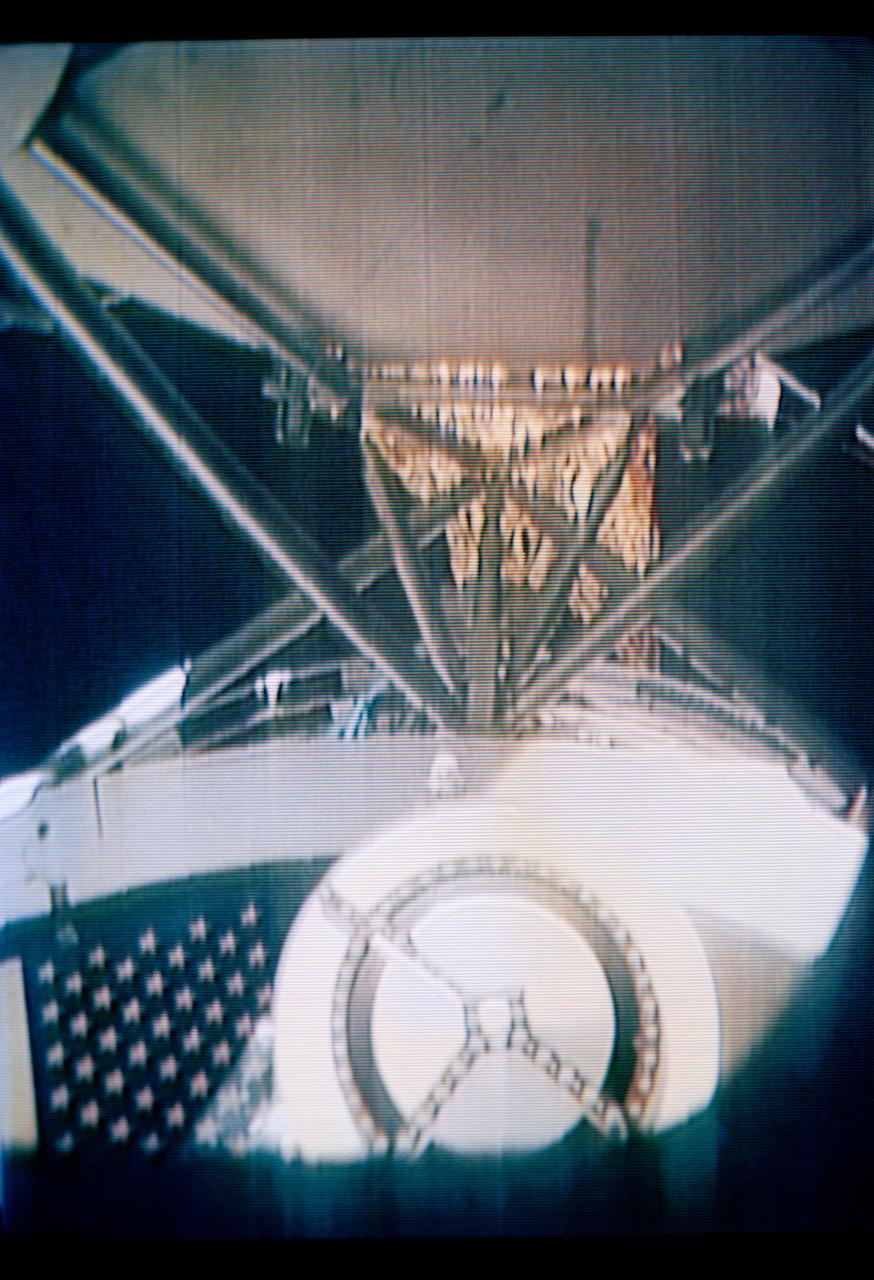
S73-26773 (26 May 1973) --- The deployment of the ?parasol? solar shield, a sunshade to help cool the overheated Orbital Workshop of the Skylab 1 space station cluster in Earth orbit, can be seen in the reproduction taken from a color television transmission made by a TV camera aboard the space station. The camera is in the Command Module; and the view is looking through the truss of the Apollo Telescope Mount. The sunshade is only partially deployed in this picture. The solar shield was pushed up through the OWS solar scientific airlock. The canopy of the ?parasol? measures 24 feet by 22 feet. Photo credit: NASA
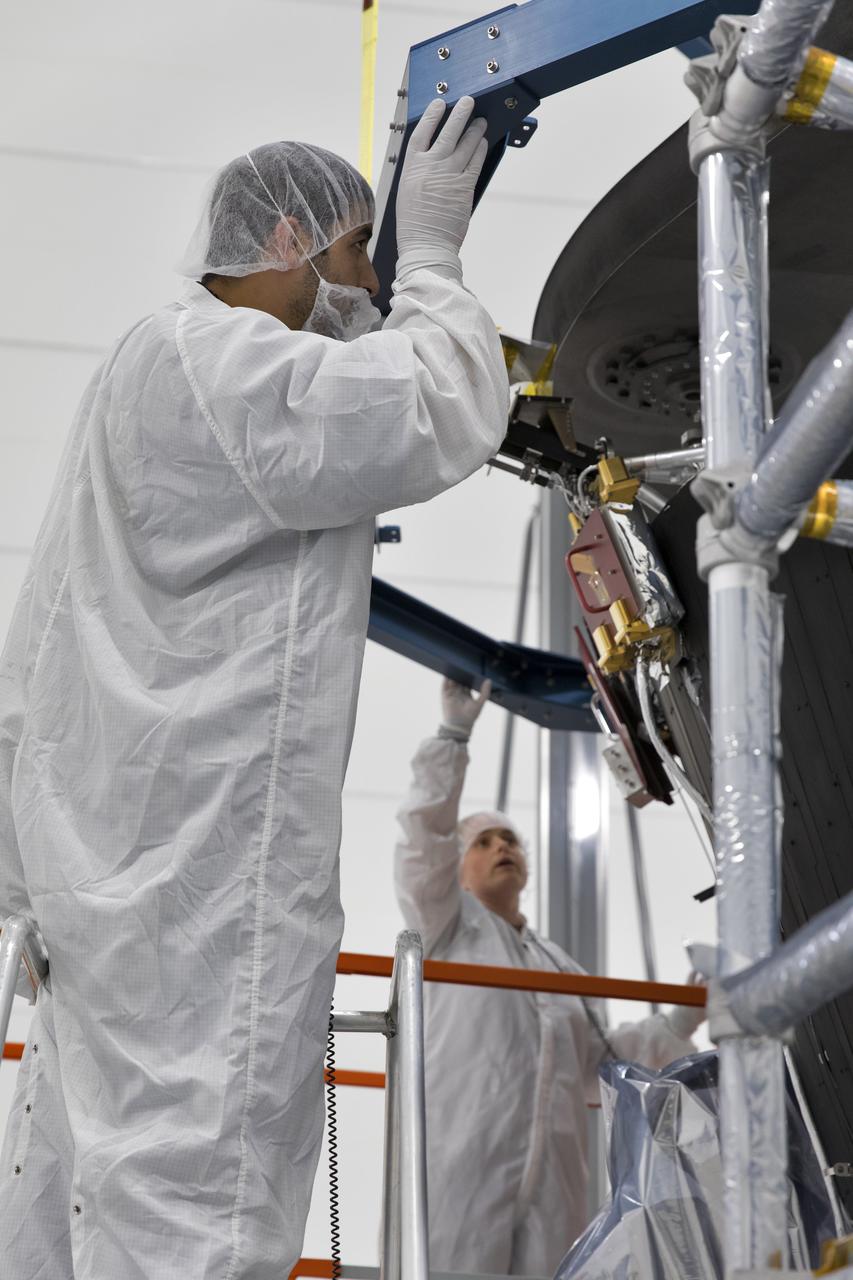
In the Astrotech processing facility in Titusville, Florida, near NASA's Kennedy Space Center, on Wednesday, June 27, 2018, technicians and engineers install the heat shield on NASA's Parker Solar Probe. The Parker Solar Probe will launch on a United Launch Alliance Delta IV Heavy rocket from Space Launch Complex 37 at Cape Canaveral Air Force Station in Florida no earlier than Aug. 4, 2018. The mission will perform the closest-ever observations of a star when it travels through the Sun's atmosphere, called the corona. The probe will rely on measurements and imaging to revolutionize our understanding of the corona and the Sun-Earth connection.
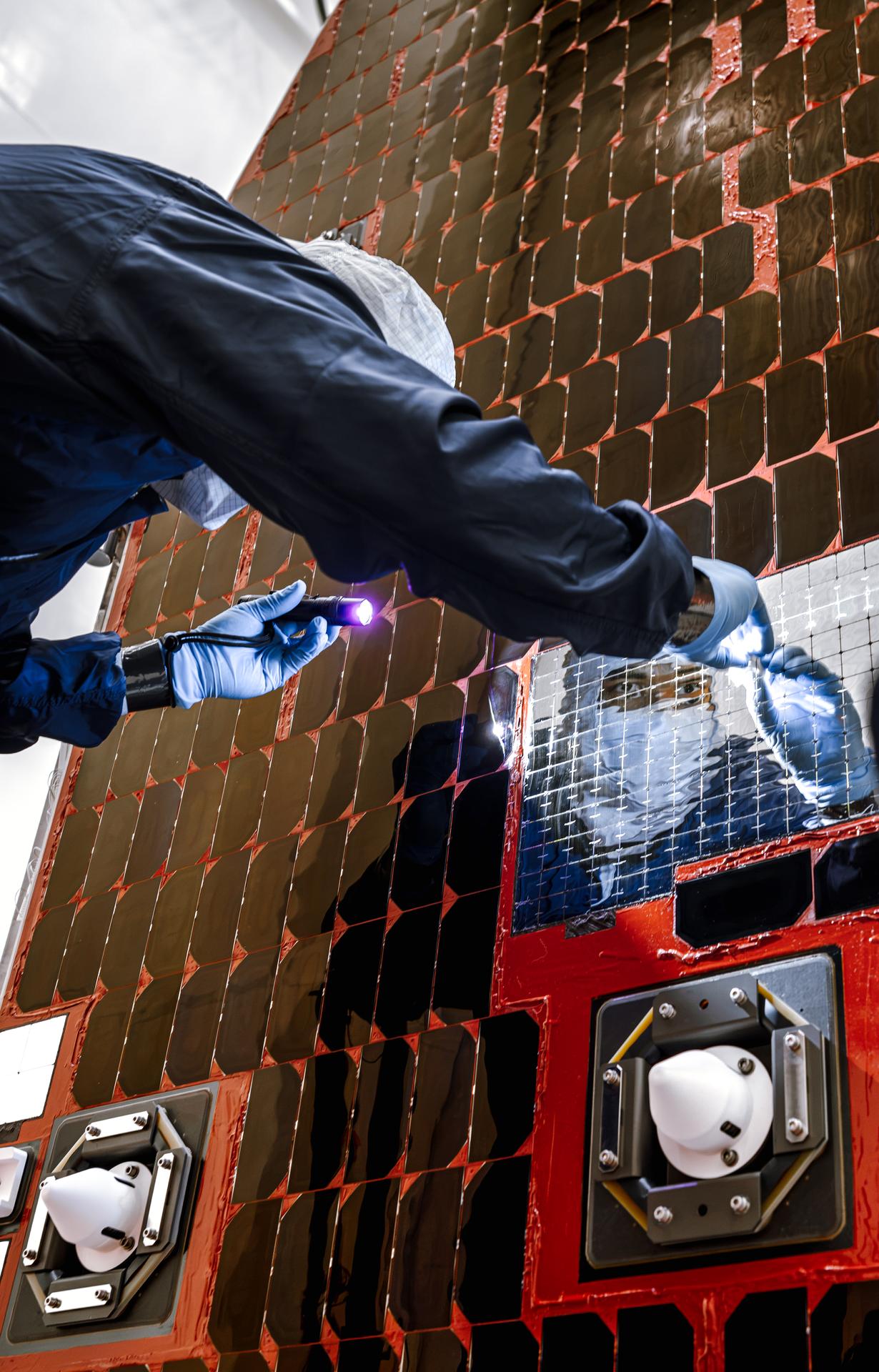
Technicians and engineers inside the Payload Hazardous Servicing Facility at NASA’s Kennedy Space Center in Florida clean and inspect the Solar Array Sun Shield (SASS) on the agency’s Nancy Grace Roman Space Telescope on Tuesday, July 14, 2026. The SASS is made up of six solar array panels, with the two center panels fixed while the four outer ones are deployed once in orbit. The Roman team will orient the SASS toward the Sun to provide power to the entire observatory and shade the telescope and instruments beneath. NASA designed this flagship mission to help astronomers explore dark matter, dark energy, and exoplanets.
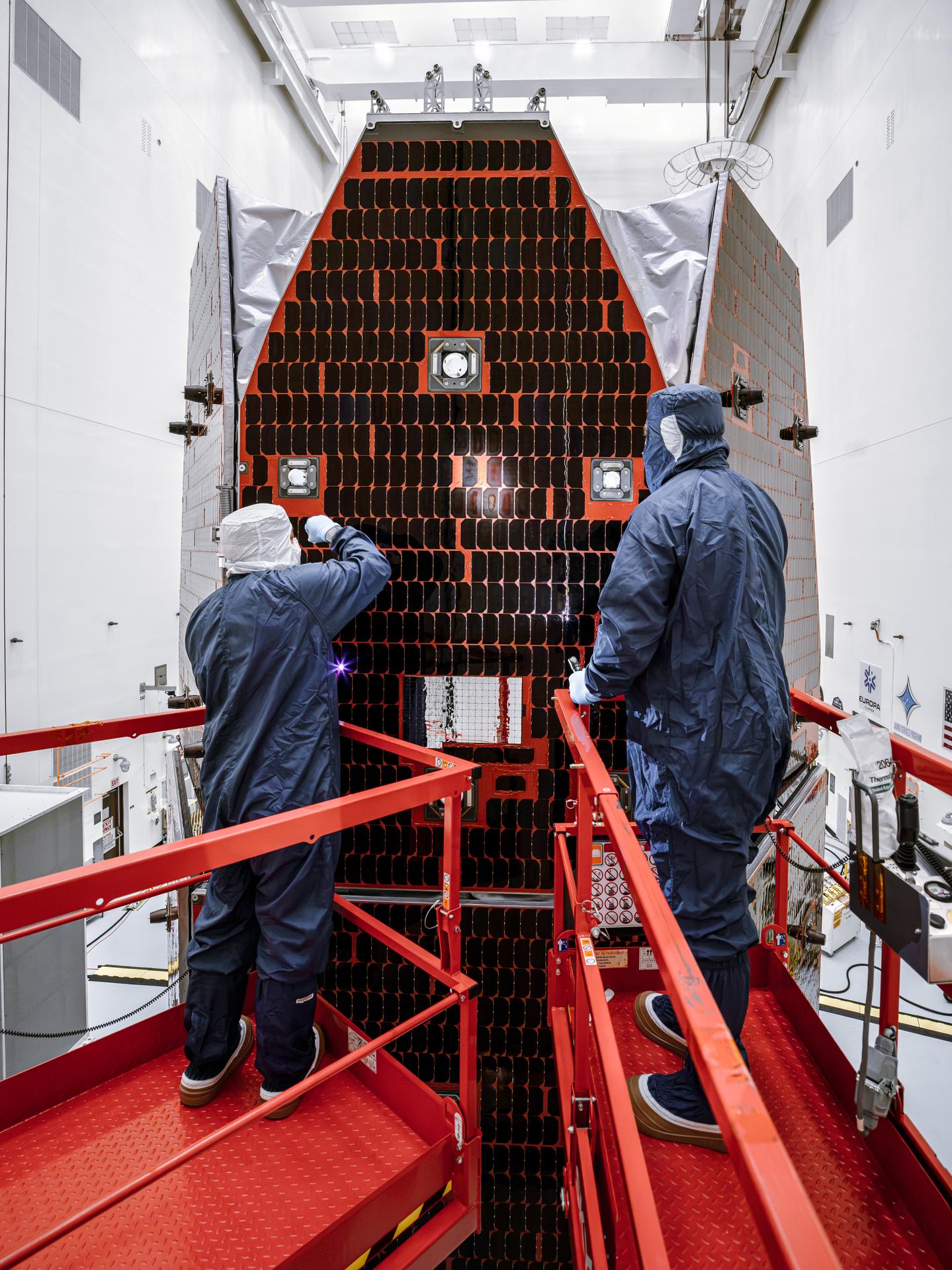
Technicians and engineers inside the Payload Hazardous Servicing Facility at NASA’s Kennedy Space Center in Florida clean and inspect the Solar Array Sun Shield (SASS) on the agency’s Nancy Grace Roman Space Telescope on Tuesday, July 14, 2026. The SASS is made up of six solar array panels, with the two center panels fixed while the four outer ones are deployed once in orbit. The Roman team will orient the SASS toward the Sun to provide power to the entire observatory and shade the telescope and instruments beneath. NASA designed this flagship mission to help astronomers explore dark matter, dark energy, and exoplanets.
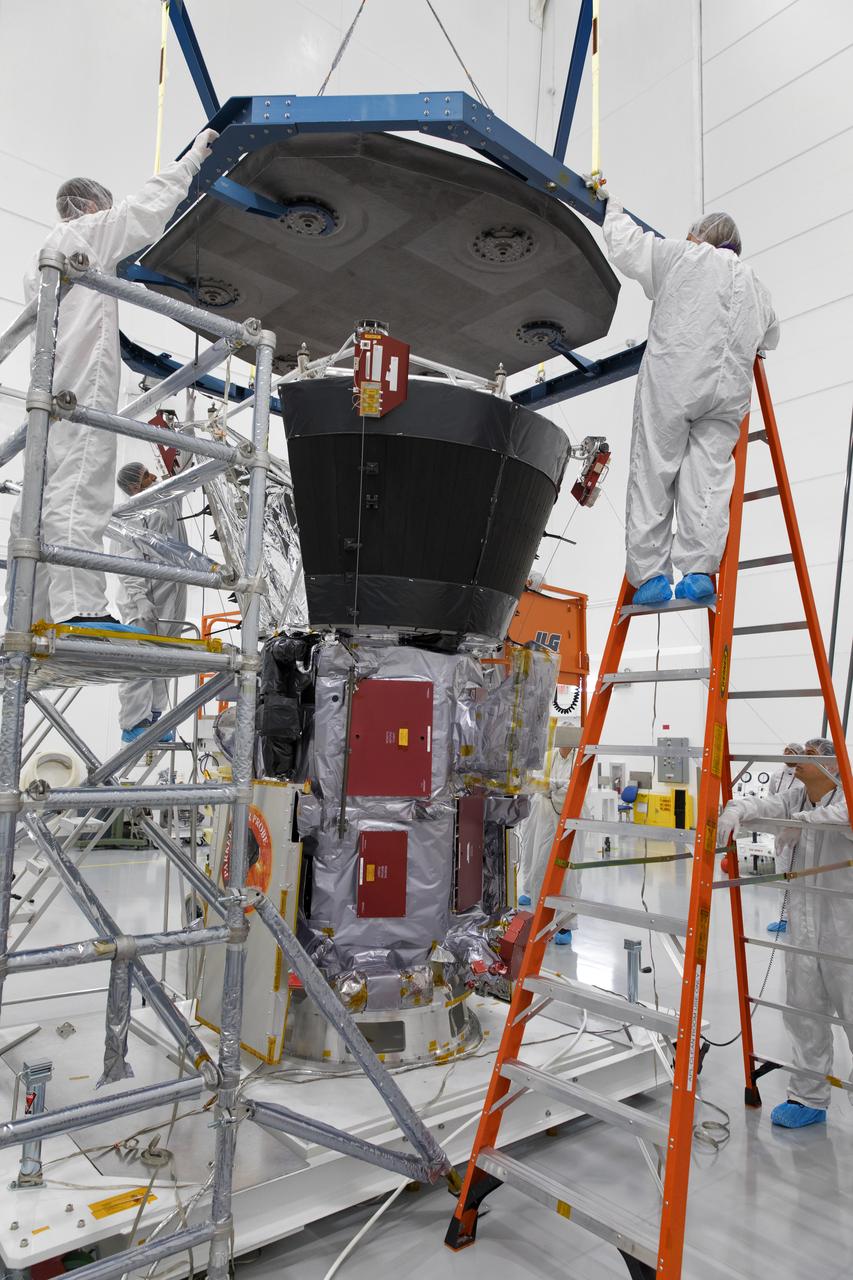
In the Astrotech processing facility in Titusville, Florida, near NASA's Kennedy Space Center, on Wednesday, June 27, 2018, technicians and engineers install the heat shield on NASA's Parker Solar Probe. The Parker Solar Probe will launch on a United Launch Alliance Delta IV Heavy rocket from Space Launch Complex 37 at Cape Canaveral Air Force Station in Florida no earlier than Aug. 4, 2018. The mission will perform the closest-ever observations of a star when it travels through the Sun's atmosphere, called the corona. The probe will rely on measurements and imaging to revolutionize our understanding of the corona and the Sun-Earth connection.
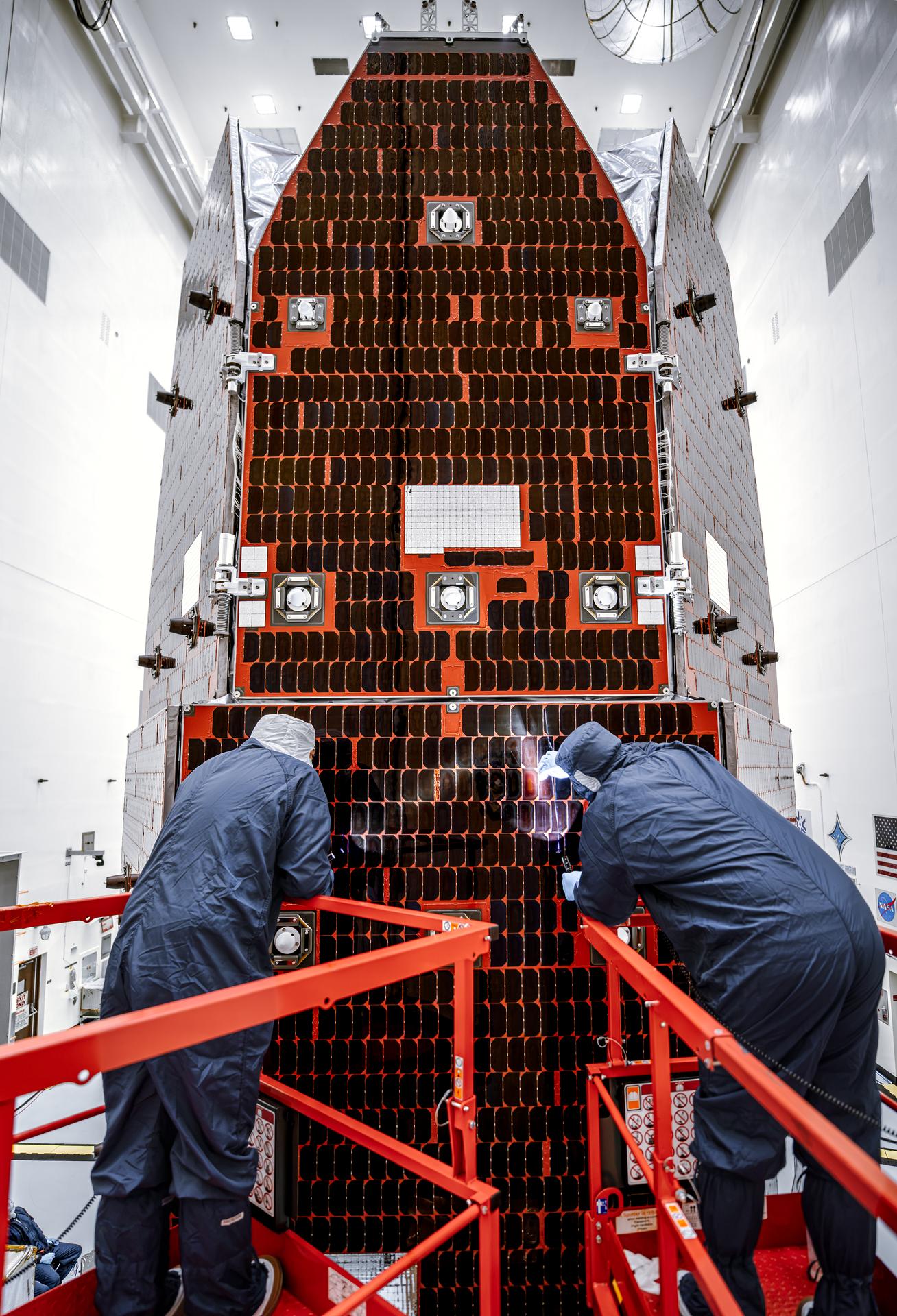
Technicians and engineers inside the Payload Hazardous Servicing Facility at NASA’s Kennedy Space Center in Florida clean and inspect the Solar Array Sun Shield (SASS) on the agency’s Nancy Grace Roman Space Telescope on Tuesday, July 14, 2026. The SASS is made up of six solar array panels, with the two center panels fixed while the four outer ones are deployed once in orbit. The Roman team will orient the SASS toward the Sun to provide power to the entire observatory and shade the telescope and instruments beneath. NASA designed this flagship mission to help astronomers explore dark matter, dark energy, and exoplanets.
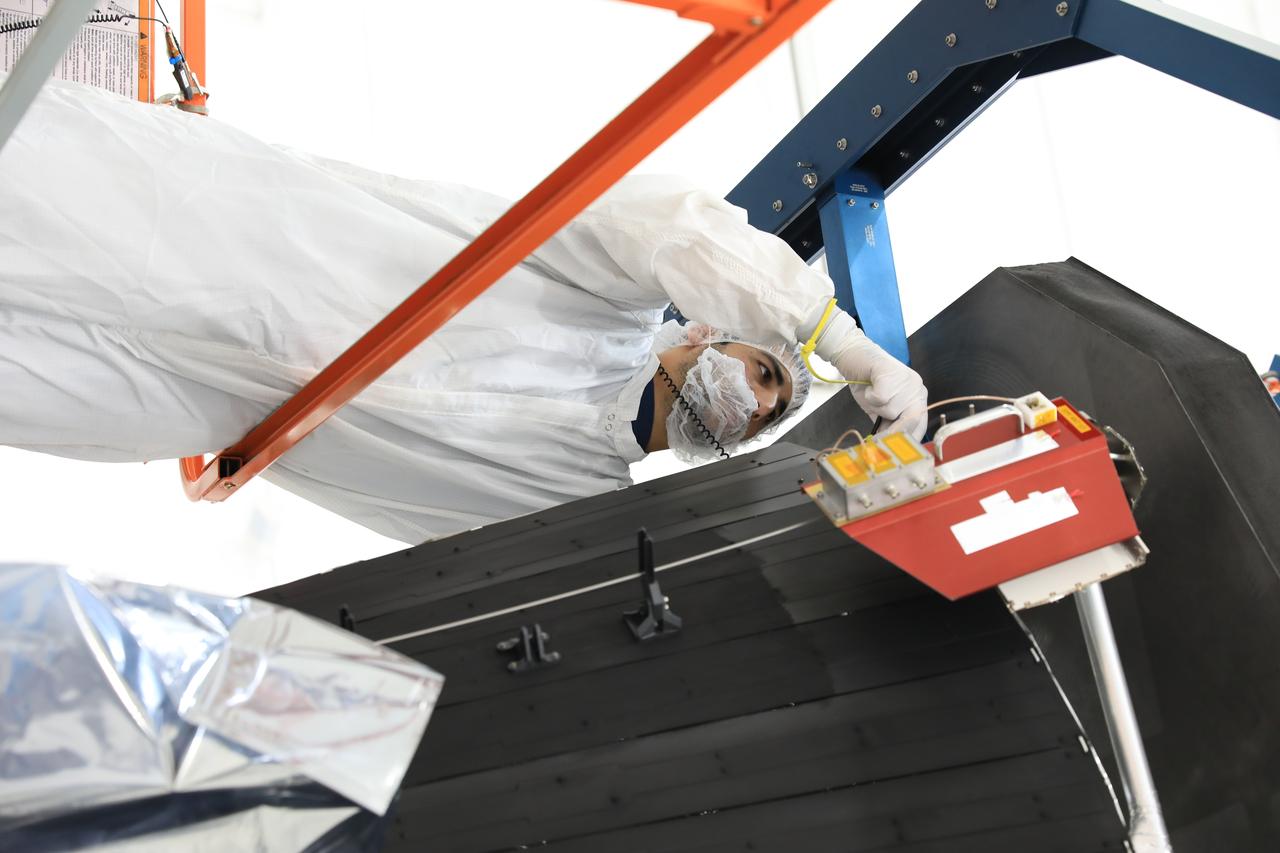
In the Astrotech processing facility in Titusville, Florida, near NASA's Kennedy Space Center, on Wednesday, June 27, 2018, technicians and engineers install the heat shield on NASA's Parker Solar Probe. The Parker Solar Probe will launch on a United Launch Alliance Delta IV Heavy rocket from Space Launch Complex 37 at Cape Canaveral Air Force Station in Florida no earlier than Aug. 4, 2018. The mission will perform the closest-ever observations of a star when it travels through the Sun's atmosphere, called the corona. The probe will rely on measurements and imaging to revolutionize our understanding of the corona and the Sun-Earth connection.
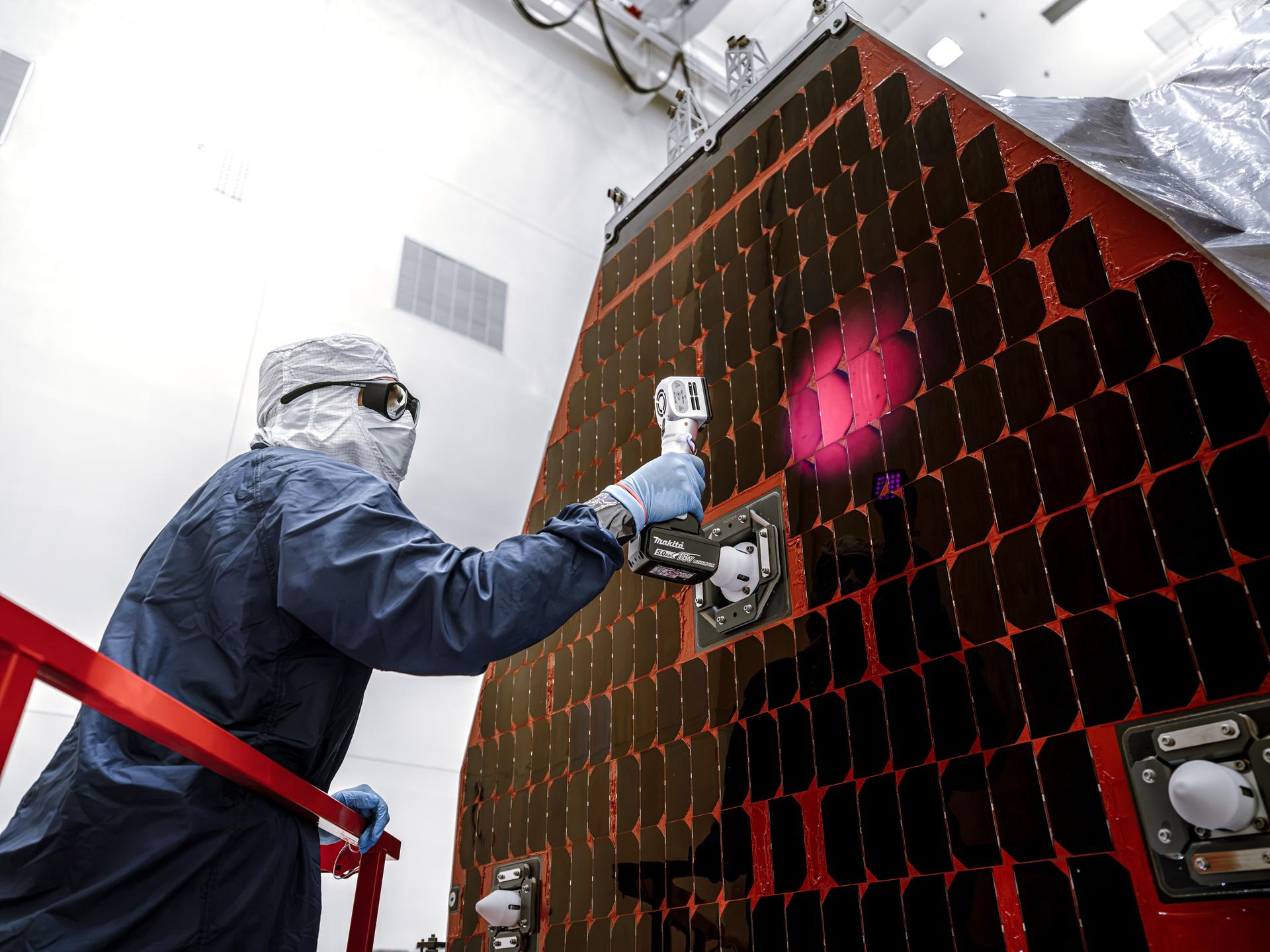
Technicians and engineers inside the Payload Hazardous Servicing Facility at NASA’s Kennedy Space Center in Florida clean and inspect the Solar Array Sun Shield (SASS) on the agency’s Nancy Grace Roman Space Telescope on Tuesday, July 14, 2026. The SASS is made up of six solar array panels, with the two center panels fixed while the four outer ones are deployed once in orbit. The Roman team will orient the SASS toward the Sun to provide power to the entire observatory and shade the telescope and instruments beneath. NASA designed this flagship mission to help astronomers explore dark matter, dark energy, and exoplanets.
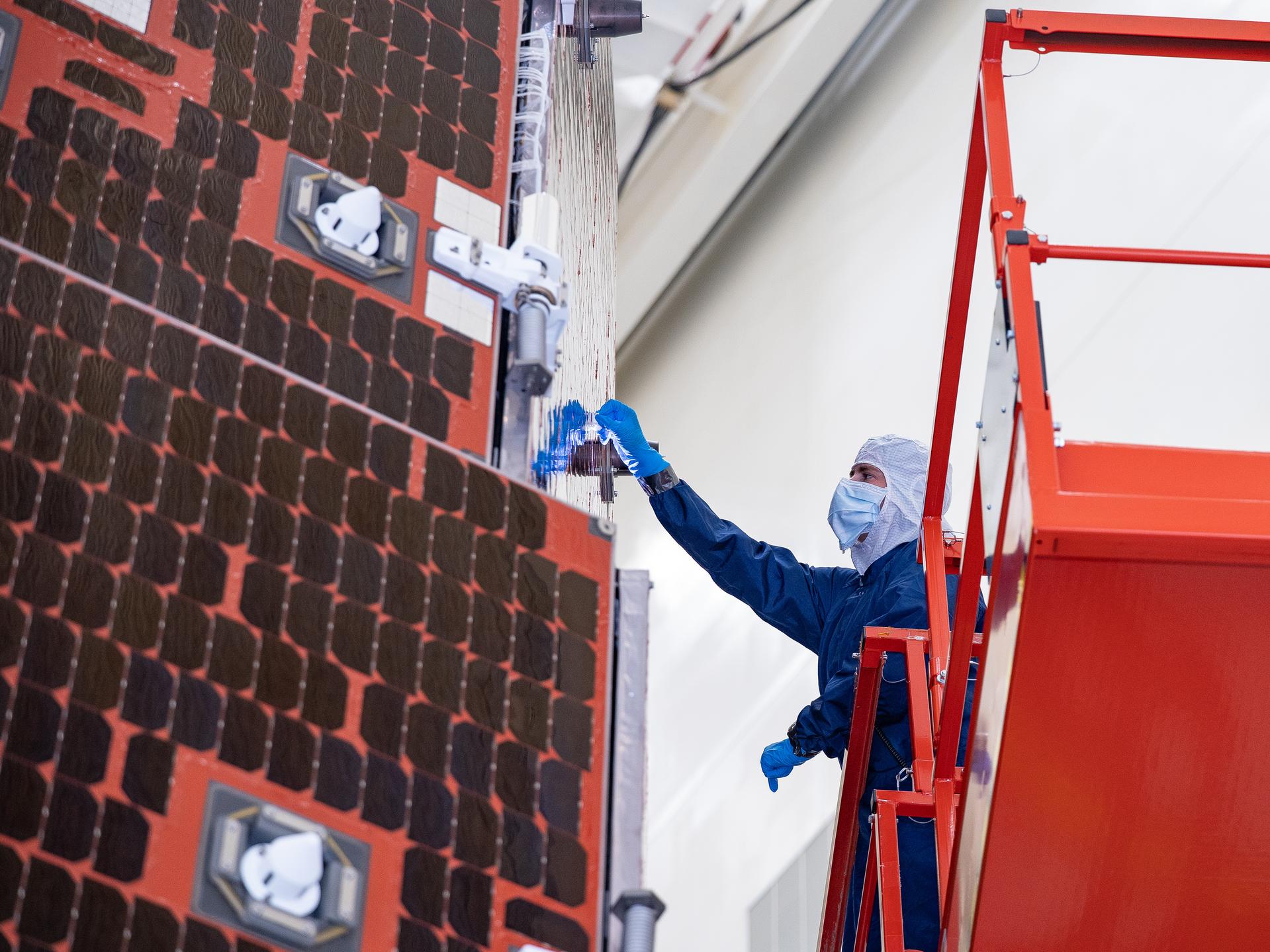
Technicians and engineers inside the Payload Hazardous Servicing Facility at NASA’s Kennedy Space Center in Florida clean and inspect the Solar Array Sun Shield (SASS) on the agency’s Nancy Grace Roman Space Telescope on Thursday, July 9, 2026. The SASS is made up of six solar array panels, with the two center panels fixed while the four outer ones are deployed once in orbit. The Roman team will orient the SASS toward the Sun to provide power to the entire observatory and shade the telescope and instruments beneath. NASA designed this flagship mission to help astronomers explore dark matter, dark energy, and exoplanets.
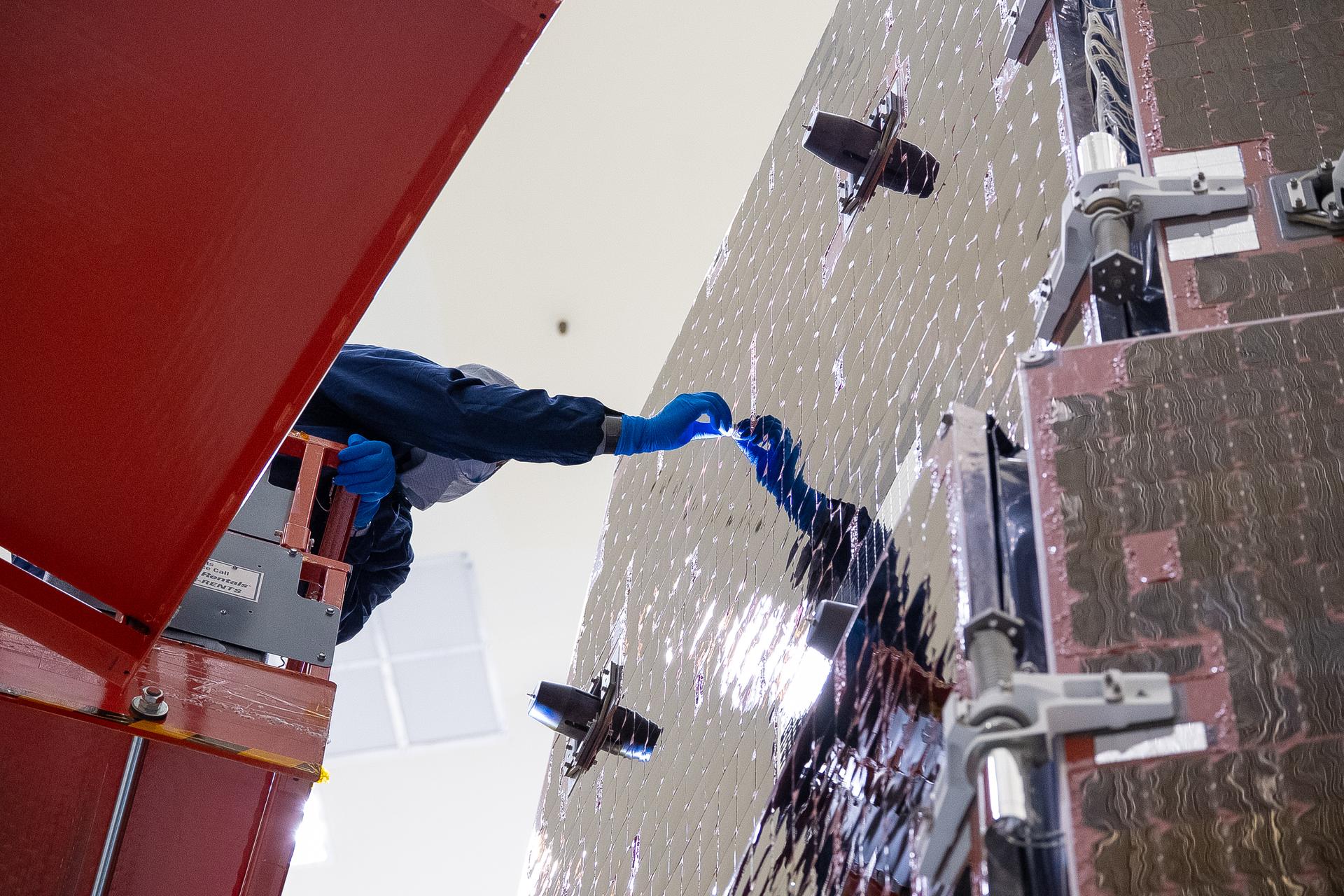
Technicians and engineers inside the Payload Hazardous Servicing Facility at NASA’s Kennedy Space Center in Florida clean and inspect the Solar Array Sun Shield (SASS) on the agency’s Nancy Grace Roman Space Telescope on Wednesday, July 8, 2026. The SASS is made up of six solar array panels, with the two center panels fixed while the four outer ones are deployed once in orbit. The Roman team will orient the SASS toward the Sun to provide power to the entire observatory and shade the telescope and instruments beneath. NASA designed this flagship mission to help astronomers explore dark matter, dark energy, and exoplanets.
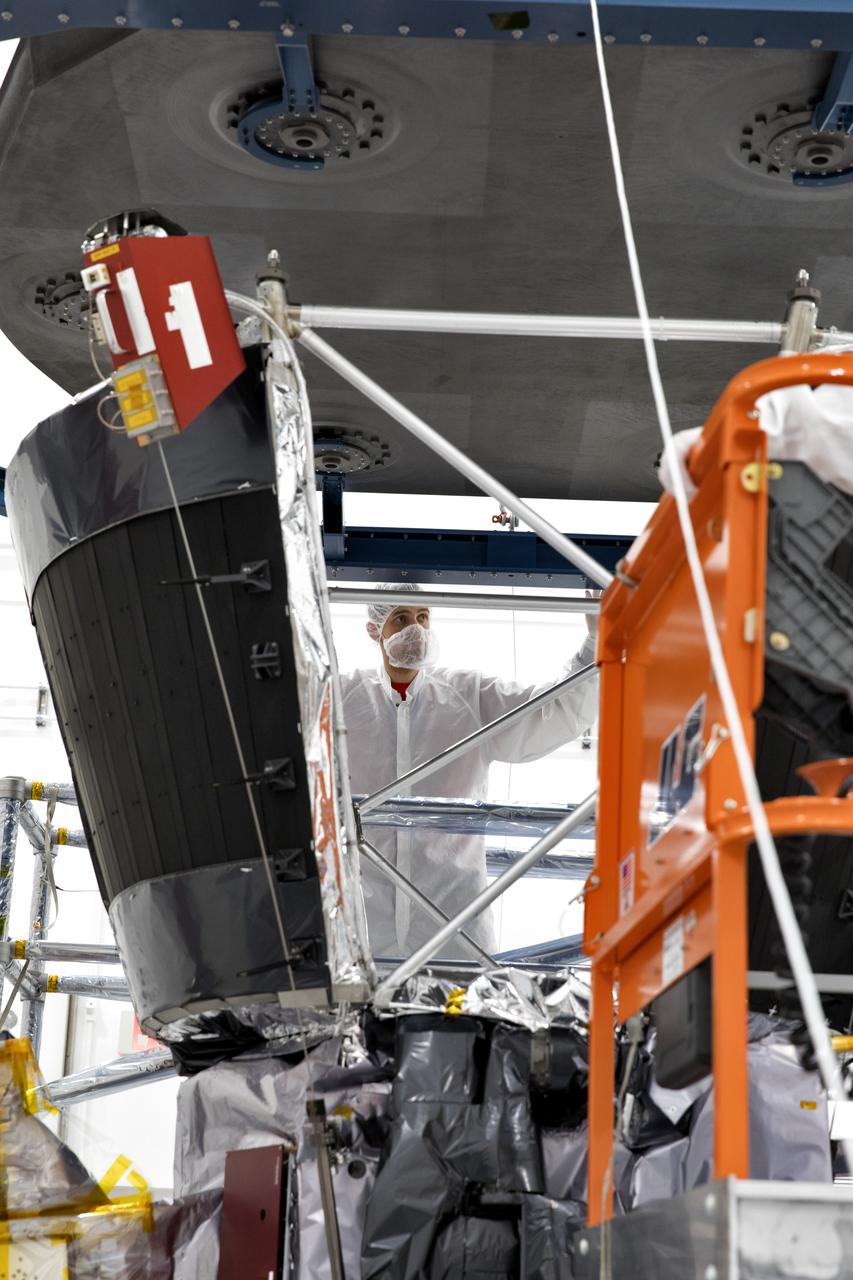
In the Astrotech processing facility in Titusville, Florida, near NASA's Kennedy Space Center, on Wednesday, June 27, 2018, technicians and engineers install the heat shield on NASA's Parker Solar Probe. The Parker Solar Probe will launch on a United Launch Alliance Delta IV Heavy rocket from Space Launch Complex 37 at Cape Canaveral Air Force Station in Florida no earlier than Aug. 4, 2018. The mission will perform the closest-ever observations of a star when it travels through the Sun's atmosphere, called the corona. The probe will rely on measurements and imaging to revolutionize our understanding of the corona and the Sun-Earth connection.
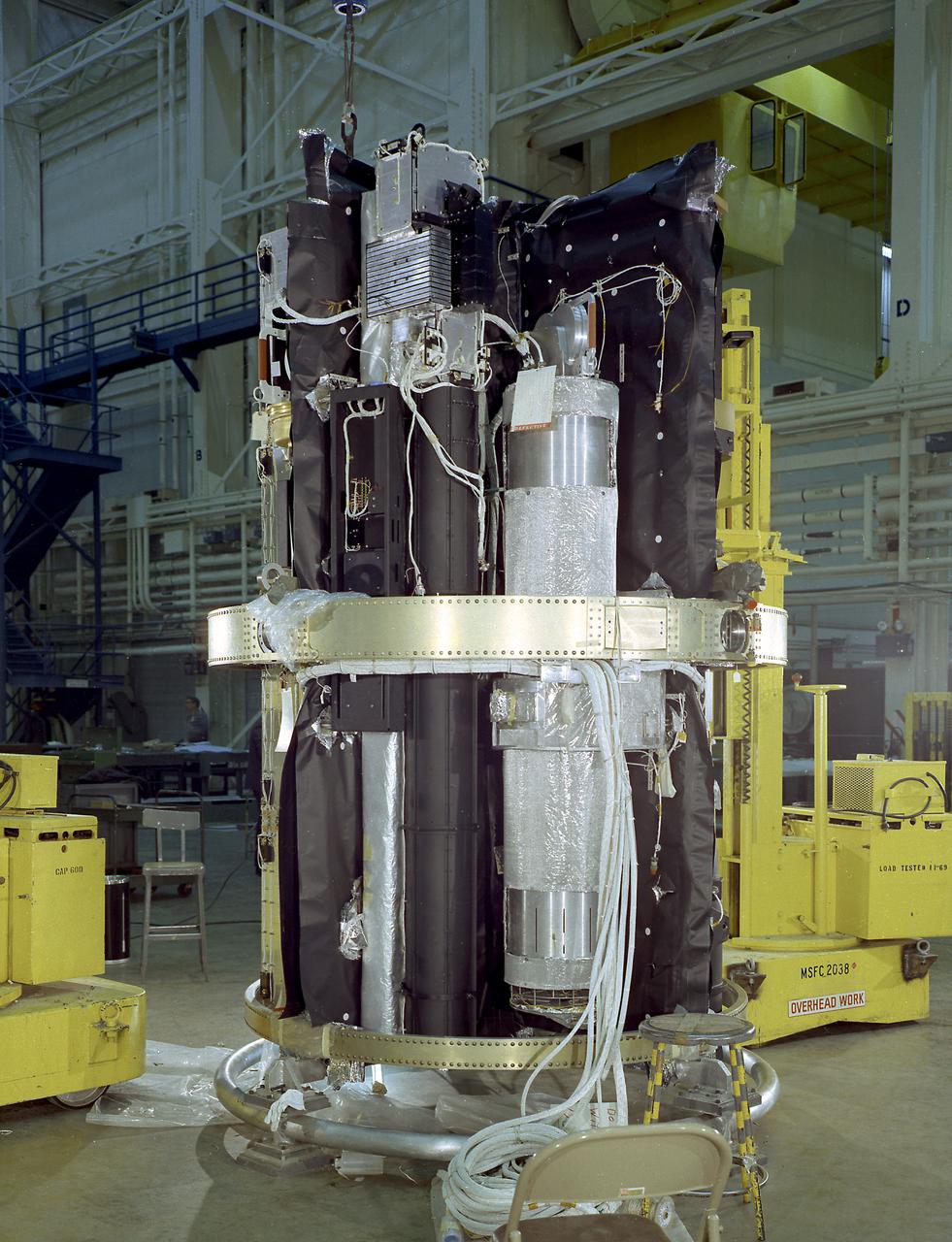
The Apollo Telescope Mount (ATM), designed and developed by the Marshall Space Flight Center, served as the primary scientific instrument unit aboard the Skylab. The ATM contained eight complex astronomical instruments designed to observe the Sun over a wide spectrum from visible light to x-rays. This image shows the ATM spar assembly. All solar telescopes, the fine Sun sensors, and some auxiliary systems are mounted on the spar, a cruciform lightweight perforated metal mounting panel that divides the 10-foot long canister lengthwise into four equal compartments. The spar assembly was nested inside a cylindrical canister that fit into the rack, a complex frame, and was protected by the solar shield.
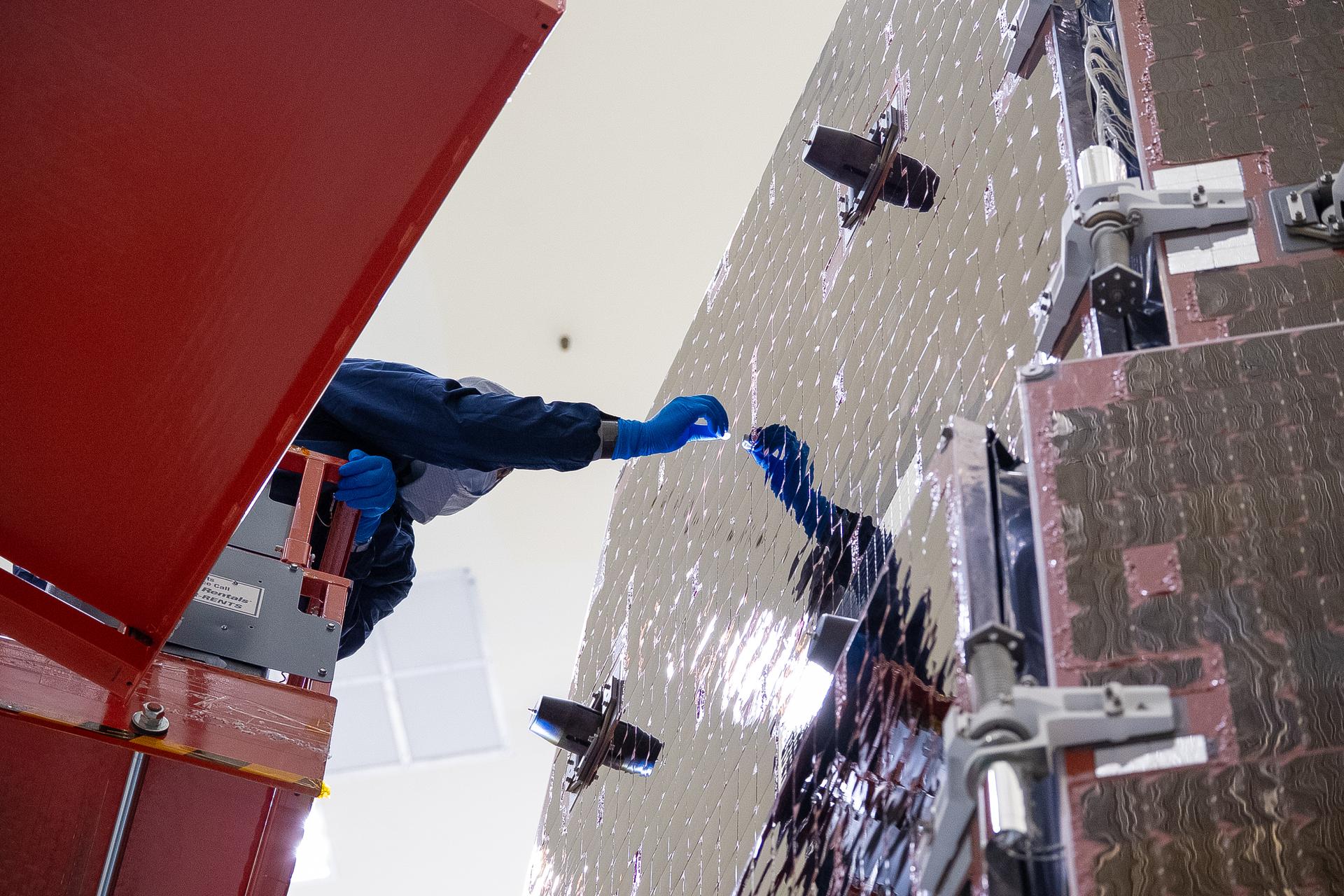
Technicians and engineers inside the Payload Hazardous Servicing Facility at NASA’s Kennedy Space Center in Florida clean and inspect the Solar Array Sun Shield (SASS) on the agency’s Nancy Grace Roman Space Telescope on Wednesday, July 8, 2026. The SASS is made up of six solar array panels, with the two center panels fixed while the four outer ones are deployed once in orbit. The Roman team will orient the SASS toward the Sun to provide power to the entire observatory and shade the telescope and instruments beneath. NASA designed this flagship mission to help astronomers explore dark matter, dark energy, and exoplanets.
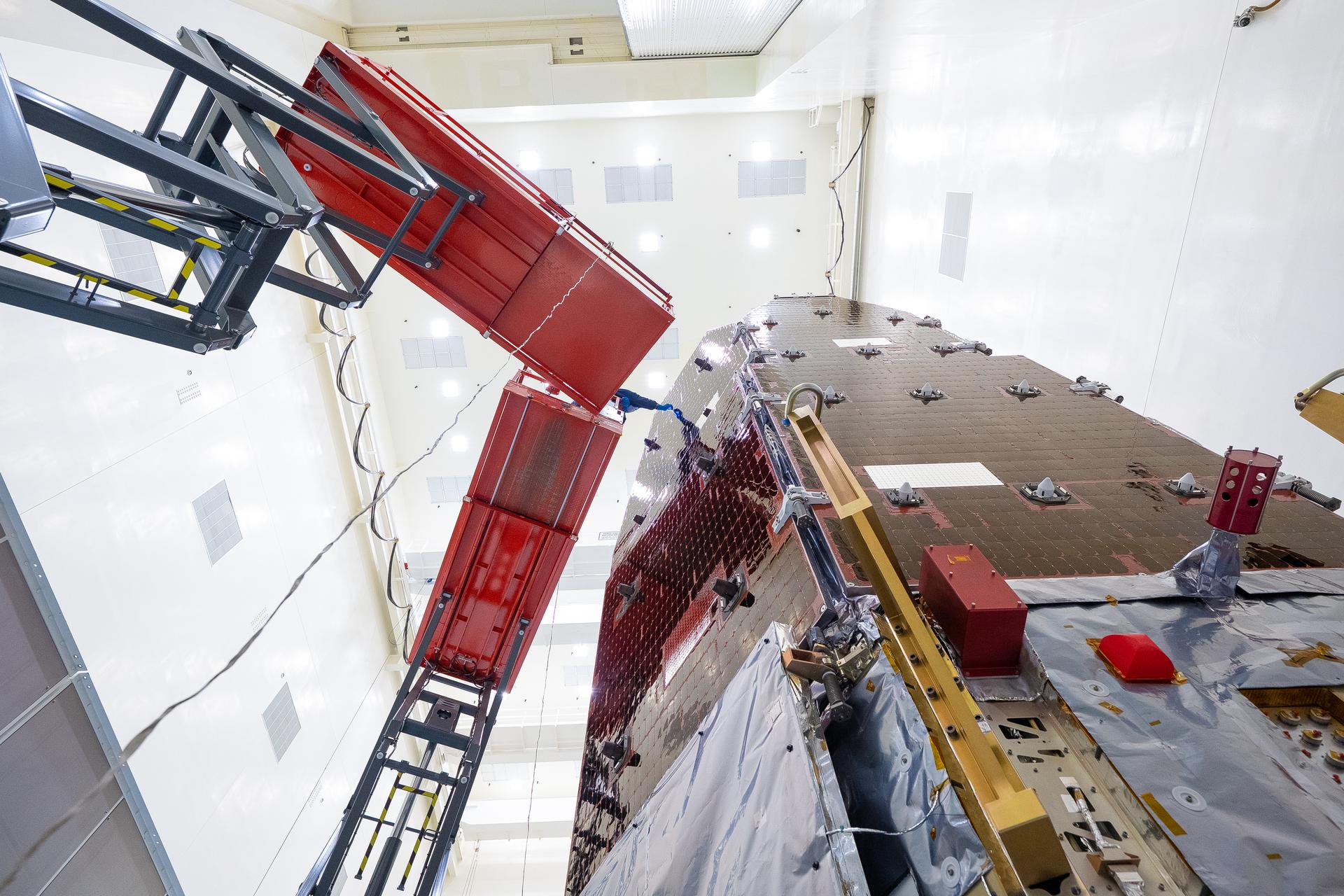
Technicians and engineers inside the Payload Hazardous Servicing Facility at NASA’s Kennedy Space Center in Florida clean and inspect the Solar Array Sun Shield (SASS) on the agency’s Nancy Grace Roman Space Telescope on Wednesday, July 8, 2026. The SASS is made up of six solar array panels, with the two center panels fixed while the four outer ones are deployed once in orbit. The Roman team will orient the SASS toward the Sun to provide power to the entire observatory and shade the telescope and instruments beneath. NASA designed this flagship mission to help astronomers explore dark matter, dark energy, and exoplanets.
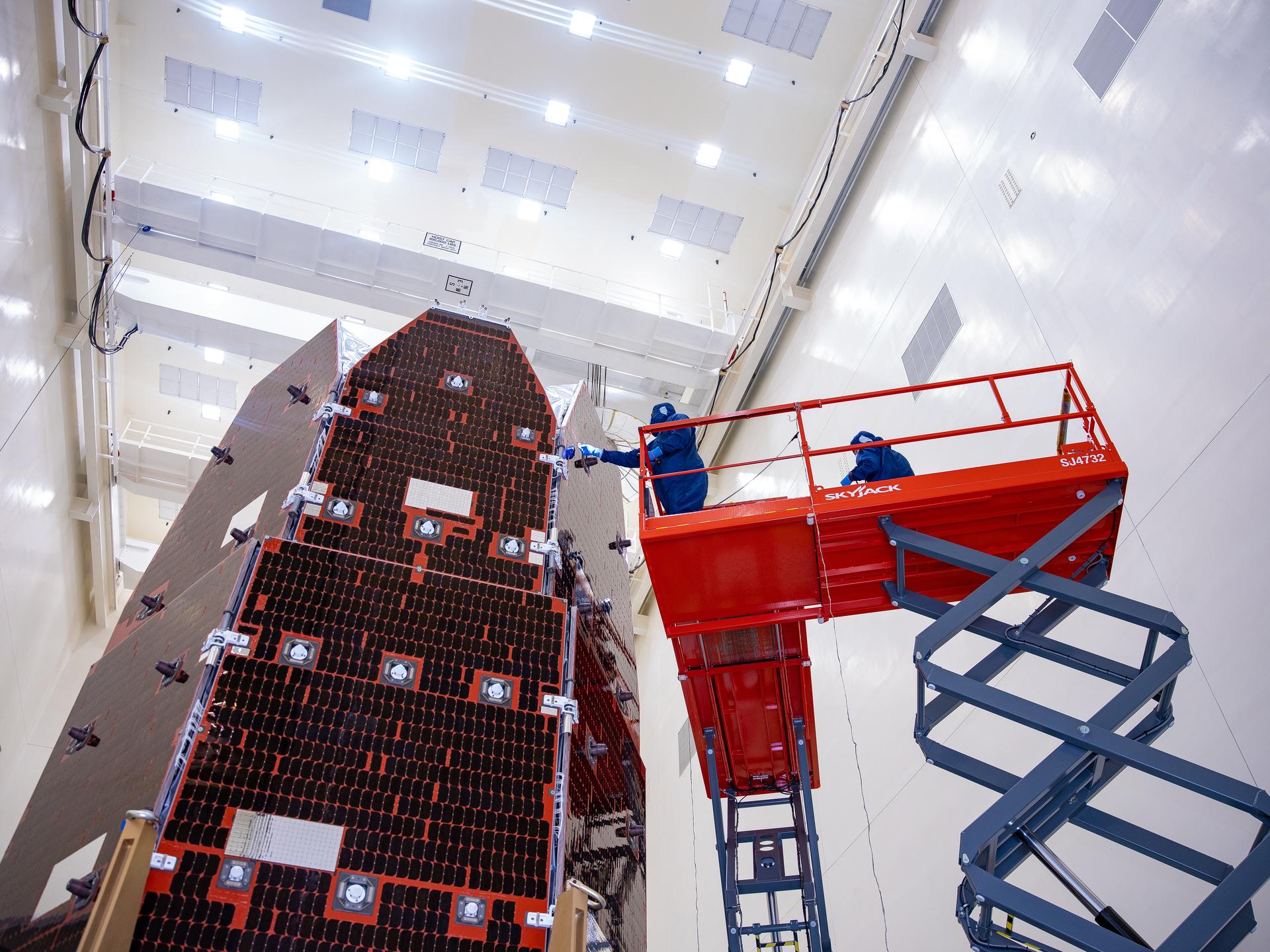
Technicians and engineers inside the Payload Hazardous Servicing Facility at NASA’s Kennedy Space Center in Florida clean and inspect the Solar Array Sun Shield (SASS) on the agency’s Nancy Grace Roman Space Telescope on Thursday, July 9, 2026. The SASS is made up of six solar array panels, with the two center panels fixed while the four outer ones are deployed once in orbit. The Roman team will orient the SASS toward the Sun to provide power to the entire observatory and shade the telescope and instruments beneath. NASA designed this flagship mission to help astronomers explore dark matter, dark energy, and exoplanets.
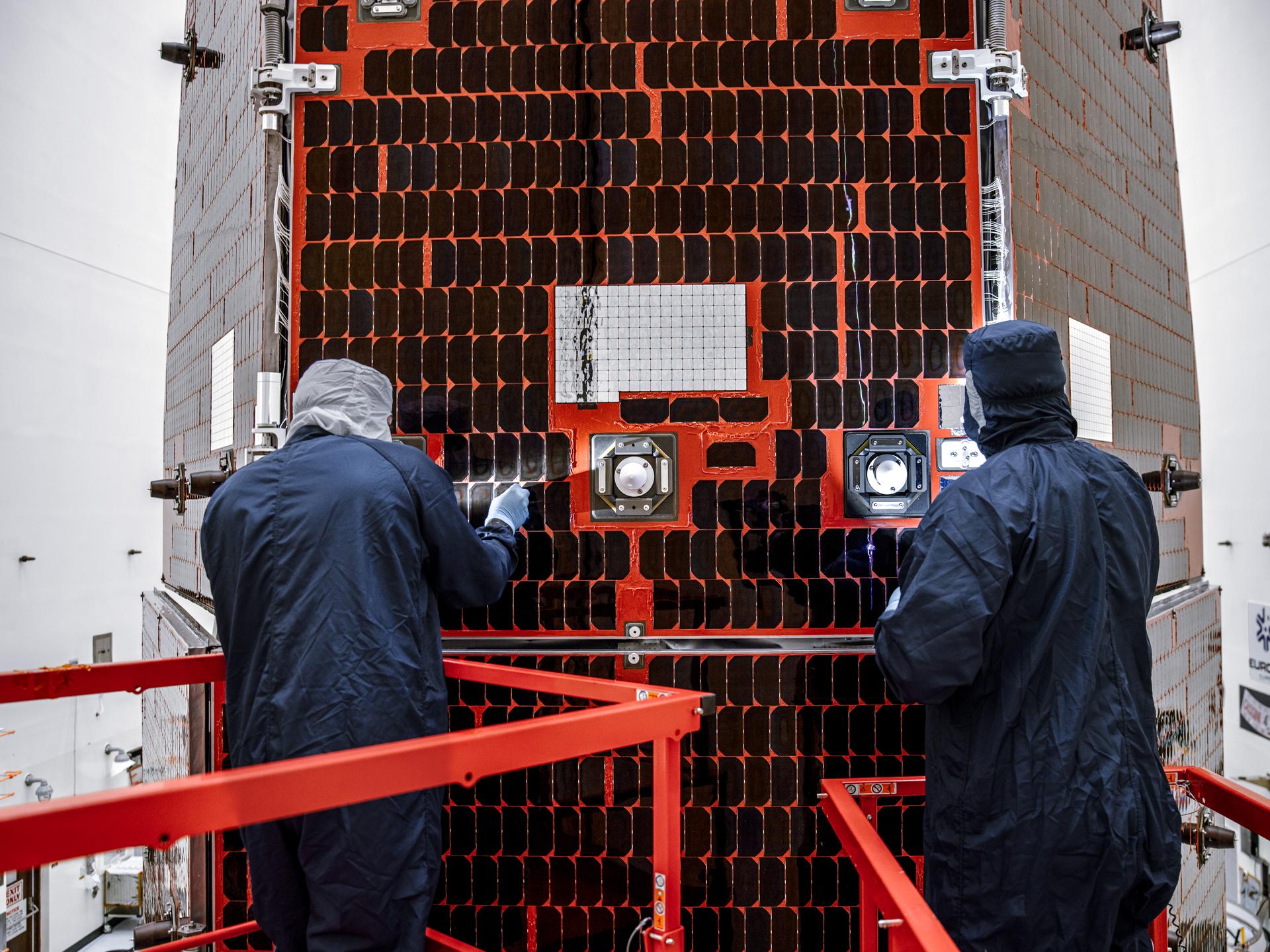
Technicians and engineers inside the Payload Hazardous Servicing Facility at NASA’s Kennedy Space Center in Florida clean and inspect the Solar Array Sun Shield (SASS) on the agency’s Nancy Grace Roman Space Telescope on Tuesday, July 14, 2026. The SASS is made up of six solar array panels, with the two center panels fixed while the four outer ones are deployed once in orbit. The Roman team will orient the SASS toward the Sun to provide power to the entire observatory and shade the telescope and instruments beneath. NASA designed this flagship mission to help astronomers explore dark matter, dark energy, and exoplanets.
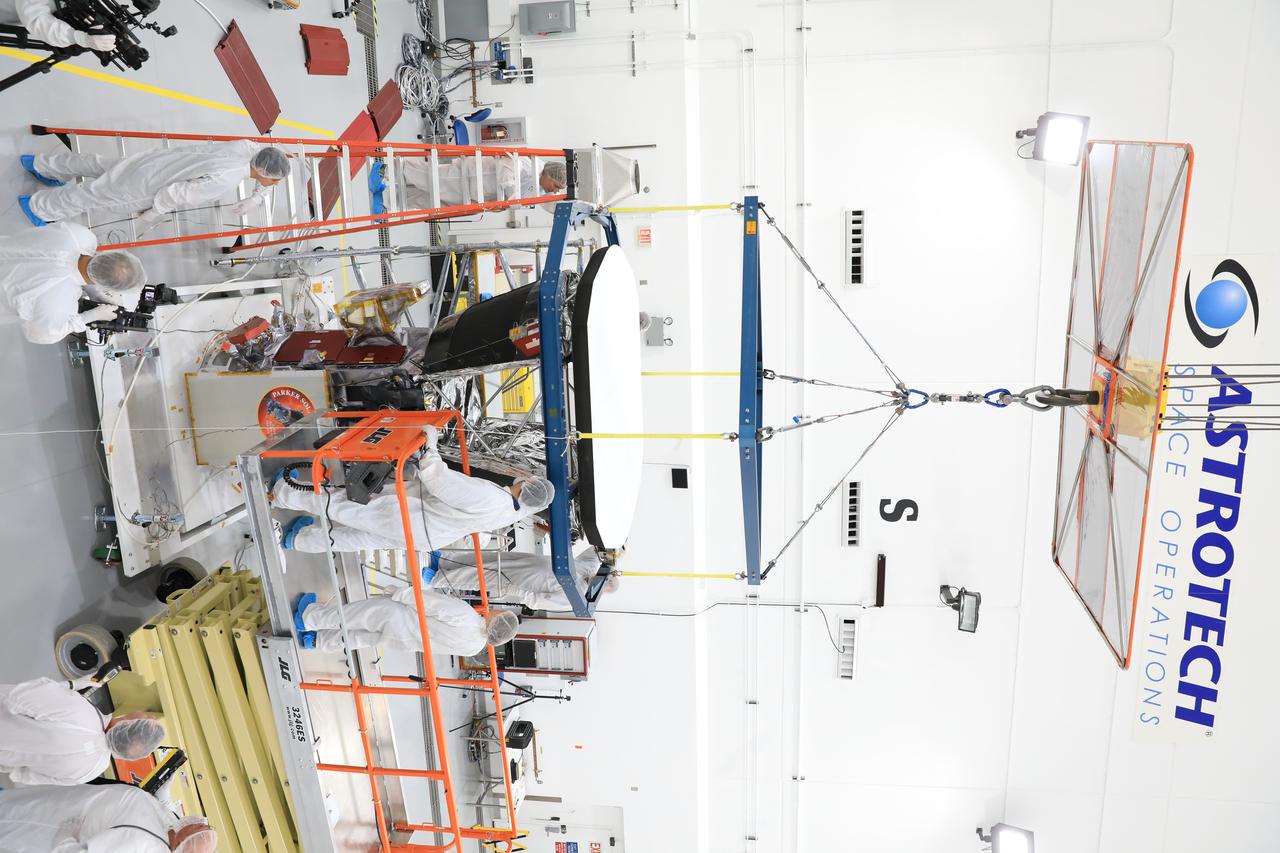
In the Astrotech processing facility in Titusville, Florida, near NASA's Kennedy Space Center, on Wednesday, June 27, 2018, technicians and engineers use a crane to install the heat shield on NASA's Parker Solar Probe. The Parker Solar Probe will launch on a United Launch Alliance Delta IV Heavy rocket from Space Launch Complex 37 at Cape Canaveral Air Force Station in Florida no earlier than Aug. 4, 2018. The mission will perform the closest-ever observations of a star when it travels through the Sun's atmosphere, called the corona. The probe will rely on measurements and imaging to revolutionize our understanding of the corona and the Sun-Earth connection.
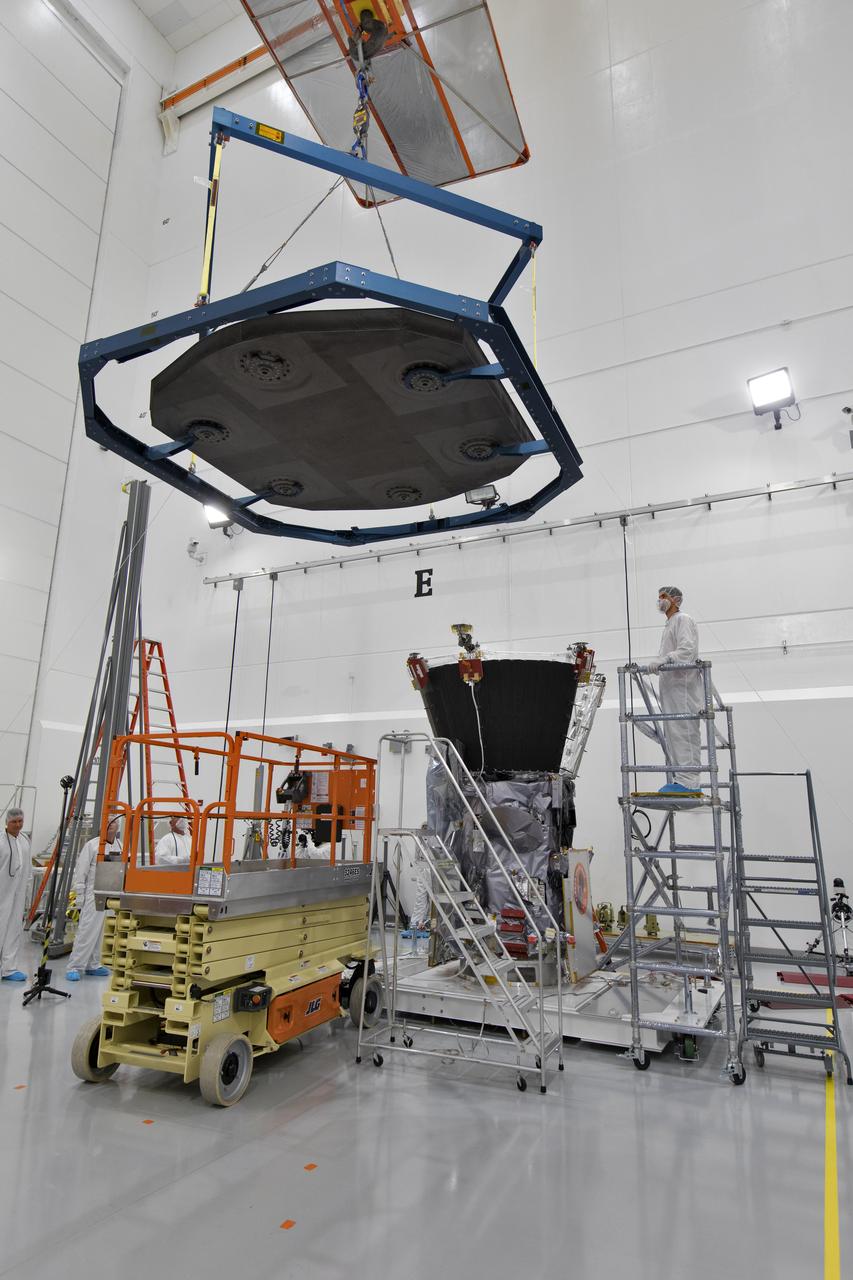
In the Astrotech processing facility in Titusville, Florida, near NASA's Kennedy Space Center, on Wednesday, June 27, 2018, technicians and engineers use a crane to install the heat shield on NASA's Parker Solar Probe. The Parker Solar Probe will launch on a United Launch Alliance Delta IV Heavy rocket from Space Launch Complex 37 at Cape Canaveral Air Force Station in Florida no earlier than Aug. 4, 2018. The mission will perform the closest-ever observations of a star when it travels through the Sun's atmosphere, called the corona. The probe will rely on measurements and imaging to revolutionize our understanding of the corona and the Sun-Earth connection.
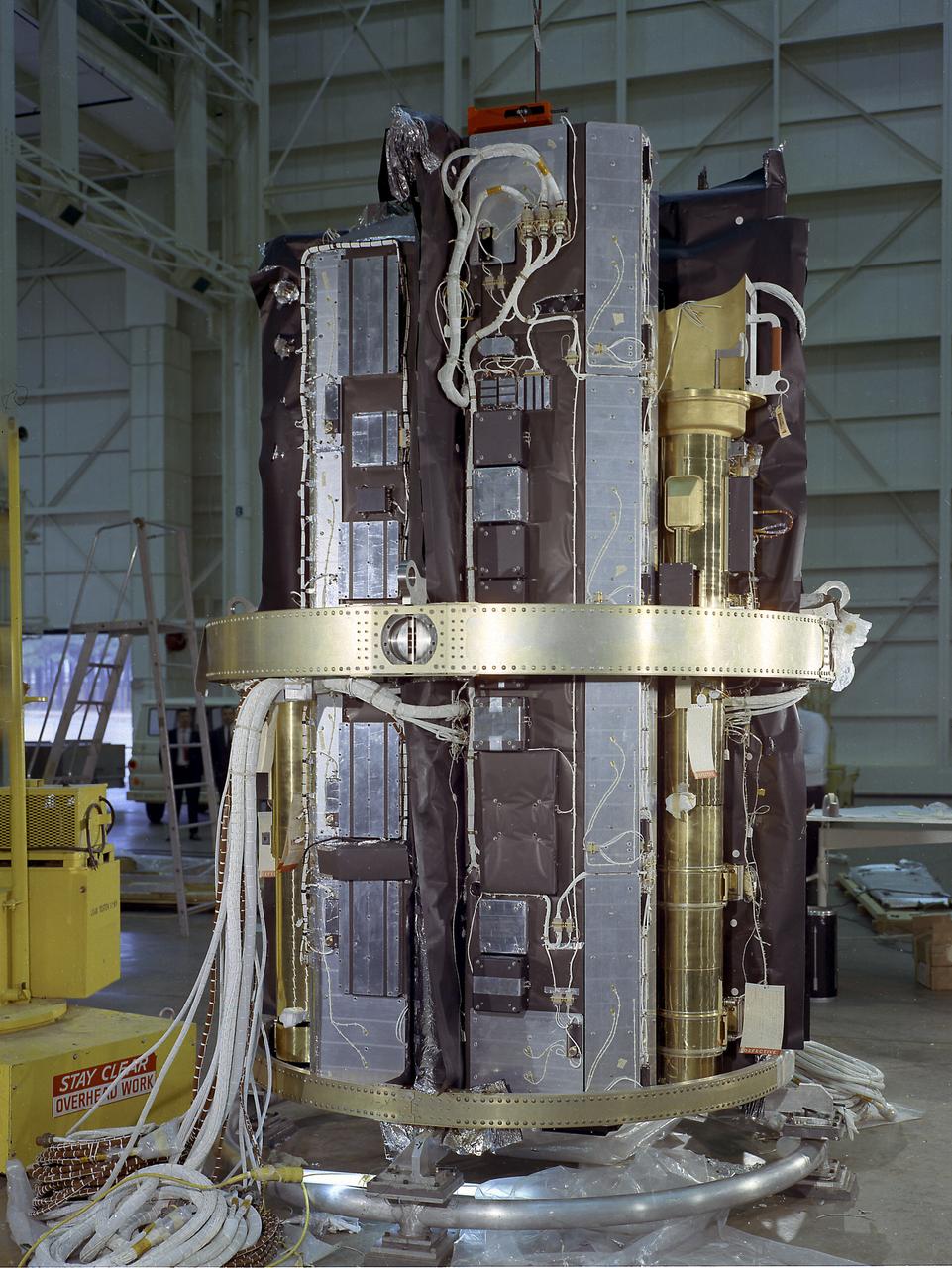
The Apollo Telescope Mount (ATM), designed and developed by the Marshall Space Flight Center, served as the primary scientific instrument unit aboard the Skylab. The ATM contained eight complex astronomical instruments designed to observe the Sun over a wide spectrum from visible light to x-rays. This image shows the ATM spar assembly. All solar telescopes, the fine Sun sensors, and some auxiliary systems are mounted on the spar, a cruciform lightweight perforated metal mounting panel that divides the 10-foot long canister lengthwise into four equal compartments. The spar assembly was nested inside a cylindrical canister that fit into the rack, a complex frame, and was protected by the solar shield.
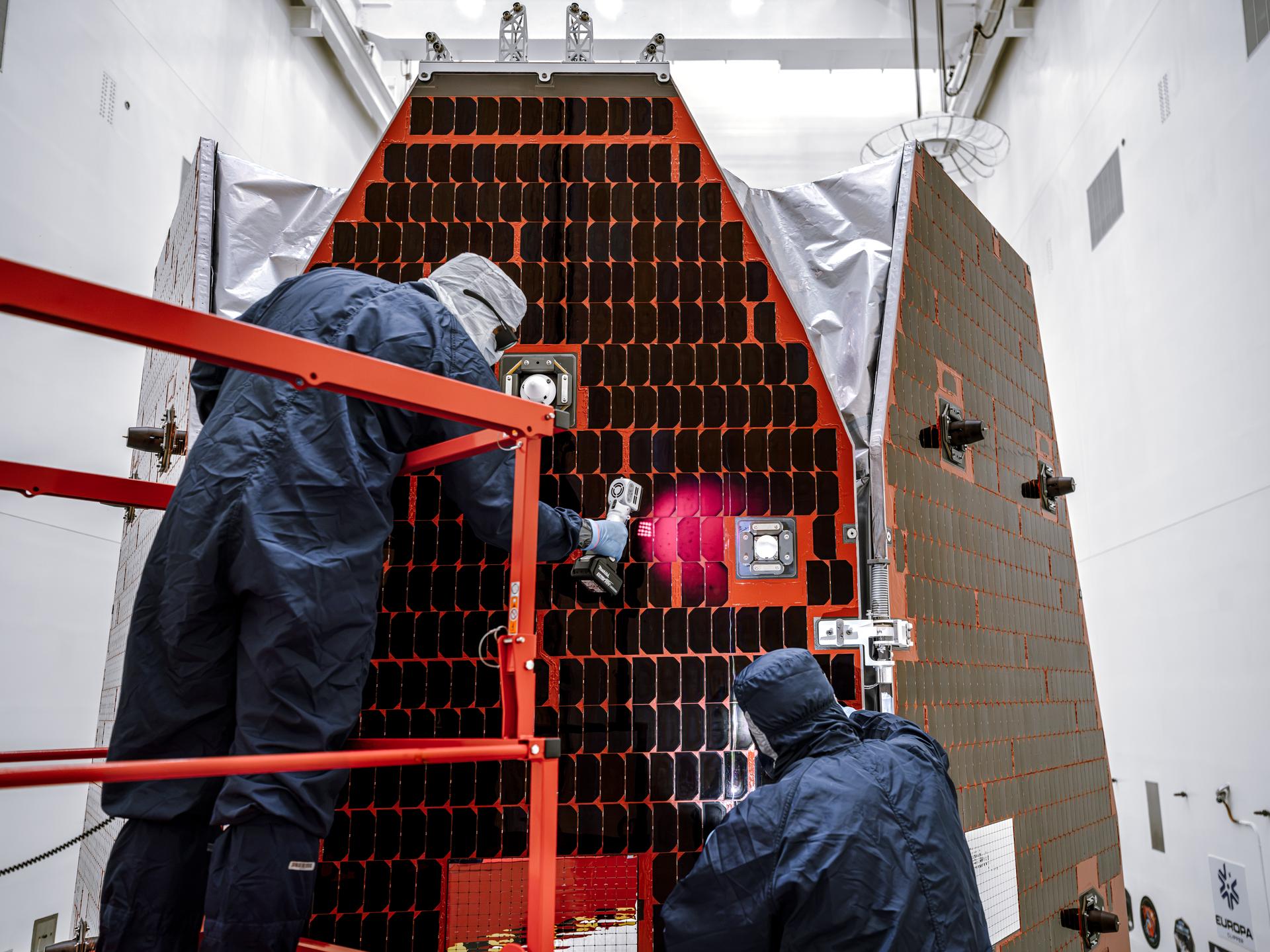
Technicians and engineers inside the Payload Hazardous Servicing Facility at NASA’s Kennedy Space Center in Florida clean and inspect the Solar Array Sun Shield (SASS) on the agency’s Nancy Grace Roman Space Telescope on Tuesday, July 14, 2026. The SASS is made up of six solar array panels, with the two center panels fixed while the four outer ones are deployed once in orbit. The Roman team will orient the SASS toward the Sun to provide power to the entire observatory and shade the telescope and instruments beneath. NASA designed this flagship mission to help astronomers explore dark matter, dark energy, and exoplanets.
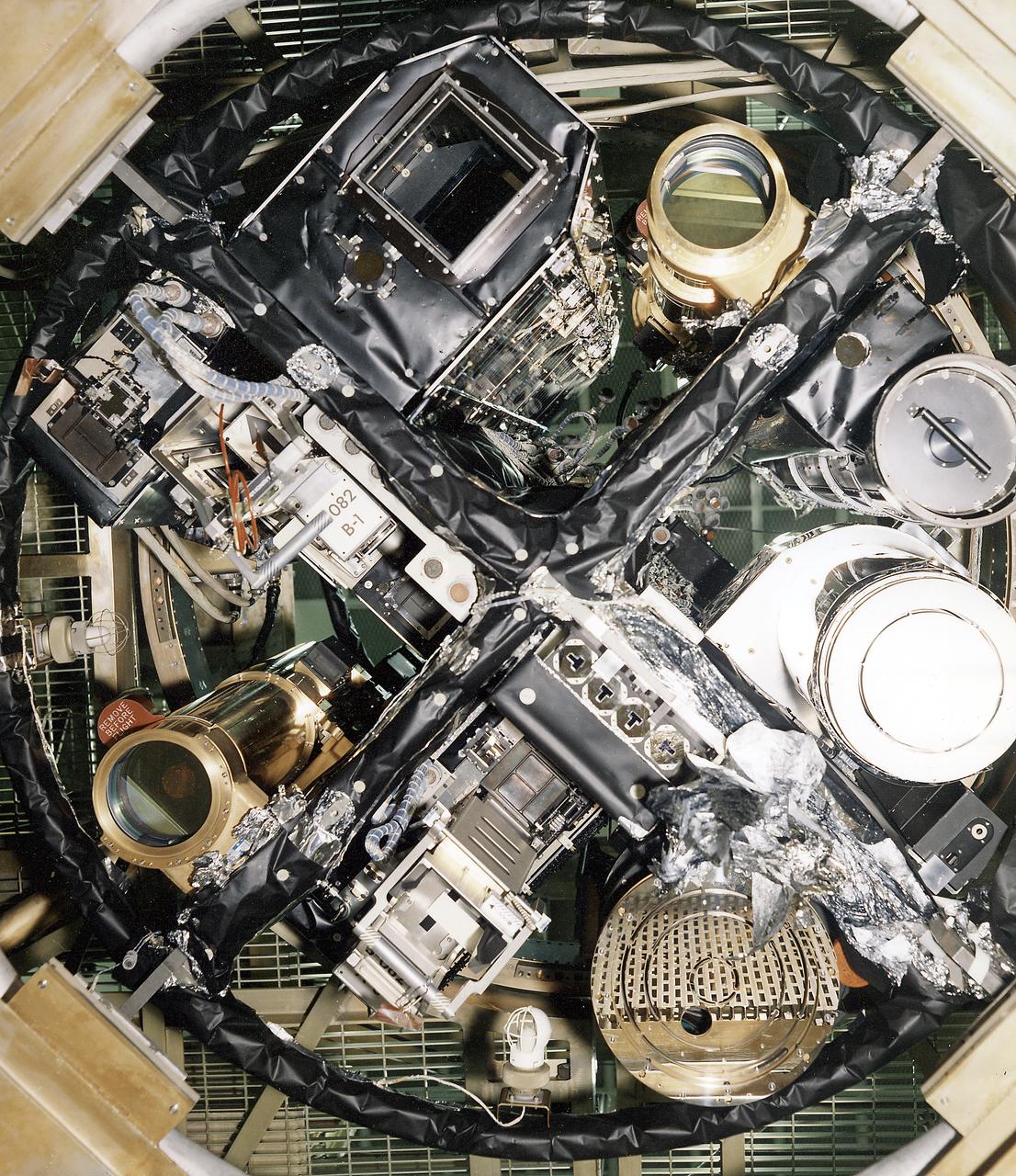
The Apollo Telescope Mount (ATM) was designed and developed by the Marshall Space Flight Center and served as the primary scientific instrument unit aboard Skylab (1973-1979). The ATM contained eight complex astronomical instruments designed to observe the Sun over a wide spectrum from visible light to x-rays. This image depicts the sun end and spar of the ATM flight unit showing individual telescopes. All solar telescopes, the fine Sun sensors, and some auxiliary systems are mounted on the spar, a cruciform lightweight perforated metal mounting panel that divides the canister lengthwise into four equal compartments. The spar assembly was nested inside a cylindrical canister that fit into a complex frame named the rack, and was protected by the solar shield.
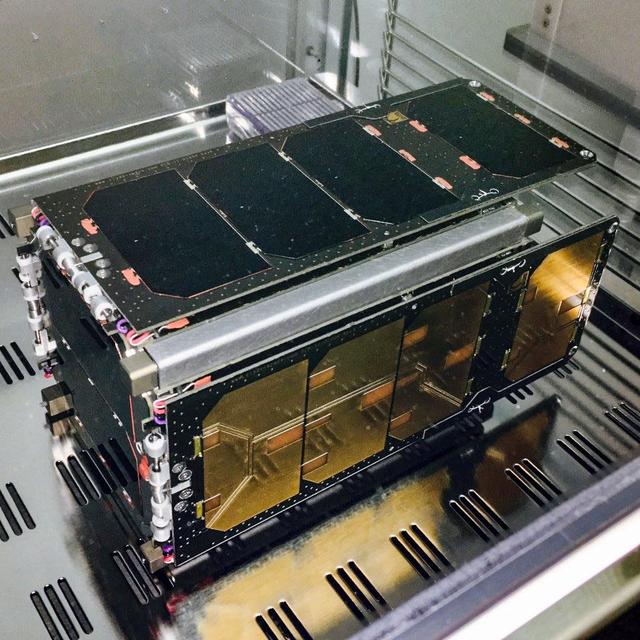
Jsc2020e004942(2/7/2020) — A preflight view of the CryoCube BUS. CryoCube demonstrates on-orbit thermal management technology. Such technology has a variety of potential applications, including storing rocket propellants in space, cooling instruments to improve their signal-to-noise ratios, and supporting future cryogenic experiments in microgravity. The small satellite uses a deployable shield to block radiation from the Sun and Earth and an attitude control system to point its experiment into deep space. Image courtesy of: Sierra Lobo Inc.

NASA’s TRACERS (Tandem Reconnection and Cusp Electrodynamics Reconnaissance Satellites) mission launches at 11:13 a.m. PDT (2:13 p.m. EDT) on Wednesday, July 23, 2025, atop a SpaceX Falcon 9 rocket at Space Launch Complex 4 East at Vandenberg Space Force Base in California. The TRACERS mission will study magnetic reconnection around Earth — a process in which electrically charged plasmas exchange energy in the atmosphere — to understand how the Sun’s solar wind interacts with the magnetosphere, Earth’s protective magnetic shield.
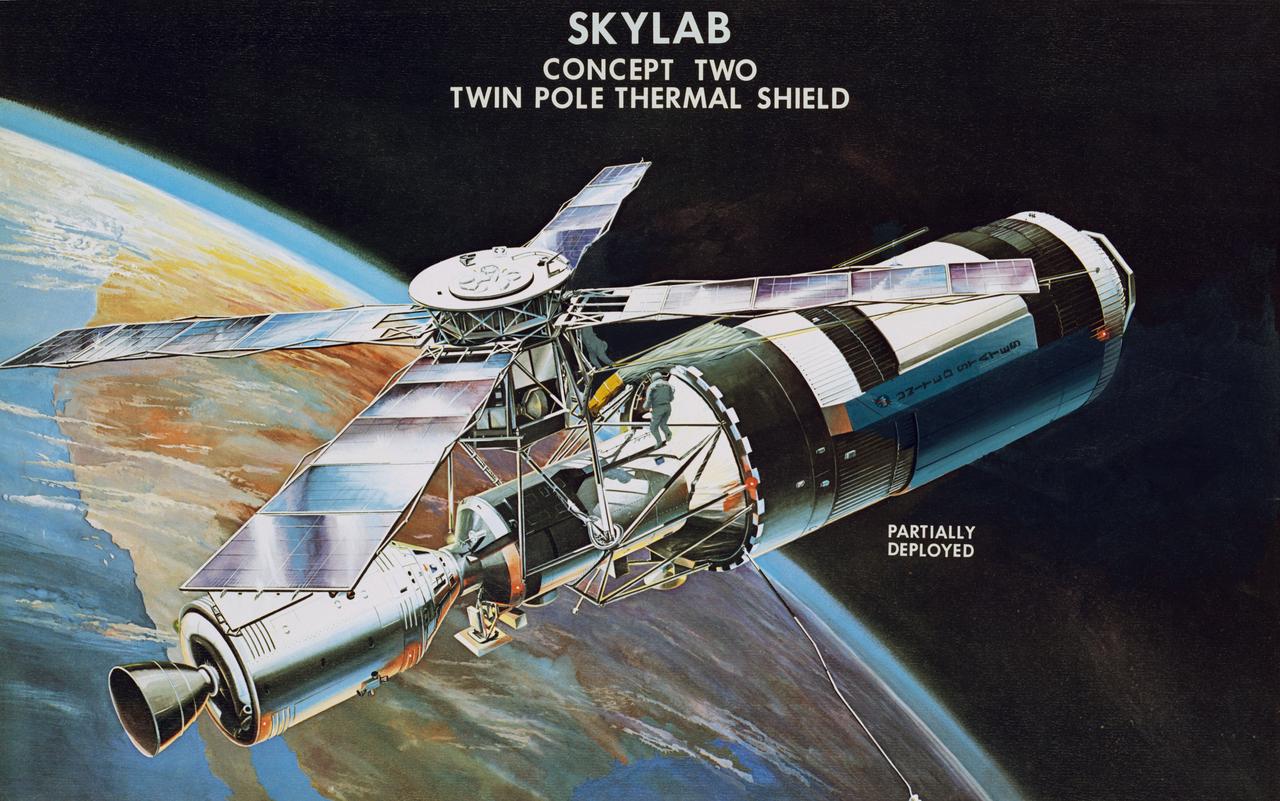
S73-26128 (1973) --- An artist's concept of the Skylab space station cluster in Earth orbit illustrating the deployment of the twin pole thermal shield to shade the Orbital Workshop (OWS) from the sun. This is one of the sunshade possibilities considered to solve the problem of the overheated OWS. In this view the Skylab astronauts have partially deployed the sunshade. Photo credit: NASA
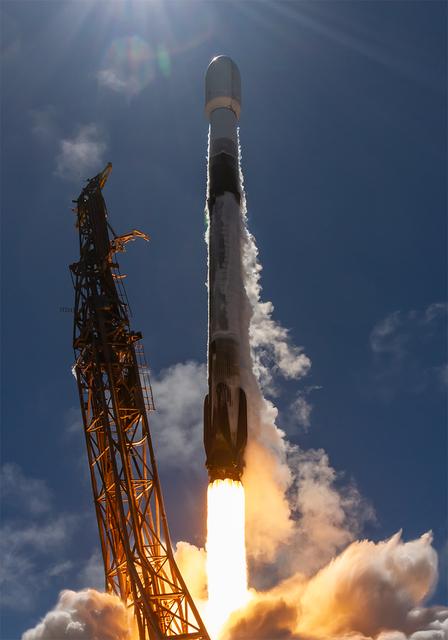
NASA’s TRACERS (Tandem Reconnection and Cusp Electrodynamics Reconnaissance Satellites) mission launches at 11:13 a.m. PDT (2:13 p.m. EDT) on Wednesday, July 23, 2025, atop a SpaceX Falcon 9 rocket at Space Launch Complex 4 East at Vandenberg Space Force Base in California. The TRACERS mission will study magnetic reconnection around Earth — a process in which electrically charged plasmas exchange energy in the atmosphere — to understand how the Sun’s solar wind interacts with the magnetosphere, Earth’s protective magnetic shield.
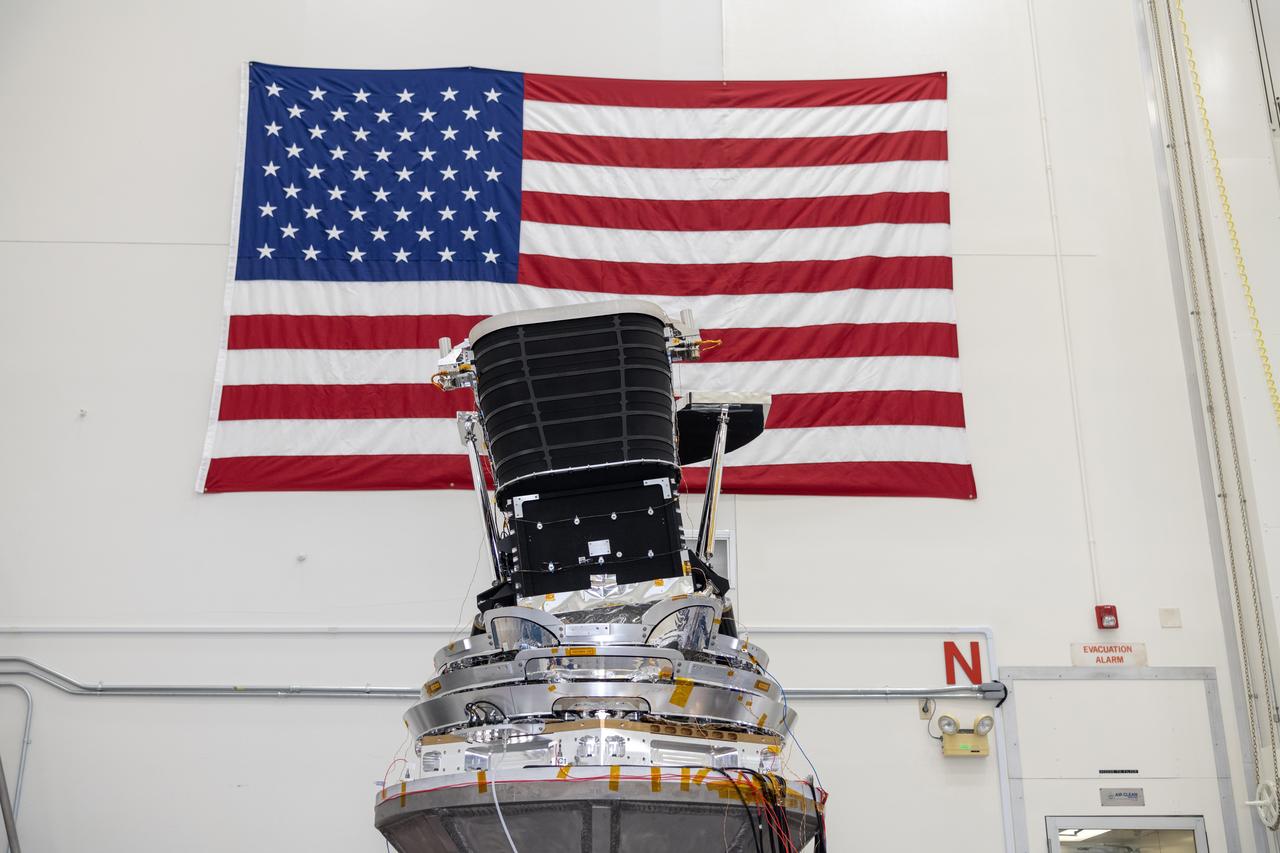
The telescope for NASA's SPHEREx mission undergoes testing at NASA's Jet Propulsion Laboratory in Southern California in September 2023. The telescope collects infrared light from distant sources using three mirrors and six detectors. It is tilted on its base so it can see as much of the sky as possible while remaining within the protection of the spacecraft's photon shields – three concentric cones that protect the telescope from light and heat from the Sun and Earth. https://photojournal.jpl.nasa.gov/catalog/PIA25787
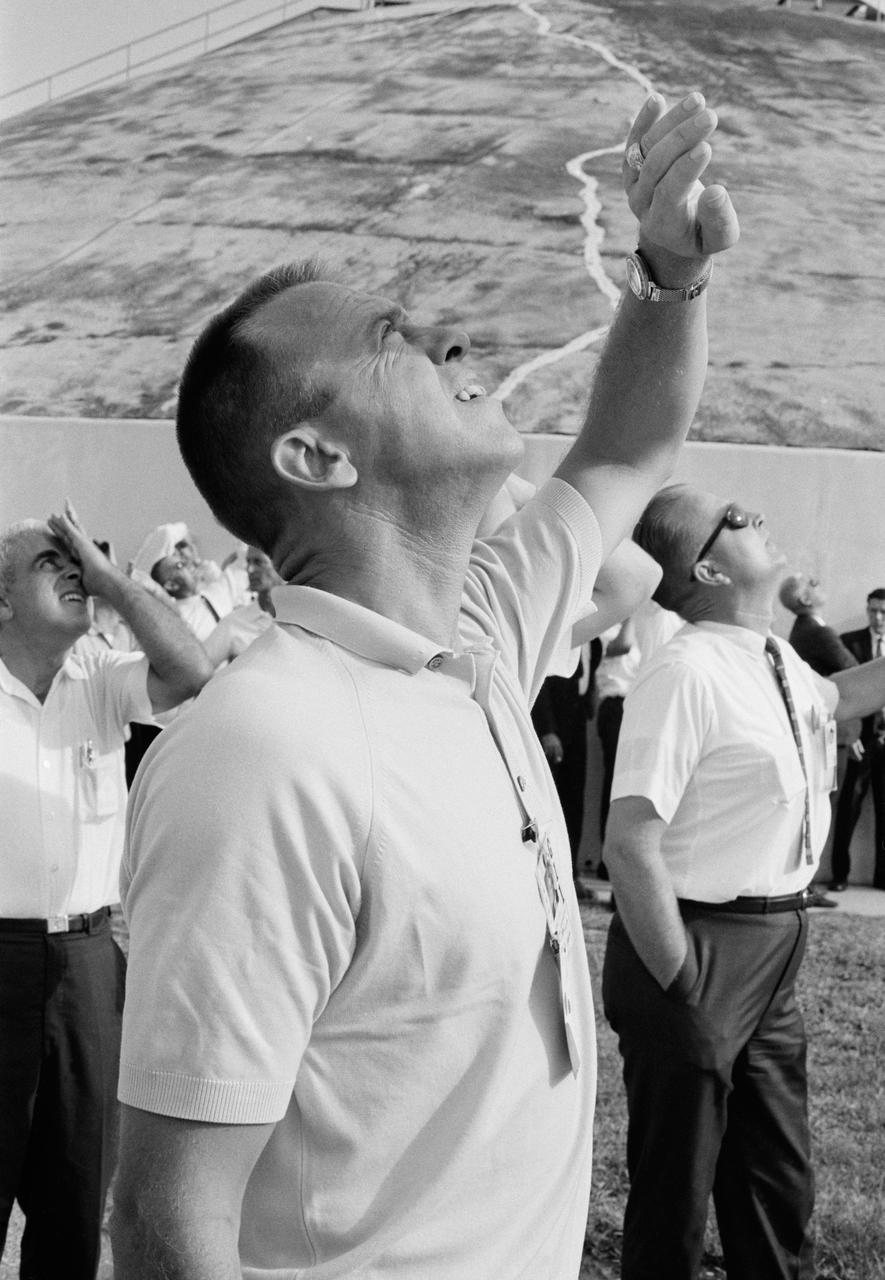
S66-50713 (12 Sept. 1966) --- Astronaut Alan B. Shepard Jr., Chief, MSC Astronaut Office, shields his eyes from the sun as he follows the Gemini-11 liftoff. Onboard were astronauts Charles Conrad Jr., command pilot, and Richard F. Gordon Jr., pilot, scheduled for a three-day mission in space. Liftoff was at 9:42 a.m. (EST), Sept. 12, 1966. Photo credit: NASA
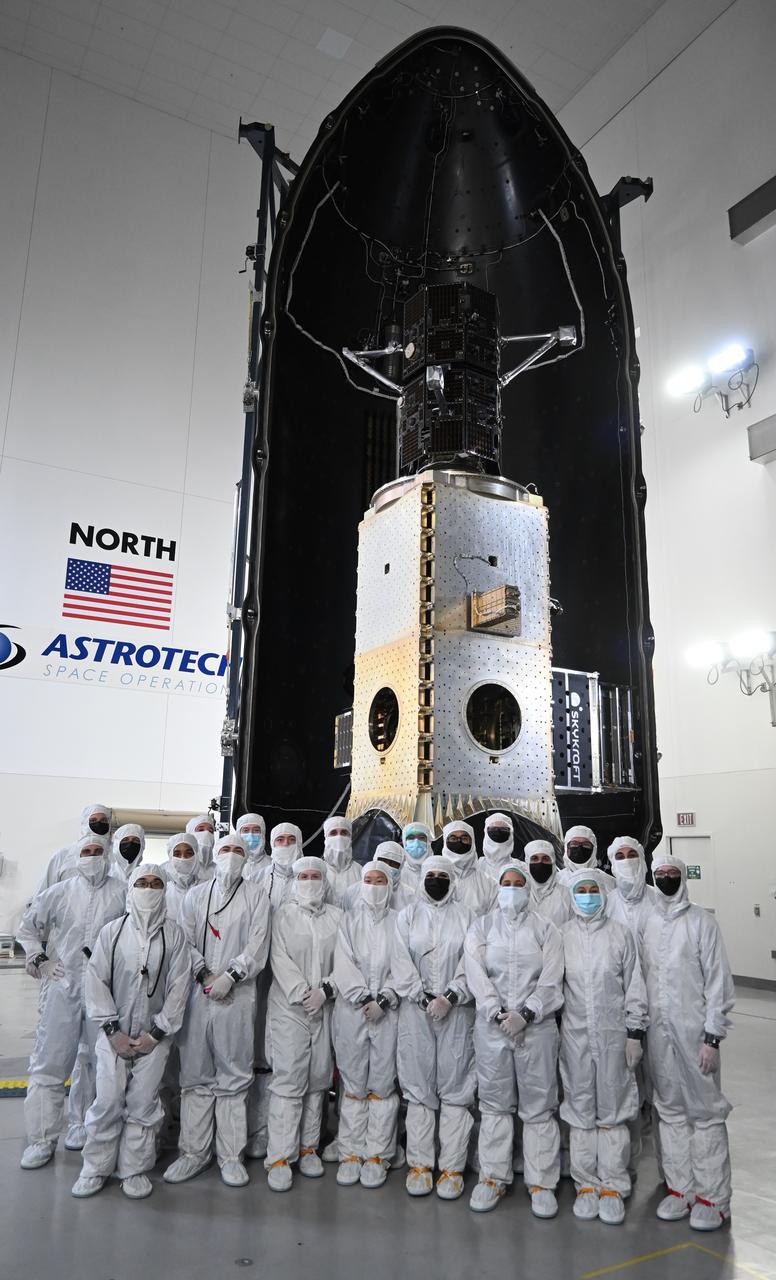
Technicians encapsulate the black twin satellites of NASA’s TRACERS (Tandem Reconnection and Cusp Electrodynamics Reconnaissance Satellites) mission within a payload fairing atop a shiny metallic stack of several other rideshare payloads at the Astrotech Space Operations facility at Vandenberg Space Force Base in California. The TRACERS mission is a pair of twin satellites that will study how Earth’s magnetic shield — the magnetosphere — protects our planet from the supersonic stream of material from the Sun called solar wind.

A SpaceX Falcon 9 rocket carrying NASA’s TRACERS (Tandem Reconnection and Cusp Electrodynamics Reconnaissance Satellites) mission stands vertical Tuesday, July 22, 2025, at Space Launch Complex 4 East at Vandenberg Space Force Base in California. The TRACERS mission will study magnetic reconnection around Earth — a process in which electrically charged plasmas exchange energy in the atmosphere — to understand how the Sun’s solar wind interacts with the magnetosphere, Earth’s protective magnetic shield.
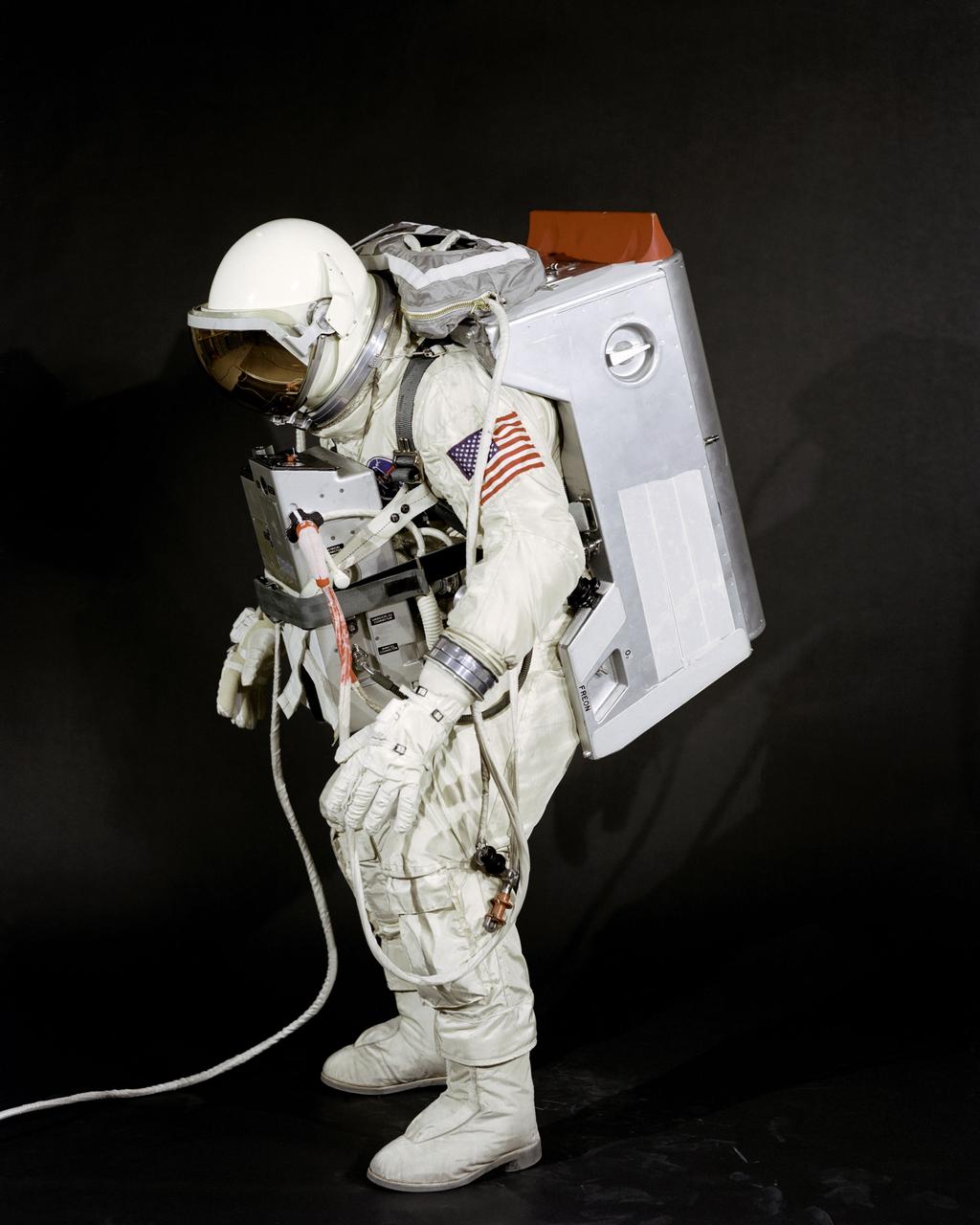
S66-17475 (18 Jan. 1966) --- Test subject Fred Spress, Crew Systems Division, wears the spacesuit and extravehicular equipment planned for use by astronaut David R. Scott. The helmet is equipped with a gold-plated visor to shield the astronaut's face from unfiltered sun rays. The system is composed of a life support pack worn on the chest and a support pack worn on the back. Photo credit: NASA
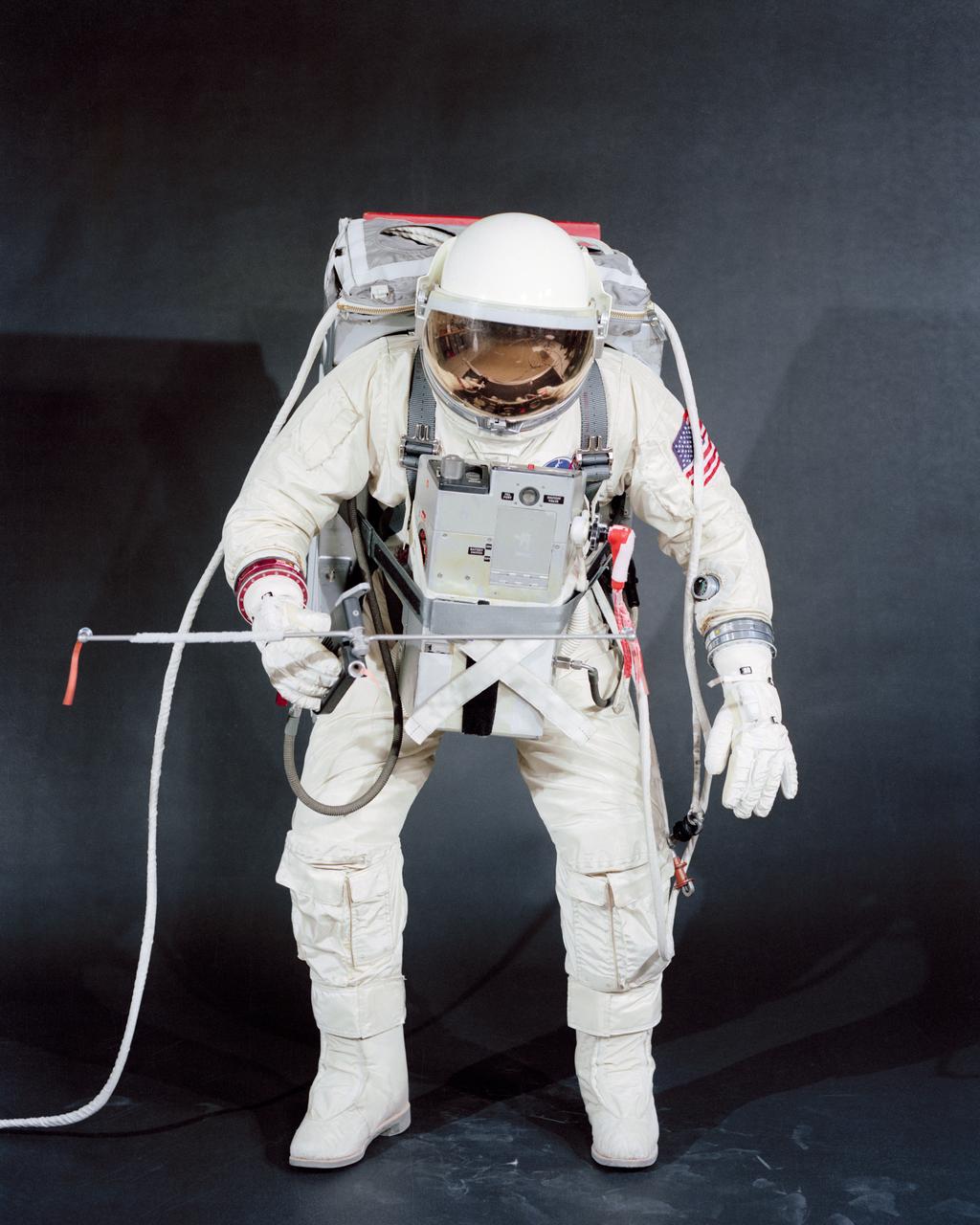
S66-17480 (18 Jan. 1966) --- Test subject Fred Spress, Crew Systems Division, wears the spacesuit and extravehicular equipment planned for use by astronaut David R. Scott. The helmet is equipped with a gold-plated visor to shield the astronaut's face from unfiltered sun rays. The system is composed of a life support pack worn on the chest and a support pack worn on the back. Photo credit: NASA
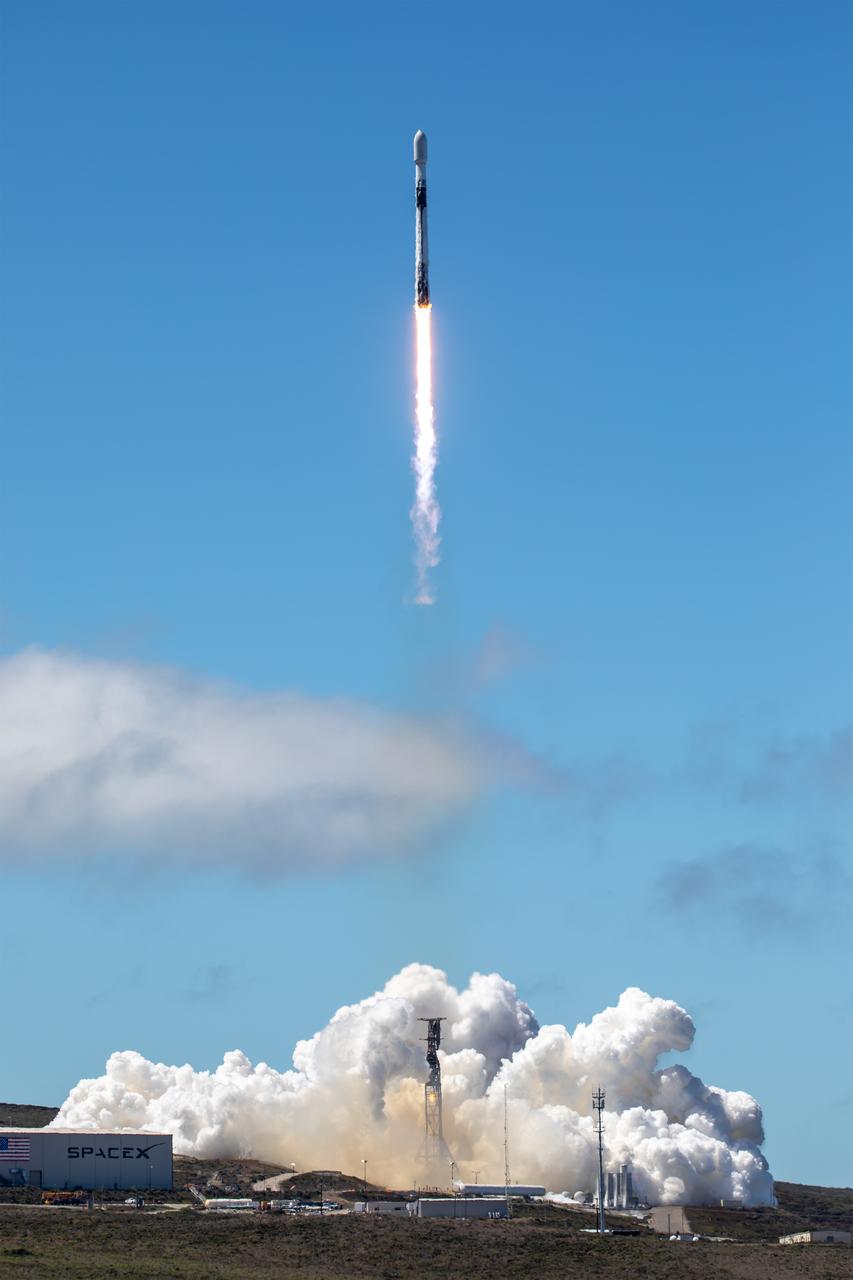
NASA’s TRACERS (Tandem Reconnection and Cusp Electrodynamics Reconnaissance Satellites) mission launches at 11:13 a.m. PDT (2:13 p.m. EDT) on Wednesday, July 23, 2025, atop a SpaceX Falcon 9 rocket at Space Launch Complex 4 East at Vandenberg Space Force Base in California. The TRACERS mission will study magnetic reconnection around Earth — a process in which electrically charged plasmas exchange energy in the atmosphere — to understand how the Sun’s solar wind interacts with the magnetosphere, Earth’s protective magnetic shield.
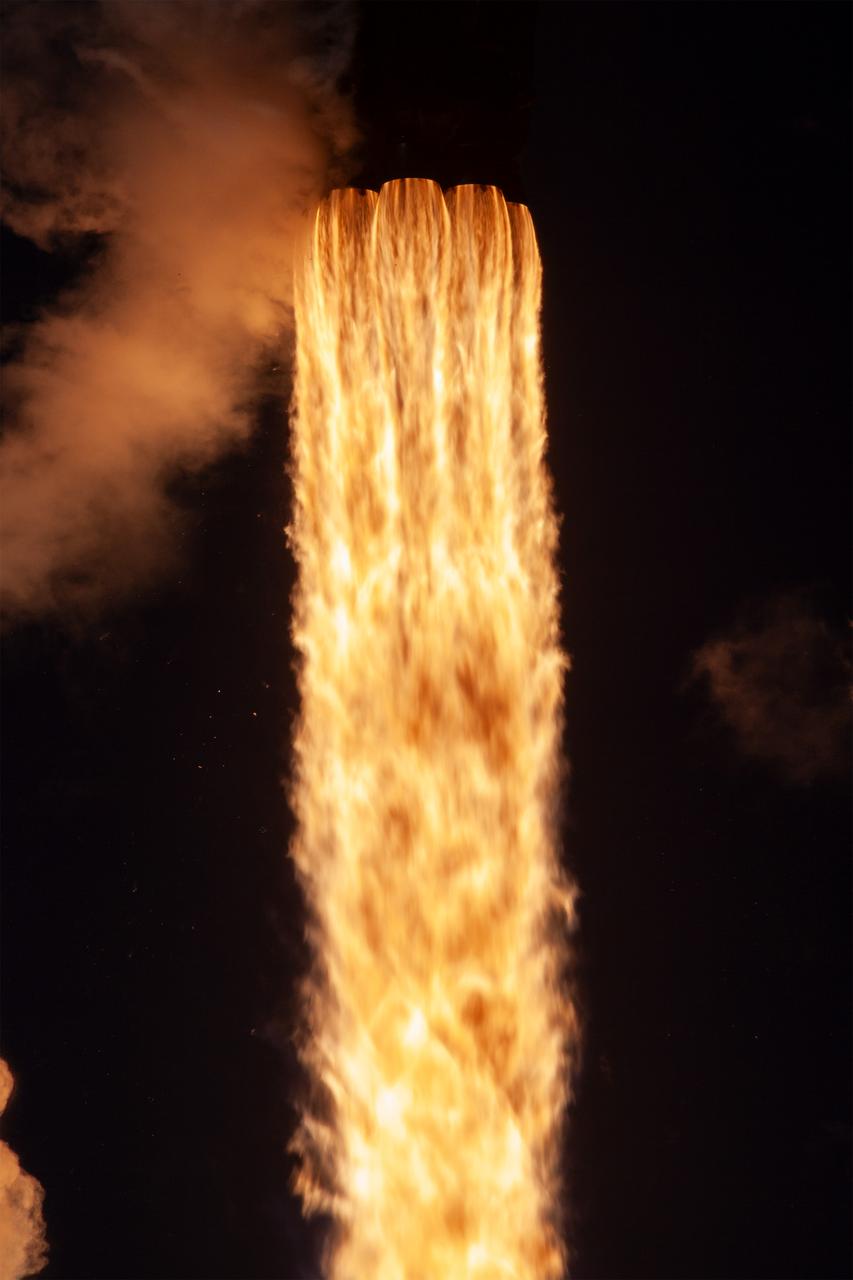
NASA’s TRACERS (Tandem Reconnection and Cusp Electrodynamics Reconnaissance Satellites) mission launches at 11:13 a.m. PDT (2:13 p.m. EDT) on Wednesday, July 23, 2025, atop a SpaceX Falcon 9 rocket at Space Launch Complex 4 East at Vandenberg Space Force Base in California. The TRACERS mission will study magnetic reconnection around Earth — a process in which electrically charged plasmas exchange energy in the atmosphere — to understand how the Sun’s solar wind interacts with the magnetosphere, Earth’s protective magnetic shield.
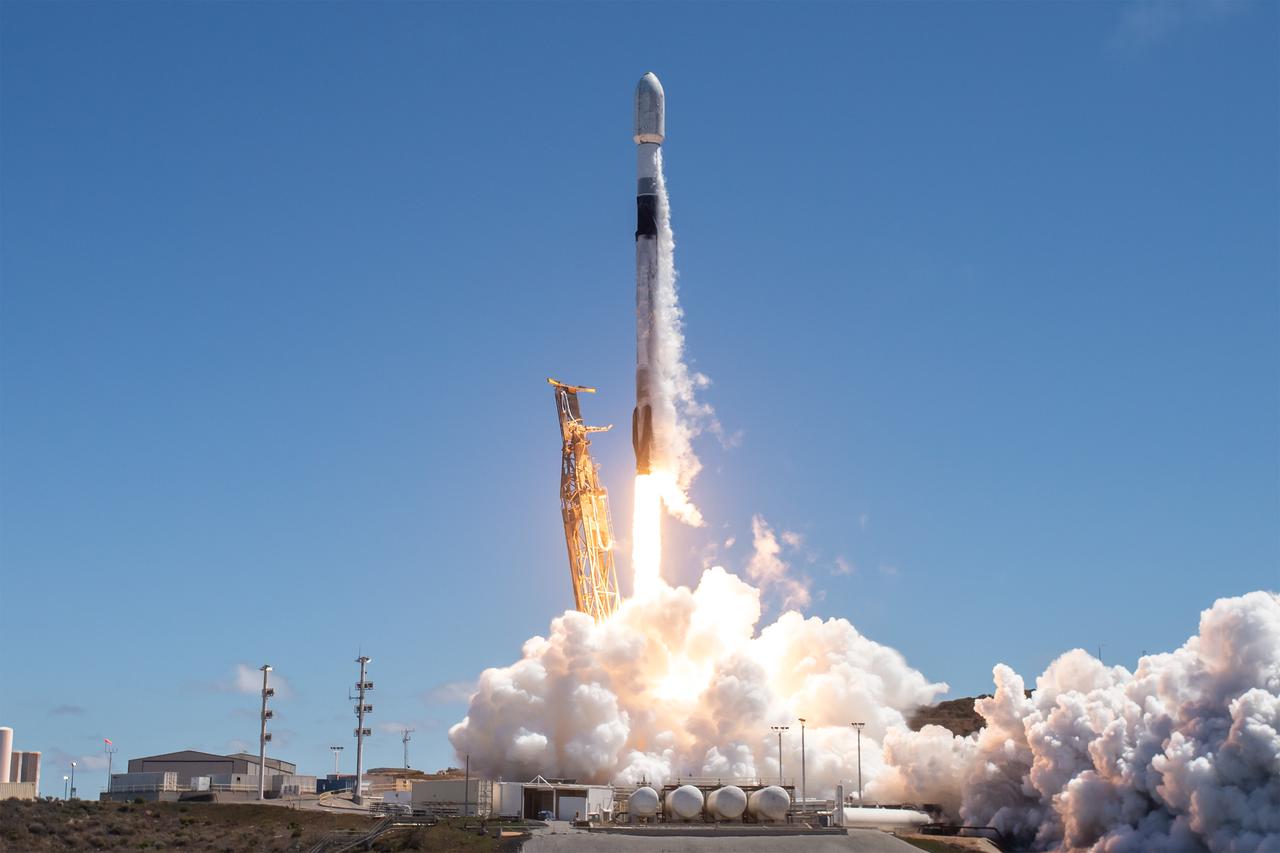
NASA’s TRACERS (Tandem Reconnection and Cusp Electrodynamics Reconnaissance Satellites) mission launches at 11:13 a.m. PDT (2:13 p.m. EDT) on Wednesday, July 23, 2025, atop a SpaceX Falcon 9 rocket at Space Launch Complex 4 East at Vandenberg Space Force Base in California. The TRACERS mission will study magnetic reconnection around Earth — a process in which electrically charged plasmas exchange energy in the atmosphere — to understand how the Sun’s solar wind interacts with the magnetosphere, Earth’s protective magnetic shield.
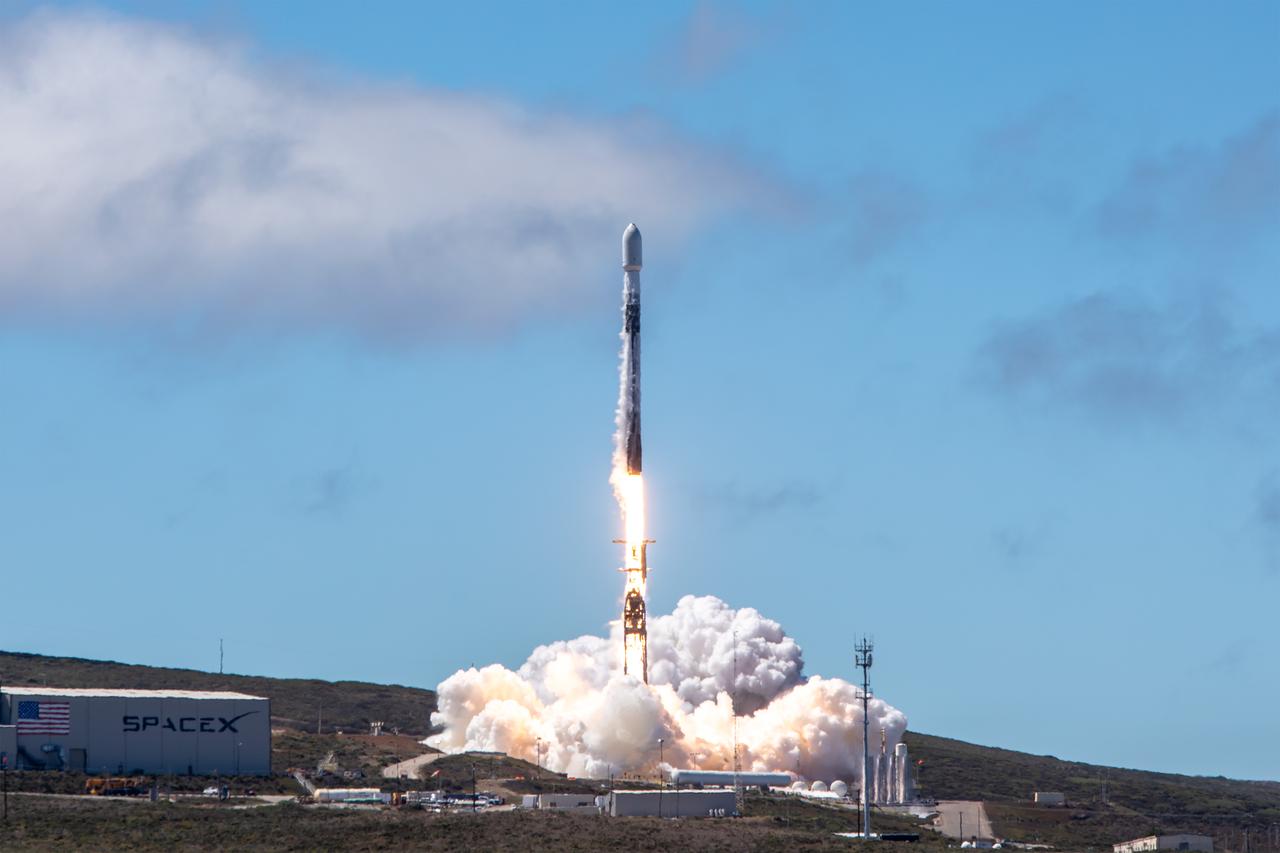
NASA’s TRACERS (Tandem Reconnection and Cusp Electrodynamics Reconnaissance Satellites) mission launches at 11:13 a.m. PDT (2:13 p.m. EDT) on Wednesday, July 23, 2025, atop a SpaceX Falcon 9 rocket at Space Launch Complex 4 East at Vandenberg Space Force Base in California. The TRACERS mission will study magnetic reconnection around Earth — a process in which electrically charged plasmas exchange energy in the atmosphere — to understand how the Sun’s solar wind interacts with the magnetosphere, Earth’s protective magnetic shield.
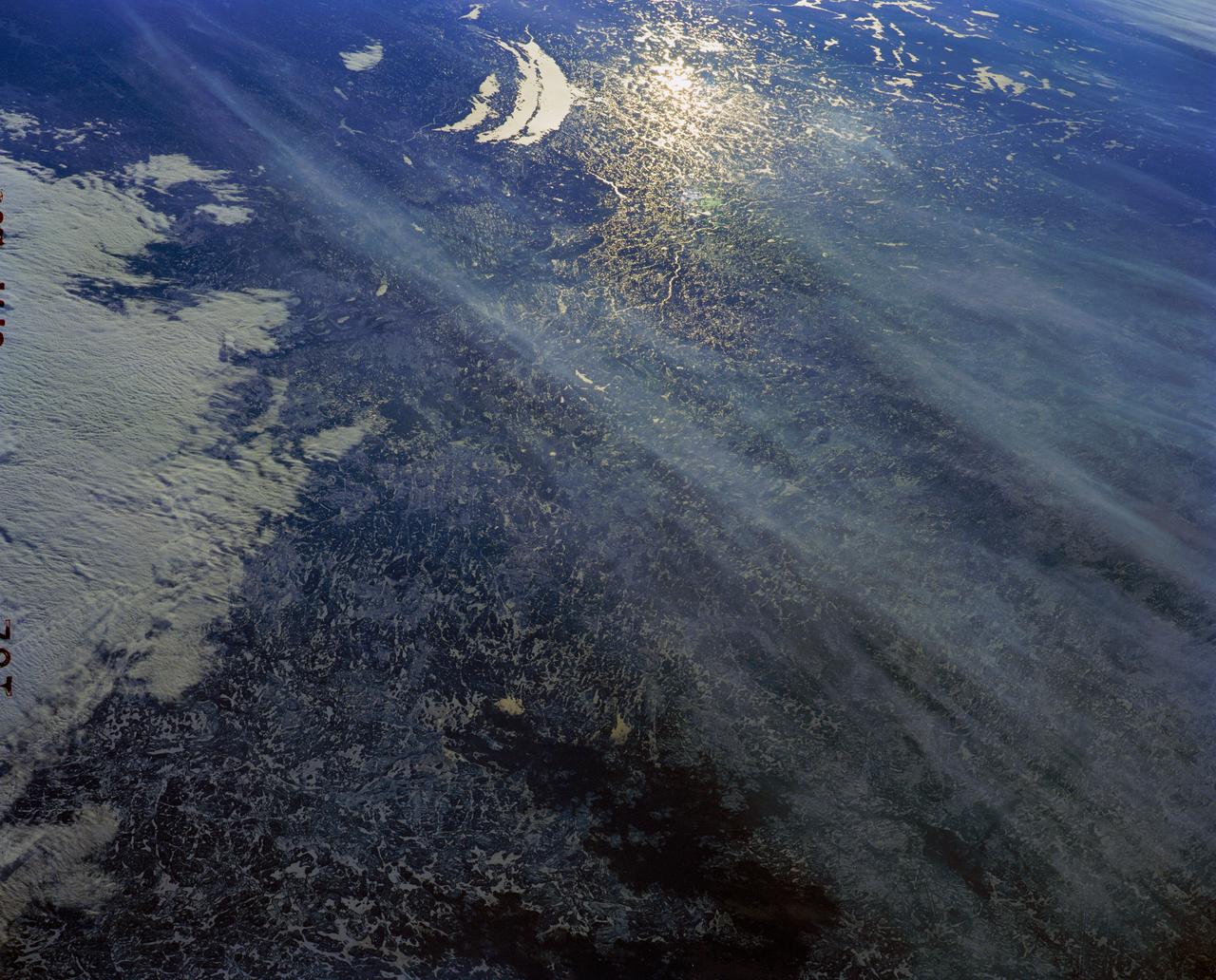
61A-200-152 (30 Oct-5 Nov 1985) --- Sun glints on the small and very numerous glacial lakes of the Canadian Shield of Quebec. This is an area of very ancient pre-Cambrian rock, which uplifted when the weight of the Pleistocene glaciers was removed. The double crescent lake is Lake Mistassini, some 400 miles north of Montreal.
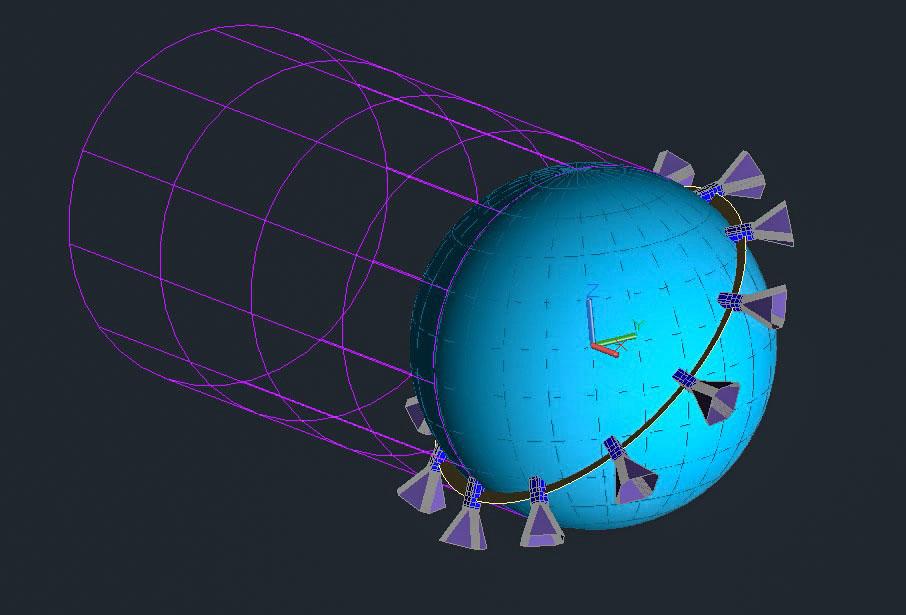
Jsc2020e004943 (2/7/2020) — A computer model showing CryoCube’s orbital orientation. CryoCube demonstrates on-orbit thermal management technology. Such technology has a variety of potential applications, including storing rocket propellants in space, cooling instruments to improve their signal-to-noise ratios, and supporting future cryogenic experiments in microgravity. The small satellite uses a deployable shield to block radiation from the Sun and Earth and an attitude control system to point its experiment into deep space. Image courtesy of : Kennedy Space Center
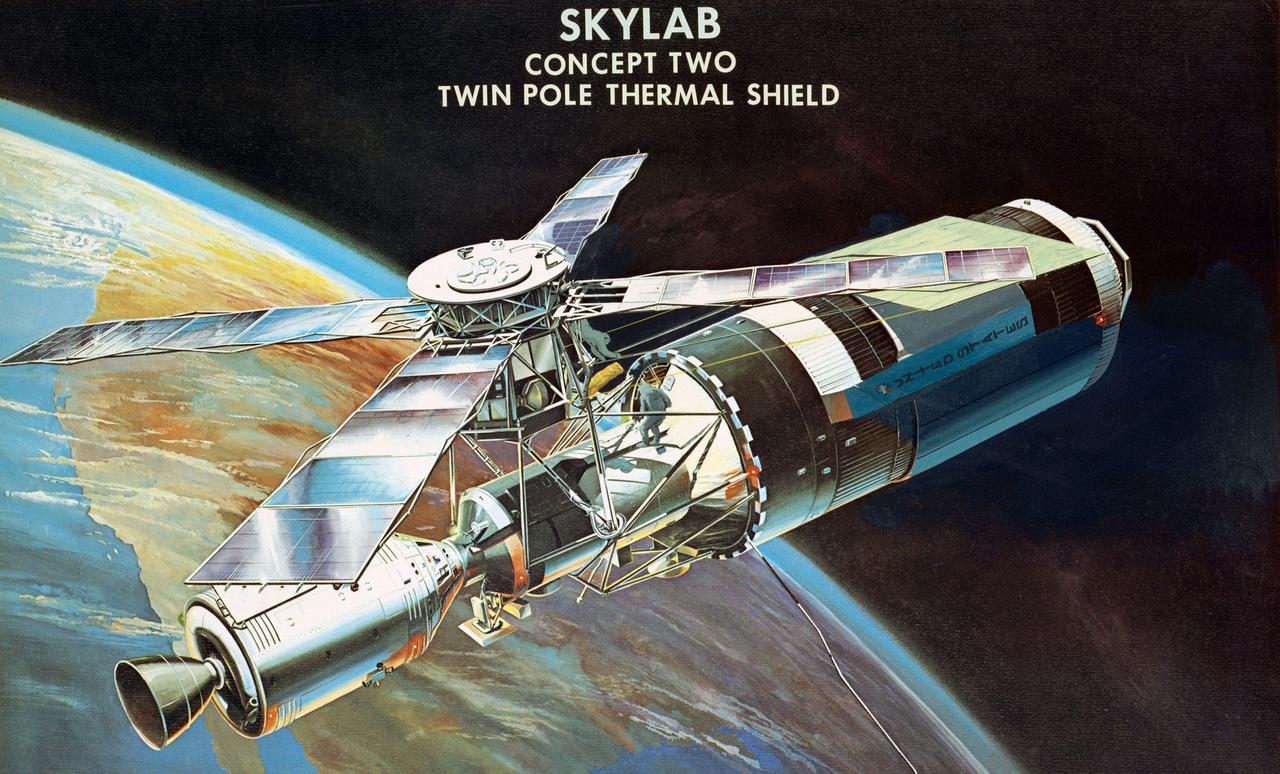
S73-26127 (1973) --- An artist's concept of the Skylab space station cluster in Earth orbit illustrating the deployment of the twin pole thermal shield to shade the Orbital Workshop (OWS) from the sun. This is one of the sunshade possibilities considered to solve the problem of the overheated OWS. Here the two Skylab 2 astronauts have completely deployed the sunshade. Note the evidence of another Skylab problem - the solar panels on the OWS are not deployed as required. Photo credit: NASA
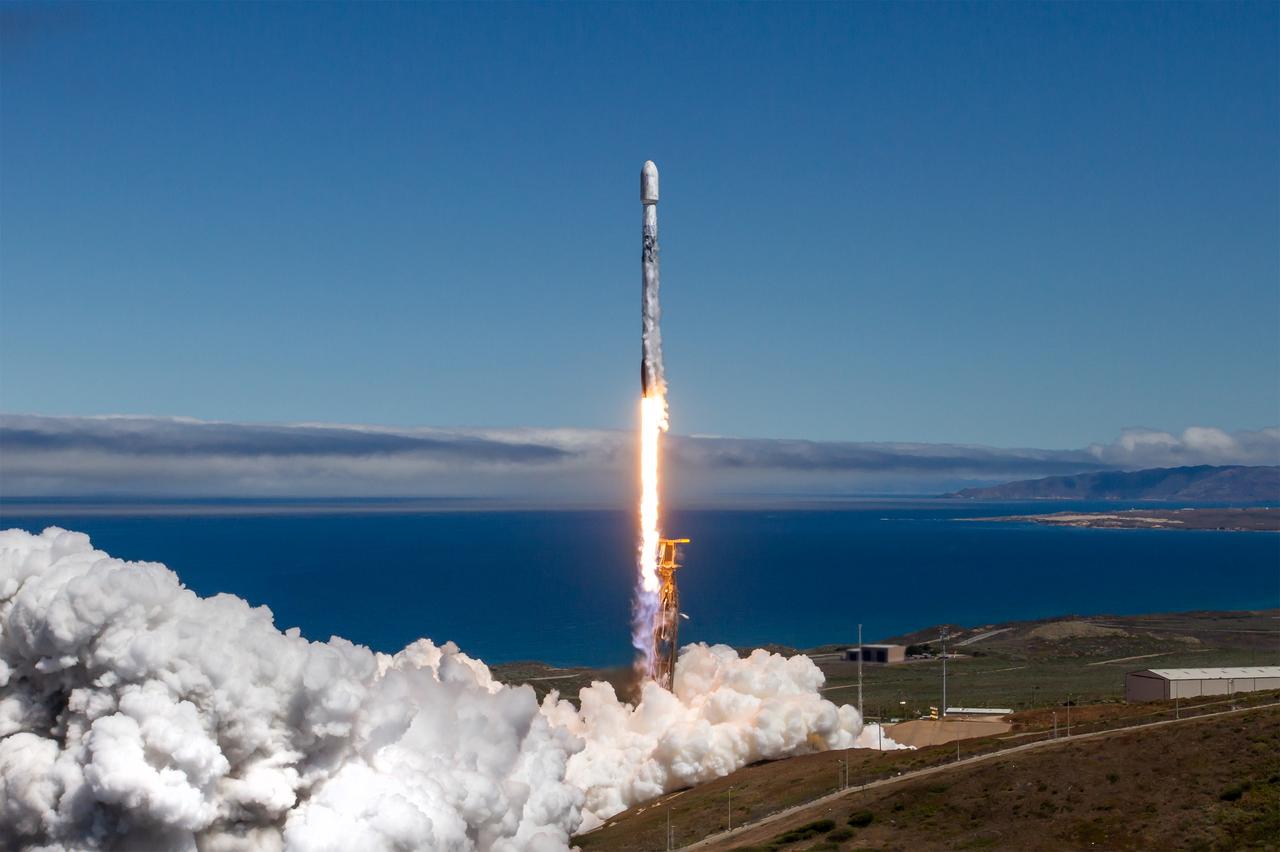
NASA’s TRACERS (Tandem Reconnection and Cusp Electrodynamics Reconnaissance Satellites) mission launches at 11:13 a.m. PDT (2:13 p.m. EDT) on Wednesday, July 23, 2025, atop a SpaceX Falcon 9 rocket at Space Launch Complex 4 East at Vandenberg Space Force Base in California. The TRACERS mission will study magnetic reconnection around Earth — a process in which electrically charged plasmas exchange energy in the atmosphere — to understand how the Sun’s solar wind interacts with the magnetosphere, Earth’s protective magnetic shield.
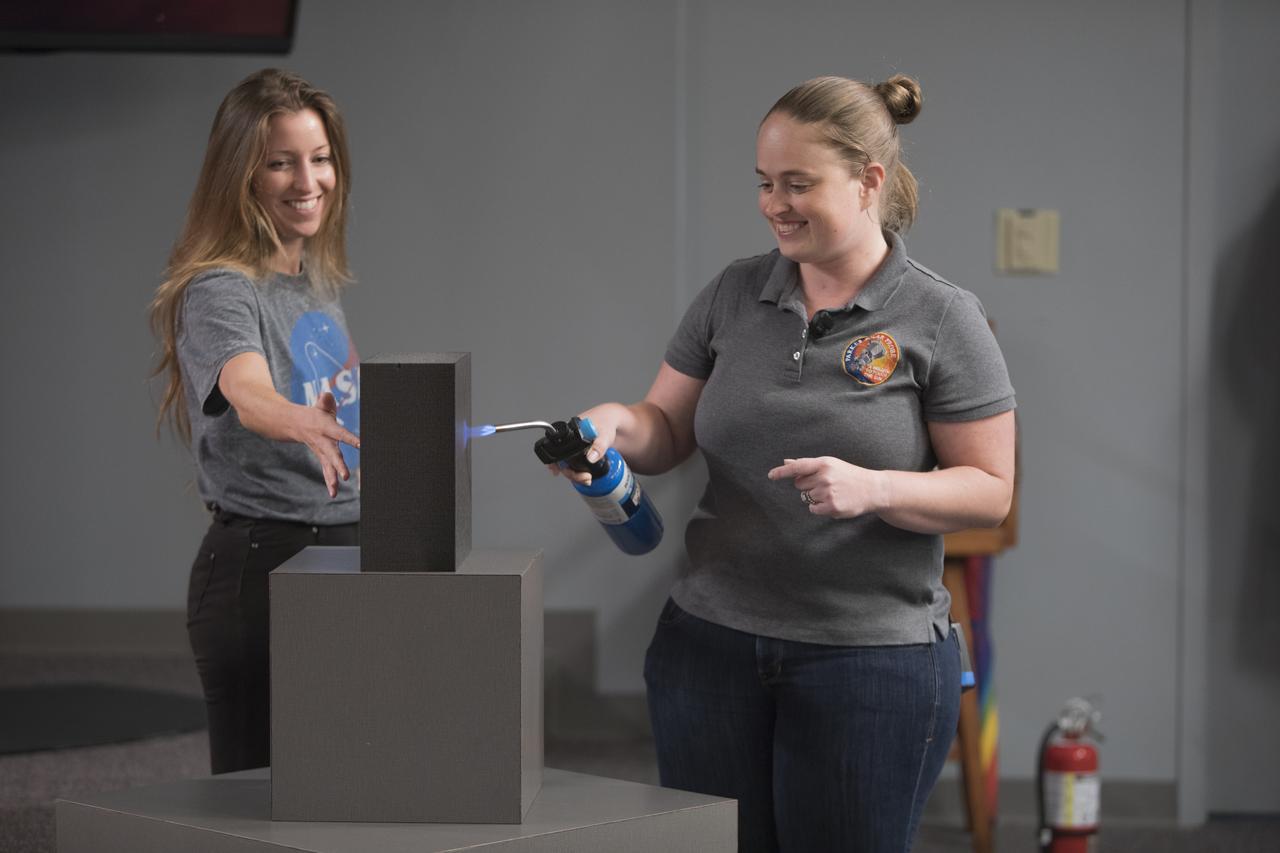
In the Kennedy Space Center’s Press Site auditorium, on Friday, July 20, 2018, Betsy Congdon, Thermal Protection System engineer with the Johns Hopkins University Applied Physics Laboratory, right, demonstrates the ability of the Parker Solar Probe's heat shield to protect the spacecraft. The presentation for the media took place during a prelaunch mission briefing for the Parker Solar Probe mission. The Parker Solar Probe will lift off on a United Launch Alliance Delta IV Heavy rocket from Space Launch Complex 37 at Cape Canaveral Air Force Station in Florida. The spacecraft was built by Applied Physics Laboratory of Johns Hopkins University in Laurel in Maryland. The mission will perform the closest-ever observations of a star when it travels through the Sun's atmosphere, called the corona. The probe will rely on measurements and imaging to revolutionize understanding of the corona and the Sun-Earth connection.
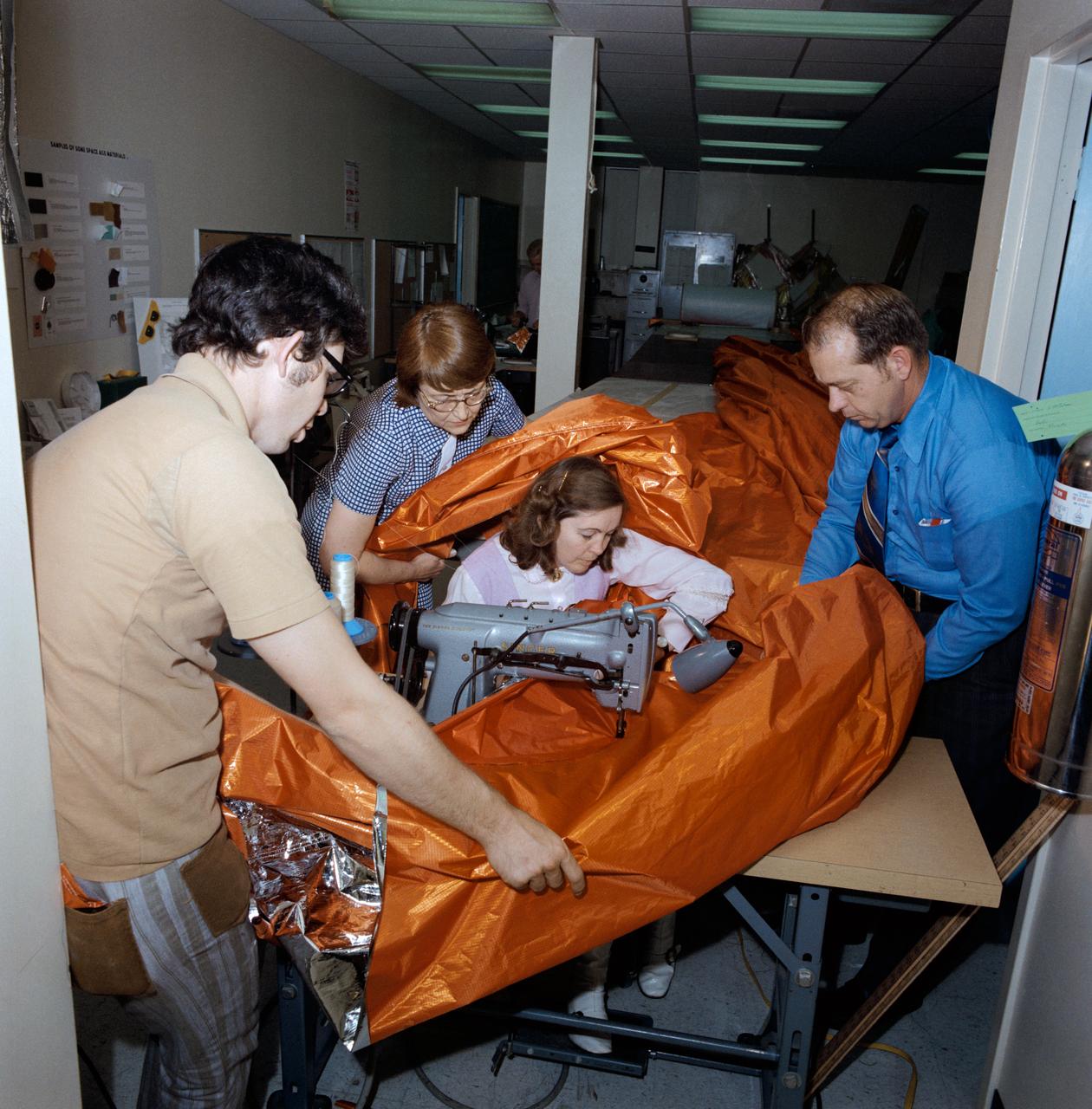
S73-26047 (18 May 1973) --- A sail-like sunshade for possible use as a sunscreen for the Skylab orbital workshop (OWS) is shown being fabricated in the GE Building across the street from the Johnson Space Center. Three persons assist the seamstress feed the material through the sewing machine. The three-layered shade will be composed of a top layer of aluminum Mylar, a middle layer of laminated nylon rip stop, and a bottom layer of thin nylon. Working on the sunshade, from left to right, are Dale Gentry, Elizabeth Gauldin, Alyene Baker and James H. Barnett Jr. Mrs. Baker, a GE employee, operates the double-needle sewing machine. Barnett is head of the Crew Equipment Development Section of JSC's Crew Systems Division. Mrs. Gauldin is also with the Crew Systems Division. Gentry works for GE. The work shown here is part of the crash program underway to prepare a protection device for Skylab to replace the original shield which was lost when the unmanned Skylab 1 launch took place on May 14, 1973. The improvised solar shield selected to be used will be carried to Earth orbit by the Skylab 2 crew, who will deploy it to shade part of the OWS from the hot rays of the sun. Loss of the original shield, as expected, has caused an overheating problem on the OWS. Photo credit: NASA
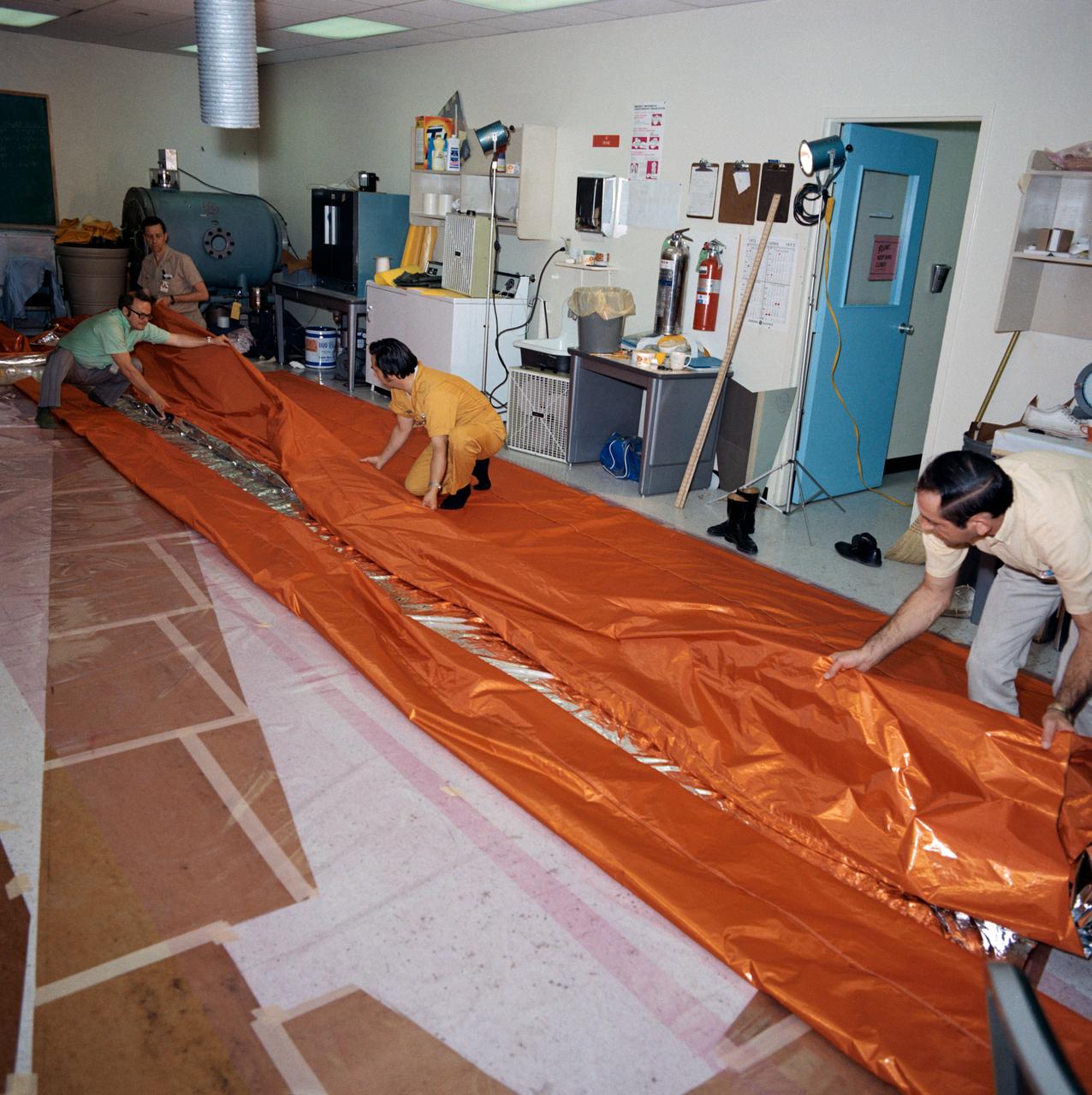
S73-26046 (18 May 1973) --- Workmen in the GE Building across the street from the Johnson Space Center fold a sail-like sunshade being fabricated for possible use as a sunscreen for the Skylab Orbital Workshop (OWS). The three-layered sunshade will be composed of a top layer of aluminized mylar, a middle layer of laminated nylon rip-stop, and a bottom layer of thin nylon. The men are, left to right, Gerry E. Wood (wearing glasses), Glenn Hewitt, Pat Morrow, and Fred Le Donne. Wood is manager of crew provisions and engineering at GE. The work shown here is part of the crash program now underway to prepare a sunshield for Skylab to replace the original shield which was lost when Skylab I was launched on May 14, 1973. The improvised solar shield selected to be used will be carried to Earth orbit by the Skylab 2 crewmen who will deploy it to shade part of the OWS from the hot rays of the sun. Loss of the original shield has caused an overheating problem in the OWS. Photo credit: NASA
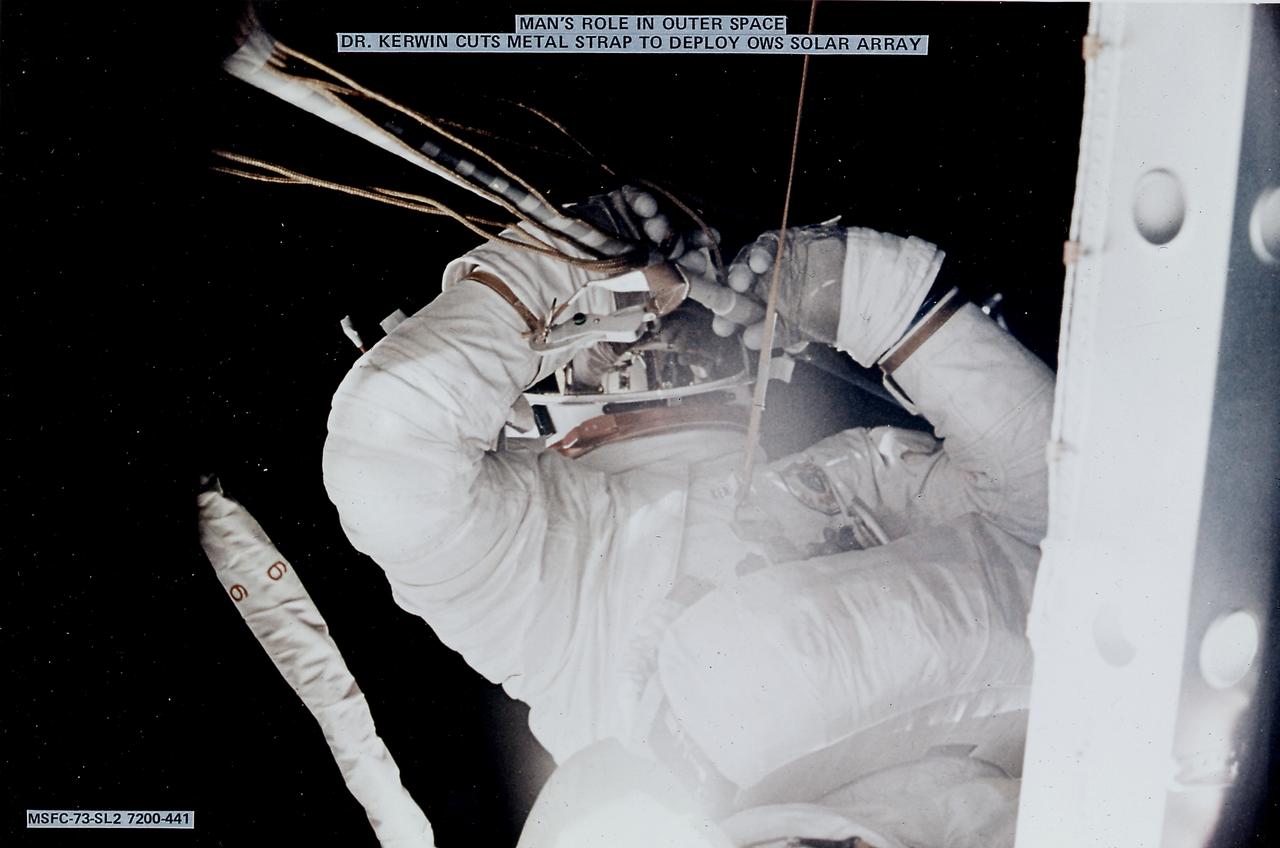
The Saturn V vehicle, carrying the unmarned orbital workshop for the Skylab-1 mission, lifted off successfully and all systems performed normally. Sixty-three seconds into the flight, engineers in the operation support and control center saw an unexpected telemetry indication that signalled that damages occurred on one solar array and the micrometeoroid shield during the launch. The micrometeoroid shield, a thin protective cylinder surrounding the workshop protecting it from tiny space particles and the sun's scorching heat, ripped loose from its position around the workshop. This caused the loss of one solar wing and jammed the other. Still unoccupied, the Skylab was stricken with the loss of the heat shield and sunlight beat mercilessly on the lab's sensitive skin. Intrnal temperatures soared, rendering the station uninhabitable, threatening foods, medicines, films, and experiments. This image shows astronaut Kerwin cutting the metal strap to free and deploy the Orbital Workshop solar array. Kerwin used special cutting tools developed by engineers at the Marshall Space Flight Center (MSFC). The MSFC had a major role in developing the procedures to repair the damaged Skylab.

Part of one of the protective photon shields for NASA's SPHEREx telescope are shown here being assembled at Applied Aerospace Structures in Stockton, California, in July 2023. Short for Specto-Photometer for the History of the Universe, Epoch of Reionization and Ices Explorer, SPHEREx will create a map of the cosmos like no other, imaging the entire sky and gathering information about millions of galaxies. With this map, scientists will study what happened in the first fraction of a second after the big bang, the history of galaxy evolution, and the origins of water in planetary systems in our galaxy. The three concentric photon shields will surround the SPHEREx telescope to protect it from nearby light sources that could overwhelm its detectors. The shields will primarily block light from the Sun and the Earth. They also block heat, because SPHEREx needs to be kept cold – below minus 350 degrees Fahrenheit (about minus 210 degrees Celsius). That's because SPHEREx detects infrared light, which is sometimes called heat radiation because it's emitted by anything warm. The heat from SPHEREx's own detectors could overwhelm their ability to detect faint cosmic objects if they aren't cooled down. https://photojournal.jpl.nasa.gov/catalog/PIA25785
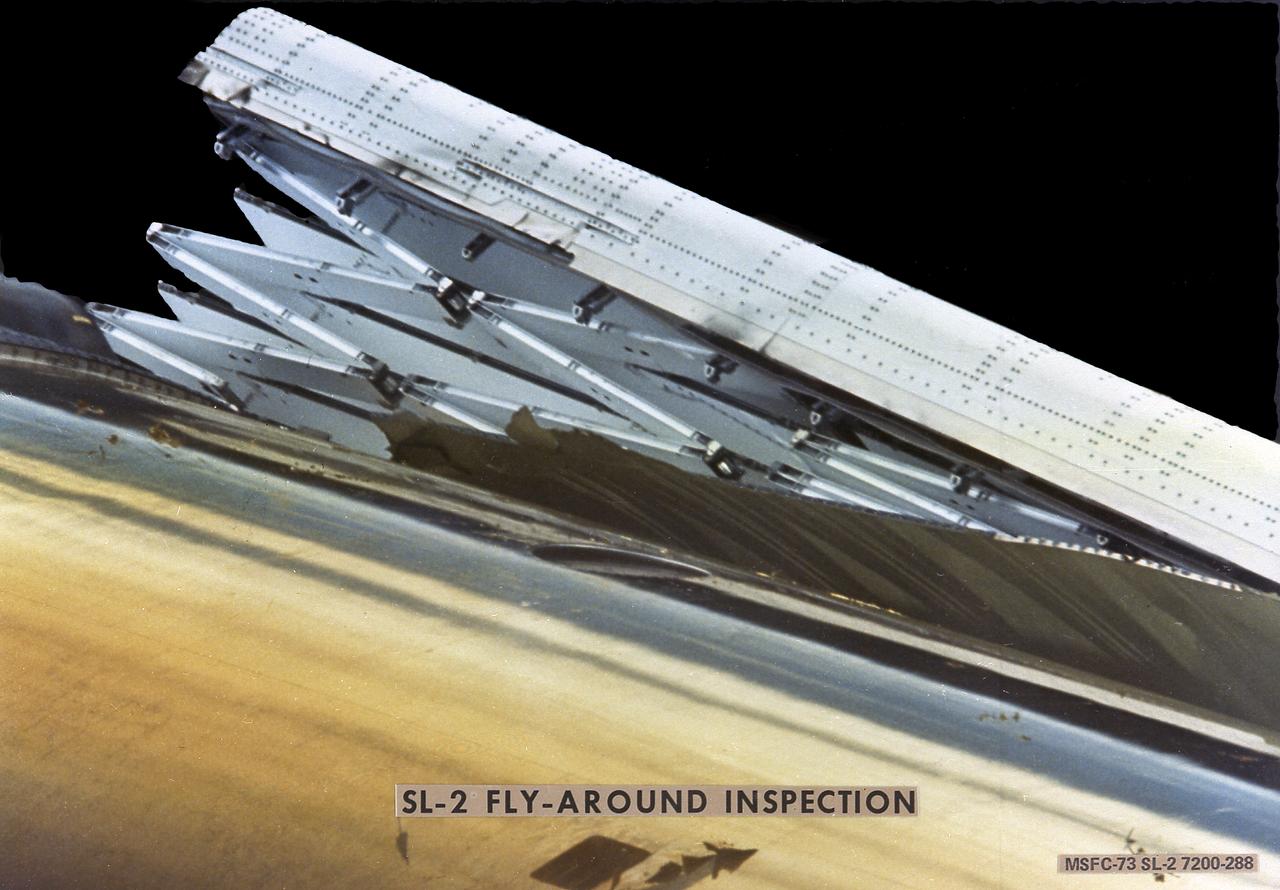
The Saturn V vehicle, carrying the unmarned orbital workshop for the Skylab-1 mission, lifted off successfully and all systems performed normally. Sixty-three seconds into the flight, engineers in the operation support and control center saw an unexpected telemetry indication that signalled that damages occurred on one solar array and the micrometeoroid shield during the launch. The micrometeoroid shield, a thin protective cylinder surrounding the workshop protecting it from tiny space particles and the sun's scorching heat, ripped loose from its position around the workshop. This caused the loss of one solar wing and jammed the other. Still unoccupied, the Skylab was stricken with the loss of the heat shield and sunlight beat mercilessly on the lab's sensitive skin. Internal temperatures soared, rendering the station uninhabitable, threatening foods, medicines, films, and experiments. This image, taken during a fly-around inspection by the Skylab-2 crew, shows the station's remaining solar panel jammed against its side. The Marshall Space Flight Center had a major role in developing the procedures to repair the damaged Skylab.
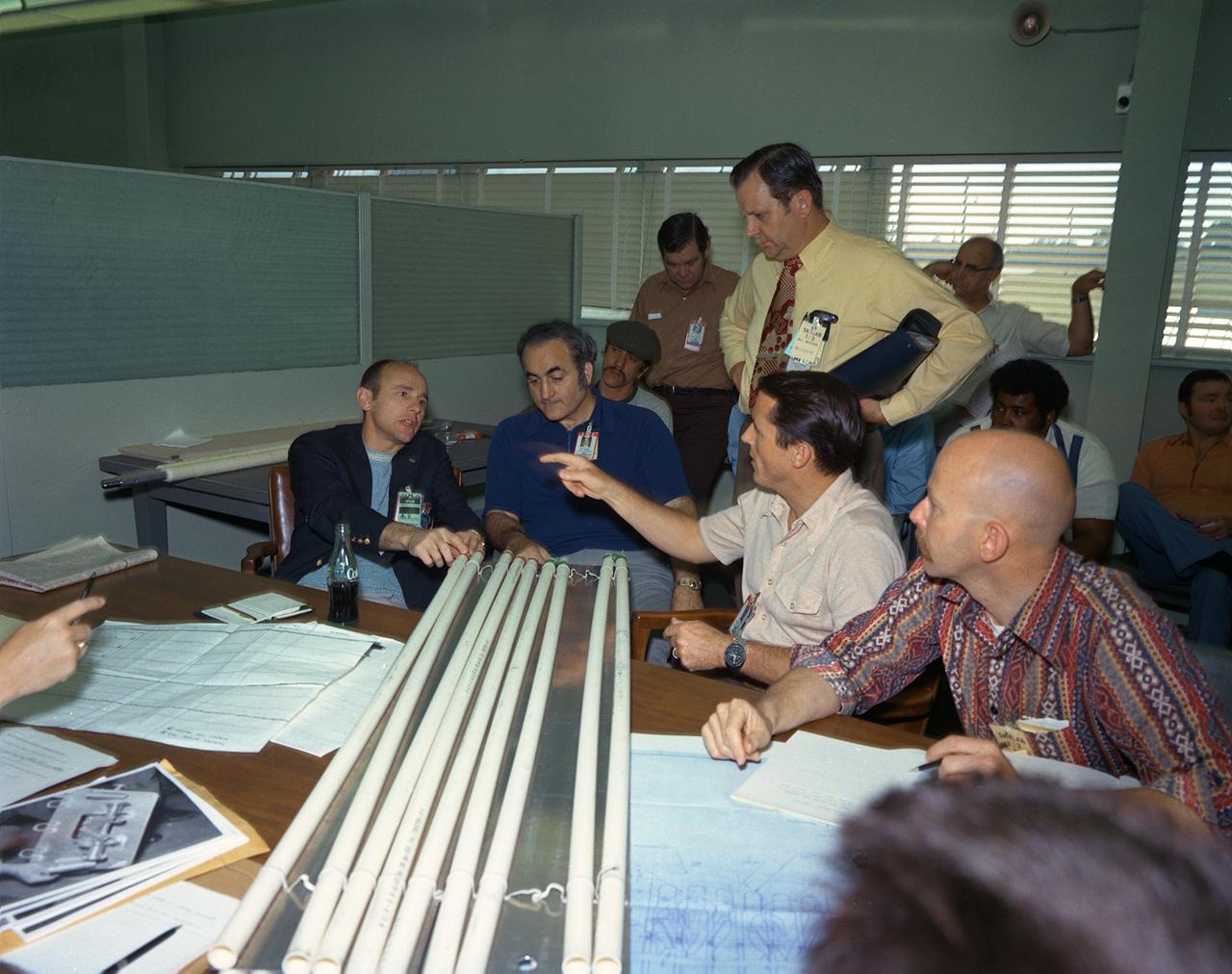
Sixty-three seconds after the launch of the modified Saturn V vehicle carrying the Skylab cluster, engineers in the operation support and control center saw an unexpected telemetry indication that signalled that damages occurred on one solar array and the micrometeoroid shield during the launch. Still unoccupied, the Skylab was stricken with the loss of the heat shield and sunlight beat mercilessly on the lab's sensitive skin. Internal temperatures soared, rendering the the station uninhabitable, threatening foods, medicines, films, and experiments. The launch of the first marned Skylab (Skylab-2) mission was delayed until methods were devised to repair and salvage the workshop. Personnel from other NASA Centers and industries quickly joined the Marshall Space Flight Center (MSFC) in efforts to save the damaged Skylab. They worked day and night for the next several days. Eventually the MSFC developed, tested, rehearsed, and approved three repair options. These options included a parasol sunshade and a twin-pole sunshade to restore the temperature inside the workshop, and a set of metal cutting tools to free the jammed solar panel. This photograph was taken during a discussion of the methods of the twin-pole Sun shield by (left to right) Astronaut Alan Bean, MSFC Director Dr. Rocco Petrone, Astronaut Edward Gibson, and MSFC engineer Richard Heckman. Dr. William Lucas, who became MSFC Director after Dr. Petrone left MSFC in March of 1974, is standing.
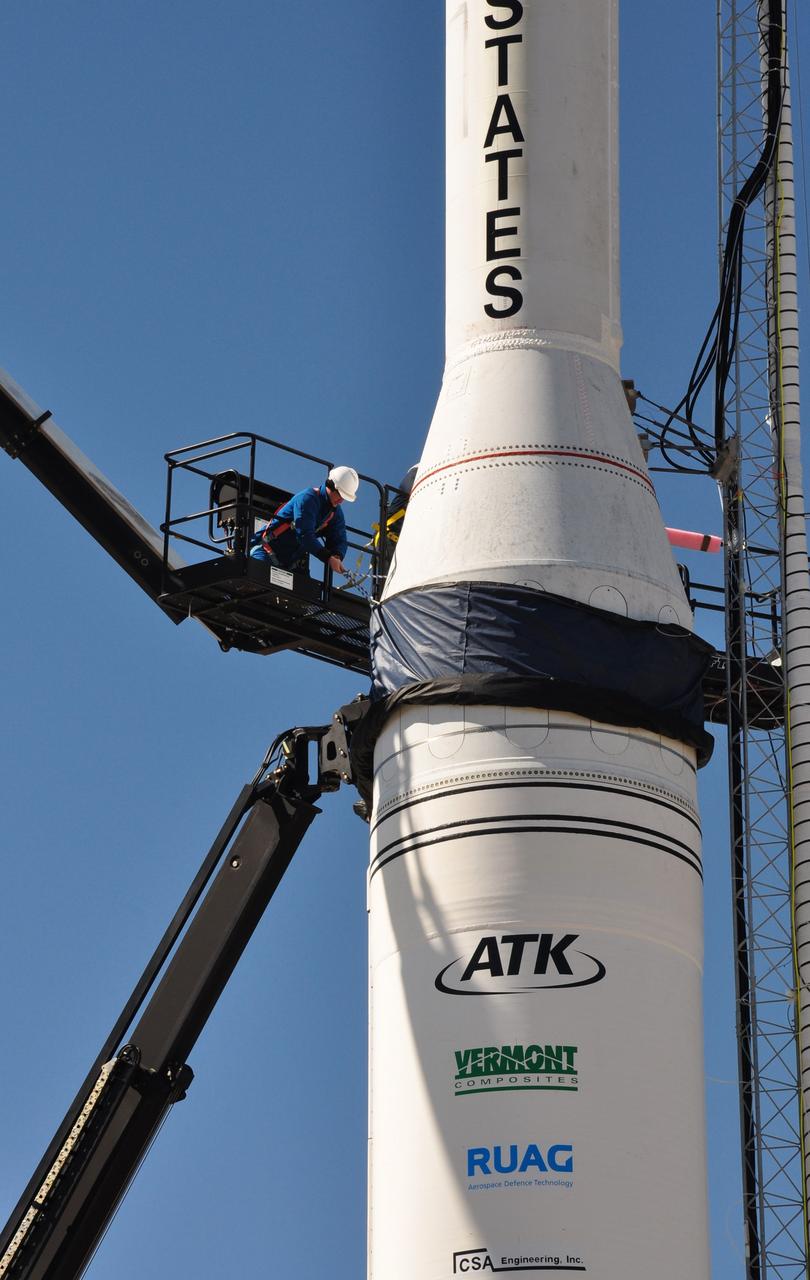
VANDENBERG AIR FORCE BASE, Calif. -- On Space Launch Complex 576-E at Vandenberg Air Force Base in California, workers enclose the spacecraft's fairing in a non-flight environmental shield that will be removed before launch. The Orbital Sciences Taurus XL rocket will launch Glory into low Earth orbit. Once Glory reaches orbit, it will collect data on the properties of aerosols and black carbon. It also will help scientists understand how the sun's irradiance affects Earth's climate. Launch is scheduled for 5:09 a.m. EST Feb. 23. For information, visit www.nasa.gov/glory. Photo credit: NASA/Randy Beaudoin, VAFB
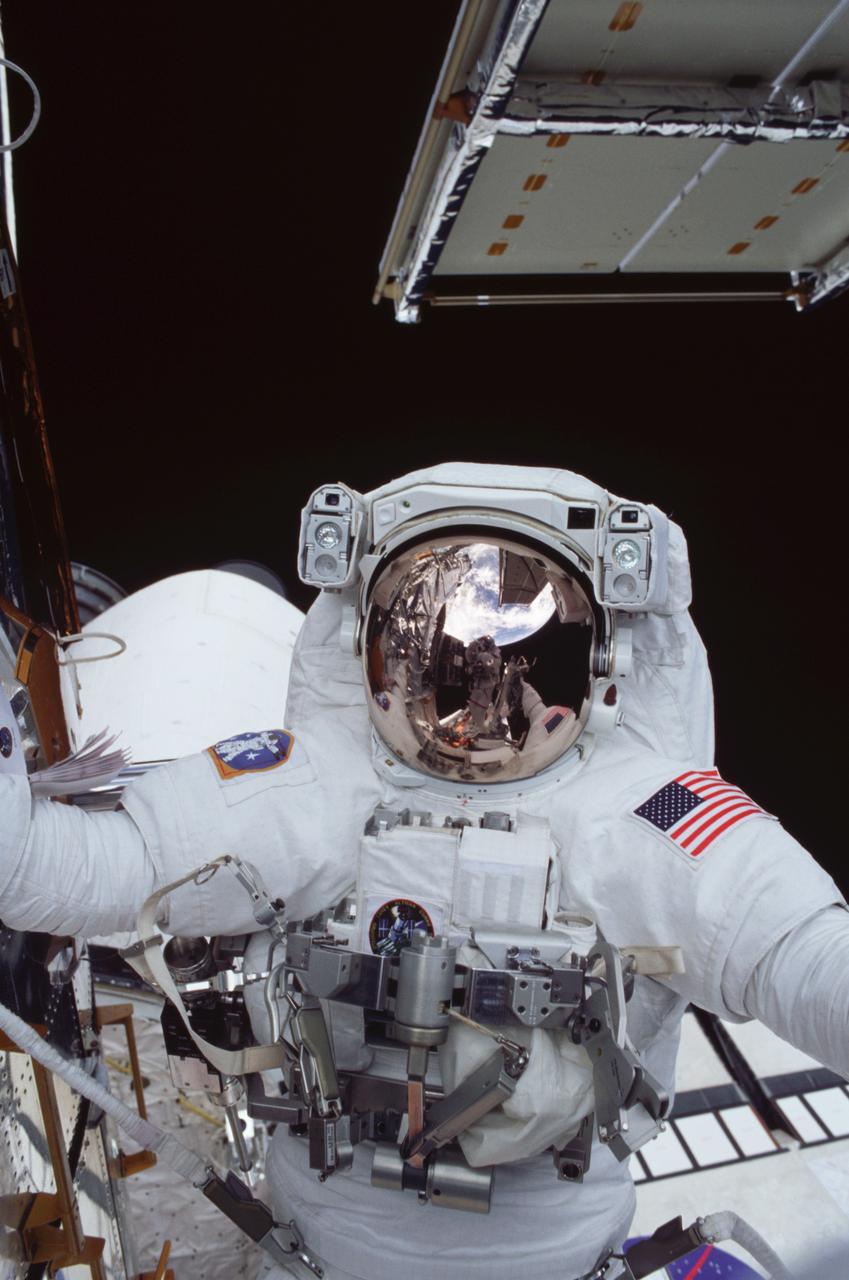
STS109-322-028 (6 March 2002) --- Astronaut Richard M. Linnehan, STS-109 mission specialist, participates in the third of five space walks to perform work on the Hubble Space Telescope (HST). Linnehan's sun shield reflects astronaut John M. Grunsfeld and the blue and white Earth's hemisphere as well as one of the telescope's new solar arrays. The third overall STS-109 extravehicular activity (EVA) marked the second of three for Linnehan and Grunsfeld, payload commander. On this particular walk, the two turned off the telescope in order to replace the power control unit or PCU--the heart of its power system. Grunsfeld took this photo with a 35mm camera.
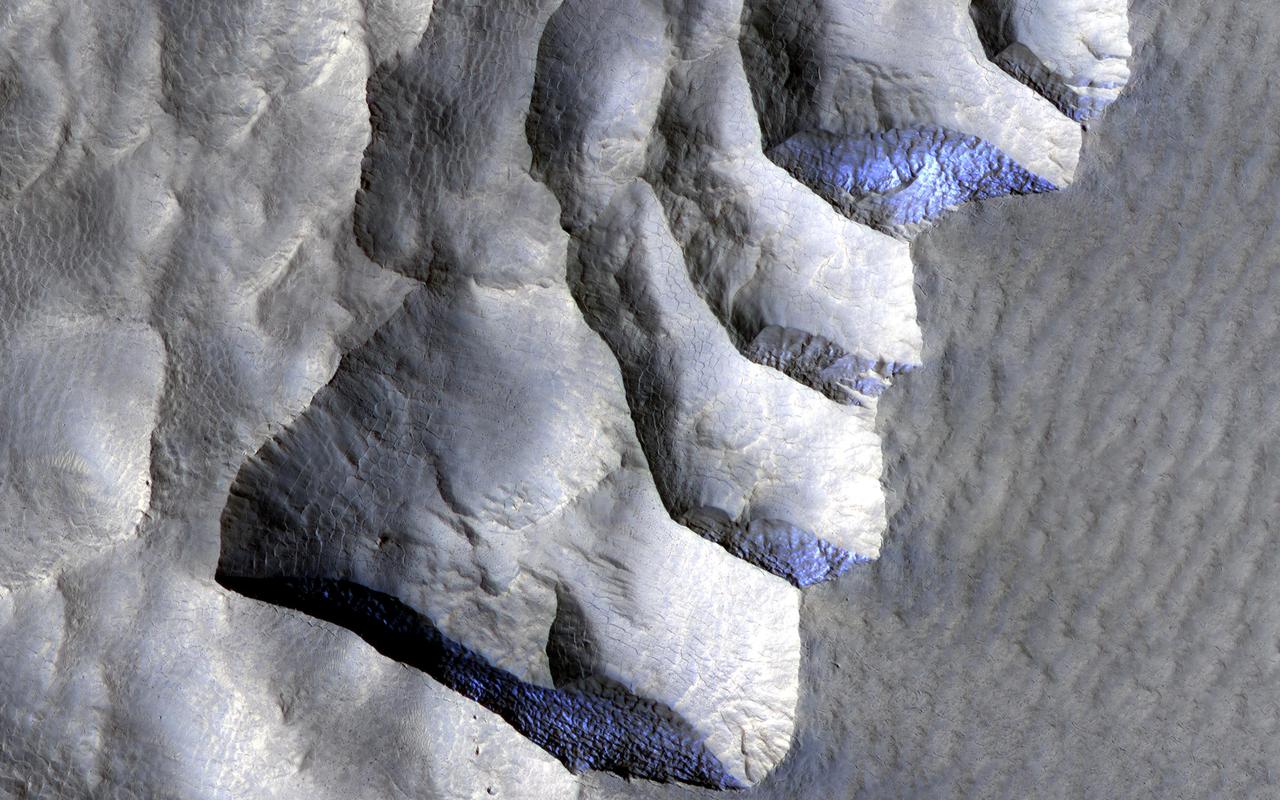
This area, on the western edge of Milankovic Crater on Mars, has a thick deposit of sediment that covers a layer rich in ice. The ice is not obvious unless you look in color. In the red-green-blue images that are close to what the human eye would see, the ice looks bright white, while the surroundings are a rusty red. The ice stands out even more clearly in the infrared-red-blue images where it has a striking bluish-purple tone while the surroundings have a yellowish-grey color. The ice-rich material is most visible when the cliff is oriented east-west and is shielded from the sun as it arcs through the sky to the south. https://photojournal.jpl.nasa.gov/catalog/PIA25088
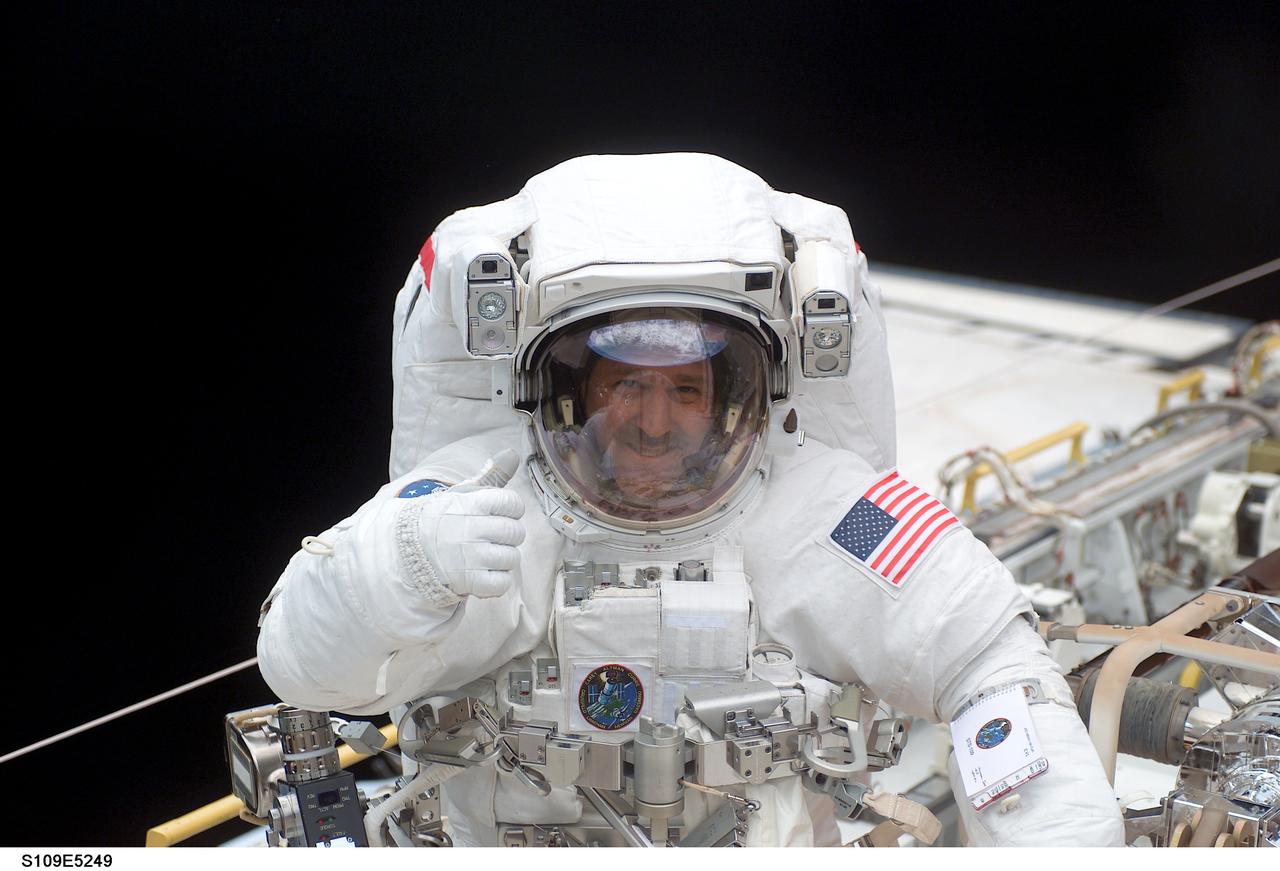
STS109-E-5249 (4 March 2002) --- In Columbia's cargo bay, astronaut John M. Grunsfeld (foreground), payload commander, signals to a crewmate inside the crew cabin. He had just raised his helmet visor's sun shield. Astronauts Grunsfeld and Richard M. Linnehan (out of frame), mission specialist, participating in the first of their assigned STS-109 space walks to perform work on the Hubble Space Telescope (HST), went on to replace the giant telescope’s starboard solar array. Their seven-hour space walk ended at 7:38 a.m. (CST) or 13:38 GMT March 4, 2002.
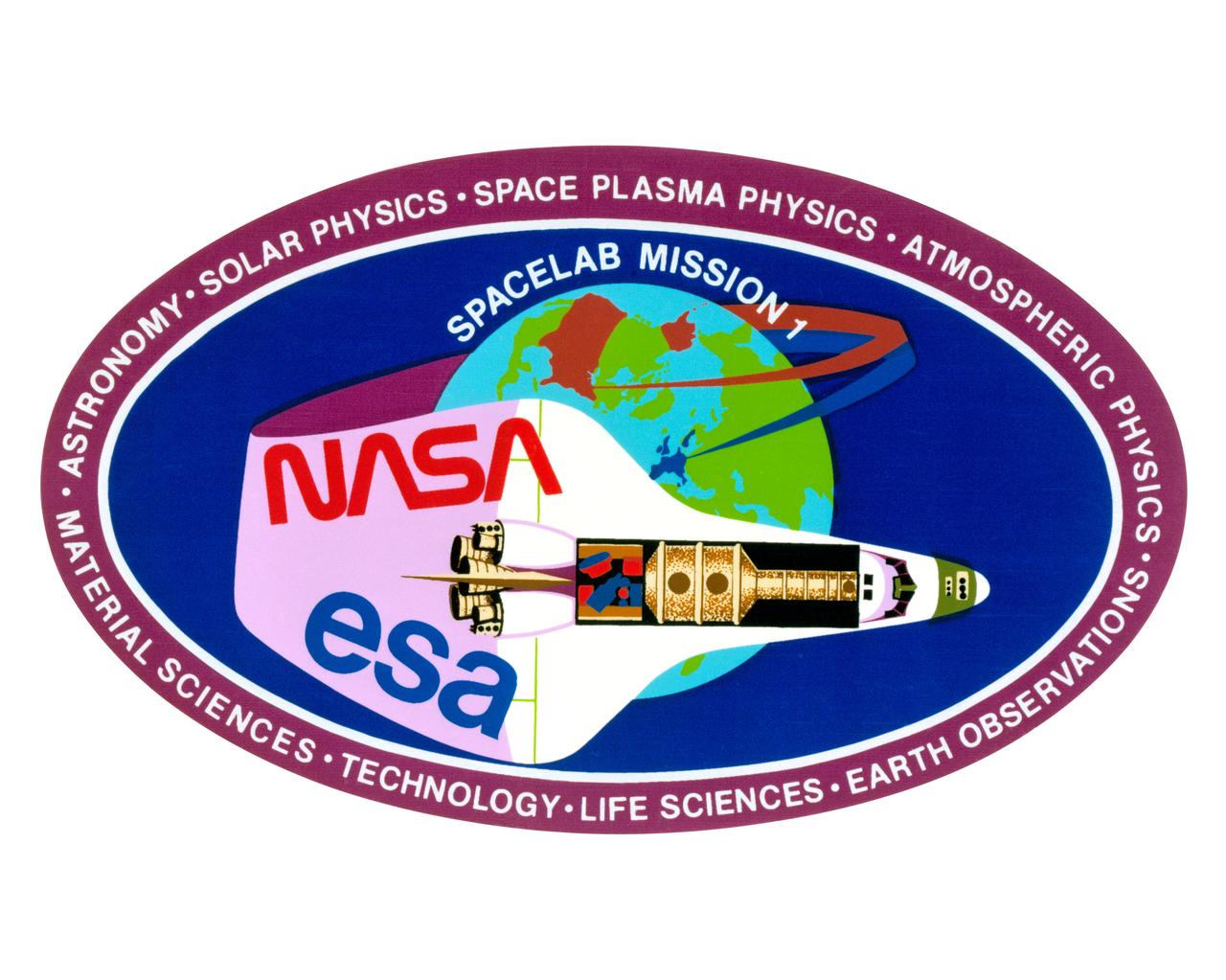
S82-31408 (May 1983) --- The Spacelab 2 emblem is a symbolic representation of the scientific objectives of the mission. The emblem is in the shape of a triangular shield with convexly curved edges. Across the top of a black out border are the words ?SPACELAB 2?. Within the black border is a sky blue border carryhing the words: ?ASTRONOMY?, ON TOP? ?PHYSICS?, on the left; and ?BIOLOGY?, on the right. Within the blue border is a schematic view of the sun, the earth, and the orbiter with Spacelab 2. The sun appears in the upper right background as a white disc surrounded by six concentric rings ranging grom bright yellow near the disc through yellow-red to a dark red out ring. A sector of the earth with blue ocean and a black portion of North America is in the upper left corner. The black and white Orbiter is seen from directly overhead in the foreground, the right side illuminated by the sun, the left side in shadow. Although the payload bay doors are not open, the Spacelab 2 payload is seen as if the doors were open. In black on white are seen the three pallets, and the separately mounted cosmic ray experiment at the aft end of the bay.
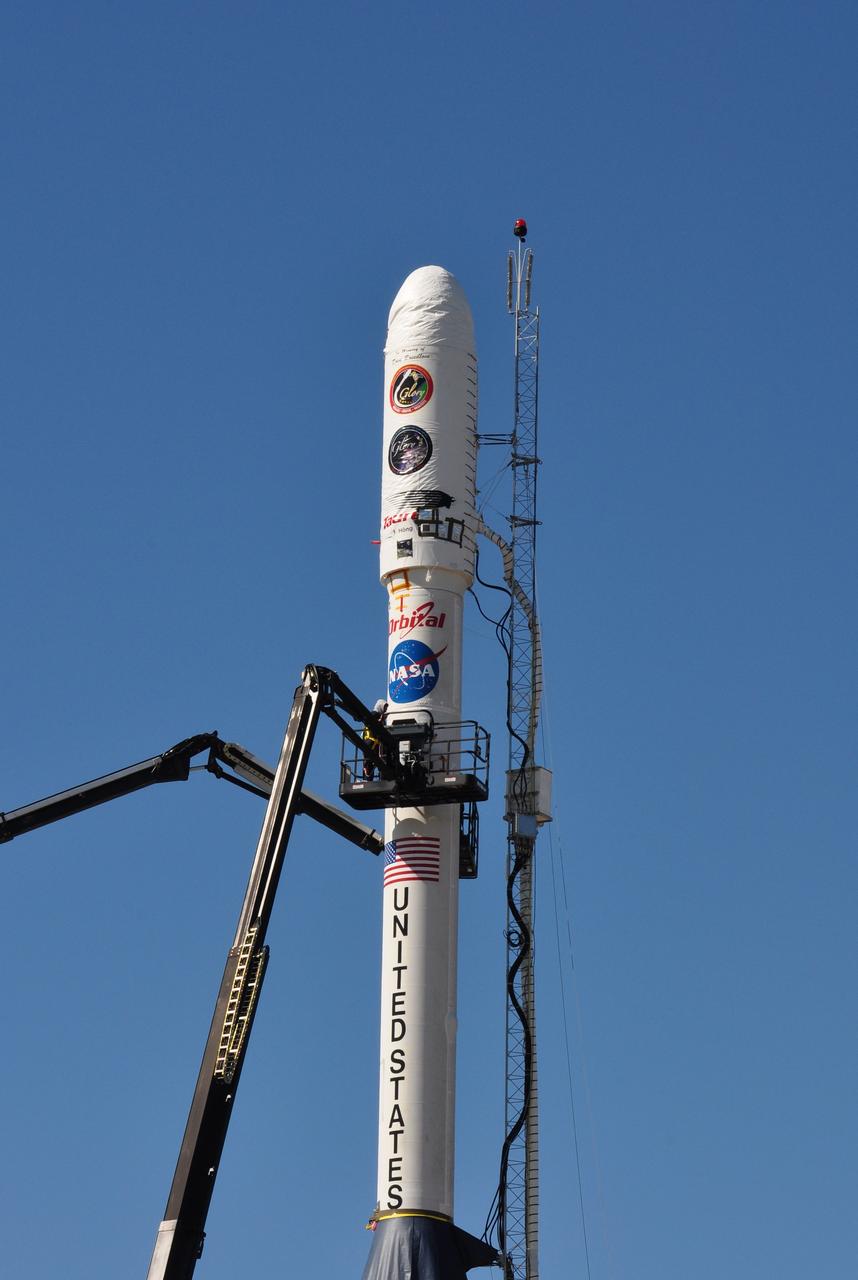
VANDENBERG AIR FORCE BASE, Calif. -- On Space Launch Complex 576-E at Vandenberg Air Force Base in California, workers in a bucket conduct closeout procedures on the Taurus XL rocket in preparations for liftoff. Around the spacecraft's fairing, at top, is the non-flight environmental shield that will be removed before launch. The Orbital Sciences Taurus XL rocket will launch Glory into low Earth orbit. Once Glory reaches orbit, it will collect data on the properties of aerosols and black carbon. It also will help scientists understand how the sun's irradiance affects Earth's climate. Launch is scheduled for 5:09 a.m. EST Feb. 23. For information, visit www.nasa.gov/glory. Photo credit: NASA/Randy Beaudoin, VAFB
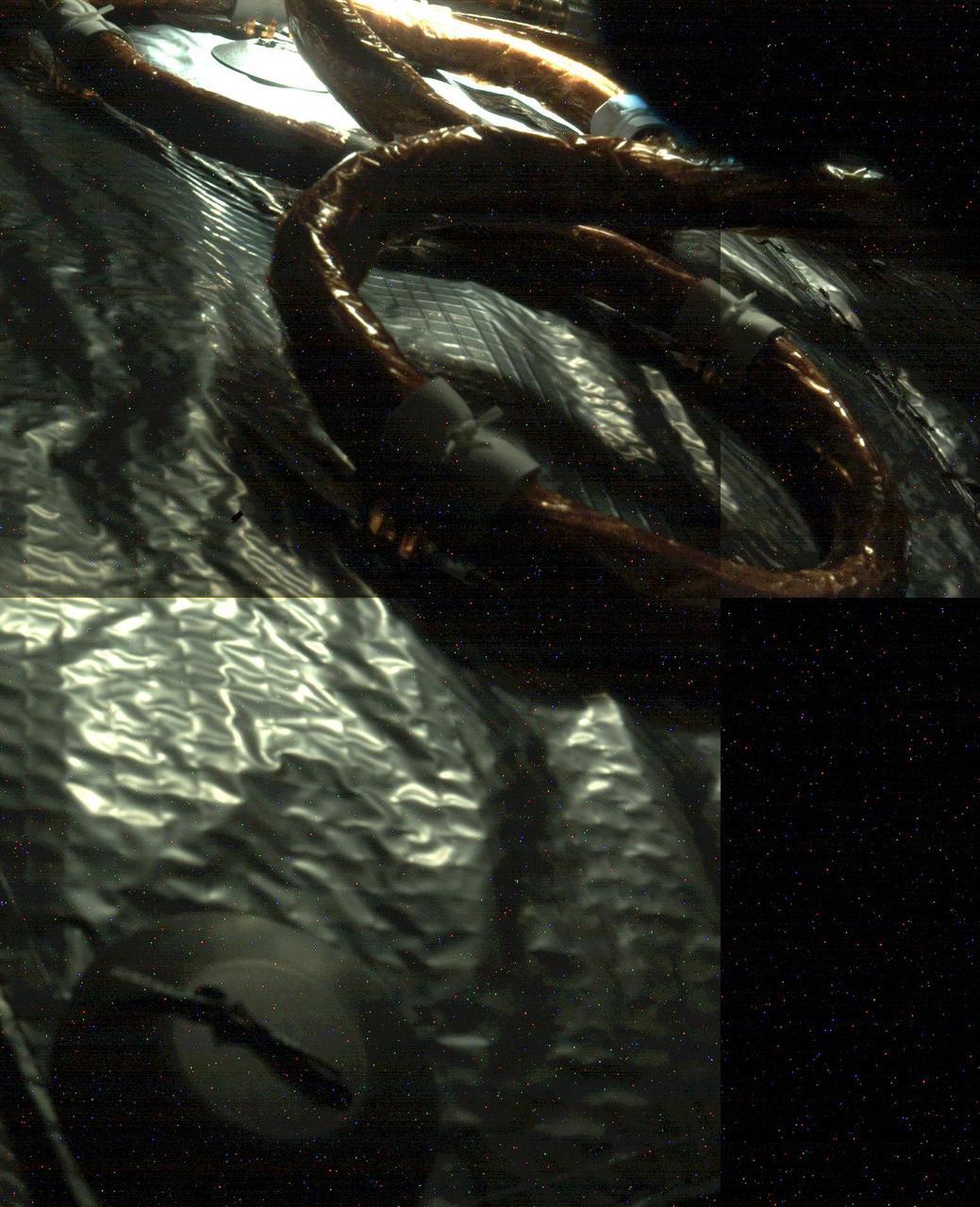
An electrical cable can be seen snaking its way along insulation material in this image of the interior of the Mars 2020 spacecraft at it cruises through interplanetary space to the Red Planet. The cable and insulation are tied to the inside of the spacecraft's heat shield, which will protect the spacecraft from the extreme temperatures generated by friction as it enters the Martian atmosphere on Feb 18, 2021. The light source is the Sun, which likely entered through a vent hole in the Multi-Mission Radioisotope Thermoelectric Generator (MMRTG) door. The picture was assembled from three images taken at different times by the Perseverance rover's rear left Hazcam during a systems check on Oct. 19, 2020. The colored pixels seen in the image are due to digital noise from the camera. https://photojournal.jpl.nasa.gov/catalog/PIA24233
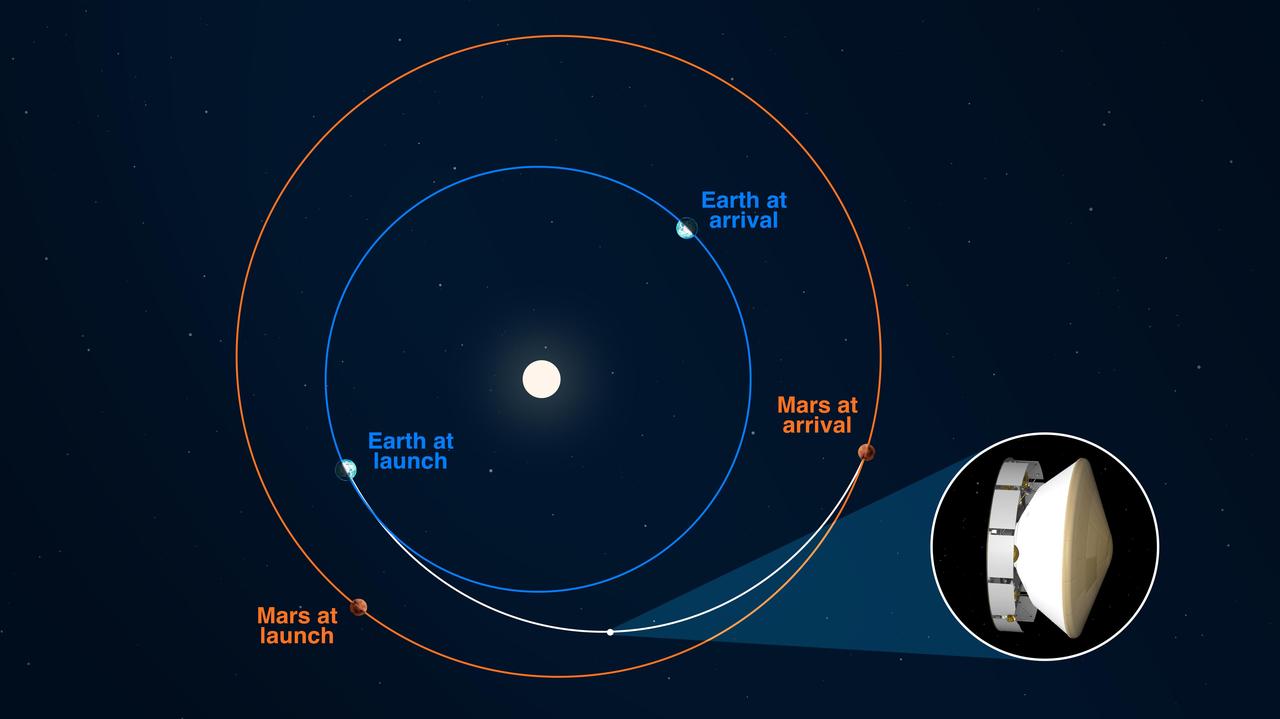
NASA's Mars 2020 Perseverance rover reached its halfway point to Jezero Crater on Oct. 27, 2020 at 1:40 p.m. PDT (4:40 EDT), having completed as many miles — 146.3 million miles (235.4 million kilometers) — as it has yet to travel on its journey to Mars. In straight-line distance, Earth is 26.6 million miles (42.7 million kilometers) behind Perseverance, and Mars is 17.9 million miles (28.8 million kilometers) in front. This illustration depicts the curved trajectory of the spacecraft (seen in inset: cruise stage, descent stage, back shell, and heat shield, plus the rover and Mars Helicopter), noting the positions of Earth and Mars relative to each other both at the time of launch and the time of landing. The trajectory's curvature is a result of the Sun's gravitational influence on the spacecraft. https://photojournal.jpl.nasa.gov/catalog/PIA24232
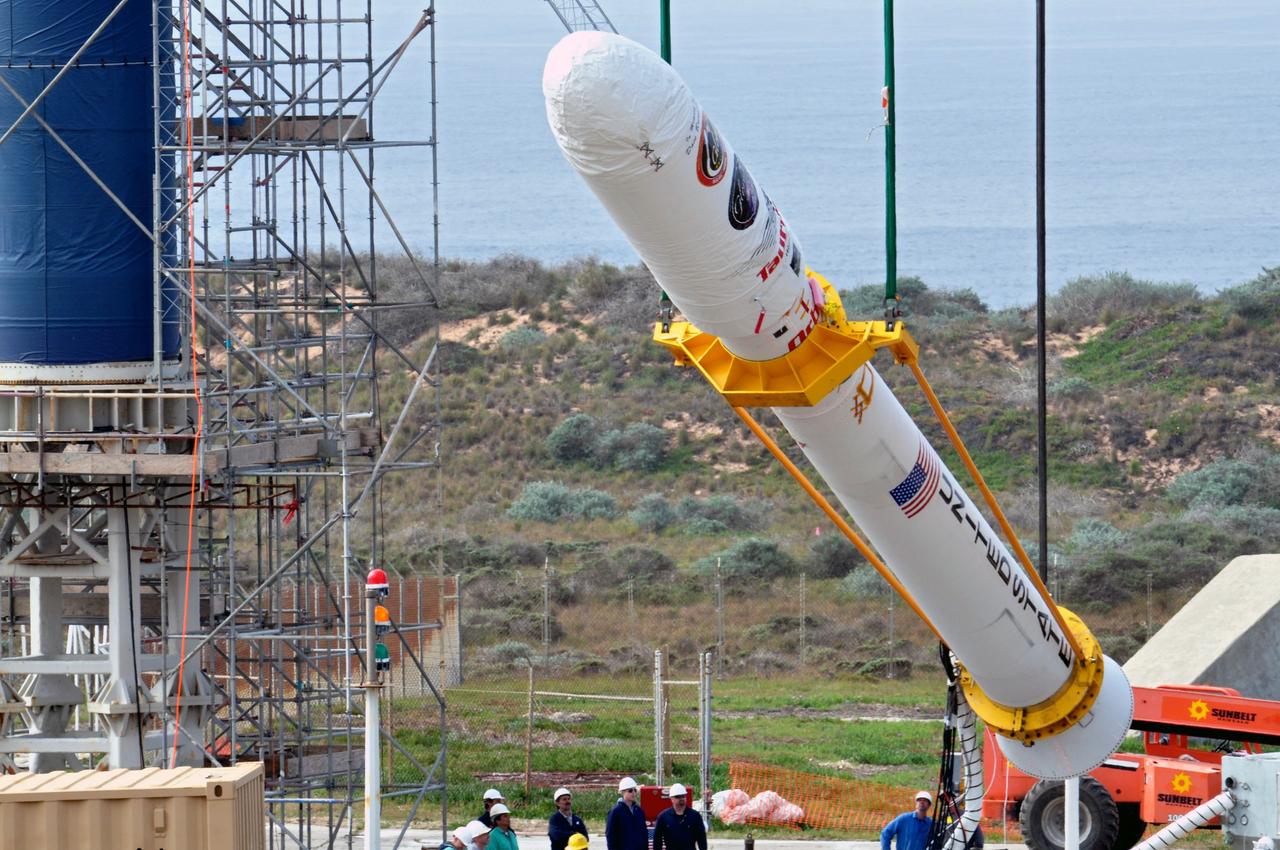
VANDENBERG AIR FORCE BASE, Calif. -- On Space Launch Complex 576-E at Vandenberg Air Force Base in California, Orbital Sciences workers monitor NASA's Glory upper stack as a crane lifts it from a stationary rail for attachment to the Taurus XL rocket's Stage 0. The upper stack consists of Stages 1, 2 and 3 of the Taurus as well as the encapsulated Glory spacecraft. Workers put the non-flight environmental shield over the fairing prior to assembly. The Orbital Sciences Taurus XL rocket will launch Glory into low Earth orbit. Once Glory reaches orbit, it will collect data on the properties of aerosols and black carbon. It also will help scientists understand how the sun's irradiance affects Earth's climate. Launch is scheduled for 5:09 a.m. EST Feb. 23. For information, visit www.nasa.gov/glory. Photo credit: NASA/Randy Beaudoin, VAFB
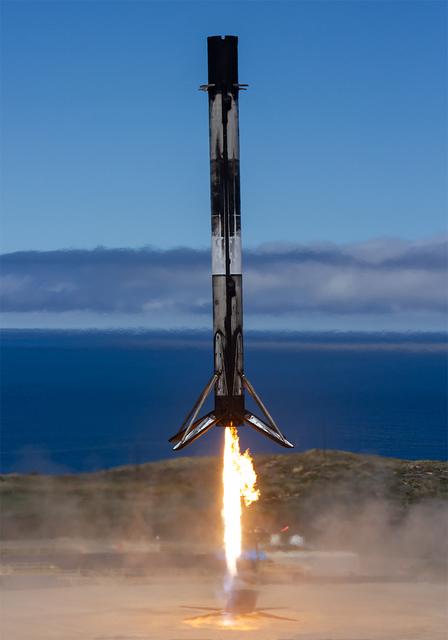
A SpaceX Falcon 9 first stage booster lands on Landing Zone 4 following liftoff of NASA’s TRACERS (Tandem Reconnection and Cusp Electrodynamics Reconnaissance Satellites) mission at Space Launch Complex 4 East at Vandenberg Space Force Base in California on Wednesday, July 23, 2025. This was the 16th flight for the first stage booster, which has previously launched these NASA missions - PACE (Plankton, Aerosol, Cloud, ocean Ecosystem, NASA’s SpaceX Crew-7, and Commercial Resupply Services-29. The TRACERS mission will study magnetic reconnection around Earth — a process in which electrically charged plasmas exchange energy in the atmosphere — to understand how the Sun’s solar wind interacts with the magnetosphere, Earth’s protective magnetic shield.
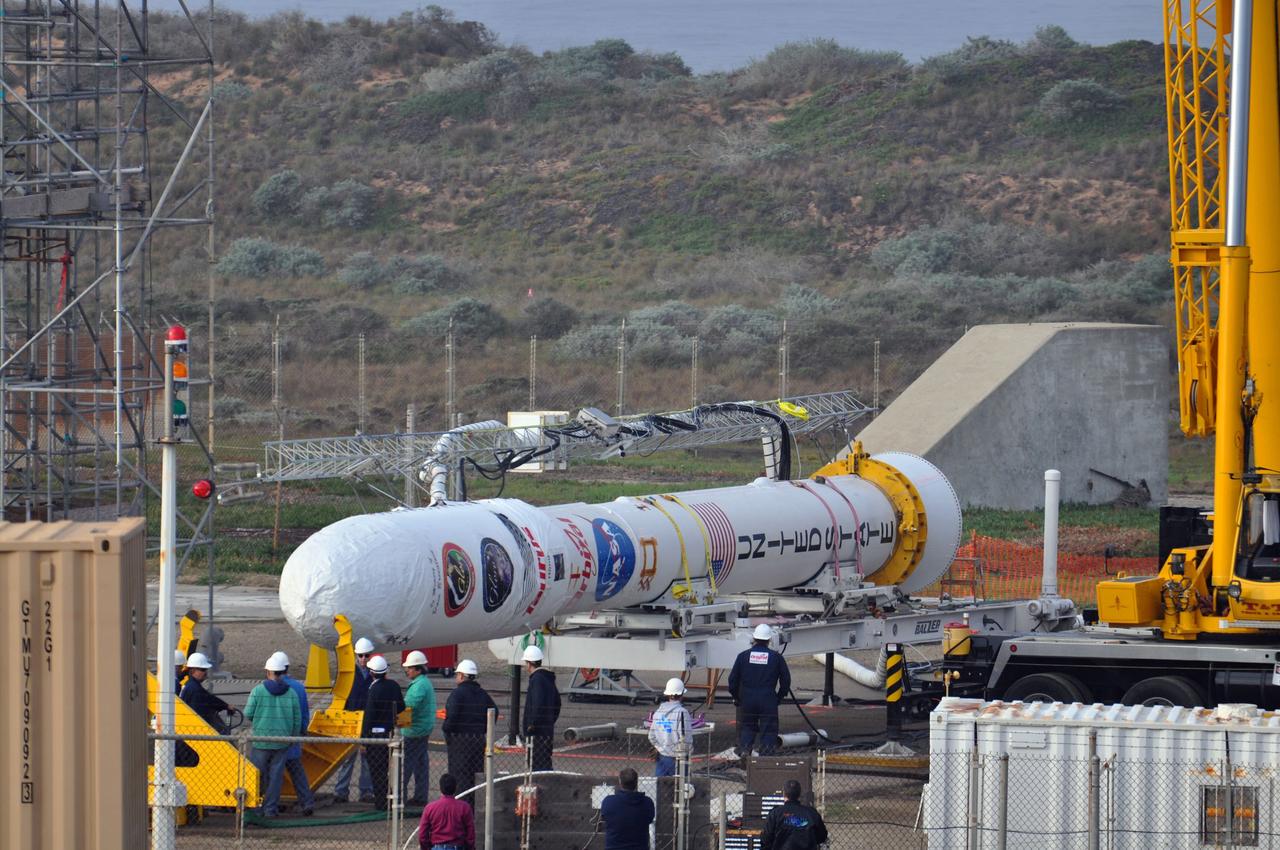
VANDENBERG AIR FORCE BASE, Calif. -- On Space Launch Complex 576-E at Vandenberg Air Force Base in California, Orbital Sciences workers prepare NASA's Glory upper stack for attachment to the Taurus XL rocket's Stage 0. The upper stack consists of Stages 1, 2 and 3 of the Taurus as well as the encapsulated Glory spacecraft. Workers put the non-flight environmental shield over the fairing prior to assembly. A portion of the umbilical tower is attached to the upper stack which falls away from the spacecraft during liftoff. The Orbital Sciences Taurus XL rocket will launch Glory into low Earth orbit. Once Glory reaches orbit, it will collect data on the properties of aerosols and black carbon. It also will help scientists understand how the sun's irradiance affects Earth's climate. Launch is scheduled for 5:09 a.m. EST Feb. 23. For information, visit www.nasa.gov/glory. Photo credit: NASA/Randy Beaudoin, VAFB
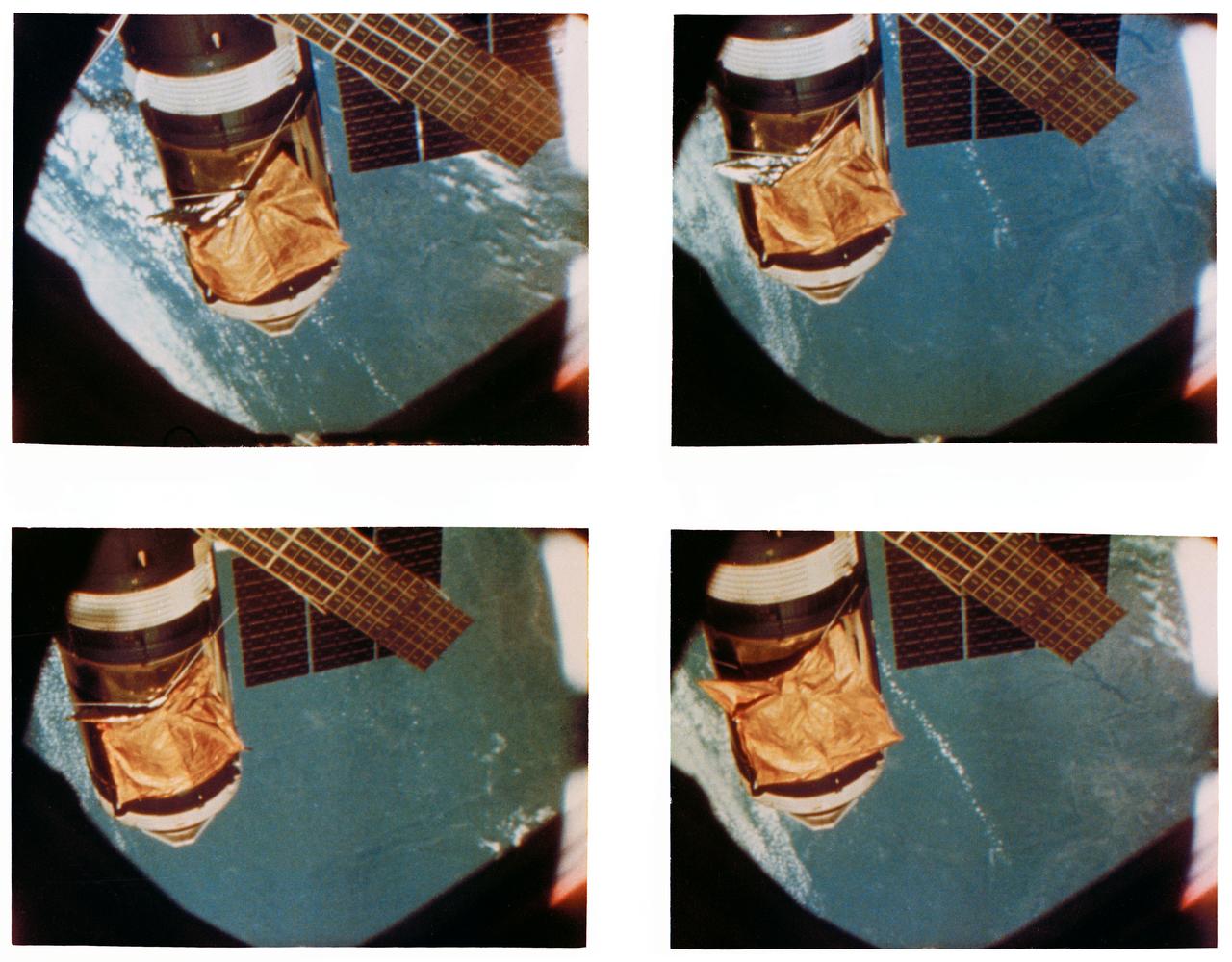
S73-34619 (28 July 1973) --- A composite of four frames taken from 16mm movie camera footage showing an overhead view of the Skylab space station cluster in Earth orbit. The Maurer motion picture camera scenes were being filmed during the Skylab 3 Command/Service Module's (CSM) first "fly around" inspection of the space station. Close comparison of the four frames reveals movement of the improvised parasol solar shield over the Orbital Workshop (OWS). The "flapping" of the sun shade was caused from the exhaust of the reaction control subsystem (RCS) thrusters of the Skylab 3 CSM. The one remaining solar array system wing on the OWS is in the lower left background. The solar panel in the lower left foreground is on the Apollo Telescope Mount (ATM). Photo credit: NASA
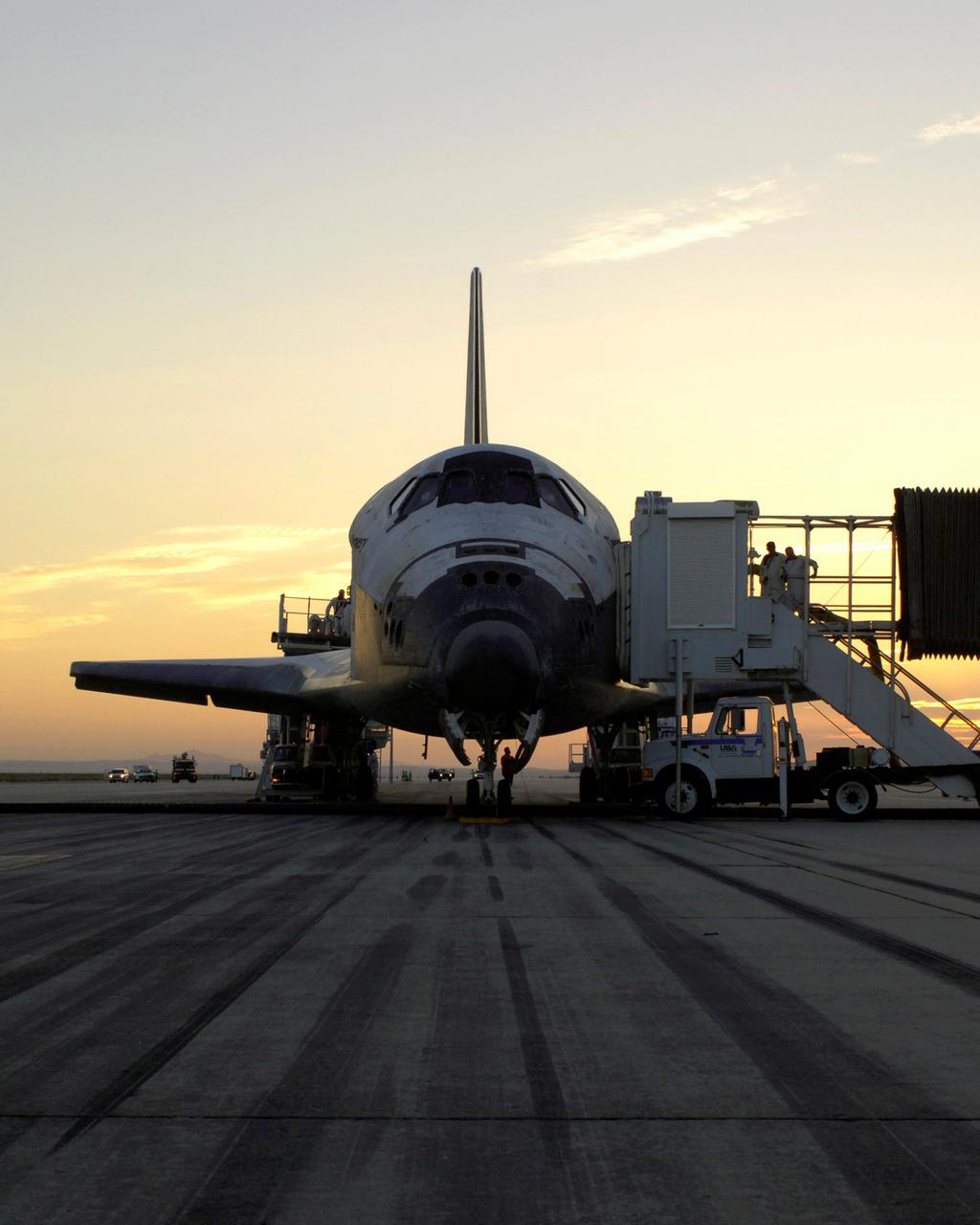
The sun rises on the Space Shuttle Discovery as it rests on the runway at Edward’s Air Force Base in California after a safe landing at 5:11 am (PDT) on August 9, 2005. The STS-114 landing concluded a historic 14 day return to flight mission to the International Space Station (ISS) after nearly a two and one half year delay in flight after the Space Shuttle Columbia tragedy in February 2003. Three successful space walks performed during the mission included a demonstration of repair techniques to the Shuttle’s thermal tiles known as the Thermal Protection System, the replacement of a failed Control Moment Gyroscope which helps keep the station oriented properly, and the installation of the External Stowage Platform, a space “shelf” for holding spare parts during Station construction. The shuttle’s heat shield repair was a first for Shuttle repair while still in space.

CAPE CANAVERAL, Fla. -- The sun glints off space shuttle Endeavour following its arrival at Launch Pad 39A at NASA's Kennedy Space Center in Florida. Riding atop a crawler-transporter attached to its external fuel tank and solid rocket boosters, Endeavour's 3.4-mile trek, known as "rollout," began at the Vehicle Assembly Building at 7:56 p.m. EST March 10 and ended at 3:49 a.m. EST, nearly eight hours later. This is Endeavour's final scheduled rollout. Endeavour and its six-member crew will deliver the Express Logistics Carrier-3, Alpha Magnetic Spectrometer-2 (AMS), a high-pressure gas tank, additional spare parts for the Dextre robotic helper and micrometeoroid debris shields to the International Space Station on the shuttle's final spaceflight, STS-134. Launch is targeted for 7:48 p.m. EDT April 19. For more information, visit www.nasa.gov/mission_pages/shuttle/shuttlemissions/sts134/index.html. Photo credit: NASA/Jack Pfaller
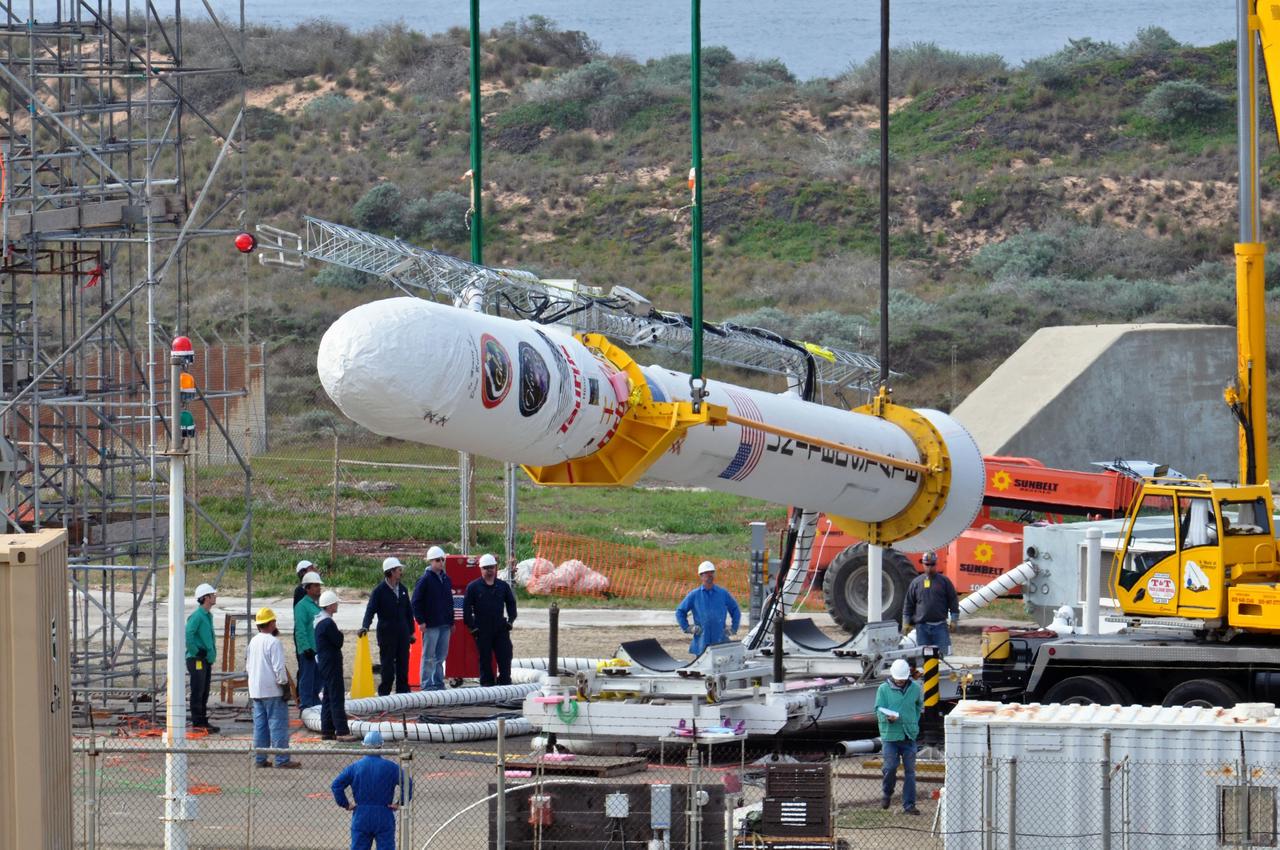
VANDENBERG AIR FORCE BASE, Calif. -- On Space Launch Complex 576-E at Vandenberg Air Force Base in California, Orbital Sciences workers monitor NASA's Glory upper stack as a crane lifts it from a stationary rail for attachment to the Taurus XL rocket's Stage 0. The upper stack consists of Stages 1, 2 and 3 of the Taurus as well as the encapsulated Glory spacecraft. Workers put the non-flight environmental shield over the fairing prior to assembly. A portion of the umbilical tower is attached to the upper stack which falls away from the spacecraft during liftoff. The Orbital Sciences Taurus XL rocket will launch Glory into low Earth orbit. Once Glory reaches orbit, it will collect data on the properties of aerosols and black carbon. It also will help scientists understand how the sun's irradiance affects Earth's climate. Launch is scheduled for 5:09 a.m. EST Feb. 23. For information, visit www.nasa.gov/glory. Photo credit: NASA/Randy Beaudoin, VAFB
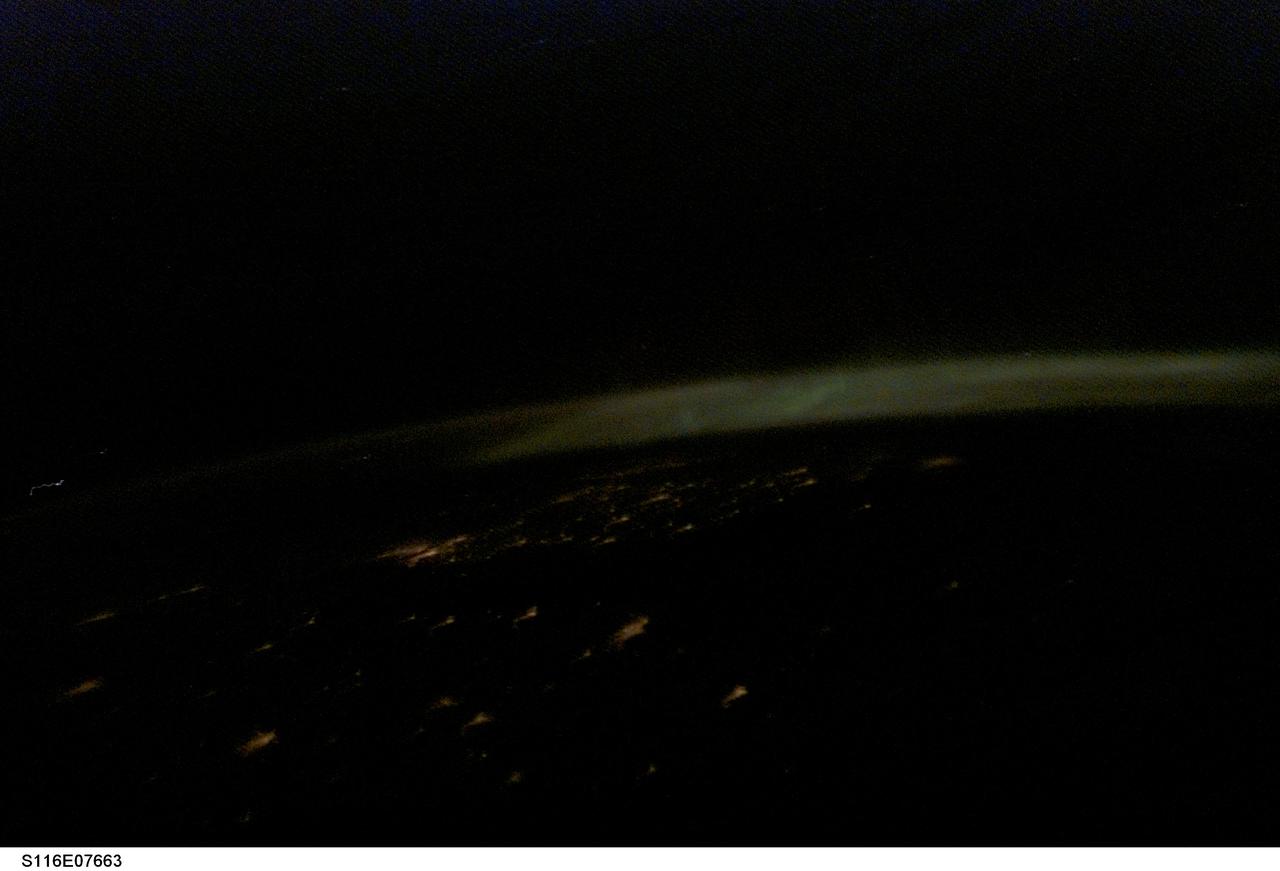
S116-E-07663 (20 Dec. 2006) --- One of the STS-116 crewmembers onboard the Space Shuttle Discovery captured this picture of Aurora Borealis over Norway, Poland and Sweden, as the crew made preparations for a Dec. 22 landing. European Space Agency astronaut Christer Fuglesang onboard the shuttle noted the rarity of pictures over this area from shuttle missions, and especially pictures that included the Northern Lights. Fuglesang is from Sweden. The city lights of Copenhagen (bright cluster of lights in the middle left portion of the image), Stockholm (under the aurora on the far right side of the image), and Gdansk (in the center forefront) are seen. The formation of the aurora starts with the sun releasing solar particles. The Earth's magnetic field captures and channels the solar particles toward the Earth's two magnetic poles (north and south). As the solar particles move towards the poles they collide with the Earth's atmosphere, which acts as an effective shield against these deadly particles. The collision between the solar particles and the atmospheric gas molecule emits a light particle (photon). When there are many collisions the aurora is formed.
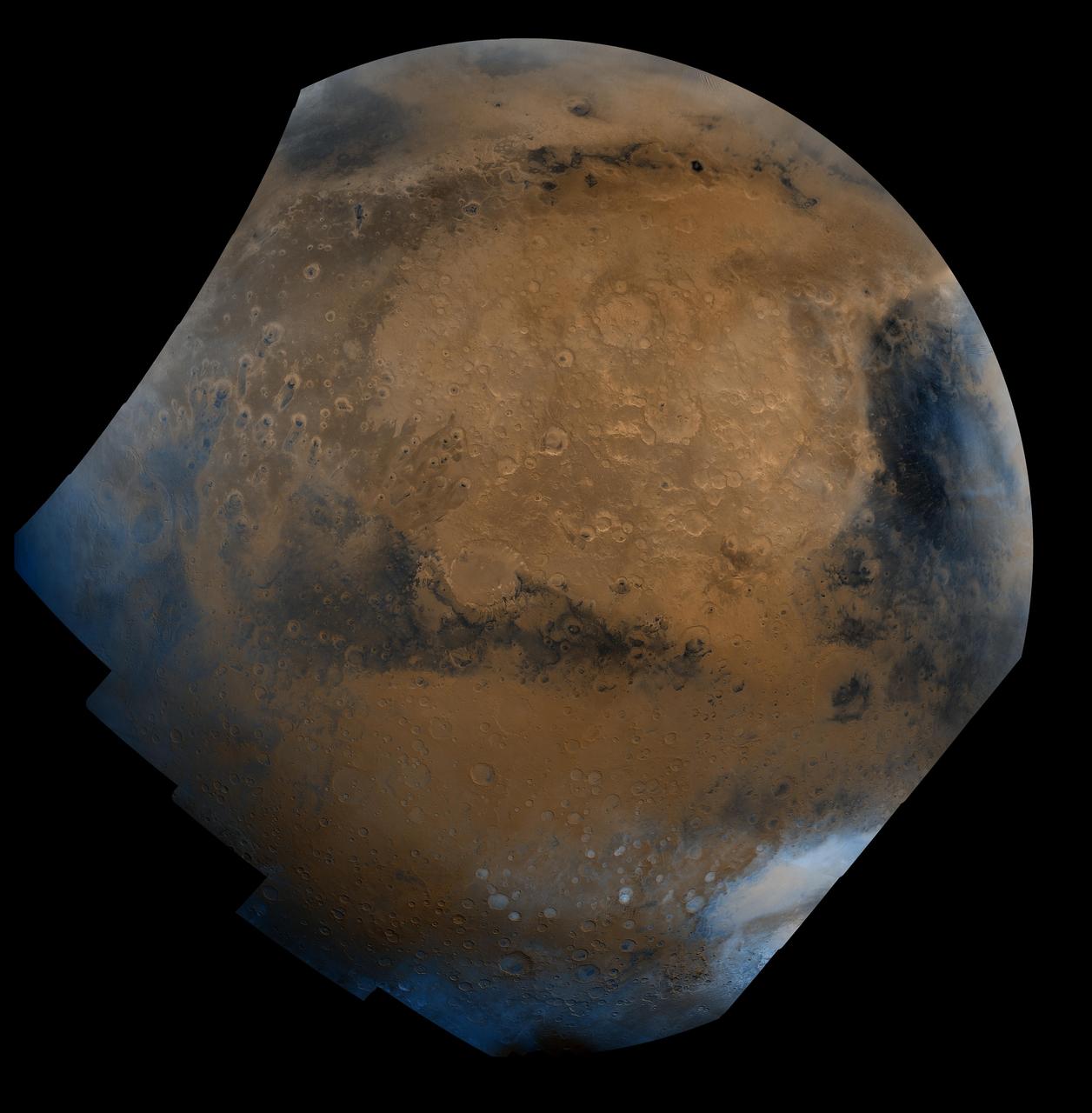
This mosaic is composed of about 100 red- and violet- filter Viking Orbiter images, digitally mosaiced in an orthographic projection at a scale of 1 km/pixel. The images were acquired in 1980 during mid northern summer on Mars (Ls = 89 degrees). The center of the image is near the impact crater Schiaparelli (latitude -3 degrees, longitude 343 degrees). The limits of this mosaic are approximately latitude -60 to 60 degrees and longitude 280 to 30 degrees. The color variations have been enhanced by a factor of two, and the large-scale brightness variations (mostly due to sun-angle variations) have been normalized by large-scale filtering. The large circular area with a bright yellow color (in this rendition) is known as Arabia. The boundary between the ancient, heavily-cratered southern highlands and the younger northern plains occurs far to the north (latitude 40 degrees) on this side of the planet, just north of Arabia. The dark streaks with bright margins emanating from craters in the Oxia Palus region (to the left of Arabia) are caused by erosion and/or deposition by the wind. The dark blue area on the far right, called Syrtis Major Planum, is a low-relief volcanic shield of probable basaltic composition. Bright white areas to the south, including the Hellas impact basin at the lower right, are covered by carbon dioxide frost. http://photojournal.jpl.nasa.gov/catalog/PIA00004
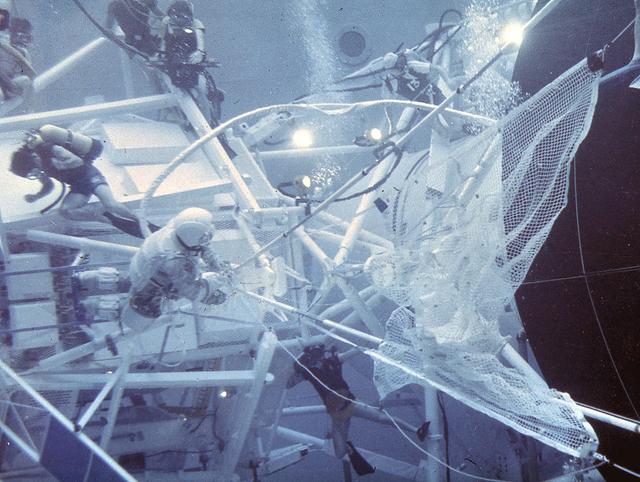
After its launch on May 14, 1973, it was immediately known that there were some major problems with Skylab. The large, delicate, meteoroid shield on the outside of the workshop was ripped off by the vibration of the launch. Its tearing off caused serious damage to the two wings of solar cells that were to supply most of the electric power to the workshop. Once in orbit, the news worsened. The loss of the big shade exposed the metal skin of the workshop to the sun. Internal temperatures soared to 126 degrees F. This heat not only threatened its habitation by astronauts, but if prolonged, would cause serious damage to instruments and film. After twice delaying the launch of the first astronaut crew, engineers worked frantically to develop solutions to these problems and salvage the Skylab. After designing a protective solar sail to cover the workshop, crews needed to practice using the specially designed tools and materials to facilitate the repair procedure. Marshall Space Flight Center's Neutral Buoyancy Simulator (NBS), was used to practice these maneuvers. Pictured here are the astronauts in the NBS deploying the protecticve solar sail. On may 25, 1973, an Apollo command and service module was launched and later docked with Skylab. The next day, astronauts Conrad and Kerwin were able to complete the needed repairs to Skylab, salvaging the entire program.
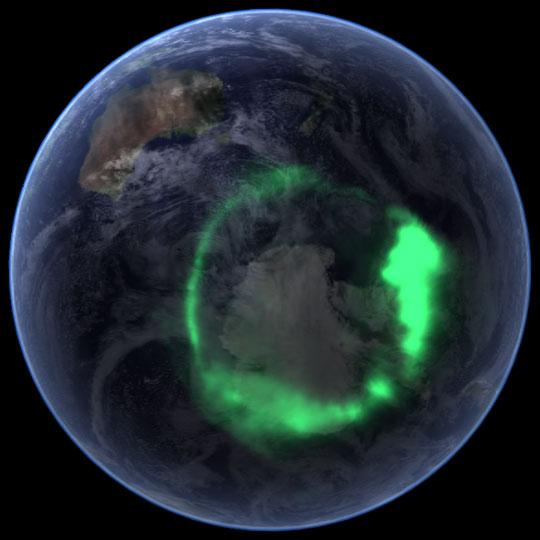
NASA file image acquired September 11, 2005 <b>To view a video of this event go here: <a href="http://www.flickr.com/photos/gsfc/6257608714">www.flickr.com/photos/gsfc/6257608714</a></b> From space, the aurora is a crown of light that circles each of Earth’s poles. The IMAGE satellite captured this view of the aurora australis (southern lights) on September 11, 2005, four days after a record-setting solar flare sent plasma—an ionized gas of protons and electrons—flying towards the Earth. The ring of light that the solar storm generated over Antarctica glows green in the ultraviolet part of the spectrum, shown in this image. The IMAGE observations of the aurora are overlaid onto NASA’s satellite-based Blue Marble image. From the Earth’s surface, the ring would appear as a curtain of light shimmering across the night sky. Like all solar storms, the September storm distorted the shape of the magnetic field that surrounds the Earth. Without buffeting from the solar wind (charged particles like protons and electrons that are ejected from the Sun), the Earth’s magnetic field would look something like a plump doughnut, with the North and South poles forming the slender hole in the center. In reality, the nearly constant solar winds flatten the space side of the “doughnut” into a long tail. The amount of distortion changes when solar storms, such as the flare on September 7, send stronger winds towards the Earth. Changes to the magnetic field release fast-moving particles, which flow with charged particles from the Sun towards the center of the “doughnut” at the Earth’s poles. As the particles sink into the atmosphere, they collide with oxygen and nitrogen, lighting the sky with Nature’s version of neon lights, the aurora. Though scientists knew that the aurora were caused by charged particles from the Sun and their interaction with the Earth’s magnetic field, they had no way to measure the interaction until NASA launched the Imager for Magnetopause-to-Aurora Global Exploration (IMAGE) satellite in 2000. The satellite’s mission was to collect data that would allow scientists to study the structure and dynamics of the Earth’s magnetic field for the first time. Designed to operate for two years, IMAGE sent its last data to Earth in December 2005 after a highly successful five-year mission. Since 2000, IMAGE has provided insight into how the Earth’s powerful magnetic field protects the planet from solar winds. Without the shield the magnetic field provides, the upper atmosphere would evaporate into space under the influence of solar winds. IMAGE has shown scientists what sort of changes the magnetic field undertakes as it diverts solar winds from the Earth. For a summary of the discoveries that IMAGE has made possible, see IMAGE Discovers. Instrument: IMAGE Credit: <a href="http://svs.gsfc.nasa.gov/index.html" rel="nofollow">NASA/Goddard Space Flight Center Scientific Visualization Studio</a> <b><a href="http://www.nasa.gov/audience/formedia/features/MP_Photo_Guidelines.html" rel="nofollow">NASA image use policy.</a></b> <b><a href="http://www.nasa.gov/centers/goddard/home/index.html" rel="nofollow">NASA Goddard Space Flight Center</a></b> enables NASA’s mission through four scientific endeavors: Earth Science, Heliophysics, Solar System Exploration, and Astrophysics. Goddard plays a leading role in NASA’s accomplishments by contributing compelling scientific knowledge to advance the Agency’s mission. <b>Follow us on <a href="http://twitter.com/NASAGoddardPix" rel="nofollow">Twitter</a></b> <b>Like us on <a href="http://www.facebook.com/pages/Greenbelt-MD/NASA-Goddard/395013845897?ref=tsd" rel="nofollow">Facebook</a></b> <b>Find us on <a href="http://instagrid.me/nasagoddard/?vm=grid" rel="nofollow">Instagram</a></b>
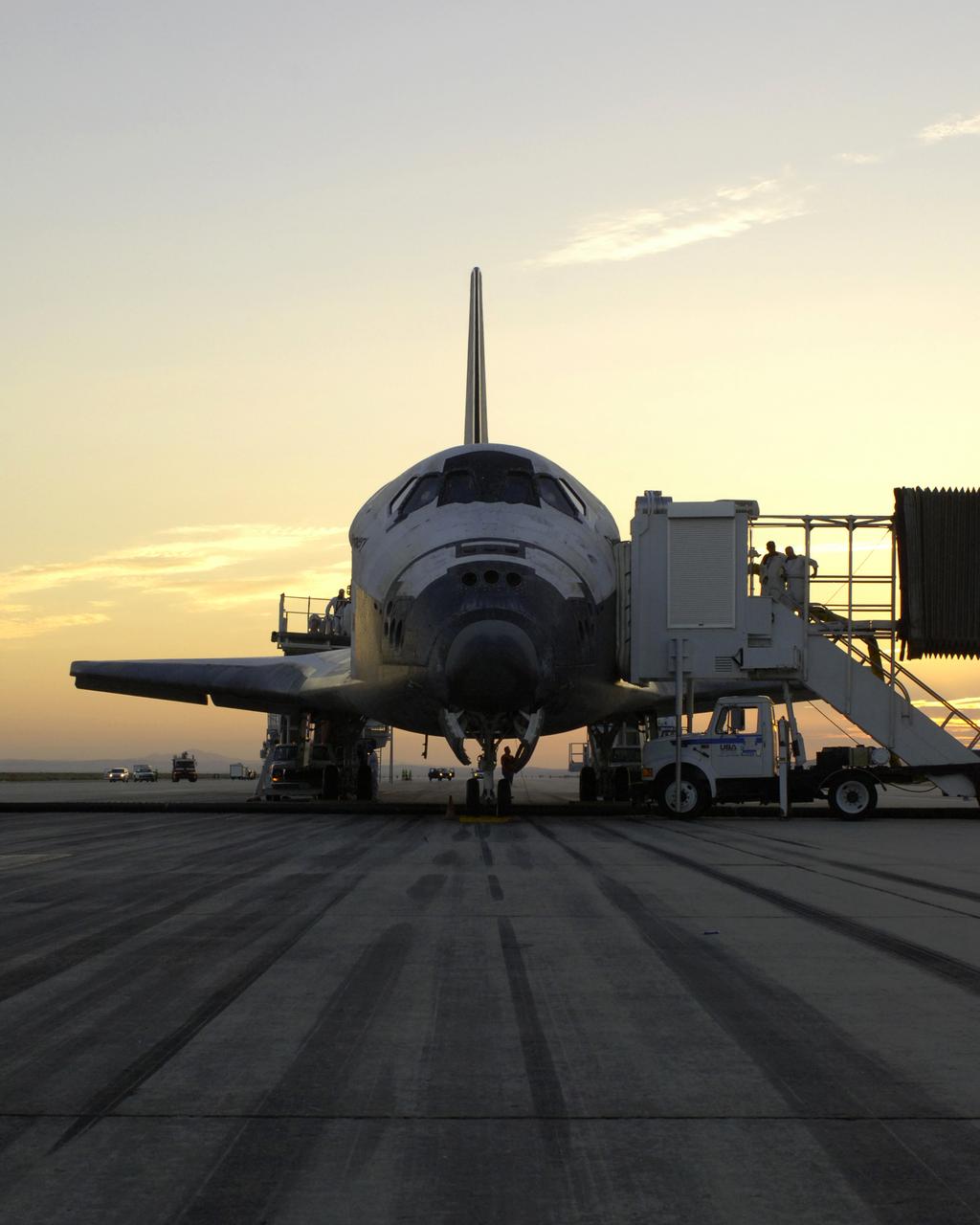
The sun rises on the Space Shuttle Discovery as it rests on the runway at Edwards Air Force Base, California, after a safe landing August 9, 2005 to complete the STS-114 mission. Space Shuttle Discovery landed safely at NASA's Dryden Flight Research Center at Edwards Air Force Base in California at 5:11:22 a.m. PDT this morning, following the very successful 14-day STS-114 return to flight mission. During their two weeks in space, Commander Eileen Collins and her six crewmates tested out new safety procedures and delivered supplies and equipment the International Space Station. Discovery spent two weeks in space, where the crew demonstrated new methods to inspect and repair the Shuttle in orbit. The crew also delivered supplies, outfitted and performed maintenance on the International Space Station. A number of these tasks were conducted during three spacewalks. In an unprecedented event, spacewalkers were called upon to remove protruding gap fillers from the heat shield on Discovery's underbelly. In other spacewalk activities, astronauts installed an external platform onto the Station's Quest Airlock and replaced one of the orbital outpost's Control Moment Gyroscopes. Inside the Station, the STS-114 crew conducted joint operations with the Expedition 11 crew. They unloaded fresh supplies from the Shuttle and the Raffaello Multi-Purpose Logistics Module. Before Discovery undocked, the crews filled Raffeallo with unneeded items and returned to Shuttle payload bay. Discovery launched on July 26 and spent almost 14 days on orbit.
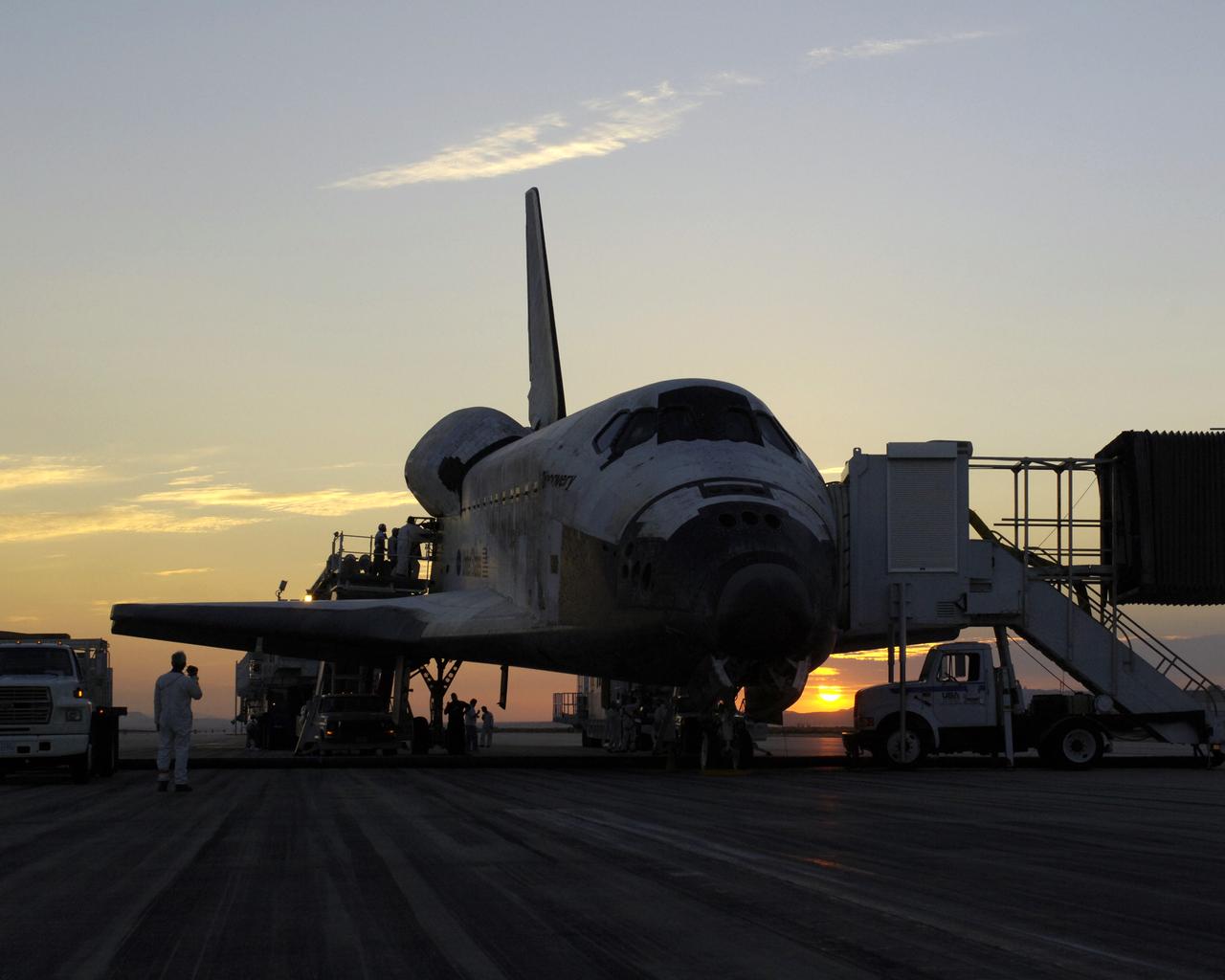
The sun rises on the Space Shuttle Discovery as it rests on the runway at Edwards Air Force Base, California, after a safe landing August 9, 2005 to complete the STS-114 mission. Space Shuttle Discovery landed safely at NASA's Dryden Flight Research Center at Edwards Air Force Base in California at 5:11:22 a.m. PDT this morning, following the very successful 14-day STS-114 return to flight mission. During their two weeks in space, Commander Eileen Collins and her six crewmates tested out new safety procedures and delivered supplies and equipment the International Space Station. Discovery spent two weeks in space, where the crew demonstrated new methods to inspect and repair the Shuttle in orbit. The crew also delivered supplies, outfitted and performed maintenance on the International Space Station. A number of these tasks were conducted during three spacewalks. In an unprecedented event, spacewalkers were called upon to remove protruding gap fillers from the heat shield on Discovery's underbelly. In other spacewalk activities, astronauts installed an external platform onto the Station's Quest Airlock and replaced one of the orbital outpost's Control Moment Gyroscopes. Inside the Station, the STS-114 crew conducted joint operations with the Expedition 11 crew. They unloaded fresh supplies from the Shuttle and the Raffaello Multi-Purpose Logistics Module. Before Discovery undocked, the crews filled Raffeallo with unneeded items and returned to Shuttle payload bay. Discovery launched on July 26 and spent almost 14 days on orbit.
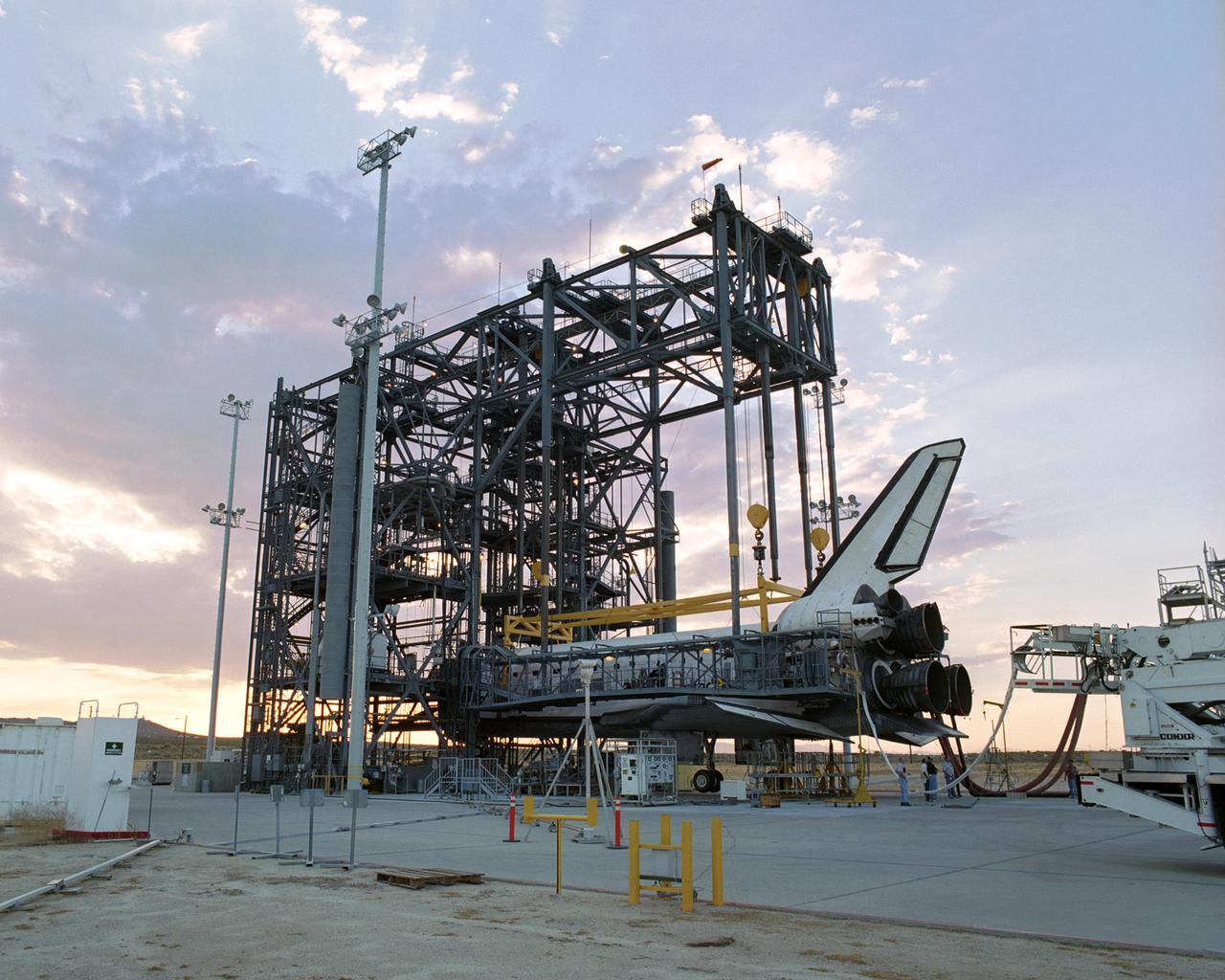
The sun sets on the Space Shuttle Discovery during post-flight processing in the Mate-Demate Device (MDD), following its landing at NASA's Dryden Flight Research Center in California. The gantry-like MDD structure is used for servicing the shuttle orbiters in preparation for their ferry flight back to the Kennedy Space Center in Florida, including mounting the shuttle atop NASA's modified Boeing 747 Shuttle Carrier Aircraft. Space Shuttle Discovery landed safely at NASA's Dryden Flight Research Center at Edwards Air Force Base in California at 5:11:22 a.m. PDT, August 9, 2005, following the very successful 14-day STS-114 return to flight mission. During their two weeks in space, Commander Eileen Collins and her six crewmates tested out new safety procedures and delivered supplies and equipment the International Space Station. Discovery spent two weeks in space, where the crew demonstrated new methods to inspect and repair the Shuttle in orbit. The crew also delivered supplies, outfitted and performed maintenance on the International Space Station. A number of these tasks were conducted during three spacewalks. In an unprecedented event, spacewalkers were called upon to remove protruding gap fillers from the heat shield on Discovery's underbelly. In other spacewalk activities, astronauts installed an external platform onto the Station's Quest Airlock and replaced one of the orbital outpost's Control Moment Gyroscopes. Inside the Station, the STS-114 crew conducted joint operations with the Expedition 11 crew. They unloaded fresh supplies from the Shuttle and the Raffaello Multi-Purpose Logistics Module. Before Discovery undocked, the crews filled Raffeallo with unneeded items and returned to Shuttle payload bay. Discovery launched on July 26 and spent almost 14 days on orbit.
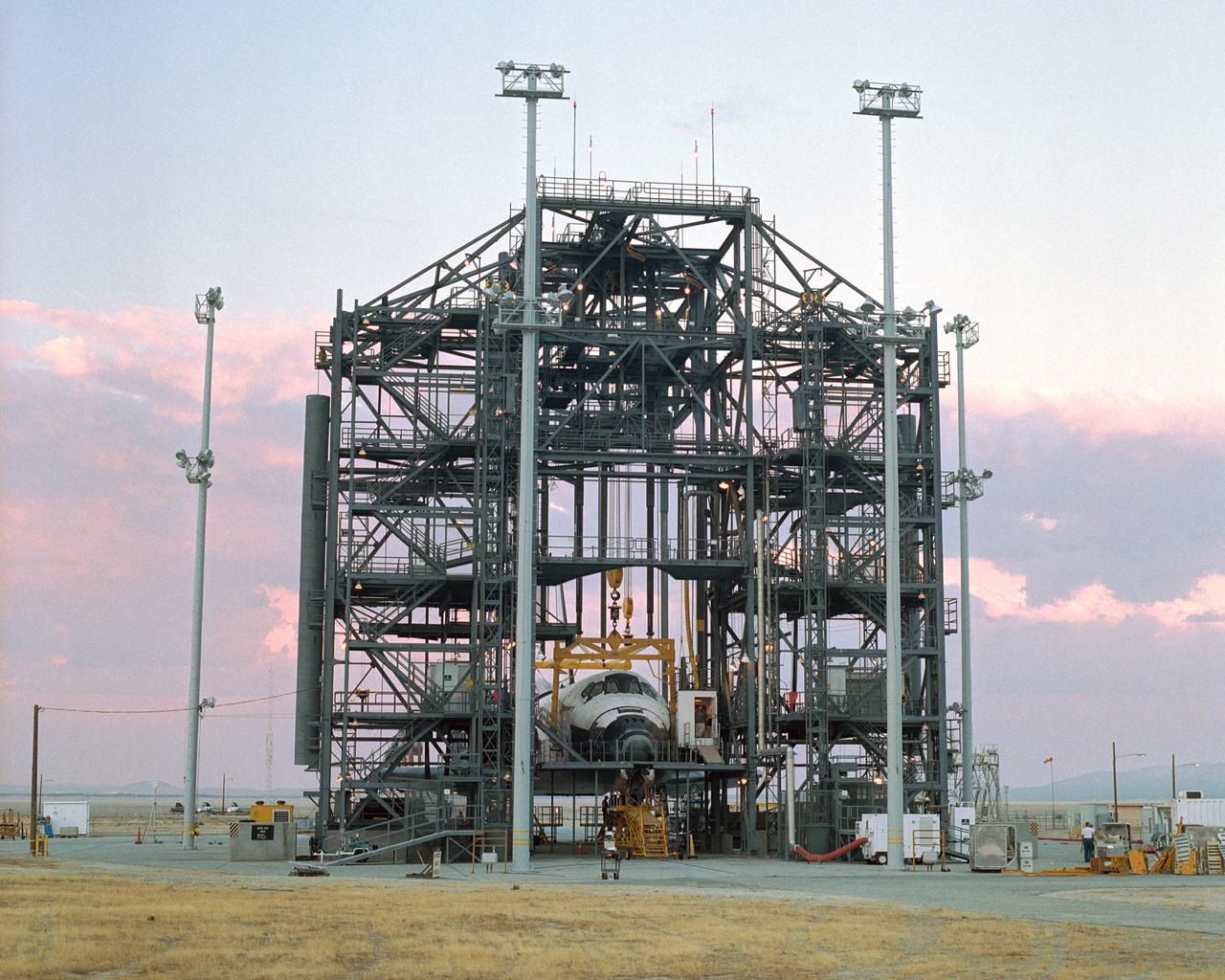
The sun sets on the Space Shuttle Discovery during post-flight processing in the Mate-Demate Device (MDD), following its landing at NASA's Dryden Flight Research Center in California. The gantry-like MDD structure is used for servicing the shuttle orbiters in preparation for their ferry flight back to the Kennedy Space Center in Florida, including mounting the shuttle atop NASA's modified Boeing 747 Shuttle Carrier Aircraft. Space Shuttle Discovery landed safely at NASA's Dryden Flight Research Center at Edwards Air Force Base in California at 5:11:22 a.m. PDT, August 9, 2005, following the very successful 14-day STS-114 return to flight mission. During their two weeks in space, Commander Eileen Collins and her six crewmates tested out new safety procedures and delivered supplies and equipment the International Space Station. Discovery spent two weeks in space, where the crew demonstrated new methods to inspect and repair the Shuttle in orbit. The crew also delivered supplies, outfitted and performed maintenance on the International Space Station. A number of these tasks were conducted during three spacewalks. In an unprecedented event, spacewalkers were called upon to remove protruding gap fillers from the heat shield on Discovery's underbelly. In other spacewalk activities, astronauts installed an external platform onto the Station's Quest Airlock and replaced one of the orbital outpost's Control Moment Gyroscopes. Inside the Station, the STS-114 crew conducted joint operations with the Expedition 11 crew. They unloaded fresh supplies from the Shuttle and the Raffaello Multi-Purpose Logistics Module. Before Discovery undocked, the crews filled Raffeallo with unneeded items and returned to Shuttle payload bay. Discovery launched on July 26 and spent almost 14 days on orbit.
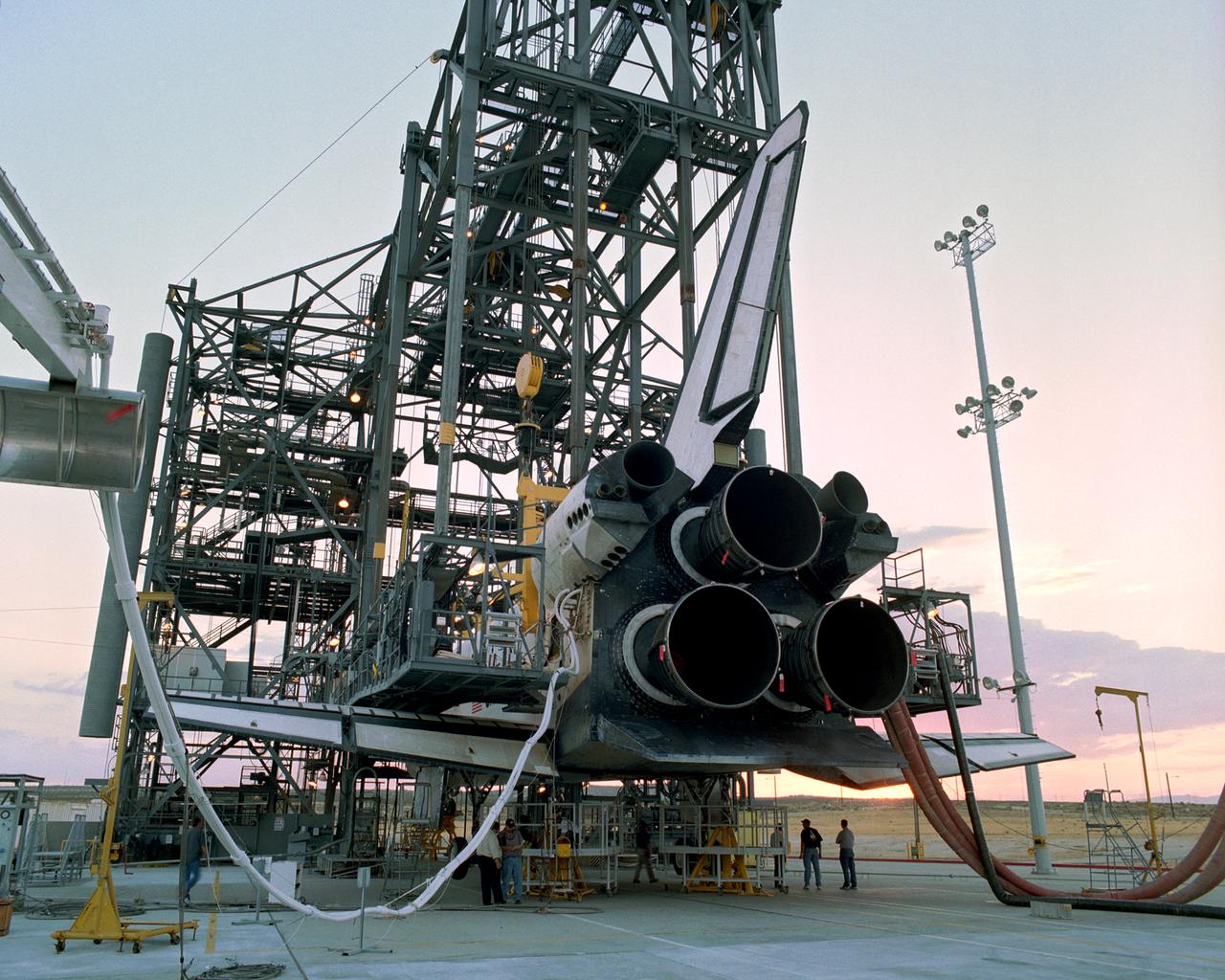
The sun sets on the Space Shuttle Discovery during post-flight processing in the Mate-Demate Device (MDD), following its landing at NASA's Dryden Flight Research Center in California. The gantry-like MDD structure is used for servicing the shuttle orbiters in preparation for their ferry flight back to the Kennedy Space Center in Florida, including mounting the shuttle atop NASA's modified Boeing 747 Shuttle Carrier Aircraft. Space Shuttle Discovery landed safely at NASA's Dryden Flight Research Center at Edwards Air Force Base in California at 5:11:22 a.m. PDT, August 9, 2005, following the very successful 14-day STS-114 return to flight mission. During their two weeks in space, Commander Eileen Collins and her six crewmates tested out new safety procedures and delivered supplies and equipment the International Space Station. Discovery spent two weeks in space, where the crew demonstrated new methods to inspect and repair the Shuttle in orbit. The crew also delivered supplies, outfitted and performed maintenance on the International Space Station. A number of these tasks were conducted during three spacewalks. In an unprecedented event, spacewalkers were called upon to remove protruding gap fillers from the heat shield on Discovery's underbelly. In other spacewalk activities, astronauts installed an external platform onto the Station's Quest Airlock and replaced one of the orbital outpost's Control Moment Gyroscopes. Inside the Station, the STS-114 crew conducted joint operations with the Expedition 11 crew. They unloaded fresh supplies from the Shuttle and the Raffaello Multi-Purpose Logistics Module. Before Discovery undocked, the crews filled Raffeallo with unneeded items and returned to Shuttle payload bay. Discovery launched on July 26 and spent almost 14 days on orbit.
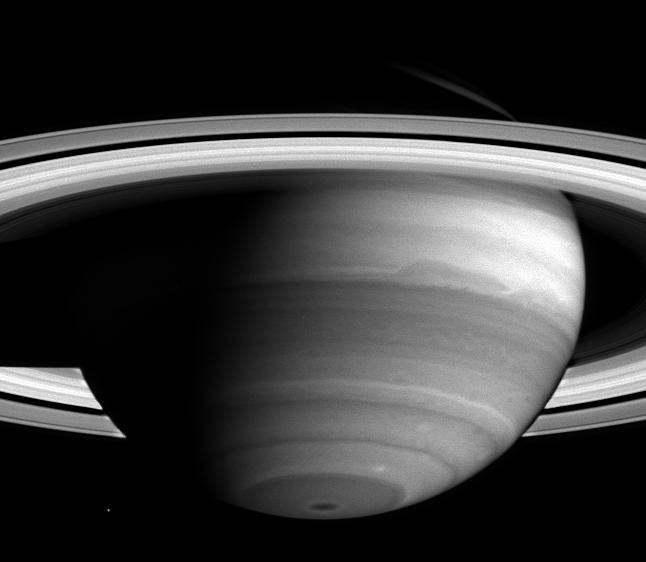
As Cassini nears its rendezvous with Saturn, new detail in the banded clouds of the planet's atmosphere are becoming visible. Cassini began the journey to the ringed world of Saturn nearly seven years ago and is now less than two months away from orbit insertion on June 30. Cassini’s narrow-angle camera took this image on April 16, 2004, when the spacecraft was 38.5 million kilometers (23.9 million miles) from Saturn. Dark regions are generally areas free of high clouds, and bright areas are places with high, thick clouds which shield the view of the darker areas below. A dark spot is visible at the south pole, which is remarkable to scientists because it is so small and centered. The spot could be affected by Saturn's magnetic field, which is nearly aligned with the planet's rotation axis, unlike the magnetic fields of Jupiter and Earth. From south to north, other notable features are the two white spots just above the dark spot toward the right, and the large dark oblong-shaped feature that extends across the middle. The darker band beneath the oblong-shaped feature has begun to show a lacy pattern of lighter-colored, high altitude clouds, indicative of turbulent atmospheric conditions. The cloud bands move at different speeds, and their irregularities may be due to either the different motions between them or to disturbances below the visible cloud layer. Such disturbances might be powered by the planet's internal heat; Saturn radiates more energy than it receives from the Sun. The moon Mimas (396 kilometers, 245 miles across) is visible to the left of the south pole. Saturn currently has 31 known moons. Since launch, 13 new moons have been discovered by ground-based telescopes. Cassini will get a closer look and may discover new moons, perhaps embedded within the planet’s magnificent rings. This image was taken using a filter sensitive to light near 727 nanometers, one of the near-infrared absorption bands of methane gas, which is one of the ingredients in Saturn's atmosphere. The image scale is approximately 231 kilometers (144 miles) per pixel. Contrast has been enhanced to aid visibility of features in the atmosphere. http://photojournal.jpl.nasa.gov/catalog/PIA05391
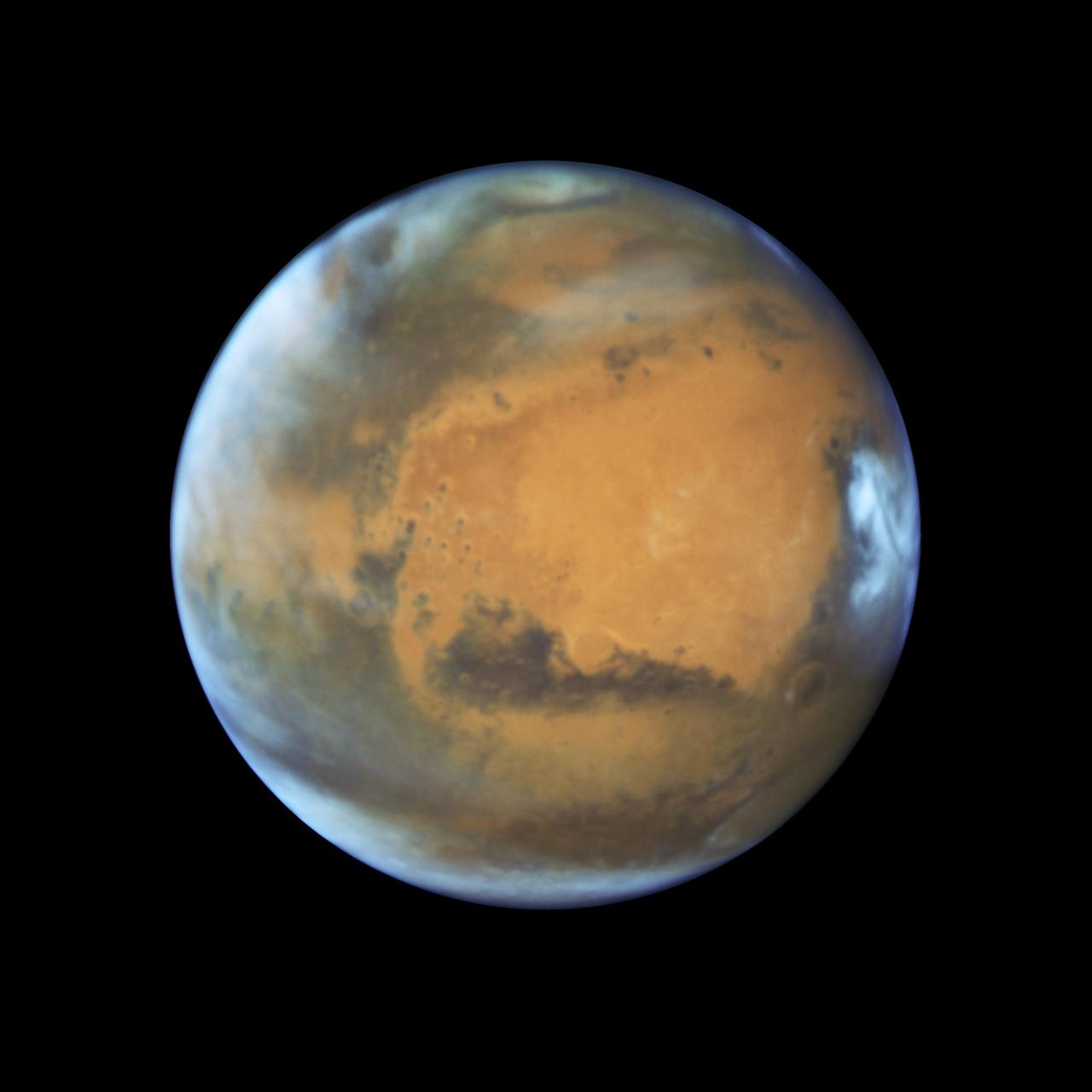
Mars is looking mighty fine in this portrait nabbed by the Hubble Space Telescope on a near close approach! Read more: <a href="http://go.nasa.gov/1rWYiBT" rel="nofollow">go.nasa.gov/1rWYiBT</a> The Hubble Space Telescope is more well known for its picturesque views of nebulae and galaxies, but it's also useful for studying our own planets, including Mars. Hubble imaged Mars on May 12, 2016 - ten days before Mars would be on the exact opposite side of the Earth from the Sun. Bright, frosty polar caps, and clouds above a vivid, rust-colored landscape reveal Mars as a dynamic seasonal planet in this NASA Hubble Space Telescope view taken on May 12, 2016, when Mars was 50 million miles from Earth. The Hubble image reveals details as small as 20 to 30 miles across. The large, dark region at far right is Syrtis Major Planitia, one of the first features identified on the surface of the planet by seventeenth-century observers. Christiaan Huygens used this feature to measure the rotation rate of Mars. (A Martian day is about 24 hours and 37 minutes.) Today we know that Syrtis Major is an ancient, inactive shield volcano. Late-afternoon clouds surround its summit in this view. A large oval feature to the south of Syrtis Major is the bright Hellas Planitia basin. About 1,100 miles across and nearly five miles deep, it was formed about 3.5 billion years ago by an asteroid impact. The orange area in the center of the image is Arabia Terra, a vast upland region in northern Mars that covers about 2,800 miles. The landscape is densely cratered and heavily eroded, indicating that it could be among the oldest terrains on the planet. Dried river canyons (too small to be seen here) wind through the region and empty into the large northern lowlands. Credit: NASA, ESA, the Hubble Heritage Team (STScI/AURA), J. Bell (ASU), and M. Wolff (Space Science Institute) #nasagoddard #mars #hubble #space <b><a href="http://www.nasa.gov/audience/formedia/features/MP_Photo_Guidelines.html" rel="nofollow">NASA image use policy.</a></b> <b><a href="http://www.nasa.gov/centers/goddard/home/index.html" rel="nofollow">NASA Goddard Space Flight Center</a></b> enables NASA’s mission through four scientific endeavors: Earth Science, Heliophysics, Solar System Exploration, and Astrophysics. Goddard plays a leading role in NASA’s accomplishments by contributing compelling scientific knowledge to advance the Agency’s mission. <b>Follow us on <a href="http://twitter.com/NASAGoddardPix" rel="nofollow">Twitter</a></b> <b>Like us on <a href="http://www.facebook.com/pages/Greenbelt-MD/NASA-Goddard/395013845897?ref=tsd" rel="nofollow">Facebook</a></b> <b>Find us on <a href="http://instagrid.me/nasagoddard/?vm=grid" rel="nofollow">Instagram</a></b>
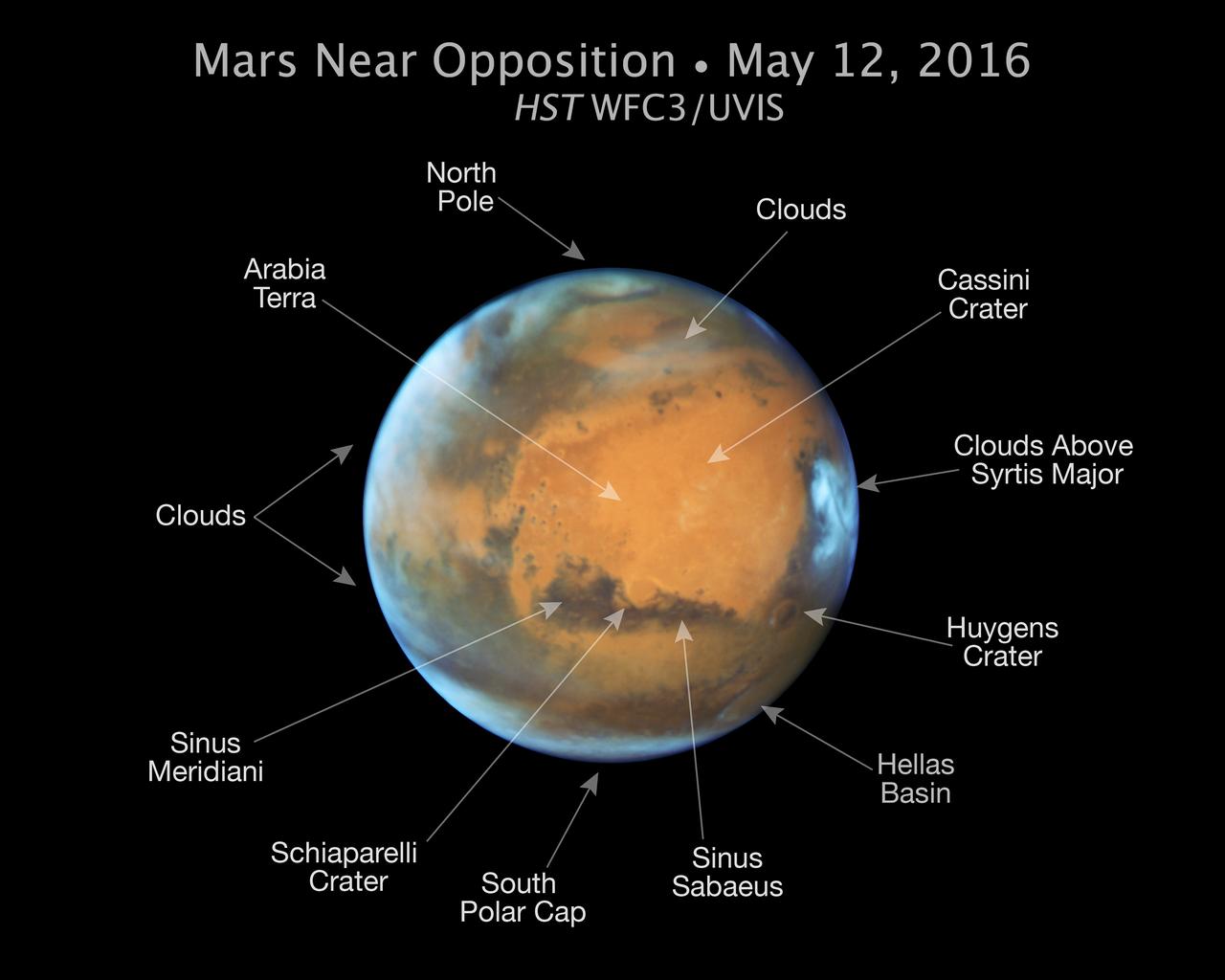
Mars is looking mighty fine in this portrait nabbed by the Hubble Space Telescope on a near close approach! Read more: <a href="http://go.nasa.gov/1rWYiBT" rel="nofollow">go.nasa.gov/1rWYiBT</a> The Hubble Space Telescope is more well known for its picturesque views of nebulae and galaxies, but it's also useful for studying our own planets, including Mars. Hubble imaged Mars on May 12, 2016 - ten days before Mars would be on the exact opposite side of the Earth from the Sun. Bright, frosty polar caps, and clouds above a vivid, rust-colored landscape reveal Mars as a dynamic seasonal planet in this NASA Hubble Space Telescope view taken on May 12, 2016, when Mars was 50 million miles from Earth. The Hubble image reveals details as small as 20 to 30 miles across. The large, dark region at far right is Syrtis Major Planitia, one of the first features identified on the surface of the planet by seventeenth-century observers. Christiaan Huygens used this feature to measure the rotation rate of Mars. (A Martian day is about 24 hours and 37 minutes.) Today we know that Syrtis Major is an ancient, inactive shield volcano. Late-afternoon clouds surround its summit in this view. A large oval feature to the south of Syrtis Major is the bright Hellas Planitia basin. About 1,100 miles across and nearly five miles deep, it was formed about 3.5 billion years ago by an asteroid impact. The orange area in the center of the image is Arabia Terra, a vast upland region in northern Mars that covers about 2,800 miles. The landscape is densely cratered and heavily eroded, indicating that it could be among the oldest terrains on the planet. Dried river canyons (too small to be seen here) wind through the region and empty into the large northern lowlands. Credit: NASA, ESA, the Hubble Heritage Team (STScI/AURA), J. Bell (ASU), and M. Wolff (Space Science Institute) #nasagoddard #mars #hubble #space <b><a href="http://www.nasa.gov/audience/formedia/features/MP_Photo_Guidelines.html" rel="nofollow">NASA image use policy.</a></b> <b><a href="http://www.nasa.gov/centers/goddard/home/index.html" rel="nofollow">NASA Goddard Space Flight Center</a></b> enables NASA’s mission through four scientific endeavors: Earth Science, Heliophysics, Solar System Exploration, and Astrophysics. Goddard plays a leading role in NASA’s accomplishments by contributing compelling scientific knowledge to advance the Agency’s mission. <b>Follow us on <a href="http://twitter.com/NASAGoddardPix" rel="nofollow">Twitter</a></b> <b>Like us on <a href="http://www.facebook.com/pages/Greenbelt-MD/NASA-Goddard/395013845897?ref=tsd" rel="nofollow">Facebook</a></b> <b>Find us on <a href="http://instagrid.me/nasagoddard/?vm=grid" rel="nofollow">Instagram</a></b>

Mars is looking mighty fine in this portrait nabbed by the Hubble Space Telescope on a near close approach! Read more: <a href="http://go.nasa.gov/1rWYiBT" rel="nofollow">go.nasa.gov/1rWYiBT</a> The Hubble Space Telescope is more well known for its picturesque views of nebulae and galaxies, but it's also useful for studying our own planets, including Mars. Hubble imaged Mars on May 12, 2016 - ten days before Mars would be on the exact opposite side of the Earth from the Sun. Bright, frosty polar caps, and clouds above a vivid, rust-colored landscape reveal Mars as a dynamic seasonal planet in this NASA Hubble Space Telescope view taken on May 12, 2016, when Mars was 50 million miles from Earth. The Hubble image reveals details as small as 20 to 30 miles across. The large, dark region at far right is Syrtis Major Planitia, one of the first features identified on the surface of the planet by seventeenth-century observers. Christiaan Huygens used this feature to measure the rotation rate of Mars. (A Martian day is about 24 hours and 37 minutes.) Today we know that Syrtis Major is an ancient, inactive shield volcano. Late-afternoon clouds surround its summit in this view. A large oval feature to the south of Syrtis Major is the bright Hellas Planitia basin. About 1,100 miles across and nearly five miles deep, it was formed about 3.5 billion years ago by an asteroid impact. The orange area in the center of the image is Arabia Terra, a vast upland region in northern Mars that covers about 2,800 miles. The landscape is densely cratered and heavily eroded, indicating that it could be among the oldest terrains on the planet. Dried river canyons (too small to be seen here) wind through the region and empty into the large northern lowlands. Credit: NASA, ESA, the Hubble Heritage Team (STScI/AURA), J. Bell (ASU), and M. Wolff (Space Science Institute) #nasagoddard #mars #hubble #space <b><a href="http://www.nasa.gov/audience/formedia/features/MP_Photo_Guidelines.html" rel="nofollow">NASA image use policy.</a></b> <b><a href="http://www.nasa.gov/centers/goddard/home/index.html" rel="nofollow">NASA Goddard Space Flight Center</a></b> enables NASA’s mission through four scientific endeavors: Earth Science, Heliophysics, Solar System Exploration, and Astrophysics. Goddard plays a leading role in NASA’s accomplishments by contributing compelling scientific knowledge to advance the Agency’s mission. <b>Follow us on <a href="http://twitter.com/NASAGoddardPix" rel="nofollow">Twitter</a></b> <b>Like us on <a href="http://www.facebook.com/pages/Greenbelt-MD/NASA-Goddard/395013845897?ref=tsd" rel="nofollow">Facebook</a></b> <b>Find us on <a href="http://instagrid.me/nasagoddard/?vm=grid" rel="nofollow">Instagram</a></b>