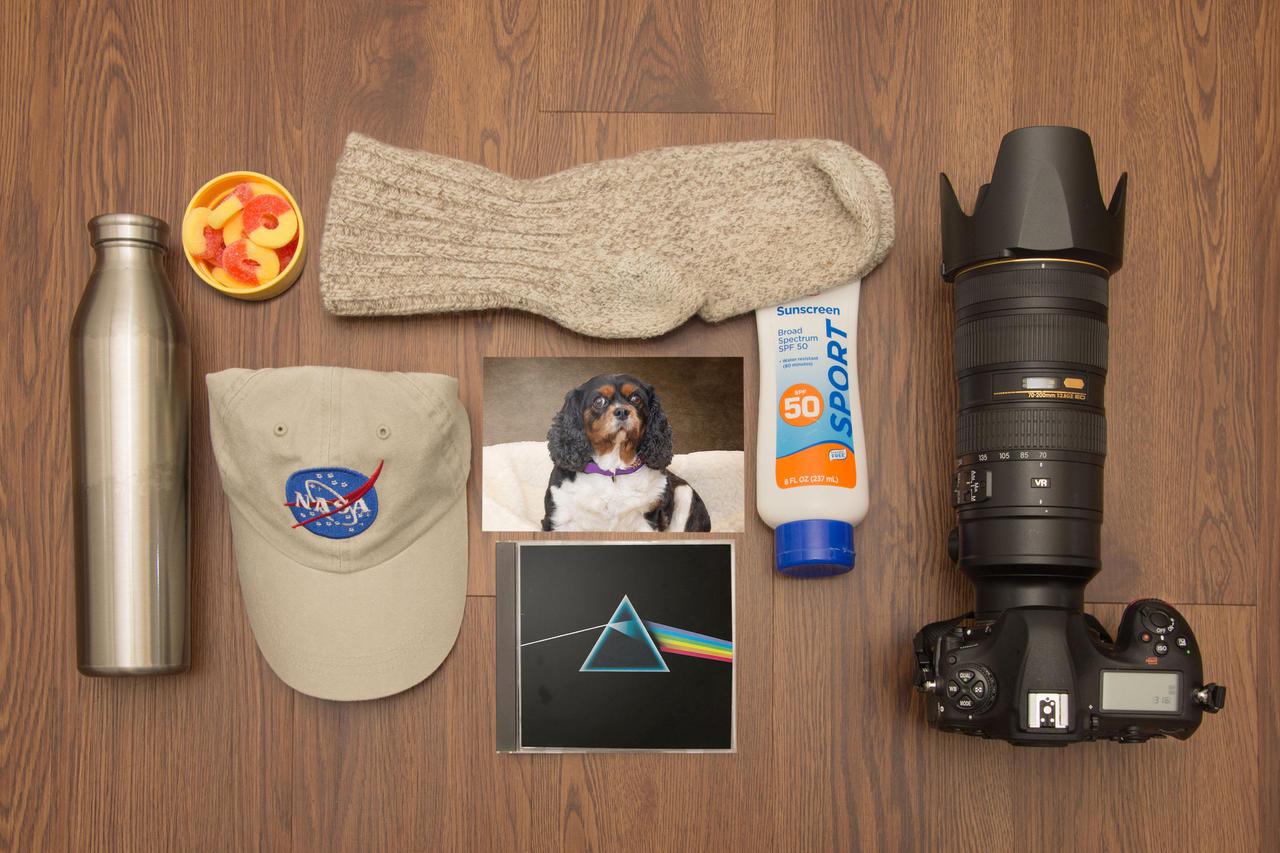
The first thing that went into my Moonkit was my camera. Some of the most iconic photographs ever taken were captured on the surface of the Moon by NASA astronauts. The camera has to go. The hat and sunscreen will be a must to protect me from the unfiltered sunlight. Warm socks? Of course, my feet are always cold. A little “Moon Music” and a photo of Holly, the best dog in the world, will pass the time during breaks. Lastly, I need to eat. Water and gummy peach rings will pack in a small corner of my pack. Marv Smith Lead Photographer, NASA Glenn Research Center
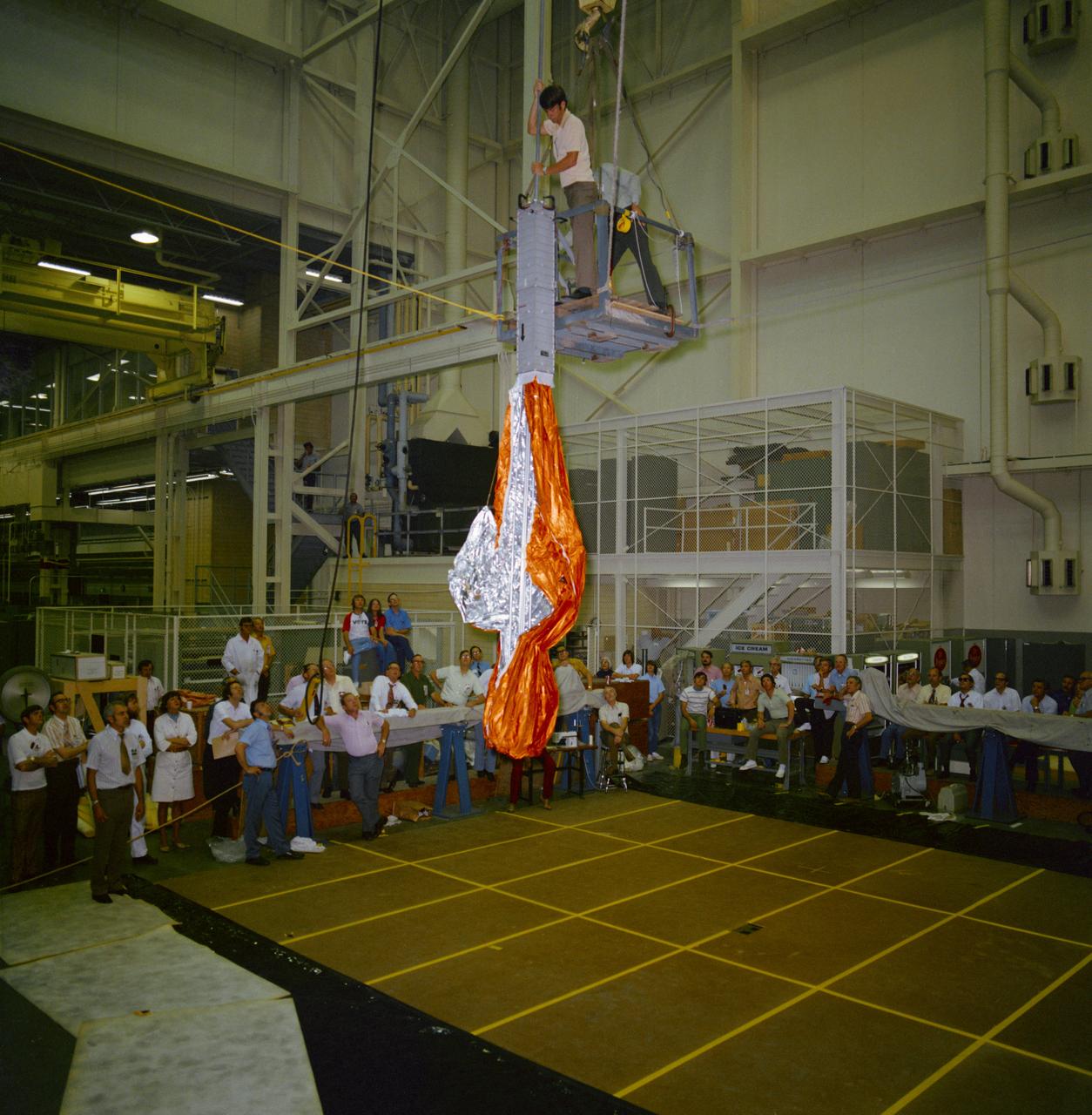
S73-26401 (23 May 1973) --- An umbrella-like mechanical device called the "parasol", one of the several sunscreen possibilities being considered for use in shading the overheated Skylab 1 Orbital Workshop (OWS), receives a checkout in the Technical Services shop in Bldg. 10 at Johnson Space Center. Here, a technician starts to deploy the "parasol" sunshade. The "parasol" is designed to fit into the T027 experiment photometer canister. The canopy portion of the "parasol" measures 24 feet by 22 feet. Photo credit: NASA
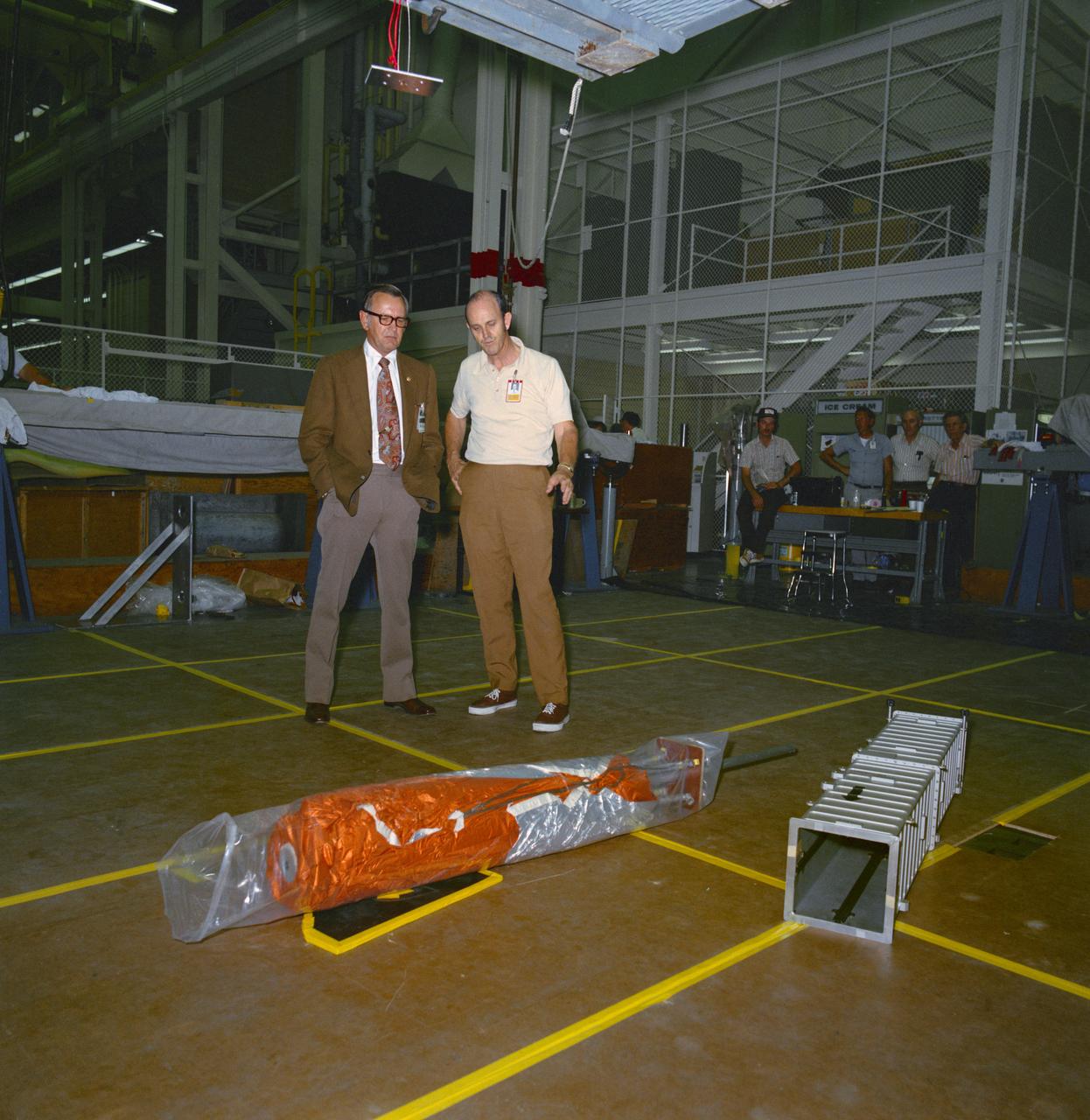
S73-26394 (23 May 1973) --- Dr. Christopher C. Kraft Jr. (left), JSC Director, and George A. Post, JSC Crew Systems Division, look over the packaged "parasol" during fabrication and checkout of the umbrella-like mechanical device in the Technical Services shop in building 10 at Johnson Space Center. The "parasol" is designed to fit into the T027 experiment photometer canister. The canopy portion of the "parasol" measures 24 feet by 22 feet. The "parasol" is one of several sunscreen possibilities being considered for use in shading the overheated Skylab 1 Orbital Workshop. Photo credit: NASA

A Falcon 9 rocket stands ready for liftoff at the Kennedy Space Center's Launch Complex 39A. The historic launch site now is operated by SpaceX under a property agreement signed with NASA. The rocket will boost a Dragon resupply spacecraft to the International Space Station. Liftoff is scheduled for 10:01 a.m. EST on Feb. 18. On its 10th commercial resupply services mission to the space station, Dragon will bring up 5,000 pounds of supplies, such as the Stratospheric Aerosol and Gas Experiment (SAGE) III instrument to further study ozone in the atmosphere. Once mounted on the space station, SAGE III will measure the Earth’s sunscreen, or ozone, along with other gases and aerosols, or tiny particles in the atmosphere.
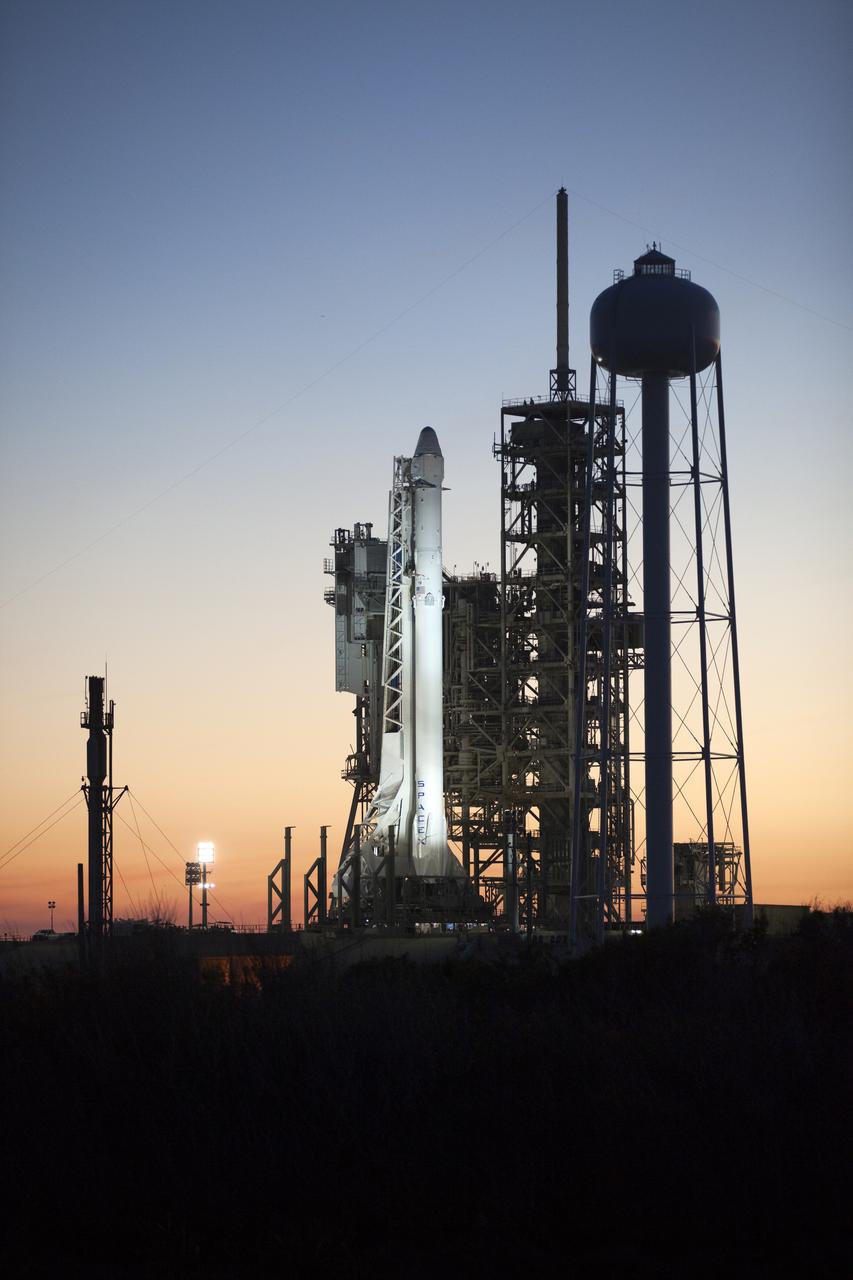
A Falcon 9 rocket stands ready for liftoff at the Kennedy Space Center's Launch Complex 39A. The historic launch site now is operated by SpaceX under a property agreement signed with NASA. The rocket will boost a Dragon resupply spacecraft to the International Space Station. Liftoff is scheduled for 10:01 a.m. EST on Feb. 18. On its 10th commercial resupply services mission to the space station, Dragon will bring up 5,000 pounds of supplies, such as the Stratospheric Aerosol and Gas Experiment (SAGE) III instrument to further study ozone in the atmosphere. Once mounted on the space station, SAGE III will measure the Earth’s sunscreen, or ozone, along with other gases and aerosols, or tiny particles in the atmosphere.
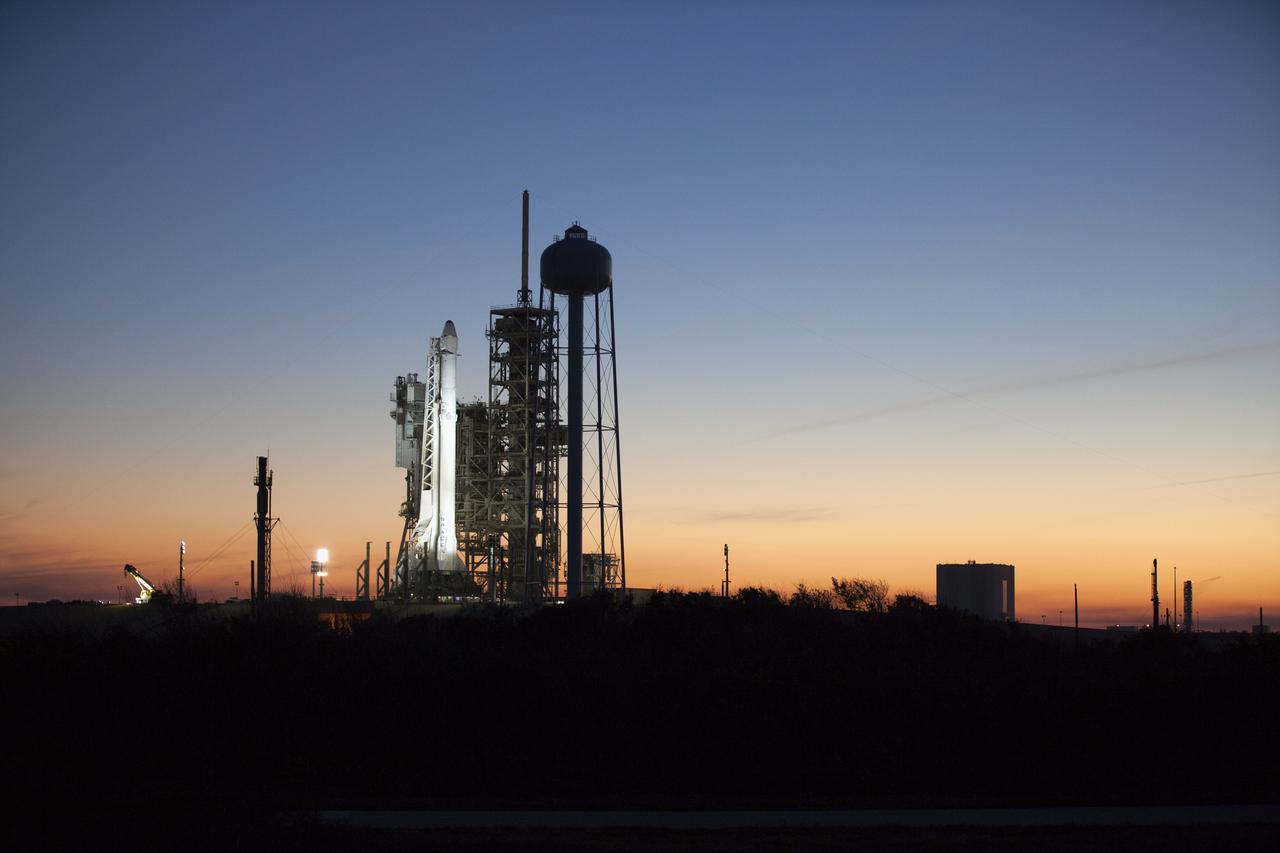
As sun sets, a Falcon 9 rocket stands ready for liftoff at the Kennedy Space Center's Launch Complex 39A. The historic launch site now is operated by SpaceX under a property agreement signed with NASA. In the background is the Vehicle Assembly Building. The rocket will boost a Dragon resupply spacecraft to the International Space Station. Liftoff is scheduled for 10:01 a.m. EST on Feb. 18. On its 10th commercial resupply services mission to the space station, Dragon will bring up 5,000 pounds of supplies, such as the Stratospheric Aerosol and Gas Experiment (SAGE) III instrument to further study ozone in the atmosphere. Once mounted on the space station, SAGE III will measure the Earth’s sunscreen, or ozone, along with other gases and aerosols, or tiny particles in the atmosphere.
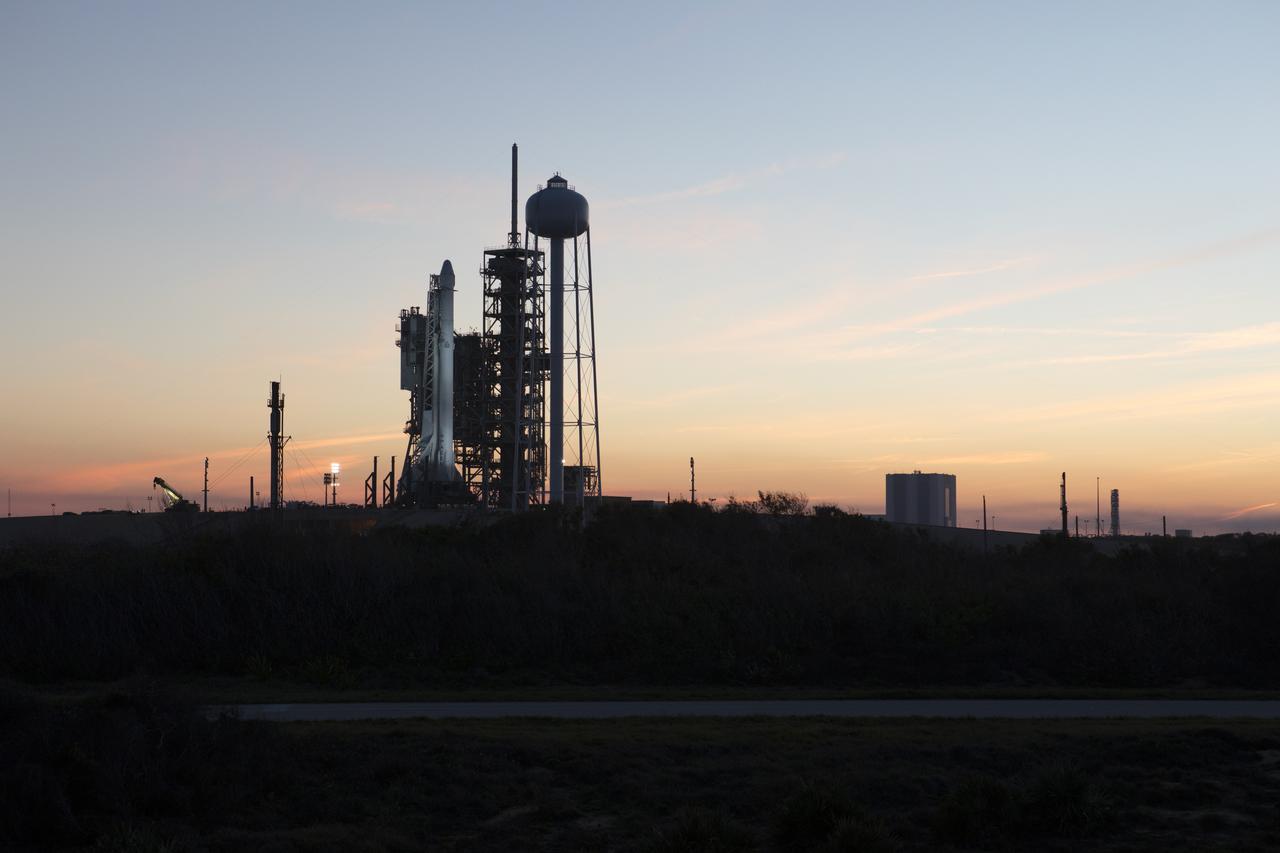
As sun sets, a Falcon 9 rocket stands ready for liftoff at the Kennedy Space Center's Launch Complex 39A. The historic launch site now is operated by SpaceX under a property agreement signed with NASA. In the background is the Vehicle Assembly Building. The rocket will boost a Dragon resupply spacecraft to the International Space Station. Liftoff is scheduled for 10:01 a.m. EST on Feb. 18. On its 10th commercial resupply services mission to the space station, Dragon will bring up 5,000 pounds of supplies, such as the Stratospheric Aerosol and Gas Experiment (SAGE) III instrument to further study ozone in the atmosphere. Once mounted on the space station, SAGE III will measure the Earth’s sunscreen, or ozone, along with other gases and aerosols, or tiny particles in the atmosphere.
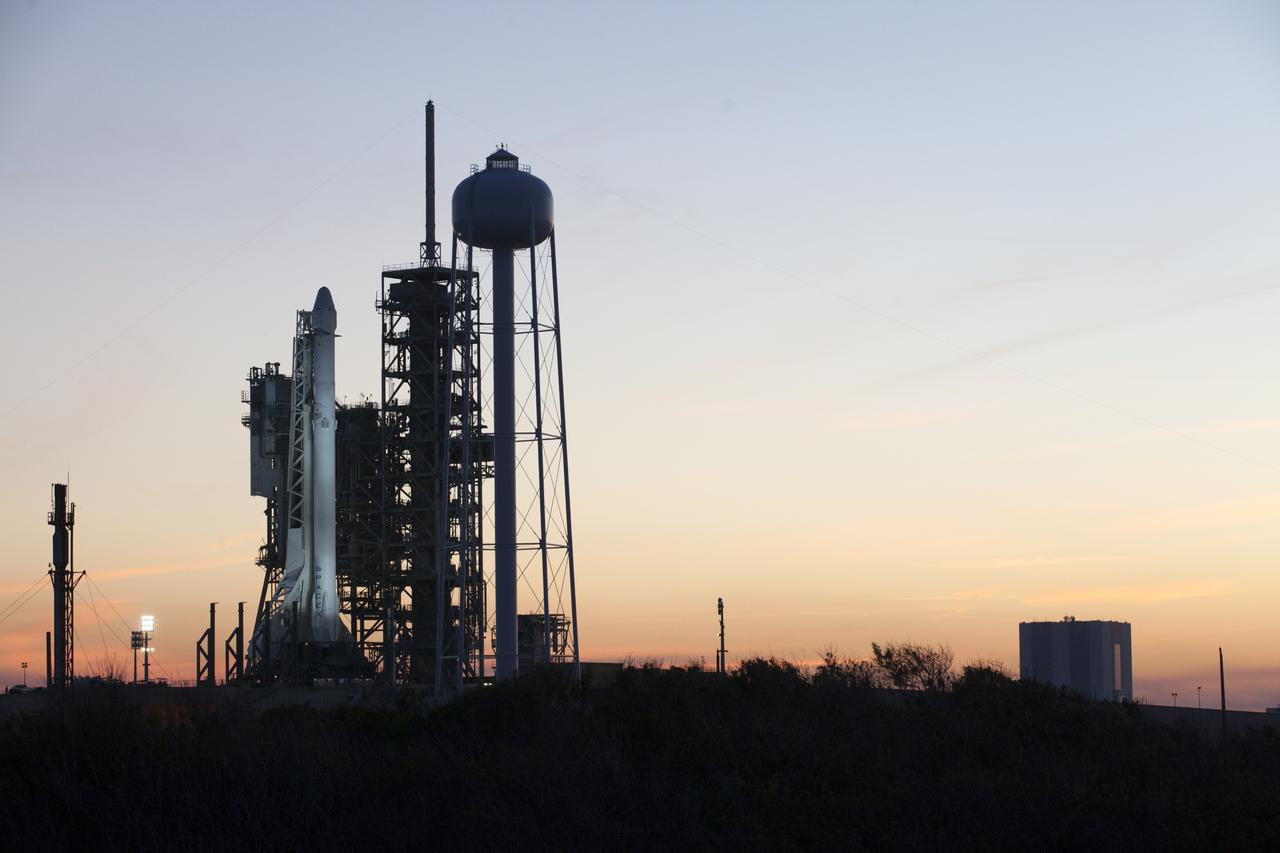
As sun sets, a Falcon 9 rocket stands ready for liftoff at the Kennedy Space Center's Launch Complex 39A. The historic launch site now is operated by SpaceX under a property agreement signed with NASA. In the background is the Vehicle Assembly Building. The rocket will boost a Dragon resupply spacecraft to the International Space Station. Liftoff is scheduled for 10:01 a.m. EST on Feb. 18. On its 10th commercial resupply services mission to the space station, Dragon will bring up 5,000 pounds of supplies, such as the Stratospheric Aerosol and Gas Experiment (SAGE) III instrument to further study ozone in the atmosphere. Once mounted on the space station, SAGE III will measure the Earth’s sunscreen, or ozone, along with other gases and aerosols, or tiny particles in the atmosphere.
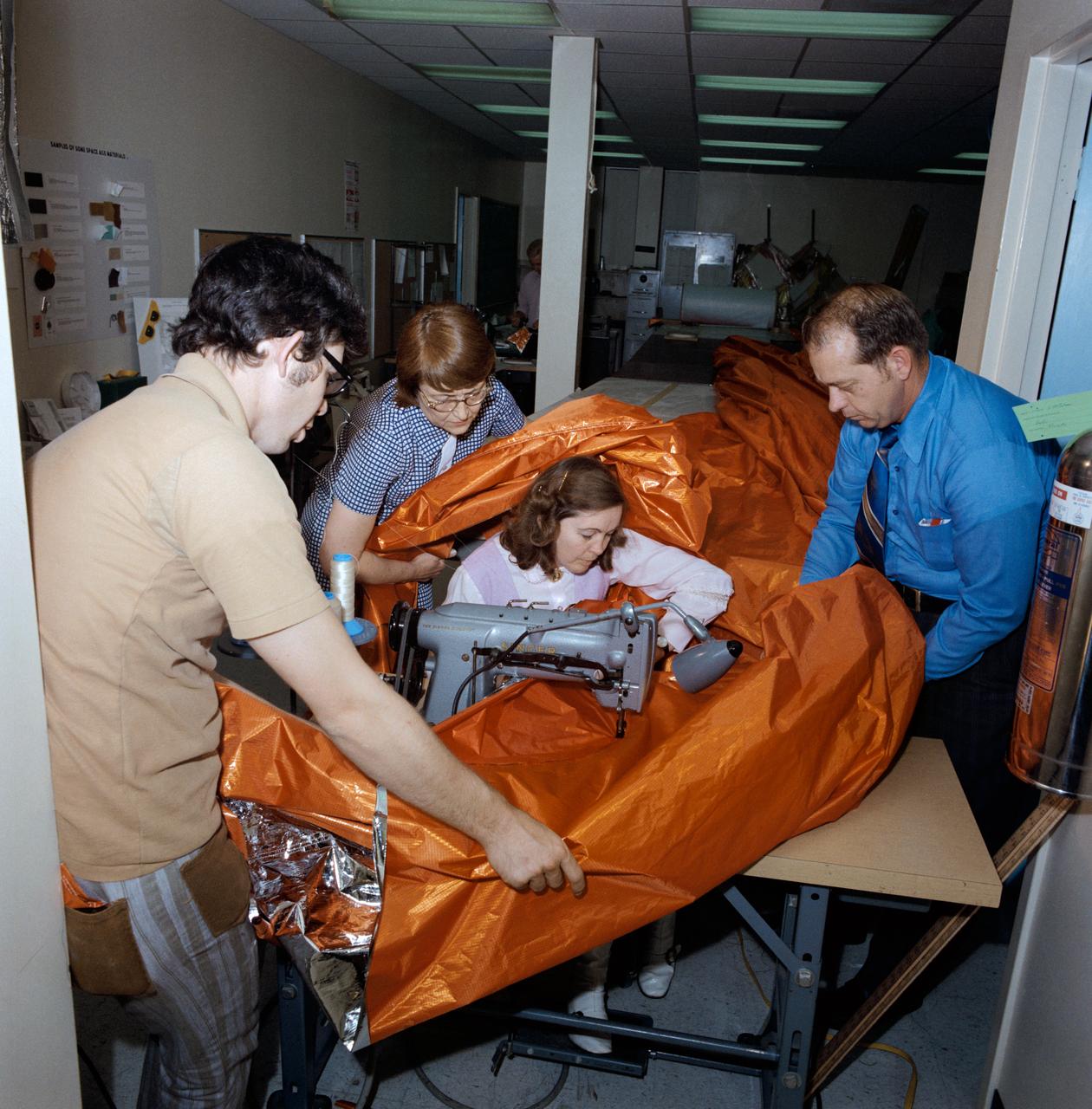
S73-26047 (18 May 1973) --- A sail-like sunshade for possible use as a sunscreen for the Skylab orbital workshop (OWS) is shown being fabricated in the GE Building across the street from the Johnson Space Center. Three persons assist the seamstress feed the material through the sewing machine. The three-layered shade will be composed of a top layer of aluminum Mylar, a middle layer of laminated nylon rip stop, and a bottom layer of thin nylon. Working on the sunshade, from left to right, are Dale Gentry, Elizabeth Gauldin, Alyene Baker and James H. Barnett Jr. Mrs. Baker, a GE employee, operates the double-needle sewing machine. Barnett is head of the Crew Equipment Development Section of JSC's Crew Systems Division. Mrs. Gauldin is also with the Crew Systems Division. Gentry works for GE. The work shown here is part of the crash program underway to prepare a protection device for Skylab to replace the original shield which was lost when the unmanned Skylab 1 launch took place on May 14, 1973. The improvised solar shield selected to be used will be carried to Earth orbit by the Skylab 2 crew, who will deploy it to shade part of the OWS from the hot rays of the sun. Loss of the original shield, as expected, has caused an overheating problem on the OWS. Photo credit: NASA
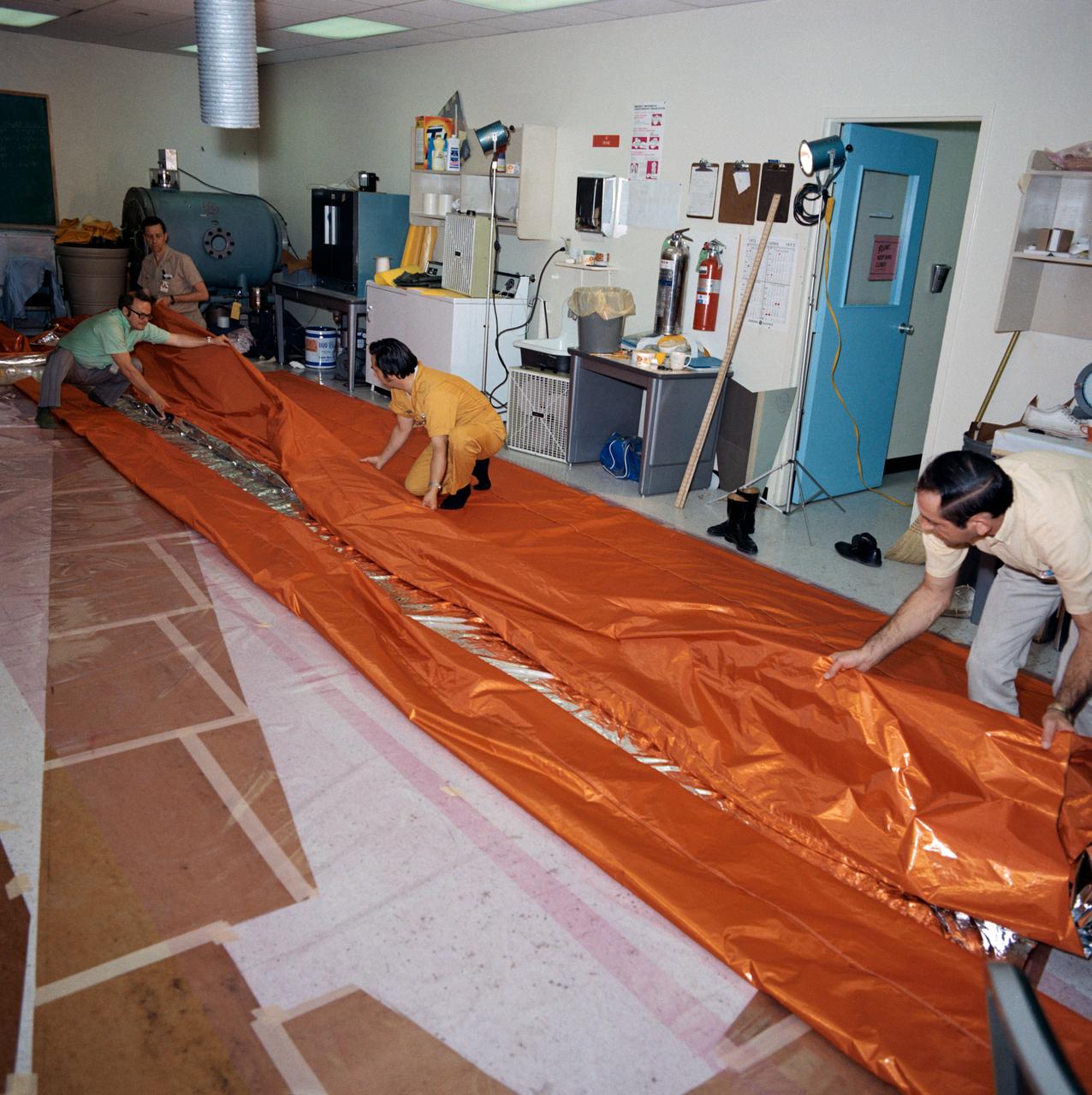
S73-26046 (18 May 1973) --- Workmen in the GE Building across the street from the Johnson Space Center fold a sail-like sunshade being fabricated for possible use as a sunscreen for the Skylab Orbital Workshop (OWS). The three-layered sunshade will be composed of a top layer of aluminized mylar, a middle layer of laminated nylon rip-stop, and a bottom layer of thin nylon. The men are, left to right, Gerry E. Wood (wearing glasses), Glenn Hewitt, Pat Morrow, and Fred Le Donne. Wood is manager of crew provisions and engineering at GE. The work shown here is part of the crash program now underway to prepare a sunshield for Skylab to replace the original shield which was lost when Skylab I was launched on May 14, 1973. The improvised solar shield selected to be used will be carried to Earth orbit by the Skylab 2 crewmen who will deploy it to shade part of the OWS from the hot rays of the sun. Loss of the original shield has caused an overheating problem in the OWS. Photo credit: NASA
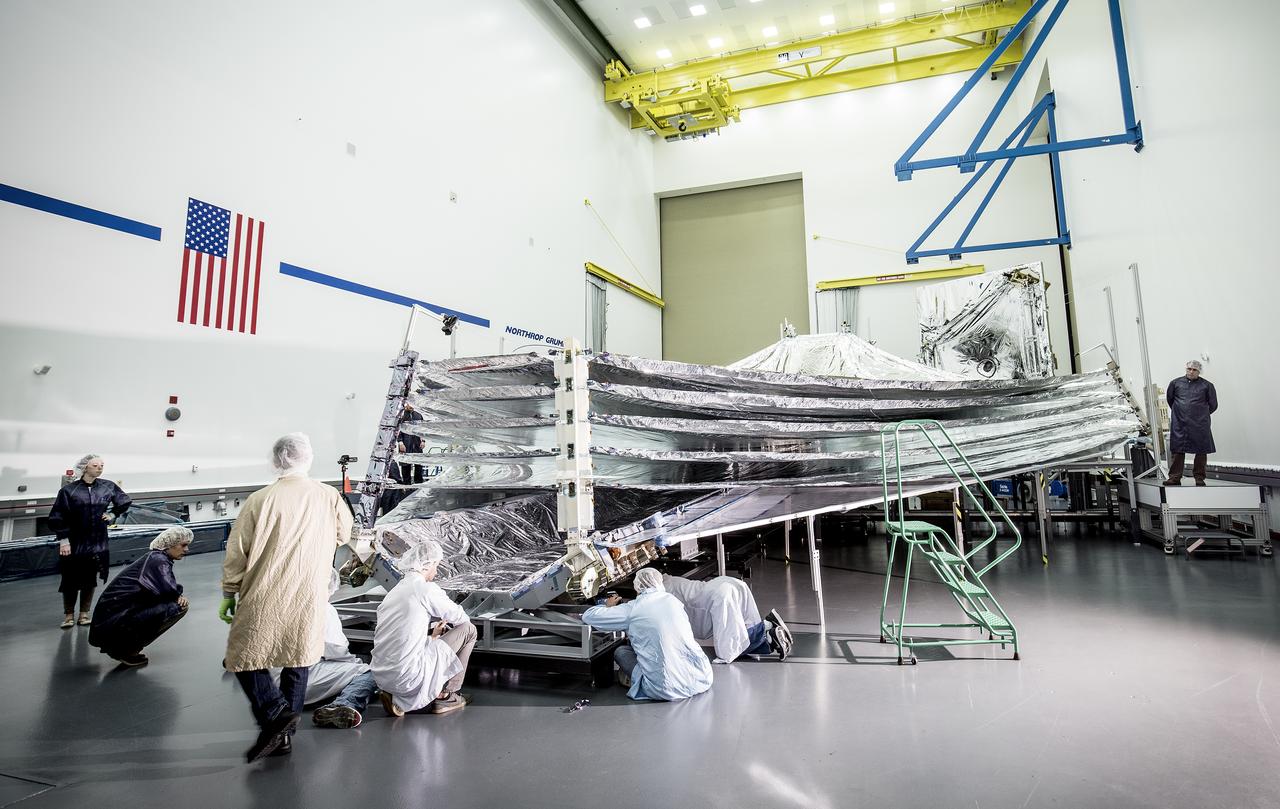
The sunshield on NASA's James Webb Space Telescope is the largest part of the observatory—five layers of thin, silvery membrane that must unfurl reliably in space. The precision in which the tennis-court sized sunshield has to open must be no more than a few centimeters different from its planned position. In this photo, engineers and scientists examine the sunshield layers on this full-sized test unit. Because there's a layer of the shiny silver material on the base under the five layers of the sunshield, it appears as if the sunshield has a mouth that is "open wide" while engineers take a look. The photo was taken in a clean room at Northrop Grumman Corporation, Redondo Beach, California. The sunshield separates the observatory into a warm sun-facing side and a cold side where the sunshine is blocked from interfering with the sensitive infrared instruments. The infrared instruments need to be kept very cold (under 50 K or -370 degrees Fahrenheit) to operate. The sunshield protects these sensitive instruments with an effective sun protection factor, or SPF, of 1,000,000. Sunscreen generally has an SPF of 8 to 50. In addition to providing a cold environment, the sunshield provides a thermally stable environment. This stability is essential to maintaining proper alignment of the primary mirror segments as the telescope changes its orientation to the sun. Earlier this year, the first flight layer of the sunshield was delivered to Northrop Grumman. Northrop Grumman is designing the Webb Telescope’s sunshield for NASA’s Goddard Space Flight Center, in Greenbelt, Maryland. Innovative sunshield membranes are being designed and manufactured by NeXolve Corporation of Huntsville, Alabama. The James Webb Space Telescope is the successor to NASA's Hubble Space Telescope. It will be the most powerful space telescope ever built. Webb is an international project led by NASA with its partners, the European Space Agency and the Canadian Space Agency. For more information about the Webb telescope, visit: <a href="http://www.jwst.nasa.gov" rel="nofollow">www.jwst.nasa.gov</a> or <a href="http://www.nasa.gov/webb" rel="nofollow">www.nasa.gov/webb</a> For more information on the Webb Sunshield, visit: <a href="http://jwst.nasa.gov/sunshield.html" rel="nofollow">jwst.nasa.gov/sunshield.html</a> Photo credit: Alex Evers/Northrop Grumman Corporation <b><a href="http://www.nasa.gov/audience/formedia/features/MP_Photo_Guidelines.html" rel="nofollow">NASA image use policy.</a></b> <b><a href="http://www.nasa.gov/centers/goddard/home/index.html" rel="nofollow">NASA Goddard Space Flight Center</a></b> enables NASA’s mission through four scientific endeavors: Earth Science, Heliophysics, Solar System Exploration, and Astrophysics. Goddard plays a leading role in NASA’s accomplishments by contributing compelling scientific knowledge to advance the Agency’s mission. <b>Follow us on <a href="http://twitter.com/NASAGoddardPix" rel="nofollow">Twitter</a></b> <b>Like us on <a href="http://www.facebook.com/pages/Greenbelt-MD/NASA-Goddard/395013845897?ref=tsd" rel="nofollow">Facebook</a></b> <b>Find us on <a href="http://instagrid.me/nasagoddard/?vm=grid" rel="nofollow">Instagram</a></b>