
This image represents a view of NASA Kepler supernova remnant taken in X-rays, visible light, and infrared radiation, indicating that the bubble of gas that makes up the supernova remnant appears different in various types of light. http://photojournal.jpl.nasa.gov/catalog/PIA06909
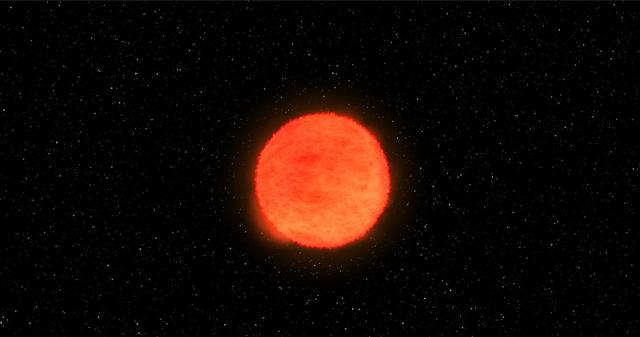
This image from an animation shows a gigantic star exploding in a "core collapse" supernova. As atoms fuse inside the star, eventually the star can't support its own weight anymore. Gravity makes the star collapse on itself. Core collapse supernovae are called type Ib, Ic, or II depending on the chemical elements present. Stellar explosions forge and distribute materials that make up the world in which we live, and also hold clues to how fast the universe is expanding. By understanding supernovae, scientists can unlock mysteries that are key to what we are made of and the fate of our universe. But to get the full picture, scientists must observe supernovae from a variety of perspectives, especially in the first moments of the explosion. That's really difficult -- there's no telling when or where a supernova might happen next. An animation is available at https://photojournal.jpl.nasa.gov/catalog/PIA22350
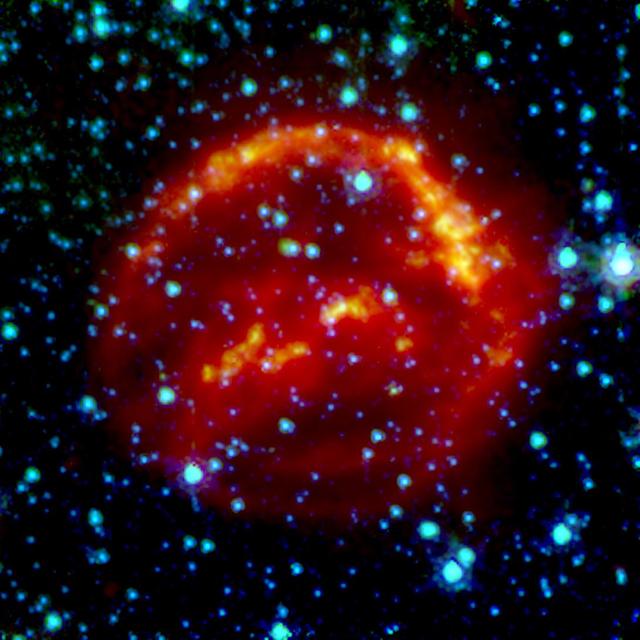
This Spitzer false-color image is a composite of data from the 24 micron channel of Spitzer's multiband imaging photometer (red), and three channels of its infrared array camera: 8 micron (yellow), 5.6 micron (blue), and 4.8 micron (green). Stars are most prominent in the two shorter wavelengths, causing them to show up as turquoise. The supernova remnant is most prominent at 24 microns, arising from dust that has been heated by the supernova shock wave, and re-radiated in the infrared. The 8 micron data shows infrared emission from regions closely associated with the optically emitting regions. These are the densest regions being encountered by the shock wave, and probably arose from condensations in the surrounding material that was lost by the supernova star before it exploded. The composite above (PIA06908, PIA06909, and PIA06910) represent views of Kepler's supernova remnant taken in X-rays, visible light, and infrared radiation. Each top panel in the composite above shows the entire remnant. Each color in the composite represents a different region of the electromagnetic spectrum, from X-rays to infrared light. The X-ray and infrared data cannot be seen with the human eye. Astronomers have color-coded those data so they can be seen in these images. http://photojournal.jpl.nasa.gov/catalog/PIA06910
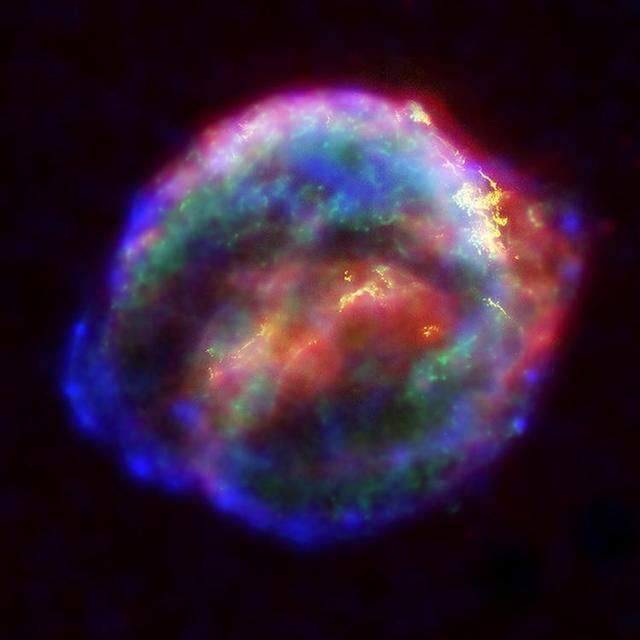
NASA's three Great Observatories -- the Hubble Space Telescope, the SpitzerSpace Telescope, and the Chandra X-ray Observatory -- joined forces to probe theexpanding remains of a supernova, called Kepler's supernova remnant, first seen 400 years ago by sky watchers, including astronomer Johannes Kepler. The combined image unveils a bubble-shaped shroud of gas and dust that is 14light-years wide and is expanding at 4 million miles per hour (2,000 kilometersper second). Observations from each telescope highlight distinct features of thesupernova remnant, a fast-moving shell of iron-rich material from the explodedstar, surrounded by an expanding shock wave that is sweeping up interstellar gasand dust. Each color in this image represents a different region of the electromagneticspectrum, from X-rays to infrared light. These diverse colors are shown in thepanel of photographs below the composite image. The X-ray and infrared datacannot be seen with the human eye. By color-coding those data and combining themwith Hubble's visible-light view, astronomers are presenting a more completepicture of the supernova remnant. Visible-light images from the Hubble telescope (colored yellow) reveal where the supernova shock wave is slamming into the densest regions of surrounding gas.The bright glowing knots are dense clumps from instabilities that form behindthe shock wave. The Hubble data also show thin filaments of gas that look likerippled sheets seen edge-on. These filaments reveal where the shock wave isencountering lower-density, more uniform interstellar material. The Spitzer telescope shows microscopic dust particles (colored red) that havebeen heated by the supernova shock wave. The dust re-radiates the shock wave'senergy as infrared light. The Spitzer data are brightest in the regionssurrounding those seen in detail by the Hubble telescope. The Chandra X-ray data show regions of very hot gas, and extremely high-energyparticles. The hottest gas (higher-energy X-rays, colored blue) is locatedprimarily in the regions directly behind the shock front. These regions alsoshow up in the Hubble observations, and also align with the faint rim of glowingmaterial seen in the Spitzer data. The X-rays from the region on the lower left(colored blue) may be dominated by extremely high-energy electrons that wereproduced by the shock wave and are radiating at radio through X-ray wavelengthsas they spiral in the intensified magnetic field behind the shock front. CoolerX-ray gas (lower-energy X-rays, colored green) resides in a thick interior shelland marks the location of heated material expelled from the exploded star. Kepler's supernova, the last such object seen to explode in our Milky Waygalaxy, resides about 13,000 light-years away in the constellation Ophiuchus. The Chandra observations were taken in June 2000, the Hubble in August 2003;and the Spitzer in August 2004. http://photojournal.jpl.nasa.gov/catalog/PIA06907
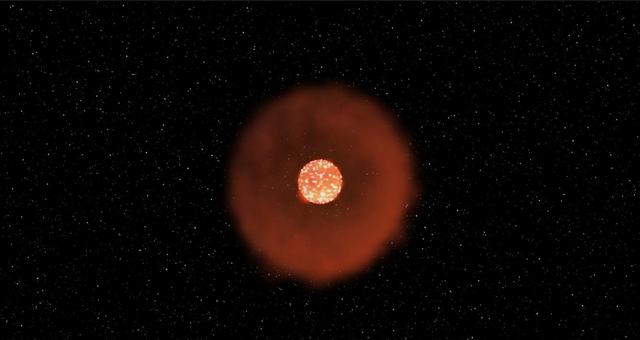
This frame from an animation shows a kind of stellar explosion called a Fast-Evolving Luminous Transient. In this case, a giant star "burps" out a shell of gas and dust about a year before exploding. Most of the energy from the supernova turns into light when it hits this previously ejected material, resulting in a short, but brilliant burst of radiation. Stellar explosions forge and distribute materials that make up the world in which we live, and also hold clues to how fast the universe is expanding. By understanding supernovae, scientists can unlock mysteries that are key to what we are made of and the fate of our universe. But to get the full picture, scientists must observe supernovae from a variety of perspectives, especially in the first moments of the explosion. That's really difficult -- there's no telling when or where a supernova might happen next. An animation is available at https://photojournal.jpl.nasa.gov/catalog/PIA22351
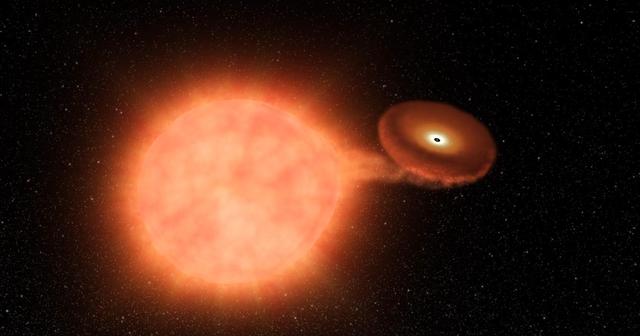
This frame from an animation shows a gigantic star exploding in a "core collapse" supernova. As atoms fuse inside the star, eventually the star can't support its own weight anymore. Gravity makes the star collapse on itself. Core collapse supernovae are called type Ib, Ic, or II depending on the chemical elements present. Stellar explosions forge and distribute materials that make up the world in which we live, and also hold clues to how fast the universe is expanding. By understanding supernovae, scientists can unlock mysteries that are key to what we are made of and the fate of our universe. But to get the full picture, scientists must observe supernovae from a variety of perspectives, especially in the first moments of the explosion. That's really difficult -- there's no telling when or where a supernova might happen next. An animation is available at https://photojournal.jpl.nasa.gov/catalog/PIA22352

Astronomers combined observations from three different observatories (Atacama Large Millimeter/submillimeter Array, red; Hubble, green; Chandra X-ray Observatory, blue) to produce this colorful, multiwavelength image of the intricate remains of Supernova 1987A. Credits: NASA, ESA, and A. Angelich (NRAO/AUI/NSF)
![The images indicate that the bubble of gas that makes up the supernova remnant appears different in various types of light. Chandra reveals the hottest gas [colored blue and colored green], which radiates in X-rays. http://photojournal.jpl.nasa.gov/catalog/PIA06908](https://images-assets.nasa.gov/image/PIA06908/PIA06908~medium.jpg)
The images indicate that the bubble of gas that makes up the supernova remnant appears different in various types of light. Chandra reveals the hottest gas [colored blue and colored green], which radiates in X-rays. http://photojournal.jpl.nasa.gov/catalog/PIA06908
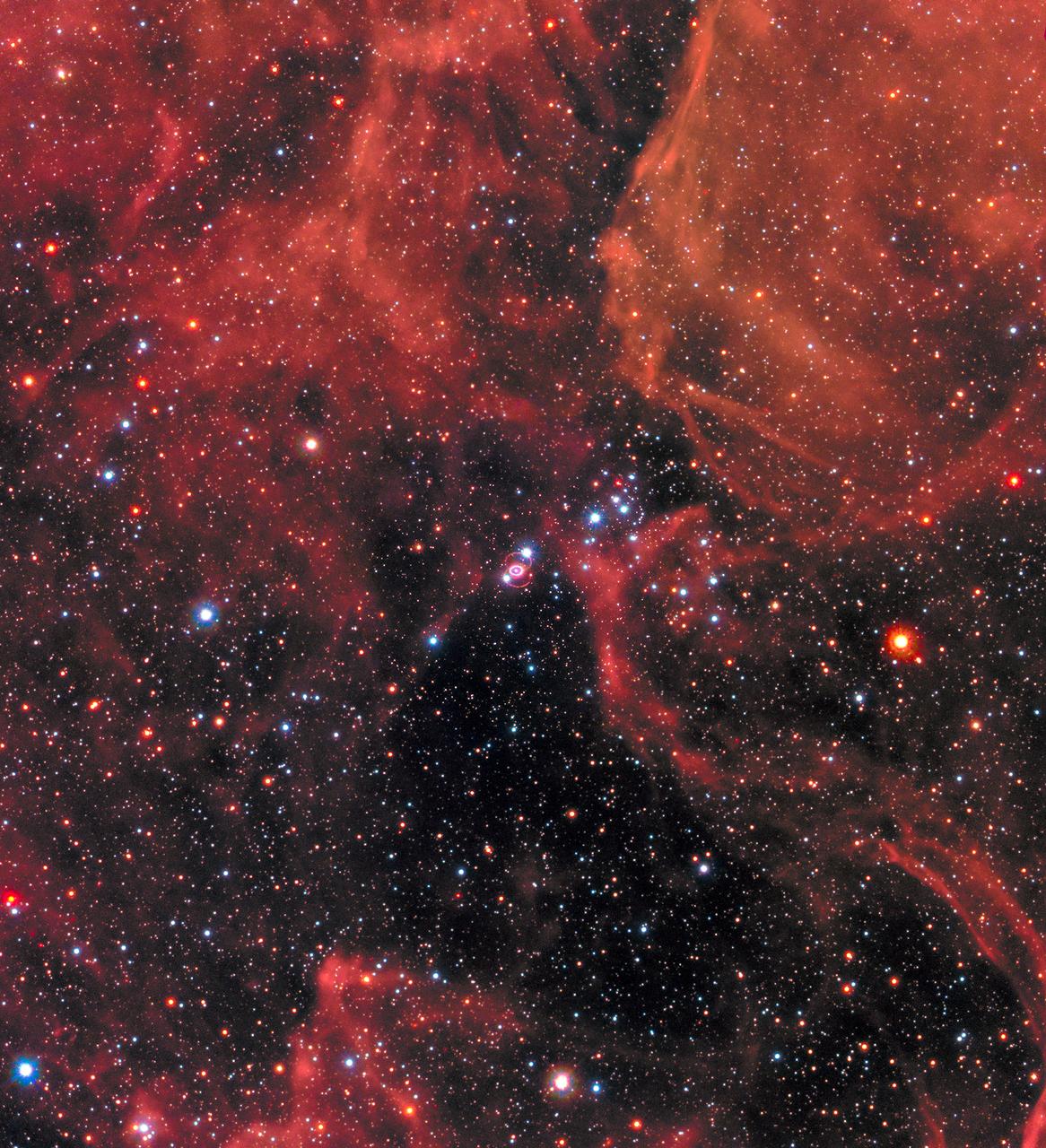
Three decades ago, astronomers spotted one of the brightest exploding stars in more than 400 years. The titanic supernova, called Supernova 1987A (SN 1987A), blazed with the power of 100 million suns for several months following its discovery on Feb. 23, 1987. Since that first sighting, SN 1987A has continued to fascinate astronomers with its spectacular light show. Located in the nearby Large Magellanic Cloud, it is the nearest supernova explosion observed in hundreds of years and the best opportunity yet for astronomers to study the phases before, during, and after the death of a star. "The 30 years' worth of observations of SN 1987A are important because they provide insight into the last stages of stellar evolution," said Robert Kirshner of the Harvard-Smithsonian Center for Astrophysics in Cambridge, Massachusetts, and the Gordon and Betty Moore Foundation in Palo Alto, California. The latest data from these powerful telescopes indicate that SN 1987A has passed an important threshold. The supernova shock wave is moving beyond the dense ring of gas produced late in the life of the pre-supernova star when a fast outflow or wind from the star collided with a slower wind generated in an earlier red giant phase of the star's evolution. What lies beyond the ring is poorly known at present, and depends on the details of the evolution of the star when it was a red giant. Read more: <a href="http://go.nasa.gov/2lEgs8M" rel="nofollow">go.nasa.gov/2lEgs8M</a> <b><a href="http://www.nasa.gov/audience/formedia/features/MP_Photo_Guidelines.html" rel="nofollow">NASA image use policy.</a></b> <b><a href="http://www.nasa.gov/centers/goddard/home/index.html" rel="nofollow">NASA Goddard Space Flight Center</a></b> enables NASA’s mission through four scientific endeavors: Earth Science, Heliophysics, Solar System Exploration, and Astrophysics. Goddard plays a leading role in NASA’s accomplishments by contributing compelling scientific knowledge to advance the Agency’s mission. <b>Follow us on <a href="http://twitter.com/NASAGoddardPix" rel="nofollow">Twitter</a></b> <b>Like us on <a href="http://www.facebook.com/pages/Greenbelt-MD/NASA-Goddard/395013845897?ref=tsd" rel="nofollow">Facebook</a></b> <b>Find us on <a href="http://instagrid.me/nasagoddard/?vm=grid" rel="nofollow">Instagram</a></b>
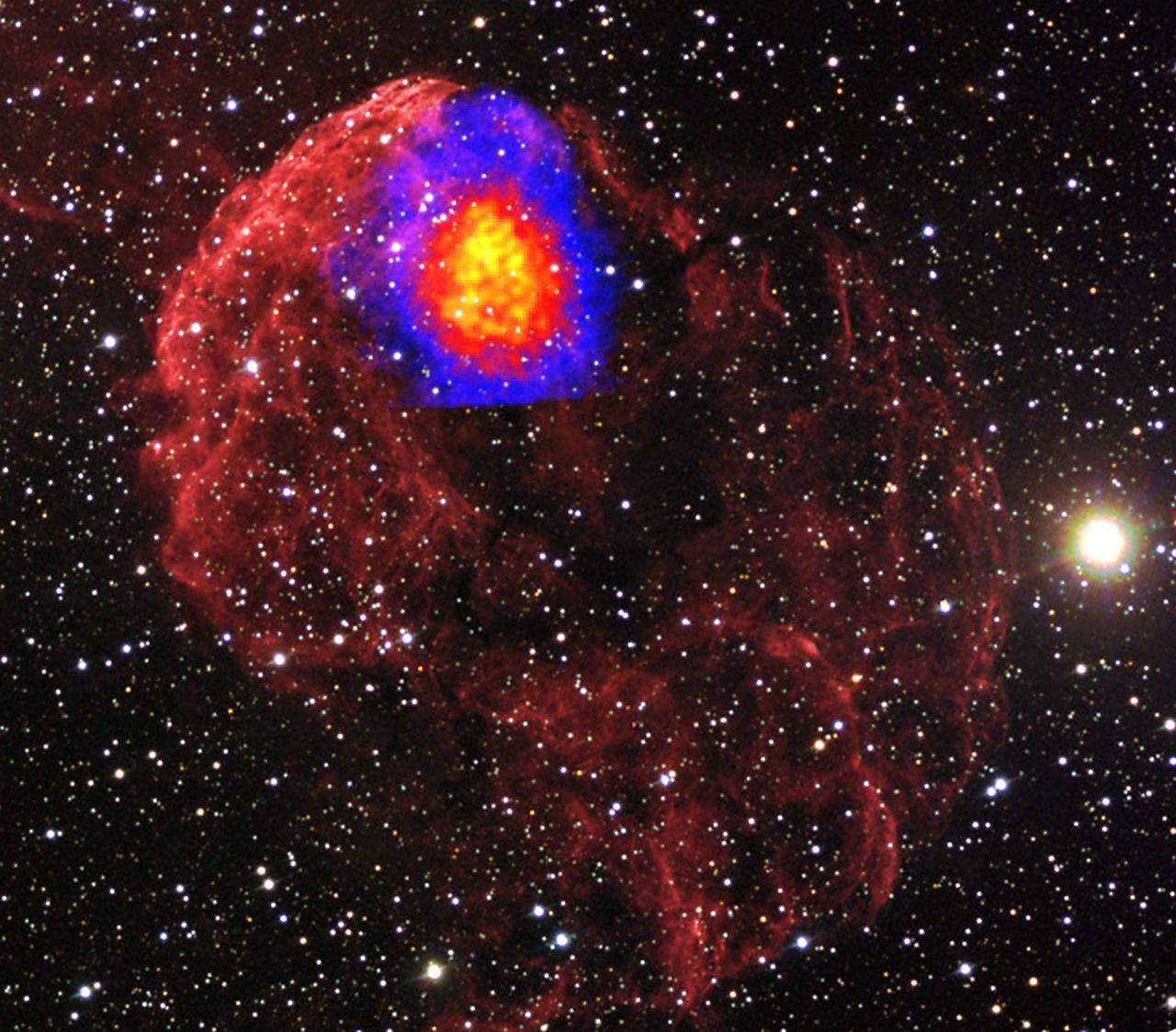
Suzaku Finds "Fossil" Fireballs from Supernovae In a supernova remnant known as the Jellyfish Nebula, Suzaku detected X-rays from fully ionized silicon and sulfur -- an imprint of higher-temperature conditions immediately following the star's explosion. The nebula is about 65 light-years across. (12/30/2009) Credit: JAXA/NASA/Suzaku To learn more go to: <a href="http://www.nasa.gov/mission_pages/astro-e2/news/fossil-fireballs.html" rel="nofollow">www.nasa.gov/mission_pages/astro-e2/news/fossil-fireballs...</a>

Supernova Supernovae can occur one of two ways. The first occurs when a white dwarf—the vestigial ember of a dead star—passes so close to a living star that its matter leaks into the white dwarf. This causes a catastrophic explosion. However most people understand supernovae as the death of a massive star. When the star runs out of fuel toward the end of its life, the gravity at its heart sucks the surrounding mass into its center. At temperatures rocketing above 100 billion degrees Fahrenheit, all the layers of the star abruptly explode outward. The explosions produced by supernovae are so brilliant that astronomers use their luminosity to measure the distance between galaxies, the scale of the universe and the effects of dark energy. For a short period of time, one dying star can appear to shine as brightly as an entire galaxy. Supernovae are relatively common events, one occurring in our own galaxy once every 100 years. In 2014, a person could see the supernova M82 with a pair of binoculars. The cosmologist Tycho Brahe’s observation of a supernova in 1572 allowed him to disprove Aristotle’s theory that the heavens never changed. After a supernova, material expelled in the explosion can form a nebula—an interstellar pile of gas and dust. Over millions of years, gravity pulls the nebula’s materials into a dense orb called a protostar, which will become a new star. Within a few million years, this new star could go supernova as well. ------------------------------ Original Caption: NASA image release Feb. 24, 2012 At the turn of the 19th century, the binary star system Eta Carinae was faint and undistinguished. In the first decades of the century, it became brighter and brighter, until, by April 1843, it was the second brightest star in the sky, outshone only by Sirius (which is almost a thousand times closer to Earth). In the years that followed, it gradually dimmed again and by the 20th century was totally invisible to the naked eye. The star has continued to vary in brightness ever since, and while it is once again visible to the naked eye on a dark night, it has never again come close to its peak of 1843. NASA's Hubble Telescope captured an image of Eta Carinae. This image consists of ultraviolet and visible light images from the High Resolution Channel of Hubble's Advanced Camera for Surveys. The field of view is approximately 30 arcseconds across. The larger of the two stars in the Eta Carinae system is a huge and unstable star that is nearing the end of its life, and the event that the 19th century astronomers observed was a stellar near-death experience. Scientists call these outbursts supernova impostor events, because they appear similar to supernovae but stop just short of destroying their star. Although 19th century astronomers did not have telescopes powerful enough to see the 1843 outburst in detail, its effects can be studied today. The huge clouds of matter thrown out a century and a half ago, known as the Homunculus Nebula, have been a regular target for Hubble since its launch in 1990. This image, taken with the Advanced Camera for Surveys High Resolution Channel, is the most detailed yet, and shows how the material from the star was not thrown out in a uniform manner, but forms a huge dumbbell shape. Eta Carinae is not only interesting because of its past, but also because of its future. It is one of the closest stars to Earth that is likely to explode in a supernova in the relatively near future (though in astronomical timescales the "near future" could still be a million years away). When it does, expect an impressive view from Earth, far brighter still than its last outburst: SN 2006gy, the brightest supernova ever observed, came from a star of the same type, though from a galaxy over 200 million light-years away. Credit: ESA/NASA More information: <a href="http://www.spacetelescope.org/images/potw1208a/" rel="nofollow">www.spacetelescope.org/images/potw1208a/</a> <b><a href="http://www.nasa.gov/audience/formedia/features/MP_Photo_Guidelines.html" rel="nofollow">NASA image use policy.</a></b> <b><a href="http://www.nasa.gov/centers/goddard/home/index.html" rel="nofollow">NASA Goddard Space Flight Center</a></b> enables NASA’s mission through four scientific endeavors: Earth Science, Heliophysics, Solar System Exploration, and Astrophysics. Goddard plays a leading role in NASA’s accomplishments by contributing compelling scientific knowledge to advance the Agency’s mission. <b>Follow us on <a href="http://twitter.com/NASAGoddardPix" rel="nofollow">Twitter</a></b> <b>Like us on <a href="http://www.facebook.com/pages/Greenbelt-MD/NASA-Goddard/395013845897?ref=tsd" rel="nofollow">Facebook</a></b> <b>Find us on <a href="http://instagrid.me/nasagoddard/?vm=grid" rel="nofollow">Instagram</a></b>
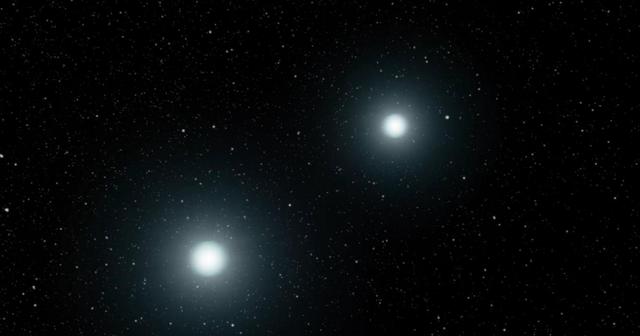
This frame from an animation shows the merger of two white dwarfs. A white dwarf is an extremely dense remnant of a star that can no longer burn nuclear fuel at its core. This is another way that a "type Ia" supernova occurs. Stellar explosions forge and distribute materials that make up the world in which we live, and also hold clues to how fast the universe is expanding. By understanding supernovae, scientists can unlock mysteries that are key to what we are made of and the fate of our universe. But to get the full picture, scientists must observe supernovae from a variety of perspectives, especially in the first moments of the explosion. That's really difficult -- there's no telling when or where a supernova might happen next. An animation is available at https://photojournal.jpl.nasa.gov/catalog/PIA22353
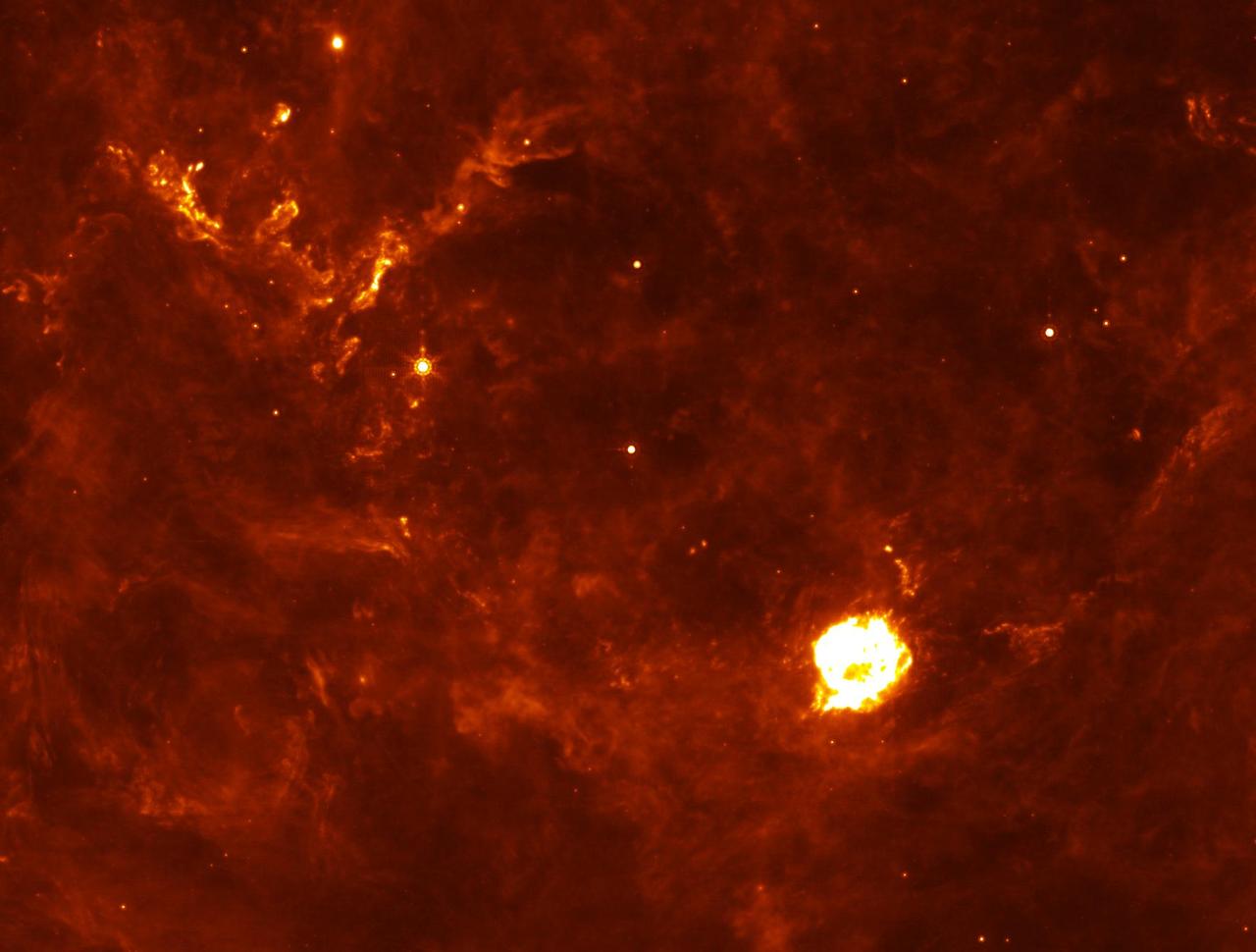
The Cassiopeia A supernova first flash of radiation makes six clumps of dust circled in annotated version unusually hot. The supernova remnant is the large white ball in the center. This infrared picture was taken by NASA Spitzer Space Telescope.
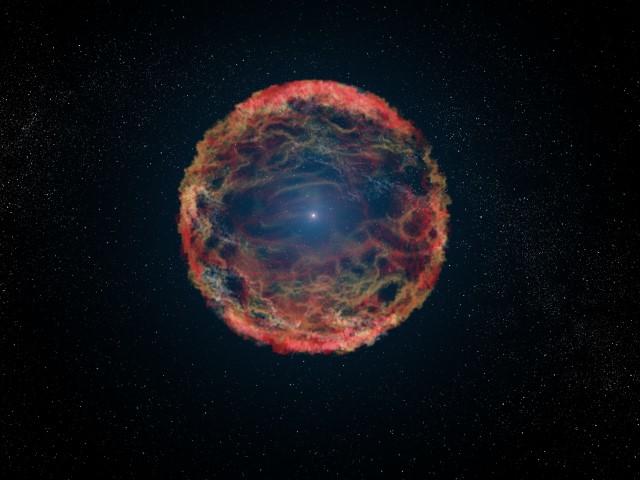
This is an artist's impression of supernova 1993J, an exploding star in the galaxy M81 whose light reached us 21 years ago. The supernova originated in a double-star system where one member was a massive star that exploded after siphoning most of its hydrogen envelope to its companion star. After two decades, astronomers have at last identified the blue helium-burning companion star, seen at the center of the expanding nebula of debris from the supernova. The Hubble Space Telescope identified the ultraviolet glow of the surviving companion embedded in the fading glow of the supernova. More info: Using NASA’s Hubble Space Telescope, astronomers have discovered a companion star to a rare type of supernova. The discovery confirms a long-held theory that the supernova, dubbed SN 1993J, occurred inside what is called a binary system, where two interacting stars caused a cosmic explosion. "This is like a crime scene, and we finally identified the robber," said Alex Filippenko, professor of astronomy at University of California (UC) at Berkeley. "The companion star stole a bunch of hydrogen before the primary star exploded." SN 1993J is an example of a Type IIb supernova, unusual stellar explosions that contains much less hydrogen than found in a typical supernova. Astronomers believe the companion star took most of the hydrogen surrounding the exploding main star and continued to burn as a super-hot helium star. “A binary system is likely required to lose the majority of the primary star’s hydrogen envelope prior to the explosion. The problem is that, to date, direct observations of the predicted binary companion star have been difficult to obtain since it is so faint relative to the supernova itself,” said lead researcher Ori Fox of UC Berkeley. Read more: <a href="http://1.usa.gov/1Az5Qb9" rel="nofollow">1.usa.gov/1Az5Qb9</a> Credit: NASA, ESA, G. Bacon (STScI) <b><a href="http://www.nasa.gov/audience/formedia/features/MP_Photo_Guidelines.html" rel="nofollow">NASA image use policy.</a></b> <b><a href="http://www.nasa.gov/centers/goddard/home/index.html" rel="nofollow">NASA Goddard Space Flight Center</a></b> enables NASA’s mission through four scientific endeavors: Earth Science, Heliophysics, Solar System Exploration, and Astrophysics. Goddard plays a leading role in NASA’s accomplishments by contributing compelling scientific knowledge to advance the Agency’s mission. <b>Follow us on <a href="http://twitter.com/NASAGoddardPix" rel="nofollow">Twitter</a></b> <b>Like us on <a href="http://www.facebook.com/pages/Greenbelt-MD/NASA-Goddard/395013845897?ref=tsd" rel="nofollow">Facebook</a></b> <b>Find us on <a href="http://instagram.com/nasagoddard?vm=grid" rel="nofollow">Instagram</a></b>

Image release September 2, 2010 ABOUT THIS IMAGE: This image shows the entire region around supernova 1987A. The most prominent feature in the image is a ring with dozens of bright spots. A shock wave of material unleashed by the stellar blast is slamming into regions along the ring's inner regions, heating them up, and causing them to glow. The ring, about a light-year across, was probably shed by the star about 20,000 years before it exploded. An international team of astronomers using the Hubble Space Telescope reports a significant brightening of the emissions from Supernova 1987A. The results, which appear in this week's Science magazine, are consistent with theoretical predictions about how supernovae interact with their immediate galactic environment. The team observed the supernova remnant in optical, ultraviolet, and near-infrared light. They studied the interaction between the ejecta from the stellar explosion and a glowing 6-trillion-mile-diameter ring of gas encircling the supernova remnant. The gas ring was probably shed some 20,000 years before the supernova exploded. Shock waves resulting from the impact of the ejecta onto the ring have brightened 30 to 40 pearl-like "hot spots" in the ring. These blobs likely will grow and merge together in the coming years to form a continuous, glowing circle. "We are seeing the effect a supernova can have in the surrounding galaxy, including how the energy deposited by these stellar explosions changes the dynamics and chemistry of the environment," said University of Colorado at Boulder Research Associate Kevin France of the Center for Astrophysics and Space Astronomy. "We can use these new data to understand how supernova processes regulate the evolution of galaxies." Discovered in 1987, Supernova 1987A is the closest exploding star to Earth to be detected since 1604 and it resides in the nearby Large Magellanic Cloud, a dwarf galaxy adjacent to our own Milky Way Galaxy. Credit: NASA, ESA, K. France (University of Colorado, Boulder), and P. Challis and R. Kirshner (Harvard-Smithsonian Center for Astrophysics) <b><a href="http://www.nasa.gov/centers/goddard/home/index.html" rel="nofollow">NASA Goddard Space Flight Center</a></b> is home to the nation's largest organization of combined scientists, engineers and technologists that build spacecraft, instruments and new technology to study the Earth, the sun, our solar system, and the universe. <b>Follow us on <a href="http://twitter.com/NASA_GoddardPix" rel="nofollow">Twitter</a></b> <b>Join us on <a href="http://www.facebook.com/pages/Greenbelt-MD/NASA-Goddard/395013845897?ref=tsd" rel="nofollow">Facebook</a></b>
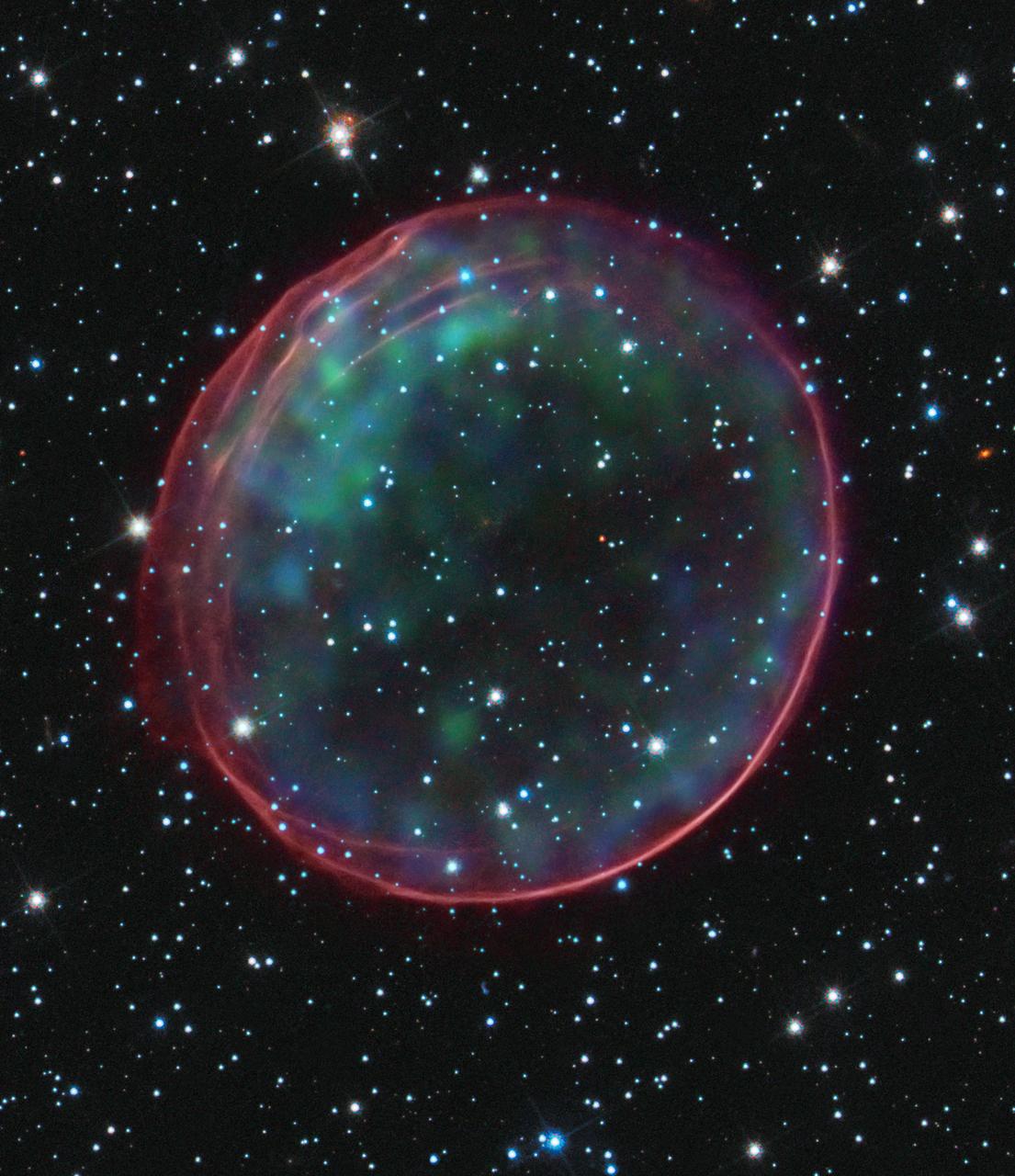
NASA image release January 11, 2012 Using NASA's Hubble Space Telescope, astronomers have solved a longstanding mystery on the type of star, or so-called progenitor, that caused a supernova in a nearby galaxy. The finding yields new observational data for pinpointing one of several scenarios that could trigger such outbursts. Based on previous observations from ground-based telescopes, astronomers knew that a kind of supernova called a Type Ia created a remnant named SNR 0509-67.5, which lies 170,000 light-years away in the Large Magellanic Cloud galaxy. The type of system that leads to this kind of supernova explosion has long been a high importance problem with various proposed solutions but no decisive answer. All these solutions involve a white dwarf star that somehow increases in mass to the highest limit. Astronomers failed to find any companion star near the center of the remnant, and this rules out all but one solution, so the only remaining possibility is that this one Type Ia supernova came from a pair of white dwarfs in close orbit. To read more go to: <a href="http://www.nasa.gov/mission_pages/hubble/science/supernova-source.html" rel="nofollow">www.nasa.gov/mission_pages/hubble/science/supernova-sourc...</a> Image Credit: NASA, ESA, CXC, SAO, the Hubble Heritage Team (STScI/AURA), and J. Hughes (Rutgers University) <b><a href="http://www.nasa.gov/audience/formedia/features/MP_Photo_Guidelines.html" rel="nofollow">NASA image use policy.</a></b> <b><a href="http://www.nasa.gov/centers/goddard/home/index.html" rel="nofollow">NASA Goddard Space Flight Center</a></b> enables NASA’s mission through four scientific endeavors: Earth Science, Heliophysics, Solar System Exploration, and Astrophysics. Goddard plays a leading role in NASA’s accomplishments by contributing compelling scientific knowledge to advance the Agency’s mission. <b>Follow us on <a href="http://twitter.com/NASA_GoddardPix" rel="nofollow">Twitter</a></b> <b>Like us on <a href="http://www.facebook.com/pages/Greenbelt-MD/NASA-Goddard/395013845897?ref=tsd" rel="nofollow">Facebook</a></b> <b>Find us on <a href="http://instagrid.me/nasagoddard/?vm=grid" rel="nofollow">Instagram</a></b>
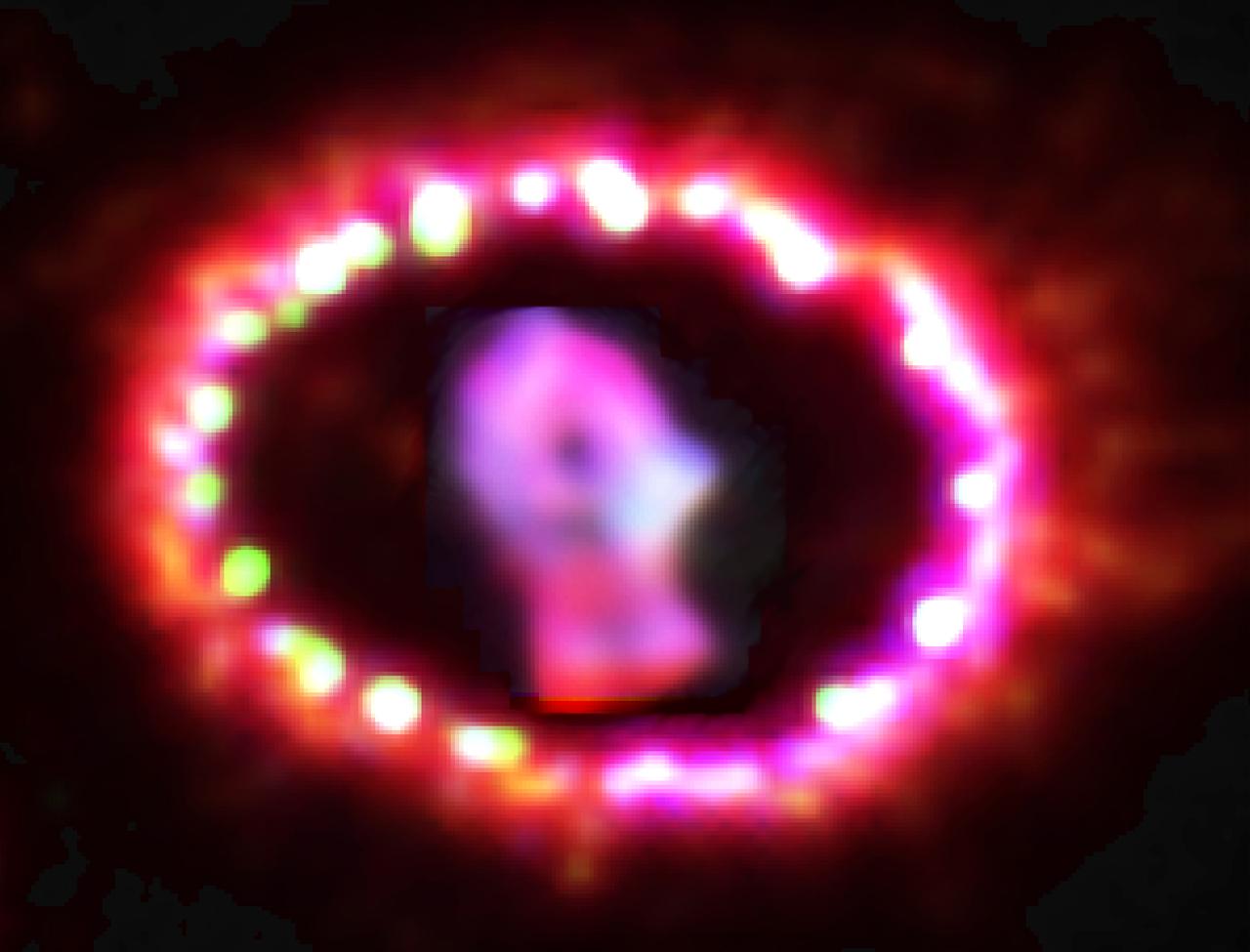
NASA image release June 10, 2011 Astronomers using NASA's Hubble Space Telescope are witnessing the unprecedented transition of a supernova to a supernova remnant, where light from an exploding star in a neighboring galaxy, the Large Magellanic Cloud, reached Earth in February 1987. Named Supernova 1987A, it was the closest supernova explosion witnessed in almost 400 years. The supernova's close proximity to Earth has allowed astronomers to study it in detail as it evolves. Now, the supernova debris, which has faded over the years, is brightening. This means that a different power source has begun to light the debris. The debris of SN 1987A is beginning to impact the surrounding ring, creating powerful shock waves that generate X-rays observed with NASA's Chandra X-ray Observatory. Those X-rays are illuminating the supernova debris and shock heating is making it glow in visible light. The results are being reported in the June 9, 2011, issue of the journal Nature by a team including Robert Kirshner of the Harvard-Smithsonian Center for Astrophysics (CfA), who leads a long-term study of SN 1987A with Hubble. Since its launch in 1990, the Hubble telescope has provided a continuous record of the changes in SN 1987A. Credit: NASA, ESA, and P. Challis (Harvard-Smithsonian Center for Astrophysics) <b><a href="http://www.nasa.gov/centers/goddard/home/index.html" rel="nofollow">NASA Goddard Space Flight Center</a></b> enables NASA’s mission through four scientific endeavors: Earth Science, Heliophysics, Solar System Exploration, and Astrophysics. Goddard plays a leading role in NASA’s accomplishments by contributing compelling scientific knowledge to advance the Agency’s mission. <b>Follow us on <a href="http://twitter.com/NASAGoddardPix" rel="nofollow">Twitter</a></b> <b>Join us on <a href="http://www.facebook.com/pages/Greenbelt-MD/NASA-Goddard/395013845897?ref=tsd" rel="nofollow">Facebook</a></b> <b>Find us on <a href="http://web.stagram.com/n/nasagoddard/?vm=grid" rel="nofollow">Instagram</a></b>
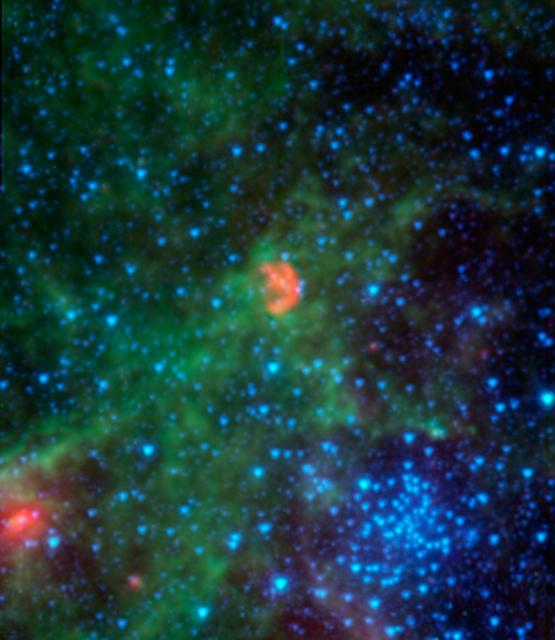
Supernovas are often thought of as the tremendous explosions that mark the ends of massive stars' lives. While this is true, not all supernovas occur in this fashion. A common supernova class, called Type Ia, involves the detonation of white dwarfs -- small, dense stars that are already dead. New results from NASA's Spitzer Space Telescope have revealed a rare example of Type Ia explosion, in which a dead star "fed" off an aging star like a cosmic zombie, triggering a blast. The results help researchers piece together how these powerful and diverse events occur. "It's kind of like being a detective," said Brian Williams of NASA's Goddard Space Flight Center in Greenbelt, Maryland, lead author of a study submitted to the Astrophysical Journal. "We look for clues in the remains to try to figure out what happened, even though we weren't there to see it." Read more: <a href="http://1.usa.gov/1i0PAaa" rel="nofollow">1.usa.gov/1i0PAaa</a> <b><a href="http://www.nasa.gov/audience/formedia/features/MP_Photo_Guidelines.html" rel="nofollow">NASA image use policy.</a></b> <b><a href="http://www.nasa.gov/centers/goddard/home/index.html" rel="nofollow">NASA Goddard Space Flight Center</a></b> enables NASA’s mission through four scientific endeavors: Earth Science, Heliophysics, Solar System Exploration, and Astrophysics. Goddard plays a leading role in NASA’s accomplishments by contributing compelling scientific knowledge to advance the Agency’s mission. <b>Follow us on <a href="http://twitter.com/NASAGoddardPix" rel="nofollow">Twitter</a></b> <b>Like us on <a href="http://www.facebook.com/pages/Greenbelt-MD/NASA-Goddard/395013845897?ref=tsd" rel="nofollow">Facebook</a></b> <b>Find us on <a href="http://instagram.com/nasagoddard?vm=grid" rel="nofollow">Instagram</a></b>
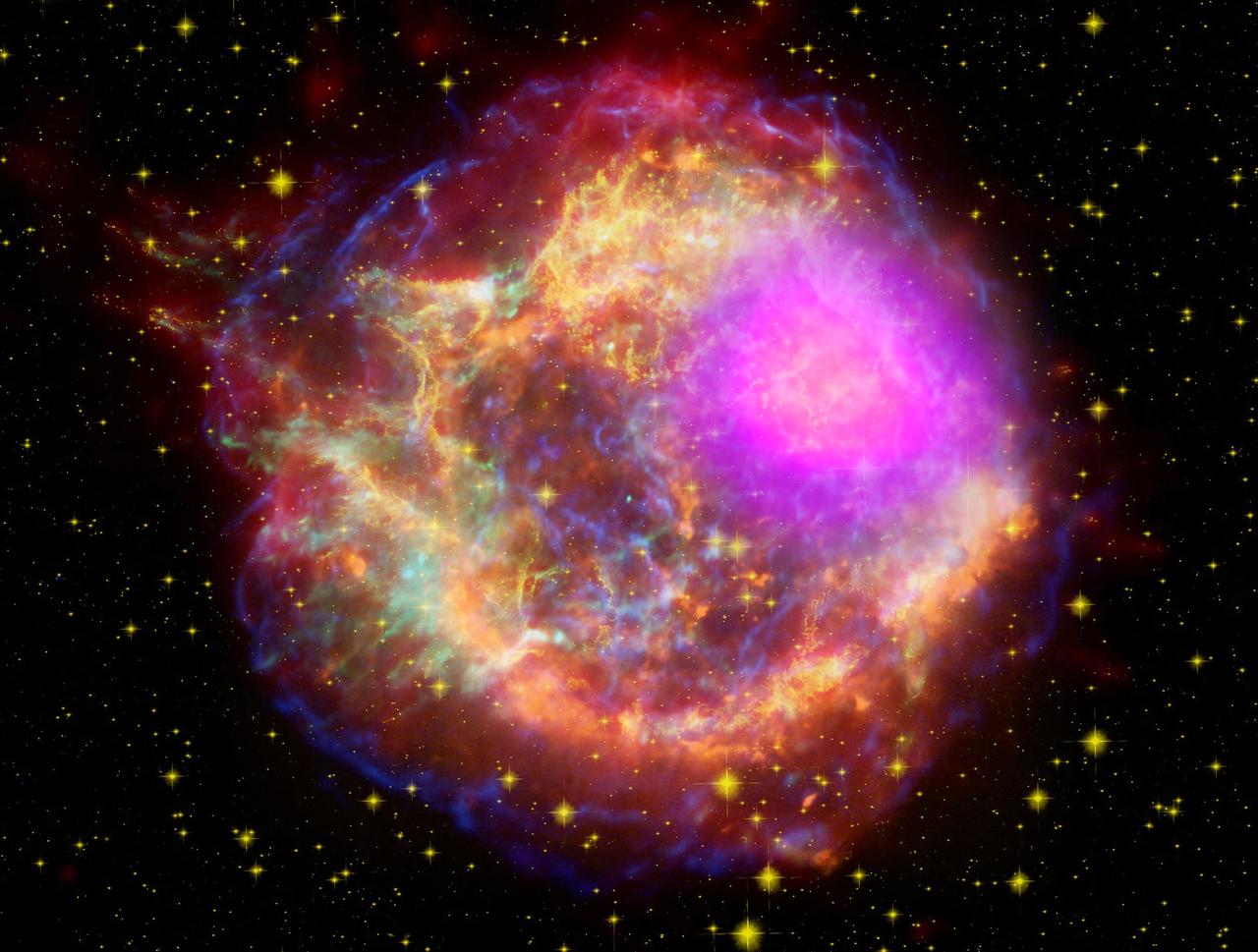
NASA's Fermi Closes on Source of Cosmic Rays New images from NASA's Fermi Gamma-ray Space Telescope show where supernova remnants emit radiation a billion times more energetic than visible light. The images bring astronomers a step closer to understanding the source of some of the universe's most energetic particles -- cosmic rays. This composite shows the Cassiopeia A supernova remnant across the spectrum: Gamma rays (magenta) from NASA's Fermi Gamma-ray Space Telescope; X-rays (blue, green) from NASA's Chandra X-ray Observatory; visible light (yellow) from the Hubble Space Telescope; infrared (red) from NASA's Spitzer Space Telescope; and radio (orange) from the Very Large Array near Socorro, N.M. Credit: NASA/DOE/Fermi LAT Collaboration, CXC/SAO/JPL-Caltech/Steward/O. Krause et al., and NRAO/AUI For more information: <a href="http://www.nasa.gov/mission_pages/GLAST/news/cosmic-rays-source.html" rel="nofollow">www.nasa.gov/mission_pages/GLAST/news/cosmic-rays-source....</a> <b><a href="http://www.nasa.gov/centers/goddard/home/index.html" rel="nofollow">NASA Goddard Space Flight Center</a></b> is home to the nation's largest organization of combined scientists, engineers and technologists that build spacecraft, instruments and new technology to study the Earth, the sun, our solar system, and the universe. <b>Follow us on <a href="http://twitter.com/NASA_GoddardPix" rel="nofollow">Twitter</a></b> <b>Join us on <a href="http://www.facebook.com/pages/Greenbelt-MD/NASA-Goddard/395013845897?ref=tsd" rel="nofollow">Facebook</a><b> </b></b>
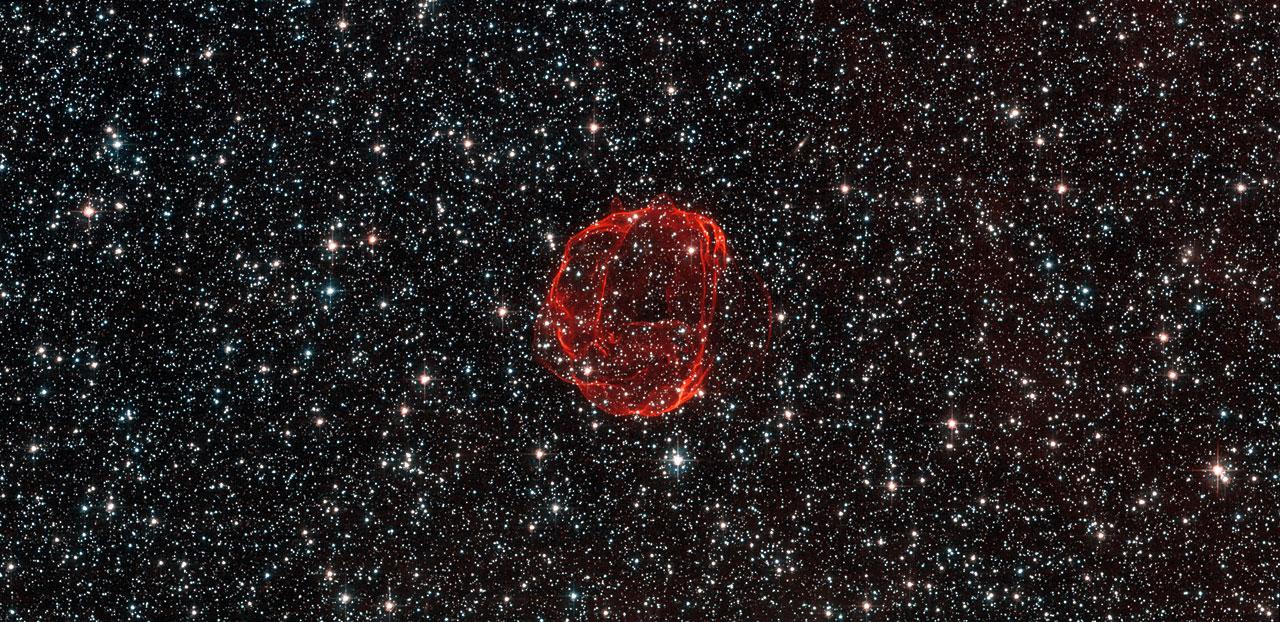
These delicate wisps of gas make up an object known as SNR B0519-69.0, or SNR 0519 for short. The thin, blood-red shells are actually the remnants from when an unstable progenitor star exploded violently as a supernova around 600 years ago. There are several types of supernovae, but for SNR 0519 the star that exploded is known to have been a white dwarf star — a Sun-like star in the final stages of its life. SNR 0519 is located over 150 000 light-years from Earth in the southern constellation of Dorado (The Dolphinfish), a constellation that also contains most of our neighboring galaxy the Large Magellanic Cloud (LMC). Because of this, this region of the sky is full of intriguing and beautiful deep sky objects. The LMC orbits the Milky Way galaxy as a satellite and is the fourth largest in our group of galaxies, the Local Group. SNR 0519 is not alone in the LMC; the NASA/ESA Hubble Space Telescope also came across a similar bauble a few years ago in SNR B0509-67.5, a supernova of the same type as SNR 0519 with a strikingly similar appearance. European Space Agency/NASA Hubble <b><a href="http://www.nasa.gov/audience/formedia/features/MP_Photo_Guidelines.html" rel="nofollow">NASA image use policy.</a></b> <b><a href="http://www.nasa.gov/centers/goddard/home/index.html" rel="nofollow">NASA Goddard Space Flight Center</a></b> enables NASA’s mission through four scientific endeavors: Earth Science, Heliophysics, Solar System Exploration, and Astrophysics. Goddard plays a leading role in NASA’s accomplishments by contributing compelling scientific knowledge to advance the Agency’s mission. <b>Follow us on <a href="http://twitter.com/NASA_GoddardPix" rel="nofollow">Twitter</a></b> <b>Like us on <a href="http://www.facebook.com/pages/Greenbelt-MD/NASA-Goddard/395013845897?ref=tsd" rel="nofollow">Facebook</a></b> <b>Find us on <a href="http://instagram.com/nasagoddard?vm=grid" rel="nofollow">Instagram</a></b>
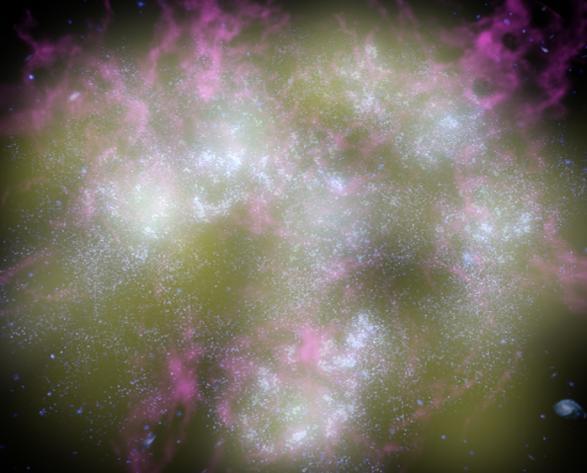
This artist's animation shows a typical young galaxy, teeming with hot, newborn stars and exploding supernovas. The supernovas are seen as white flashes of light. NASA's Galaxy Evolution Explorer spotted three-dozen young galaxies like the one shown here in our corner of the universe. It was able to see them with the help of its highly sensitive ultraviolet detectors. Because newborn stars radiate ultraviolet light, young galaxies light up brilliantly when viewed in ultraviolet wavelengths. The findings came as a surprise, because astronomers had thought that the universe's "birth-rate" had declined, and that massive galaxies were no longer forming. http://photojournal.jpl.nasa.gov/catalog/PIA07144

Release date Dec. 30, 2009 In the supernova remnant W49B, Suzaku found another fossil fireball. It detected X-rays produced when heavily ionized iron atoms recapture an electron. This view combines infrared images from the ground (red, green) with X-ray data from NASA's Chandra X-Ray Observatory (blue). Credit: Caltech/SSC/J. Rho and T. Jarrett and NASA/CXC/SSC/J. Keohane et al. To learn more about this image go to: <a href="http://www.nasa.gov/mission_pages/astro-e2/news/fossil-fireballs.html" rel="nofollow">www.nasa.gov/mission_pages/astro-e2/news/fossil-fireballs...</a> <b><a href="http://www.nasa.gov/centers/goddard/home/index.html" rel="nofollow">NASA Goddard Space Flight Center</a></b> is home to the nation's largest organization of combined scientists, engineers and technologists that build spacecraft, instruments and new technology to study the Earth, the sun, our solar system, and the universe.

Seen as a red dusty cloud in this image from NASA Wide-field Infrared Survey Explorer, Puppis A is the remnant of a supernova explosion.

NASA image release December 14, 2010 A delicate sphere of gas, photographed by NASA's Hubble Space Telescope, floats serenely in the depths of space. The pristine shell, or bubble, is the result of gas that is being shocked by the expanding blast wave from a supernova. Called SNR 0509-67.5 (or SNR 0509 for short), the bubble is the visible remnant of a powerful stellar explosion in the Large Magellanic Cloud (LMC), a small galaxy about 160,000 light-years from Earth. Ripples in the shell's surface may be caused by either subtle variations in the density of the ambient interstellar gas, or possibly driven from the interior by pieces of the ejecta. The bubble-shaped shroud of gas is 23 light-years across and is expanding at more than 11 million miles per hour (5,000 kilometers per second). Astronomers have concluded that the explosion was one of an especially energetic and bright variety of supernovae. Known as Type Ia, such supernova events are thought to result from a white dwarf star in a binary system that robs its partner of material, takes on much more mass than it is able to handle, and eventually explodes. Hubble's Advanced Camera for Surveys observed the supernova remnant on Oct. 28, 2006 with a filter that isolates light from glowing hydrogen seen in the expanding shell. These observations were then combined with visible-light images of the surrounding star field that were imaged with Hubble's Wide Field Camera 3 on Nov. 4, 2010. With an age of about 400 years as seen from Earth, the supernova might have been visible to southern hemisphere observers around the year 1600, however, there are no known records of a "new star" in the direction of the LMC near that time. A more recent supernova in the LMC, SN 1987A, did catch the eye of Earth viewers and continues to be studied with ground- and space-based telescopes, including Hubble. For images and more information about SNR 0509, visit: <a href="http://hubblesite.org/news/2010/27" rel="nofollow">hubblesite.org/news/2010/27</a> <a href="http://heritage.stsci.edu/2010/27" rel="nofollow">heritage.stsci.edu/2010/27</a> <a href="http://www.nasa.gov/hubble" rel="nofollow">www.nasa.gov/hubble</a> The Hubble Space Telescope is a project of international cooperation between NASA and the European Space Agency. NASA's Goddard Space Flight Center manages the telescope. The Space Telescope Science Institute (STScI) conducts Hubble science operations. STScI is operated for NASA by the Association of Universities for Research in Astronomy, Inc., in Washington, D.C. <b>Credit: NASA, ESA, and the Hubble Heritage Team (STScI/AURA) Acknowledgment: J. Hughes (Rutgers University)</b> <b><a href="http://www.nasa.gov/centers/goddard/home/index.html" rel="nofollow">NASA Goddard Space Flight Center</a></b> enables NASA’s mission through four scientific endeavors: Earth Science, Heliophysics, Solar System Exploration, and Astrophysics. Goddard plays a leading role in NASA’s accomplishments by contributing compelling scientific knowledge to advance the Agency’s mission. <b>Follow us on <a href="http://twitter.com/NASA_GoddardPix" rel="nofollow">Twitter</a></b> <b>Join us on <a href="http://www.facebook.com/pages/Greenbelt-MD/NASA-Goddard/395013845897?ref=tsd" rel="nofollow">Facebook</a></b>

This is a Hubble Space Telescope composite image of a supernova explosion designated SN 2014J in the galaxy M82. At a distance of approximately 11.5 million light-years from Earth it is the closest supernova of its type discovered in the past few decades. The explosion is categorized as a Type Ia supernova, which is theorized to be triggered in binary systems consisting of a white dwarf and another star — which could be a second white dwarf, a star like our sun, or a giant star. Astronomers using a ground-based telescope discovered the explosion on January 21, 2014. This Hubble photograph was taken on January 31, as the supernova approached its peak brightness. The Hubble data are expected to help astronomers refine distance measurements to Type Ia supernovae. In addition, the observations could yield insights into what kind of stars were involved in the explosion. Hubble’s ultraviolet-light sensitivity will allow astronomers to probe the environment around the site of the supernova explosion and in the interstellar medium of the host galaxy. Because of their consistent peak brightness, Type Ia supernovae are among the best tools to measure distances in the universe. They were fundamental to the 1998 discovery of the mysterious acceleration of the expanding universe. A hypothesized repulsive force, called dark energy, is thought to cause the acceleration. Among the other major NASA space-based observatories used in the M82 viewing campaign are Spitzer Space Telescope, Chandra X-ray Observatory, Nuclear Spectroscopic Telescope Array (NuSTAR), Fermi Gamma-ray Space Telescope, Swift Gamma Ray Burst Explorer, and the Stratospheric Observatory for Infrared Astronomy (SOFIA). Image Credit: NASA, ESA, A. Goobar (Stockholm University), and the Hubble Heritage Team (STScI/AURA) <b><a href="http://www.nasa.gov/audience/formedia/features/MP_Photo_Guidelines.html" rel="nofollow">NASA image use policy.</a></b> <b><a href="http://www.nasa.gov/centers/goddard/home/index.html" rel="nofollow">NASA Goddard Space Flight Center</a></b> enables NASA’s mission through four scientific endeavors: Earth Science, Heliophysics, Solar System Exploration, and Astrophysics. Goddard plays a leading role in NASA’s accomplishments by contributing compelling scientific knowledge to advance the Agency’s mission. <b>Follow us on <a href="http://twitter.com/NASAGoddardPix" rel="nofollow">Twitter</a></b> <b>Like us on <a href="http://www.facebook.com/pages/Greenbelt-MD/NASA-Goddard/395013845897?ref=tsd" rel="nofollow">Facebook</a></b> <b>Find us on <a href="http://instagram.com/nasagoddard?vm=grid" rel="nofollow">Instagram</a></b>

A massive star left, which has created elements as heavy as iron in its interior, blows up in a tremendous explosion middle, scattering its outer layers in a structure called a supernova remnant right.
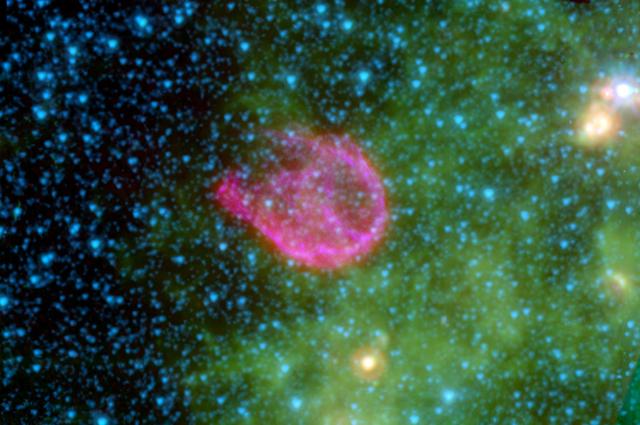
Supernovae are the explosive deaths of the universe most massive stars. This false-color composite from NASA Spitzer Space Telescope and NASA Chandra X-ray Observatory shows the remnant of N132D, the wispy pink shell of gas at center.
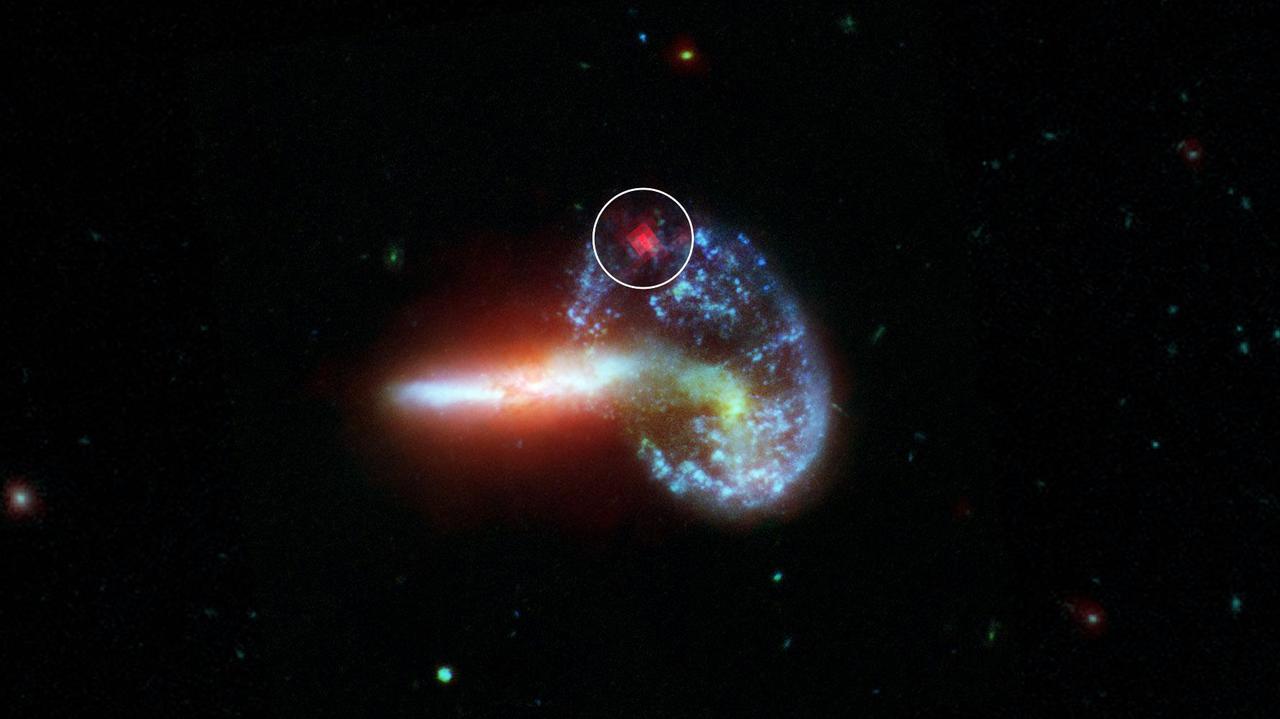
This image shows galaxy Arp 148, captured by NASA's Spitzer and Hubble telescopes. Inside the white circle is specially-processed Spitzer data, which reveals infrared light from a supernova that is hidden by dust. Supernovae are massive stars that have exploded after running out of fuel. They radiate most brightly in visible light (the kind the human eye can detect), but these wavelengths are obscured by dust. Infrared light, however, can pass through dust. The analysis of Arp 148 was part of an effort to find hidden supernovae in 40 dust-choked galaxies that also emit high levels of infrared light. These galaxies are known as luminous and ultra-luminous infrared galaxies (LIRGs and ULIRGs, respectively). The dust in LIRGs and ULIRGs absorbs optical light from objects like supernovae but allows infrared light from these same objects to pass through unobstructed for telescopes like Spitzer to detect. https://photojournal.jpl.nasa.gov/catalog/PIA24575

The CTB 1 supernova remnant resembles a ghostly bubble in this image, which combines new 1.5 gigahertz observations from the Very Large Array (VLA) radio telescope (orange, near center) with older observations from the Dominion Radio Astrophysical Observatory’s Canadian Galactic Plane Survey (1.42 gigahertz, magenta and yellow; 408 megahertz, green) and infrared data (blue). The VLA data clearly reveal the straight, glowing trail from pulsar J0002+6216 and the curved rim of the remnant’s shell. CTB 1 is about half a degree across, the apparent size of a full Moon. Credits: Composite by Jayanne English, University of Manitoba, using data from NRAO/F. Schinzel et al., DRAO/Canadian Galactic Plane Survey and NASA/IRAS More info: https://go.nasa.gov/2TKpyWF

This composite image of the Tycho supernova remnant combines infrared and X-ray observations obtained with NASA Spitzer and Chandra space observatories, respectively,
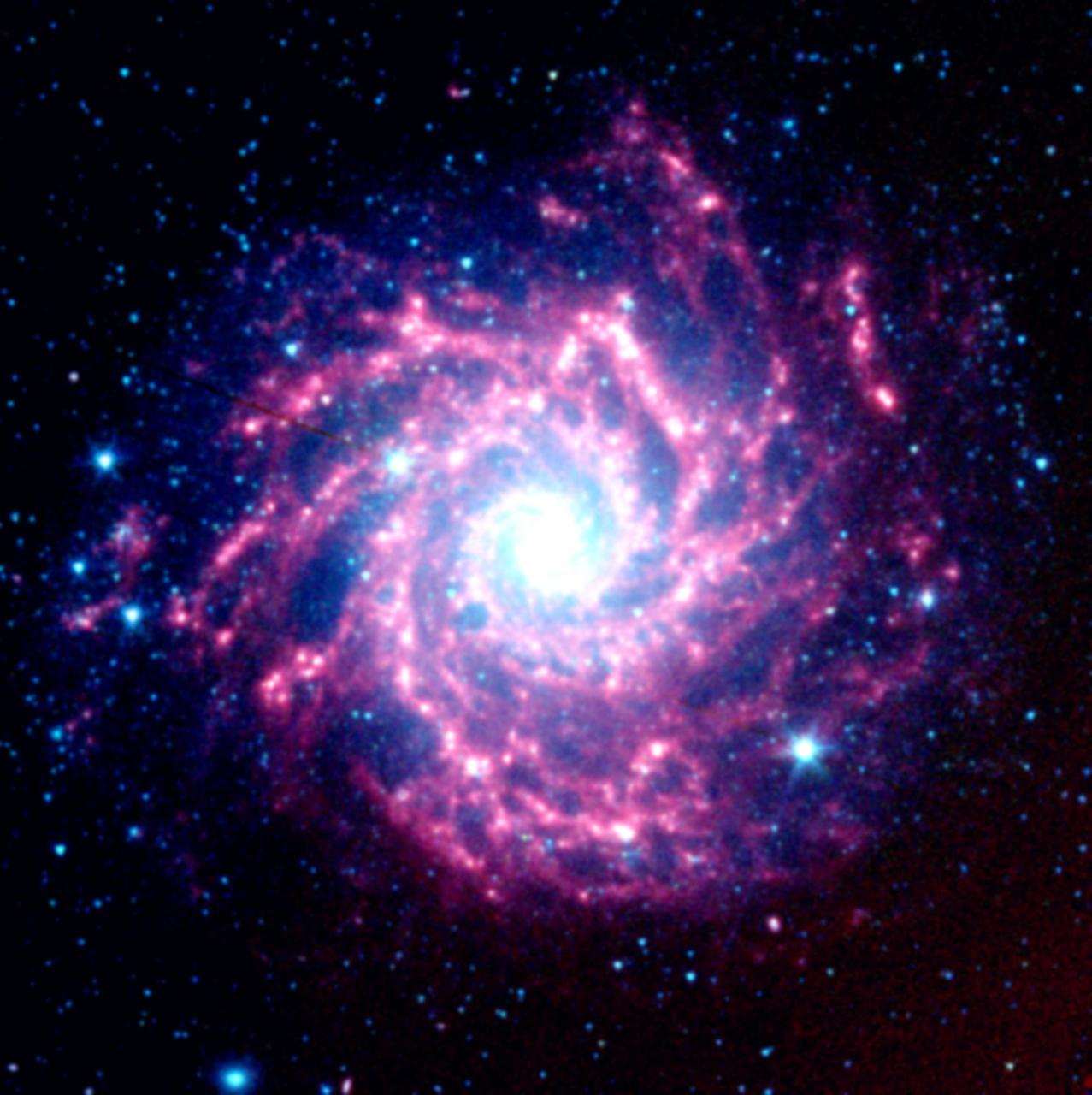
Astronomers using NASA Spitzer Space Telescope have spotted a dust factory 30 million light-years away in the spiral galaxy M74. The factory is located at the scene of a massive star explosive death, or supernova.
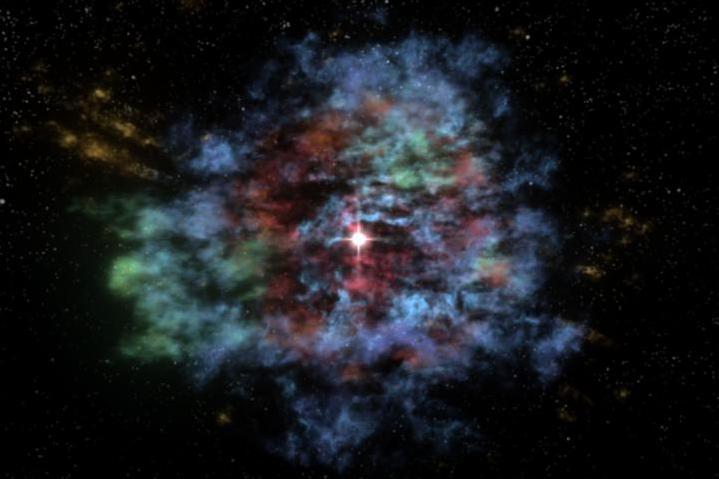
For the first time, a multiwavelength three-dimensional reconstruction of a supernova remnant has been created. This visualization of Cassiopeia A, or Cas A, the result of an explosion approximately 330 years ago, uses data from several NASA telescopes.
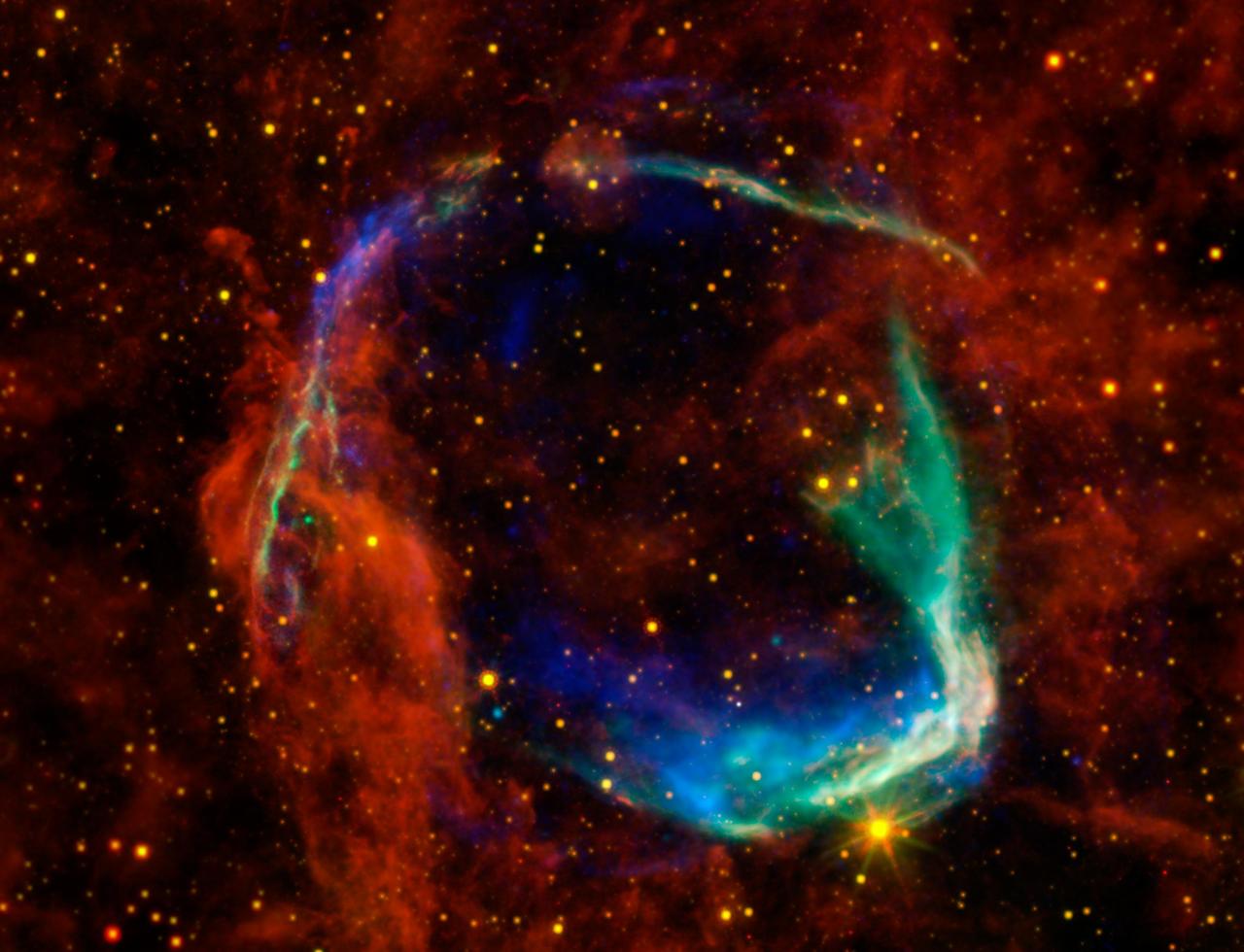
This image combines data from four different space telescopes to create a multi-wavelength view of all that remains of the oldest documented example of a supernova, called RCW 86.
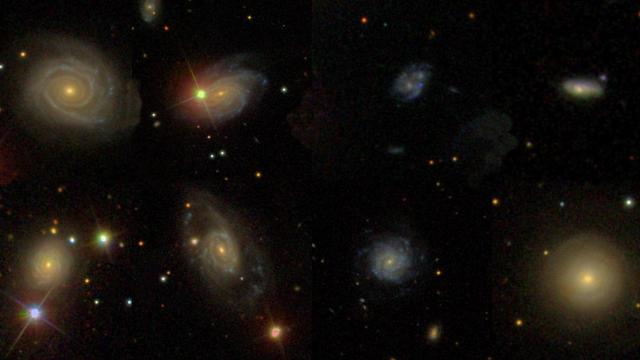
A new study analyzes several sites where dead stars once exploded. The explosions, called Type Ia supernovae, occurred within galaxies, six of which are shown in these images from the Sloan Digital Sky Survey.
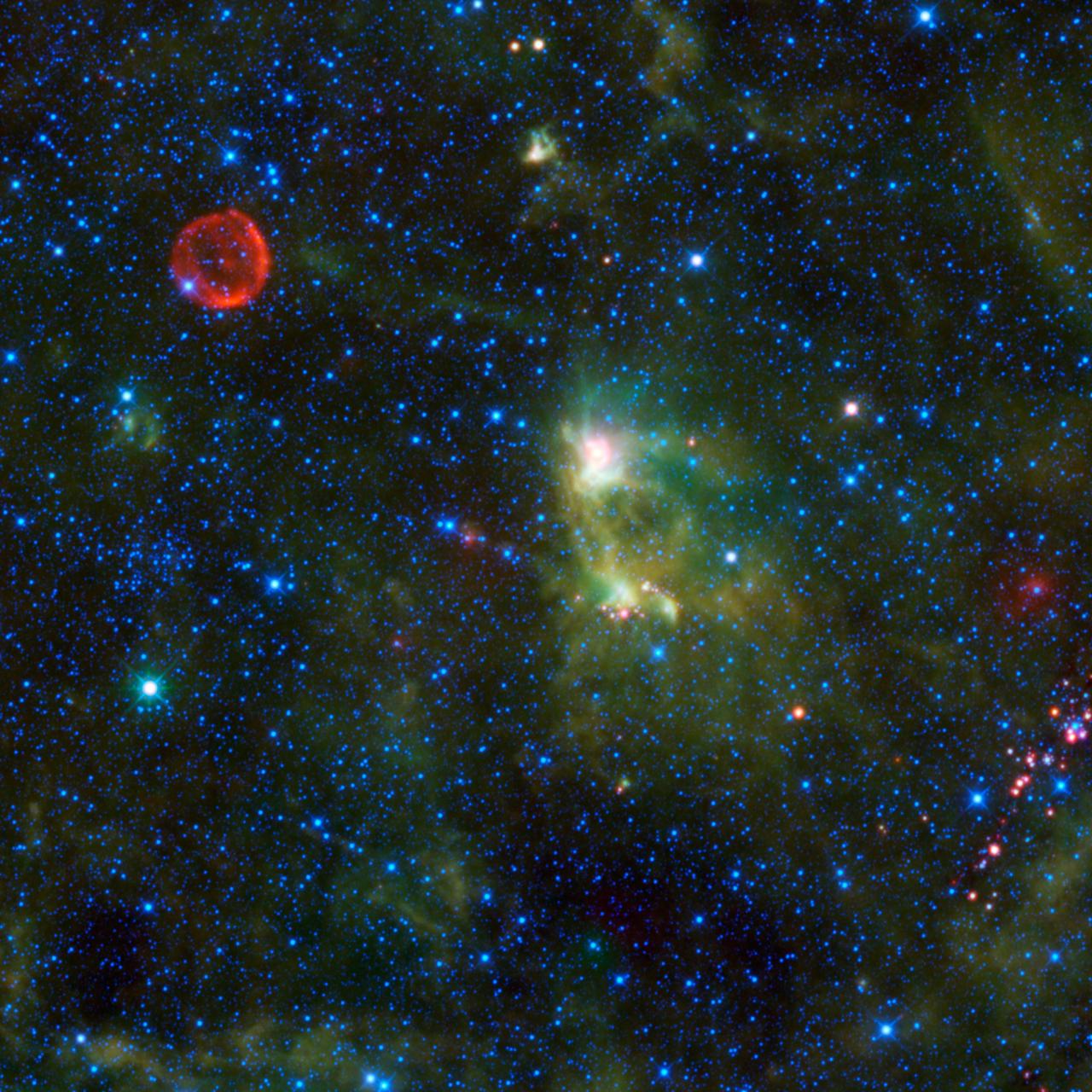
This image from NASA Wide-field Infrared Survey Explorer takes in several interesting objects in the constellation Cassiopeia which are not easily seen in visible light. The red circle visible at upper left is SN 1572, often called Tycho Supernova.

Of all the varieties of exploding stars, the ones called Type Ia are perhaps the most intriguing. Their predictable brightness lets astronomers measure the expansion of the universe, which led to the discovery of dark energy. Yet the cause of these supernovae remains a mystery. Do they happen when two white dwarf stars collide? Or does a single white dwarf gorge on gases stolen from a companion star until bursting? If the second theory is true, the normal star should survive. Astronomers used NASA's Hubble Space Telescope to search the gauzy remains of a Type Ia supernova in a neighboring galaxy called the Large Magellanic Cloud. They found a sun-like star that showed signs of being associated with the supernova. Further investigations will be needed to learn if this star is truly the culprit behind a white dwarf's fiery demise. This image, taken with NASA's Hubble Space Telescope, shows the supernova remnant SNR 0509-68.7, also known as N103B. It is located 160,000 light-years from Earth in a neighboring galaxy called the Large Magellanic Cloud. N103B resulted from a Type Ia supernova, whose cause remains a mystery. One possibility would leave behind a stellar survivor, and astronomers have identified a possible candidate. The actual supernova remnant is the irregular shaped dust cloud, at the upper center of the image. The gas in the lower half of the image and the dense concentration of stars in the lower left are the outskirts of the star cluster NGC 1850. The Hubble image combines visible and near-infrared light taken by the Wide Field Camera 3 in June 2014. Credit: NASA, ESA and H.-Y. Chu (Academia Sinica, Taipei) <b><a href="http://www.nasa.gov/audience/formedia/features/MP_Photo_Guidelines.html" rel="nofollow">NASA image use policy.</a></b> <b><a href="http://www.nasa.gov/centers/goddard/home/index.html" rel="nofollow">NASA Goddard Space Flight Center</a></b> enables NASA’s mission through four scientific endeavors: Earth Science, Heliophysics, Solar System Exploration, and Astrophysics. Goddard plays a leading role in NASA’s accomplishments by contributing compelling scientific knowledge to advance the Agency’s mission. <b>Follow us on <a href="http://twitter.com/NASAGoddardPix" rel="nofollow">Twitter</a></b> <b>Like us on <a href="http://www.facebook.com/pages/Greenbelt-MD/NASA-Goddard/395013845897?ref=tsd" rel="nofollow">Facebook</a></b> <b>Find us on <a href="http://instagrid.me/nasagoddard/?vm=grid" rel="nofollow">Instagram</a></b>
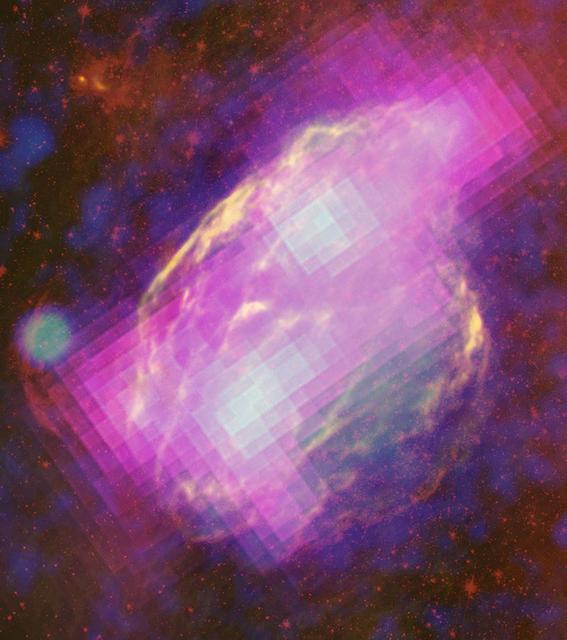
The W44 supernova remnant is nestled within and interacting with the molecular cloud that formed its parent star. Fermi's LAT detects GeV gamma rays (magenta) produced when the gas is bombarded by cosmic rays, primarily protons. Radio observations (yellow) from the Karl G. Jansky Very Large Array near Socorro, N.M., and infrared (red) data from NASA's Spitzer Space Telescope reveal filamentary structures in the remnant's shell. Blue shows X-ray emission mapped by the Germany-led ROSAT mission. To read more go to: <a href="http://1.usa.gov/14V14qi" rel="nofollow">1.usa.gov/14V14qi</a> <b><a href="http://www.nasa.gov/audience/formedia/features/MP_Photo_Guidelines.html" rel="nofollow">NASA image use policy.</a></b> <b><a href="http://www.nasa.gov/centers/goddard/home/index.html" rel="nofollow">NASA Goddard Space Flight Center</a></b> enables NASA’s mission through four scientific endeavors: Earth Science, Heliophysics, Solar System Exploration, and Astrophysics. Goddard plays a leading role in NASA’s accomplishments by contributing compelling scientific knowledge to advance the Agency’s mission. <b>Follow us on <a href="http://twitter.com/NASA_GoddardPix" rel="nofollow">Twitter</a></b> <b>Like us on <a href="http://www.facebook.com/pages/Greenbelt-MD/NASA-Goddard/395013845897?ref=tsd" rel="nofollow">Facebook</a></b> <b>Find us on <a href="http://instagram.com/nasagoddard?vm=grid" rel="nofollow">Instagram</a></b> Credit: NASA/DOE/Fermi LAT Collaboration, NRAO/AUI, JPL-Caltech, ROSAT
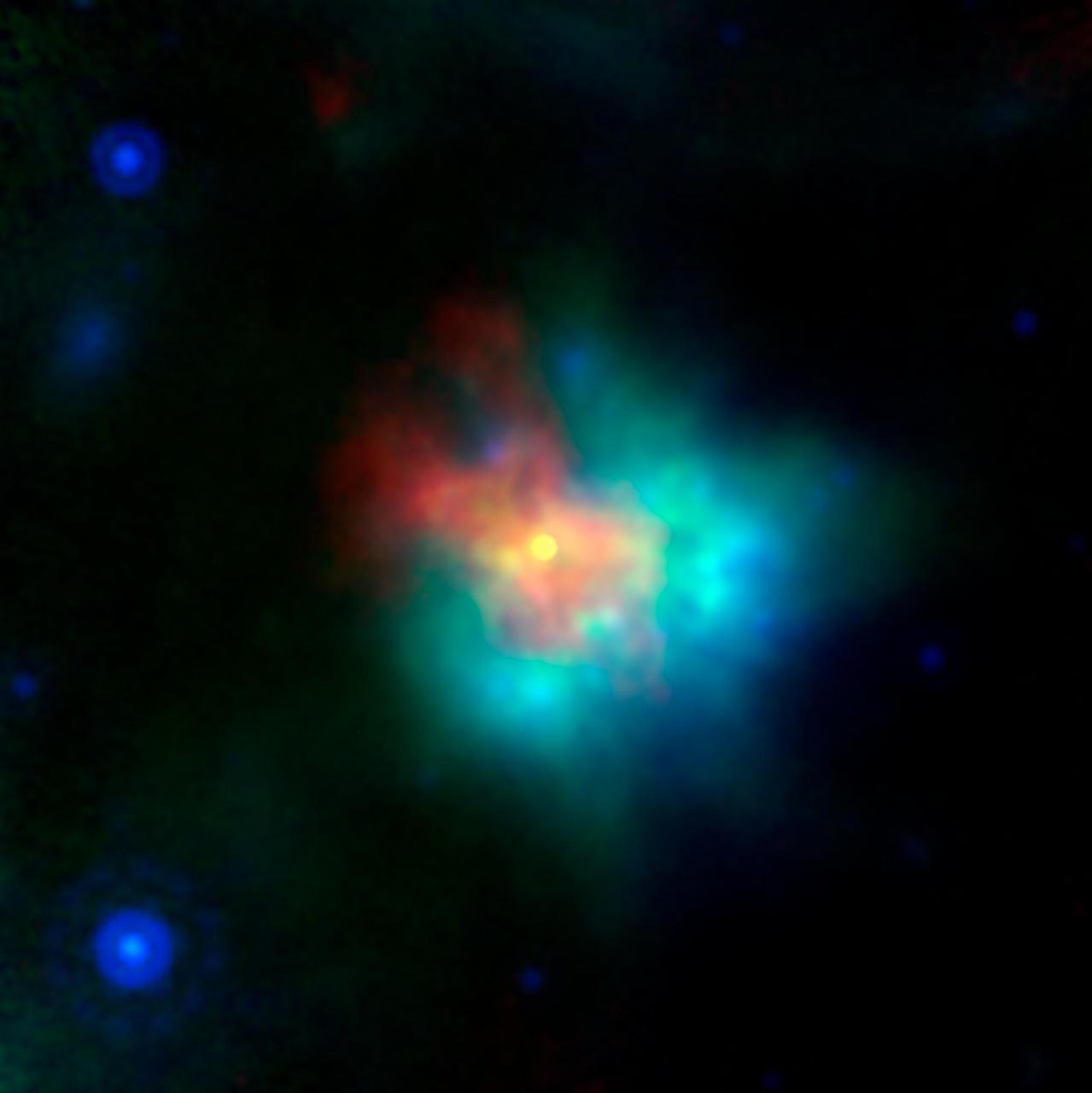
This image of supernova remnant G54.1+0.3 includes radio, infrared and X-ray light. The saturated yellow point at the center of the image indicates strong X-ray source at the center of the supernova remnant. This is an incredibly dense object called a neutron star, which can form as a star runs out of fuel to keep it inflated, and the unsupported material collapses down on to the star's core. G54.1+0.3 contains a special type of neutron star called a pulsar, which emits particularly bright radio and X-ray emissions. The blue and green emissions show the presence of dust, including silica. The red hues correspond to radio data from the Karl G. Jansky Very Large Array; green corresponds to 70 µm wavelength infrared light from the European Space Agency's Herschel Space Observatory; blue corresponds to 24 µm wavelength infrared light from the Multiband Imaging Photometer (MIPS) instrument on NASA's Spitzer Space Telescope; yellow corresponds to X-ray data from the Chandra X-ray Observatory. https://photojournal.jpl.nasa.gov/catalog/PIA22569
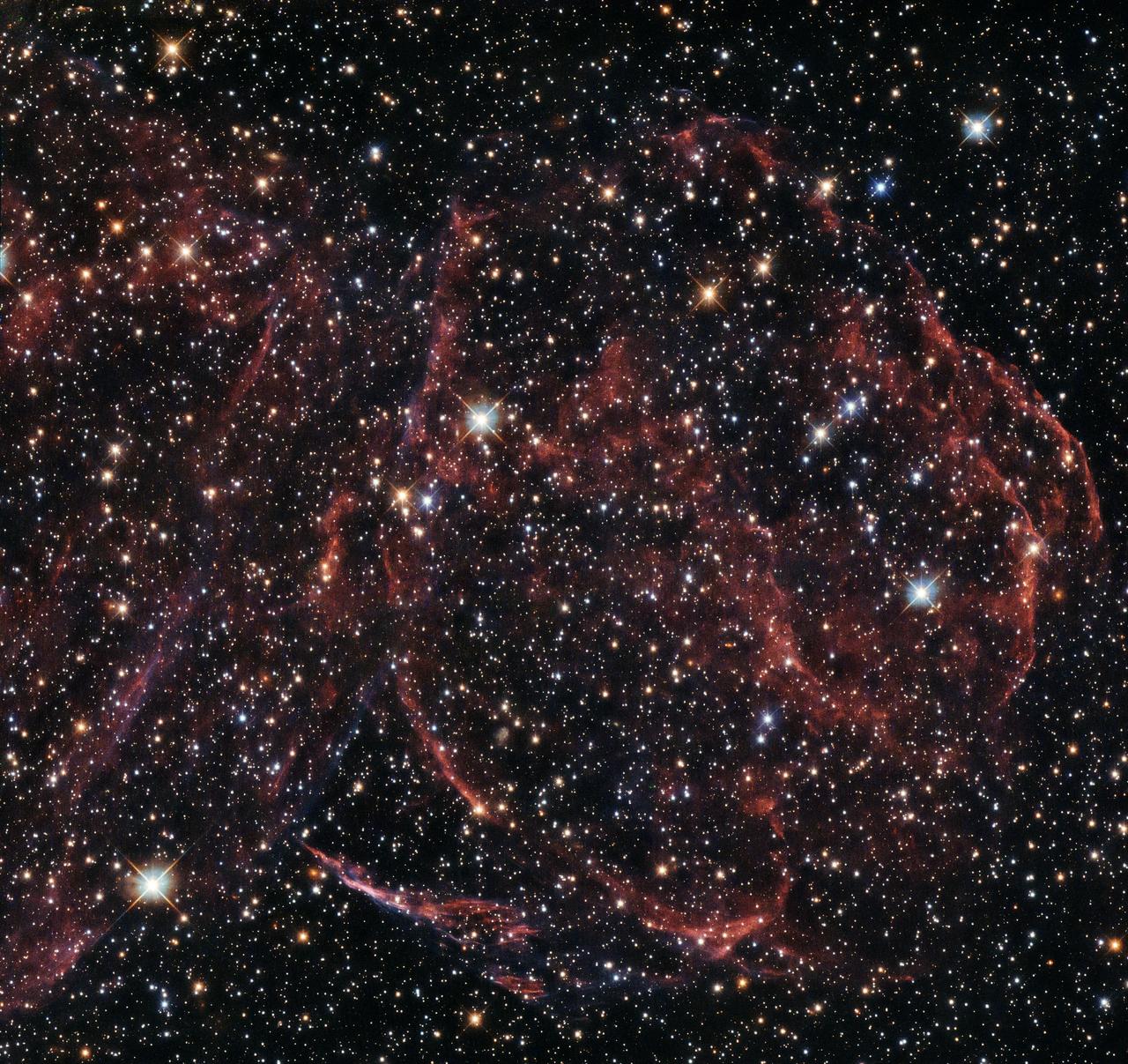
This NASA/ESA Hubble Space Telescope image captures the remnants of a long-dead star. These rippling wisps of ionized gas, named DEM L316A, are located some 160,000 light-years away within one of the Milky Way’s closest galactic neighbors — the Large Magellanic Cloud (LMC). The explosion that formed DEM L316A was an example of an especially energetic and bright variety of supernova, known as a Type Ia. Such supernova events are thought to occur when a white dwarf star steals more material than it can handle from a nearby companion, and becomes unbalanced. The result is a spectacular release of energy in the form of a bright, violent explosion, which ejects the star’s outer layers into the surrounding space at immense speeds. As this expelled gas travels through the interstellar material, it heats up and ionizes it, producing the faint glow that Hubble’s Wide Field Camera 3 has captured here. The LMC orbits the Milky Way as a satellite galaxy and is the fourth largest in our group of galaxies, the Local Group. DEM L316A is not the only supernova remnant in the LMC; Hubble came across another one in 2010 with SNR 0509, and in 2013 it snapped SNR 0519. Image credit: ESA (European Space Agency)/Hubble & NASA, Y. Chu
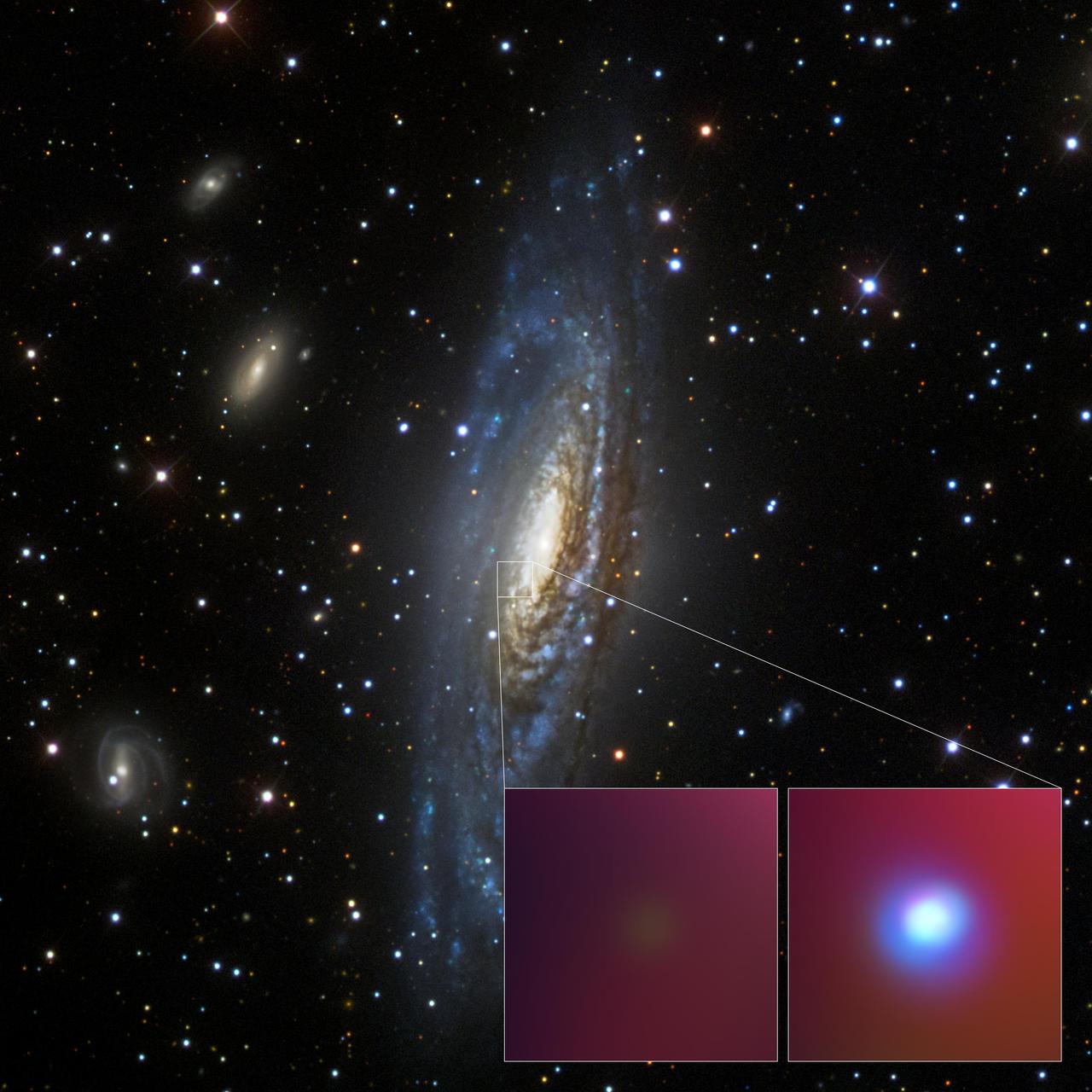
This visible-light image from the Sloan Digital Sky Survey shows spiral galaxy NGC 7331, center, where astronomers observed the unusual supernova SN 2014C . The inset images are from NASA's Chandra X-ray Observatory, showing a small region of the galaxy before the supernova explosion (left) and after it (right). Red, green and blue colors are used for low, medium and high-energy X-rays, respectively. http://photojournal.jpl.nasa.gov/catalog/PIA21088
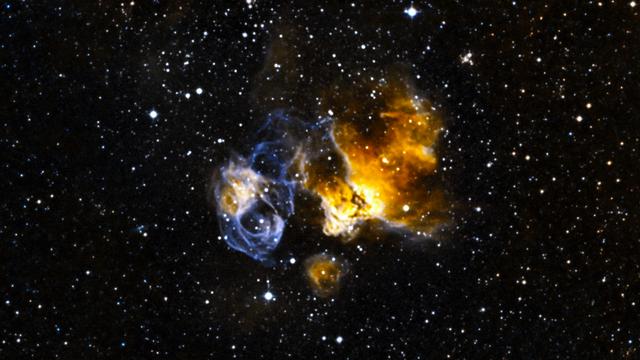
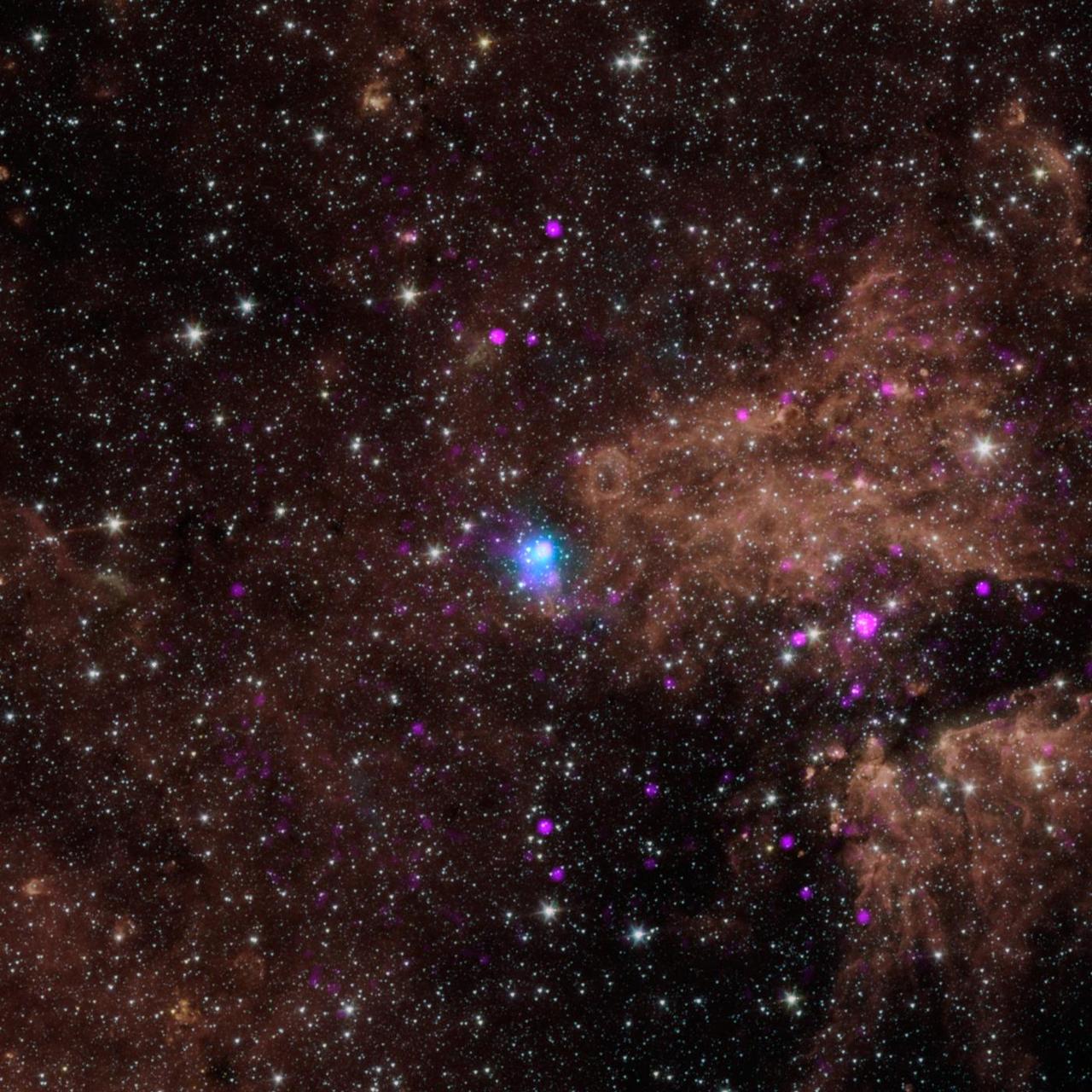
This composite image contains data from Chandra (purple) that provides evidence for the survival of a companion star from the blast of a supernova explosion. Chandra's X-rays reveal a point-like source in the supernova remnant at the location of a massive star. The data suggest that mass is being pulled away from the massive star towards a neutron star or a black hole companion. If confirmed, this would be only the third binary system containing both a massive star and a neutron star or black hole ever found in the aftermath of a supernova. This supernova remnant is found embedded in clouds of ionized hydrogen, which are shown in optical light (yellow and cyan) from the MCELS survey, along with additional optical data from the DSS (white).
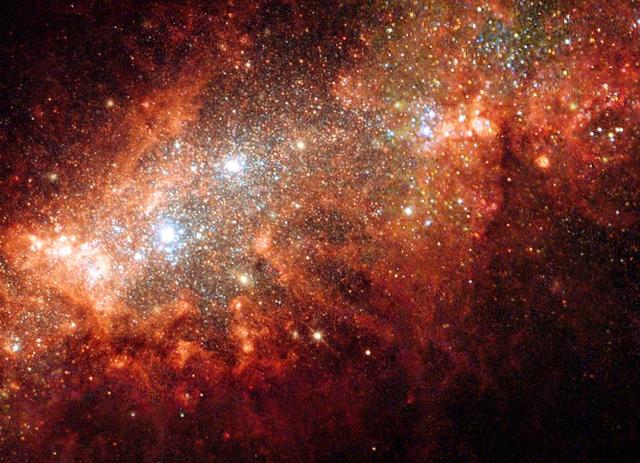
The nearby dwarf galaxy NGC 1569 is a hotbed of vigorous star birth activity, which blows huge bubbles that riddle the galaxy main body. The image was taken by the WPF2 camera, designed and built by JPL, on NASA Hubble.
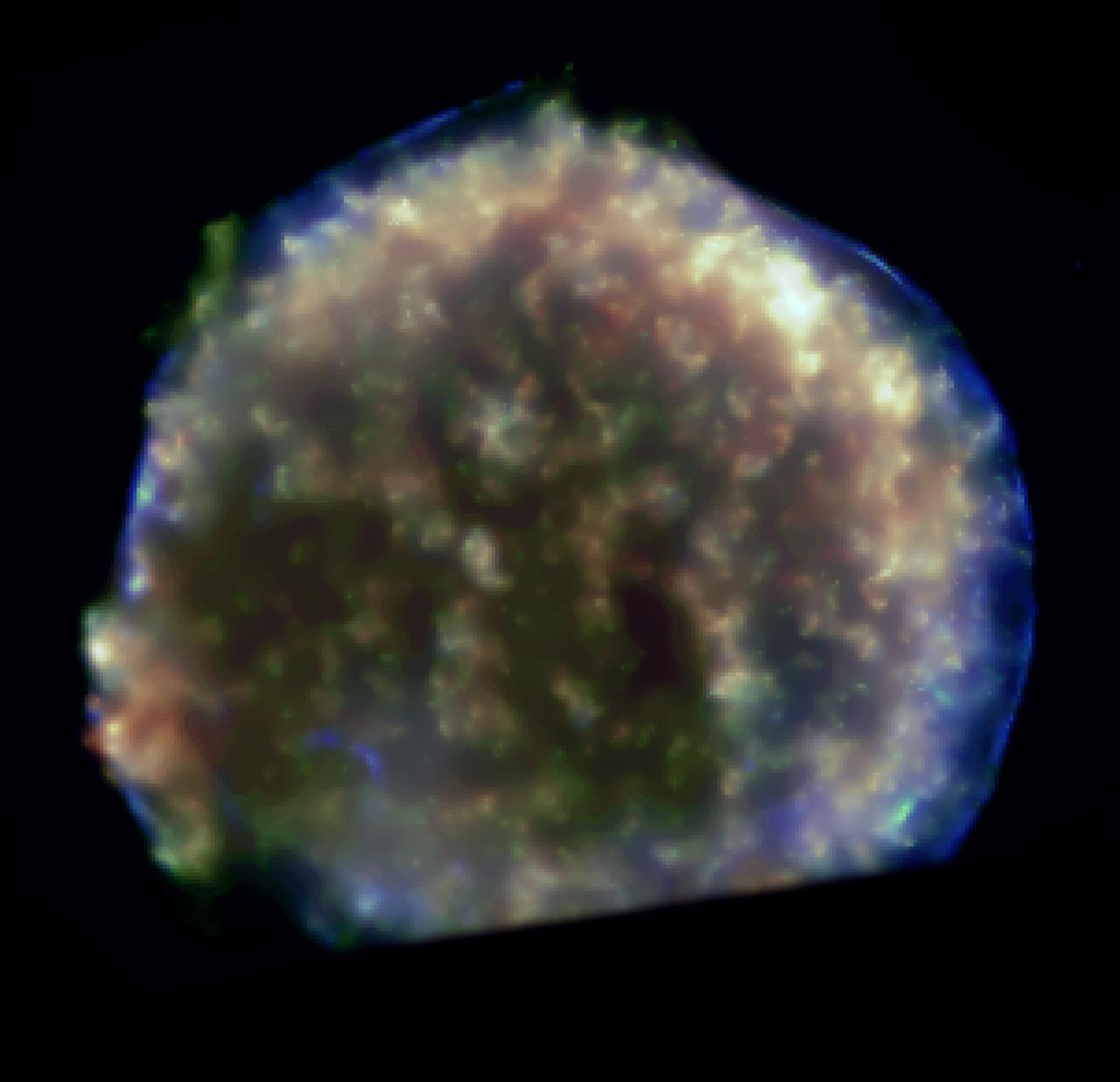
This Chandra image reveals, in detail, the turbulent debris created by a supernova explosion that was observed by the Danish Astronomer Tycho Brahe in the year 1572. The colors show different x-ray energies, with red, green, and blue representing low, medium, and high energies, respectively. Most likely caused by the destruction of a white dwarf star, a shock wave produced by the expanding debris is outlined by the sharp blue circular arcs of 20 million degree Celsius gas seen on the outer rim. The stellar debris, visible only by x-ray, has a temperature of about 10 million degrees, and shows up as mottled yellow, green, and red fingers of gas.
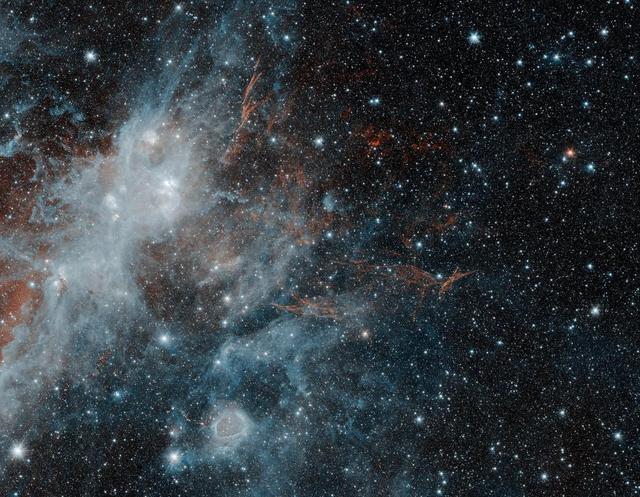
Thin, red veins of energized gas mark the location of the supernova remnant HBH 3 in this image from NASA's Spitzer Space Telescope. The puffy, white feature in the image is a portion of the star forming regions W3, W4 and W5. Infrared wavelengths of 3.6 microns have been mapped to blue, and 4.5 microns to red. The white color of the star-forming region is a combination of both wavelengths, while the HBH 3 filaments radiate only at the longer 4.5 micron wavelength. https://photojournal.jpl.nasa.gov/catalog/PIA22564
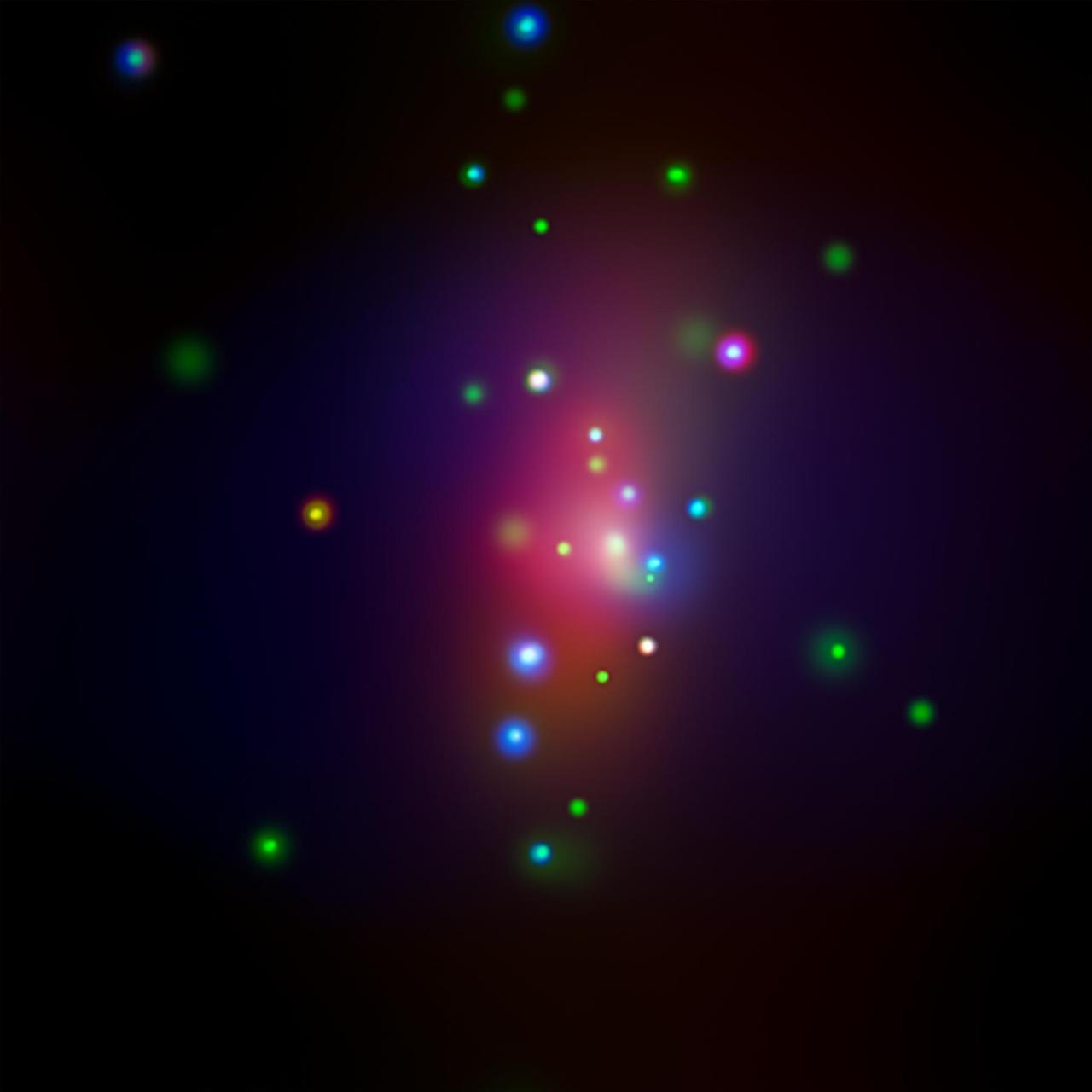
This image from NASA's Chandra X-ray Observatory shows spiral galaxy NGC 7331, center, in a three-color X-ray image. Red, green and blue colors are used for low, medium and high-energy X-rays, respectively. An unusual supernova called SN 2014C has been spotted in this galaxy. http://photojournal.jpl.nasa.gov/catalog/PIA21089
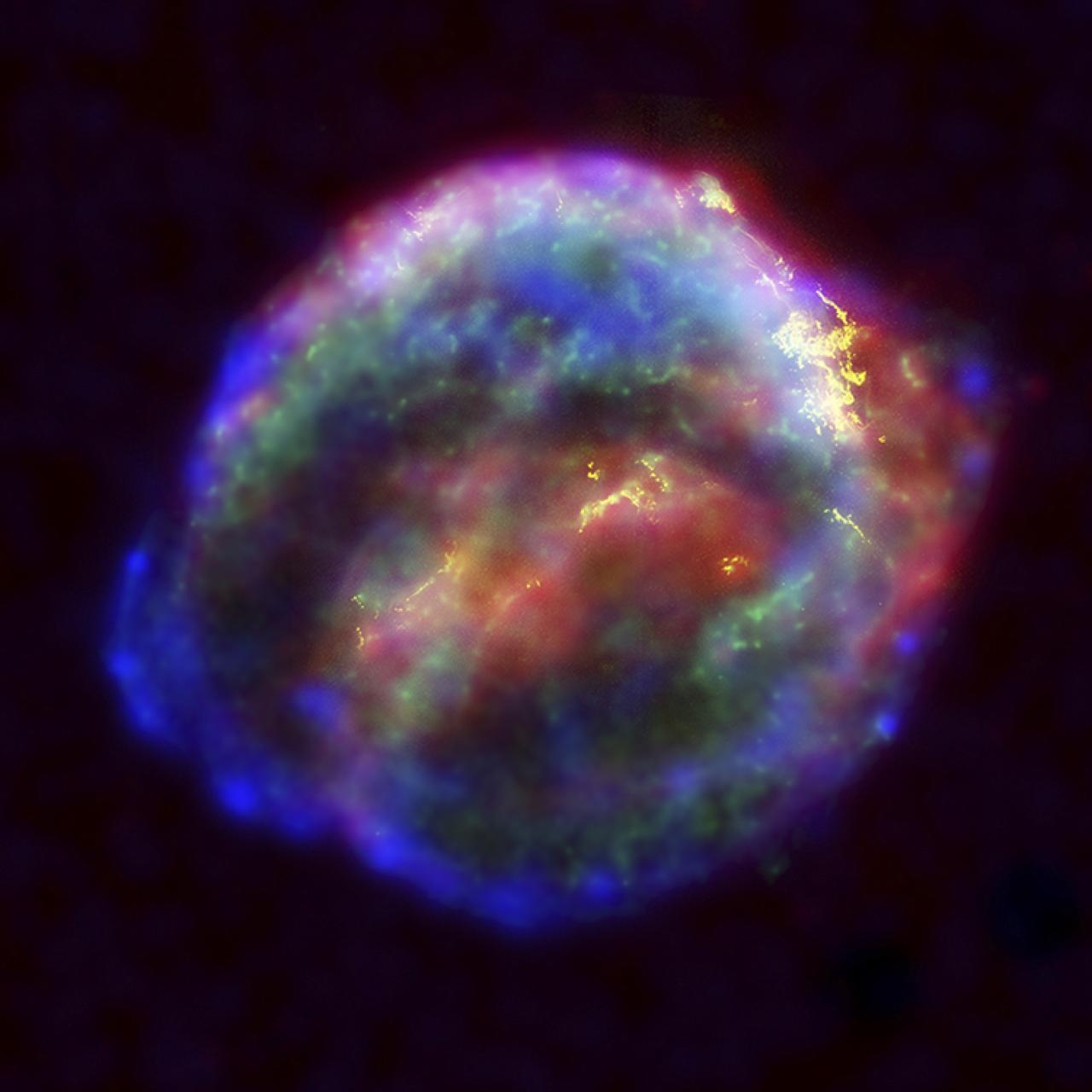
Four hundred years ago, sky watchers, including the famous astronomer Johannes Kepler, best known as the discoverer of the laws of planetary motion, were startled by the sudden appearance of a new star in the western sky, rivaling the brilliance of the nearby planets. Modern astronomers, using NASA's three orbiting Great Observatories, are unraveling the mysteries of the expanding remains of Kepler's supernova, the last such object seen to explode in our Milky Way galaxy. When a new star appeared Oct. 9, 1604, observers could use only their eyes to study it. The telescope would not be invented for another four years. A team of modern astronomers has the combined abilities of NASA's Great Observatories, the Spritzer Space Telescope (SST), Hubble Space Telescope (HST), and Chandra X-Ray Observatory (CXO), to analyze the remains in infrared radiation, visible light, and X-rays. Visible-light images from Hubble's Advanced Camera for Surveys reveal where the supernova shock wave is slamming into the densest regions of surrounding gas. The astronomers used the SST to probe for material that radiates in infrared light, which shows heated microscopic dust particles that have been swept up by the supernova shock wave. The CXO data show regions of very hot gas. The combined image unveils a bubble-shaped shroud of gas and dust, 14 light-years wide and expanding at 4 million mph. There have been six known supernovas in our Milky Way over the past 1,000 years. Kepler's is the only one in which astronomers do not know what type of star exploded. By combining information from all three Great Observatories, astronomers may find the clues they need. Project management for both the HST and CXO programs is the responsibility of NASA’s Marshall Space Flight Center in Huntsville, Alabama.
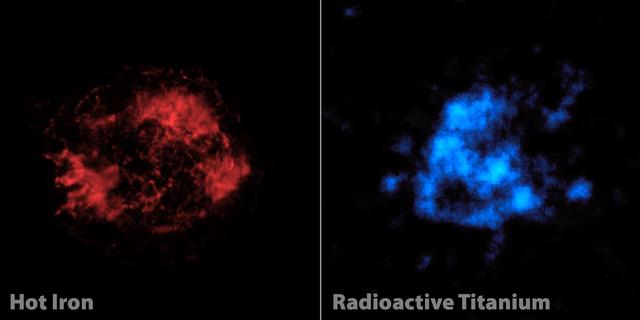
When astronomers first looked at images of a supernova remnant called Cassiopeia A, captured by NASA NuSTAR. The mystery of Cassiopeia A Cas A, a massive star that exploded in a supernova more than 11,000 years ago continues to confound scientists.
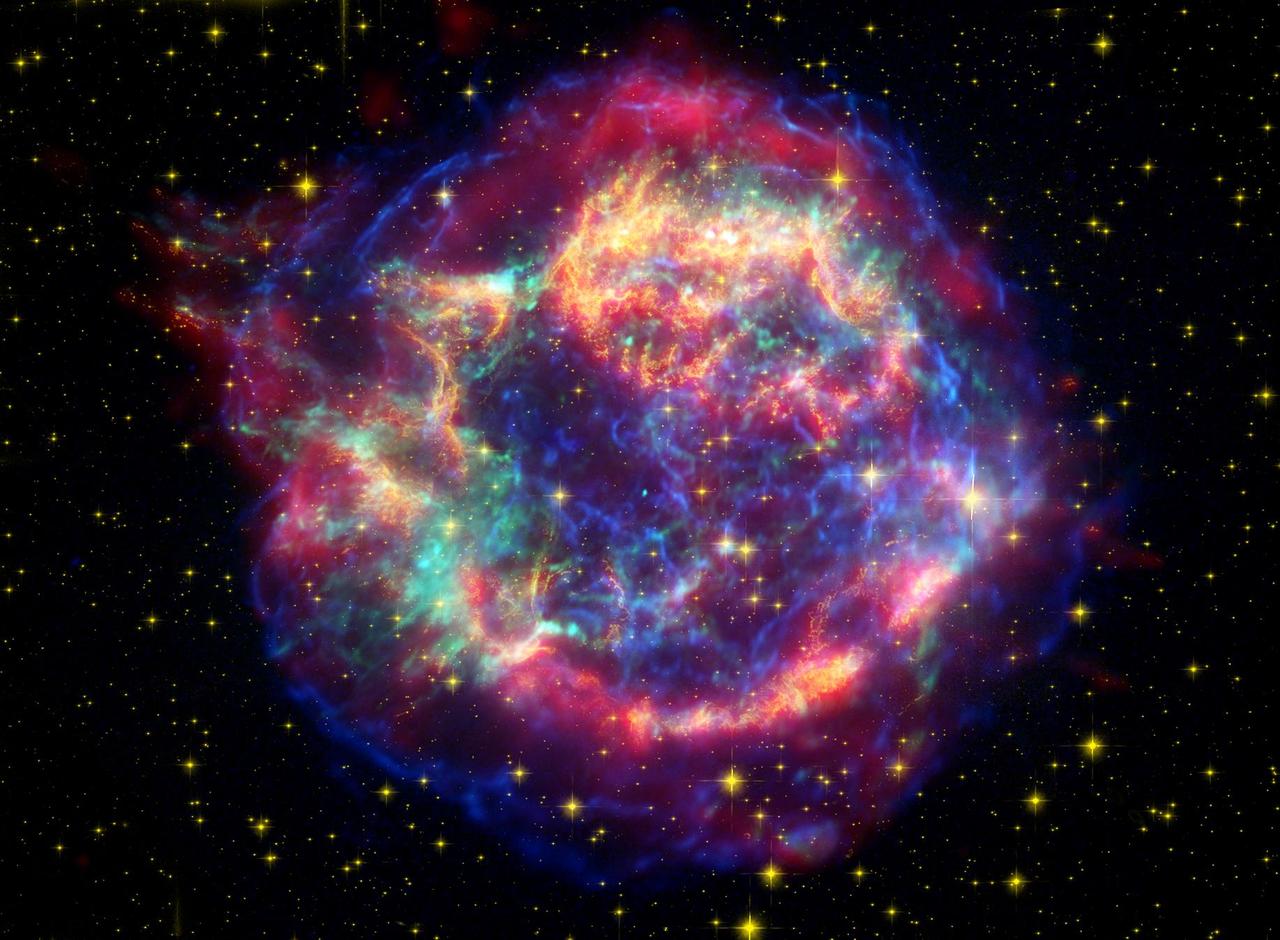
This false-color image from three of NASA Great Observatories provides one example of a star that died in a fiery supernova blast. Called Cassiopeia A, this supernova remnant is located 10,000 light-years away in the constellation Cassiopeia.
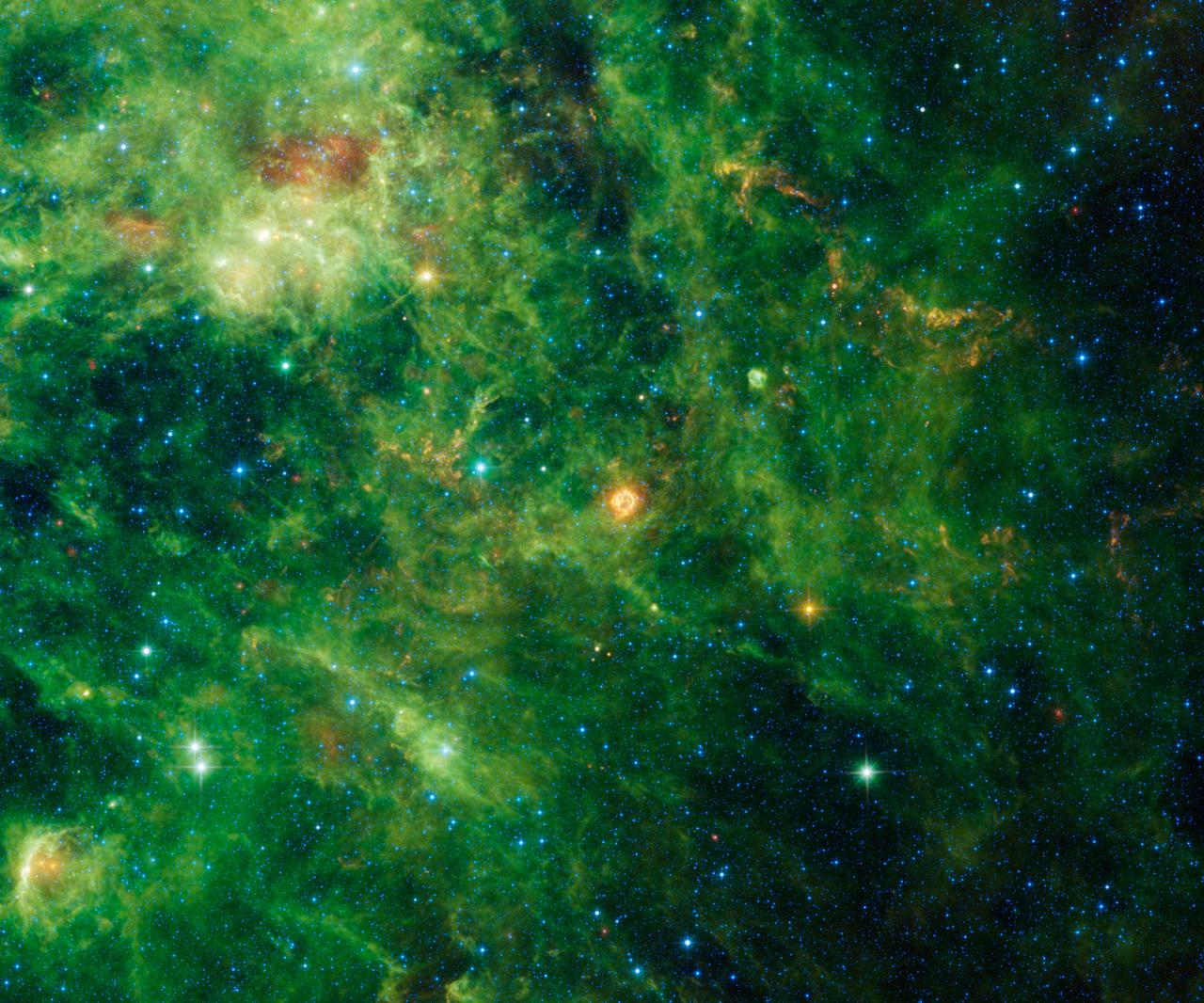
Listed as Cassiopeia A, this remnant of the supernova is one of the brightest radio sources in the known universe. More recently, NASA WISE telescope detected infrared echoes of the flash of light rippling outwards from the supernova.
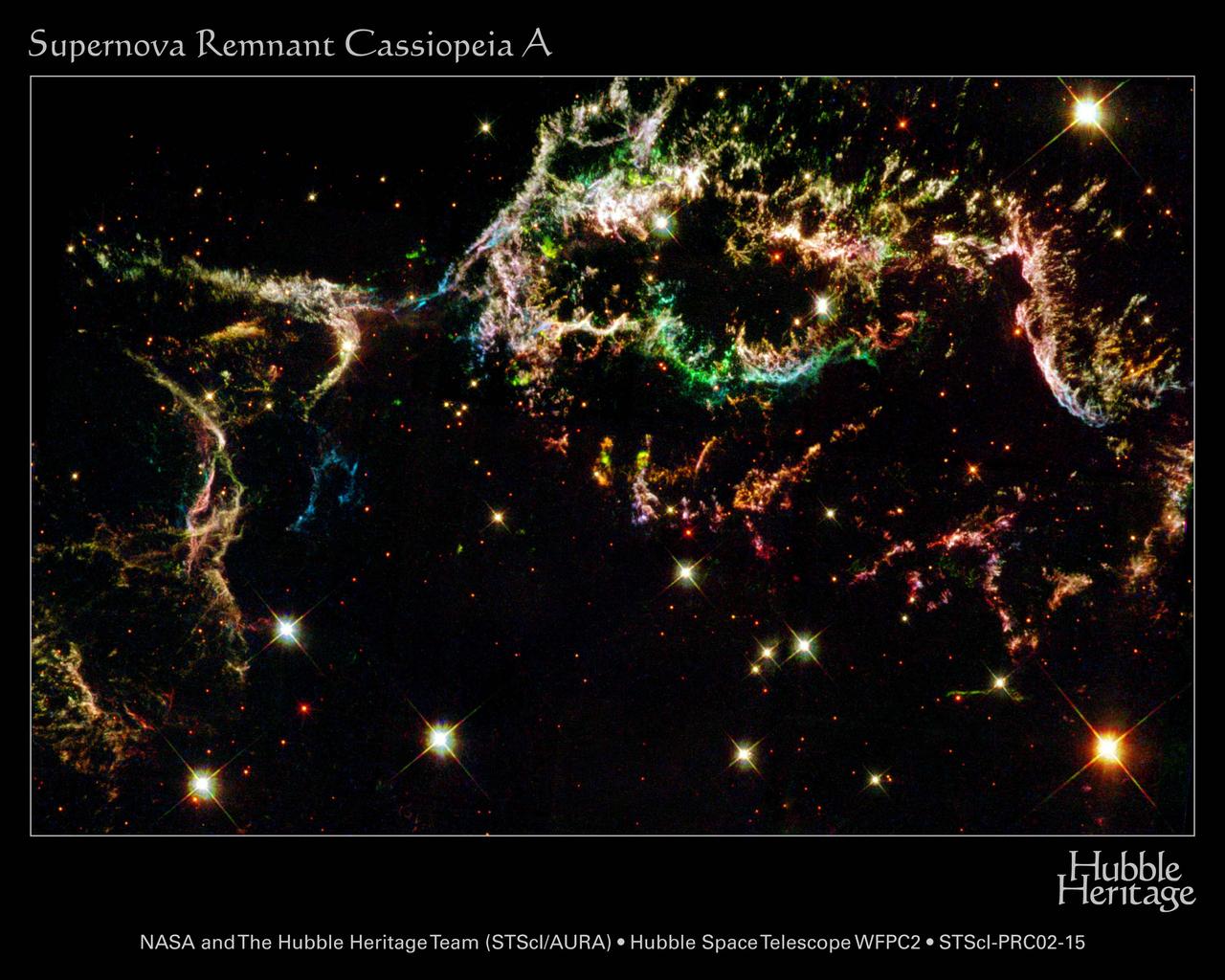
The colorful streamers that float across the sky in this photo taken by NASA's Hubble Space Telescope (HST) were created by the universe's biggest firecracker, the titanic supernova explosion of a massive star. The light from the exploding star reached Earth 320 years ago, nearly a century before the United States celebrated its birth with a bang. The dead star's shredded remains are called Cassiopeia A, or "Cas A" for short. Cas A is the youngest known supernova remnant in our Milky Way Galaxy and resides 10,000 light-years away in the constellation Cassiopeia, so the star actually blew up 10,000 years before the light reached Earth in the late 1600s. This HST image of Cas A shows for the first time that the debris is arranged into thousands of small, cooling knots of gas. This material eventually will be recycled into building new generations of stars and planets. Our own Sun and planets are constructed from the debris of supernovae that exploded billions of years ago. This photo shows the upper rim of the super nova remnant's expanding shell. Near the top of the image are dozens of tiny clumps of matter. Each small clump, originally just a small fragment of the star, is tens of times larger than the diameter of our solar system. The colors highlight parts of the debris where chemical elements are glowing. The dark blue fragments, for example, are richest in oxygen; the red material is rich in sulfur. The images were taken with the Wide Field and Planetary Camera 2 in January 2000 and January 2002. Image Credit: NASA and HST team (Stoics/AURA). Acknowledgment: R. Fesen (Darmouth) and J. Morse ( Univ. of Colorado).
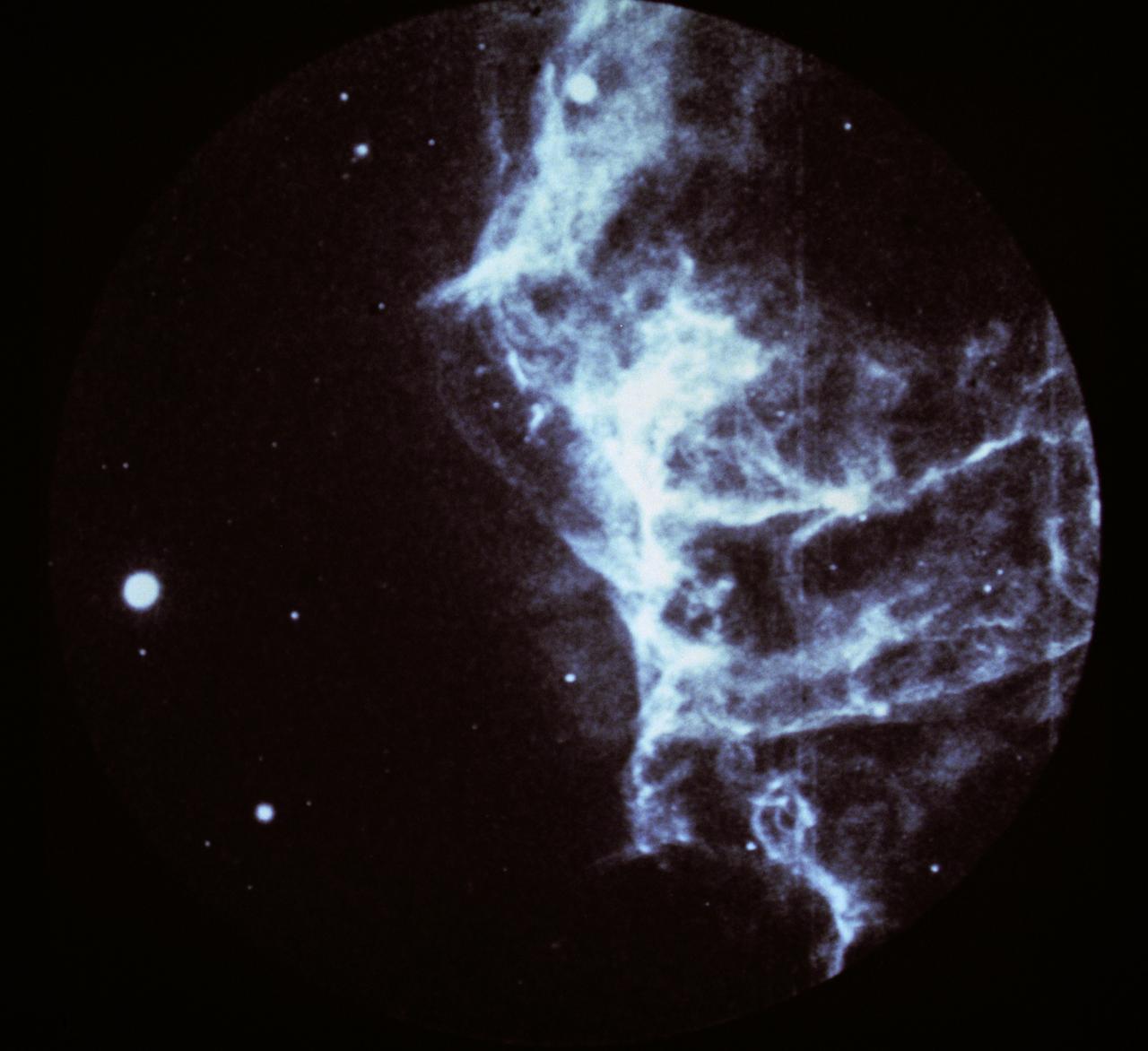
This image shows a part of the Cygnus loop supernova remnant, taken by the Ultraviolet Imaging Telescope (UIT) on the Astro Observatory during the Astro-1 mission (STS-35) on December 5, 1990. Pictured is a portion of the huge Cygnus loop, an array of interstellar gas clouds that have been blasted by a 900,000 mile per hour shock wave from a prehistoric stellar explosion, which occurred about 20,000 years ago, known as supernova. With ultraviolet and x-rays, astronomers can see emissions from extremely hot gases, intense magnetic fields, and other high-energy phenomena that more faintly appear in visible and infrared light or in radio waves that are crucial to deepening the understanding of the universe. The Astro Observatory was designed to explore the universe by observing and measuring the ultraviolet radiation from celestial objects. Three instruments make up the Astro Observatory: The Hopkins Ultraviolet Telescope (HUT), the Ultraviolet Imaging Telescope (UIT), and the Wisconsin Ultraviolet Photo-Polarimetry Experiment (WUPPE). The Marshall Space Flight Center had managment responsibilities for the Astro-1 mission. The Astro-1 Observatory was launched aboard the Space Shuttle Orbiter Columbia (STS-35) on December 2, 1990.
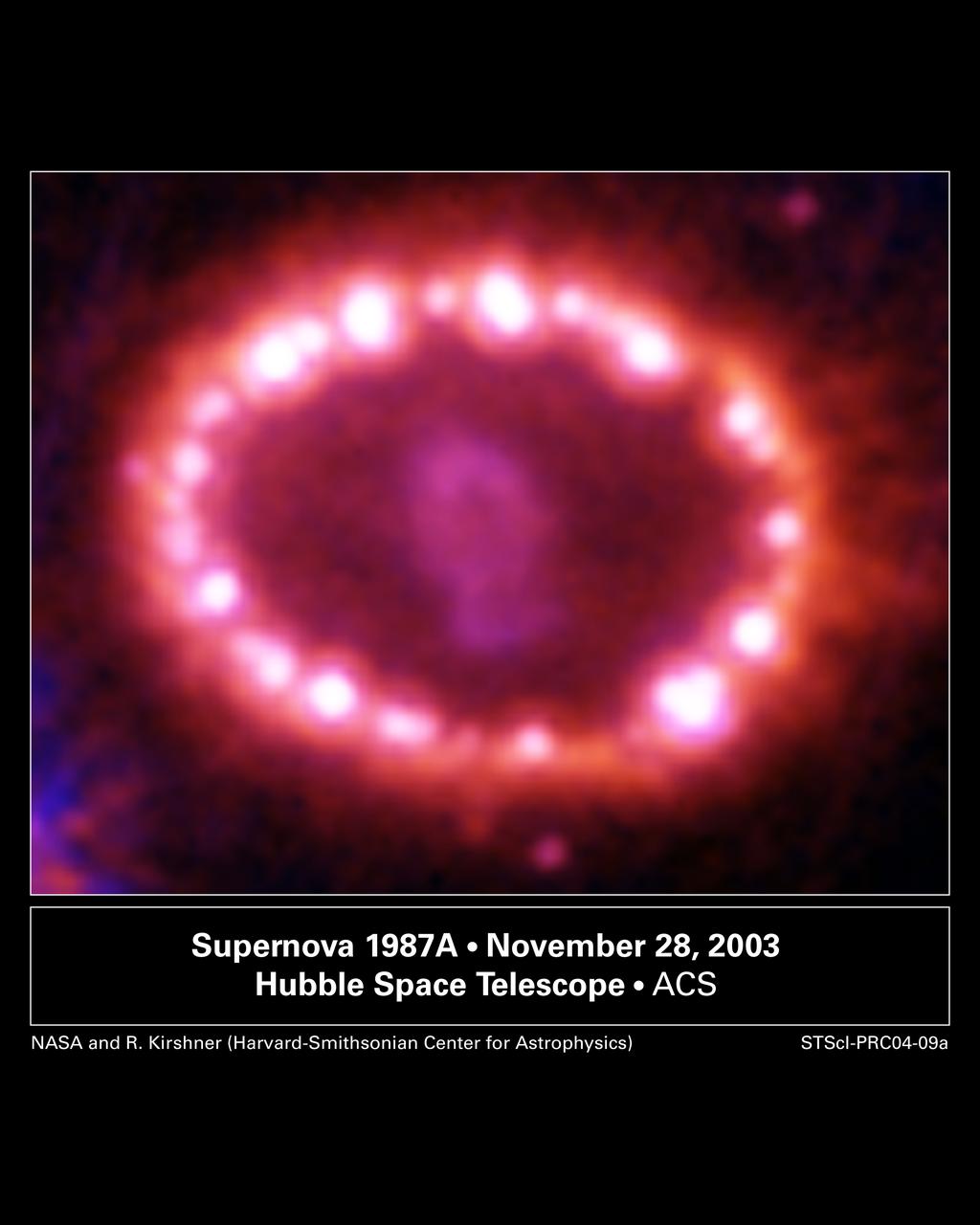
This image of SN 1987A, taken November 28, 2003 by the Advanced Camera for Surveys aboard NASA's Hubble Space Telescope (HST), shows many bright spots along a ring of gas, like pearls on a necklace. These cosmic pearls are being produced as superior shock waves unleashed during an explosion slam into the ring at more than a million miles per hour. The collision is heating the gas ring, causing its irnermost regions to glow. Astronomers detected the first of these hot spots in 1996, but now they see dozens of them all around the ring. With temperatures surging from a few thousand degrees to a million degrees, the flares are increasing in number. In the next few years, the entire ring will be ablaze as it absorbs the full force of the crash and is expected to become bright enough to illuminate the star's surroundings. Astronomers will then be able to obtain information on how the star ejected material before the explosion. The elongated and expanding object in the center of the ring is debris form the supernova blast which is being heated by radioactive elements, principally titanium 44, that were created in the explosion. This explosion was first observed by astronomers seventeen years ago in 1987, although the explosion took place about 160,000 years ago.
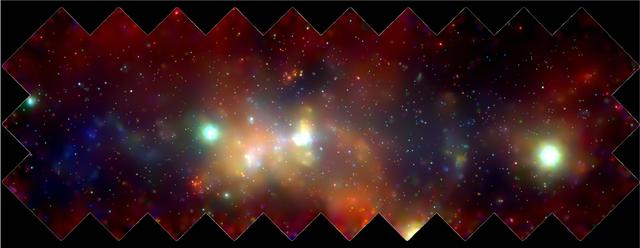
The Chandra X-Ray Observatory (CXO) has made a sturning, high-energy panorama of the central regions of our Milky Way galaxy. The findings are an important step toward understanding the most active area of the Milky Way as well as other galaxies throughout the universe. This 400 by 900-light-year mosaic of several CXO images reveals hundreds of white dwarf stars, neutron stars, and black holes bathed in an incandescent fog of miltimillion-degree gas. The diffuse x-ray emission seems to be related to the turmoil and density of matter in the inner Milky Way. Stars are forming there at a much more rapid rate than in the galactic "suburbs." Many of the most massive stars in the galaxy are located in the galactic center and are furiously boiling off their outer layers in searing stellar winds. Supernova explosions are far more common in the region and send shock waves booming through the inner galaxy. The super massive black hole at the center of the galaxy is located inside the bright white patch in the center of the image. The colors indicate x-ray energy bands-red (low), green (medial), and blue (high). A supernova occurs when a massive star has used up its nuclear fuel and the pressure drops in the central core of the star. The matter in the core is crushed by gravity to higher and higher densities, and temperatures reach billions of degrees. Under these extreme conditions, nuclear reactions occur violently and catastrophically reversing the collapse. A thermonuclear shock wave races through the now expanding stellar debris, fusing lighter elements into heavier ones and producing a brilliant visual outburst. (Photo credit: NASA/UMass/D. Wang et al)

The Crab Nebula is a supernova remnant, all that remains of a tremendous stellar explosion. Observers in China and Japan recorded the supernova nearly 1,000 years ago, in 1054. Credit: NASA, ESA, J. Hester and A. Loll (Arizona State University) The Hubble Space Telescope is a project of international cooperation between NASA and the European Space Agency. NASA's Goddard Space Flight Center manages the telescope. The Space Telescope Science Institute conducts Hubble science operations. Goddard is responsible for HST project management, including mission and science operations, servicing missions, and all associated development activities. To learn more about the Hubble Space Telescope go here: <a href="http://www.nasa.gov/mission_pages/hubble/main/index.html" rel="nofollow">www.nasa.gov/mission_pages/hubble/main/index.html</a> <b><a href="http://www.nasa.gov/centers/goddard/home/index.html" rel="nofollow">NASA Goddard Space Flight Center</a></b> is home to the nation's largest organization of combined scientists, engineers and technologists that build spacecraft, instruments and new technology to study the Earth, the sun, our solar system, and the universe. <b>Follow us on <a href="http://twitter.com/NASA_GoddardPix" rel="nofollow">Twitter</a></b> <b>Join us on <a href="http://www.facebook.com/pages/Greenbelt-MD/NASA-Goddard/395013845897?ref=tsd" rel="nofollow">Facebook</a><b> </b></b>
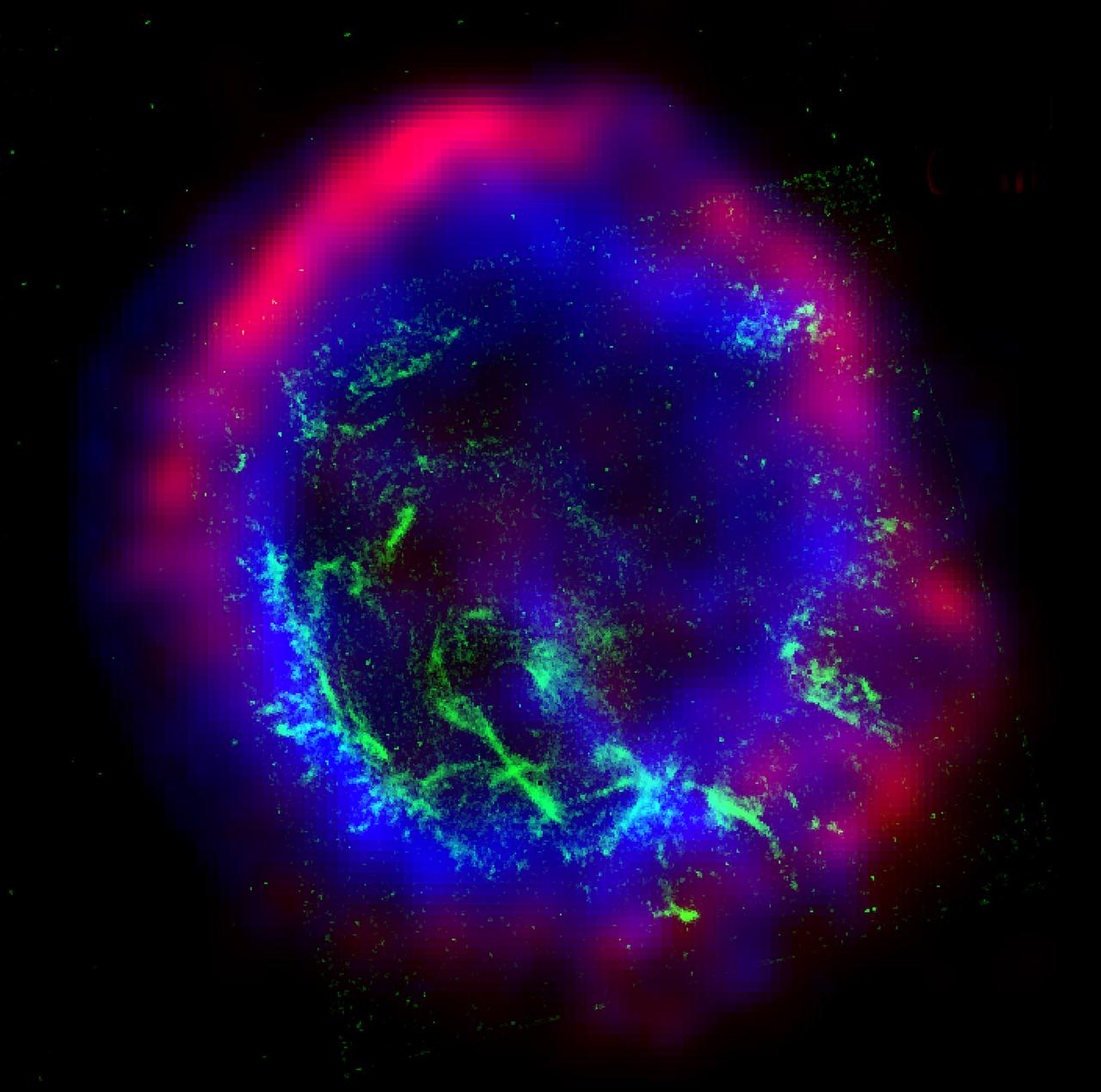
This image is a color composite of the supernova remnant E0102-72: x-ray (blue), optical (green), and radio (red). E0102-72 is the remnant of a star that exploded in a nearby galaxy known as the Small Magellanic Cloud. The star exploded outward at speeds in excess of 20 million kilometers per hour (12 million mph) and collided with surrounding gas. This collision produced two shock waves, or cosmic sonic booms, one traveling outward, and the other rebounding back into the material ejected by the explosion. The radio image, shown in red, was made using the Australia Telescope Compact Array. The radio waves are due to extremely high-energy electrons spiraling around magnetic field lines in the gas and trace the outward moving shock wave. The Chandra X-ray Observatory image, shown in blue, shows gas that has been heated to millions of degrees by the rebounding, or reverse shock wave. The x-ray data show that this gas is rich in oxygen and neon. These elements were created by nuclear reactions inside the star and hurled into space by the supernova. The Hubble Space Telescope optical image, shown in green, shows dense clumps of oxygen gas that have "cooled" to about 30,000 degrees. Photo Credit: X-ray (NASA/CXC/SAO); optical (NASA/HST): radio: (ACTA)

This image shows a composite view of the Crab nebula, an iconic supernova remnant in our Milky Way galaxy, as viewed by the Herschel Space Observatory and the Hubble Space Telescope.
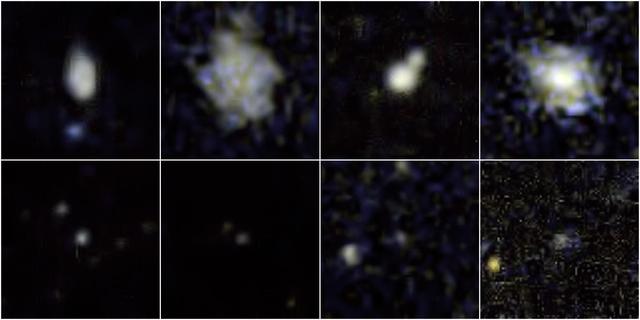
These postage-stamp images taken by NASA Galaxy Evolution Explorer are helping to solve a mystery -- why do the littlest of galaxies produce the biggest of star explosions, or supernovae?

Nicknamed the Hand of God, this object is called a pulsar wind nebula, imaged by NASA NuSTAR. It powered by the leftover, dense core of a star that blew up in a supernova explosion.
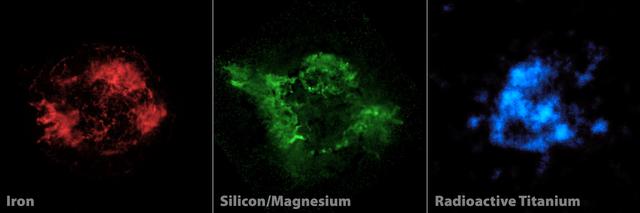
NASA NuSTAR is complementing previous observations of the Cassiopeia A supernova remnant red and green by providing the first maps of radioactive material forged in the fiery explosion blue.

This x-ray photograph of the Supernova remnant Cassiopeia A, taken with the High Energy Astronomy Observatory (HEAO) 2/Einstein Observatory, shows that the regions with fast moving knots of material in the expanding shell are bright and clear. A faint x-ray halo, just outside the bright shell, is interpreted as a shock wave moving ahead of the expanding debris. The HEAO-2, the first imaging and largest x-ray telescope built to date, was capable of producing actual photographs of x-ray objects. Shortly after launch, the HEAO-2 was nicknamed the Einstein Observatory by its scientific experimenters in honor of the centernial of the birth of Albert Einstein, whose concepts of relativity and gravitation have influenced much of modern astrophysics, particularly x-ray astronomy. The HEAO-2, designed and developed by TRW, Inc. under the project management of the Marshall Space Flight Center, was launched aboard an Atlas/Centaur launch vehicle on November 13, 1978.

This supernova in the constellation Cassiopeia was observed by Tycho Brahe in 1572. In this x-ray image from the High Energy Astronomy Observatory (HEAO-2/Einstein Observatory produced by nearly a day of exposure time, the center region appears filled with emissions that can be resolved into patches or knots of material. However, no central pulsar or other collapsed object can be seen. The HEAO-2, the first imaging and largest x-ray telescope built to date, was capable of producing actual photographs of x-ray objects. Shortly after launch, the HEAO-2 was nicknamed the Einstein Observatory by its scientific experimenters in honor of the centernial of the birth of Albert Einstein, whose concepts of relativity and gravitation have influenced much of modern astrophysics, particularly x-ray astronomy. The HEAO-2, designed and developed by TRW, Inc. under the project management of the Marshall Space Flight Center, was launched aboard an Atlas/Centaur launch vehicle on November 13, 1978.
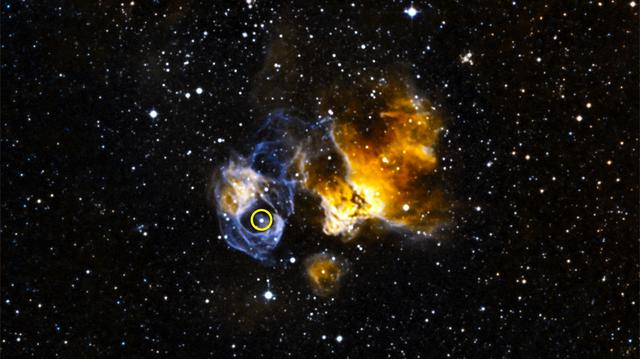
This composite image contains data from Chandra (purple) that provides evidence for the survival of a companion star from the blast of a supernova explosion. Chandra's X-rays reveal a point-like source in the supernova remnant at the location of a massive star. The data suggest that mass is being pulled away from the massive star towards a neutron star or a black hole companion. If confirmed, this would be only the third binary system containing both a massive star and a neutron star or black hole ever found in the aftermath of a supernova. This supernova remnant is found embedded in clouds of ionized hydrogen, which are shown in optical light (yellow and cyan) from the MCELS survey, along with additional optical data from the DSS (white).

Every second a star somewhere out in the universe explodes as a supernova. But some extremely massive stars go out with a whimper instead of a bang. When they do, they can collapse under the crushing tug of gravity and vanish out of sight, only to leave behind a black hole. The doomed star N6946-BH1 was 25 times as massive as our sun. It began to brighten weakly in 2009. But, by 2015, it appeared to have winked out of existence. By a careful process of elimination, based on observations by the Large Binocular Telescope and NASA's Hubble and Spitzer space telescopes, researchers eventually concluded that the star must have become a black hole. This may be the fate for extremely massive stars in the universe. This illustration shows the final stages in the life of a supermassive star that fails to explode as a supernova, but instead implodes to form a black hole. https://photojournal.jpl.nasa.gov/catalog/PIA21466
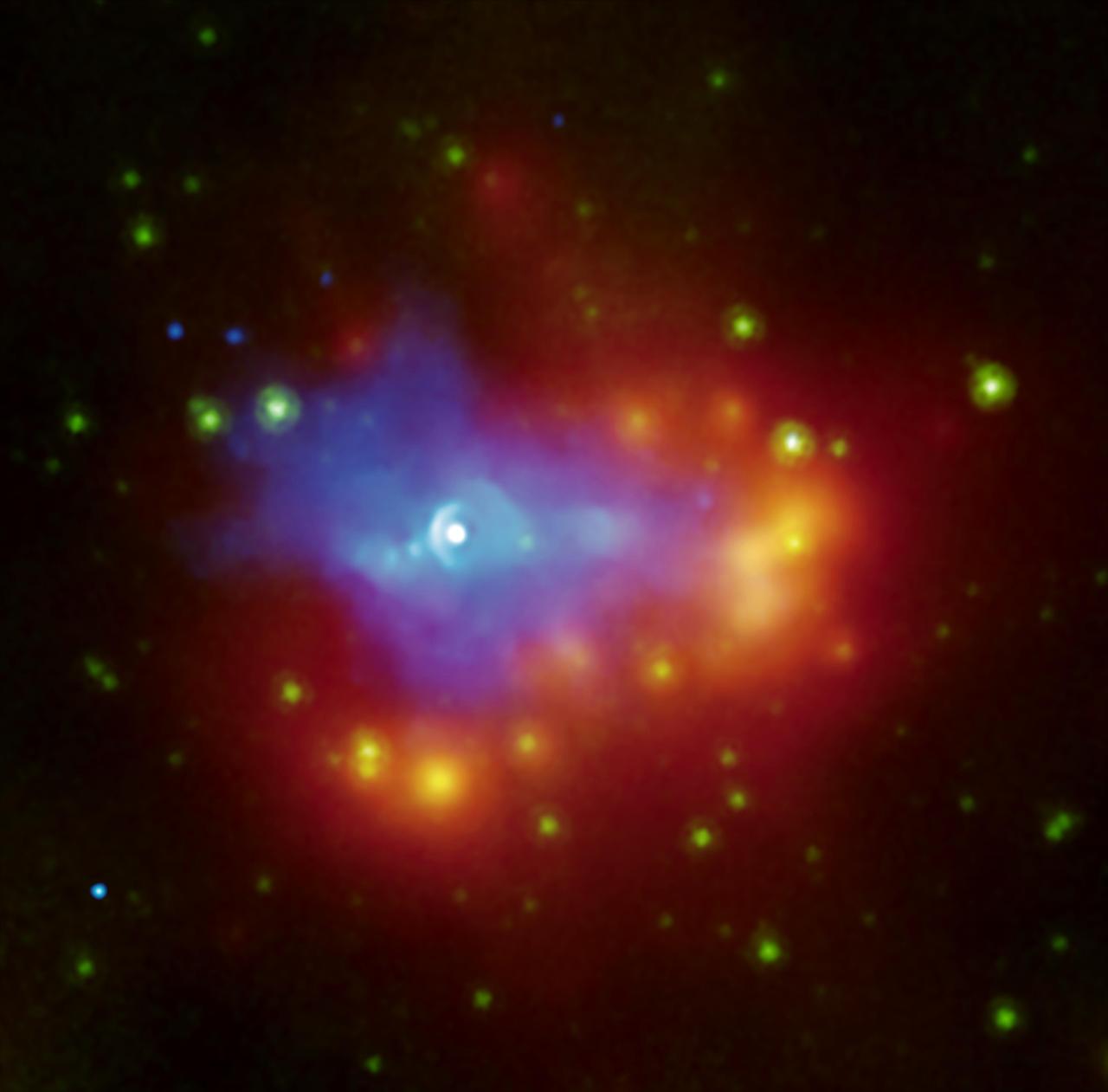
A composite image from NASA Chandra and Spitzer space telescopes shows the dusty remains of a collapsed star, a supernova remnant called G54.1+0.3. The white source at the center is a dead star called a pulsar.

This is a composite image of N49, the brightest supernova remnant in optical light in the Large Magellanic Cloud; the image combines data from the Chandra X-ray Telescope blue and NASA Spitzer Space Telescope red.
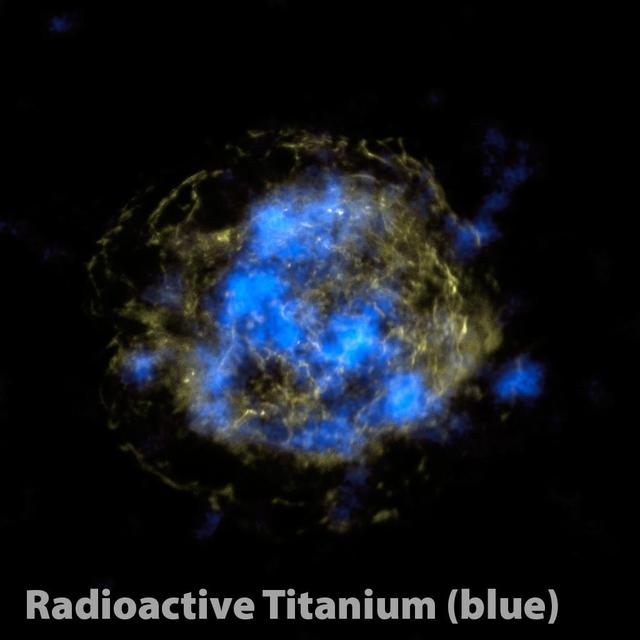
NASA NuSTAR has, for the first time, imaged the radioactive guts of a supernova remnant, the leftover remains of a star that exploded. The NuSTAR data are blue, and show high-energy X-rays.
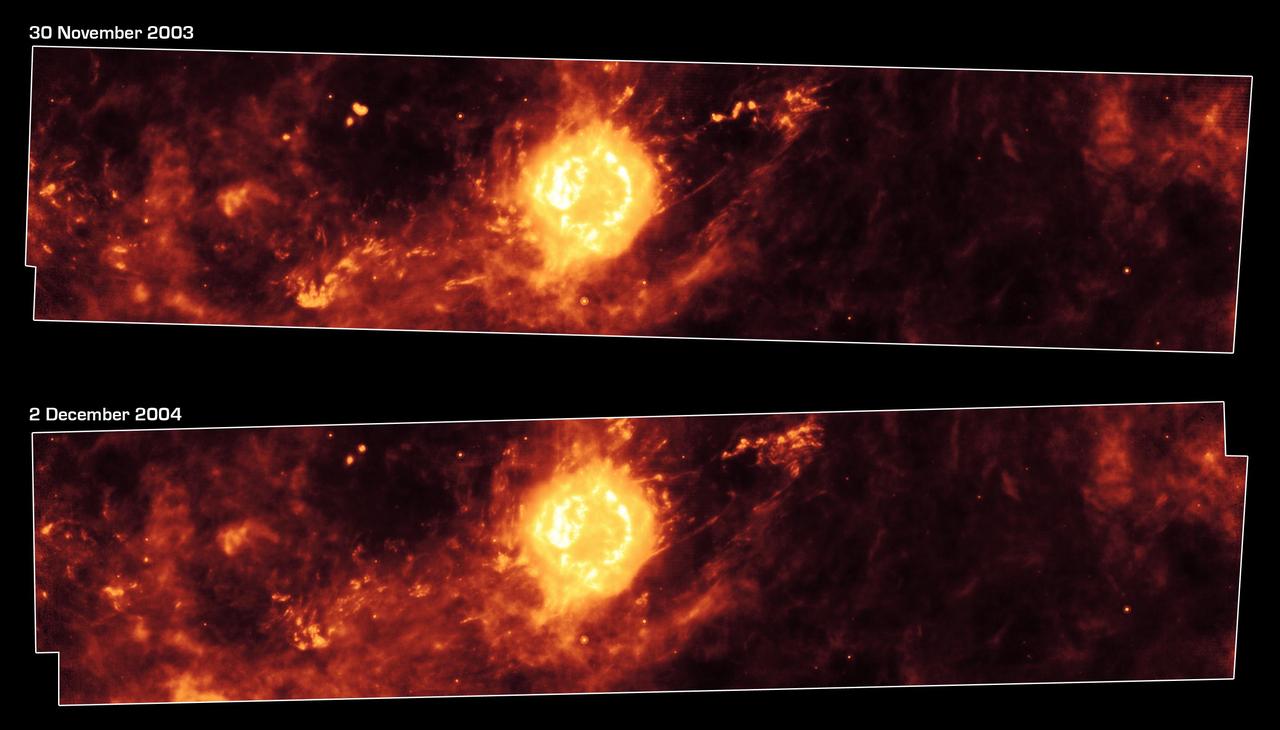
These images from NASA Spitzer Space Telescope, taken one year apart, show the supernova remnant Cassiopeia A yellow ball and surrounding clouds of dust reddish orange.
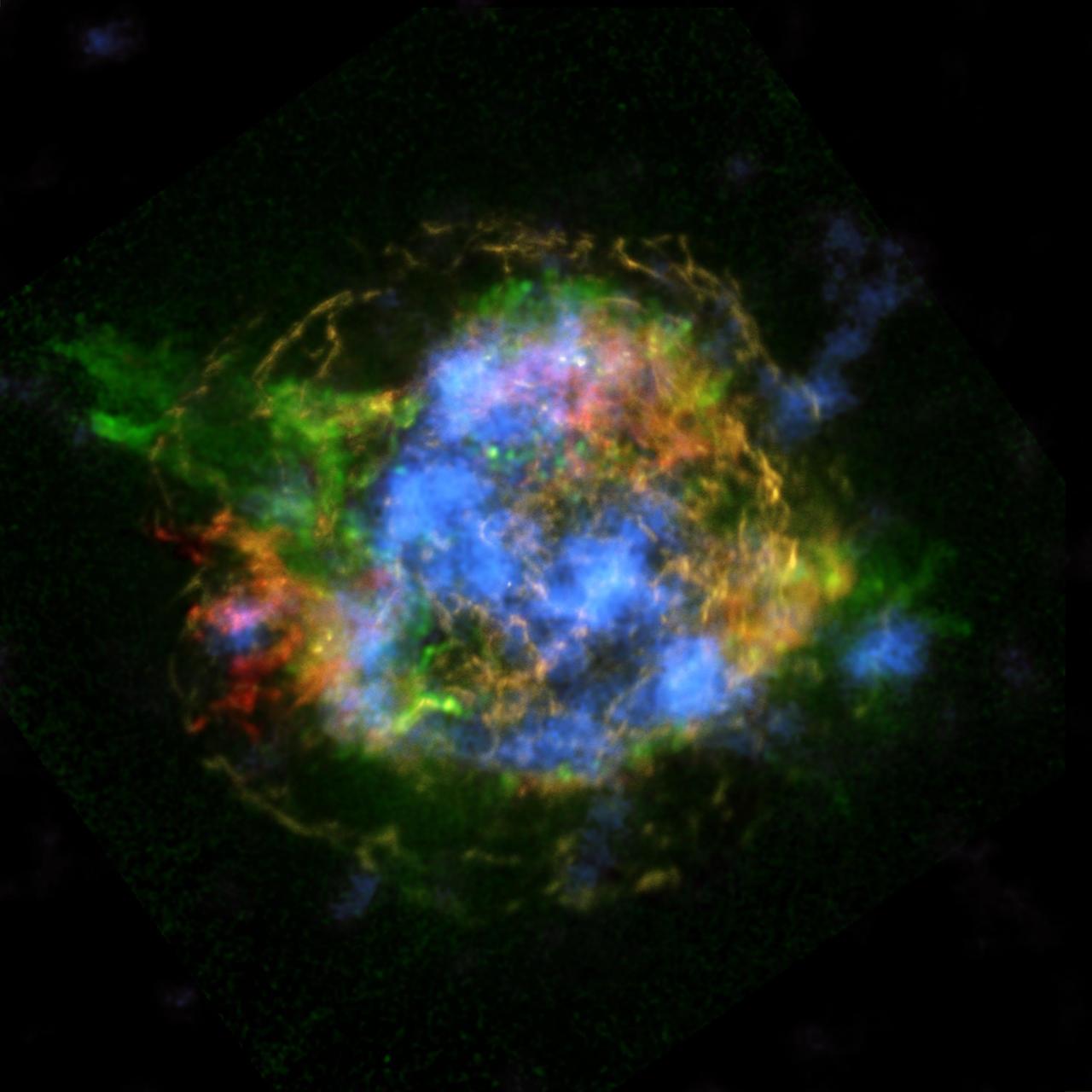
This is the first map of radioactivity in a supernova remnant, the blown-out bits and pieces of a massive star that exploded. The blue color shows radioactive material mapped in high-energy X-rays using NASA NuSTAR.
The blue dot in this image marks the spot of an energetic pulsar -- the magnetic, spinning core of star that blew up in a supernova explosion. NASA NuSTAR discovered the pulsar by identifying its telltale pulse.
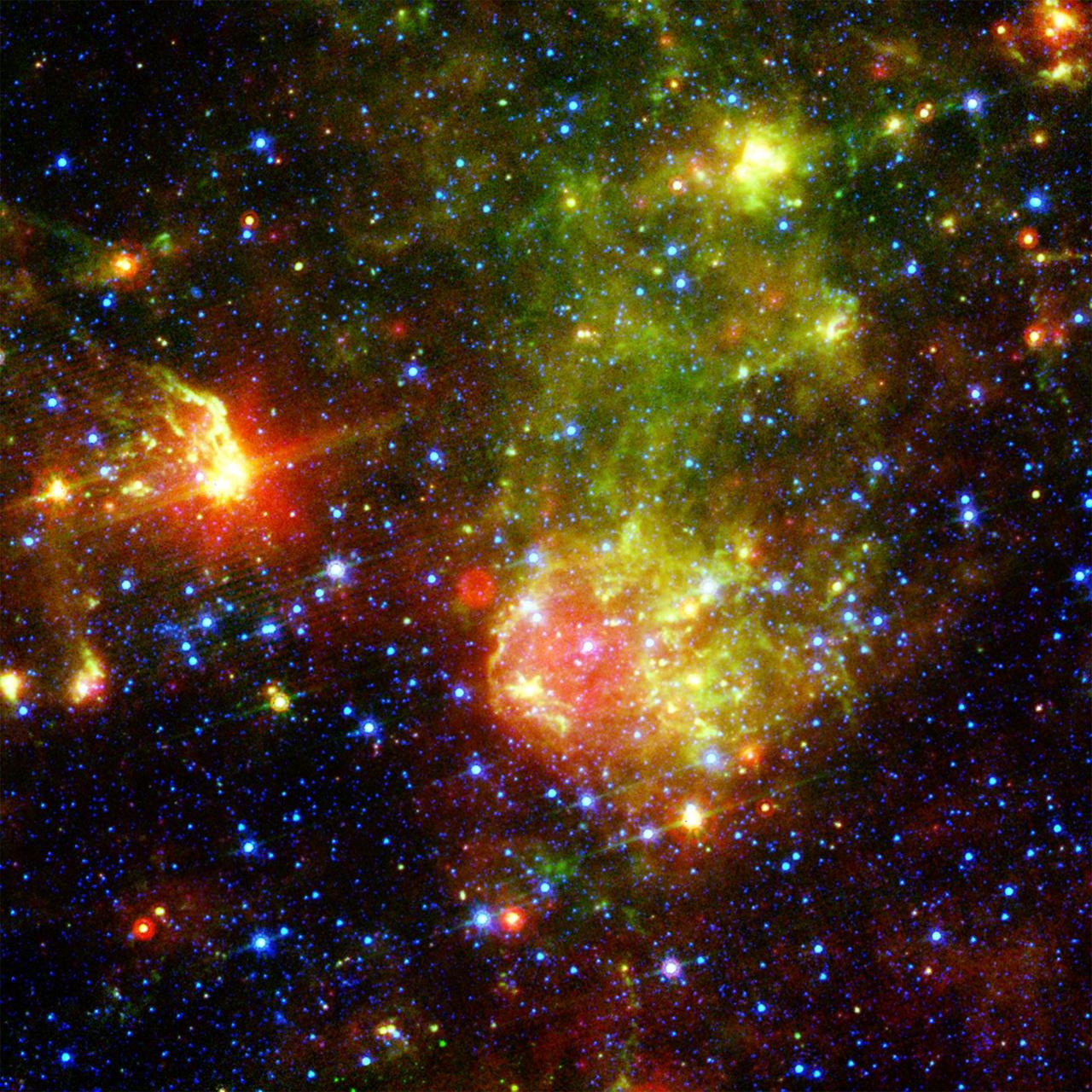
NASA Spitzer Space Telescope shows the supernova remnant 1E0102.2-7219 sits next to the nebula N76 in a bright, star-forming region of the Small Magellanic Cloud, a satellite galaxy to our Milky Way galaxy.
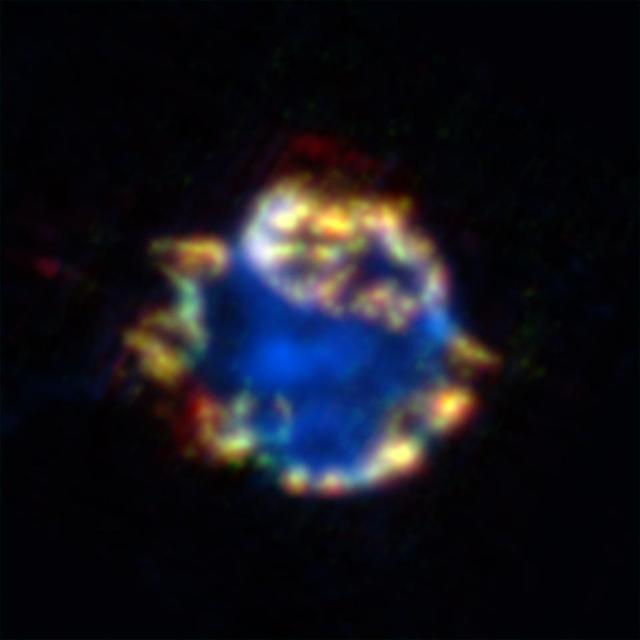
NASA Spitzer Space Telescope used its infrared camera to image this beautiful bulb which might look like a Christmas ornament but is the blown-out remains of a stellar explosion, or supernova.
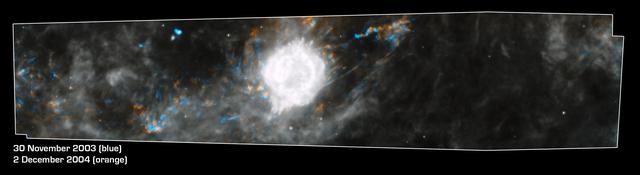
This Spitzer Space Telescope composite shows the supernova remnant Cassiopeia A white ball and surrounding clouds of dust gray, orange and blue. It consists of two processed images taken one year apart.
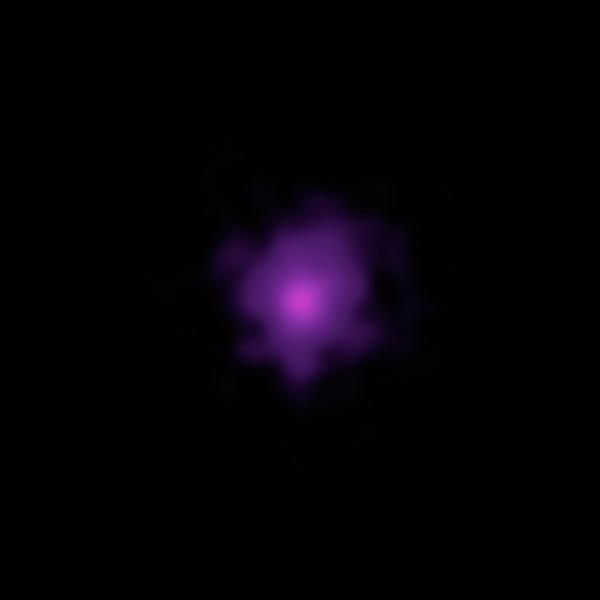
The brightest pulsar detected to date is shown in this frame from an animation that flips back and forth between images captured by NASA NuSTAR. A pulsar is a type of neutron star, the leftover core of a star that exploded in a supernova.

A delicate ribbon of gas floats eerily in our galaxy. This image, taken by NASA Hubble Space Telescope, is a very thin section of a supernova remnant caused by a stellar explosion that occurred more than 1,000 years ago.
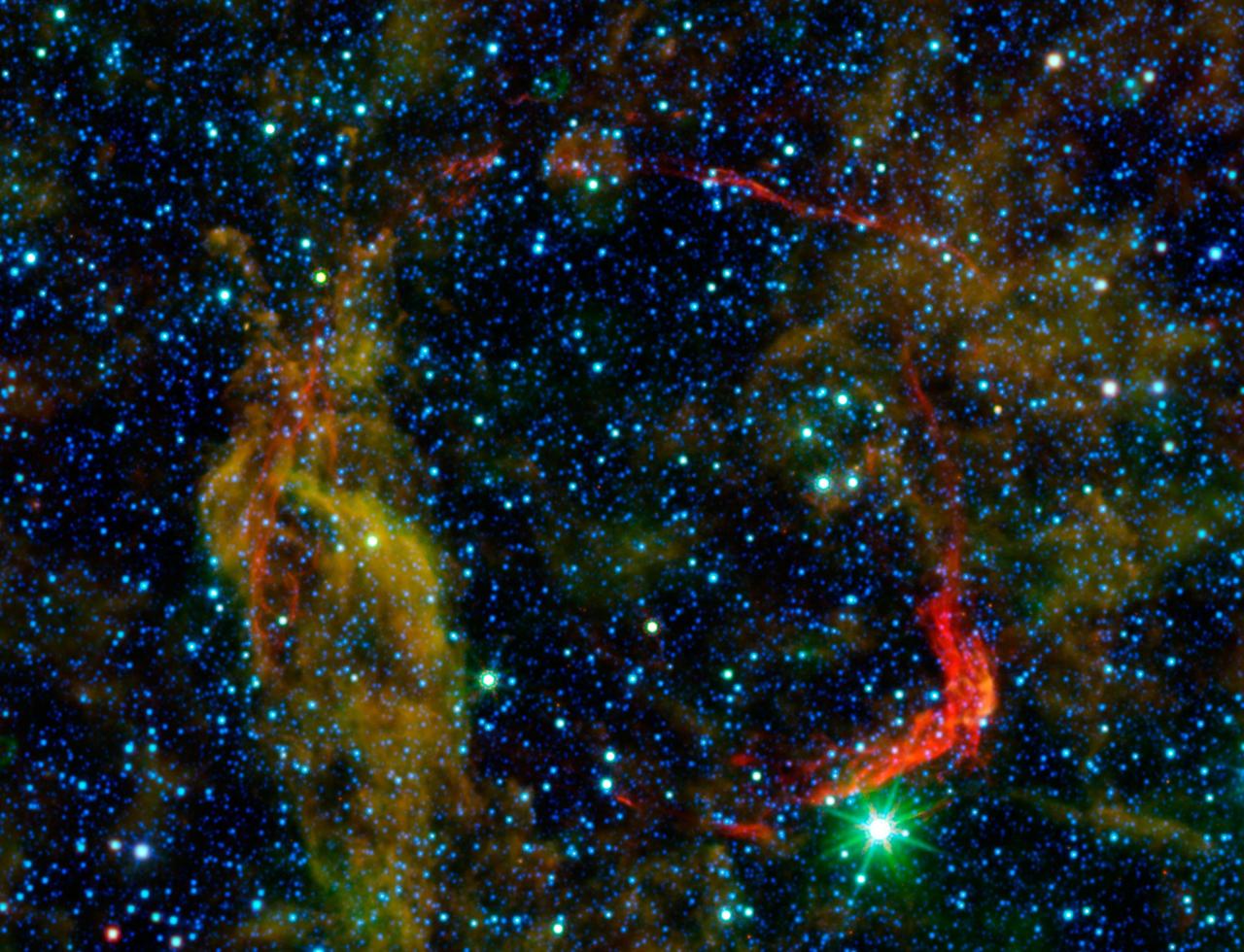
Infrared images from NASA Spitzer Space Telescope and Wide-field Infrared Survey Explorer are combined in this image of RCW 86, the dusty remains of the oldest documented example of an exploding star, or supernova.
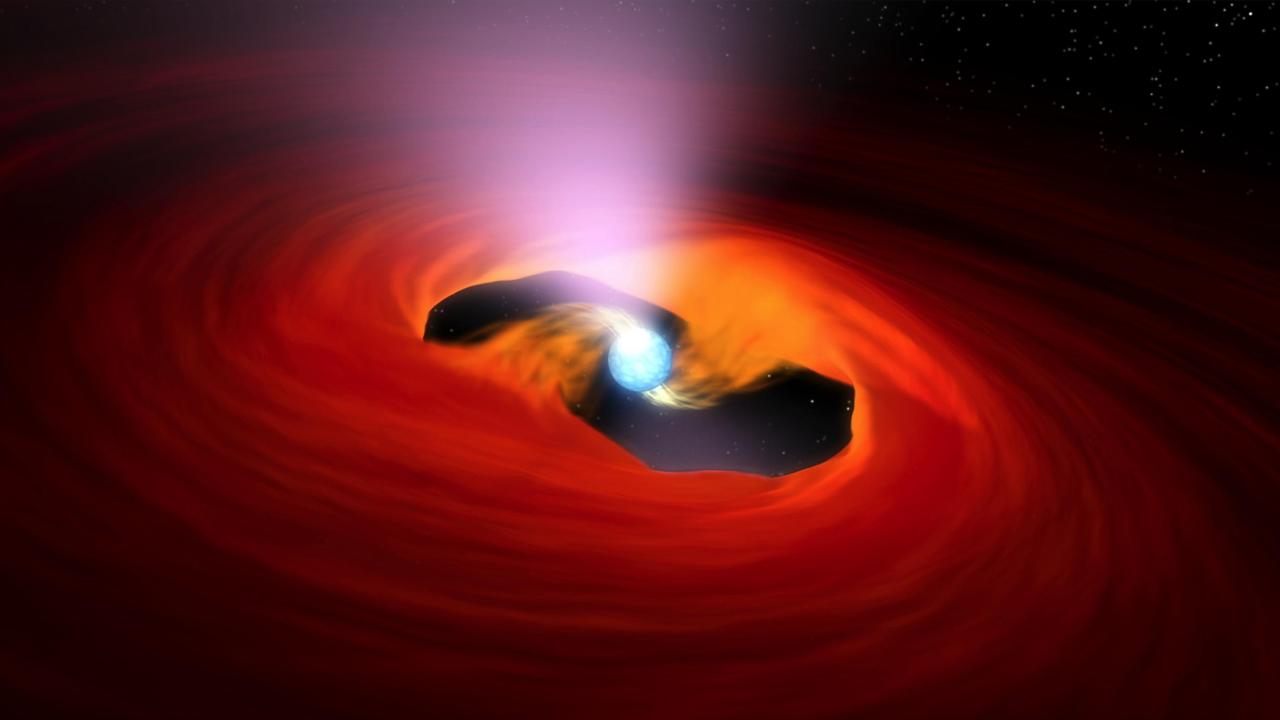
This image shows a neutron star -- the core of a star that exploded in a massive supernova. This particular neutron star is known as a pulsar because it sends out rotating beams of X-rays that sweep past Earth like lighthouse beacons.
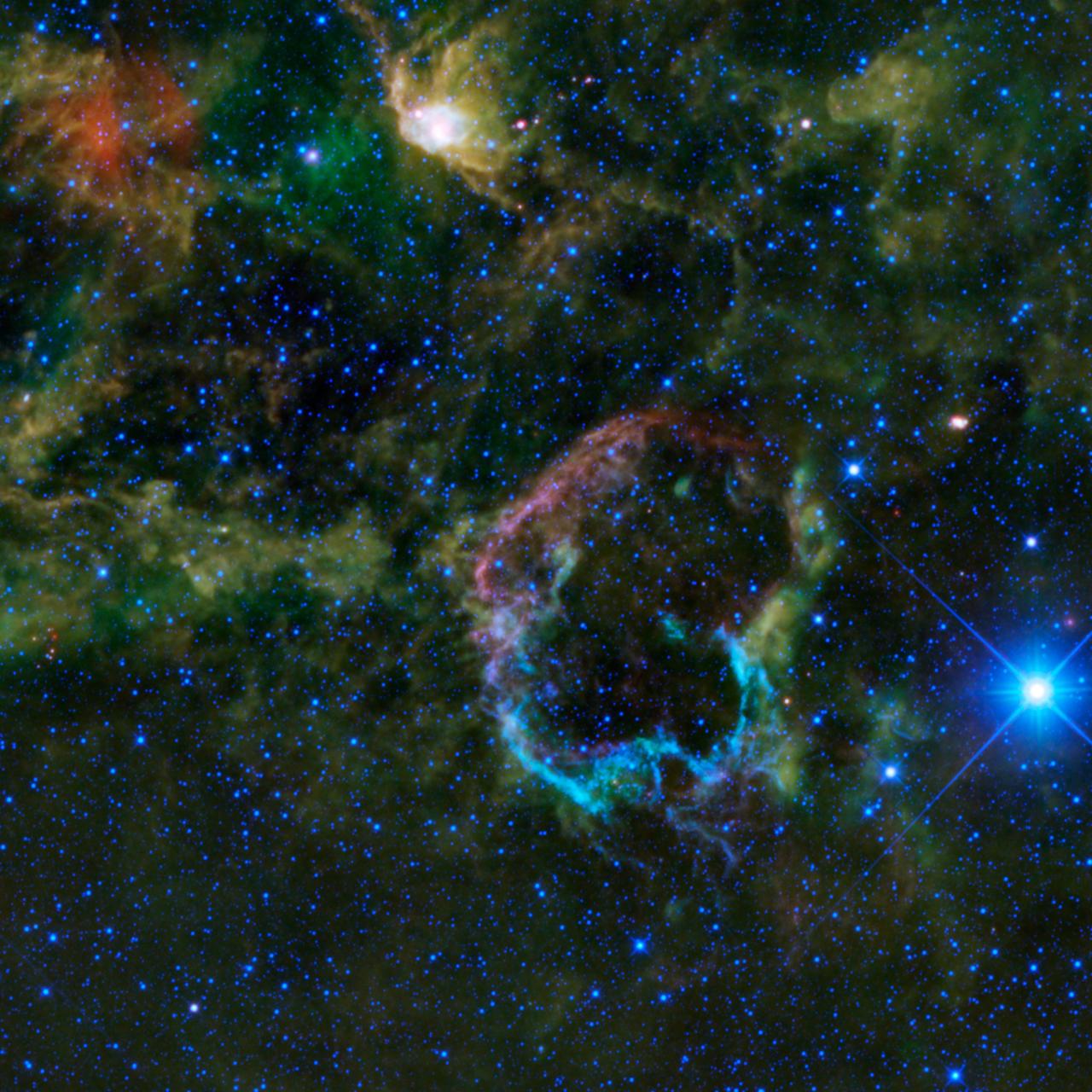
This oddly colorful nebula is the supernova remnant IC 443 as seen by NASA Wide-field Infrared Survey Explorer; the Jellyfish nebula is particularly interesting because it provides a look into how stellar explosions interact with their environment.
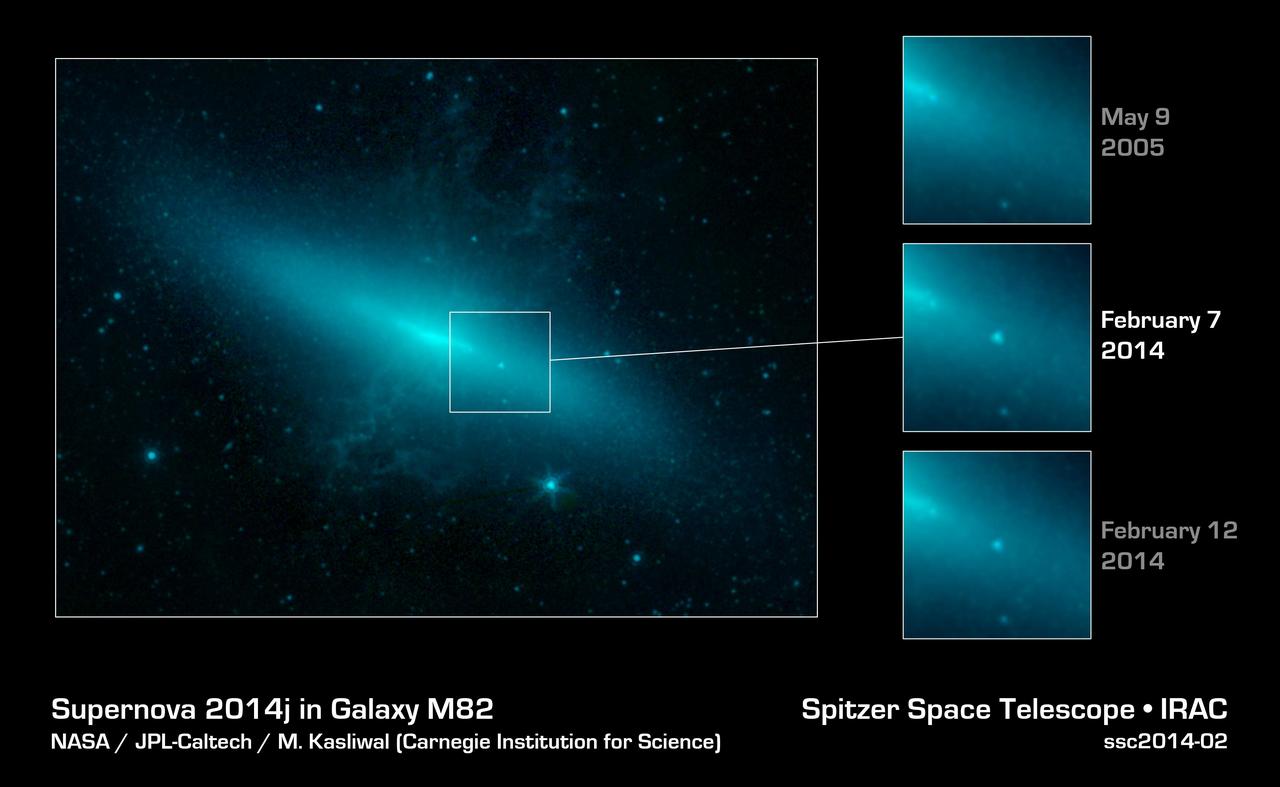
The closest supernova of its kind to be observed in the last few decades, M82 or the Cigar galaxy, has sparked a global observing campaign involving legions of instruments on the ground and in space, including NASA Spitzer Space Telescope.
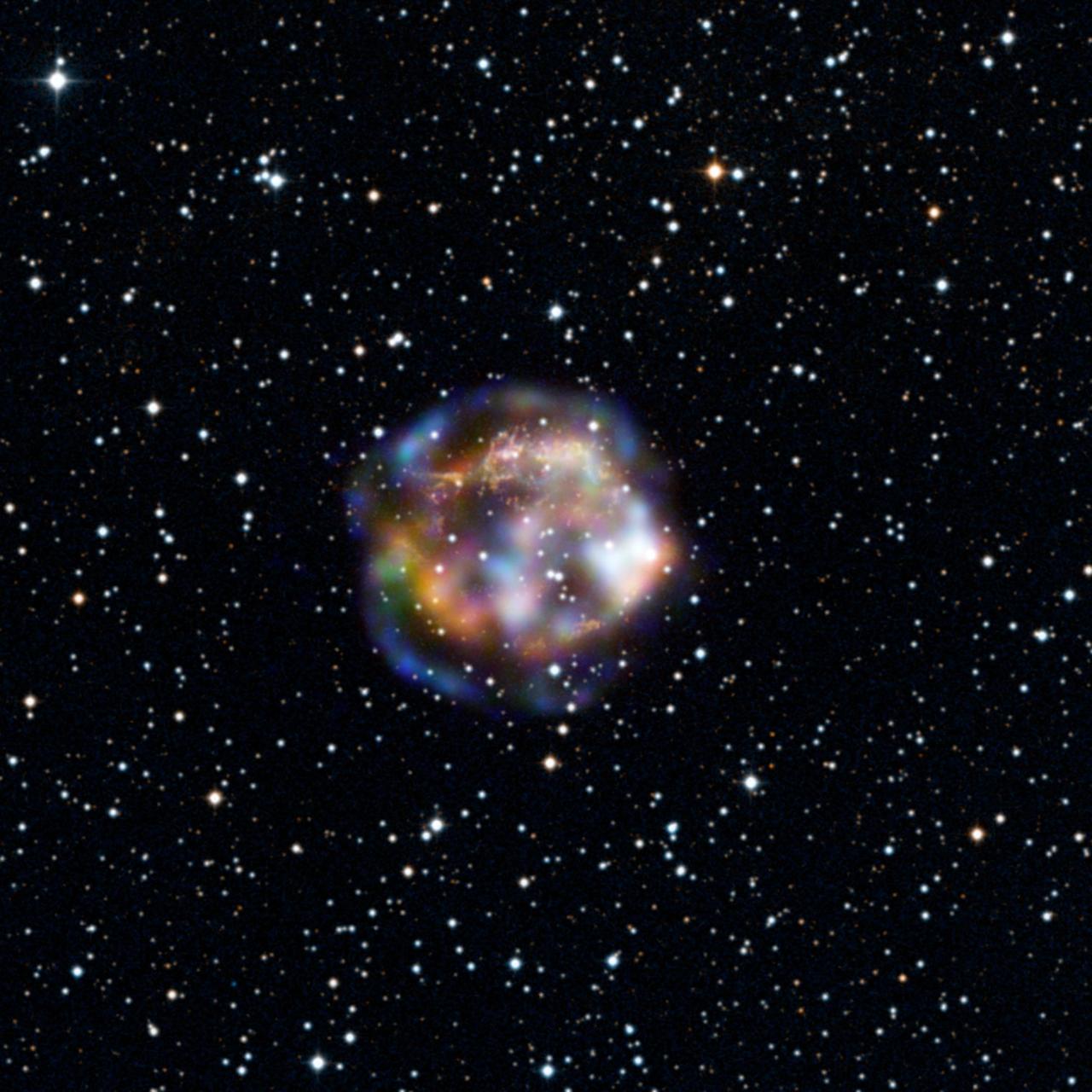
This new view of the historical supernova remnant Cassiopeia A, located 11,000 light-years away, was taken by NASA Nuclear Spectroscopic Telescope Array, or NuSTAR. While the star is long dead, its remains are still bursting with action.
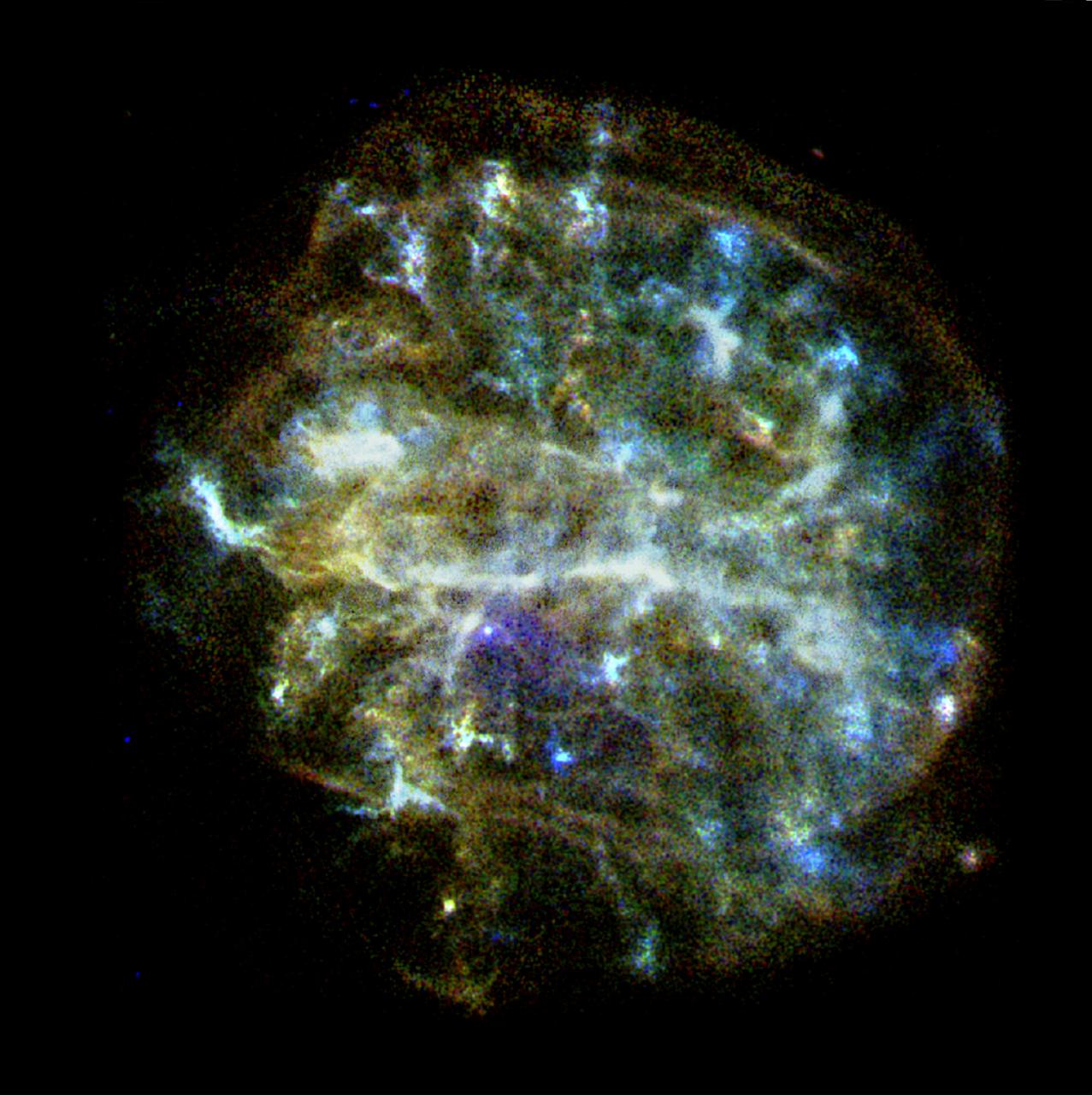
The Chandra X-Ray Observatory has captured this spectacular image of G292.0+1.8, a young, oxygen-rich supernova remnant with a pulsar at its center surrounded by outflowing material. This image shows a rapidly expanding shell of gas that is 36 light-years across and contains large amounts of elements such as oxygen, neon, magnesium, silicon and sulfur. Embedded in this cloud of multimillion-degree gas is a key piece of evidence linking neutron stars and supernovae produced by the collapse of massive stars. With an age estimated at 1,600 years, G292.0+1.8 is one of three known oxygen-rich supernovae in our galaxy. These supernovae are of great interest to astronomers because they are one of the primary sources of the heavy elements necessary to form planets and people. Scattered through the image are bluish knots of emissions containing material that is highly enriched in newly created oxygen, neon, and magnesium produced deep within the original star and ejected by the supernova explosion.

Like the Crab Nebula, the Vela Supernova Remnant has a radio pulsar at its center. In this image taken by the High Energy Astronomy Observatory (HEAO)-2/Einstein Observatory, the pulsar appears as a point source surrounded by weak and diffused emissions of x-rays. HEAO-2's computer processing system was able to record and display the total number of x-ray photons (a tiny bundle of radiant energy used as the fundamental unit of electromagnetic radiation) on a scale along the margin of the picture. The HEAO-2, the first imaging and largest x-ray telescope built to date, was capable of producing actual photographs of x-ray objects. Shortly after launch, the HEAO-2 was nicknamed the Einstein Observatory by its scientific experimenters in honor of the centernial of the birth of Albert Einstein, whose concepts of relativity and gravitation have influenced much of modern astrophysics, particularly x-ray astronomy. The HEAO-2, designed and developed by TRW, Inc. under the project management of the Marshall Space Flight Center, was launched aboard an Atlas/Centaur launch vehicle on November 13, 1978.
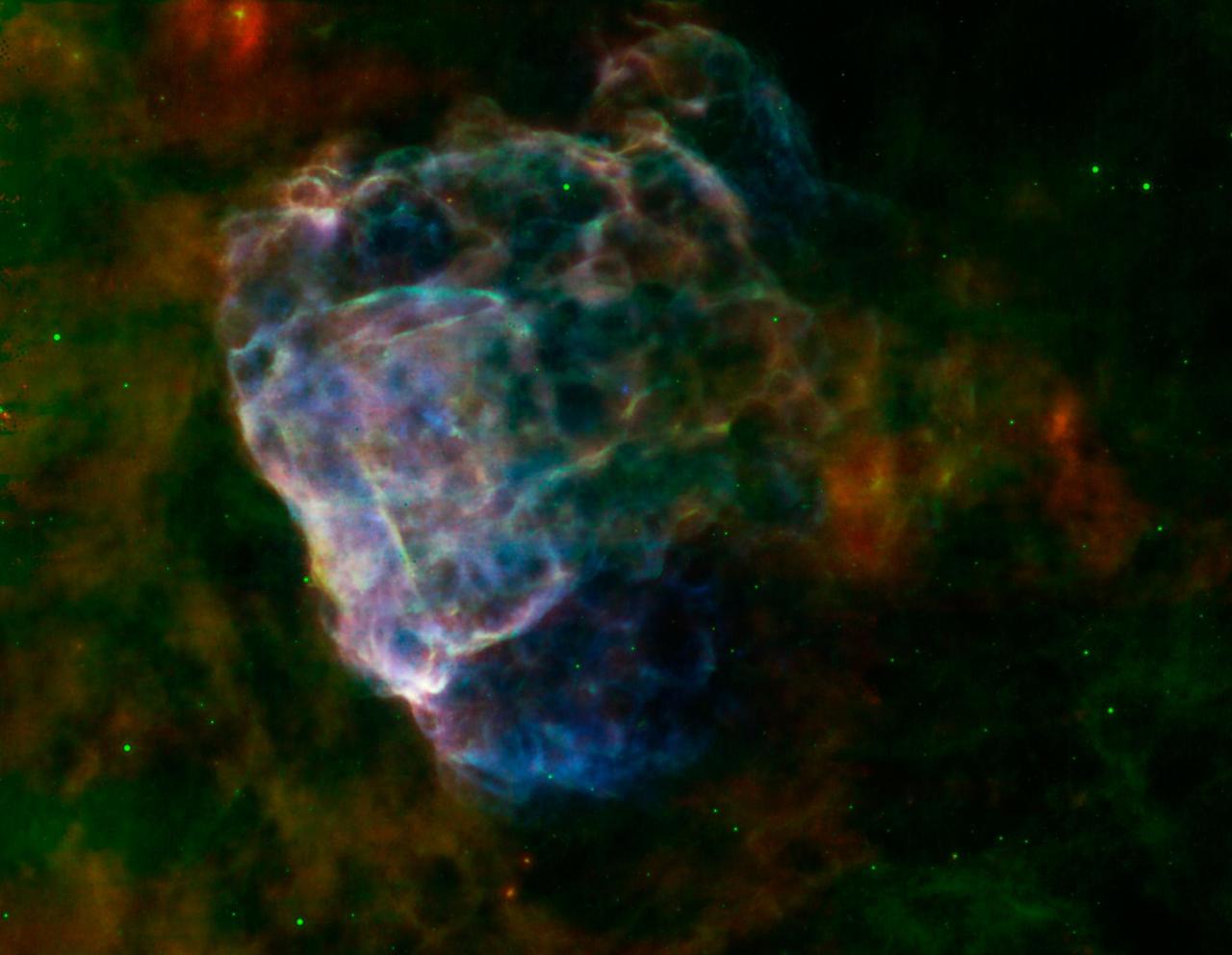
Puppis A, around 7,000 light-years away, is seen in this image from NASA Spitzer Space Telescope and Chandra X-Ray Observatory, and the European Space Agency XMM-Newton.
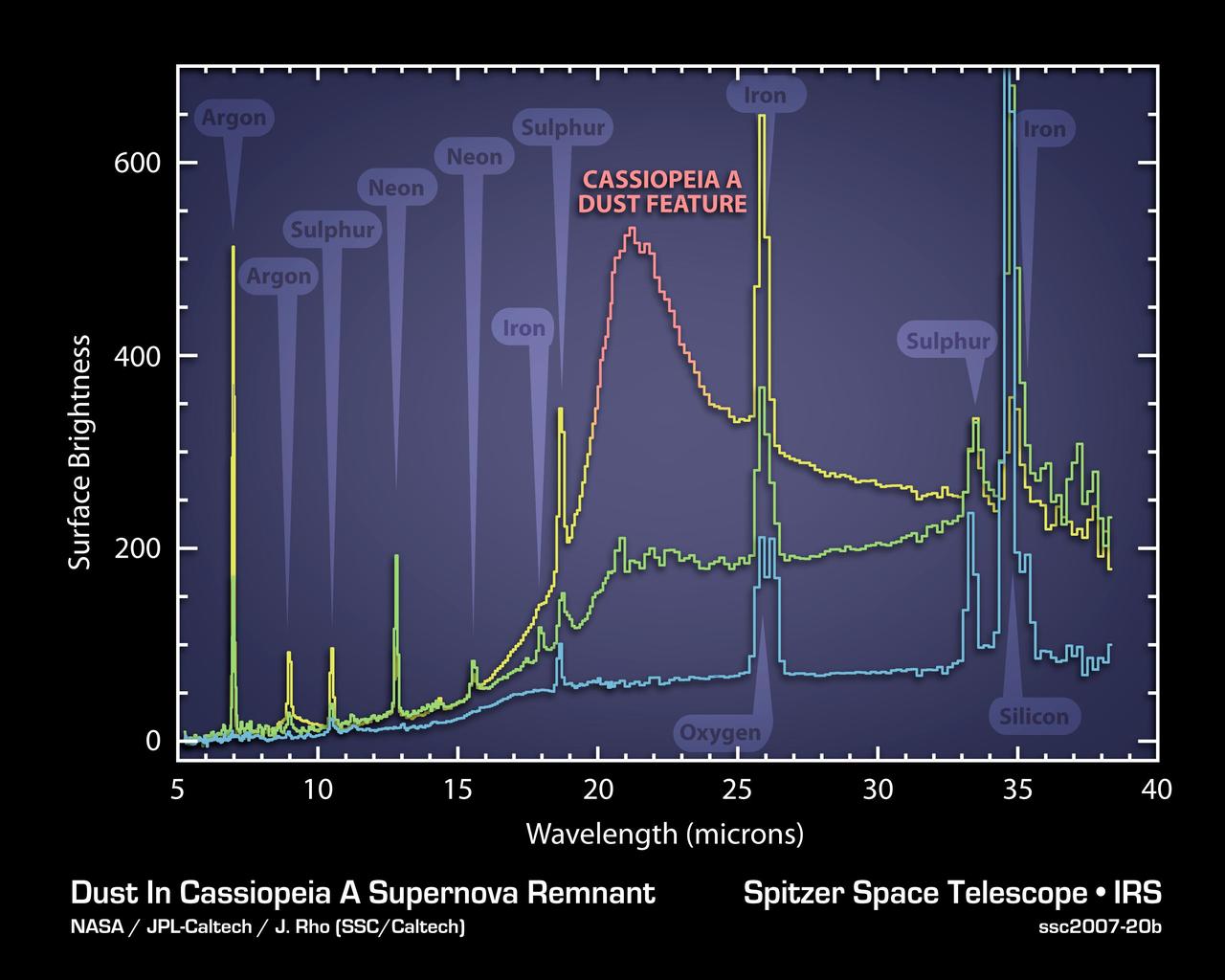
The elements and molecules that flew out of the Cassiopeia A star when it exploded about 300 years ago can be seen clearly for the first time in this plot of data, called a spectrum, taken by NASA Spitzer Space Telescope.
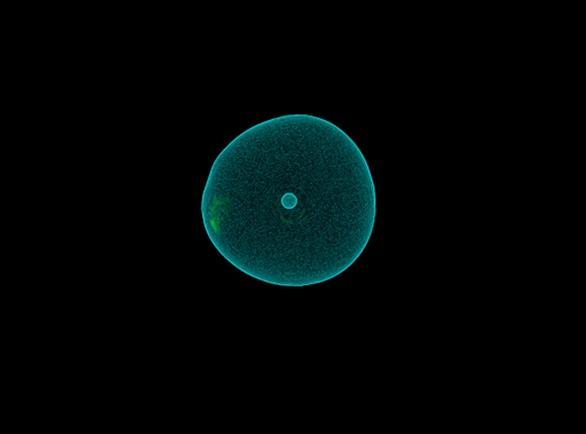
NuSTAR has provided the first observational evidence in support of a theory that says exploding stars slosh around before detonating. That theory, referred to as mild asymmetries, is shown here in a simulation by Christian Ott.
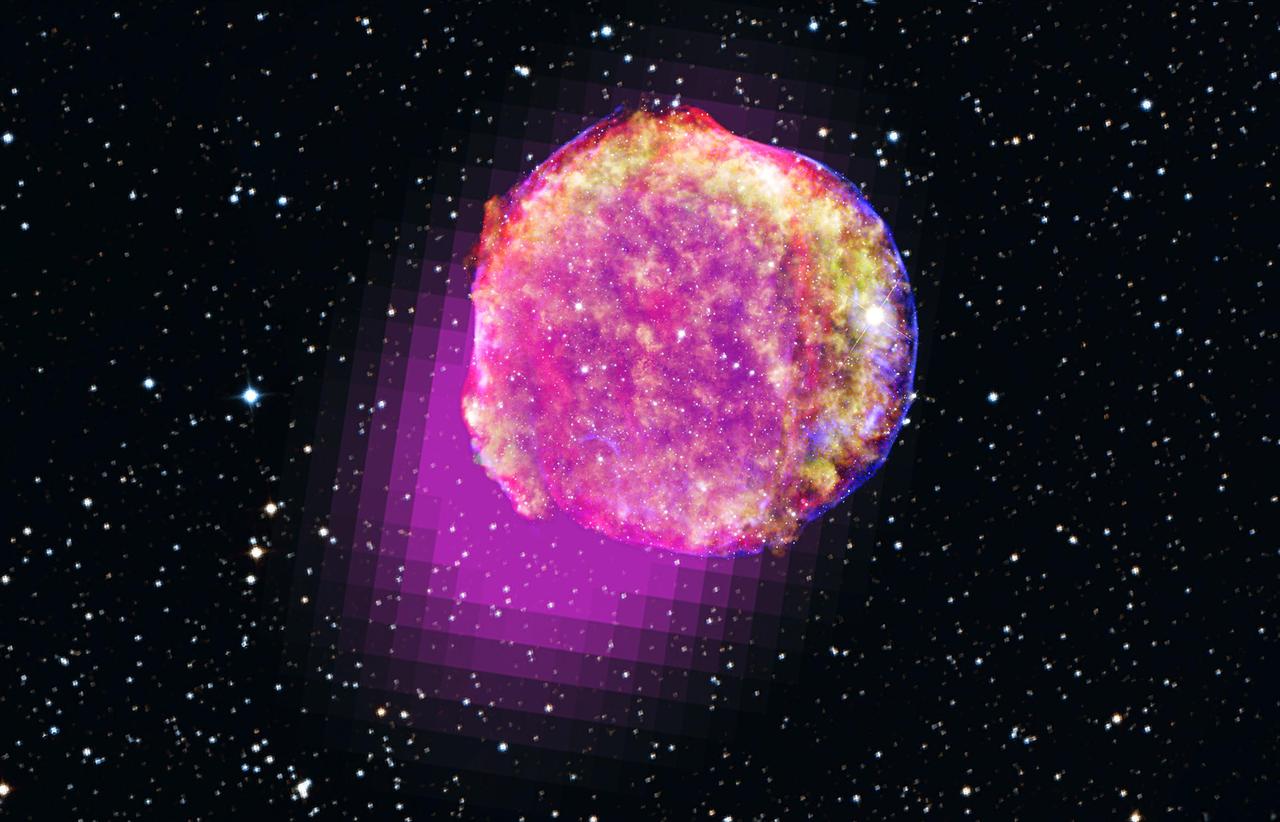
NASA image relase December 13, 2011 Gamma-rays detected by Fermi's LAT show that the remnant of Tycho's supernova shines in the highest-energy form of light. This portrait of the shattered star includes gamma rays (magenta), X-rays (yellow, green, and blue), infrared (red) and optical data. Credit: Gamma ray, NASA/DOE/Fermi LAT Collaboration; X-ray, NASA/CXC/SAO; Infrared, NASA/JPL-Caltech; Optical, MPIA, Calar Alto, O. Krause et al. and DSS To read more go to: <a href="http://www.nasa.gov/mission_pages/GLAST/news/tycho-star.html" rel="nofollow">www.nasa.gov/mission_pages/GLAST/news/tycho-star.html</a> <b><a href="http://www.nasa.gov/audience/formedia/features/MP_Photo_Guidelines.html" rel="nofollow">NASA image use policy.</a></b> <b><a href="http://www.nasa.gov/centers/goddard/home/index.html" rel="nofollow">NASA Goddard Space Flight Center</a></b> enables NASA’s mission through four scientific endeavors: Earth Science, Heliophysics, Solar System Exploration, and Astrophysics. Goddard plays a leading role in NASA’s accomplishments by contributing compelling scientific knowledge to advance the Agency’s mission. <b>Follow us on <a href="http://twitter.com/NASA_GoddardPix" rel="nofollow">Twitter</a></b> <b>Like us on <a href="http://www.facebook.com/pages/Greenbelt-MD/NASA-Goddard/395013845897?ref=tsd" rel="nofollow">Facebook</a></b> <b>Find us on <a href="http://instagrid.me/nasagoddard/?vm=grid" rel="nofollow">Instagram</a></b>

NASA Hubble peers into a small portion of the nebula near the star cluster NGC 2074. The region is a firestorm of raw stellar creation, perhaps triggered by a nearby supernova explosion. It lies about 170,000 light-years away near the Tarantula
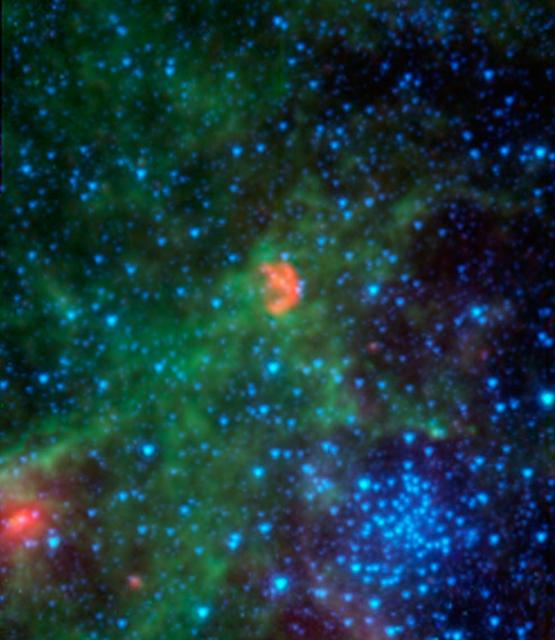
This infrared image from NASA Spitzer Space Telescope shows N103B -- all that remains from a supernova that exploded a millennium ago in the Large Magellanic Cloud, a satellite galaxy 160,000 light-years away from our own Milky Way.
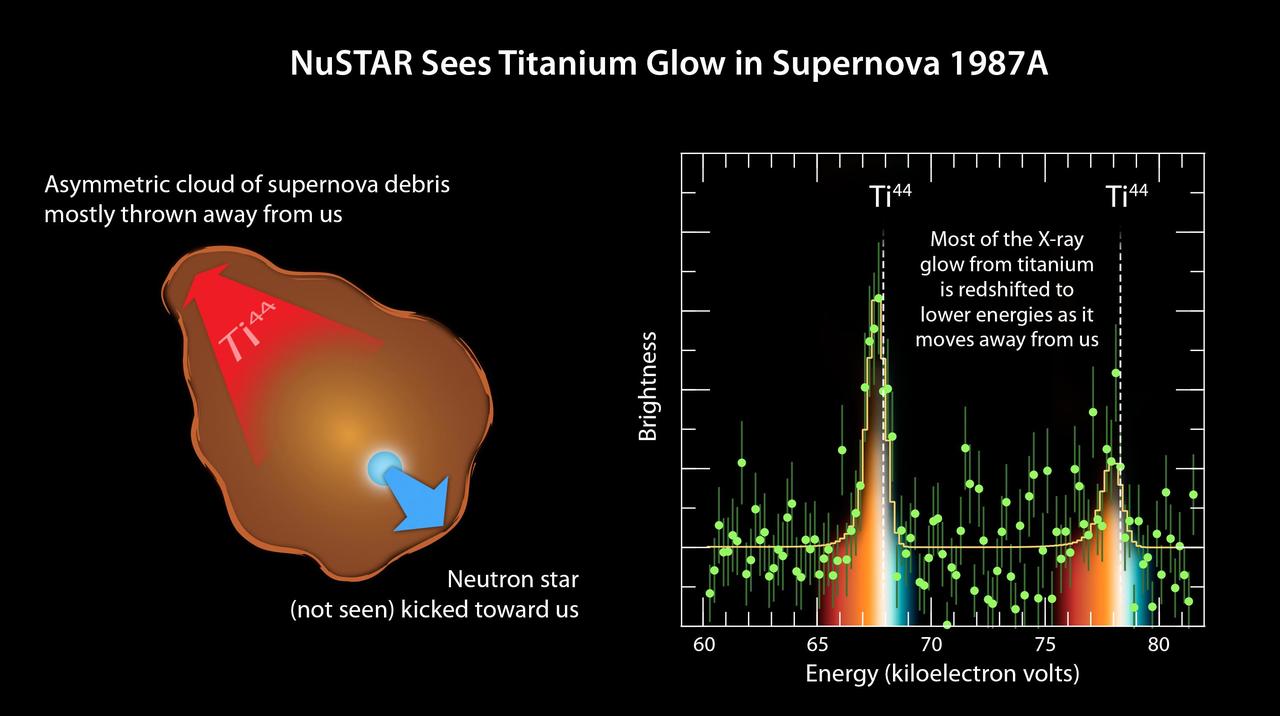
The plot of data from NASA's Nuclear Spectroscopic Telescope Array, or NuSTAR (right), amounts to a "smoking gun" of evidence in the mystery of how massive stars explode. The observations indicate that supernovae belonging to a class called Type II or core-collapse blast apart in a lopsided fashion, with the core of the star hurtling in one direction, and the ejected material mostly expanding the other way (see diagram in Figure 1). NuSTAR made the most precise measurements yet of a radioactive element, called titanium-44, in the supernova remnant called 1987A. NuSTAR sees high-energy X-rays, as shown here in the plot ranging from 60 to more than 80 kiloelectron volts. The spectral signature of titanium-44 is apparent as the two tall peaks. The white line shows where one would expect to see these spectral signatures if the titanium were not moving. The fact that the spectral peaks have shifted to lower energies indicates that the titanium has "redshifted," and is moving way from us. This is similar to what happens to a train's whistle as the train leaves the station. The whistle's sound shifts to lower frequencies. NuSTAR's detection of redshifted titanium reveals that the bulk of material ejected in the 1987A supernova is flying way from us at a velocity of 1.6 million miles per hour (2.6 million kilometers per hour). Had the explosion been spherical in nature, the titanium would have been seen flying uniformly in all directions. This is proof that this explosion occurred in an asymmetrical fashion. http://photojournal.jpl.nasa.gov/catalog/PIA19335

Tipped toward Earth and illuminated by the star, these rings look like ellipses in images taken with NASA Spitzer Space Telescope. The massive star at the center, which lies within the constellation Sagittarius, is about 7,200 light-years from Earth.
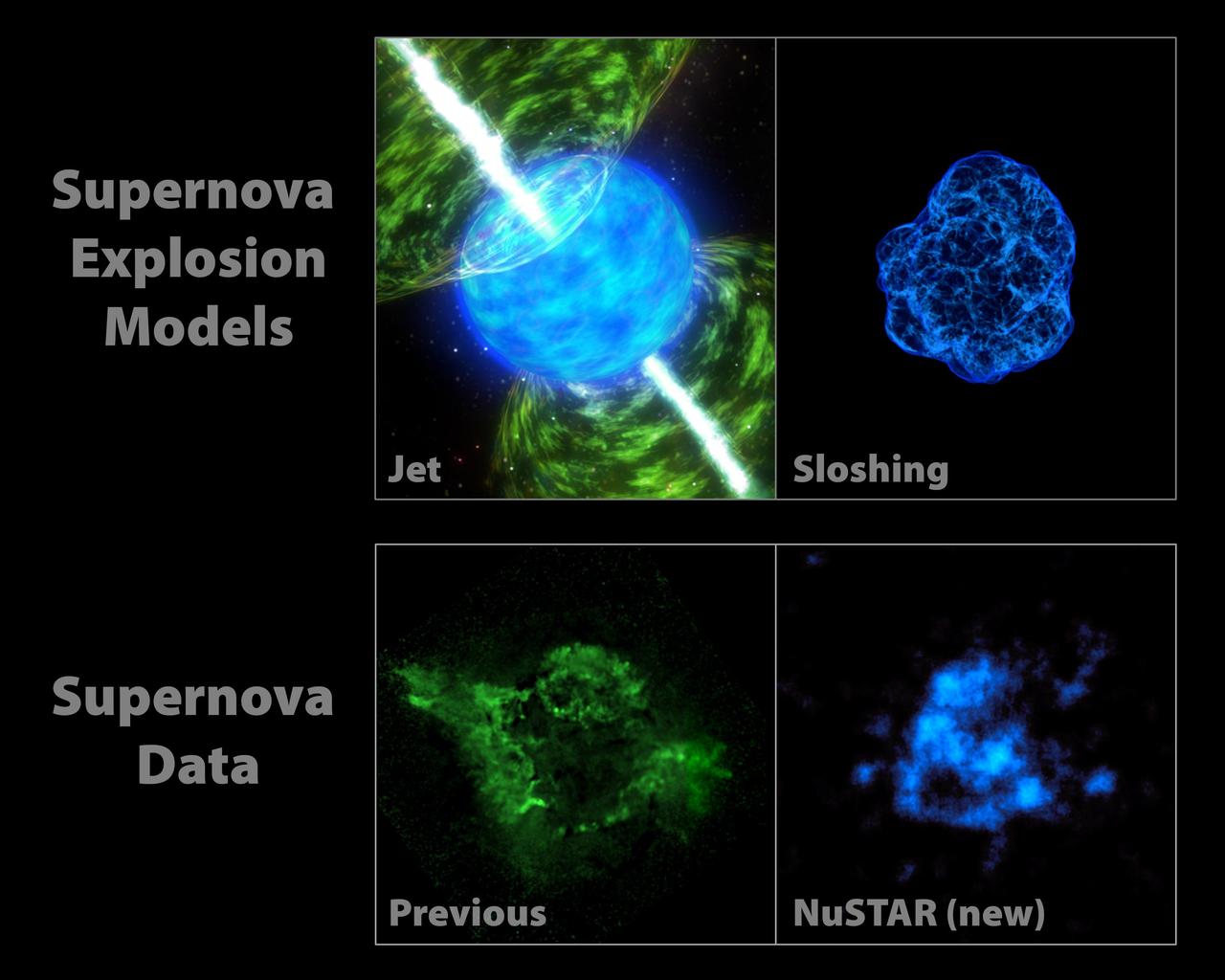
The images at the top of this graphic represent two popular models describing how stars blast apart. The models point to different triggers of the explosion. Jet-driven models are illustrated with an artist concept shown at left.
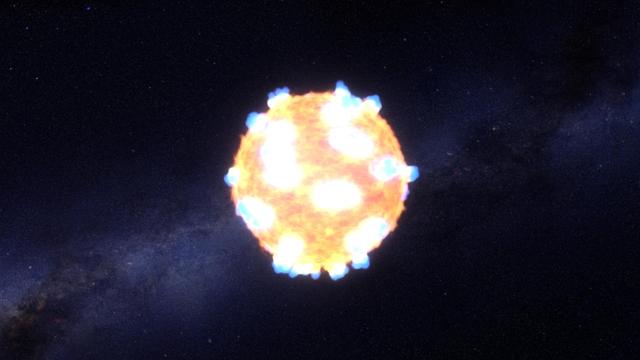
The brilliant flash of an exploding star shockwave -- what astronomers call the hock breakout -- is illustrated in artist concept based on NASA Kepler.
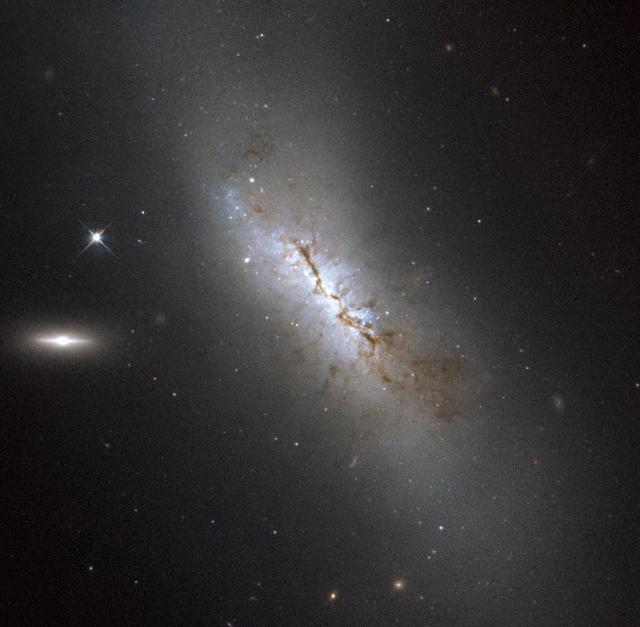
The galaxy pictured here is NGC 4424, located in the constellation of Virgo. It is not visible with the naked eye but has been captured here with the NASA/ESA Hubble Space Telescope. Although it may not be obvious from this image, NGC 4424 is in fact a spiral galaxy. In this image it is seen more or less edge on, but from above you would be able to see the arms of the galaxy wrapping around its centre to give the characteristic spiral form . In 2012 astronomers observed a supernova in NGC 4424 — a violent explosion marking the end of a star’s life. During a supernova explosion, a single star can often outshine an entire galaxy. However, the supernova in NGC 4424, dubbed SN 2012cg, cannot be seen here as the image was taken ten years prior to the explosion. Along the central region of the galaxy, clouds of dust block the light from distant stars and create dark patches. To the left of NGC 4424 there are two bright objects in the frame. The brightest is another, smaller galaxy known as LEDA 213994 and the object closer to NGC 4424 is an anonymous star in our Milky Way. A version of this image was entered into the Hubble's Hidden Treasures image processing competition by contestant Gilles Chapdelaine.
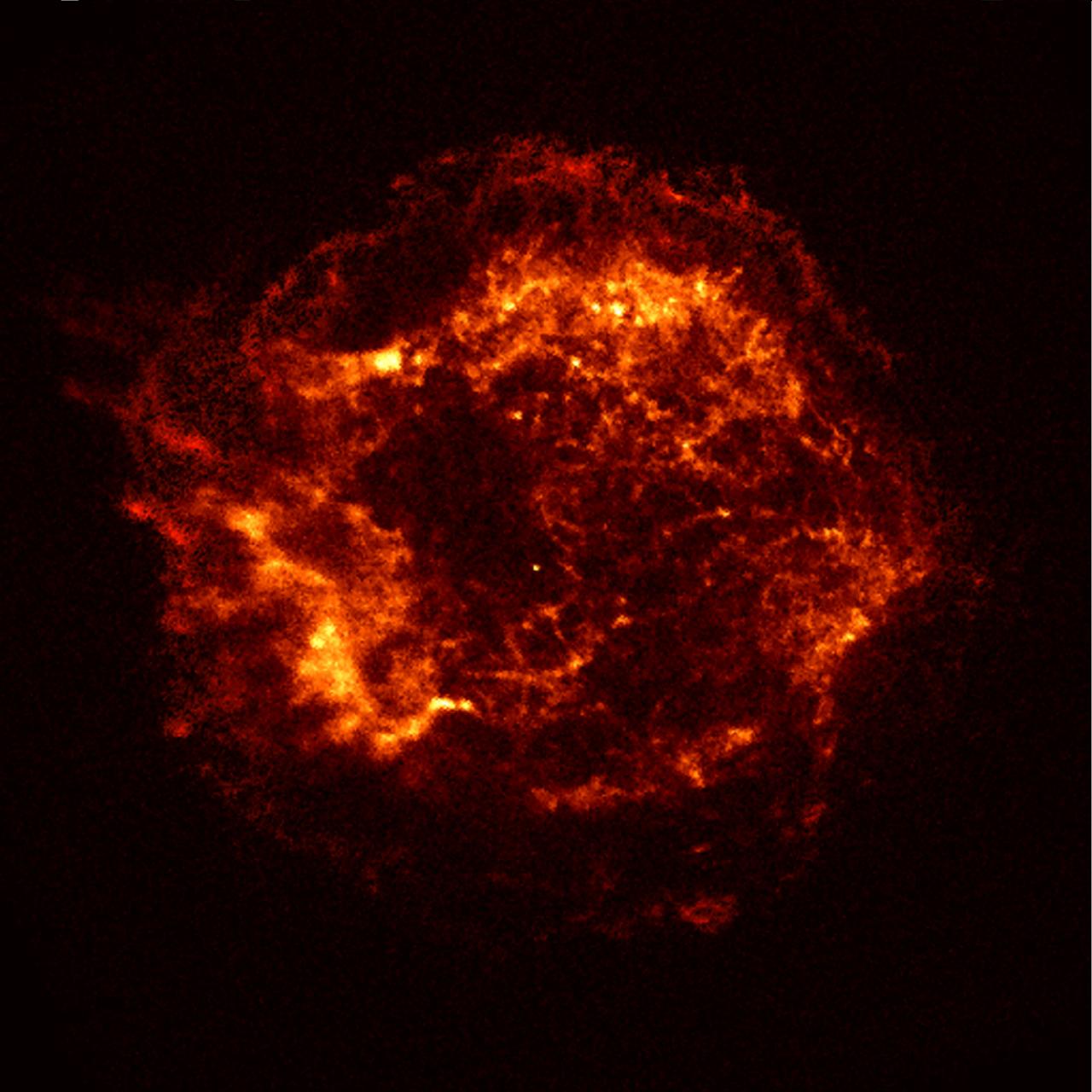
This x-ray image of the Cassiopeia A (CAS A) supernova remnant is the official first light image of the Chandra X-Ray Observatory (CXO). The 5,000-second image was made with the Advanced Charged Coupled Device (CCD) Image Spectrometer (ACIS). Two shock waves are visible: A fast outer shock and a slower irner shock. The inner shock wave is believed to be due to the collision of ejecta from the supernova explosion with a circumstellar shell of material, heating it to a temperature of 10 million-degrees Celsius. The outer shock wave is analogous to an awesome sonic boom resulting from this collision The x-rays reveal a bright object near the center, which may be the long-sought neutron star or black hole remnant of the explosion that produced Cassiopeia A. Cassiopeia A is the 320-year-old remnant of a massive star that exploded. Located in the constellation Cassiopeia, it is 10 light-years across and 10,000 light-years from Earth. A supernova occurs when a massive star has used up its nuclear fuel and the pressure drops in the central core of the star. The matter in the core is crushed by gravity to higher and higher densities, and temperatures reach billions of degrees. Under these extreme conditions, nuclear reactions occur violently and catastrophically, reversing the collapse. A thermonuclear shock wave races through the now expanding stellar debris, fusing lighter elements into heavier ones and producing a brilliant visual outburst.
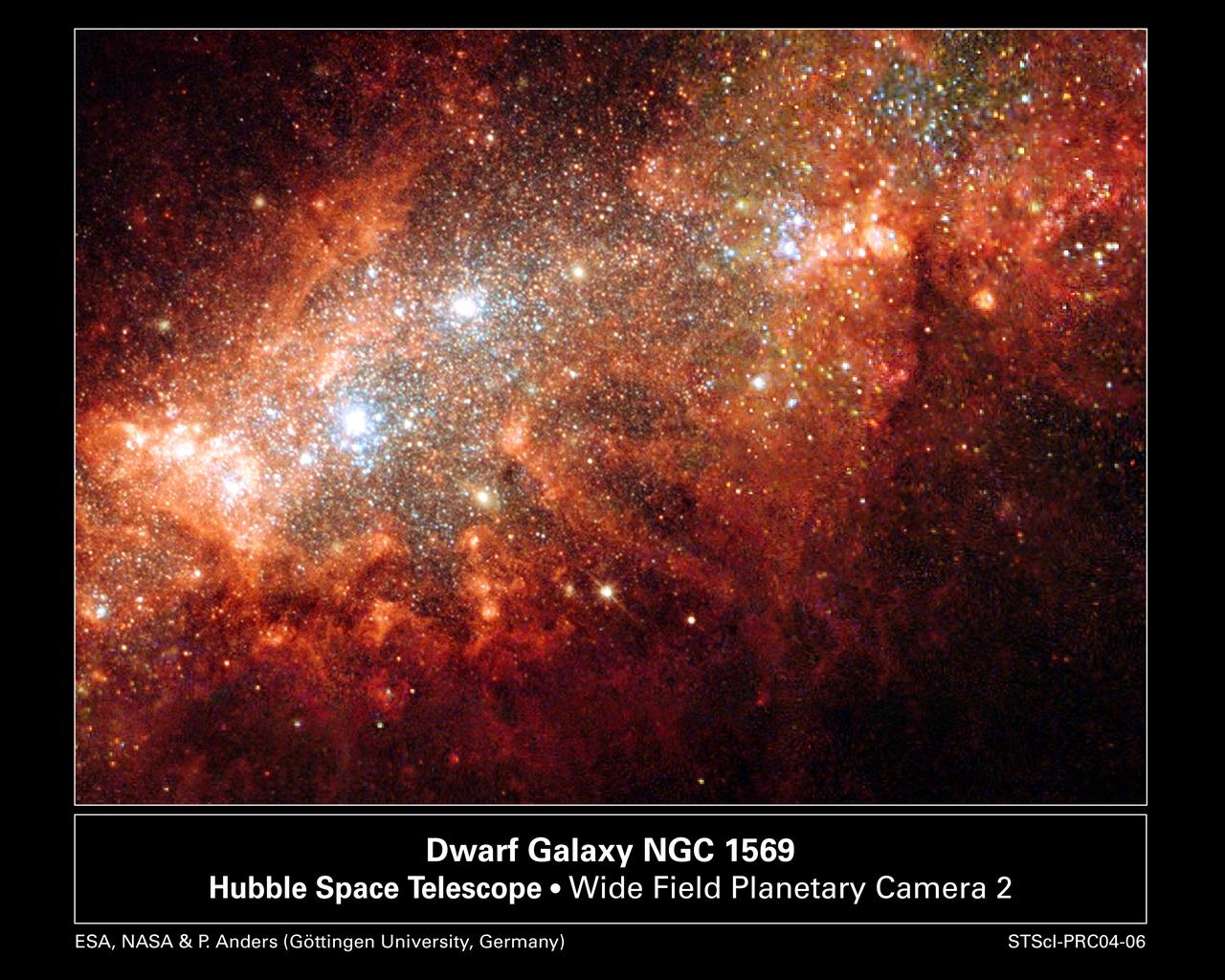
This new image taken with NASA's Hubble Space Telescope (HST) is of the nearby dwarf galaxy NGC 1569. This galaxy is a hotbed of vigorous star birth activity which blows huge bubbles that riddle its main body. The bubble structure is sculpted by the galactic super-winds and outflows caused by a colossal input of energy from collective supernova explosions that are linked with a massive episode of star birth. The bubbles seen in this image are made of hydrogen gas that glows when hit by the fierce wind and radiation from hot young stars and is racked by supernova shocks. Its "star factories" are also manufacturing brilliant blue star clusters. NGC 1569 had a sudden onset of star birth about 25 million years ago, which subsided about the time the very earliest human ancestors appeared on Earth. The Marshall Space Flight Center had responsibility for the design, development, and construction of the HST.
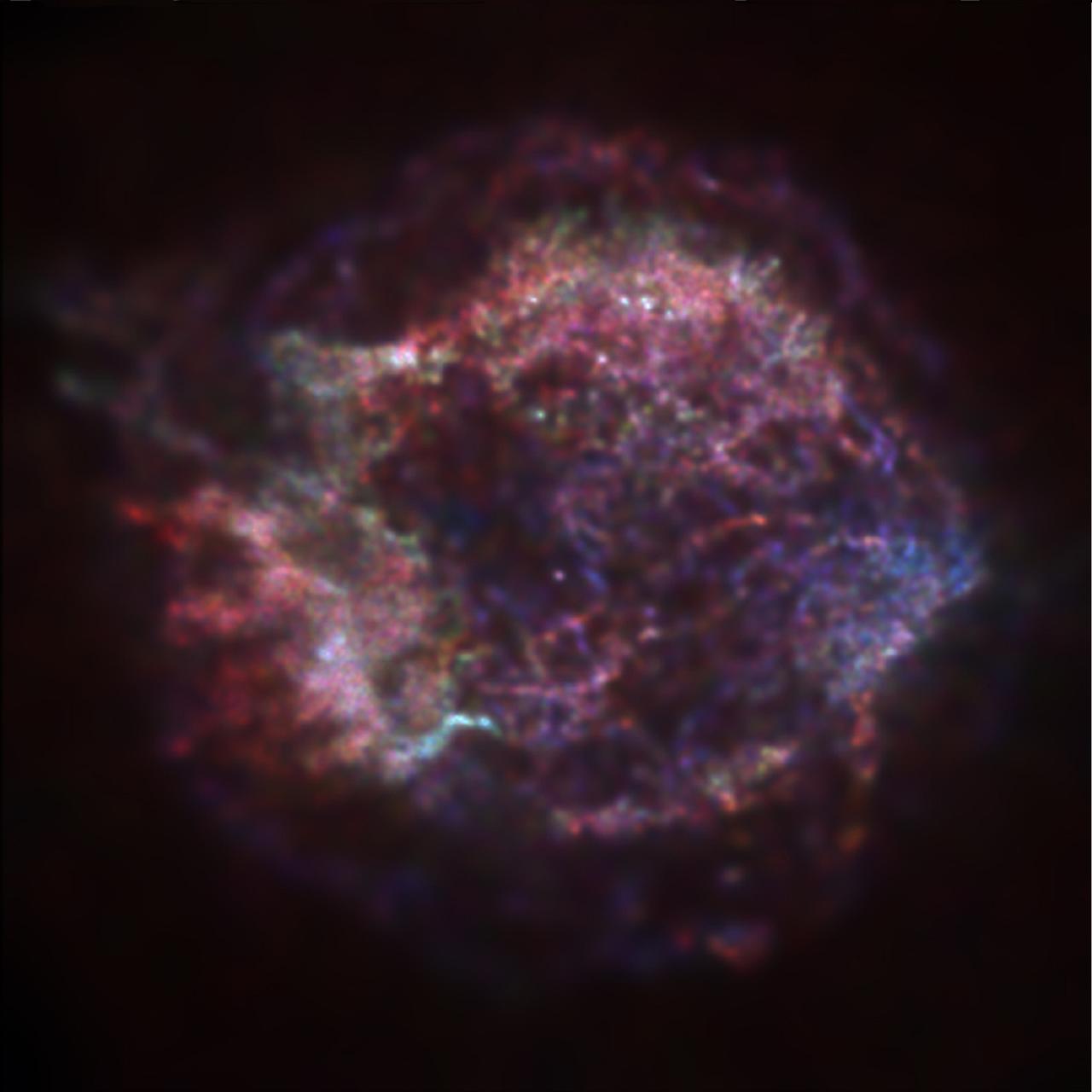
This is an extraordinary first image from the Chandra X-Ray Observatory (CXO), the supernova remnant Cassiopeia A, tracing the aftermath of a gigantic stellar explosion in such sturning detail that scientists can see evidence of what may be a neutron star or black hole near the center. The red, green, and blue regions in this image of the supernova remnant Cassiopeia A show where the intensity of low, medium, and high energy X-rays, respectively, is greatest. The red material on the left outer edge is enriched in iron, whereas the bright greenish white region on the low left is enriched in silicon and sulfur. In the blue region on the right edge, low and medium energy X-rays have been filtered out by a cloud of dust and gas in the remnant . The image was made with the CXO's Advanced Charged-Coupled Device (CCD) Imaging Spectrometer (ACIS). Photo credit: NASA/CXC/SAO/Rutgers/J.Hughes
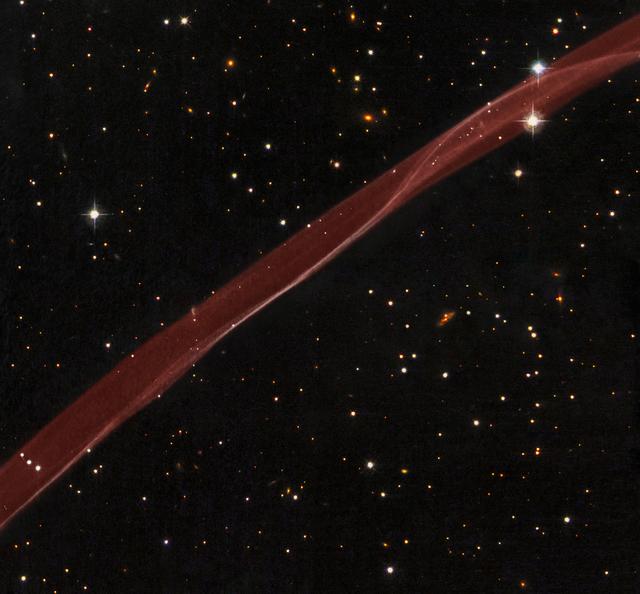
Release date: July 1, 2008 SN 1006 Supernova Remnant (Hubble) A delicate ribbon of gas floats eerily in our galaxy. A contrail from an alien spaceship? A jet from a black-hole? Actually this image, taken by NASA's Hubble Space Telescope, is a very thin section of a supernova remnant caused by a stellar explosion that occurred more than 1,000 years ago. On or around May 1, 1006 A.D., observers from Africa to Europe to the Far East witnessed and recorded the arrival of light from what is now called SN 1006, a tremendous supernova explosion caused by the final death throes of a white dwarf star nearly 7,000 light-years away. The supernova was probably the brightest star ever seen by humans, and surpassed Venus as the brightest object in the night time sky, only to be surpassed by the moon. It was visible even during the day for weeks, and remained visible to the naked eye for at least two and a half years before fading away. It wasn't until the mid-1960s that radio astronomers first detected a nearly circular ring of material at the recorded position of the supernova. The ring was almost 30 arcminutes across, the same angular diameter as the full moon. The size of the remnant implied that the blast wave from the supernova had expanded at nearly 20 million miles per hour over the nearly 1,000 years since the explosion occurred. In 1976, the first detection of exceedingly faint optical emission of the supernova remnant was reported, but only for a filament located on the northwest edge of the radio ring. A tiny portion of this filament is revealed in detail by the Hubble observation. The twisting ribbon of light seen by Hubble corresponds to locations where the expanding blast wave from the supernova is now sweeping into very tenuous surrounding gas. The hydrogen gas heated by this fast shock wave emits radiation in visible light. Hence, the optical emission provides astronomers with a detailed "snapshot" of the actual position and geometry of the shock front at any given time. Bright edges within the ribbon correspond to places where the shock wave is seen exactly edge on to our line of sight. Today we know that SN 1006 has a diameter of nearly 60 light-years, and it is still expanding at roughly 6 million miles per hour. Even at this tremendous speed, however, it takes observations typically separated by years to see significant outward motion of the shock wave against the grid of background stars. In the Hubble image as displayed, the supernova would have occurred far off the lower right corner of the image, and the motion would be toward the upper left. SN 1006 resides within our Milky Way Galaxy. Located more than 14 degrees off the plane of the galaxy's disk, there is relatively little confusion with other foreground and background objects in the field when trying to study this object. In the Hubble image, many background galaxies (orange extended objects) far off in the distant universe can be seen dotting the image. Most of the white dots are foreground or background stars in our Milky Way galaxy. This image is a composite of hydrogen-light observations taken with Hubble's Advanced Camera for Surveys in February 2006 and Wide Field Planetary Camera 2 observations in blue, yellow-green, and near-infrared light taken in April 2008. The supernova remnant, visible only in the hydrogen-light filter was assigned a red hue in the Heritage color image. Credit: NASA, ESA, and the Hubble Heritage Team (STScI/AURA) Acknowledgment: W. Blair (Johns Hopkins University) To learn more about the Hubble Space Telescope go here: <a href="http://www.nasa.gov/mission_pages/hubble/main/index.html" rel="nofollow">www.nasa.gov/mission_pages/hubble/main/index.html</a> <b><a href="http://www.nasa.gov/audience/formedia/features/MP_Photo_Guidelines.html" rel="nofollow">NASA image use policy.</a></b> <b><a href="http://www.nasa.gov/centers/goddard/home/index.html" rel="nofollow">NASA Goddard Space Flight Center</a></b> enables NASA’s mission through four scientific endeavors: Earth Science, Heliophysics, Solar System Exploration, and Astrophysics. Goddard plays a leading role in NASA’s accomplishments by contributing compelling scientific knowledge to advance the Agency’s mission. <b>Follow us on <a href="http://twitter.com/NASAGoddardPix" rel="nofollow">Twitter</a></b> <b>Like us on <a href="http://www.facebook.com/pages/Greenbelt-MD/NASA-Goddard/395013845897?ref=tsd" rel="nofollow">Facebook</a></b> <b>Find us on <a href="http://instagram.com/nasagoddard?vm=grid" rel="nofollow">Instagram</a></b>
VANDENBERG AFB, Calif. – Technicians connect the Orbital Sciences Pegasus XL rocket with its NuSTAR spacecraft to the L-1011 carrier aircraft known as "Stargazer." The Pegasus will launch NuSTAR into space where the high-energy x-ray telescope will conduct a census for black holes, map radioactive material in young supernovae remnants, and study the origins of cosmic rays and the extreme physics around collapsed stars. Photo credit: NASA/Randy Beaudoin, VAFB
VANDENBERG AFB, Calif. – The Orbital Sciences Pegasus XL rocket with its NuSTAR spacecraft after attachment to the L-1011 carrier aircraft known as "Stargazer." The Pegasus will launch NuSTAR into space where the high-energy x-ray telescope will conduct a census for black holes, map radioactive material in young supernovae remnants, and study the origins of cosmic rays and the extreme physics around collapsed stars. Photo credit: NASA/Randy Beaudoin, VAFB
VANDENBERG AFB, Calif. – The Orbital Sciences Pegasus XL rocket with its NuSTAR spacecraft after attachment to the L-1011 carrier aircraft known as "Stargazer." The Pegasus will launch NuSTAR into space where the high-energy x-ray telescope will conduct a census for black holes, map radioactive material in young supernovae remnants, and study the origins of cosmic rays and the extreme physics around collapsed stars. Photo credit: NASA/Randy Beaudoin, VAFB
VANDENBERG AFB, Calif. – Technicians roll the Orbital Sciences Pegasus XL rocket with its NuSTAR spacecraft to the waiting L-1011 carrier aircraft known as "Stargazer." The Pegasus will launch NuSTAR into space where the high-energy x-ray telescope will conduct a census for black holes, map radioactive material in young supernovae remnants, and study the origins of cosmic rays and the extreme physics around collapsed stars. Photo credit: NASA/Randy Beaudoin, VAFB