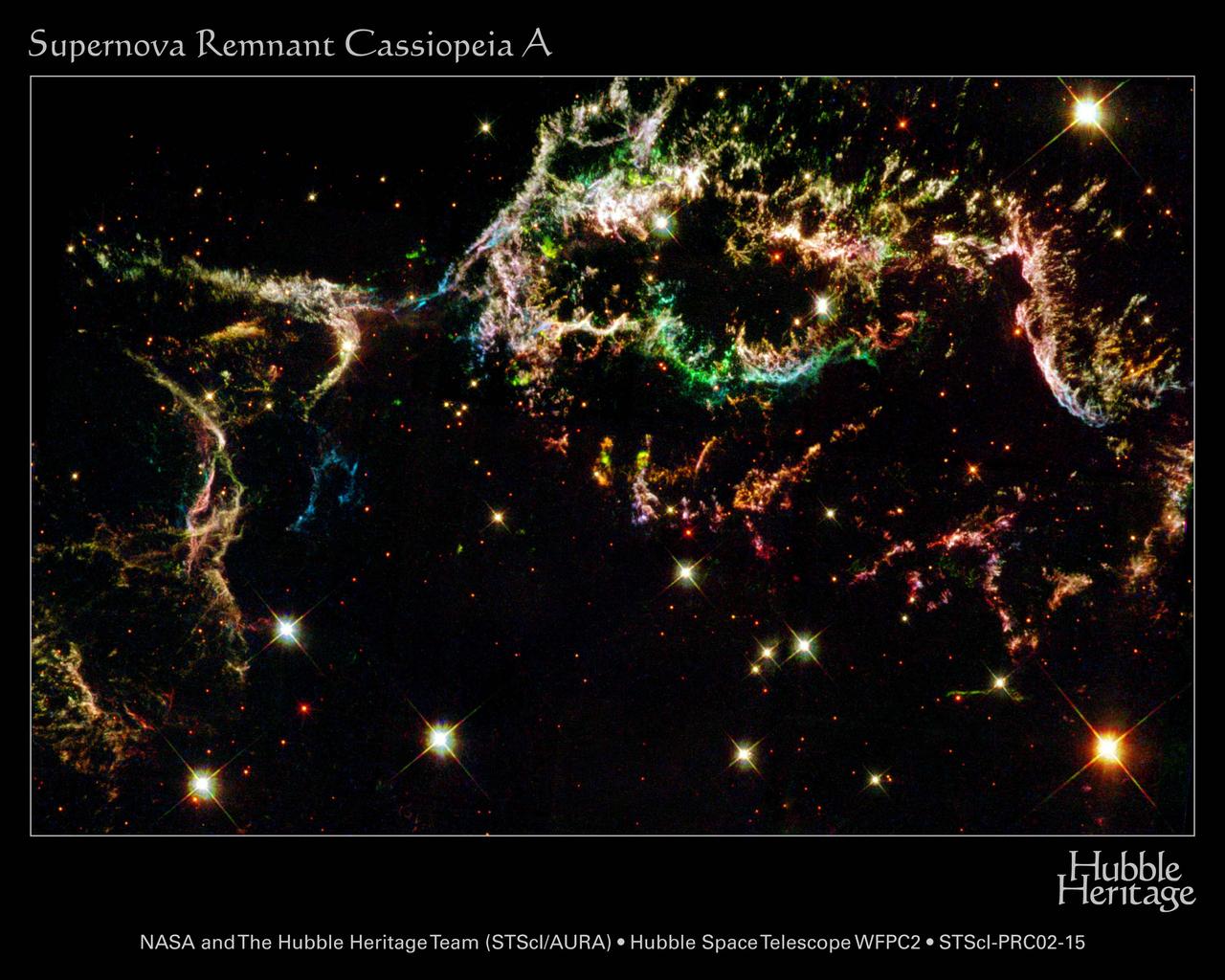
The colorful streamers that float across the sky in this photo taken by NASA's Hubble Space Telescope (HST) were created by the universe's biggest firecracker, the titanic supernova explosion of a massive star. The light from the exploding star reached Earth 320 years ago, nearly a century before the United States celebrated its birth with a bang. The dead star's shredded remains are called Cassiopeia A, or "Cas A" for short. Cas A is the youngest known supernova remnant in our Milky Way Galaxy and resides 10,000 light-years away in the constellation Cassiopeia, so the star actually blew up 10,000 years before the light reached Earth in the late 1600s. This HST image of Cas A shows for the first time that the debris is arranged into thousands of small, cooling knots of gas. This material eventually will be recycled into building new generations of stars and planets. Our own Sun and planets are constructed from the debris of supernovae that exploded billions of years ago. This photo shows the upper rim of the super nova remnant's expanding shell. Near the top of the image are dozens of tiny clumps of matter. Each small clump, originally just a small fragment of the star, is tens of times larger than the diameter of our solar system. The colors highlight parts of the debris where chemical elements are glowing. The dark blue fragments, for example, are richest in oxygen; the red material is rich in sulfur. The images were taken with the Wide Field and Planetary Camera 2 in January 2000 and January 2002. Image Credit: NASA and HST team (Stoics/AURA). Acknowledgment: R. Fesen (Darmouth) and J. Morse ( Univ. of Colorado).
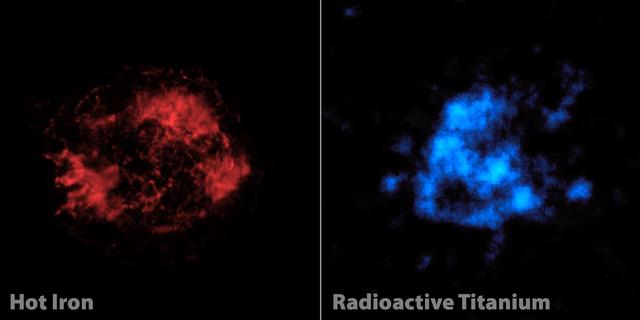
When astronomers first looked at images of a supernova remnant called Cassiopeia A, captured by NASA NuSTAR. The mystery of Cassiopeia A Cas A, a massive star that exploded in a supernova more than 11,000 years ago continues to confound scientists.
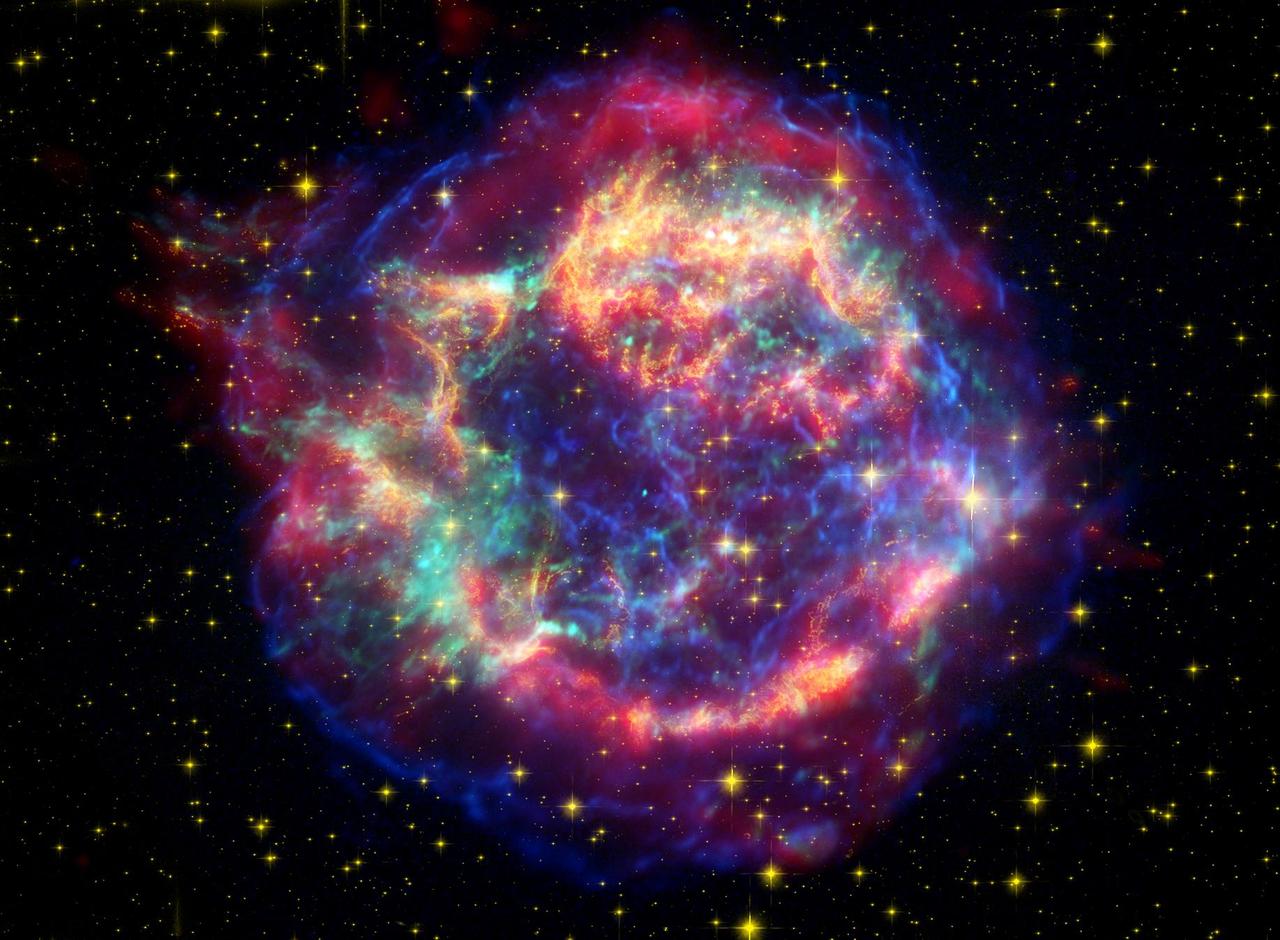
This false-color image from three of NASA Great Observatories provides one example of a star that died in a fiery supernova blast. Called Cassiopeia A, this supernova remnant is located 10,000 light-years away in the constellation Cassiopeia.
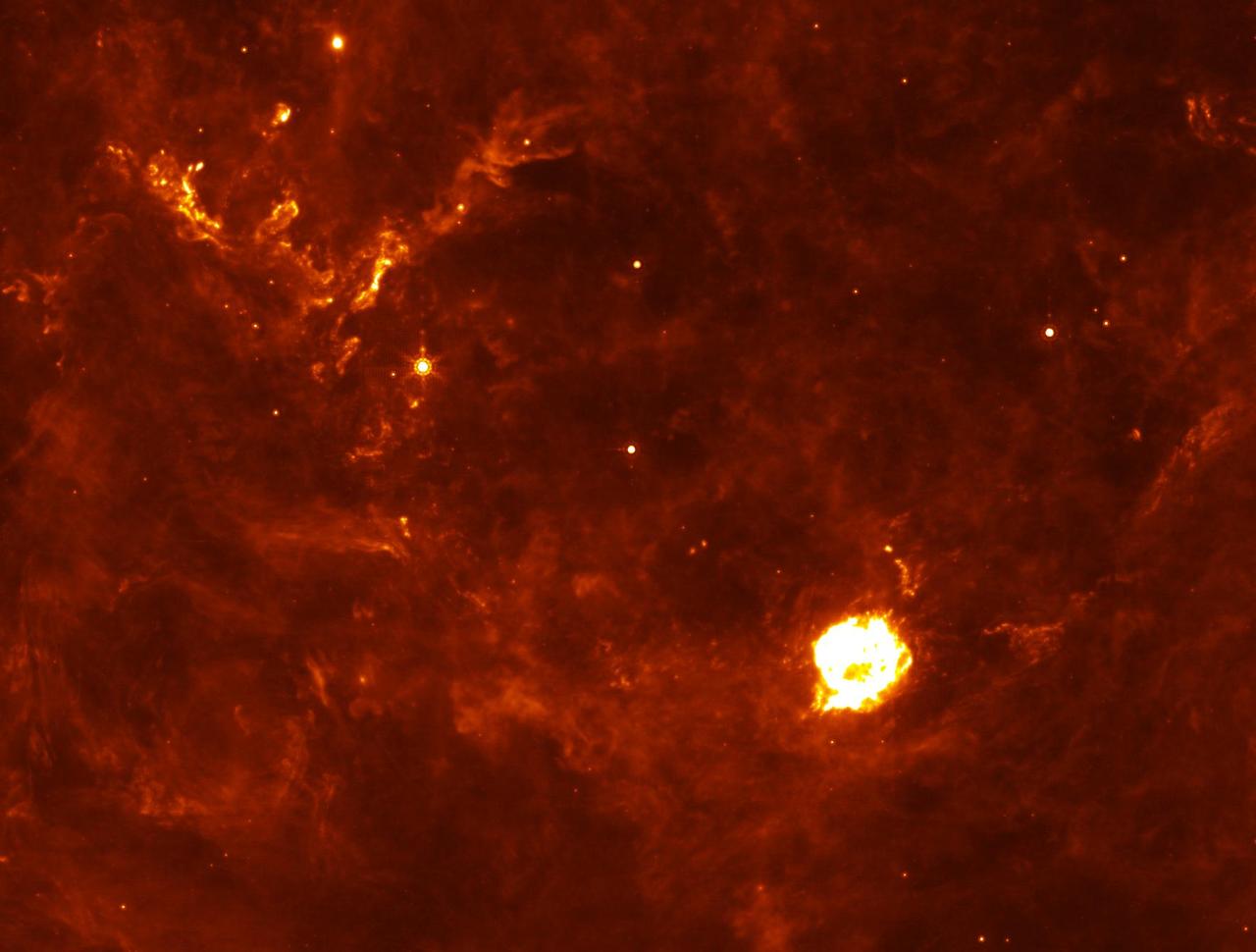
The Cassiopeia A supernova first flash of radiation makes six clumps of dust circled in annotated version unusually hot. The supernova remnant is the large white ball in the center. This infrared picture was taken by NASA Spitzer Space Telescope.
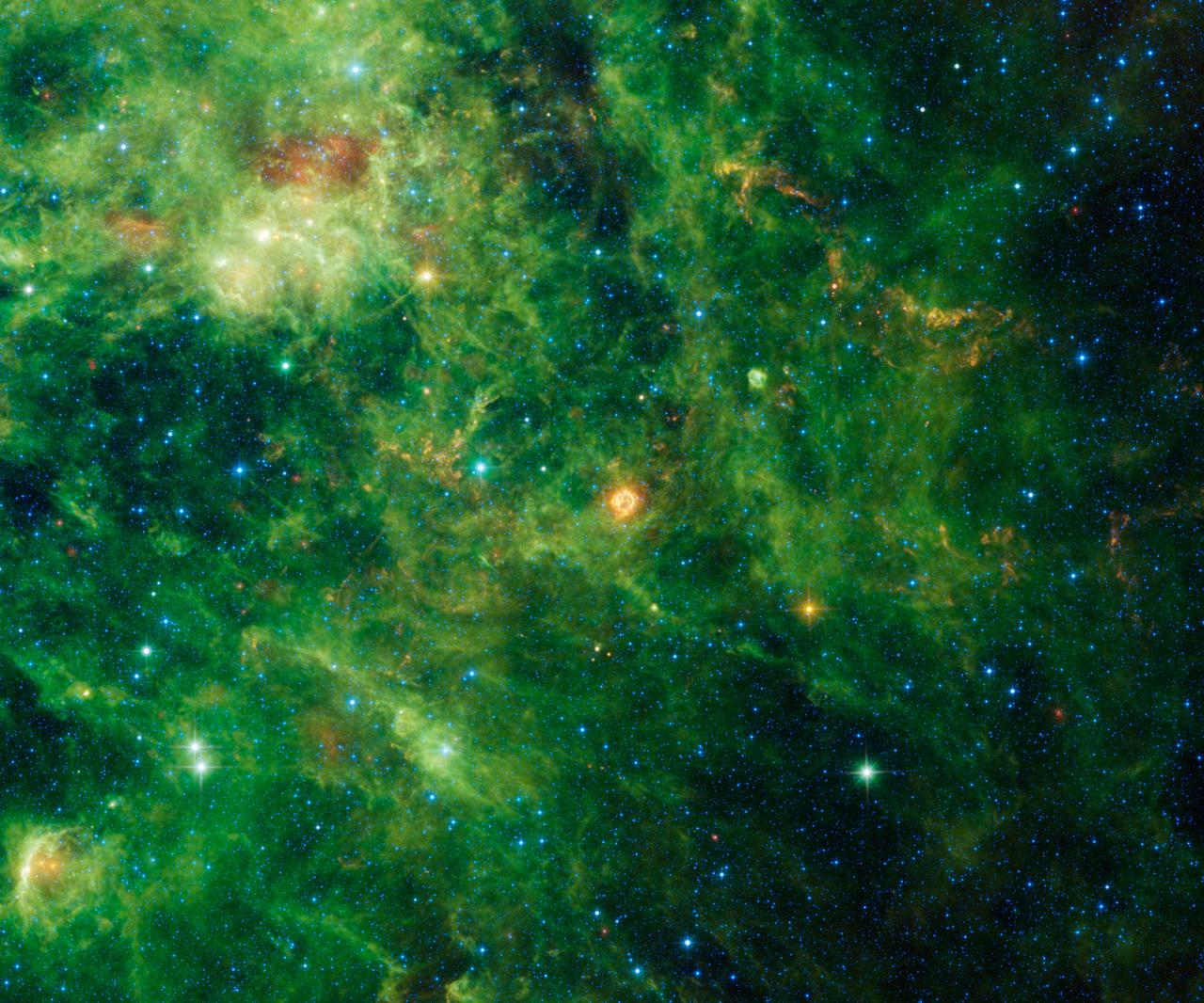
Listed as Cassiopeia A, this remnant of the supernova is one of the brightest radio sources in the known universe. More recently, NASA WISE telescope detected infrared echoes of the flash of light rippling outwards from the supernova.
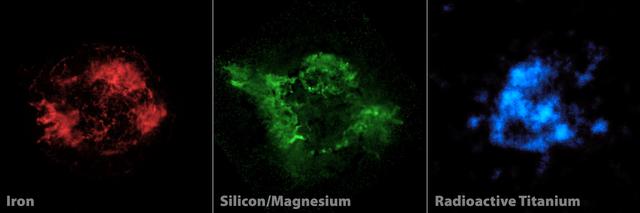
NASA NuSTAR is complementing previous observations of the Cassiopeia A supernova remnant red and green by providing the first maps of radioactive material forged in the fiery explosion blue.

This x-ray photograph of the Supernova remnant Cassiopeia A, taken with the High Energy Astronomy Observatory (HEAO) 2/Einstein Observatory, shows that the regions with fast moving knots of material in the expanding shell are bright and clear. A faint x-ray halo, just outside the bright shell, is interpreted as a shock wave moving ahead of the expanding debris. The HEAO-2, the first imaging and largest x-ray telescope built to date, was capable of producing actual photographs of x-ray objects. Shortly after launch, the HEAO-2 was nicknamed the Einstein Observatory by its scientific experimenters in honor of the centernial of the birth of Albert Einstein, whose concepts of relativity and gravitation have influenced much of modern astrophysics, particularly x-ray astronomy. The HEAO-2, designed and developed by TRW, Inc. under the project management of the Marshall Space Flight Center, was launched aboard an Atlas/Centaur launch vehicle on November 13, 1978.
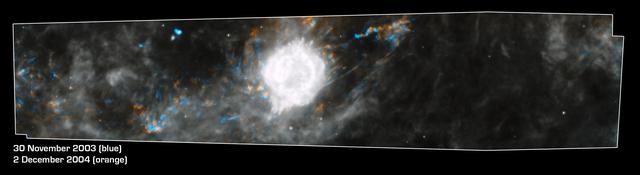
This Spitzer Space Telescope composite shows the supernova remnant Cassiopeia A white ball and surrounding clouds of dust gray, orange and blue. It consists of two processed images taken one year apart.
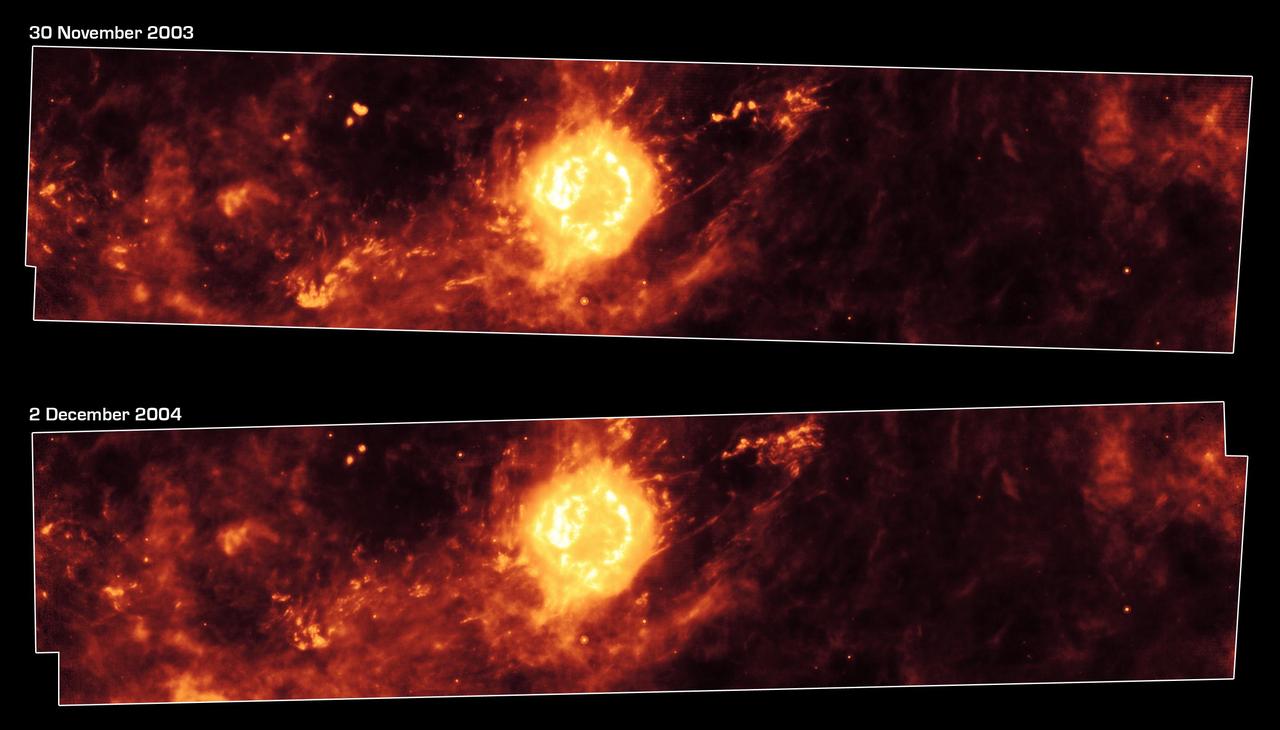
These images from NASA Spitzer Space Telescope, taken one year apart, show the supernova remnant Cassiopeia A yellow ball and surrounding clouds of dust reddish orange.
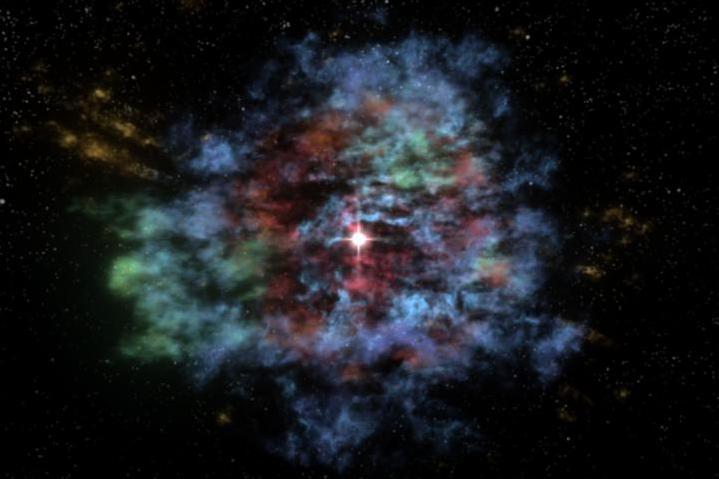
For the first time, a multiwavelength three-dimensional reconstruction of a supernova remnant has been created. This visualization of Cassiopeia A, or Cas A, the result of an explosion approximately 330 years ago, uses data from several NASA telescopes.
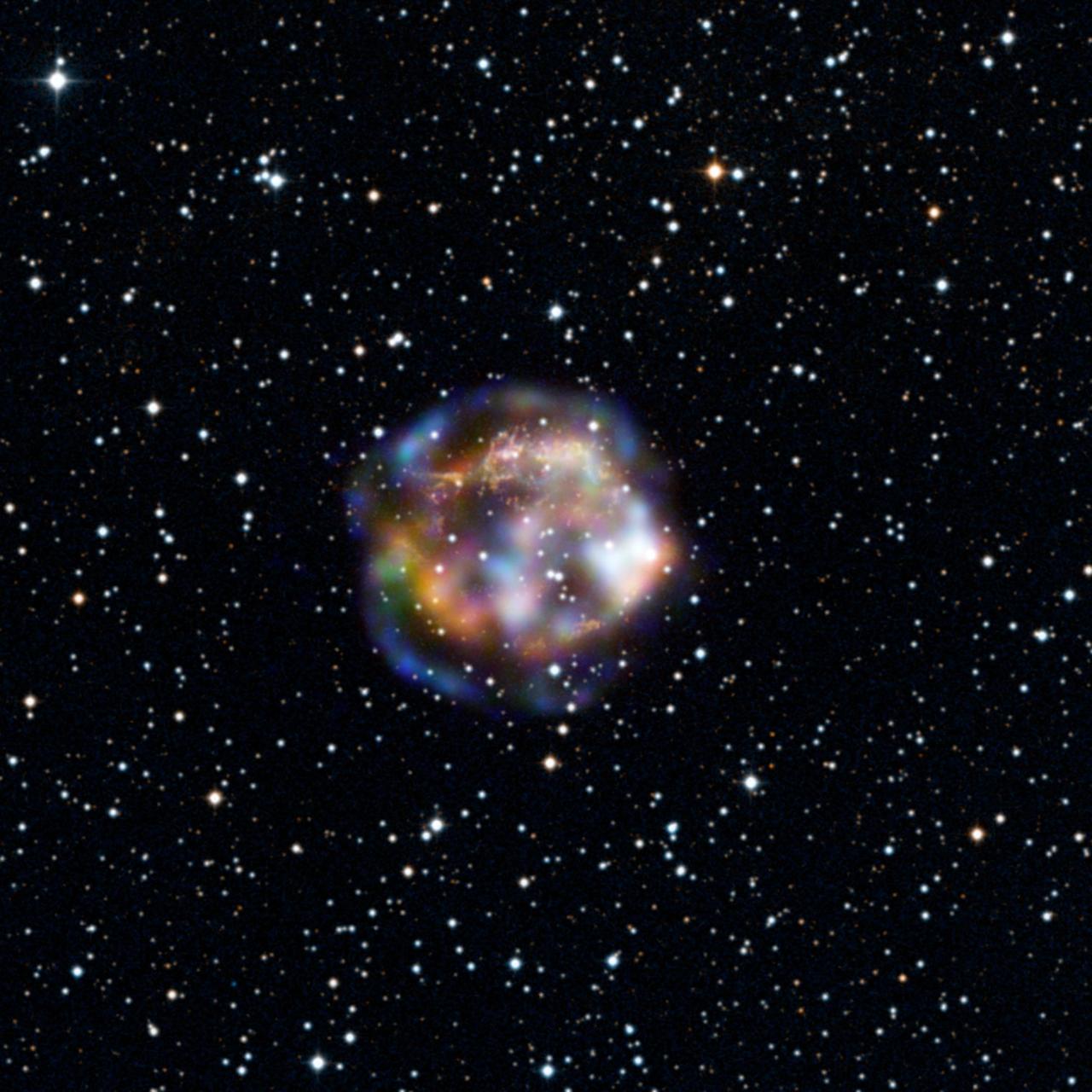
This new view of the historical supernova remnant Cassiopeia A, located 11,000 light-years away, was taken by NASA Nuclear Spectroscopic Telescope Array, or NuSTAR. While the star is long dead, its remains are still bursting with action.
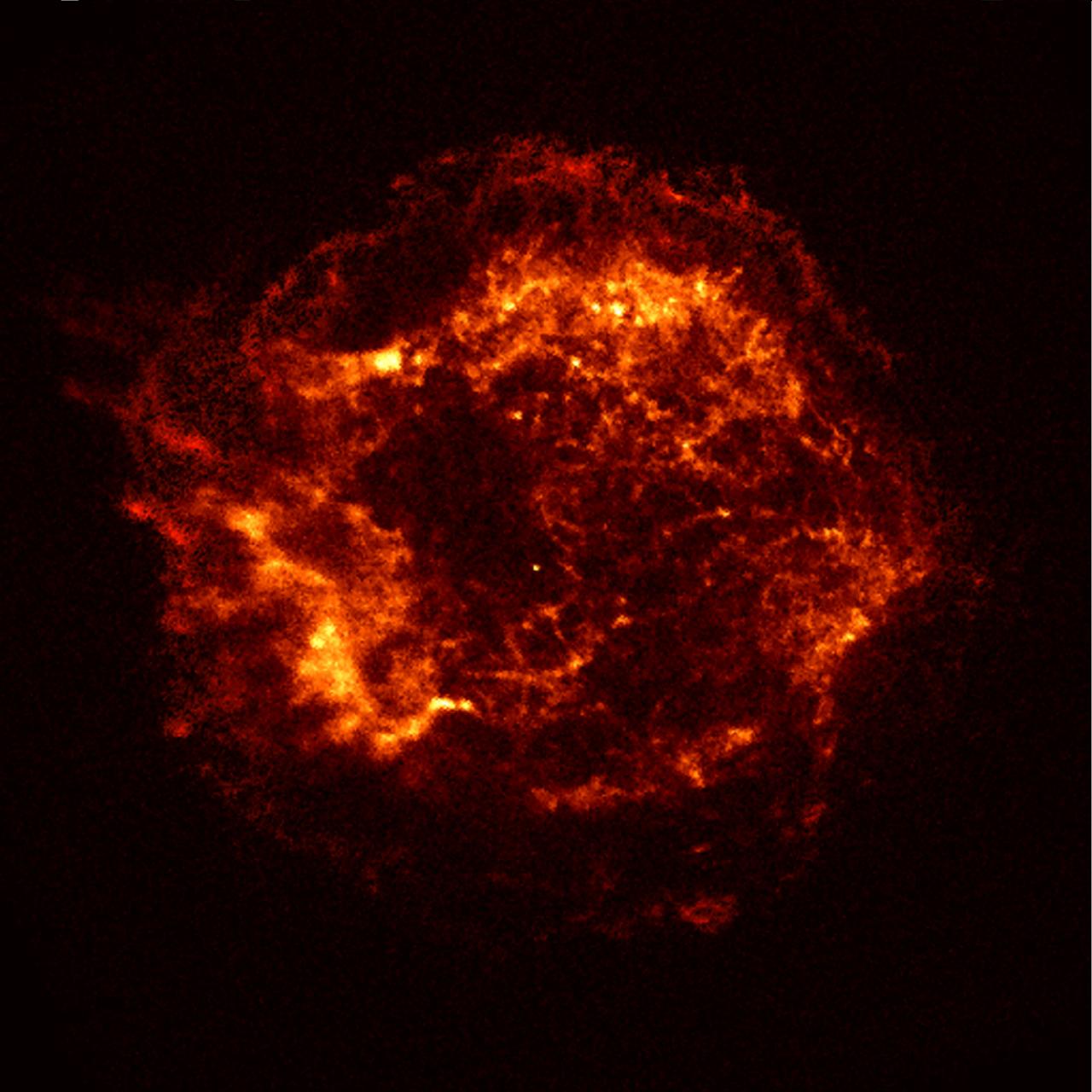
This x-ray image of the Cassiopeia A (CAS A) supernova remnant is the official first light image of the Chandra X-Ray Observatory (CXO). The 5,000-second image was made with the Advanced Charged Coupled Device (CCD) Image Spectrometer (ACIS). Two shock waves are visible: A fast outer shock and a slower irner shock. The inner shock wave is believed to be due to the collision of ejecta from the supernova explosion with a circumstellar shell of material, heating it to a temperature of 10 million-degrees Celsius. The outer shock wave is analogous to an awesome sonic boom resulting from this collision The x-rays reveal a bright object near the center, which may be the long-sought neutron star or black hole remnant of the explosion that produced Cassiopeia A. Cassiopeia A is the 320-year-old remnant of a massive star that exploded. Located in the constellation Cassiopeia, it is 10 light-years across and 10,000 light-years from Earth. A supernova occurs when a massive star has used up its nuclear fuel and the pressure drops in the central core of the star. The matter in the core is crushed by gravity to higher and higher densities, and temperatures reach billions of degrees. Under these extreme conditions, nuclear reactions occur violently and catastrophically, reversing the collapse. A thermonuclear shock wave races through the now expanding stellar debris, fusing lighter elements into heavier ones and producing a brilliant visual outburst.
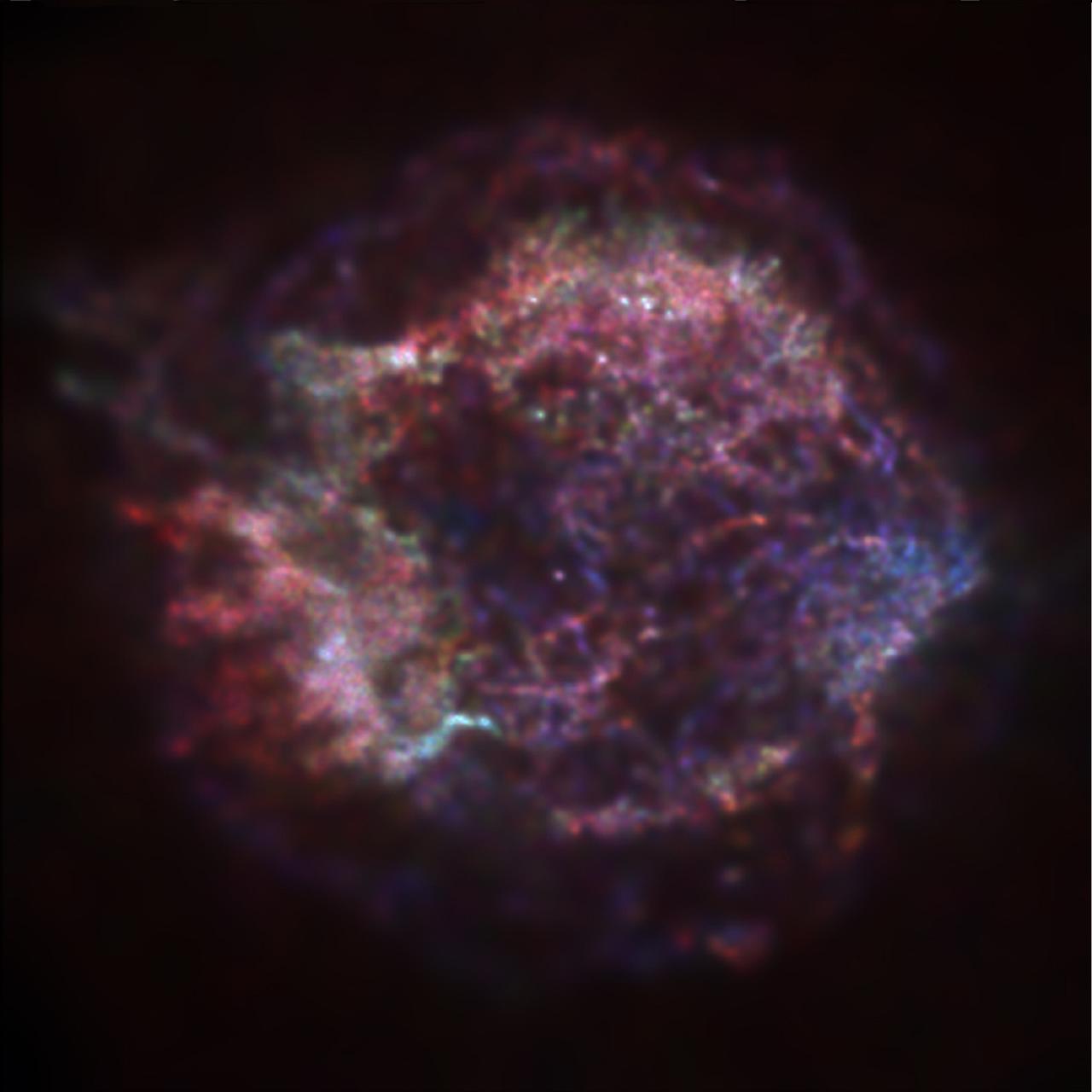
This is an extraordinary first image from the Chandra X-Ray Observatory (CXO), the supernova remnant Cassiopeia A, tracing the aftermath of a gigantic stellar explosion in such sturning detail that scientists can see evidence of what may be a neutron star or black hole near the center. The red, green, and blue regions in this image of the supernova remnant Cassiopeia A show where the intensity of low, medium, and high energy X-rays, respectively, is greatest. The red material on the left outer edge is enriched in iron, whereas the bright greenish white region on the low left is enriched in silicon and sulfur. In the blue region on the right edge, low and medium energy X-rays have been filtered out by a cloud of dust and gas in the remnant . The image was made with the CXO's Advanced Charged-Coupled Device (CCD) Imaging Spectrometer (ACIS). Photo credit: NASA/CXC/SAO/Rutgers/J.Hughes
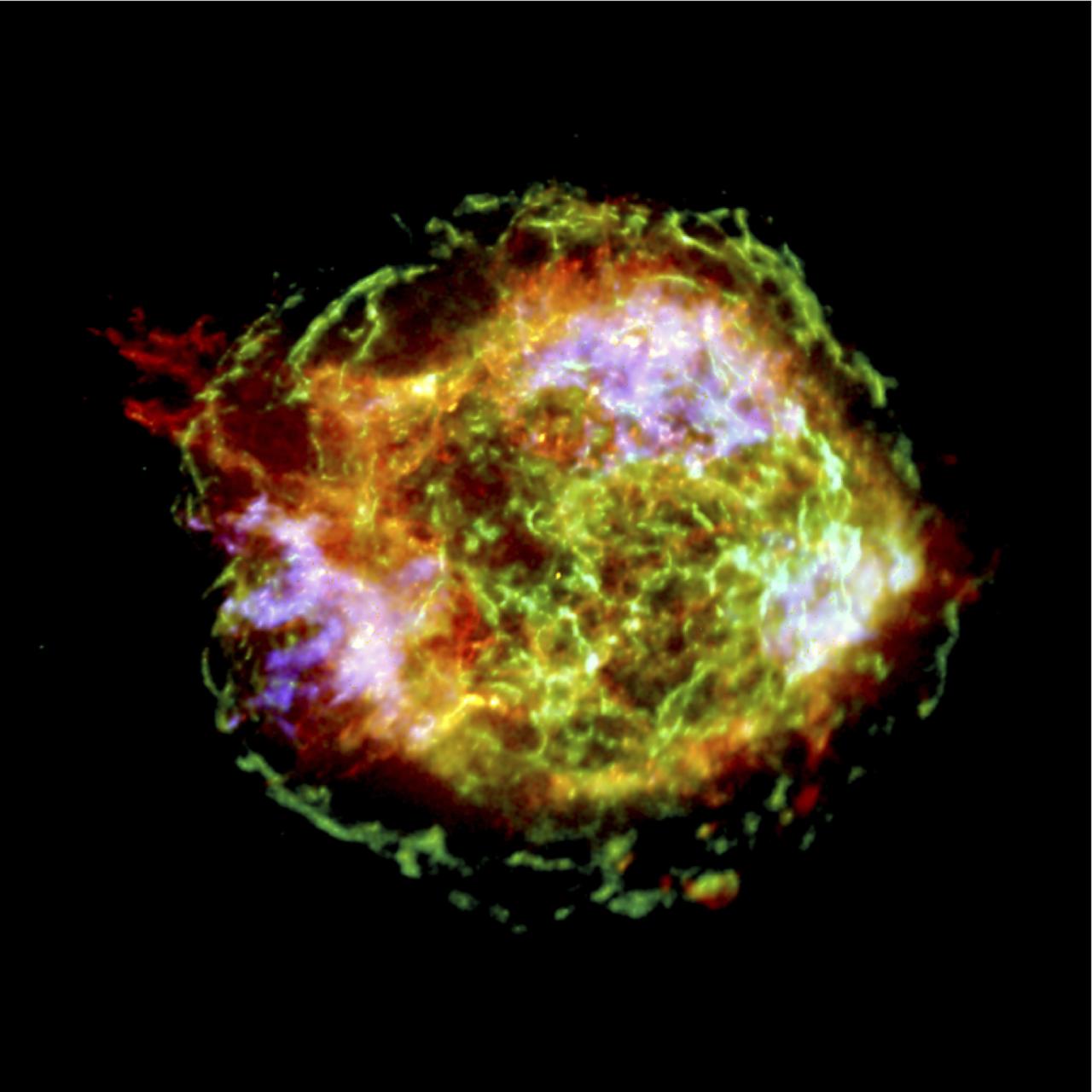
This spectacular Chandra X-Ray Observatory (CXO) image of the supernova remnant Cassiopeia A is the most detailed image ever made of the remains of an exploded star. The one-million-second image shows a bright outer ring (green) 10 light years in diameter that marks the location of a shock wave generated by the supernova explosion. In the upper left corner is a large jet-like structure that protrudes beyond the shock wave, and a counter-jet can be seen on the lower right. The x-ray spectra show that the jets are rich in silicon atoms, and relatively poor in iron atoms. This indicates that the jets formed soon after the initial explosion of the star, otherwise, the jets should have contained large quantities of iron from the star’s central regions. The bright blue areas are composed almost purely of iron gas, which was produced in the central, hottest regions of the star and somehow ejected in a direction almost perpendicular to the jets. The bright source at the center of the image is presumed to be a neutron star created during the supernova. Unlike most others, this neutron star is quiet, faint, and so far shows no evidence of pulsed radiation. A working hypothesis is that the explosion that created Cassiopeia A produced high speed jets similar to, but less energetic than, the hyper nova jets thought to produce gamma-ray bursts. During the explosion, the star may have developed an extremely strong magnetic filed that helped to accelerate the jets and later stifled any pulsar wind activity. CXO project management is the responsibility of NASA’s Marshall Space Flight Center in Huntsville, Alabama.
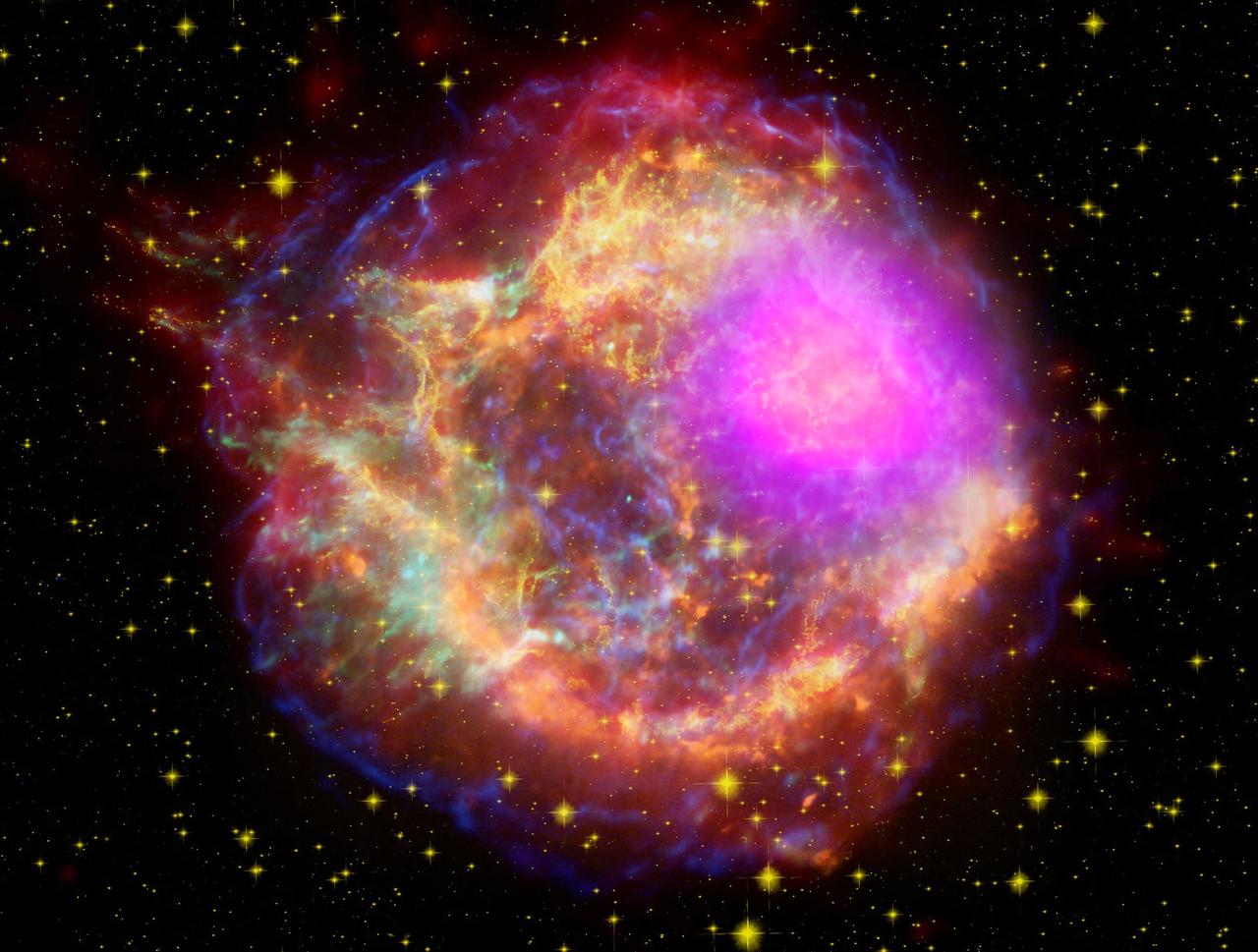
NASA's Fermi Closes on Source of Cosmic Rays New images from NASA's Fermi Gamma-ray Space Telescope show where supernova remnants emit radiation a billion times more energetic than visible light. The images bring astronomers a step closer to understanding the source of some of the universe's most energetic particles -- cosmic rays. This composite shows the Cassiopeia A supernova remnant across the spectrum: Gamma rays (magenta) from NASA's Fermi Gamma-ray Space Telescope; X-rays (blue, green) from NASA's Chandra X-ray Observatory; visible light (yellow) from the Hubble Space Telescope; infrared (red) from NASA's Spitzer Space Telescope; and radio (orange) from the Very Large Array near Socorro, N.M. Credit: NASA/DOE/Fermi LAT Collaboration, CXC/SAO/JPL-Caltech/Steward/O. Krause et al., and NRAO/AUI For more information: <a href="http://www.nasa.gov/mission_pages/GLAST/news/cosmic-rays-source.html" rel="nofollow">www.nasa.gov/mission_pages/GLAST/news/cosmic-rays-source....</a> <b><a href="http://www.nasa.gov/centers/goddard/home/index.html" rel="nofollow">NASA Goddard Space Flight Center</a></b> is home to the nation's largest organization of combined scientists, engineers and technologists that build spacecraft, instruments and new technology to study the Earth, the sun, our solar system, and the universe. <b>Follow us on <a href="http://twitter.com/NASA_GoddardPix" rel="nofollow">Twitter</a></b> <b>Join us on <a href="http://www.facebook.com/pages/Greenbelt-MD/NASA-Goddard/395013845897?ref=tsd" rel="nofollow">Facebook</a><b> </b></b>