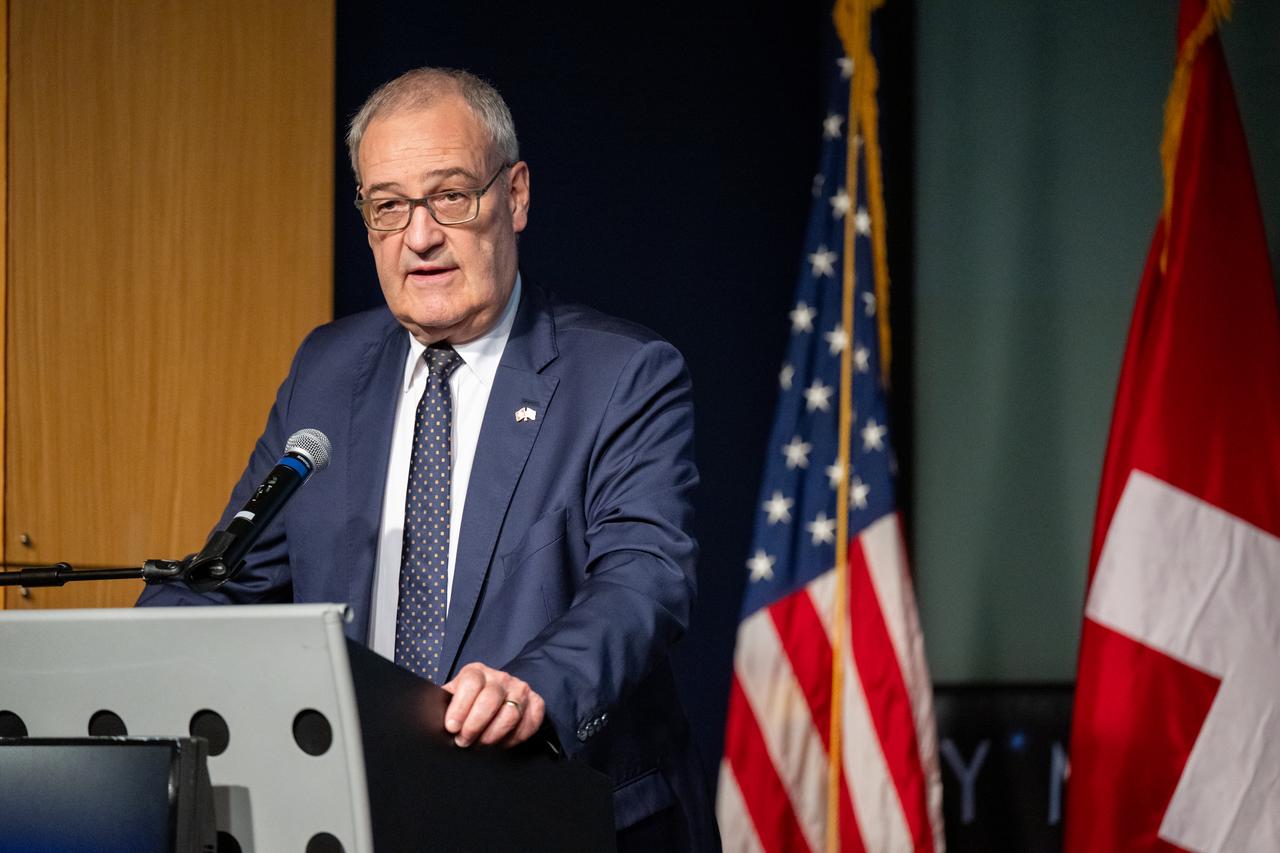
Swiss Federal Councillor Guy Parmelin delivers remarks during an Artemis Accords signing ceremony, Monday, April 15, 2024, at the Mary W. Jackson NASA Headquarters building in Washington. Switzerland is the 37th country to sign the Artemis Accords, which establish a practical set of principles to guide space exploration cooperation among nations participating in NASA’s Artemis program. Photo Credit: (NASA/Keegan Barber)
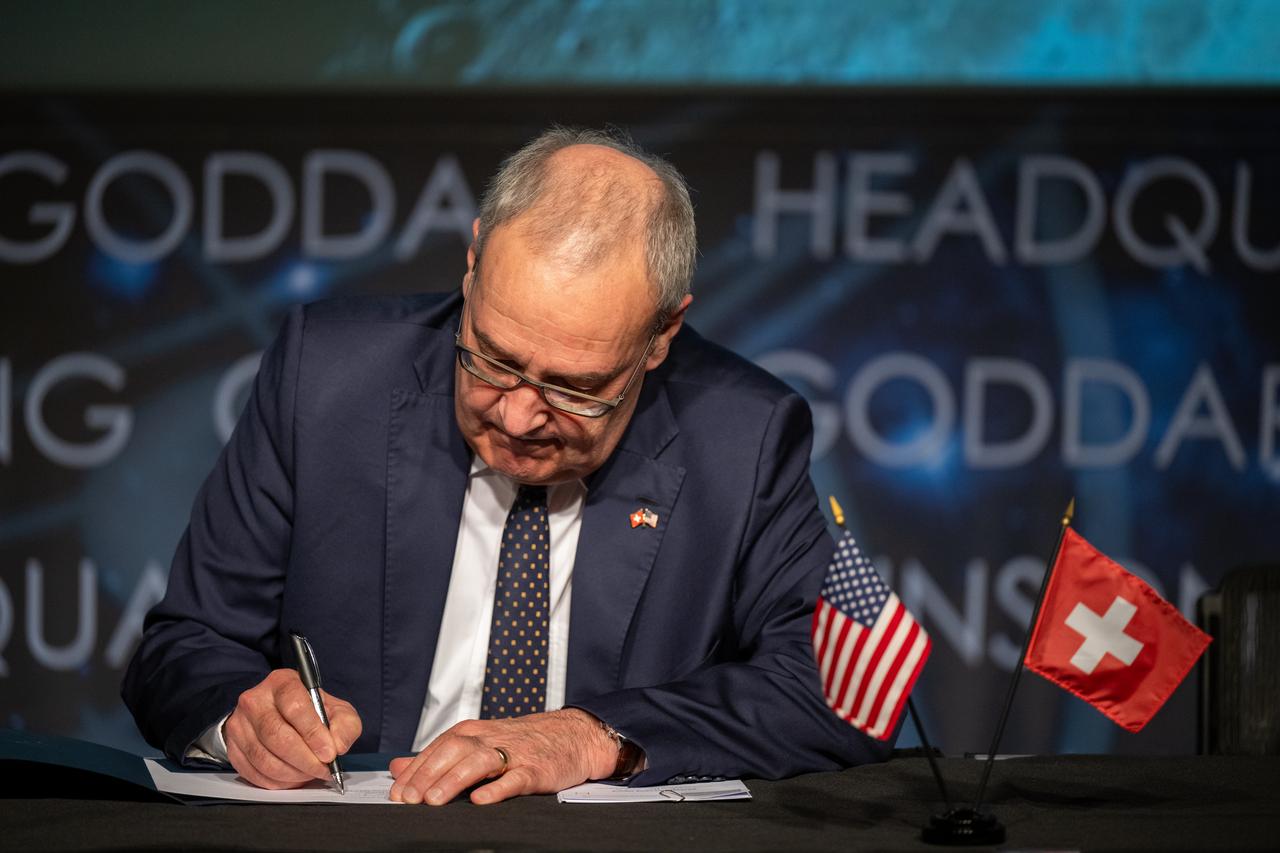
Swiss Federal Councillor Guy Parmelin signs the Artemis Accords, Monday, April 15, 2024, at the Mary W. Jackson NASA Headquarters building in Washington. Switzerland is the 37th country to sign the Artemis Accords, which establish a practical set of principles to guide space exploration cooperation among nations participating in NASA’s Artemis program. Photo Credit: (NASA/Keegan Barber)
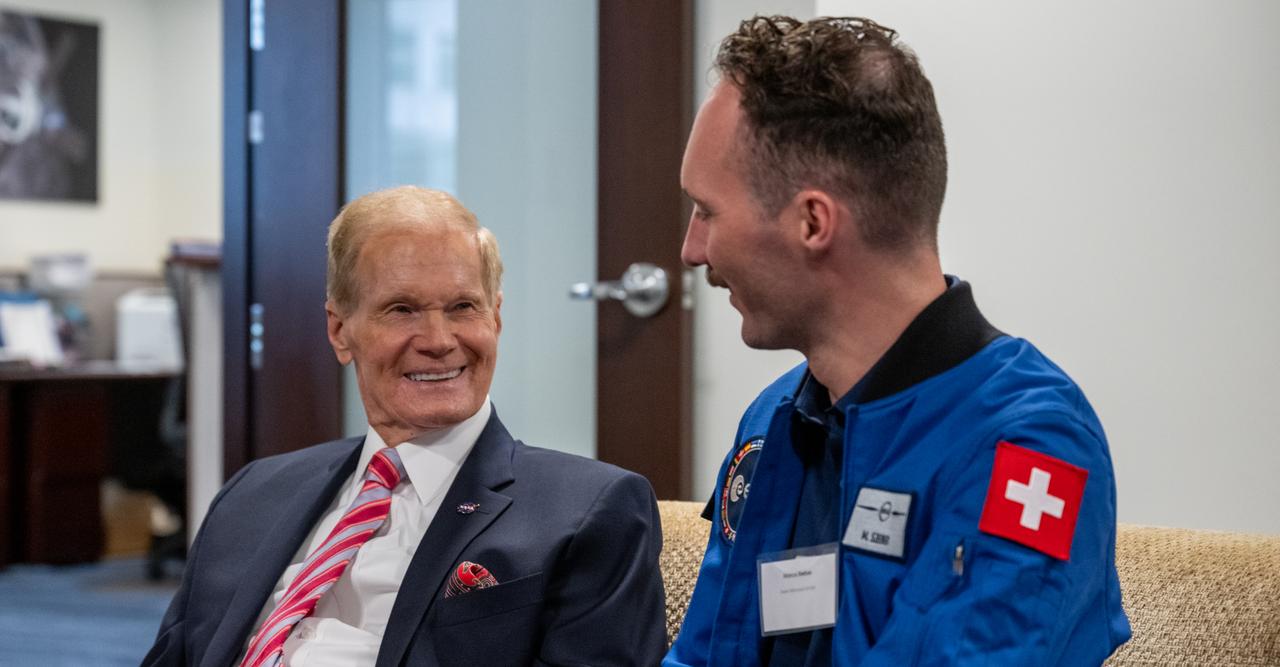
NASA Administrator Bill Nelson, left, and ESA (European Space Agency) astronaut Marco Sieber, right, meet prior to an Artemis Accords signing ceremony, Monday, April 15, 2024, at the Mary W. Jackson NASA Headquarters building in Washington. Switzerland is the 37th country to sign the Artemis Accords, which establish a practical set of principles to guide space exploration cooperation among nations participating in NASA’s Artemis program. Photo Credit: (NASA/Keegan Barber)
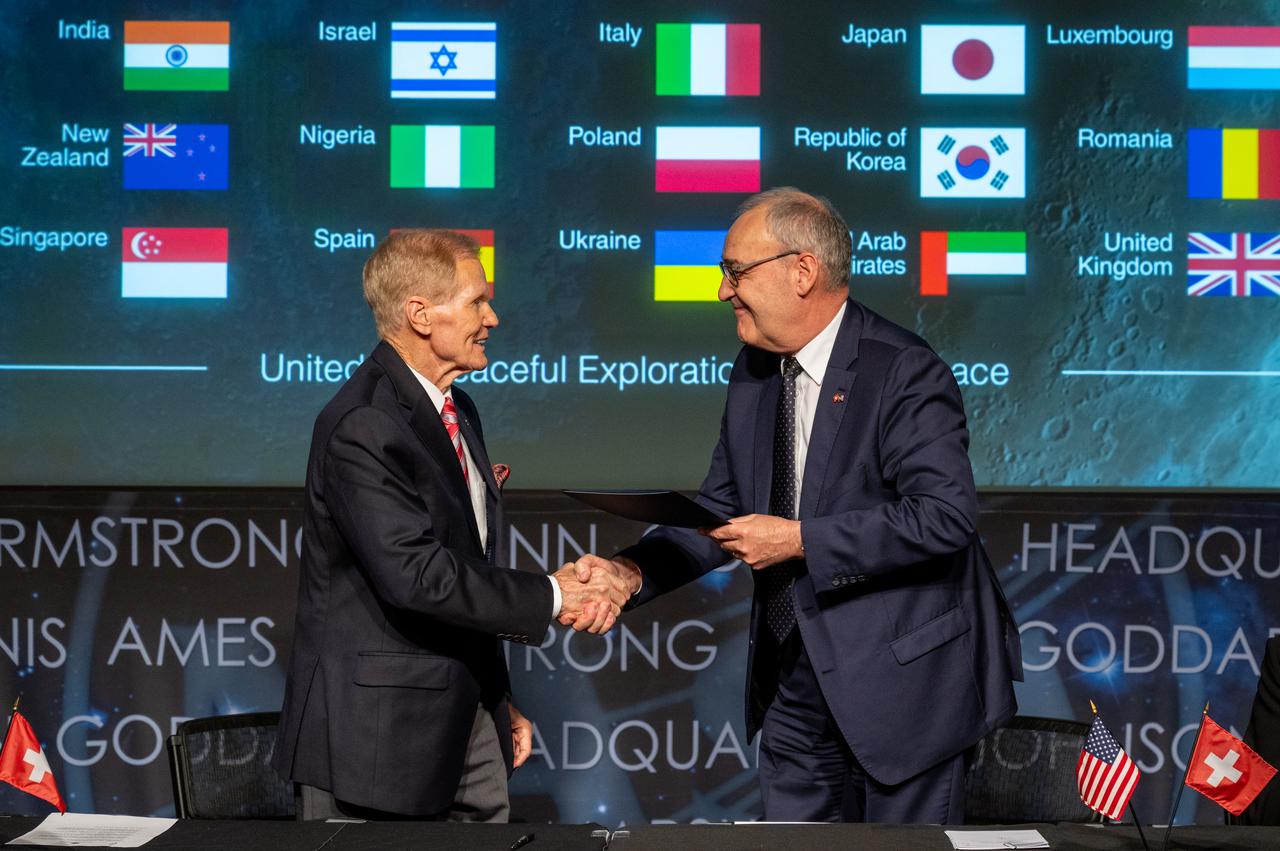
Swiss Federal Councillor Guy Parmelin, right, shakes hands with NASA Administrator Bill Nelson, left, after signing the Artemis Accords, Monday, April 15, 2024, at the Mary W. Jackson NASA Headquarters building in Washington. Switzerland is the 37th country to sign the Artemis Accords, which establish a practical set of principles to guide space exploration cooperation among nations participating in NASA’s Artemis program. Photo Credit: (NASA/Keegan Barber)
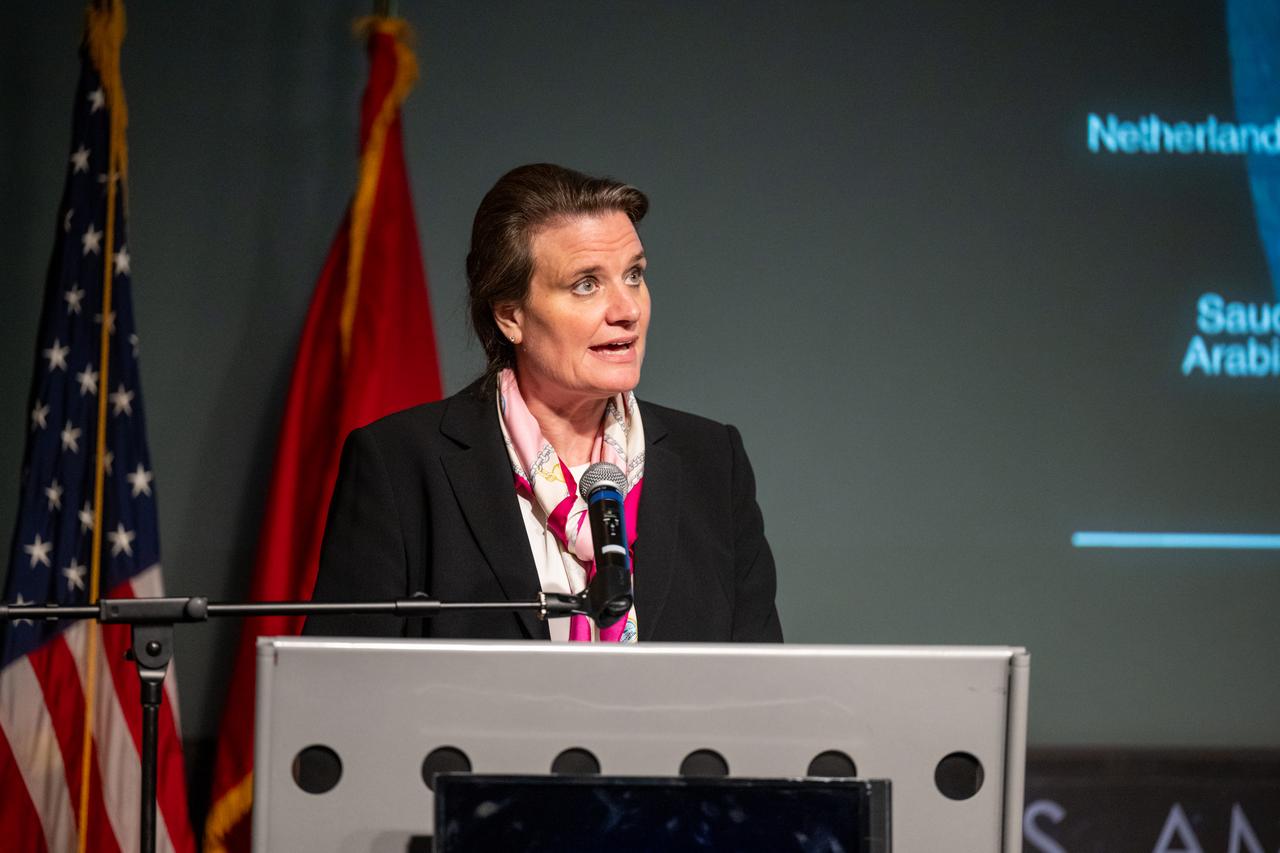
Swiss State Secretary Martina Hirayama delivers remarks during an Artemis Accords signing ceremony, Monday, April 15, 2024, at the Mary W. Jackson NASA Headquarters building in Washington. Switzerland is the 37th country to sign the Artemis Accords, which establish a practical set of principles to guide space exploration cooperation among nations participating in NASA’s Artemis program. Photo Credit: (NASA/Keegan Barber)
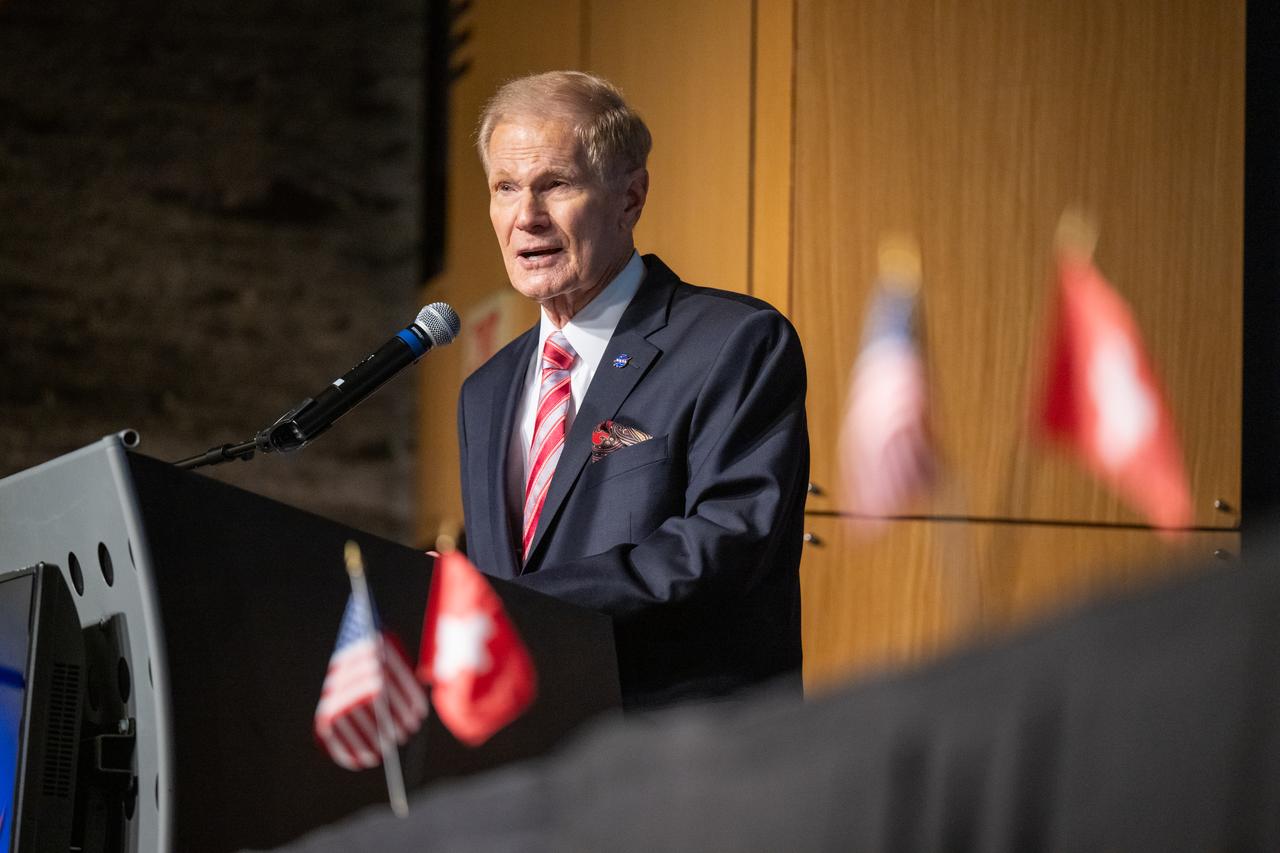
NASA Administrator Bill Nelson delivers remarks during an Artemis Accords signing ceremony, Monday, April 15, 2024, at the Mary W. Jackson NASA Headquarters building in Washington. Switzerland is the 37th country to sign the Artemis Accords, which establish a practical set of principles to guide space exploration cooperation among nations participating in NASA’s Artemis program. Photo Credit: (NASA/Keegan Barber)
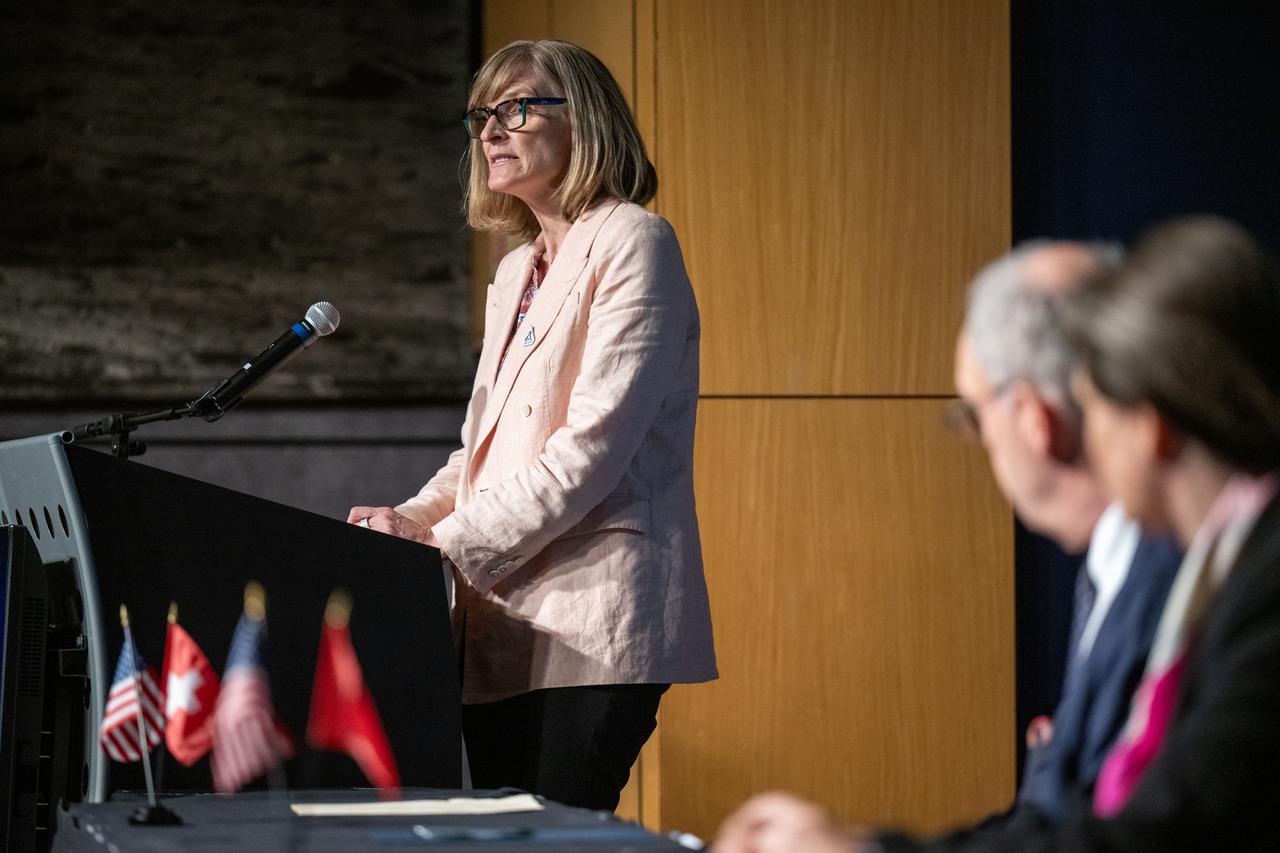
Acting Department of State Deputy Assistant Secretary Valda Vikmanis delivers remarks during an Artemis Accords signing ceremony, Monday, April 15, 2024, at the Mary W. Jackson NASA Headquarters building in Washington. Switzerland is the 37th country to sign the Artemis Accords, which establish a practical set of principles to guide space exploration cooperation among nations participating in NASA’s Artemis program. Photo Credit: (NASA/Keegan Barber)
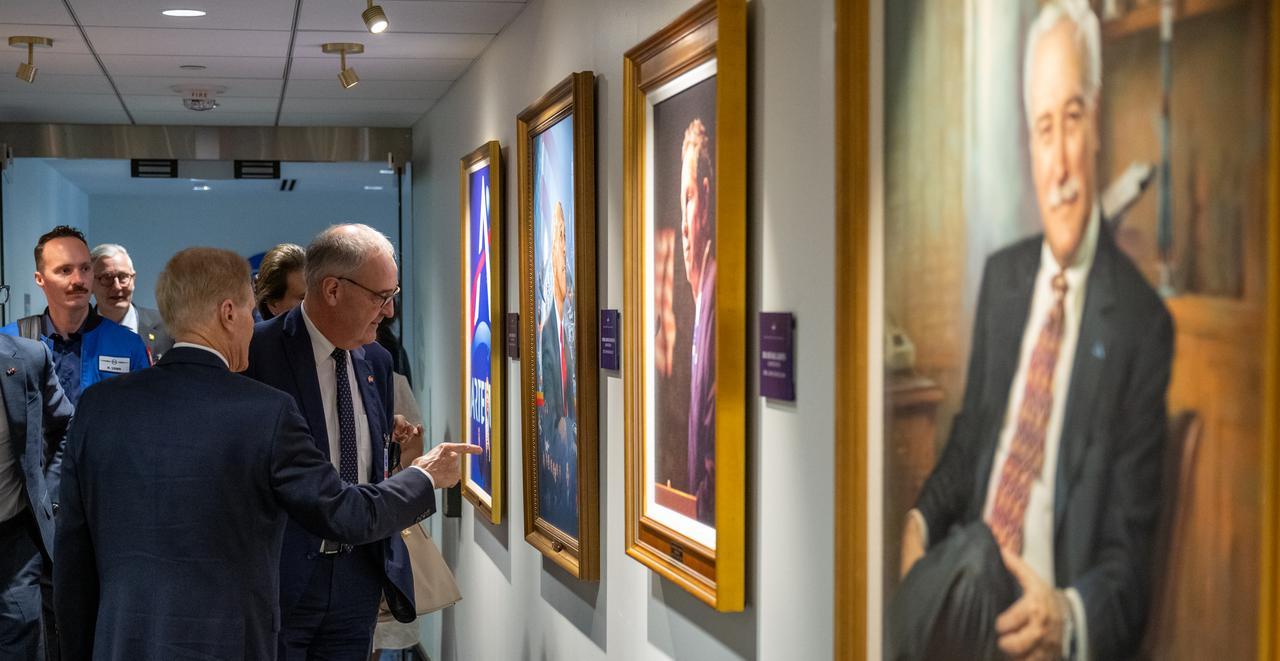
NASA Administrator Bill Nelson shows portraits of former NASA Administrators to members of a Swiss delegation prior to an Artemis Accords signing ceremony, Monday, April 15, 2024, at the Mary W. Jackson NASA Headquarters building in Washington. Switzerland is the 37th country to sign the Artemis Accords, which establish a practical set of principles to guide space exploration cooperation among nations participating in NASA’s Artemis program. Photo Credit: (NASA/Keegan Barber)
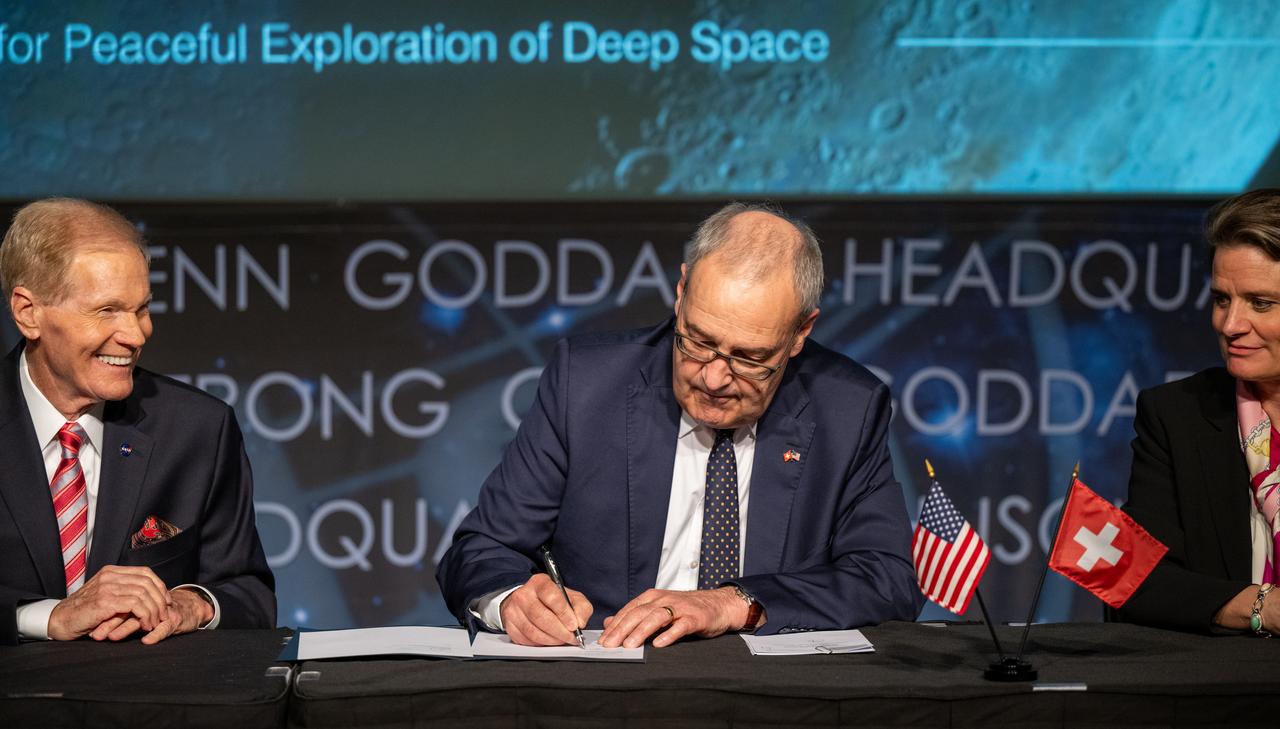
Swiss Federal Councillor Guy Parmelin signs the Artemis Accords as NASA Administrator Bill Nelson, left, and Swiss State Secretary Martina Hirayama, right, look on, Monday, April 15, 2024, at the Mary W. Jackson NASA Headquarters building in Washington. Switzerland is the 37th country to sign the Artemis Accords, which establish a practical set of principles to guide space exploration cooperation among nations participating in NASA’s Artemis program. Photo Credit: (NASA/Keegan Barber)
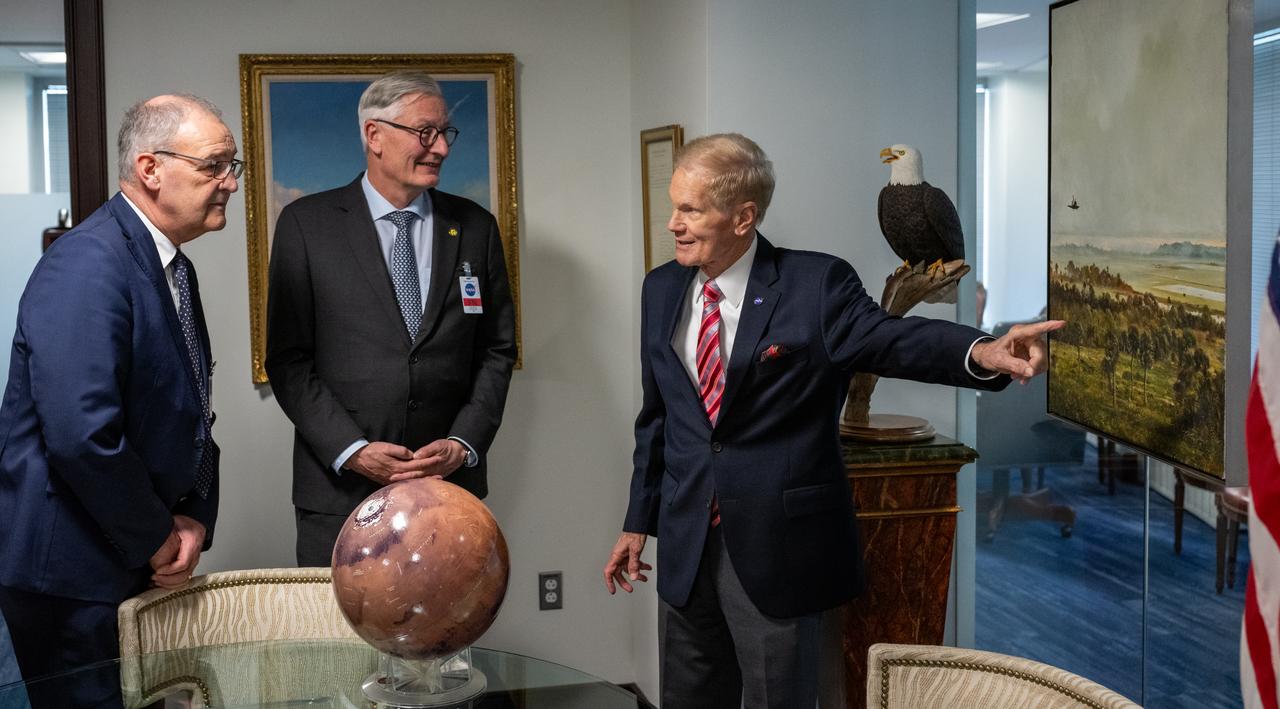
From left to right, Swiss Federal Councillor Guy Parmelin, Swiss Ambassador to the United States Jacques Pitteloud, and NASA Administrator Bill Nelson meet prior to an Artemis Accords signing ceremony, Monday, April 15, 2024, at the Mary W. Jackson NASA Headquarters building in Washington. Switzerland is the 37th country to sign the Artemis Accords, which establish a practical set of principles to guide space exploration cooperation among nations participating in NASA’s Artemis program. Photo Credit: (NASA/Keegan Barber)
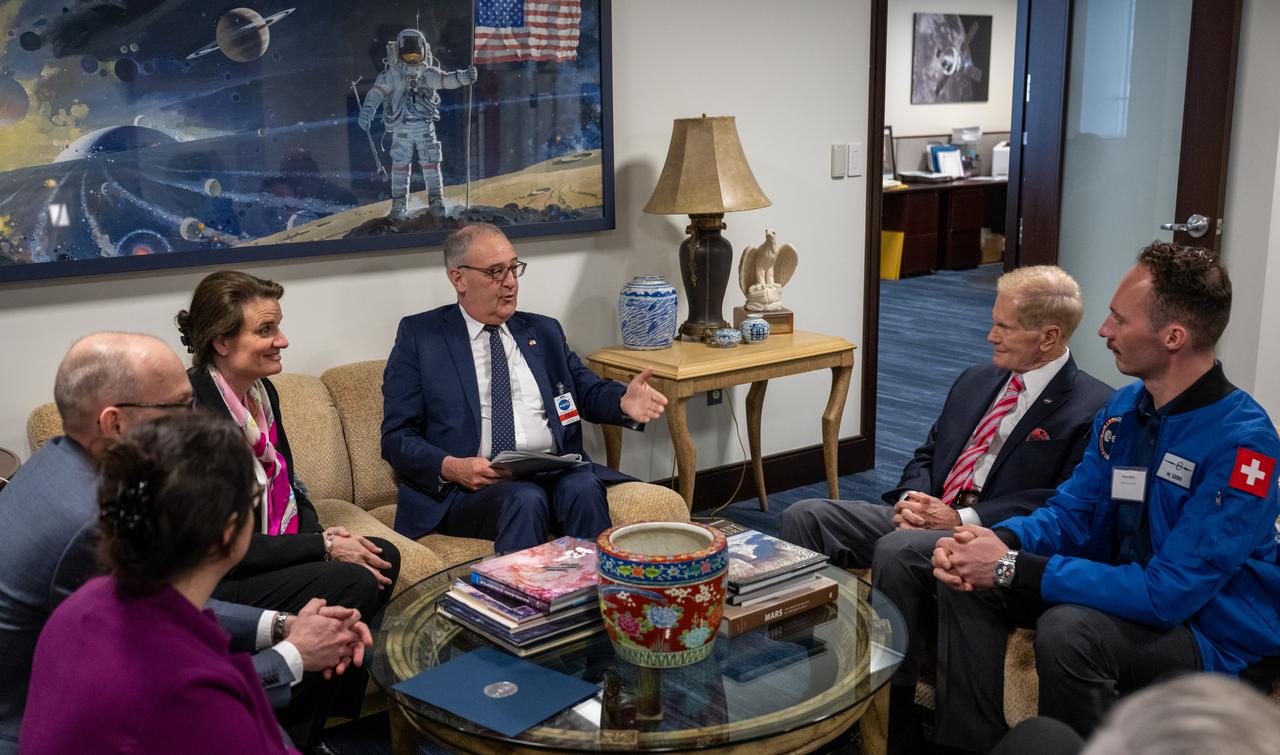
From left to right, Swiss State Secretary Martina Hirayama, Swiss Federal Councillor Guy Parmelin, NASA Administrator Bill Nelson, and ESA (European Space Agency) astronaut Marco Sieber, meet prior to an Artemis Accords signing ceremony, Monday, April 15, 2024, at the Mary W. Jackson NASA Headquarters building in Washington. Switzerland is the 37th country to sign the Artemis Accords, which establish a practical set of principles to guide space exploration cooperation among nations participating in NASA’s Artemis program. Photo Credit: (NASA/Keegan Barber)
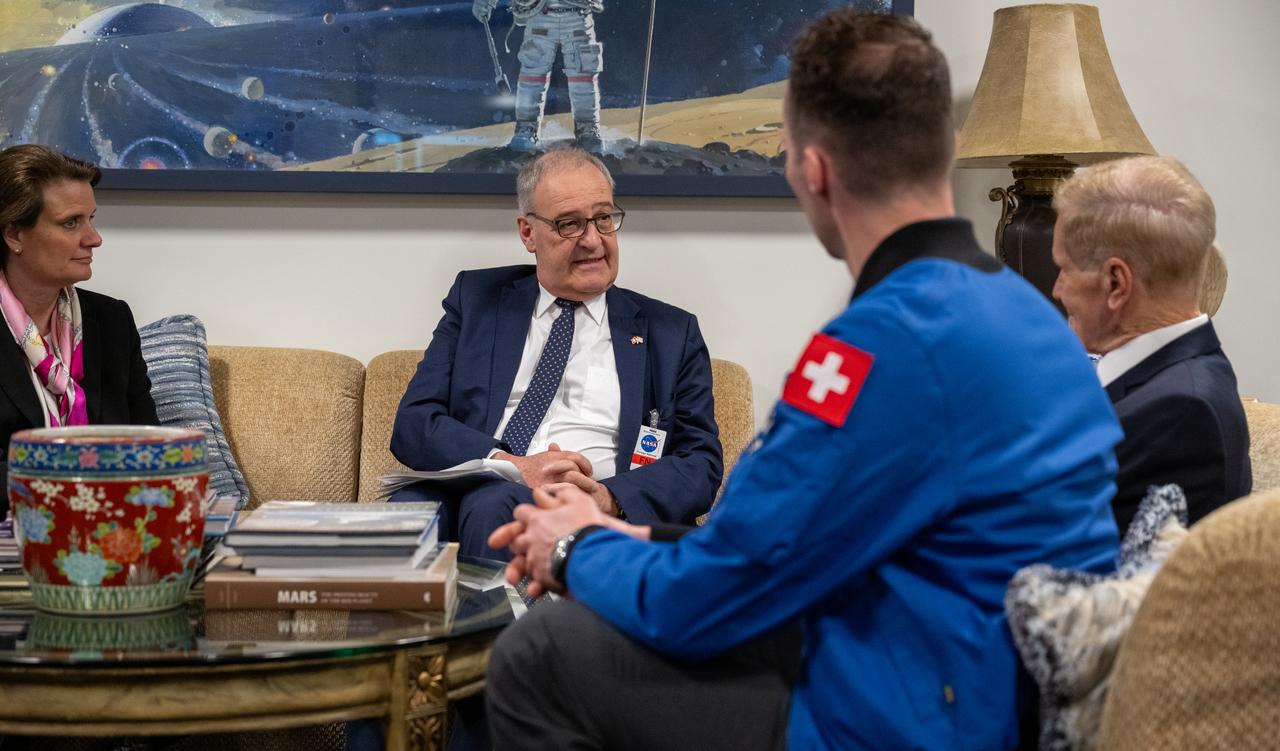
From left to right, Swiss State Secretary Martina Hirayama, Swiss Federal Councillor Guy Parmelin, NASA Administrator Bill Nelson, and ESA (European Space Agency) astronaut Marco Sieber, meet prior to an Artemis Accords signing ceremony, Monday, April 15, 2024, at the Mary W. Jackson NASA Headquarters building in Washington. Switzerland is the 37th country to sign the Artemis Accords, which establish a practical set of principles to guide space exploration cooperation among nations participating in NASA’s Artemis program. Photo Credit: (NASA/Keegan Barber)

Acting Department of State Deputy Assistant Secretary Valda Vikmanis delivers remarks as, seated left to right, NASA Administrator Bill Nelson, Swiss Federal Councillor Guy Parmelin, and Swiss State Secretary Martina Hirayama, look on during an Artemis Accords signing ceremony, Monday, April 15, 2024, at the Mary W. Jackson NASA Headquarters building in Washington. Switzerland is the 37th country to sign the Artemis Accords, which establish a practical set of principles to guide space exploration cooperation among nations participating in NASA’s Artemis program. Photo Credit: (NASA/Keegan Barber)
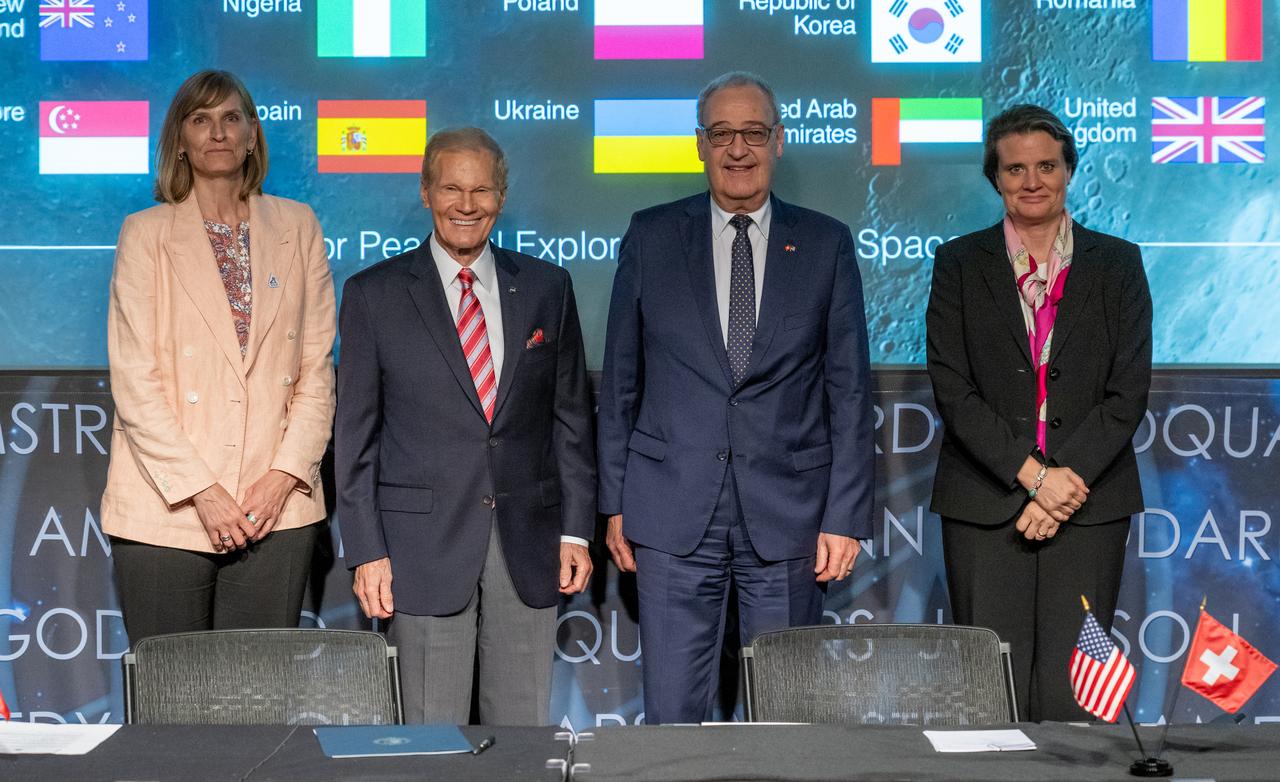
From left to right, Acting Department of State Deputy Assistant Secretary Valda Vikmanis, NASA Administrator Bill Nelson, Swiss Federal Councillor Guy Parmelin, and Swiss State Secretary Martina Hirayama, pose for a photo during an Artemis Accords signing ceremony, Monday, April 15, 2024, at the Mary W. Jackson NASA Headquarters building in Washington. Switzerland is the 37th country to sign the Artemis Accords, which establish a practical set of principles to guide space exploration cooperation among nations participating in NASA’s Artemis program. Photo Credit: (NASA/Keegan Barber)
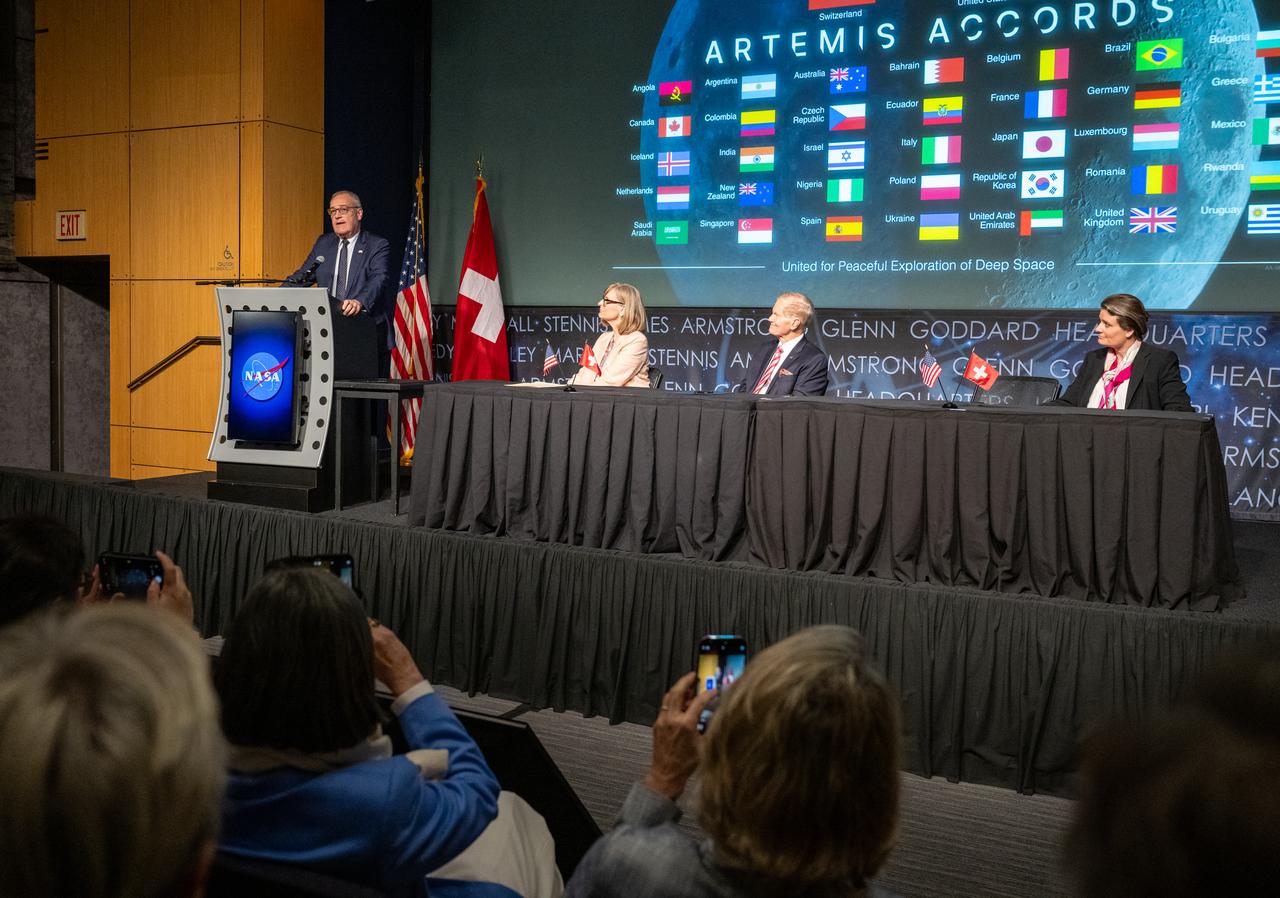
Swiss Federal Councillor Guy Parmelin delivers remarks as, seated left to right, Acting Department of State Deputy Assistant Secretary Valda Vikmanis, NASA Administrator Bill Nelson, and Swiss State Secretary Martina Hirayama, look on during an Artemis Accords signing ceremony, Monday, April 15, 2024, at the Mary W. Jackson NASA Headquarters building in Washington. Switzerland is the 37th country to sign the Artemis Accords, which establish a practical set of principles to guide space exploration cooperation among nations participating in NASA’s Artemis program. Photo Credit: (NASA/Keegan Barber)
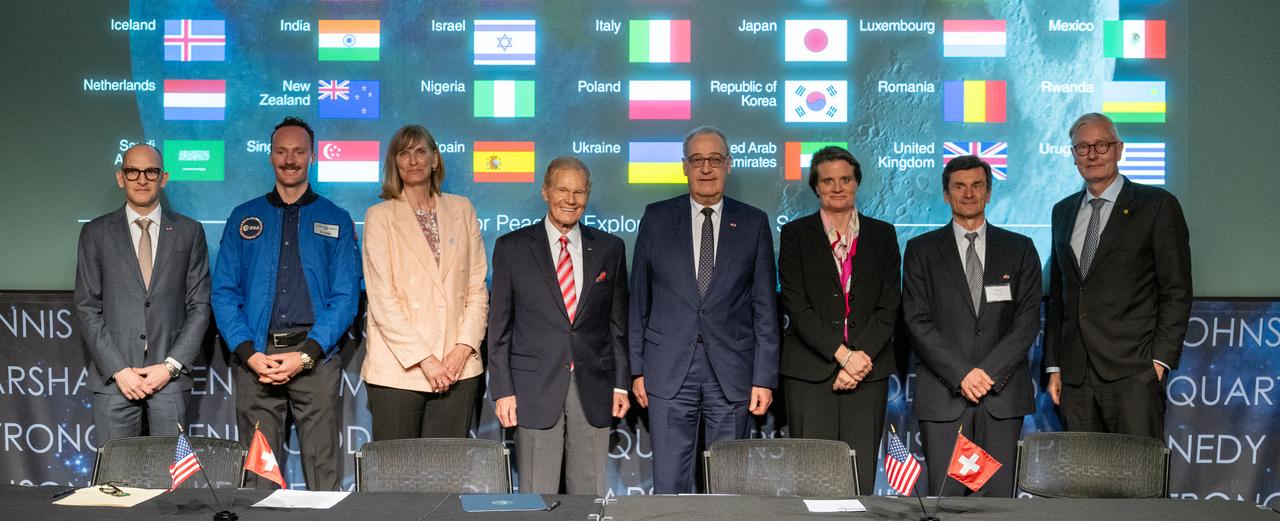
From left to right, Head of Swiss Space Office Renato Krpoun, ESA (European Space Agency) astronaut Marco Sieber, Acting Department of State Deputy Assistant Secretary Valda Vikmanis, NASA Administrator Bill Nelson, Swiss Federal Councillor Guy Parmelin, and Swiss State Secretary Martina Hirayama, University of Bern Director Space & Planetary Sciences Peter Wurz, and Swiss Ambassador to the United States Jacques Pitteloud, pose for a photo during an Artemis Accords signing ceremony, Monday, April 15, 2024, at the Mary W. Jackson NASA Headquarters building in Washington. Switzerland is the 37th country to sign the Artemis Accords, which establish a practical set of principles to guide space exploration cooperation among nations participating in NASA’s Artemis program. Photo Credit: (NASA/Keegan Barber)

Aletsch Glacier, the largest glacier of Europe, covers more than 120 square kilometers (more than 45 square miles) in southern Switzerland. At its eastern extremity lies a glacierlake, Mdrjelensee (2,350 meters/7,711 feet above sea level). To the west rises Aletschhorn (4,195 meters/13,763 feet), which was first climbed in 1859. The Rhone River flows along the southern flank of the mountains. This image was acquired on July 23, 2001 by the Advanced Spaceborne Thermal Emission and Reflection Radiometer (ASTER) on NASA's Terra satellite. With its 14 spectral bands from the visible to the thermal infrared wavelength region, and its high spatial resolution of 15 to 90 meters (about 50 to 300 feet), ASTER will image Earth for the next 6 years to map and monitor the changing surface of our planet. ASTER is one of five Earth-observing instruments launched December 18, 1999, on NASA's Terra satellite. The instrument was built by Japan's Ministry of Economy, Trade and Industry. A joint U.S./Japan science team is responsible for validation and calibration of the instrument and the data products. http://photojournal.jpl.nasa.gov/catalog/PIA03857

Lake Constance, bordered by Switzerland, Germany, and Austria. This image from NASA Terra satellite is MISR Mystery Image Quiz #2.
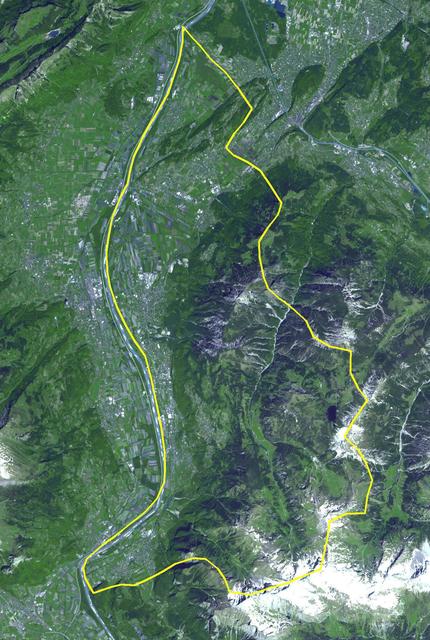
This image acquired by NASA Terra spacecraft is of the Principality of Liechtenstein, a landlocked alpine country between Austria and Switzerland.

SL3-121-2438 (July-September 1973) --- The Alps of Switzerland, France and Italy are featured in this exceptional photograph taken by a hand-held camera from the Skylab space station during the second manned Skylab mission. Also visible in the out-the-window 70mm Hasselblad view are Lake Geneva, Lake of Lucerne, Rhone River and many other features. The Skylab 3 crewmen, astronauts Alan L. Bean, Owen K. Garriott and Jack R. Lousma completed a 59-day mission with a successful splashdown on Sept. 25, 1973. Photo credit: NASA
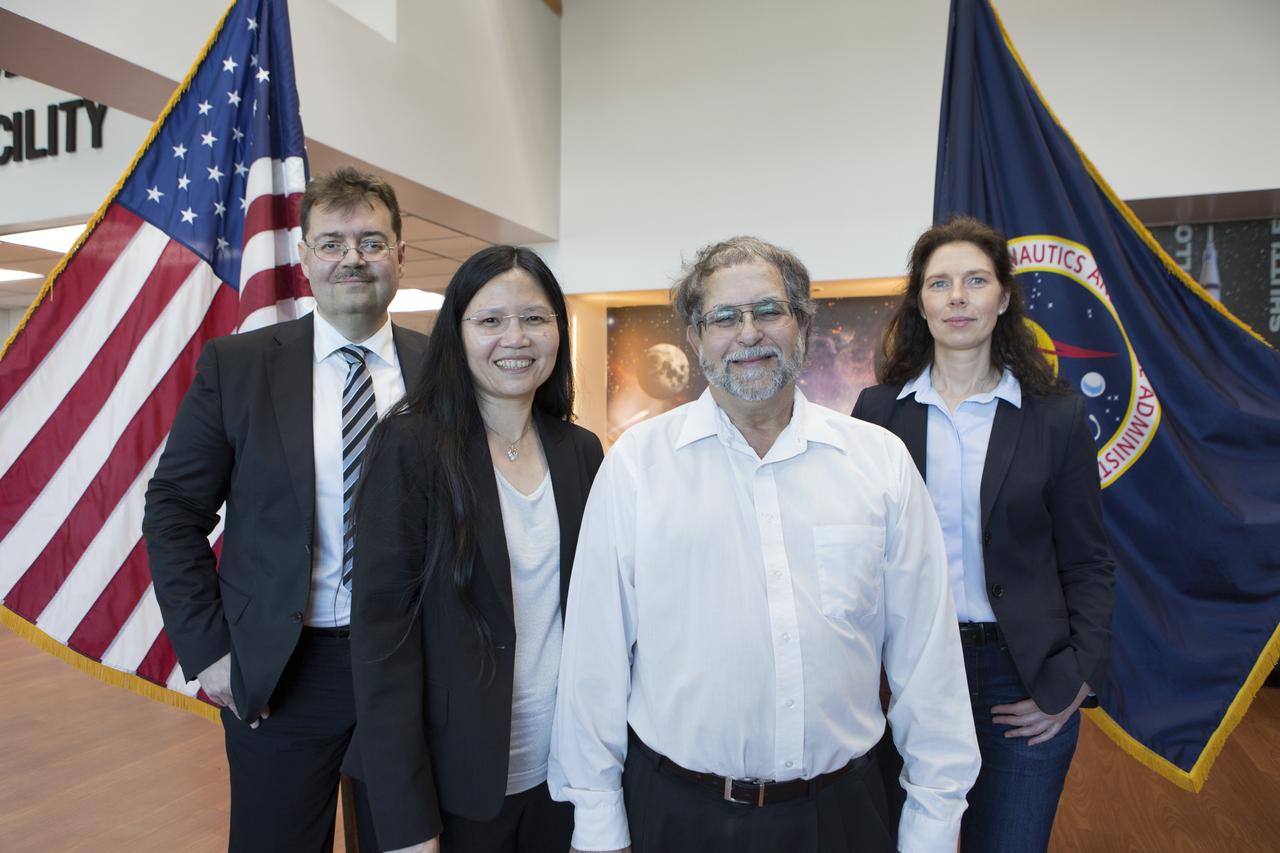
From left to right: Dr. Oliver Ullrich from the University of Zurich, Dr. Ye Zhang and Dr. Howard Levine of NASA's Kennedy Space Center, and Dr. Cora Thiel of the University of Zurich stood in the Space Station Processing Facility on Dec. 18, 2018. NASA recently signed a Space Act Agreement with the university, which is located in Switzerland, to collaborate on biological research. The team is studying gene expression in altered gravity.
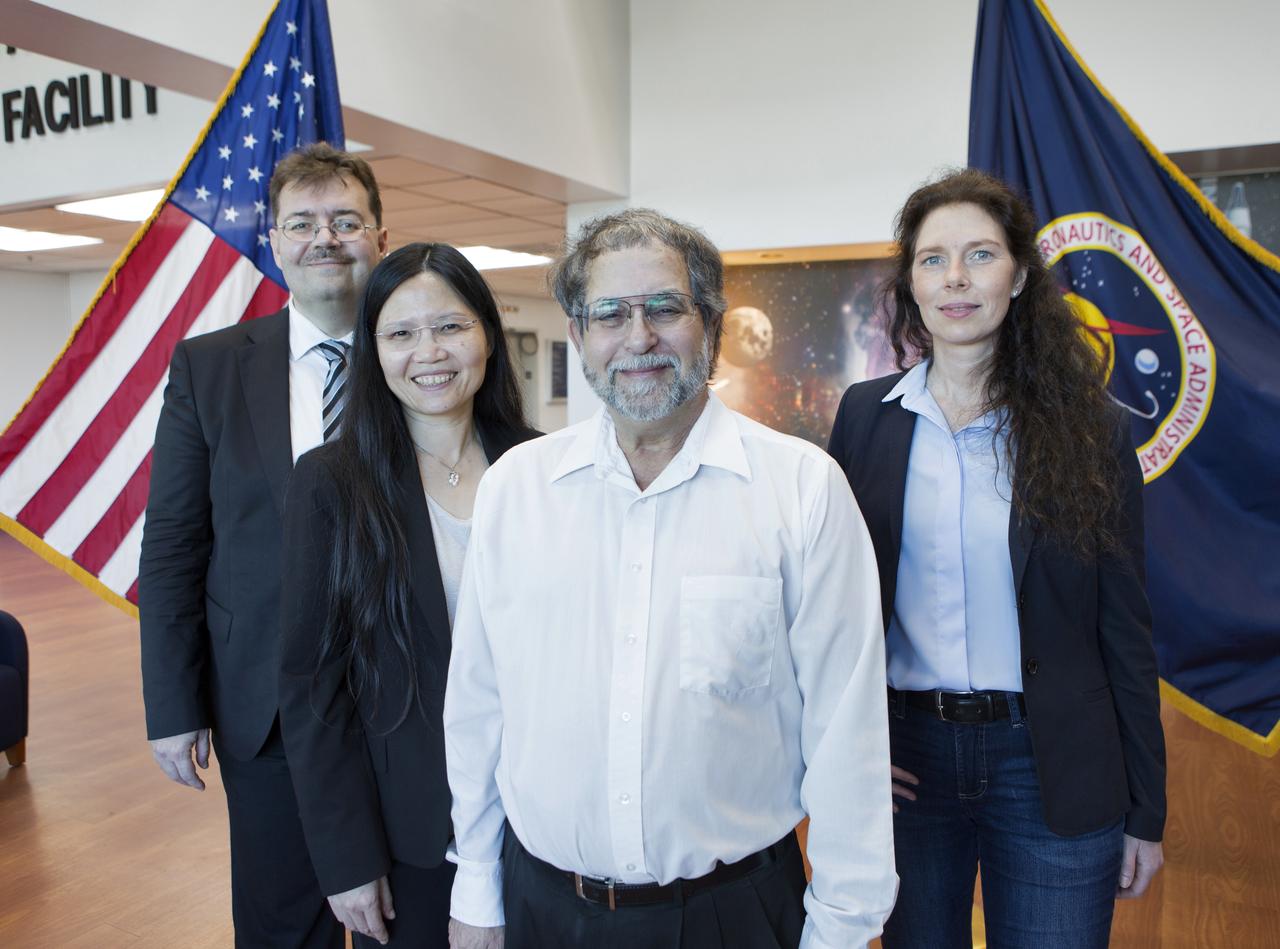
From left to right: Dr. Oliver Ullrich from the University of Zurich, Dr. Ye Zhang and Dr. Howard Levine of NASA's Kennedy Space Center, and Dr. Cora Thiel of the University of Zurich stood in the Space Station Processing Facility on Dec. 18, 2018. NASA recently signed a Space Act Agreement with the university, which is located in Switzerland, to collaborate on biological research. The team is studying gene expression in altered gravity.
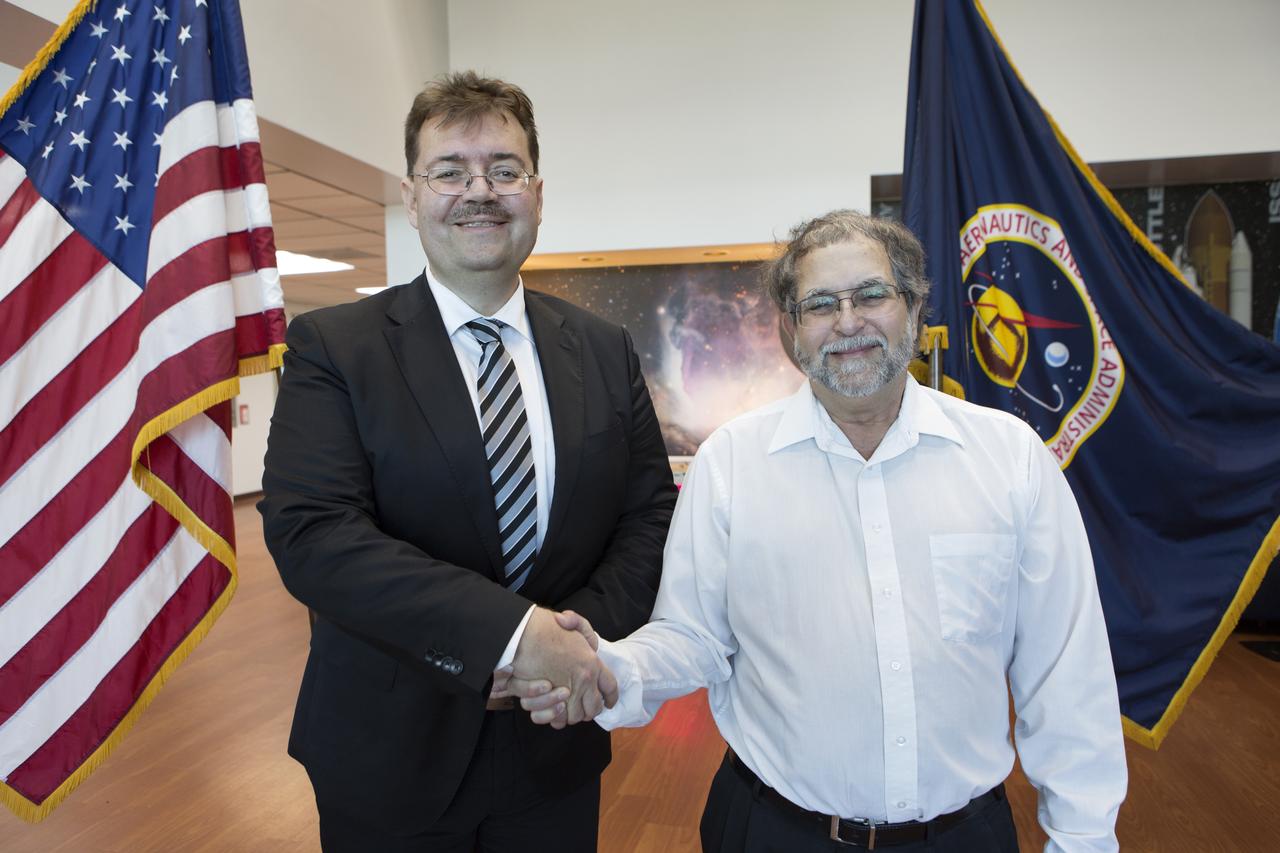
Dr. Oliver Ullrich (left) from the University of Zurich and Dr. Howard Levine of NASA's Kennedy Space Center stood in the Space Station Processing Facility on Dec. 18, 2018. NASA recently signed a Space Act Agreement with the university, which is located in Switzerland, to collaborate on biological research. The team is studying gene expression in altered gravity.
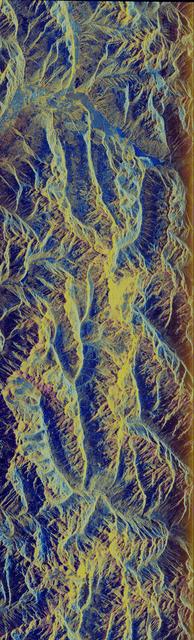
This image is a false-color composite of Oetzal, Austria located in the Central Alps centered at 46.8 degrees north latitude, 10.70 degrees east longitude, at the border between Switzerland top, Italy left and Austria right and bottom.

This image, acquired by NASA Terra spacecraft, is of the CERN Large Hadron Collider, the world largest and highest-energy particle accelerator laying beneath the French-Swiss border northwest of Geneva yellow circle.
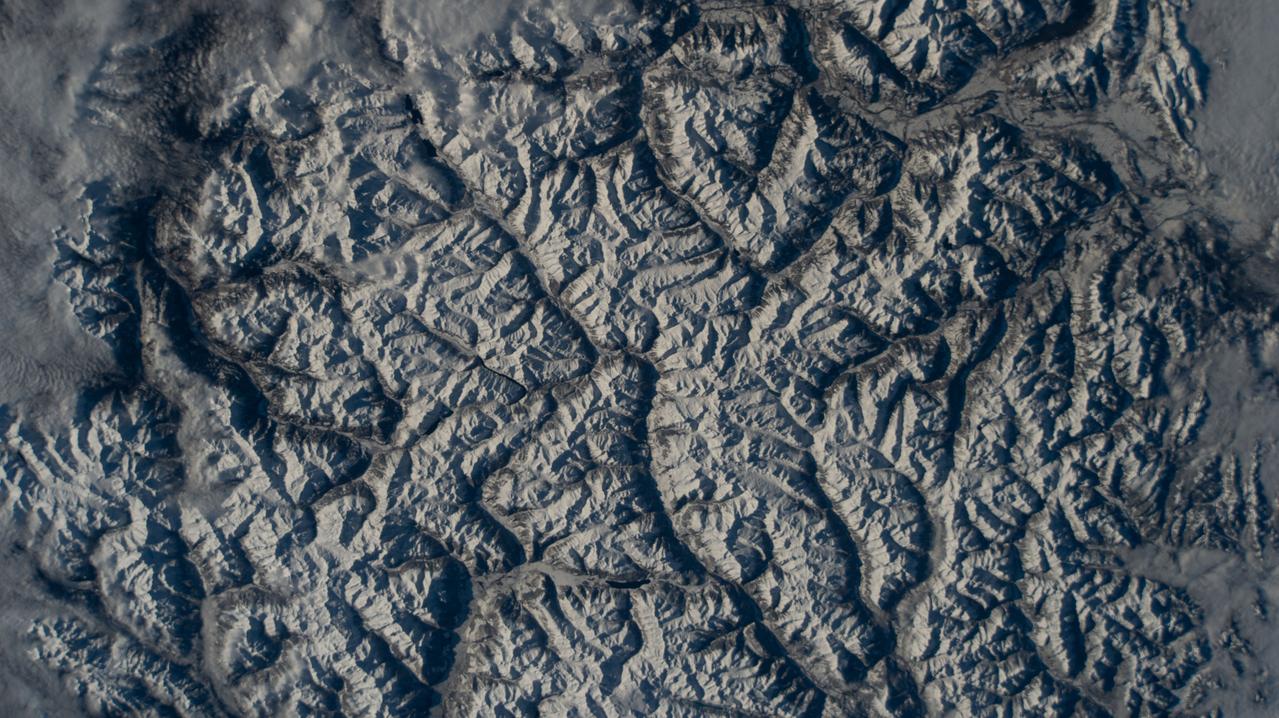
iss064e011669 (Dec. 10, 2020) --- The Alps in Switzerland are pictured from the International Space Station as it orbited 263 miles above the European nation.

iss069e025225 (June 26, 2023) -- The Alpine region of Switzerland (Swiss Alps) is seen from the International Space Station as it orbited roughly 260 miles above Geneva.

STS068-243-076 (30 September-11 October 1994) --- Parts of the Swiss Cantons of Vaud and Valois, the French province of Chablis and parts of northwestern Italy are seen in this widely stretching image photographed from the Space Shuttle Endeavour. Pennine Alps, said to have been created 50 million years ago, have been reshaped by glaciers during Pleistocene. The glaciers created the wide valley of the Rhone River by scourting a pre-existing seam. The fertile Swiss Plateau runs northwest from the shore of Lake Geneva and is visible in lower left. The Franco-Swiss border is located in the center of the lake and follows a mountain divide east of Rhone Valley. Italy lies south of the Rhone.

This image acquired by NASA Terra spacecraft is of La Chaux-de-Fonds, a Swiss city in the Jura Mountains, founded in 1656.

iss061e004462 (Oct. 8, 2019) --- The Mattmarksee, a reservoir built in the early 1960's between the Rimpfischhorn and Stellihorn mountains in the Swiss Alps, was photographed from the International Space Station at an altitude of 253 miles above Switzerland.
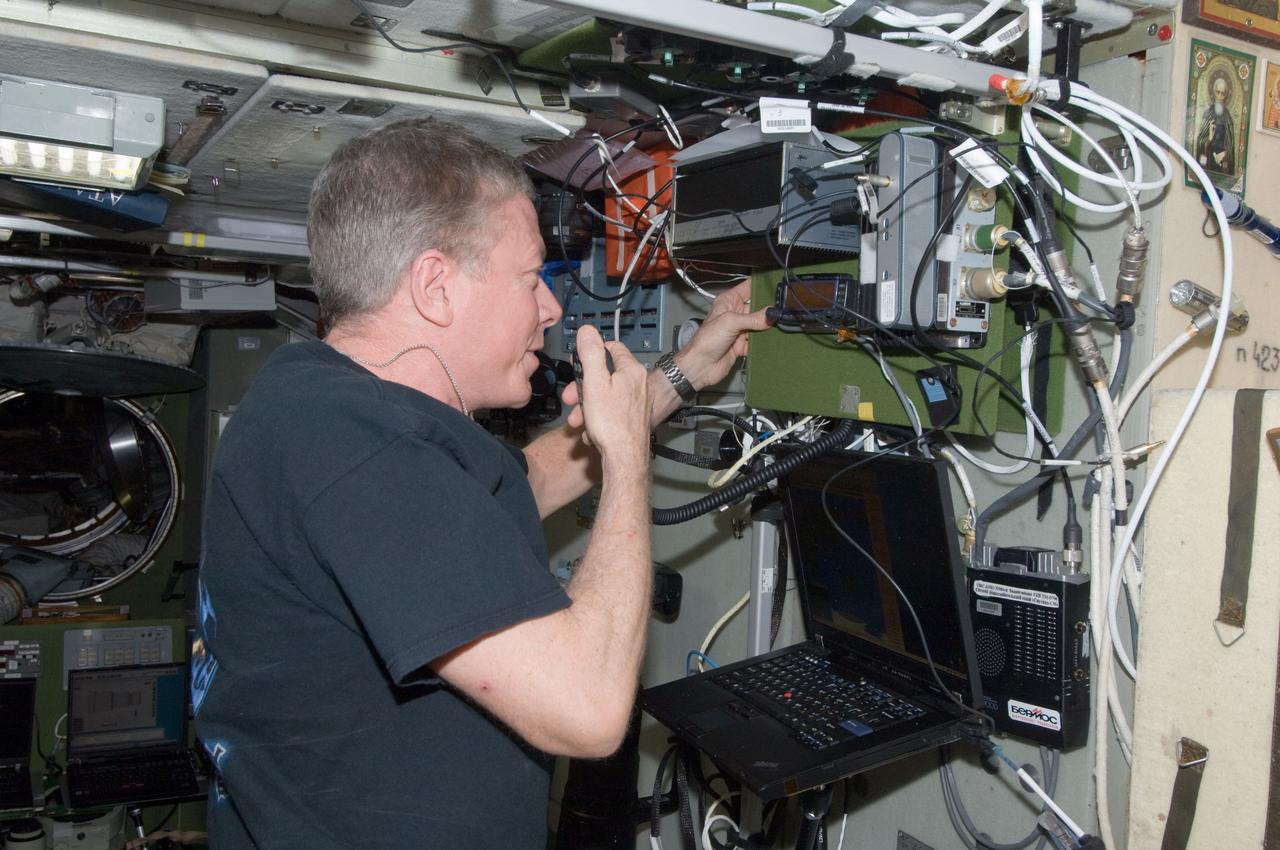
ISS029-E-036777 (31 Oct. 2011) --- NASA astronaut Mike Fossum, Expedition 29 commander, conducts a ham radio session in the Zvezda Service Module of the International Space Station with students at the Kantonsschule in Zug, Switzerland.

51F-42-058 (29 July-6 Aug 1985) --- This excellent view covers portions of Switzerland, France, and Italy. Lac Leman (Lake of Geneva) is at the center. The valley of the Rhone River can be seen from Tyon (lower left edge) upstream to the Swiss town of Brig. Great Alpine peaks including Mount Blanc, Matterhorn, Monte Rosa,Jungfrau, and Finsteraarhorn can be seen. Famous resorts in the photo include Aosta, Chamonix, Monreux, Laussane, Gstaad, Interlaken, Stresa, and Zermatt. The Swiss capital of Bern is at the upper right.
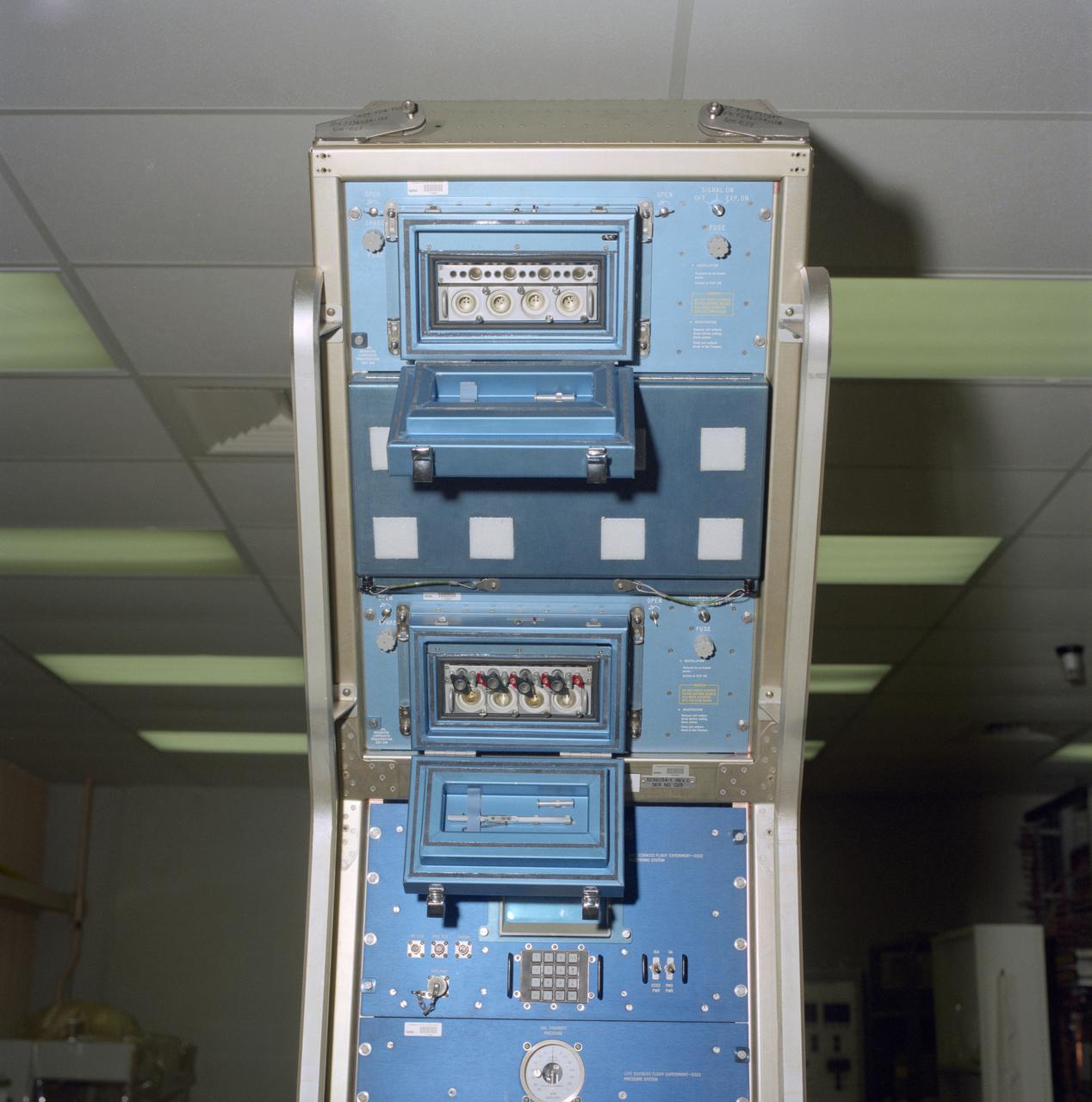
S84-43683 (26 Nov 1984) --- This vertically positioned rectangular piece of hardware, scheduled to fly on the science module of Spacelab Life Sciences-1, is important to the immunology investigation on the mission. Called Lymphocyte Proliferation in Weightlessness (Experiment 240), the test was developed by Dr. Augosto Cogoli of the Institute of Biotechnology, Gruppe Weltraum Biologie, in Zurich, Switzerland. It represents a continuation of previous Spacelab experiments by examining the effects of weightlessness on lymphocyte activation. Cultures will be grown in the microgravity incubators on the pictured hardware.
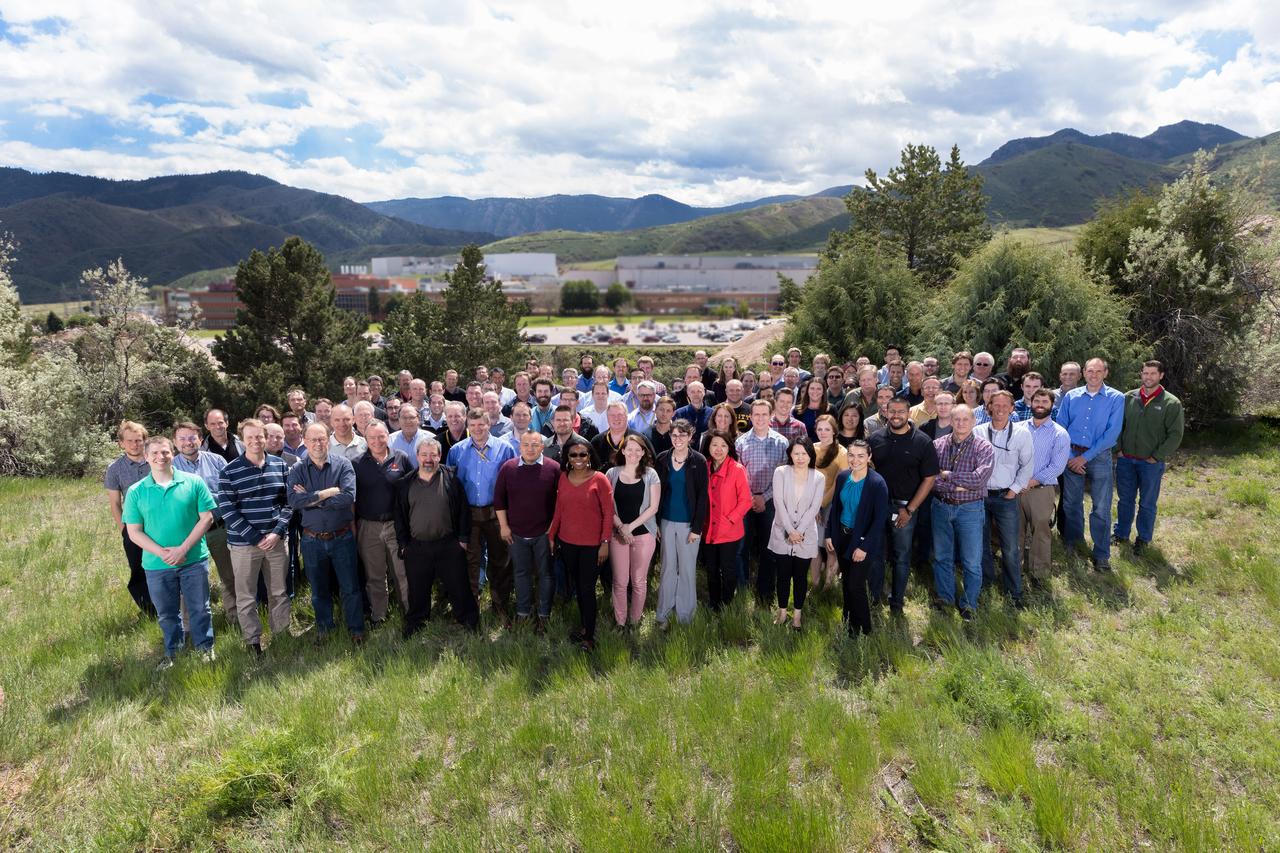
The InSight Team at Lockheed Martin Space in May 2017 The InSight team is comprised of scientists and engineers from multiple disciplines and is a unique collaboration between countries and organizations around the world. The science team includes co-investigators from the U.S., France, Germany, Austria, Belgium, Canada, Japan, Switzerland and the United Kingdom. https://photojournal.jpl.nasa.gov/catalog/PIA22235
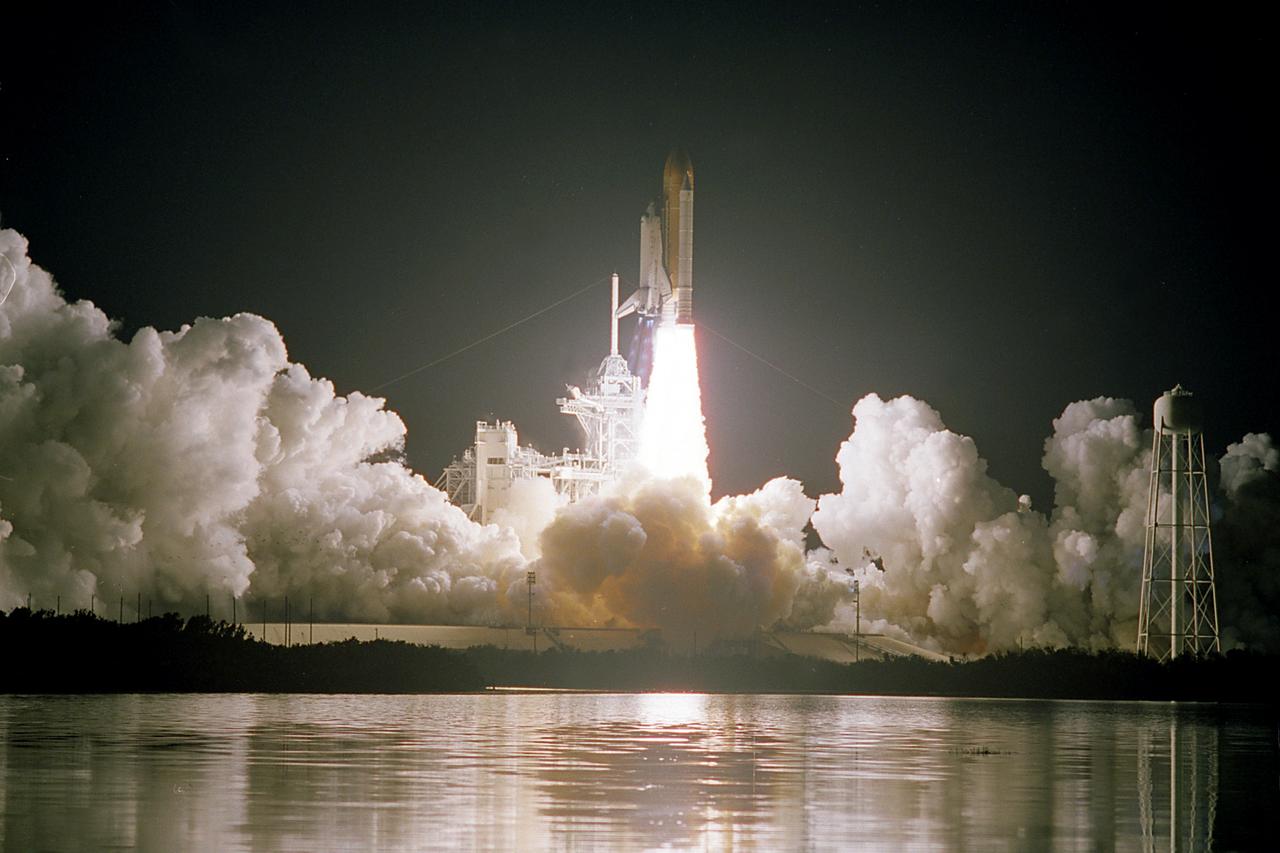
STS103-S-005 (19 December 1999) --- The Space Shuttle Discovery rises into the clear night sky to begin the 96th mission in the STS program. Liftoff occurred at 7:50 p.m. (EST), December 19, 1999, from Launch Pad 39B. Onboard were astronauts Curtis L. Brown, Jr., Scott J. Kelly, Steven L. Smith, C. Michael Foale, John M. Grunsfeld, Claude Nicollier and Jean-Francois Clervoy. Switzerland's Nicollier and France's Clervoy represent the European Space Agency (ESA).
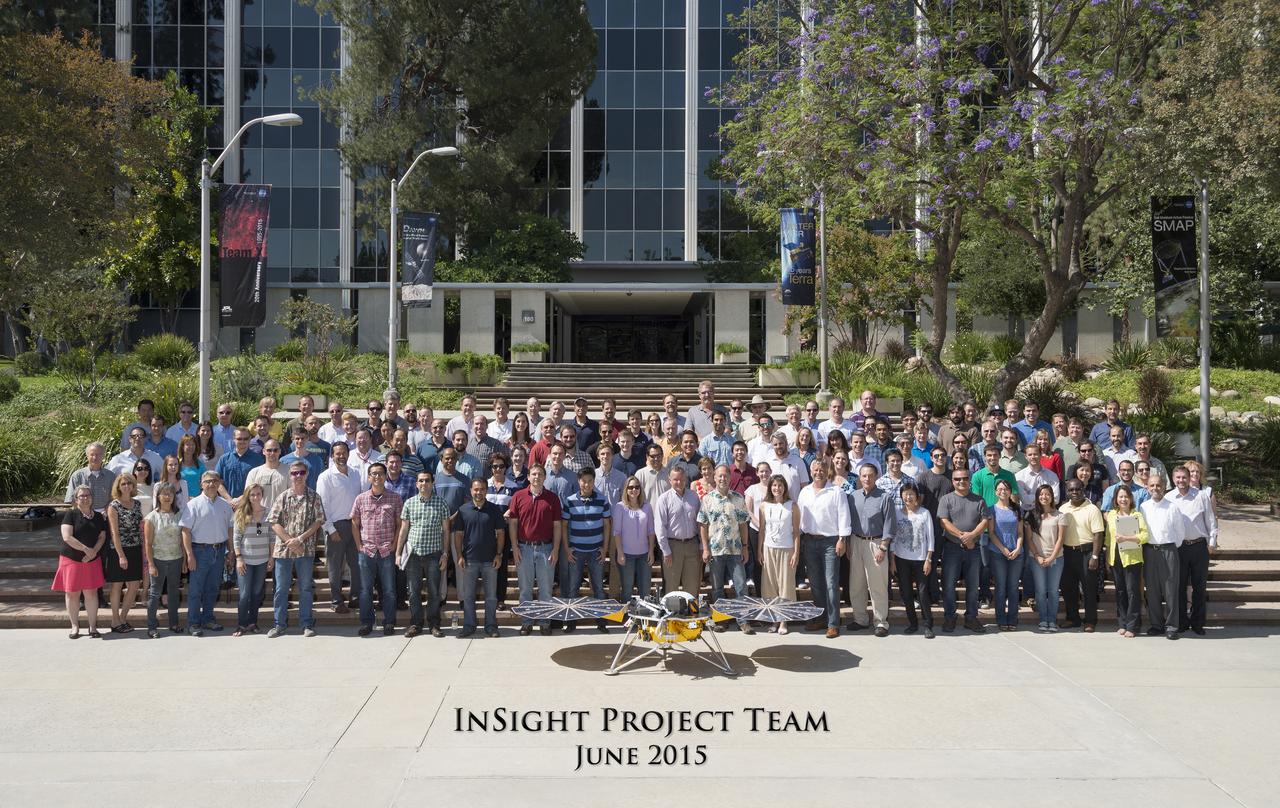
The InSight Team at NASA's Jet Propulsion Laboratory, JPL, in June 2015. The InSight team is comprised of scientists and engineers from multiple disciplines and is a unique collaboration between countries and organizations around the world. The science team includes co-investigators from the U.S., France, Germany, Austria, Belgium, Canada, Japan, Switzerland and the United Kingdom. https://photojournal.jpl.nasa.gov/catalog/PIA22234
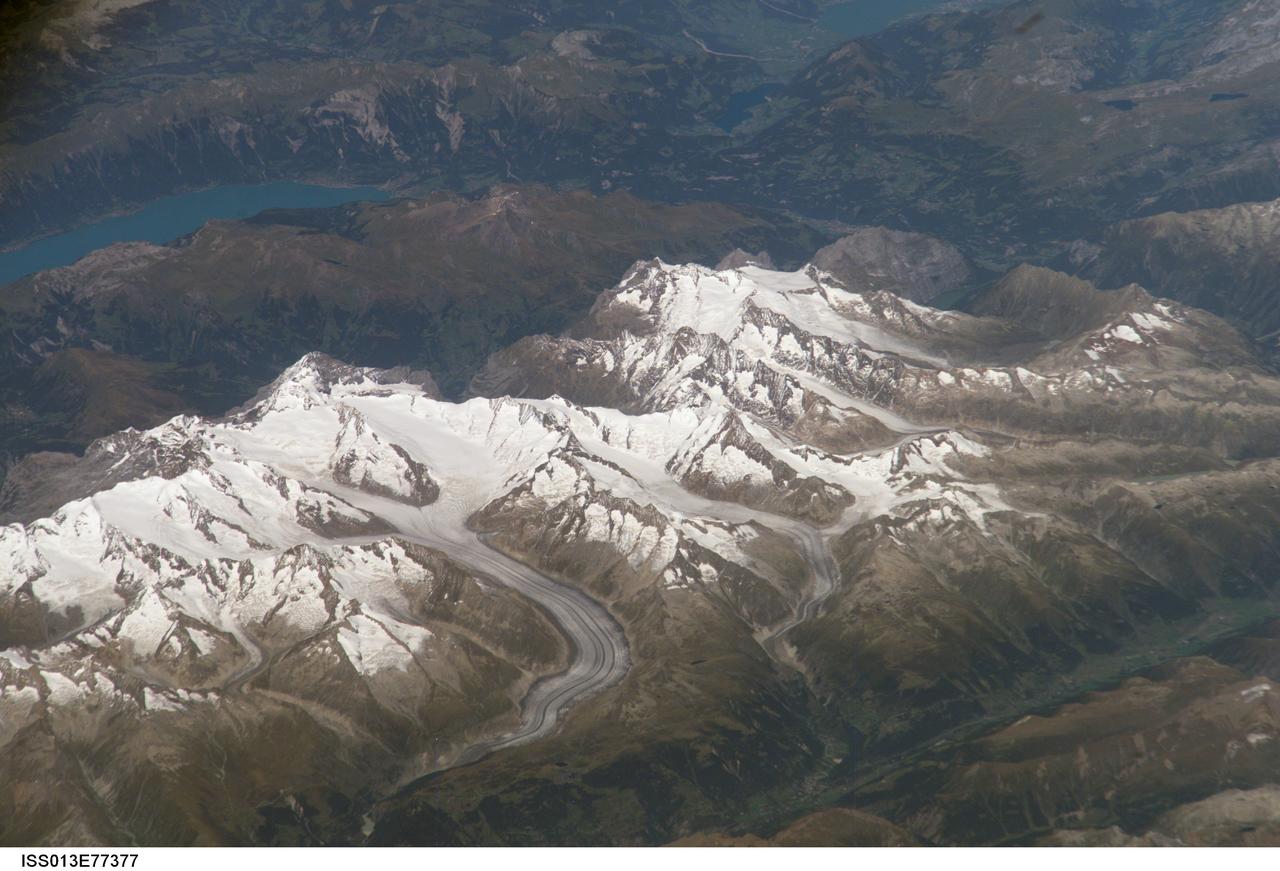
ISS013-E-77377 (5 Sept. 2006) --- Bernese Alps, Switzerland is featured in this image photographed by an Expedition 13 crewmember onboard the International Space Station. The formidable mountain system of the Alps stretches across much of central Europe, with seven countries claiming portions of the mountains within their borders (Germany, France, Switzerland, Italy, Liechtenstein, Austria, and Slovenia). The glacial landscape of the Bernese Alps, located in southwestern Switzerland, is well illustrated by this view. The image was taken by a crewmember looking north-northwest while the station was located over the Mediterranean Sea between Corsica and Italy -- this oblique viewing angle imparts a sense of perspective to the image. This type of viewing angle complements more nadir (downward)--viewing imagery of the region. Three of the higher peaks of the central Alps are visible--Jungfrau (4,158 meters), Moench (4,089 meters), and Eiger (3,970 meters). To the east and south of the Jungfrau is the Aletsch Glacier, clearly marked by dark medial moraines extending along the glacier's length parallel to the valley axis. The moraines are formed from rock and soil debris collected along the sides of three mountain glaciers located near the Jungfrau and Moench peaks -- as these flowing ice masses merge to form the Aletsch Glacier, the debris accumulates in the middle of the glacier and is carried along the flow direction. According to geologists, Lake Brienz to the northwest was formed by the actions of both glacial ice and the flowing waters of the Aare and Lutschine rivers, and has a maximum depth of 261 meters. The lake has a particularly fragile ecosystem, as demonstrated by the almost total collapse of the whitefish population in 1999. Possible causes for the collapse, according to the scientists, include increased water turbidity associated with upstream hydropower plant operations, and reduction of phosphorus (a key nutrient for lake algae, a basic element of the local food web) due to water quality concerns.
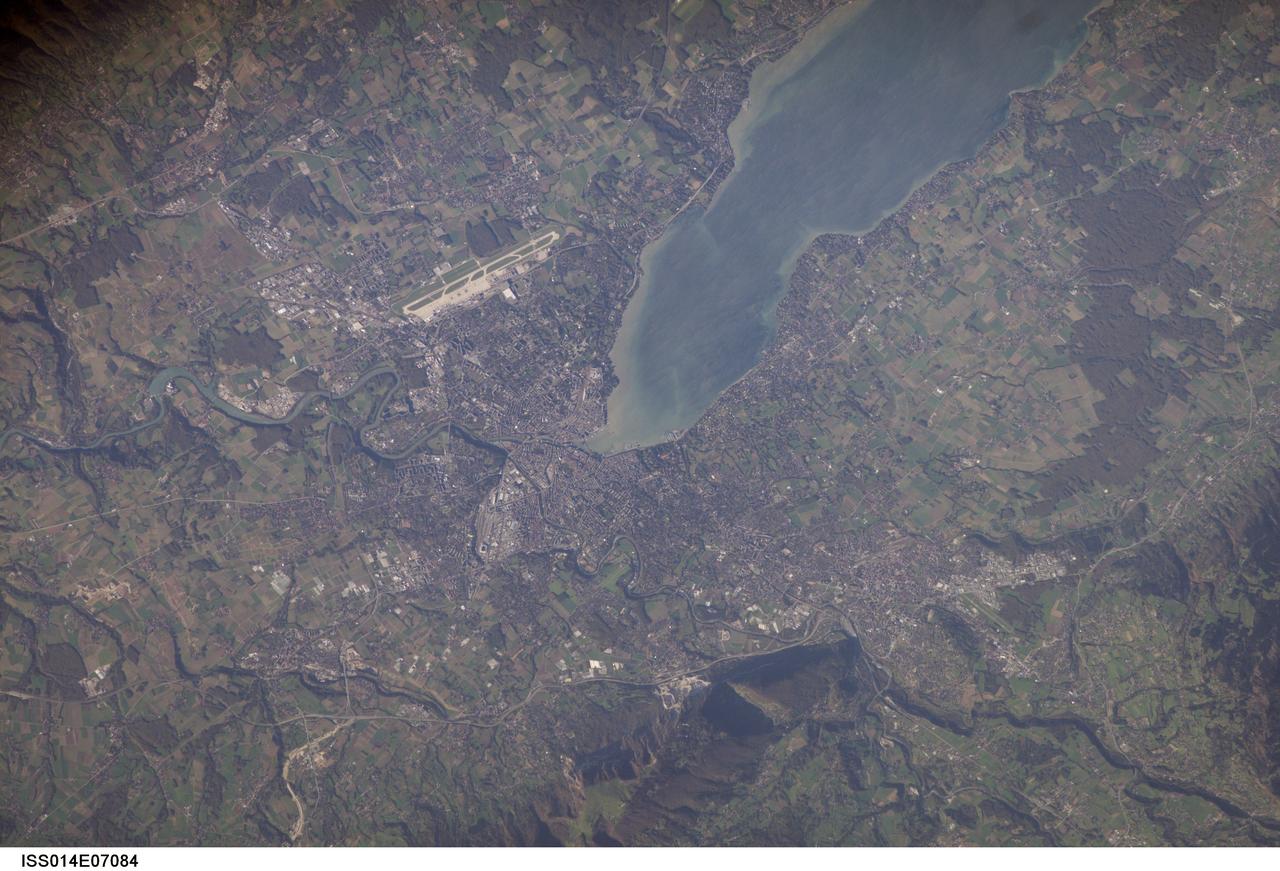
ISS014-E-07084 (2 Nov. 2006) --- Geneva, Switzerland is featured in this image photographed by an Expedition 14 crewmember on the International Space Station. The city is located at the southernmost tip of Lake Geneva (also known as Lac Leman) between two major mountain ranges, the Jura to the northwest (not shown) and the Alps to the southeast (the northern foothills of which are represented by Mount Saleve at bottom). The city's built area, roadways, and airport appear as white to grey surfaces in this view. Urbanized regions are interspersed with agricultural fields (bright green to light brown rectangular regions) and preserved forest stands (dark green) around the Lake. One of the defining moments in the city's history was the defeat of an attack by the dukedom of Savoy in 1602; the event -- known as "l'Escalade" is celebrated annually as a symbol of Geneva's independence. The city joined Switzerland as a canton (or state) in 1815. The city's recent history demonstrates its continuing importance to geopolitics. The League of Nations was headquartered here from 1919-1946, and the European headquarters of the United Nations is likewise located here. The Geneva Conventions, or "rules of war", were signed here from 1864 through 1949. The city also hosts the headquarters of numerous other international organizations and corporations - making it a "world city" of cultural, economic, and political significance.
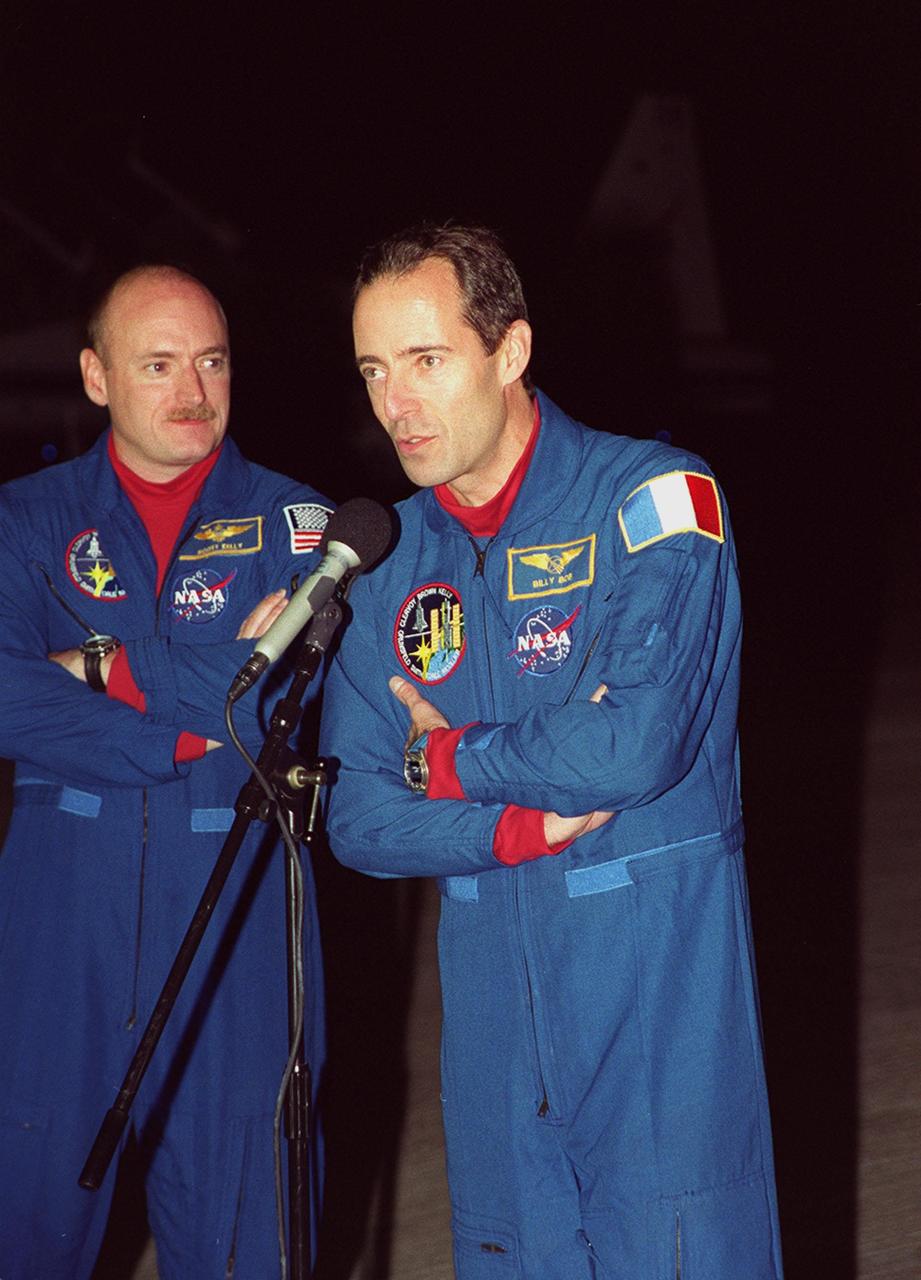
STS-103 Mission Specialist Jean-François Clervoy of France (at microphone) greets the media at the Shuttle Landing Facility as Pilot Scott J. Kelly looks on. The crew arrived at KSC aboard T-38 jets to make final preparations for their launch. The other STS-103 crew members are Commander Curtis L. Brown Jr. and Mission Specialists Steven L. Smith, C. Michael Foale (Ph.D.), John M. Grunsfeld (Ph.D.), and Claude Nicollier of Switzerland. Nicollier and Clervoy are with the European Space Agency. The mission, to service the Hubble Space Telescope a third time, is scheduled for launch Dec. 11 at 12:13 a.m. EST from Launch Pad 39B
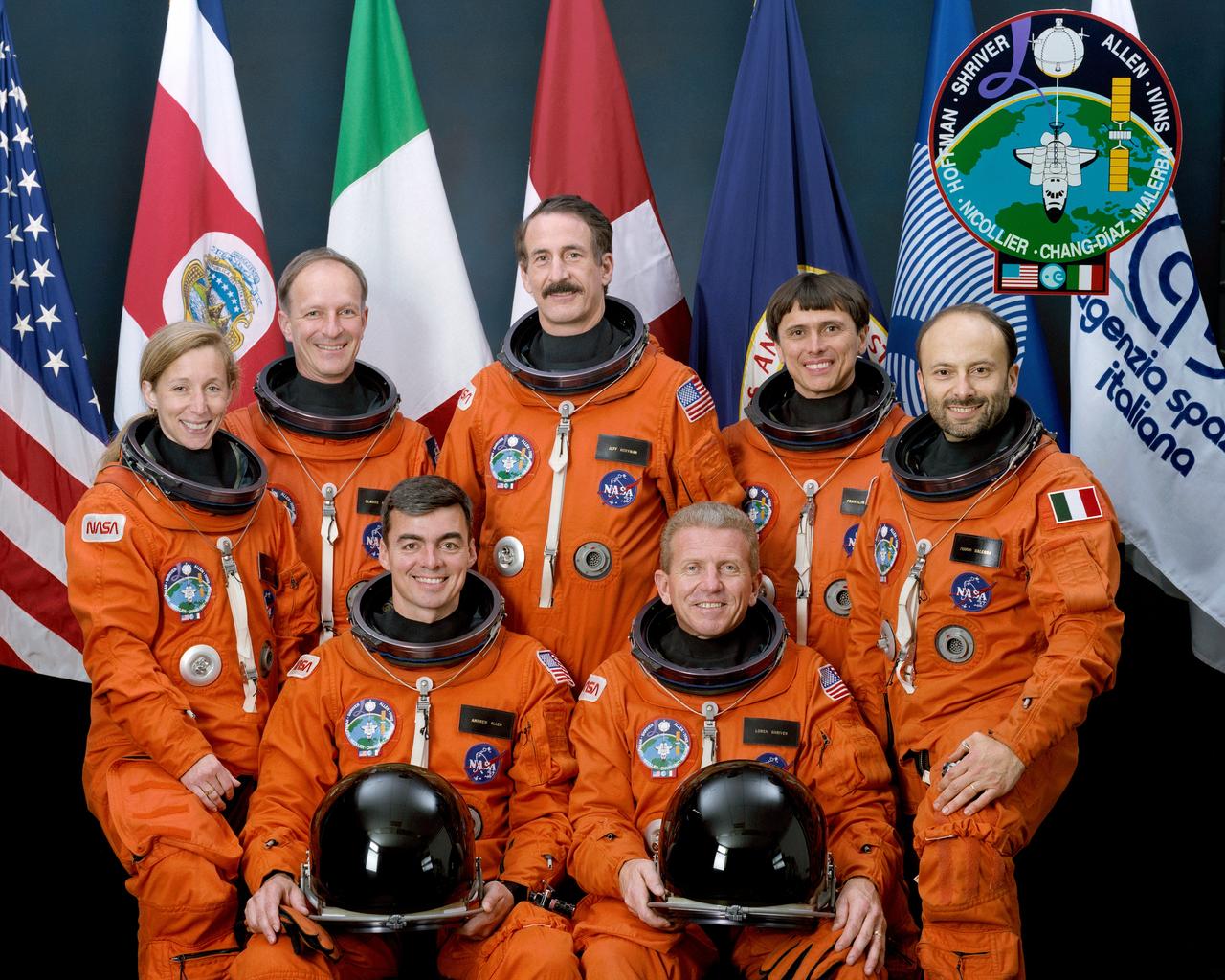
STS046-S-002 (May 1992) --- The crew members assigned to the STS-46 mission pose with seven flags that represent participation on the flight. Loren J. Shriver (right front) is mission commander; Andrew M. Allen (left front) is pilot. Others are (left to right) Marsha S. Ivins, mission specialist; Claude Nicollier, mission specialist representing the European Space Agency (ESA); Jeffrey A. Hoffman, payload commander; Franklin R. Chang-Diaz, mission specialist; and Franco Malerba, flying for the Italian Space Agency (ASI). The flags, left to right, represent the United States of America, Costa Rica (Chang's native country), Italy, Switzerland (Nicollier's homeland), NASA, ESA and ASI.
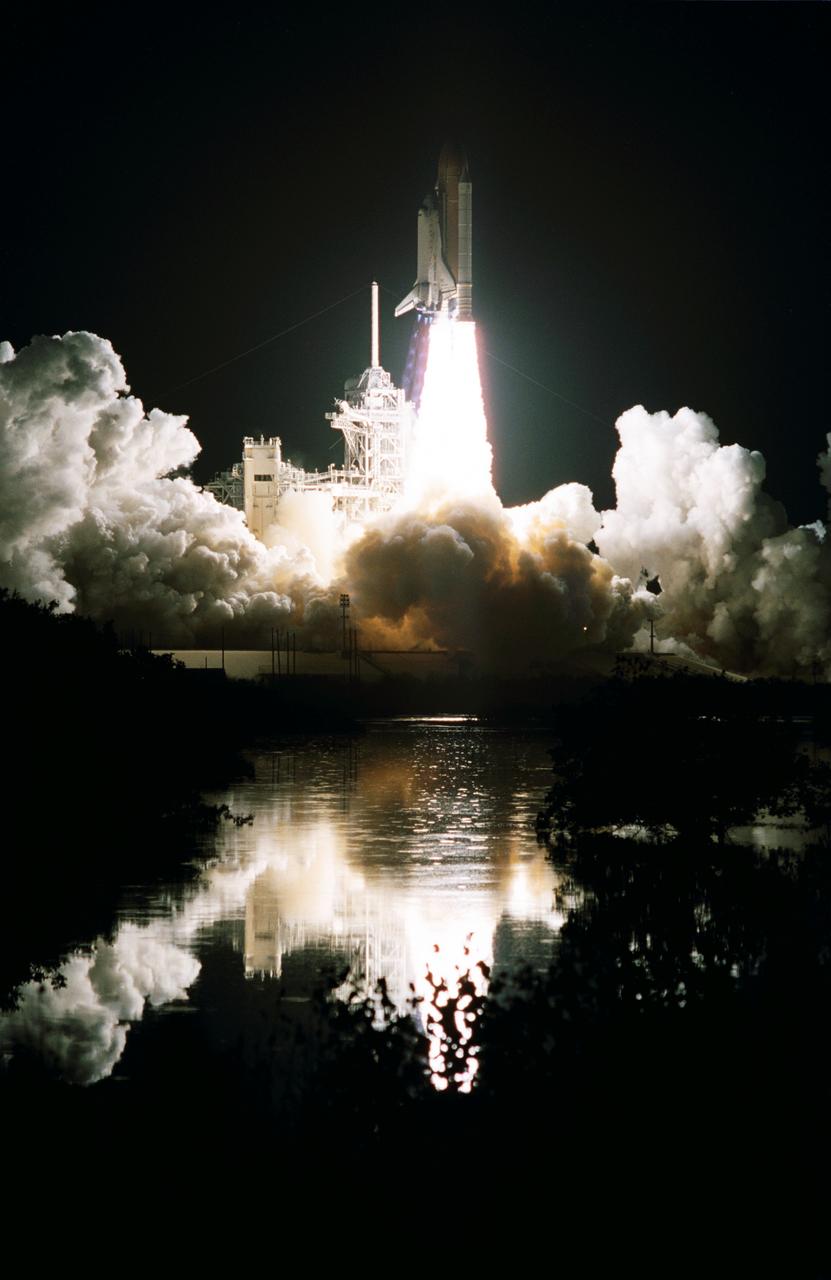
STS103-S-006 (19 December 1999) --- The Space Shuttle Discovery, reflected in nearby water, lifts off into the clear night sky to begin the 96th mission in the STS program. Liftoff occurred at 7:50 p.m. (EST), December 19, 1999, from Launch Pad 39B. Onboard were astronauts Curtis L. Brown, Jr., Scott J. Kelly, Steven L. Smith, C. Michael Foale, John M. Grunsfeld, Claude Nicollier and Jean-Francois Clervoy. Switzerland's Nicollier and France's Clervoy represent the European Space Agency (ESA).
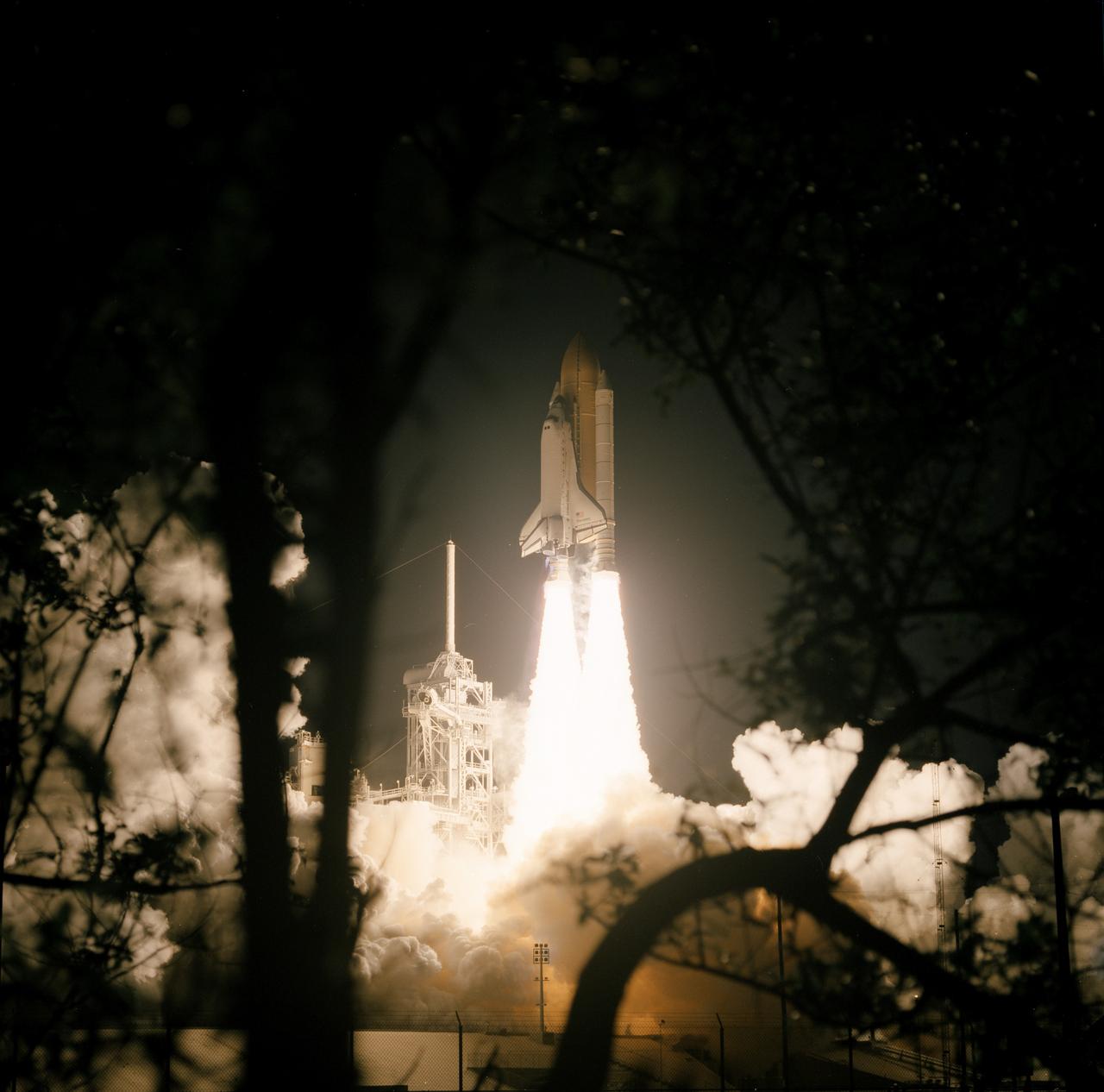
STS103-S-008 (19 December 1999) --- The Space Shuttle Discovery, framed by Florida foliage, clears the launch structure and heads toward the clear night sky to begin the 96th mission in the STS program. Liftoff occurred at 7:50 p.m. (EST), December 19, 1999, from Launch Pad 39B. Onboard were astronauts Curtis L. Brown, Jr., Scott J. Kelly, Steven L. Smith, C. Michael Foale, John M. Grunsfeld, Claude Nicollier and Jean-Francois Clervoy. Switzerland's Nicollier and France's Clervoy represent the European Space Agency (ESA).

This artist's concept depicts the completely assembled International Space Station (ISS) passing over Florida and the Bahamas. As a gateway to permanent human presence in space, the Space Station Program is to expand knowledge benefiting all people and nations. The ISS is a multidisciplinary laboratory, technology test bed, and observatory that will provide unprecedented undertakings in scientific, technological, and international experimentation. Experiments to be conducted in the ISS include: microgravity research, Earth science, space science, life sciences, space product development, and engineering research and technology. The sixteen countries participating in the ISS are: United States, Russian Federation, Canada, Japan, United Kingdom, Germany, Italy, France, Norway, Netherlands, Belgium, Spain, Denmark, Sweden, Switzerland, and Brazil.
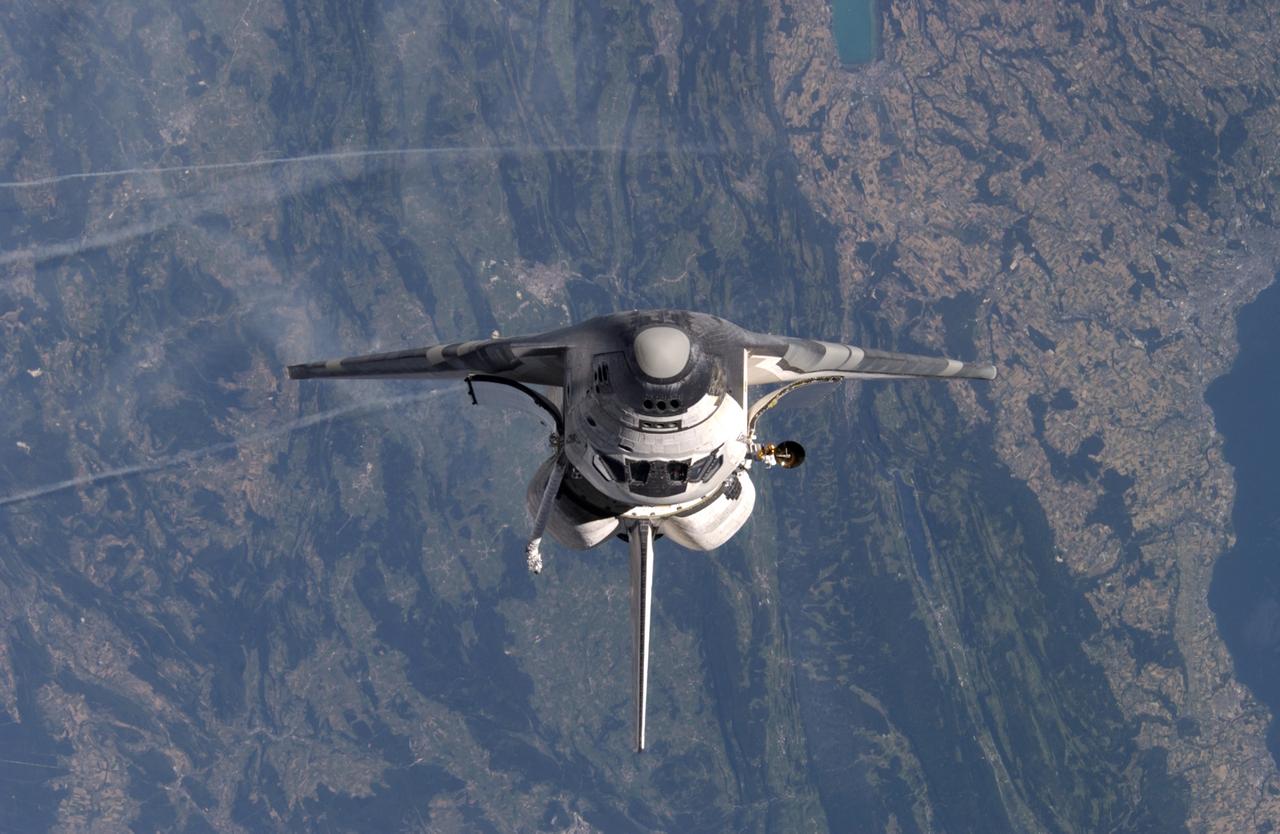
ISS011-E-11257 (28 July 2005) --- Space Shuttle Discovery was about 600 feet from the International Space Station when cosmonaut Sergei K. Krikalev, Expedition 11 commander, and astronaut John L. Phillips, NASA Space Station science officer and flight engineer, photographed the spacecraft as it approached the Station and performed a backflip to allow photography of its heat shield. Astronaut Eileen M. Collins, STS-114 commander, guided the Shuttle through the flip. The photos will be analyzed by engineers on the ground as additional data to evaluate the condition of Discovery’s heat shield. The scene is over Switzerland.
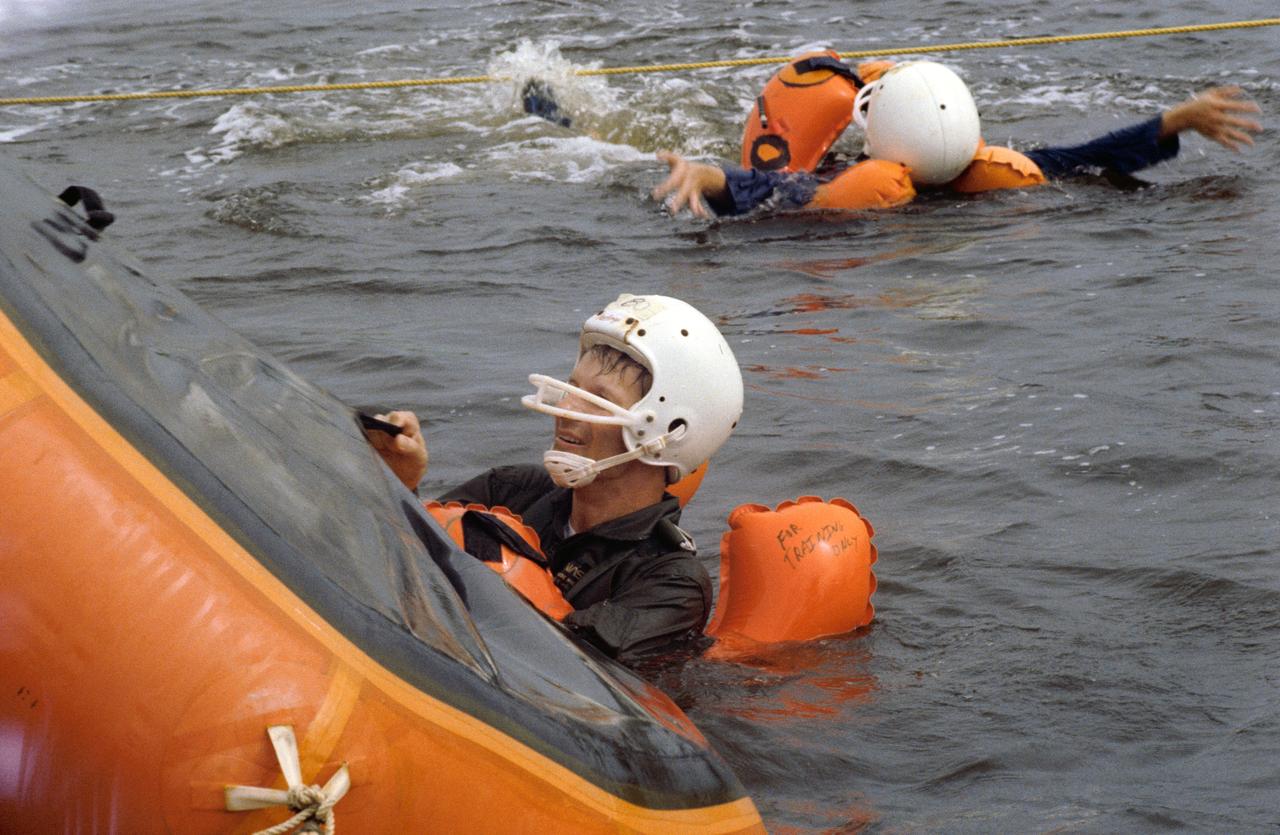
S80-38456 (13 Aug 1980) --- Claude Nicollier of Switzerland, one of two European scientists/Spacelab payload specialist candidates training in the United States along with 19 new NASA astronaut candidates, grabs onto the one-man life raft he is using during a water survival training school attended by several JSC personnel in mid-August. Six of the 19 candidates who had not had this type training before and the two Europeans were joined by a veteran astronaut, training personnel and two NASA physicians on the trip.
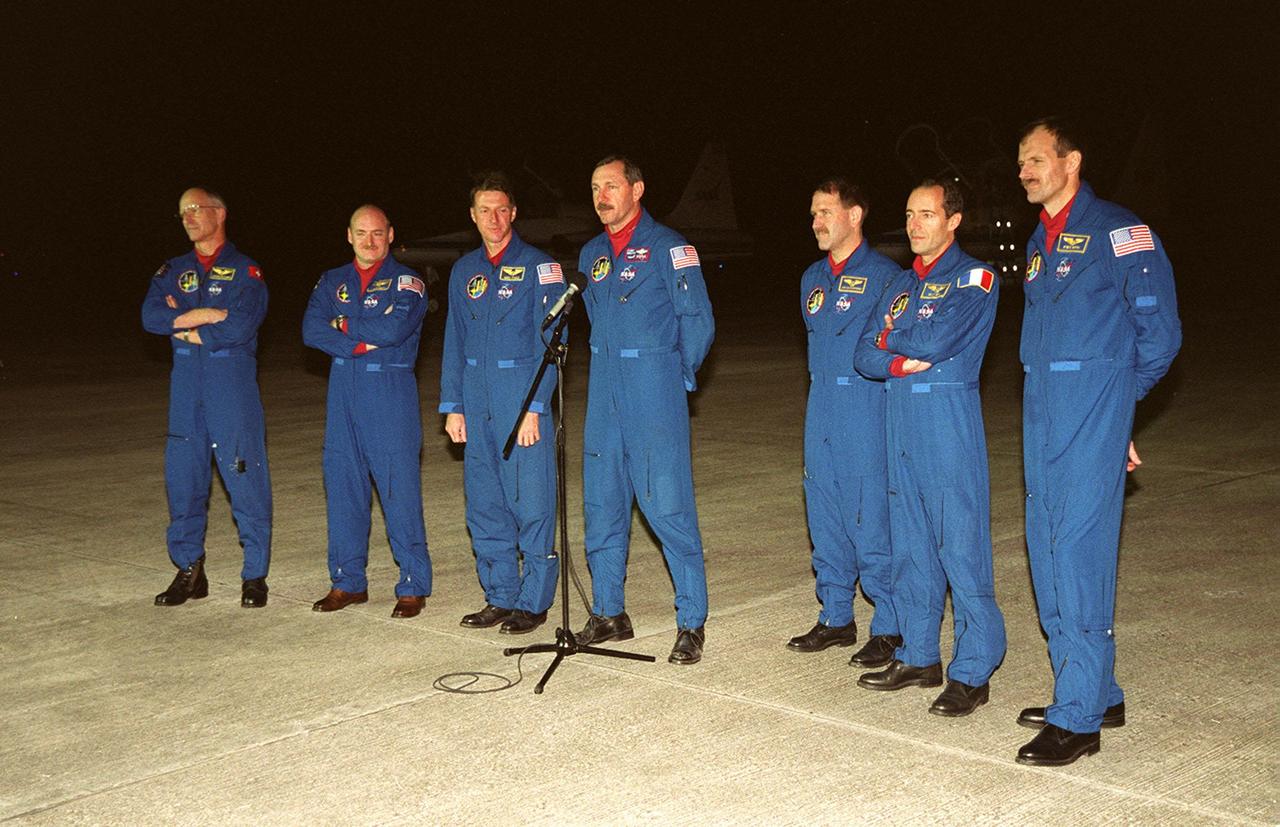
The STS-103 crew greets the media at the Shuttle Landing Facility after arriving aboard T-38 jets to make final preparations for their launch. From left, they are Mission Specialist Claude Nicollier of Switzerland, Pilot Scott J. Kelly, Mission Specialist C. Michael Foale (Ph.D.), Commander Curtis L. Brown Jr. (at microphone), and Mission Specialists John M. Grunsfeld (Ph.D.), Jean-François Clervoy of France, and Steven L. Smith. Nicollier and Clervoy both represent the European Space Agency. The STS-103 mission, to service the Hubble Space Telescope a third time, is scheduled for launch Dec. 11 at 12:13 a.m. EST from Launch Pad 39B
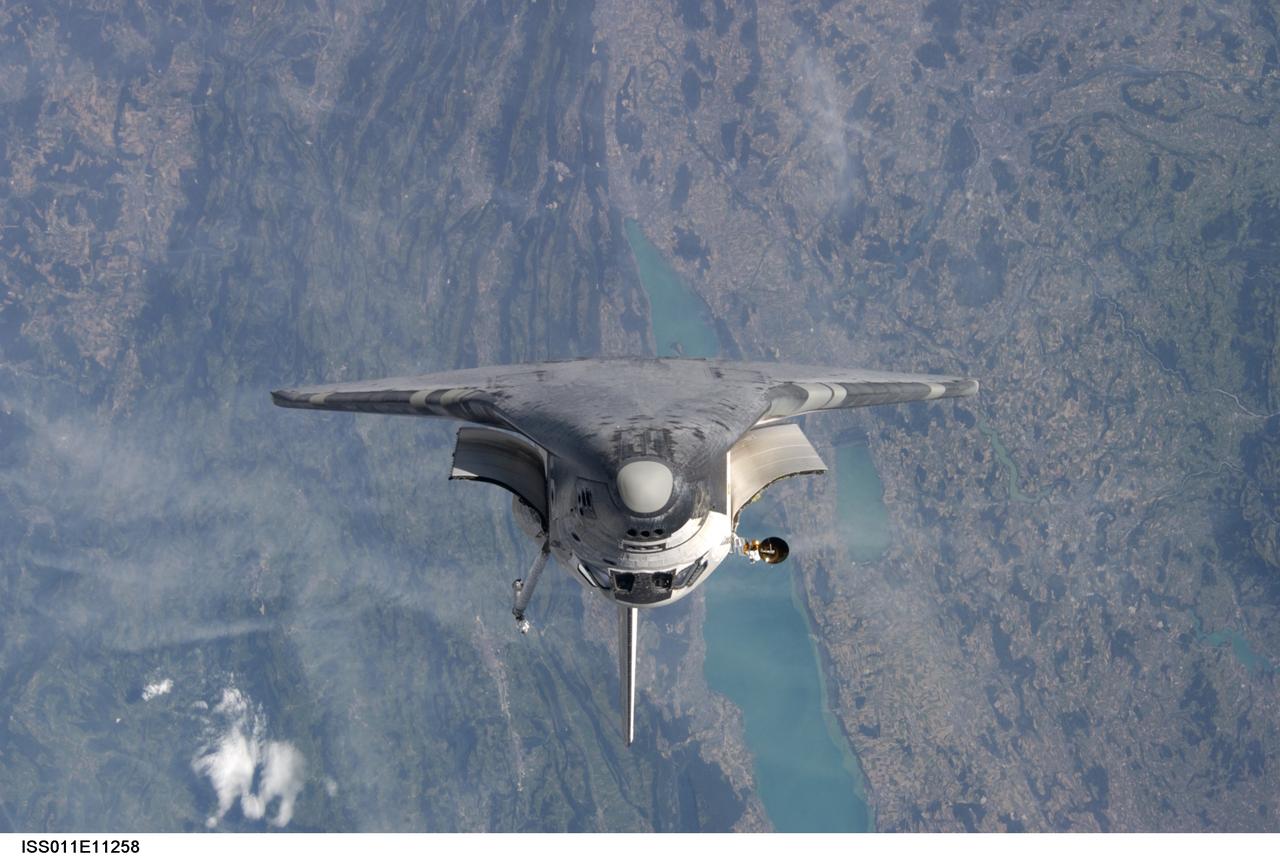
ISS011-E-11258 (28 July 2005) --- View of the Space Shuttle Discovery as photographed during the survey operations performed by the Expedition 11 crew on the International Space Station during the STS-114 R-Bar Pitch Maneuver on Flight Day 3. Discovery docked to the station at 6:18 a.m. (CDT) on Thursday, July 28, 2005. Parts of Switzerland are in the background. Onboard the shuttle were astronauts Eileen M. Collins, STS-114 commander; James M. Kelly, pilot; Andrew S. W. Thomas, Stephen K. Robinson, Wendy B. Lawrence, Charles J. Camarda and Japan Aerospace Exploration Agency (JAXA) astronaut Soichi Noguchi, all mission specialists.

This artist's digital concept depicts the completely assembled International Space Station (ISS) passing over Florida. As a gateway to permanent human presence in space, the Space Station Program is to expand knowledge benefiting all people and nations. The ISS is a multidisciplinary laboratory, technology test bed, and observatory that will provide unprecedented undertakings in scientific, technological, and international experimentation. Experiments to be conducted in the ISS include: microgravity research, Earth science, space science, life sciences, space product development, and engineering research and technology. The sixteen countries participating the ISS are: United States, Russian Federation, Canada, Japan, United Kingdom, Germany, Italy, France, Norway, Netherlands, Belgium, Spain, Denmark, Sweden, Switzerland, and Brazil.
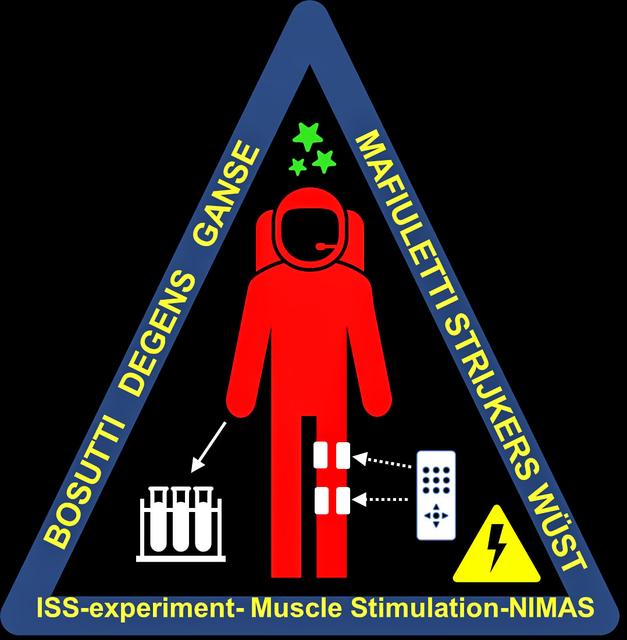
jsc2023e053549 (9/18/2023) --- The Muscle Stimulation Patch is designed to represent the aims of the experiment, namely apply inflight a small electrical muscle stimulation (represented by the yellow triangle) to the leg muscles (white arrows) of astronauts on-board the ISS, to sustain their muscle mass and performance, and measure with several experimental techniques (represented by the white cuvettes) in which way the muscles respond to this exercise modality delivered in Space (represented by the green stars)..The patch’s colors represent the Countries of the team members (Italy, United Kingdom, Germany, The Netherlands and Switzerland). Image courtesy of ESA.
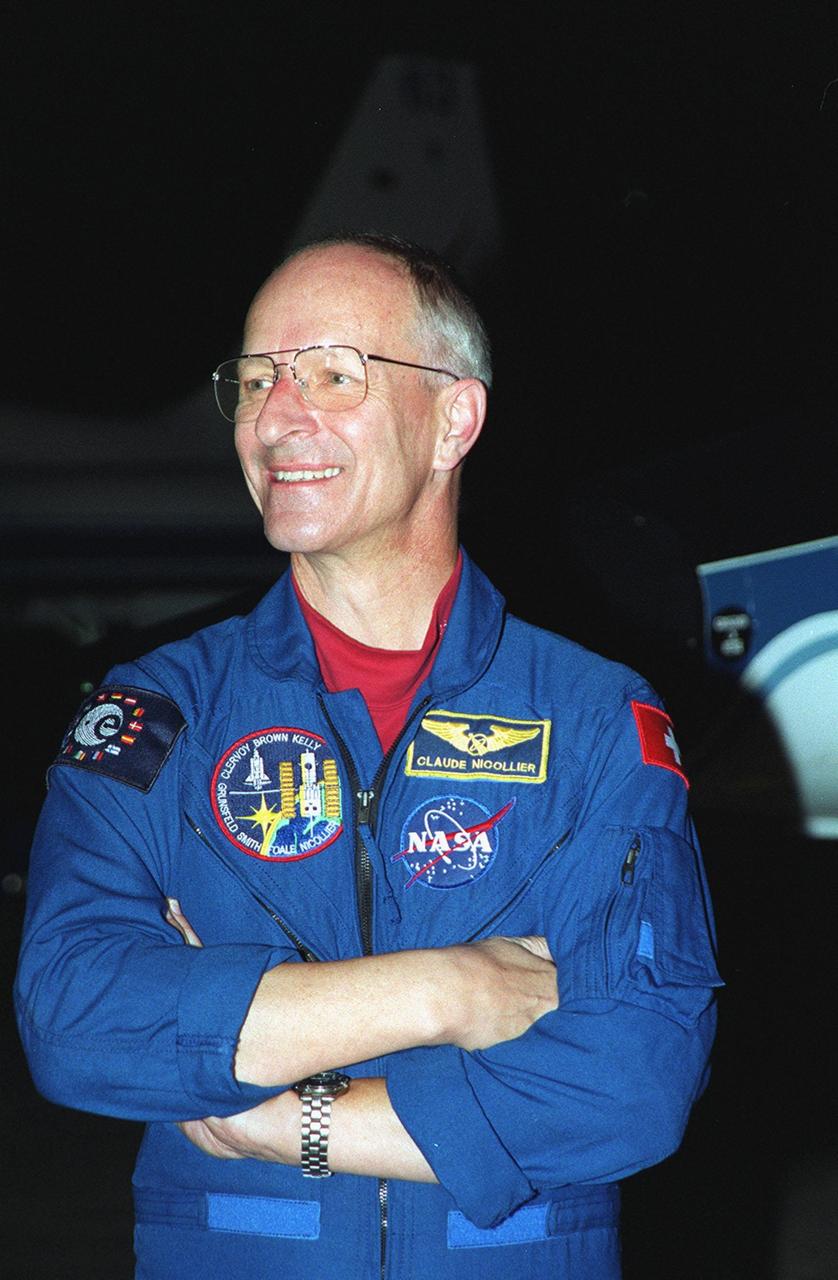
At the Shuttle Landing Facility, STS-103 Mission Specialist Claude Nicollier of Switzerland shows his pleasure at being at Kennedy Space Center to make final preparations for his launch. He is accompanied by the other STS-103 crew members: Commander Curtis L. Brown Jr., Pilot Scott J. Kelly and Mission Specialists Steven L. Smith, C. Michael Foale (Ph.D.), John M. Grunsfeld (Ph.D.), and Jean-François Clervoy of France. Nicollier and Clervoy both represent the European Space Agency. The STS-103 mission, to service the Hubble Space Telescope a third time, is scheduled for launch Dec. 11 at 12:13 a.m. EST from Launch Pad 39B

This artist's concept depicts the completely assembled International Space Station (ISS) passing over the Straits of Gibraltar and the Mediterranean Sea. As a gateway to permanent human presence in space, the Space Station Program is to expand knowledge benefiting all people and nations. The ISS is a multidisciplinary laboratory, technology test bed, and observatory that will provide unprecedented undertakings in scientific, technological, and international experimentation. Experiments to be conducted in the ISS include: microgravity research, Earth science, space science, life sciences, space product development, and engineering research and technology. The sixteen countries participating the ISS are: United States, Russian Federation, Canada, Japan, United Kingdom, Germany, Italy, France, Norway, Netherlands, Belgium, Spain, Denmark, Sweden, Switzerland, and Brazil.
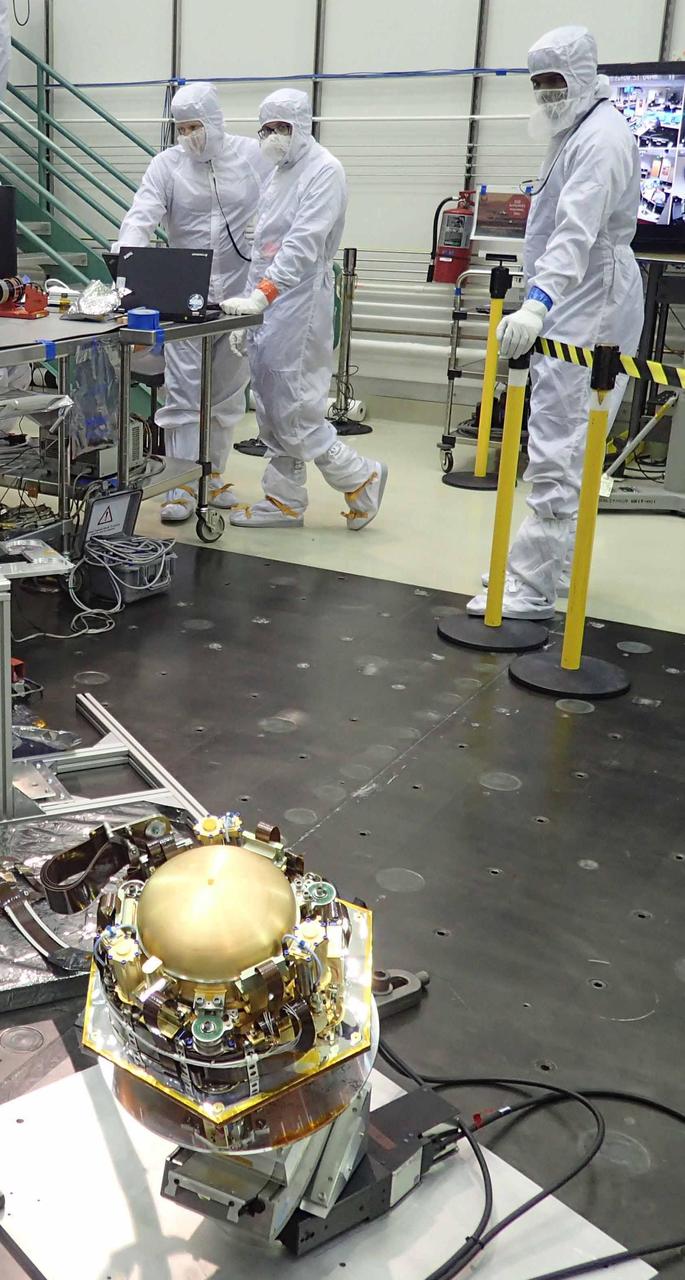
The Seismic Experiment for Interior Structure (SEIS) instrument for NASA's InSight mission to Mars undergoes a checkout for the spacecraft's assembly, test and launch operations (ATLO) in this photo taken July 20, 2017, in a Lockheed Martin clean room facility in Littleton, Colorado. The SEIS was provided by France's national space agency (CNES) with collaboration from the United States, the United Kingdom, Switzerland and Germany. The InSight mission (for Interior Exploration using Seismic Investigations, Geodesy and Heat Transport) is scheduled to launch in May 2018 and land on Mars Nov. 26, 2018. It will investigate processes that formed and shaped Mars and will help scientists better understand the evolution of our inner solar system's rocky planets, including Earth. https://photojournal.jpl.nasa.gov/catalog/PIA21846
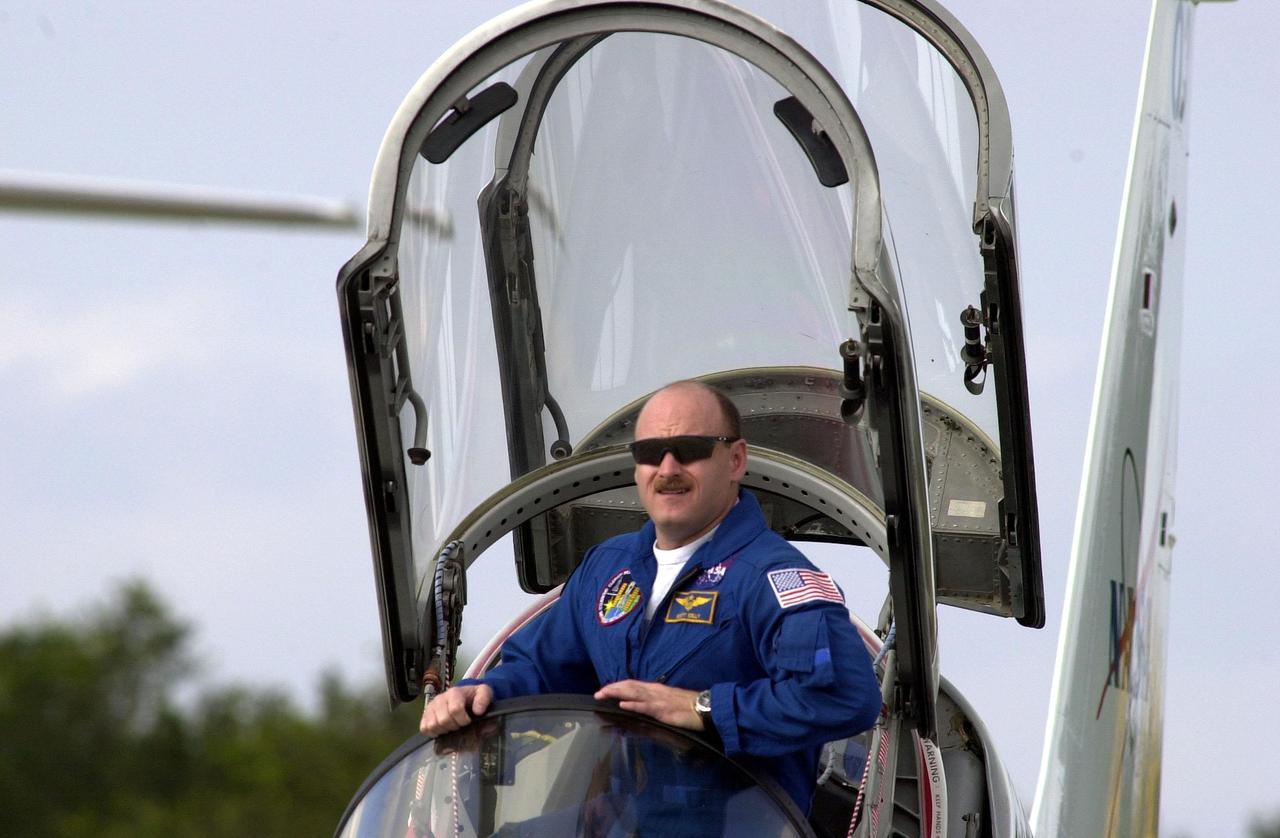
STS-103 Pilot Scott J. Kelly settles into the cockpit of a T-38 training jet for practice flights. He joins other crew members Commander Curtis L. Brown Jr. and Mission Specialists Steven L. Smith, C. Michael Foale (Ph.D.), John M. Grunsfeld (Ph.D.), Claude Nicollier of Switzerland and Jean-François Clervoy of France, for pre-launch preparations on mission STS-103 aboard Space Shuttle Discovery. Nicollier and Clervoy are with the European Space Agency. The mission, to service the Hubble Space Telescope, is scheduled for launch Dec. 16 at 9:18 p.m. EST from Launch Pad 39B. The mission is expected to last about 9 days and 21 hours. Discovery is expected to land at KSC Sunday, Dec. 26, at 6:56 p.m. EST
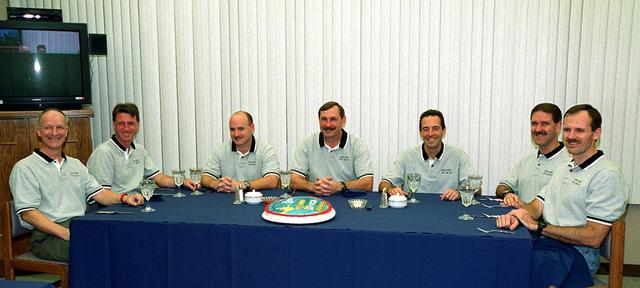
In the Operations and Checkout Building, the STS-103 crew are all smiles as they gather for breakfast before suiting up for launch. From left are Mission Specialists Claude Nicollier of Switzerland and C. Michael Foale (Ph.D.), Pilot Scott J. Kelly, Commander Curtis L. Brown Jr., and Mission Specialists Jean-Francois Clervoy of France, John M. Grunsfeld (Ph.D.) and Steven L. Smith. Nicollier and Clervoy are with the European Space Agency. The STS-103 mission, to service the Hubble Space Telescope, is scheduled for launch Dec. 17 at 8:47 p.m. EST from Launch Pad 39B. Mission objectives include replacing gyroscopes and an old computer, installing another solid state recorder, and replacing damaged insulation in the telescope. The mission is expected to last about 8 days and 21 hours. Discovery is expected to land at KSC Sunday, Dec. 26, at about 6:30 p.m. EST

CAPE CANAVERAL, Fla. -- Mikkel Vestergaard, the president of Vestergaard Frandsen in Lausanne, Switzerland, participates in a news conference at NASA's Kennedy Space Center in Florida following the "LAUNCH: Health" forum. During the two-day forum, 10 international participants showcased new innovations that could address health problems on Earth and in space. LAUNCH is a global initiative to identify and support innovative work that will contribute to a sustainable future. Through a series of forums focused on key challenge areas, including water, air, food, energy, mobility and sustainable cities, LAUNCH gives leaders an opportunity to present innovative ideas among peers and join in collaborative, solution-driven discussions. This is the second forum hosted at Kennedy. The first was "LAUNCH: Water" in March 2010. Photo credit: NASA/Kim Shiflett
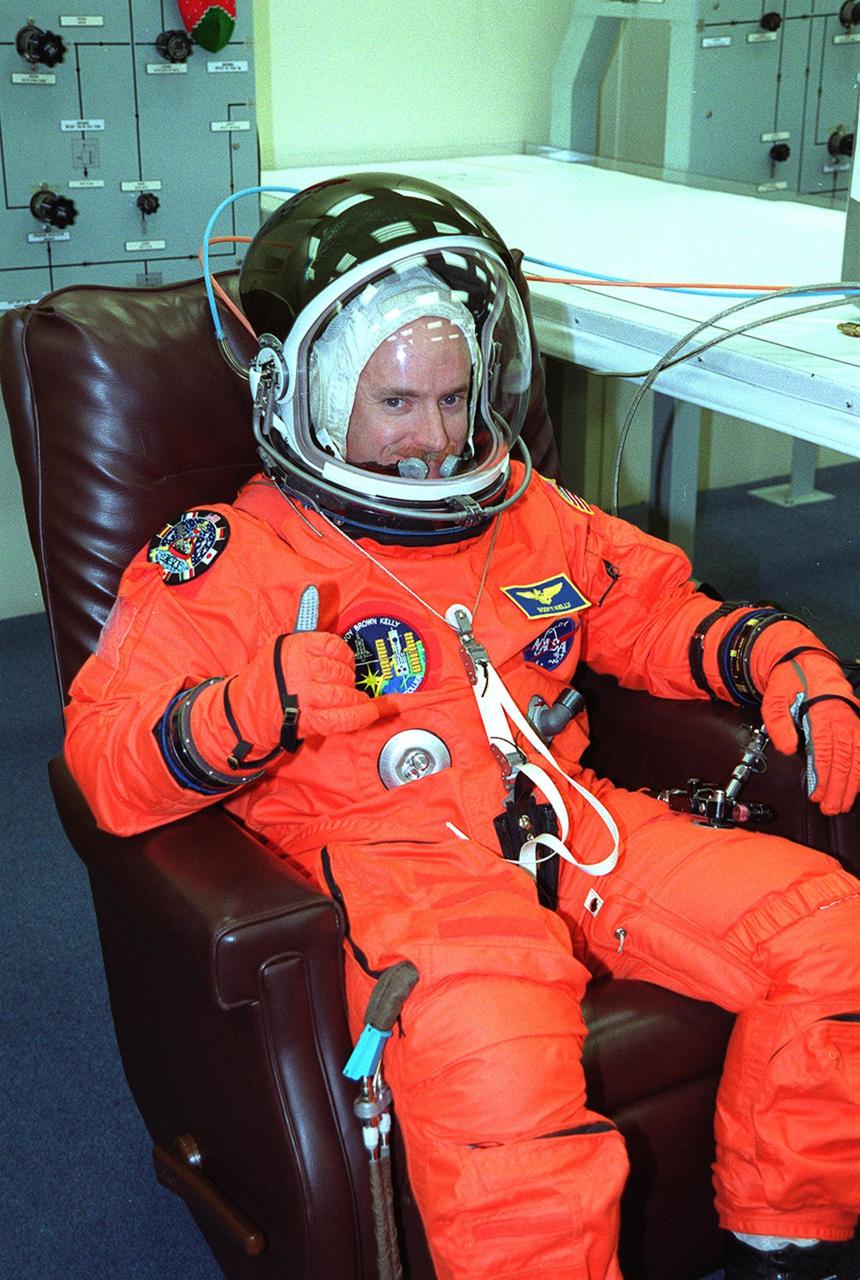
STS-103 Pilot Scott J. Kelly signals he is ready for launch after suiting up in the Operations and Checkout Building. Other crew members are Commander Curtis L. Brown Jr. and Mission Specialists Steven L. Smith, C. Michel Foale (Ph.D.), John M. Grunsfeld (Ph.D.), Jean-François Clervoy of France and Claude Nicollier of Switzerland. Clervoy and Nicollier are with the European Space Agency. The STS-103 mission, to service the Hubble Space Telescope, is scheduled for launch Dec. 17 at 8:47 p.m. EST from Launch Pad 39B. Mission objectives include replacing gyroscopes and an old computer, installing another solid state recorder, and replacing damaged insulation in the telescope. After the 8-day, 21-hour mission, Discovery is expected to land at KSC Sunday, Dec. 26, at about 6:30 p.m. EST
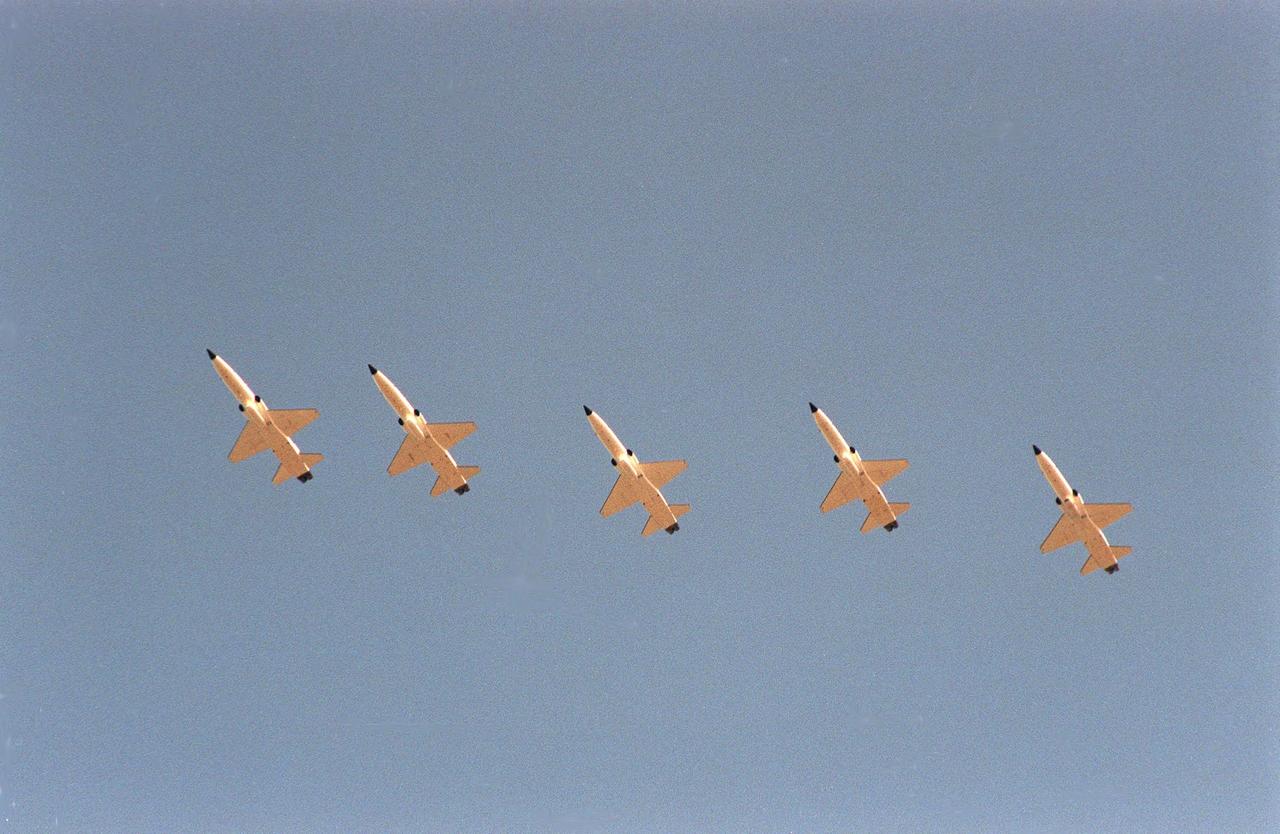
T-38 trainer jets carrying the STS-103 crew arrive in formation above Kennedy Space Center's Shuttle Landing Facility. The crew is here to take part in Terminal Countdown Demonstration Test activities this week. The TCDT provides the crew with emergency egress training, opportunities to inspect their mission payloads in the orbiter's payload bay, and simulated countdown exercises. Participating are Commander Curtis L. Brown Jr., Pilot Scott J. Kelly, and Mission Specialists Steven L. Smith, C. Michael Foale (Ph.D.), John M. Grunsfeld (Ph.D.), Claude Nicollier of Switzerland, with the European Space Agency, and Jean-François Clervoy of France, also with the European Space Agency. The mission, to service the Hubble Space Telescope, is targeted for launch Dec. 6 at 2:37 a.m. EST aboard Space Shuttle Discovery
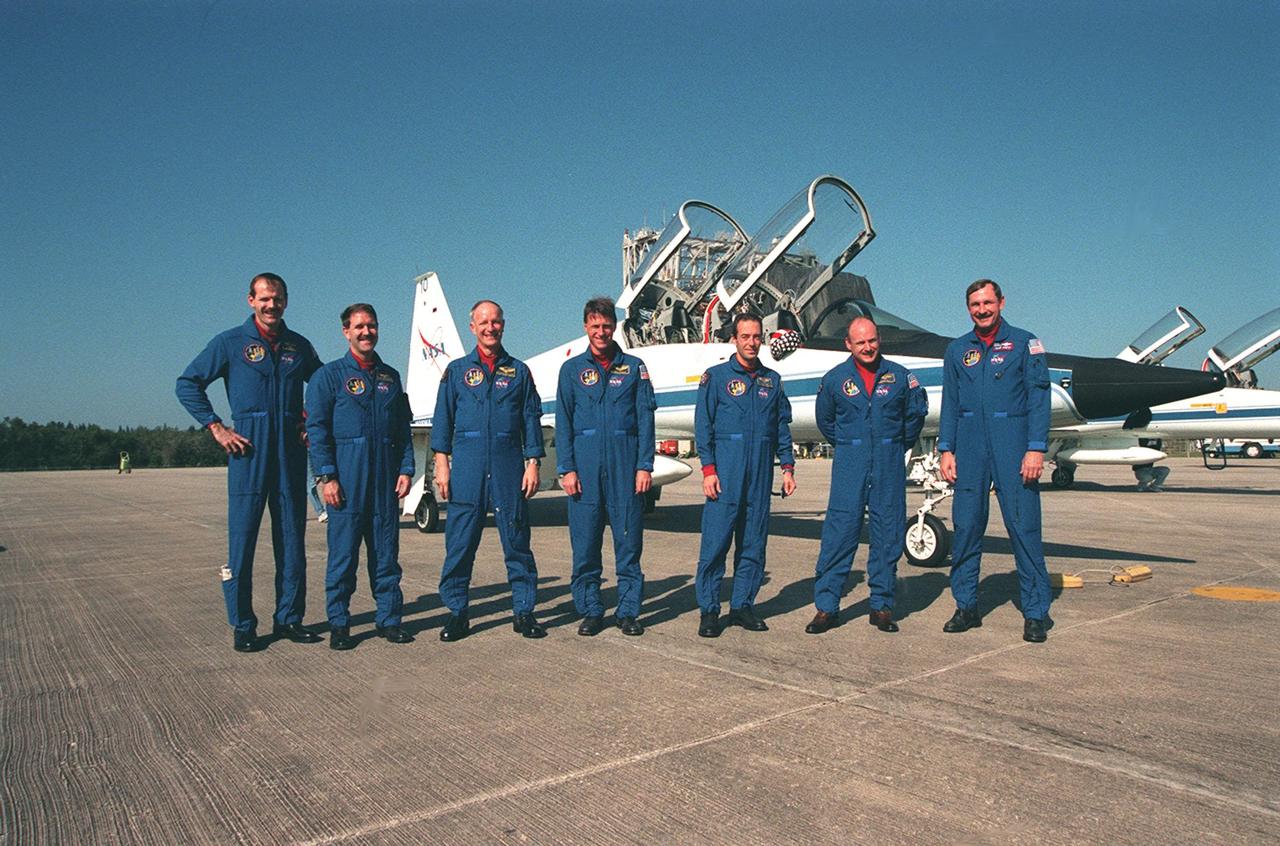
The STS-103 crew poses for photographers after landing at at Kennedy Space Center's Shuttle Landing Facility to begin Terminal Countdown Demonstration Test (TCDT) activities. Standing (left to right) in front of the T-38 jets that brought them are Mission Specialists Steven L. Smith, John M. Grunsfeld (Ph.D.), Claude Nicollier of Switzerland, with the European Space Agency, C. Michael Foale (Ph.D.), Jean-François Clervoy of France, also with the European Space Agency, Pilot Scott J. Kelly, and Commander Curtis L. Brown Jr. The TCDT provides the crew with emergency egress training, opportunities to inspect their mission payloads in the orbiter's payload bay, and simulated countdown exercises. The STS-103 mission, to service the Hubble Space Telescope, is targeted for launch Dec. 6 at 2:37 a.m. EST aboard Space Shuttle Discovery
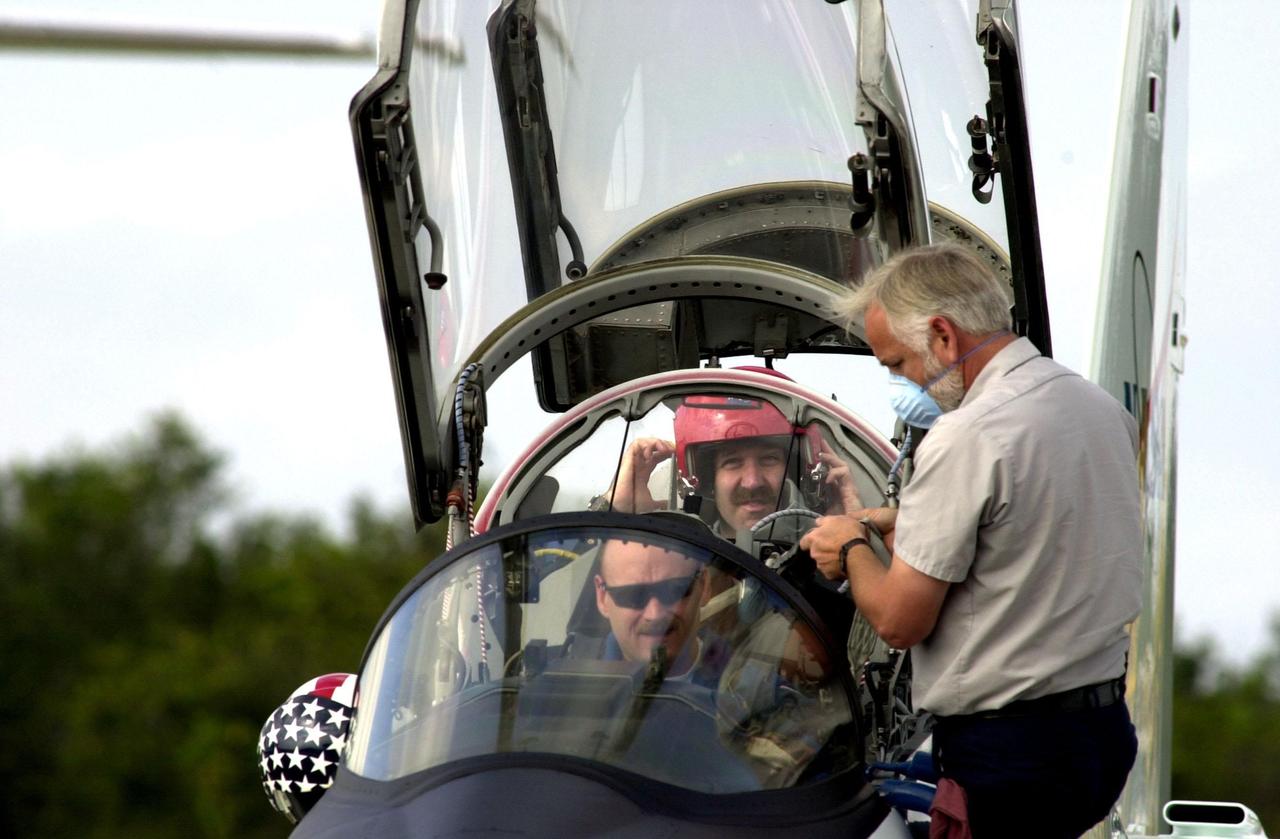
A worker at the Shuttle Landing Facility checks over STS-103 Pilot Scott J. Kelly (front) and Mission Specialist John M. Grunsfeld (Ph.D.) (behind) before they take off for practice flights in the T-38 training jet. They and other crew members Commander Curtis L. Brown Jr. and Mission Specialists Steven L. Smith, C. Michael Foale (Ph.D.), Claude Nicollier of Switzerland and Jean-François Clervoy of France are preparing for their mission on Space Shuttle Discovery. STS-103 is scheduled for launch Dec. 16 at 9:18 p.m. EST from Launch Pad 39B. The mission is expected to last about 9 days and 21 hours. Discovery is expected to land at KSC Sunday, Dec. 26, at 6:56 p.m. EST
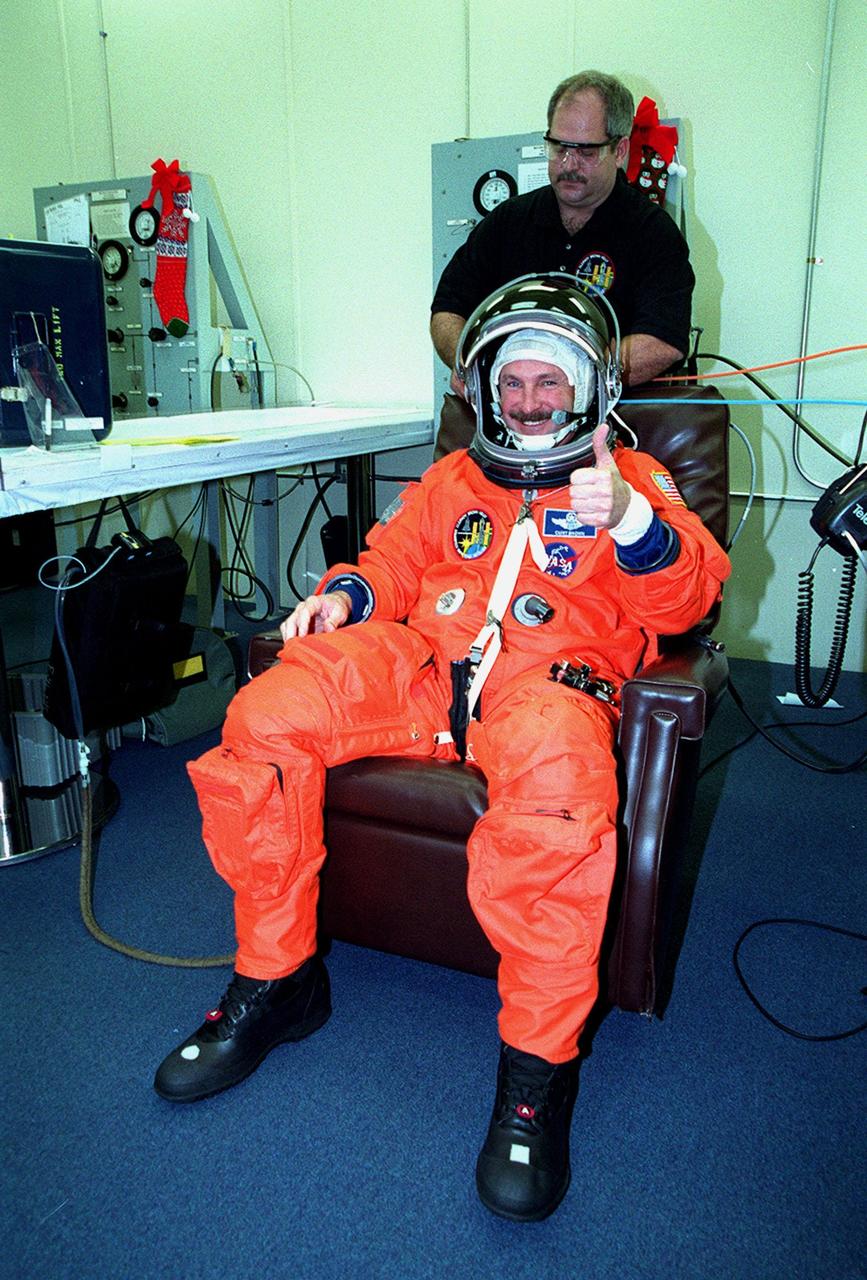
In the Operations and Checkout Building, STS-103 Commander Curtis L. Brown Jr. signals he's ready for launch while having his launch and entry suit checked by a suit technician. Other crew members are Pilot Scott J. Kelly and Mission Specialists Steven L. Smith, C. Michel Foale (Ph.D.), John M. Grunsfeld (Ph.D.), Claude Nicollier of Switzerland and Jean-François Clervoy of France. Nicollier and Clervoy are with the European Space Agency. The STS-103 mission, to service the Hubble Space Telescope, is scheduled for launch Dec. 17 at 8:47 p.m. EST from Launch Pad 39B. Mission objectives include replacing gyroscopes and an old computer, installing another solid state recorder, and replacing damaged insulation in the telescope. After the 8-day, 21-hour mission, Discovery is expected to land at KSC Sunday, Dec. 26, at about 6:30 p.m. EST
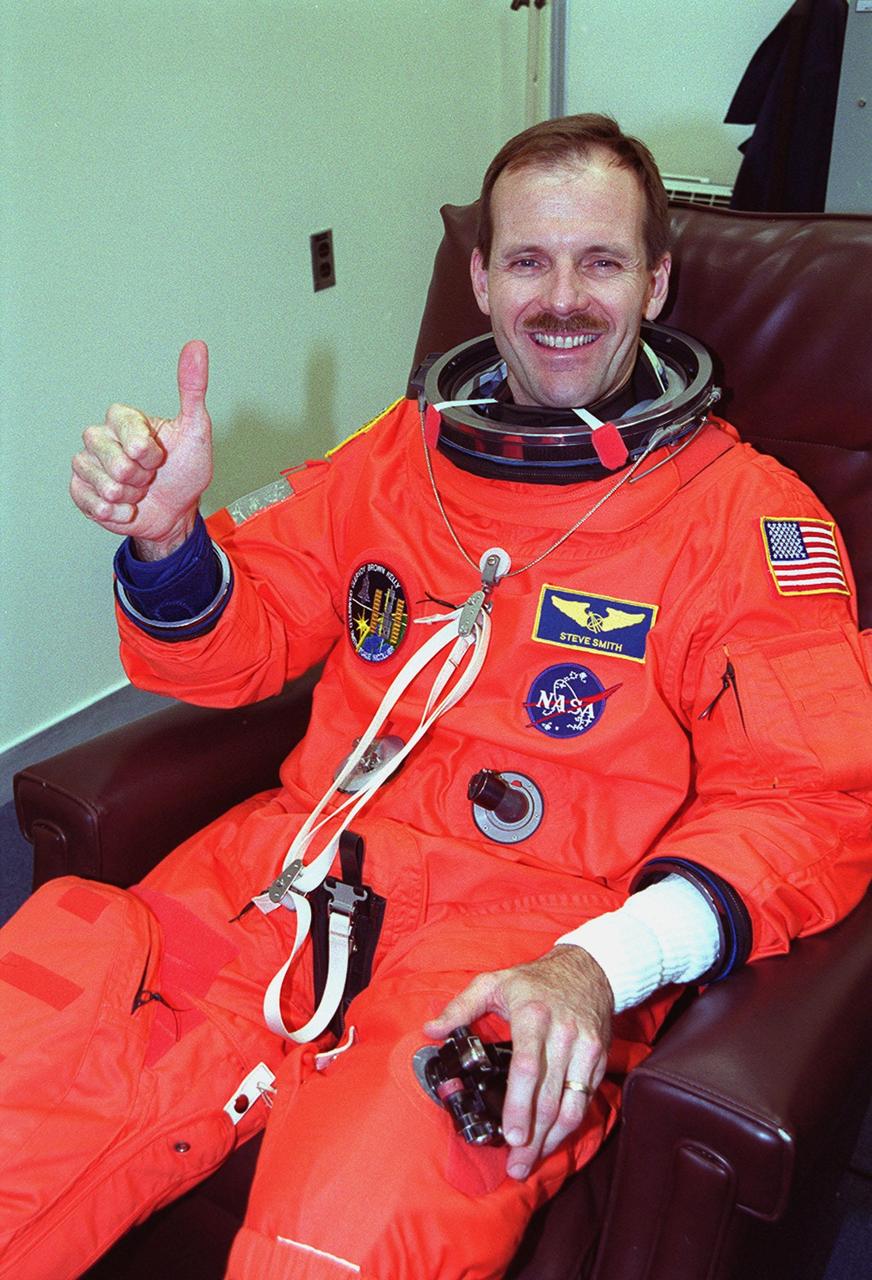
In the Operations and Checkout Building, STS-103 Mission Specialist Steven L. Smith signals he is suited up and ready for launch. Other crew members are Commander Curtis L. Brown Jr., Pilot Scott J. Kelly and Mission Specialists C. Michel Foale (Ph.D.), John M. Grunsfeld (Ph.D.), Jean-François Clervoy of France and Claude Nicollier of Switzerland. Clervoy and Nicollier are with the European Space Agency. The STS-103 mission, to service the Hubble Space Telescope, is scheduled for launch Dec. 17 at 8:47 p.m. EST from Launch Pad 39B. Mission objectives include replacing gyroscopes and an old computer, installing another solid state recorder, and replacing damaged insulation in the telescope. After the 8-day, 21-hour mission, Discovery is expected to land at KSC Sunday, Dec. 26, at about 6:30 p.m. EST
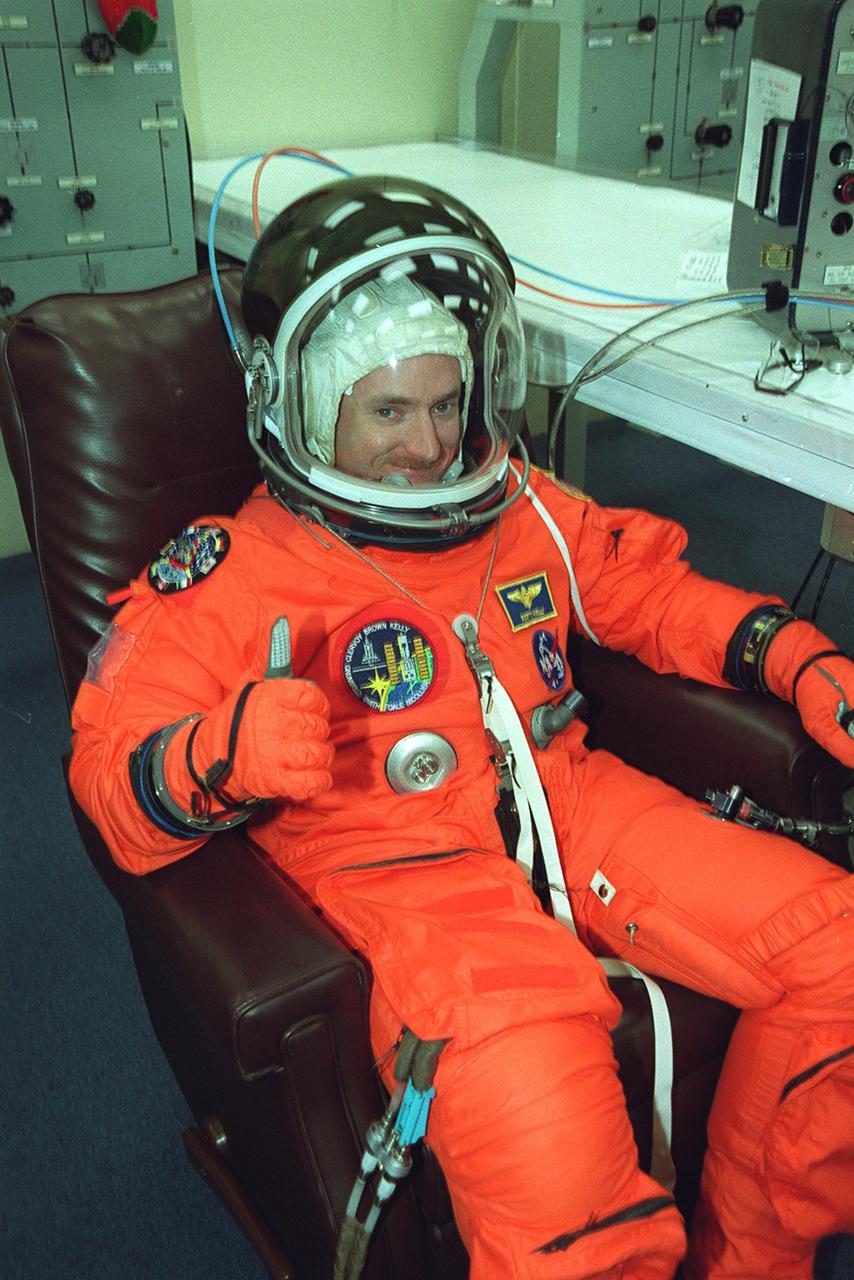
STS-103 Pilot Scott J. Kelly is suited up and ready for the second launch attempt of Space Shuttle Discovery. The previous launch attempt on Dec. 17 was scrubbed about 8:52 p.m. due to numerous violations of weather launch commit criteria at KSC. Kelly and fellow crew members Commander Curtis L. Brown Jr. and Mission Specialists Steven L. Smith, C. Michael Foale (Ph.D.), John M. Grunsfeld (Ph.D.), Claude Nicollier of Switzerland and Jean-Francois Clervoy of France are scheduled to lift off at 7:50 p.m. EST Dec. 19 on mission STS-103, servicing the Hubble Space Telescope. Objectives for the nearly eight-day mission include replacing gyroscopes and an old computer, installing another solid state recorder, and replacing damaged insulation in the telescope. Discovery is expected to land at KSC Monday, Dec. 27, at about 5:24 p.m. EST
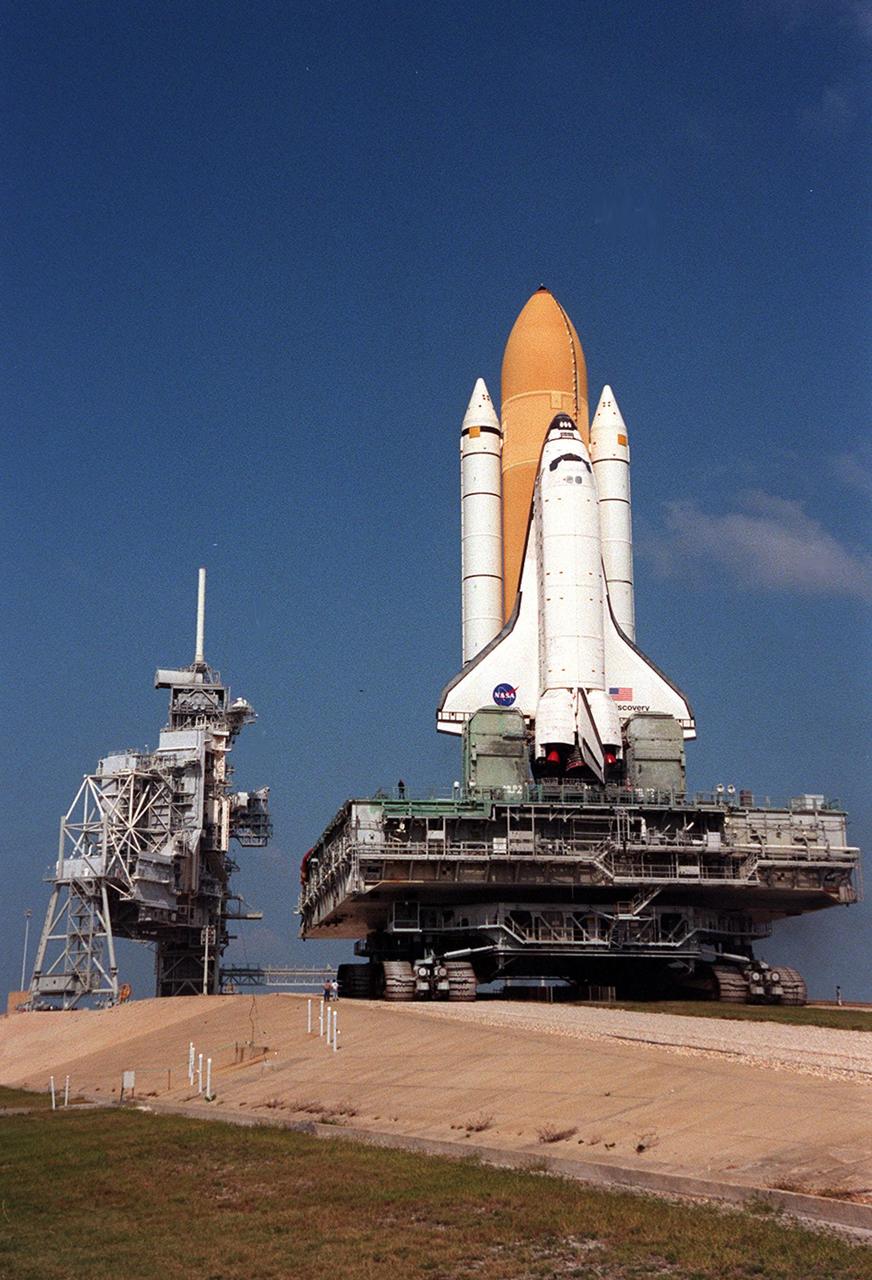
KENNEDY SPACE CENTER, Fla. -- Space Shuttle Discovery approaches Launch Pad 39B where the orbiter, external tank and solid rocket boosters will undergo final preparations for the STS-103 launch. The mission is a "call-up" due to the need to replace and repair portions of the Hubble Space Telescope. Although Hubble is operating normally and conducting its scientific observations, only three of its six gyroscopes are working properly. Four EVA's are planned to make the necessary repairs and replacements on the telescope. The STS-103 crew members are Commander Curtis L. Brown Jr., Pilot Scott J. Kelly, Steven L. Smith, C. Michael Foale (Ph.D.), John M. Grunsfeld (Ph.D.), and Claude Nicollier of Switzerland and Jean-François Clervoy of France, both with the European Space Agency. The mission is targeted for launch Dec. 6 at 2:37 a.m. EST.
Commander Curtis L. Brown Jr. smiles on his arrival at the Shuttle Landing Facility aboard a T-38 jet aircraft. He joins other crew members Pilot Scott J. Kelly and Mission Specialists Steven L. Smith, C. Michael Foale (Ph.D.), John M. Grunsfeld (Ph.D.), Claude Nicollier of Switzerland and Jean-François Clervoy of France, for pre-launch preparations on mission STS-103 aboard Space Shuttle Discovery. Nicollier and Clervoy are with the European Space Agency. The mission, to service the Hubble Space Telescope, is scheduled for launch Dec. 11 at 12:13 a.m. EST from Launch Pad 39B. Discovery is expected to land at KSC Monday, Dec. 20, at 9:21 p.m. EST
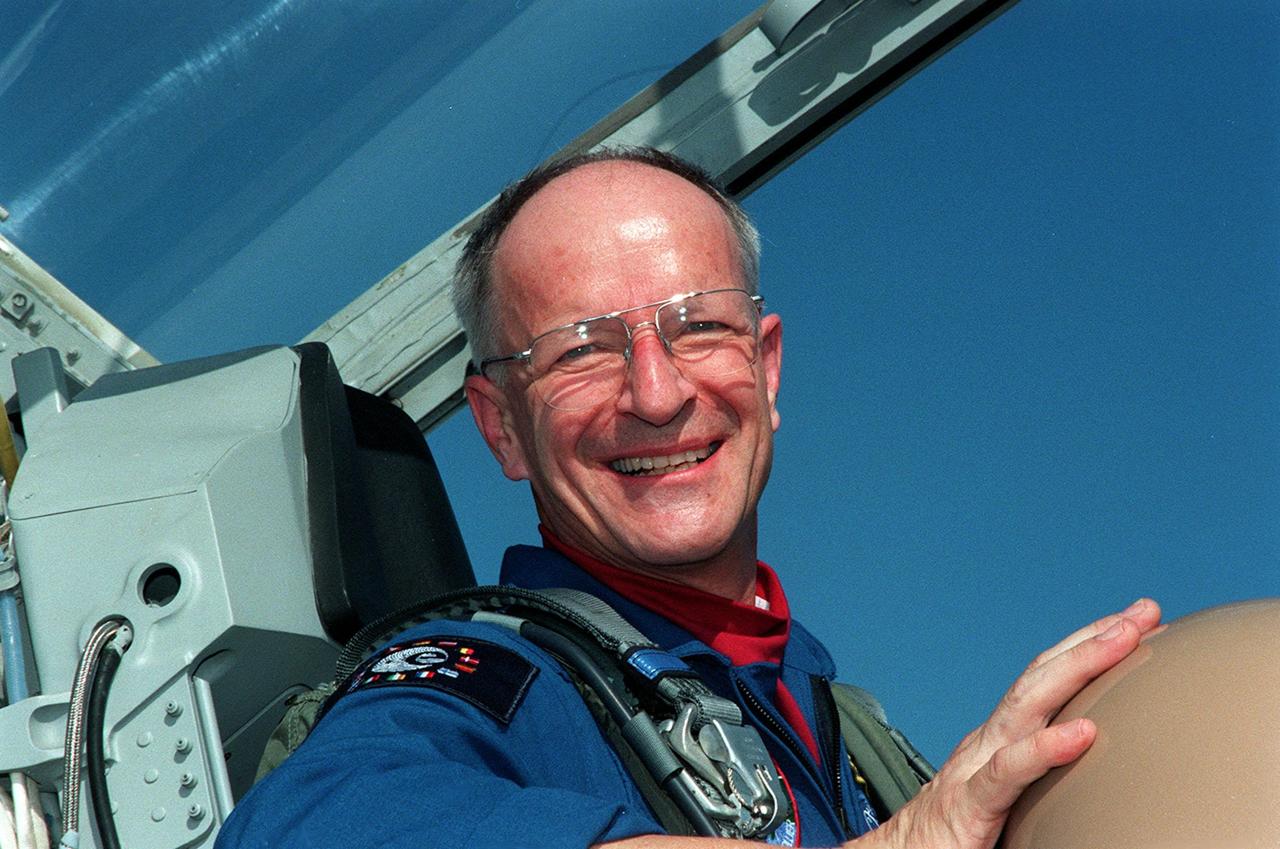
STS-103 Mission Specialist Claude Nicollier of Switzerland, with the European Space Agency, smiles after landing at Kennedy Space Center's Shuttle Landing Facility to begin Terminal Countdown Demonstration Test (TCDT) activities. The TCDT provides the crew with emergency egress training, opportunities to inspect their mission payloads in the orbiter's payload bay, and simulated countdown exercises. Also participating are Commander Curtis L. Brown Jr., Pilot Scott J. Kelly, and Mission Specialists Steven L. Smith, C. Michael Foale (Ph.D.), John M. Grunsfeld (Ph.D.), and Jean-François Clervoy of France, also with the European Space Agency. The mission, to service the Hubble Space Telescope, is targeted for launch Dec. 6 at 2:37 a.m. EST aboard Space Shuttle Discovery
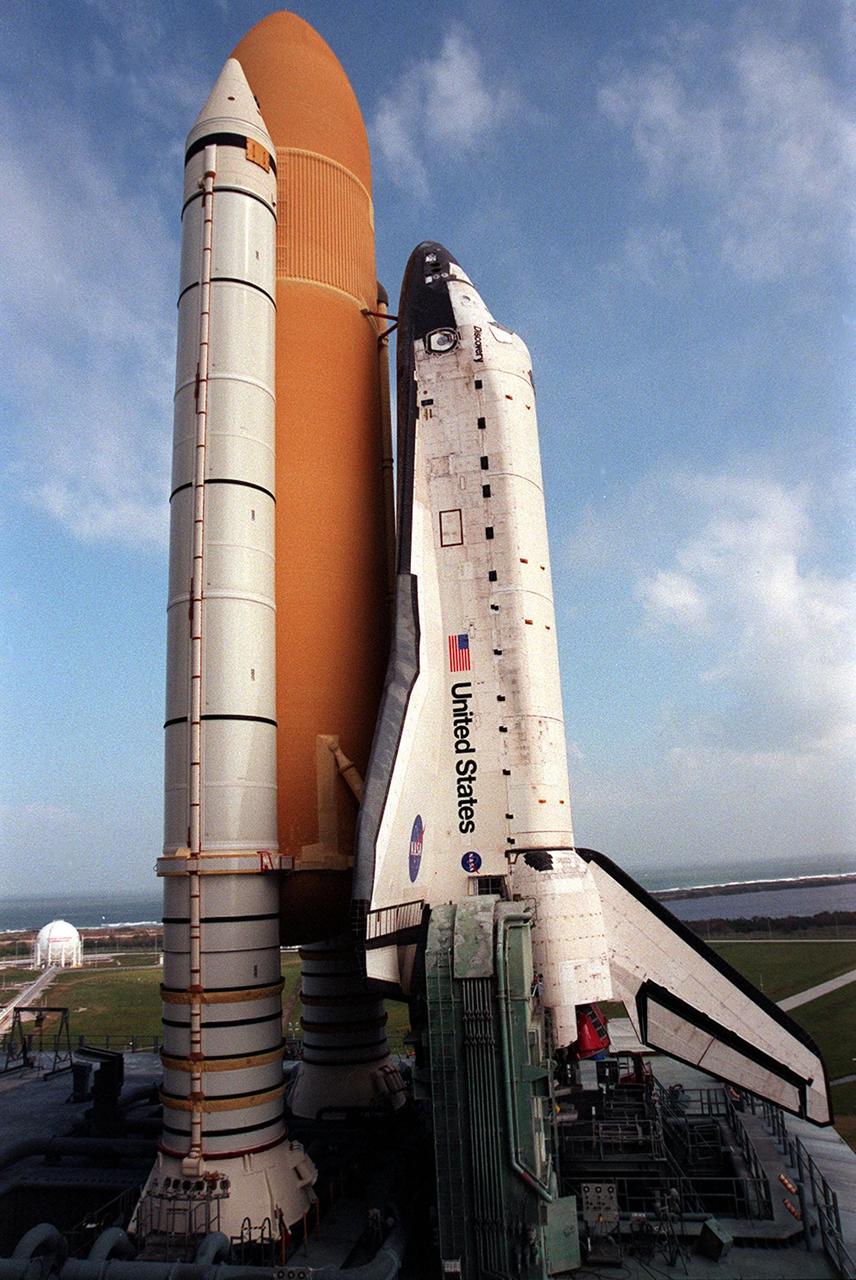
KENNEDY SPACE CENTER, Fla. -- At Launch Pad 39B, Space Shuttle Discovery towers against the hazy blue sky after a seven-hour trek from the Vehicle Assembly Building. The orbiter, external tank and solid rocket boosters will undergo final preparations for the STS-103 launch. The mission is a "call-up" due to the need to replace and repair portions of the Hubble Space Telescope. Although Hubble is operating normally and conducting its scientific observations, only three of its six gyroscopes are working properly. Four EVA's are planned to make the necessary repairs and replacements on the telescope. The STS-103 crew members are Commander Curtis L. Brown Jr., Pilot Scott J. Kelly, Steven L. Smith, C. Michael Foale (Ph.D.), John M. Grunsfeld (Ph.D.), and Claude Nicollier of Switzerland and Jean-François Clervoy of France, both with the European Space Agency. The mission is targeted for launch Dec. 6 at 2:37 a.m. EST
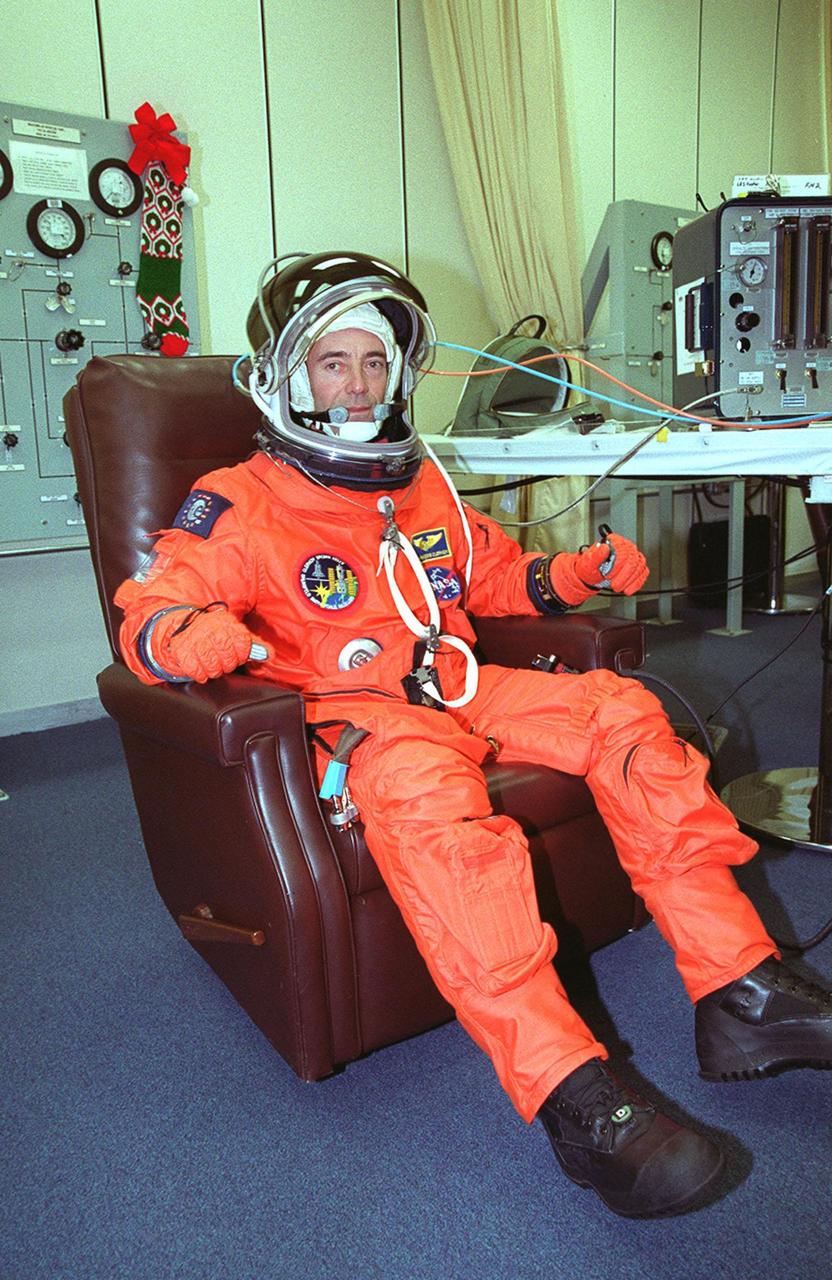
In the Operations and Checkout Building, STS-103 Mission Specialist Jean-François Clervoy of France has donned his launch and entry suit and is ready for launch. Other crew members are Commander Curtis L. Brown Jr., Pilot Scott J. Kelly and Mission Specialists Steven L. Smith, C. Michel Foale (Ph.D.), John M. Grunsfeld (Ph.D.), and Claude Nicollier of Switzerland. Nicollier and Clervoy are with the European Space Agency. The STS-103 mission, to service the Hubble Space Telescope, is scheduled for launch Dec. 17 at 8:47 p.m. EST from Launch Pad 39B. Mission objectives include replacing gyroscopes and an old computer, installing another solid state recorder, and replacing damaged insulation in the telescope. After the 8-day, 21-hour mission, Discovery is expected to land at KSC Sunday, Dec. 26, at about 6:30 p.m. EST
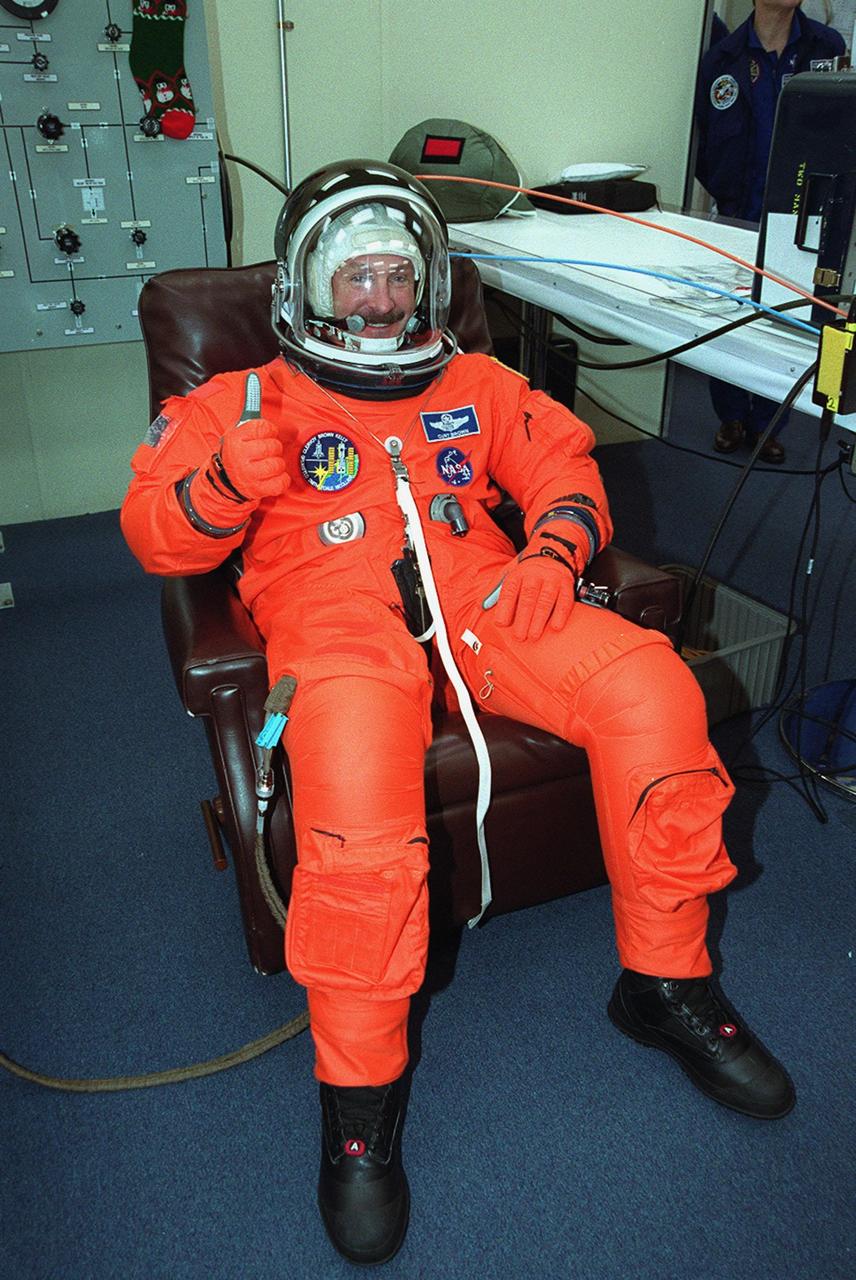
STS-103 Commander Curtis L. Brown Jr. is suited up and ready to go for the second launch attempt of Space Shuttle Discovery. The previous launch attempt on Dec. 17 was scrubbed about 8:52 p.m. due to numerous violations of weather launch commit criteria at KSC. Brown and fellow crew members Pilot Scott J. Kelly and Mission Specialists Steven L. Smith, C. Michael Foale (Ph.D.), John M. Grunsfeld (Ph.D.), Claude Nicollier of Switzerland and Jean-Francois Clervoy of France are scheduled to lift off at 7:50 p.m. EST Dec. 19 on mission STS-103, servicing the Hubble Space Telescope. Objectives for the nearly eight-day mission include replacing gyroscopes and an old computer, installing another solid state recorder, and replacing damaged insulation in the telescope. Discovery is expected to land at KSC Monday, Dec. 27, at about 5:24 p.m. EST
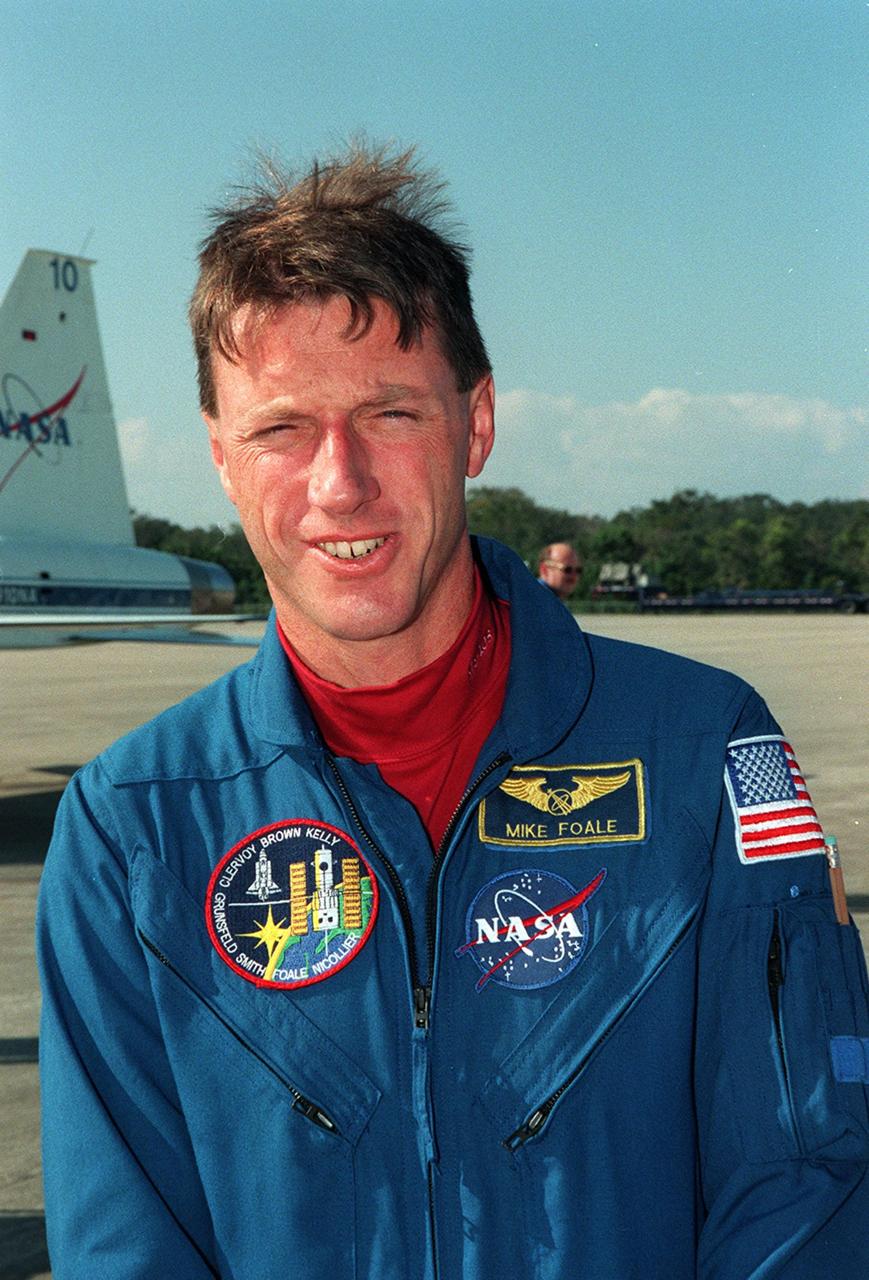
STS-103 Mission Specialist C. Michael Foale (Ph.D.) arrives at Kennedy Space Center's Shuttle Landing Facility to begin Terminal Countdown Demonstration Test (TCDT) activities. The TCDT provides the crew with emergency egress training, opportunities to inspect their mission payloads in the orbiter's payload bay, and simulated countdown exercises. Also participating are Commander Curtis L. Brown Jr., Pilot Scott J. Kelly, and Mission Specialists Steven L. Smith, John M. Grunsfeld (Ph.D.), Claude Nicollier of Switzerland, with the European Space Agency, and Jean-François Clervoy of France, also with the European Space Agency. The mission, to service the Hubble Space Telescope, is targeted for launch Dec. 6 at 2:37 a.m. EST aboard Space Shuttle Discovery
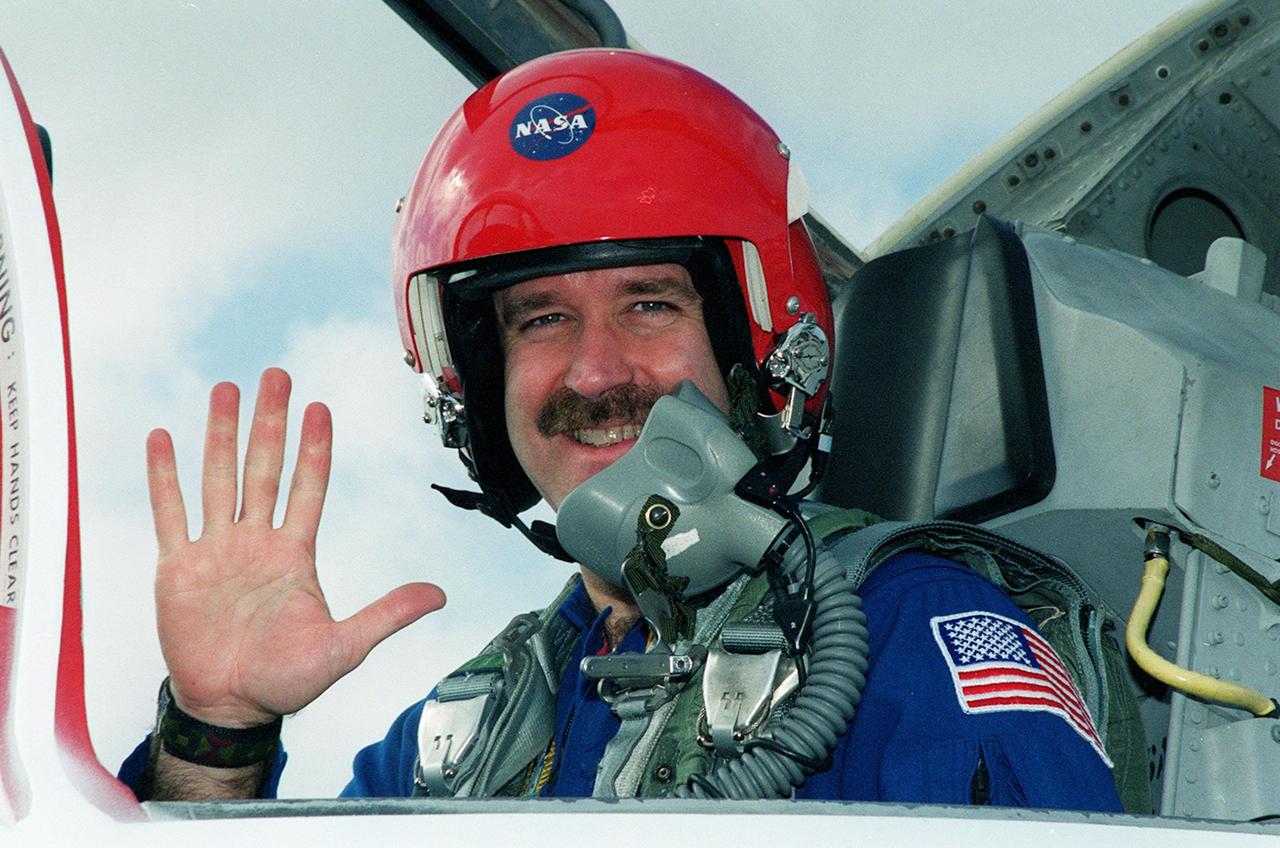
STS-103 Mission Specialist John M. Grunsfeld (Ph.D.) waves from the rear seat of a T-38 training jet before beginning practice flights. He joins other crew members Commander Curtis L. Brown Jr., Pilot Scott J. Kelly and Mission Specialists Steven L. Smith, C. Michael Foale (Ph.D.), Claude Nicollier of Switzerland and Jean-François Clervoy of France, for pre-launch preparations on mission STS-103 aboard Space Shuttle Discovery. Nicollier and Clervoy are with the European Space Agency. The mission, to service the Hubble Space Telescope, is scheduled for launch Dec. 16 at 9:18 p.m. EST from Launch Pad 39B. The mission is expected to last about 9 days and 21 hours. Discovery is expected to land at KSC Sunday, Dec. 26, at 6:56 p.m. EST
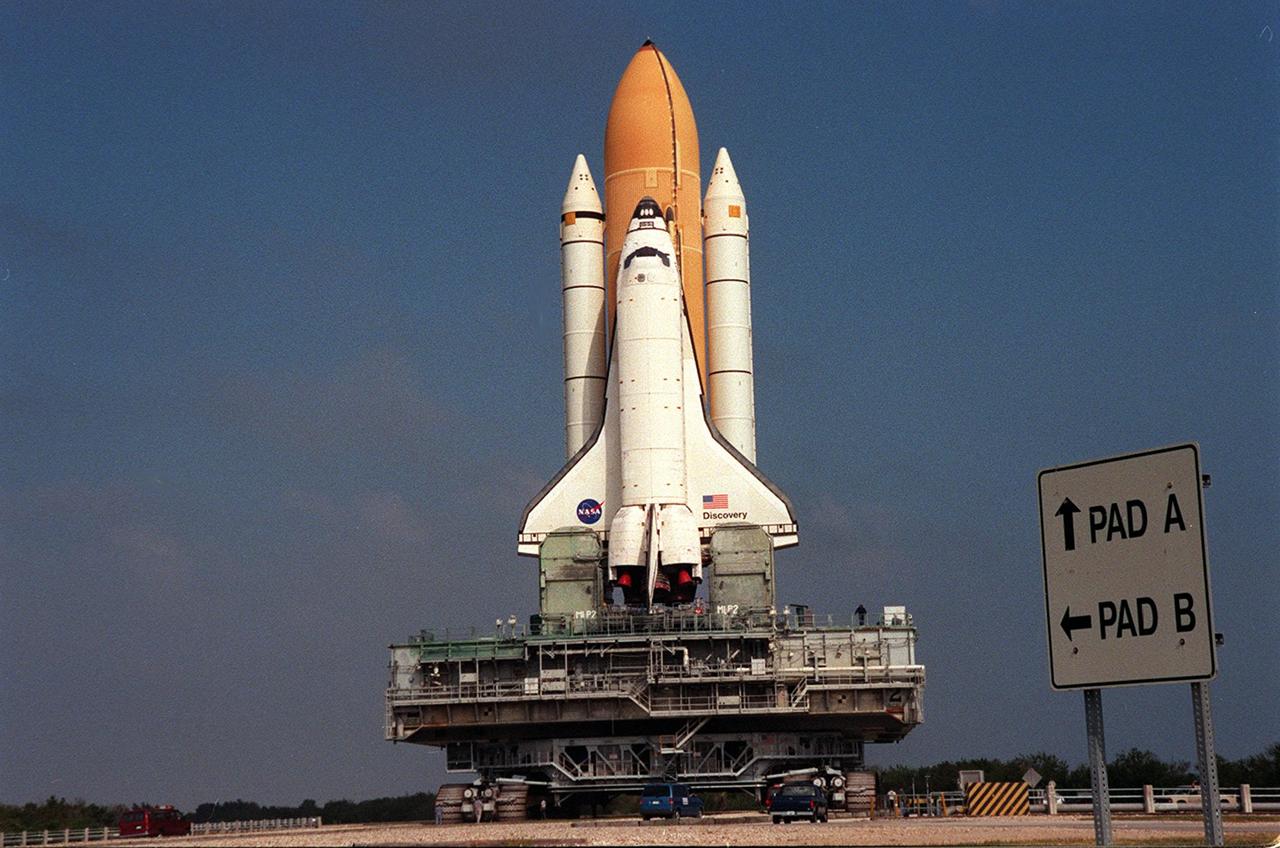
KENNEDY SPACE CENTER, Fla. -- Space Shuttle Discovery makes the turn toward Launch Pad 39B on its trek atop the mobile launcher platform and crawler transporter. Once at the pad, the orbiter, external tank and solid rocket boosters will undergo final preparations for the STS-103 launch targeted for Dec. 6, 1999, at 2:37 a.m. EST. The mission is a "call-up" due to the need to replace and repair portions of the Hubble Space Telescope. Although Hubble is operating normally and conducting its scientific observations, only three of its six gyroscopes are working properly. Four EVA's are planned to make the necessary repairs and replacements on the telescope. The STS-103 crew members are Commander Curtis L. Brown Jr., Pilot Scott J. Kelly, Steven L. Smith, C. Michael Foale (Ph.D.), John M. Grunsfeld (Ph.D.), and Claude Nicollier of Switzerland and Jean-François Clervoy of France, both with the European Space Agency.
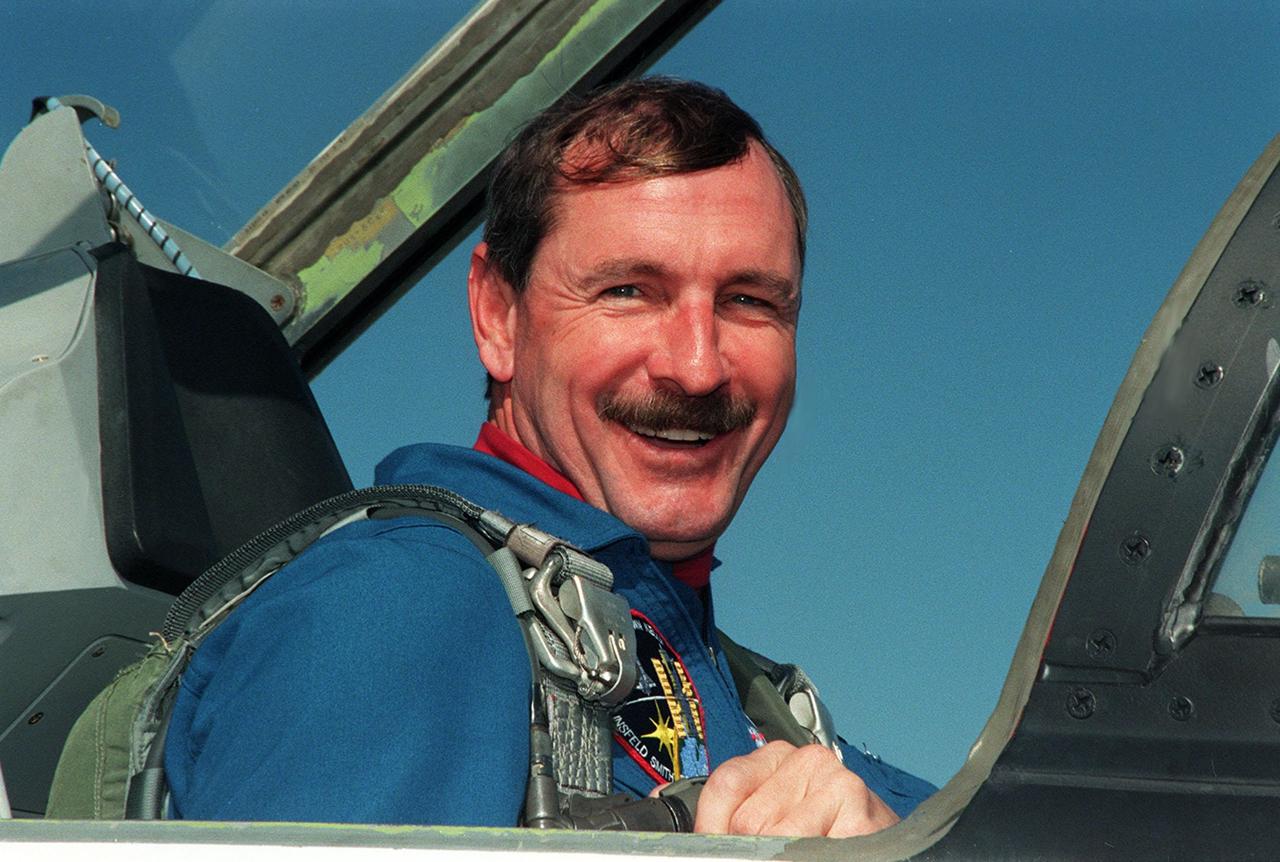
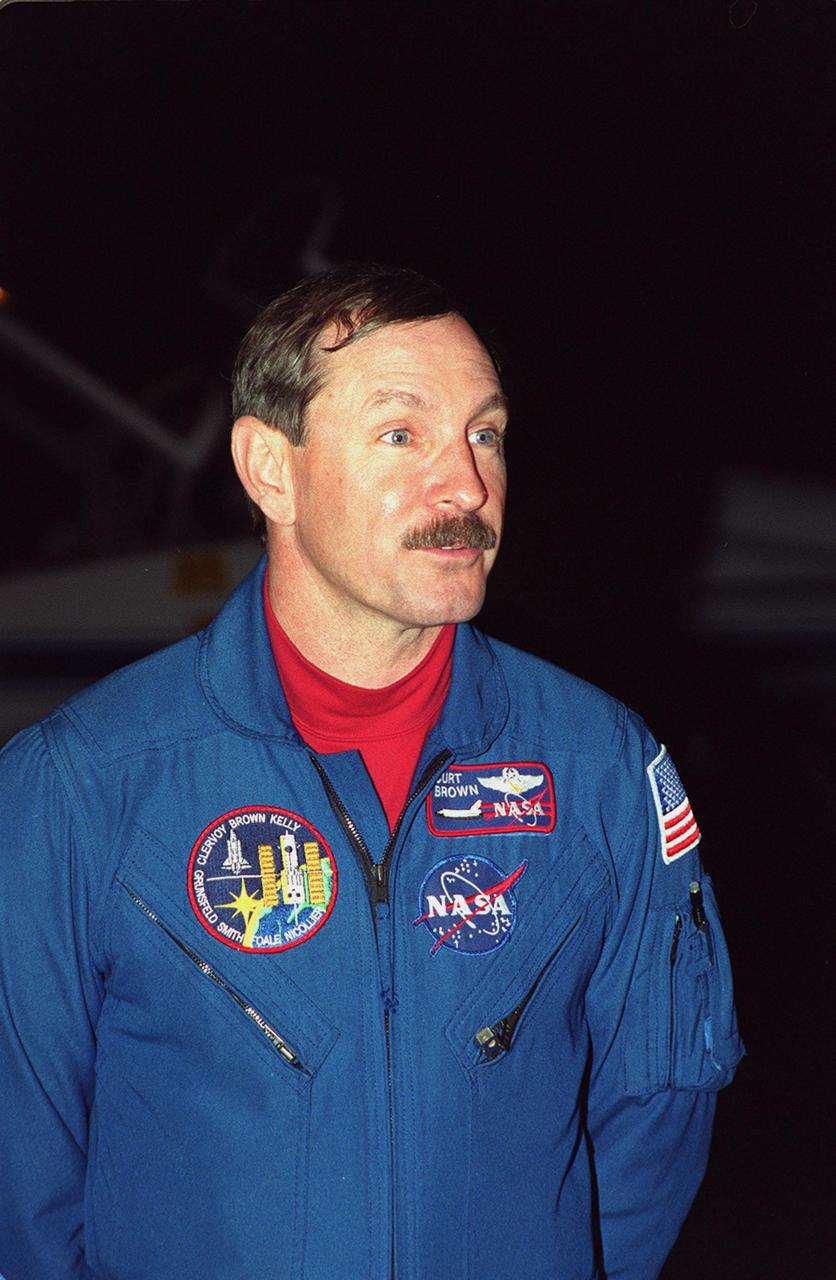
STS-103 Commander Curtis L. Brown Jr. is happy to arrive at Kennedy Space Center to begin Terminal Countdown Demonstration Test (TCDT) activities. The TCDT provides the crew with emergency egress training, opportunities to inspect their mission payloads in the orbiter's payload bay, and simulated countdown exercises. Also participating are Pilot Scott J. Kelly, and Mission Specialists Steven L. Smith, C. Michael Foale (Ph.D.), John M. Grunsfeld (Ph.D.), Claude Nicollier of Switzerland, with the European Space Agency, and Jean-François Clervoy of France, also with the European Space Agency. The mission, to service the Hubble Space Telescope, is targeted for launch Dec. 6 at 2:37 a.m. EST aboard Space Shuttle Discovery
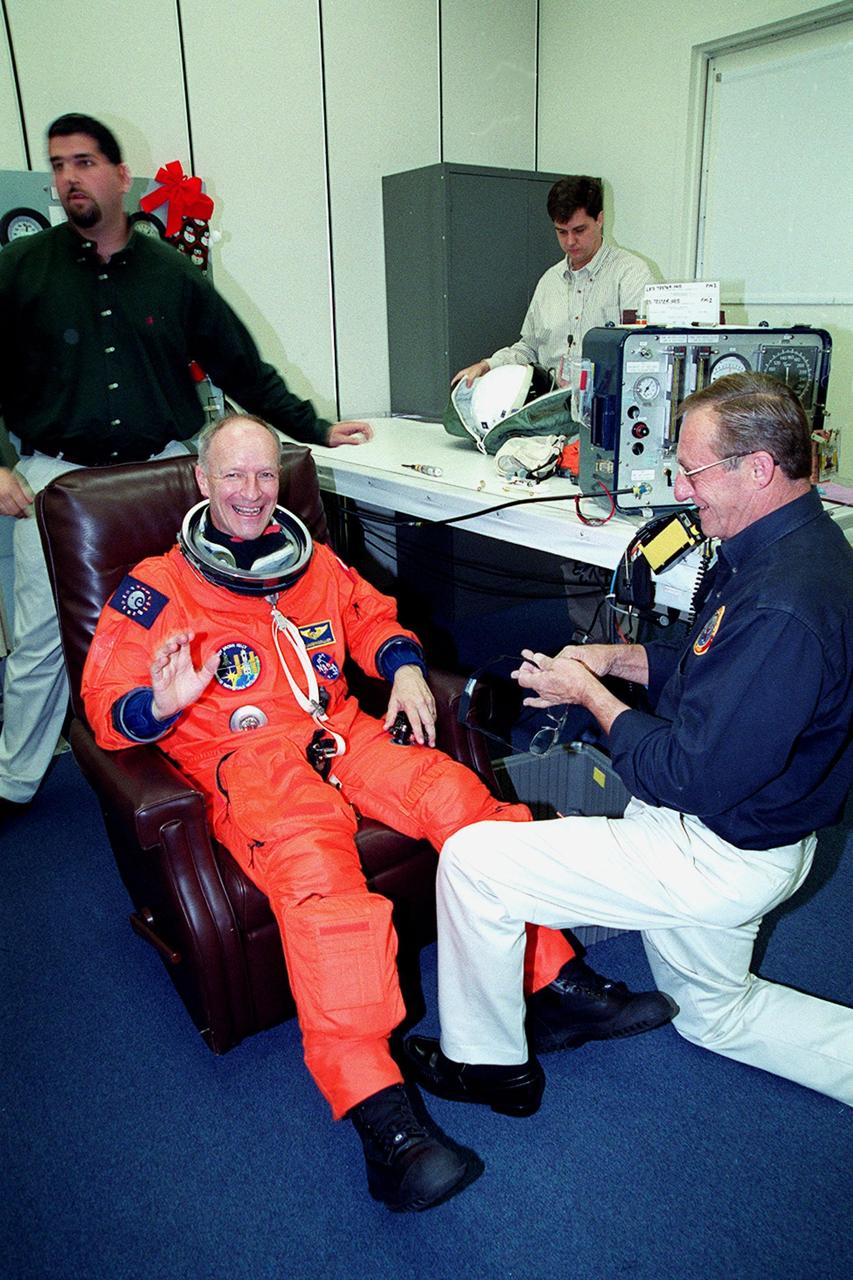
In the Operations and Checkout Building, STS-103 Mission Specialist Claude Nicollier of Switzerland waves while having his launch and entry suit checked by a suit techician during final launch preparations. Other crew members are Commander Curtis L. Brown Jr., Pilot Scott J. Kelly and Mission Specialists Steven L. Smith, C. Michael Foale (Ph.D.), John M. Grunsfeld (Ph.D.) and Jean-François Clervoy of France. Nicollier and Clervoy are with the European Space Agency. The STS-103 mission, to service the Hubble Space Telescope, is scheduled for launch Dec. 17 at 8:47 p.m. EST from Launch Pad 39B. Mission objectives include replacing gyroscopes and an old computer, installing another solid state recorder, and replacing damaged insulation in the telescope. After the 8-day, 21-hour mission, Discovery is expected to land at KSC Sunday, Dec. 26, at about 6:30 p.m. EST
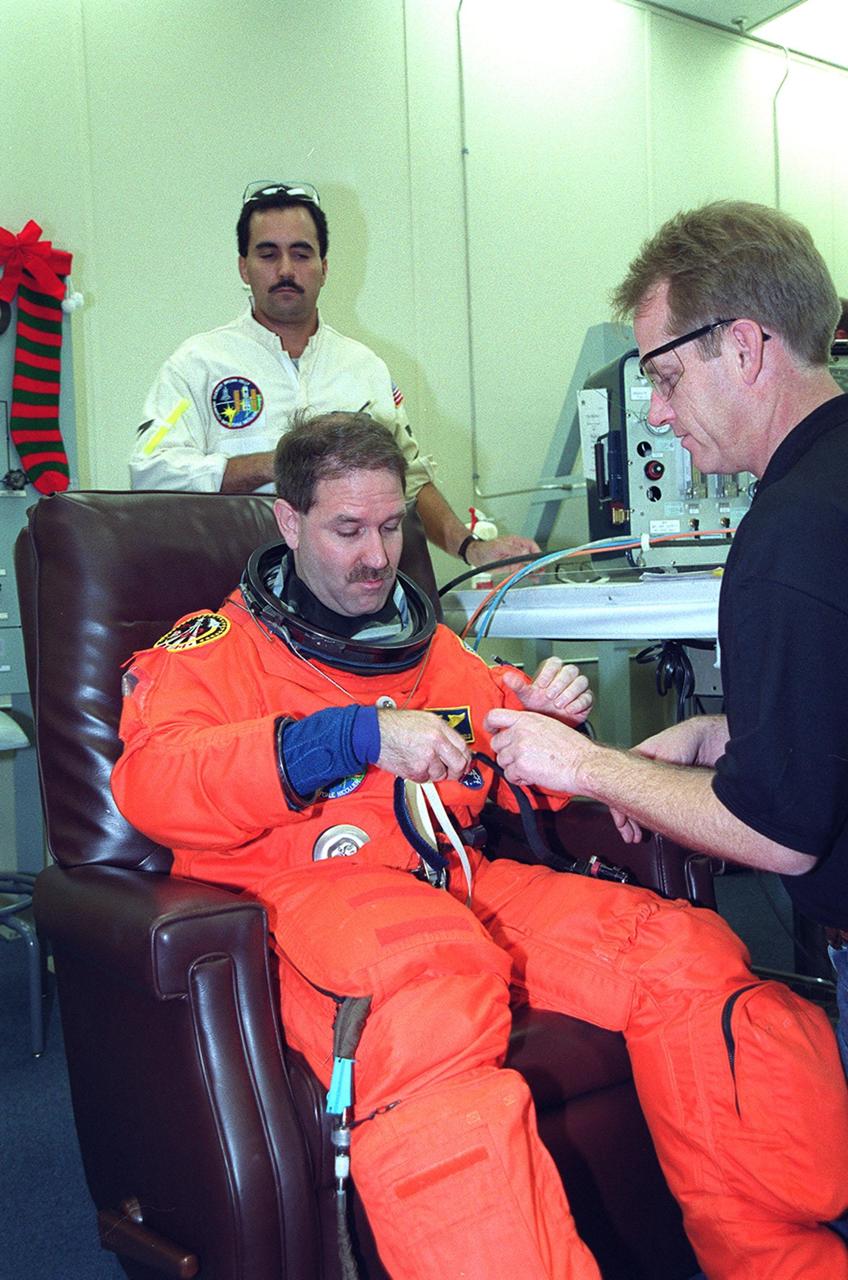
In the Operations and Checkout Building, STS-103 Mission Specialist John M. Grunsfeld (Ph.D.) is assisted by a suit technician in donning his launch and entry suit during final launch preparations. Other crew members are Commander Curtis L. Brown Jr., Pilot Scott J. Kelly and Mission Specialists Steven L. Smith, C. Michael Foale (Ph.D.), Claude Nicollier of Switzerland and Jean-François Clervoy of France. Nicollier and Clervoy are with the European Space Agency. The STS-103 mission, to service the Hubble Space Telescope, is scheduled for launch Dec. 17 at 8:47 p.m. EST from Launch Pad 39B. Mission objectives include replacing gyroscopes and an old computer, installing another solid state recorder, and replacing damaged insulation in the telescope. After the 8-day, 21-hour mission, Discovery is expected to land at KSC Sunday, Dec. 26, at about 6:30 p.m. EST
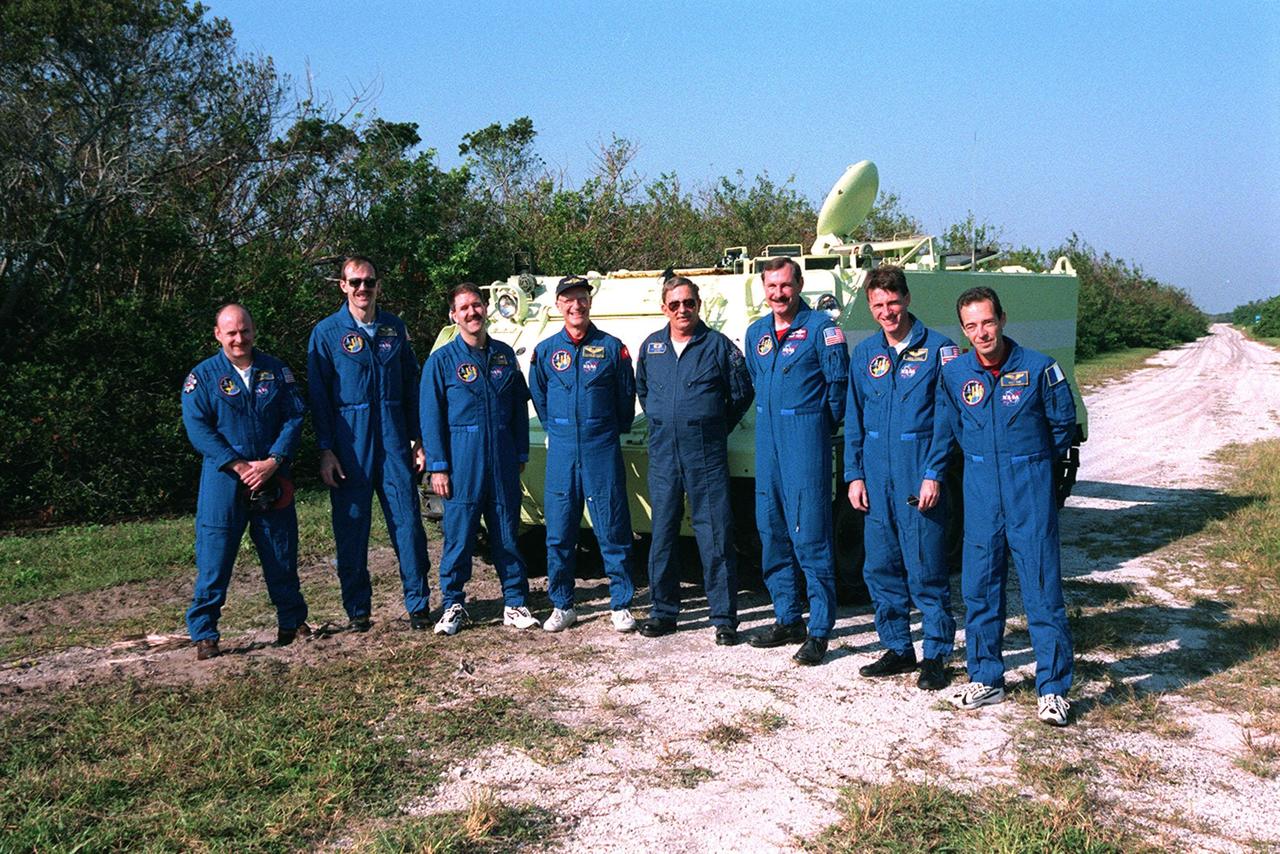
The STS-103 crew pose for photographers following Terminal Countdown Demonstration Test (TCDT) emergency egress training on the small armored personnel carrier behind them. Standing left to right are Pilot Scott J. Kelly, Mission Specialists Steven L. Smith, John M. Grunsfeld (Ph.D.), Claude Nicollier of Switzerland, their trainer on the carrier Capt. George Hoggard of the KSC/CCAS Fire Department, Commander Curtis L. Brown Jr., and Mission Specialists C. Michael Foale (Ph.D.) and Jean-Francois Clervoy of France. Nicollier and Clervoy are with the European Space Agency. The TCDT also provides simulated countdown exercises and opportunities to inspect the mission payloads in the orbiter's payload bay. STS-103 is a "call-up" mission due to the need to replace and repair portions of the Hubble Space Telescope. Four EVA's are planned to make the necessary repairs and replacements on the telescope. The mission is targeted for launch Dec. 6 at 2:37 a.m. EST
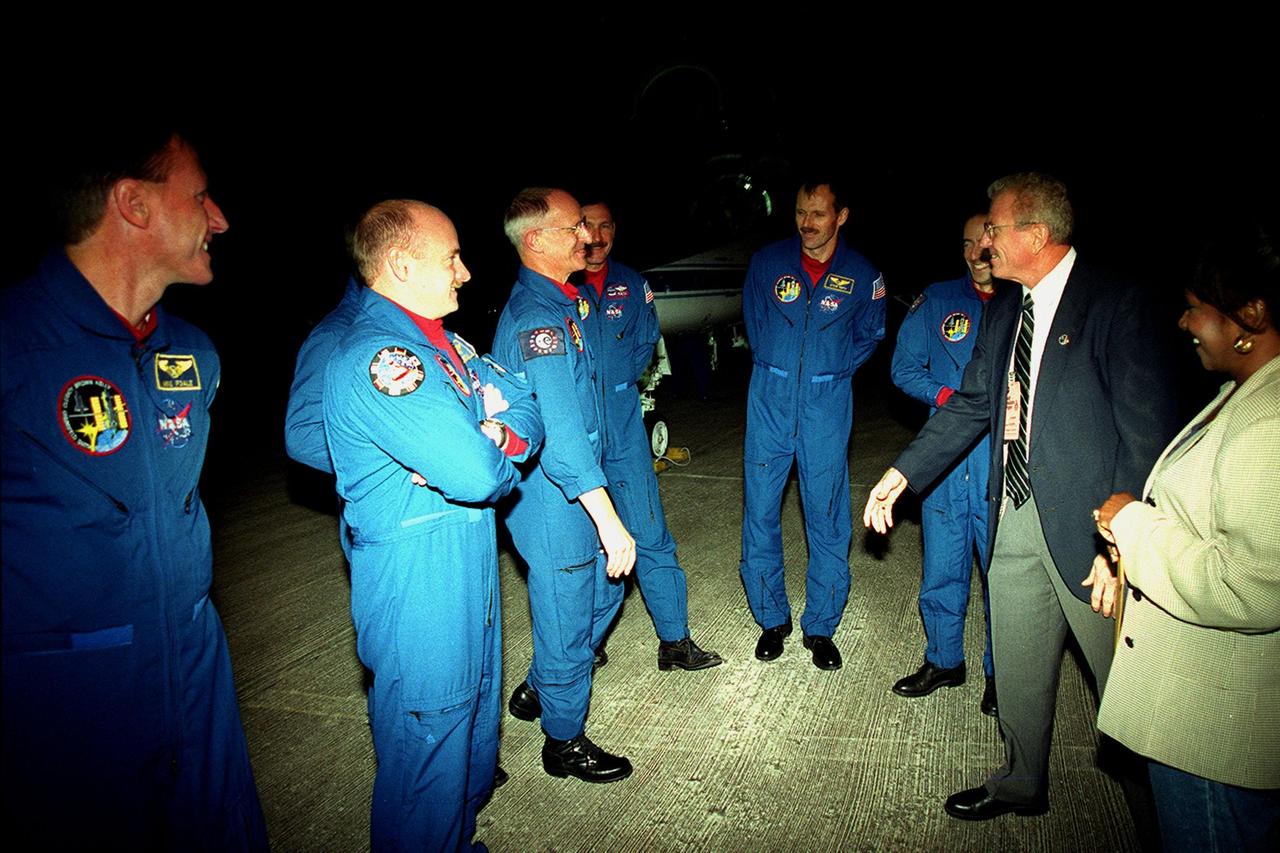
At the Shuttle Landing Facility, the STS-103 crew is greeted by Loren Shriver, Deputy Director for Launch and Payload Processing, upon their arrival aboard T-38 jets to make final preparations for launch. From left are Mission Specialist C. Michael Foale (Ph.D.), Pilot Scott J. Kelly, Mission Specialist John M. Grunsfeld (Ph.D.) (hidden behind Kelly), Mission Specialist Claude Nicollier of Switzerland, Commander Curtis L. Brown Jr., Mission Specialist Steven L. Smith, Mission Specialist Jean-François Clervoy of France, Loren Shriver, and Delores Green with KSC's Astronaut Office. Nicollier and Clervoy are with the European Space Agency. Shriver was the commander of the STS-31 crew which originally deployed the telescope in April of 1990. The STS-103 mission, to service the Hubble Space Telescope a third time, is scheduled for launch Dec. 11 at 12:13 a.m. EST from Launch Pad 39B
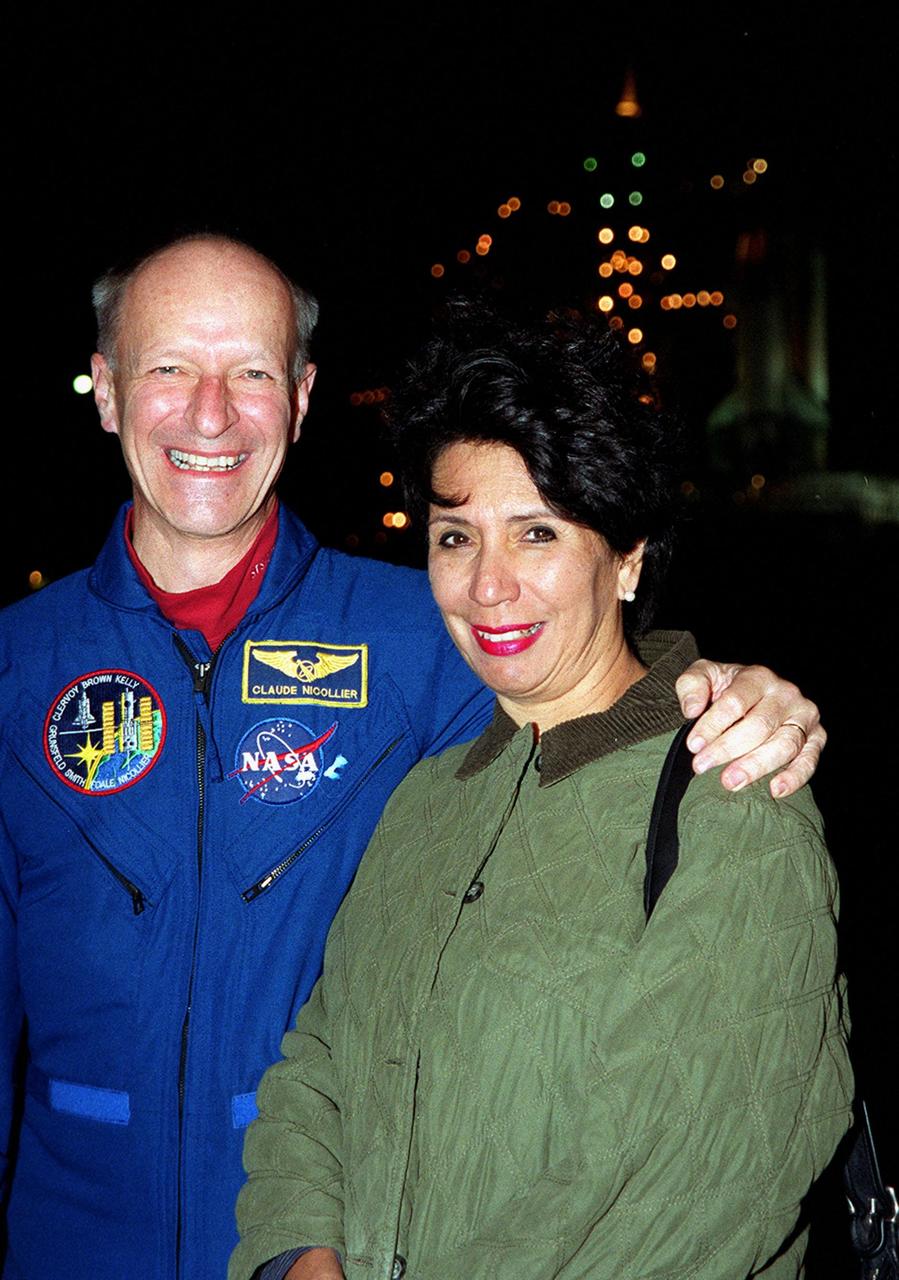
STS-103 Mission Specialist Claude Nicollier of Switzerland and his wife, Susana, pose at Launch Pad 39B during a meeting of the STS-103 crew with their family and friends. Nicollier is with the European Space Agency. The lights in the background are on the Fixed Service Structure next to Space Shuttle Discovery. The mission, to service the Hubble Space Telescope, is scheduled for launch Dec. 17 at 8:47 p.m. EST from Launch Pad 39B. Mission objectives include replacing gyroscopes and an old computer, installing another solid state recorder, and replacing damaged insulation in the telescope. The mission is expected to last about 8 days and 21 hours. Discovery is expected to land at KSC Sunday, Dec. 26, at about 6:25 p.m. EST
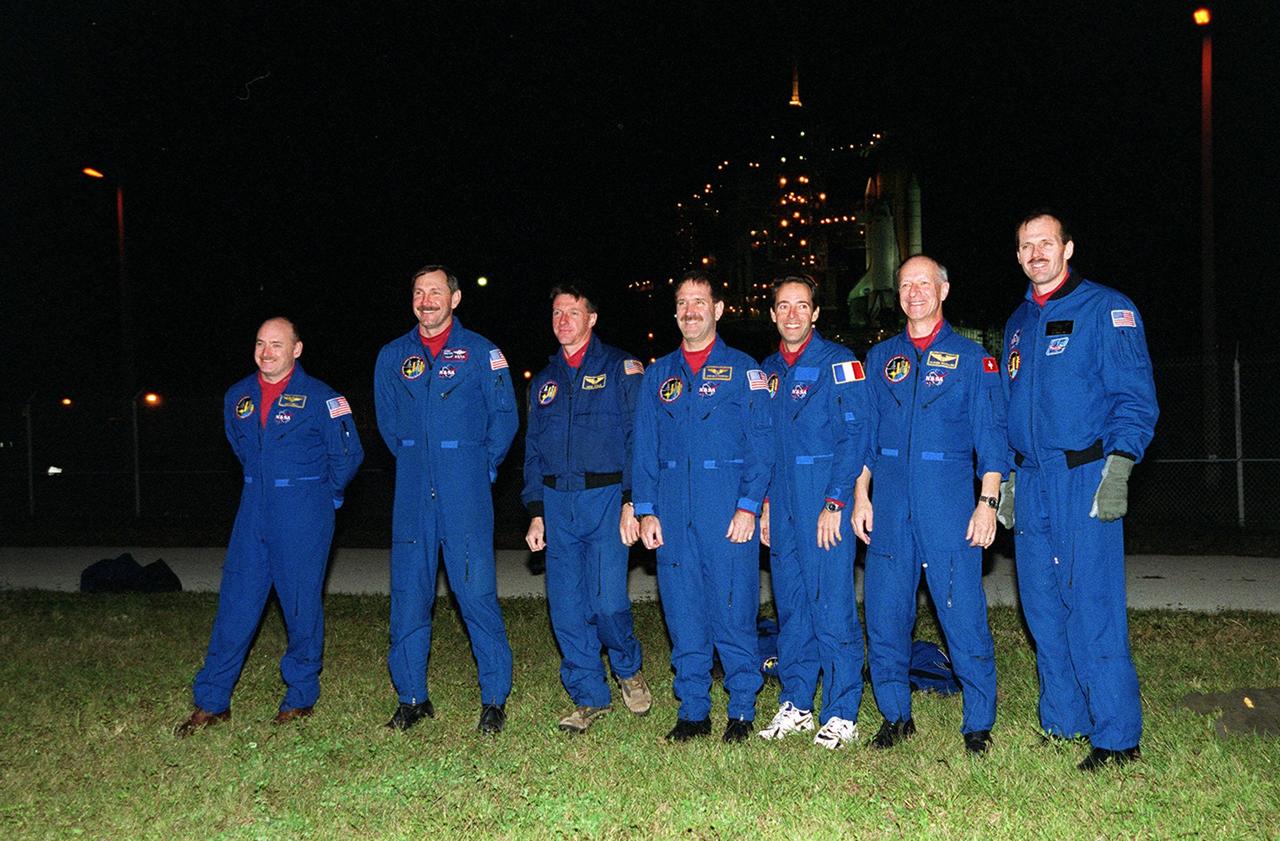
The STS-103 crew address family and friends at Launch Pad 39B. From left to right are Pilot Scott J. Kelly, Commander Curtis L. Brown Jr., and Mission Specialists C. Michael Foale (Ph.D.), John M. Grunsfeld (Ph.D.), Jean-François Clervoy of France , Claude Nicollier of Switzerland and Steven L. Smith. Nicollier and Clervoy are with the European Space Agency. In the background is Space Shuttle Discovery, alongside the lighted Fixed Service Structure. The STS-103 mission, to service the Hubble Space Telescope, is scheduled for launch Dec. 17 at 8:47 p.m. EST from Launch Pad 39B. Mission objectives include replacing gyroscopes and an old computer, installing another solid state recorder, and replacing damaged insulation in the telescope. The mission is expected to last about 8 days and 21 hours. Discovery is expected to land at KSC Sunday, Dec. 26, at about 6:25 p.m. EST
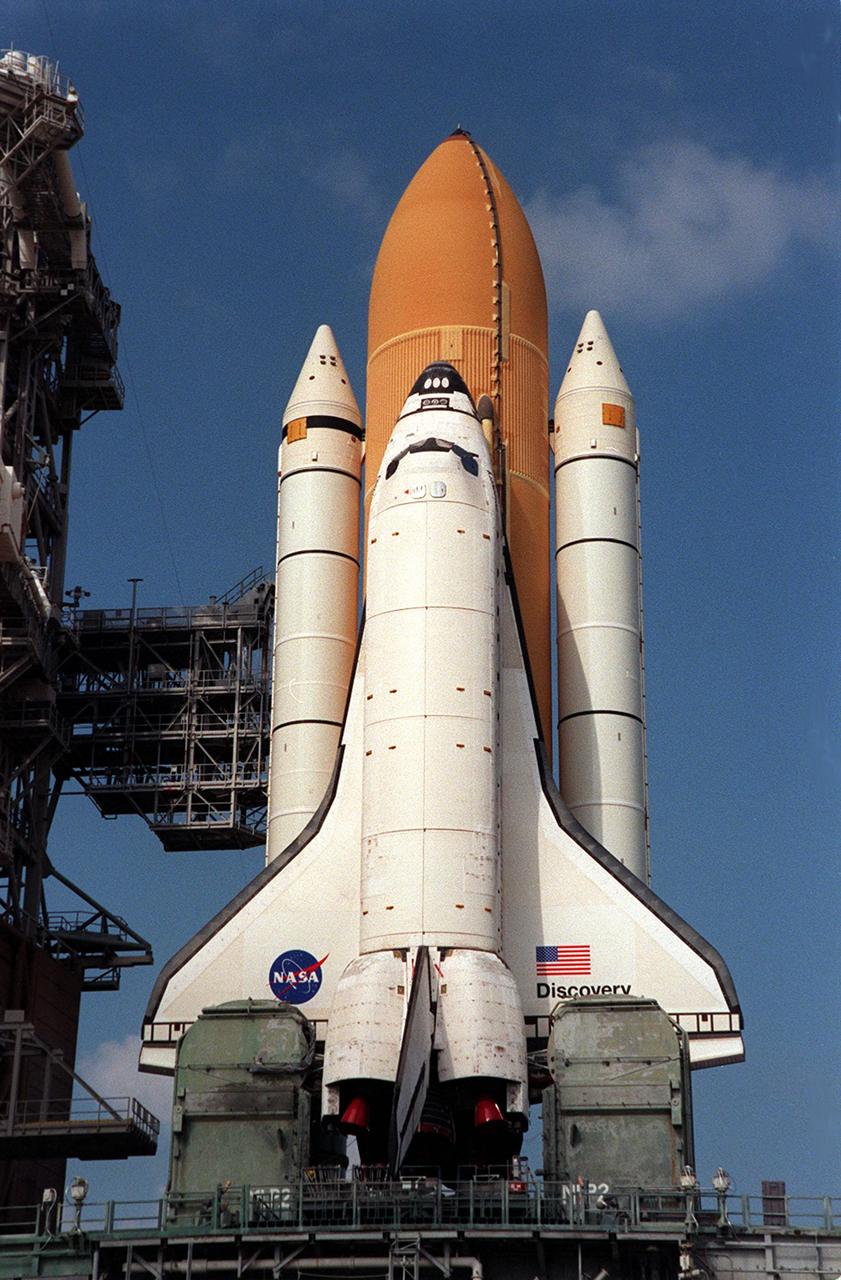
KENNEDY SPACE CENTER, Fla. -- Space Shuttle Discovery arrives at Launch Pad 39B where the orbiter, external tank and solid rocket boosters will undergo final preparations for the STS-103 launch. The mission is a "call-up" due to the need to replace and repair portions of the Hubble Space Telescope. Although Hubble is operating normally and conducting its scientific observations, only three of its six gyroscopes are working properly. Four EVA's are planned to make the necessary repairs and replacements on the telescope. The STS-103 crew members are Commander Curtis L. Brown Jr., Pilot Scott J. Kelly, Steven L. Smith, C. Michael Foale (Ph.D.), John M. Grunsfeld (Ph.D.), and Claude Nicollier of Switzerland and Jean-François Clervoy of France, both with the European Space Agency. The mission is targeted for launch Dec. 6 at 2:37 a.m. EST aboard Space Shuttle Discovery.

STS060-90-007 (3-11 Feb 1994) --- Parts of the Swiss Cantons of Vaud and Valois and the French province of Chablais are shown. These mountains were created in the last great mountain-building episode in Europe around 50 million years ago. They have been reshaped by glaciers during the Pleistocene. The glaciers created the wide valley of the Rhone River by scouring a pre-existing stream. The fertile Swiss Plateau runs northwest from the shore of Lake Geneva and is visible in the upper right. The Franco-Swiss border is located in the center of the lake and follows a mountain divide east of the Rhone Valley. According to NASA geologists eutrofication is a problem in Lake Geneva. In 1971 a Swiss Commission was formed to try to slow the problem. Strong discharge laws were enacted, but they are hard to enforce due to the multi-national and multi-organizational parties contributing to the problem.
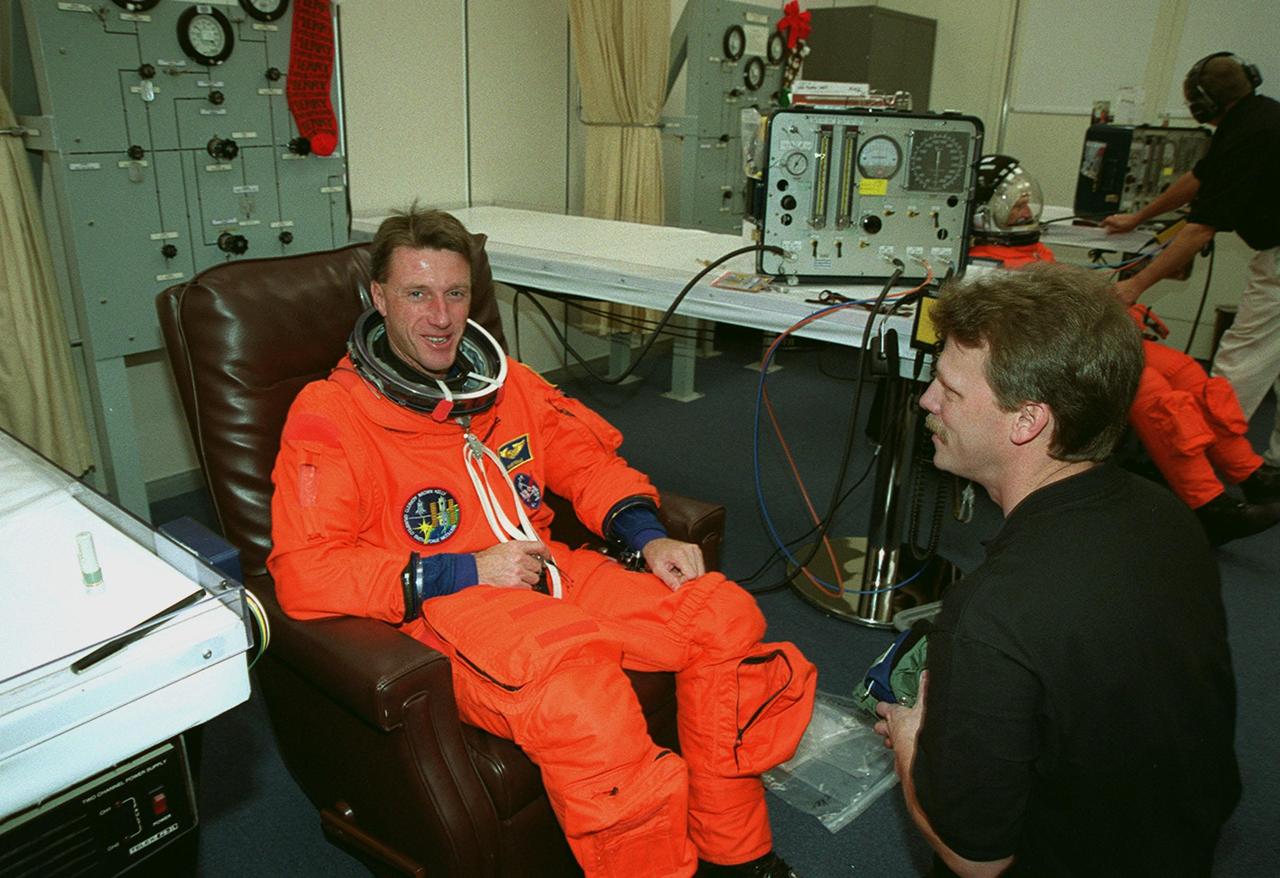
STS-103 Mission Specialist C. Michael Foale (Ph.D.) dons his launch and entry suit for the second time in two days before heading out to Launch Pad 39B and liftoff of Space Shuttle Discovery. The previous launch attempt on Dec. 17 was scrubbed about 8:52 p.m. due to numerous violations of weather launch commit criteria at KSC. Foale and other crew members Commander Curtis L. Brown Jr., Pilot Scott J. Kelly and Mission Specialists Steven L. Smith, John M. Grunsfeld (Ph.D.), Claude Nicollier of Switzerland and Jean-Francois Clervoy of France are scheduled to lift off at 7:50 p.m. EST Dec. 19 on mission STS-103, servicing the Hubble Space Telescope. Objectives for the nearly eight-day mission include replacing gyroscopes and an old computer, installing another solid state recorder, and replacing damaged insulation in the telescope. Discovery is expected to land at KSC Monday, Dec. 27, at about 5:24 p.m. EST
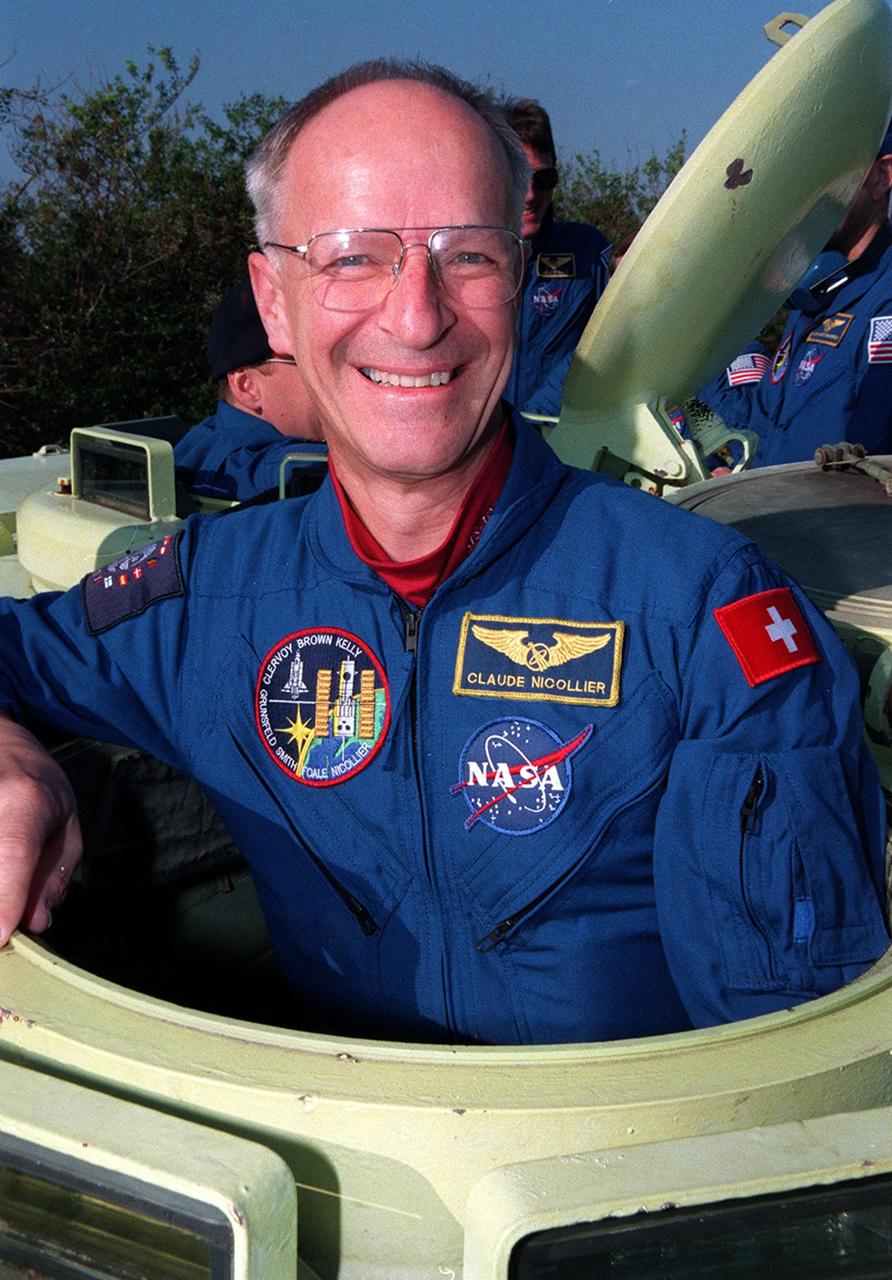
STS-103 Mission Specialist Claude Nicollier of Switzerland, who is with the European Space Agency, takes his turn at the helm of a small armored personnel carrier that is part of emergency egress training during Terminal Countdown Demonstration Test (TCDT) activities. The tracked vehicle could be used by the crew in the event of an emergency at the pad during which the crew must make a quick exit from the area. The TCDT also provides simulated countdown exercises and opportunities to inspect the mission payloads in the orbiter's payload bay. STS-103 is a "call-up" mission due to the need to replace and repair portions of the Hubble Space Telescope. Four EVA's are planned to make the necessary repairs and replacements on the telescope. The other STS-103 crew members are Commander Curtis L. Brown Jr., Pilot Scott J. Kelly, and Mission Specialists Steven L. Smith, C. Michael Foale (Ph.D.), John M. Grunsfeld (Ph.D.), and Jean-François Clervoy of France, also with the European Space Agency. The mission is targeted for launch Dec. 6 at 2:37 a.m. EST
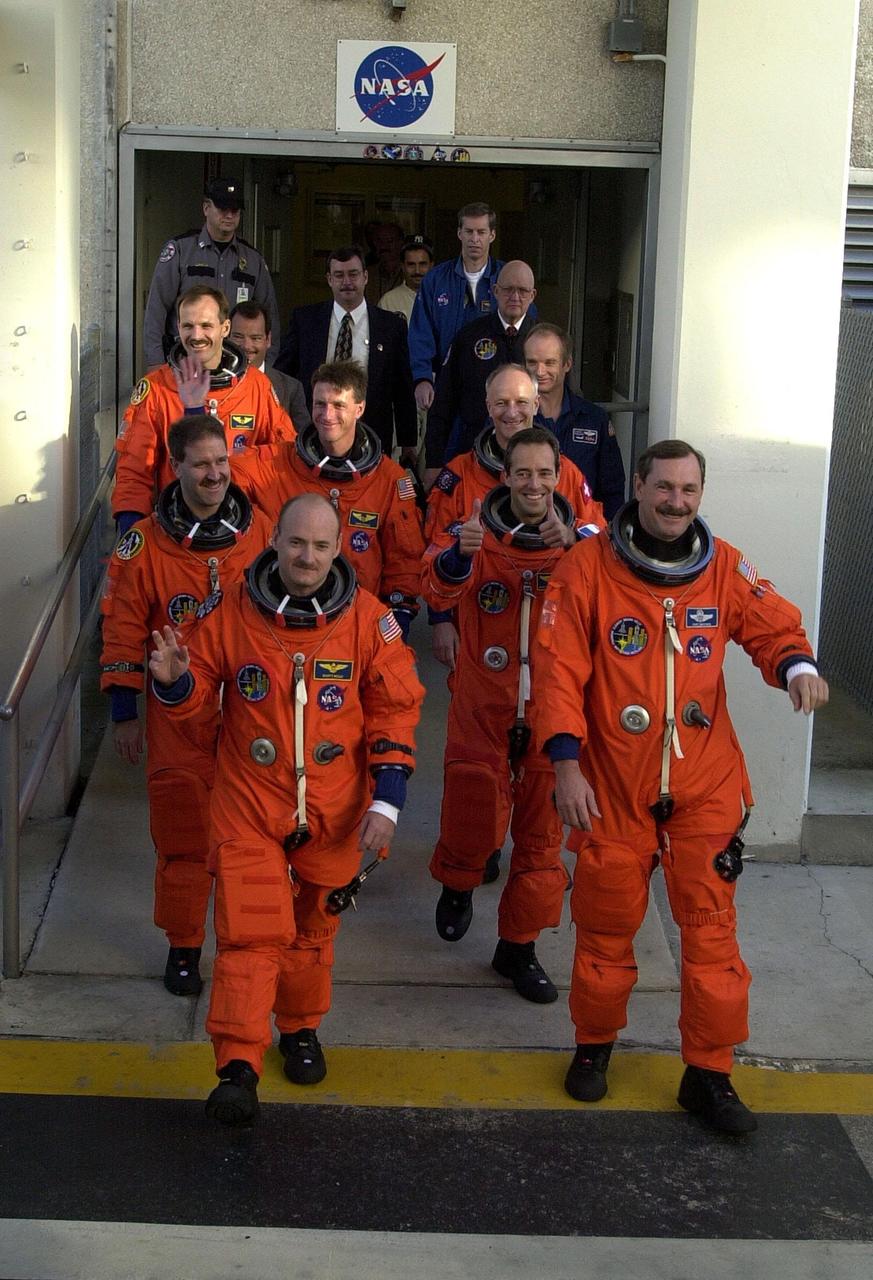
For the second time in two days, the STS-103 crew in their launch and entry suits eagerly head out of the Operations and Checkout Building on their way to Launch Pad 39B and liftoff of Space Shuttle Discovery. From front to back by two's are Pilot Scott J. Kelly and Commander Curtis L. Brown Jr., Mission Specialists John M. Grunsfeld (Ph.D.) and Jean-Francois Clervoy of France, C. Michael Foale (Ph.D.) and Claude Nicollier of Switzerland, and Steven L. Smith taking up the rear. The previous launch attempt on Dec. 17 was scrubbed about 8:52 p.m. due to numerous violations of weather launch commit criteria at KSC. The mission, to service the Hubble Space Telescope, is now scheduled for launch Dec. 19 at 7:50 p.m. EST from Launch Pad 39B. Mission objectives include replacing gyroscopes and an old computer, installing another solid state recorder, and replacing damaged insulation in the telescope. After the 7-day, 21-hour mission, Discovery is expected to land at KSC Monday, Dec. 27, at about 5:24 p.m. EST

In the bunker at Launch Pad 39B, STS-103 Mission Specialist Jean-François Clervoy of France, who is with the European Space Agency (ESA), tries on an oxygen mask during Terminal Countdown Demonstration Test (TCDT) activities. The TCDT provides the crew with emergency egress training, opportunities to inspect their mission payloads in the orbiter's payload bay, and simulated countdown exercises. Other crew members taking part are Commander Curtis L. Brown Jr. and Mission Specialists Steven L. Smith, C. Michael Foale (Ph.D.), John M. Grunsfeld (Ph.D.), plus Claude Nicollier of Switzerland, who is also with ESA. STS-103 is a "call-up" mission due to the need to replace and repair portions of the Hubble Space Telescope, including the gyroscopes that allow the telescope to point at stars, galaxies and planets. The STS-103 crew will be replacing a Fine Guidance Sensor, an older computer with a new enhanced model, an older data tape recorder with a solid-state digital recorder, a failed spare transmitter with a new one, and degraded insulation on the telescope with new thermal insulation. The crew will also install a Battery Voltage/Temperature Improvement Kit to protect the spacecraft batteries from overcharging and overheating when the telescope goes into a safe mode. Four EVA's are planned to make the necessary repairs and replacements on the telescope. The mission is targeted for launch Dec. 6 at 2:37 a.m. EST
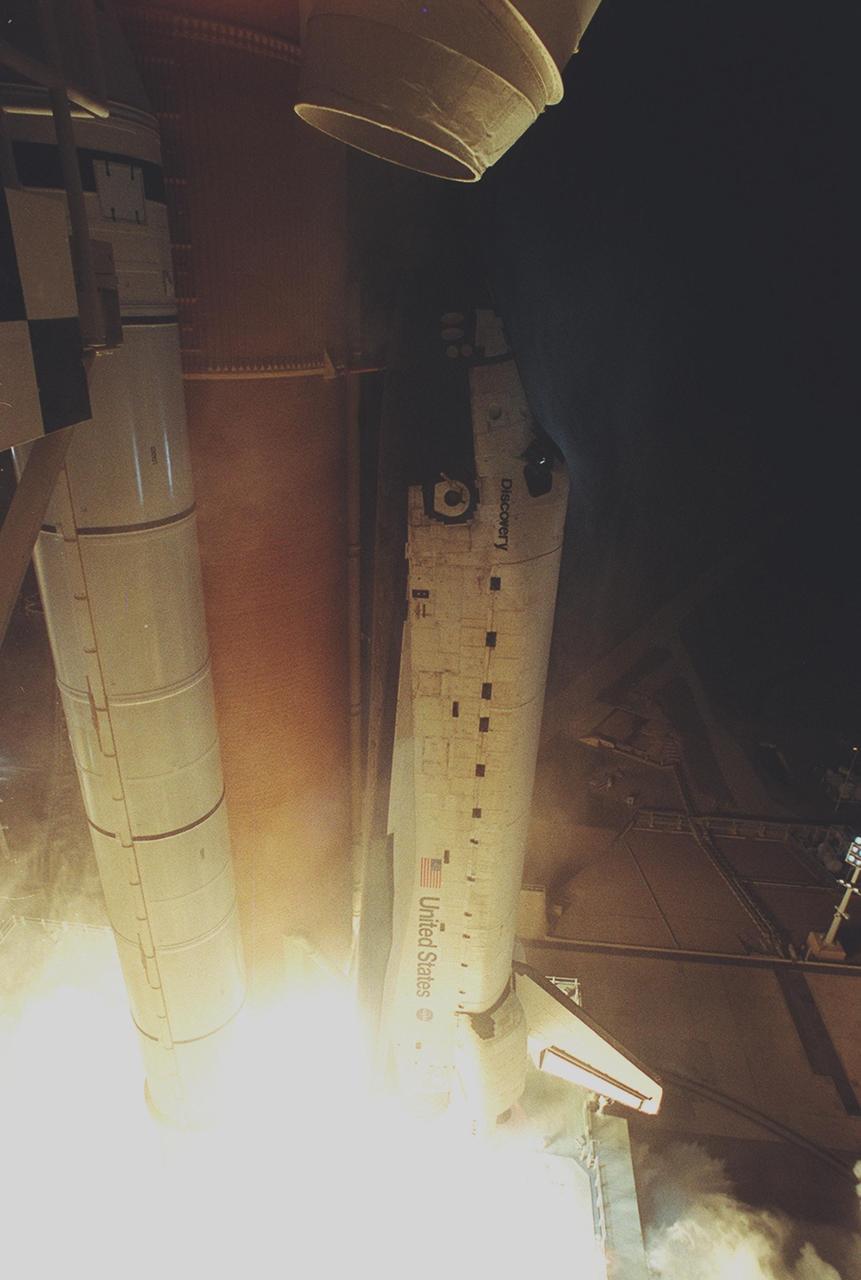
Liftoff of Space Shuttle Discovery leaves Launch Pad 39B (seen at right) and Earth behind, lighted by the brilliant exhaust of the solid rocket boosters and external tank. Liftoff occurred at 7:50 p.m. EST from Launch Pad 39B. On board are Commander Curtis L. Brown Jr., Pilot Scott J. Kelly and Mission Specialists Steven L. Smith, C. Michael Foale (Ph.D.), John M. Grunsfeld (Ph.D.), Claude Nicollier of Switzerland and Jean-François Clervoy of France. Nicollier and Clervoy are with the European Space Agency. STS-103 is a Hubble Servicing Mission, with three planned space walks designed to install new equipment and replace old. The primary objective is to replace the gyroscopes that make up the three Rate Sensor Units. Extravehicular activities include installing a new computer, changing out one of the Fine Guidance Sensors, replacing a tape recorder with a new solid state recorder, and installing a voltage/temperature improvement kit, and begin repairing the insulation on the telescope's outer surface. After the 7-day, 21-hour mission, Discovery is expected to land at KSC Monday, Dec. 27, at about 5:24 p.m. EST. This is the 27th flight of Discovery and the 96th mission in the Space Shuttle Program. It is the third launch at Kennedy Space Center in 1999
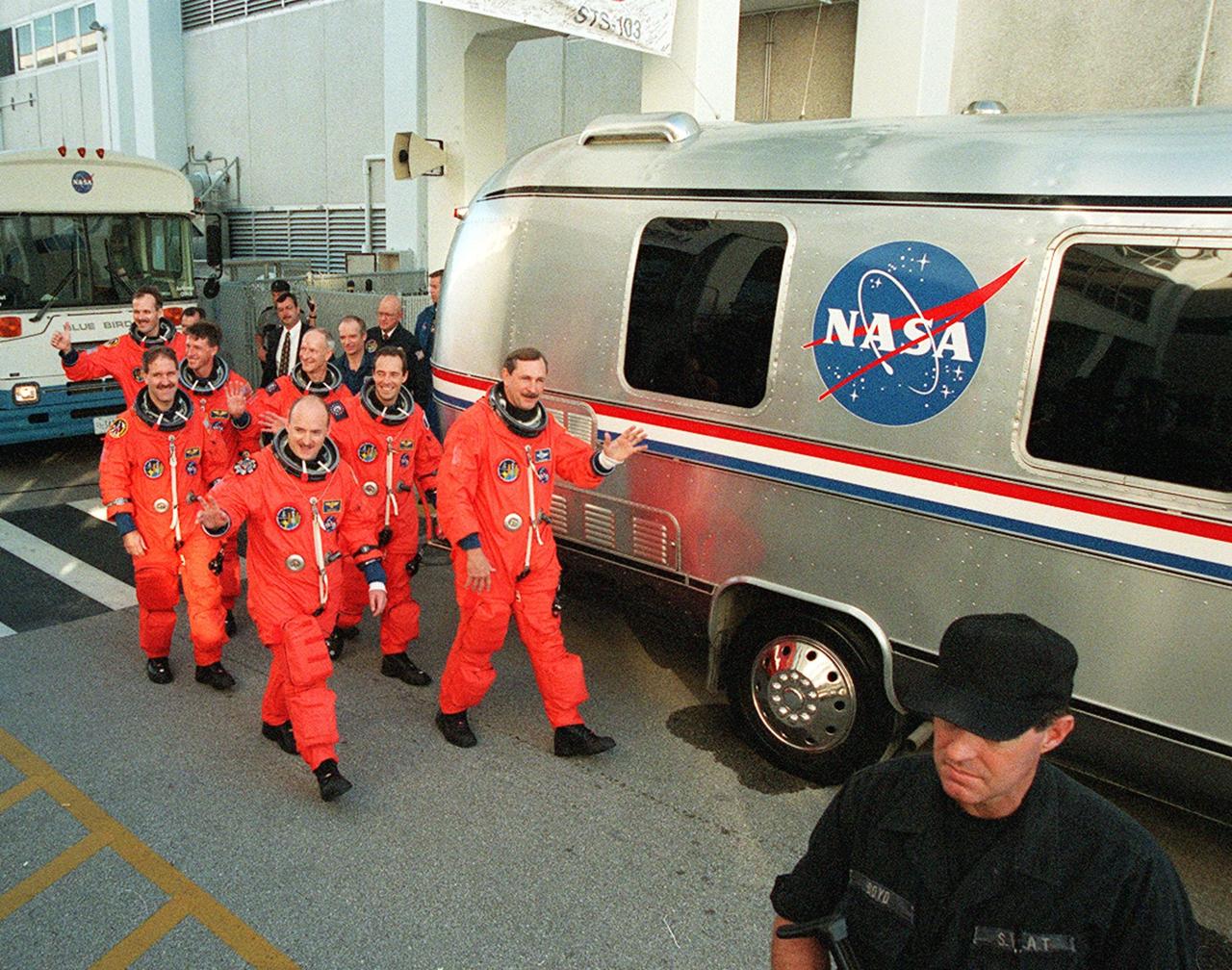
An eager STS-103 crew emerge from behind the "Astrovan" at the Operations and Checkout Building to board the vehicle for transfer to Launch Pad 39B. Walking in pairs (from front to back) are Pilot Scott J. Kelly and Commander Curtis L. Brown Jr., Mission Specialists John M. Grunsfeld (Ph.D.) and Jean-Francois Clervoy of France, C. Michael Foale (Ph.D.) and Claude Nicollier of Switzerland, and Steven L. Smith taking up the rear. A previous launch attempt on Dec. 17 was scrubbed about 8:52 p.m. due to numerous violations of weather launch commit criteria at KSC. The mission, to service the Hubble Space Telescope, is now scheduled for launch Dec. 19 at 7:50 p.m. EST from Launch Pad 39B. Mission objectives include replacing gyroscopes and an old computer, installing another solid state recorder, and replacing damaged insulation in the telescope. After the 7-day, 21-hour mission, Discovery is expected to land at KSC Monday, Dec. 27, at about 5:24 p.m. EST
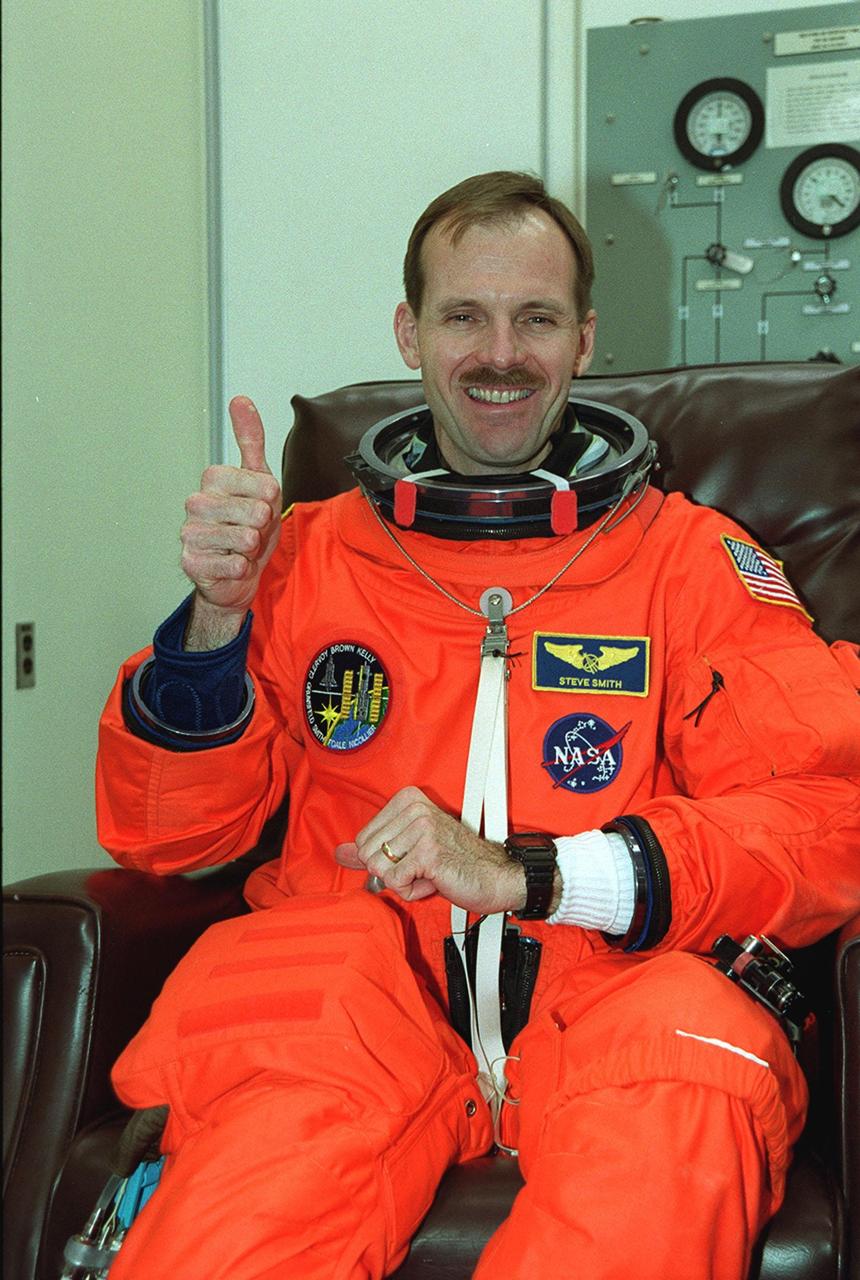
After donning his launch and entry suit, STS-103 Mission Specialist Steven L. Smith shows a positive attitude over the second launch attempt for Space Shuttle Discovery. The previous launch attempt on Dec. 17 was scrubbed about 8:52 p.m. due to numerous violations of weather launch commit criteria at KSC. Smith and other crew members Commander Curtis L. Brown Jr., Pilot Scott J. Kelly and Mission Specialists C. Michael Foale (Ph.D.), John M. Grunsfeld (Ph.D.), Claude Nicollier of Switzerland and Jean-Francois Clervoy of France are scheduled to lift off at 7:50 p.m. EST Dec. 19 on mission STS-103, servicing the Hubble Space Telescope. Objectives for the nearly eight-day mission include replacing gyroscopes and an old computer, installing another solid state recorder, and replacing damaged insulation in the telescope. Discovery is expected to land at KSC Monday, Dec. 27, at about 5:24 p.m. EST
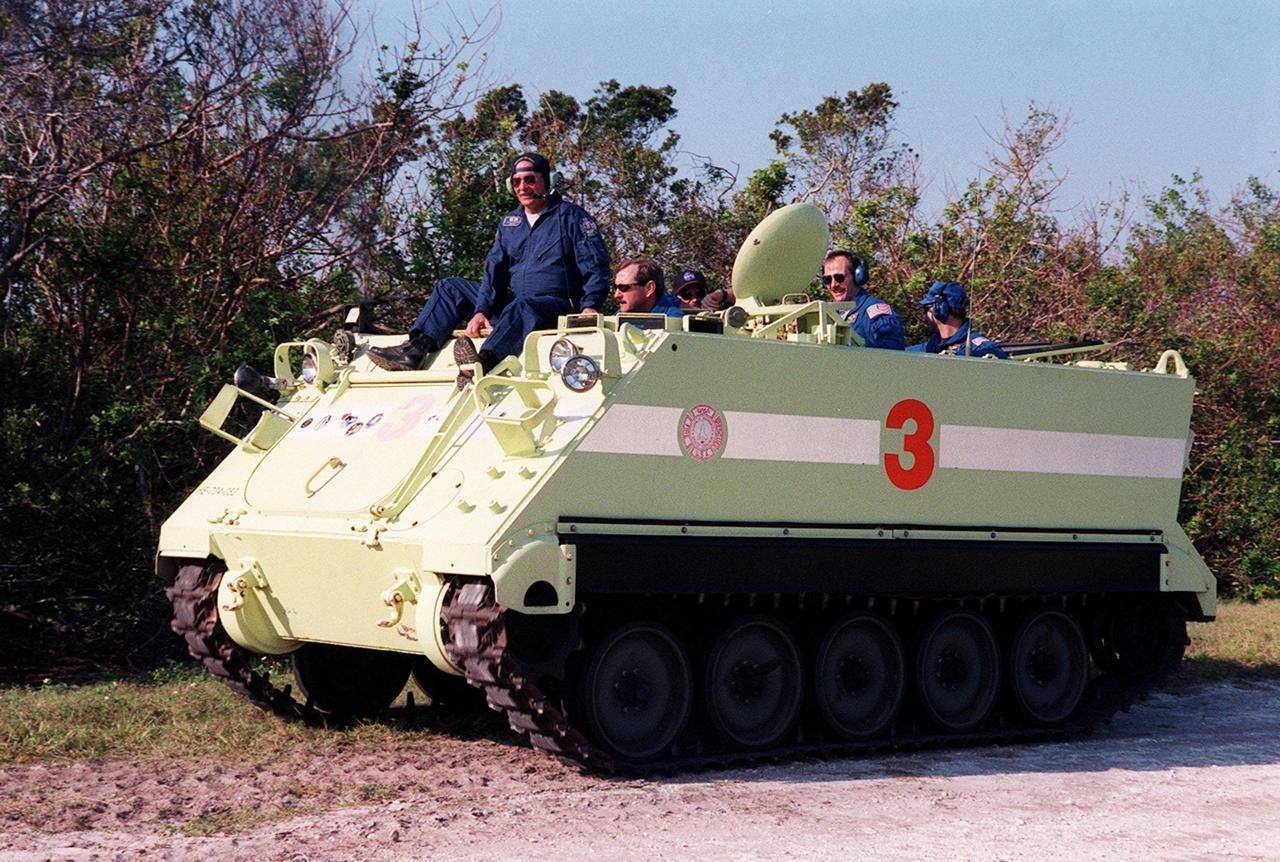
During Terminal Countdown Demonstration Test (TCDT) emergency egress training, STS-103 Commander Curtis L. Brown Jr. practices driving a small armored personnel carrier. Riding on the front is Capt. George Hoggard, a trainer with the KSC/CCAS Fire Department. In the carrier behind Brown is (left to right) Pilot Scott J. Kelly and Mission Specialists Steven L. Smith and John M. Grunsfeld (Ph.D.). The tracked vehicle could be used by the crew in the event of an emergency at the pad during which the crew must make a quick exit from the area. The TCDT also provides simulated countdown exercises and opportunities to inspect the mission payloads in the orbiter's payload bay. STS-103 is a "call-up" mission due to the need to replace and repair portions of the Hubble Space Telescope. Four EVA's are planned to make the necessary repairs and replacements on the telescope. The other STS-103 crew members are Mission Specialists C. Michael Foale (Ph.D.), plus Claude Nicollier of Switzerland and Jean-François Clervoy of France, who are with the European Space Agency. The mission is targeted for launch Dec. 6 at 2:37 a.m. EST

In the Operations and Checkout Building, STS-103 Mission Specialist C. Michel Foale (Ph.D.) smiles as a suit technician helps him don his launch and entry suit during final launch preparations. Other crew members are Commander Curtis L. Brown Jr., Pilot Scott J. Kelly and Mission Specialists Steven L. Smith, John M. Grunsfeld (Ph.D.), Claude Nicollier of Switzerland and Jean-François Clervoy of France. Nicollier and Clervoy are with the European Space Agency. The STS-103 mission, to service the Hubble Space Telescope, is scheduled for launch Dec. 17 at 8:47 p.m. EST from Launch Pad 39B. Mission objectives include replacing gyroscopes and an old computer, installing another solid state recorder, and replacing damaged insulation in the telescope. After the 8-day, 21-hour mission, Discovery is expected to land at KSC Sunday, Dec. 26, at about 6:30 p.m. EST.is expected to land at KSC Sunday, Dec. 26, at about 6:30 p.m. EST

(Nikon camera D1 test)With smoke and steam billowing around it, Space Shuttle Discovery hurtles into the clear night sky in a blaze of light. The successful liftoff occurred on time at 7:50:00.069 EST from Launch Pad 39B on mission STS-103. On board are Commander Curtis L. Brown Jr., Pilot Scott J. Kelly and Mission Specialists Steven L. Smith, C. Michael Foale (Ph.D.), John M. Grunsfeld (Ph.D.), Claude Nicollier of Switzerland and Jean-François Clervoy of France. Nicollier and Clervoy are with the European Space Agency. STS-103 is a Hubble Servicing Mission, with three planned space walks designed to install new equipment and replace old. The primary objective is to replace the gyroscopes that make up the three Rate Sensor Units. Extravehicular activities include installing a new computer, changing out one of the Fine Guidance Sensors, replacing a tape recorder with a new solid state recorder, and installing a voltage/temperature improvement kit, and begin repairing the insulation on the telescope's outer surface. After the 7-day, 21-hour mission, Discovery is expected to land at KSC Monday, Dec. 27, at about 5:24 p.m. EST. This is the 27th flight of Discovery and the 96th mission in the Space Shuttle Program. It is the third launch at Kennedy Space Center in 1999
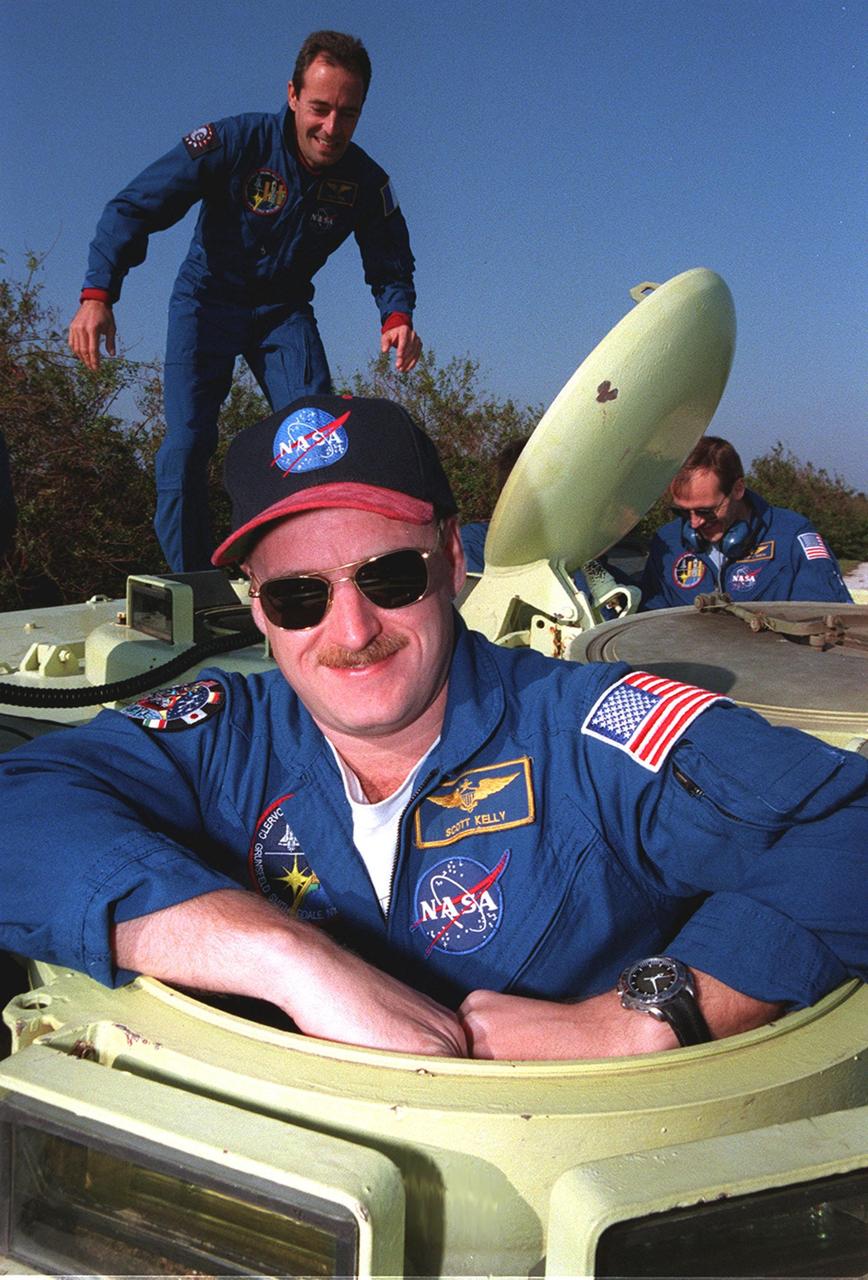
STS-103 Pilot Scott J. Kelly is ready to take his turn at driving a small armored personnel carrier that is part of emergency egress training during Terminal Countdown Demonstration Test (TCDT) activities. Behind him (left) is Mission Specialist Jean-François Clervoy of France, who is with the European Space Agency. At right is Mission Specialist Steven L. Smith. The tracked vehicle could be used by the crew in the event of an emergency at the pad during which the crew must make a quick exit from the area. The TCDT also provides simulated countdown exercises and opportunities to inspect the mission payloads in the orbiter's payload bay. STS-103 is a "call-up" mission due to the need to replace and repair portions of the Hubble Space Telescope. Four EVA's are planned to make the necessary repairs and replacements on the telescope. The other STS-103 crew members are Commander Curtis L. Brown Jr. and Mission Specialists C. Michael Foale (Ph.D.), John M. Grunsfeld (Ph.D.), plus Claude Nicollier of Switzerland, who also is with the European Space Agency. The mission is targeted for launch Dec. 6 at 2:37 a.m. EST
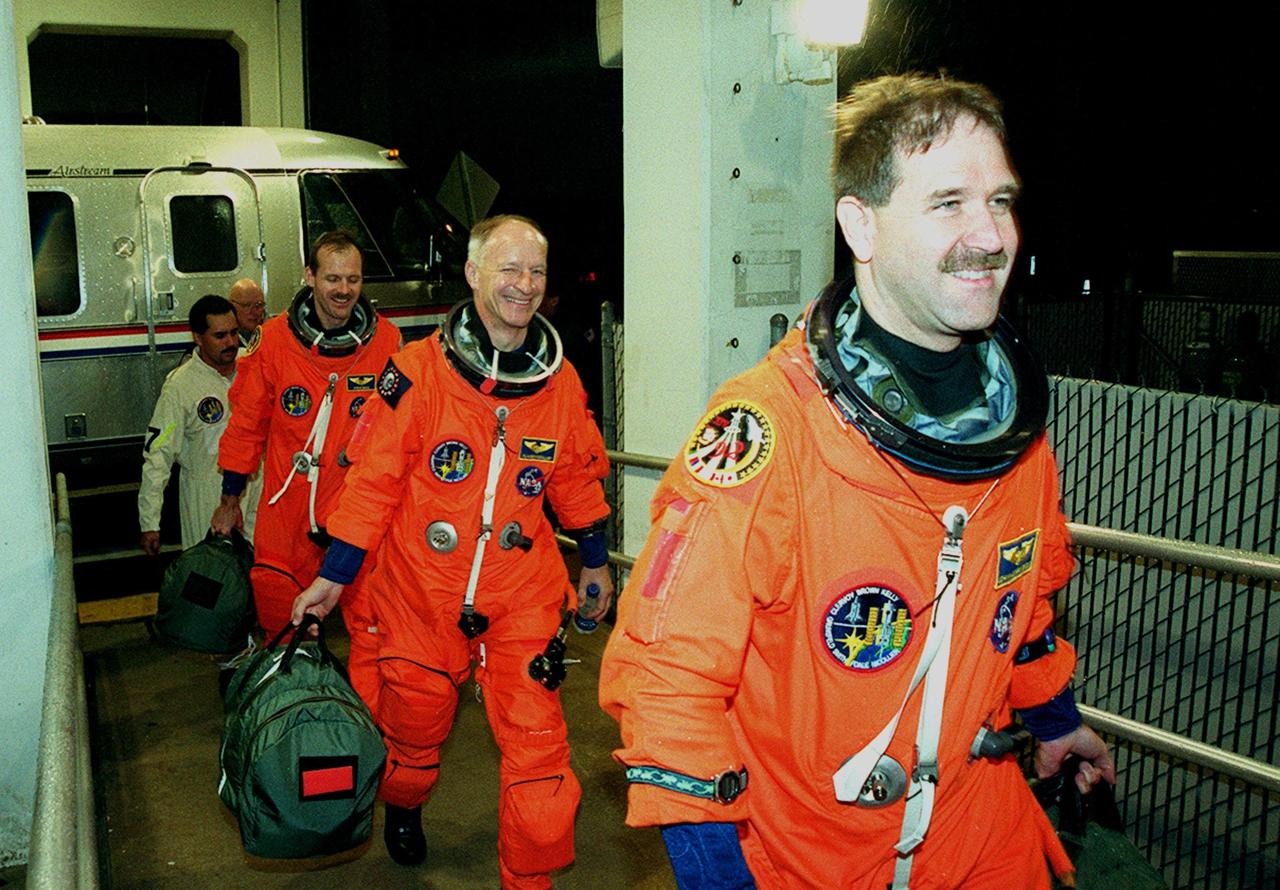
STS-103 crew members head back to the Operations and Checkout Building after the launch of Space Shuttle Discovery was scrubbed due to unfavorable weather conditions. In the lead (right) is Mission Specialist John M. Grunsfeld (Ph.D.), followed by Mission Specialists Claude Nicollier of Switzerland and Steven L. Smith. . Other crew members are Commander Curtis L. Brown Jr., Pilot Scott J. Kelly, and Mission Specialists C. Michael Foale (Ph.D.) and Jean-Francois Clervoy of France. Nicollier and Clervoy are with the European Space Agency. The STS-103 mission, to service the Hubble Space Telescope, is rescheduled for launch Dec. 18 at 8:21 p.m. EST from Launch Pad 39B. Mission objectives include replacing gyroscopes and an old computer, installing another solid state recorder, and replacing damaged insulation in the telescope. After the 7-day, 21-hour mission, Discovery is expected to land at KSC Sunday, Dec. 26, at about 6:00 p.m. EST
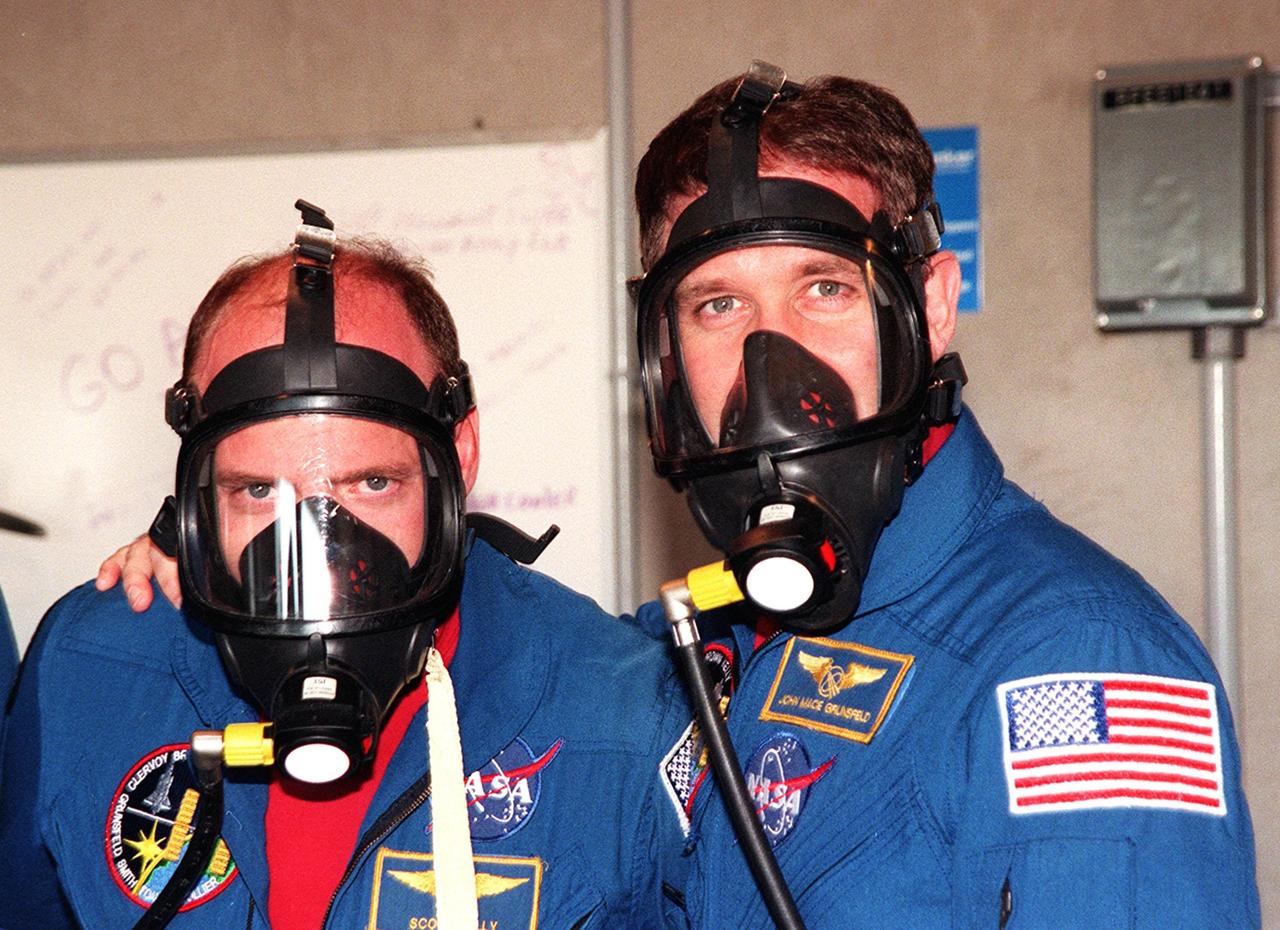
In the bunker at Launch Pad 39B, STS-103 Pilot Scott J. Kelly (left) and Mission Specialist John M. Grunsfeld (Ph.D.) (right) try on oxygen masks during Terminal Countdown Demonstration Test (TCDT) activities. The TCDT provides the crew with emergency egress training, opportunities to inspect their mission payloads in the orbiter's payload bay, and simulated countdown exercises. Other crew members taking part are Commander Curtis L. Brown Jr. and Mission Specialists Steven L. Smith, C. Michael Foale (Ph.D.), and Jean-François Clervoy of France and Claude Nicollier of Switzerland, who are with the European Space Agency. STS-103 is a "call-up" mission due to the need to replace and repair portions of the Hubble Space Telescope, including the gyroscopes that allow the telescope to point at stars, galaxies and planets. The STS-103 crew will be replacing a Fine Guidance Sensor, an older computer with a new enhanced model, an older data tape recorder with a solid-state digital recorder, a failed spare transmitter with a new one, and degraded insulation on the telescope with new thermal insulation. The crew will also install a Battery Voltage/Temperature Improvement Kit to protect the spacecraft batteries from overcharging and overheating when the telescope goes into a safe mode. Four EVA's are planned to make the necessary repairs and replacements on the telescope. The mission is targeted for launch Dec. 6 at 2:37 a.m. EST
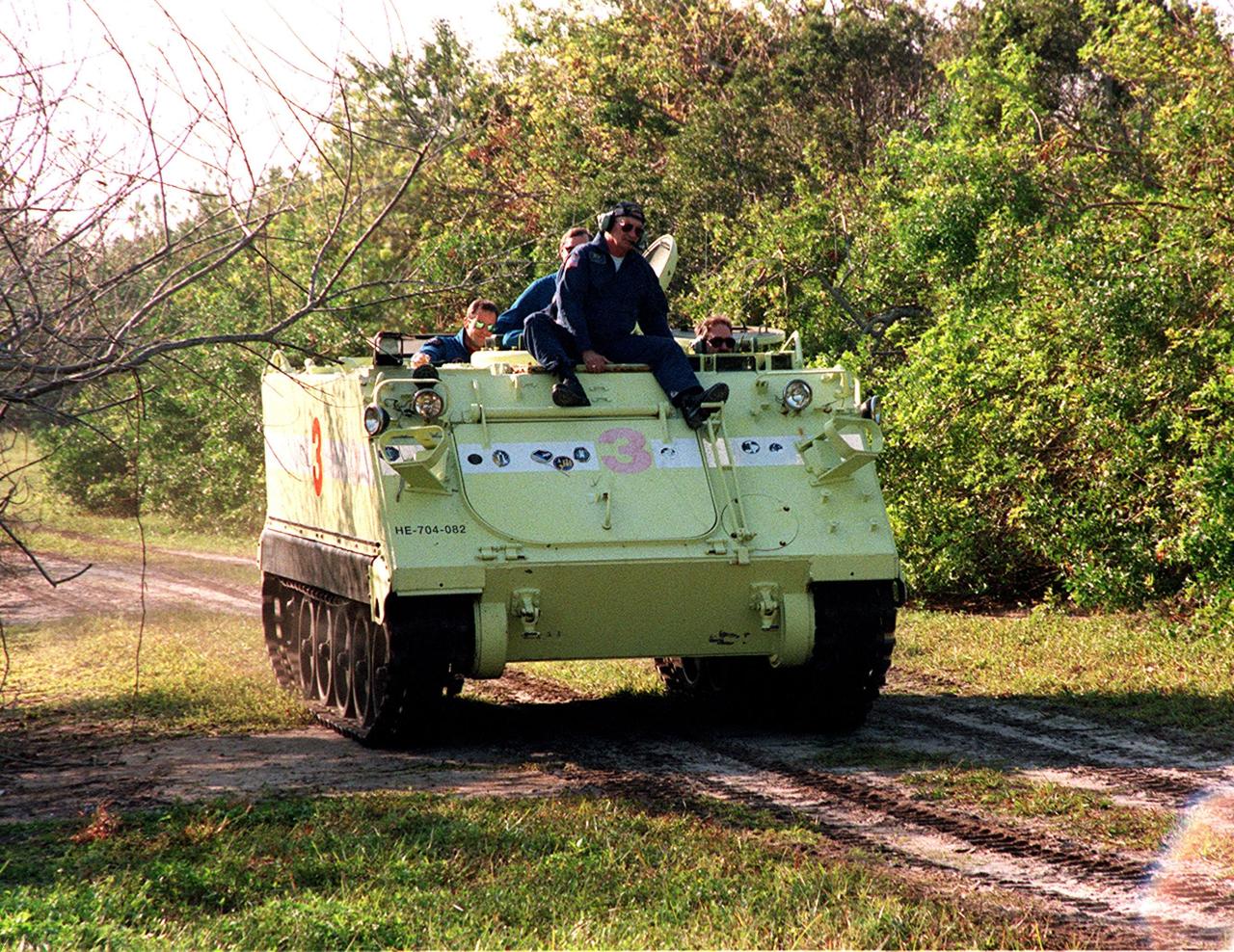
STS-103 Mission Specialist John M. Grunsfeld (Ph.D.) (far right) practices driving a small armored personnel carrier that is part of emergency egress training during Terminal Countdown Demonstration Test (TCDT) activities. In front is Capt. George Hoggard, trainer with the KSC Fire Department. At far left is Mission Specialist Jean-François Clervoy of France, who is with the European Space Agency. The tracked vehicle could be used by the crew in the event of an emergency at the pad during which the crew must make a quick exit from the area. The TCDT also provides simulated countdown exercises and opportunities to inspect the mission payloads in the orbiter's payload bay. STS-103 is a "call-up" mission due to the need to replace and repair portions of the Hubble Space Telescope. Four EVA's are planned to make the necessary repairs and replacements on the telescope. The other STS-103 crew members are Commander Curtis L. Brown Jr., Pilot Scott J. Kelly, and Mission Specialists Steven L. Smith, C. Michael Foale (Ph.D.), (Ph.D.), plus Claude Nicollier of Switzerland and Jean-François Clervoy of France, who are with the European Space Agency. The mission is targeted for launch Dec. 6 at 2:37 a.m. EST
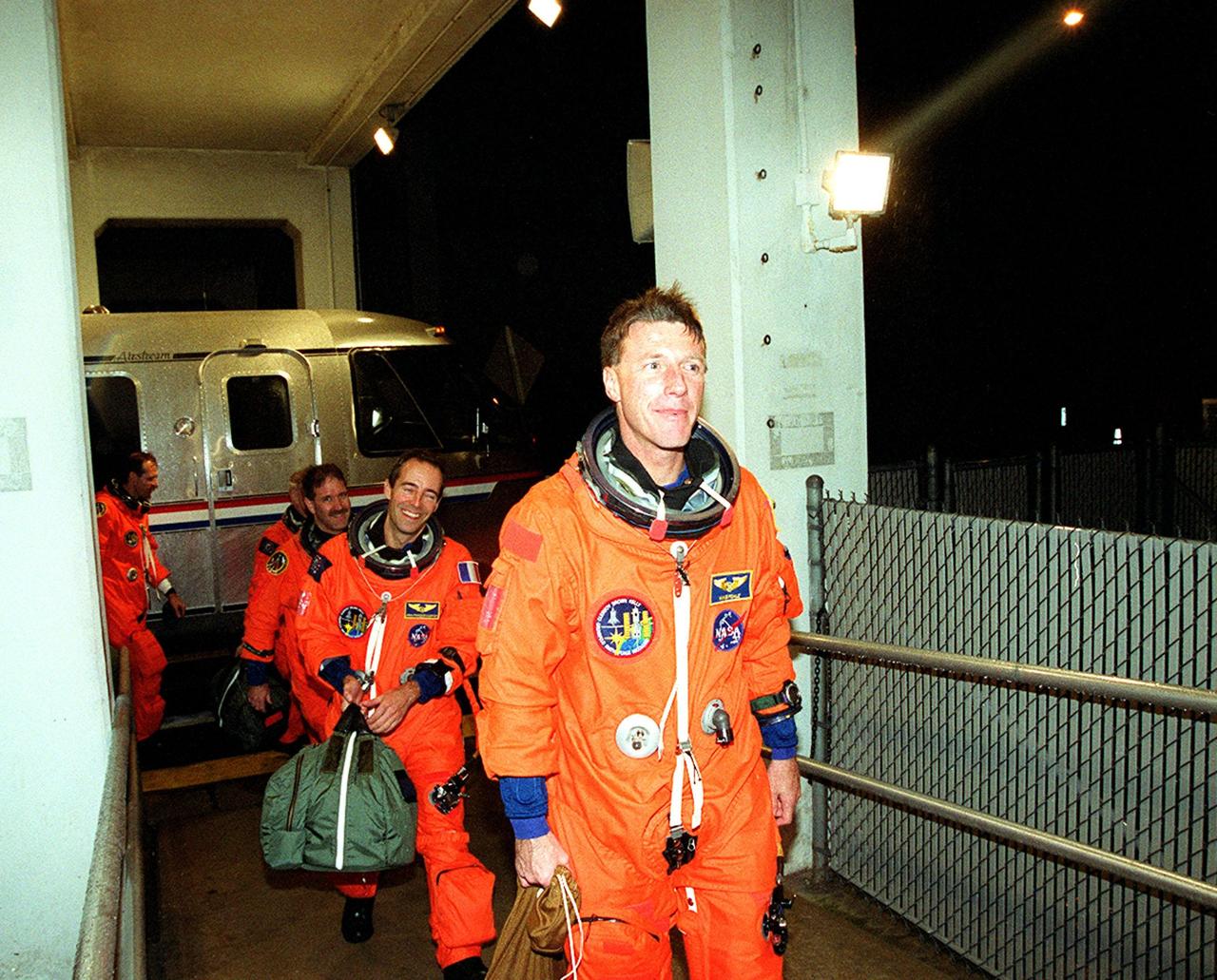
STS-103 crew members head back to the Operations and Checkout Building after the launch of Space Shuttle Discovery was scrubbed due to unfavorable weather conditions. In the lead (right) is Mission Specialist C. Michael Foale (Ph.D.), followed by Mission Specialists Jean-Francois Clervoy of France, John M. Grunsfeld (Ph.D.), Claude Nicollier of Switzerland and Steven L. Smith. Other crew members are Commander Curtis L. Brown Jr. and Pilot Scott J. Kelly. Nicollier and Clervoy are with the European Space Agency. The STS-103 mission, to service the Hubble Space Telescope, is rescheduled for launch Dec. 18 at 8:21 p.m. EST from Launch Pad 39B. Mission objectives include replacing gyroscopes and an old computer, installing another solid state recorder, and replacing damaged insulation in the telescope. After the 7-day, 21-hour mission, Discovery is expected to land at KSC Sunday, Dec. 26, at about 6:00 p.m. EST

During a Crew Equipment Interface Test (CEIT), members of the STS-103 crew check out a portable foot restraint on the Flight Support System that will be used on the mission, repairing the Hubble Space Telescope. The seven-member crew comprises Commander Curtis L. Brown Jr., Pilot Scott J. Kelly, and Mission Specialists Steven L. Smith, C. Michael Foale (Ph.D.), John M. Grunsfeld (Ph.D), Claude Nicollier of Switzerland, and Jean-François Clervoy of France. Nicollier and Clervoy are with the European Space Agency. Mission STS-103 is a "call-up" due to the need to replace portions of the pointing system, the gyros, which have begun to fail on the Hubble Space Telescope. Although Hubble is operating normally and conducting its scientific observations, only three of its six gyroscopes are working properly. The gyroscopes allow the telescope to point at stars, galaxies and planets. The STS-103 crew will not only replace gyroscopes, it will also replace a Fine Guidance Sensor and an older computer with a new enhanced model, an older data tape recorder with a solid-state digital recorder, a failed spare transmitter with a new one, and degraded insulation on the telescope with new thermal insulation. The crew will also install a Battery Voltage/Temperature Improvement Kit to protect the spacecraft batteries from overcharging and overheating when the telescope goes into a safe mode. The scheduled launch date in October is under review
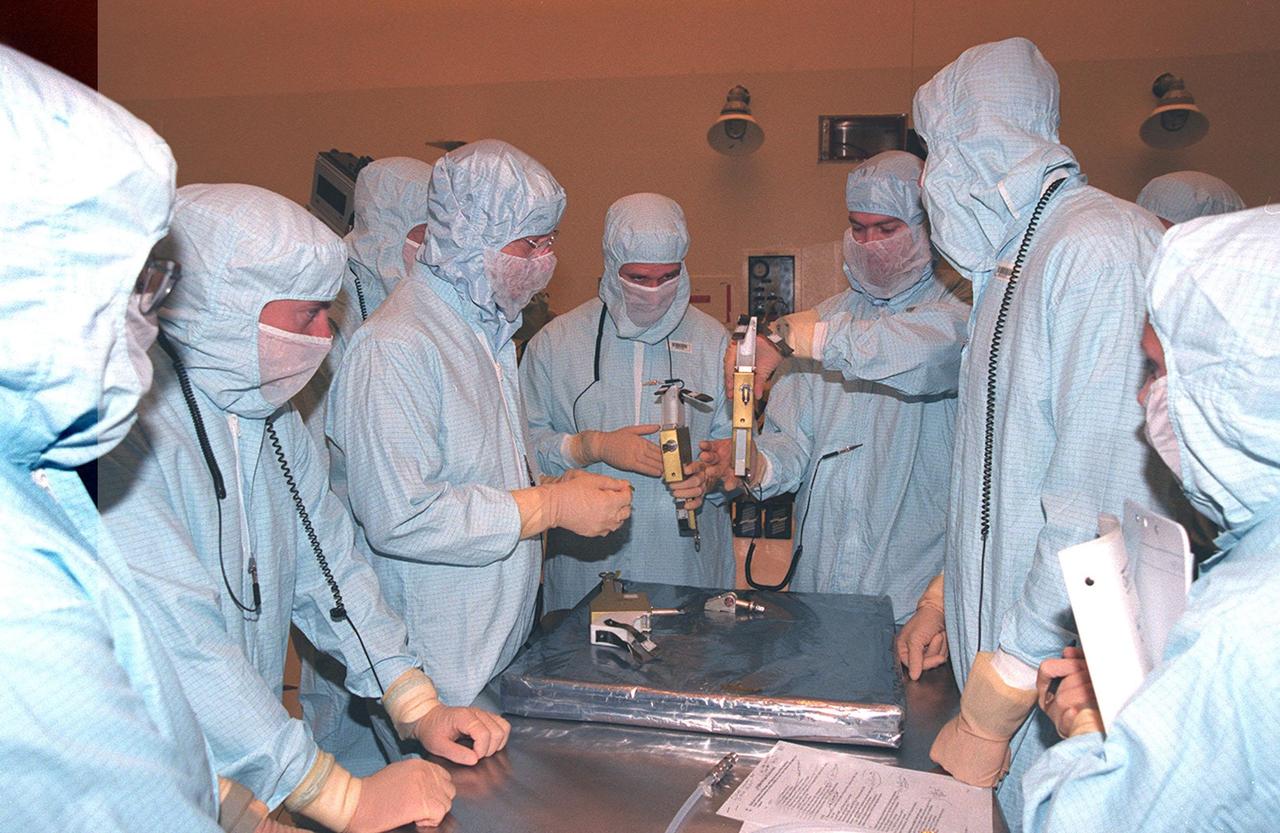
In the Payload Hazardous Servicing Facility, the STS-103 crew look over equipment to be used during their mission. The seven-member crew, taking part in a Crew Equipment Interface Test, are Commander Curtis L. Brown Jr., Pilot Scott J. Kelly, and Mission Specialists Steven L. Smith, C. Michael Foale (Ph.D.), John M. Grunsfeld (Ph.D.), Claude Nicollier of Switzerland, and Jean-François Clervoy of France. Nicollier and Clervoy are with the European Space Agency. Mission STS-103 is a "call-up" due to the need to replace portions of the pointing system, the gyros, which have begun to fail on the Hubble Space Telescope. Although Hubble is operating normally and conducting its scientific observations, only three of its six gyroscopes are working properly. The gyroscopes allow the telescope to point at stars, galaxies and planets. The STS-103 crew will not only replace gyroscopes, it will also replace a Fine Guidance Sensor and an older computer with a new enhanced model, an older data tape recorder with a solid state digital recorder, a failed spare transmitter with a new one, and degraded insulation on the telescope with new thermal insulation. The crew will also install a Battery Voltage/Temperature Improvement Kit to protect the spacecraft batteries from overcharging and overheating when the telescope goes into a safe mode. The scheduled launch date in October is under review

In the Payload Hazardous Servicing Facility, some of the STS-103 crew look over lubrication devices to be used during their mission. The seven-member crew are Commander Curtis L. Brown Jr., Pilot Scott J. Kelly, and Mission Specialists Steven L. Smith, C. Michael Foale (Ph.D.), John M. Grunsfeld (Ph.D.), Claude Nicollier of Switzerland, and Jean-François Clervoy of France. Nicollier and Clervoy are with the European Space Agency. Mission STS-103 is a "call-up" due to the need to replace portions of the pointing system, the gyros, which have begun to fail on the Hubble Space Telescope. Although Hubble is operating normally and conducting its scientific observations, only three of its six gyroscopes are working properly. The gyroscopes allow the telescope to point at stars, galaxies and planets. The STS-103 crew will not only replace gyroscopes, it will also replace a Fine Guidance Sensor and an older computer with a new enhanced model, an older data tape recorder with a solid state digital recorder, a failed spare transmitter with a new one, and degraded insulation on the telescope with new thermal insulation. The crew will also install a Battery Voltage/Temperature Improvement Kit to protect the spacecraft batteries from overcharging and overheating when the telescope goes into a safe mode. The scheduled launch date in October is under review
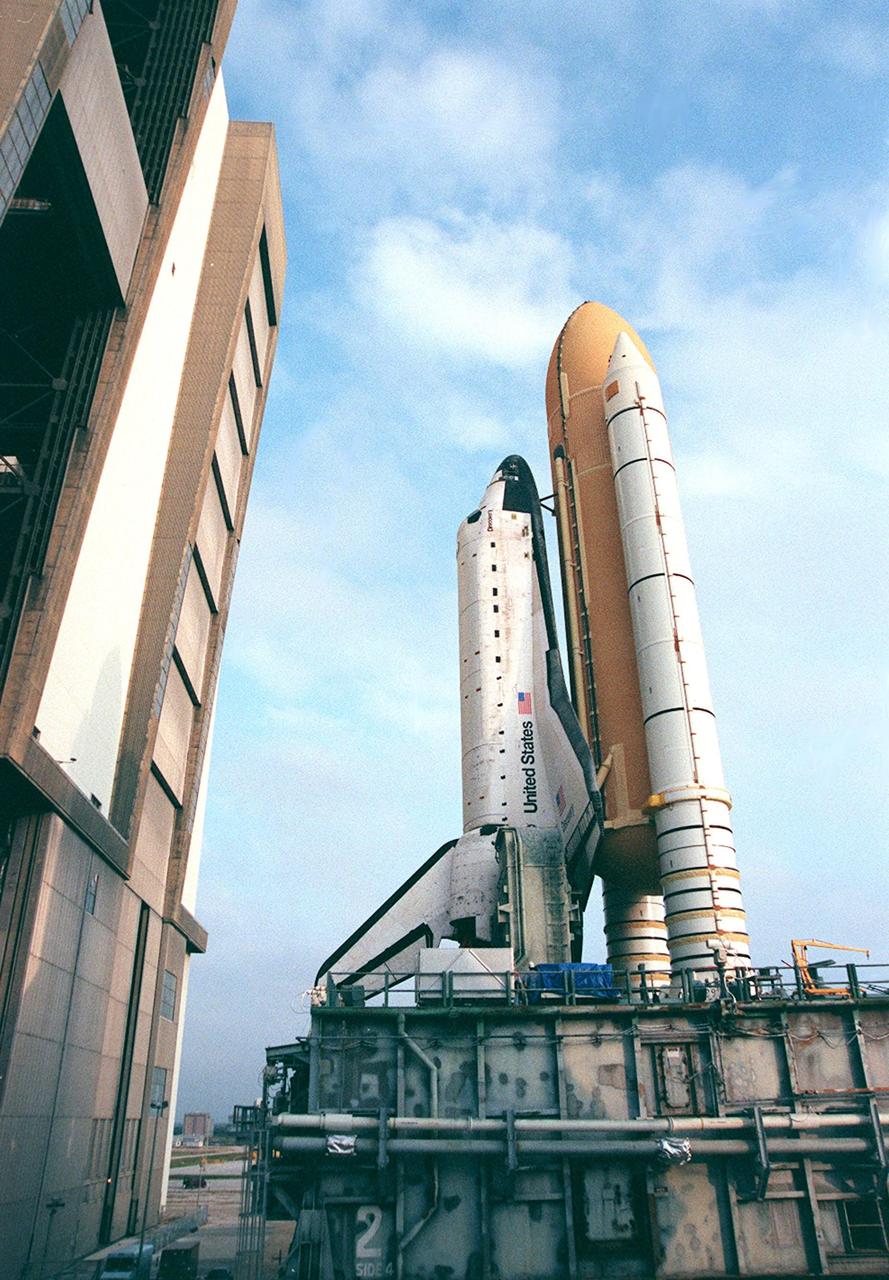
KENNEDY SPACE CENTER, Fla. -- Space Shuttle Discovery clears the Vehicle Assembly Building (left) on its crawl to Launch Pad 39B atop the mobile launcher platform and crawler transporter. Once at the pad, the orbiter, external tank and solid rocket boosters will undergo final preparations for the STS-103 launch targeted for Dec. 6, 1999, at 2:37 a.m. EST. The mission is a "call-up" due to the need to replace and repair portions of the Hubble Space Telescope. Although Hubble is operating normally and conducting its scientific observations, only three of its six gyroscopes are working properly. Four EVA's are planned to make the necessary repairs and replacements on the telescope. The STS-103 crew members are Commander Curtis L. Brown Jr., Pilot Scott J. Kelly, Steven L. Smith, C. Michael Foale (Ph.D.), John M. Grunsfeld (Ph.D.), and Claude Nicollier of Switzerland and Jean-François Clervoy of France, both with the European Space Agency
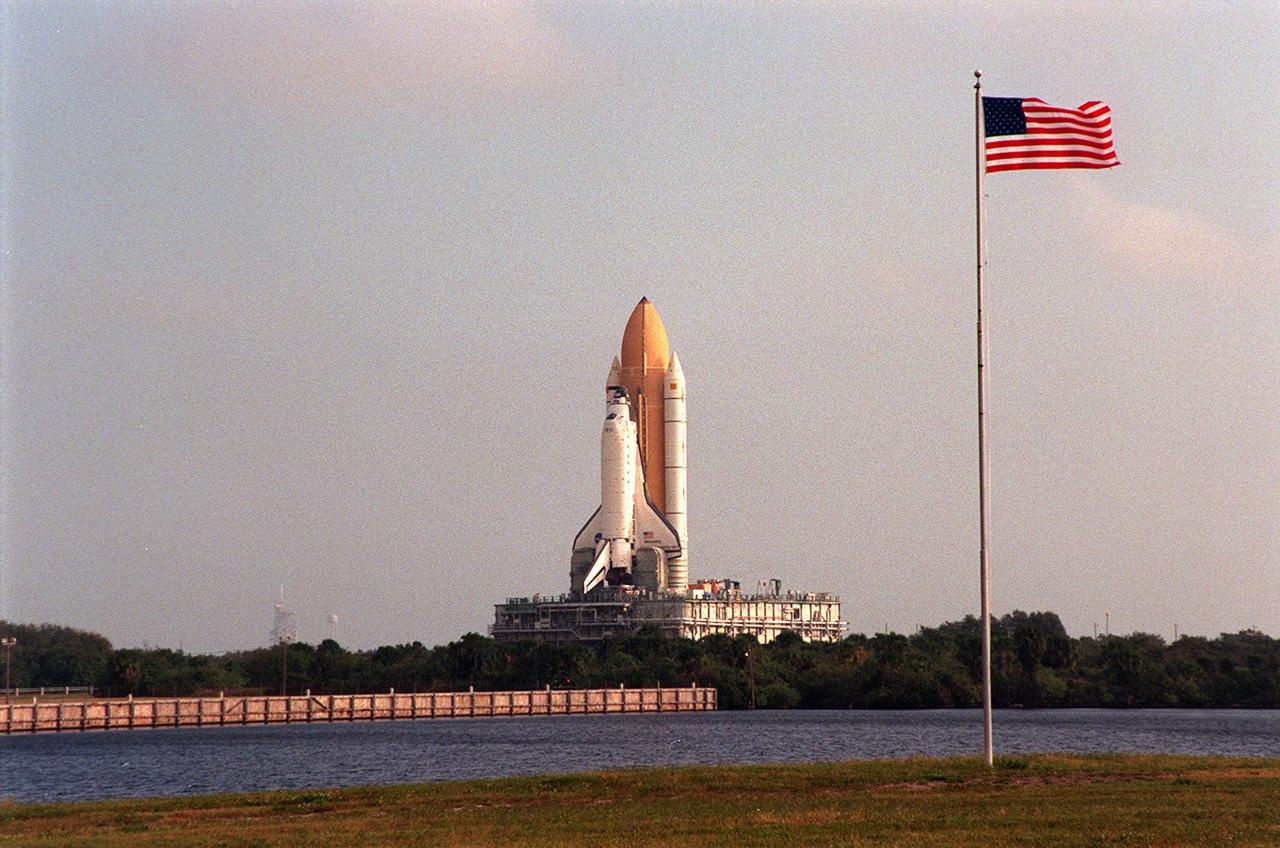
KENNEDY SPACE CENTER, Fla. -- With the American flag flapping in the morning breeze, Space Shuttle Discovery, across the turn basin, makes its crawl to Launch Pad 39B (background, left) atop the mobile launcher platform and crawler transporter. Once at the pad, the orbiter, external tank and solid rocket boosters will undergo final preparations for the STS-103 launch targeted for Dec. 6, 1999, at 2:37 a.m. EST. The mission is a "call-up" due to the need to replace and repair portions of the Hubble Space Telescope. Although Hubble is operating normally and conducting its scientific observations, only three of its six gyroscopes are working properly. Four EVA's are planned to make the necessary repairs and replacements on the telescope. The STS-103 crew members are Commander Curtis L. Brown Jr., Pilot Scott J. Kelly, Steven L. Smith, C. Michael Foale (Ph.D.), John M. Grunsfeld (Ph.D.), and Claude Nicollier of Switzerland and Jean-François Clervoy of France, both with the European Space Agency.