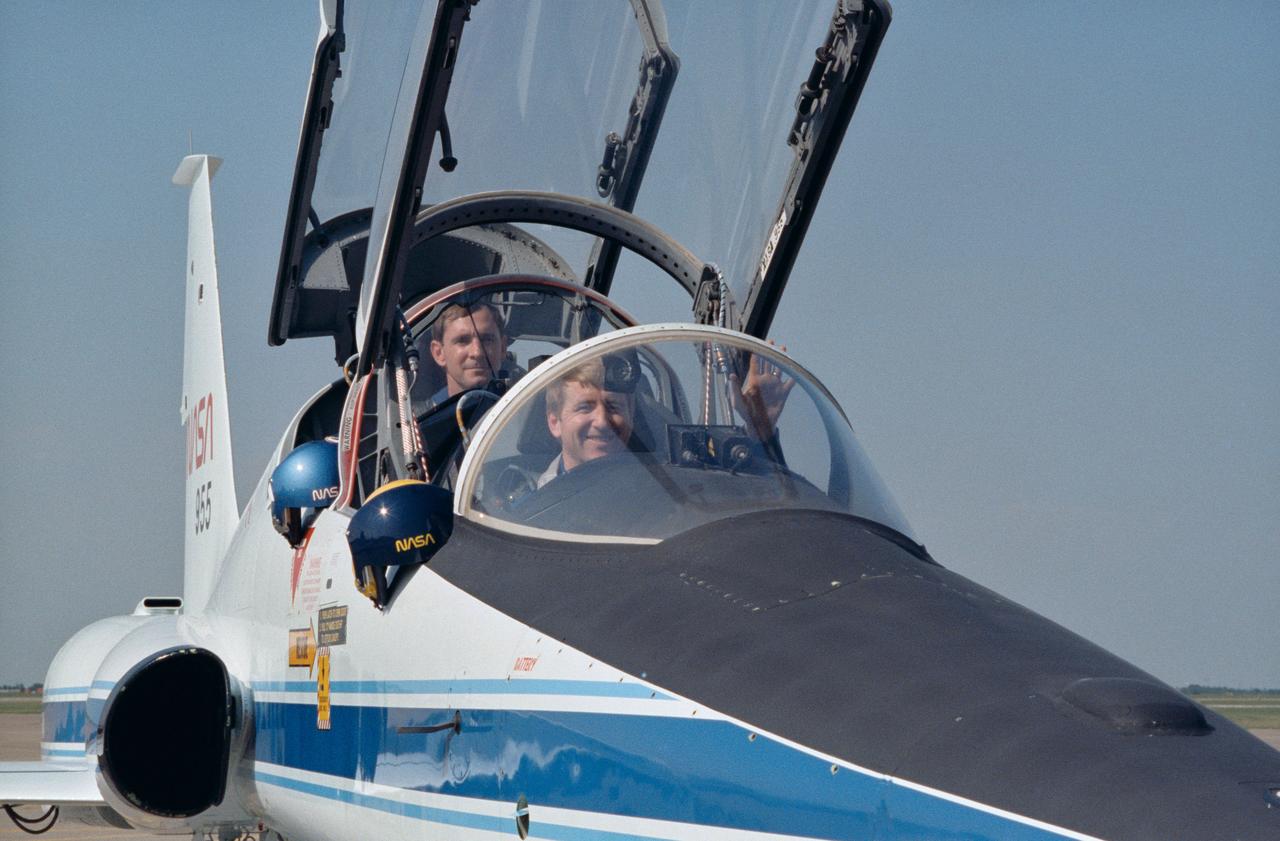
STS-38 Pilot Frank L. Culbertson waves from T-38A NASA 955 forward cockpit prior to Ellington Field departure. Astronaut Curtis L. Brown, Jr is stationed in the aft cockpit behind Culbertson.
STS-38 Pilot Culbertson in T-38A prior to Ellington departure
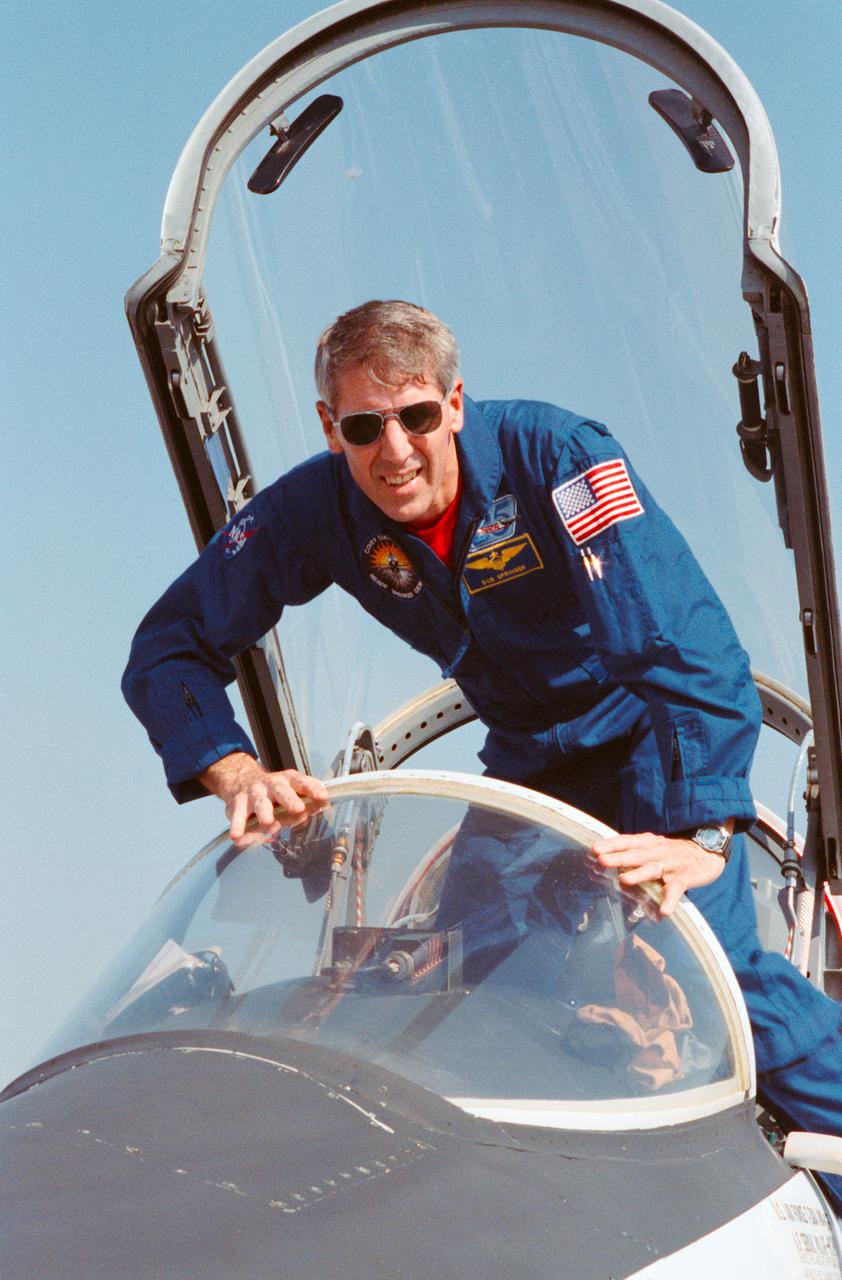
STS-38 Mission Specialist (MS) Robert C. Springer climbs into T-38A forward cockpit prior to Ellington Field departure for the Kennedy Space Center (KSC).
STS-38 MS Springer climbs into T-38A forward cockpit at Ellington Field
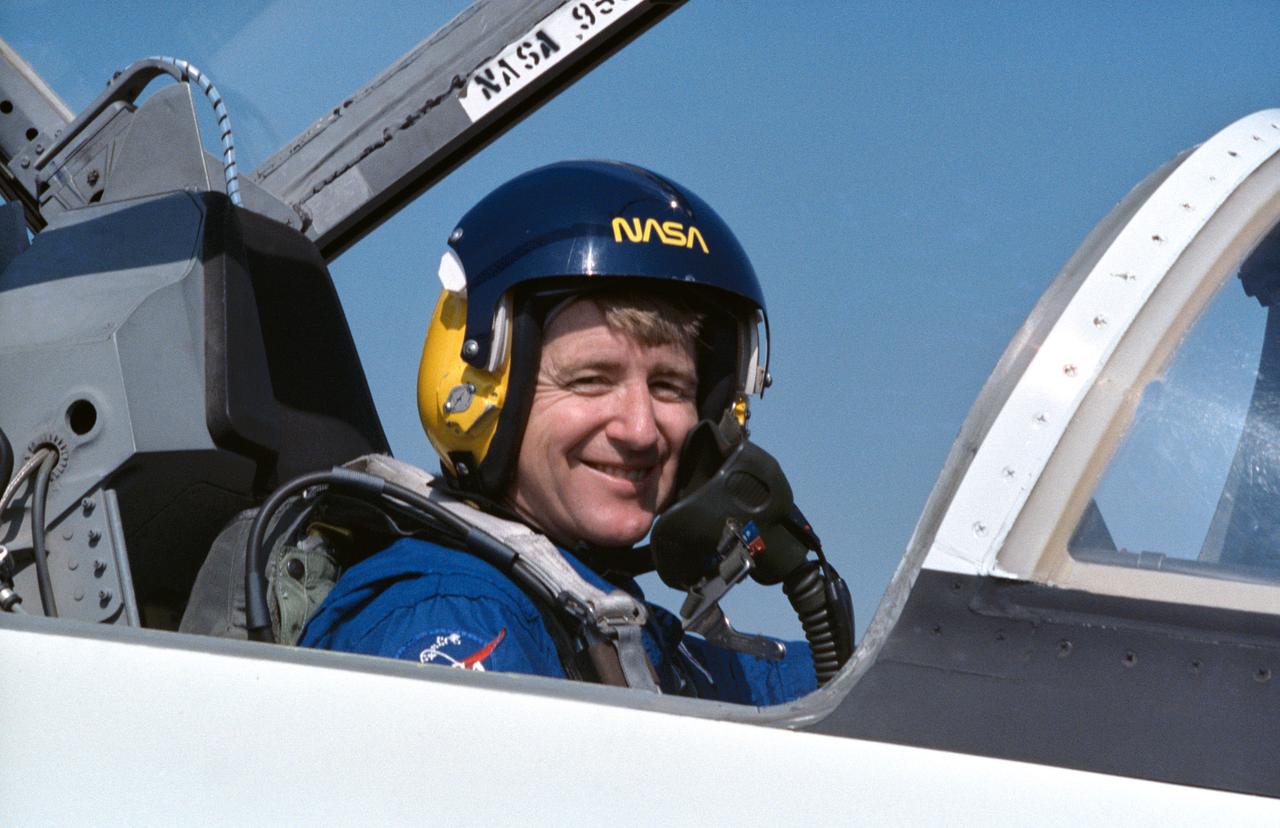
STS-38 Pilot Frank L. Culberston, smiling and wearing his helmet with breathing apparatus attached, sits in T-38A NASA 955 forward cockpit at Ellington Field and prepares for departure.
STS-38 Pilot Culberston in T-38A NASA 955 forward cockpit at Ellington Field
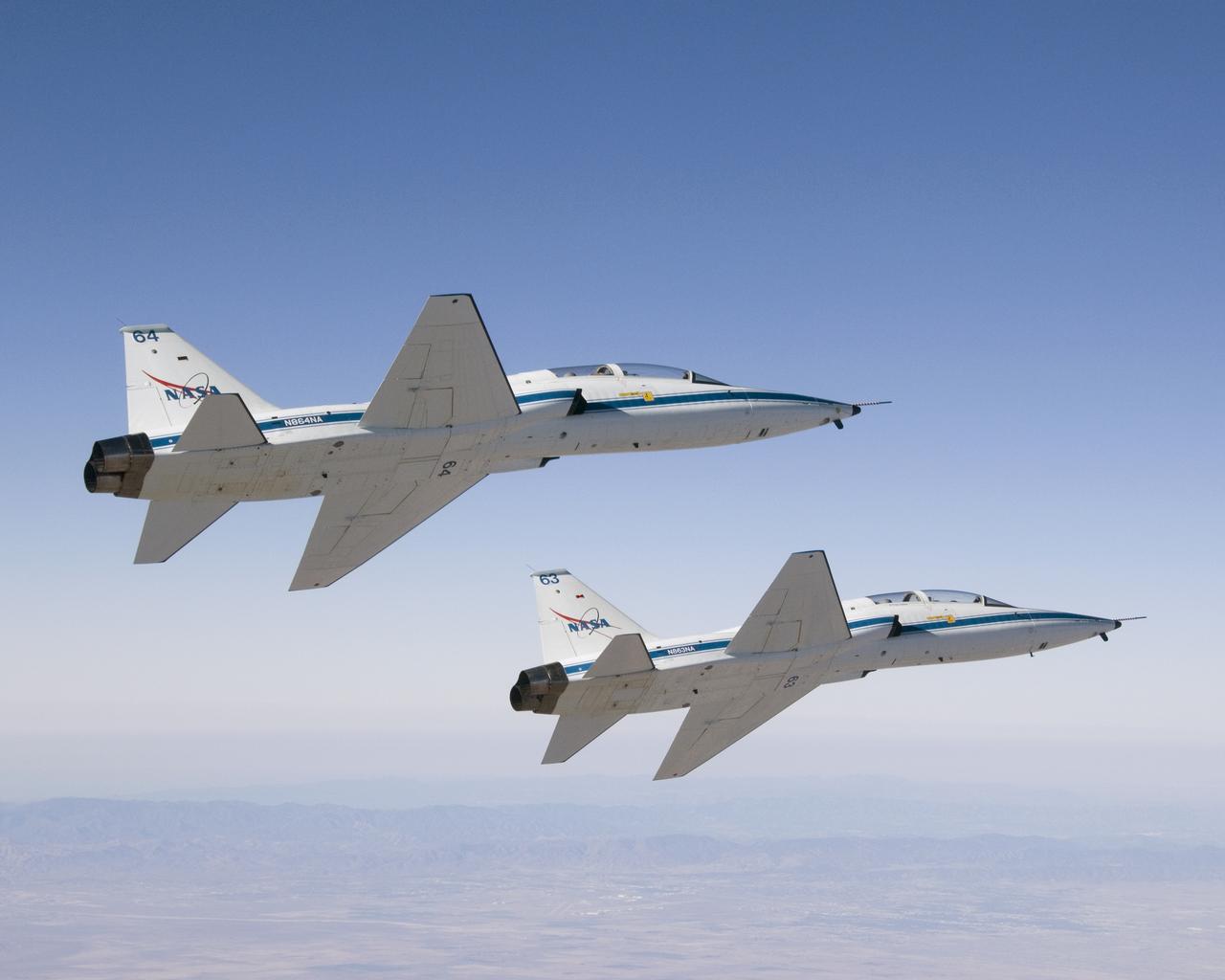
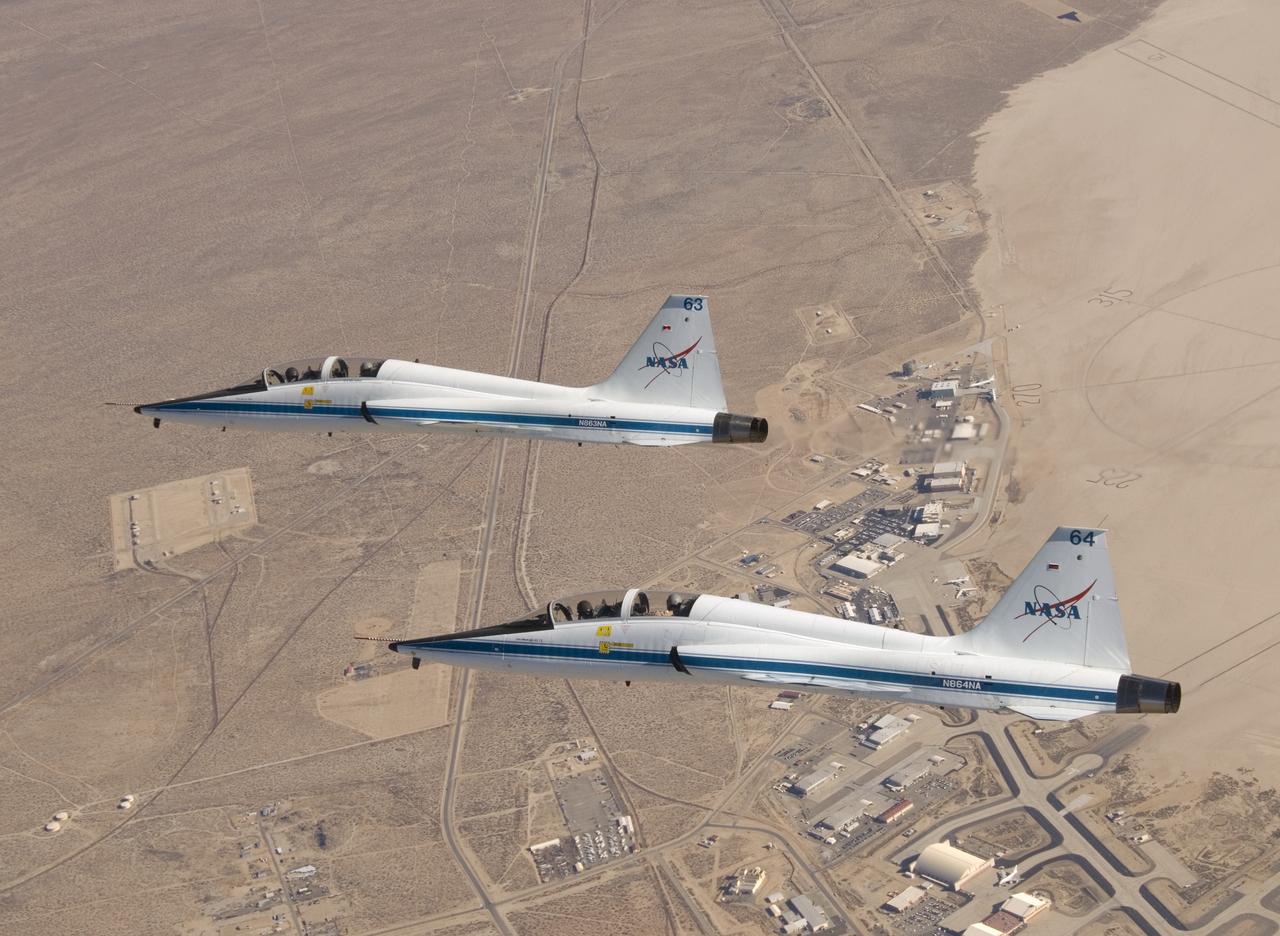
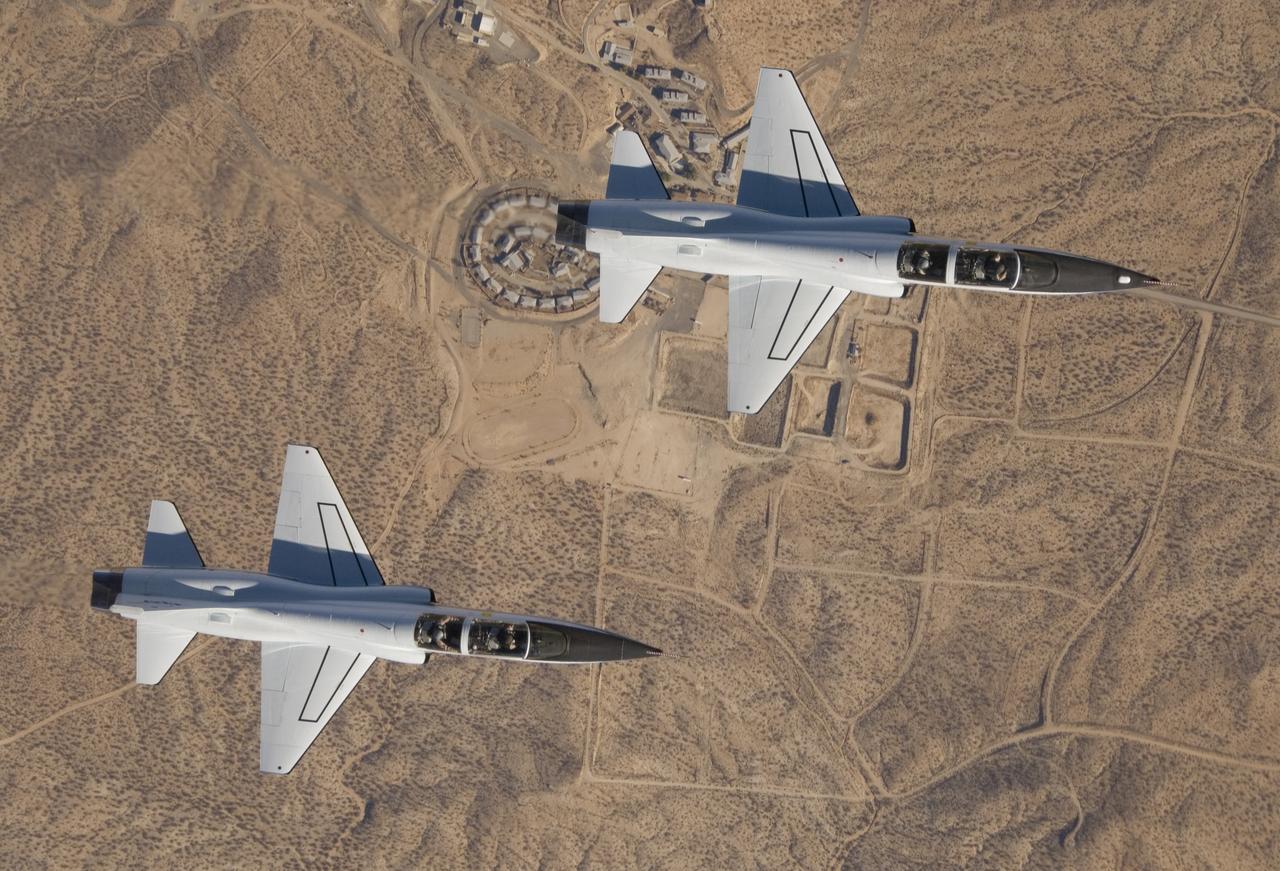
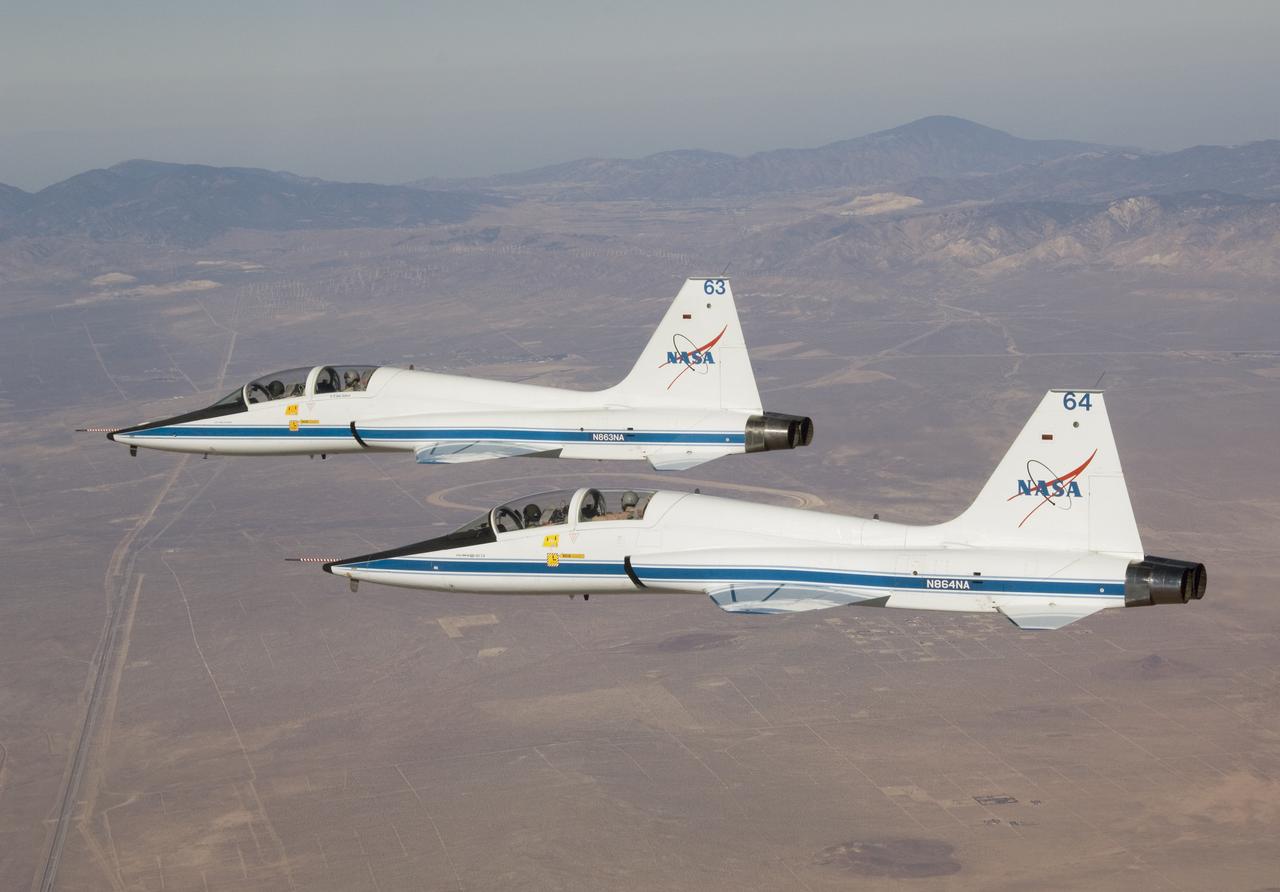
NASA Dryden Flight Research Center's two T-38A Talon mission support aircraft flew together for the first time on Sept. 26, 2007 while conducting pitot-static airspeed calibration checks during routine pilot proficiency flights. The two aircraft, flown by NASA research pilots Kelly Latimer and Frank Batteas, joined up with a NASA Dryden F/A-18 flown by NASA research pilot Dick Ewers to fly the airspeed calibrations at several speeds and altitudes that would be flown by the Stratospheric Observatory for Infrared Astronomy (SOFIA) Boeing 747SP during its initial flight test phase. The T-38s, along with F/A-18s, serve in a safety chase role during those test missions, providing critical instrument and visual monitoring for the flight test series.
NASA Dryden's two T-38A mission support aircraft fly in tight formation while conducting a pitot-static airspeed calibration check near Edwards Air Force Base
NASA Dryden Flight Research Center's two T-38A Talon mission support aircraft flew together for the first time on Sept. 26, 2007 while conducting pitot-static airspeed calibration checks during routine pilot proficiency flights. The two aircraft, flown by NASA research pilots Kelly Latimer and Frank Batteas, joined up with a NASA Dryden F/A-18 flown by NASA research pilot Dick Ewers to fly the airspeed calibrations at several speeds and altitudes that would be flown by the Stratospheric Observatory for Infrared Astronomy (SOFIA) Boeing 747SP during its initial flight test phase. The T-38s, along with F/A-18s, serve in a safety chase role during those test missions, providing critical instrument and visual monitoring for the flight test series.
NASA Dryden's two T-38A mission support aircraft fly in tight formation while conducting a pitot-static airspeed calibration check near Edwards Air Force Base
NASA Dryden Flight Research Center's two T-38A Talon mission support aircraft flew together for the first time on Sept. 26, 2007 while conducting pitot-static airspeed calibration checks during routine pilot proficiency flights. The two aircraft, flown by NASA research pilots Kelly Latimer and Frank Batteas, joined up with a NASA Dryden F/A-18 flown by NASA research pilot Dick Ewers to fly the airspeed calibrations at several speeds and altitudes that would be flown by the Stratospheric Observatory for Infrared Astronomy (SOFIA) Boeing 747SP during its initial flight test phase. The T-38s, along with F/A-18s, serve in a safety chase role during those test missions, providing critical instrument and visual monitoring for the flight test series.
NASA Dryden's two T-38A mission support aircraft fly in tight formation while conducting a pitot-static airspeed calibration check near Edwards Air Force Base
NASA Dryden Flight Research Center's two T-38A Talon mission support aircraft flew together for the first time on Sept. 26, 2007 while conducting pitot-static airspeed calibration checks during routine pilot proficiency flights. The two aircraft, flown by NASA research pilots Kelly Latimer and Frank Batteas, joined up with a NASA Dryden F/A-18 flown by NASA research pilot Dick Ewers to fly the airspeed calibrations at several speeds and altitudes that would be flown by the Stratospheric Observatory for Infrared Astronomy (SOFIA) Boeing 747SP during its initial flight test phase. The T-38s, along with F/A-18s, serve in a safety chase role during those test missions, providing critical instrument and visual monitoring for the flight test series.
NASA Dryden's two T-38A mission support aircraft fly in tight formation while conducting a pitot-static airspeed calibration check near Edwards Air Force Base
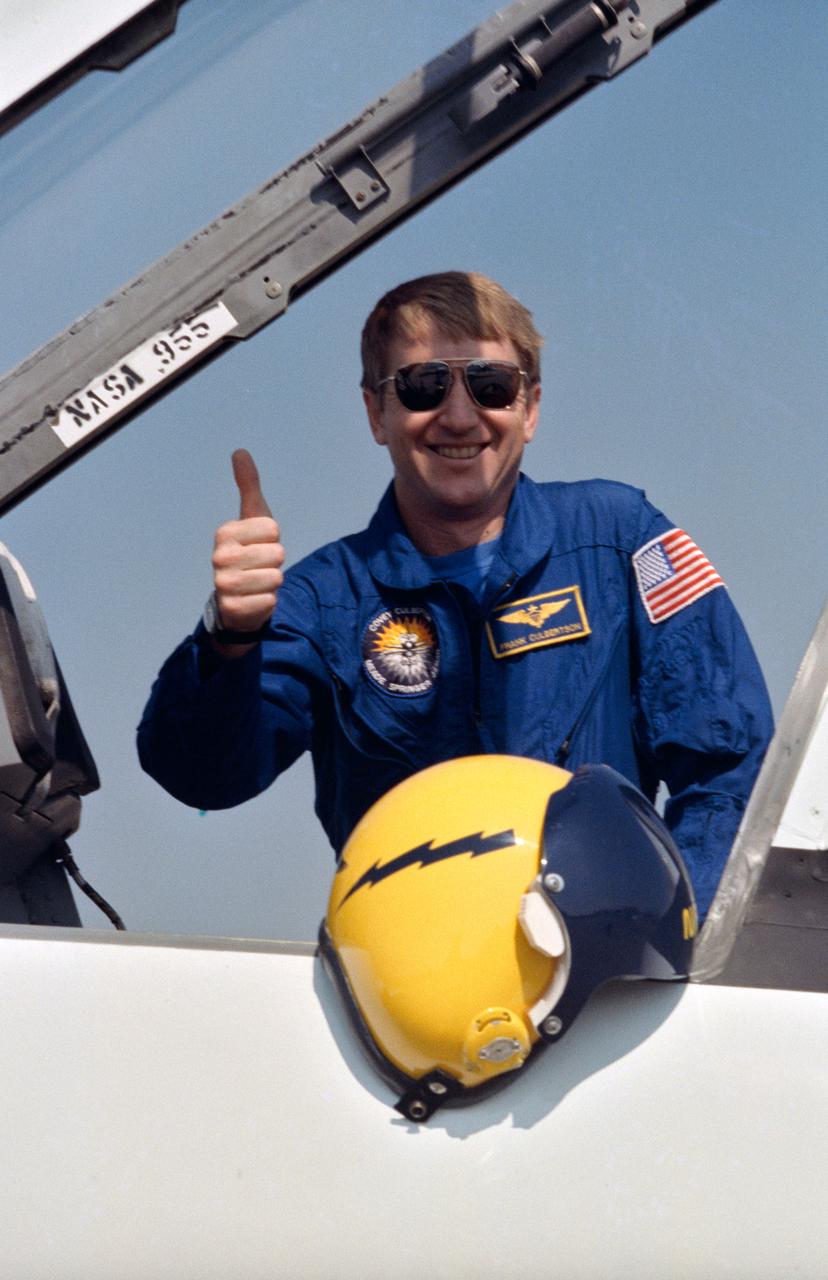
STS-38 Pilot Frank L. Culbertson gives "thumbs up" before climbing into the T-38A NASA 955 forward cockpit. Crewmembers are preparing for departure from Ellington Field to the Kennedy Space Center (KSC). Culbertson's bright yellow helmet is displayed in front of him.
STS-38 Pilot Culbertson gives "thumbs up" from T-38A at Ellington Field
STS-28 Columbia, Orbiter Vehicle (OV) 102, Commander Brewster H. Shaw, wearing navy blue flight coveralls and helmet, sits in T-38A forward cockpit. Shaw, along with his fellow crewmembers, is preparing for departure from Ellington Field to Kennedy Space Center (KSC). STS-28, a Department of Defense (DOD) dedicated mission, is scheduled for launch on 08-08-89.
STS-28 Columbia, OV-102, Commander Shaw aboard T-38A at Ellington Field
Close up documentation of the Left Side Rudder Leading Edge becoming delaminated on T-38A, NASA 962, on Dec. 6, 1983.
T-38 A- AIRCRAFT (NASA 924)
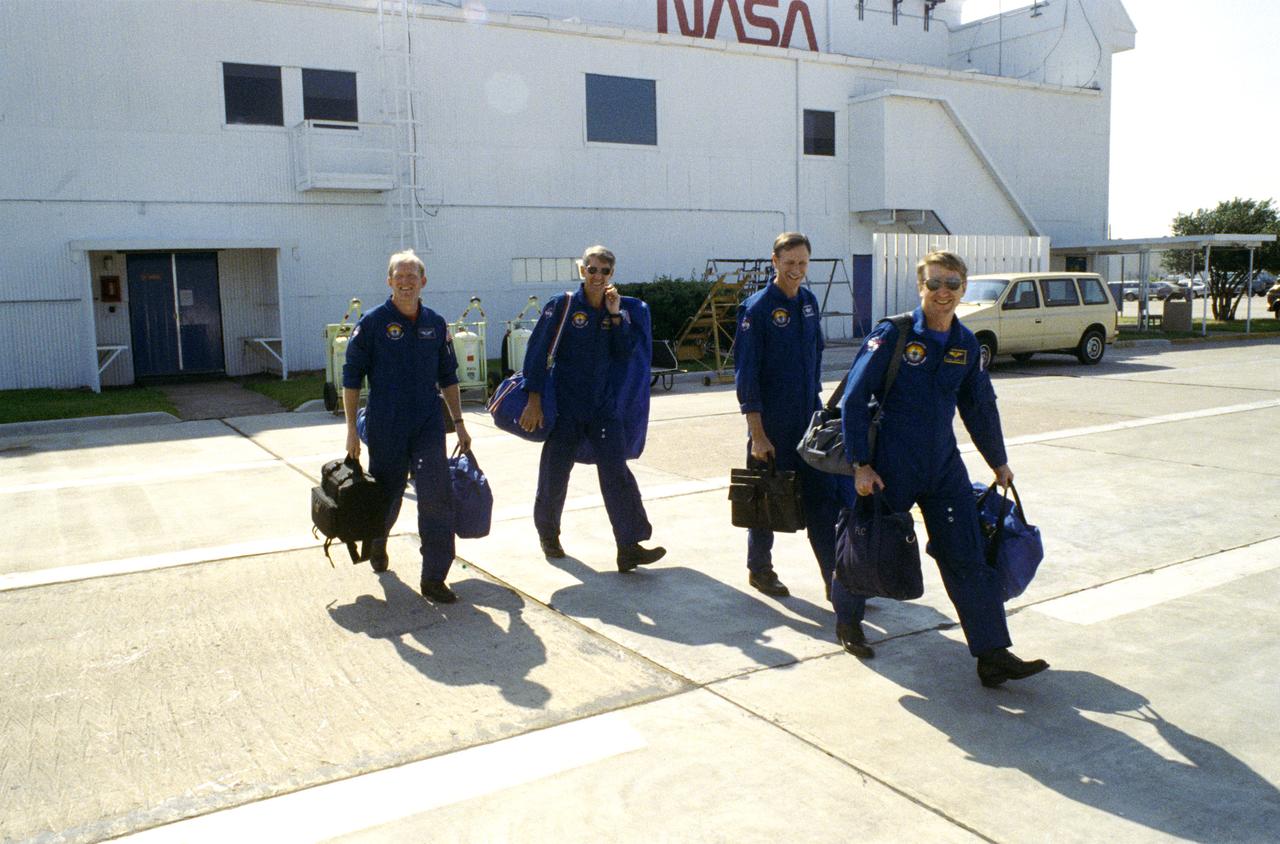
STS-38 crewmembers, carrying their luggage, walk across the Ellington Field runway to board their T-38As. The crewmembers are lead by Pilot Frank L. Culbertson. Commander Richard O. Covey, Mission Specialist (MS) Robert C. Springer (wearing sunglasses), and MS Charles D. Gemar follow. The crewmembers are preparing for their departure to the Kennedy Space Center (KSC). Ellington Field hangar is visible in the background.
STS-38 crewmembers prepare for Ellington Field departure
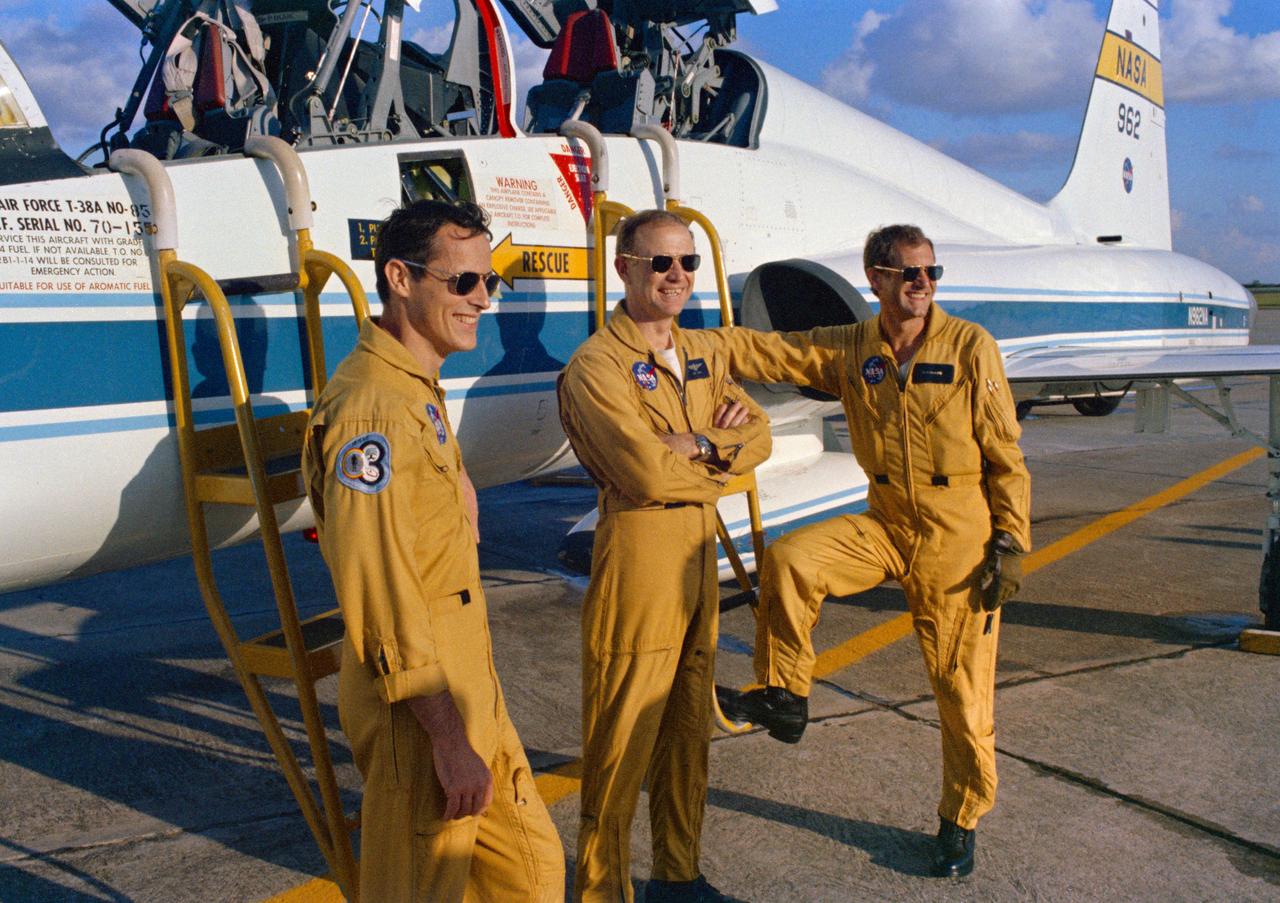
S73-36766 (November 1973) --- The prime crewmen of the third manned Skylab mission (Skylab 4) pause at a USAF T-38A jet at Ellington Air Force Base, Texas before flying to Kennedy Space Center (KSC) at Cape Canaveral, Florida. Skylab 4 crewmen are astronaut Gerald P. Carr, center, commander; scientist-astronaut Edward G. Gibson, science pilot, left; and astronaut William R. Pogue, pilot. Photo credit: NASA
Skylab 4 crewmen at Ellington AFB before flying to Kennedy Space Center
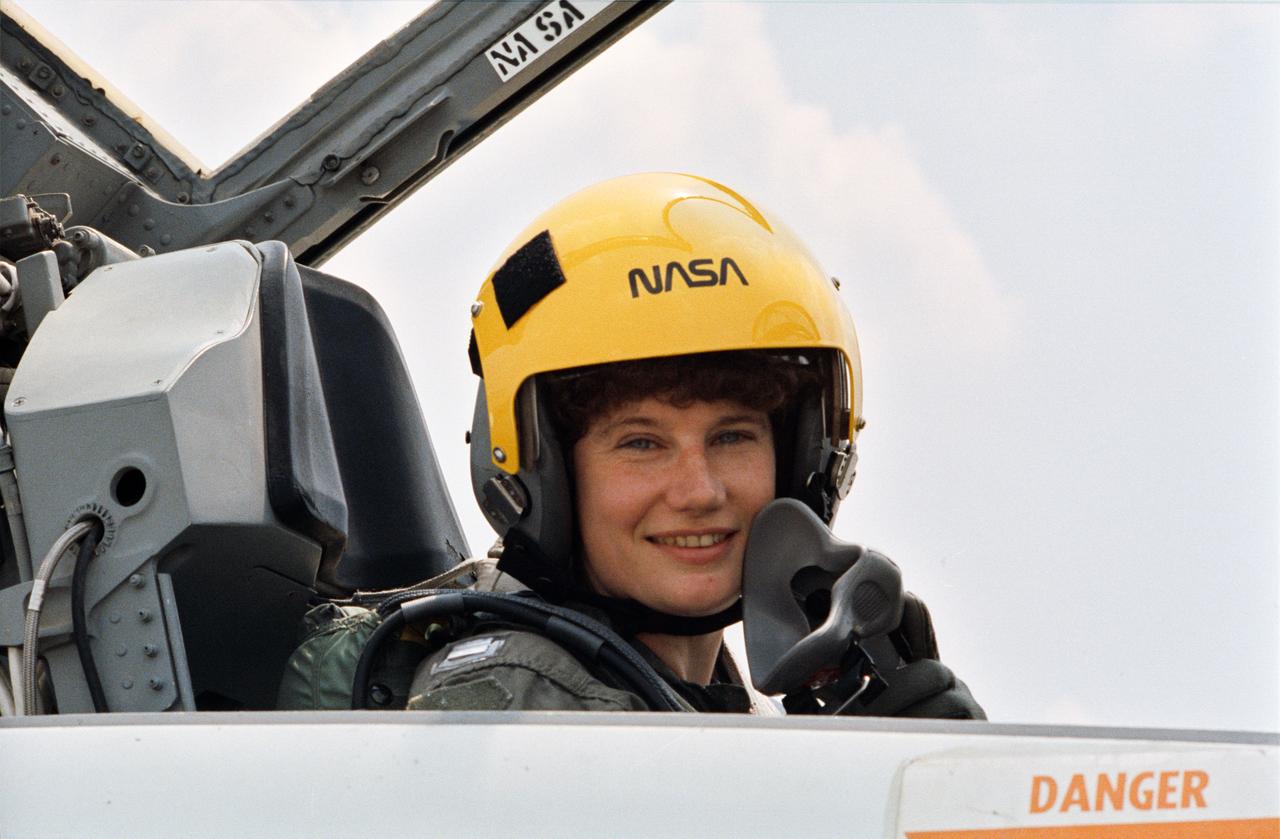
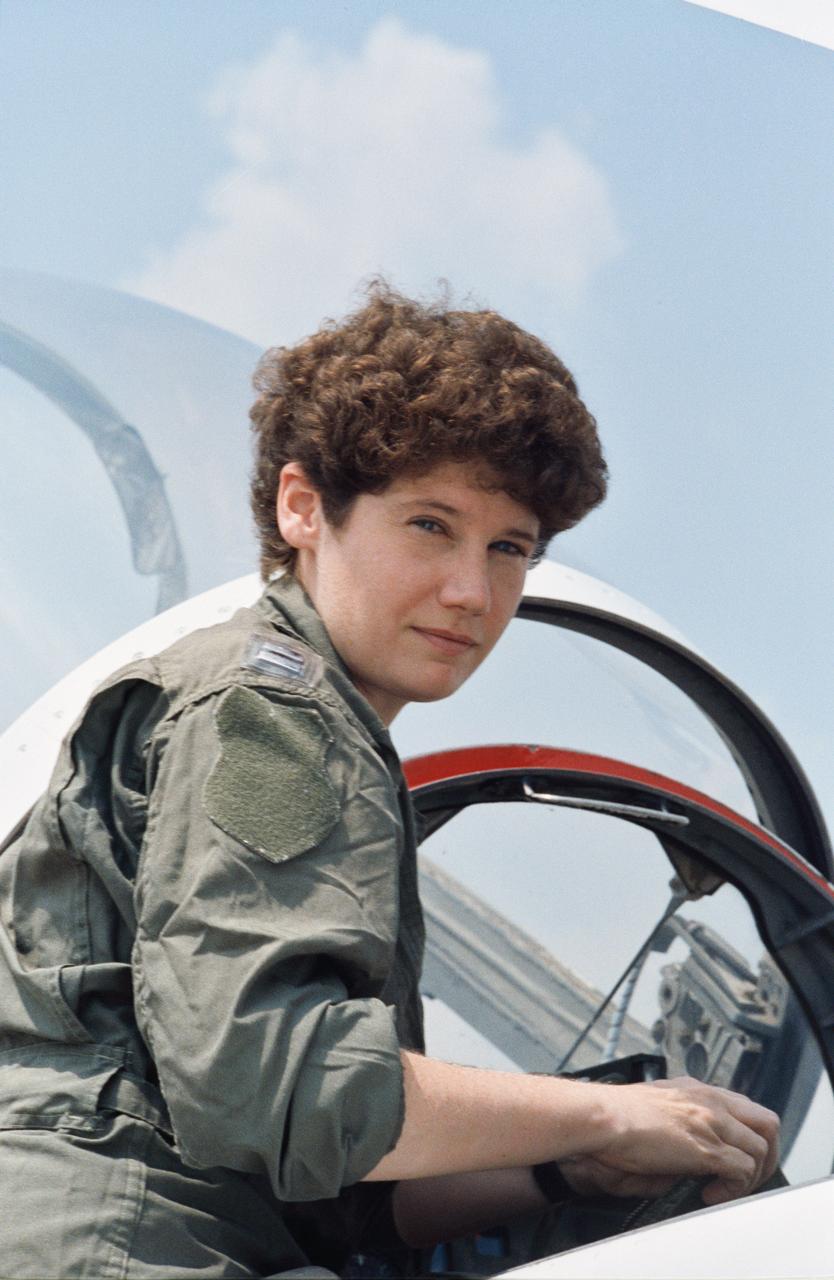
S90-45809 (July 1990) --- Susan J. Helms, one of the 23 astronaut candidates who began a year's training and evaluation program recently, sits in the cockpit of a NASA T-38 jet trainer at Ellington Field near the Johnson Space Center.
ASCAN Helms sits in T-38A cockpit and prepares for Ellington Field training
S90-45810 (29-31 July 1990) --- Susan J. Helms, one of 23 astronaut candidate who began a year's training and evaluation in July, climbs into a T-38 jet trainer during a survival training school at Vance Air Force Base in Oklahoma.
ASCAN Helms inspects T-38A during flight training at Ellington Field
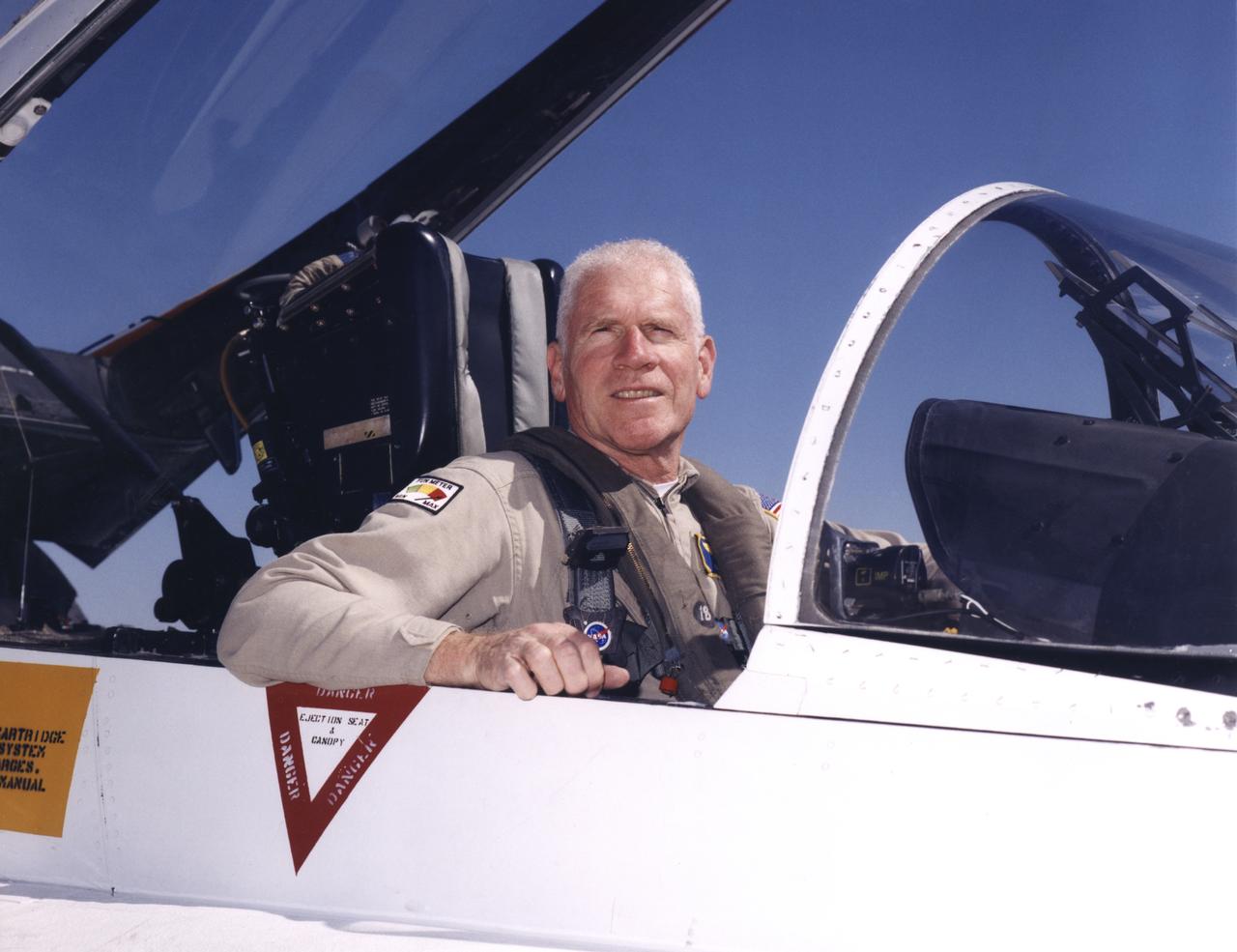
Edwin W. Lewis Jr. is a research pilot in the Airborne Science program, Flight Crew Branch, Dryden Flight Research Center, Edwards, California. He currently flies the DC-8, F/A-18, Lear Jet 24, King Air, and T-34C in support of Dryden's flight operations and is mentor pilot for the King Air and the Lear Jet.  Prior to accepting this assignment Lewis was a pilot for eight years at NASA's Ames Research Center, Moffett Field, California, flying 10 different aircraft C-130B, DC-8-72, UH-1, SH-3, King Air, Lear 24, T-38A, T-39G and YO-3A in support of NASA flight missions. Lewis also flew the Kuiper Airborne Observatory (a modified civilian version of the Lockheed C-141 Starlifter). He was project pilot for Ames' 747 and T-38 programs.  Lewis was born in New York City on May 19, 1936, and began flight training as a Civil Air Patrol cadet in 1951, ultimately earning his commercial pilot's certificate in 1958. He received a bachelor of arts degree in biology from Hobart College, Geneva, N.Y., and entered the U.S. Air Force through the Reserve Officer Training Corps. Following pilot training he was assigned to Moody Air Force Base, Ga., as an instructor pilot, for both the T-33 and T-37 aircraft. He served in Vietnam in 1965 and 1966, where he was a forward air controller, instructor and standardization/evaluation pilot, flying more than 1,000 hours in the O-1 "Bird Dog."  Lewis separated from the regular Air Force and joined Pan American World Airways and the 129th Air Commando Group, California Air National Guard (ANG) based in Hayward, California. During his 18-year career with the California ANG he flew the U-6, U-10, C-119, HC-130 aircraft and the HH-3 helicopter. He retired as commander, 129th Air Rescue and Recovery Group, a composite combat rescue group, in the grade of colonel. During his 22 years as an airline pilot, he flew the Boeing 707, 727 and 747. He took early retirement from Pan American in 1989 to become a pilot with NASA.
Edwin W. Lewis, Jr.
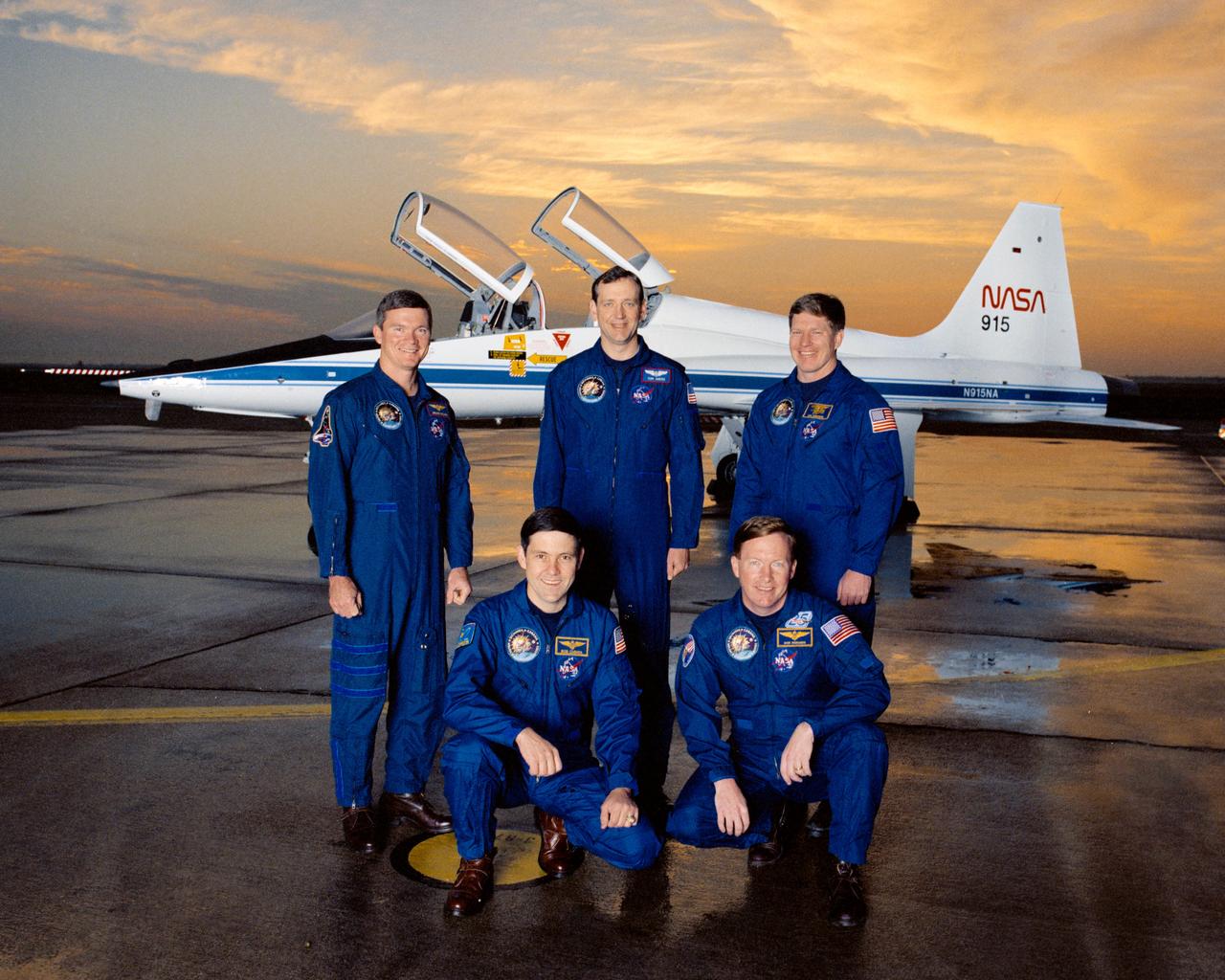
STS041-S-002 (7 May 1990) --- These five astronauts have been assigned to fly the STS-41 mission for the National Aeronautics and Space Administration (NASA). Pictured near the flight line at Ellington Field prior to an early morning flight in NASA T-38s are (kneeling, from the left) Robert D. Cabana, pilot; and Richard N. Richards, mission commander; and (standing, from left) Bruce E. Melnick, Thomas D. Akers and William M. Shepherd, all mission specialists. Primary payload for the Space Shuttle Discovery on the STS 41 mission is Ulysses.
STS-41 offical crew portrait taken in front of a T-38A at Ellington Field
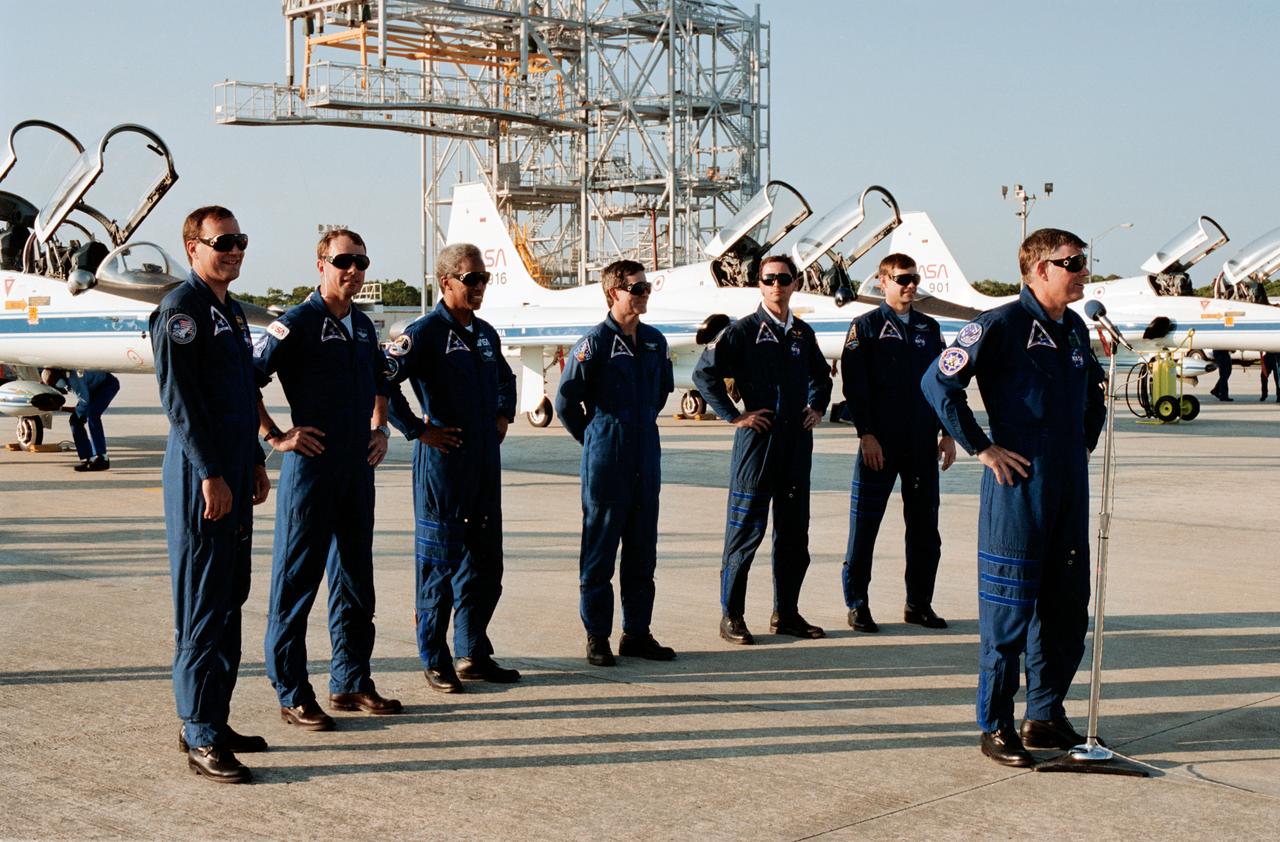
STS039-S-003 (20 April 1991) --- Astronaut Michael L. Coats (right) addresses the news media after arriving at the Shuttle Landing Facility along with his six fellow crewmembers.  From left are astronauts Richard J. Hieb, L. Blaine Hammond, Guion S. Bluford, Charles L.  (Lacy) Veach, Gregory J. Harbaugh and Donald R. McMonagle.  The Space Shuttle mate/demate stand is seen in the background.                Note: The STS-39 launch of Discovery occurred at 7:33:14 a.m. (EDT), April 28, 1991.
STS-39 crewmembers arrive at KSC's Shuttle Landing Facility (SLF) in T-38As
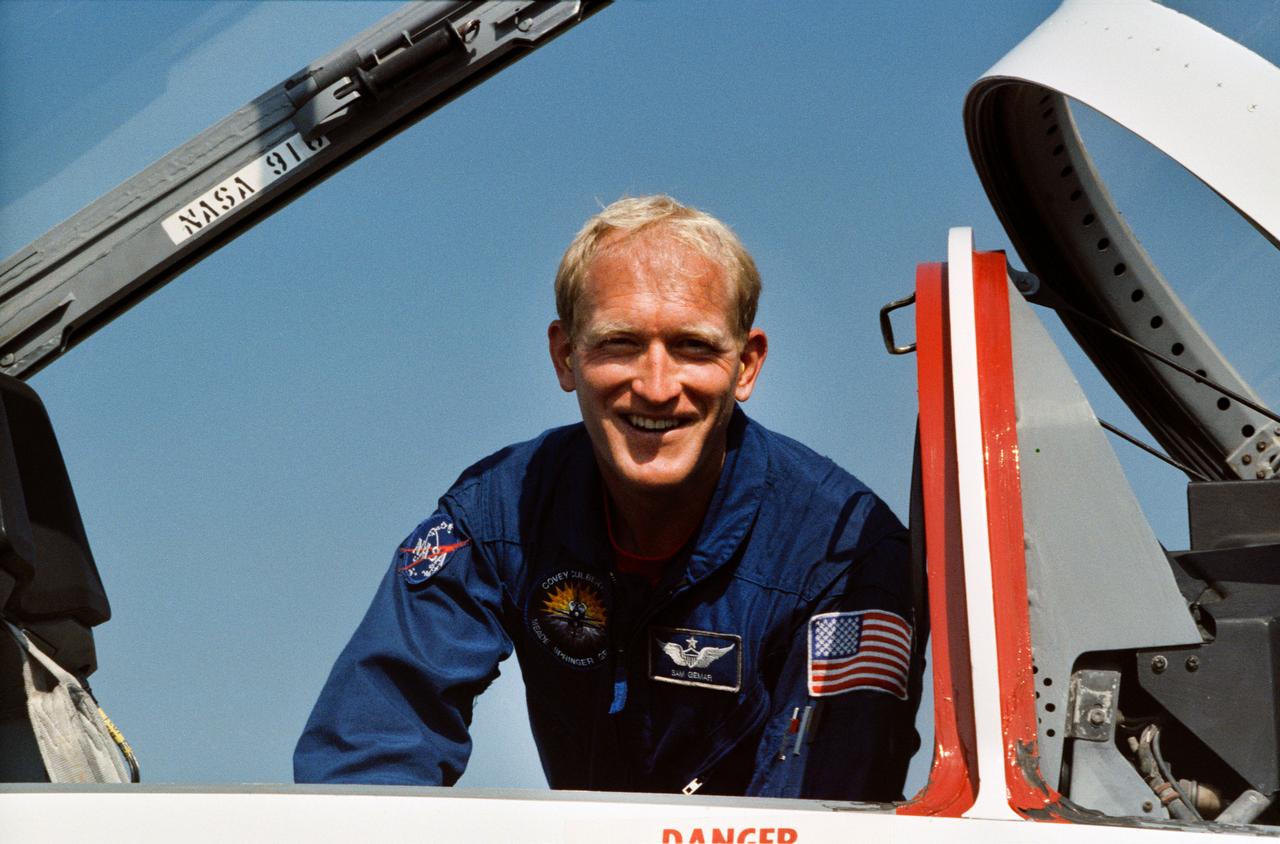
S90-41527 (August 1990) ---  Astronaut Charles D. (Sam) Gemar, prepares to climb aboard on of NASA's T-38 jet trainers, located near the Johnson Space Center (JSC).  Gemar began training as an astronaut candidate in summer of 1985.
STS-38 Mission Specialist Gemar climbs into T-38A cockpit at Ellington Field
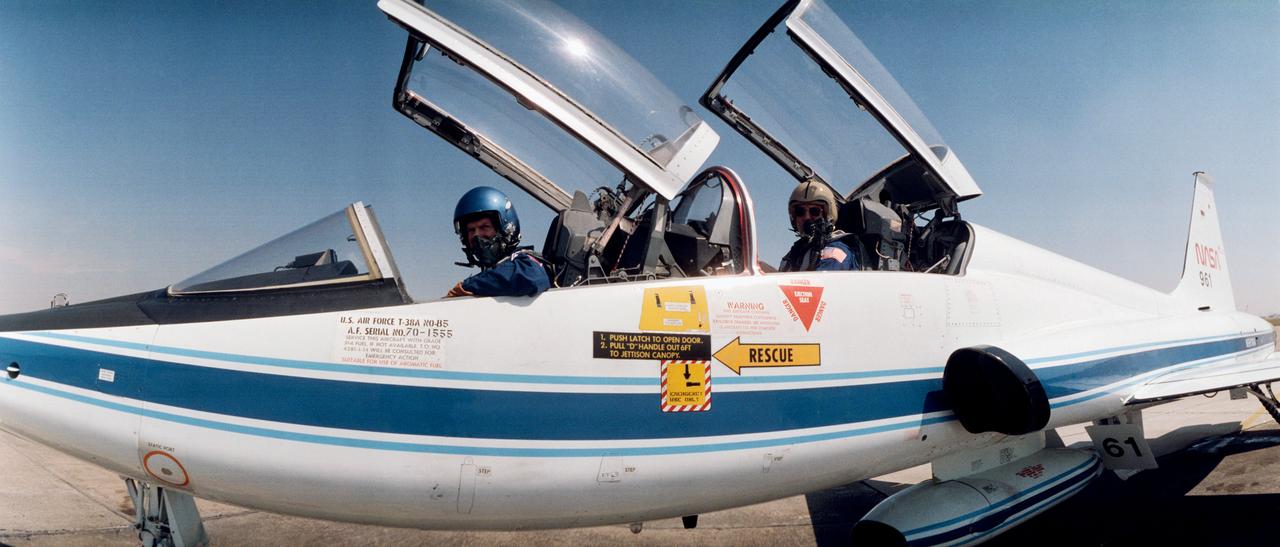
STS029-S-005 (10 March 1989) --- A wide angle view of a T-38 on the flight line at Ellington Field near the Johnson Space Center (JSC). Astronauts Michael L. Coats, mission commander; and James F. Buchli, STS-29 mission specialist, moments later were en route to Florida's Kennedy Space Center. In three days, they and three fellow STS-29 crew members are scheduled to lift off aboard the space shuttle Discovery from Launch Pad 39B.  Photo credit: NASA
STS-29 crewmembers in T-38A NASA 961 prepare for Ellington Field departure
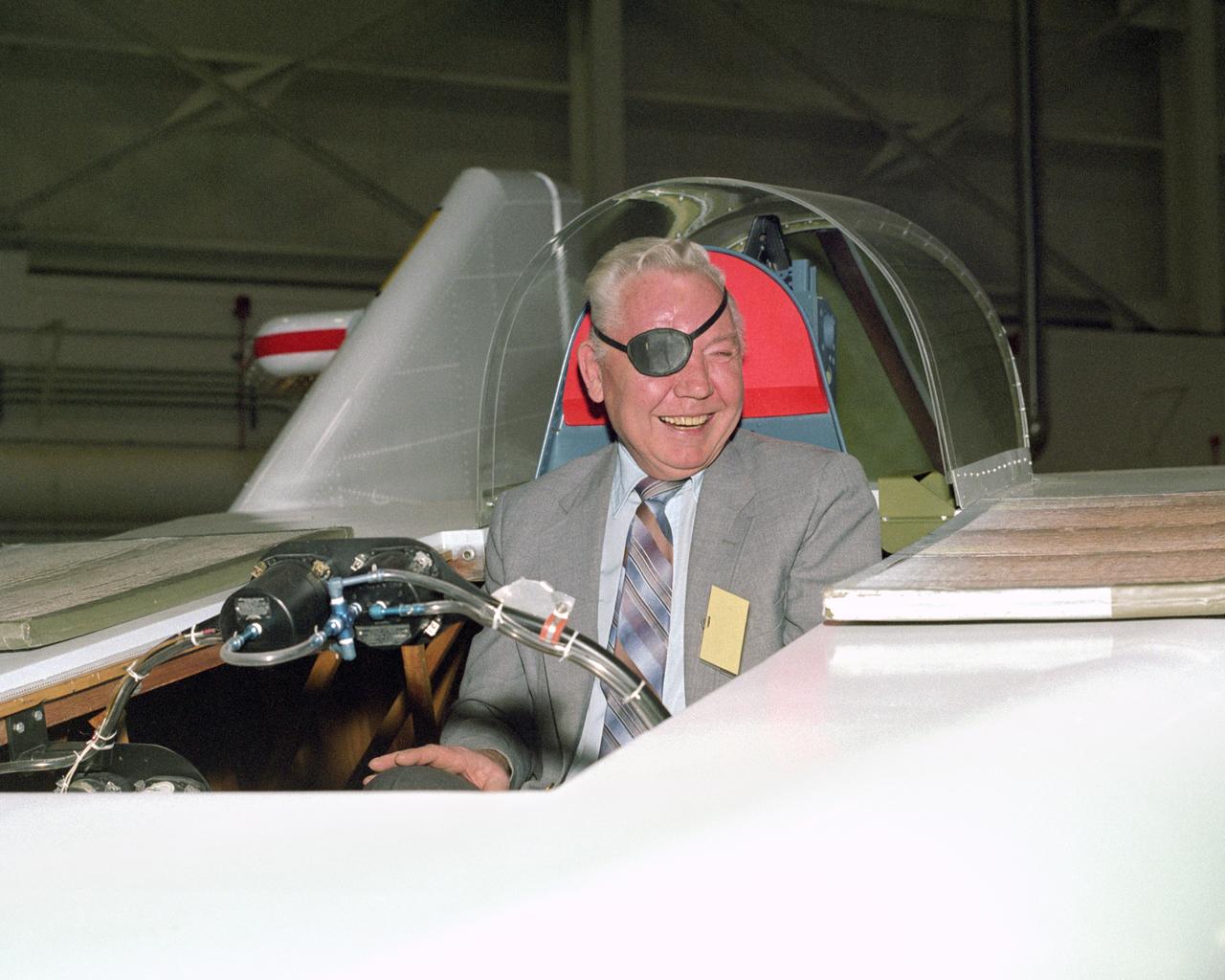
NASA Pilot Bruce Peterson in the cockpit of the restored M2-F1 Lifting Body.