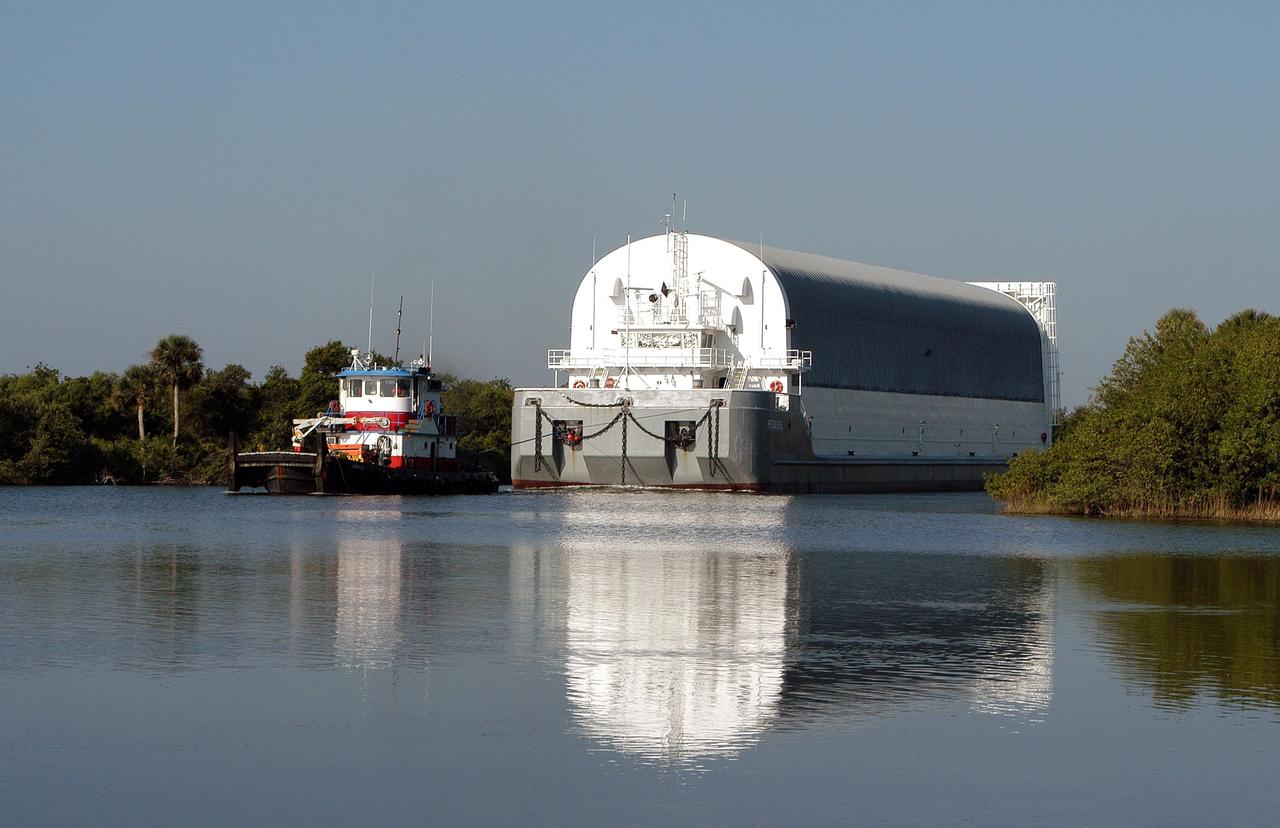
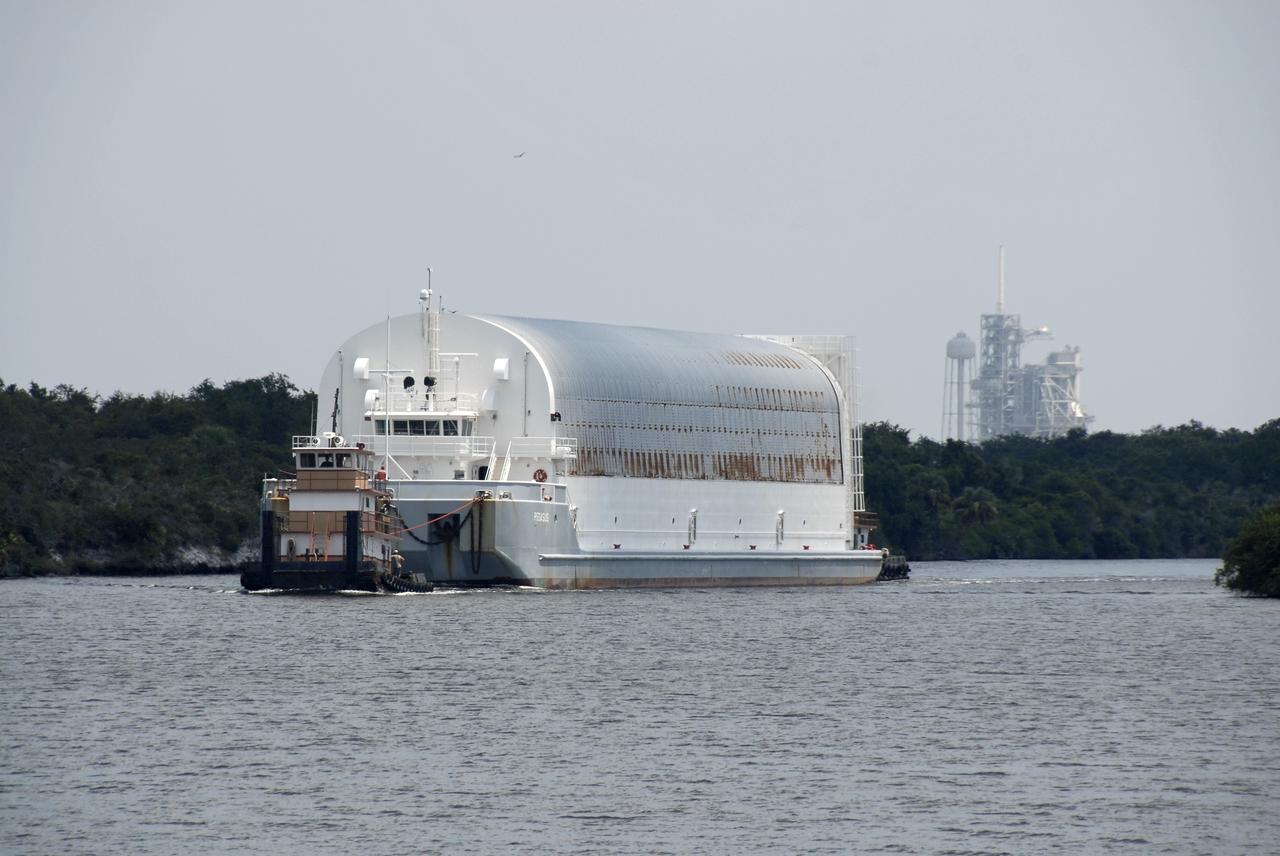
KENNEDY SPACE CENTER, FLA. - A tug boat begins towing the barge containing an External Tank (ET) to Port Canaveral. There one of the SRB Retrieval Ships will take over and tow the ET to the Michoud Space Systems Assembly Facility near New Orleans where redesign of the external tank is underway for Return to Flight.
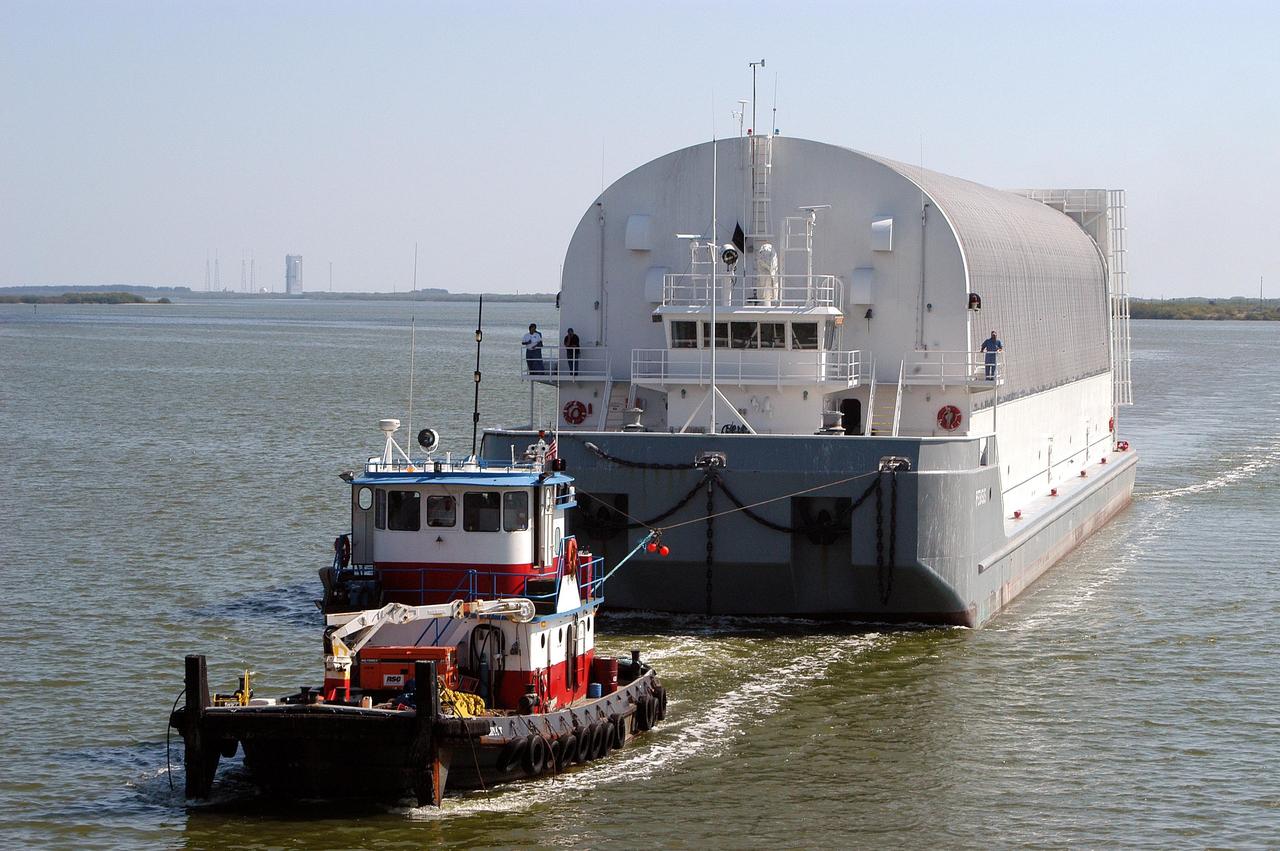
KENNEDY SPACE CENTER, FLA. - A tug boat tows the barge containing an External Tank (ET) to Port Canaveral. There one of the SRB Retrieval Ships will take over and tow the ET to the Michoud Space Systems Assembly Facility near New Orleans where redesign of the external tank is underway for Return to Flight.
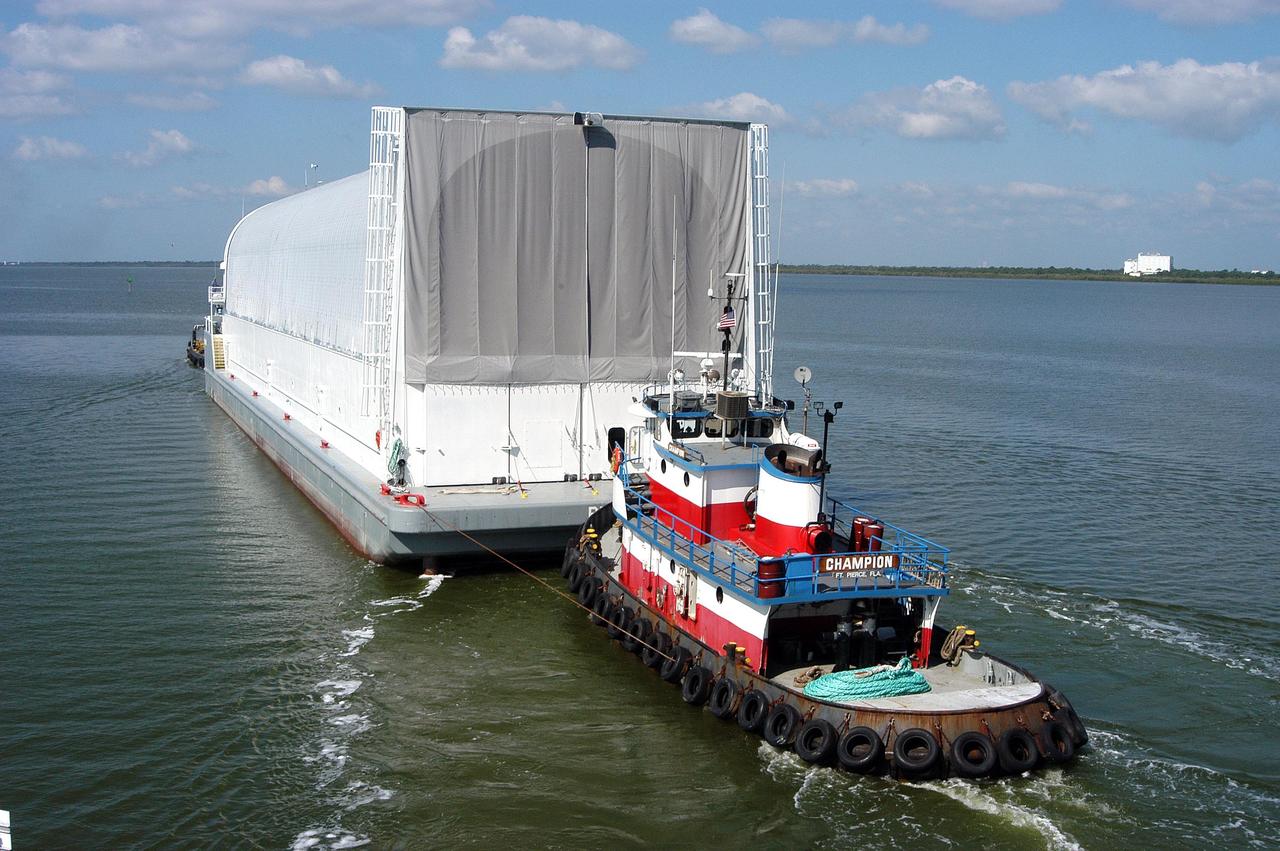
KENNEDY SPACE CENTER, FLA. - A tug boat tows the barge containing an External Tank (ET) to Port Canaveral. There one of the SRB Retrieval Ships will take over and tow the ET to the Michoud Space Systems Assembly Facility near New Orleans where redesign of the external tank is underway for Return to Flight.
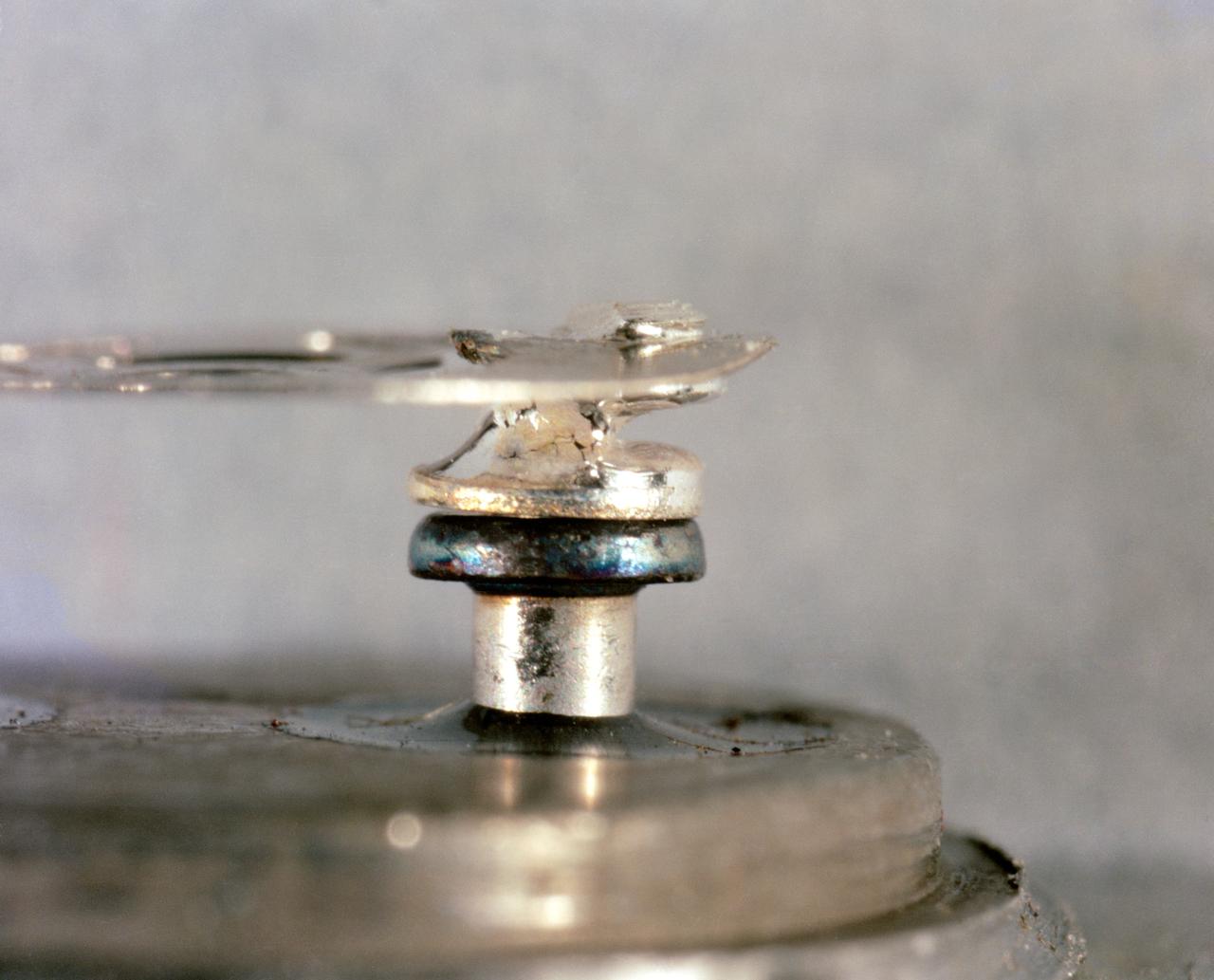
S70-40850 (June 1970) --- Fused thermal switch from Apollo Service Module (SM) oxygen tank after test at the NASA Manned Spacecraft Center (MSC) simulating Apollo 13 de-tanking procedures.
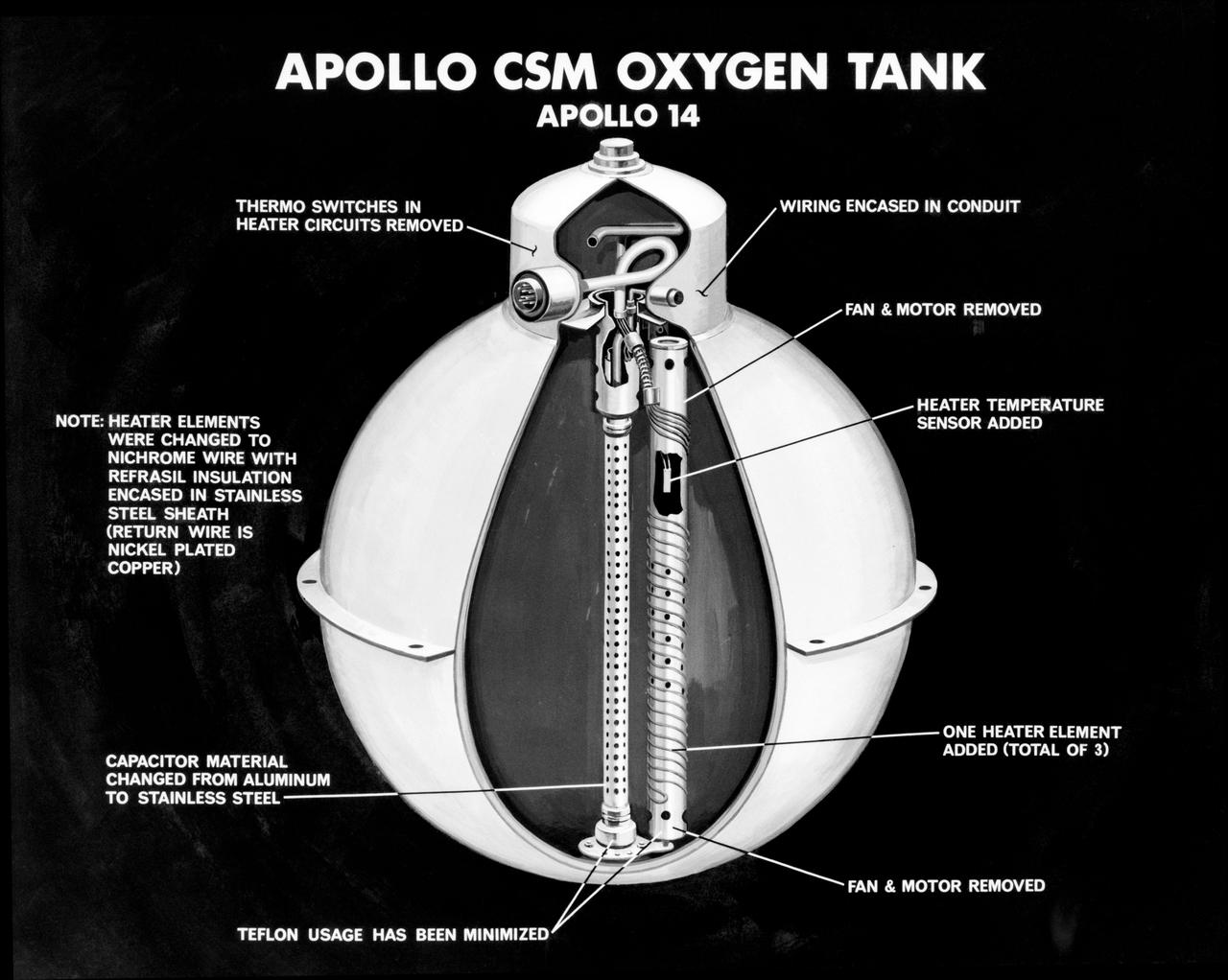
S71-16745 (January 1971) --- An artist's concept illustrating a cutaway view of one of the three oxygen tanks of the Apollo 14 spacecraft. This is the new Apollo oxygen tank design, developed since the Apollo 13 oxygen tank explosion. Apollo 14 has three oxygen tanks redesigned to eliminate ignition sources, minimize the use of combustible materials, and simplify the fabrication process. The third tank has been added to the Apollo 14 Service Module, located in the SM's sector one, apart from the pair of oxygen tanks in sector four. Arrows point out various features of the oxygen tank.
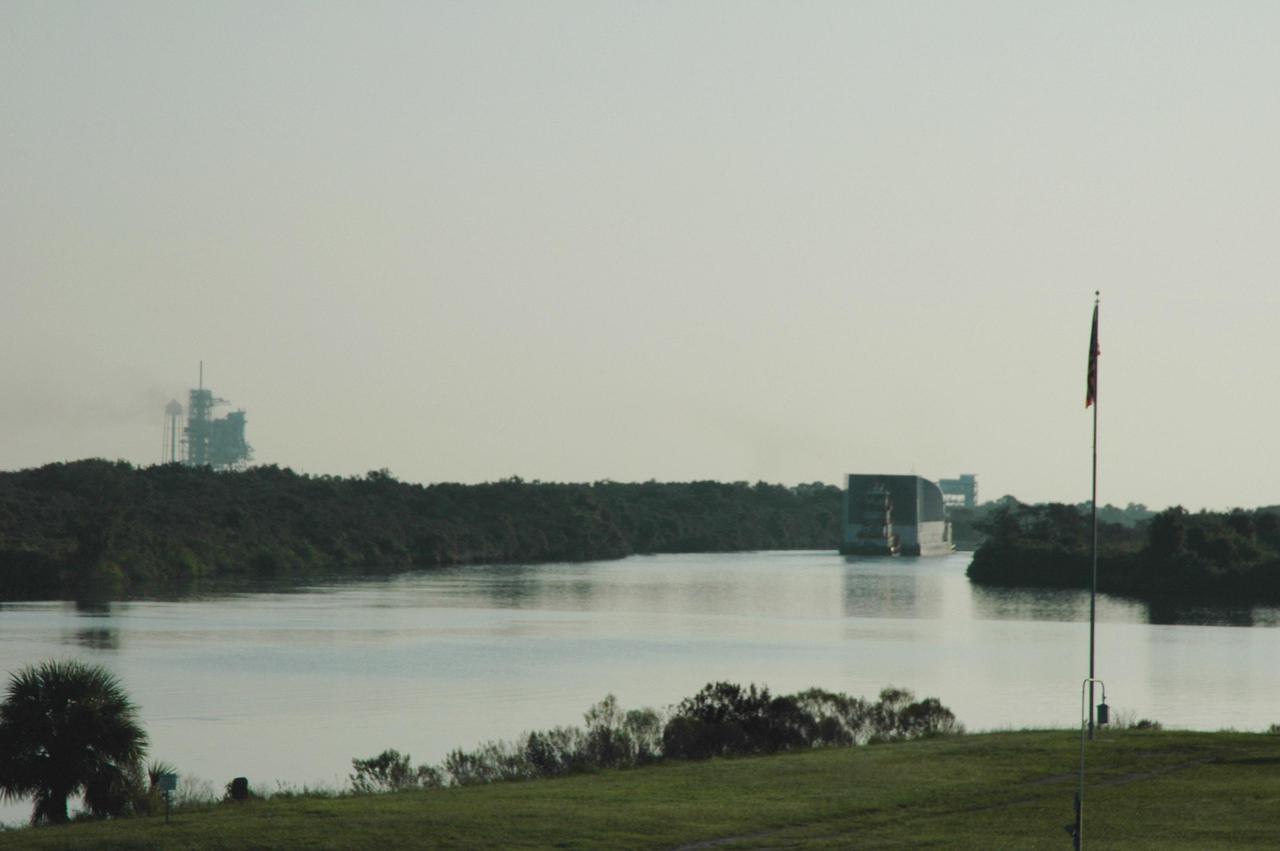
KENNEDY SPACE CENTER, FLA. - Just after dawn, the Pegasus barge is towed away from the Turn Basin in the Launch Complex 39 area. The barge is carrying external tank 119 (ET-119) and will be towed by the solid rocket booster retrieval ship Freedom Star to NASA’s Michoud Assembly Facility near New Orleans. Delivered to Kennedy in June, ET-119 is the third newly redesigned tank and is the only tank that contains the liquid oxygen heater. The tank is being returned to Michoud for testing and further modifications. ET-119 will be the tank used on return to flight mission STS-121.
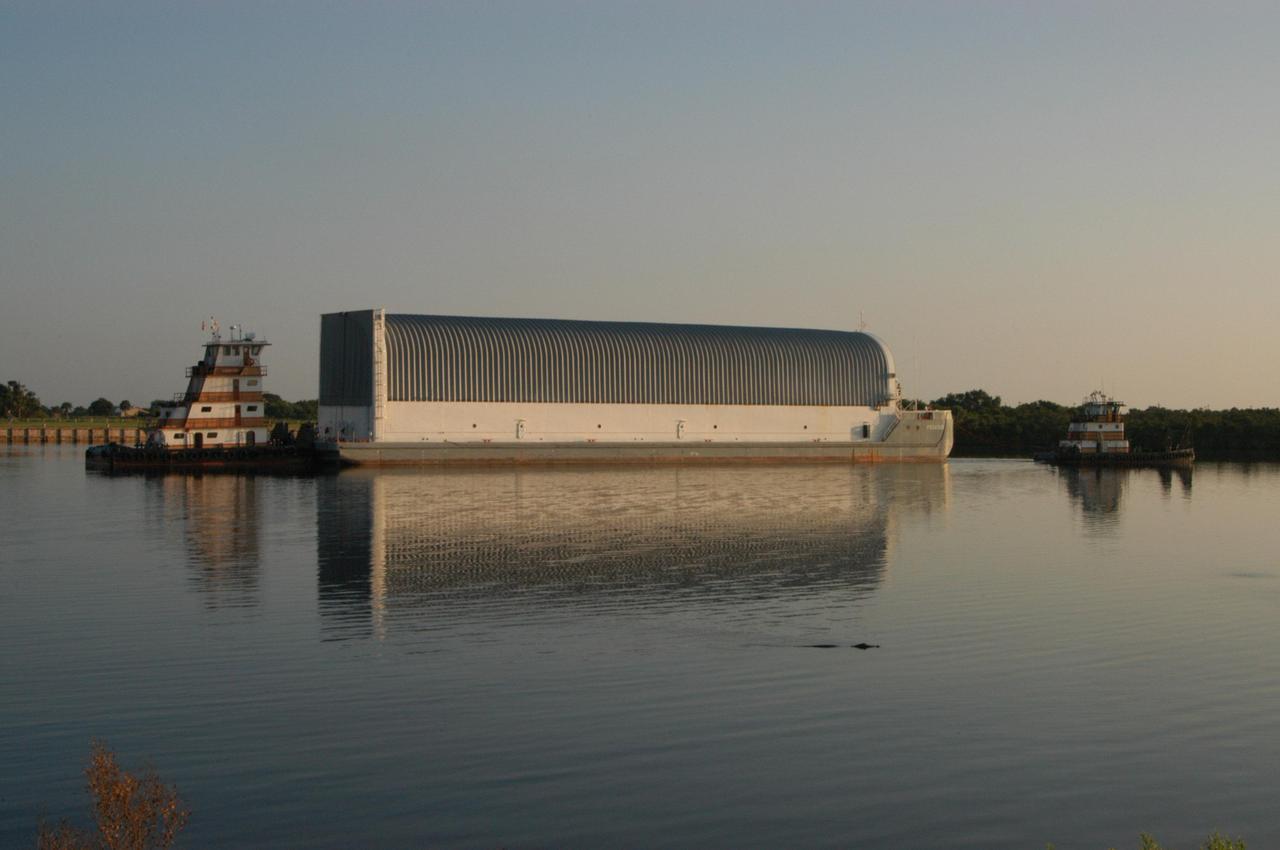
KENNEDY SPACE CENTER, FLA. - Just after dawn, an alligator (in the foreground) watches as a tugboat pushes the Pegasus barge away from the dock at the Turn Basin in the Launch Complex 39 area. The barge is carrying external tank 119 (ET-119) and will be towed by the solid rocket booster retrieval ship Freedom Star to NASA’s Michoud Assembly Facility near New Orleans. Delivered to Kennedy in June, ET-119 is the third newly redesigned tank and is the only tank that contains the liquid oxygen heater. The tank is being returned to Michoud for testing and further modifications. ET-119 will be the tank used on return to flight mission STS-121.
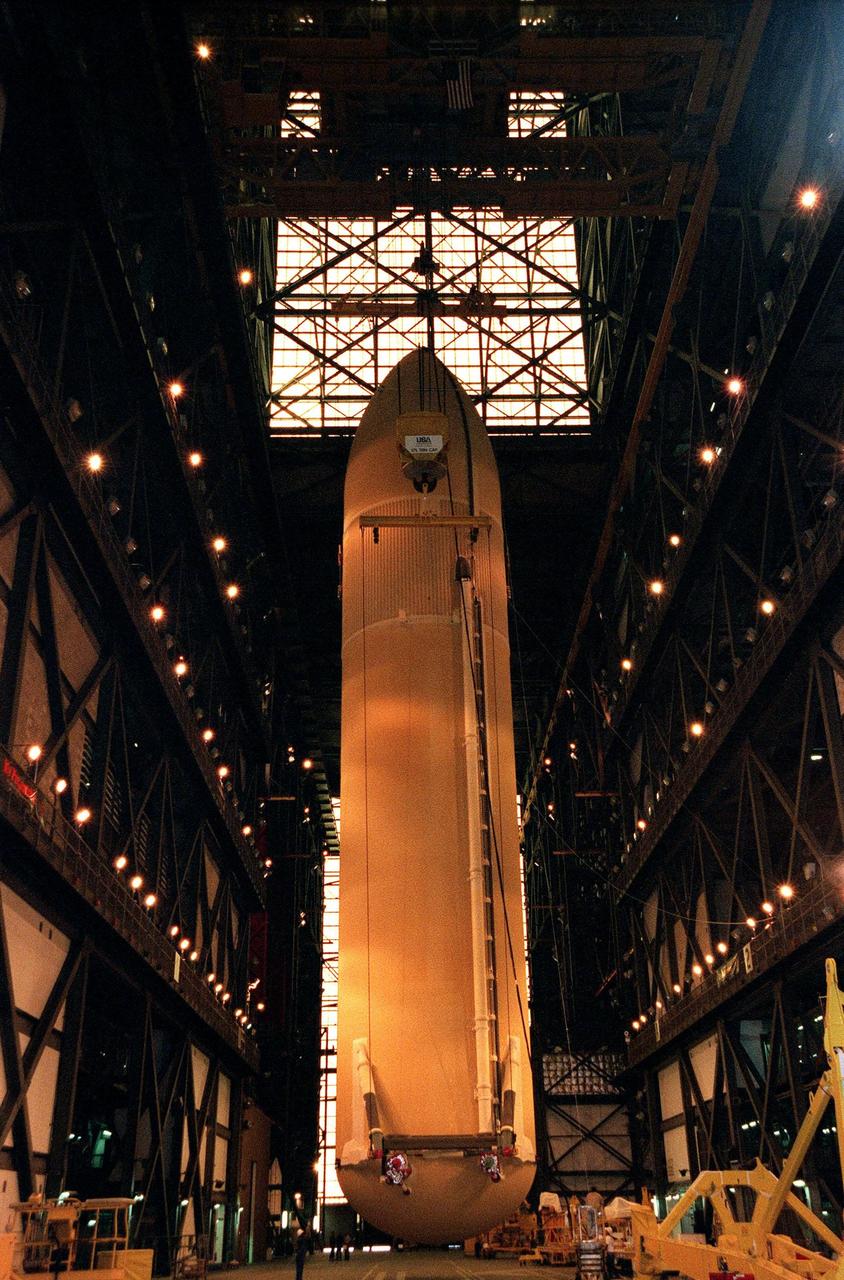
KENNEDY SPACE CENTER, FLA. -- An external tank is suspended in the transfer aisle of the Vehicle Assembly Building before being placed into its storage compartment. The largest and heaviest element of the Space Shuttle, an external tank contains the liquid hydrogen fuel and liquid oxygen oxidizer for the three Space Shuttle main engines (SSMEs) in the orbiter during liftoff and ascent. When the SSMEs are shut down, the external tank is jettisoned, breaking up as it enters the Earth's atmopshere and impacting in a remote ocean area. It is not recovered
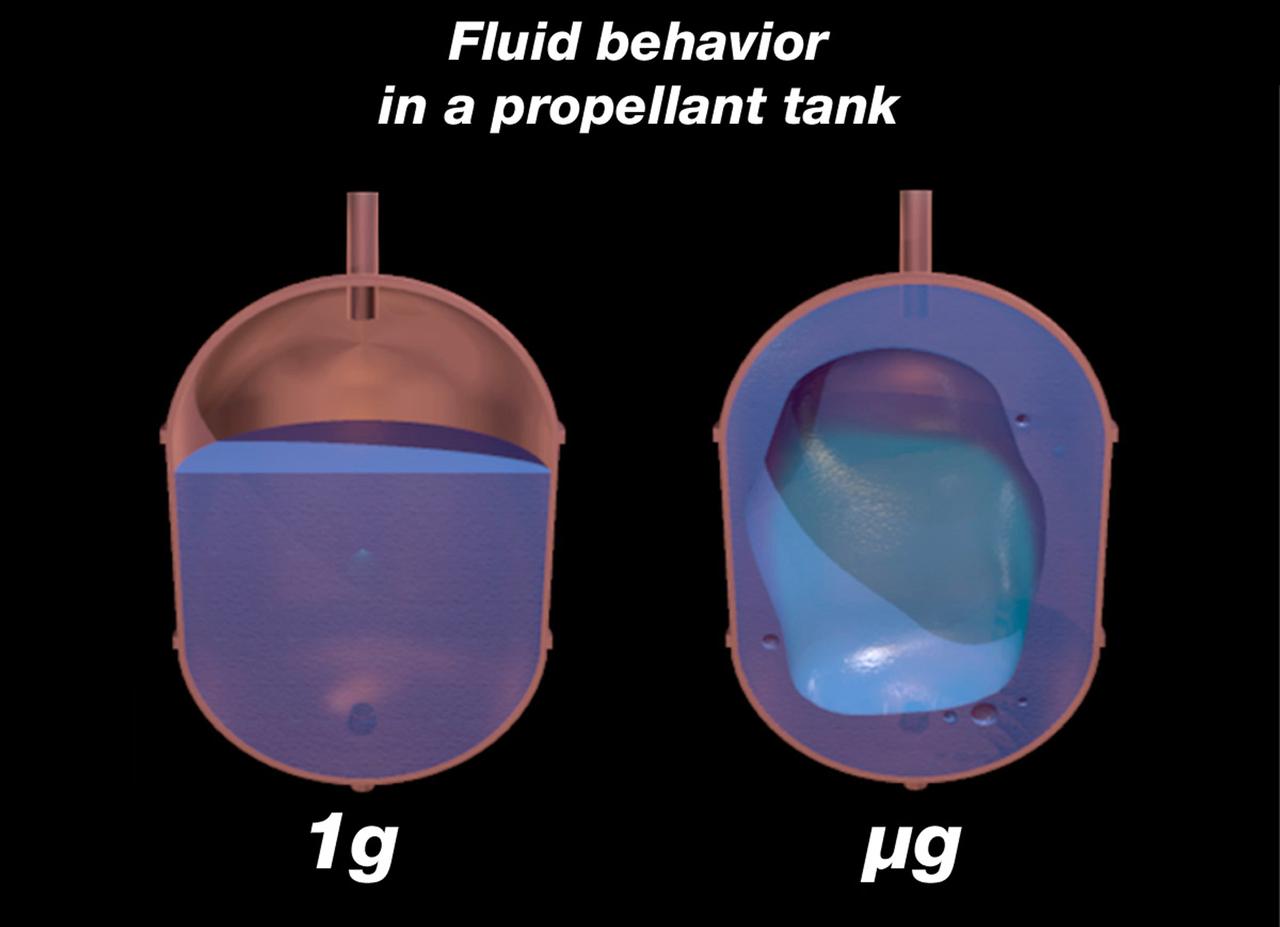
Some of the earliest concerns about fluid behavior in microgravity was the management of propellants in spacecraft tanks as they orbited the Earth. On the ground, gravity pulls a fluid to a bottom of a tank (ig, left). In orbit, fluid behavior depends on surface tension, viscosity, wetting effects with the container wall, and other factors. In some cases, a propellant can wet a tank and leave a large gas bubbles in the center (ug, right). Similar probelms can affect much smaller experiments using fluids in small spaces. Photo credit: NASA/Glenn Research Center.
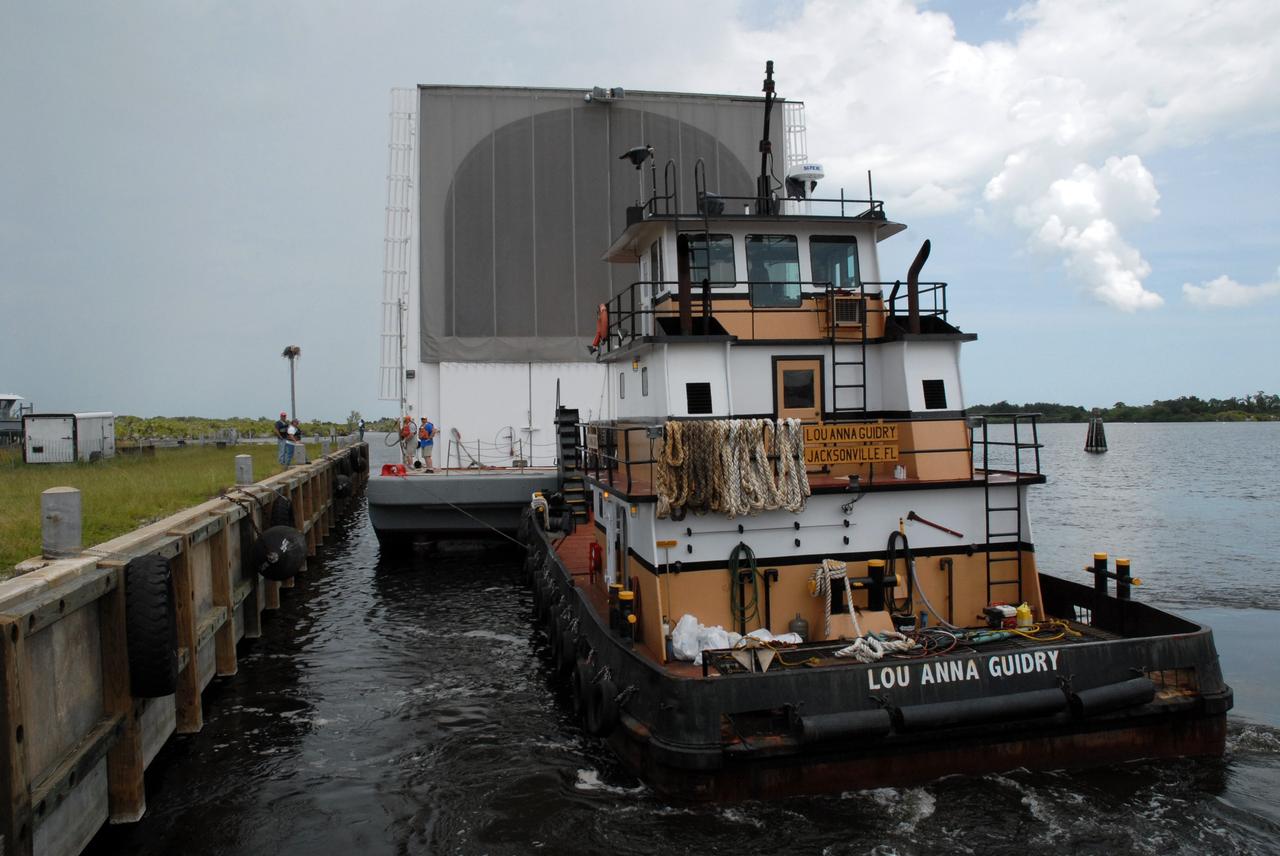
CAPE CANAVERAL, Fla. – Tugboats maneuver NASA's Pegasus barge next to the Turn Basin dock at NASA's Kennedy Space Center in Florida. The barge contains the external fuel tank, designated ET-133, that will be used for space shuttle Atlantis' STS-129 mission. The tank will be offloaded and moved into a high bay in the Vehicle Assembly Building for checkout. The tank will be offloaded and moved into a high bay in the Vehicle Assembly Building for checkout. The tank was shipped aboard the Pegasus from NASA's Michoud Assembly Facility near New Orleans. Pegasus was towed to Port Canaveral by the Freedom Star Retrieval Ship. Launch of Atlantis is targeted for November. Photo credit: NASA/Tim Jacobs
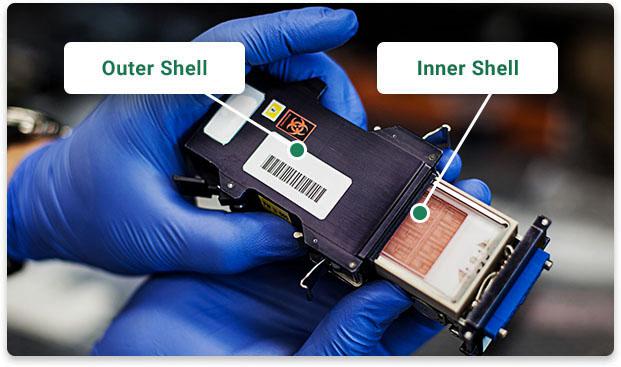
jsc2022e031224 (4/26/2022) --- A preflight image of an open experiment container shows the protective outer shell as well as the inner shell that hosts both culture chamber and tanks used for the Cellbox-3 investigation. Cellbox-3 contains two experiments that investigate cell behavior in microgravity, forming 3D structures that more closely resemble the growth and behavior of cells inside the body. Image courtesy of BioServe.
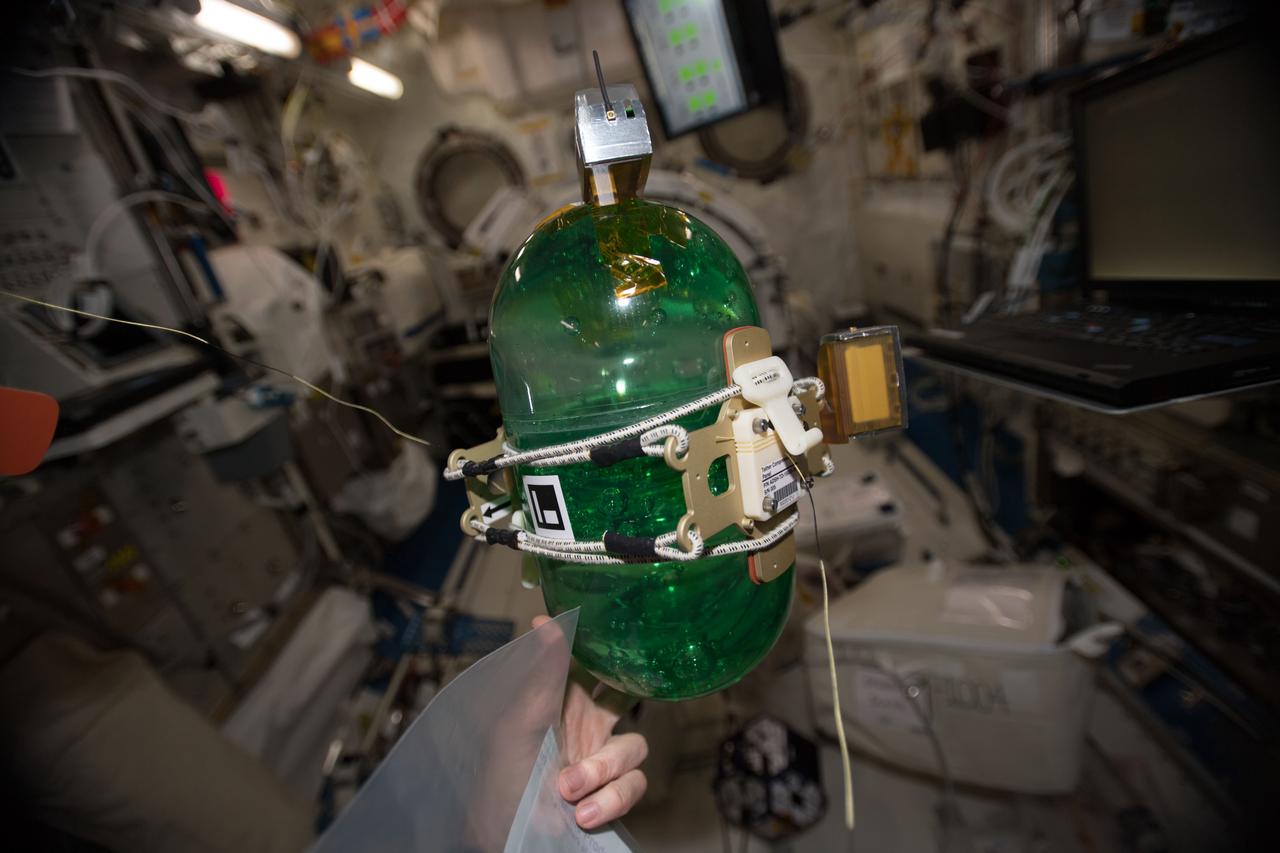
iss055e010694 (4/4/2018) --- A view taken aboard the International Space Station (ISS) during the set up of the SPHERES Tether Slosh experiment hardware. The image is of the green SPHERES robots tethered to a fluid-filled container covered in sensors to test strategies for safely steering spacecraft such as dead satellites that might still have fuel in the tank. SPHERES Tether Slosh combines fluid dynamics equipment with robotic capabilities aboard the International Space Station to investigate automated strategies for steering passive cargo that contain fluids.
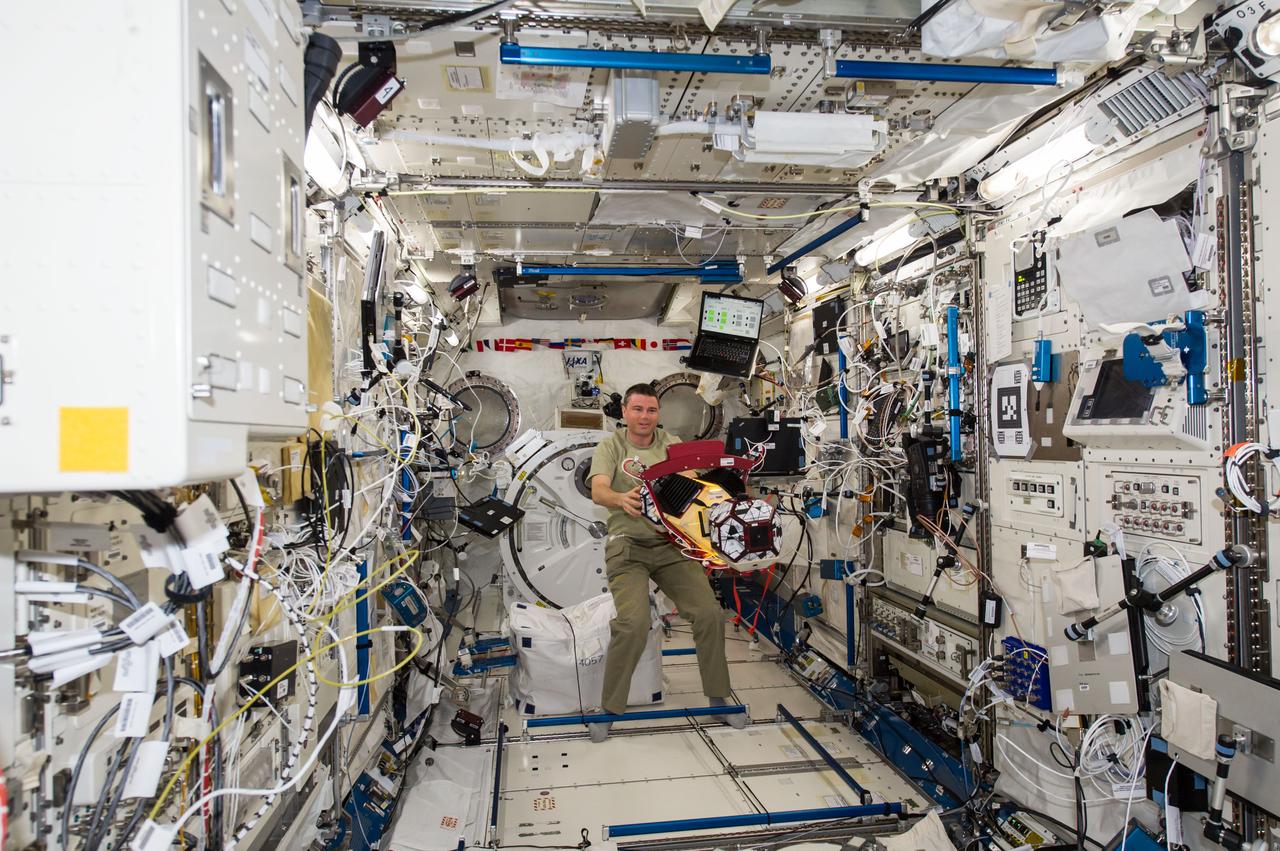
ISS040-E-139549 (9 Sept. 2014) --- In the International Space Station’s Kibo laboratory, NASA astronaut Reid Wiseman, Expedition 40 crew member, works with the bowling ball-sized satellites known as SPHERES (Synchronized Position Hold Engage Reorient Experimental Satellites) to study how liquids behave inside containers in microgravity. The experiment, named SPHERES-Slosh, maneuvers the tiny satellites similar to an actual spacecraft with an externally mounted tank and observes the interaction between the sloshing fluid and the tank/vehicle dynamics.
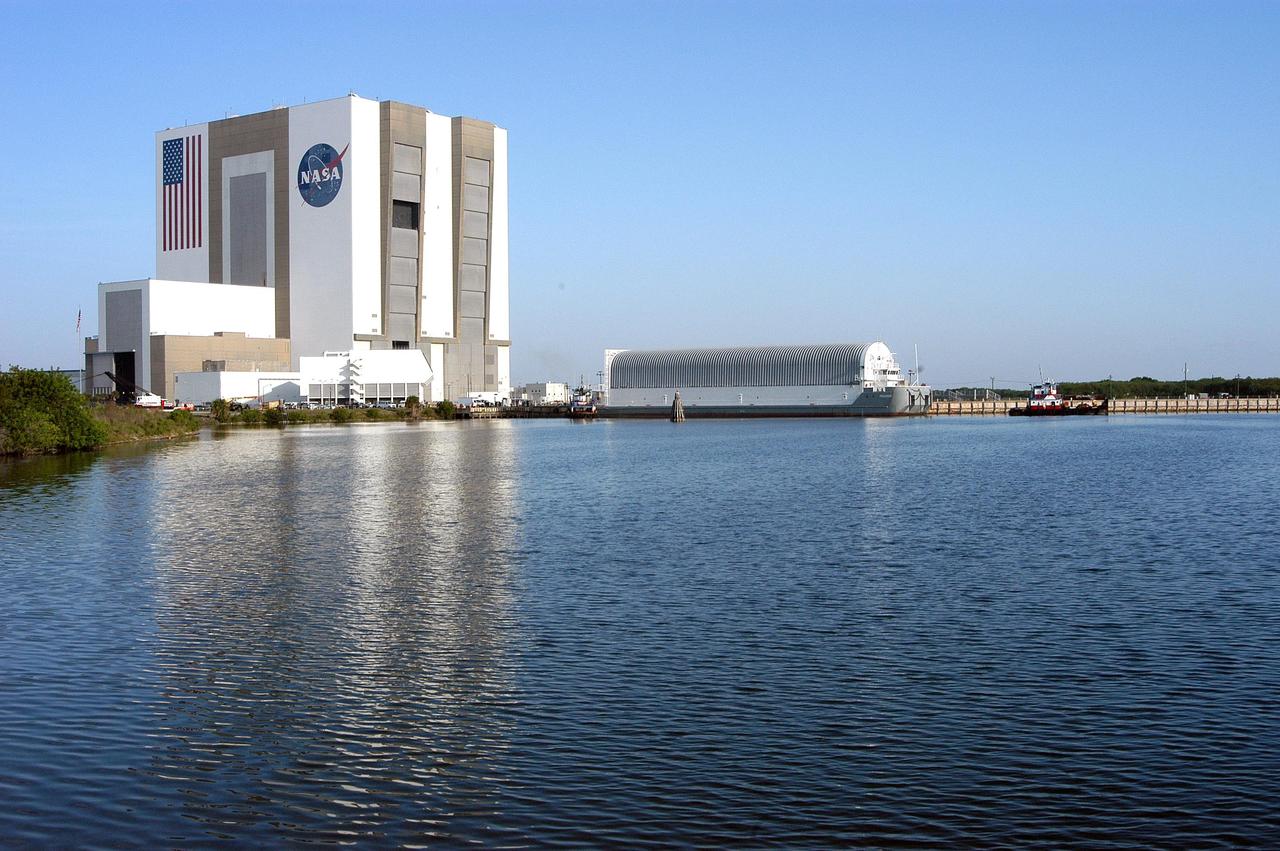
KENNEDY SPACE CENTER, FLA. - Viewed across the turn basin in the Launch Complex 39 Area at KSC, the barge containing an External Tank (ET) waits to be towed to Port Canaveral. There one of the SRB Retrieval Ships will take over and tow the ET to the Michoud Space Systems Assembly Facility near New Orleans where redesign of the external tank is underway for Return to Flight.
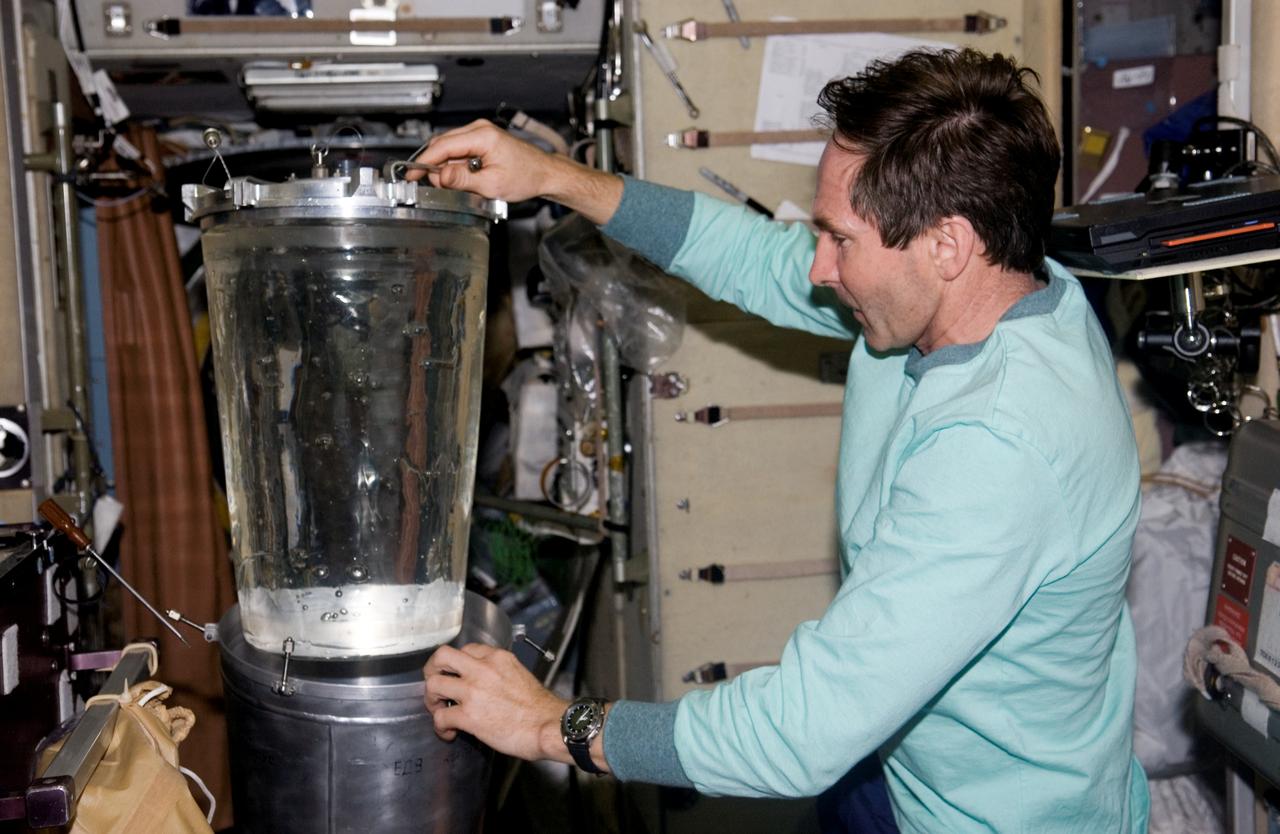
ISS012-E-06290 (3 November 2005) --- Cosmonaut Valery I. Tokarev, Expedition 12 flight engineer representing Russia's Federal Space Agency, performs a water transfer from Progress Tanks 1 and 2 to the Russian EDV water container in the Zvezda Service Module of the International Space Station.
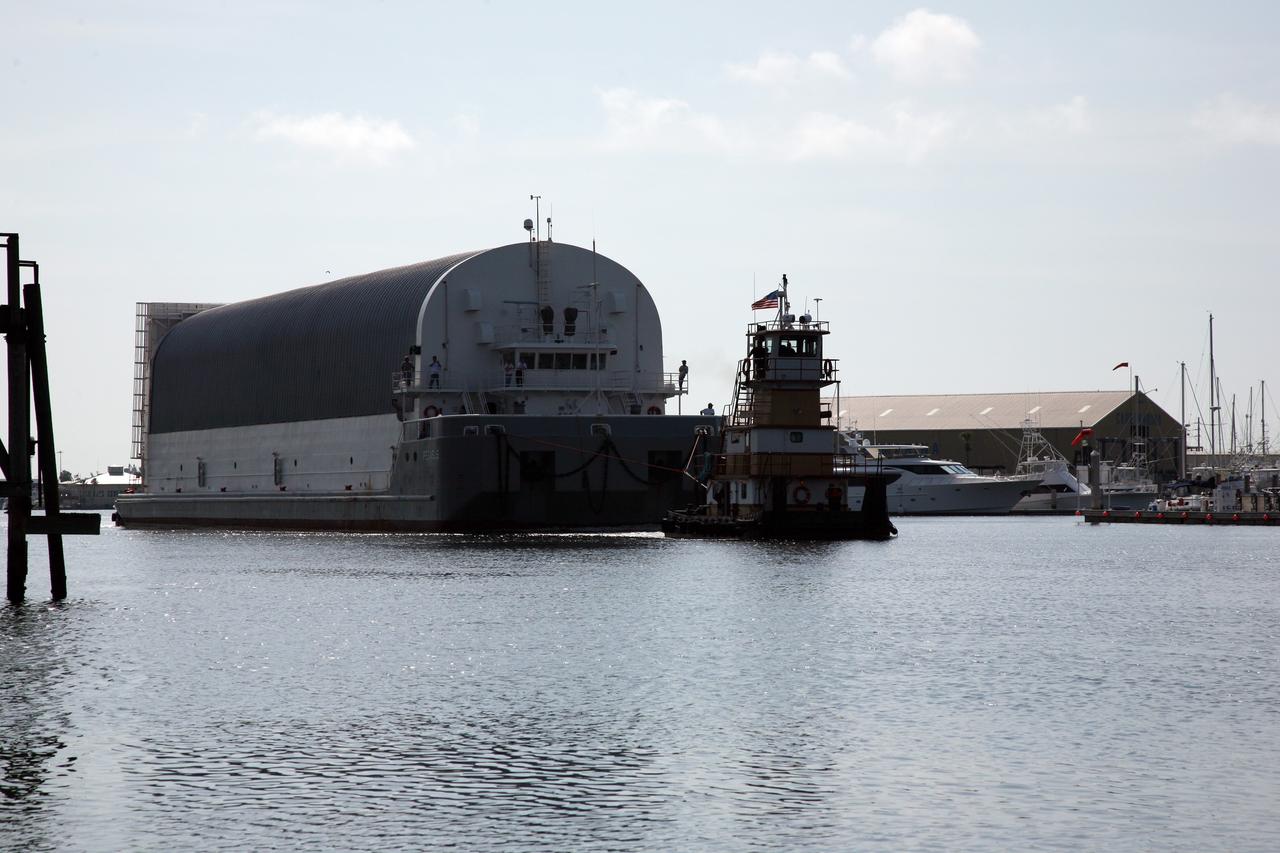
CAPE CANAVERAL, Fla. – NASA's Pegasus barge moves through the locks at Port Canaveral, Fla. The barge contains the external fuel tank designated ET-133 that will be used for space shuttle Atlantis' STS-129 mission. The barge is delivering the external tank to the Turn Basin dock at NASA's Kennedy Space Center in Florida where it will be offloaded and moved into the Vehicle Assembly Building. The tank was shipped aboard the Pegasus from NASA's Michould Assembly Facility near New Orleans. Pegasus was towed to Port Canaveral by the Freedom Star Retrieval Ship. Photo credit: NASA/Troy Cryder
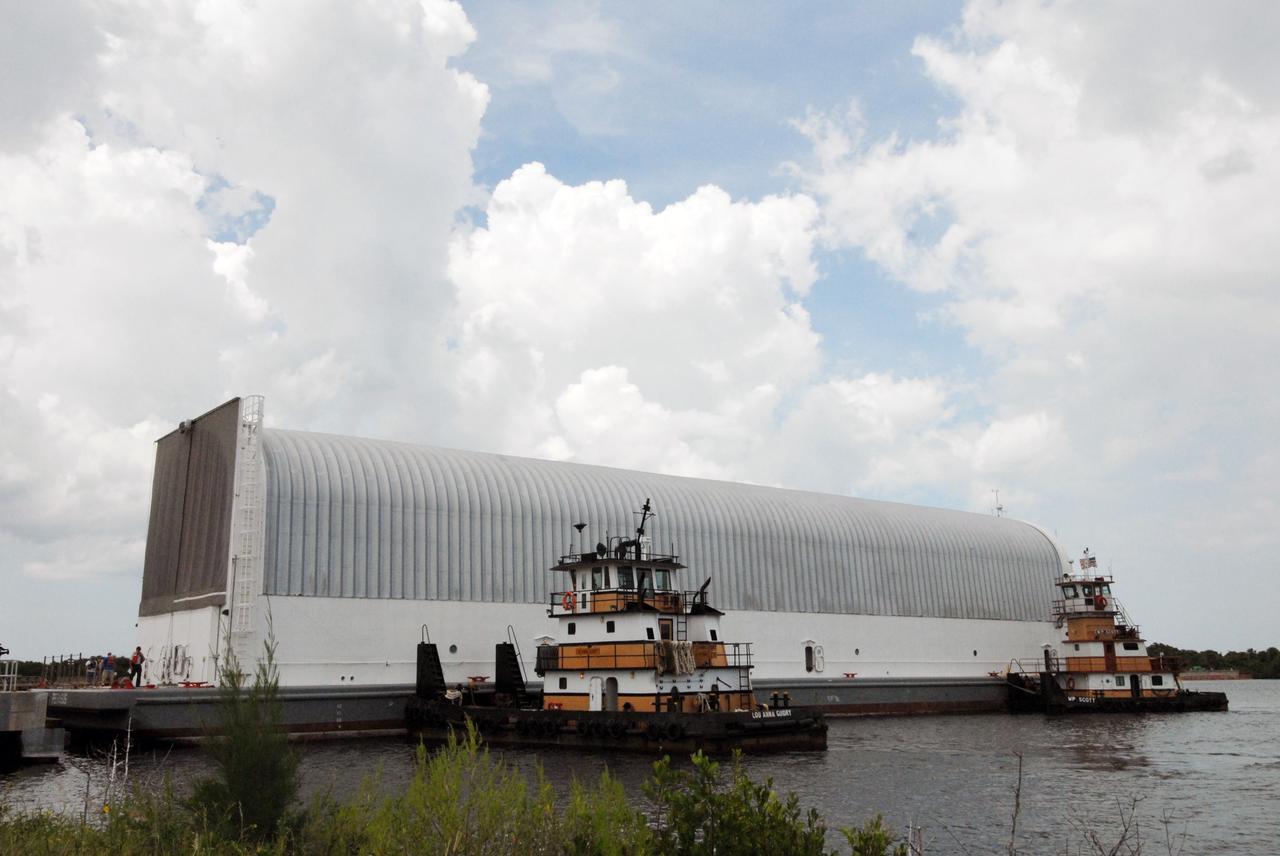
CAPE CANAVERAL, Fla. – Tugboats maneuver NASA's Pegasus barge into to the Turn Basin dock at NASA's Kennedy Space Center in Florida. The barge contains the external fuel tank, designated ET-133, that will be used for space shuttle Atlantis' STS-129 mission. The tank will be offloaded and moved into a high bay in the Vehicle Assembly Building for checkout. The tank was shipped aboard the Pegasus from NASA's Michoud Assembly Facility near New Orleans. Pegasus was towed to Port Canaveral by the Freedom Star Retrieval Ship. Launch of Atlantis is targeted for November. Photo credit: NASA/Tim Jacobs
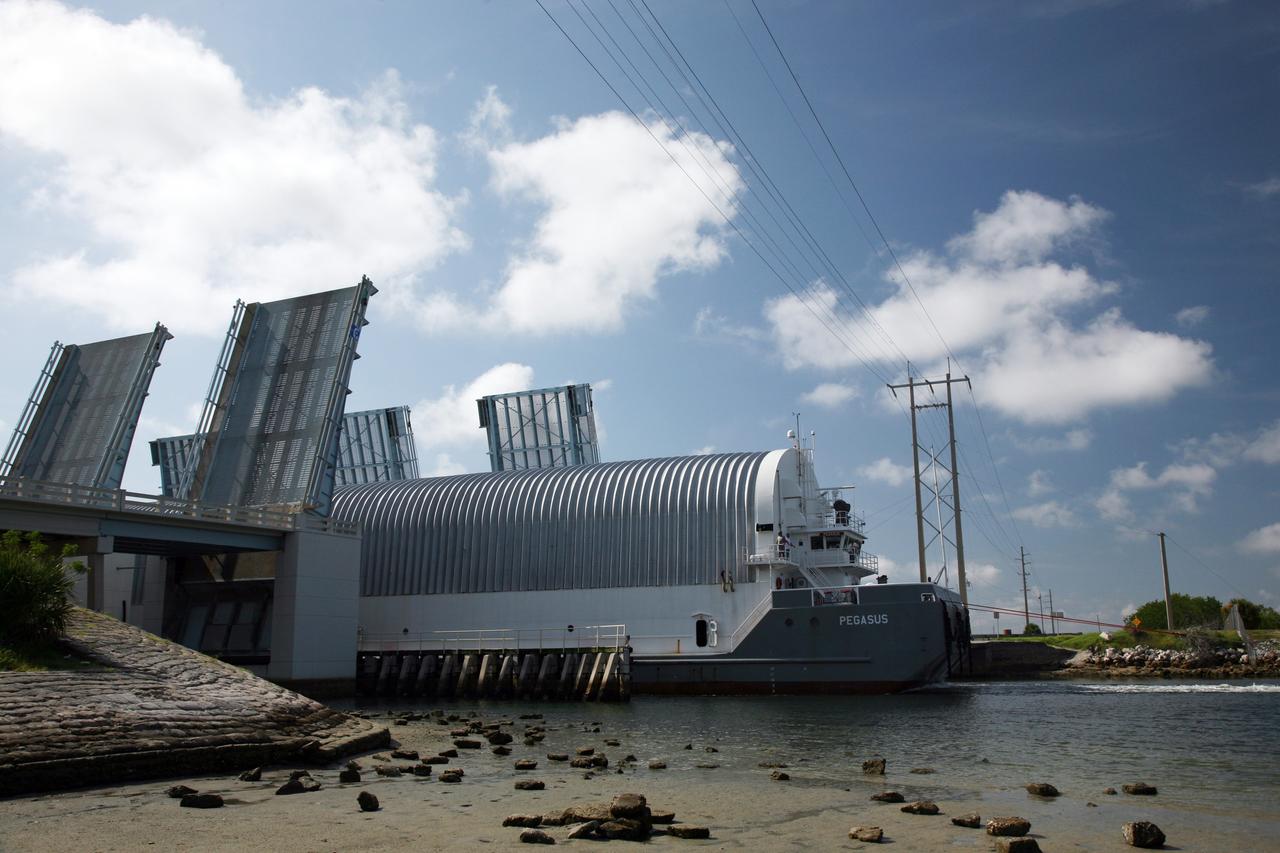
CAPE CANAVERAL, Fla. – NASA's Pegasus barge moves through the bridge at Port Canaveral, Fla. The barge contains the external fuel tank designated ET-133 that will be used for space shuttle Atlantis' STS-129 mission. The barge is delivering the external tank to the Turn Basin dock at NASA's Kennedy Space Center in Florida where it will be offloaded and moved into the Vehicle Assembly Building. The tank was shipped aboard the Pegasus from NASA's Michould Assembly Facility near New Orleans. Pegasus was towed to Port Canaveral by the Freedom Star Retrieval Ship. Photo credit: NASA/Troy Cryder
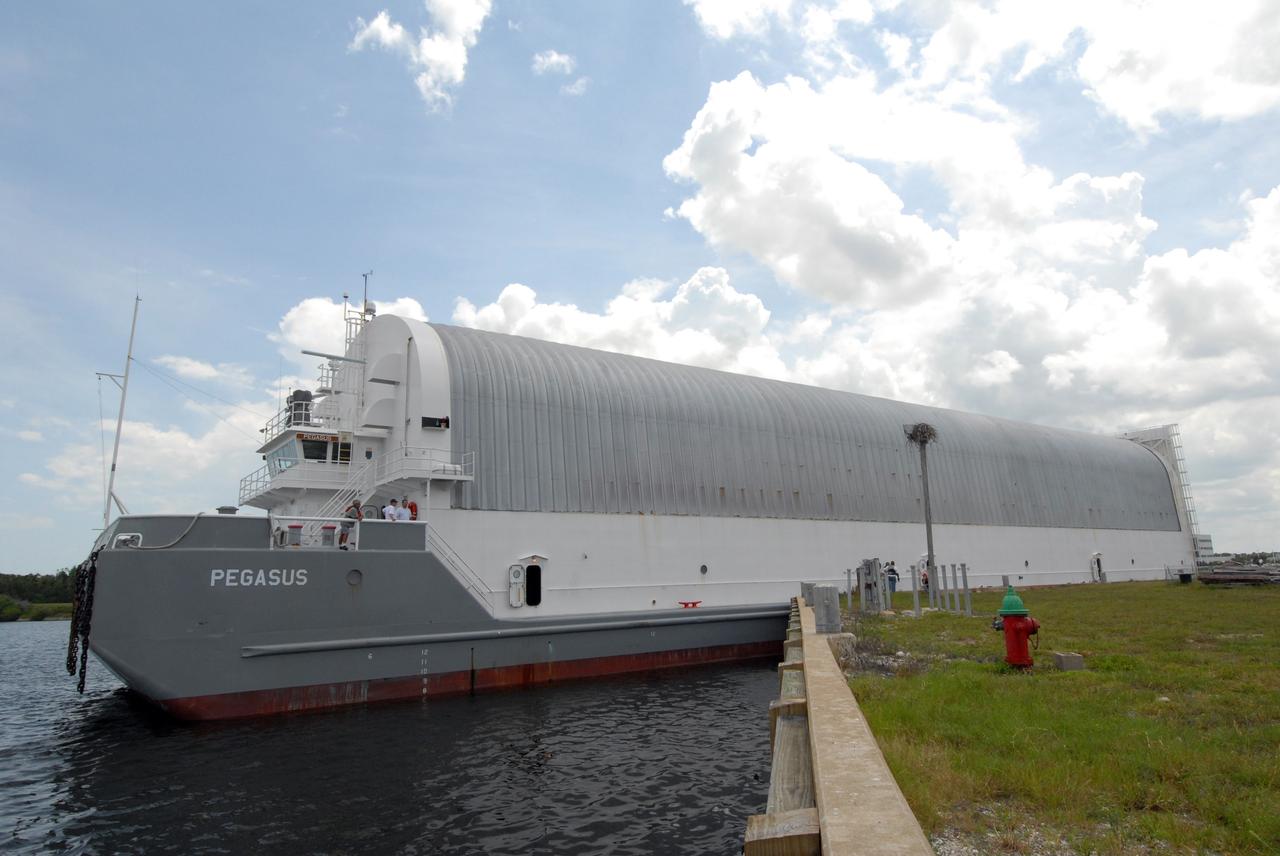
CAPE CANAVERAL, Fla. – NASA's Pegasus barge is pushed next to the Turn Basin dock at NASA's Kennedy Space Center in Florida. The barge contains the external fuel tank, designated ET-133, that will be used for space shuttle Atlantis' STS-129 mission. The tank will be offloaded and moved into a high bay in the Vehicle Assembly Building for checkout. The tank was shipped aboard the Pegasus from NASA's Michoud Assembly Facility near New Orleans. Pegasus was towed to Port Canaveral by the Freedom Star Retrieval Ship. Launch of Atlantis is targeted for November. Photo credit: NASA/Tim Jacobs
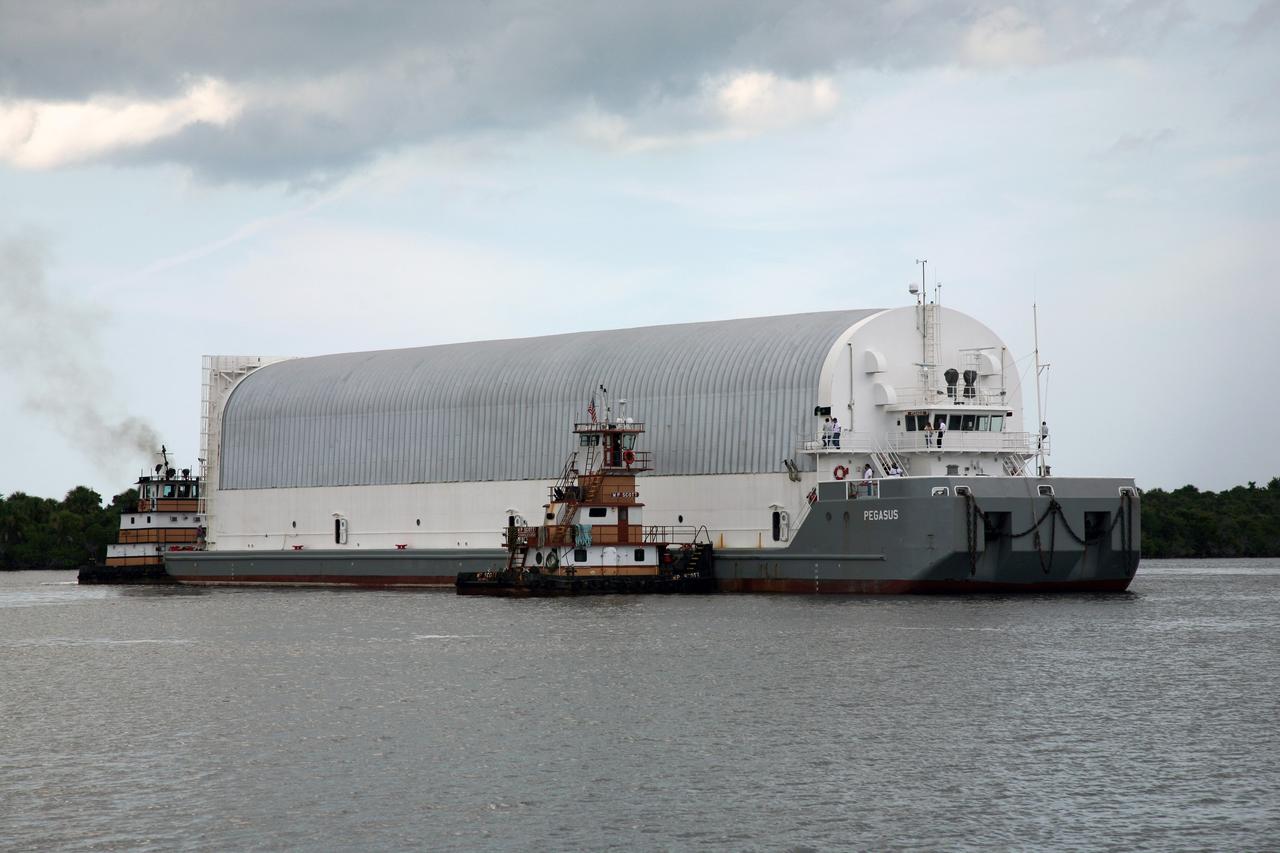
CAPE CANAVERAL, Fla. – Tugboats maneuver NASA's Pegasus barge toward the Turn Basin dock at NASA's Kennedy Space Center in Florida. The barge contains the external fuel tank, designated ET-133, that will be used for space shuttle Atlantis' STS-129 mission. After Pegasus is docked, the tank will be offloaded and moved into a high bay in the Vehicle Assembly Building for checkout. The tank was shipped aboard the Pegasus from NASA's Michould Assembly Facility near New Orleans. Pegasus was towed to Port Canaveral by the Freedom Star Retrieval Ship. Photo credit: NASA/Dimitri Gerondidakis
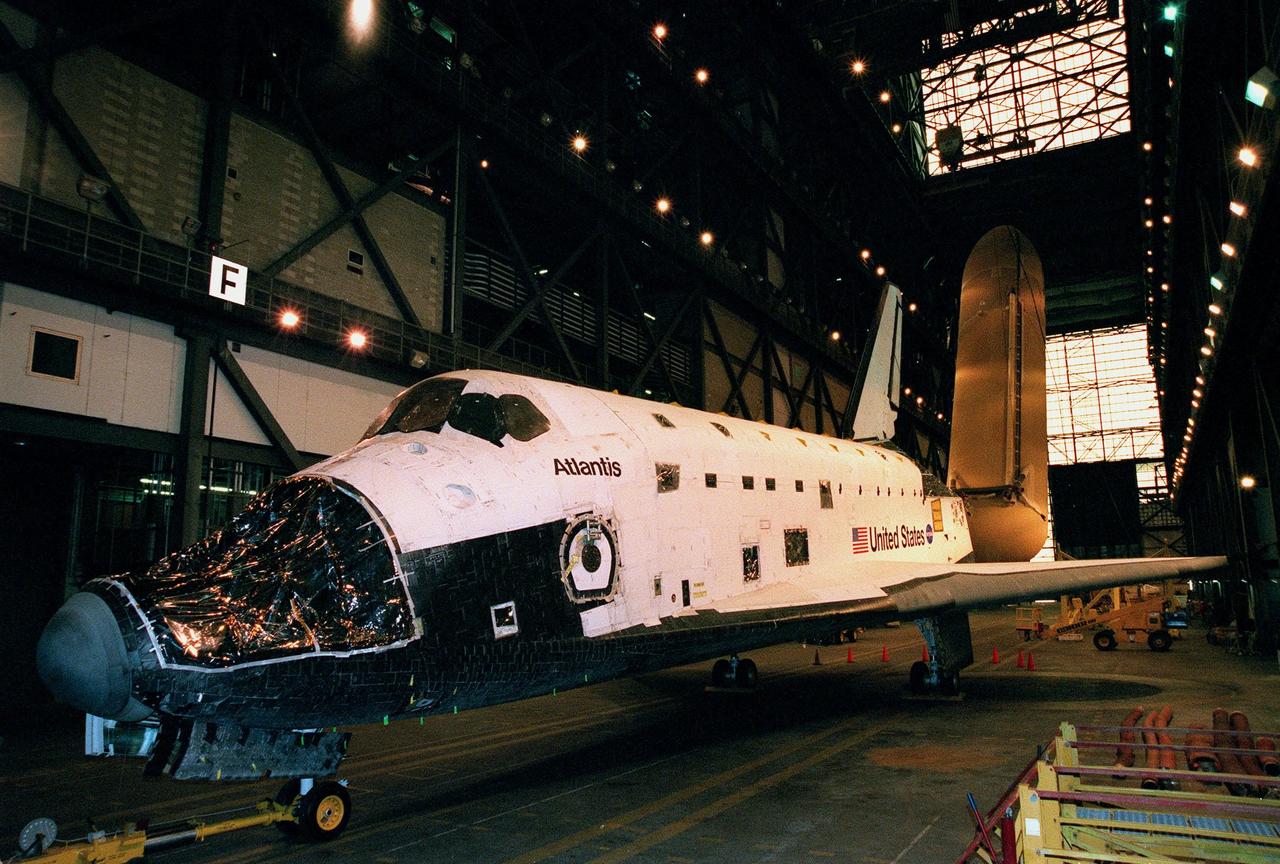
KENNEDY SPACE CENTER, FLA. -- In the transfer aisle of the Vehicle Assembly Building, Atlantis awaits a vacancy in one of the Orbiter Processing Facility bays. Seen behind the left wing is an external tank being raised to a vertical position. The largest and heaviest element of the Space Shuttle, an external tank contains the liquid hydrogen fuel and liquid oxygen oxidizer for the three Space Shuttle main engines (SSMEs) in the orbiter during liftoff and ascent. When the SSMEs are shut down, the external tank is jettisoned, breaking up as it enters the Earth's atmopshere and impacting in a remote ocean area. It is not recovered
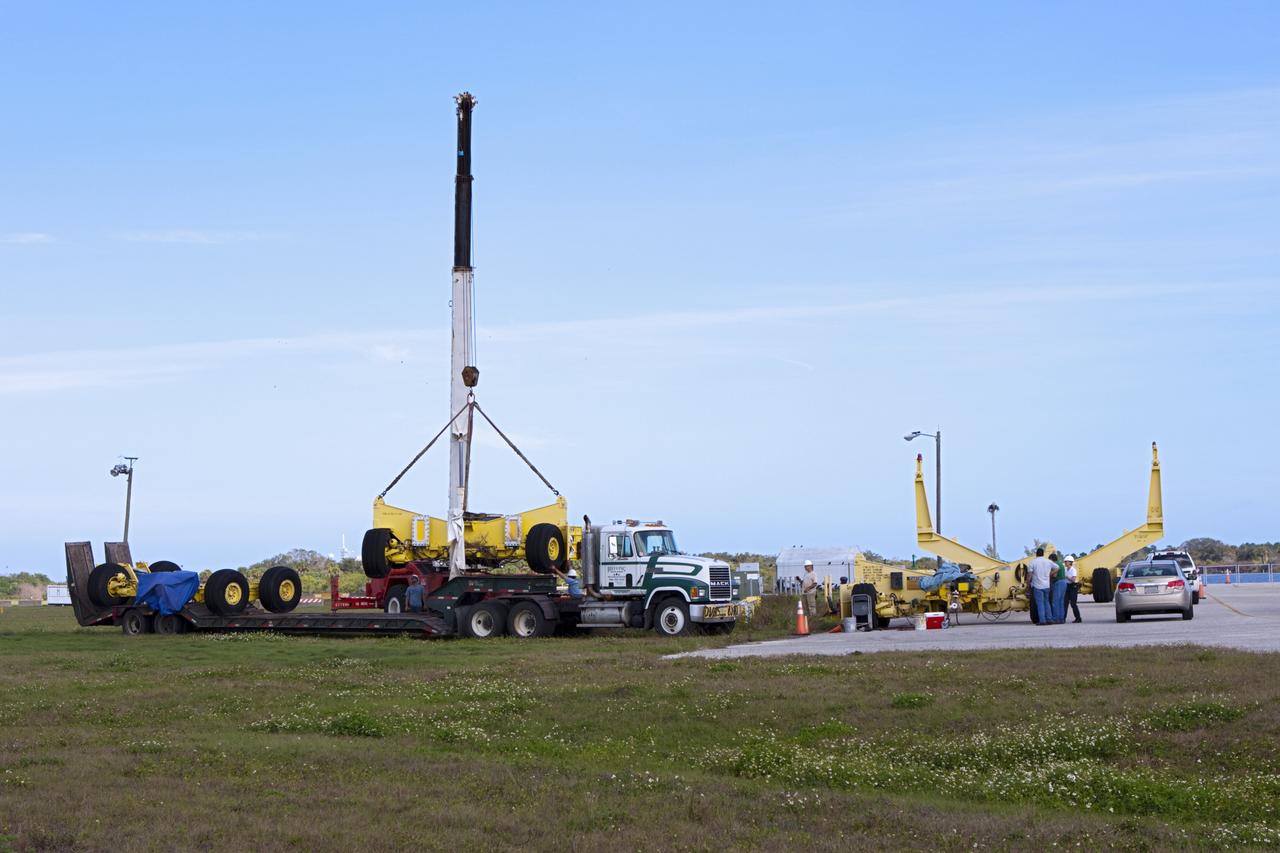
CAPE CANAVERAL, Fla. – At NASA’s Kennedy Space Center in Florida, two space shuttle external fuel tank transporters are being prepared for transfer to the Wings of Dreams Aviation Museum at Keystone Heights Airport between Gainesville and Jacksonville, Fla. At the Wings of Dreams Aviation Museum a mock-up shuttle external fuel tank will be displayed. During space shuttle launches, the external tanks contained over 500,000 gallons of liquid hydrogen and liquid oxygen propellant for the shuttle orbiters' three main engines. The effort is part of Transition and Retirement of the space shuttle. For more information, visit http://www.nasa.gov/transition Photo credit: NASA/ Jim Grossmann
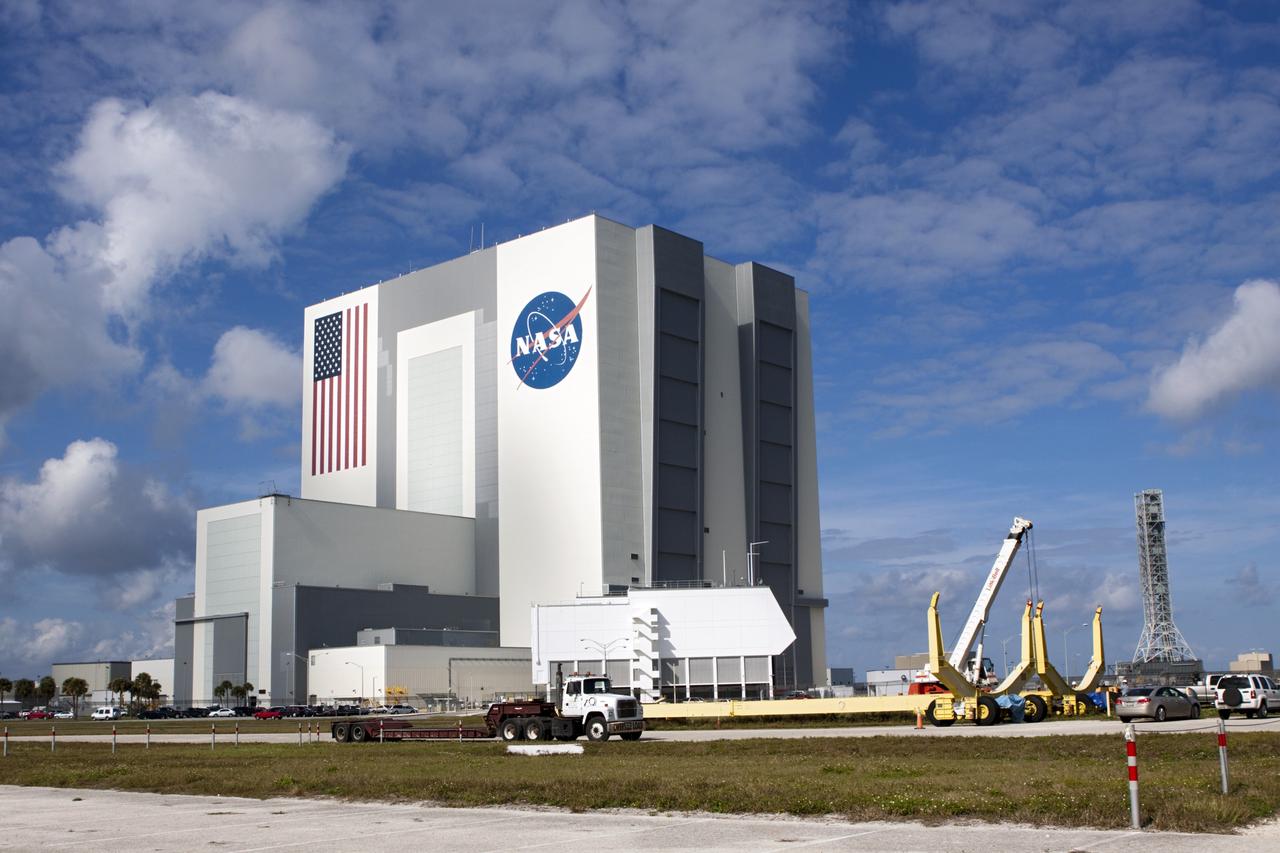
CAPE CANAVERAL, Fla. – At NASA’s Kennedy Space Center in Florida, two space shuttle external fuel tank transporters are being prepared for transfer to the Wings of Dreams Aviation Museum at Keystone Heights Airport between Gainesville and Jacksonville, Fla. At the Wings of Dreams Aviation Museum a mock-up shuttle external fuel tank will be displayed. During space shuttle launches, the external tanks contained over 500,000 gallons of liquid hydrogen and liquid oxygen propellant for the shuttle orbiters' three main engines. The effort is part of Transition and Retirement of the space shuttle. For more information, visit http://www.nasa.gov/transition Photo credit: NASA/ Jim Grossmann
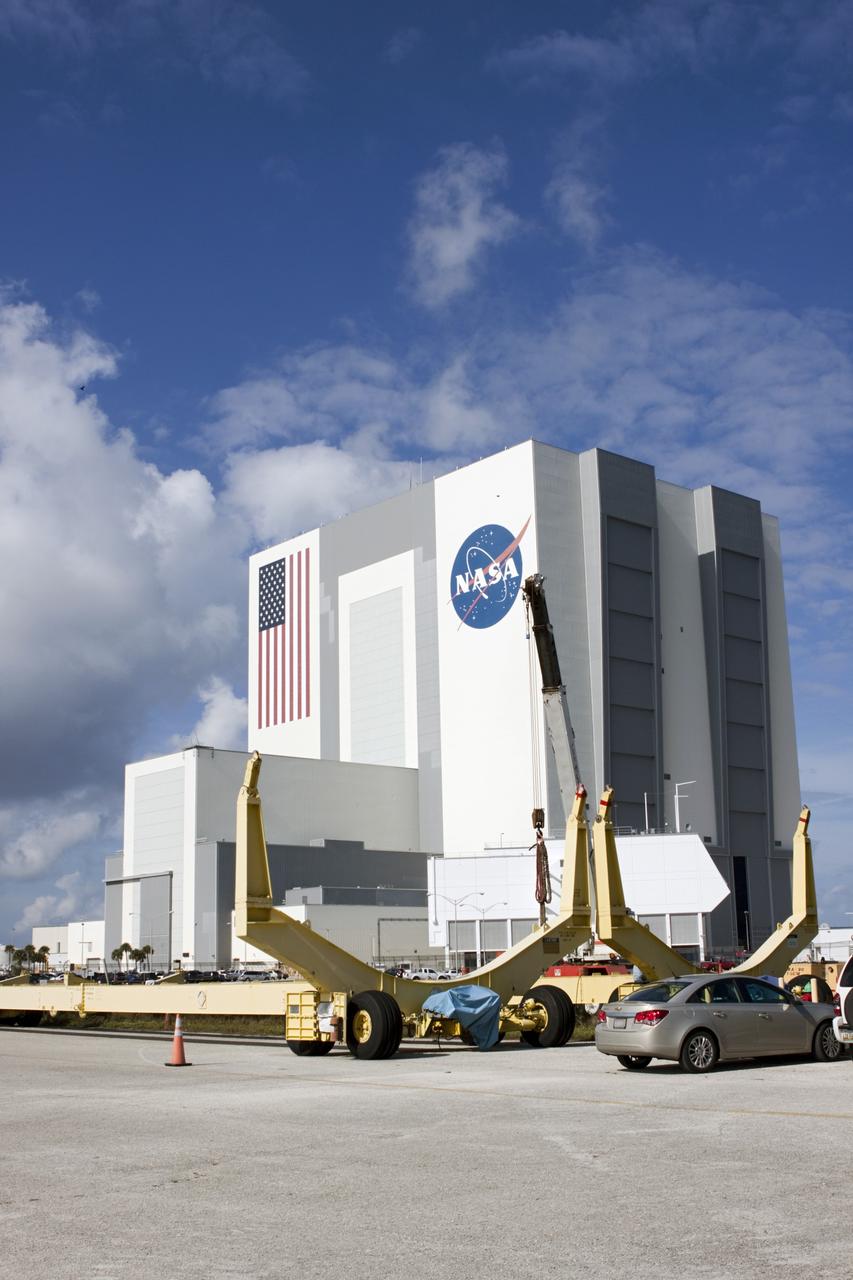
CAPE CANAVERAL, Fla. – At NASA’s Kennedy Space Center in Florida, two space shuttle external fuel tank transporters are being prepared for transfer to the Wings of Dreams Aviation Museum at Keystone Heights Airport between Gainesville and Jacksonville, Fla. At the Wings of Dreams Aviation Museum a mock-up shuttle external fuel tank will be displayed. During space shuttle launches, the external tanks contained over 500,000 gallons of liquid hydrogen and liquid oxygen propellant for the shuttle orbiters' three main engines. The effort is part of Transition and Retirement of the space shuttle. For more information, visit http://www.nasa.gov/transition Photo credit: NASA/ Jim Grossmann
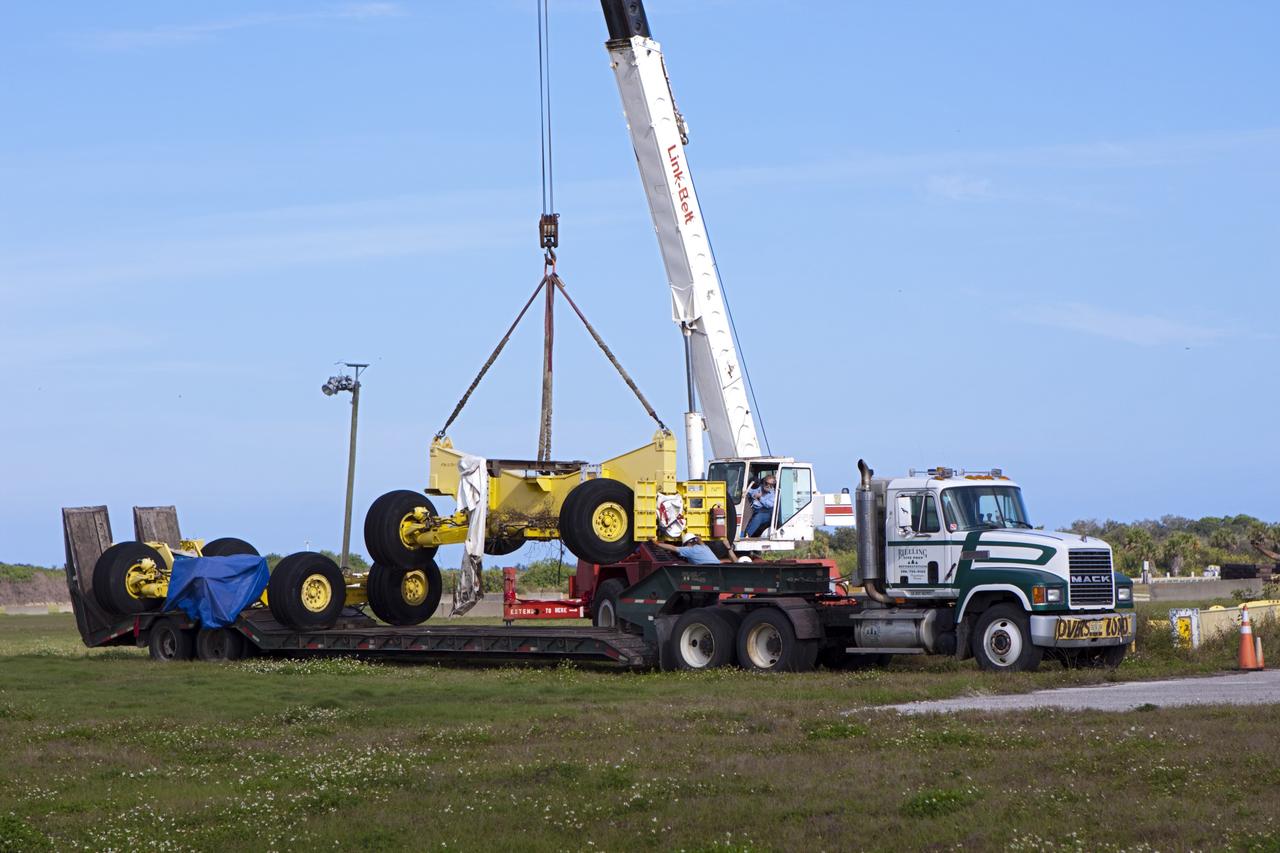
CAPE CANAVERAL, Fla. – At NASA’s Kennedy Space Center in Florida, two space shuttle external fuel tank transporters are being prepared for transfer to the Wings of Dreams Aviation Museum at Keystone Heights Airport between Gainesville and Jacksonville, Fla. At the Wings of Dreams Aviation Museum a mock-up shuttle external fuel tank will be displayed. During space shuttle launches, the external tanks contained over 500,000 gallons of liquid hydrogen and liquid oxygen propellant for the shuttle orbiters' three main engines. The effort is part of Transition and Retirement of the space shuttle. For more information, visit http://www.nasa.gov/transition Photo credit: NASA/ Jim Grossmann
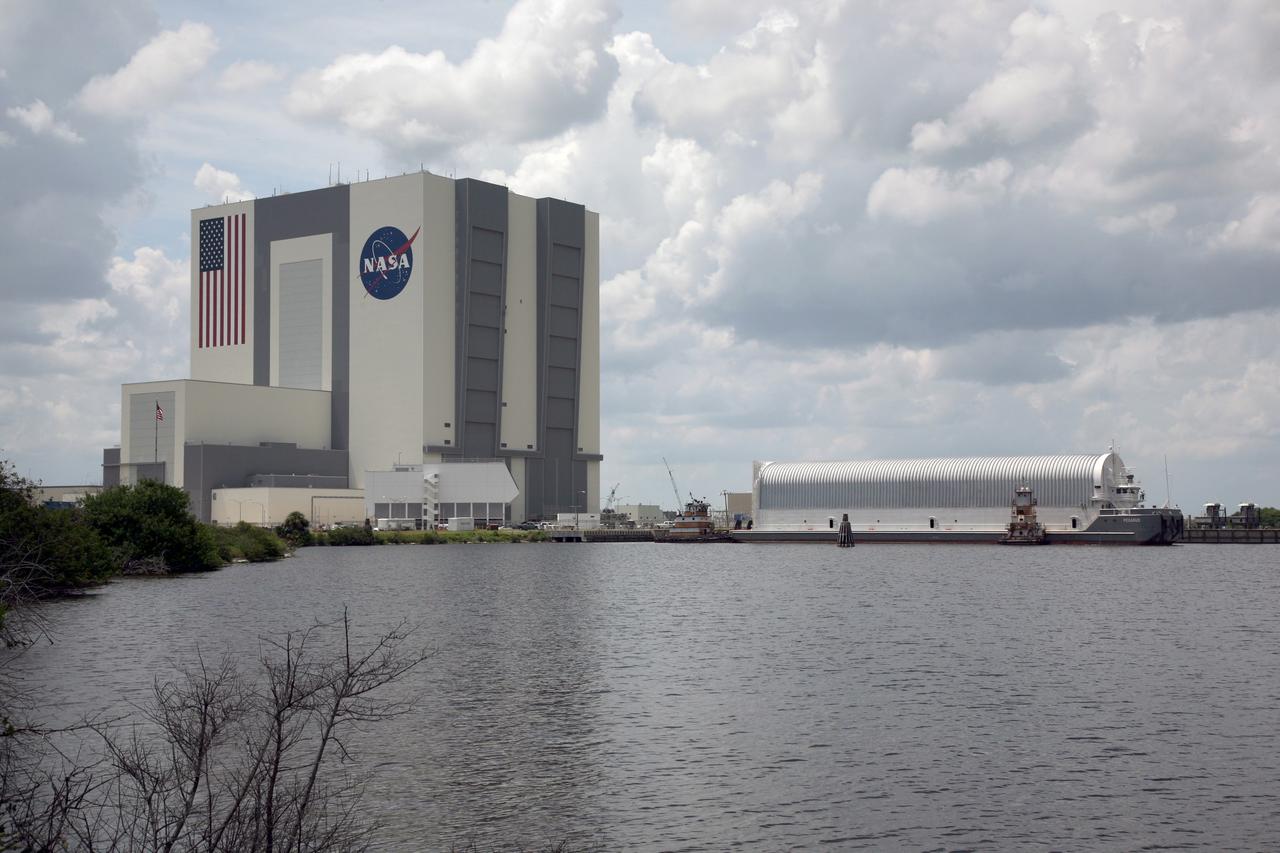
CAPE CANAVERAL, Fla. – Tugboats maneuver NASA's Pegasus barge next to the Turn Basin dock at NASA's Kennedy Space Center in Florida. The barge contains the external fuel tank, designated ET-133, that will be used for space shuttle Atlantis' STS-129 mission. The tank will be offloaded and moved into a high bay in the Vehicle Assembly Building, at left, for checkout. The tank was shipped aboard the Pegasus from NASA's Michould Assembly Facility near New Orleans. Pegasus was towed to Port Canaveral by the Freedom Star Retrieval Ship. Photo credit: NASA/Dimitri Gerondidakis
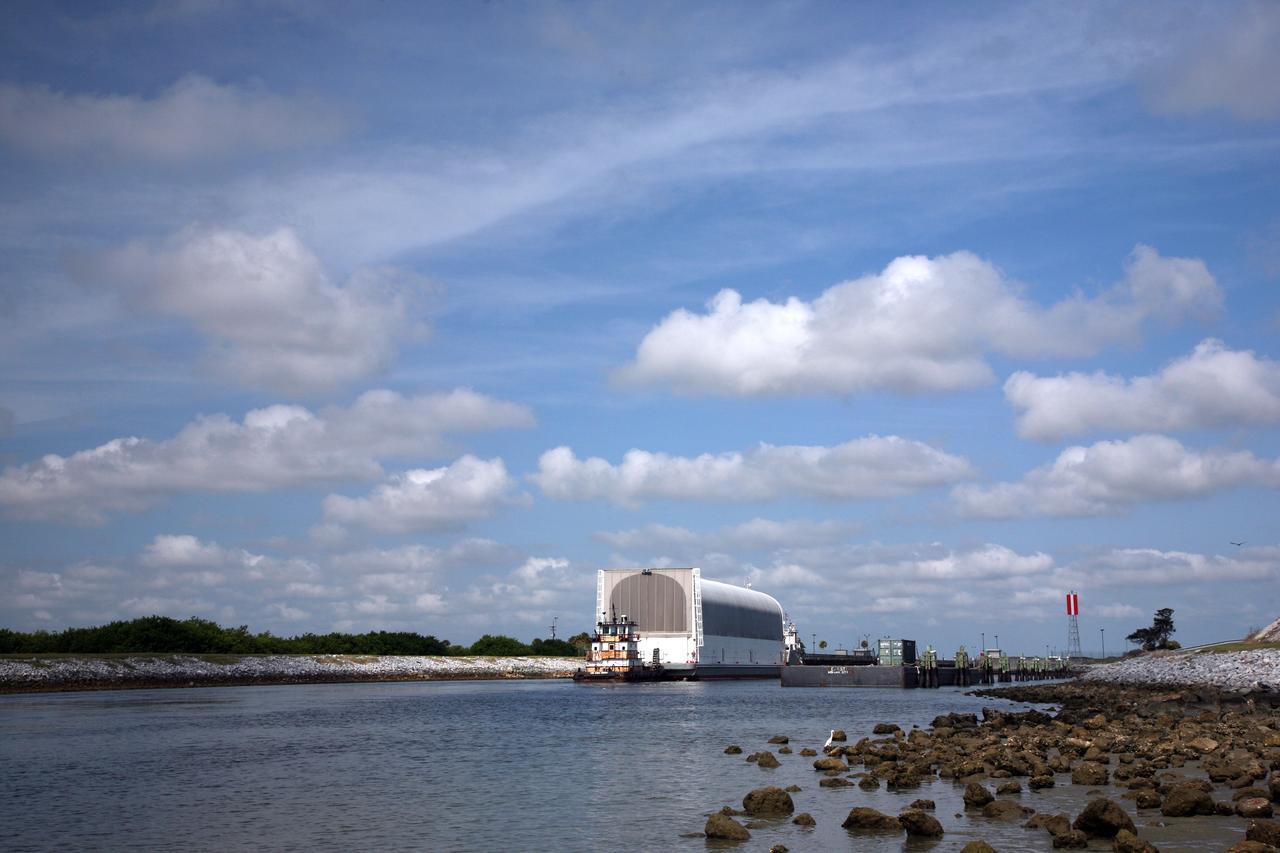
CAPE CANAVERAL, Fla. – NASA's Pegasus barge is towed on the Banana River toward the Launch Complex 39 Area at NASA's Kennedy Space Center in Florida. The barge contains the external fuel tank designated ET-133 that will be used for space shuttle Atlantis' STS-129 mission. After arrival at the Turn Basin dock, the tank will be offloaded and moved into the Vehicle Assembly Building. The tank was shipped aboard the Pegasus from NASA's Michould Assembly Facility near New Orleans. Pegasus was towed to Port Canaveral by the Freedom Star Retrieval Ship. Photo credit: NASA/Troy Cryder
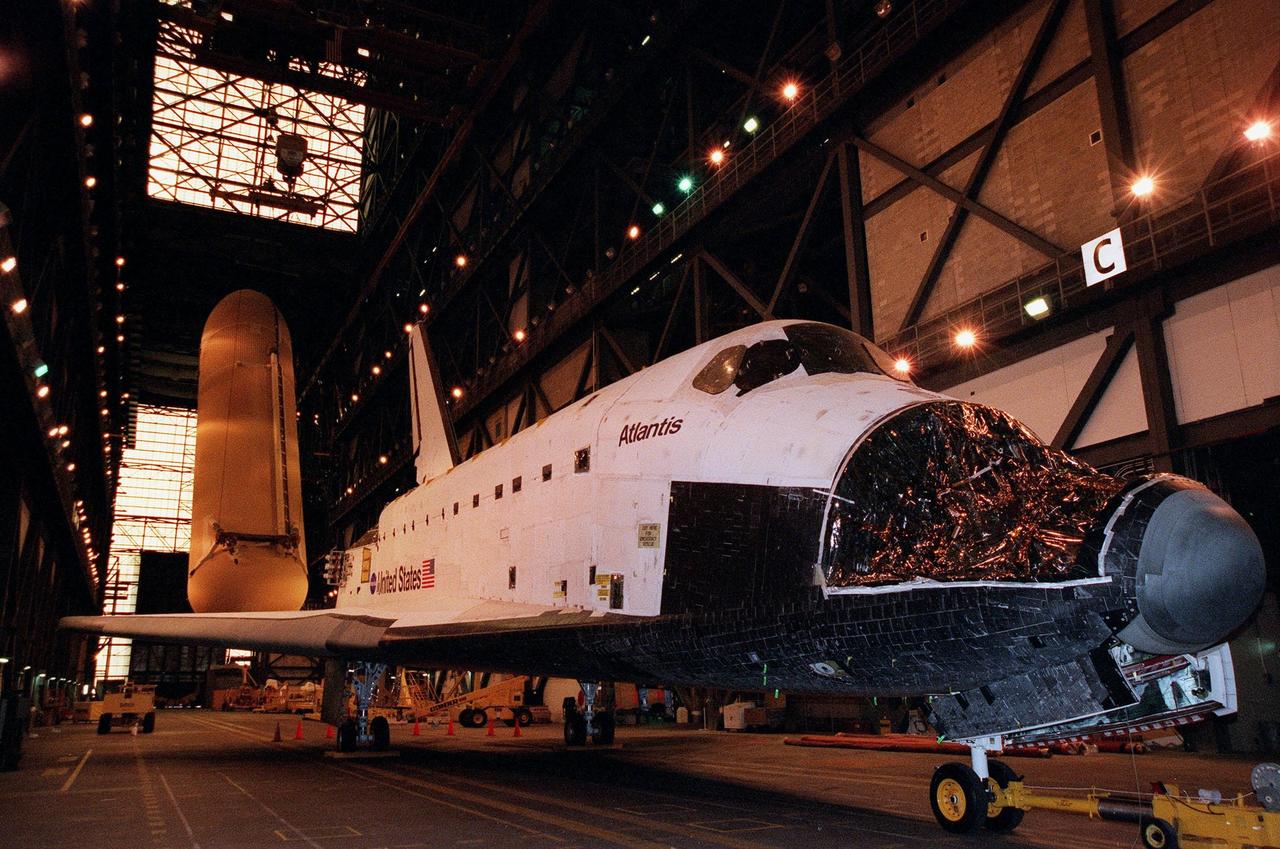
KENNEDY SPACE CENTER, FLA. -- In the transfer aisle of the Vehicle Assembly Building, Atlantis awaits a vacancy in one of the Orbiter Processing Facility bays. Seen behind the right wing is an external tank being raised to a vertical position. The largest and heaviest element of the Space Shuttle, an external tank contains the liquid hydrogen fuel and liquid oxygen oxidizer for the three Space Shuttle main engines (SSMEs) in the orbiter during liftoff and ascent. When the SSMEs are shut down, the external tank is jettisoned, breaking up as it enters the Earth's atmopshere and impacting in a remote ocean area. It is not recovered
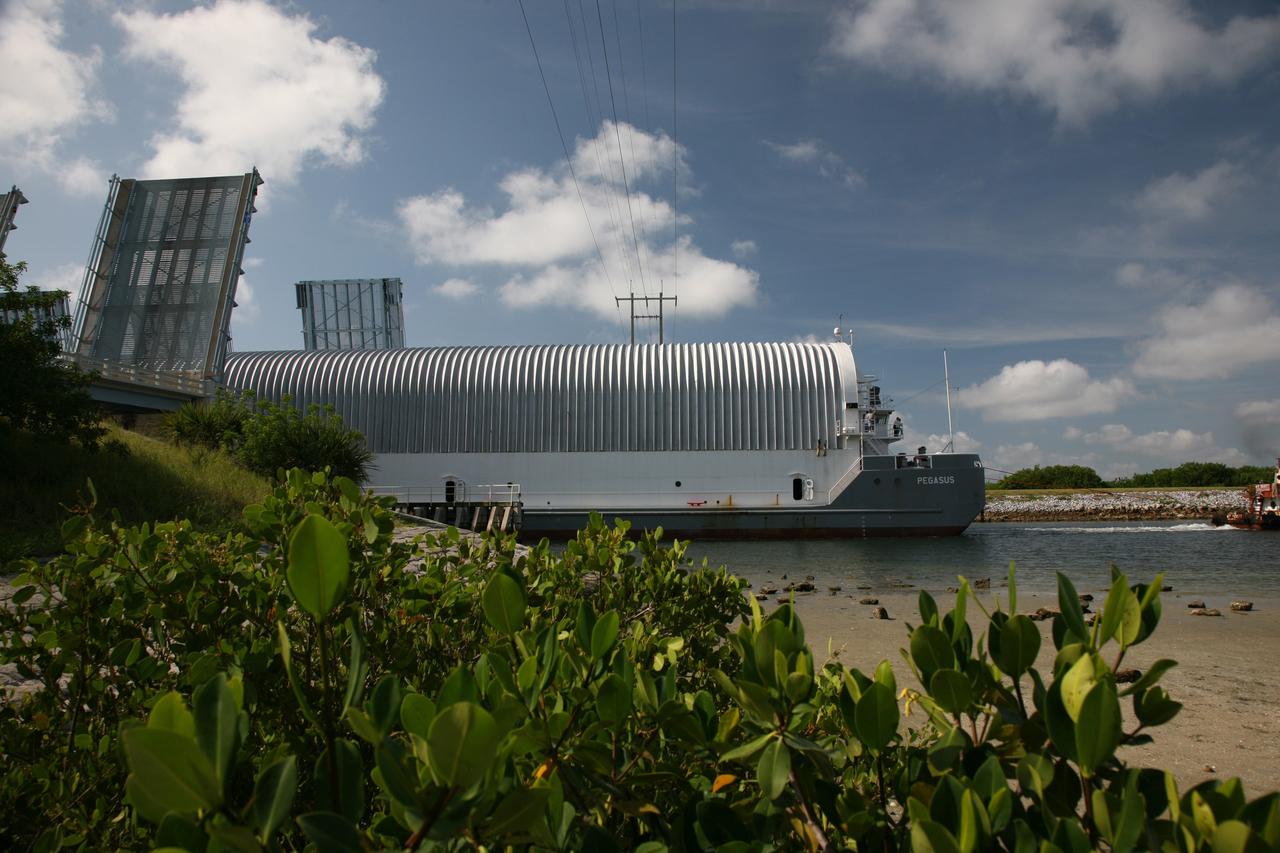
CAPE CANAVERAL, Fla. – NASA's Pegasus barge moves through the bridge at Port Canaveral, Fla. The barge contains the external fuel tank designated ET-133 that will be used for space shuttle Atlantis' STS-129 mission. The barge is delivering the external tank to the Turn Basin dock at NASA's Kennedy Space Center in Florida where it will be offloaded and moved into the Vehicle Assembly Building. The tank was shipped aboard the Pegasus from NASA's Michould Assembly Facility near New Orleans. Pegasus was towed to Port Canaveral by the Freedom Star Retrieval Ship. Photo credit: NASA/Troy Cryder
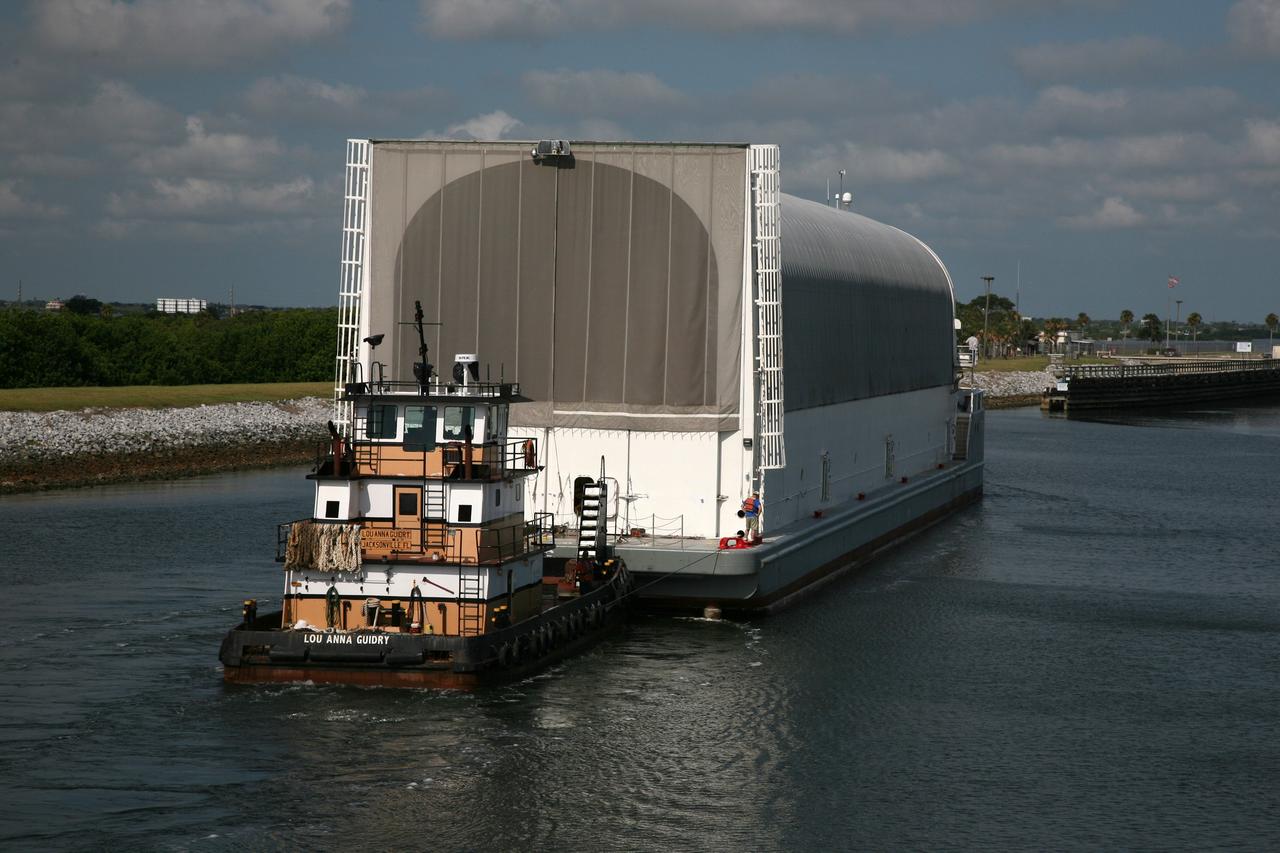
CAPE CANAVERAL, Fla. – NASA's Pegasus barge is towed on the Banana River toward the Launch Complex 39 Area at NASA's Kennedy Space Center in Florida. The barge contains the external fuel tank designated ET-133 that will be used for space shuttle Atlantis' STS-129 mission. After arrival at the Turn Basin dock, the tank will be offloaded and moved into the Vehicle Assembly Building. The tank was shipped aboard the Pegasus from NASA's Michould Assembly Facility near New Orleans. Pegasus was towed to Port Canaveral by the Freedom Star Retrieval Ship. Photo credit: NASA/Troy Cryder
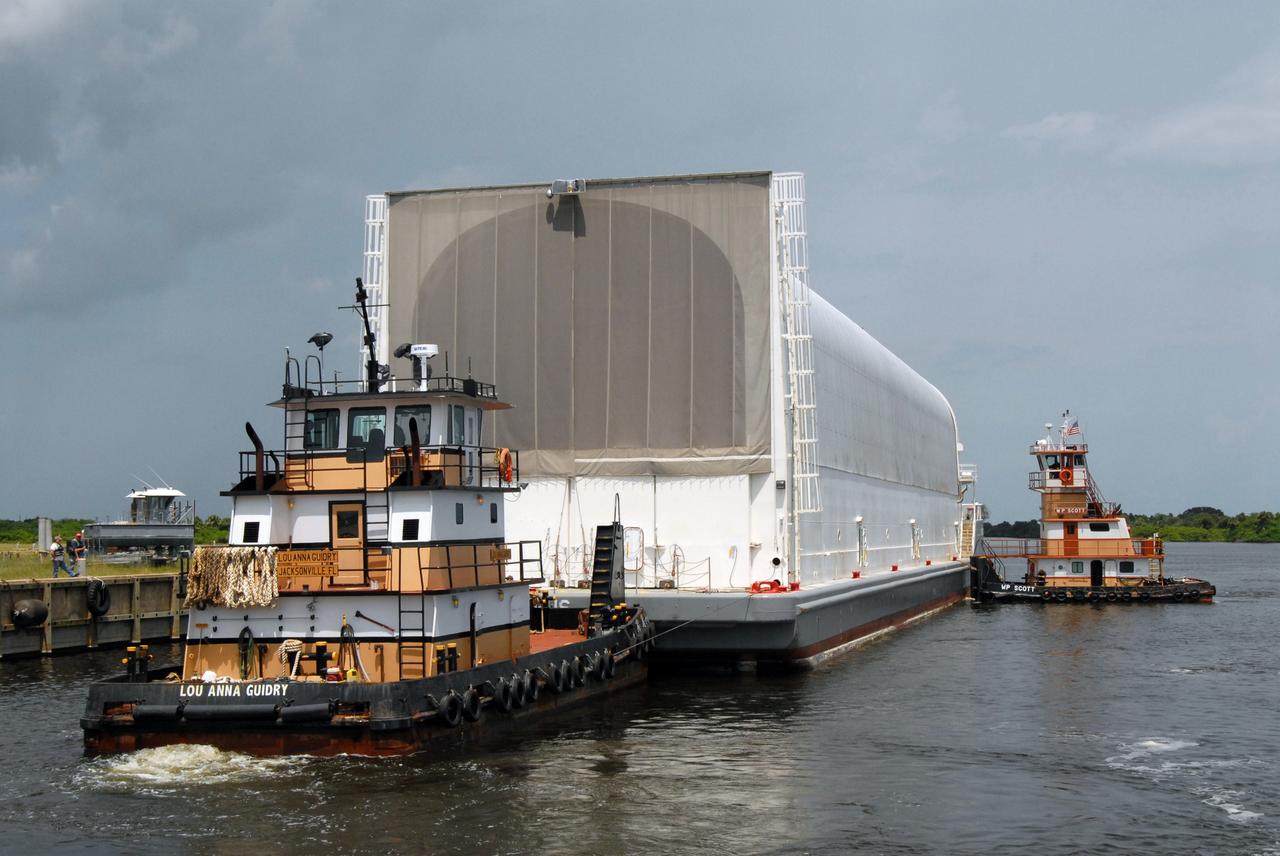
CAPE CANAVERAL, Fla. – Tugboats maneuver NASA's Pegasus barge next to the Turn Basin dock at NASA's Kennedy Space Center in Florida. The barge contains the external fuel tank, designated ET-133, that will be used for space shuttle Atlantis' STS-129 mission. The tank will be offloaded and moved into a high bay in the Vehicle Assembly Building for checkout. The tank was shipped aboard the Pegasus from NASA's Michoud Assembly Facility near New Orleans. Pegasus was towed to Port Canaveral by the Freedom Star Retrieval Ship. Launch of Atlantis is targeted for November. Photo credit: NASA/Tim Jacobs
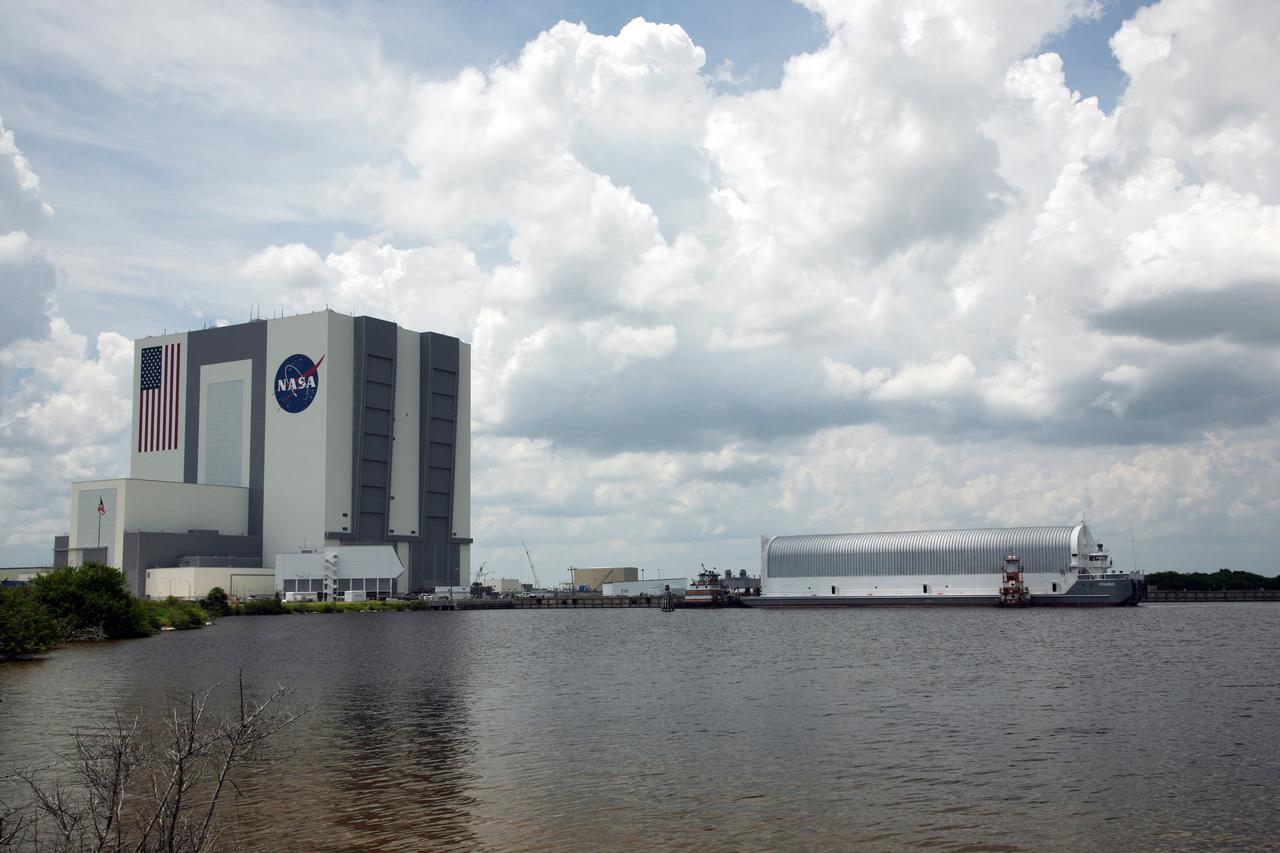
CAPE CANAVERAL, Fla. – Tugboats maneuver NASA's Pegasus barge toward the Turn Basin dock at NASA's Kennedy Space Center in Florida. The barge contains the external fuel tank, designated ET-133, that will be used for space shuttle Atlantis' STS-129 mission. After Pegasus is docked, the tank will be offloaded and moved into a high bay in the Vehicle Assembly Building, at left, for checkout. The tank was shipped aboard the Pegasus from NASA's Michould Assembly Facility near New Orleans. Pegasus was towed to Port Canaveral by the Freedom Star Retrieval Ship. Photo credit: NASA/Dimitri Gerondidakis
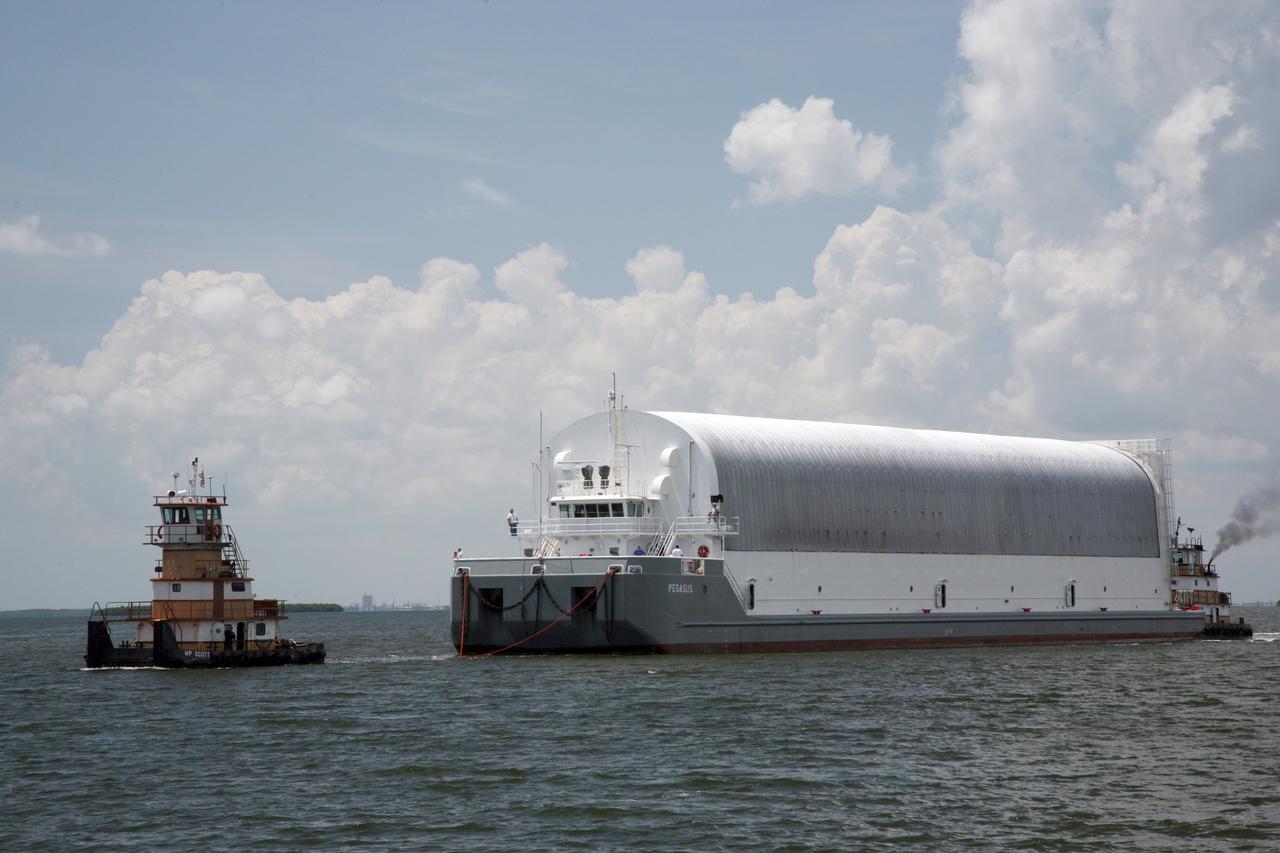
CAPE CANAVERAL, Fla. – NASA's Pegasus barge is towed on the Banana River to the Launch Complex 39 area at NASA's Kennedy Space Center in Florida. The barge contains the external fuel tank, designated ET-133, that will be used for space shuttle Atlantis' STS-129 mission. After arrival at the Turn Basin dock, the tank will be offloaded and moved into a high bay in the Vehicle Assembly Building for checkout. The tank was shipped aboard the Pegasus from NASA's Michould Assembly Facility near New Orleans. Pegasus was towed to Port Canaveral by the Freedom Star Retrieval Ship. Photo credit: NASA/Dimitri Gerondidakis

Inside the Multi-Operations Support Building near the Multi-Payload Processing Facility (MPPF) at NASA’s Kennedy Space Center in Florida on Aug. 16, 2019, rows of gloves that are part of Self-Contained Atmospheric Protective Ensemble (SCAPE) suits are in view inside a changing room. SCAPE technicians will practice putting on SCAPE suits for a test simulation of loading propellants into a replicated test tank for Orion. Exploration Ground Systems is preparing for Artemis 1 with a series of hazardous hyper test events at the MPPF. After donning their suits, the technicians will complete a tanking to test the system before Orion arrives for processing. During preparations for launch, these teams will be responsible for loading the Orion vehicle with propellants prior to transportation to the Vehicle Assembly Building, where it will be secured atop the Space Launch System rocket. SCAPE suits are used in operations involving toxic propellants and are supplied with air either through a hardline or through a self-contained environmental control unit.
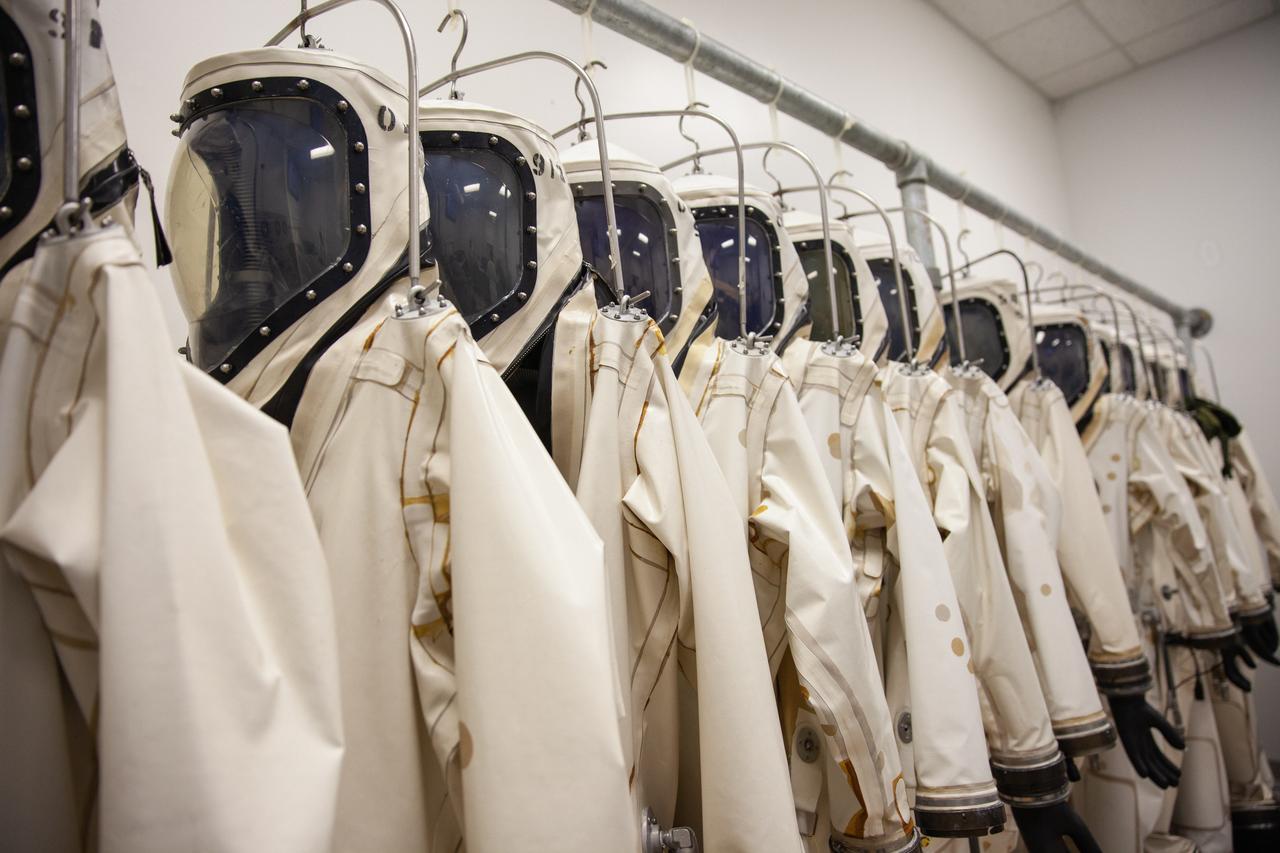
Inside the Multi-Operations Support Building near the Multi-Payload Processing Facility (MPPF) at NASA’s Kennedy Space Center in Florida on Aug. 16, 2019, a row of Self-Contained Atmospheric Protective Ensemble (SCAPE) suits are hanging inside a changing room. SCAPE technicians are practicing putting on the suits for a test simulation of loading propellants into a replicated test tank for Orion. Exploration Ground Systems is preparing for Artemis 1 with a series of hazardous hyper test events at the MPPF. After donning their suits, the technicians will complete a tanking to test the system before Orion arrives for processing. During preparations for launch, these teams will be responsible for loading the Orion vehicle with propellants prior to transportation to the Vehicle Assembly Building, where it will be secured atop the Space Launch System rocket. SCAPE suits are used in operations involving toxic propellants and are supplied with air either through a hardline or through a self-contained environmental control unit.
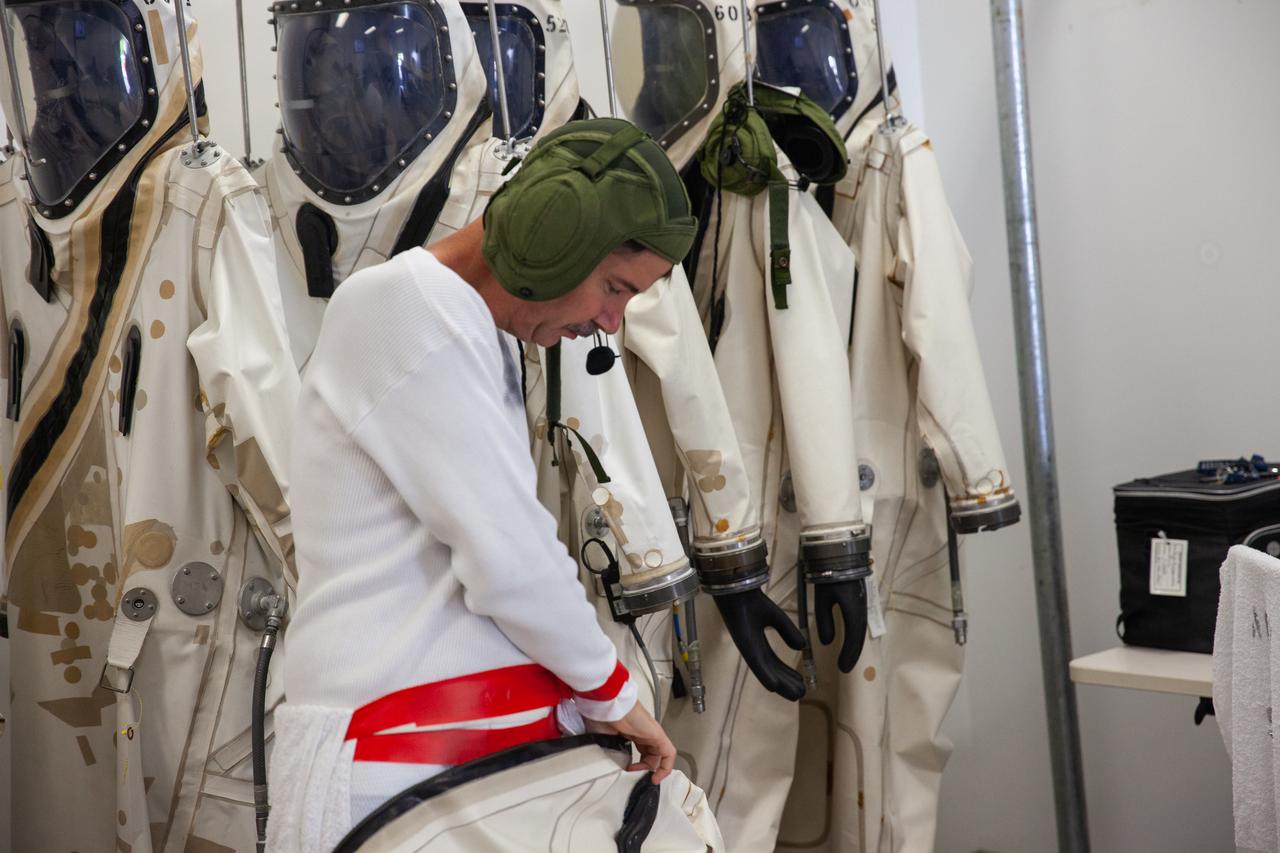
Inside the Multi-Operations Support Building near the Multi-Payload Processing Facility (MPPF) at NASA’s Kennedy Space Center in Florida, a technician prepares to put on a Self-Contained Atmospheric Protective Ensemble (SCAPE) suit inside a changing room on Aug. 16, 2019. SCAPE technicians are practicing putting on the suits for a test simulation of loading propellants into a replicated test tank for Orion. Exploration Ground Systems is preparing for Artemis 1 with a series of hazardous hyper test events at the MPPF. After donning their suits, the technicians will complete a tanking to test the system before Orion arrives for processing. During preparations for launch, these teams will be responsible for loading the Orion vehicle with propellants prior to transportation to the Vehicle Assembly Building, where it will be secured atop the Space Launch System rocket. SCAPE suits are used in operations involving toxic propellants and are supplied with air either through a hardline or through a self-contained environmental control unit.
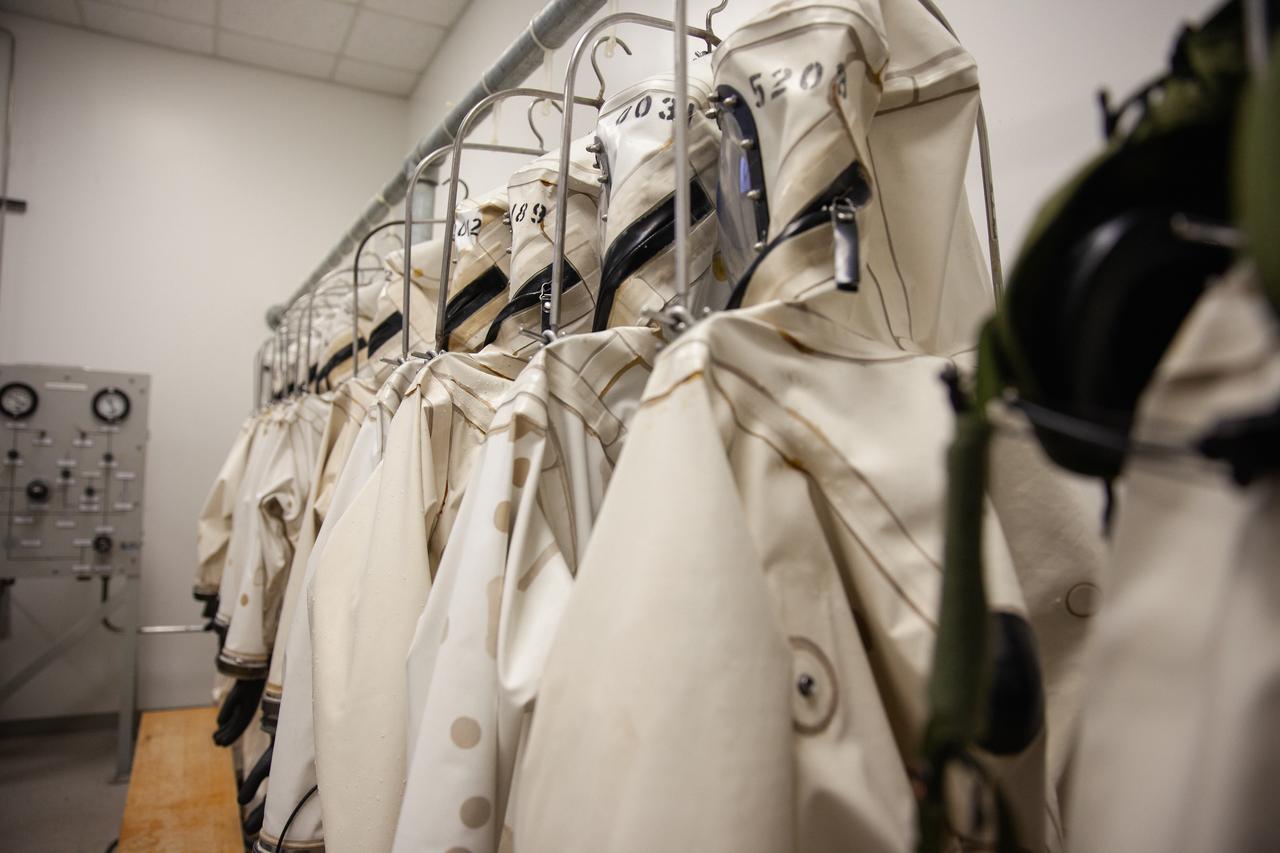
Inside the Multi-Operations Support Building near the Multi-Payload Processing Facility (MPPF) at NASA’s Kennedy Space Center in Florida on Aug. 16, 2019, a row of Self-Contained Atmospheric Protective Ensemble (SCAPE) suits are hanging inside a changing room. SCAPE technicians are practicing putting on their suits for a test simulation of loading propellants into a replicated test tank for Orion. Exploration Ground Systems is preparing for Artemis 1 with a series of hazardous hyper test events at the MPPF. After donning their suits, the technicians will complete a tanking to test the system before Orion arrives for processing. During preparations for launch, these teams will be responsible for loading the Orion vehicle with propellants prior to transportation to the Vehicle Assembly Building, where it will be secured atop the Space Launch System rocket. SCAPE suits are used in operations involving toxic propellants and are supplied with air either through a hardline or through a self-contained environmental control unit.
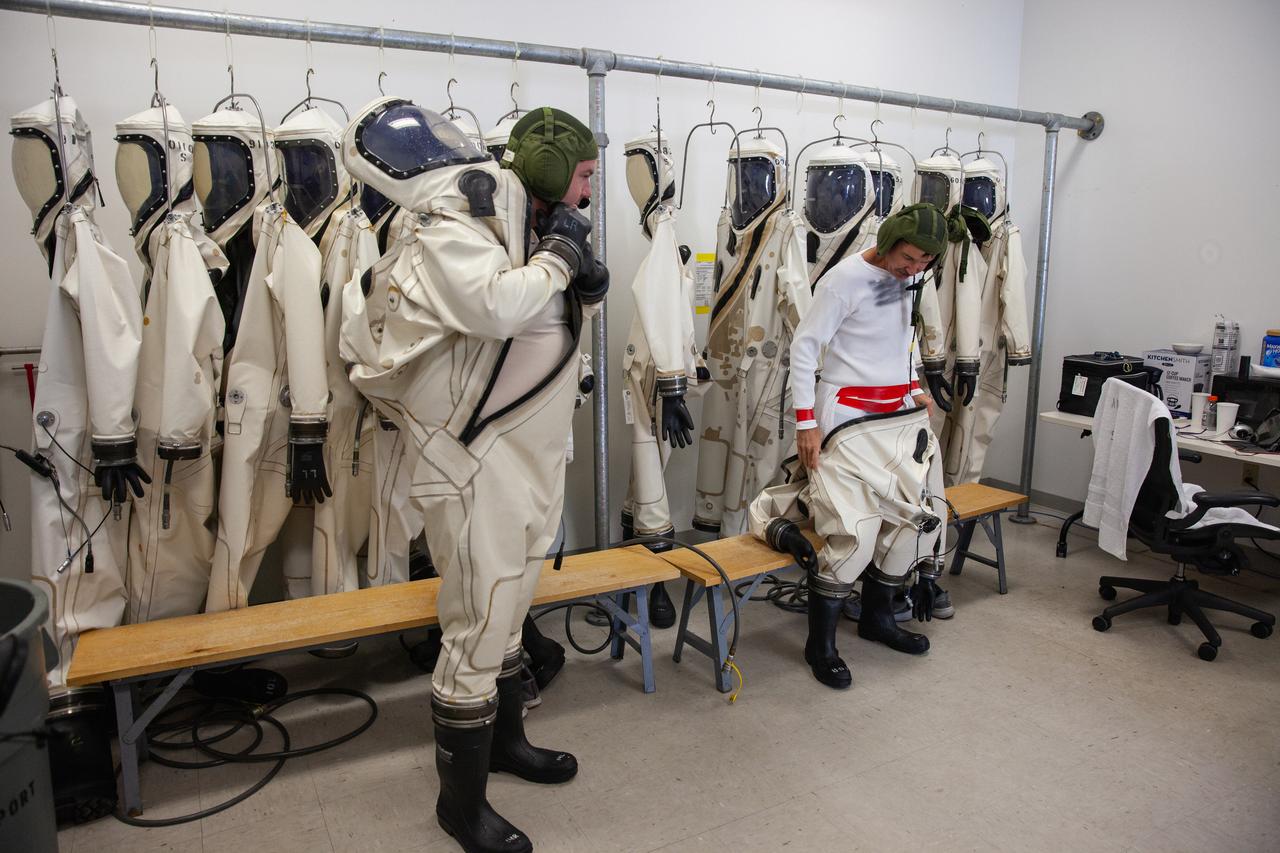
Inside the Multi-Operations Support Building near the Multi-Payload Processing Facility (MPPF) at NASA’s Kennedy Space Center in Florida, technicians put on Self-Contained Atmospheric Protective Ensemble (SCAPE) suits inside a changing room on Aug. 16, 2019. SCAPE technicians are practicing putting on the suits for a test simulation of loading propellants into a replicated test tank for Orion. Exploration Ground Systems is preparing for Artemis 1 with a series of hazardous hyper test events at the MPPF. After donning their suits, the technicians will complete a tanking to test the system before Orion arrives for processing. During preparations for launch, these teams will be responsible for loading the Orion vehicle with propellants prior to transportation to the Vehicle Assembly Building, where it will be secured atop the Space Launch System rocket. SCAPE suits are used in operations involving toxic propellants and are supplied with air either through a hardline or through a self-contained environmental control unit.
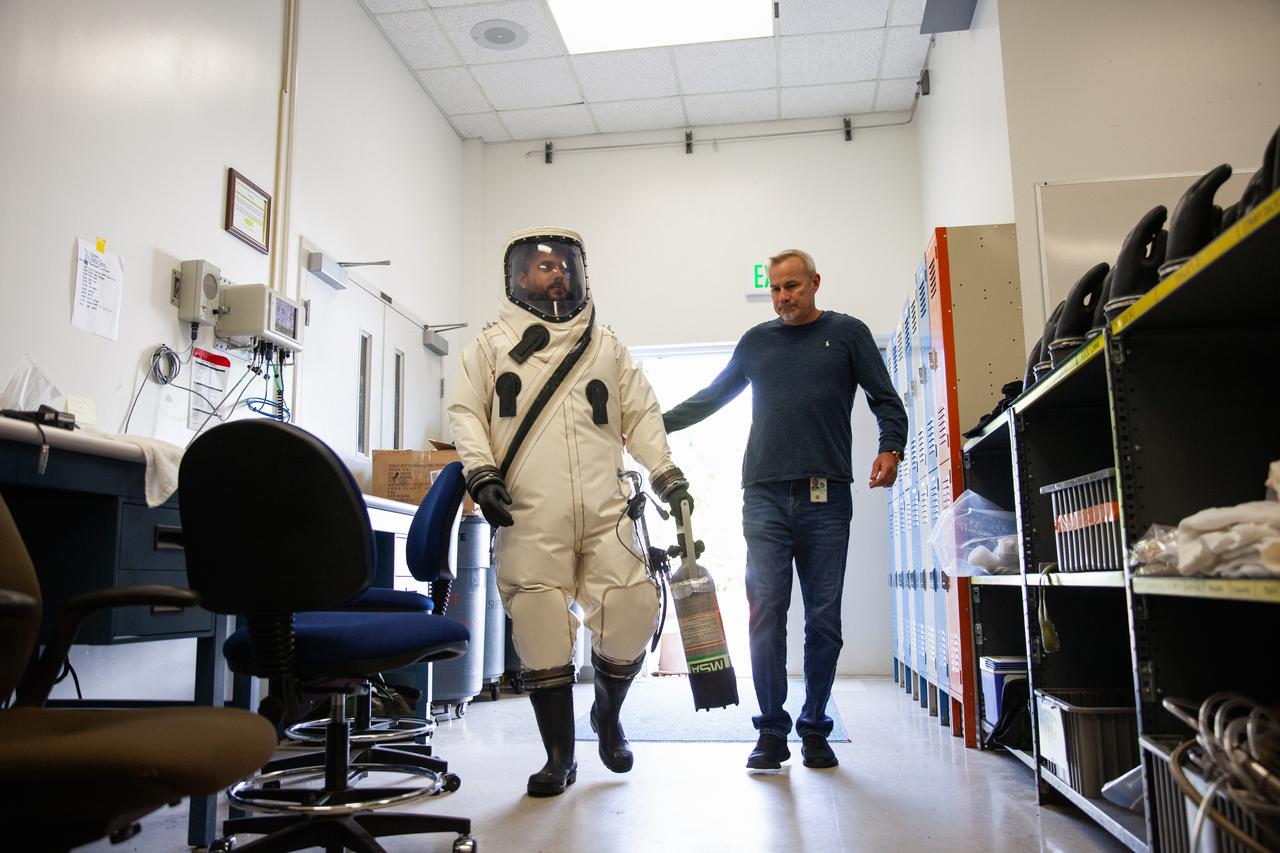
Inside the Multi-Operations Support Building near the Multi-Payload Processing Facility (MPPF) at NASA’s Kennedy Space Center in Florida, a technician is wearing a Self-Contained Atmospheric Protective Ensemble (SCAPE) suit to prepare for a test simulation of loading propellants into a replicated test tank for Orion, on Aug. 16, 2019. Exploration Ground Systems is preparing for Artemis 1 with a series of hazardous hyper test events at the MPPF. After donning their suits, the technicians will complete tanking to test the system before Orion arrives for processing. During preparations for launch, these teams will be responsible for loading the Orion vehicle with propellants prior to transportation to the Vehicle Assembly Building, where it will be secured atop the Space Launch System rocket. SCAPE suits are used in operations involving toxic propellants and are supplied with air either through a hardline or through a self-contained environmental control unit.
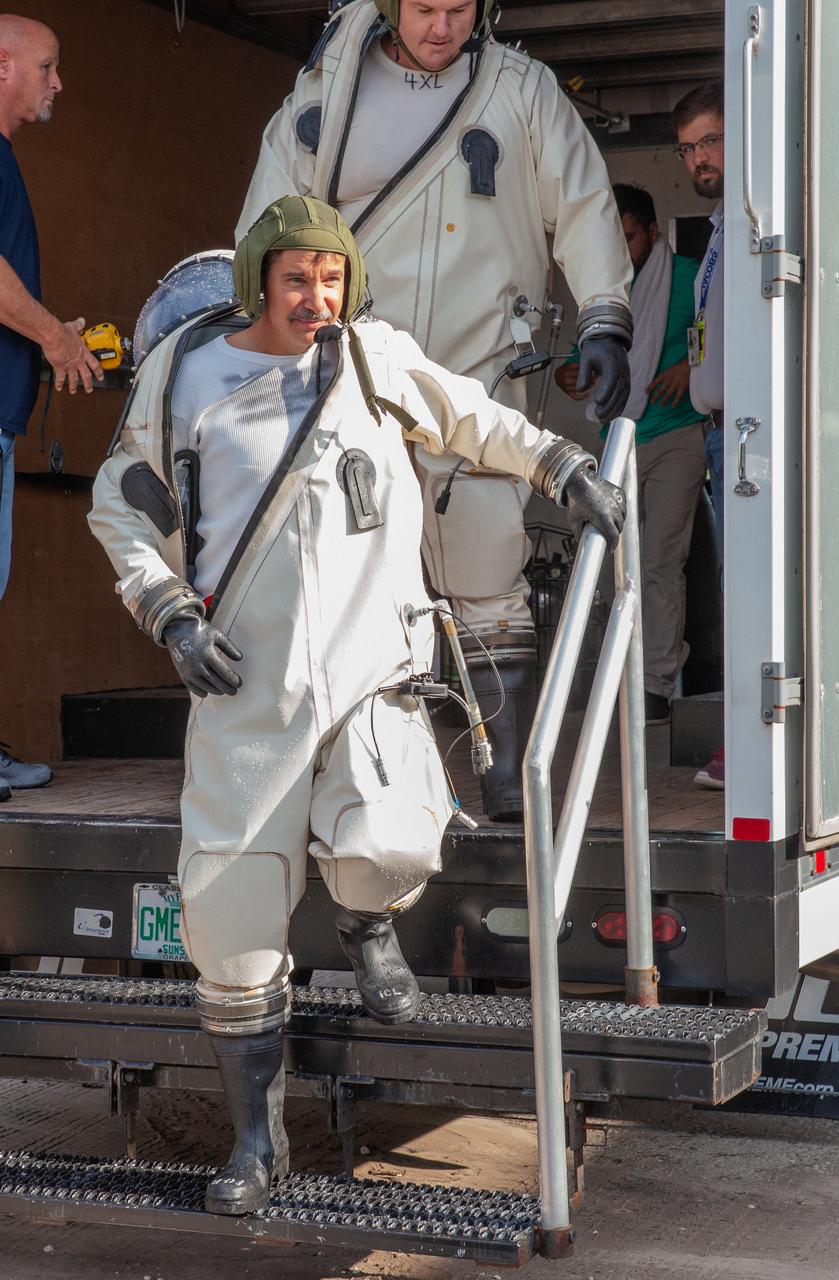
Technicians in Self-Contained Atmospheric Protective Ensemble (SCAPE) suits exit a truck near the Multi-Payload Processing Facility (MPPF) at NASA’s Kennedy Space Center in Florida, for a test simulation of loading propellants into a replicated test tank for Orion on Aug. 16, 2019. Exploration Ground Systems is preparing for Artemis 1 with a series of hazardous hyper test events at the MPPF. The technicians will complete a tanking to test the system before Orion arrives for processing. During preparations for launch, these teams will be responsible for loading the Orion vehicle with propellants prior to transportation to the Vehicle Assembly Building, where it will be secured atop the Space Launch System rocket. SCAPE suits are used in operations involving toxic propellants and are supplied with air either through a hardline or through a self-contained environmental control unit.
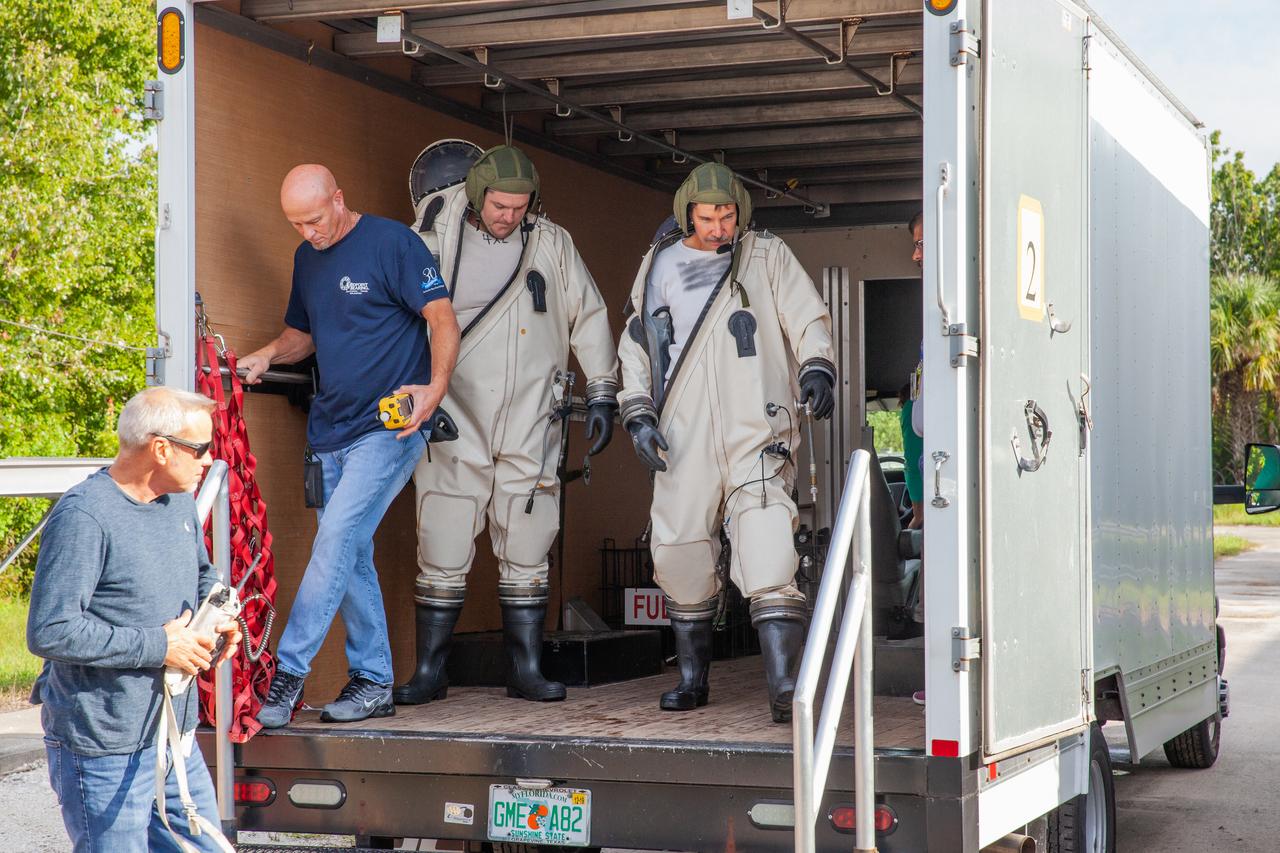
Technicians in Self-Contained Atmospheric Protective Ensemble (SCAPE) suits exit a truck near the Multi-Payload Processing Facility (MPPF) at NASA’s Kennedy Space Center in Florida, for a test simulation of loading propellants into a replicated test tank for Orion on Aug. 16, 2019. Exploration Ground Systems is preparing for Artemis 1 with a series of hazardous hyper test events at the MPPF. The technicians will complete a tanking to test the system before Orion arrives for processing. During preparations for launch, these teams will be responsible for loading the Orion vehicle with propellants prior to transportation to the Vehicle Assembly Building, where it will be secured atop the Space Launch System rocket. SCAPE suits are used in operations involving toxic propellants and are supplied with air either through a hardline or through a self-contained environmental control unit.
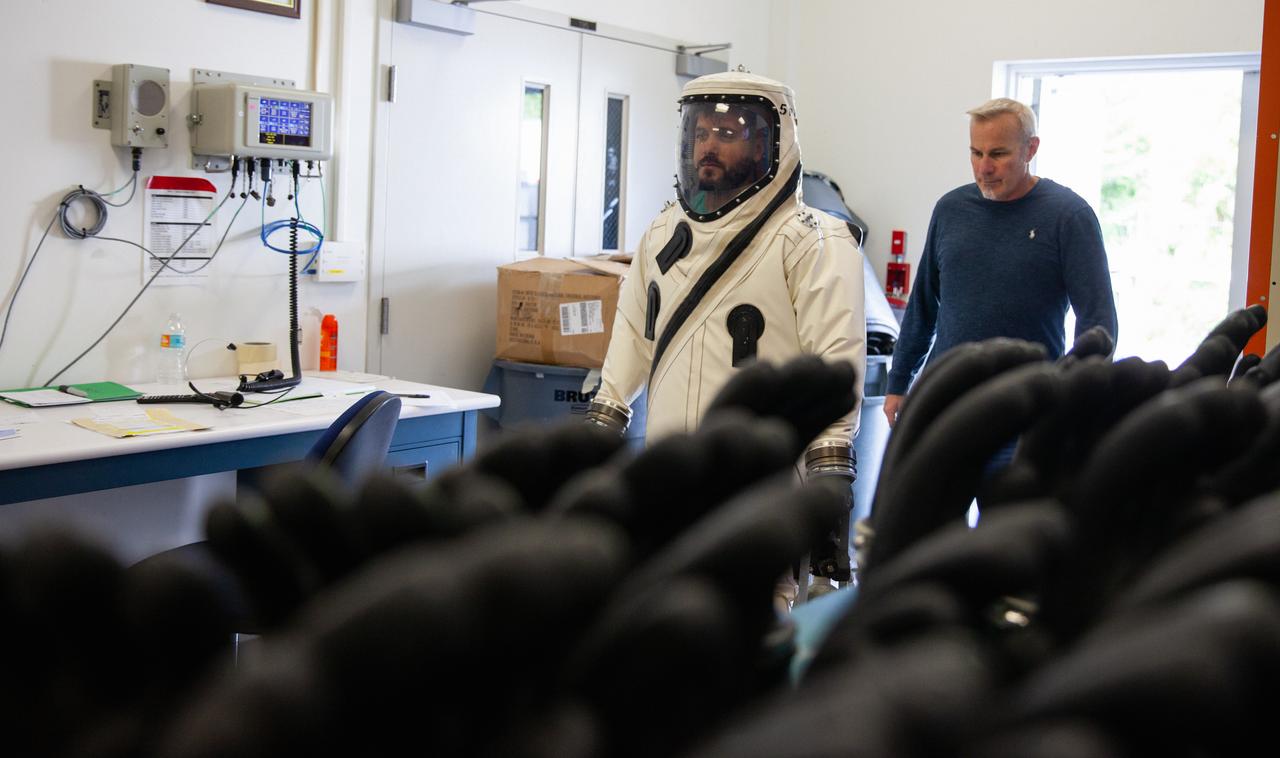
Inside the Multi-Operations Support Building near the Multi-Payload Processing Facility (MPPF) at NASA’s Kennedy Space Center in Florida, a technician is wearing a Self-Contained Atmospheric Protective Ensemble (SCAPE) suit to prepare for a test simulation of loading propellants into a replicated test tank for Orion, on Aug. 16, 2019. Exploration Ground Systems is preparing for Artemis 1 with a series of hazardous hyper test events at the MPPF. After donning their suits, the technicians will complete a tanking to test the system before Orion arrives for processing. During preparations for launch, these teams will be responsible for loading the Orion vehicle with propellants prior to transportation to the Vehicle Assembly Building, where it will be secured atop the Space Launch System rocket. SCAPE suits are used in operations involving toxic propellants and are supplied with air either through a hardline or through a self-contained environmental control unit.
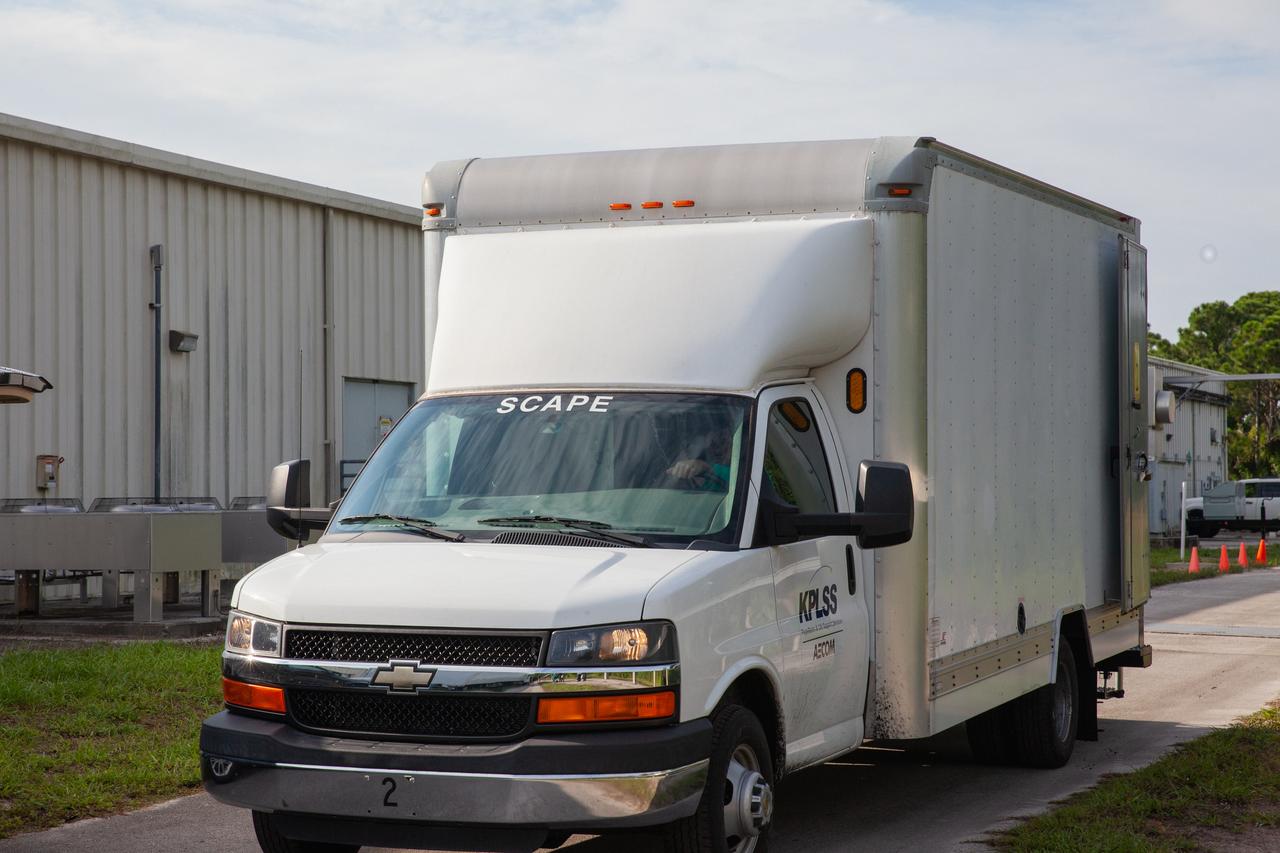
A truck transports technicians wearing Self-Contained Atmospheric Protective Ensemble (SCAPE) suits and operations support personnel to the Multi-Payload Processing Facility (MPPF) at NASA’s Kennedy Space Center in Florida, for a test simulation of loading propellants into a replicated test tank for Orion on Aug. 16, 2019. Exploration Ground Systems is preparing for Artemis 1 with a series of hazardous hyper test events at the MPPF. The technicians will complete a tanking to test the system before Orion arrives for processing. During preparations for launch, these teams will be responsible for loading the Orion vehicle with propellants prior to transportation to the Vehicle Assembly Building, where it will be secured atop the Space Launch System rocket. SCAPE suits are used in operations involving toxic propellants and are supplied with air either through a hardline or through a self-contained environmental control unit.
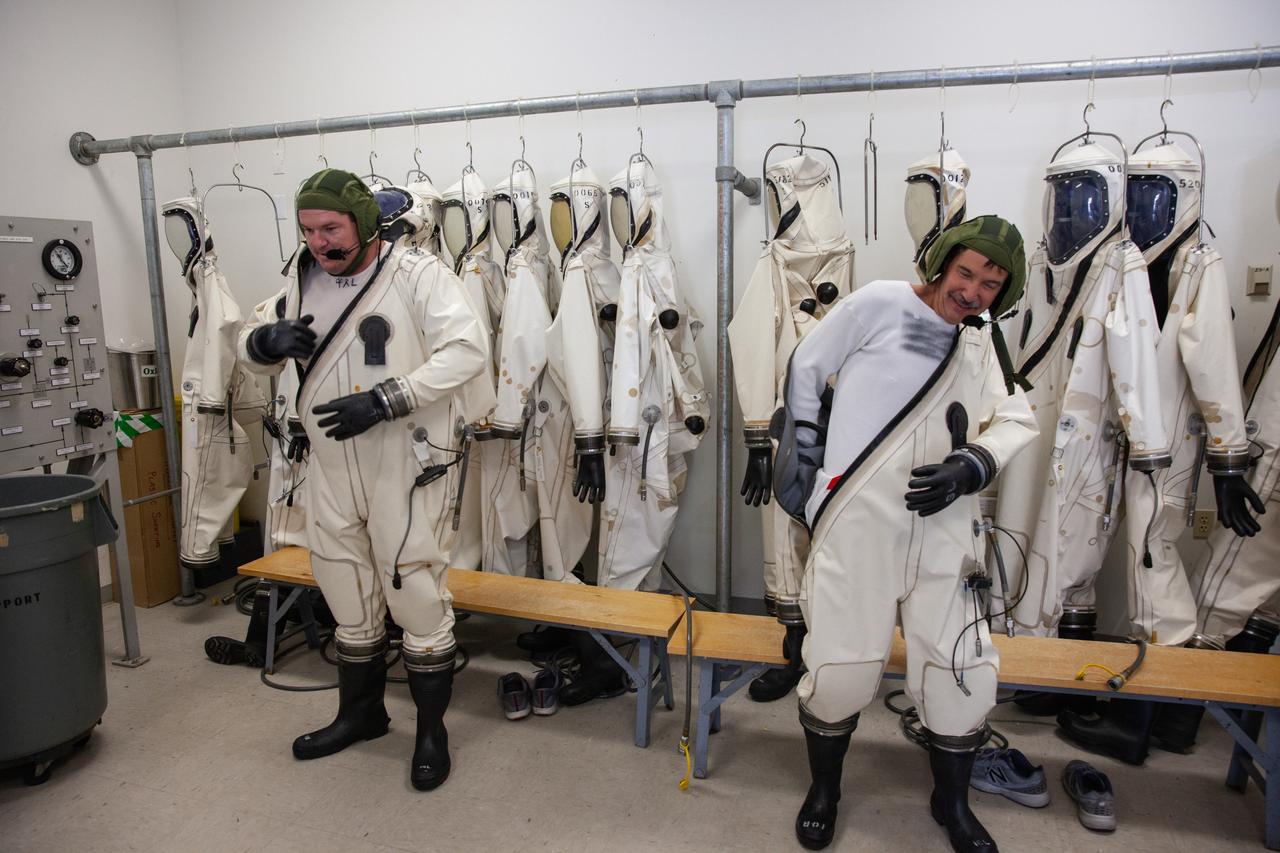
Inside the Multi-Operations Support Building near the Multi-Payload Processing Facility (MPPF) at NASA’s Kennedy Space Center in Florida, technicians put on Self-Contained Atmospheric Protective Ensemble (SCAPE) suits inside a changing room on Aug. 16, 2019. SCAPE technicians are practicing putting on the suits for a test simulation of loading propellants into a replicated test tank for Orion. Exploration Ground Systems is preparing for Artemis 1 with a series of hazardous hyper test events at the MPPF. After donning their suits, the technicians will complete a tanking to test the system before Orion arrives for processing. During preparations for launch, these teams will be responsible for loading the Orion vehicle with propellants prior to transportation to the Vehicle Assembly Building, where it will be secured atop the Space Launch System rocket. SCAPE suits are used in operations involving toxic propellants and are supplied with air either through a hardline or through a self-contained environmental control unit.
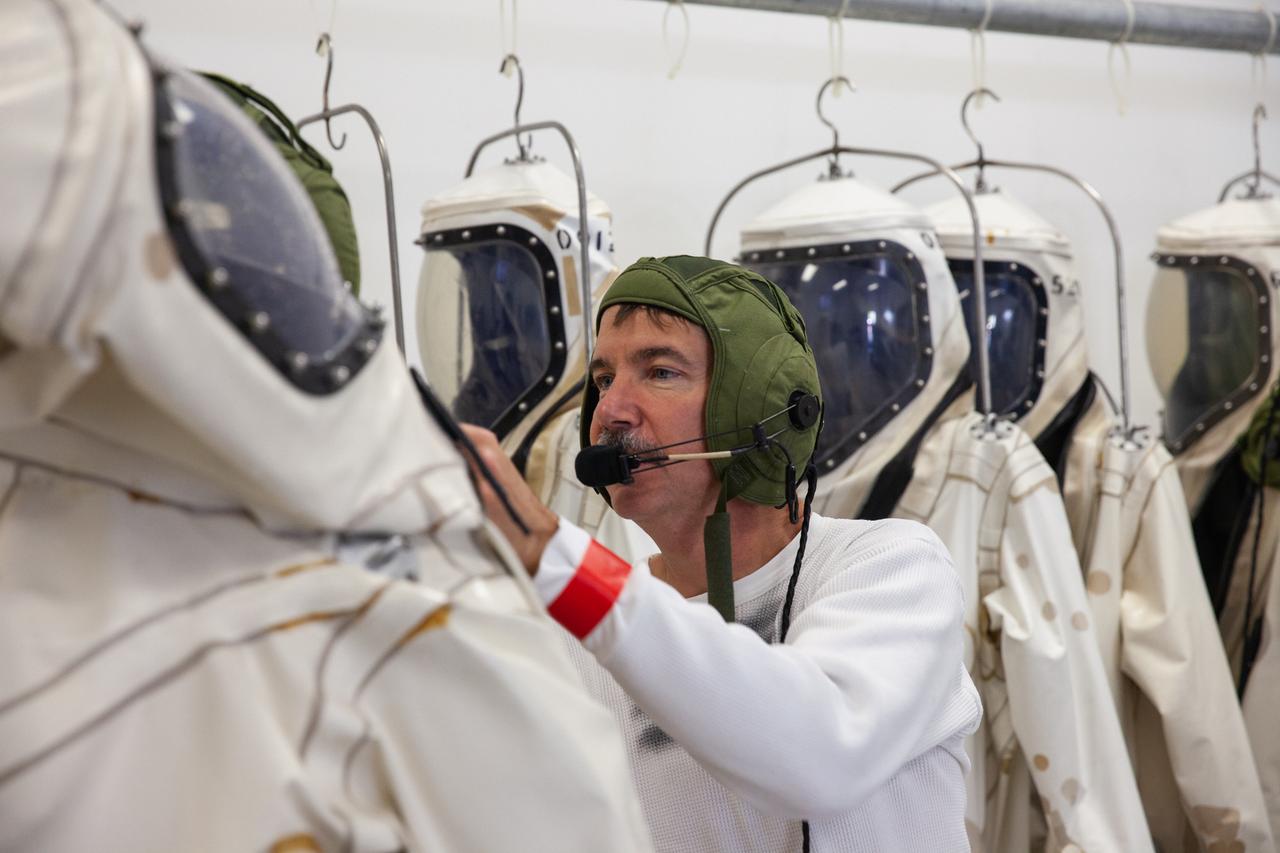
Inside the Multi-Operations Support Building near the Multi-Payload Processing Facility (MPPF) at NASA’s Kennedy Space Center in Florida, a technician prepares to put on a Self-Contained Atmospheric Protective Ensemble (SCAPE) suit inside a changing room on Aug. 16, 2019. SCAPE technicians are practicing putting on their suits for a test simulation of loading propellants into a replicated test tank for Orion. Exploration Ground Systems is preparing for Artemis 1 with a series of hazardous hyper test events at the MPPF. After donning their suits, the technicians will complete a tanking to test the system before Orion arrives for processing. During preparations for launch, these teams will be responsible for loading the Orion vehicle with propellants prior to transportation to the Vehicle Assembly Building, where it will be secured atop the Space Launch System rocket. SCAPE suits are used in operations involving toxic propellants and are supplied with air either through a hardline or through a self-contained environmental control unit.
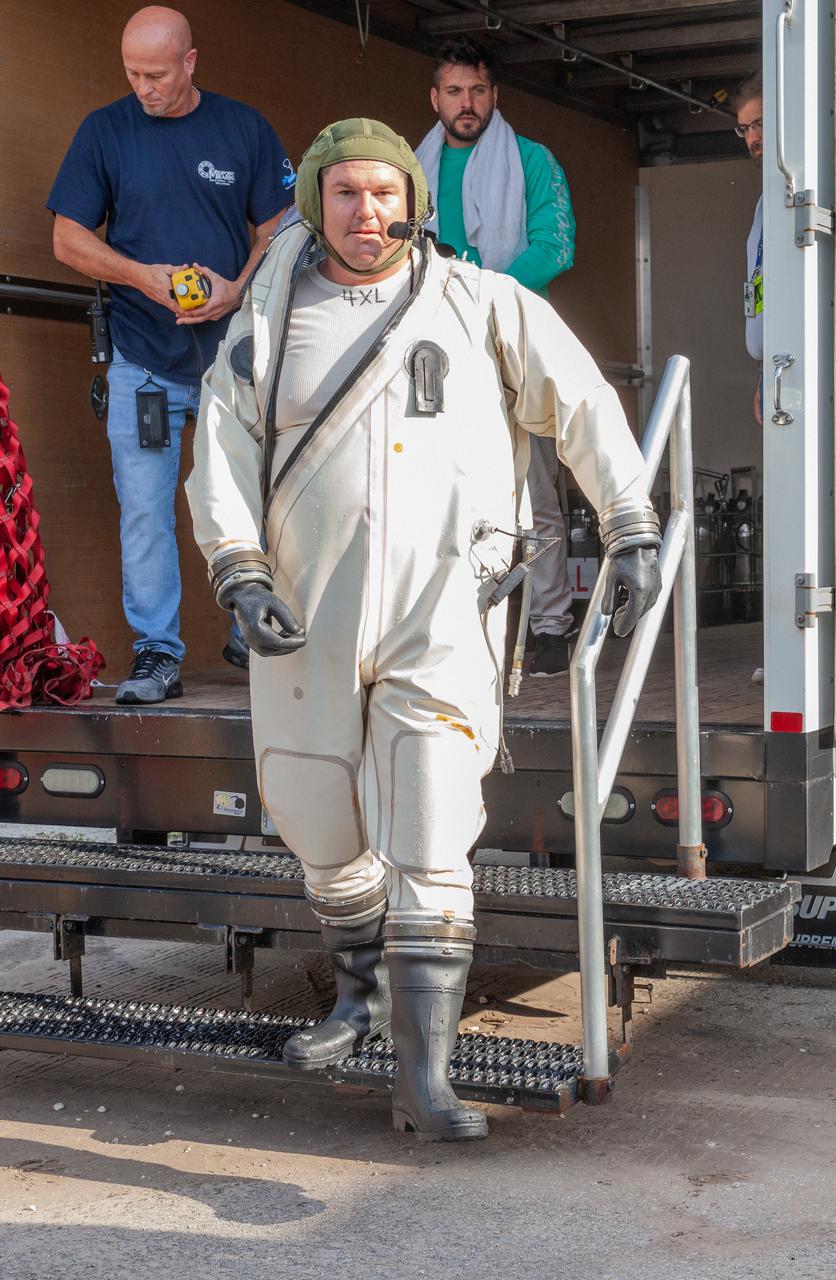
A technician in a Self-Contained Atmospheric Protective Ensemble (SCAPE) suit exits a truck near the Multi-Payload Processing Facility (MPPF) at NASA’s Kennedy Space Center in Florida on Aug. 16, 2019. SCAPE technicians are practicing by putting on the suits for a test simulation of loading propellants into a replicated test tank for Orion. Exploration Ground Systems is preparing for Artemis 1 with a series of hazardous hyper test events at the MPPF. After donning their suits, the technicians will complete a tanking to test the system before Orion arrives for processing. During preparations for launch, these teams will be responsible for loading the Orion vehicle with propellants prior to transportation to the Vehicle Assembly Building, where it will be secured atop the Space Launch System rocket. SCAPE suits are used in operations involving toxic propellants and are supplied with air either through a hardline or through a self-contained environmental control unit.
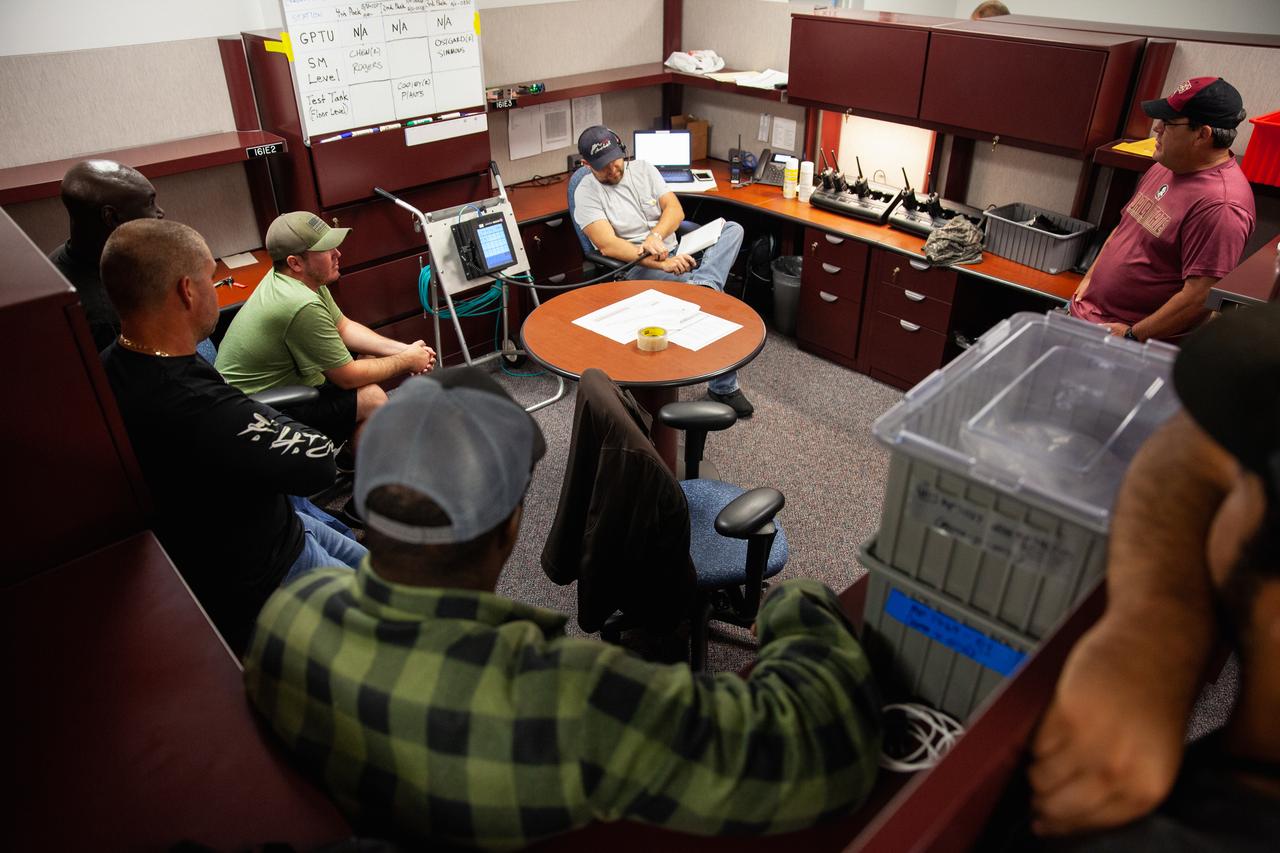
Inside the Multi-Operations Support Building near the Multi-Payload Processing Facility (MPPF) at NASA’s Kennedy Space Center in Florida, technicians and operations personnel review procedures for a test simulation of loading propellants into a replicated test tank for Orion, on Aug. 16, 2019. Exploration Ground Systems is preparing for Artemis 1 with a series of hazardous hyper test events at the MPPF. Technicians will practice putting on Self-Contained Atmospheric Protective Ensemble (SCAPE) suits and then complete tanking to test the system before Orion arrives for processing. During preparations for launch, these teams will be responsible for loading the Orion vehicle with propellants prior to transportation to the Vehicle Assembly Building, where it will be secured atop the Space Launch System rocket. SCAPE suits are used in operations involving toxic propellants and are supplied with air either through a hardline or through a self-contained environmental control unit.
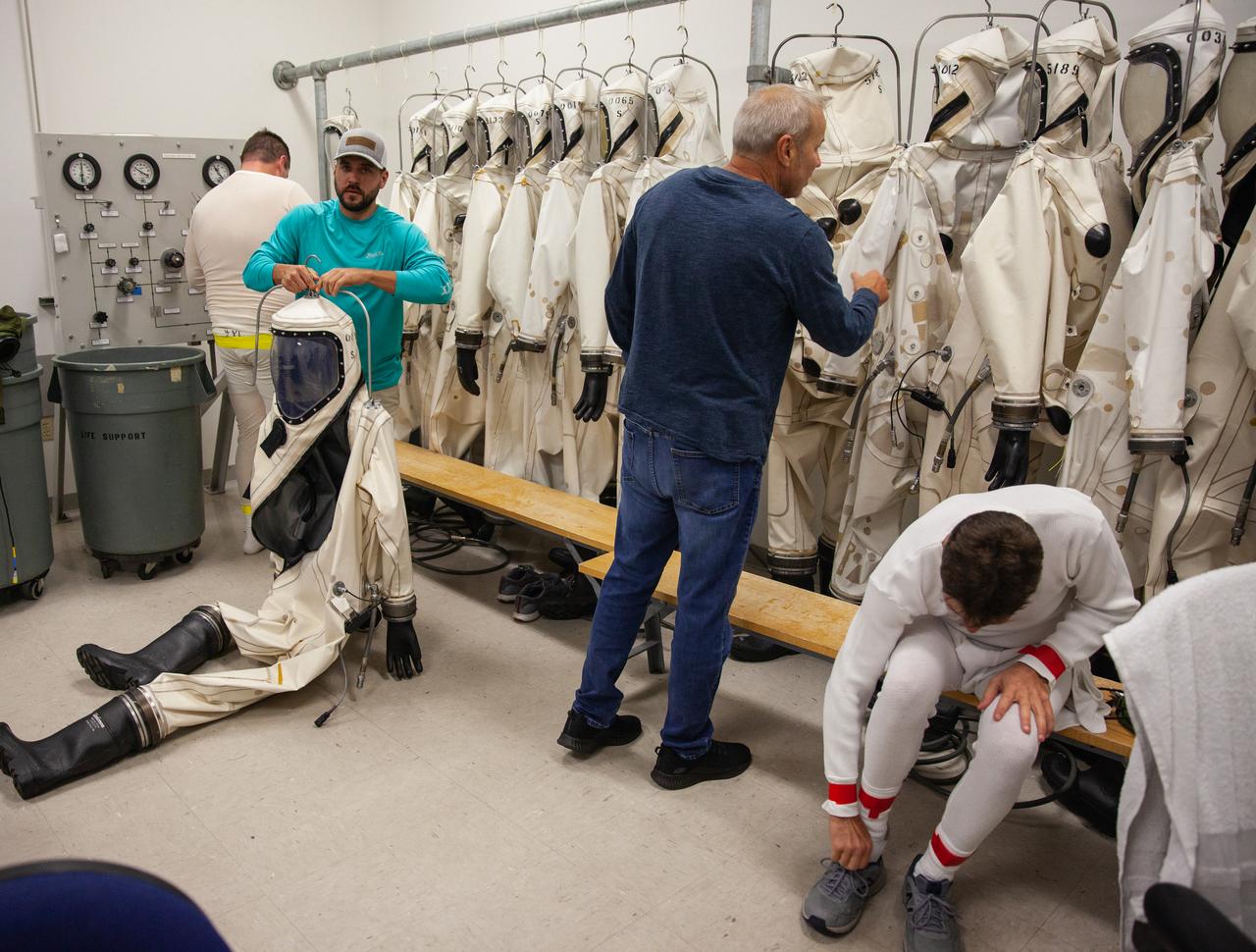
Inside the Multi-Operations Support Building near the Multi-Payload Processing Facility (MPPF) at NASA’s Kennedy Space Center in Florida, technicians are putting on Self-Contained Atmospheric Protective Ensemble (SCAPE) suits inside a changing room on Aug. 16, 2019. SCAPE technicians are practicing by putting on the suits for a test simulation of loading propellants into a replicated test tank for Orion. Exploration Ground Systems is preparing for Artemis 1 with a series of hazardous hyper test events at the MPPF. After donning their suits, the technicians will complete a tanking to test the system before Orion arrives for processing. During preparations for launch, these teams will be responsible for loading the Orion vehicle with propellants prior to transportation to the Vehicle Assembly Building, where it will be secured atop the Space Launch System rocket. SCAPE suits are used in operations involving toxic propellants and are supplied with air either through a hardline or through a self-contained environmental control unit.
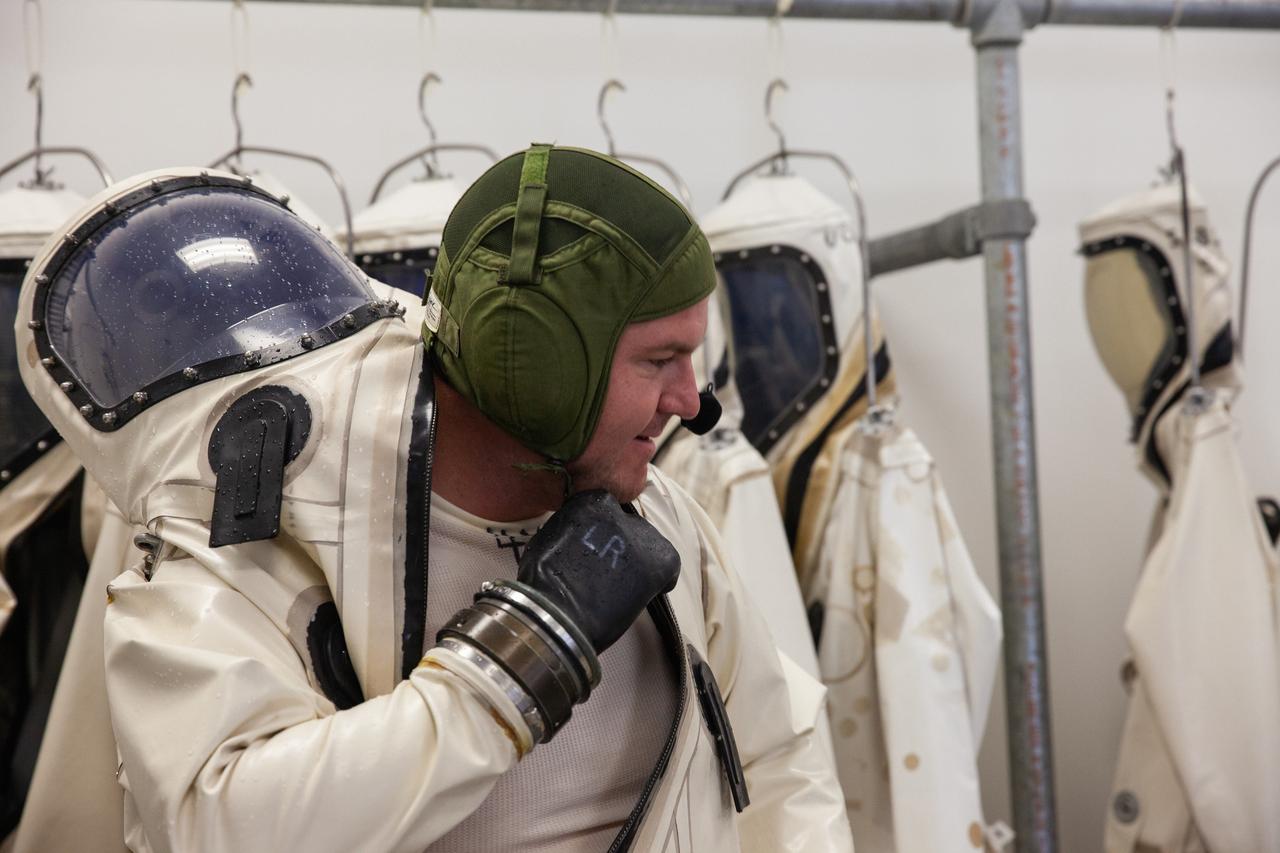
Inside the Multi-Operations Support Building near the Multi-Payload Processing Facility (MPPF) at NASA’s Kennedy Space Center in Florida, a technician puts on a Self-Contained Atmospheric Protective Ensemble (SCAPE) suit inside a changing room on Aug. 16, 2019. SCAPE technicians are practicing putting on the suits for a test simulation of loading propellants into a replicated test tank for Orion. Exploration Ground Systems is preparing for Artemis 1 with a series of hazardous hyper test events at the MPPF. After donning their suits, the technicians will complete a tanking to test the system before Orion arrives for processing. During preparations for launch, these teams will be responsible for loading the Orion vehicle with propellants prior to transportation to the Vehicle Assembly Building, where it will be secured atop the Space Launch System rocket. SCAPE suits are used in operations involving toxic propellants and are supplied with air either through a hardline or through a self-contained environmental control unit.
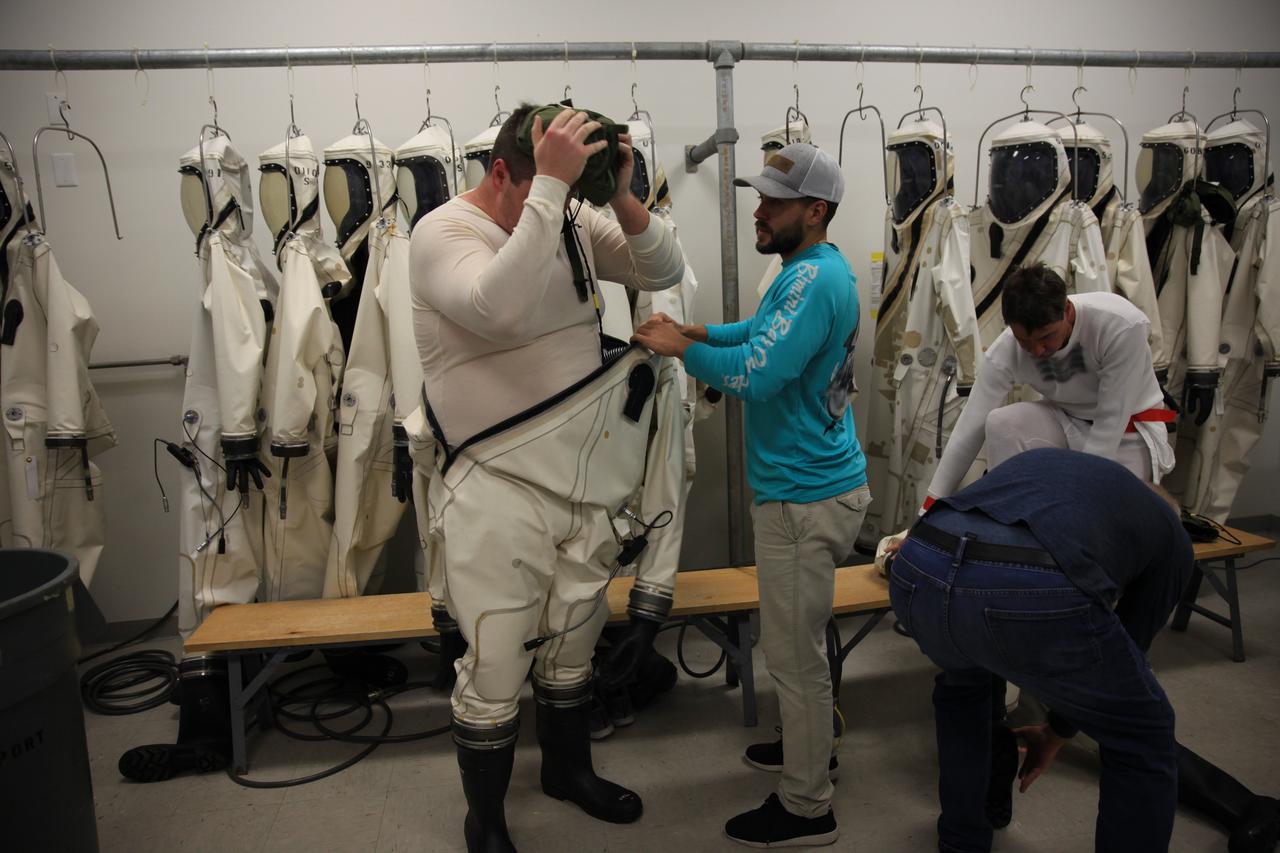
Inside the Multi-Operations Support Building near the Multi-Payload Processing Facility (MPPF) at NASA’s Kennedy Space Center in Florida, technicians put on Self-Contained Atmospheric Protective Ensemble (SCAPE) suits inside a changing room on Aug. 16, 2019. SCAPE technicians are practicing by putting on the suits for a test simulation of loading propellants into a replicated test tank for Orion. Exploration Ground Systems is preparing for Artemis 1 with a series of hazardous hyper test events at the MPPF. After donning their suits, the technicians will complete a tanking to test the system before Orion arrives for processing. During preparations for launch, these teams will be responsible for loading the Orion vehicle with propellants prior to transportation to the Vehicle Assembly Building, where it will be secured atop the Space Launch System rocket. SCAPE suits are used in operations involving toxic propellants and are supplied with air either through a hardline or through a self-contained environmental control unit.
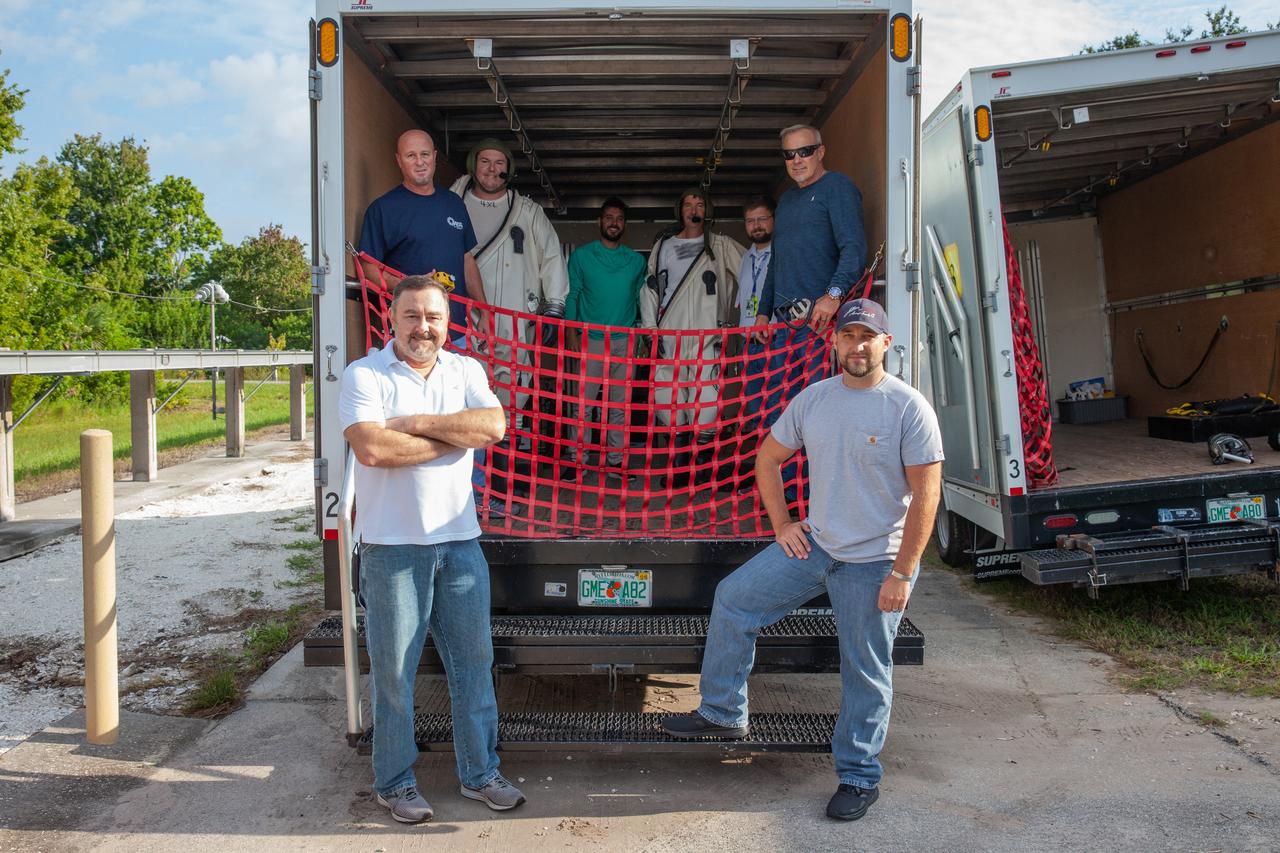
Technicians wearing Self-Contained Atmospheric Protective Ensemble (SCAPE) suits and operations support personnel prepare for a test simulation of loading propellants into a replicated test tank for Orion on Aug. 16, 2019, at NASA’s Kennedy Space Center in Florida. They are in a transport truck at the Multi-Operations Support Building near the Multi-Payload Processing Facility (MPPF). Exploration Ground Systems is preparing for Artemis 1 with a series of hazardous hyper test events at the MPPF. The technicians will complete a tanking to test the system before Orion arrives for processing. During preparations for launch, these teams will be responsible for loading the Orion vehicle with propellants prior to transportation to the Vehicle Assembly Building, where it will be secured atop the Space Launch System rocket. SCAPE suits are used in operations involving toxic propellants and are supplied with air either through a hardline or through a self-contained environmental control unit.
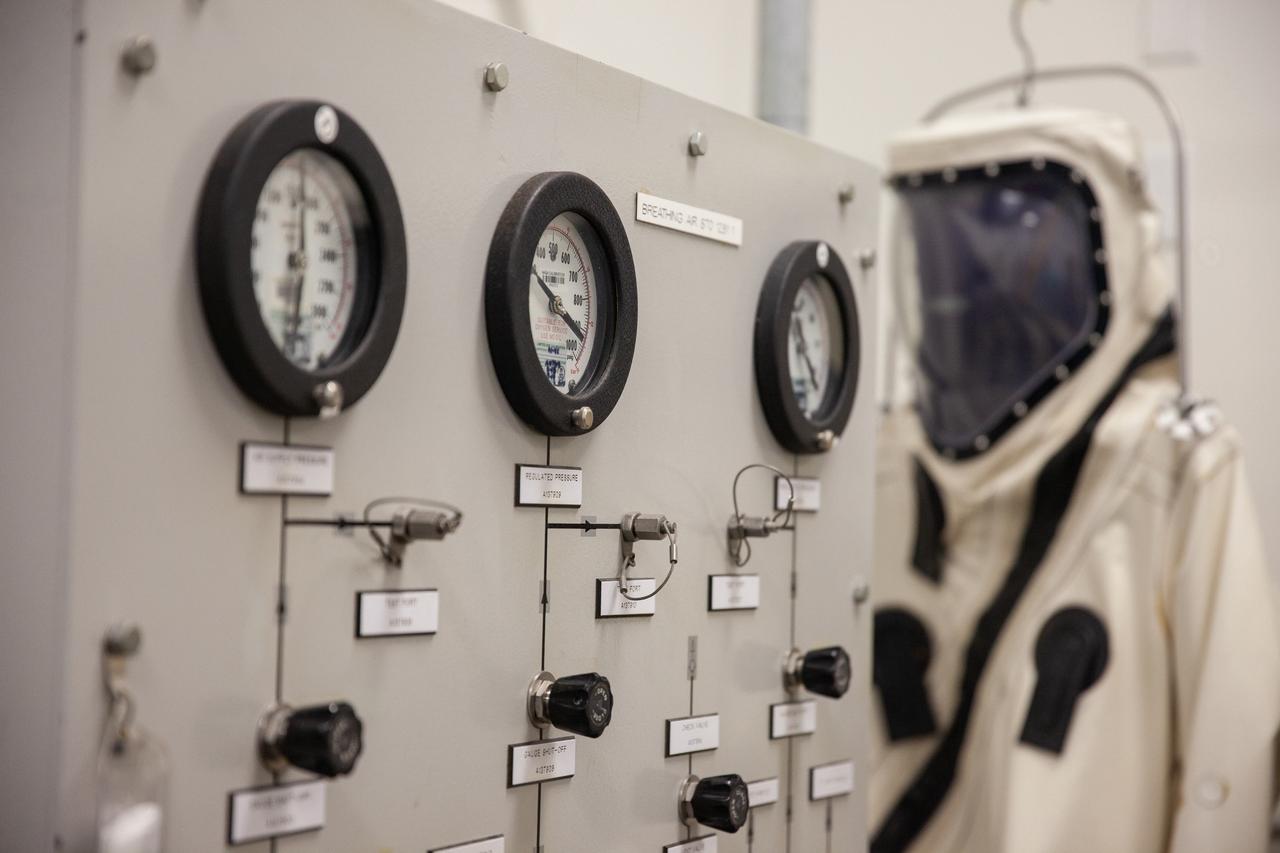
Inside the Multi-Operations Support Building near the Multi-Payload Processing Facility (MPPF) at NASA’s Kennedy Space Center in Florida on Aug. 16, 2019, a Self-Contained Atmospheric Protective Ensemble (SCAPE) suit is in view inside a changing room. SCAPE technicians are practicing putting on SCAPE suits and preparing for a test simulation of loading propellants into a replicated test tank for Orion. Exploration Ground Systems is preparing for Artemis 1 with a series of hazardous hyper test events at the MPPF. After donning their suits, the technicians will complete a tanking to test the system before Orion arrives for processing. During preparations for launch, these teams will be responsible for loading the Orion vehicle with propellants prior to transportation to the Vehicle Assembly Building, where it will be secured atop the Space Launch System rocket. SCAPE suits are used in operations involving toxic propellants and are supplied with air either through a hardline or through a self-contained environmental control unit.
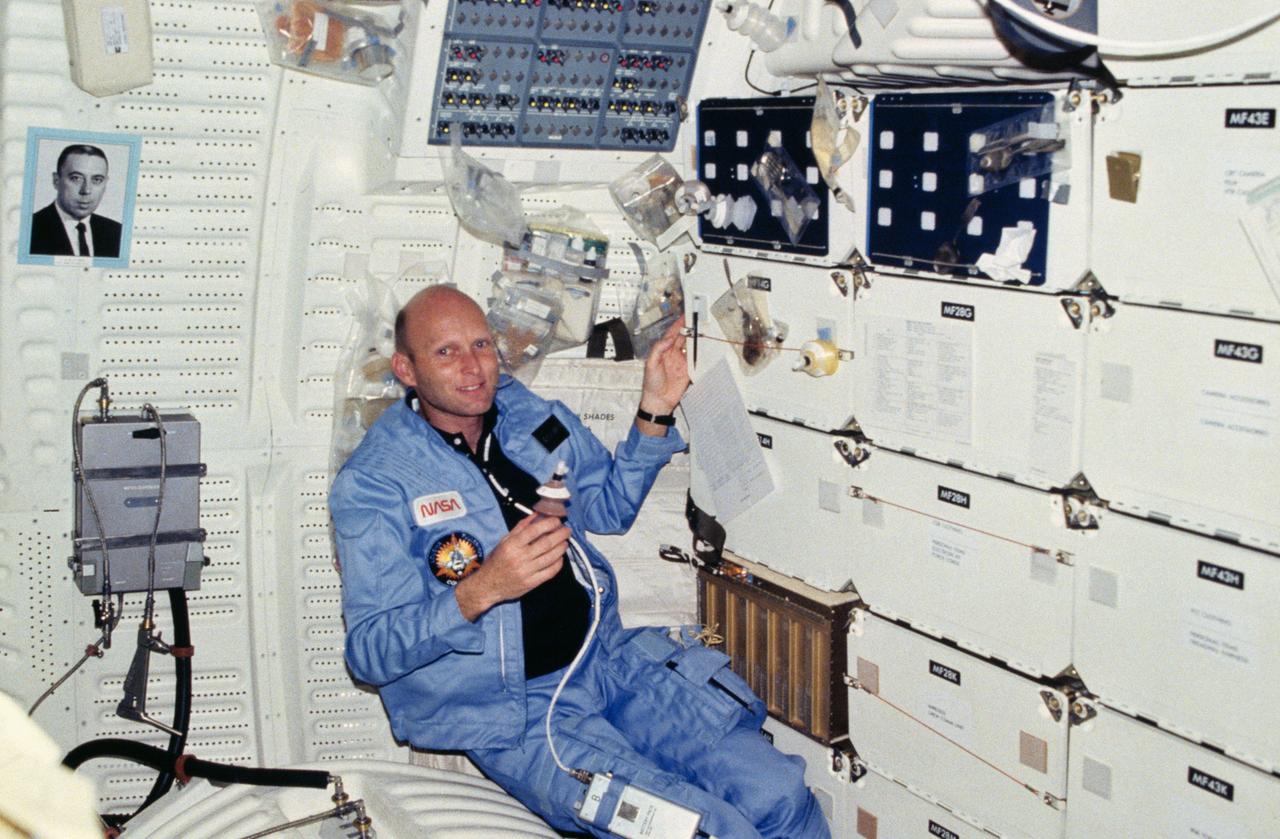
S82-28912 (March 1982) --- This picture, photographed with a 35mm camera operated by astronaut Jack R. Lousma, STS-3 commander, shows astronaut C. Gordon Fullerton, crew pilot, busy with mealtime preparations aboard the Earth-orbiting Columbia. The astronaut has positioned himself in the corner of the middeck area. Fullerton holds a beverage in his right hand in an accordion-like squeeze dispenser. Many packages of pre-packaged dehydrated foods and other meal items can be seen in the photo. Many are fastened to the locker doors and to trays in the locker doors by velcro. Reminiscent of STS-2 days, a portrait of George W. S. Abbey, director of flight operations at JSC, is at left edge. Photo credit: NASA
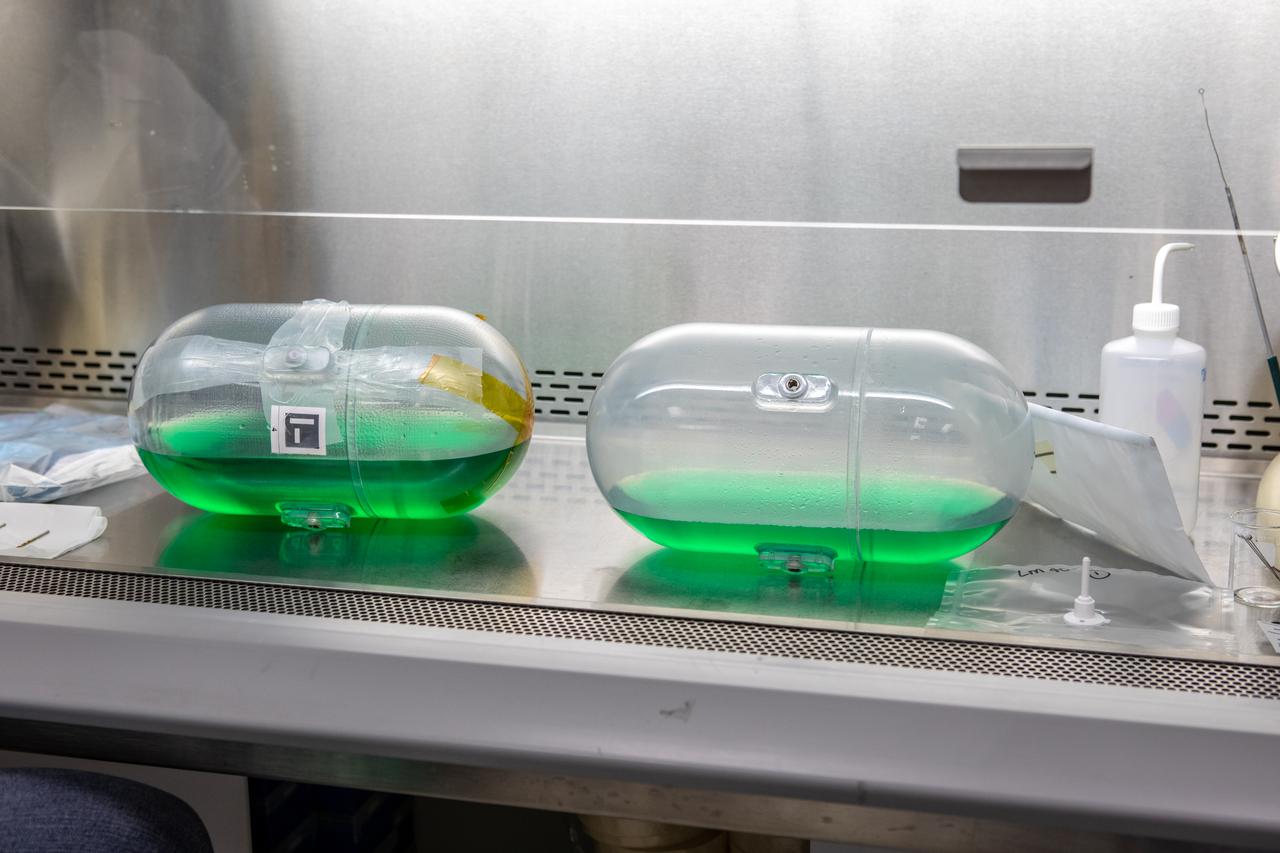
Researchers from NASA’s Kennedy Space Center Air and Water Revitalization lab are studying two tanks, containing water with green dye, inside the Neil Armstrong Operations and Checkout Building in Florida on Nov. 13, 2019. The tanks have recently returned to Kennedy after remaining on the International Space Station for the past five years, originally sent to space to study slosh – the movement of water – in a zero-gravity environment to help engineers predict the movement of propellant in rocket tanks. With the slosh experiment now concluded, the tanks are being examined to determine if there is, or was, any microbial growth within them. The results will help NASA determine whether clean water can be stored in space for long-duration missions, an essential component to keeping astronauts safe and healthy as the agency prepares for missions to the Moon and beyond to Mars.
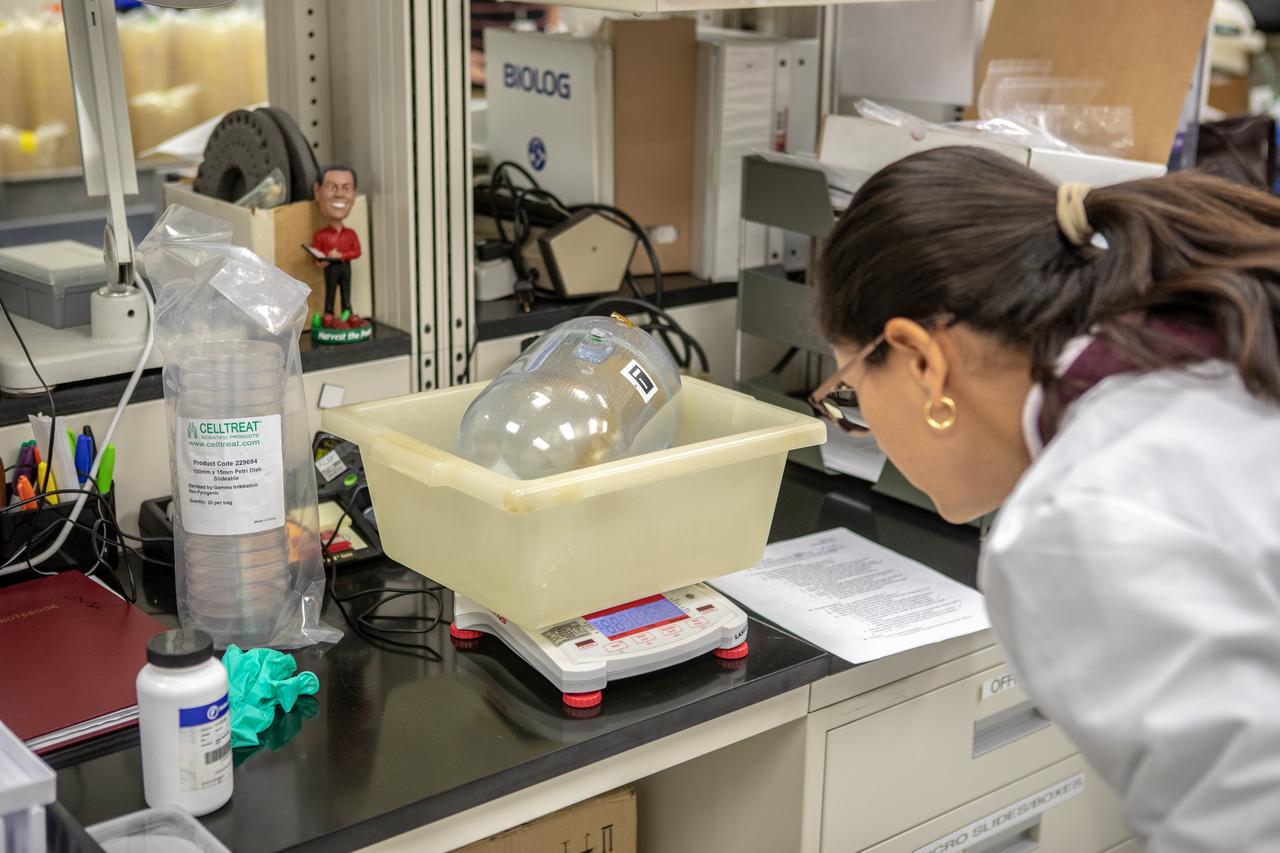
Kennedy Space Center’s Carolina Franco, Ph.D., weighs one of the water tanks, recently returned to the center after remaining on the International Space Station for the past five years, in the Florida spaceport’s Neil Armstrong Operations and Checkout Building on Nov. 13, 2019. Two tanks containing water were first sent to the orbiting laboratory in 2014 to study slosh, or the movement of water, in a zero-gravity environment to help engineers predict the movement of propellant in rocket tanks. Kennedy’s Air and Water Revitalization lab is studying the water tanks to determine if there is, or was, any microbial growth within them. The results will help NASA determine whether clean water can be stored in space for long-duration missions, an essential component to keeping astronauts safe and healthy as the agency prepares for missions to the Moon and beyond to Mars.
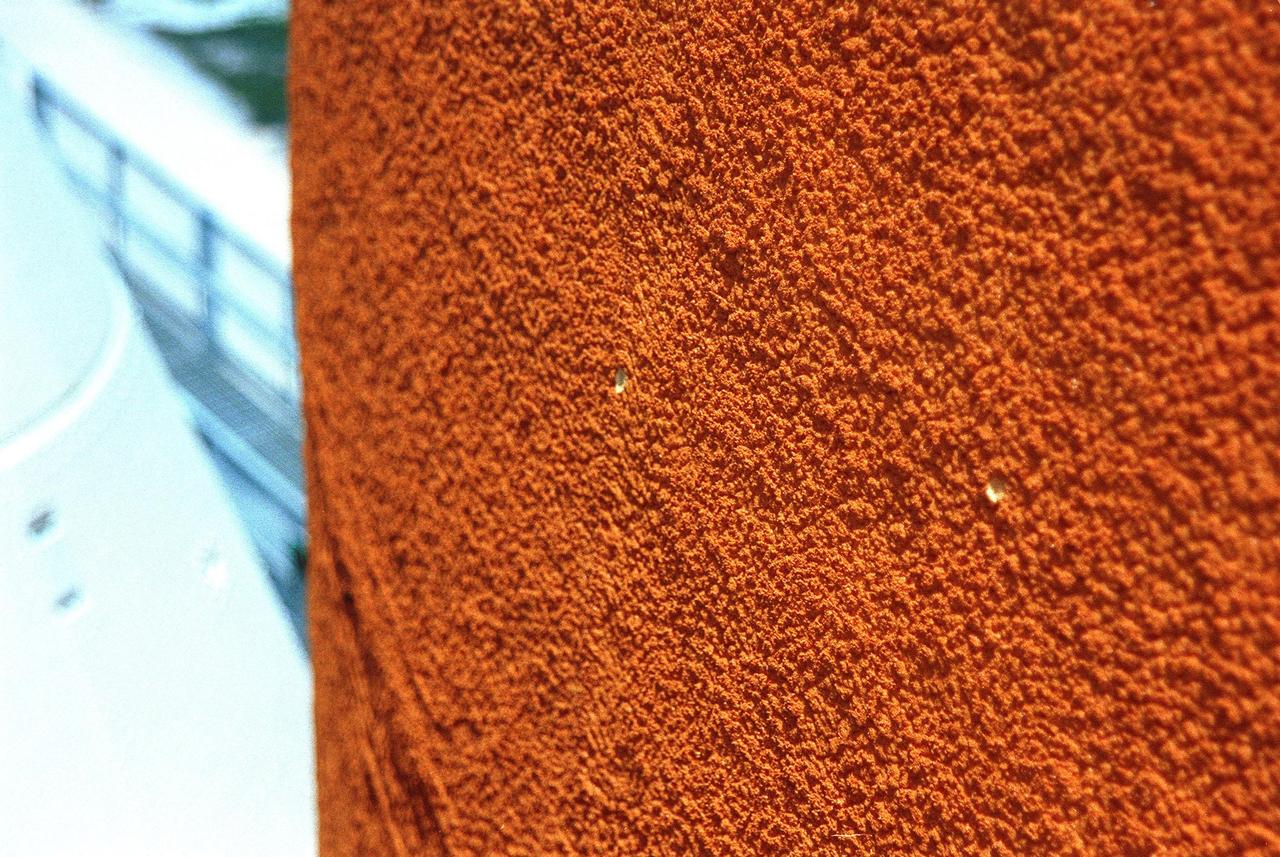
At Launch Pad 39B, two holes caused by hail on Space Shuttle Discovery's external tank (ET) are visible. Left of the tank is one of the solid rocket boosters. Workers are investigating the damage and potential problems for launch posed by ice forming in the holes, which may number as many as 150 over the entire tank. The average size of the holes is one-half inch in diameter and one-tenth inch deep. The external tank contains the liquid hydrogen fuel and liquid oxygen oxidizer and supplies them under pressure to the three space shuttle main engines in the orbiter during liftoff and ascent. The ET thermal protection system consists of sprayed-on foam insulation. The Shuttle Discovery is targeted for launch of mission STS-96 on May 20 at 9:32 a.m

NASA’s Pegasus barge departs from NASA’s Michoud Assembly Facility in New Orleans on April 21. The barge arrived at NASA’s Kennedy Space Center in Florida on April 27 with the largest section of the core stage for the agency’s SLS (Space Launch System) rocket that will launch the crewed Artemis III mission in 2027. Engineers will complete outfitting and vertical integration of the top four-fifths – the section containing the liquid hydrogen tank, liquid oxygen tank, intertank, and forward skirt – of the SLS core stage at NASA Kennedy. Next year’s Artemis III mission will launch astronauts to Earth’s orbit aboard the Orion spacecraft on top of SLS to test rendezvous and docking capabilities between Orion and commercial spacecraft needed to land Artemis IV astronauts on the Moon in 2028. NASA’s SLS is the only rocket capable of sending Orion, astronauts, and supplies to the Moon in a single launch. Image credit: NASA/Michael DeMocker

NASA’s Pegasus barge departs from NASA’s Michoud Assembly Facility in New Orleans on April 21. The barge arrived at NASA’s Kennedy Space Center in Florida on April 27 with the largest section of the core stage for the agency’s SLS (Space Launch System) rocket that will launch the crewed Artemis III mission in 2027. Engineers will complete outfitting and vertical integration of the top four-fifths – the section containing the liquid hydrogen tank, liquid oxygen tank, intertank, and forward skirt – of the SLS core stage at NASA Kennedy. Next year’s Artemis III mission will launch astronauts to Earth’s orbit aboard the Orion spacecraft on top of SLS to test rendezvous and docking capabilities between Orion and commercial spacecraft needed to land Artemis IV astronauts on the Moon in 2028. NASA’s SLS is the only rocket capable of sending Orion, astronauts, and supplies to the Moon in a single launch. Image credit: NASA/Michael DeMocker

NASA’s Pegasus barge departs from NASA’s Michoud Assembly Facility in New Orleans on April 21. The barge arrived at NASA’s Kennedy Space Center in Florida on April 27 with the largest section of the core stage for the agency’s SLS (Space Launch System) rocket that will launch the crewed Artemis III mission in 2027. Engineers will complete outfitting and vertical integration of the top four-fifths – the section containing the liquid hydrogen tank, liquid oxygen tank, intertank, and forward skirt – of the SLS core stage at NASA Kennedy. Next year’s Artemis III mission will launch astronauts to Earth’s orbit aboard the Orion spacecraft on top of SLS to test rendezvous and docking capabilities between Orion and commercial spacecraft needed to land Artemis IV astronauts on the Moon in 2028. NASA’s SLS is the only rocket capable of sending Orion, astronauts, and supplies to the Moon in a single launch. Image credit: NASA/Michael DeMocker

NASA’s Pegasus barge departs from NASA’s Michoud Assembly Facility in New Orleans on April 21. The barge arrived at NASA’s Kennedy Space Center in Florida on April 27 with the largest section of the core stage for the agency’s SLS (Space Launch System) rocket that will launch the crewed Artemis III mission in 2027. Engineers will complete outfitting and vertical integration of the top four-fifths – the section containing the liquid hydrogen tank, liquid oxygen tank, intertank, and forward skirt – of the SLS core stage at NASA Kennedy. Next year’s Artemis III mission will launch astronauts to Earth’s orbit aboard the Orion spacecraft on top of SLS to test rendezvous and docking capabilities between Orion and commercial spacecraft needed to land Artemis IV astronauts on the Moon in 2028. NASA’s SLS is the only rocket capable of sending Orion, astronauts, and supplies to the Moon in a single launch. Image credit: NASA/Michael DeMocker

NASA’s Pegasus barge departs from NASA’s Michoud Assembly Facility in New Orleans on April 21. The barge arrived at NASA’s Kennedy Space Center in Florida on April 27 with the largest section of the core stage for the agency’s SLS (Space Launch System) rocket that will launch the crewed Artemis III mission in 2027. Engineers will complete outfitting and vertical integration of the top four-fifths – the section containing the liquid hydrogen tank, liquid oxygen tank, intertank, and forward skirt – of the SLS core stage at NASA Kennedy. Next year’s Artemis III mission will launch astronauts to Earth’s orbit aboard the Orion spacecraft on top of SLS to test rendezvous and docking capabilities between Orion and commercial spacecraft needed to land Artemis IV astronauts on the Moon in 2028. NASA’s SLS is the only rocket capable of sending Orion, astronauts, and supplies to the Moon in a single launch. Image credit: NASA/Michael DeMocker
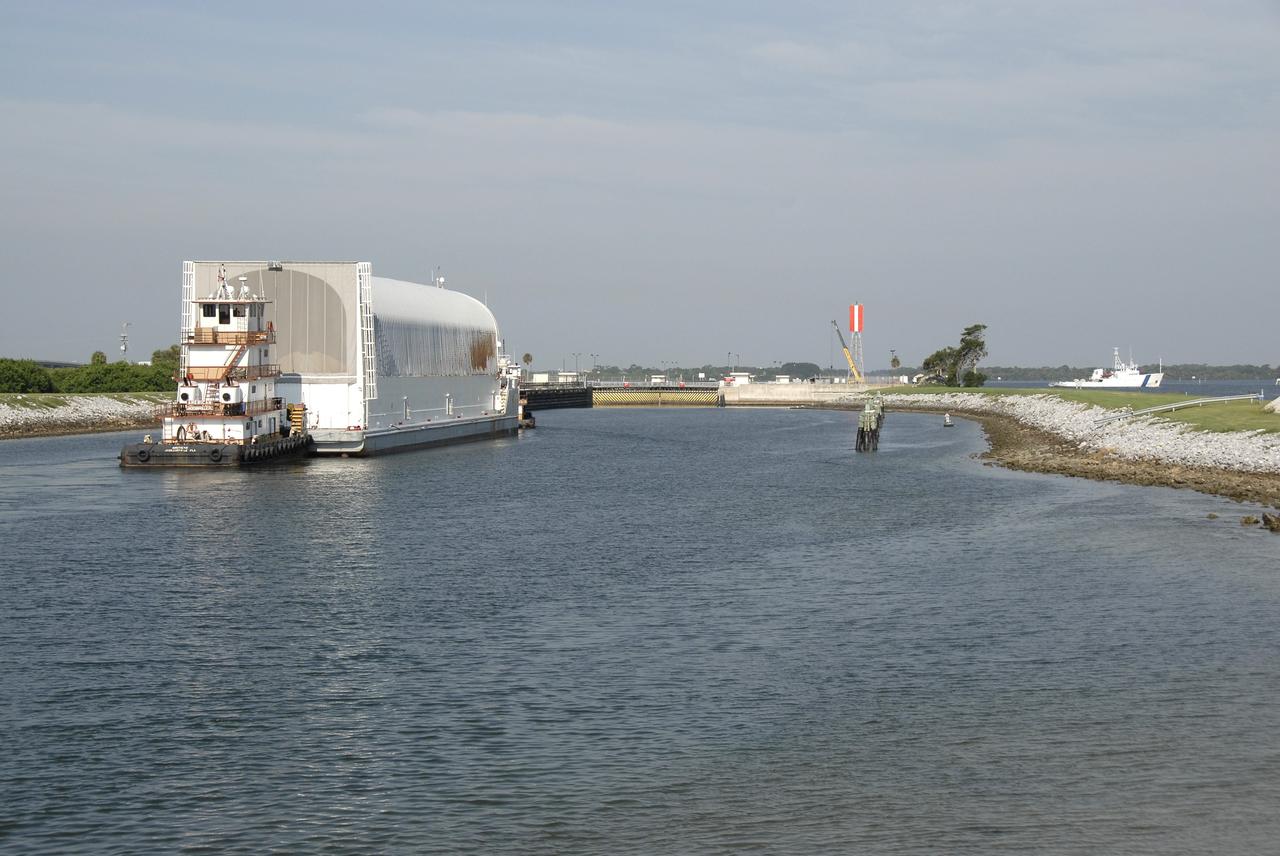
CAPE CANAVERAL, Fla. – The Pegasus barge containing the external fuel tank for space shuttle Endeavour's STS-126 mission to the International Space Station is towed by a tugboat from Port Canaveral, Fla., for its trip on the Banana River to the Launch Complex 39 Area at NASA's Kennedy Space Center. The tank will be offloaded at the turn basin near the Vehicle Assembly Building and transported to the VAB. There it will be lifted and lowered into a checkout cell. The STS-126 mission will deliver a Multi-Purpose Logistics Module to the International Space Station. Launch is targeted for Nov. 10. Photo credit: NASA/Kim Shiflett
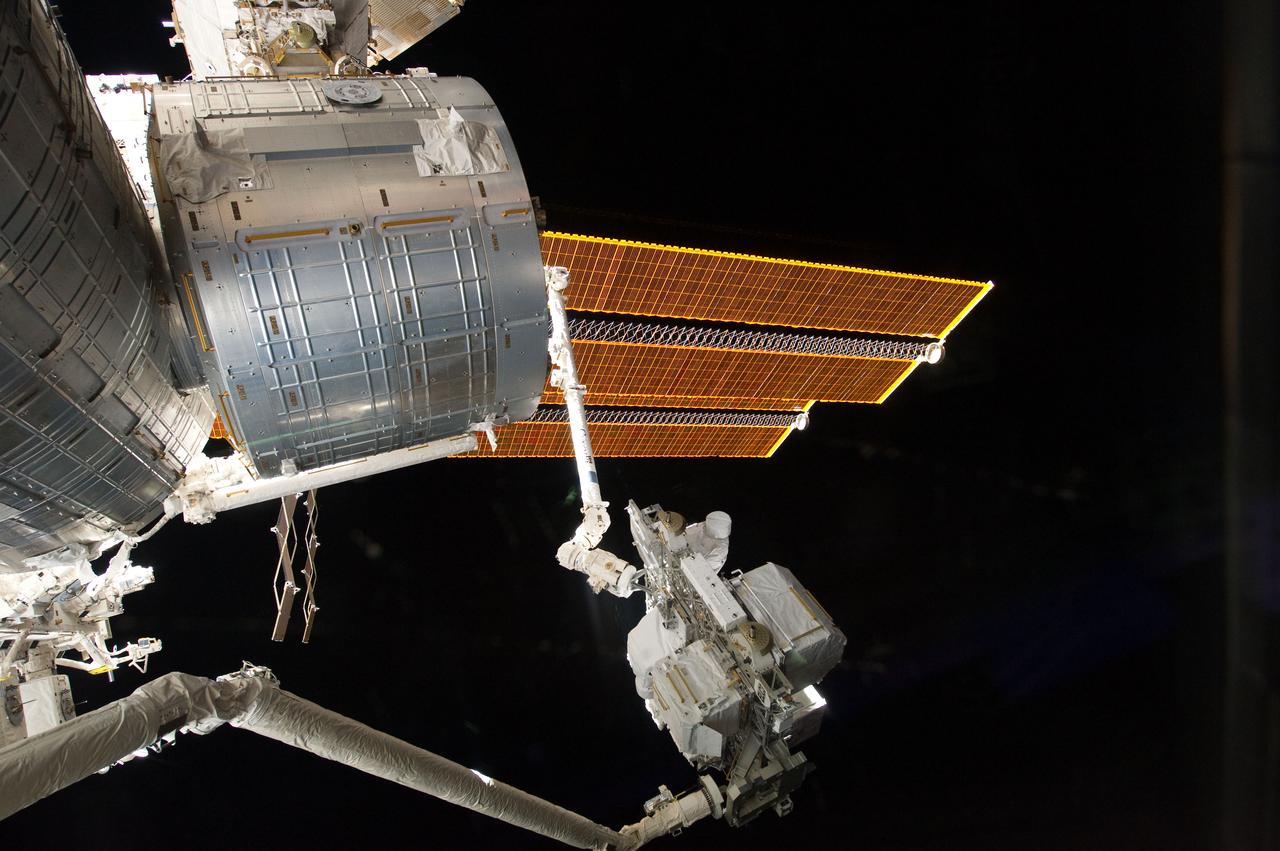
S134-E-007321 (18 May 2011) --- The handoff between space shuttle Endeavour?s robotic Canadarm and the International Space Station?s Canadarm2 of the Express Logistics Carrier-3 (ELC-3) is featured in this image photographed by an STS-134 crew member on the station. The ELC-3 was later installed on the left side of the station?s truss structure. ELC-3 holds spare hardware for future station use, including an ammonia tank, a high pressure gas tank, a cargo transport container, two S-band antenna assemblies and a spare arm for DEXTRE, the Special Purpose Dexterous Manipulator. Photo credit: NASA
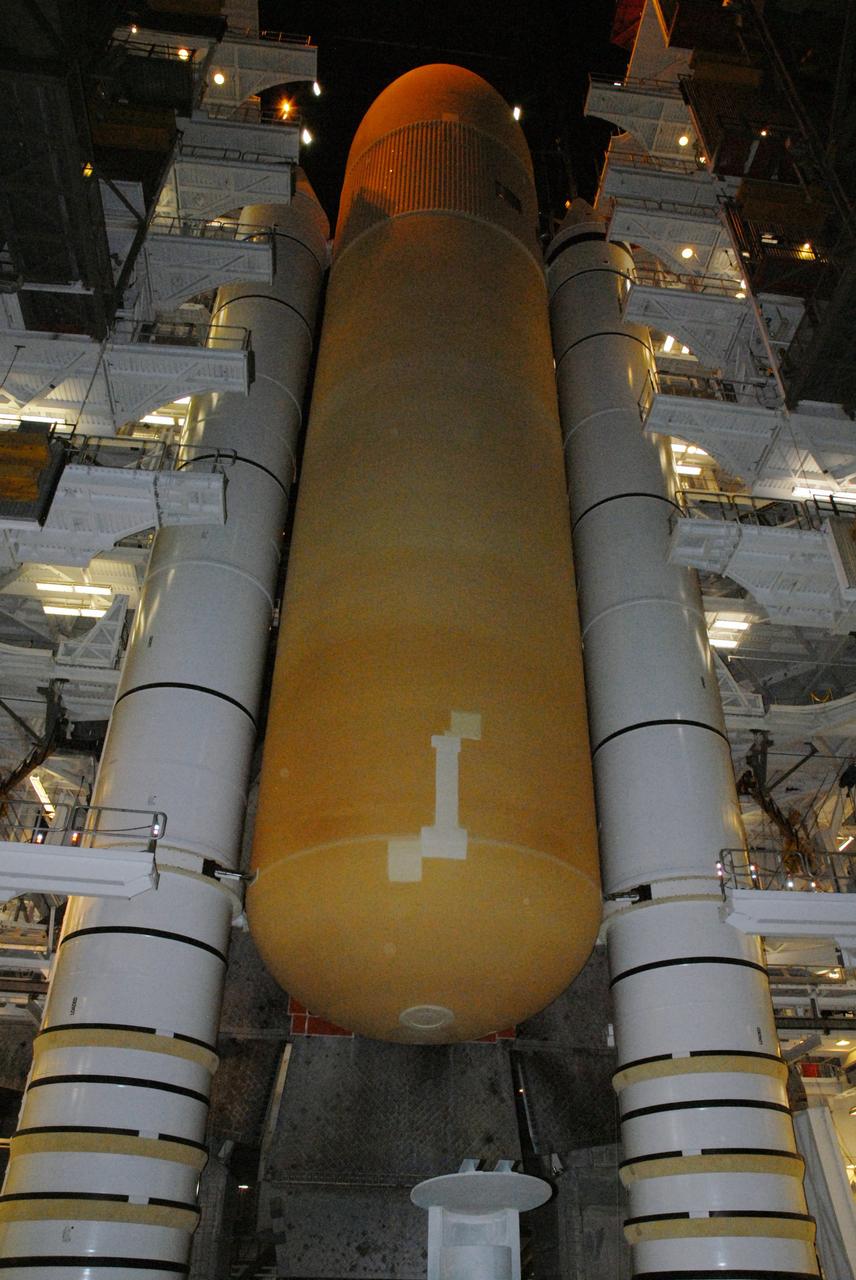
CAPE CANAVERAL, Fla. – In High Bay 1 of the Vehicle Assembly Building at NASA's Kennedy Space Center in Florida, the solid rocket boosters flank the external fuel tank that will be attached to space shuttle Discovery. The SRBs and external tank are already stacked on the mobile launcher platform. Discovery is scheduled to roll out to Launch Pad 39A the first week of August to prepare for the STS-128 mission to the International Space Station. The shuttle will carry the Leonardo Multi-Purpose Logistics Module containing life support racks and science racks and the Lightweight Multi-Purpose Experiment Support Structure Carrier in its payload bay. Launch of Discovery is targeted for late August. Photo credit: NASA/Ben Smegelsky
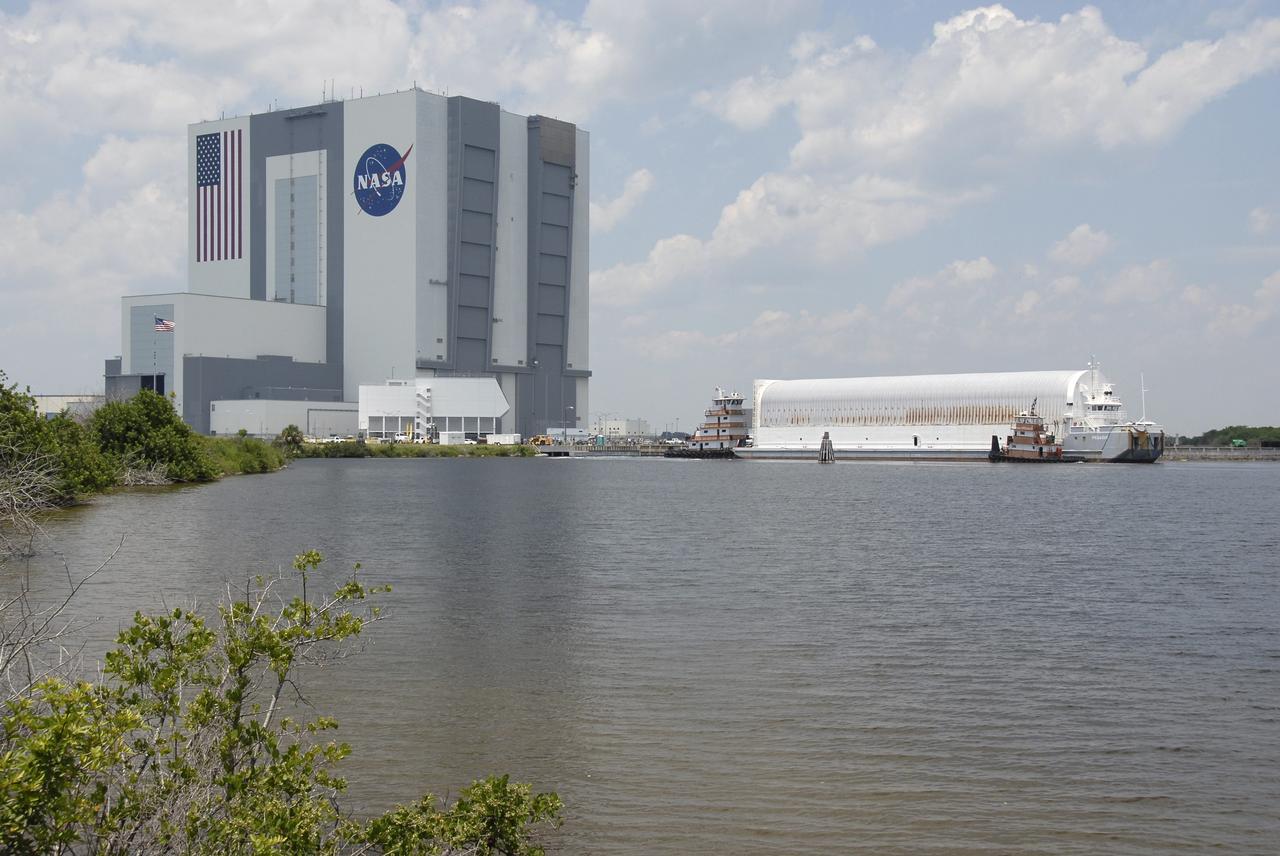
CAPE CANAVERAL, Fla. – Two tugboats maneuver the Pegasus barge toward the dock in the turn basin at the Launch Complex 39 Area at NASA's Kennedy Space Center. The barge contains the external fuel tank for space shuttle Endeavour's STS-126 mission to the International Space Station. The tank will be offloaded at the turn basin near the Vehicle Assembly Building and transported to the VAB. There it will be lifted and lowered into a checkout cell. The STS-126 mission will deliver a Multi-Purpose Logistics Module to the International Space Station. Launch is targeted for Nov. 10. Photo credit: NASA/Kim Shiflett
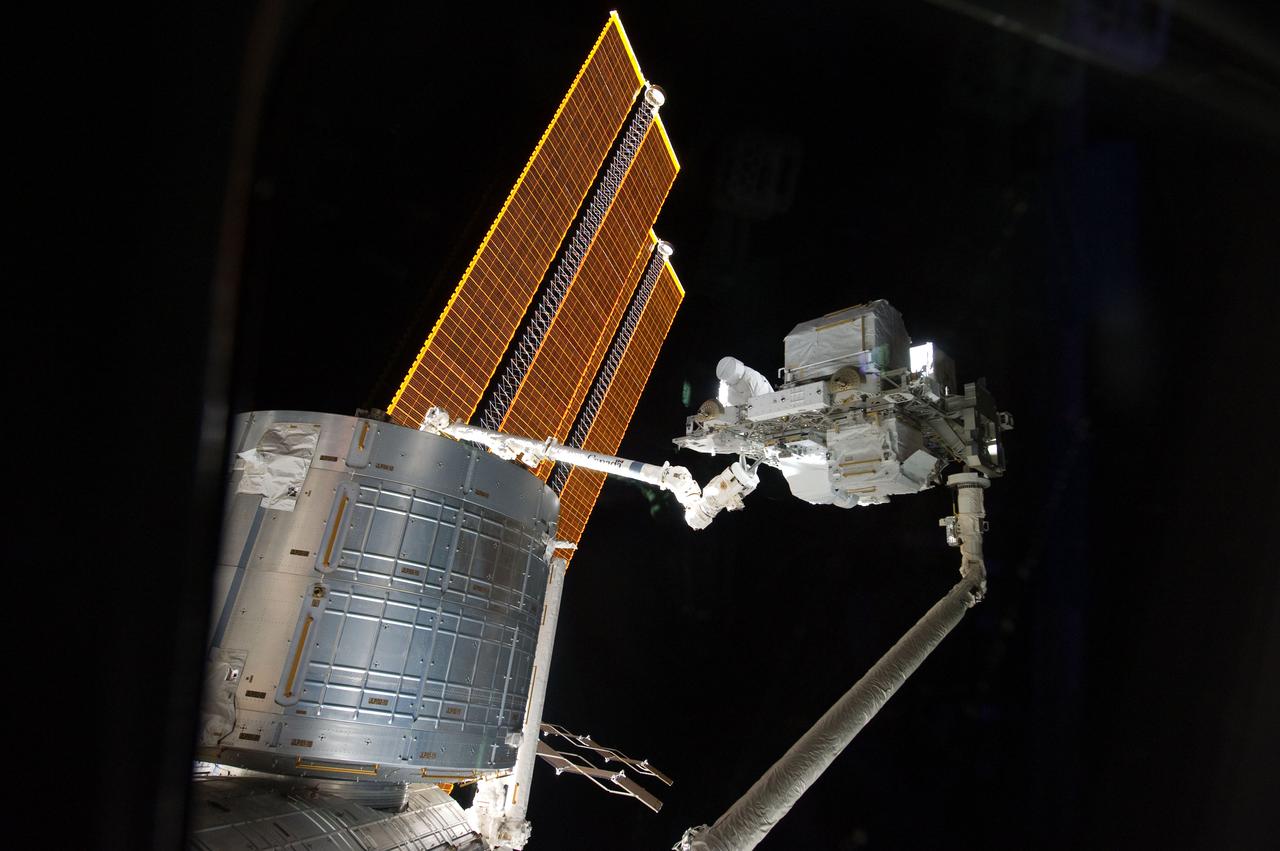
S134-E-007327 (18 May 2011) --- The handoff between space shuttle Endeavour?s robotic Canadarm and the International Space Station?s Canadarm2 of the Express Logistics Carrier-3 (ELC-3) is featured in this image photographed by an STS-134 crew member on the station. The ELC-3 was later installed on the left side of the station?s truss structure. ELC-3 holds spare hardware for future station use, including an ammonia tank, a high pressure gas tank, a cargo transport container, two S-band antenna assemblies and a spare arm for DEXTRE, the Special Purpose Dexterous Manipulator. Photo credit: NASA
CAPE CANAVERAL, Fla. – Towed by a tugboat, the Pegasus barge containing the external fuel tank for space shuttle Endeavour's STS-126 mission to the International Space Station arrives in the turn basin at the Launch Complex 39 Area at NASA's Kennedy Space Center. The tank will be offloaded at the turn basin near the Vehicle Assembly Building and transported to the VAB. There it will be lifted and lowered into a checkout cell. The STS-126 mission will deliver a Multi-Purpose Logistics Module to the International Space Station. Launch is targeted for Nov. 10. Photo credit: NASA/Kim Shiflett
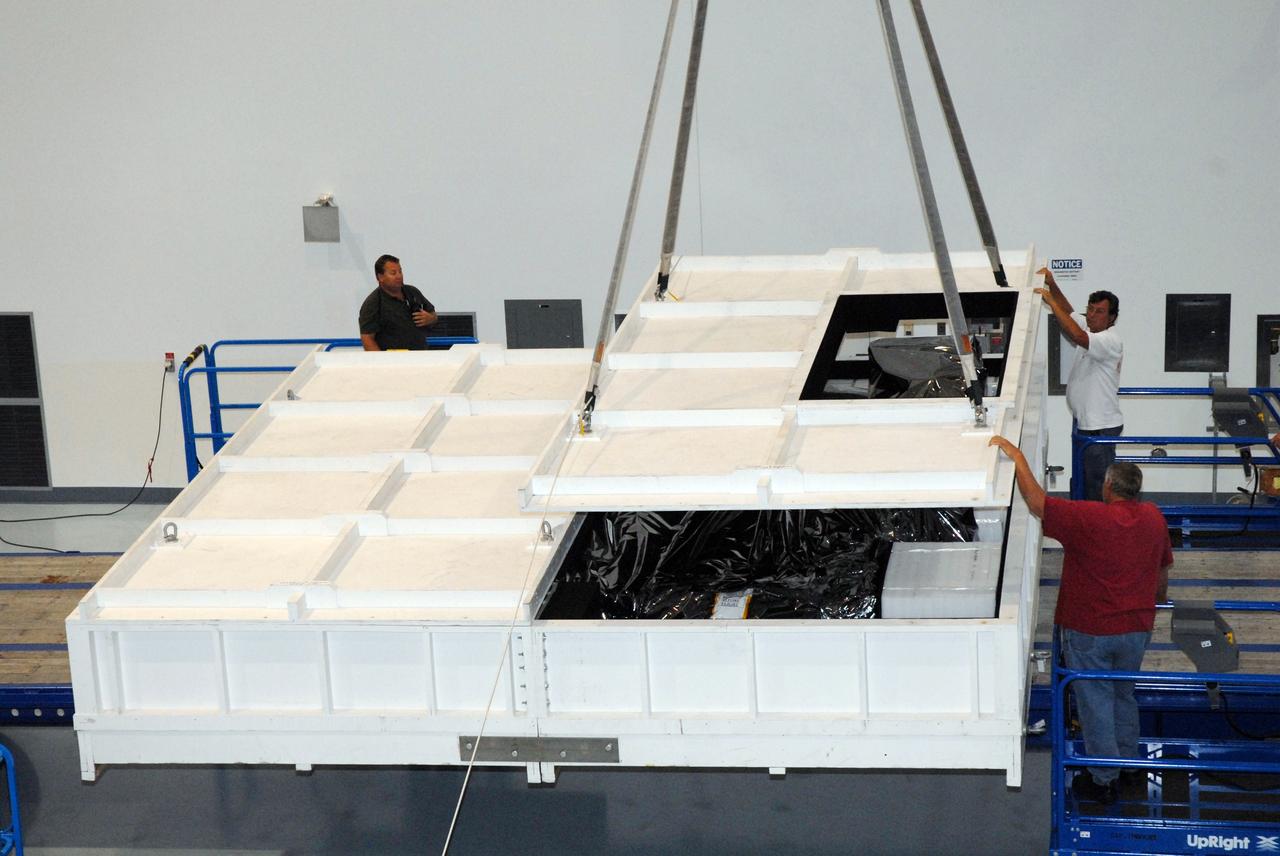
CAPE CANAVERAL, Fla. – Inside the Space Station Processing Facility at NASA's Kennedy Space Center in Florida, workers begin removing the shipping container from around the EXPRESS Logistics Carrier for the STS-129 mission. The carrier is part of the payload on space shuttle Atlantis, which will deliver to the International Space Station components including two spare gyroscopes, two nitrogen tank assemblies, two pump modules, an ammonia tank assembly and a spare latching end effector for the station's robotic arm. STS-129 is targeted to launch Nov. 12. Photo credit: NASA/Tim Jacobs
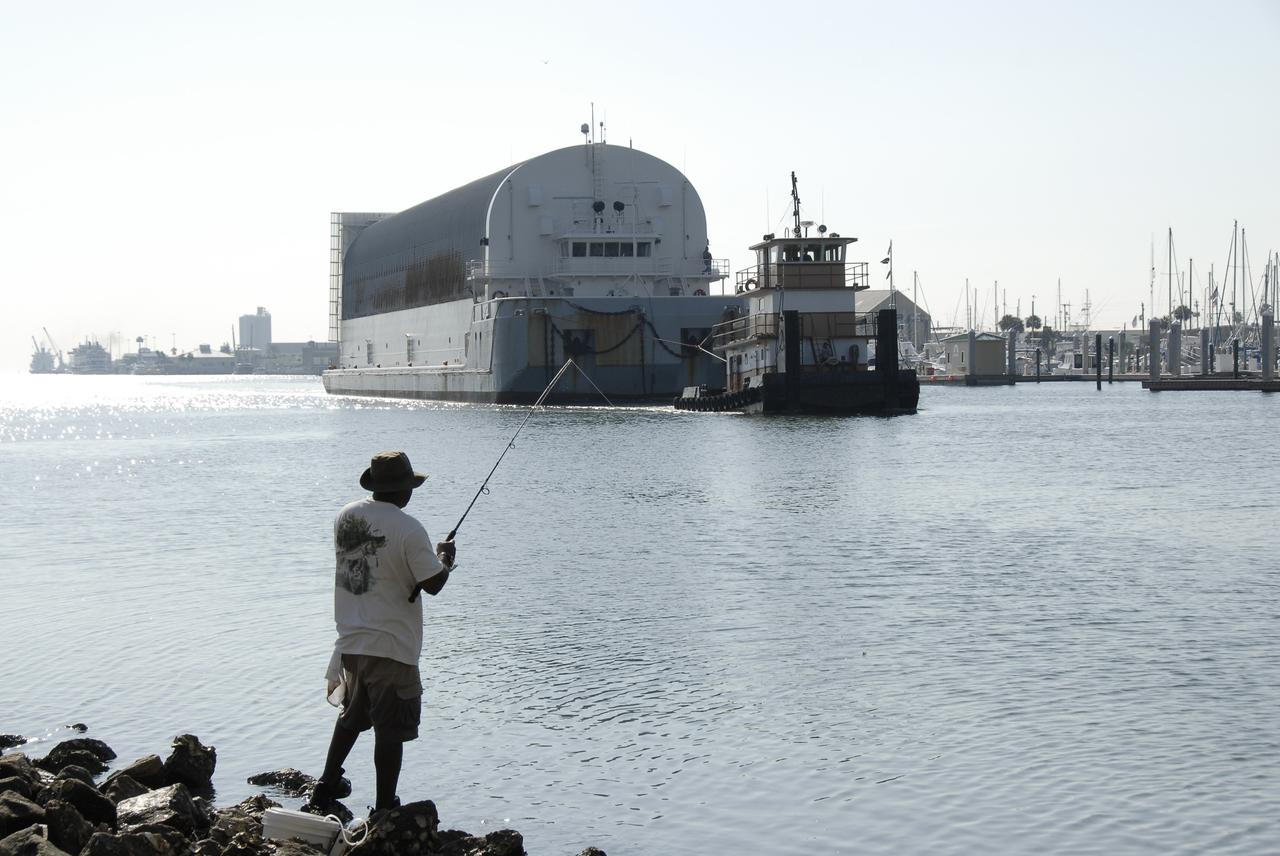
CAPE CANAVERAL, Fla. – The Pegasus barge containing the external fuel tank for space shuttle Endeavour's STS-126 mission to the International Space Station is towed by a tugboat from Port Canaveral, Fla., for its trip on the Banana River to the Launch Complex 39 Area at NASA's Kennedy Space Center. The tank will be offloaded at the turn basin near the Vehicle Assembly Building and transported to the VAB. There it will be lifted and lowered into a checkout cell. The STS-126 mission will deliver a Multi-Purpose Logistics Module to the International Space Station. Launch is targeted for Nov. 10. Photo credit: NASA/Kim Shiflett
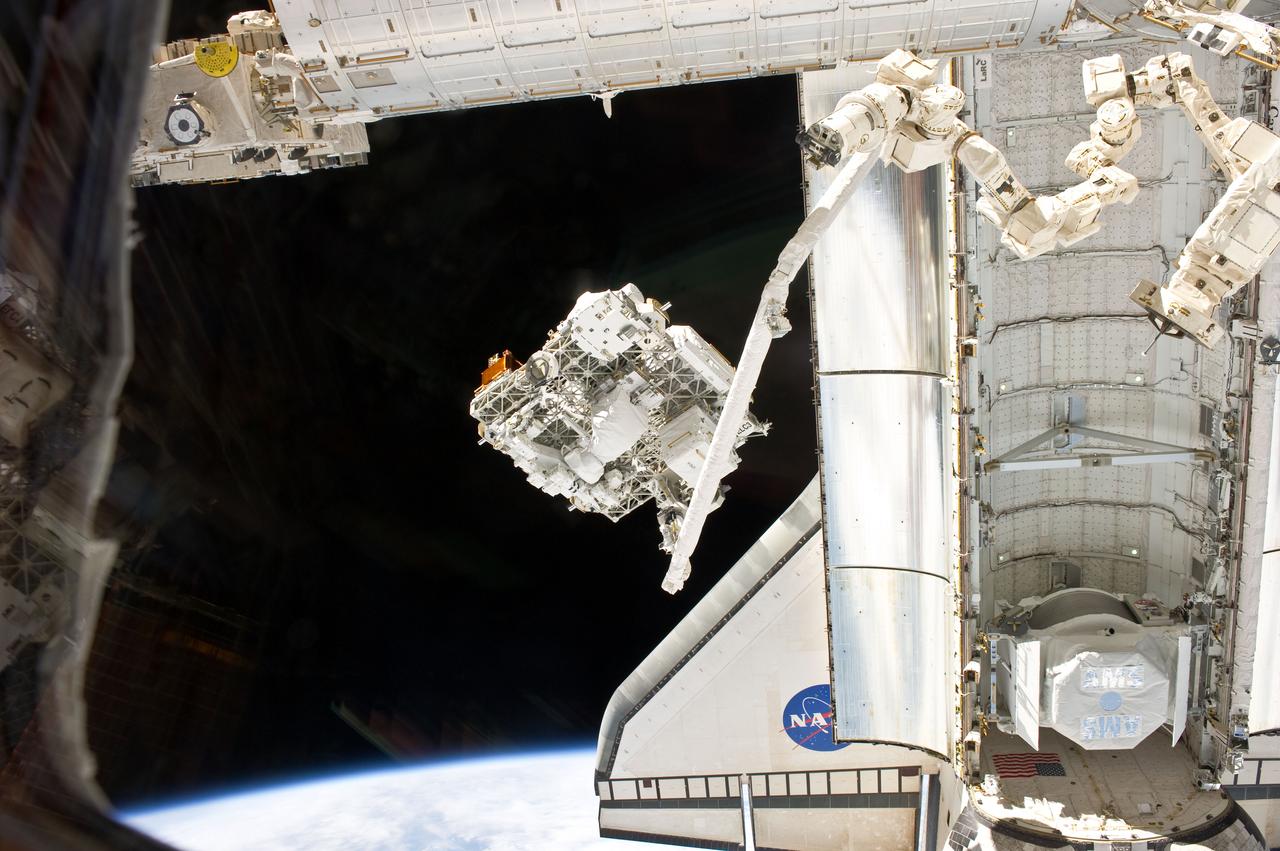
S134-E-007141 (18 May 2011) --- In the grasp of space shuttle Endeavour?s robotic Canadarm, the Express Logistics Carrier-3 (ELC-3) is transferred from Endeavour?s payload bay for hand off to the International Space Station?s Canadarm2 to be installed on the left side of the station?s truss structure. ELC-3 holds spare hardware for future station use, including an ammonia tank, a high pressure gas tank, a cargo transport container, two S-band antenna assemblies and a spare arm for DEXTRE, the Special Purpose Dexterous Manipulator. Photo credit: NASA

S134-E-007314 (18 May 2011) --- The handoff between space shuttle Endeavour?s robotic Canadarm and the International Space Station?s Canadarm2 of the Express Logistics Carrier-3 (ELC-3) is featured in this image photographed by an STS-134 crew member on the station. The ELC-3 was later installed on the left side of the station?s truss structure. ELC-3 holds spare hardware for future station use, including an ammonia tank, a high pressure gas tank, a cargo transport container, two S-band antenna assemblies and a spare arm for DEXTRE, the Special Purpose Dexterous Manipulator. Photo credit: NASA
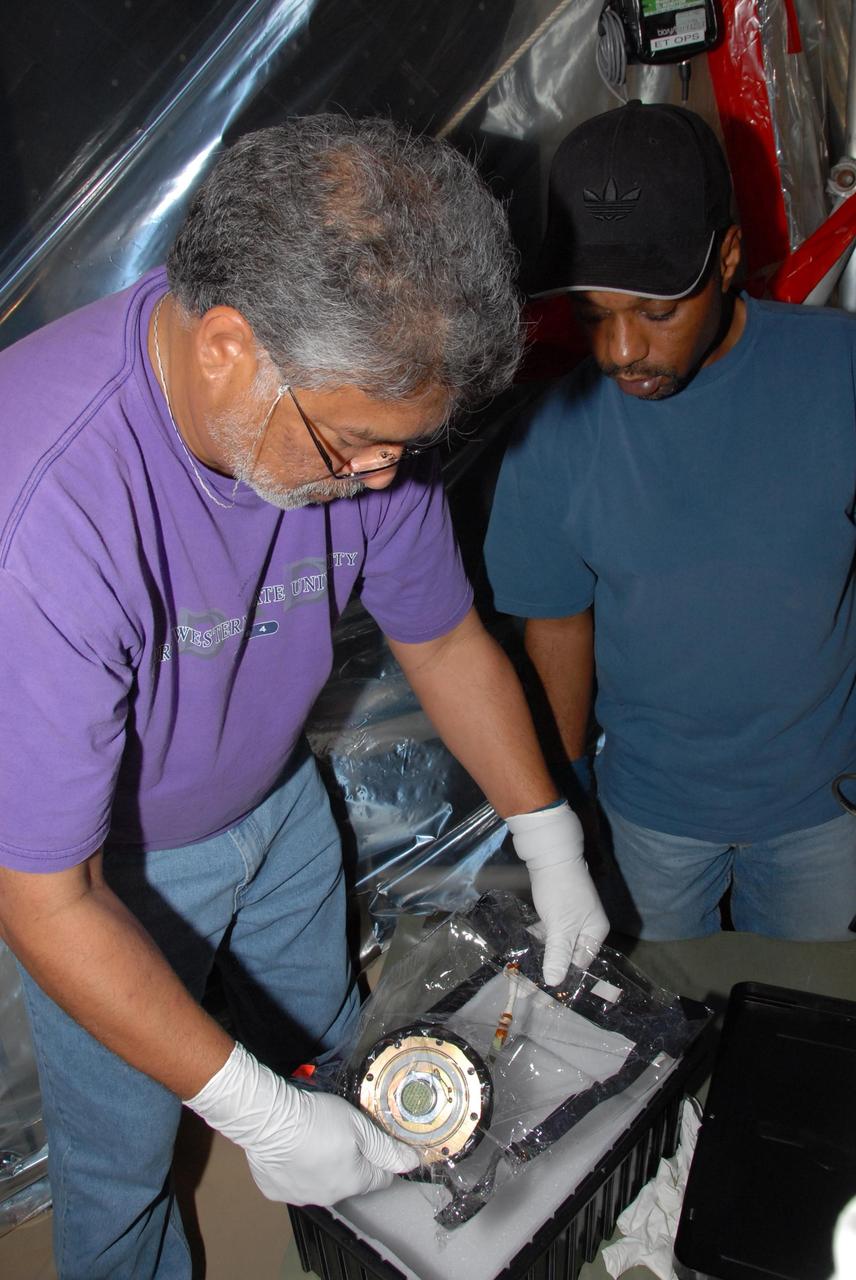
KENNEDY SPACE CENTER, FLA. -- At Launch Pad 39A, a team of external tank specialists from Lockheed Martin and the United Space Alliance undertakes the task of removing the hydrogen feed-through connector in support of space shuttle Atlantis' STS-122 mission. Here, technicians place the wrapped connector in a shipping container for transport to NASA's Marshall Space Flight Center in Huntsville, Ala., for further cryogenic testing. Some of the tank's engine cutoff sensors, or ECO sensors, failed during propellant tanking for launch attempts on Dec. 6 and Dec. 9. Results of a tanking test on Dec. 18 pointed to an open circuit in the feed-through connector wiring, which is located at the base of the tank. The feed-through connector passes the wires from the inside of the tank to the outside. After the data from additional testing on the connector is analyzed, shuttle program managers will decide on a forward plan. Launch of STS-122 is targeted for January 2008. Photo credit: NASA/George Shelton
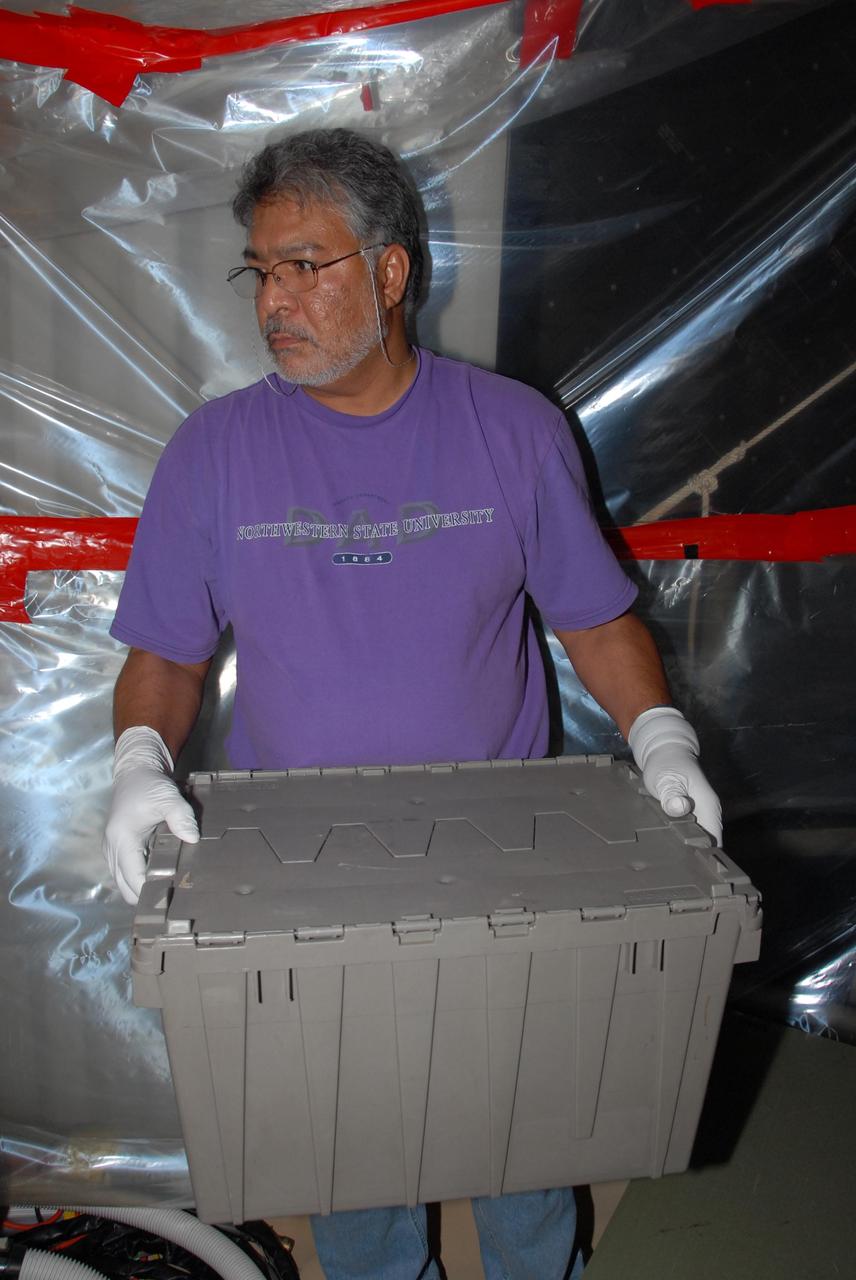
KENNEDY SPACE CENTER, FLA. -- At Launch Pad 39A, a team of external tank specialists from Lockheed Martin and the United Space Alliance undertakes the task of removing the hydrogen feed-through connector in support of space shuttle Atlantis' STS-122 mission. Here, a technician carries the shipping container in which the wrapped connector is secured for transport to NASA's Marshall Space Flight Center in Huntsville, Ala., for further cryogenic testing. Some of the tank's engine cutoff sensors, or ECO sensors, failed during propellant tanking for launch attempts on Dec. 6 and Dec. 9. Results of a tanking test on Dec. 18 pointed to an open circuit in the feed-through connector wiring, which is located at the base of the tank. The feed-through connector passes the wires from the inside of the tank to the outside. After the data from additional testing on the connector is analyzed, shuttle program managers will decide on a forward plan. Launch of STS-122 is targeted for January 2008. Photo credit: NASA/George Shelton
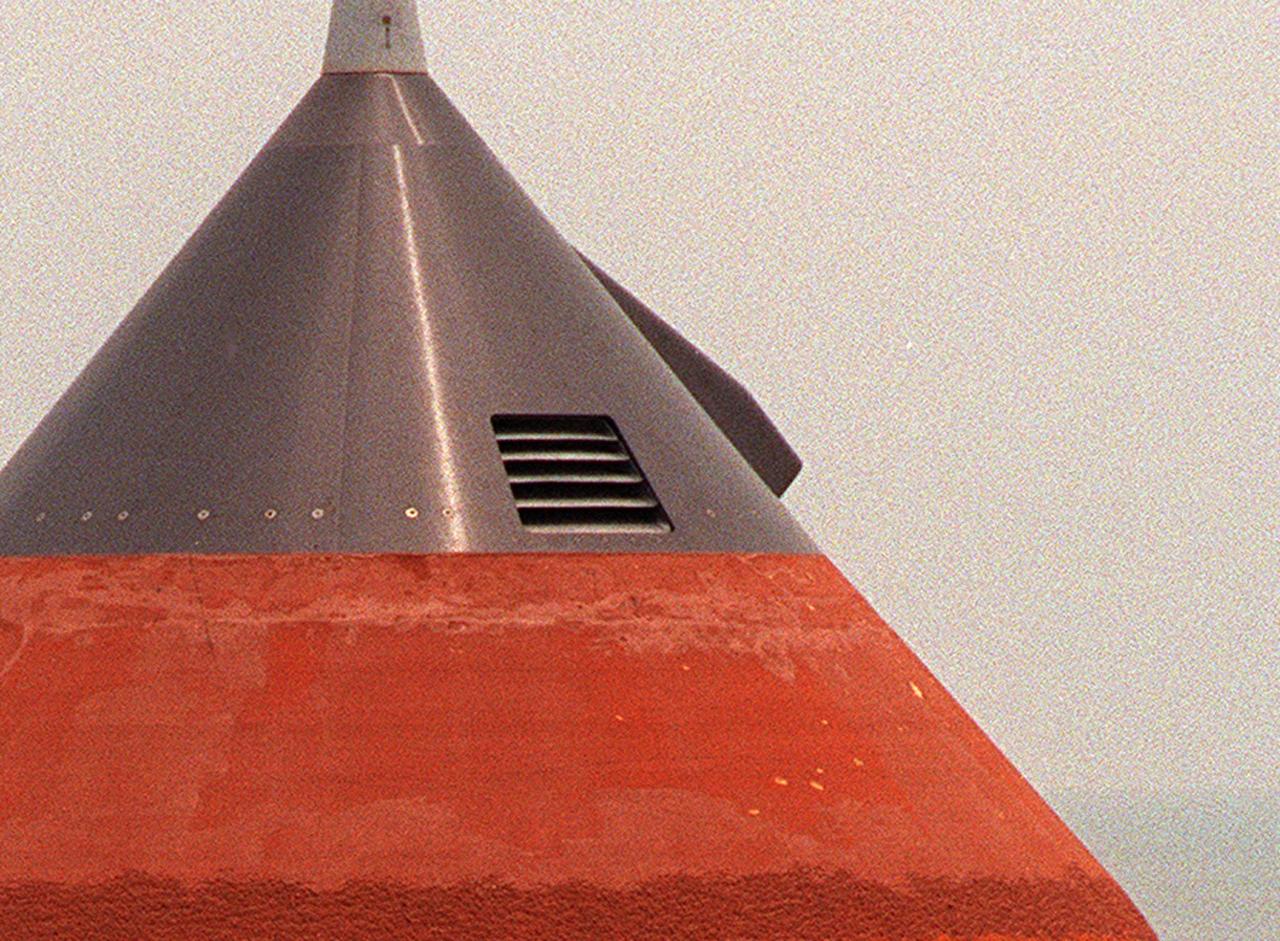
At Launch Pad 39B, the top of the external tank (ET) mated to Space Shuttle Discovery is dotted with nearly a dozen visible dings from recent hail storms. Workers are investigating the damage and potential problems for launch posed by ice forming in the holes, which may number as many as 150 over the entire tank. The average size of the dings is one-half inch in diameter and one-tenth inch deep. The external tank contains the liquid hydrogen fuel and liquid oxygen oxidizer and supplies them under pressure to the three space shuttle main engines in the orbiter during liftoff and ascent. The ET thermal protection system consists of sprayed-on foam insulation. The Shuttle Discovery is targeted for launch of mission STS-96 on May 20 at 9:32 a.m
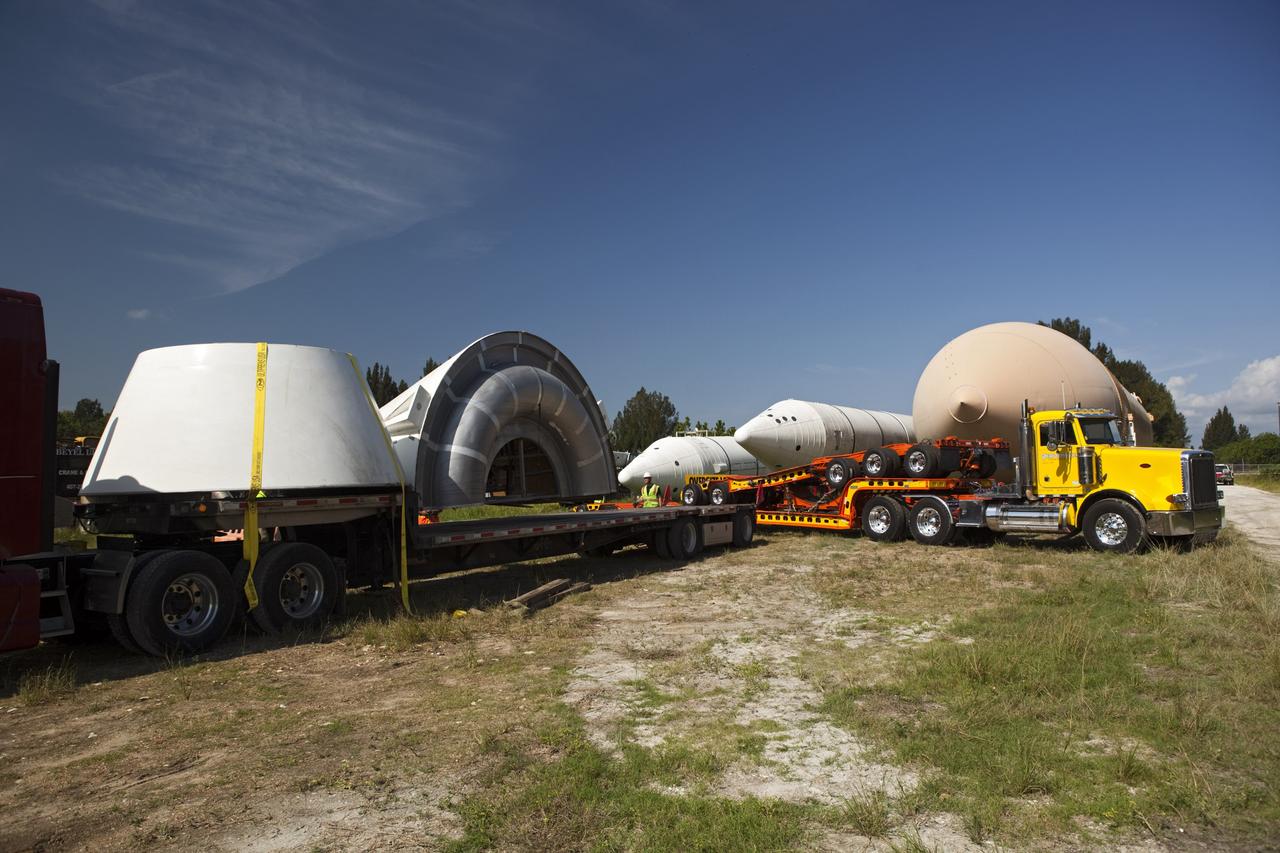
CAPE CANAVERAL, Fla. – At NASA’s Kennedy Space Center in Florida, aft skirts for space shuttle solid rocket boosters are being loaded on a truck. A twin set of space shuttle solid rocket boosters and an external fuel tank are being prepared for transport to separate museums. The solid rocket boosters, or SRBs, will be displayed at the California Science Center in Los Angeles. The external tank soon will be transported for display at the Wings of Dreams Aviation Museum at Keystone Heights Airport between Gainesville and Jacksonville, Fla. The 149-foot SRBs together provided six million pounds of thrust. The external fuel tank contained over 500,000 gallons of liquid hydrogen and liquid oxygen propellant for the shuttle orbiters' three main engines. The work is part of Transition and Retirement of the space shuttle. For more information, visit http://www.nasa.gov/transition Photo credit: NASA/ Dimitri Gerondidakis
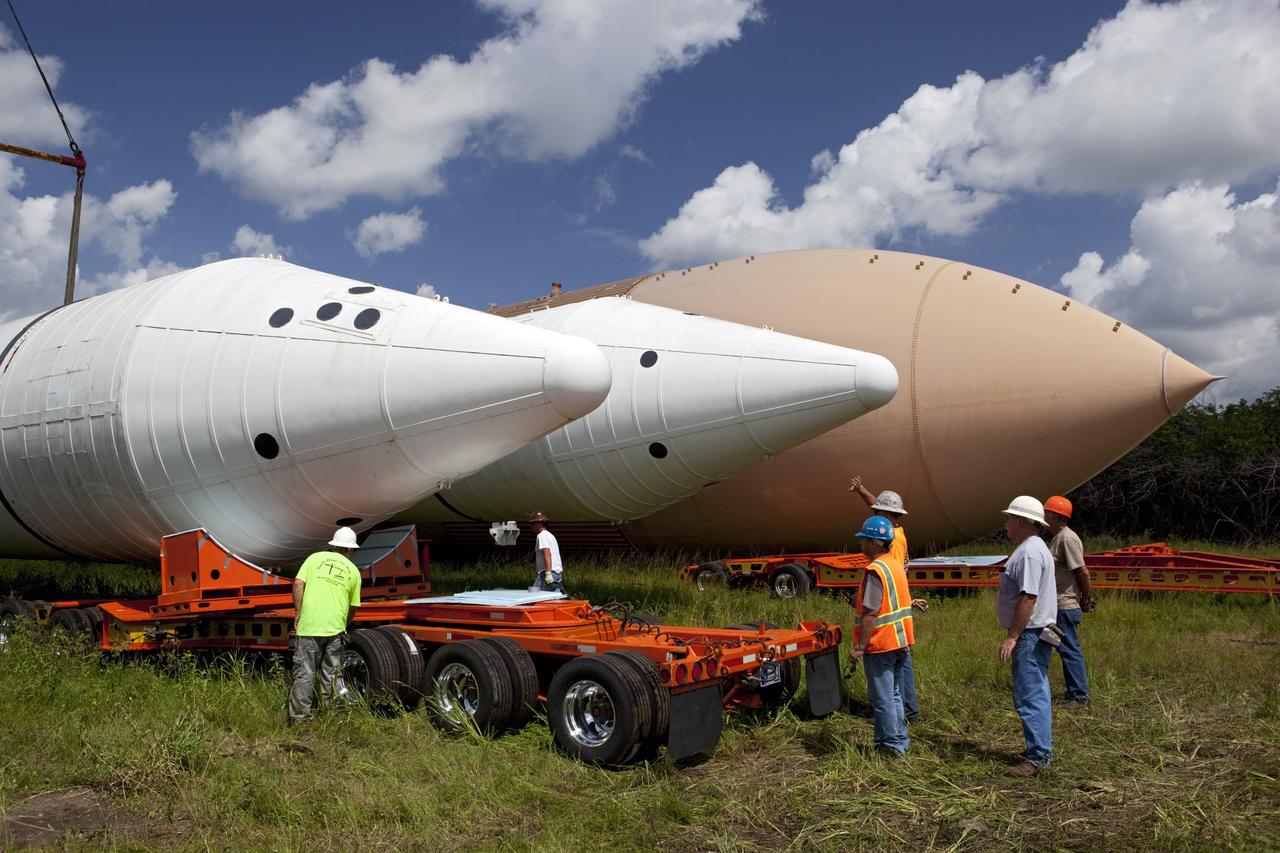
CAPE CANAVERAL, Fla. – At NASA’s Kennedy Space Center in Florida, preparations are underway to load a twin set of space shuttle solid rocket boosters and an external fuel tank on trucks for transport to separate museums. The solid rocket boosters, or SRBs, will be displayed at the California Science Center in Los Angeles. The external tank soon will be transported for display at the Wings of Dreams Aviation Museum at Keystone Heights Airport between Gainesville and Jacksonville, Fla. The 149-foot SRBs together provided six million pounds of thrust. The external fuel tank contained over 500,000 gallons of liquid hydrogen and liquid oxygen propellant for the shuttle orbiters' three main engines. The work is part of Transition and Retirement of the space shuttle. For more information, visit http://www.nasa.gov/transition Photo credit: NASA/ Dimitri Gerondidakis
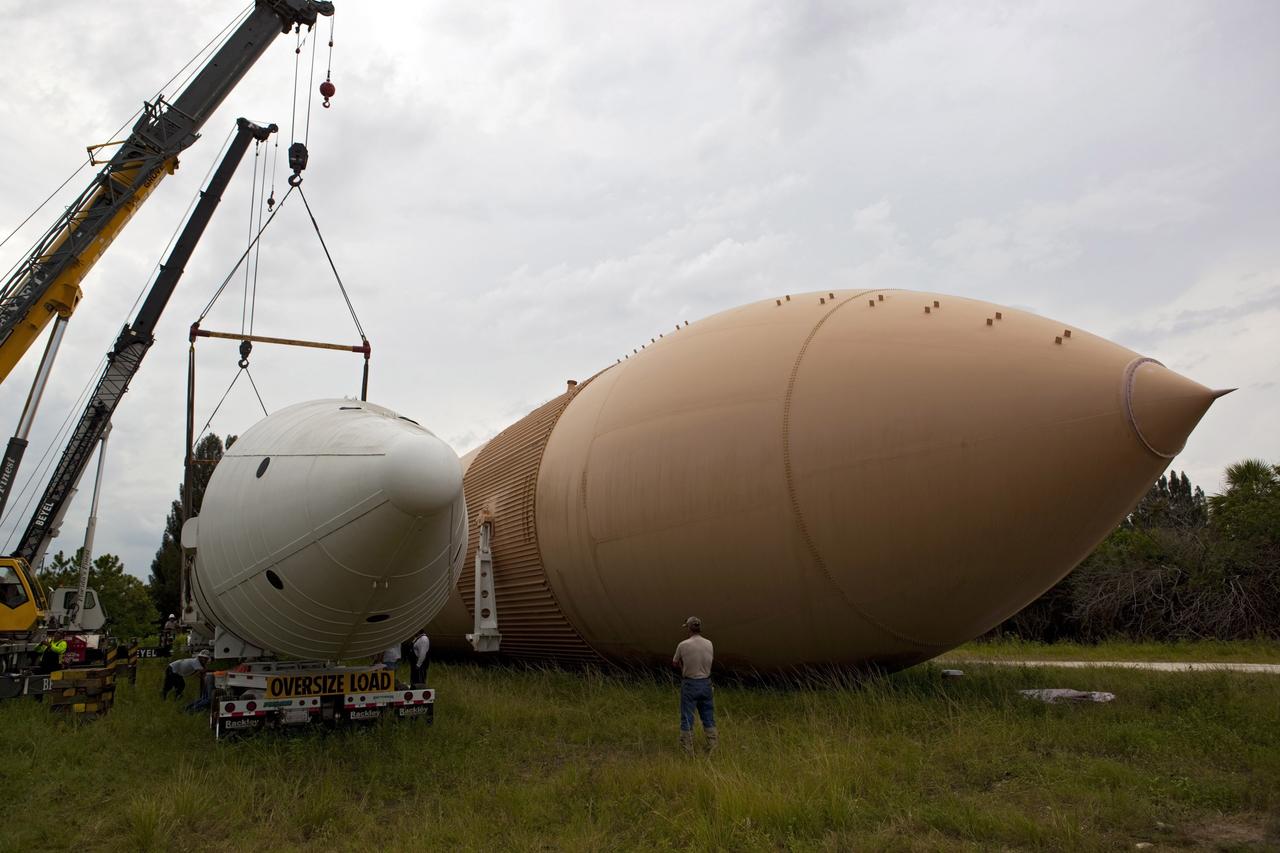
CAPE CANAVERAL, Fla. – At NASA’s Kennedy Space Center in Florida, a crane is used to load a space shuttle solid rocket booster and an external fuel tank on trucks for transport to separate museums. The solid rocket boosters, or SRBs, will be displayed at the California Science Center in Los Angeles. The external tank soon will be transported for display at the Wings of Dreams Aviation Museum at Keystone Heights Airport between Gainesville and Jacksonville, Fla. The 149-foot SRBs together provided six million pounds of thrust. The external fuel tank contained over 500,000 gallons of liquid hydrogen and liquid oxygen propellant for the shuttle orbiters' three main engines. The work is part of Transition and Retirement of the space shuttle. For more information, visit http://www.nasa.gov/transition Photo credit: NASA/ Dimitri Gerondidakis
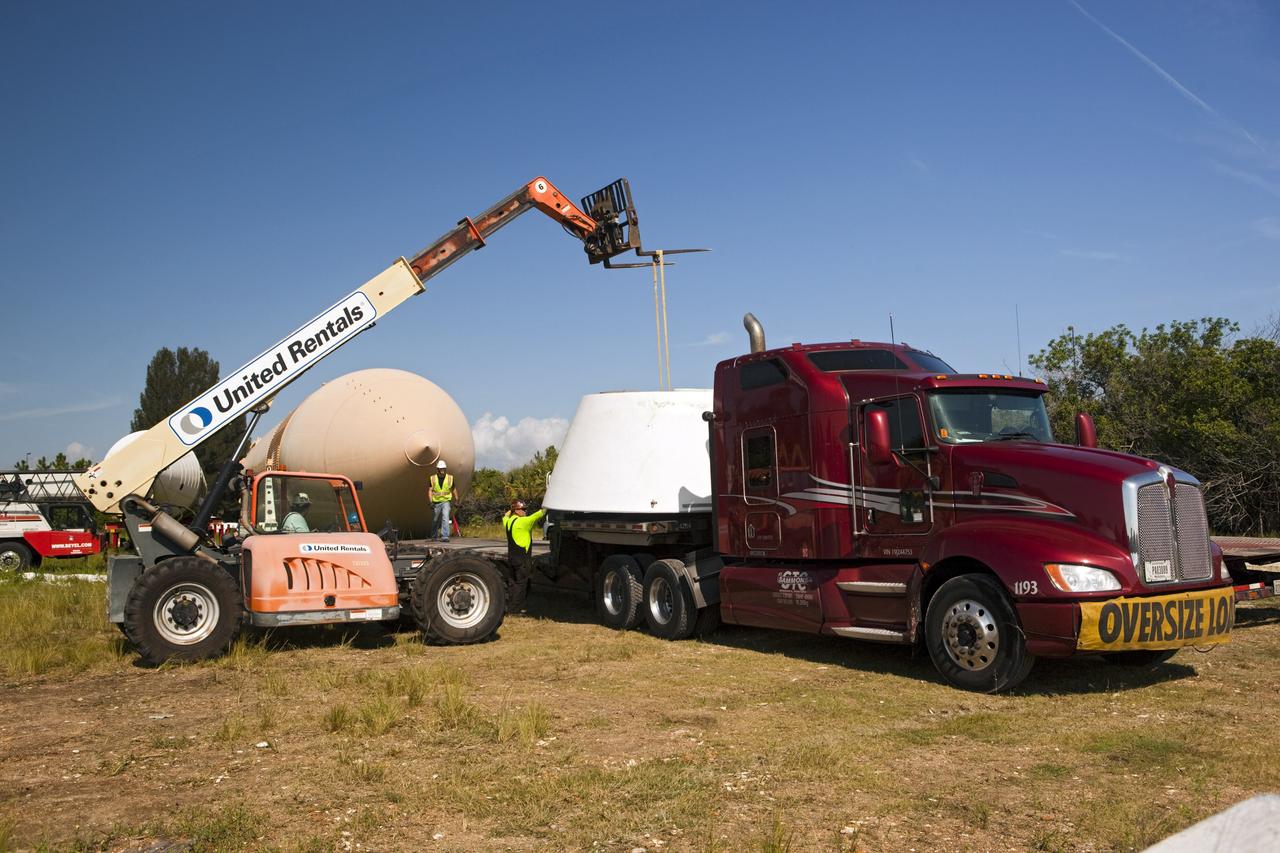
CAPE CANAVERAL, Fla. – At NASA’s Kennedy Space Center in Florida, a crane is used to load the aft skirt for a space shuttle solid rocket booster on a truck. A twin set of space shuttle solid rocket boosters and an external fuel tank are being prepared for transport to separate museums. The solid rocket boosters, or SRBs, will be displayed at the California Science Center in Los Angeles. The external tank soon will be transported for display at the Wings of Dreams Aviation Museum at Keystone Heights Airport between Gainesville and Jacksonville, Fla. The 149-foot SRBs together provided six million pounds of thrust. The external fuel tank contained over 500,000 gallons of liquid hydrogen and liquid oxygen propellant for the shuttle orbiters' three main engines. The work is part of Transition and Retirement of the space shuttle. For more information, visit http://www.nasa.gov/transition Photo credit: NASA/ Dimitri Gerondidakis
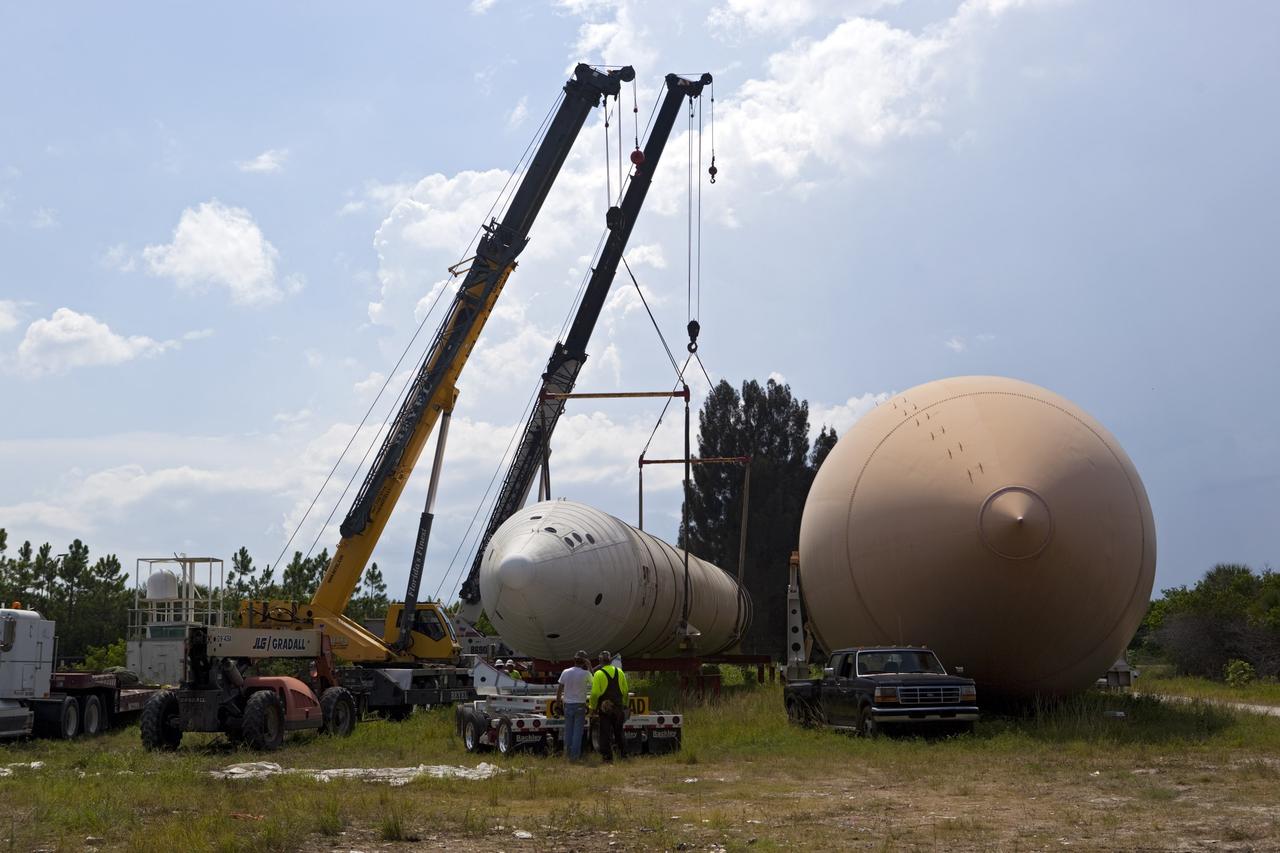
CAPE CANAVERAL, Fla. – At NASA’s Kennedy Space Center in Florida, a crane is used to load a space shuttle solid rocket booster and an external fuel tank on to trucks for transport to separate museums. The solid rocket boosters, or SRBs, will be displayed at the California Science Center in Los Angeles. The external tank soon will be transported for display at the Wings of Dreams Aviation Museum at Keystone Heights Airport between Gainesville and Jacksonville, Fla. The 149-foot SRBs together provided six million pounds of thrust. The external fuel tank contained over 500,000 gallons of liquid hydrogen and liquid oxygen propellant for the shuttle orbiters' three main engines. The work is part of Transition and Retirement of the space shuttle. For more information, visit http://www.nasa.gov/transition Photo credit: NASA/ Dimitri Gerondidakis
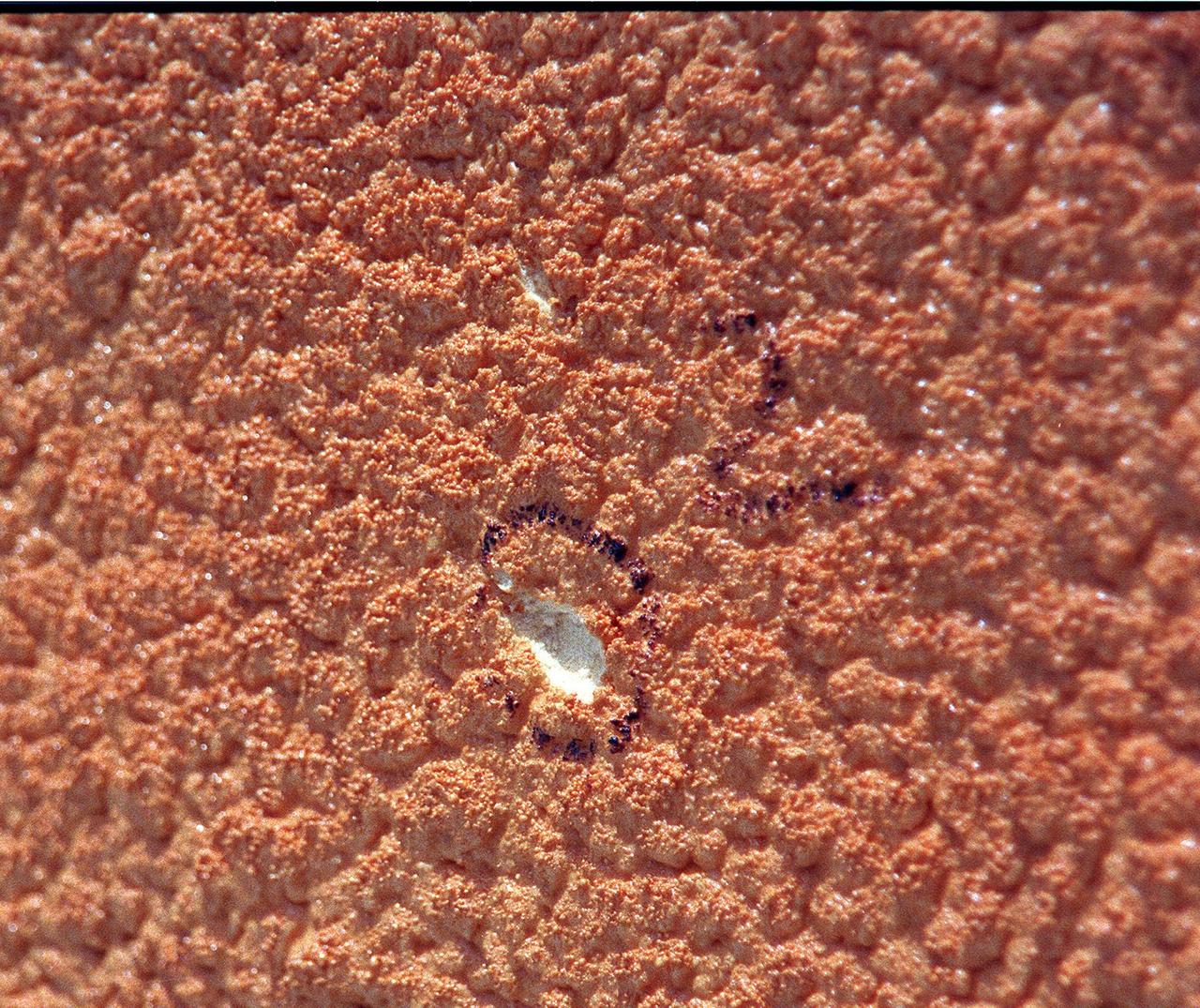
A hole, created by recent hail storms, is identified as number two on the surface of the external tank (ET) mated to Space Shuttle Discovery at Launch Pad 39B. Workers are investigating the damage and potential problems for launch posed by ice forming in the holes, which may number as many as 150 over the entire tank. The average size of the holes is one-half inch in diameter and one-tenth inch deep. The external tank contains the liquid hydrogen fuel and liquid oxygen oxidizer and supplies them under pressure to the three space shuttle main engines in the orbiter during liftoff and ascent. The ET thermal protection system consists of sprayed-on foam insulation. The Shuttle Discovery is targeted for launch of mission STS-96 on May 20 at 9:32 a.m

CAPE CANAVERAL, Fla. – At NASA’s Kennedy Space Center in Florida, a crane is used to load a space shuttle solid rocket booster and an external fuel tank on trucks for transport to separate museums. The solid rocket boosters, or SRBs, will be displayed at the California Science Center in Los Angeles. The external tank soon will be transported for display at the Wings of Dreams Aviation Museum at Keystone Heights Airport between Gainesville and Jacksonville, Fla. The 149-foot SRBs together provided six million pounds of thrust. The external fuel tank contained over 500,000 gallons of liquid hydrogen and liquid oxygen propellant for the shuttle orbiters' three main engines. The work is part of Transition and Retirement of the space shuttle. For more information, visit http://www.nasa.gov/transition Photo credit: NASA/ Dimitri Gerondidakis
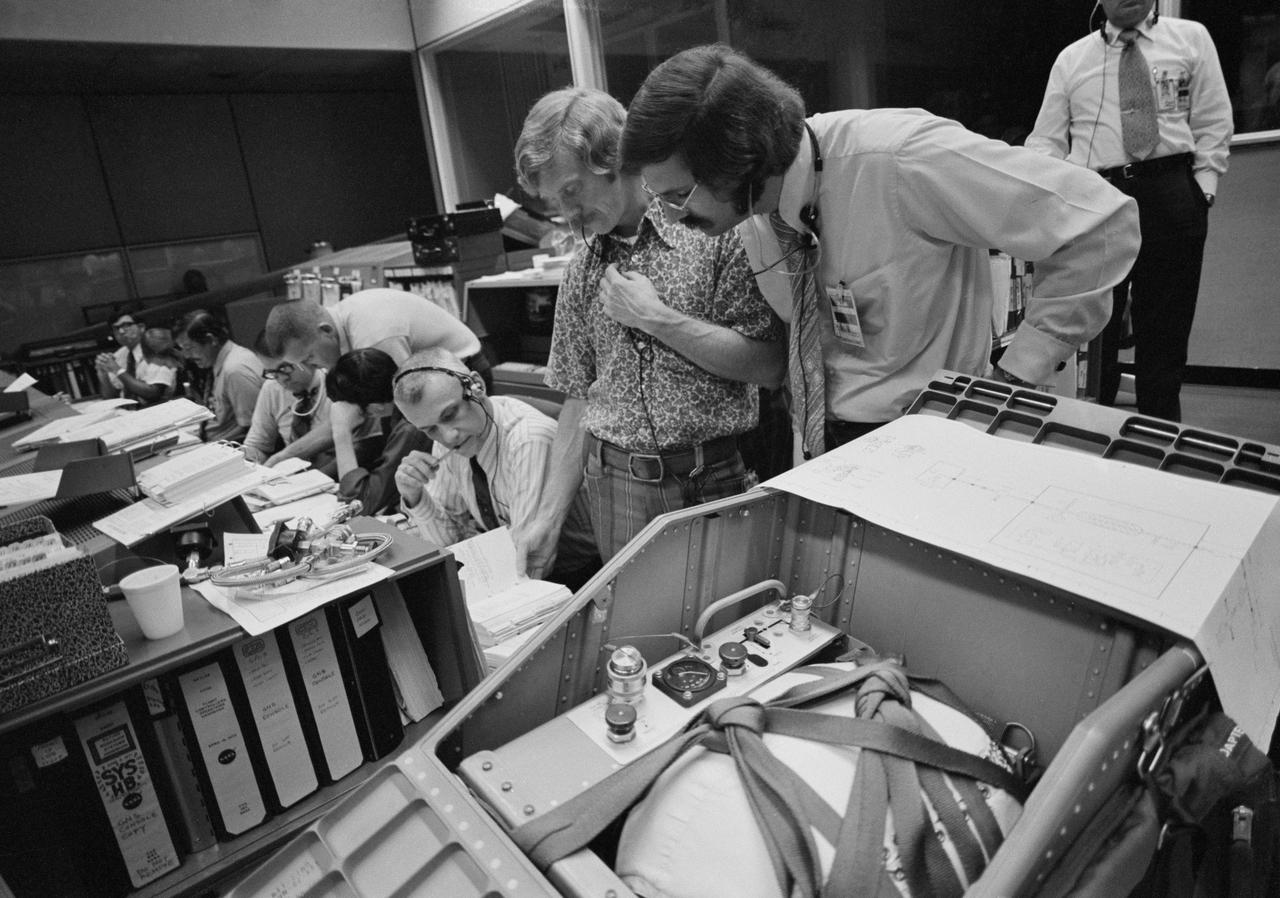
S73-37030 (November 1973) --- The procedures for repairing the coolant system aboard the Airlock Module of the Skylab space station in Earth orbit are discussed by flight controllers in the Mission Operations Control Room in the Mission Control Center at Johnson Space Center. Skylab 4 flight director Neil Hutchinson is on the right. Astronaut Russell L. Schweickart is wearing the sports shirt. Astronaut Bruce McCandless II, a Skylab 4 CAPCOM, is seated next to Schweickart. Items of equipment in the foreground are similar to components of a special coolant re-servicing kit which was taken to Earth orbit by the Skylab 4 crewmen. The kit consists of a tank containing 42 pounds of COOLANOL, a series of saddle valves, bolts and spacers, and leak-check hoses. The re-supply tank is a modified command module reaction control subsystem (RCS) fuel tank. Photo credit: NASA
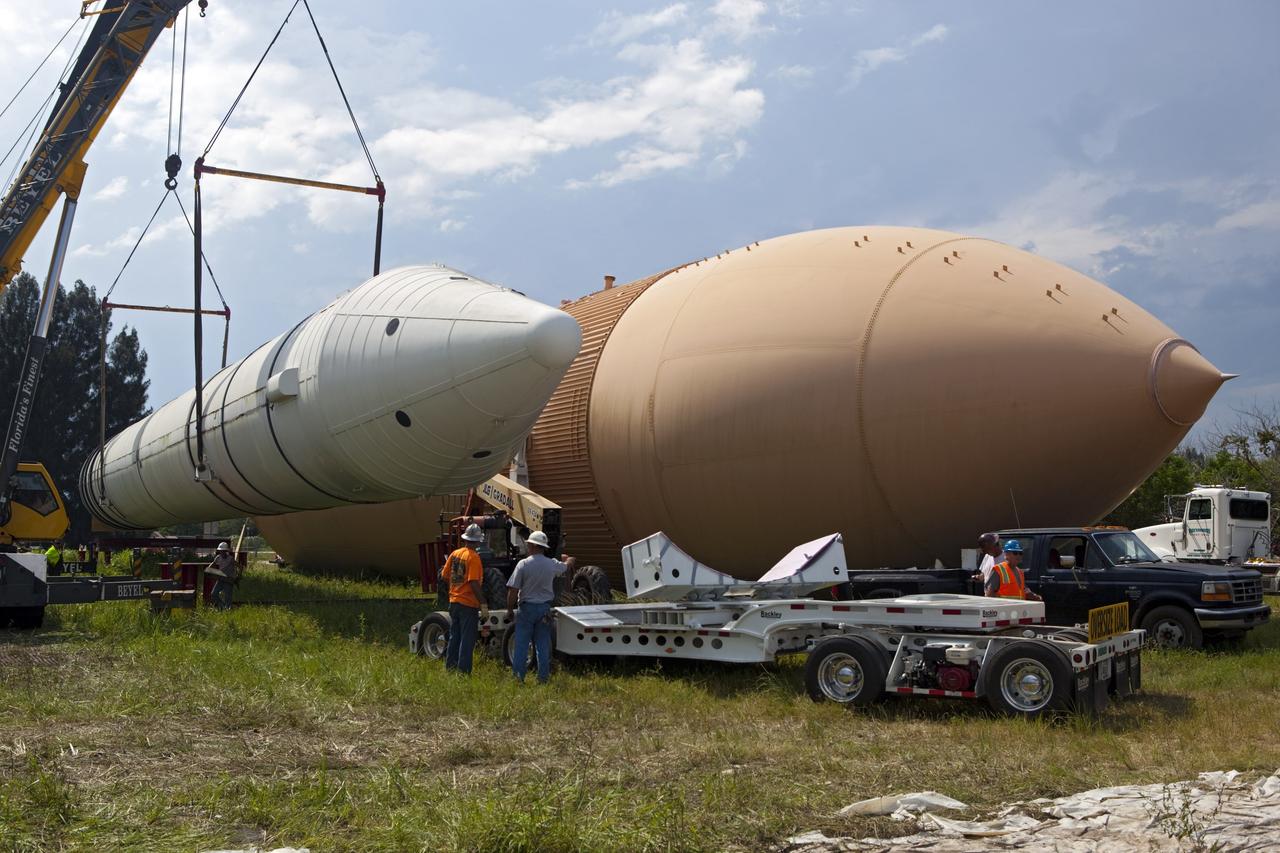
CAPE CANAVERAL, Fla. – At NASA’s Kennedy Space Center in Florida, a crane is used to load a space shuttle solid rocket booster and an external fuel tank on trucks for transport to separate museums. The solid rocket boosters, or SRBs, will be displayed at the California Science Center in Los Angeles. The external tank soon will be transported for display at the Wings of Dreams Aviation Museum at Keystone Heights Airport between Gainesville and Jacksonville, Fla. The 149-foot SRBs together provided six million pounds of thrust. The external fuel tank contained over 500,000 gallons of liquid hydrogen and liquid oxygen propellant for the shuttle orbiters' three main engines. The work is part of Transition and Retirement of the space shuttle. For more information, visit http://www.nasa.gov/transition Photo credit: NASA/ Dimitri Gerondidakis
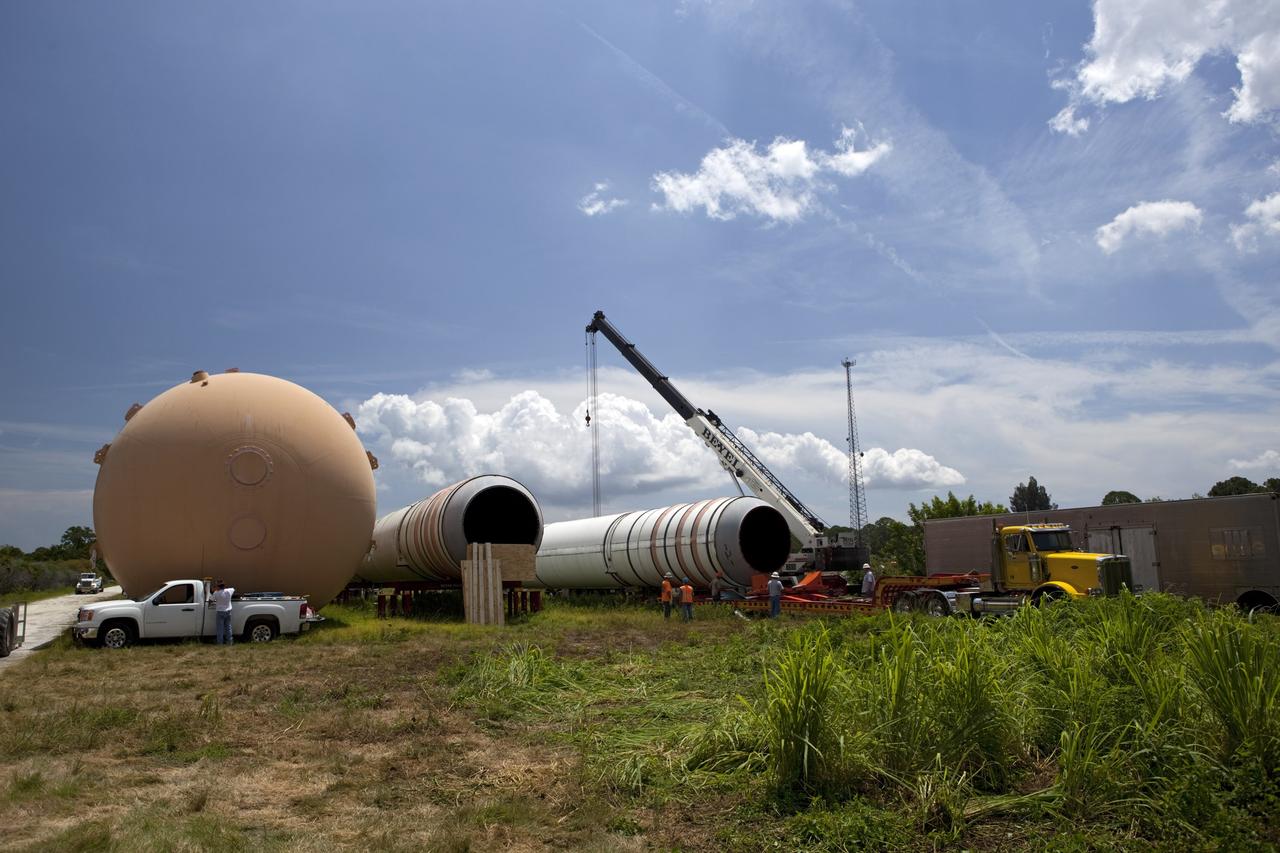
CAPE CANAVERAL, Fla. – At NASA’s Kennedy Space Center in Florida, a crane is used to load a twin set of space shuttle solid rocket boosters and an external fuel tank on trucks for transport to separate museums. The solid rocket boosters, or SRBs, will be displayed at the California Science Center in Los Angeles. The external tank soon will be transported for display at the Wings of Dreams Aviation Museum at Keystone Heights Airport between Gainesville and Jacksonville, Fla. The 149-foot SRBs together provided six million pounds of thrust. The external fuel tank contained over 500,000 gallons of liquid hydrogen and liquid oxygen propellant for the shuttle orbiters' three main engines. The work is part of Transition and Retirement of the space shuttle. For more information, visit http://www.nasa.gov/transition Photo credit: NASA/ Dimitri Gerondidakis
Engineer Paul Reader and his colleagues take environmental measurements during testing of a 20-inch diameter ion engine in a vacuum tank at the Electric Propulsion Laboratory (EPL). Researchers at the Lewis Research Center were investigating the use of a permanent-magnet circuit to create the magnetic field required power electron bombardment ion engines. Typical ion engines use a solenoid coil to create this magnetic field. It was thought that the substitution of a permanent magnet would create a comparable magnetic field with a lower weight. Testing of the magnet system in the EPL vacuum tanks revealed no significant operational problems. Reader found the weight of the two systems was similar, but that the thruster’s efficiency increased with the magnet. The EPL contained a series of large vacuum tanks that could be used to simulate conditions in space. Large vacuum pumps reduced the internal air pressure, and a refrigeration system created the cryogenic temperatures found in space.
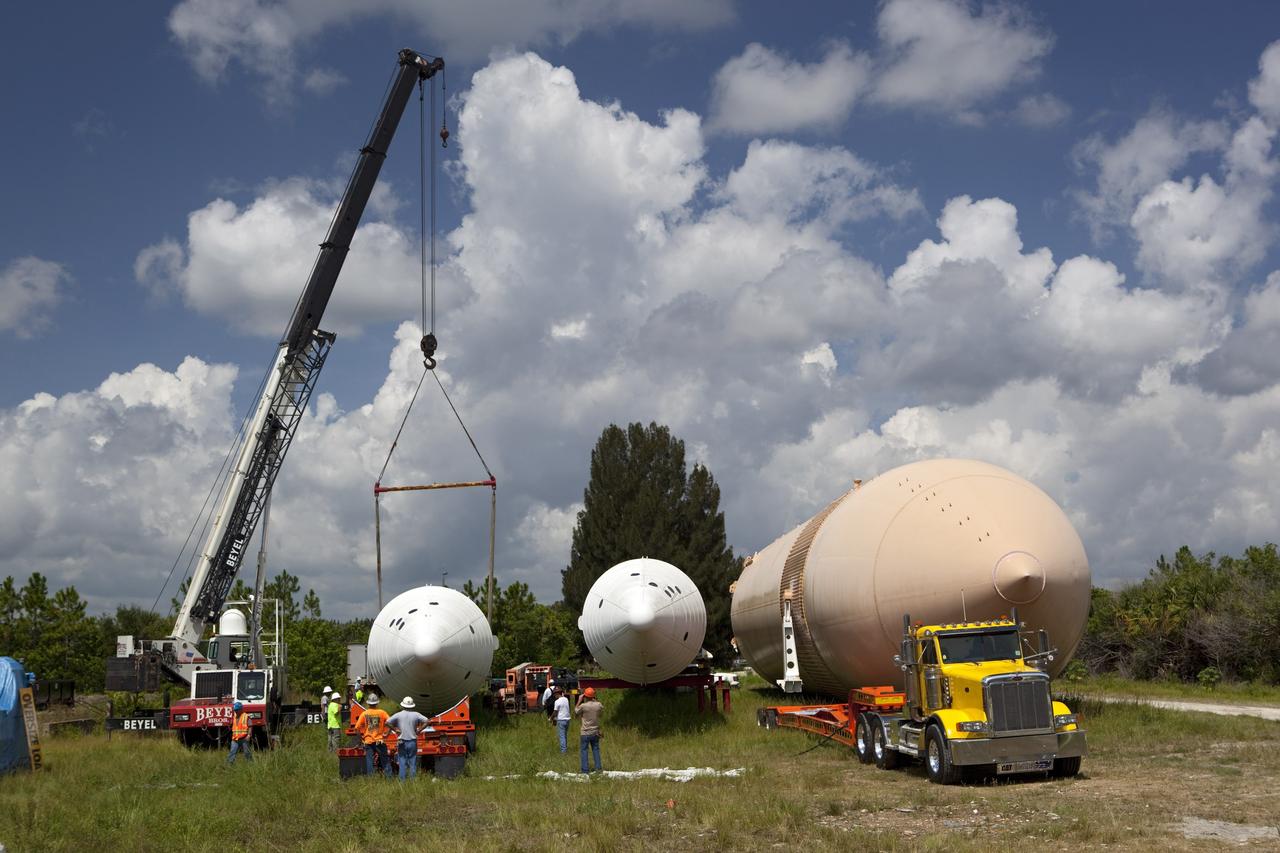
CAPE CANAVERAL, Fla. – At NASA’s Kennedy Space Center in Florida, a crane is used to load a twin set of space shuttle solid rocket boosters and an external fuel tank on trucks for transport to separate museums. The solid rocket boosters, or SRBs, will be displayed at the California Science Center in Los Angeles. The external tank soon will be transported for display at the Wings of Dreams Aviation Museum at Keystone Heights Airport between Gainesville and Jacksonville, Fla. The 149-foot SRBs together provided six million pounds of thrust. The external fuel tank contained over 500,000 gallons of liquid hydrogen and liquid oxygen propellant for the shuttle orbiters' three main engines. The work is part of Transition and Retirement of the space shuttle. For more information, visit http://www.nasa.gov/transition Photo credit: NASA/ Dimitri Gerondidakis
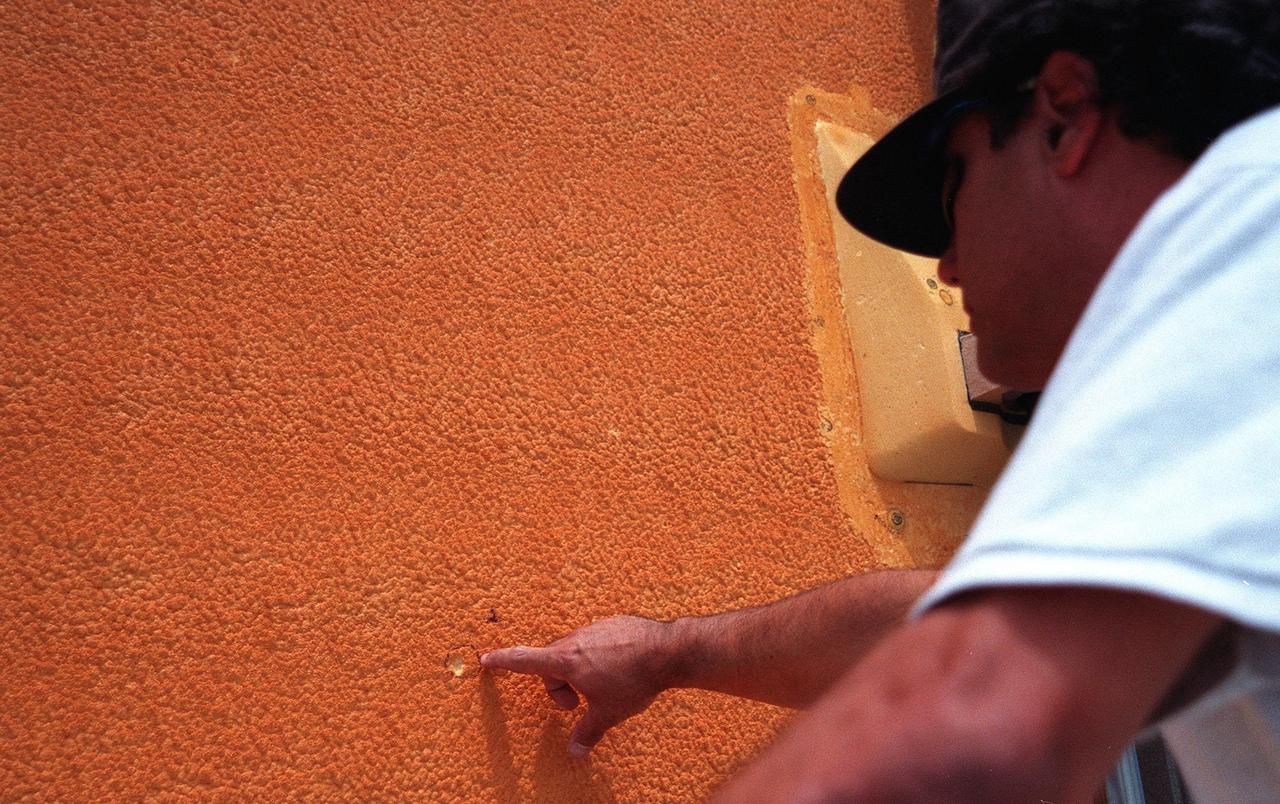
At Launch pad 39B, Mike Barber, with United Space Alliance safety, points to one of the holes caused by hail on Space Shuttle Discovery's external tank (ET). Workers are investigating the damage and potential problems for launch posed by ice forming in the holes, which may number as many as 150 over the entire tank. The average size of the holes is one-half inch in diameter and one-tenth inch deep. The external tank contains the liquid hydrogen fuel and liquid oxygen oxidizer and supplies them under pressure to the three space shuttle main engines in the orbiter during liftoff and ascent. The ET thermal protection system consists of sprayed-on foam insulation. The Shuttle Discovery is targeted for launch of mission STS-96 on May 20 at 9:32 a.m
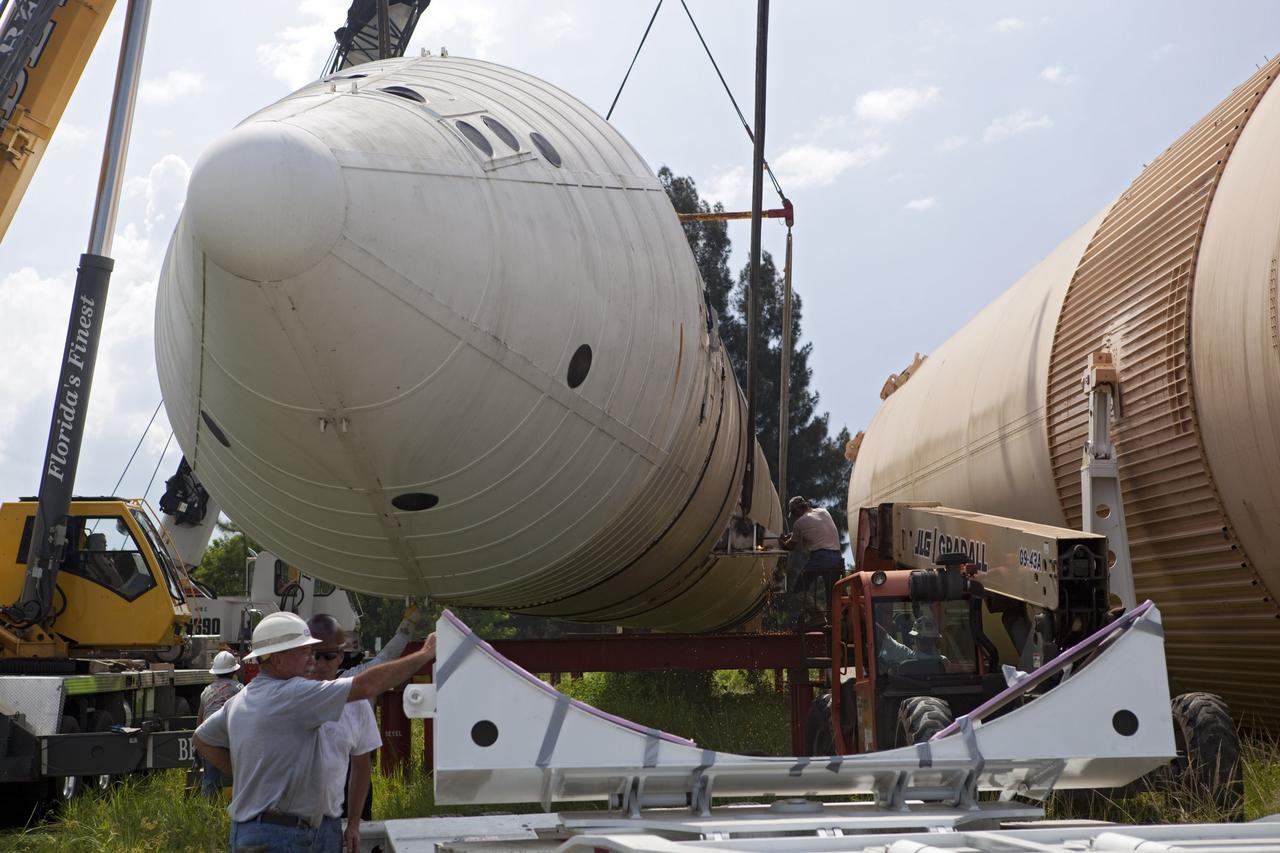
CAPE CANAVERAL, Fla. – At NASA’s Kennedy Space Center in Florida, a crane is used to load a space shuttle solid rocket booster and an external fuel tank on trucks for transport to separate museums. The solid rocket boosters, or SRBs, will be displayed at the California Science Center in Los Angeles. The external tank soon will be transported for display at the Wings of Dreams Aviation Museum at Keystone Heights Airport between Gainesville and Jacksonville, Fla. The 149-foot SRBs together provided six million pounds of thrust. The external fuel tank contained over 500,000 gallons of liquid hydrogen and liquid oxygen propellant for the shuttle orbiters' three main engines. The work is part of Transition and Retirement of the space shuttle. For more information, visit http://www.nasa.gov/transition Photo credit: NASA/ Dimitri Gerondidakis
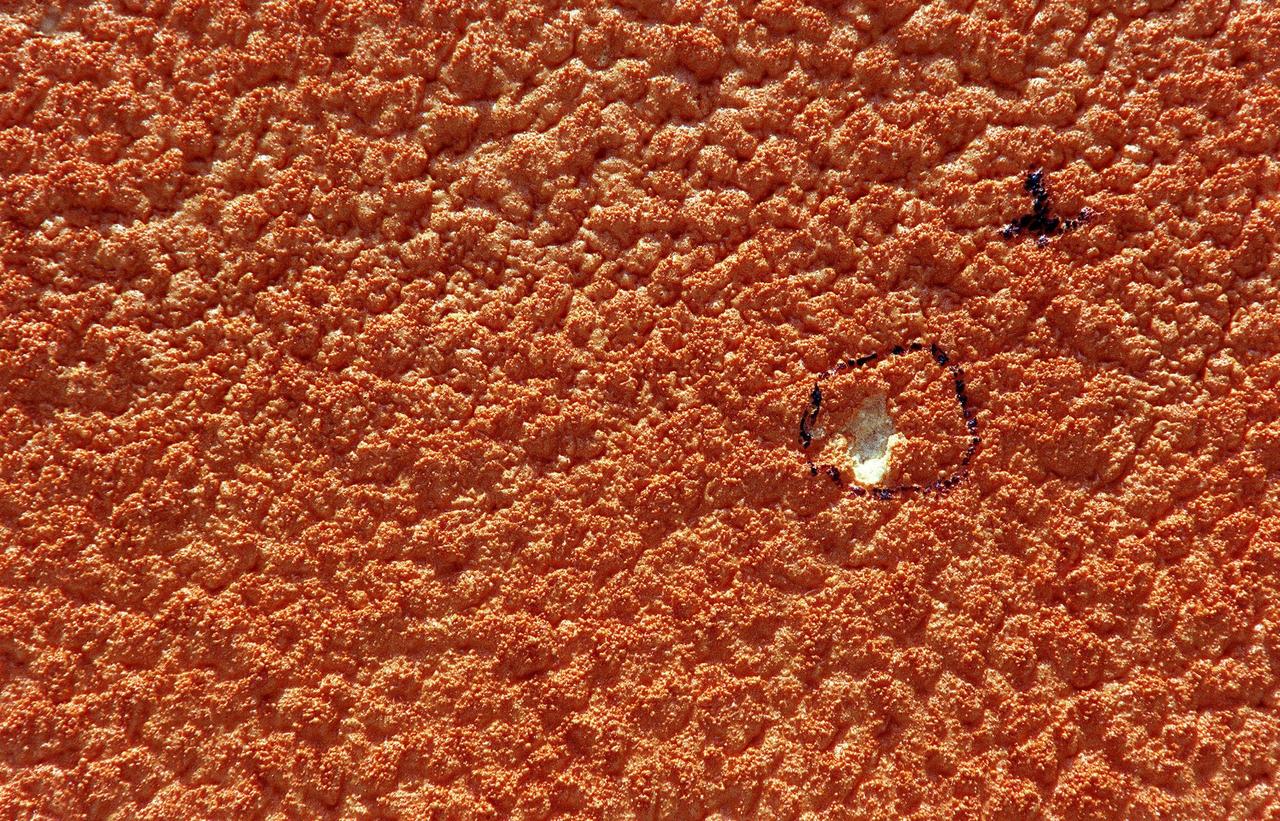
A hole, created by recent hail storms, is identified as number one on the surface of the external tank (ET) mated to Space Shuttle Discovery at Launch Pad 39B. Workers are investigating the damage and potential problems for launch posed by ice forming in the holes, which may number as many as 150 over the entire tank. The average size of the holes is one-half inch in diameter and one-tenth inch deep. The external tank contains the liquid hydrogen fuel and liquid oxygen oxidizer and supplies them under pressure to the three space shuttle main engines in the orbiter during liftoff and ascent. The ET thermal protection system consists of sprayed-on foam insulation. The Shuttle Discovery is targeted for launch of mission STS-96 on May 20 at 9:32 a.m
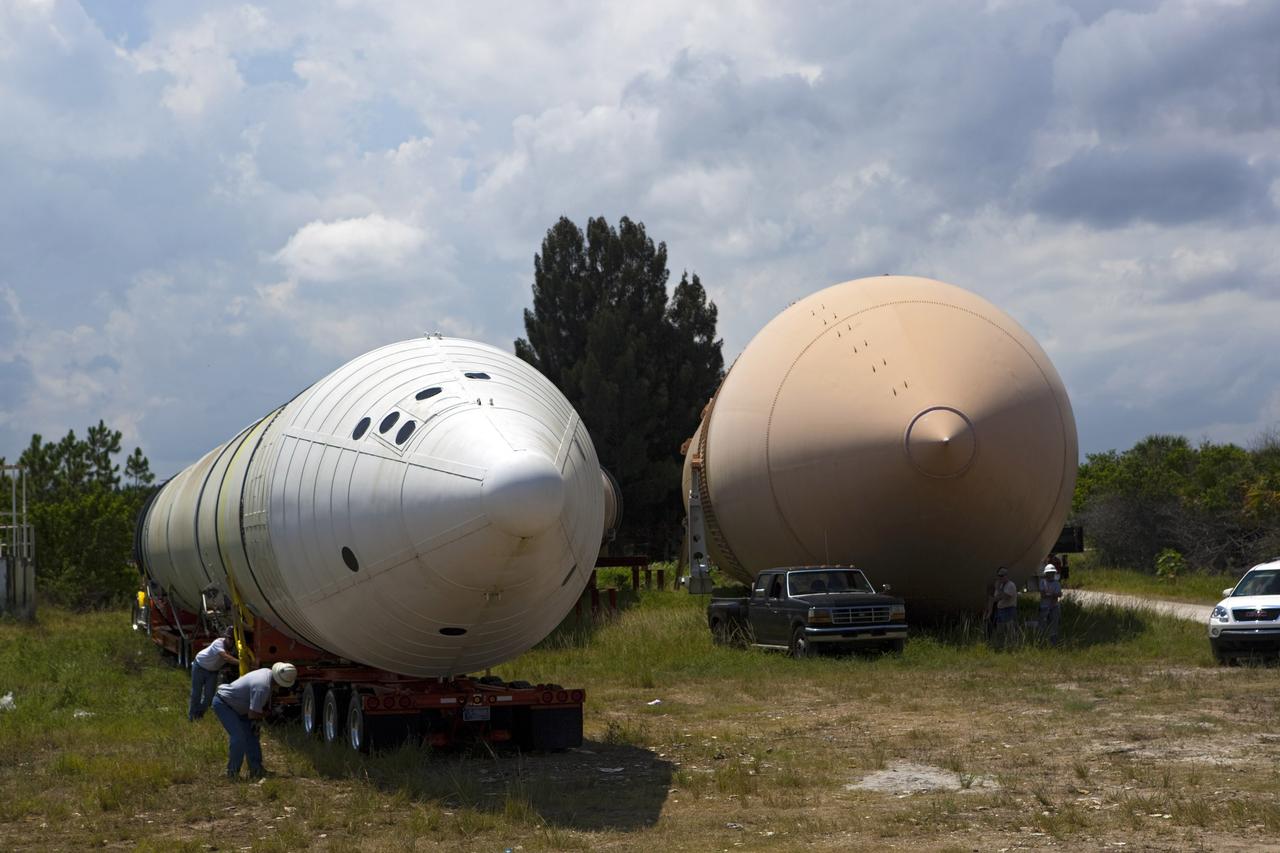
CAPE CANAVERAL, Fla. – At NASA’s Kennedy Space Center in Florida, preparations are underway to load a twin set of space shuttle solid rocket boosters and an external fuel tank on trucks for transport to separate museums. The solid rocket boosters, or SRBs, will be displayed at the California Science Center in Los Angeles. The external tank soon will be transported for display at the Wings of Dreams Aviation Museum at Keystone Heights Airport between Gainesville and Jacksonville, Fla. The 149-foot SRBs together provided six million pounds of thrust. The external fuel tank contained over 500,000 gallons of liquid hydrogen and liquid oxygen propellant for the shuttle orbiters' three main engines. The work is part of Transition and Retirement of the space shuttle. For more information, visit http://www.nasa.gov/transition Photo credit: NASA/ Dimitri Gerondidakis
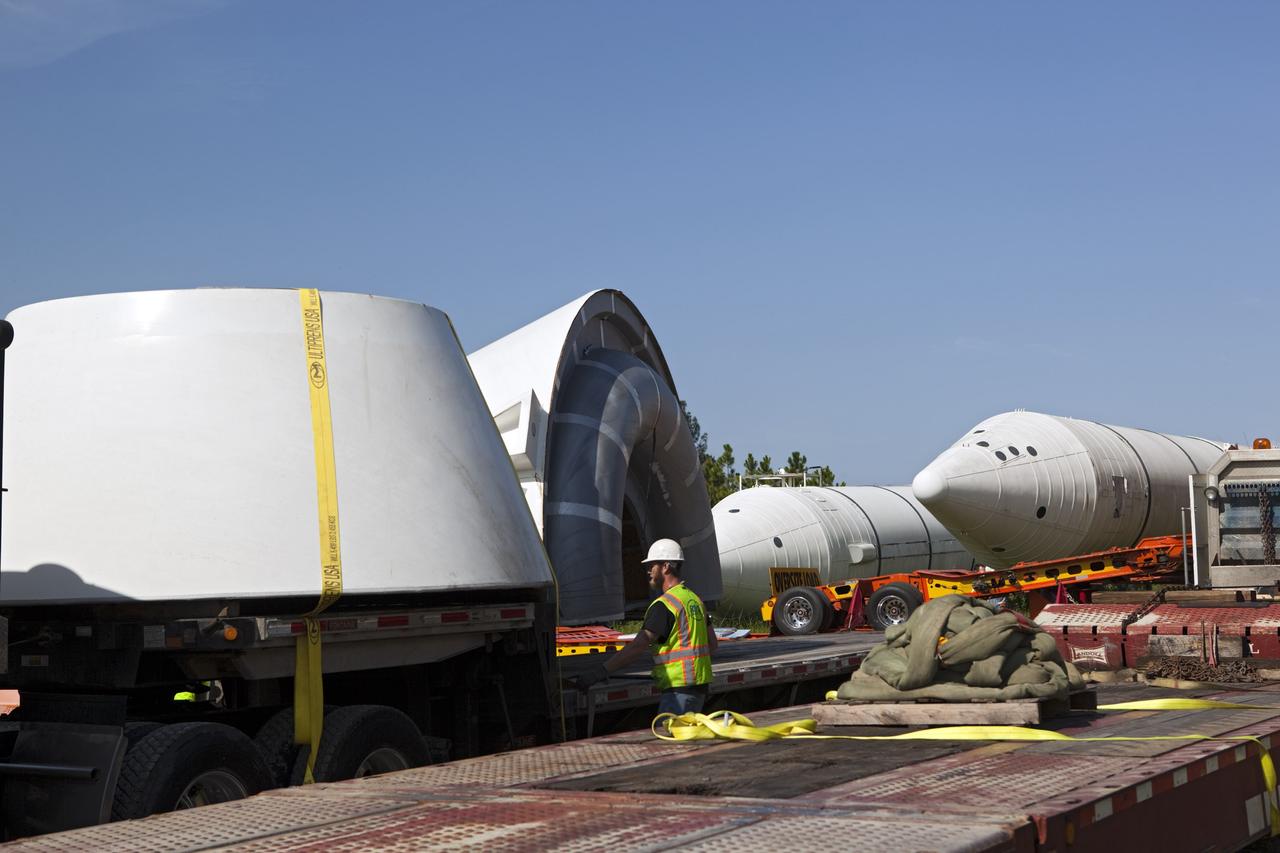
CAPE CANAVERAL, Fla. – At NASA’s Kennedy Space Center in Florida, aft skirts for space shuttle solid rocket boosters are being loaded on a truck. A twin set of space shuttle solid rocket boosters and an external fuel tank are being prepared for transport to separate museums. The solid rocket boosters, or SRBs, will be displayed at the California Science Center in Los Angeles. The external tank soon will be transported for display at the Wings of Dreams Aviation Museum at Keystone Heights Airport between Gainesville and Jacksonville, Fla. The 149-foot SRBs together provided six million pounds of thrust. The external fuel tank contained over 500,000 gallons of liquid hydrogen and liquid oxygen propellant for the shuttle orbiters' three main engines. The work is part of Transition and Retirement of the space shuttle. For more information, visit http://www.nasa.gov/transition Photo credit: NASA/ Dimitri Gerondidakis
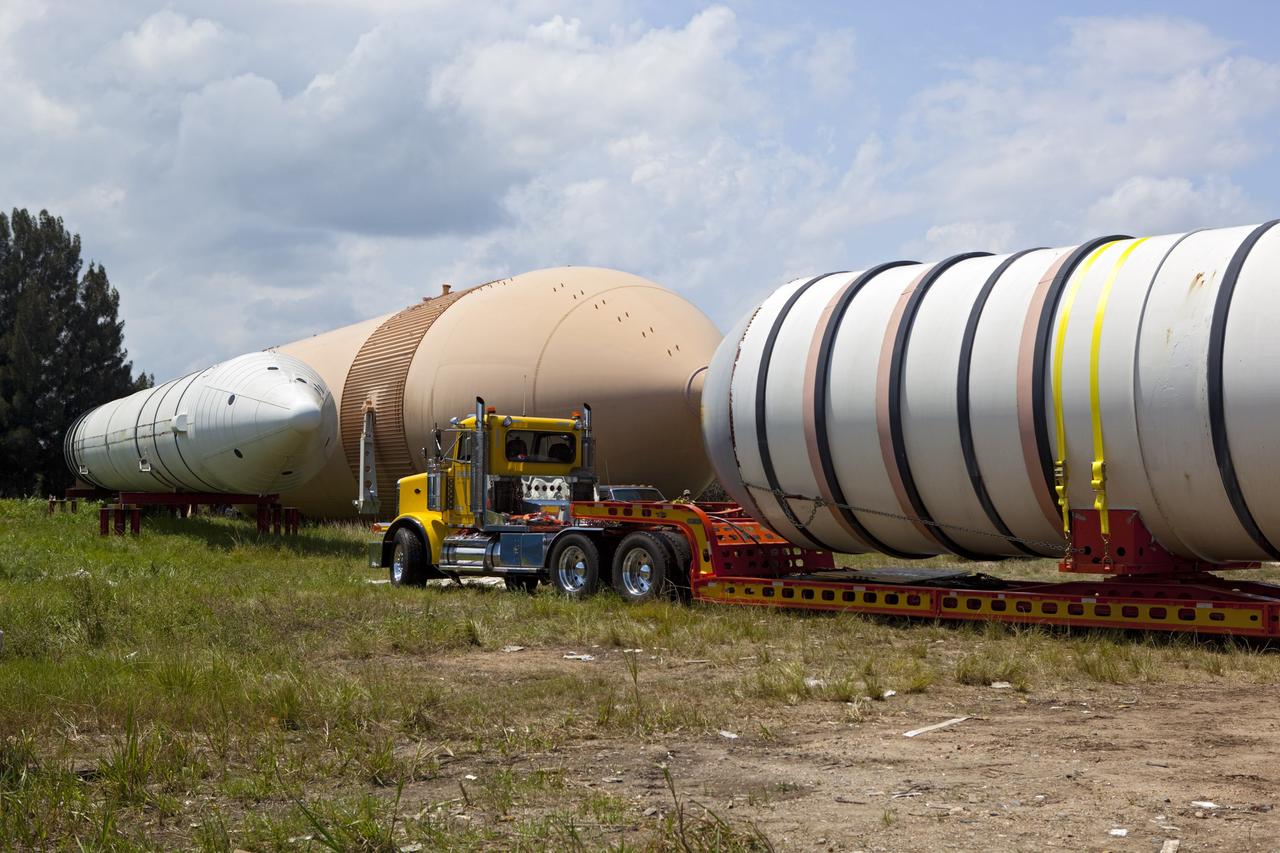
CAPE CANAVERAL, Fla. – At NASA’s Kennedy Space Center in Florida, a twin set of space shuttle solid rocket boosters and an external fuel tank are being loaded on trucks for transport to separate museums. The solid rocket boosters, or SRBs, will be displayed at the California Science Center in Los Angeles. The external tank soon will be transported for display at the Wings of Dreams Aviation Museum at Keystone Heights Airport between Gainesville and Jacksonville, Fla. The 149-foot SRBs together provided six million pounds of thrust. The external fuel tank contained over 500,000 gallons of liquid hydrogen and liquid oxygen propellant for the shuttle orbiters' three main engines. The work is part of Transition and Retirement of the space shuttle. For more information, visit http://www.nasa.gov/transition Photo credit: NASA/ Dimitri Gerondidakis
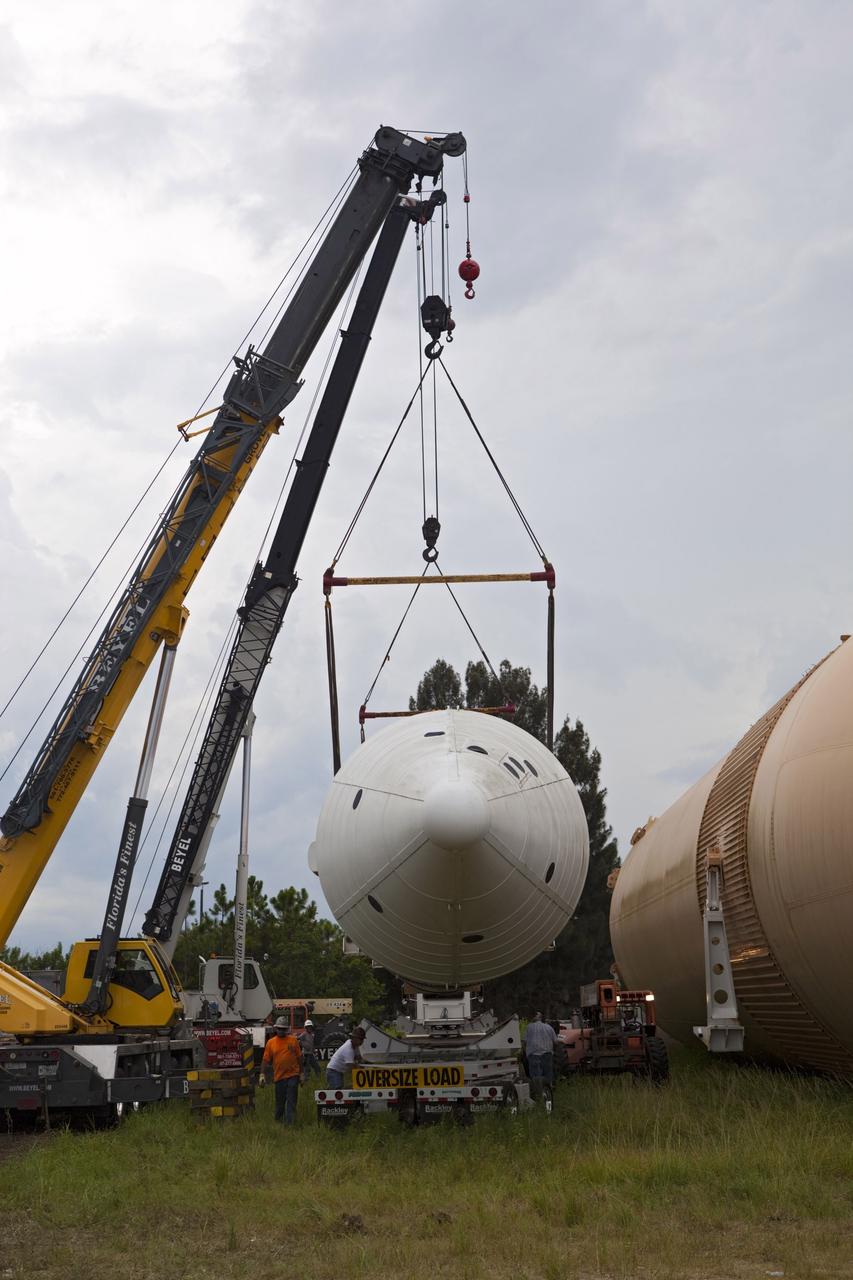
CAPE CANAVERAL, Fla. – At NASA’s Kennedy Space Center in Florida, a crane is used to load a space shuttle solid rocket booster and an external fuel tank on trucks for transport to separate museums. The solid rocket boosters, or SRBs, will be displayed at the California Science Center in Los Angeles. The external tank soon will be transported for display at the Wings of Dreams Aviation Museum at Keystone Heights Airport between Gainesville and Jacksonville, Fla. The 149-foot SRBs together provided six million pounds of thrust. The external fuel tank contained over 500,000 gallons of liquid hydrogen and liquid oxygen propellant for the shuttle orbiters' three main engines. The work is part of Transition and Retirement of the space shuttle. For more information, visit http://www.nasa.gov/transition Photo credit: NASA/ Dimitri Gerondidakis
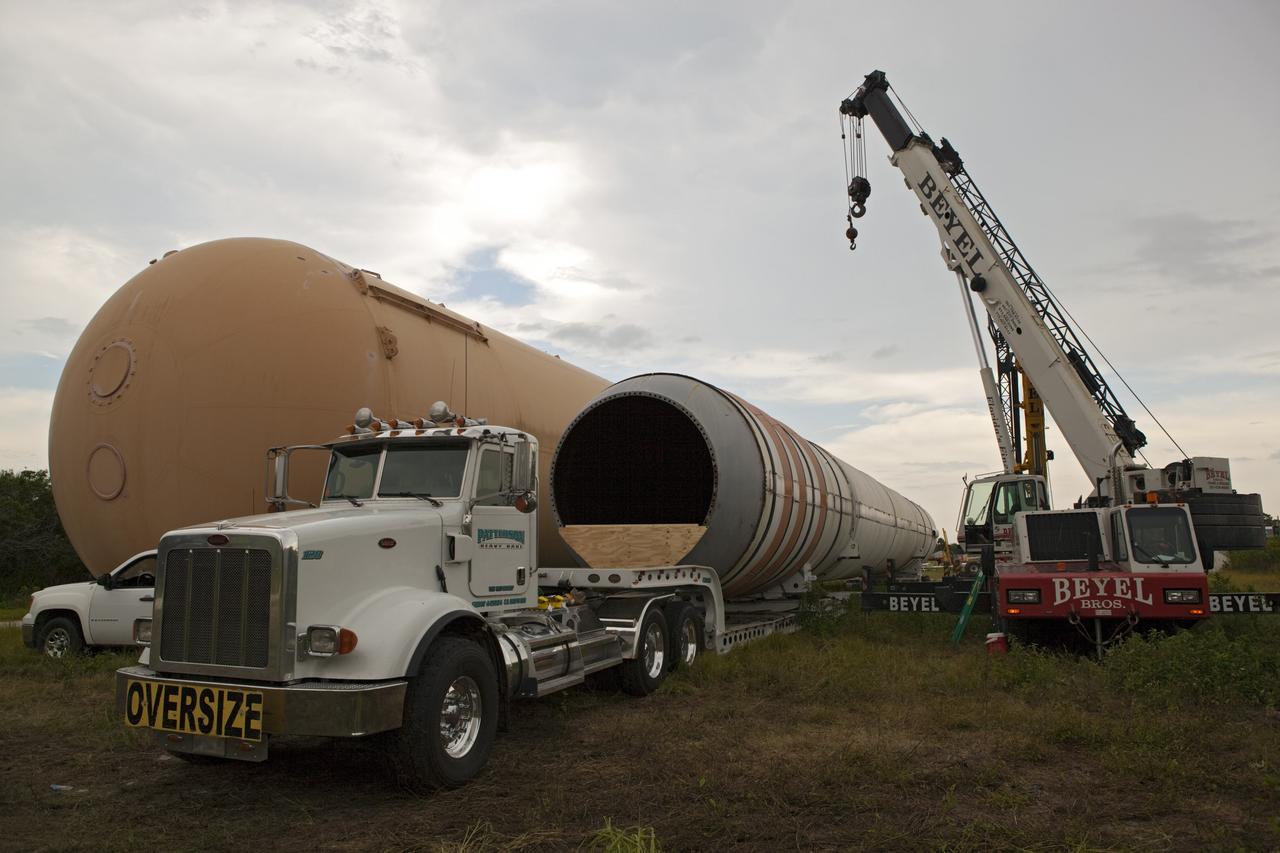
CAPE CANAVERAL, Fla. – At NASA’s Kennedy Space Center in Florida, a crane is used to load a space shuttle solid rocket booster and an external fuel tank on trucks for transport to separate museums. The solid rocket boosters, or SRBs, will be displayed at the California Science Center in Los Angeles. The external tank soon will be transported for display at the Wings of Dreams Aviation Museum at Keystone Heights Airport between Gainesville and Jacksonville, Fla. The 149-foot SRBs together provided six million pounds of thrust. The external fuel tank contained over 500,000 gallons of liquid hydrogen and liquid oxygen propellant for the shuttle orbiters' three main engines. The work is part of Transition and Retirement of the space shuttle. For more information, visit http://www.nasa.gov/transition Photo credit: NASA/ Dimitri Gerondidakis
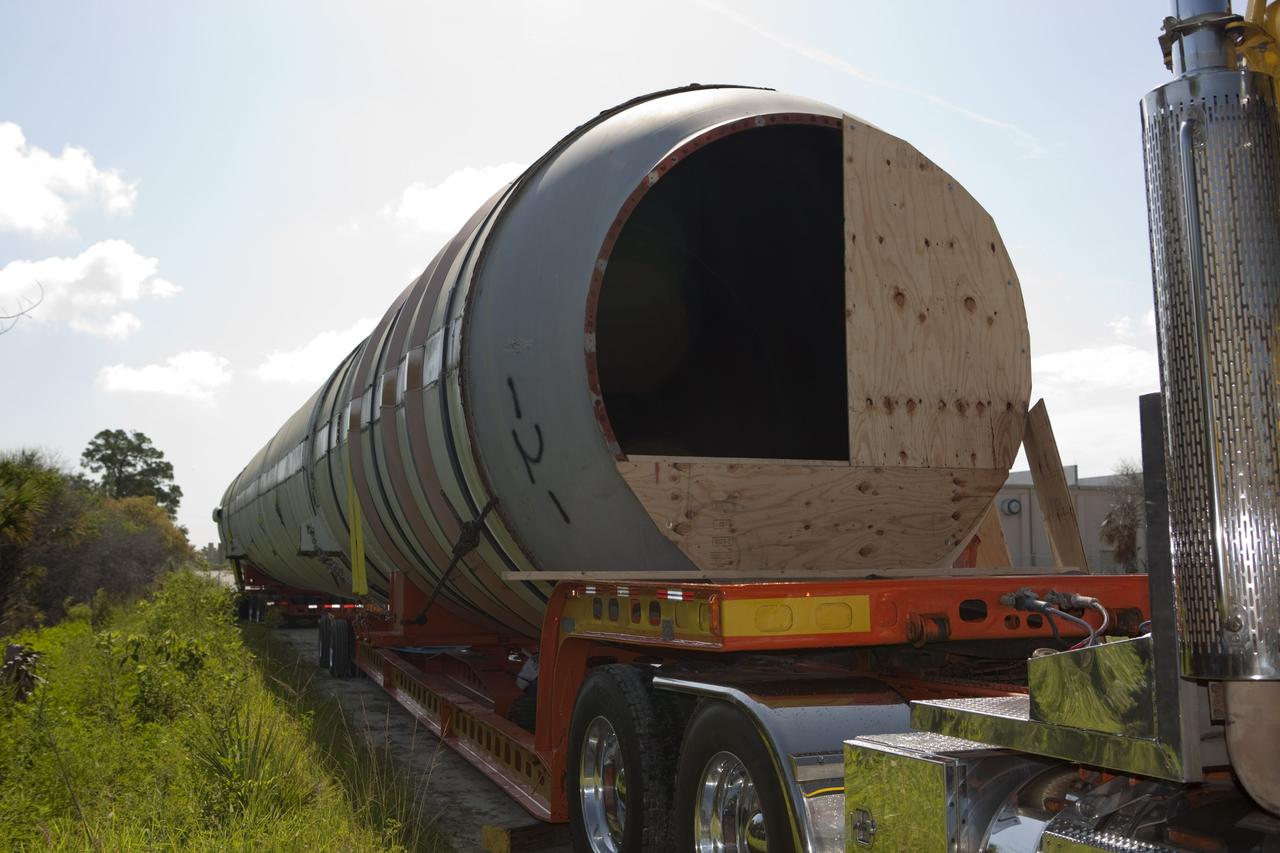
CAPE CANAVERAL, Fla. – At NASA’s Kennedy Space Center in Florida, a space shuttle solid rocket booster has been loaded on a truck. A twin set of space shuttle solid rocket boosters and an external fuel tank are being prepared for transport to separate museums. The solid rocket boosters, or SRBs, will be displayed at the California Science Center in Los Angeles. The external tank soon will be transported for display at the Wings of Dreams Aviation Museum at Keystone Heights Airport between Gainesville and Jacksonville, Fla. The 149-foot SRBs together provided six million pounds of thrust. The external fuel tank contained over 500,000 gallons of liquid hydrogen and liquid oxygen propellant for the shuttle orbiters' three main engines. The work is part of Transition and Retirement of the space shuttle. For more information, visit http://www.nasa.gov/transition Photo credit: NASA/ Dimitri Gerondidakis
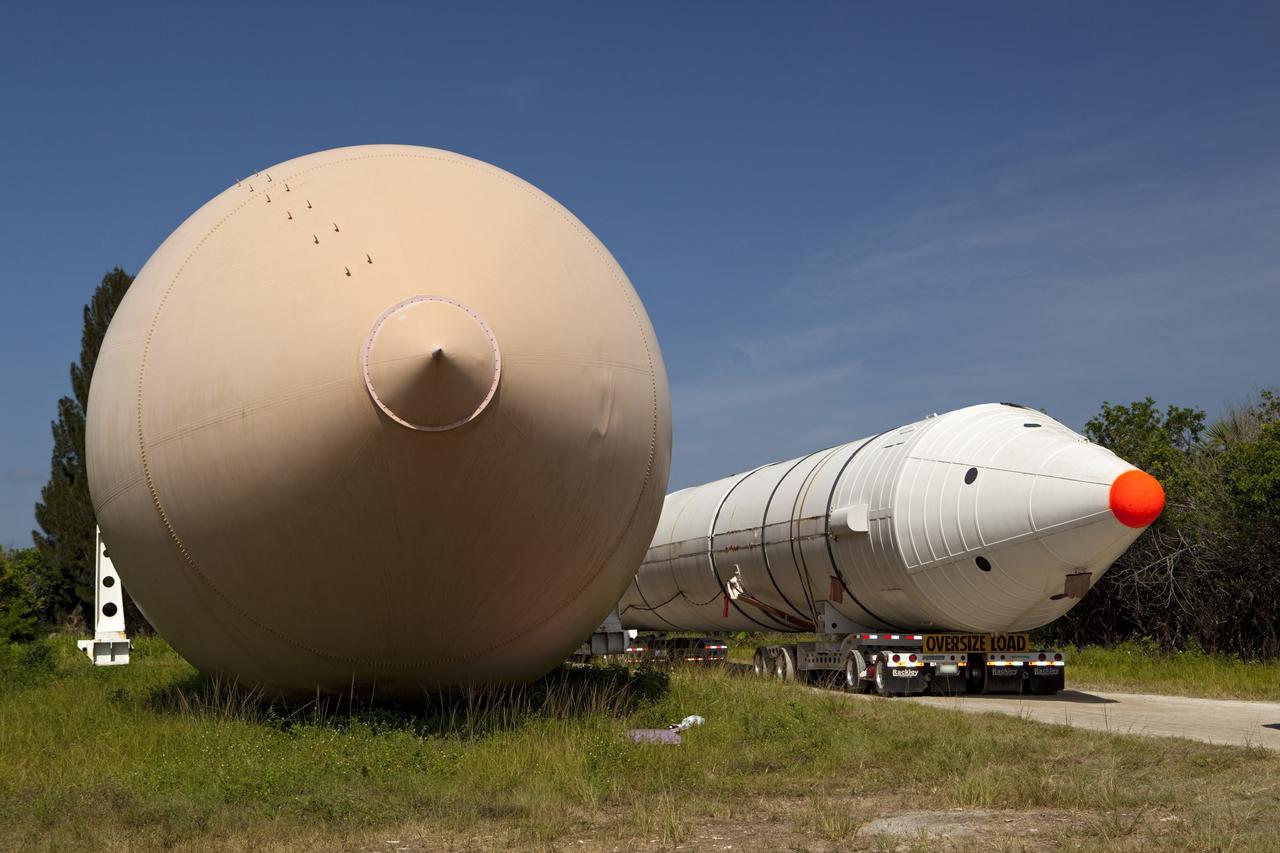
CAPE CANAVERAL, Fla. – At NASA’s Kennedy Space Center in Florida, a space shuttle solid rocket booster and an external fuel tank are being prepared for transport to separate museums. The solid rocket boosters, or SRBs, will be displayed at the California Science Center in Los Angeles. The external tank soon will be transported for display at the Wings of Dreams Aviation Museum at Keystone Heights Airport between Gainesville and Jacksonville, Fla. The 149-foot SRBs together provided six million pounds of thrust. The external fuel tank contained over 500,000 gallons of liquid hydrogen and liquid oxygen propellant for the shuttle orbiters' three main engines. The work is part of Transition and Retirement of the space shuttle. For more information, visit http://www.nasa.gov/transition Photo credit: NASA/ Dimitri Gerondidakis
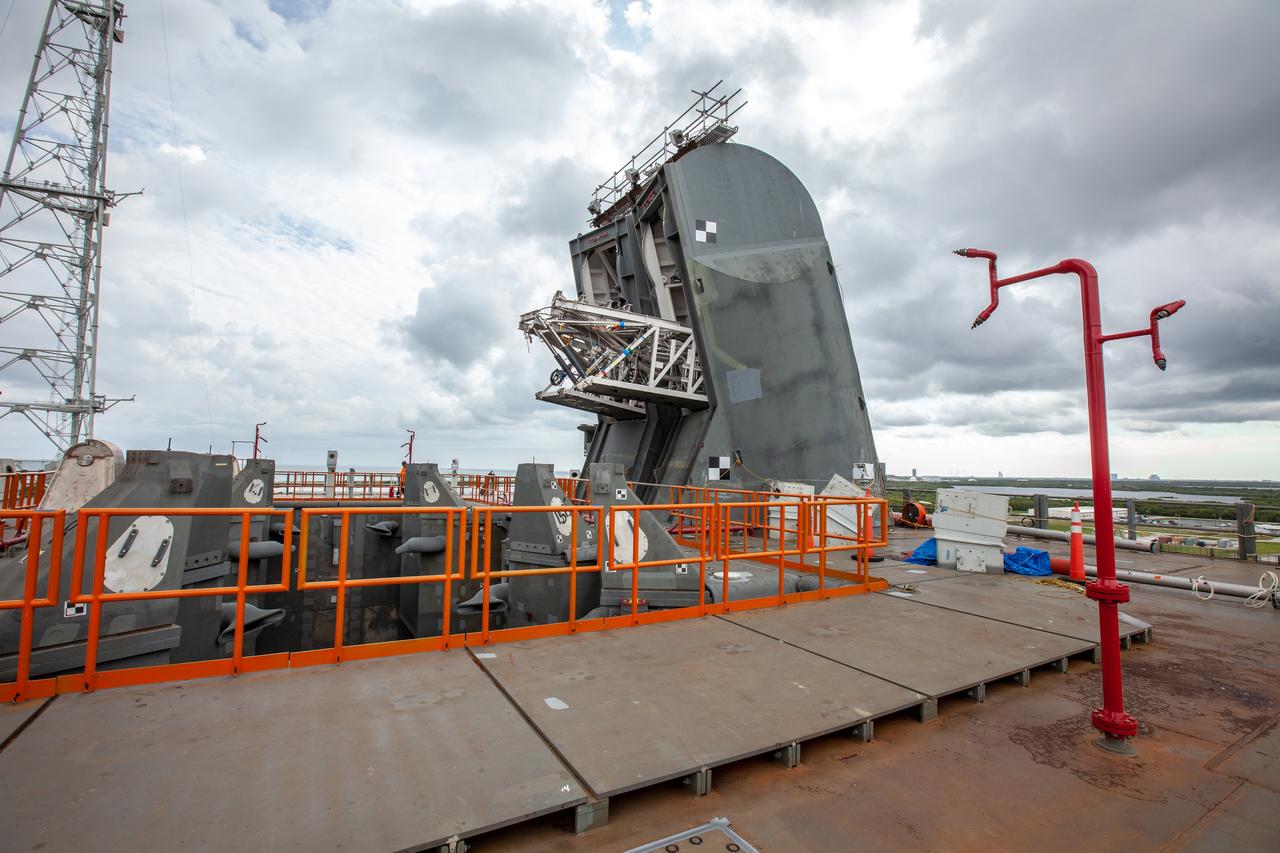
The Tail Service Mast Umbilicals that will connect to NASA’s Space Launch System (SLS) rocket, containing fluid lines for liquid oxygen and liquid hydrogen propellant loading, are photographed on the mobile launcher at Launch Pad 39B on Nov. 8, 2019, at the agency’s Kennedy Space Center in Florida. NASA’s Exploration Ground Systems oversaw testing of the pad’s cryogenic systems – the infrastructure that will support the flow of liquid hydrogen and liquid oxygen from the storage tanks to the rocket – in preparation for the launch of SLS with the Orion spacecraft atop for the uncrewed Artemis I mission. Each of the liquid oxygen and liquid hydrogen tanks can hold more than 800,000 gallons of propellant. The liquid oxygen will require the use of pumps to push it from the tank to the rocket, while the lighter liquid hydrogen will make its way up to the pad using gaseous hydrogen to pressurize the sphere.
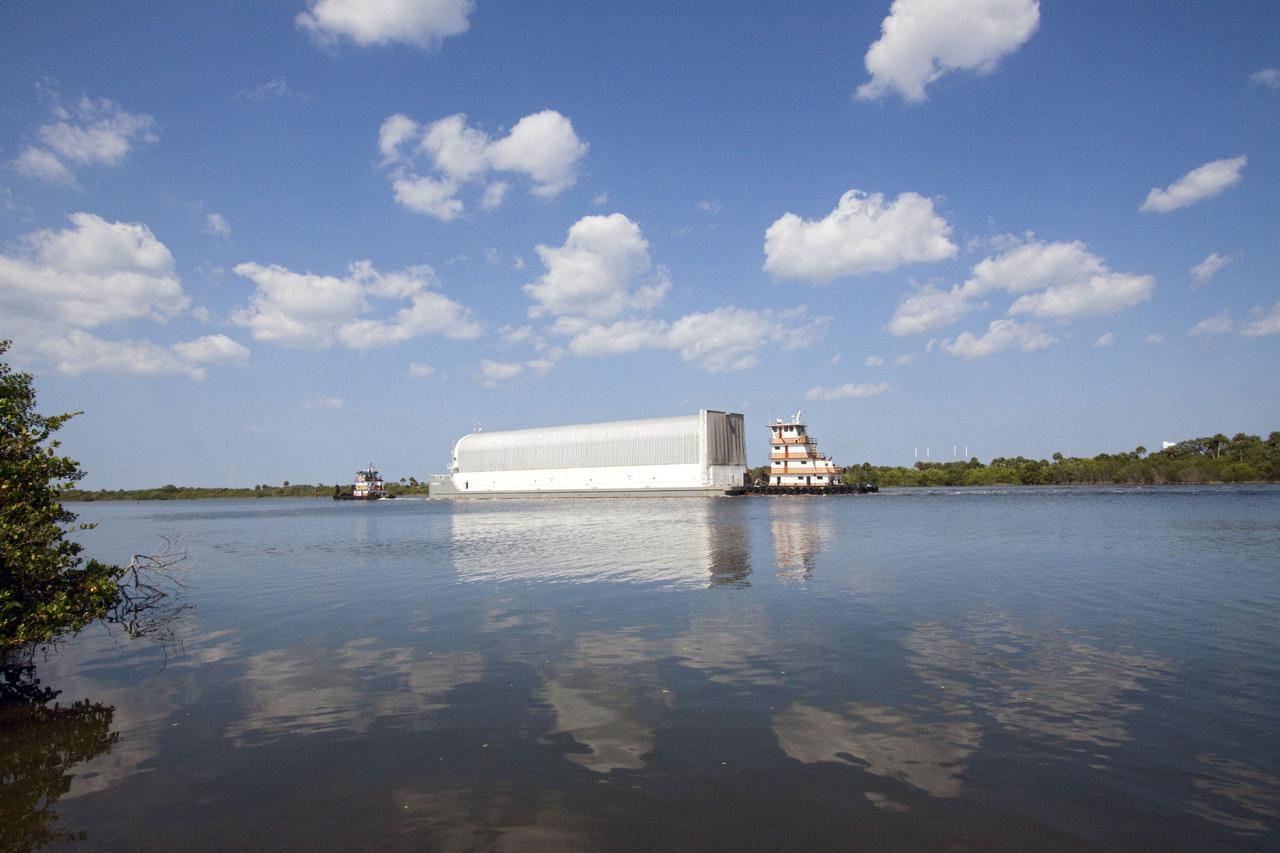
CAPE CANAVERAL, Fla. - Tugboats guide the Pegasus barge containing the external fuel tank for space shuttle Discovery's STS-133 mission through the Banana River to NASA's Kennedy Space Center in Florida. On the STS-133 mission, Discovery will deliver NASA's Permanent Multi-purpose Module, or PMM, the Express Logistics Carrier 4, and critical spare parts to the International Space Station. Launch is targeted for fall 2010. Photo credit: NASA_Jack Pfaller
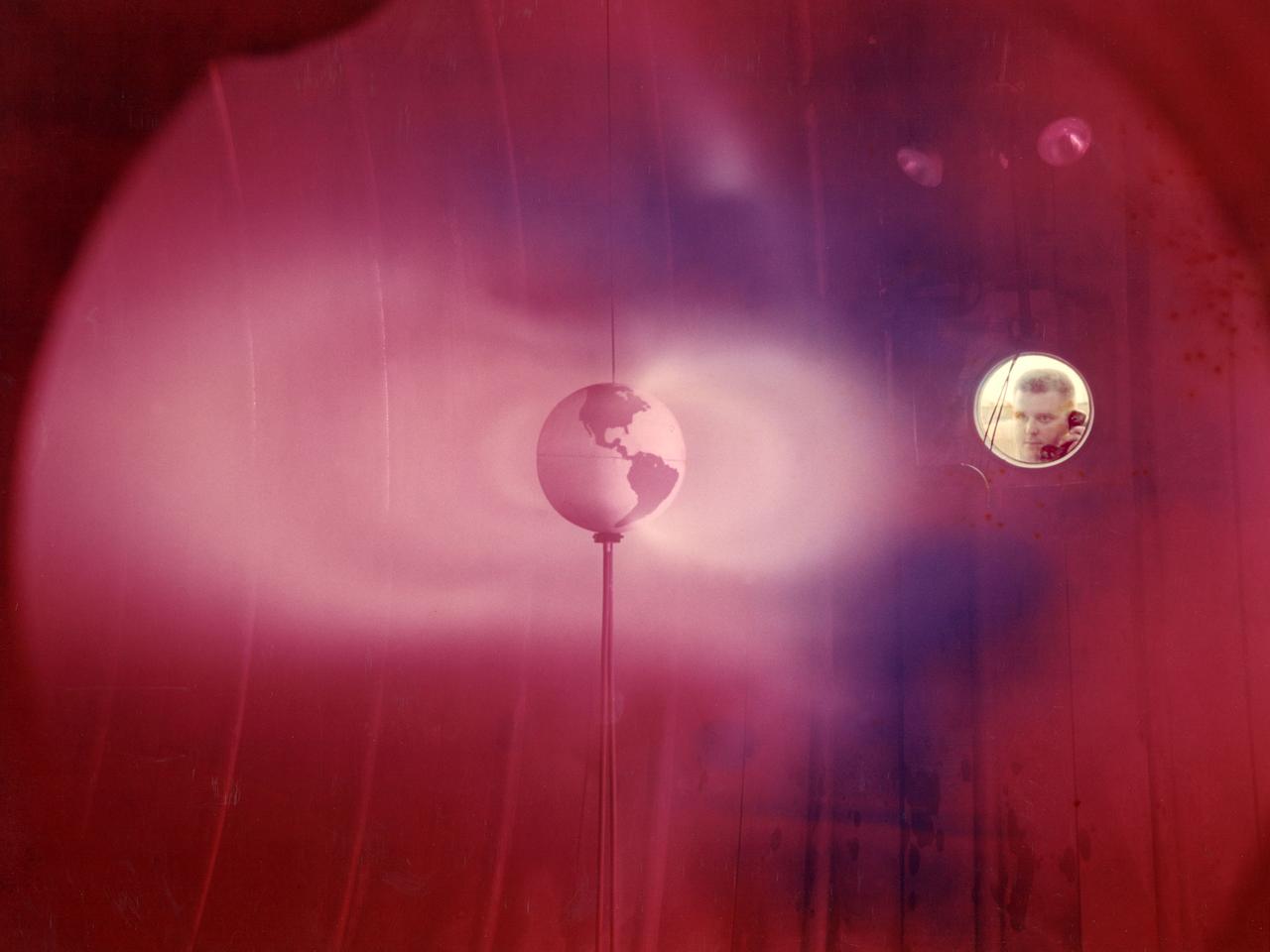
The model of the Earth housed inside Vacuum Tank 5 contained a coil which produced a magnetic field simulating that of the Earth. It was bombarded with a stream of ionized particles simulating the solar wind which impinges on the Earth's magnetic field. The bands or belts of luminous plasma seen in this image were suggestive of the Van Allen belts found around the Earth. Scientists at Lewis probed the plasma around the model and studied scaling laws in an attempt to find an explanation for the actual formation of the Van Allen belt.
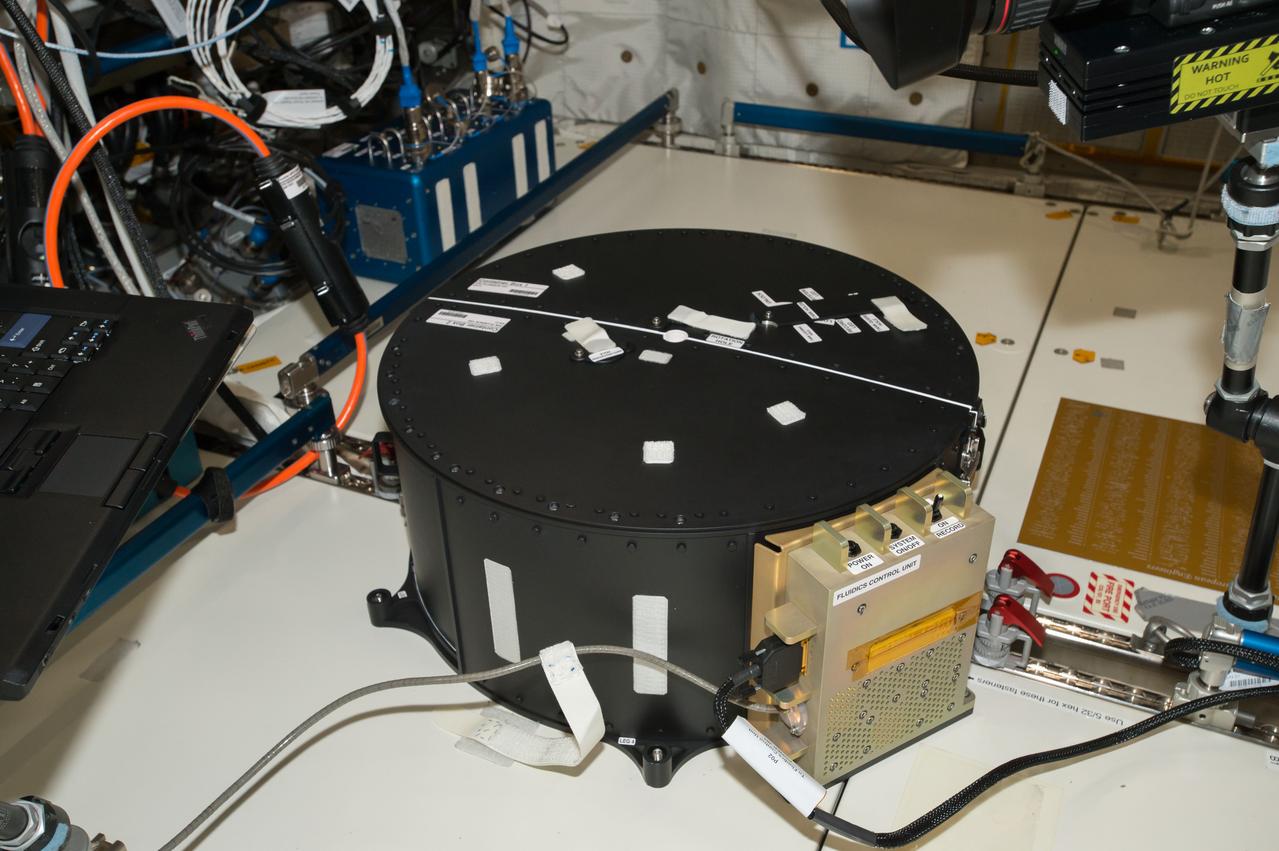
iss051e034001 (5/2/2017) --- Documentation of the Container Box attached to the COL1D1-D2 Seat Track during the first run of the Fluid Dynamics in Space (FLUIDICS) experiment. Image was taken in the Columbus European Laboratory. The FLUIDICS investigation evaluates the Center of Mass (CoM) position regarding a temperature gradient on a representation of a fuel tank. The observation of capillary wave turbulence on the surface of a fluid layer in a low-gravity environment can provide insights into measuring the existing volume in a sphere.