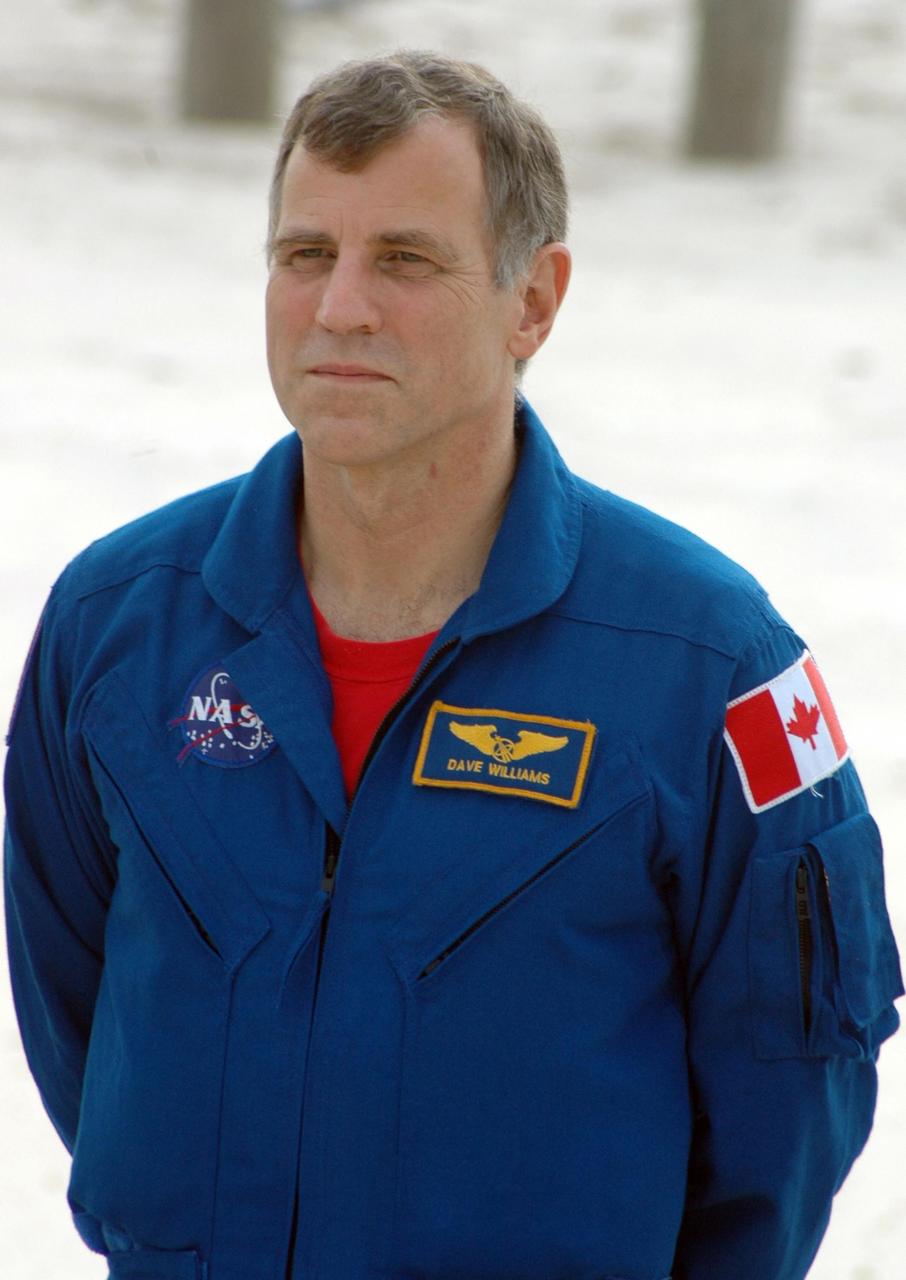
KENNEDY SPACE CENTER, Fla. -- In the slidewire basket bunker area of Launch Pad 39A, STS-118 Mission Specialist Dave Williams is introduced to the press during a media interview before the crew's morning training activities in the terminal countdown demonstration test, or TCDT. Williams represents the Canadian Space Agency. TCDT activities include M-113 training, payload familiarization, the emergency egress training at the pad and a simulated launch countdown. The mission is the 22nd flight to the International Space Station and Space Shuttle Endeavour will carry a payload including the S5 truss, a SPACEHAB module and external stowage platform 3. STS-118 is targeted for launch on Aug. 7. Photo credit: NASA/Ken Thornsley
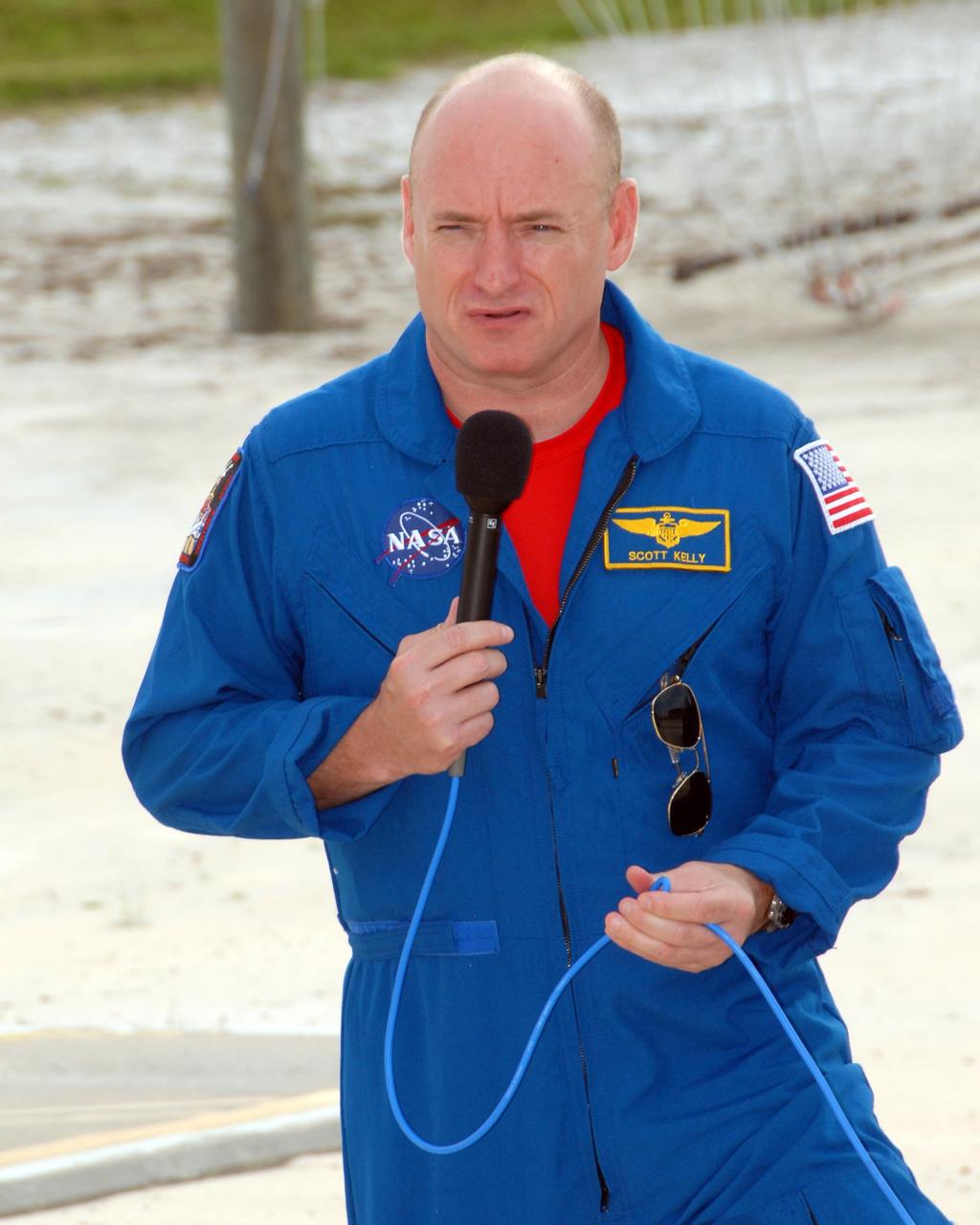
KENNEDY SPACE CENTER, Fla. -- On the slidewire basket bunker area of Launch Pad 39A, STS-118 Commander Scott Kelly talks to the media before the crew's morning training activities in the terminal countdown demonstration test, or TCDT. TCDT activities include M-113 training, payload familiarization, the emergency egress training at the pad and a simulated launch countdown. The mission is the 22nd flight to the International Space Station and Space Shuttle Endeavour will carry a payload including the S5 truss, a SPACEHAB module and external stowage platform 3. STS-118 is targeted for launch on Aug. 7. NASA/George Shelton
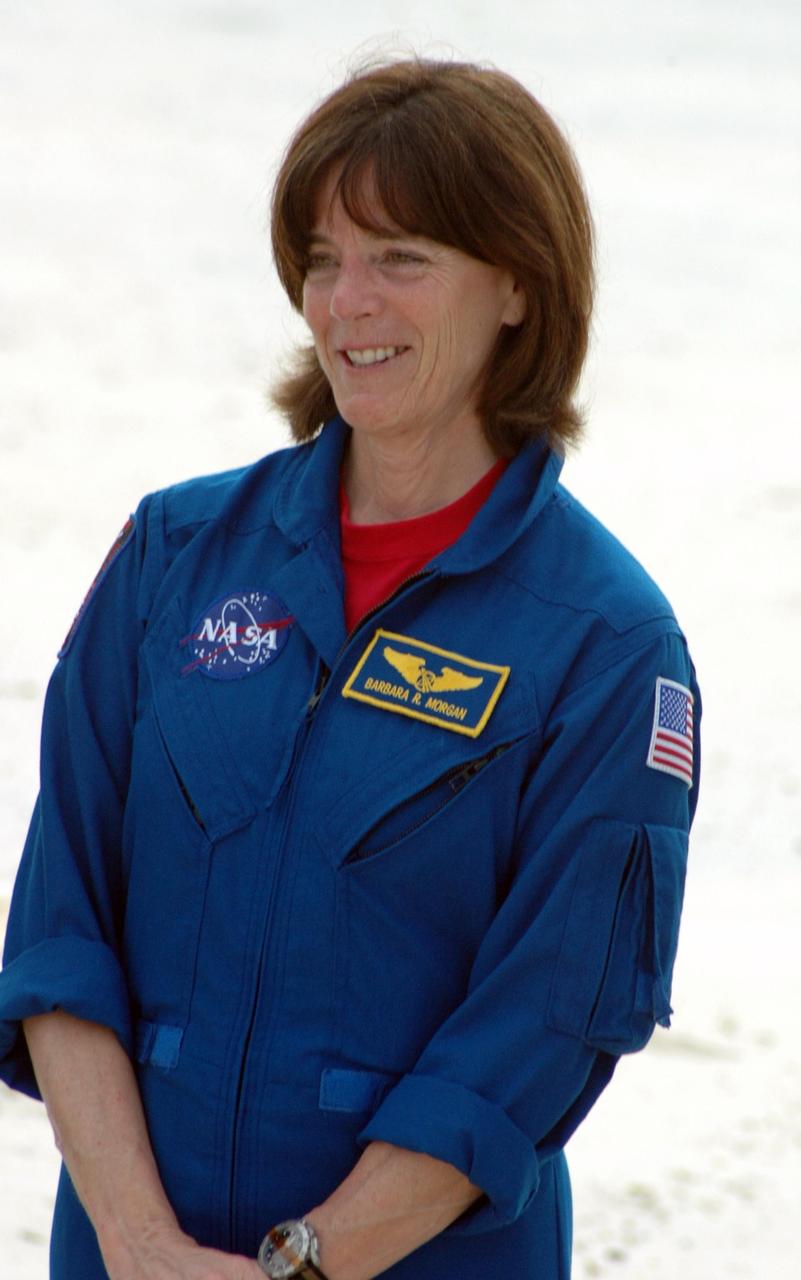
KENNEDY SPACE CENTER, Fla. -- In the slidewire basket bunker area of Launch Pad 39A, STS-118 Mission Specialist Barbara R. Morgan is introduced to the press during a media interview before the crew's morning training activities in the terminal countdown demonstration test, or TCDT. Morgan is a teacher-turned-astronaut whose association with NASA began more than 20 years ago. TCDT activities include M-113 training, payload familiarization, the emergency egress training at the pad and a simulated launch countdown. The mission is the 22nd flight to the International Space Station and Space Shuttle Endeavour will carry a payload including the S5 truss, a SPACEHAB module and external stowage platform 3. STS-118 is targeted for launch on Aug. 7. Photo credit: NASA/Ken Thornsley
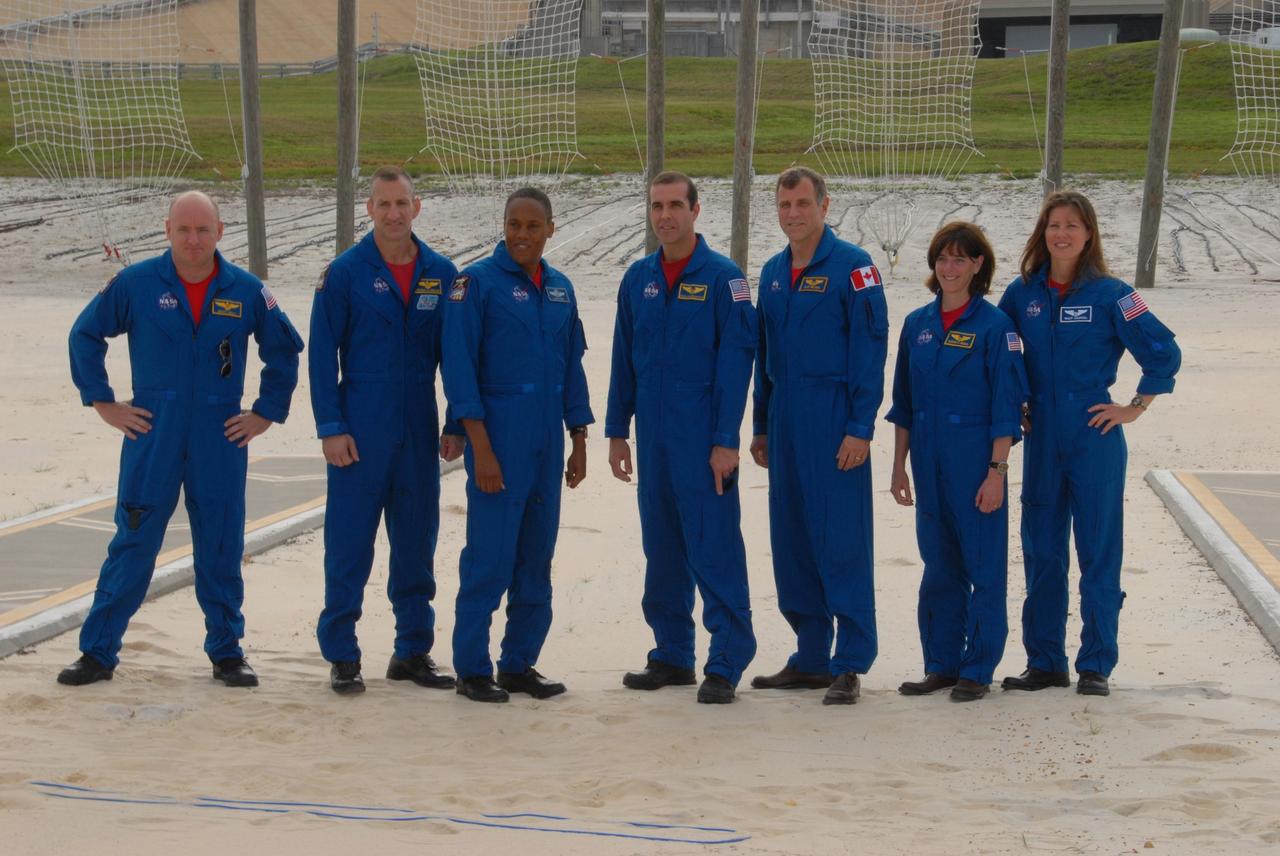
KENNEDY SPACE CENTER, Fla. -- On the slidewire basket bunker area of Launch Pad 39A, the STS-118 crew greets the media before the crew's morning training activities in the terminal countdown demonstration test, or TCDT. From left are Commander Scott Kelly, Pilot Charlie Hobaugh and Mission Specialists Alvin Drew, Rick Mastracchio, Dave Williams, Barbara R. Morgan and Tracy Caldwell. Williams represents the Canadian Space Agency. Morgan joined NASA's Teacher in Space program in 1985 and was selected as an astronaut in 1998. TCDT activities include M-113 training, payload familiarization, the emergency egress training at the pad and a simulated launch countdown. The mission is the 22nd flight to the International Space Station and Space Shuttle Endeavour will carry a payload including the S5 truss, a SPACEHAB module and external stowage platform 3. STS-118 is targeted for launch on Aug. 7. NASA/George Shelton
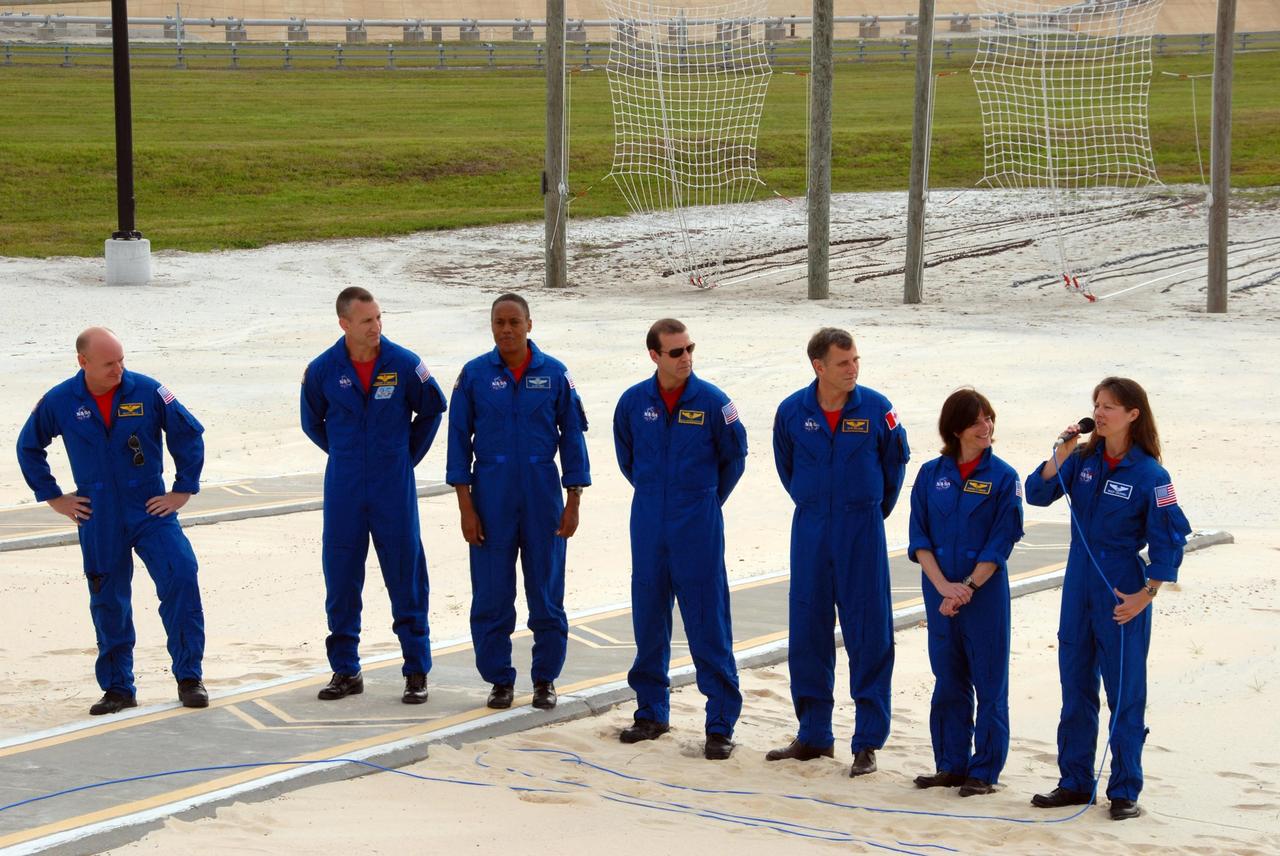
KENNEDY SPACE CENTER, Fla. -- On the slidewire basket bunker area of Launch Pad 39A, the STS-118 crew talks to the media before the crew's morning training activities in the terminal countdown demonstration test, or TCDT. At right, Mission Specialist Tracy Caldwell has the microphone. The others, from left, are Commander Scott Kelly, Pilot Charlie Hobaugh and Mission Specialists Alvin Drew, Rick Mastracchio, Dave Williams and Barbara Morgan. Williams represents the Canadian Space Agency. Morgan joined NASA's Teacher in Space program in 1985 and was selected as an astronaut in 1998. TCDT activities include M-113 training, payload familiarization, the emergency egress training at the pad and a simulated launch countdown. The mission is the 22nd flight to the International Space Station and Space Shuttle Endeavour will carry a payload including the S5 truss, a SPACEHAB module and external stowage platform 3. STS-118 is targeted for launch on Aug. 7. NASA/George Shelton
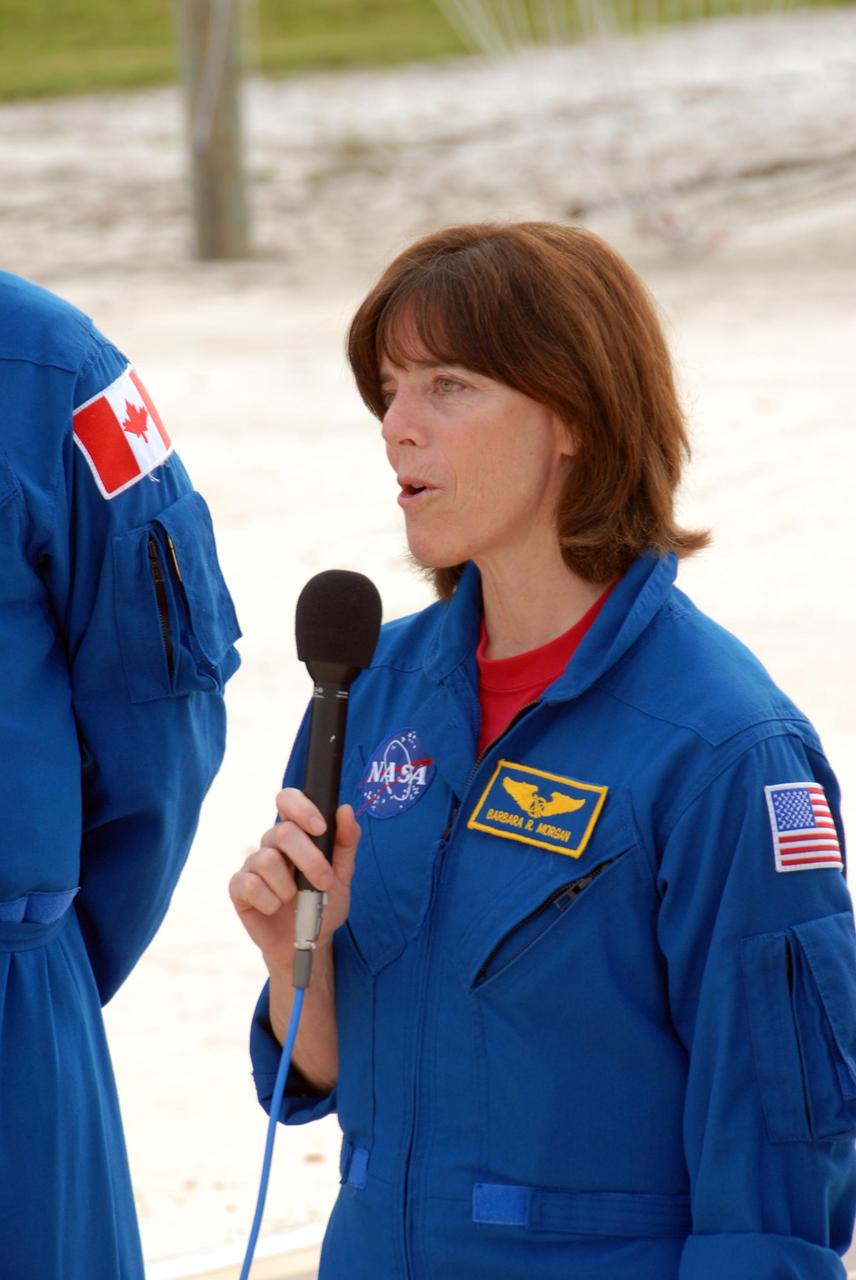
KENNEDY SPACE CENTER, Fla. -- On the slidewire basket bunker area of Launch Pad 39A, STS-118 educator astronaut and Mission Specialist Barbara R. Morgan responds to a question from the media before the crew's morning training activities in the terminal countdown demonstration test, or TCDT. Morgan joined NASA's Teacher in Space program in 1985 and was selected as an astronaut in 1998. TCDT activities include M-113 training, payload familiarization, the emergency egress training at the pad and a simulated launch countdown. The mission is the 22nd flight to the International Space Station and Space Shuttle Endeavour will carry a payload including the S5 truss, a SPACEHAB module and external stowage platform 3. STS-118 is targeted for launch on Aug. 7. NASA/George Shelton
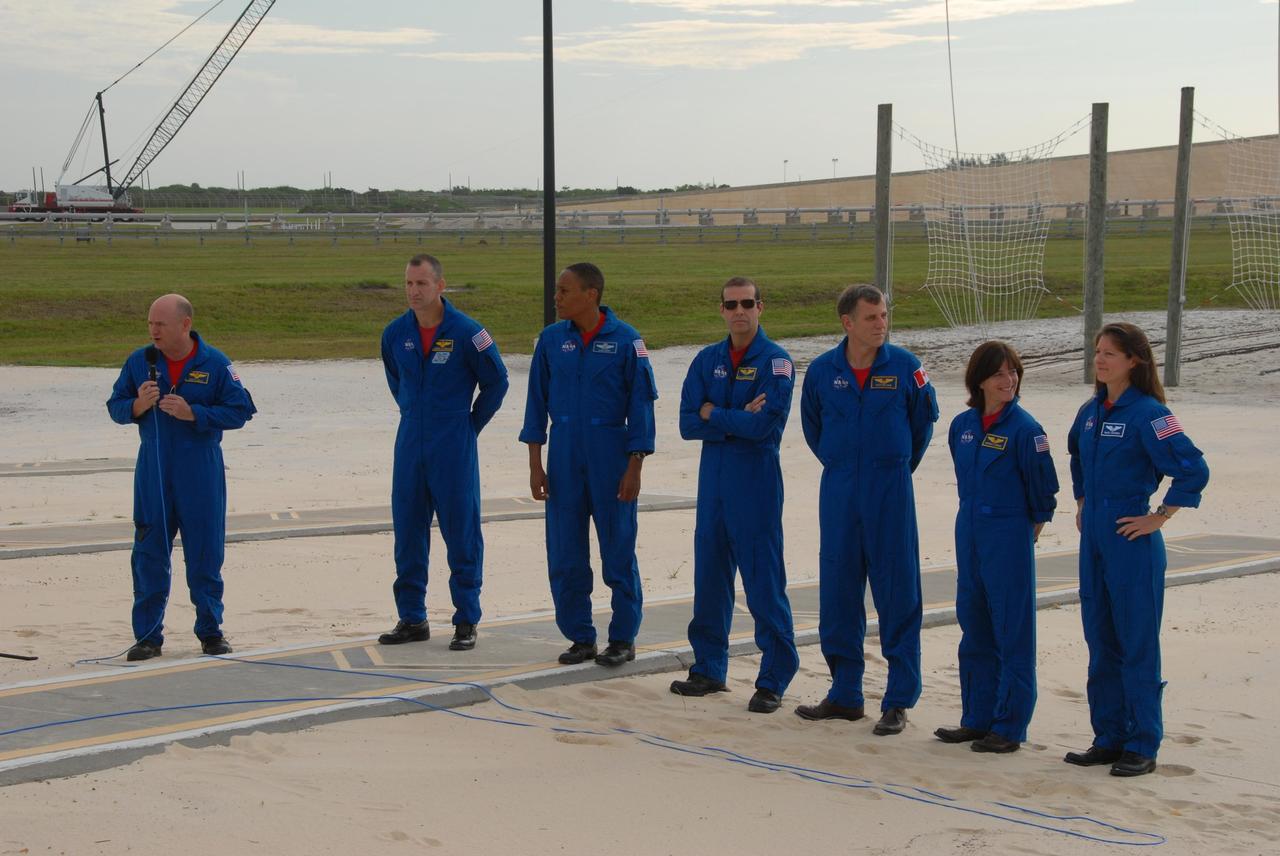
KENNEDY SPACE CENTER, Fla. -- On the slidewire basket bunker area of Launch Pad 39A, the STS-118 crew talks to the media before the crew's morning training activities in the terminal countdown demonstration test, or TCDT. At left is Commander Scott Kelly, with the microphone. The others, from left, are Pilot Charlie Hobaugh and Mission Specialists Alvin Drew, Rick Mastracchio, Dave Williams, Barbara R. Morgan and Tracy Caldwell. Williams represents the Canadian Space Agency. Morgan joined NASA's Teacher in Space program in 1985 and was selected as an astronaut in 1998. TCDT activities include M-113 training, payload familiarization, the emergency egress training at the pad and a simulated launch countdown. The mission is the 22nd flight to the International Space Station and Space Shuttle Endeavour will carry a payload including the S5 truss, a SPACEHAB module and external stowage platform 3. STS-118 is targeted for launch on Aug. 7. NASA/George Shelton
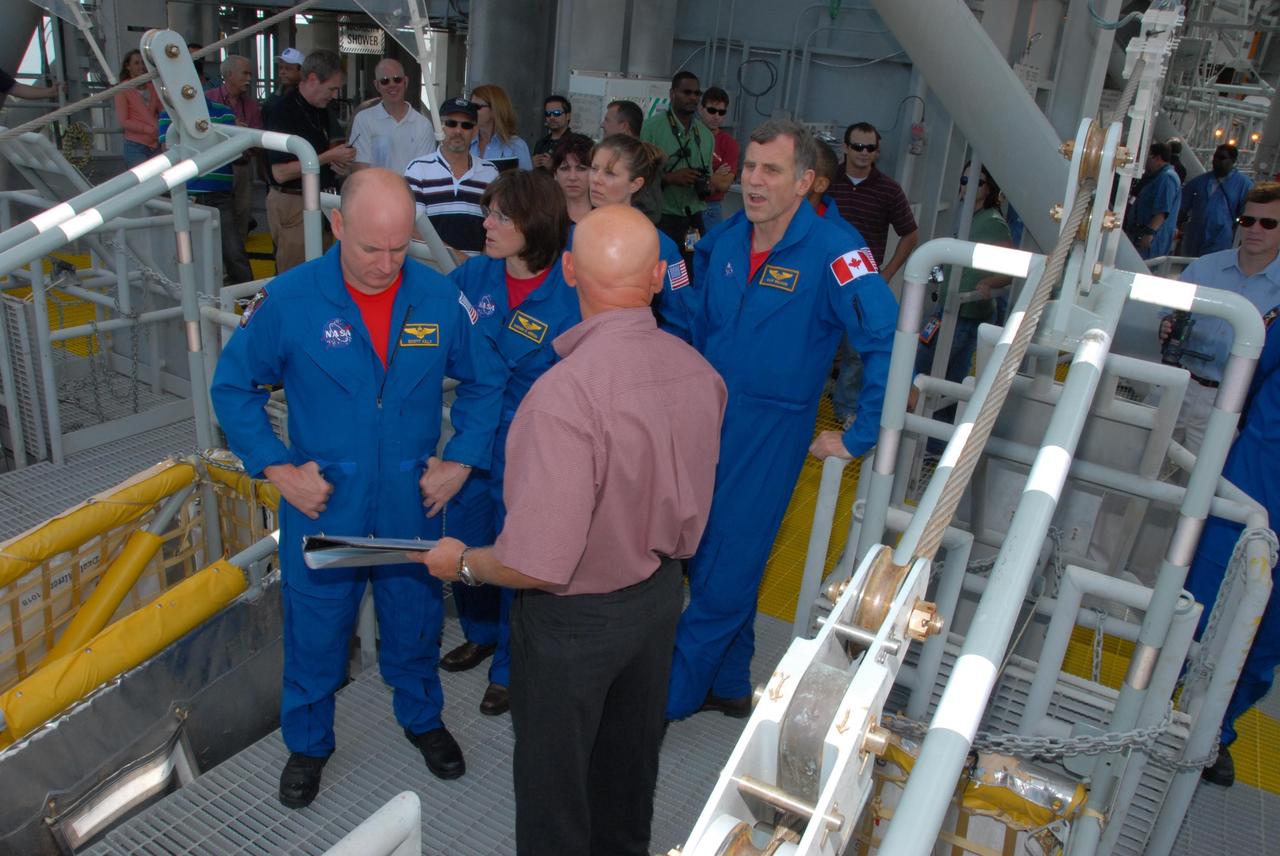
KENNEDY SPACE CENTER, Fla. -- On an upper level of the Pad 39A fixed service structure, the STS-118 crew get instructions from a trainer about using the emergency egress system. The crew members seen here are, from left, Commander Scott Kelly and Mission Specialists Barbara R. Morgan, Tracy Caldwell and Dave Williams. Morgan joined NASA's Teacher in Space program in 1985 and was selected as an astronaut in 1998. Williams represents the Canadian Space Agency. The crew is at Kennedy for training activities in the terminal countdown demonstration test, or TCDT. TCDT activities include M-113 training, payload familiarization, the emergency egress training at the pad and a simulated launch countdown. The mission is the 22nd flight to the International Space Station and Space Shuttle Endeavour will carry a payload including the S5 truss, a SPACEHAB module and external stowage platform 3. STS-118 is targeted for launch on Aug. 7. NASA/George Shelton
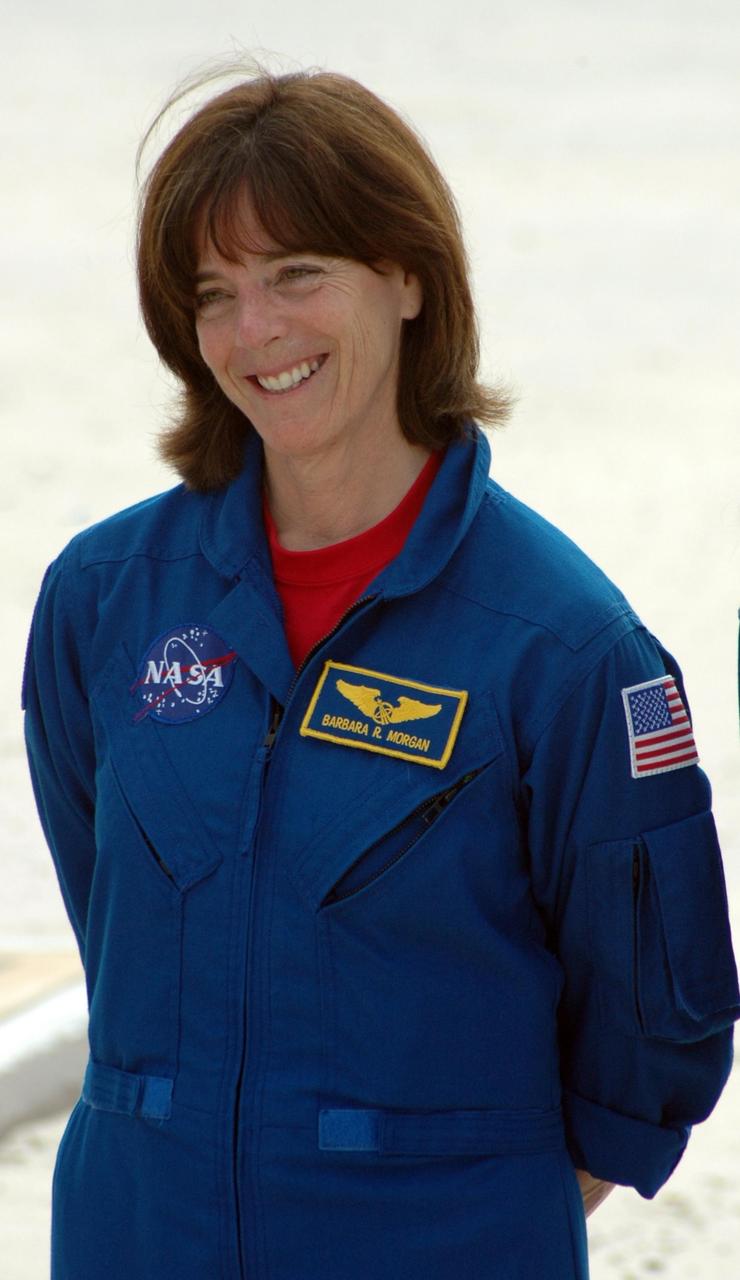
KENNEDY SPACE CENTER, Fla. -- In the slidewire basket bunker area of Launch Pad 39A, STS-118 Mission Specialist Barbara R. Morgan reacts to the waiting press during a media interview before the crew's morning training activities in the terminal countdown demonstration test, or TCDT. Morgan is a teacher-turned-astronaut whose association with NASA began more than 20 years ago. TCDT activities include M-113 training, payload familiarization, the emergency egress training at the pad and a simulated launch countdown. The mission is the 22nd flight to the International Space Station and Space Shuttle Endeavour will carry a payload including the S5 truss, a SPACEHAB module and external stowage platform 3. STS-118 is targeted for launch on Aug. 7. Photo credit: NASA/Ken Thornsley
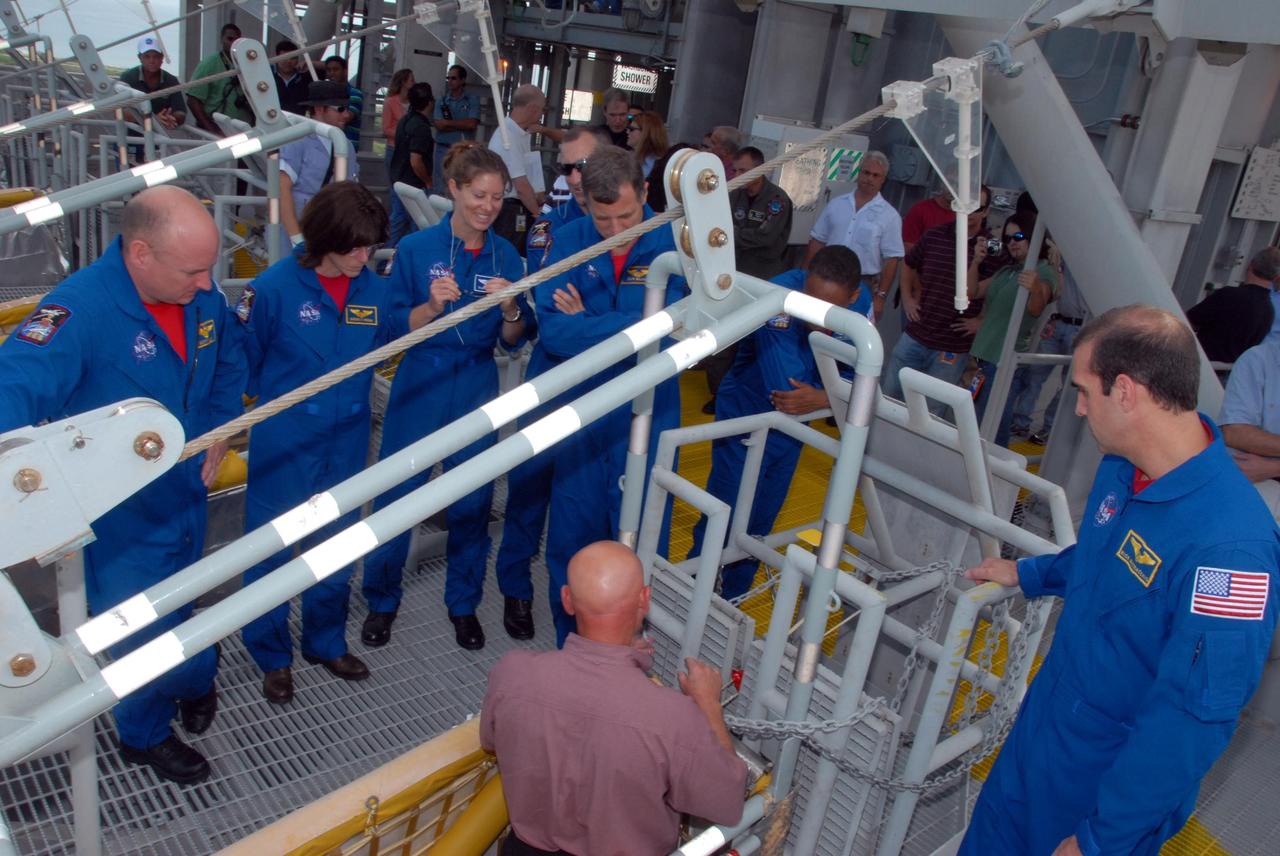
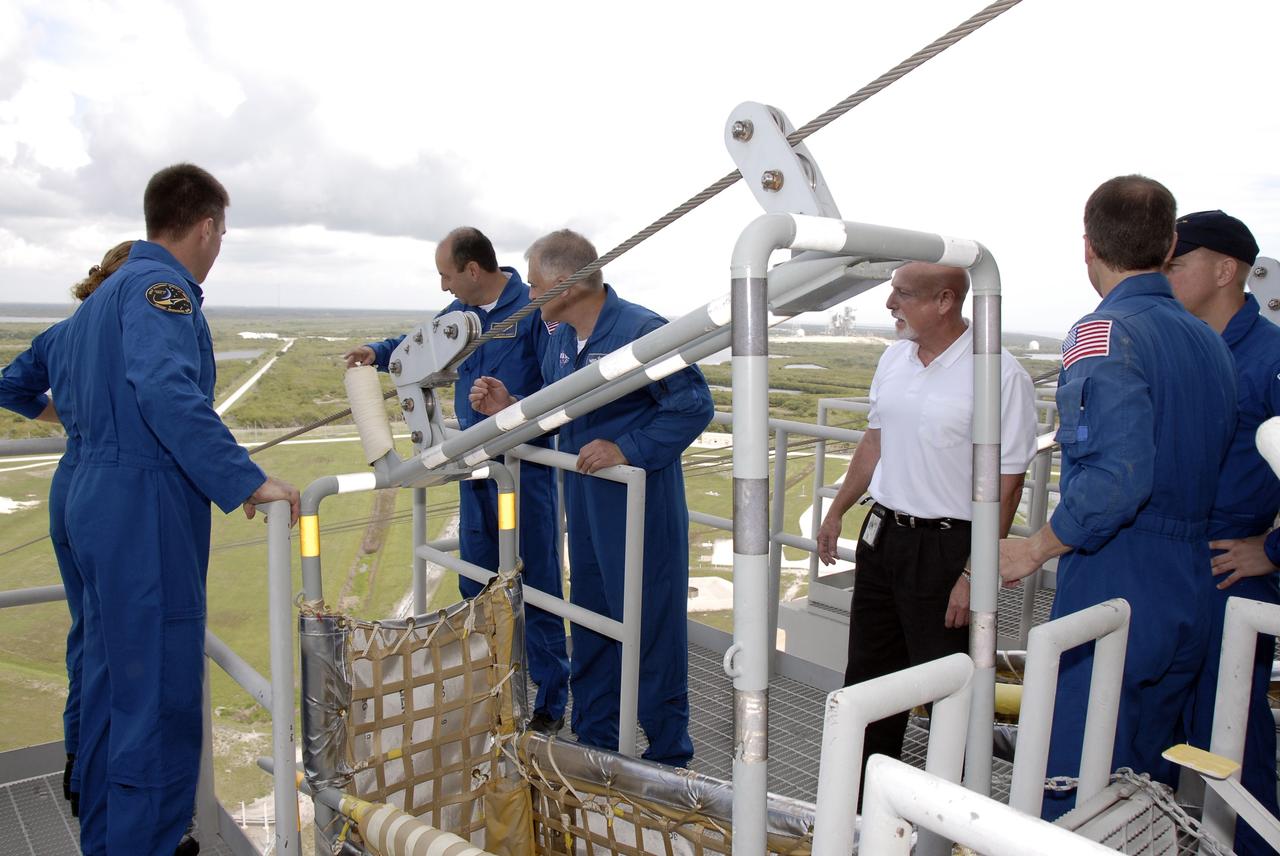
KENNEDY SPACE CENTER, Fla. -- On an upper level of the Pad 39A fixed service structure, the STS-118 crew members look at the slidewire basket that is part of the emergency egress system. On the left are Commander Scott Kelly and Mission Specialists Barbara R. Morgan, Tracy Caldwell, Dave Williams and Alvin Drew. On the right is Mission Specialist Rick Mastracchio. Morgan joined NASA's Teacher in Space program in 1985 and was selected as an astronaut in 1998. Williams represents the Canadian Space Agency. The crew is at Kennedy for training activities in the terminal countdown demonstration test, or TCDT. TCDT activities include M-113 training, payload familiarization, the emergency egress training at the pad and a simulated launch countdown. The mission is the 22nd flight to the International Space Station and Space Shuttle Endeavour will carry a payload including the S5 truss, a SPACEHAB module and external stowage platform 3. STS-118 is targeted for launch on Aug. 7. NASA/George Shelton
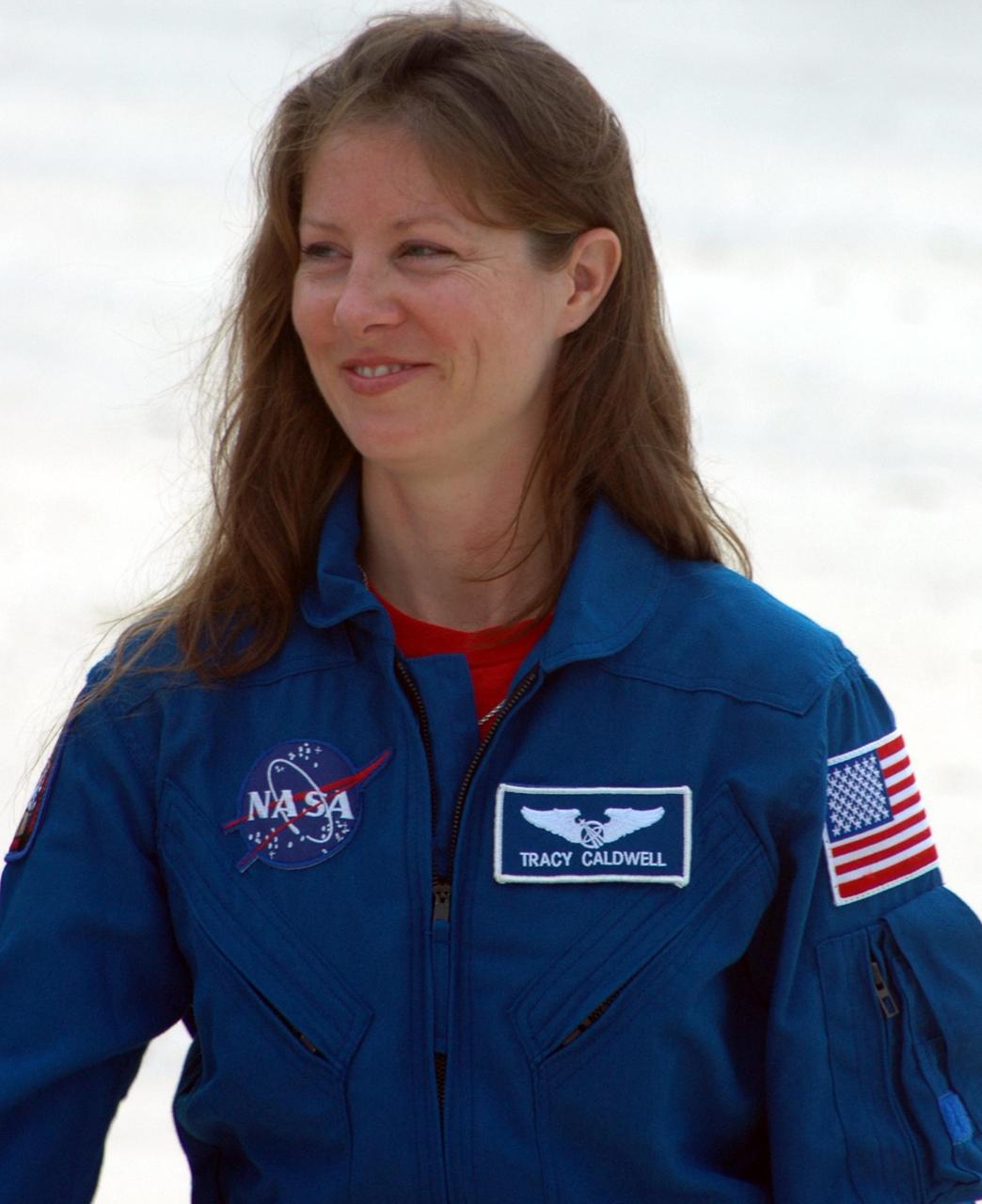
KENNEDY SPACE CENTER, Fla. -- In the slidewire basket bunker area of Launch Pad 39A, STS-118 Mission Specialist Tracy Caldwell reacts to the waiting press during a media interview before the crew's morning training activities in the terminal countdown demonstration test, or TCDT. Those activities include M-113 training, payload familiarization, the emergency egress training at the pad and a simulated launch countdown. The mission is the 22nd flight to the International Space Station and Space Shuttle Endeavour will carry a payload including the S5 truss, a SPACEHAB module and external stowage platform 3. STS-118 is targeted for launch on Aug. 7. Photo credit: NASA/Ken Thornsley
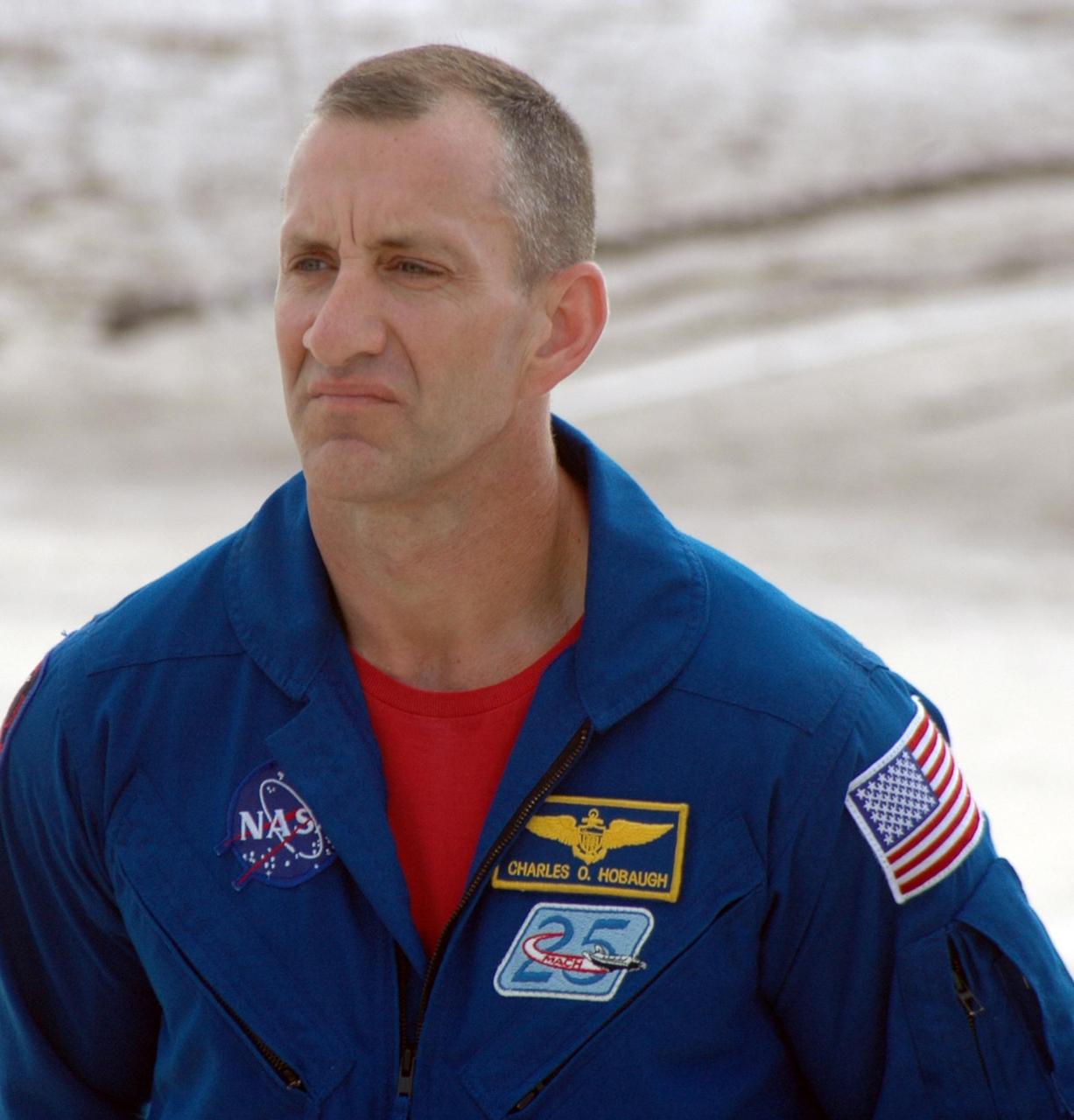
KENNEDY SPACE CENTER, Fla. -- In the slidewire basket bunker area of Launch Pad 39A, STS-118 Pilot Charlie Hobaugh waits to begin a media interview before the crew's morning training activities in the terminal countdown demonstration test, or TCDT. Those activities include M-113 training, payload familiarization, the emergency egress training at the pad and a simulated launch countdown. The mission is the 22nd flight to the International Space Station and Space Shuttle Endeavour will carry a payload including the S5 truss, a SPACEHAB module and external stowage platform 3. STS-118 is targeted for launch on Aug. 7. Photo credit: NASA/Ken Thornsley
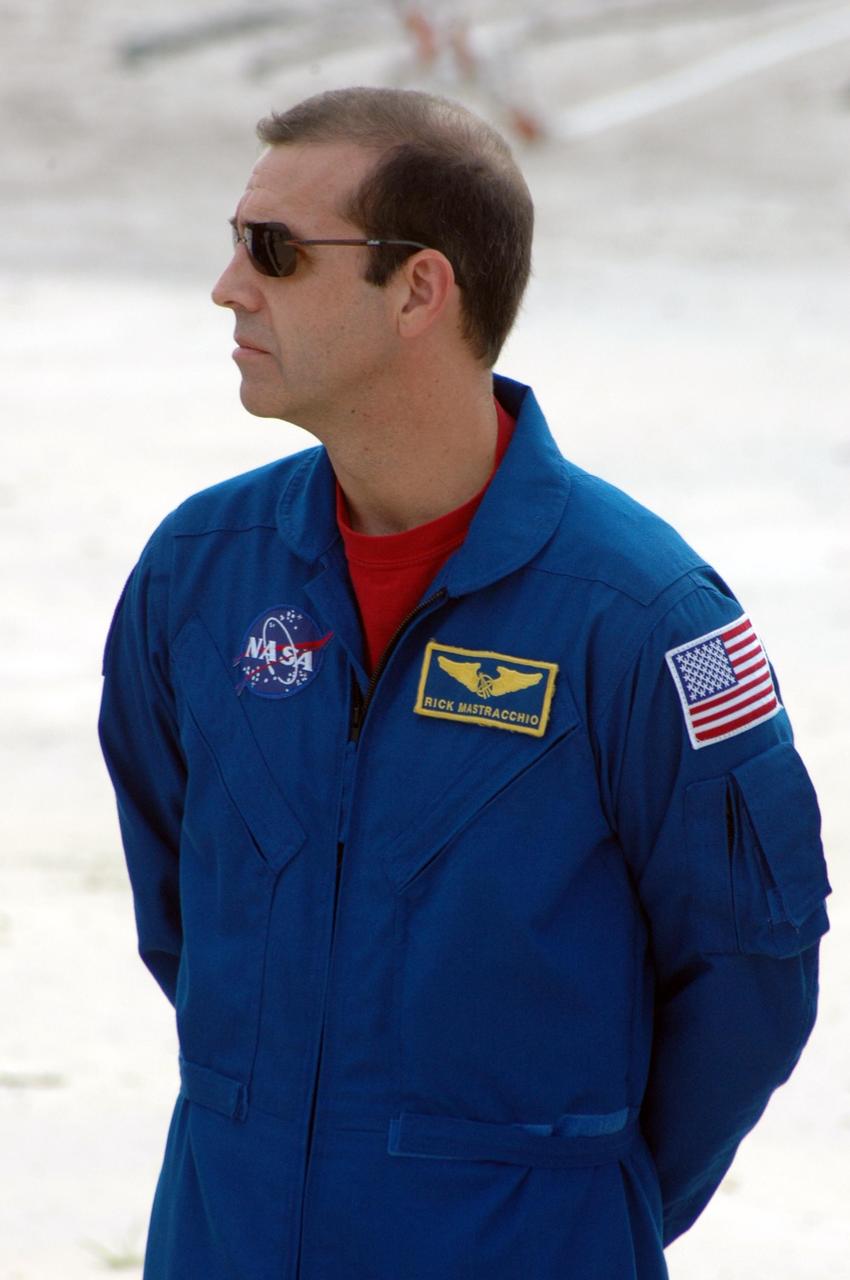
KENNEDY SPACE CENTER, Fla. -- In the slidewire basket bunker area of Launch Pad 39A, STS-118 Mission Specialist Rick Mastracchio waits to begin a media interview before the crew's morning training activities in the terminal countdown demonstration test, or TCDT. Those activities include M-113 training, payload familiarization, the emergency egress training at the pad and a simulated launch countdown. The mission is the 22nd flight to the International Space Station and Space Shuttle Endeavour will carry a payload including the S5 truss, a SPACEHAB module and external stowage platform 3. STS-118 is targeted for launch on Aug. 7. Photo credit: NASA/Ken Thornsley
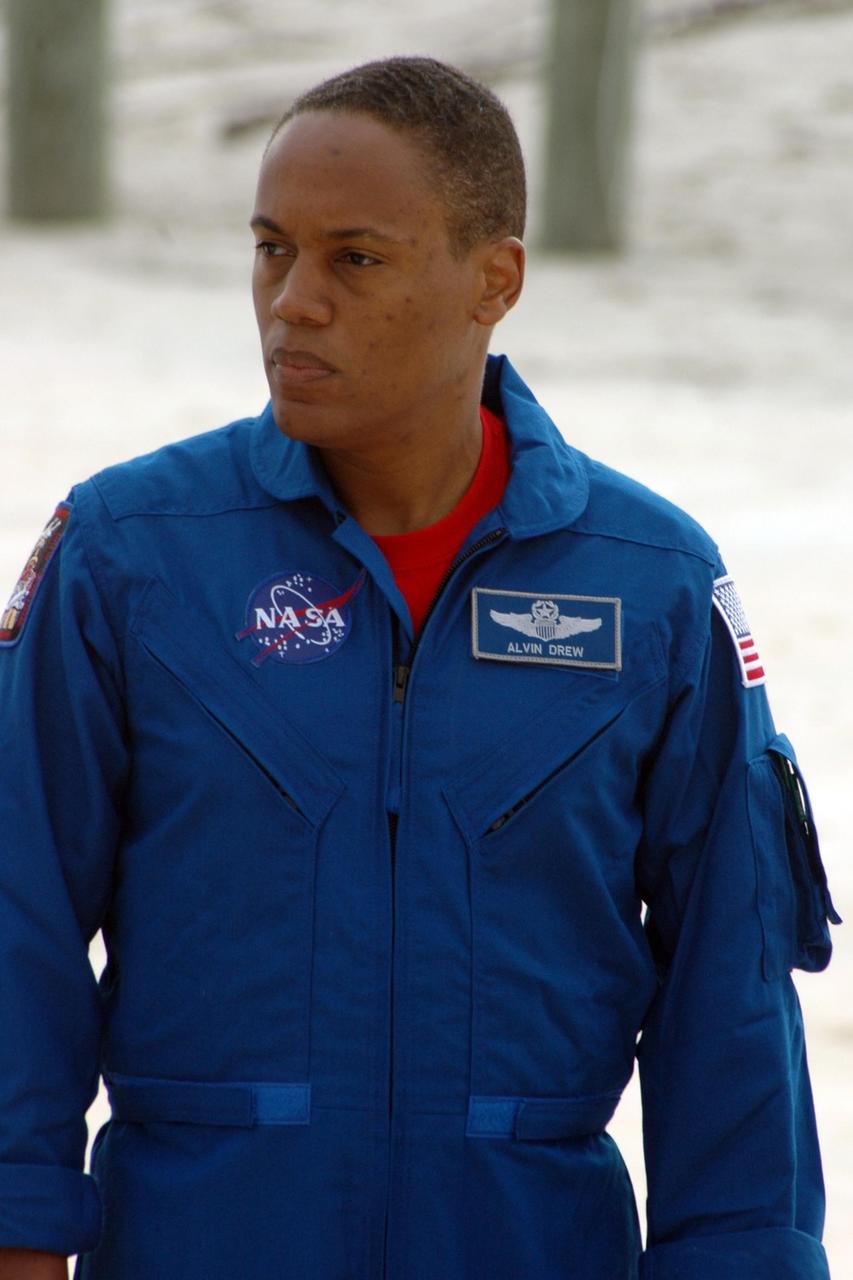
KENNEDY SPACE CENTER, Fla. -- In the slidewire basket bunker area of Launch Pad 39A, STS-118 Mission Specialist Alvin Drew waits to begin a media interview before the crew's morning training activities in the terminal countdown demonstration test, or TCDT. Those activities include M-113 training, payload familiarization, the emergency egress training at the pad and a simulated launch countdown. The mission is the 22nd flight to the International Space Station and Space Shuttle Endeavour will carry a payload including the S5 truss, a SPACEHAB module and external stowage platform 3. STS-118 is targeted for launch on Aug. 7. Photo credit: NASA/Ken Thornsley
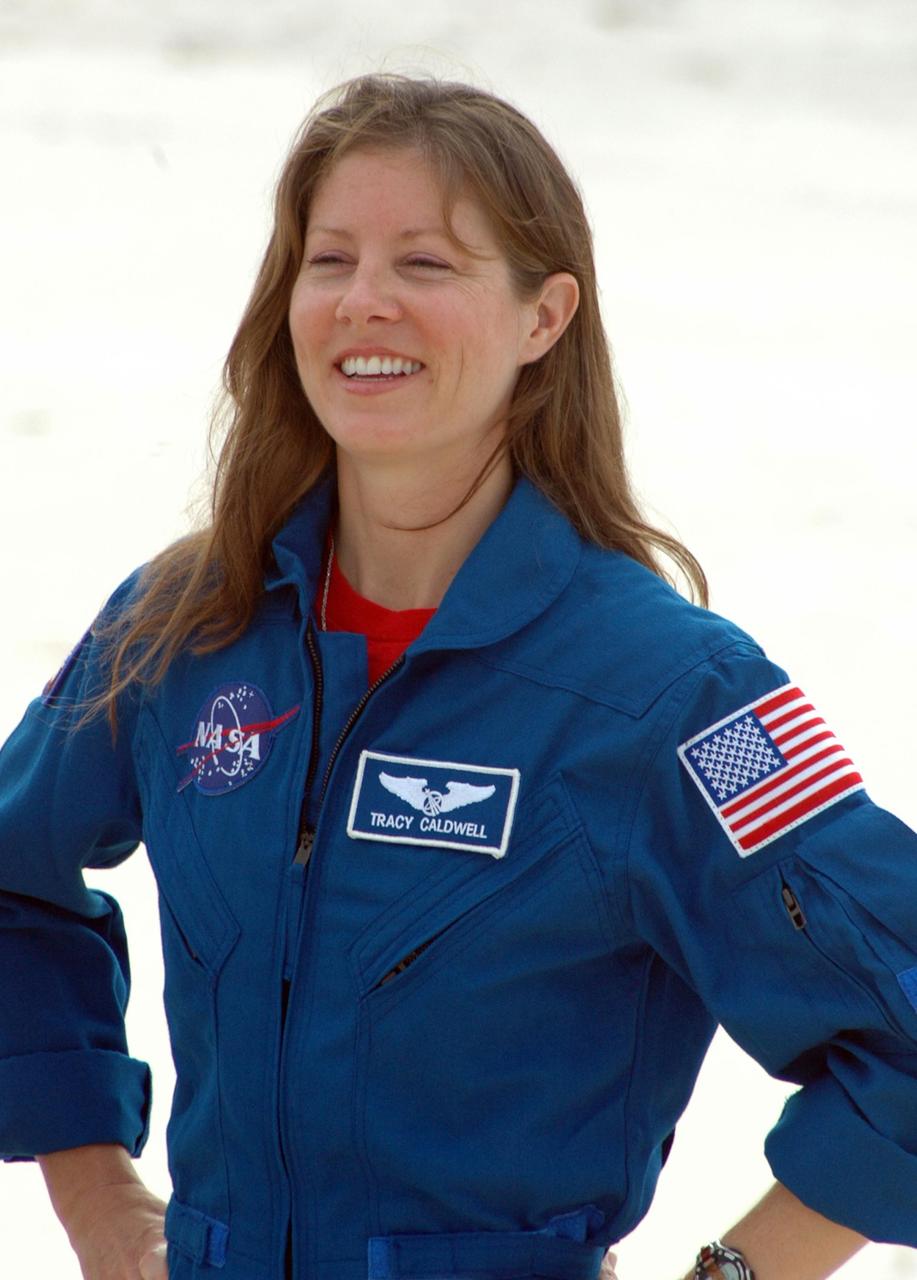
KENNEDY SPACE CENTER, Fla. -- In the slidewire basket bunker area of Launch Pad 39A, STS-118 Mission Specialist Tracy Caldwell reacts to the waiting press during a media interview before the crew's morning training activities in the terminal countdown demonstration test, or TCDT. Those activities include M-113 training, payload familiarization, the emergency egress training at the pad and a simulated launch countdown. The mission is the 22nd flight to the International Space Station and Space Shuttle Endeavour will carry a payload including the S5 truss, a SPACEHAB module and external stowage platform 3. STS-118 is targeted for launch on Aug. 7. Photo credit: NASA/Ken Thornsley
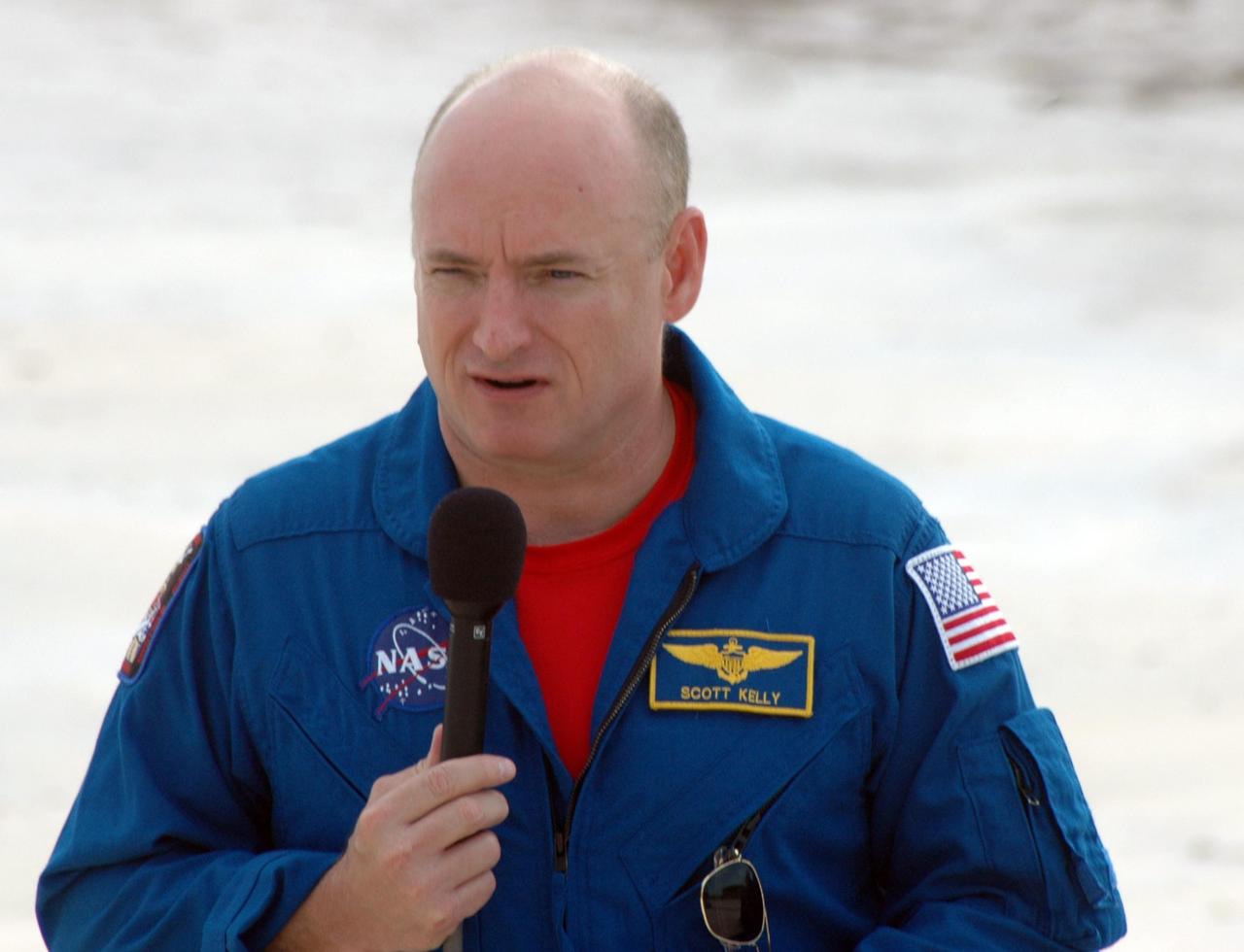
KENNEDY SPACE CENTER, Fla. -- In the slidewire basket bunker area of Launch Pad 39A, STS-118 Commander Scott Kelly talks to the media at a press conference before the crew's morning training activities in the terminal countdown demonstration test, or TCDT. Those activities include M-113 training, payload familiarization, the emergency egress training at the pad and a simulated launch countdown. The mission is the 22nd flight to the International Space Station and Space Shuttle Endeavour will carry a payload including the S5 truss, a SPACEHAB module and external stowage platform 3. STS-118 is targeted for launch on Aug. 7. Photo credit: NASA/Ken Thornsley
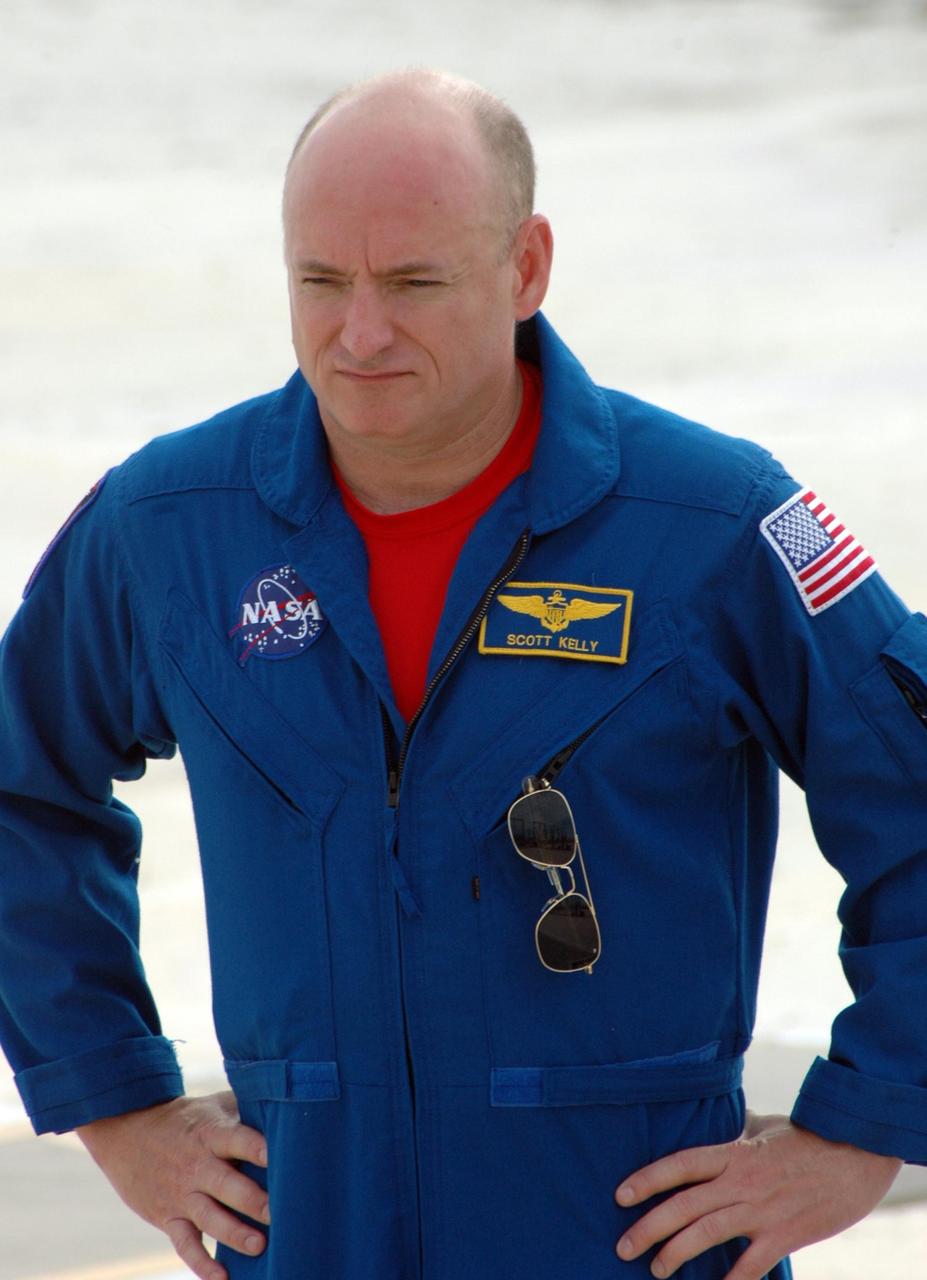
KENNEDY SPACE CENTER, Fla. -- In the slidewire basket bunker area of Launch Pad 39A, STS-118 Commander Scott Kelly waits to begin a media interview before the crew's morning training activities in the terminal countdown demonstration test, or TCDT. Those activities include M-113 training, payload familiarization, the emergency egress training at the pad and a simulated launch countdown. The mission is the 22nd flight to the International Space Station and Space Shuttle Endeavour will carry a payload including the S5 truss, a SPACEHAB module and external stowage platform 3. STS-118 is targeted for launch on Aug. 7. Photo credit: NASA/Ken Thornsley
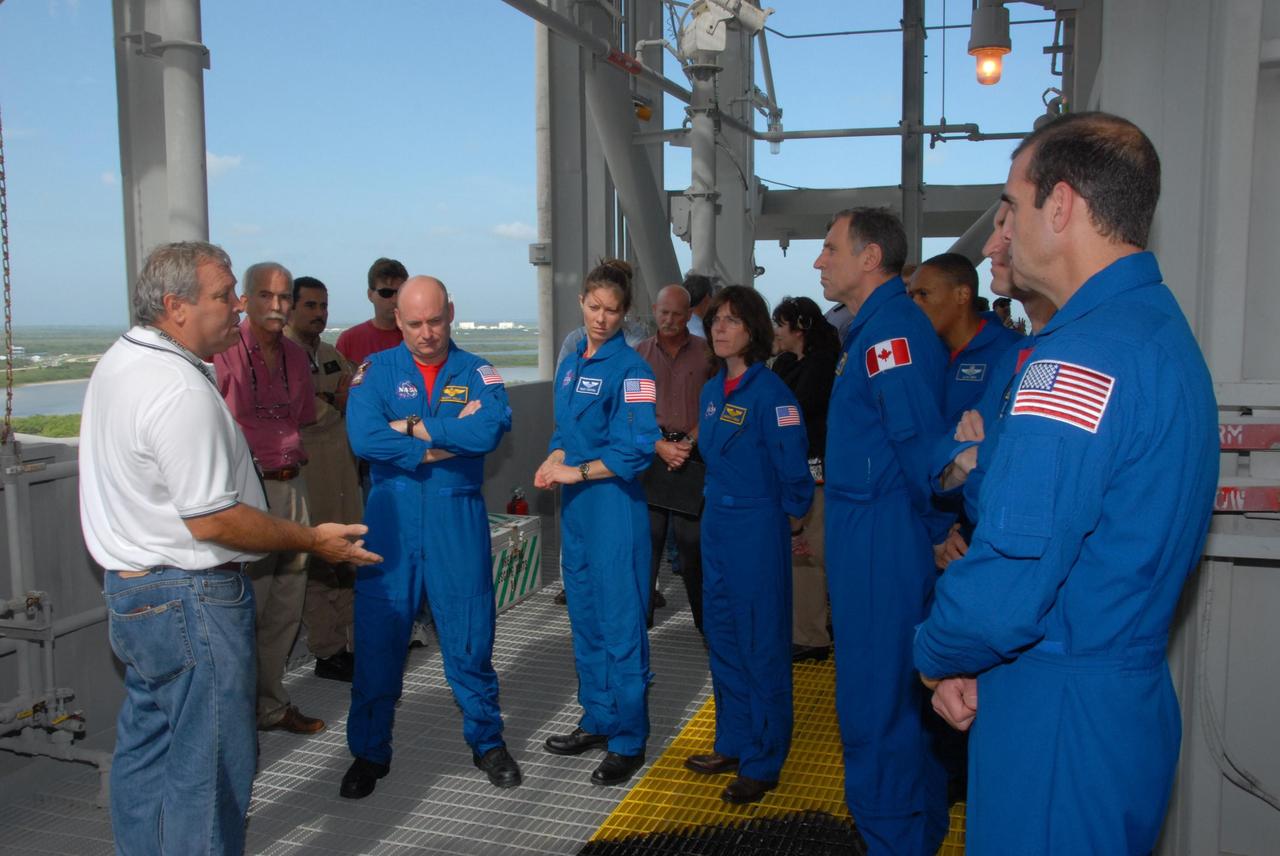
KENNEDY SPACE CENTER, Fla. -- On an upper level of the Pad 39A fixed service structure, the STS-118 crew listen to a trainer, at left, about using the emergency egress system. The crew members are, from left, Commander Scott Kelly, Mission Specialists Tracy Caldwell, Barbara R. Morgan, Dave Williams and Alvin Drew, Pilot Charlie Hobaugh and Mission Specialist Rick Mastracchio. Williams represents the Canadian Space Agency. Morgan joined NASA's Teacher in Space program in 1985 and was selected as an astronaut in 1998. The crew is at Kennedy for training activities in the terminal countdown demonstration test, or TCDT. TCDT activities include M-113 training, payload familiarization, the emergency egress training at the pad and a simulated launch countdown. The mission is the 22nd flight to the International Space Station and Space Shuttle Endeavour will carry a payload including the S5 truss, a SPACEHAB module and external stowage platform 3. STS-118 is targeted for launch on Aug. 7. NASA/George Shelton
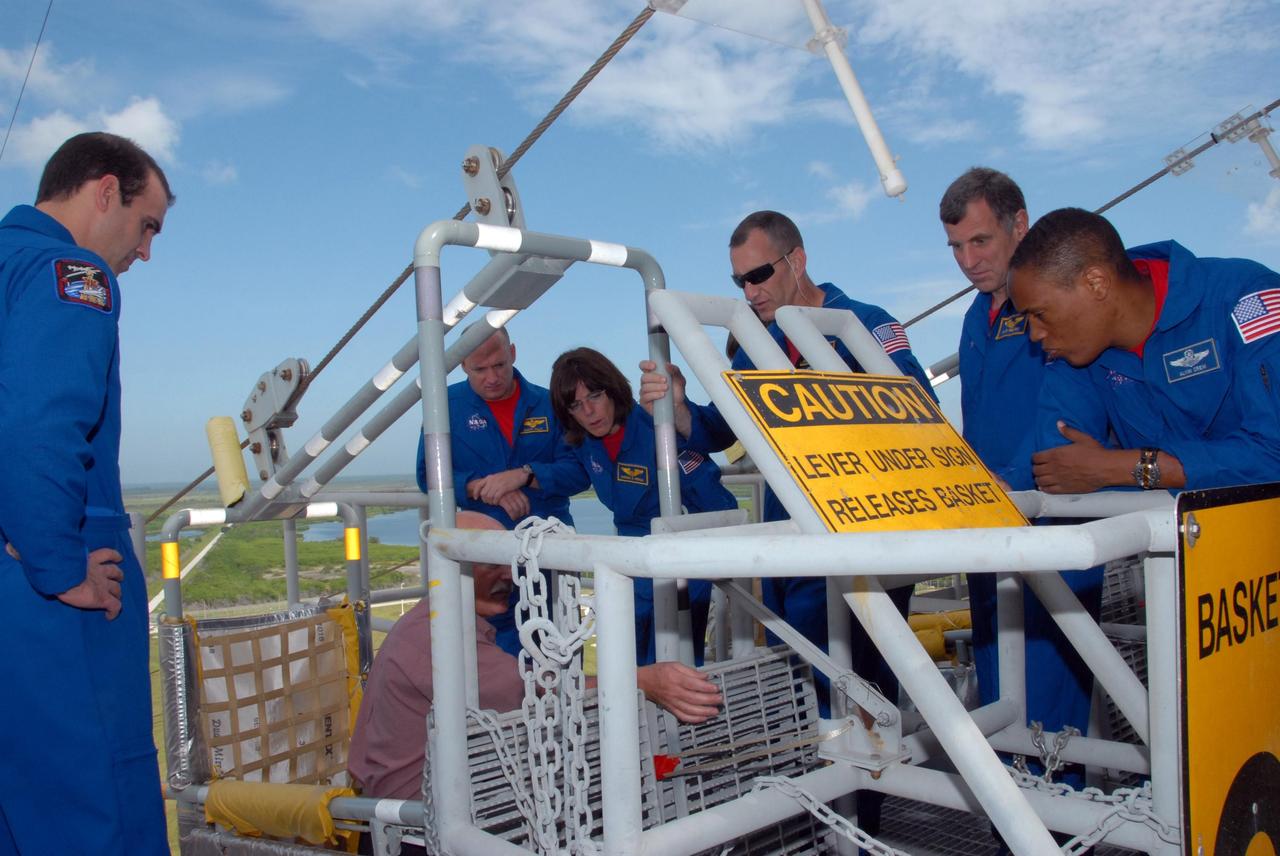
KENNEDY SPACE CENTER, Fla. -- On an upper level of the Pad 39A fixed service structure, the STS-118 crew members get directions about using the slidewire basket that is part of the emergency egress system. At left is Mission Specialist Rick Mastracchio. At right are (from the left) Commander Scott Kelly, Mission Specialist Barbara R. Morgan, Pilot Charlie Hobaugh and Mission Specialists Dave Williams and Alvin Drew. Morgan joined NASA's Teacher in Space program in 1985 and was selected as an astronaut in 1998. Williams represents the Canadian Space Agency. The crew is at Kennedy for training activities in the terminal countdown demonstration test, or TCDT. TCDT activities include M-113 training, payload familiarization, the emergency egress training at the pad and a simulated launch countdown. The mission is the 22nd flight to the International Space Station and Space Shuttle Endeavour will carry a payload including the S5 truss, a SPACEHAB module and external stowage platform 3. STS-118 is targeted for launch on Aug. 7. NASA/George Shelton
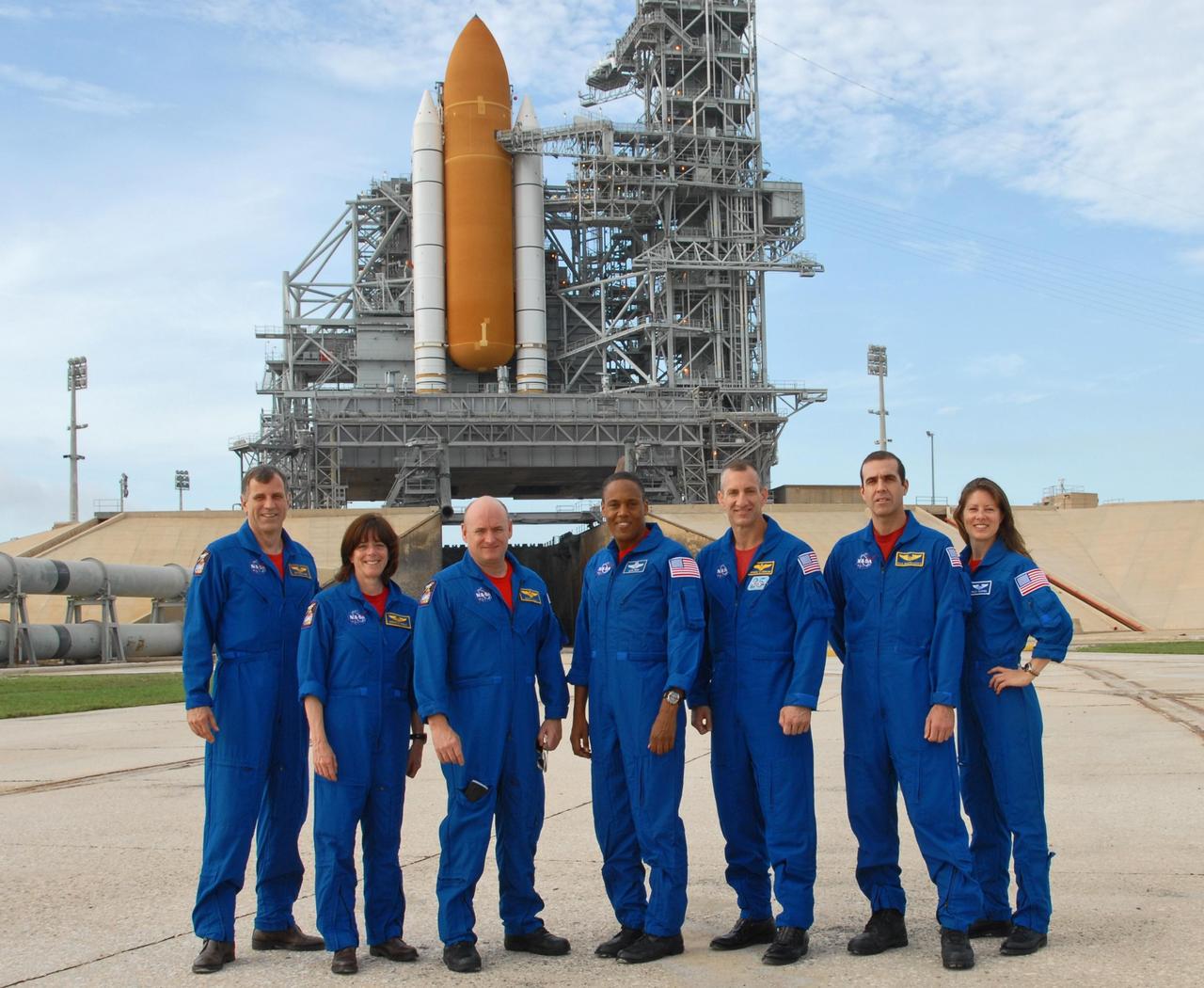
KENNEDY SPACE CENTER, Fla. -- The STS-118 crew poses for a photo on Launch Pad 39A during training activities in the terminal countdown demonstration test, or TCDT. From left are Mission Specialists Dave Williams and Barbara R. Morgan, Commander Scott Kelly, Mission Specialist Alvin Drew, Pilot Charlie Hobaugh, and Mission Specialists Rick Mastracchio and Tracy Caldwell. Williams represents the Canadian Space Agency. Morgan joined NASA's Teacher in Space program in 1985 and was selected as an astronaut in 1998. Behind them can be seen the solid rocket boosters and external tank of Space Shuttle Endeavour atop the mobile launcher platform. TCDT activities include M-113 training, payload familiarization, the emergency egress training at the pad and a simulated launch countdown. The mission is the 22nd flight to the International Space Station and Space Shuttle Endeavour will carry a payload including the S5 truss, a SPACEHAB module and external stowage platform 3. STS-118 is targeted for launch on Aug. 7. Photo credit: NASA/George Shelton
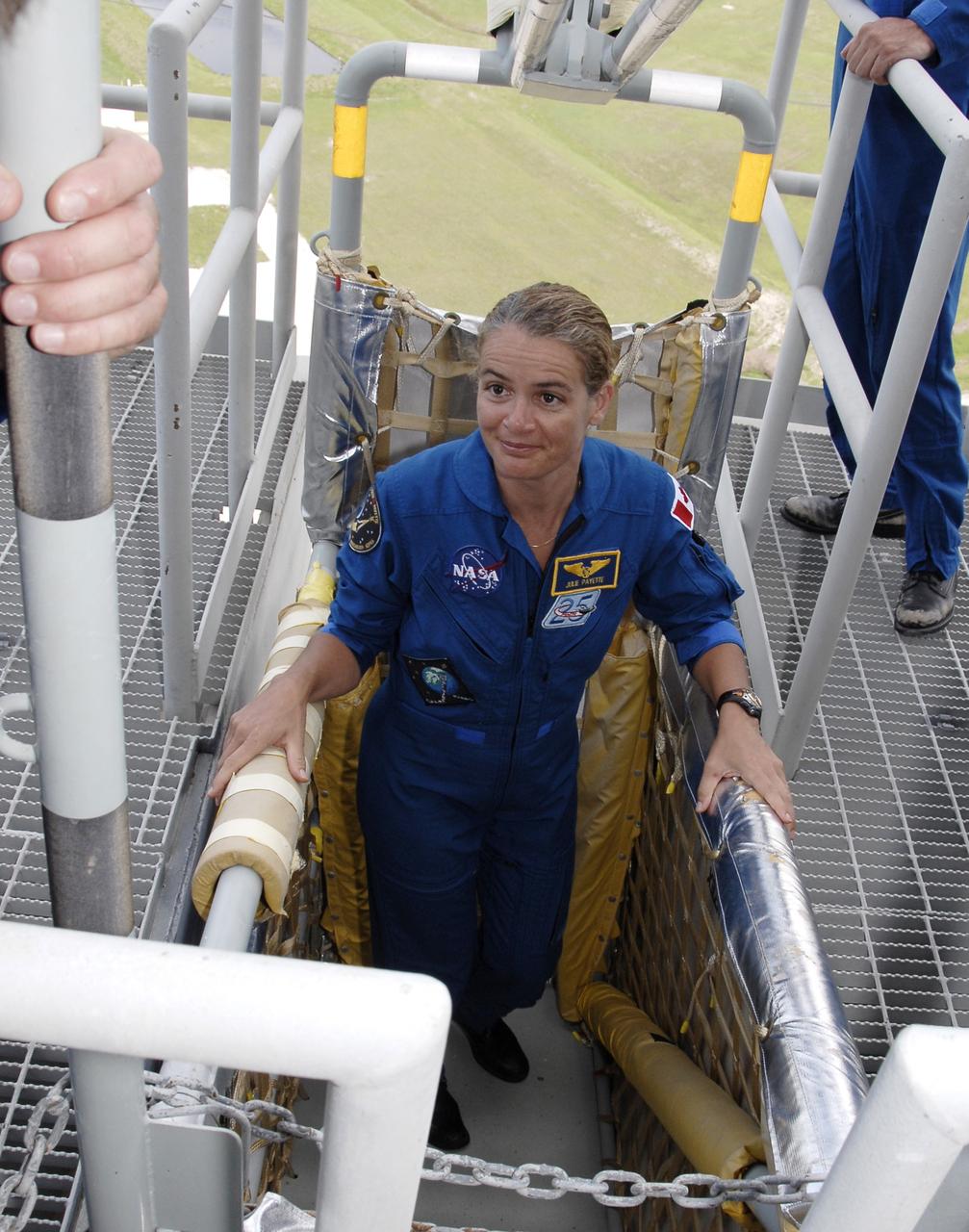
CAPE CANAVERAL, Fla. – On Launch Pad 39A at NASA's Kennedy Space Center in Florida, STS-127 Mission Specialist Julie Payette gets into the slidewire basket that is part of emergency exit equipment. She and other crew members are learning about emergency procedures from the launch pad. The crew is at Kennedy for a launch dress rehearsal called the terminal countdown demonstration test, or TCDT, which includes emergency exit training and equipment familiarization. Endeavour's STS-127 mission is the final of three flights dedicated to the assembly of the Japanese Kibo laboratory complex on the International Space Station. Endeavour's launch is targeted for June 13. Photo credit: NASA/Kim Shiflett
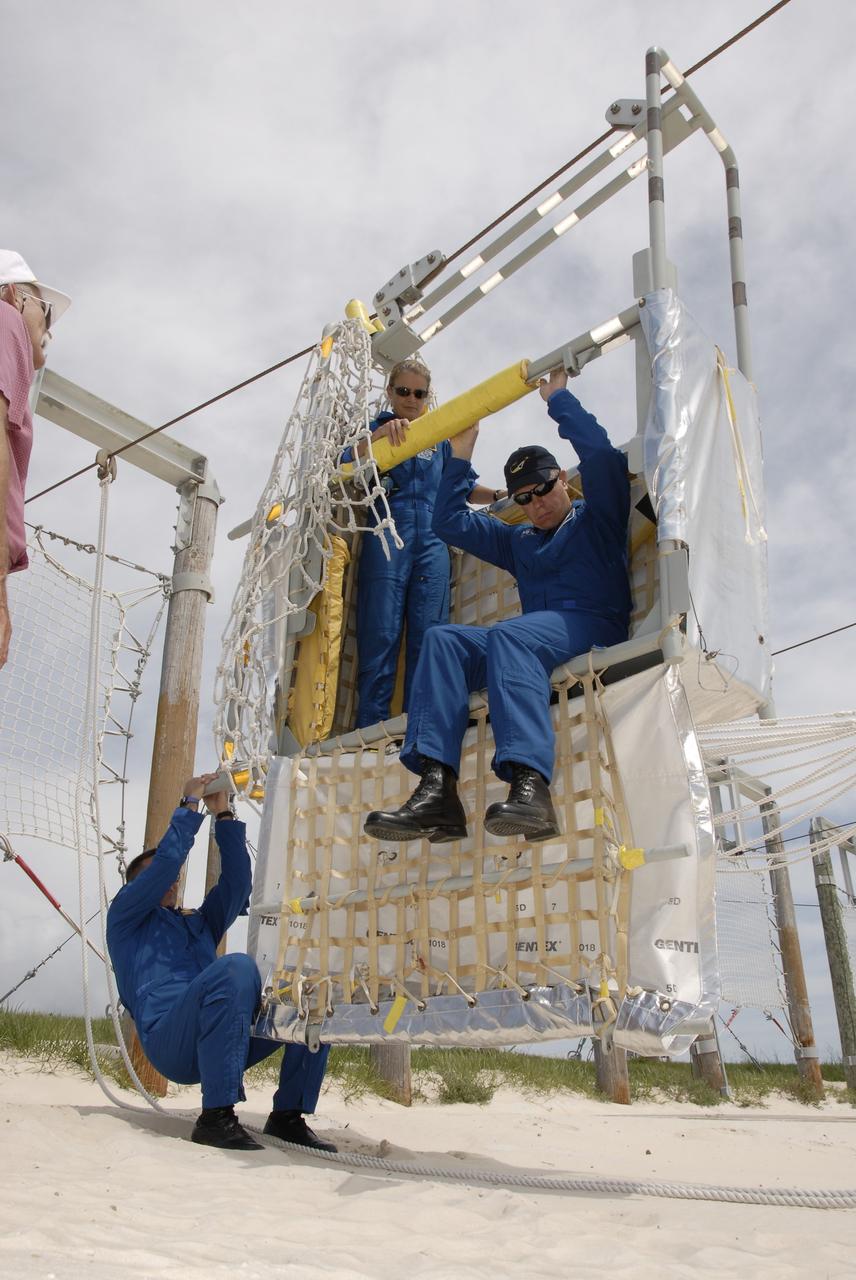
CAPE CANAVERAL, Fla. – At the slidewire basket landing area near Launch Pad 39A at NASA's Kennedy Space Center in Florida, STS-127 crew members practice getting out of a basket. The baskets are used for emergency exits from the pad. Inside the basket are Mission Specialists Julie Payette and Tim Kopra. The crew is at Kennedy for a launch dress rehearsal called the terminal countdown demonstration test, or TCDT, which includes emergency exit training and equipment familiarization. Endeavour's STS-127 mission is the final of three flights dedicated to the assembly of the Japanese Kibo laboratory complex on the International Space Station. Endeavour's launch is targeted for June 13. Photo credit: NASA/Kim Shiflett
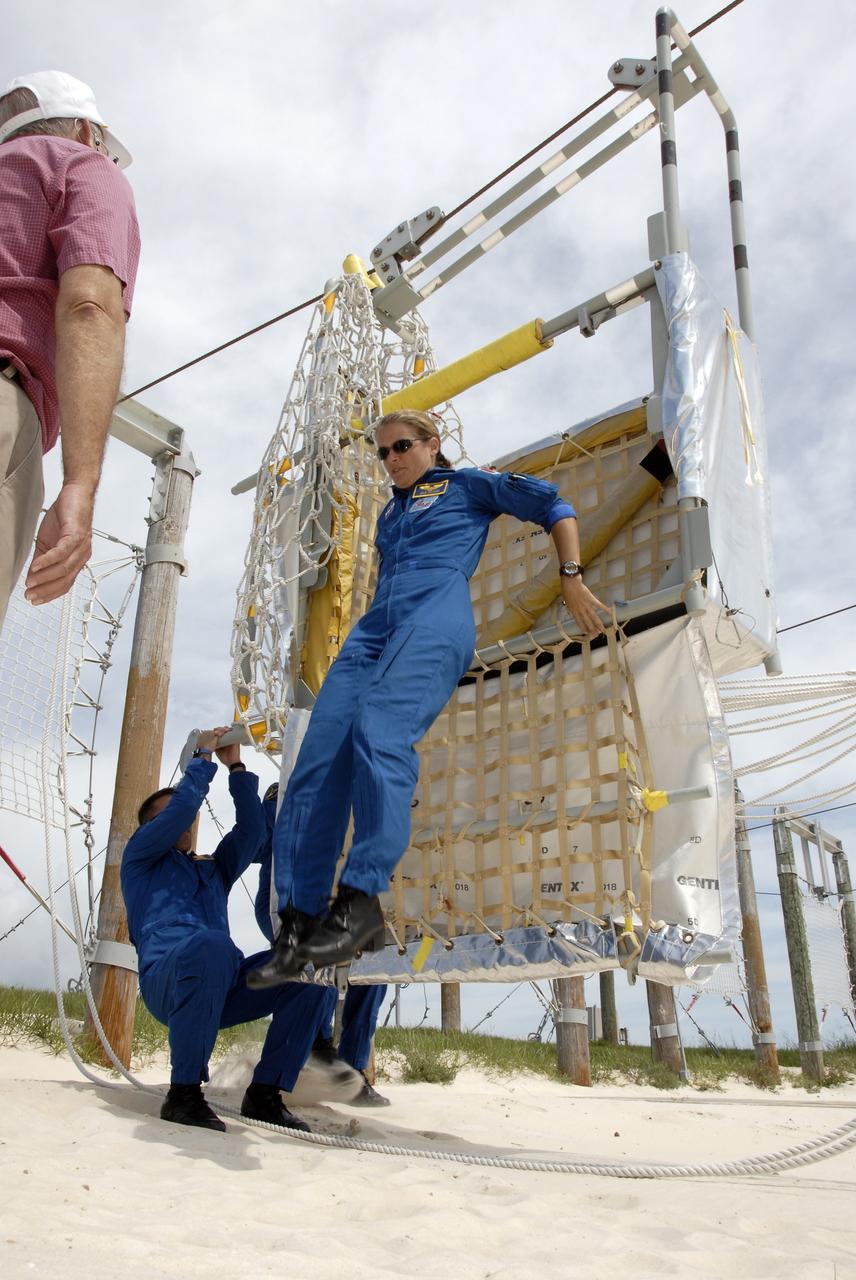
CAPE CANAVERAL, Fla. – At the slidewire basket landing area near Launch Pad 39A at NASA's Kennedy Space Center in Florida, STS-127 Mission Specialist Julie Payette practices getting out of a basket, which are used for emergency exits from the pad. The crew is at Kennedy for a launch dress rehearsal called the terminal countdown demonstration test, or TCDT, which includes emergency exit training and equipment familiarization. Endeavour's STS-127 mission is the final of three flights dedicated to the assembly of the Japanese Kibo laboratory complex on the International Space Station. Endeavour's launch is targeted for June 13. Photo credit: NASA/Kim Shiflett
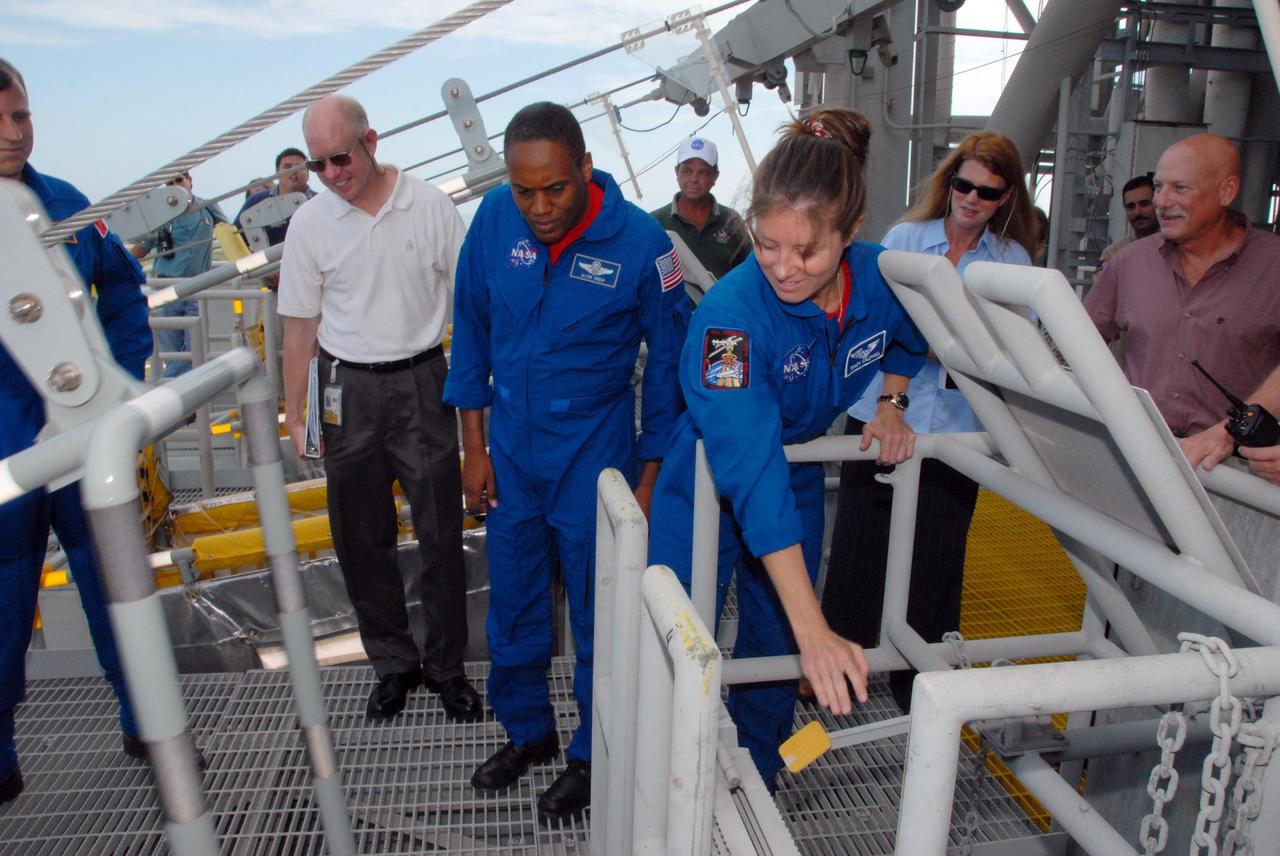
KENNEDY SPACE CENTER, Fla. -- On an upper level of the Pad 39A fixed service structure, the STS-118 crew members get directions about using the slidewire basket that is part of the emergency egress system. At right, Mission Specialist Tracy Caldwell identifies the pull lever to release the basket. At far left is Mission Specialist Dave Williams, who represents the Canadian Space Agency. At center is Mission Specialist Alvin Drew. The crew is at Kennedy for terminal countdown demonstration test, or TCDT, training activities. Those activities include M-113 training, payload familiarization, the emergency egress training at the pad and a simulated launch countdown. The mission is the 22nd flight to the International Space Station and Space Shuttle Endeavour will carry a payload including the S5 truss, a SPACEHAB module and external stowage platform 3. STS-118 is targeted for launch on Aug. 7. NASA/George Shelton
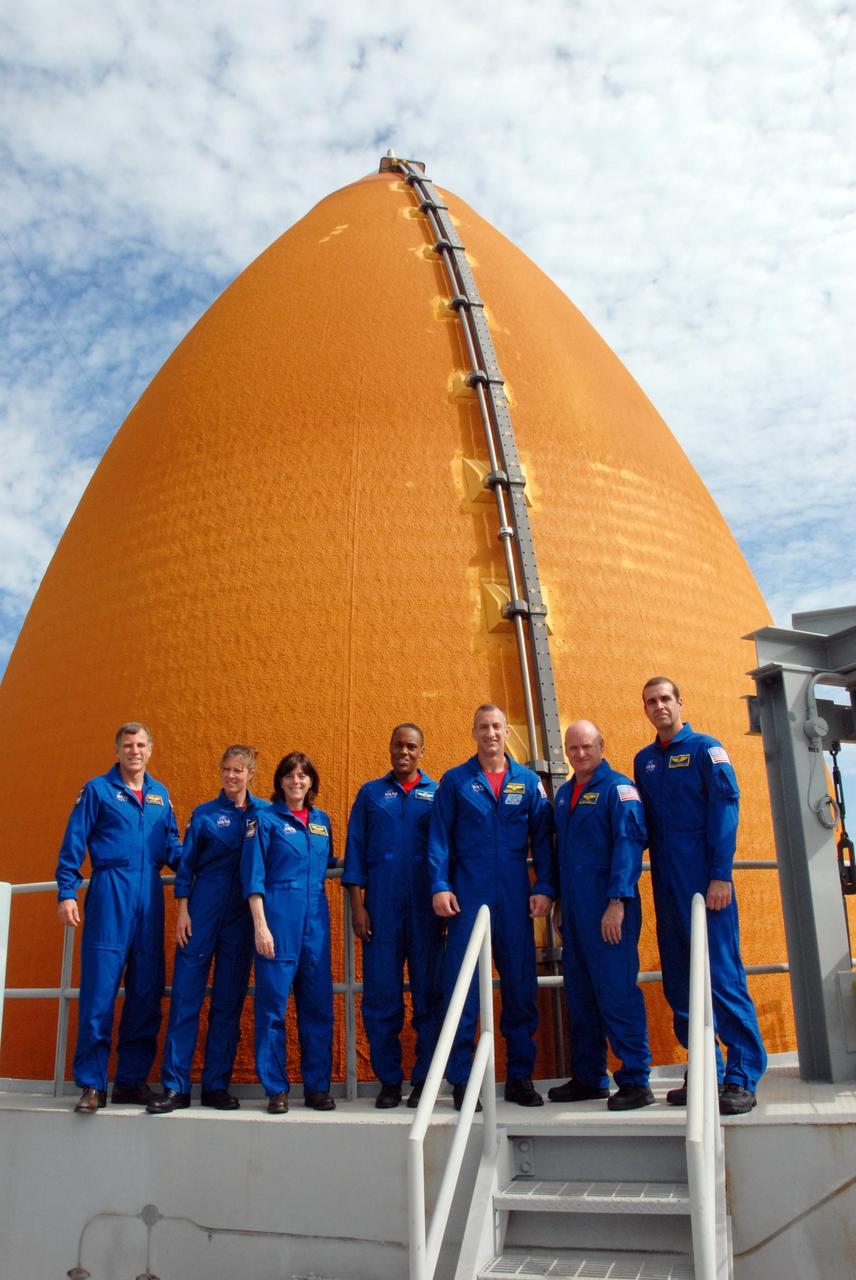
KENNEDY SPACE CENTER, Fla. -- On the top level of the Pad 39A fixed service structure, the STS-118 crew takes a break from training activities in the terminal countdown demonstration test, or TCDT. From left are Mission Specialists Dave Williams, Tracy Caldwell, Barbara R. Morgan and Alvin Drew, Pilot Charlie Hobaugh, Commander Scott Kelly and Mission Specialist Rick Mastracchio. Williams represents the Canadian Space Agency. Morgan joined NASA's Teacher in Space program in 1985 and was selected as an astronaut in 1998. Behind them is the top of the external tank. TCDTactivities include M-113 training, payload familiarization, the emergency egress training at the pad and a simulated launch countdown. The mission is the 22nd flight to the International Space Station and Space Shuttle Endeavour will carry a payload including the S5 truss, a SPACEHAB module and external stowage platform 3. STS-118 is targeted for launch on Aug. 7. NASA/George Shelton
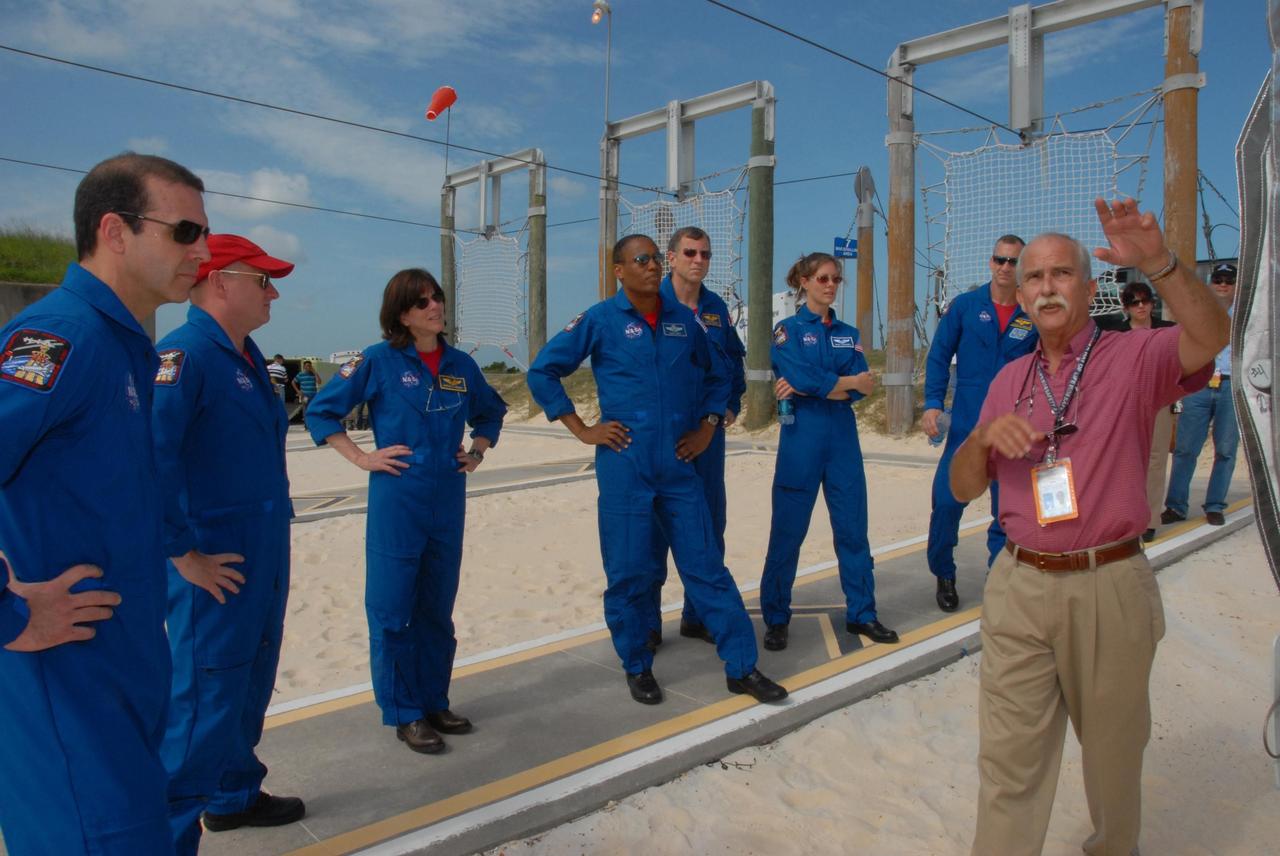
KENNEDY SPACE CENTER, Fla. -- Back on the slidewire landing area of Pad 39A, the STS-118 crew learns about landing in the baskets in the event of an emergency. From left are Mission Specialist Rick Mastracchio, Commander Scott Kelly, Mission Specialists Barbara R. Morgan, Alvin Drew, Dave Williams and Tracy Caldwell, and Pilot Charlie Hobaugh. Morgan joined NASA's Teacher in Space program in 1985 and was selected as an astronaut in 1998. Williams represents the Canadian Space Agency. The crew is at Kennedy for training activities in the terminal countdown demonstration test, or TCDT. TCDTactivities include M-113 training, payload familiarization, the emergency egress training at the pad and a simulated launch countdown. The mission is the 22nd flight to the International Space Station and Space Shuttle Endeavour will carry a payload including the S5 truss, a SPACEHAB module and external stowage platform 3. STS-118 is targeted for launch on Aug. 7. NASA/George Shelton
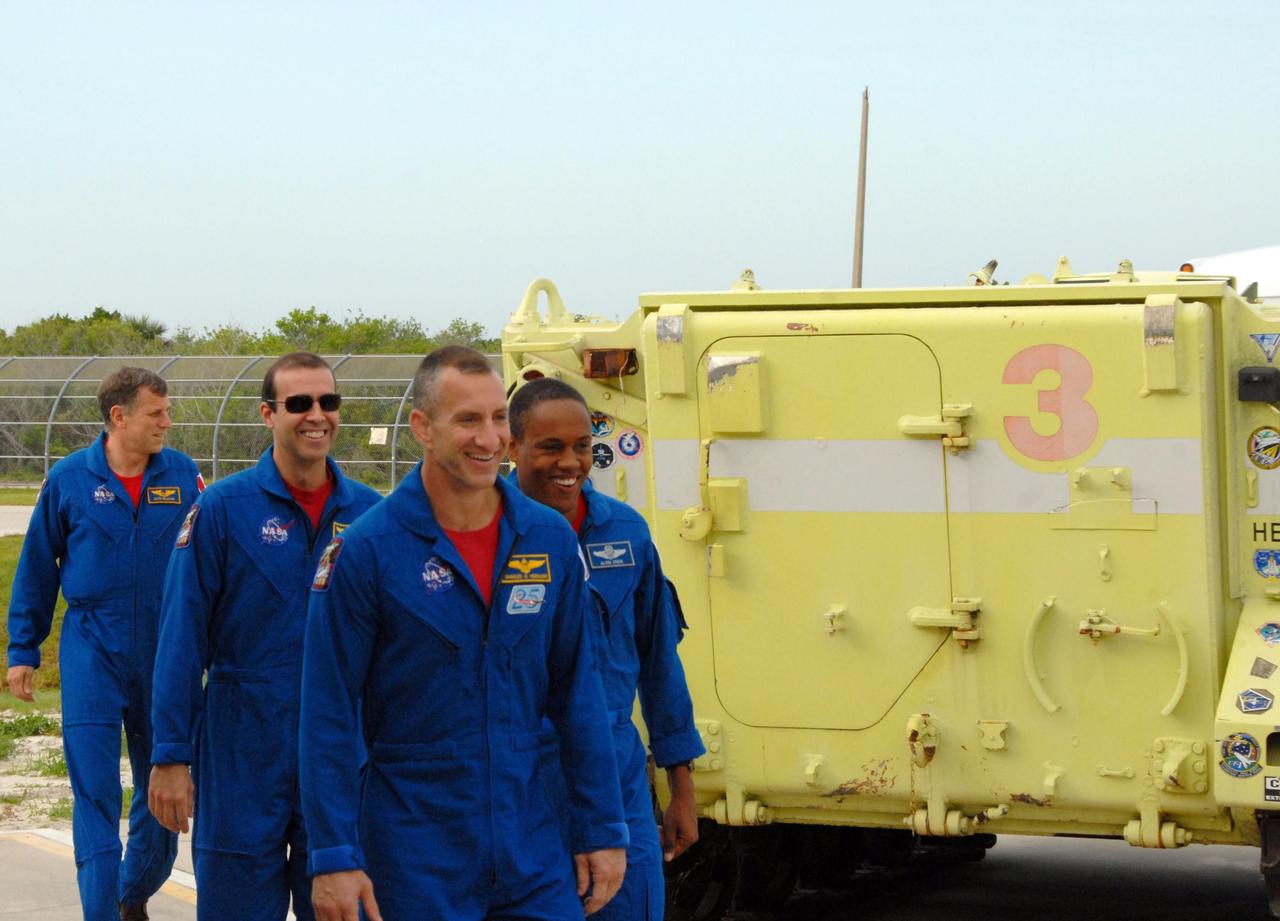
KENNEDY SPACE CENTER, Fla. -- The STS-118 crew arrives on Launch Pad 39A for a media interview before the crew's morning training activities in the terminal countdown demonstration test, or TCDT. From left are Mission Specialists Dave Williams and Rick Mastracchio, Pilot Charlie Hobaugh and Mission Specialist Alvin Drew. Williams represents the Canadian Space Agency. TCDTactivities include M-113 training, payload familiarization, the emergency egress training at the pad and a simulated launch countdown. The mission is the 22nd flight to the International Space Station and Space Shuttle Endeavour will carry a payload including the S5 truss, a SPACEHAB module and external stowage platform 3. STS-118 is targeted for launch on Aug. 7. NASA/Ken Thornsley

CAPE CANAVERAL, Fla. – At the slidewire basket landing area near Launch Pad 39A at NASA's Kennedy Space Center in Florida, STS-127 Mission Specialist Dave Wolf practices getting out of a basket, which are used for emergency exits from the pad. At far left is Mission Specialist Tim Kopra. Hold the basket steady is Mission Specialist Tom Marshburn. The crew is at Kennedy for a launch dress rehearsal called the terminal countdown demonstration test, or TCDT, which includes emergency exit training and equipment familiarization. Endeavour's STS-127 mission is the final of three flights dedicated to the assembly of the Japanese Kibo laboratory complex on the International Space Station. Endeavour's launch is targeted for June 13. Photo credit: NASA/Kim Shiflett
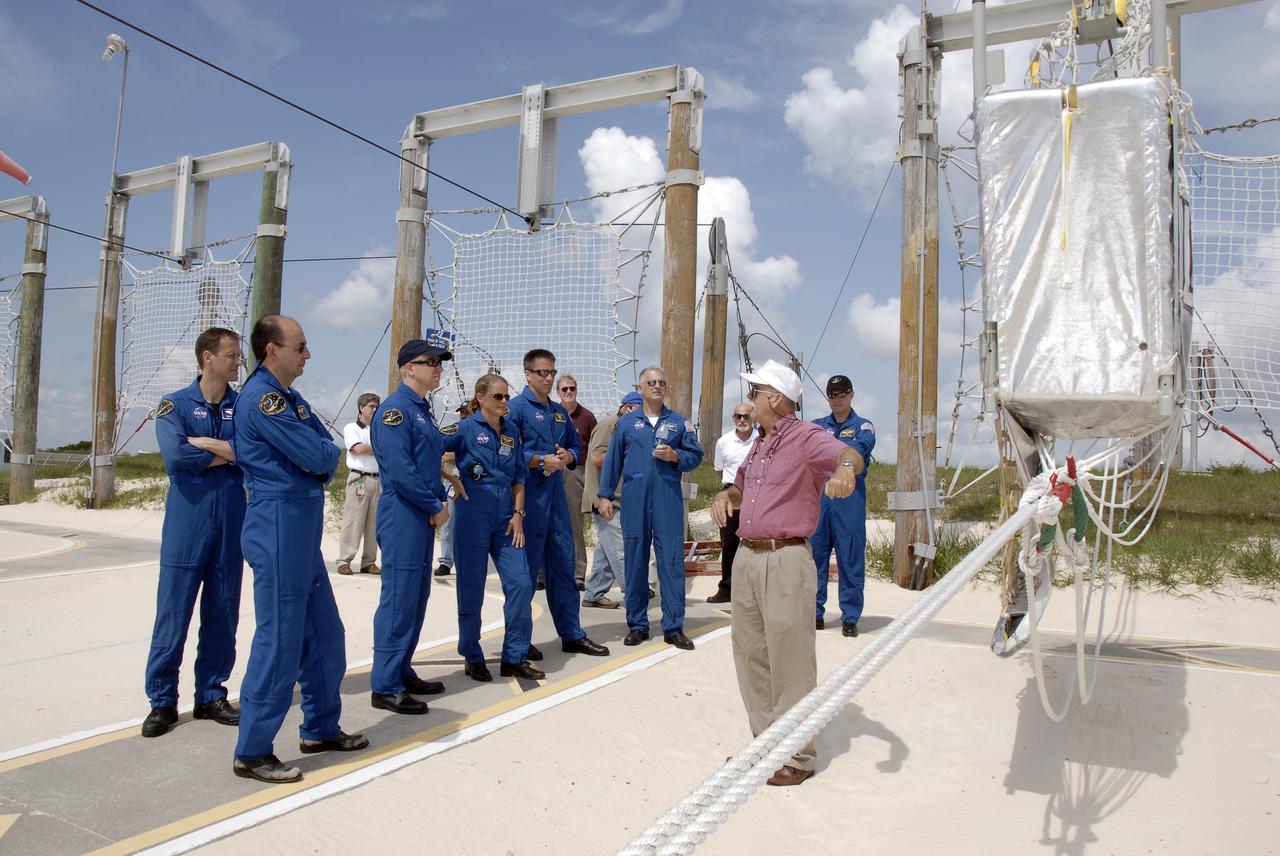
CAPE CANAVERAL, Fla. – At the slidewire basket landing area near Launch Pad 39A at NASA's Kennedy Space Center in Florida, STS-127 crew members learn about landing procedures during an emergency exit from the pad. From left are Mission Specialist Tom Marshburn, Commander Mark Polansky, and Mission Specialists Tim Kopra, Julie Payette, Christopher Cassidy, Dave Wolf and (far right) Pilot Doug Hurley. The crew is at Kennedy for a launch dress rehearsal called the terminal countdown demonstration test, or TCDT, which includes emergency exit training and equipment familiarization. Endeavour's STS-127 mission is the final of three flights dedicated to the assembly of the Japanese Kibo laboratory complex on the International Space Station. Endeavour's launch is targeted for June 13. Photo credit: NASA/Kim Shiflett
CAPE CANAVERAL, Fla. – On Launch Pad 39A at NASA's Kennedy Space Center in Florida, STS-127 crew members learn about emergency exit procedures from the launch pad. At left are Mission Specialists Christopher Cassidy and Julie Payette (behind him). At center are Commander Mark Polansky and Mission Specialist Dave Wolf. At right are Mission Specialists Tom Marshburn and Tim Kopra. The crew is at Kennedy for a launch dress rehearsal called the terminal countdown demonstration test, or TCDT, which includes emergency exit training and equipment familiarization. Endeavour's STS-127 mission is the final of three flights dedicated to the assembly of the Japanese Kibo laboratory complex on the International Space Station. Endeavour's launch is targeted for June 13. Photo credit: NASA/Kim Shiflett
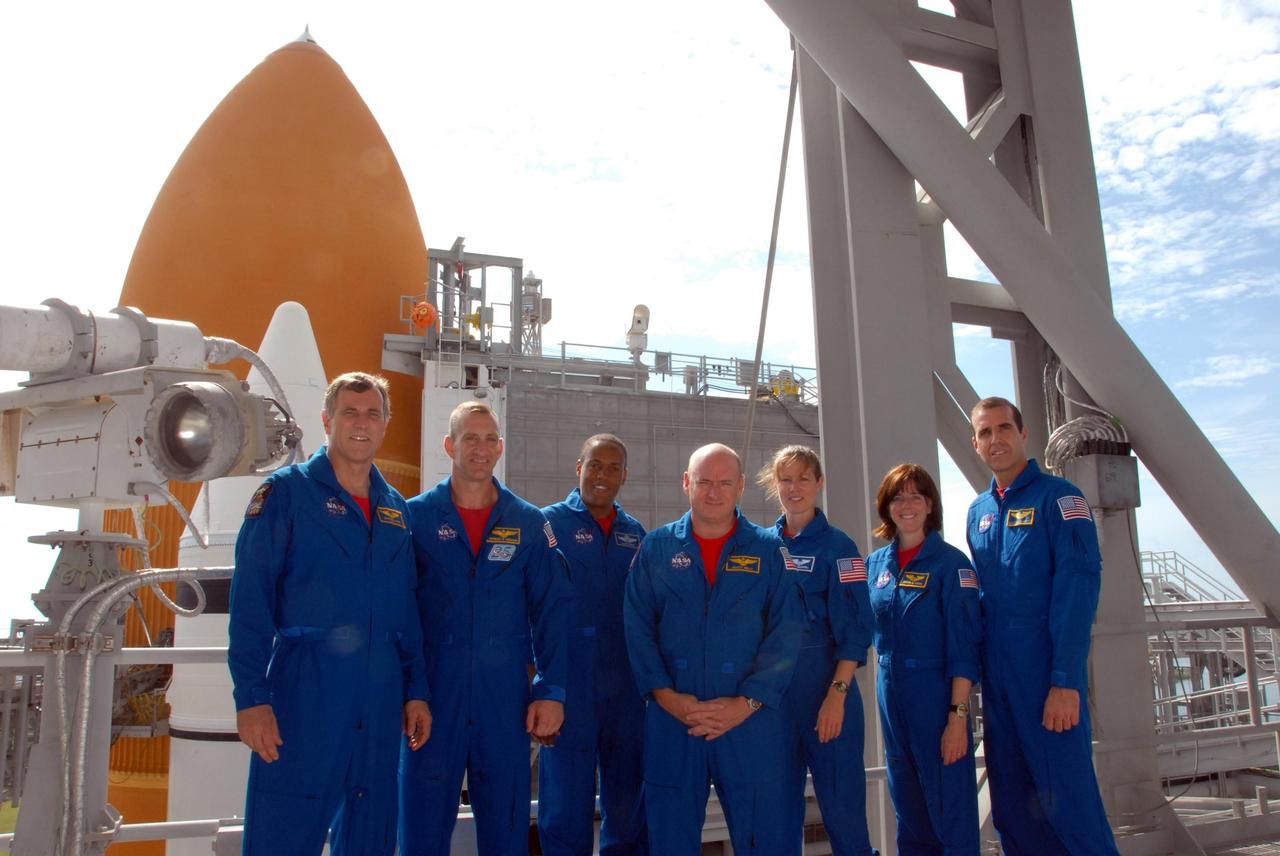
KENNEDY SPACE CENTER, Fla. -- On the top level of the Pad 39A fixed service structure, the STS-118 crew takes a break from training activities in the terminal countdown demonstration test, or TCDT. From left are Mission Specialist Dave Williams, Pilot Charlie Hobaugh, Mission Specialist Alvin Drew, Commander Scott Kelly and Mission Specialists Tracy Caldwell, Barbara R. Morgan and Rick Mastracchio. Williams represents the Canadian Space Agency. Morgan joined NASA's Teacher in Space program in 1985 and was selected as an astronaut in 1998. Behind them is the top of the external tank and a solid rocket booster. TCDTactivities include M-113 training, payload familiarization, the emergency egress training at the pad and a simulated launch countdown. The mission is the 22nd flight to the International Space Station and Space Shuttle Endeavour will carry a payload including the S5 truss, a SPACEHAB module and external stowage platform 3. STS-118 is targeted for launch on Aug. 7. NASA/George Shelton
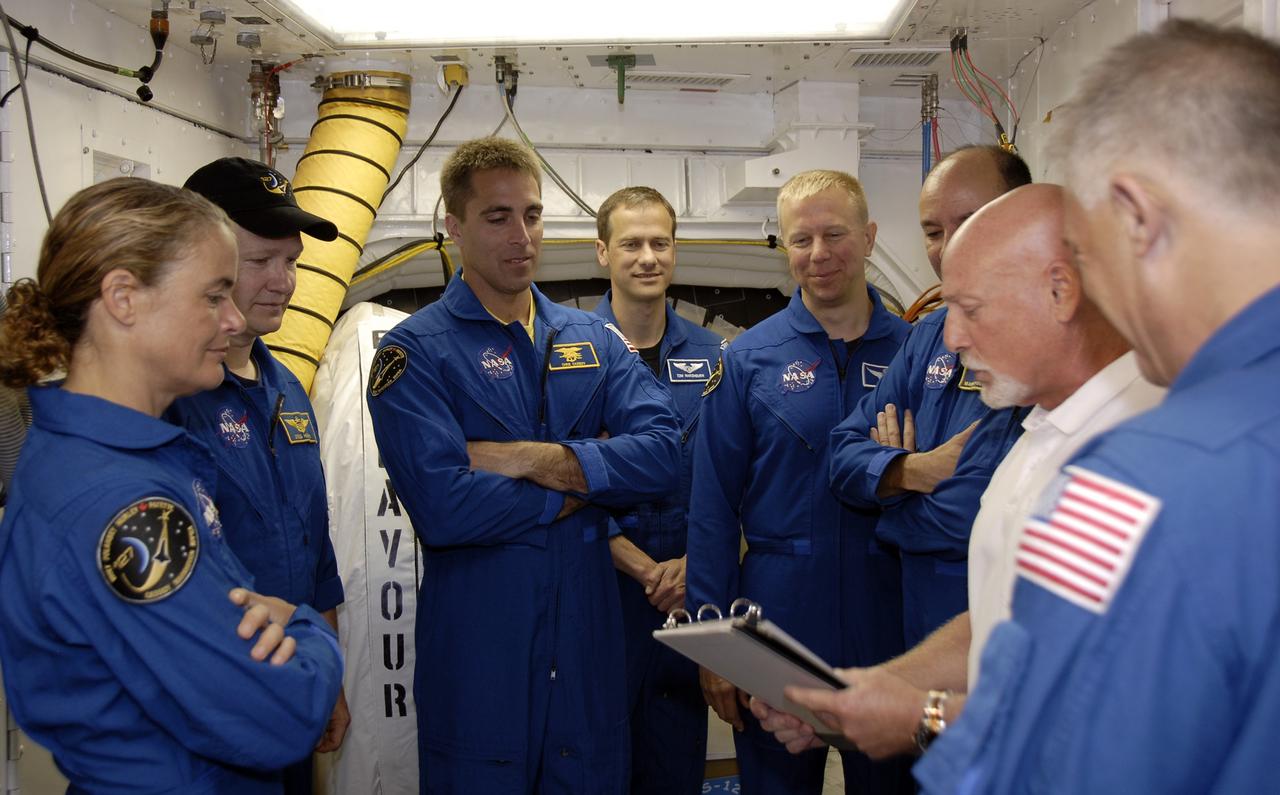
CAPE CANAVERAL, Fla. – On Launch Pad 39A at NASA's Kennedy Space Center in Florida, STS-127 crew members listen to instructions about emergency exit from the shuttle. The astronauts are, clockwise from left, Mission Specialist Julie Payette, Pilot Doug Hurley, Mission Specialists Christopher Cassidy and Tim Kopra, and Commander Mark Polansky. At far right is Mission Specialist Dave Wolf. Payette represents the Canadian Space Agency. The crew is at Kennedy for a launch dress rehearsal called the terminal countdown demonstration test, or TCDT, which includes emergency exit training and equipment familiarization. Endeavour's STS-127 mission is the final of three flights dedicated to the assembly of the Japanese Kibo laboratory complex on the International Space Station. Endeavour's launch is targeted for June 13. Photo credit: NASA/Kim Shiflett

CAPE CANAVERAL, Fla. – On Launch Pad 39A at NASA's Kennedy Space Center in Florida, STS-127 crew members listen to instructions about emergency exit from the shuttle. Standing from left to right are Commander Mark Polansky, Mission Specialists Tom Marshburn, Christopher Cassidy, Tim Kopra and Julie Payette, and Pilot Doug Hurley. The crew is at Kennedy for a launch dress rehearsal called the terminal countdown demonstration test, or TCDT, which includes emergency exit training and equipment familiarization. Endeavour's STS-127 mission is the final of three flights dedicated to the assembly of the Japanese Kibo laboratory complex on the International Space Station. Endeavour's launch is targeted for June 13. Photo credit: NASA/Kim Shiflett
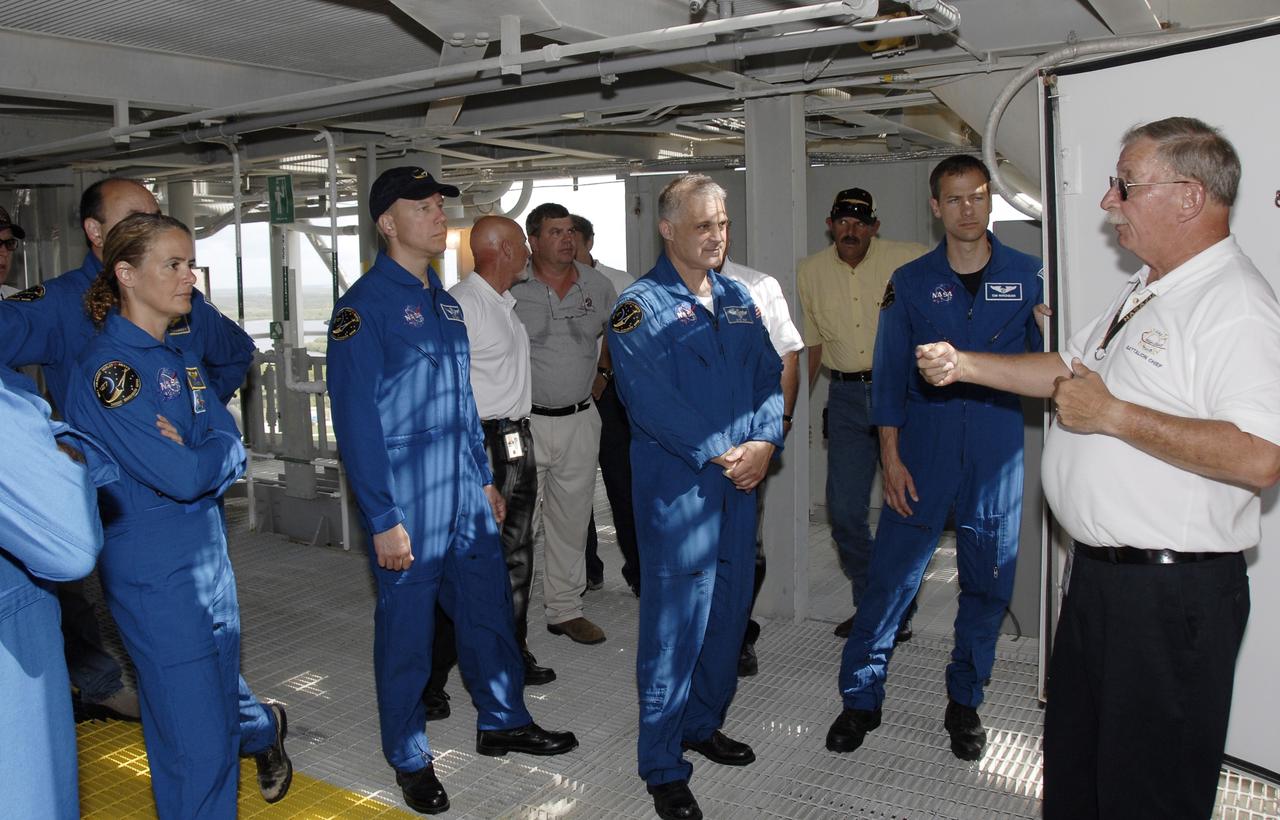
CAPE CANAVERAL, Fla. – On Launch Pad 39A at NASA's Kennedy Space Center in Florida, STS-127 crew members listen to instructions about emergency exit from the shuttle. Standing left to right are Mission Specialist Julie Payette, Commander Mark Polansky (behind Payette), Mission Specialists Tim Kopra, Dave Wolf and Tom Marshburn. Payette represents the Canadian Space Agency. The crew is at Kennedy for a launch dress rehearsal called the terminal countdown demonstration test, or TCDT, which includes emergency exit training and equipment familiarization. Endeavour's STS-127 mission is the final of three flights dedicated to the assembly of the Japanese Kibo laboratory complex on the International Space Station. Endeavour's launch is targeted for June 13. Photo credit: NASA/Kim Shiflett
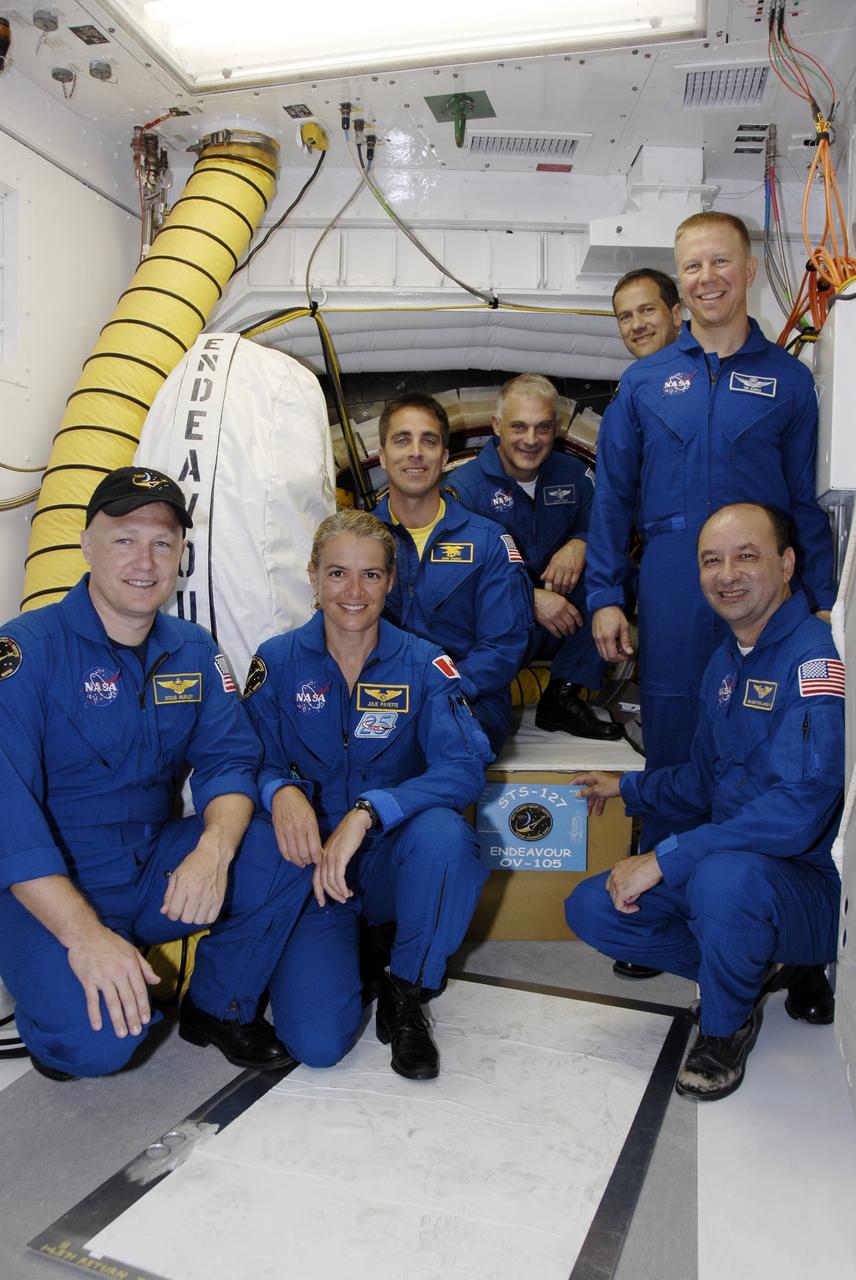
CAPE CANAVERAL, Fla. – On Launch Pad 39A at NASA's Kennedy Space Center in Florida, STS-127 crew members gather near space shuttle Endeavour's hatch to place the mission plaque before launch. Clockwise from left are Pilot Doug Hurley, Mission Specialists Julie Payette, Christopher Cassidy, Dave Wolf, Tom Marshburn and Tim Kopra and Commander Mark Polansky. Payette represents the Canadian Space Agency. The crew is at Kennedy for a launch dress rehearsal called the terminal countdown demonstration test, or TCDT, which includes emergency exit training and equipment familiarization. Endeavour's STS-127 mission is the final of three flights dedicated to the assembly of the Japanese Kibo laboratory complex on the International Space Station. Endeavour's launch is targeted for June 13. Photo credit: NASA/Kim Shiflett
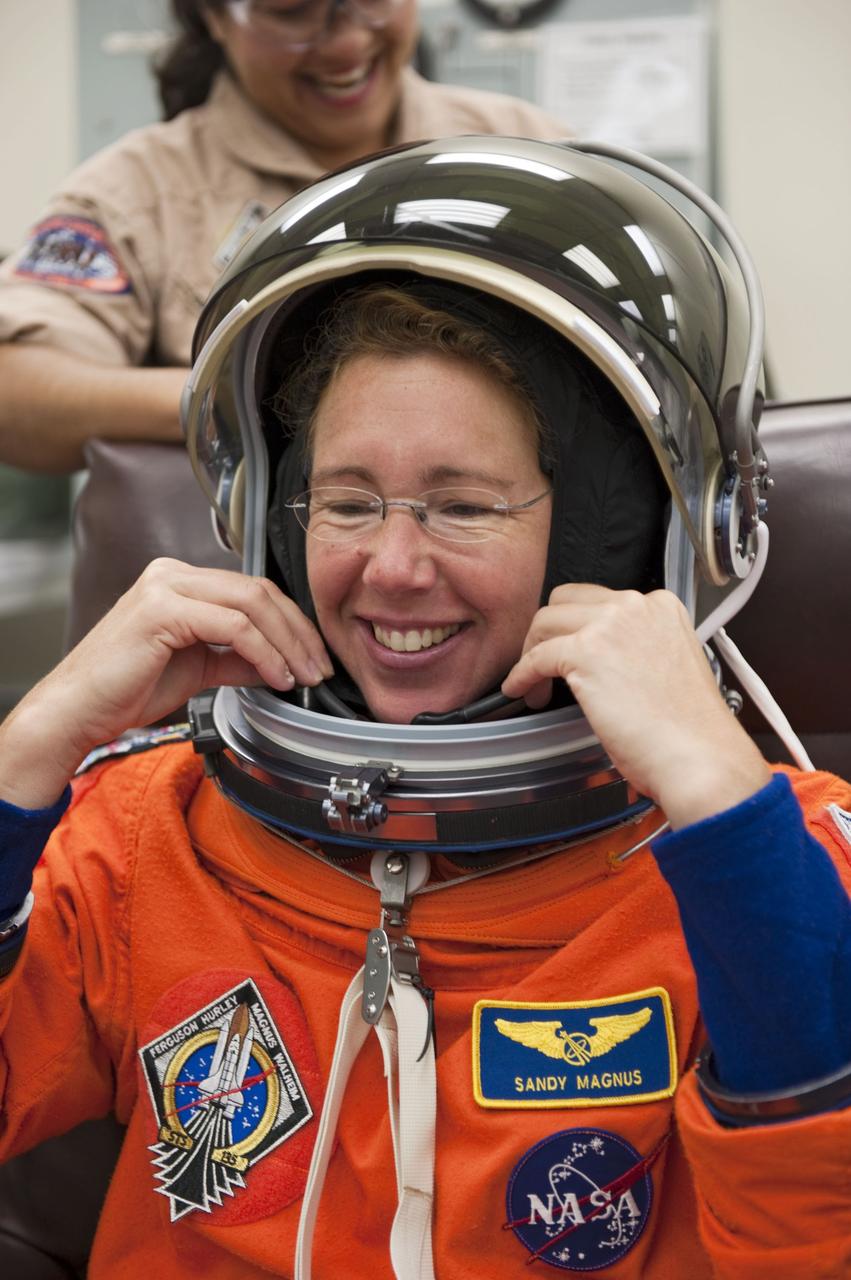
CAPE CANAVERAL, Fla. -- In the Operations and Checkout Building at NASA's Kennedy Space Center in Florida, STS-135 Mission Specialist Sandy Magnus checks the fit of her launch-and-entry suit and helmet during a simulated launch countdown. As part of the Terminal Countdown Demonstration Test (TCDT), the crew members are taken to Kennedy's Launch Pad 39A and strapped into space shuttle Atlantis to practice the steps that will be taken on launch day. Atlantis and its crew are targeted to lift off July 8, taking with them the Raffaello multi-purpose logistics module packed with supplies and spare parts to the International Space Station. The STS-135 mission also will fly a system to investigate the potential for robotically refueling existing satellites and return a failed ammonia pump module to help NASA better understand the failure mechanism and improve pump designs for future systems. STS-135 will be the 33rd flight of Atlantis, the 37th shuttle mission to the space station, and the 135th and final mission of NASA's Space Shuttle Program. For more information visit, www.nasa.gov/mission_pages/shuttle/shuttlemissions/sts135/index.html. Photo credit: NASA/Kim Shiflett

CAPE CANAVERAL, Fla. -- During a simulated launch countdown the STS-135 crew pauses for a photo before climbing aboard the waiting Astrovan at NASA's Kennedy Space Center in Florida. As part of the Terminal Countdown Demonstration Test (TCDT), the crew members are driven to Kennedy's Launch Pad 39A and then strapped into space shuttle Atlantis to practice the steps that will be taken on launch day. From left are Mission Specialists Rex Walheim and Sandy Magnus, Pilot Doug Hurley and Commander Chris Ferguson. Atlantis and its crew are targeted to lift off July 8, taking with them the Raffaello multi-purpose logistics module packed with supplies and spare parts to the International Space Station. The STS-135 mission also will fly a system to investigate the potential for robotically refueling existing satellites and return a failed ammonia pump module to help NASA better understand the failure mechanism and improve pump designs for future systems. STS-135 will be the 33rd flight of Atlantis, the 37th shuttle mission to the space station, and the 135th and final mission of NASA's Space Shuttle Program. For more information visit, www.nasa.gov/mission_pages/shuttle/shuttlemissions/sts135/index.html. Photo credit: NASA/Kim Shiflett
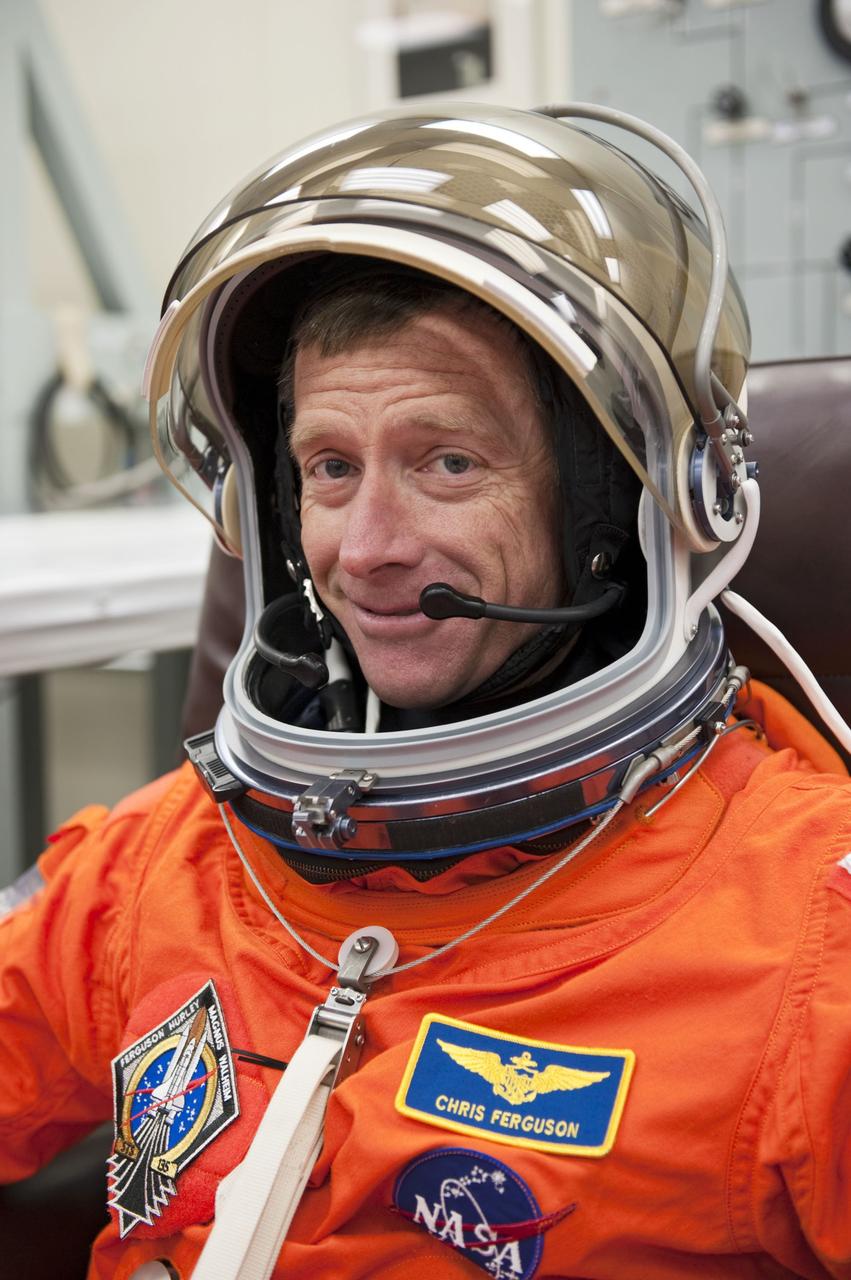
CAPE CANAVERAL, Fla. -- In the Operations and Checkout Building at NASA's Kennedy Space Center in Florida, STS-135 Commander Chris Ferguson checks the fit of his launch-and-entry suit and helmet during a simulated launch countdown. As part of the Terminal Countdown Demonstration Test (TCDT), the crew members are taken to Kennedy's Launch Pad 39A and strapped into space shuttle Atlantis to practice the steps that will be taken on launch day. Atlantis and its crew are targeted to lift off July 8, taking with them the Raffaello multi-purpose logistics module packed with supplies and spare parts to the International Space Station. The STS-135 mission also will fly a system to investigate the potential for robotically refueling existing satellites and return a failed ammonia pump module to help NASA better understand the failure mechanism and improve pump designs for future systems. STS-135 will be the 33rd flight of Atlantis, the 37th shuttle mission to the space station, and the 135th and final mission of NASA's Space Shuttle Program. For more information visit, www.nasa.gov/mission_pages/shuttle/shuttlemissions/sts135/index.html. Photo credit: NASA/Kim Shiflett
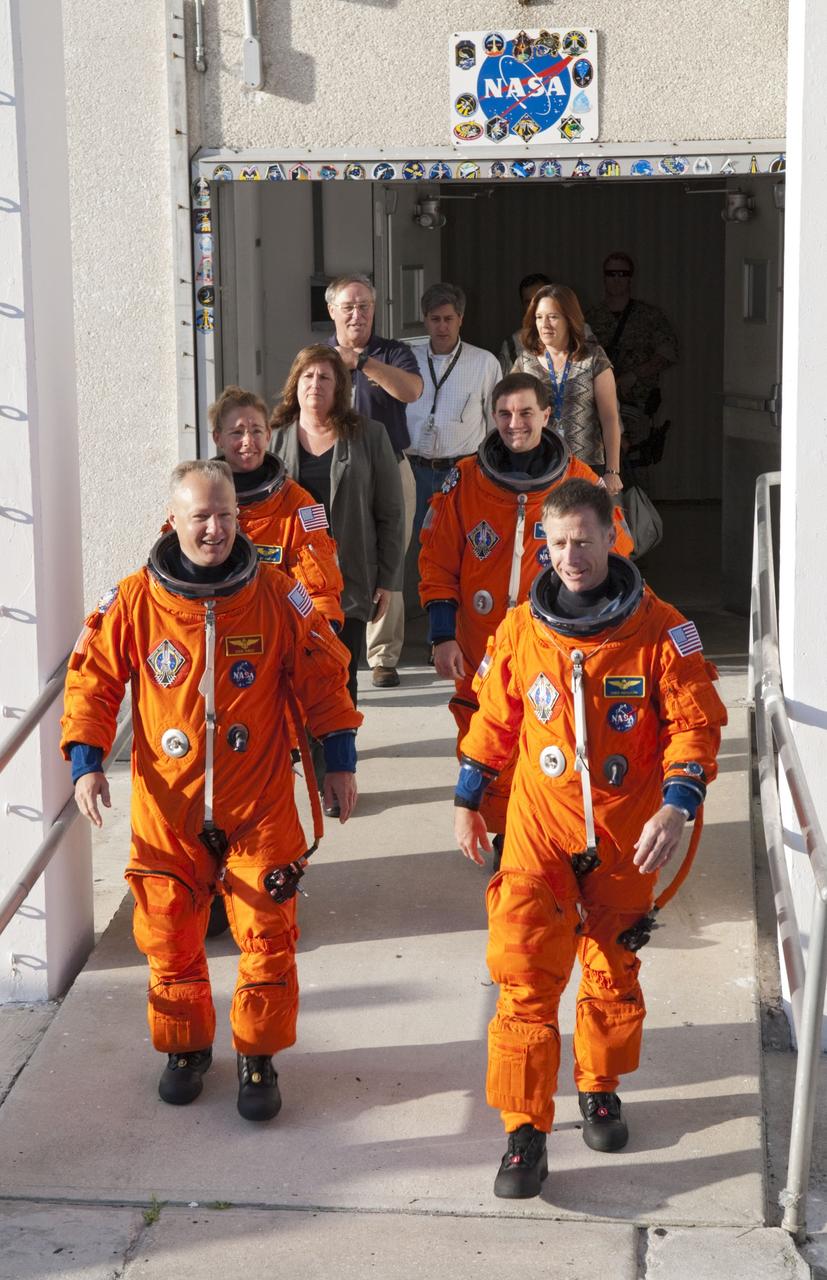
CAPE CANAVERAL, Fla. -- During a simulated launch countdown, the STS-135 crew walks out of the Operations and Checkout Building to the waiting Astrovan at NASA's Kennedy Space Center in Florida. As part of the Terminal Countdown Demonstration Test (TCDT), the crew members are driven to Kennedy's Launch Pad 39A and then are strapped into space shuttle Atlantis to practice the steps that will be taken on launch day. On the front row are STS-135 Pilot Doug Hurley (left) and Commander Chris Ferguson; second row; are Mission Specialists Sandy Magnus and Rex Walheim. Atlantis and its crew are targeted to lift off July 8, taking with them the Raffaello multi-purpose logistics module packed with supplies and spare parts to the International Space Station. The STS-135 mission also will fly a system to investigate the potential for robotically refueling existing satellites and return a failed ammonia pump module to help NASA better understand the failure mechanism and improve pump designs for future systems. STS-135 will be the 33rd flight of Atlantis, the 37th shuttle mission to the space station, and the 135th and final mission of NASA's Space Shuttle Program. For more information visit, www.nasa.gov/mission_pages/shuttle/shuttlemissions/sts135/index.html. Photo credit: NASA/Kim Shiflett
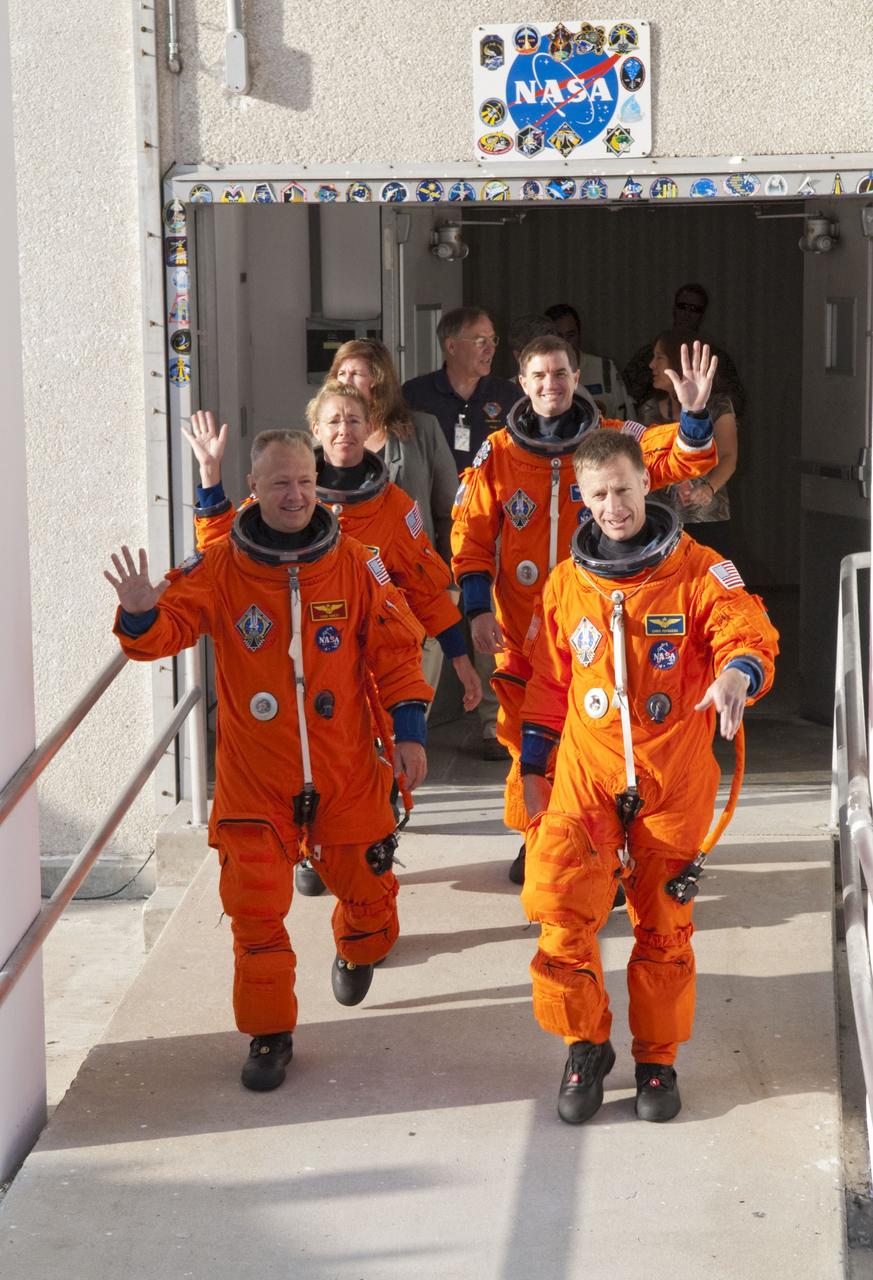
CAPE CANAVERAL, Fla. -- During a simulated launch countdown, the STS-135 crew walks out of the Operations and Checkout Building to the waiting Astrovan at NASA's Kennedy Space Center in Florida. As part of the Terminal Countdown Demonstration Test (TCDT), the crew members are driven to Kennedy's Launch Pad 39A and then are strapped into space shuttle Atlantis to practice the steps that will be taken on launch day. On the front row are STS-135 Pilot Doug Hurley (left) and Commander Chris Ferguson; second row; are Mission Specialists Sandy Magnus and Rex Walheim. Atlantis and its crew are targeted to lift off July 8, taking with them the Raffaello multi-purpose logistics module packed with supplies and spare parts to the International Space Station. The STS-135 mission also will fly a system to investigate the potential for robotically refueling existing satellites and return a failed ammonia pump module to help NASA better understand the failure mechanism and improve pump designs for future systems. STS-135 will be the 33rd flight of Atlantis, the 37th shuttle mission to the space station, and the 135th and final mission of NASA's Space Shuttle Program. For more information visit, www.nasa.gov/mission_pages/shuttle/shuttlemissions/sts135/index.html. Photo credit: NASA/Kim Shiflett

CAPE CANAVERAL, Fla. -- In the Operations and Checkout Building at NASA's Kennedy Space Center in Florida, STS-135 Mission Specialist Rex Walheim checks the fit of his launch-and-entry suit, helmet and gloves during a simulated launch countdown. As part of the Terminal Countdown Demonstration Test (TCDT), the crew members are taken to Kennedy's Launch Pad 39A and strapped into space shuttle Atlantis to practice the steps that will be taken on launch day. Atlantis and its crew are targeted to lift off July 8, taking with them the Raffaello multi-purpose logistics module packed with supplies and spare parts to the International Space Station. The STS-135 mission also will fly a system to investigate the potential for robotically refueling existing satellites and return a failed ammonia pump module to help NASA better understand the failure mechanism and improve pump designs for future systems. STS-135 will be the 33rd flight of Atlantis, the 37th shuttle mission to the space station, and the 135th and final mission of NASA's Space Shuttle Program. For more information visit, www.nasa.gov/mission_pages/shuttle/shuttlemissions/sts135/index.html. Photo credit: NASA/Kim Shiflett

CAPE CANAVERAL, Fla. -- During a simulated launch countdown, the STS-135 crew walks out of the Operations and Checkout Building to the waiting Astrovan at NASA's Kennedy Space Center in Florida. As part of the Terminal Countdown Demonstration Test (TCDT), the crew members are driven to Kennedy's Launch Pad 39A and then strapped into space shuttle Atlantis to practice the steps that will be taken on launch day. From left are Mission Specialists Rex Walheim and Sandy Magnus, Pilot Doug Hurley and Commander Chris Ferguson. Atlantis and its crew are targeted to lift off July 8, taking with them the Raffaello multi-purpose logistics module packed with supplies and spare parts to the International Space Station. The STS-135 mission also will fly a system to investigate the potential for robotically refueling existing satellites and return a failed ammonia pump module to help NASA better understand the failure mechanism and improve pump designs for future systems. STS-135 will be the 33rd flight of Atlantis, the 37th shuttle mission to the space station, and the 135th and final mission of NASA's Space Shuttle Program. For more information visit, www.nasa.gov/mission_pages/shuttle/shuttlemissions/sts135/index.html. Photo credit: NASA/Kim Shiflett
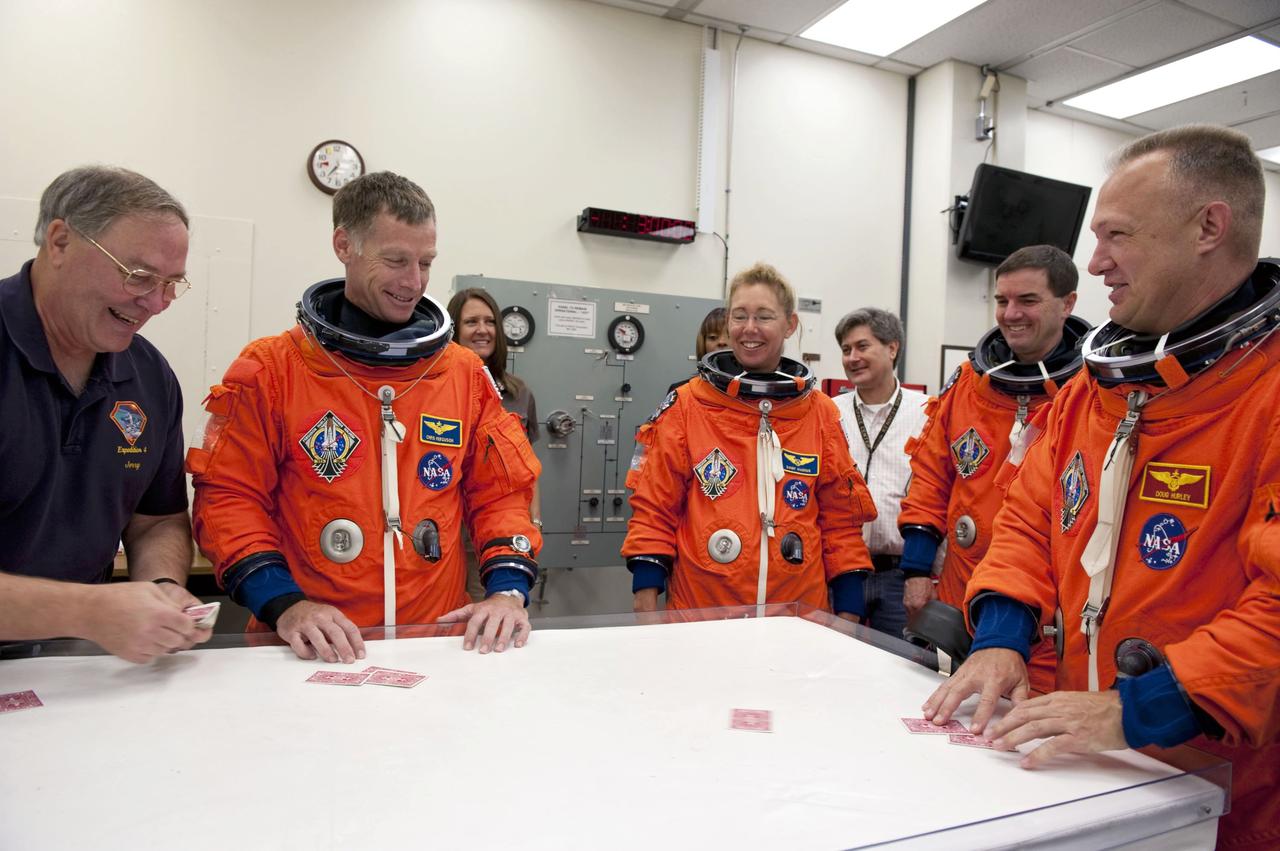
CAPE CANAVERAL, Fla. -- In the Operations and Checkout Building at NASA's Kennedy Space Center in Florida, the STS-135 crew members enjoy a light moment during a simulated launch countdown. From left are Jerry Ross, chief of the Vehicle Integration Test Office and former NASA astronaut, Commander Chris Ferguson, Mission Specialists Sandy Magnus and Rex Walheim, and Pilot Doug Hurley. As part of the Terminal Countdown Demonstration Test (TCDT), the crew members are taken to Kennedy's Launch Pad 39A and strapped into space shuttle Atlantis to practice the steps that will be taken on launch day. Atlantis and its crew are targeted to lift off July 8, taking with them the Raffaello multi-purpose logistics module packed with supplies and spare parts to the International Space Station. The STS-135 mission also will fly a system to investigate the potential for robotically refueling existing satellites and return a failed ammonia pump module to help NASA better understand the failure mechanism and improve pump designs for future systems. STS-135 will be the 33rd flight of Atlantis, the 37th shuttle mission to the space station, and the 135th and final mission of NASA's Space Shuttle Program. For more information visit, www.nasa.gov/mission_pages/shuttle/shuttlemissions/sts135/index.html. Photo credit: NASA/Kim Shiflett

CAPE CANAVERAL, Fla. -- In the Operations and Checkout Building at NASA's Kennedy Space Center in Florida, STS-135 Mission Specialist Rex Walheim checks the fit of his launch-and-entry suit before during a simulated launch countdown. As part of the Terminal Countdown Demonstration Test (TCDT), the crew members are taken to Kennedy's Launch Pad 39A and strapped into space shuttle Atlantis to practice the steps that will be taken on launch day. Atlantis and its crew are targeted to lift off July 8, taking with them the Raffaello multi-purpose logistics module packed with supplies and spare parts to the International Space Station. The STS-135 mission also will fly a system to investigate the potential for robotically refueling existing satellites and return a failed ammonia pump module to help NASA better understand the failure mechanism and improve pump designs for future systems. STS-135 will be the 33rd flight of Atlantis, the 37th shuttle mission to the space station, and the 135th and final mission of NASA's Space Shuttle Program. For more information visit, www.nasa.gov/mission_pages/shuttle/shuttlemissions/sts135/index.html. Photo credit: NASA/Kim Shiflett
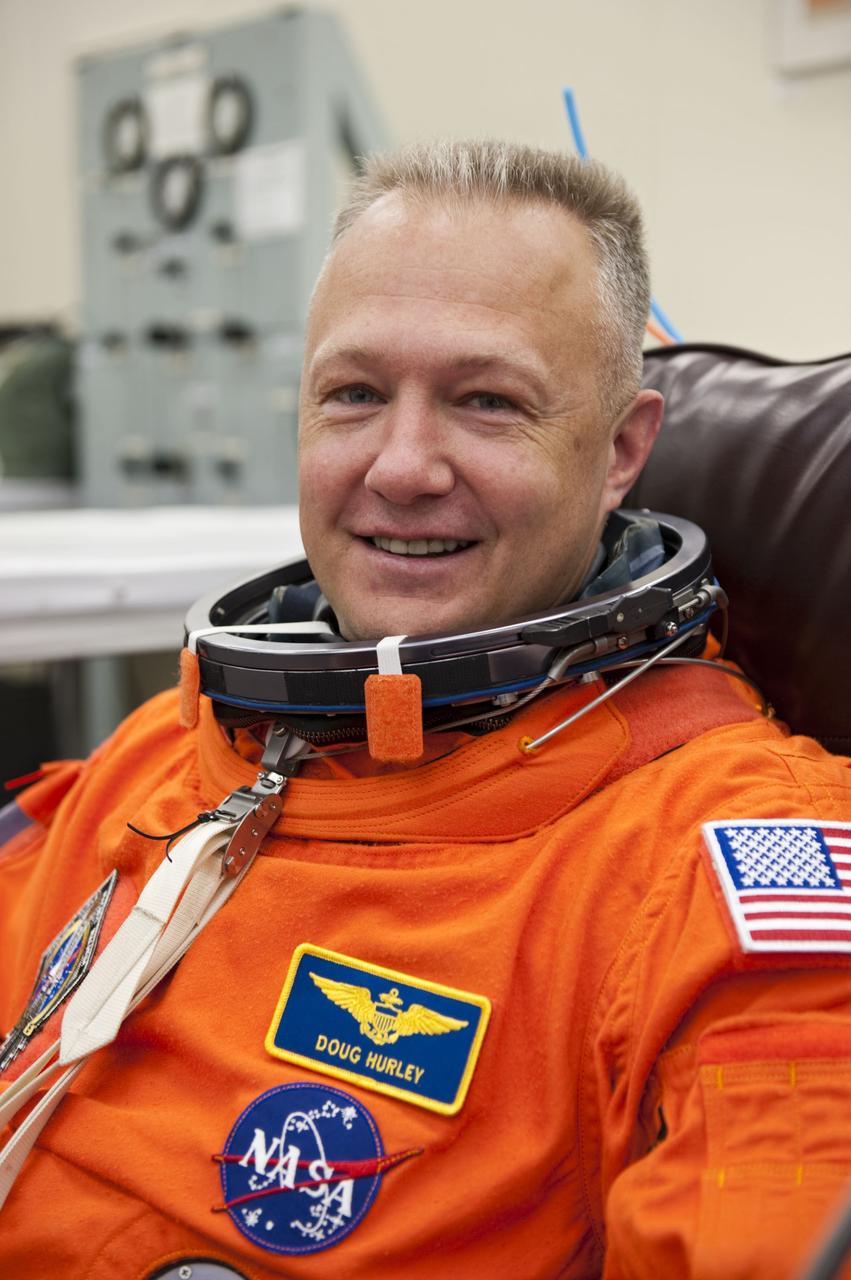
CAPE CANAVERAL, Fla. -- In the Operations and Checkout Building at NASA's Kennedy Space Center in Florida, STS-135 Pilot Doug Hurley checks the fit of his launch-and-entry suit during a simulated launch countdown. As part of the Terminal Countdown Demonstration Test (TCDT), the crew members are taken to Kennedy's Launch Pad 39A and strapped into space shuttle Atlantis to practice the steps that will be taken on launch day. Atlantis and its crew are targeted to lift off July 8, taking with them the Raffaello multi-purpose logistics module packed with supplies and spare parts to the International Space Station. The STS-135 mission also will fly a system to investigate the potential for robotically refueling existing satellites and return a failed ammonia pump module to help NASA better understand the failure mechanism and improve pump designs for future systems. STS-135 will be the 33rd flight of Atlantis, the 37th shuttle mission to the space station, and the 135th and final mission of NASA's Space Shuttle Program. For more information visit, www.nasa.gov/mission_pages/shuttle/shuttlemissions/sts135/index.html. Photo credit: NASA/Kim Shiflett
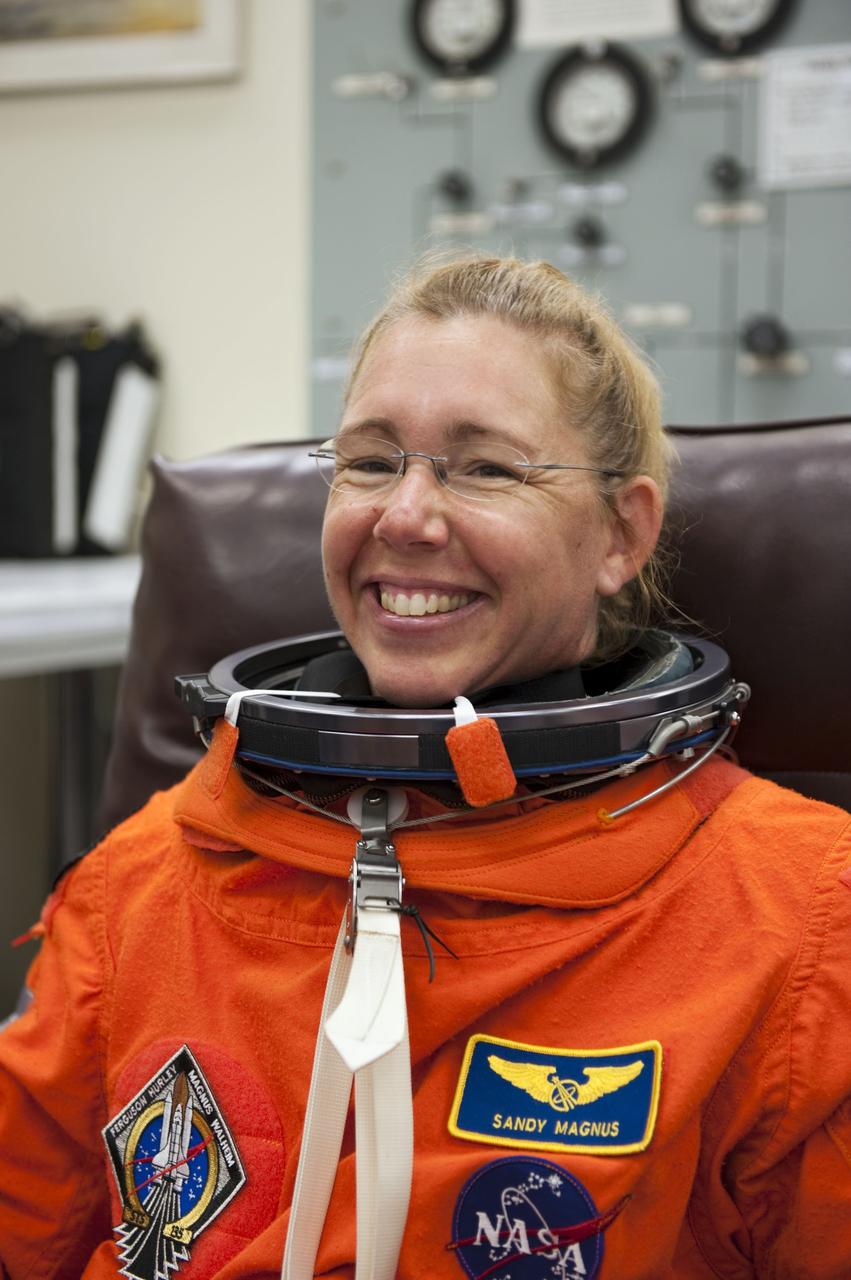
CAPE CANAVERAL, Fla. -- In the Operations and Checkout Building at NASA's Kennedy Space Center in Florida, STS-135 Mission Specialist Sandy Magnus checks the fit of her launch-and-entry suit during a simulated launch countdown. As part of the Terminal Countdown Demonstration Test (TCDT), the crew members are taken to Kennedy's Launch Pad 39A and strapped into space shuttle Atlantis to practice the steps that will be taken on launch day. Atlantis and its crew are targeted to lift off July 8, taking with them the Raffaello multi-purpose logistics module packed with supplies and spare parts to the International Space Station. The STS-135 mission also will fly a system to investigate the potential for robotically refueling existing satellites and return a failed ammonia pump module to help NASA better understand the failure mechanism and improve pump designs for future systems. STS-135 will be the 33rd flight of Atlantis, the 37th shuttle mission to the space station, and the 135th and final mission of NASA's Space Shuttle Program. For more information visit, www.nasa.gov/mission_pages/shuttle/shuttlemissions/sts135/index.html. Photo credit: NASA/Kim Shiflett

CAPE CANAVERAL, Fla. -- In the Operations and Checkout Building at NASA's Kennedy Space Center in Florida, STS-135 Pilot Doug Hurley checks the fit of his launch-and-entry suit and helmet during a simulated launch countdown. As part of the Terminal Countdown Demonstration Test (TCDT), the crew members are taken to Kennedy's Launch Pad 39A and strapped into space shuttle Atlantis to practice the steps that will be taken on launch day. Atlantis and its crew are targeted to lift off July 8, taking with them the Raffaello multi-purpose logistics module packed with supplies and spare parts to the International Space Station. The STS-135 mission also will fly a system to investigate the potential for robotically refueling existing satellites and return a failed ammonia pump module to help NASA better understand the failure mechanism and improve pump designs for future systems. STS-135 will be the 33rd flight of Atlantis, the 37th shuttle mission to the space station, and the 135th and final mission of NASA's Space Shuttle Program. For more information visit, www.nasa.gov/mission_pages/shuttle/shuttlemissions/sts135/index.html. Photo credit: NASA/Kim Shiflett
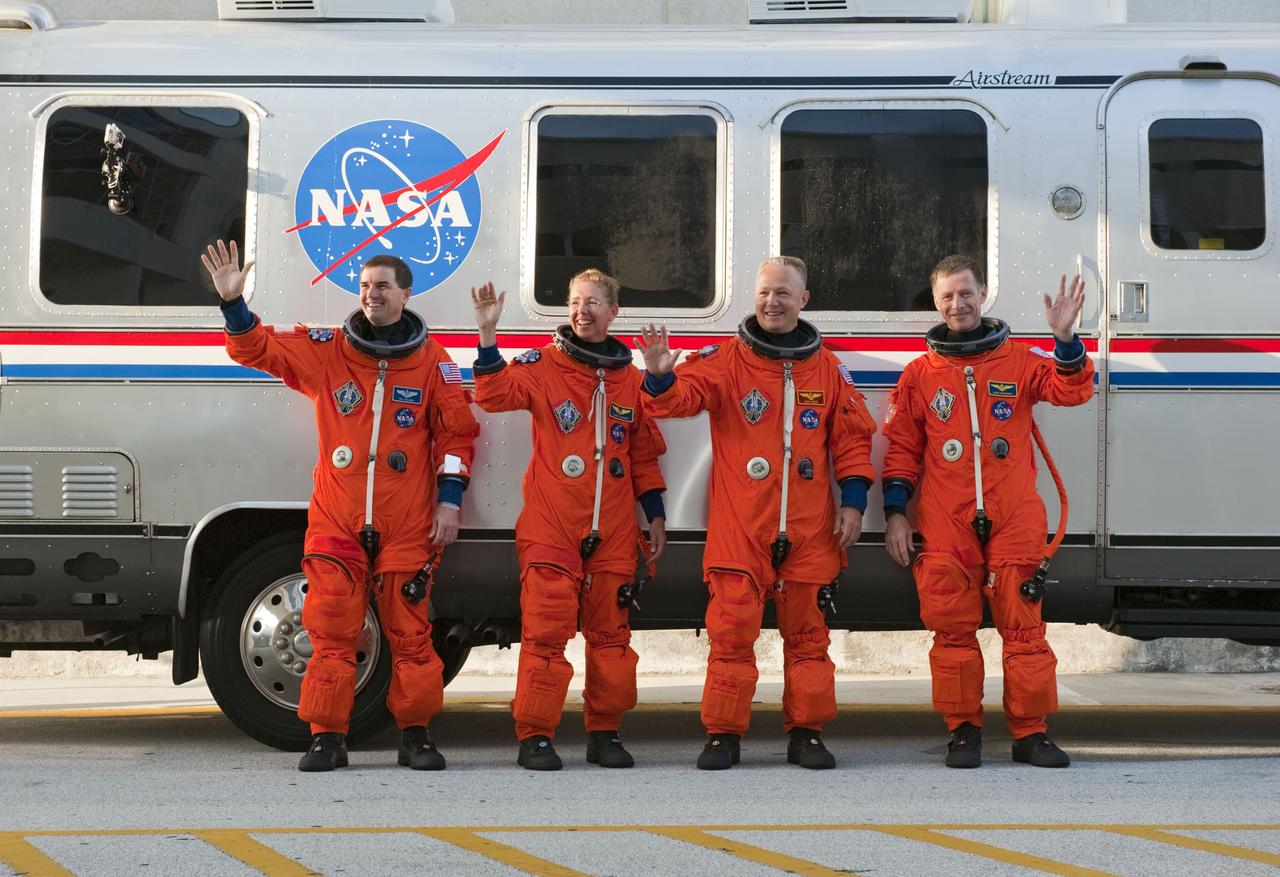
CAPE CANAVERAL, Fla. -- During a simulated launch countdown the STS-135 crew pauses for a photo and waves to Kennedy workers and media before climbing aboard the waiting Astrovan at NASA's Kennedy Space Center in Florida. As part of the Terminal Countdown Demonstration Test (TCDT), the crew members are driven to Kennedy's Launch Pad 39A and then strapped into space shuttle Atlantis to practice the steps that will be taken on launch day. From left are Mission Specialists Rex Walheim and Sandy Magnus, Pilot Doug Hurley and Commander Chris Ferguson. Atlantis and its crew are targeted to lift off July 8, taking with them the Raffaello multi-purpose logistics module packed with supplies and spare parts to the International Space Station. The STS-135 mission also will fly a system to investigate the potential for robotically refueling existing satellites and return a failed ammonia pump module to help NASA better understand the failure mechanism and improve pump designs for future systems. STS-135 will be the 33rd flight of Atlantis, the 37th shuttle mission to the space station, and the 135th and final mission of NASA's Space Shuttle Program. For more information visit, www.nasa.gov/mission_pages/shuttle/shuttlemissions/sts135/index.html. Photo credit: NASA/Kim Shiflett
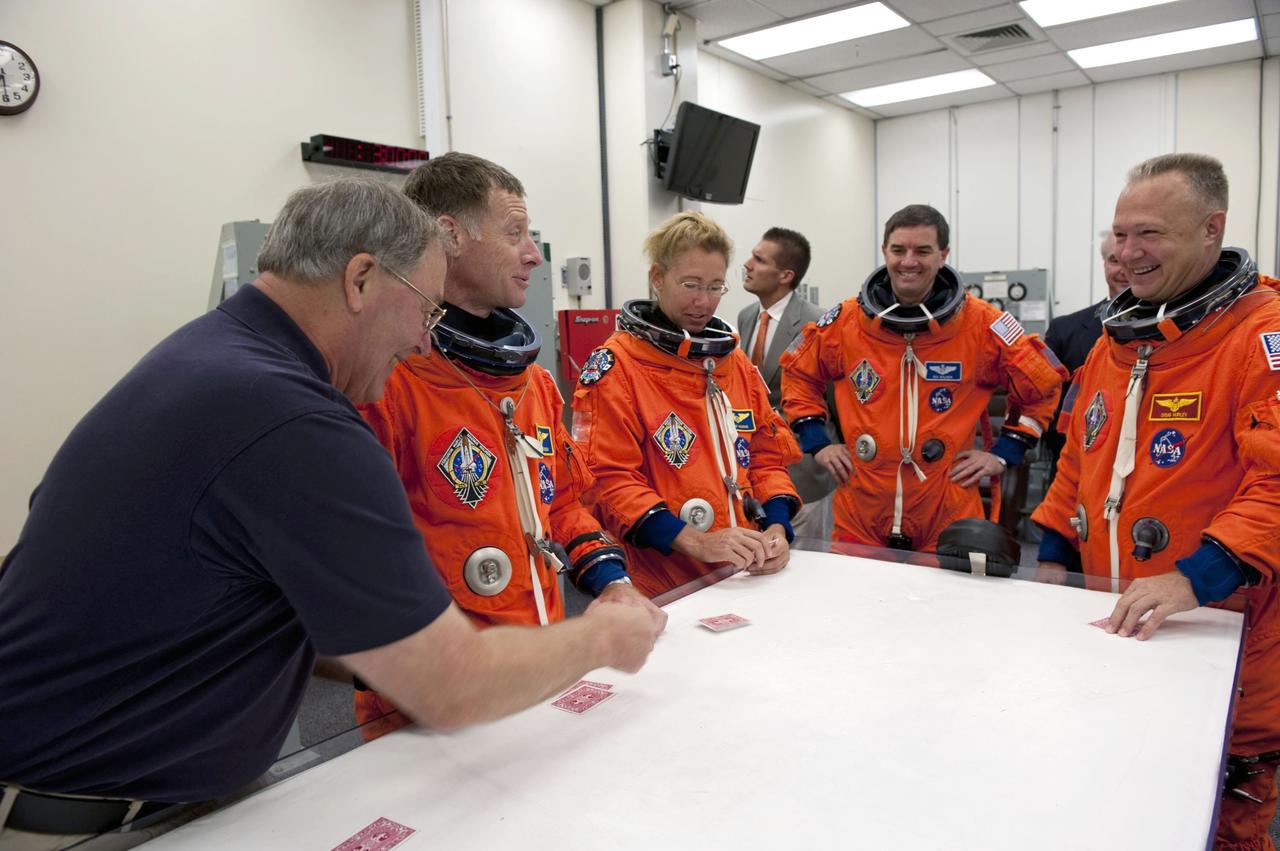
CAPE CANAVERAL, Fla. -- In the Operations and Checkout Building at NASA's Kennedy Space Center in Florida, the STS-135 crew members enjoy a light moment during a simulated launch countdown. From left are Jerry Ross, chief of the Vehicle Integration Test Office and former NASA astronaut, Commander Chris Ferguson, Mission Specialists Sandy Magnus and Rex Walheim, and Pilot Doug Hurley. As part of the Terminal Countdown Demonstration Test (TCDT), the crew members are taken to Kennedy's Launch Pad 39A and strapped into space shuttle Atlantis to practice the steps that will be taken on launch day. Atlantis and its crew are targeted to lift off July 8, taking with them the Raffaello multi-purpose logistics module packed with supplies and spare parts to the International Space Station. The STS-135 mission also will fly a system to investigate the potential for robotically refueling existing satellites and return a failed ammonia pump module to help NASA better understand the failure mechanism and improve pump designs for future systems. STS-135 will be the 33rd flight of Atlantis, the 37th shuttle mission to the space station, and the 135th and final mission of NASA's Space Shuttle Program. For more information visit, www.nasa.gov/mission_pages/shuttle/shuttlemissions/sts135/index.html. Photo credit: NASA/Kim Shiflett
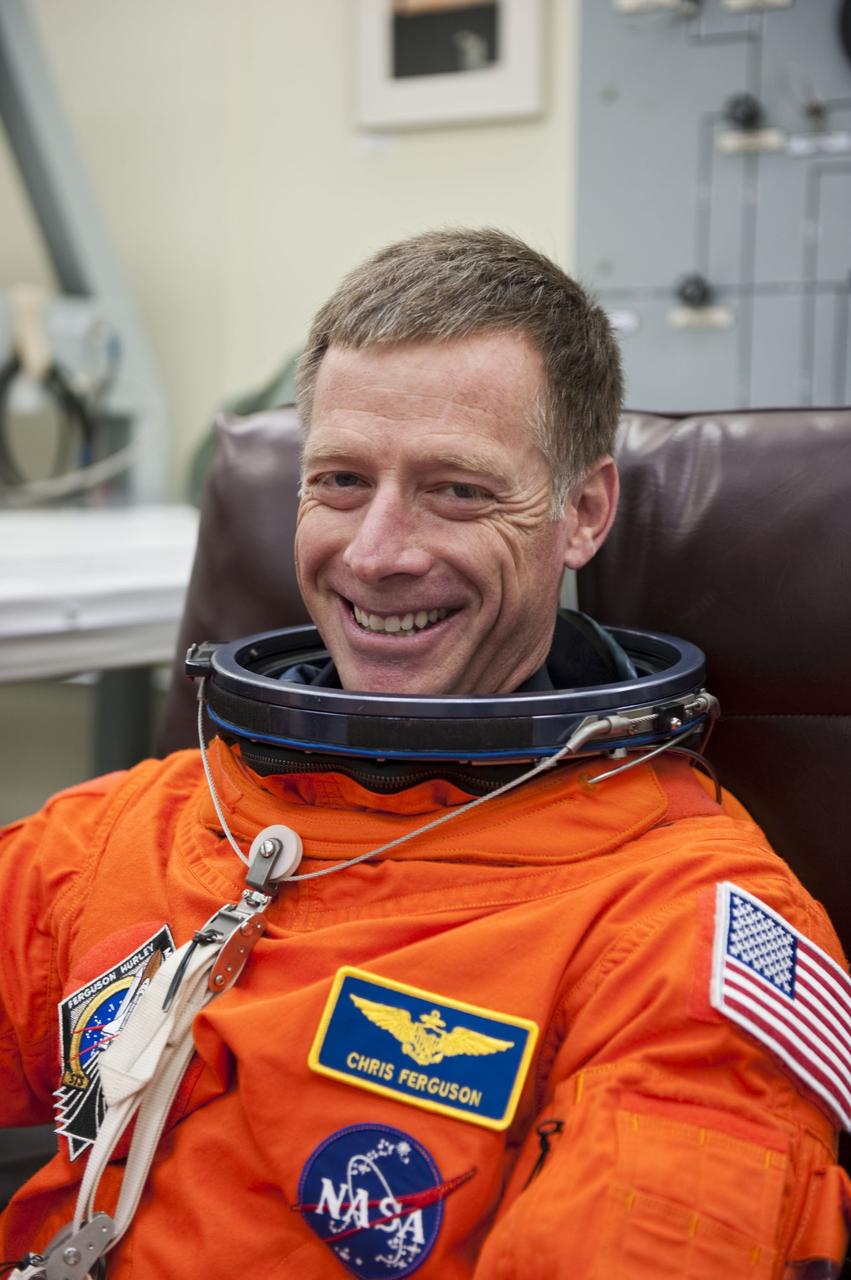
CAPE CANAVERAL, Fla. -- In the Operations and Checkout Building at NASA's Kennedy Space Center in Florida, STS-135 Commander Chris Ferguson checks the fit of his launch-and-entry suit during a simulated launch countdown. As part of the Terminal Countdown Demonstration Test (TCDT), the crew members are taken to Kennedy's Launch Pad 39A and strapped into space shuttle Atlantis to practice the steps that will be taken on launch day. Atlantis and its crew are targeted to lift off July 8, taking with them the Raffaello multi-purpose logistics module packed with supplies and spare parts to the International Space Station. The STS-135 mission also will fly a system to investigate the potential for robotically refueling existing satellites and return a failed ammonia pump module to help NASA better understand the failure mechanism and improve pump designs for future systems. STS-135 will be the 33rd flight of Atlantis, the 37th shuttle mission to the space station, and the 135th and final mission of NASA's Space Shuttle Program. For more information visit, www.nasa.gov/mission_pages/shuttle/shuttlemissions/sts135/index.html. Photo credit: NASA/Kim Shiflett
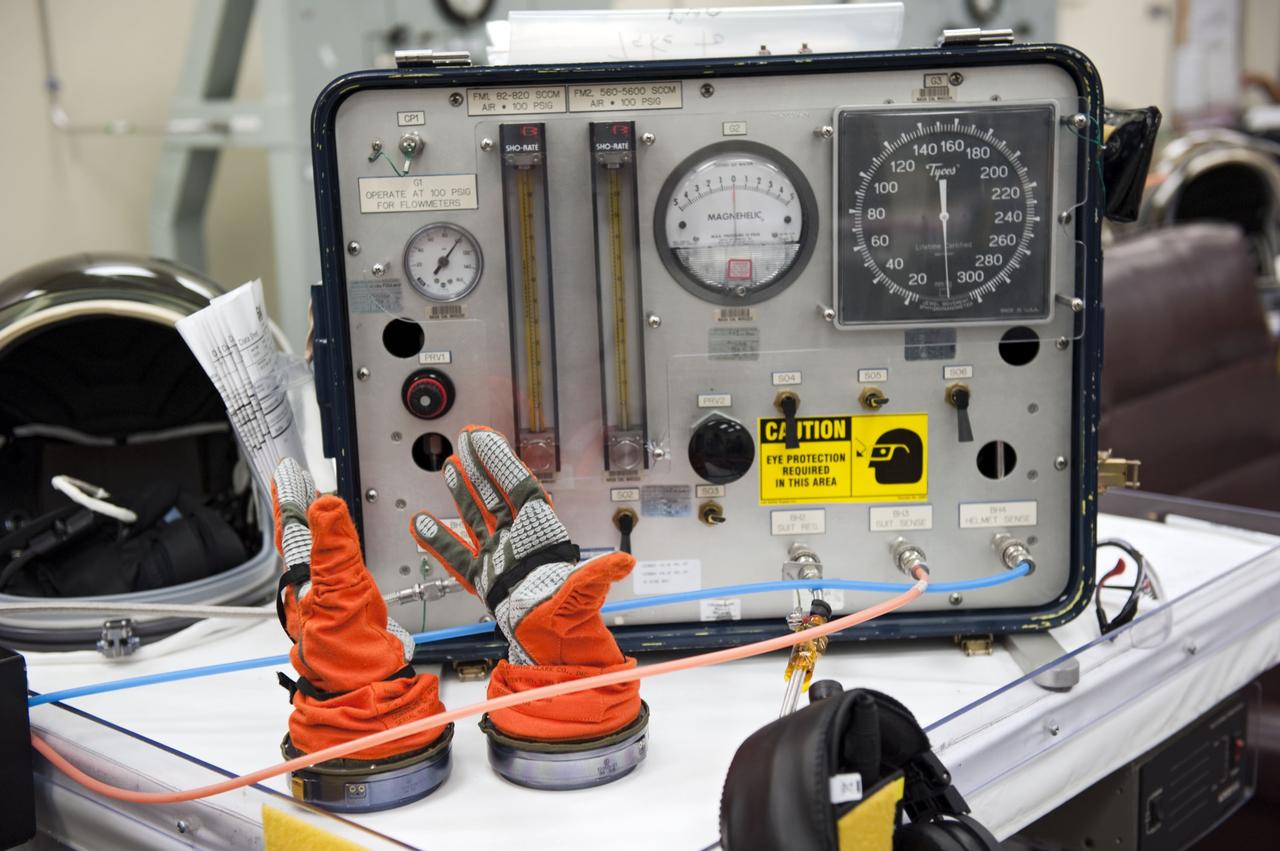
CAPE CANAVERAL, Fla. -- In the Operations and Checkout Building at NASA's Kennedy Space Center in Florida, the astronauts of space shuttle Atlantis' STS-135 crew put on their launch-and-entry suits and check the fit of their helmets and gloves. Seen here is a unit that checks air pressure flowing through the suits to ensure there are no leaks. As part of the Terminal Countdown Demonstration Test (TCDT), the crew members are taken to Kennedy's Launch Pad 39A and strapped into space shuttle Atlantis to practice the steps that will be taken on launch day. Atlantis and its crew are targeted to lift off July 8, taking with them the Raffaello multi-purpose logistics module packed with supplies and spare parts to the International Space Station. The STS-135 mission also will fly a system to investigate the potential for robotically refueling existing satellites and return a failed ammonia pump module to help NASA better understand the failure mechanism and improve pump designs for future systems. STS-135 will be the 33rd flight of Atlantis, the 37th shuttle mission to the space station, and the 135th and final mission of NASA's Space Shuttle Program. For more information visit, www.nasa.gov/mission_pages/shuttle/shuttlemissions/sts135/index.html. Photo credit: NASA/Kim Shiflett
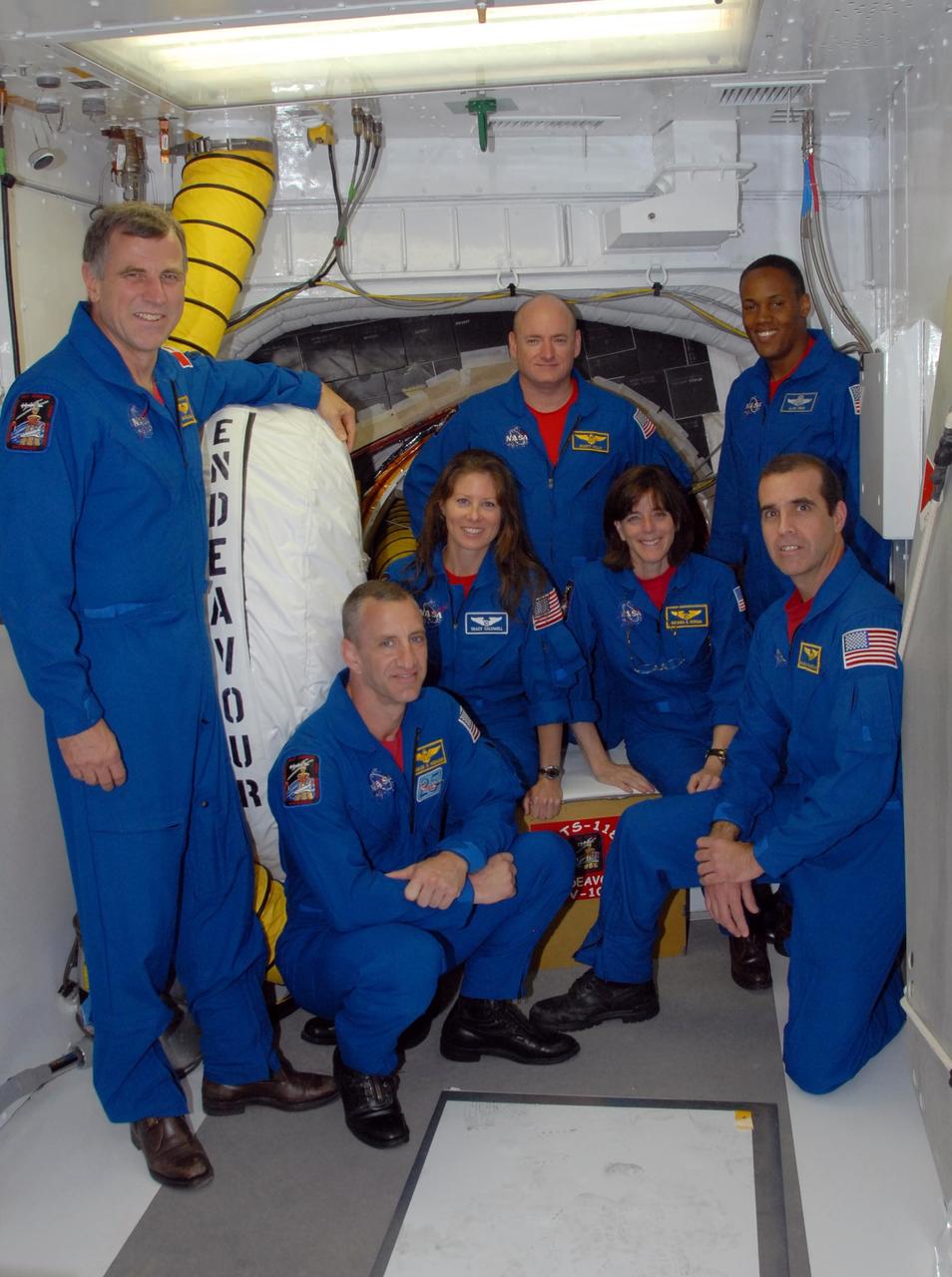
KENNEDY SPACE CENTER, Fla. -- The STS-118 crew poses in front of the hatch opening on Space Shuttle Endeavour before the crew's morning training activities in the terminal countdown demonstration test, or TCDT. Standing at left is Mission Specialist Dave Williams. Standing in the back are Commander Scott Kelly (left) and Mission Specialist Alvin Drew; seated in the middle are Mission Specialists Tracy Caldwell (left) and Barbara R. Morgan; kneeling in front are Pilot Charlie Hobaugh (left) and Mission Specialist Rick Mastracchio. Williams represents the Canadian Space Agency. Morgan joined NASA's Teacher in Space program in 1985 and was selected as an astronaut in 1998. TCDT activities include M-113 training, payload familiarization, the emergency egress training at the pad and a simulated launch countdown. The mission is the 22nd flight to the International Space Station and Space Shuttle Endeavour will carry a payload including the S5 truss, a SPACEHAB module and external stowage platform 3. STS-118 is targeted for launch on Aug. 7. NASA/George Shelton
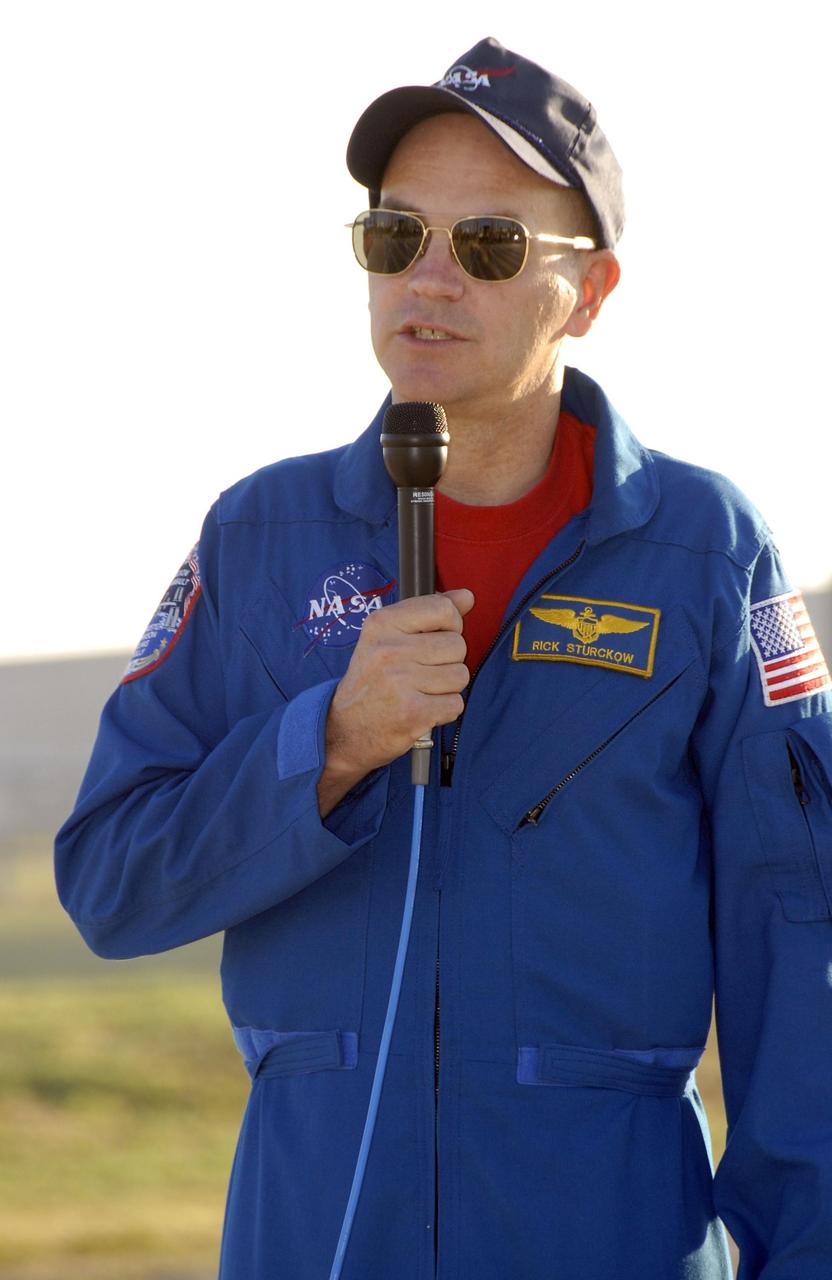
KENNEDY SPACE CENTER, FLA. -- Mission STS-117 Commander Rick Sturckow speaks to the media during a question-and-answer session at Launch Pad 39A during Terminal Countdown Demonstration Test (TCDT) activities. The TCDT also includes M-113 armored personnel carrier training, pad emergency egress training and a simulated launch countdown. The mission payload aboard Space Shuttle Atlantis is the S3/S4 integrated truss structure, along with a third set of solar arrays and batteries. The crew of six astronauts will install the truss to continue assembly of the International Space Station. Photo credit: NASA/Kim Shiflett
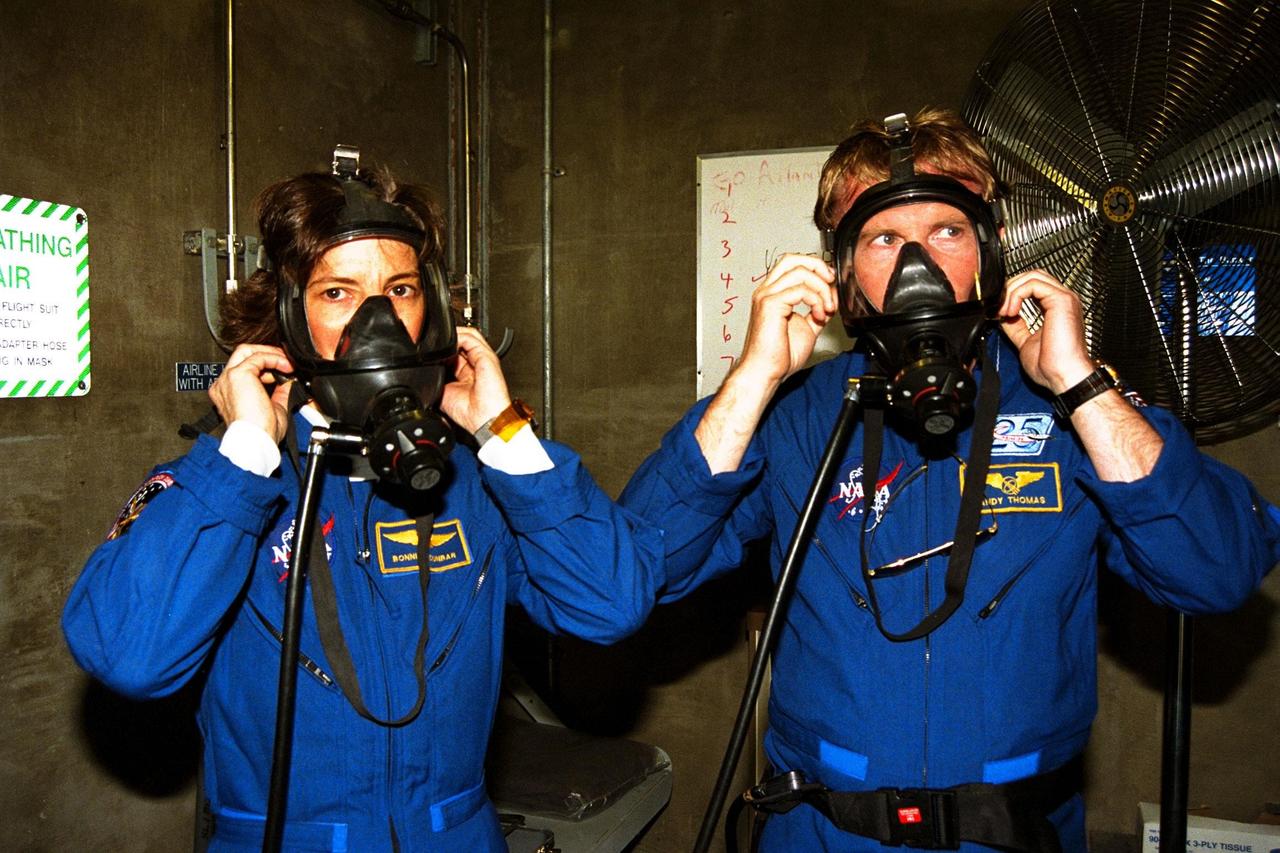
KENNEDY SPACE CENTER, Fla. -- STS-89 Mission Specialists Bonnie Dunbar, Ph.D., and Andrew Thomas, Ph.D., check out oxygen masks in the bunker at KSC’s Launch Pad 39A. The seven astronauts assigned to the eighth Shuttle-Mir docking flight are completing Terminal Countdown Demonstration Test (TCDT) activities. A dress rehearsal for launch, the TCDT includes emergency egress training at the launch pad and culminates with a simulated countdown. Dr. Thomas will transfer to the Russian Space Station Mir and succeed David Wolf, M.D., who will return to Earth aboard Endeavour. The Space Shuttle Endeavour is undergoing preparations for liftoff, scheduled for Jan. 22. Dr. Thomas will live and work on Mir until June
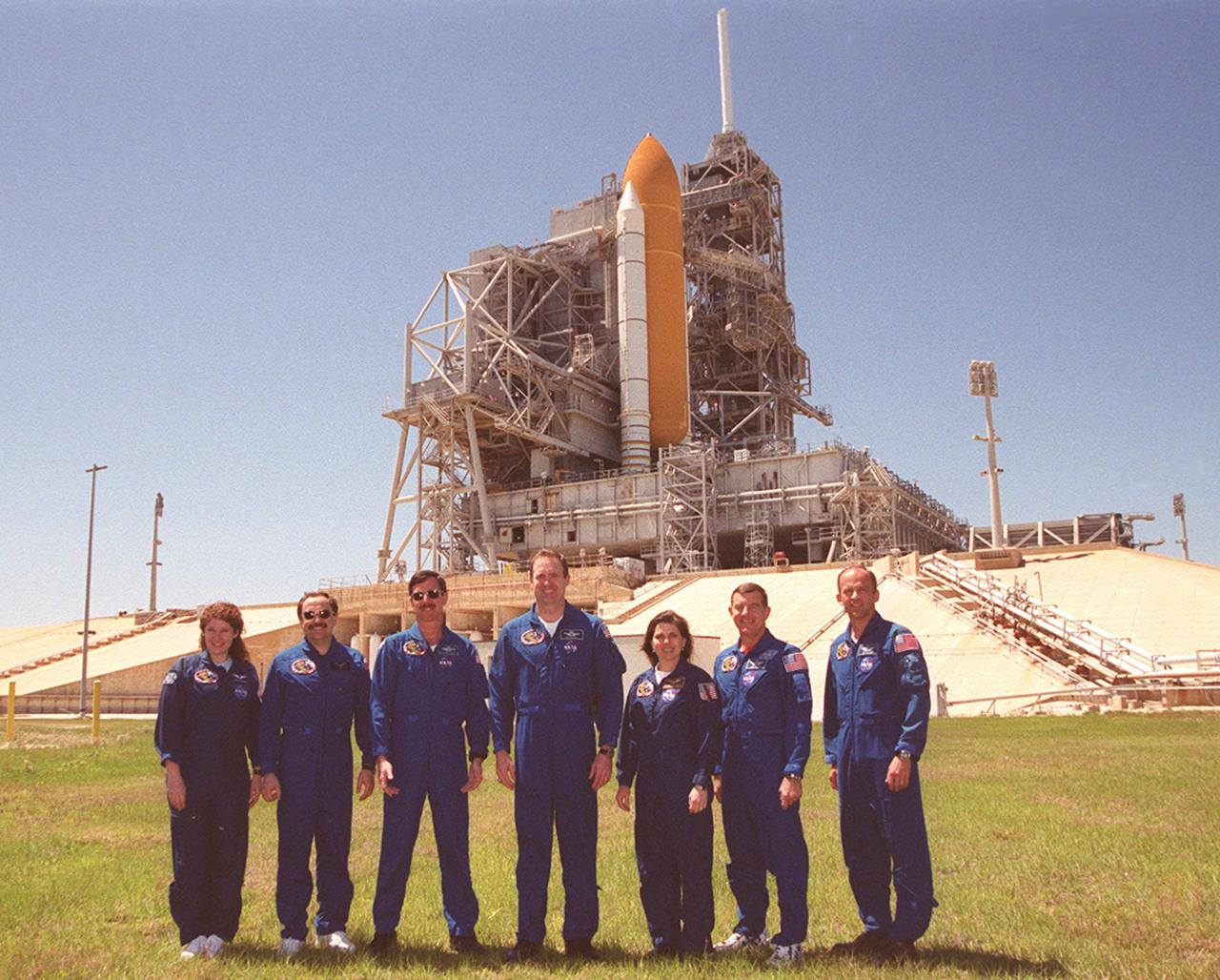
KENNEDY SPACE CENTER, Fla. -- During a break in their Terminal Countdown Demonstration Test (TCDT), the STS-101 crew poses in front of Space Shuttle Atlantis at Launch Pad 39A. Standing, left to right, are Mission Specialists Susan J. Helms and Yury Usachev of Russia; Pilot Scott J. "Doc" Horowitz; Commander James D. Halsell Jr.; and Mission Specialists Mary Ellen Weber, James Voss and Jeffrey N. Williams. The TCDT includes emergency egress training and a simulated launch countdown. During their mission to the International Space Station, the STS-101 crew will be delivering logistics and supplies, plus preparing the Station for the arrival of the Zvezda Service Module, expected to be launched by Russia in July 2000. Also, the crew will conduct one space walk to perform maintenance on the Space Station. This will be the third assembly flight for the Space Station. STS-101 is scheduled to launch April 24 at 4:15 p.m. from Launch Pad 39A

KENNEDY SPACE CENTER, Fla. -- After Terminal Countdown Demonstration Test (TCDT) activities at Launch Pad 39A, the STS-101 crew talk to the media. At the microphone is Commander James D. Halsell Jr. Next to him, standing left to right, are Pilot Scott J. "Doc" Horowitz and Mission Specialists Mary Ellen Weber, Jeffrey N. Williams, James Voss, Susan J. Helms and Yury Usachev of Russia. The TCDT includes emergency egress training and a simulated launch countdown. During their mission to the International Space Station, the STS-101 crew will be delivering logistics and supplies, plus preparing the Station for the arrival of the Zvezda Service Module, expected to be launched by Russia in July 2000. Also, the crew will conduct one space walk to perform maintenance on the Space Station. This will be the third assembly flight for the Space Station. STS-101 is scheduled to launch April 24 at 4:15 p.m. from Launch Pad 39A

KENNEDY SPACE CENTER, Fla. -- After Terminal Countdown Demonstration Test (TCDT) activities at Launch Pad 39A, the STS-101 crew talk to the media. At the microphone is Commander James D. Halsell Jr. Next to him, standing left to right, are Pilot Scott J. "Doc" Horowitz and Mission Specialists Mary Ellen Weber, Jeffrey N. Williams, James Voss, Susan J. Helms and Yury Usachev of Russia. The TCDT includes emergency egress training and a simulated launch countdown. During their mission to the International Space Station, the STS-101 crew will be delivering logistics and supplies, plus preparing the Station for the arrival of the Zvezda Service Module, expected to be launched by Russia in July 2000. Also, the crew will conduct one space walk to perform maintenance on the Space Station. This will be the third assembly flight for the Space Station. STS-101 is scheduled to launch April 24 at 4:15 p.m. from Launch Pad 39A
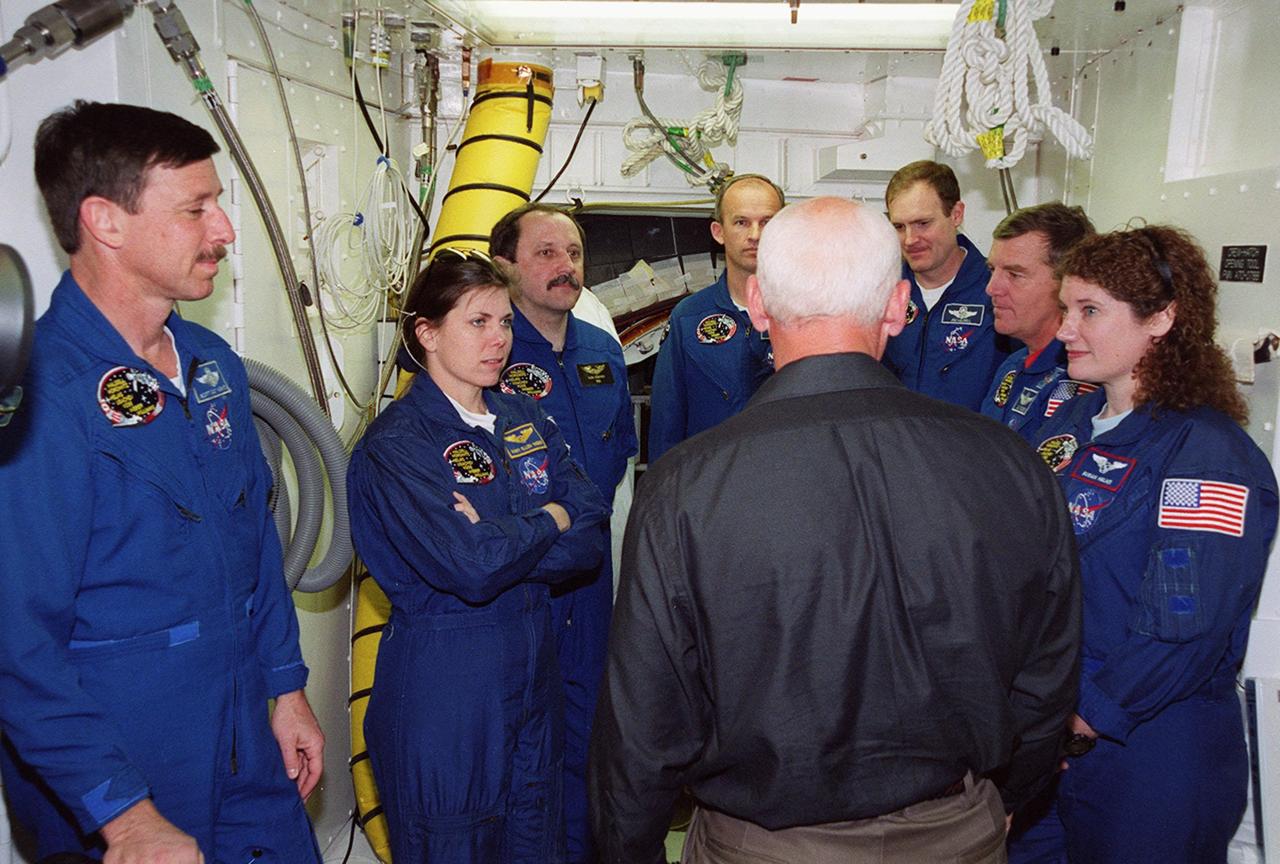
Inside the White Room at Launch Pad 39A, the STS-101 crew take part in training during a Terminal Countdown Demonstration Test (TCDT). Activities during TCDT include emergency egress from the orbiter and a dress rehearsal for launch. Standing left to right are Pilot Scott Horowitz, Mission Specialists Mary Ellen Weber, Yury Usachev and Jeffrey Williams, Commander James Halsell, and Mission Specialists James Voss and Susan Helms. During their mission to the International Space Station, the STS-101 crew will be delivering logistics and supplies, plus preparing the Station for the arrival of the Zvezda Service Module, expected to be launched by Russia in July 2000. Also, the crew will conduct one space walk to perform maintenance on the Space Station. This will be the third assembly flight for the Space Station. STS-101 is scheduled to launch April 24 at 4:15 p.m. from Launch Pad 39A

KENNEDY SPACE CENTER, Fla. -- During a break in their Terminal Countdown Demonstration Test (TCDT), the STS-101 crew poses in front of Space Shuttle Atlantis at Launch Pad 39A. Standing, left to right, are Mission Specialists Susan J. Helms and Yury Usachev of Russia; Pilot Scott J. "Doc" Horowitz; Commander James D. Halsell Jr.; and Mission Specialists Mary Ellen Weber, James Voss and Jeffrey N. Williams. The TCDT includes emergency egress training and a simulated launch countdown. During their mission to the International Space Station, the STS-101 crew will be delivering logistics and supplies, plus preparing the Station for the arrival of the Zvezda Service Module, expected to be launched by Russia in July 2000. Also, the crew will conduct one space walk to perform maintenance on the Space Station. This will be the third assembly flight for the Space Station. STS-101 is scheduled to launch April 24 at 4:15 p.m. from Launch Pad 39A
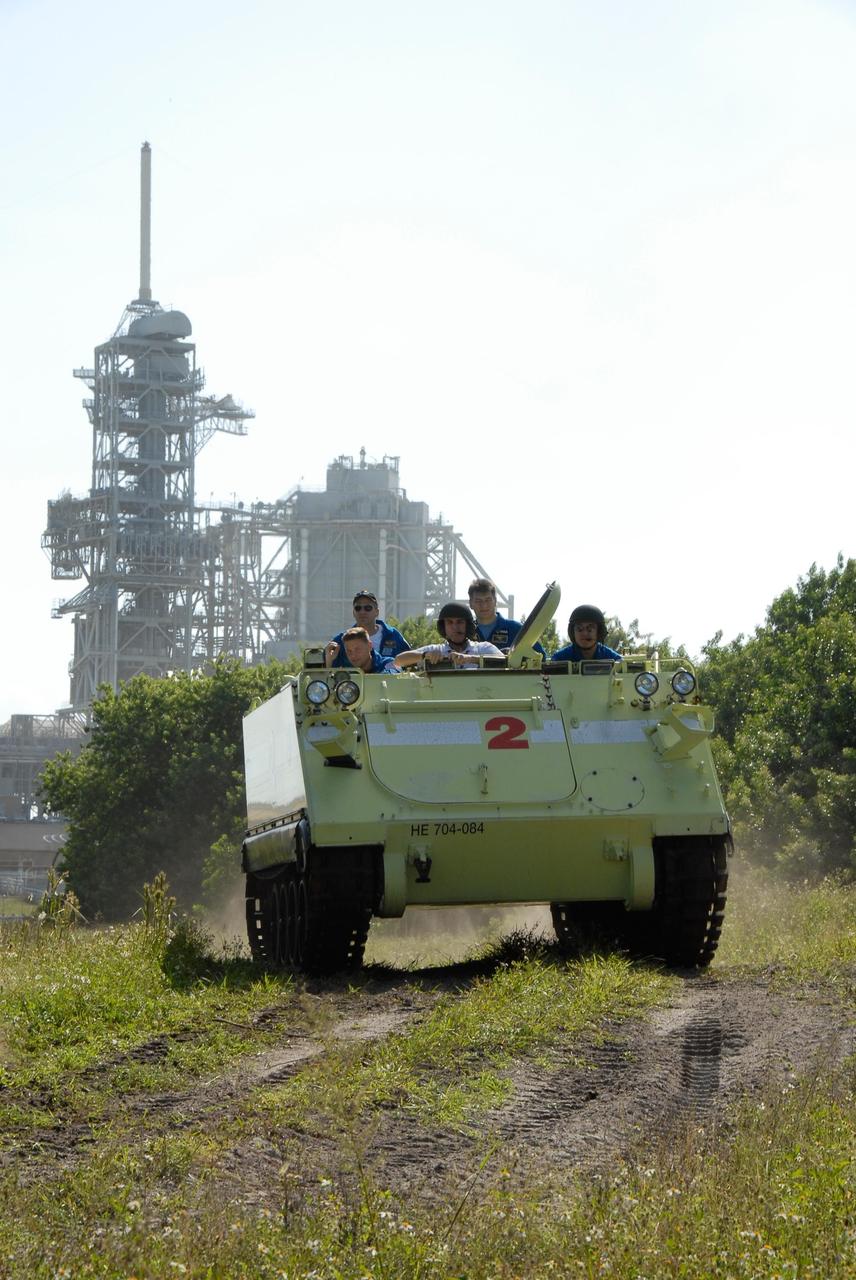
KENNEDY SPACE CENTER, FLA. -- Driven by Mission Specialist Daniel Tani, the M-113 armored personnel carrier moves through the underbrush near Launch Pad 39A. The M-113 is part of emergency exit procedures from Launch Pad 39A. Also in front is the trainer. In the rear are Mission Specialists Doug Wheelock, Scott Parazynski and Paolo Nespoli, who represents the European Space Agency. The training is part of terminal countdown demonstration test, or TCDT, activities the crew is undertaking at NASA's Kennedy Space Center. The TCDT also includes equipment familiarization and a simulated launch countdown. Mission STS-120, which will carry the Italian-built U.S. Node 2 to the International Space Station, is targeted for launch on Oct. 23. Photo credit: NASA/Kim Shiflett
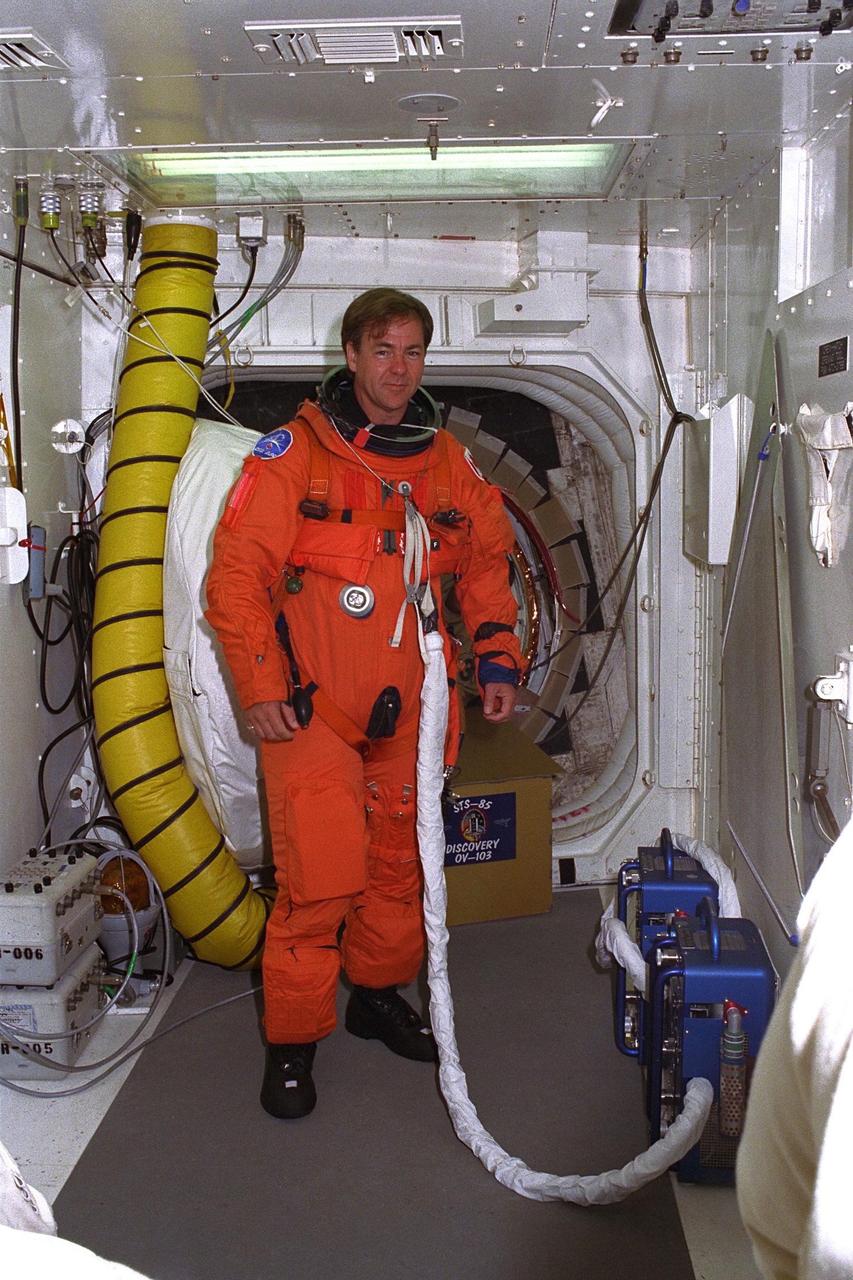
STS-85 Payload Specialist Bjarni V. Tryggvason poses in the white room at Launch Pad 39A with his ascent/reentry flight suit as he prepares to enter the Space Shuttle orbiter Discovery at Launch Pad 39A during Terminal Countdown Demonstration Test (TCDT) activities for that mission. The primary payload aboard the Space Shuttle orbiter Discovery is the Cryogenic Infrared Spectrometers and Telescopes for the Atmosphere-2 (CRISTA-SPAS-2). Other payloads on the 11-day mission include the Manipulator Flight Demonstration (MFD), and Technology Applications and Science-1 (TAS-1) and International Extreme Ultraviolet Hitchhiker-2 (IEH-2) experiments
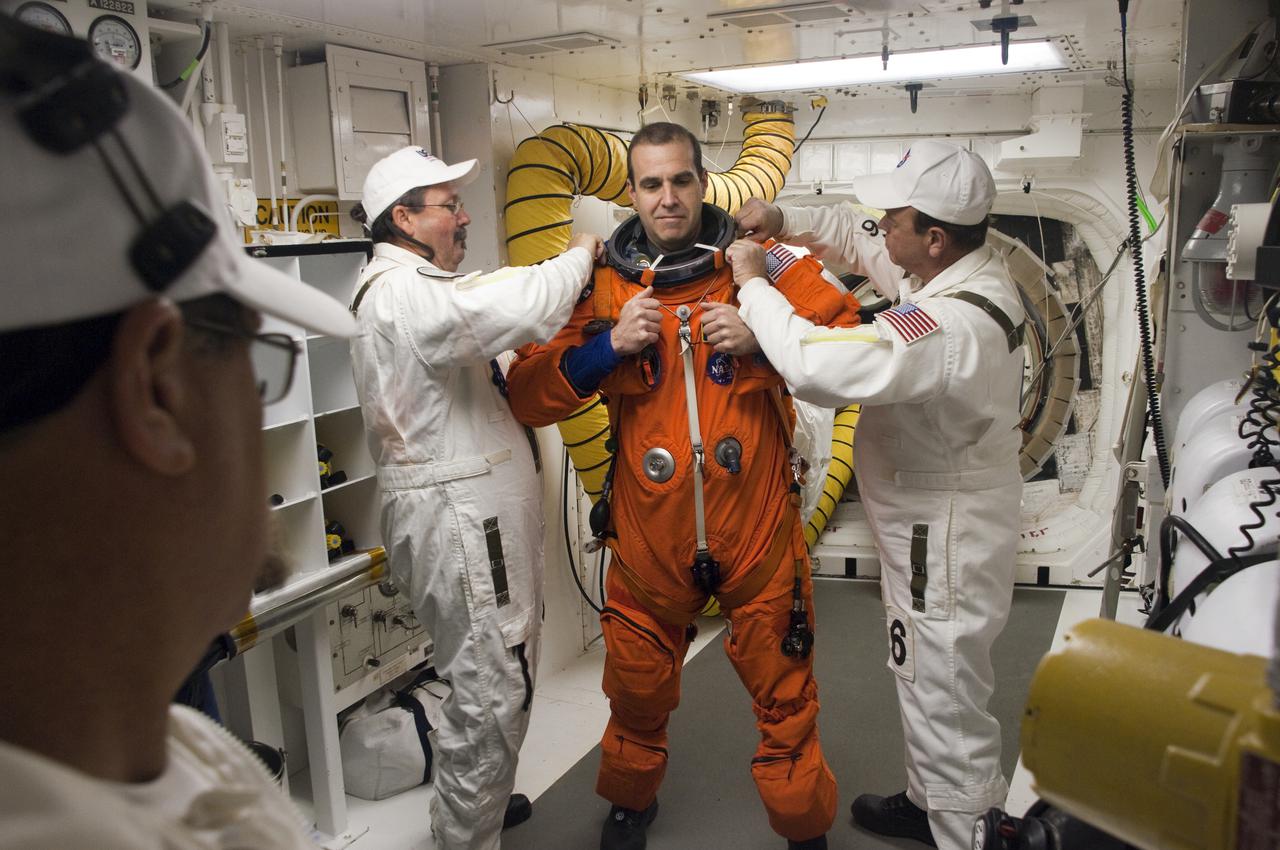
CAPE CANAVERAL, Fla. - At Launch Pad 39A at NASA's Kennedy Space Center in Florida, STS-131 Mission Specialist Rick Mastracchio prepares to enter space shuttle Discovery from the pad's White Room. The members of space shuttle Discovery's STS-131 crew, dressed in their launch-and-entry suits, are participating in the Terminal Countdown Demonstration Test, or TCDT, a dress rehearsal for launch. TCDT includes training on the emergency exit systems at the launch pad, driving practice of the M-113 armored personnel carrier and a simulated launch countdown. The crew will deliver the multi-purpose logistics module Leonard, filled with resupply stowage platforms and science racks, to the International Space Station. STS-131, targeted for launch on April 5, will be the 33rd shuttle mission to the station and the 131st shuttle mission overall. For information on the STS-131 mission and crew, visit http:__www.nasa.gov_mission_pages_shuttle_shuttlemissions_sts131_index.htm. Photo credit: NASA_Regina Mitchell-Ryall
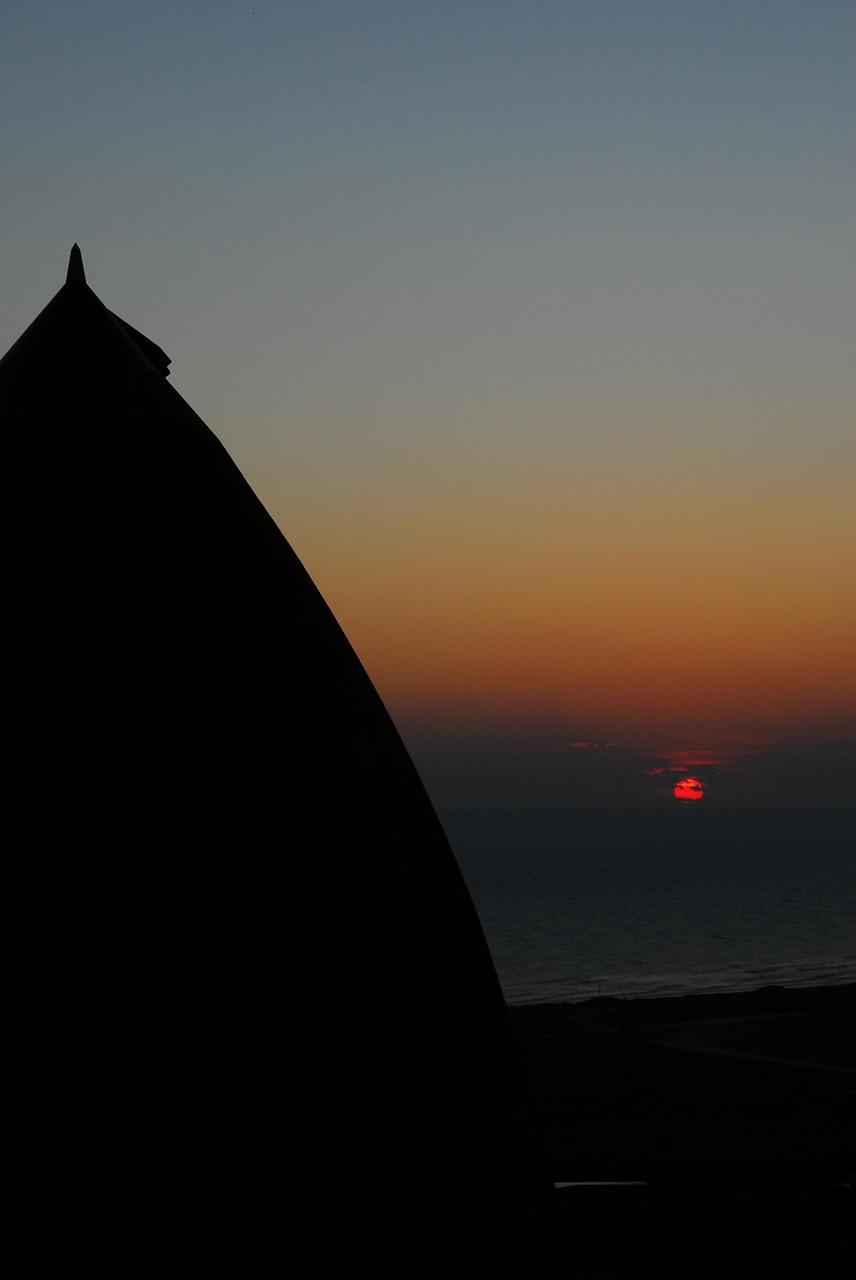
CAPE CANAVERAL, Fla. -- As the sun begins to rise at Launch Pad 39A at NASA's Kennedy Space Center in Florida, the STS-133 crew members are in the pad's White Room preparing to board space shuttle Discovery during the Terminal Countdown Demonstration Test (TCDT). Part of TCDT includes practicing the final hours of a real launch day when astronauts put on their launch-and-entry suits, ride to the pad in the Astrovan and strap into the shuttle. Discovery and its STS-133 crew will deliver the Permanent Multipurpose Module, packed with supplies and critical spare parts, as well as Robonaut 2, the dexterous humanoid astronaut helper, to the International Space Station. Launch is targeted for Nov. 1 at 4:40 p.m. For more information on the STS-133 mission, visit www.nasa.gov/mission_pages/shuttle/shuttlemissions/sts133/. Photo credit: NASA/Jim Grossmann
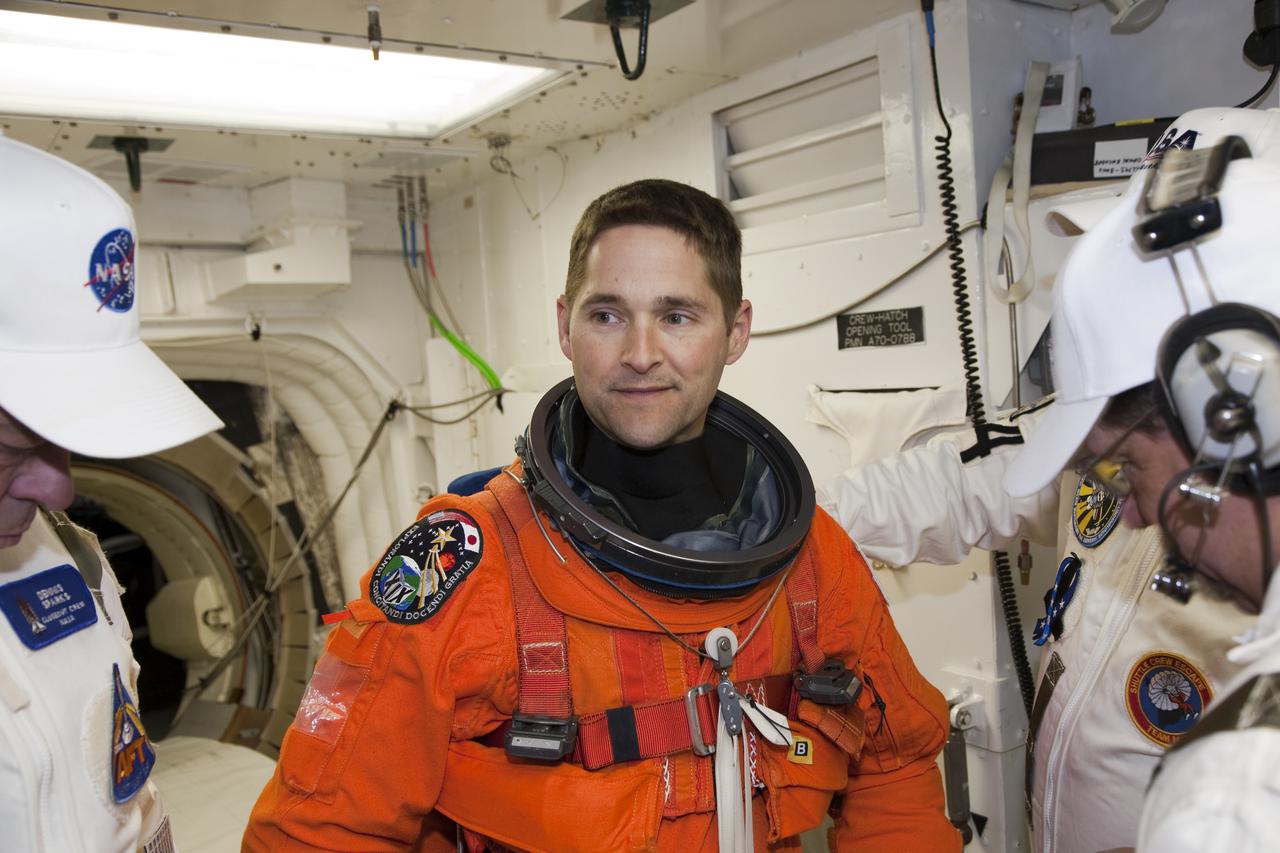
CAPE CANAVERAL, Fla. - At Launch Pad 39A at NASA's Kennedy Space Center in Florida, STS-131 Mission Specialist Clayton Anderson, at right, prepares to enter space shuttle Discovery from the pad's White Room. The members of space shuttle Discovery's STS-131 crew, dressed in their launch-and-entry suits, are participating in the Terminal Countdown Demonstration Test, or TCDT, a dress rehearsal for launch. TCDT includes training on the emergency exit systems at the launch pad, driving practice of the M-113 armored personnel carrier and a simulated launch countdown. The crew will deliver the multi-purpose logistics module Leonard, filled with resupply stowage platforms and science racks, to the International Space Station. STS-131, targeted for launch on April 5, will be the 33rd shuttle mission to the station and the 131st shuttle mission overall. For information on the STS-131 mission and crew, visit http:__www.nasa.gov_mission_pages_shuttle_shuttlemissions_sts131_index.htm. Photo credit: NASA_Regina Mitchell-Ryall
CAPE CANAVERAL, Fla. - At Launch Pad 39A at NASA's Kennedy Space Center in Florida, STS-131 Pilot James P. Dutton Jr. prepares to enter space shuttle Discovery from the pad's White Room. The crew members of Discovery's STS-131 mission, dressed in their launch-and-entry suits, are participating in the Terminal Countdown Demonstration Test, or TCDT, a dress rehearsal for launch. TCDT includes training on the emergency exit systems at the launch pad, driving practice of the M-113 armored personnel carrier and a simulated launch countdown. The crew will deliver the multi-purpose logistics module Leonard, filled with resupply stowage platforms and science racks, to the International Space Station. STS-131, targeted for launch on April 5, will be the 33rd shuttle mission to the station and the 131st shuttle mission overall. For information on the STS-131 mission and crew, visit http:__www.nasa.gov_mission_pages_shuttle_shuttlemissions_sts131_index.htm. Photo credit: NASA_Dimitri Gerondidakis
CAPE CANAVERAL, Fla. - At Launch Pad 39A at NASA's Kennedy Space Center in Florida, STS-131 Mission Specialist Clayton Anderson prepares to enter space shuttle Discovery from the pad's White Room. The crew members of Discovery's STS-131 mission, dressed in their launch-and-entry suits, are participating in the Terminal Countdown Demonstration Test, or TCDT, a dress rehearsal for launch. TCDT includes training on the emergency exit systems at the launch pad, driving practice of the M-113 armored personnel carrier and a simulated launch countdown. The crew will deliver the multi-purpose logistics module Leonard, filled with resupply stowage platforms and science racks, to the International Space Station. STS-131, targeted for launch on April 5, will be the 33rd shuttle mission to the station and the 131st shuttle mission overall. For information on the STS-131 mission and crew, visit http:__www.nasa.gov_mission_pages_shuttle_shuttlemissions_sts131_index.htm. Photo credit: NASA_Dimitri Gerondidakis
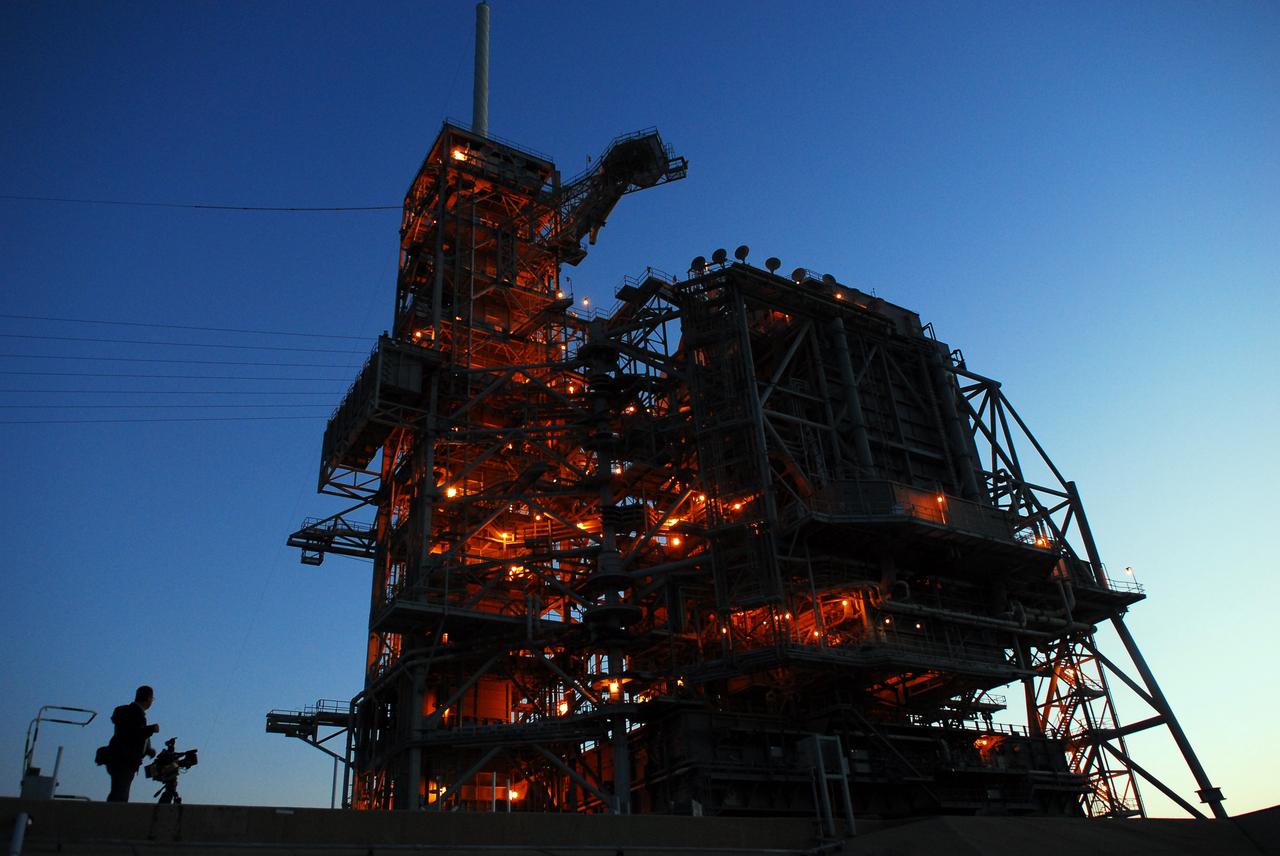
CAPE CANAVERAL, Fla. -- As the sun begins to rise at Launch Pad 39A at NASA's Kennedy Space Center in Florida, the STS-133 crew members are in the pad's White Room preparing to board space shuttle Discovery during the Terminal Countdown Demonstration Test (TCDT). Part of TCDT includes practicing the final hours of a real launch day when astronauts put on their launch-and-entry suits, ride to the pad in the Astrovan and strap into the shuttle. Discovery and its STS-133 crew will deliver the Permanent Multipurpose Module, packed with supplies and critical spare parts, as well as Robonaut 2, the dexterous humanoid astronaut helper, to the International Space Station. Launch is targeted for Nov. 1 at 4:40 p.m. For more information on the STS-133 mission, visit www.nasa.gov/mission_pages/shuttle/shuttlemissions/sts133/. Photo credit: NASA/Jim Grossmann
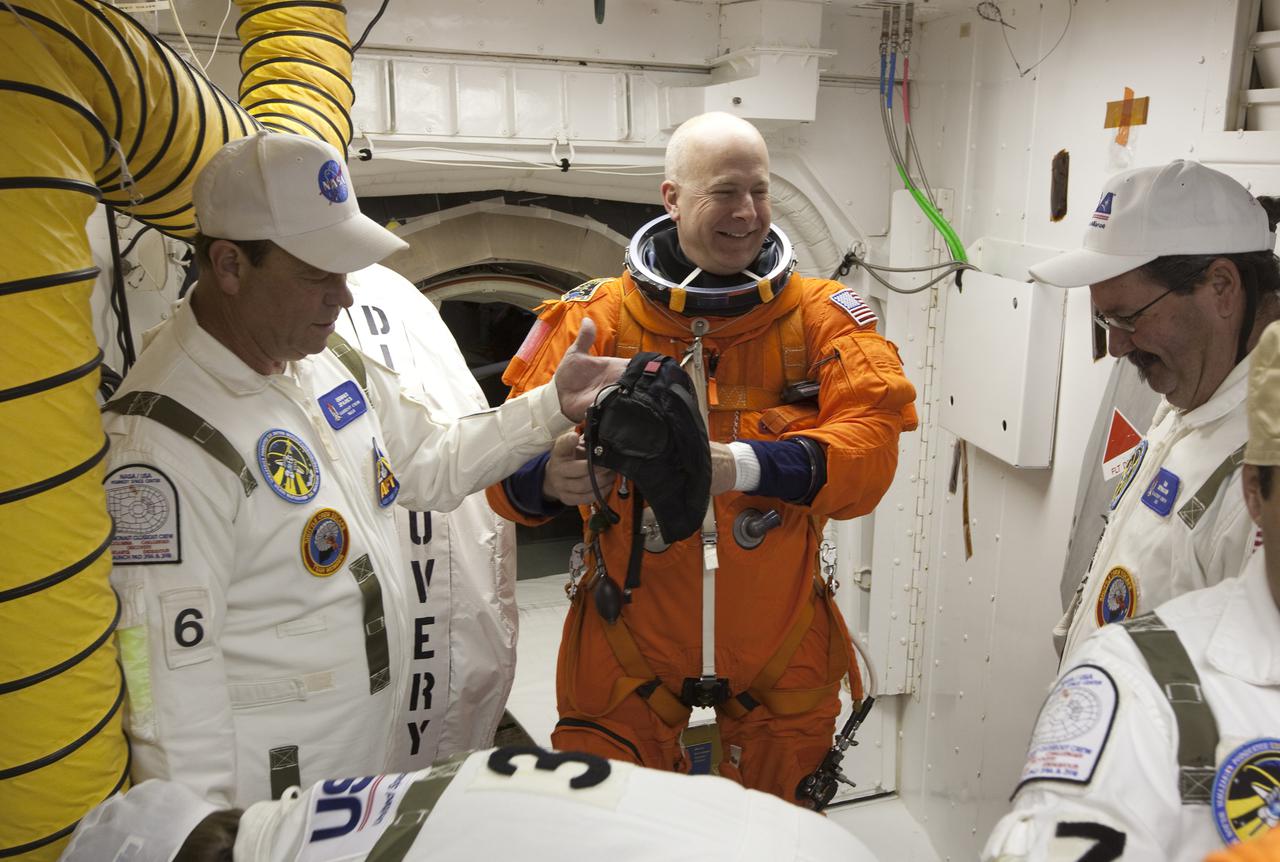
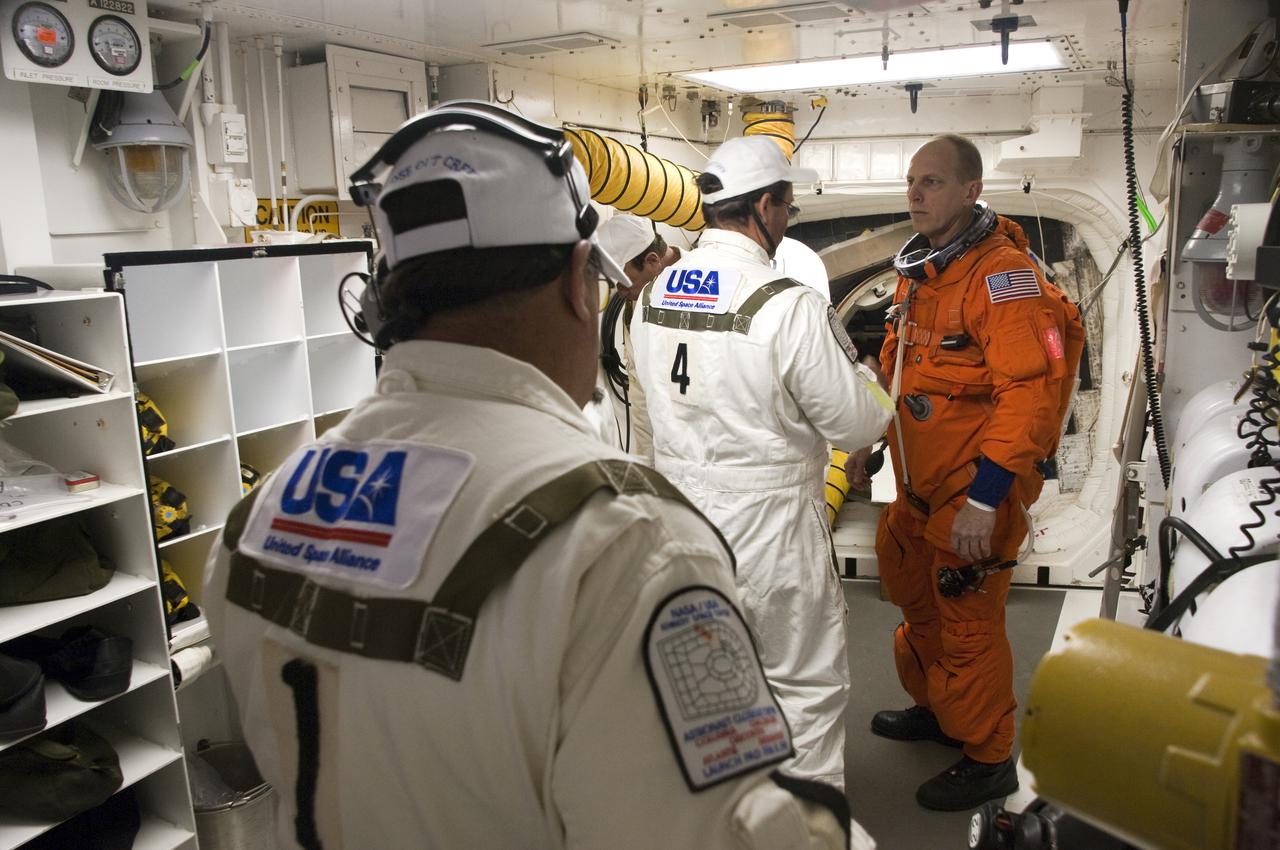
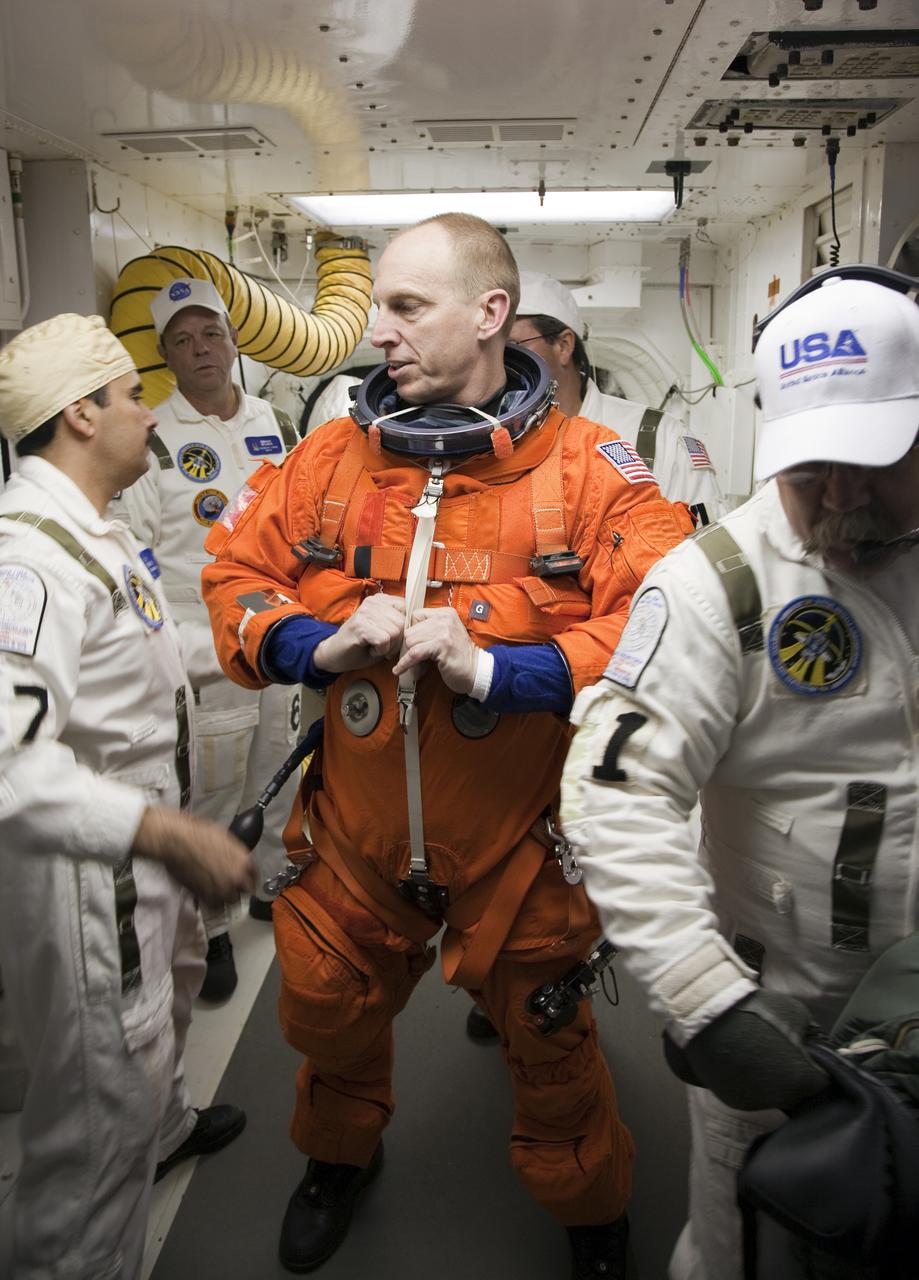
CAPE CANAVERAL, Fla. - At Launch Pad 39A at NASA's Kennedy Space Center in Florida, STS-131 Commander Alan Poindexter, in the orange suit, prepares to enter space shuttle Discovery from the pad's White Room. The members of space shuttle Discovery's STS-131 crew, dressed in their launch-and-entry suits, are participating in the Terminal Countdown Demonstration Test, or TCDT, a dress rehearsal for launch. TCDT includes training on the emergency exit systems at the launch pad, driving practice of the M-113 armored personnel carrier and a simulated launch countdown. The crew will deliver the multi-purpose logistics module Leonardo, filled with resupply stowage platforms and science racks, to the International Space Station. STS-131, targeted for launch on April 5, will be the 33rd shuttle mission to the station and the 131st shuttle mission overall. For information on the STS-131 mission and crew, visit http:__www.nasa.gov_mission_pages_shuttle_shuttlemissions_sts131_index.htm. Photo courtesy of Scott Andrews
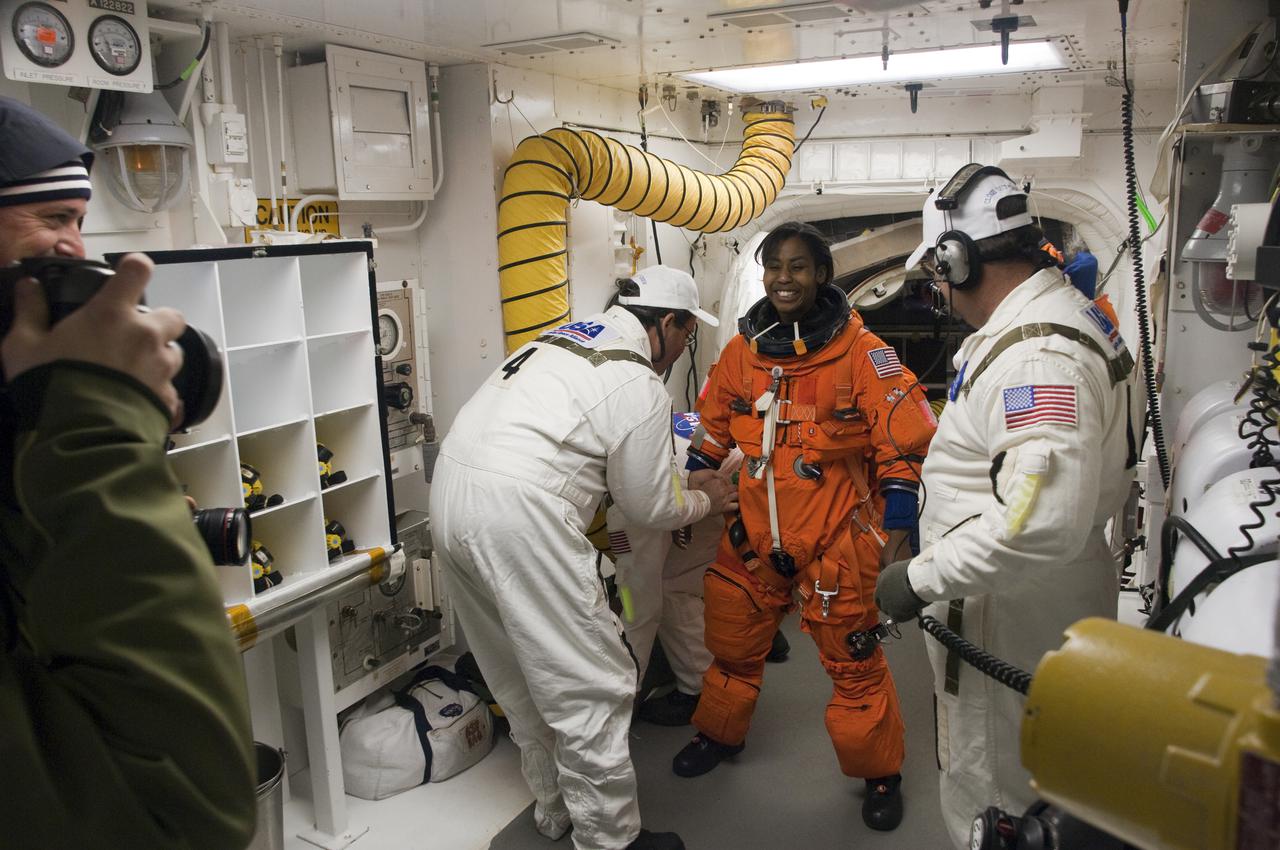
CAPE CANAVERAL, Fla. - At Launch Pad 39A at NASA's Kennedy Space Center in Florida, STS-131 Mission Specialist Stephanie Wilson prepares to enter space shuttle Discovery from the pad's White Room. The members of space shuttle Discovery's STS-131 crew, dressed in their launch-and-entry suits, are participating in the Terminal Countdown Demonstration Test, or TCDT, a dress rehearsal for launch. TCDT includes training on the emergency exit systems at the launch pad, driving practice of the M-113 armored personnel carrier and a simulated launch countdown. The crew will deliver the multi-purpose logistics module Leonard, filled with resupply stowage platforms and science racks, to the International Space Station. STS-131, targeted for launch on April 5, will be the 33rd shuttle mission to the station and the 131st shuttle mission overall. For information on the STS-131 mission and crew, visit http:__www.nasa.gov_mission_pages_shuttle_shuttlemissions_sts131_index.htm. Photo credit: NASA_Regina Mitchell-Ryall
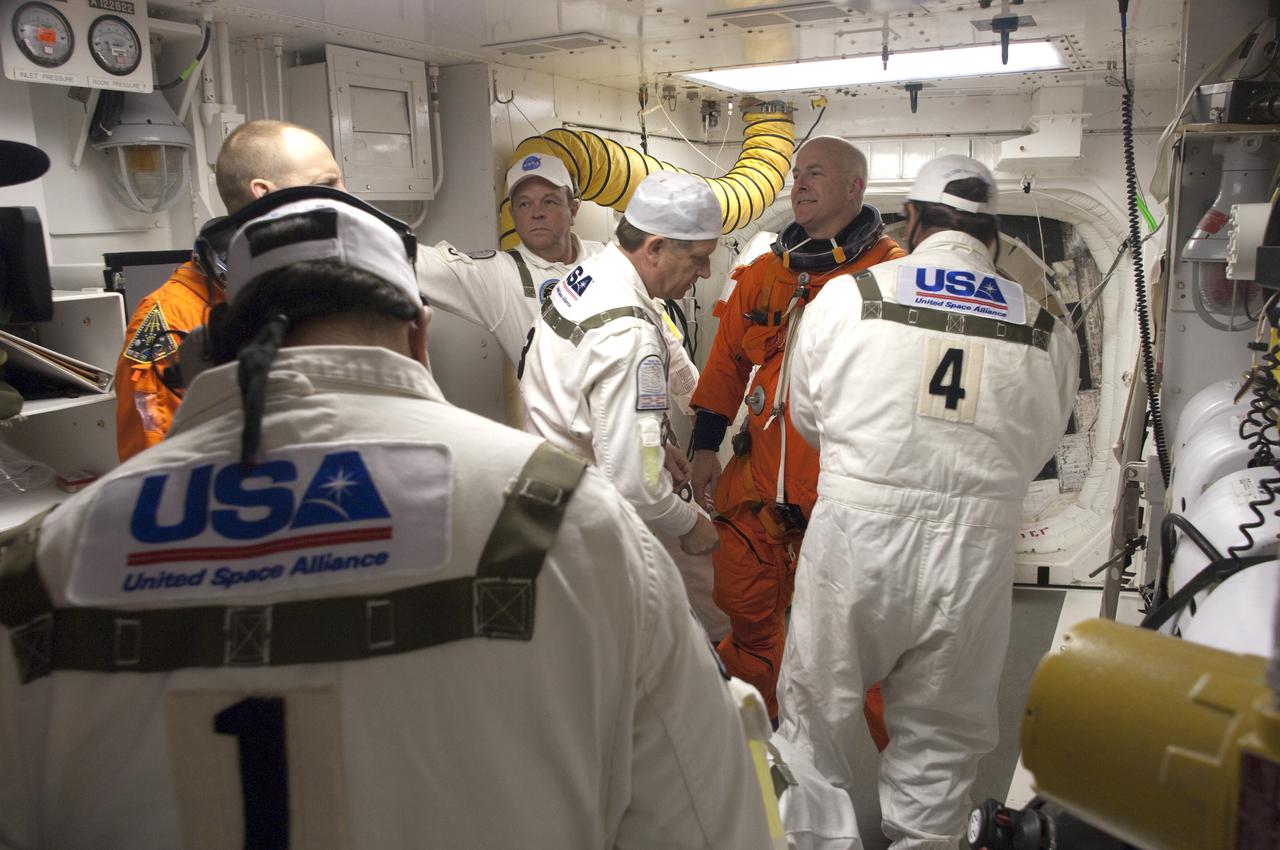
CAPE CANAVERAL, Fla. - At Launch Pad 39A at NASA's Kennedy Space Center in Florida, STS-131 Commander Alan Poindexter, at right in the orange suit, prepares to enter space shuttle Discovery from the pad's White Room. The members of space shuttle Discovery's STS-131 crew, dressed in their launch-and-entry suits, are participating in the Terminal Countdown Demonstration Test, or TCDT, a dress rehearsal for launch. TCDT includes training on the emergency exit systems at the launch pad, driving practice of the M-113 armored personnel carrier and a simulated launch countdown. The crew will deliver the multi-purpose logistics module Leonard, filled with resupply stowage platforms and science racks, to the International Space Station. STS-131, targeted for launch on April 5, will be the 33rd shuttle mission to the station and the 131st shuttle mission overall. For information on the STS-131 mission and crew, visit http:__www.nasa.gov_mission_pages_shuttle_shuttlemissions_sts131_index.htm. Photo credit: NASA_Regina Mitchell-Ryall
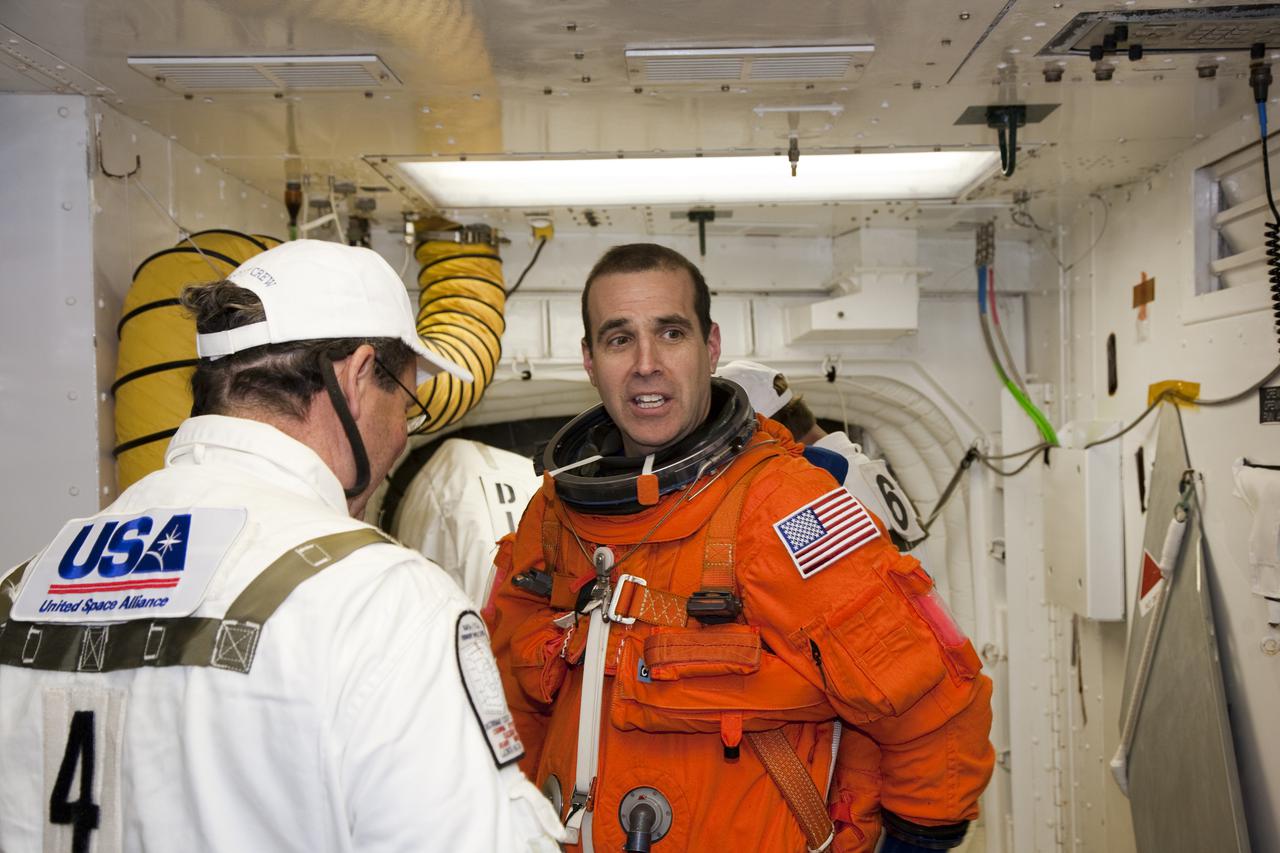
CAPE CANAVERAL, Fla. - At Launch Pad 39A at NASA's Kennedy Space Center in Florida, STS-131 Mission Specialist Rick Mastracchio prepares to enter space shuttle Discovery from the pad's White Room. The crew members of Discovery's STS-131 mission, dressed in their launch-and-entry suits, are participating in the Terminal Countdown Demonstration Test, or TCDT, a dress rehearsal for launch. TCDT includes training on the emergency exit systems at the launch pad, driving practice of the M-113 armored personnel carrier and a simulated launch countdown. The crew will deliver the multi-purpose logistics module Leonard, filled with resupply stowage platforms and science racks, to the International Space Station. STS-131, targeted for launch on April 5, will be the 33rd shuttle mission to the station and the 131st shuttle mission overall. For information on the STS-131 mission and crew, visit http:__www.nasa.gov_mission_pages_shuttle_shuttlemissions_sts131_index.htm. Photo credit: NASA_Dimitri Gerondidakis
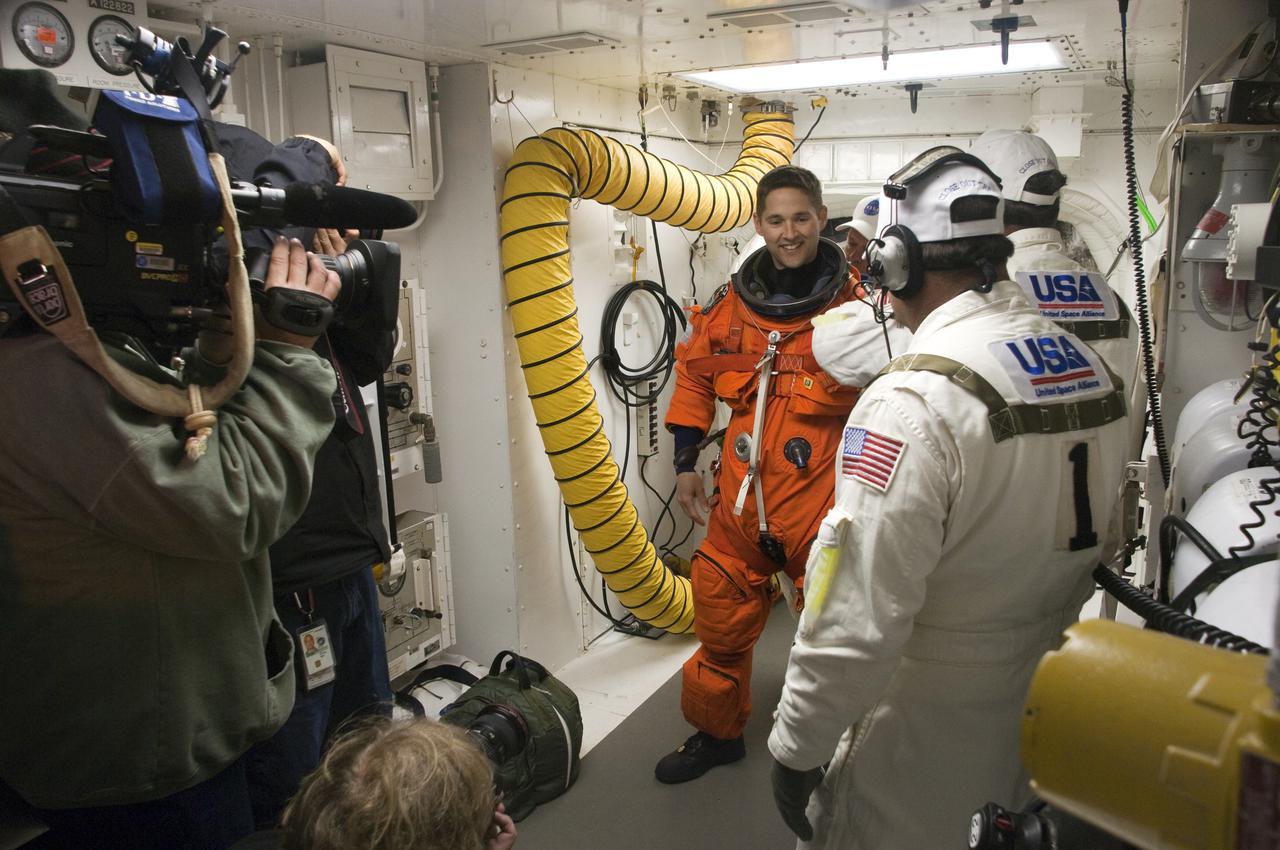
CAPE CANAVERAL, Fla. - At Launch Pad 39A at NASA's Kennedy Space Center in Florida, STS-131 Pilot James P. Dutton Jr., at left, prepares to enter space shuttle Discovery from the pad's White Room. The members of space shuttle Discovery's STS-131 crew, dressed in their launch-and-entry suits, are participating in the Terminal Countdown Demonstration Test, or TCDT, a dress rehearsal for launch. TCDT includes training on the emergency exit systems at the launch pad, driving practice of the M-113 armored personnel carrier and a simulated launch countdown. The crew will deliver the multi-purpose logistics module Leonard, filled with resupply stowage platforms and science racks, to the International Space Station. STS-131, targeted for launch on April 5, will be the 33rd shuttle mission to the station and the 131st shuttle mission overall. For information on the STS-131 mission and crew, visit http:__www.nasa.gov_mission_pages_shuttle_shuttlemissions_sts131_index.htm. Photo credit: NASA_Regina Mitchell-Ryall
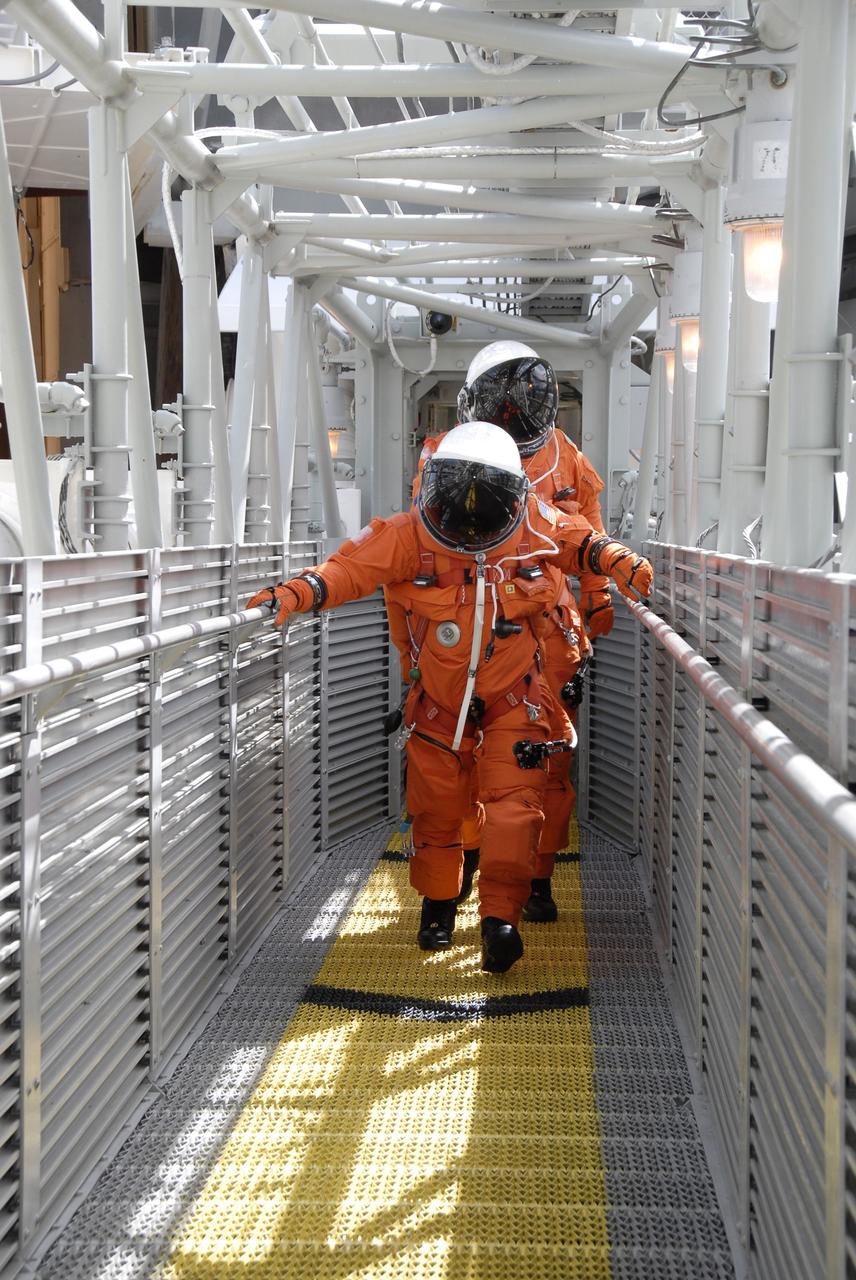
CAPE CANAVERAL, FIa. -- After taking part in a simulated launch countdown aboard space shuttle Atlantis, the STS-125 crew members practice an emergency escape from the shuttle. They are heading for the slidewire baskets that will speed them away from Kennedy Space Center’s Launch Pad 39A. The countdown is the culmination of terminal countdown demonstration test, or TCDT, activities as preparation before launch. TCDT provides astronauts and ground crews with an opportunity to participate in various launch activities, including equipment familiarization, emergency training and the countdown. Atlantis’ STS-125 mission to service NASA’s Hubble Space Telescope is targeted for launch Oct. 14. Photo credit: NASA/Kim Shiflett
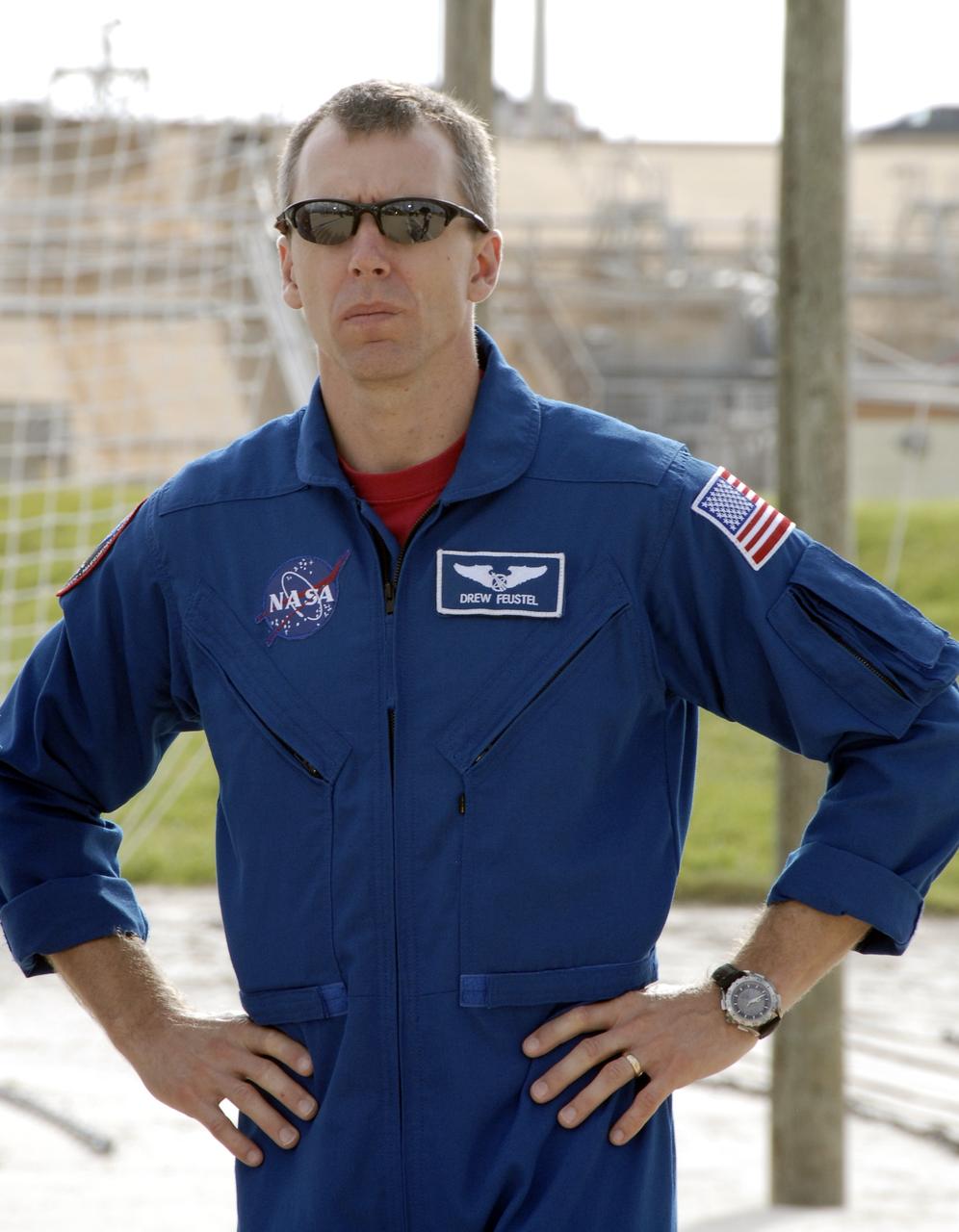
CAPE CANAVERAL, Fla. - On Launch Pad 39A at NASA's Kennedy Space Center in Florida, STS-125 Mission Specialist Andrew Feustel waits for a question from the media about his role in the mission. The crew is at Kennedy to take part in terminal countdown demonstration test, or TCDT, activities before launching on space shuttle Atlantis’ mission to service NASA’s Hubble Space Telescope. TCDT provides astronauts and ground crews with an opportunity to participate in various simulated countdown activities, including equipment familiarization, emergency training and a simulated launch countdown. Atlantis is targeted to launch Oct. 10. Photo credit: NASA/Kim Shiflett
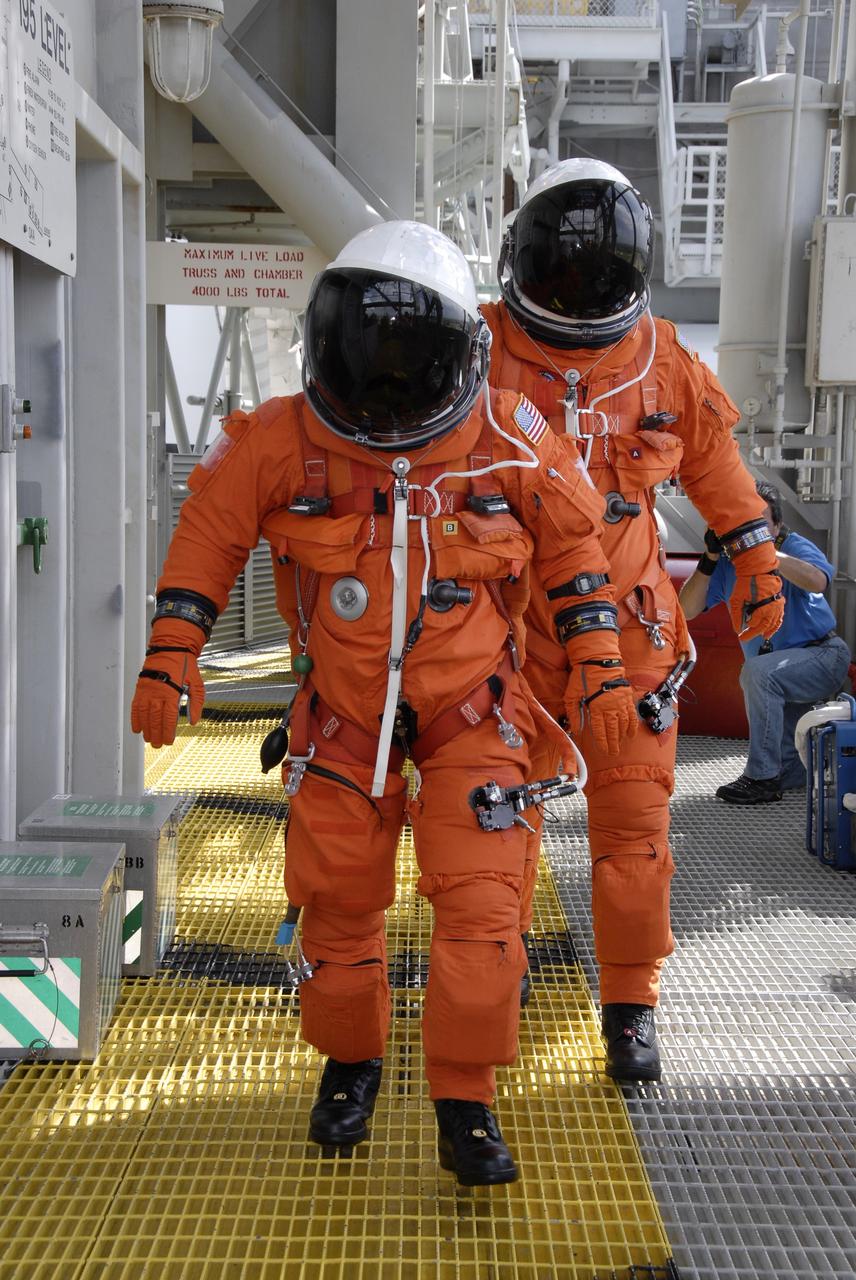
CAPE CANAVERAL, Fla. - After taking part in a simulated launch countdown aboard space shuttle Atlantis, the STS-125 crew members practice an emergency escape from the shuttle. They are heading for the slidewire baskets that on the fixed service structure that will speed them away from Kennedy Space Center’s Launch Pad 39A. The countdown is the culmination of terminal countdown demonstration test, or TCDT, activities as preparation before launch. TCDT provides astronauts and ground crews with an opportunity to participate in various launch activities, including equipment familiarization, emergency training and the countdown. Atlantis’ STS-125 mission to service NASA’s Hubble Space Telescope is targeted for launch Oct. 14. Photo credit: NASA/Kim Shiflett
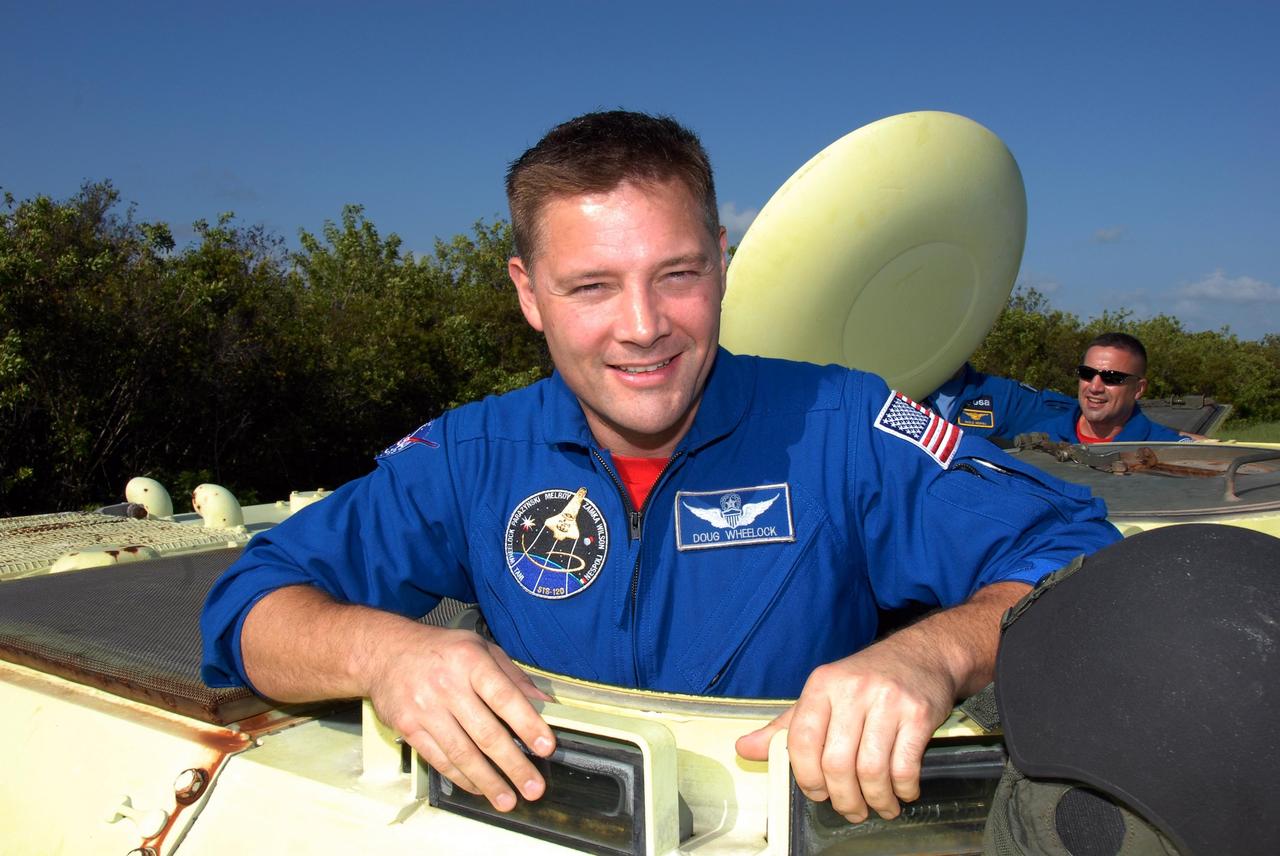
KENNEDY SPACE CENTER, FLA. -- STS-120 Mission Specialist Doug Wheelock gets ready in the driver's seat for driving practice in the M-113 armored personnel carrier. The M-113 is part of emergency exit procedures from Launch Pad 39A. Behind him, at right, is Pilot George Zamka. The training is part of terminal countdown demonstration test, or TCDT, activities the crew is undertaking at NASA's Kennedy Space Center. The TCDT also includes equipment familiarization and a simulated launch countdown. Mission STS-120, which will carry the Italian-built U.S. Node 2 to the International Space Station, is targeted for launch on Oct. 23. Photo credit: NASA/Kim Shiflett
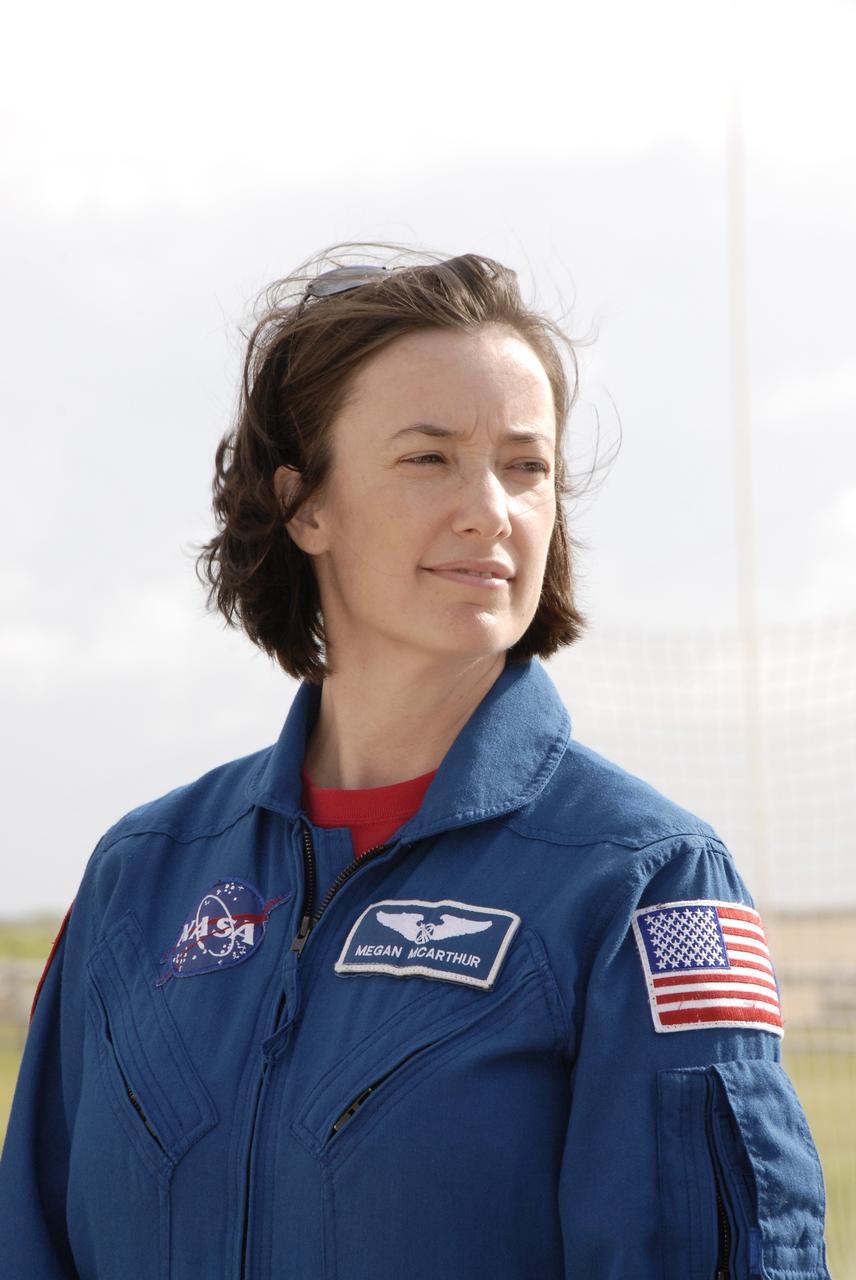
CAPE CANAVERAL, Fla. - On Launch Pad 39A at NASA's Kennedy Space Center in Florida, STS-125 Mission Specialist Megan McArthur is ready to talk to the media about her role in the mission. The crew is at Kennedy to take part in terminal countdown demonstration test, or TCDT, activities before launching on space shuttle Atlantis’ mission to service NASA’s Hubble Space Telescope. TCDT provides astronauts and ground crews with an opportunity to participate in various simulated countdown activities, including equipment familiarization, emergency training and a simulated launch countdown. Atlantis is targeted to launch Oct. 10. Photo credit: NASA/Kim Shiflett
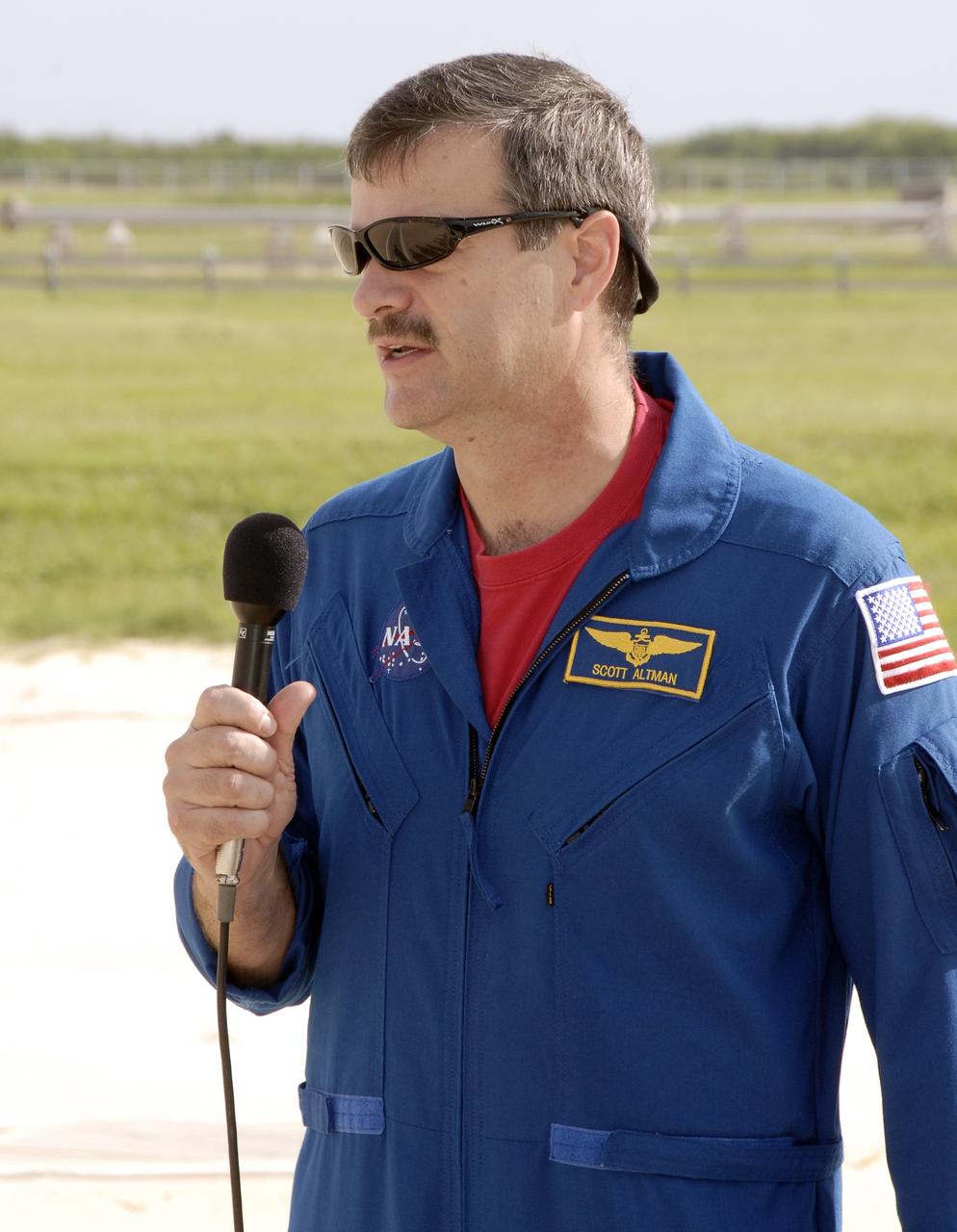
CAPE CANAVERAL, Fla. - On Launch Pad 39A at NASA's Kennedy Space Center in Florida, STS-125 Commander Scott Altman introduces his crew to the media and discusses his role in the mission. The crew is at Kennedy to take part in terminal countdown demonstration test, or TCDT, activities before launching on space shuttle Atlantis’ mission to service NASA’s Hubble Space Telescope. TCDT provides astronauts and ground crews with an opportunity to participate in various simulated countdown activities, including equipment familiarization, emergency training and a simulated launch countdown. Atlantis is targeted to launch Oct. 10. Photo credit: NASA/Kim Shiflett
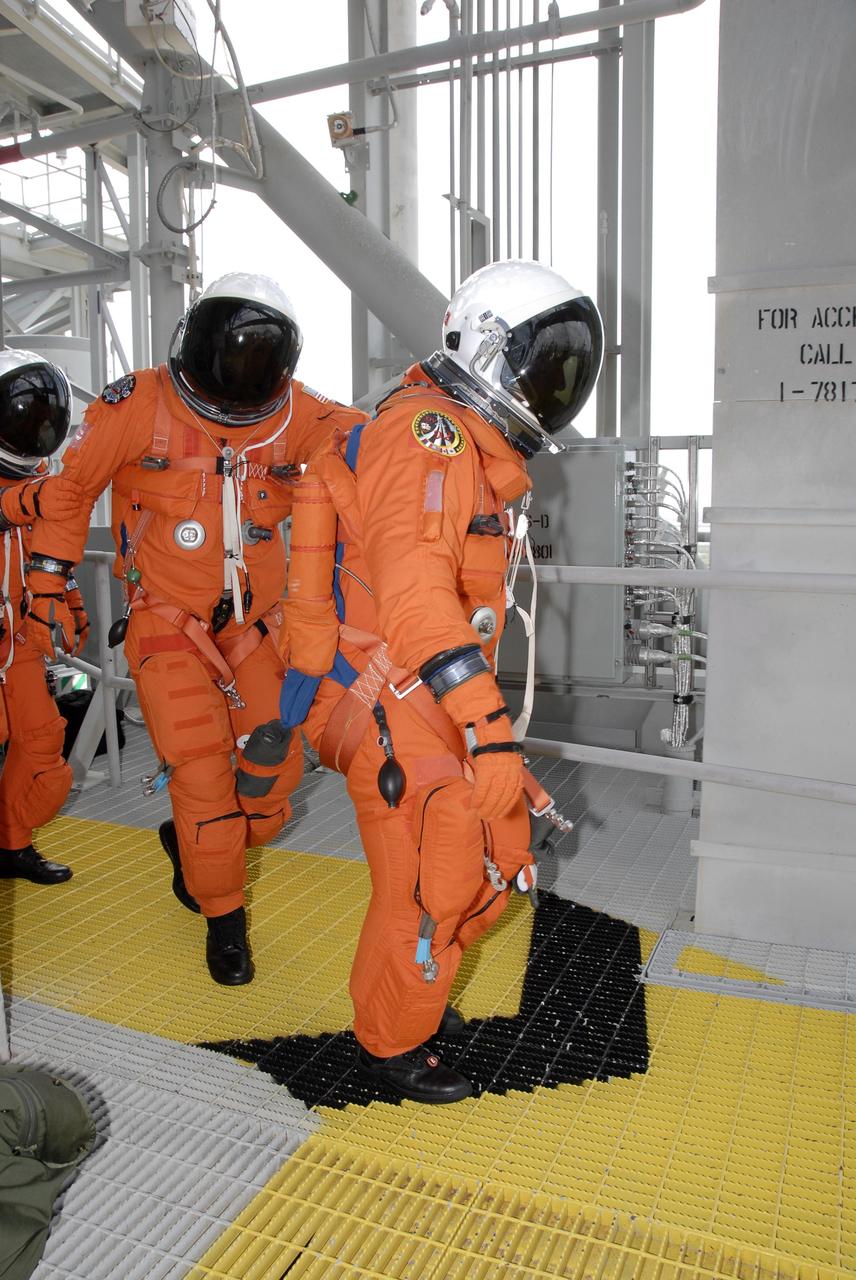
CAPE CANAVERAL, Fla. - After taking part in a simulated launch countdown aboard space shuttle Atlantis, the STS-125 crew members practice an emergency escape from the shuttle. They are heading for the slidewire baskets that will speed them away from Kennedy Space Center’s Launch Pad 39A. The countdown is the culmination of terminal countdown demonstration test, or TCDT, activities as preparation before launch. TCDT provides astronauts and ground crews with an opportunity to participate in various launch activities, including equipment familiarization, emergency training and the countdown. Atlantis’ STS-125 mission to service NASA’s Hubble Space Telescope is targeted for launch Oct. 14. Photo credit: NASA/Kim Shiflett
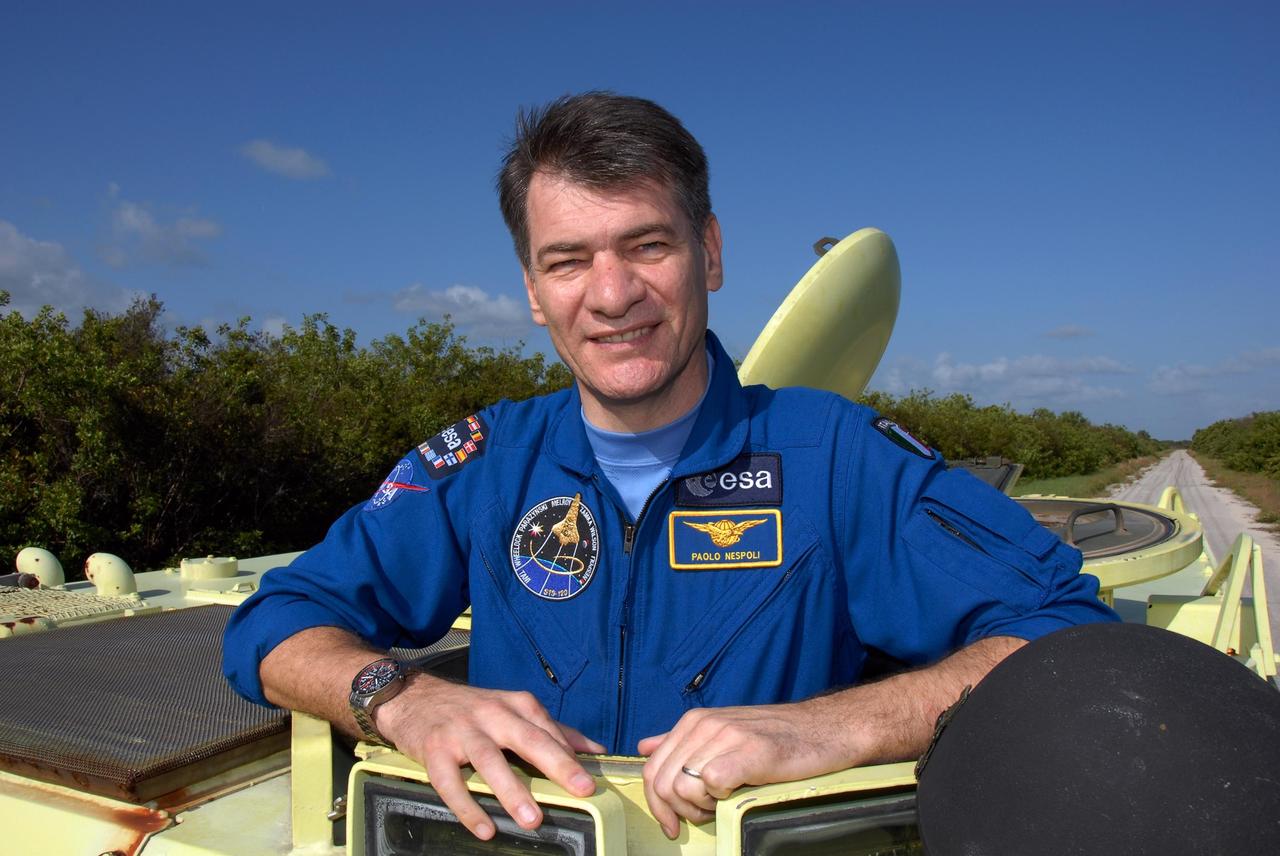
KENNEDY SPACE CENTER, FLA. -- STS-120 Mission Specialist Paolo Nespoli, who represents the European Space Agency, gets ready in the driver's seat for driving practice in the M-113 armored personnel carrier. The M-113 is part of emergency exit procedures from Launch Pad 39A. The training is part of terminal countdown demonstration test, or TCDT, activities the crew is undertaking at NASA's Kennedy Space Center. The TCDT also includes equipment familiarization and a simulated launch countdown. Mission STS-120, which will carry the Italian-built U.S. Node 2 to the International Space Station, is targeted for launch on Oct. 23. Photo credit: NASA/Kim Shiflett
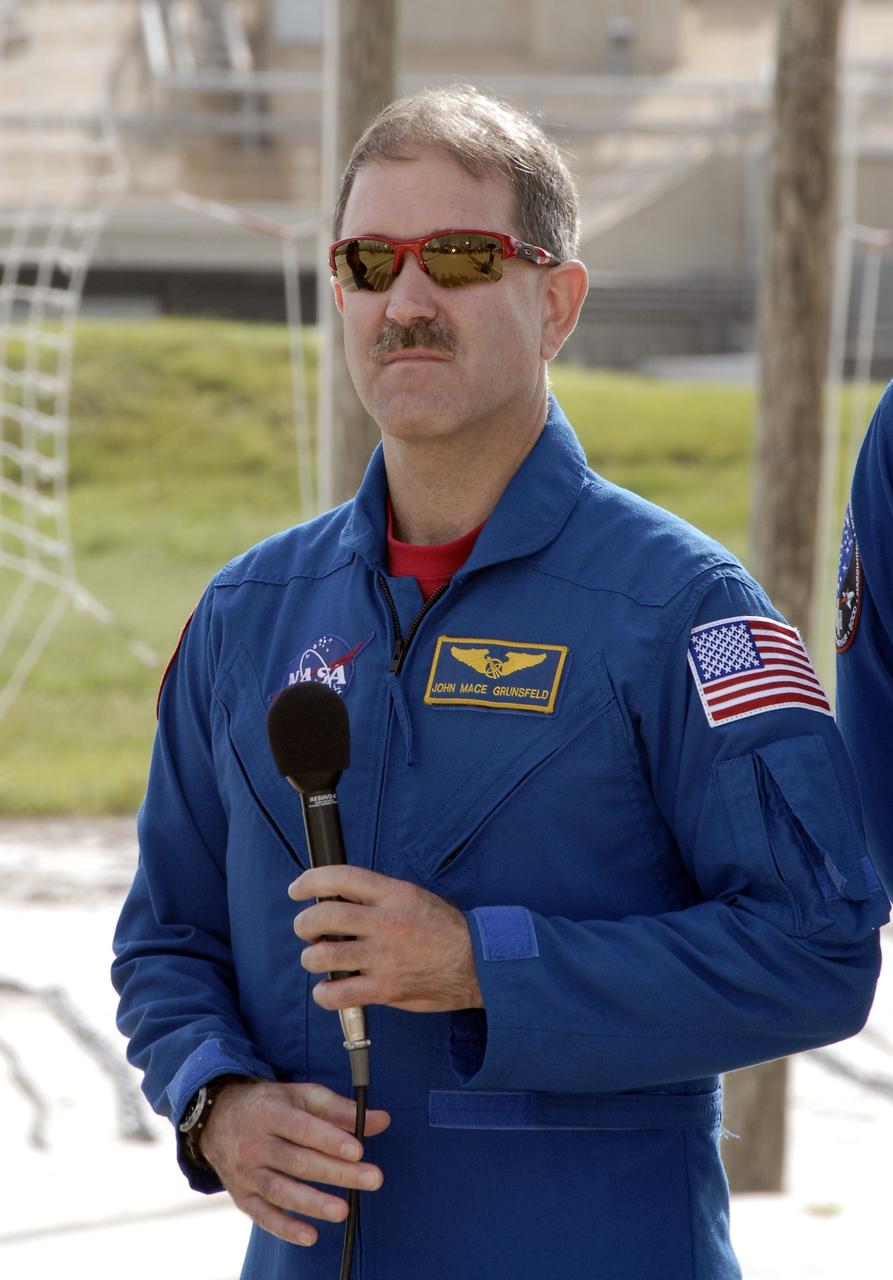
CAPE CANAVERAL, Fla. - On Launch Pad 39A at NASA's Kennedy Space Center in Florida, STS-125 Mission Specialist John Grunsfeld discusses his role in the mission for the media. The crew is at Kennedy to take part in terminal countdown demonstration test, or TCDT, activities before launching on space shuttle Atlantis’ mission to service NASA’s Hubble Space Telescope. TCDT provides astronauts and ground crews with an opportunity to participate in various simulated countdown activities, including equipment familiarization, emergency training and a simulated launch countdown. Atlantis is targeted to launch Oct. 10. Photo credit: NASA/Kim Shiflett
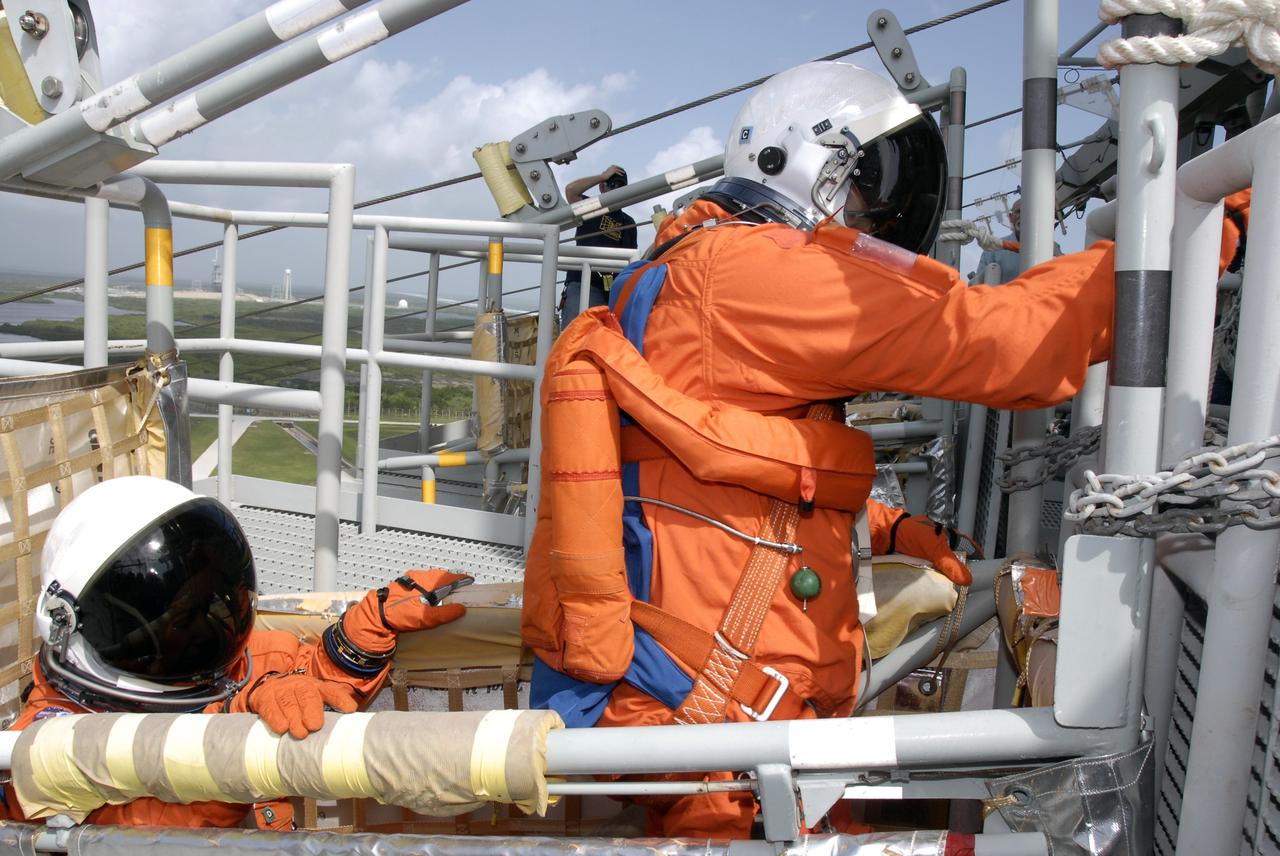
CAPE CANAVERAL, Fla. - After taking part in a simulated launch countdown aboard space shuttle Atlantis, the STS-125 crew members practice an emergency escape from the shuttle. Here they are ready to release the slidewire basket that will speed them away from Kennedy Space Center’s Launch Pad 39A. The countdown is the culmination of terminal countdown demonstration test, or TCDT, activities as preparation before launch. TCDT provides astronauts and ground crews with an opportunity to participate in various launch activities, including equipment familiarization, emergency training and the countdown. Atlantis’ STS-125 mission to service NASA’s Hubble Space Telescope is targeted for launch Oct. 14. Photo credit: NASA/Kim Shiflett
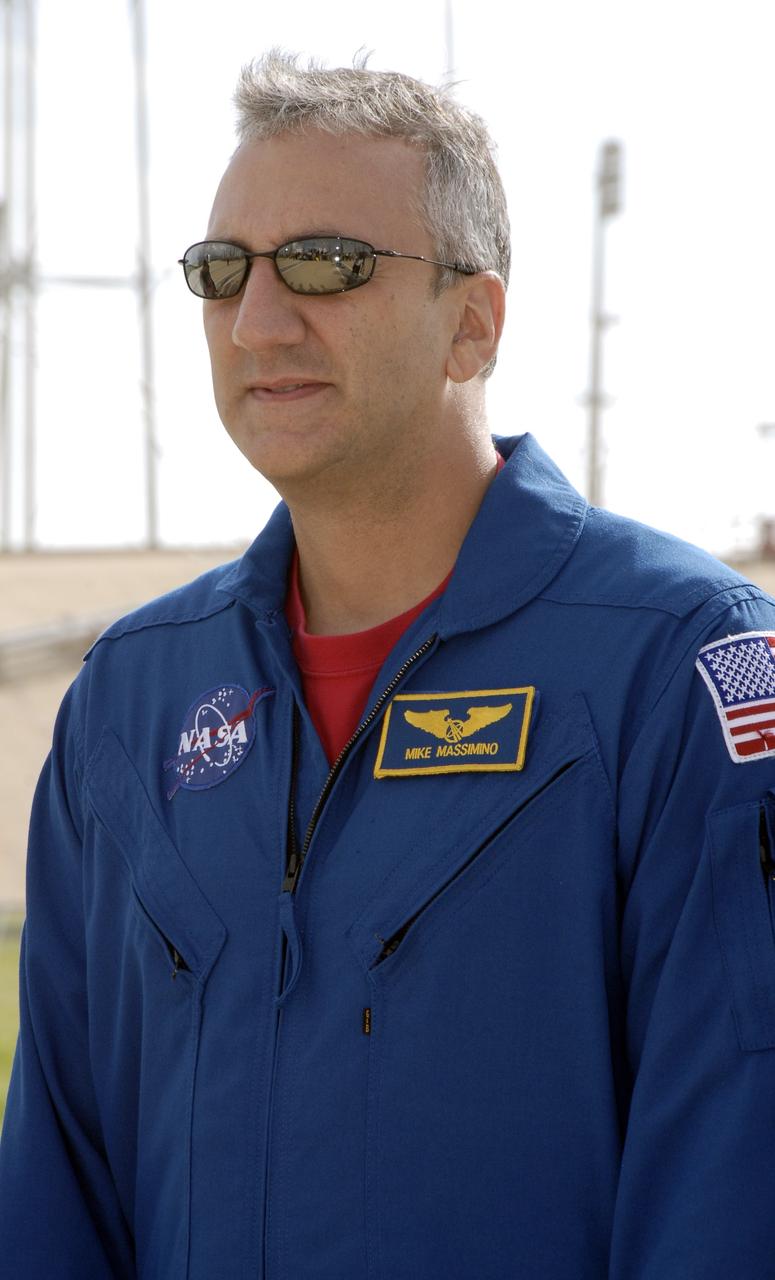
CAPE CANAVERAL, Fla. - On Launch Pad 39A at NASA's Kennedy Space Center in Florida, STS-125 Mission Specialist Mike Massimino discusses his role in the mission for the media. The crew is at Kennedy to take part in terminal countdown demonstration test, or TCDT, activities before launching on space shuttle Atlantis’ mission to service NASA’s Hubble Space Telescope. TCDT provides astronauts and ground crews with an opportunity to participate in various simulated countdown activities, including equipment familiarization, emergency training and a simulated launch countdown. Atlantis is targeted to launch Oct. 10. Photo credit: NASA/Kim Shiflett
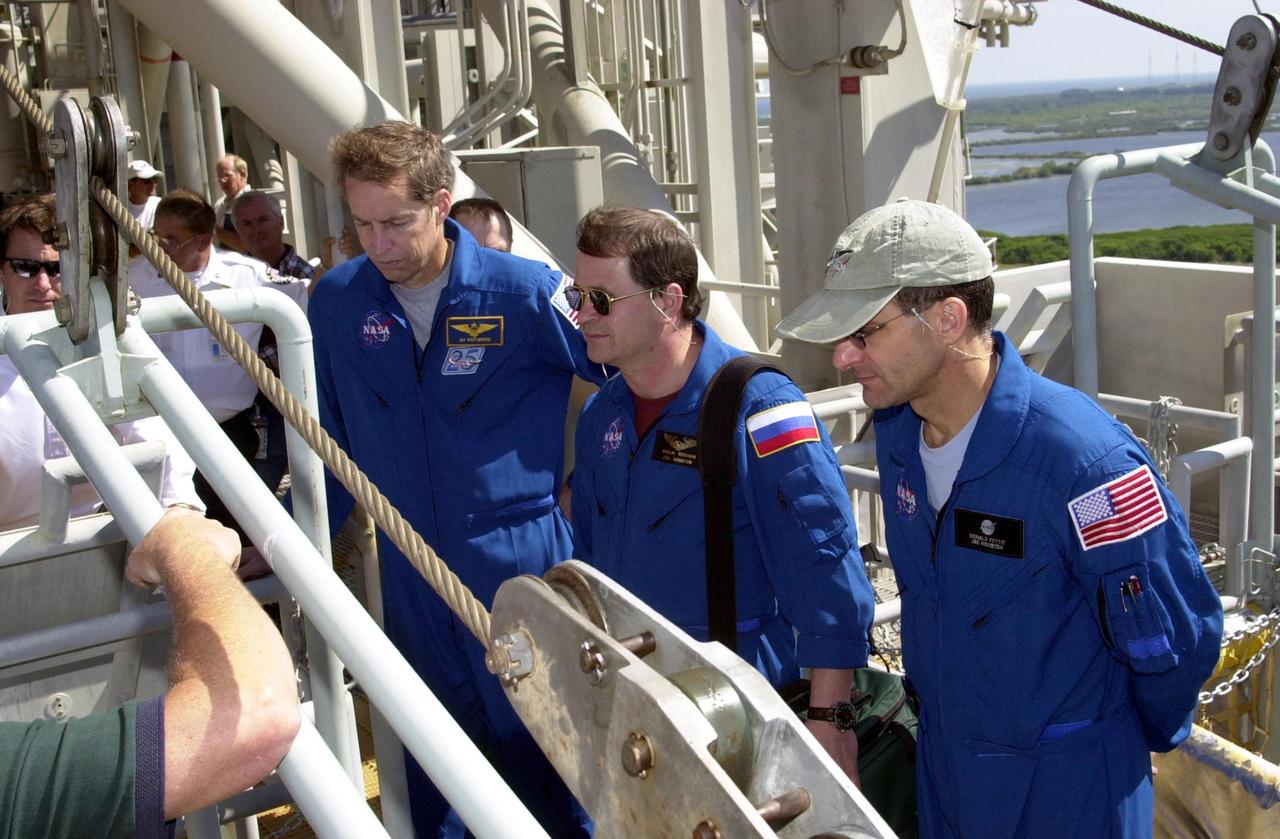
KENNEDY SPACE CENTER, FLA. - As part of Terminal Countdown Demonstration Test (TCDT) activities, the STS-113 and Expedition 6 crews receive training in emergency exit from the orbiter on Launch Pad 39A. Shown are (from left) Mission Commander James Wetherbee and cosmonaut Nikolai Budarin and astronaut Donald Pettit of the Expedition 6 crew. The TCDT also includes a simulated launch countdown. The 16th assembly flight to the International Space Station, STS-113 will carry the Port 1 (P1) truss aboard Space Shuttle Endeavour as well as the Expedition 6 crew, who will replace Expedition 5 on the Station. Mission STS-113 is scheduled to launch Nov. 10, 2002.
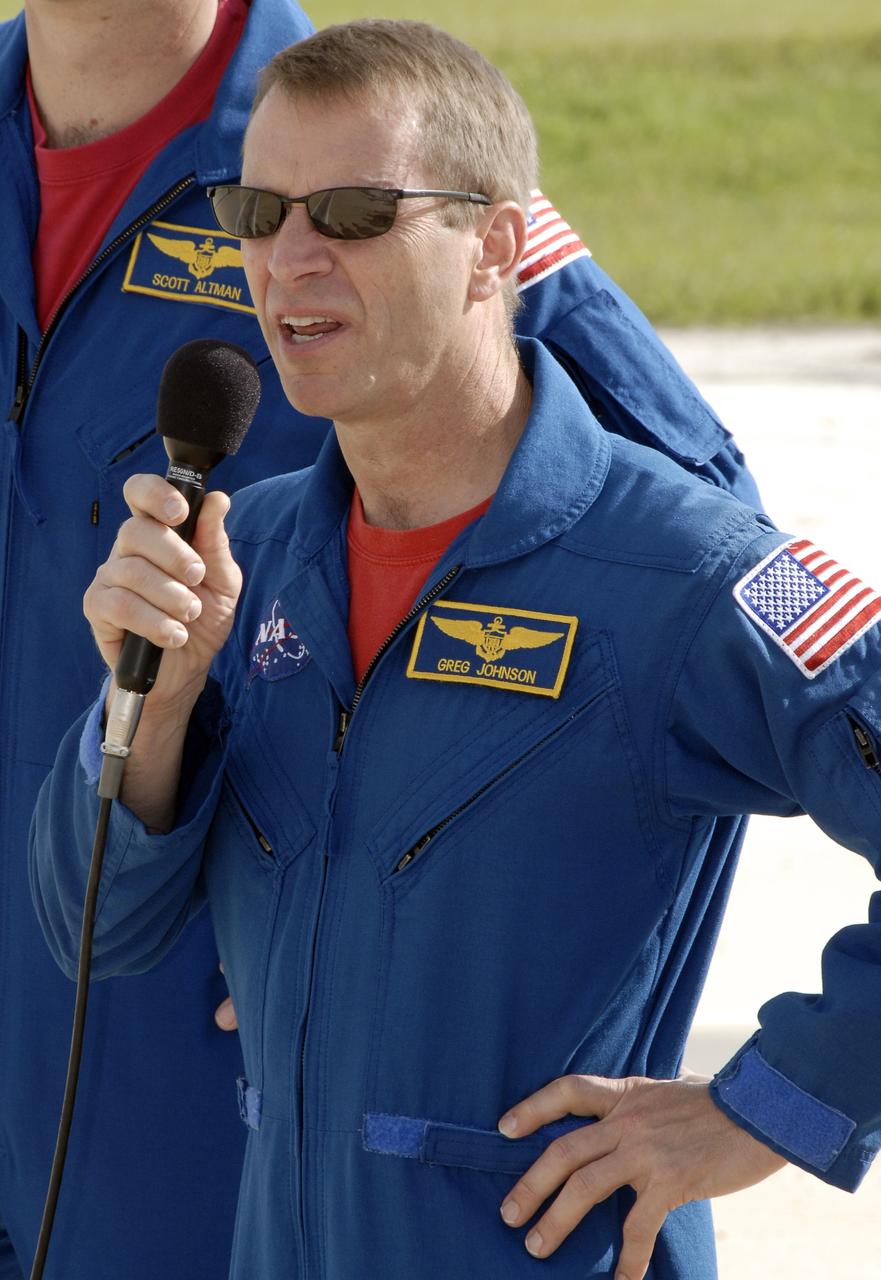
CAPE CANAVERAL, Fla. - On Launch Pad 39A at NASA's Kennedy Space Center in Florida, STS-125 Pilot Gregory C. Johnson discusses his role in the mission for the media. The crew is at Kennedy to take part in terminal countdown demonstration test, or TCDT, activities before launching on space shuttle Atlantis’ mission to service NASA’s Hubble Space Telescope. TCDT provides astronauts and ground crews with an opportunity to participate in various simulated countdown activities, including equipment familiarization, emergency training and a simulated launch countdown. Atlantis is targeted to launch Oct. 10. Photo credit: NASA/Kim Shiflett
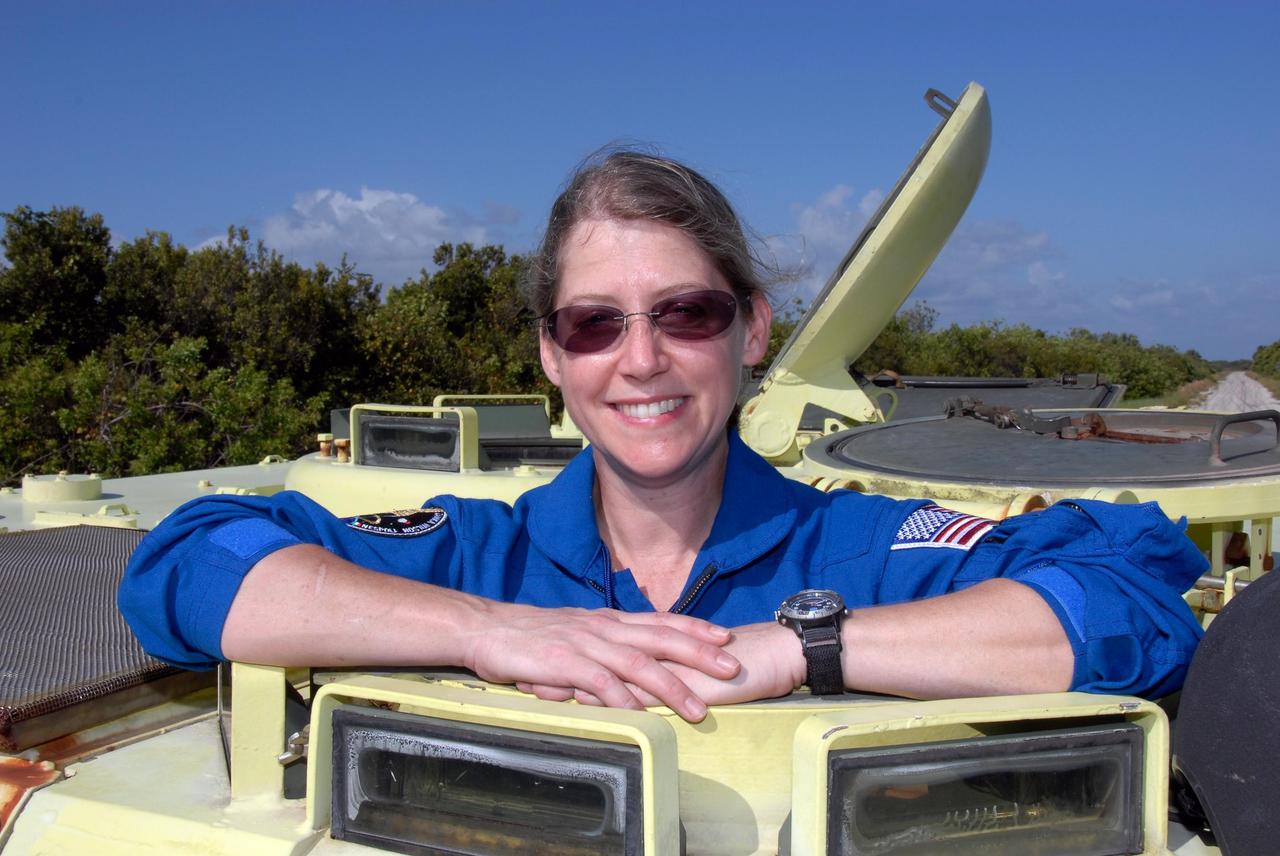
KENNEDY SPACE CENTER, FLA. -- STS-120 Commander Pamela Melroy is ready for her turn at driving practice in the M-113 armored personnel carrier. The M-113 is part of emergency exit procedures from Launch Pad 39A. The training is part of terminal countdown demonstration test, or TCDT, activities the crew is undertaking at NASA's Kennedy Space Center. The TCDT also includes equipment familiarization and a simulated launch countdown. Mission STS-120, which will carry the Italian-built U.S. Node 2 to the International Space Station, is targeted for launch on Oct. 23. Photo credit: NASA/Kim Shiflett
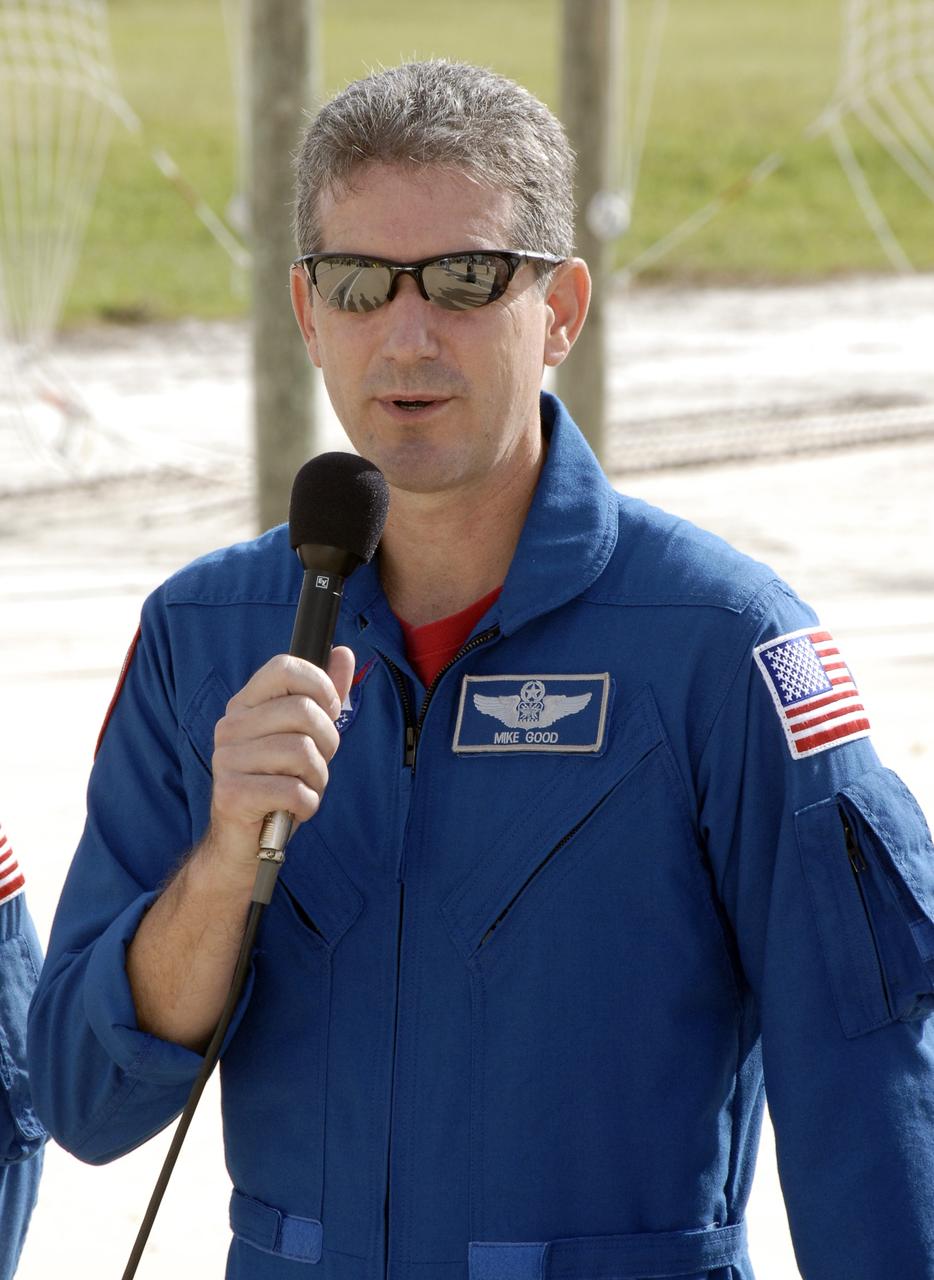
CAPE CANAVERAL, Fla. - On Launch Pad 39A at NASA's Kennedy Space Center in Florida, STS-125 Mission Specialist Michael Good discusses his role in the mission for the media. The crew is at Kennedy to take part in terminal countdown demonstration test, or TCDT, activities before launching on space shuttle Atlantis’ mission to service NASA’s Hubble Space Telescope. TCDT provides astronauts and ground crews with an opportunity to participate in various simulated countdown activities, including equipment familiarization, emergency training and a simulated launch countdown. Atlantis is targeted to launch Oct. 10. Photo credit: NASA/Kim Shiflett
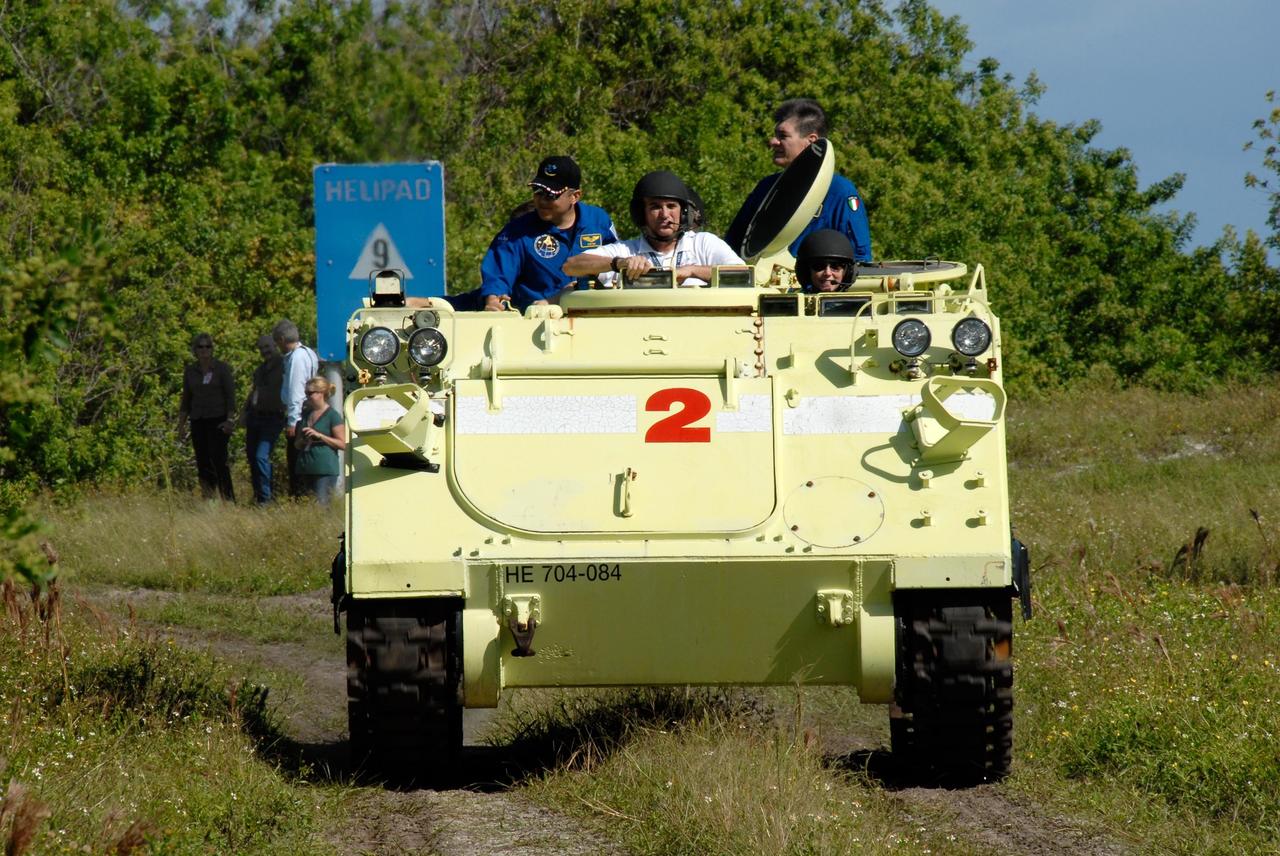
KENNEDY SPACE CENTER, FLA. -- STS-120 Commander Pamela Melroy drives the M-113 armored personnel carrier near Launch Pad 39A as part of emergency exit procedures. Beside her in front is the trainer. In the rear are Mission Specialists Daniel Tani and Paolo Nespoli, who represents the European Space Agency. The training is part of terminal countdown demonstration test, or TCDT, activities the crew is undertaking at NASA's Kennedy Space Center. The TCDT also includes equipment familiarization and a simulated launch countdown. Mission STS-120, which will carry the Italian-built U.S. Node 2 to the International Space Station, is targeted for launch on Oct. 23. Photo credit: NASA/Kim Shiflett
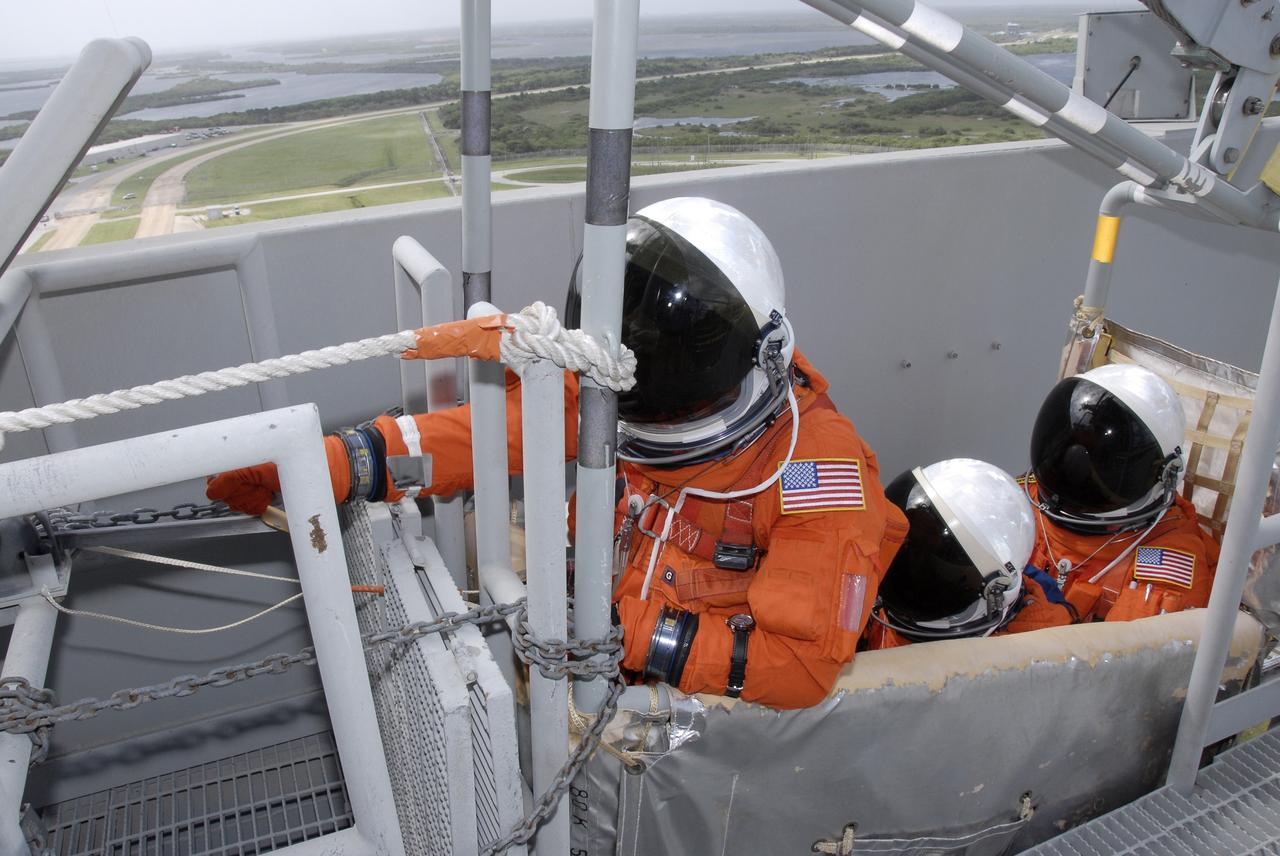
CAPE CANAVERAL, Fla. - After taking part in a simulated launch countdown aboard space shuttle Atlantis, the STS-125 crew members practice an emergency escape from the shuttle. Here they are ready to release the slidewire basket that will speed them away from Kennedy Space Center’s Launch Pad 39A. The countdown is the culmination of terminal countdown demonstration test, or TCDT, activities as preparation before launch. TCDT provides astronauts and ground crews with an opportunity to participate in various launch activities, including equipment familiarization, emergency training and the countdown. Atlantis’ STS-125 mission to service NASA’s Hubble Space Telescope is targeted for launch Oct. 14. Photo credit: NASA/Kim Shiflett
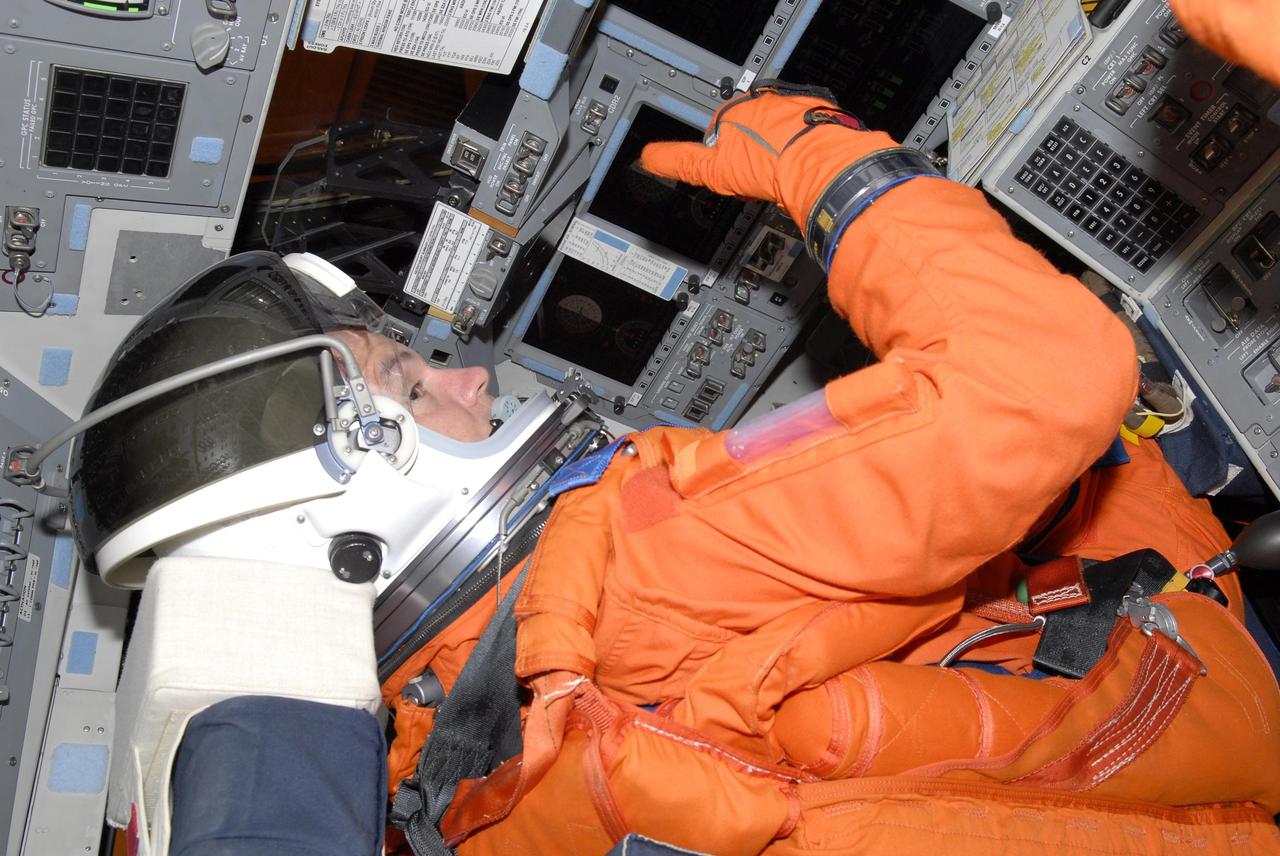
KENNEDY SPACE CENTER, FLA. -- Mission STS-117 Commander Rick Sturckow sits in the cockpit of Space Shuttle Atlantis at Launch Pad 39A to participate in a simulated launch countdown that is part of the prelaunch preparations known as terminal demonstration countdown test (TCDT). The TCDT also includes M-113 armored personnel carrier training and payload familiarization. The STS-117 mission is No. 21 to the International Space Station. Mission payloads aboard Atlantis include the S3/S4 integrated truss structure, a third set of solar arrays and batteries. The crew of six astronauts will install the truss to continue assembly of the station. Launch is scheduled for no earlier than March 15. Photo credit: NASA/Kim Shiflett.
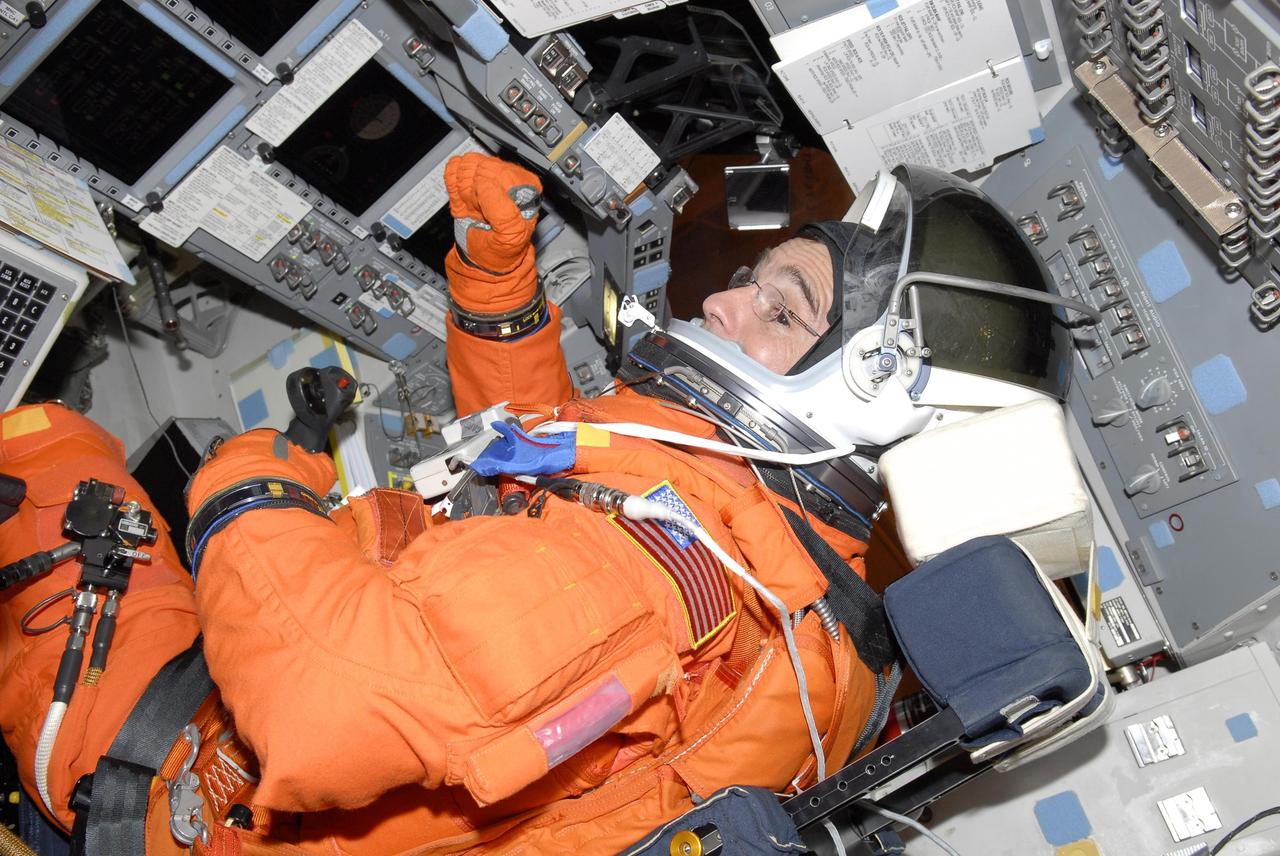
KENNEDY SPACE CENTER, FLA. -- Mission STS-117 Pilot Lee Archambault sits in the cockpit of Space Shuttle Atlantis at Launch Pad 39A to participate in a simulated launch countdown that is part of the prelaunch preparations known as terminal countdown demonstration test (TCDT). The TCDT also includes M-113 armored personnel carrier training and payload familiarization. The STS-117 mission is No. 21 to the International Space Station. Mission payloads aboard Atlantis include the S3/S4 integrated truss structure, a third set of solar arrays and batteries. The crew of six astronauts will install the truss to continue assembly of the station. Launch is scheduled for no earlier than March 15. Photo credit: NASA/Kim Shiflett.

KENNEDY SPACE CENTER, FLA. -- STS-120 Commander Pamela Melroy poses for another photo after driving practice in the M-113 armored personnel carrier. The M-113 is part of emergency exit procedures from Launch Pad 39A. The training is part of terminal countdown demonstration test, or TCDT, activities the crew is undertaking at NASA's Kennedy Space Center. The TCDT also includes equipment familiarization and a simulated launch countdown. Mission STS-120, which will carry the Italian-built U.S. Node 2 to the International Space Station, is targeted for launch on Oct. 23. Photo credit: NASA/Kim Shiflett
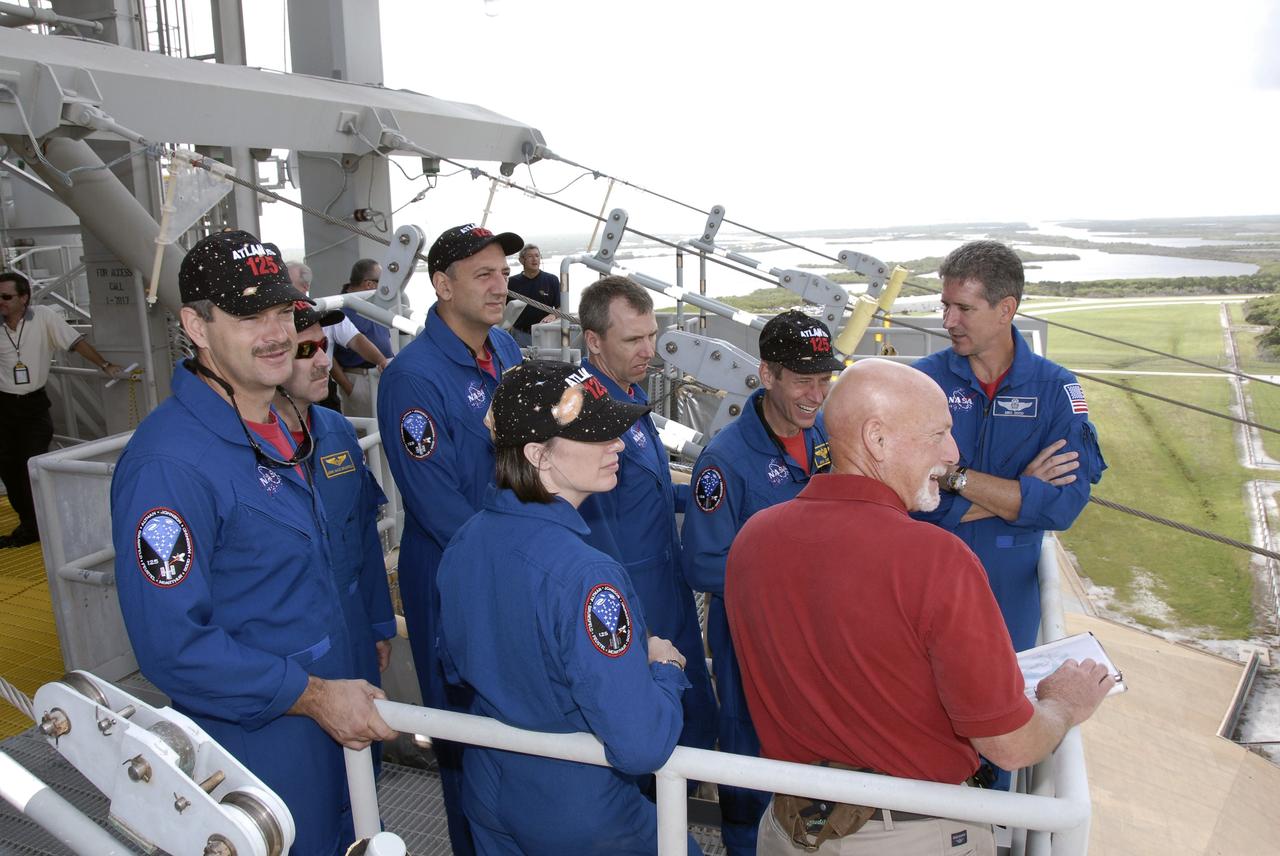
CAPE CANAVERAL, Fla. - On the 195-foot level of the fixed service structure on Launch Pad 39A at NASA's Kennedy Space Center in Florida, STS-125 crew members enjoy the view to the landing area for emergency escape from the shuttle and pad. Clockwise from center bottom are Mission Specialist Megan McArthur, Commander Scott Altman, Mission Specialists John Grunsfeld, Mike Massimino and Andrew Feustel, Pilot Gregory C. Johnson and Mission Specialist Michael Good. The crew is at Kennedy to take part in terminal countdown demonstration test, or TCDT, activities before launching on space shuttle Atlantis’ mission to service NASA’s Hubble Space Telescope. TCDT provides astronauts and ground crews with an opportunity to participate in various simulated countdown activities, including equipment familiarization, emergency training and a simulated launch countdown. Atlantis is targeted to launch Oct. 10. Photo credit: NASA/Kim Shiflett
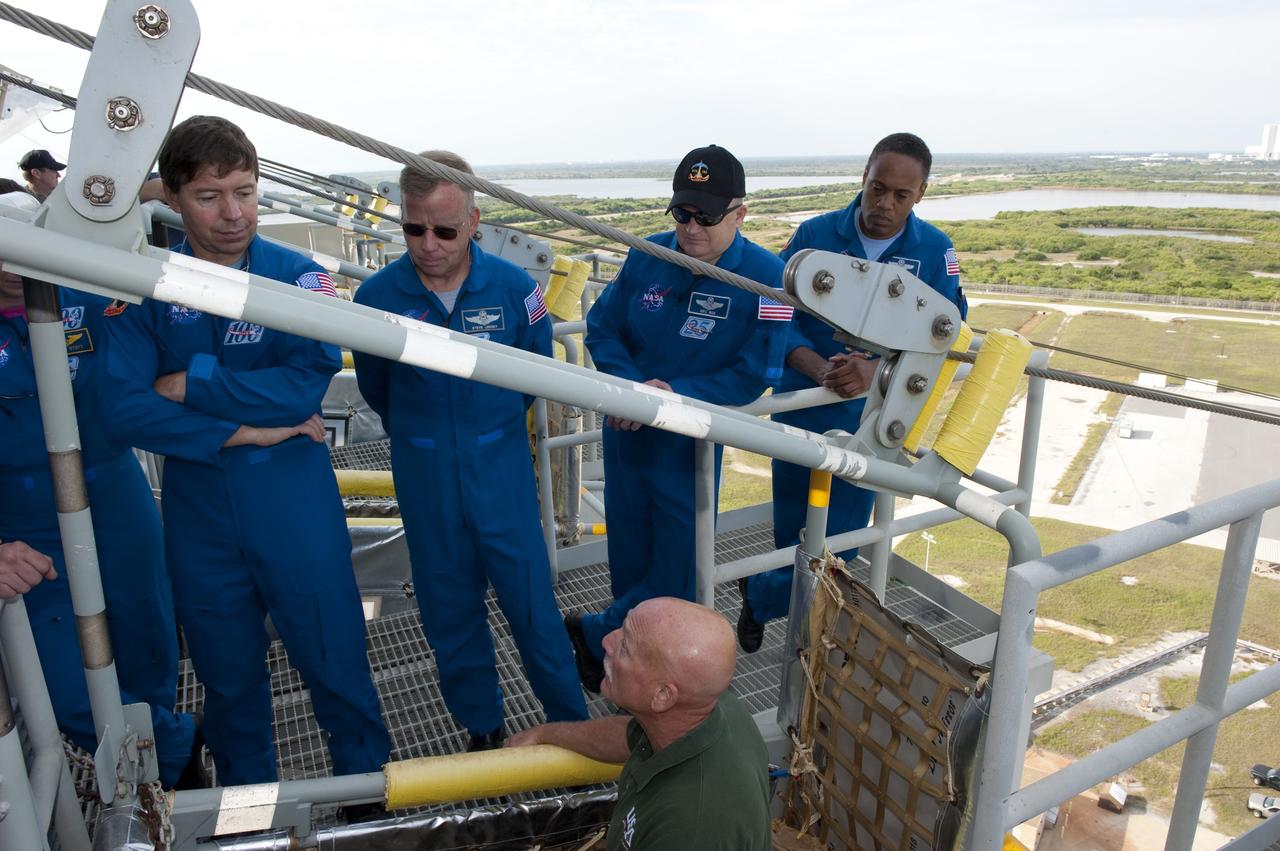
CAPE CANAVERAL, Fla. -- On Launch Pad 39A at NASA's Kennedy Space Center, STS-133 crew members receive instruction on the operation of the pad's slidewire basket system emergency exit training as part of the Terminal Countdown Demonstration Test (TCDT). From left are Mission Specialist Michael Barratt, Commander Steve Lindsey, Pilot Eric Boe and Mission Specialist Alvin Drew. TCDT provides each shuttle crew and launch team an opportunity to participate in various simulated activities, including equipment familiarization and a launch countdown. Space shuttle Discovery and its STS-133 crew will deliver the Permanent Multipurpose Module, packed with supplies and critical spare parts, as well as Robonaut 2, the dexterous humanoid astronaut helper, to the International Space Station. Launch is targeted for Nov. 1 at 4:40 p.m. For more information on the STS-133 mission, visit www.nasa.gov/mission_pages/shuttle/shuttlemissions/sts133/. Photo credit: NASA/Kim Shiflett
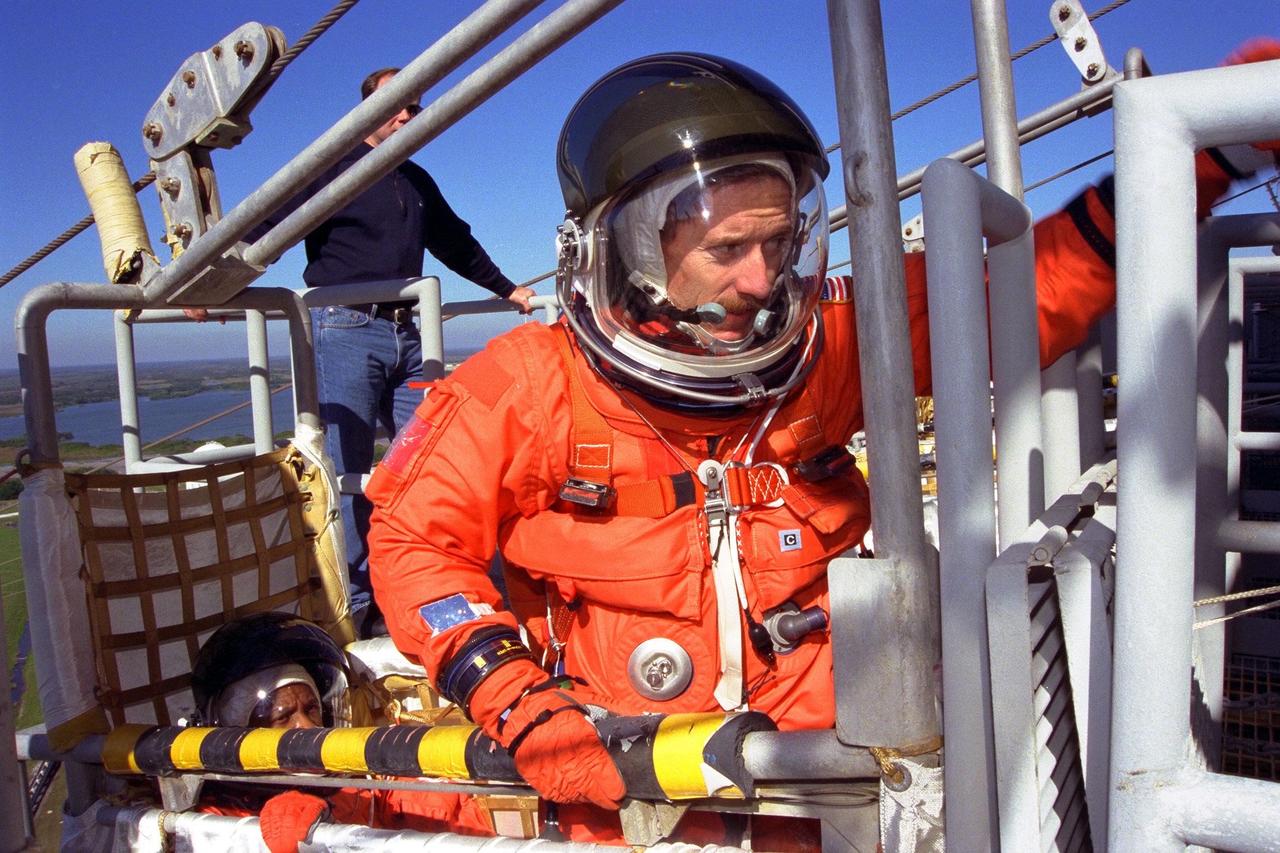
KENNEDY SPACE CENTER, Fla. -- Standing in a slidewire basket at KSC’s Launch Pad 39A is STS-89 Mission Specialist James Reilly, Ph.D. The seven astronauts of STS-89 assigned to the eighth Shuttle-Mir docking flight are completing Terminal Countdown Demonstration Test (TCDT) activities at Kennedy Space Center. A dress rehearsal for launch, the TCDT includes emergency egress training at the launch pad and culminates with a simulated countdown. STS-89 Mission Specialist Andrew Thomas, Ph.D, will transfer to the Russian Space Station Mir and succeed David Wolf, M.D., who will return to Earth aboard Endeavour. The Space Shuttle Endeavour is undergoing preparations for liftoff, scheduled for Jan. 22. Dr. Thomas will live and work on Mir until June
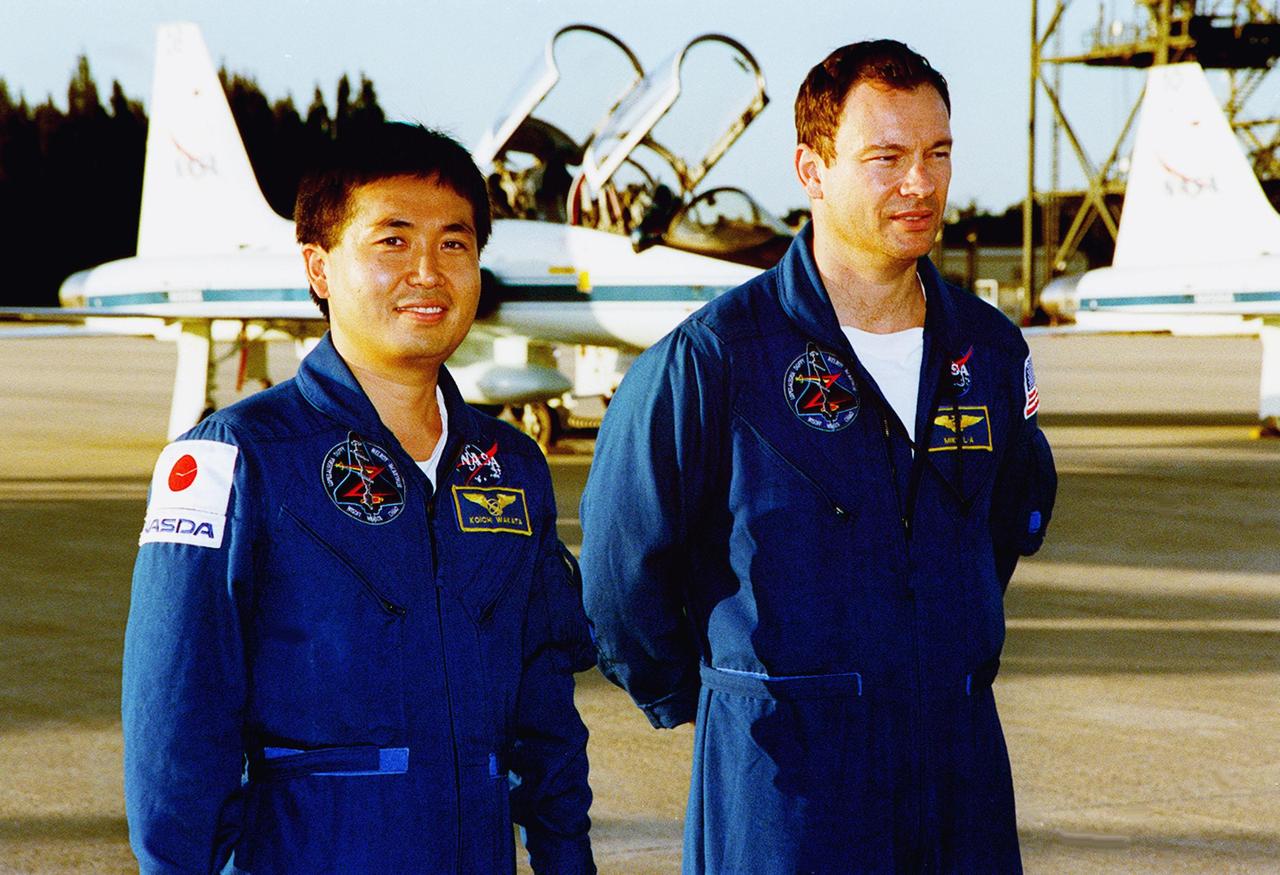
STS-92 Mission Specialists Koichi Wakata and Michael Lopez-Alegria pause on the tarmac after their arrival aboard the T-38 jet aircraft in the background. They and the rest of the crew are at KSC to take part in Terminal Countdown Demonstration Test (TCDT) activities. The TCDT includes emergency egress training from the orbiter and pad, plus a simulated countdown. The fifth mission to the International Space Station, STS-92 will carry the Integrated Truss Structure Z1, the first of the planned 10 trusses on the Space Station, and the third Pressurized Mating Adapter. The Z1 will allow the first U.S. solar arrays on a future flight to be temporarily installed on Unity for early power. PMA-3 will provide a Shuttle docking port for the solar array installation on the sixth ISS flight and Lab installation on the seventh ISS flight. STS-92 is scheduled to launch Oct. 5 from launch Pad 39A. It will be the 100th flight in the Shuttle program
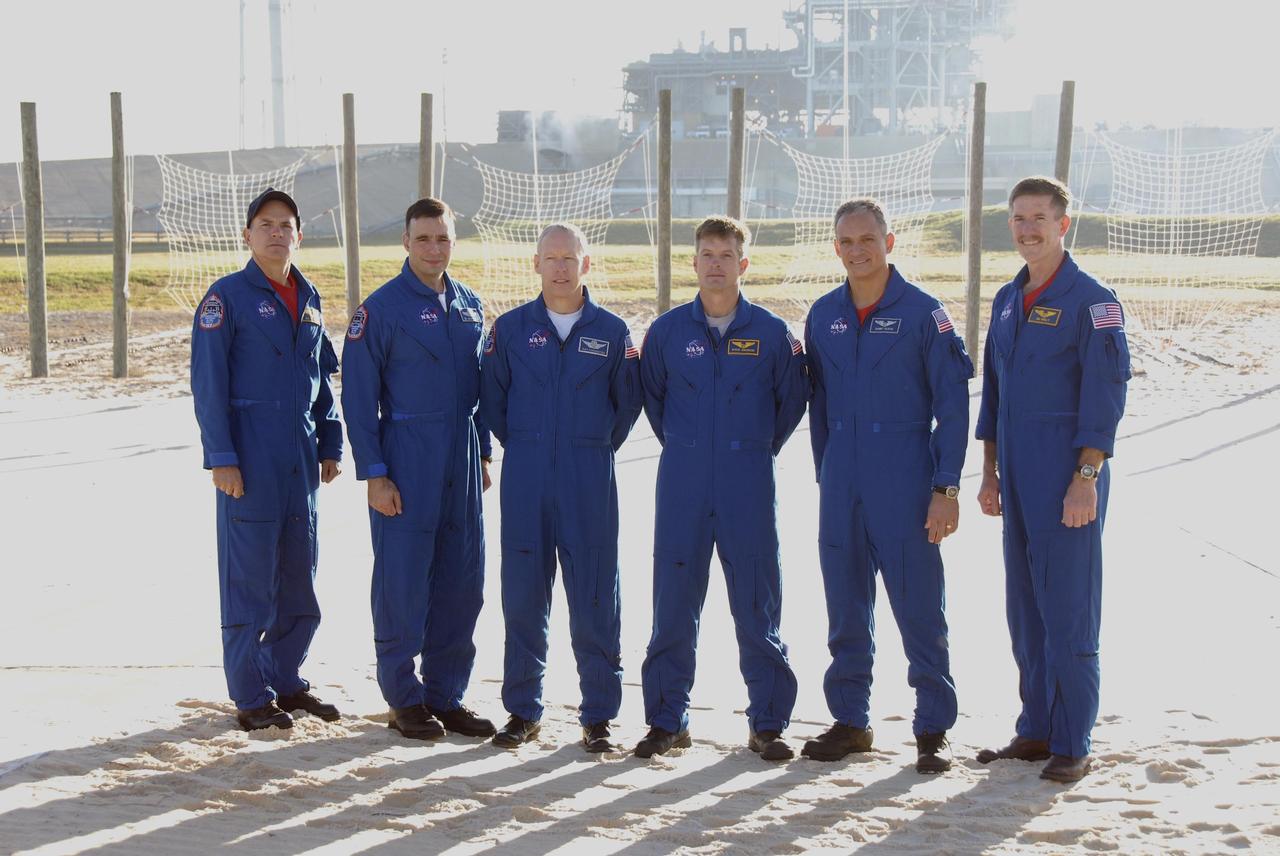
KENNEDY SPACE CENTER, FLA. -- During Terminal Countdown Demonstration Test (TCDT) activities at Launch Pad 39A, the Mission STS-117 crew members take time to speak to the media during a question-and-answer session. From the left are Commander Rick Sturckow, Pilot Lee Archambault, and Mission Specialists Patrick Forrester, Steven Swanson, Danny Olivas and James Reilly. The TCDT also includes M-113 armored personnel carrier training, pad emergency egress training and a simulated launch countdown. The mission payload aboard Space Shuttle Atlantis is the S3/S4 integrated truss structure, along with a third set of solar arrays and batteries. The crew of six astronauts will install the truss to continue assembly of the International Space Station. Photo credit: NASA/Kim Shiflett
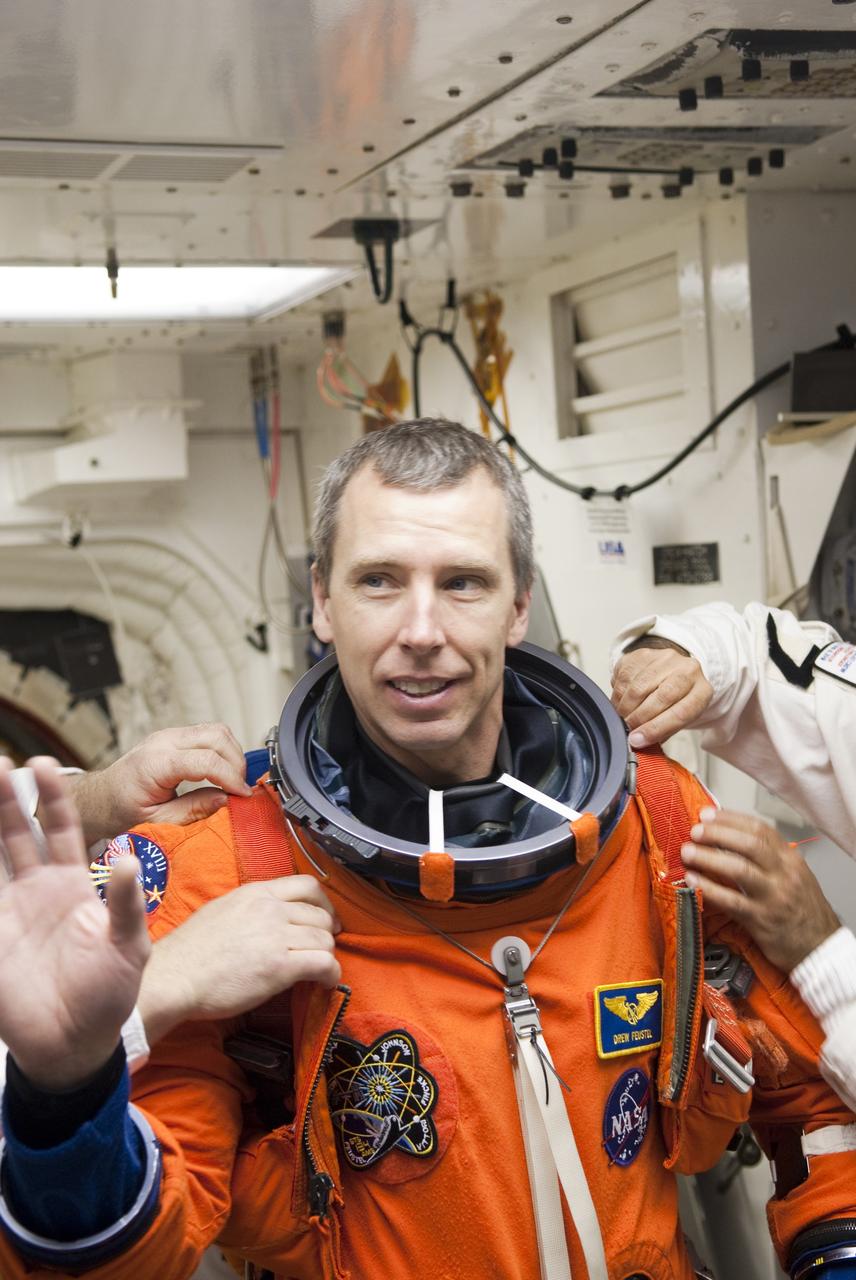
CAPE CANAVERAL, Fla. -- In the White Room of Launch Pad 39A at NASA's Kennedy Space Center in Florida, STS-134 Mission Specialist Andrew Feustel prepares to board space shuttle Endeavour during the Terminal Countdown Demonstration Test (TCDT). Part of TCDT includes practicing the final hours of a real launch day when astronauts put on their launch-and-entry suits, ride to the pad in the Astrovan and strap into the shuttle. Endeavour's six crew members are targeted to launch April 19 at 7:48 p.m. EDT. They will deliver the Express Logistics Carrier-3, Alpha Magnetic Spectrometer-2 (AMS), a high-pressure gas tank, additional spare parts for the Dextre robotic helper and micrometeoroid debris shields to the International Space Station. This will be the final spaceflight for Endeavour. For more information visit, www.nasa.gov/mission_pages/shuttle/shuttlemissions/sts134/index.html. Photo credit: NASA/Jim Grossmann
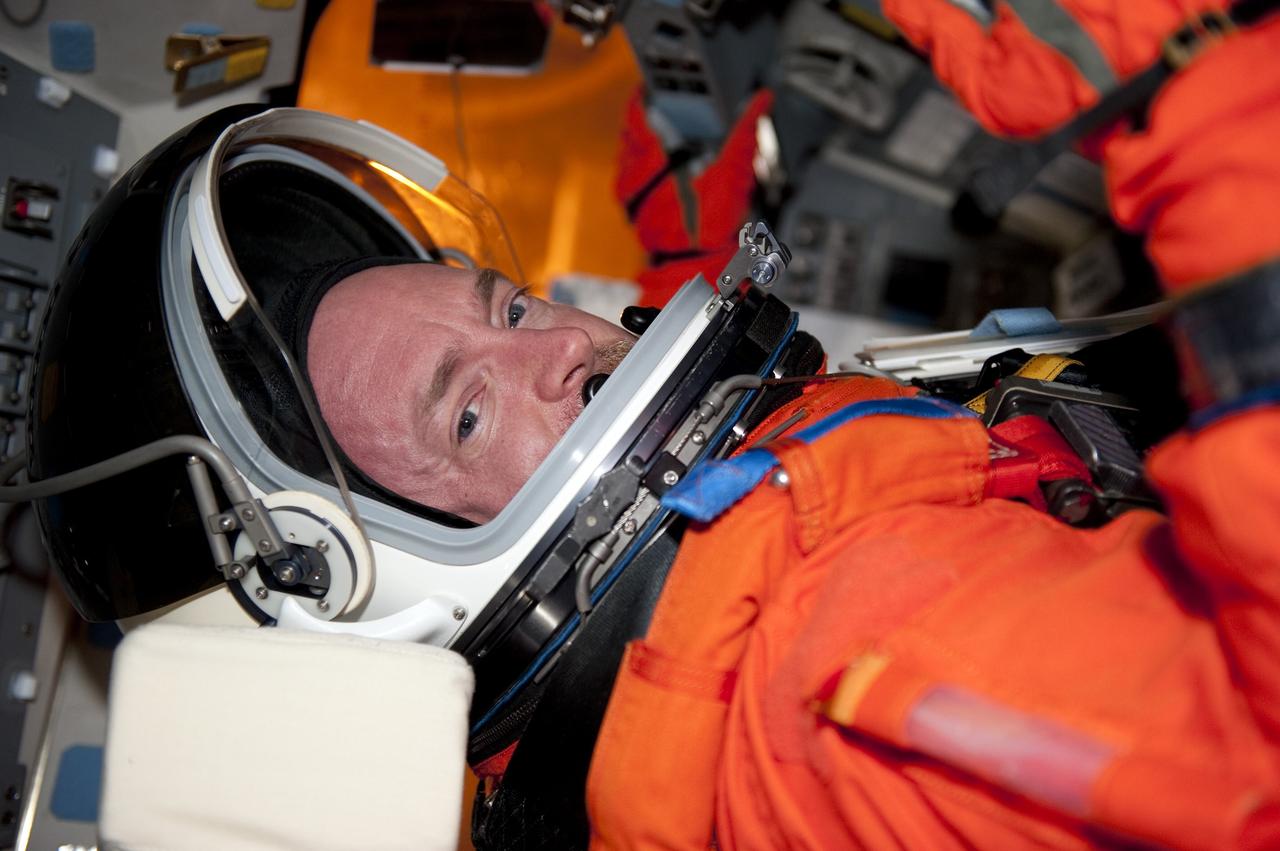
CAPE CANAVERAL, Fla. -- STS-134 Commander Mark Kelly takes his seat aboard space shuttle Endeavour during the Terminal Countdown Demonstration Test (TCDT) on Launch Pad 39A at NASA's Kennedy Space Center in Florida. Part of TCDT includes practicing the final hours of a real launch day when astronauts put on their launch-and-entry suits, ride to the pad in the Astrovan and strap into the shuttle. Endeavour's six crew members are targeted to launch April 19 at 7:48 p.m. EDT. They will deliver the Express Logistics Carrier-3, Alpha Magnetic Spectrometer-2 (AMS), a high-pressure gas tank, additional spare parts for the Dextre robotic helper and micrometeoroid debris shields to the International Space Station. This will be the final spaceflight for Endeavour. For more information visit, www.nasa.gov/mission_pages/shuttle/shuttlemissions/sts134/index.html. Photo credit: NASA/Kim Shiflett
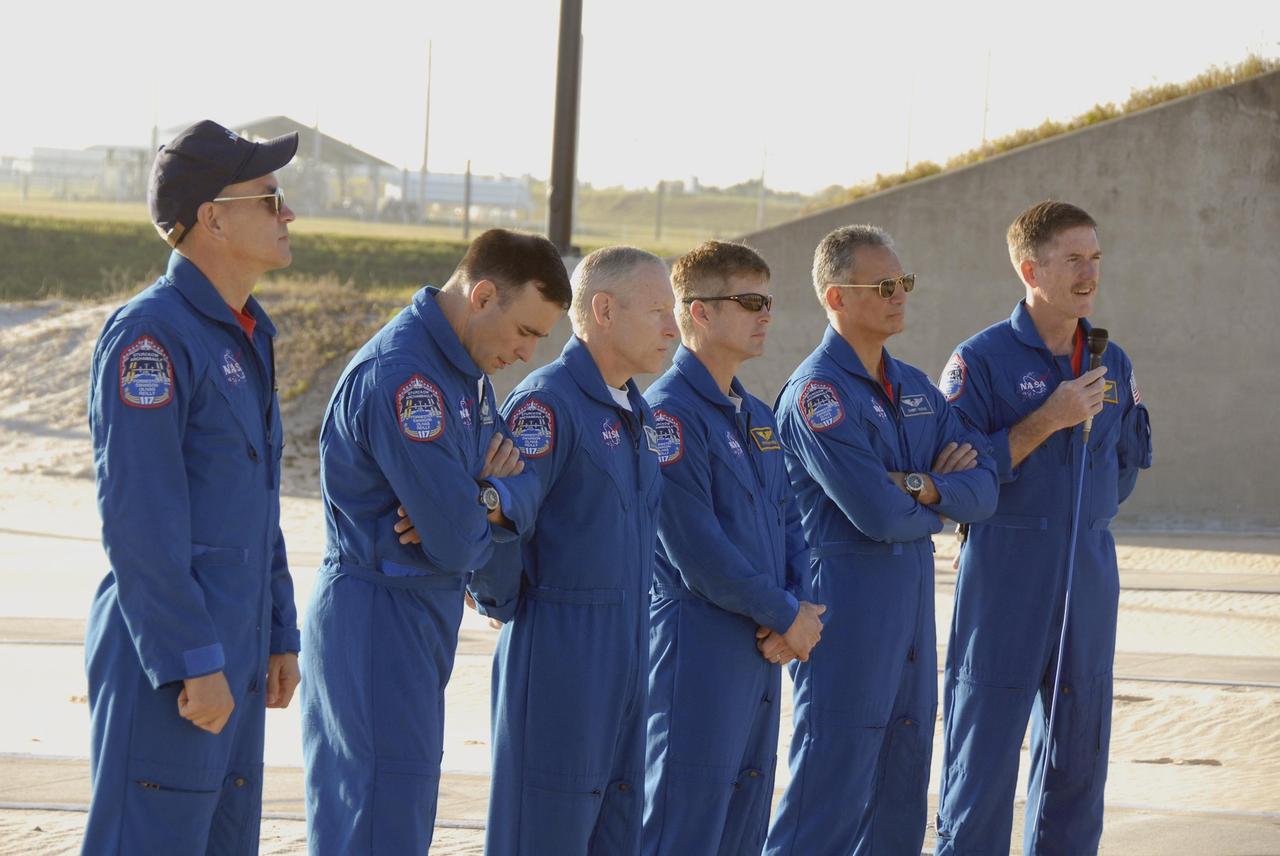
KENNEDY SPACE CENTER, FLA. -- During Terminal Countdown Demonstration Test (TCDT) activities at Launch Pad 39A, the Mission STS-117 crew members speak to the media during a question-and-answer session. From the left are Commander Rick Sturckow, Pilot Lee Archambault, and Mission Specialists Patrick Forrester, Steven Swanson, Danny Olivas and James Reilly. The TCDT also includes M-113 armored personnel carrier training, pad emergency egress training and a simulated launch countdown. The mission payload aboard Space Shuttle Atlantis is the S3/S4 integrated truss structure, along with a third set of solar arrays and batteries. The crew of six astronauts will install the truss to continue assembly of the International Space Station. Photo credit: NASA/Kim Shiflett