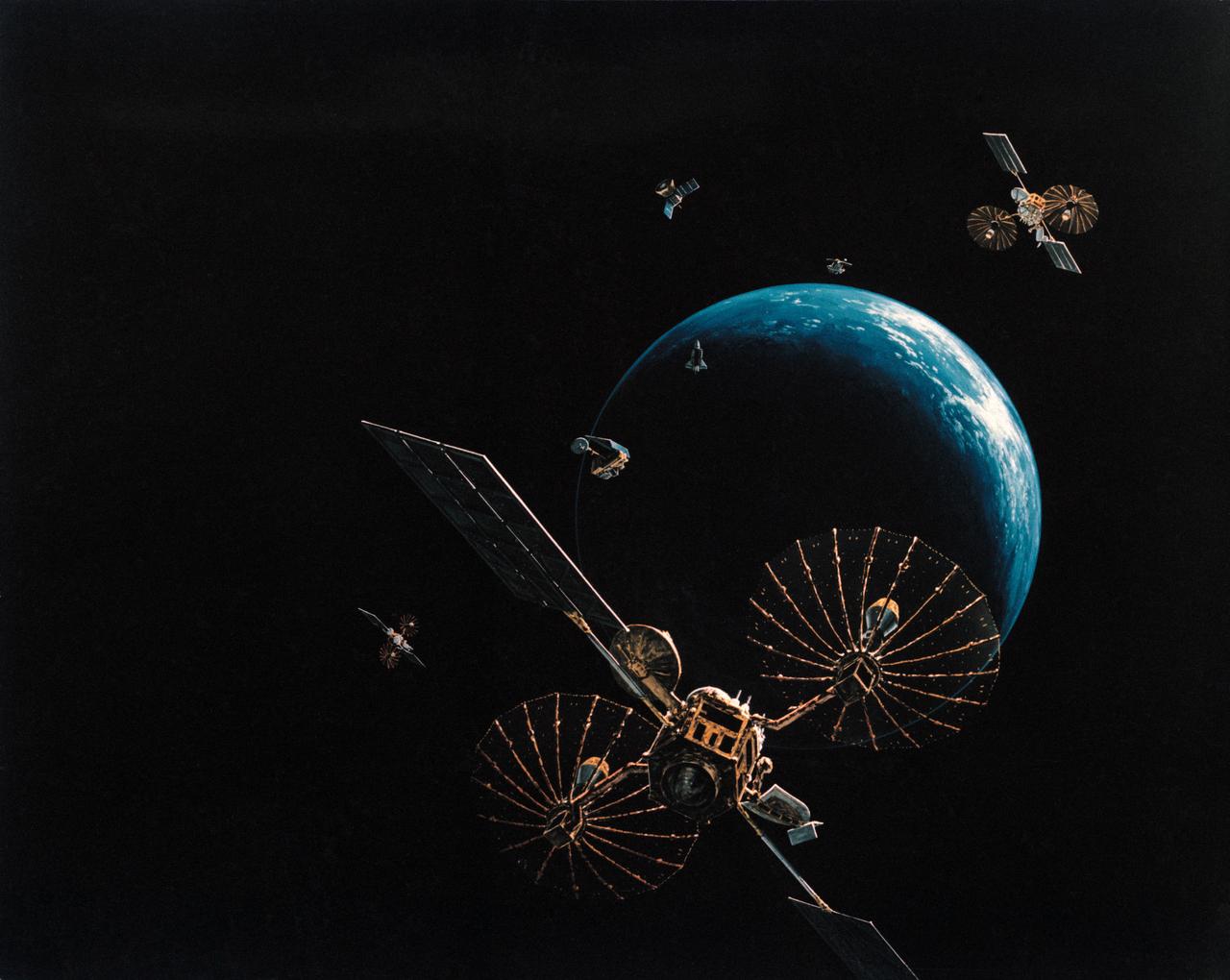
Artist concept shows the Tracking and Data Relay Satellite E (TDRS-E) augmenting a sophisticated TDRS system (TDRSS) communications network after deployment during STS-43 from Atlantis, Orbiter Vehicle (OV) 104. TDRS, built by TRW, will be placed in a geosynchronous orbit and after onorbit testing, which requires several weeks, will be designated TDRS-5. The communications satellite will replace TDRS-3 at 174 degrees West longitude. The backbone of NASA's space-to-ground communications, the TDRSs have increased NASA's ability to send and receive data to spacecraft in low-earth orbit to more than 85 percent of the time. Before TDRS, NASA relied solely on a system of ground stations that permitted communications only 15 percent of the time. Increased coverage has allowed onorbit repairs, live television broadcast from space and continuous dialogues between astronaut crews and ground control during critical periods such as Space Shuttle landings.
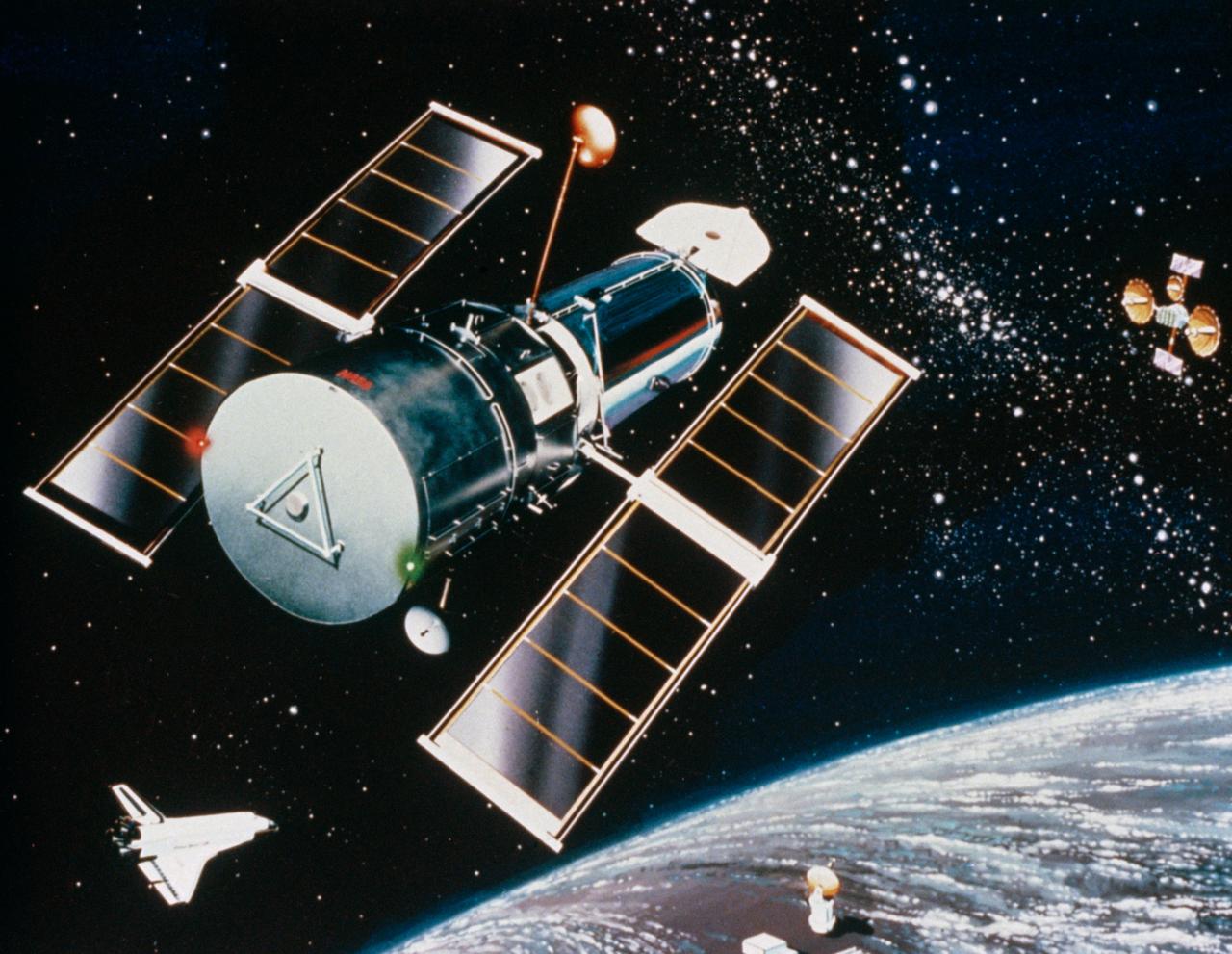
Artist concept shows the Hubble Space Telescope (HST) placed in orbit above the Earth's distorting layer of atmosphere by Discovery, Orbiter Vehicle (OV) 103, during mission STS-31. Tracking and data relay satellite (TDRS) is visible in the background and ground station is visible below on the Earth's surface. HST is the first of the great observatories to go into service and one of NASA's highest priority scientific spacecraft. Capable of observing in both visible and ultraviolet wavelengths, HST has been termed the most important scientific instrument ever designed for use on orbit. It will literally be able to look back in time, observing the universe as it existed early in its lifetime and providing information on how matter has evolved over the eons. The largest scientific payload ever built, the 12 1/2-ton, 43-foot HST was developed by Lockheed Missiles & Space Company, spacecraft prime contractor, and Perkin-Elmer Corporation, prime contractor for the optical assembly. The European Space Agency (ESA) furnished the power generating solar array and one of the system's five major instruments. Marshall Space Flight Center (MSFC) manages the HST project; Goddard Space Flight Center (GSFC) will be responsible, when the spacecraft is in orbit, for controlling the telescope and processing the images and instrument data returns.
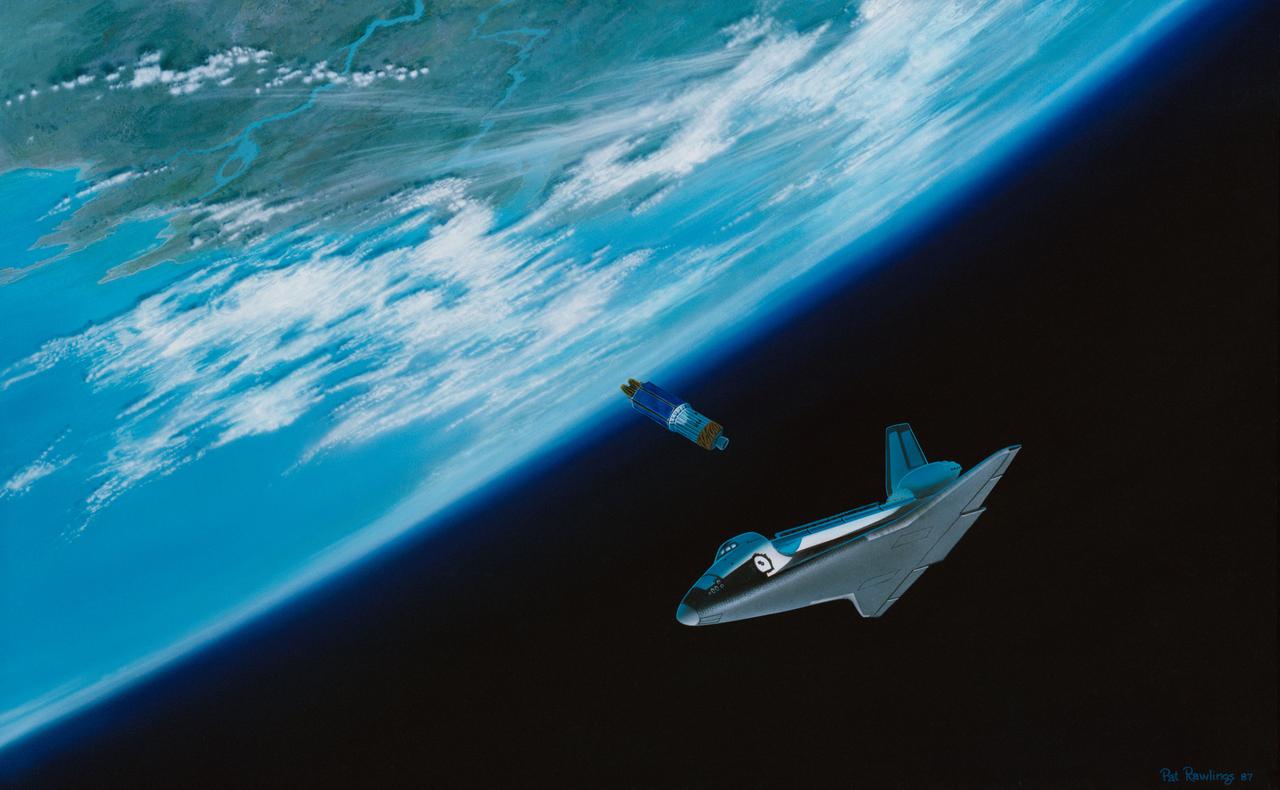
STS-26 Discovery, Orbiter Vehicle (OV) 103, artwork depicts tracking and data relay satellite C (TDRS-C) deployment. OV-103 orbits above Earth in bottom-to-sun attitude, moments after TDRS-C's release into space. TDRS-C is seen just below open payload bay (PLB). Artwork was done by Pat Rawlings of Eagle Engineering.