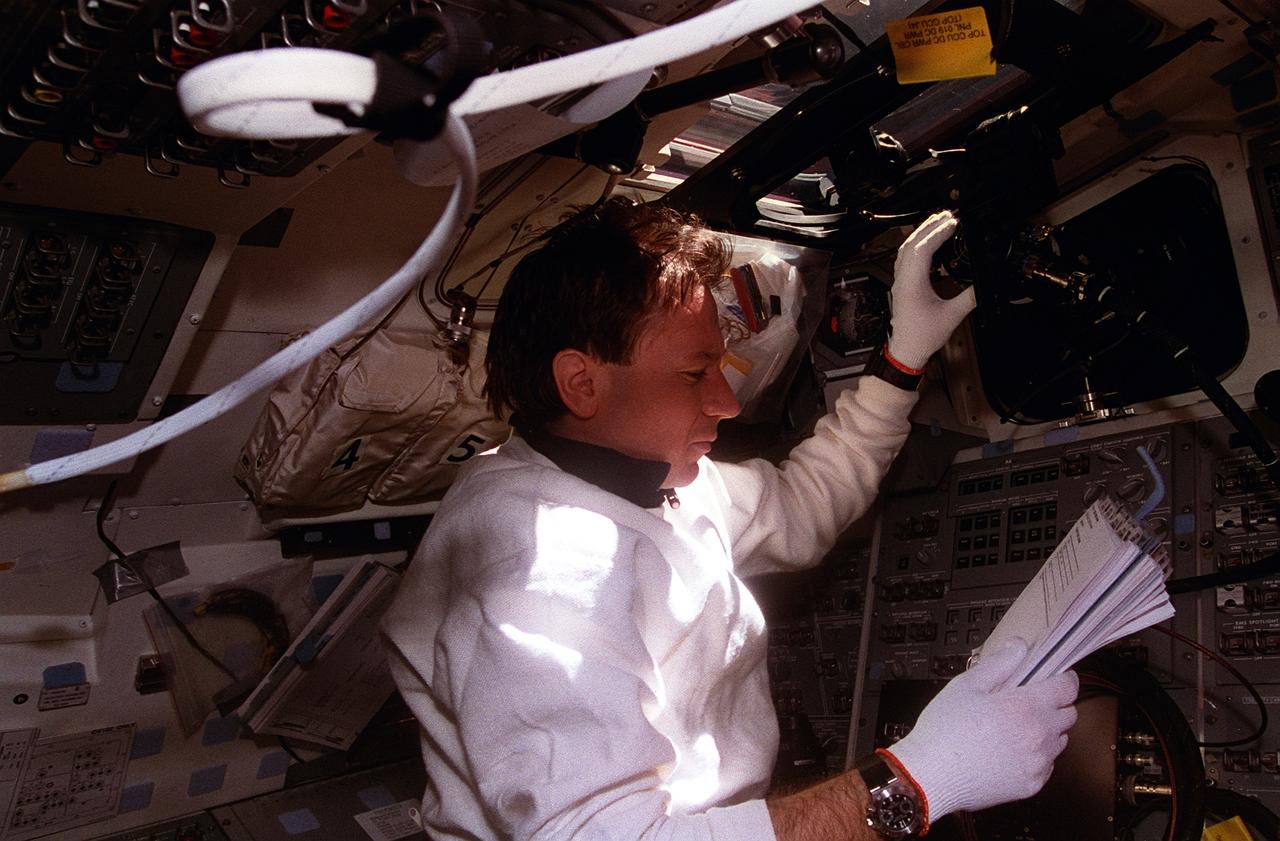
STS075-310-002 (22 Feb.-9 March 1996) --- Astronaut Maurizio Cheli, STS-75 mission specialist, works with the Tether Optical Phenomenon System (TOPS) on the flight deck of the Earth-orbiting Space Shuttle Columbia. Cheli, representing the European Space Agency (ESA), joined four other astronauts and an international payload specialists for 16 days of scientific research in Earth-orbit.
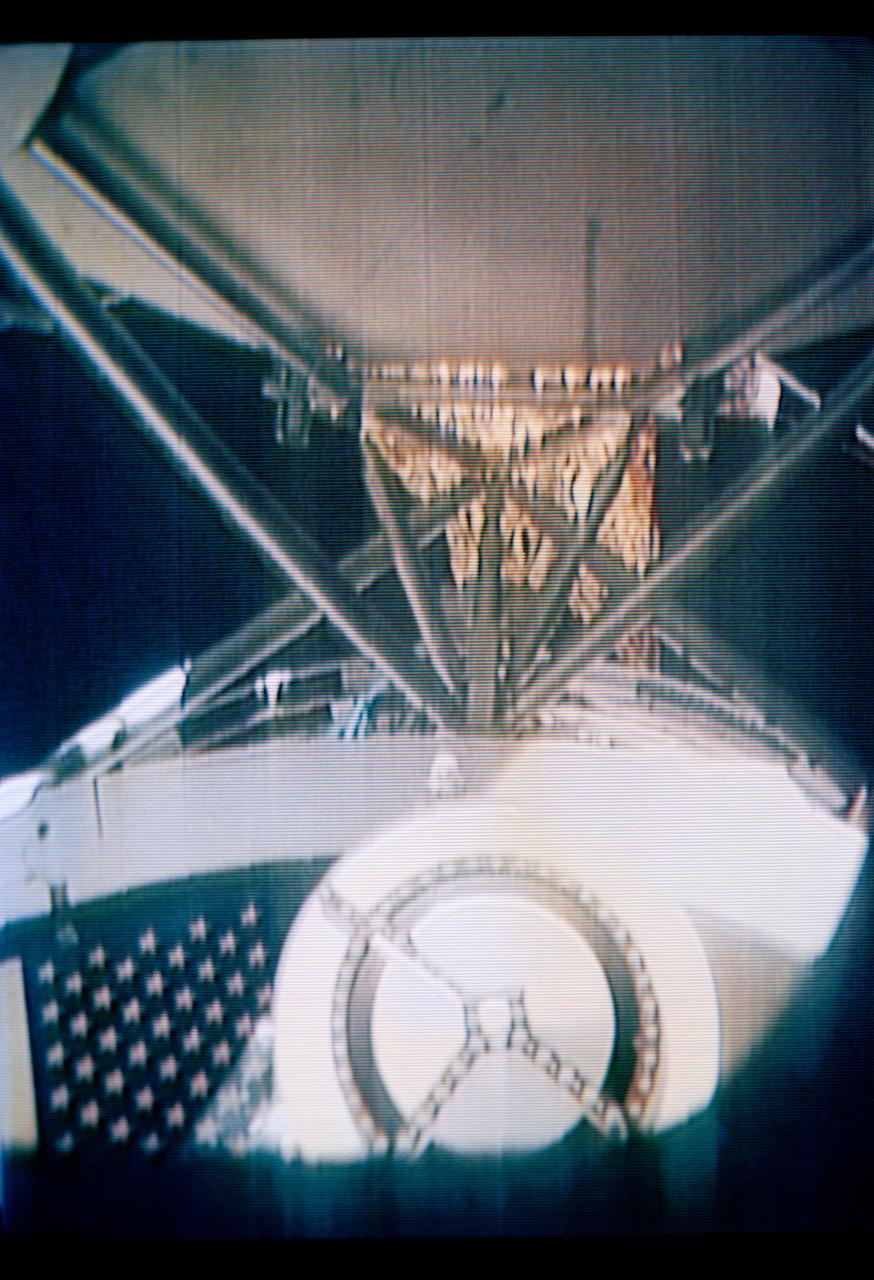
S73-26773 (26 May 1973) --- The deployment of the ?parasol? solar shield, a sunshade to help cool the overheated Orbital Workshop of the Skylab 1 space station cluster in Earth orbit, can be seen in the reproduction taken from a color television transmission made by a TV camera aboard the space station. The camera is in the Command Module; and the view is looking through the truss of the Apollo Telescope Mount. The sunshade is only partially deployed in this picture. The solar shield was pushed up through the OWS solar scientific airlock. The canopy of the ?parasol? measures 24 feet by 22 feet. Photo credit: NASA
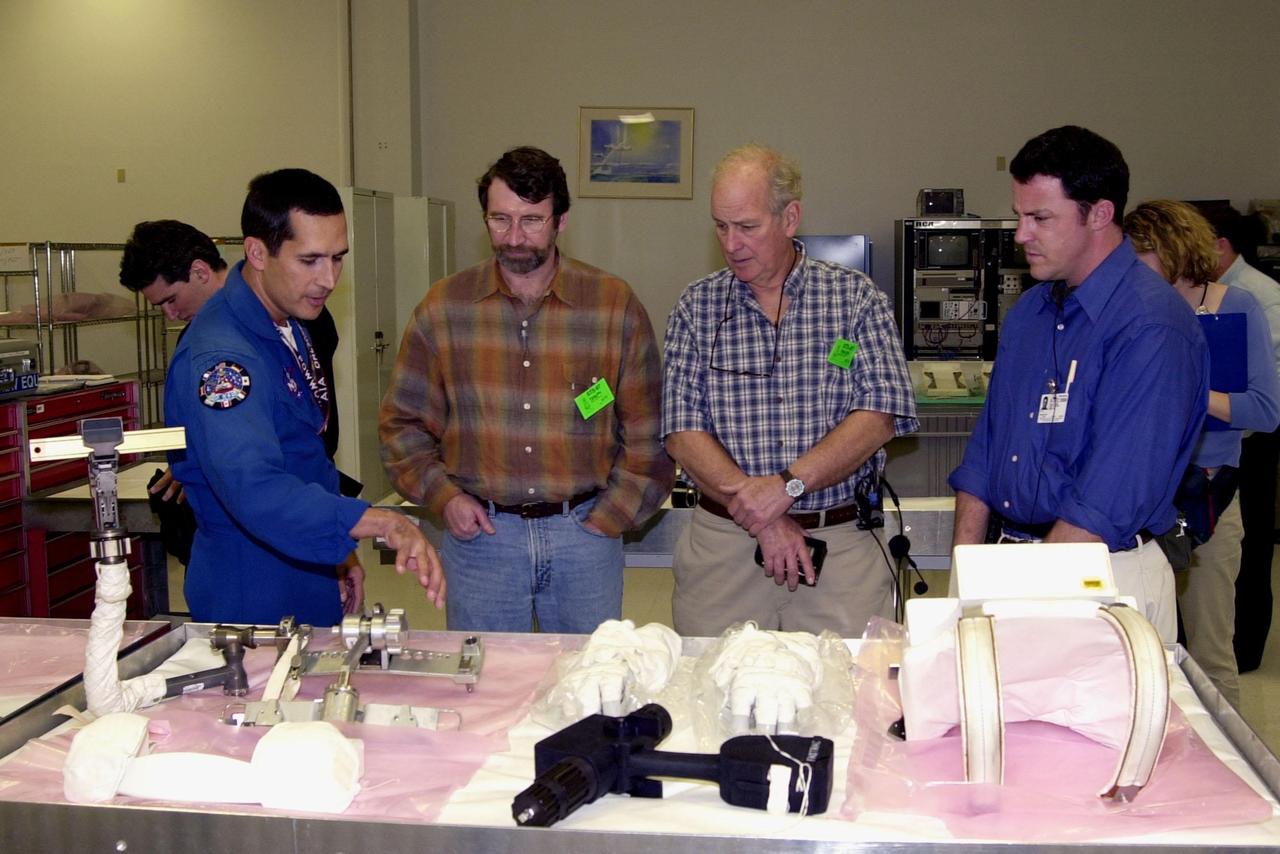
KENNEDY SPACE CENTER, FLA. -- Astronaut John Herrington (left) shows tools and equipment used in space to Norm Abram, master carpenter of television’s "This Old House" and "The New Yankee Workshop." At right are two of the film crew with Abram. Abram is at KSC to film an episode of "This Old House.
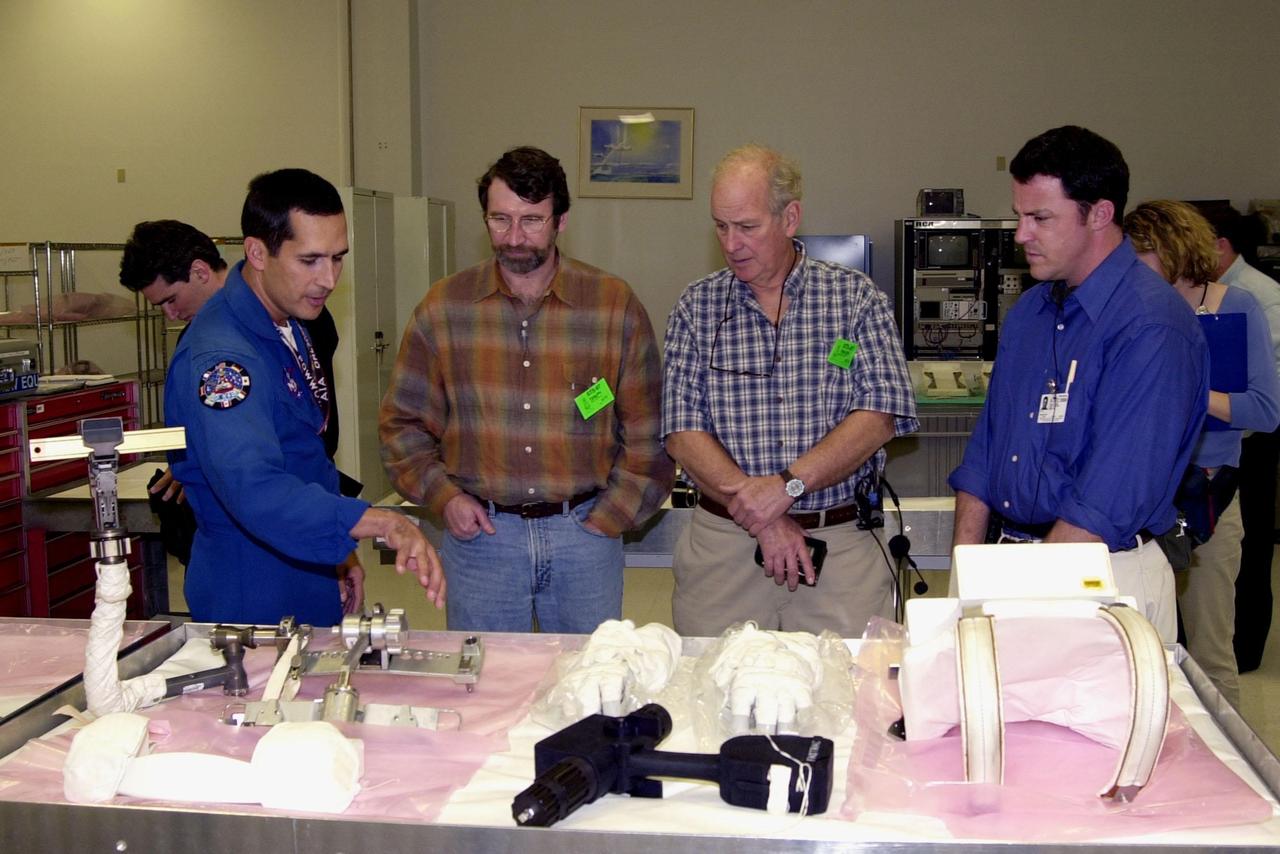
KENNEDY SPACE CENTER, FLA. -- Astronaut John Herrington (left) shows tools and equipment used in space to Norm Abram, master carpenter of television’s "This Old House" and "The New Yankee Workshop." At right are two of the film crew with Abram. Abram is at KSC to film an episode of "This Old House.
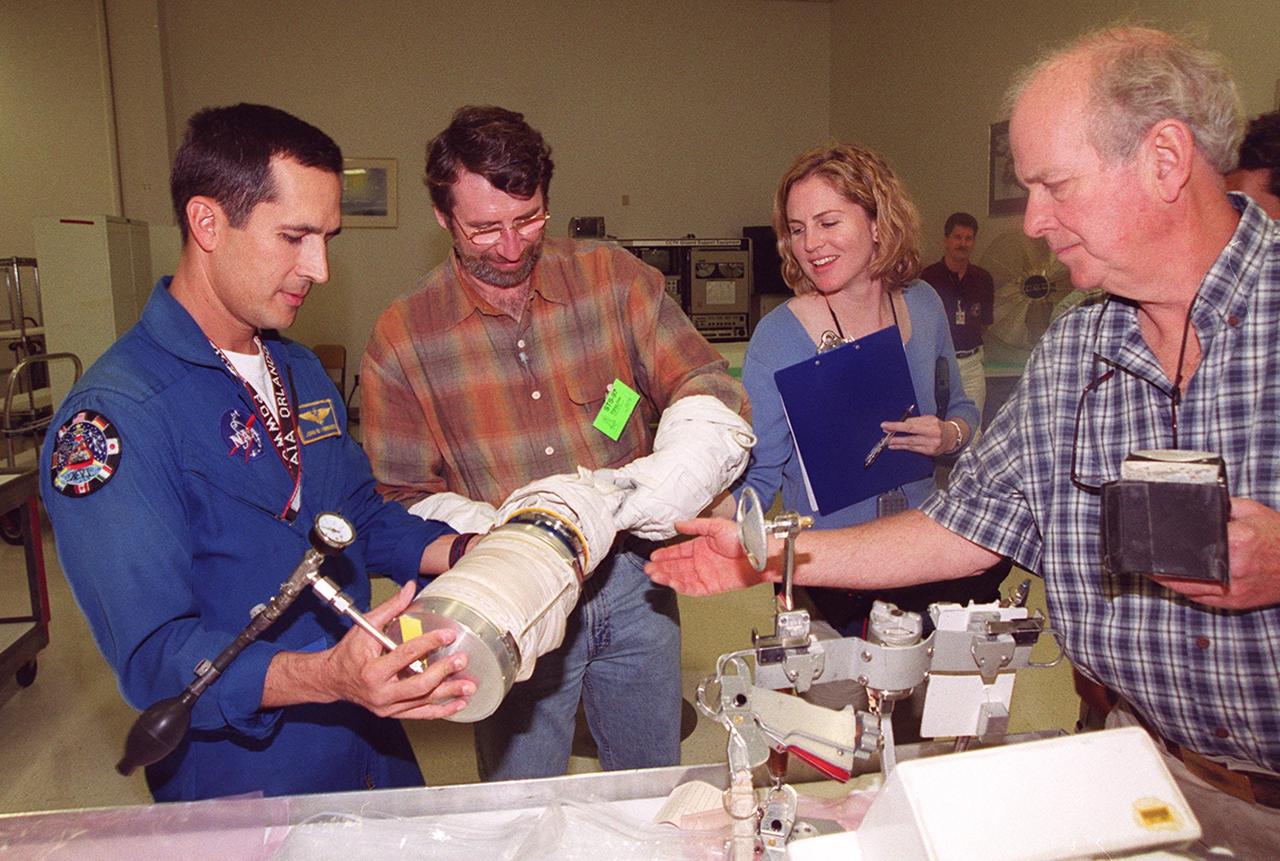
KENNEDY SPACE CENTER, FLA. -- Astronaut John Herrington (left) shows tools and equipment used in space to Norm Abram, master carpenter of television’s "This Old House" and "The New Yankee Workshop." At right are two of the film crew with Abram. Abram is at KSC to film an episode of "This Old House.

KENNEDY SPACE CENTER, FLA. -- At an STS-109 post-landing conference, NASA Administrator Sean O'Keefe talks to the media gathered in the KSC television studio. STS-109 rejuvenated the Hubble Space Telescope in a series of five spacewalks, installing new and improved equipment
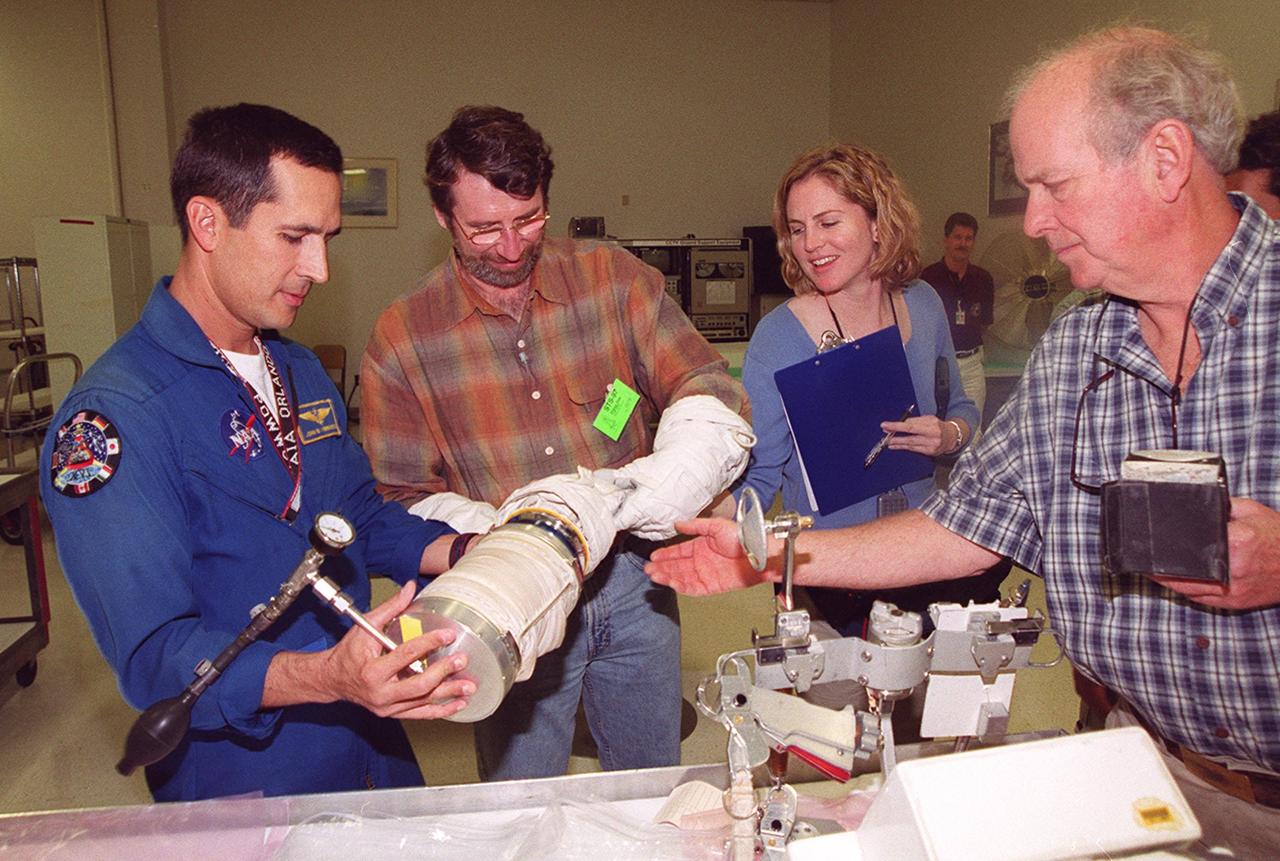
KENNEDY SPACE CENTER, FLA. -- Astronaut John Herrington (left) shows tools and equipment used in space to Norm Abram, master carpenter of television’s "This Old House" and "The New Yankee Workshop." At right are two of the film crew with Abram. Abram is at KSC to film an episode of "This Old House.
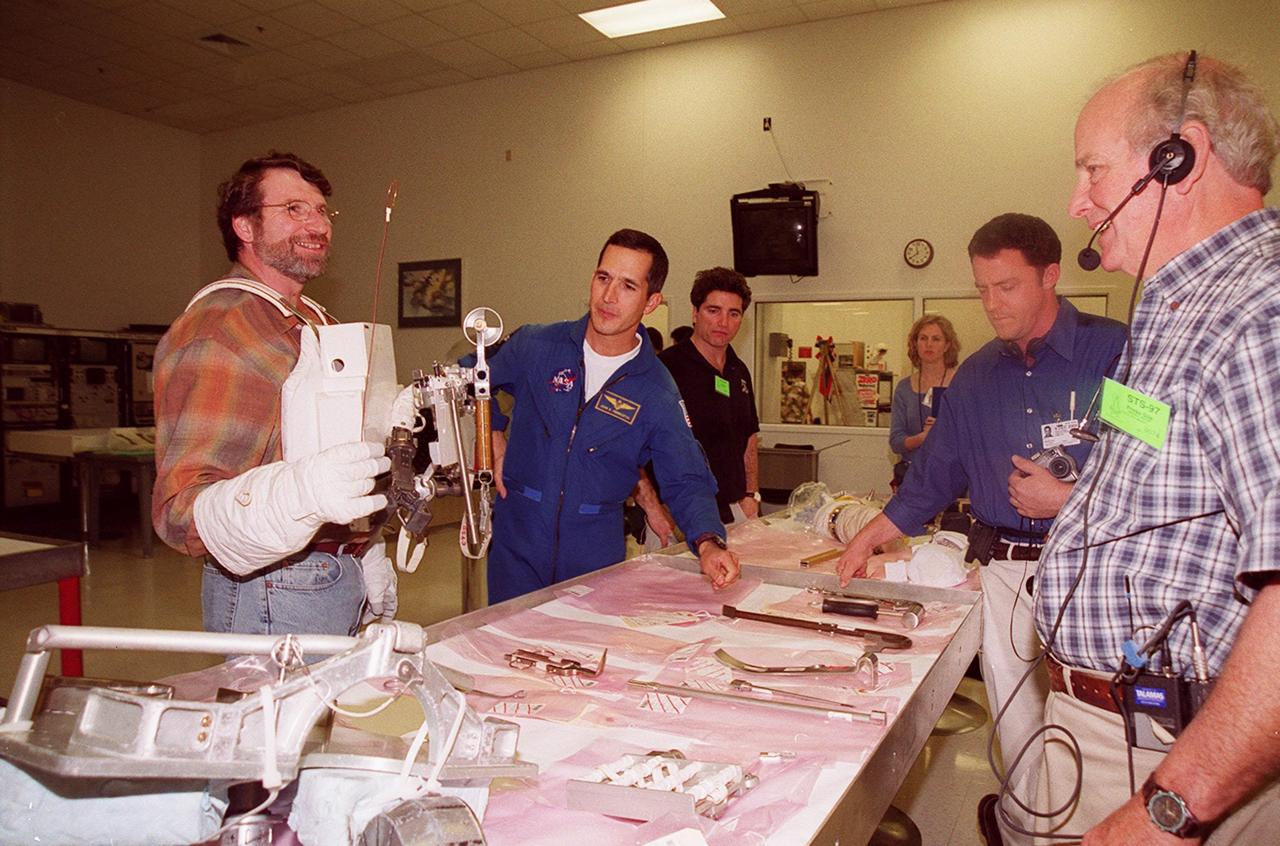
KENNEDY SPACE CENTER, FLA. -- Norm Abram, of television’s "This Old House" and "The New Yankee Workshop," looks at tools and equipment used in space while astronaut John Herrington (second from left) watches. At right are two of the film crew with Abram. Abram is at KSC to film an episode of "This Old House.
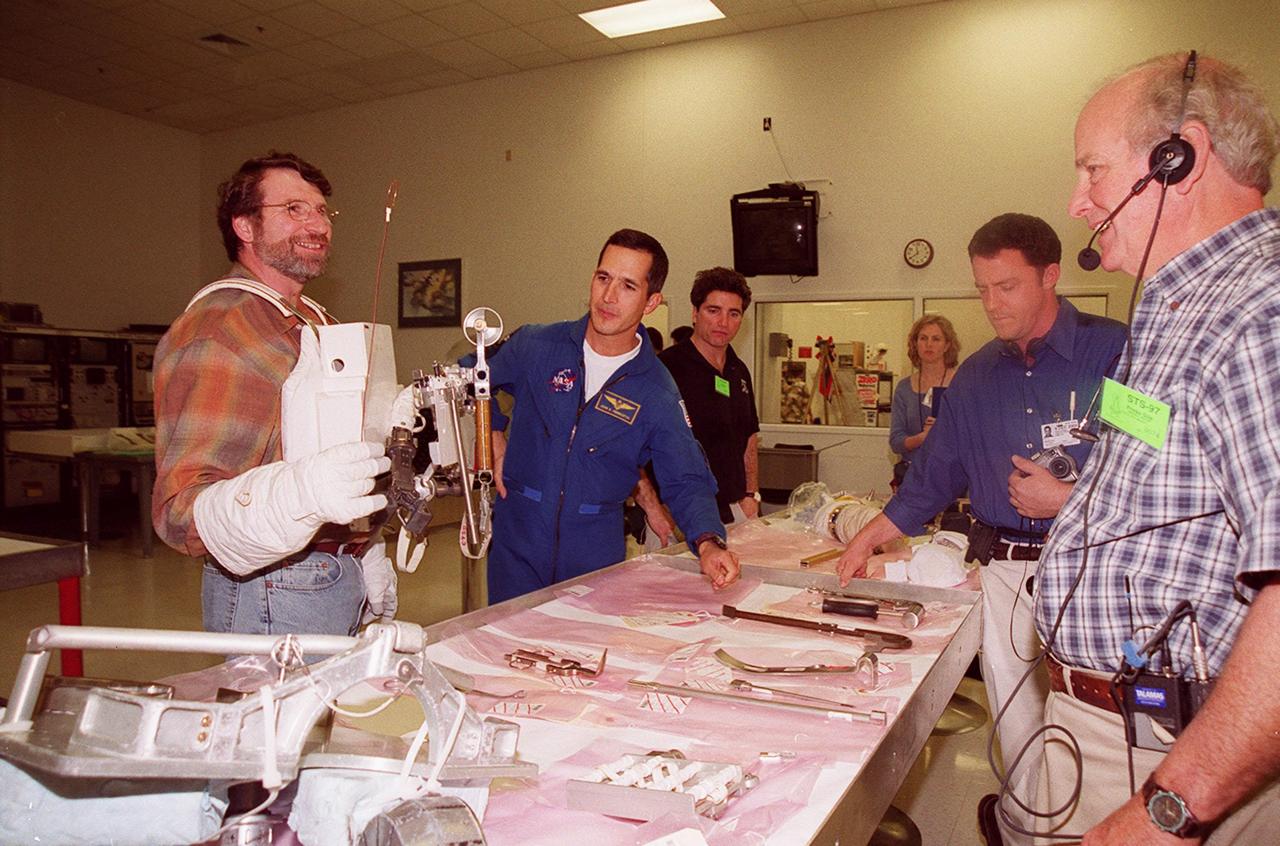
KENNEDY SPACE CENTER, FLA. -- Norm Abram, of television’s "This Old House" and "The New Yankee Workshop," looks at tools and equipment used in space while astronaut John Herrington (second from left) watches. At right are two of the film crew with Abram. Abram is at KSC to film an episode of "This Old House.
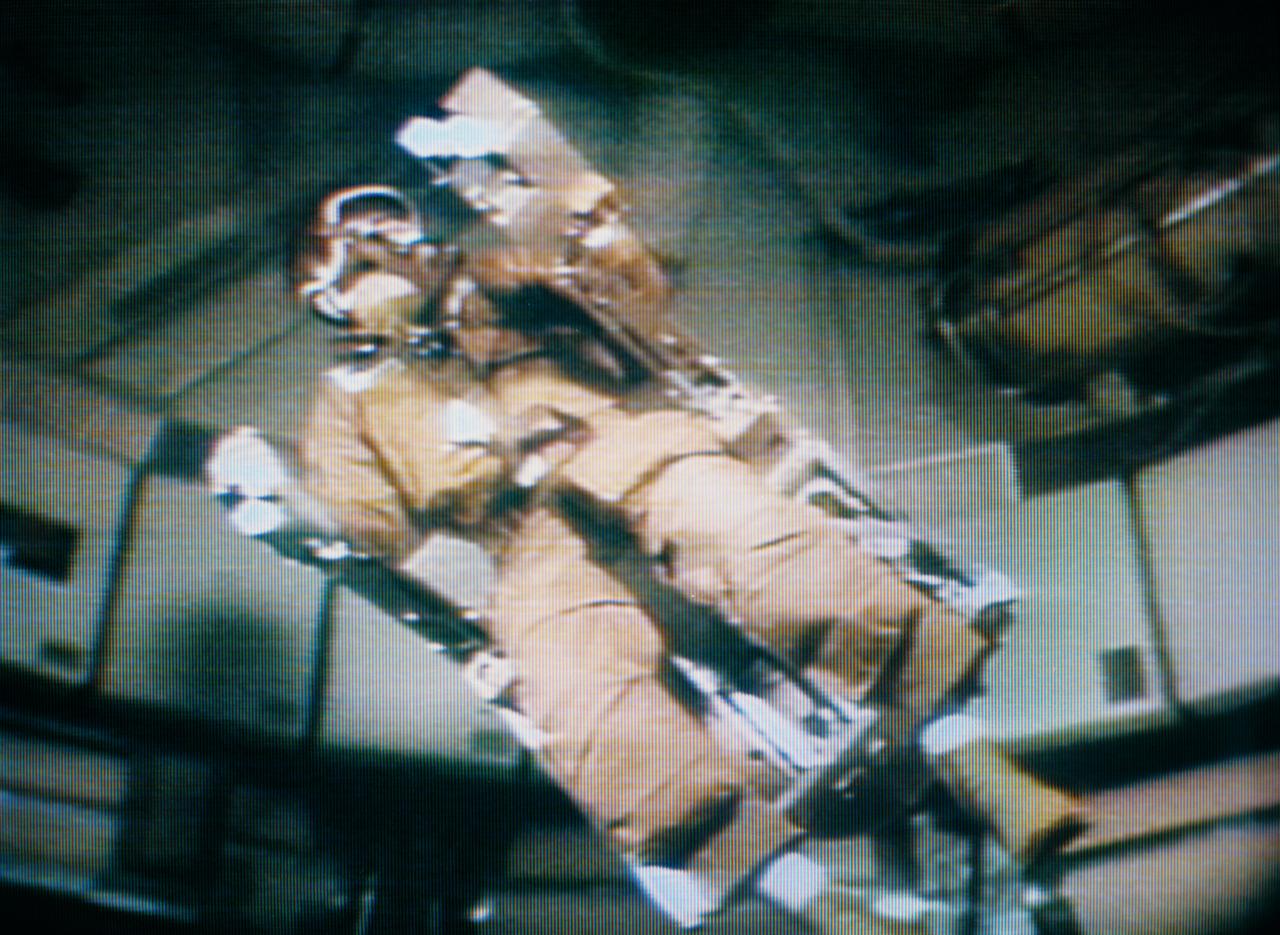
S73-34207 (28 Aug. 1973) --- Astronaut Alan L. Bean, Skylab 3 commander, flies the M509 astronaut Maneuvering Equipment, as seen in this photographic reproduction taken from a television transmission made by a color television camera in the Orbital Workshop (OWS) of the Skylab space station in Earth orbit. Bean is strapped into the back-mounted, hand-controlled Automatically Stabilized Maneuvering Unit (ASMU). The M509 exercise was in the forward dome area of the OWS. The dome area is about 22 feet in diameter and 19 feet from top to bottom. Photo credit: NASA
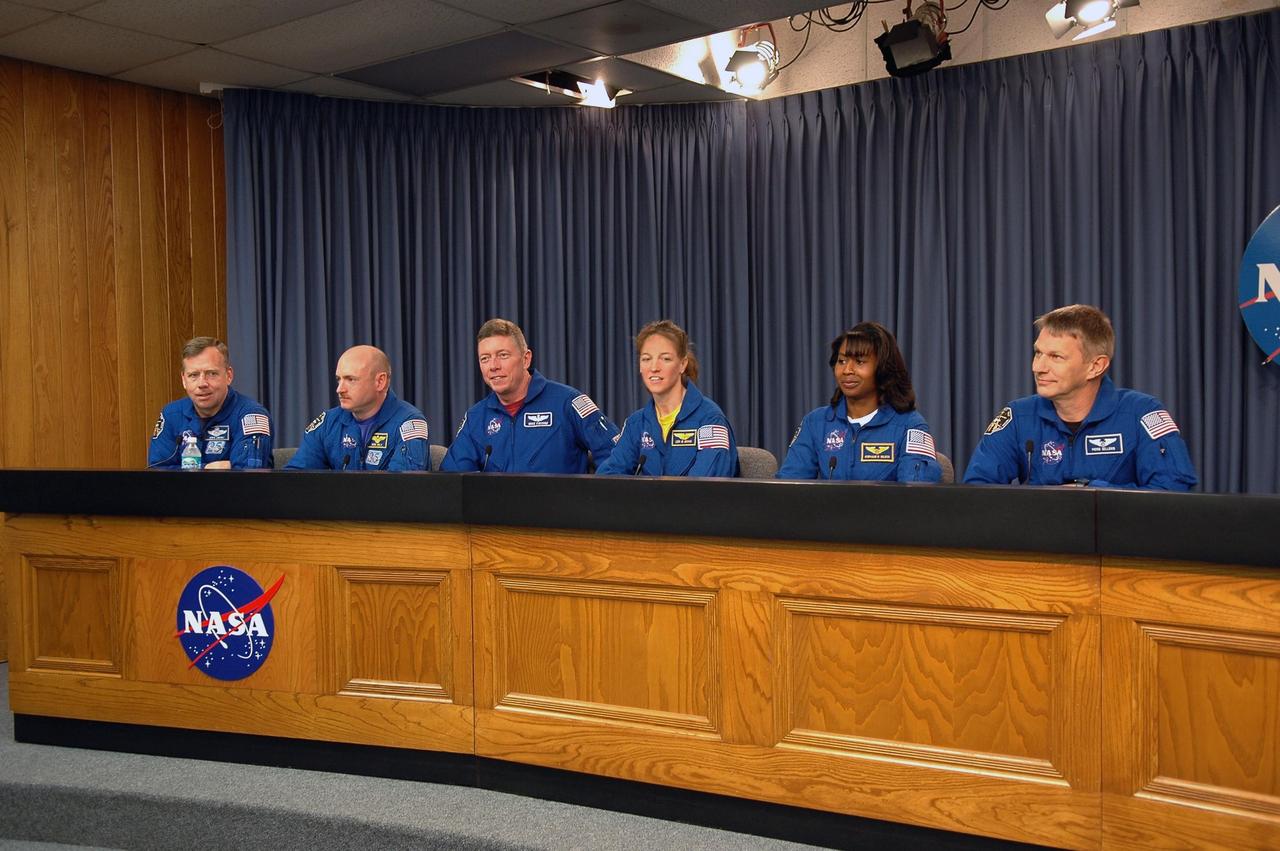
KENNEDY SPACE CENTER, FLA. - In the television studio at NASA Kennedy Space Center, the STS-121 crew answers questions during a media conference. Seated from left are Commander Steven Lindsey, Pilot Mark Kelly and Mission Specialists Michael Fossum, Lisa Nowak, Stephanie Wilson and Piers Sellers. The seventh crew member, Mission Specialist Thomas Reiter, did not attend. The crew is at NASA Kennedy Space Center for the crew equipment interface test, which provides hands-on experiences with equipment used on-orbit. The launch of STS-121, the second return-to-flight mission, is scheduled for May. Photo credit: NASA/Kim Shiflett
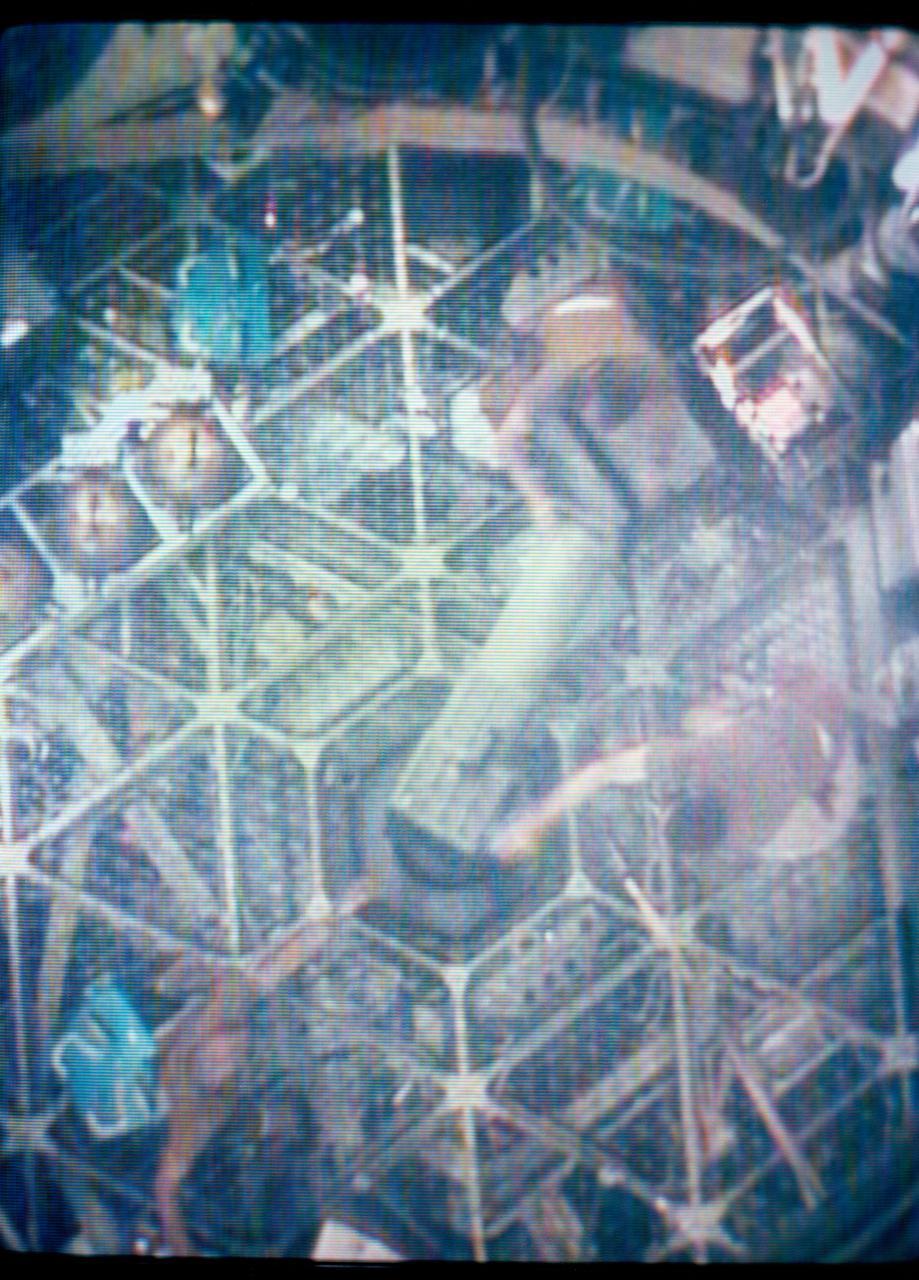
S73-27730 (June 1973) --- The Skylab 2 crewmen, astronauts Charles Conrad Jr., Joseph P. Kerwin and Paul J. Weitz, move the S183 Ultraviolet Panorama astrophysics experiment equipment under zero-gravity conditions in space in the foreground compartment of the Orbital Workshop of the Skylab 1 & 2 space station in Earth orbit, as seen in this reproduction taken from a color television transmission made by a TV camera aboard the space station. The S183 equipment includes the S183 spectrograph, the S019 mirror assembly, and a Maurer camera. Photo credit: NASA
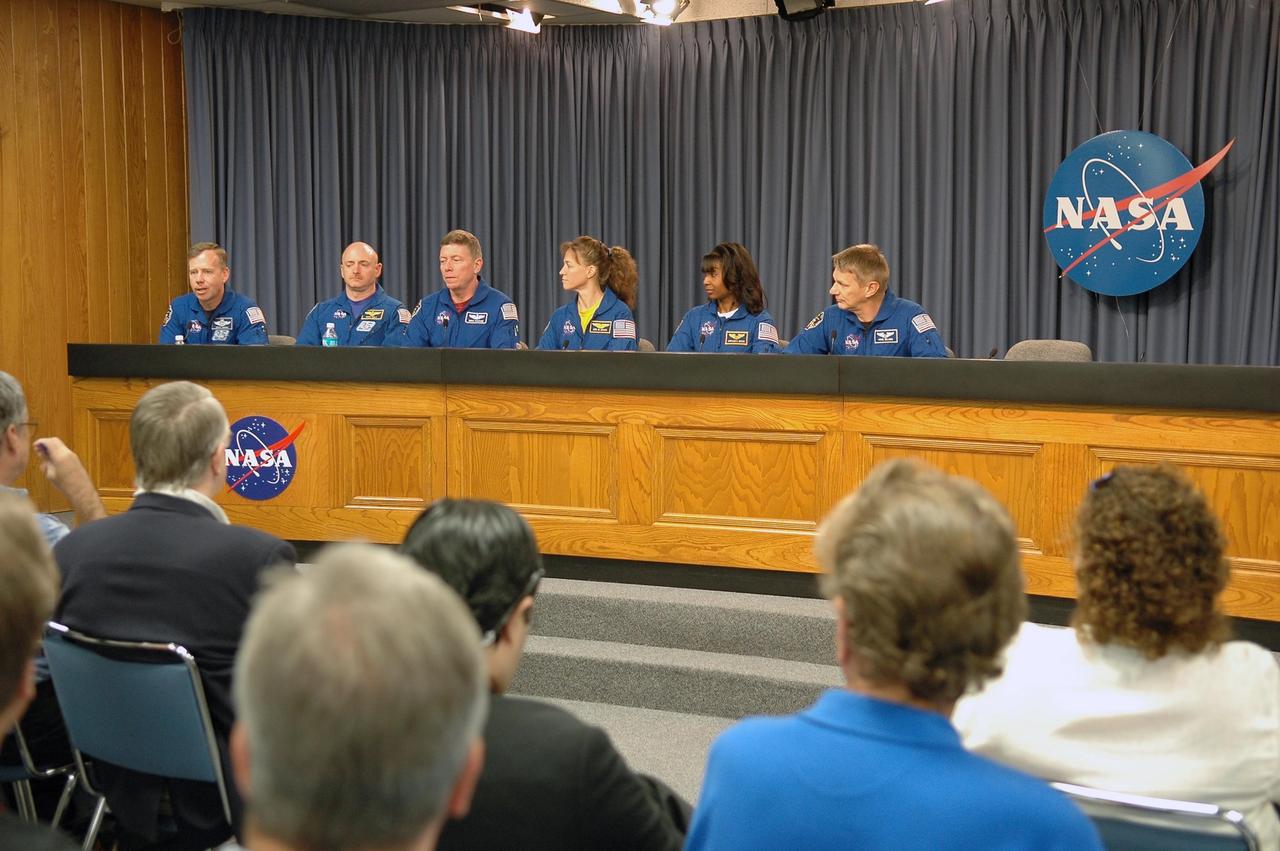
KENNEDY SPACE CENTER, FLA. - In the television studio at NASA Kennedy Space Center, the STS-121 crew answers questions during a media conference. Seated from left are Commander Steven Lindsey, Pilot Mark Kelly and Mission Specialists Michael Fossum, Lisa Nowak, Stephanie Wilson and Piers Sellers. The seventh crew member, Mission Specialist Thomas Reiter, did not attend. The crew is at NASA Kennedy Space Center for the crew equipment interface test, which provides hands-on experiences with equipment used on-orbit. The launch of STS-121, the second return-to-flight mission, is scheduled for May. Photo credit: NASA/Kim Shiflett
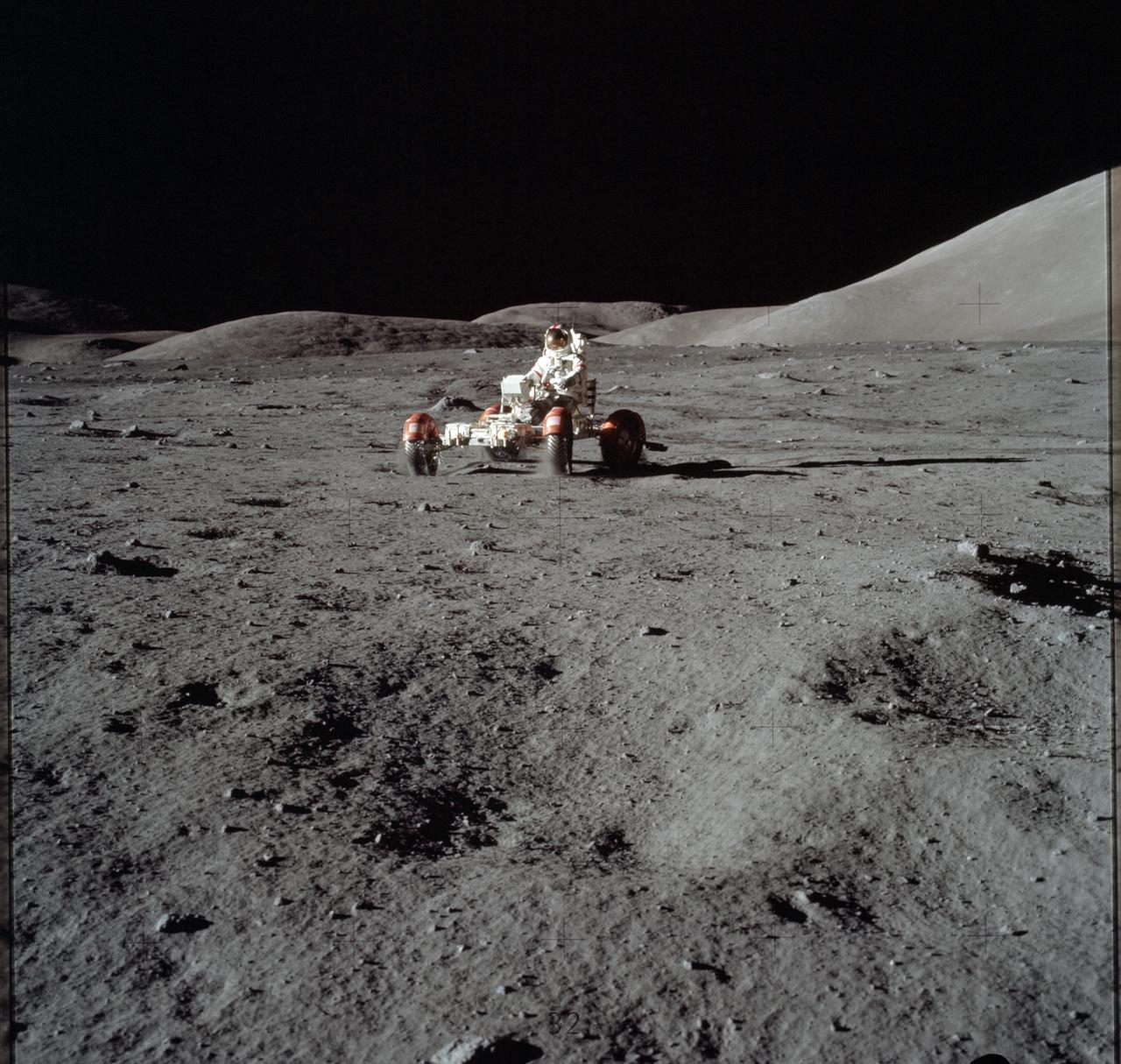
AS17-147-22523 (11 Dec. 1972) --- Astronaut Eugene A. Cernan is seen test driving the "stripped down" Lunar Rover Vehicle (LRV) prior to loading the LRV up. Equipment later loaded onto the LRV included the ground controlled television assembly, the lunar communications relay unit, the hi-gain antenna, the low-gain antenna, aft tool pallet, and lunar tools and scientific gear.
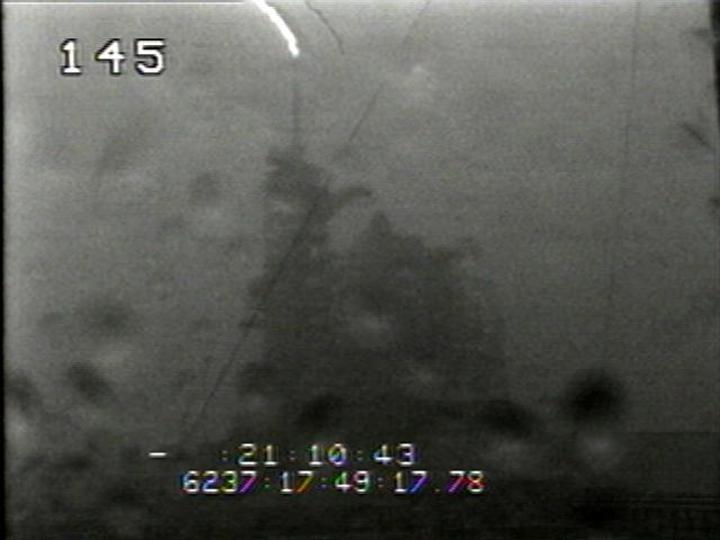
KENNEDY SPACE CENTER, FLA. - A lightning strike occurred at the lightning protection system of Launch Pad 39B on Fri., August 25, 2006, at 1:49:17 p.m. (EST). The lightning strike caused the mission management team to scrub the launch of mission STS-115 for 24 hours in order to review all electrical systems on the space shuttle and the launch pad ground support equipment. Photo credit: NASA/InDyne -Operational Television.
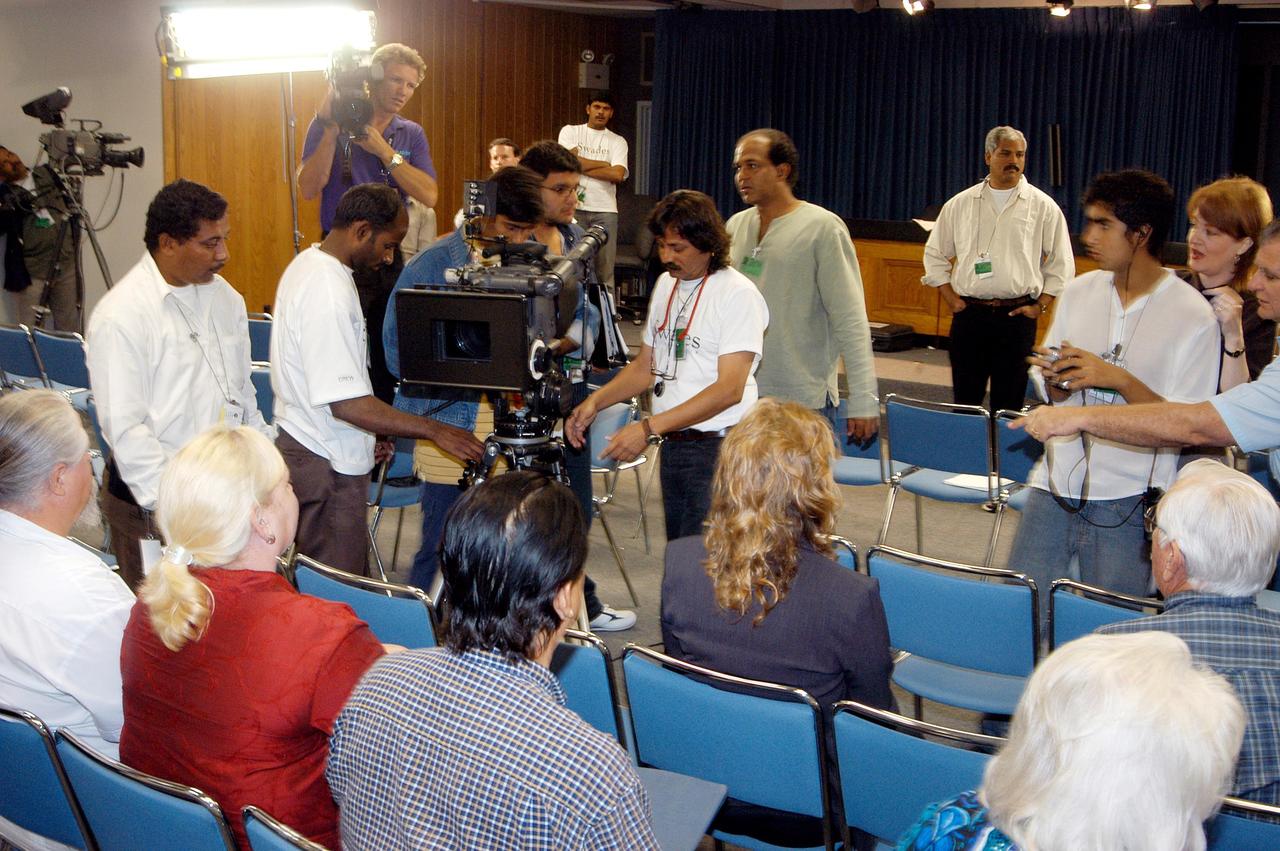
KENNEDY SPACE CENTER, FLA. -- A film crew from India sets up equipment inside the television studio at the NASA News Center. The crew spent several days at KSC filming at various sites for the movie “Swades,” a story about India’s brain-drain. At center is Mahesh Aney, director of photography. The writer and director is Ashutosh Gowariker (seen to the right of Aney). The lead actors are Shahrukh Khan and Gayatri Joshi. Sunita Gowariker is executive producer.
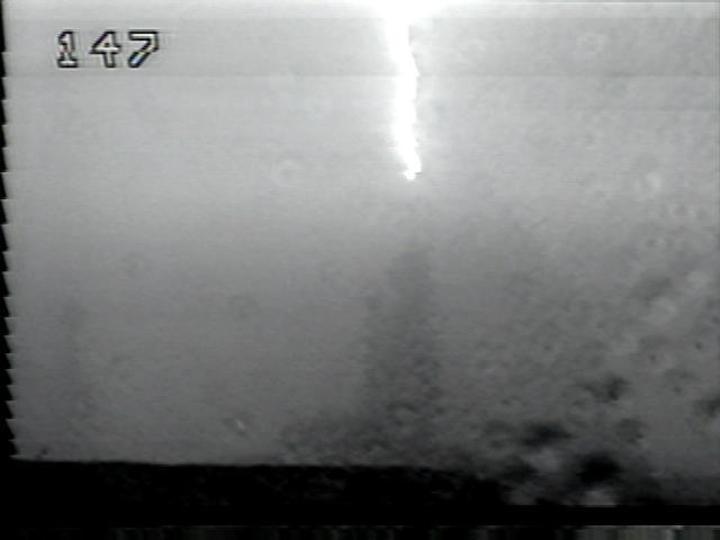
KENNEDY SPACE CENTER, FLA. - A lightning strike occurred at the lightning protection system of Launch Pad 39B on Fri., August 25, 2006, at 1:49:17 p.m. (EST). The lightning strike caused the mission management team to scrub the launch of mission STS-115 for 24 hours in order to review all electrical systems on the space shuttle and the launch pad ground support equipment. Photo credit: NASA/InDyne -Operational Television.
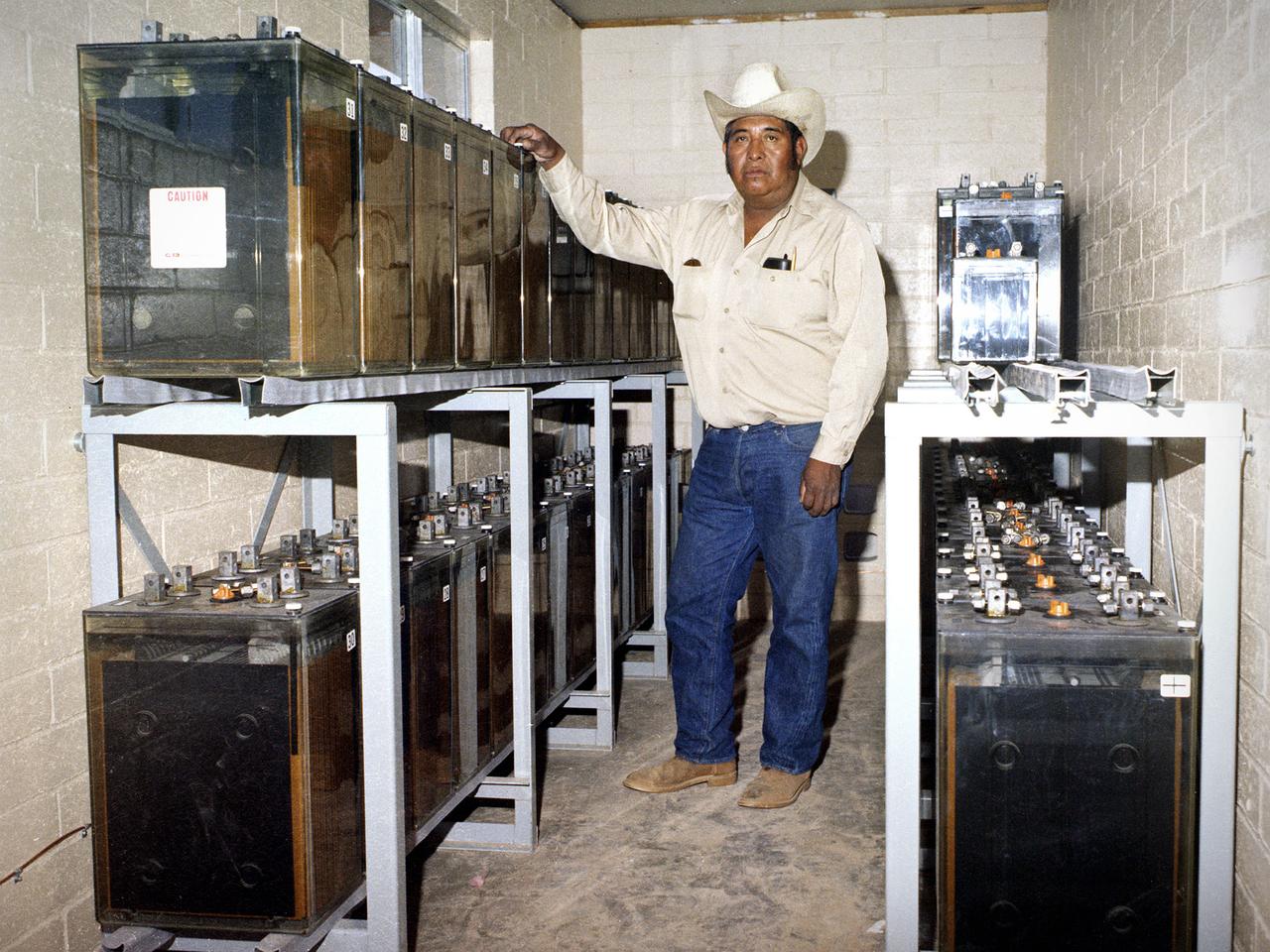
National Aeronautics and Space Administration (NASA) Lewis Research Center. NASA signed an agreement with the Papago tribe in May 1978 to provide the village with solar-generated electricity within the year. The project was funded by the Department of Energy and managed by NASA Lewis. Lewis provided all of the equipment and technical assistance while the tribe’s construction team built the arrays and support equipment, seen here. The 3.5-kilowatt system was modest in scope, but resulted in the first solar electric village. The system provided power to operate a refrigerator, freezer, washing machine, and water pump for the village and lights in each of the 16 homes. The system was activated on December 16, 1978. During the next year officials from around the world travelled to Schuchuli to ascertain if the system was applicable to their areas. The major television networks and over 100 publications covered the story. Less than one percent of the cells failed during the first year of operation.

STS006-44-582 (5 April 1983) --- A 70mm camera through the aft windows of the Earth-orbiting space shuttle Challenger’s cabin centered on the starboard orbital maneuvering system (OMS) pod of the reusable spacecraft. Two pieces of thermal protection system tile appear to have loosened. The view also shows one of the cargo bay television cameras, part of the EVA slide wire system, three handrails and other features on the aft bulkhead. Part of the airborne support equipment (ASE) for the now vacated inertial upper stage (IUS)/tracking and data relay satellite (TDRS) tandem is in lower right foreground. Photo credit: NASA
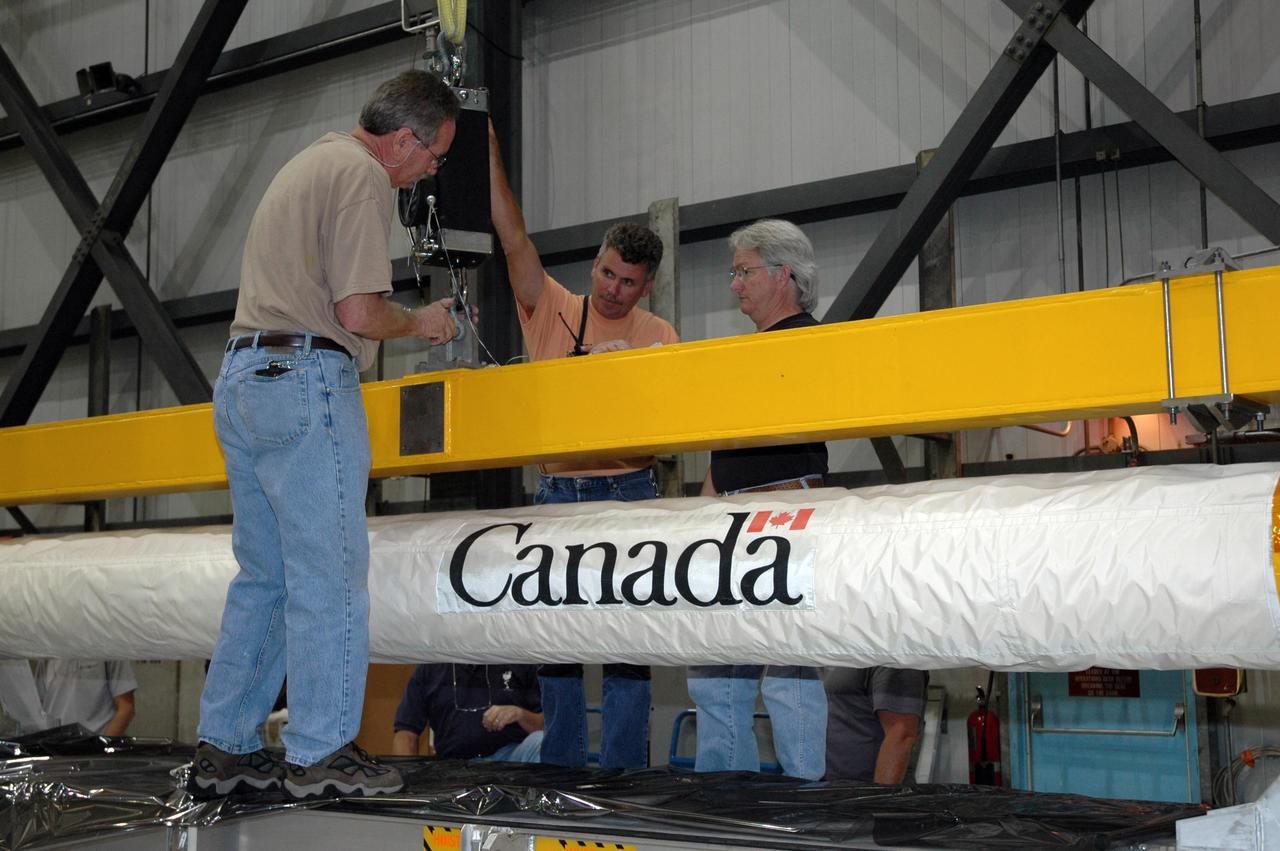
KENNEDY SPACE CENTER, FLA. - In the Orbiter Processing Facility's bay 1, workers prepare the orbiter boom sensor system for installation on the starboard side of Atlantis's payload bay for mission STS-117. The 50-foot-long boom attaches to the shuttle arm and provides equipment to inspect the shuttle's heat shield while in space. It contains an intensified television camera (ITVC) and a laser dynamic range imager, which are mounted on a pan and tilt unit, and a laser camera system (LCS) mounted on a stationary bracket. Mission STS-117 will carry the S3/S4 arrays for installation on the International Space Station. Launch of Space Shuttle Atlantis is scheduled for March. Photo credit: NASA/Jack Pfaller
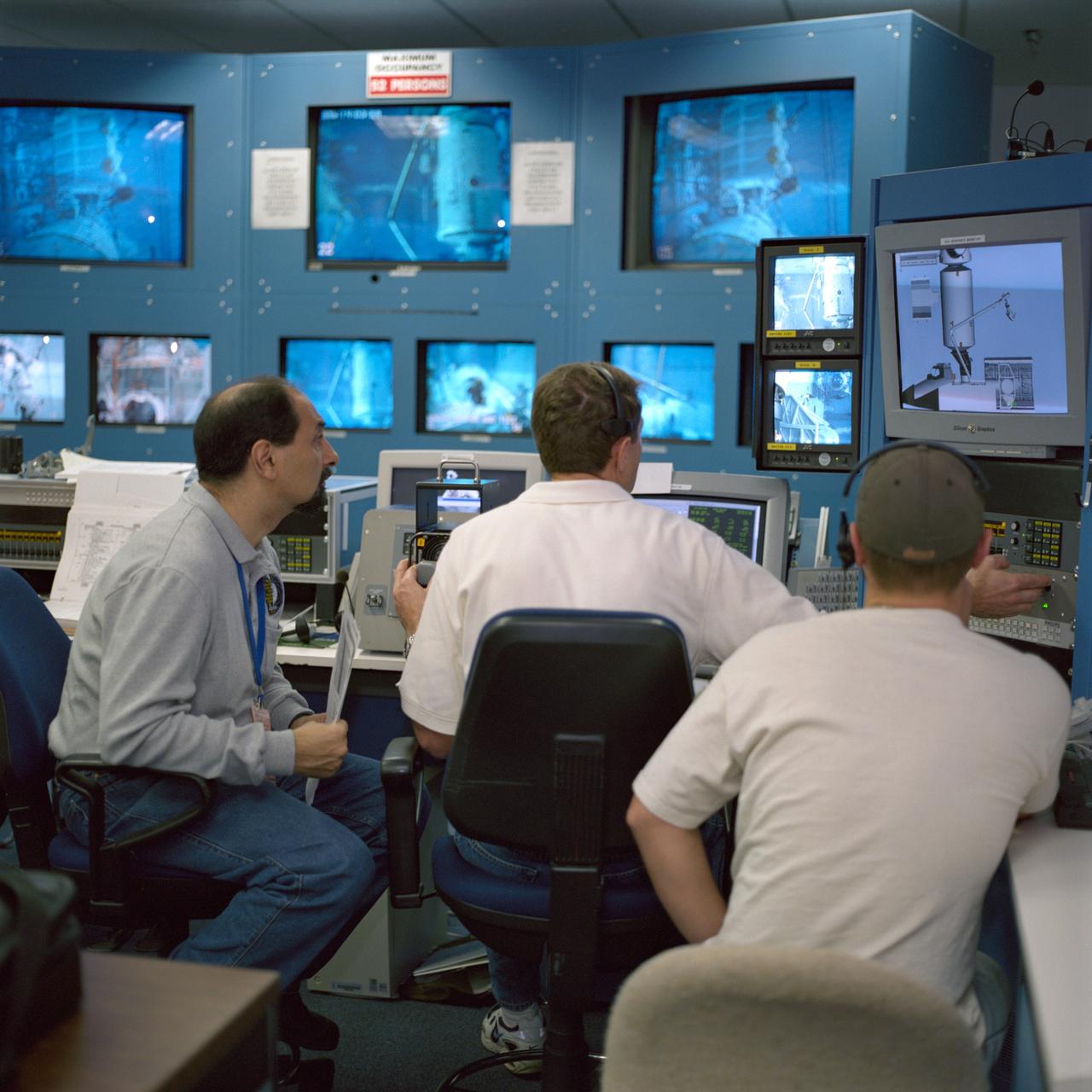
JSC2000-07406 (1 December 2000) --- Astronaut Umberto Guidoni (left), STS-100 mission specialist representing the European Space Agency (ESA), views a closed-circuit televising of an underwater space walk simulation performed by two crew mates. The simulation of the scheduled spring 2001 space walk took place at the Neutral Buoyancy Laboratory (NBL) at the Sonny Carter Training Facility. Astronaut Jeffrey S. Ashby, pilot, is at center. Astronauts Scott E. Parazynski of the NASA-Johnson Space Center and Chris A. Hadfield of the Canadian Space Agency (CSA), both mission specialists and both equipped with training versions of the extravehicular mobility unit (EMU) space suits, were in the water at the time.
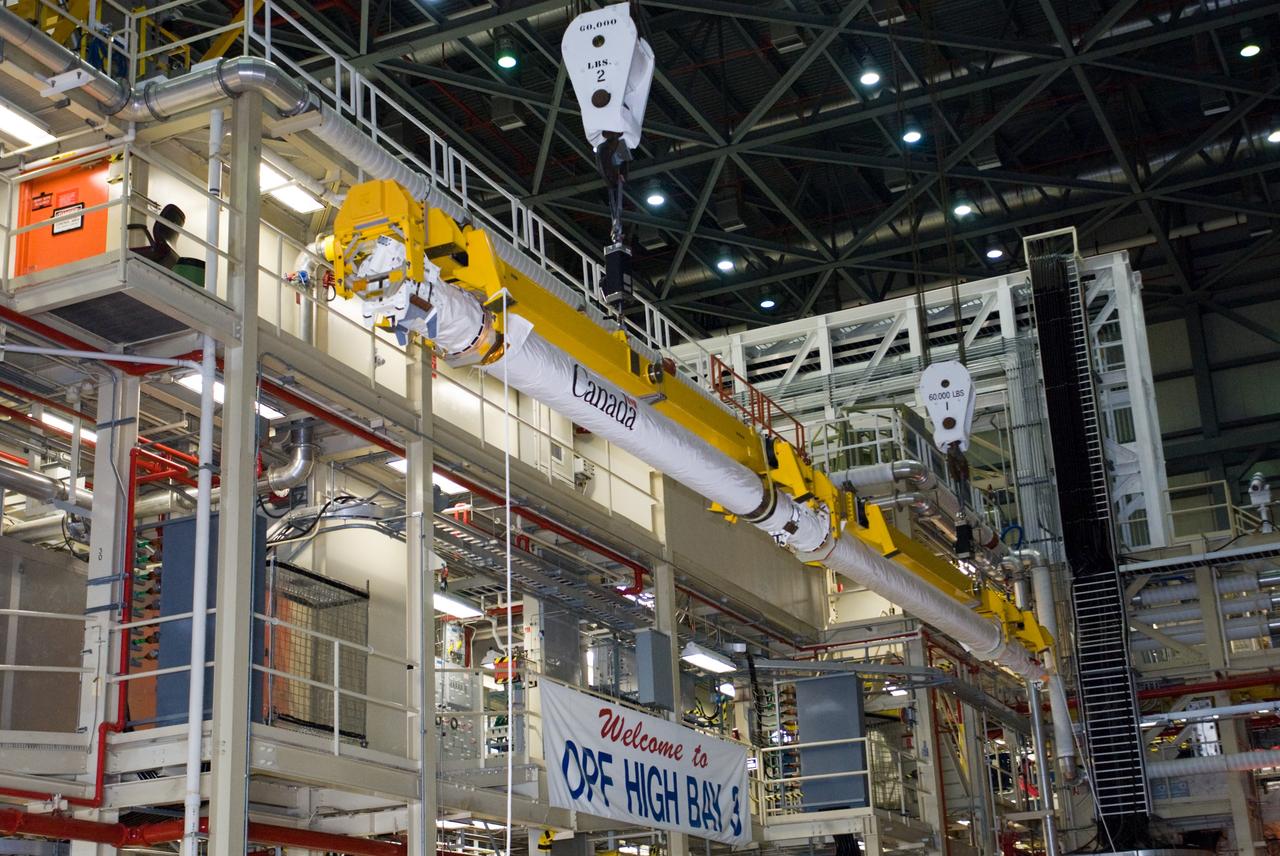
CAPE CANAVERAL, Fla. – In the Orbiter Processing Facility’s bay 3, the orbiter boom sensor system is lifted by a crane for installation in space shuttle Discovery’s payload bay for mission STS-128. The 50-foot-long boom attaches to the shuttle arm and provides equipment to inspect the shuttle's heat shield while in space. It contains an intensified television camera (ITVC) and a laser dynamic range imager, which are mounted on a pan and tilt unit, and a laser camera system (LCS) mounted on a stationary bracket. The STS-128 flight will carry science and storage racks to the International Space Station on space shuttle Discovery. Launch of Discovery is targeted for Aug. 6. Photo credit: NASA/Jim Grossmann
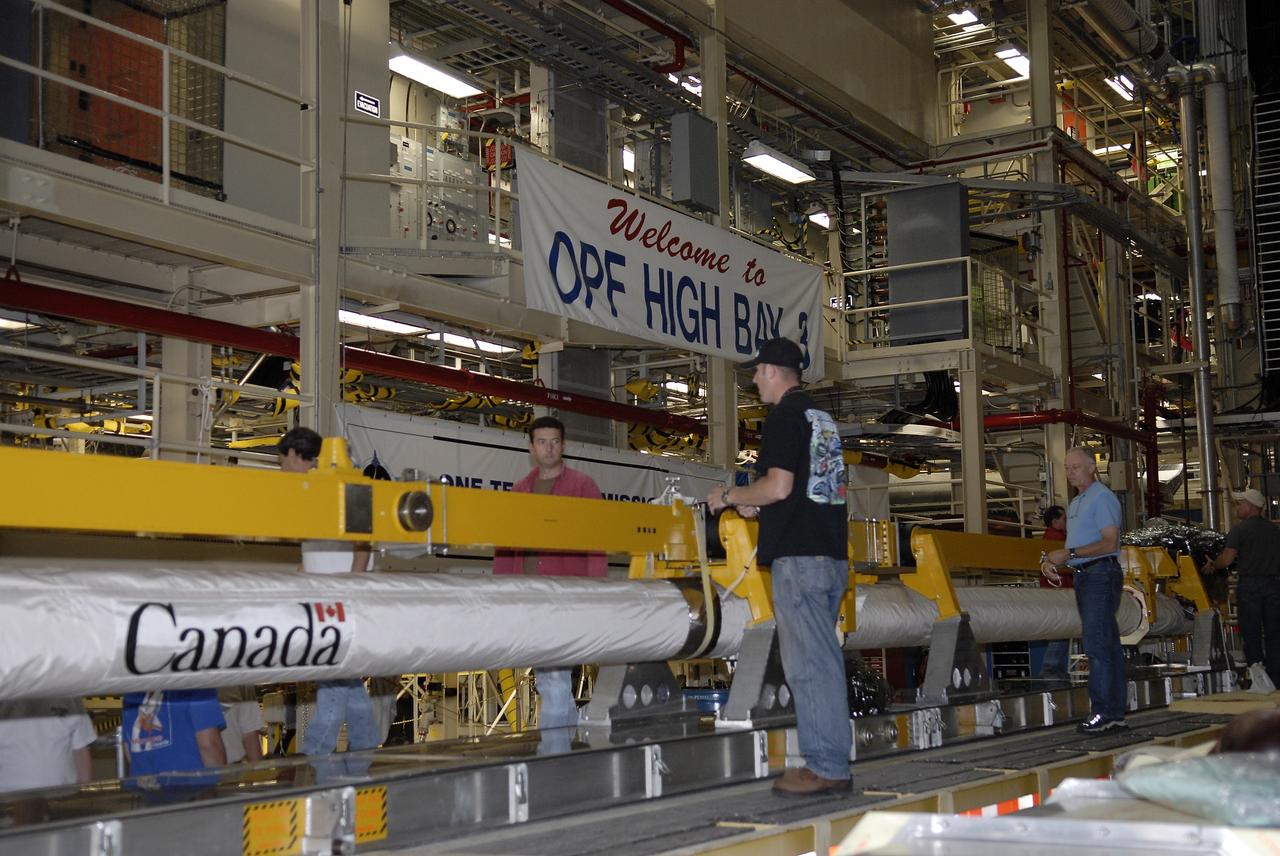
CAPE CANAVERAL, Fla. – In the Orbiter Processing Facility’s bay 3, workers prepare to install the orbiter boom sensor system in the payload bay of space shuttle Discovery to support mission STS-128. The 50-foot-long boom attaches to the shuttle arm and provides equipment to inspect the shuttle's heat shield while in space. It contains an intensified television camera (ITVC) and a laser dynamic range imager, which are mounted on a pan and tilt unit, and a laser camera system (LCS) mounted on a stationary bracket. The STS-128 flight will carry science and storage racks to the International Space Station on space shuttle Discovery. Launch of Discovery is targeted for Aug. 6. Photo credit: NASA/Kim Shiflett
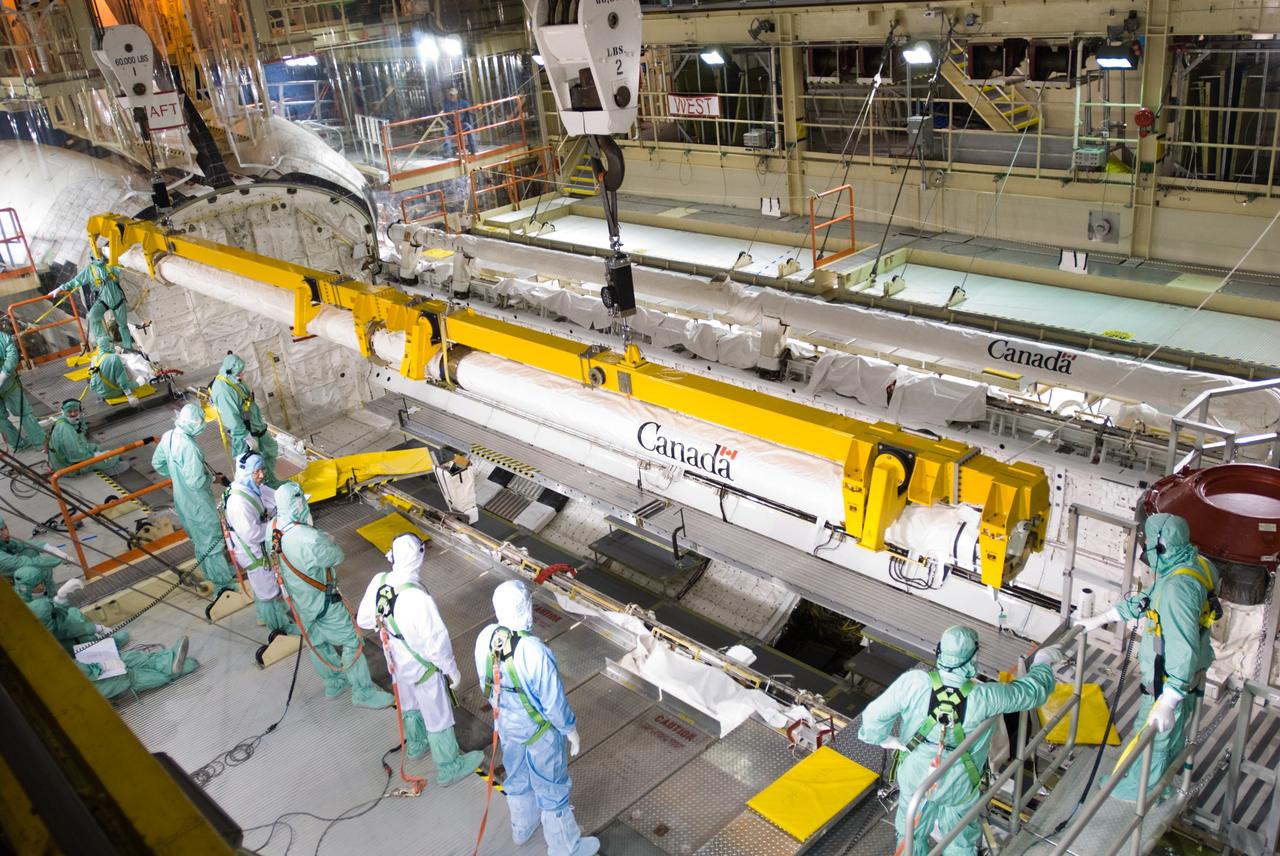
CAPE CANAVERAL, Fla. – In the Orbiter Processing Facility’s bay 3, the orbiter boom sensor system is lowered by a crane into the payload bay of space shuttle Discovery for installation to support mission STS-128. The 50-foot-long boom attaches to the shuttle arm and provides equipment to inspect the shuttle's heat shield while in space. It contains an intensified television camera (ITVC) and a laser dynamic range imager, which are mounted on a pan and tilt unit, and a laser camera system (LCS) mounted on a stationary bracket. The STS-128 flight will carry science and storage racks to the International Space Station on space shuttle Discovery. Launch of Discovery is targeted for Aug. 6. Photo credit: NASA/Jim Grossmann
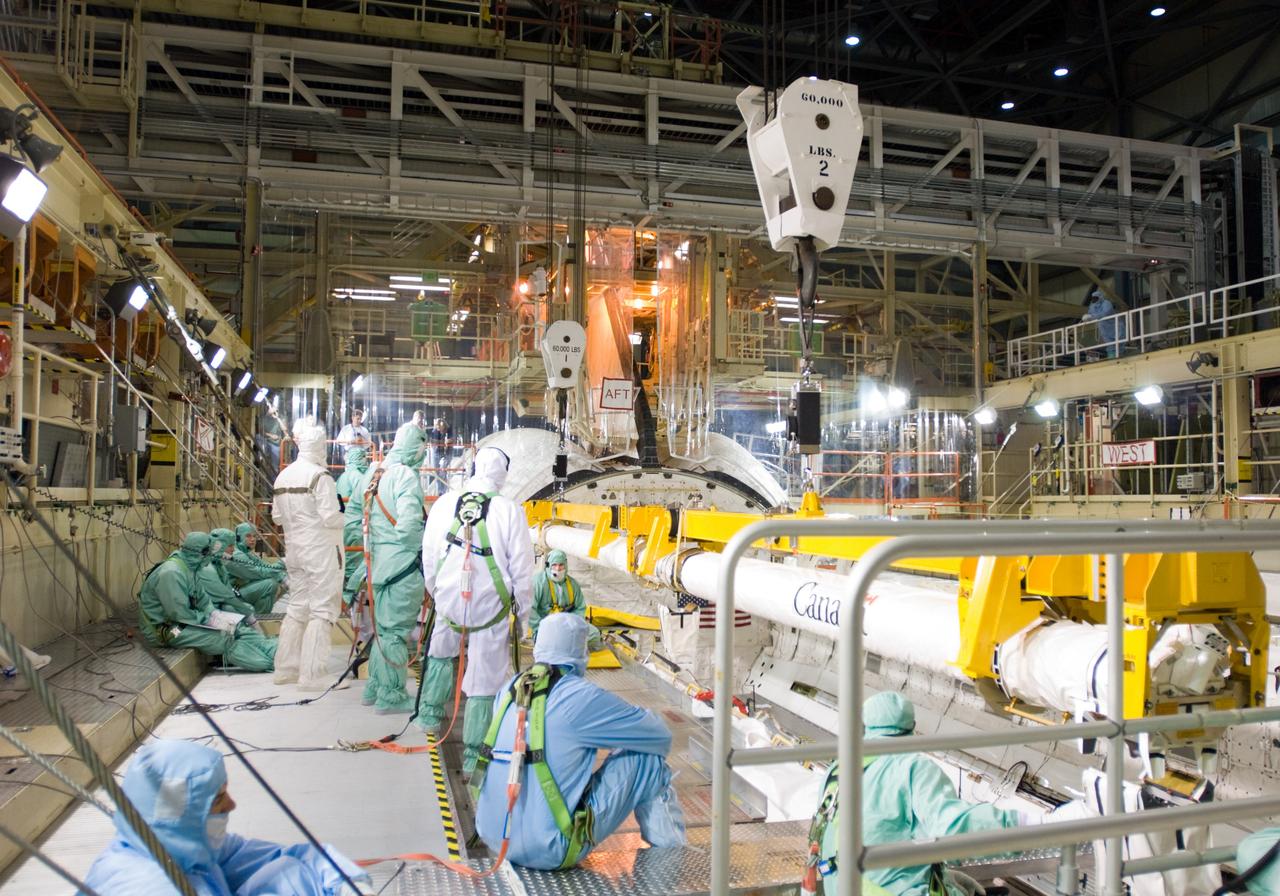
CAPE CANAVERAL, Fla. – In the Orbiter Processing Facility’s bay 3, workers install the orbiter boom sensor system in the payload bay of space shuttle Discovery to support mission STS-128. The 50-foot-long boom attaches to the shuttle arm and provides equipment to inspect the shuttle's heat shield while in space. It contains an intensified television camera (ITVC) and a laser dynamic range imager, which are mounted on a pan and tilt unit, and a laser camera system (LCS) mounted on a stationary bracket. The STS-128 flight will carry science and storage racks to the International Space Station on space shuttle Discovery. Launch of Discovery is targeted for Aug. 6. Photo credit: NASA/Jim Grossmann

CAPE CANAVERAL, Fla. – In the Orbiter Processing Facility’s bay 3, space shuttle Discovery’s payload bay is readied for installation of the orbiter boom sensor system to support mission STS-128. The 50-foot-long boom attaches to the shuttle arm and provides equipment to inspect the shuttle's heat shield while in space. It contains an intensified television camera (ITVC) and a laser dynamic range imager, which are mounted on a pan and tilt unit, and a laser camera system (LCS) mounted on a stationary bracket. The STS-128 flight will carry science and storage racks to the International Space Station on space shuttle Discovery. Launch of Discovery is targeted for Aug. 6. Photo credit: NASA/Jim Grossmann
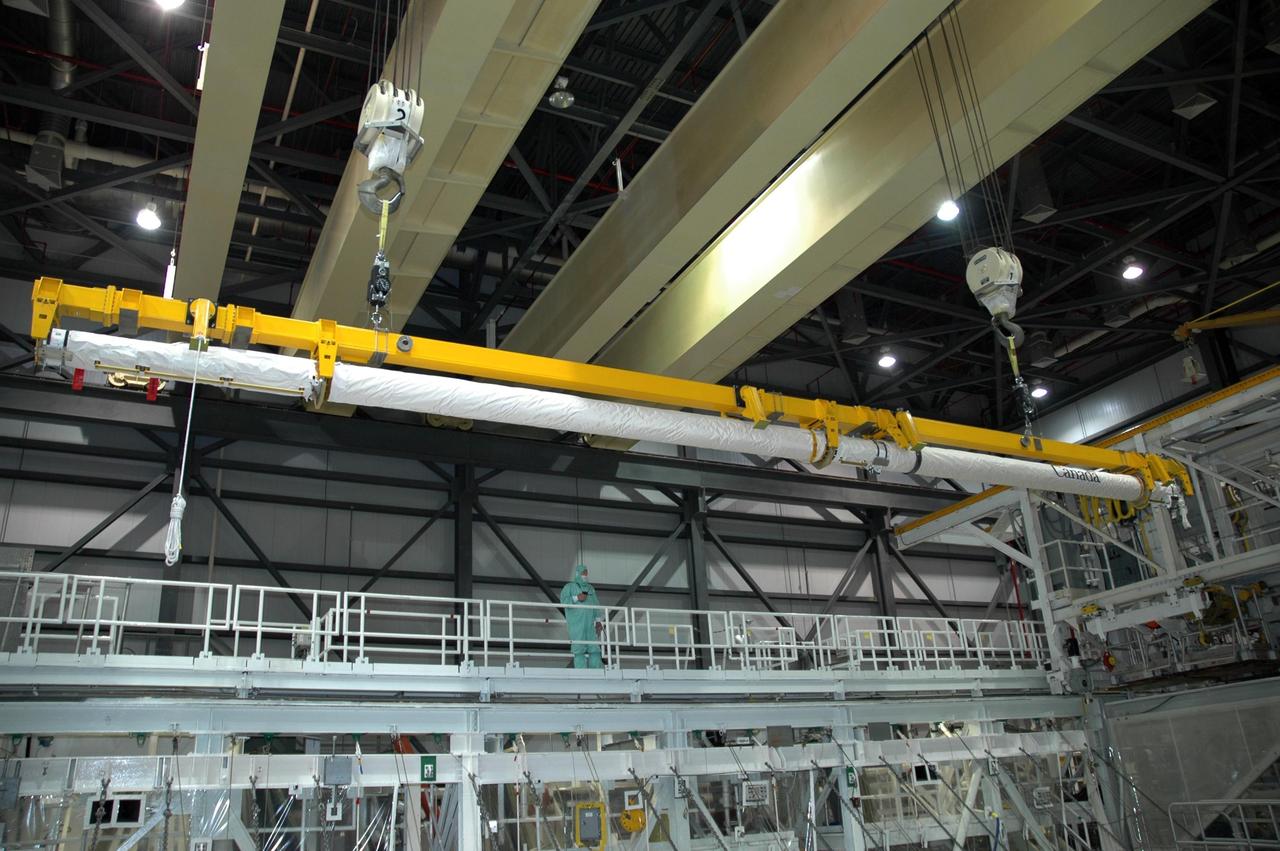
KENNEDY SPACE CENTER, FLA. - In the Orbiter Processing Facility’s bay 1, the orbiter boom sensor system is lifted by a crane for installation on the starboard side of Atlantis’s payload bay for mission STS-117. The 50-foot-long boom attaches to the shuttle arm and provides equipment to inspect the shuttle's heat shield while in space. It contains an intensified television camera (ITVC) and a laser dynamic range imager, which are mounted on a pan and tilt unit, and a laser camera system (LCS) mounted on a stationary bracket. Mission STS-117 will carry the S3/S4 arrays for installation on the International Space Station. Launch of Space Shuttle Atlantis is scheduled for March. Photo credit: NASA/Jack Pfaller
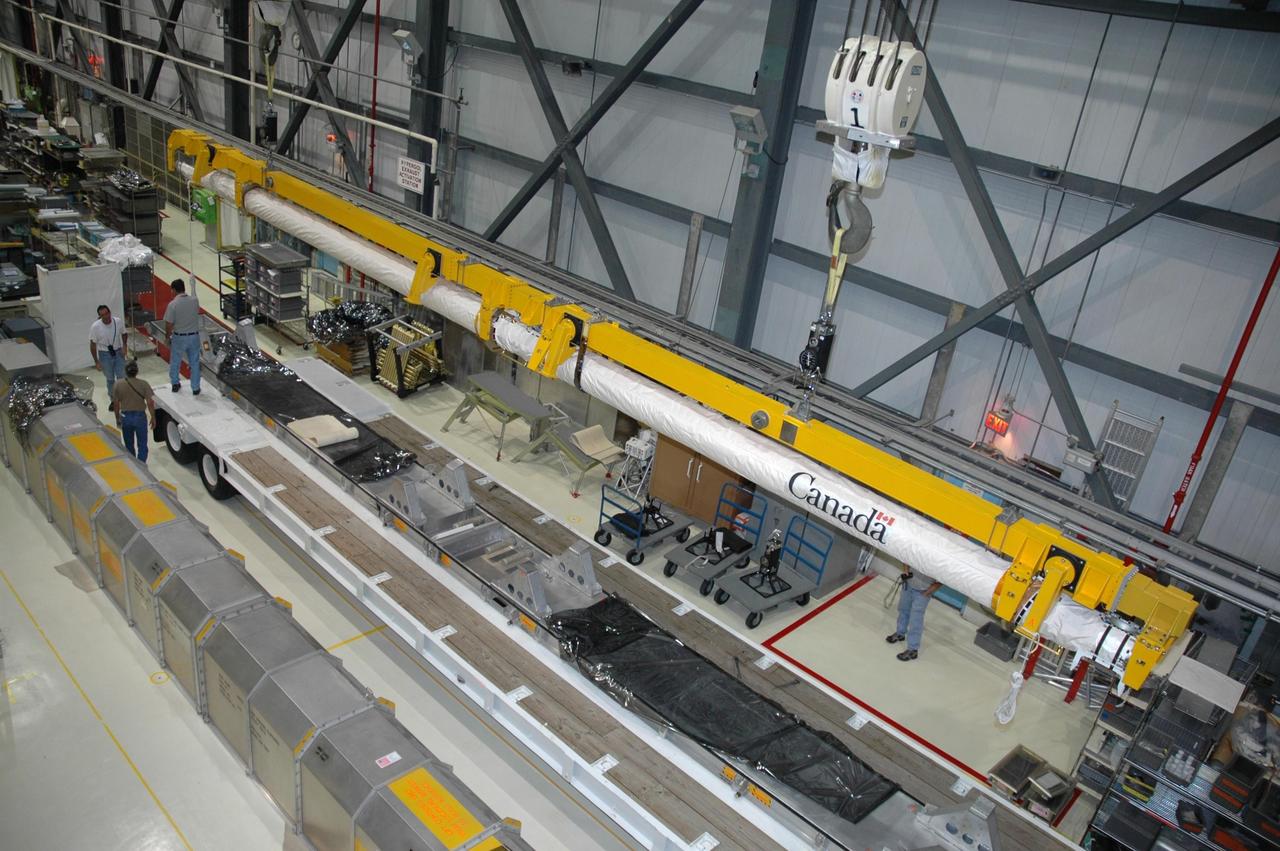
KENNEDY SPACE CENTER, FLA. - In the Orbiter Processing Facility’s bay 1, the orbiter boom sensor system is lifted by a crane for installation on the starboard side of Atlantis’s payload bay for mission STS-117. The 50-foot-long boom attaches to the shuttle arm and provides equipment to inspect the shuttle's heat shield while in space. It contains an intensified television camera (ITVC) and a laser dynamic range imager, which are mounted on a pan and tilt unit, and a laser camera system (LCS) mounted on a stationary bracket. Mission STS-117 will carry the S3/S4 arrays for installation on the International Space Station. Launch of Space Shuttle Atlantis is scheduled for March. Photo credit: NASA/Jack Pfaller
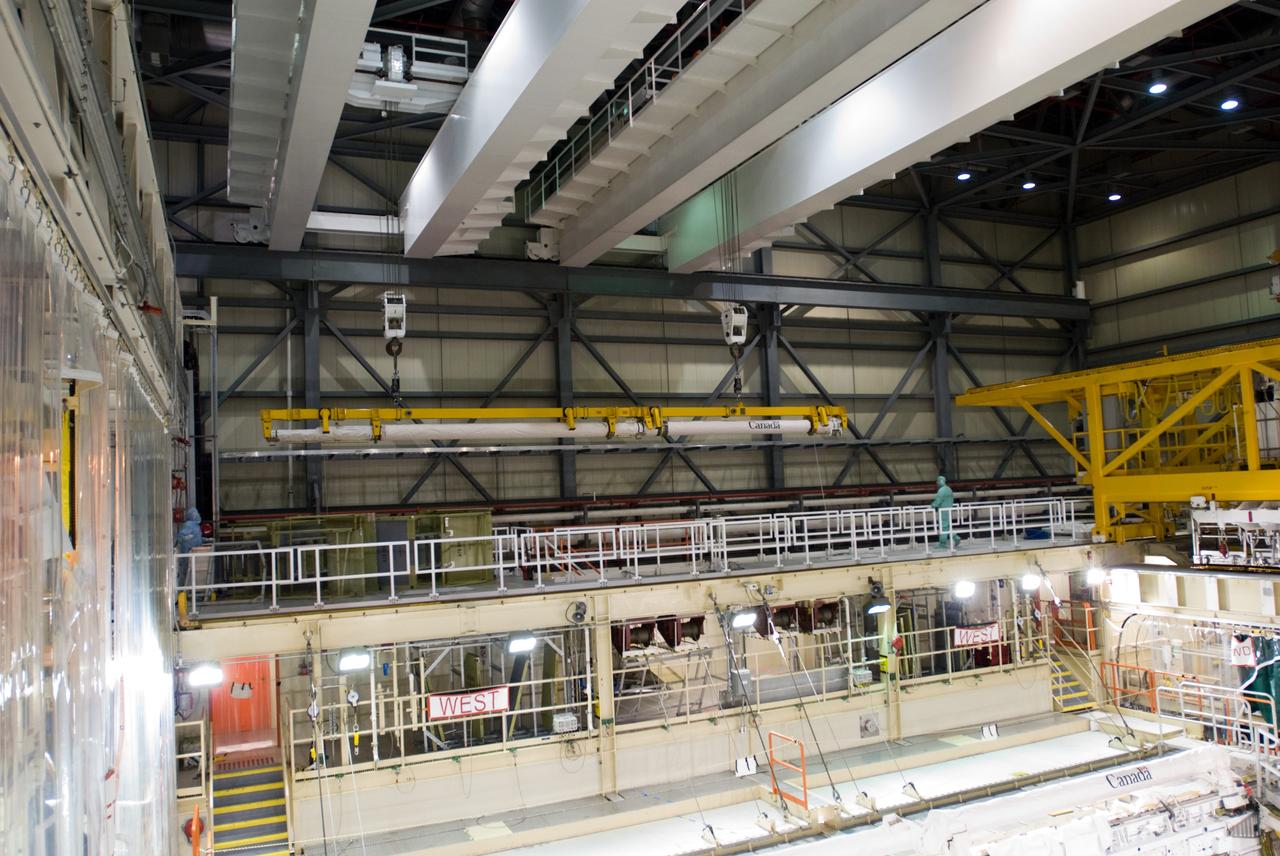
CAPE CANAVERAL, Fla. – In the Orbiter Processing Facility’s bay 3, the orbiter boom sensor system is lifted by a crane for installation in space shuttle Discovery’s payload bay for mission STS-128. The 50-foot-long boom attaches to the shuttle arm and provides equipment to inspect the shuttle's heat shield while in space. It contains an intensified television camera (ITVC) and a laser dynamic range imager, which are mounted on a pan and tilt unit, and a laser camera system (LCS) mounted on a stationary bracket. The STS-128 flight will carry science and storage racks to the International Space Station on space shuttle Discovery. Launch of Discovery is targeted for Aug. 6. Photo credit: NASA/Jim Grossmann
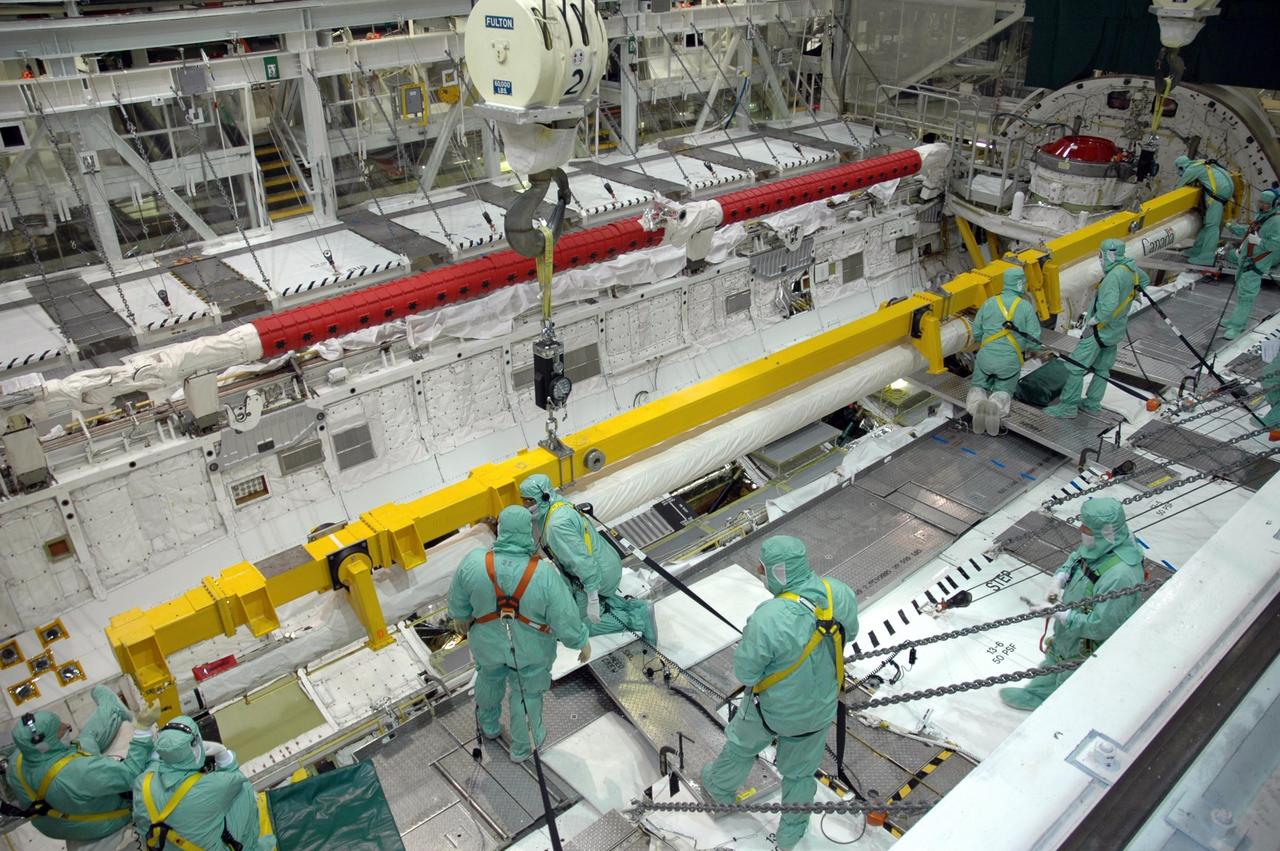
KENNEDY SPACE CENTER, FLA. - In the Orbiter Processing Facility’s bay 1, workers are ready to secure the orbiter boom sensor system on the starboard side of Atlantis’s payload bay for mission STS-117. The 50-foot-long boom attaches to the shuttle arm and provides equipment to inspect the shuttle's heat shield while in space. It contains an intensified television camera (ITVC) and a laser dynamic range imager, which are mounted on a pan and tilt unit, and a laser camera system (LCS) mounted on a stationary bracket. Mission STS-117 will carry the S3/S4 arrays for installation on the International Space Station. Launch of Space Shuttle Atlantis is scheduled for March. Photo credit: NASA/Jack Pfaller
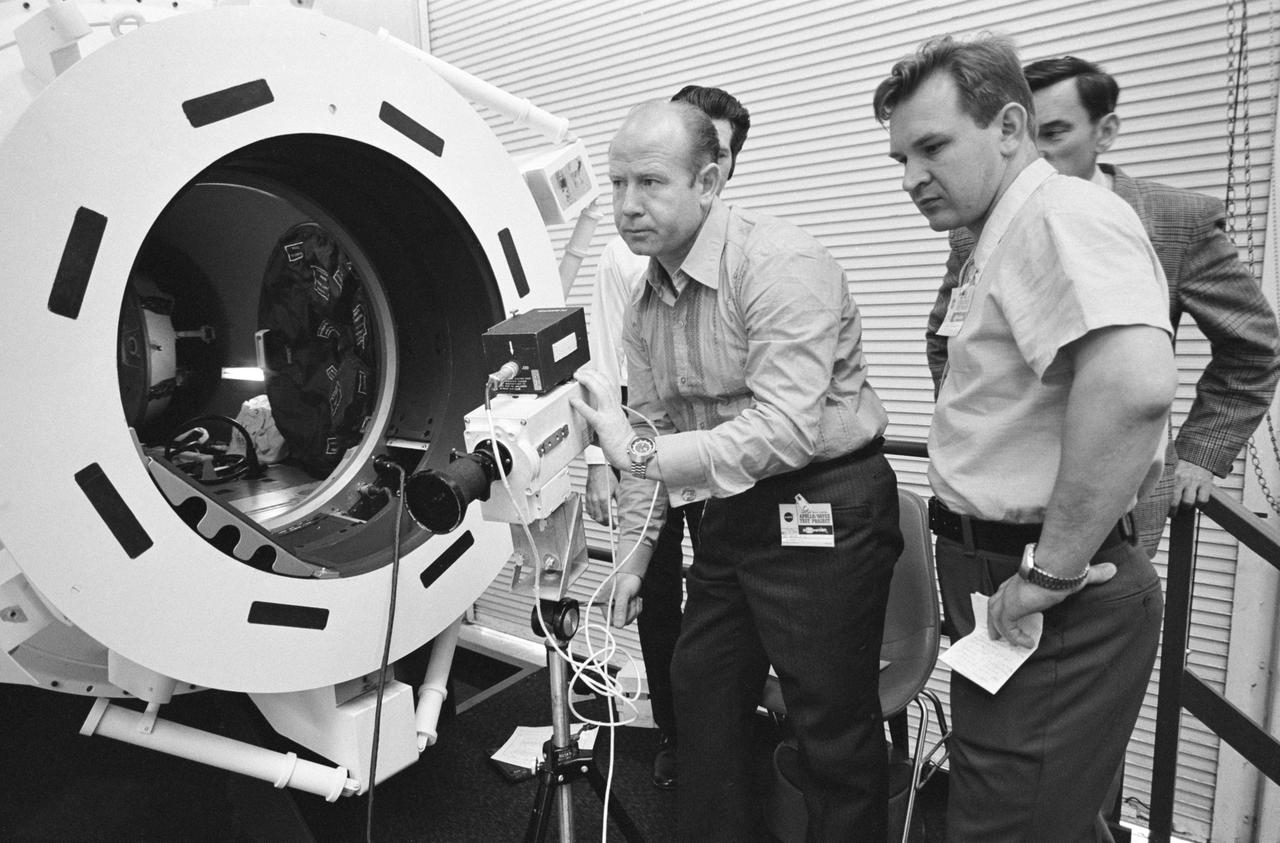
S74-20794 (23 April 1974) --- Cosmonaut Aleksey A. Leonov (center), commander of the Soviet crew of the joint U.S.-USSR Apollo-Soyuz Test Project mission, goes through familiarization training with a television camera during ASTP activity at the Johnson Space Center. Cosmonaut Valeriy N. Kubasov (right), engineer on Leonov?s crew, is looking on. An ASTP docking module mock-up is on the left. Interpreter K.S. Samofal is behind Kubasov. David Brooks, with JSC?s Crew Procedures Division, is in the left background. This phase of the ASTP communications training was conducted in JSC?s Building 35. The equipment being used in the picture is an early design of the Westinghouse TV camera.
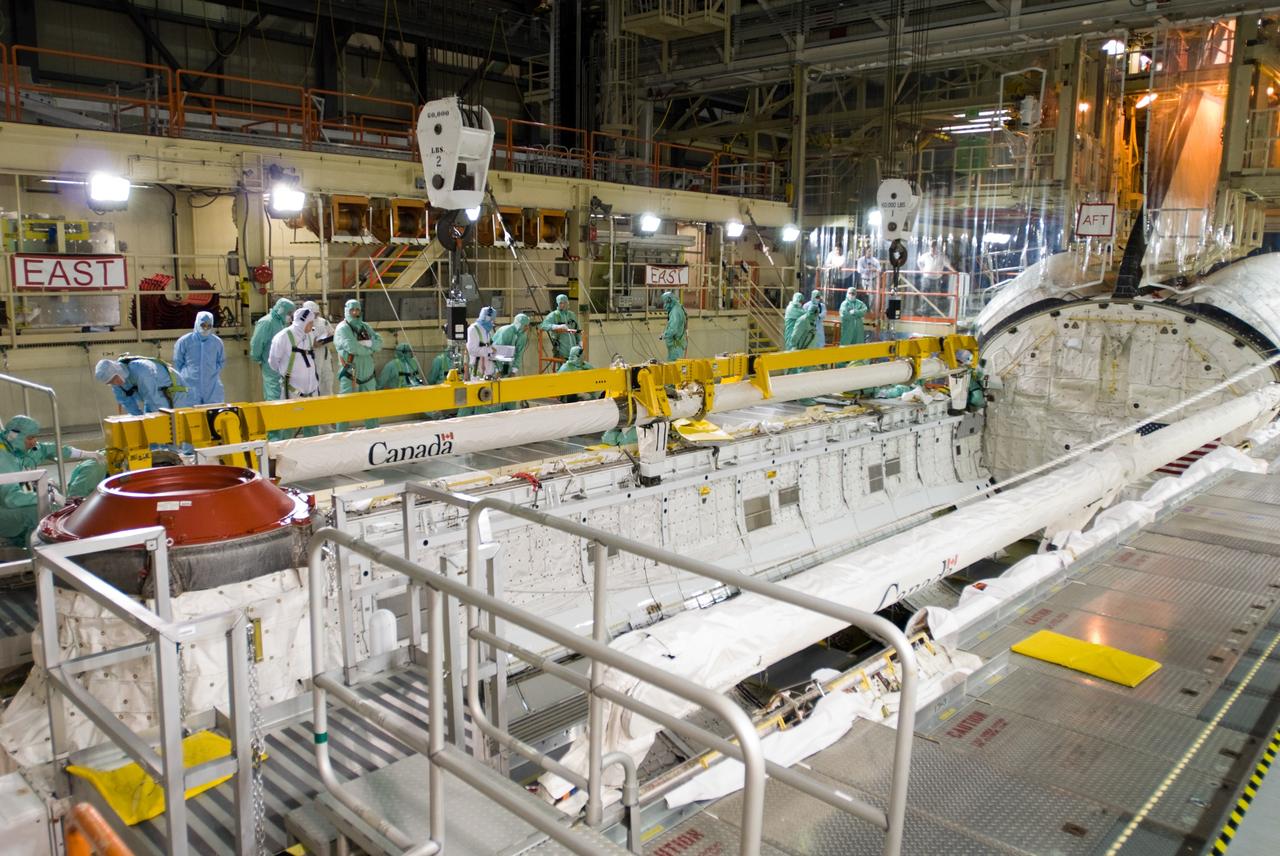
CAPE CANAVERAL, Fla. – In the Orbiter Processing Facility’s bay 3, the orbiter boom sensor system is installed in the payload bay of space shuttle Discovery to support mission STS-128. The 50-foot-long boom attaches to the shuttle arm and provides equipment to inspect the shuttle's heat shield while in space. It contains an intensified television camera (ITVC) and a laser dynamic range imager, which are mounted on a pan and tilt unit, and a laser camera system (LCS) mounted on a stationary bracket. The STS-128 flight will carry science and storage racks to the International Space Station on space shuttle Discovery. Launch of Discovery is targeted for Aug. 6. Photo credit: NASA/Jim Grossmann
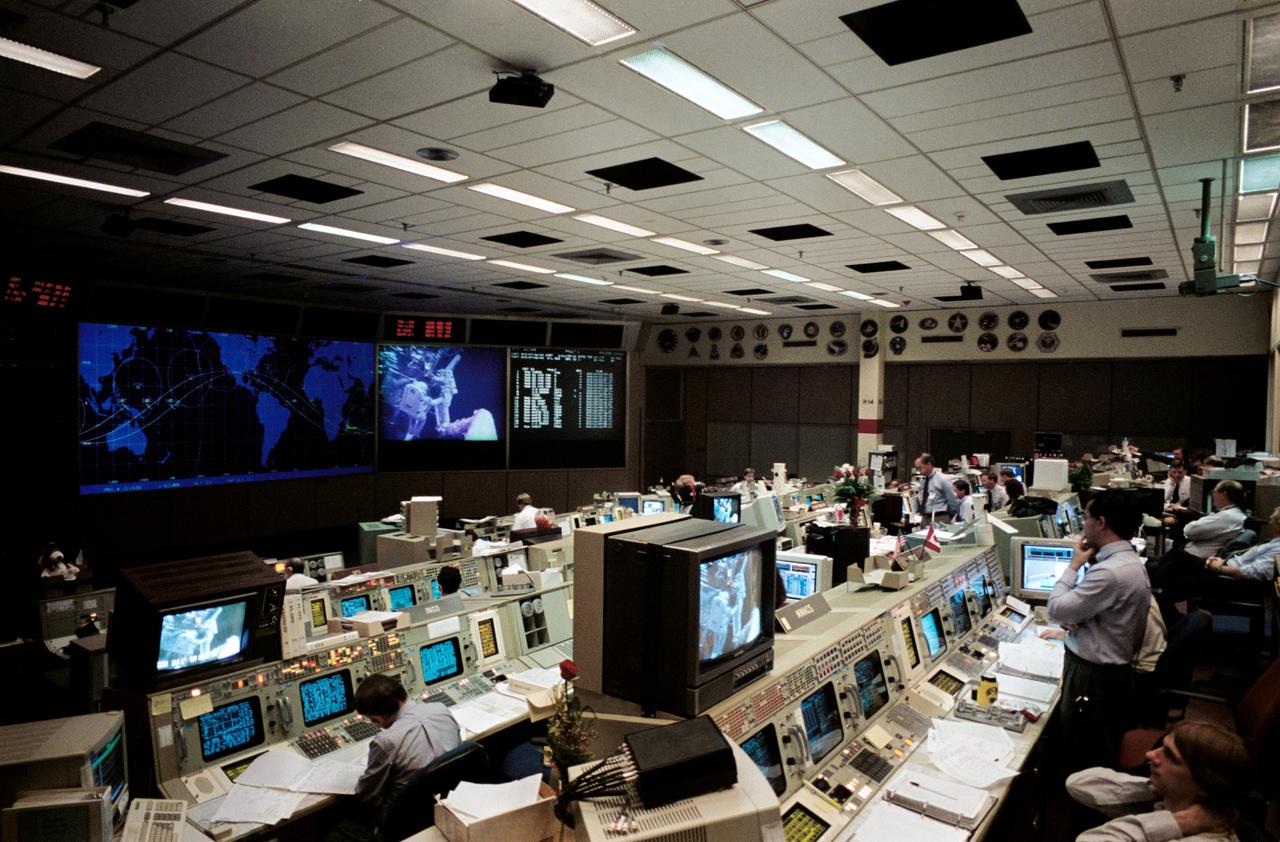
STS061-S-102 (5 Dec. 1993) --- Flight controllers Harry Black (left foreground) and Kevin McCluney (right foreground) monitor the televised activity of two space walkers during the first STS-61 extravehicular activity (EVA). Astronauts F. Story Musgrave and Jeffrey A. Hoffman were performing a variety of equipment replacements. At the Integrated Communications Officer Console (INCO) Black plays a roill in controlling the TV while McLuney's duties deal with maintenance, mechanical, arm and crew systems, meaning that they and their colleagues will be busy for the next five days. Four astronauts in alternating pairs will perform a variety of tasks on the giant telescope during that period.
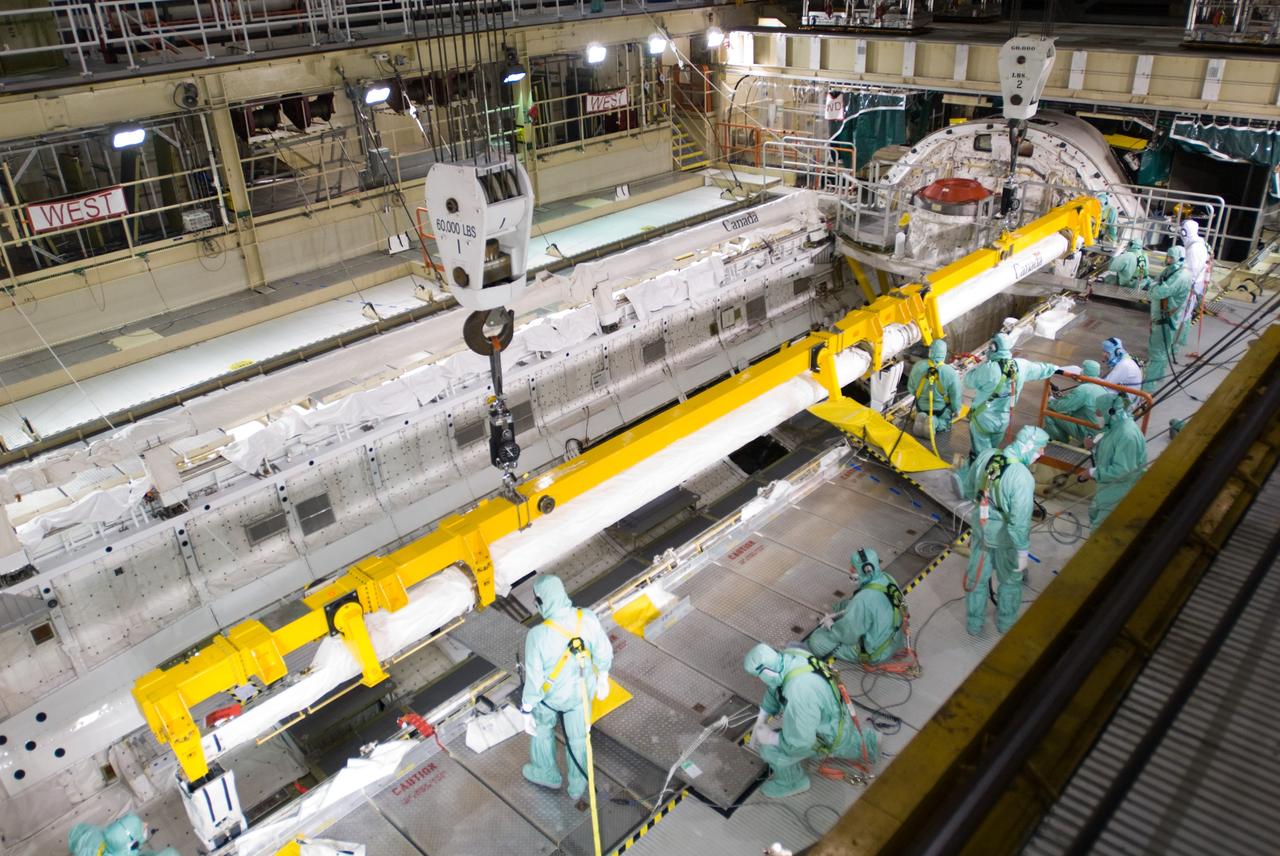
CAPE CANAVERAL, Fla. – In the Orbiter Processing Facility’s bay 3, workers prepare to install the orbiter boom sensor system in the payload bay of space shuttle Discovery to support mission STS-128. The 50-foot-long boom attaches to the shuttle arm and provides equipment to inspect the shuttle's heat shield while in space. It contains an intensified television camera (ITVC) and a laser dynamic range imager, which are mounted on a pan and tilt unit, and a laser camera system (LCS) mounted on a stationary bracket. The STS-128 flight will carry science and storage racks to the International Space Station on space shuttle Discovery. Launch of Discovery is targeted for Aug. 6. Photo credit: NASA/Jim Grossmann
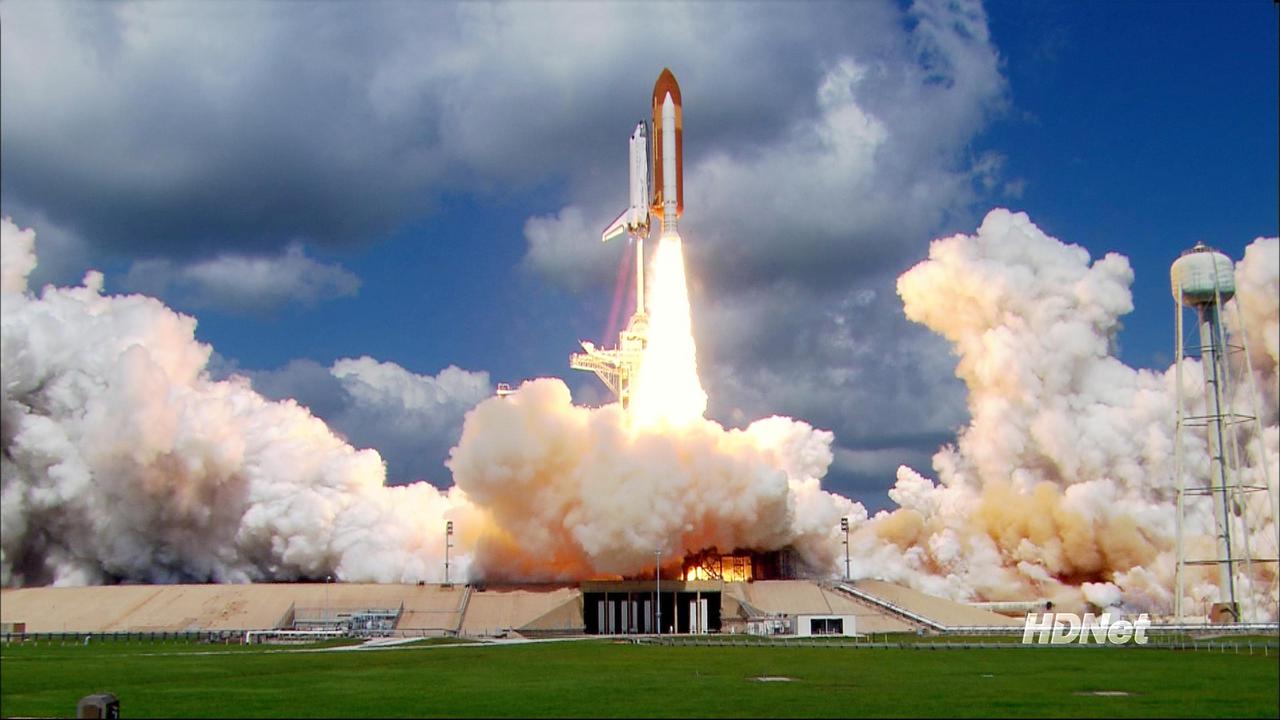
KENNEDY SPACE CENTER, FLA. - As billows of smoke and steam roll away, Space Shuttle Discovery leaps from Launch Pad 39B on the historic Return to Flight mission STS-114. Liftoff occurred at 10:39 a.m. EDT. At right is the 290-foot water tower that holds the 300,000 gallons of water that flood the pad for sound suppression. This is the 114th Space Shuttle flight and the 31st for Discovery. The 12-day mission is expected to end with touchdown at the Shuttle Landing Facility on Aug. 7. On this mission to the International Space Station the crew will perform inspections on-orbit for the first time of all of the Reinforced Carbon-Carbon (RCC) panels on the leading edge of the wings and the Thermal Protection System tiles using the new Canadian-built Orbiter Boom Sensor System and the data from 176 impact and temperature sensors. Mission Specialists will also practice repair techniques on RCC and tile samples during a spacewalk in the payload bay. During two additional spacewalks, the crew will install the External Stowage Platform-2, equipped with spare part assemblies, and a replacement Control Moment Gyroscope contained in the Lightweight Multi-Purpose Experiment Support Structure. This photo is a freeze frame provided by HDNet, a national television network broadcasting high-definition television, located in Denver, Colo.
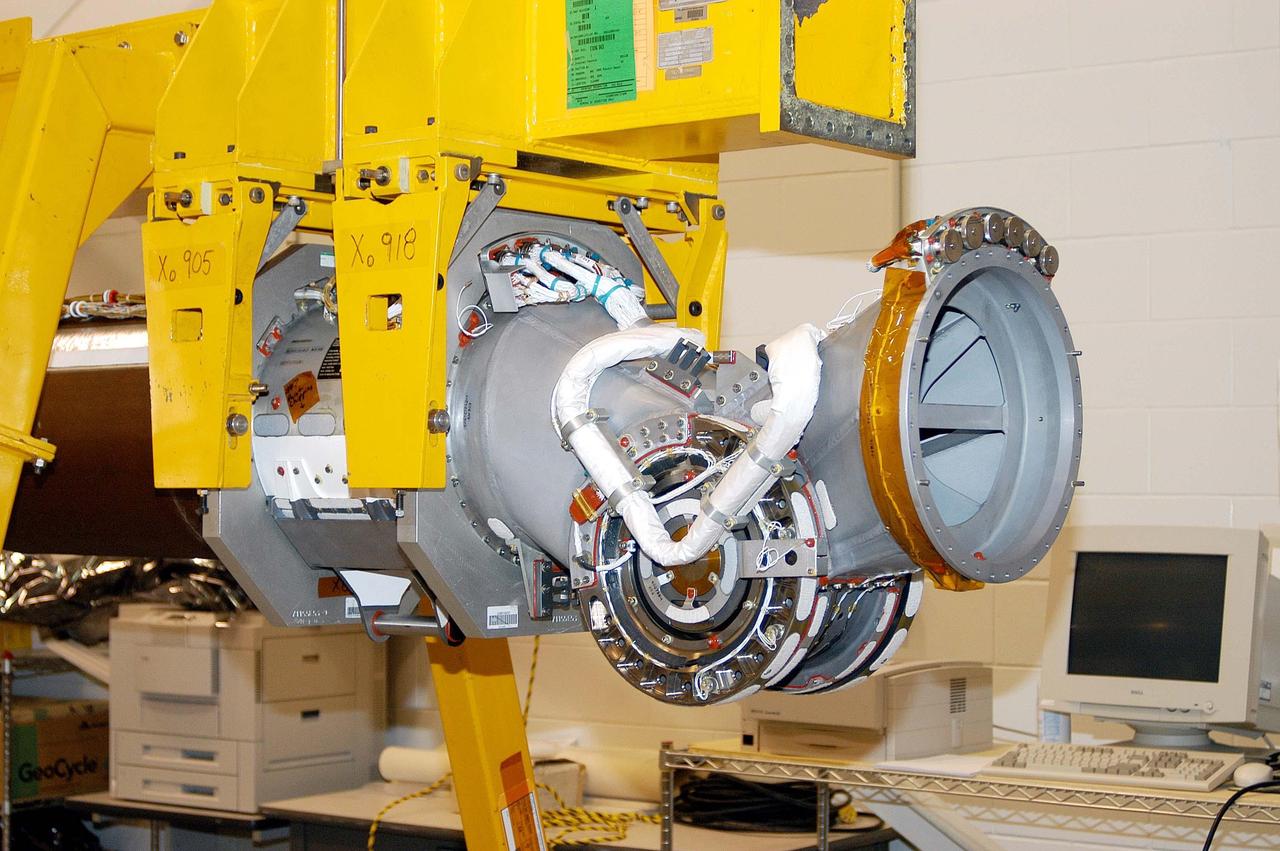
KENNEDY SPACE CENTER, FLA. - The Remote Manipulator System (RMS), also known as the Canadian robotic arm, for the orbiter Discovery has arrived at KSC’s Vehicle Assembly Building Lab. The part seen on the end is one of the joints that allow the basic structure of the arm to maneuver similar to a human arm. The RMS is used to deploy and retrieve payloads, provide a mobile extension ladder or foot restraints for crew members during extravehicular activities; and to aid the flight crew members in viewing surfaces of the orbiter or payloads through a television camera on the RMS. The arm The RMS is used to deploy and retrieve payloads, provide a mobile extension ladder or foot restraints for crew members during extravehicular activities; and to aid the flight crew members in viewing surfaces of the orbiter or payloads through a television camera on the RMS. The arm is also serving as the base for the new Orbiter Boom Sensor System (OBSS), one of the safety measures for Return to Flight, equipping the Shuttle with cameras and laser systems to inspect the Shuttle’s Thermal Protection System while in space. Discovery is scheduled for a launch planning window of March 2005 on mission STS-114.
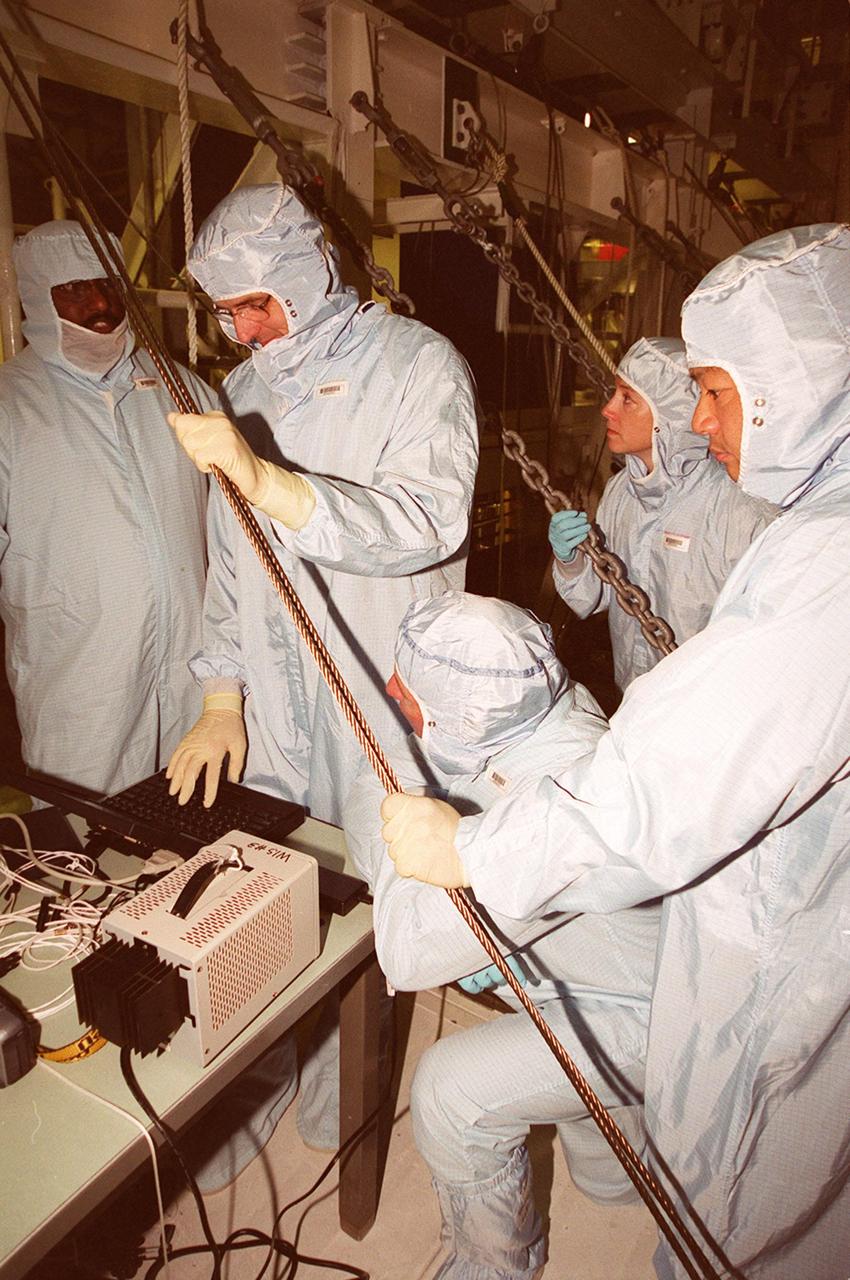
KENNEDY SPACE CENTER, FLA. -- In the Orbiter Processing Facility bay 1, members of the STS-92 crew examine equipment that will be part of their mission to the International Space Station (ISS). The fourth U.S. flight to the ISS, the mission payload includes the Integrated Truss Structure Z1, an early exterior framework to allow the first U.S. solar arrays on a future flight to be temporarily installed on Unity for early power; Ku-band communication to support early science capability and U.S. television; and PMA-3 to provide a Shuttle docking port for solar array installation on the sixth ISS flight and Lab installation on the seventh ISS flight. The crew comprises Mission Commander Brian Duffy, Pilot Pamela Melroy, and Mission Specialists Koichi Wakata, Leroy Chiao, Peter "Jeff" Wisoff, Michael Lopez-Alegria, and William McArthur. Launch of STS-92 is scheduled for Sept. 21, 2000. Wakata is with the National Space Development Agency of Japan
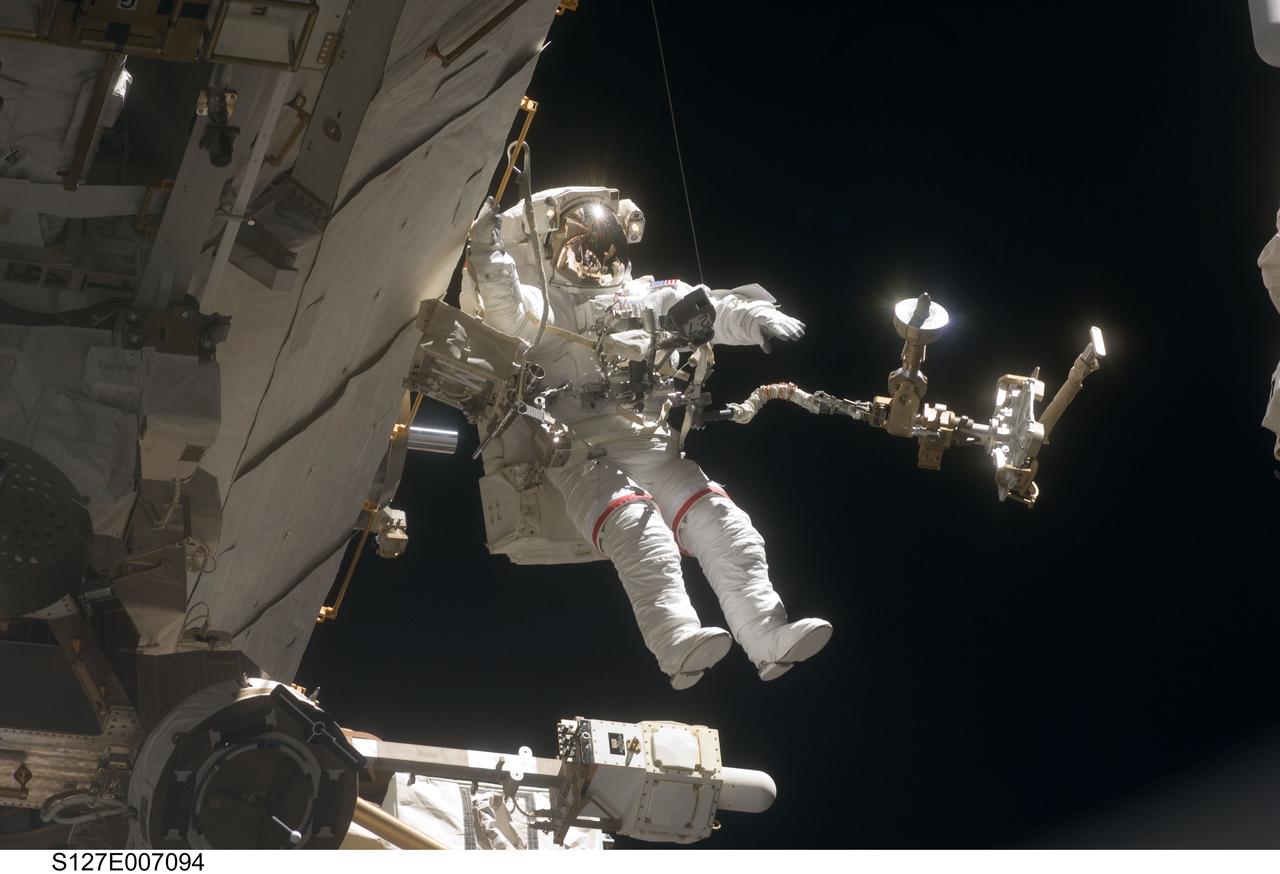
S127-E-007094 (20 July 2009) --- This is one of a series of digital still images showing astronaut Dave Wolf performing his second spacewalk and the Endeavour’s second also of the scheduled five overall in a little over a week’s time to continue work on the International Space Station. The equipment floating in front of Wolf is tethered to his spacesuit. Astronauts Wolf and Tom Marshburn (out of frame), both mission specialists, successfully transferred a spare KU-band antenna to long-term storage on the space station, along with a backup coolant system pump module and a spare drive motor for the station's robot arm transporter. Installation of a television camera on the Japanese Exposed Facility experiment platform was deferred to a later spacewalk.
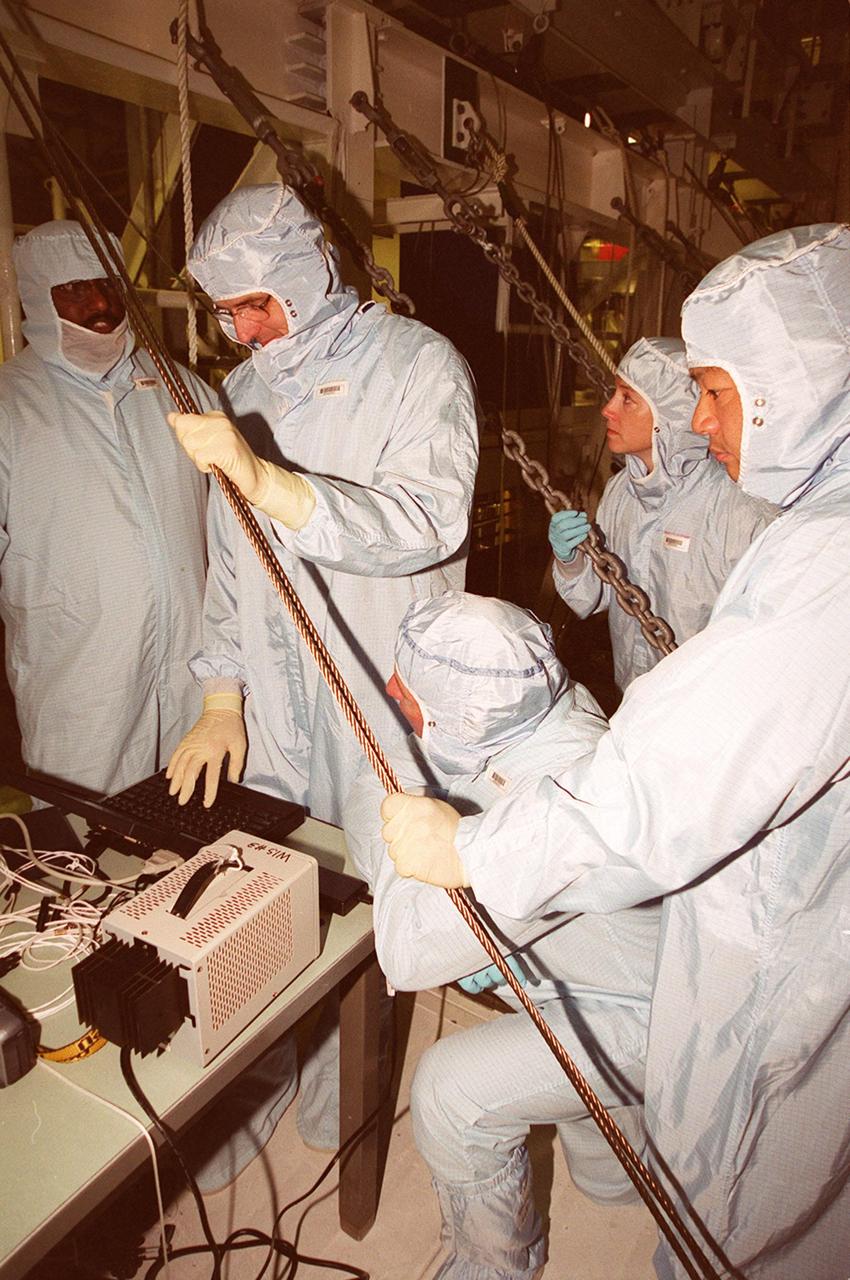
KENNEDY SPACE CENTER, FLA. -- In the Orbiter Processing Facility bay 1, members of the STS-92 crew examine equipment that will be part of their mission to the International Space Station (ISS). The fourth U.S. flight to the ISS, the mission payload includes the Integrated Truss Structure Z1, an early exterior framework to allow the first U.S. solar arrays on a future flight to be temporarily installed on Unity for early power; Ku-band communication to support early science capability and U.S. television; and PMA-3 to provide a Shuttle docking port for solar array installation on the sixth ISS flight and Lab installation on the seventh ISS flight. The crew comprises Mission Commander Brian Duffy, Pilot Pamela Melroy, and Mission Specialists Koichi Wakata, Leroy Chiao, Peter "Jeff" Wisoff, Michael Lopez-Alegria, and William McArthur. Launch of STS-92 is scheduled for Sept. 21, 2000. Wakata is with the National Space Development Agency of Japan
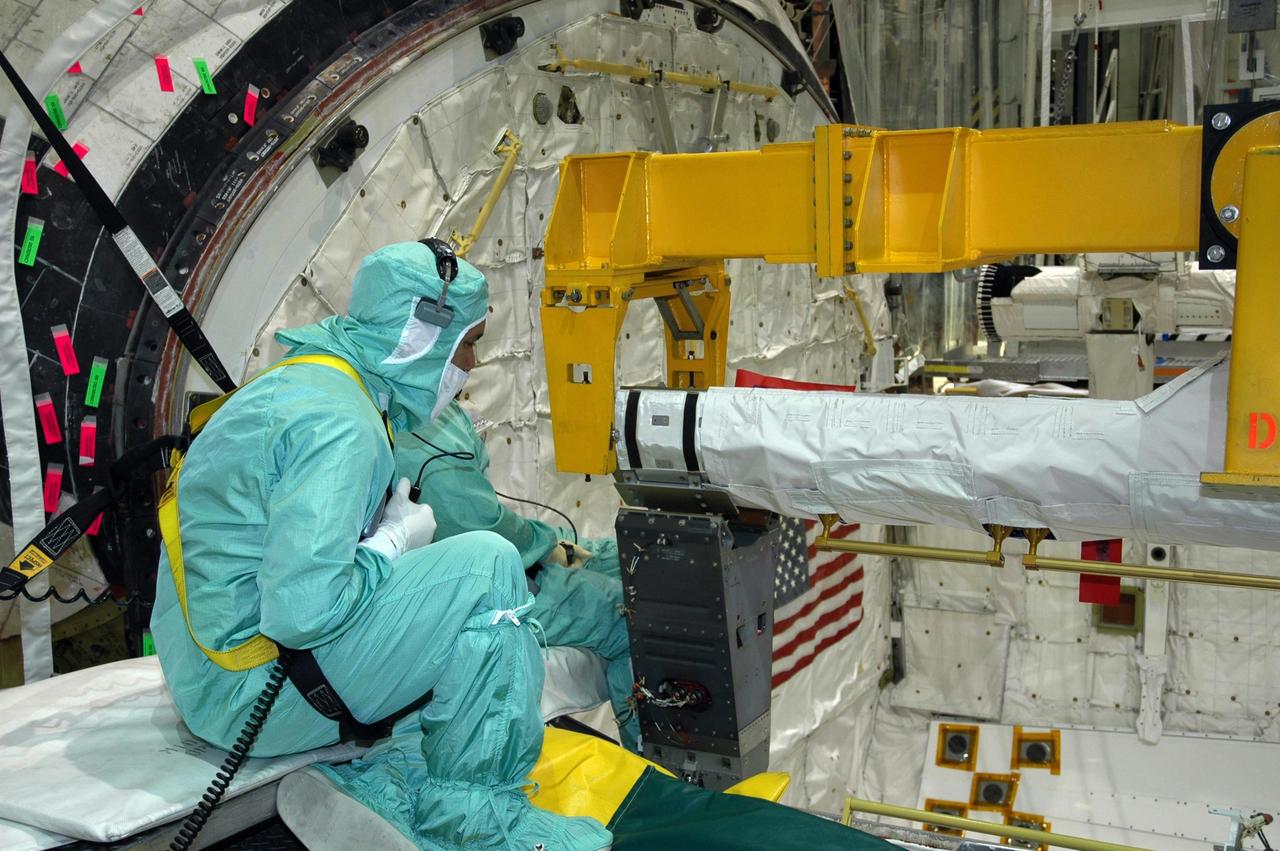
KENNEDY SPACE CENTER, FLA. - In the Orbiter Processing Facility’s bay 1, workers watch closely as the orbiter boom sensor system is lowered into place on the starboard side of Atlantis’s payload bay for mission STS-117. The 50-foot-long boom attaches to the shuttle arm and provides equipment to inspect the shuttle's heat shield while in space. It contains an intensified television camera (ITVC) and a laser dynamic range imager, which are mounted on a pan and tilt unit, and a laser camera system (LCS) mounted on a stationary bracket. Mission STS-117 will carry the S3/S4 arrays for installation on the International Space Station. Launch of Space Shuttle Atlantis is scheduled for March. Photo credit: NASA/Jack Pfaller
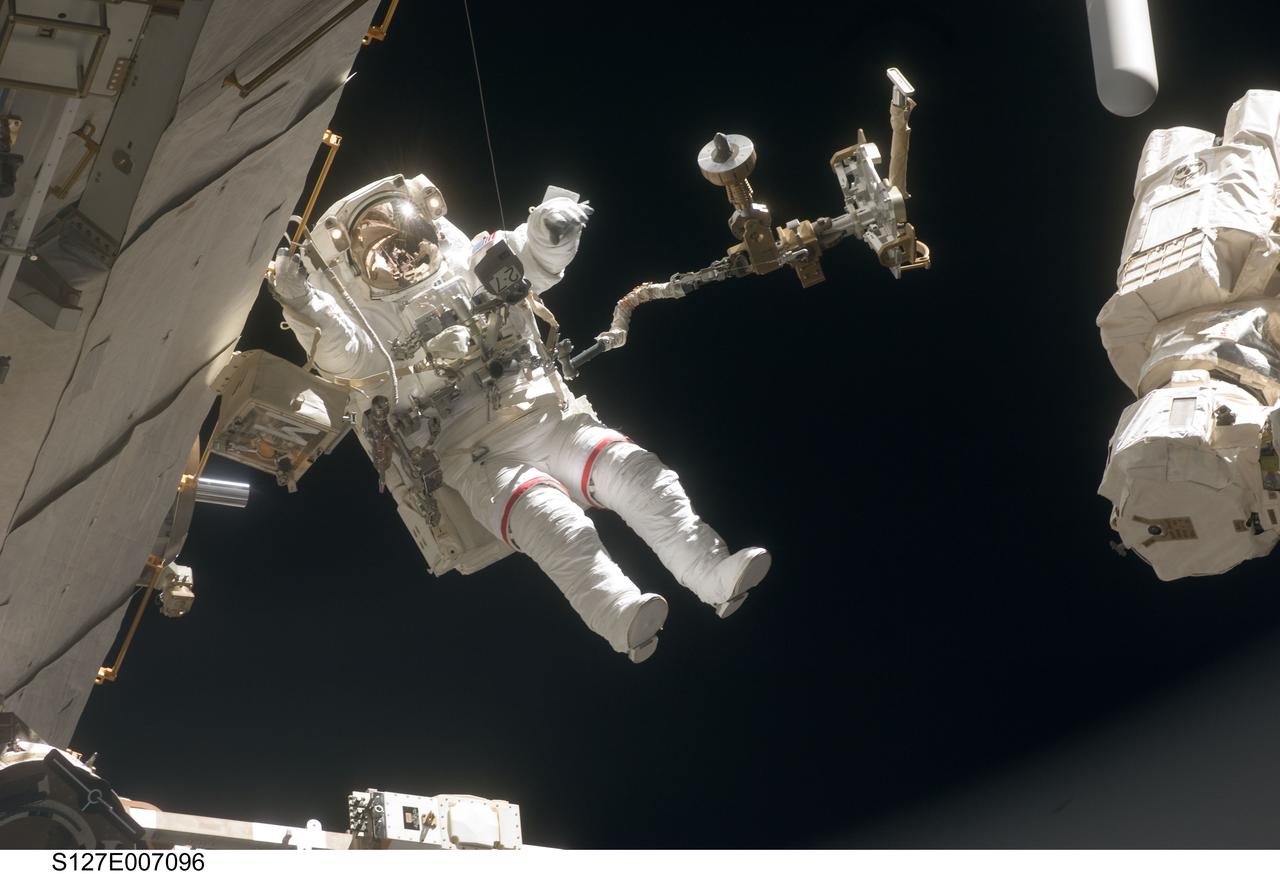
S127-E-007096 (20 July 2009) --- This is one of a series of digital still images showing astronaut Dave Wolf performing his second spacewalk and the Endeavour’s second also of the scheduled five overall in a little over a week’s time to continue work on the International Space Station. The equipment floating in front of Wolf is tethered to his spacesuit. Astronauts Wolf and Tom Marshburn (out of frame), both mission specialists, successfully transferred a spare KU-band antenna to long-term storage on the space station, along with a backup coolant system pump module and a spare drive motor for the station's robot arm transporter. Installation of a television camera on the Japanese Exposed Facility experiment platform was deferred to a later spacewalk.
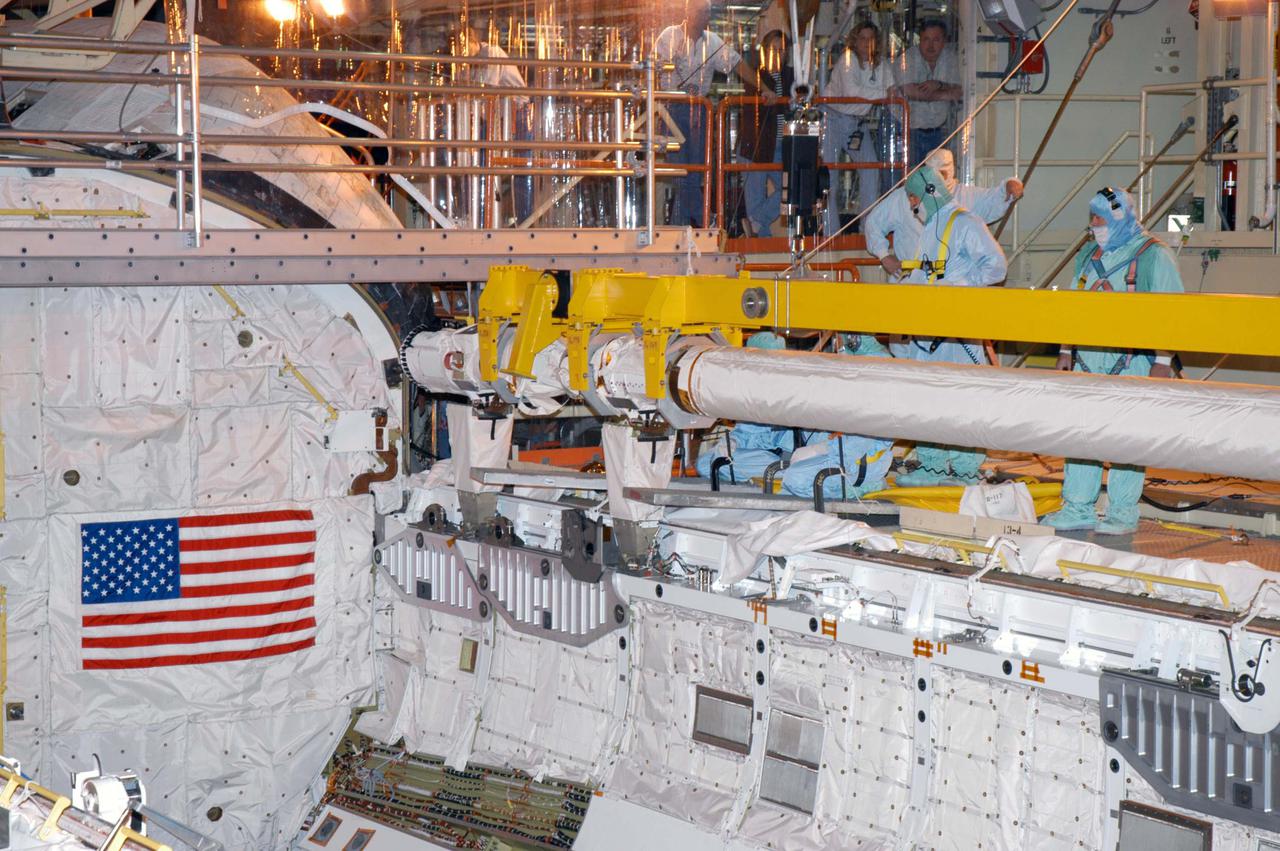
KENNEDY SPACE CENTER, FLA. - In the Orbiter Processing Facility, the Remote Manipulator System (RMS), also known as the Canadian robotic arm, is being installed in Discovery’s payload bay. The RMS is used to deploy and retrieve payloads, provide a mobile extension ladder or foot restraints for crew members during extravehicular activities; and to aid the flight crew members in viewing surfaces of the orbiter or payloads through a television camera on the RMS. The arm is also serving as the base for the new Orbiter Boom Sensor System (OBSS), one of the safety measures for Return to Flight, equipping the Shuttle with cameras and laser systems to inspect the Shuttle’s Thermal Protection System while in space. Discovery is scheduled for a launch planning window of May 2005 on Return to Flight mission STS-114.
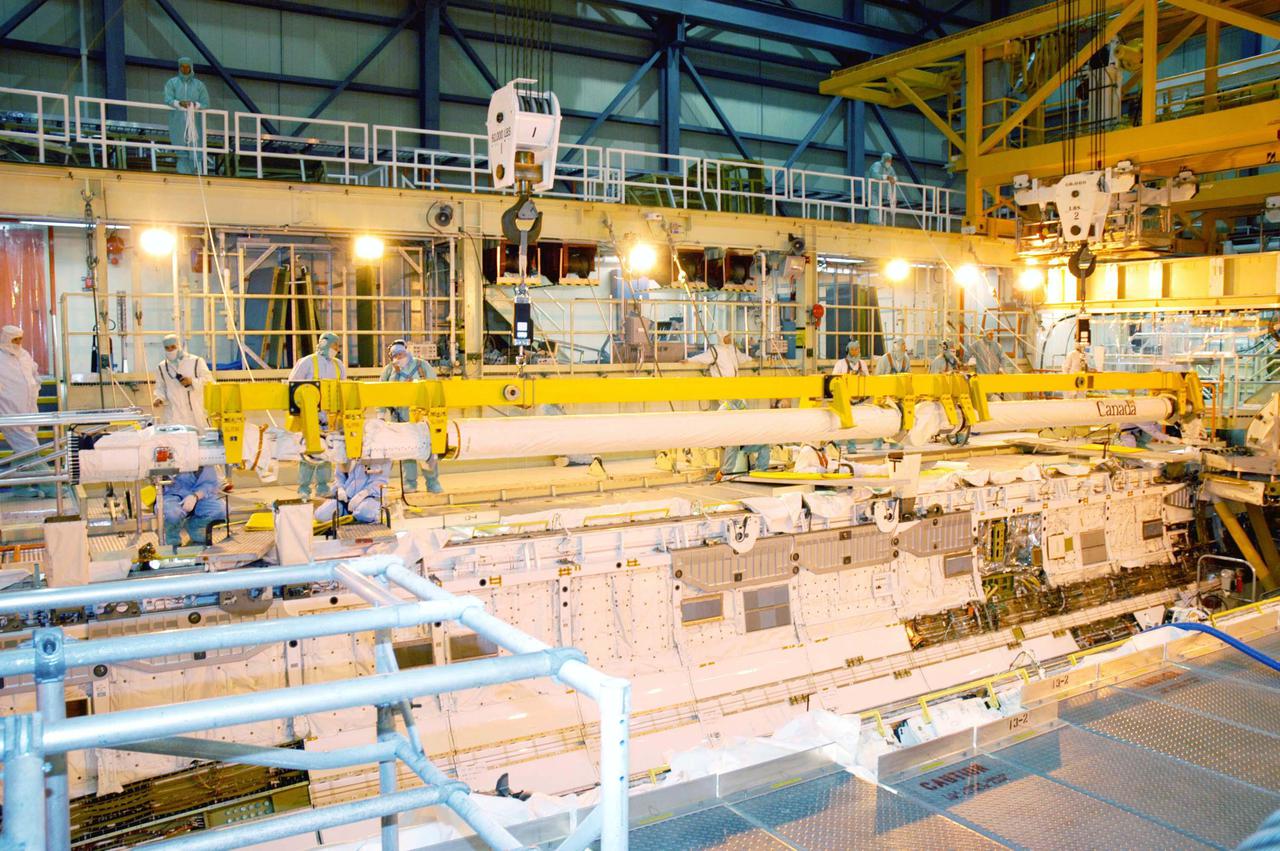
KENNEDY SPACE CENTER, FLA. - In the Orbiter Processing Facility, the Remote Manipulator System (RMS), also known as the Canadian robotic arm, is moved toward Discovery’s payload bay for installation. The RMS is used to deploy and retrieve payloads, provide a mobile extension ladder or foot restraints for crew members during extravehicular activities; and to aid the flight crew members in viewing surfaces of the orbiter or payloads through a television camera on the RMS. The arm is also serving as the base for the new Orbiter Boom Sensor System (OBSS), one of the safety measures for Return to Flight, equipping the Shuttle with cameras and laser systems to inspect the Shuttle’s Thermal Protection System while in space. Discovery is scheduled for a launch planning window of May 2005 on Return to Flight mission STS-114.
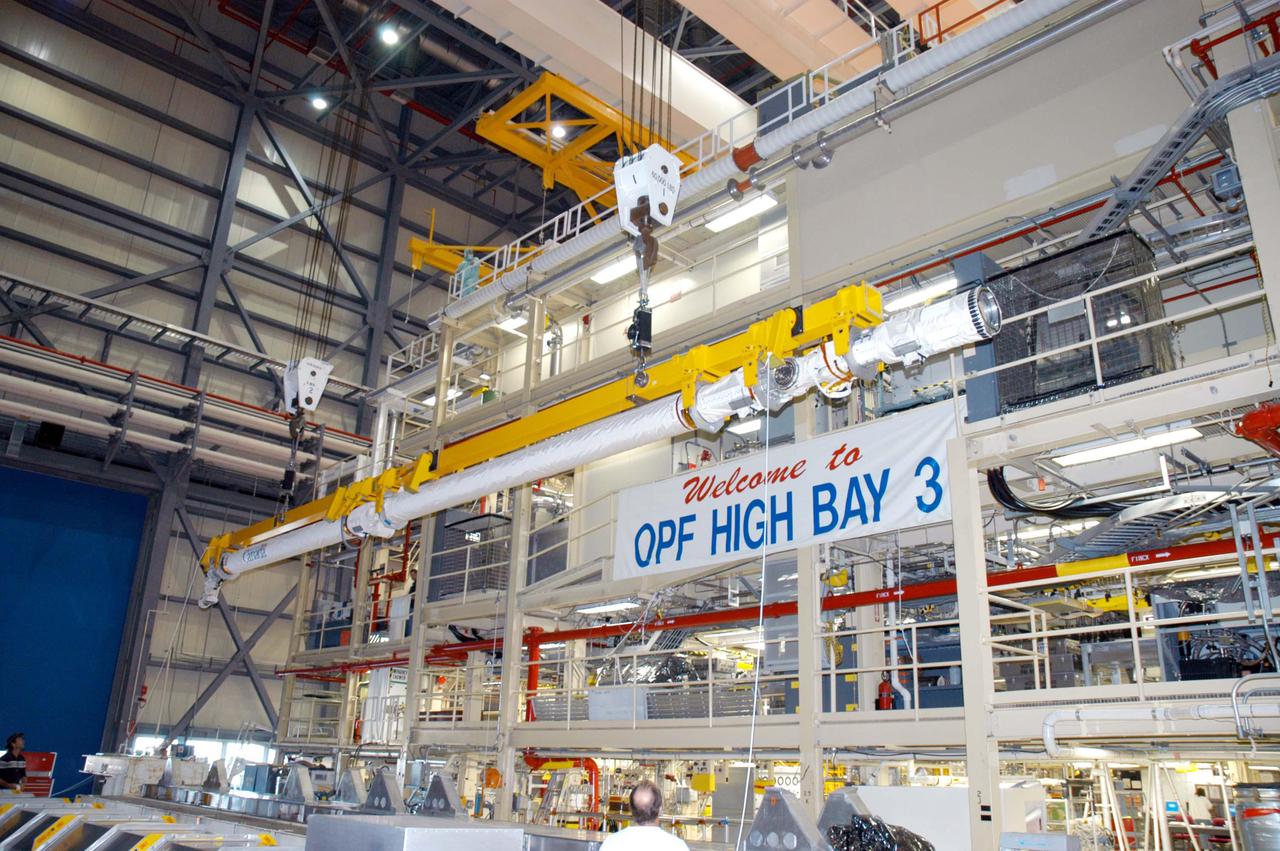
KENNEDY SPACE CENTER, FLA. - The Remote Manipulator System (RMS), also known as the Canadian robotic arm, is moved in the Orbiter Processing Facility for installation in Discovery’s payload bay. The RMS is used to deploy and retrieve payloads, provide a mobile extension ladder or foot restraints for crew members during extravehicular activities; and to aid the flight crew members in viewing surfaces of the orbiter or payloads through a television camera on the RMS. The arm is also serving as the base for the new Orbiter Boom Sensor System (OBSS), one of the safety measures for Return to Flight, equipping the Shuttle with cameras and laser systems to inspect the Shuttle’s Thermal Protection System while in space. Discovery is scheduled for a launch planning window of May 2005 on Return to Flight mission STS-114.
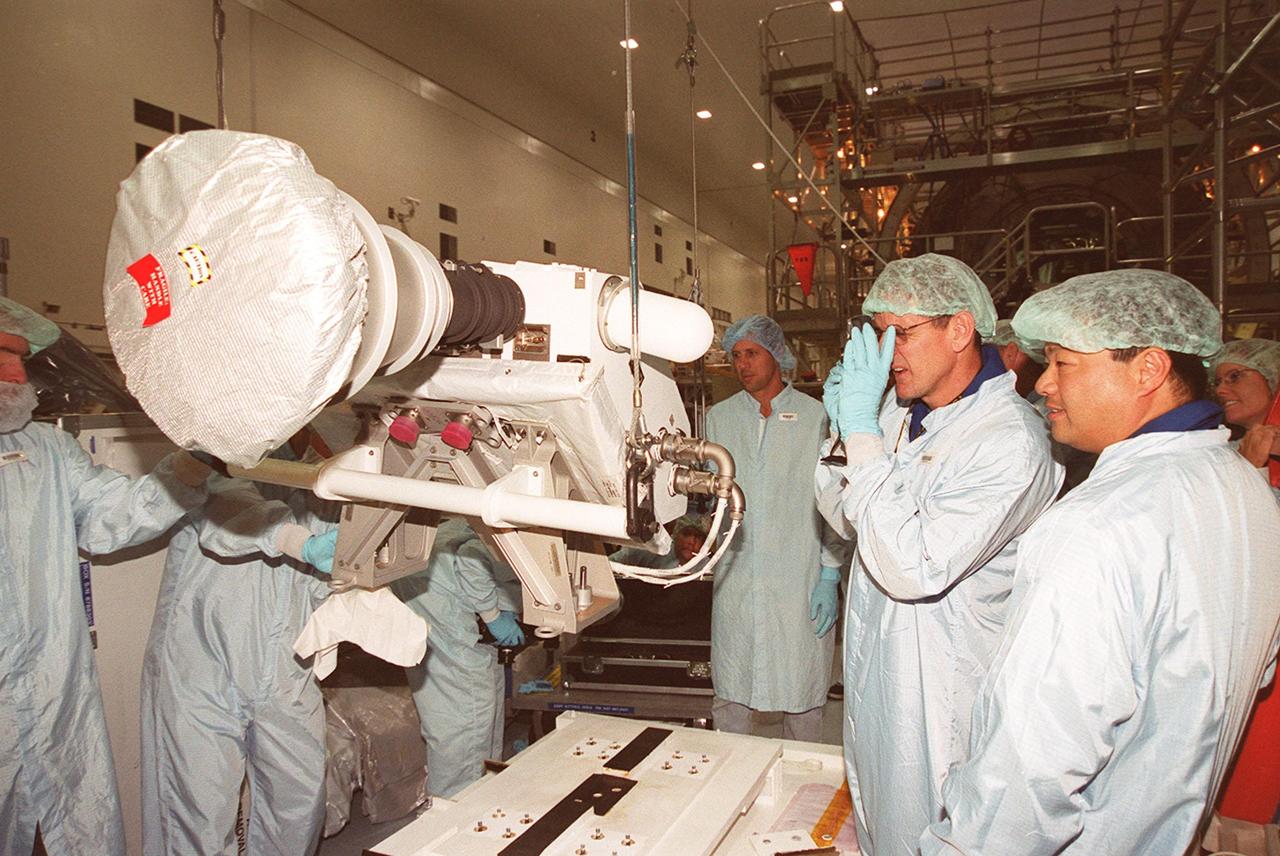
KENNEDY SPACE CENTER, FLA. -- In the Space Station Processing Facility, members of the STS-92 crew examine equipment that will be part of their mission to the International Space Station (ISS). The fourth U.S. flight to the ISS, the mission payload includes the Integrated Truss Structure Z1, an early exterior framework to allow the first U.S. solar arrays on a future flight to be temporarily installed on Unity for early power; Ku-band communication to support early science capability and U.S. television; and PMA-3 to provide a Shuttle docking port for solar array installation on the sixth ISS flight and Lab installation on the seventh ISS flight. The crew comprises Mission Commander Brian Duffy, Pilot Pamela Melroy, and Mission Specialists Koichi Wakata, Leroy Chiao, Peter "Jeff" Wisoff, Michael Lopez-Alegria, and William McArthur. Launch of STS-92 is scheduled for Sept. 21, 2000. Wakata is with the National Space Development Agency of Japan.

AS11-40-5948 (20 July 1969) --- Astronaut Edwin E. Aldrin Jr., lunar module pilot, is photographed during the Apollo 11 extravehicular activity (EVA) on the moon. He has just deployed the Early Apollo Scientific Experiments Package (EASEP). This is a good view of the deployed equipment. In the foreground is the Passive Seismic Experiment Package (PSEP); beyond it is the Laser Ranging Retro-Reflector (LR-3); in the center background is the United States flag; in the left background is the black and white lunar surface television camera; in the far right background is the Lunar Module (LM). Astronaut Neil A. Armstrong, commander, took this picture with a 70mm lunar surface camera. While astronauts Armstrong and Aldrin descended in the Lunar Module (LM) "Eagle" to explore the Sea of Tranquility region of the moon, astronaut Michael Collins, command module pilot, remained with the Command and Service Modules (CSM) "Columbia" in lunar orbit.
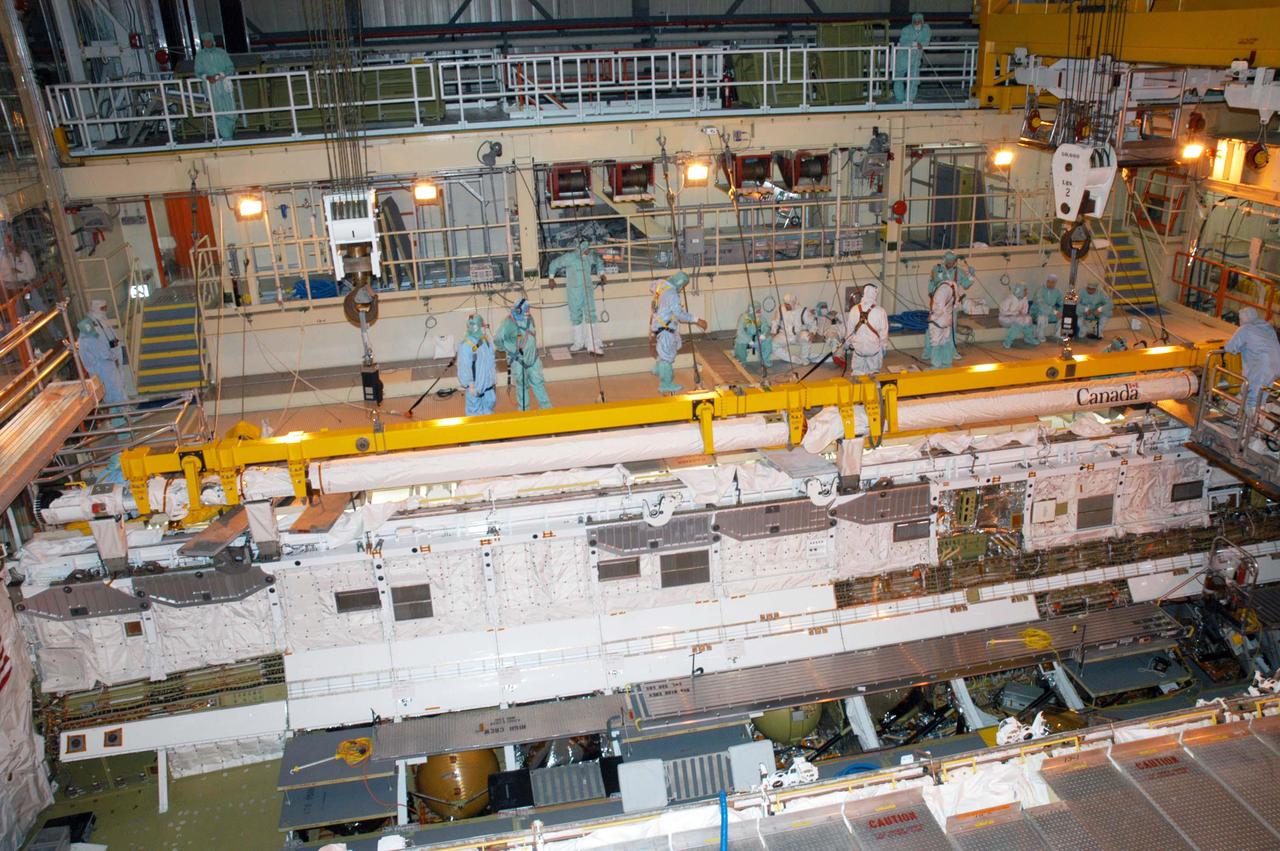
KENNEDY SPACE CENTER, FLA. - Technicians in the Orbiter Processing Facility work to install the Remote Manipulator System (RMS), also known as the Canadian robotic arm, in Discovery’s payload bay. The RMS is used to deploy and retrieve payloads, provide a mobile extension ladder or foot restraints for crew members during extravehicular activities; and to aid the flight crew members in viewing surfaces of the orbiter or payloads through a television camera on the RMS. The arm is also serving as the base for the new Orbiter Boom Sensor System (OBSS), one of the safety measures for Return to Flight, equipping the Shuttle with cameras and laser systems to inspect the Shuttle’s Thermal Protection System while in space. Discovery is scheduled for a launch planning window of May 2005 on Return to Flight mission STS-114.
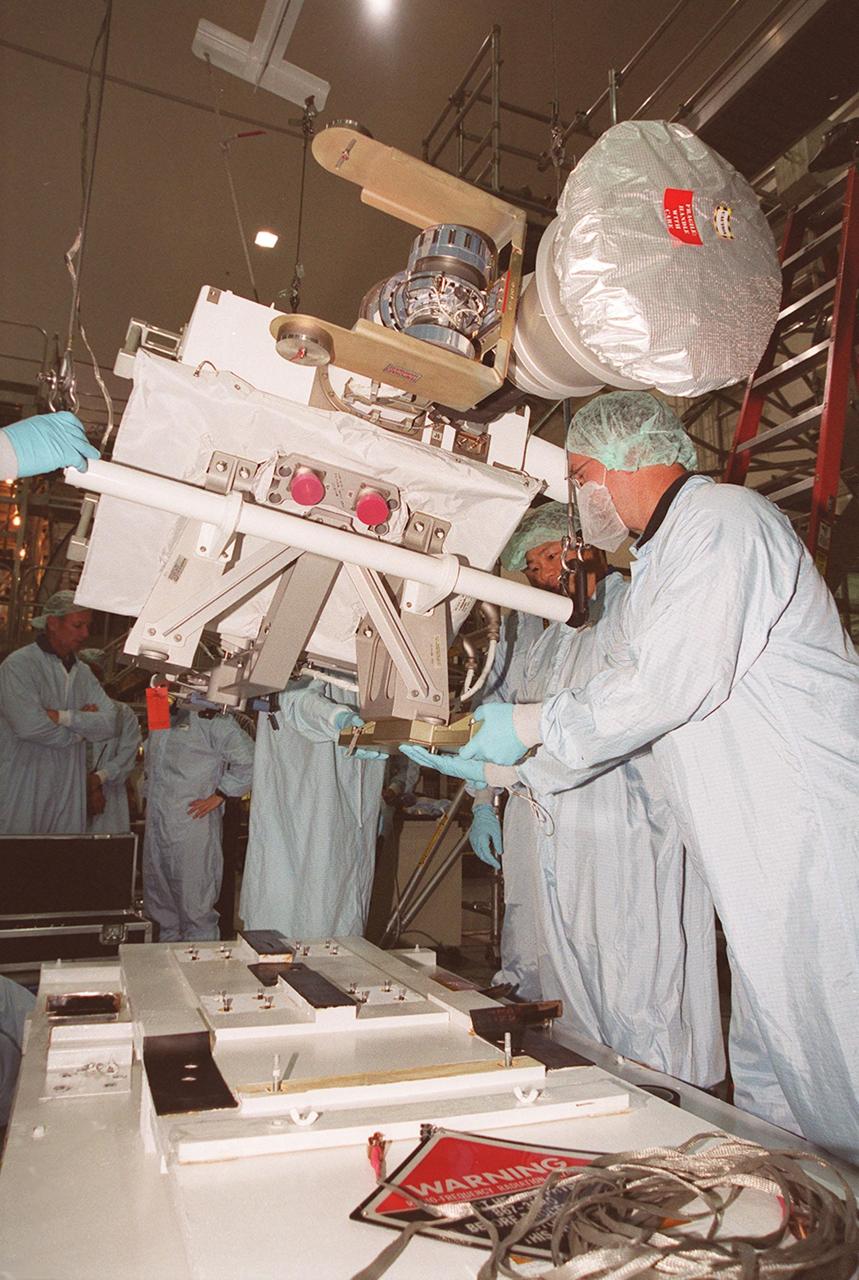
KENNEDY SPACE CENTER, FLA. -- In the Space Station Processing Facility, members of the STS-92 crew examine equipment that will be part of their mission to the International Space Station (ISS). The fourth U.S. flight to the ISS, the mission payload includes the Integrated Truss Structure Z1, an early exterior framework to allow the first U.S. solar arrays on a future flight to be temporarily installed on Unity for early power; Ku-band communication to support early science capability and U.S. television; and PMA-3 to provide a Shuttle docking port for solar array installation on the sixth ISS flight and Lab installation on the seventh ISS flight. The crew comprises Mission Commander Brian Duffy, Pilot Pamela Melroy, and Mission Specialists Koichi Wakata, Leroy Chiao, Peter "Jeff" Wisoff, Michael Lopez-Alegria, and William McArthur. Launch of STS-92 is scheduled for Sept. 21, 2000. Wakata is with the National Space Development Agency of Japan
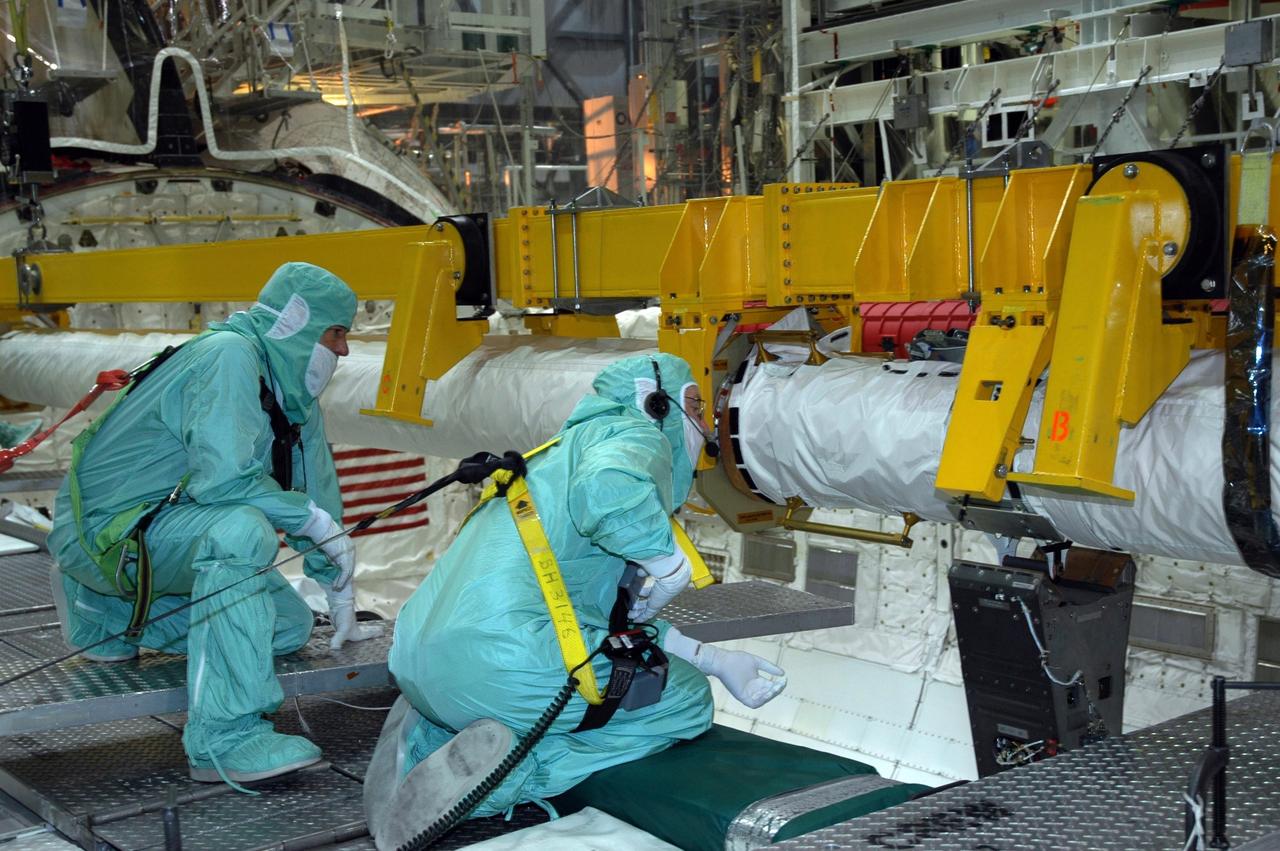
KENNEDY SPACE CENTER, FLA. - In the Orbiter Processing Facility’s bay 1, workers watch closely as the orbiter boom sensor system is lowered into place on the starboard side of Atlantis’s payload bay for mission STS-117. The 50-foot-long boom attaches to the shuttle arm and provides equipment to inspect the shuttle's heat shield while in space. It contains an intensified television camera (ITVC) and a laser dynamic range imager, which are mounted on a pan and tilt unit, and a laser camera system (LCS) mounted on a stationary bracket. Mission STS-117 will carry the S3/S4 arrays for installation on the International Space Station. Launch of Space Shuttle Atlantis is scheduled for March. Photo credit: NASA/Jack Pfaller
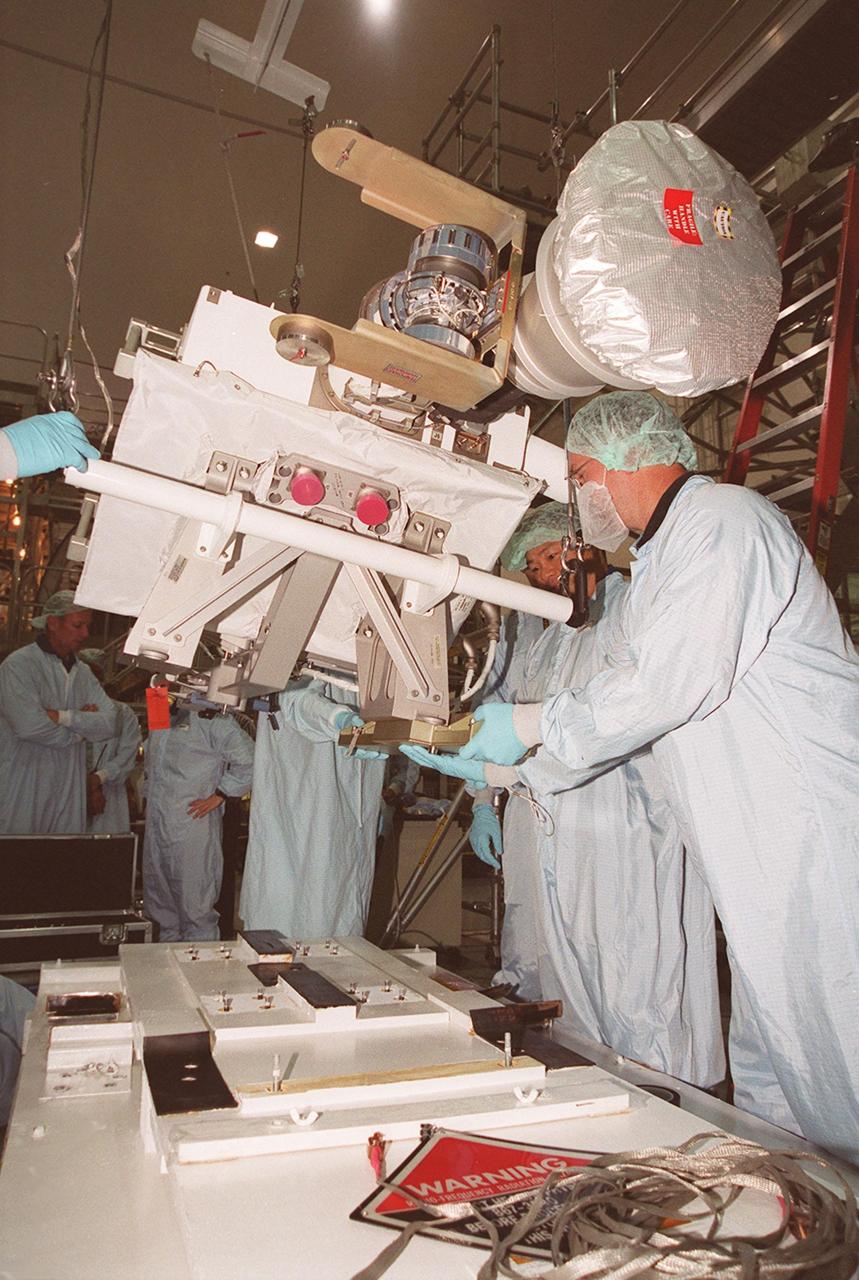
KENNEDY SPACE CENTER, FLA. -- In the Space Station Processing Facility, members of the STS-92 crew examine equipment that will be part of their mission to the International Space Station (ISS). The fourth U.S. flight to the ISS, the mission payload includes the Integrated Truss Structure Z1, an early exterior framework to allow the first U.S. solar arrays on a future flight to be temporarily installed on Unity for early power; Ku-band communication to support early science capability and U.S. television; and PMA-3 to provide a Shuttle docking port for solar array installation on the sixth ISS flight and Lab installation on the seventh ISS flight. The crew comprises Mission Commander Brian Duffy, Pilot Pamela Melroy, and Mission Specialists Koichi Wakata, Leroy Chiao, Peter "Jeff" Wisoff, Michael Lopez-Alegria, and William McArthur. Launch of STS-92 is scheduled for Sept. 21, 2000. Wakata is with the National Space Development Agency of Japan
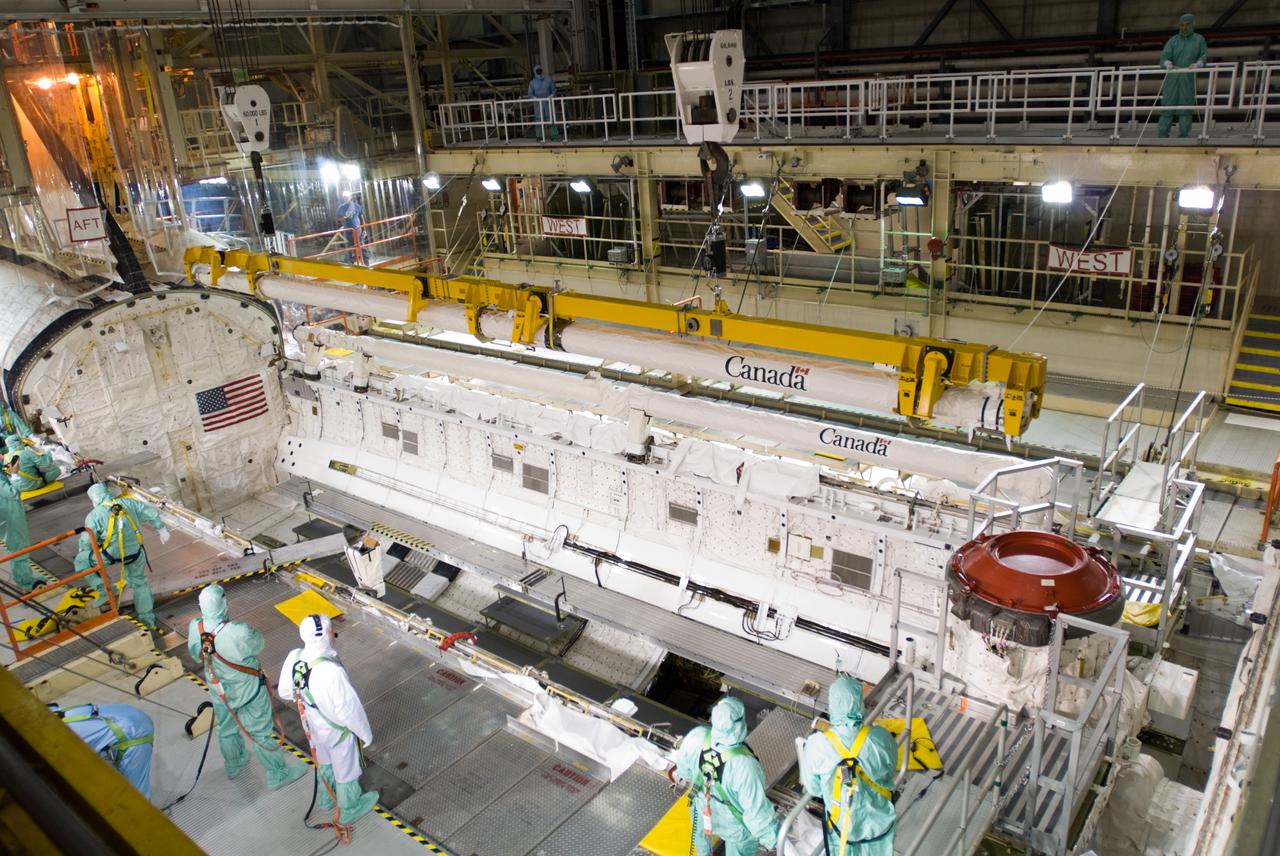
CAPE CANAVERAL, Fla. – In the Orbiter Processing Facility’s bay 3, the orbiter boom sensor system is moved into position by a crane over space shuttle Discovery for installation in its payload bay to support mission STS-128. The 50-foot-long boom attaches to the shuttle arm and provides equipment to inspect the shuttle's heat shield while in space. It contains an intensified television camera (ITVC) and a laser dynamic range imager, which are mounted on a pan and tilt unit, and a laser camera system (LCS) mounted on a stationary bracket. The STS-128 flight will carry science and storage racks to the International Space Station on space shuttle Discovery. Launch of Discovery is targeted for Aug. 6. Photo credit: NASA_Jim Grossmann
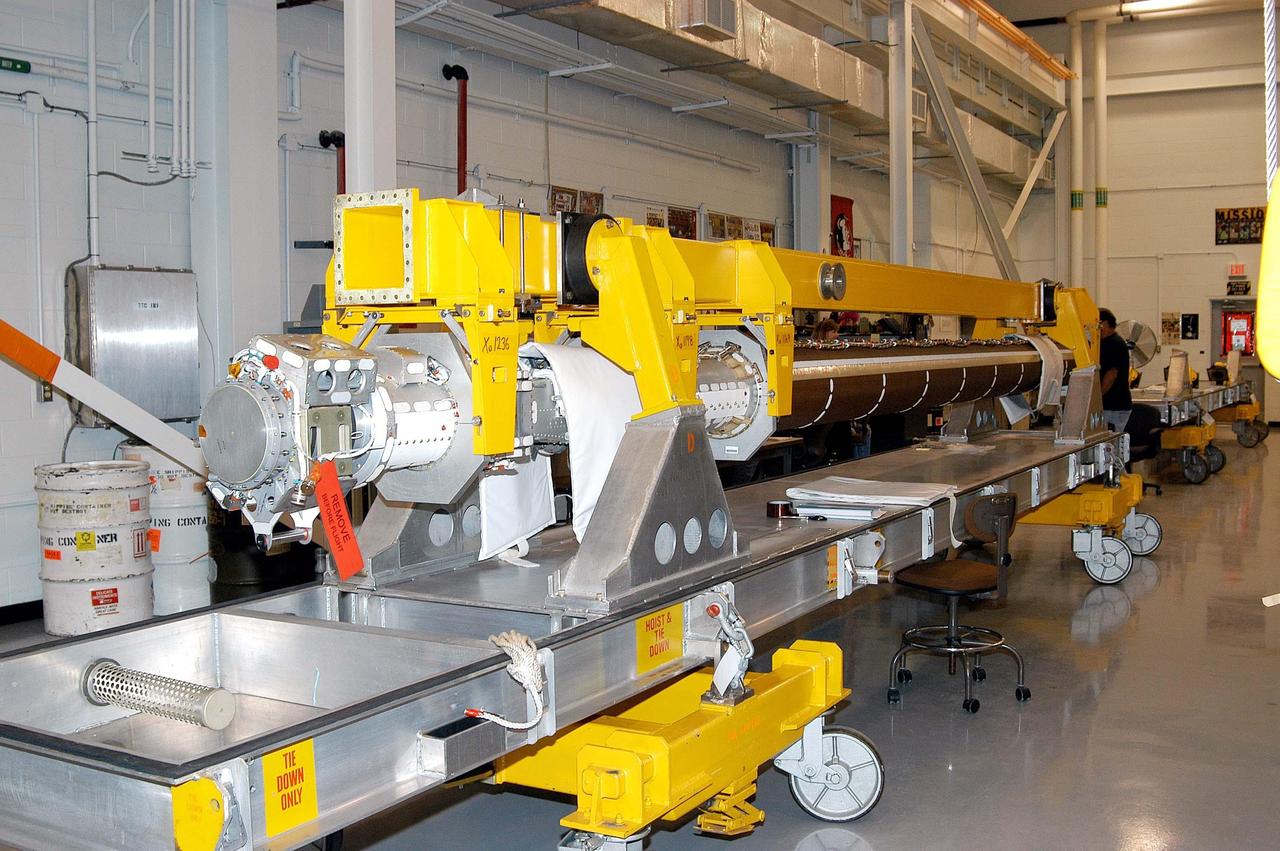
KENNEDY SPACE CENTER, FLA. - The Remote Manipulator System (RMS), also known as the Canadian robotic arm, for the orbiter Discovery has arrived at KSC’s Vehicle Assembly Building Lab. The RMS is used to deploy and retrieve payloads, provide a mobile extension ladder or foot restraints for crew members during extravehicular activities; and to aid the flight crew members in viewing surfaces of the orbiter or payloads through a television camera on the RMS. The arm is also serving as the base for the new Orbiter Boom Sensor System (OBSS), one of the safety measures for Return to Flight, equipping the Shuttle with cameras and laser systems to inspect the Shuttle’s Thermal Protection System while in space. Discovery is scheduled for a launch planning window of March 2005 on mission STS-114.
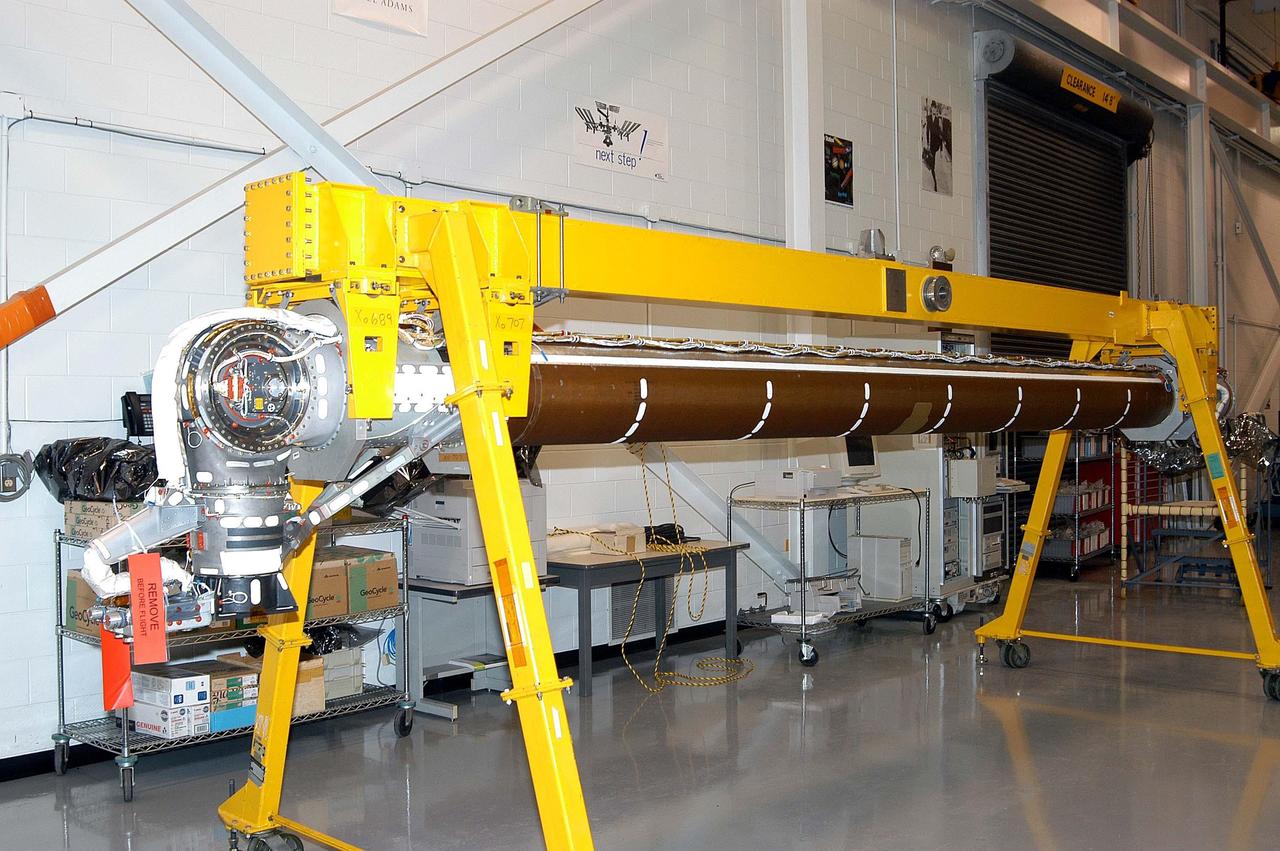
KENNEDY SPACE CENTER, FLA. - The Remote Manipulator System (RMS), also known as the Canadian robotic arm, for the orbiter Discovery has arrived at KSC’s Vehicle Assembly Building Lab. Seen on the left end is the shoulder pitch joint. The wrist and shoulder joints on the RMS allow the basic structure of the arm to maneuver similar to a human arm. The RMS is used to deploy and retrieve payloads, provide a mobile extension ladder or foot restraints for crew members during extravehicular activities; and to aid the flight crew members in viewing surfaces of the orbiter or payloads through a television camera on the RMS. The arm is also serving as the base for the new Orbiter Boom Sensor System (OBSS), one of the safety measures for Return to Flight, equipping the Shuttle with cameras and laser systems to inspect the Shuttle’s Thermal Protection System while in space. Discovery is scheduled for a launch planning window of March 2005 on mission STS-114.
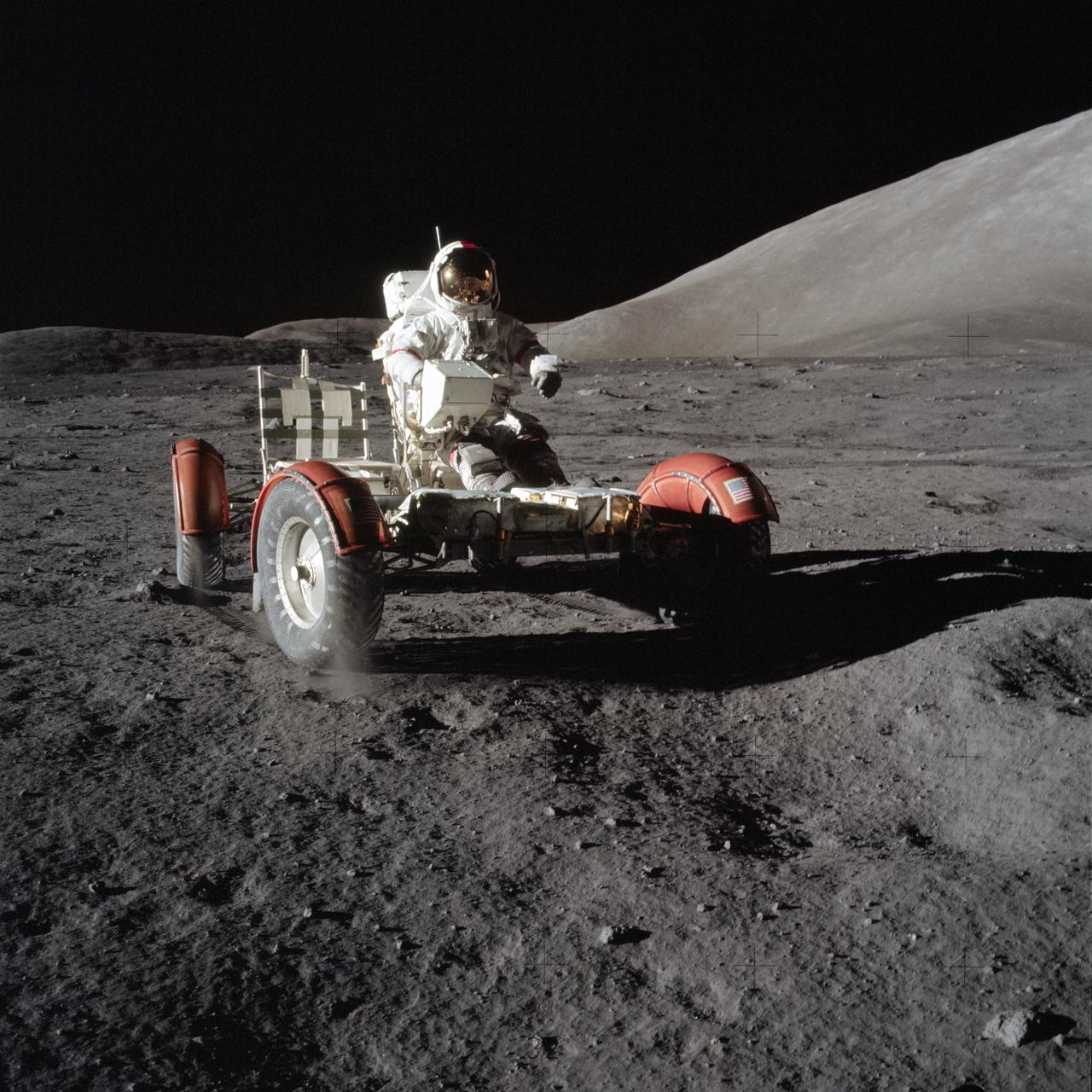
AS17-147-22526 (11 Dec. 1972) --- Astronaut Eugene A. Cernan, commander, makes a short checkout of the Lunar Roving Vehicle (LRV) during the early part of the first Apollo 17 extravehicular activity (EVA) at the Taurus-Littrow landing site. This view of the "stripped down" LRV is prior to loading up. Equipment later loaded onto the LRV included the ground-controlled television assembly, the lunar communications relay unit, hi-gain antenna, low-gain antenna, aft tool pallet, lunar tools and scientific gear. This photograph was taken by scientist-astronaut Harrison H. Schmitt, lunar module pilot. The mountain in the right background is the east end of South Massif. While astronauts Cernan and Schmitt descended in the Lunar Module (LM) "Challenger" to explore the moon, astronaut Ronald E. Evans, command module pilot, remained with the Command and Service Modules (CSM) "America" in lunar orbit.
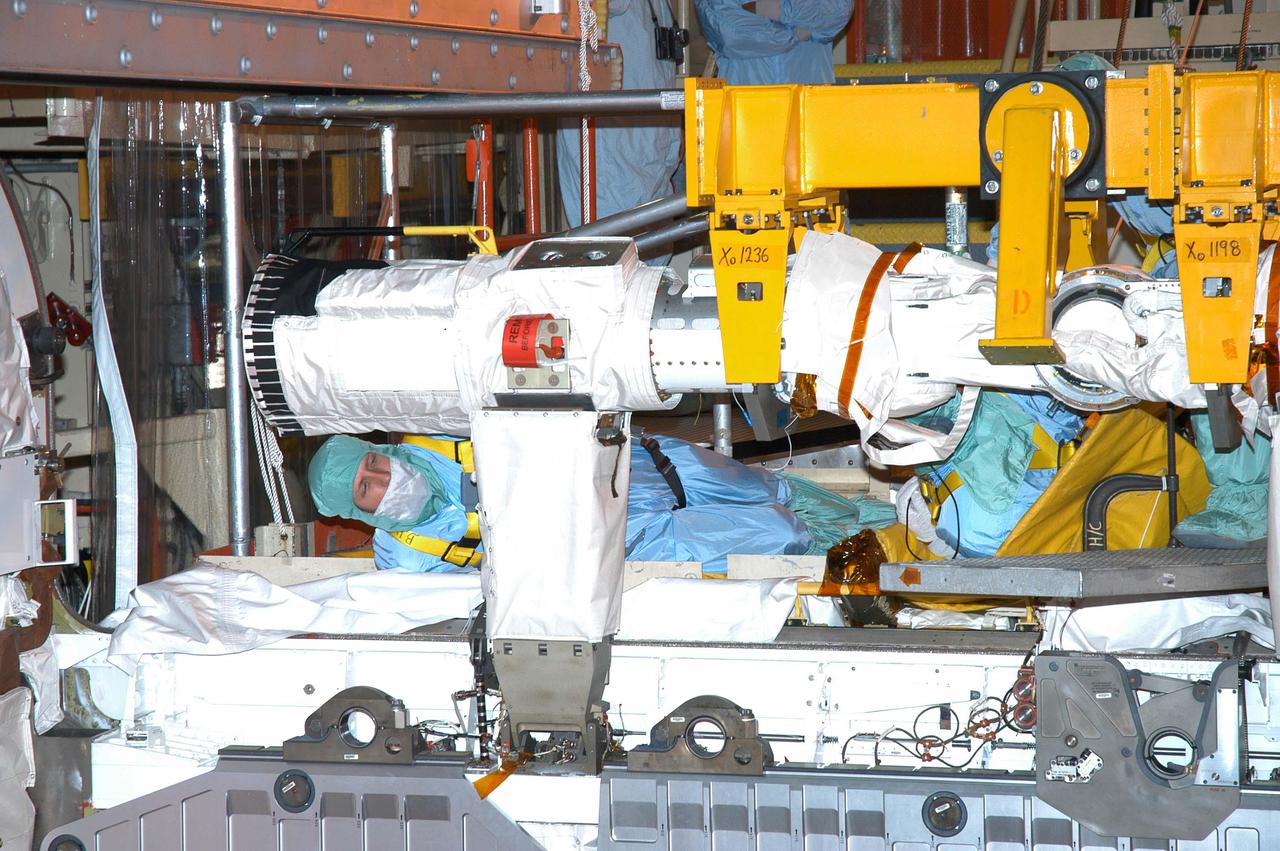
KENNEDY SPACE CENTER, FLA. - Technicians in the Orbiter Processing Facility work to install the Remote Manipulator System (RMS), also known as the Canadian robotic arm, in Discovery’s payload bay. The RMS is used to deploy and retrieve payloads, provide a mobile extension ladder or foot restraints for crew members during extravehicular activities; and to aid the flight crew members in viewing surfaces of the orbiter or payloads through a television camera on the RMS. The arm is also serving as the base for the new Orbiter Boom Sensor System (OBSS), one of the safety measures for Return to Flight, equipping the Shuttle with cameras and laser systems to inspect the Shuttle’s Thermal Protection System while in space. Discovery is scheduled for a launch planning window of May 2005 on Return to Flight mission STS-114.
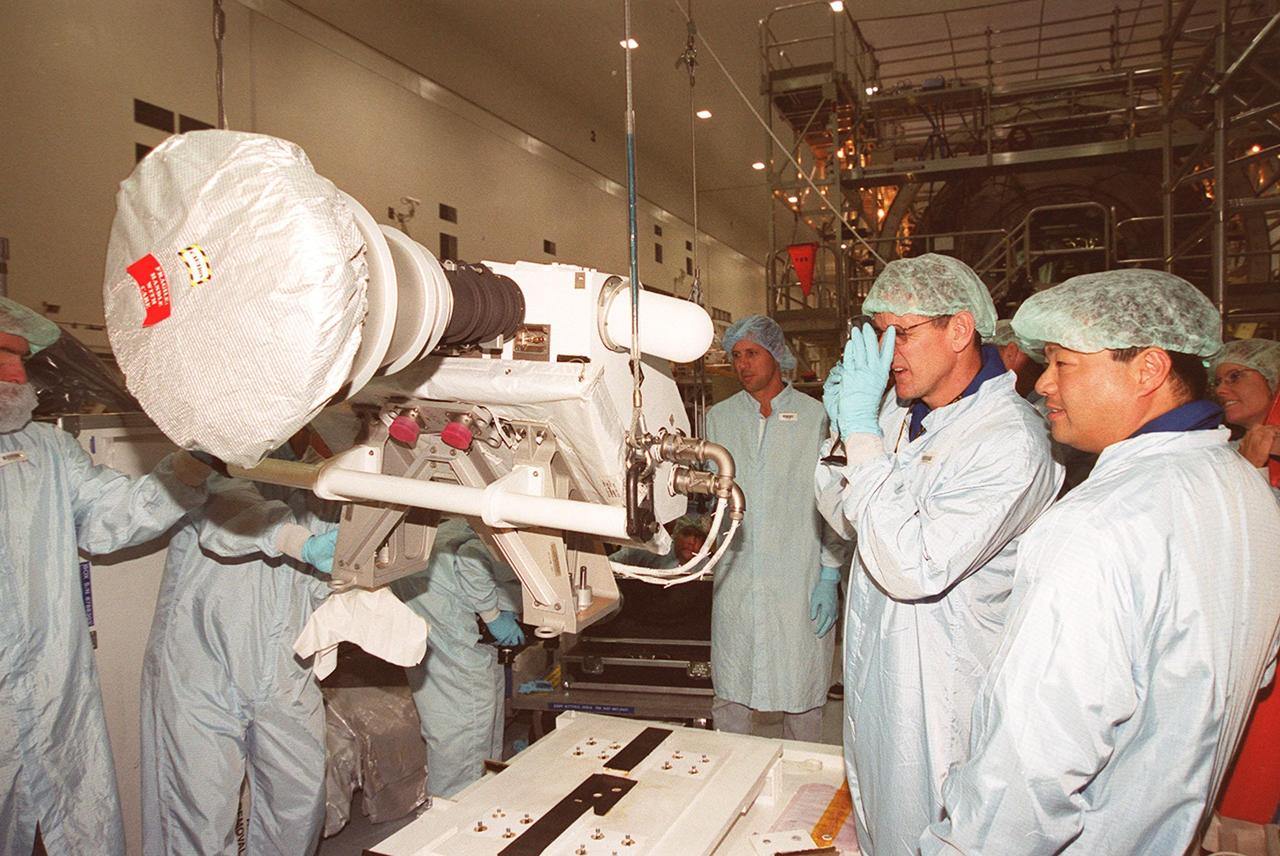
KENNEDY SPACE CENTER, FLA. -- In the Space Station Processing Facility, members of the STS-92 crew examine equipment that will be part of their mission to the International Space Station (ISS). The fourth U.S. flight to the ISS, the mission payload includes the Integrated Truss Structure Z1, an early exterior framework to allow the first U.S. solar arrays on a future flight to be temporarily installed on Unity for early power; Ku-band communication to support early science capability and U.S. television; and PMA-3 to provide a Shuttle docking port for solar array installation on the sixth ISS flight and Lab installation on the seventh ISS flight. The crew comprises Mission Commander Brian Duffy, Pilot Pamela Melroy, and Mission Specialists Koichi Wakata, Leroy Chiao, Peter "Jeff" Wisoff, Michael Lopez-Alegria, and William McArthur. Launch of STS-92 is scheduled for Sept. 21, 2000. Wakata is with the National Space Development Agency of Japan.

CAPE CANAVERAL, Fla. – In the Orbiter Processing Facility’s bay 3, workers attach a crane to the orbiter boom sensor system that will be installed in the payload bay of space shuttle Discovery to support mission STS-128. The 50-foot-long boom attaches to the shuttle arm and provides equipment to inspect the shuttle's heat shield while in space. It contains an intensified television camera (ITVC) and a laser dynamic range imager, which are mounted on a pan and tilt unit, and a laser camera system (LCS) mounted on a stationary bracket. The STS-128 flight will carry science and storage racks to the International Space Station on space shuttle Discovery. Launch of Discovery is targeted for Aug. 6. Photo credit: NASA/Kim Shiflett
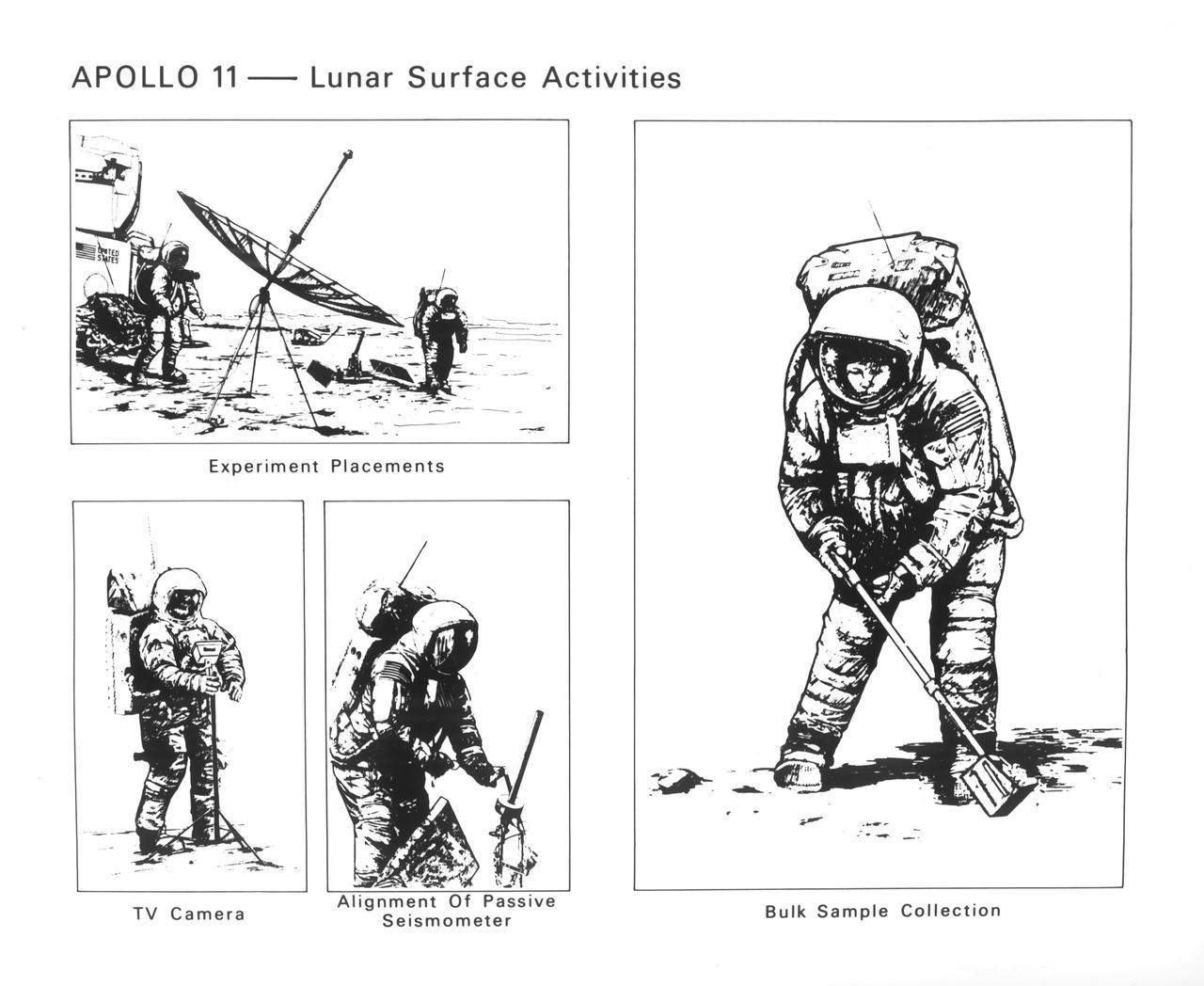
The Apollo 11 mission launched from the Kennedy Space Center (KSC) in Florida via the Marshall Space Flight Center (MSFC) developed Saturn V launch vehicle on July 16, 1969 and safely returned to Earth on July 24, 1969. Aboard the space craft were astronauts Neil A. Armstrong, commander; Michael Collins, Command Module (CM) pilot; and Edwin E. (Buzz) Aldrin Jr., Lunar Module (LM) pilot. With the success of Apollo 11, the national objective to land men on the Moon and return them safely to Earth had been accomplished. These sketches illustrate some of the activities of Neil Armstrong and Edwin Aldrin while on the Moon’s surface. Both men worked in setting up scientific equipment and collecting samples. Armstrong set up the television cameras early so their activities could be watched from Earth.
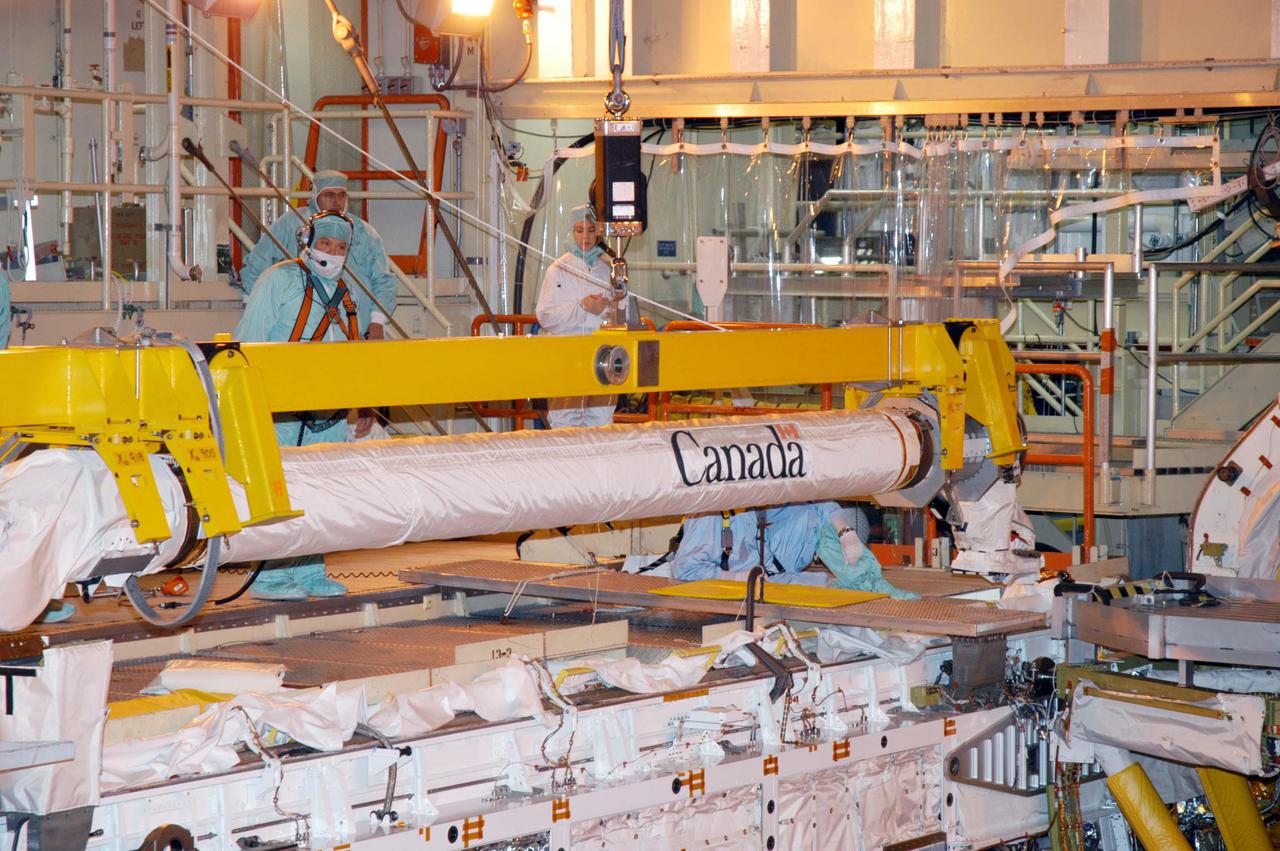
KENNEDY SPACE CENTER, FLA. - In the Orbiter Processing Facility, the Remote Manipulator System (RMS), also known as the Canadian robotic arm, is lowered toward Discovery’s payload bay for installation. The RMS is used to deploy and retrieve payloads, provide a mobile extension ladder or foot restraints for crew members during extravehicular activities; and to aid the flight crew members in viewing surfaces of the orbiter or payloads through a television camera on the RMS. The arm is also serving as the base for the new Orbiter Boom Sensor System (OBSS), one of the safety measures for Return to Flight, equipping the Shuttle with cameras and laser systems to inspect the Shuttle’s Thermal Protection System while in space. Discovery is scheduled for a launch planning window of May 2005 on Return to Flight mission STS-114.
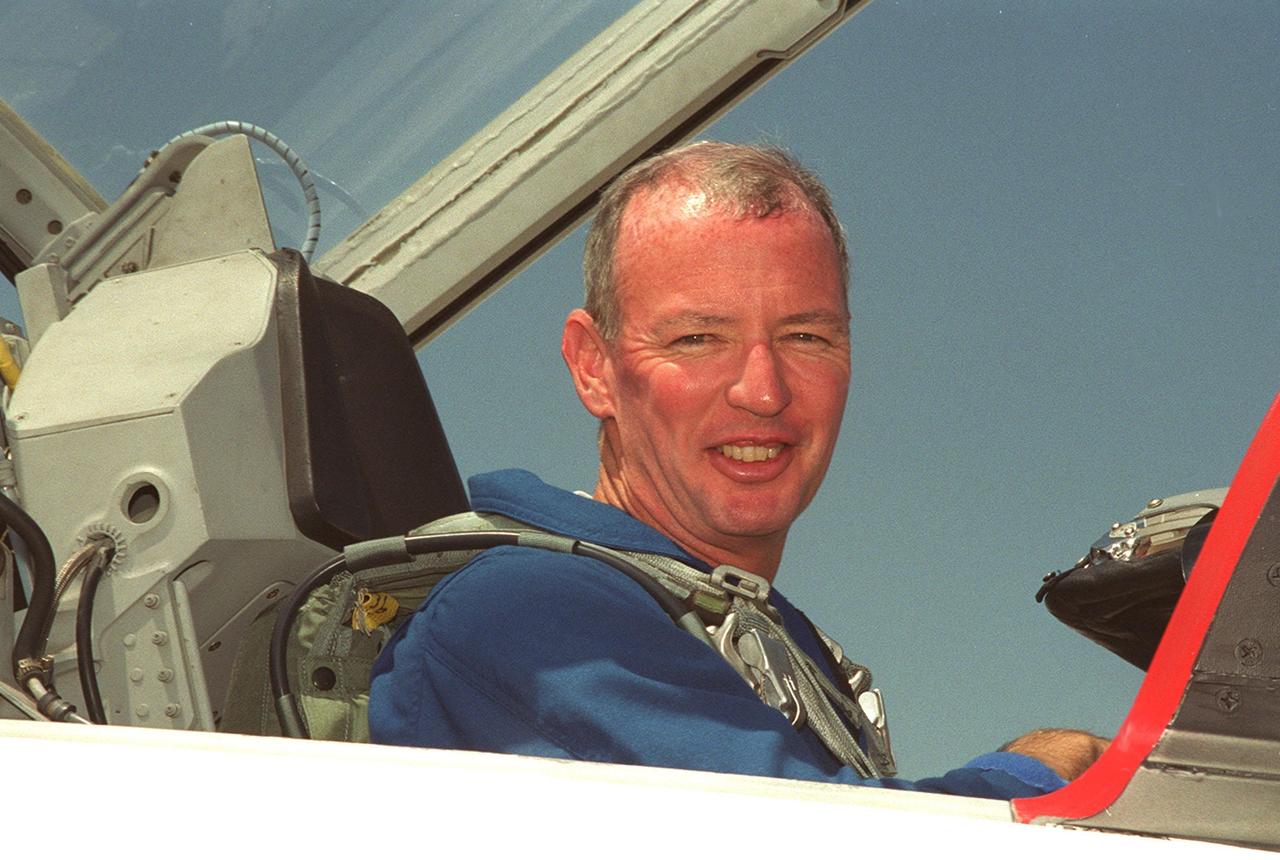
KENNEDY SPACE CENTER, FLA. -- STS-92 Commander Brian Duffy arrives at KSC’s Shuttle Landing Facility to take part in a Crew Equipment Interface Test. He and other crew members Pilot Pam Melroy and Mission Specialists Koichi Wakata, Leroy Chiao, Jeff Wisoff, Michael Lopez-Alegria and Bill McArthur will spend time at SPACEHAB becoming familiar with the payload and equipment they will use on their mission to the International Space Station. Wakata is with the Japanese space agency. The mission payload includes the Integrated Truss Structure Z1, an early exterior framework to allow the first U.S. solar arrays on a future flight to be temporarily installed on Unity for early power; Ku-band communication to support early science capability and U.S. television; and PMA-3 to provide a Shuttle docking port for solar array installation on the sixth ISS flight and Lab installation on the seventh ISS flight. STS-92 is scheduled to launch Oct. 5 from launch Pad 39A
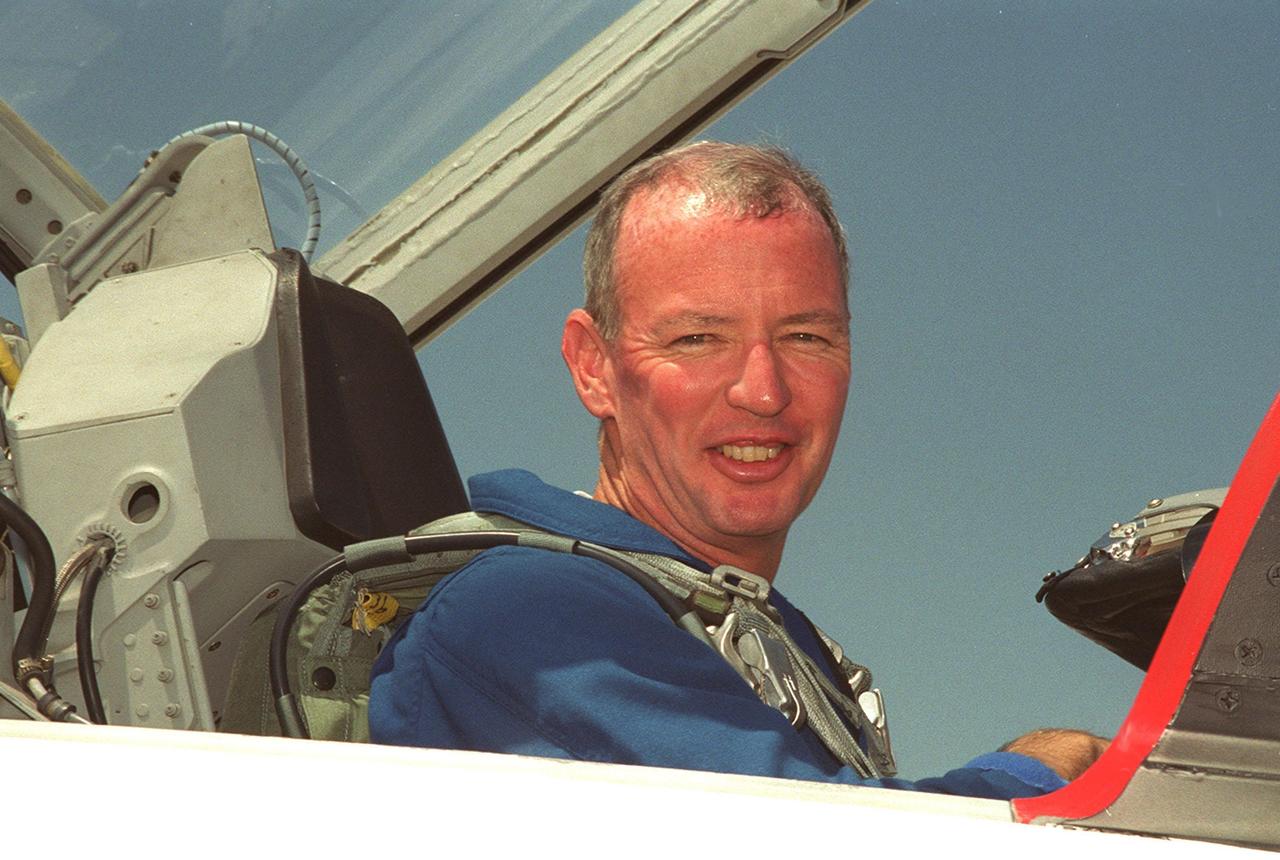
KENNEDY SPACE CENTER, FLA. -- STS-92 Commander Brian Duffy arrives at KSC’s Shuttle Landing Facility to take part in a Crew Equipment Interface Test. He and other crew members Pilot Pam Melroy and Mission Specialists Koichi Wakata, Leroy Chiao, Jeff Wisoff, Michael Lopez-Alegria and Bill McArthur will spend time at SPACEHAB becoming familiar with the payload and equipment they will use on their mission to the International Space Station. Wakata is with the Japanese space agency. The mission payload includes the Integrated Truss Structure Z1, an early exterior framework to allow the first U.S. solar arrays on a future flight to be temporarily installed on Unity for early power; Ku-band communication to support early science capability and U.S. television; and PMA-3 to provide a Shuttle docking port for solar array installation on the sixth ISS flight and Lab installation on the seventh ISS flight. STS-92 is scheduled to launch Oct. 5 from launch Pad 39A
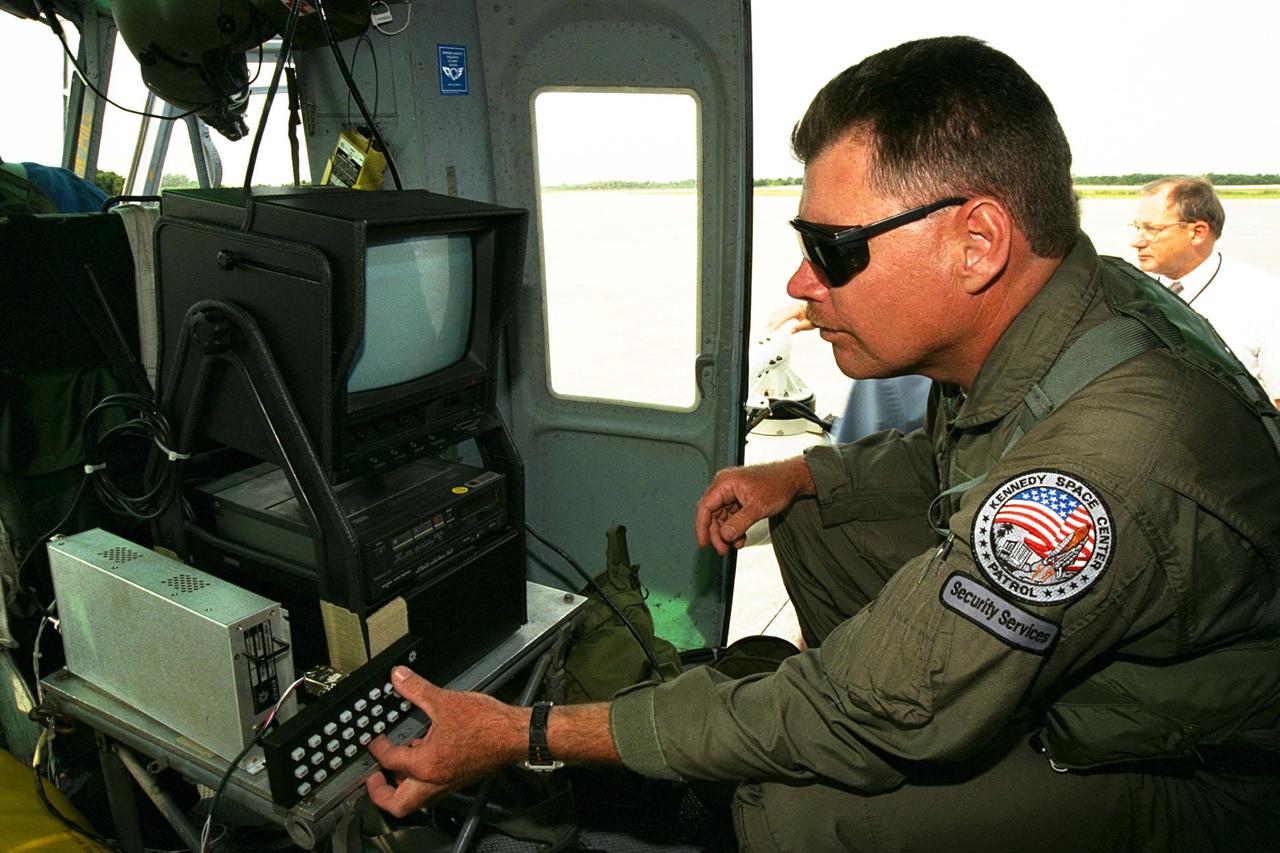
KENNEDY SPACE CENTER, FLA. -- Sgt. Mark Hines, of Kennedy Space Center (KSC) Security, checks out equipment used to operate the Forward Looking Infrared Radar (FLIR) installed on NASA's Huey UH-1 helicopter. The helicopter has also been outfitted with a portable global positioning satellite (GPS) system to support Florida's Division of Forestry as they fight the brush fires which have been plaguing the state as a result of extremely dry conditions and lightning storms. The FLIR includes a beach ball-sized infrared camera that is mounted on the helicopter's right siderail and a real-time television monitor and recorder installed inside. While the FLIR collects temperature data and images, the GPS system provides the exact coordinates of the fires being observed and transmits the data to the firefighters on the ground. KSC's security team routinely uses the FLIR equipment prior to Shuttle launch and landing activities to ensure that the area surrounding the launch pad and runway are clear of unauthorized personnel. KSC's Base Operations Contractor, EG&G Florida, operates the NASA-owned helicopter
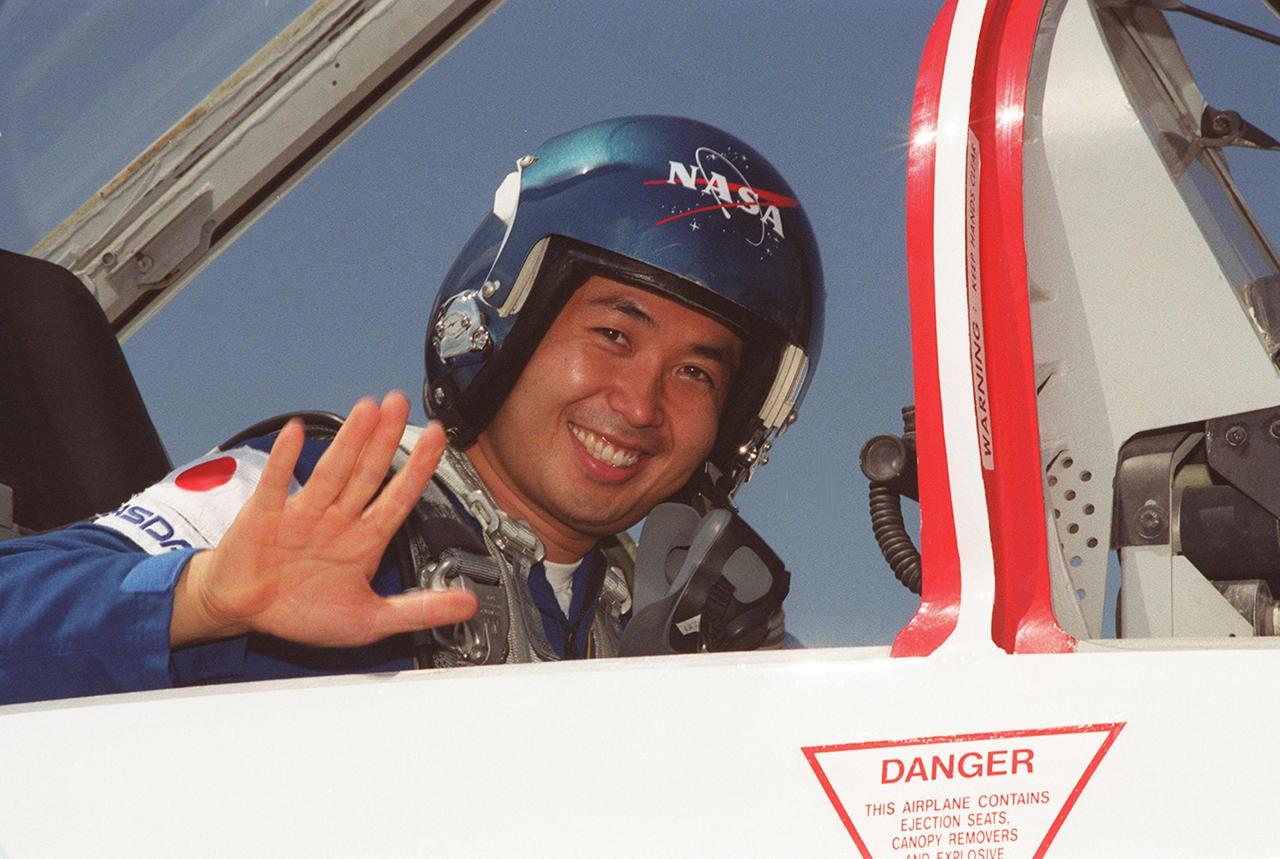
KENNEDY SPACE CENTER, FLA. -- STS-92 Mission Specialist Koichi Wakata arrives at KSC’s Shuttle Landing Facility to take part in a Crew Equipment Interface Test. Wakata is with the Japanese space agency. He and other crew members Commander Brian Duffy, Pilot Pam Melroy and Mission Specialists Leroy Chiao, Jeff Wisoff, Michael Lopez-Alegria and Bill McArthur will spend time at SPACEHAB becoming familiar with the payload and equipment they will use on their mission to the International Space Station. The mission payload includes the Integrated Truss Structure Z1, an early exterior framework to allow the first U.S. solar arrays on a future flight to be temporarily installed on Unity for early power; Ku-band communication to support early science capability and U.S. television; and PMA-3 to provide a Shuttle docking port for solar array installation on the sixth ISS flight and Lab installation on the seventh ISS flight. STS-92 is scheduled to launch Oct. 5 from launch Pad 39A
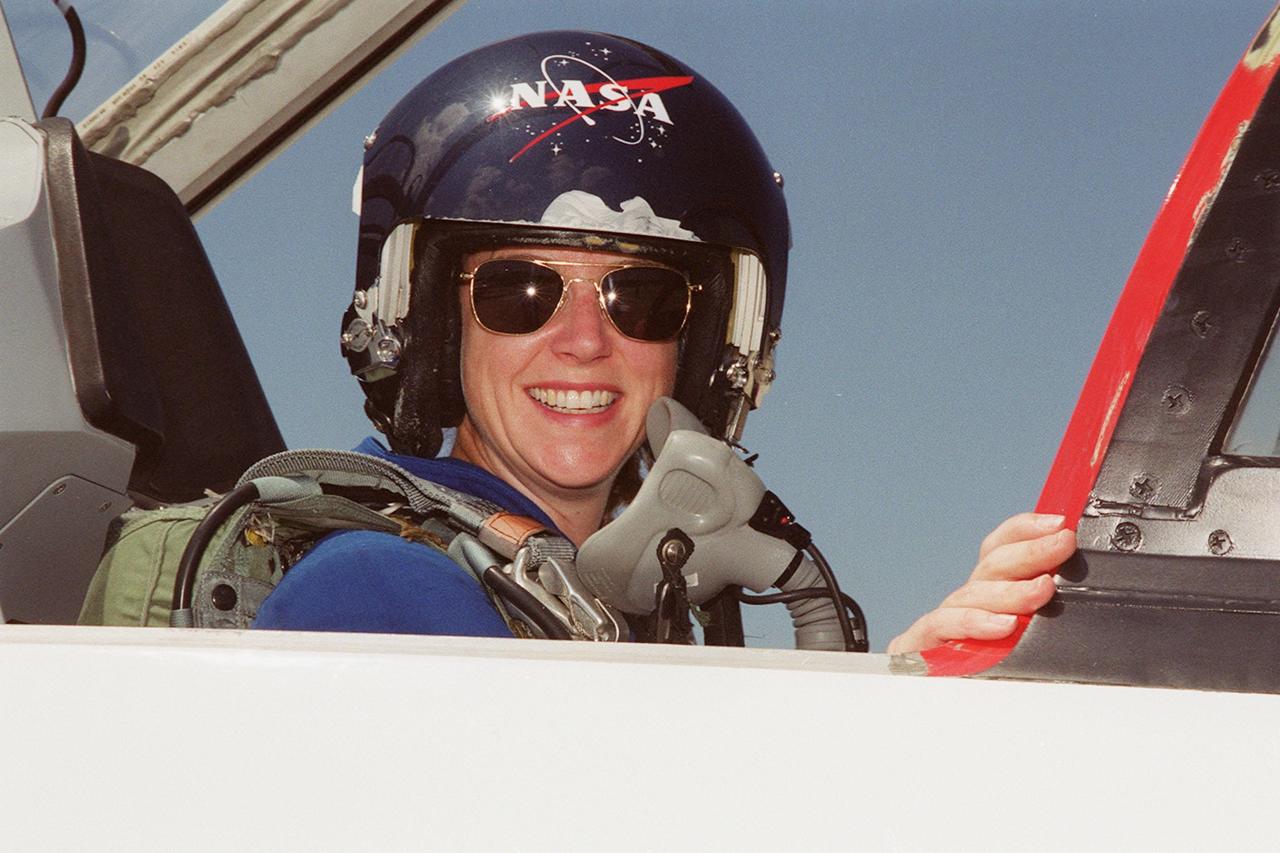
KENNEDY SPACE CENTER, FLA. -- STS-92 Pilot Pam Melroy arrives at KSC’s Shuttle Landing Facility to take part in a Crew Equipment Interface Test. She and other crew members Commander Brian Duffy and Mission Specialists Koichi Wakata, Leroy Chiao, Jeff Wisoff, Michael Lopez-Alegria and Bill McArthur will spend time at SPACEHAB becoming familiar with the payload and equipment they will use on their mission to the International Space Station. Wakata is with the Japanese space agency. The mission payload includes the Integrated Truss Structure Z1, an early exterior framework to allow the first U.S. solar arrays on a future flight to be temporarily installed on Unity for early power; Ku-band communication to support early science capability and U.S. television; and PMA-3 to provide a Shuttle docking port for solar array installation on the sixth ISS flight and Lab installation on the seventh ISS flight. STS-92 is scheduled to launch Oct. 5 from launch Pad 39A
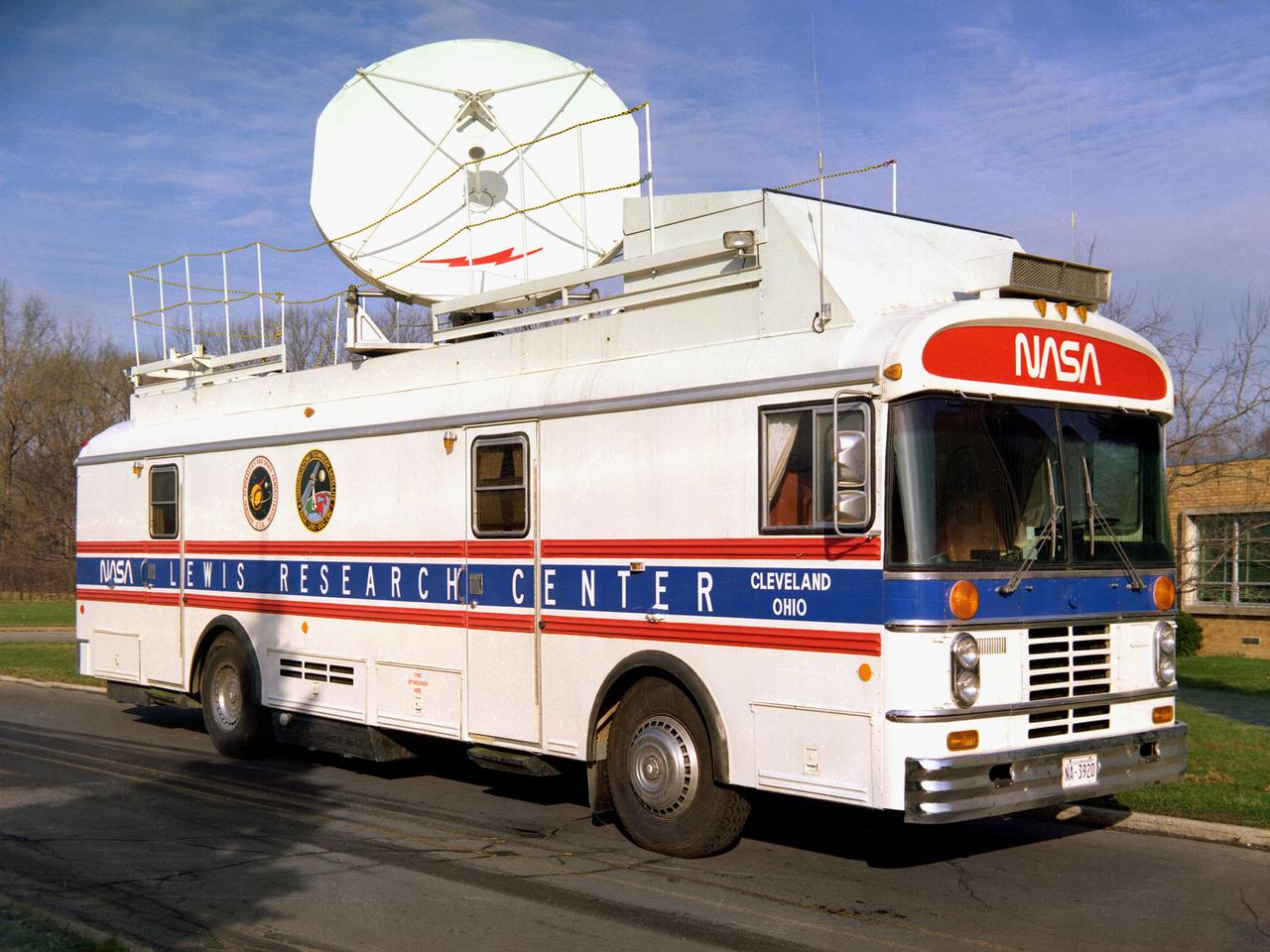
This vehicle served as a mobile terminal for the Communications Technology Satellite. The Communications Technology Satellite was an experimental communications satellite launched in January 1976 by the National Aeronautics and Space Administration (NASA) and the Canadian Department of Communications. The satellite operated in a new frequency band reserved for broadcast satellites with transmitting power levels that were 10 to 20 times higher than those of contemporary satellites. Throughout 1977 and 1978 NASA allowed qualified groups to utilize the satellite from one of the three ground-based transmission centers. NASA’s Lewis Research Center in Cleveland, Ohio was NASA’s lead center on the project. Lewis was responsible for the control and coordination of all US experiments on the satellite. The center housed the satellite’s main control center which included eight parabolic reflector antennae ranging from 2 to 15 feet in diameter. Many of the satellite’s components had been tested in simulated space conditions at Lewis. The Lewis-designed vehicle seen here served as a field unit for transmitting and receiving wideband signals and narrowband voice. The vehicle permitted live television interviews, recording equipment, and cameras. An 8-foot diameter parabolic reflector was mounted on the roof. The interior of the vehicle had workstations, monitors, transmitting equipment, and a lounge area.
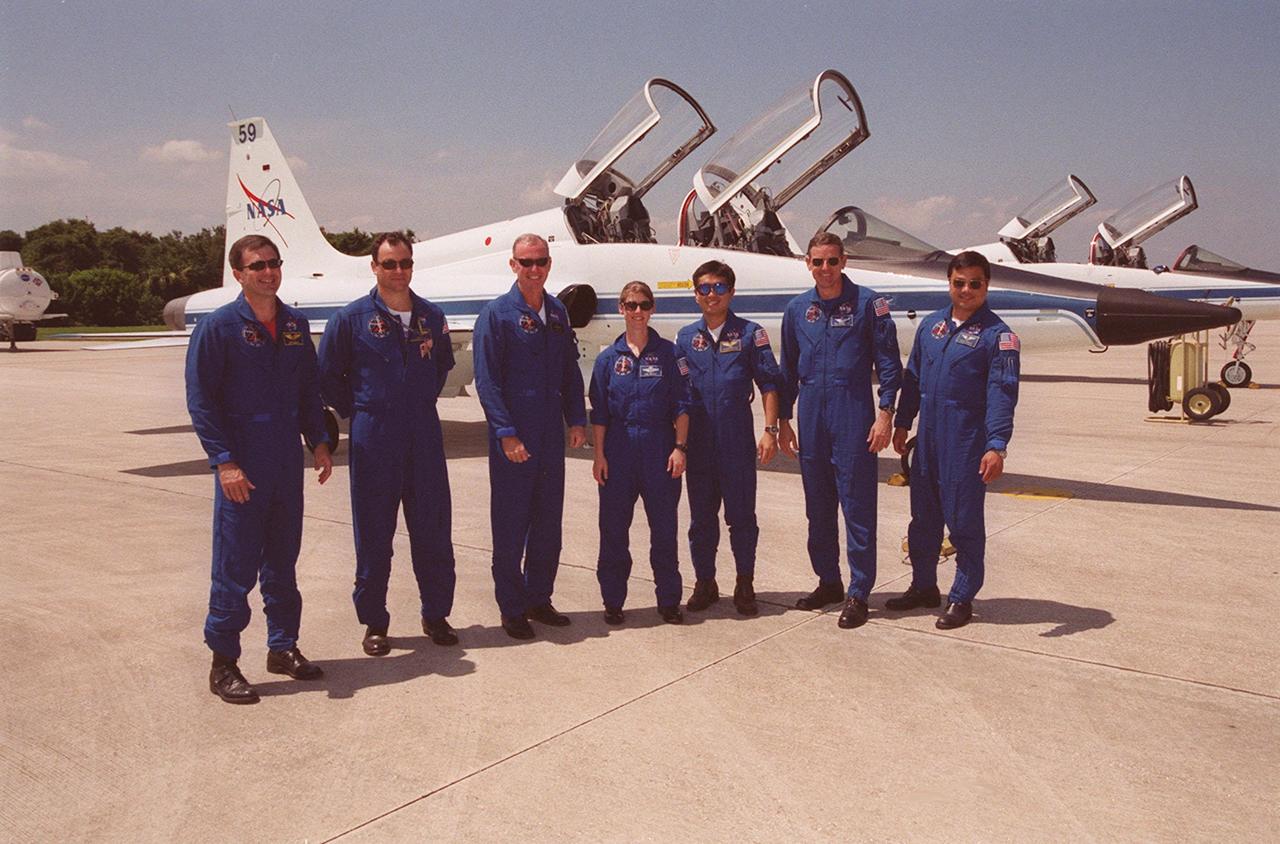
KENNEDY SPACE CENTER, FLA. -- Members of the STS-92 crew line up on the runway at KSC’s Shuttle Landing Facility after arriving to take part in a Crew Equipment Interface Test (CEIT). From left are Mission Specialists Jeff Wisoff and Michael Lopez-Alegria, Commander Brian Duffy, Pilot Pam Melroy, and Mission Specialists Koichi Wakata, Bill McArthur and Leroy Chiao. Wakata is with the Japanese space agency. During the CEIT, the crew will spend time at SPACEHAB becoming familiar with the payload and equipment they will use on their mission to the International Space Station. The mission payload includes the Integrated Truss Structure Z1, an early exterior framework to allow the first U.S. solar arrays on a future flight to be temporarily installed on Unity for early power; Ku-band communication to support early science capability and U.S. television; and PMA-3 to provide a Shuttle docking port for solar array installation on the sixth ISS flight and Lab installation on the seventh ISS flight. STS-92 is scheduled to launch Oct. 5 from launch Pad 39A
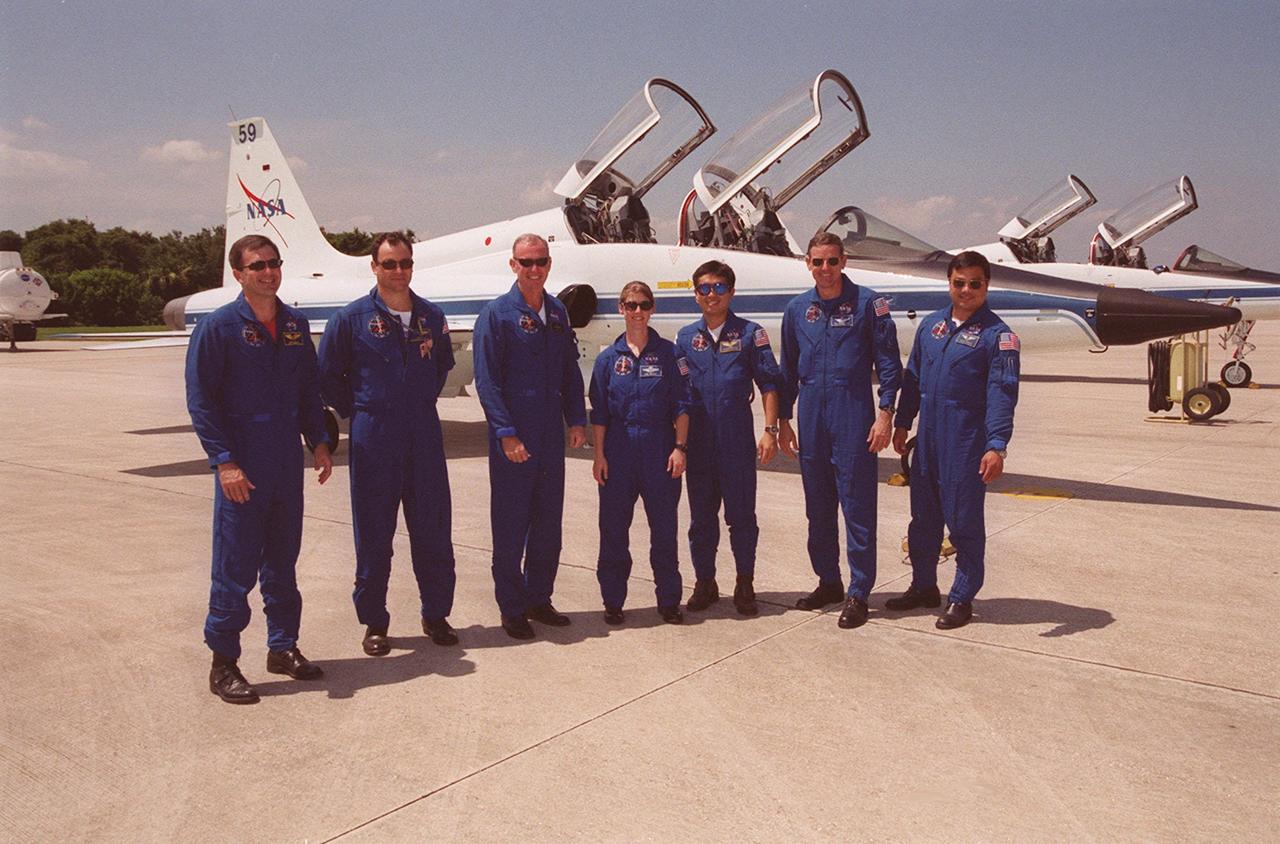
KENNEDY SPACE CENTER, FLA. -- Members of the STS-92 crew line up on the runway at KSC’s Shuttle Landing Facility after arriving to take part in a Crew Equipment Interface Test (CEIT). From left are Mission Specialists Jeff Wisoff and Michael Lopez-Alegria, Commander Brian Duffy, Pilot Pam Melroy, and Mission Specialists Koichi Wakata, Bill McArthur and Leroy Chiao. Wakata is with the Japanese space agency. During the CEIT, the crew will spend time at SPACEHAB becoming familiar with the payload and equipment they will use on their mission to the International Space Station. The mission payload includes the Integrated Truss Structure Z1, an early exterior framework to allow the first U.S. solar arrays on a future flight to be temporarily installed on Unity for early power; Ku-band communication to support early science capability and U.S. television; and PMA-3 to provide a Shuttle docking port for solar array installation on the sixth ISS flight and Lab installation on the seventh ISS flight. STS-92 is scheduled to launch Oct. 5 from launch Pad 39A
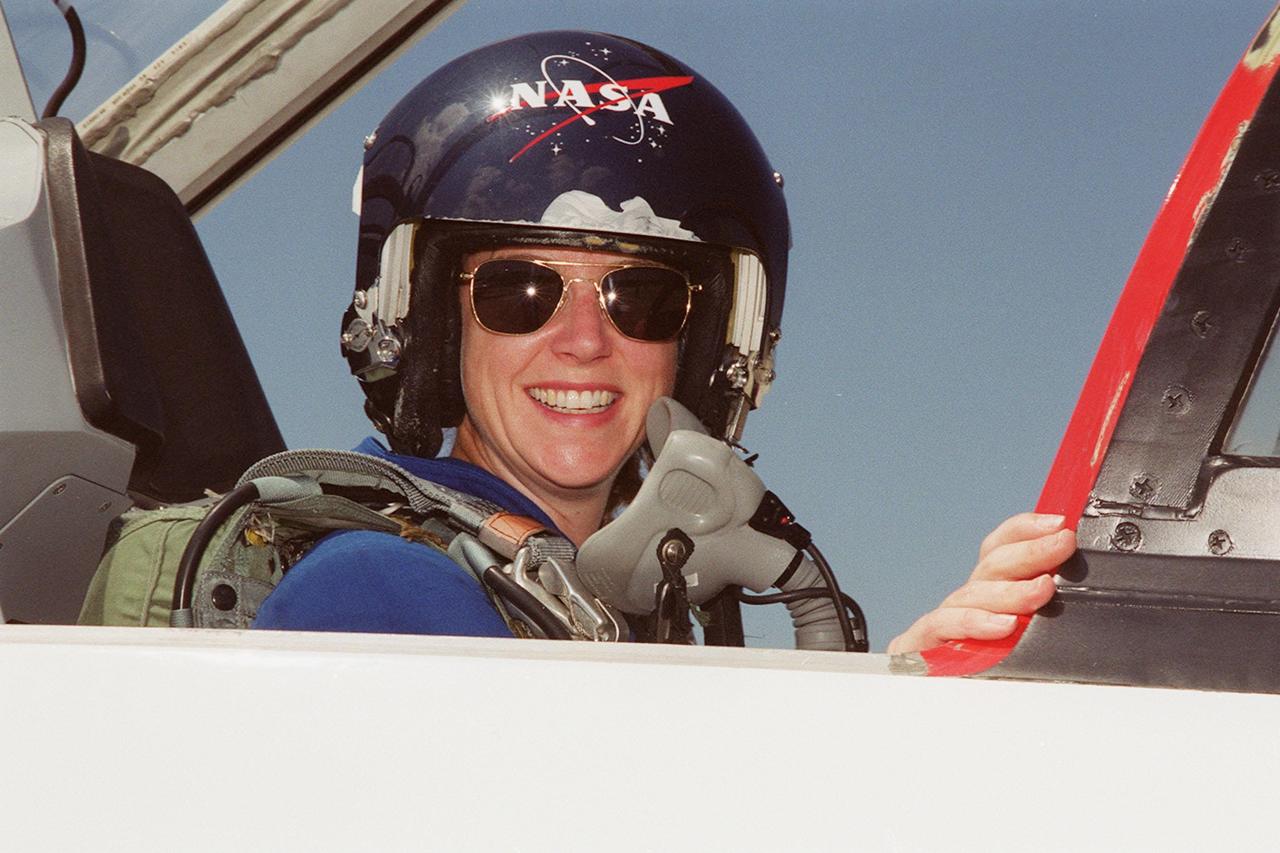
KENNEDY SPACE CENTER, FLA. -- STS-92 Pilot Pam Melroy arrives at KSC’s Shuttle Landing Facility to take part in a Crew Equipment Interface Test. She and other crew members Commander Brian Duffy and Mission Specialists Koichi Wakata, Leroy Chiao, Jeff Wisoff, Michael Lopez-Alegria and Bill McArthur will spend time at SPACEHAB becoming familiar with the payload and equipment they will use on their mission to the International Space Station. Wakata is with the Japanese space agency. The mission payload includes the Integrated Truss Structure Z1, an early exterior framework to allow the first U.S. solar arrays on a future flight to be temporarily installed on Unity for early power; Ku-band communication to support early science capability and U.S. television; and PMA-3 to provide a Shuttle docking port for solar array installation on the sixth ISS flight and Lab installation on the seventh ISS flight. STS-92 is scheduled to launch Oct. 5 from launch Pad 39A

KENNEDY SPACE CENTER, FLA. -- STS-92 Mission Specialist Koichi Wakata arrives at KSC’s Shuttle Landing Facility to take part in a Crew Equipment Interface Test. Wakata is with the Japanese space agency. He and other crew members Commander Brian Duffy, Pilot Pam Melroy and Mission Specialists Leroy Chiao, Jeff Wisoff, Michael Lopez-Alegria and Bill McArthur will spend time at SPACEHAB becoming familiar with the payload and equipment they will use on their mission to the International Space Station. The mission payload includes the Integrated Truss Structure Z1, an early exterior framework to allow the first U.S. solar arrays on a future flight to be temporarily installed on Unity for early power; Ku-band communication to support early science capability and U.S. television; and PMA-3 to provide a Shuttle docking port for solar array installation on the sixth ISS flight and Lab installation on the seventh ISS flight. STS-92 is scheduled to launch Oct. 5 from launch Pad 39A
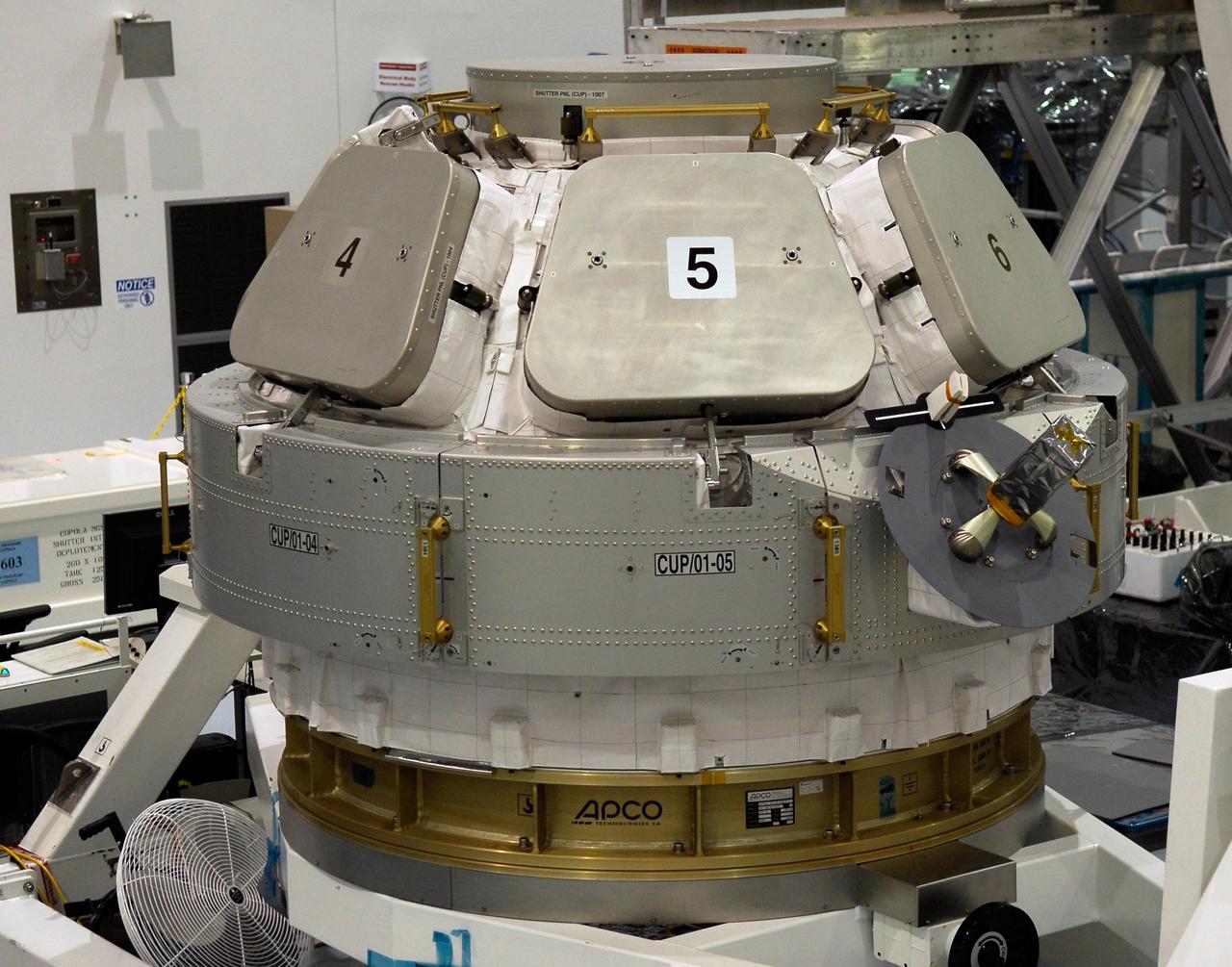
CAPE CANAVERAL, Fla. – The Cupola, another module built in Italy for the United States segment of the International Space Station, resides in the Space Station Processing Facility. With 360-degree windows, it will serve as a literal skylight to control some of the most sophisticated robotics ever built. The space station crew will use Cupola windows, six around the sides and one on the top, for line-of-sight monitoring of outside activities, including spacewalks, docking operations and exterior equipment surveys. The Cupola will be used specifically to monitor the approach and berthing of the Japanese H-2 supply spacecraft and other visiting vehicles. The Cupola also will serve as the primary location for controlling Canadarm2, the 60-foot space station robotic arm. Space station crews currently use two robotic control workstations in the Destiny laboratory to operate the arm. One of the robotic control stations will be placed inside the Cupola. The view from the Cupola will enhance an arm operator's situational awareness, supplementing television cameras and graphics. The Cupola is scheduled to launch on a future space station assembly mission. It will be installed on the forward port of Node 3, a connecting module to be installed as well. Photo credit: NASA/Kim Shiflett
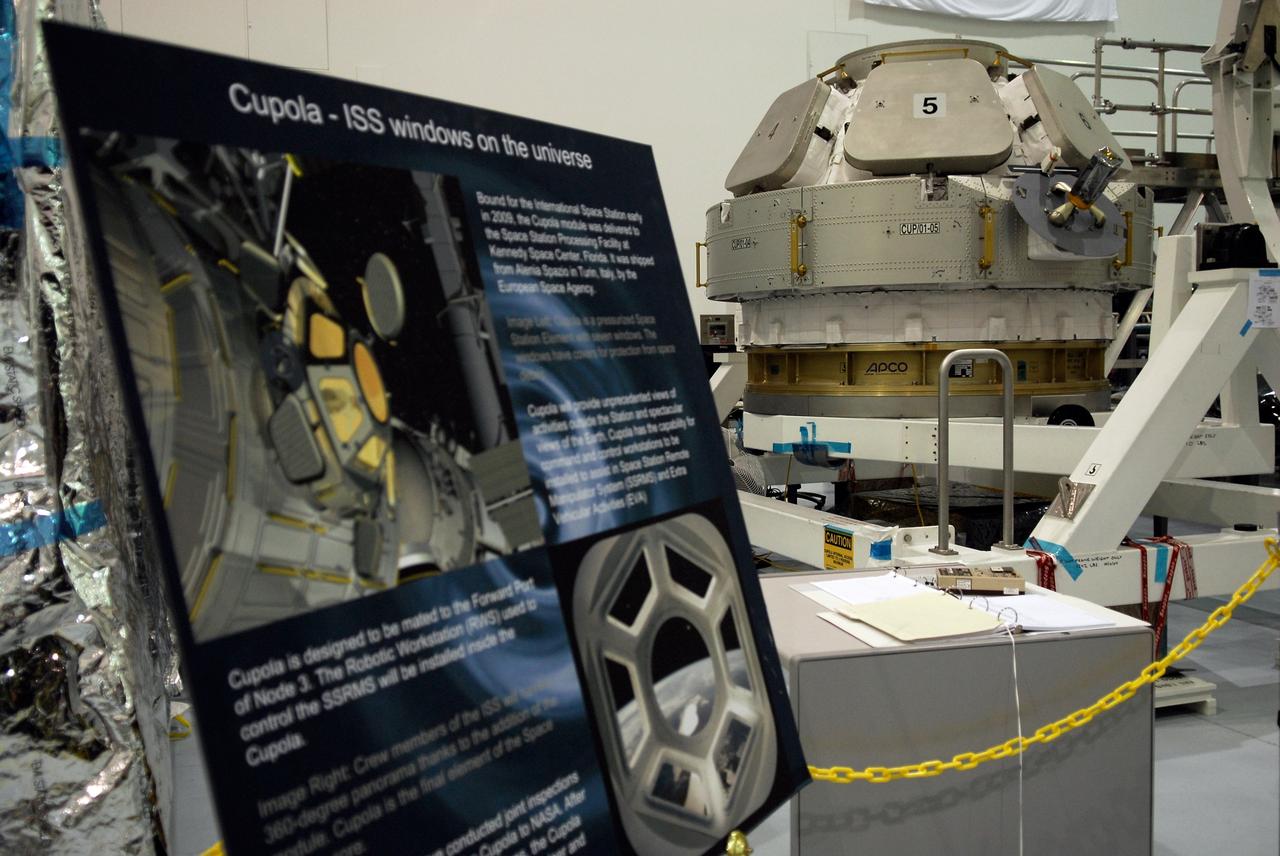
CAPE CANAVERAL, Fla. – The Cupola, another module built in Italy for the United States segment of the International Space Station, resides in the Space Station Processing Facility. With 360-degree windows, it will serve as a literal skylight to control some of the most sophisticated robotics ever built. The space station crew will use Cupola windows, six around the sides and one on the top, for line-of-sight monitoring of outside activities, including spacewalks, docking operations and exterior equipment surveys. The Cupola will be used specifically to monitor the approach and berthing of the Japanese H-2 supply spacecraft and other visiting vehicles. The Cupola also will serve as the primary location for controlling Canadarm2, the 60-foot space station robotic arm. Space station crews currently use two robotic control workstations in the Destiny laboratory to operate the arm. One of the robotic control stations will be placed inside the Cupola. The view from the Cupola will enhance an arm operator's situational awareness, supplementing television cameras and graphics. The Cupola is scheduled to launch on a future space station assembly mission. It will be installed on the forward port of Node 3, a connecting module to be installed as well. Photo credit: NASA/Kim Shiflett
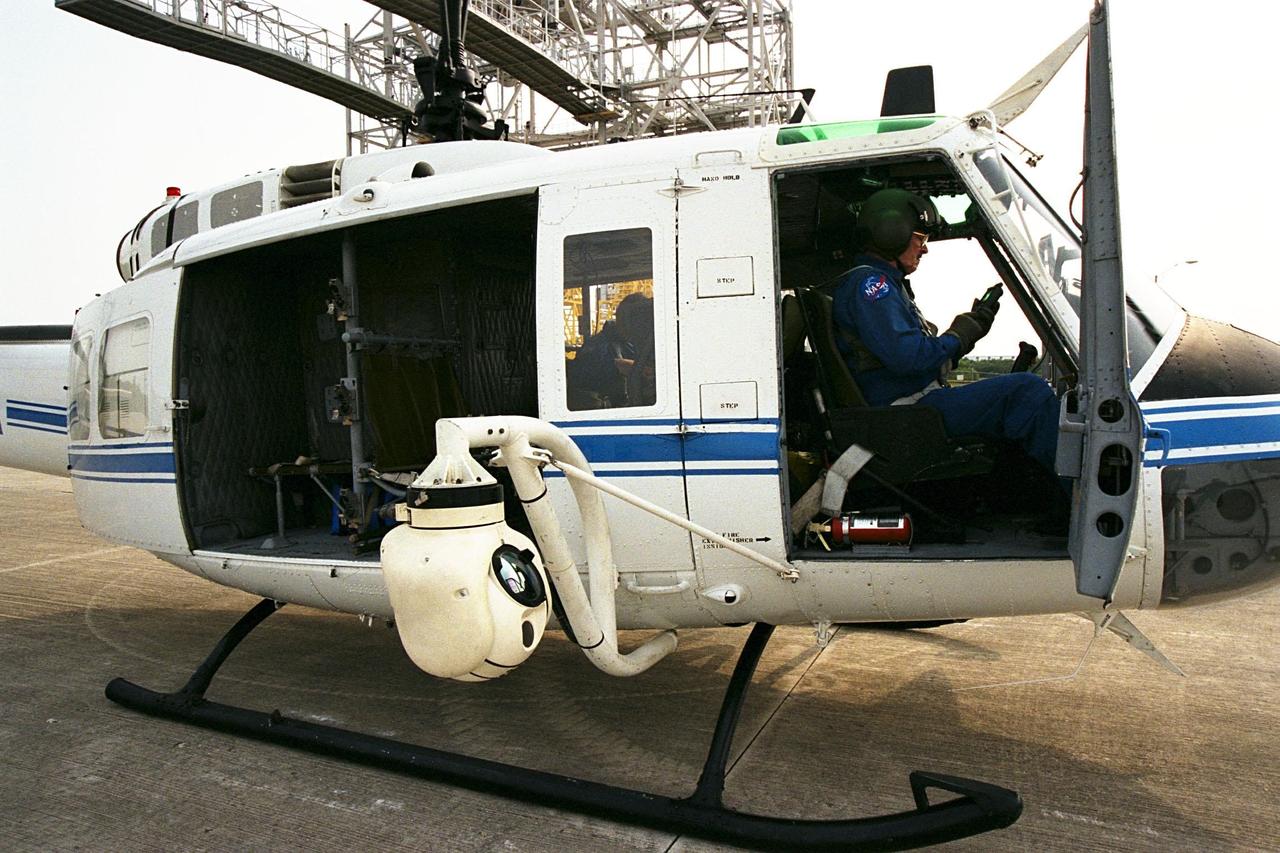
KENNEDY SPACE CENTER, FLA. -- A beach ball-sized infrared camera, part of the Forward Looking Infrared Radar (FLIR), has been mounted on the right siderail of NASA's Huey UH-1 helicopter. A KSC pilot prepares to fly the helicopter, which has also been outfitted with a portable global positioning satellite (GPS) system, to support Florida's Division of Forestry as they fight the brush fires which have been plaguing the state as a result of extremely dry conditions and lightning storms. The FLIR also includes a real-time television monitor and recorder installed inside the helicopter. While the FLIR collects temperature data and images, the GPS system provides the exact coordinates of the fires being observed and transmits the data to the firefighters on the ground. The Kennedy Space Center (KSC) security team routinely uses the FLIR equipment prior to Shuttle launch and landing activities to ensure that the area surrounding the launch pad and runway are clear of unauthorized personnel. KSC's Base Operations Contractor, EG&G Florida, operates the NASA-owned helicopter
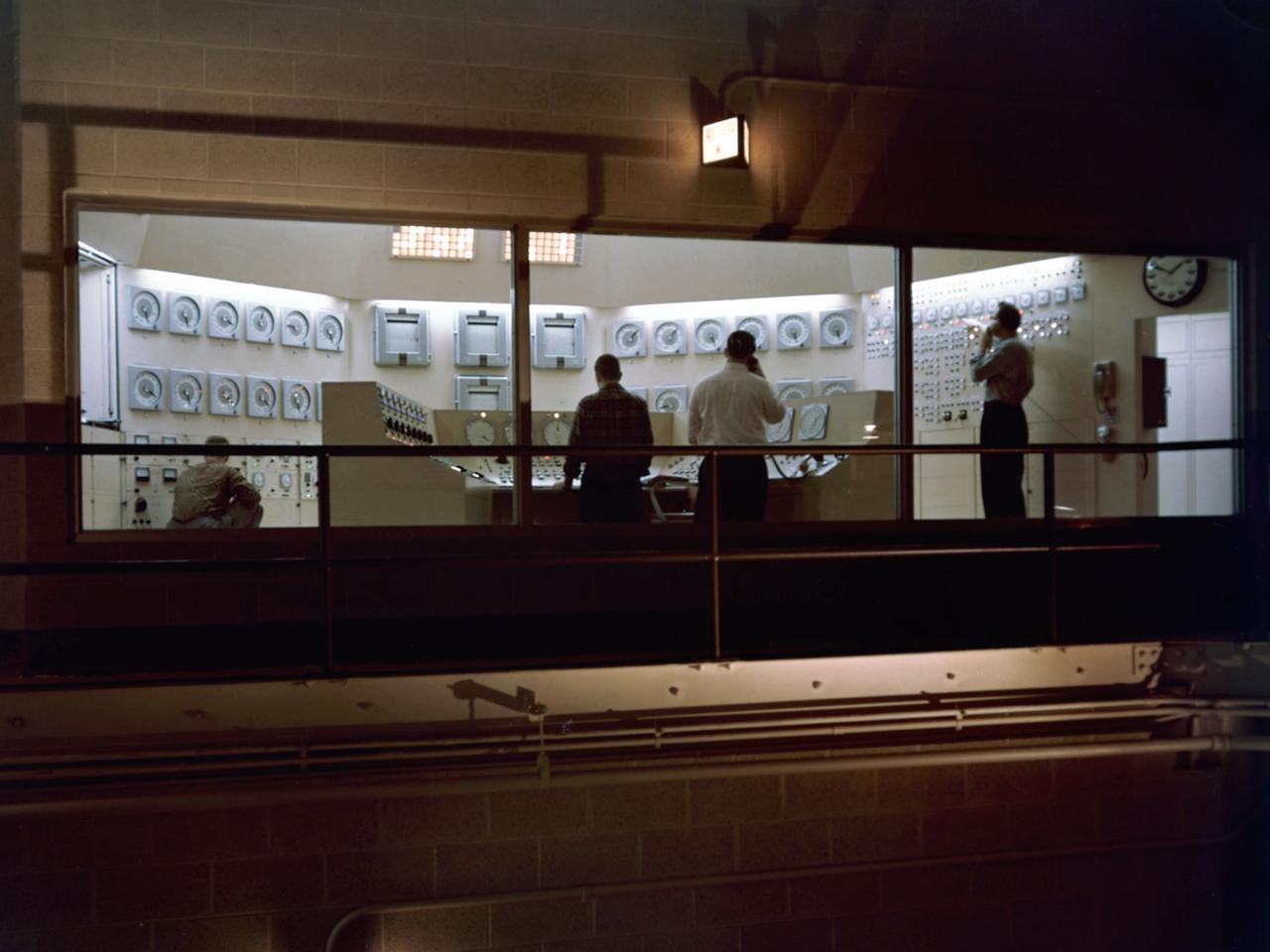
Operators test the National Aeronautics and Space Administration’s (NASA) Plum Brook Reactor Facility systems in the months leading up to its actual operation. The “Reactor On” signs are illuminated but the reactor core was not yet ready for chain reactions. Just a couple weeks after this photograph, Plum Brook Station held a media open house to unveil the 60-megawatt test reactor near Sandusky, Ohio. More than 60 members of the print media and radio and television news services met at the site to talk with community leaders and representatives from NASA and Atomic Energy Commission. The Plum Brook reactor went critical for the first time on the evening of June 14, 1961. It was not until April 1963 that the reactor reached its full potential of 60 megawatts. The reactor control room, located on the second floor of the facility, was run by licensed operators. The operators manually operated the shim rods which adjusted the chain reaction in the reactor core. The regulating rods could partially or completely shut down the reactor. The control room also housed remote area monitoring panels and other monitoring equipment that allowed operators to monitor radiation sensors located throughout the facility and to scram the reactor instantly if necessary. The color of the indicator lights corresponded with the elevation of the detectors in the various buildings. The reactor could also shut itself down automatically if the monitors detected any sudden irregularities.
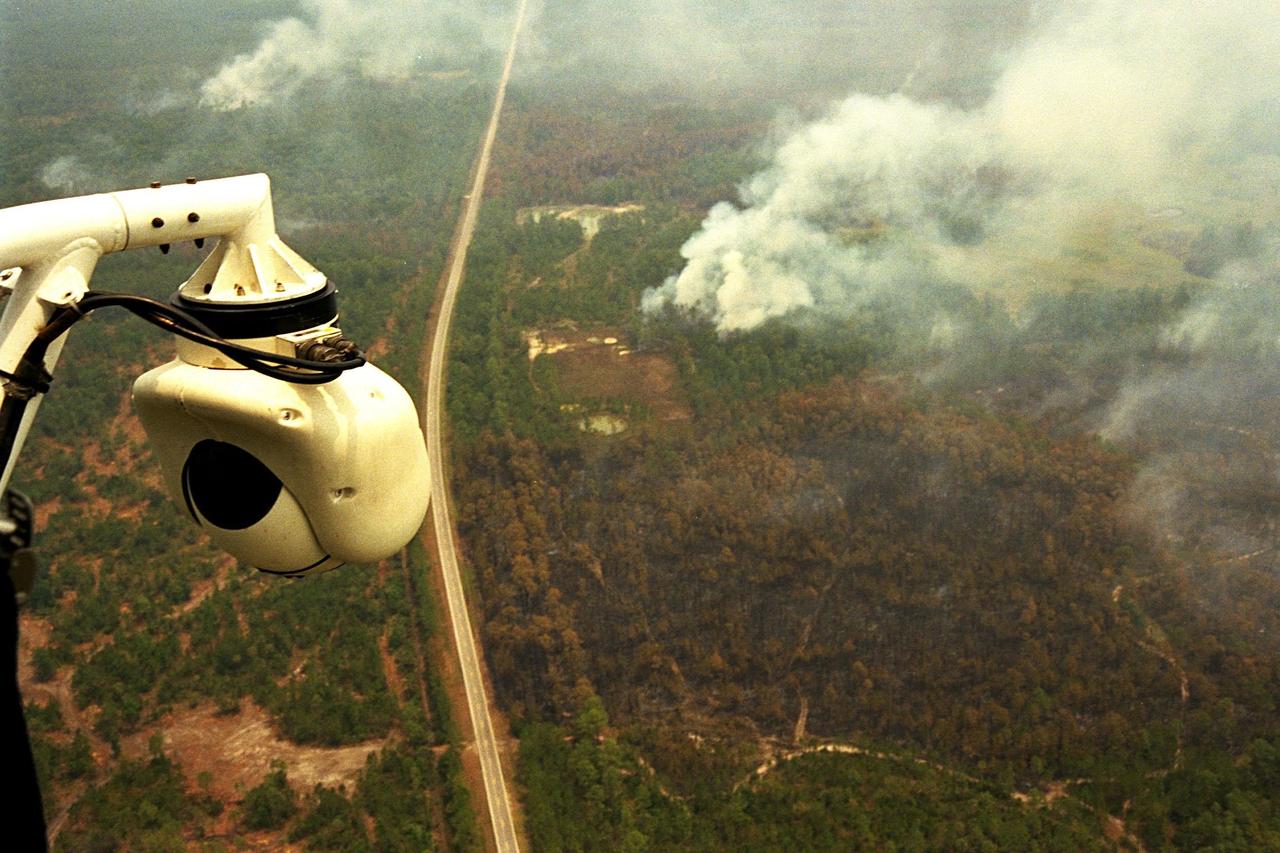
KENNEDY SPACE CENTER, FLA. -- A beach ball-sized infrared camera, part of the Forward Looking Infrared Radar (FLIR), has been mounted on the right siderail of NASA's Huey UH-1 helicopter and is being used to search for fires in Volusia County, Florida. The helicopter has also been outfitted with a portable global positioning satellite (GPS) system to support Florida's Division of Forestry as they fight the brush fires which have been plaguing the state as a result of extremely dry conditions and lightning storms. The FLIR also includes a real-time television monitor and recorder installed inside the helicopter. While the FLIR collects temperature data and images, the GPS system provides the exact coordinates of the fires being observed and transmits the data to the firefighters on the ground. The Kennedy Space Center (KSC) security team routinely uses the FLIR equipment prior to Shuttle launch and landing activities to ensure that the area surrounding the launch pad and runway are clear of unauthorized personnel. KSC's Base Operations Contractor, EG&G Florida, operates the NASA-owned helicopter
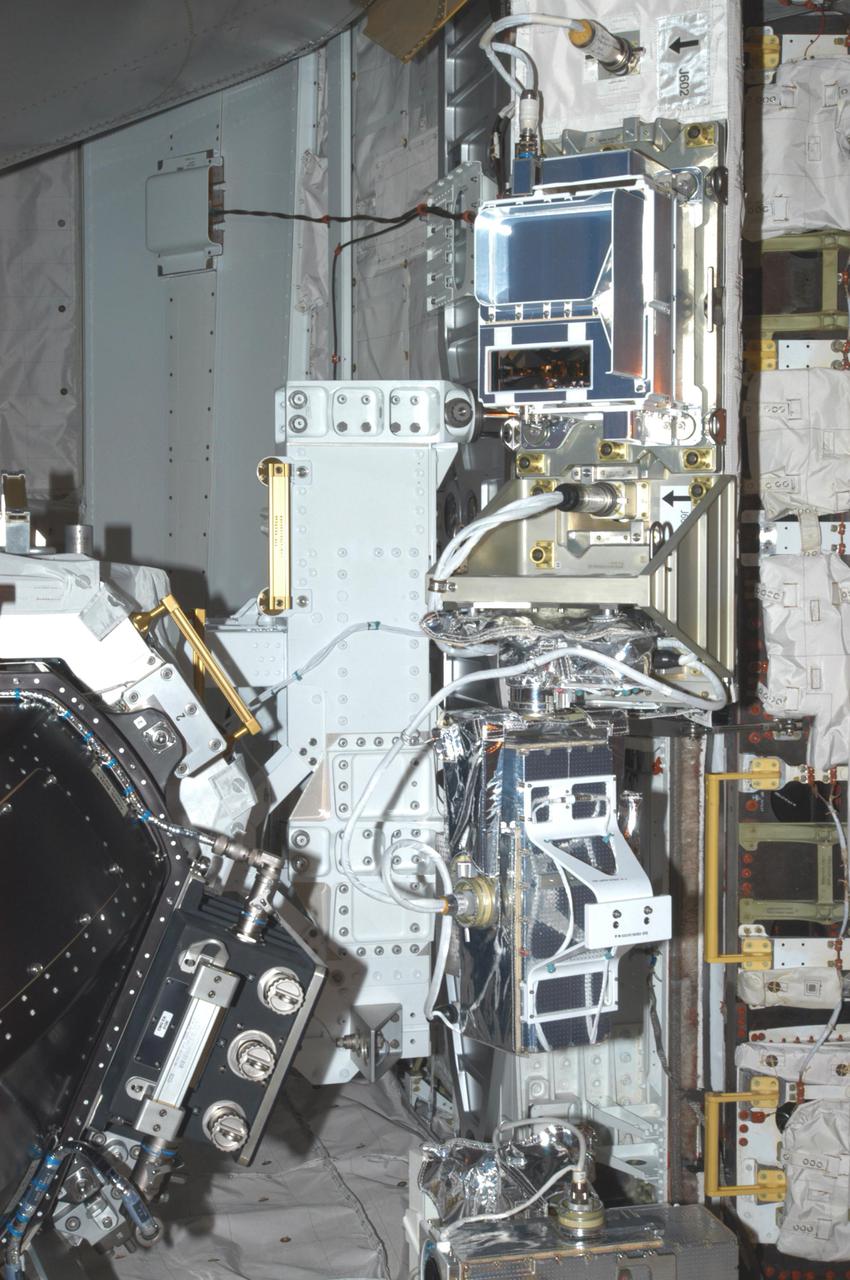
KENNEDY SPACE CENTER, FLA. - At Launch Pad 39B, the Orbiter Boom Sensor System (OBSS) sensor package is viewed before the orbiter's payload bay doors are closed for launch. Payload bay door closure is a significant milestone in the preparations of Discovery for the first Return to Flight mission, STS-114. This sensor package will provide surface area and depth defect inspection for all the surfaces of the orbiter. It includes an intensified television camera (ITVC) and a laser dynamic range imager, which are mounted on a pan and tilt unit, and a laser camera system (LCS) mounted on a stationary bracket. The package is part of the new safety measures added for all future Space Shuttle missions. During its 12-day mission, Discovery’s seven-person crew will test new hardware and techniques to improve Shuttle safety, as well as deliver supplies to the International Space Station. Discovery’s payloads include the Multi-Purpose Logistics Module Raffaello, the Lightweight Multi-Purpose Experiment Support Structure Carrier (LMC), and the External Stowage Platform-2 (ESP-2). Raffaello will deliver supplies to the International Space Station including food, clothing and research equipment. The LMC supports a replacement Control Moment Gyroscope and a tile repair sample box. The ESP-2 is outfitted with replacement parts. Launch of mission STS-114 was set for July 13 at the conclusion of the Flight Readiness Review yesterday.
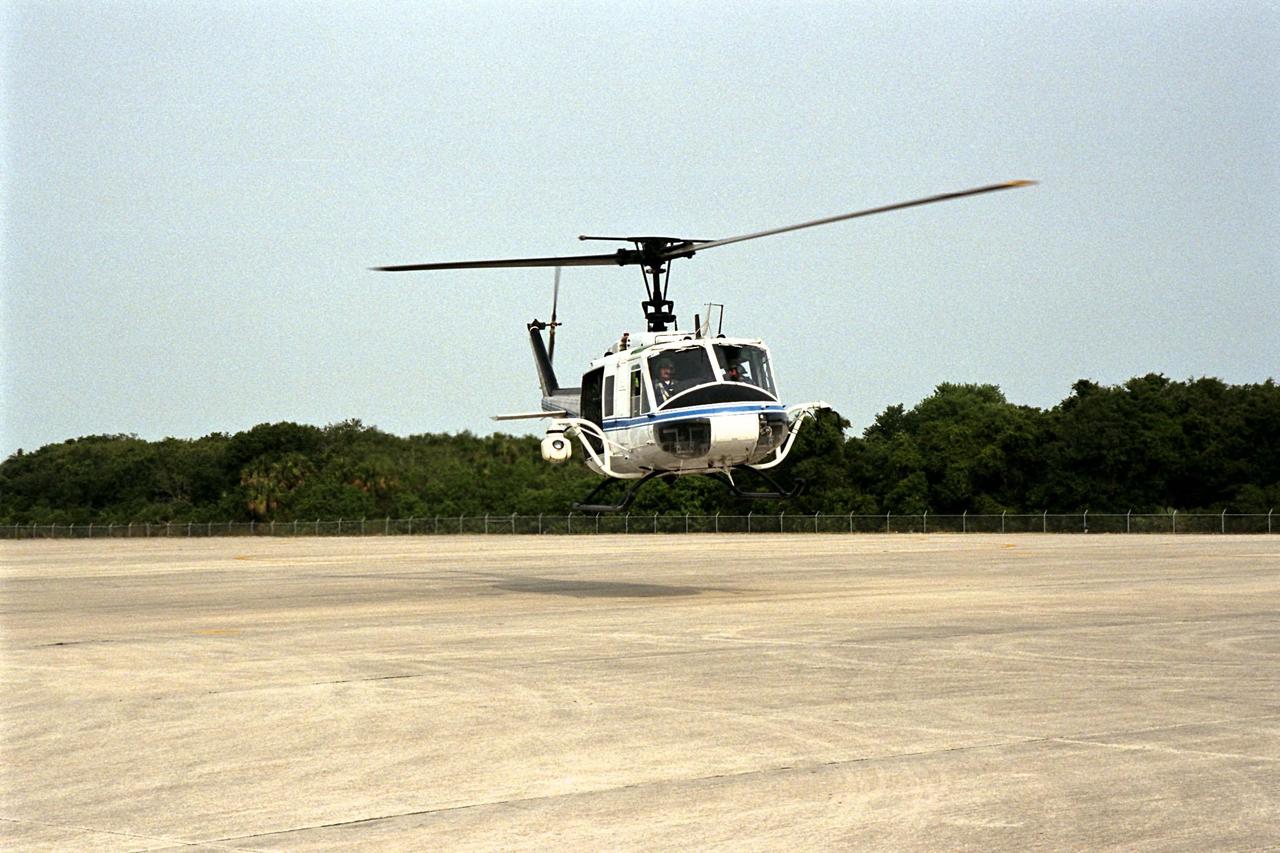
KENNEDY SPACE CENTER, FLA. -- NASA's Huey UH-1 helicopter lands at the Shuttle Landing Facility to pick up Kennedy Space Center (KSC) Security personnel who operate the Forward Looking Infrared Radar (FLIR) installed on board. The helicopter has also been outfitted with a portable global positioning satellite (GPS) system to support Florida's Division of Forestry as they fight the brush fires which have been plaguing the state as a result of extremely dry conditions and lightning storms. The FLIR includes a beach ball-sized infrared camera that is mounted on the helicopter's right siderail and a real-time television monitor and recorder installed inside. While the FLIR collects temperature data and images, the GPS system provides the exact coordinates of the fires being observed and transmits the data to the firefighters on the ground. KSC's security team routinely uses the FLIR equipment prior to Shuttle launch and landing activities to ensure that the area surrounding the launch pad and runway are clear of unauthorized personnel. KSC's Base Operations Contractor, EG&G Florida, operates the NASA-owned helicopter
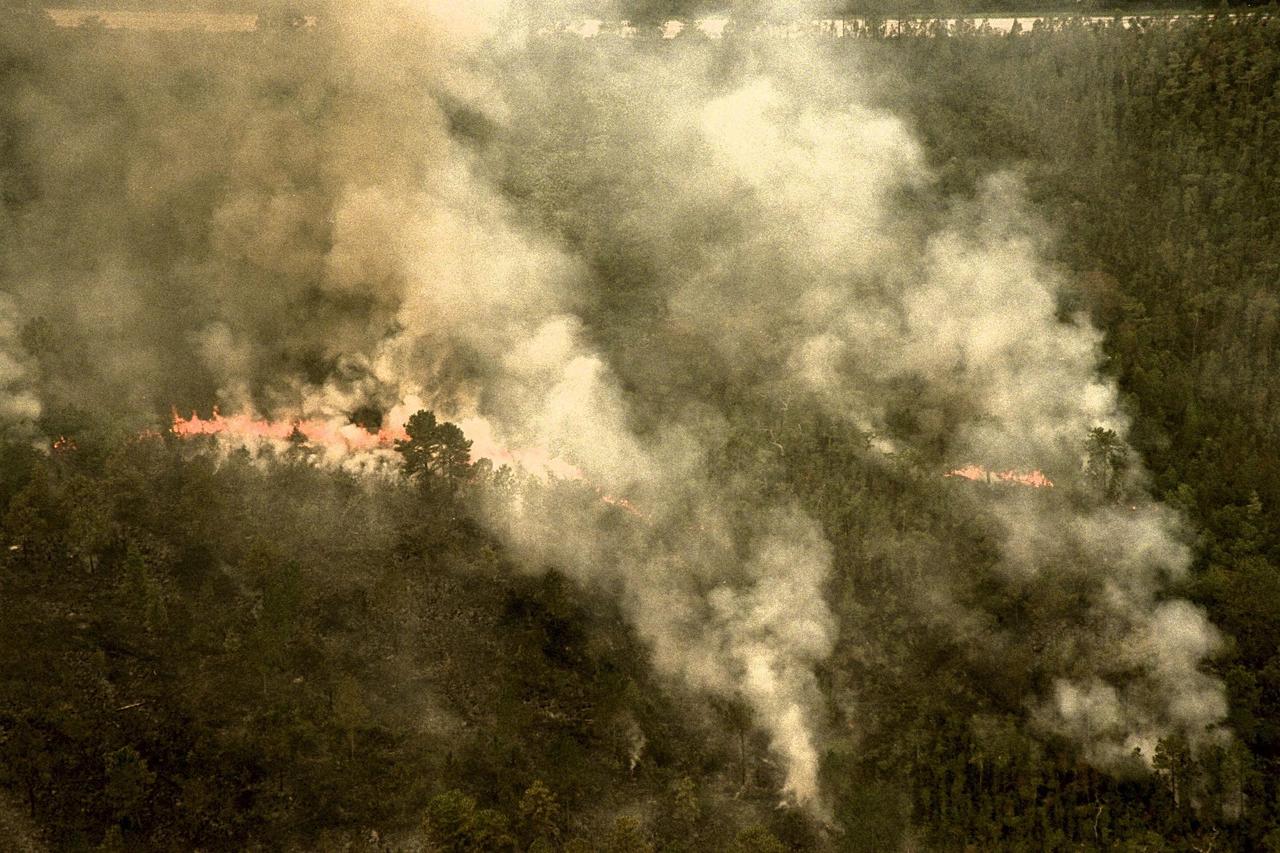
KENNEDY SPACE CENTER, FLA. -- A forest fire burning in Volusia County, Florida, is clearly visible from NASA's Huey UH-1 helicopter. The helicopter has been outfitted with a Forward Looking Infrared Radar (FLIR) and a portable global positioning satellite (GPS) system to support Florida's Division of Forestry as they fight the brush fires which have been plaguing the state as a result of extremely dry conditions and lightning storms. The FLIR includes a beach ball-sized infrared camera that is mounted on the helicopter's right siderail and a real-time television monitor and recorder installed inside. While the FLIR collects temperature data and images, the GPS system provides the exact coordinates of the fires being observed and transmits the data to the firefighters on the ground. The Kennedy Space Center (KSC) security team routinely uses the FLIR equipment prior to Shuttle launch and landing activities to ensure that the area surrounding the launch pad and runway are clear of unauthorized personnel. KSC's Base Operations Contractor, EG&G Florida, operates the NASA-owned helicopter
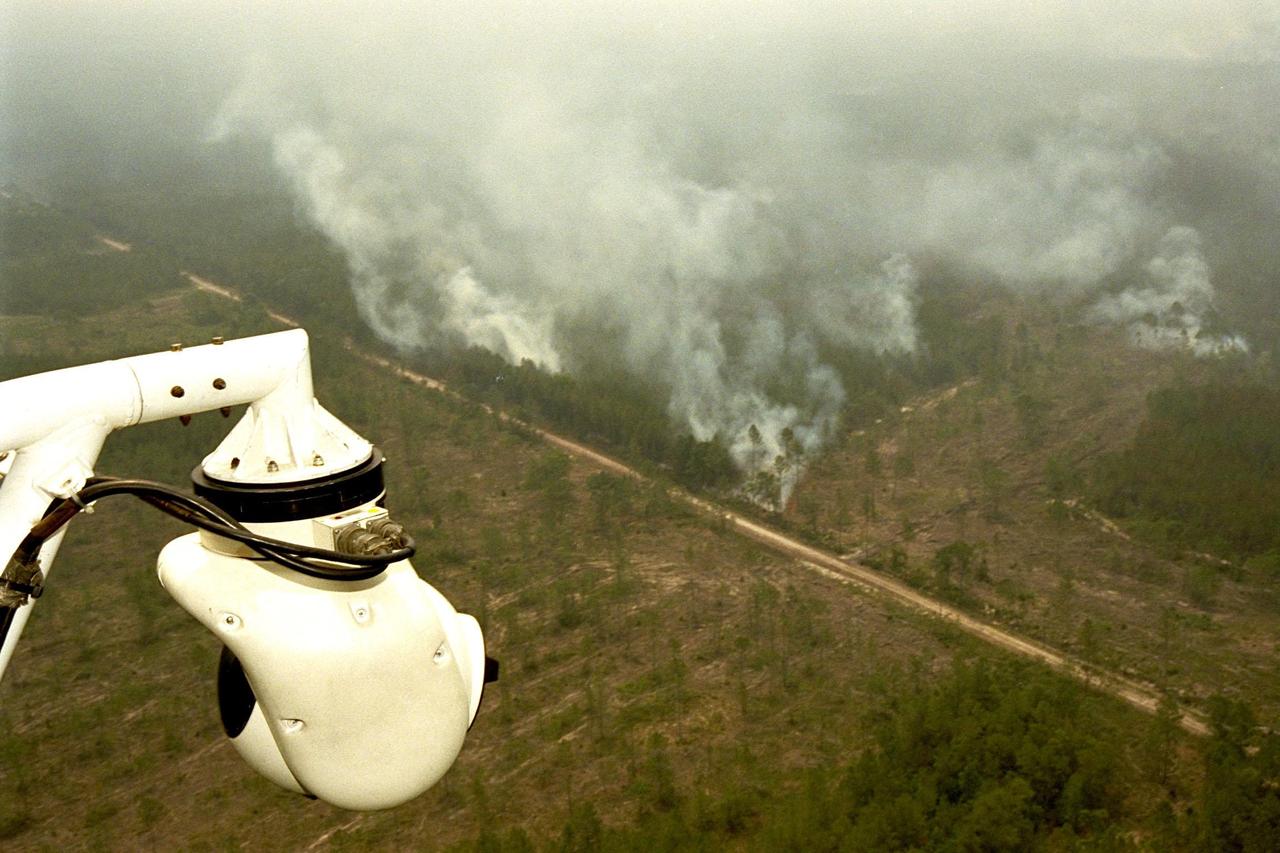
KENNEDY SPACE CENTER, FLA. -- A beach ball-sized infrared camera, part of the Forward Looking Infrared Radar (FLIR), has been mounted on the right siderail of NASA's Huey UH-1 helicopter and is being used to scan a large area of Volusia County, Florida, where a fire burns. The helicopter has also been outfitted with a portable global positioning satellite (GPS) system to support Florida's Division of Forestry as they fight the brush fires which have been plaguing the state as a result of extremely dry conditions and lightning storms. The FLIR also includes a real-time television monitor and recorder installed inside the helicopter. While the FLIR collects temperature data and images, the GPS system provides the exact coordinates of the fires being observed and transmits the data to the firefighters on the ground. The Kennedy Space Center (KSC) security team routinely uses the FLIR equipment prior to Shuttle launch and landing activities to ensure that the area surrounding the launch pad and runway are clear of unauthorized personnel. KSC's Base Operations Contractor, EG&G Florida, operates the NASA-owned helicopter
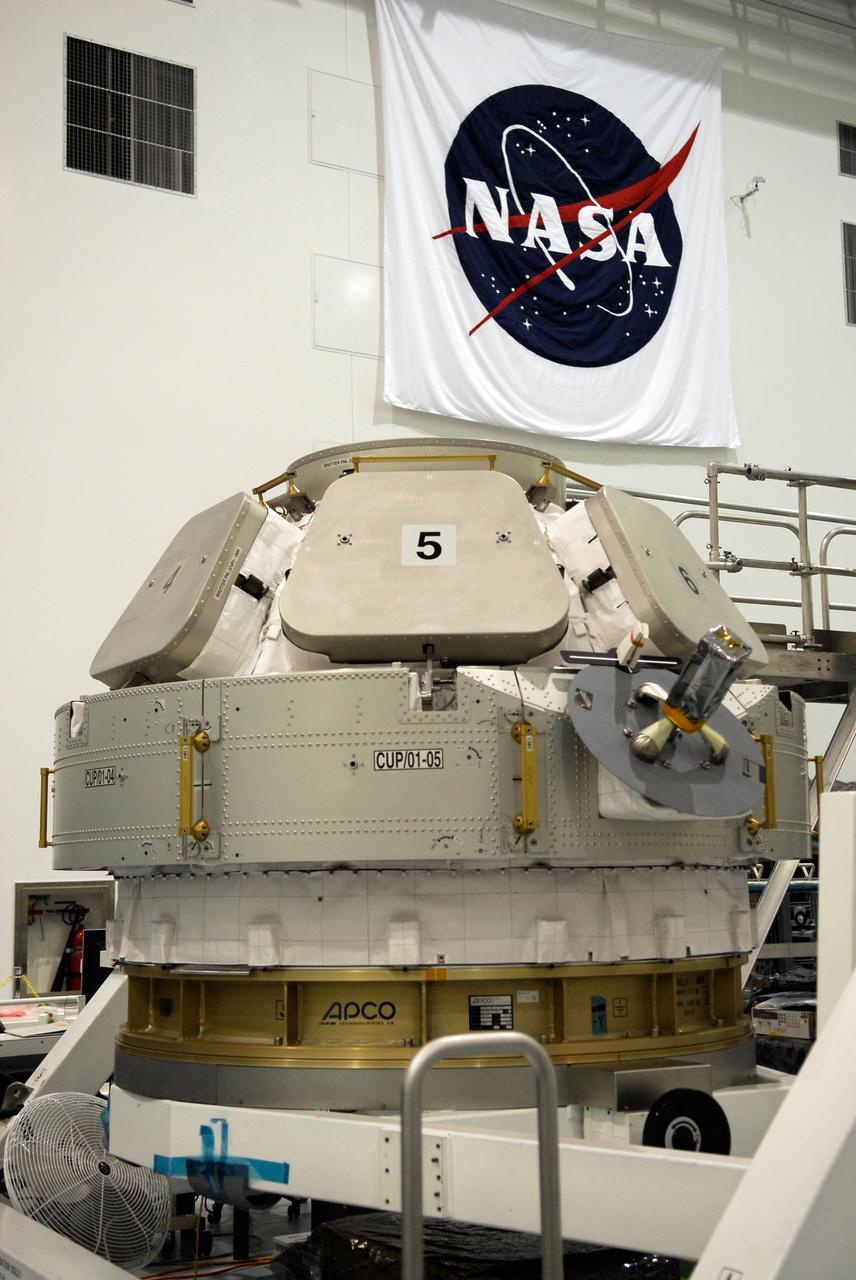
CAPE CANAVERAL, Fla. – The Cupola, another module built in Italy for the United States segment of the International Space Station, resides in the Space Station Processing Facility. With 360-degree windows, it will serve as a literal skylight to control some of the most sophisticated robotics ever built. The space station crew will use Cupola windows, six around the sides and one on the top, for line-of-sight monitoring of outside activities, including spacewalks, docking operations and exterior equipment surveys. The Cupola will be used specifically to monitor the approach and berthing of the Japanese H-2 supply spacecraft and other visiting vehicles. The Cupola also will serve as the primary location for controlling Canadarm2, the 60-foot space station robotic arm. Space station crews currently use two robotic control workstations in the Destiny laboratory to operate the arm. One of the robotic control stations will be placed inside the Cupola. The view from the Cupola will enhance an arm operator's situational awareness, supplementing television cameras and graphics. The Cupola is scheduled to launch on a future space station assembly mission. It will be installed on the forward port of Node 3, a connecting module to be installed as well. Photo credit: NASA/Kim Shiflett
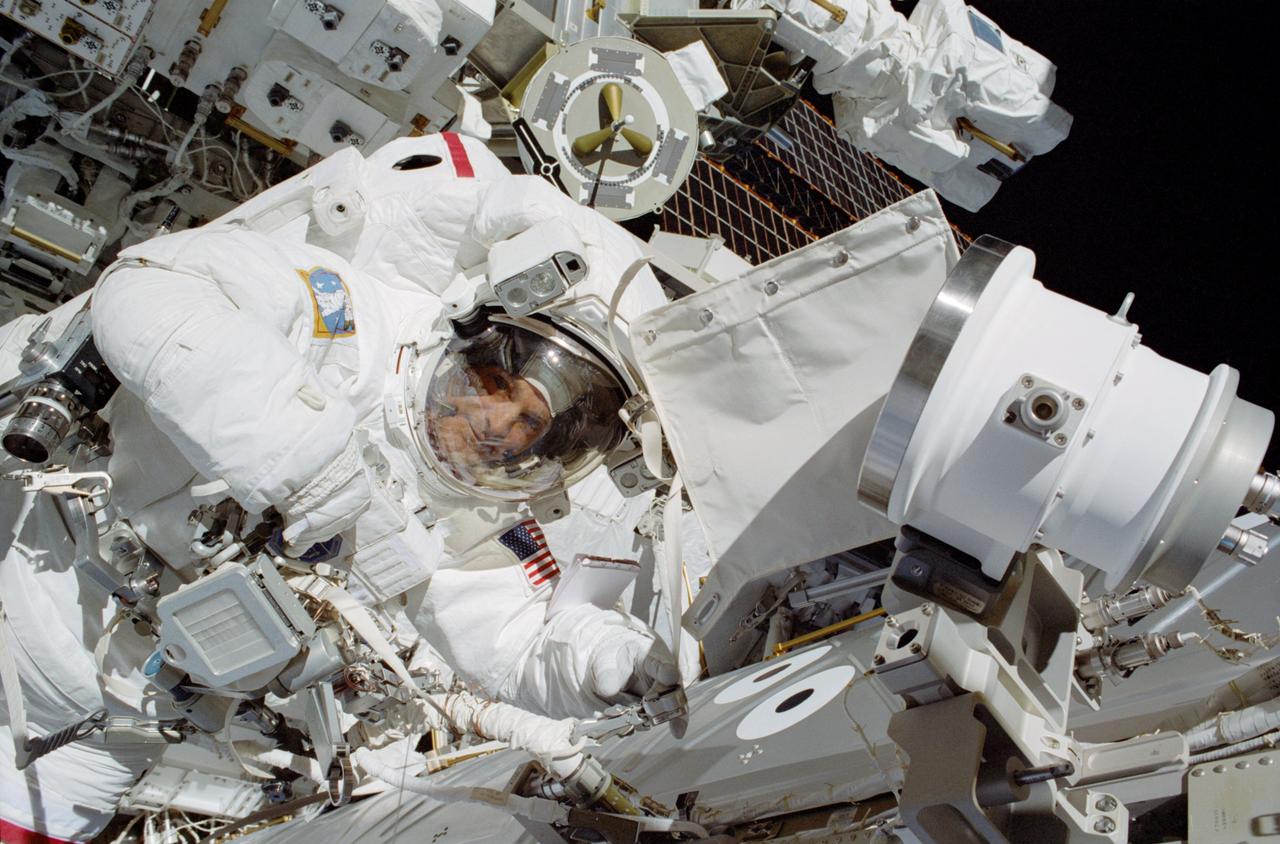
Astronaut David A. Wolf, STS-112 mission specialist, participates in the mission's second session of extravehicular activity (EVA), a six hour, four minute space walk, in which an exterior station television camera was installed outside of the Destiny Laboratory. Launched October 7, 2002 aboard the Space Shuttle Orbiter Atlantis, the STS-112 mission lasted 11 days and performed three EVA sessions. Its primary mission was to install the Starboard (S1) Integrated Truss Structure and Equipment Translation Aid (CETA) Cart to the International Space Station (ISS). The S1 truss provides structural support for the orbiting research facility's radiator panels, which use ammonia to cool the Station's complex power system. The S1 truss, attached to the S0 (S Zero) truss installed by the previous STS-110 mission, flows 637 pounds of anhydrous ammonia through three heat rejection radiators. The truss is 45-feet long, 15-feet wide, 10-feet tall, and weighs approximately 32,000 pounds. The CETA is the first of two human-powered carts that will ride along the International Space Station's railway providing a mobile work platform for future extravehicular activities by astronauts.
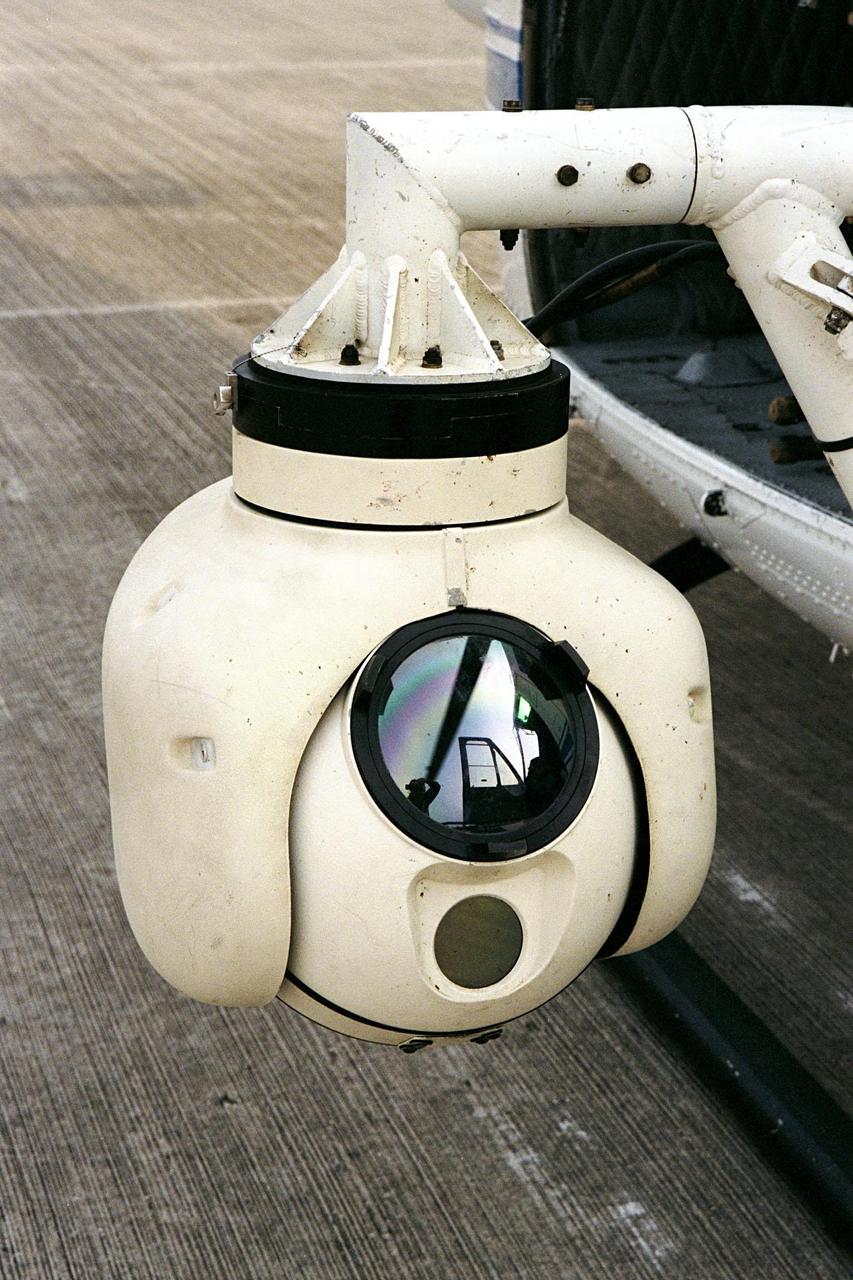
KENNEDY SPACE CENTER, FLA. -- A beach ball-sized infrared camera, part of the Forward Looking Infrared Radar (FLIR), has been mounted on the right siderail of NASA's Huey UH-1 helicopter. The helicopter has also been outfitted with a portable global positioning satellite (GPS) system to support Florida's Division of Forestry as they fight the brush fires which have been plaguing the state as a result of extremely dry conditions and lightning storms. The FLIR also includes a real-time television monitor and recorder installed inside the helicopter. While the FLIR collects temperature data and images, the GPS system provides the exact coordinates of the fires being observed and transmits the data to the firefighters on the ground. The Kennedy Space Center (KSC) security team routinely uses the FLIR equipment prior to Shuttle launch and landing activities to ensure that the area surrounding the launch pad and runway are clear of unauthorized personnel. KSC's Base Operations Contractor, EG&G Florida, operates the NASA-owned helicopter
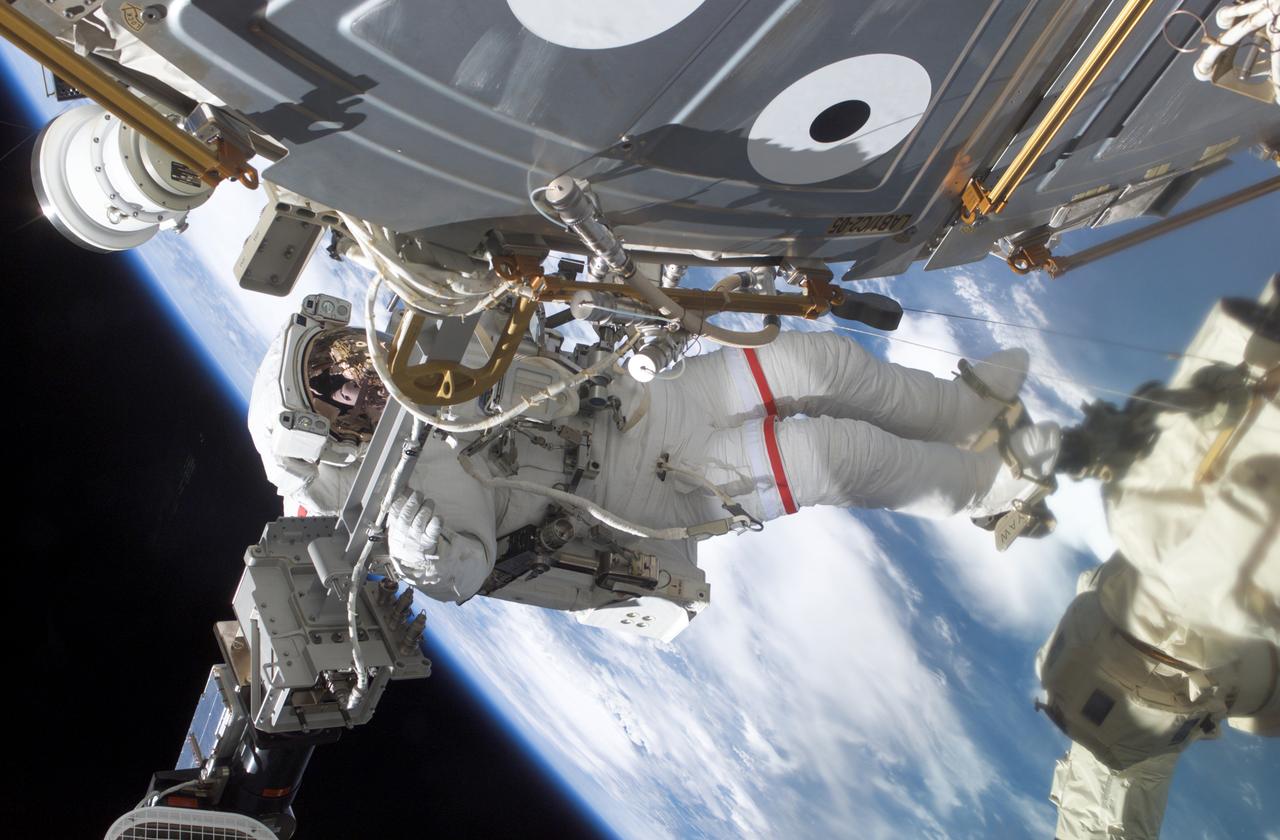
Astronaut David A. Wolf, STS-112 mission specialist, participates in the mission's second session of extravehicular activity (EVA), a six hour, four minute space walk, in which an exterior station television camera was installed outside of the Destiny Laboratory. Launched October 7, 2002 aboard the Space Shuttle Orbiter Atlantis, the STS-112 mission lasted 11 days and performed three EVA sessions. Its primary mission was to install the Starboard (S1) Integrated Truss Structure and Equipment Translation Aid (CETA) Cart to the International Space Station (ISS). The S1 truss provides structural support for the orbiting research facility's radiator panels, which use ammonia to cool the Station's complex power system. The S1 truss, attached to the S0 (S Zero) truss installed by the previous STS-110 mission, flows 637 pounds of anhydrous ammonia through three heat rejection radiators. The truss is 45-feet long, 15-feet wide, 10-feet tall, and weighs approximately 32,000 pounds. The CETA is the first of two human-powered carts that will ride along the International Space Station's railway providing a mobile work platform for future extravehicular activities by astronauts.