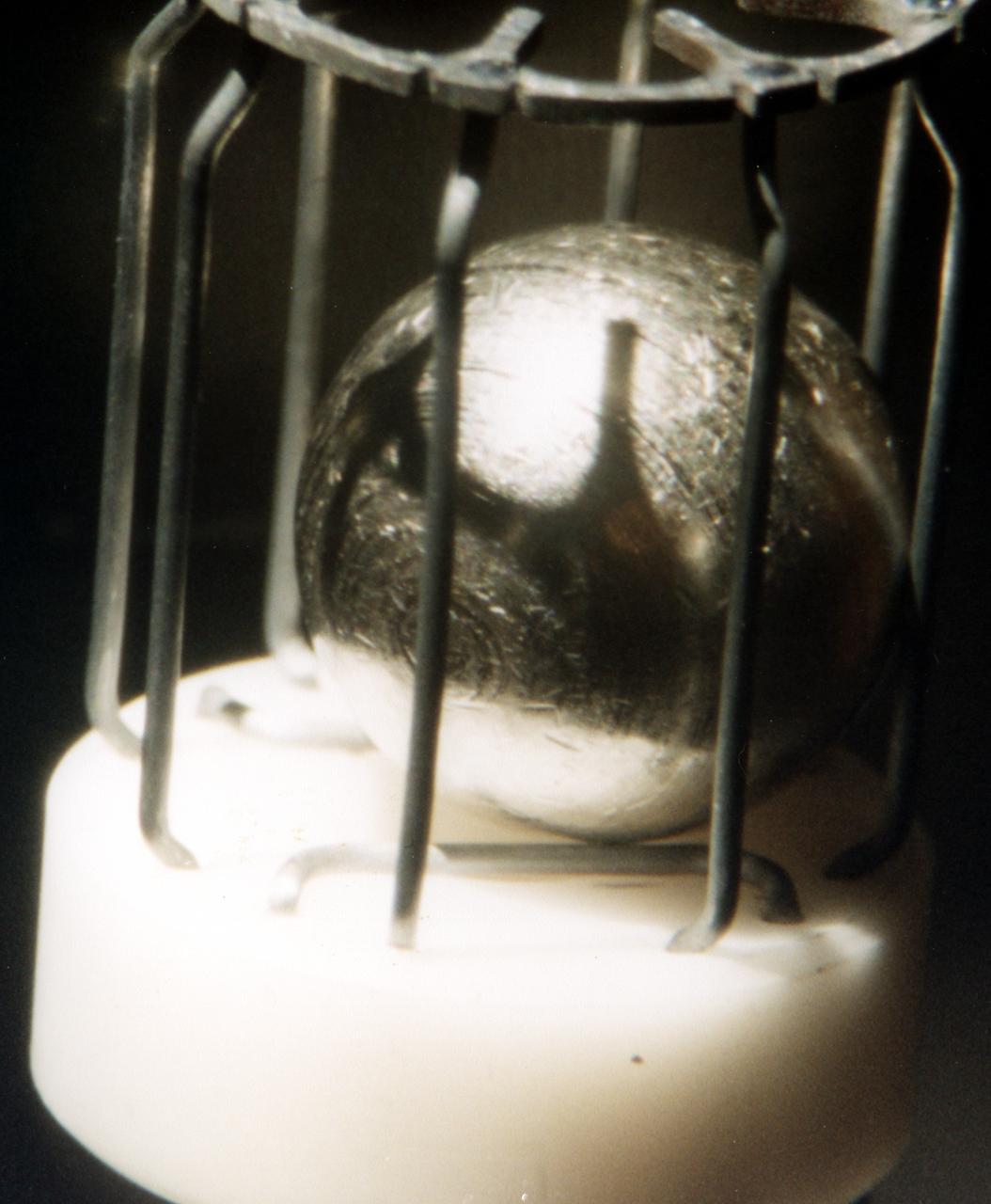
Typical metal sample that was processed by TEMPUS (Tiegelfreies Elektromagnetisches Prozessieren Unter Schwerelosigkeit), an electromagnetic levitation facility developed by German researchers and flown on the IML-2 and MSL-1 and 1R Spacelab missions. Electromagnetic levitation is used commonly in ground-based experiments to melt and then cool metallic melts below their freezing points without solidification occurring. Sample size is limited in ground-based experiments. Research with TEMPUS aboard Spacelab allowed scientists to study the viscosity, surface tension, and other properties of several metals and alloys while undercooled (i.e., cooled below their normal solidification points). The sample is about 1 cm (2/5 inch) in diameter.
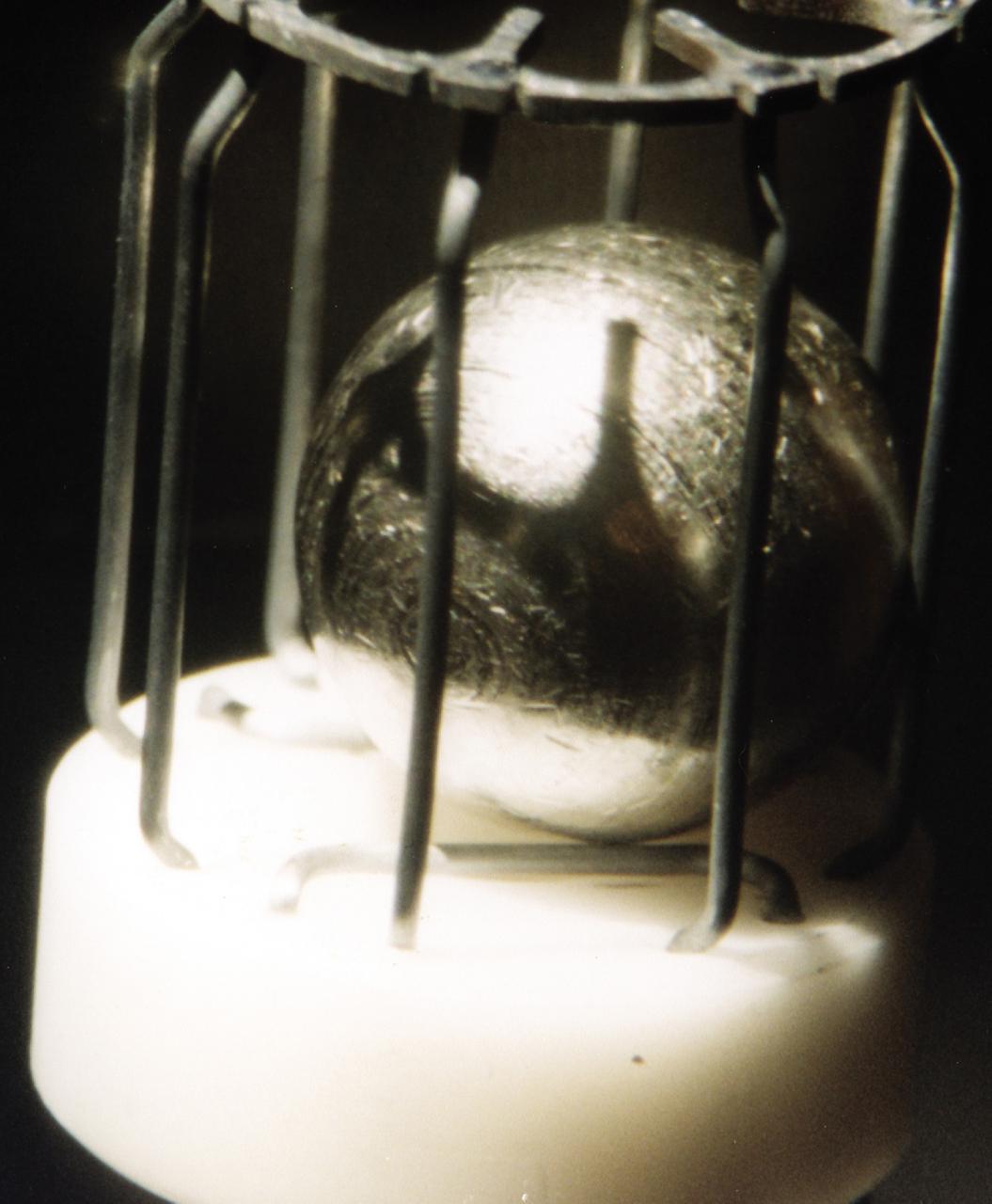
This metal sample, which is approximately 1 cm in diameter, is typical of the metals that were studied using the German designed electromagnetic containerless processing facility. The series of experiments that use this device is known as TEMPUS which is the acronym that stands for the German Tiegelfreies Elektromanetisches Prozessieren Unter Schwerelosigkeit. Most of the TEMPUS experiments focused on various aspects of undercooling liquid metal and alloys. Undercooling is the process of melting a material and then cooling it to a temperature that is below its normal freezing or solidification point. The TEMPUS experiments that used the metal cages as shown in the photograph, often studied bulk metallic glass, a solid material with no crystalline structures. We study metals and alloys not only to build things in space, but to improve things that are made on Earth. Metals and alloys are everywhere around us; in our automobiles, in the engines of aircraft, in our power-plants, and elsewhere. Despite their presence in everyday life, there are many scientific aspects of metals that we do not understand.
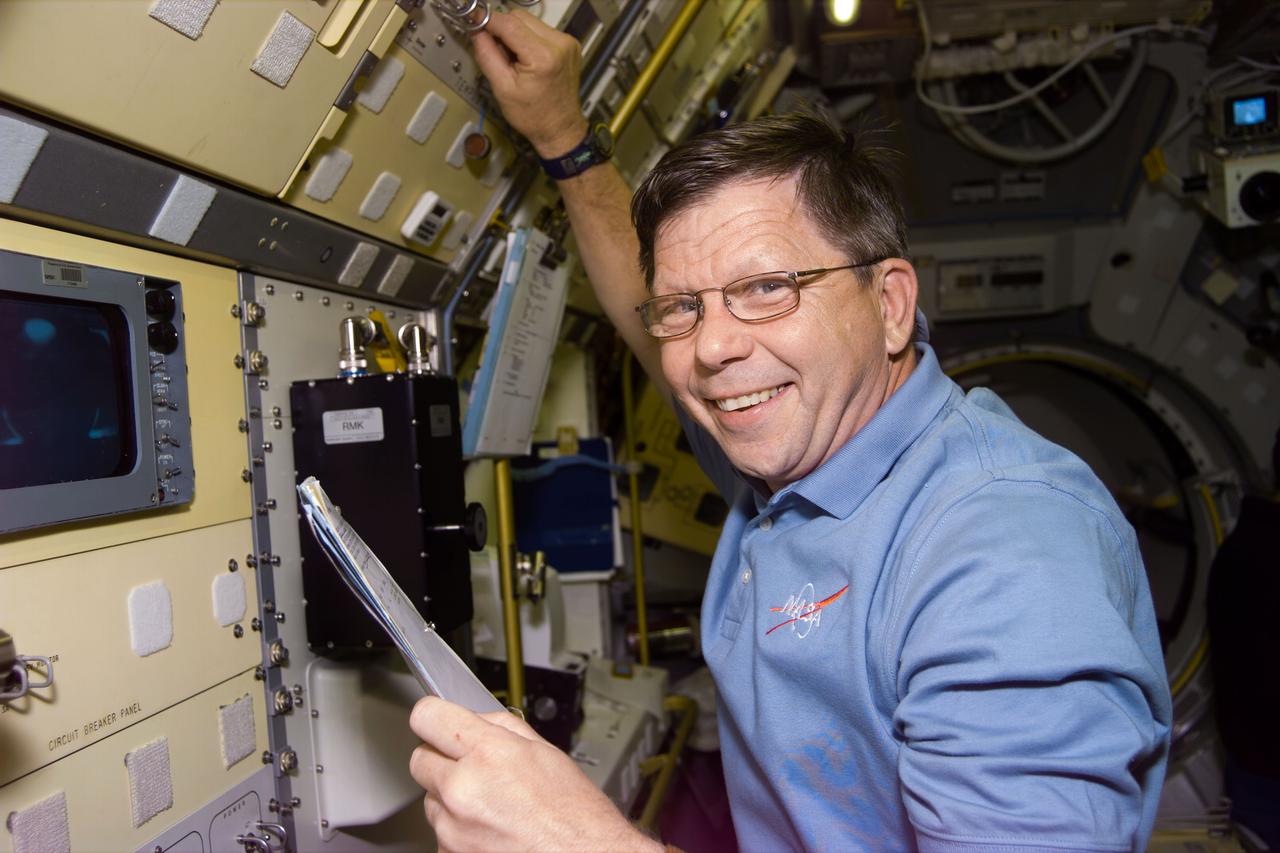
S94-E-5019 (6 July 1997) --- Roger K. Crouch, payload specialist for the Microgravity Sciences Laboratory (MSL-1) mission, is seen at the experiment racks during Flight Day 6 aboard Spacelab. The photo was recorded with an Electronic Still Camera (ESC) and later downlinked to ground controllers in Houston, Texas.
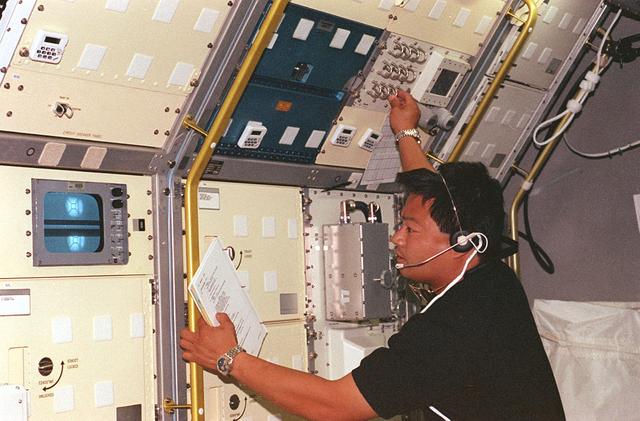
TEMPUS, an electromagnetic levitation facility that allows containerless processing of metallic samples in microgravity, first flew on the IML-2 Spacelab mission. The principle of electromagnetic levitation is used commonly in ground-based experiments to melt and then cool metallic melts below their freezing points without solidification occurring. The TEMPUS operation is controlled by its own microprocessor system; although commands may be sent remotely from the ground and real time adjustments may be made by the crew. Two video cameras, a two-color pyrometer for measuring sample temperatures, and a fast infrared detector for monitoring solidification spikes, will be mounted to the process chamber to facilitate observation and analysis. In addition, a dedicated high-resolution video camera can be attached to the TEMPUS to measure the sample volume precisely.