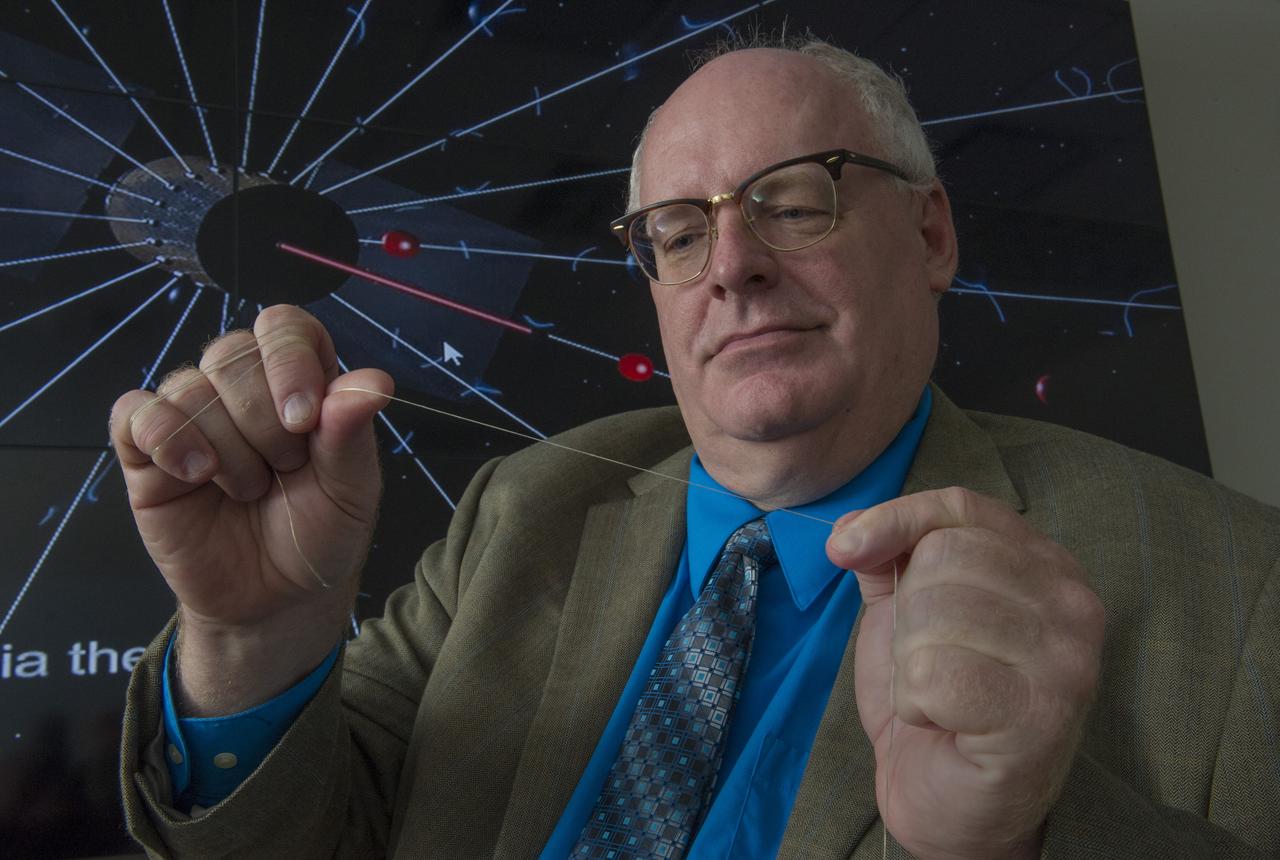
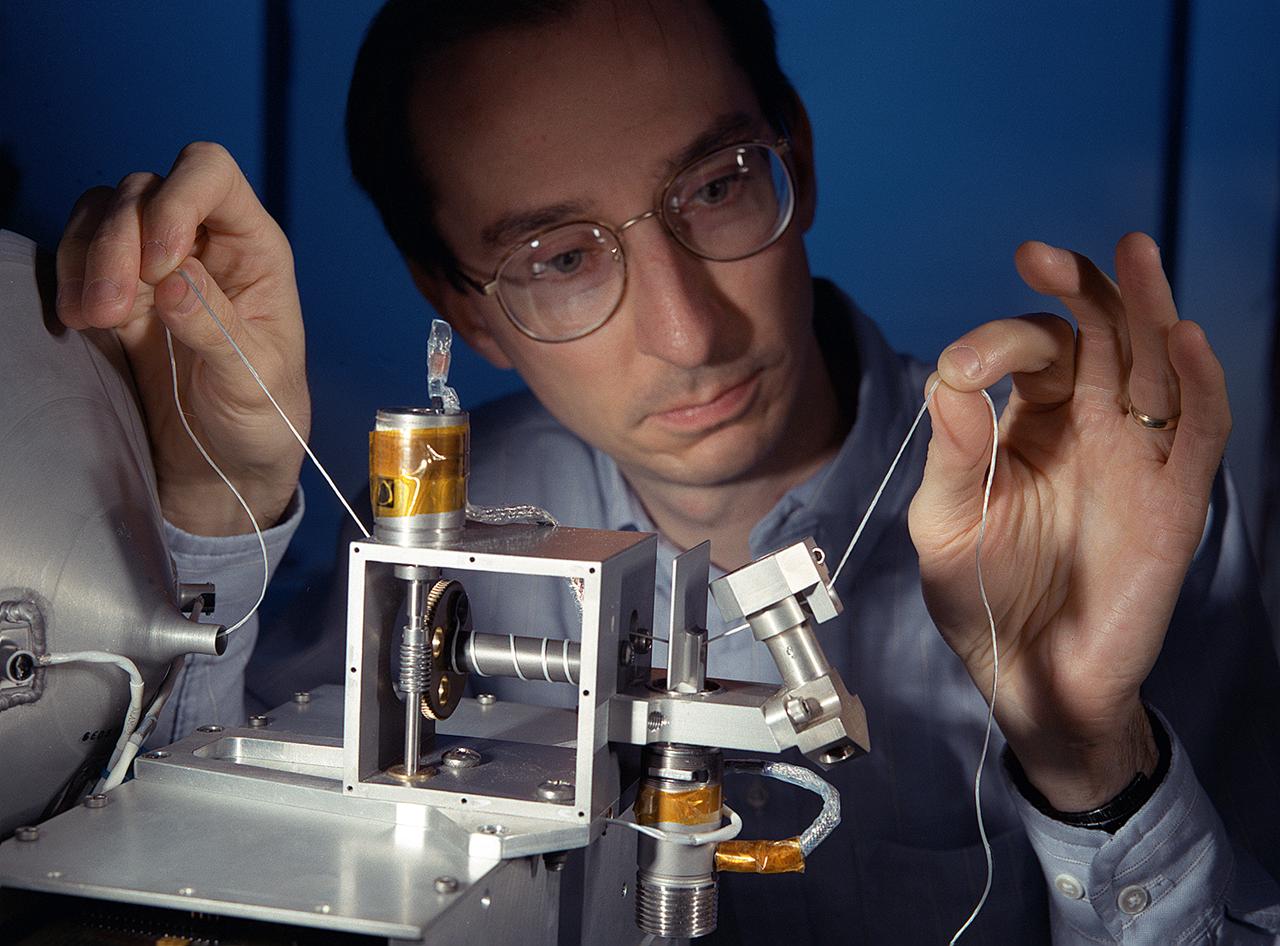
BRUCE WIEGMANN, AN ENGINEER AT NASA'S MARSHALL SPACE FLIGHT CENTER IN HUNTSVILLE, ALABAMA, EXAMINES A HAIR-THIN TETHER THAT WILL BE PART OF AN ELECTROSTATIC PROPULSION SYSTEM THAT COULD SEND SPACECRAFT ON INTERSTELLAR MISSIONS.
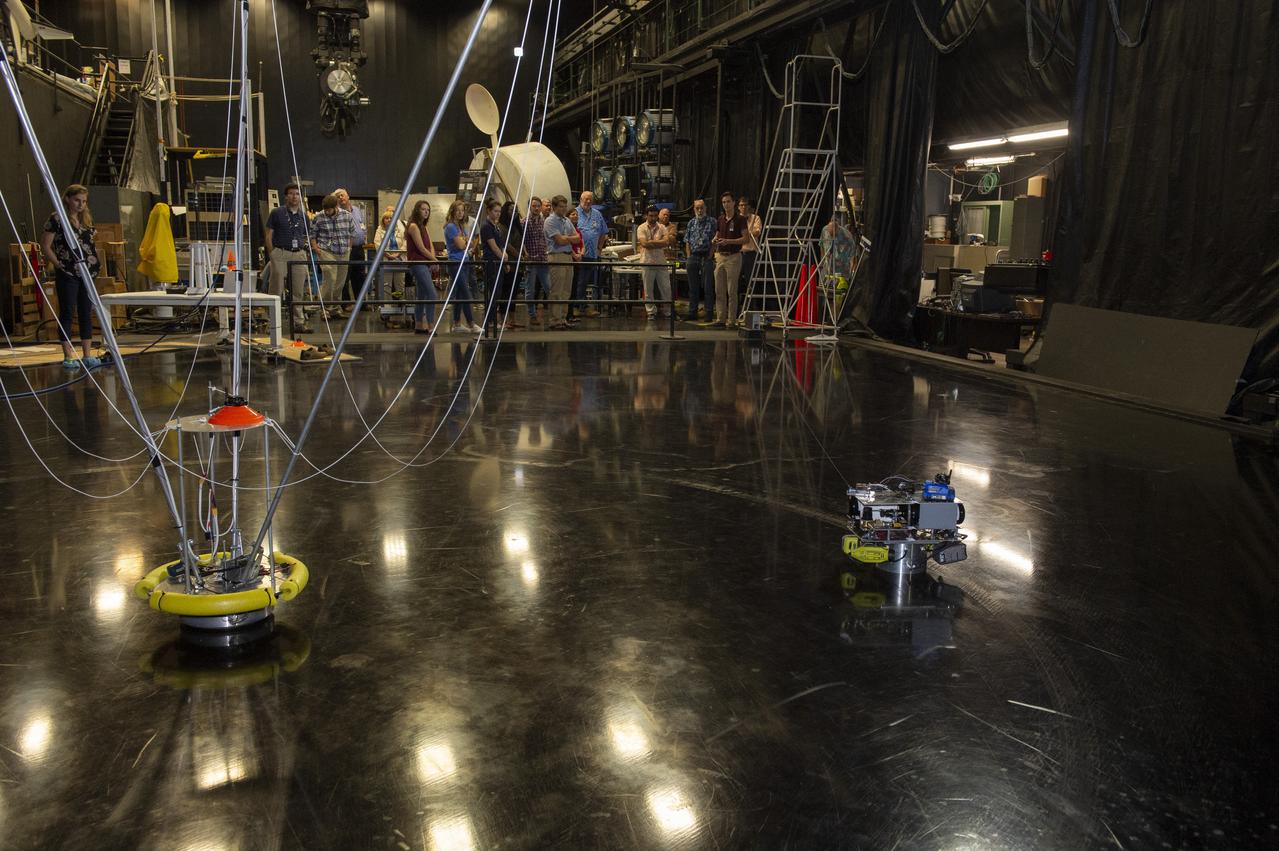
PATHWAYS INTERN ALEXANDRA BOEHM, AND JACOBS INTERN, PEYTON NELSON DEMONSTRATE STEERABLE AIR BEARING TETHER DEPLOYMENT SYSTEM TO MSFC SENIOR MANAGEMENT. ALSO WORKING ON THE PROJECT BUT NOT PICTURED WERE SUMMER INTERN ALI BERTELSMAN, PATHWAYS INTERN ANNA SHIPMAN, AND JACOBS FULL-TIME EMPLOYEE BRANDON MOORE.
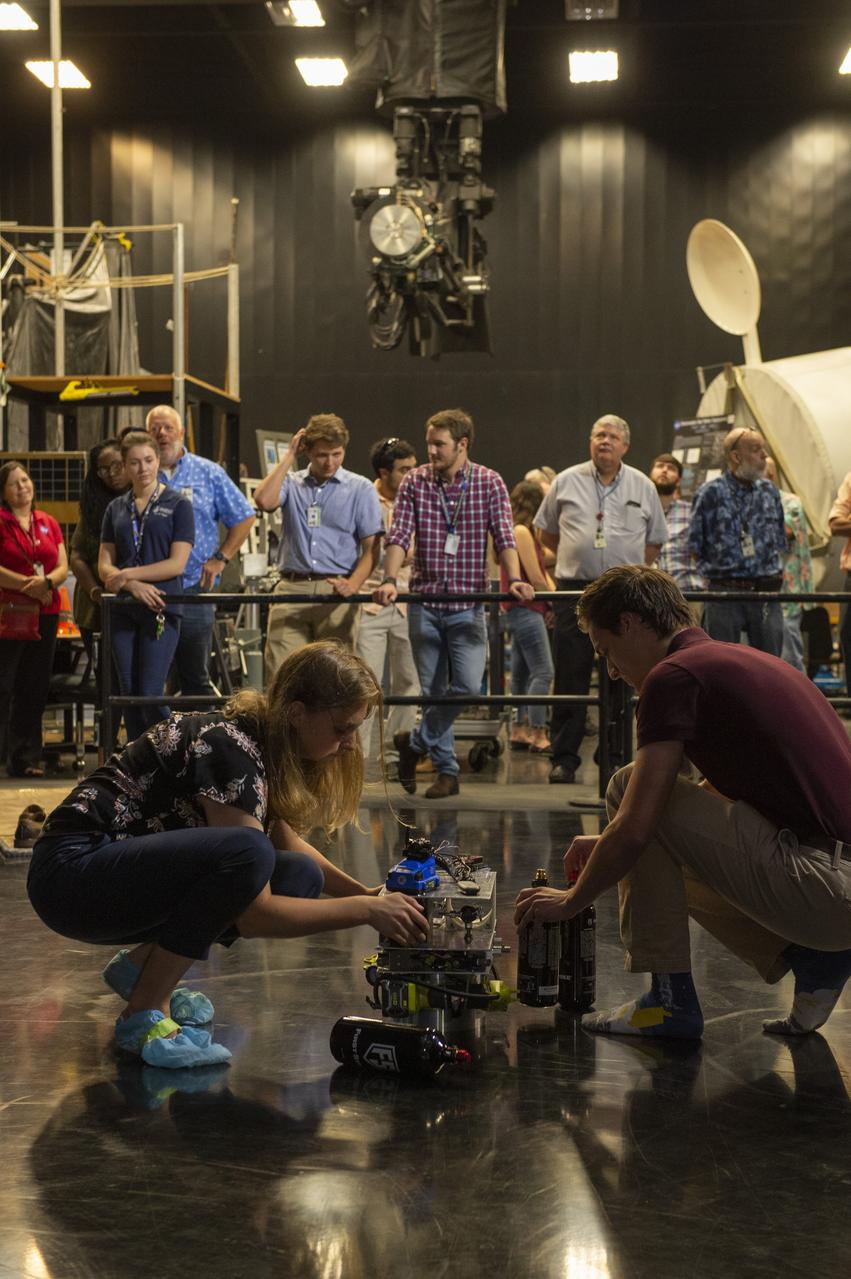
PATHWAYS INTERN ALEXANDRA BOEHM, AND JACOBS INTERN, PEYTON NELSON DEMONSTRATE STEERABLE AIR BEARING TETHER DEPLOYMENT SYSTEM TO MSFC SENIOR MANAGEMENT. ALSO WORKING ON THE PROJECT BUT NOT PICTURED WERE SUMMER INTERN ALI BERTELSMAN, PATHWAYS INTERN ANNA SHIPMAN, AND JACOBS FULL-TIME EMPLOYEE BRANDON MOORE.
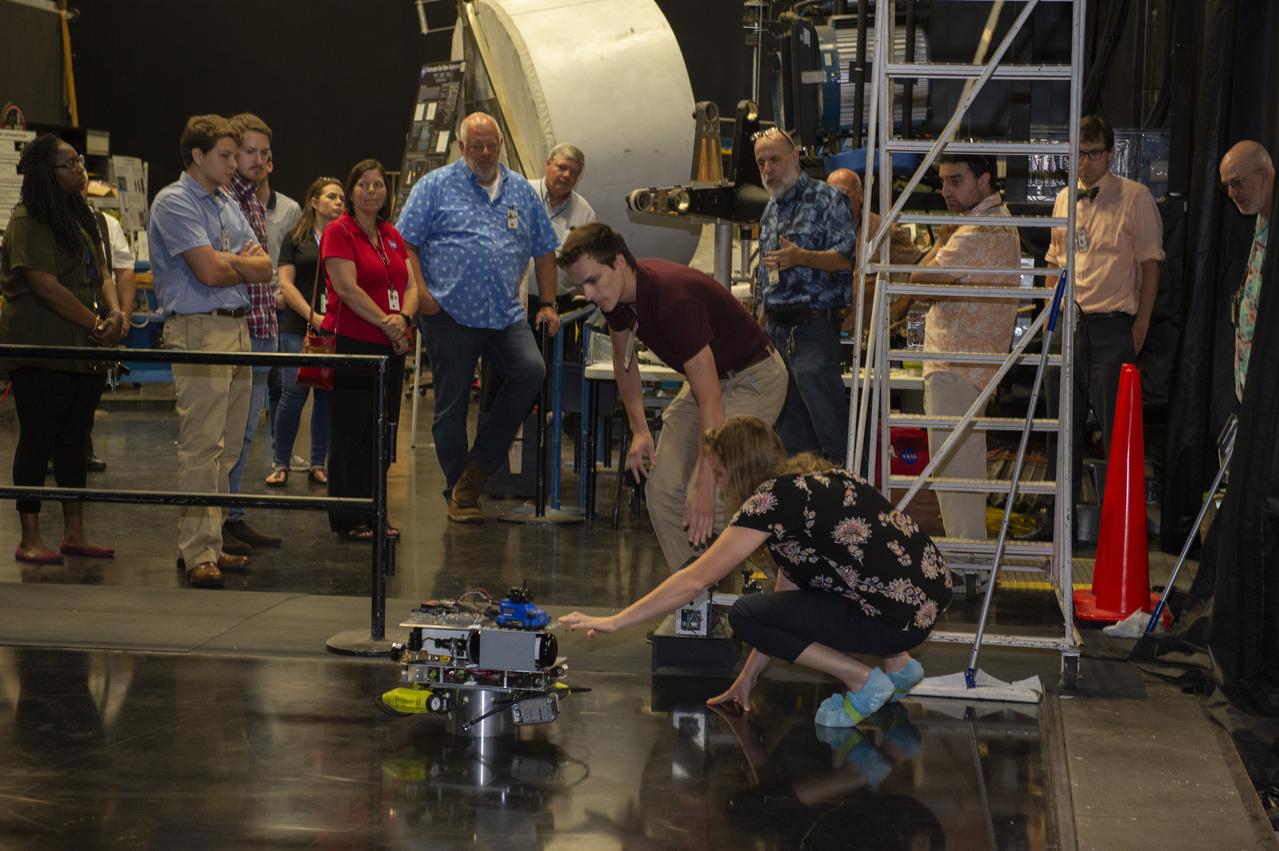
PATHWAYS INTERN ALEXANDRA BOEHM, AND JACOBS INTERN, PEYTON NELSON DEMONSTRATE STEERABLE AIR BEARING TETHER DEPLOYMENT SYSTEM TO MSFC SENIOR MANAGEMENT. ALSO WORKING ON THE PROJECT BUT NOT PICTURED WERE SUMMER INTERN ALI BERTELSMAN, PATHWAYS INTERN ANNA SHIPMAN, AND JACOBS FULL-TIME EMPLOYEE BRANDON MOORE.
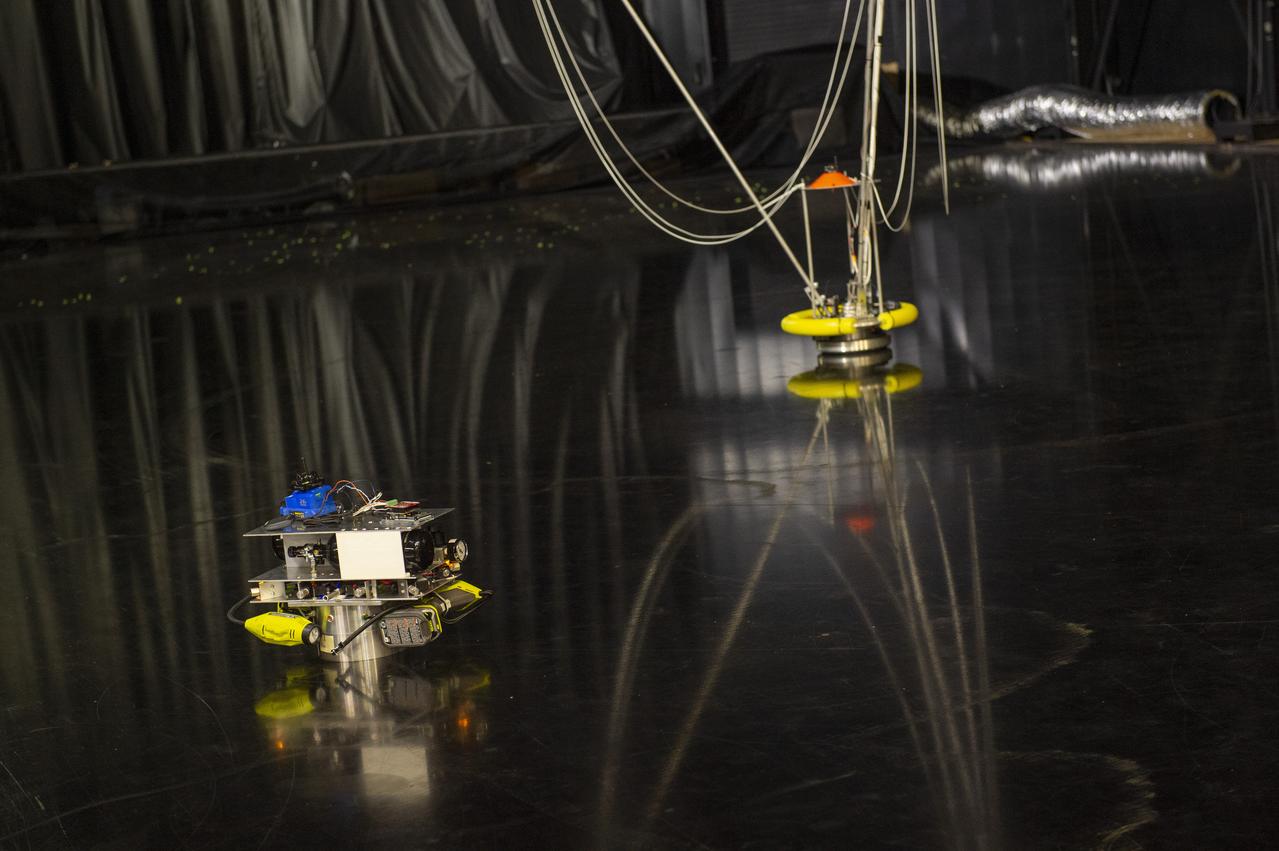
PATHWAYS INTERN ALEXANDRA BOEHM, AND JACOBS INTERN, PEYTON NELSON DEMONSTRATE STEERABLE AIR BEARING TETHER DEPLOYMENT SYSTEM TO MSFC SENIOR MANAGEMENT. ALSO WORKING ON THE PROJECT BUT NOT PICTURED WERE SUMMER INTERN ALI BERTELSMAN, PATHWAYS INTERN ANNA SHIPMAN, AND JACOBS FULL-TIME EMPLOYEE BRANDON MOORE.
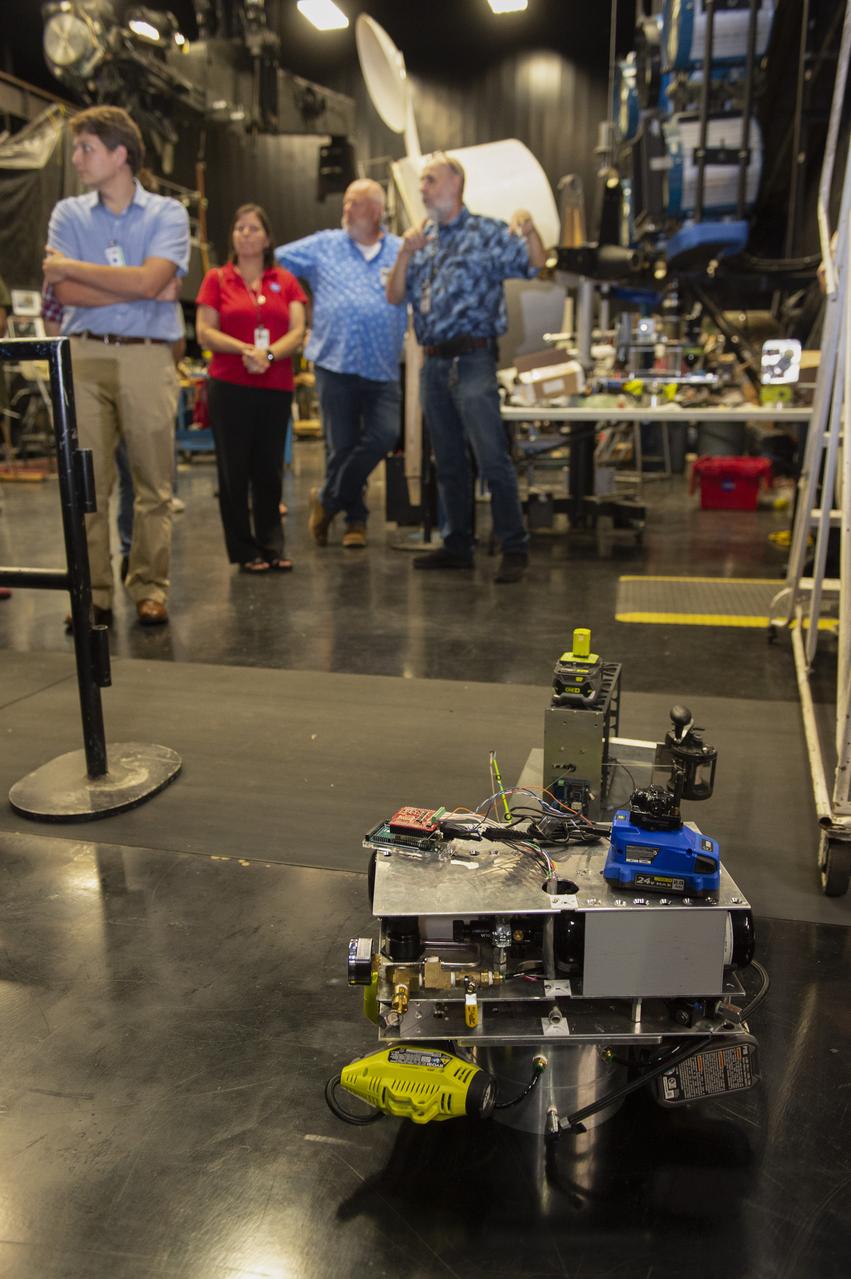
PATHWAYS INTERN ALEXANDRA BOEHM, AND JACOBS INTERN, PEYTON NELSON DEMONSTRATE STEERABLE AIR BEARING TETHER DEPLOYMENT SYSTEM TO MSFC SENIOR MANAGEMENT. ALSO WORKING ON THE PROJECT BUT NOT PICTURED WERE SUMMER INTERN ALI BERTELSMAN, PATHWAYS INTERN ANNA SHIPMAN, AND JACOBS FULL-TIME EMPLOYEE BRANDON MOORE.
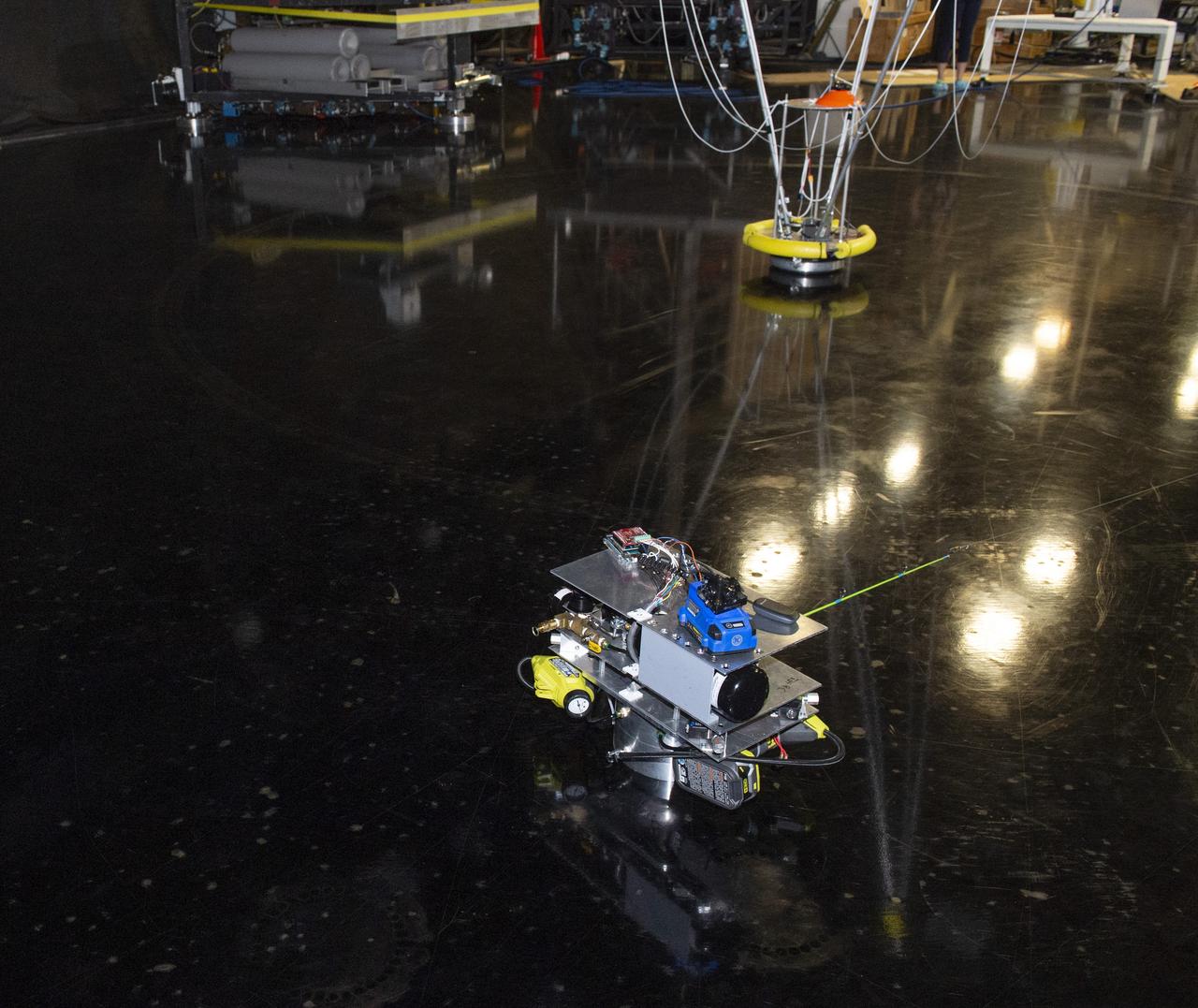
PATHWAYS INTERN ALEXANDRA BOEHM, AND JACOBS INTERN, PEYTON NELSON DEMONSTRATE STEERABLE AIR BEARING TETHER DEPLOYMENT SYSTEM TO MSFC SENIOR MANAGEMENT. ALSO WORKING ON THE PROJECT BUT NOT PICTURED WERE SUMMER INTERN ALI BERTELSMAN, PATHWAYS INTERN ANNA SHIPMAN, AND JACOBS FULL-TIME EMPLOYEE BRANDON MOORE.
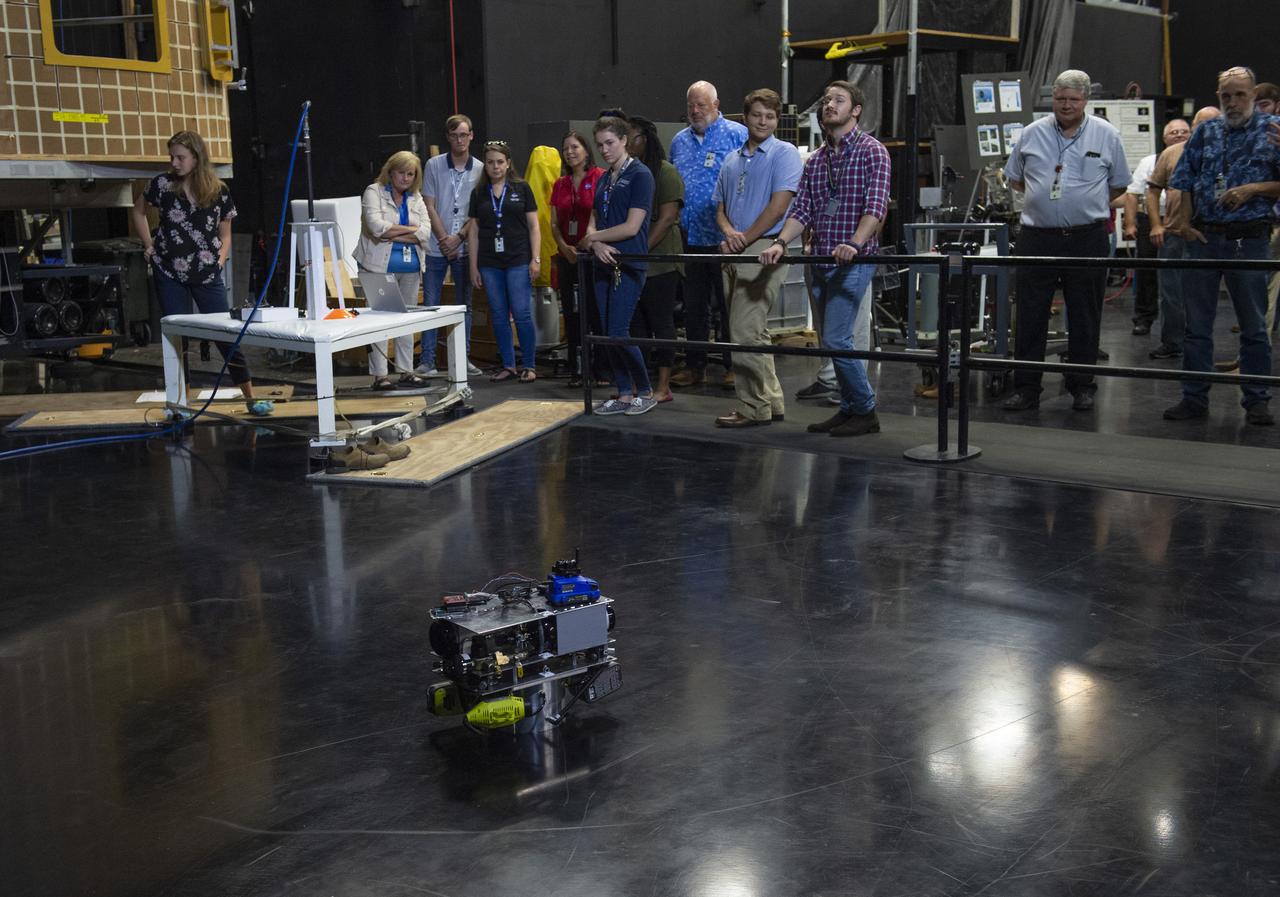
PATHWAYS INTERN ALEXANDRA BOEHM, AND JACOBS INTERN, PEYTON NELSON DEMONSTRATE STEERABLE AIR BEARING TETHER DEPLOYMENT SYSTEM TO MSFC SENIOR MANAGEMENT. ALSO WORKING ON THE PROJECT BUT NOT PICTURED WERE SUMMER INTERN ALI BERTELSMAN, PATHWAYS INTERN ANNA SHIPMAN, AND JACOBS FULL-TIME EMPLOYEE BRANDON MOORE.

PATHWAYS INTERN ALEXANDRA BOEHM, AND JACOBS INTERN, PEYTON NELSON DEMONSTRATE STEERABLE AIR BEARING TETHER DEPLOYMENT SYSTEM TO MSFC SENIOR MANAGEMENT. ALSO WORKING ON THE PROJECT BUT NOT PICTURED WERE SUMMER INTERN ALI BERTELSMAN, PATHWAYS INTERN ANNA SHIPMAN, AND JACOBS FULL-TIME EMPLOYEE BRANDON MOORE.
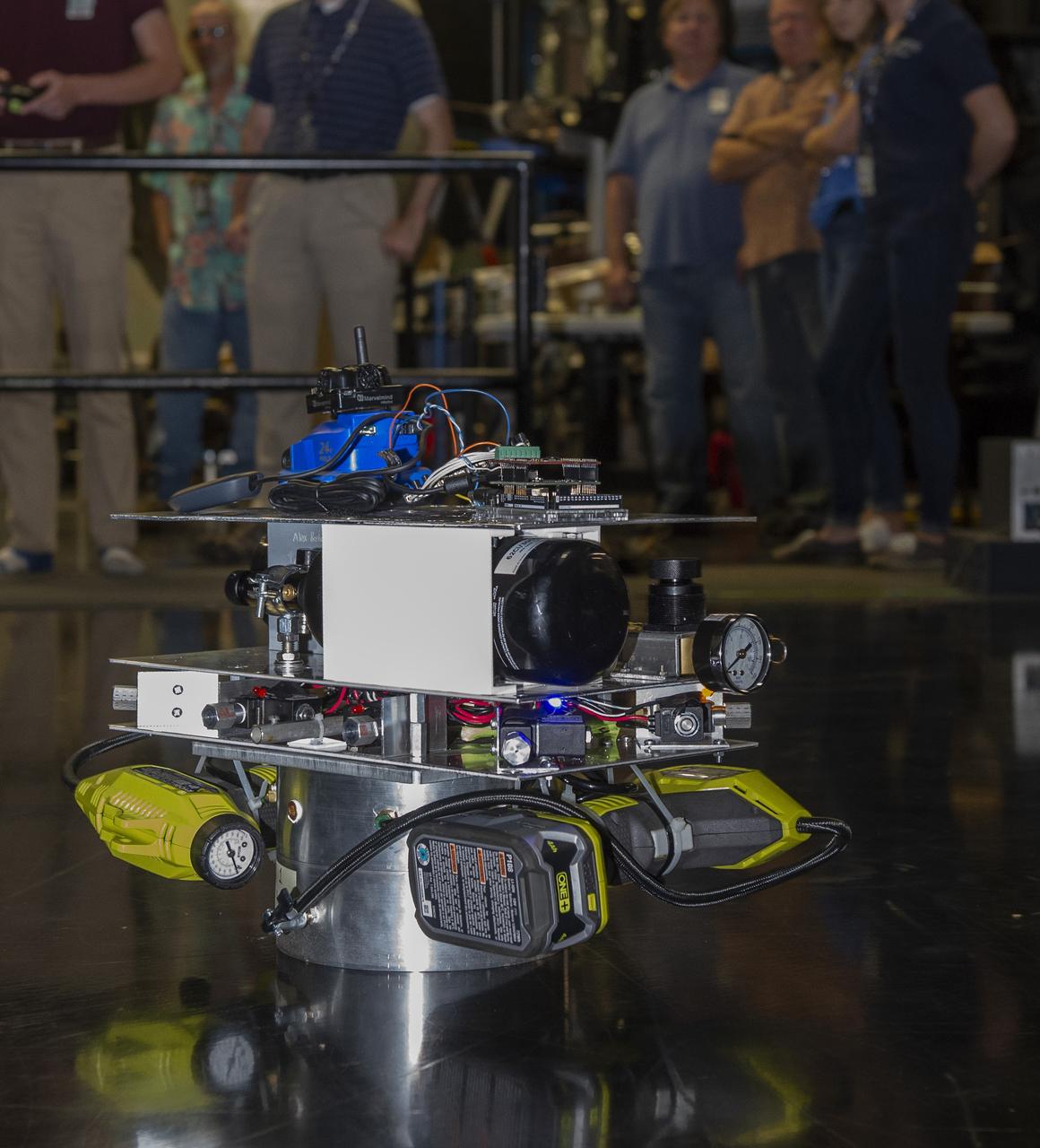
PATHWAYS INTERN ALEXANDRA BOEHM, AND JACOBS INTERN, PEYTON NELSON DEMONSTRATE STEERABLE AIR BEARING TETHER DEPLOYMENT SYSTEM TO MSFC SENIOR MANAGEMENT. ALSO WORKING ON THE PROJECT BUT NOT PICTURED WERE SUMMER INTERN ALI BERTELSMAN, PATHWAYS INTERN ANNA SHIPMAN, AND JACOBS FULL-TIME EMPLOYEE BRANDON MOORE.
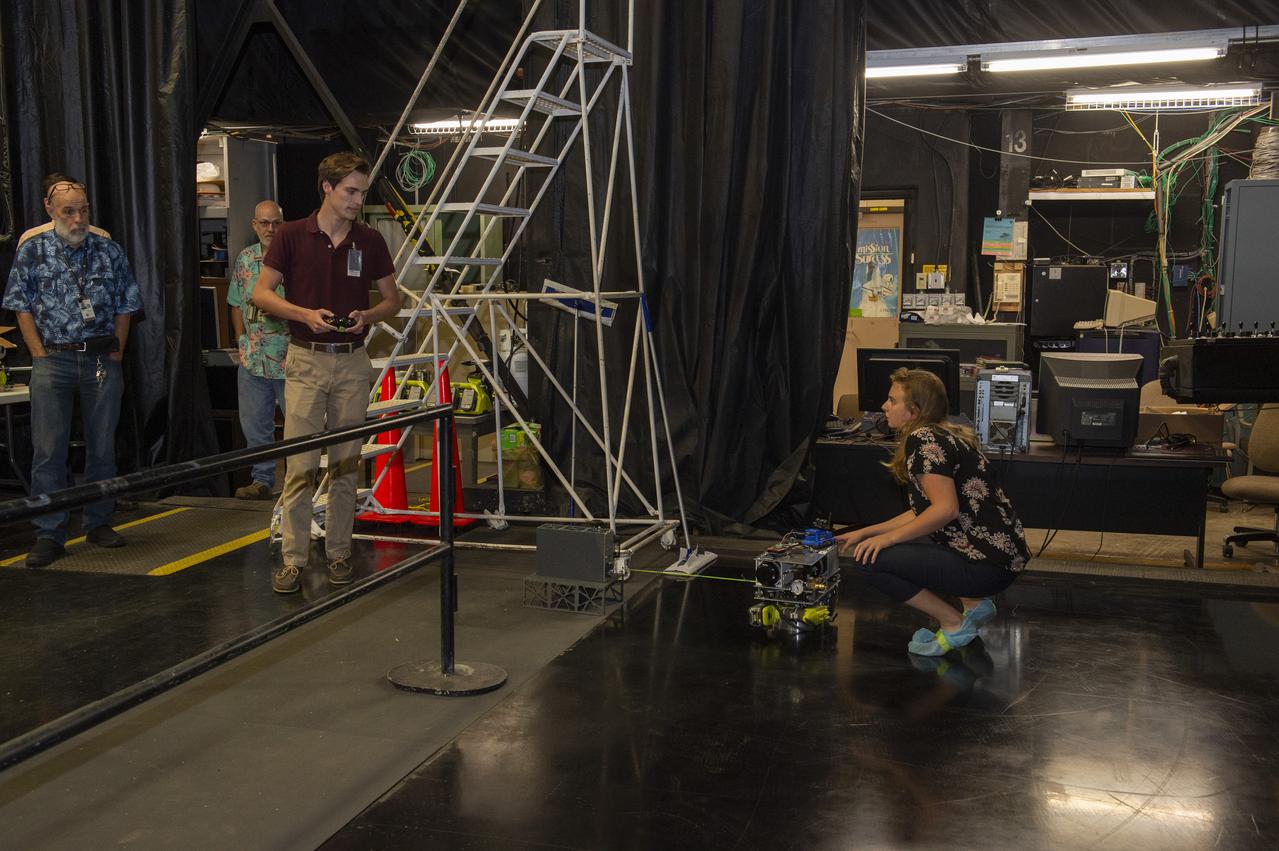
PATHWAYS INTERN ALEXANDRA BOEHM, AND JACOBS INTERN, PEYTON NELSON DEMONSTRATE STEERABLE AIR BEARING TETHER DEPLOYMENT SYSTEM TO MSFC SENIOR MANAGEMENT. ALSO WORKING ON THE PROJECT BUT NOT PICTURED WERE SUMMER INTERN ALI BERTELSMAN, PATHWAYS INTERN ANNA SHIPMAN, AND JACOBS FULL-TIME EMPLOYEE BRANDON MOORE.
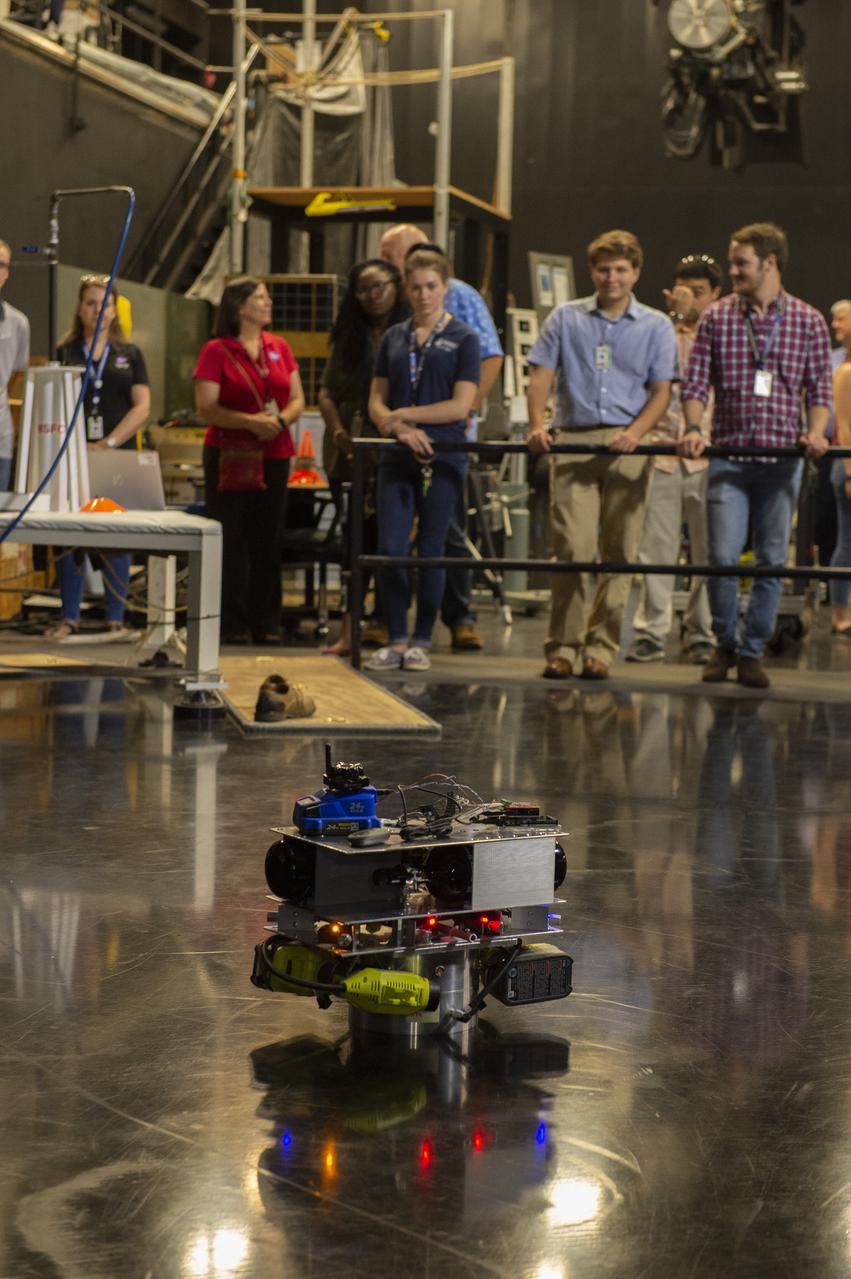
PATHWAYS INTERN ALEXANDRA BOEHM, AND JACOBS INTERN, PEYTON NELSON DEMONSTRATE STEERABLE AIR BEARING TETHER DEPLOYMENT SYSTEM TO MSFC SENIOR MANAGEMENT. ALSO WORKING ON THE PROJECT BUT NOT PICTURED WERE SUMMER INTERN ALI BERTELSMAN, PATHWAYS INTERN ANNA SHIPMAN, AND JACOBS FULL-TIME EMPLOYEE BRANDON MOORE.
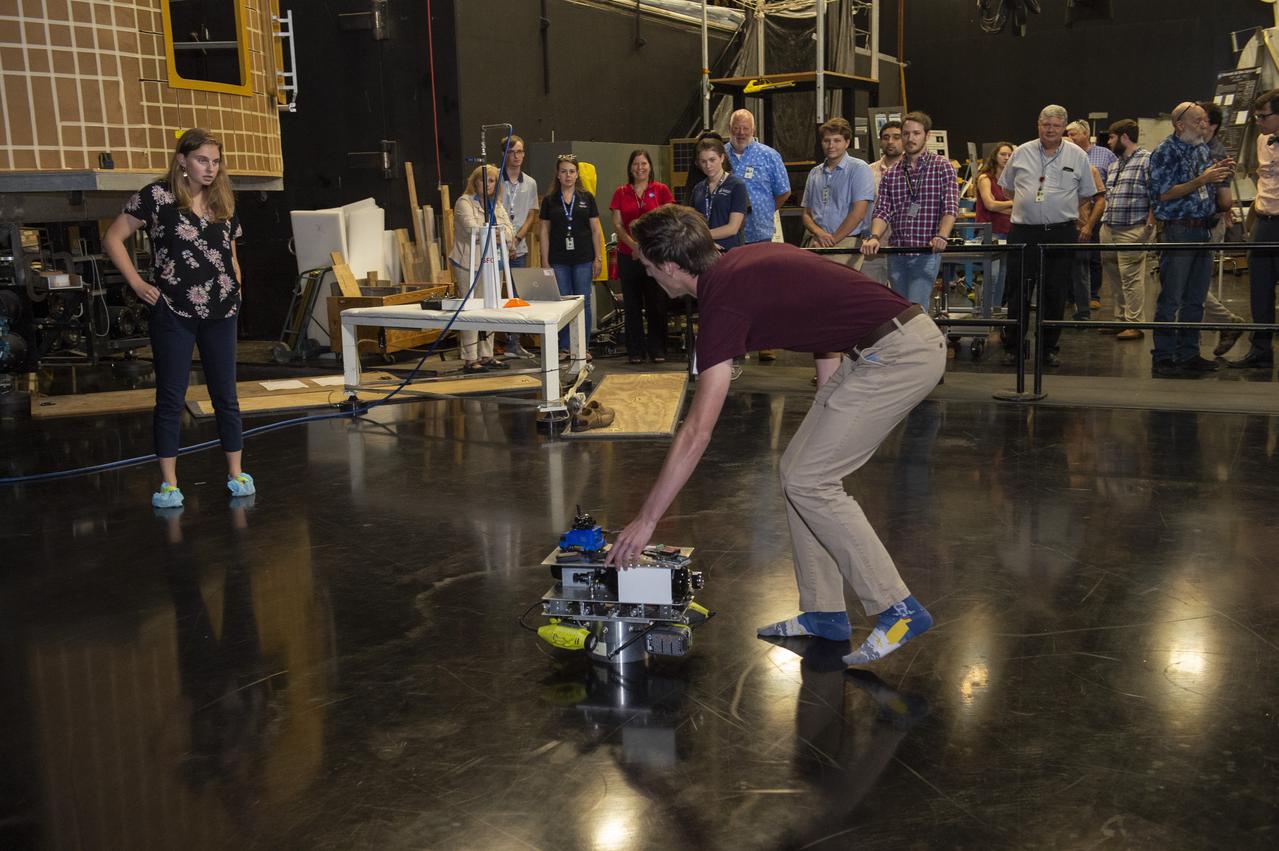
PATHWAYS INTERN ALEXANDRA BOEHM, AND JACOBS INTERN, PEYTON NELSON DEMONSTRATE STEERABLE AIR BEARING TETHER DEPLOYMENT SYSTEM TO MSFC SENIOR MANAGEMENT. ALSO WORKING ON THE PROJECT BUT NOT PICTURED WERE SUMMER INTERN ALI BERTELSMAN, PATHWAYS INTERN ANNA SHIPMAN, AND JACOBS FULL-TIME EMPLOYEE BRANDON MOORE.
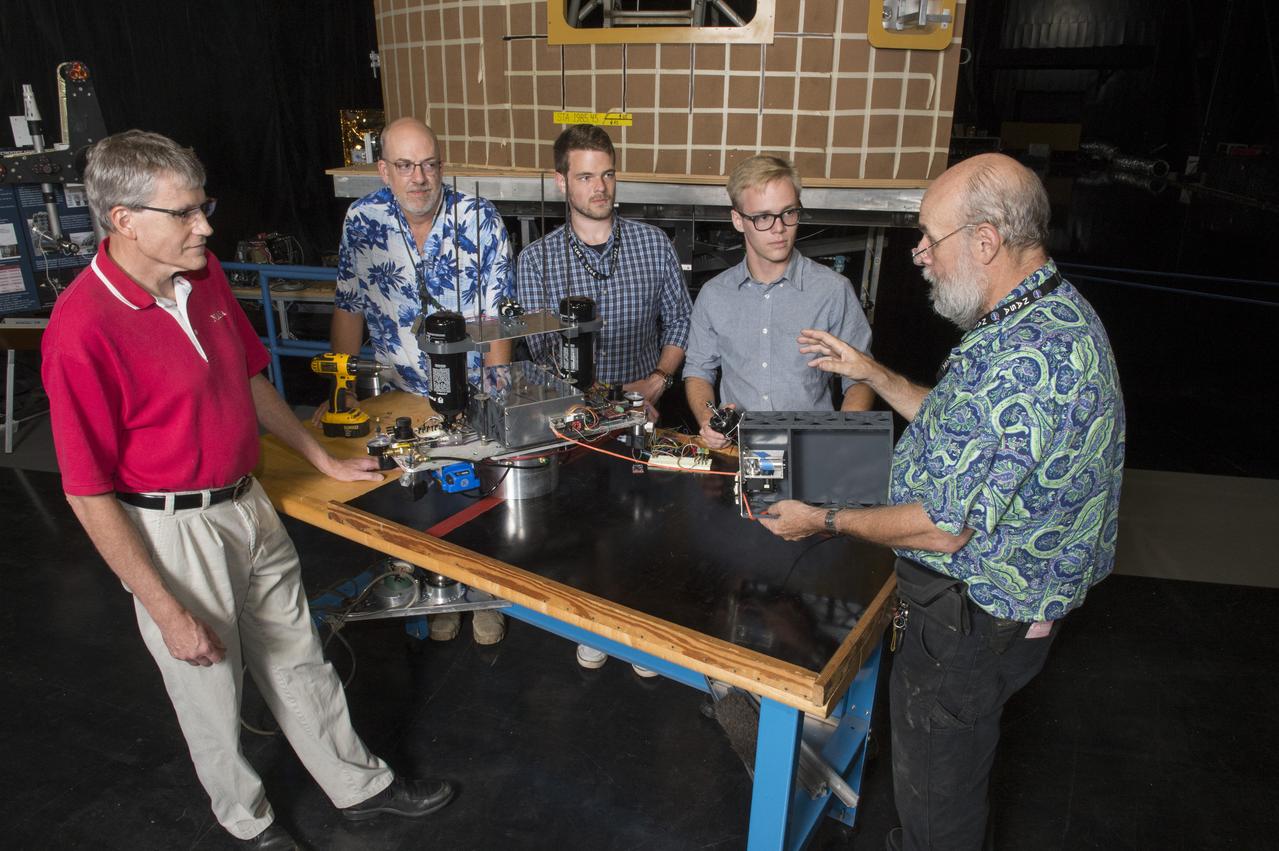
Electric Sail (E-Sail) Tether Team Discusses 6U CubeSat Test Article and Tether Deployment System (Right to left: Tom Bryan, Davis Hunter (student intern), Jonathan MacArthur (student intern), Charles Cowen, Mike Tinker)
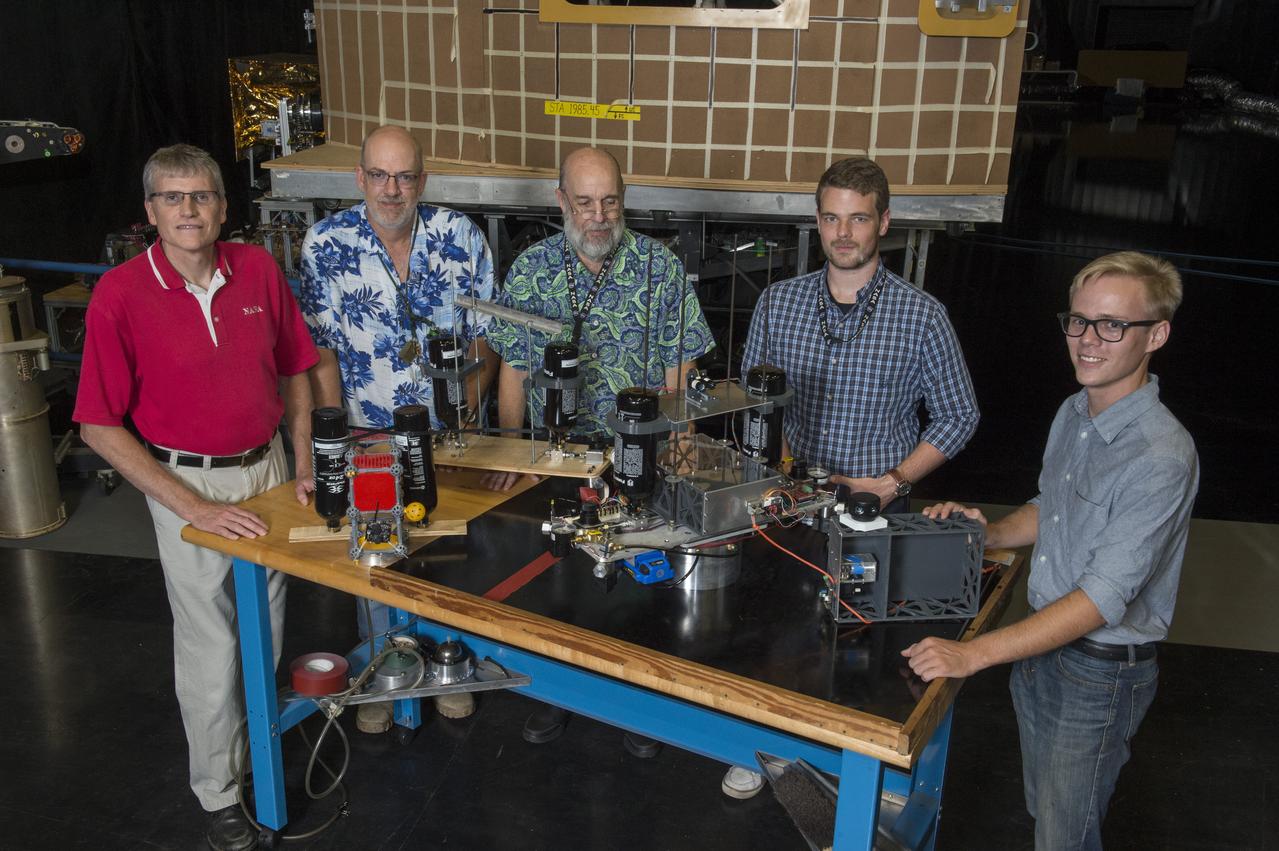
Electric Sail (E-Sail) Tether Team with 6U CubeSat Prototypes and Current Version of Tether Deployer Test Article, (Right to left: Tom Bryan, Davis Hunter (student intern), Jonathan MacArthur (student intern), Charles Cowen, Mike Tinker)
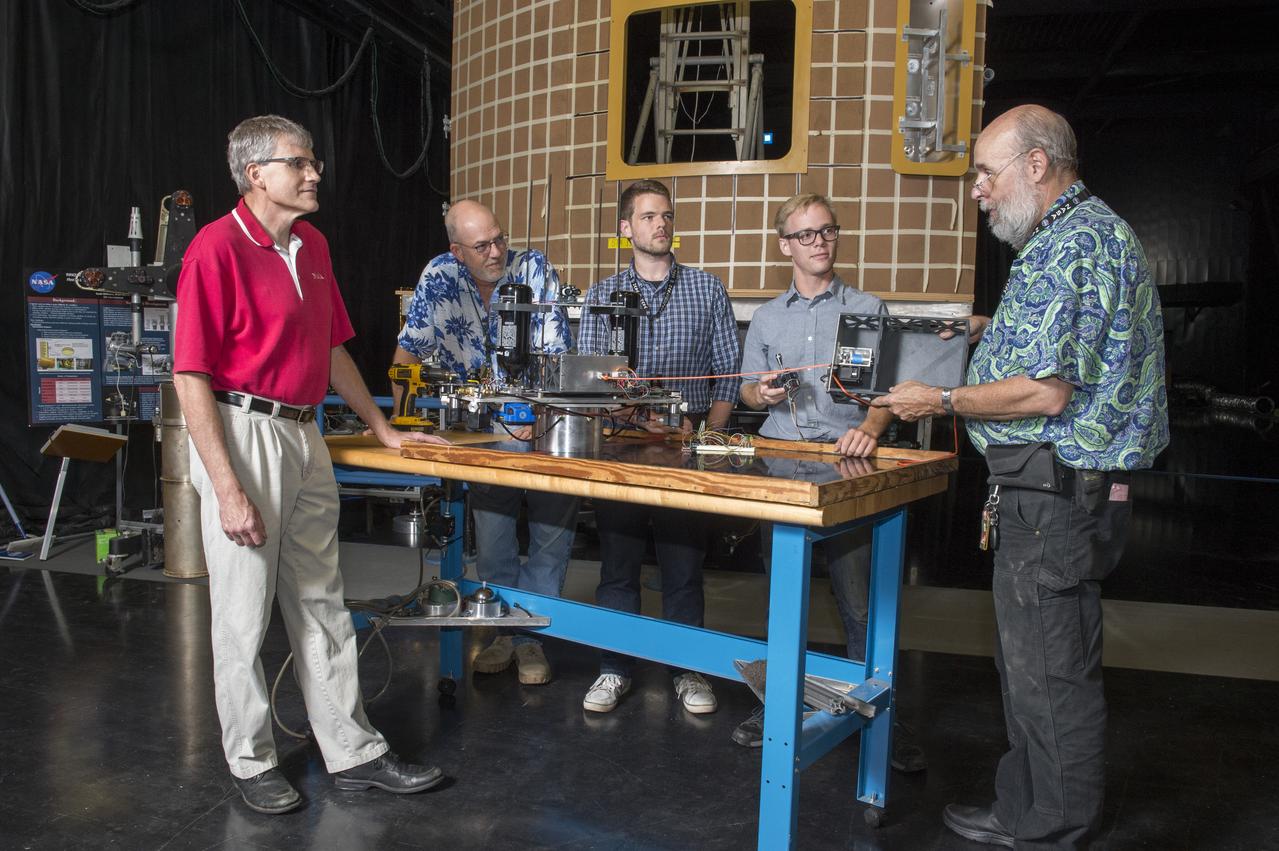
Electric Sail (E-Sail) Tether Team Discusses 6U CubeSat Test Article and Tether Deployment System (Right to left: Tom Bryan, Davis Hunter (student intern), Jonathan MacArthur (student intern), Charles Cowen, Mike Tinker)
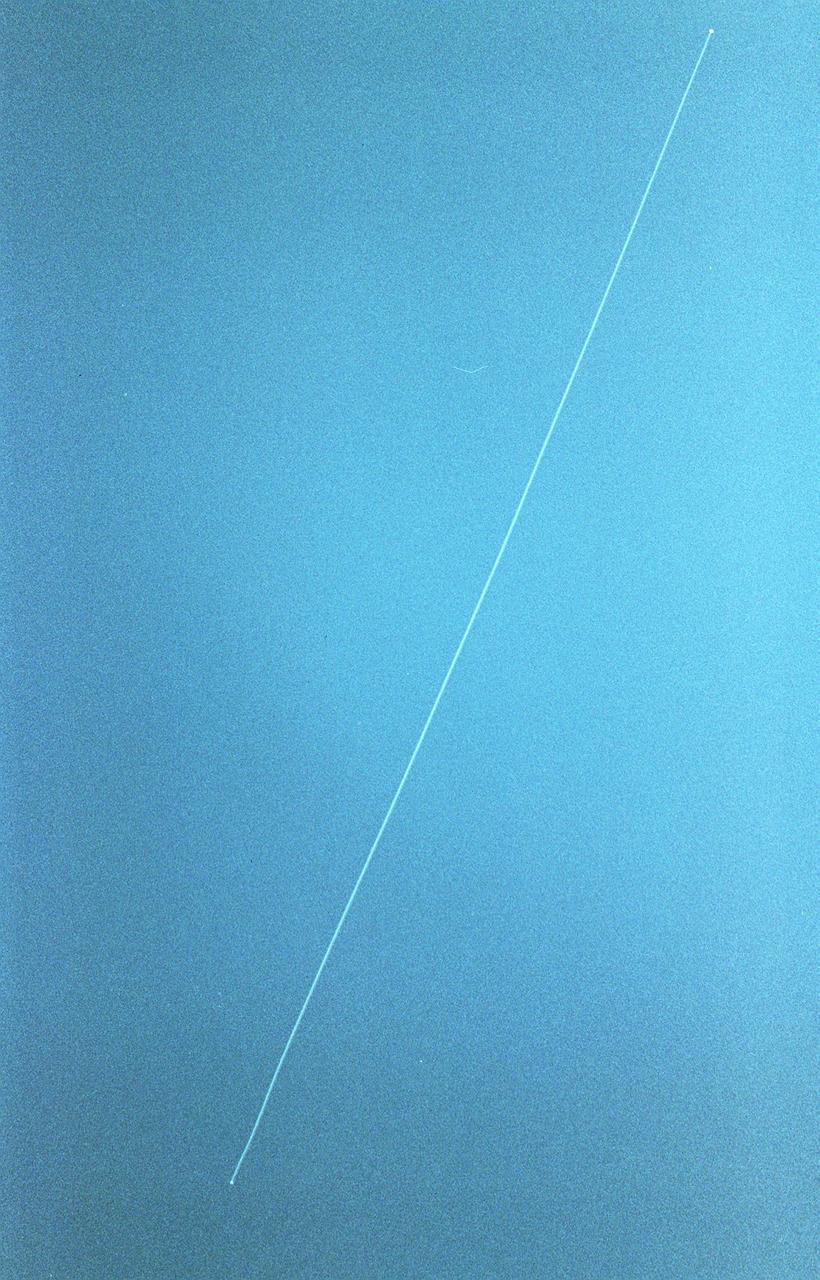
STS075-360-021 (22 Feb.- 9 March 1996) --- The loose tether forms a faint diagonal line in this scene recorded on a later fly-by. On Feb. 25, 1996, the crew deployed the Tethered Satellite System (TSS), which later broke free. The seven member crew was launched aboard the space shuttle Columbia on Feb. 22, 1996, and landed on March 9, 1996. Crew members were Andrew M. Allen, mission commander; Scott J. Horowitz, pilot; Franklin R. Chang-Diaz, payload commander; and Maurizio Cheli, European Space Agency (ESA); Jeffrey A. Hoffman and Claude Nicollier, ESA, all mission specialists; along with payload specialist Umberto Guidoni of the Italian Space Agency (ASI).
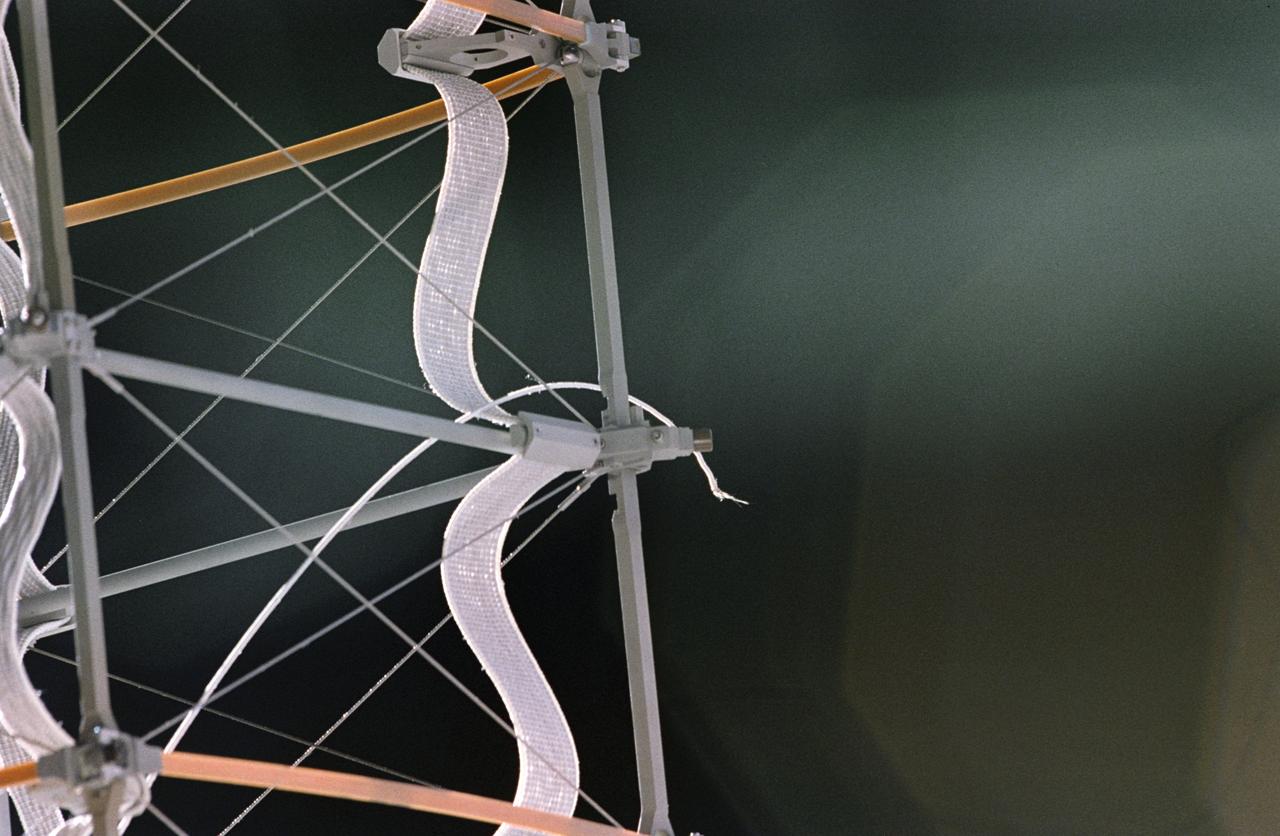
STS075-325-014 (25 Feb. 1996) --- The frayed end of the tether portion of the Tethered Satellite System (TSS) is seen at the end of the supportive boom. On February 25, 1996, the crew deployed the TSS, which later broke free. The seven member crew was launched aboard the Space Shuttle Columbia on February 22, 1996, and landed on March 9, 1996. Crewmembers were Andrew M. Allen, mission commander; Scott J. Horowitz, pilot; Franklin R. Chang-Diaz, payload commander; and Maurizio Cheli, European Space Agency (ESA); Jeffrey A. Hoffman and Claude Nicollier (ESA), all mission specialists; along with payload specialist Umberto Guidoni of the Italian Space Agency (ASI).
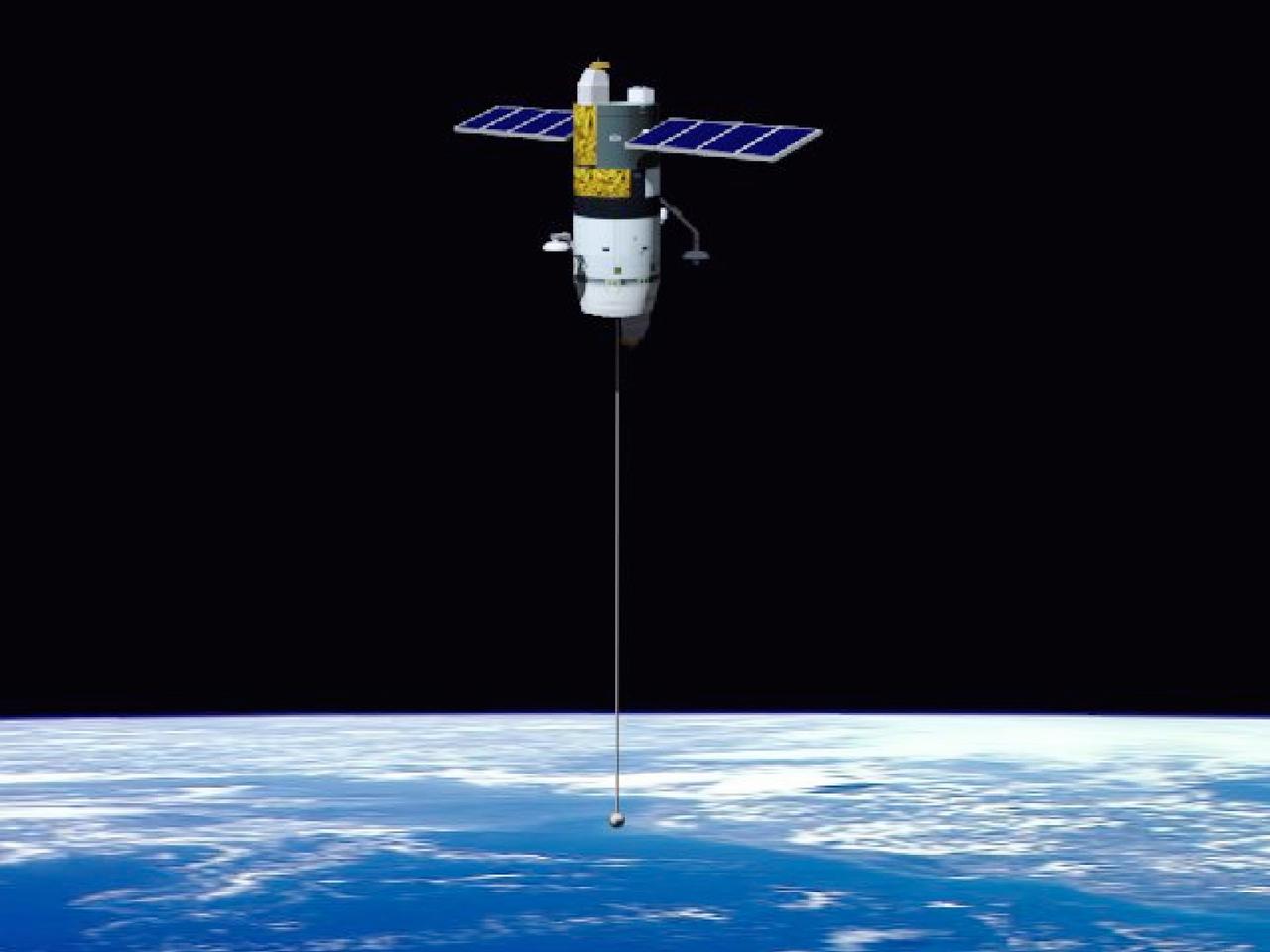
This picture is an artist's concept of an orbiting vehicle using the Electrodynamic Tethers Propulsion System. Relatively short electrodynamic tethers can use solar power to push against a planetary magnetic field to achieve propulsion without the expenditure of propellant.
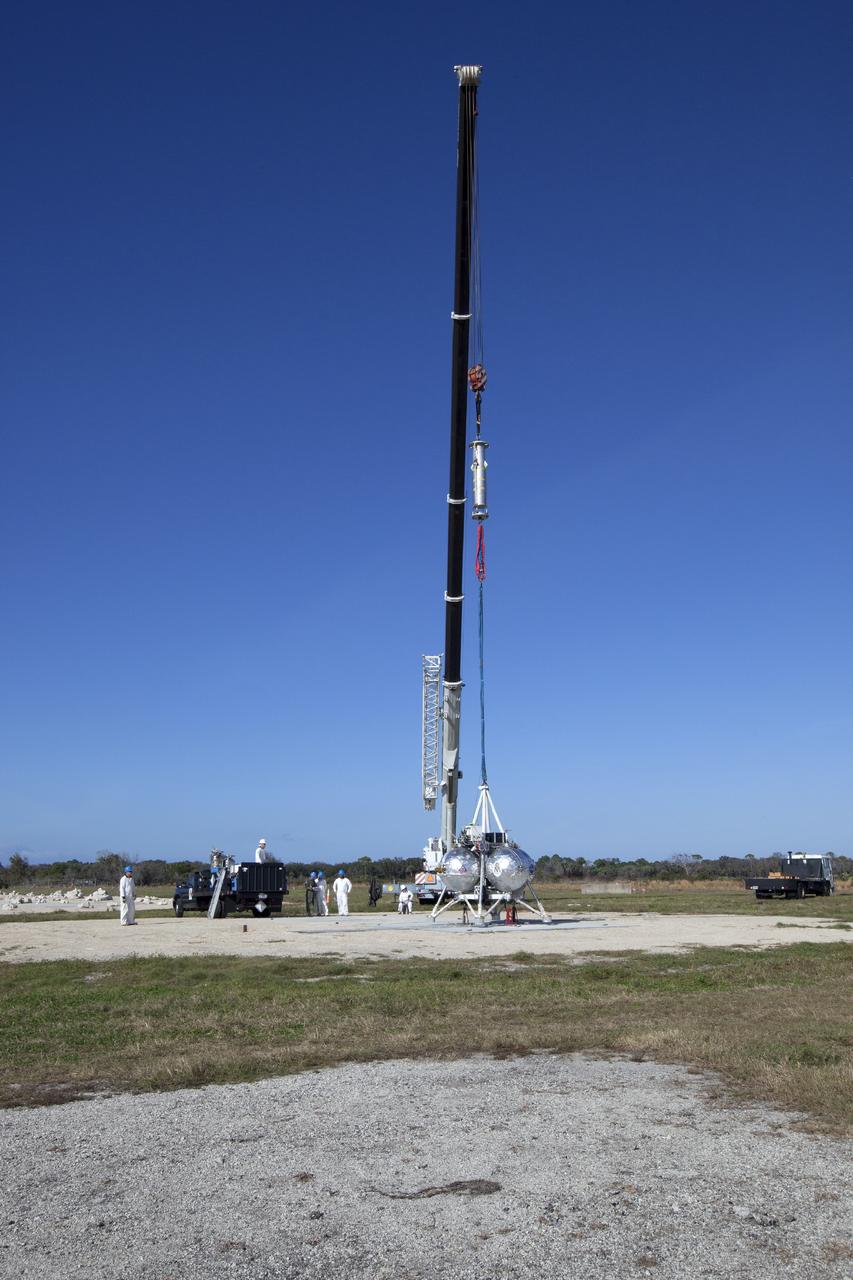
CAPE CANAVERAL, Fla. – At NASA’s Kennedy Space Center in Florida, the Project Morpheus prototype lander has been attached to a tether and is being prepared for a tether test on a transportable launch platform positioned at the north end of the Shuttle Landing Facility. The tether test includes lifting the lander 20 feet by crane, ascending another 10 feet, maneuvering backwards 10 feet, and then flying forward and descending to its original position, landing at the end of the tether. Testing of the prototype lander was performed at NASA’s Johnson Space Center in Houston in preparation for tethered and free flight testing at Kennedy. The landing facility will provide the lander with the kind of field necessary for realistic testing, complete with rocks, craters and hazards to avoid. Morpheus utilizes an autonomous landing and hazard avoidance technology, or ALHAT, payload that will allow it to navigate to clear landing sites amidst rocks, craters and other hazards during its descent. Project Morpheus is being managed under the Advanced Exploration Systems, or AES, Division in NASA’s Human Exploration and Operations Mission Directorate. The efforts in AES pioneer new approaches for rapidly developing prototype systems, demonstrating key capabilities and validating operational concepts for future human missions beyond Earth orbit. For more information on Project Morpheus, visit http://morpheuslander.jsc.nasa.gov. Photo credit: NASA/Daniel Casper
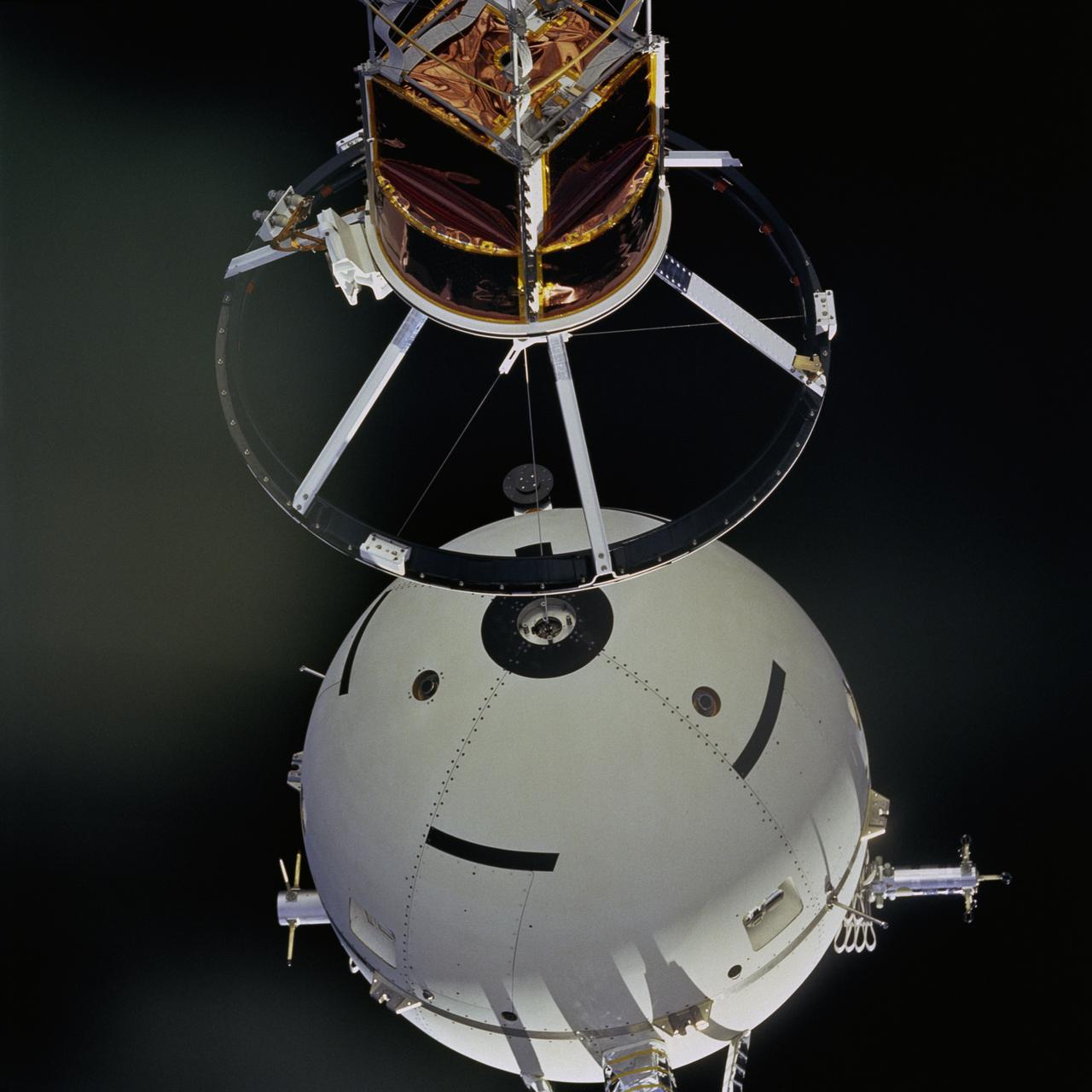
STS046-73-052 (4 Aug 1992) --- A 70mm handheld camera was used by the crew members to capture this medium close-up view of early operations with the Tethered Satellite System (TSS). The sphere can be seen moving away from the ring structure on the boom device in the Space Shuttle Atlantis' cargo bay.
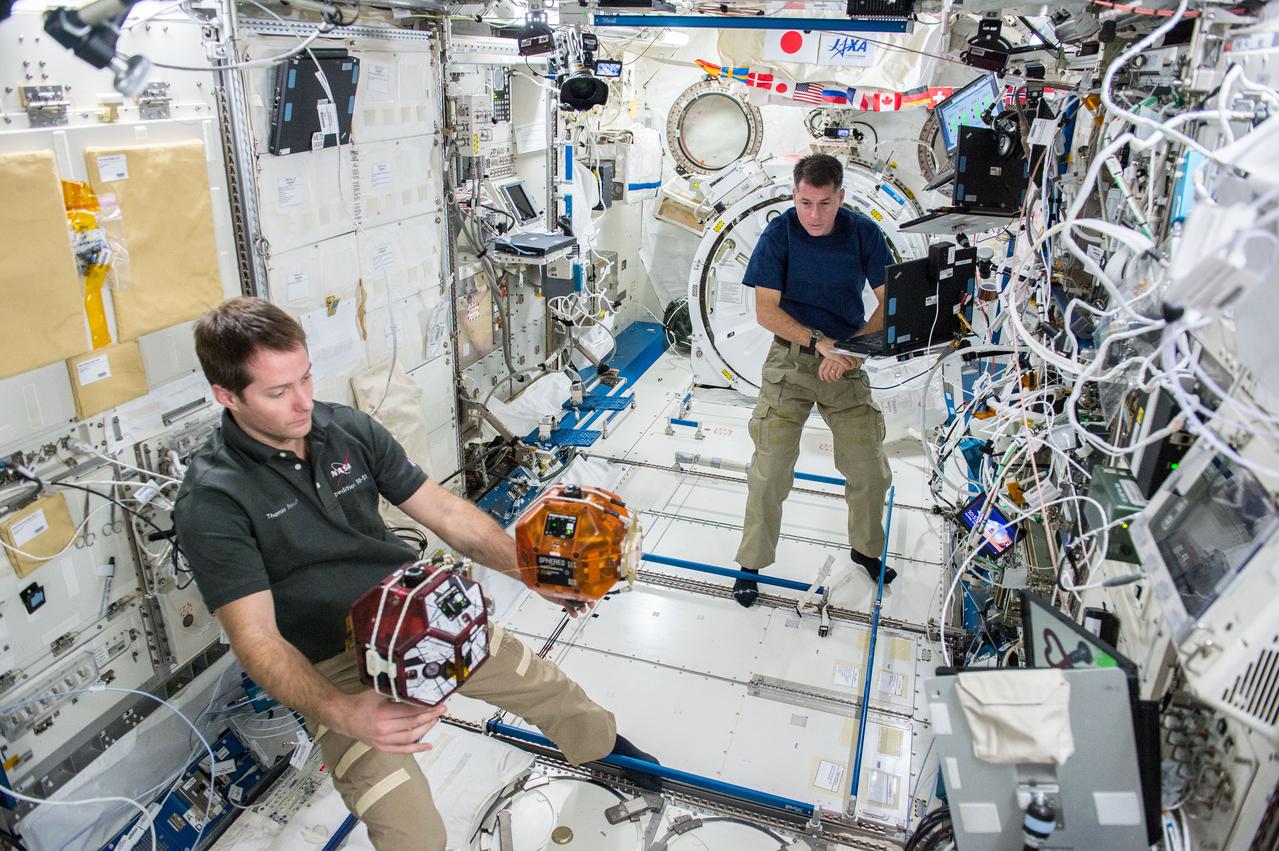
iss050e013146 (12/1/2016) --- NASA astronaut Shane Kimbrough and European Space Agency (ESA) astronaut Thomas Pesquet during the Synchronized Position Hold, Engage, Reorient, Experimental Satellites Tether Demo, in the Japanese Experiment Module (JEM) Pressurized Module (JPM). The SPHERES Tether Demo studies the dynamics of a tethered capture object and a “space tug” chase vehicle, improving computer programs needed for removing space debris as well as capturing scientific samples from other planets.
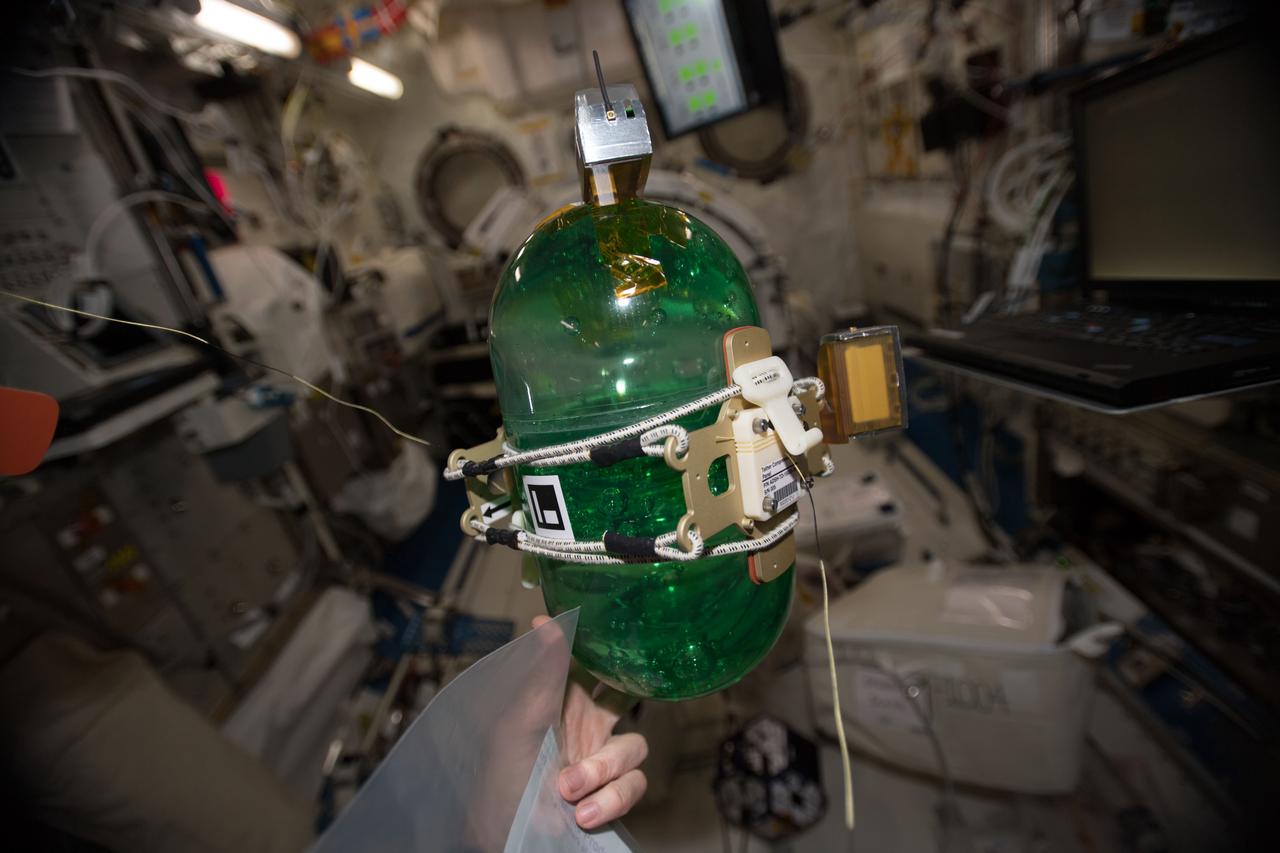
iss055e010694 (4/4/2018) --- A view taken aboard the International Space Station (ISS) during the set up of the SPHERES Tether Slosh experiment hardware. The image is of the green SPHERES robots tethered to a fluid-filled container covered in sensors to test strategies for safely steering spacecraft such as dead satellites that might still have fuel in the tank. SPHERES Tether Slosh combines fluid dynamics equipment with robotic capabilities aboard the International Space Station to investigate automated strategies for steering passive cargo that contain fluids.

CAPE CANAVERAL, Fla. – At NASA’s Kennedy Space Center in Florida, technicians and engineers monitor the progress as the Project Morpheus prototype lander is attached to a tether and raised from a transportable launch platform positioned at the north end of the Shuttle Landing Facility. The lander will undergo a tethered test that includes lifting it 20 feet by crane, ascending another 10 feet, maneuvering backwards 10 feet, and then flying forward and descending to its original position, landing at the end of the tether. Testing of the prototype lander was performed at NASA’s Johnson Space Center in Houston in preparation for tethered and free flight testing at Kennedy. The landing facility will provide the lander with the kind of field necessary for realistic testing, complete with rocks, craters and hazards to avoid. Morpheus utilizes an autonomous landing and hazard avoidance technology, or ALHAT, payload that will allow it to navigate to clear landing sites amidst rocks, craters and other hazards during its descent. Project Morpheus is being managed under the Advanced Exploration Systems, or AES, Division in NASA’s Human Exploration and Operations Mission Directorate. The efforts in AES pioneer new approaches for rapidly developing prototype systems, demonstrating key capabilities and validating operational concepts for future human missions beyond Earth orbit. For more information on Project Morpheus, visit http://morpheuslander.jsc.nasa.gov. Photo credit: NASA/Daniel Casper
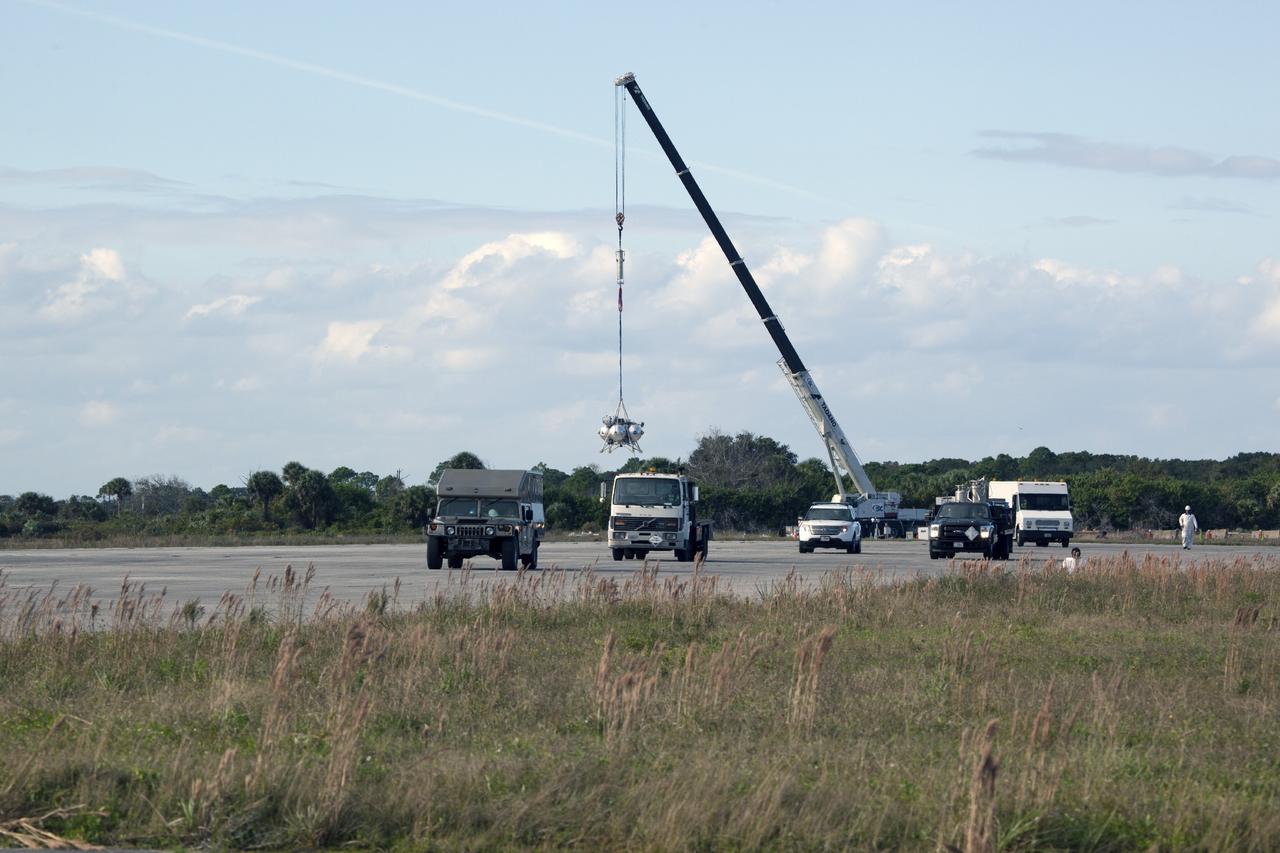
CAPE CANAVERAL, Fla. – At NASA’s Kennedy Space Center in Florida, the Project Morpheus prototype lander has been attached to a tether and is being raised from a transportable launch platform positioned at the north end of the Shuttle Landing Facility. The tethered test includes lifting the lander 20 feet by crane, ascending another 10 feet, maneuvering backwards 10 feet, and then flying forward and descending to its original position, landing at the end of the tether. Testing of the prototype lander was performed at NASA’s Johnson Space Center in Houston in preparation for tethered and free flight testing at Kennedy. The landing facility will provide the lander with the kind of field necessary for realistic testing, complete with rocks, craters and hazards to avoid. Morpheus utilizes an autonomous landing and hazard avoidance technology, or ALHAT, payload that will allow it to navigate to clear landing sites amidst rocks, craters and other hazards during its descent. Project Morpheus is being managed under the Advanced Exploration Systems, or AES, Division in NASA’s Human Exploration and Operations Mission Directorate. The efforts in AES pioneer new approaches for rapidly developing prototype systems, demonstrating key capabilities and validating operational concepts for future human missions beyond Earth orbit. For more information on Project Morpheus, visit http://morpheuslander.jsc.nasa.gov. Photo credit: NASA/Daniel Casper
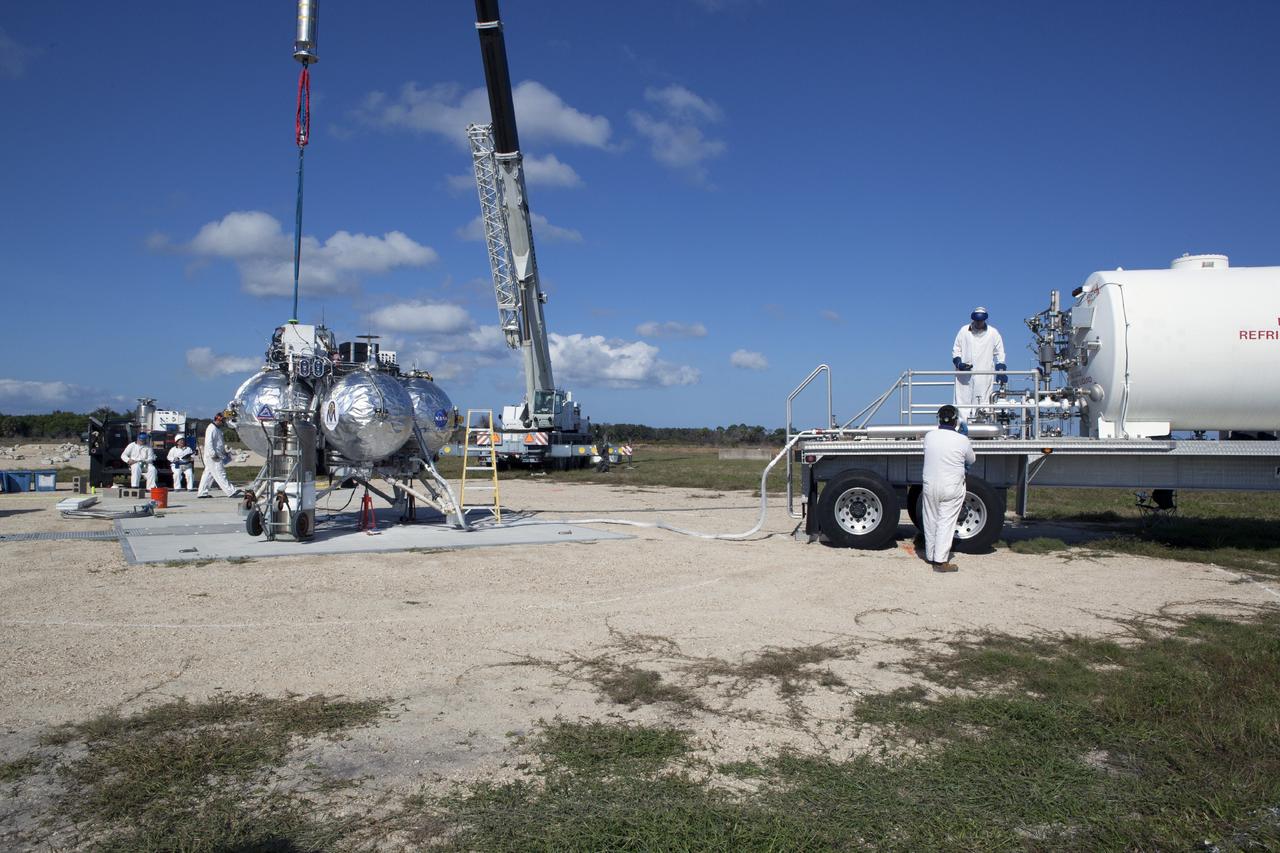
CAPE CANAVERAL, Fla. – At NASA’s Kennedy Space Center in Florida, the Project Morpheus prototype lander is being prepared for a tethered test on a transportable launch platform positioned at the north end of the Shuttle Landing Facility. The tethered test will include lifting it 20 feet by crane, ascending another 10 feet, maneuvering backwards 10 feet, and then flying forward and descending to its original position, landing at the end of the tether. Testing of the prototype lander was performed at NASA’s Johnson Space Center in Houston in preparation for tethered and free flight testing at Kennedy. The landing facility will provide the lander with the kind of field necessary for realistic testing, complete with rocks, craters and hazards to avoid. Morpheus utilizes an autonomous landing and hazard avoidance technology, or ALHAT, payload that will allow it to navigate to clear landing sites amidst rocks, craters and other hazards during its descent. Project Morpheus is being managed under the Advanced Exploration Systems, or AES, Division in NASA’s Human Exploration and Operations Mission Directorate. The efforts in AES pioneer new approaches for rapidly developing prototype systems, demonstrating key capabilities and validating operational concepts for future human missions beyond Earth orbit. For more information on Project Morpheus, visit http://morpheuslander.jsc.nasa.gov. Photo credit: NASA/Daniel Casper
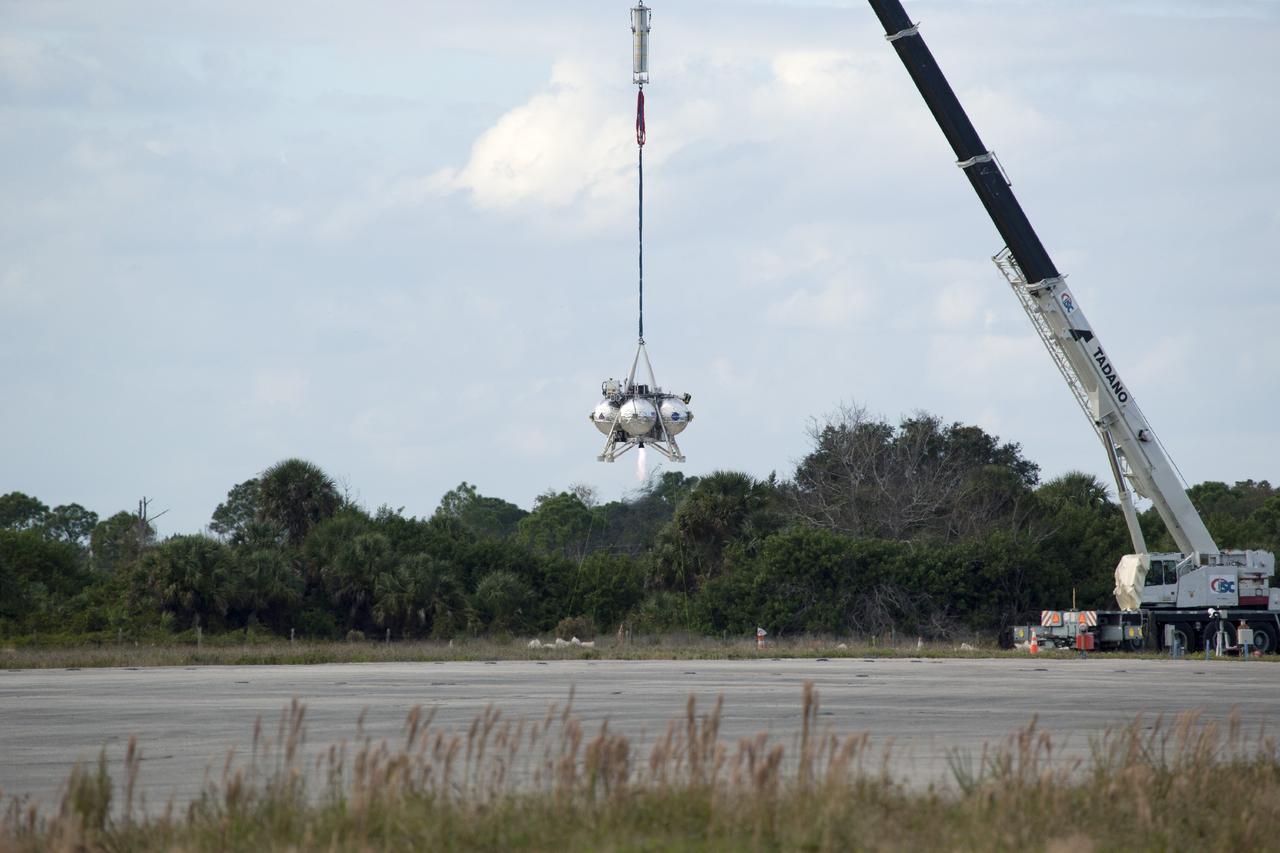
CAPE CANAVERAL, Fla. – At NASA’s Kennedy Space Center in Florida, the Project Morpheus prototype lander has been lifted by a tether and hovers above a transportable launch platform positioned at the north end of the Shuttle Landing Facility. The lander’s engine begins firing for a tethered test that includes lifting it 20 feet by crane, ascending another 10 feet, maneuvering backwards 10 feet, and then flying forward and descending to its original position, landing at the end of the tether. Testing of the prototype lander was performed at NASA’s Johnson Space Center in Houston in preparation for tethered and free flight testing at Kennedy. The landing facility will provide the lander with the kind of field necessary for realistic testing, complete with rocks, craters and hazards to avoid. Morpheus utilizes an autonomous landing and hazard avoidance technology, or ALHAT, payload that will allow it to navigate to clear landing sites amidst rocks, craters and other hazards during its descent. Project Morpheus is being managed under the Advanced Exploration Systems, or AES, Division in NASA’s Human Exploration and Operations Mission Directorate. The efforts in AES pioneer new approaches for rapidly developing prototype systems, demonstrating key capabilities and validating operational concepts for future human missions beyond Earth orbit. For more information on Project Morpheus, visit http://morpheuslander.jsc.nasa.gov. Photo credit: NASA/Daniel Casper
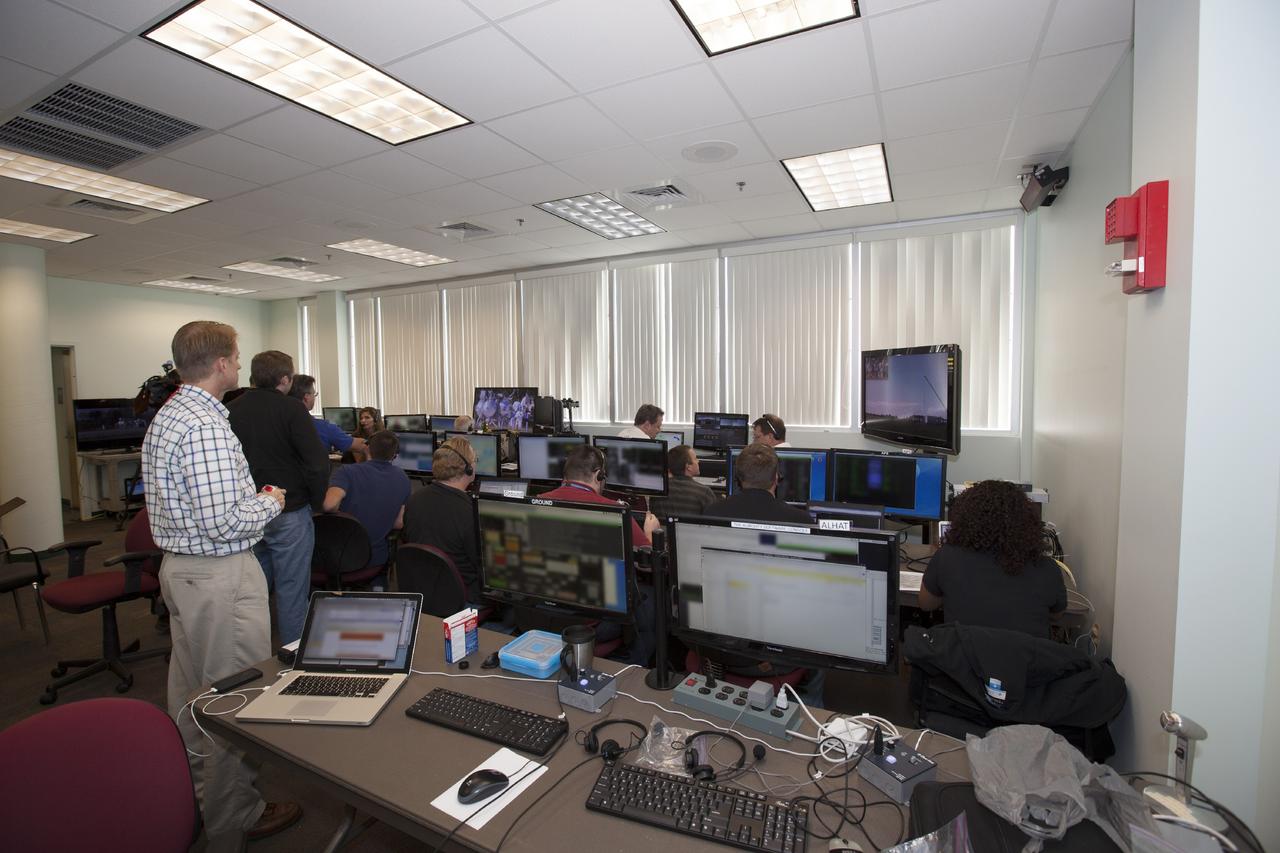
CAPE CANAVERAL, Fla. – Inside a control room at NASA’s Kennedy Space Center in Florida, engineers monitor the progress as the Project Morpheus prototype lander is being prepared for a tether test on a transportable launch platform positioned at the north end of the Shuttle Landing Facility. The tethered test will include lifting it 20 feet by crane, ascending another 10 feet, maneuvering backwards 10 feet, and then flying forward and descending to its original position, landing at the end of the tether. Testing of the prototype lander was performed at NASA’s Johnson Space Center in Houston in preparation for tethered and free flight testing at Kennedy. The landing facility will provide the lander with the kind of field necessary for realistic testing, complete with rocks, craters and hazards to avoid. Morpheus utilizes an autonomous landing and hazard avoidance technology, or ALHAT, payload that will allow it to navigate to clear landing sites amidst rocks, craters and other hazards during its descent. Project Morpheus is being managed under the Advanced Exploration Systems, or AES, Division in NASA’s Human Exploration and Operations Mission Directorate. The efforts in AES pioneer new approaches for rapidly developing prototype systems, demonstrating key capabilities and validating operational concepts for future human missions beyond Earth orbit. For more information on Project Morpheus, visit http://morpheuslander.jsc.nasa.gov. Photo credit: NASA/Daniel Casper
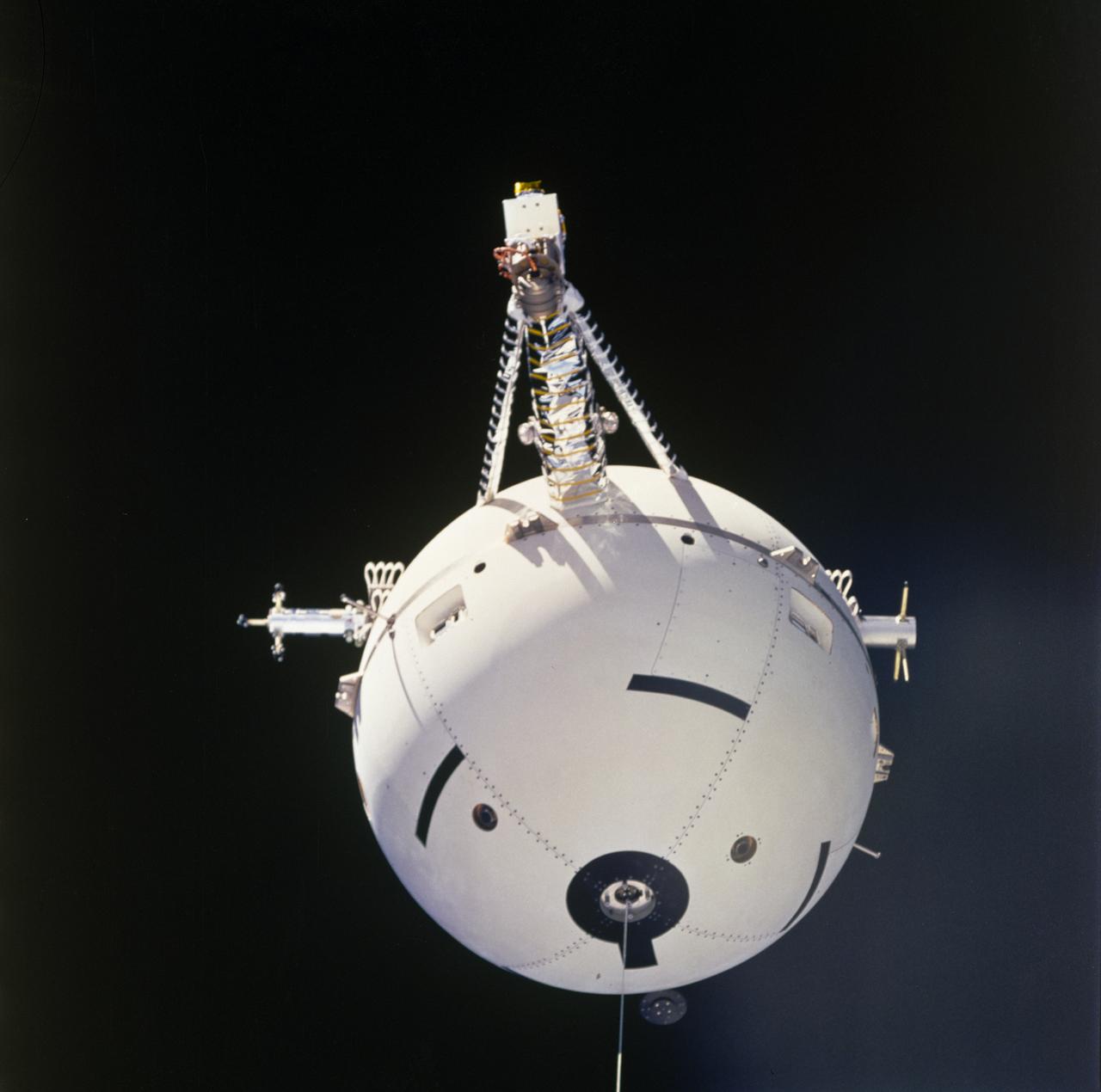
This Space Shuttle Orbiter Atlantis (STS-46) onboard photo is a close-up view of the Tethered Satellite System (TSS-1) in orbit above the Shuttle. A cooperative development effort by the Italian Space Agency (ASI) and NASA, the Tethered Satellite System (TSS) made capable the deployment and retrieval of a satellite which is attached by a wire tether from distances up to 100 km from the Orbiter. These free-flying satellites are used as observation platforms outside of the Orbiter.
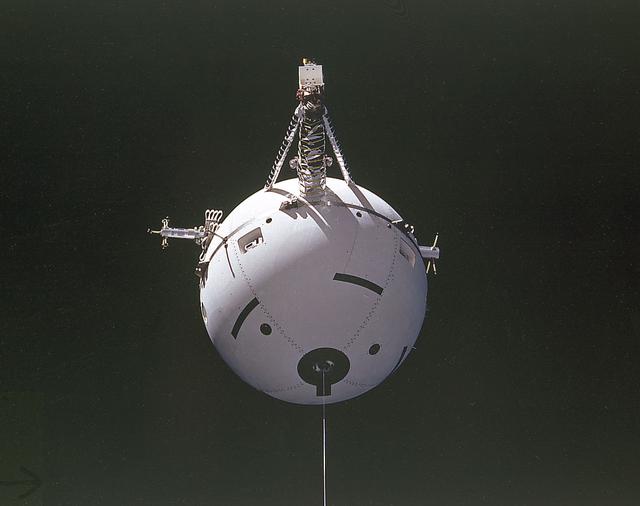
Space Shuttle Atlantis (STS-46) onboard photo of the Tethered Satellite System (TSS-1) deployment. A cooperative development effort by the Italian Space Agency (ASI) and NASA, the Tethered Satellite System (TSS) made capable the deployment and retrieval of a satellite which is attached by a wire tether from distances up to 100 km from the Orbiter. These free-flying satellites are used as observation platforms outside of the Orbiter.
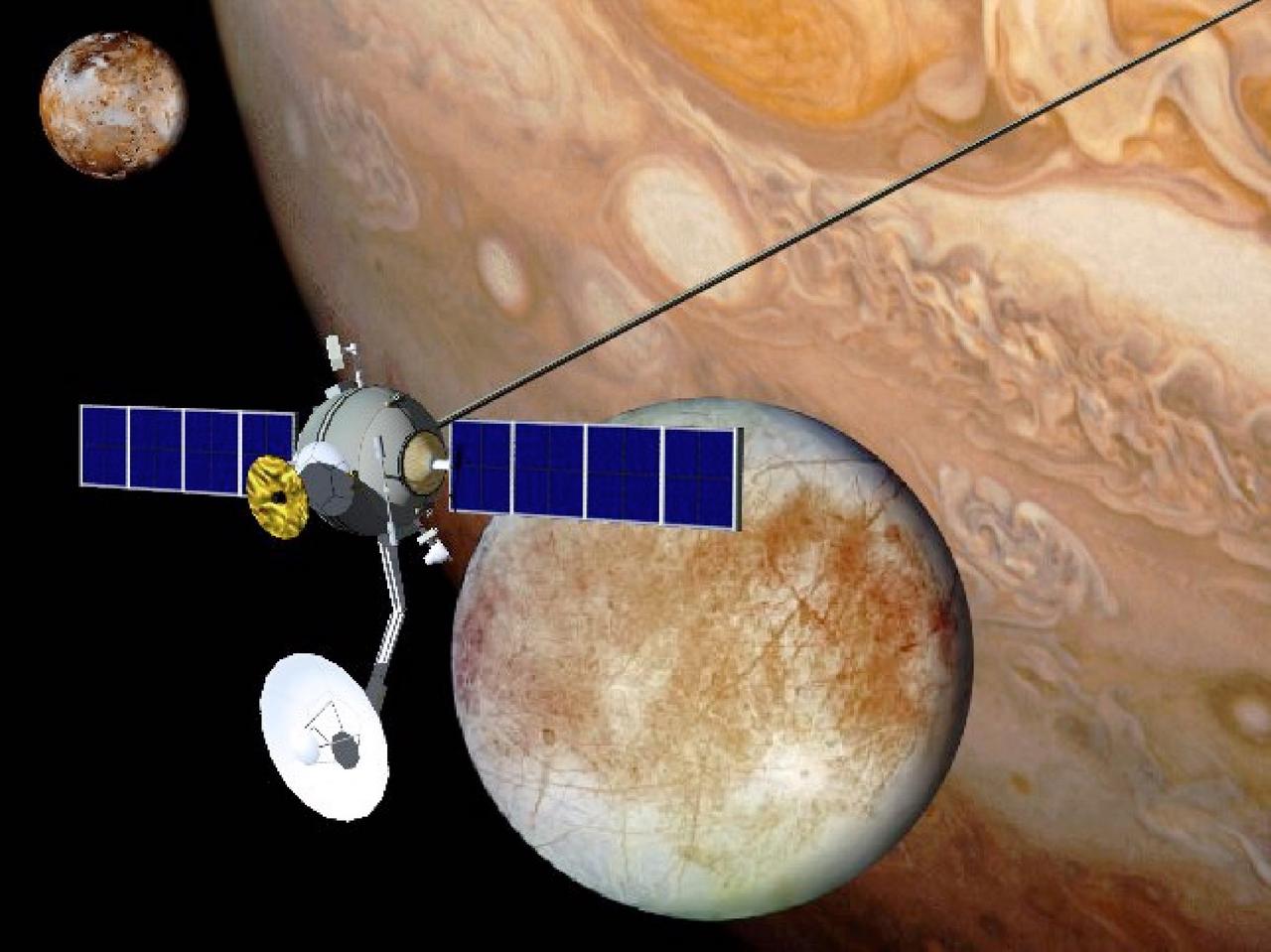
This is an artist's concept of an orbiting space vehicle in the Jovian system using an electrodynamic tether propellantless propulsion system. Electrodynamic tethers offer the potential to greatly extend and enhance future scientific missions to Jupiter and the Jovian system. Like Earth, Jupiter posses a strong magnetic field and a significant magnetosphere. This may make it feasible to operate electrodynamic tethers for propulsion and power generation.
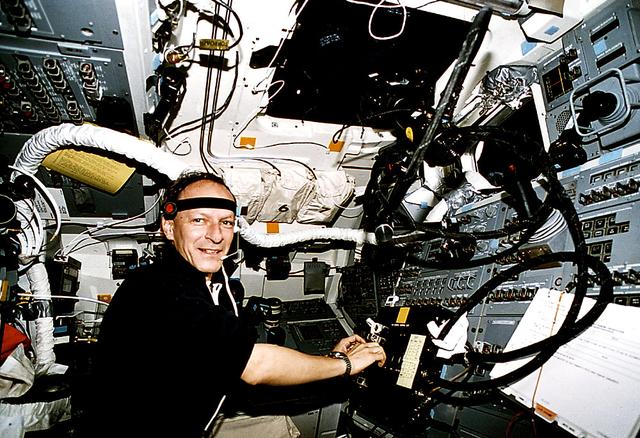
This Space Shuttle Orbiter Atlantis (STS-46) onboard photo shows Swiss scientist Claude Nicollier of the European Space Agency (ESA) supporting the Tether Opitical Phenomena (TOP) activities on the flight deck. The Tethered Satellite System (TSS) was a cooperative development effort by the Italian Space Agency (ASI) and NASA made capable of deploying and retrieving a satellite which is attached by a wire tether from distances up to 100 km from the Orbiter. These free-flying satellites are used as observation platforms outside of the Orbiter.
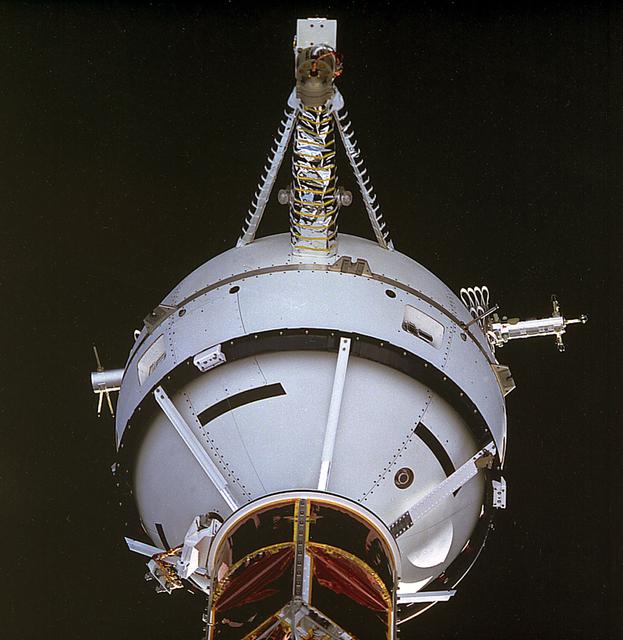
Pictured here is a Space Shuttle Atlantis (STS-46) onboard photo of the Tethered Satellite System (TSS-1) deployment. The Tethered Satellite System (TSS) was a cooperative development effort by the Italian Space Agency (ASI) and NASA. Combined efforts resulted in the capability of deploying and retrieving a satellite which is attached by a wire tether from distances up to 100-km from the Orbiter. These free-flying satellites are used as observation platforms outside of the Orbiter.
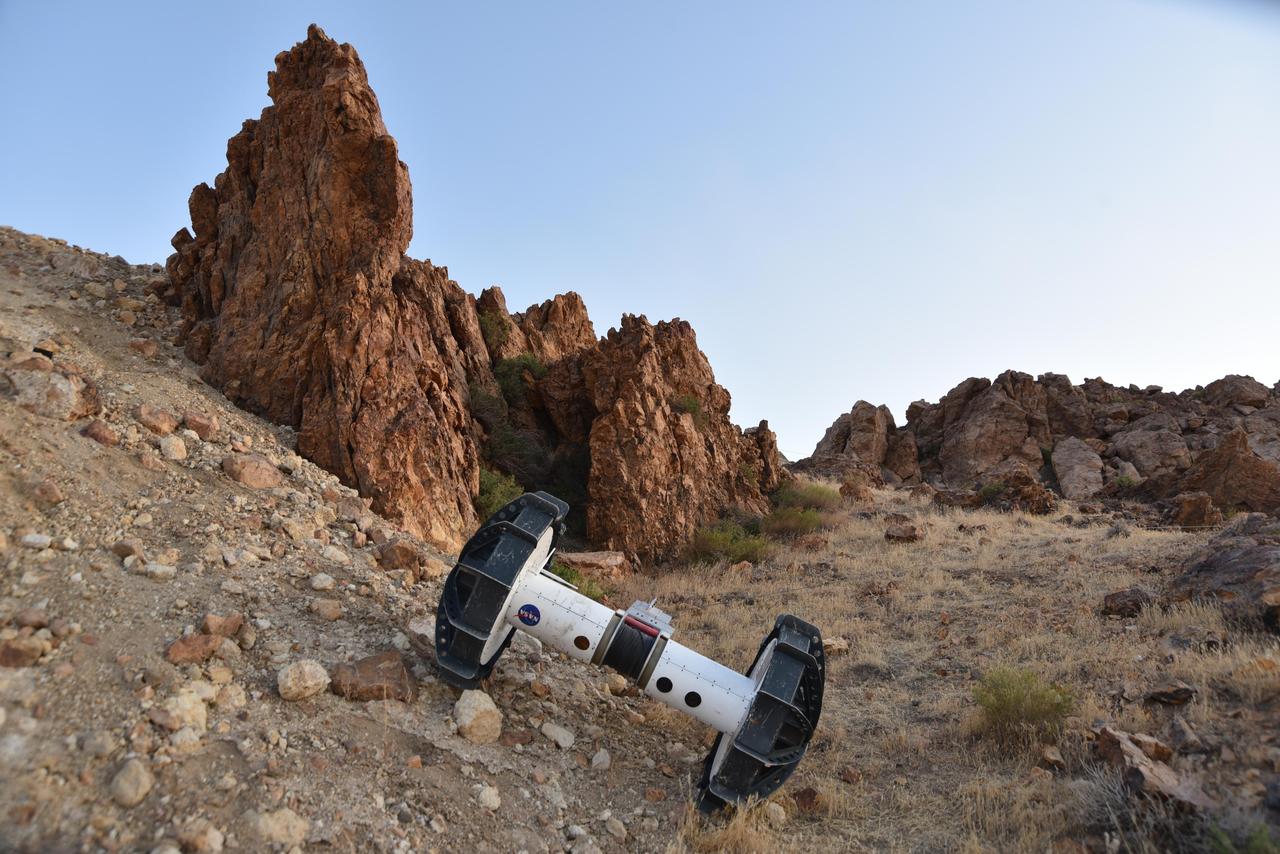
In this photograph, a tethered Axel robot — part of the four-wheeled DuAxel rover — navigates a steep slope during a field test in the Mojave Desert. The tether, which connects to the rover's other half, serves as a climbing rope of sorts while also providing power and a means of communication. This flexibility was built with crater walls, pits, scarps, vents, and other extreme terrain in mind. That's because on Earth, some of the best locations to study geology can be found in rocky outcrops and cliff faces, where many layers of the past are neatly exposed. They're hard enough to reach here, let alone on the Moon, Mars, and other celestial bodies. The DuAxel project is a technology demonstration being developed by roboticists at NASA's Jet Propulsion Laboratory in Southern California to see how this unconventional rover might fill a niche in planetary exploration. https://photojournal.jpl.nasa.gov/catalog/PIA24110
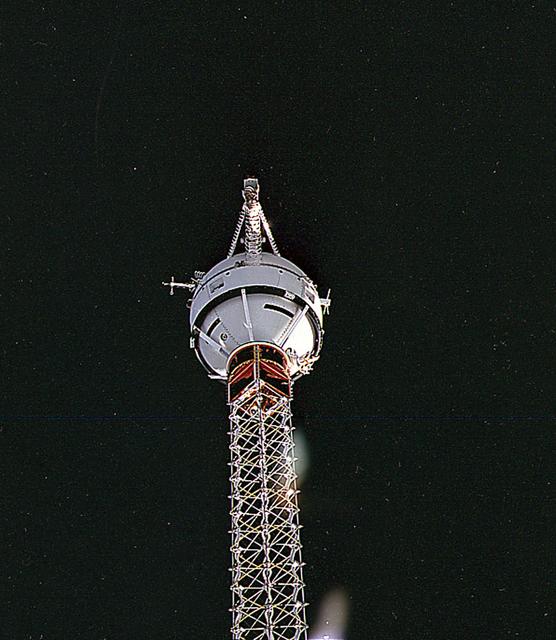
An STS-75 onboard photo of the Tethered Satellite System-1 Reflight (TSS-1R) atop its extended boom. The TSS-1R was a reflight of TSS-1, which was flown on the Space Shuttle in July/August, 1992. Building on the knowledge gained on the TSS-1 about tether dynamics, the TSS will circle the Earth at an altitude of 296 kilometers (184 miles), placing the tether system well within the rarefield, electrically charged layer of the atmosphere known as the ionosphere. The satellite was plarned to be deployed 20.7 kilometers (12.9 miles) above the Shuttle. The conducting tether, generating high voltage and electrical currents as it moves through the ionosphere cutting magnetic field lines, would allow scientists to examine the electrodynamics of a conducting tether system. In addition, the TSS would increase our understanding of physical processes in the near-Earth space environment, such as plasma waves and currents. The tether on the TSS broke as the Satellite was nearing the full extent of its 12.5 mile deployment from the Shuttle. The TSS was a cooperative development effort by the Italian Space Agency (ASI) and NASA, and was managed by scientists at the Marshall Space Flight Center.
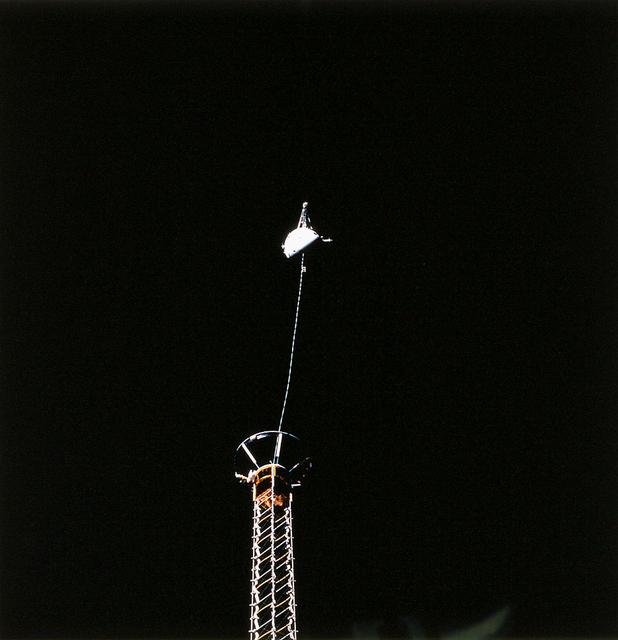
An STS-75 onboard photo of the Tethered Satellite System-1 Reflight (TSS-1R) atop its extended boom. The TSS-1R was a reflight of TSS-1, which was flown on the Space Shuttle in July/August, 1992. Building on the knowledge gained on the TSS-1 about tether dynamics, the TSS will circle the Earth at an altitude of 296 kilometers (184 miles), placing the tether system well within the rarefield, electrically charged layer of the atmosphere known as the ionosphere. The satellite was plarned to be deployed 20.7 kilometers (12.9 miles) above the Shuttle. The conducting tether, generating high voltage and electrical currents as it moves through the ionosphere cutting magnetic field lines, would allow scientists to examine the electrodynamics of a conducting tether system. In addition, the TSS would increase our understanding of physical processes in the near-Earth space environment, such as plasma waves and currents. The tether on the TSS broke as the Satellite was nearing the full extent of its 12.5 mile deployment from the Shuttle. The TSS was a cooperative development effort by the Italian Space Agency (ASI) and NASA, and was managed by scientists at the Marshall Space Flight Center.
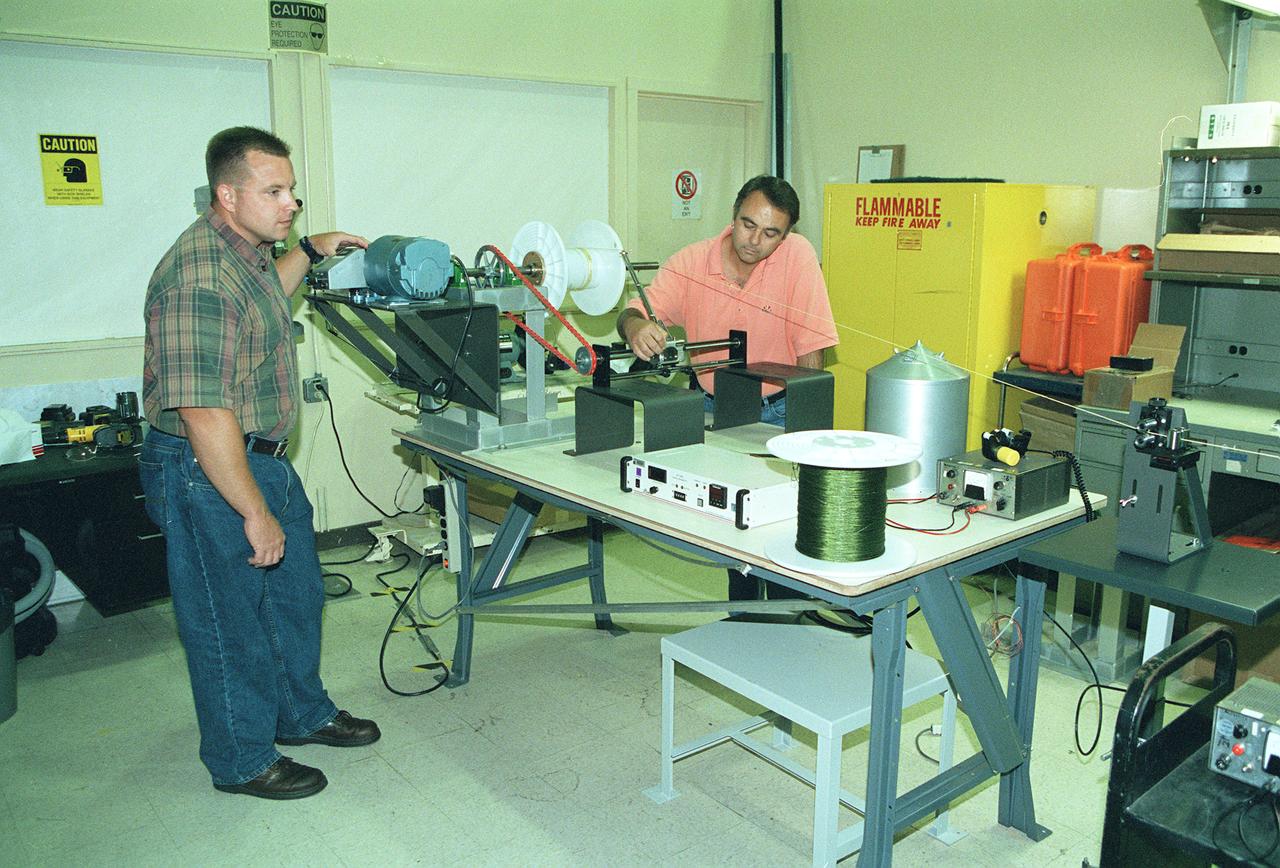
This photograph shows two Marshall Space Flight Center (MSFC) engineers, Mark Vaccaro (left) and Ken Welzyn, testing electrodynamic tethers in the MSFC Tether Winding and Spark Testing Facility. For 4 years, MSFC and industry partners have been developing the Propulsive Small Expendable Deployer System experiment, called ProSEDS. ProSEDS will test electrodynamic tether propulsion technology. Electrodynamic tethers are long, thin wires that collect electrical current when passing through a magnetic field. The tether works as a thruster as a magnetic field exerts a force on a current-carrying wire. Since electrodynamic tethers require no propellant, they could substantially reduce the weight of the spacecraft and provide a cost-effective method of reboosting spacecraft. The initial flight of ProSEDS is scheduled to fly aboard an Air Force Delta II rocket in the summer of 2002. In orbit, ProSEDS will deploy from a Delta II second stage. It will be a 3.1-mile (5 kilometer) long, ultrathin base-wire tether cornected with a 6.2-mile (10 kilometer) long non-conducting tether. This photograph shows Less Johnson, a scientist at MSFC, inspecting the nonconducting part of a tether as it exits a deployer similar to the one to be used in the ProSEDS experiment. The ProSEDS experiment is managed by the Space Transportation Directorate at MSFC.
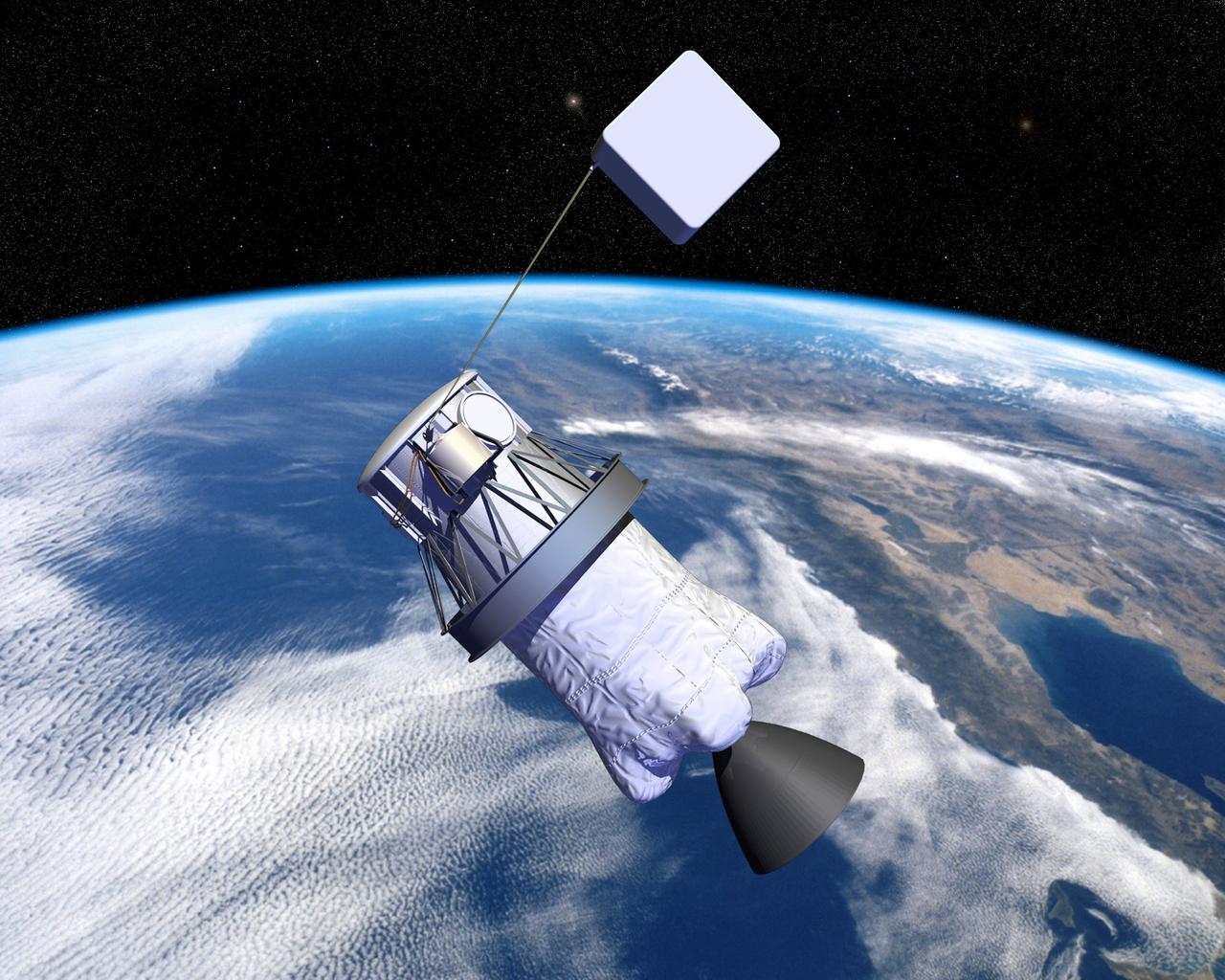
Pictured is an artist's concept of NASA's Propulsive Small Expendable Deployer System experiment (ProSEDS). ProSEDS will demonstrate the use of an electrodynamic tether, basically a long, thin wire, for propulsion. An electrodynamic tether uses the same principles as electric motors in toys, appliances and computer disk drives, and generators in automobiles and power plants. When electrical current is flowing through the tether, a magnetic field is produced that pushes against the magnetic field of the Earth. For ProSEDS, the current in the tether results by virtue of the voltage generated when the tether moves through the Earth's magnetic field at more than 17,000 mph. This approach can produce drag thrust generating useable power. Since electrodynamic tethers require no propellant, they could substantially reduce the weight of the spacecraft and provide a cost-effective method of reboosting spacecraft. The initial flight of ProSEDS is scheduled to fly aboard an Air Force Delta II rocket in summer of 2002. In orbit, ProSEDS will deploy from a Delta II second stage. It will be a 3.1-mile (5 kilometer) long, ultrathin base-wire tether cornected with a 6.2-mile (10 kilometer) long nonconducting tether. The ProSEDS experiment is managed by the Space Transportation Directorate at the Marshall Space Flight Center.
NASA's Propulsive Small Expendable Deployer System experiment (ProSEDS) will demonstrate the use of an electrodynamic tether, basically a long, thin wire, for propulsion. An electrodynamic tether uses the same principles as electric motors in toys, appliances and computer disk drives, and generators in automobiles and power plants. When electrical current is flowing through the tether, a magnetic field is produced that pushes against the magnetic field of the Earth. For ProSEDS, the current in the tether results by virtue of the voltage generated when the tether moves through the Earth's magnetic field at more than 17,000 mph. This approach can produce drag thrust generating useable power. Since electrodynamic tethers require no propellant, they could substantially reduce the weight of the spacecraft and provide a cost-effective method of reboosting spacecraft. The initial flight of ProSEDS is scheduled to fly aboard an Air Force Delta II rocket in the summer of 2002. In orbit, ProSEDS will deploy from a Delta II second stage. It will be a 3.1-mile (5 kilometer) long, ultrathin base-wire cornected with a 6.2-mile (10 kilometer) long nonconducting tether. This photograph shows Less Johnson, a scientist at MSFC inspecting the nonconducting part of a tether as it exits a deployer similar to the one to be used in the ProSEDS experiment. The ProSEDS experiment is managed by the Space Transportation Directorate at MSFC.
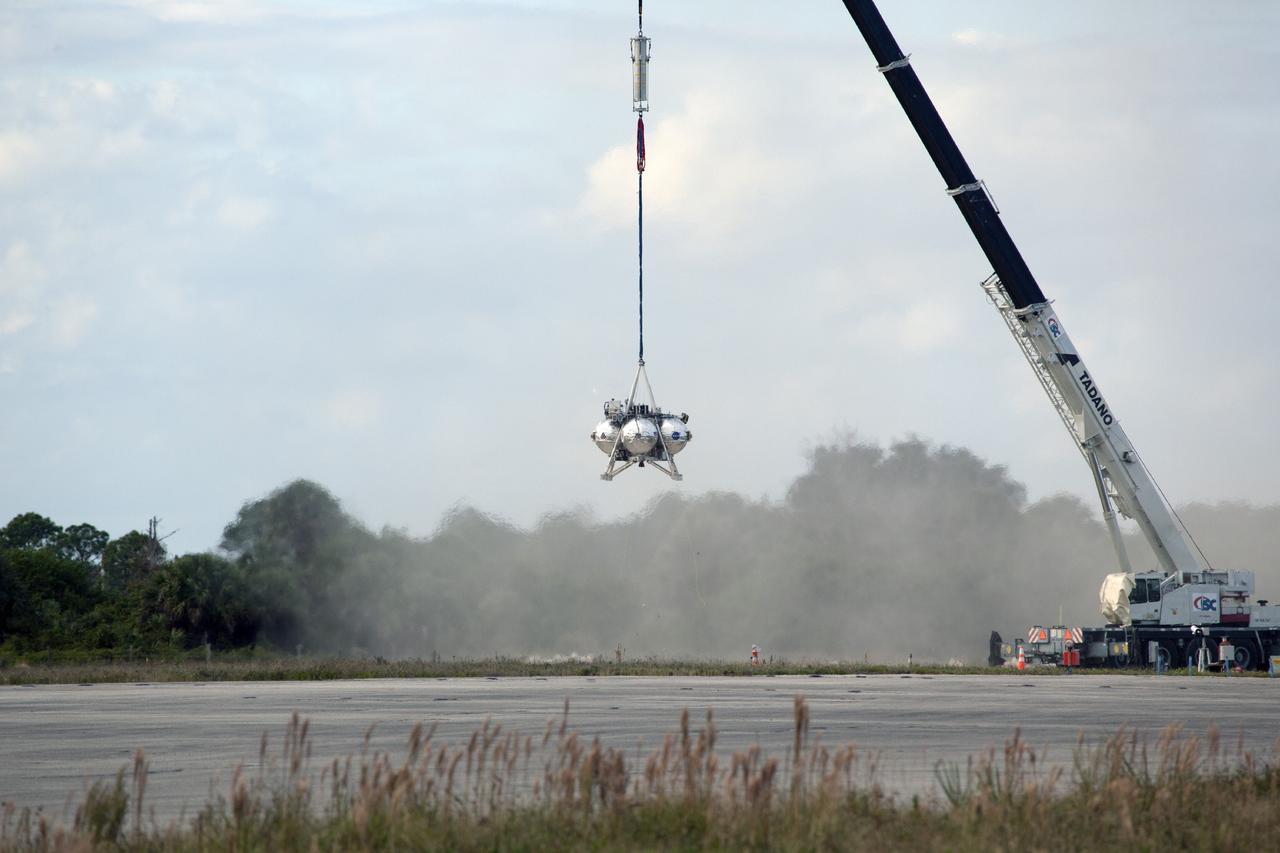
CAPE CANAVERAL, Fla. – At NASA’s Kennedy Space Center in Florida, the Project Morpheus prototype lander’s engine has completed its firing during a tether test at the north end of the Shuttle Landing Facility. During the test, the lander was lifted 20 feet by crane, and then ascended another 10 feet, maneuvered backwards 10 feet, and then flew forward. It will descend to its original position, landing at the end of the tether onto a transportable launch platform. Testing of the prototype lander was performed at NASA’s Johnson Space Center in Houston in preparation for tethered and free flight testing at Kennedy. The landing facility will provide the lander with the kind of field necessary for realistic testing, complete with rocks, craters and hazards to avoid. Morpheus utilizes an autonomous landing and hazard avoidance technology, or ALHAT, payload that will allow it to navigate to clear landing sites amidst rocks, craters and other hazards during its descent. Project Morpheus is being managed under the Advanced Exploration Systems, or AES, Division in NASA’s Human Exploration and Operations Mission Directorate. The efforts in AES pioneer new approaches for rapidly developing prototype systems, demonstrating key capabilities and validating operational concepts for future human missions beyond Earth orbit. For more information on Project Morpheus, visit http://morpheuslander.jsc.nasa.gov. Photo credit: NASA/Daniel Casper
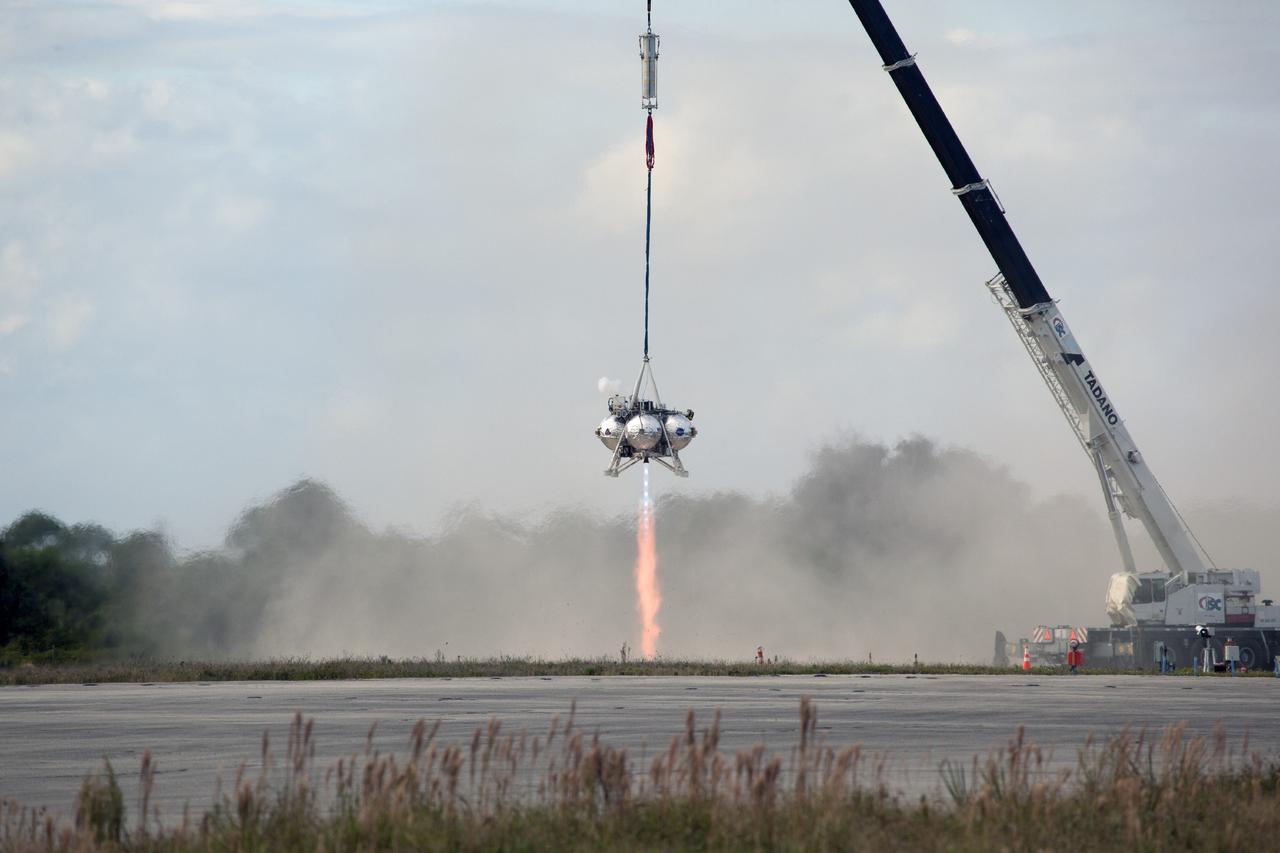
CAPE CANAVERAL, Fla. – At NASA’s Kennedy Space Center in Florida, smoke fills the air as the Project Morpheus prototype lander’s engine fires during a tether test at the north end of the Shuttle Landing Facility. During the test, the lander was lifted 20 feet by crane, and then ascended another 10 feet, maneuvered backwards 10 feet, and then flew forward. It will descend to its original position, landing at the end of the tether onto a transportable launch platform. Testing of the prototype lander was performed at NASA’s Johnson Space Center in Houston in preparation for tethered and free flight testing at Kennedy. The landing facility will provide the lander with the kind of field necessary for realistic testing, complete with rocks, craters and hazards to avoid. Morpheus utilizes an autonomous landing and hazard avoidance technology, or ALHAT, payload that will allow it to navigate to clear landing sites amidst rocks, craters and other hazards during its descent. Project Morpheus is being managed under the Advanced Exploration Systems, or AES, Division in NASA’s Human Exploration and Operations Mission Directorate. The efforts in AES pioneer new approaches for rapidly developing prototype systems, demonstrating key capabilities and validating operational concepts for future human missions beyond Earth orbit. For more information on Project Morpheus, visit http://morpheuslander.jsc.nasa.gov. Photo credit: NASA/Daniel Casper
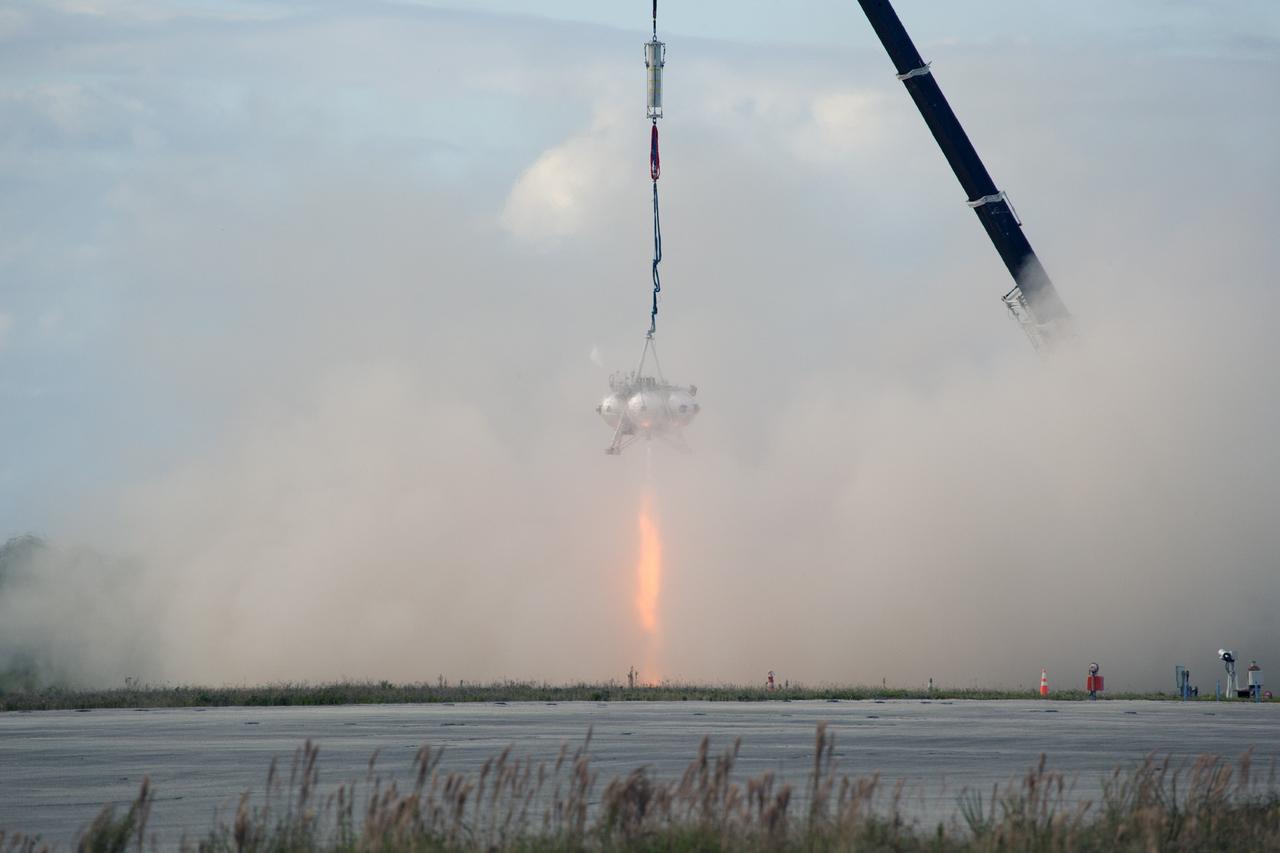
CAPE CANAVERAL, Fla. – At NASA’s Kennedy Space Center in Florida, smoke fills the air as the Project Morpheus prototype lander’s engine fires during a tether test at the north end of the Shuttle Landing Facility. During the test, the lander was lifted 20 feet by crane, and then ascended another 10 feet. The lander will maneuver backwards 10 feet, and then fly forward and descend to its original position, landing at the end of the tether onto a transportable launch platform. Testing of the prototype lander was performed at NASA’s Johnson Space Center in Houston in preparation for tethered and free flight testing at Kennedy. The landing facility will provide the lander with the kind of field necessary for realistic testing, complete with rocks, craters and hazards to avoid. Morpheus utilizes an autonomous landing and hazard avoidance technology, or ALHAT, payload that will allow it to navigate to clear landing sites amidst rocks, craters and other hazards during its descent. Project Morpheus is being managed under the Advanced Exploration Systems, or AES, Division in NASA’s Human Exploration and Operations Mission Directorate. The efforts in AES pioneer new approaches for rapidly developing prototype systems, demonstrating key capabilities and validating operational concepts for future human missions beyond Earth orbit. For more information on Project Morpheus, visit http://morpheuslander.jsc.nasa.gov. Photo credit: NASA/Daniel Casper
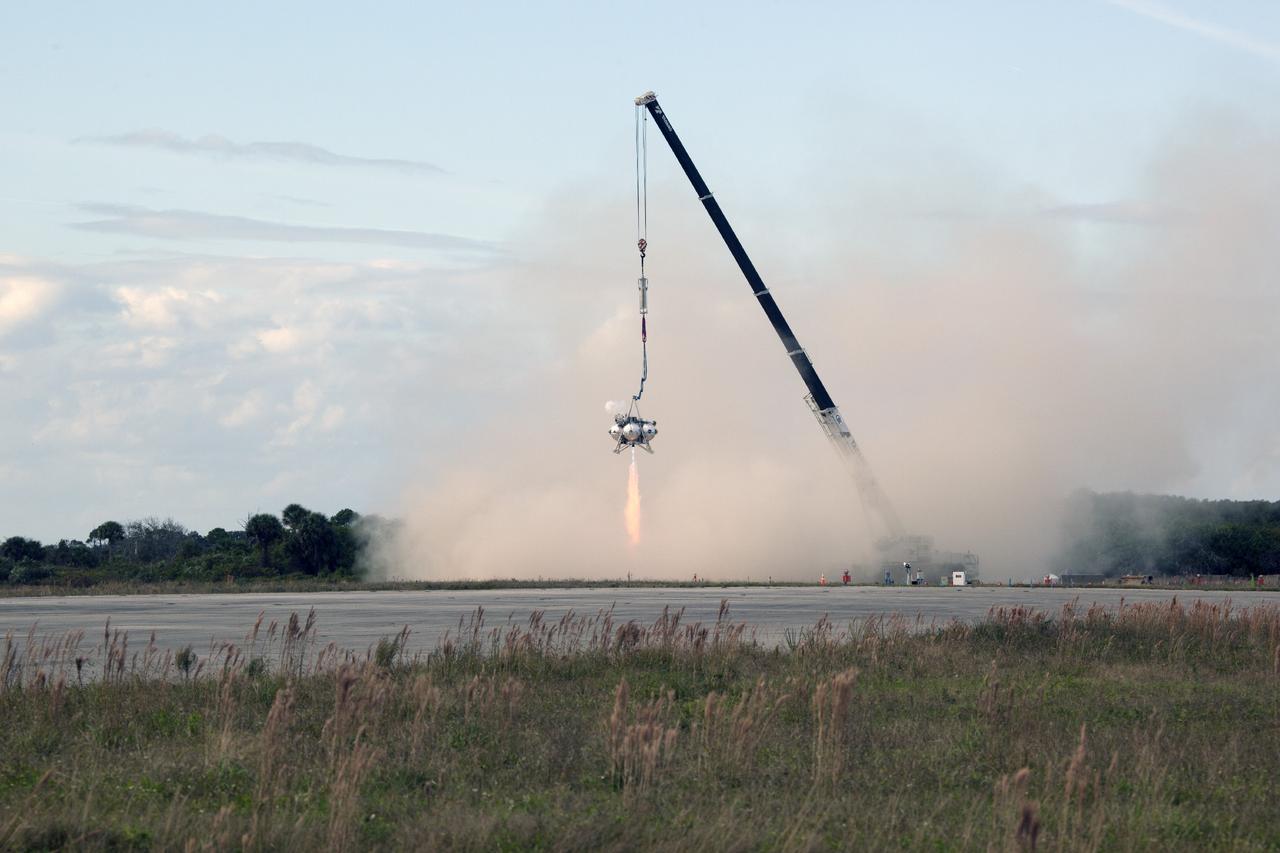
CAPE CANAVERAL, Fla. – At NASA’s Kennedy Space Center in Florida, smoke fills the air as the Project Morpheus prototype lander’s engine fires during a tether test at the north end of the Shuttle Landing Facility. During the test, the lander was lifted 20 feet by crane, and then ascended another 10 feet, maneuvered backwards 10 feet, and then flew forward. It will descend to its original position, landing at the end of the tether onto a transportable launch platform. Testing of the prototype lander was performed at NASA’s Johnson Space Center in Houston in preparation for tethered and free flight testing at Kennedy. The landing facility will provide the lander with the kind of field necessary for realistic testing, complete with rocks, craters and hazards to avoid. Morpheus utilizes an autonomous landing and hazard avoidance technology, or ALHAT, payload that will allow it to navigate to clear landing sites amidst rocks, craters and other hazards during its descent. Project Morpheus is being managed under the Advanced Exploration Systems, or AES, Division in NASA’s Human Exploration and Operations Mission Directorate. The efforts in AES pioneer new approaches for rapidly developing prototype systems, demonstrating key capabilities and validating operational concepts for future human missions beyond Earth orbit. For more information on Project Morpheus, visit http://morpheuslander.jsc.nasa.gov. Photo credit: NASA/Daniel Casper

CAPE CANAVERAL, Fla. – At NASA’s Kennedy Space Center in Florida, the Project Morpheus prototype lander’s engine begins to fire during a tether test at the north end of the Shuttle Landing Facility. During the test, the lander is lifted 20 feet by crane, and will ascend another 10 feet, maneuver backwards 10 feet, and then fly forward and descend to its original position, landing at the end of the tether onto a transportable launch platform. Testing of the prototype lander was performed at NASA’s Johnson Space Center in Houston in preparation for tethered and free flight testing at Kennedy. The landing facility will provide the lander with the kind of field necessary for realistic testing, complete with rocks, craters and hazards to avoid. Morpheus utilizes an autonomous landing and hazard avoidance technology, or ALHAT, payload that will allow it to navigate to clear landing sites amidst rocks, craters and other hazards during its descent. Project Morpheus is being managed under the Advanced Exploration Systems, or AES, Division in NASA’s Human Exploration and Operations Mission Directorate. The efforts in AES pioneer new approaches for rapidly developing prototype systems, demonstrating key capabilities and validating operational concepts for future human missions beyond Earth orbit. For more information on Project Morpheus, visit http://morpheuslander.jsc.nasa.gov. Photo credit: NASA/Daniel Casper
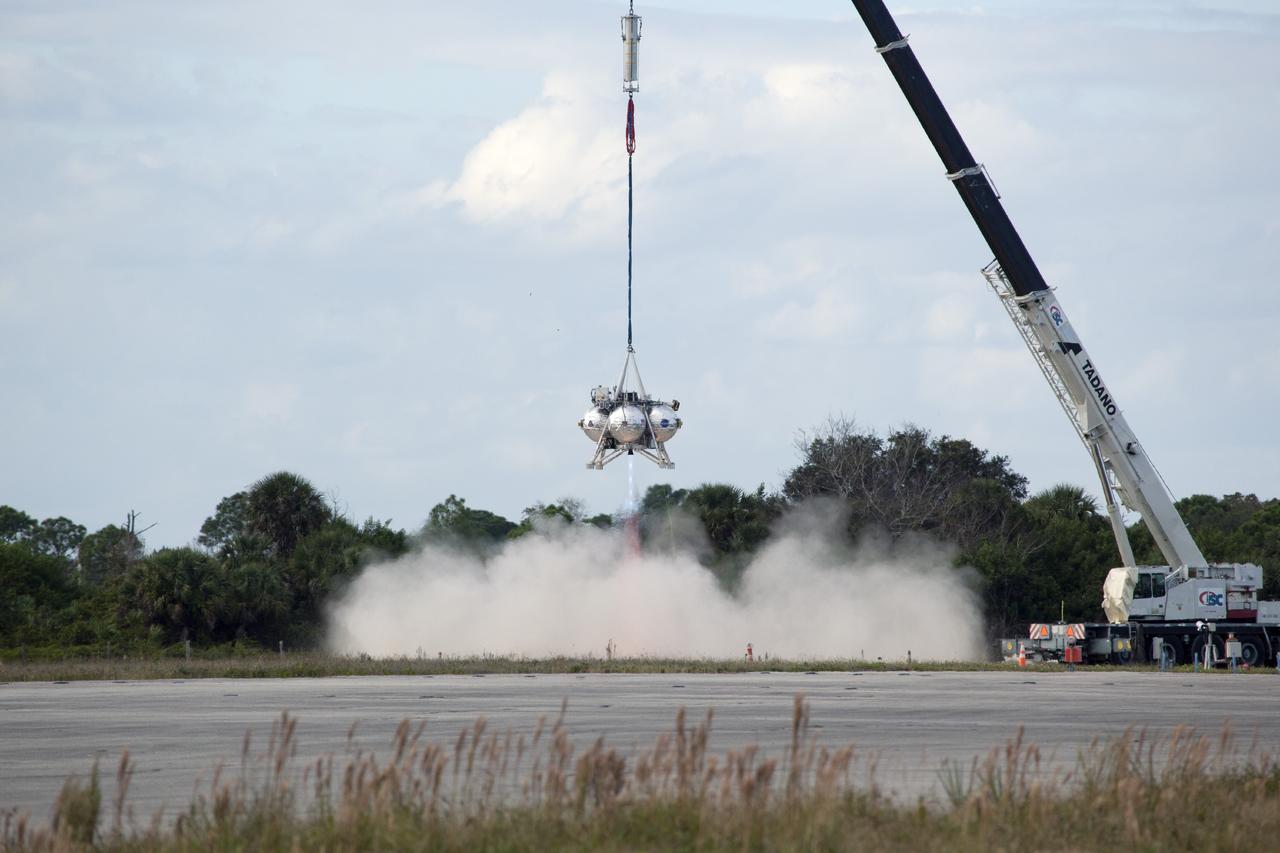
CAPE CANAVERAL, Fla. – At NASA’s Kennedy Space Center in Florida, the Project Morpheus prototype lander’s engine begins to fire during a tether test at the north end of the Shuttle Landing Facility. During the test, the lander is lifted 20 feet by crane, and will ascend another 10 feet, maneuver backwards 10 feet, and then fly forward and descend to its original position, landing at the end of the tether onto a transportable launch platform. Testing of the prototype lander was performed at NASA’s Johnson Space Center in Houston in preparation for tethered and free flight testing at Kennedy. The landing facility will provide the lander with the kind of field necessary for realistic testing, complete with rocks, craters and hazards to avoid. Morpheus utilizes an autonomous landing and hazard avoidance technology, or ALHAT, payload that will allow it to navigate to clear landing sites amidst rocks, craters and other hazards during its descent. Project Morpheus is being managed under the Advanced Exploration Systems, or AES, Division in NASA’s Human Exploration and Operations Mission Directorate. The efforts in AES pioneer new approaches for rapidly developing prototype systems, demonstrating key capabilities and validating operational concepts for future human missions beyond Earth orbit. For more information on Project Morpheus, visit http://morpheuslander.jsc.nasa.gov. Photo credit: NASA/Daniel Casper
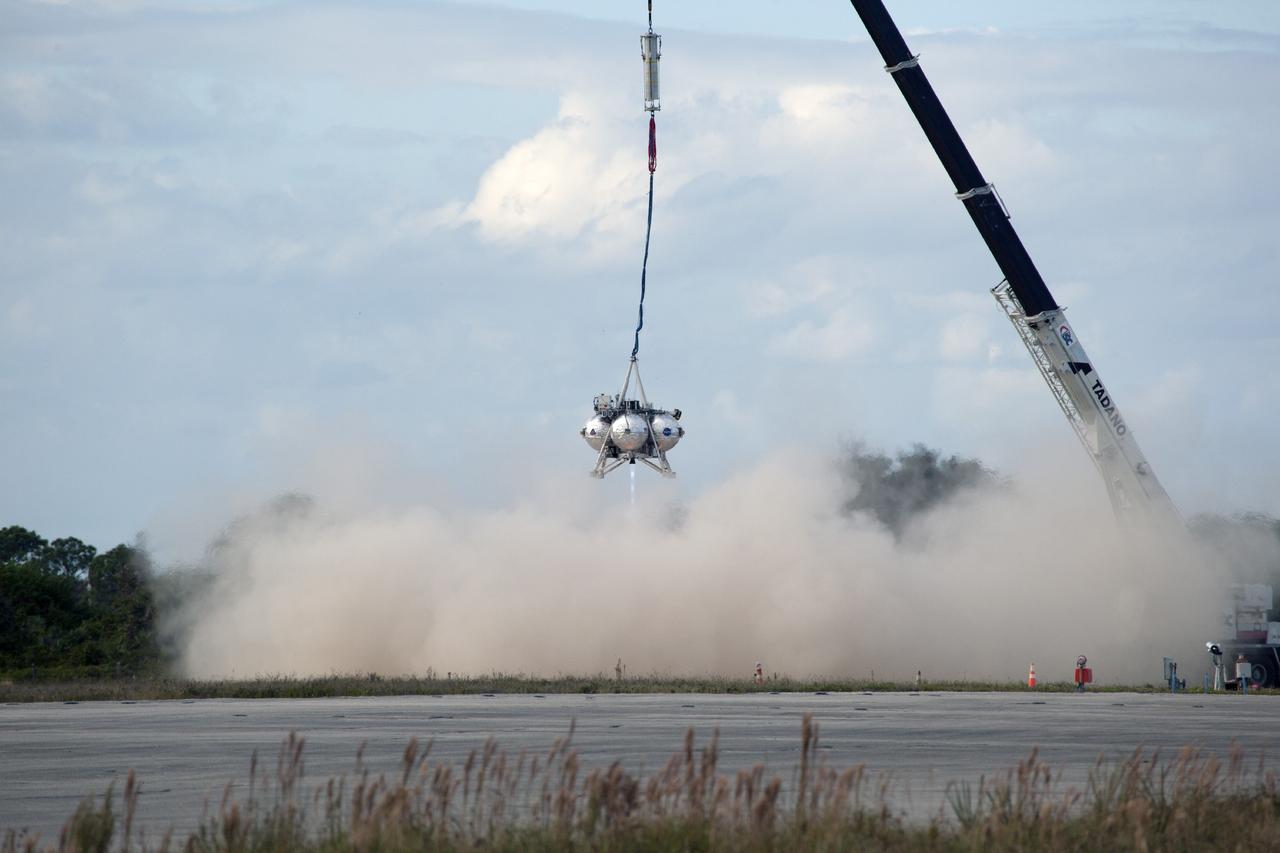
CAPE CANAVERAL, Fla. – At NASA’s Kennedy Space Center in Florida, smoke fills the air as the Project Morpheus prototype lander’s engine fires during a tether test at the north end of the Shuttle Landing Facility. During the test, the lander is lifted 20 feet by crane, and will ascend another 10 feet, maneuver backwards 10 feet, and then fly forward and descend to its original position, landing at the end of the tether onto a transportable launch platform. Testing of the prototype lander was performed at NASA’s Johnson Space Center in Houston in preparation for tethered and free flight testing at Kennedy. The landing facility will provide the lander with the kind of field necessary for realistic testing, complete with rocks, craters and hazards to avoid. Morpheus utilizes an autonomous landing and hazard avoidance technology, or ALHAT, payload that will allow it to navigate to clear landing sites amidst rocks, craters and other hazards during its descent. Project Morpheus is being managed under the Advanced Exploration Systems, or AES, Division in NASA’s Human Exploration and Operations Mission Directorate. The efforts in AES pioneer new approaches for rapidly developing prototype systems, demonstrating key capabilities and validating operational concepts for future human missions beyond Earth orbit. For more information on Project Morpheus, visit http://morpheuslander.jsc.nasa.gov. Photo credit: NASA/Daniel Casper
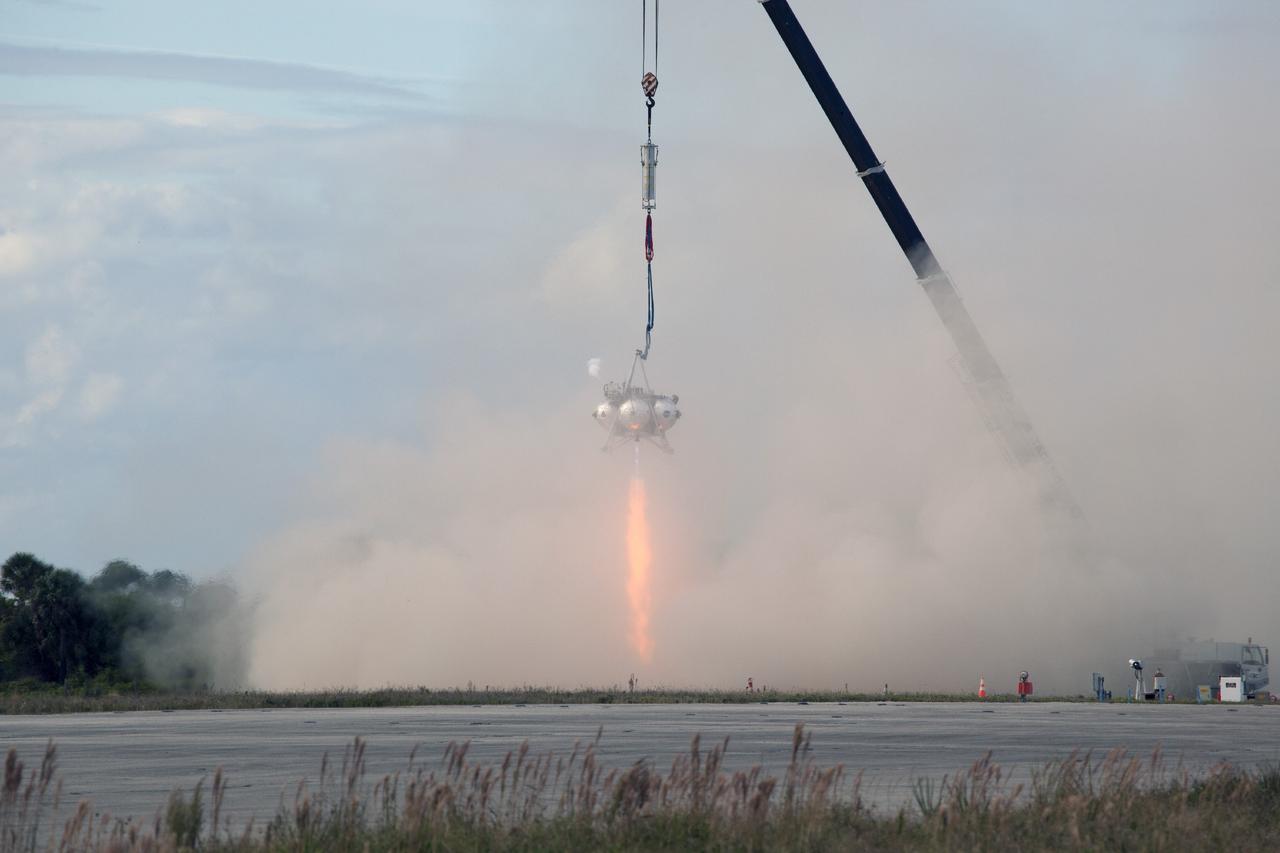
CAPE CANAVERAL, Fla. – At NASA’s Kennedy Space Center in Florida, smoke fills the air as the Project Morpheus prototype lander’s engine fires during a tether test at the north end of the Shuttle Landing Facility. During the test, the lander was lifted 20 feet by crane, and then ascended another 10 feet, maneuvered backwards 10 feet, and then flew forward. It will descend to its original position, landing at the end of the tether onto a transportable launch platform. Testing of the prototype lander was performed at NASA’s Johnson Space Center in Houston in preparation for tethered and free flight testing at Kennedy. The landing facility will provide the lander with the kind of field necessary for realistic testing, complete with rocks, craters and hazards to avoid. Morpheus utilizes an autonomous landing and hazard avoidance technology, or ALHAT, payload that will allow it to navigate to clear landing sites amidst rocks, craters and other hazards during its descent. Project Morpheus is being managed under the Advanced Exploration Systems, or AES, Division in NASA’s Human Exploration and Operations Mission Directorate. The efforts in AES pioneer new approaches for rapidly developing prototype systems, demonstrating key capabilities and validating operational concepts for future human missions beyond Earth orbit. For more information on Project Morpheus, visit http://morpheuslander.jsc.nasa.gov. Photo credit: NASA/Daniel Casper
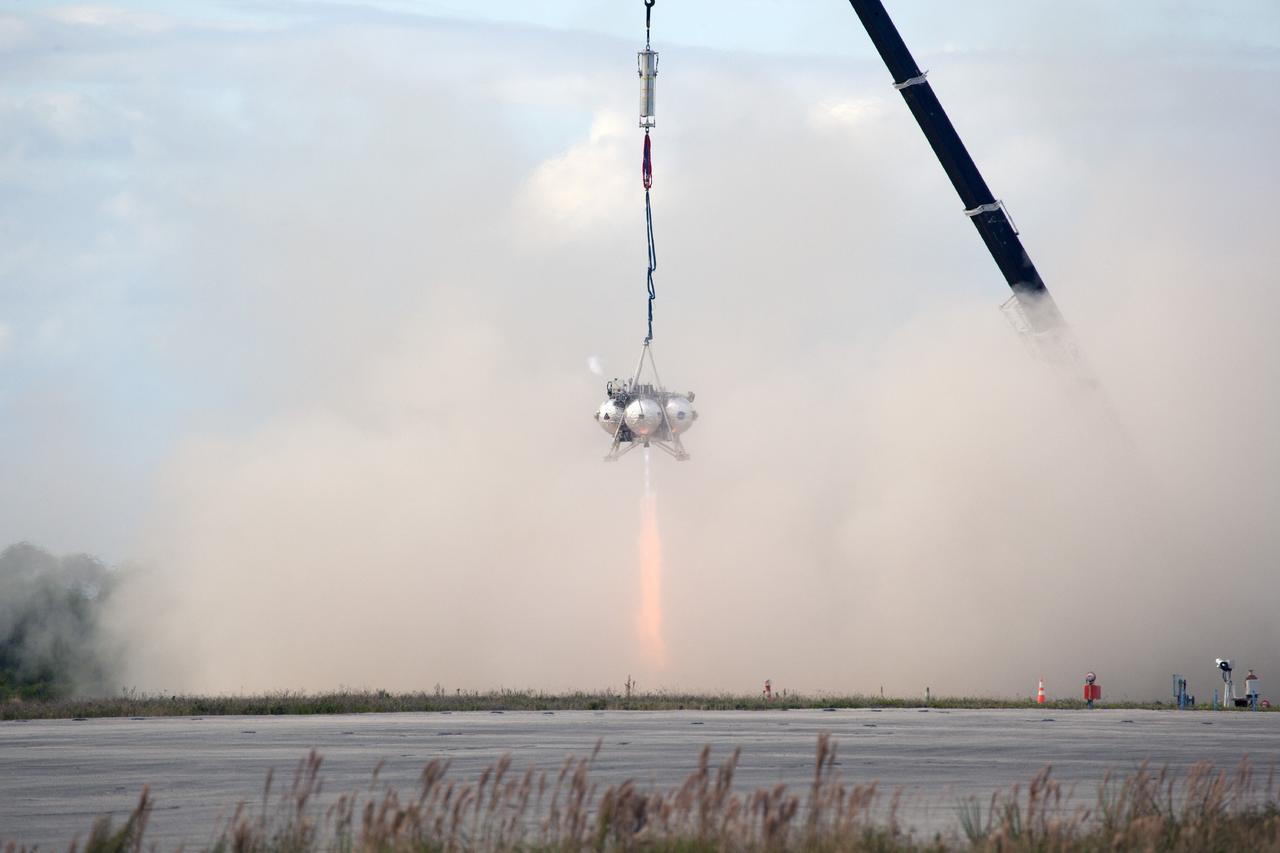
CAPE CANAVERAL, Fla. – At NASA’s Kennedy Space Center in Florida, smoke fills the air as the Project Morpheus prototype lander’s engine fires during a tether test at the north end of the Shuttle Landing Facility. During the test, the lander was lifted 20 feet by crane, and then ascended another 10 feet, maneuvered backwards 10 feet, and then flew forward. It will descend to its original position, landing at the end of the tether onto a transportable launch platform. Testing of the prototype lander was performed at NASA’s Johnson Space Center in Houston in preparation for tethered and free flight testing at Kennedy. The landing facility will provide the lander with the kind of field necessary for realistic testing, complete with rocks, craters and hazards to avoid. Morpheus utilizes an autonomous landing and hazard avoidance technology, or ALHAT, payload that will allow it to navigate to clear landing sites amidst rocks, craters and other hazards during its descent. Project Morpheus is being managed under the Advanced Exploration Systems, or AES, Division in NASA’s Human Exploration and Operations Mission Directorate. The efforts in AES pioneer new approaches for rapidly developing prototype systems, demonstrating key capabilities and validating operational concepts for future human missions beyond Earth orbit. For more information on Project Morpheus, visit http://morpheuslander.jsc.nasa.gov. Photo credit: NASA/Daniel Casper
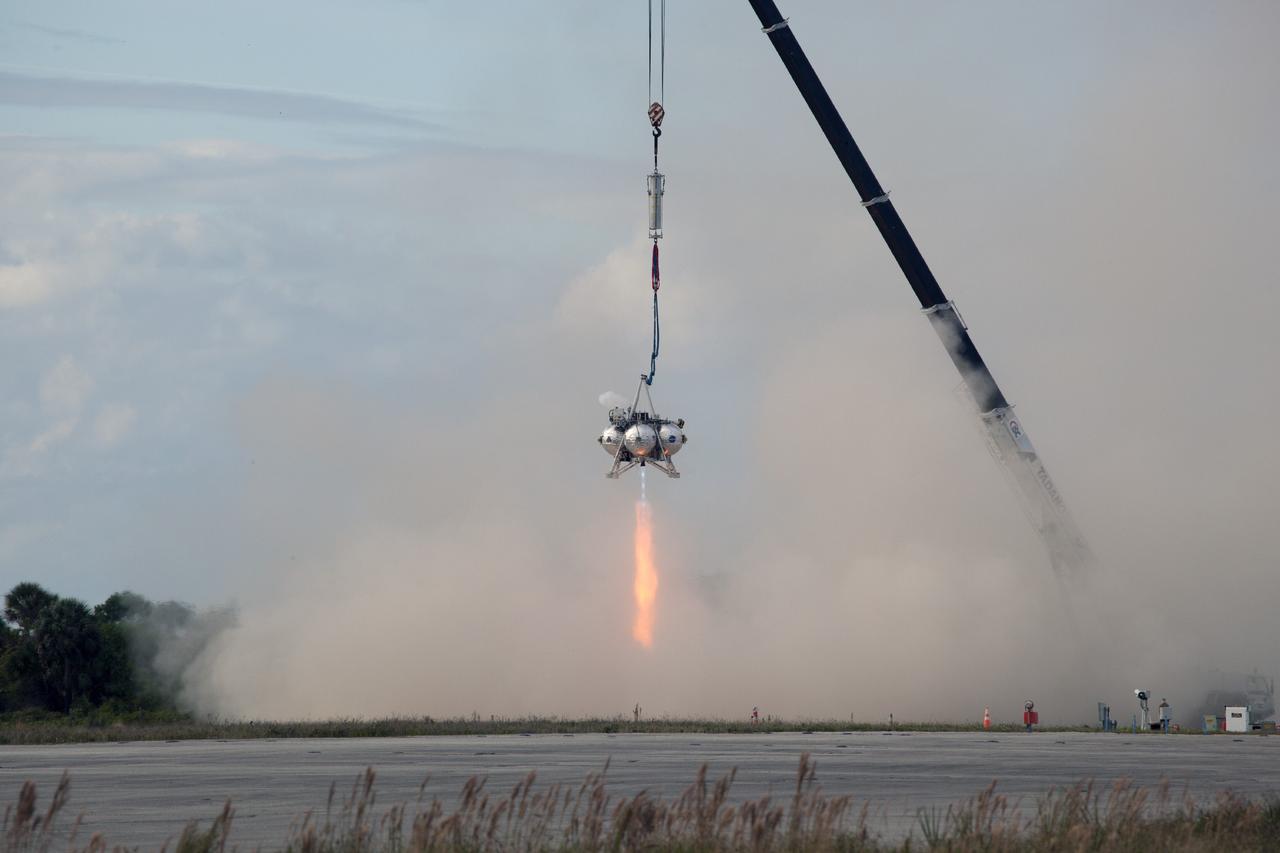
CAPE CANAVERAL, Fla. – At NASA’s Kennedy Space Center in Florida, smoke fills the air as the Project Morpheus prototype lander’s engine fires during a tether test at the north end of the Shuttle Landing Facility. During the test, the lander was lifted 20 feet by crane, and then ascended another 10 feet, maneuvered backwards 10 feet, and then flew forward. It will descend to its original position, landing at the end of the tether onto a transportable launch platform. Testing of the prototype lander was performed at NASA’s Johnson Space Center in Houston in preparation for tethered and free flight testing at Kennedy. The landing facility will provide the lander with the kind of field necessary for realistic testing, complete with rocks, craters and hazards to avoid. Morpheus utilizes an autonomous landing and hazard avoidance technology, or ALHAT, payload that will allow it to navigate to clear landing sites amidst rocks, craters and other hazards during its descent. Project Morpheus is being managed under the Advanced Exploration Systems, or AES, Division in NASA’s Human Exploration and Operations Mission Directorate. The efforts in AES pioneer new approaches for rapidly developing prototype systems, demonstrating key capabilities and validating operational concepts for future human missions beyond Earth orbit. For more information on Project Morpheus, visit http://morpheuslander.jsc.nasa.gov. Photo credit: NASA/Daniel Casper
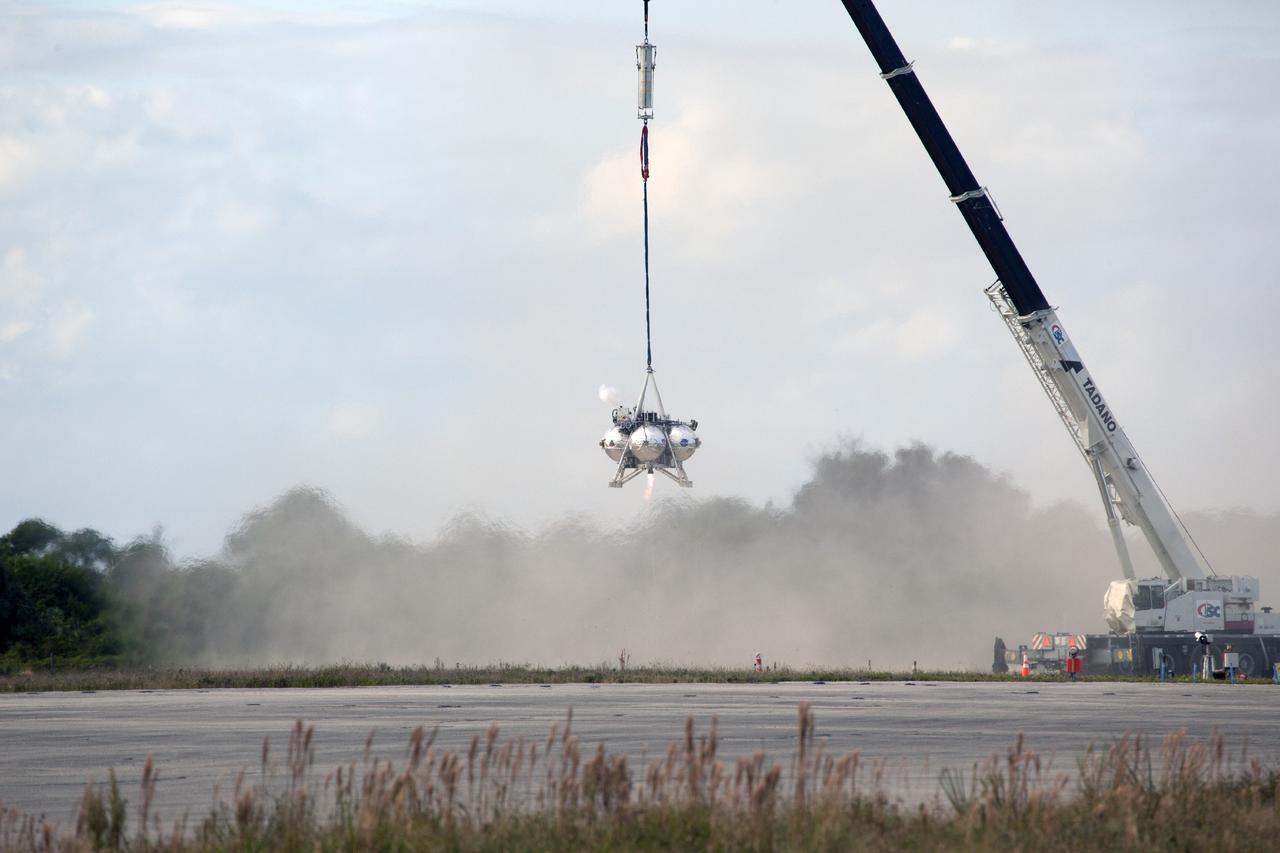
CAPE CANAVERAL, Fla. – At NASA’s Kennedy Space Center in Florida, smoke fills the air as the Project Morpheus prototype lander’s engine fires during a tether test at the north end of the Shuttle Landing Facility. During the test, the lander was lifted 20 feet by crane, and then ascended another 10 feet, maneuvered backwards 10 feet, and then flew forward. It will descend to its original position, landing at the end of the tether onto a transportable launch platform. Testing of the prototype lander was performed at NASA’s Johnson Space Center in Houston in preparation for tethered and free flight testing at Kennedy. The landing facility will provide the lander with the kind of field necessary for realistic testing, complete with rocks, craters and hazards to avoid. Morpheus utilizes an autonomous landing and hazard avoidance technology, or ALHAT, payload that will allow it to navigate to clear landing sites amidst rocks, craters and other hazards during its descent. Project Morpheus is being managed under the Advanced Exploration Systems, or AES, Division in NASA’s Human Exploration and Operations Mission Directorate. The efforts in AES pioneer new approaches for rapidly developing prototype systems, demonstrating key capabilities and validating operational concepts for future human missions beyond Earth orbit. For more information on Project Morpheus, visit http://morpheuslander.jsc.nasa.gov. Photo credit: NASA/Daniel Casper
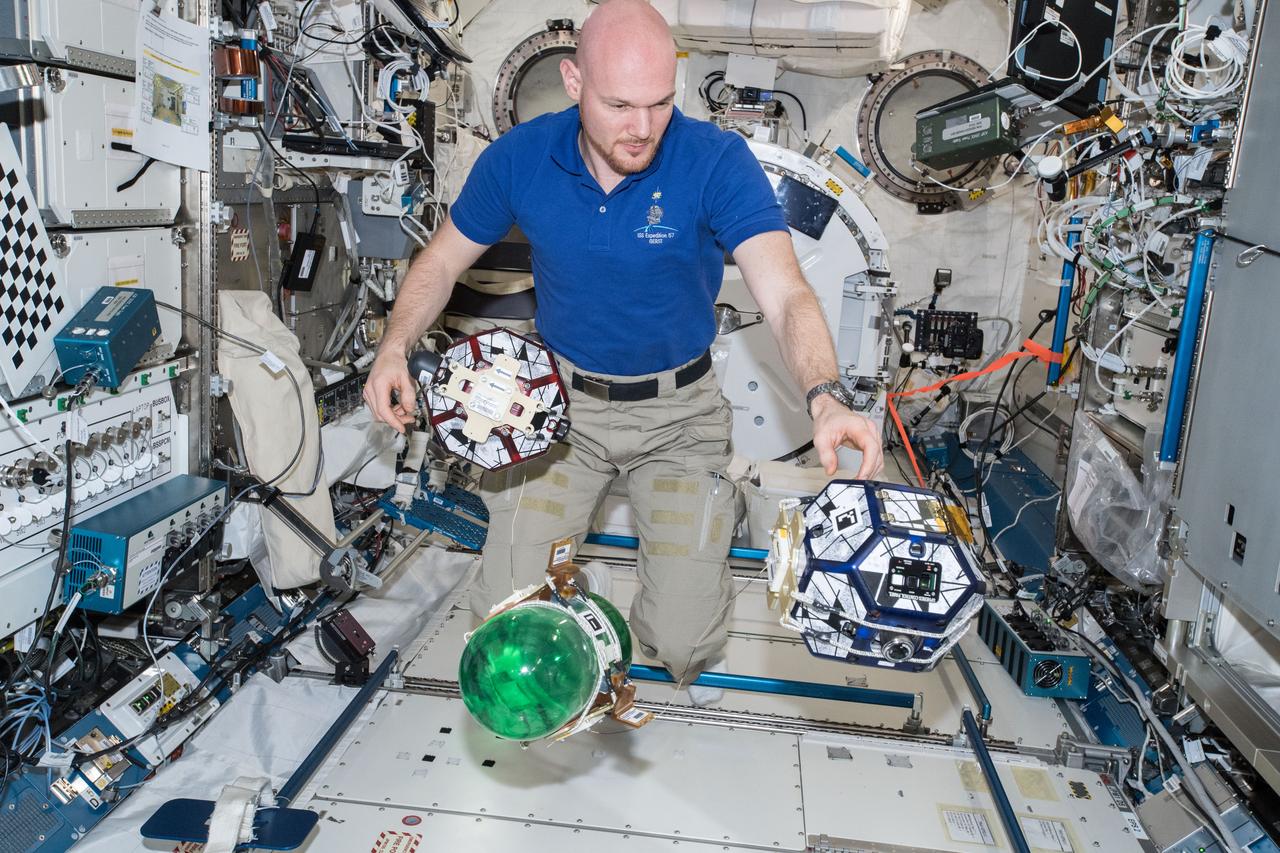
iss057e055052 (10/18/2018) --- European Space Agency astronaut Alexander Gerst is photographed during a Synchronized Position Hold, Engage, Reorient, Experimental Satellites (SPHERES) Tether Slosh experiment test session run. Photo was taken in the Kibo Japanese Experiment Pressurized Module (JPM) aboard the International Space Station (ISS). SPHERES Tether Slosh combines fluid dynamics equipment with robotic capabilities aboard the ISS to investigate automated strategies for steering passive cargo that contain fluids.
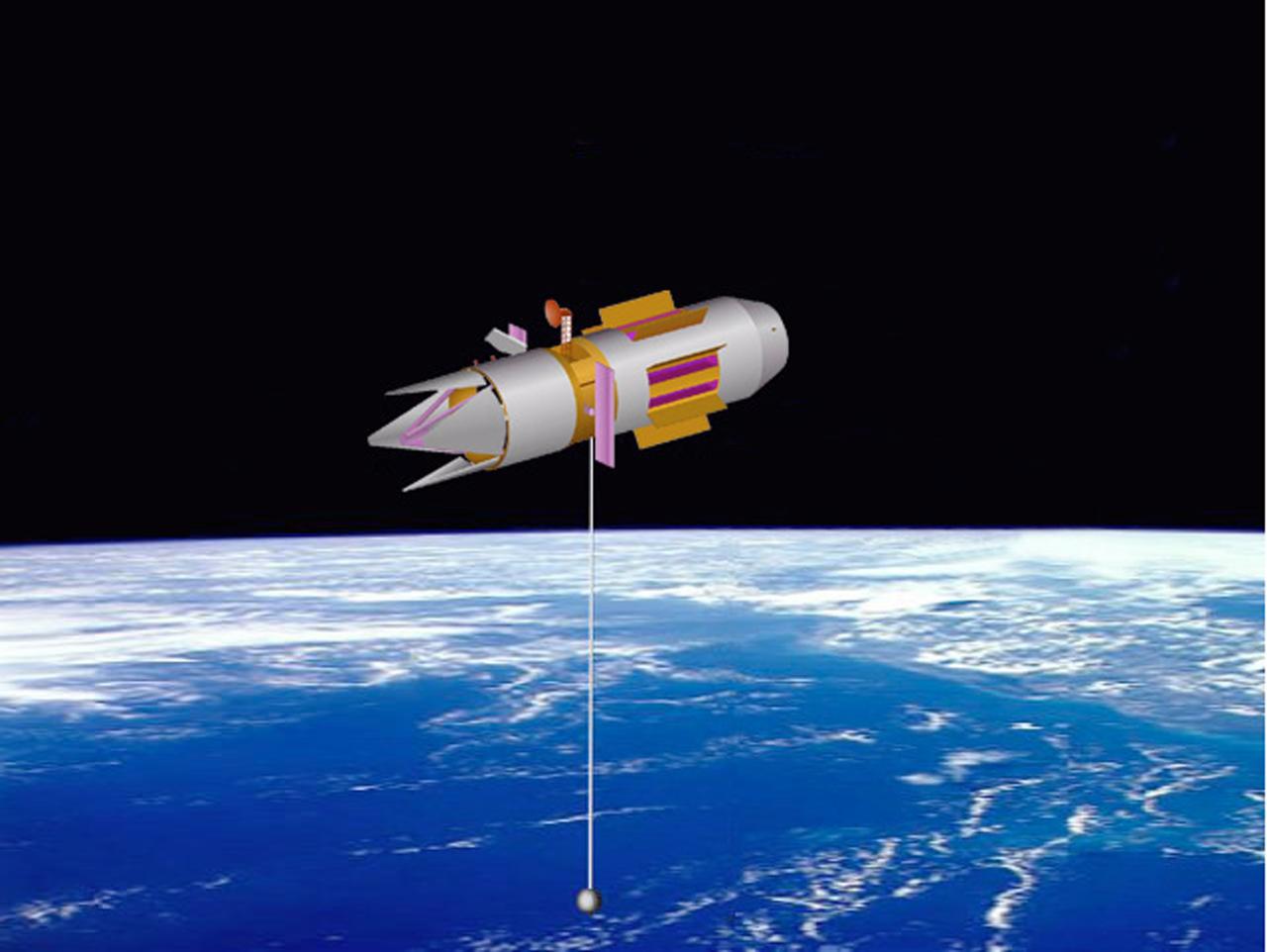
An artist's concept of a space based vehicle using the Propulsive Small Expendable Deployer System (ProSEDS) to generate its thrust to maintain orbit without using a propellant. ProSEDS will obtain thrust as the current flowing through the tether experiences a drag force due to interaction with the Earth's magnetic field. Drag force is coupled mechanically to the stage via the tether, thus lowering the stage's orbital altitude.
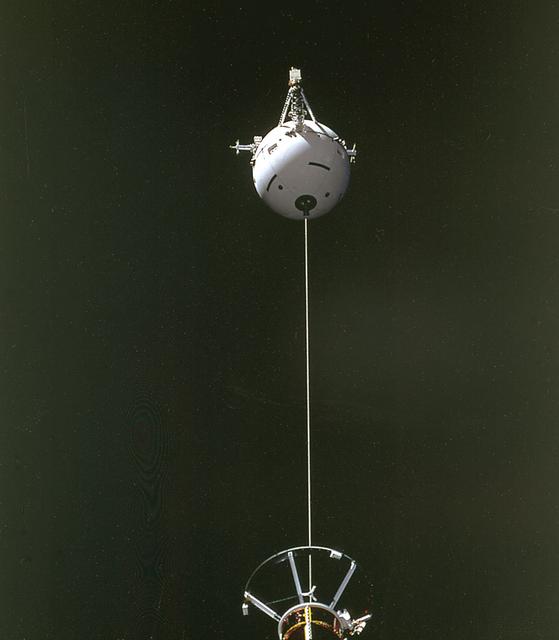
This is a Space Shuttle Orbiter Atlantis (STS-46) onboard photo of the Tethered Satellite System (TSS-1) deployment. A cooperative development effort by the Italian Space Agency (ASI) and NASA, the Tethered Satellite System (TSS) made capable the deployment and retrieval of a satellite which is attached by a wire tether from distances up to 100 km from the Orbiter. These free-flying satellites are used as observation platforms outside of the Orbiter.
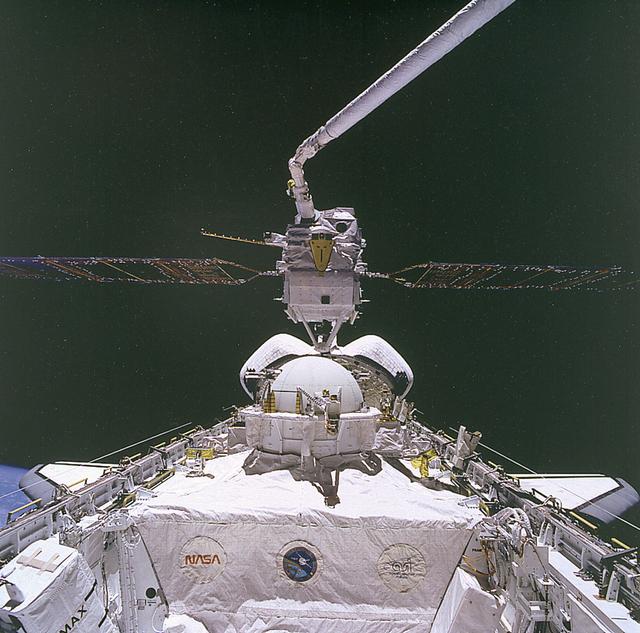
Space Shuttle Atlantis (STS-46) onboard photo of the Tethered Satellite System (TSS-1) on deployer boom. The Tethered Satellite System (TSS) was a cooperative development effort by the Italian Space Agency (ASI) and NASA made capable of deploying and retrieving a satellite which is attached by a wire tether from distances up to 100 km from the Orbiter. These free-flying satellites are used as observation platforms outside of the Orbiter.
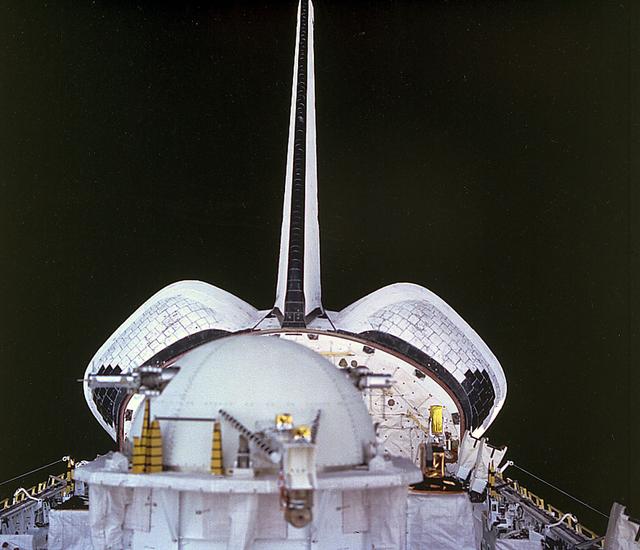
Space Shuttle Atlantis (STS-46) onboard photo of the Tethered Satellite System (TSS-1) in Orbiter's cargo bay. The Tethered Satellite System (TSS) was a cooperative development effort by the Italian Space Agency (ASI) and NASA made capable of deploying and retrieving a satellite which is attached by a wire tether from distances up to 100 km from the Orbiter. These free-flying satellites are used as observation platforms outside of the Orbiter.
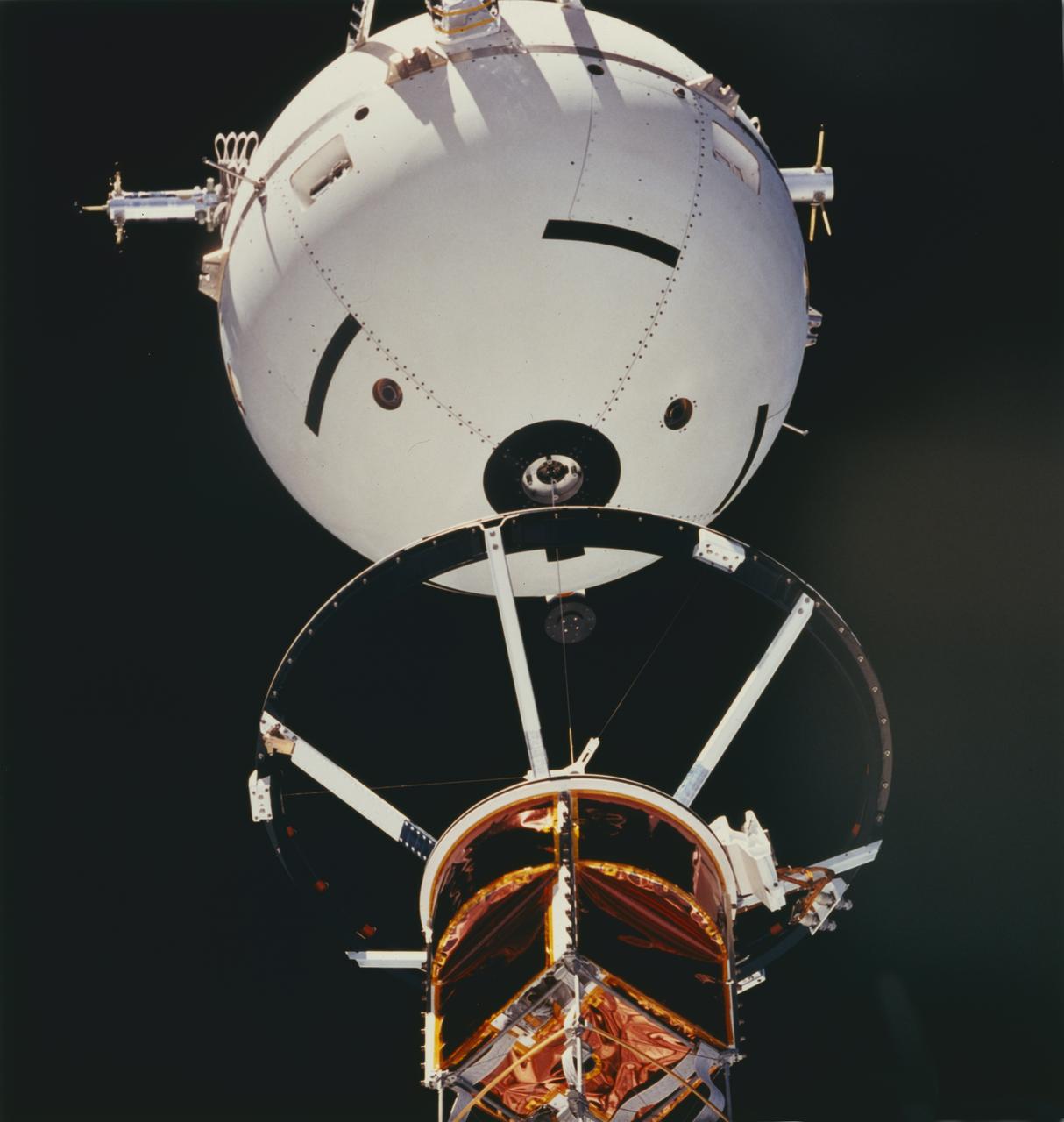
A crewmember aboard the Space Shuttle Orbiter Atlantis (STS-46) used a 70mm handheld camera to capture this medium closeup view of early operations with the Tethered Satellite System (TSS). TSS-1 is being deployed from its boom as it is perched above the cargo bay of the Earth-orbiting Shuttle circling the Earth at an altitude of 296 kilometers (184 miles), the TSS-1 will be well within the tenuous, electrically charged layer of the atmosphere known as the ionosphere. There, a satellite attached to the orbiter by a thin conducting cord, or tether, will be reeled from the Shuttle payload bay. On this mission the satellite was plarned to be deployed 20 kilometers (12.5 miles) above the Shuttle. The conducting tether will generate high voltage and electrical currents as it moves through the atmosphere allowing scientists to examine the electrodynamics of a conducting tether system. These studies will not only increase our understanding of physical processes in the near-Earth space environment, but will also help provide an explanation for events witnessed elsewhere in the solar system. The crew of the STS-46 mission were unable to reel the satellite as planned. After several unsuccessful attempts, they were only able to extend the satellite 9.8 kilometers (6.1 miles). The TSS was a cooperative development effort by the Italian Space Agency (ASI), and NASA.
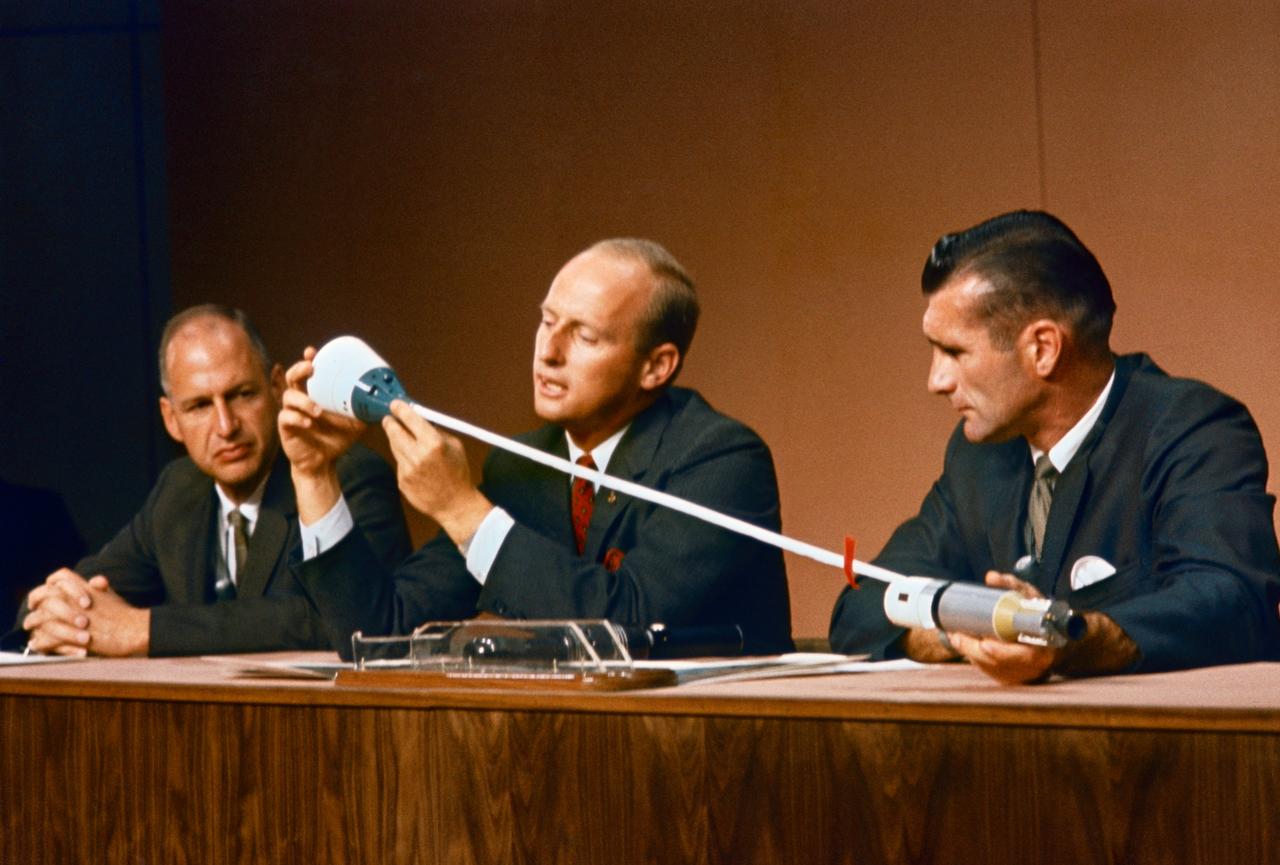
S66-45635 (26 Sept. 1966) --- Astronaut Charles Conrad Jr. (center), Gemini-11 prime crew command pilot, discusses the Gemini-11/Agena tether before a gathering of news media representatives in the MSC Building 1 auditorium. Holding an Agena model at right is astronaut Richard F. Gordon Jr., Gemini-11 pilot. Looking on at left is George M. Low, MSC Deputy Director. Photo credit: NASA
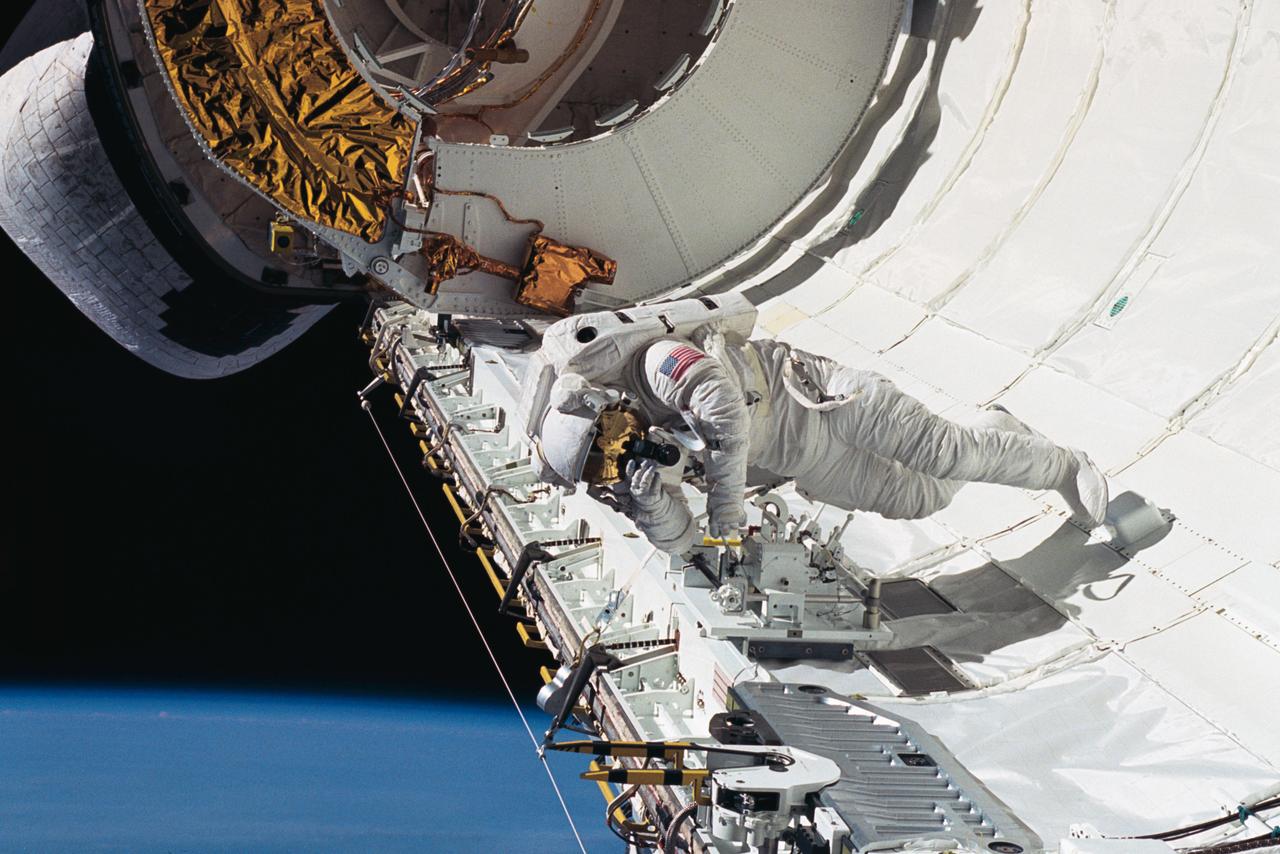
Astronaut James H. Newman, mission specialist, uses a 35mm camera to take a picture of fellow astronaut Carl E. Walz (out of frame) in Discovery's cargo bay. The two were engaged in an extravehicular activity (EVA) to test equipment to be used on future EVA's. Newman is tethered to the starboard side, with the orbital maneuvering system (OMS) pod just behind him.
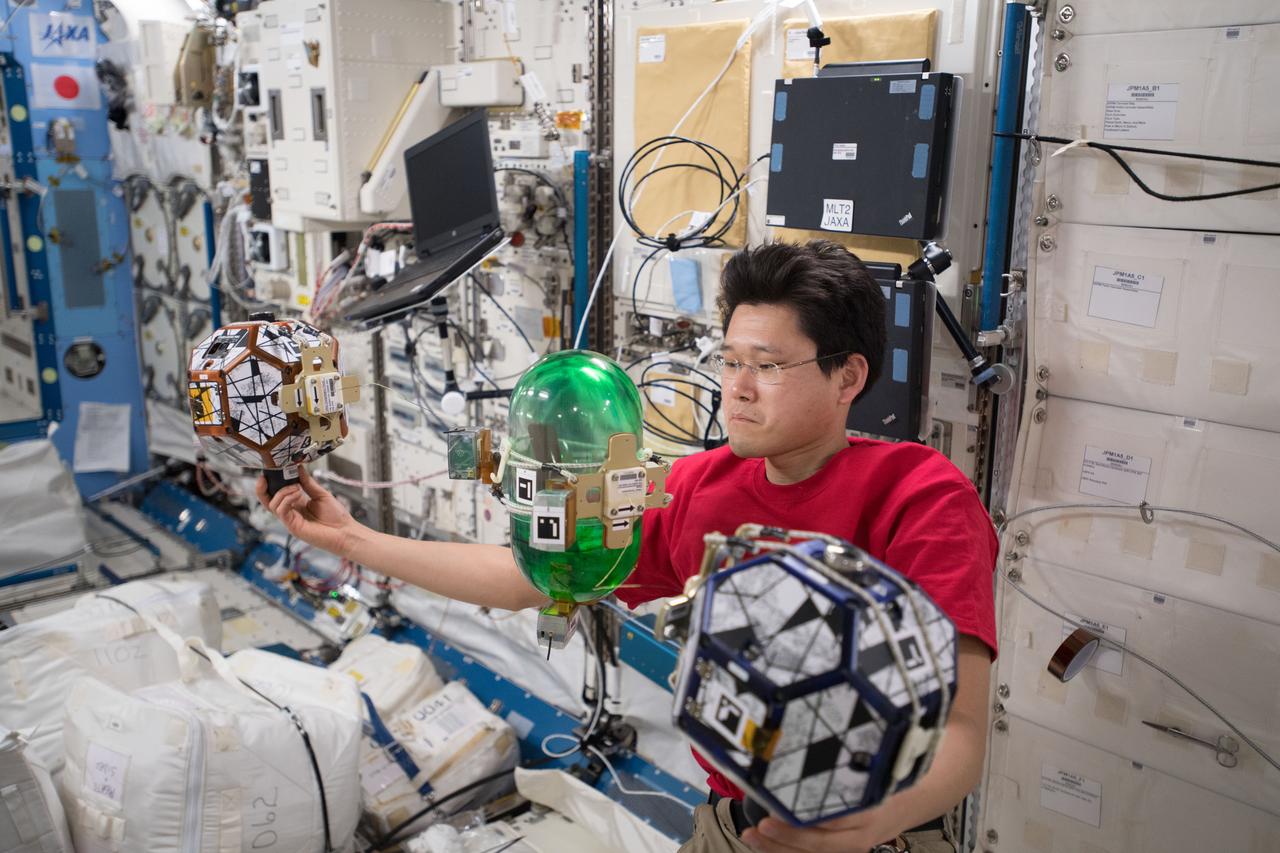
iss054e022175 (1/17/2018) --- Japan Aerospace Exploration Agency (JAXA) astronaut Norishige Kanai is photographed during a Synchronized Position Hold, Engage, Reorient, Experimental Satellites (SPHERES) Tether Slosh experiment test session run. Photo was taken in the Kibo Japanese Experiment Pressurized Module (JPM) aboard the International Space Station (ISS). SPHERES Tether Slosh combines fluid dynamics equipment with robotic capabilities aboard the ISS to investigate automated strategies for steering passive cargo that contain fluids. In space, the fluid fuels used by spacecraft can slosh around in unpredictable ways making space maneuvers difficult. SPHERES Tether Slosh uses two Synchronized Position Hold, Engage, Reorient, Experimental Satellites (SPHERES) robots tethered to a fluid-filled container covered in sensors to test strategies for safely steering spacecraft such as dead satellites that might still have fuel in the tank.
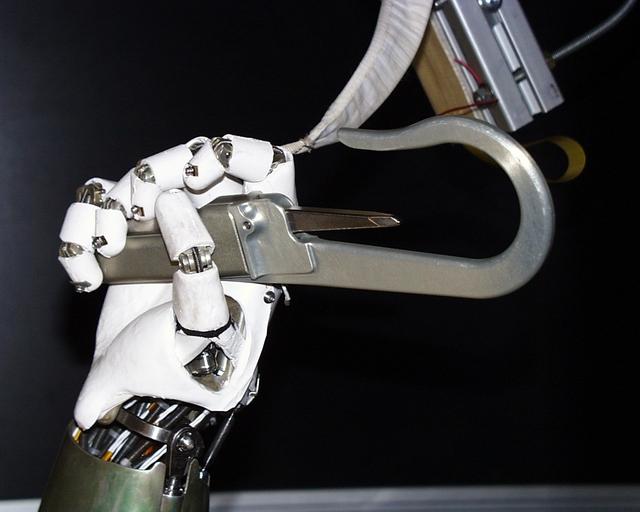
JSC2004-E-03468 (March 2004) --- This closeup view, photographed during a series of evaluations, shows the hand of a Robonaut grasping a tether hook. Joint travel for the wrist pitch and yaw is designed to meet or exceed that of the human hand in a pressurized glove and the hand and wrist parts are sized to reproduce the necessary strength to meet maximum crew requirements for extravehicular activity. Future robots like the Robonaut prototype may some day help astronauts perform important spacewalk tasks.
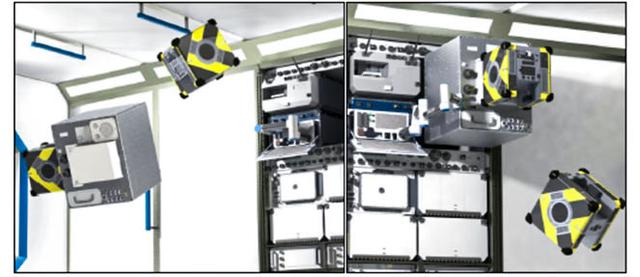
jsc2021e058908 (11/17/2021) --- A graphic of an Astrobee taking an EXPRESS Rack double locker payload, determining its mass and adjusting its Guidance and Navigation Control (GNC) to perform an installation maneuver with the help of another Astrobee and a robotic arm. Astrobee Mass Property Learner and Collaboration Algorithms (Astroporter) demonstrates software for estimating the mass properties of payloads attached to Astrobee and algorithms for making adjustments as needed. Image courtesy of Tethers Unlimited.
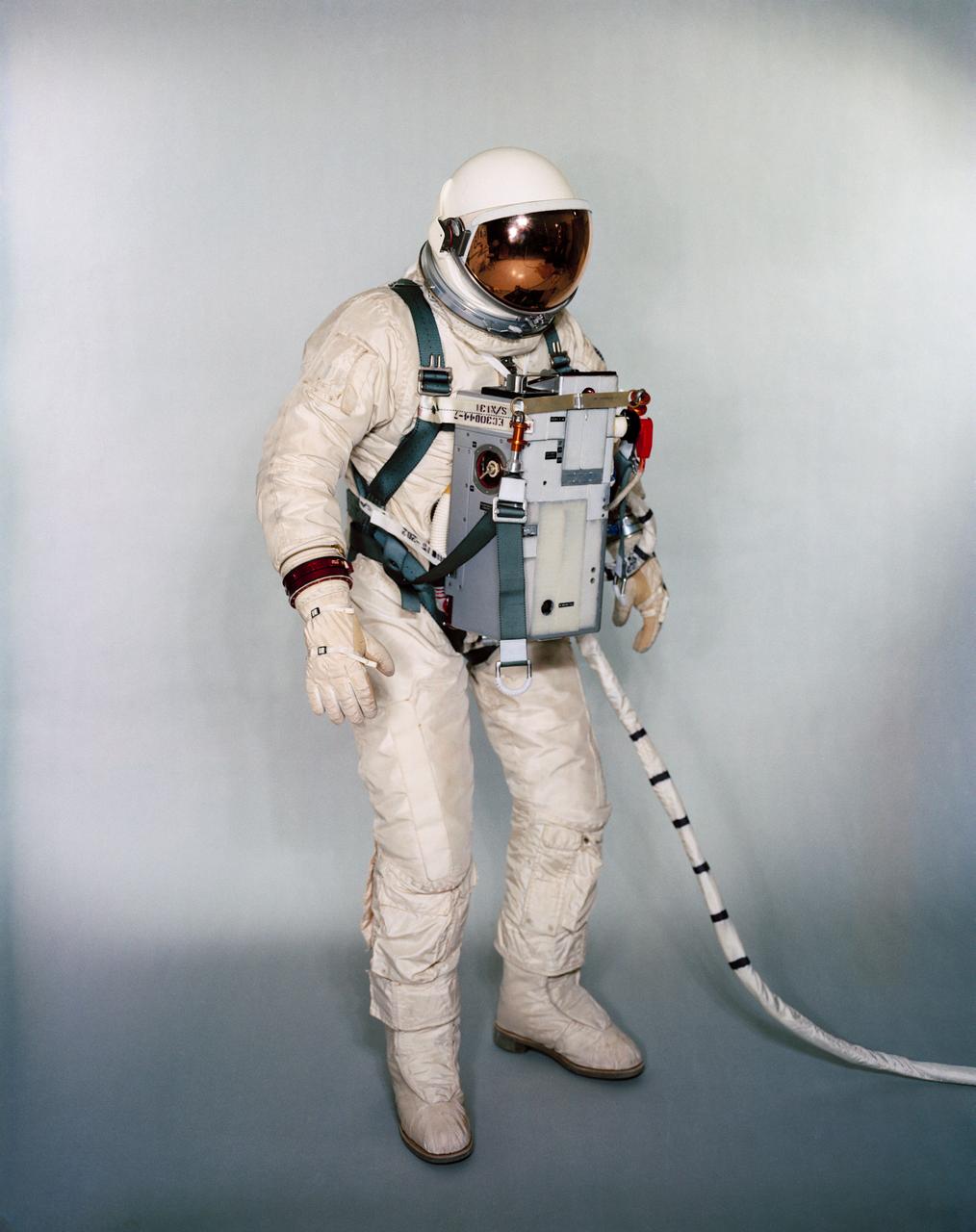
S67-24267 (1966) --- Suited test subject equipped with Gemini-12 Life Support System and waist tethers for extravehicular activity (EVA). Photo credit: NASA
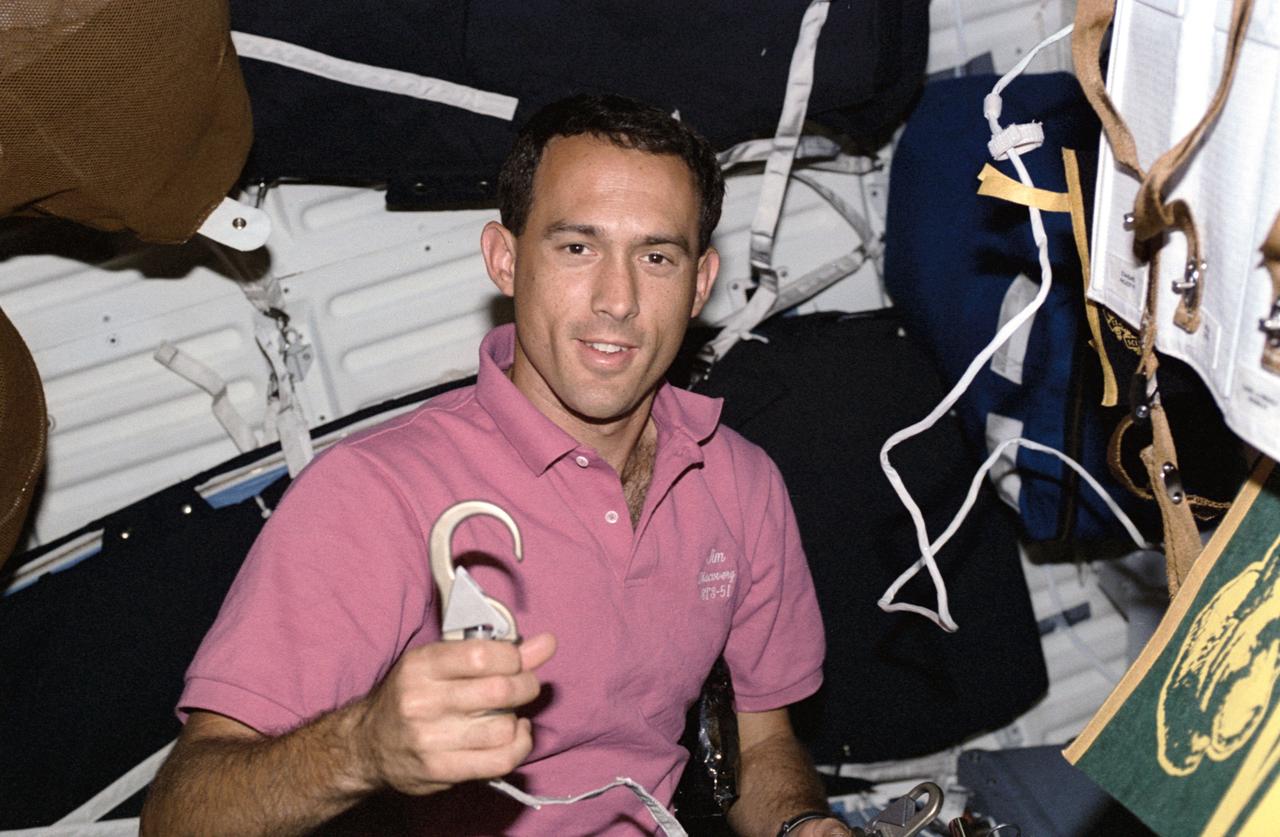
STS051-26-002 (12-22 Sept 1993) --- Astronaut James H. Newman, mission specialist, shows off a latch hook for a tether device used during the STS-51 extravehicular activity (EVA) on September 16, 1993. Newman, on Discovery's middeck, appears surrounded by sleep restraints.
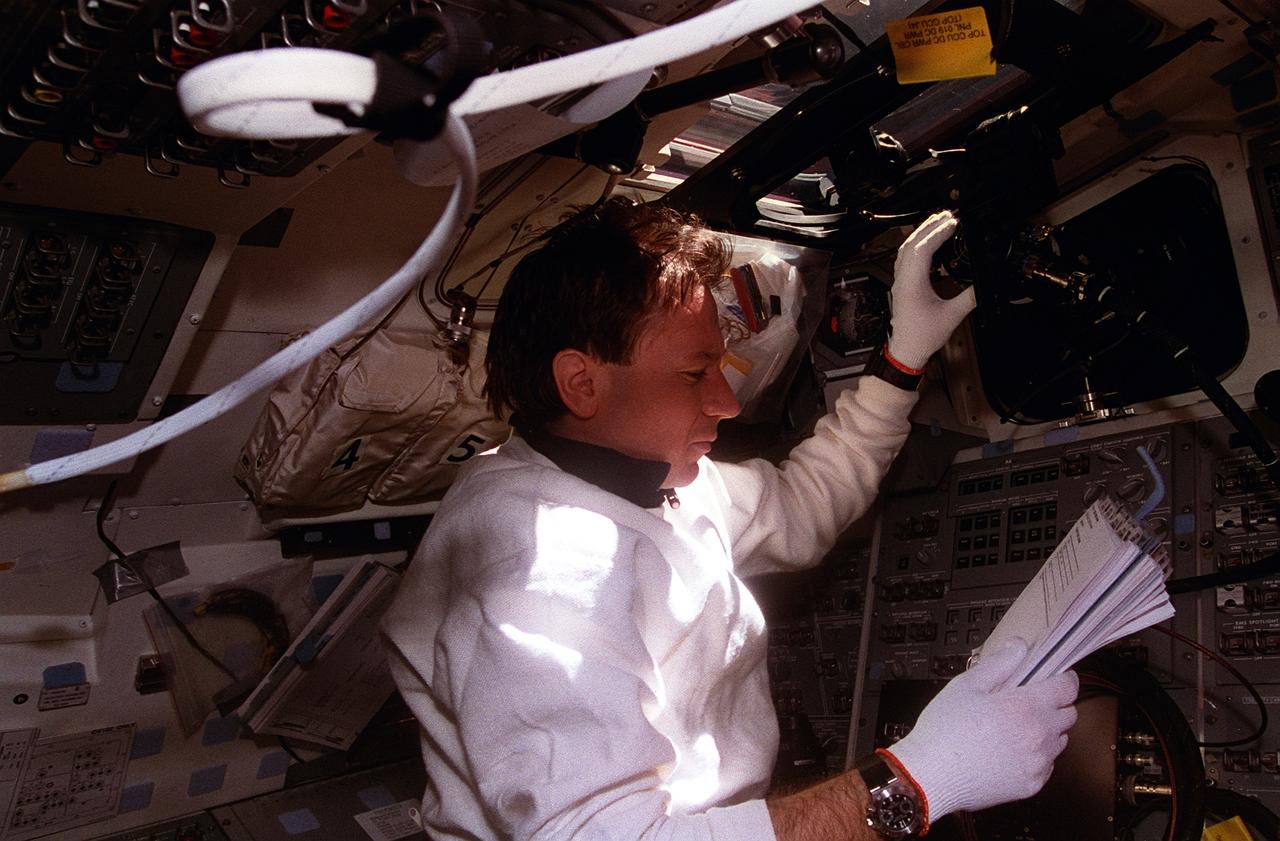
STS075-310-002 (22 Feb.-9 March 1996) --- Astronaut Maurizio Cheli, STS-75 mission specialist, works with the Tether Optical Phenomenon System (TOPS) on the flight deck of the Earth-orbiting Space Shuttle Columbia. Cheli, representing the European Space Agency (ESA), joined four other astronauts and an international payload specialists for 16 days of scientific research in Earth-orbit.
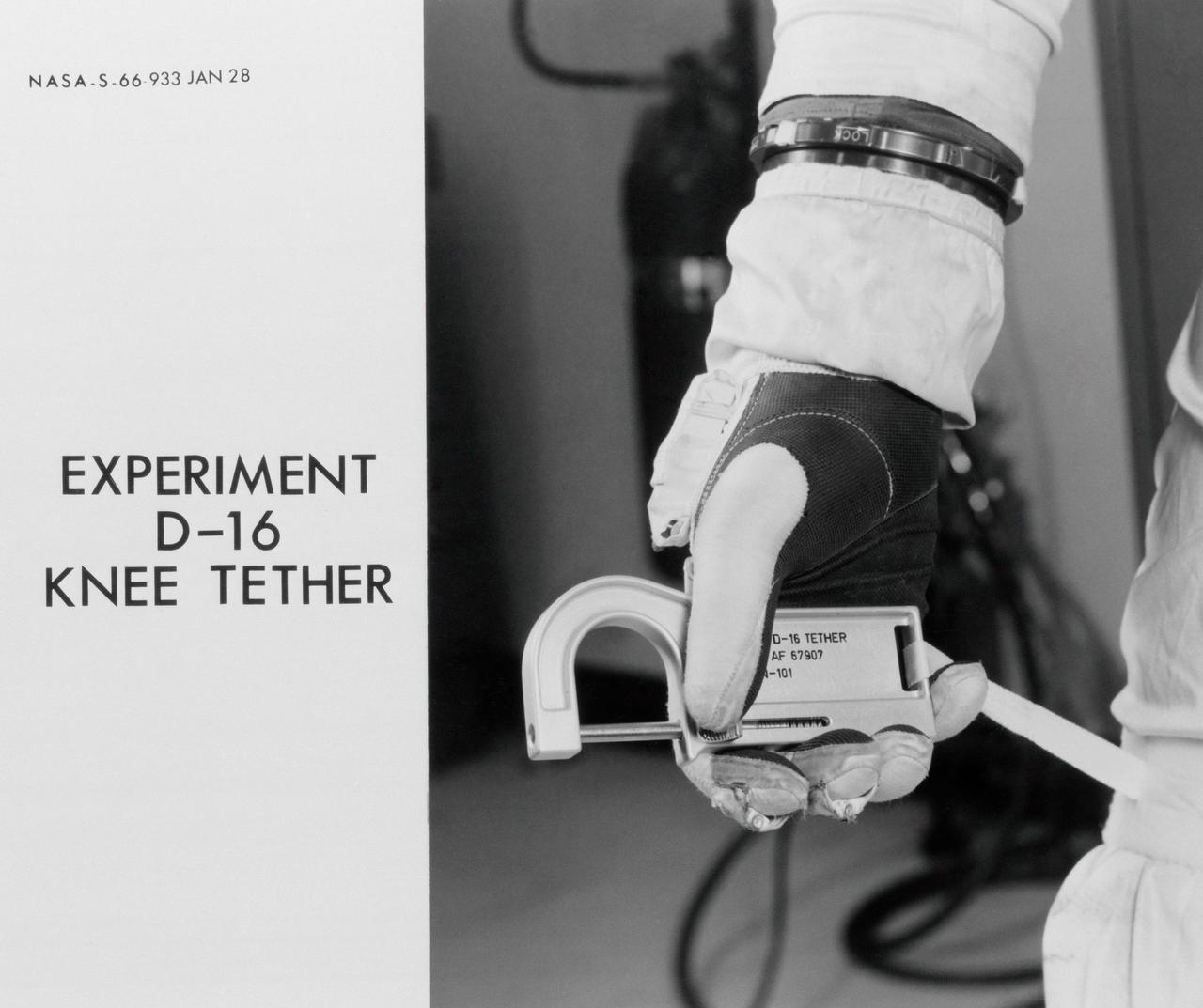
S66-00933 (28 Jan. 1966) --- Gemini-11 Experiment D-16 Knee Tether, sponsored by the Department of Defense and the United States Air Force. The astronaut tightens and loosens bolts in a prescribed pattern during his extravehicular activity, once with his body held to the spacecraft by a nine-inch tether looped around his knee and through the handrail, and once without the tether. Photo credit: NASA
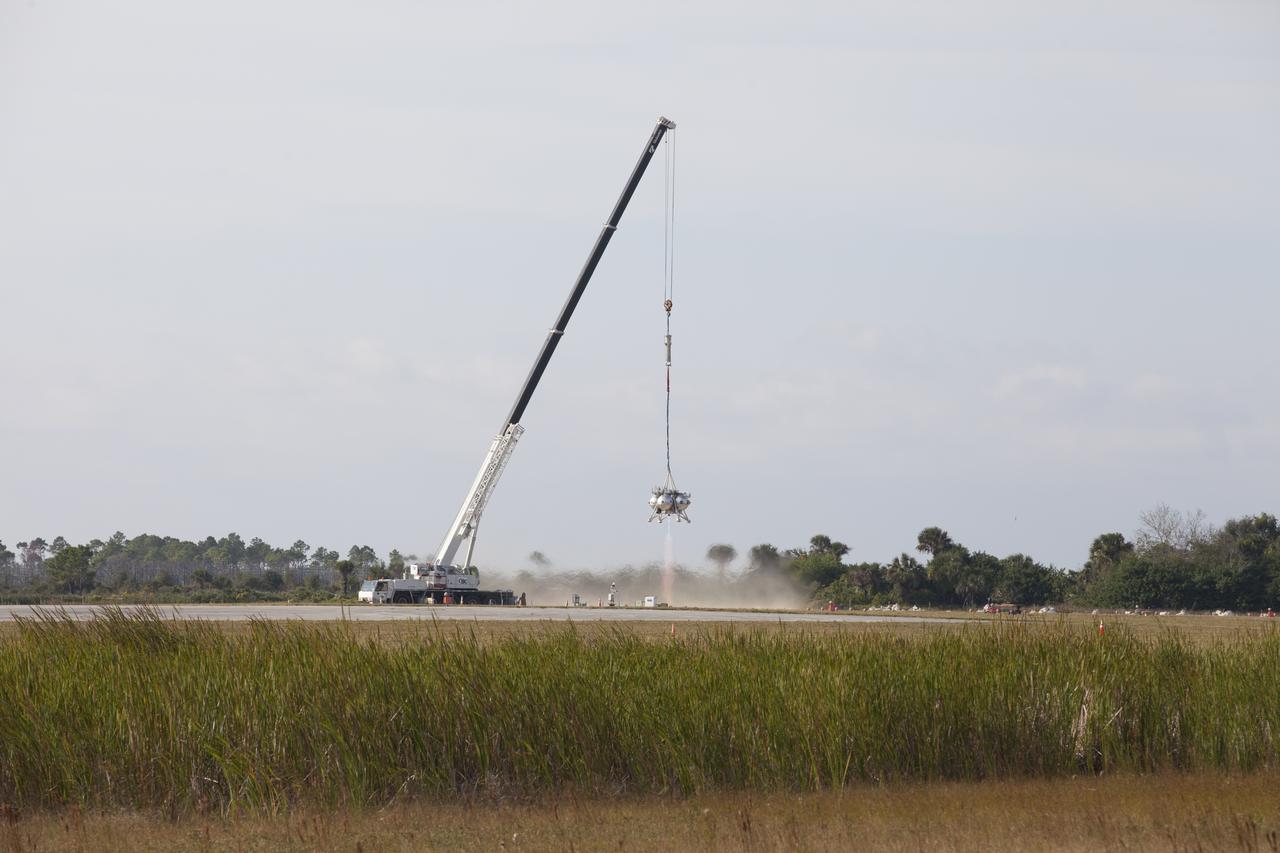
NASA's Project Morpheus prototype lander's engine fires briefly in a tethered-flight test at the north end of the Shuttle Landing Facility at NASA’s Kennedy Space Center in Florida. However, the test was stopped following detection of an anomaly immediately after engine ignition. The tether test was cut short due to Morpheus exceeding onboard abort rate limits. The vehicle was taken back to the hangar and data from the test is being studied. After review, managers will determine when a new test date will be set. The landing facility provides the lander with the kind of field necessary for realistic testing, complete with rocks, craters and hazards to avoid. Morpheus’ ALHAT payload allows it to navigate to clear landing sites amidst rocks, craters and other hazards during its descent.
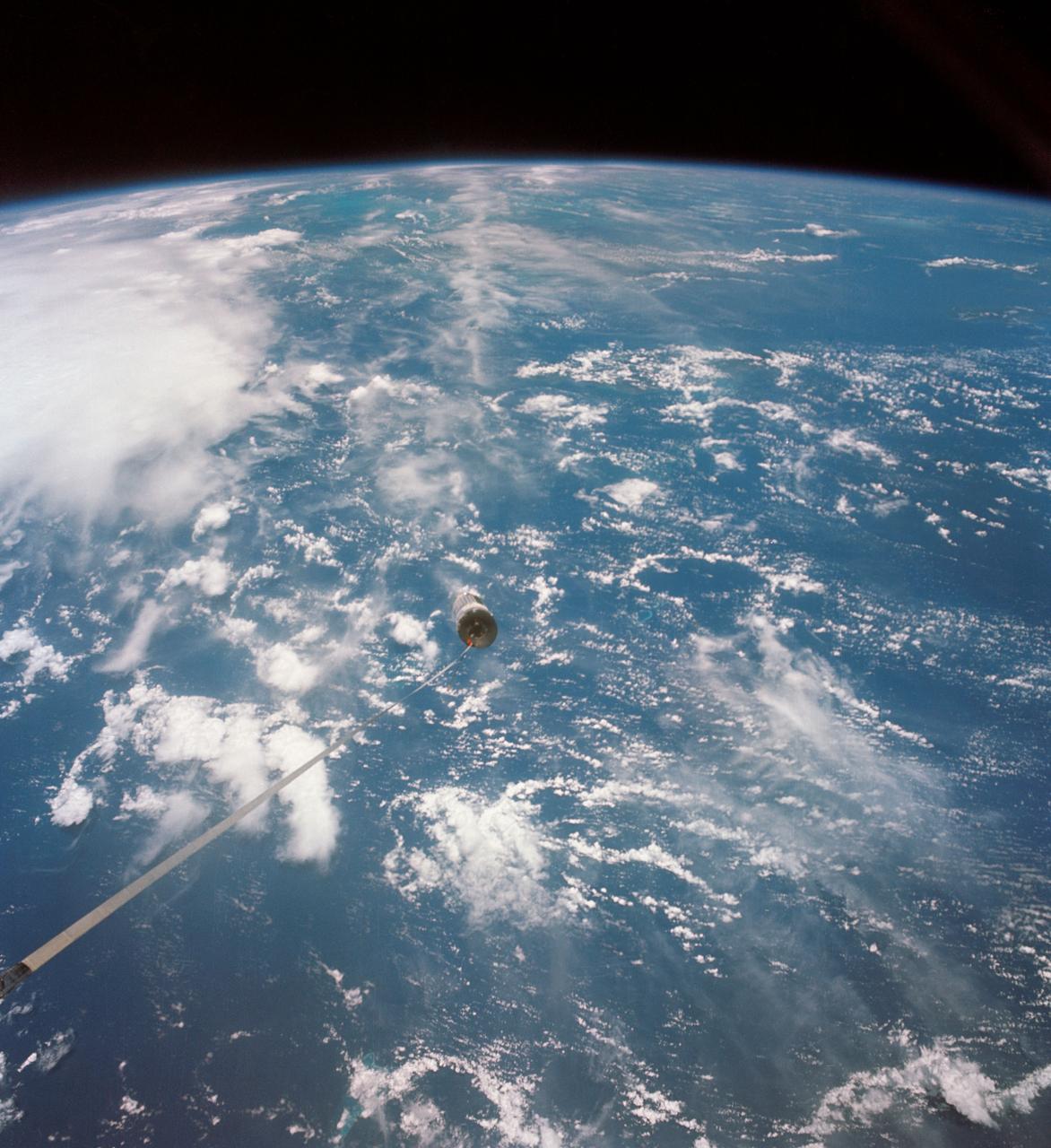
S66-54571 (14 Sept. 1966) --- A 100-foot tether line connects the Agena Target Docking Vehicle with the Gemini-11 spacecraft during its 32nd revolution of Earth. Photo credit: NASA
SAN DIEGO, Calif. – The Orion forward bay cover is lowered into the water using a crane and tether lines as part of the Orion underway recovery test. The Orion boilerplate test vehicle and other hardware are secured in the well deck of the USS San Diego in preparation for the test about 100 miles off the coast of San Diego, California. NASA and the U.S. Navy conducted tests to prepare for the recovery of the Orion crew module, forward bay cover and parachutes on its return from a deep space mission. The underway recovery test will allow the teams to demonstrate and evaluate the recovery processes, procedures, hardware and personnel in open waters. During the testing, the tether lines were unable to support the tension caused by crew module motion that was driven by wave turbulence in the well deck of the ship. NASA and the U.S. Navy are reviewing the testing data collected to evaluate the next steps. The Ground Systems Development and Operations Program conducted the underway recovery tests. Orion is the exploration spacecraft designed to carry astronauts to destinations not yet explored by humans, including an asteroid and Mars. It will have emergency abort capability, sustain the crew during space travel and provide safe re-entry from deep space return velocities. The first unpiloted test flight of the Orion is scheduled to launch in 2014 atop a Delta IV rocket and in 2017 on NASA’s Space Launch System rocket. For more information, visit http://www.nasa.gov/orion. Photo credit: NASA/Cory Huston

ISS022-E-019986 (6 Jan. 2010) --- Russian cosmonaut Oleg Kotov, Expedition 22 flight engineer, holds a stowage box containing extravehicular activity (EVA) retractable equipment tethers in the Zvezda Service Module of the International Space Station.
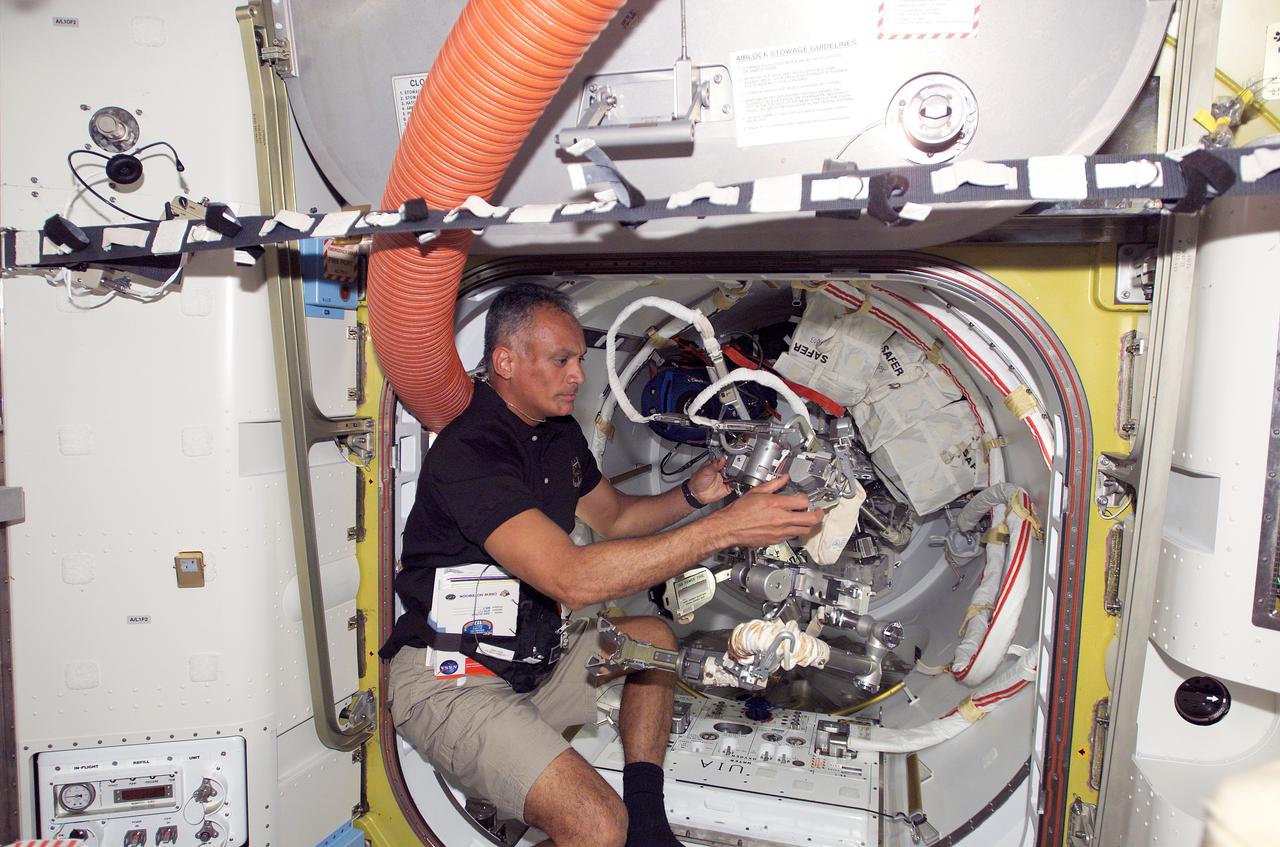
S117-E-07101 (12 June 2007) --- Astronaut John "Danny" Olivas, STS-117 mission specialist, works with extravehicular activity (EVA) tether lines in the Quest Airlock of the International Space Station while Space Shuttle Atlantis was docked with the station.
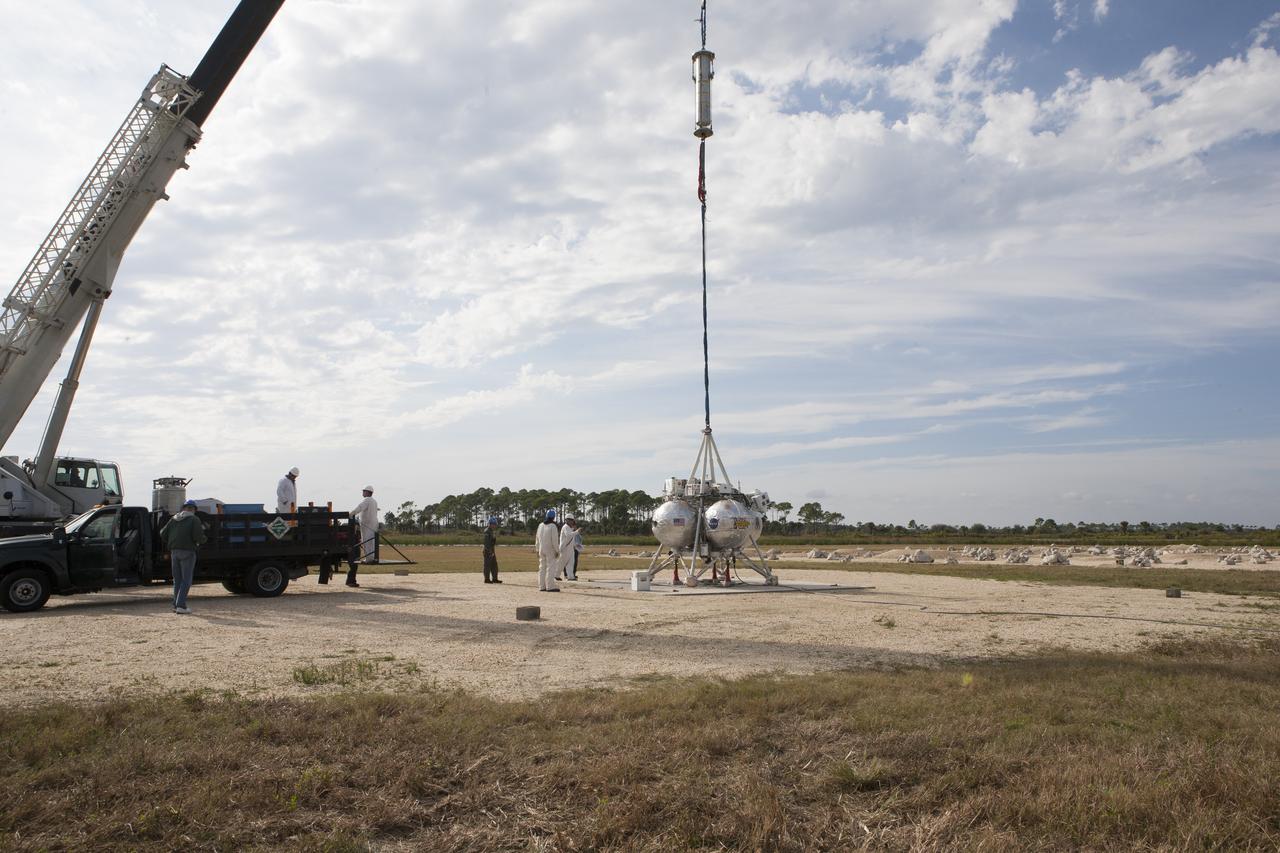
NASA's Project Morpheus prototype lander is prepared for lifting by a crane in preparation for a tethered-flight test at the north end of the Shuttle Landing Facility at NASA’s Kennedy Space Center in Florida. For the 40-second test, the lander will be hoisted 20 feet. The spacecraft will ascend an additional five feet and hover for five seconds. Morpheus then will perform a 5.6-foot ascent coupled with a 9.8-foot traverse, and hover for five more seconds before returning to the launch point. A number of changes have been made, primarily focused on autonomous landing and hazard avoidance technology ALHAT and moving the Doppler Lidar to the front of the forward liquid oxygen tank. The tether test was cut short due to Morpheus exceeding onboard abort rate limits. The vehicle was taken back to the hangar and data from the test is being studied. After review, managers will determine when a new test date will be set. The landing facility provides the lander with the kind of field necessary for realistic testing, complete with rocks, craters and hazards to avoid. Morpheus’ ALHAT payload allows it to navigate to clear landing sites amidst rocks, craters and other hazards during its descent.
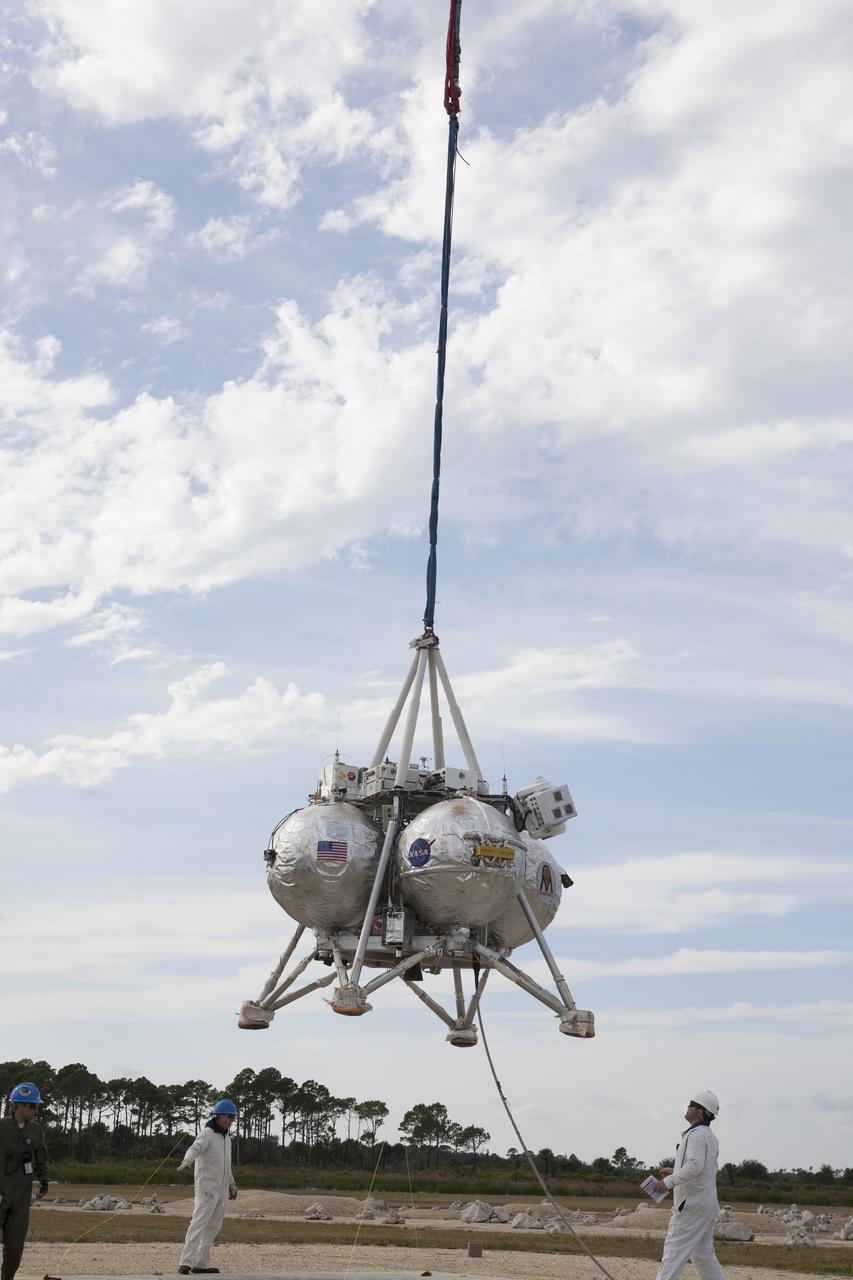
NASA's Project Morpheus prototype lander is lifted by a crane in preparation for a tethered-flight test at the north end of the Shuttle Landing Facility at NASA’s Kennedy Space Center in Florida. For the 40-second test, the lander will be hoisted 20 feet. The spacecraft will ascend an additional five feet and hover for five seconds. Morpheus then will perform a 5.6-foot ascent coupled with a 9.8-foot traverse, and hover for five more seconds before returning to the launch point. A number of changes have been made, primarily focused on autonomous landing and hazard avoidance technology ALHAT and moving the Doppler Lidar to the front of the forward liquid oxygen tank. The tether test was cut short due to Morpheus exceeding onboard abort rate limits. The vehicle was taken back to the hangar and data from the test is being studied. After review, managers will determine when a new test date will be set. The landing facility provides the lander with the kind of field necessary for realistic testing, complete with rocks, craters and hazards to avoid. Morpheus’ ALHAT payload allows it to navigate to clear landing sites amidst rocks, craters and other hazards during its descent.
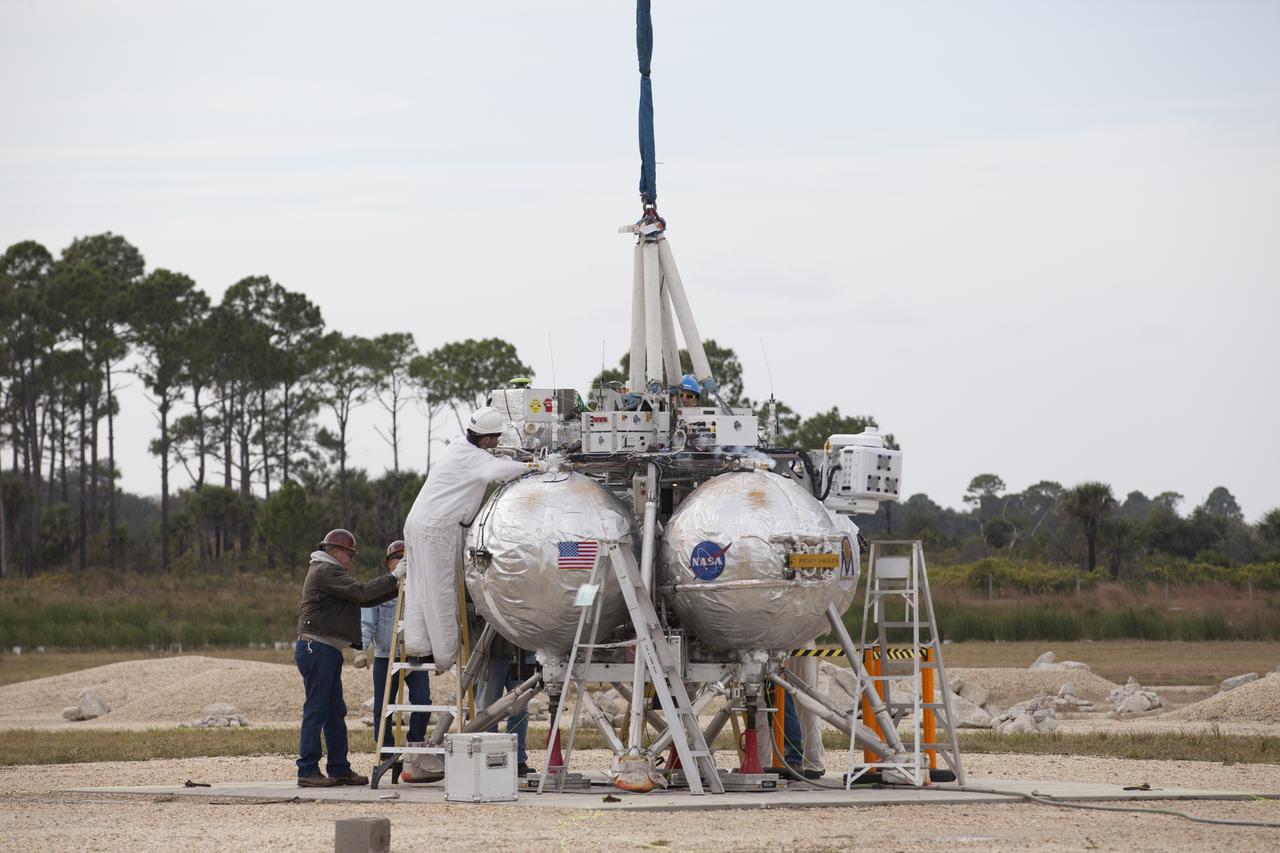
NASA's Project Morpheus prototype lander undergoes final preparations for a tethered-flight test at the north end of the Shuttle Landing Facility at NASA’s Kennedy Space Center in Florida. For the 40-second test, the lander will be hoisted 20 feet. The spacecraft will ascend an additional five feet and hover for five seconds. Morpheus then will perform a 5.6-foot ascent coupled with a 9.8-foot traverse, and hover for five more seconds before returning to the launch point. A number of changes have been made, primarily focused on autonomous landing and hazard avoidance technology ALHAT and moving the Doppler Lidar to the front of the forward liquid oxygen tank. The tether test was cut short due to Morpheus exceeding onboard abort rate limits. The vehicle was taken back to the hangar and data from the test is being studied. After review, managers will determine when a new test date will be set. The landing facility provides the lander with the kind of field necessary for realistic testing, complete with rocks, craters and hazards to avoid. Morpheus’ ALHAT payload allows it to navigate to clear landing sites amidst rocks, craters and other hazards during its descent.
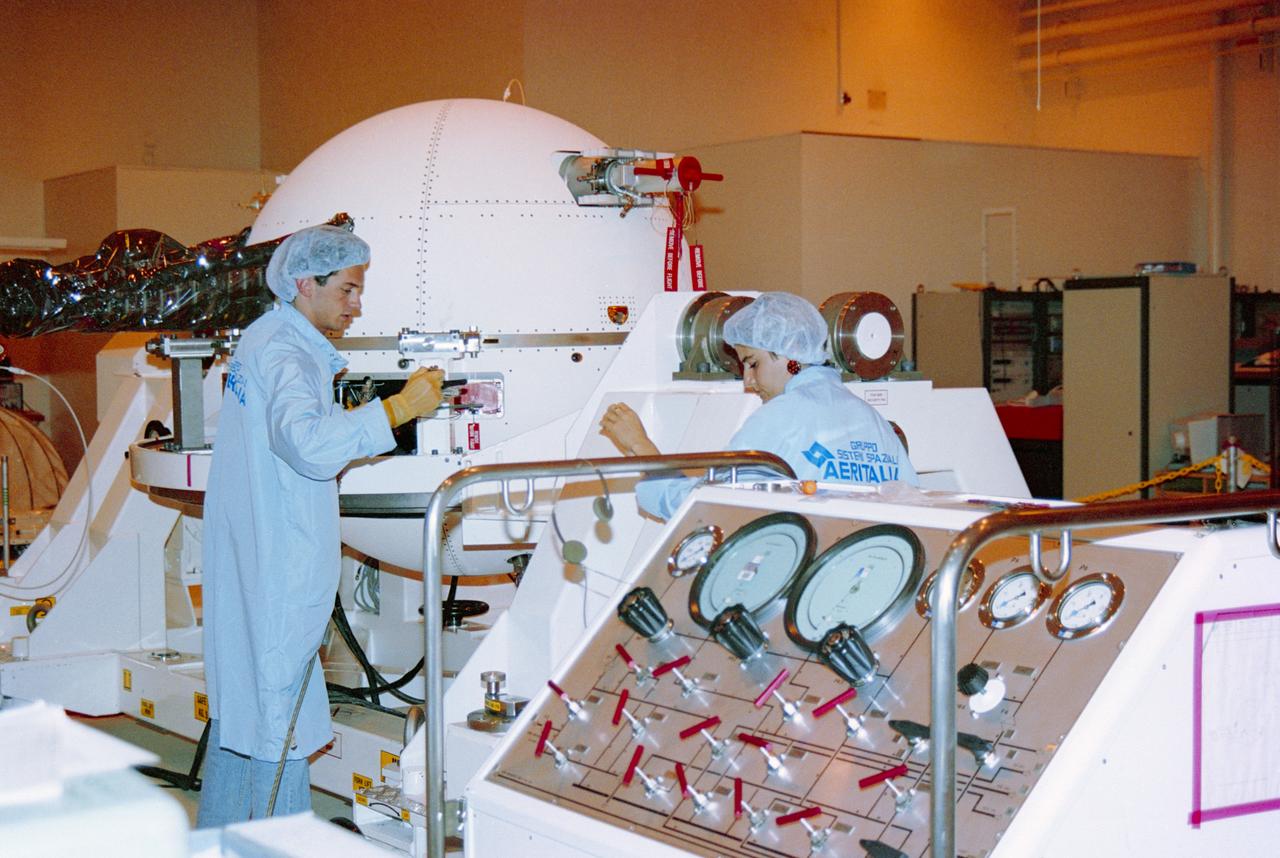
S92-41073 (31 oct 1991) --- In the Operations and Checkout Building high bay, preflight processing continues on the Tethered Satellite System (TSS) which is scheduled to fly on Space Shuttle Mission STS-46. Italian firm Aeritalia built the research satellite under contract to the Italian Space Agency (ASI). A joint endeavor between Italy and the United States, the TSS will release a satellite tethered to a reel in the orbiter cargo bay, and experiments will be conducted while the spacecraft is positioned some 12 miles above the orbiter.
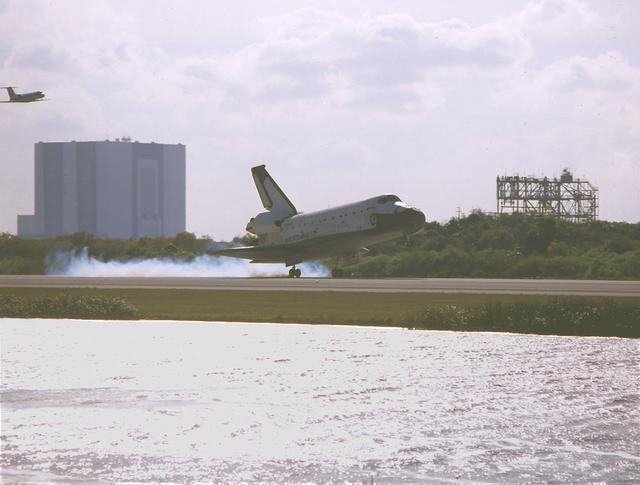
The Space Shuttle Orbiter Columbia's (STS-75) mission came to a close as the orbiter touched down on Runway 33 of Kennedy Space Center's Shuttle Landing Facility on March 9, 1996. Off to the right is the Vehicle Assembly Building and the Shuttle Training Aircraft (STA). The Mate/Demate Device (MDM) is at left. This Marshall Space Flight Center managed mission lasted 15 days and 17-hours, during which time the seven member crew conducted microgravity research with the U.S. Microgravity Payload (USMP-3), which flew for the third time. The other primary payload was the Tethered Satellite System (TSS-1R),a reflight from an earlier mission, but the satellite was lost when the tether broke just short of its fully deployed length of nearly 13 miles.
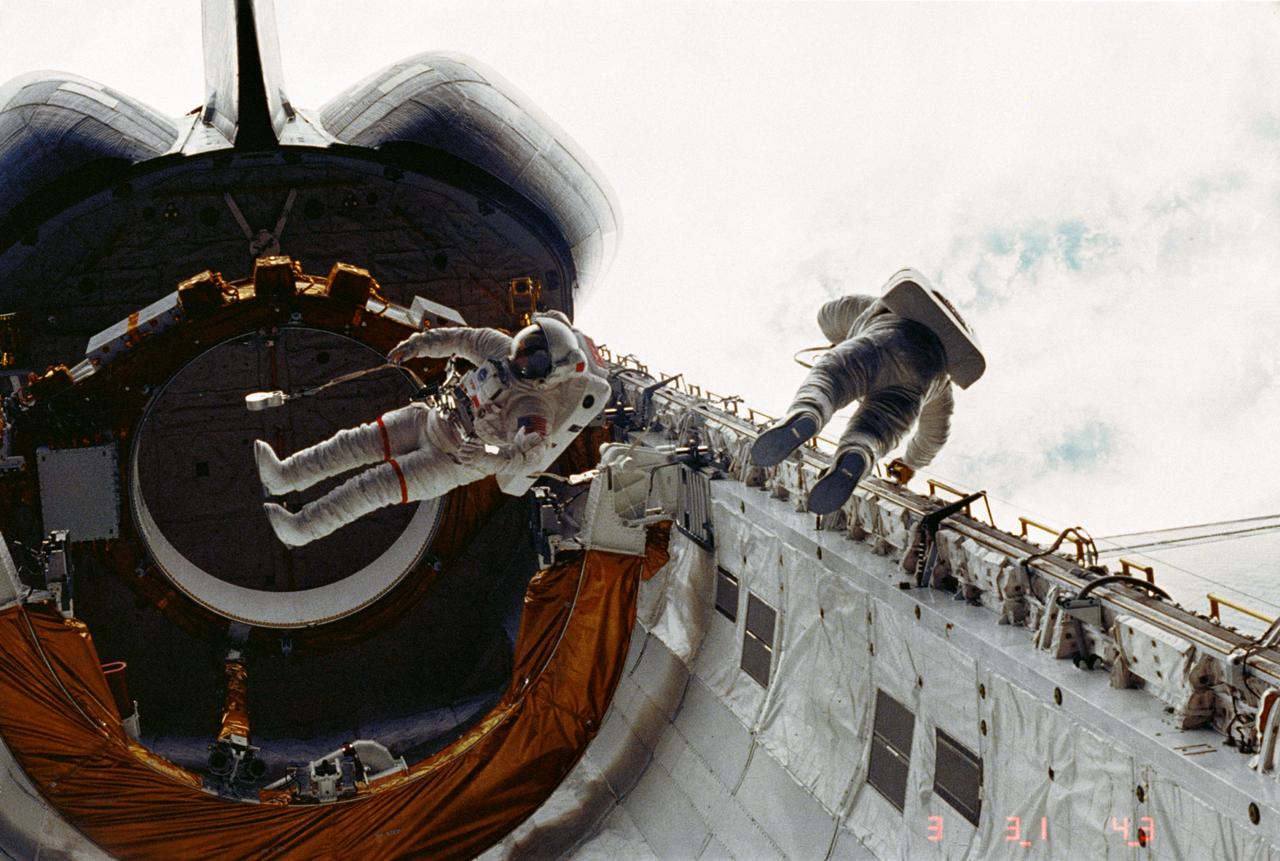
STS006-10-417 (7 April 1983) --- Astronauts F. Story Musgrave, left, and Donald H. Peterson float about in the cargo bay of the Earth-orbiting space shuttle Challenger during their April 7, 1983, extravehicular activity (EVA). Their "floating about" is restricted via tethers to safety slide wires. Thanks to the tether/slide wire combination, Peterson is able to translate along the port side hand rails. Musgrave is near the Airborne Support Equipment (ASE) for the now vacated Inertial Upper Stage (IUS). Clouds can be seen in the background. Photo credit: NASA
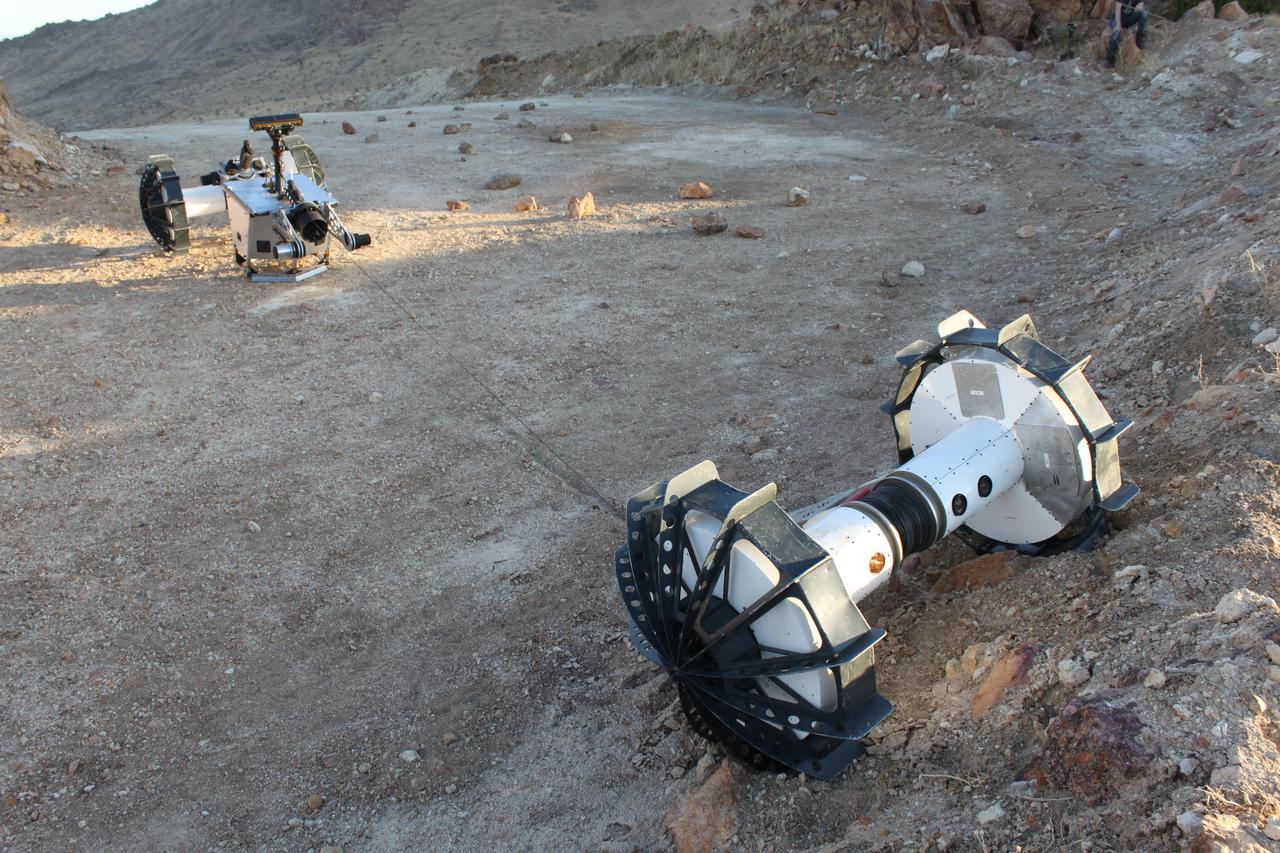
During a field test in the Mojave Desert, the DuAxel robot separates into two single-axled robots so that one can rappel down a slope too steep for conventional rovers. The tether connecting both Axels not only allows the one robot to descend the slope while the other remains anchored in place, it also provides power and a means of communication with the anchoring robot above. The DuAxel project is a technology demonstration being developed by roboticists at NASA's Jet Propulsion Laboratory in Southern California to see how this unconventional rover might fill a niche in the exploration the Moon, Mars, and beyond. https://photojournal.jpl.nasa.gov/catalog/PIA24109
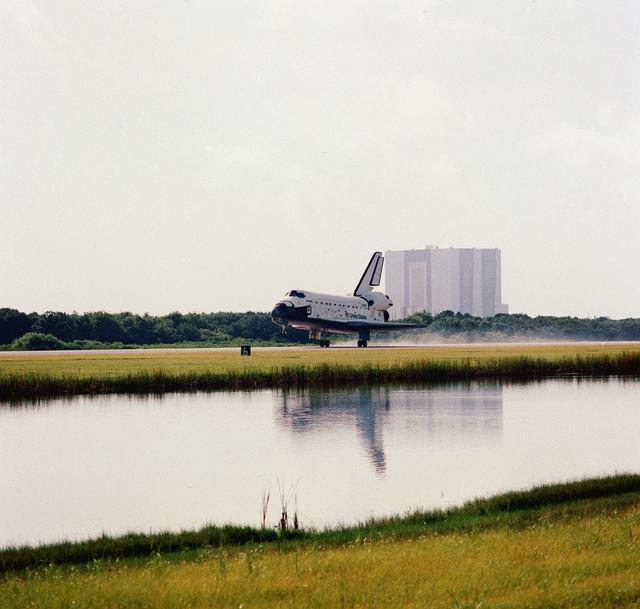
The Space Shuttle Orbiter Atlantis (STS-46) touched down at Kennedy Space Center's (KSC) Shuttle Landing Facility completing an eight day mission of five NASA astronauts and two Europeans. The vehicle assembly building (VAB) can be seen in the background. The STS-46 mission carried and deployed the European Retrievable Carrier (Eureca), and the NASA/ISA Tethered Satellite System (TSS-1), allowing for a new capability for probing the space environment.
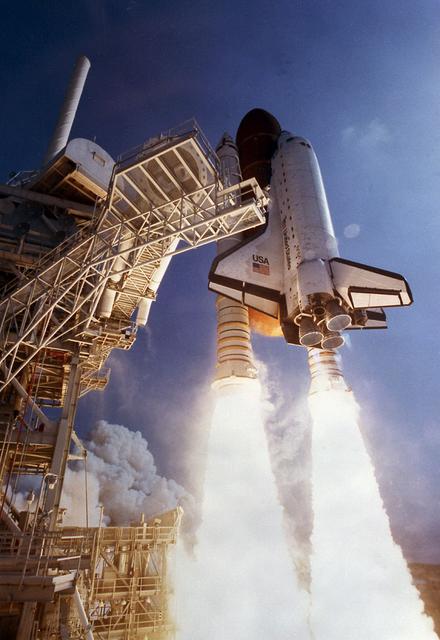
The Space Shuttle Orbiter Atlantis (STS-46) breaks free of all earthly constraints and hurdles past the Fixed Service Structure (FSS) and beanie cap which only moments before had been in place above the external tank. The Shuttle Atlantis carried and deployed the European Retrievable Carrier (Eureca). The NASA/ISA Tethered Satellite System (TSS-1) was also deployed for the first time, allowing for a new capability for probing the space environment.
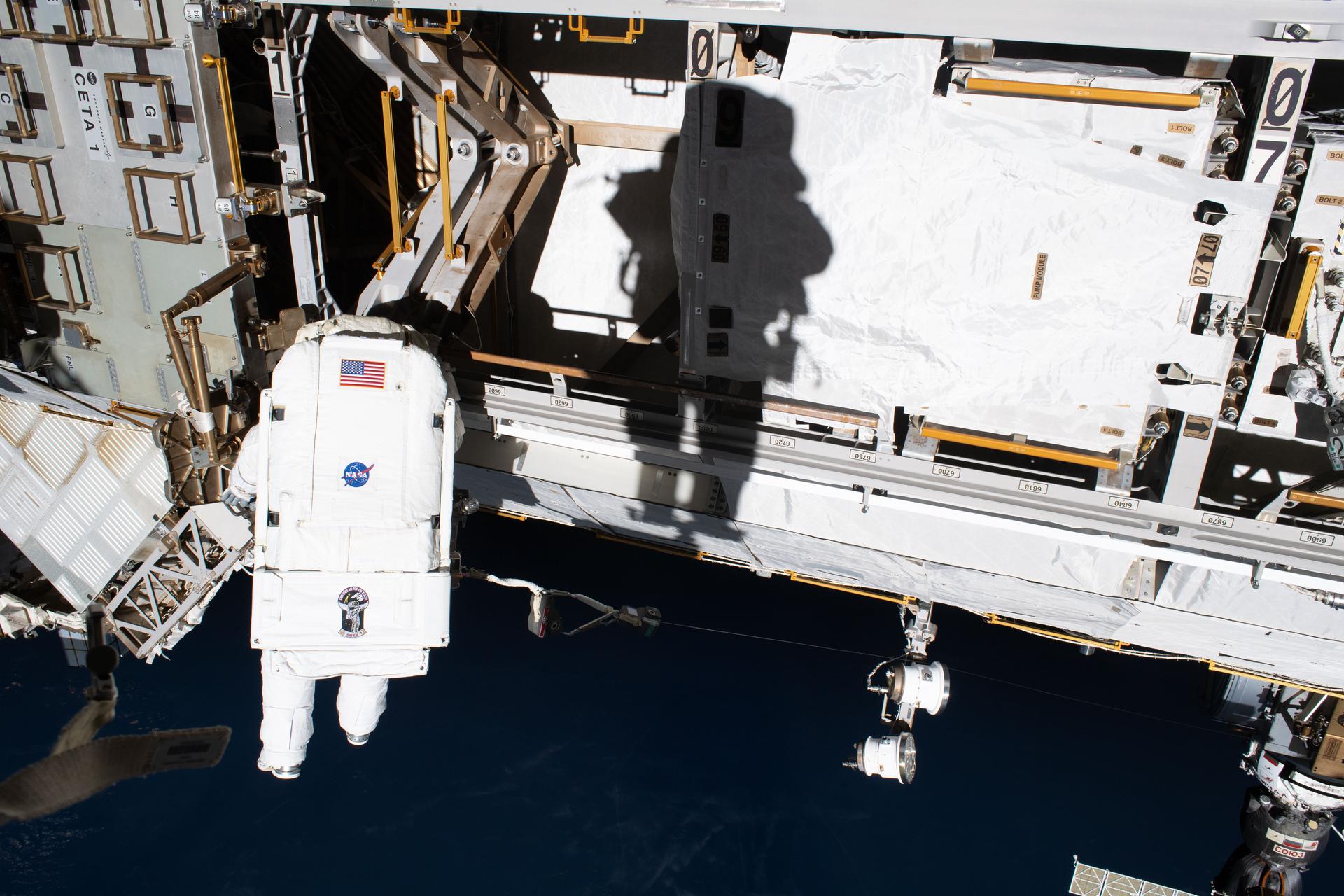
iss075e0068475 (Aug. 25, 2026) --- ESA (European Space Agency) astronaut and Expedition 75 flight engineer Sophie Adenot is pictured tethered to the International Space Station, while the shadow of NASA astronaut and Expedition 75 flight engineer Anil Menon is cast on a truss segment. Menon took this photograph with the sun at his back during a six-hour and 30-minute spacewalk to install a high-speed space-to-ground antenna on the orbital outpost. Credit: NASA/Anil Menon
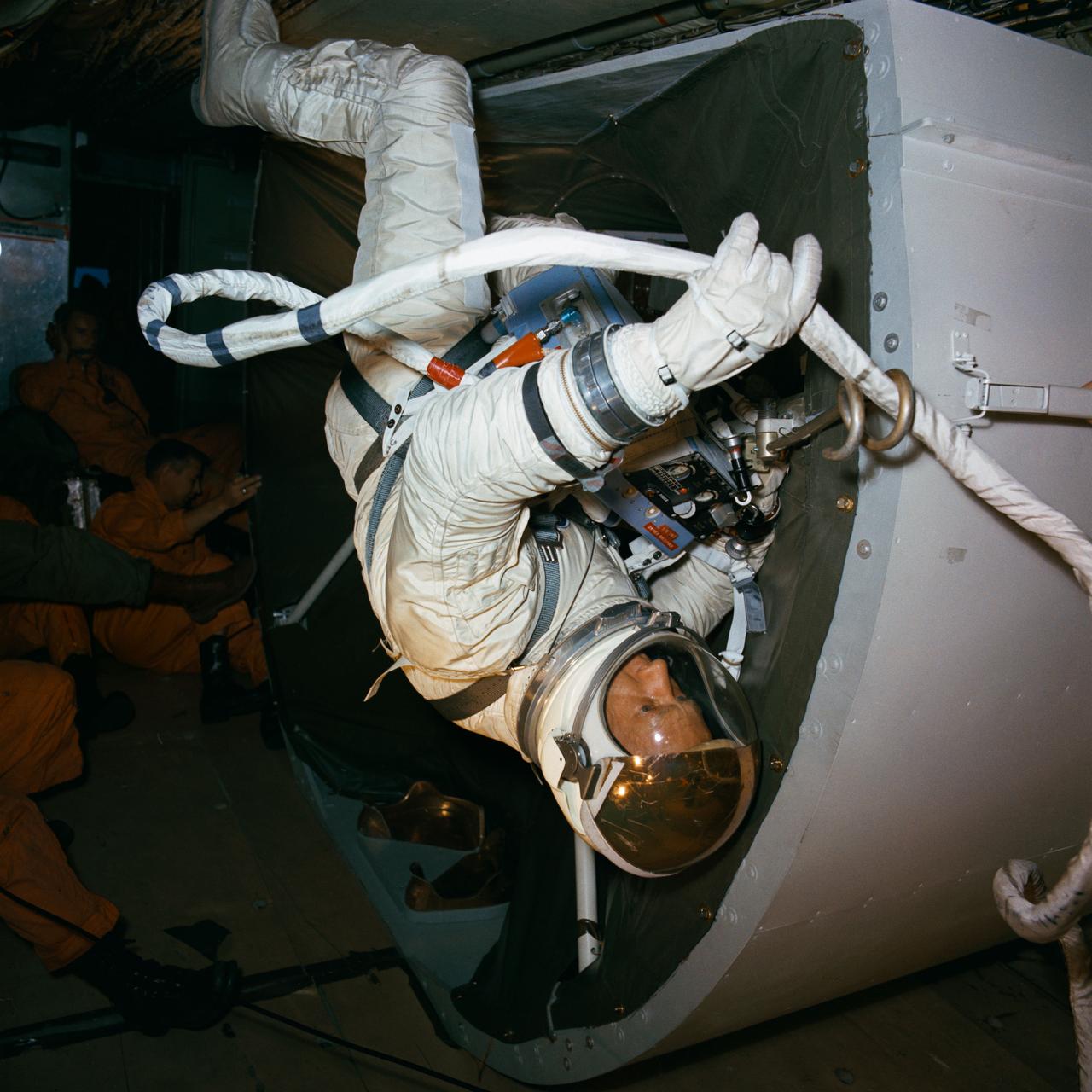
S66-57326 (13 Oct. 1966) --- Astronaut Edwin E. Aldrin Jr., pilot for the Gemini-12 spaceflight, attaches tether to hooks on mock-up of the adapter section of a Gemini spacecraft. He is taking part in zero-gravity training onboard an Air Force KC-135 jet aircraft in preparation for his extravehicular activity (EVA) during the actual mission. Photo credit: NASA
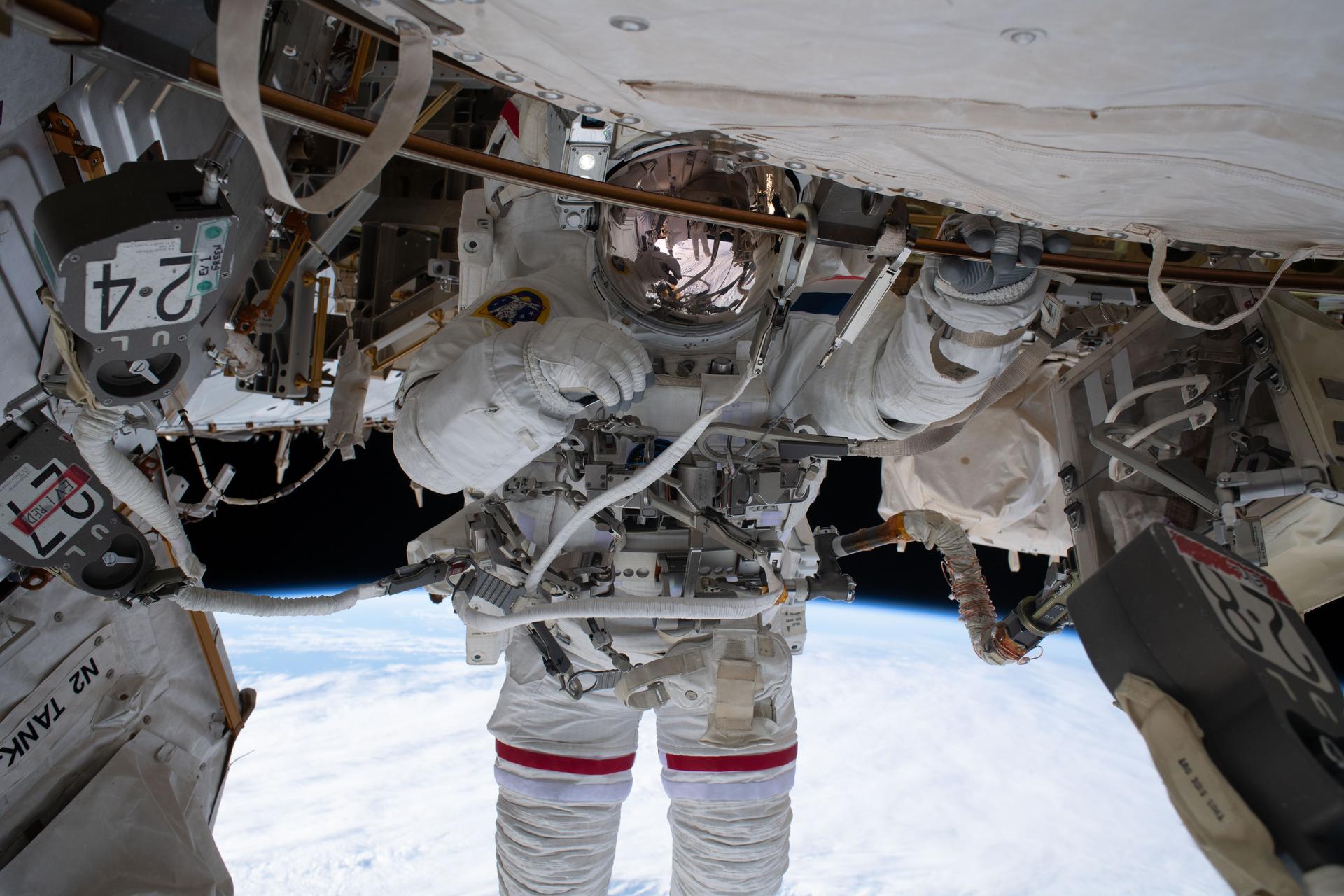
iss075e0085867 (Sept. 1, 2026) --- ESA (European Space Agency) astronaut Sophie Adenot, with her spacesuit’s gold‑plated helmet visor down, is tethered to the International Space Station. Adenot participated in a six‑hour and 49‑minute spacewalk with station commander Jessica Meir of NASA (out of frame), installing a spacecraft navigation aid, swabbing the station’s exterior for microorganisms, and preparing a cosmic particle detector for future upgrades outside the International Space Station. Credit: NASA/Jessica Meir
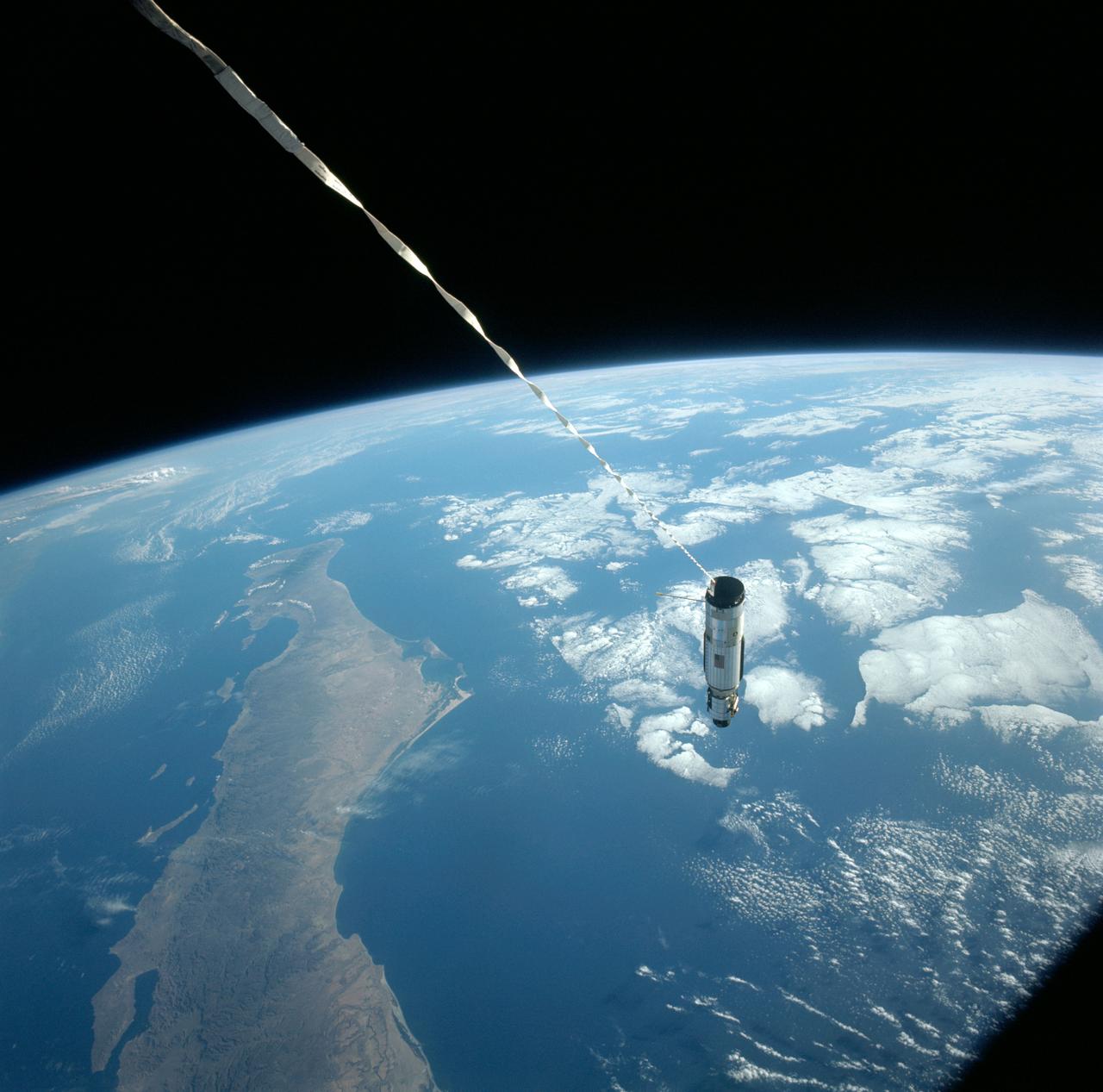
S66-63517 (13 Nov. 1966) --- The Gulf of California area as seen from the Gemini-12 spacecraft during its 30th revolution of Earth. Baja California Sur is the peninsula on the left. At lower left is the mainland of Mexico. A 100-foot tether line connects the Agena Target Docking Vehicle with the Gemini-12 spacecraft. View is looking south. Photo credit: NASA
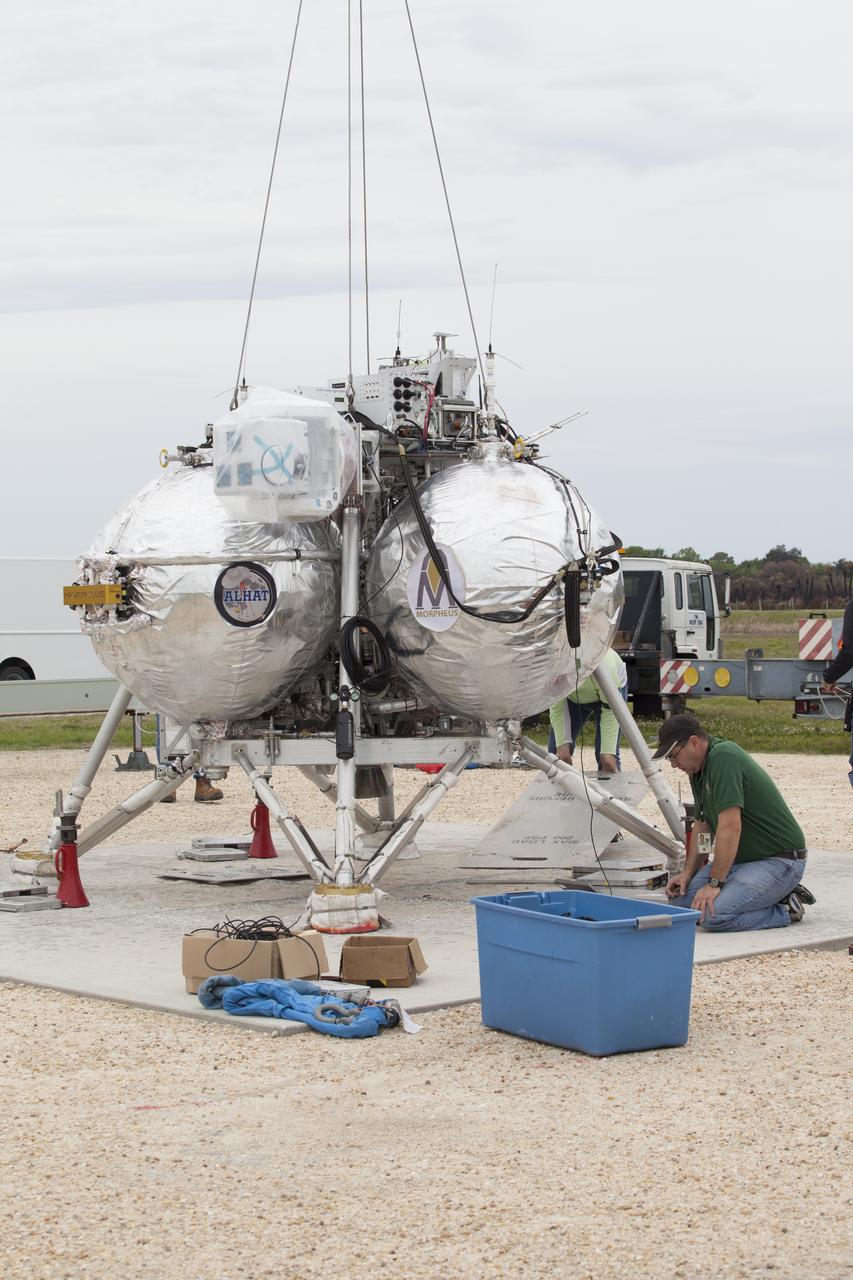
CAPE CANAVERAL, Fla. – Technicians watch as a crane lowers the Project Morpheus prototype lander onto a launch pad at a new launch site at the north end of the Shuttle Landing Facility at NASA's Kennedy Space Center in Florida. Preparations are underway for a tether test. The launch pad was moved to a different location at the landing facility to support the next phase of flight testing. Project Morpheus tests NASA’s automated landing and hazard avoidance technology, or ALHAT, and an engine that runs on liquid oxygen and methane, or green propellants, into a fully-operational lander that could deliver cargo to other planetary surfaces. The landing facility provides the lander with the kind of field necessary for realistic testing, complete with rocks, craters and hazards to avoid. Morpheus’ ALHAT payload allows it to navigate to clear landing sites amidst rocks, craters and other hazards during its descent. Project Morpheus is being managed under the Advanced Exploration Systems, or AES, Division in NASA’s Human Exploration and Operations Mission Directorate. The efforts in AES pioneer new approaches for rapidly developing prototype systems, demonstrating key capabilities and validating operational concepts for future human missions beyond Earth orbit. For more information on Project Morpheus, visit http://morpheuslander.jsc.nasa.gov/. Photo credit: NASA/Ben Smegelsky
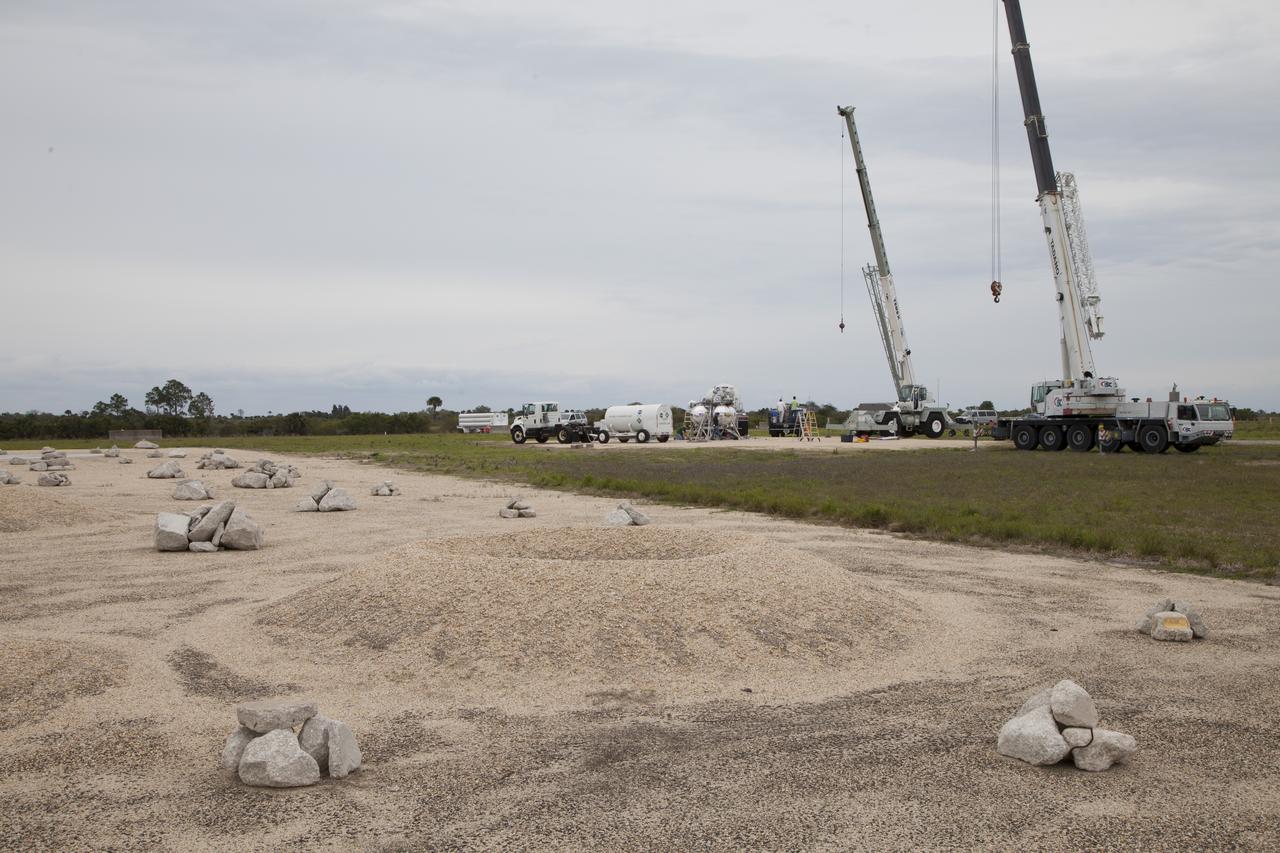
CAPE CANAVERAL, Fla. – NASA's Project Morpheus prototype lander is positioned near a new launch site at the north end of the Shuttle Landing Facility at NASA’s Kennedy Space Center in Florida for a tether test. The launch pad was moved to a different location at the landing facility to support the next phase of flight testing. Project Morpheus tests NASA’s automated landing and hazard avoidance technology, or ALHAT, and an engine that runs on liquid oxygen and methane, or green propellants, into a fully-operational lander that could deliver cargo to other planetary surfaces. In the foreground of the photo is the ALHAT field. The landing facility provides the lander with the kind of field necessary for realistic testing, complete with rocks, craters and hazards to avoid. Morpheus’ ALHAT payload allows it to navigate to clear landing sites amidst rocks, craters and other hazards during its descent. Project Morpheus is being managed under the Advanced Exploration Systems, or AES, Division in NASA’s Human Exploration and Operations Mission Directorate. The efforts in AES pioneer new approaches for rapidly developing prototype systems, demonstrating key capabilities and validating operational concepts for future human missions beyond Earth orbit. For more information on Project Morpheus, visit http://morpheuslander.jsc.nasa.gov/. Photo credit: NASA/Ben Smegelsky
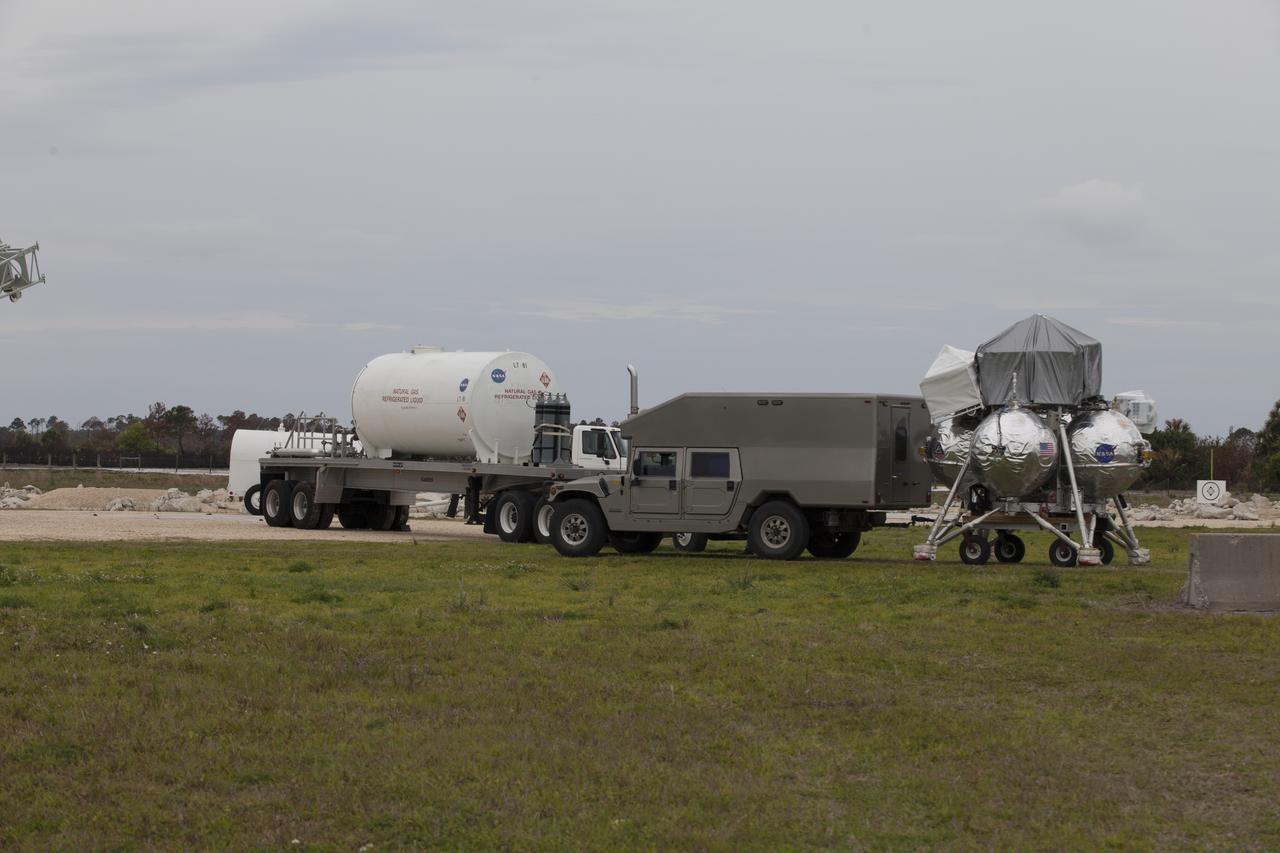
CAPE CANAVERAL, Fla. – NASA's Project Morpheus prototype lander is positioned near a new launch site at the north end of the Shuttle Landing Facility at NASA’s Kennedy Space Center in Florida for a tether test. The launch pad was moved to a different location at the landing facility to support the next phase of flight testing. Project Morpheus tests NASA’s automated landing and hazard avoidance technology, or ALHAT, and an engine that runs on liquid oxygen and methane, or green propellants, into a fully-operational lander that could deliver cargo to other planetary surfaces. The landing facility provides the lander with the kind of field necessary for realistic testing, complete with rocks, craters and hazards to avoid. Morpheus’ ALHAT payload allows it to navigate to clear landing sites amidst rocks, craters and other hazards during its descent. Project Morpheus is being managed under the Advanced Exploration Systems, or AES, Division in NASA’s Human Exploration and Operations Mission Directorate. The efforts in AES pioneer new approaches for rapidly developing prototype systems, demonstrating key capabilities and validating operational concepts for future human missions beyond Earth orbit. For more information on Project Morpheus, visit http://morpheuslander.jsc.nasa.gov/. Photo credit: NASA/Ben Smegelsky
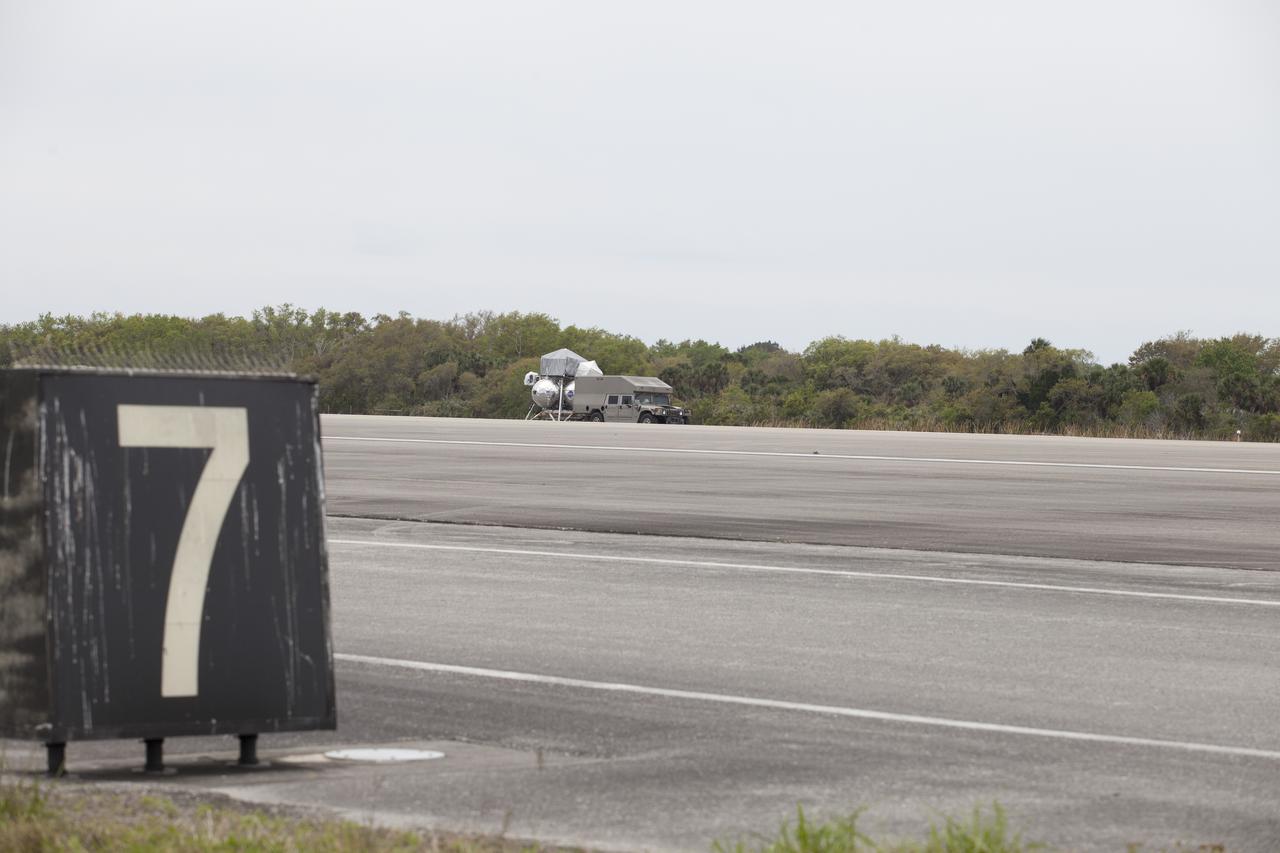
CAPE CANAVERAL, Fla. – NASA's Project Morpheus prototype lander is positioned near a new launch site at the north end of the Shuttle Landing Facility at NASA’s Kennedy Space Center in Florida for a tether test. The launch pad was moved to a different location at the landing facility to support the next phase of flight testing. Project Morpheus tests NASA’s automated landing and hazard avoidance technology, or ALHAT, and an engine that runs on liquid oxygen and methane, or green propellants, into a fully-operational lander that could deliver cargo to other planetary surfaces. The landing facility provides the lander with the kind of field necessary for realistic testing, complete with rocks, craters and hazards to avoid. Morpheus’ ALHAT payload allows it to navigate to clear landing sites amidst rocks, craters and other hazards during its descent. Project Morpheus is being managed under the Advanced Exploration Systems, or AES, Division in NASA’s Human Exploration and Operations Mission Directorate. The efforts in AES pioneer new approaches for rapidly developing prototype systems, demonstrating key capabilities and validating operational concepts for future human missions beyond Earth orbit. For more information on Project Morpheus, visit http://morpheuslander.jsc.nasa.gov/. Photo credit: NASA/Ben Smegelsky
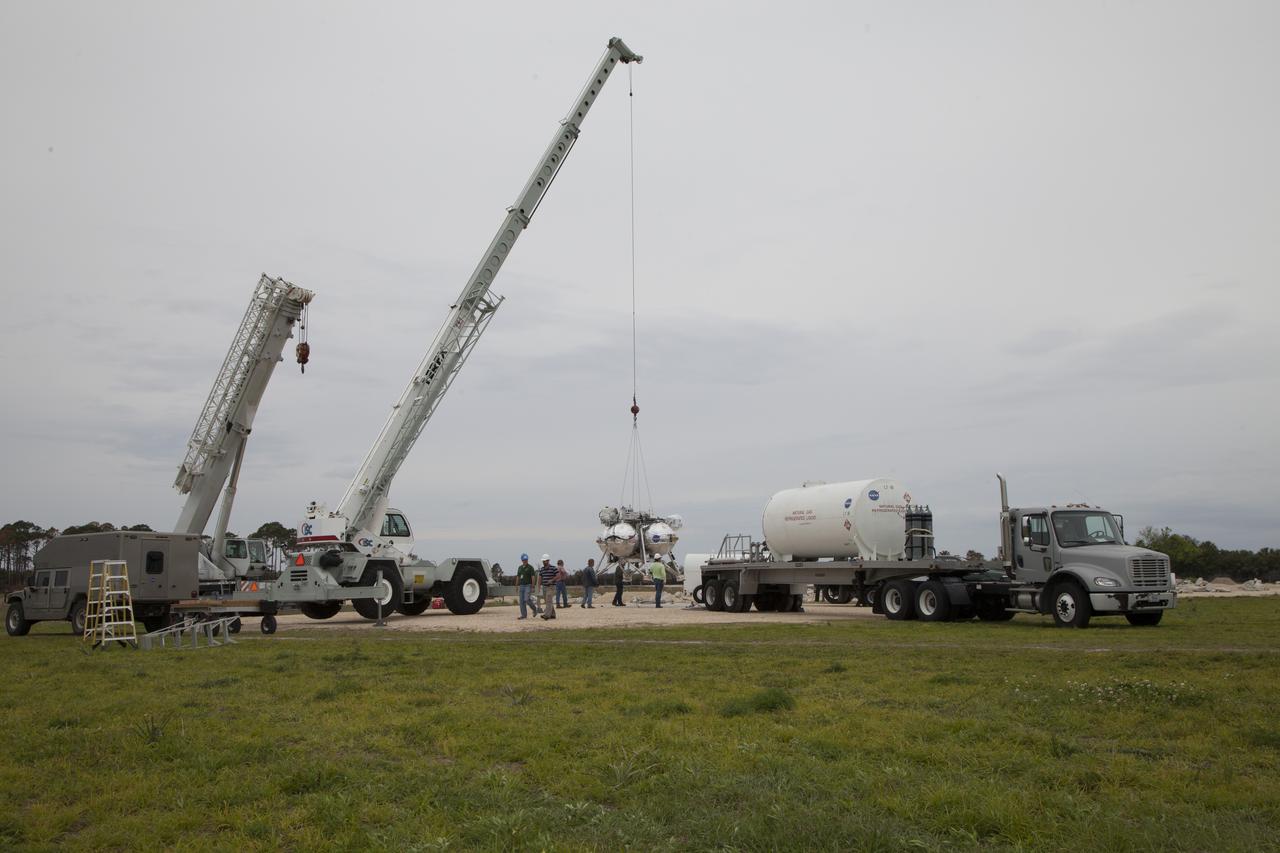
CAPE CANAVERAL, Fla. – Engineers and technicians monitor the progress as a crane lifts the Project Morpheus prototype lander off the ground for a tether test near a new launch site at the north end of the Shuttle Landing Facility at NASA's Kennedy Space Center in Florida. The launch pad was moved to a different location at the landing facility to support the next phase of flight testing. Project Morpheus tests NASA’s automated landing and hazard avoidance technology, or ALHAT, and an engine that runs on liquid oxygen and methane, or green propellants, into a fully-operational lander that could deliver cargo to other planetary surfaces. The landing facility provides the lander with the kind of field necessary for realistic testing, complete with rocks, craters and hazards to avoid. Morpheus’ ALHAT payload allows it to navigate to clear landing sites amidst rocks, craters and other hazards during its descent. Project Morpheus is being managed under the Advanced Exploration Systems, or AES, Division in NASA’s Human Exploration and Operations Mission Directorate. The efforts in AES pioneer new approaches for rapidly developing prototype systems, demonstrating key capabilities and validating operational concepts for future human missions beyond Earth orbit. For more information on Project Morpheus, visit http://morpheuslander.jsc.nasa.gov/. Photo credit: NASA/Ben Smegelsky
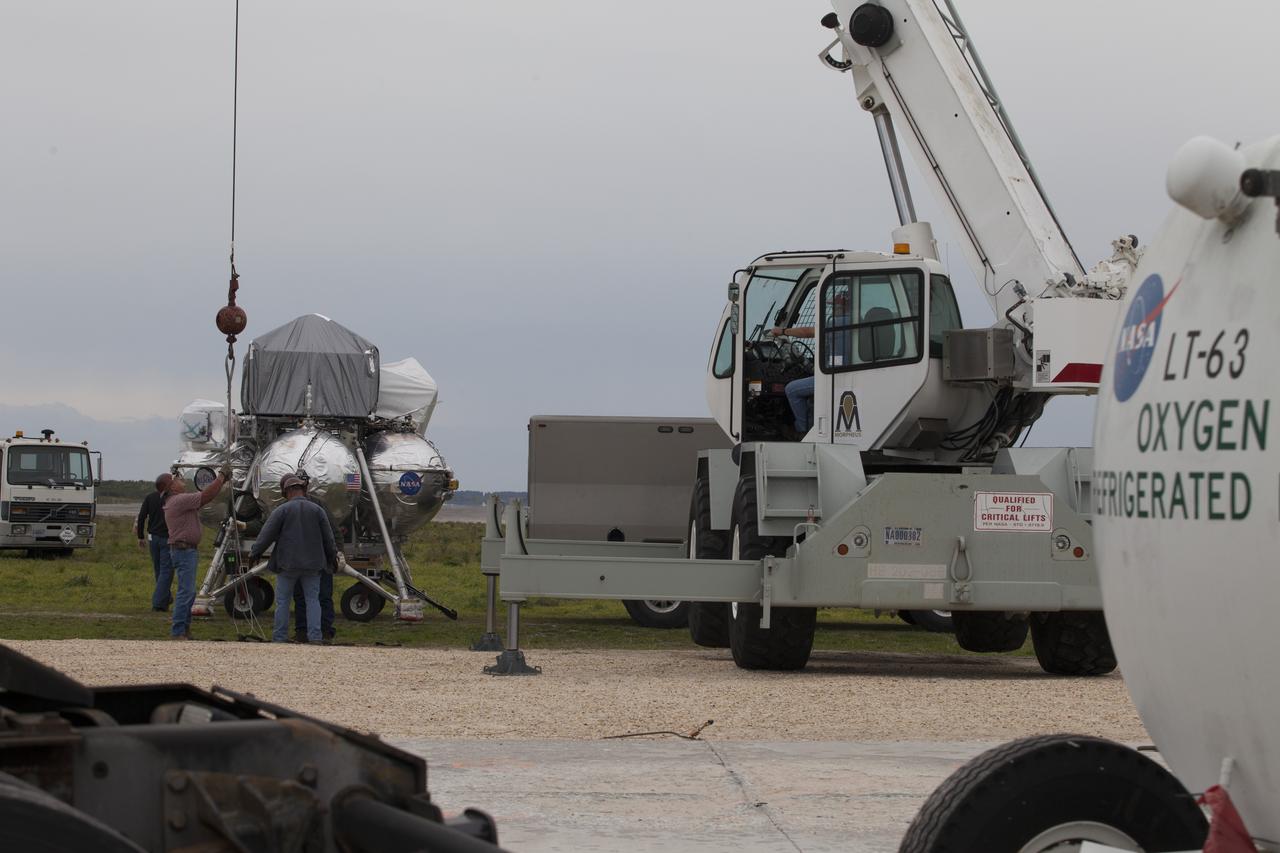
CAPE CANAVERAL, Fla. – Engineers and technicians prepare the Project Morpheus prototype lander for a tether test near a new launch site at the north end of the Shuttle Landing Facility at NASA's Kennedy Space Center in Florida. The launch pad was moved to a different location at the landing facility to support the next phase of flight testing. Project Morpheus tests NASA’s automated landing and hazard avoidance technology, or ALHAT, and an engine that runs on liquid oxygen and methane, or green propellants, into a fully-operational lander that could deliver cargo to other planetary surfaces. The landing facility provides the lander with the kind of field necessary for realistic testing, complete with rocks, craters and hazards to avoid. Morpheus’ ALHAT payload allows it to navigate to clear landing sites amidst rocks, craters and other hazards during its descent. Project Morpheus is being managed under the Advanced Exploration Systems, or AES, Division in NASA’s Human Exploration and Operations Mission Directorate. The efforts in AES pioneer new approaches for rapidly developing prototype systems, demonstrating key capabilities and validating operational concepts for future human missions beyond Earth orbit. For more information on Project Morpheus, visit http://morpheuslander.jsc.nasa.gov/. Photo credit: NASA/Ben Smegelsky
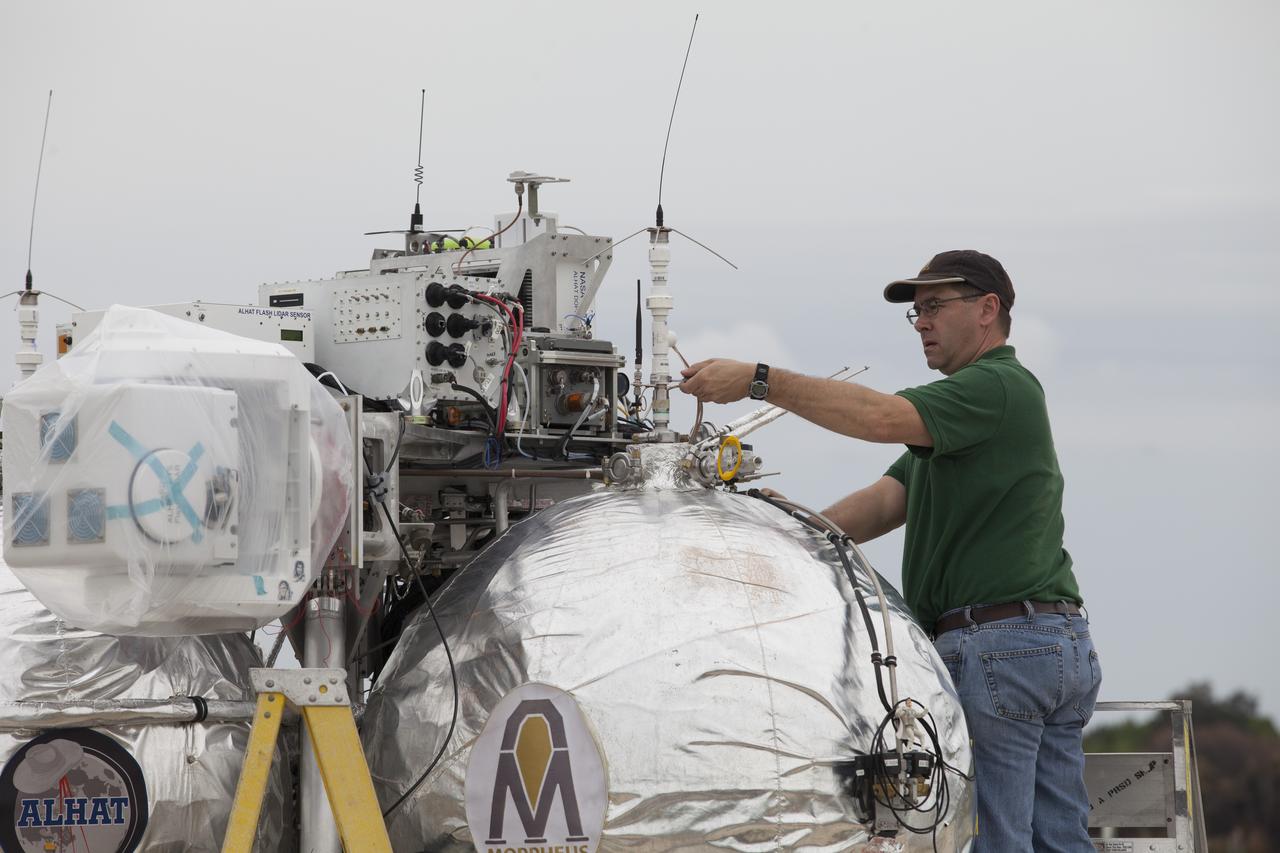
CAPE CANAVERAL, Fla. – A technician prepares the Project Morpheus prototype lander for a tether test near a new launch site at the north end of the Shuttle Landing Facility at NASA's Kennedy Space Center in Florida. The launch pad was moved to a different location at the landing facility to support the next phase of flight testing. Project Morpheus tests NASA’s automated landing and hazard avoidance technology, or ALHAT, and an engine that runs on liquid oxygen and methane, or green propellants, into a fully-operational lander that could deliver cargo to other planetary surfaces. The landing facility provides the lander with the kind of field necessary for realistic testing, complete with rocks, craters and hazards to avoid. Morpheus’ ALHAT payload allows it to navigate to clear landing sites amidst rocks, craters and other hazards during its descent. Project Morpheus is being managed under the Advanced Exploration Systems, or AES, Division in NASA’s Human Exploration and Operations Mission Directorate. The efforts in AES pioneer new approaches for rapidly developing prototype systems, demonstrating key capabilities and validating operational concepts for future human missions beyond Earth orbit. For more information on Project Morpheus, visit http://morpheuslander.jsc.nasa.gov/. Photo credit: NASA/Ben Smegelsky
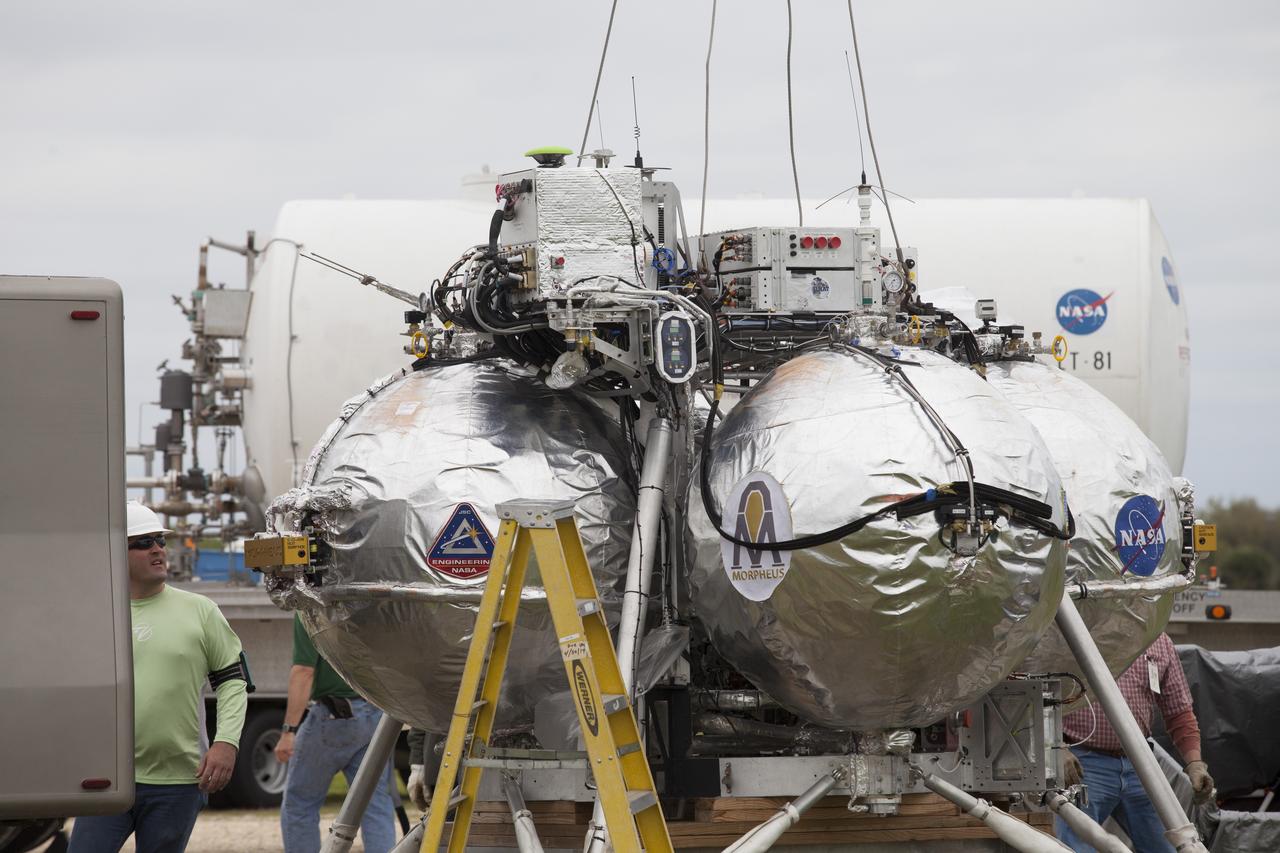
CAPE CANAVERAL, Fla. – Engineers and technicians prepare the Project Morpheus prototype lander for a tether test near a new launch site at the north end of the Shuttle Landing Facility at NASA's Kennedy Space Center in Florida. The launch pad was moved to a different location at the landing facility to support the next phase of flight testing. Project Morpheus tests NASA’s automated landing and hazard avoidance technology, or ALHAT, and an engine that runs on liquid oxygen and methane, or green propellants, into a fully-operational lander that could deliver cargo to other planetary surfaces. The landing facility provides the lander with the kind of field necessary for realistic testing, complete with rocks, craters and hazards to avoid. Morpheus’ ALHAT payload allows it to navigate to clear landing sites amidst rocks, craters and other hazards during its descent. Project Morpheus is being managed under the Advanced Exploration Systems, or AES, Division in NASA’s Human Exploration and Operations Mission Directorate. The efforts in AES pioneer new approaches for rapidly developing prototype systems, demonstrating key capabilities and validating operational concepts for future human missions beyond Earth orbit. For more information on Project Morpheus, visit http://morpheuslander.jsc.nasa.gov/. Photo credit: NASA/Ben Smegelsky
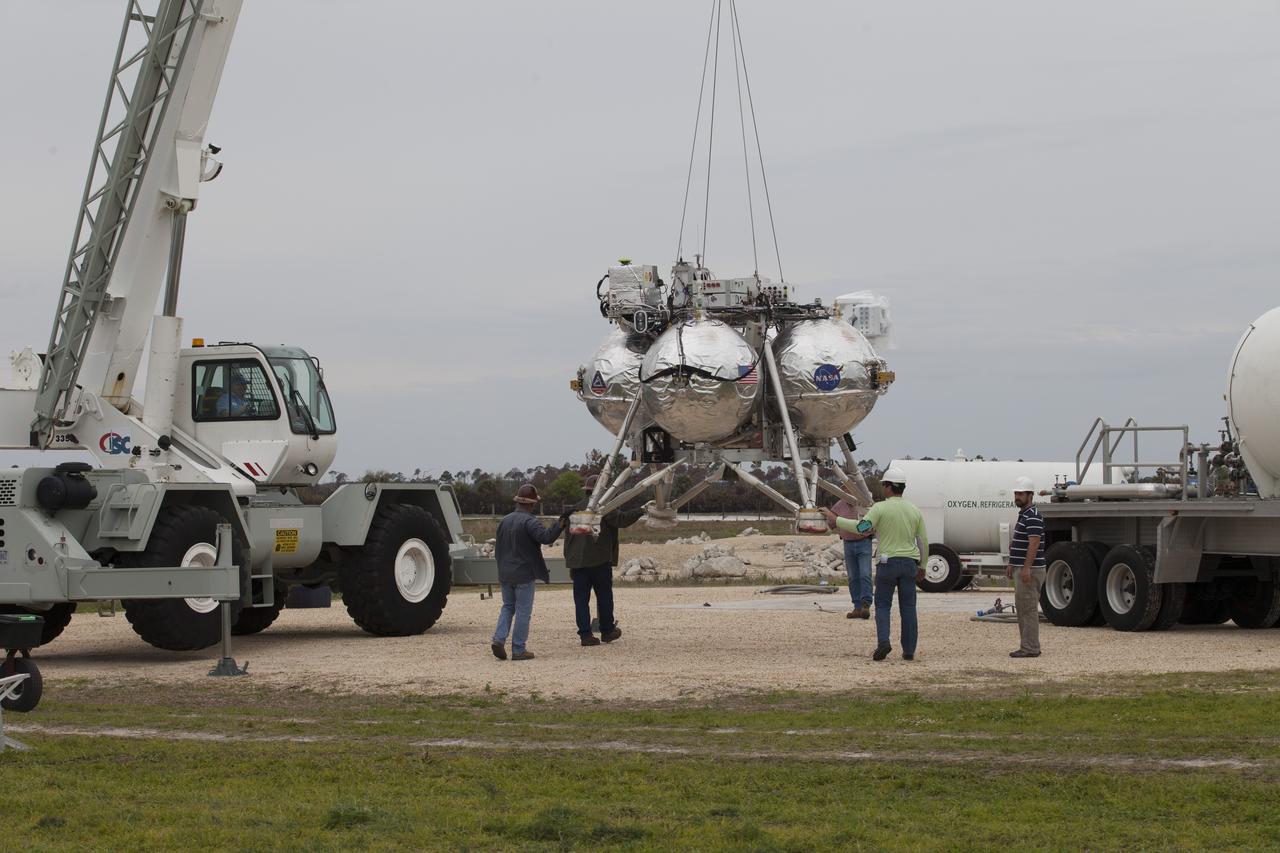
CAPE CANAVERAL, Fla. – Engineers and technicians monitor the progress as a crane lifts the Project Morpheus prototype lander off the ground for a tether test near a new launch site at the north end of the Shuttle Landing Facility at NASA's Kennedy Space Center in Florida. The launch pad was moved to a different location at the landing facility to support the next phase of flight testing. Project Morpheus tests NASA’s automated landing and hazard avoidance technology, or ALHAT, and an engine that runs on liquid oxygen and methane, or green propellants, into a fully-operational lander that could deliver cargo to other planetary surfaces. The landing facility provides the lander with the kind of field necessary for realistic testing, complete with rocks, craters and hazards to avoid. Morpheus’ ALHAT payload allows it to navigate to clear landing sites amidst rocks, craters and other hazards during its descent. Project Morpheus is being managed under the Advanced Exploration Systems, or AES, Division in NASA’s Human Exploration and Operations Mission Directorate. The efforts in AES pioneer new approaches for rapidly developing prototype systems, demonstrating key capabilities and validating operational concepts for future human missions beyond Earth orbit. For more information on Project Morpheus, visit http://morpheuslander.jsc.nasa.gov/. Photo credit: NASA/Ben Smegelsky
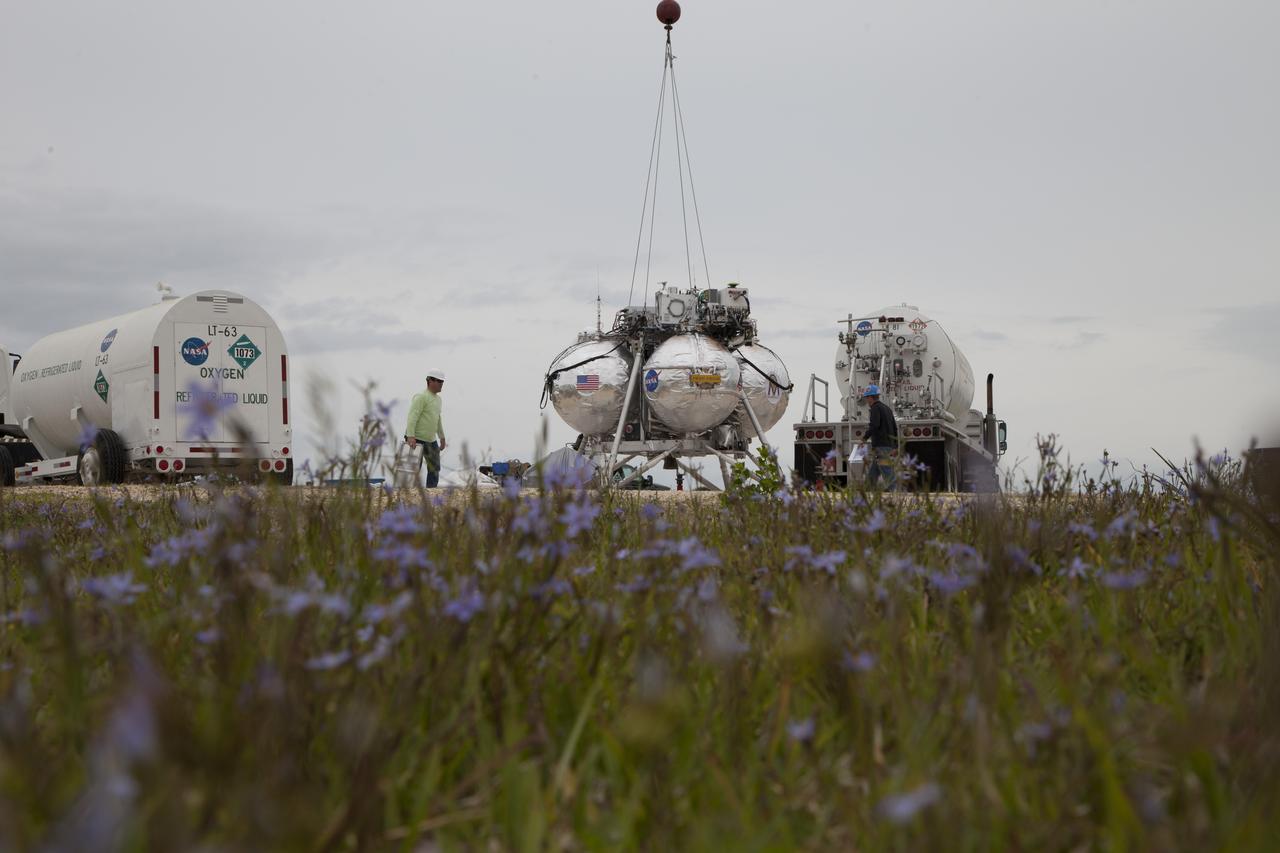
CAPE CANAVERAL, Fla. – A crane lowers the Project Morpheus prototype lander onto a launch pad at a new launch site at the north end of the Shuttle Landing Facility at NASA's Kennedy Space Center in Florida. Preparations are underway for a tether test. The launch pad was moved to a different location at the landing facility to support the next phase of flight testing. Project Morpheus tests NASA’s automated landing and hazard avoidance technology, or ALHAT, and an engine that runs on liquid oxygen and methane, or green propellants, into a fully-operational lander that could deliver cargo to other planetary surfaces. The landing facility provides the lander with the kind of field necessary for realistic testing, complete with rocks, craters and hazards to avoid. Morpheus’ ALHAT payload allows it to navigate to clear landing sites amidst rocks, craters and other hazards during its descent. Project Morpheus is being managed under the Advanced Exploration Systems, or AES, Division in NASA’s Human Exploration and Operations Mission Directorate. The efforts in AES pioneer new approaches for rapidly developing prototype systems, demonstrating key capabilities and validating operational concepts for future human missions beyond Earth orbit. For more information on Project Morpheus, visit http://morpheuslander.jsc.nasa.gov/. Photo credit: NASA/Ben Smegelsky
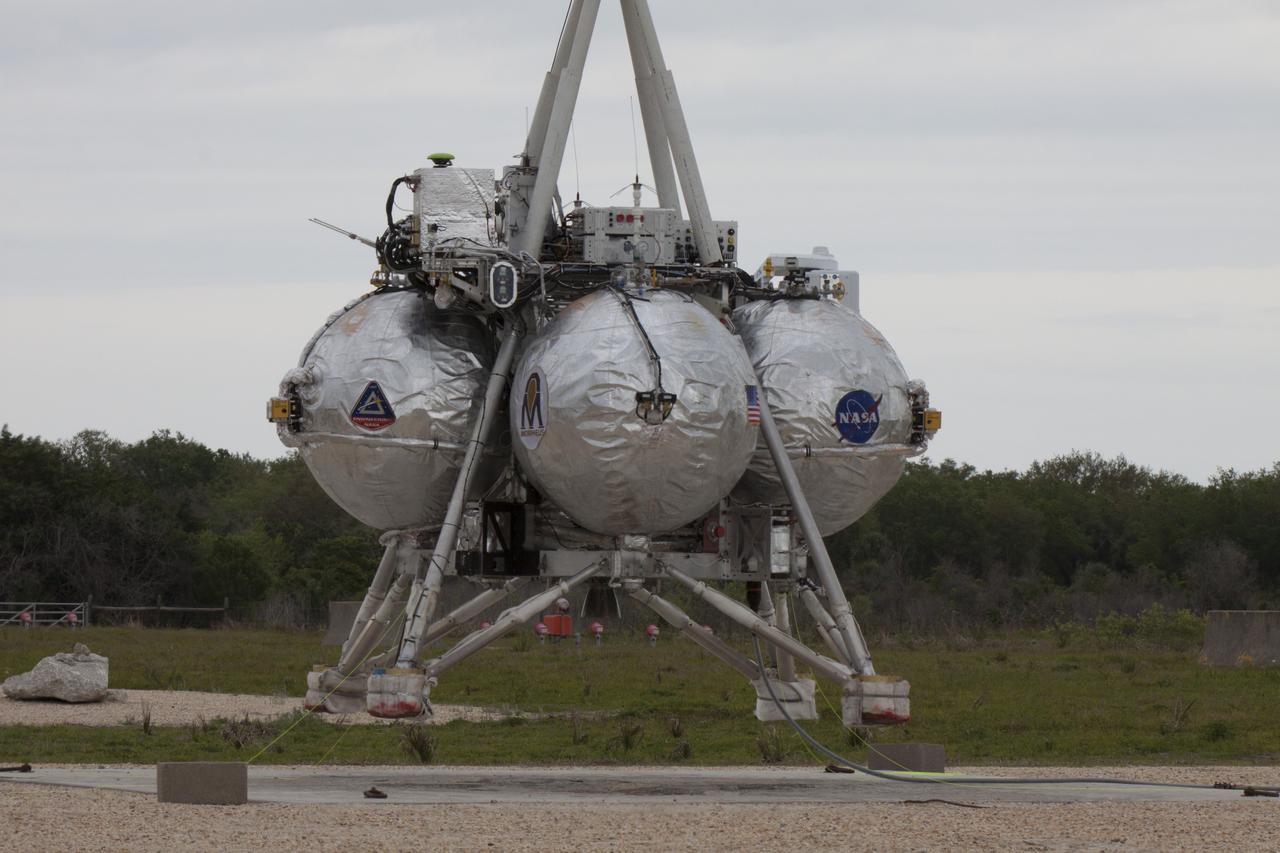
CAPE CANAVERAL, Fla. – NASA's Project Morpheus prototype lander is positioned near a new launch site at the north end of the Shuttle Landing Facility at NASA’s Kennedy Space Center in Florida for a tethered test. The test will be performed to verify the lander's recently installed autonomous landing and hazard avoidance technology, or ALHAT, sensors and integration system. The launch pad was moved to a different location at the landing facility to support the next phase of flight testing. Project Morpheus tests NASA’s ALHAT, and an engine that runs on liquid oxygen and methane, or green propellants, into a fully-operational lander that could deliver cargo to other planetary surfaces. The landing facility provides the lander with the kind of field necessary for realistic testing, complete with rocks, craters and hazards to avoid. Morpheus’ ALHAT payload allows it to navigate to clear landing sites amidst rocks, craters and other hazards during its descent. Project Morpheus is being managed under the Advanced Exploration Systems, or AES, Division in NASA’s Human Exploration and Operations Mission Directorate. The efforts in AES pioneer new approaches for rapidly developing prototype systems, demonstrating key capabilities and validating operational concepts for future human missions beyond Earth orbit. For more information on Project Morpheus, visit http://morpheuslander.jsc.nasa.gov/. Photo credit: NASA/Glenn Benson
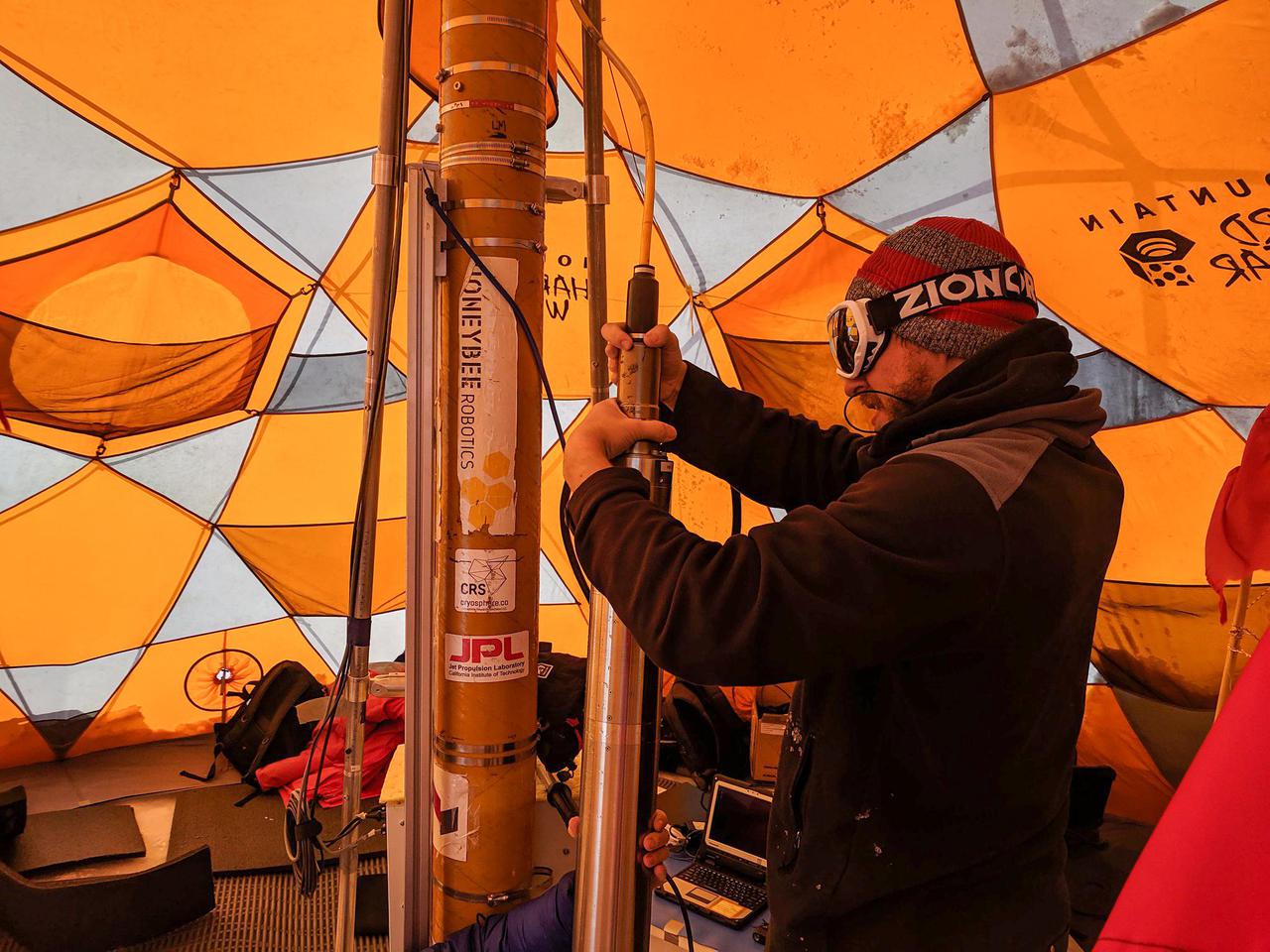
During 2019 field tests near Greenland's Summit Station, a high-elevation remote observing station, the WATSON (Wireline Analysis Tool for the Subsurface Observation of Northern ice sheets) instrument is put through its paces to seek out signs of life, or biosignatures, 360 feet (110 meters) down a borehole. In this photograph, a WATSON team member secures the tether to the top of the tube-like instrument and drill before lowering it into the ice. The tether also acts as the power cable and data feed. Care must be taken to ensure a tight connection between the tether and instrument, else the instrument could be lost in the ice. WATSON could one day be launched aboard a robotic mission to seek out biosignatures on the ocean moons of Enceladus, Europa, or even Titan. The WATSON team hopes to test the instrument in a variety of cold locations on Earth to see how the distribution and variety of biosignatures change depending on where they are. By testing WATSON in different Earth analogs — areas on Earth that can stand in for those on other worlds — scientists would be able to better understand the chemical fingerprints of any biosignatures detected on other worlds. https://photojournal.jpl.nasa.gov/catalog/PIA24170
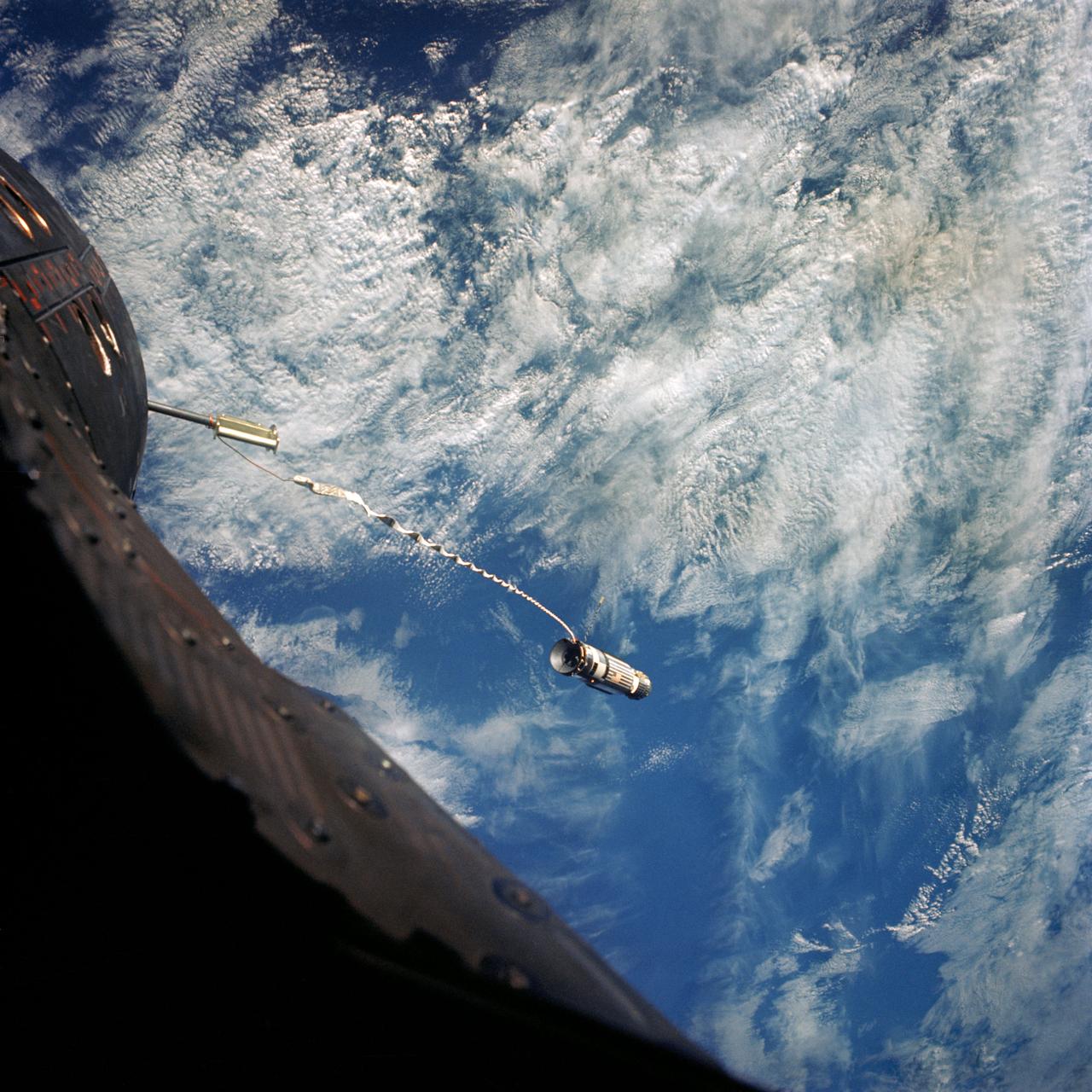
S66-62953 (13 Nov. 1966) --- A 100-foot tether line connects the Agena Target Docking Vehicle with the Gemini-12 spacecraft during its 32nd revolution of Earth. Clouds over the Pacific Ocean are in the background. Photo credit: NASA
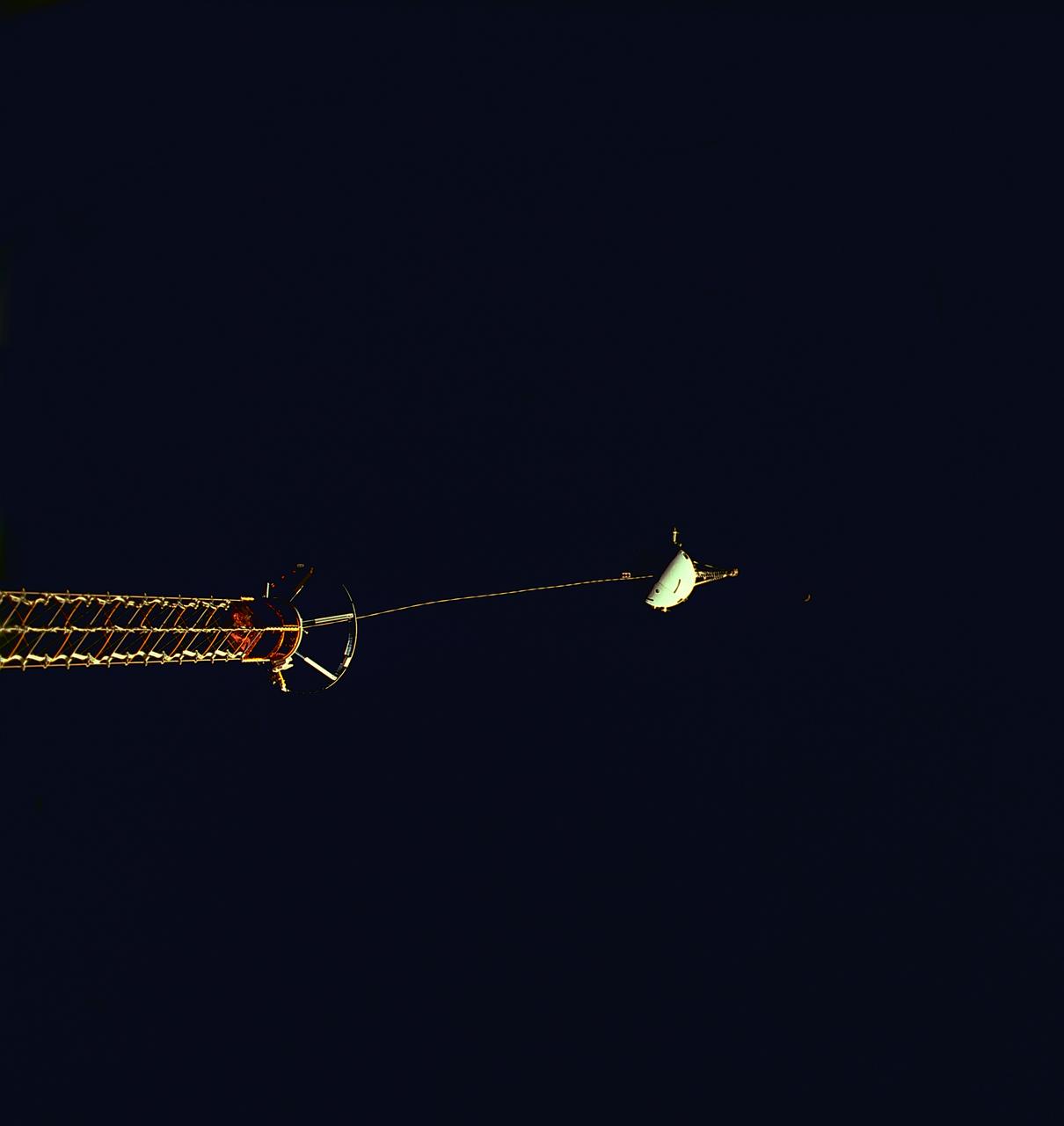
STS075-711-024 (25 Feb. 1996) --- The Tethered Satellite System (TSS) is seen as it is reeled out during early stages of deployment operations. The crew deployed the TSS, which later broke free. The seven member crew was launched aboard the space shuttle Columbia on Feb. 22, 1996, and landed on March 9, 1996. Crewmembers were Andrew M. Allen, mission commander; Scott J. Horowitz, pilot; Franklin R. Chang-Diaz, payload commander; and Maurizio Cheli European Space Agency (ESA); Jeffrey A. Hoffman and Claude Nicollier, ESA, all mission specialists; along with payload specialist Umberto Guidoni of the Italian Space Agency (ASI).
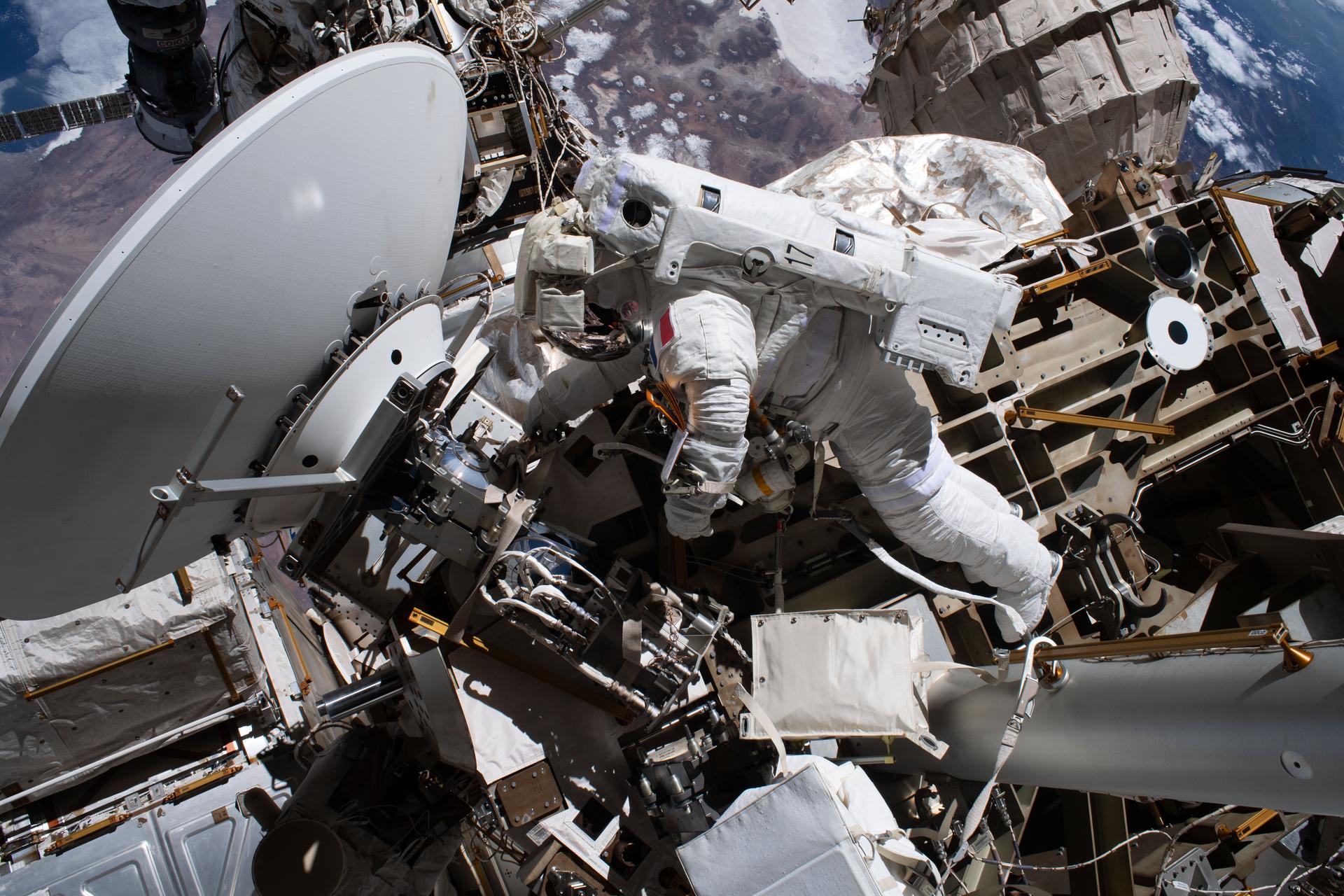
iss075e0069016 (Aug. 25, 2026) --- ESA (European Space Agency) astronaut and Expedition 75 flight engineer Sophie Adenot is tethered to the International Space Station during a spacewalk to install a high-speed space-to-ground antenna on the Z1 truss segment above the Unity module. Adenot and NASA astronaut and Expedition 75 flight engineer Anil Menon (out of frame) spent six hours and 30 minutes replacing a failed antenna with a spare and making the precise connections needed to activate it for high-speed transmissions with mission control. Credit: NASA/Anil Menon
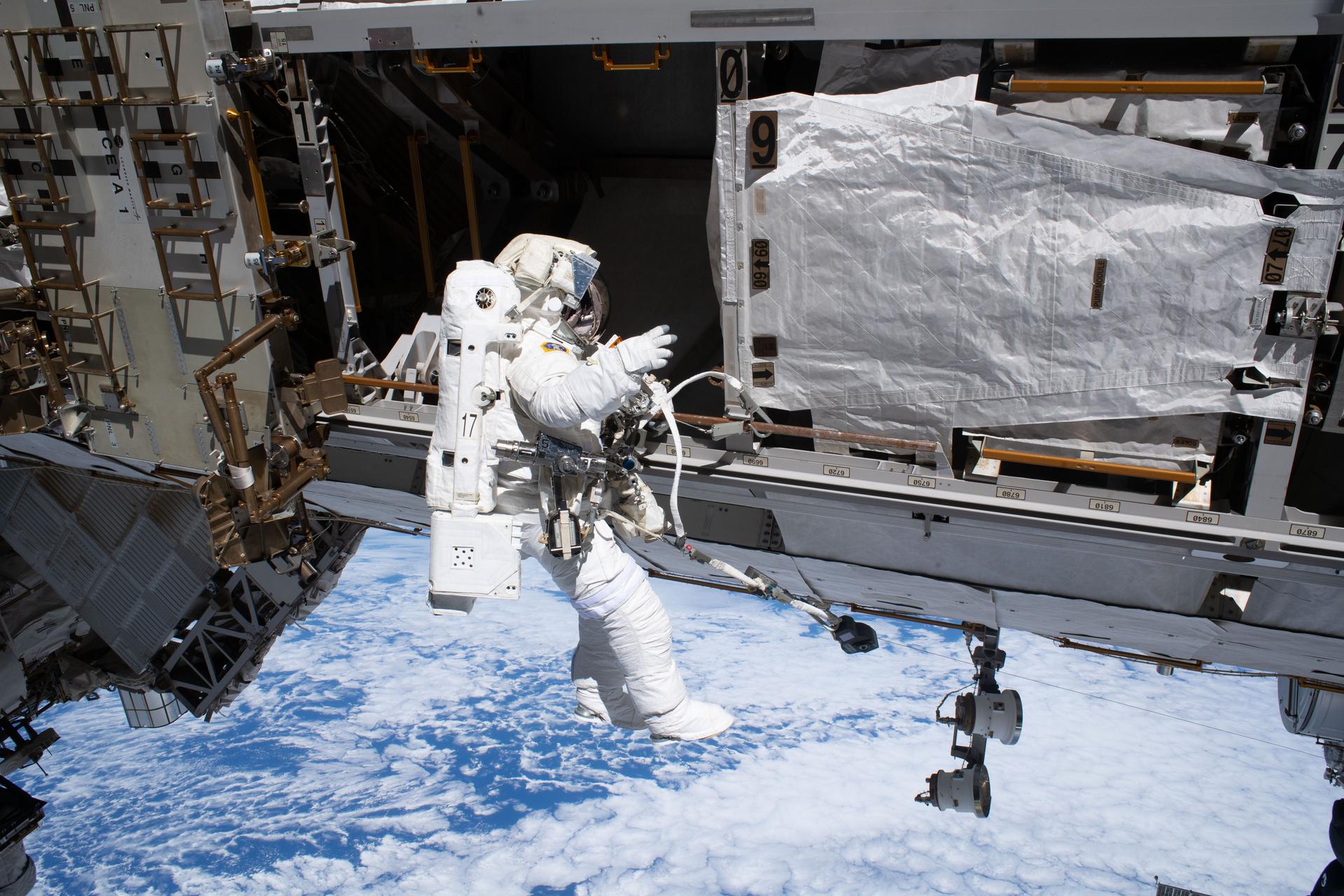
iss075e0069902 (Aug. 25, 2026) --- ESA (European Space Agency) astronaut and Expedition 75 flight engineer Sophie Adenot is tethered to the International Space Station during a spacewalk to install a high-speed space-to-ground antenna on the Z1 truss segment above the Unity module. Adenot and NASA astronaut and Expedition 75 flight engineer Anil Menon (out of frame) spent six hours and 30 minutes replacing a failed antenna with a spare and making the precise connections needed to activate it for high-speed transmissions with mission control. Credit: NASA/Anil Menon
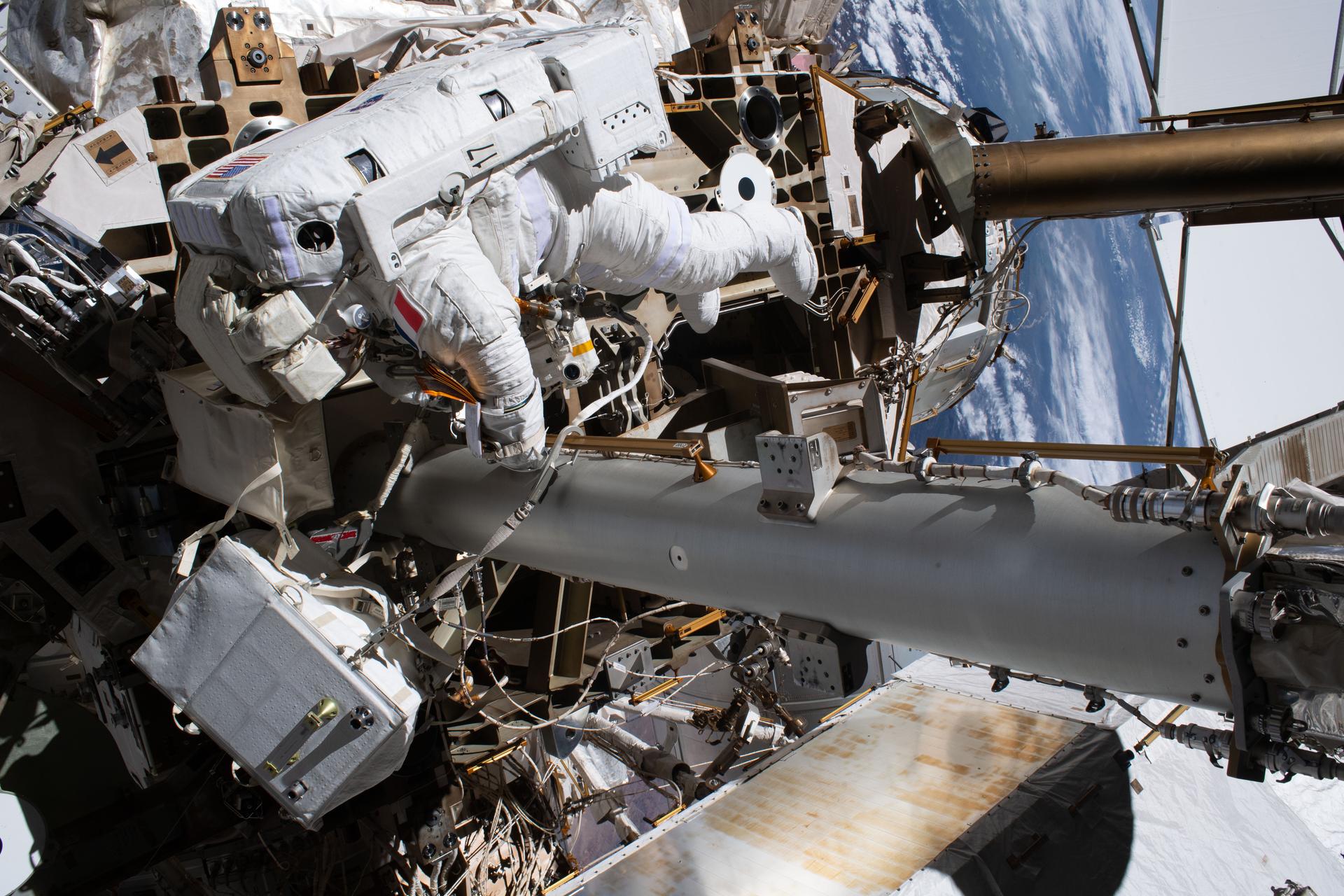
iss075e0068985 (Aug. 25, 2026) --- ESA (European Space Agency) astronaut and Expedition 75 flight engineer Sophie Adenot is tethered to the International Space Station during a spacewalk to install a high-speed space-to-ground antenna on the Z1 truss segment above the Unity module. Adenot and NASA astronaut and Expedition 75 flight engineer Anil Menon (out of frame) spent six hours and 30 minutes replacing a failed antenna with a spare and making the precise connections needed to activate it for high-speed transmissions with mission control. Credit: NASA/Anil Menon