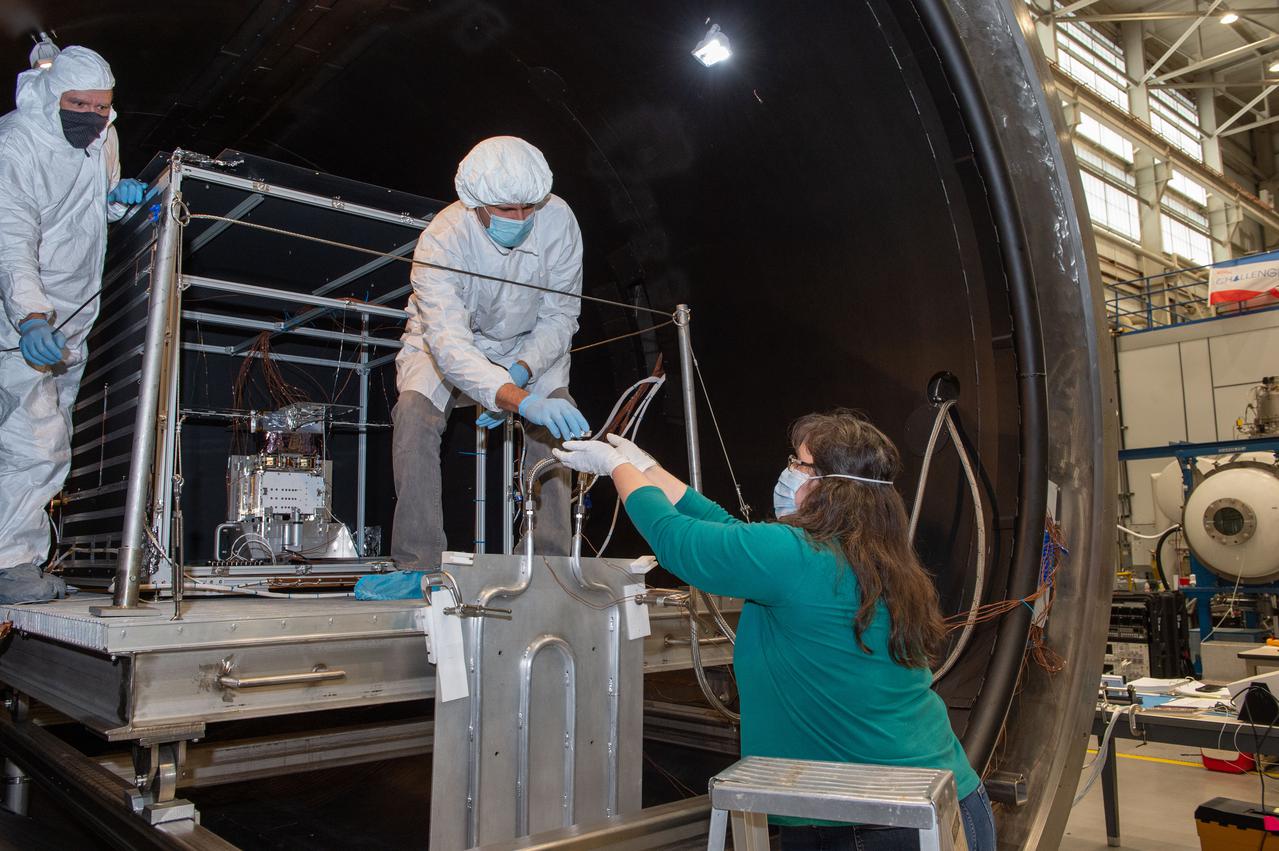
Miria Finckenor collects Optical Witness Samples and swab samples for analysis to verify that the NEA Scout thermal vacuum bake-out is complete and the chamber is clean.
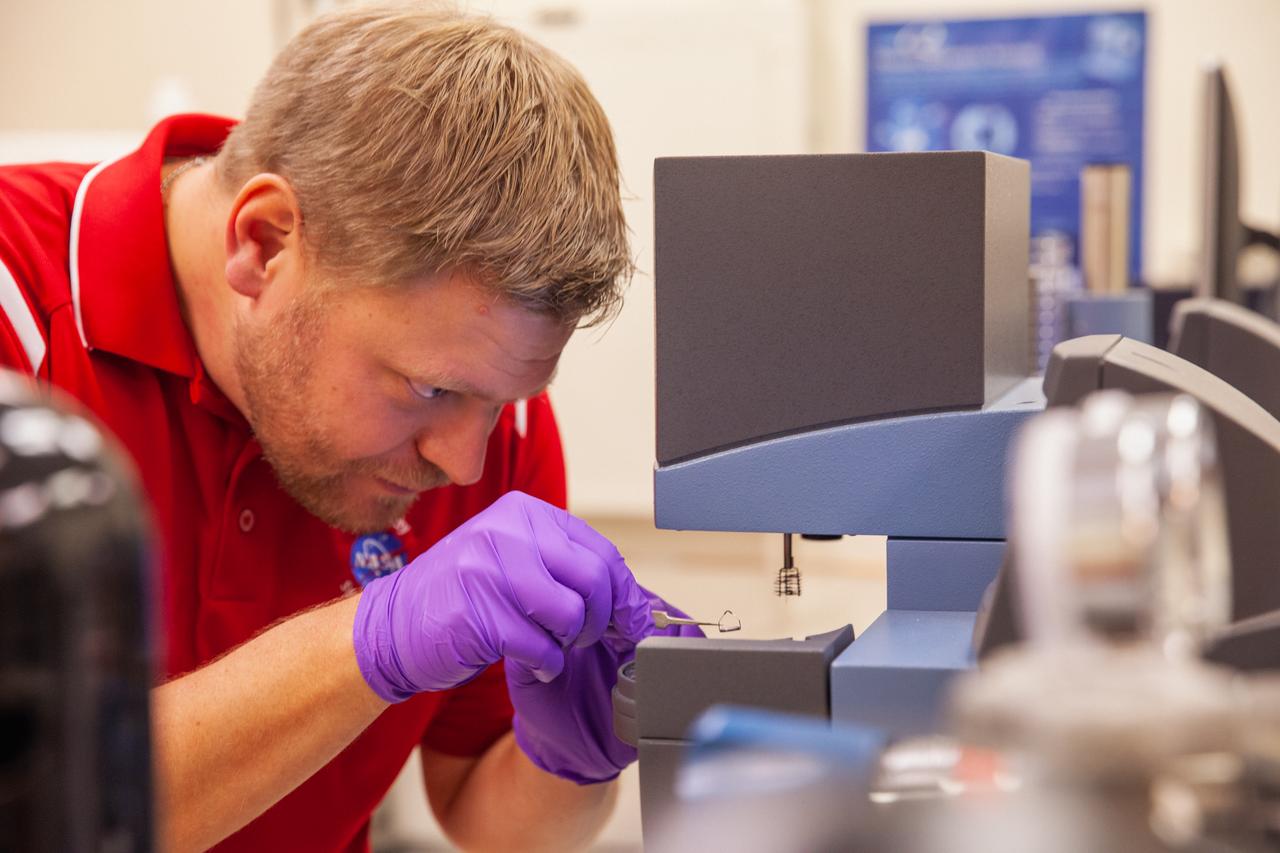
Jerry Buhrow, an engineer in the Materials Analysis Lab, places a sample on a thermal testing unit inside a lab at NASA Kennedy Space Center’s Neil Armstrong Operations and Checkout Building on Oct. 6, 2020.
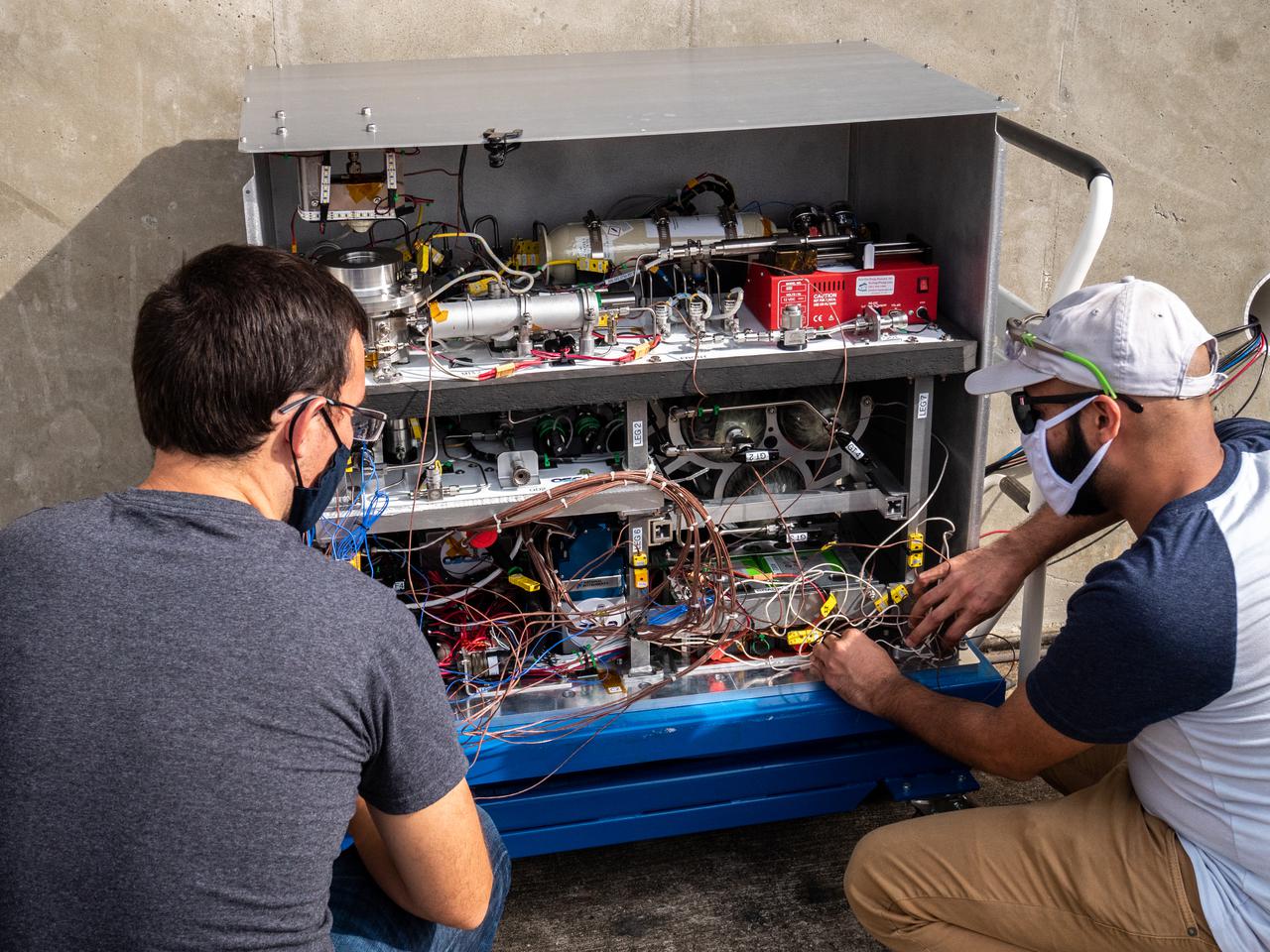
Chemical Engineer David Rinderknecht, left, and Thermal/Fluid Analysis Engineer Malay Shah prepare the Orbital Syngas Commodity Augmentation Reactor (OSCAR) for thermal testing Jan. 26, 2021, at NASA’s Kennedy Space Center in Florida. The tests are in preparation for a scheduled suborbital flight test later this year facilitated by NASA’s Flight Opportunities program. The testing ensures the thermal environment of the payload won’t create additional hazards during flight and that OSCAR can successfully operate within the temperature range it may encounter as it performs tests in microgravity.
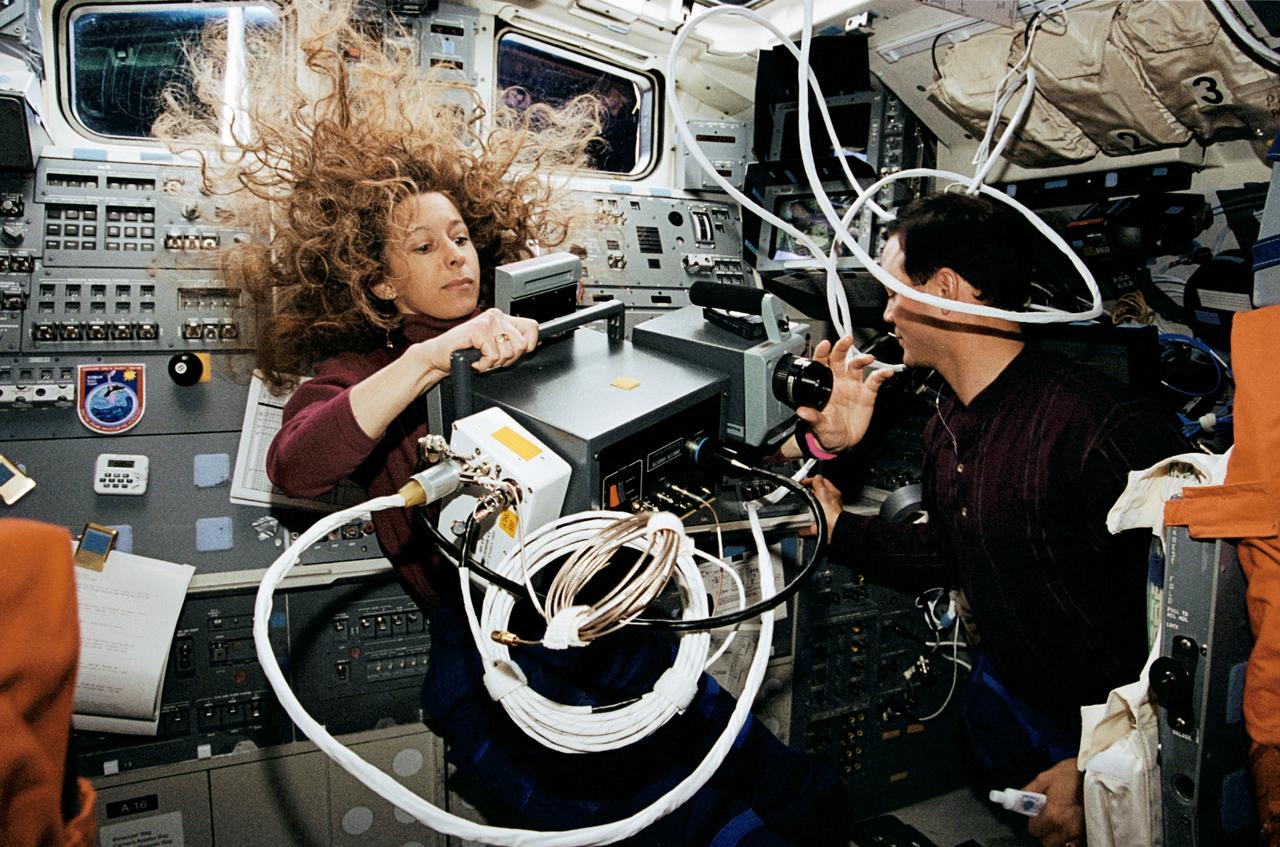
STS062-04-005 (4-18 March 1994) --- Astronaut Marsha S. Ivins has her hands full with a thermal imaging project on the flight deck of the Space Shuttle Columbia as astronaut Pierre J. Thuot stands by to help. The two mission specialists were joined by three other veteran NASA astronauts for almost 14 full days in Earth-orbit.
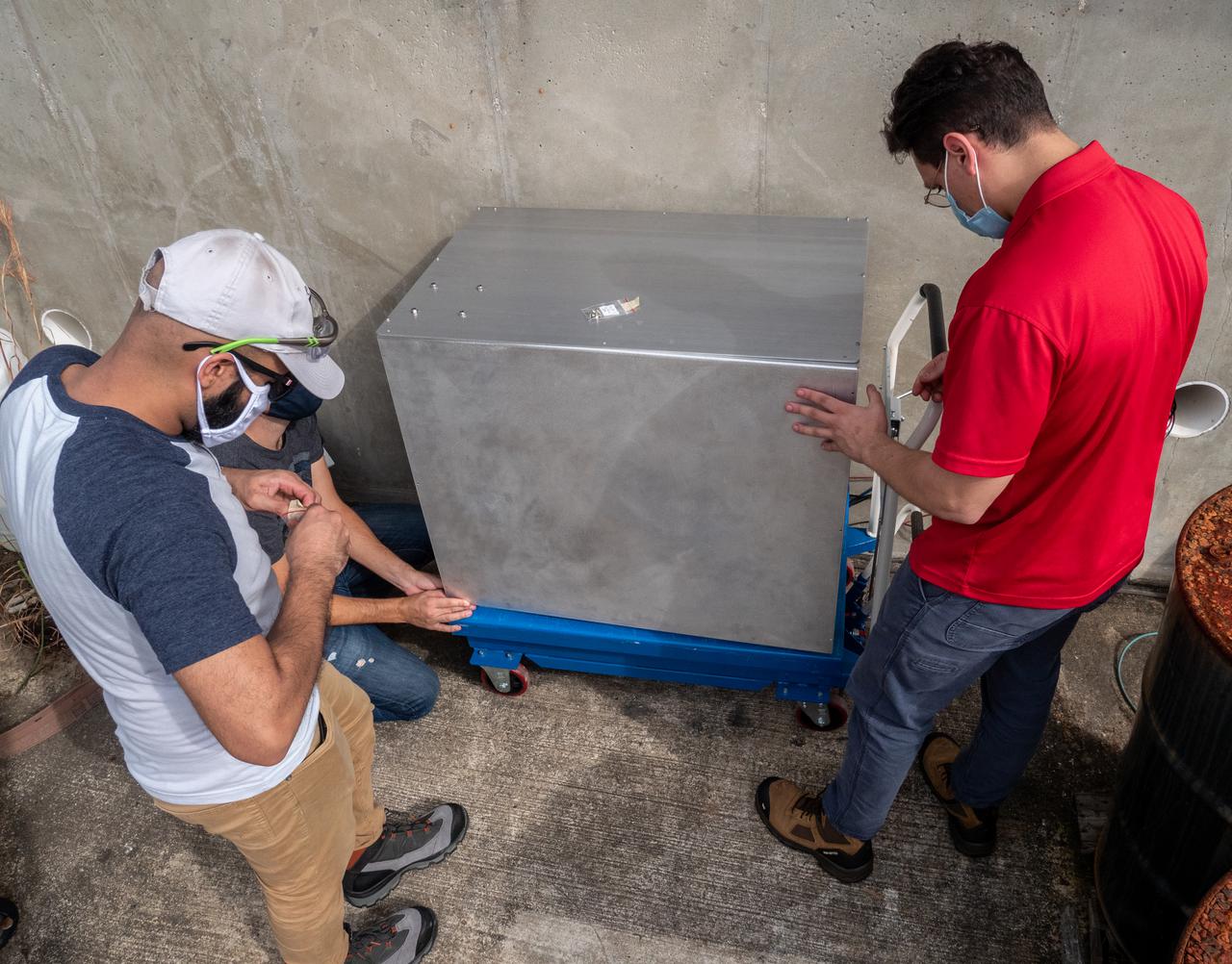
Thermal/Fluid Analysis Engineer Malay Shah, left, and Ray Pitts, co-principal investigator for the Orbital Syngas Commodity Augmentation Reactor (OSCAR), prepare OSCAR for thermal testing Jan. 26, 2021, at NASA’s Kennedy Space Center in Florida. The tests are in preparation for a scheduled suborbital flight test later this year facilitated by NASA’s Flight Opportunities program. The testing ensures the thermal environment of the payload won’t create additional hazards during flight and that OSCAR can successfully operate within the temperature range it may encounter as it performs tests in microgravity.

KENNEDY SPACE CENTER, FLA. -- United Space Alliance employees prepared three test articles that will be used in wind tunnel testing by NASA to collect data for analysis of the detached Flexible Insulation Blanket, or FIB, on Atlantis. The test articles each feature three tiles (Low Temperature Reusable Surface Insulation, or LRSI) affixed next to two FIB blankets, simulating the thermal protection system set-up on Atlantis' OMS pod in the vicinity of the in-flight anomaly. These test articles were flown to Texas the morning of June 14. The TPS team at KSC has also provided a total of 22 FIB samples for other testing and analysis. Photo credit: NASA/Kim Shiflett
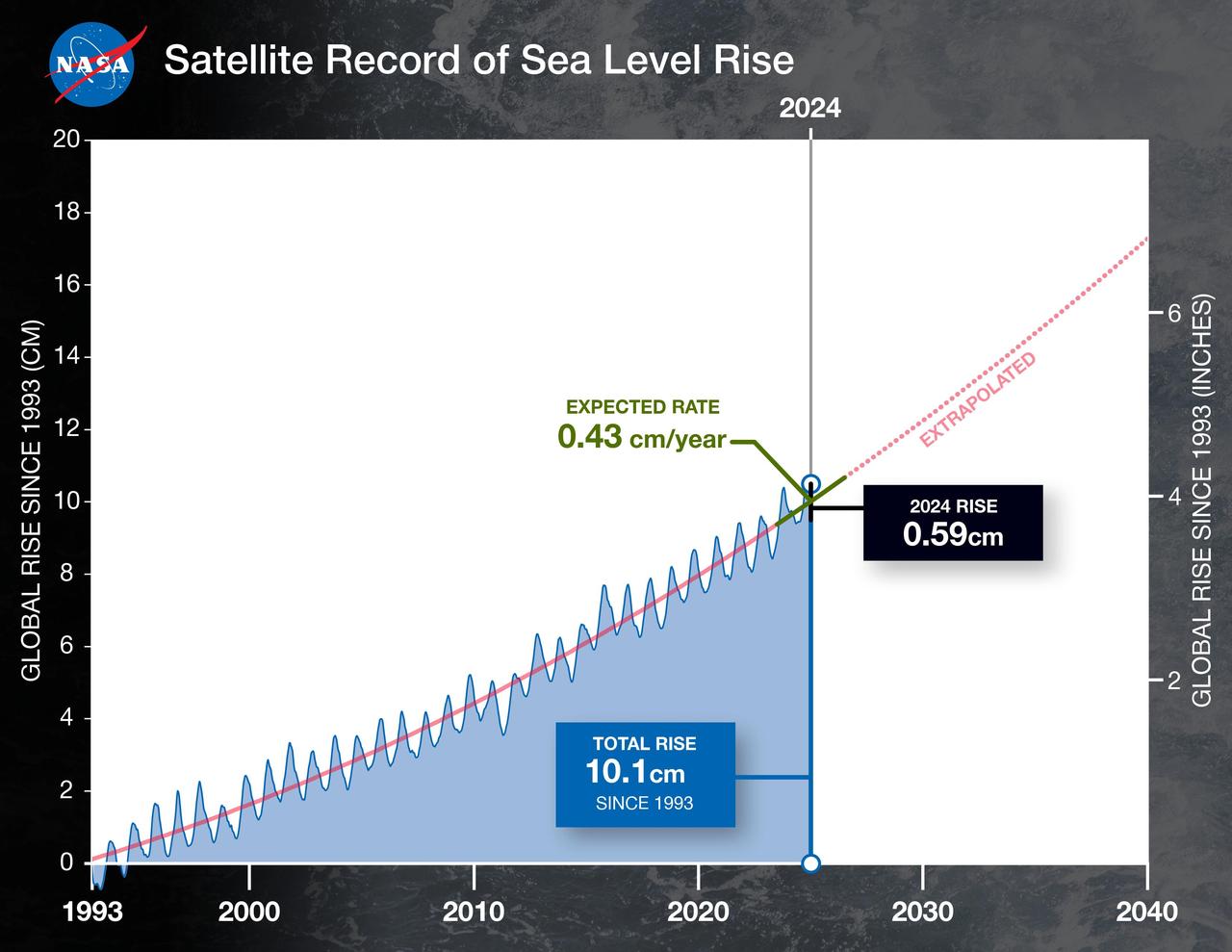
This graph shows the rise in global mean sea level from 1993 to 2024 based on data from a series of five international satellites. The solid red line indicates the trajectory of this increase, which has more than doubled over the three decades. The dotted red line projects future sea level rise. Global sea level rose faster than expected in 2024 due mostly to ocean water expanding as it warms, or thermal expansion. According to a NASA-led analysis, last year's rate of rise was 0.23 inches (0.59 centimeters) per year, compared to the expected rate of 0.17 inches (0.43 centimeters) per year. In recent years, about two-thirds of sea level rise was due to the addition of water from land into the ocean by melting ice sheets and glaciers. About a third came from thermal expansion of seawater. But in 2024, those contributions flipped, with two-thirds of sea level rise coming from thermal expansion. This NASA-led analysis is based on a sea level dataset featuring more than 30 years of satellite observations, starting with the U.S.-French TOPEX/Poseidon mission, which launched in 1992. The Sentinel-6 Michael Freilich mission, which launched in November 2020, is the latest in the series of satellites that have contributed to this sea level record. https://photojournal.jpl.nasa.gov/catalog/PIA26189
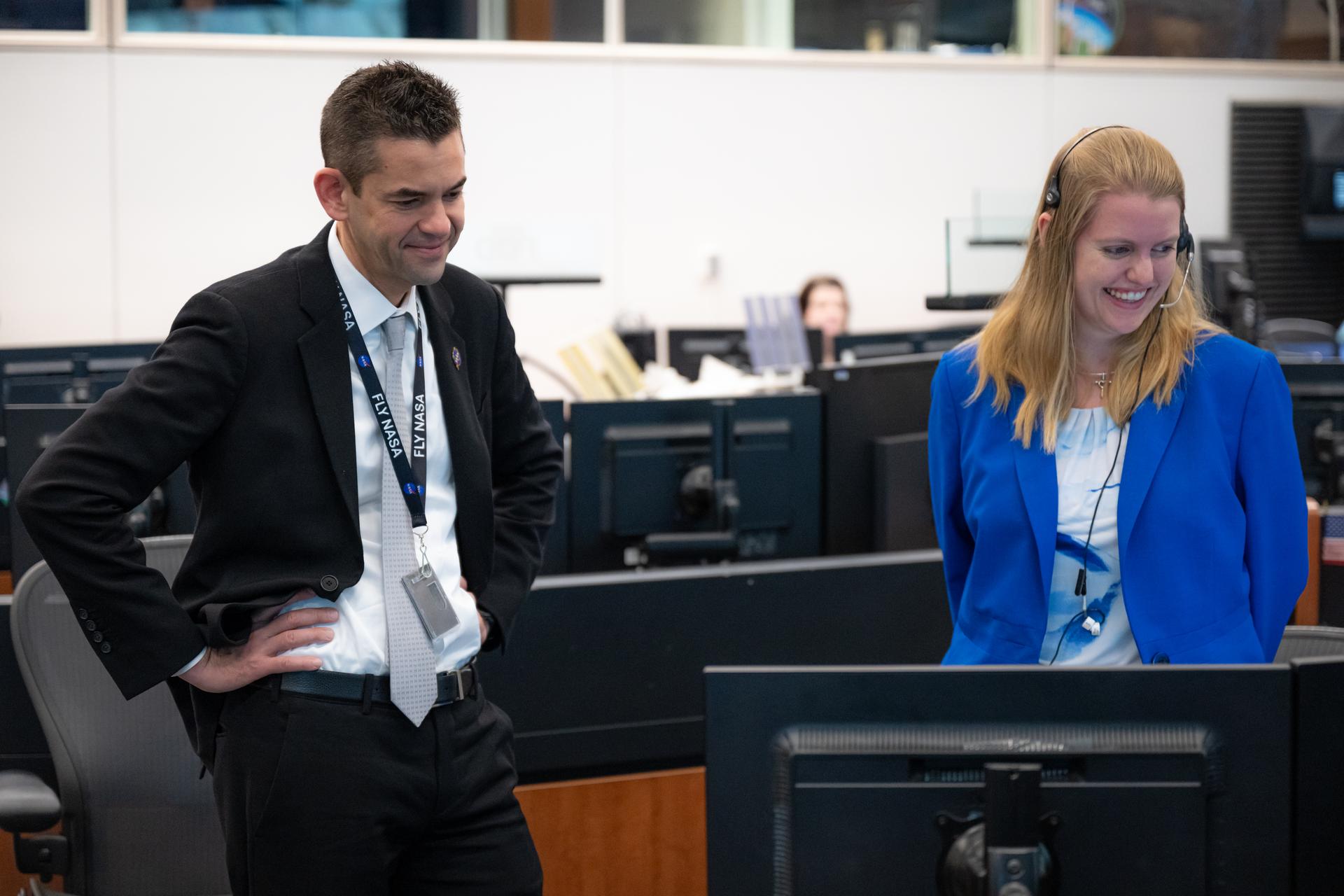
NASA Administrator Jared Isaacman, left, speaks with Rachel Krause, SPARTAN (Station Power, Articulation, Thermal, and Analysis) flight controller, right, Thursday, Jan. 15, 2026, inside the Christopher C. Kraft Jr. Mission Control Center at NASA’s Johnson Space Center in Houston, Texas, following splashdown of the agency’s Crew-11 mission at 3:41 a.m. ET. Photo Credit: (NASA/John Kraus)
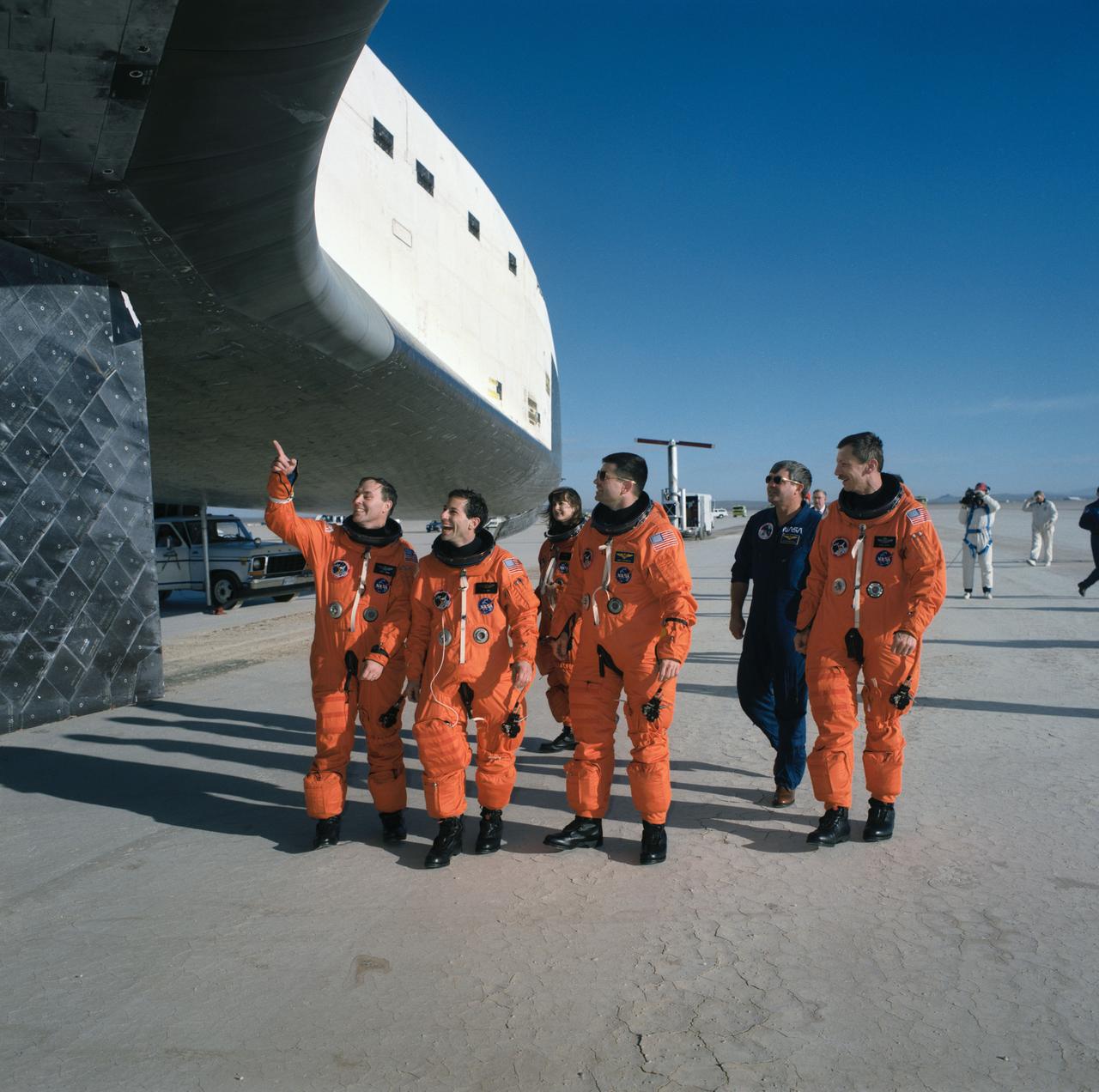
STS037-S-085 (11 April 1991) --- Following their egress from the Space Shuttle Atlantis at Edwards Air Force Base the STS-37 astronauts survey their "home" for the past six days. Pictured, left to right, are astronauts Jerry L. Ross, Jerome J. Apt, Linda M. Godwin, Kenneth D. Cameron, Daniel C. Brandenstein and Steven R. Nagel, mission commander. Brandenstein, chief of the Astronaut Office at JSC, flew the Shuttle training aircraft and took photographs during Atlantis's landing. Complete wheel stop occurred at 6:56:26 (PDT), April 11, 1991.
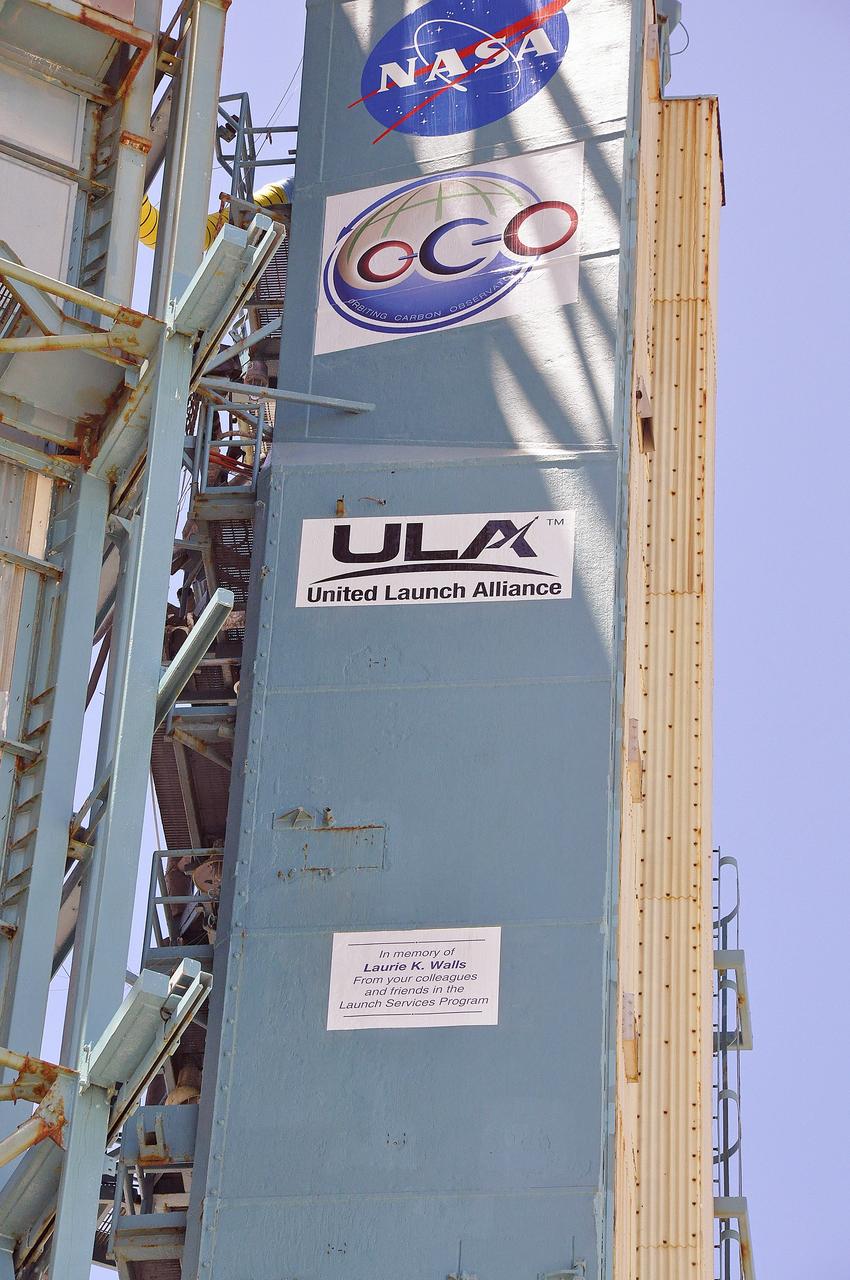
VANDENBERG AIR FORCE BASE, Calif. – A memorial plaque honoring Laurie K. Walls is affixed to the umbilical tower on Space Launch Complex 2 at Vandenberg Air Force Base in California for the launch of NASA's Orbiting Carbon Observatory-2, or OCO-2. Walls, a thermal analysis engineer with the Launch Services Program, or LSP, at NASA's Kennedy Space Center, died June 4. This dedication to Walls from the members of the launch team was read during the OCO-2 countdown commentary: "The OCO-2 mission has special meaning to NASA's Launch Services Program as we have dedicated it to one of our LSP Teammates, Laurie Walls. Laurie began her career over 30 years ago as a thermal engineer for McDonnell Douglas in Huntsville, Alabama, supporting NASA's Marshall Space Flight Center. She moved to Florida in 1985. Shortly after coming to Florida, Laurie became a civil servant working on the Shuttle program return to flight effort post-Challenger. In 1998, Laurie joined the newly formed Launch Services Program as one of the founding members of the flight analysis group. She served in LSP as the thermal discipline expert until her untimely death earlier this month. Laurie worked thermal issues for numerous NASA Delta II and Atlas V missions. Additionally, she provided key thermal support for both Delta II Heavy development and Atlas V Certification. Laurie was an integral member of LSP's family and she was truly dedicated to NASA and the LSP team. She will be greatly missed. We honor Laurie with a special memorial placed on the SLC-2 umbilical tower, and we thank ULA for helping to make this happen." Launch of OCO-2 is scheduled for 5:56 a.m. EDT on July 1. To learn more about NASA's Launch Services Program, visit http://www.nasa.gov/centers/kennedy/launchingrockets/index.html. Photo credit: NASA/Randy Beaudoin
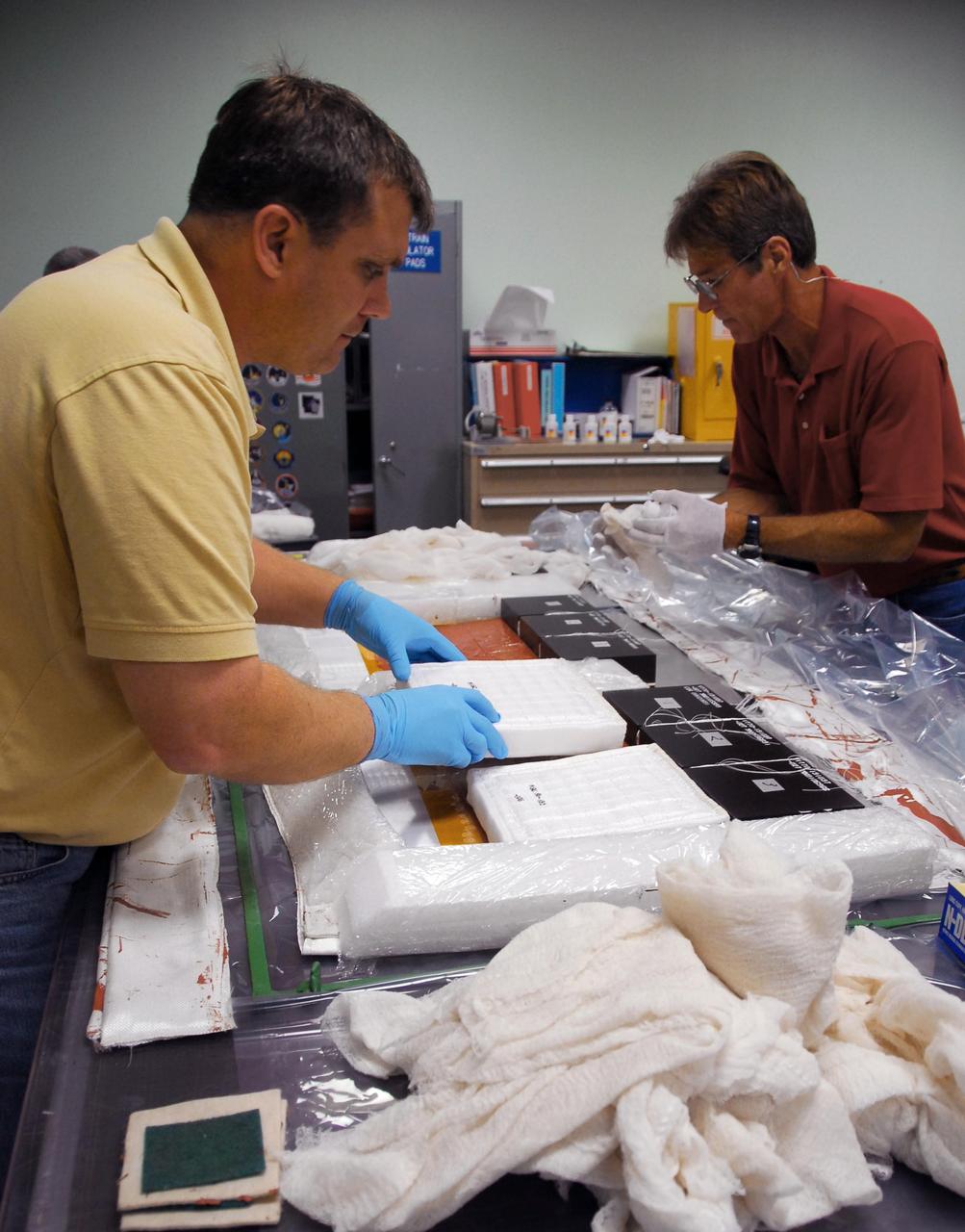
KENNEDY SPACE CENTER, FLA. -- United Space Alliance employees prepare test articles to be used in wind tunnel testing by NASA to collect data for analysis of the detached Flexible Insulation Blanket, or FIB, on Atlantis. A tear occurred in an area of the OMS pod on Atlantis during launch of mission STS-117 on June 8, 2007. The test articles each feature three tiles (Low Temperature Reusable Surface Insulation, or LRSI) affixed next to two FIB blankets, simulating the thermal protection system set-up on Atlantis' OMS pod in the vicinity of the in-flight anomaly. These test articles will be flown to Texas the morning of June 14. The TPS team at KSC has also provided a total of 22 FIB samples for other testing and analysis. Repair is under consideration following testing at KSC and Houston. Photo credit: NASA/Amanda Diller
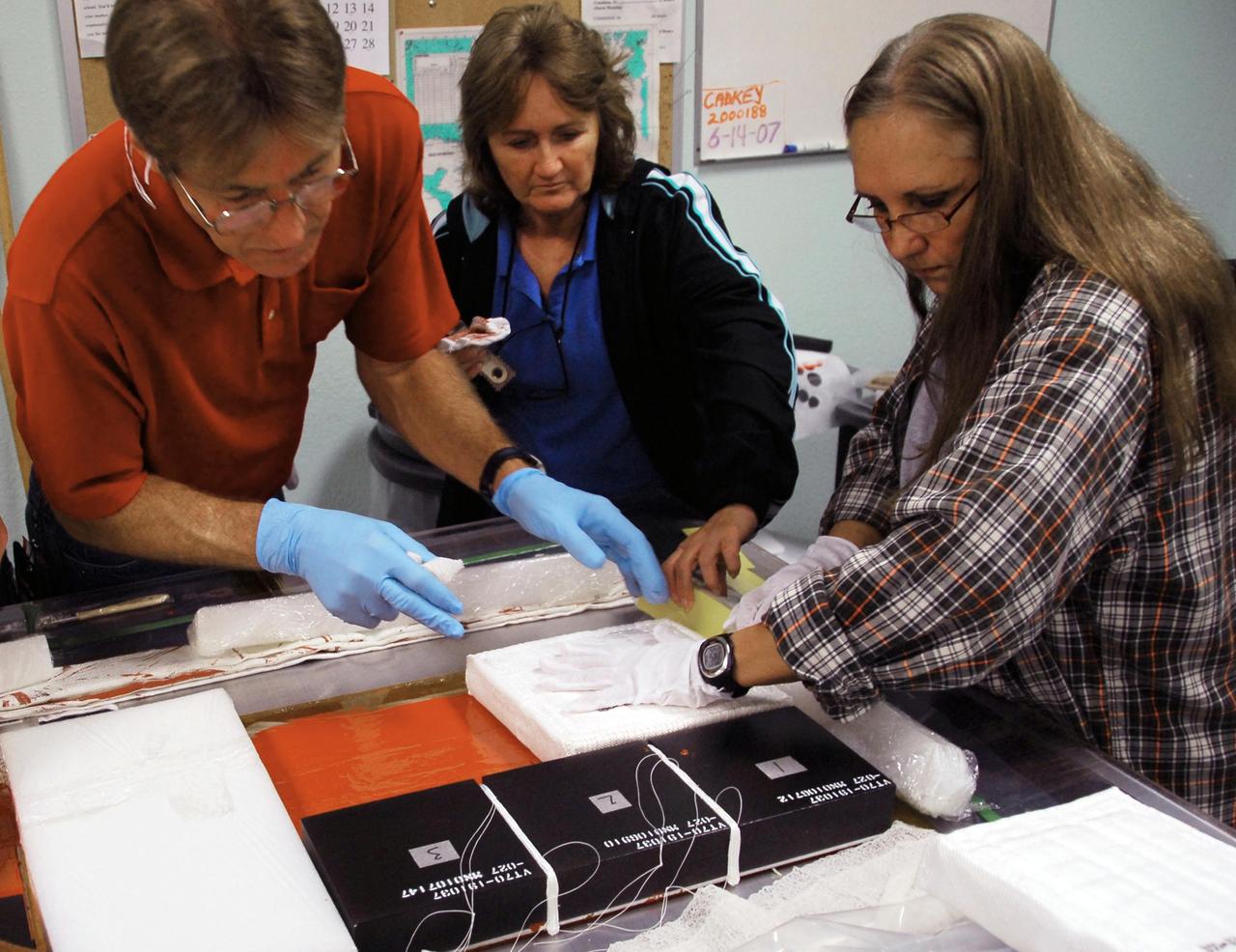
KENNEDY SPACE CENTER, FLA. -- United Space Alliance employees prepare test articles to be used in wind tunnel testing by NASA to collect data for analysis of the detached Flexible Insulation Blanket, or FIB, on Atlantis. A tear occurred in an area of the OMS pod on Atlantis during launch of mission STS-117 on June 8, 2007. The test articles each feature three tiles (Low Temperature Reusable Surface Insulation, or LRSI) affixed next to two FIB blankets, simulating the thermal protection system set-up on Atlantis' OMS pod in the vicinity of the in-flight anomaly. These test articles will be flown to Texas the morning of June 14. The TPS team at KSC has also provided a total of 22 FIB samples for other testing and analysis. Repair is under consideration following testing at KSC and Houston. Photo credit: NASA/Amanda Diller
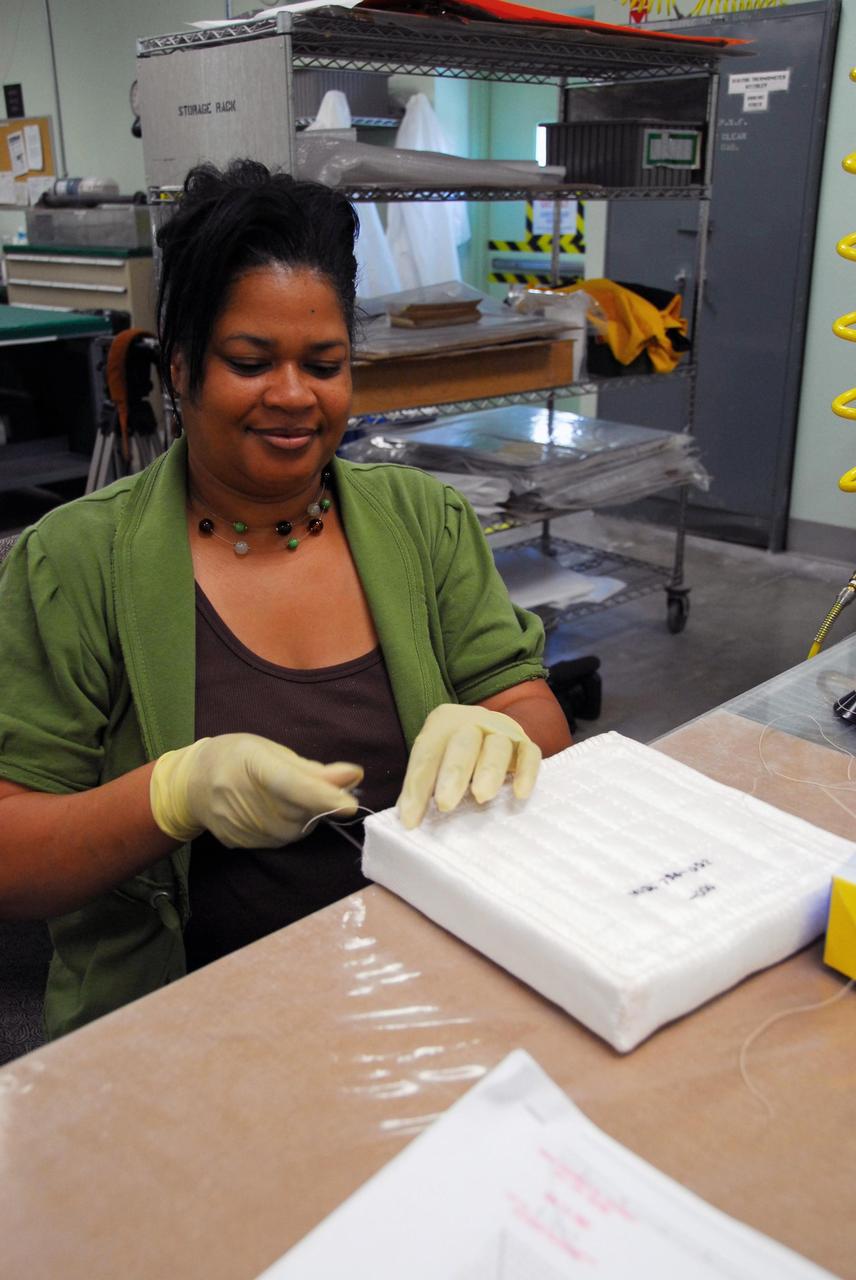
KENNEDY SPACE CENTER, FLA. -- A United Space Alliance employee prepares a test article that will be used in wind tunnel testing by NASA to collect data for analysis of the detached Flexible Insulation Blanket, or FIB, on Atlantis. A tear occurred in an area of the OMS pod on Atlantis during launch of mission STS-117 on June 8, 2007. The test articles each feature three tiles (Low Temperature Reusable Surface Insulation, or LRSI) affixed next to two FIB blankets, simulating the thermal protection system set-up on Atlantis' OMS pod in the vicinity of the in-flight anomaly. These test articles will be flown to Texas the morning of June 14. The TPS team at KSC has also provided a total of 22 FIB samples for other testing and analysis. Repair is under consideration following testing at KSC and Houston. Photo credit: NASA/Amanda Diller
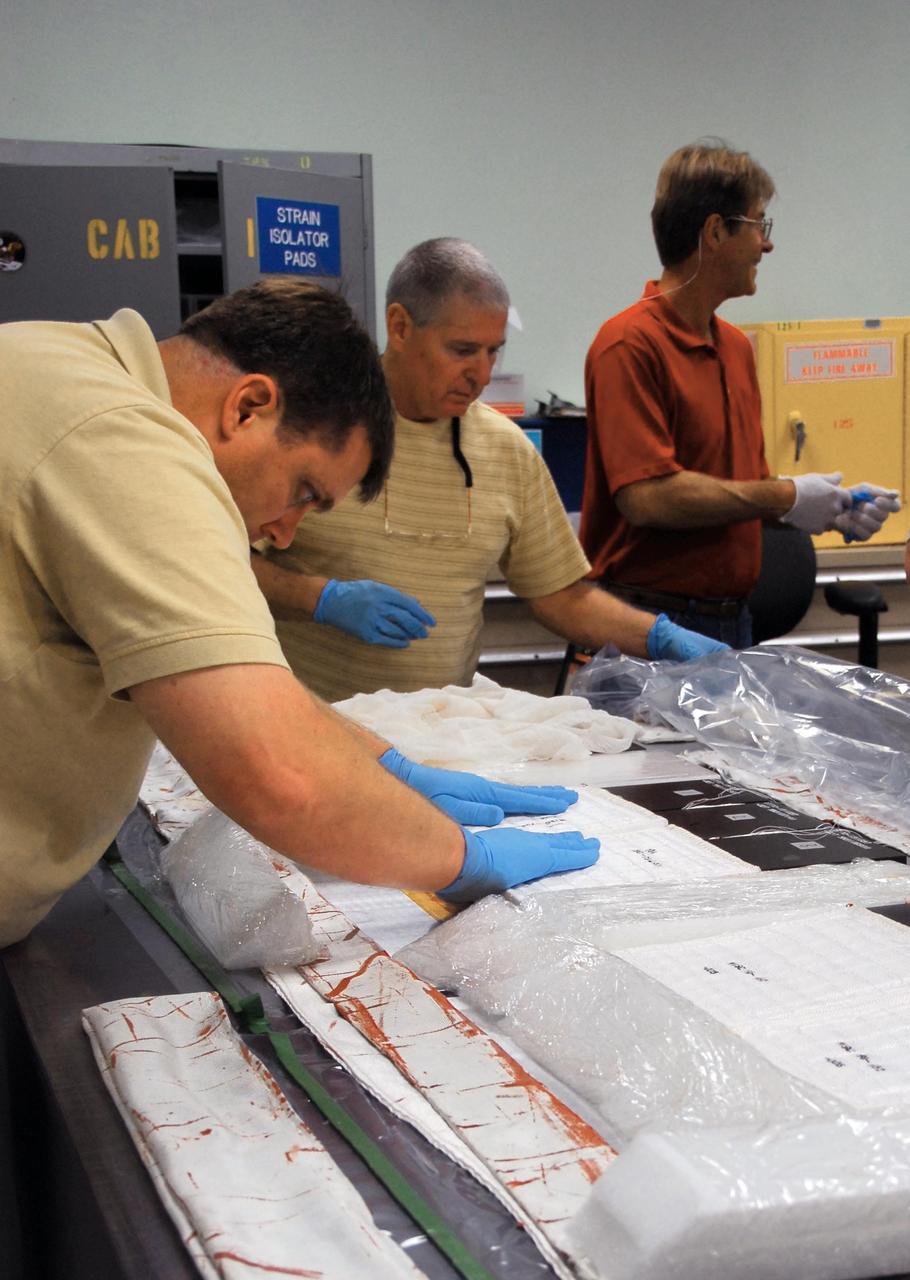
KENNEDY SPACE CENTER, FLA. -- United Space Alliance employees prepare test articles to be used in wind tunnel testing by NASA to collect data for analysis of the detached Flexible Insulation Blanket, or FIB, on Atlantis. A tear occurred in an area of the OMS pod on Atlantis during launch of mission STS-117 on June 8, 2007. The test articles each feature three tiles (Low Temperature Reusable Surface Insulation, or LRSI) affixed next to two FIB blankets, simulating the thermal protection system set-up on Atlantis' OMS pod in the vicinity of the in-flight anomaly. These test articles will be flown to Texas the morning of June 14. The TPS team at KSC has also provided a total of 22 FIB samples for other testing and analysis. Repair is under consideration following testing at KSC and Houston. Photo credit: NASA/Amanda Diller
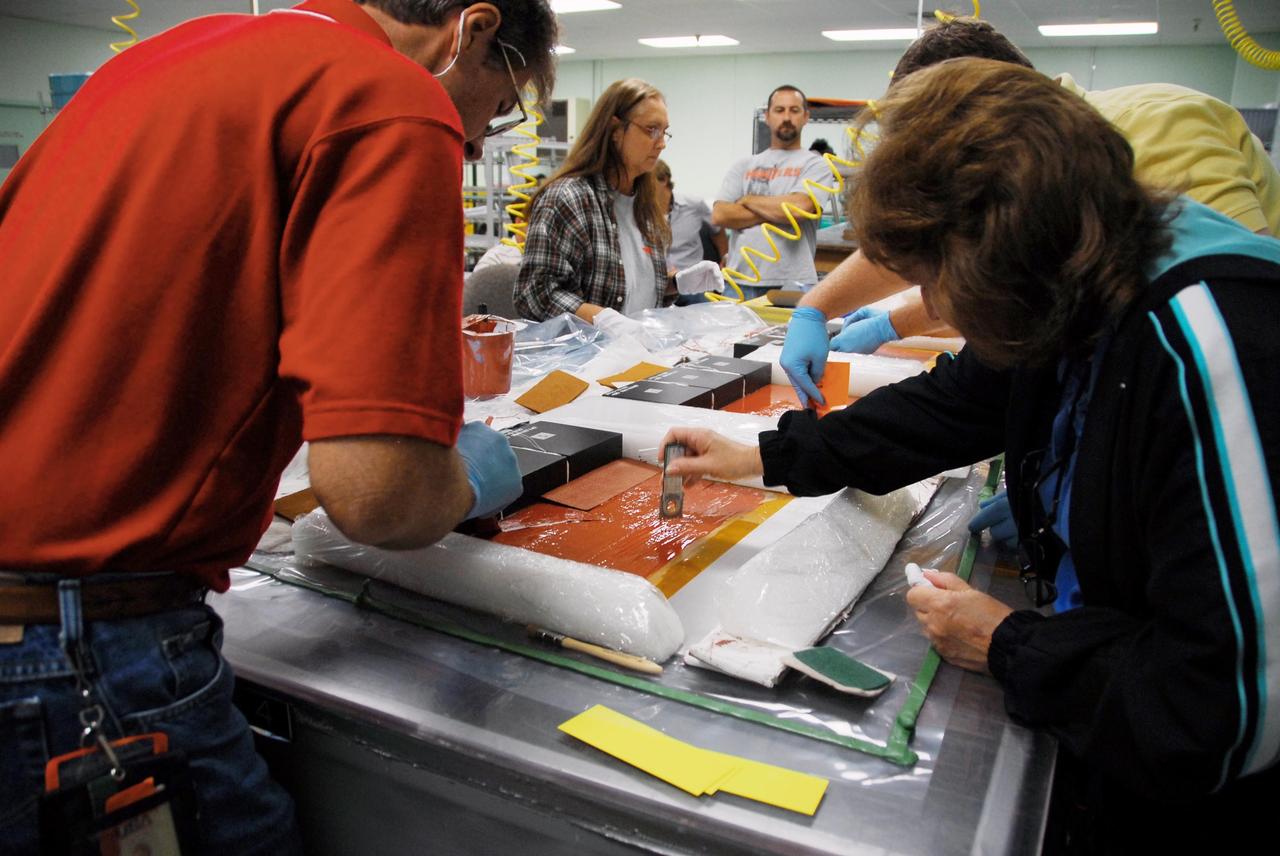
KENNEDY SPACE CENTER, FLA. -- United Space Alliance employees prepare test articles to be used in wind tunnel testing by NASA to collect data for analysis of the detached Flexible Insulation Blanket, or FIB, on Atlantis. A tear occurred in an area of the OMS pod on Atlantis during launch of mission STS-117 on June 8, 2007. The test articles each feature three tiles (Low Temperature Reusable Surface Insulation, or LRSI) affixed next to two FIB blankets, simulating the thermal protection system set-up on Atlantis' OMS pod in the vicinity of the in-flight anomaly. These test articles will be flown to Texas the morning of June 14. The TPS team at KSC has also provided a total of 22 FIB samples for other testing and analysis. Repair is under consideration following testing at KSC and Houston. Photo credit: NASA/Amanda Diller
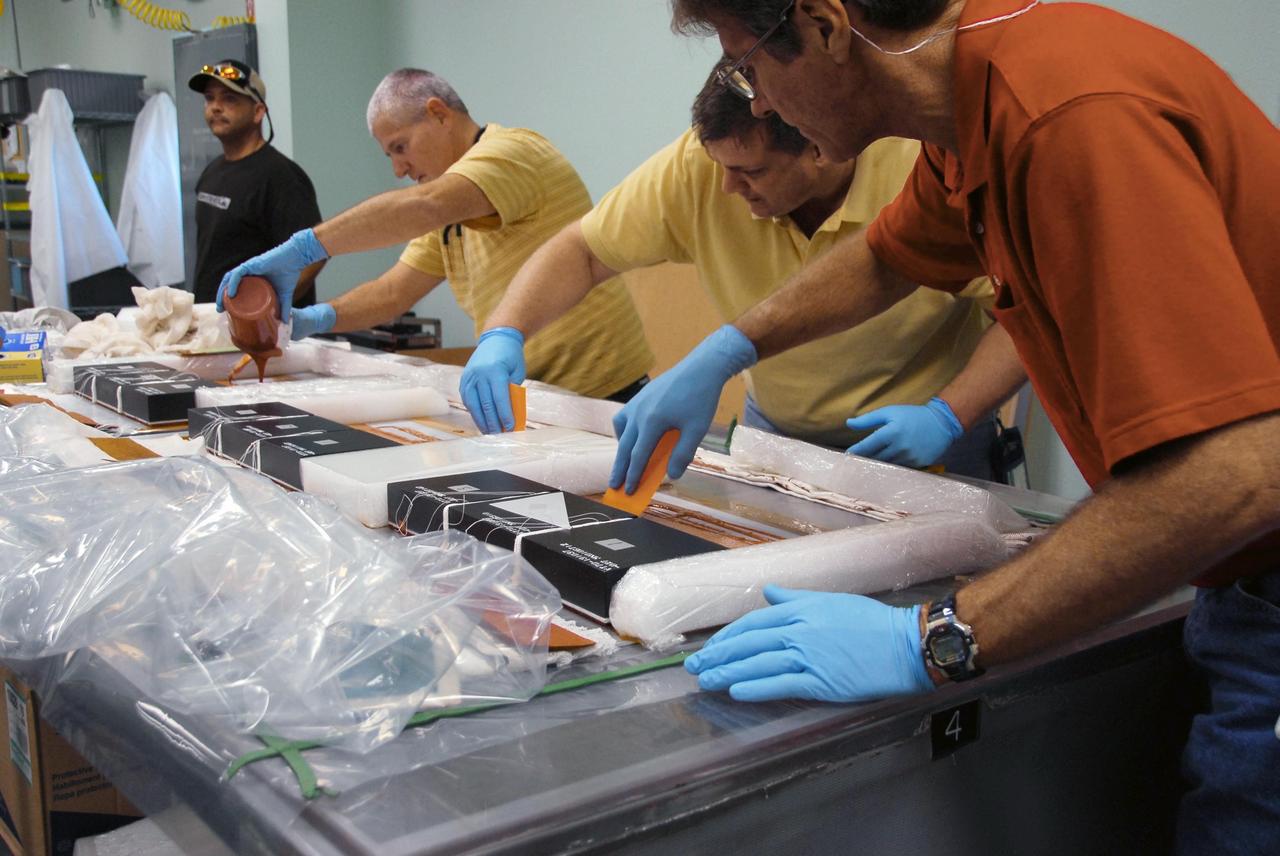
KENNEDY SPACE CENTER, FLA. -- United Space Alliance employees prepare test articles to be used in wind tunnel testing by NASA to collect data for analysis of the detached Flexible Insulation Blanket, or FIB, on Atlantis. A tear occurred in an area of the OMS pod on Atlantis during launch of mission STS-117 on June 8, 2007. The test articles each feature three tiles (Low Temperature Reusable Surface Insulation, or LRSI) affixed next to two FIB blankets, simulating the thermal protection system set-up on Atlantis' OMS pod in the vicinity of the in-flight anomaly. These test articles will be flown to Texas the morning of June 14. The TPS team at KSC has also provided a total of 22 FIB samples for other testing and analysis. Repair is under consideration following testing at KSC and Houston. Photo credit: NASA/Amanda Diller
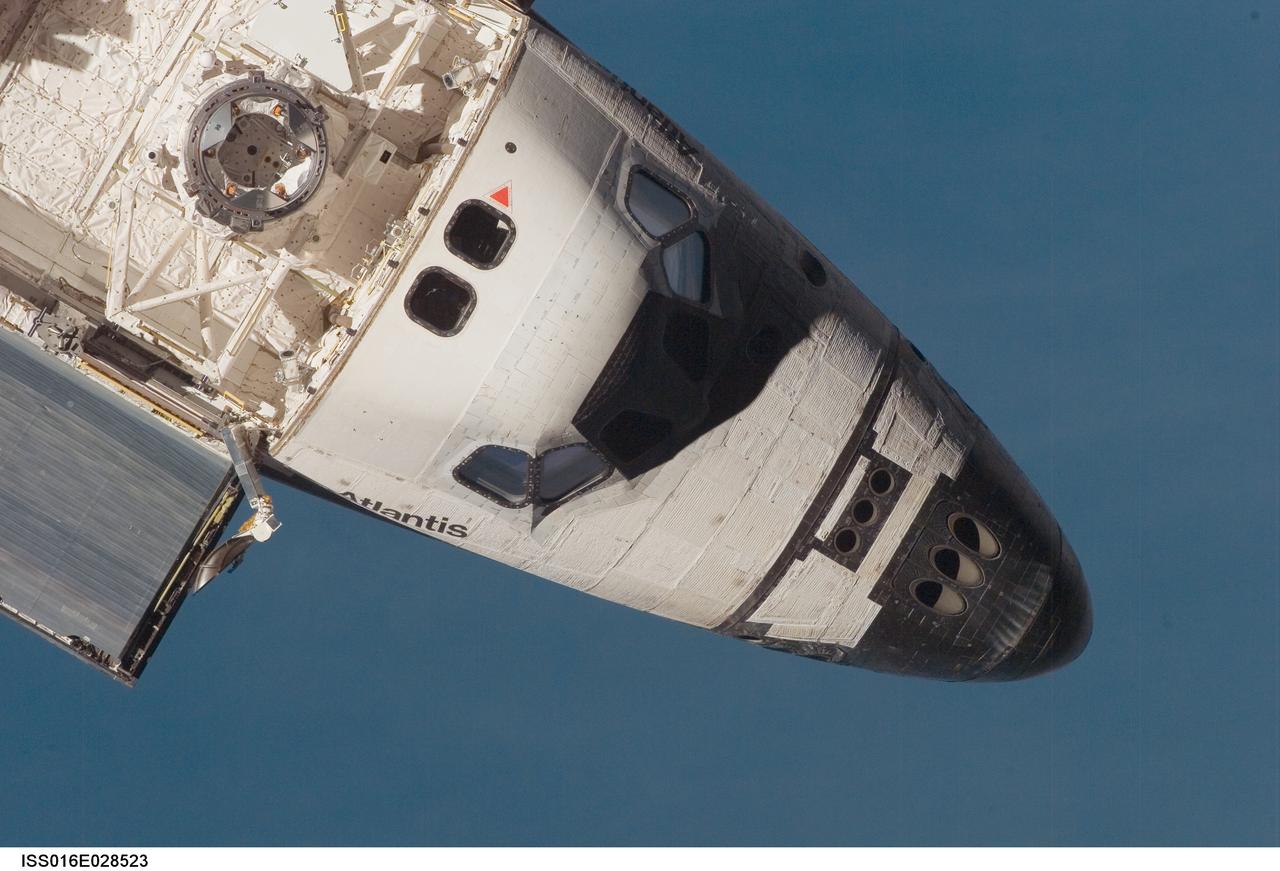
ISS016-E-028523 (9 Feb. 2008) --- An overhead view of the exterior of the Space Shuttle Atlantis' crew cabin and docking system was provided by Expedition 16 crewmembers. Before docking with the International Space Station, astronaut Steve Frick, STS-122 commander, flew the shuttle through a roll pitch maneuver or basically a backflip to allow the space station crew a good view of Atlantis' heat shield. Using digital still cameras equipped with both 400 and 800 millimeter lenses, the ISS crewmembers took a number of photos of the shuttle's thermal protection system and sent them down to teams on the ground for analysis. A 400 millimeter lens was used for this image.
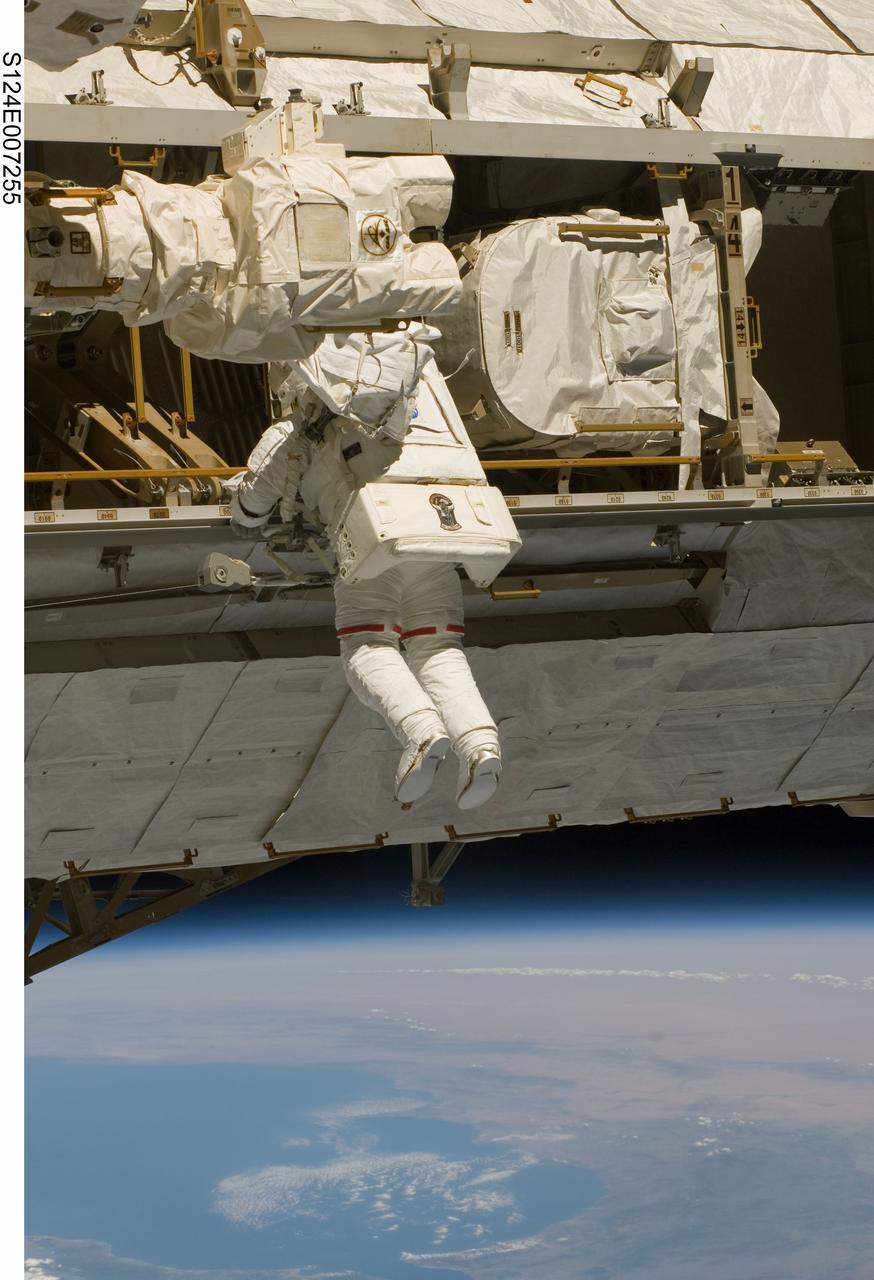
S124-E-007255 (8 June 2008) --- Astronaut Mike Fossum, STS-124 mission specialist, participates in the mission's third scheduled session of extravehicular activity (EVA) as construction and maintenance continue on the International Space Station. During the six-hour, 33-minute spacewalk, Fossum and astronaut Ron Garan (out of frame), mission specialist, exchanged a depleted Nitrogen Tank Assembly for a new one, removed thermal covers and launch locks from the Kibo laboratory, reinstalled a repaired television camera onto the space station's left P1 truss, and retrieved samples of a dust-like substance from the left Solar Alpha Rotary Joint for analysis by experts on the ground.
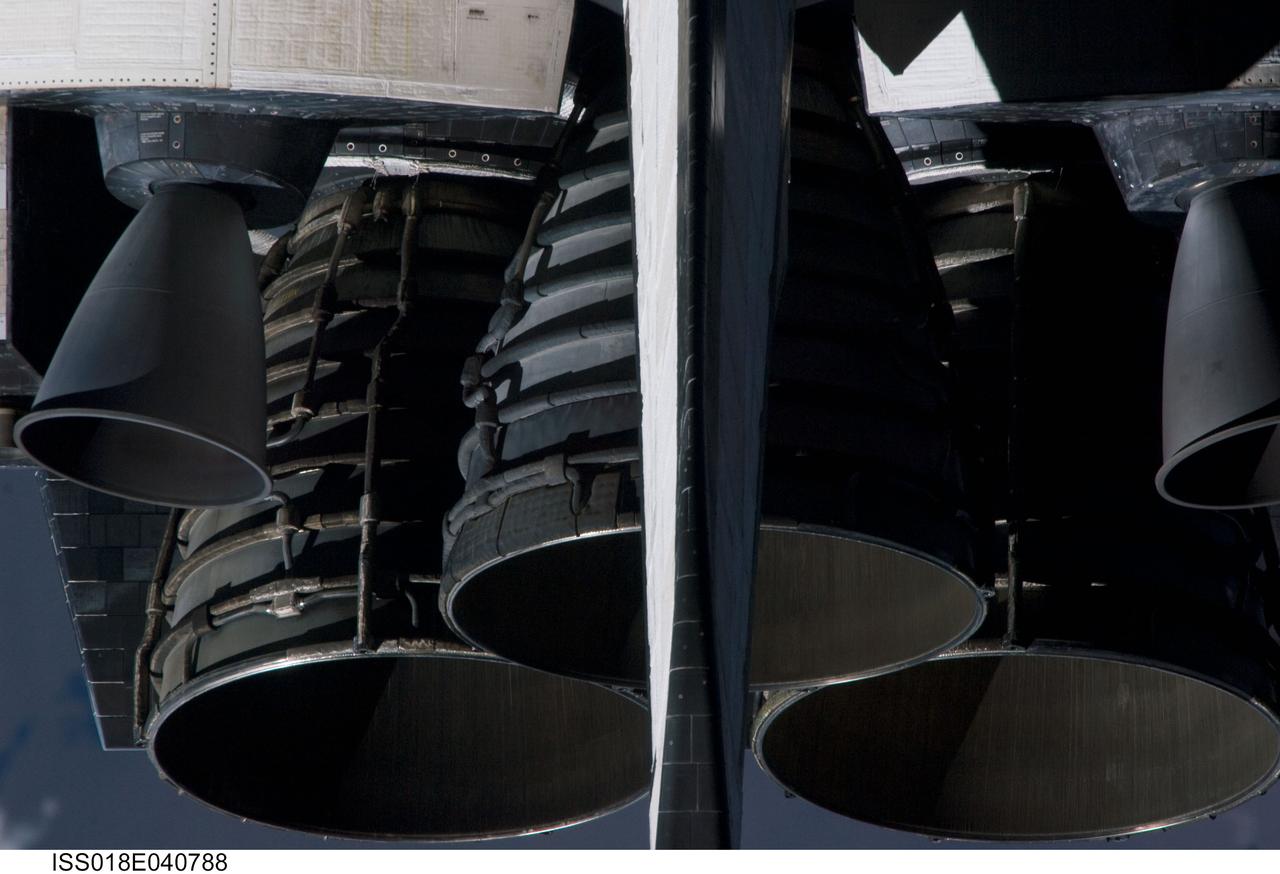
ISS018-E-040788 (17 March 2009) --- A close-up view of Space Shuttle Discovery?s main engines was provided by Expedition 18 crewmembers on the International Space Station. Before docking with the station, astronaut Lee Archambault, STS-119 commander, flew the shuttle through a Rendezvous Pitch Maneuver or basically a backflip to allow the space station crew a good view of Discovery's heat shield. Using digital still cameras equipped with both 400 and 800 millimeter lenses, the ISS crewmembers took a number of photos of the shuttle's thermal protection system and sent them down to teams on the ground for analysis. A 800 millimeter lens was used for this image.

ISS018-E-040837 (17 March 2009) --- A close-up view of the exterior of Space Shuttle Discovery's nose and underside was provided by Expedition 18 crewmembers on the International Space Station. Before docking with the station, astronaut Lee Archambault, STS-119 commander, flew the shuttle through a Rendezvous Pitch Maneuver or basically a backflip to allow the space station crew a good view of Discovery's heat shield. Using digital still cameras equipped with both 400 and 800 millimeter lenses, the ISS crewmembers took a number of photos of the shuttle's thermal protection system and sent them down to teams on the ground for analysis. A 400 millimeter lens was used for this image.
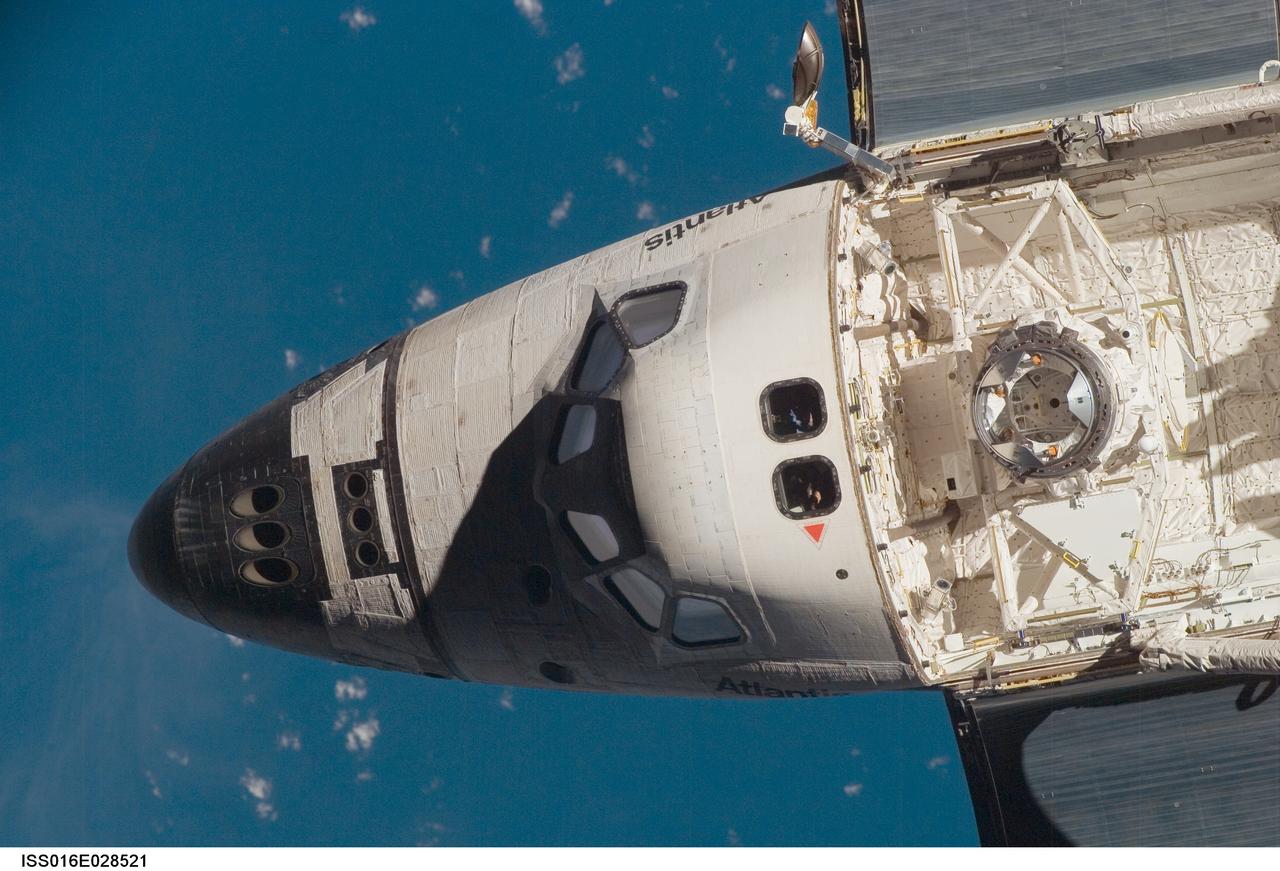
ISS016-E-028521 (9 Feb. 2008) --- An overhead view of the exterior of the Space Shuttle Atlantis' crew cabin and docking system was provided by Expedition 16 crewmembers. Before docking with the International Space Station, astronaut Steve Frick, STS-122 commander, flew the shuttle through a roll pitch maneuver or basically a backflip to allow the space station crew a good view of Atlantis' heat shield. Using digital still cameras equipped with both 400 and 800 millimeter lenses, the ISS crewmembers took a number of photos of the shuttle's thermal protection system and sent them down to teams on the ground for analysis. A 400 millimeter lens was used for this image.
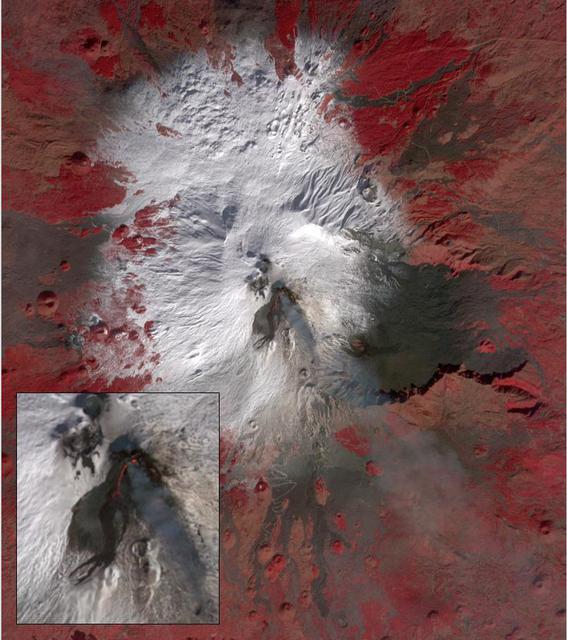
Starting December 13, 2020, a strong eruptive episode began at Mt. Etna's New SE summit crater. Lava fountains produced a new lava flow, traveling to the SW. The fresh lava is hot enough to be incandescent, and appears as a red "snake" issuing from the crater's flank. The lava fountain appears as a separate red area at the crater's summit. A faint gray plume streams southeastward from the crater. Analysis of the thermal infrared data reveals that the plume's composition is dominated by SO2. The image was acquired December 15, 2020, covers an area of 12 by 13.5 km, and is located at 37.7 degrees north, 15 degrees east. https://photojournal.jpl.nasa.gov/catalog/PIA24283
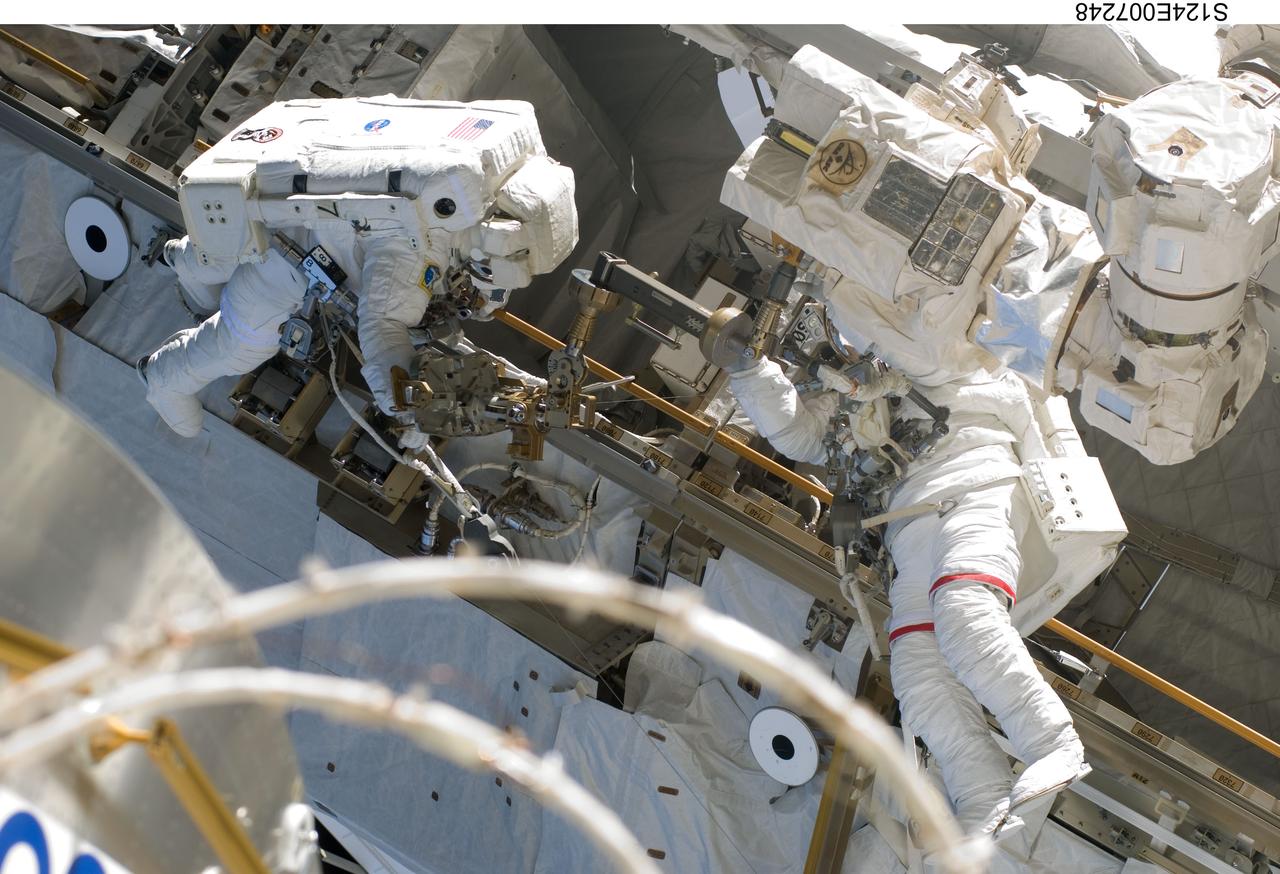
S124-E-007248 (8 June 2008) --- Astronauts Mike Fossum (right) and Ron Garan, both STS-124 mission specialists, participate in the mission's third scheduled session of extravehicular activity (EVA) as construction and maintenance continue on the International Space Station. During the six-hour, 33-minute spacewalk, Fossum and Garan exchanged a depleted Nitrogen Tank Assembly for a new one, removed thermal covers and launch locks from the Kibo laboratory, reinstalled a repaired television camera onto the space station's left P1 truss, and retrieved samples of a dust-like substance from the left Solar Alpha Rotary Joint for analysis by experts on the ground.
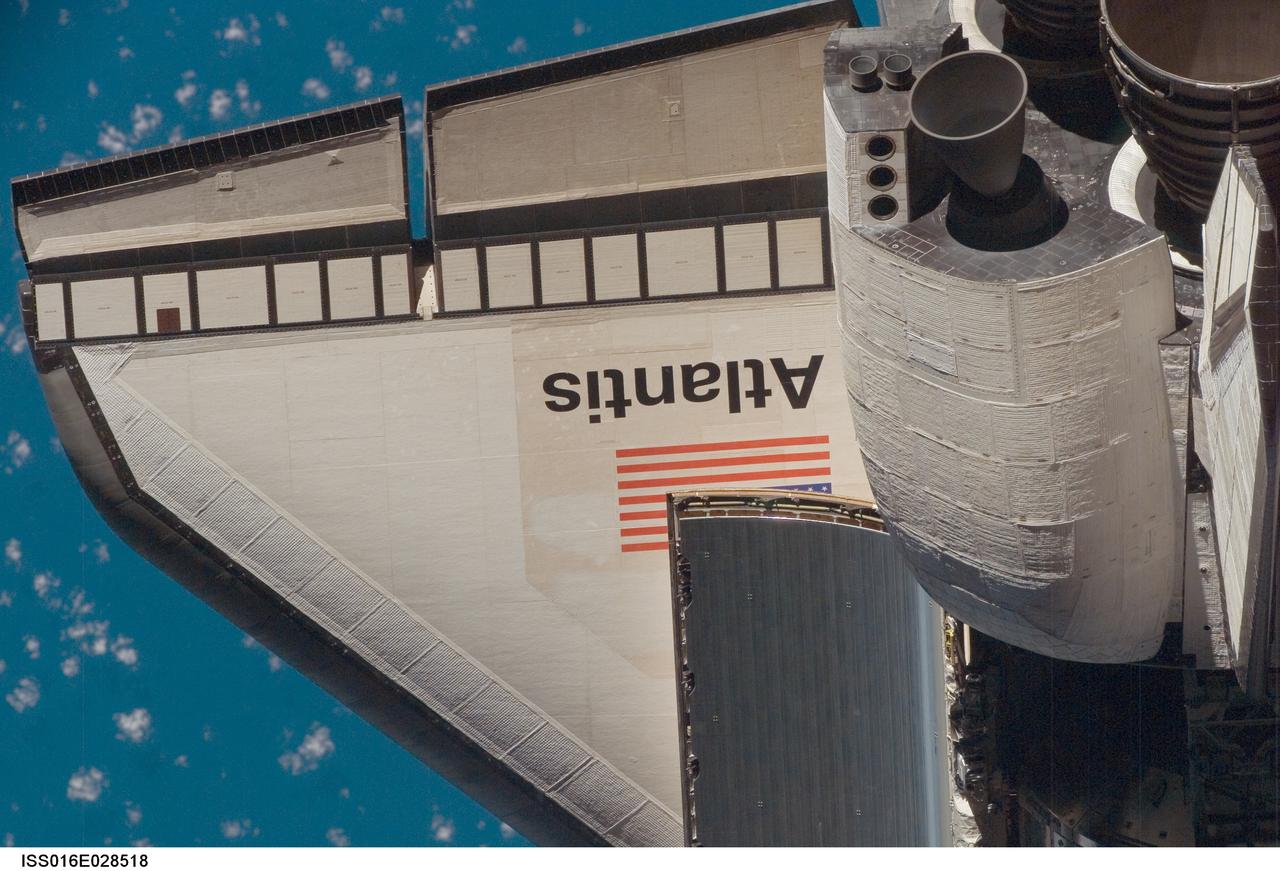
ISS016-E-028518 (9 Feb. 2008) --- An overhead view of part of the Space Shuttle Atlantis' starboard wing and part of its orbital maneuvering system pods was provided by Expedition 16 crewmembers. Before docking with the International Space Station, astronaut Steve Frick, STS-122 commander, flew the shuttle through a roll pitch maneuver or basically a backflip to allow the space station crew a good view of Atlantis' heat shield. Using digital still cameras equipped with both 400 and 800 millimeter lenses, the ISS crewmembers took a number of photos of the shuttle's thermal protection system and sent them down to teams on the ground for analysis. A 400 millimeter lens was used for this image.
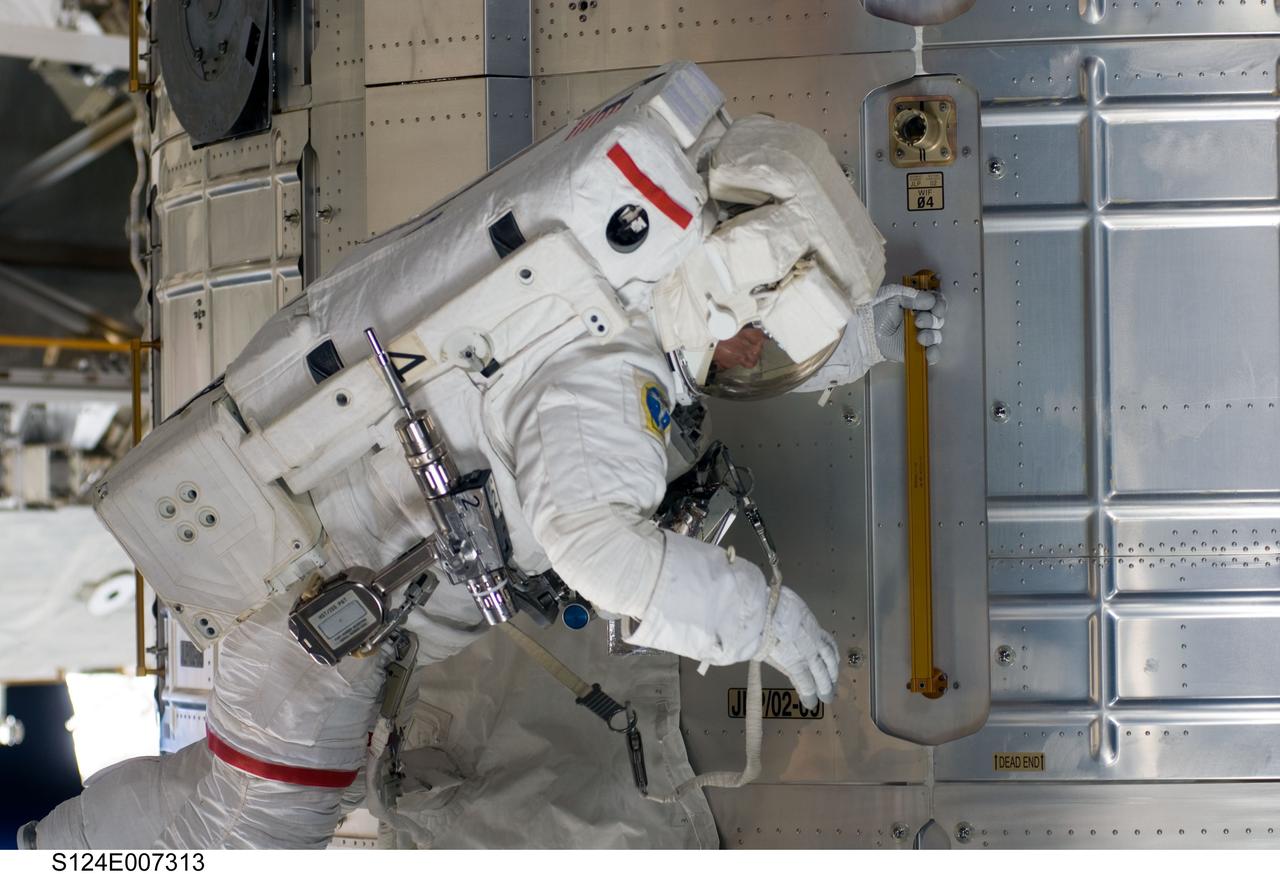
S124-E-007313 (8 June 2008) --- Astronaut Mike Fossum, STS-124 mission specialist, participates in the mission's third scheduled session of extravehicular activity (EVA) as construction and maintenance continue on the International Space Station. During the six-hour, 33-minute spacewalk, Fossum and astronaut Ron Garan (out of frame), mission specialist, exchanged a depleted Nitrogen Tank Assembly for a new one, removed thermal covers and launch locks from the Kibo laboratory, reinstalled a repaired television camera onto the space station's left P1 truss, and retrieved samples of a dust-like substance from the left Solar Alpha Rotary Joint for analysis by experts on the ground.
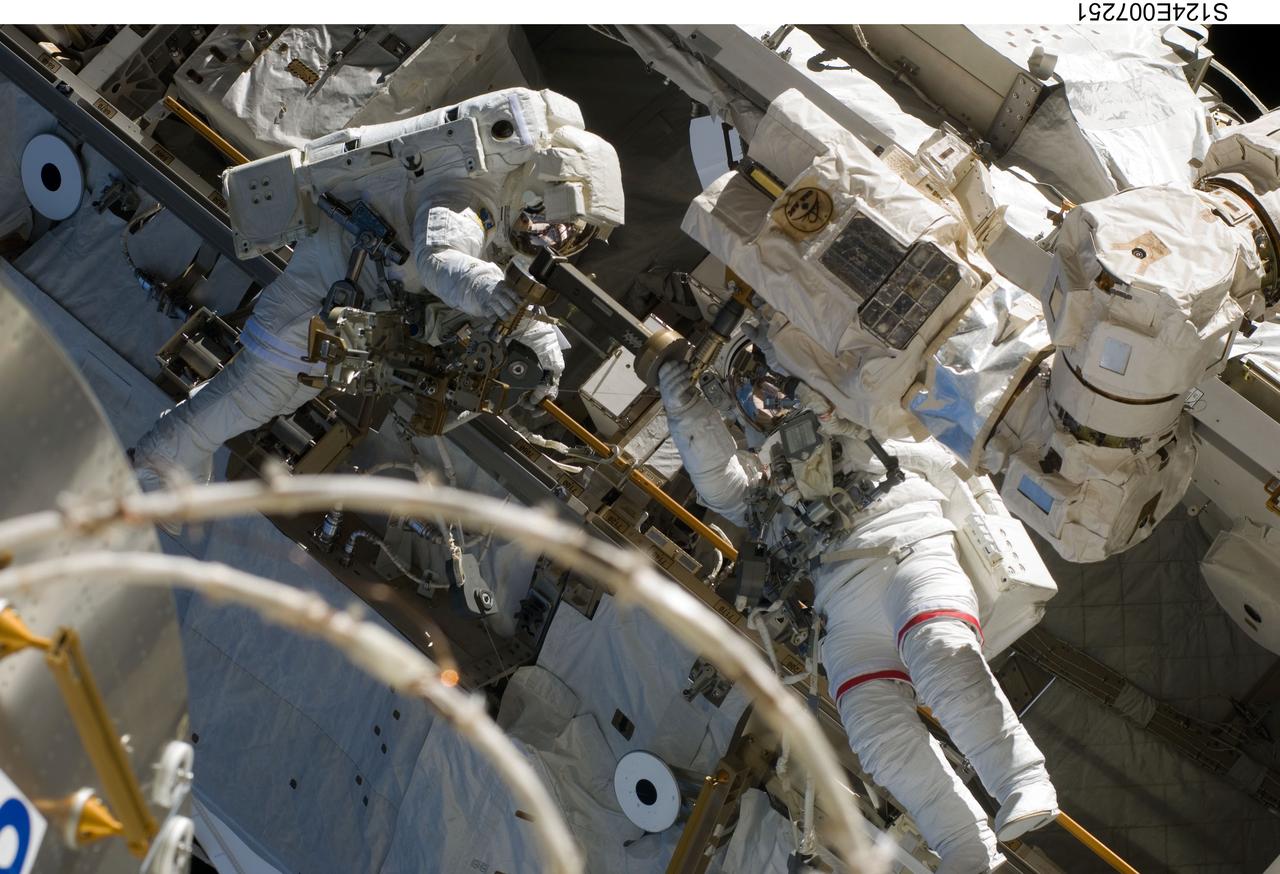
S124-E-007251 (8 June 2008) --- Astronauts Mike Fossum (right) and Ron Garan, both STS-124 mission specialists, participate in the mission's third scheduled session of extravehicular activity (EVA) as construction and maintenance continue on the International Space Station. During the six-hour, 33-minute spacewalk, Fossum and Garan exchanged a depleted Nitrogen Tank Assembly for a new one, removed thermal covers and launch locks from the Kibo laboratory, reinstalled a repaired television camera onto the space station's left P1 truss, and retrieved samples of a dust-like substance from the left Solar Alpha Rotary Joint for analysis by experts on the ground.
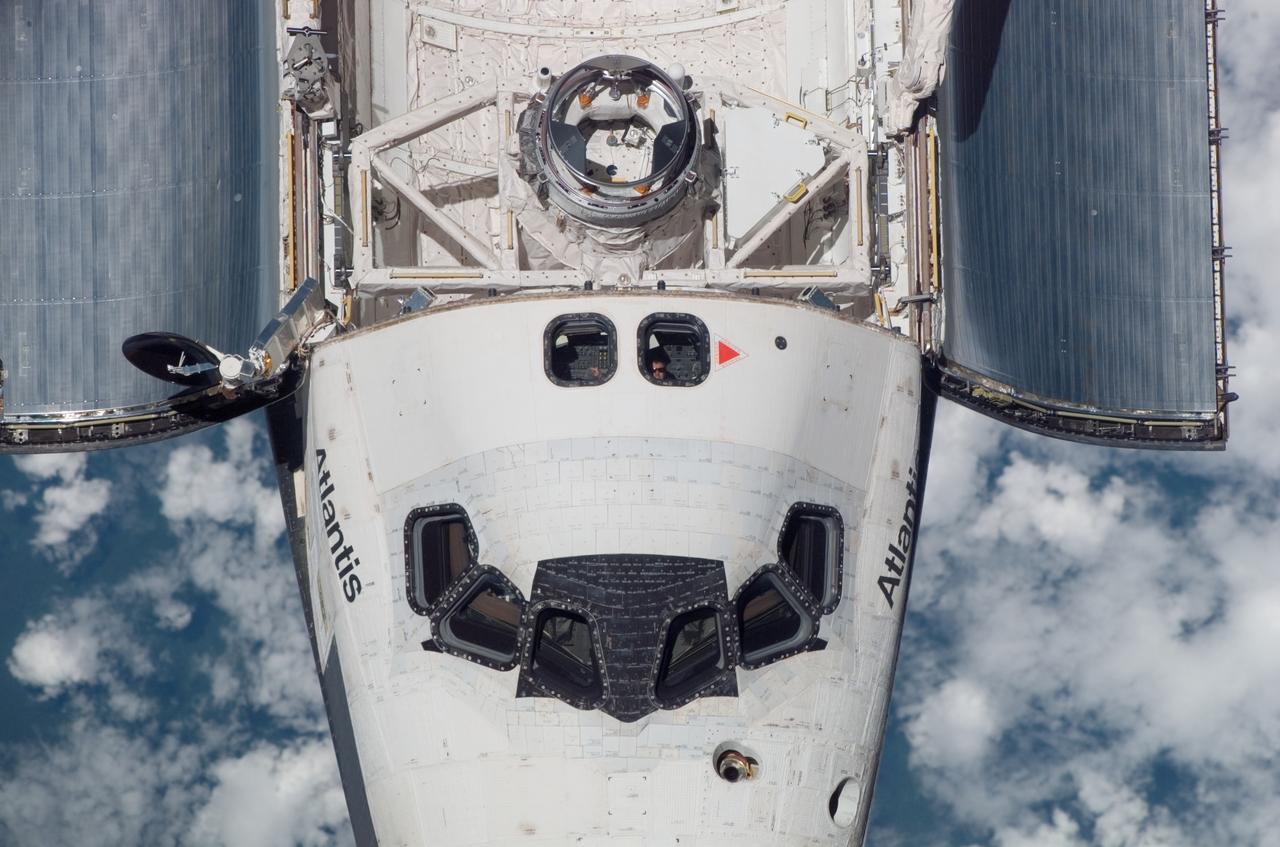
ISS016-E-028388 (9 Feb. 2008) --- An overhead view of the exterior of the Space Shuttle Atlantis' crew cabin, part of its payload bay doors and docking system was provided by Expedition 16 crewmembers. Before docking with the International Space Station, astronaut Steve Frick, STS-122 commander, flew the shuttle through a roll pitch maneuver or basically a backflip to allow the space station crew a good view of Atlantis' heat shield. Using digital still cameras equipped with both 400 and 800 millimeter lenses, the ISS crewmembers took a number of photos of the shuttle's thermal protection system and sent them down to teams on the ground for analysis. A 400 millimeter lens was used for this image.
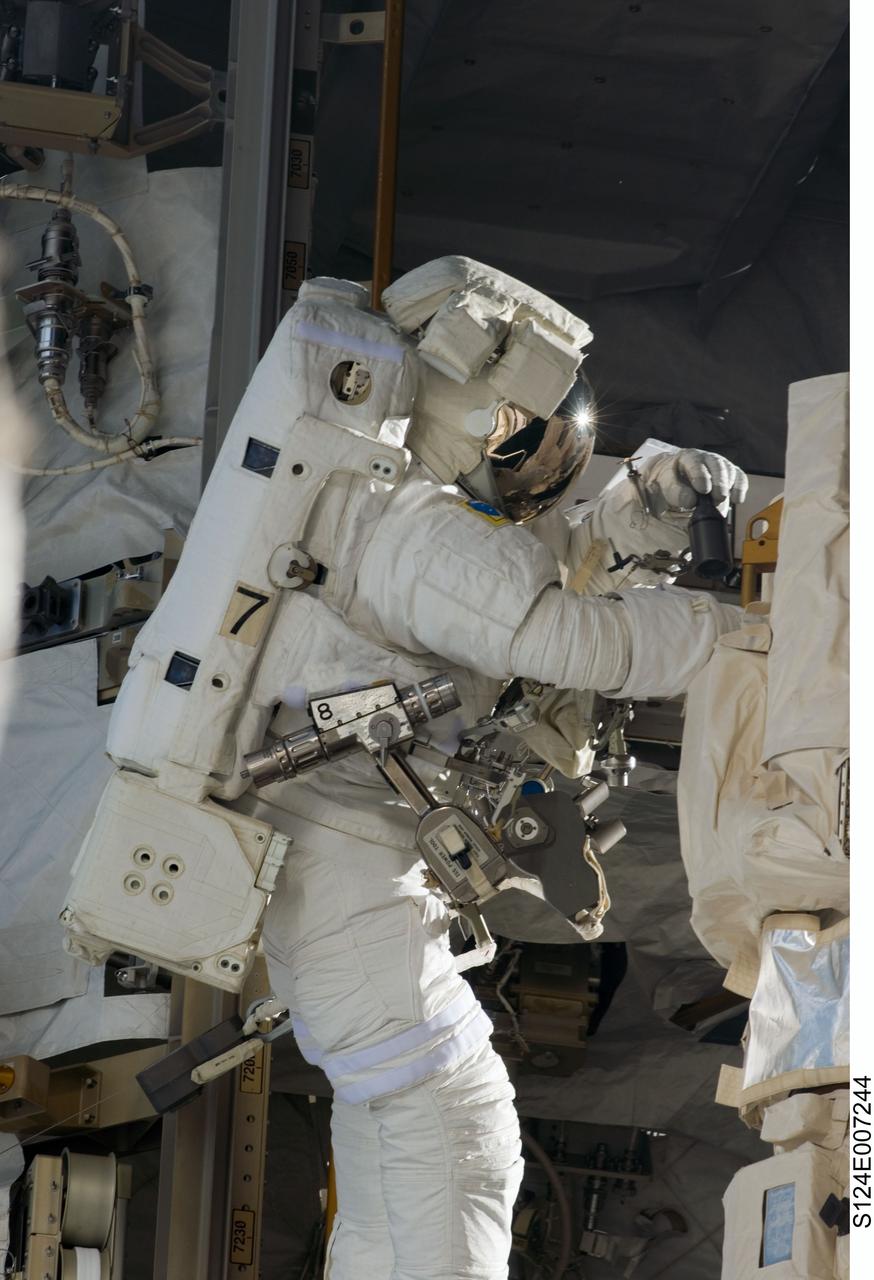
S124-E-007244 (8 June 2008) --- Astronaut Ron Garan, STS-124 mission specialist, participates in the mission's third scheduled session of extravehicular activity (EVA) as construction and maintenance continue on the International Space Station. During the six-hour, 33-minute spacewalk, Garan and astronaut Mike Fossum (out of frame), mission specialist, exchanged a depleted Nitrogen Tank Assembly for a new one, removed thermal covers and launch locks from the Kibo laboratory, reinstalled a repaired television camera onto the space station's left P1 truss, and retrieved samples of a dust-like substance from the left Solar Alpha Rotary Joint for analysis by experts on the ground.
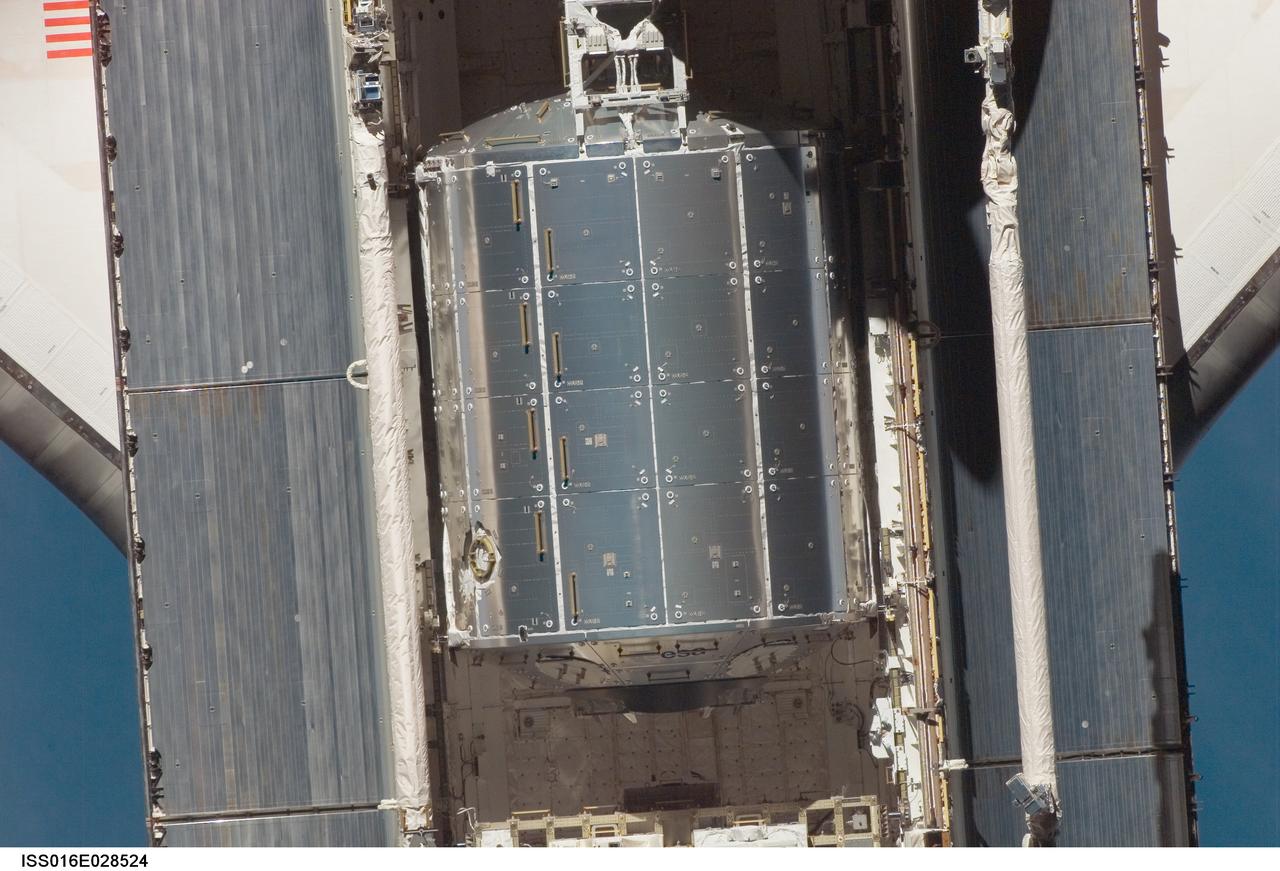
ISS016-E-028524 (9 Feb. 2008) --- An overhead view of the European Space Agency's Columbus laboratory in Space Shuttle Atlantis' cargo bay was provided by Expedition 16 crewmembers. Before docking with the International Space Station, astronaut Steve Frick, STS-122 commander, flew the shuttle through a roll pitch maneuver or basically a backflip to allow the space station crew a good view of Atlantis' heat shield. Using digital still cameras equipped with both 400 and 800 millimeter lenses, the ISS crewmembers took a number of photos of the shuttle's thermal protection system and sent them down to teams on the ground for analysis. A 400 millimeter lens was used for this image.
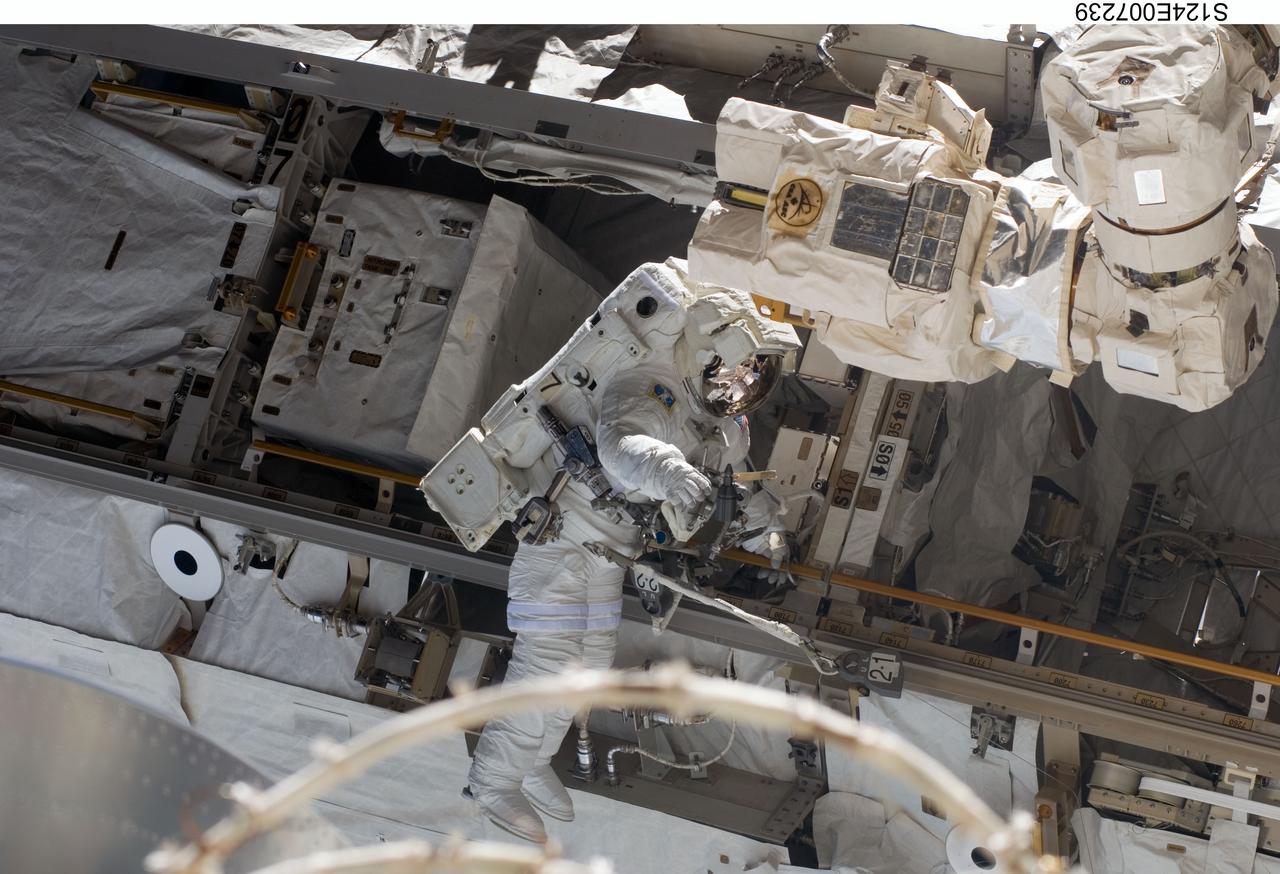
S124-E-007239 (8 June 2008) --- Astronaut Ron Garan, STS-124 mission specialist, participates in the mission's third scheduled session of extravehicular activity (EVA) as construction and maintenance continue on the International Space Station. During the six-hour, 33-minute spacewalk, Garan and astronaut Mike Fossum (out of frame), mission specialist, exchanged a depleted Nitrogen Tank Assembly for a new one, removed thermal covers and launch locks from the Kibo laboratory, reinstalled a repaired television camera onto the space station's left P1 truss, and retrieved samples of a dust-like substance from the left Solar Alpha Rotary Joint for analysis by experts on the ground.
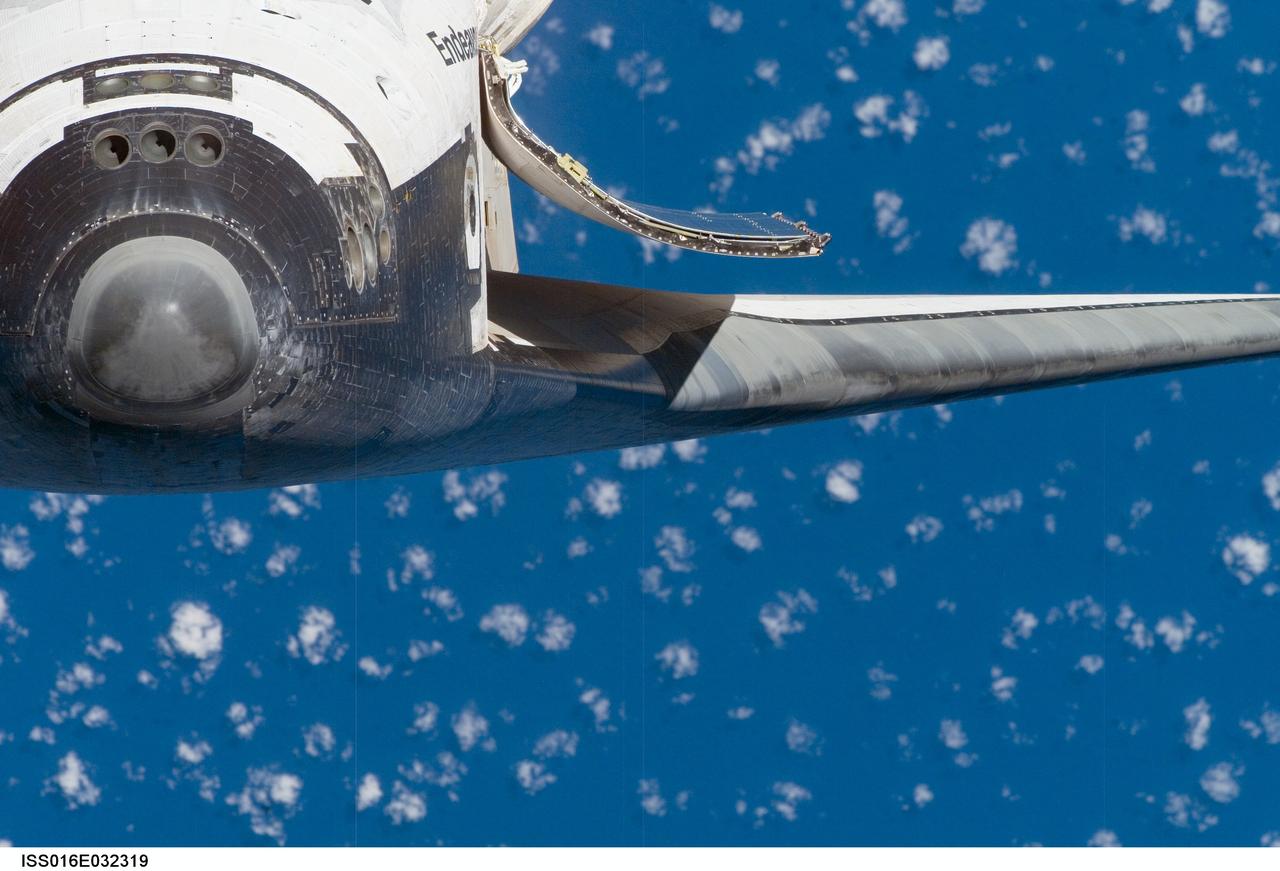
ISS016-E-032319 (12 March 2008) --- A close-up view of the exterior of Space Shuttle Endeavour's nose, port wing and payload bay door was provided by Expedition 16 crewmembers on the International Space Station (ISS). Before docking with the station, astronaut Dominic Gorie, STS-123 commander, flew the shuttle through a roll pitch maneuver or basically a backflip to allow the space station crew a good view of Endeavour's heat shield. Using digital still cameras equipped with both 400 and 800 millimeter lenses, the ISS crewmembers took a number of photos of the shuttle's thermal protection system and sent them down to teams on the ground for analysis. A 400 millimeter lens was used for this image.
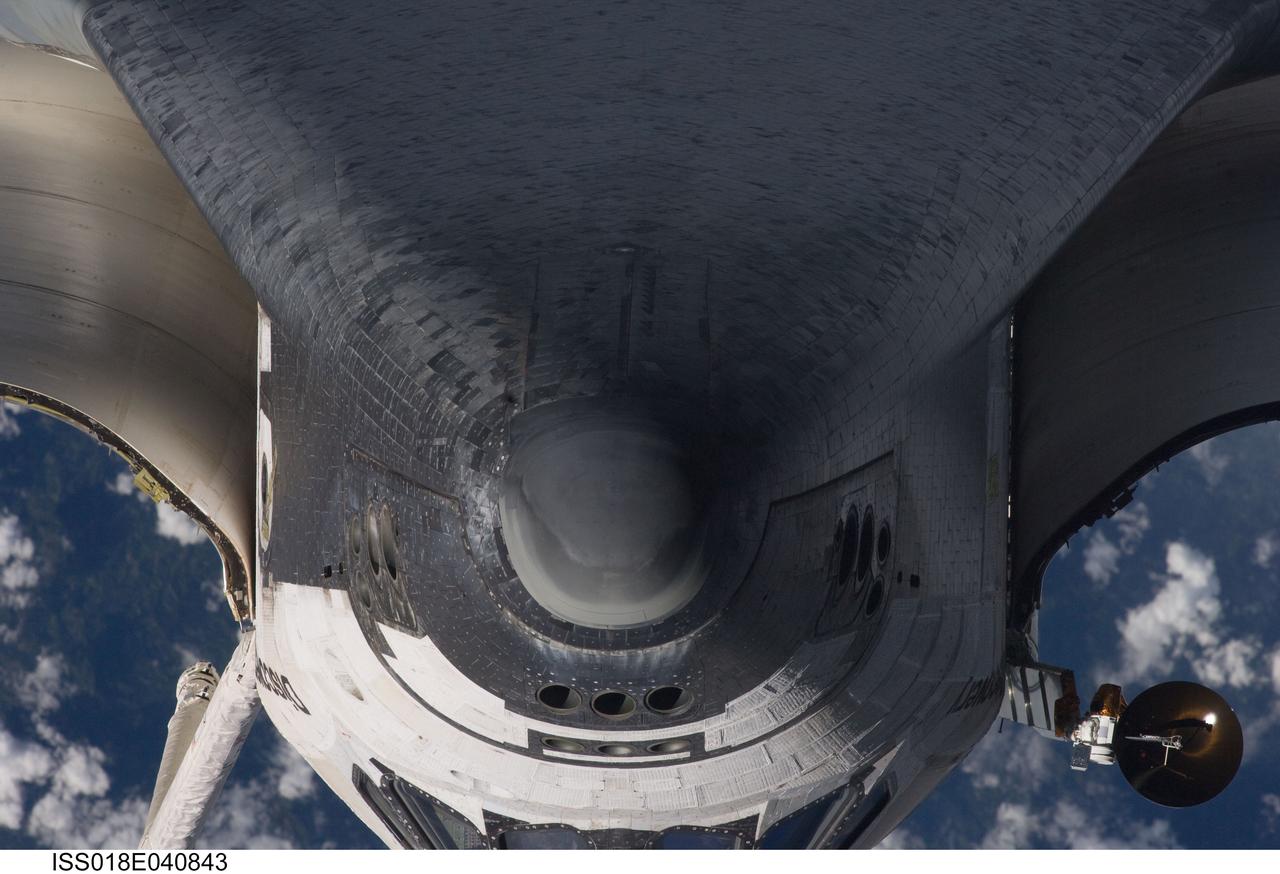
ISS018-E-040843 (17 March 2009) --- A close-up view of the exterior of Space Shuttle Discovery's nose and underside was provided by Expedition 18 crewmembers on the International Space Station. Before docking with the station, astronaut Lee Archambault, STS-119 commander, flew the shuttle through a Rendezvous Pitch Maneuver or basically a backflip to allow the space station crew a good view of Discovery's heat shield. Using digital still cameras equipped with both 400 and 800 millimeter lenses, the ISS crewmembers took a number of photos of the shuttle's thermal protection system and sent them down to teams on the ground for analysis. A 400 millimeter lens was used for this image.
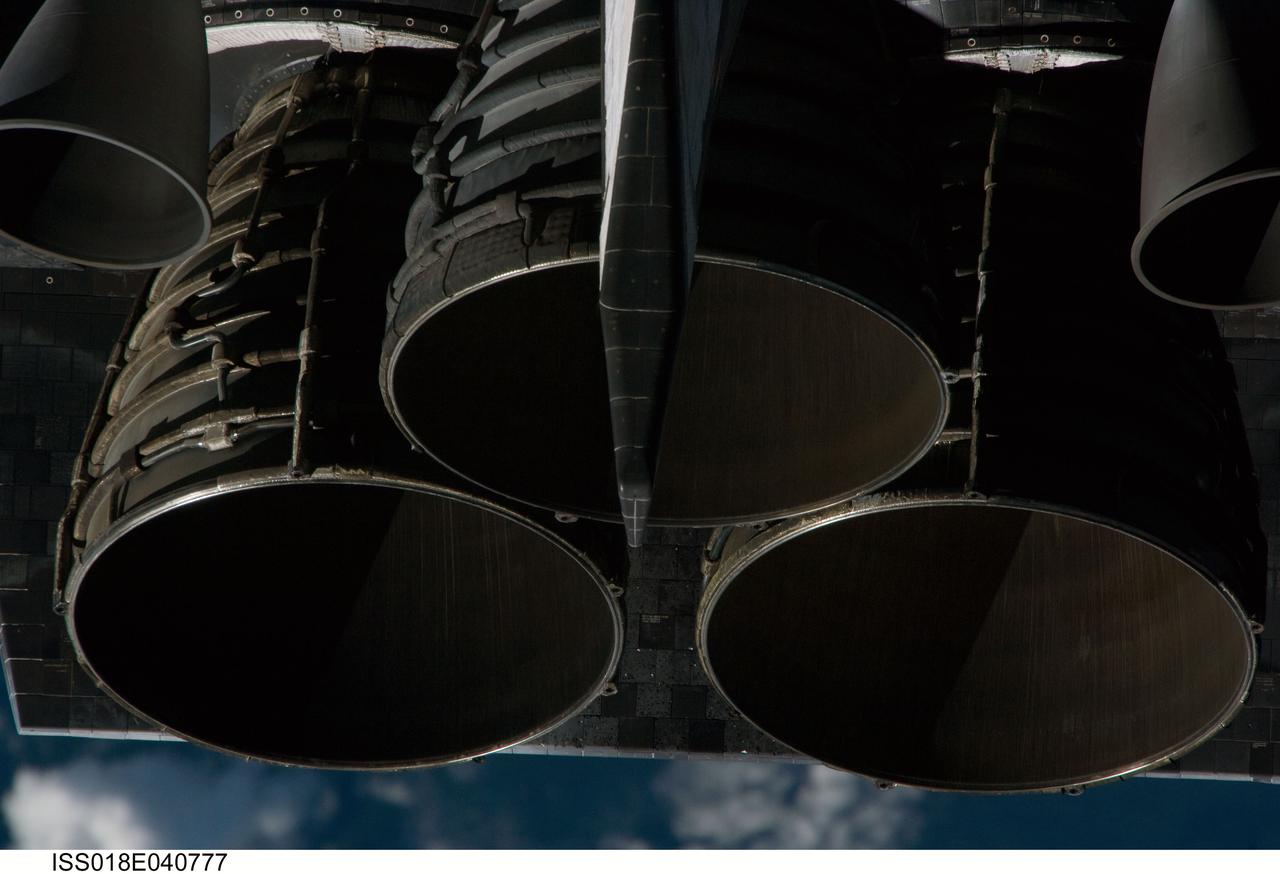
ISS018-E-040777 (17 March 2009) --- A close-up view of Space Shuttle Discovery?s main engines was provided by Expedition 18 crewmembers on the International Space Station. Before docking with the station, astronaut Lee Archambault, STS-119 commander, flew the shuttle through a Rendezvous Pitch Maneuver or basically a backflip to allow the space station crew a good view of Discovery's heat shield. Using digital still cameras equipped with both 400 and 800 millimeter lenses, the ISS crewmembers took a number of photos of the shuttle's thermal protection system and sent them down to teams on the ground for analysis. A 800 millimeter lens was used for this image.
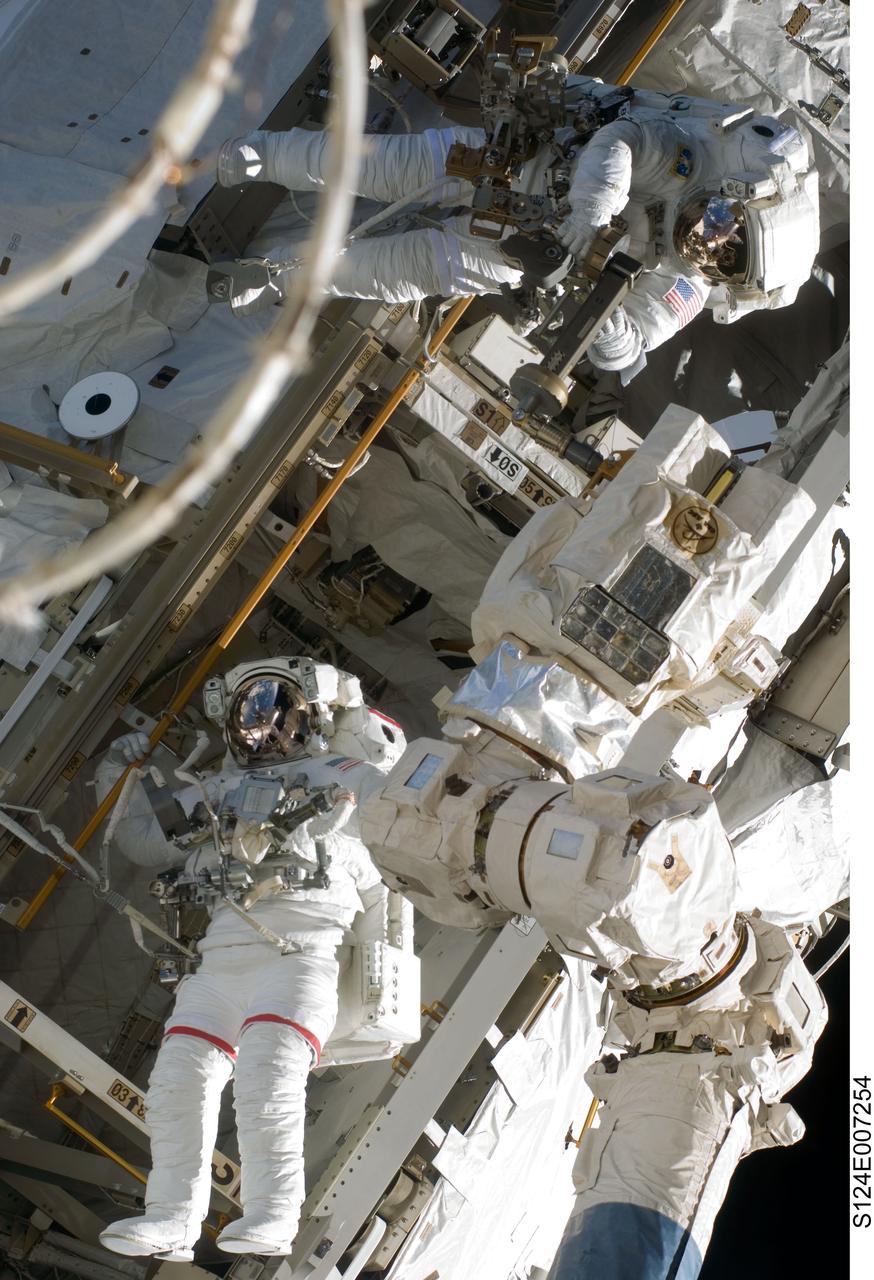
S124-E-007254 (8 June 2008) --- Astronauts Mike Fossum (bottom) and Ron Garan, both STS-124 mission specialists, participate in the mission's third scheduled session of extravehicular activity (EVA) as construction and maintenance continue on the International Space Station. During the six-hour, 33-minute spacewalk, Fossum and Garan exchanged a depleted Nitrogen Tank Assembly for a new one, removed thermal covers and launch locks from the Kibo laboratory, reinstalled a repaired television camera onto the space station's left P1 truss, and retrieved samples of a dust-like substance from the left Solar Alpha Rotary Joint for analysis by experts on the ground.
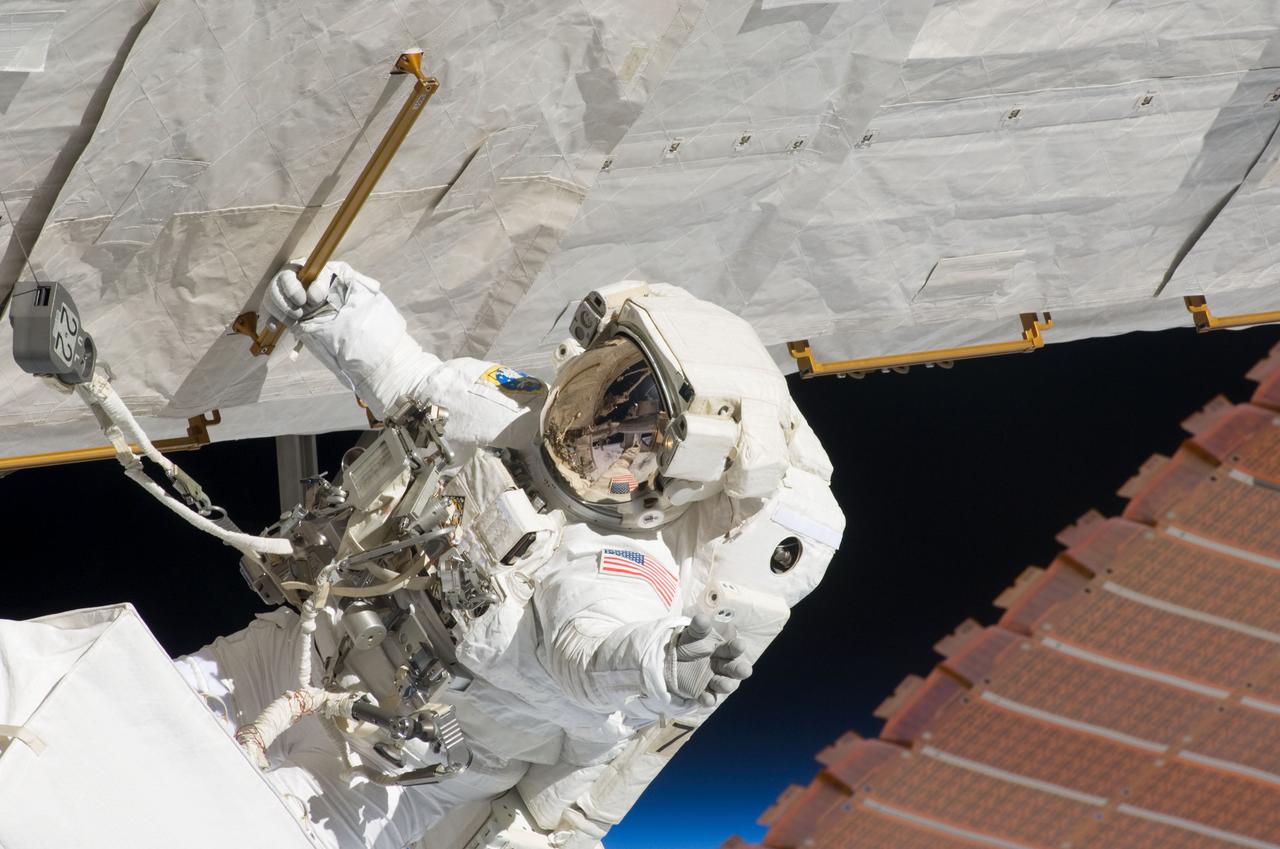
S124-E-007400 (8 June 2008) --- Astronaut Ron Garan, STS-124 mission specialist, participates in the mission's third scheduled session of extravehicular activity (EVA) as construction and maintenance continue on the International Space Station. During the six-hour, 33-minute spacewalk, Garan and astronaut Mike Fossum (out of frame), mission specialist, exchanged a depleted Nitrogen Tank Assembly for a new one, removed thermal covers and launch locks from the Kibo laboratory, reinstalled a repaired television camera onto the space station's left P1 truss, and retrieved samples of a dust-like substance from the left Solar Alpha Rotary Joint for analysis by experts on the ground.
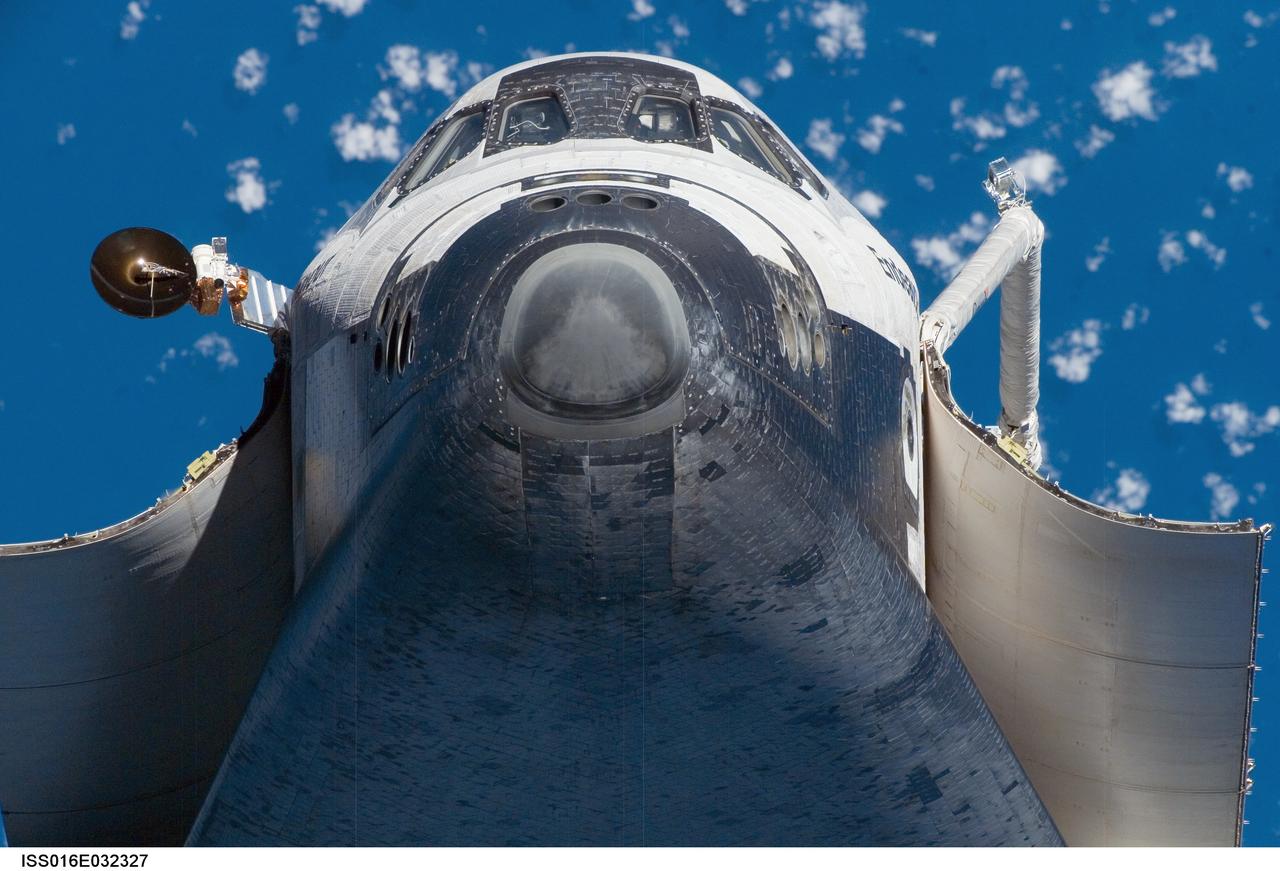
ISS016-E-032327 (12 March 2008) --- A low angle view of the nose and underside of Space Shuttle Endeavour's crew cabin was provided by Expedition 16 crewmembers on the International Space Station (ISS). Before docking with the station, astronaut Dominic Gorie, STS-123 commander, flew the shuttle through a roll pitch maneuver or basically a backflip to allow the space station crew a good view of Endeavour's heat shield. Using digital still cameras equipped with both 400 and 800 millimeter lenses, the ISS crewmembers took a number of photos of the shuttle's thermal protection system and sent them down to teams on the ground for analysis. A 400 millimeter lens was used for this image.
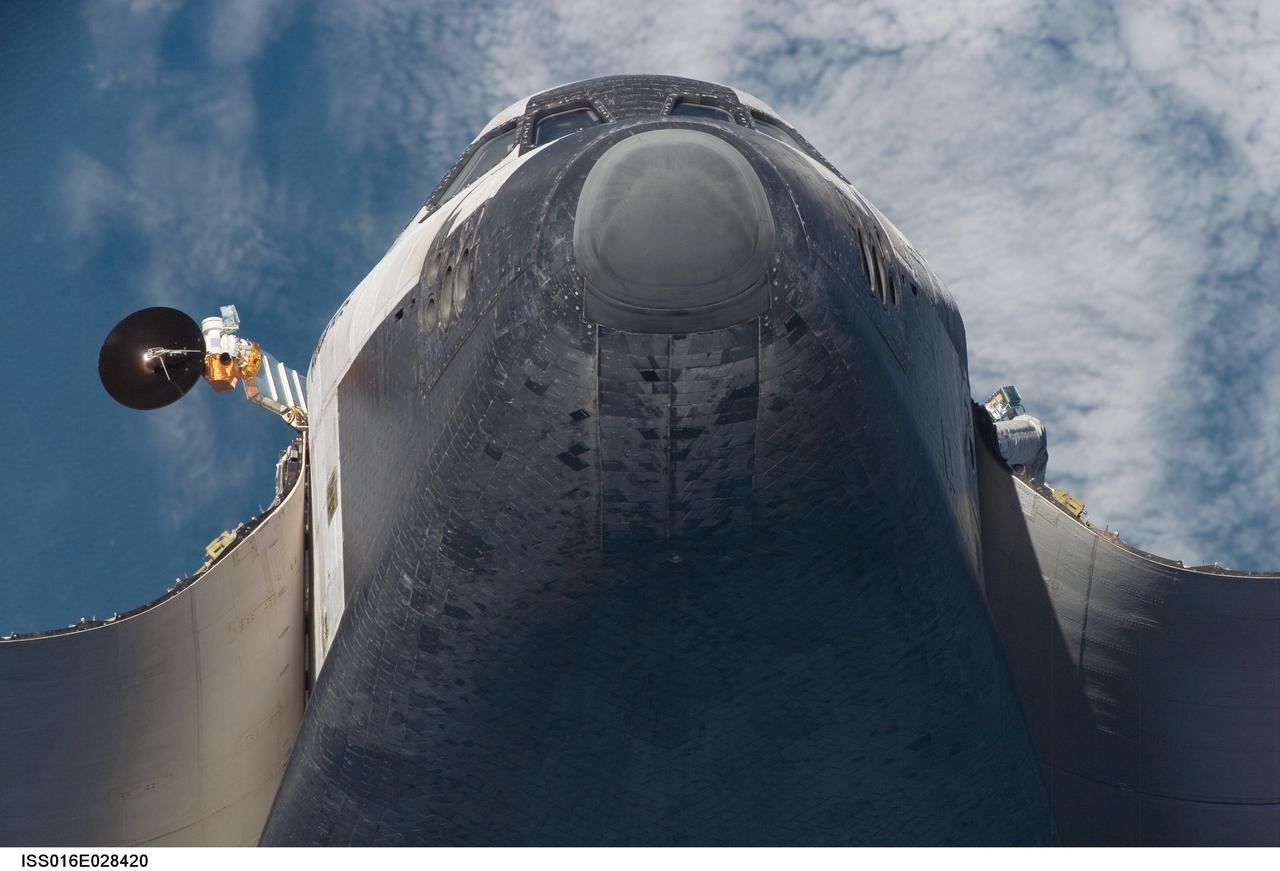
ISS016-E-028420 (9 Feb. 2008) --- A low angle view of the nose and underside of the Space Shuttle Atlantis' crew cabin was provided by Expedition 16 crewmembers. Before docking with the International Space Station, astronaut Steve Frick, STS-122 commander, flew the shuttle through a roll pitch maneuver or basically a backflip to allow the space station crew a good view of Atlantis' heat shield. Using digital still cameras equipped with both 400 and 800 millimeter lenses, the ISS crewmembers took a number of photos of the shuttle's thermal protection system and sent them down to teams on the ground for analysis. A 400 millimeter lens was used for this image.
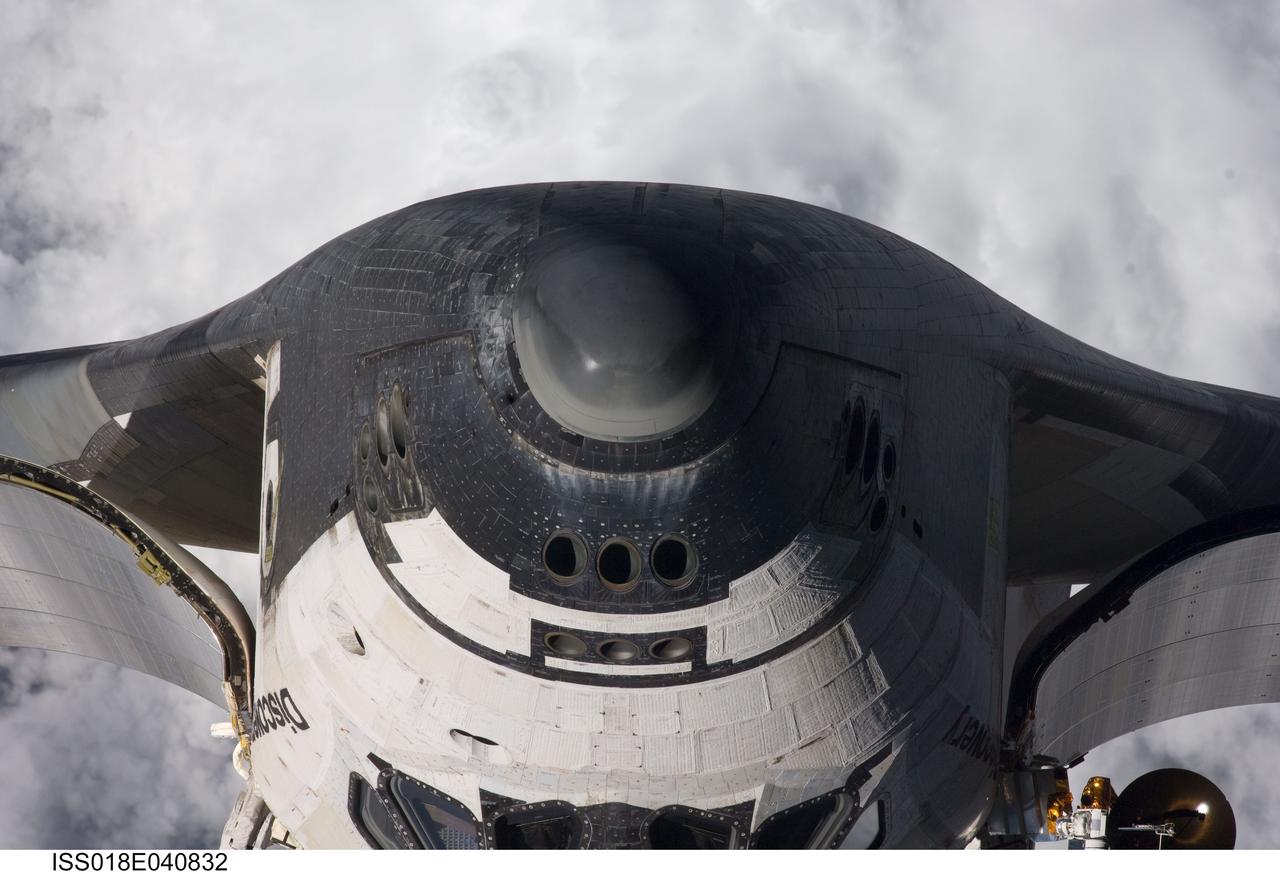
ISS018-E-040832 (17 March 2009) --- A close-up view of the exterior of Space Shuttle Discovery's nose was provided by Expedition 18 crewmembers on the International Space Station. Before docking with the station, astronaut Lee Archambault, STS-119 commander, flew the shuttle through a Rendezvous Pitch Maneuver or basically a backflip to allow the space station crew a good view of Discovery's heat shield. Using digital still cameras equipped with both 400 and 800 millimeter lenses, the ISS crewmembers took a number of photos of the shuttle's thermal protection system and sent them down to teams on the ground for analysis. A 400 millimeter lens was used for this image.
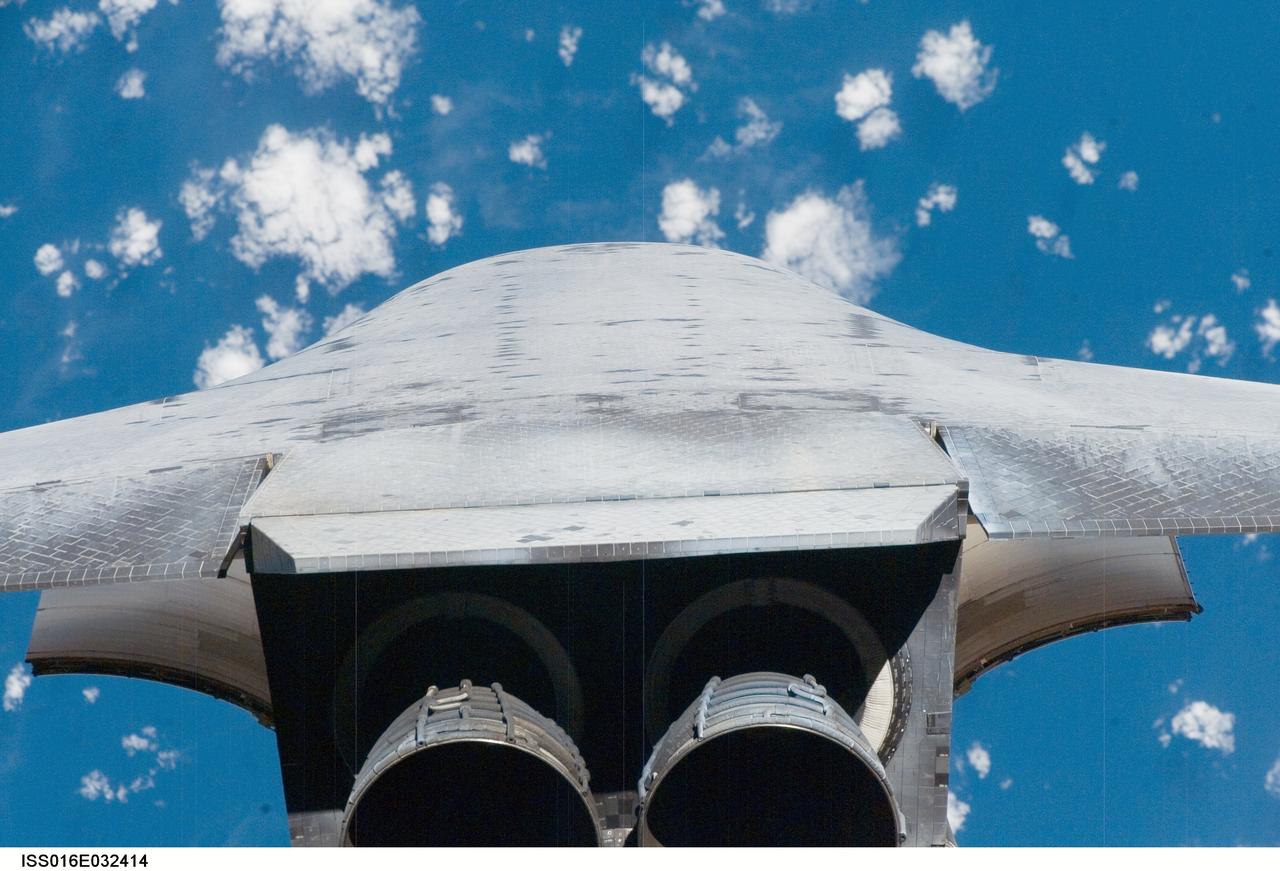
ISS016-E-032414 (12 March 2008) --- An underside view of the Space Shuttle Endeavour was provided by Expedition 16 crewmembers on the International Space Station (ISS). Before docking with the station, astronaut Dominic Gorie, STS-123 commander, flew the shuttle through a roll pitch maneuver or basically a backflip to allow the space station crew a good view of Endeavour's heat shield. Using digital still cameras equipped with both 400 and 800 millimeter lenses, the ISS crewmembers took a number of photos of the shuttle's thermal protection system and sent them down to teams on the ground for analysis. A 400 millimeter lens was used for this image.
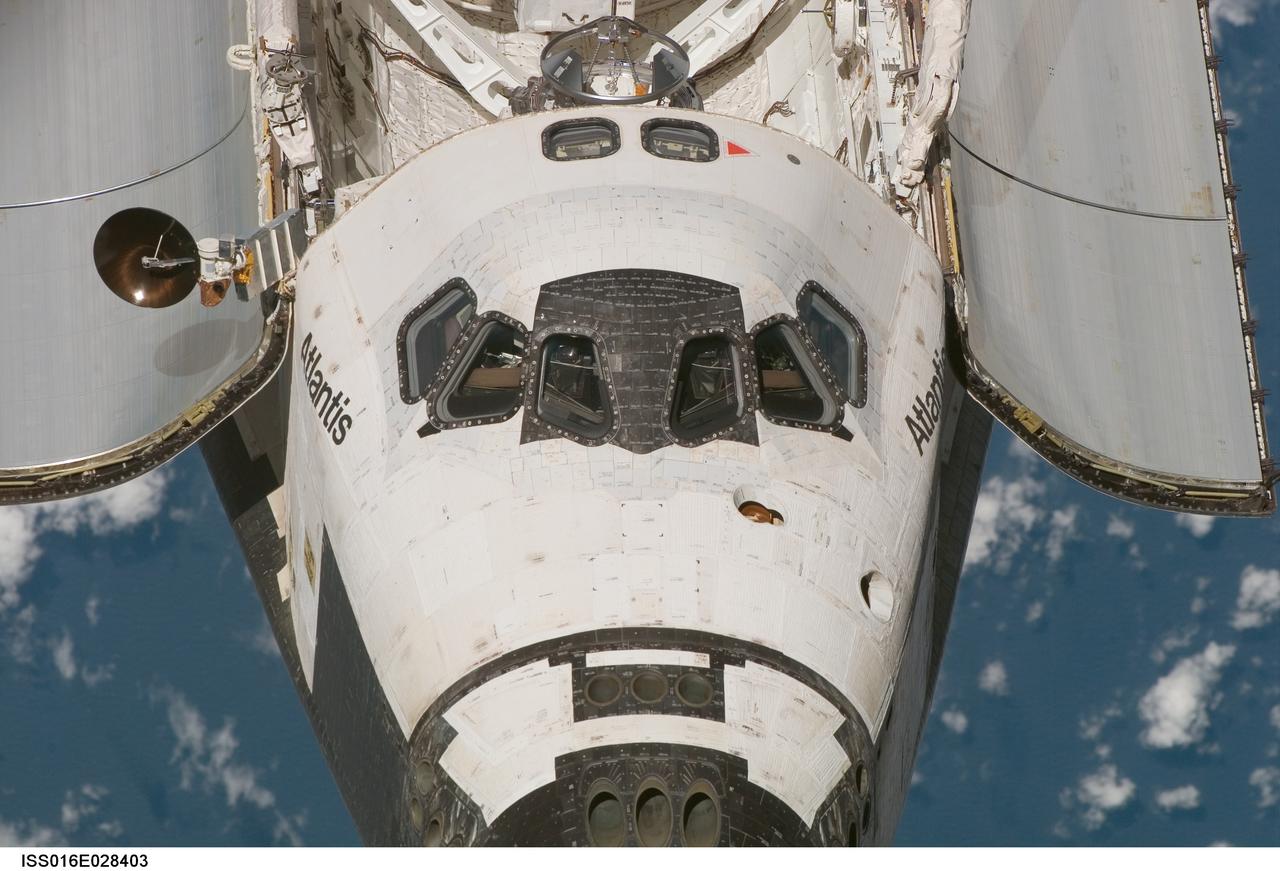
ISS016-E-028403 (9 Feb. 2008) --- An overhead view of the exterior of the Space Shuttle Atlantis' crew cabin, part of its payload bay doors and docking system was provided by Expedition 16 crewmembers. Before docking with the International Space Station, astronaut Steve Frick, STS-122 commander, flew the shuttle through a roll pitch maneuver or basically a backflip to allow the space station crew a good view of Atlantis' heat shield. Using digital still cameras equipped with both 400 and 800 millimeter lenses, the ISS crewmembers took a number of photos of the shuttle's thermal protection system and sent them down to teams on the ground for analysis. A 400 millimeter lens was used for this image.

ISS018-E-040602 (17 March 2009) --- An overhead view of the exterior of Space Shuttle Discovery's crew cabin, part of its payload bay and docking system was provided by Expedition 18 crewmembers on the International Space Station. Before docking with the station, astronaut Lee Archambault, STS-119 commander, flew the shuttle through a Rendezvous Pitch Maneuver or basically a backflip to allow the space station crew a good view of Discovery's heat shield. Using digital still cameras equipped with both 400 and 800 millimeter lenses, the ISS crewmembers took a number of photos of the shuttle's thermal protection system and sent them down to teams on the ground for analysis. A 800 millimeter lens was used for this image.

ISS016-E-032323 (12 March 2008) --- A low angle view of the nose and underside of Space Shuttle Endeavour's crew cabin was provided by Expedition 16 crewmembers on the International Space Station (ISS). Before docking with the station, astronaut Dominic Gorie, STS-123 commander, flew the shuttle through a roll pitch maneuver or basically a backflip to allow the space station crew a good view of Endeavour's heat shield. Using digital still cameras equipped with both 400 and 800 millimeter lenses, the ISS crewmembers took a number of photos of the shuttle's thermal protection system and sent them down to teams on the ground for analysis. A 400 millimeter lens was used for this image.
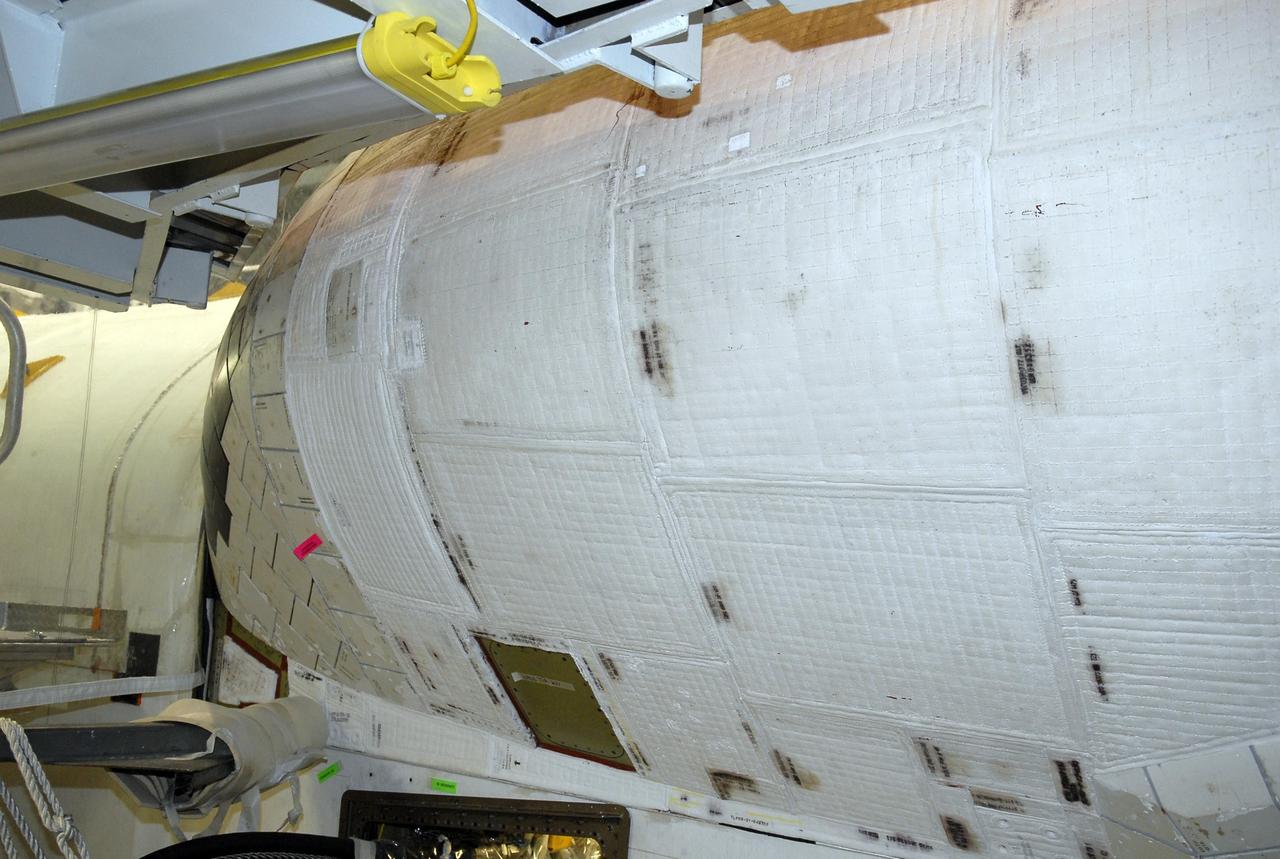
KENNEDY SPACE CENTER, FLA. -- Another view of the area of orbiter Endeavour's orbital maneuvering system, or OMS, pod where the tear occurred on Atlantis during launch of mission STS-117 on June 8, 2007. Repair is under consideration following testing at KSC and Houston. The test articles each feature three tiles (Low Temperature Reusable Surface Insulation, or LRSI) affixed next to two FIB blankets, simulating the thermal protection system set-up on Atlantis' OMS pod in the vicinity of the in-flight anomaly. These test articles were flown to Texas the morning of June 14. The TPS team at KSC has also provided a total of 22 FIB samples for other testing and analysis. Photo credit: NASA/Kim Shiflett
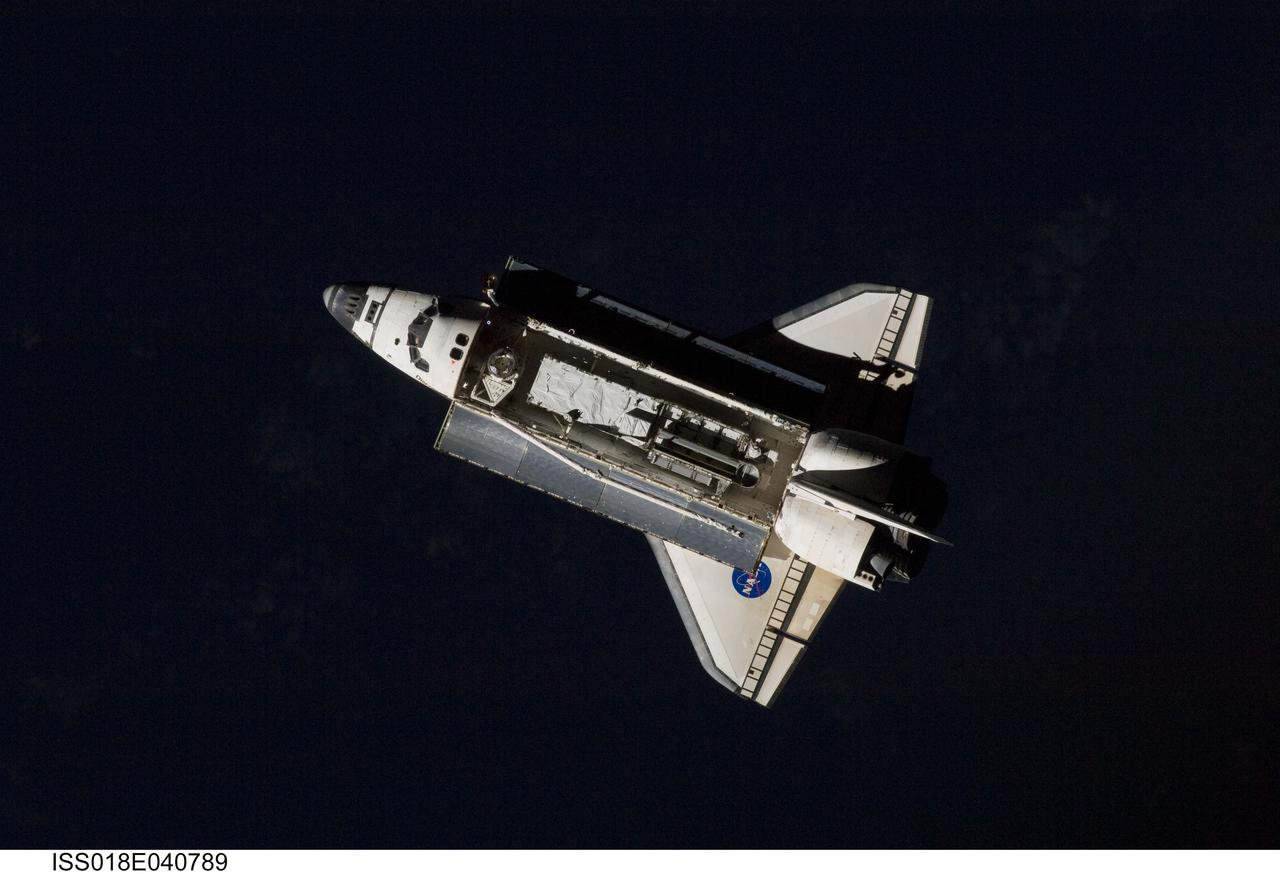
ISS018-E-040789 (17 March 2009) --- Backdropped by the blackness of space, Space Shuttle Discovery is featured in this image photographed by an Expedition 18 crewmember on the International Space Station during rendezvous and docking operations. Before docking with the station, astronaut Lee Archambault, STS-119 commander, flew the shuttle through a Rendezvous Pitch Maneuver or basically a backflip to allow the space station crew a good view of Discovery's heat shield. Using digital still cameras equipped with both 400 and 800 millimeter lenses, the ISS crewmembers took a number of photos of the shuttle's thermal protection system and sent them down to teams on the ground for analysis. A 400 millimeter lens was used for this image. Docking occurred at 4:20 p.m. (CDT) on March 17, 2009. The final pair of power-generating solar array wings and the S6 truss segment are visible in Discovery’s cargo bay.
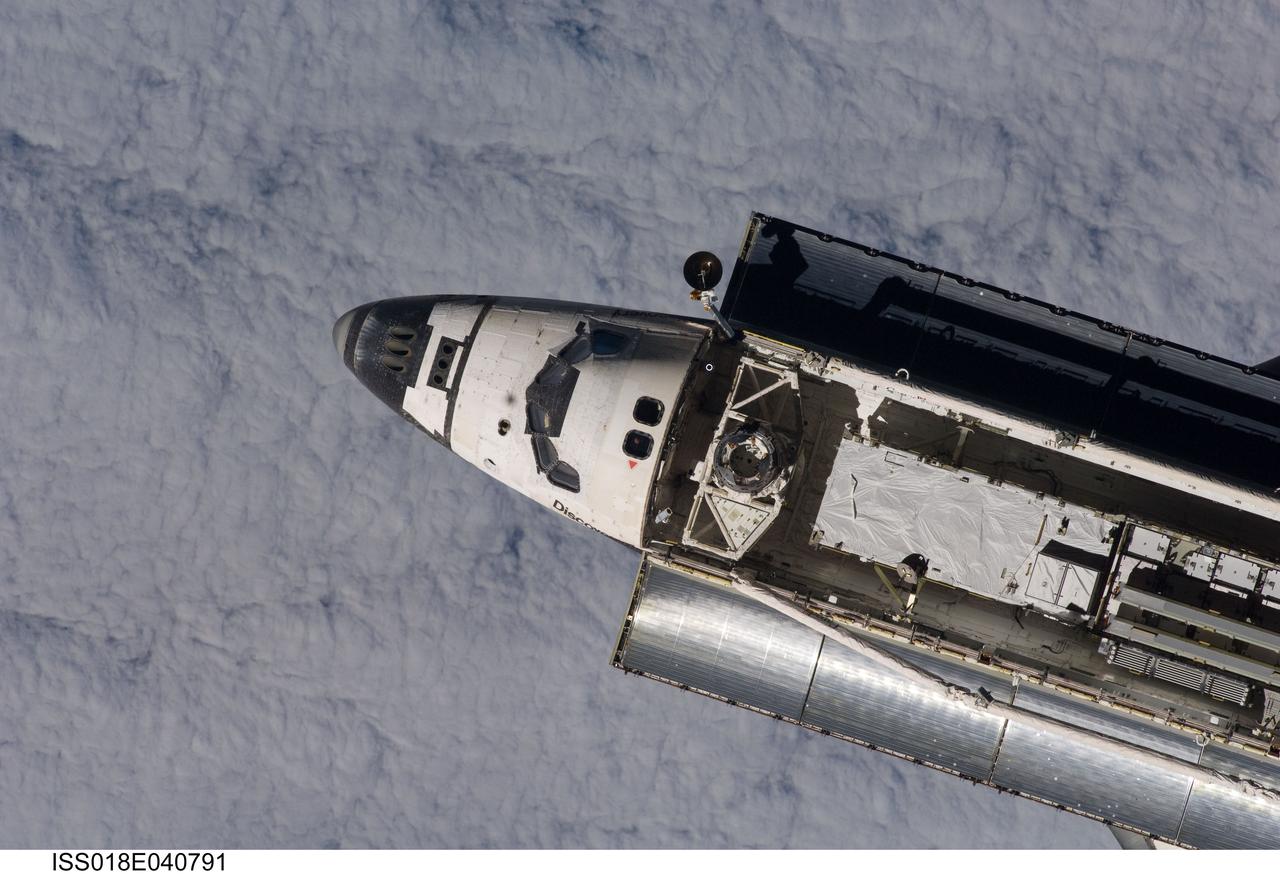
ISS018-E-040791 (17 March 2009) --- Backdropped by a blanket of clouds, Space Shuttle Discovery is featured in this image photographed by an Expedition 18 crewmember on the International Space Station during rendezvous and docking operations. Before docking with the station, astronaut Lee Archambault, STS-119 commander, flew the shuttle through a Rendezvous Pitch Maneuver or basically a backflip to allow the space station crew a good view of Discovery's heat shield. Using digital still cameras equipped with both 400 and 800 millimeter lenses, the ISS crewmembers took a number of photos of the shuttle's thermal protection system and sent them down to teams on the ground for analysis. A 400 millimeter lens was used for this image. Docking occurred at 4:20 p.m. (CDT) on March 17, 2009. The final pair of power-generating solar array wings and the S6 truss segment are visible in Discovery?s cargo bay.
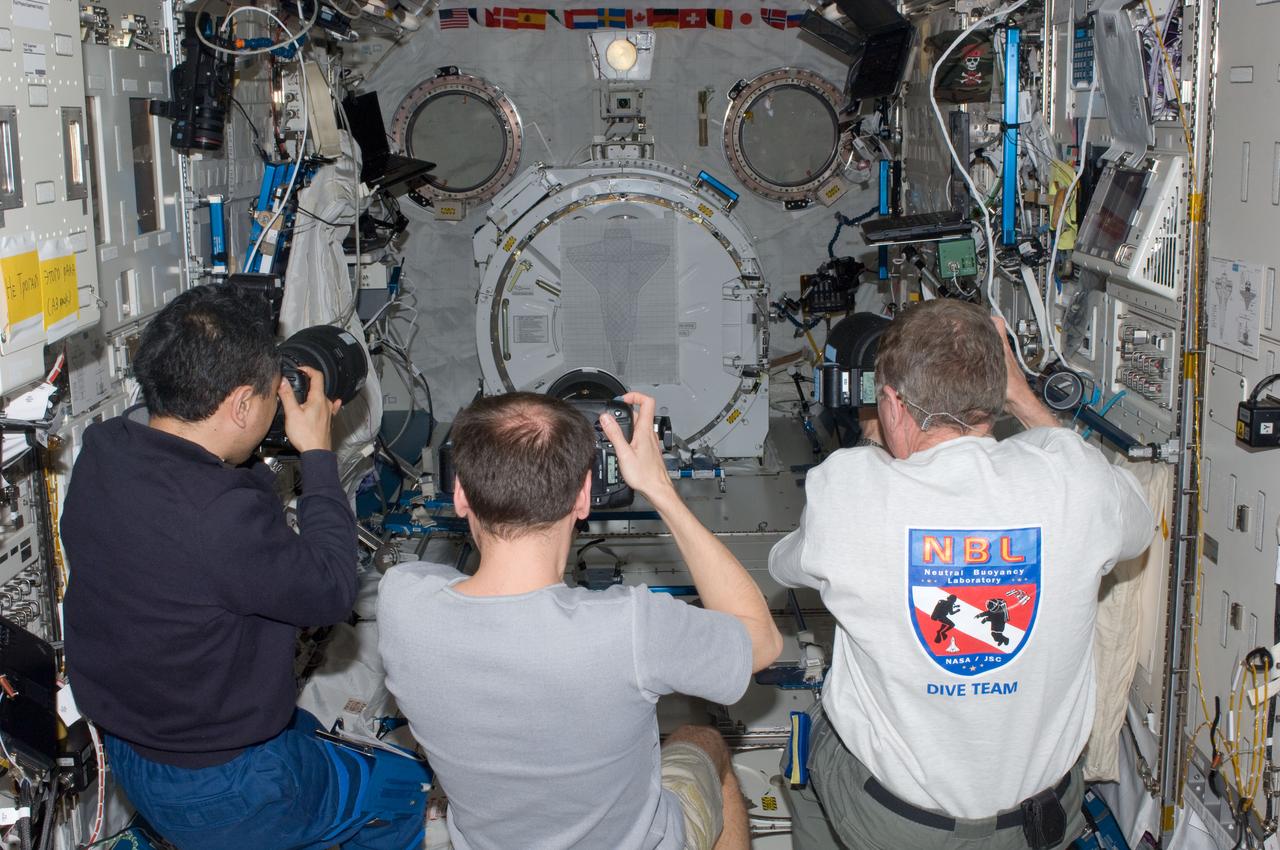
ISS028-E-015033 (9 July 2011) --- Japan Aerospace Exploration Agency astronaut Satoshi Furukawa (left), Russian cosmonaut Sergei Volkov (center) and NASA astronaut Mike Fossum, all Expedition 28 flight engineers, use still cameras in the International Space Station’s Kibo laboratory to photograph a detailed outline of the orbiter’s underbelly. The space shuttle “pattern” was traditionally used as a training tool by the station crew members preparing for the R-Bar Pitch Maneuver performed by each arriving shuttle. The image size represents the orbiter at a distance of about 600 feet on approach. During an RPM, typically more than 300 images are taken using cameras outfitted with 400, 800 and 1000 mm lenses and downlinked to the ground for analysis to clear the Thermal Protection System for entry.
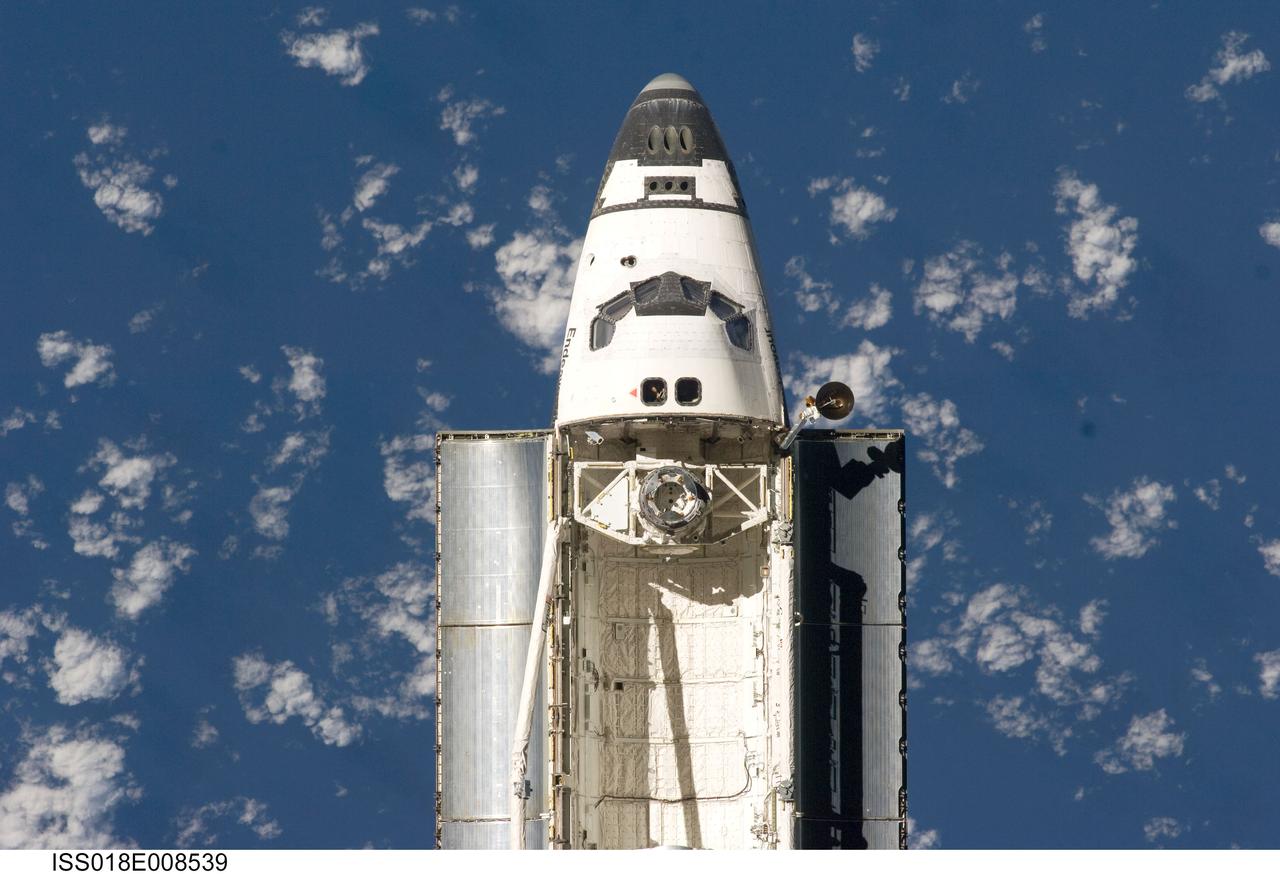
ISS018-E-008539 (16 Nov. 2008) --- An overhead view of the exterior of Space Shuttle Endeavour's crew cabin, part of its payload bay doors and docking system was provided by Expedition 18 crewmembers on the International Space Station. Before docking with the station, astronaut Chris Ferguson, STS-126 commander, flew the shuttle through a roll pitch maneuver or basically a backflip to allow the space station crew a good view of Endeavour's heat shield. Using digital still cameras equipped with both 400 and 800 millimeter lenses, the ISS crewmembers took a number of photos of the shuttle's thermal protection system and sent them down to teams on the ground for analysis. A 400 millimeter lens was used for this image.
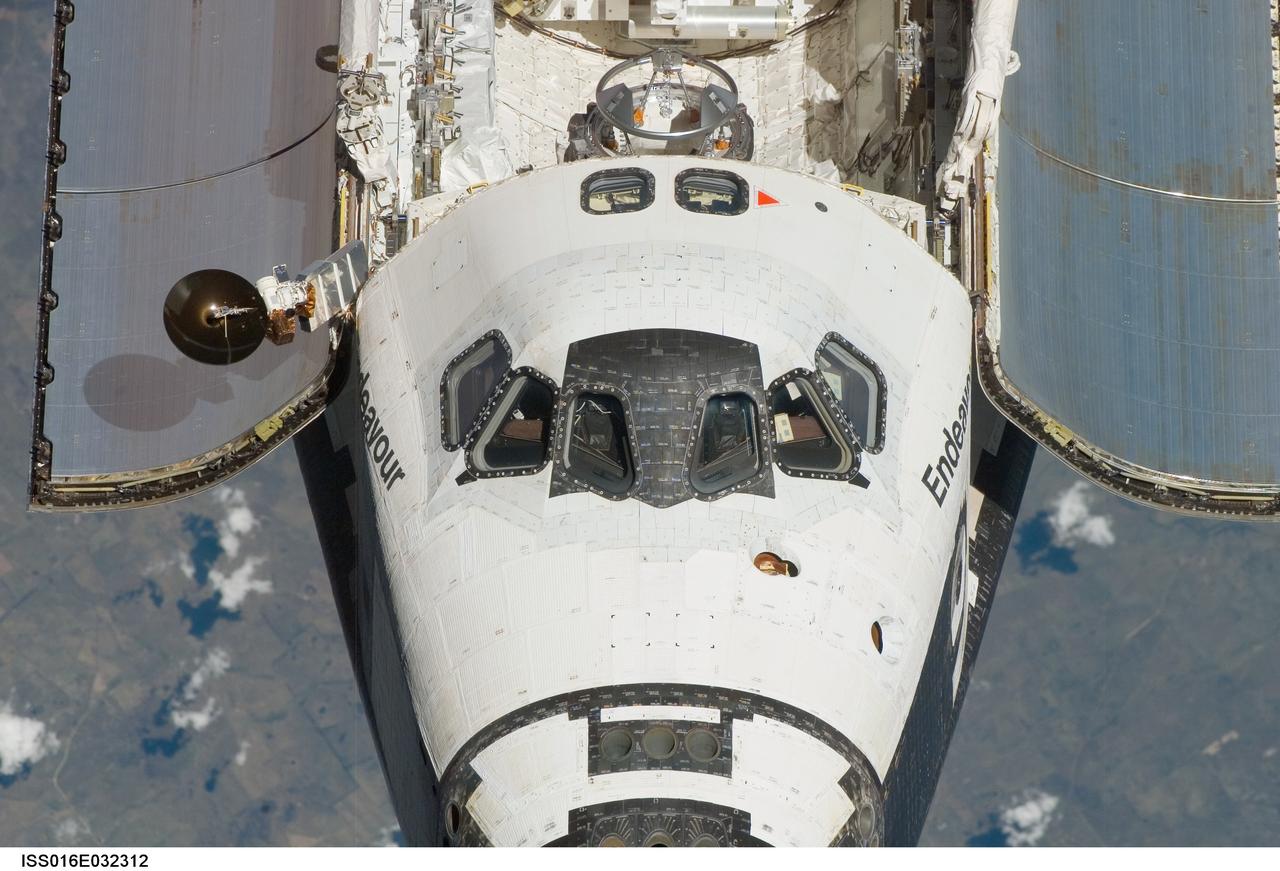
ISS016-E-032312 (12 March 2008) --- An overhead view of the exterior of Space Shuttle Endeavour's crew cabin, part of its payload bay doors and docking system was provided by Expedition 16 crewmembers on the International Space Station (ISS). Before docking with the station, astronaut Dominic Gorie, STS-123 commander, flew the shuttle through a roll pitch maneuver or basically a backflip to allow the space station crew a good view of Endeavour's heat shield. Using digital still cameras equipped with both 400 and 800 millimeter lenses, the ISS crewmembers took a number of photos of the shuttle's thermal protection system and sent them down to teams on the ground for analysis. A 400 millimeter lens was used for this image.
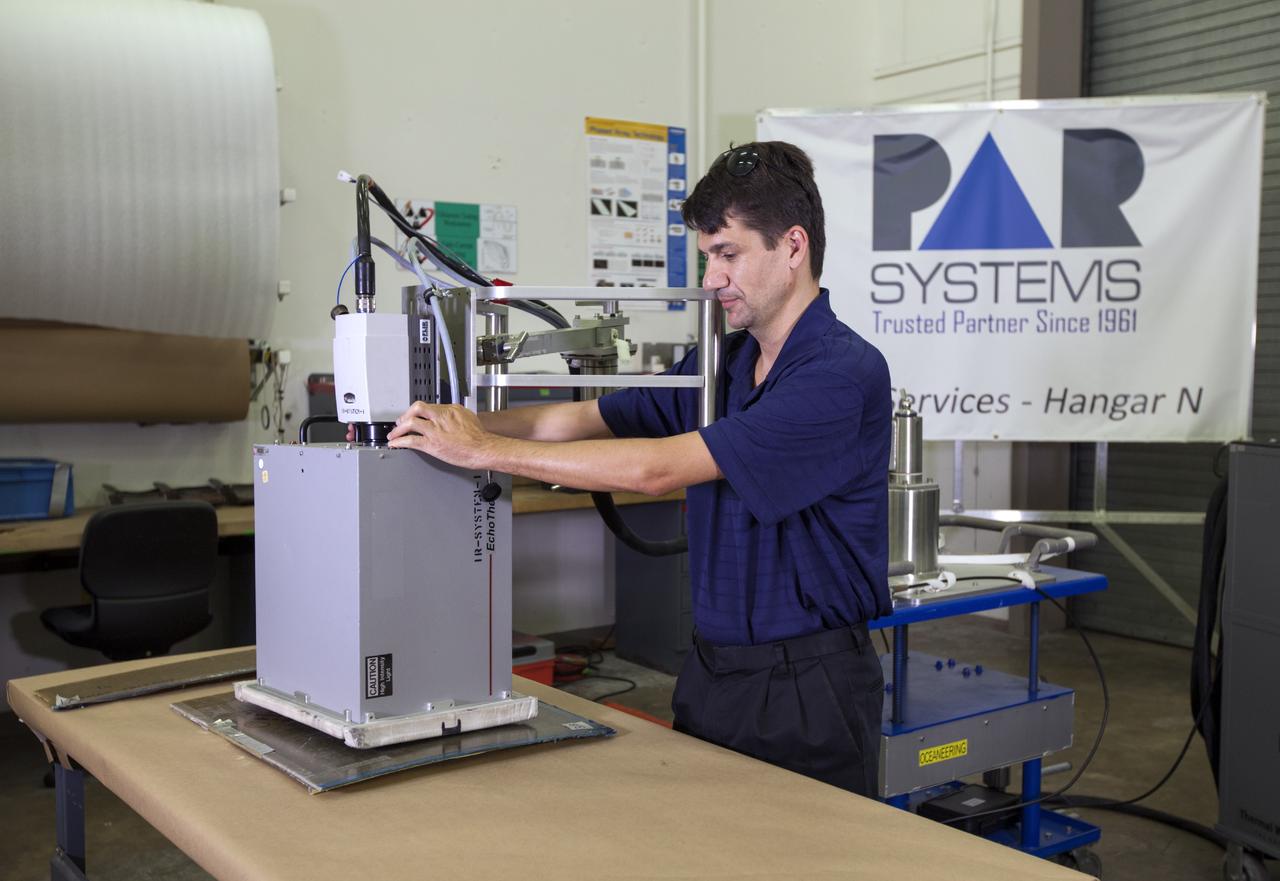
CAPE CANAVERAL, Fla. – In Hangar N at Cape Canaveral Air Force Station, PaR Systems, Inc. development engineer Bence Bertha sets up a flash thermography system. The equipment is used for inspecting hardware with thermal analysis. NASA's Kennedy Space Center in Florida recently established a partnership agreement with PaR Systems, Inc. of Shoreview, Minn., for operation of the Hangar N facility and its nondestructive testing and evaluation equipment. As the spaceport transitions from a historically government-only launch facility to a multi-user spaceport for both federal and commercial customers, partnerships between the space agency and other organizations will be a key element in that effort. Hangar N is located at Cape Canaveral Air Force Station adjacent to Kennedy and houses a unique inventory of test and evaluation equipment and the capability for current and future mission spaceflight support. Photo credit: NASA/ Dimitri Gerondidakis
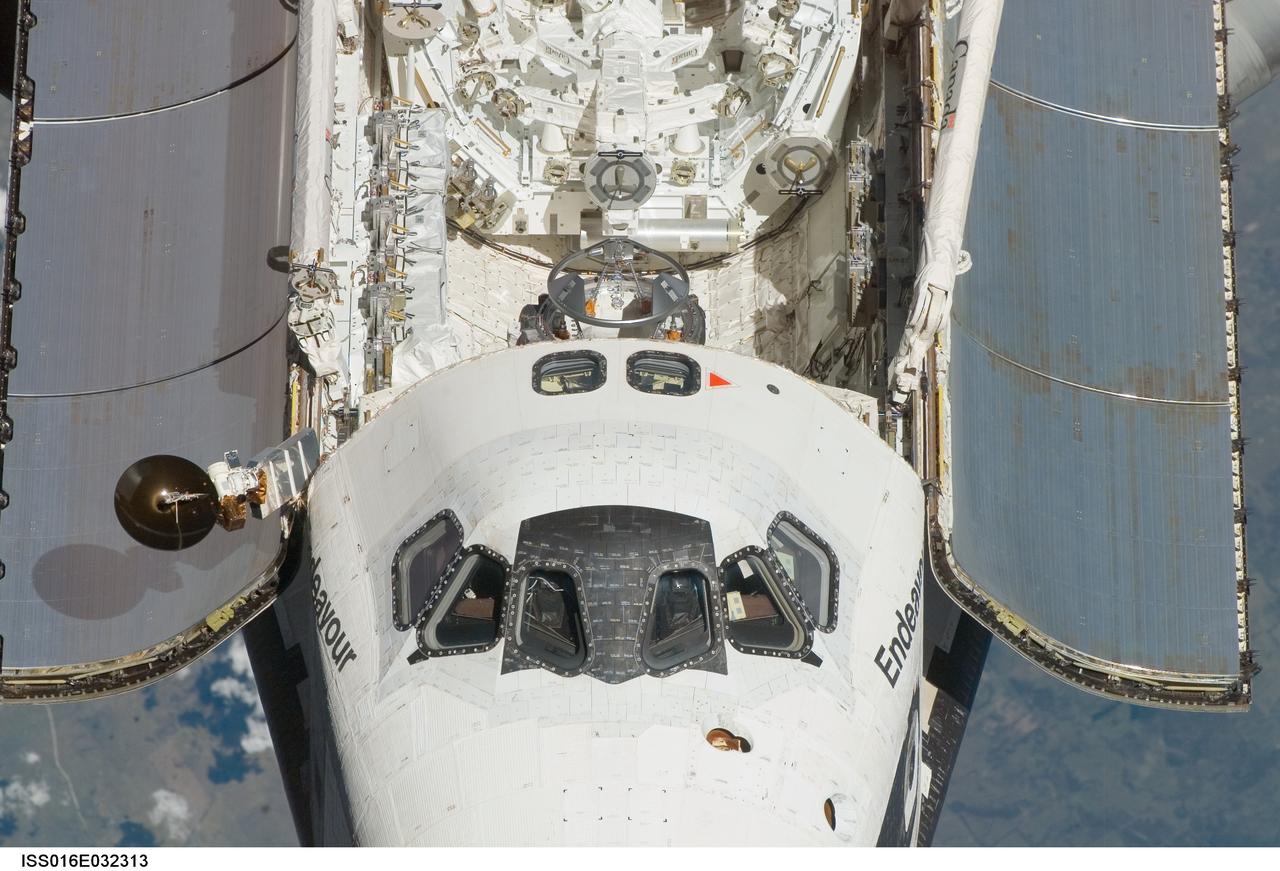
ISS016-E-032313 (12 March 2008) --- An overhead view of the exterior of Space Shuttle Endeavour's crew cabin, part of its payload bay doors, docking system and part of the Dextre robotic system was provided by Expedition 16 crewmembers on the International Space Station (ISS). Before docking with the station, astronaut Dominic Gorie, STS-123 commander, flew the shuttle through a roll pitch maneuver or basically a backflip to allow the space station crew a good view of Endeavour's heat shield. Using digital still cameras equipped with both 400 and 800 millimeter lenses, the ISS crewmembers took a number of photos of the shuttle's thermal protection system and sent them down to teams on the ground for analysis. A 400 millimeter lens was used for this image.
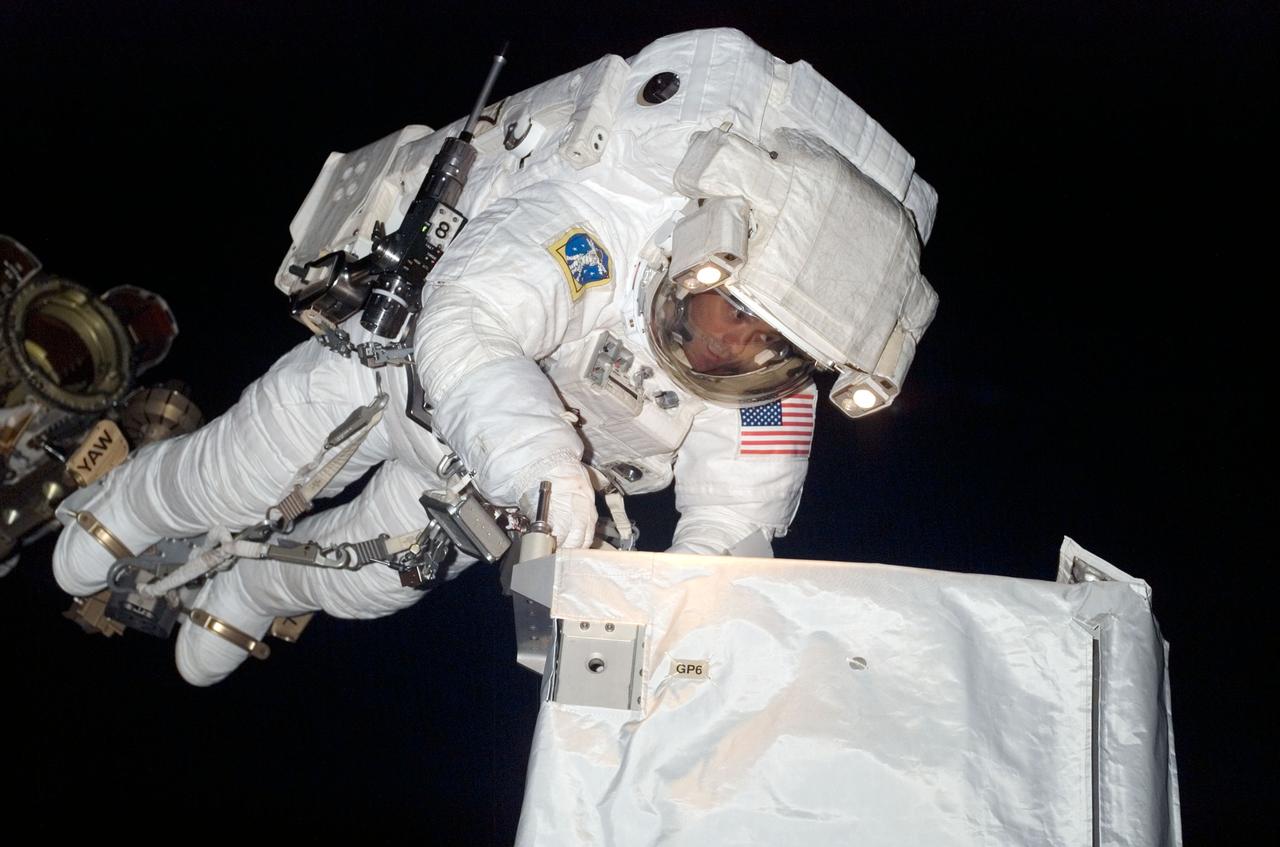
ISS017-E-009220 (8 June 2008) --- Anchored to a Canadarm2 mobile foot restraint, astronaut Ron Garan, STS-124 mission specialist, participates in the mission's third scheduled session of extravehicular activity (EVA) as construction and maintenance continue on the International Space Station. During the six-hour, 33-minute spacewalk, Garan and astronaut Mike Fossum (out of frame), mission specialist, exchanged a depleted Nitrogen Tank Assembly for a new one, removed thermal covers and launch locks from the Kibo laboratory, reinstalled a repaired television camera onto the space station's left P1 truss, and retrieved samples of a dust-like substance from the left Solar Alpha Rotary Joint for analysis by experts on the ground.
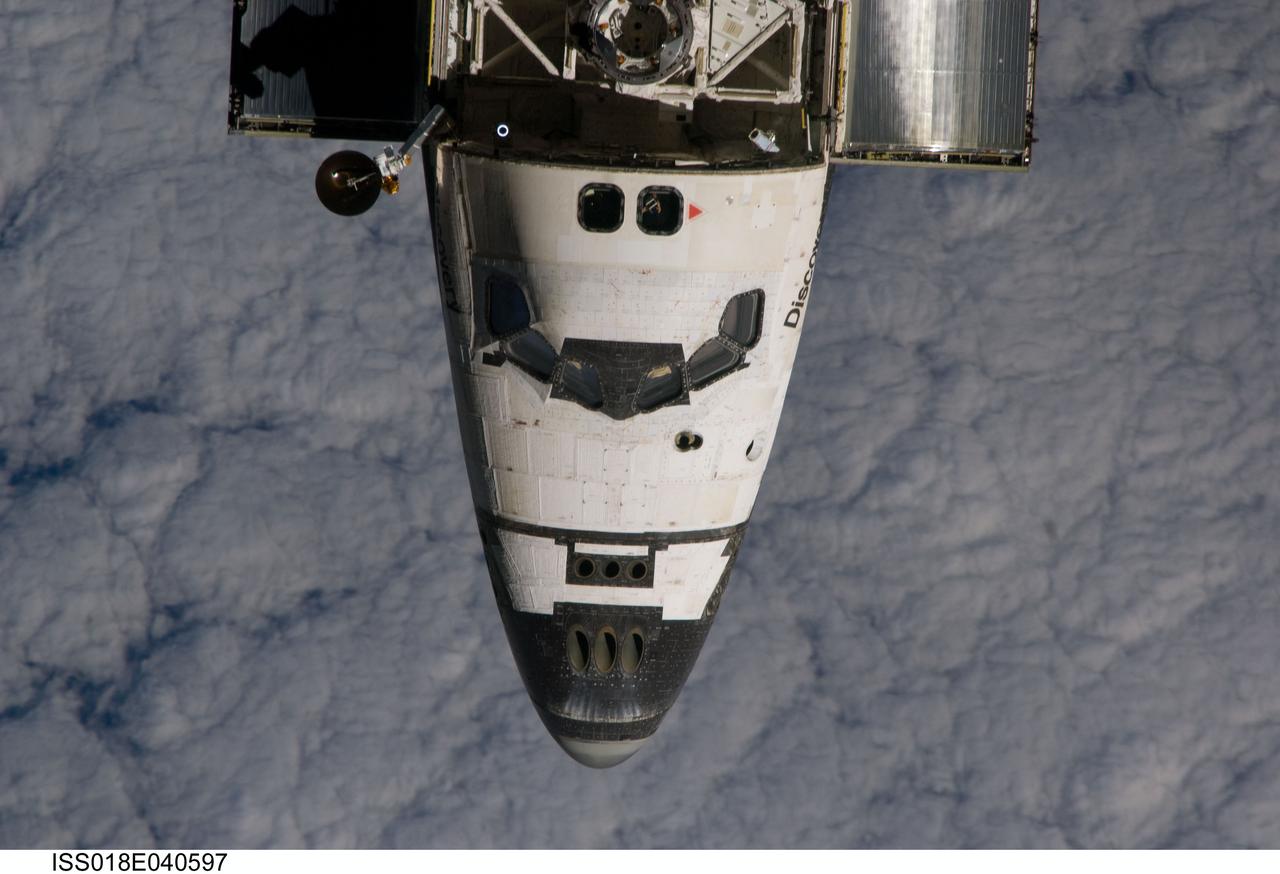
ISS018-E-040597 (17 March 2009) --- An overhead view of the exterior of Space Shuttle Discovery's crew cabin, part of its payload bay doors and docking system was provided by Expedition 18 crewmembers on the International Space Station. Before docking with the station, astronaut Lee Archambault, STS-119 commander, flew the shuttle through a Rendezvous Pitch Maneuver or basically a backflip to allow the space station crew a good view of Discovery's heat shield. Using digital still cameras equipped with both 400 and 800 millimeter lenses, the ISS crewmembers took a number of photos of the shuttle's thermal protection system and sent them down to teams on the ground for analysis. A 800 millimeter lens was used for this image.
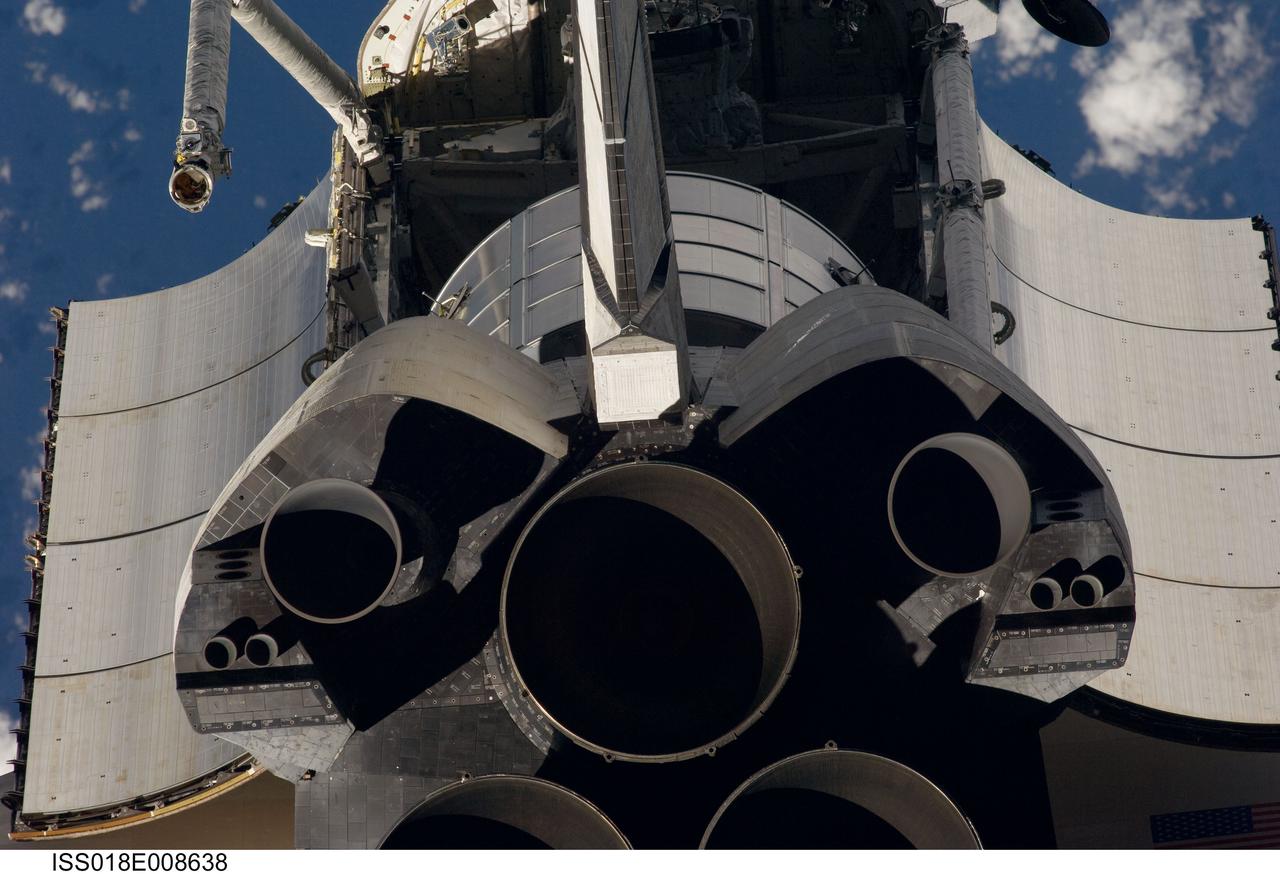
ISS018-E-008638 (16 Nov. 2008) --- A close-up view of Space Shuttle Endeavour's tail section was provided by Expedition 18 crewmembers on the International Space Station. The image provides partial views of the shuttle's main engines, orbital maneuvering system (OMS) pods, vertical stabilizer, the payload bay door panels and the Leonard Multi-Purpose Logistics Module located in the cargo bay. Before docking with the station, astronaut Chris Ferguson, STS-126 commander, flew the shuttle through a roll pitch maneuver or basically a backflip to allow the space station crew a good view of Endeavour's heat shield. Using digital still cameras equipped with both 400 and 800 millimeter lenses, the ISS crewmembers took a number of photos of the shuttle's thermal protection system and sent them down to teams on the ground for analysis. A 400 millimeter lens was used for this image.
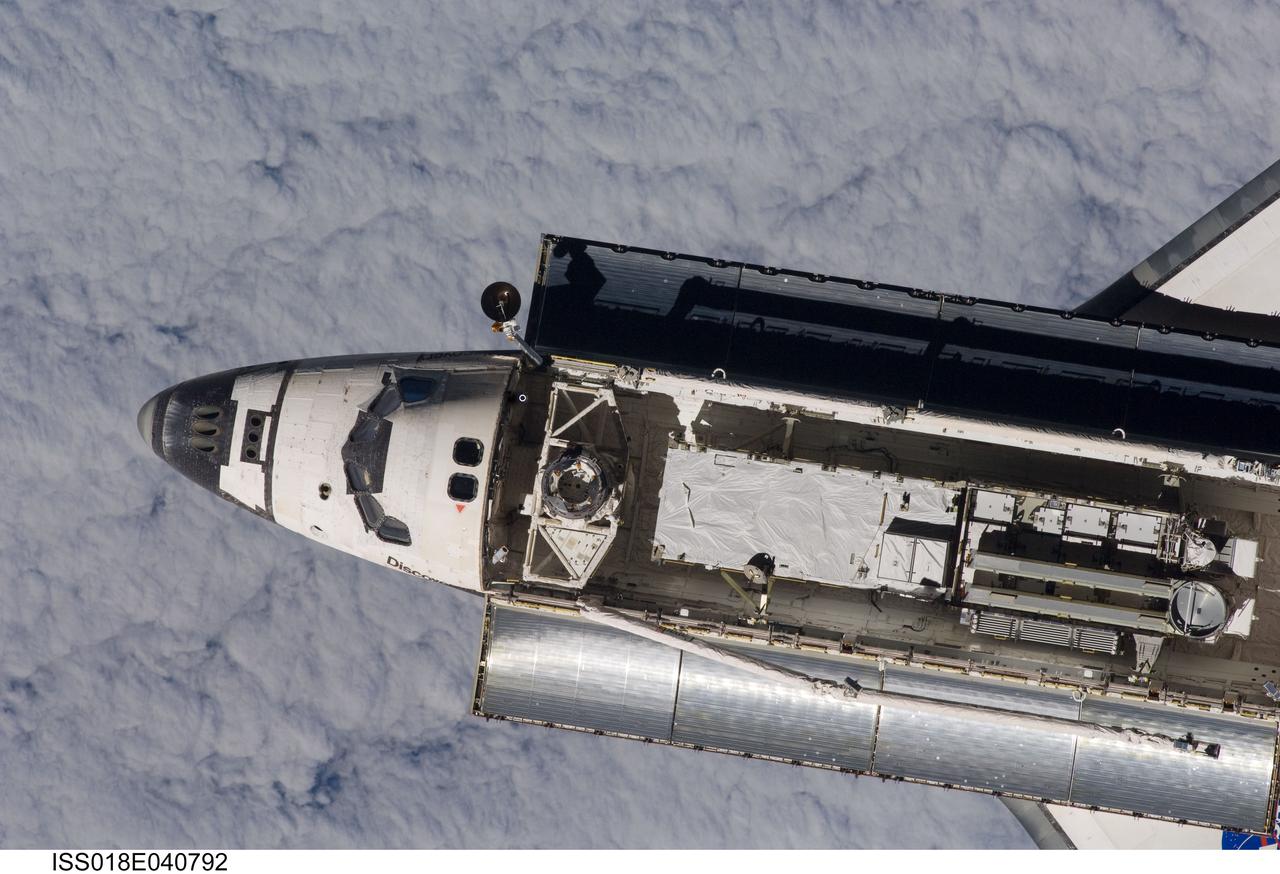
ISS018-E-040792 (17 March 2009) --- Backdropped by a blanket of clouds, Space Shuttle Discovery is featured in this image photographed by an Expedition 18 crewmember on the International Space Station during rendezvous and docking operations. Before docking with the station, astronaut Lee Archambault, STS-119 commander, flew the shuttle through a Rendezvous Pitch Maneuver or basically a backflip to allow the space station crew a good view of Discovery's heat shield. Using digital still cameras equipped with both 400 and 800 millimeter lenses, the ISS crewmembers took a number of photos of the shuttle's thermal protection system and sent them down to teams on the ground for analysis. A 400 millimeter lens was used for this image. Docking occurred at 4:20 p.m. (CDT) on March 17, 2009. The final pair of power-generating solar array wings and the S6 truss segment are visible in Discovery?s cargo bay.
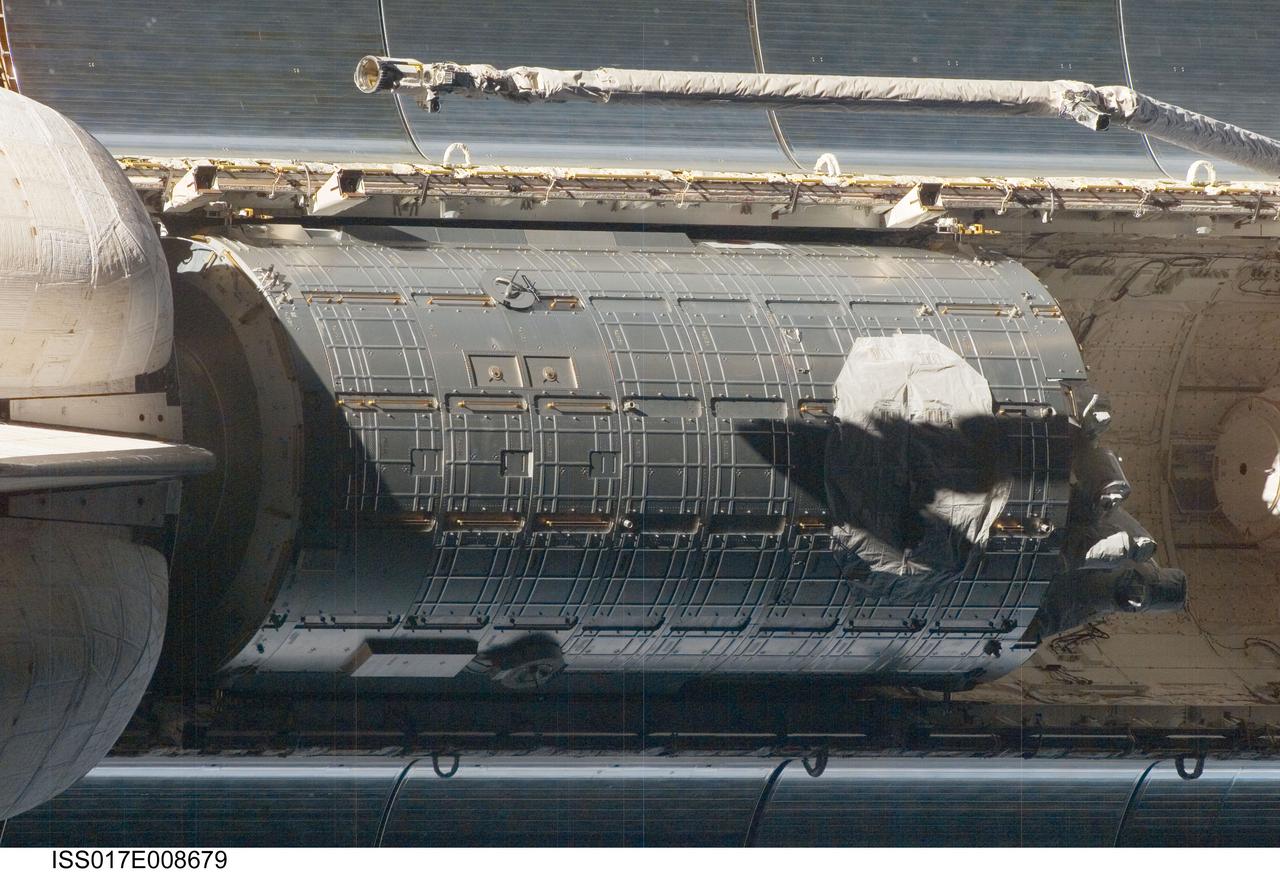
ISS017-E-008679 (2 June 2008) --- An overhead view of the second component of the Japan Aerospace Exploration Agency's Kibo laboratory, the Japanese Pressurized Module (JPM) in Space Shuttle Discovery's cargo bay was provided by Expedition 17 crewmembers. Before docking with the station, astronaut Mark Kelly, STS-124 commander, flew the shuttle through a roll pitch maneuver or basically a backflip to allow the space station crew a good view of Discovery's heat shield. Using digital still cameras equipped with both 400 and 800 millimeter lenses, the ISS crewmembers took a number of photos of the shuttle's thermal protection system and sent them down to teams on the ground for analysis. A 400 millimeter lens was used for this image.
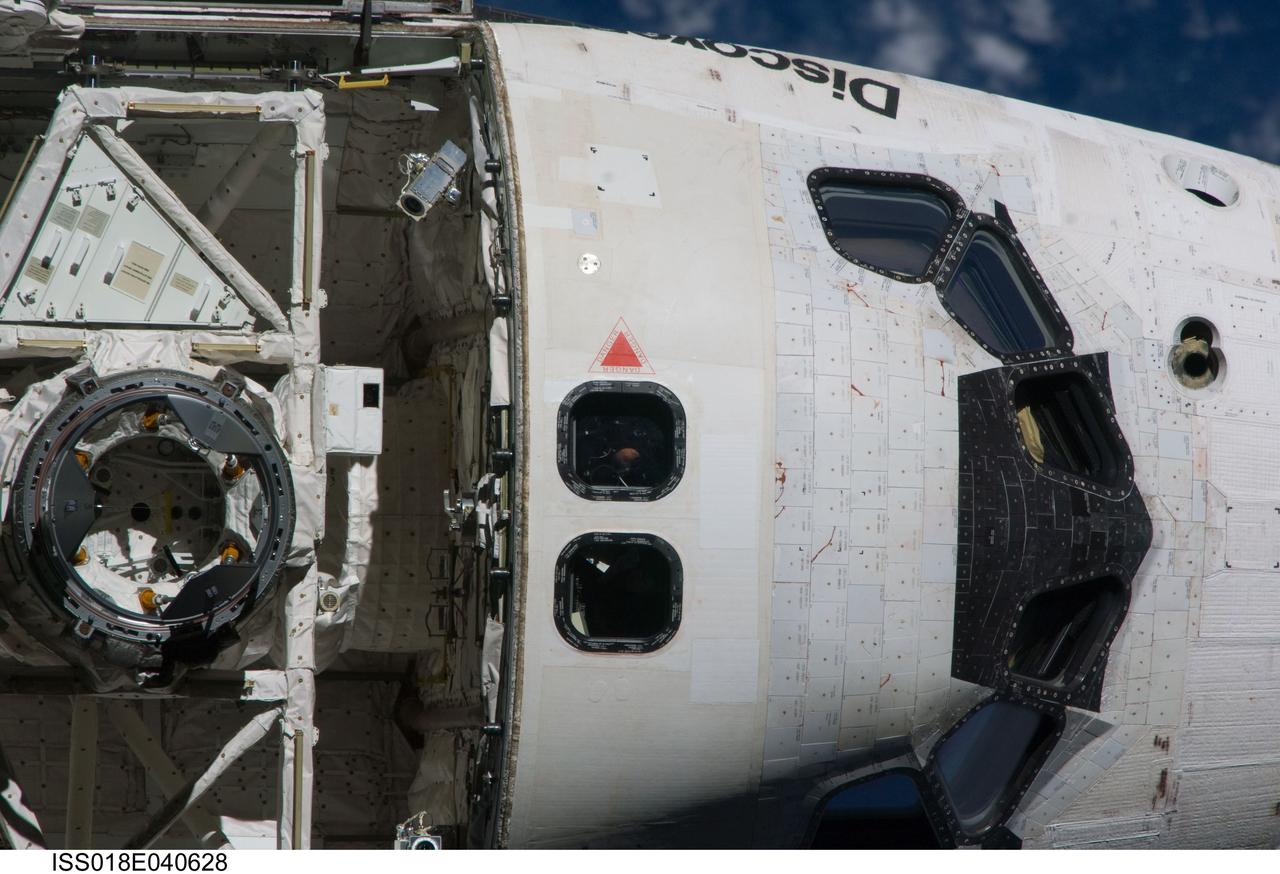
ISS018-E-040628 (17 March 2009) --- An overhead close-up view of the exterior of Space Shuttle Discovery's crew cabin, part of its payload bay and docking system was provided by Expedition 18 crewmembers on the International Space Station. Before docking with the station, astronaut Lee Archambault, STS-119 commander, flew the shuttle through a Rendezvous Pitch Maneuver or basically a backflip to allow the space station crew a good view of Discovery's heat shield. Using digital still cameras equipped with both 400 and 800 millimeter lenses, the ISS crewmembers took a number of photos of the shuttle's thermal protection system and sent them down to teams on the ground for analysis. A 800 millimeter lens was used for this image.
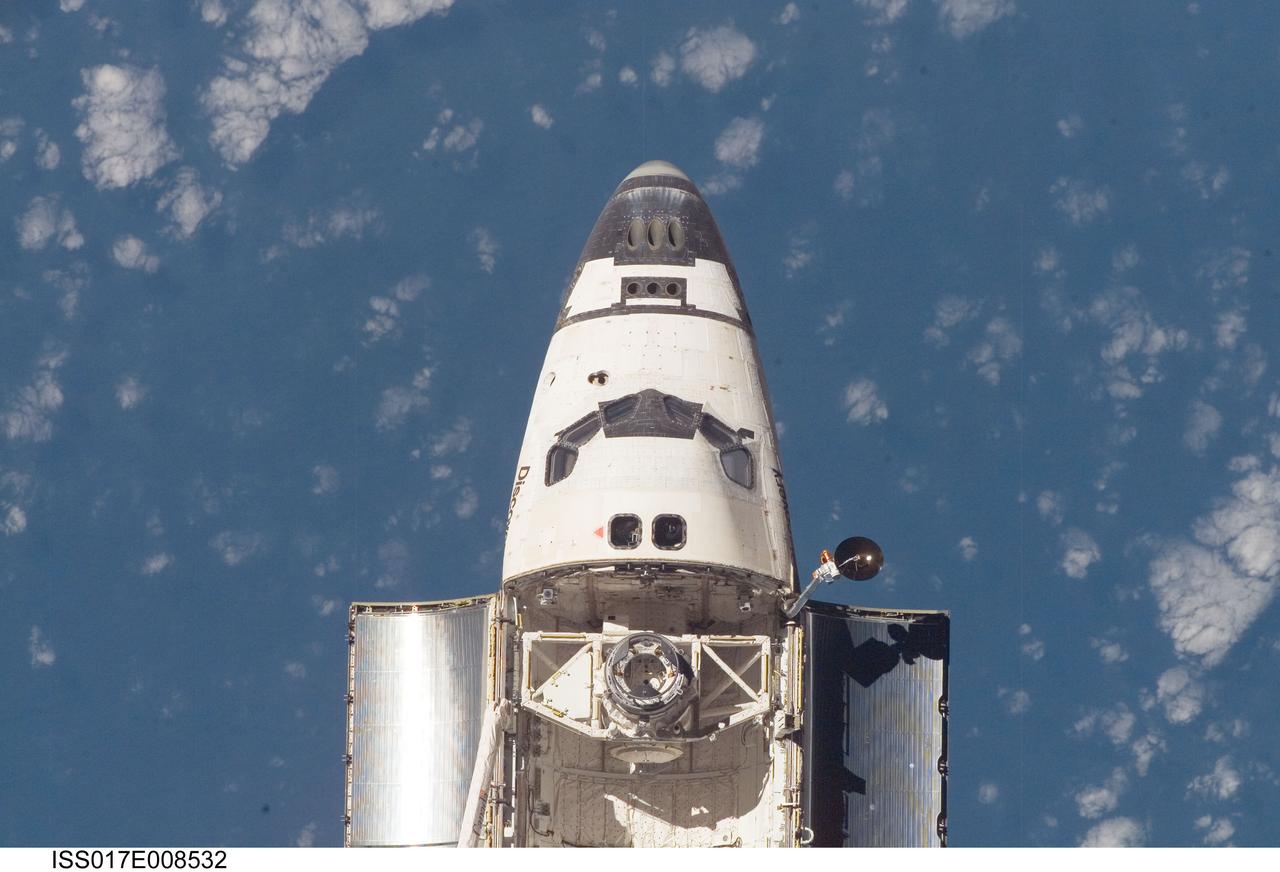
ISS017-E-008532 (2 June 2008) --- An overhead view of the exterior of Space Shuttle Discovery's crew cabin, part of its payload bay doors and docking system was provided by Expedition 17 crewmembers on the International Space Station (ISS). Before docking with the station, astronaut Mark Kelly, STS-124 commander, flew the shuttle through a roll pitch maneuver or basically a backflip to allow the space station crew a good view of Discovery's heat shield. Using digital still cameras equipped with both 400 and 800 millimeter lenses, the ISS crewmembers took a number of photos of the shuttle's thermal protection system and sent them down to teams on the ground for analysis. A 400 millimeter lens was used for this image.
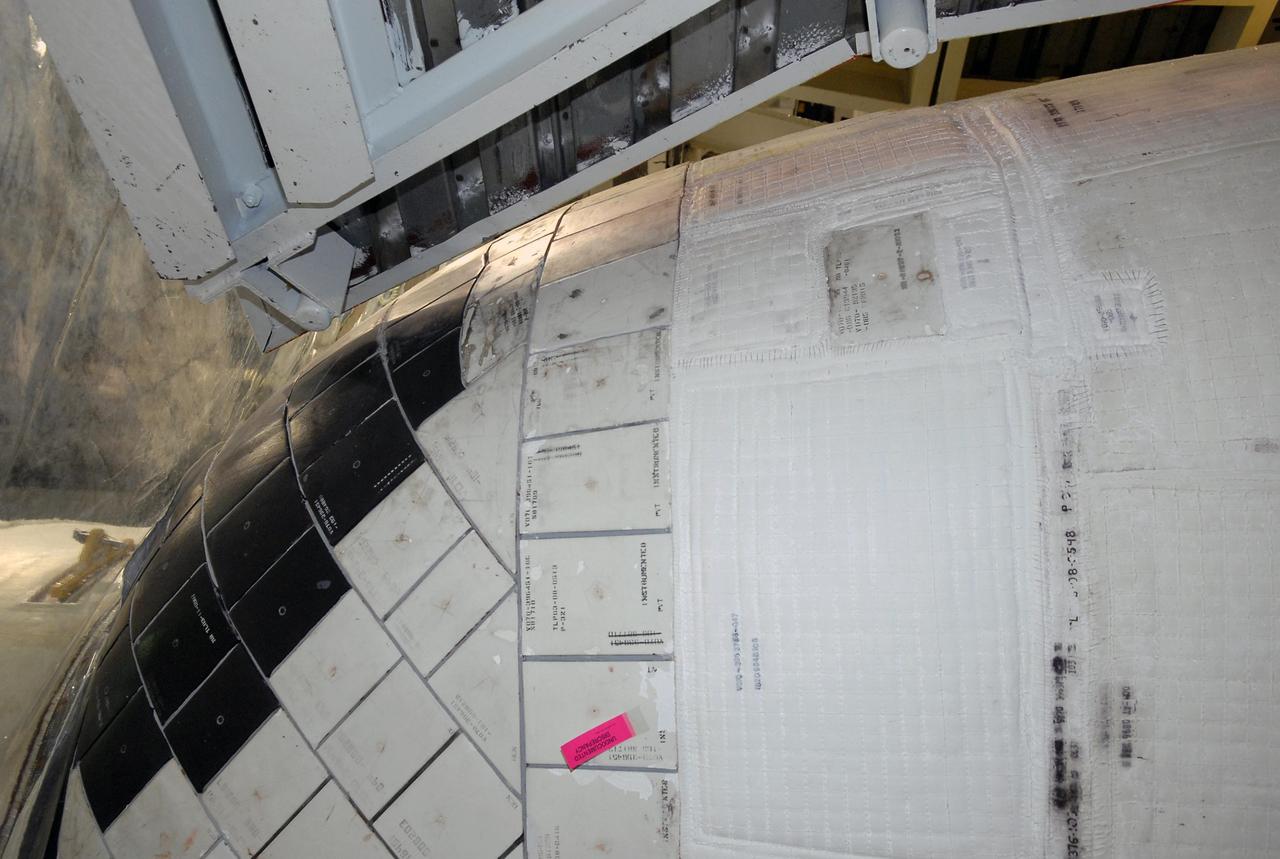
KENNEDY SPACE CENTER, FLA. -- Another view of the area of orbiter Endeavour's orbital maneuvering system, or OMS, pod where the tear occurred on Atlantis during launch of mission STS-117 on June 8, 2007. Repair is under consideration following testing at KSC and Houston. The test articles each feature three tiles (Low Temperature Reusable Surface Insulation, or LRSI) affixed next to two FIB blankets, simulating the thermal protection system set-up on Atlantis' OMS pod in the vicinity of the in-flight anomaly. These test articles were flown to Texas the morning of June 14. The TPS team at KSC has also provided a total of 22 FIB samples for other testing and analysis. Photo credit: NASA/Kim Shiflett
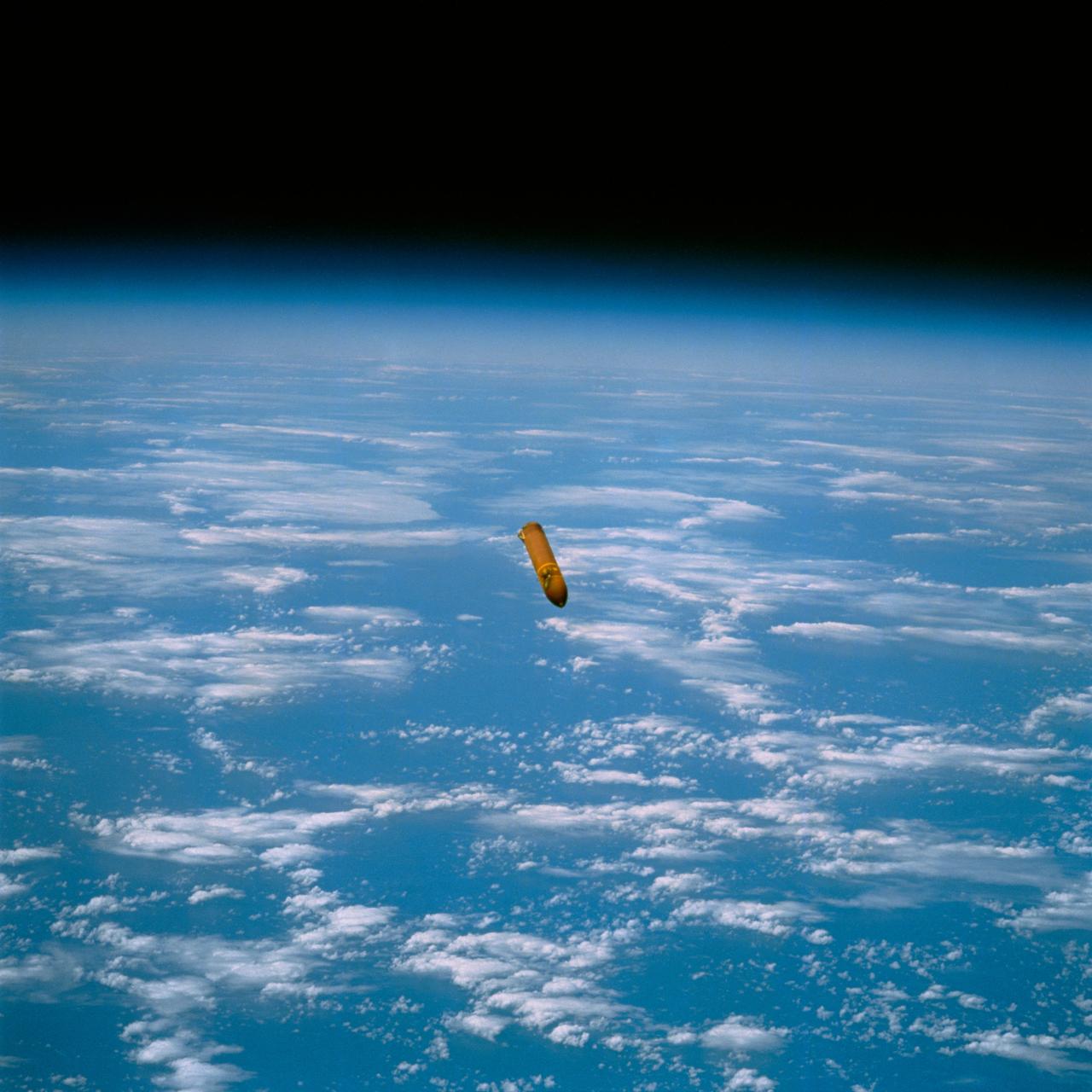
STS029-72-059 (13 March 1989) --- This 70mm photograph, taken by Astronaut James P. Bagian 16 minutes and 7 seconds after liftoff of Discovery, shows the external fuel tank (ET) against the background of Earth. The tank is falling away from the orbiter following ET separation. The left side shows the burn scar above the solid rocket booster (SRB) forward attach point. The burn is caused by the forward SRB separation motors firing during SRB separation. Post 51-L analysis of the thermal and pressure effects of the separation motor exhaust plume indicate that the scarring is not a safety hazard. However, photographs such as this one were requested for additional missions in order to document the phenomenon and corroborate this conclusion. The photo was made at 15:13:07 GMT, March 13, 1989. It was among the visuals used by the crew at its Mar. 28, 1989 post-flight press conference.

S124-E-007263 (8 June 2008) --- Astronaut Ron Garan, STS-124 mission specialist, participates in the mission's third scheduled session of extravehicular activity (EVA) as construction and maintenance continue on the International Space Station. During the six-hour, 33-minute spacewalk, Garan and astronaut Mike Fossum (out of frame), mission specialist, exchanged a depleted Nitrogen Tank Assembly for a new one, removed thermal covers and launch locks from the Kibo laboratory, reinstalled a repaired television camera onto the space station's left P1 truss, and retrieved samples of a dust-like substance from the left Solar Alpha Rotary Joint for analysis by experts on the ground. The Columbus laboratory is visible in the foreground. The blackness of space and Earth's horizon provide the backdrop for the scene.
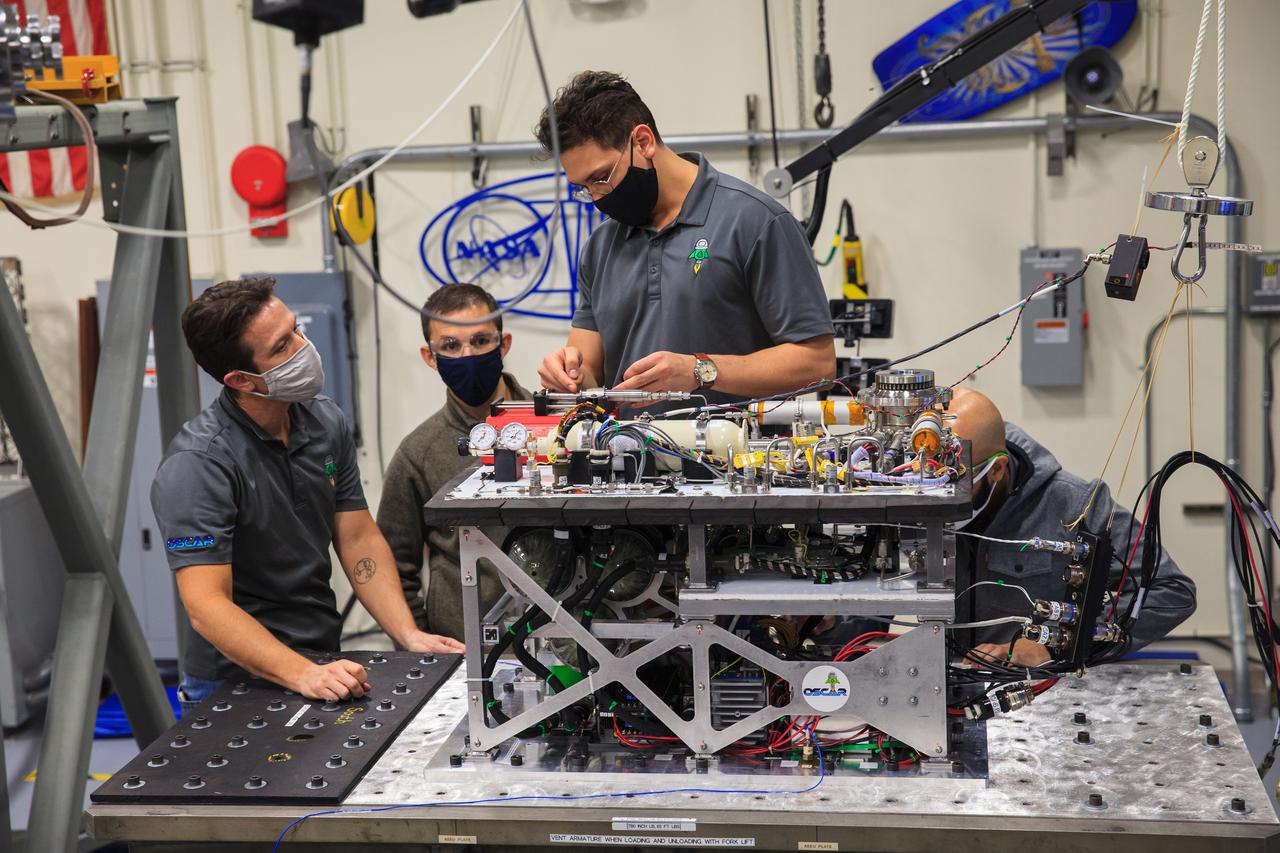
Kennedy Space Center engineers conduct vibration tests inside the Florida spaceport’s Vibration Test Lab on Jan. 14, 2021, in preparation for the suborbital flight of NASA’s Orbital Syngas Commodity Augmentation Reactor, or OSCAR, slated for later this year. From left are Gino Carro, a pressure vessels and systems engineer for the center’s Laboratory Support Services and Operations contract; David Rinderknecht, NASA chemical engineer; Ray Pitts, co-principal investigator for OSCAR; and Malay Shah, NASA thermal/fluid analysis engineer. Beginning as an Early Career Initiative project, OSCAR studies technology to convert trash and human waste into useful gasses such as methane, hydrogen, and carbon dioxide. By processing small pieces of trash in a high-temperature reactor, OSCAR is advancing new and innovative technology for managing waste in space.
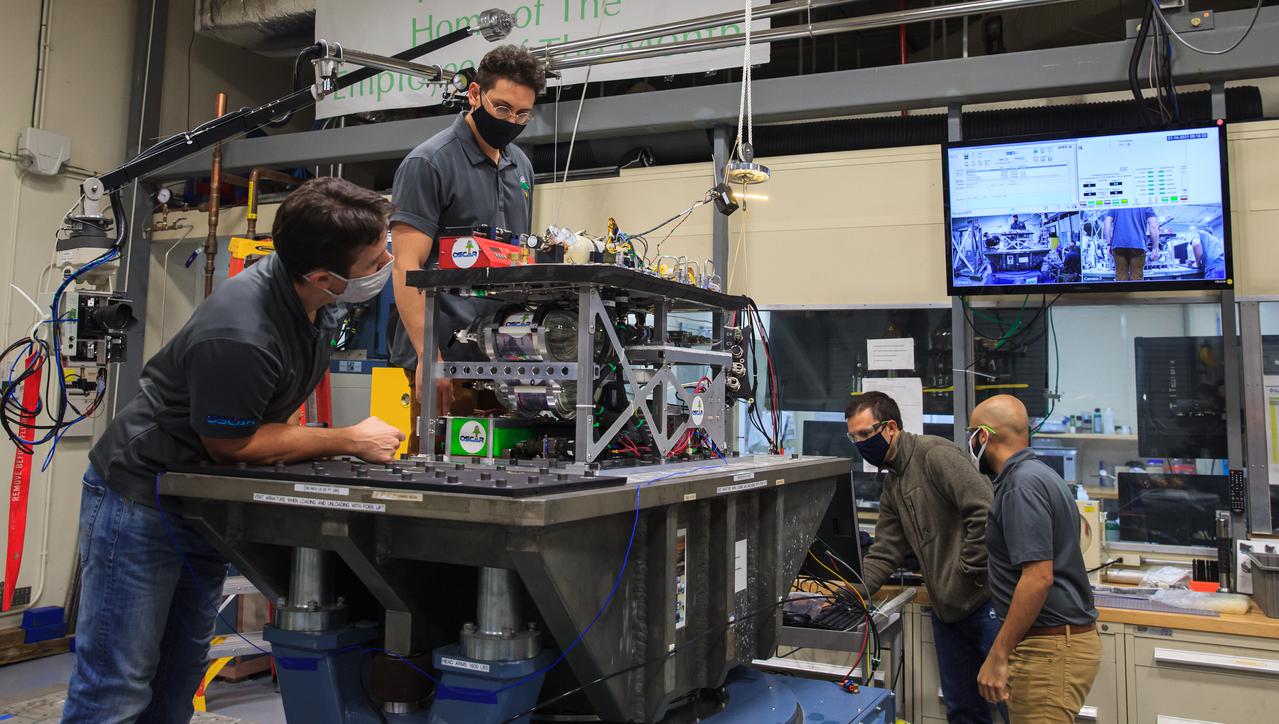
Kennedy Space Center engineers conduct vibration tests inside the Florida spaceport’s Vibration Test Lab on Jan. 14, 2021, in preparation for the suborbital flight of NASA’s Orbital Syngas Commodity Augmentation Reactor, or OSCAR, slated for later this year. From left are Gino Carro, a pressure vessels and systems engineer for the center’s Laboratory Support Services and Operations contract; Ray Pitts, co-principal investigator for OSCAR; David Rinderknecht, NASA chemical engineer; and Malay Shah, NASA thermal/fluid analysis engineer. Beginning as an Early Career Initiative project, OSCAR studies technology to convert trash and human waste into useful gasses such as methane, hydrogen, and carbon dioxide. By processing small pieces of trash in a high-temperature reactor, OSCAR is advancing new and innovative technology for managing waste in space.
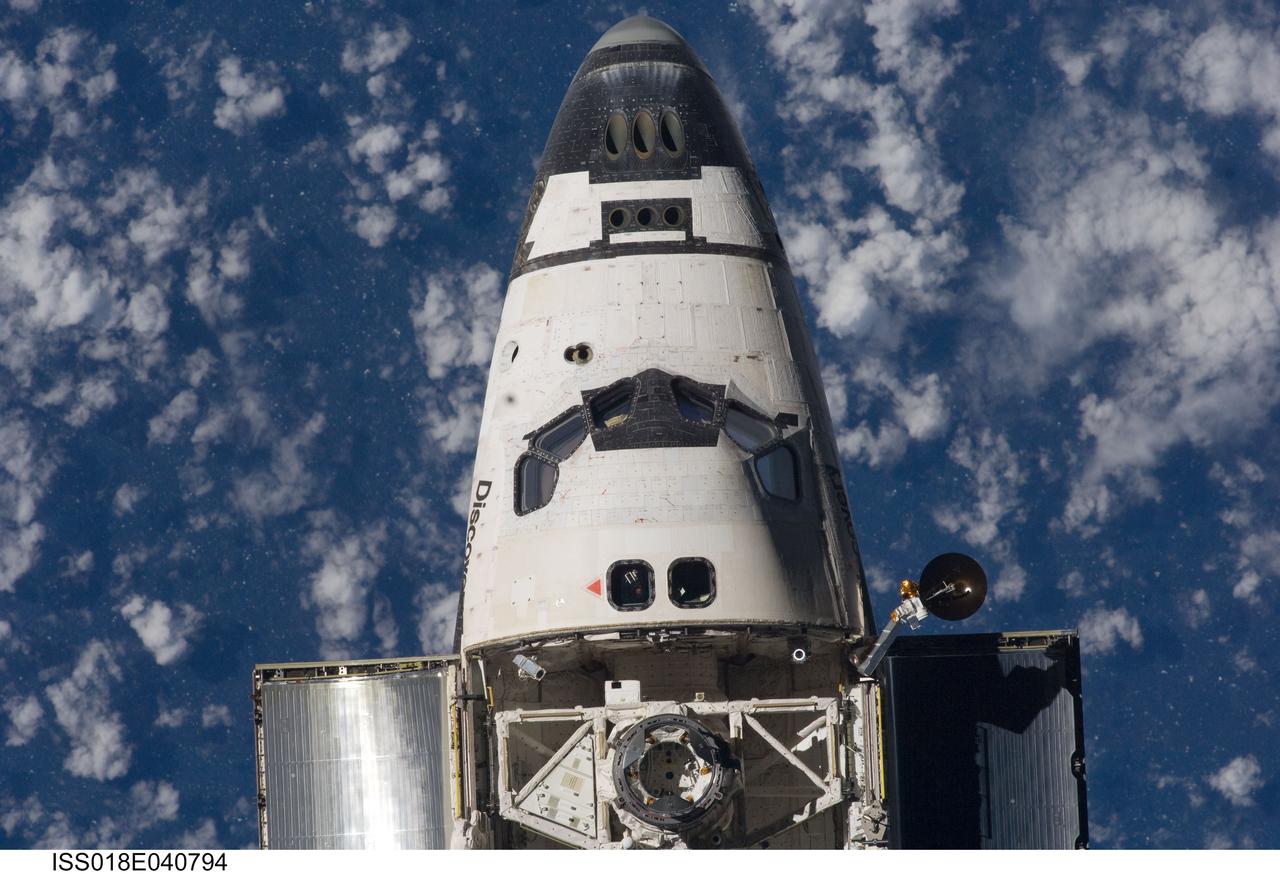
ISS018-E-040794 (17 March 2009) --- An overhead close-up view of the exterior of Space Shuttle Discovery's crew cabin, part of its payload bay and docking system was provided by Expedition 18 crewmembers on the International Space Station. Before docking with the station, astronaut Lee Archambault, STS-119 commander, flew the shuttle through a Rendezvous Pitch Maneuver or basically a backflip to allow the space station crew a good view of Discovery's heat shield. Using digital still cameras equipped with both 400 and 800 millimeter lenses, the ISS crewmembers took a number of photos of the shuttle's thermal protection system and sent them down to teams on the ground for analysis. A 400 millimeter lens was used for this image.
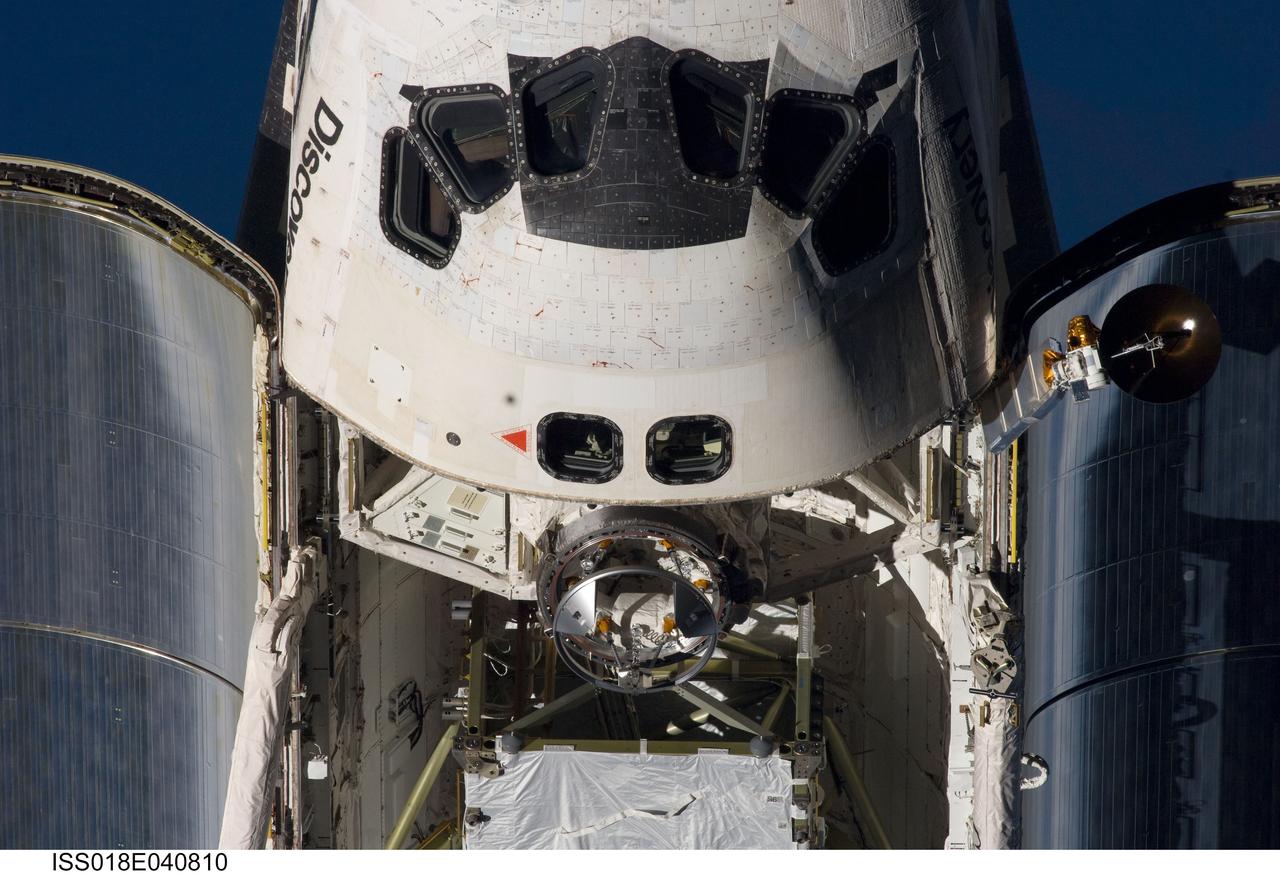
ISS018-E-040810 (17 March 2009) --- An overhead close-up view of the exterior of Space Shuttle Discovery's crew cabin, part of its payload bay and docking system was provided by Expedition 18 crewmembers on the International Space Station. Before docking with the station, astronaut Lee Archambault, STS-119 commander, flew the shuttle through a Rendezvous Pitch Maneuver or basically a backflip to allow the space station crew a good view of Discovery's heat shield. Using digital still cameras equipped with both 400 and 800 millimeter lenses, the ISS crewmembers took a number of photos of the shuttle's thermal protection system and sent them down to teams on the ground for analysis. A 400 millimeter lens was used for this image.
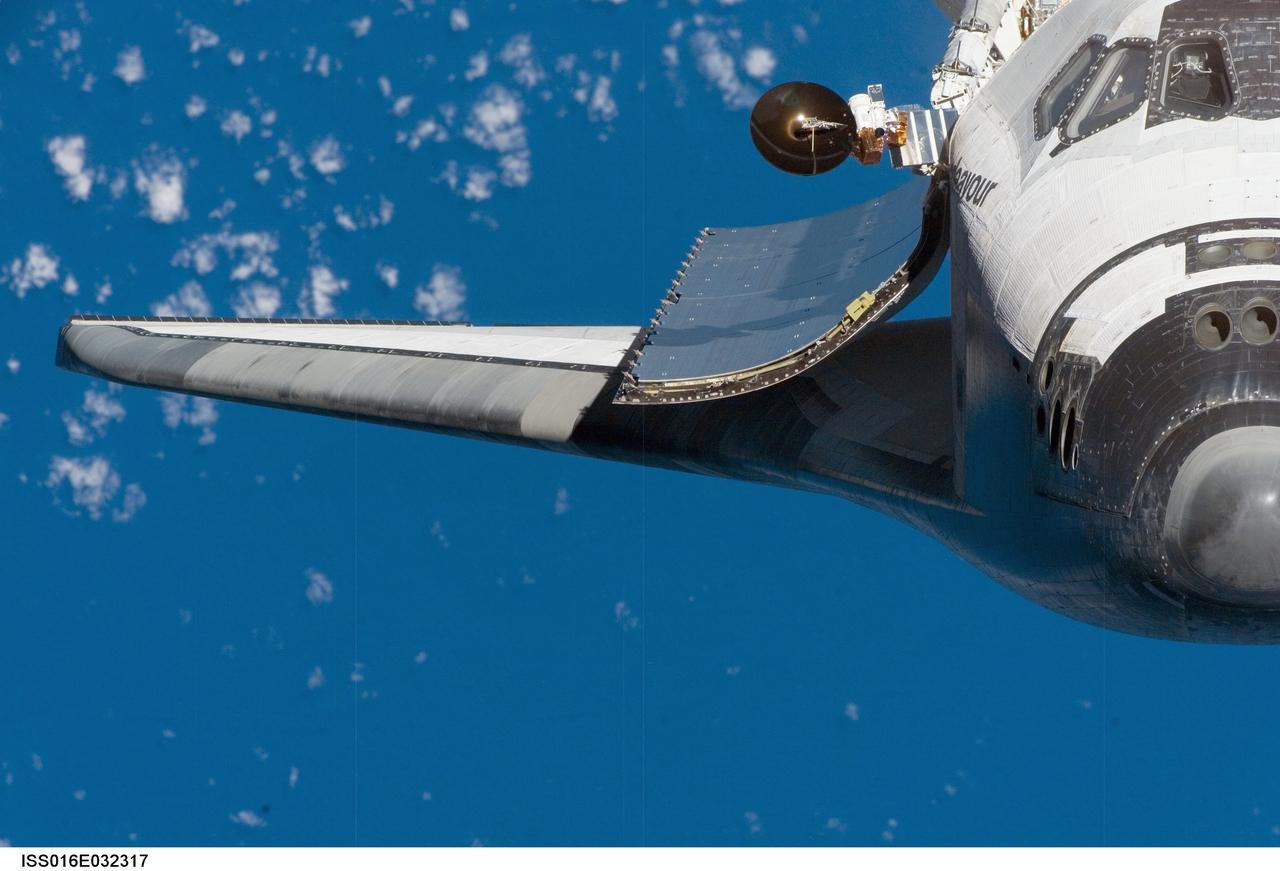
ISS016-E-032317 (12 March 2008) --- A close-up view of the exterior of Space Shuttle Endeavour's crew cabin, starboard wing and payload bay door was provided by Expedition 16 crewmembers on the International Space Station (ISS). Before docking with the station, astronaut Dominic Gorie, STS-123 commander, flew the shuttle through a roll pitch maneuver or basically a backflip to allow the space station crew a good view of Endeavour's heat shield. Using digital still cameras equipped with both 400 and 800 millimeter lenses, the ISS crewmembers took a number of photos of the shuttle's thermal protection system and sent them down to teams on the ground for analysis. A 400 millimeter lens was used for this image.
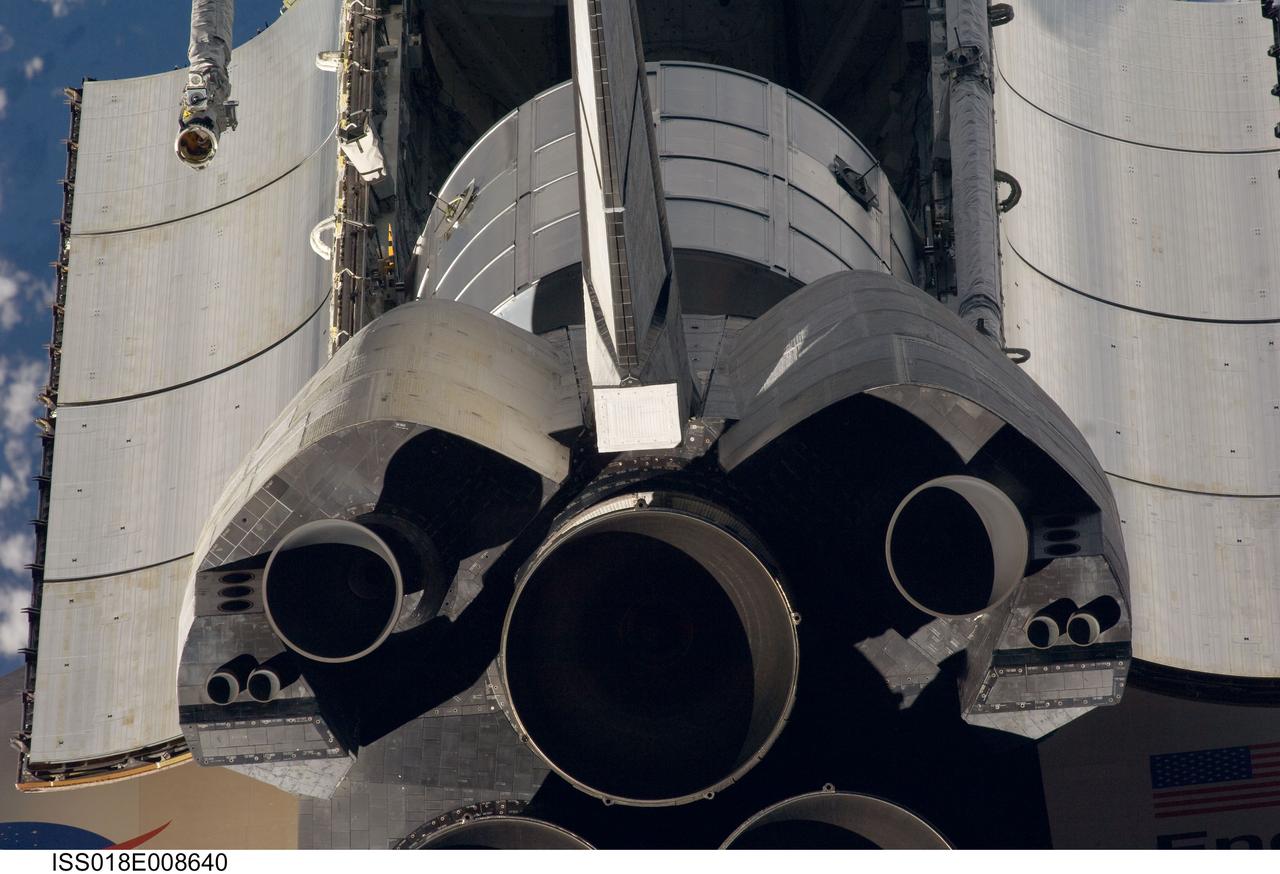
ISS018-E-008640 (16 Nov. 2008) --- A close-up view of Space Shuttle Endeavour's tail section was provided by Expedition 18 crewmembers on the International Space Station. The image provides partial views of the shuttle's main engines, orbital maneuvering system (OMS) pods, vertical stabilizer, the payload bay door panels and the Leonard Multi-Purpose Logistics Module located in the cargo bay. Before docking with the station, astronaut Chris Ferguson, STS-126 commander, flew the shuttle through a roll pitch maneuver or basically a backflip to allow the space station crew a good view of Endeavour's heat shield. Using digital still cameras equipped with both 400 and 800 millimeter lenses, the ISS crewmembers took a number of photos of the shuttle's thermal protection system and sent them down to teams on the ground for analysis. A 400 millimeter lens was used for this image.

ISS018-E-040790 (17 March 2009) --- Backdropped by the blackness of space, Space Shuttle Discovery is featured in this image photographed by an Expedition 18 crewmember on the International Space Station during rendezvous and docking operations. Before docking with the station, astronaut Lee Archambault, STS-119 commander, flew the shuttle through a Rendezvous Pitch Maneuver or basically a backflip to allow the space station crew a good view of Discovery's heat shield. Using digital still cameras equipped with both 400 and 800 millimeter lenses, the ISS crewmembers took a number of photos of the shuttle's thermal protection system and sent them down to teams on the ground for analysis. A 400 millimeter lens was used for this image. Docking occurred at 4:20 p.m. (CDT) on March 17, 2009. The final pair of power-generating solar array wings and the S6 truss segment are visible in Discovery?s cargo bay.
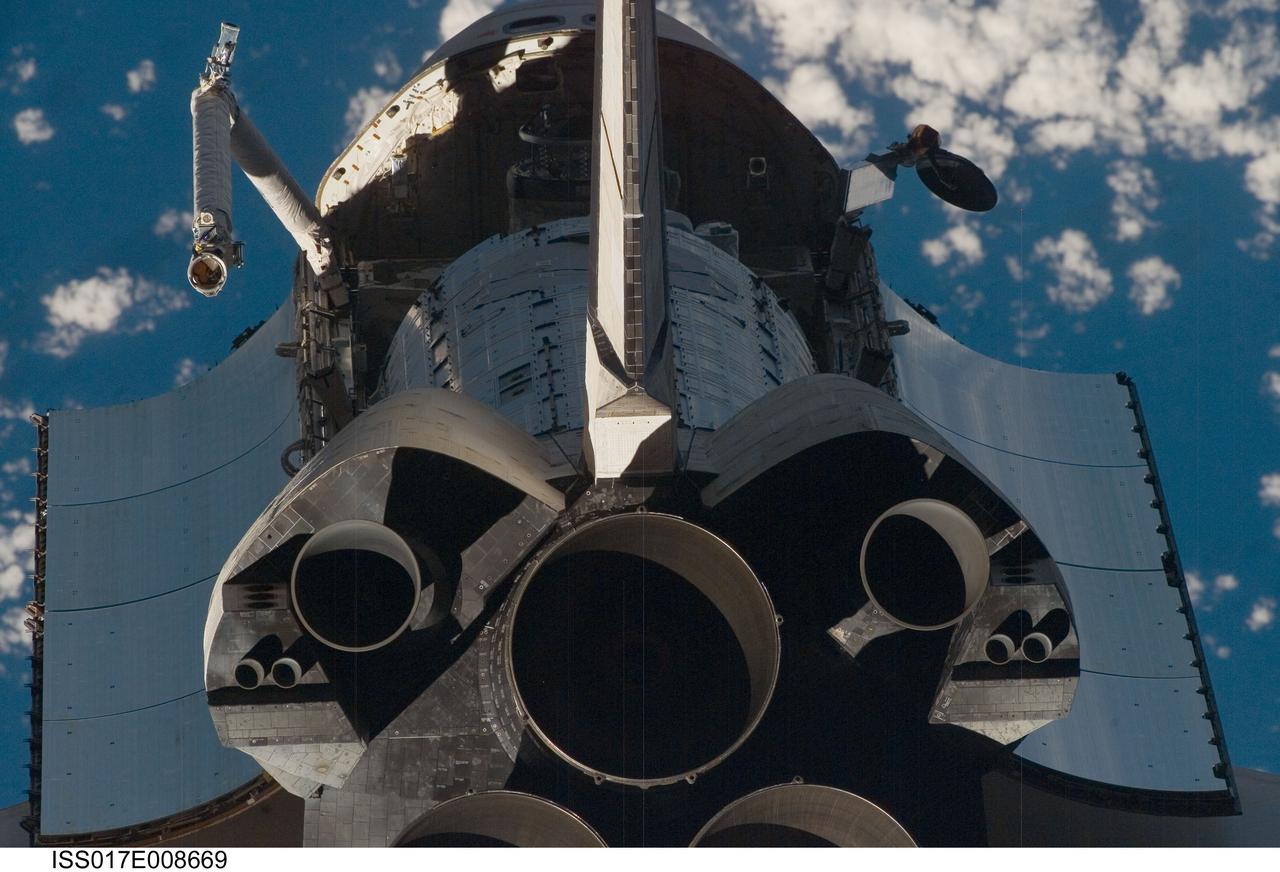
ISS017-E-008669 (2 June 2008) --- A close-up view of Space Shuttle Discovery's tail section was provided by Expedition 17 crewmembers on the International Space Station (ISS). The image provides partial views of the shuttle's main engines, orbital maneuvering system (OMS) pods, vertical stabilizer, the payload bay door panels and the second component of the Japan Aerospace Exploration Agency's Kibo laboratory, the Japanese Pressurized Module (JPM) located in the cargo bay. Before docking with the station, astronaut Mark Kelly, STS-124 commander, flew the shuttle through a roll pitch maneuver or basically a backflip to allow the space station crew a good view of Discovery's heat shield. Using digital still cameras equipped with both 400 and 800 millimeter lenses, the ISS crewmembers took a number of photos of the shuttle's thermal protection system and sent them down to teams on the ground for analysis. A 400 millimeter lens was used for this image.
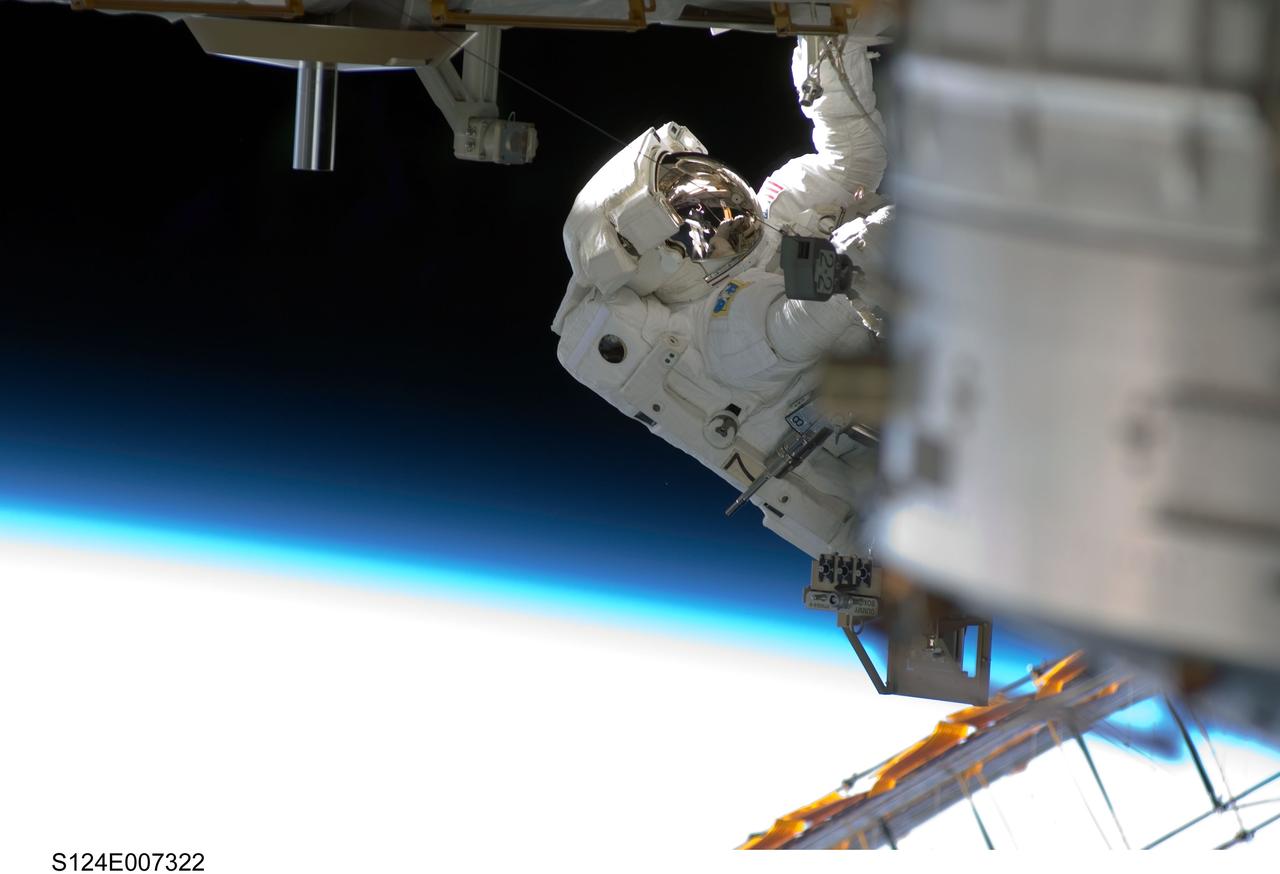
S124-E-007322 (8 June 2008) --- Astronaut Ron Garan, STS-124 mission specialist, participates in the mission's third scheduled session of extravehicular activity (EVA) as construction and maintenance continue on the International Space Station. During the six-hour, 33-minute spacewalk, Garan and astronaut Mike Fossum (out of frame), mission specialist, exchanged a depleted Nitrogen Tank Assembly for a new one, removed thermal covers and launch locks from the Kibo laboratory, reinstalled a repaired television camera onto the space station's left P1 truss, and retrieved samples of a dust-like substance from the left Solar Alpha Rotary Joint for analysis by experts on the ground. The blackness of space and Earth's atmosphere provide the backdrop for the scene.
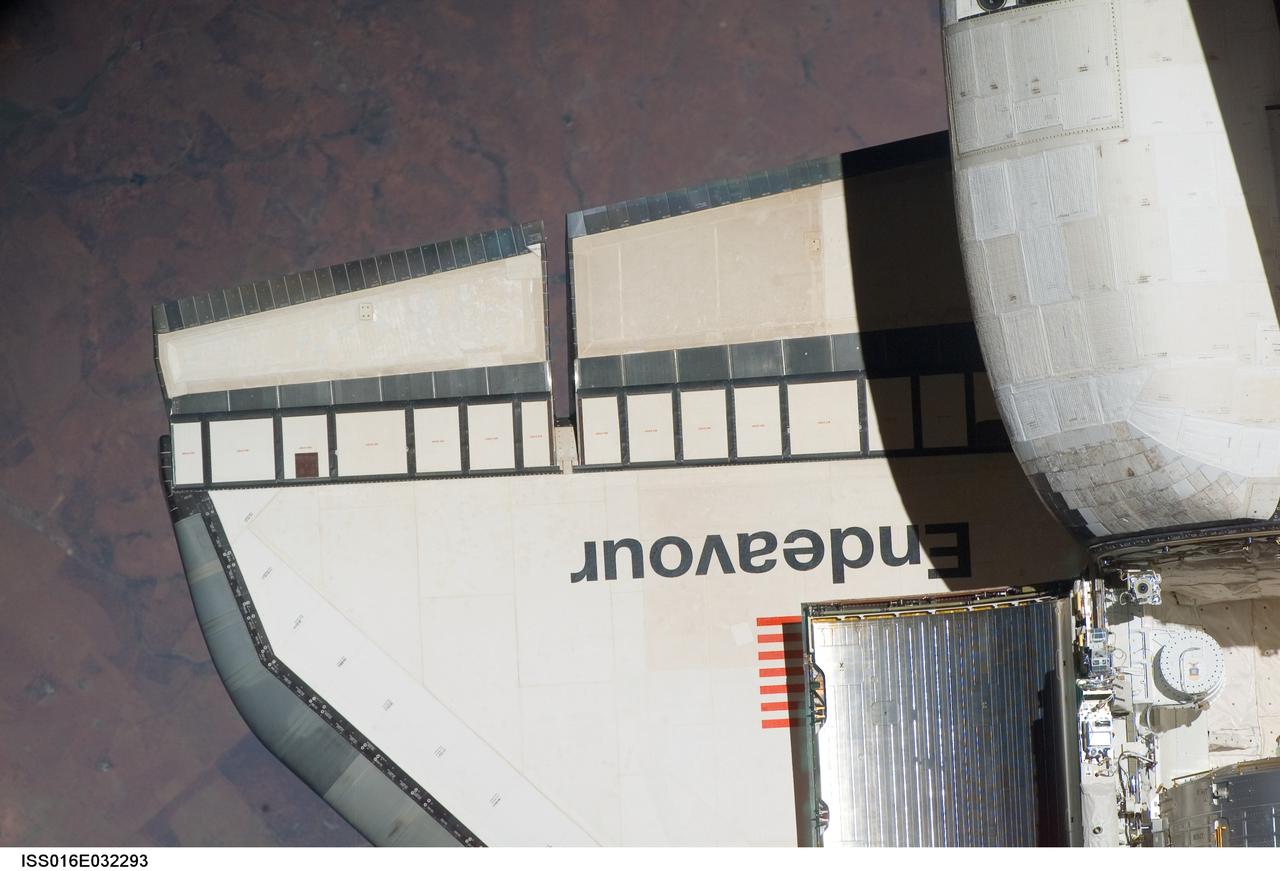
ISS016-E-032293 (12 March 2008) --- An overhead view of part of Space Shuttle Endeavour's starboard wing and part of its orbital maneuvering system (OMS) pods was provided by Expedition 16 crewmembers on the International Space Station (ISS). Before docking with the station, astronaut Dominic Gorie, STS-123 commander, flew the shuttle through a roll pitch maneuver or basically a backflip to allow the space station crew a good view of Endeavour's heat shield. Using digital still cameras equipped with both 400 and 800 millimeter lenses, the ISS crewmembers took a number of photos of the shuttle's thermal protection system and sent them down to teams on the ground for analysis. A 400 millimeter lens was used for this image.
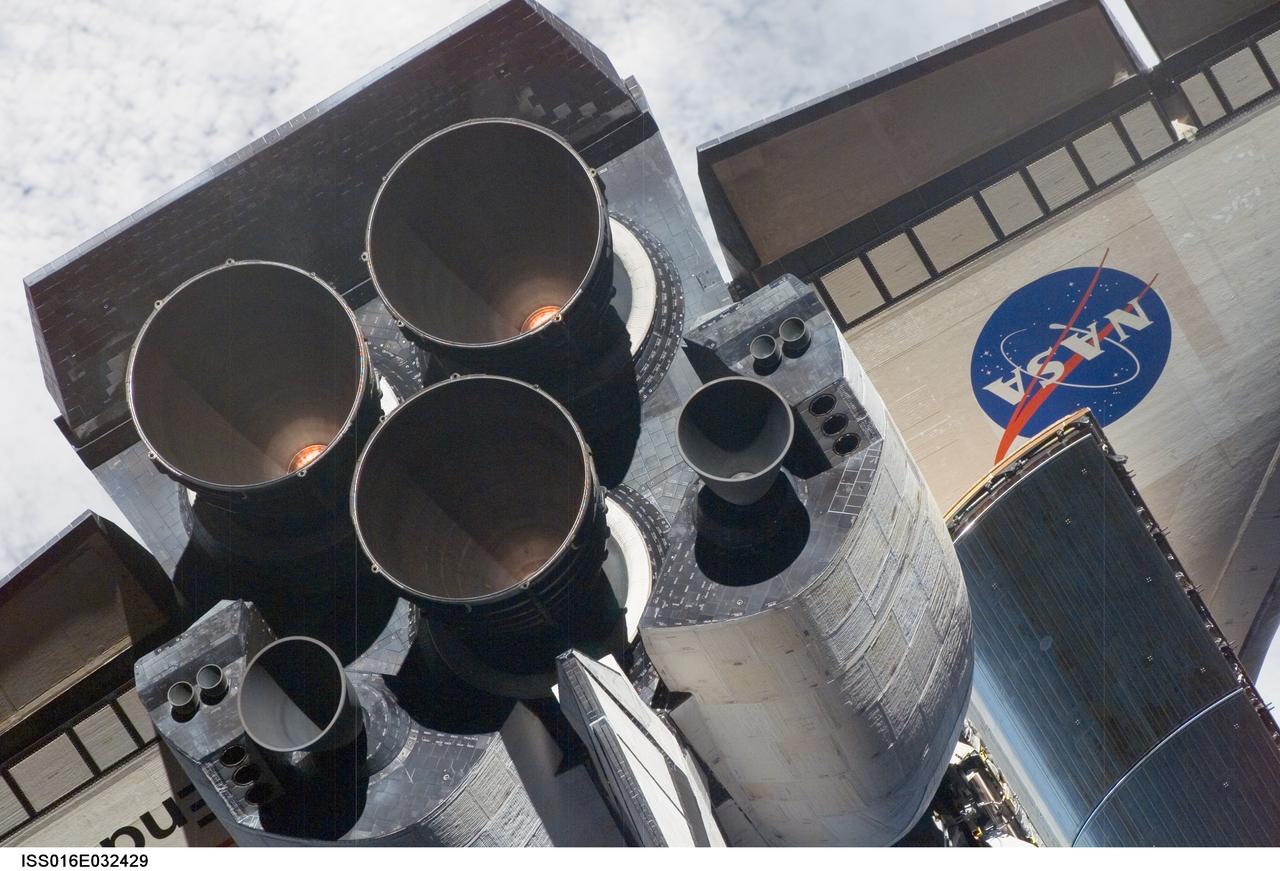
ISS016-E-032429 (12 March 2008) --- A close-up view of Space Shuttle Endeavour's tail section was provided by Expedition 16 crewmembers on the International Space Station (ISS). The image provides partial views of the shuttle's main engines, orbital maneuvering system (OMS) pods, a portion of the payload bay door panels and the shuttle's wings. Before docking with the station, astronaut Dominic Gorie, STS-123 commander, flew the shuttle through a roll pitch maneuver or basically a backflip to allow the space station crew a good view of Endeavour's heat shield. Using digital still cameras equipped with both 400 and 800 millimeter lenses, the ISS crewmembers took a number of photos of the shuttle's thermal protection system and sent them down to teams on the ground for analysis. A 400 millimeter lens was used for this image.
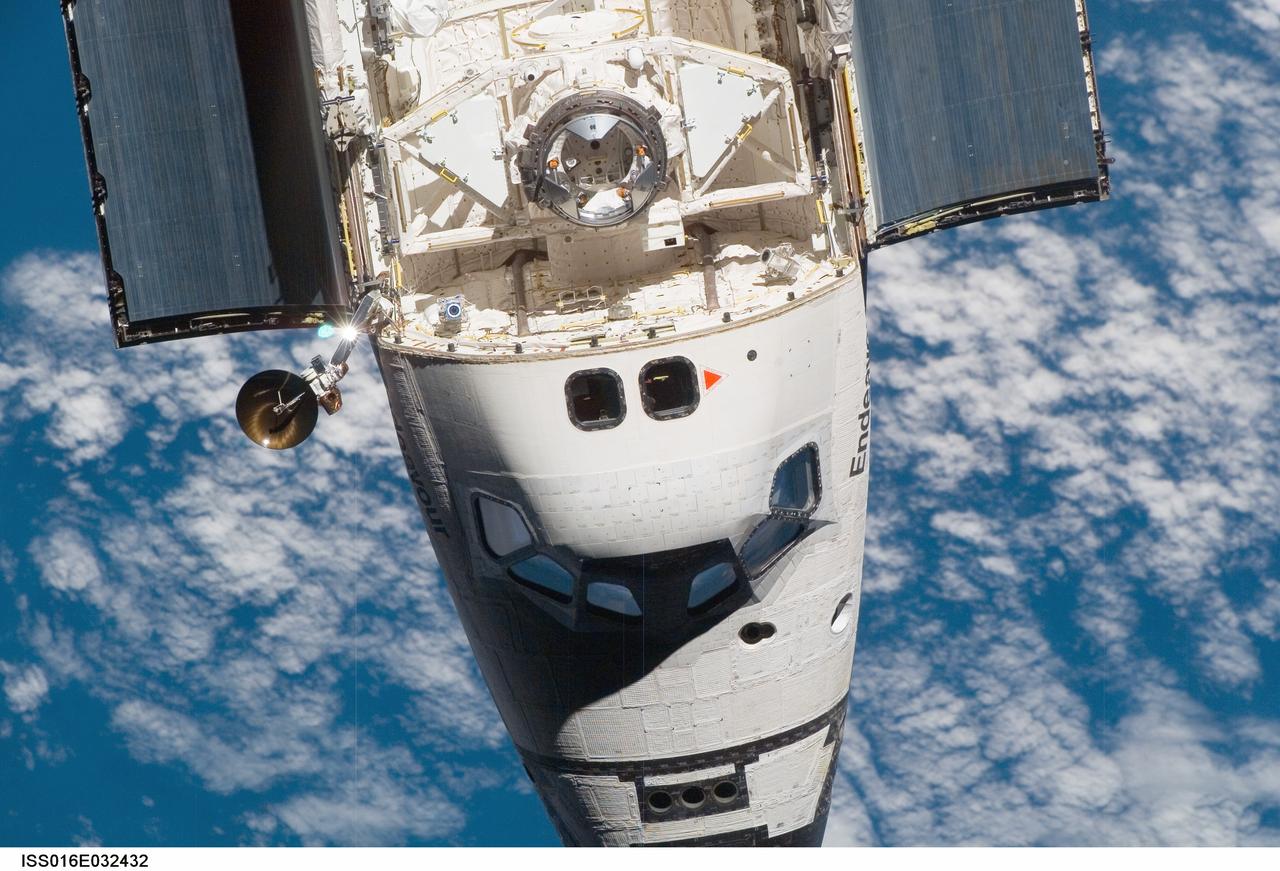
ISS016-E-032432 (12 March 2008) --- An overhead view of the exterior of Space Shuttle Endeavour's crew cabin, part of its payload bay doors and docking system was provided by Expedition 16 crewmembers on the International Space Station (ISS). Before docking with the station, astronaut Dominic Gorie, STS-123 commander, flew the shuttle through a roll pitch maneuver or basically a backflip to allow the space station crew a good view of Endeavour's heat shield. Using digital still cameras equipped with both 400 and 800 millimeter lenses, the ISS crewmembers took a number of photos of the shuttle's thermal protection system and sent them down to teams on the ground for analysis. A 400 millimeter lens was used for this image.
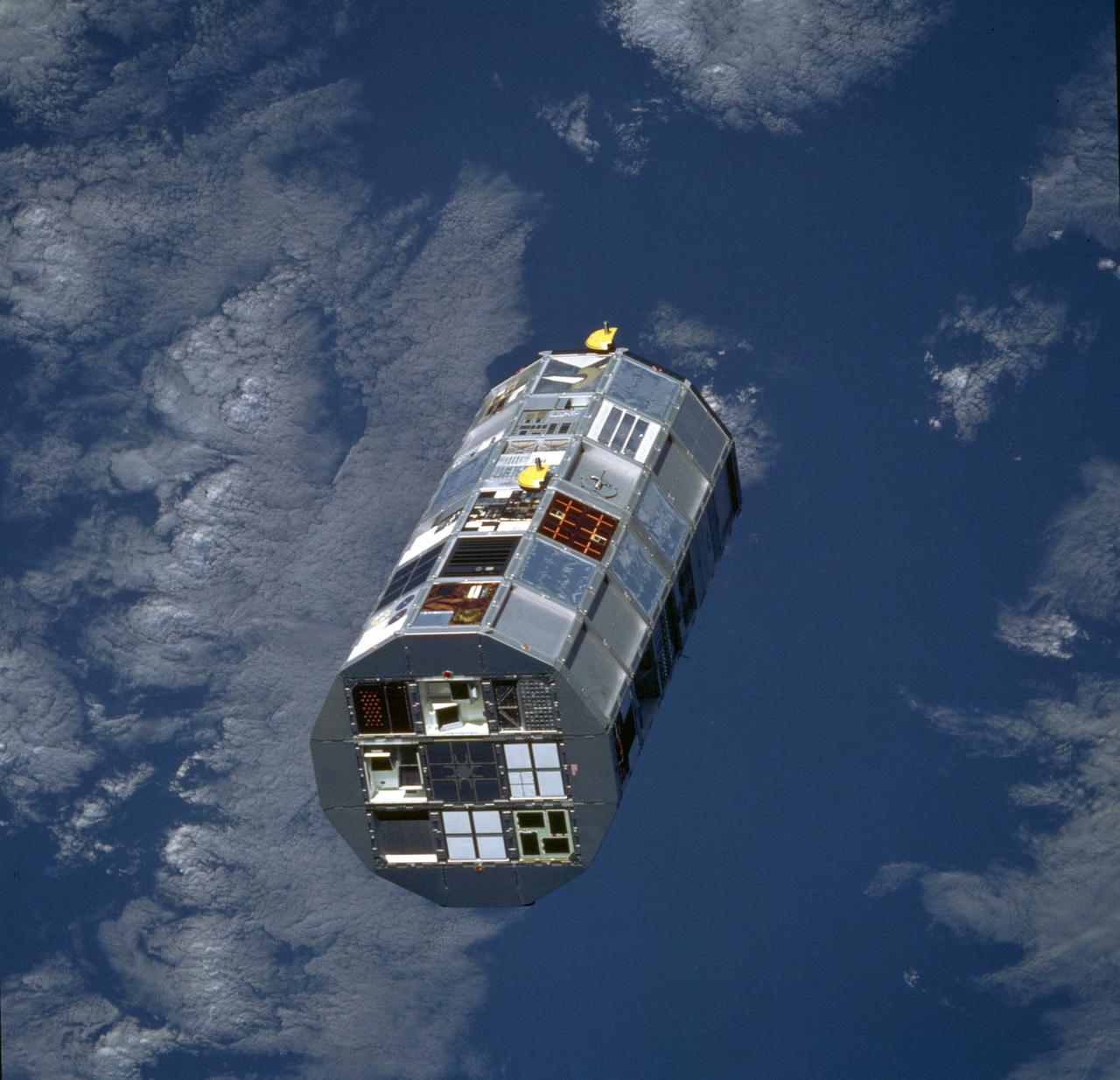
The Long Duration Exposure Facility (LDEF) was designed by the Marshall Space Flight Center (MSFC) to test the performance of spacecraft materials, components, and systems that have been exposed to the environment of micrometeoroids and space debris for an extended period of time. The LDEF proved invaluable to the development of future spacecraft and the International Space Station (ISS). The LDEF carried 57 science and technology experiments, the work of more than 200 investigators. MSFC`s experiments included: Trapped Proton Energy Determination to determine protons trapped in the Earth's magnetic field and the impact of radiation particles; Linear Energy Transfer Spectrum Measurement Experiment which measures the linear energy transfer spectrum behind different shielding configurations; Atomic oxygen-Simulated Out-gassing, an experiment that exposes thermal control surfaces to atomic oxygen to measure the damaging out-gassed products; Thermal Control Surfaces Experiment to determine the effects of the near-Earth orbital environment and the shuttle induced environment on spacecraft thermal control surfaces; Transverse Flat-Plate Heat Pipe Experiment, to evaluate the zero-gravity performance of a number of transverse flat plate heat pipe modules and their ability to transport large quantities of heat; Solar Array Materials Passive LDEF Experiment to examine the effects of space on mechanical, electrical, and optical properties of lightweight solar array materials; and the Effects of Solar Radiation on Glasses. Launched aboard the Space Shuttle Orbiter Challenger's STS-41C mission April 6, 1984, the LDEF remained in orbit for five years until January 1990 when it was retrieved by the Space Shuttle Orbiter Columbia STS-32 mission and brought back to Earth for close examination and analysis.
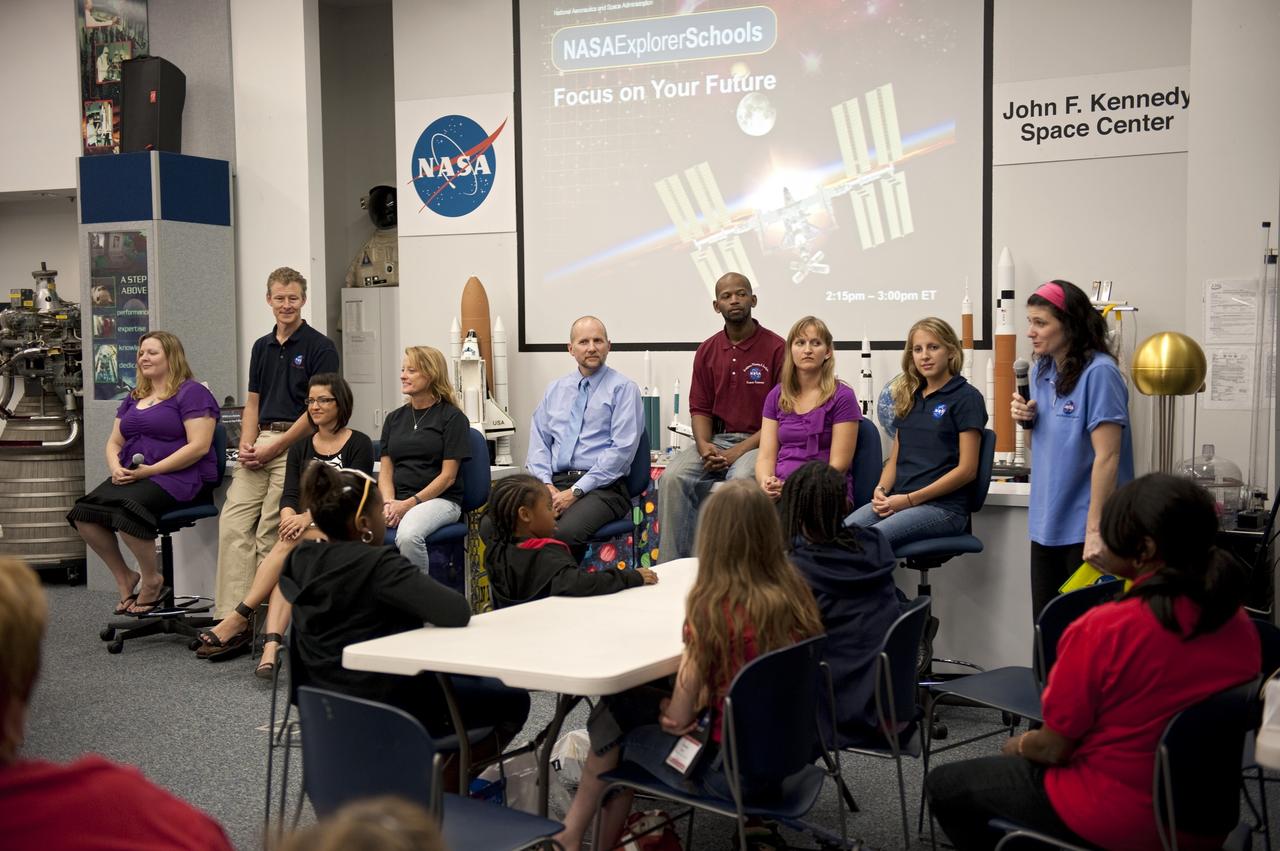
Cape Canaveral, Fla. -- Students from across the nation gathered at NASA's Kennedy Space Center in Florida for the NASA Explorer Schools (NES) symposium. At the microphone is NASA Explorer Schools Lead Education Specialist Alicia Baturoni from NASA's Glenn Research Center. From left, the panel includes aerospace engineer with NASA's Launch Services Program Caley Burke, Gary Letchworth who is working on the Orion multipurpose crew vehicle, NASA Contract Specialist Nicole Rivera, wildlife ecologist with Innovative Heath Applications Becky Bolt, Tim Griffin who works in Kennedy's Chemical Analysis Branch, Xaivian Raymond with NASA Human Resources, aerospace engineer Sarah Cox who works on the space shuttle's thermal protection system, and chemical engineer Annie Caraccio. During the NES event, students presented their investigation project to their peers, scientists, engineers and education specialists. About 60 fourth- through 12-grade students nationwide are at the center May 4-7 participating in tours of processing and launch facilities and the U.S. Astronaut Hall of Fame, as well as several educational activities and a career panel question-and-answer session. About 30 teachers will receive professional development opportunities during the symposium. The participants were competitively selected after they completed an original investigation focused on existing NASA missions or research interests. Photo Credit: NASA/Kim Shiflett
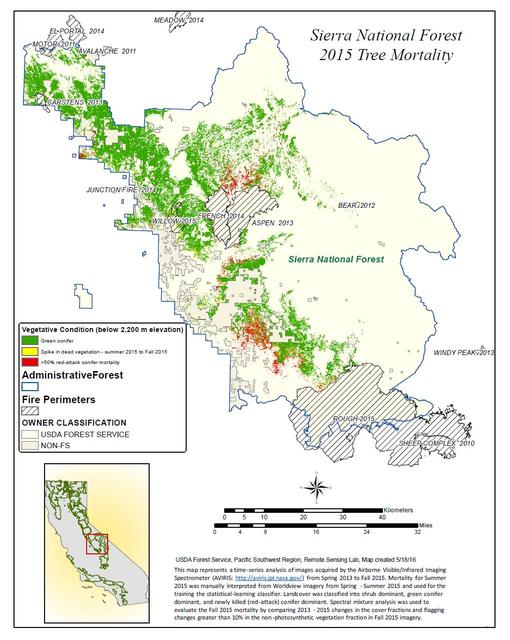
California, reveals the devastating effect of California's ongoing drought on Sierra Nevada conifer forests. The map will be used to help the U.S. Forest Service assess and respond to the impacts of increased tree mortality caused by the drought, particularly where wildlands meet urban areas within the Sierra National Forest. After several years of extreme drought, the highly stressed conifers (trees or bushes that produce cones and are usually green year-round) of the Sierra Nevada are now more susceptible to bark beetles (Dendroctonus spp.). While bark beetles killing trees in the Sierra Nevada is a natural phenomenon, the scale of mortality in the last couple of years is far greater than previously observed. The U.S. Forest Service is using recent airborne spectroscopic measurements from NASA's Airborne Visible/Infrared Imaging Spectrometer (AVIRIS) instrument aboard NASA's ER-2 aircraft, together with new advanced algorithms, to quantify this impact over this large region of rugged terrain. The high-altitude ER-2 aircraft is based at NASA's Armstrong Flight Research Center, Edwards, California. The image was created by scientists at the USFS's Pacific Southwest Region Remote Sensing Lab, McClellan, California, by performing a time series analysis of AVIRIS images. Scientists evaluated baseline tree mortality on public lands in the summer of 2015 using a machine learning algorithm called "random forest." This algorithm classifies the AVIRIS measurements as dominated by either shrubs, healthy trees or newly dead conifer trees. To quantify how much the amount of dead vegetation increased during the fall of 2015, the Forest Service scientists conducted an advanced spectral mixture analysis. This analysis evaluates each spectrum to determine the fraction of green vegetation, dead vegetation and soil. The full spectral range of AVIRIS is important to separate the signatures of soil and dead vegetation. To produce this comprehensive Sierra National Forest tree mortality map, the result from the summer of 2015 was evaluated to look for increases of more than 10 percent in dead vegetation during the fall of 2015. AVIRIS measures spectra of the Earth system to conduct advanced science research. These western U.S. AVIRIS measurements were acquired as part of NASA's Hyperspectral Infrared Imager (HyspIRI) preparatory airborne campaign. HyspIRI was one of the space missions suggested to NASA by the National Academy of Sciences in its 2007 decadal survey for Earth Science. In the future, HyspIRI could provide spectral and thermal measurements of this type globally for ecosystem research and additional science objectives. http://photojournal.jpl.nasa.gov/catalog/PIA20717
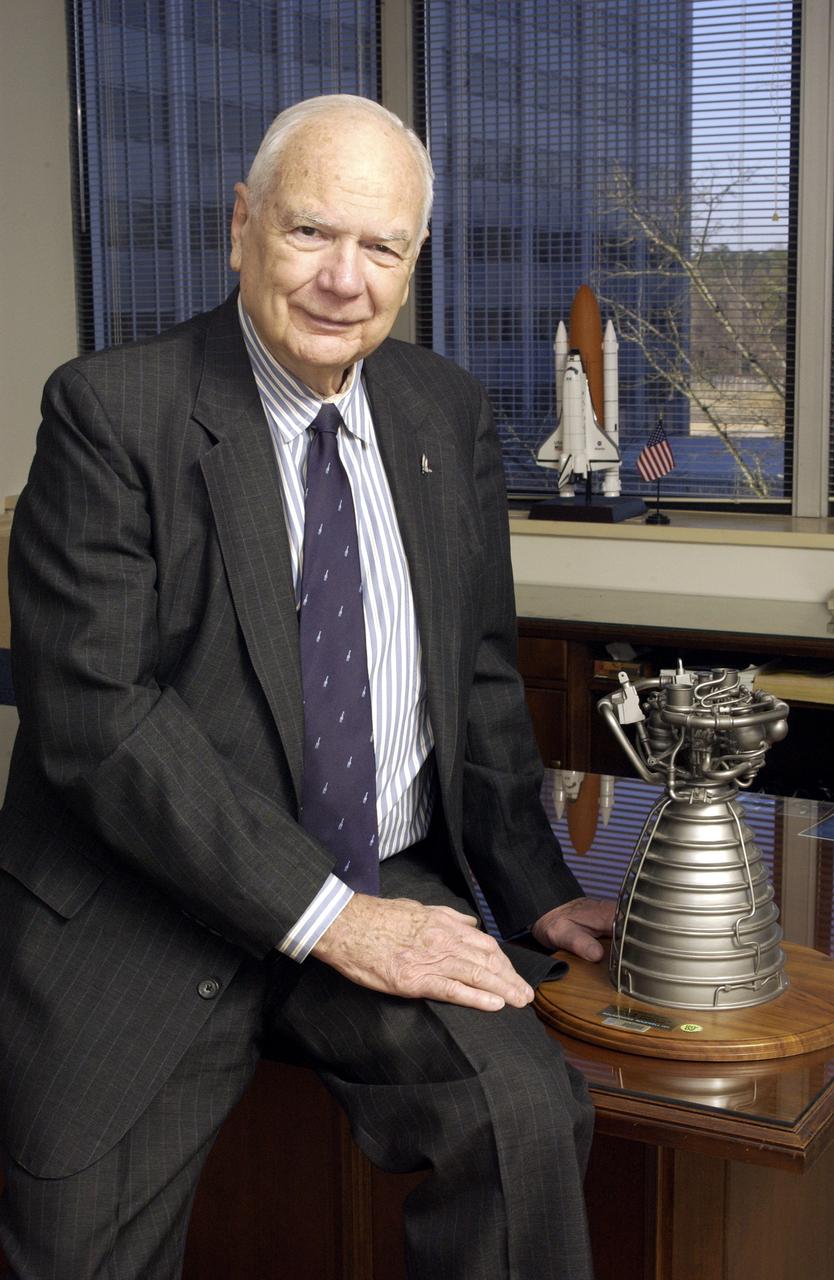
After four decades of contribution to America's space program, George Hopson, manager of the Space Shuttle Main Engine Project at Marshall Space Flight Center, accepted NASA's Distinguished Service Medal. Awarded to those who, by distinguished ability or courage, have made a personal contribution to the NASA mission, NASA's Distinguished Service Medal is the highest honor NASA confers. Hopson's contributions to America's space program include work on the country's first space station, Skylab; the world's first reusable space vehicle, the Space Shuttle; and the International Space Station. Hopson joined NASA's Marshall team as chief of the Fluid and Thermal Systems Branch in the Propulsion Division in 1962, and later served as chief of the Engineering Analysis Division of the Structures and Propulsion Laboratory. In 1979, he was named director of Marshall's Systems Dynamics Laboratory. In 1981, he was chosen to head the Center's Systems Analysis and Integration. Seven years later, in 1988, Hopson was appointed associate director for Space Transportation Systems and one year later became the manager of the Space Station Projects Office at Marshall. In 1994, Hopson was selected as deputy director for Space Systems in the Science and Engineering Directorate at Marshall where he supervised the Chief Engineering Offices of both marned and unmanned space systems. He was named manager of the Space Shuttle Main Engine Project in 1997. In addition to the Distinguished Service Medal, Hopson has also been recognized with the NASA Outstanding Leadership Medal and NASA's Exceptional Service Medal.
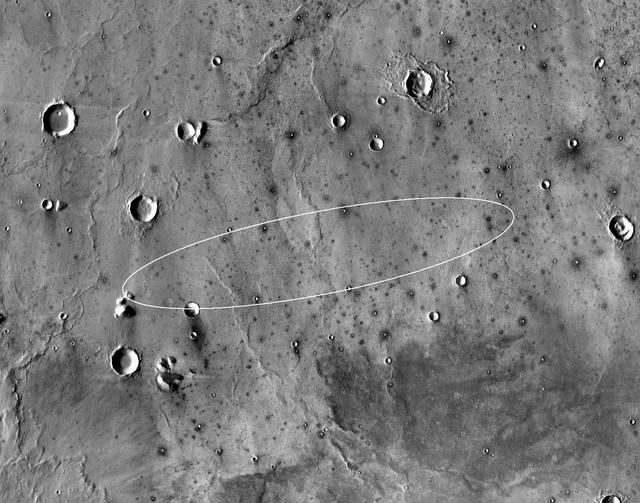
This map shows the single area under continuing evaluation as the InSight mission's Mars landing site, as of a year before the mission's May 2016 launch. The finalist ellipse marked within the northern portion of flat-lying Elysium Planitia is centered at about 4.5 degrees north latitude and 136 degrees east longitude. InSight -- an acronym for Interior Exploration using Seismic Investigations, Geodesy and Heat Transport -- will study the interior of Mars to improve understanding of the processes that formed and shaped rocky planets, including Earth. The mission's launch period begins March 4, 2016, and lasts until late March. Whichever day during that period the launch occurs, landing is scheduled for Sept. 28, 2016. The landing ellipse on this map covers an area within which the spacecraft has about 99 percent chance of landing when targeted for the center of the ellipse. It is about 81 miles (130 kilometers) long, generally west to east, and about 17 miles (27 kilometers) wide. This ellipse covers the case of a launch at the start of the launch period. If the launch occurs later in the period, orientation of the landing ellipse would shift slightly clockwise. Four semifinalist sites in Elysium Planitia were evaluated as safe for InSight landing. This one was selected as having the largest proportion of its area classified as smooth terrain. If continuing analysis identifies unexpected problems with this site, another of the semifinalists could be reconsidered before final selection later this year. The InSight lander will deploy two instruments directly onto the ground using a robotic arm. One is a seismometer contributed by France's space agency (CNES) with components from Germany, Switzerland, the United Kingdom and the United States. The seismometer will measure microscopic ground motions, providing detailed information about the interior structure of Mars. The other instrument to be deployed by the arm is a heat-flow probe contributed by the German Aerospace Center (DLR), designed to hammer itself three to five meters (about 10 to 16 feet) deep. It will monitor heat coming from the planet's interior. The mission will also track the lander's radio to measure wobbles in the planet's rotation that relate to the size of its core. A suite of environmental sensors will monitor the weather and variations in the magnetic field. The base map is a mosaic of daytime thermal images from the Thermal Emission Imaging System (THEMIS) on NASA's Mars Odyssey orbiter. THEMIS was developed and is operated by Arizona State University, Tempe. Note: After thorough examination, NASA managers have decided to suspend the planned March 2016 launch of the Interior Exploration using Seismic Investigations Geodesy and Heat Transport (InSight) mission. The decision follows unsuccessful attempts to repair a leak in a section of the prime instrument in the science payload. http://photojournal.jpl.nasa.gov/catalog/PIA19143

NASA's Airborne Visible Infrared Imaging Spectrometer instrument (AVIRIS), flying aboard a NASA Armstrong Flight Research Center high-altitude ER-2 aircraft, observed wildfires burning in Southern California on Dec. 5-7, 2017. AVIRIS is an imaging spectrometer that observes light in visible and infrared wavelengths, measuring the full spectrum of radiated energy. Unlike regular cameras with three colors, AVIRIS has 224 spectral channels, measuring contiguously from the visible through the shortwave infrared. Data from these flights, compared against measurements acquired earlier in the year, show many ways this one instrument can improve both our understanding of fire risk and the response to fires in progress. The top row in this image compilation shows pre-fire data acquired from June 2017. At top left is a visible-wavelength image similar to what our own eyes would see. The top middle image is a map of surface composition based on analyzing the full electromagnetic spectrum, revealing green vegetated areas and non-photosynthetic vegetation that is potential fuel as well as non-vegetated surfaces that may slow an advancing fire. The image at top right is a remote measurement of the water in tree canopies, a proxy for how much moisture is in the vegetation. The bottom row in the compilation shows data acquired from the Thomas fire in progress in December 2017. At bottom left is a visible wavelength image. The bottom middle image is an infrared image, with red at 2,250 nanometers showing fire energy, green at 1,650 nanometers showing the surface through the smoke, and blue at 1,000 nanometers showing the smoke itself. The image at bottom right is a fire temperature map using spectroscopic analysis to measure fire thermal emission recorded in the AVIRIS spectra. https://photojournal.jpl.nasa.gov/catalog/PIA22194
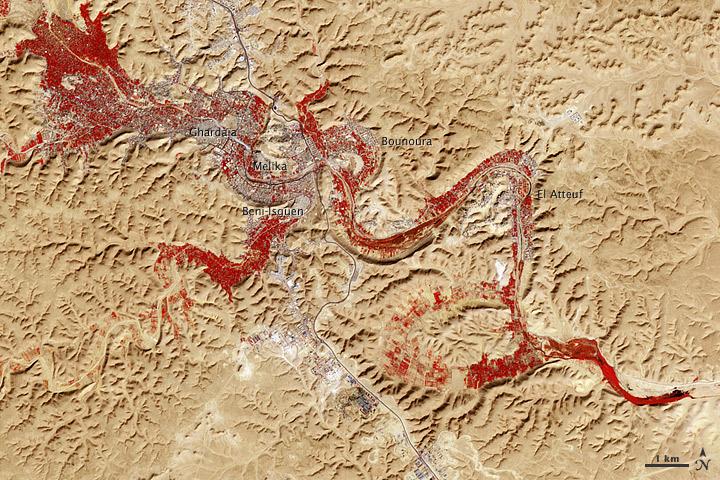
NASA image acquired Feb. 9, 2011 Less than 5 percent of Algeria’s land surface is suitable for growing crops, and most precipitation falls on the Atlas Mountains along the coast. Inland, dust-laden winds blow over rocky plains and sand seas. However, in north central Algeria—off the tip of Grand Erg Occidental and about 450 kilometers (280 miles) south of Algiers—lies a serpentine stretch of vegetation. It is the M’zab Valley, filled with palm groves and dotted with centuries-old settlements. The Advanced Spaceborne Thermal Emission and Reflection Radiometer (ASTER) on NASA’s Terra satellite captured this image of M’zab Valley on February 9, 2011. ASTER combines infrared, red, and green wavelengths of light. Bare rock ranges in color from beige to peach. Buildings and paved surfaces appear gray. Vegetation is red, and brighter shades of red indicate more robust vegetation. This oasis results from water that is otherwise in short supply in the Sahara Desert, thanks to the valley’s approximately 3,000 wells. Chemical analysis of Algerian aquifers, as well studies of topography in Algeria and Tunisia, suggest this region experienced a cooler climate in the late Pleistocene, and potentially heavy monsoon rains earlier in the Holocene. The M’zab region shows evidence of meandering rivers and pinnate drainage patterns. The vegetation lining M’zab Valley highlights this old river valley’s contours. Cool summer temperatures and monsoon rains had long since retreated from the region by eleventh century, but this valley nevertheless supported the establishment of multiple fortified settlements, or ksours. Between 1012 A.D. and 1350 A.D., locals established the ksours of El-Atteuf, Bounoura, Melika, Ghardaïa, and Beni-Isguen. Collectively these cities are now a United Nations Educational, Scientific, and Cultural Organization (UNESCO) World Heritage site. NASA Earth Observatory image by Robert Simmon and Jesse Allen, using data from the GSFC/METI/ERSDAC/JAROS, and U.S./Japan ASTER Science Team. Caption by Michon Scott. Instrument: Terra - ASTER <b>To download the full high res file go <a href="http://earthobservatory.nasa.gov/IOTD/view.php?id=51296" rel="nofollow"> here</a></b>