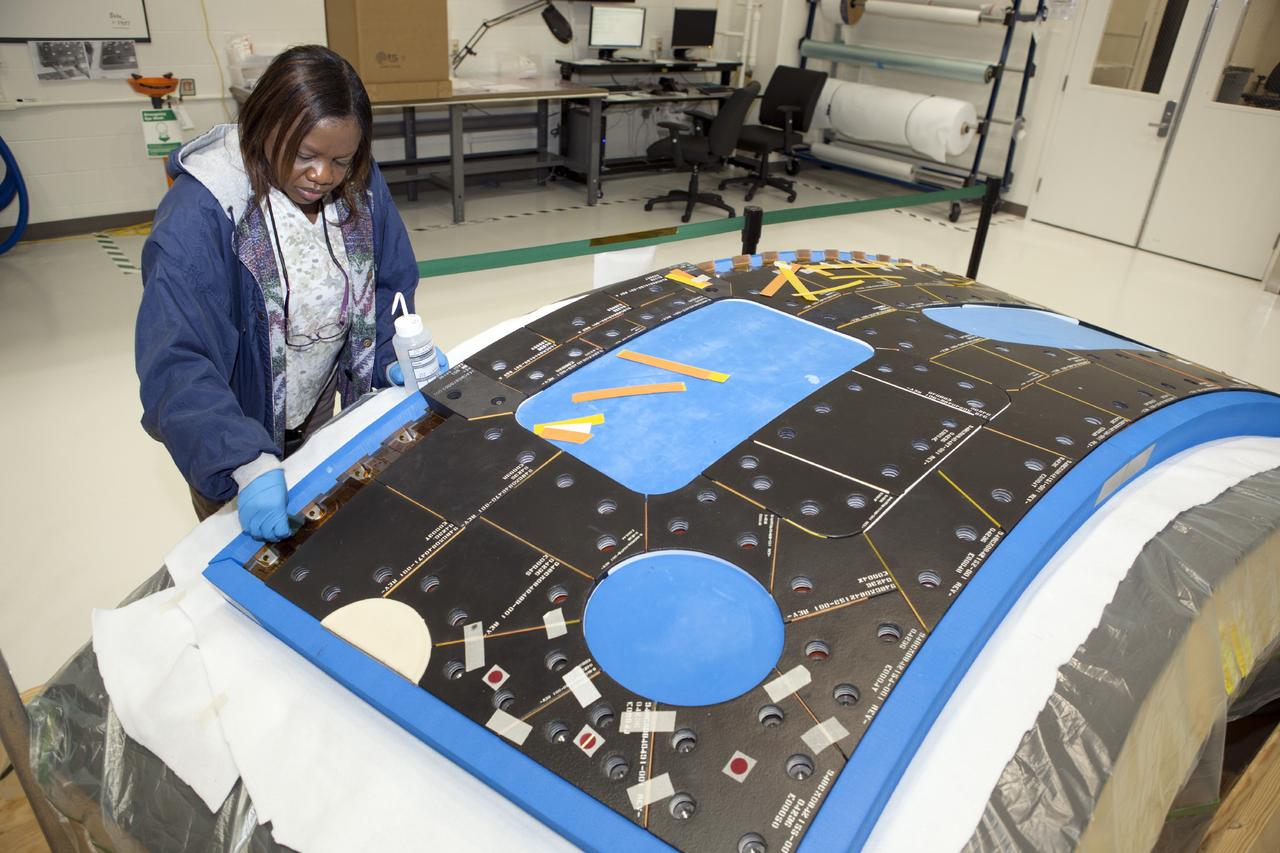
CAPE CANAVERAL, Fla. – Inside the Operations and Checkout Building high bay at NASA’s Kennedy Space Center in Florida, a tile technician works on a section of thermal protection system tiles that will be installed on the Orion crew module. Orion is the exploration spacecraft designed to carry astronauts to destinations not yet explored by humans, including an asteroid and Mars. It will have emergency abort capability, sustain the crew during space travel and provide safe re-entry from deep space return velocities. The first unpiloted test flight of the Orion is scheduled to launch in 2014 atop a Delta IV rocket and in 2017 on NASA’s Space Launch System rocket. For more information, visit http://www.nasa.gov/orion. Photo credit: NASA/Dimitri Gerondidakis
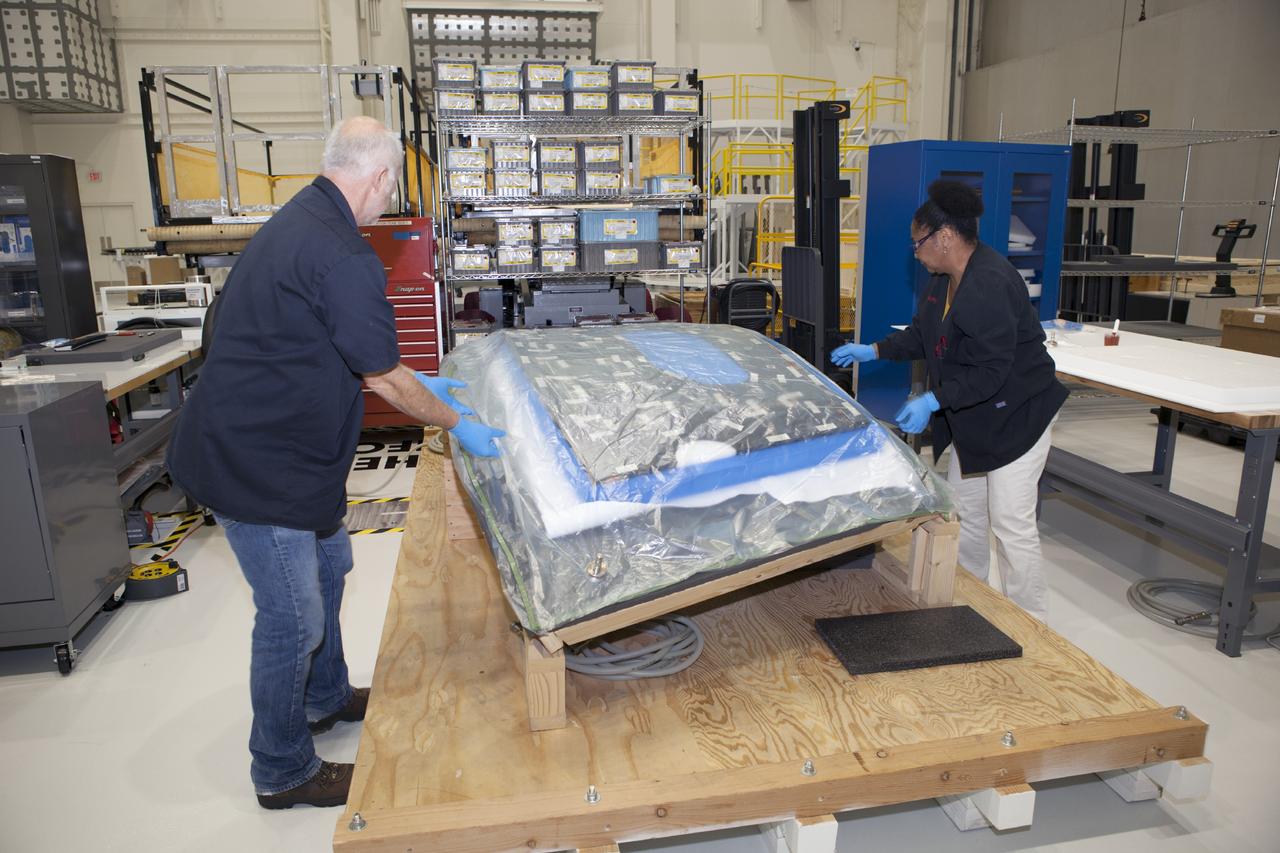
CAPE CANAVERAL, Fla. – Inside the Operations and Checkout Building high bay at NASA’s Kennedy Space Center in Florida, two tile technicians wrap a section of the thermal protection system tiles that will be installed on the Orion crew module. Orion is the exploration spacecraft designed to carry astronauts to destinations not yet explored by humans, including an asteroid and Mars. It will have emergency abort capability, sustain the crew during space travel and provide safe re-entry from deep space return velocities. The first unpiloted test flight of the Orion is scheduled to launch in 2014 atop a Delta IV rocket and in 2017 on NASA’s Space Launch System rocket. For more information, visit http://www.nasa.gov/orion. Photo credit: NASA/Dimitri Gerondidakis
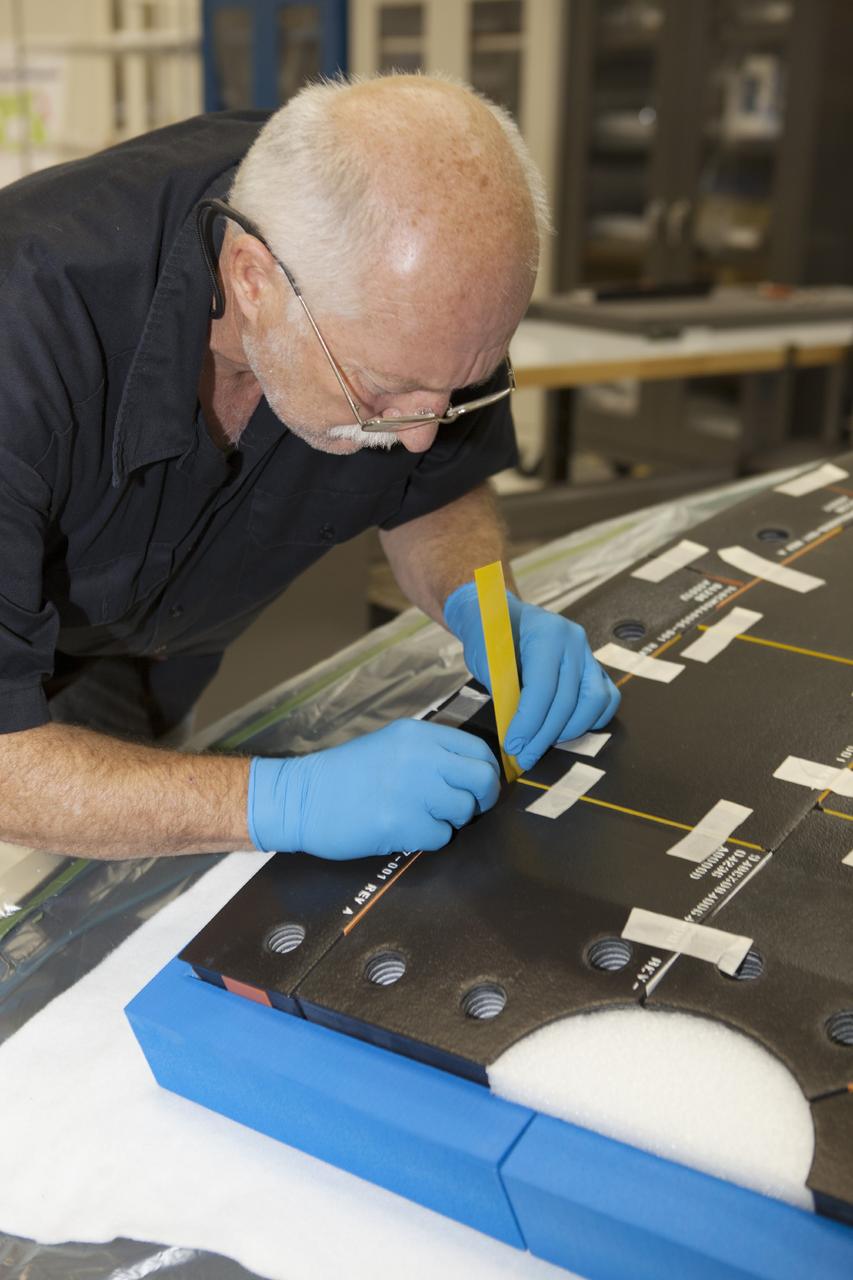
CAPE CANAVERAL, Fla. – Inside the Operations and Checkout Building high bay at NASA’s Kennedy Space Center in Florida, a tile technician places spacers between the thermal protection system tiles that will be installed on the Orion crew module. Orion is the exploration spacecraft designed to carry astronauts to destinations not yet explored by humans, including an asteroid and Mars. It will have emergency abort capability, sustain the crew during space travel and provide safe re-entry from deep space return velocities. The first unpiloted test flight of the Orion is scheduled to launch in 2014 atop a Delta IV rocket and in 2017 on NASA’s Space Launch System rocket. For more information, visit http://www.nasa.gov/orion. Photo credit: NASA/Dimitri Gerondidakis

The number two F-15A (Serial #71-0281) was obtained by NASA from the U.S. Air Force in 1976 and was used for more than 25 advanced research projects involving aerodynamics, performance, propulsion control, control integration, instrumentation development, human factors, and flight test techniques. Included in these projects was its role as a testbed to evaluate aerodynamic pressures on Space Shuttle thermal protection tiles at specific altitudes and speeds.
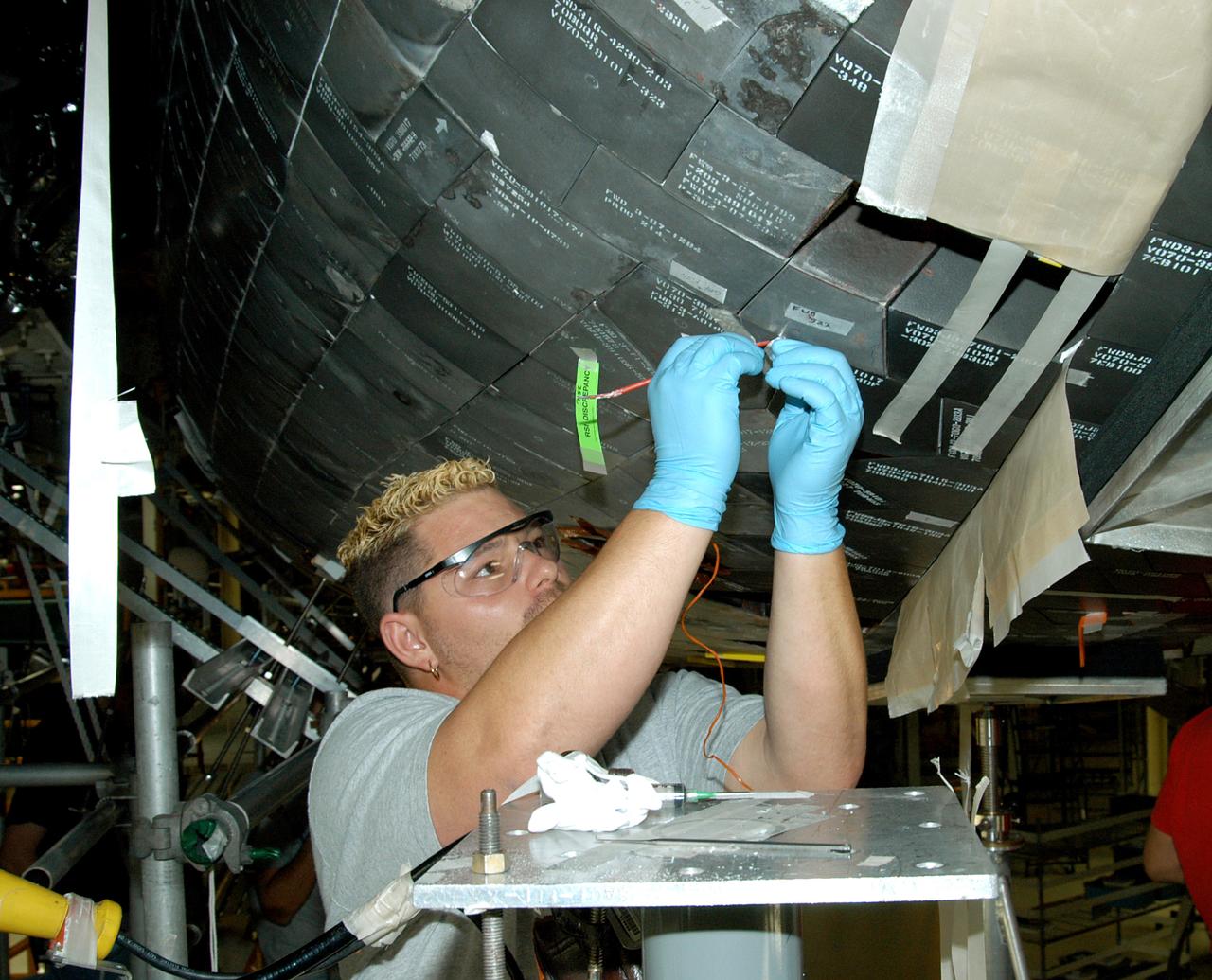
KENNEDY SPACE CENTER, FLA. - In the Orbiter Processing Facility, KSC employee Chris Moore repairs tile on the forward area of the orbiter Discovery. The vehicle has undergone Orbiter Major Modifications in the past year, which includes tile check and repair. The tiles are part of the Orbiter Thermal Protection System, thermal shields to protect against temperatures as high as 3,000° Fahrenheit, which are produced during descent for landing. Discovery is scheduled to fly on mission STS-121 to the International Space Station.
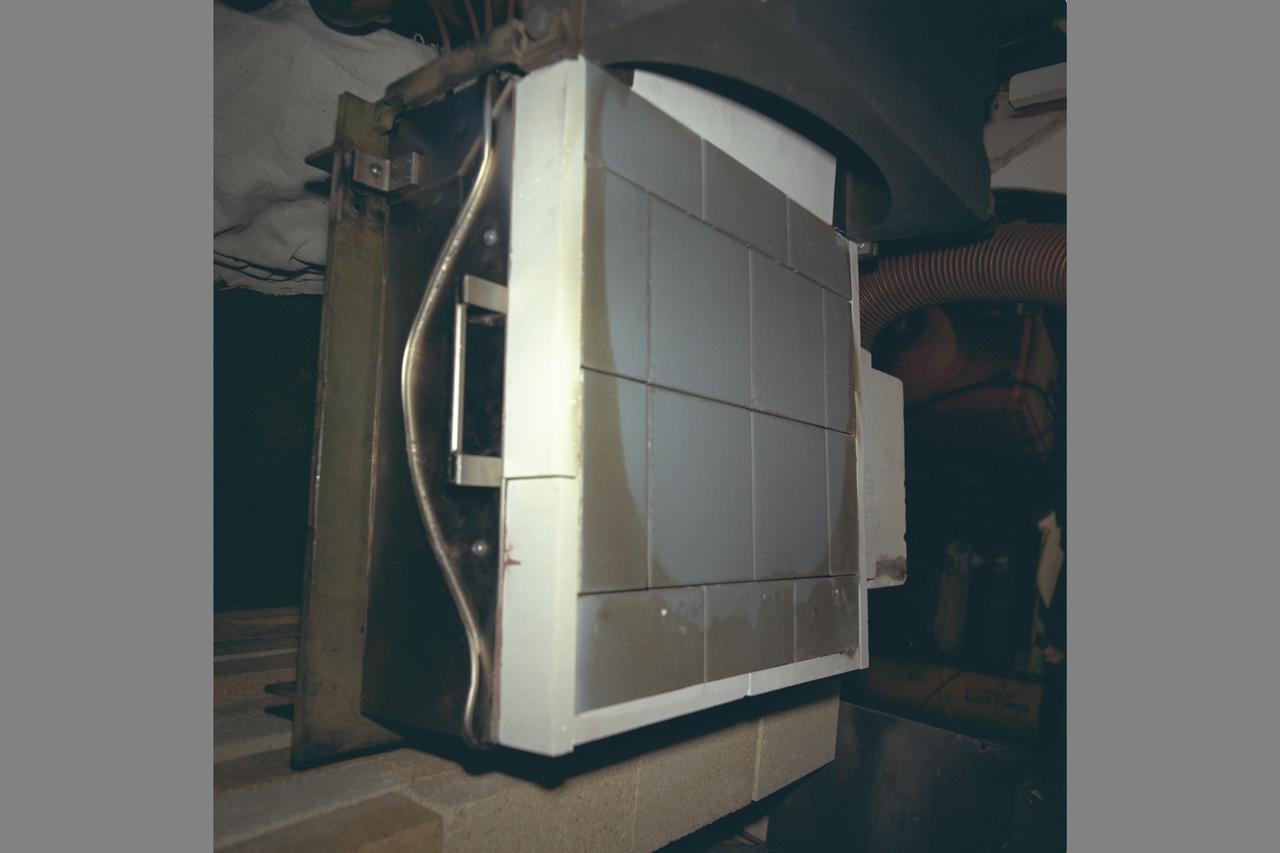
Space Shuttle Tile Thermal Protection System testing in Ames Arc Jet facilities
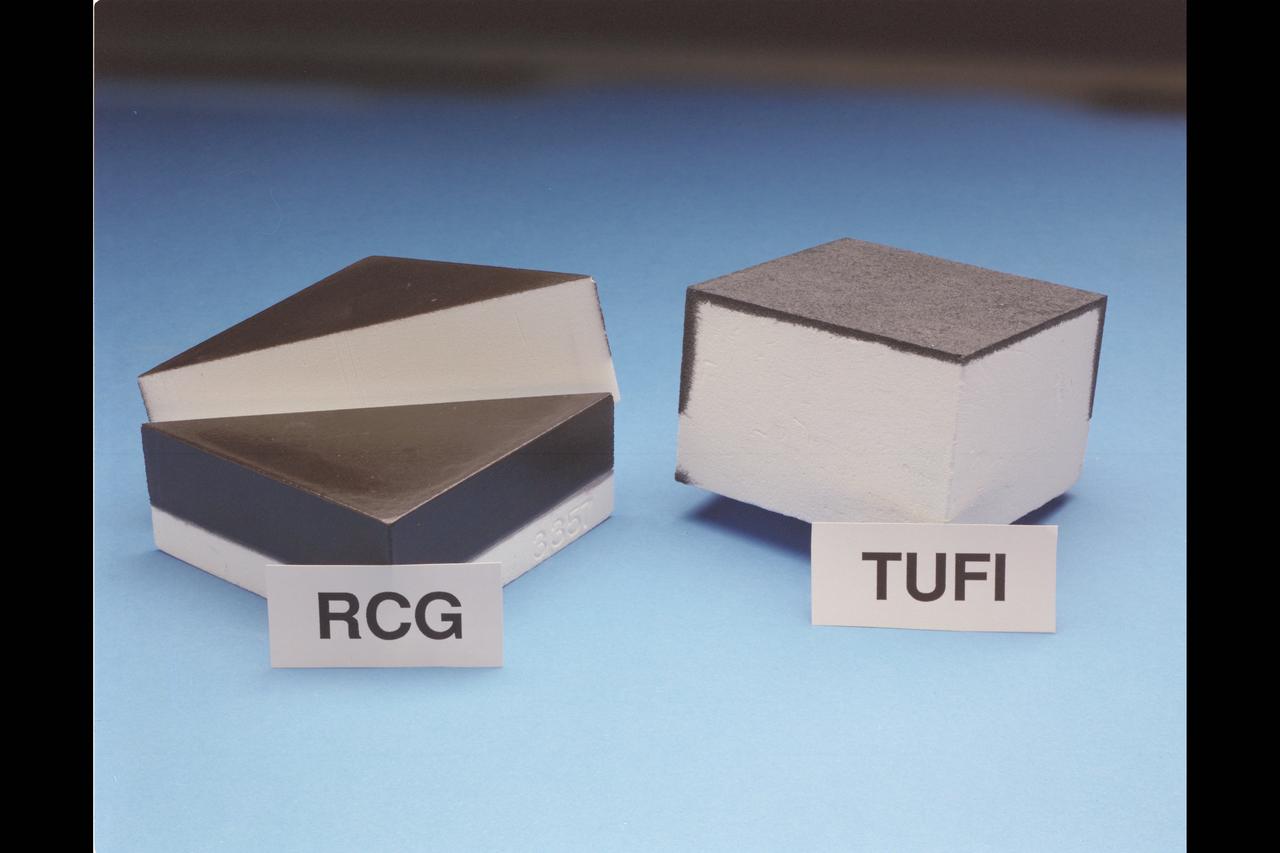
Studio portrait of Ames Developed Thermal Protection System (TPS) tiles - the RCG and TUFI
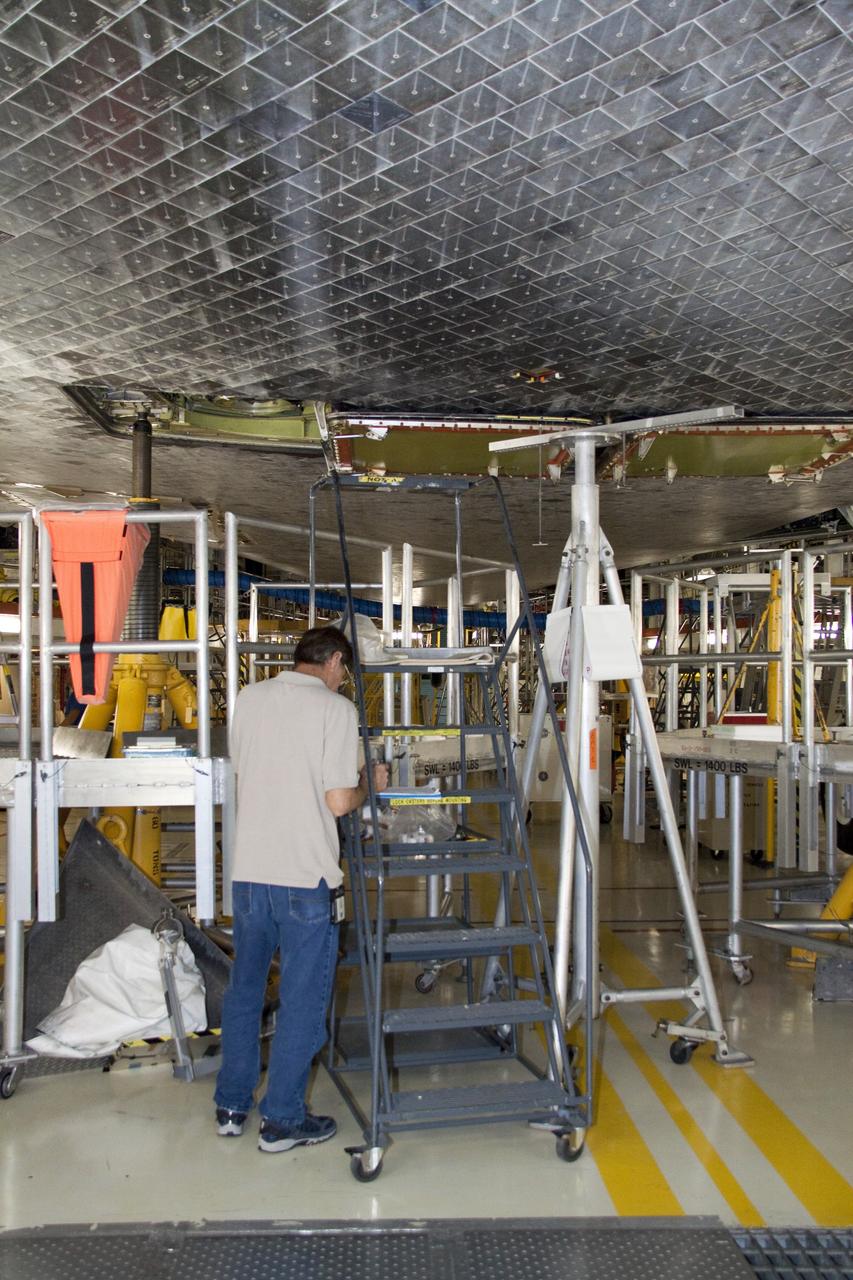
CAPE CANAVERAL, Fla. -- In Orbiter Processing Facility-1 at NASA's Kennedy Space Center in Florida, a thermal protection system technician is ready to work on replacing some of space shuttle Atlantis' heat shield tiles. The tiles are part of the Orbiter Thermal Protection System, thermal shields to protect against temperatures as high as 3,000 degrees Fahrenheit, which are produced during descent for landing. Atlantis is being prepared for the STS-135 mission, which will deliver the Raffaello multi-purpose logistics module packed with supplies, logistics and spare parts to the International Space Station. STS-135 is targeted to launch June 28, and will be the last spaceflight for the Space Shuttle Program. Photo credit: NASA/Jack Pfaller
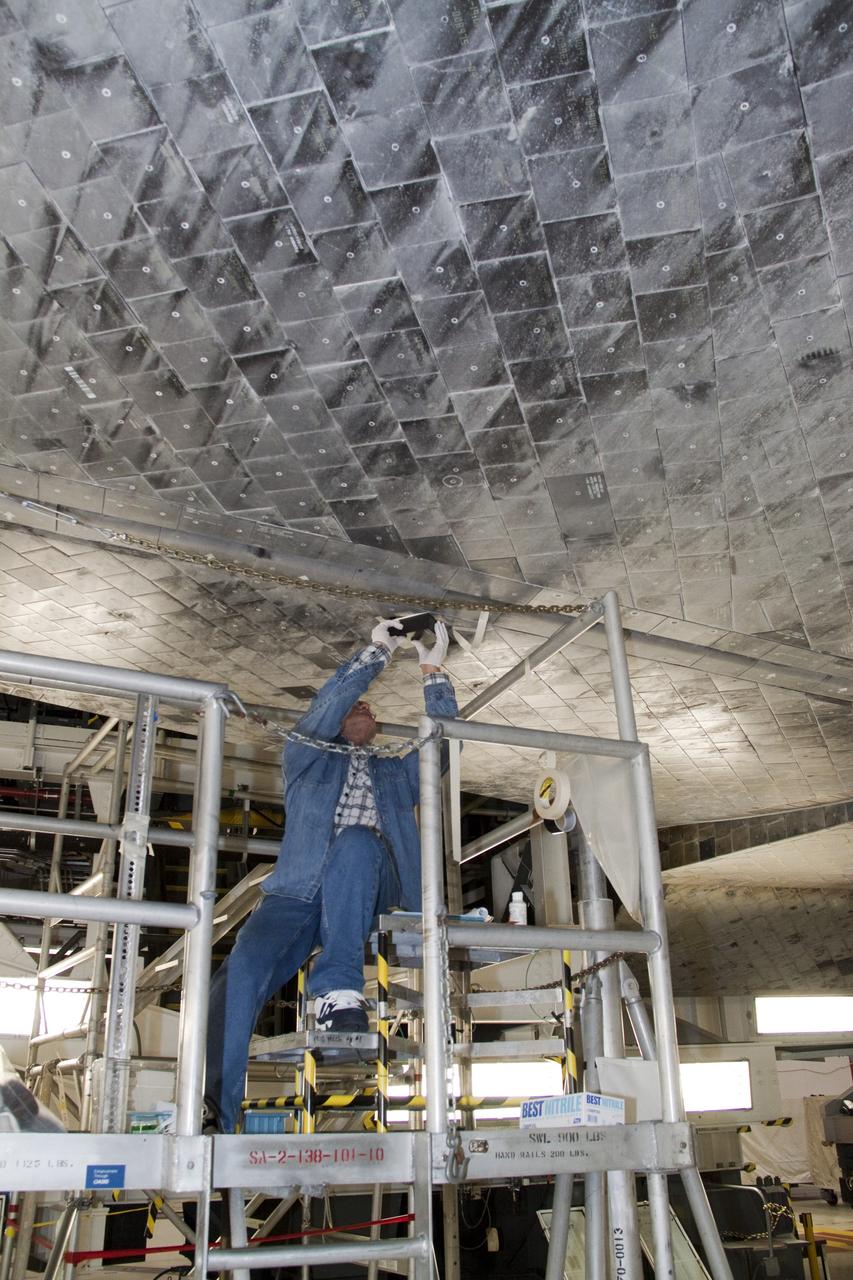
CAPE CANAVERAL, Fla. -- In Orbiter Processing Facility-1 at NASA's Kennedy Space Center in Florida, a thermal protection system technician is replacing a heat shield tile under space shuttle Atlantis. The tiles are part of the Orbiter Thermal Protection System, thermal shields to protect against temperatures as high as 3,000 degrees Fahrenheit, which are produced during descent for landing. Atlantis is being prepared for the STS-135 mission, which will deliver the Raffaello multi-purpose logistics module packed with supplies, logistics and spare parts to the International Space Station. STS-135 is targeted to launch June 28, and will be the last spaceflight for the Space Shuttle Program. Photo credit: NASA/Jack Pfaller
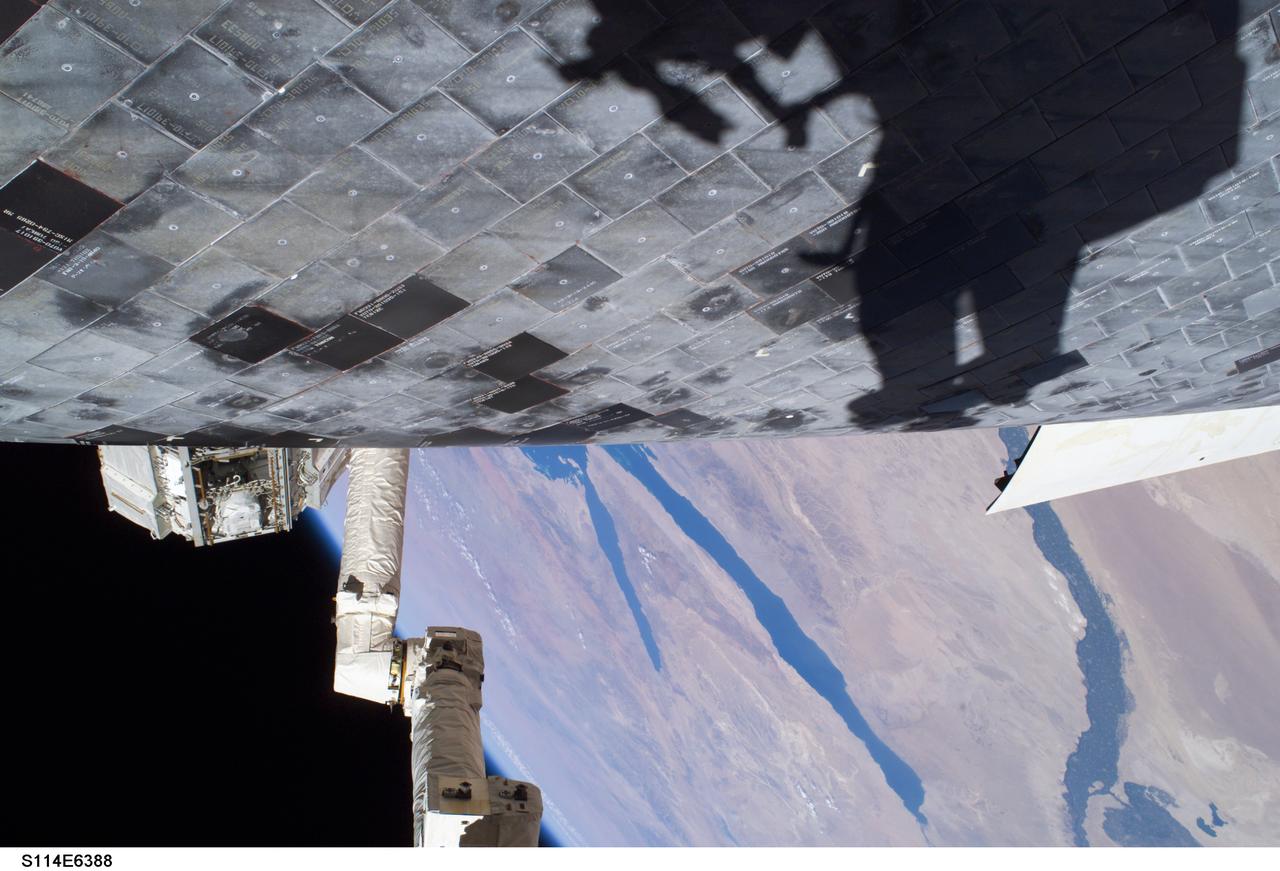
S114-E-6388 (3 August 2005) --- A close-up view of a portion of the thermal protection tiles on Space Shuttle Discovery’s underside is featured in this image photographed by astronaut Stephen K. Robinson, STS-114 mission specialist, during the mission’s third session of extravehicular activities (EVA). Robinson’s shadow is visible on the thermal protection tiles and a portion of the Canadian-built remote manipulator system (RMS) robotic arm and the Nile River is visible at bottom.
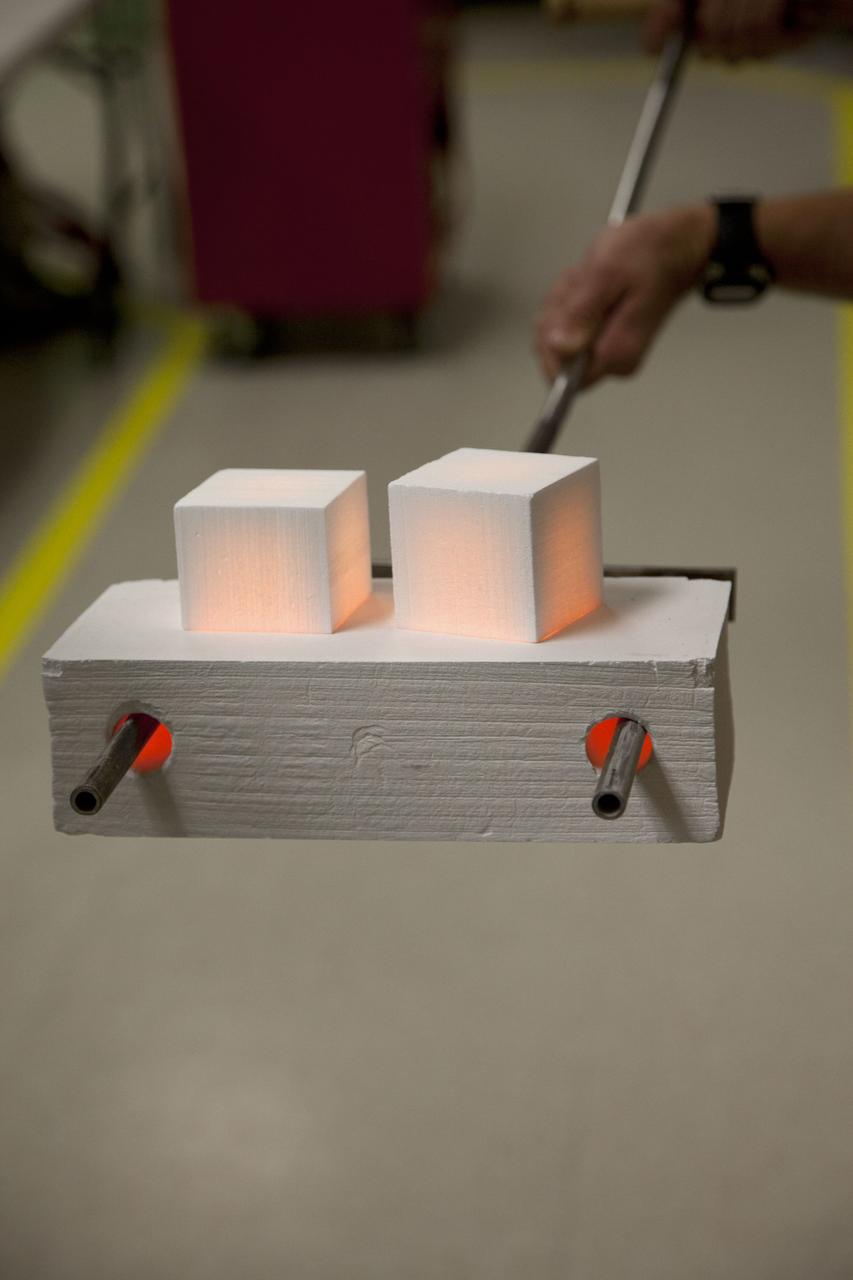
CAPE CANAVERAL, Fla. -- The heat shield tiles that will be installed to the backshell of the Orion Multi-Purpose Crew Vehicle's Exploration Flight Test EFT-1 capsule are removed from a Keith thermal automation oven. Inside, the tiles were baked at 2,200 degrees F to cure their ceramic coating. The work to manufacture and inspect the tiles is taking place in Kennedy's Thermal Protection System Facility. EFT-1 will be used during Orion's first test flight in space. For more information, visit www.nasa.gov/orion. Photo credit: Frankie Martin
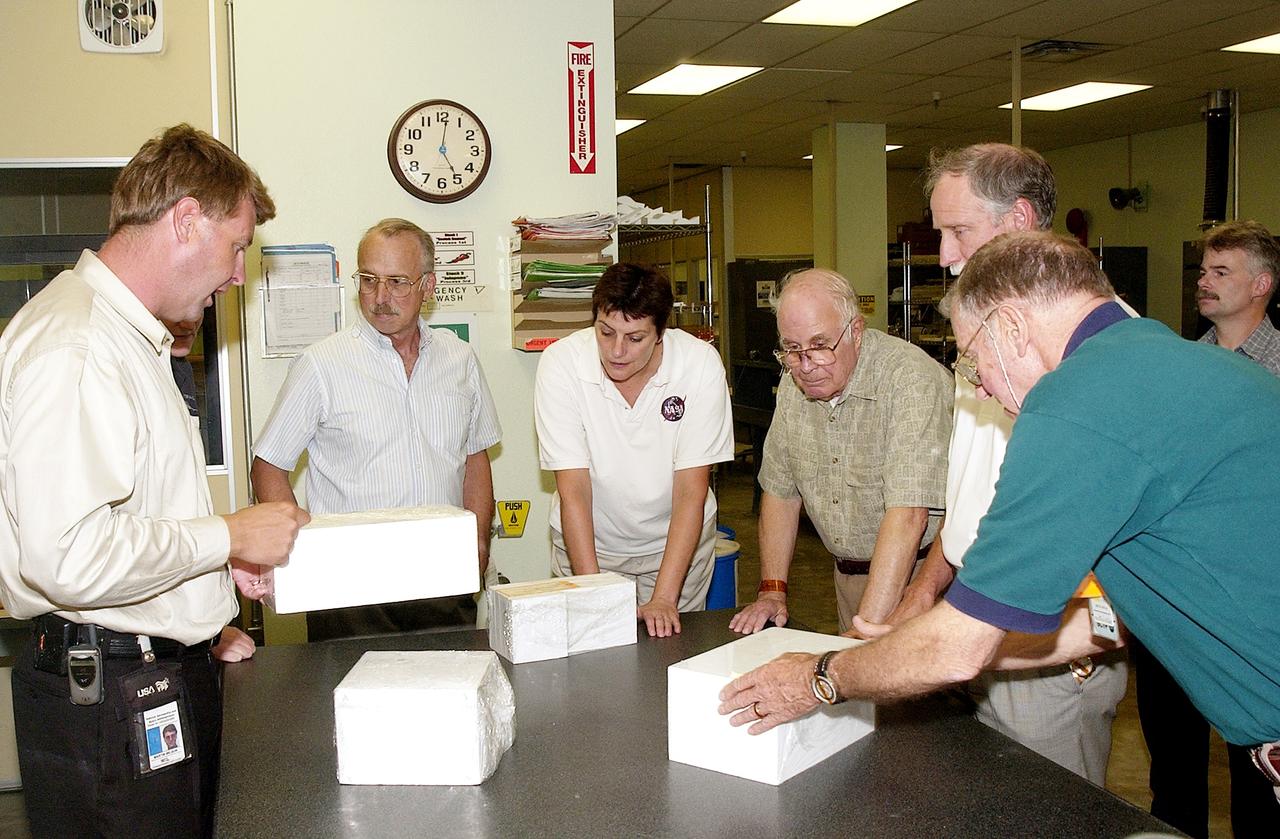
KENNEDY SPACE CENTER, FLA. - On a tour of the Tile Shop, members of the Stafford-Covey Return to Flight Task Group (SCTG) learn about PU-tiles, part of an orbiter’s Thermal Protection System. At left is Martin Wilson, with United Space Alliance. Others (left to right) around the table are James Adamson, Dr. Kathryn Clark, William Wegner, Richard Covey and Joe Engle. Covey, former Space Shuttle commander, is co-chair of the SCTG, along with Thomas P. Stafford, Apollo commander. Chartered by NASA Administrator Sean O’Keefe, the task group will perform an independent assessment of NASA’s implementation of the final recommendations by the Columbia Accident Investigation Board.
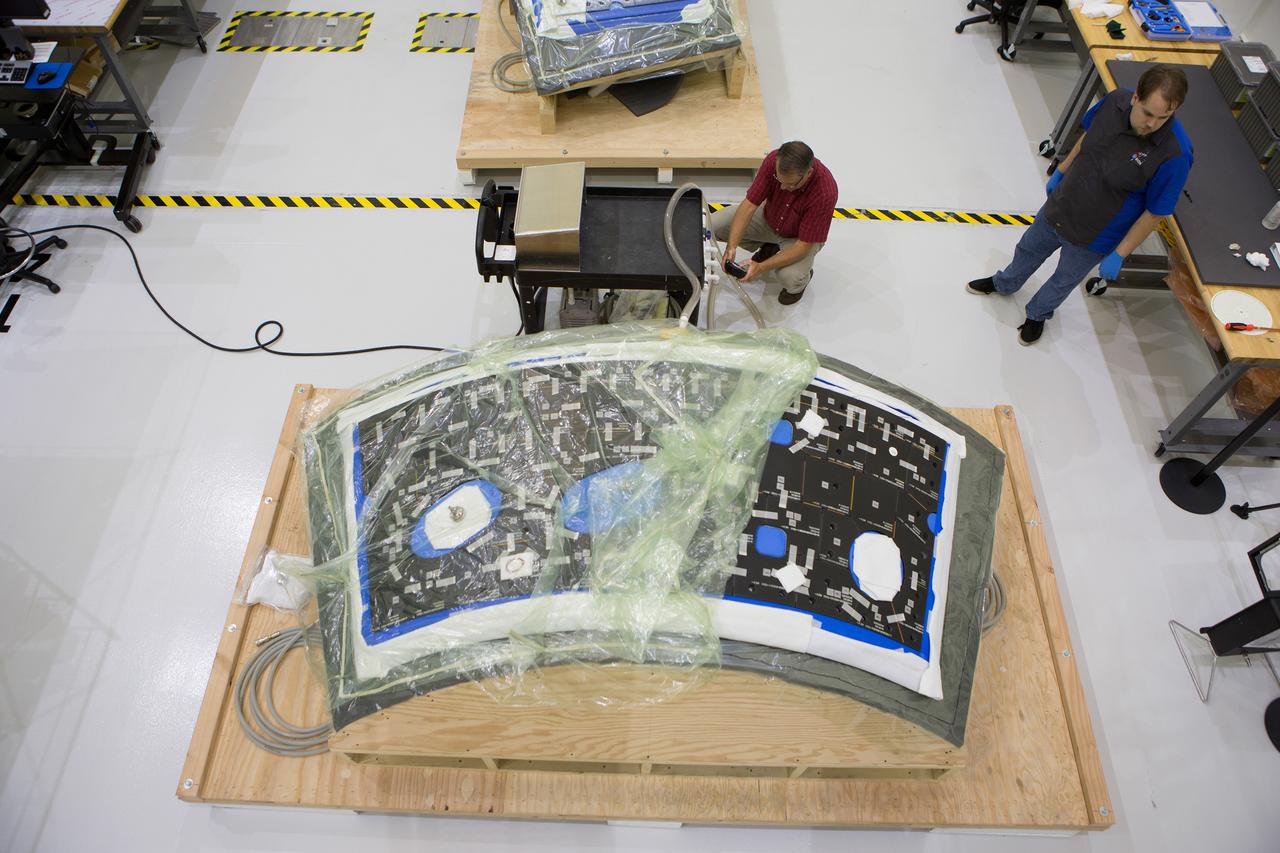
At Kennedy Space Center in Florida, technicians bond thermal protection system tiles to Orion's backshell panels on July 8, 2016...While similar to those used on the space shuttle, Orion only requires about 1,300 tiles compared to more than 24,000 on the shuttle. The tiles, along with the spacecraft’s heat shield, will protect Orion from the 5,000 degree Fahrenheit heat of re-entry.
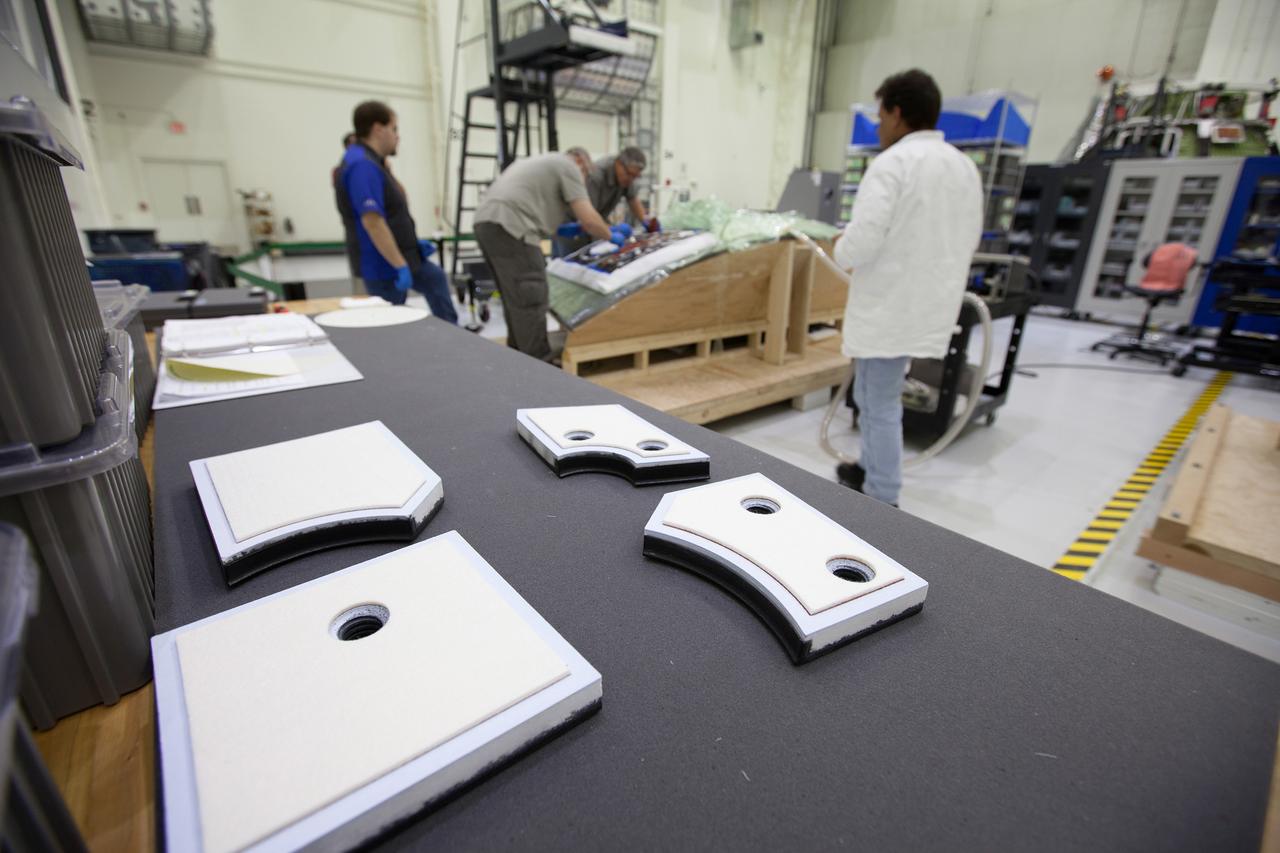
At Kennedy Space Center in Florida, technicians bond thermal protection system tiles to Orion's backshell panels on July 8, 2016...While similar to those used on the space shuttle, Orion only requires about 1,300 tiles compared to more than 24,000 on the shuttle. The tiles, along with the spacecraft’s heat shield, will protect Orion from the 5,000 degree Fahrenheit heat of re-entry.
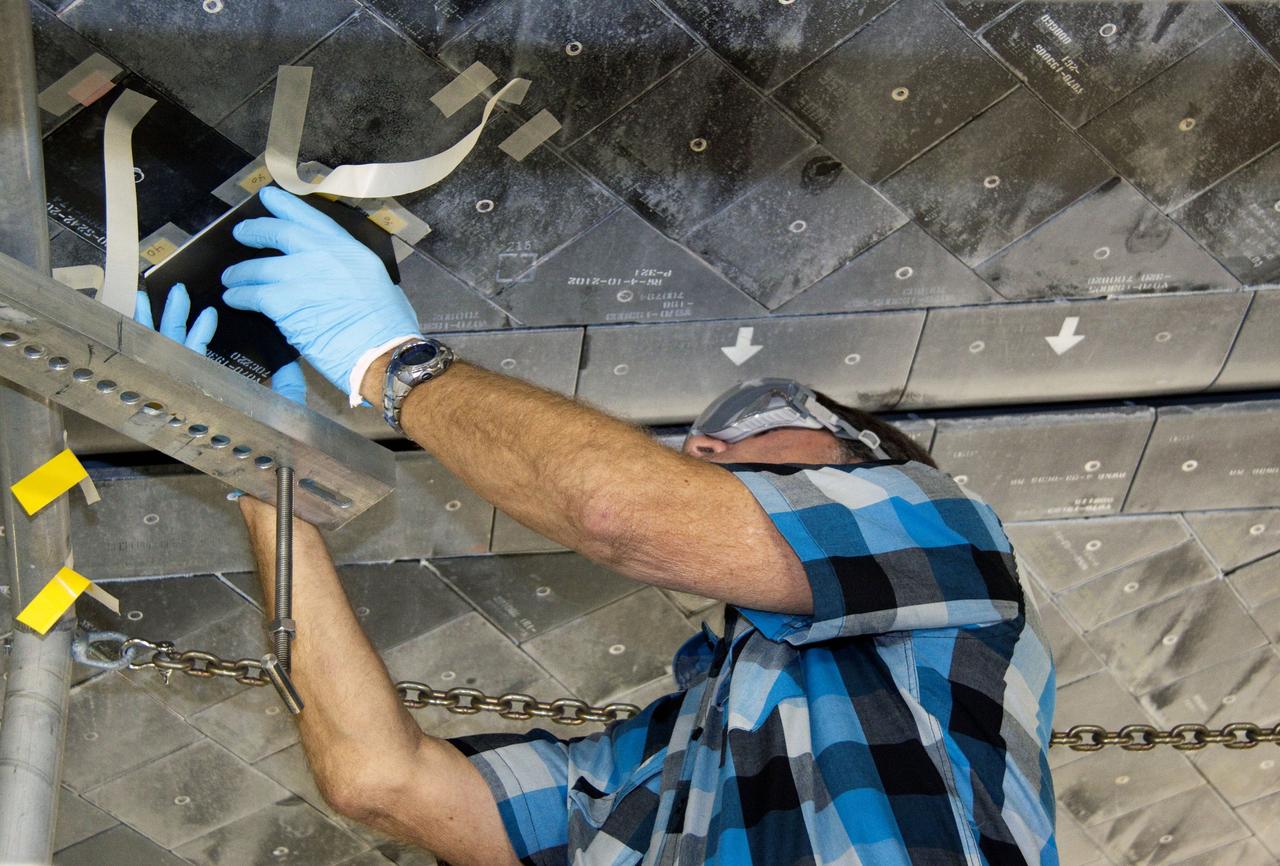
CAPE CANAVERAL, Fla. -- In Orbiter Processing Facility-1 at NASA's Kennedy Space Center in Florida, a thermal protection system technician places a heat shield tile into position under space shuttle Atlantis. The tiles are part of the Orbiter Thermal Protection System that protects the shuttle against temperatures as high as 3,000 degrees Fahrenheit, which are produced during descent for landing. Atlantis is being prepared for the STS-135 mission, which will carry the Raffaello multi-purpose logistics module packed with supplies, logistics and spare parts to the International Space Station. STS-135 is targeted to launch June 28, and will be the last flight for the Space Shuttle Program. Photo credit: NASA/Jack Pfaller
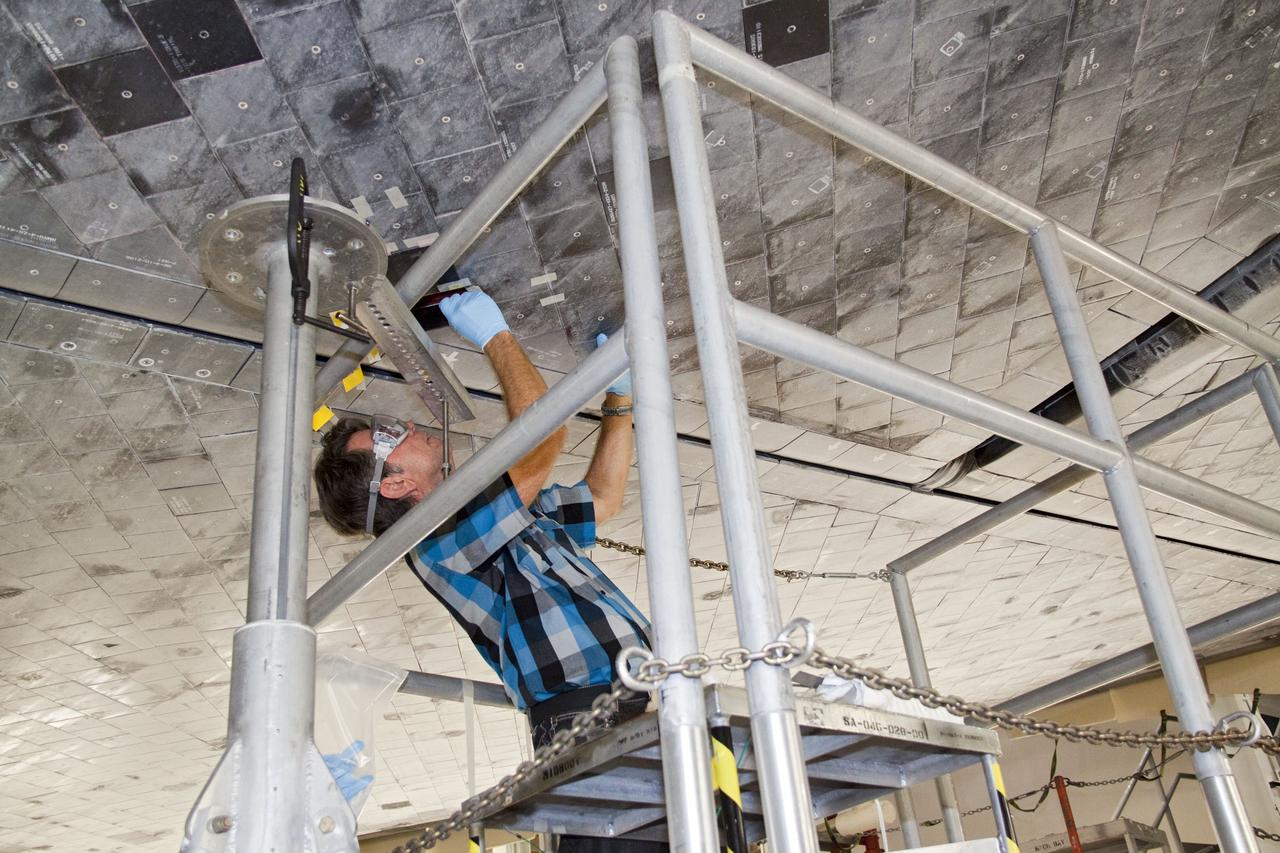
CAPE CANAVERAL, Fla. -- In Orbiter Processing Facility-1 at NASA's Kennedy Space Center in Florida, a thermal protection system technician inspects the area on space shuttle Atlantis' underside before a heat shield tile is installed. The tiles are part of the Orbiter Thermal Protection System that protects the shuttle against temperatures as high as 3,000 degrees Fahrenheit, which are produced during descent for landing. Atlantis is being prepared for the STS-135 mission, which will carry the Raffaello multi-purpose logistics module packed with supplies, logistics and spare parts to the International Space Station. STS-135 is targeted to launch June 28, and will be the last flight for the Space Shuttle Program. Photo credit: NASA/Jack Pfaller
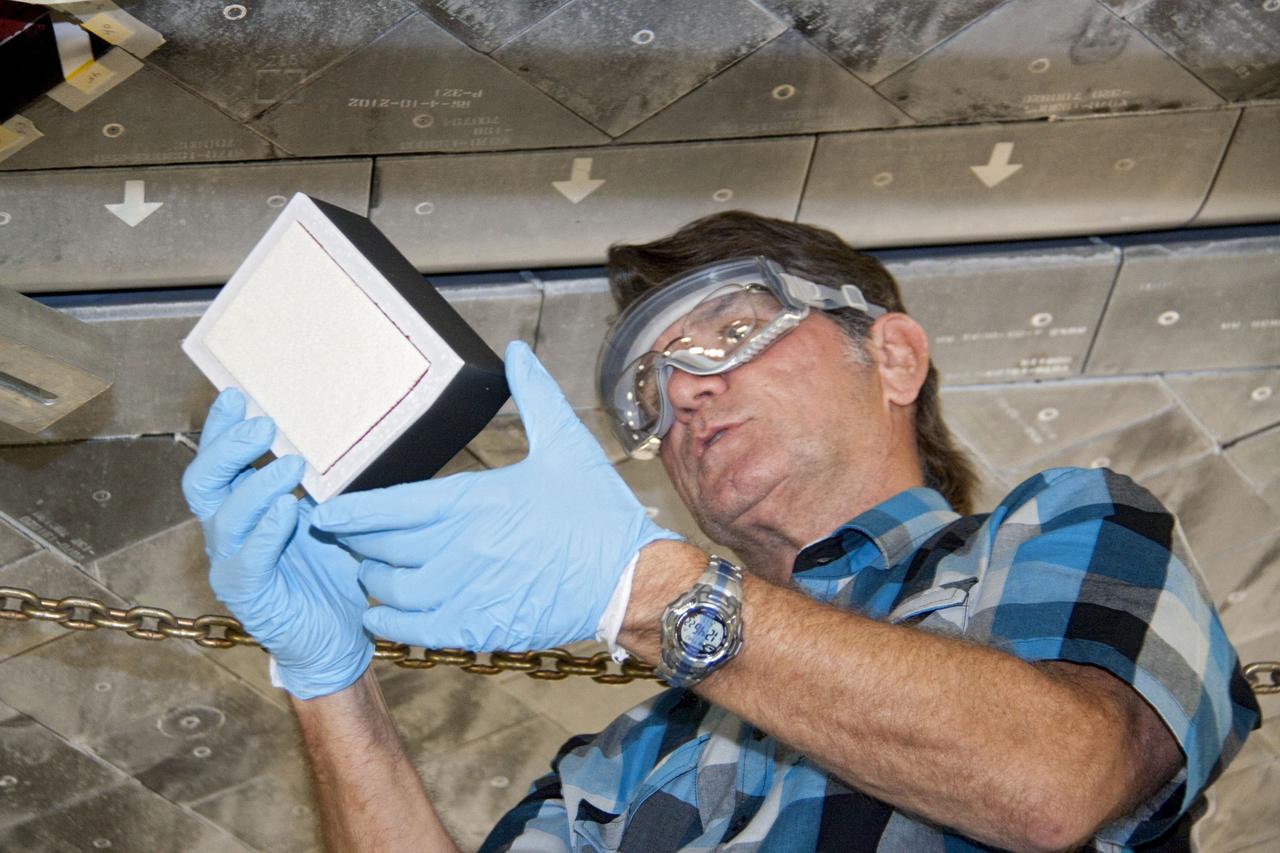
CAPE CANAVERAL, Fla. -- In Orbiter Processing Facility-1 at NASA's Kennedy Space Center in Florida, a thermal protection system technician closely inspects a heat shield tile for space shuttle Atlantis before securing it into position. The tiles are part of the Orbiter Thermal Protection System that protects the shuttle against temperatures as high as 3,000 degrees Fahrenheit, which are produced during descent for landing. Atlantis is being prepared for the STS-135 mission, which will carry the Raffaello multi-purpose logistics module packed with supplies, logistics and spare parts to the International Space Station. STS-135 is targeted to launch June 28, and will be the last flight for the Space Shuttle Program. Photo credit: NASA/Jack Pfaller
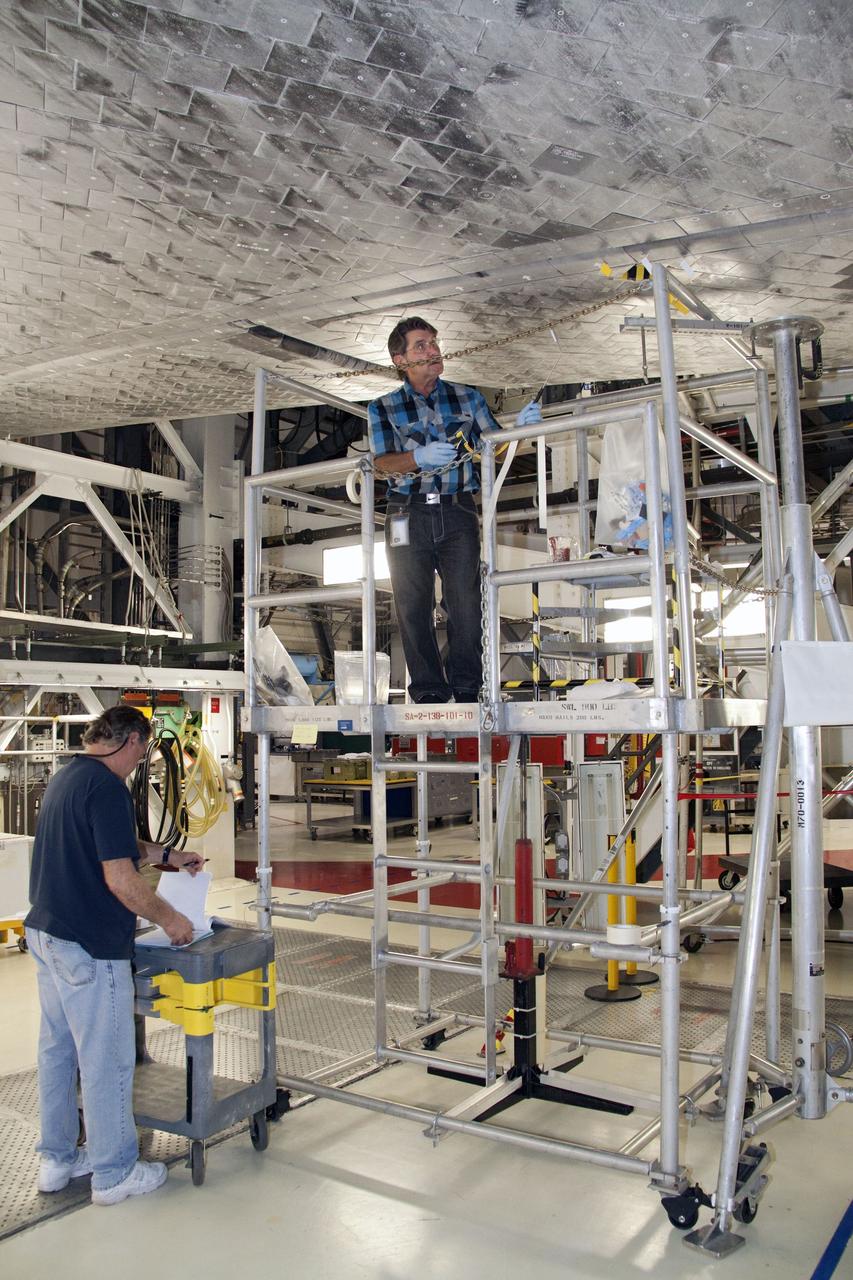
CAPE CANAVERAL, Fla. -- In Orbiter Processing Facility-1 at NASA's Kennedy Space Center in Florida, a thermal protection system technician is preparing to work on replacing some of space shuttle Atlantis' heat shield tiles. The tiles are part of the Orbiter Thermal Protection System that protects the shuttle against temperatures as high as 3,000 degrees Fahrenheit, which are produced during descent for landing. Atlantis is being prepared for the STS-135 mission, which will carry the Raffaello multi-purpose logistics module packed with supplies, logistics and spare parts to the International Space Station. STS-135 is targeted to launch June 28, and will be the last flight for the Space Shuttle Program. Photo credit: NASA/Jack Pfaller
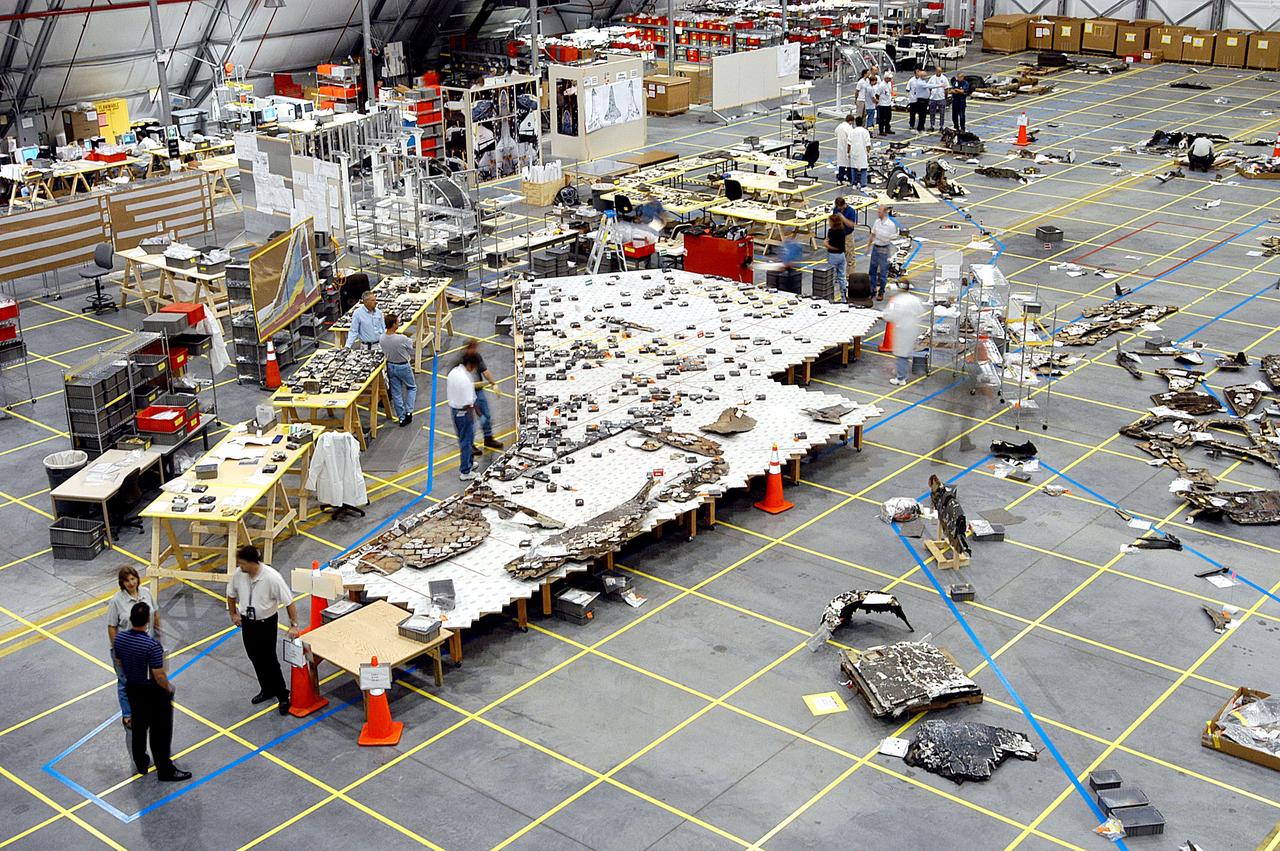
KENNEDY SPACE CENTER, FLA. - In the RLV hangar, members of the Columbia Reconstruction Team work to identify pieces of Thermal Protection System tile from the left wing of Columbia recovered during the search and recovery efforts in East Texas. The items shipped to KSC number more than 82,000 and weigh 84,800 pounds or 38 percent of the total dry weight of Columbia. Of those items, 78,760 have been identified, with 753 placed on the left wing grid in the Hangar.
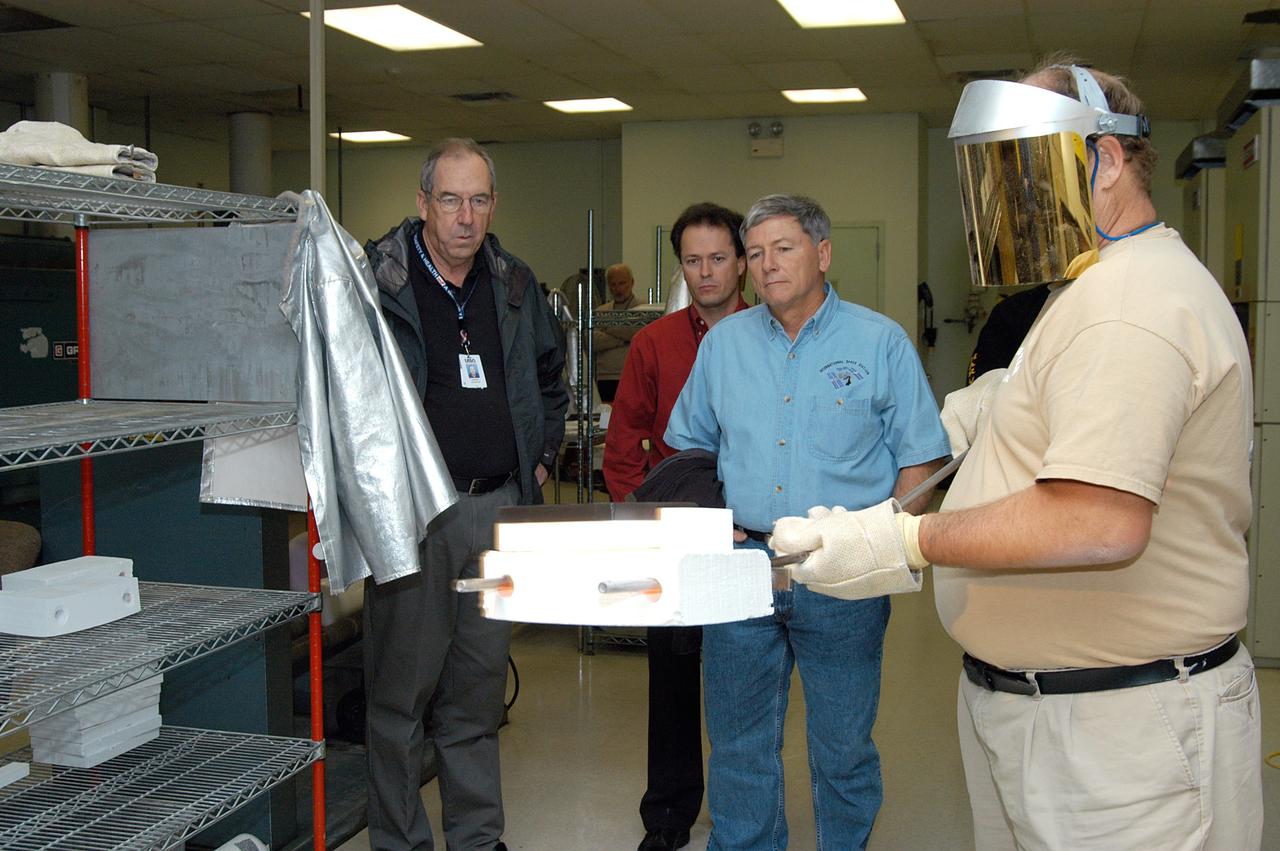
KENNEDY SPACE CENTER, FLA. -- United Space Alliance (USA) Vice President and Space Shuttle Program Manager Howard DeCastro (left) and NASA Deputy Associate Administrator for Space Station and Shuttle Programs Michael Kostelnik (third from left) watch as a USA technician (right) creates a tile for use in the Shuttle's Thermal Protection System (TPS). NASA and USA Space Shuttle program management are participating in a leadership workday. The day is intended to provide management with an in-depth, hands-on look at Shuttle processing activities at KSC.
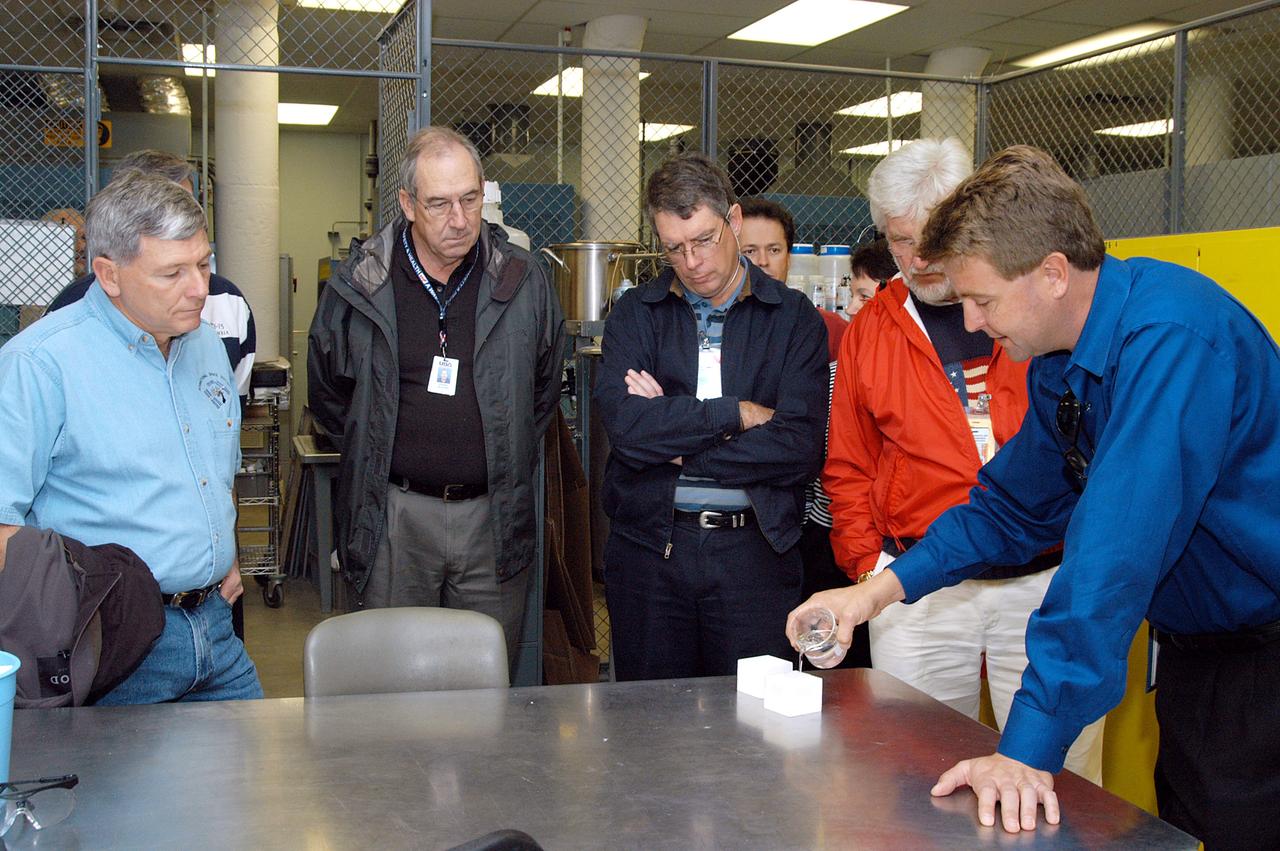
KENNEDY SPACE CENTER, FLA. -- From left, NASA Deputy Associate Administrator for Space Station and Shuttle Programs Michael Kostelnik and United Space Alliance (USA) Vice President and Space Shuttle Program Manager Howard DeCastro are briefed on the properties of the tile used in the Shuttle's Thermal Protection System (TPS) by USA Manager of the TPS Facility Martin Wilson (right). NASA and USA Space Shuttle program management are participating in a leadership workday. The day is intended to provide management with an in-depth, hands-on look at Shuttle processing activities at KSC.
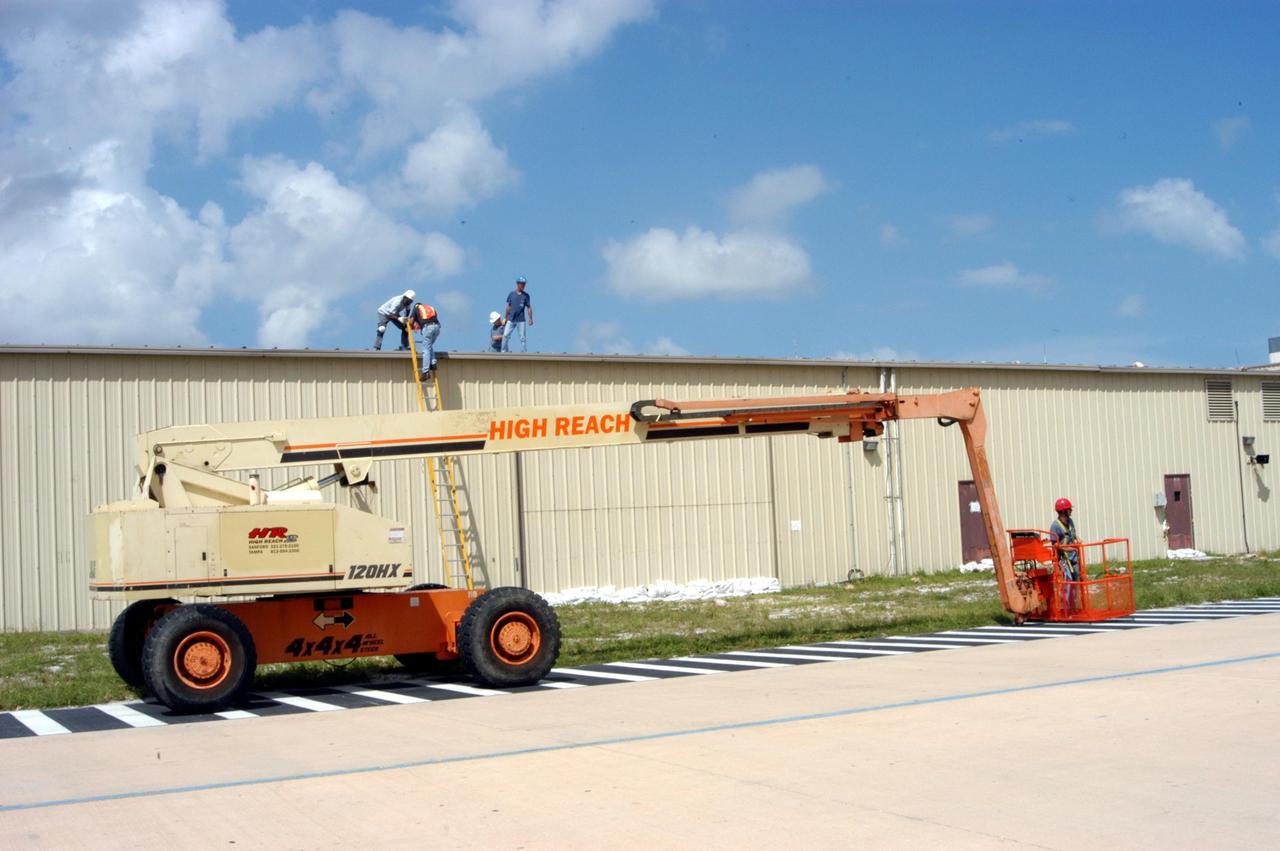
KENNEDY SPACE CENTER, FLA. - Workers attempt to secure the roof of the Tile Shop in the Thermal Protection System Facility (TPSF) in preparation for Hurricane Jeanne, which is expected to impact Central Florida Sunday. The TPSF, which creates the TPS tiles, blankets and all the internal thermal control systems for the Space Shuttles, lost approximately 35 percent of its roof during Hurricane Frances, which blew across Central Florida Sept. 4. Jeanne is the fourth hurricane in 45 days to make landfall somewhere in the state.
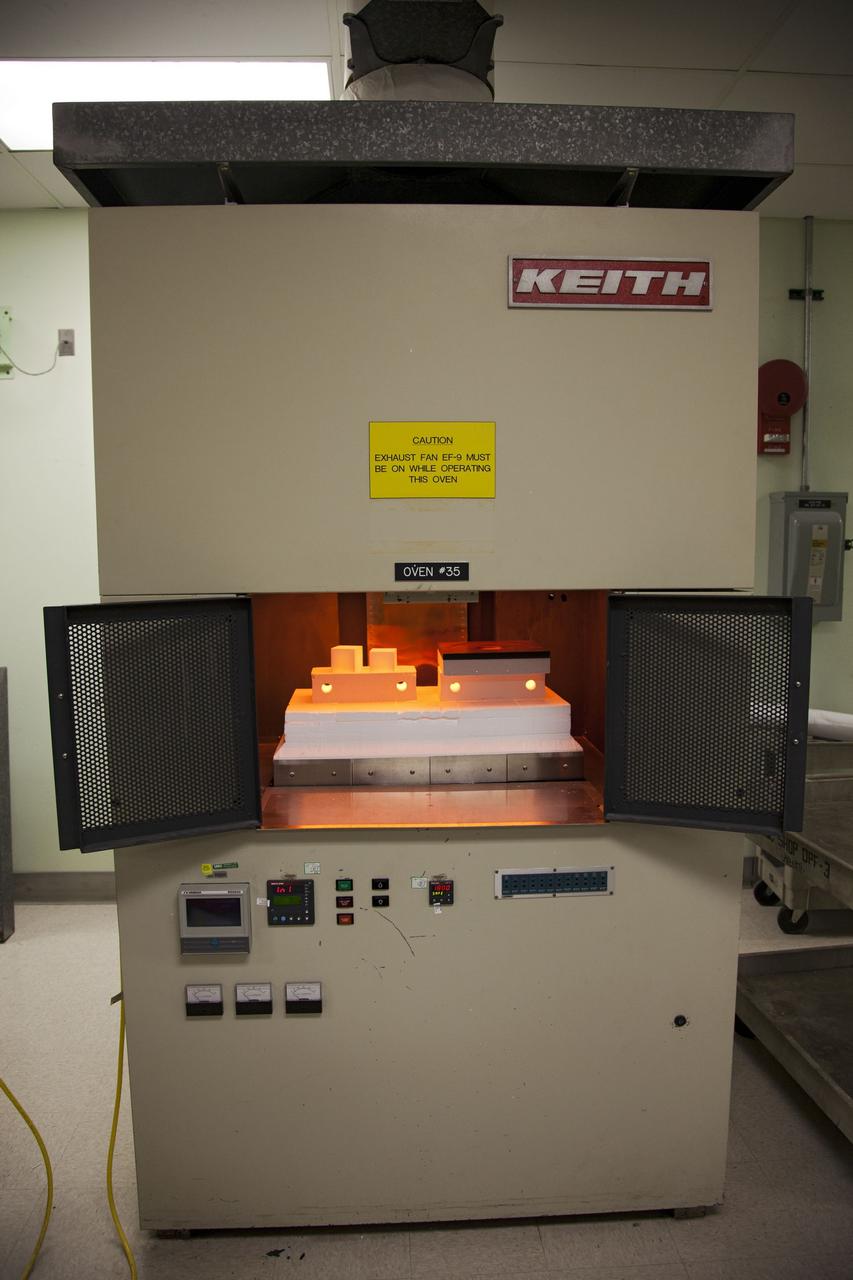
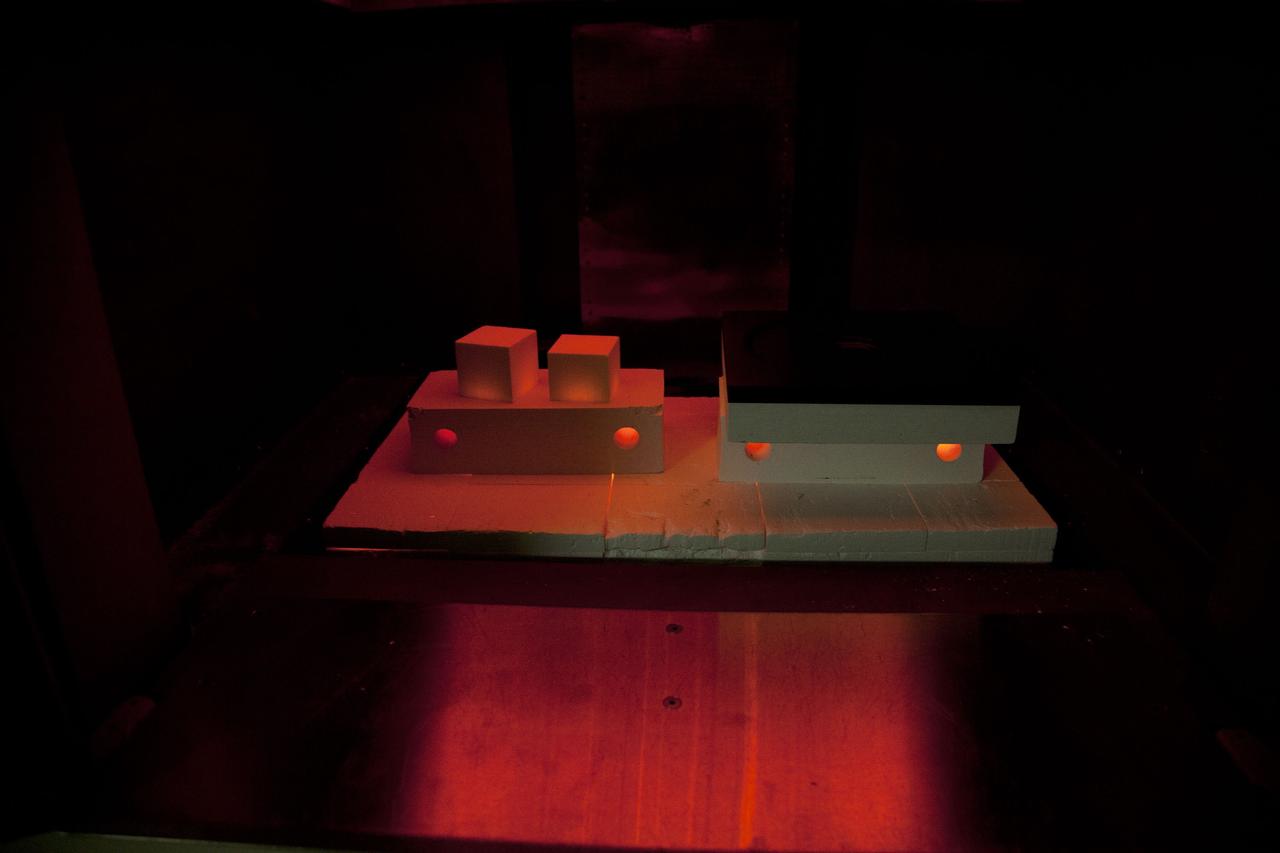
CAPE CANAVERAL, Fla. -- The heat shield tiles that will be installed to the backshell of the Orion Multi-Purpose Crew Vehicle's Exploration Flight Test EFT-1 capsule are in a Keith thermal automation oven in the Thermal Protection System Facility at NASA's Kennedy Space Center in Florida. Inside the oven, the tiles will be baked at 2,200 degrees F to cure their ceramic coating. EFT-1 will be used during Orion's first test flight in space. For more information, visit www.nasa.gov/orion. Photo credit: Frankie Martin
CAPE CANAVERAL, Fla. -- The heat shield tiles that will be installed to the backshell of the Orion Multi-Purpose Crew Vehicle's Exploration Flight Test EFT-1 capsule are in a Keith thermal automation oven in the Thermal Protection System Facility at NASA's Kennedy Space Center in Florida. Inside the oven, the tiles will be baked at 2,200 degrees F to cure their ceramic coating. EFT-1 will be used during Orion's first test flight in space. For more information, visit www.nasa.gov/orion. Photo credit: Frankie Martin
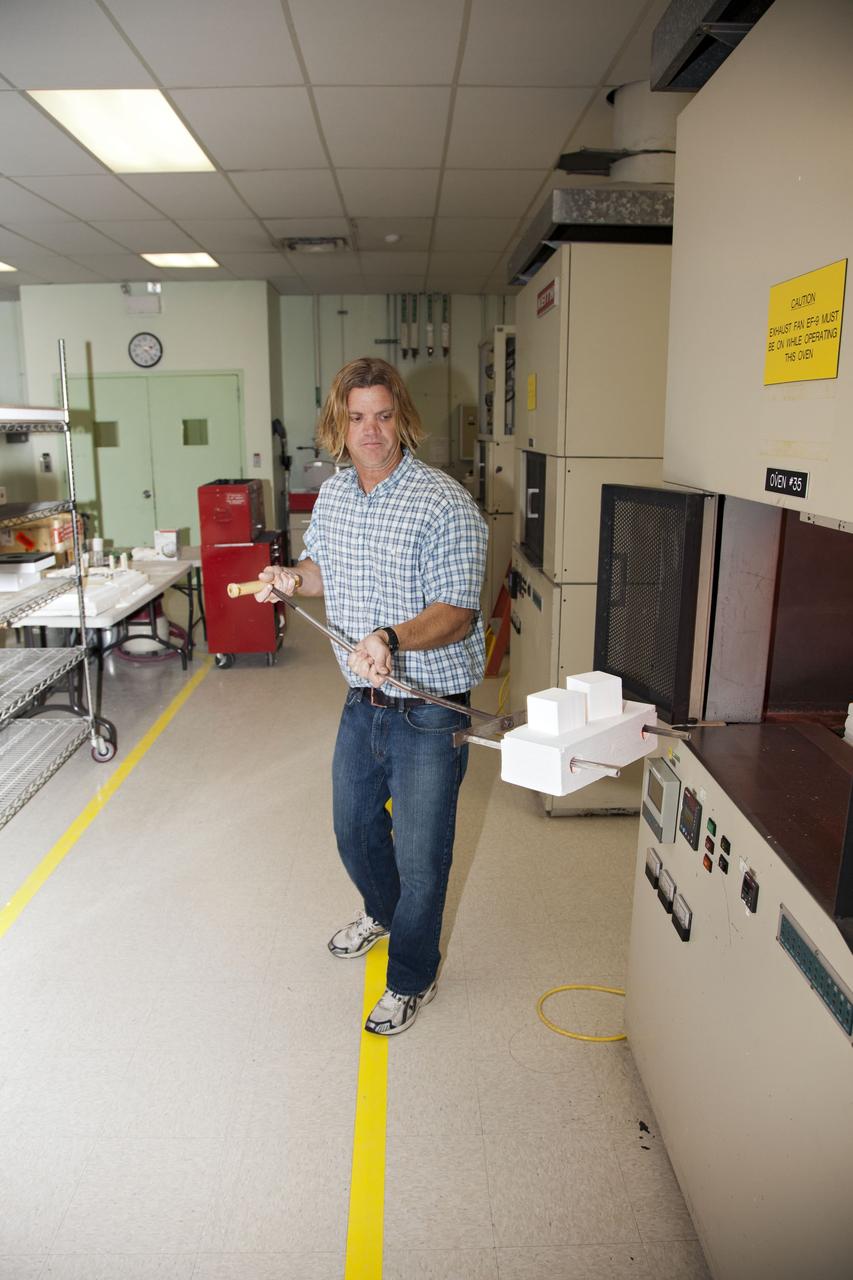
CAPE CANAVERAL, Fla. -- Tim Wright, a United Space Alliance engineering manager at NASA's Kennedy Space Center in Florida, removes the heat shield tiles that will be installed to the backshell of the Orion Multi-Purpose Crew Vehicle's Exploration Flight Test EFT-1 capsule from a Keith thermal automation oven. Inside, the tiles were baked at 2,200 degrees F to cure their ceramic coating. The work to manufacture and inspect the tiles is taking place in Kennedy's Thermal Protection System Facility. EFT-1 will be used during Orion's first test flight in space. For more information, visit www.nasa.gov/orion. Photo credit: Frankie Martin
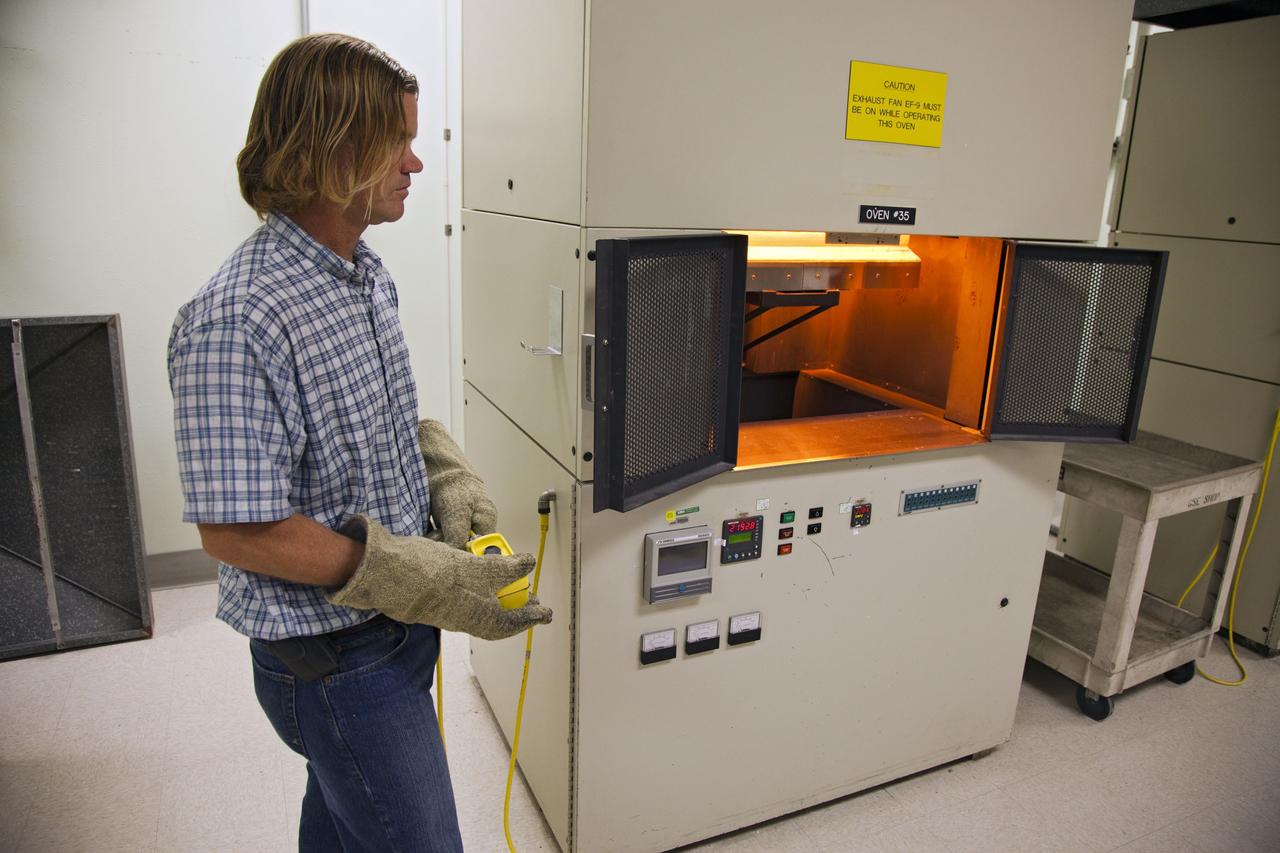
CAPE CANAVERAL, Fla. -- Tim Wright, a United Space Alliance engineering manager at NASA's Kennedy Space Center in Florida, removes the heat shield tiles that will be installed to the backshell of the Orion Multi-Purpose Crew Vehicle's Exploration Flight Test EFT-1 capsule from a Keith thermal automation oven. Inside, the tiles were baked at 2,200 degrees F to cure their ceramic coating. The work to manufacture and inspect the tiles is taking place in Kennedy's Thermal Protection System Facility. EFT-1 will be used during Orion's first test flight in space. For more information, visit www.nasa.gov/orion. Photo credit: Frankie Martin
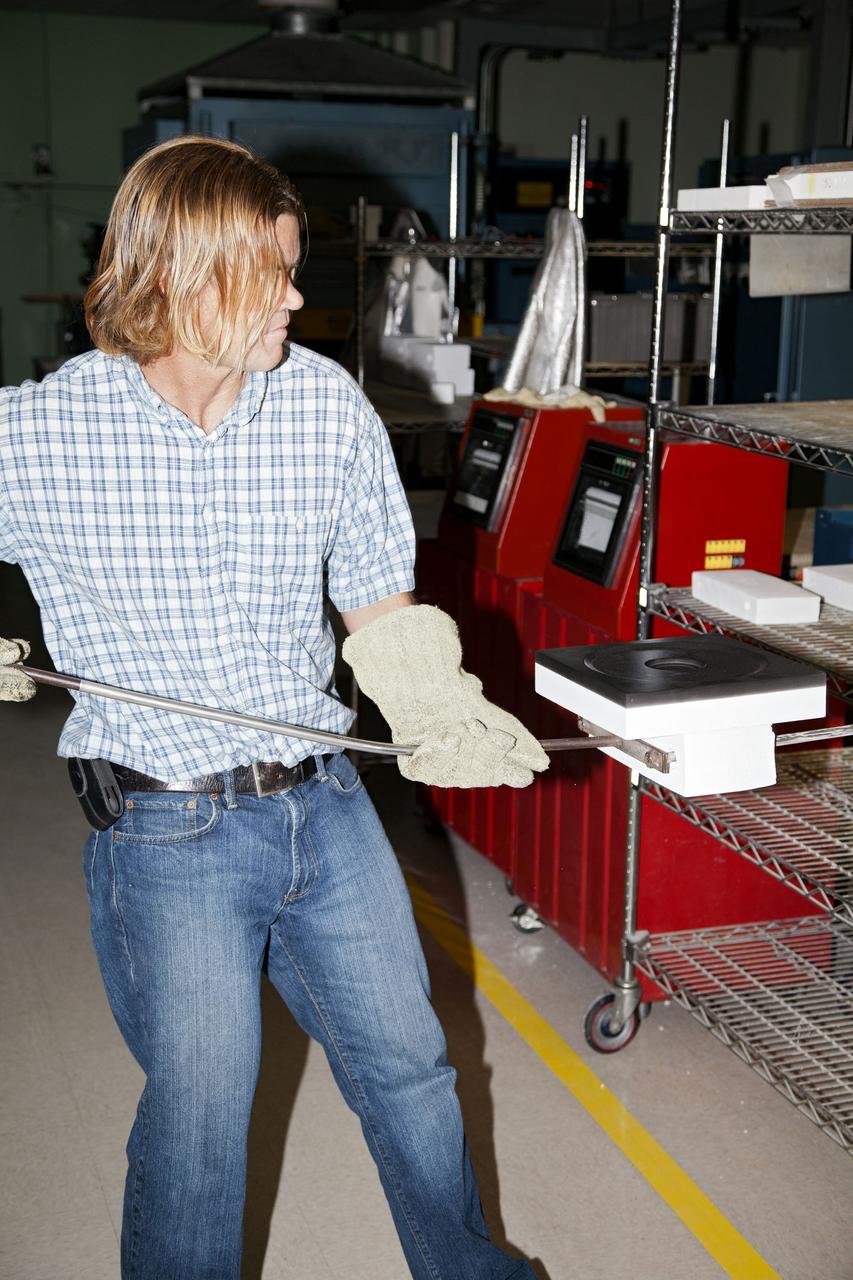
CAPE CANAVERAL, Fla. -- Tim Wright, a United Space Alliance engineering manager at NASA's Kennedy Space Center in Florida, put the heat shield tiles that will be installed to the backshell of the Orion Multi-Purpose Crew Vehicle's Exploration Flight Test EFT-1 capsule in a Keith thermal automation oven. The tiles will be baked at 2,200 degrees F to cure their ceramic coating. The work to manufacture and inspect the tiles is taking place in Kennedy's Thermal Protection System Facility. EFT-1 will be used during Orion's first test flight in space. For more information, visit www.nasa.gov/orion. Photo credit: Frankie Martin
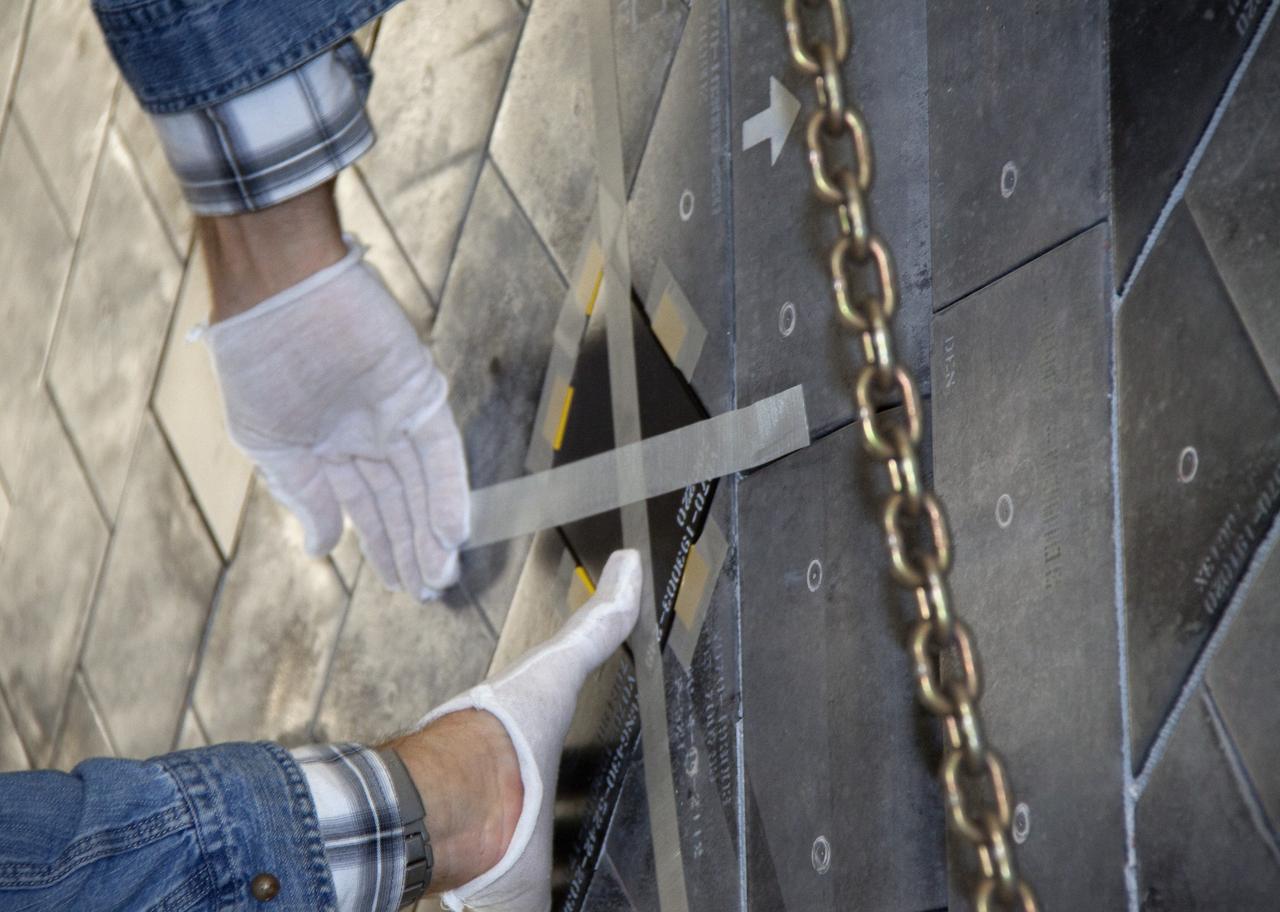
CAPE CANAVERAL, Fla. -- In Orbiter Processing Facility-1 at NASA's Kennedy Space Center in Florida, a thermal protection system technician secures a newly installed heat shield tile in place under space shuttle Atlantis. The tiles are part of the Orbiter Thermal Protection System, thermal shields to protect against temperatures as high as 3,000 degrees Fahrenheit, which are produced during descent for landing. Atlantis is being prepared for the STS-135 mission, which will deliver the Raffaello multi-purpose logistics module packed with supplies, logistics and spare parts to the International Space Station. STS-135 is targeted to launch June 28, and will be the last spaceflight for the Space Shuttle Program. Photo credit: NASA/Jack Pfaller
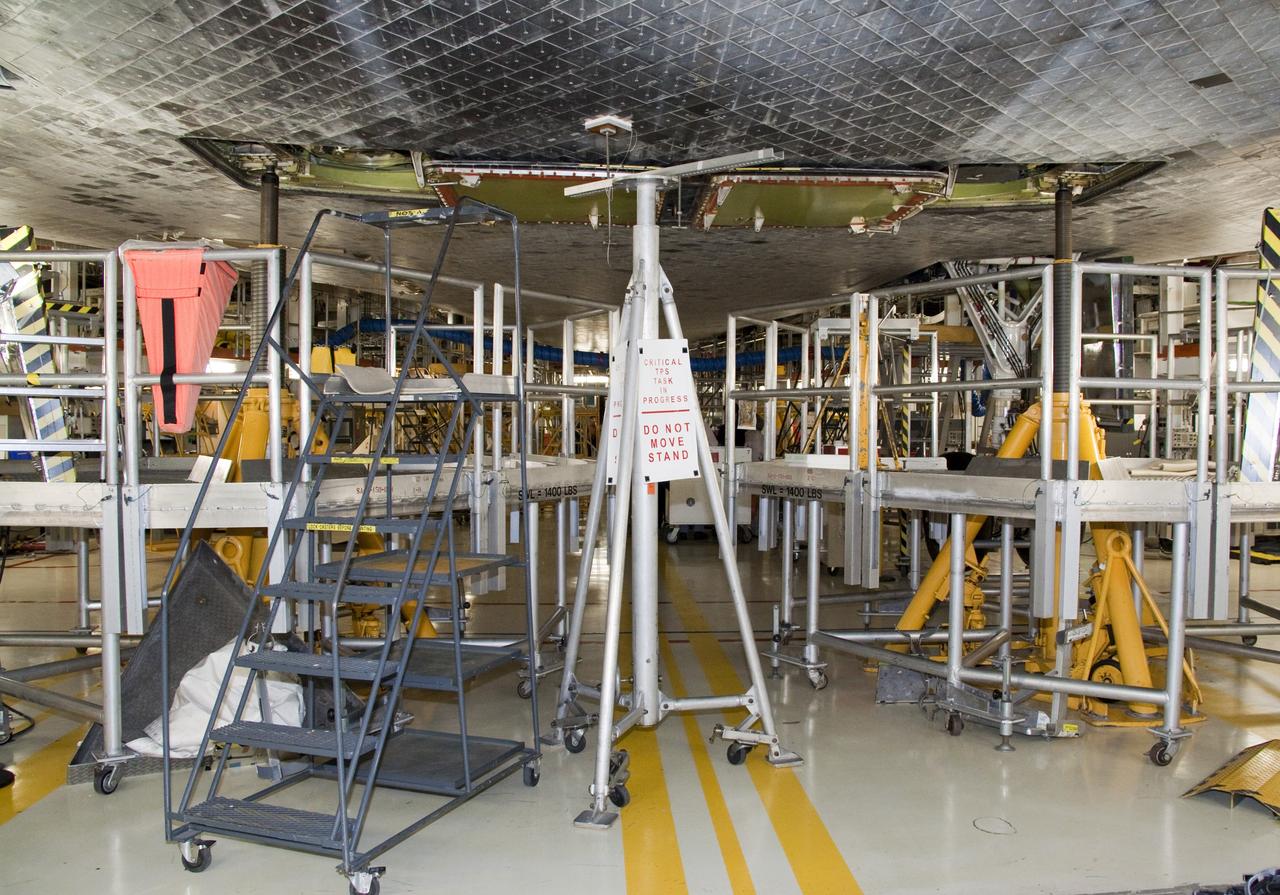
CAPE CANAVERAL, Fla. -- In Orbiter Processing Facility-1 at NASA's Kennedy Space Center in Florida, a thermal protection system technician has secured a newly installed heat shield tile in place under space shuttle Atlantis with a pressure fitting to ensure a tight bond. The tiles are part of the Orbiter Thermal Protection System, thermal shields to protect against temperatures as high as 3,000 degrees Fahrenheit, which are produced during descent for landing. Atlantis is being prepared for the STS-135 mission, which will deliver the Raffaello multi-purpose logistics module packed with supplies, logistics and spare parts to the International Space Station. STS-135 is targeted to launch June 28, and will be the last spaceflight for the Space Shuttle Program. Photo credit: NASA/Jack Pfaller
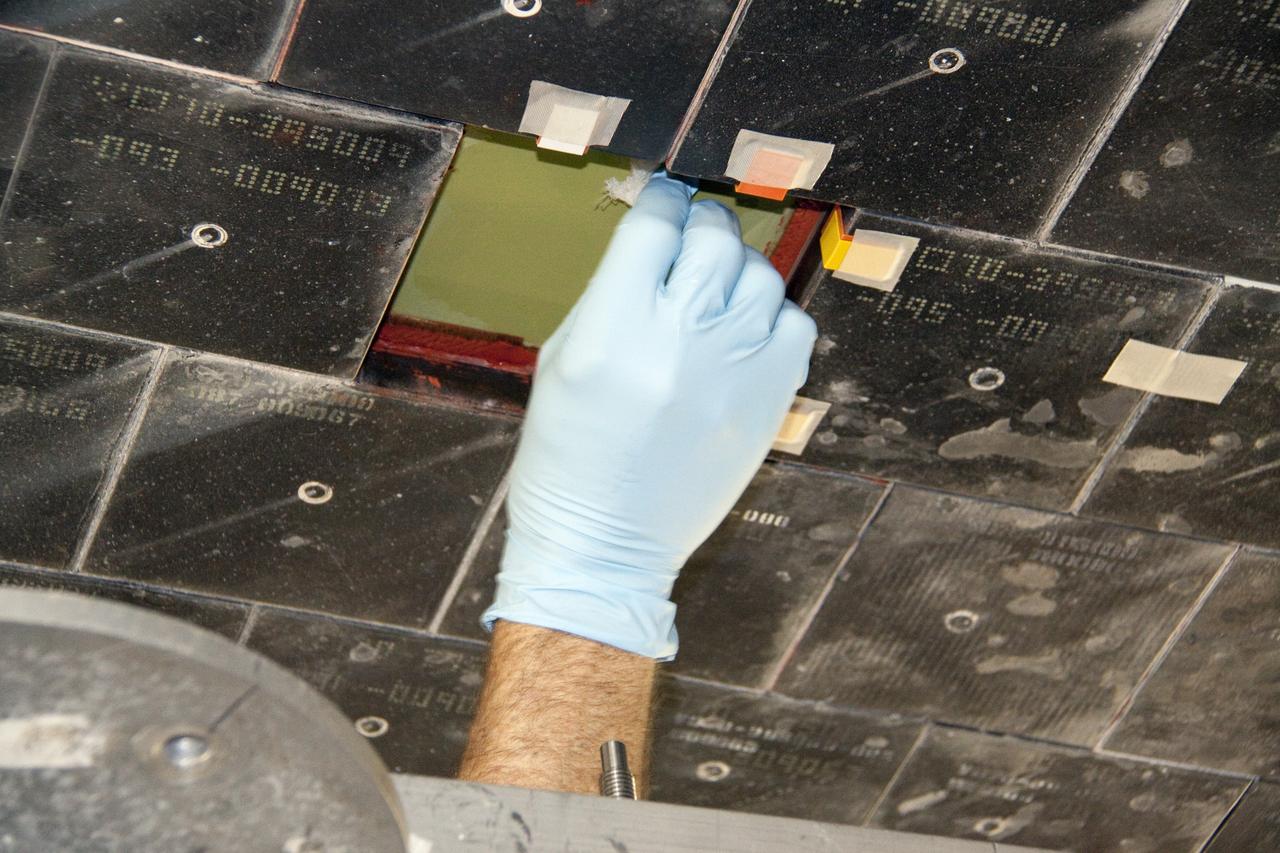
CAPE CANAVERAL, Fla. -- In Orbiter Processing Facility-1 at NASA's Kennedy Space Center in Florida, a thermal protection system technician prepares the surface under space shuttle Atlantis before installing a heat shield tile. The tiles are part of the Orbiter Thermal Protection System, thermal shields to protect against temperatures as high as 3,000 degrees Fahrenheit, which are produced during descent for landing. Atlantis is being prepared for the STS-135 mission, which will deliver the Raffaello multi-purpose logistics module packed with supplies, logistics and spare parts to the International Space Station. STS-135 is targeted to launch June 28, and will be the last spaceflight for the Space Shuttle Program. Photo credit: NASA/Jack Pfaller
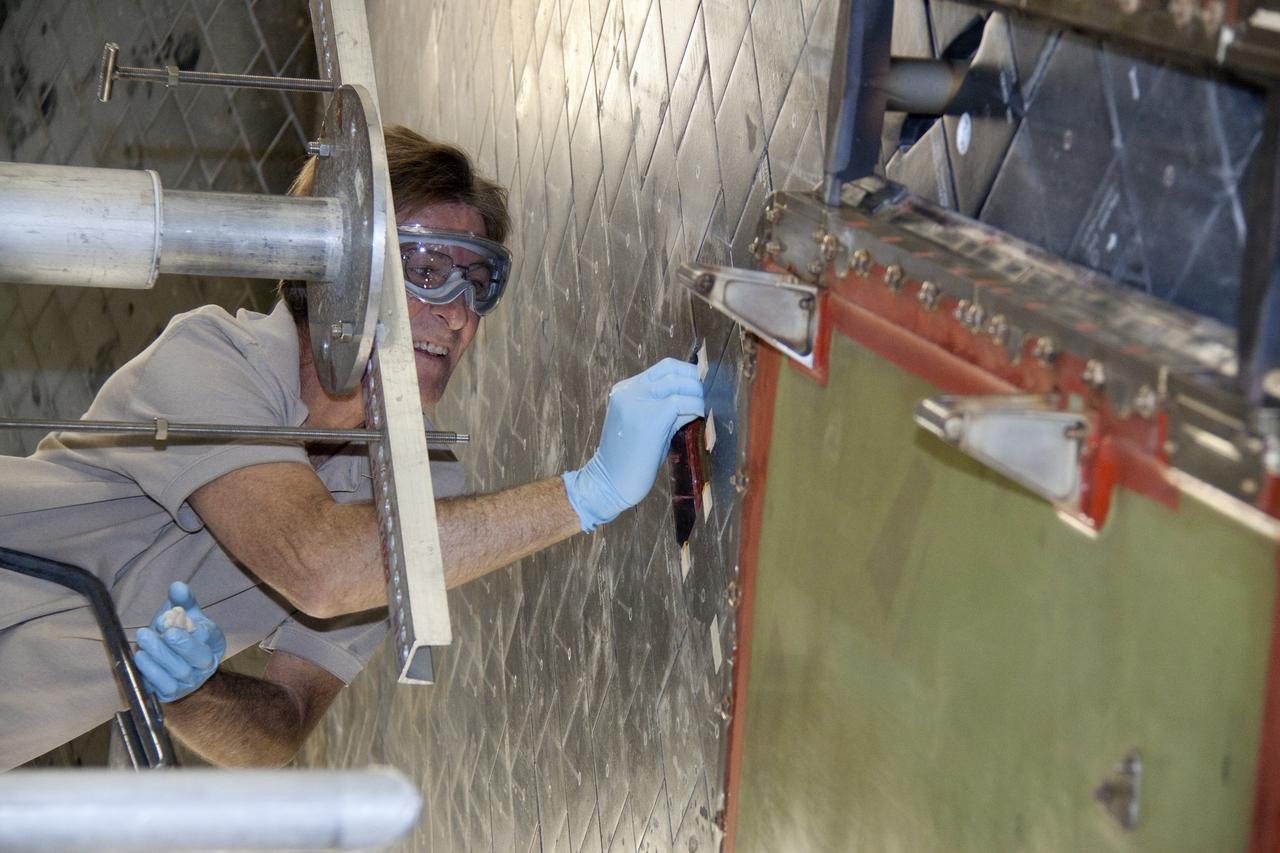
CAPE CANAVERAL, Fla. -- In Orbiter Processing Facility-1 at NASA's Kennedy Space Center in Florida, a thermal protection system technician prepares the surface under space shuttle Atlantis before installing a heat shield tile. The tiles are part of the Orbiter Thermal Protection System, thermal shields to protect against temperatures as high as 3,000 degrees Fahrenheit, which are produced during descent for landing. Atlantis is being prepared for the STS-135 mission, which will deliver the Raffaello multi-purpose logistics module packed with supplies, logistics and spare parts to the International Space Station. STS-135 is targeted to launch June 28, and will be the last spaceflight for the Space Shuttle Program. Photo credit: NASA/Jack Pfaller
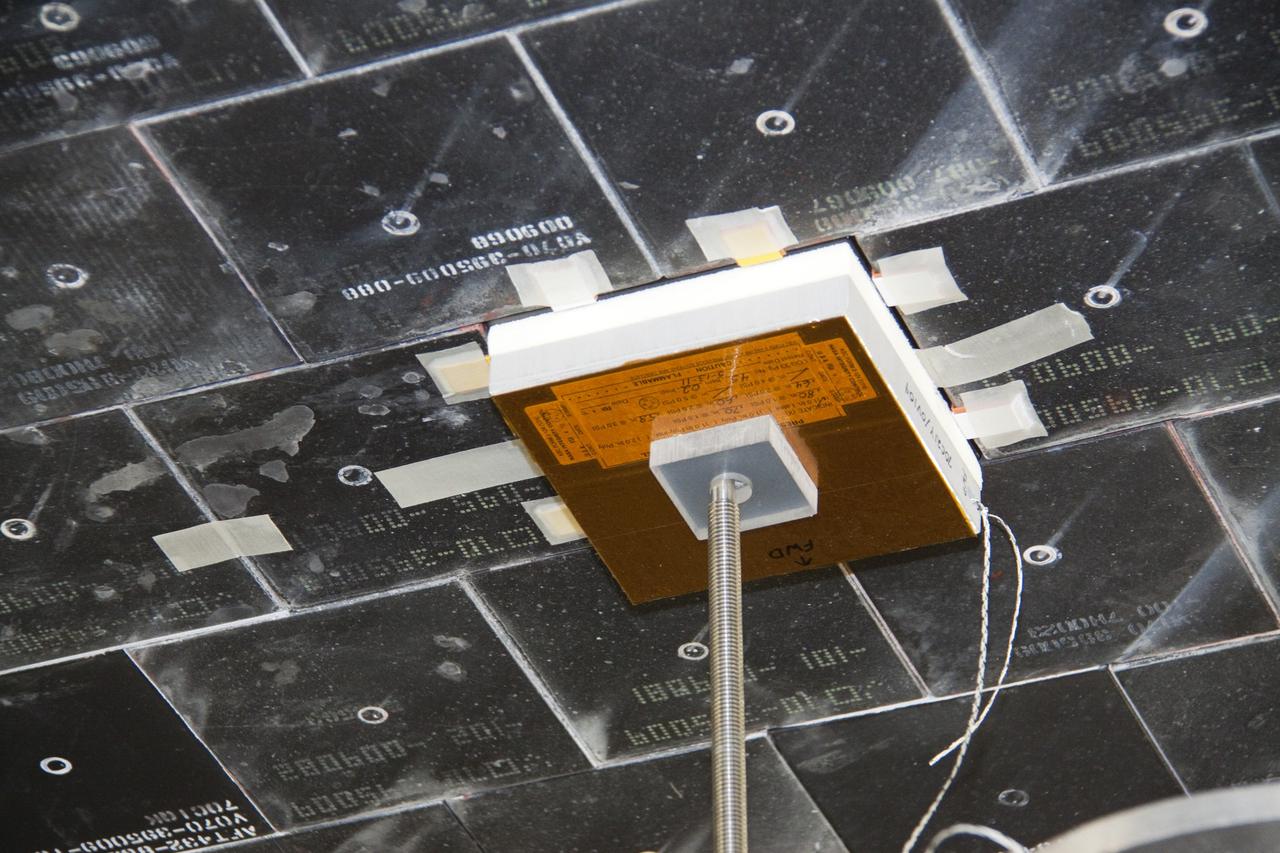
CAPE CANAVERAL, Fla. -- In Orbiter Processing Facility-1 at NASA's Kennedy Space Center in Florida, a thermal protection system technician has secured a newly installed heat shield tile in place under space shuttle Atlantis with a pressure fitting to ensure a tight bond. The tiles are part of the Orbiter Thermal Protection System, thermal shields to protect against temperatures as high as 3,000 degrees Fahrenheit, which are produced during descent for landing. Atlantis is being prepared for the STS-135 mission, which will deliver the Raffaello multi-purpose logistics module packed with supplies, logistics and spare parts to the International Space Station. STS-135 is targeted to launch June 28, and will be the last spaceflight for the Space Shuttle Program. Photo credit: NASA/Jack Pfaller

KENNEDY SPACE CENTER, FLA. -- In the Orbiter Processing Facility, a worker points to some of the tiles on orbiter Atlantis that are being dried by clusters of 200-300 watt heat lamps. Significant rainstorms during the orbiter’s turnaround for a ferry flight home from Edwards Air Force Base, Calif., caused a moisture problem. The tiles are part of the Thermal Protection System used on orbiters for extreme temperatures encountered during landing. Engineers are evaluating the current procedures to assure the tiles are in a safe and flight-ready condition
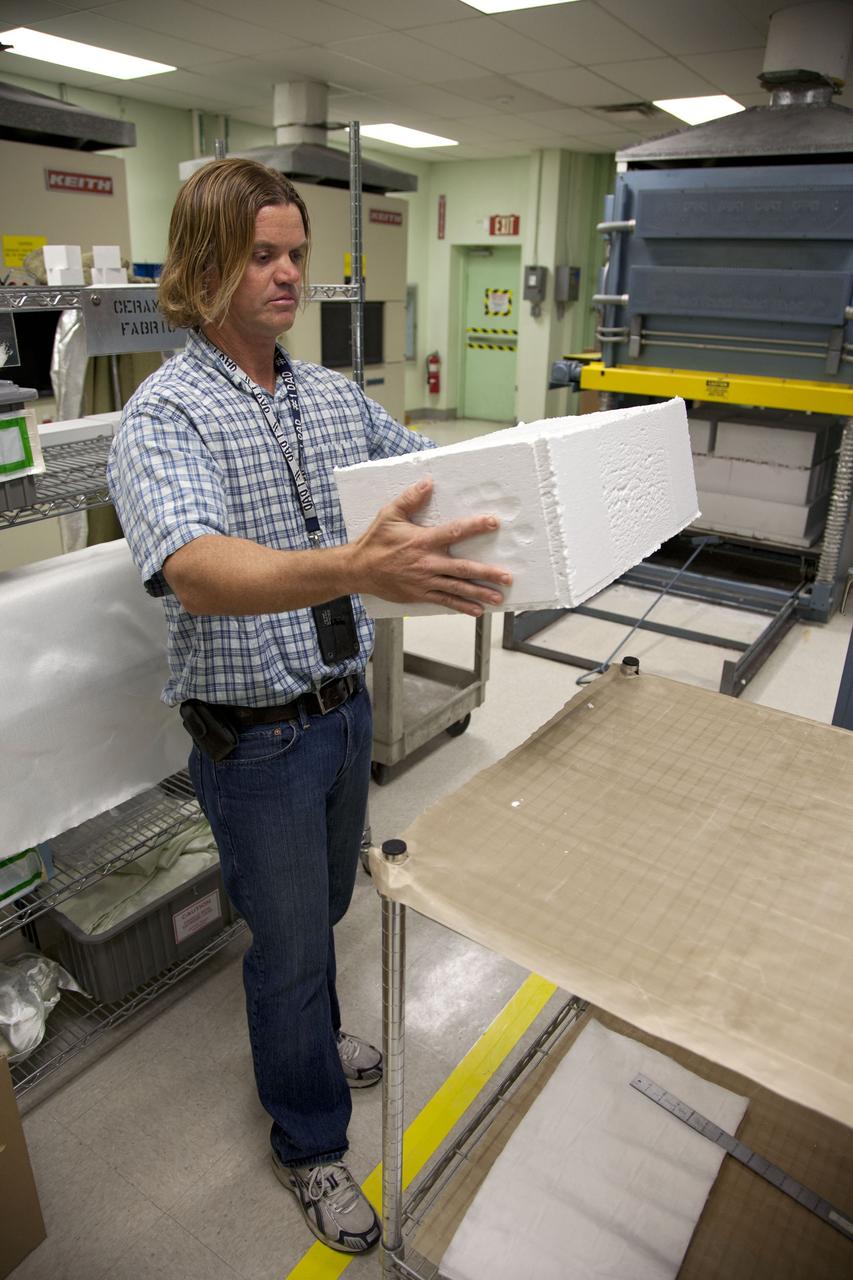
Tim Wright, a United Space Alliance engineering manager at NASA's Kennedy Space Center in Florida, unpacks the heat shield tiles that will be installed to the backshell of the Orion Multi-Purpose Crew Vehicle's Exploration Flight Test EFT-1 capsule. The tiles are being manufactured and inspected in Kennedy's Thermal Protection System Facility. The tiles will be baked at 2,200 degrees F to cure their ceramic coating. EFT-1 will be used during Orion's first test flight in space. For more information, visit www.nasa.gov/orion. Photo credit: Frankie Martin
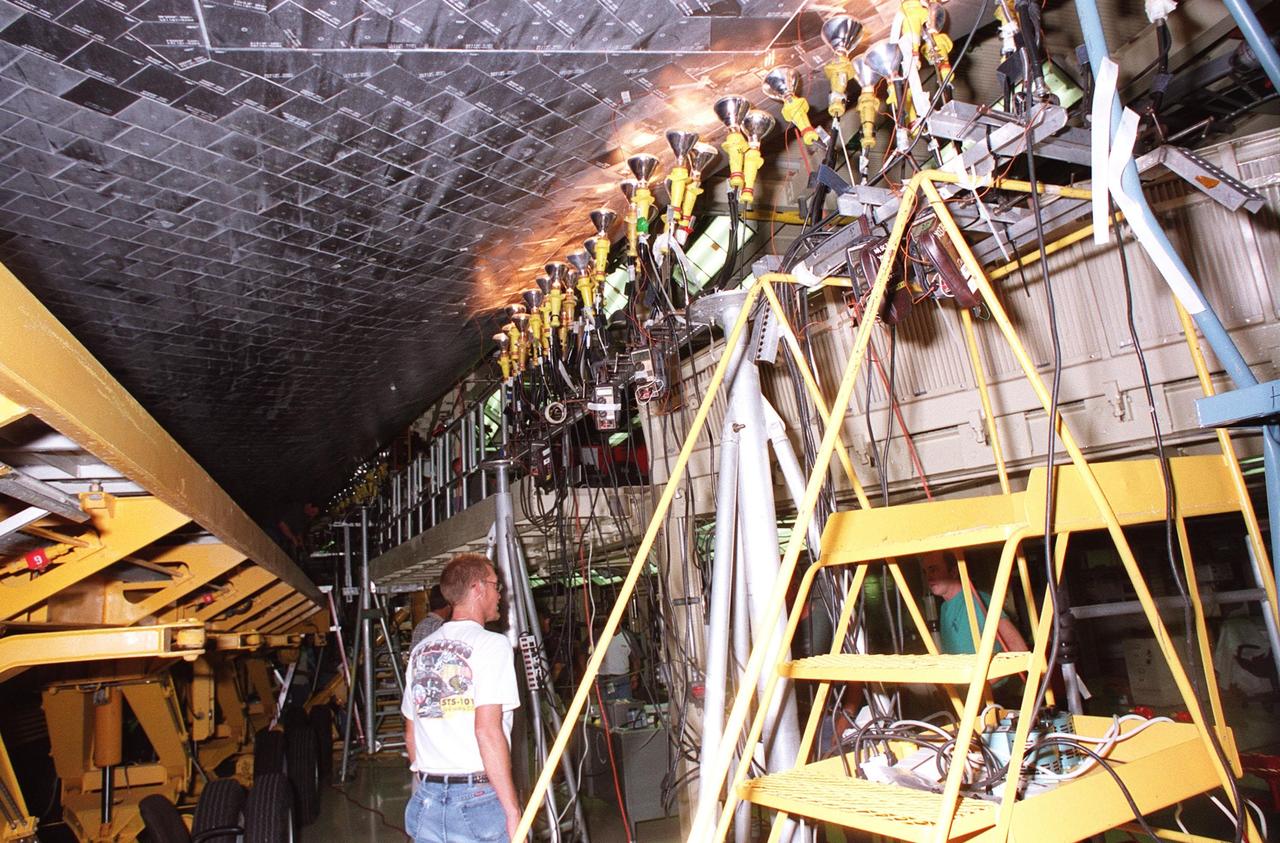
KENNEDY SPACE CENTER, FLA. -- In the Orbiter Processing Facility, a worker points to some of the tiles on orbiter Atlantis that are being dried by clusters of 200-300 watt heat lamps. Significant rainstorms during the orbiter’s turnaround for a ferry flight home from Edwards Air Force Base, Calif., caused a moisture problem. The tiles are part of the Thermal Protection System used on orbiters for extreme temperatures encountered during landing. Engineers are evaluating the current procedures to assure the tiles are in a safe and flight-ready condition
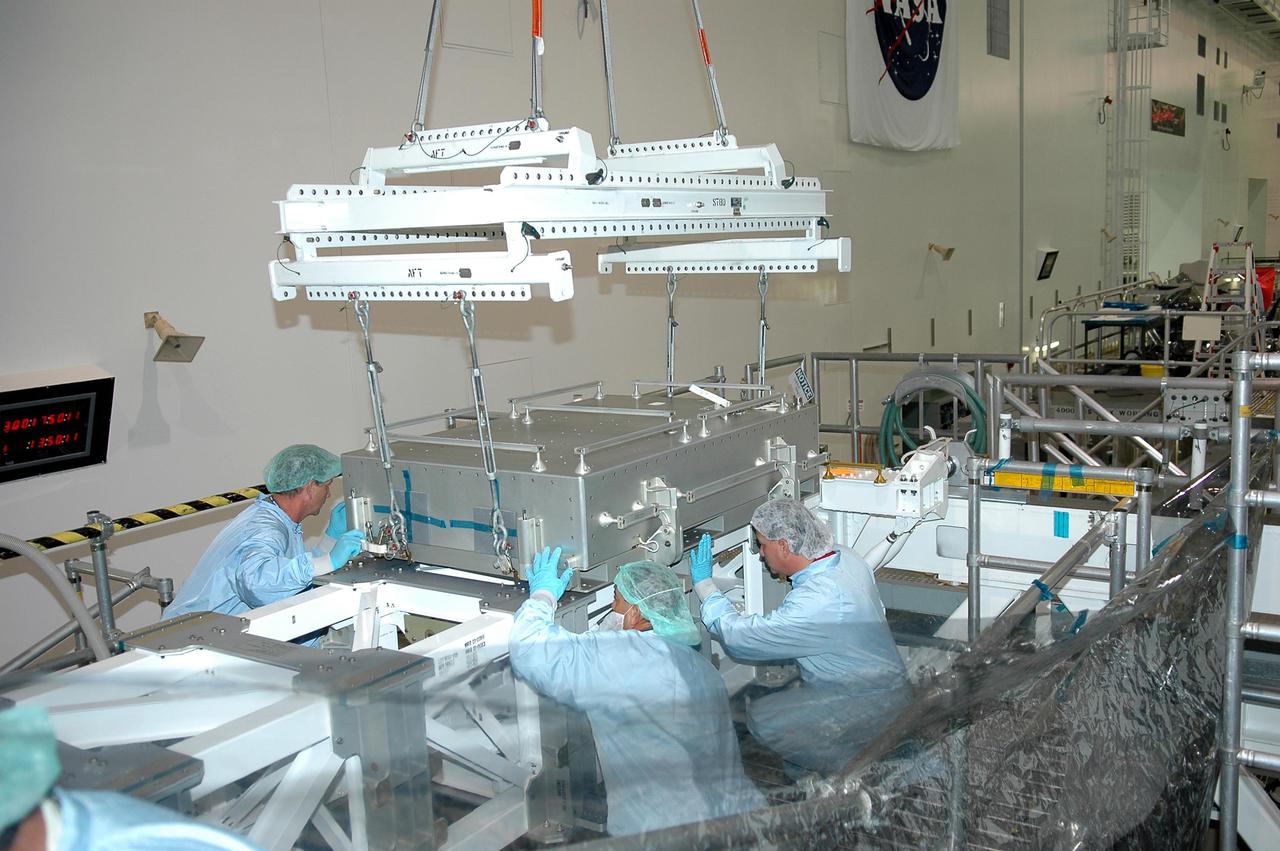
KENNEDY SPACE CENTER, FLA. - Technicians at the Space Station Processing Facility perform a fit check of the Thermal Protection System Sample Box on the Lightweight Multi-Purpose Experiment Support Structure Carrier (LMC). The box is the actual flight hardware scheduled to fly on the Space Shuttle Return to Flight mission STS-114. The fit check is performed to ensure the hardware mates properly with the newly modified LMC and will be returned to NASA’s Johnson Space Center for installation of tile samples in support of the STS-114 mission. The Thermal Protection Detailed Test Objective will enable astronauts to test new on-orbit Thermal Protection System repair techniques. Mission STS-114 is scheduled to launch in May 2005.
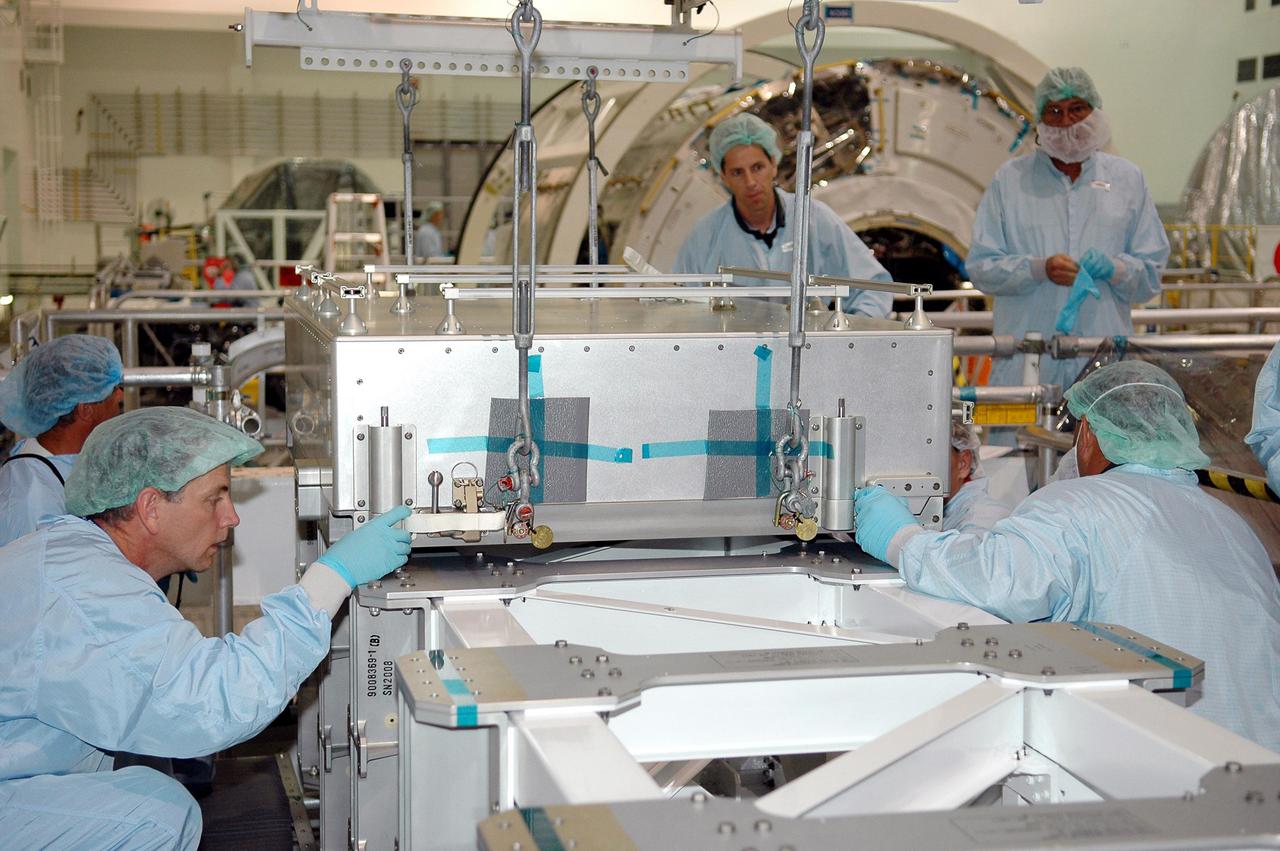
KENNEDY SPACE CENTER, FLA. - Technicians at the Space Station Processing Facility perform a fit check of the Thermal Protection System Sample Box on the Lightweight Multi-Purpose Experiment Support Structure Carrier (LMC). The box is the actual flight hardware scheduled to fly on the Space Shuttle Return to Flight mission STS-114. The fit check is performed to ensure the hardware mates properly with the newly modified LMC and will be returned to NASA’s Johnson Space Center for installation of tile samples in support of the STS-114 mission. The Thermal Protection Detailed Test Objective will enable astronauts to test new on-orbit Thermal Protection System repair techniques. Mission STS-114 is scheduled to launch in May 2005.
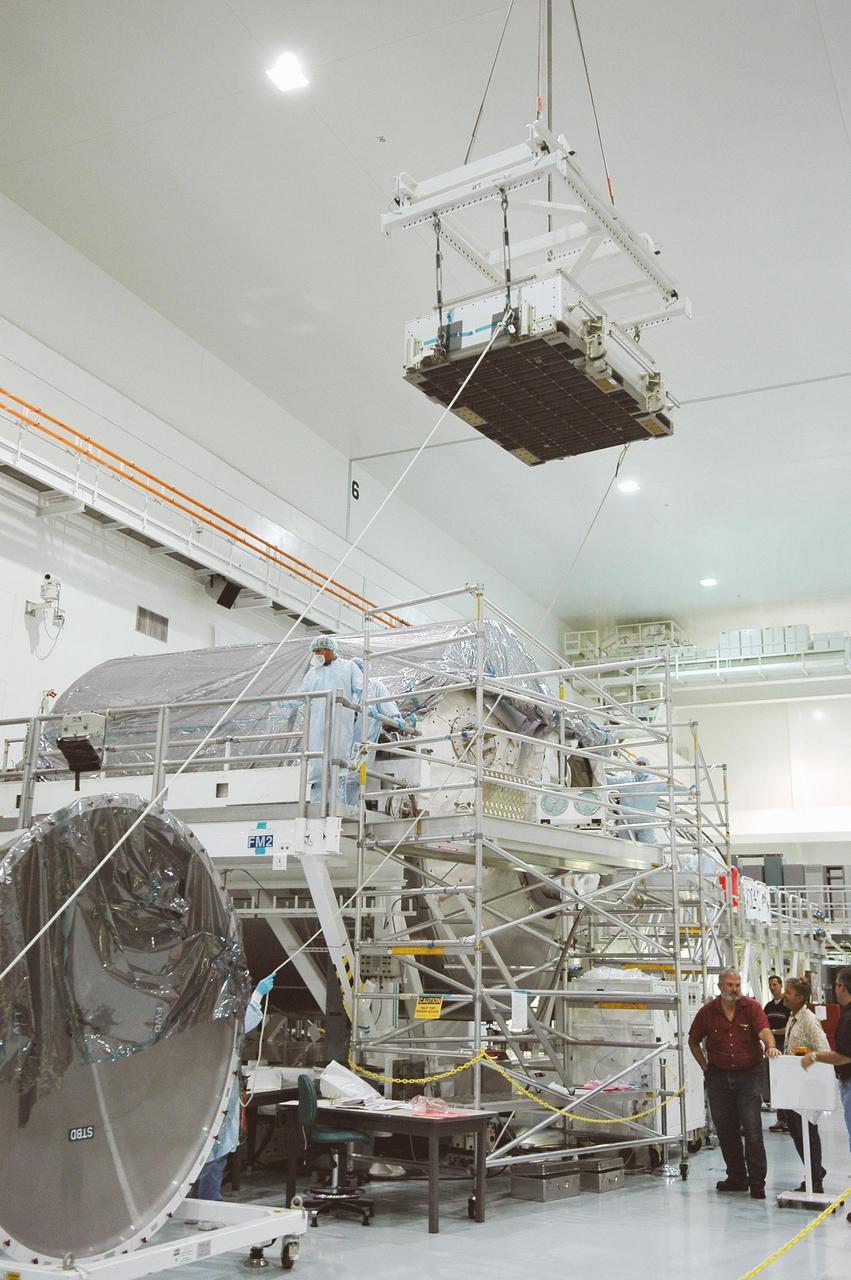
KENNEDY SPACE CENTER, FLA. - In the Space Station Processing Facility, an overhead crane moves a Thermal Protection System Sample Box to the Lightweight Multi-Purpose Experiment Support Structure Carrier (LMC) for a fit check. The box is the actual flight hardware scheduled to fly on the Space Shuttle Return to Flight mission STS-114. The fit check is performed to ensure the hardware mates properly with the newly modified LMC and will be returned to NASA’s Johnson Space Center for installation of tile samples in support of the STS-114 mission. The Thermal Protection Detailed Test Objective will enable astronauts to test new on-orbit Thermal Protection System repair techniques. Mission STS-114 is scheduled to launch in May 2005.
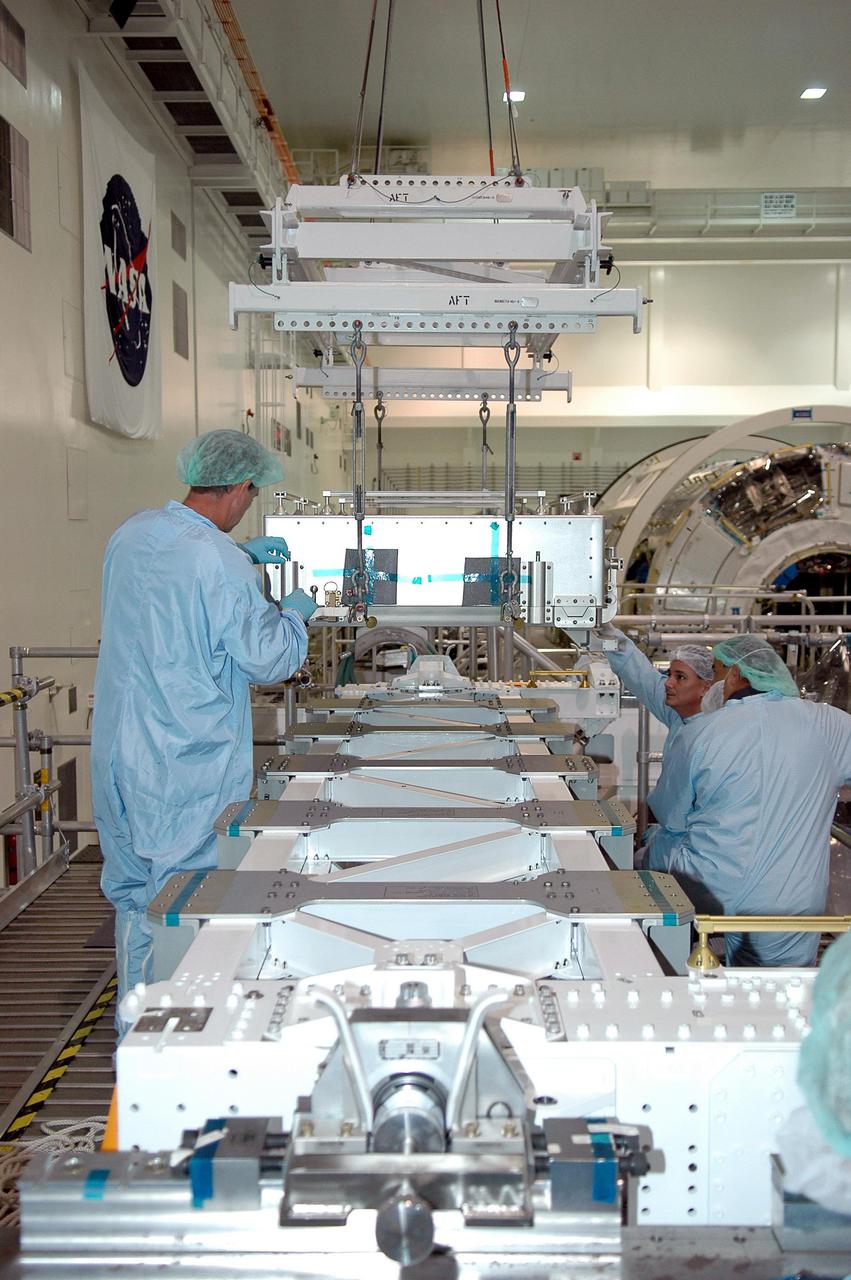
KENNEDY SPACE CENTER, FLA. - Technicians at the Space Station Processing Facility perform a fit check of the Thermal Protection System Sample Box on the Lightweight Multi-Purpose Experiment Support Structure Carrier (LMC). The box is the actual flight hardware scheduled to fly on the Space Shuttle Return to Flight mission STS-114. The fit check is performed to ensure the hardware mates properly with the newly modified LMC and will be returned to NASA’s Johnson Space Center for installation of tile samples in support of the STS-114 mission. The Thermal Protection Detailed Test Objective will enable astronauts to test new on-orbit Thermal Protection System repair techniques. Mission STS-114 is scheduled to launch in May 2005.
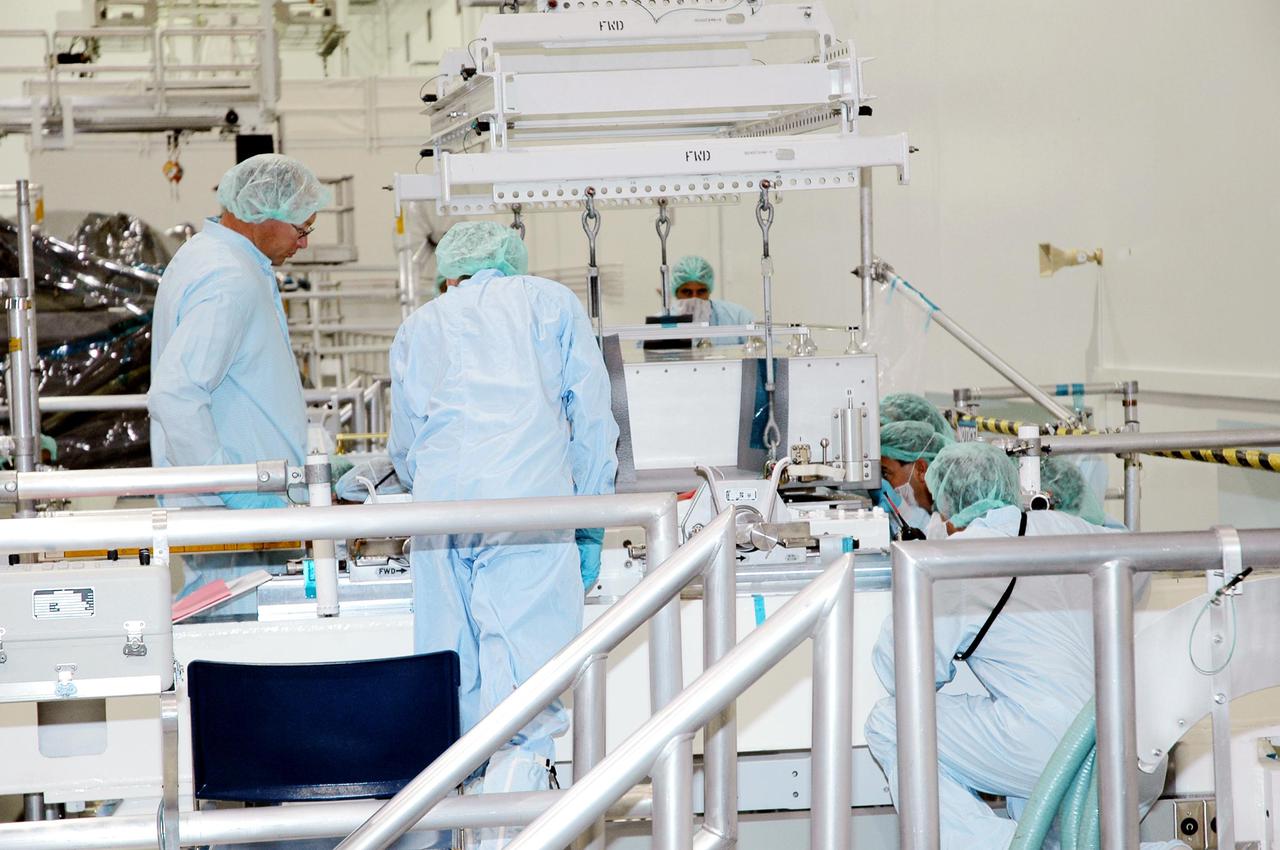
KENNEDY SPACE CENTER, FLA. - Technicians in the Space Station Processing Facility ensure the Thermal Protection System Detailed Test Objective (DTO) box is placed correctly on the Lightweight Multi-Purpose Experiment Support Structure Carrier (LMC). The LMC and DTO will fly on Space Shuttle Discovery for mission STS-114. The DTO contains tile samples that will enable astronauts to test new on-orbit Thermal Protection System repair techniques. The launch window for mission STS-114 is May 12 to June 3.
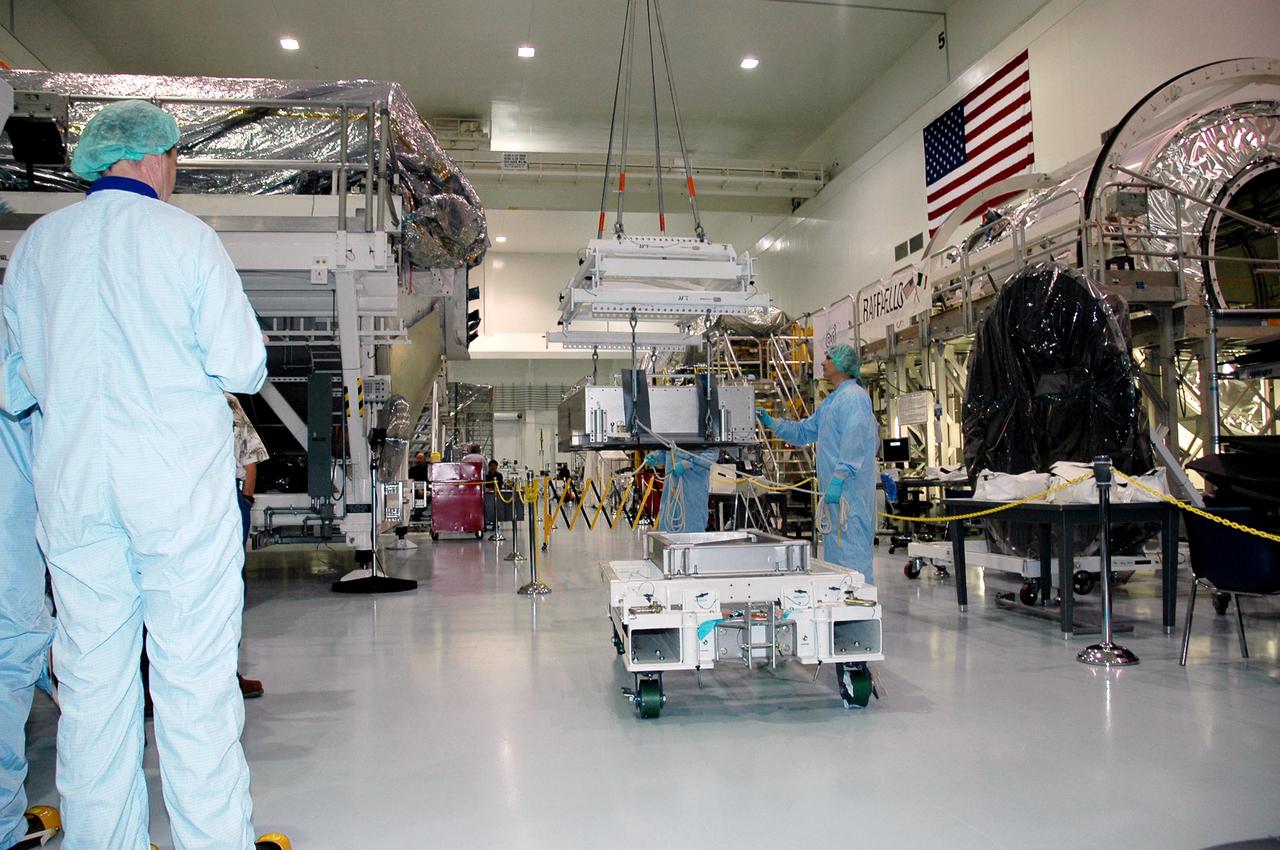
KENNEDY SPACE CENTER, FLA. - Technicians at the Space Station Processing Facility carefully watch as a crane lifts the Thermal Protection System Detailed Test Objective (DTO) box. It will be placed on the Lightweight Multi-Purpose Experiment Support Structure Carrier (LMC) to fly on Space Shuttle Discovery for mission STS-114. The DTO contains tile samples that will enable astronauts to test new on-orbit Thermal Protection System repair techniques. The launch window for mission STS-114 is May 12 to June 3.
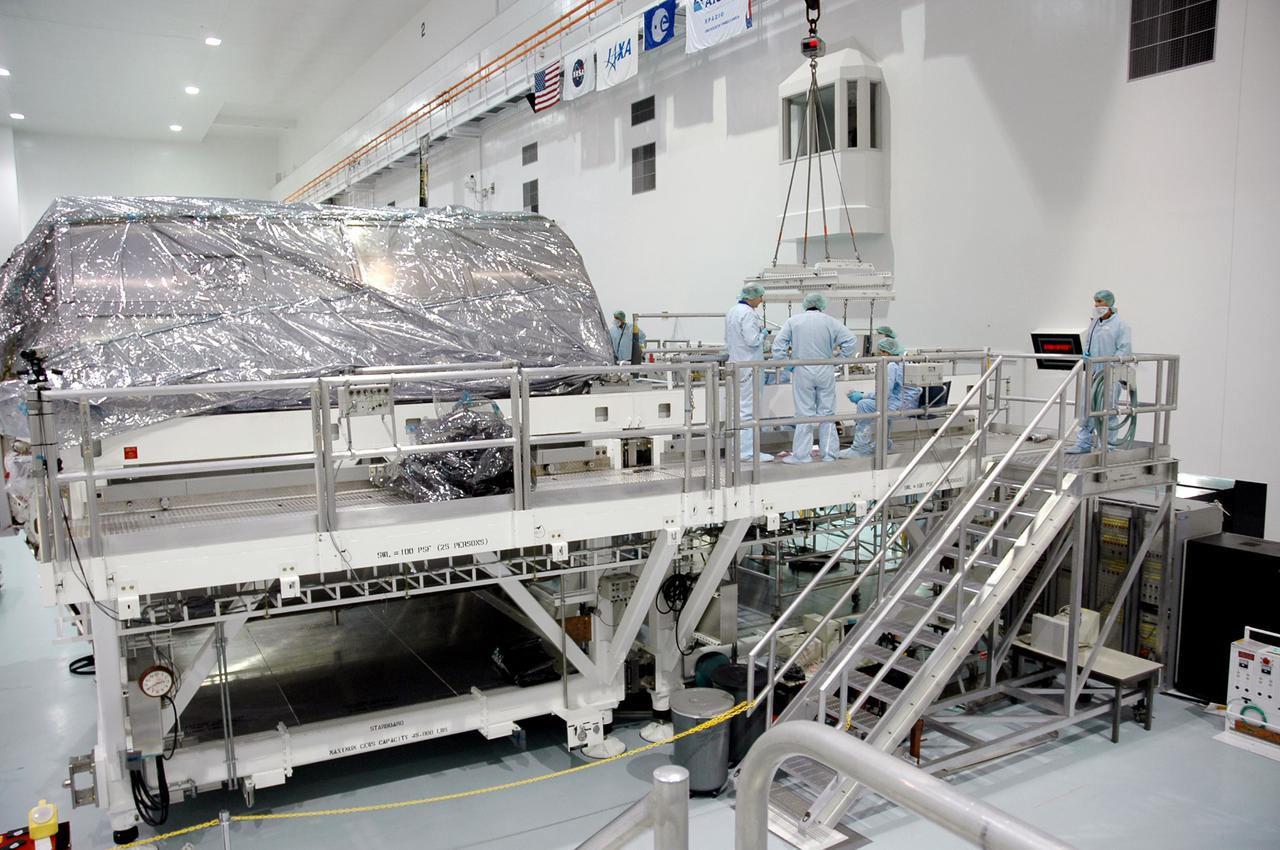
KENNEDY SPACE CENTER, FLA. - Technicians in the Space Station Processing Facility check the placement of the Thermal Protection System Detailed Test Objective (DTO) box on the Lightweight Multi-Purpose Experiment Support Structure Carrier (LMC). The LMC and DTO will fly on Space Shuttle Discovery for mission STS-114. The DTO contains tile samples that will enable astronauts to test new on-orbit Thermal Protection System repair techniques. The launch window for mission STS-114 is May 12 to June 3.
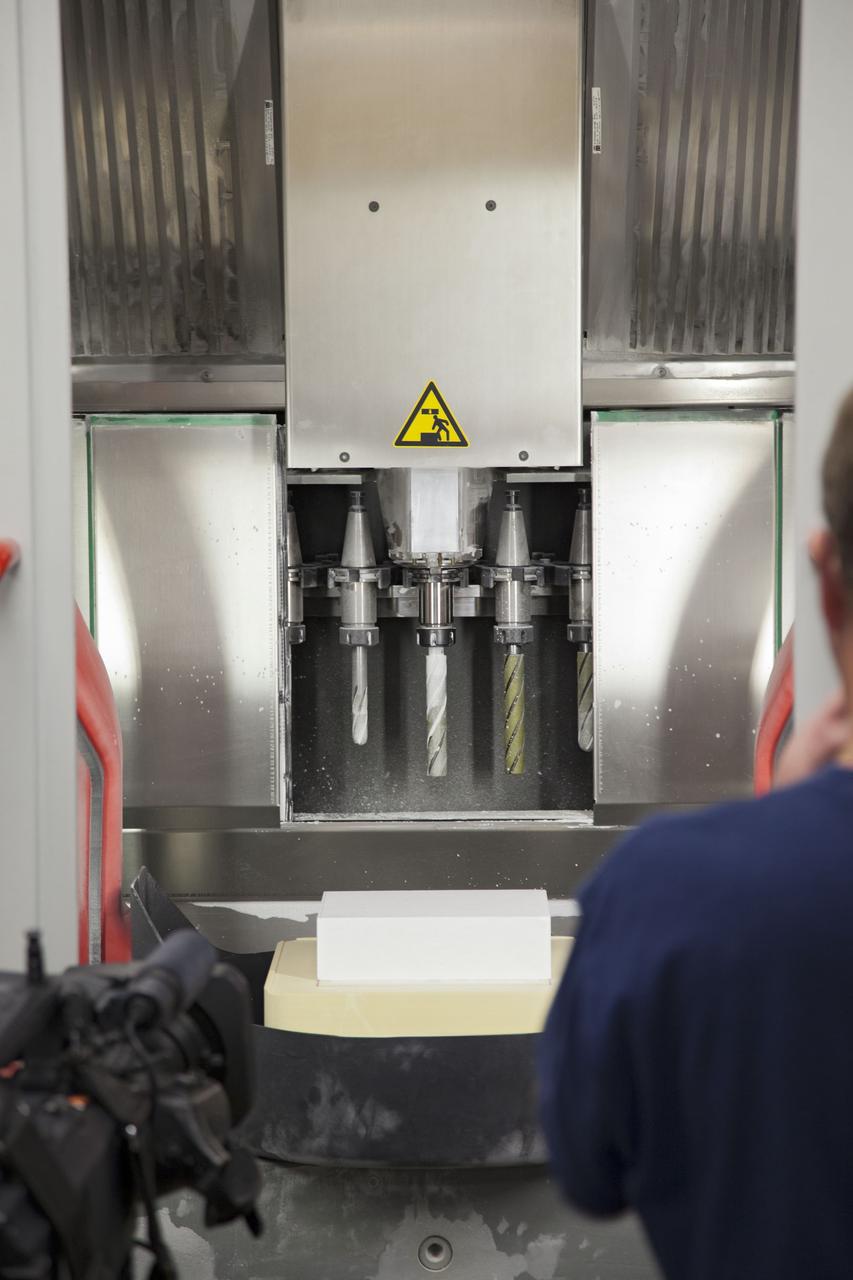
CAPE CANAVERAL, Fla. -- The heat shield tiles that will be installed to the backshell of the Orion Multi-Purpose Crew Vehicle's Exploration Flight Test EFT-1 capsule are manufactured inside the Thermal Protection System Facility at NASA's Kennedy Space Center in Florida. The insulation includes thermal barriers that are used around hatches, thrusters and other open areas of the backshell to protect the joints from heat. EFT-1 will be used during Orion's first test flight in space. For more information, visit www.nasa.gov/orion. Photo credit: Frankie Martin
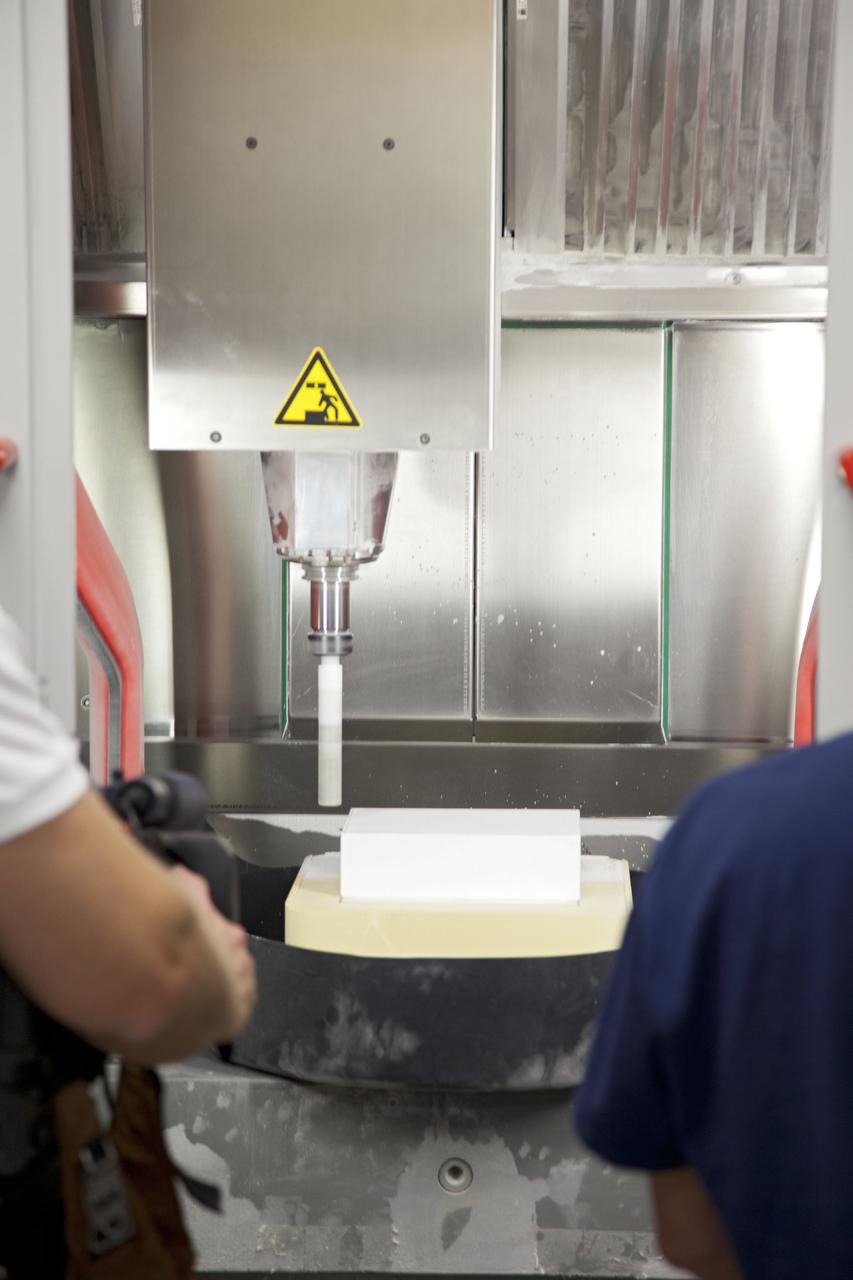
CAPE CANAVERAL, Fla. -- The heat shield tiles that will be installed to the backshell of the Orion Multi-Purpose Crew Vehicle's Exploration Flight Test EFT-1 capsule are manufactured inside the Thermal Protection System Facility at NASA's Kennedy Space Center in Florida. The insulation includes thermal barriers that are used around hatches, thrusters and other open areas of the backshell to protect the joints from heat. EFT-1 will be used during Orion's first test flight in space. For more information, visit www.nasa.gov/orion. Photo credit: Frankie Martin
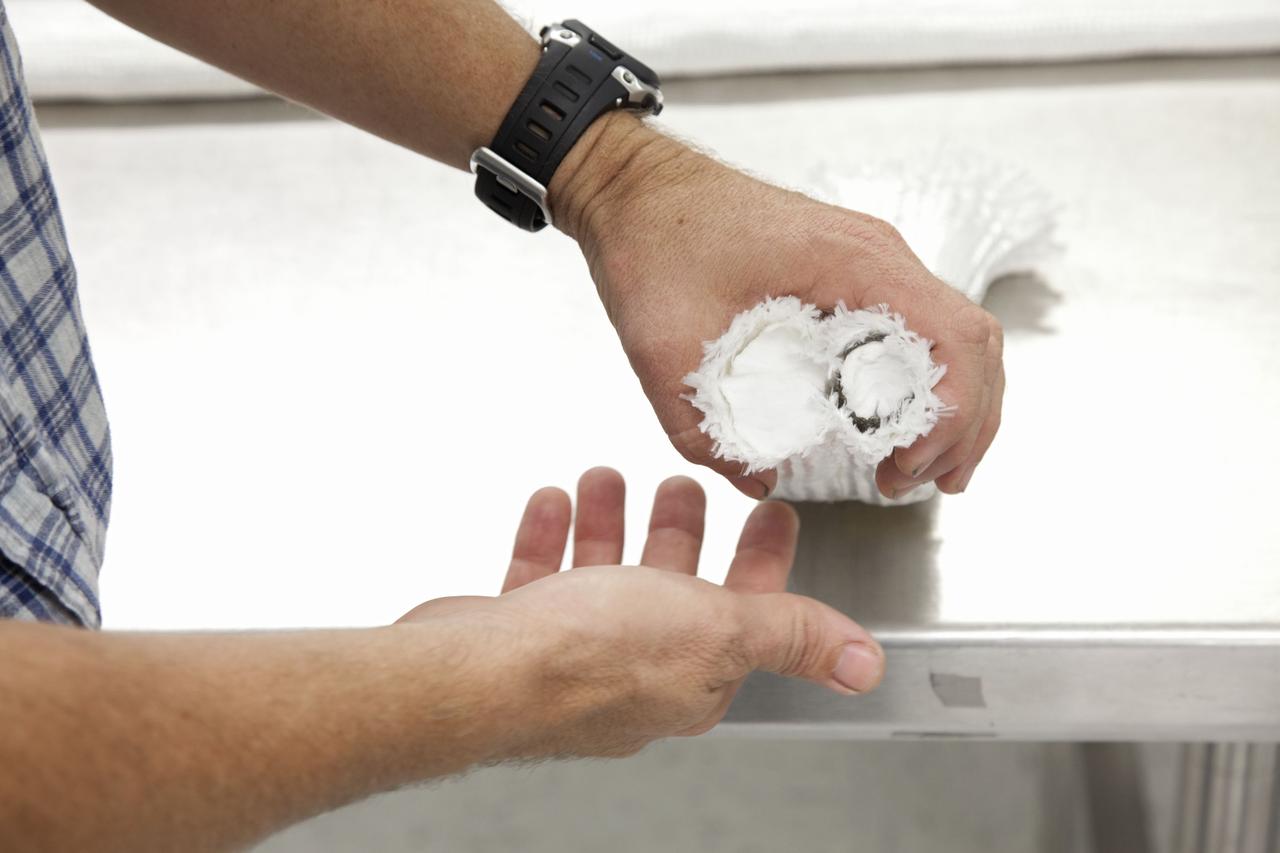
CAPE CANAVERAL, Fla. -- The heat shield tiles that will be installed to the backshell of the Orion Multi-Purpose Crew Vehicle's Exploration Flight Test EFT-1 capsule are manufactured inside the Thermal Protection System Facility at NASA's Kennedy Space Center in Florida. The insulation includes thermal barriers that are used around hatches, thrusters and other open areas of the backshell to protect the joints from heat. EFT-1 will be used during Orion's first test flight in space. For more information, visit www.nasa.gov/orion. Photo credit: Frankie Martin

KENNEDY SPACE CENTER, FLA. - In the Thermal Protection System Facility, Tim Wright, engineering manager with United Space Alliance, tests a new tile, called "Boeing replacement insulation" or "BRI-18." The new tiles will gradually replace older tiles around main landing gear doors, external tank doors and nose landing gear doors. Currently, 10 tiles have been processed inside the facility. Discovery will receive the first BRI-18 tiles. Technicians inside the Orbiter Processing Facility are performing fit checks and will begin bonding the tiles to the vehicle this month. The raw material is manufactured by The Boeing Company in Huntington Beach, Calif. Replacing older tile with the BRI-18 tile in strategic areas is one of the Columbia Accident Investigation Board's recommendations to strengthen the orbiters. The tiles are more impact resistant than previous designs, enhancing the crew’s safety.
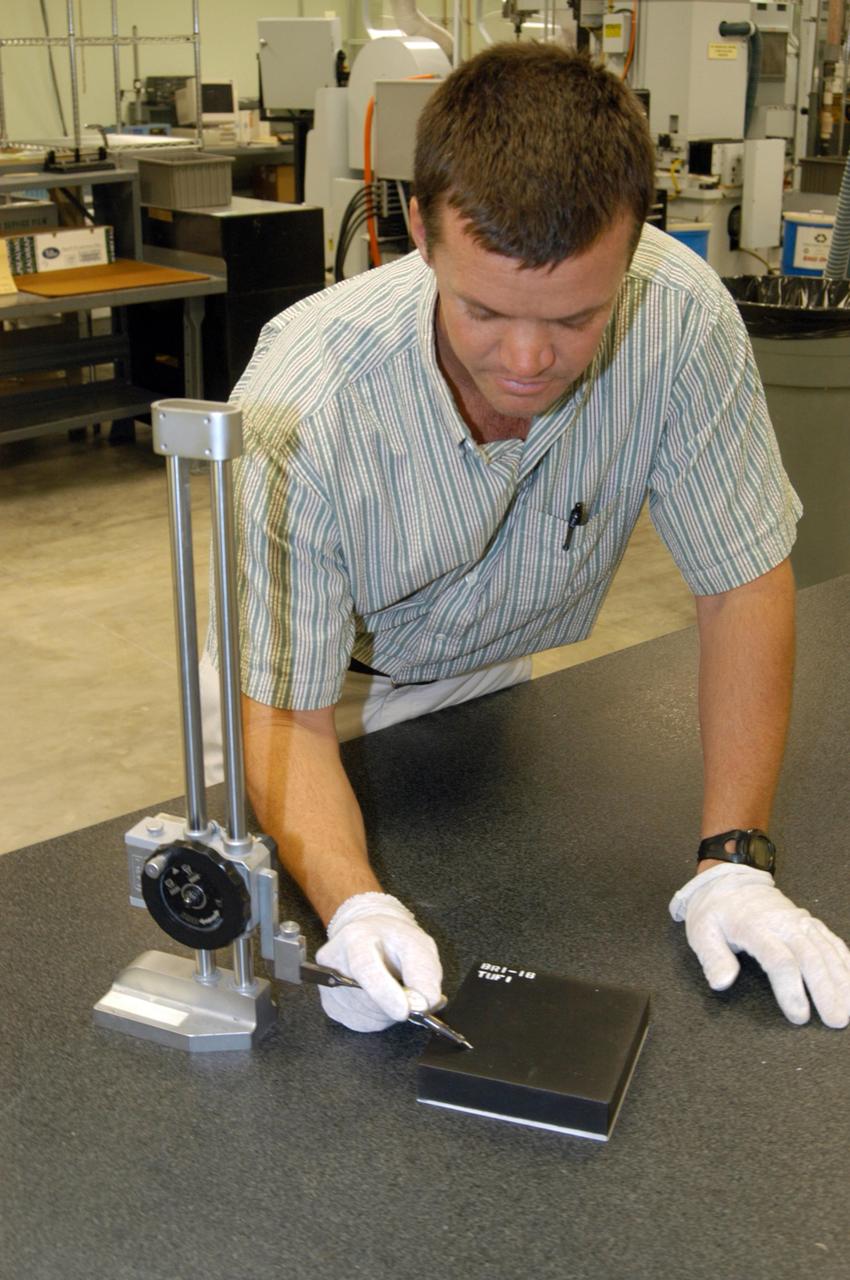
KENNEDY SPACE CENTER, FLA. - In the Thermal Protection System Facility, Tim Wright, engineering manager with United Space Alliance, tests a new tile, called "Boeing replacement insulation" or "BRI-18." The new tiles will gradually replace older tiles around main landing gear doors, external tank doors and nose landing gear doors. Currently, 10 tiles have been processed inside the facility. Discovery will receive the first BRI-18 tiles. Technicians inside the Orbiter Processing Facility are performing fit checks and will begin bonding the tiles to the vehicle this month. The raw material is manufactured by The Boeing Company in Huntington Beach, Calif. Replacing older tile with the BRI-18 tile in strategic areas is one of the Columbia Accident Investigation Board's recommendations to strengthen the orbiters. The tiles are more impact resistant than previous designs, enhancing the crew’s safety.
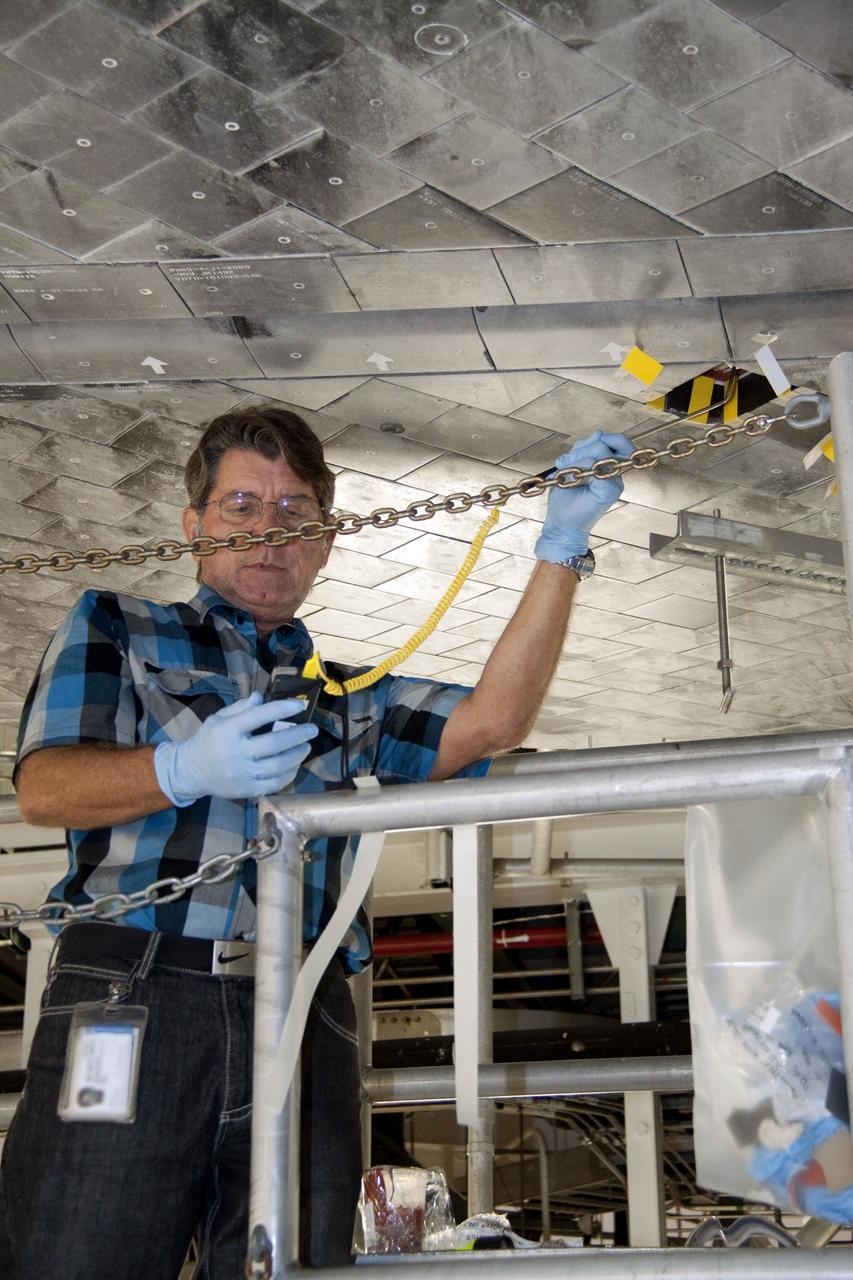
CAPE CANAVERAL, Fla. -- In Orbiter Processing Facility-1 at NASA's Kennedy Space Center in Florida, a thermal protection system technician takes a measurement of the surface in the area on space shuttle Atlantis' underside where a heat shield tile will be installed. The tiles are part of the Orbiter Thermal Protection System that protects the shuttle against temperatures as high as 3,000 degrees Fahrenheit, which are produced during descent for landing. Atlantis is being prepared for the STS-135 mission, which will carry the Raffaello multi-purpose logistics module packed with supplies, logistics and spare parts to the International Space Station. STS-135 is targeted to launch June 28, and will be the last flight for the Space Shuttle Program. Photo credit: NASA/Jack Pfaller
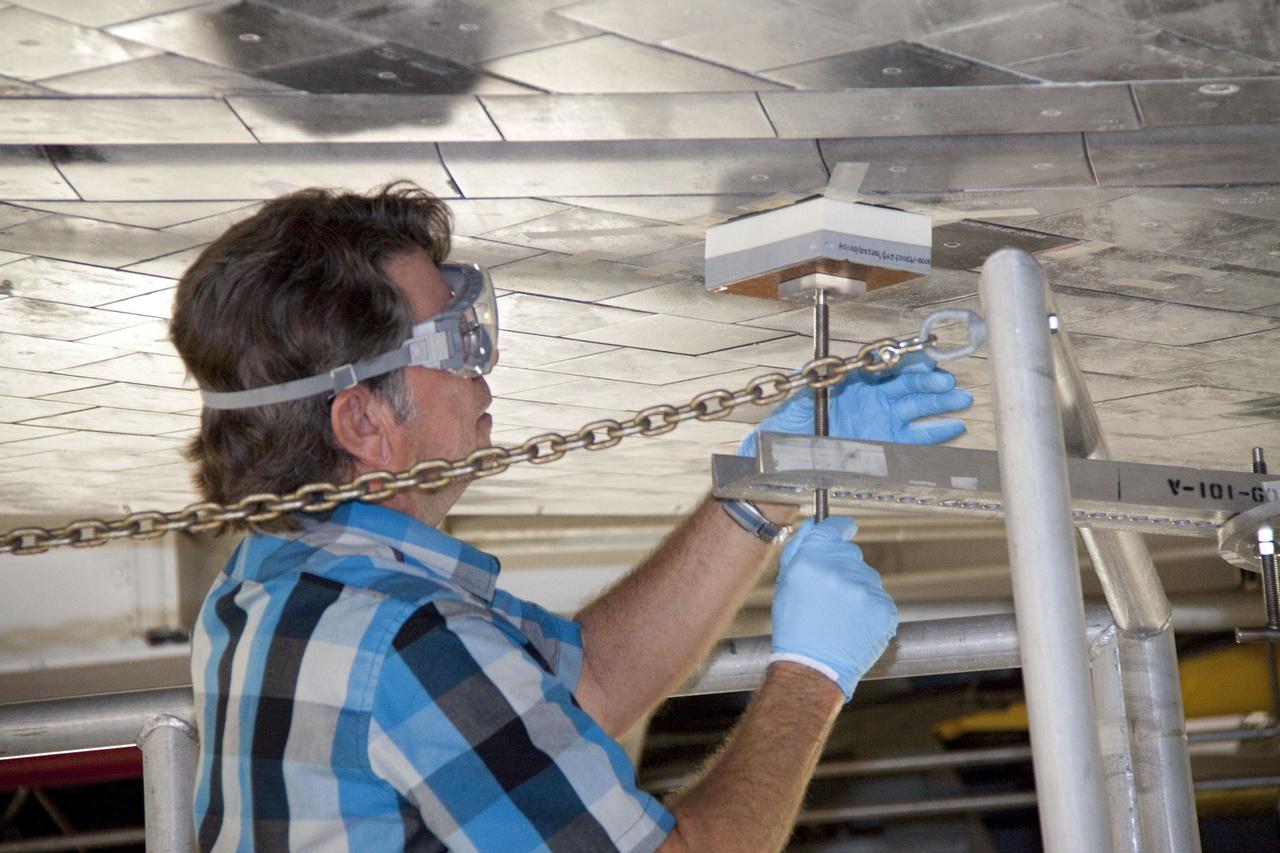
CAPE CANAVERAL, Fla. -- In Orbiter Processing Facility-1 at NASA's Kennedy Space Center in Florida, a thermal protection system technician secures a newly installed heat shield tile in place under space shuttle Atlantis with a pressure fitting to ensure a tight bond. The tiles are part of the Orbiter Thermal Protection System that protects the shuttle against temperatures as high as 3,000 degrees Fahrenheit, which are produced during descent for landing. Atlantis is being prepared for the STS-135 mission, which will carry the Raffaello multi-purpose logistics module packed with supplies, logistics and spare parts to the International Space Station. STS-135 is targeted to launch June 28, and will be the last flight for the Space Shuttle Program. Photo credit: NASA/Jack Pfaller
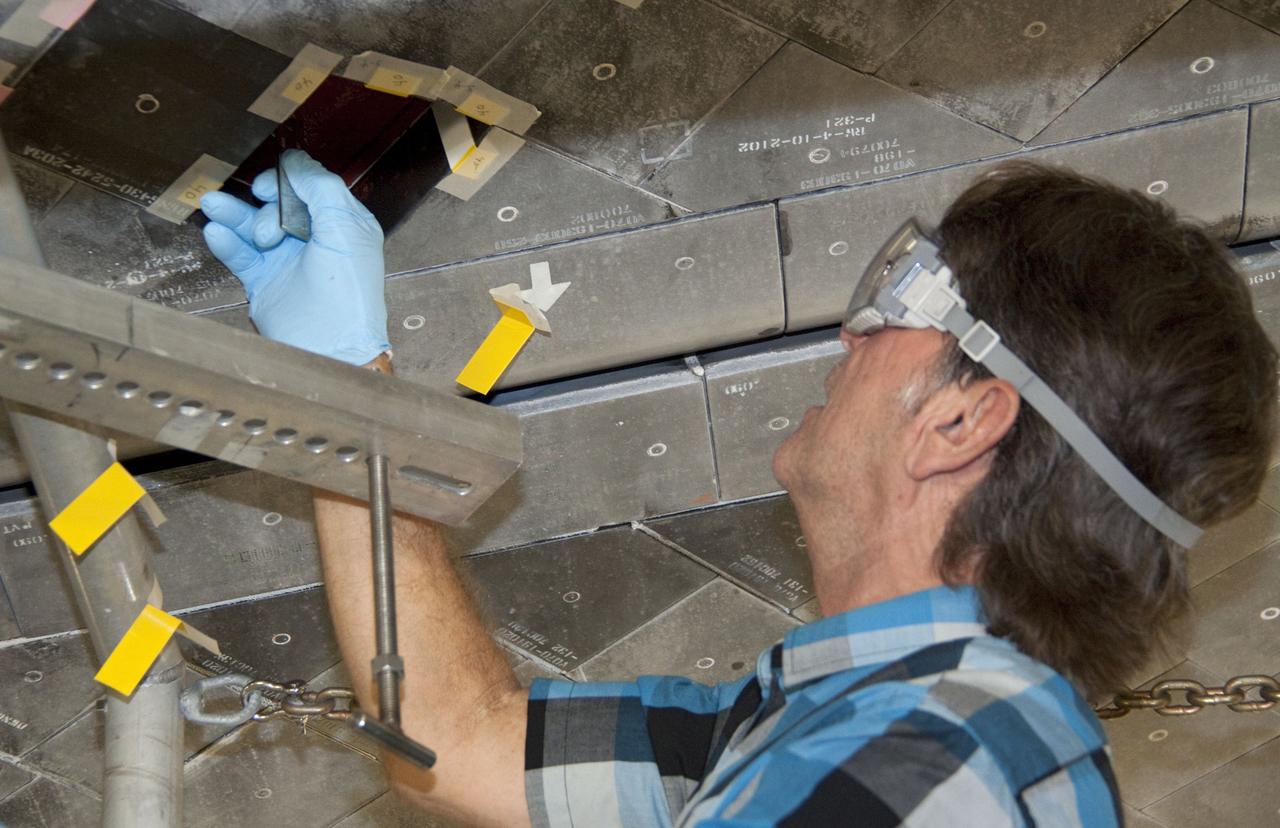
CAPE CANAVERAL, Fla. -- In Orbiter Processing Facility-1 at NASA's Kennedy Space Center in Florida, a thermal protection system technician installs a gap filler in the area on space shuttle Atlantis' underside before a heat shield tile is installed. The tiles are part of the Orbiter Thermal Protection System that protects the shuttle against temperatures as high as 3,000 degrees Fahrenheit, which are produced during descent for landing. Atlantis is being prepared for the STS-135 mission, which will carry the Raffaello multi-purpose logistics module packed with supplies, logistics and spare parts to the International Space Station. STS-135 is targeted to launch June 28, and will be the last flight for the Space Shuttle Program. Photo credit: NASA/Jack Pfaller
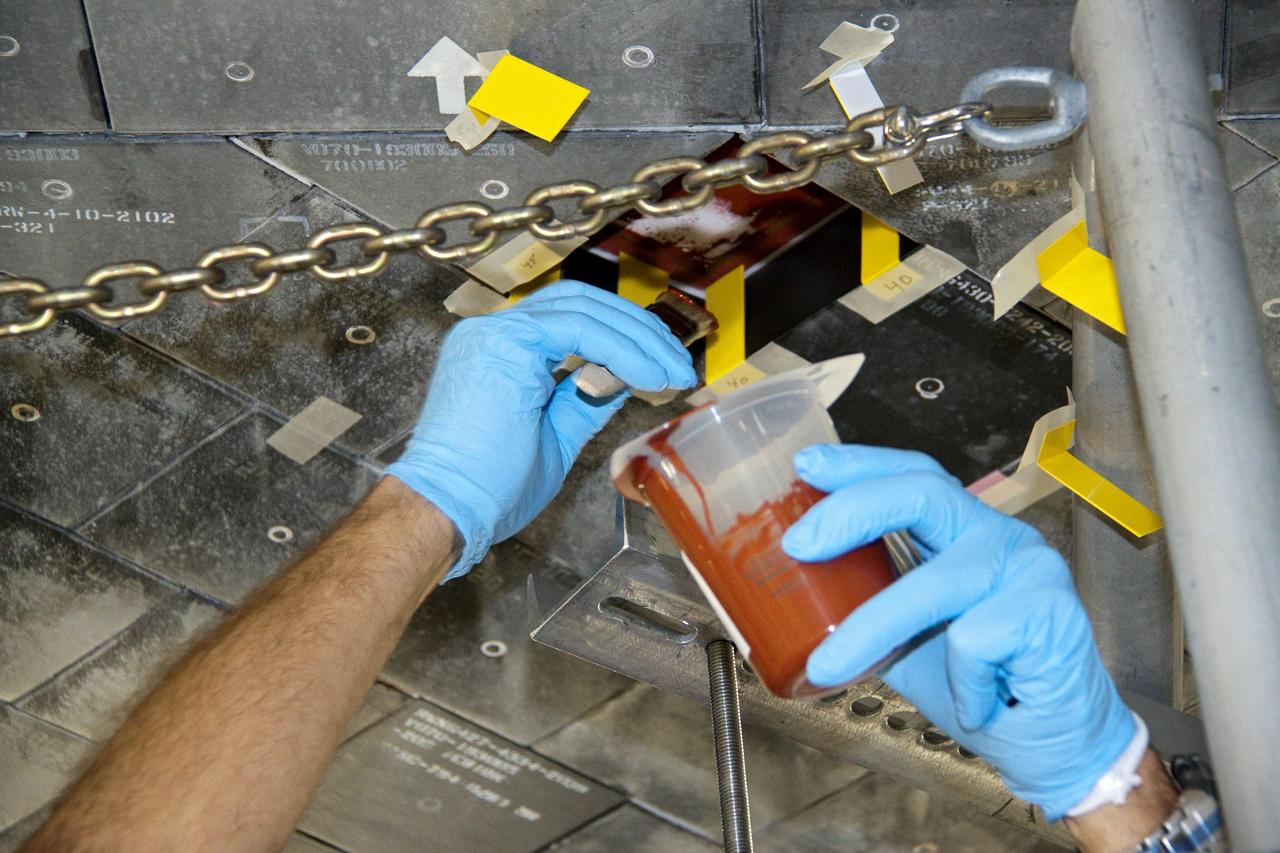
CAPE CANAVERAL, Fla. -- In Orbiter Processing Facility-1 at NASA's Kennedy Space Center in Florida, a thermal protection system technician applies a bonding agent to an area on space shuttle Atlantis' underside where a heat shield tile will be installed. The tiles are part of the Orbiter Thermal Protection System that protects the shuttle against temperatures as high as 3,000 degrees Fahrenheit, which are produced during descent for landing. Atlantis is being prepared for the STS-135 mission, which will carry the Raffaello multi-purpose logistics module packed with supplies, logistics and spare parts to the International Space Station. STS-135 is targeted to launch June 28, and will be the last flight for the Space Shuttle Program. Photo credit: NASA/Jack Pfaller
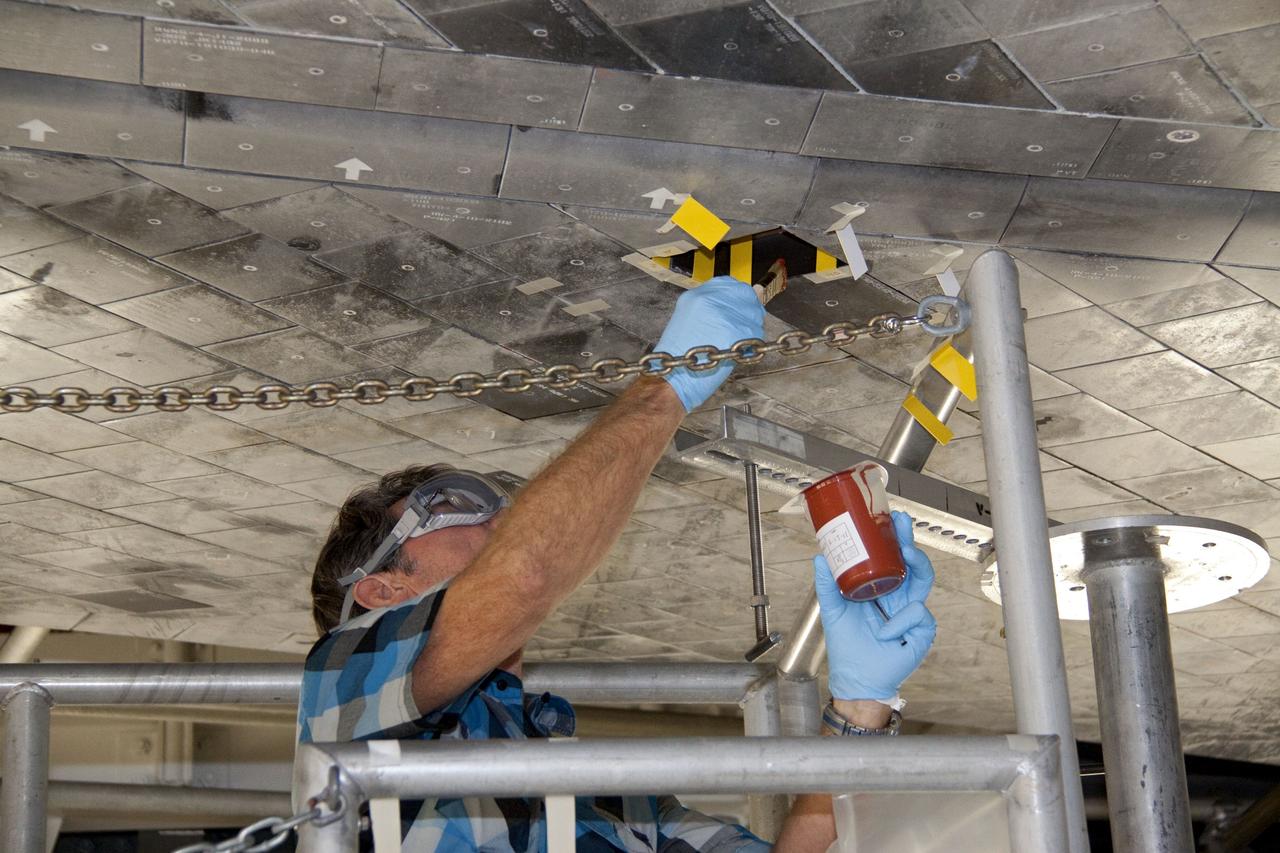
CAPE CANAVERAL, Fla. -- In Orbiter Processing Facility-1 at NASA's Kennedy Space Center in Florida, a thermal protection system technician applies a bonding agent to an area on space shuttle Atlantis' underside where a heat shield tile will be installed. The tiles are part of the Orbiter Thermal Protection System that protects the shuttle against temperatures as high as 3,000 degrees Fahrenheit, which are produced during descent for landing. Atlantis is being prepared for the STS-135 mission, which will carry the Raffaello multi-purpose logistics module packed with supplies, logistics and spare parts to the International Space Station. STS-135 is targeted to launch June 28, and will be the last flight for the Space Shuttle Program. Photo credit: NASA/Jack Pfaller
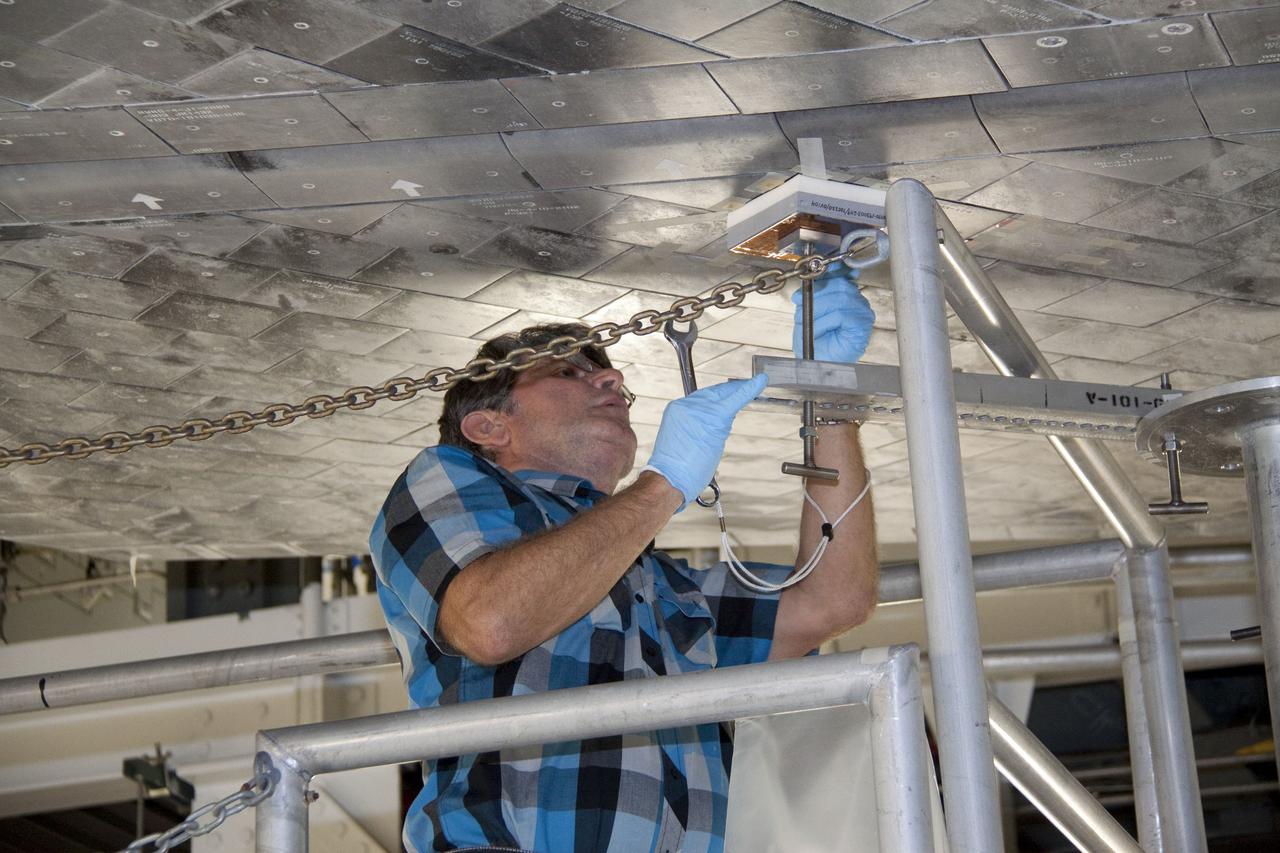
CAPE CANAVERAL, Fla. -- In Orbiter Processing Facility-1 at NASA's Kennedy Space Center in Florida, a thermal protection system technician secures a newly installed heat shield tile in place under space shuttle Atlantis with a pressure fitting to ensure a tight bond. The tiles are part of the Orbiter Thermal Protection System that protects the shuttle against temperatures as high as 3,000 degrees Fahrenheit, which are produced during descent for landing. Atlantis is being prepared for the STS-135 mission, which will carry the Raffaello multi-purpose logistics module packed with supplies, logistics and spare parts to the International Space Station. STS-135 is targeted to launch June 28, and will be the last flight for the Space Shuttle Program. Photo credit: NASA/Jack Pfaller
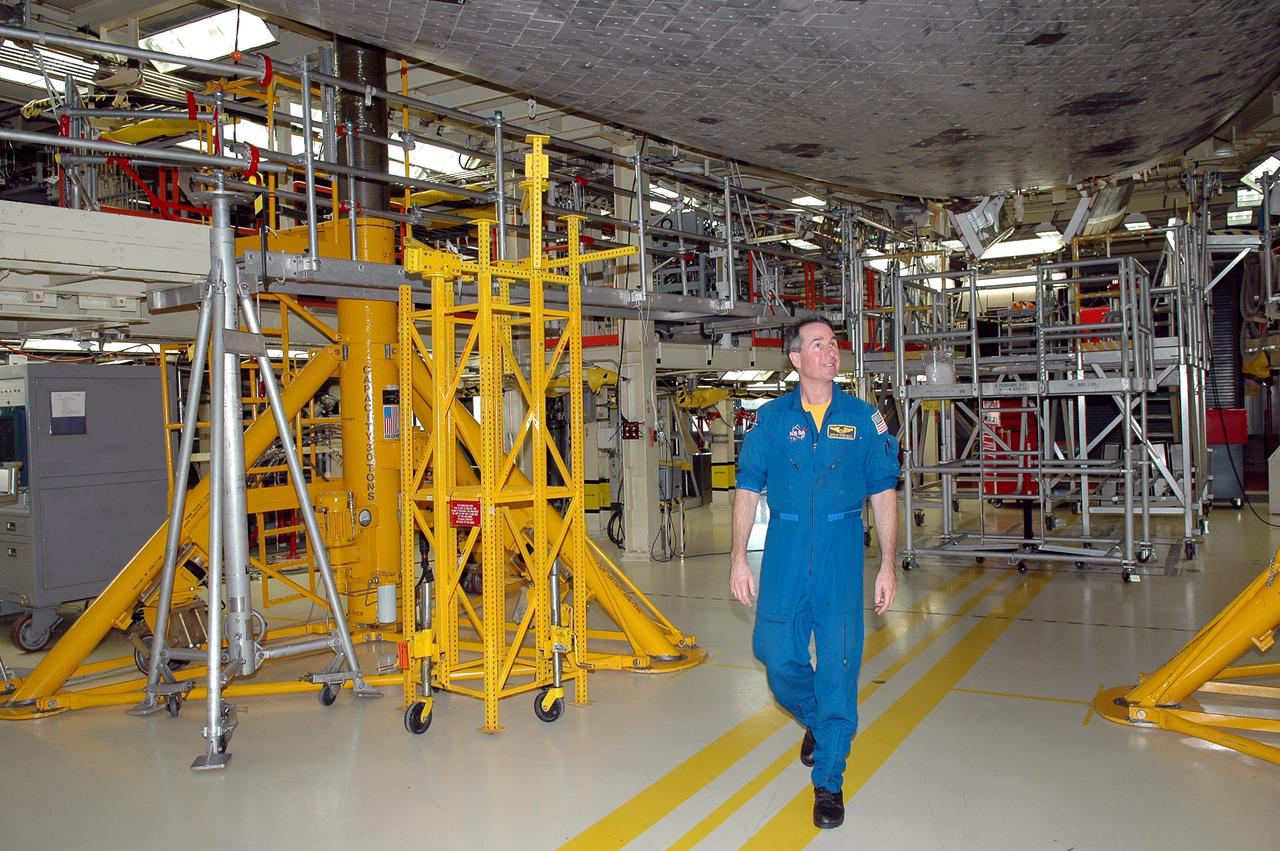
KENNEDY SPACE CENTER, FLA. - On a visit to Kennedy, STS-114 Mission Specialist Stephen Robinson looks at the tiles, part of the Thermal Protection System, on the belly of the orbiter Discovery. The designated vehicle for the mission, Discovery is in the Orbiter Processing Facility for launch processing. Discovery is scheduled for a launch planning window of May 12 to June 3, 2005.
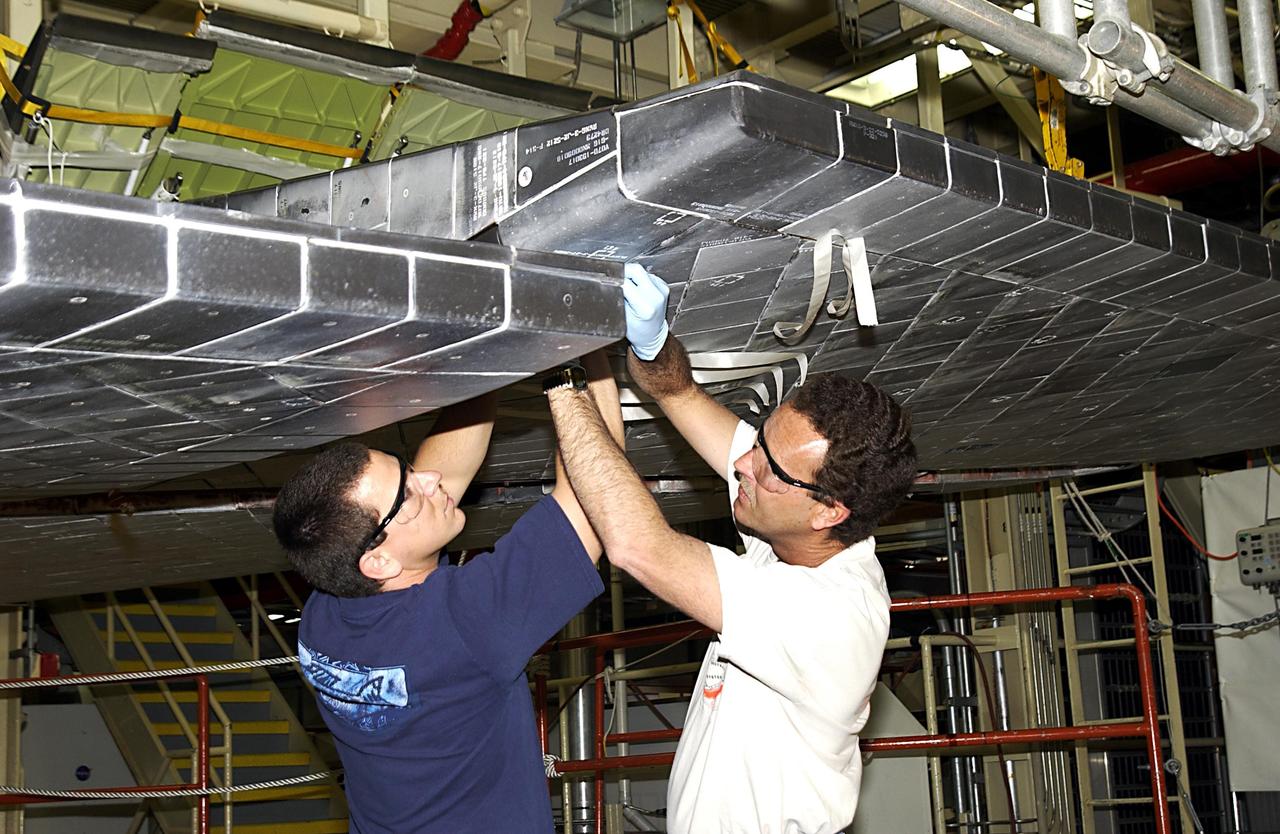
KENNEDY SPACE CENTER, FLA. -- United Space Alliance (USA) technicians install thermal protection system tiles on Space Shuttle Discovery. Discovery is undergoing its Orbiter Major Modification Period, a regularly scheduled structural inspection and modification downtime, which began in September 2002. .
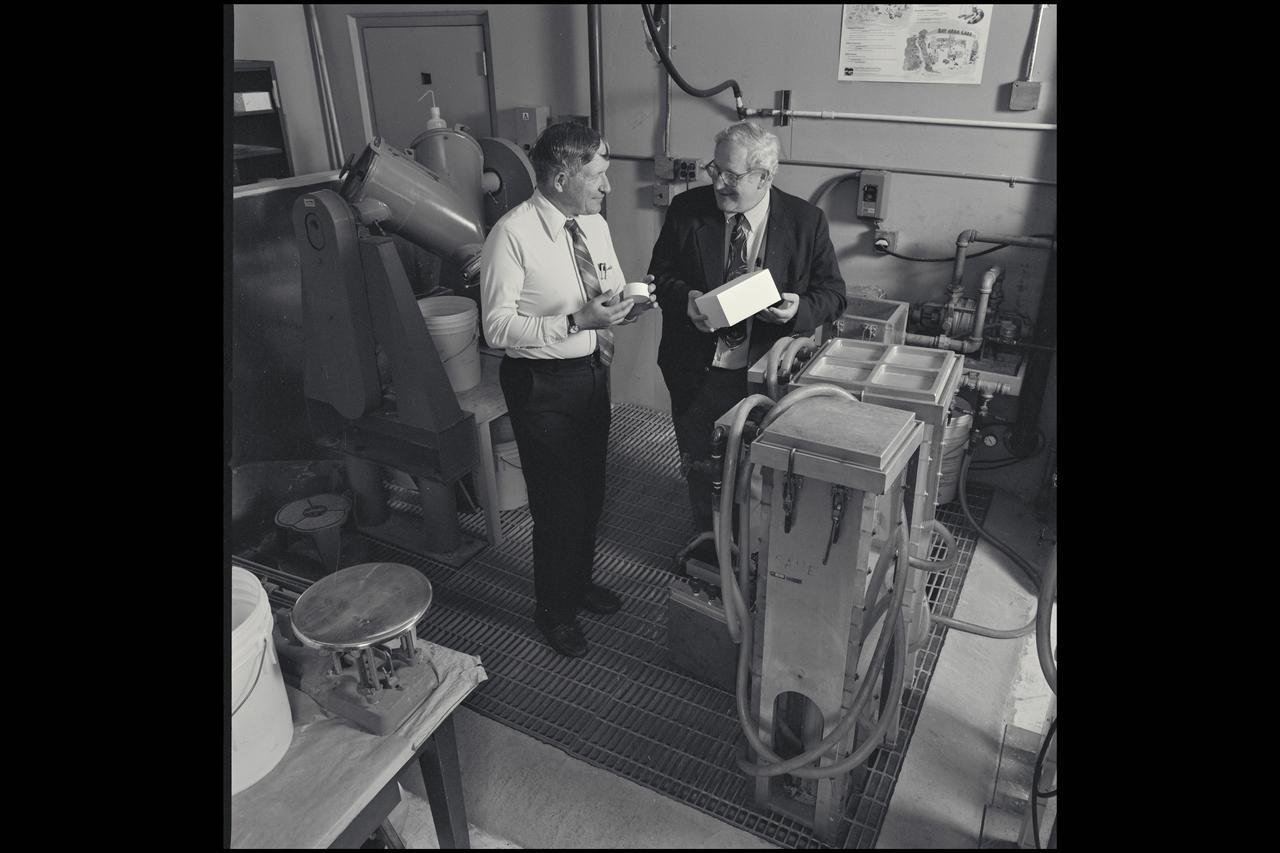
Harold Goldstein (R) and Dan Leiser (L) discuss bone implant development in the the Shuttle Tile Laboratory N-242. A spin-off of Ames research on both bone density in microgravity and on thermal protection foams is the bone-growth implant shown in 1993.
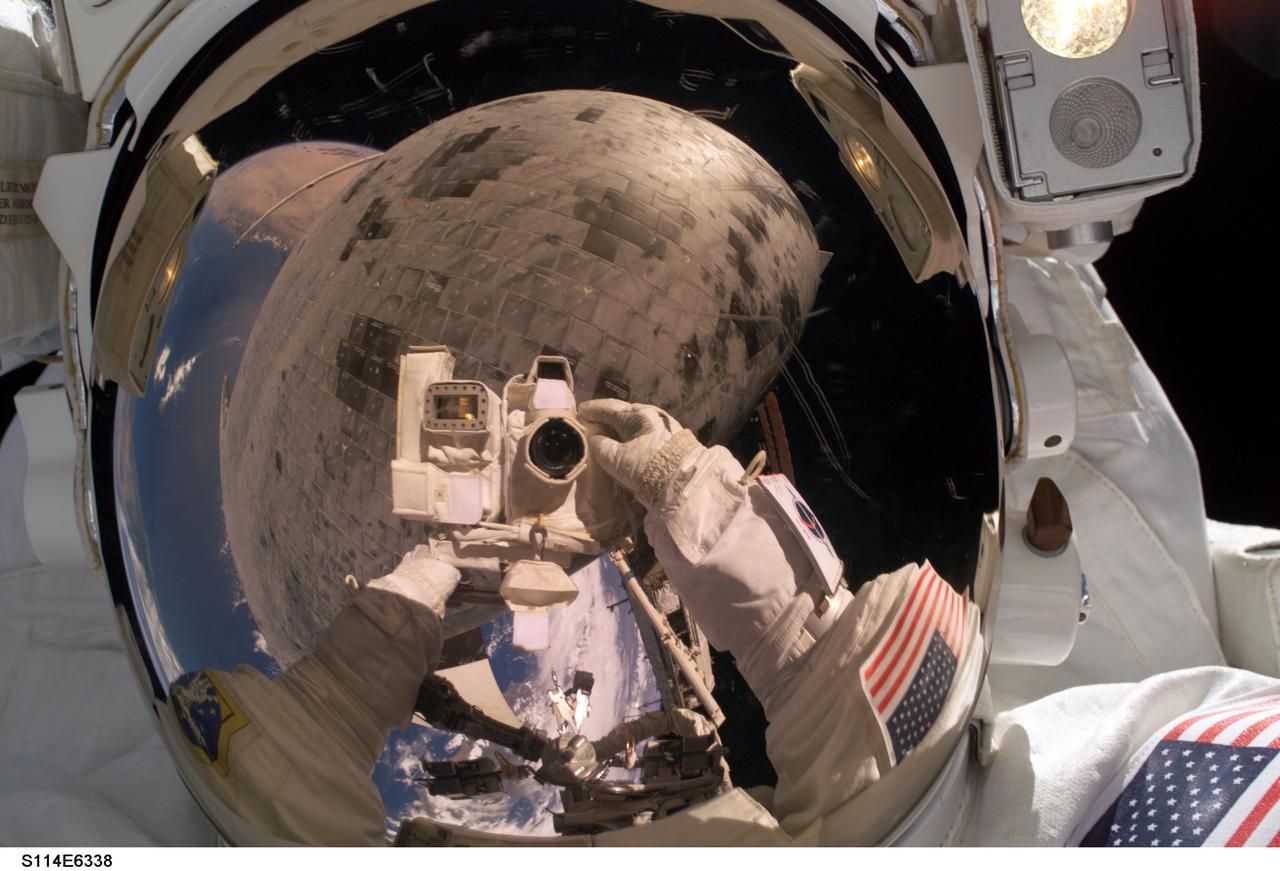
S114-E-6338 (3 August 2005) --- Astronaut Stephen K. Robinson, STS-114 mission specialist, used the pictured digital camera to expose a photo of his helmet visor during today;s extravehicular activities (EVA). Also visible in the reflection are thermal protection tiles on Space Shuttle Discovery;s underside.
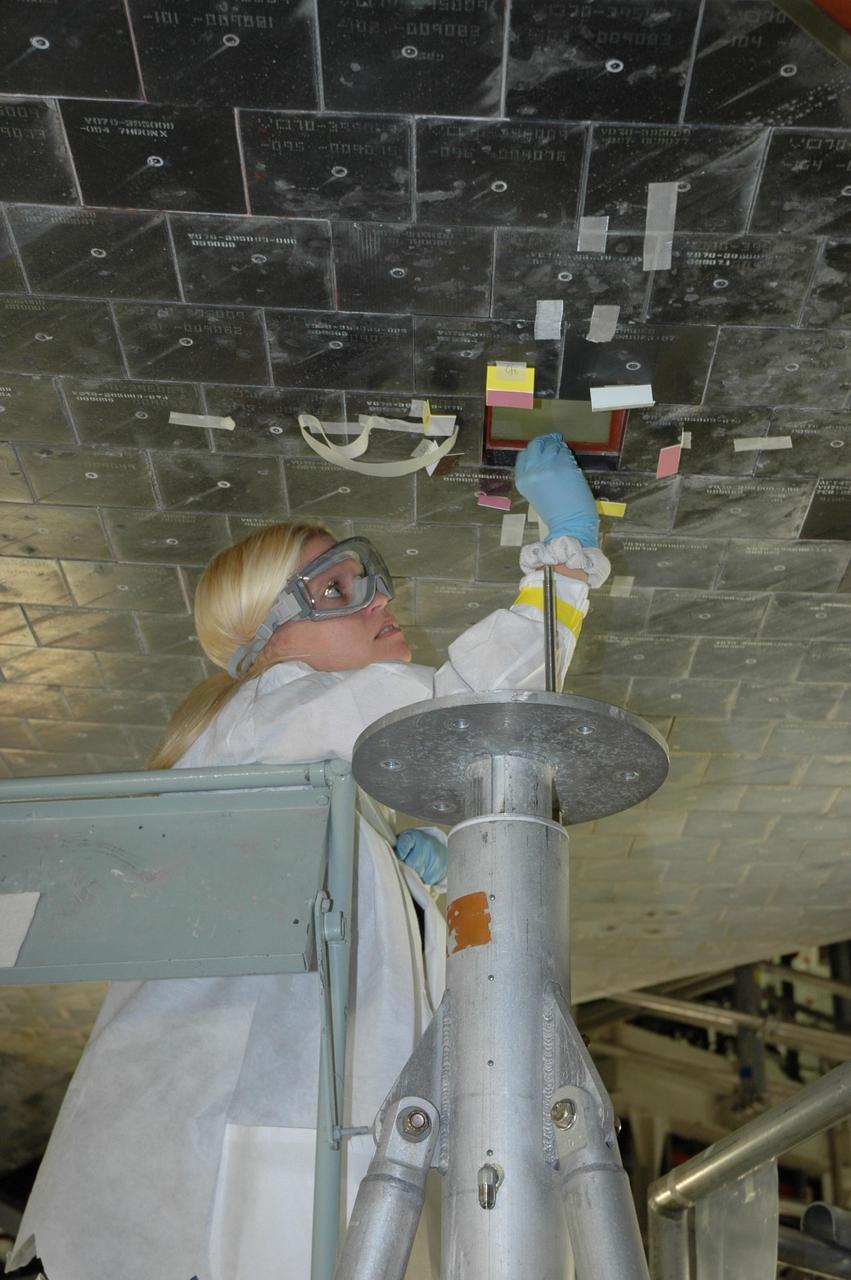
KENNEDY SPACE CENTER, FLA. -- In the Orbiter Processing Facility, a United Space Alliance technician prepares the surface of Atlantis for installation of a thermal protection system tile. Space shuttle Atlantis is targeted for launch on mission STS-122 on Dec. 6. Photo credit: NASA/Jack Pfaller
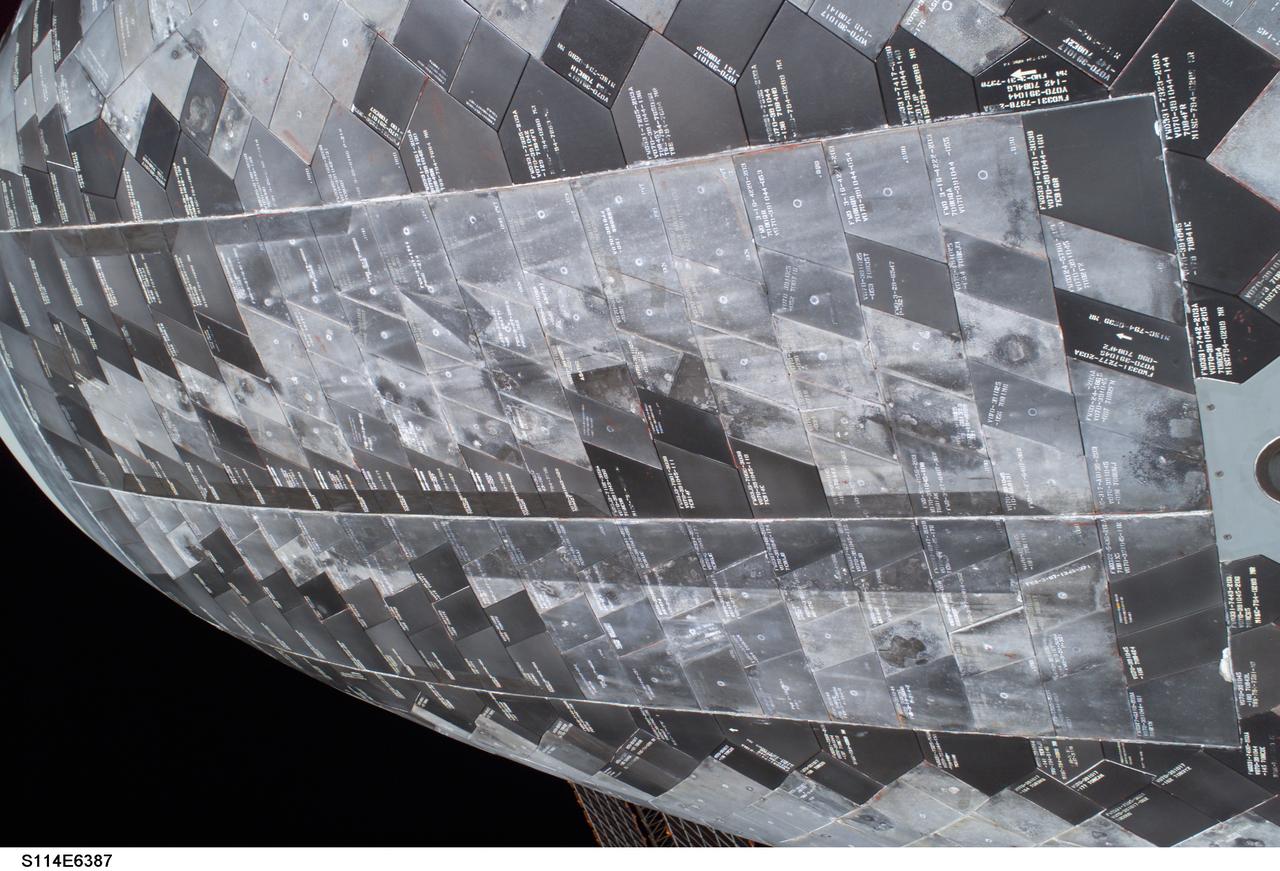
S114-E-6387 (3 August 2005) --- A close-up view of a portion of the thermal protection tiles on Space Shuttle Discovery’s underside is featured in this image photographed by astronaut Stephen K. Robinson, STS-114 mission specialist, during the mission’s third session of extravehicular activities (EVA).

S114-E-6412 (3 August 2005) --- Space Shuttle Discovery’s underside thermal protection tiles are featured in this image photographed by astronaut Stephen K. Robinson, STS-114 mission specialist, during the mission’s third session of extravehicular activities (EVA).
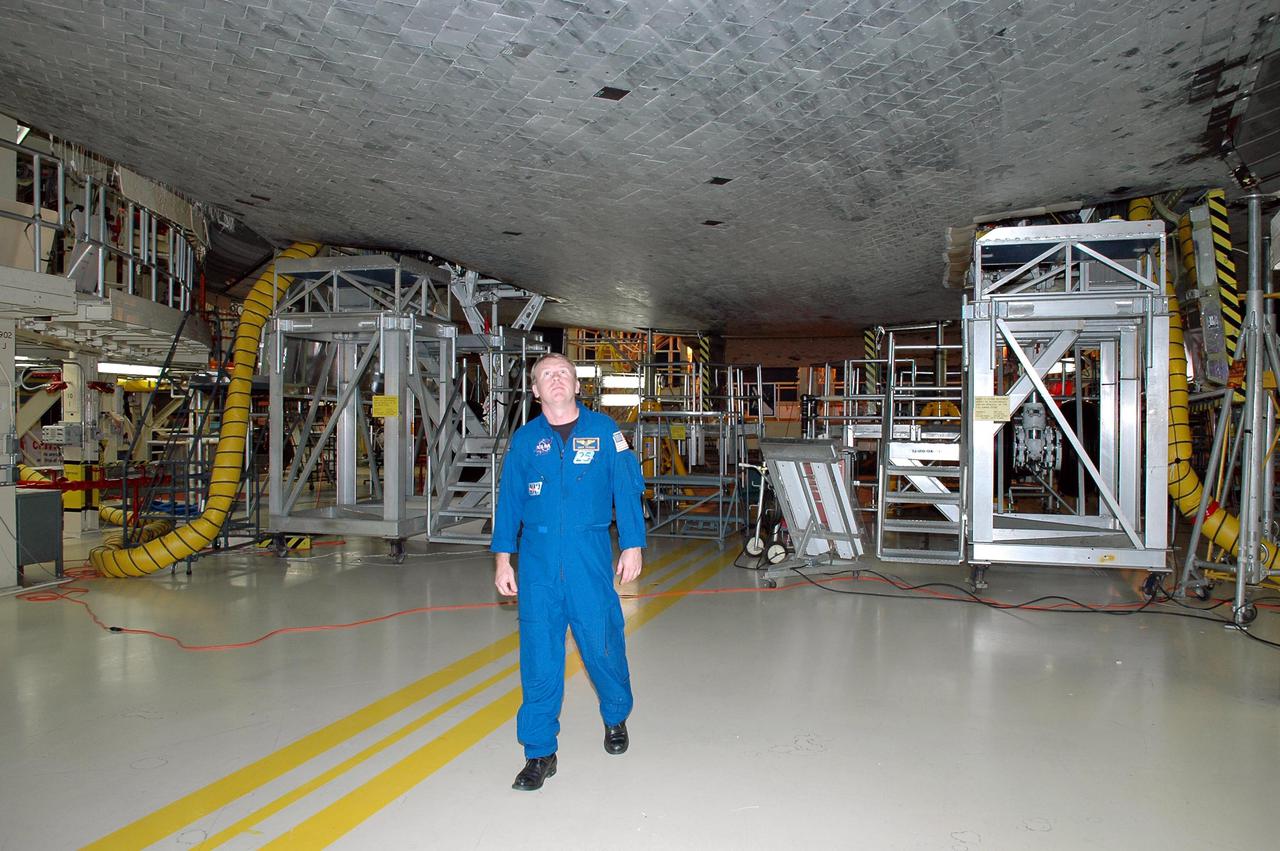
KENNEDY SPACE CENTER, FLA. - On a visit to Kennedy, STS-114 Mission Specialist Andrew Thomas looks at the tiles, part of the Thermal Protection System, on the belly of the orbiter Discovery. The designated vehicle for the mission, Discovery is in the Orbiter Processing Facility for launch processing. Discovery is scheduled for a launch planning window of May 12 to June 3, 2005.
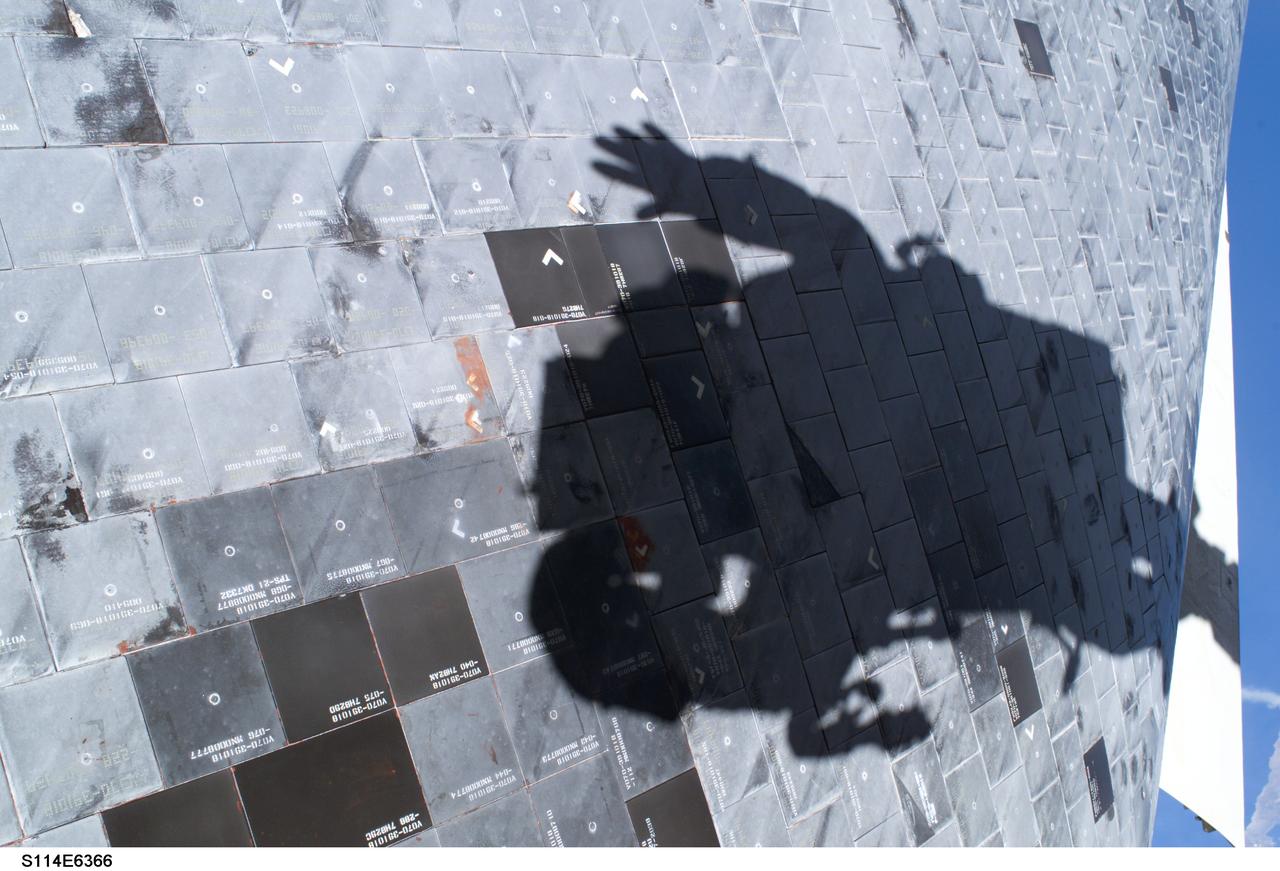
S114-E-6366 (3 August 2005) --- Space Shuttle Discovery’s underside is featured in this image photographed by astronaut Stephen K. Robinson, STS-114 mission specialist, during today’s extravehicular activities (EVA). Robinson’s shadow is visible on the thermal protection tiles.
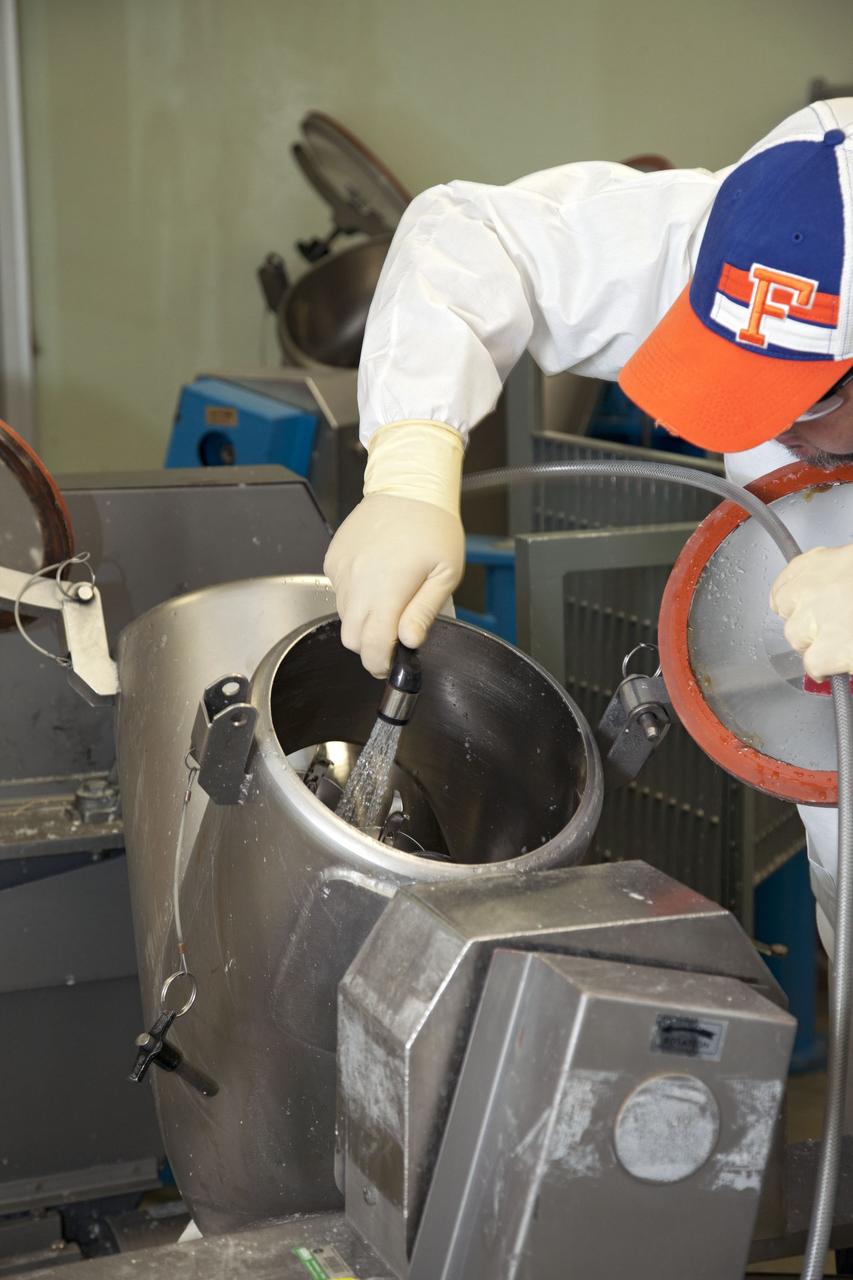
CAPE CANAVERAL, Fla. -- Chris Keeling, a United Space Alliance technician at NASA's Kennedy Space Center in Florida, manufactures the heat shield tiles that will be installed to the backshell of the Orion Multi-Purpose Crew Vehicle's Exploration Flight Test EFT-1 capsule. The work to manufacture and inspect the tiles is taking place in Kennedy's Thermal Protection System Facility. EFT-1 will be used during Orion's first test flight in space. For more information, visit www.nasa.gov/orion. Photo credit: Frankie Martin
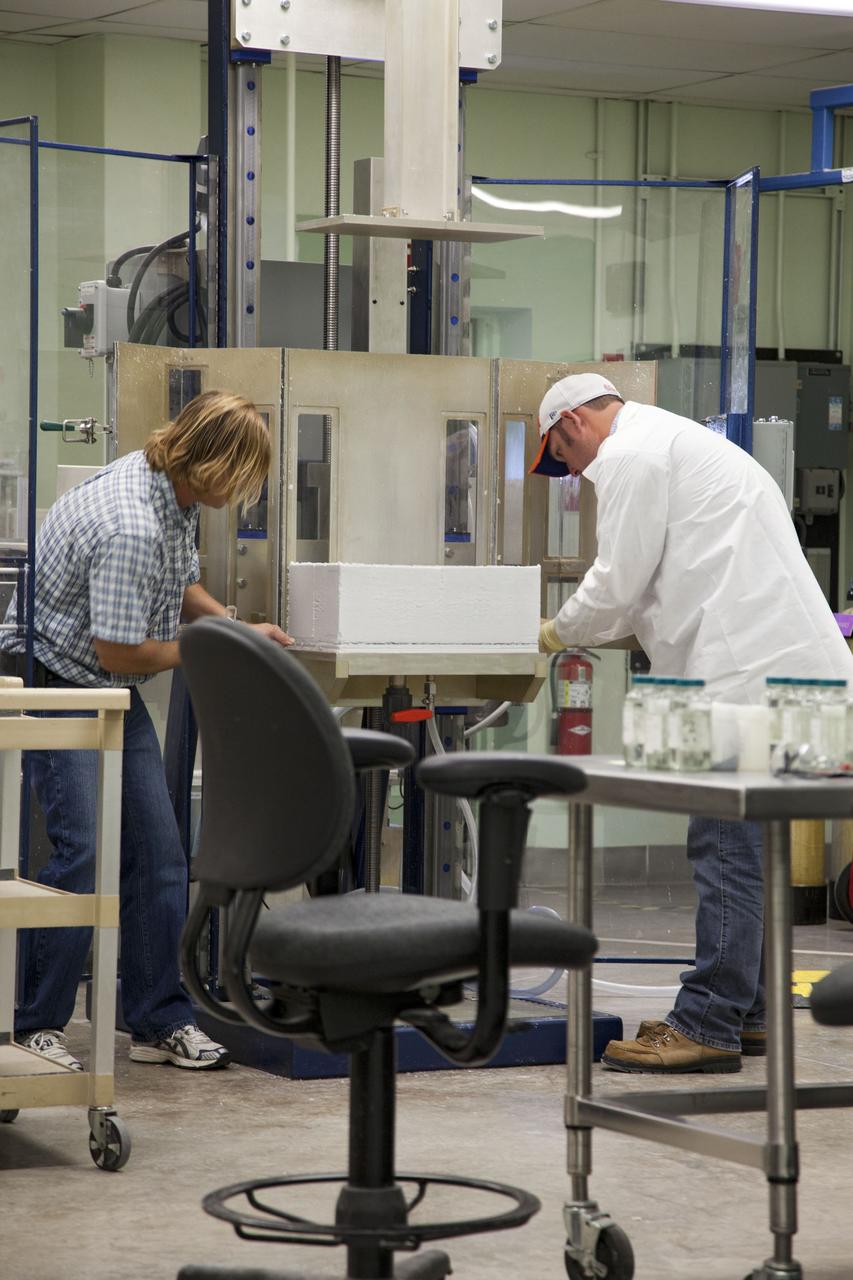
CAPE CANAVERAL, Fla. -- United Space Alliance workers, Tim Wright, left, and Chris Keeling, manufacture the heat shield tiles that will be installed to the backshell of the Orion Multi-Purpose Crew Vehicle's Exploration Flight Test EFT-1 capsule. The work to manufacture and inspect the tiles is taking place in the Thermal Protection System Facility at NASA's Kennedy Space Center in Florida. EFT-1 will be used during Orion's first test flight in space. For more information, visit www.nasa.gov/orion. Photo credit: Frankie Martin
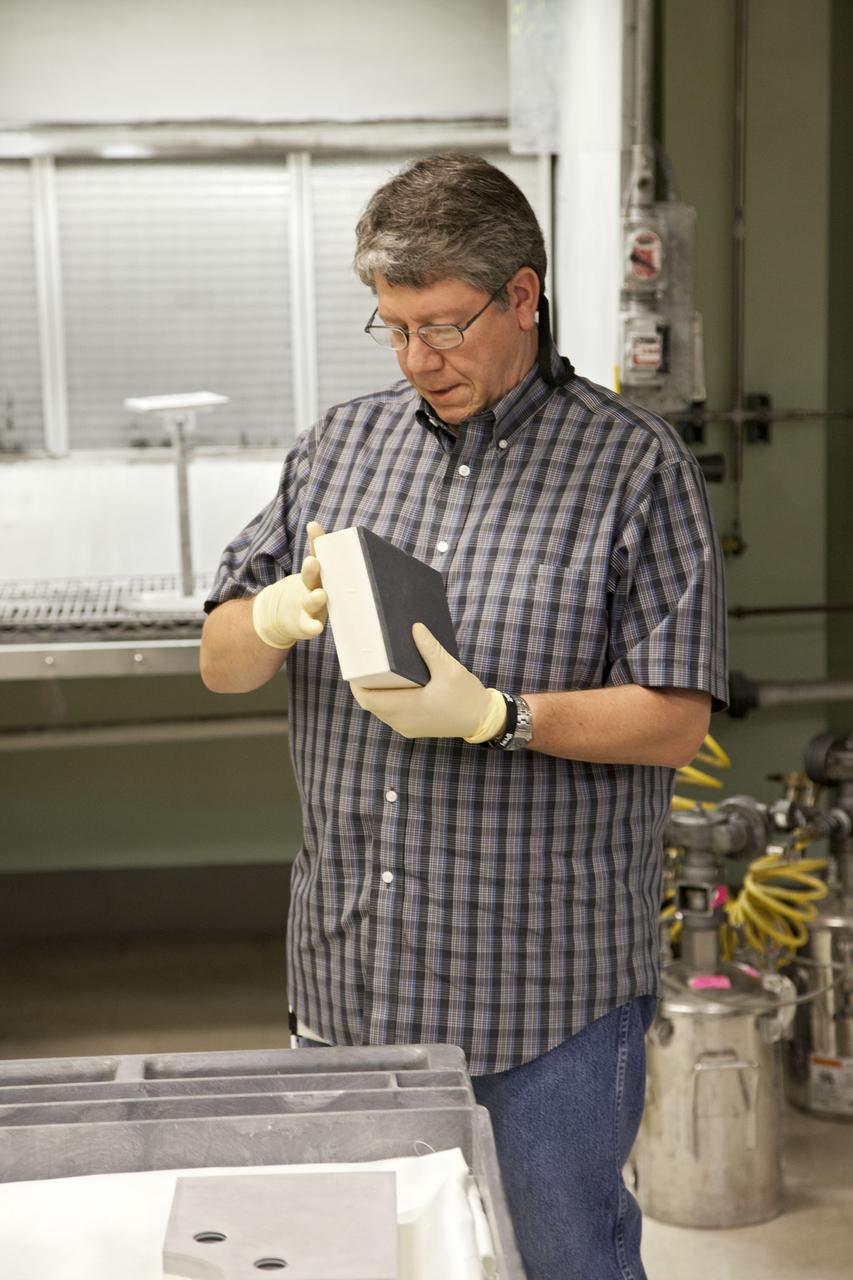
CAPE CANAVERAL, Fla. -- Frank Pelkey, a United Space Alliance technician at NASA's Kennedy Space Center in Florida, inspects a heat shield tile that will be installed to the backshell of the Orion Multi-Purpose Crew Vehicle's Exploration Flight Test EFT-1 capsule. The work to manufacture and inspect the tiles is taking place in Kennedy's Thermal Protection System Facility. EFT-1 will be used during Orion's first test flight in space. For more information, visit www.nasa.gov/orion. Photo credit: Frankie Martin
CAPE CANAVERAL, Fla. -- Frank Pelkey, a United Space Alliance technician at NASA's Kennedy Space Center in Florida, inspects a heat shield tile that will be installed to the backshell of the Orion Multi-Purpose Crew Vehicle's Exploration Flight Test EFT-1 capsule. The work to manufacture and inspect the tiles is taking place in Kennedy's Thermal Protection System Facility. EFT-1 will be used during Orion's first test flight in space. For more information, visit www.nasa.gov/orion. Photo credit: Frankie Martin
CAPE CANAVERAL, Fla. -- Frank Pelkey, a United Space Alliance technician at NASA's Kennedy Space Center in Florida, inspects a heat shield tile that will be installed to the backshell of the Orion Multi-Purpose Crew Vehicle's Exploration Flight Test EFT-1 capsule. The work to manufacture and inspect the tiles is taking place in Kennedy's Thermal Protection System Facility. EFT-1 will be used during Orion's first test flight in space. For more information, visit www.nasa.gov/orion. Photo credit: Frankie Martin
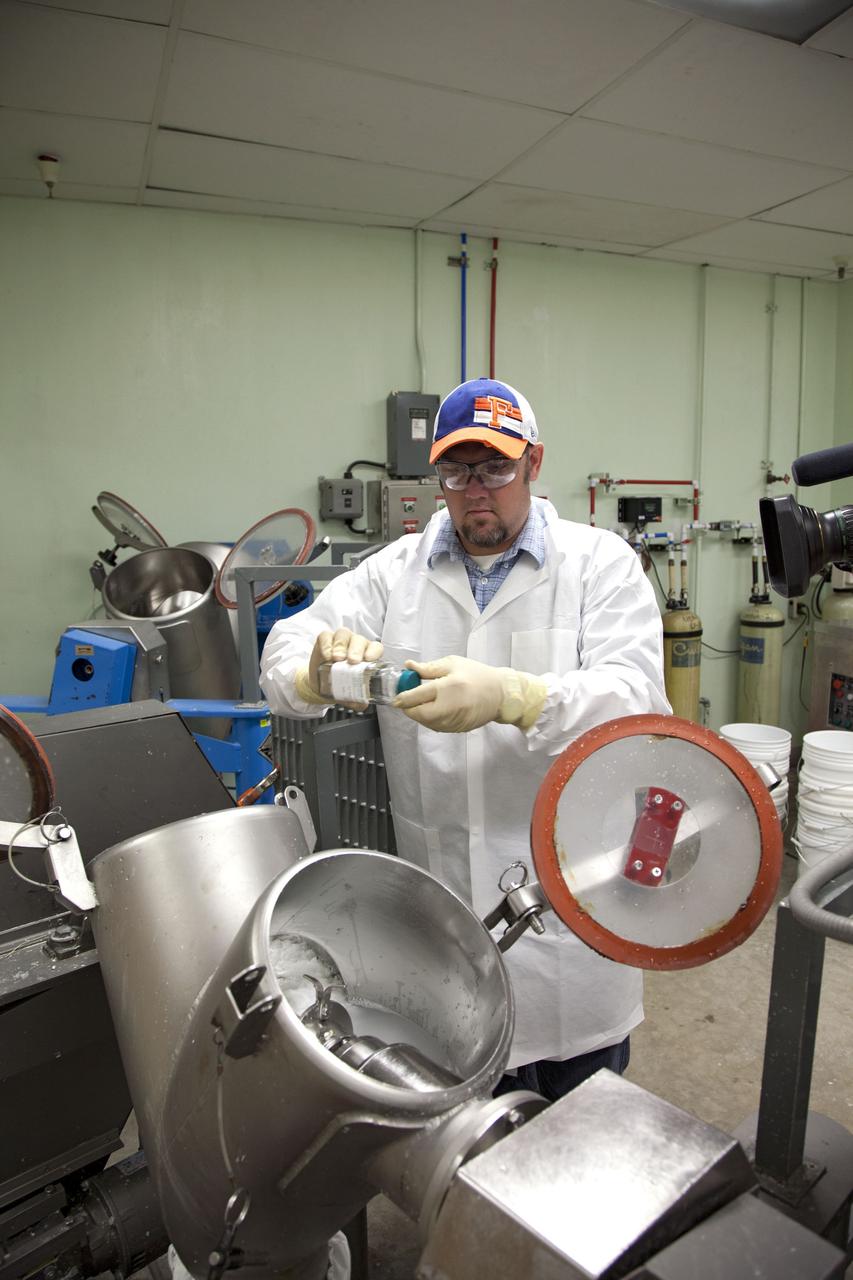
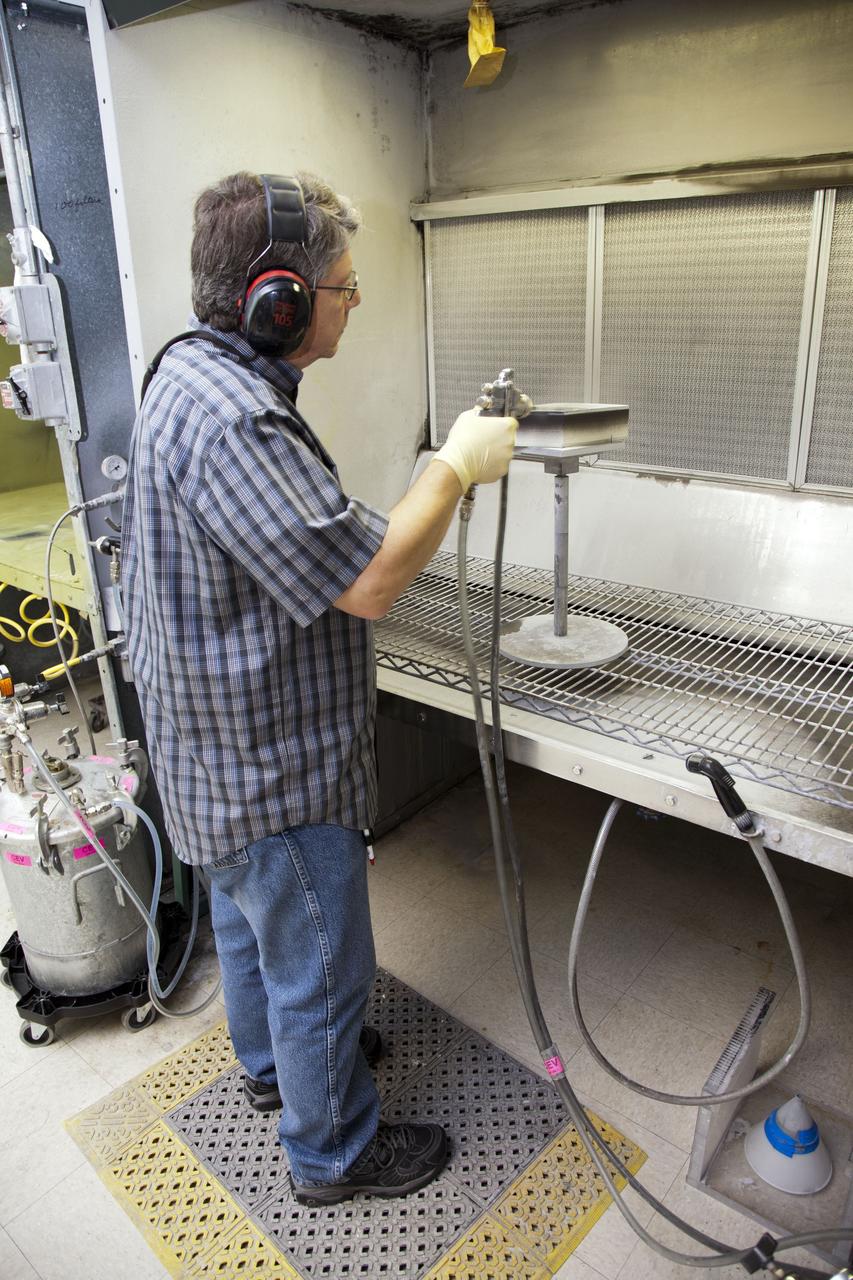
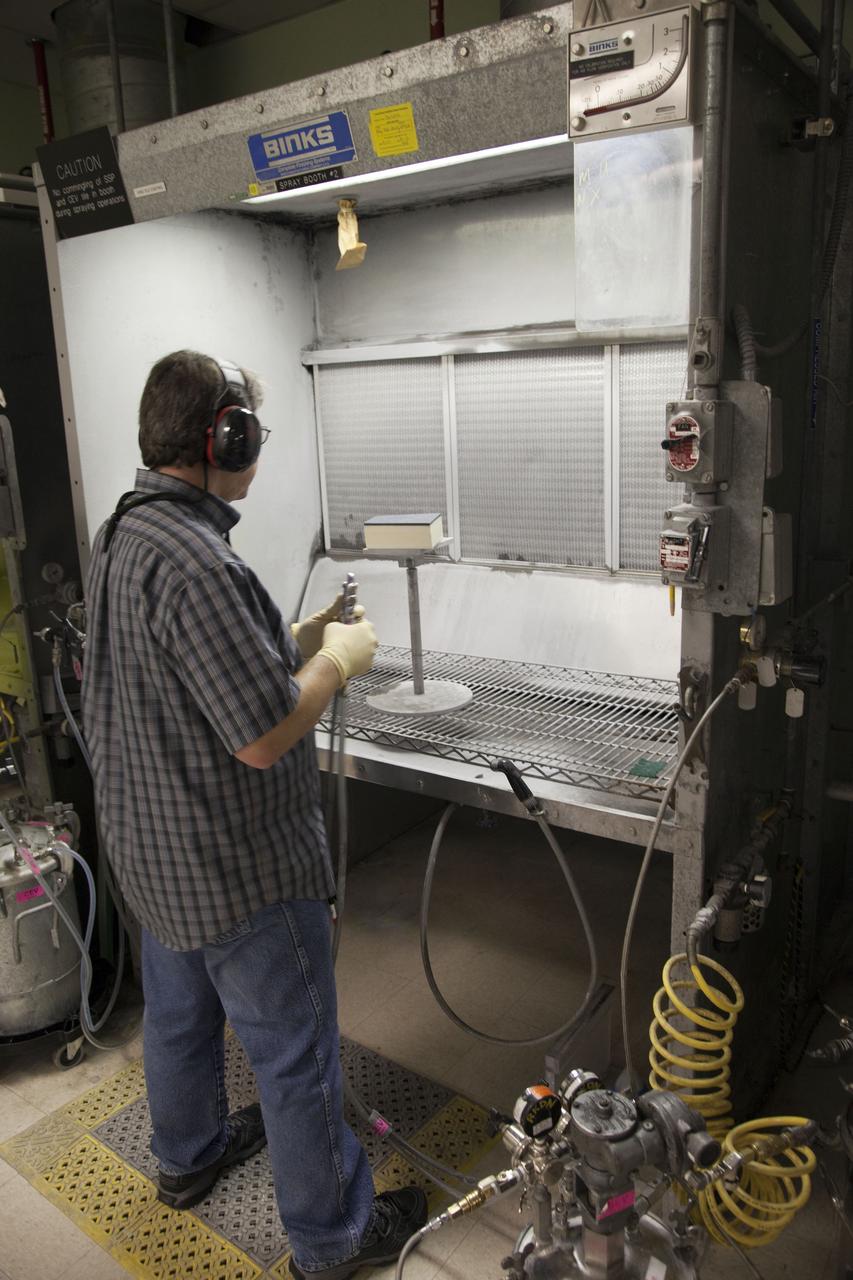
CAPE CANAVERAL, Fla. -- Chris Keeling, a United Space Alliance technician at NASA's Kennedy Space Center in Florida, manufactures the heat shield tiles that will be installed to the backshell of the Orion Multi-Purpose Crew Vehicle's Exploration Flight Test EFT-1 capsule. The work to manufacture and inspect the tiles is taking place in Kennedy's Thermal Protection System Facility. EFT-1 will be used during Orion's first test flight in space. For more information, visit www.nasa.gov/orion. Photo credit: Frankie Martin
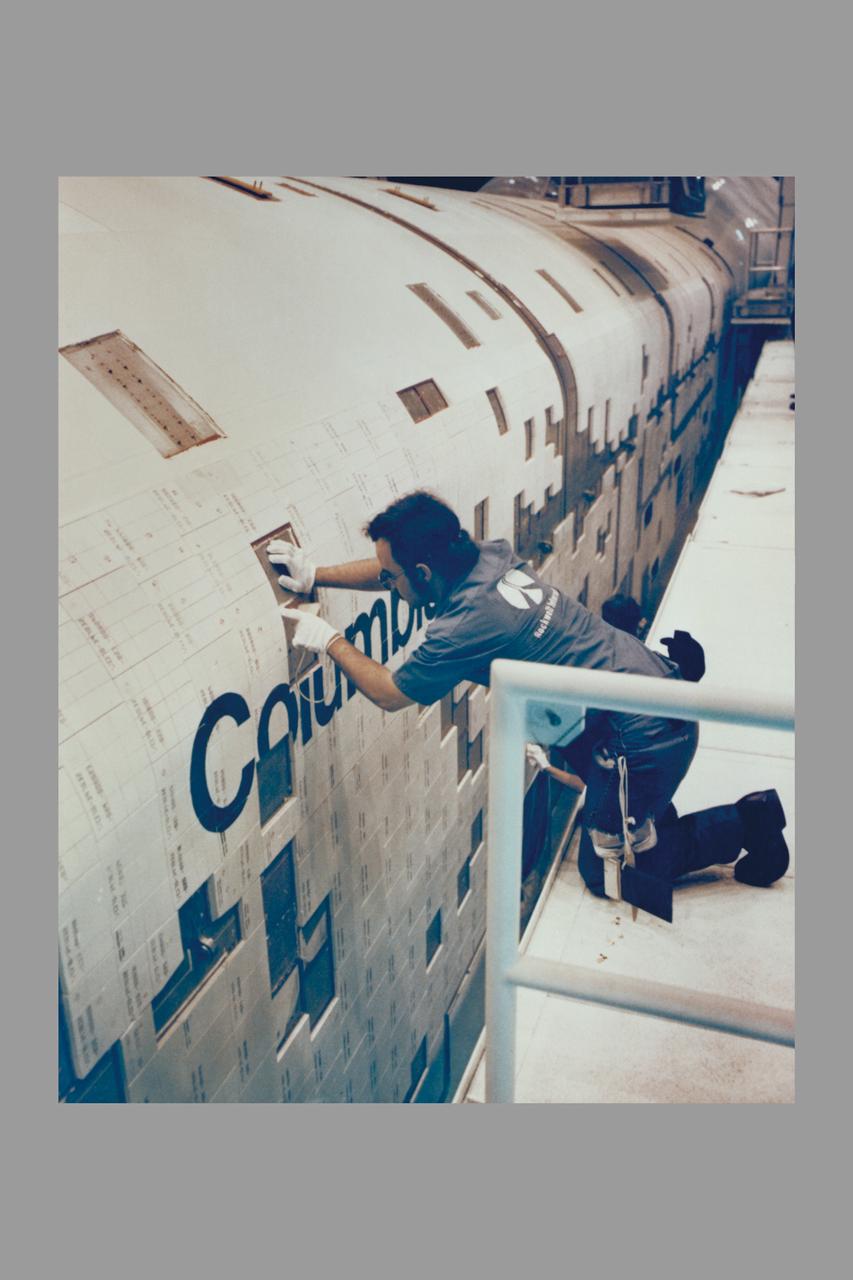
ROCKWELL INTERNATIONAL TECHNICIANS MOUNT SOME OF THE NEARLY 8,000 CERAMIC-COATED TILES THAT REMAIN TO BE INSTALLED ON THE EXTERNAL SURFACES OF THE SPACE SHUTTLE ORBITER COLUMBIA TO COMPLETE THE THERMAL PROTECTION SYSTEM THAT WILL ABSORB THE INTENSE HEAT OF REENTERING THE EARTH'S ATMOSPHERE AFTER A MISSION IN SPACE. TILE INSTALLATION IS DONE ON AN AROUND-THE-CLOCK BASIS IN THE ORBITER PROCESSING FACILITY WHERE COLUMBIA, THE FIRST IN A NEW BREED OF MANNED, REUSABLE SPACECRAFT, IS BEING READIED FOR THE FIRST LAUNCH OF THE SPACE SHUTTLE LATER THIS YEAR.
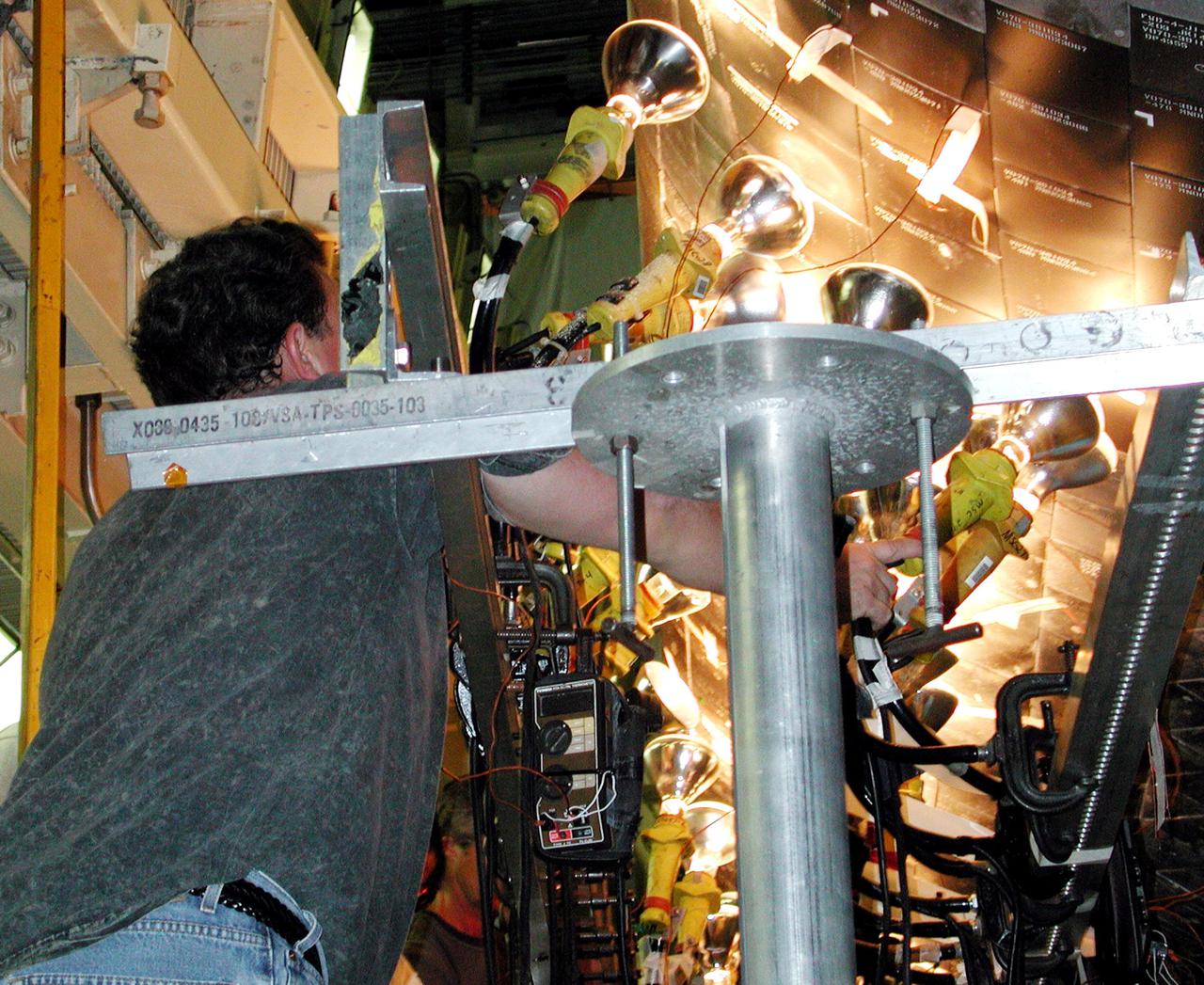
KENNEDY SPACE CENTER, FLA. -- Banks of lights dry tiles on orbiter Atlantis in the Orbiter Processing Facility. Significant rainstorms during the orbiter’s turnaround for a ferry flight home from Edwards Air Force Base, Calif., caused the moisture problem. The tiles are part of the Thermal Protection System used on orbiters for extreme temperatures encountered during landing
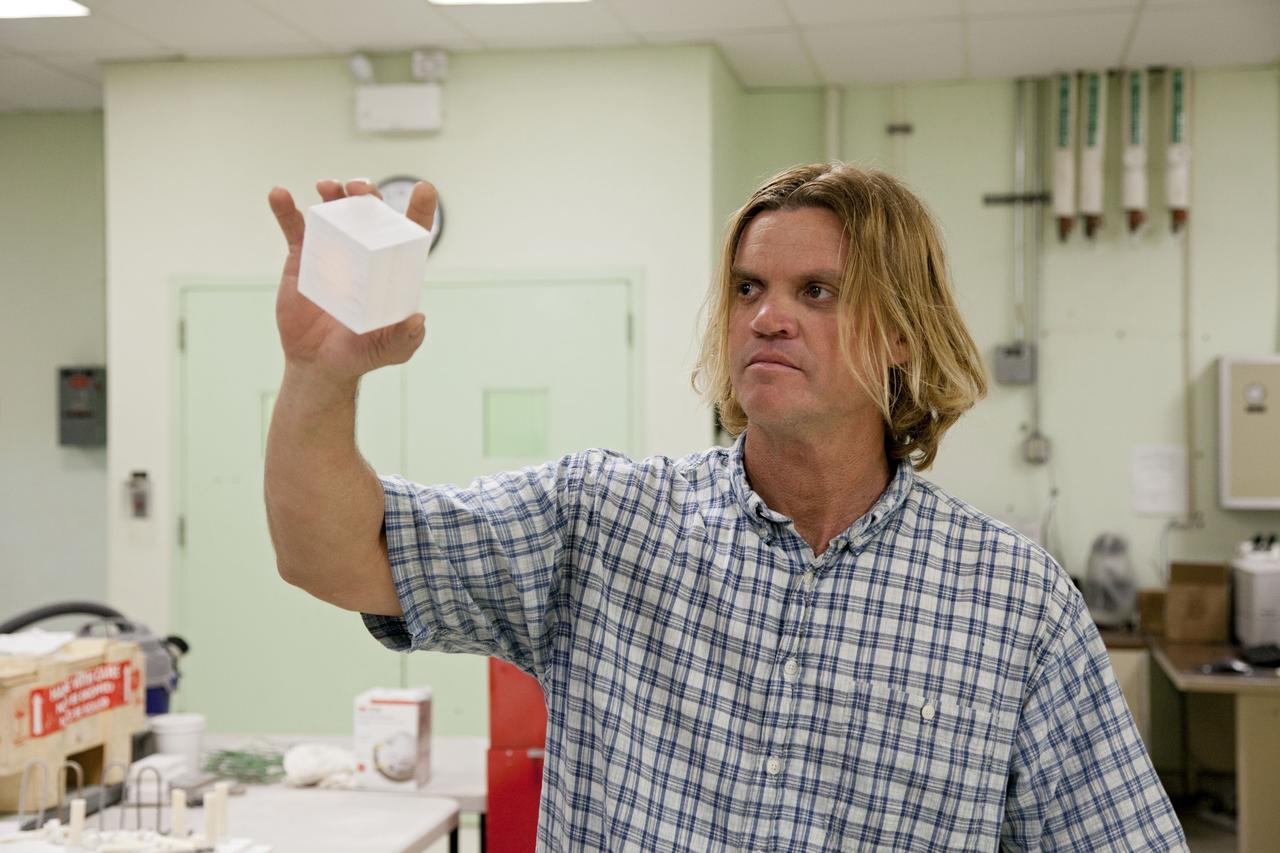
CAPE CANAVERAL, Fla. -- Tim Wright, a United Space Alliance engineering manager at NASA's Kennedy Space Center in Florida, explains the properties of the heat shield tiles that will be installed to the backshell of the Orion Multi-Purpose Crew Vehicle's Exploration Flight Test EFT-1 capsule. The work to manufacture and inspect the tiles is taking place in Kennedy's Thermal Protection System Facility. EFT-1 will be used during Orion's first test flight in space. For more information, visit www.nasa.gov/orion. Photo credit: Frankie Martin
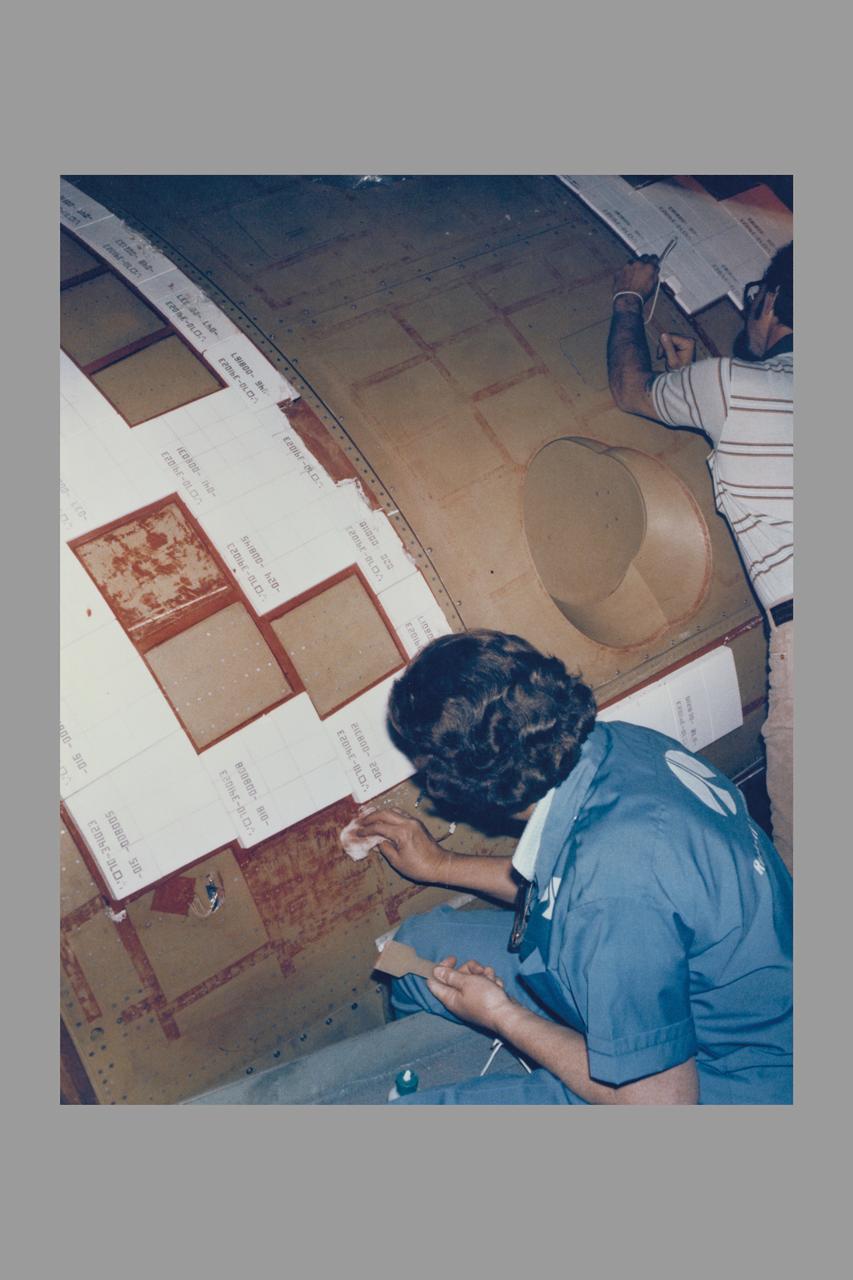
ROCKWELL INTERNATIONAL TECHNICIANS MOUNT SOME OF THE NEARLY 8,000 CERAMIC-COATED TILES THAT REMAIN TO BE INSTALLED ON THE EXTERNAL SURFACES OF THE SPACE SHUTTLE ORBITER COLUMBIA TO COMPLETE THE THERMAL PROTECTION SYSTEM THAT WILL ABSORB THE INTENSE HEAT OF REENTERING THE EARTH'S ATMOSPHERE AFTER A MISSION IN SPACE. TILE INSTALLATION IS DONE ON AN AROUND-THE-CLOCK BASIS IN THE ORBITER PROCESSING FACILITY WHERE COLUMBIA, THE FIRST IN A NEW BREED OF MANNED, REUSABLE SPACECRAFT, IS BEING READIED FOR THE FIRST LAUNCH OF THE SPACE SHUTTLE LATER THIS YEAR.
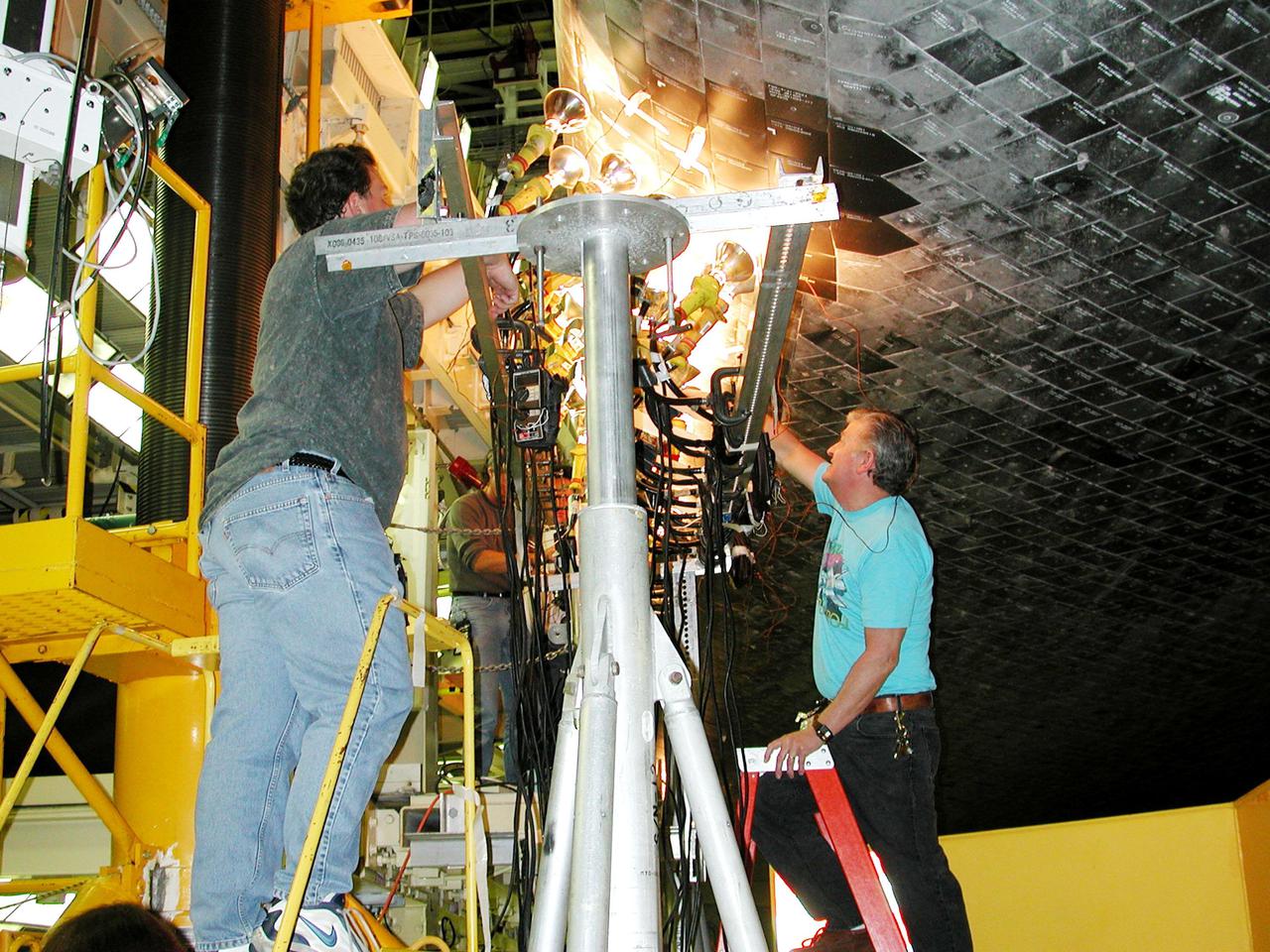
KENNEDY SPACE CENTER, FLA. -- Banks of lights dry tiles on orbiter Atlantis in the Orbiter Processing Facility. Significant rainstorms during the orbiter’s turnaround for a ferry flight home from Edwards Air Force Base, Calif., caused the moisture problem. The tiles are part of the Thermal Protection System used on orbiters for extreme temperatures encountered during landing
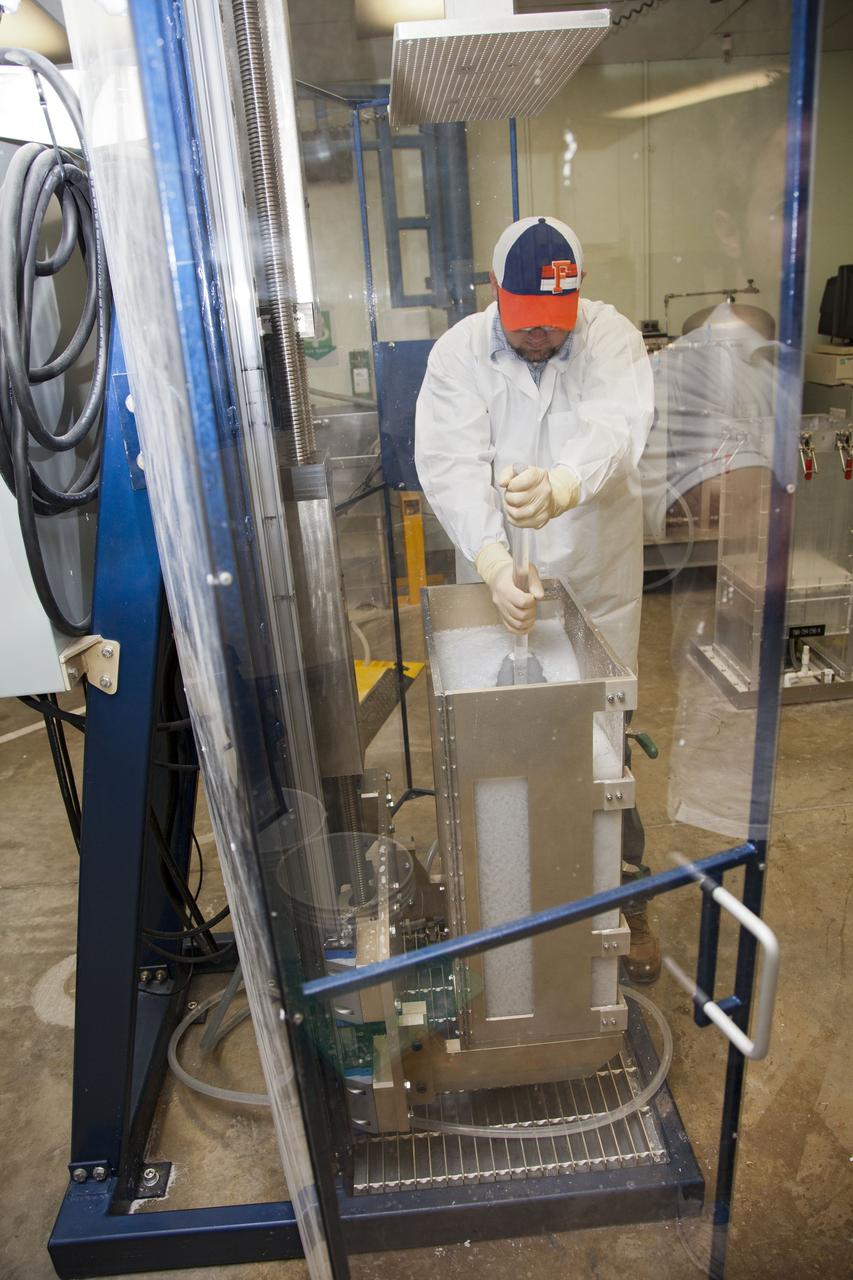
CAPE CANAVERAL, Fla. -- Chris Keeling, a United Space Alliance technician at NASA's Kennedy Space Center in Florida, manufactures the heat shield tiles that will be installed to the backshell of the Orion Multi-Purpose Crew Vehicle's Exploration Flight Test EFT-1 capsule. The work to manufacture and inspect the tiles is taking place in Kennedy's Thermal Protection System Facility. EFT-1 will be used during Orion's first test flight in space. For more information, visit www.nasa.gov/orion. Photo credit: Frankie Martin

CAPE CANAVERAL, Fla. -- Chris Keeling, a United Space Alliance technician at NASA's Kennedy Space Center in Florida, manufactures the heat shield tiles that will be installed to the backshell of the Orion Multi-Purpose Crew Vehicle's Exploration Flight Test EFT-1 capsule. The work to manufacture and inspect the tiles is taking place in Kennedy's Thermal Protection System Facility. EFT-1 will be used during Orion's first test flight in space. For more information, visit www.nasa.gov/orion. Photo credit: Frankie Martin
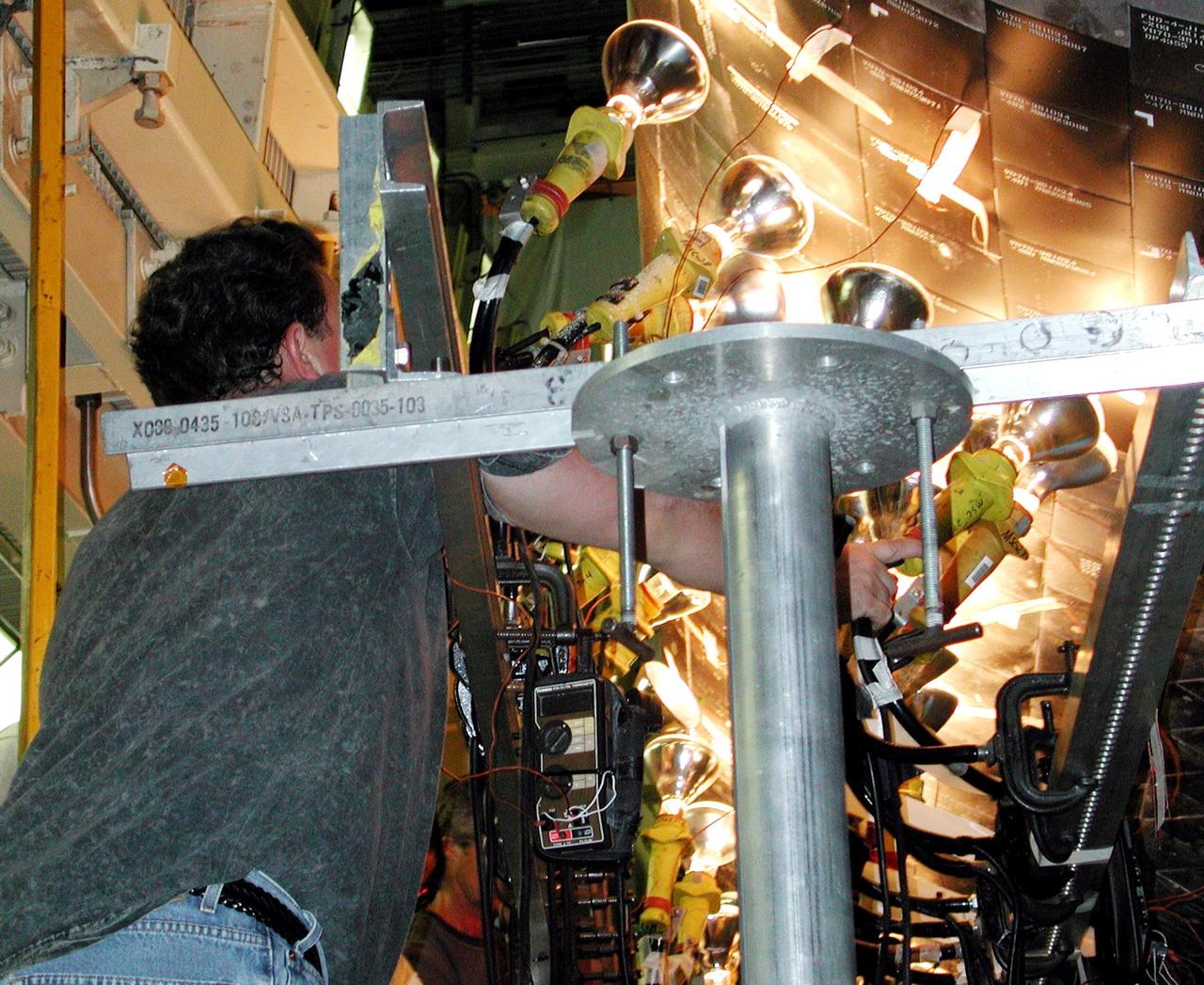
KENNEDY SPACE CENTER, FLA. -- Banks of lights dry tiles on orbiter Atlantis in the Orbiter Processing Facility. Significant rainstorms during the orbiter’s turnaround for a ferry flight home from Edwards Air Force Base, Calif., caused the moisture problem. The tiles are part of the Thermal Protection System used on orbiters for extreme temperatures encountered during landing
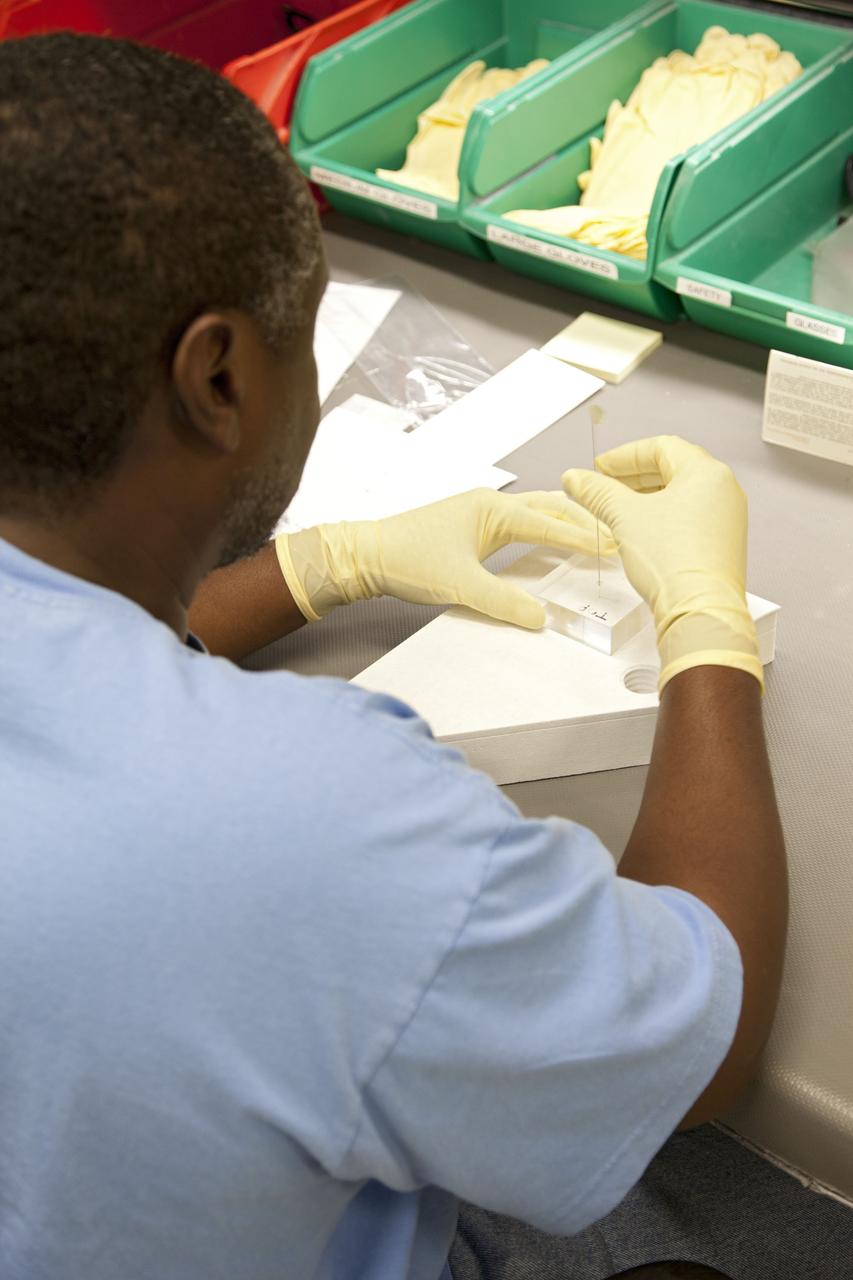
CAPE CANAVERAL, Fla. -- Damon Petty, a United Space Alliance technician at NASA's Kennedy Space Center in Florida, inspects a heat shield tile that will be installed to the backshell of the Orion Multi-Purpose Crew Vehicle's Exploration Flight Test EFT-1 capsule. The work to manufacture and inspect the tiles is taking place in Kennedy's Thermal Protection System Facility. EFT-1 will be used during Orion's first test flight in space. For more information, visit www.nasa.gov/orion. Photo credit: Frankie Martin
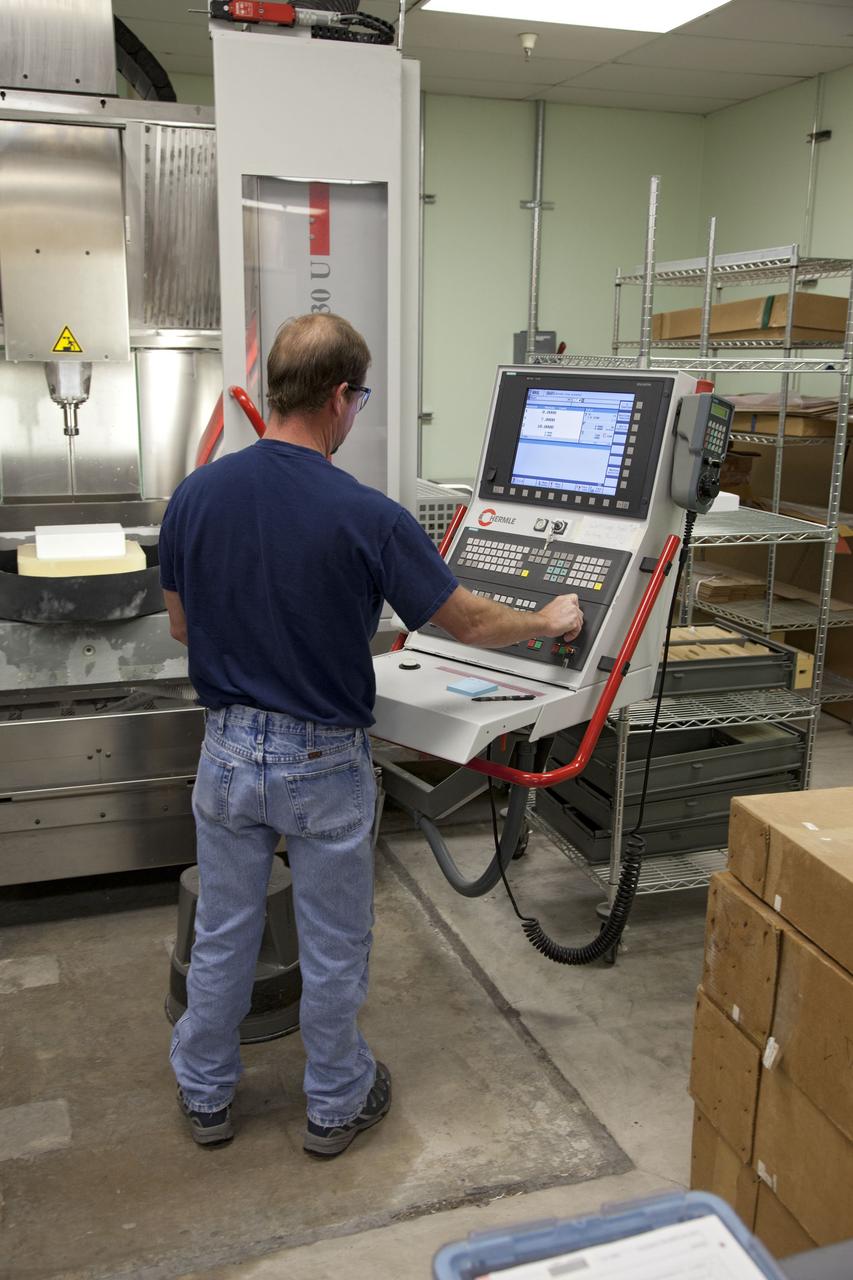
CAPE CANAVERAL, Fla. -- Jimmy Savastio, a United Space Alliance machinist at NASA's Kennedy Space Center in Florida, monitors the properties of a heat shield tile that will be installed to the backshell of the Orion Multi-Purpose Crew Vehicle's Exploration Flight Test EFT-1 capsule. The work to manufacture and inspect the tiles is taking place in Kennedy's Thermal Protection System Facility. EFT-1 will be used during Orion's first test flight in space. For more information, visit www.nasa.gov/orion. Photo credit: Frankie Martin
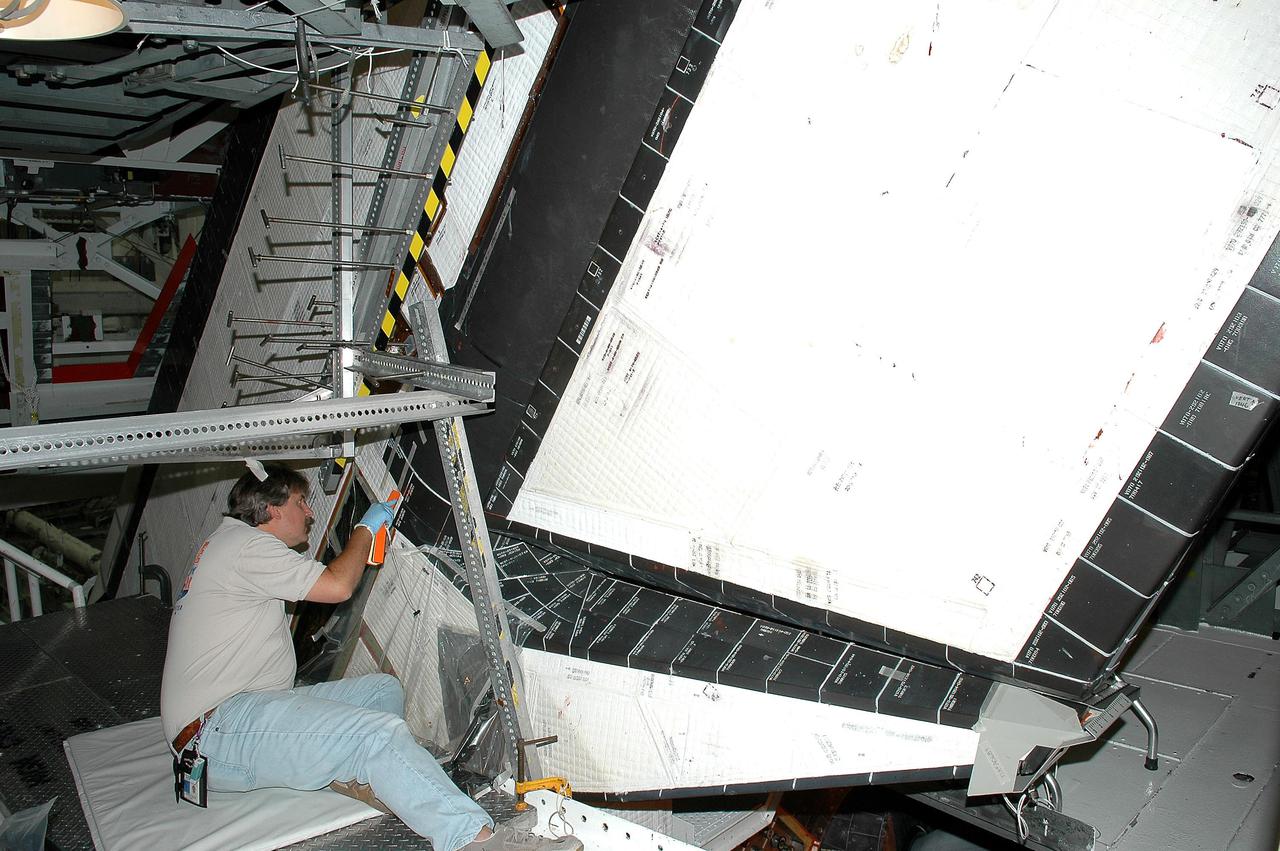
KENNEDY SPACE CENTER, FLA. - In the Orbiter Processing Facility at NASA’s Kennedy Space Center, United Space Alliance tile technician Tim Marks places Thermal Protection System tiles on Atlantis’ rudder speed brake. Atlantis is being processed for launch on the second Return to Flight mission, STS-121, which is scheduled to fly in July.
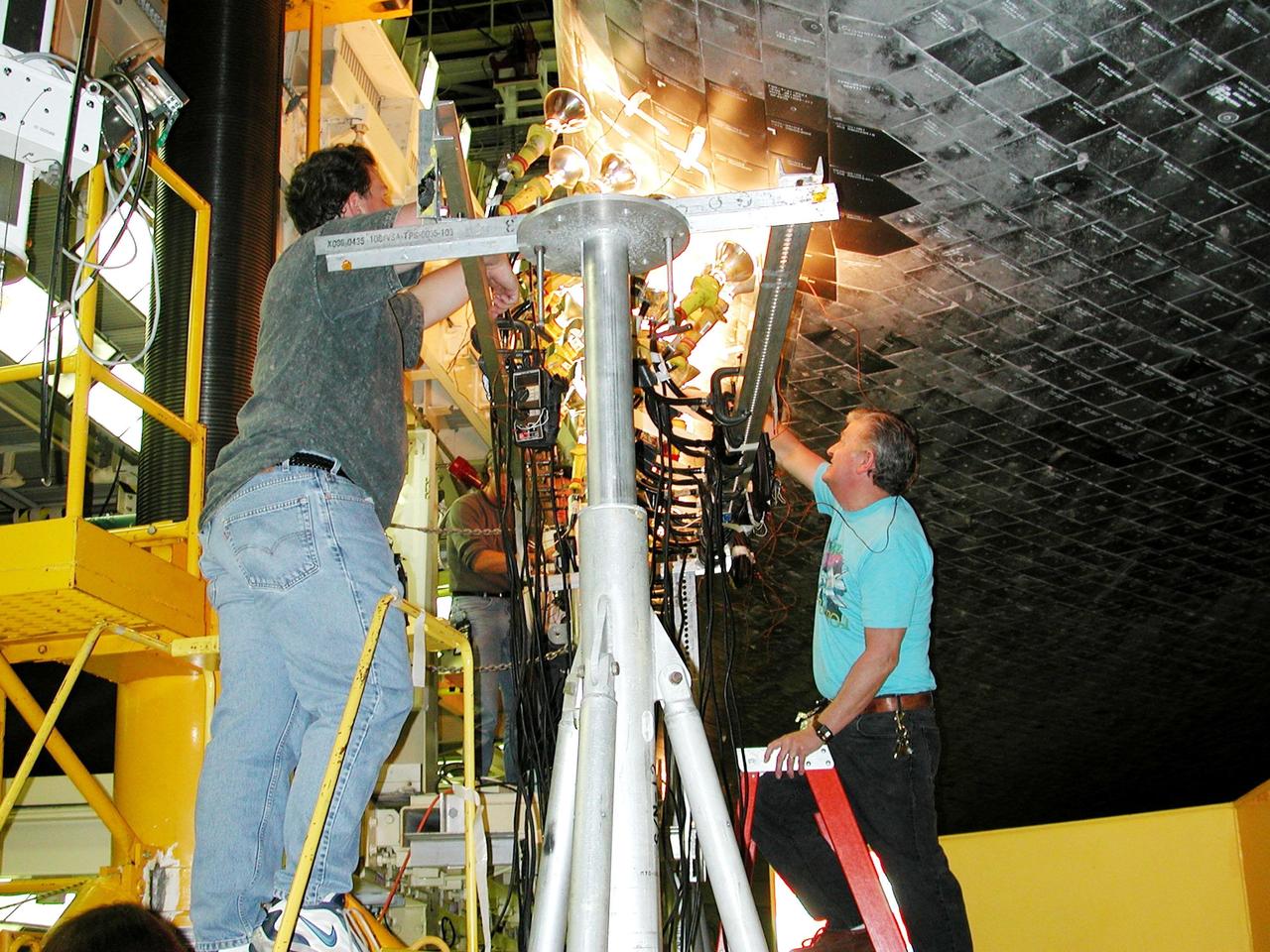
KENNEDY SPACE CENTER, FLA. -- Banks of lights dry tiles on orbiter Atlantis in the Orbiter Processing Facility. Significant rainstorms during the orbiter’s turnaround for a ferry flight home from Edwards Air Force Base, Calif., caused the moisture problem. The tiles are part of the Thermal Protection System used on orbiters for extreme temperatures encountered during landing
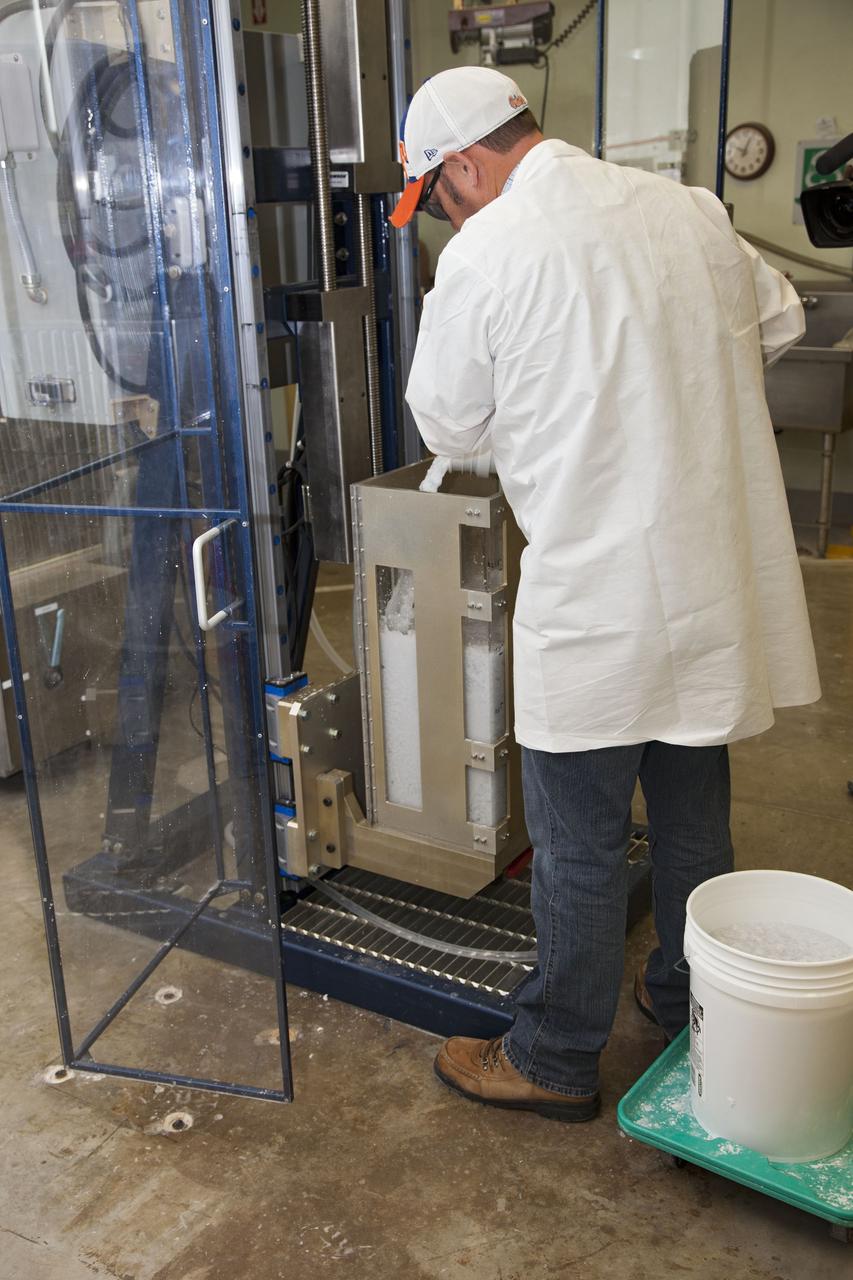
CAPE CANAVERAL, Fla. -- Chris Keeling, a United Space Alliance technician at NASA's Kennedy Space Center in Florida, manufactures the heat shield tiles that will be installed to the backshell of the Orion Multi-Purpose Crew Vehicle's Exploration Flight Test EFT-1 capsule. The work to manufacture and inspect the tiles is taking place in Kennedy's Thermal Protection System Facility. EFT-1 will be used during Orion's first test flight in space. For more information, visit www.nasa.gov/orion. Photo credit: Frankie Martin

CAPE CANAVERAL, Fla. -- John Livingston, a United Space Alliance engineer at NASA's Kennedy Space Center in Florida, describes the properties of the heat shield tiles that will be installed to the backshell of the Orion Multi-Purpose Crew Vehicle's Exploration Flight Test EFT-1 capsule. The tiles are being manufactured and inspected in Kennedy's Thermal Protection System Facility. EFT-1 will be used during Orion's first test flight in space. For more information, visit www.nasa.gov/orion. Photo credit: Frankie Martin

CAPE CANAVERAL, Fla. -- Chris Keeling, a United Space Alliance technician at NASA's Kennedy Space Center in Florida, manufactures the heat shield tiles that will be installed to the backshell of the Orion Multi-Purpose Crew Vehicle's Exploration Flight Test EFT-1 capsule. The work to manufacture and inspect the tiles is taking place in Kennedy's Thermal Protection System Facility. EFT-1 will be used during Orion's first test flight in space. For more information, visit www.nasa.gov/orion. Photo credit: Frankie Martin
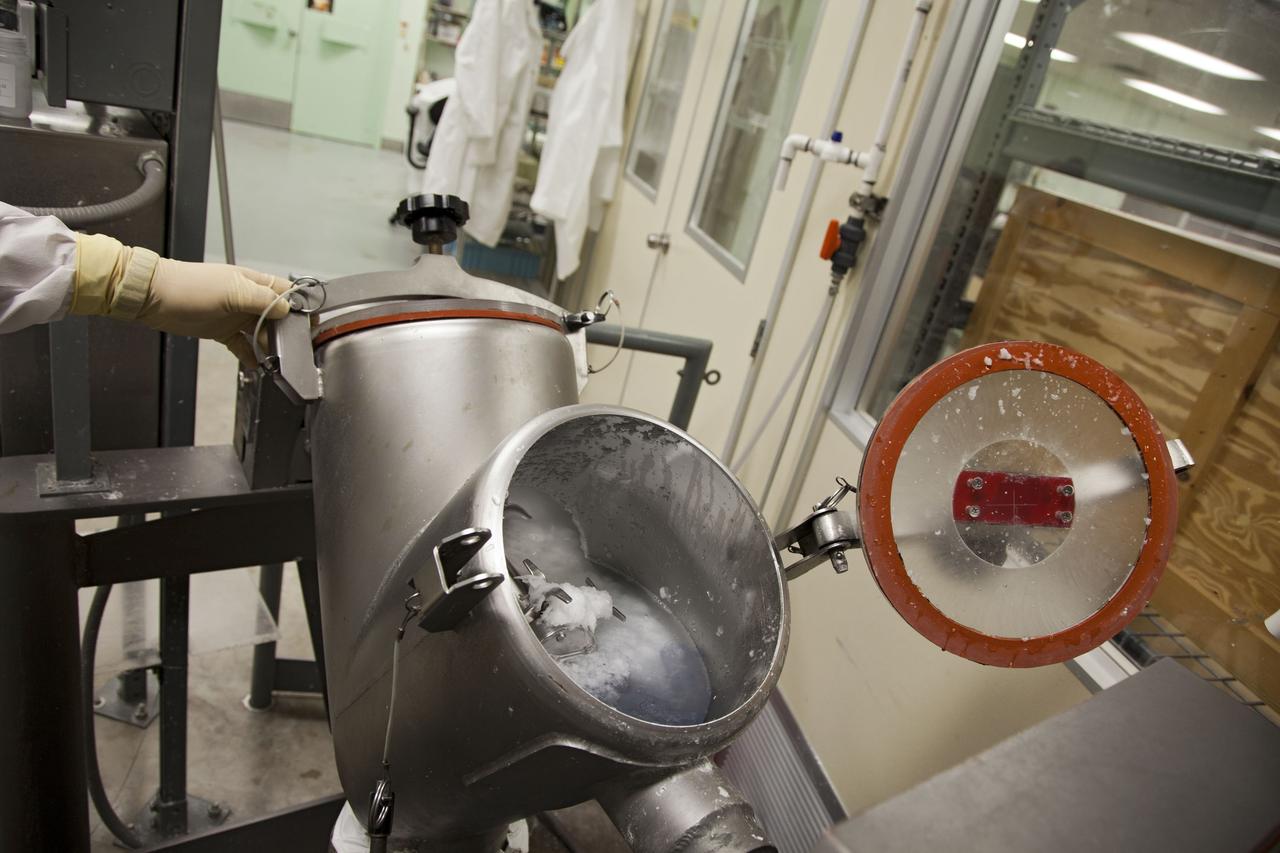
CAPE CANAVERAL, Fla. -- Chris Keeling, a United Space Alliance technician at NASA's Kennedy Space Center in Florida, manufactures the heat shield tiles that will be installed to the backshell of the Orion Multi-Purpose Crew Vehicle's Exploration Flight Test EFT-1 capsule. The work to manufacture and inspect the tiles is taking place in Kennedy's Thermal Protection System Facility. EFT-1 will be used during Orion's first test flight in space. For more information, visit www.nasa.gov/orion. Photo credit: Frankie Martin
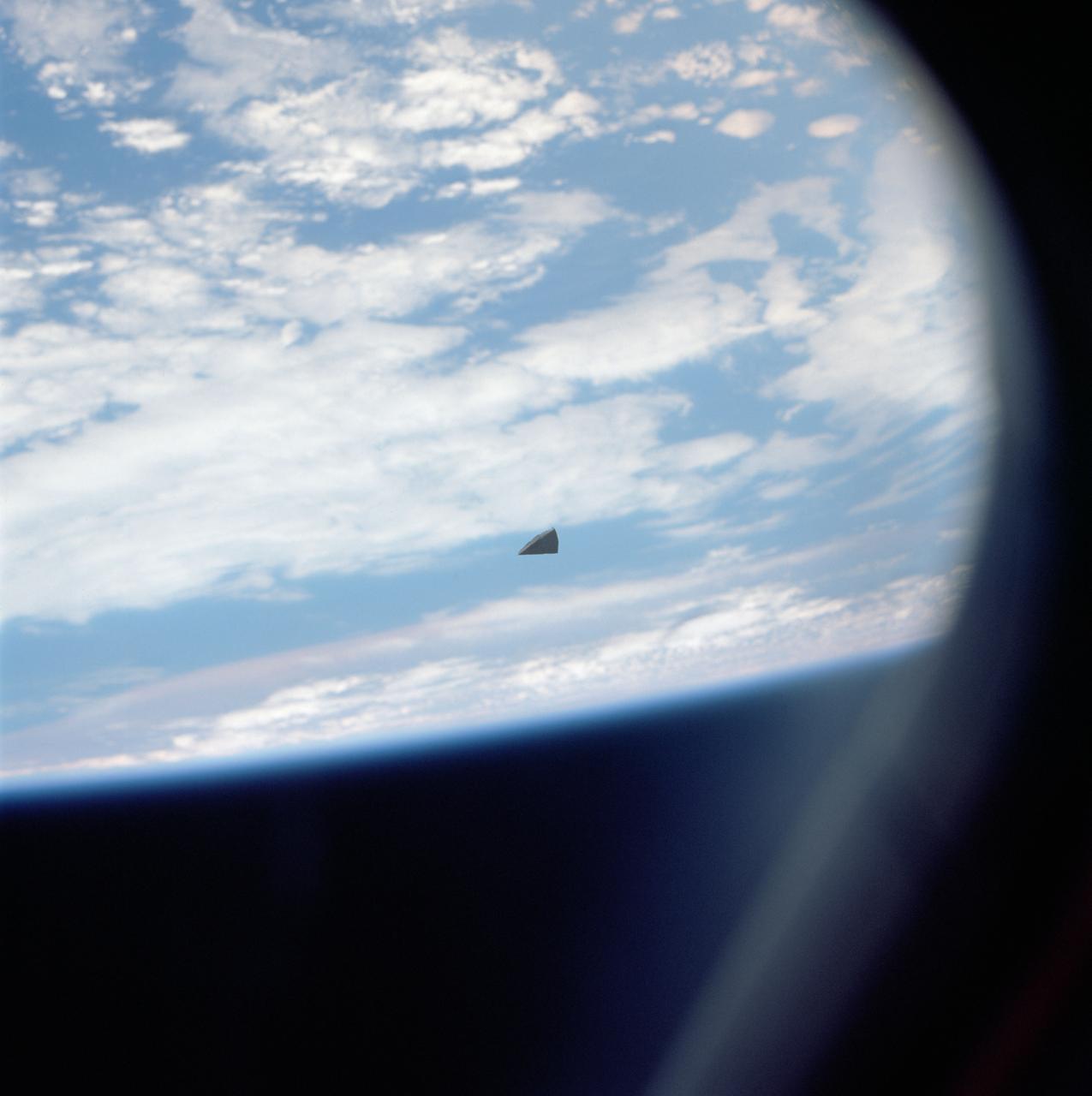
A small piece of thermal insulation tile floats in space near the Shuttle Columbia. The cloudy surface of the earth is used as a background.
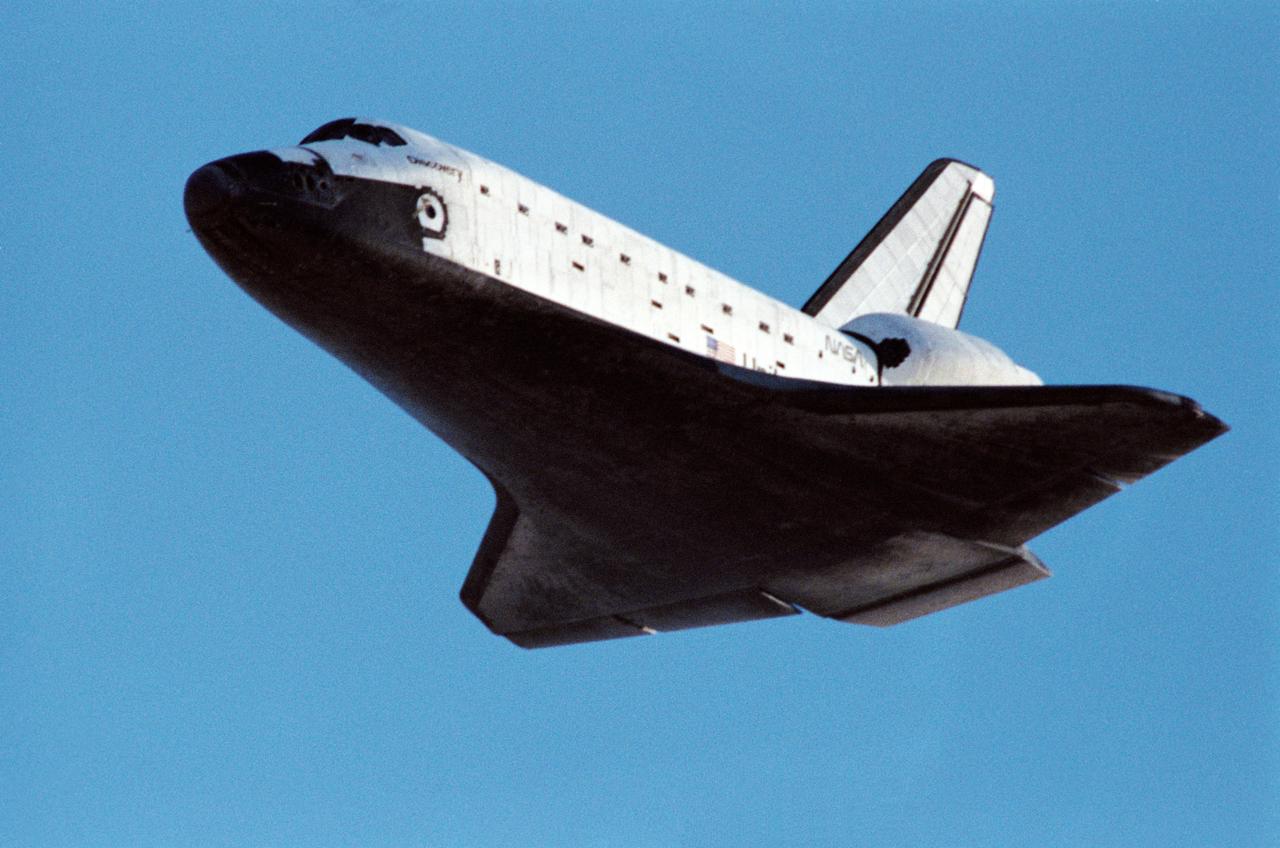
STS031-S-131 (29 April 1990) --- Low angle view of the Space Shuttle Discovery as it approaches for landing on a concrete runway at Edwards Air Force Base to complete a highly successful five-day mission. It was a long awaited Earth orbital flight during which the Hubble Space Telescope (HST) was sent toward its 15-year mission. Discovery's wheels came to a complete stop at 6:51:00 a.m. (PDT), April 29, 1990. The landing gear was deployed just moments after this frame was exposed. Inside the spacecraft for STS-31 were astronauts Loren J. Shriver, Charles F. Bolden, Bruce McCandless II, Kathryn D. Sullivan and Steven A. Hawley.

F-15A #281 In Flight

F-15A #281 In Flight over Mojave.
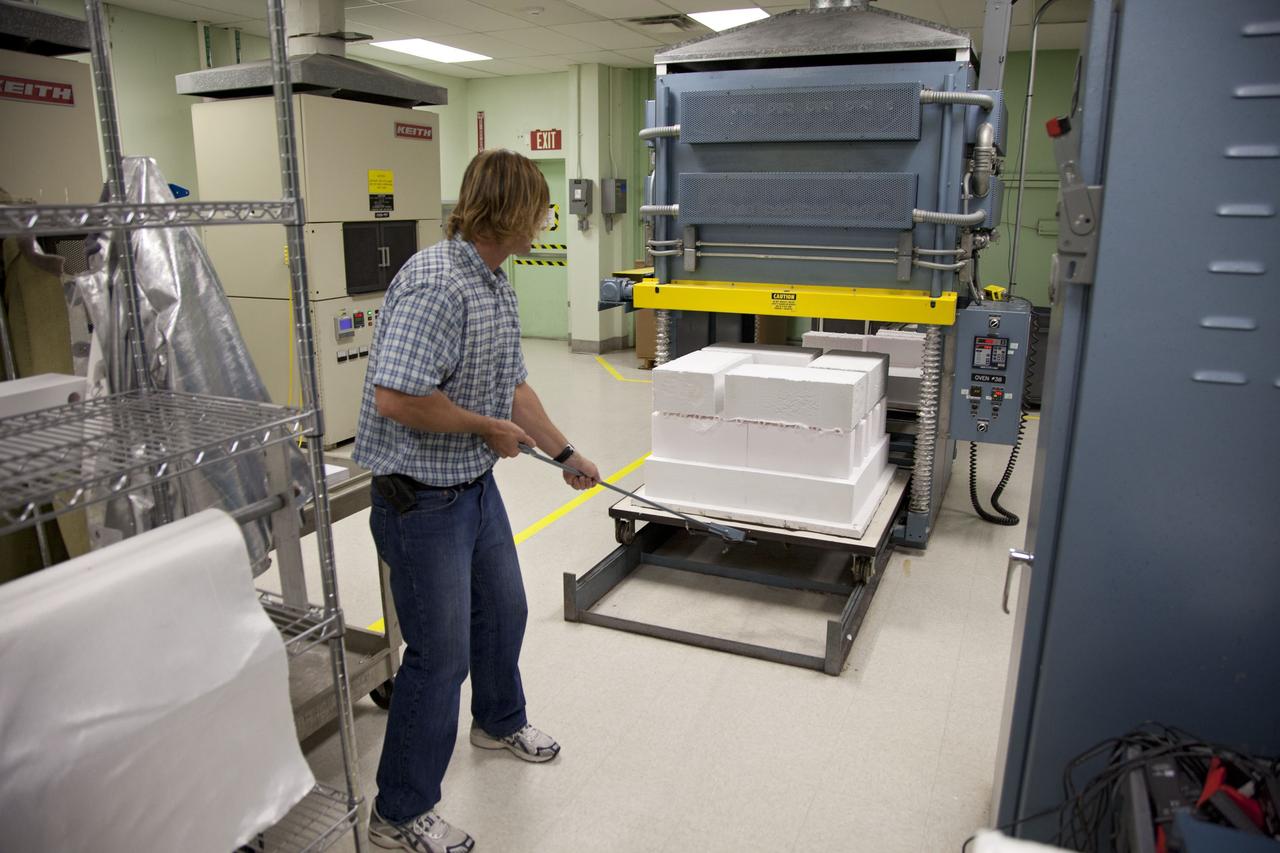
CAPE CANAVERAL, Fla. -- Tim Wright, a United Space Alliance engineering manager at NASA's Kennedy Space Center in Florida, unloads the heat shield tiles that will be installed to the backshell of the Orion Multi-Purpose Crew Vehicle's Exploration Flight Test EFT-1 capsule. The tiles are being manufactured and inspected in Kennedy's Thermal Protection System Facility. The tiles will be baked at 2,200 degrees F to cure their ceramic coating. EFT-1 will be used during Orion's first test flight in space. For more information, visit www.nasa.gov/orion. Photo credit: Frankie Martin
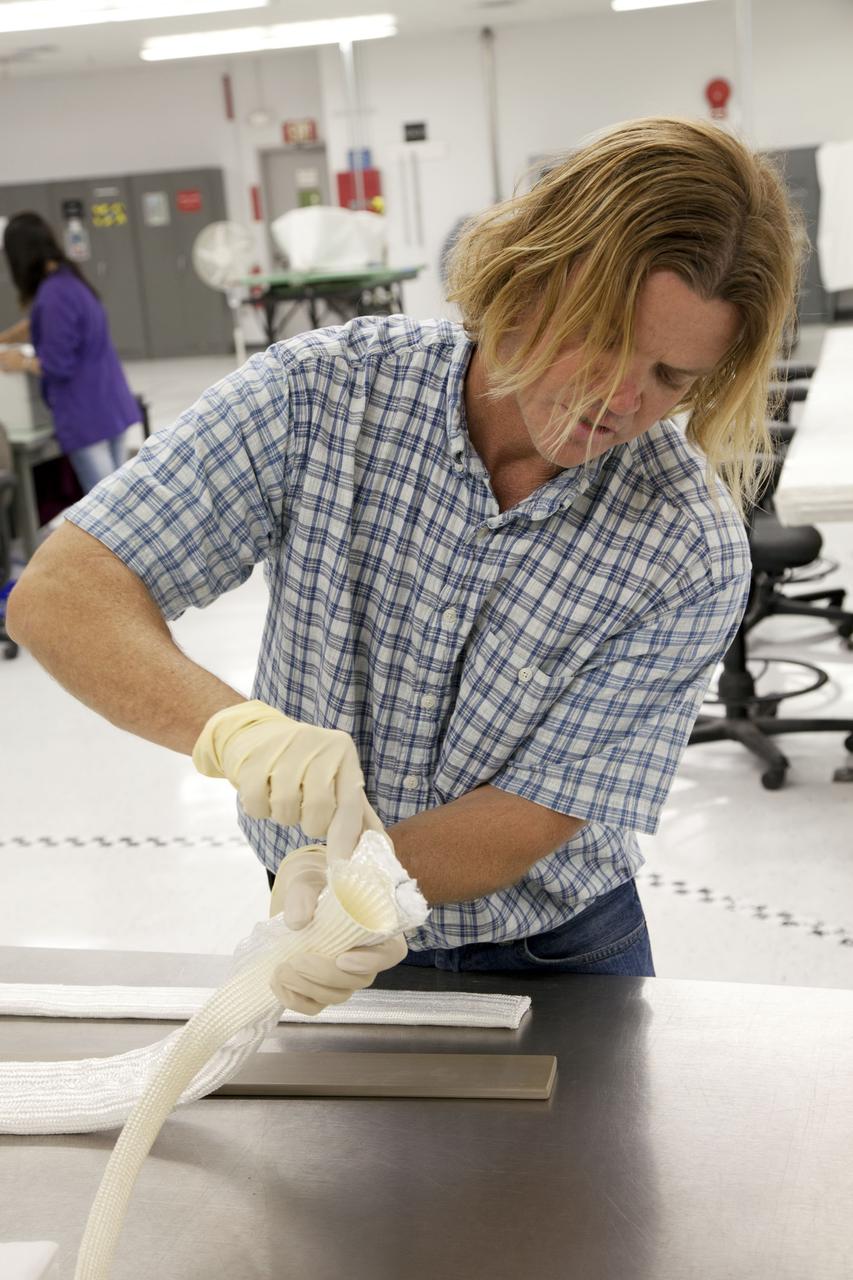
CAPE CANAVERAL, Fla. -- -- Tim Wright, a United Space Alliance engineering manager at NASA's Kennedy Space Center in Florida, explains the properties of the thermal barriers that will be installed to the backshell of the Orion Multi-Purpose Crew Vehicle's Exploration Flight Test EFT-1 capsule. The work to manufacture and inspect the tiles is taking place in Kennedy's Thermal Protection System Facility. EFT-1 will be used during Orion's first test flight in space. For more information, visit www.nasa.gov/orion. Photo credit: Frankie Martin

KENNEDY SPACE CENTER, FLA. -- From left, United Space Alliance (USA) Deputy Space Shuttle Program Manager of Operations Loren Shriver, USA Associate Program Manager of Ground Operations Andy Allen, NASA Deputy Associate Administrator for Space Station and Shuttle Programs Michael Kostelnik, and USA Vice President and Space Shuttle Program Manager Howard DeCastro examine a tile used in the Shuttle's Thermal Protection System (TPS) in KSC's TPS Facility. NASA and USA Space Shuttle program management are participating in a leadership workday. The day is intended to provide management with an in-depth, hands-on look at Shuttle processing activities at KSC.
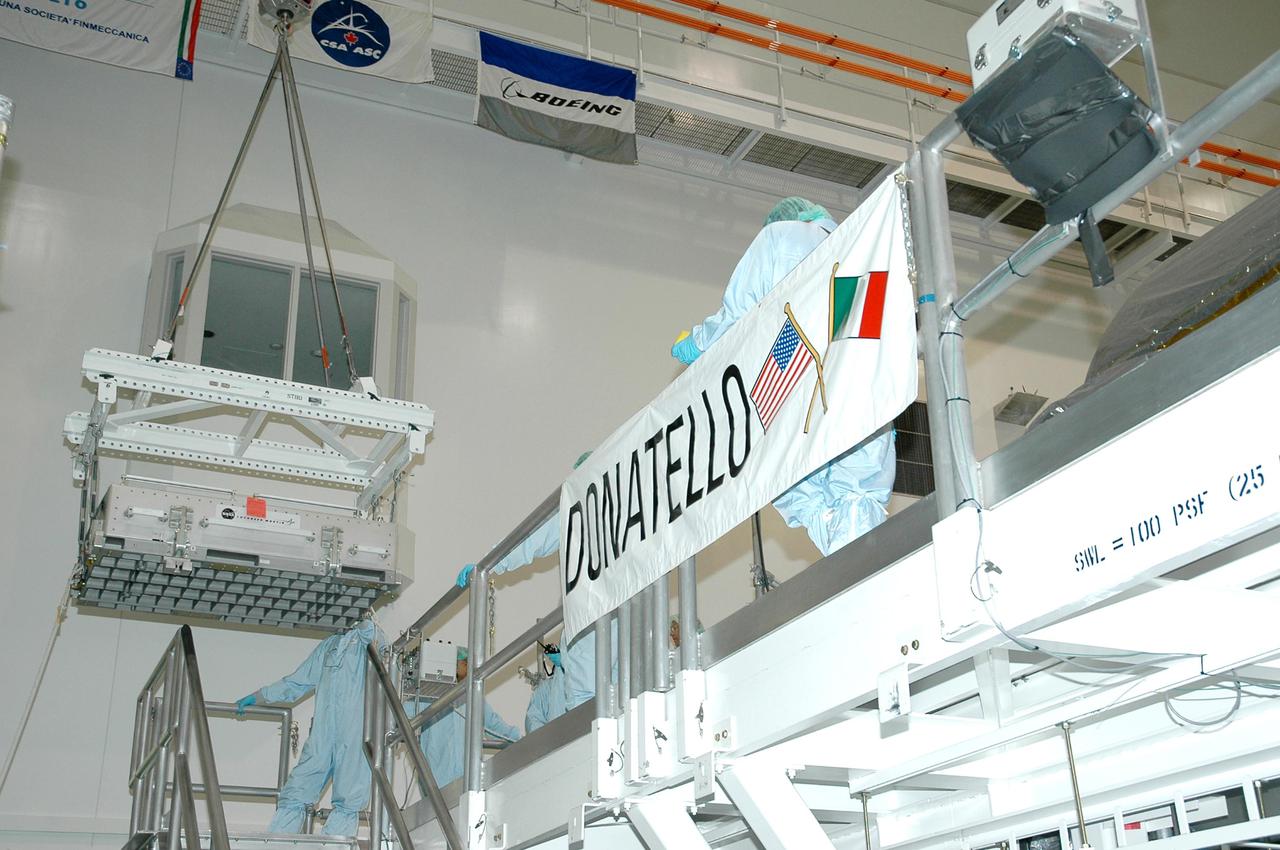
KENNEDY SPACE CENTER, FLA. - An overhead crane in the Space Station Processing Facility moves the Thermal Protection System Detailed Test Objective (DTO) box toward the Lightweight Multi-Purpose Experiment Support Structure Carrier (LMC) that is situated near the Multi-Purpose Logistics Module Donatello. The LMC and DTO will fly on Space Shuttle Discovery for mission STS-114. The DTO contains tile samples that will enable astronauts to test new on-orbit Thermal Protection System repair techniques. The launch window for mission STS-114 is May 12 to June 3.
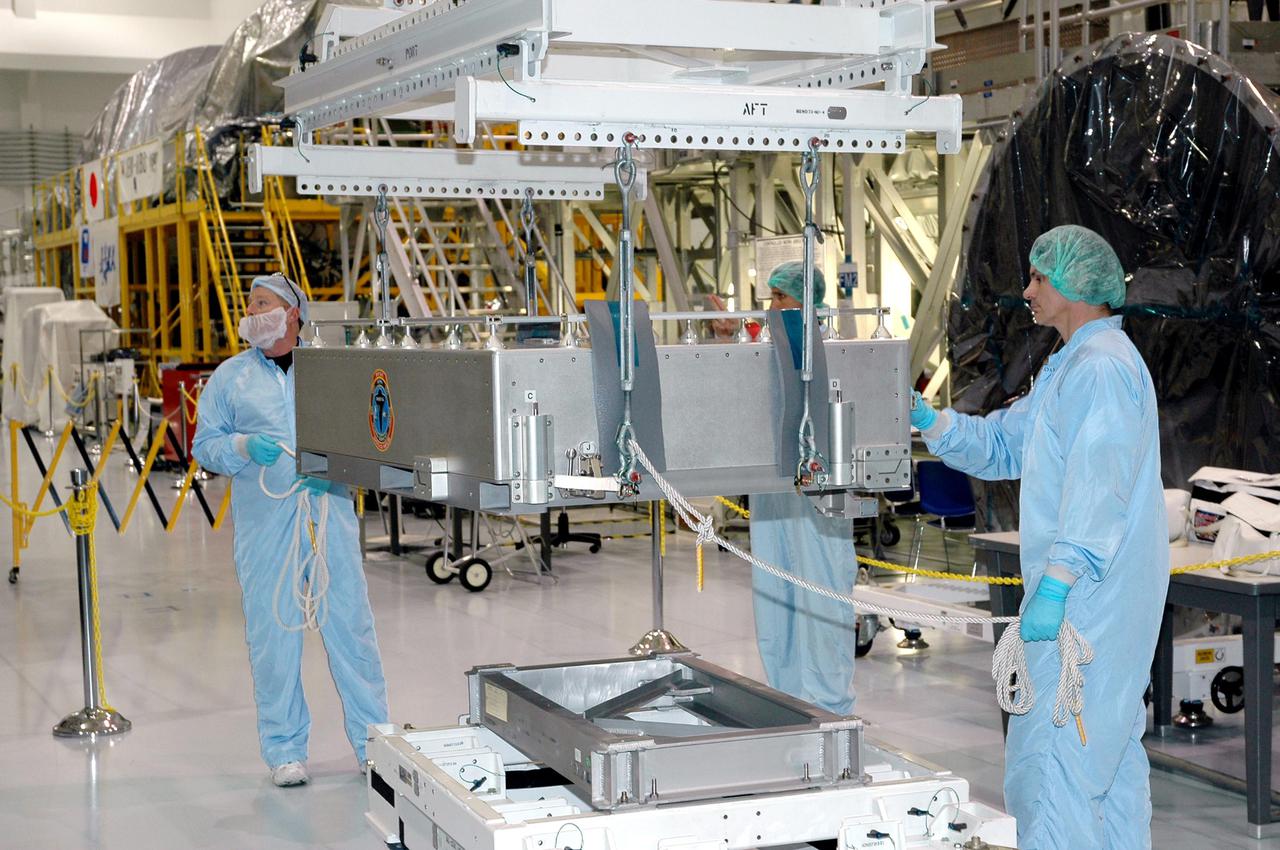
KENNEDY SPACE CENTER, FLA. - Technicians at the Space Station Processing Facility prepare the Thermal Protection System Detailed Test Objective (DTO) box to be lifted onto the Lightweight Multi-Purpose Experiment Support Structure Carrier (LMC). It will be placed on the Lightweight Multi-Purpose Experiment Support Structure Carrier (LMC) to fly on Space Shuttle Discovery for mission STS-114. The DTO contains tile samples that will enable astronauts to test new on-orbit Thermal Protection System repair techniques. The launch window for mission STS-114 is May 12 to June 3.
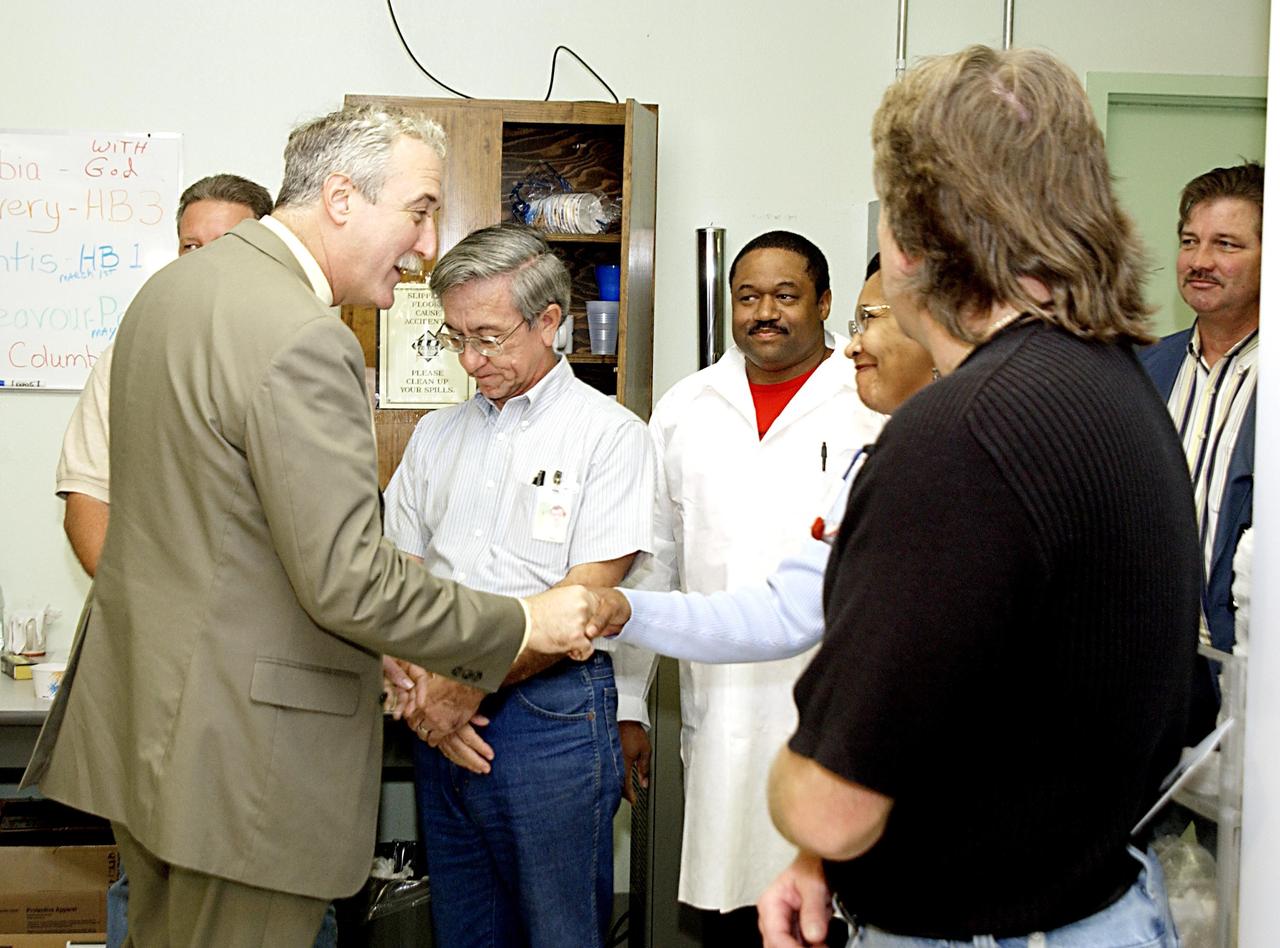
KENNEDY SPACE CENTER, FLA. -- In the Thermal Protection System Facility, NASA Administrator Sean O'Keefe (left) meets workers. O'Keefe is visiting the site to learn more about the TPS products and process in protecting orbiters from the intense heat of launch and re-entry. TPS tiles have been discussed in the investigation into the Columbia tragedy that destroyed the orbiter and claimed the lives of seven astronauts.

KENNEDY SPACE CENTER, FLA. -- In the Thermal Protection System Facility, NASA Administrator Sean O'Keefe (center) listens to Lee Zook (right) explaining use of the Dome Heat Shield blanket in front of them that is used for Shuttle engines. O'Keefe is visiting the site to learn more about the TPS products and process in protecting orbiters from the intense heat of launch and re-entry. TPS tiles have been discussed in the investigation into the Columbia tragedy that destroyed the orbiter and claimed the lives of seven astronauts.
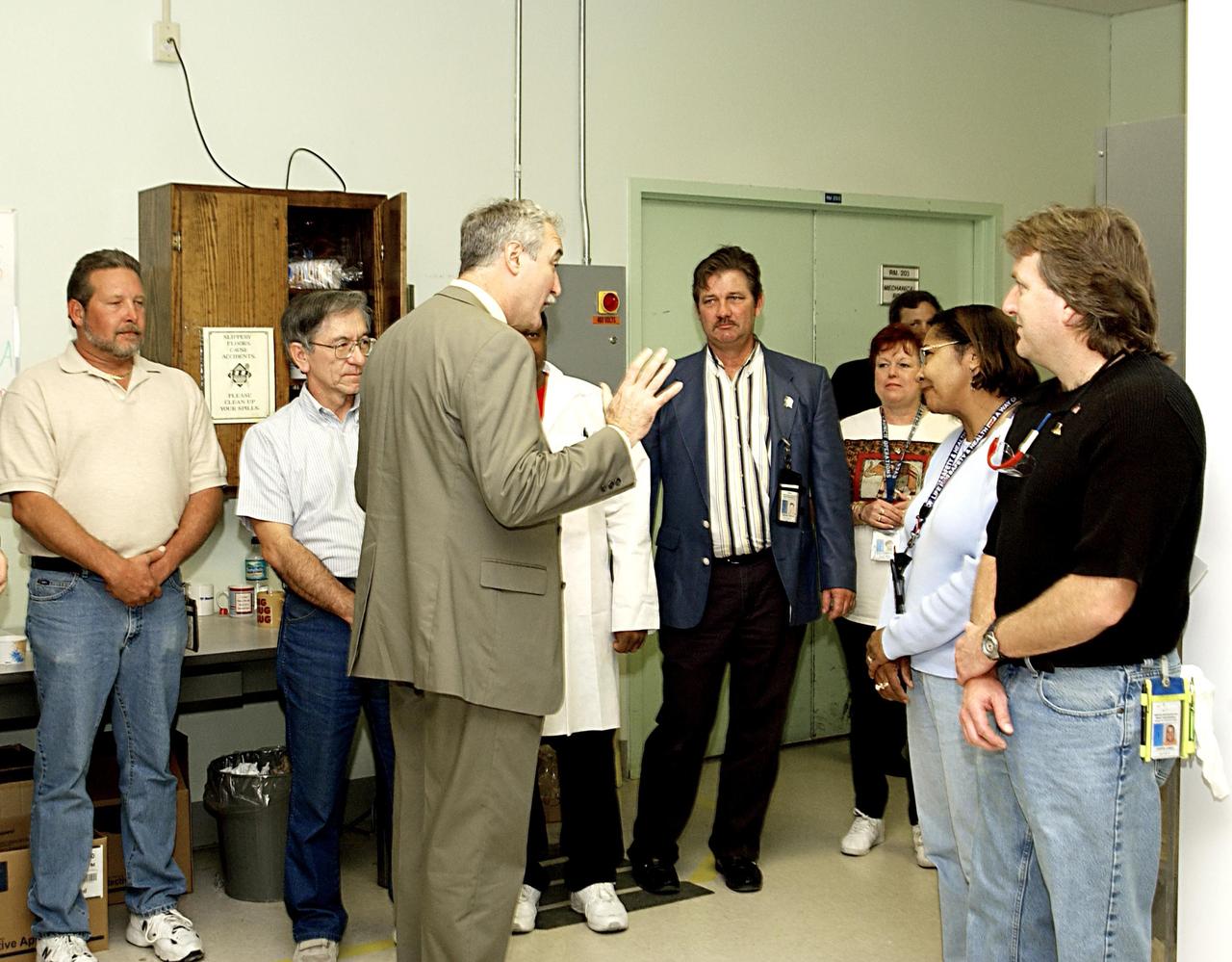
KENNEDY SPACE CENTER, FLA. -- NASA Administrator Sean O'Keefe (third from left) talks to workers in the Thermal Protection System Facility. O'Keefe is visiting the site to learn more about the TPS products and process in protecting orbiters from the intense heat of launch and re-entry. TPS tiles have been discussed in the investigation into the Columbia tragedy that destroyed the orbiter and claimed the lives of seven astronauts.
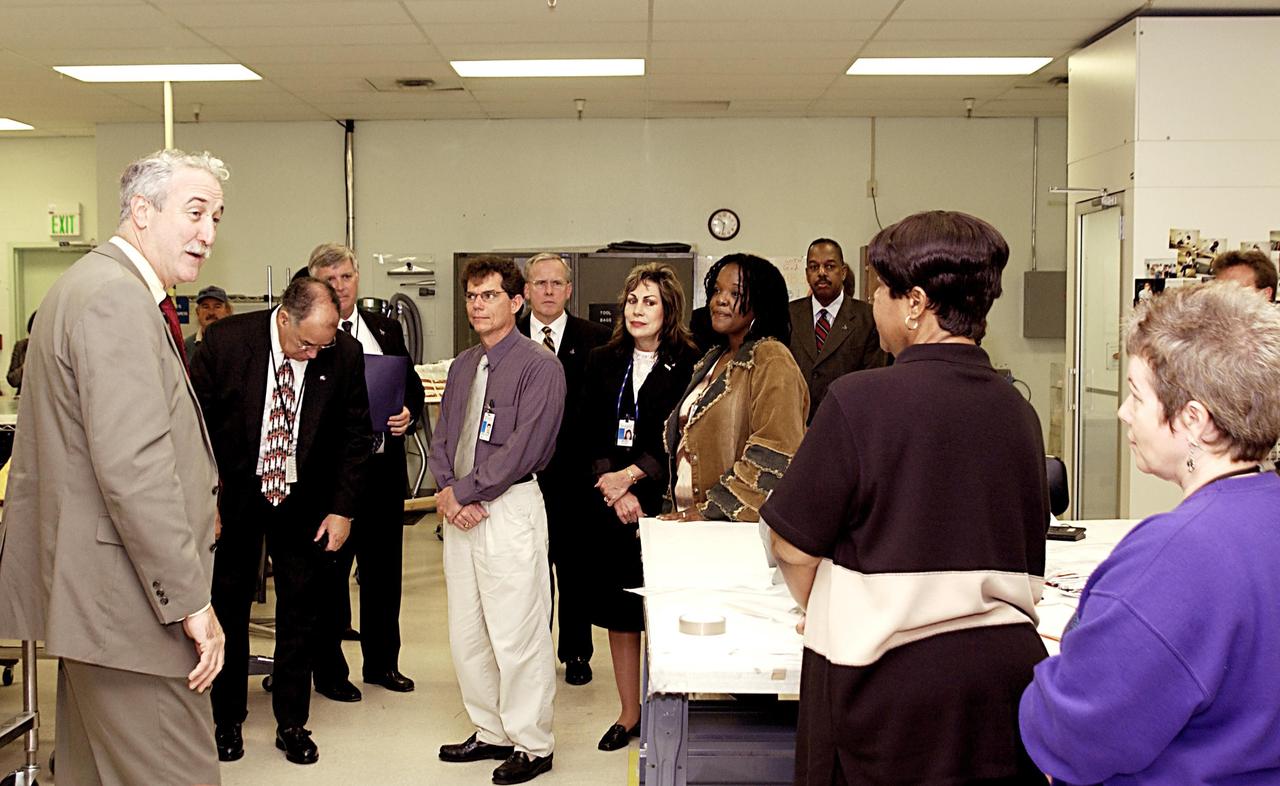
KENNEDY SPACE CENTER, FLA. -- NASA Administrator Sean O'Keefe (left) speaks to workers in the Thermal Protection System Facility. O'Keefe is visiting the site to learn more about the TPS products and process in protecting orbiters from the intense heat of launch and re-entry. TPS tiles have been discussed in the investigation into the Columbia tragedy that destroyed the orbiter and claimed the lives of seven astronauts.
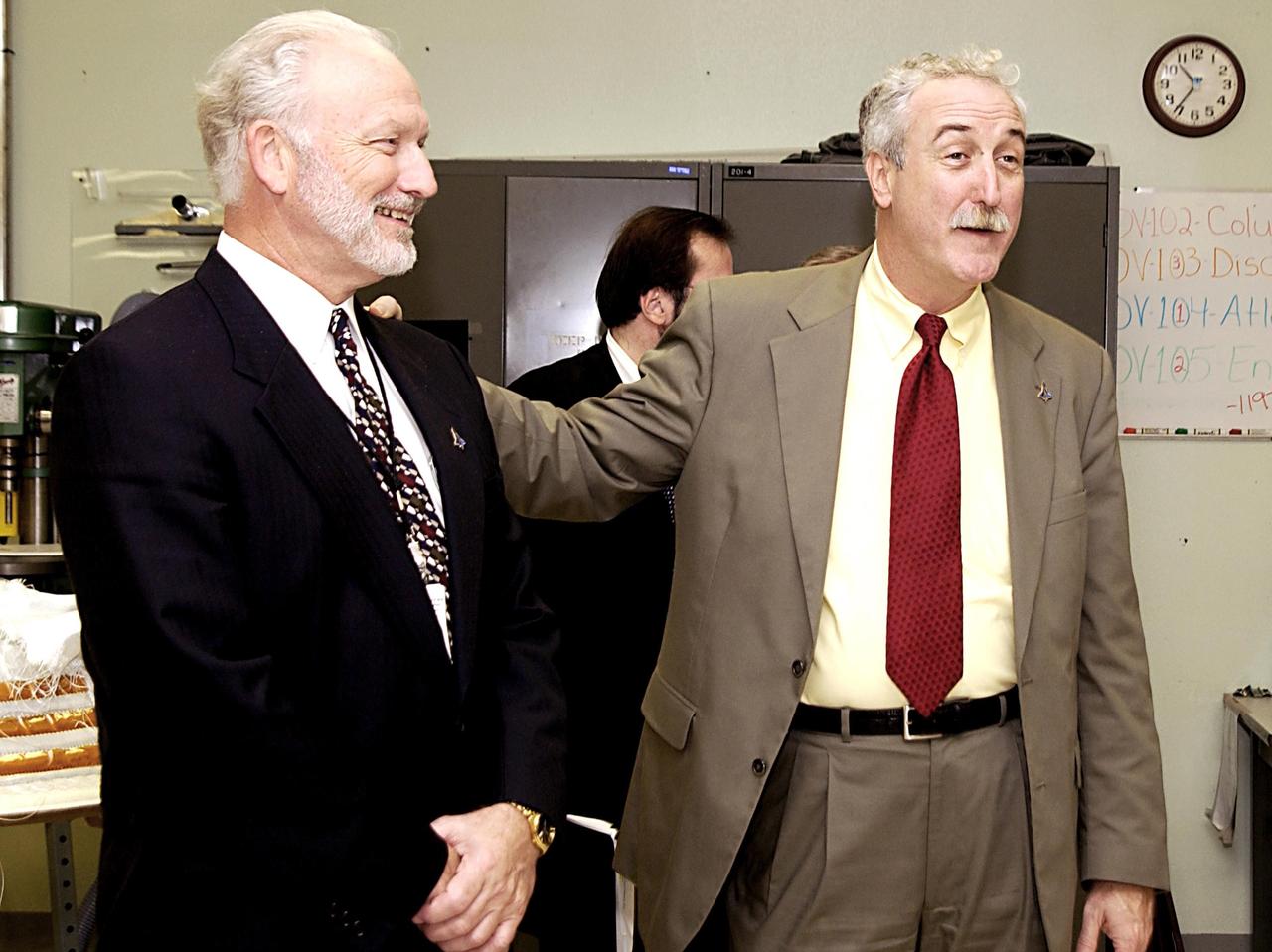
KENNEDY SPACE CENTER, FLA. -- NASA Administrator Sean O'Keefe (right) visits the Thermal Protection System Facility. At left is Chuck Fontana, associate program manager, Integrated Logistics. O'Keefe is visiting the site to learn more about the TPS products and process in protecting orbiters from the intense heat of launch and re-entry. TPS tiles have been discussed in the investigation into the Columbia tragedy that destroyed the orbiter and claimed the lives of seven astronauts..

In-flight photo of the NASA F-15B used in tests of the X-33 Thermal Protection System (TPS) materials. Flying at subsonic speeds, the F-15B tests measured the air loads on the proposed X-33 protective materials. In contrast, shock loads testing investigated the local impact of the supersonic shock wave itself on the TPS materials. Similar tests had been done in 1985 for the space shuttle tiles, using an F-104 aircraft.
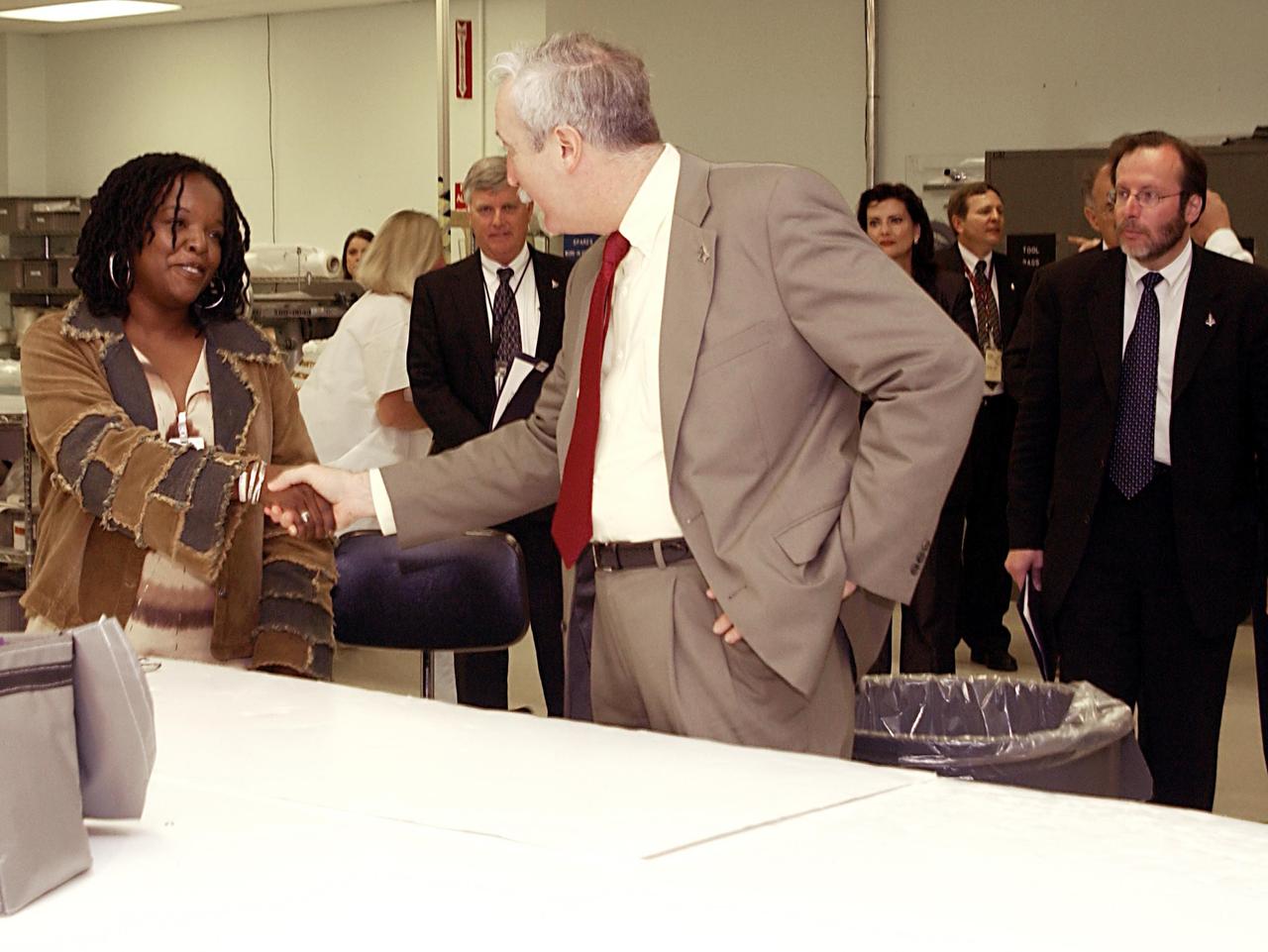
KENNEDY SPACE CENTER, FLA. -- NASA Administrator Sean O'Keefe (center) greets Brenda Blackmon, a worker in the Thermal Protection System Facility. O'Keefe is visiting the site to learn more about the TPS products and process in protecting orbiters from the intense heat of launch and re-entry. TPS tiles have been discussed in the investigation into the Columbia tragedy that destroyed the orbiter and claimed the lives of seven astronauts.