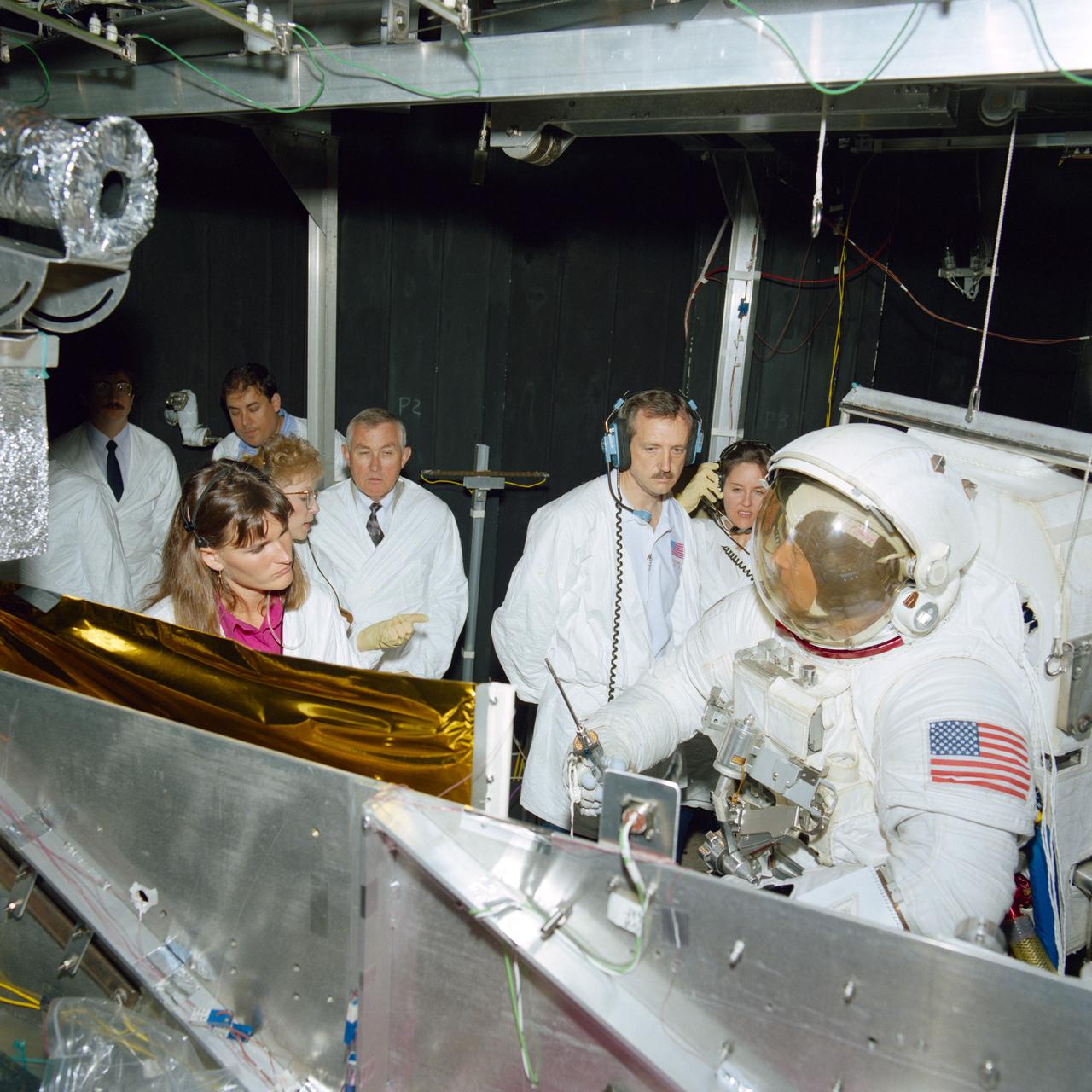
S93-34001 (26 May 1993) --- Astronaut F. Story Musgrave, wearing a training version of the Extravehicular Mobility Unit (EMU), participates in a dry run for tests in a thermal vacuum chamber. The payload commander will be among four suited crew members participating in task rehearsals and testing the tools that will be used on the Hubble Space Telescope (HST) repair mission. The test, conducted in Chamber B of the Space Environment and Simulation Laboratory (SESL) at the Johnson Space Center (JSC), verified that the tools being designed for the mission will work in the cold vacuum of space. Others pictured, from the left, are Andrea Tullar and Donna Fender, test directors; Leonard S. Nicholson, acting director of engineering; and astronauts Thomas D. Akers and Kathryn C. Thornton, mission specialists, along with Musgrave.
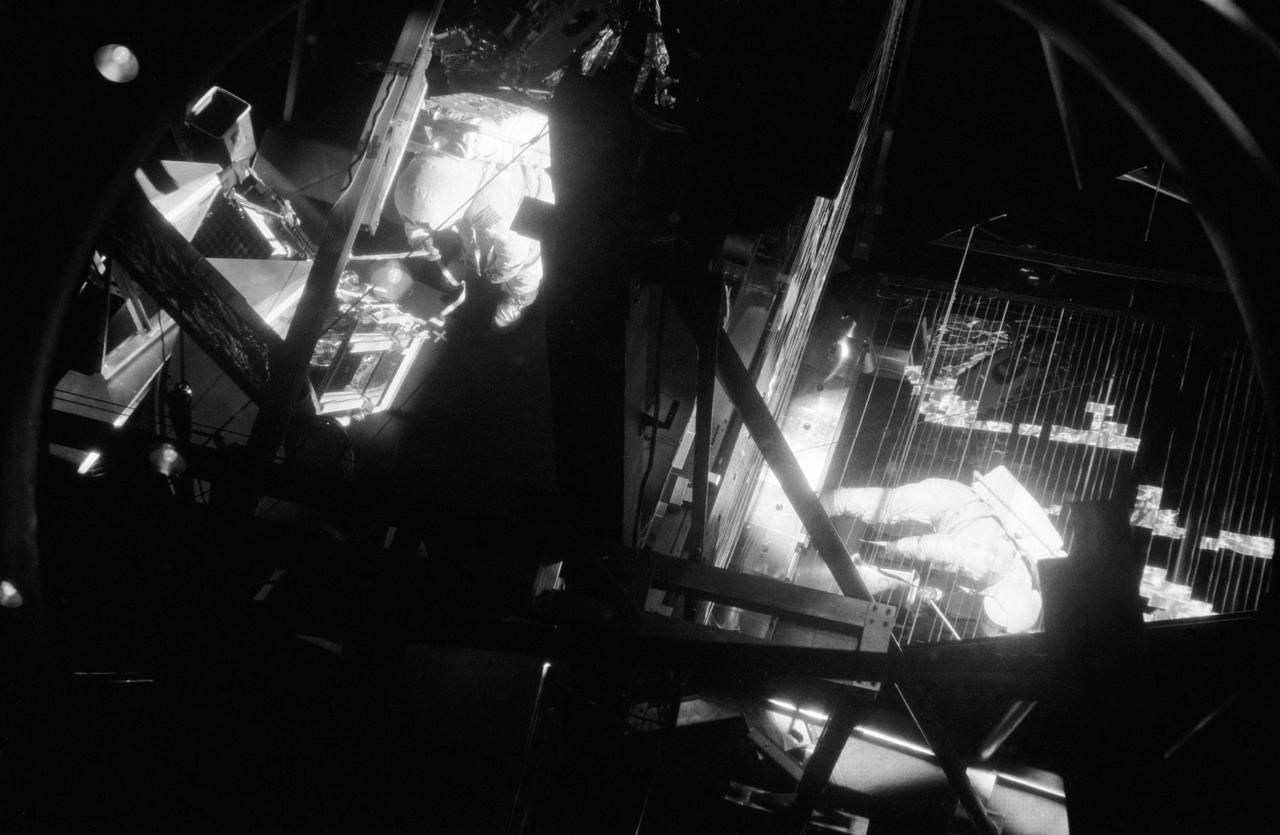
Astronaut Neil A. Armstrong, commander of the Apollo 11 lunar landing mission, is photographed during thermovacuum training in Chamber B of the Space Environment Simulation Laboratory, Building 32, Manned Spacecraft Center. He is wearing an Extravehicular Mobility Unit. The training simulated lunar surface vacuum and thermal conditions during astronaut operations outside the Lunar Module on the moon's surface. The mirror was used to reflect solar light.
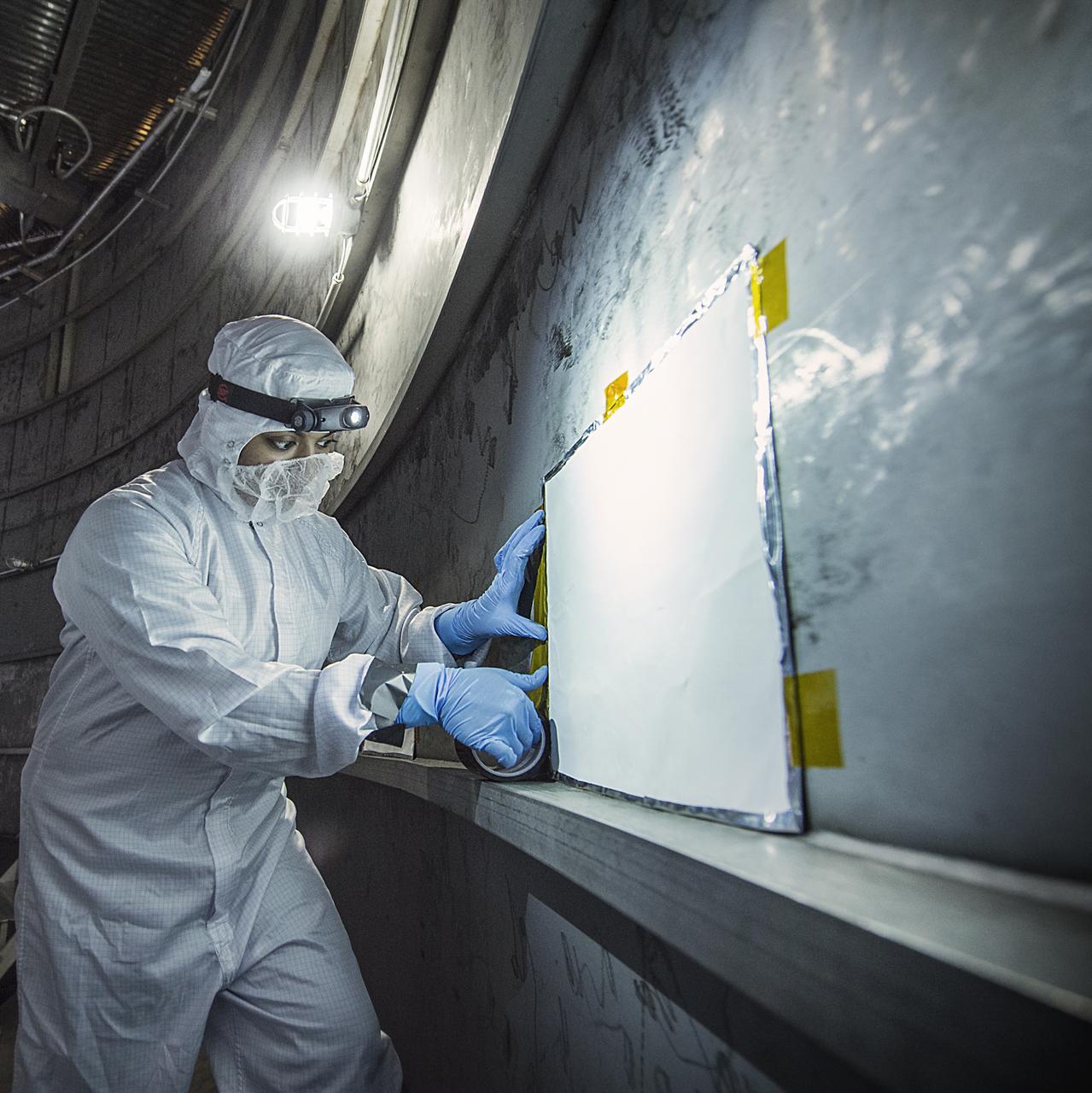
Contamination from organic molecules can harm delicate instruments and engineers are taking special care at NASA to prevent that from affecting the James Webb Space Telescope (and all satellites and instruments). Recently, Nithin Abraham, a Thermal Coatings Engineer placed Molecular Adsorber Coating or "MAC" panels in the giant chamber where the Webb telescope will be tested. This contamination can occur through a process when a vapor or odor is emitted by a substance. This is called "outgassing." The "new car smell" is an example of that, and is unhealthy for people and sensitive satellite instruments. So, NASA engineers have created a new way to protect those instruments from the damaging effects of contamination coming from outgassing. "The Molecular Adsorber Coating (MAC) is a NASA Goddard coatings technology that was developed to adsorb or entrap outgassed molecular contaminants for spaceflight applications," said Nithin Abraham, Thermal Coatings Engineer at NASA's Goddard Space Flight Center in Greenbelt, Maryland. MAC is currently serving as an innovative contamination mitigation tool for Chamber A operations at NASA Johnson Space Center in Houston, Texas. MAC can be used to keep outgassing from coming in from outside areas or to capture outgassing directly from hardware, components, and within instrument cavities. In this case, MAC is helping by capturing outgassed contaminants outside the test chamber from affecting the Webb components. MAC is expected to capture the outgassed contaminants that exist in the space of the vacuum chamber (not from the Webb components). Credit: NASA/GoddardChris Gunn Read more: <a href="http://www.nasa.gov/feature/goddard/nasa-technology-protects-webb-telescope-from-contamination" rel="nofollow">www.nasa.gov/feature/goddard/nasa-technology-protects-web...</a> <b><a href="http://www.nasa.gov/audience/formedia/features/MP_Photo_Guidelines.html" rel="nofollow">NASA image use policy.</a></b> <b><a href="http://www.nasa.gov/centers/goddard/home/index.html" rel="nofollow">NASA Goddard Space Flight Center</a></b> enables NASA’s mission through four scientific endeavors: Earth Science, Heliophysics, Solar System Exploration, and Astrophysics. Goddard plays a leading role in NASA’s accomplishments by contributing compelling scientific knowledge to advance the Agency’s mission. <b>Follow us on <a href="http://twitter.com/NASAGoddardPix" rel="nofollow">Twitter</a></b> <b>Like us on <a href="http://www.facebook.com/pages/Greenbelt-MD/NASA-Goddard/395013845897?ref=tsd" rel="nofollow">Facebook</a></b> <b>Find us on <a href="http://instagrid.me/nasagoddard/?vm=grid" rel="nofollow">Instagram</a></b>