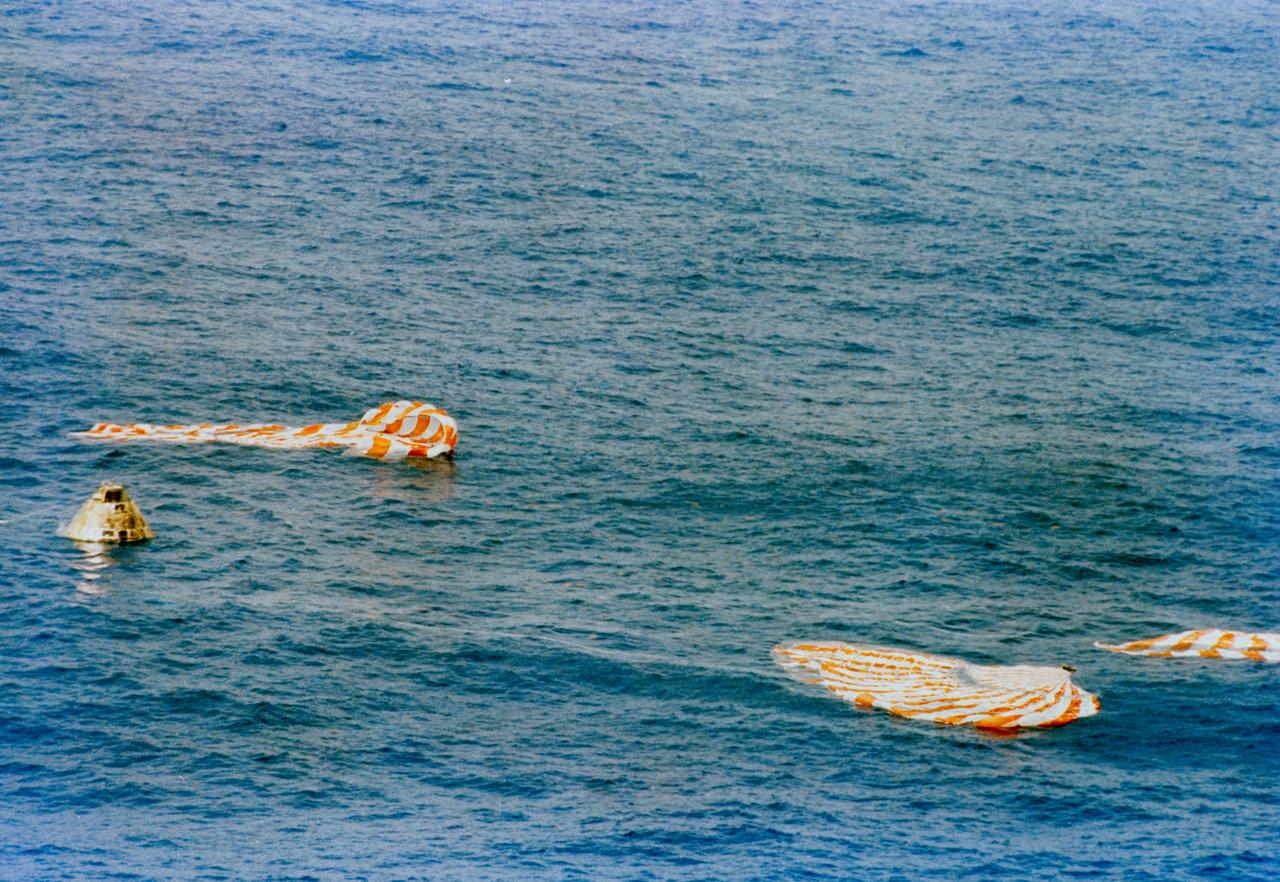
S69-27925 (13 March 1969) --- The Apollo 9 spacecraft, with astronauts James A. McDivitt, David R. Scott, and Russell L. Schweickart aboard, floats in the Atlantic immediately after splashdown. Moments later the three crewmen were picked up by a helicopter and flown to the deck of the USS Guadalcanal, prime recovery ship for the Apollo 9 10-day Earth-orbital space mission. Splashdown occurred at 12:00:53 p.m. (EST), March 13, 1969, only 4.5 nautical miles from the USS Guadalcanal. Just after this picture was taken U.S. Navy underwater demolition team swimmers were dropped into the water to assist in the recovery operations, including attaching a flotation collar to the spacecraft.
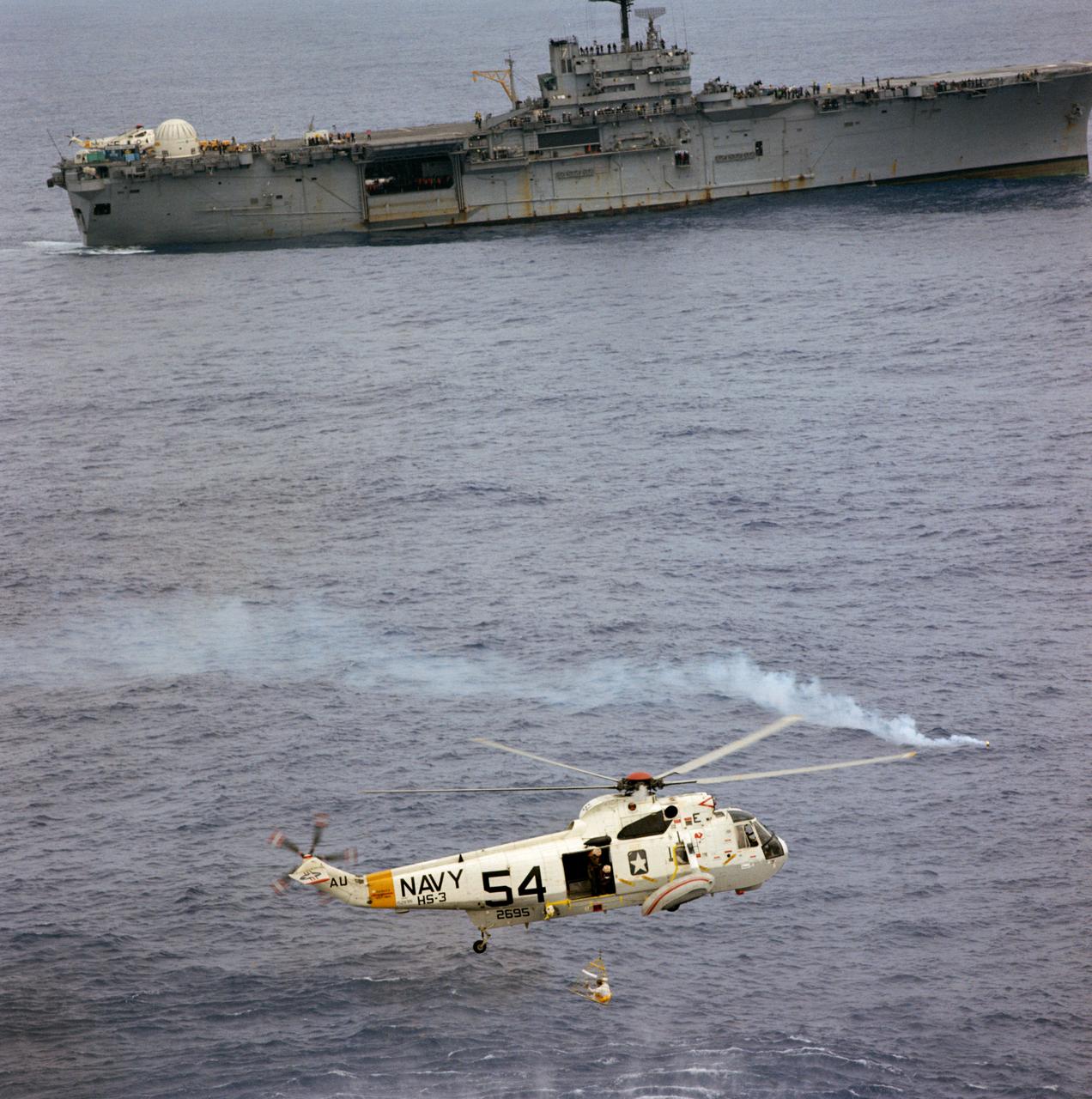
Aerial view of an Apollo 9 crewman in a new rescue net (a Billy Pugh net) being hoisted aboard a Navy helicopter after splashdown in the Atlantic recovery area and a successful ten-day, earth-orbital space mission. Navy divers have already attached a flotation collar to the command module and are assisting with recovery operations.
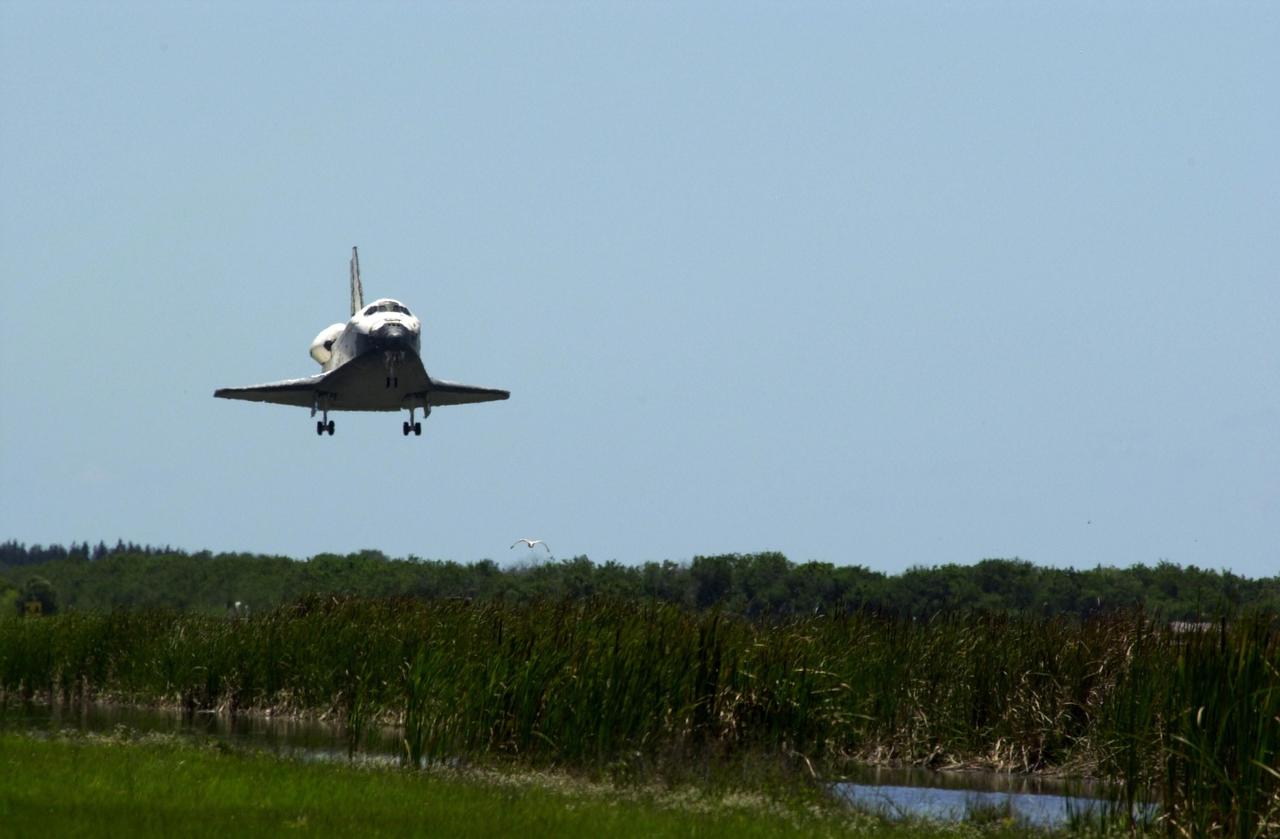
KENNEDY SPACE CENTER, FLA. - Atlantis swoops down over vegetation and water as it approaches runway 33 at KSC's Shuttle Landing Facility. The landing completes the 10-day, 19-hour, 4.5-million mile mission STS-110 to the International Space Station.. The orbiter carries the returning crew Commander Michael Bloomfield, Pilot Stephen Frick and Mission Specialists Jerry Ross, Steven Smith, Ellen Ochoa, Lee Morin and Rex Walheim. Main gear touchdown was 12:26:57 p.m. EDT, nose gear touchdown was 12:27:09 p.m. and wheel stop was 12:28:07 p.m. The crew delivered and installed the S0 truss, which will support cooling and power systems essential for the addition of future international laboratories, on the Station
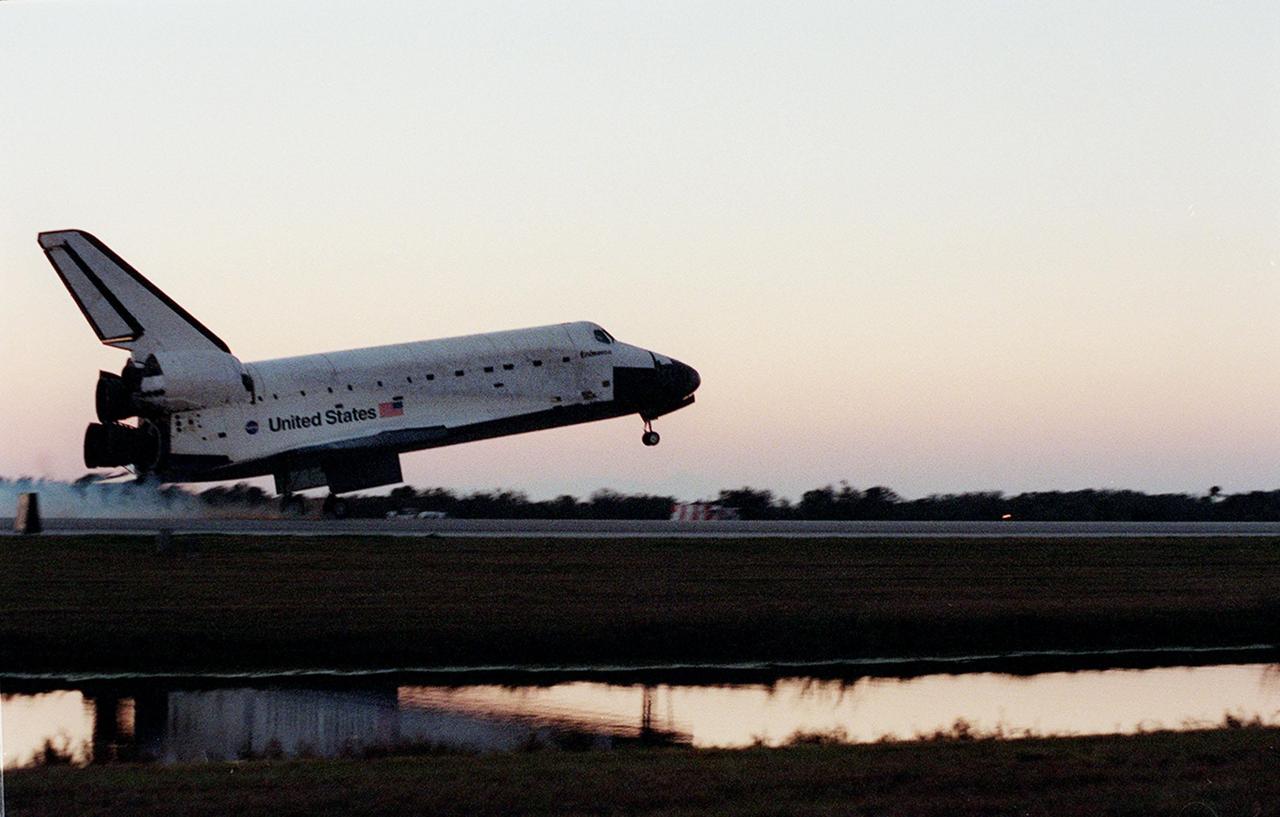
KENNEDY SPACE CENTER, Fla. -- The nearby water reflects Space Shuttle Endeavour as it touches down on KSC's Shuttle Landing Facility Runway 33 to complete the 11-day, 5-hour, 38-minute-long STS-99 mission. Main gear touchdown was at 6:22:23 p.m. EST Feb. 22 , landing on orbit 181 of the mission. Nose gear touchdown was at 6:22:35 p.m.. EST, and wheel stop at 6:23:25 p.m. EST. At the controls are Commander Kevin Kregel and Pilot Dominic Gorie. Also onboard the orbiter are Mission Specialists Janet Kavandi, Janice Voss, Mamoru Mohri of Japan and Gerhard Thiele of Germany. Mohri is with the National Space Development Agency (NASDA) and Thiele is with the European Space Agency. The crew are returning from the Shuttle Radar Topography Mission, after mapping more than 47 million square miles of the Earth. This was the 97th flight in the Space Shuttle program and the 14th for Endeavour, also marking the 50th landing at KSC, the 21st consecutive landing at KSC, and the 28th in the last 29 Shuttle flights
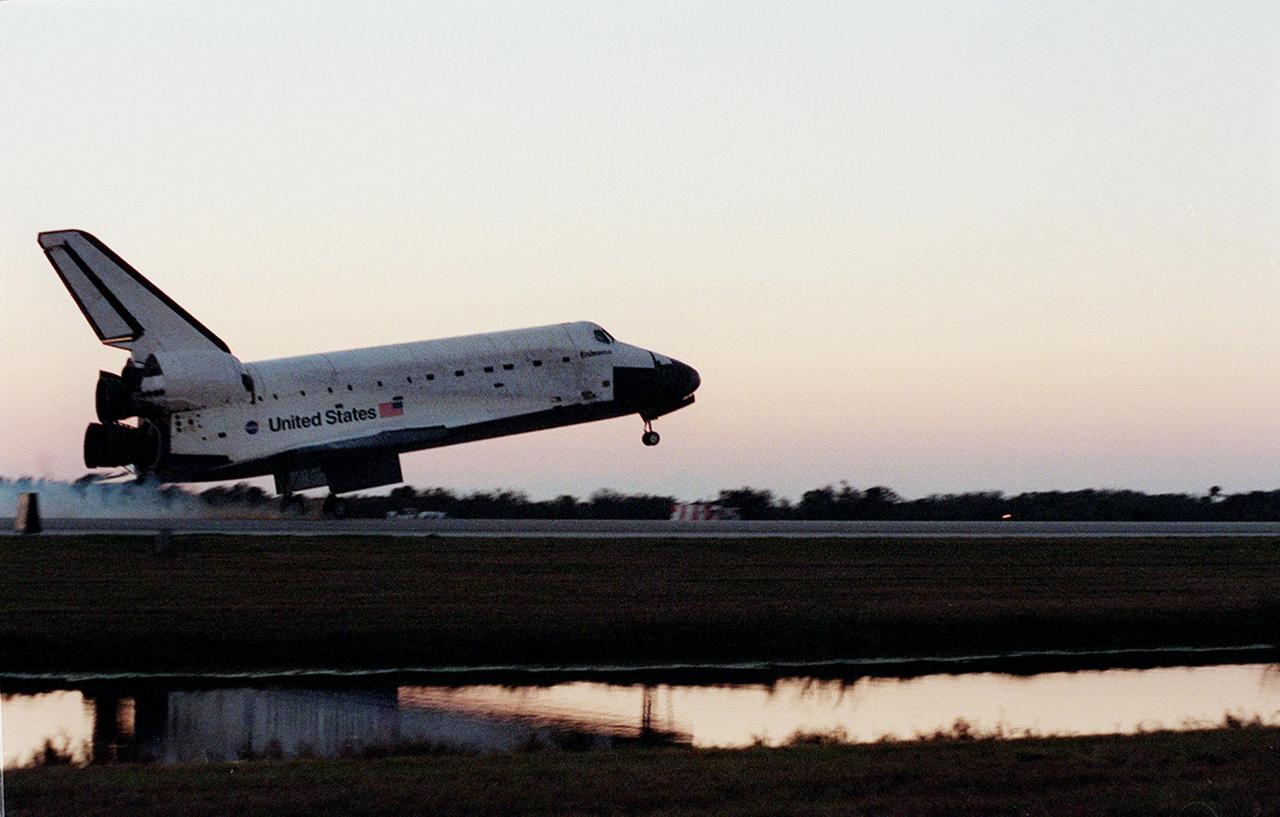
KENNEDY SPACE CENTER, Fla. -- The nearby water reflects Space Shuttle Endeavour as it touches down on KSC's Shuttle Landing Facility Runway 33 to complete the 11-day, 5-hour, 38-minute-long STS-99 mission. Main gear touchdown was at 6:22:23 p.m. EST Feb. 22 , landing on orbit 181 of the mission. Nose gear touchdown was at 6:22:35 p.m.. EST, and wheel stop at 6:23:25 p.m. EST. At the controls are Commander Kevin Kregel and Pilot Dominic Gorie. Also onboard the orbiter are Mission Specialists Janet Kavandi, Janice Voss, Mamoru Mohri of Japan and Gerhard Thiele of Germany. Mohri is with the National Space Development Agency (NASDA) and Thiele is with the European Space Agency. The crew are returning from the Shuttle Radar Topography Mission, after mapping more than 47 million square miles of the Earth. This was the 97th flight in the Space Shuttle program and the 14th for Endeavour, also marking the 50th landing at KSC, the 21st consecutive landing at KSC, and the 28th in the last 29 Shuttle flights
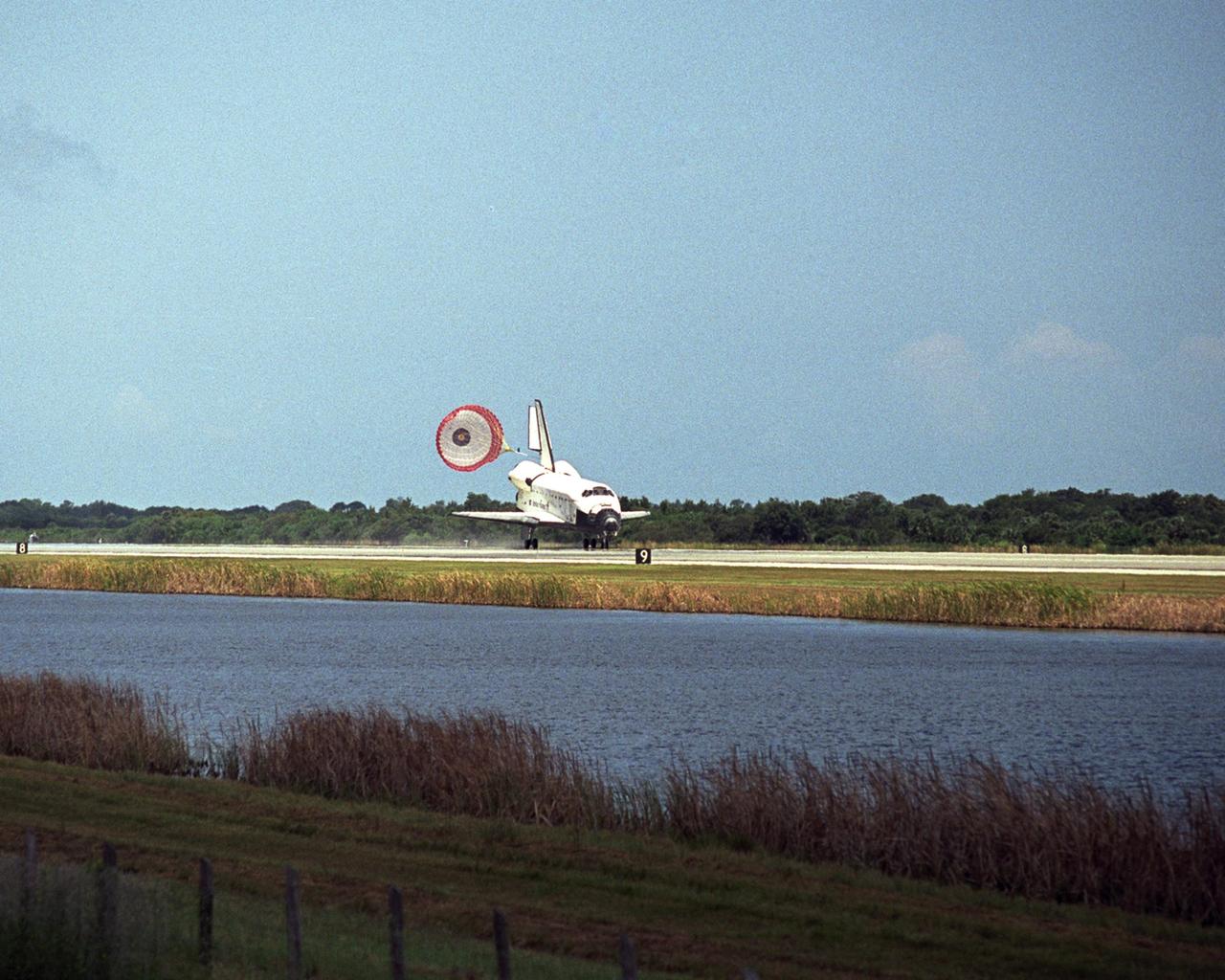
KENNEDY SPACE CENTER, FLA. -- Blue sky and blue water sandwich Endeavour as it rolls to a stop with the aid of a drag chute on runway 15 at NASA's Kennedy Space Center. The landing completes mission STS-118 to the International Space Station. The mission began Aug. 8 and installed a new gyroscope, an external spare parts platform and another truss segment to the expanding station. Endeavour's main gear touched down at 12:32:16 p.m. EDT. Nose gear touchdown was at 12:32:29 p.m. and wheel stop was at 12:33:20 p.m. Endeavour traveled nearly 5.3 million miles, landing on orbit 201. STS-118 was the 119th space shuttle flight, the 22nd flight to the station, the 20th flight for Endeavour and the second of four missions planned for 2007. This was the 65th landing of an orbiter at Kennedy. Photo credit: NASA/Tony Gray
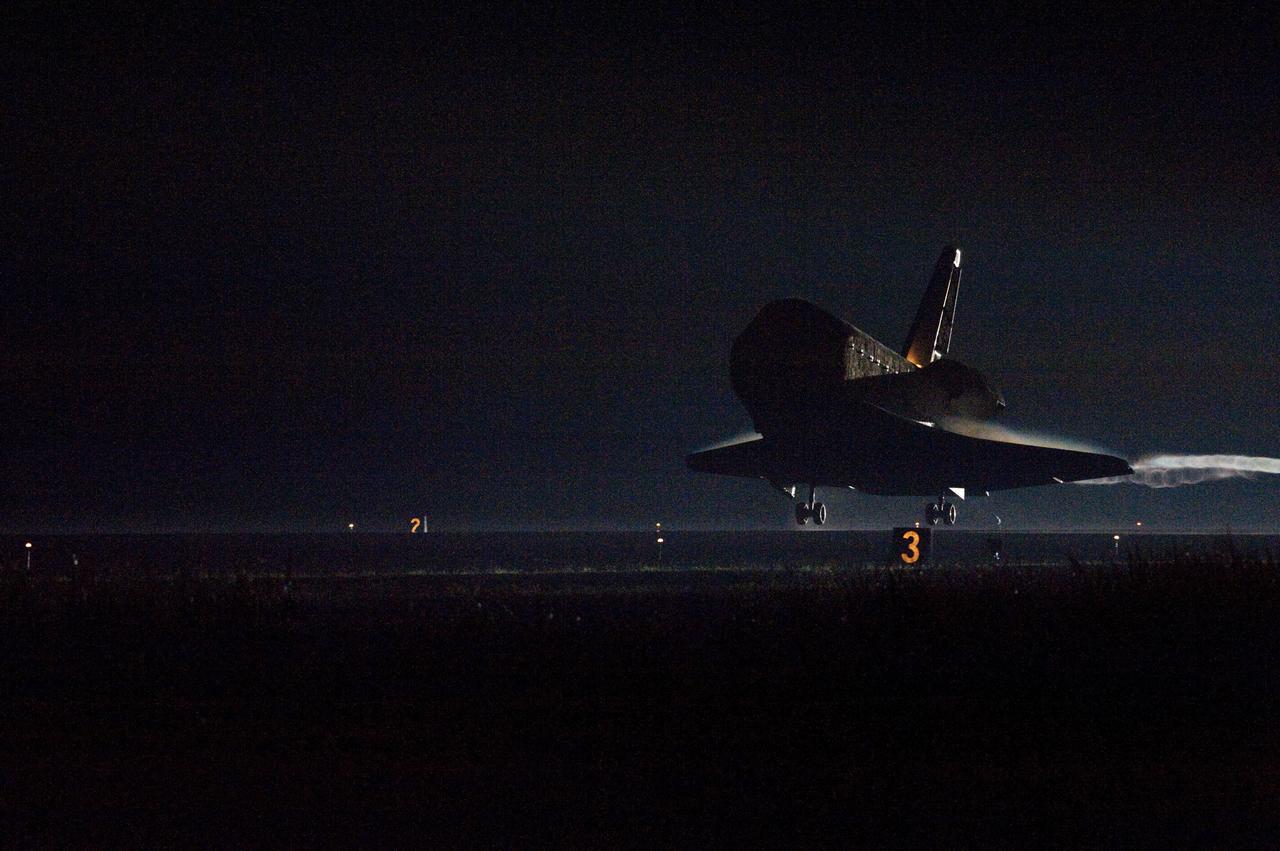
CAPE CANAVERAL, Fla. -- A vapor trail follows space shuttle Endeavour as it approaches Runway 15 on the Shuttle Landing Facility at NASA's Kennedy Space Center in Florida for the final time. A vapor trail, known as a contrail, is a cloud of water vapor that condenses and freezes around the small particles in aircraft exhaust. Main gear touchdown was at 2:34:51 a.m. EDT, followed by nose gear touchdown at 2:35:04 a.m., and wheelstop at 2:35:36 a.m. On board are STS-134 Commander Mark Kelly, Pilot Greg H. Johnson, and Mission Specialists Mike Fincke, Drew Feustel, Greg Chamitoff and the European Space Agency's Roberto Vittori. STS-134 delivered the Alpha Magnetic Spectrometer-2 (AMS) and the Express Logistics Carrier-3 (ELC-3) to the International Space Station. AMS will help researchers understand the origin of the universe and search for evidence of dark matter, strange matter and antimatter from the station. ELC-3 carried spare parts that will sustain station operations once the shuttles are retired from service. STS-134 was the 25th and final flight for Endeavour, which has spent 299 days in space, orbited Earth 4,671 times and traveled 122,883,151 miles. Photo credit: NASA/Tom Joseph

CAPE CANAVERAL, Fla. -- A vapor trail follows space shuttle Endeavour as it approaches Runway 15 on the Shuttle Landing Facility at NASA's Kennedy Space Center in Florida for the final time. A vapor trail, known as a contrail, is a cloud of water vapor that condenses and freezes around the small particles in aircraft exhaust. Main gear touchdown was at 2:34:51 a.m. EDT, followed by nose gear touchdown at 2:35:04 a.m., and wheelstop at 2:35:36 a.m. On board are STS-134 Commander Mark Kelly, Pilot Greg H. Johnson, and Mission Specialists Mike Fincke, Drew Feustel, Greg Chamitoff and the European Space Agency's Roberto Vittori. STS-134 delivered the Alpha Magnetic Spectrometer-2 (AMS) and the Express Logistics Carrier-3 (ELC-3) to the International Space Station. AMS will help researchers understand the origin of the universe and search for evidence of dark matter, strange matter and antimatter from the station. ELC-3 carried spare parts that will sustain station operations once the shuttles are retired from service. STS-134 was the 25th and final flight for Endeavour, which has spent 299 days in space, orbited Earth 4,671 times and traveled 122,883,151 miles. Photo credit: NASA/Chuck Tintera
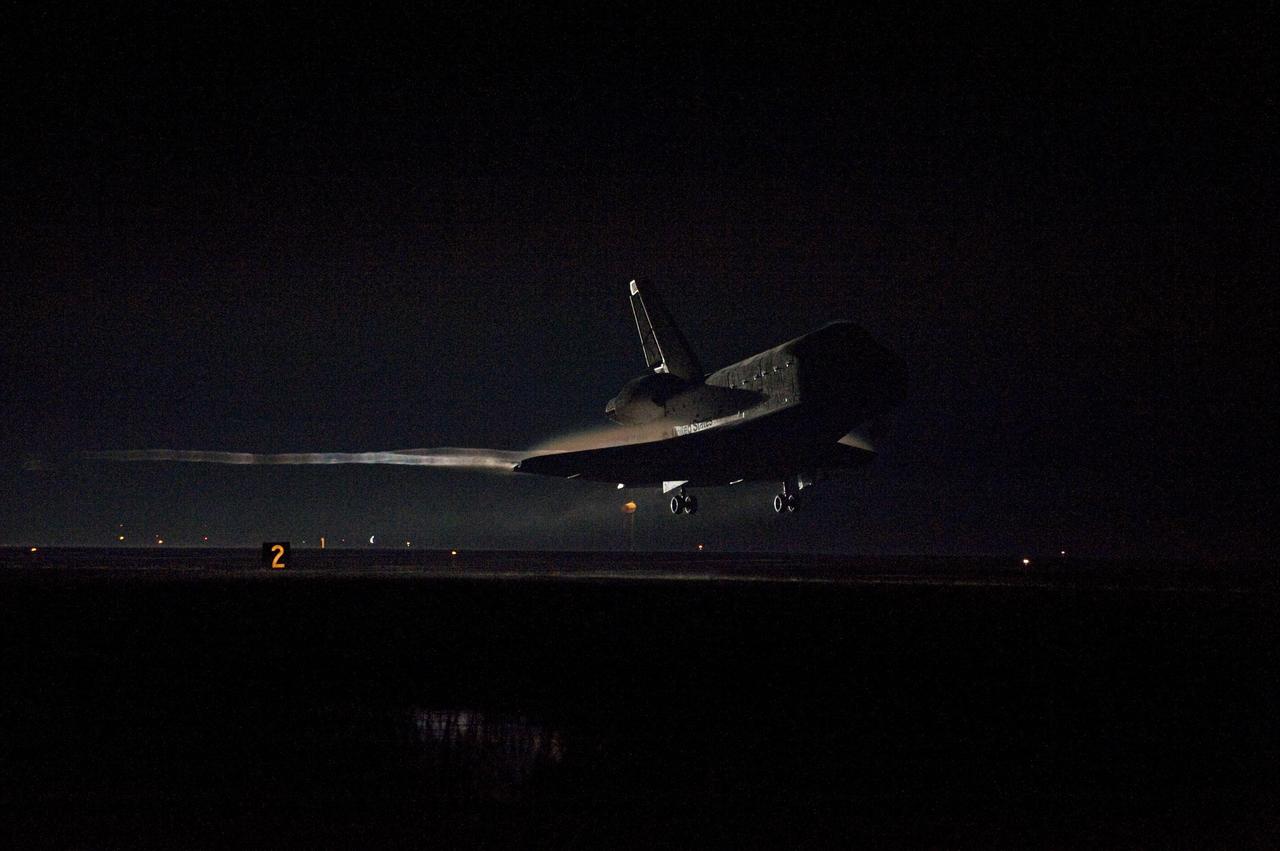
CAPE CANAVERAL, Fla. -- Vapor trails follow space shuttle Endeavour as it approaches Runway 15 on the Shuttle Landing Facility at NASA's Kennedy Space Center in Florida for the final time. A vapor trail, known as a contrail, is a cloud of water vapor that condenses and freezes around the small particles in aircraft exhaust. Main gear touchdown was at 2:34:51 a.m. EDT, followed by nose gear touchdown at 2:35:04 a.m., and wheelstop at 2:35:36 a.m. On board are STS-134 Commander Mark Kelly, Pilot Greg H. Johnson, and Mission Specialists Mike Fincke, Drew Feustel, Greg Chamitoff and the European Space Agency's Roberto Vittori. STS-134 delivered the Alpha Magnetic Spectrometer-2 (AMS) and the Express Logistics Carrier-3 (ELC-3) to the International Space Station. AMS will help researchers understand the origin of the universe and search for evidence of dark matter, strange matter and antimatter from the station. ELC-3 carried spare parts that will sustain station operations once the shuttles are retired from service. STS-134 was the 25th and final flight for Endeavour, which has spent 299 days in space, orbited Earth 4,671 times and traveled 122,883,151 miles. Photo credit: NASA/Kevin O'Connell
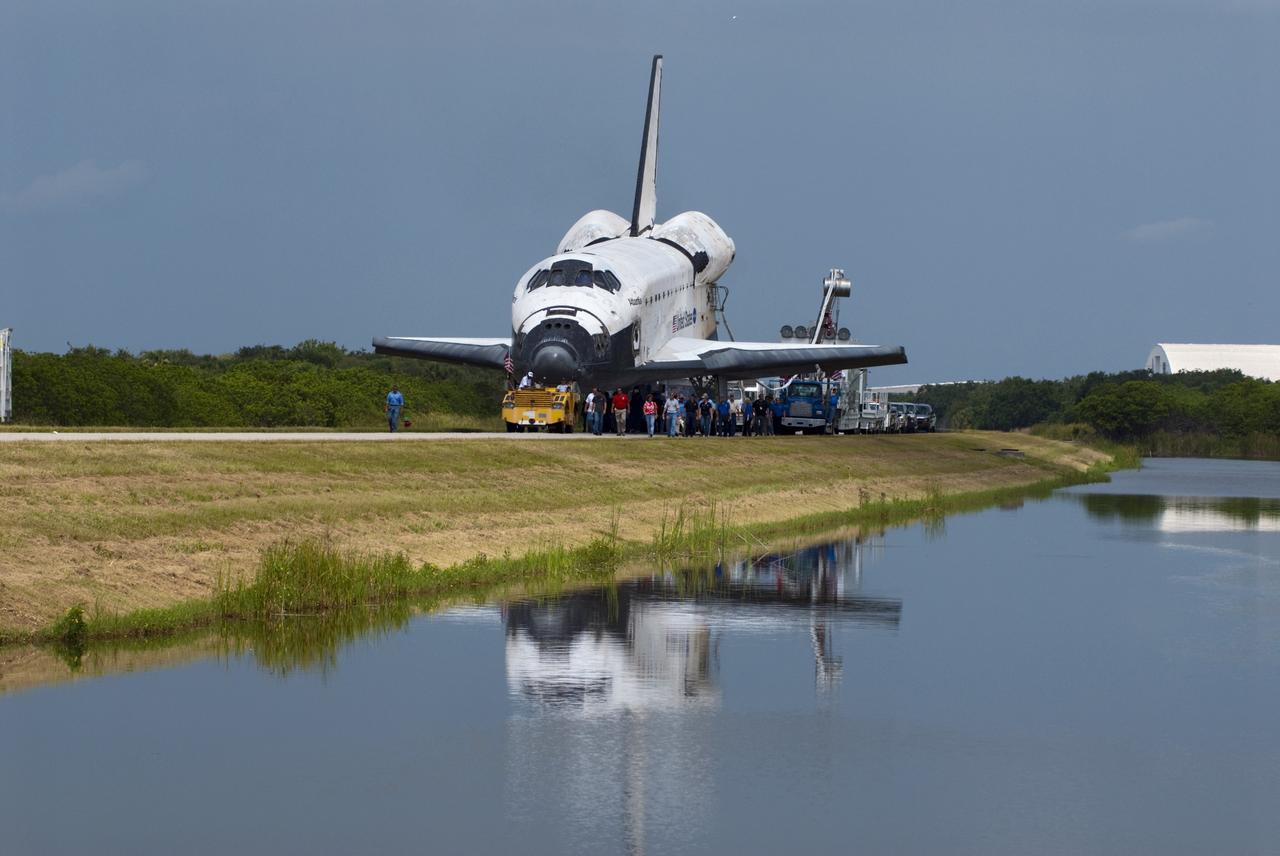
CAPE CANAVERAL, Fla. -- Space shuttle Atlantis is reflected in the water along the towway from the Shuttle Landing Facility to the Orbiter Processing Facility at NASA's Kennedy Space Center in Florida. Atlantis' final return from space at 5:57 a.m. EDT concluded the STS-135 mission, secured the space shuttle fleet's place in history and brought a close to America's Space Shuttle Program. Main gear touchdown was at 5:57:00 a.m. EDT, followed by nose gear touchdown at 5:57:20 a.m., and wheelstop at 5:57:54 a.m. On board were STS-135 Commander Chris Ferguson, Pilot Doug Hurley, and Mission Specialists Sandra Magnus and Rex Walheim. On the 37th shuttle mission to the International Space Station, STS-135 delivered the Raffaello multi-purpose logistics module filled with more than 9,400 pounds of spare parts, equipment and supplies that will sustain station operations for the next year. STS-135 was the 33rd and final flight for Atlantis, which has spent 307 days in space, orbited Earth 4,848 times and traveled 125,935,769 miles, and also the final mission of the Space Shuttle Program. For more information, visit www.nasa.gov/mission_pages/shuttle/shuttlemissions/sts135/index.html. Photo credit: NASA/Kim Shiflett
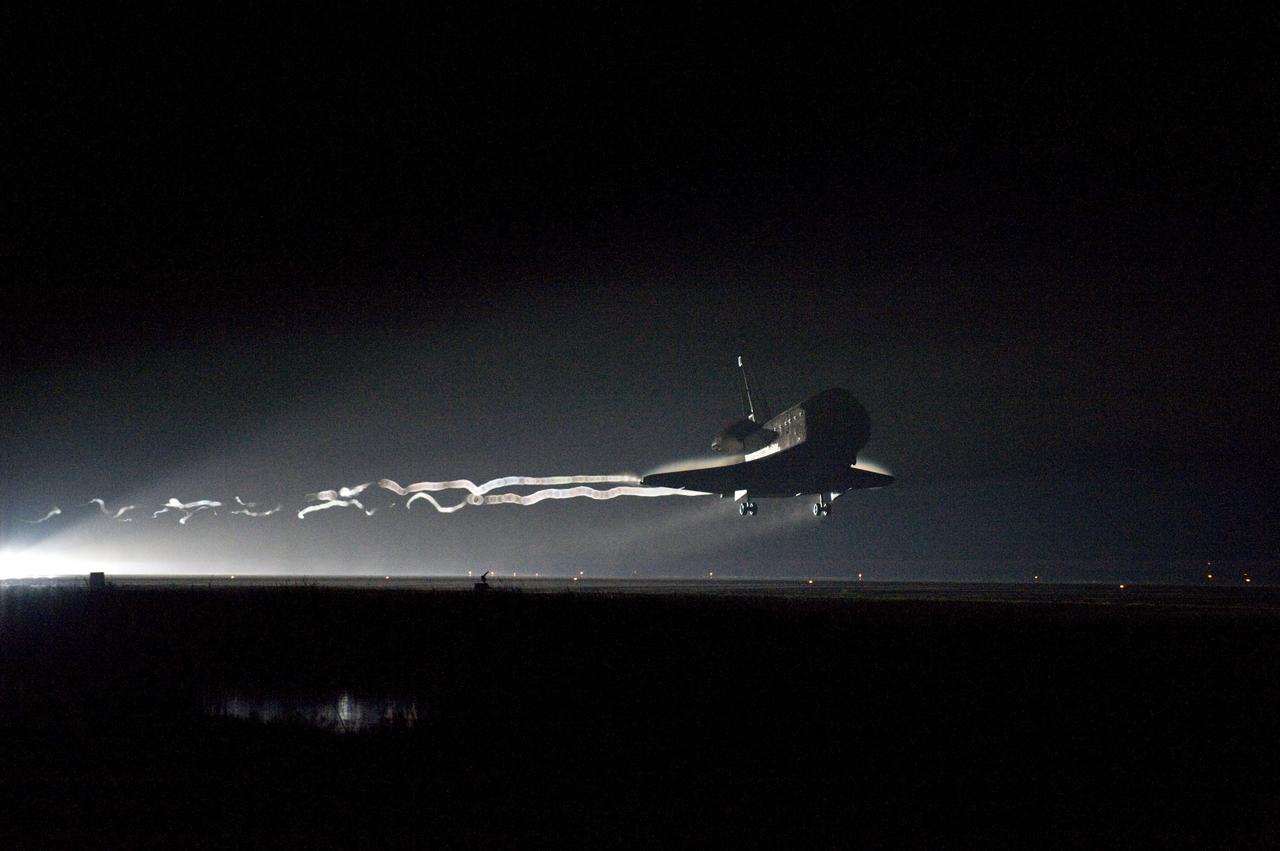
CAPE CANAVERAL, Fla. -- Vapor trails follow space shuttle Endeavour as it approaches Runway 15 on the Shuttle Landing Facility at NASA's Kennedy Space Center in Florida for the final time. A vapor trail, known as a contrail, is a cloud of water vapor that condenses and freezes around the small particles in aircraft exhaust. Main gear touchdown was at 2:34:51 a.m. EDT, followed by nose gear touchdown at 2:35:04 a.m., and wheelstop at 2:35:36 a.m. On board are STS-134 Commander Mark Kelly, Pilot Greg H. Johnson, and Mission Specialists Mike Fincke, Drew Feustel, Greg Chamitoff and the European Space Agency's Roberto Vittori. STS-134 delivered the Alpha Magnetic Spectrometer-2 (AMS) and the Express Logistics Carrier-3 (ELC-3) to the International Space Station. AMS will help researchers understand the origin of the universe and search for evidence of dark matter, strange matter and antimatter from the station. ELC-3 carried spare parts that will sustain station operations once the shuttles are retired from service. STS-134 was the 25th and final flight for Endeavour, which has spent 299 days in space, orbited Earth 4,671 times and traveled 122,883,151 miles. Photo credit: NASA/Kevin O'Connell

KENNEDY SPACE CENTER, FLA. -- The orbiter Discovery nears touchdown on Runway 15 of KSC's Shuttle Landing Facility (SLF) to complete the STS-91 mission. The SLF is nestled among the wilds of the Merritt Island National Wildlife Refuge, as is apparent from the abundance of native vegetation and water surrounding the landing strip. Main gear touchdown was at 2:00:18 p.m. EDT on June 12, 1998, landing on orbit 155 of the mission. The wheels stopped at 2:01:22 p.m. EDT, for a total mission-elapsed time of 9 days, 19 hours, 55 minutes and 1 second. The 91st Shuttle mission was the 44th KSC landing in the history of the Space Shuttle program and the 15th consecutive landing at KSC. During the mission, the orbiter docked with the Russian space station Mir for the ninth time, concluding Phase I of the joint U.S.-Russian International Space Station Program. STS-91 also featured first flights for both the Alpha Magnetic Spectrometer and the Space Shuttle super lightweight external tank. The STS-91 flight crew included Mission Commander Charles J. Precourt; Pilot Dominic L. Gorie; and Mission Specialists Wendy B. Lawrence, Franklin R. Chang-Diaz, Janet Lynn Kavandi and Valery Victorovitch Ryumin of the Russian Space Agency. Astronaut Andrew S. W. Thomas also returned to Earth from Mir as an STS-91 crew member after 141 days in space
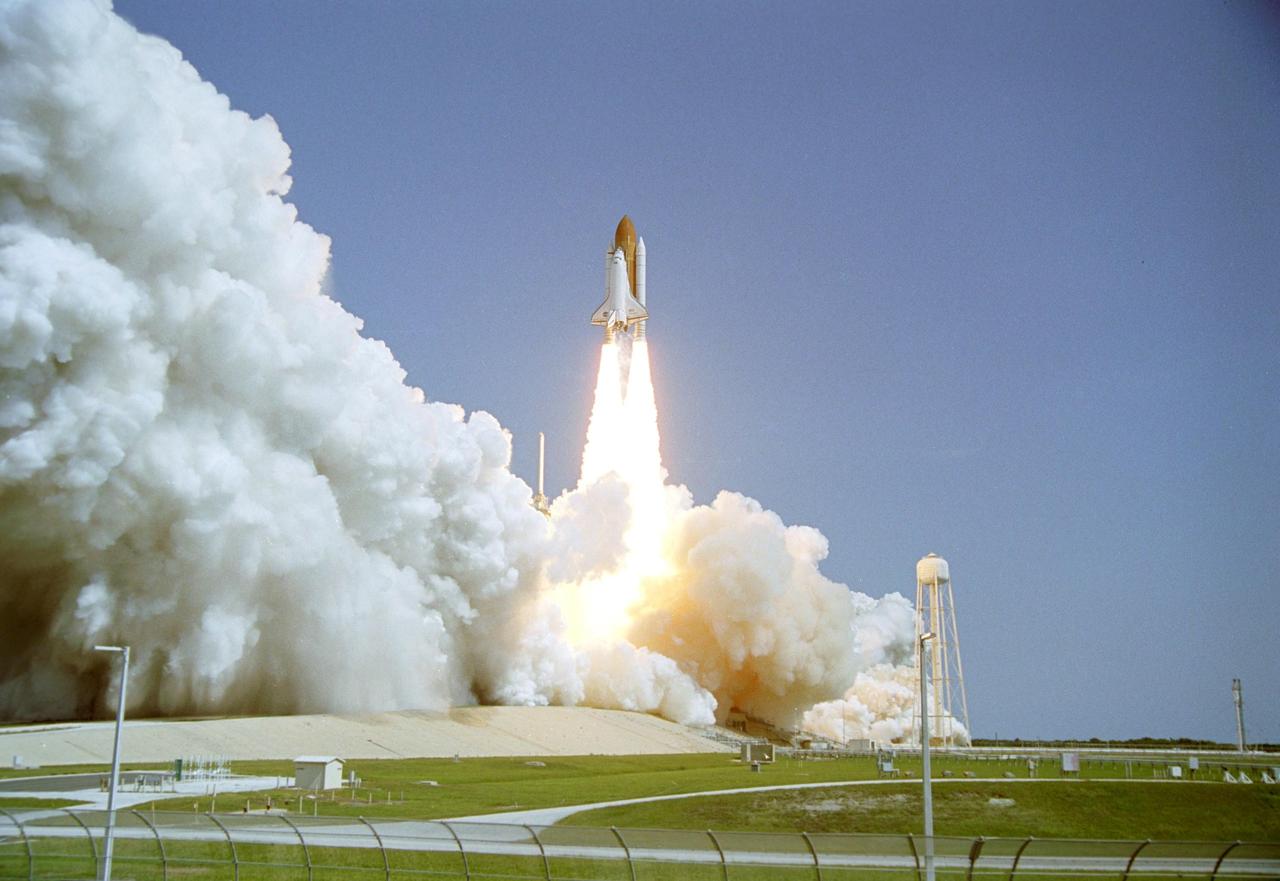
KENNEDY SPACE CENTER, FLA. - As billows of smoke and steam roll away, Space Shuttle Discovery leaps from Launch Pad 39B on the historic Return to Flight mission STS-114. Liftoff occurred at 10:39 a.m. EDT. At right is the 290-foot water tower that holds the 300,000 gallons of water that flood the pad for sound suppression. This is the 114th Space Shuttle flight and the 31st for Discovery. The 12-day mission is expected to end with touchdown at the Shuttle Landing Facility on Aug. 7. On this mission to the International Space Station the crew will perform inspections on-orbit for the first time of all of the Reinforced Carbon-Carbon (RCC) panels on the leading edge of the wings and the Thermal Protection System tiles using the new Canadian-built Orbiter Boom Sensor System and the data from 176 impact and temperature sensors. Mission Specialists will also practice repair techniques on RCC and tile samples during a spacewalk in the payload bay. During two additional spacewalks, the crew will install the External Stowage Platform-2, equipped with spare part assemblies, and a replacement Control Moment Gyroscope contained in the Lightweight Multi-Purpose Experiment Support Structure.
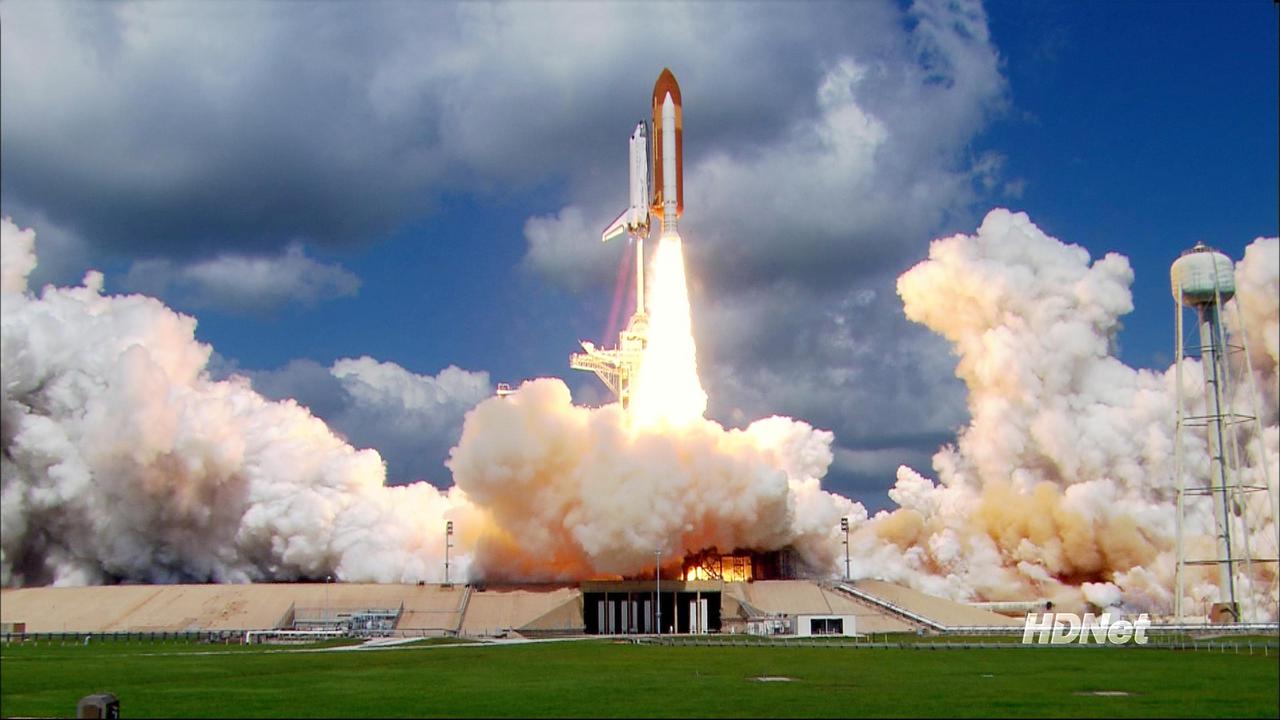
KENNEDY SPACE CENTER, FLA. - As billows of smoke and steam roll away, Space Shuttle Discovery leaps from Launch Pad 39B on the historic Return to Flight mission STS-114. Liftoff occurred at 10:39 a.m. EDT. At right is the 290-foot water tower that holds the 300,000 gallons of water that flood the pad for sound suppression. This is the 114th Space Shuttle flight and the 31st for Discovery. The 12-day mission is expected to end with touchdown at the Shuttle Landing Facility on Aug. 7. On this mission to the International Space Station the crew will perform inspections on-orbit for the first time of all of the Reinforced Carbon-Carbon (RCC) panels on the leading edge of the wings and the Thermal Protection System tiles using the new Canadian-built Orbiter Boom Sensor System and the data from 176 impact and temperature sensors. Mission Specialists will also practice repair techniques on RCC and tile samples during a spacewalk in the payload bay. During two additional spacewalks, the crew will install the External Stowage Platform-2, equipped with spare part assemblies, and a replacement Control Moment Gyroscope contained in the Lightweight Multi-Purpose Experiment Support Structure. This photo is a freeze frame provided by HDNet, a national television network broadcasting high-definition television, located in Denver, Colo.
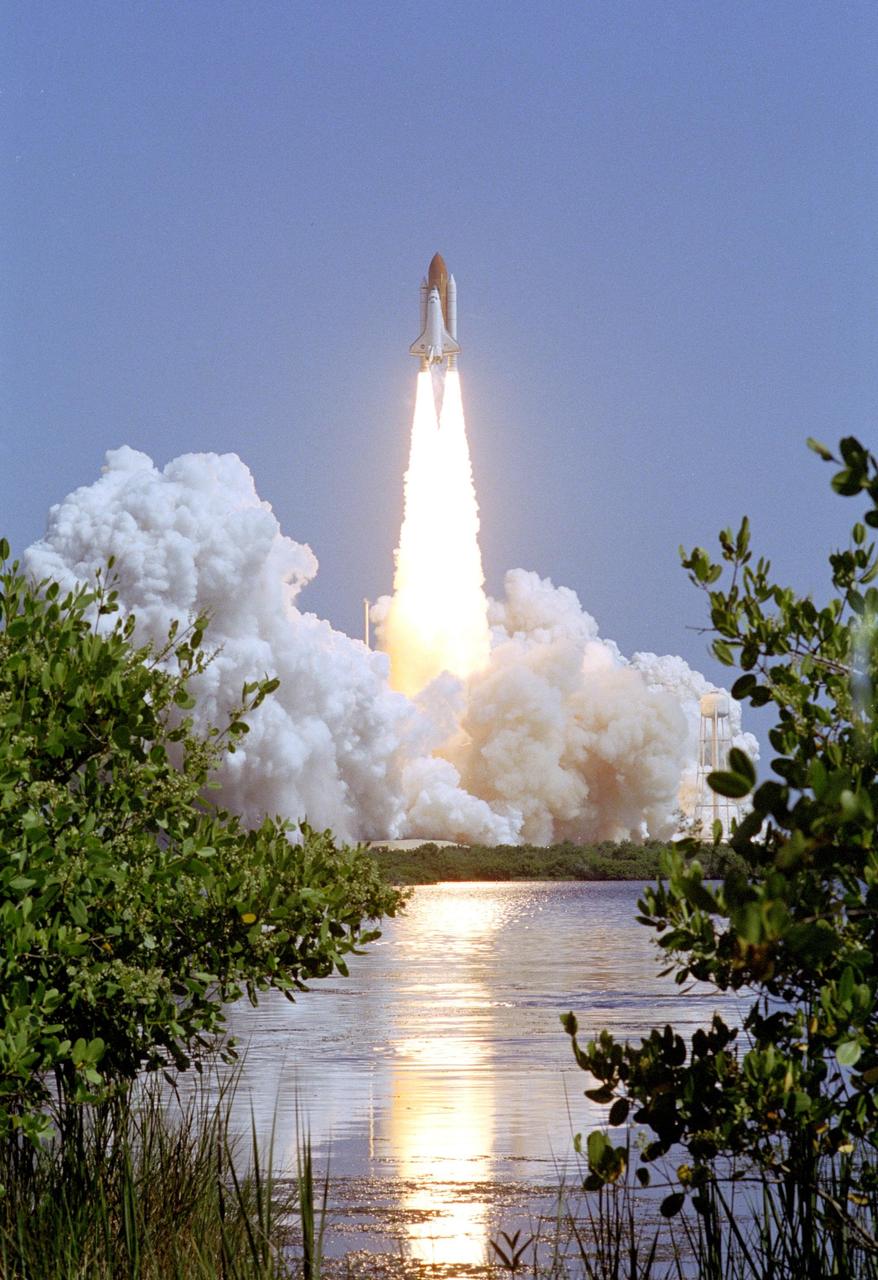
KENNEDY SPACE CENTER, FLA. - The flames of Space Shuttle Discovery’s Solid Rocket Boosters are reflected in the water next to Launch Pad 39B as the Shuttle leaps from the pad on the historic Return to Flight mission STS-114. Liftoff occurred at 10:39 a.m. EDT. It is the 114th Space Shuttle flight and the 31st for Discovery. The 12-day mission is expected to end with touchdown at the Shuttle Landing Facility on Aug. 7. On this mission to the International Space Station the crew will perform inspections on-orbit for the first time of all of the Reinforced Carbon-Carbon (RCC) panels on the leading edge of the wings and the Thermal Protection System tiles using the new Canadian-built Orbiter Boom Sensor System and the data from 176 impact and temperature sensors. Mission Specialists will also practice repair techniques on RCC and tile samples during a spacewalk in the payload bay. During two additional spacewalks, the crew will install the External Stowage Platform-2, equipped with spare part assemblies, and a replacement Control Moment Gyroscope contained in the Lightweight Multi-Purpose Experiment Support Structure.
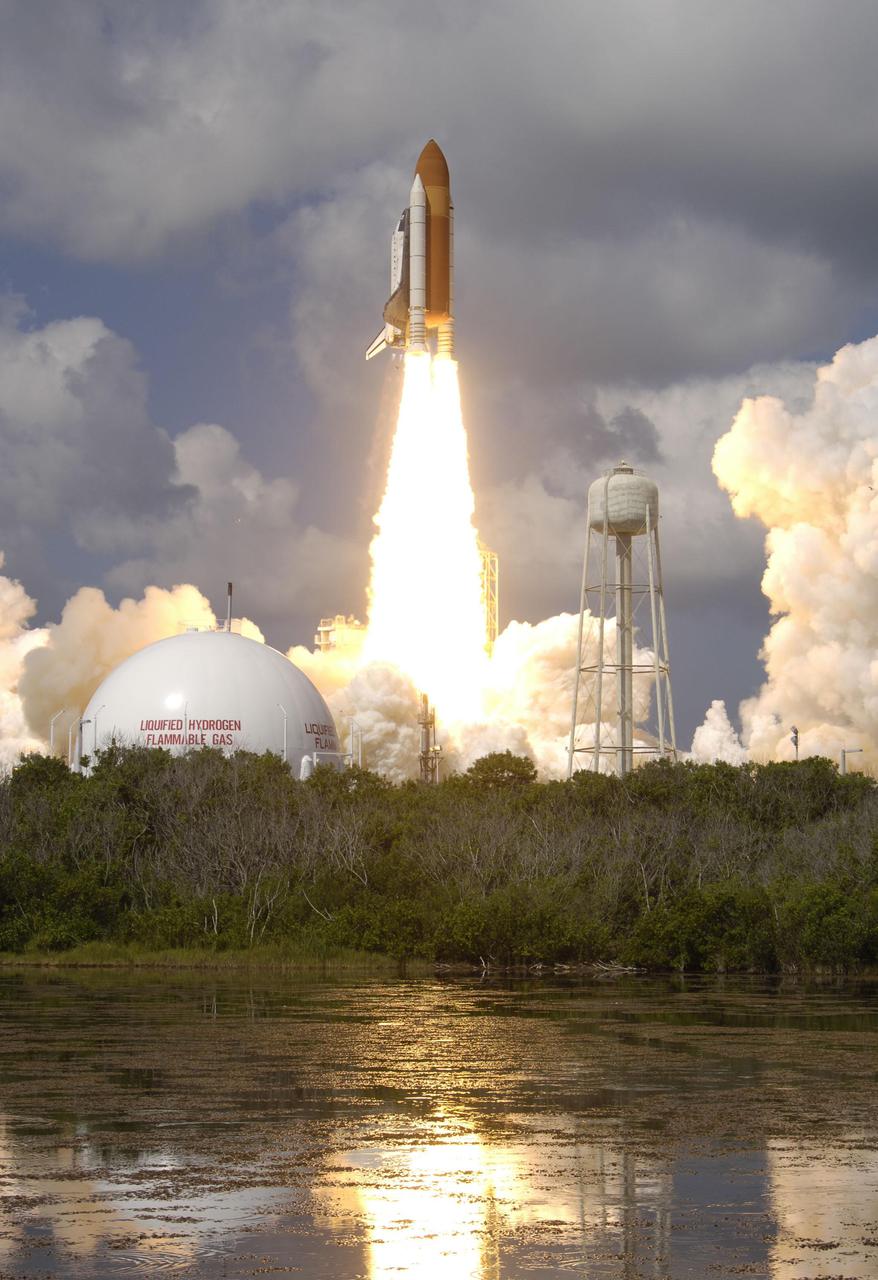
KENNEDY SPACE CENTER, FLA. - Seeming to erupt from between the liquefied hydrogen gas tank on the left and 290-foot water tower on the right, Space Shuttle Discovery roars into the cloud-filled sky from Launch Pad 39B. Discovery is launching on the historic Return to Flight mission STS-114. It is the 114th flight in the Space Shuttle Program and the 31st for Discovery. The 12-day mission is expected to end with touchdown at the Shuttle Landing Facility on Aug. 7. On this mission to the International Space Station the crew will perform inspections on-orbit for the first time of all of the Reinforced Carbon-Carbon (RCC) panels on the leading edge of the wings and the Thermal Protection System tiles using the new Canadian-built Orbiter Boom Sensor System and the data from 176 impact and temperature sensors. Mission Specialists will also practice repair techniques on RCC and tile samples during a spacewalk in the payload bay. During two additional spacewalks, the crew will install the External Stowage Platform-2, equipped with spare part assemblies, and a replacement Control Moment Gyroscope contained in the Lightweight Multi-Purpose Experiment Support Structure. (Photo Credit: Scott Andrews)
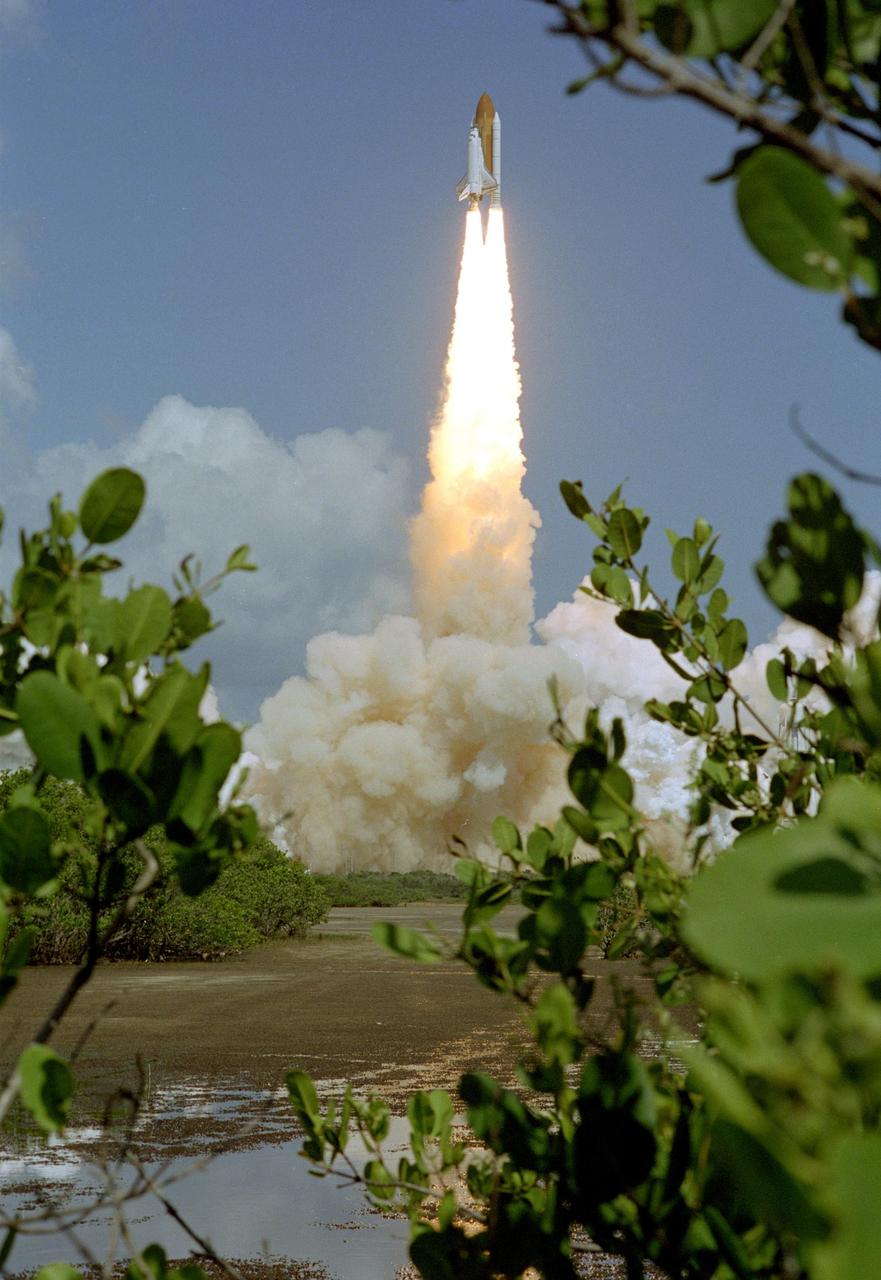
KENNEDY SPACE CENTER, FLA. - Viewed from a camera in the midst of Florida greenery across the marshy water, Space Shuttle Discovery leaps through billows of smoke and steam on Launch Pad 39B on the historic Return to Flight mission STS-114. Liftoff occurred at 10:39 a.m. EDT. This is the 114th Space Shuttle flight and the 31st for Discovery. The 12-day mission is expected to end with touchdown at the Shuttle Landing Facility on Aug. 7. On this mission to the International Space Station the crew will perform inspections on-orbit for the first time of all of the Reinforced Carbon-Carbon (RCC) panels on the leading edge of the wings and the Thermal Protection System tiles using the new Canadian-built Orbiter Boom Sensor System and the data from 176 impact and temperature sensors. Mission Specialists will also practice repair techniques on RCC and tile samples during a spacewalk in the payload bay. During two additional spacewalks, the crew will install the External Stowage Platform-2, equipped with spare part assemblies, and a replacement Control Moment Gyroscope contained in the Lightweight Multi-Purpose Experiment Support Structure.
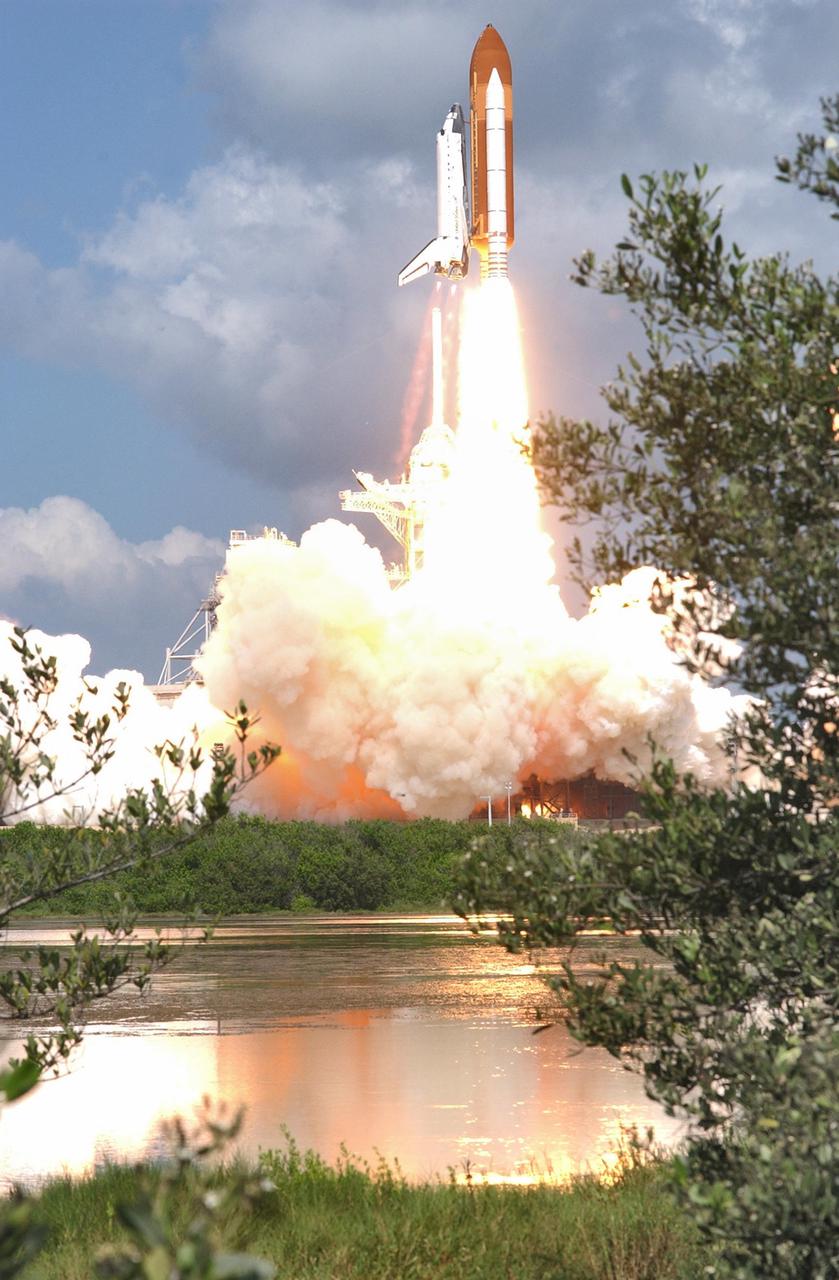
KENNEDY SPACE CENTER, FLA. - Water near Launch Pad 39B is washed in colors from the launch of Space Shuttle Discovery at 10:39 a.m. EDT on the historic Return to Flight mission STS-114. It is the 114th Space Shuttle flight and the 31st for Discovery. The 12-day mission is expected to end with touchdown at the Shuttle Landing Facility on Aug. 7. On this mission to the International Space Station the crew will perform inspections on-orbit for the first time of all of the Reinforced Carbon-Carbon (RCC) panels on the leading edge of the wings and the Thermal Protection System tiles using the new Canadian-built Orbiter Boom Sensor System and the data from 176 impact and temperature sensors. Mission Specialists will also practice repair techniques on RCC and tile samples during a spacewalk in the payload bay. During two additional spacewalks, the crew will install the External Stowage Platform-2, equipped with spare part assemblies, and a replacement Control Moment Gyroscope contained in the Lightweight Multi-Purpose Experiment Support Structure.
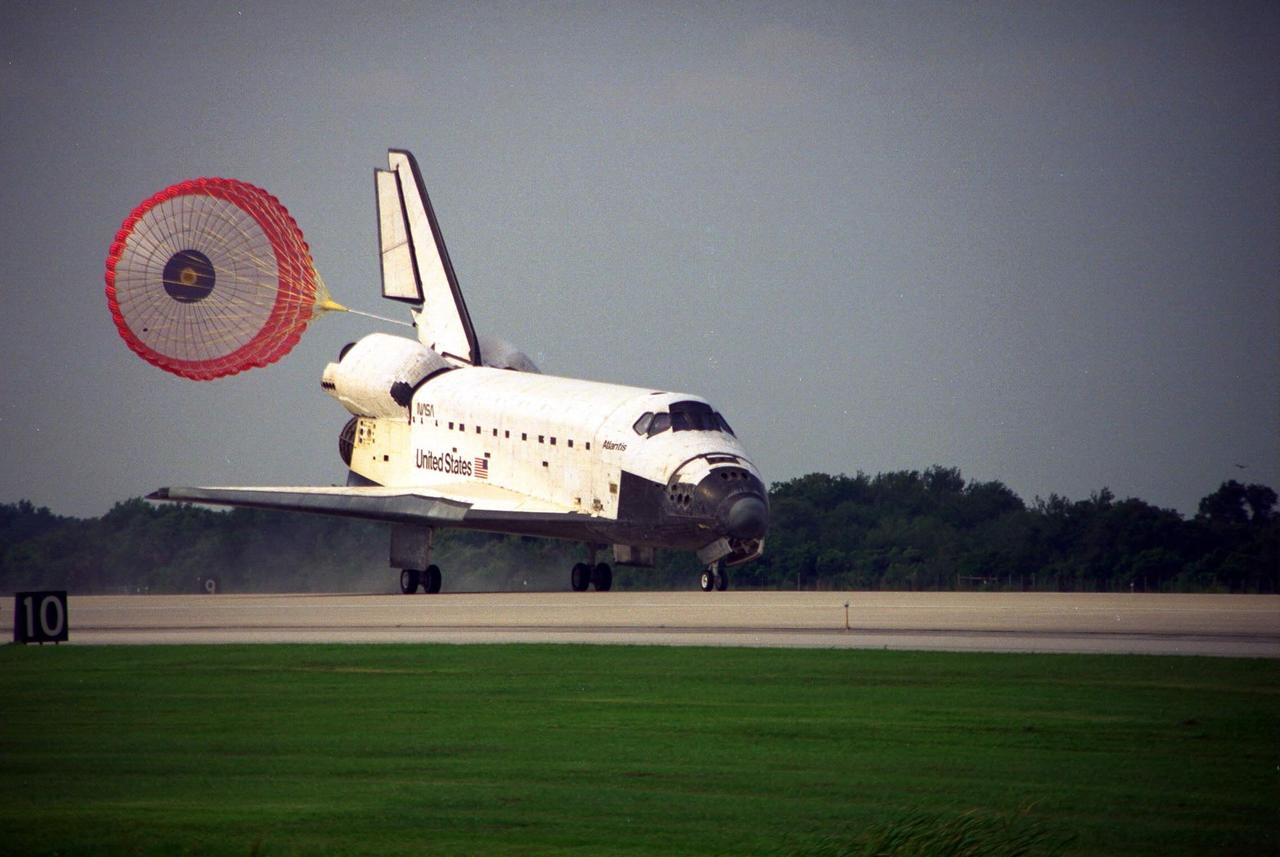
The orbiter drag chute deploys after Atlantis touches down on Runway 33 of KSC’s Shuttle Landing Facility at the conclusion of the nine-day STS-84 mission. Main gear touchdown was at 9:27:44 EDT on May 24, 1997. The first landing opportunity was waved off because of low cloud cover. It was the 37th landing at KSC since the Shuttle program began in 1981, and the eighth consecutive landing at KSC. STS-84 was the sixth of nine planned dockings of the Space Shuttle with the Russian Space Station Mir. Atlantis was docked with the Mir for five days. STS-84 Mission Specialist C. Michael Foale replaced astronaut and Mir 23 crew member Jerry M. Linenger, who has been on the Russian space station since Jan. 15. Linenger returned to Earth on Atlantis with the rest of the STS-84 crew, Mission Commander Charles J. Precourt, Pilot Eileen Marie Collins, and Mission Specialists Carlos I. Noriega, Edward Tsang Lu, Elena V. Kondakova of the Russian Space Agency and JeanFrancois Clervoy of the European Space Agency. Foale is scheduled to remain on the Mir for approximately four months, until he is replaced by STS-86 crew member Wendy B. Lawrence in September. Besides the docking and crew exchange, STS-84 included the transfer of more than 7,300 pounds of water, logistics and science experiments and hardware to and from the Mir. Scientific experiments conducted during the STS-84 mission, and scheduled for Foale’s stay on the Mir, are in the fields of advanced technology, Earth sciences, fundamental biology, human life sciences, International Space Station risk mitigation, microgravity sciences and space sciences
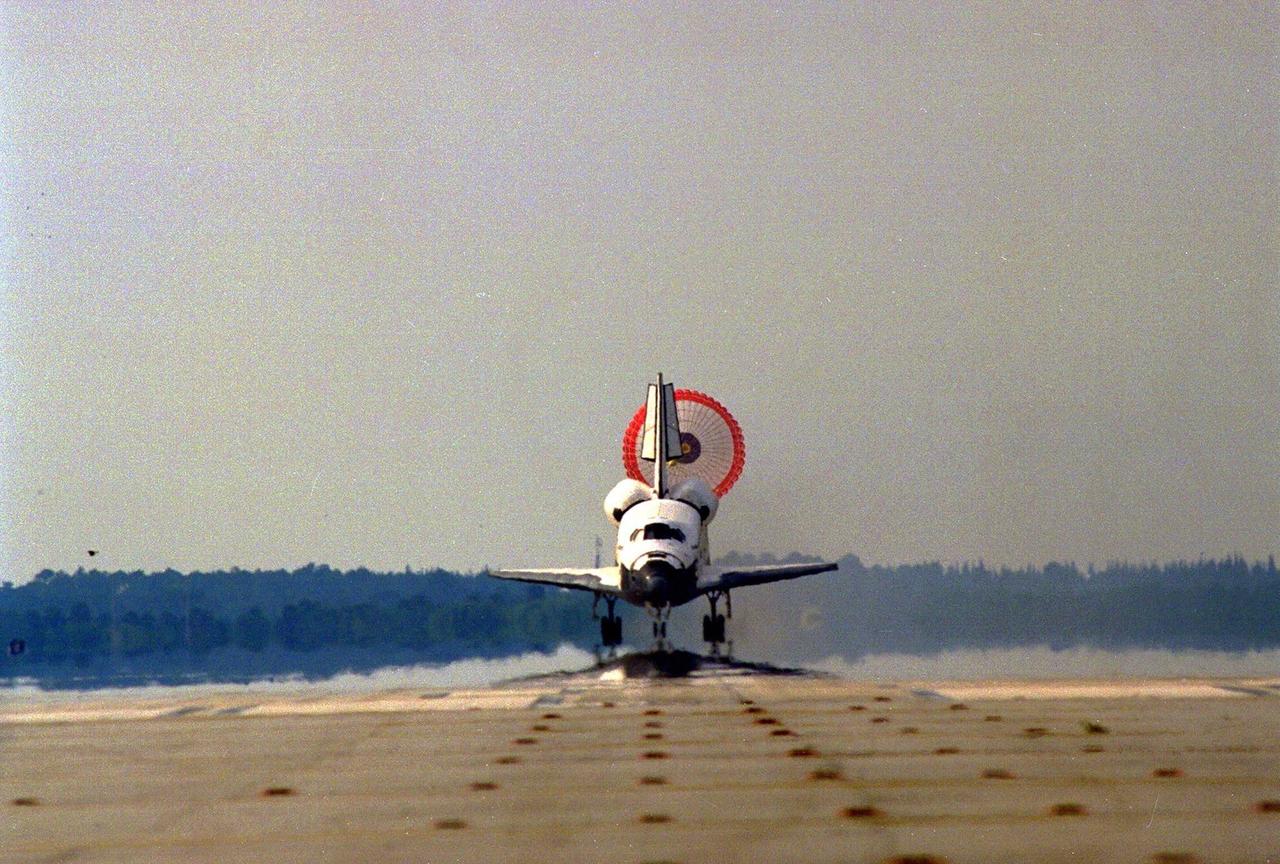
The orbiter drag chute deploys after Atlantis touches down on Runway 33 of KSC’s Shuttle Landing Facility at the conclusion of the nine-day STS-84 mission. Main gear touchdown was at 9:27:44 EDT on May 24, 1997. The first landing opportunity was waved off because of low cloud cover. It was the 37th landing at KSC since the Shuttle program began in 1981, and the eighth consecutive landing at KSC. STS-84 was the sixth of nine planned dockings of the Space Shuttle with the Russian Space Station Mir. Atlantis was docked with the Mir for five days. STS-84 Mission Specialist C. Michael Foale replaced astronaut and Mir 23 crew member Jerry M. Linenger, who has been on the Russian space station since Jan. 15. Linenger returned to Earth on Atlantis with the rest of the STS-84 crew, Mission Commander Charles J. Precourt, Pilot Eileen Marie Collins, and Mission Specialists Carlos I. Noriega, Edward Tsang Lu, Elena V. Kondakova of the Russian Space Agency and JeanFrancois Clervoy of the European Space Agency. Foale is scheduled to remain on the Mir for approximately four months, until he is replaced by STS-86 crew member Wendy B. Lawrence in September. Besides the docking and crew exchange, STS-84 included the transfer of more than 7,300 pounds of water, logistics and science experiments and hardware to and from the Mir. Scientific experiments conducted during the STS-84 mission, and scheduled for Foale’s stay on the Mir, are in the fields of advanced technology, Earth sciences, fundamental biology, human life sciences, International Space Station risk mitigation, microgravity sciences and space sciences
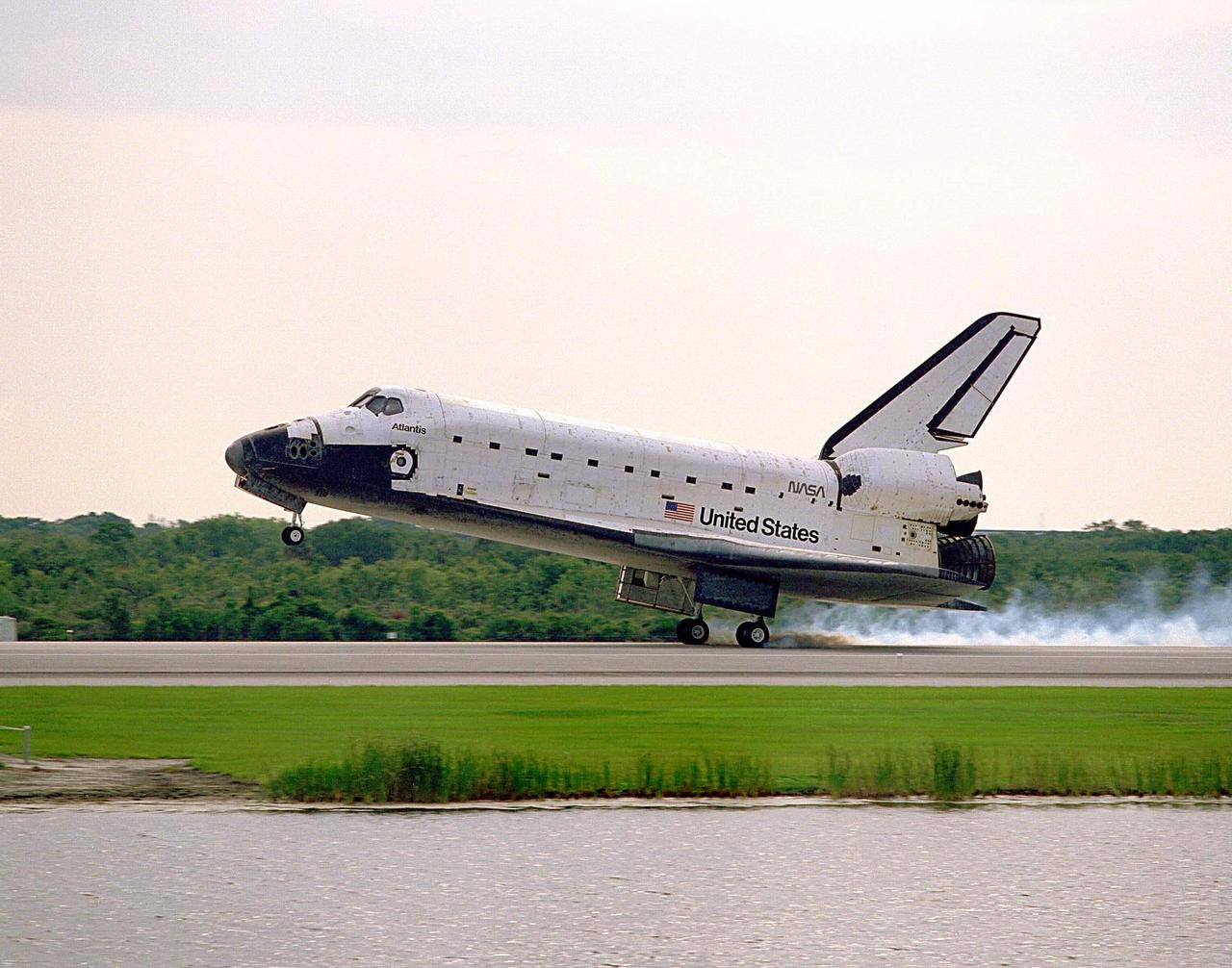
The Space Shuttle orbiter Atlantis touches down on Runway 33 of the KSC Shuttle Landing Facility, bringing to an end the nine-day STS-84 mission. Main gear touchdown was at 9:27:44 EDT on May 24, 1997. The first landing opportunity was waved off because of low cloud cover. It was the 37th landing at KSC since the Shuttle program began in 1981, and the eighth consecutive landing at KSC. STS-84 was the sixth of nine planned dockings of the Space Shuttle with the Russian Space Station Mir. Atlantis was docked with the Mir for five days. STS-84 Mission Specialist C. Michael Foale replaced astronaut and Mir 23 crew member Jerry M. Linenger, who has been on the Russian space station since Jan. 15. Linenger returned to Earth on Atlantis with the rest of the STS-84 crew, Mission Commander Charles J. Precourt, Pilot Eileen Marie Collins, and Mission Specialists Carlos I. Noriega, Edward Tsang Lu, Elena V. Kondakova of the Russian Space Agency and JeanFrancois Clervoy of the European Space Agency. Foale is scheduled to remain on the Mir for approximately four months, until he is replaced by STS-86 crew member Wendy B. Lawrence in September. Besides the docking and crew exchange, STS-84 included the transfer of more than 7,300 pounds of water, logistics and science experiments and hardware to and from the Mir. Scientific experiments conducted during the STS-84 mission, and scheduled for Foale’s stay on the Mir, are in the fields of advanced technology, Earth sciences, fundamental biology, human life sciences, International Space Station risk mitigation, microgravity sciences and space sciences
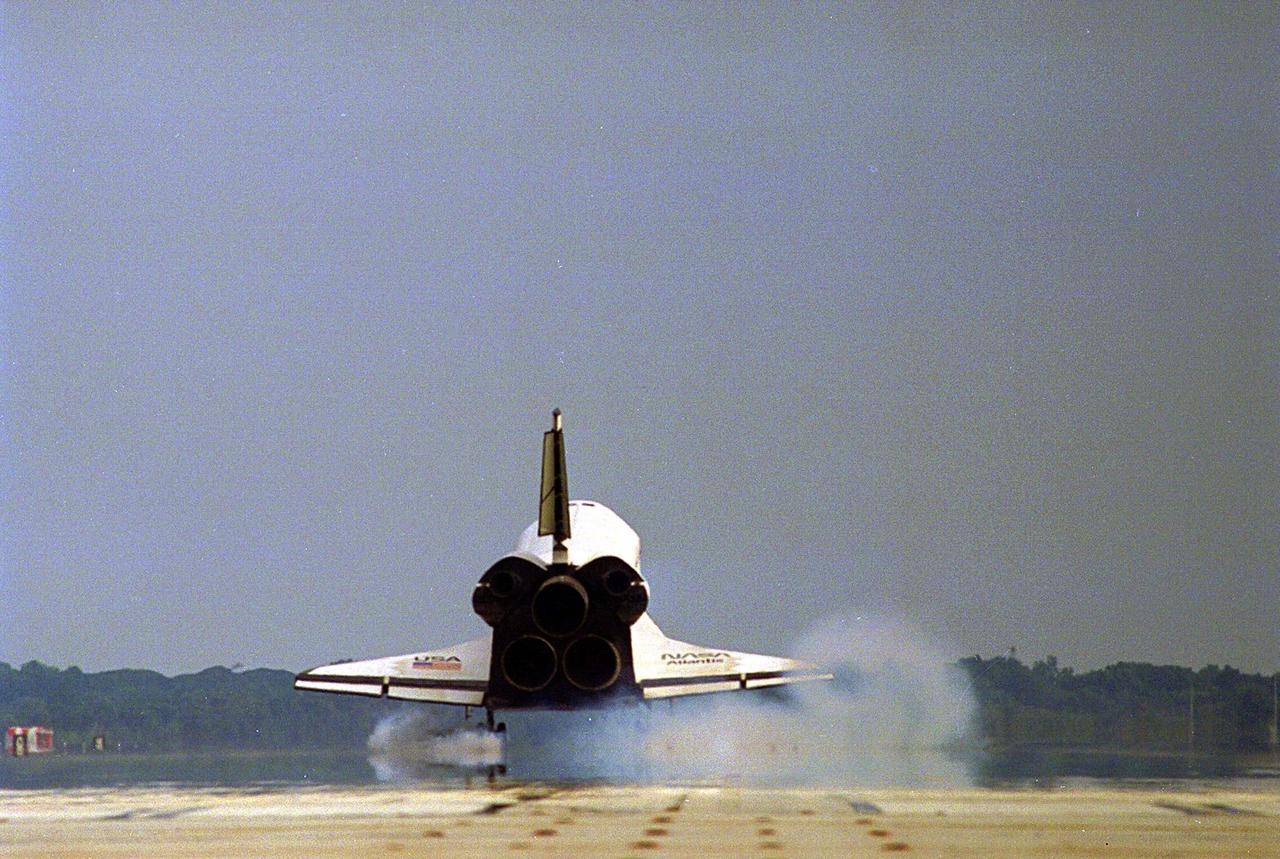
The Space Shuttle orbiter Atlantis touches down on Runway 33 of the KSC Shuttle Landing Facility, bringing to an end the nine-day STS-84 mission. Main gear touchdown was at 9:27:44 EDT on May 24, 1997. The first landing opportunity was waved off because of low cloud cover. It was the 37th landing at KSC since the Shuttle program began in 1981, and the eighth consecutive landing at KSC. STS-84 was the sixth of nine planned dockings of the Space Shuttle with the Russian Space Station Mir. Atlantis was docked with the Mir for five days. STS-84 Mission Specialist C. Michael Foale replaced astronaut and Mir 23 crew member Jerry M. Linenger, who has been on the Russian space station since Jan. 15. Linenger returned to Earth on Atlantis with the rest of the STS-84 crew, Mission Commander Charles J. Precourt, Pilot Eileen Marie Collins, and Mission Specialists Carlos I. Noriega, Edward Tsang Lu, Elena V. Kondakova of the Russian Space Agency and JeanFrancois Clervoy of the European Space Agency. Foale is scheduled to remain on the Mir for approximately four months, until he is replaced by STS-86 crew member Wendy B. Lawrence in September. Besides the docking and crew exchange, STS-84 included the transfer of more than 7,300 pounds of water, logistics and science experiments and hardware to and from the Mir. Scientific experiments conducted during the STS-84 mission, and scheduled for Foale’s stay on the Mir, are in the fields of advanced technology, Earth sciences, fundamental biology, human life sciences, International Space Station risk mitigation, microgravity sciences and space sciences
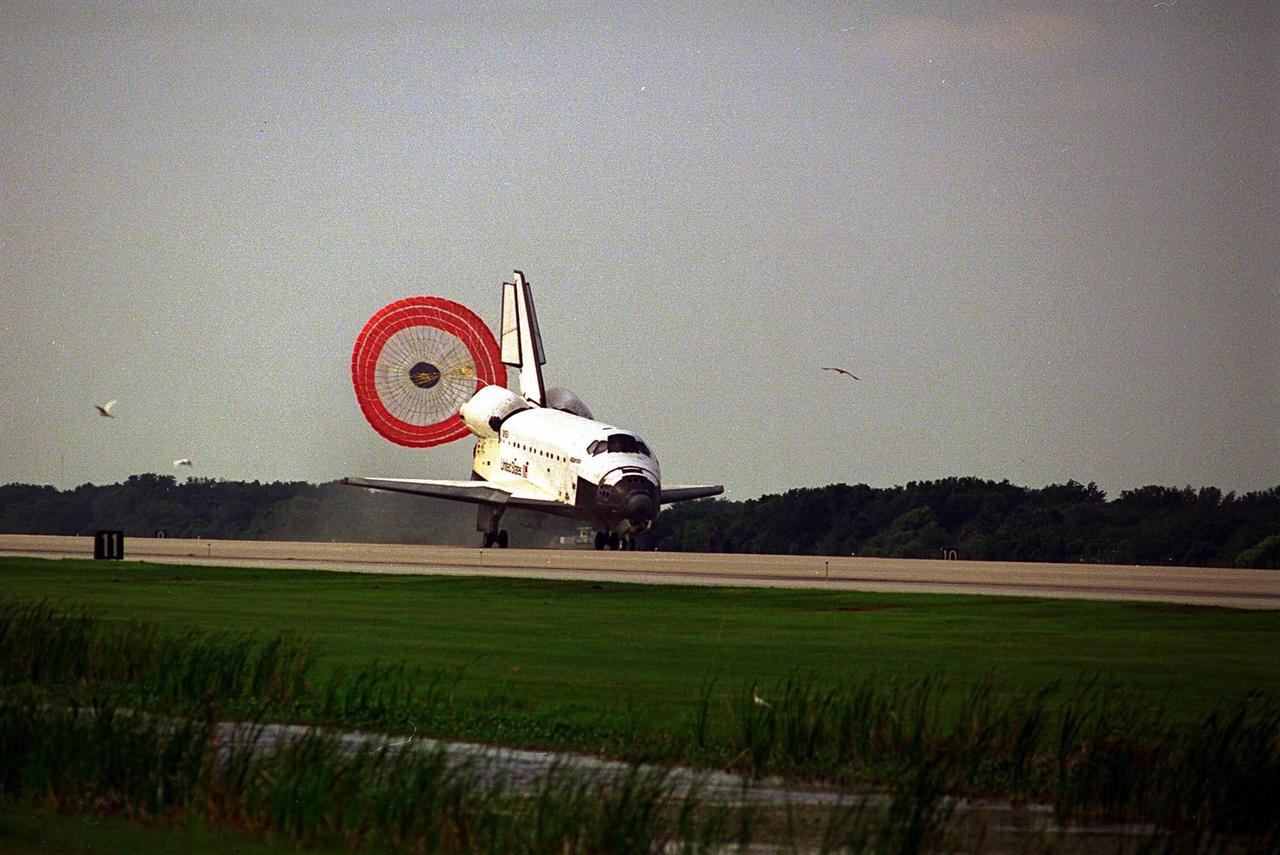
The orbiter drag chute deploys after Atlantis touches down on Runway 33 of KSC’s Shuttle Landing Facility at the conclusion of the nine-day STS-84 mission. Main gear touchdown was at 9:27:44 EDT on May 24, 1997. The first landing opportunity was waved off because of low cloud cover. It was the 37th landing at KSC since the Shuttle program began in 1981, and the eighth consecutive landing at KSC. STS-84 was the sixth of nine planned dockings of the Space Shuttle with the Russian Space Station Mir. Atlantis was docked with the Mir for five days. STS-84 Mission Specialist C. Michael Foale replaced astronaut and Mir 23 crew member Jerry M. Linenger, who has been on the Russian space station since Jan. 15. Linenger returned to Earth on Atlantis with the rest of the STS-84 crew, Mission Commander Charles J. Precourt, Pilot Eileen Marie Collins, and Mission Specialists Carlos I. Noriega, Edward Tsang Lu, Elena V. Kondakova of the Russian Space Agency and JeanFrancois Clervoy of the European Space Agency. Foale is scheduled to remain on the Mir for approximately four months, until he is replaced by STS-86 crew member Wendy B. Lawrence in September. Besides the docking and crew exchange, STS-84 included the transfer of more than 7,300 pounds of water, logistics and science experiments and hardware to and from the Mir. Scientific experiments conducted during the STS-84 mission, and scheduled for Foale’s stay on the Mir, are in the fields of advanced technology, Earth sciences, fundamental biology, human life sciences, International Space Station risk mitigation, microgravity sciences and space sciences
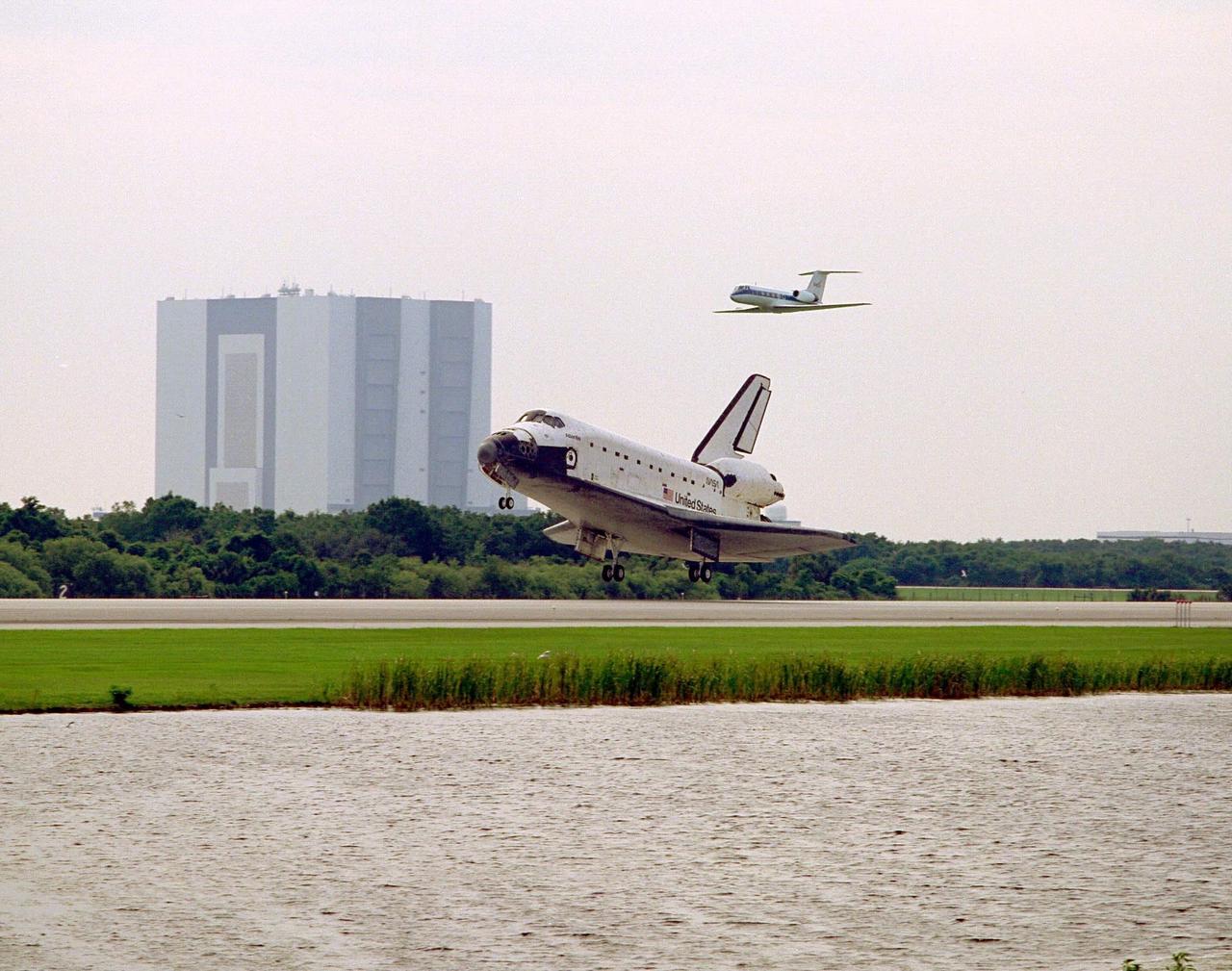
The Space Shuttle orbiter Atlantis rolls out on Runway 33 of KSC’s Shuttle Landing Facility at the conclusion of the nine-day STS-84 mission. The Shuttle Training Aircraft piloted by astronaut Kenneth D. Cockrell, acting deputy chief of the Astronaut Office, is flying above Atlantis. The Vehicle Assembly Building is at left. Main gear touchdown was at 9:27:44 EDT on May 24, 1997. The first landing opportunity was waved off because of low cloud cover. It was the 37th landing at KSC since the Shuttle program began in 1981, and the eighth consecutive landing at KSC. STS-84 was the sixth of nine planned dockings of the Space Shuttle with the Russian Space Station Mir. Atlantis was docked with the Mir for five days. STS-84 Mission Specialist C. Michael Foale replaced astronaut and Mir 23 crew member Jerry M. Linenger, who has been on the Russian space station since Jan. 15. Linenger returned to Earth on Atlantis with the rest of the STS-84 crew, Mission Commander Charles J. Precourt, Pilot Eileen Marie Collins, and Mission Specialists Carlos I. Noriega, Edward Tsang Lu, Elena V. Kondakova of the Russian Space Agency and JeanFrancois Clervoy of the European Space Agency. Foale is scheduled to remain on the Mir for approximately four months, until he is replaced by STS-86 crew member Wendy B. Lawrence in September. Besides the docking and crew exchange, STS-84 included the transfer of more than 7,300 pounds of water, logistics and science experiments and hardware to and from the Mir. Scientific experiments conducted during the STS-84 mission, and scheduled for Foale’s stay on the Mir, are in the fields of advanced technology, Earth sciences, fundamental biology, human life sciences, International Space Station risk mitigation, microgravity sciences and space sciences
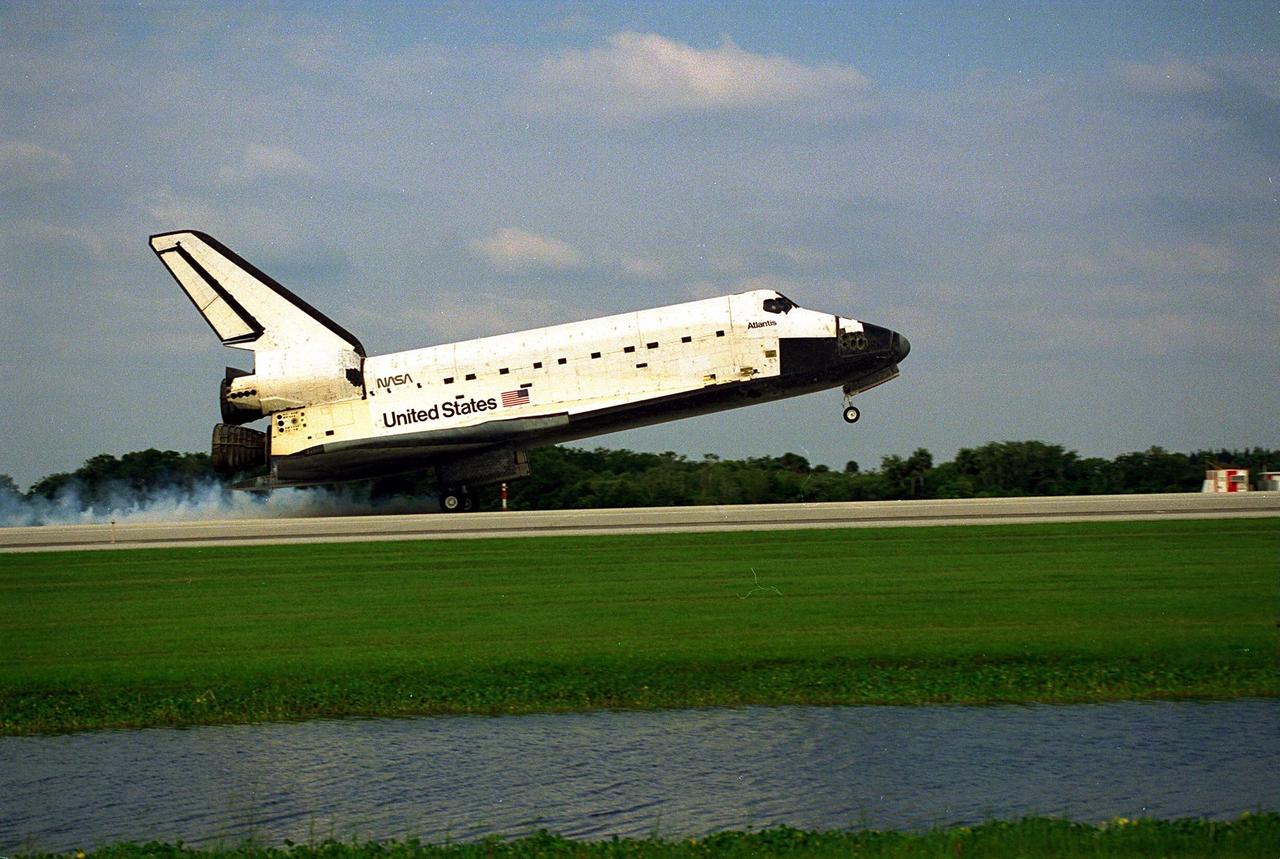
The Space Shuttle orbiter Atlantis touches down on Runway 33 of the KSC Shuttle Landing Facility, bringing to an end the nine-day STS-84 mission. Main gear touchdown was at 9:27:44 EDT on May 24, 1997. The first landing opportunity was waved off because of low cloud cover. It was the 37th landing at KSC since the Shuttle program began in 1981, and the eighth consecutive landing at KSC. STS-84 was the sixth of nine planned dockings of the Space Shuttle with the Russian Space Station Mir. Atlantis was docked with the Mir for five days. STS-84 Mission Specialist C. Michael Foale replaced astronaut and Mir 23 crew member Jerry M. Linenger, who has been on the Russian space station since Jan. 15. Linenger returned to Earth on Atlantis with the rest of the STS-84 crew, Mission Commander Charles J. Precourt, Pilot Eileen Marie Collins, and Mission Specialists Carlos I. Noriega, Edward Tsang Lu, Elena V. Kondakova of the Russian Space Agency and JeanFrancois Clervoy of the European Space Agency. Foale is scheduled to remain on the Mir for approximately four months, until he is replaced by STS-86 crew member Wendy B. Lawrence in September. Besides the docking and crew exchange, STS-84 included the transfer of more than 7,300 pounds of water, logistics and science experiments and hardware to and from the Mir. Scientific experiments conducted during the STS-84 mission, and scheduled for Foale’s stay on the Mir, are in the fields of advanced technology, Earth sciences, fundamental biology, human life sciences, International Space Station risk mitigation, microgravity sciences and space sciences
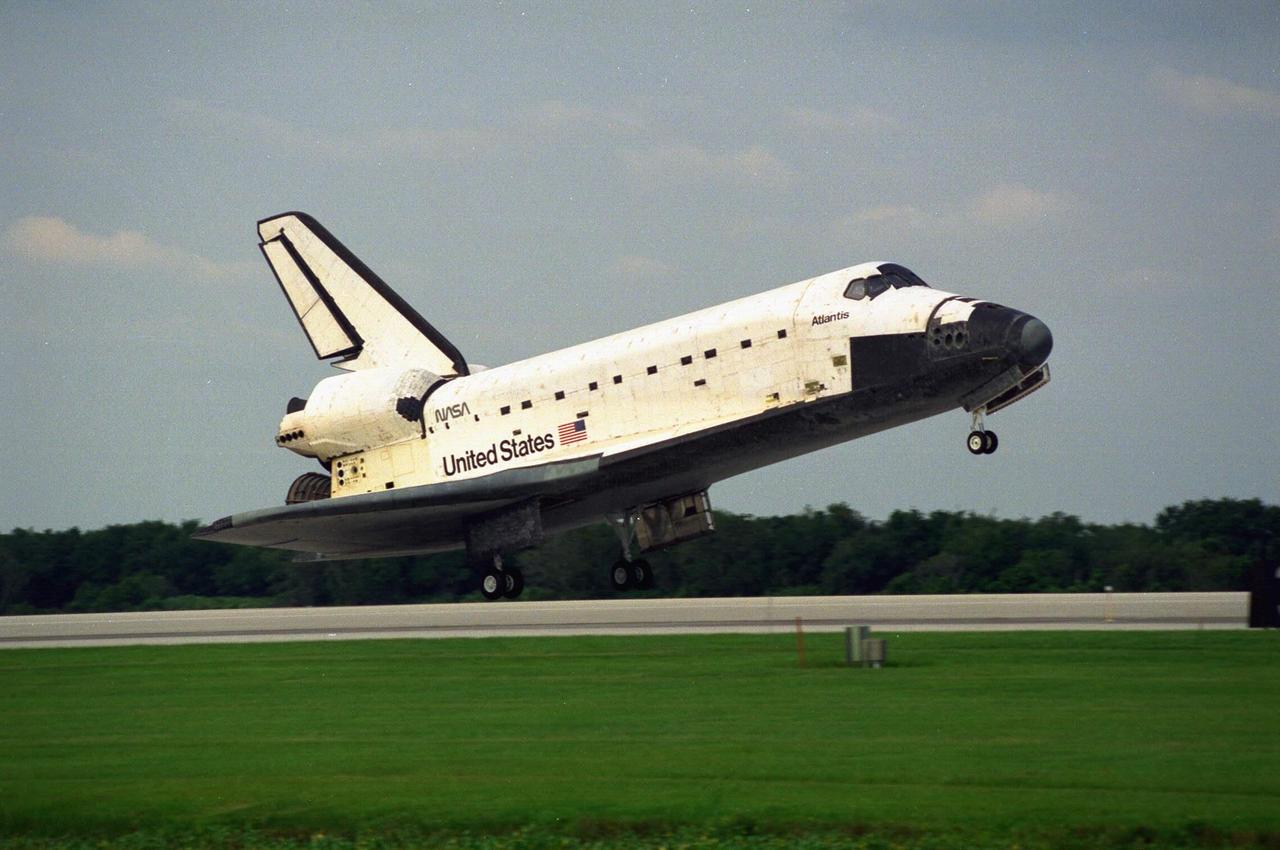
The Space Shuttle orbiter Atlantis touches down on Runway 33 of the KSC Shuttle Landing Facility, bringing to an end the nine-day STS-84 mission. Main gear touchdown was at 9:27:44 EDT on May 24, 1997. The first landing opportunity was waved off because of low cloud cover. It was the 37th landing at KSC since the Shuttle program began in 1981, and the eighth consecutive landing at KSC. STS-84 was the sixth of nine planned dockings of the Space Shuttle with the Russian Space Station Mir. Atlantis was docked with the Mir for five days. STS-84 Mission Specialist C. Michael Foale replaced astronaut and Mir 23 crew member Jerry M. Linenger, who has been on the Russian space station since Jan. 15. Linenger returned to Earth on Atlantis with the rest of the STS-84 crew, Mission Commander Charles J. Precourt, Pilot Eileen Marie Collins, and Mission Specialists Carlos I. Noriega, Edward Tsang Lu, Elena V. Kondakova of the Russian Space Agency and JeanFrancois Clervoy of the European Space Agency. Foale is scheduled to remain on the Mir for approximately four months, until he is replaced by STS-86 crew member Wendy B. Lawrence in September. Besides the docking and crew exchange, STS-84 included the transfer of more than 7,300 pounds of water, logistics and science experiments and hardware to and from the Mir. Scientific experiments conducted during the STS-84 mission, and scheduled for Foale’s stay on the Mir, are in the fields of advanced technology, Earth sciences, fundamental biology, human life sciences, International Space Station risk mitigation, microgravity sciences and space sciences
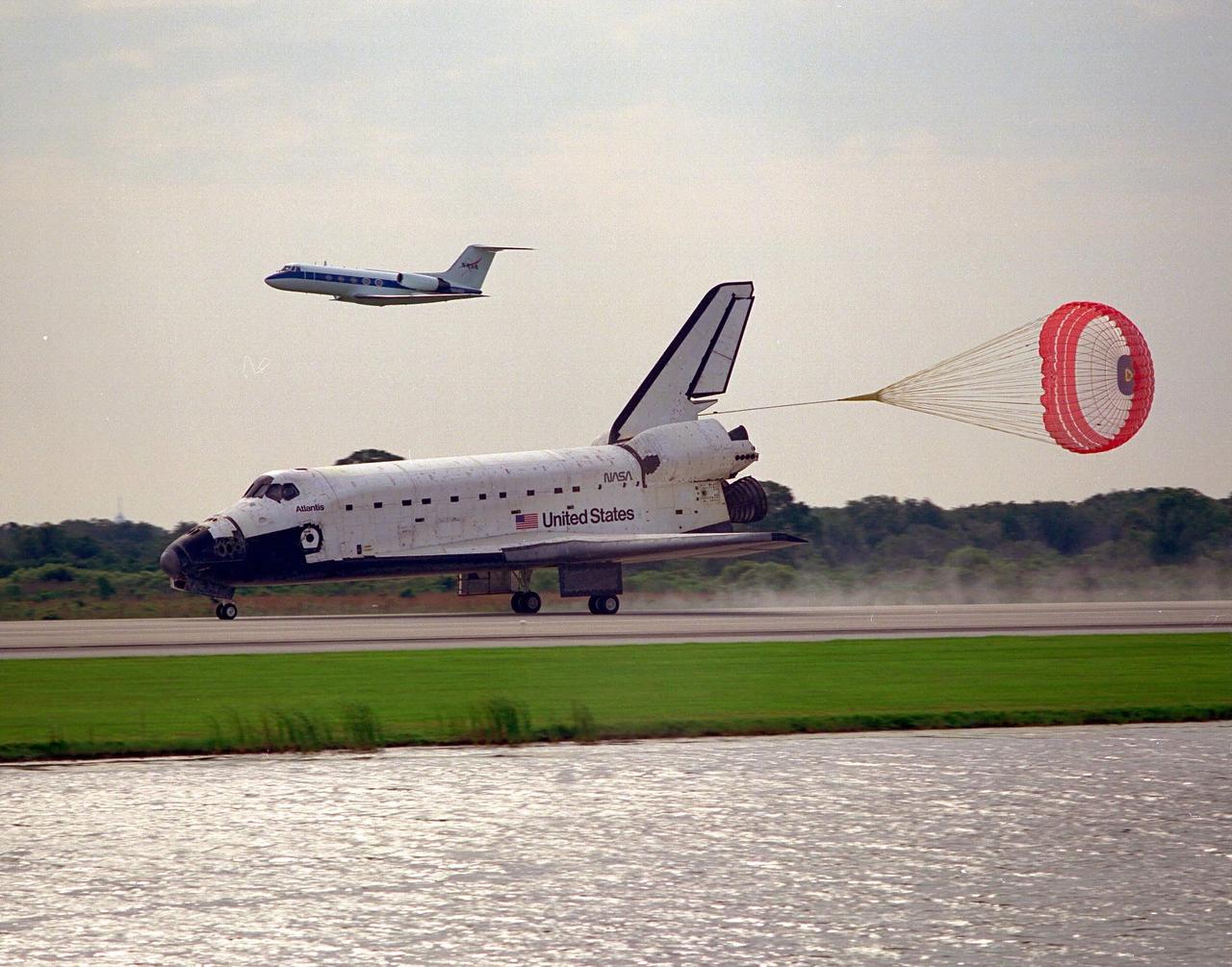
The Space Shuttle orbiter Atlantis, with its drag chute deployed, rolls out on Runway 33 of KSC’s Shuttle Landing Facility at the conclusion of the nine-day STS-84 mission. The Shuttle Training Aircraft piloted by astronaut Kenneth D. Cockrell, acting deputy chief of the Astronaut Office, is flying above Atlantis. Main gear touchdown was at 9:27:44 EDT on May 24, 1997. The first landing opportunity was waved off because of low cloud cover. It was the 37th landing at KSC since the Shuttle program began in 1981, and the eighth consecutive landing at KSC. STS-84 was the sixth of nine planned dockings of the Space Shuttle with the Russian Space Station Mir. Atlantis was docked with the Mir for five days. STS-84 Mission Specialist C. Michael Foale replaced astronaut and Mir 23 crew member Jerry M. Linenger, who has been on the Russian space station since Jan. 15. Linenger returned to Earth on Atlantis with the rest of the STS-84 crew, Mission Commander Charles J. Precourt, Pilot Eileen Marie Collins, and Mission Specialists Carlos I. Noriega, Edward Tsang Lu, Elena V. Kondakova of the Russian Space Agency and JeanFrancois Clervoy of the European Space Agency. Foale is scheduled to remain on the Mir for approximately four months, until he is replaced by STS-86 crew member Wendy B. Lawrence in September. Besides the docking and crew exchange, STS-84 included the transfer of more than 7,300 pounds of water, logistics and science experiments and hardware to and from the Mir. Scientific experiments conducted during the STS-84 mission, and scheduled for Foale’s stay on the Mir, are in the fields of advanced technology, Earth sciences, fundamental biology, human life sciences, International Space Station risk mitigation, microgravity sciences and space sciences
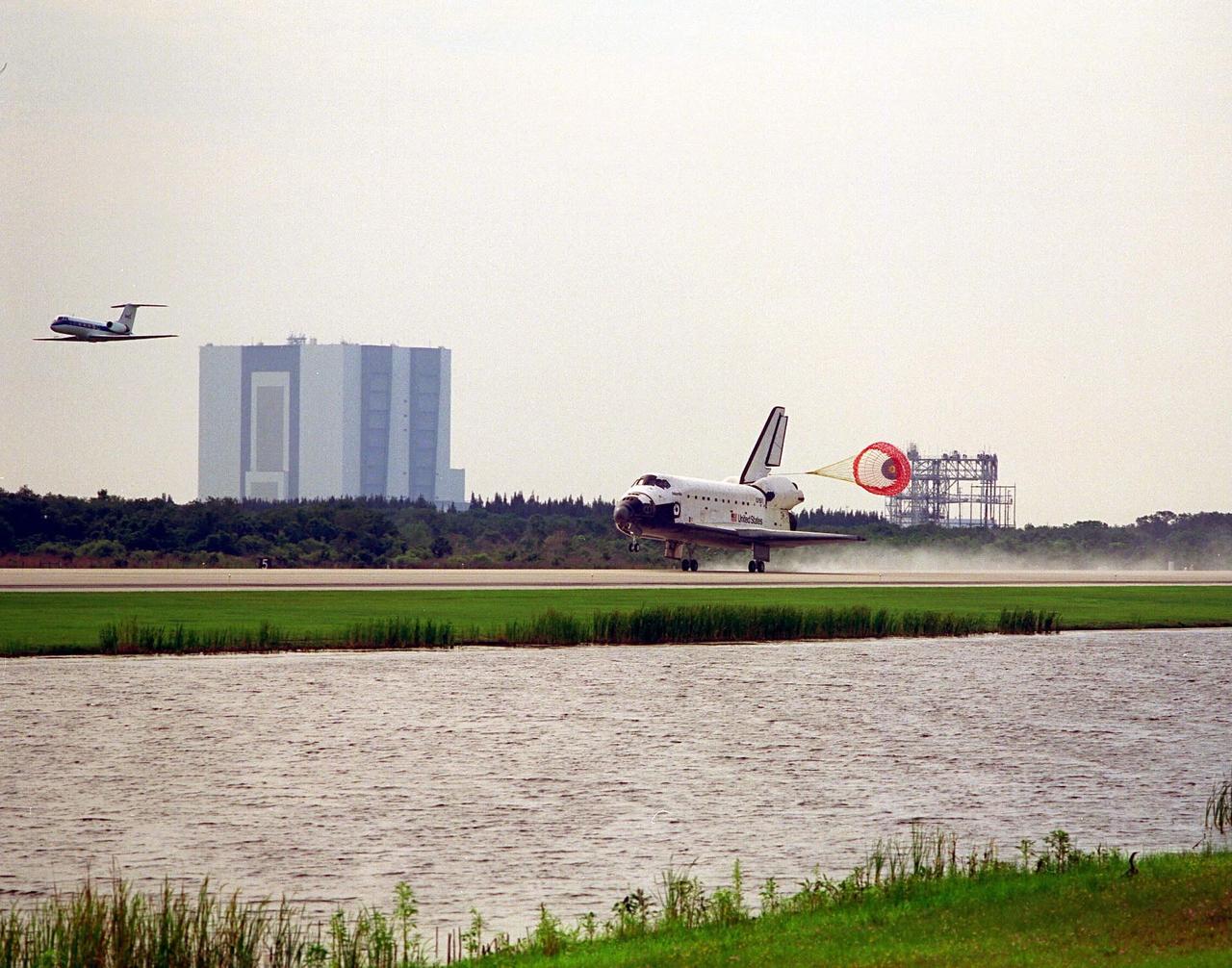
Framed by the Vehicle Assembly Building in the distance, at left, and the Mate-Demate Device, the Space Shuttle Atlantis with its drag chute deployed touches down on KSC’s Runway 33 at the conclusion of the STS-84 mission. The Shuttle Training Aircraft with astronaut Kenneth D. Cockrell at the controls is flying in front of Atlantis. Cockrell is acting deputy chief of the Astronaut Office. Main gear touchdown was at 9:27:44 EDT on May 24, 1997. The first landing opportunity was waved off because of low cloud cover. It was the 37th landing at KSC since the Shuttle program began in 1981, and the eighth consecutive landing at KSC. STS-84 was the sixth of nine planned dockings of the Space Shuttle with the Russian Space Station Mir. Atlantis was docked with the Mir for five days. STS-84 Mission Specialist C. Michael Foale replaced astronaut and Mir 23 crew member Jerry M. Linenger, who has been on the Russian space station since Jan. 15. Linenger returned to Earth on Atlantis with the rest of the STS-84 crew, Mission Commander Charles J. Precourt, Pilot Eileen Marie Collins, and Mission Specialists Carlos I. Noriega, Edward Tsang Lu, Elena V. Kondakova of the Russian Space Agency and Jean-Francois Clervoy of the European Space Agency. Foale is scheduled to remain on the Mir for approximately four months, until he is replaced by STS-86 crew member Wendy B. Lawrence in September. Besides the docking and crew exchange, STS-84 included the transfer of more than 7,300 pounds of water, logistics and science experiments and hardware to and from the Mir. Scientific experiments conducted during the STS-84 mission, and scheduled for Foale’s stay on the Mir, are in the fields of advanced technology, Earth sciences, fundamental biology, human life sciences, International Space Station risk mitigation, microgravity sciences and space sciences