
Trailing Rhea

A Trail of Salts
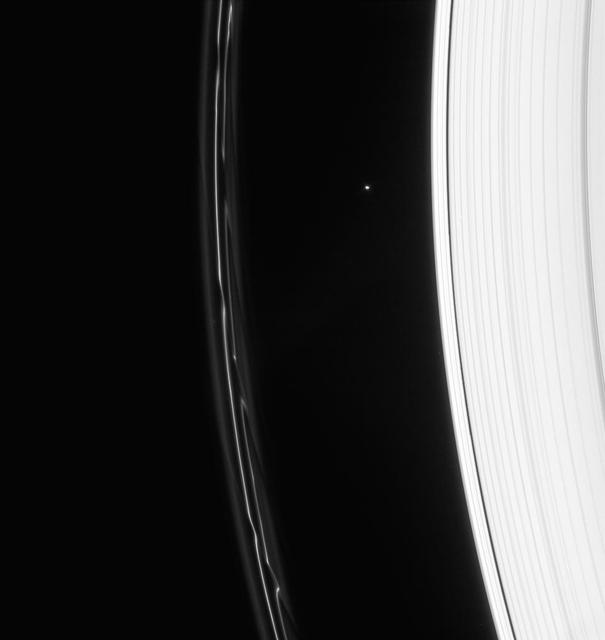
Trailing Prometheus
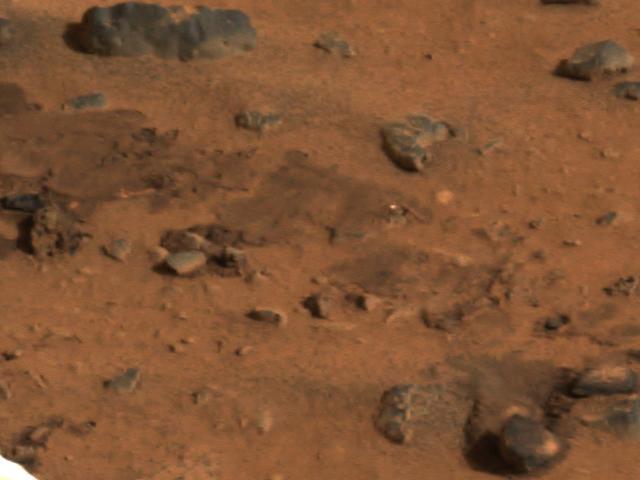
Airbag Trails
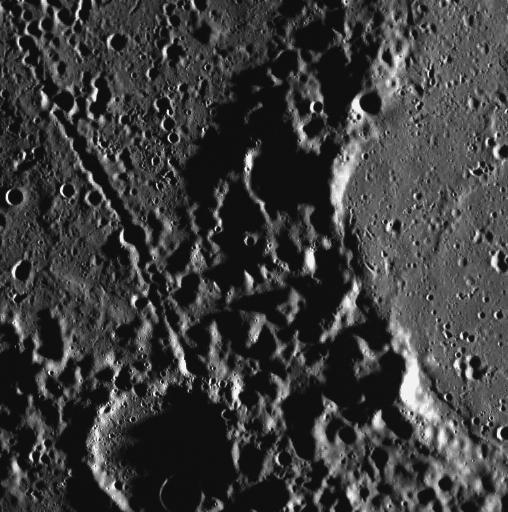
Happy Trails
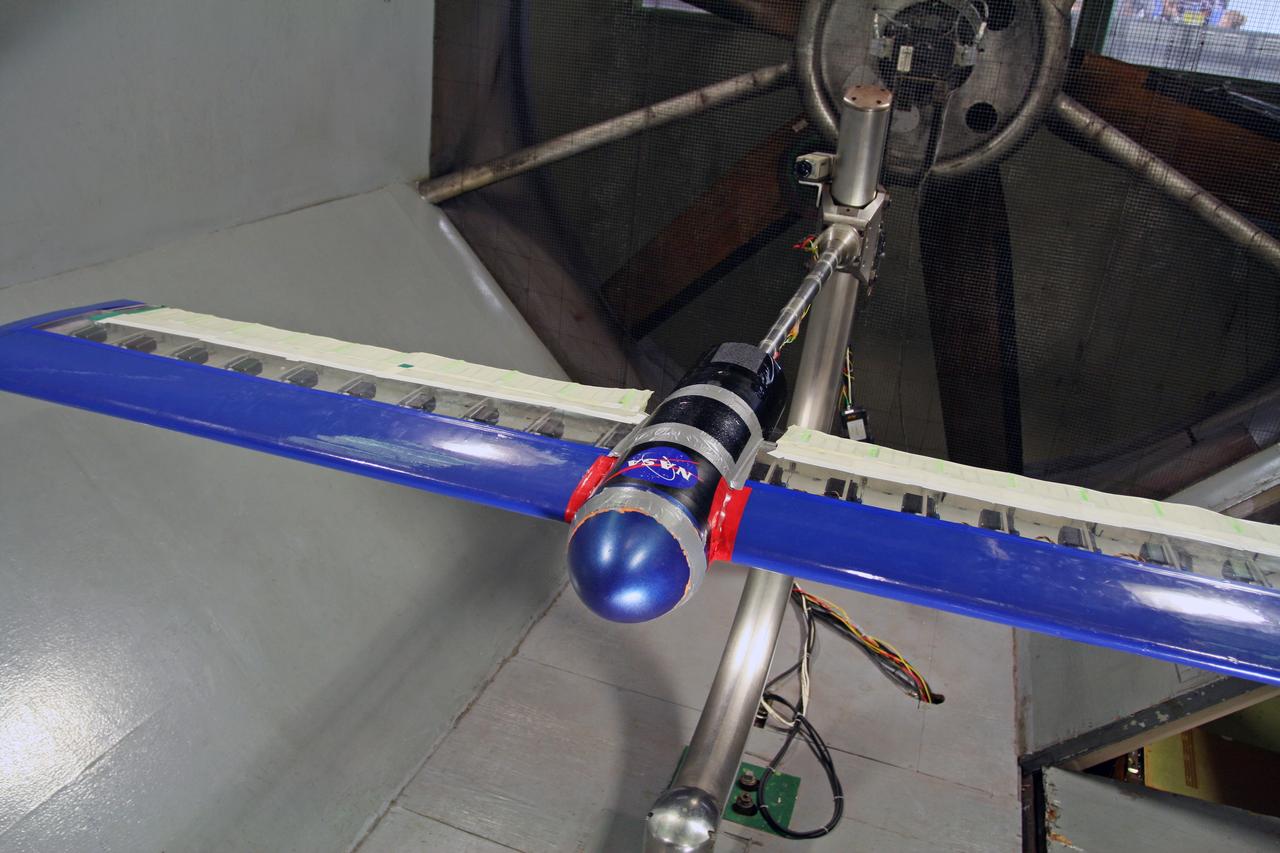
Aeronautic Academy Continuous Trailing Edge Flap
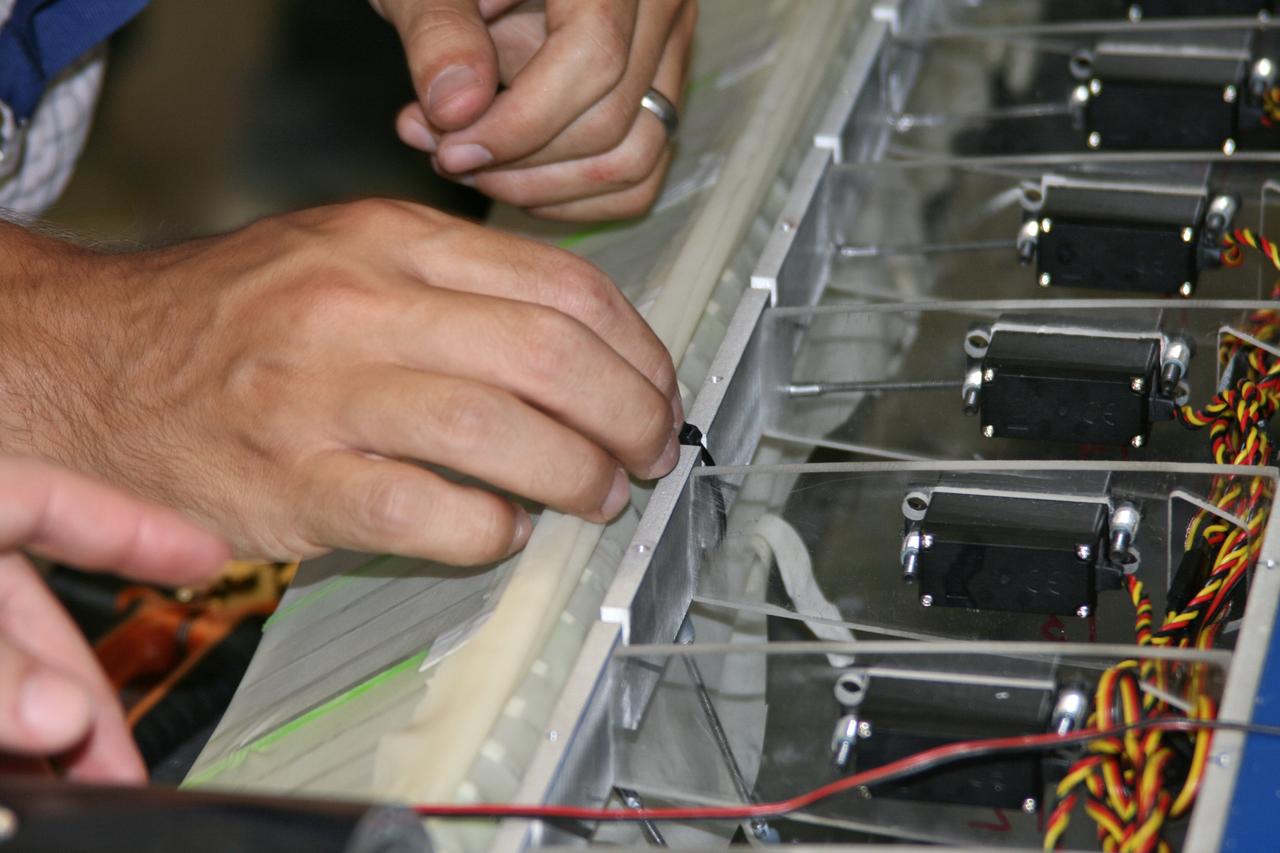
Aeronautic Academy Continuous Trailing Edge Flap
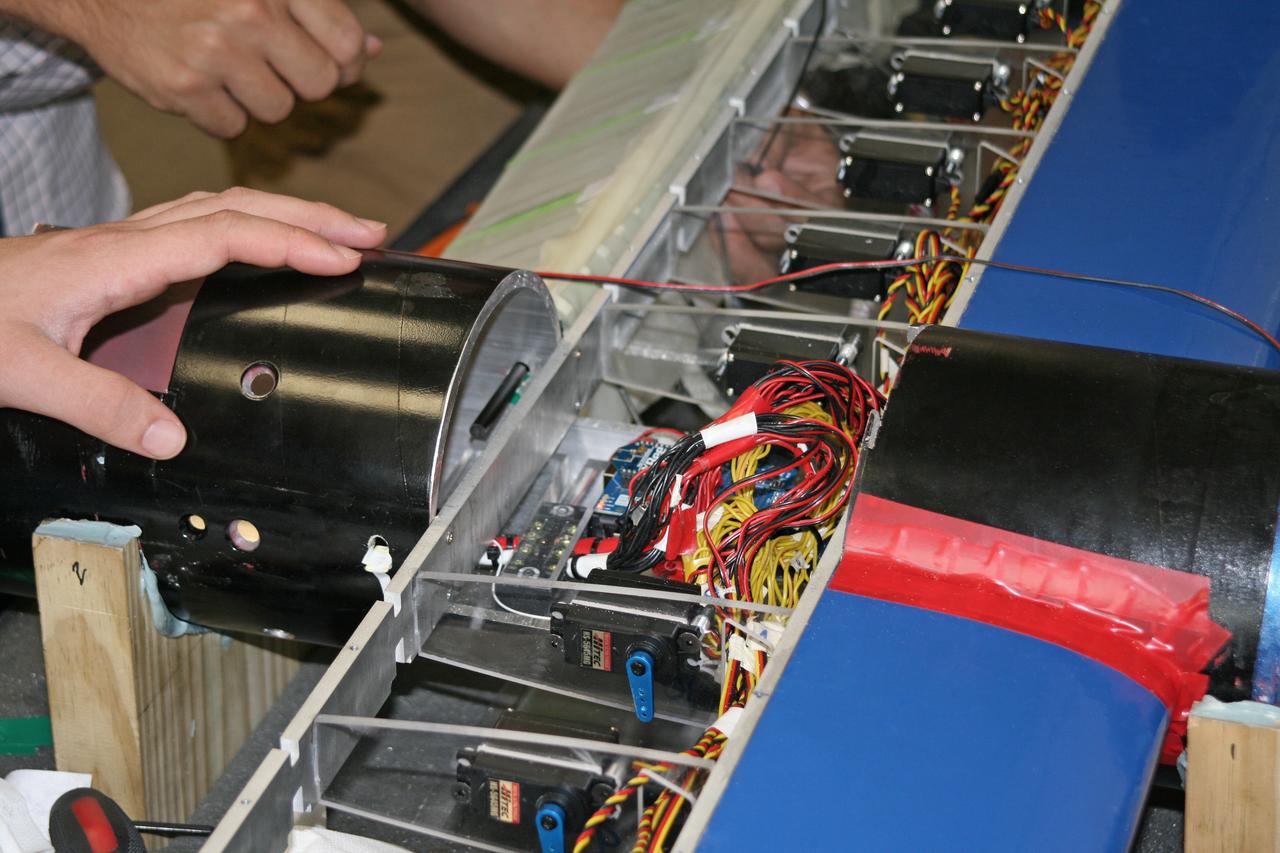
Aeronautic Academy Continuous Trailing Edge Flap
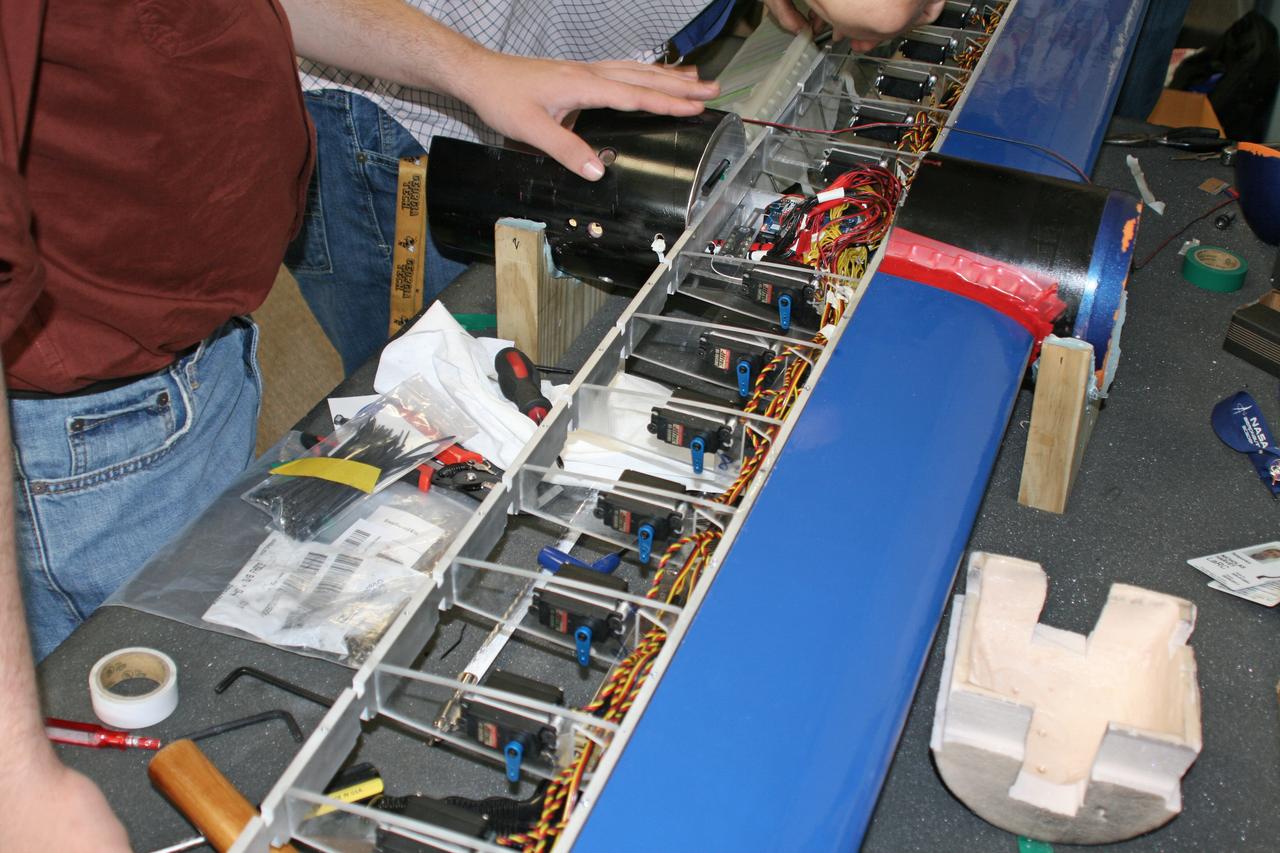
Aeronautic Academy Continuous Trailing Edge Flap
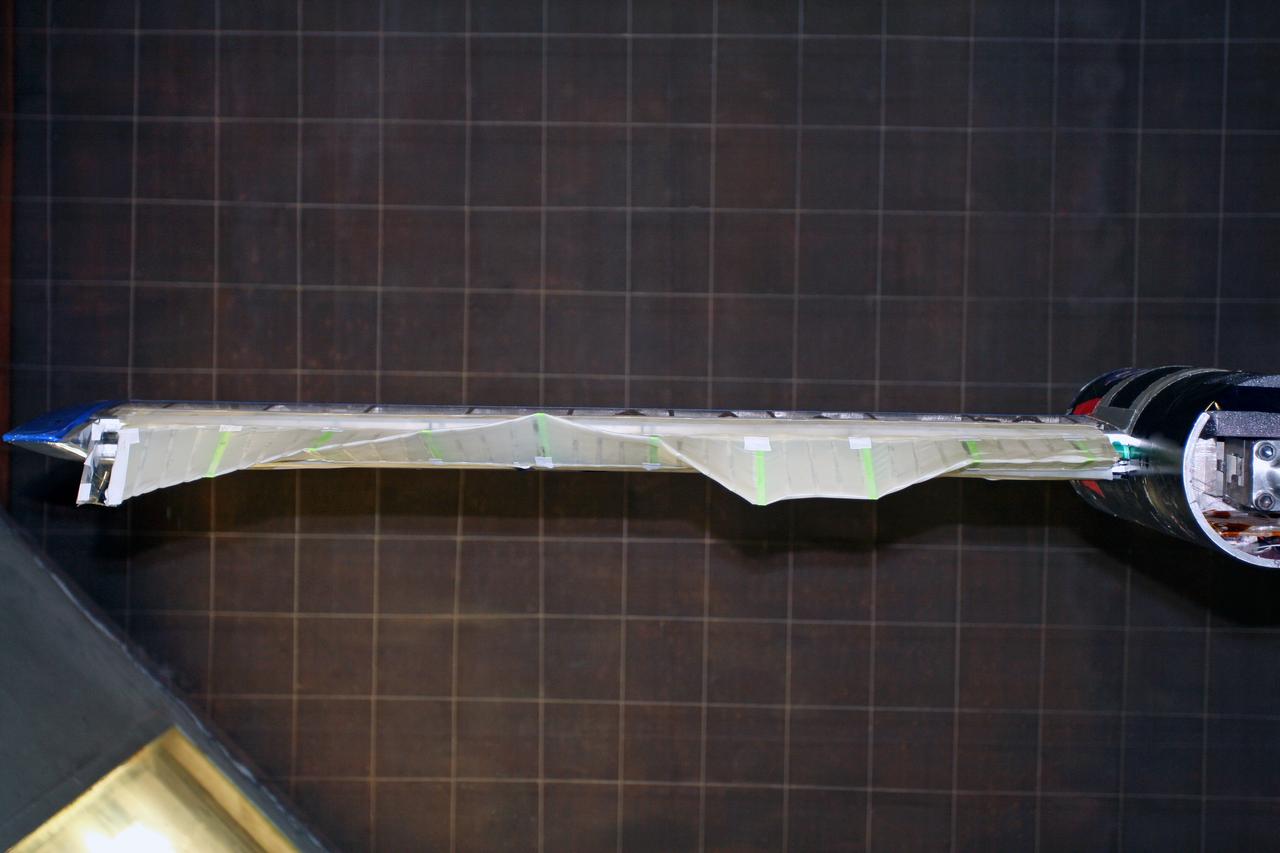
Aeronautic Academy Continuous Trailing Edge Flap
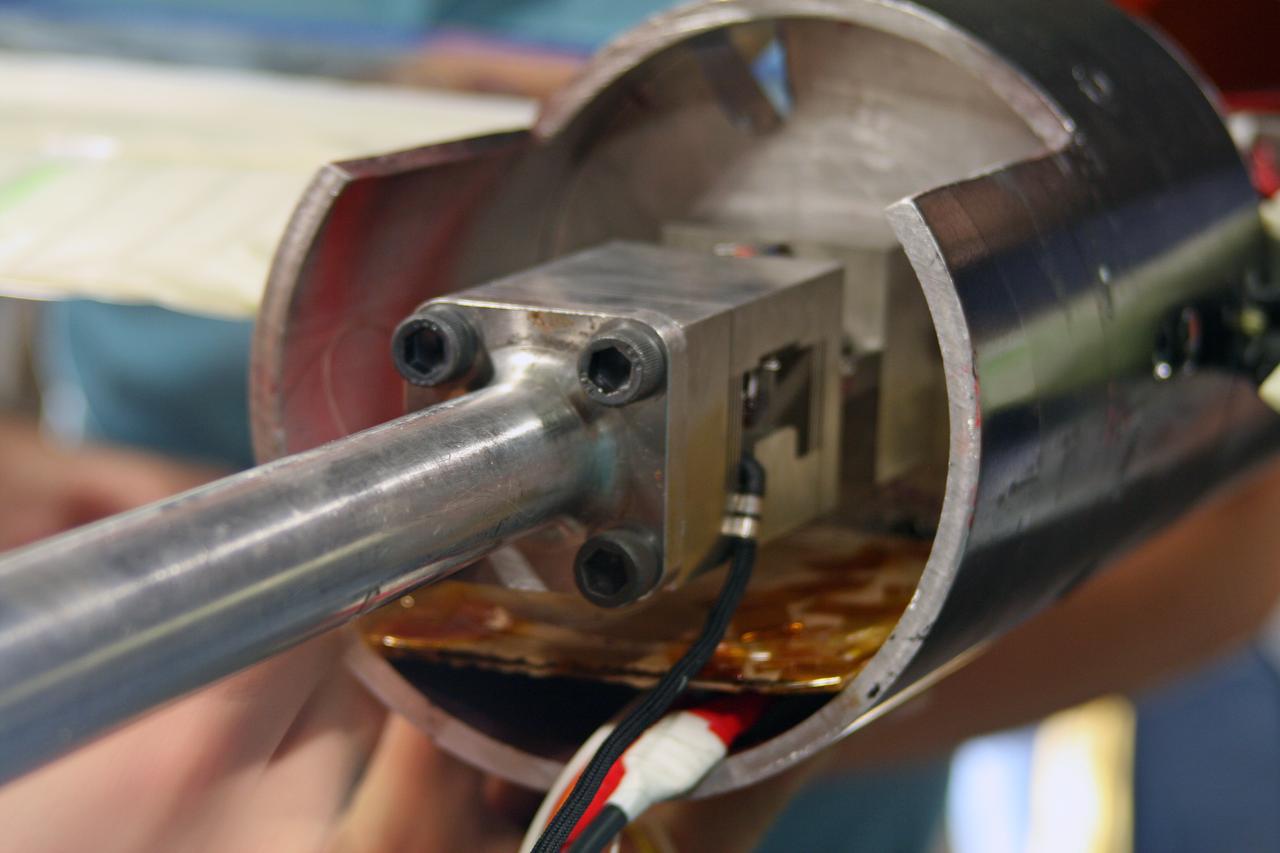
Aeronautic Academy Continuous Trailing Edge Flap
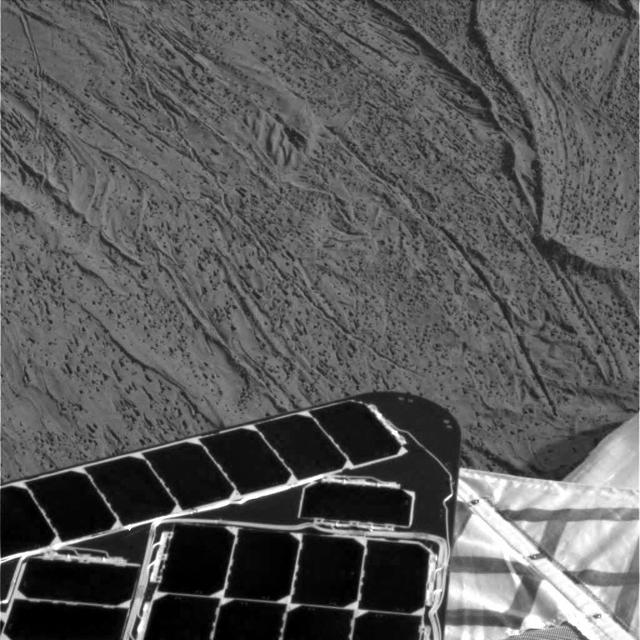
Airbag Seams Leave Trails
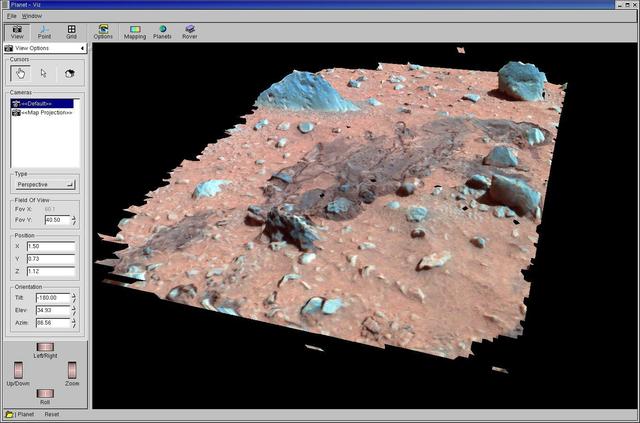
Landing Trail in 3-D
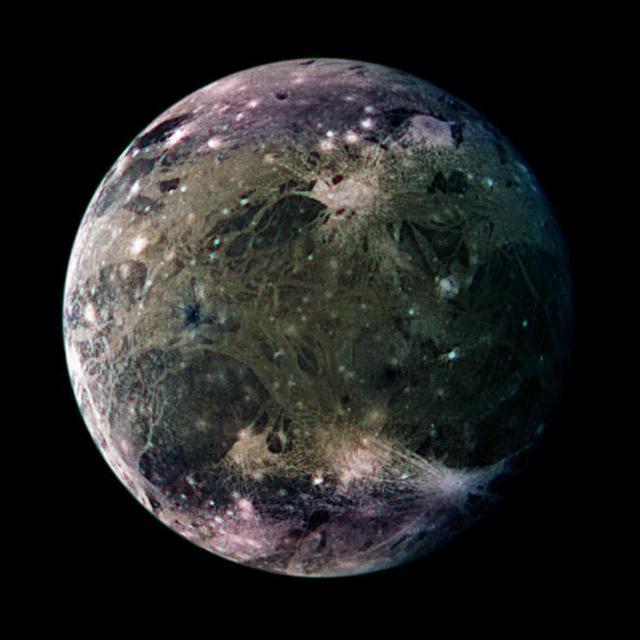
Ganymede Trailing Hemisphere
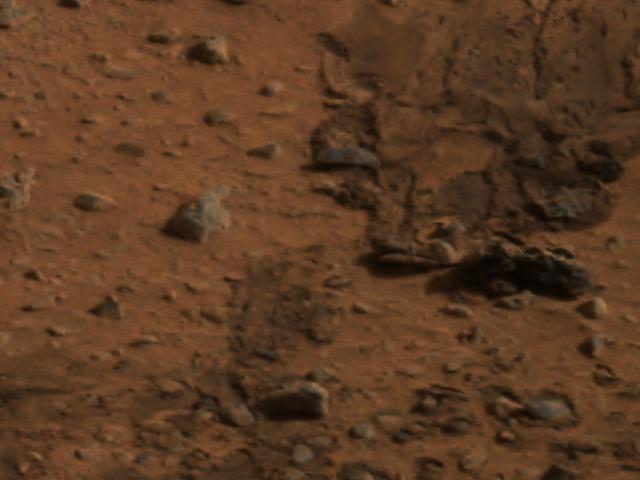
Spirit Airbags Leave Trail
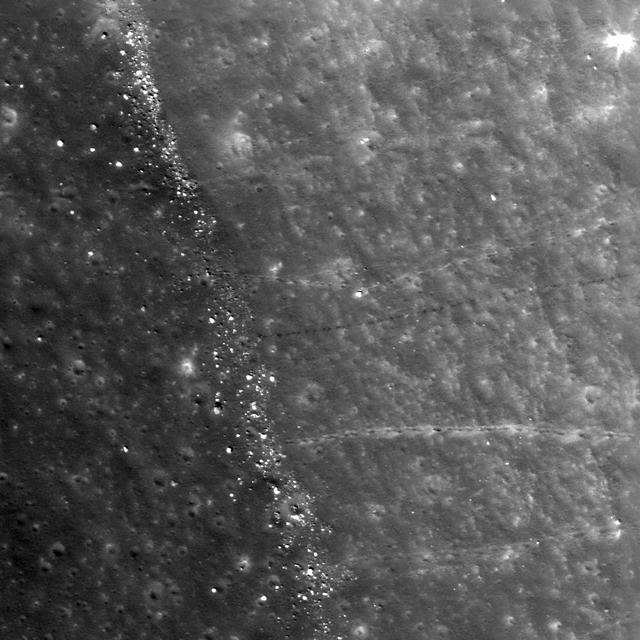
Boulder Trails in Menelaus Crater
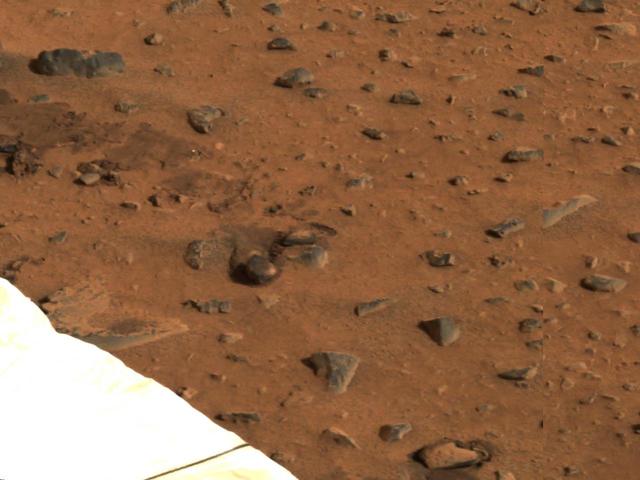
Airbag Trails-2
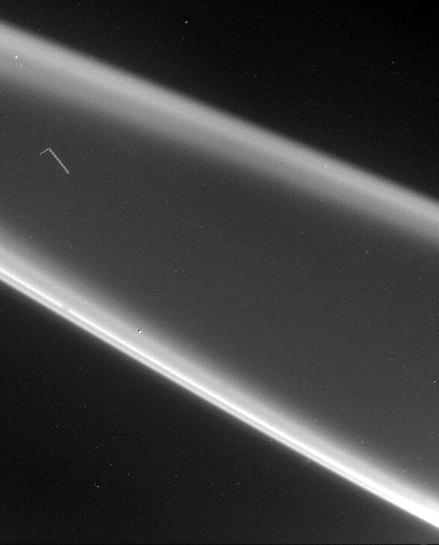
Rings of Jupiter Star Trail http://photojournal.jpl.nasa.gov/catalog/PIA00376

Looking Back at Spirit Trail to the Summit
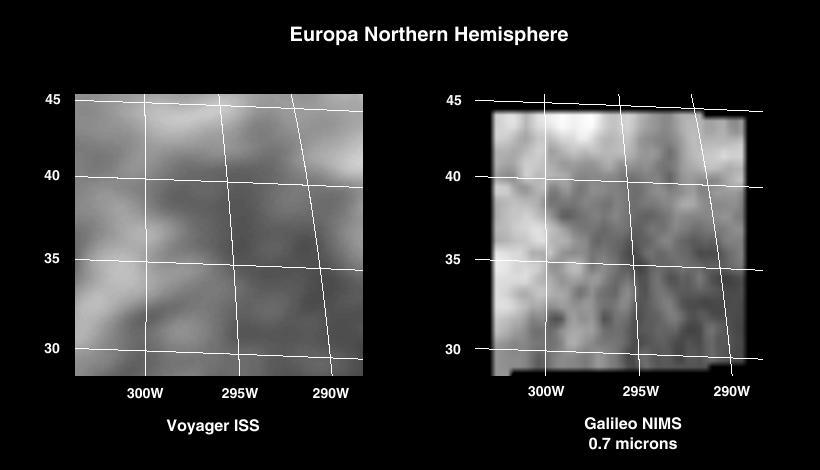
Infrared Observations of Europa Trailing Side
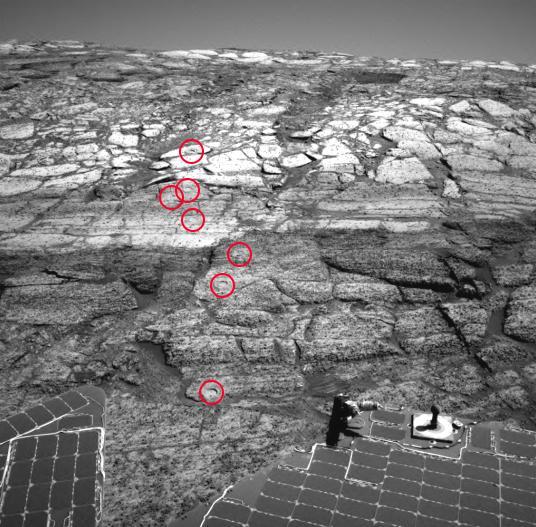
Opportunity Leaves a Trail of Rat Holes
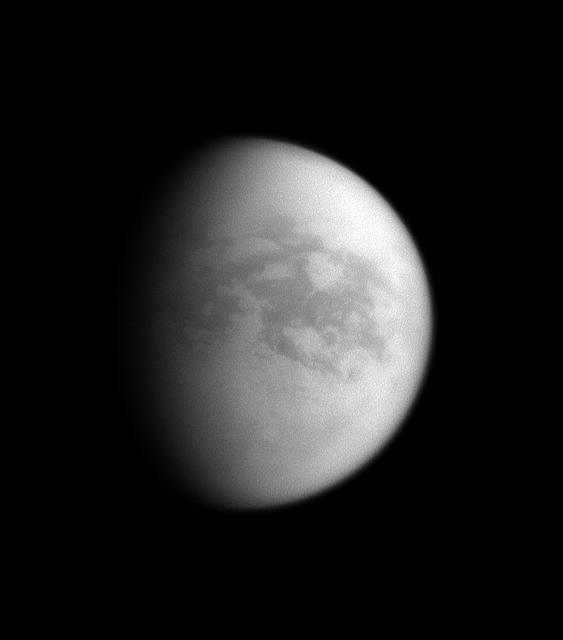
Saturn View of Titan Trailing Hemisphere
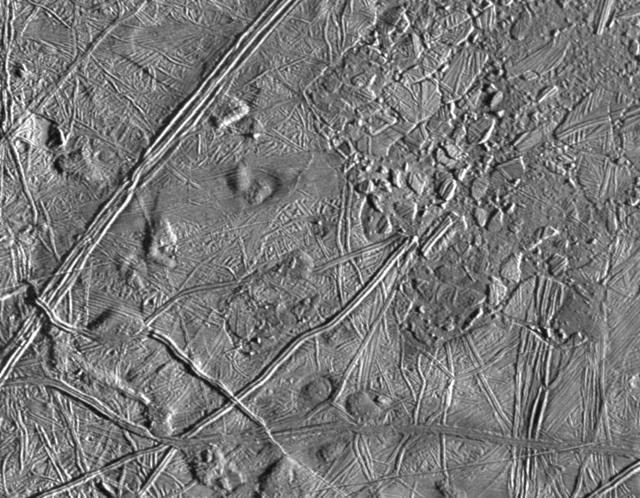
Close-up of Europa Trailing Hemisphere
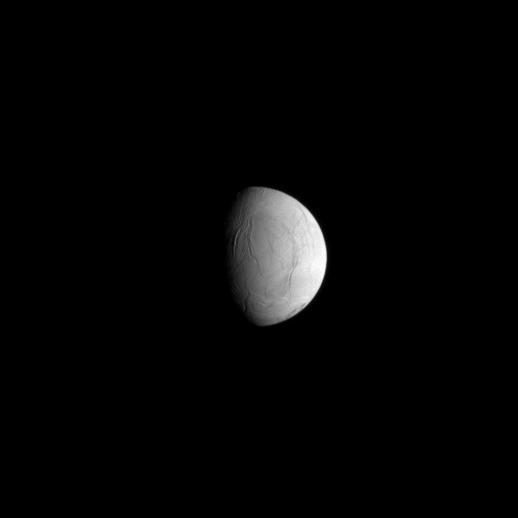
The Cassini spacecraft looks toward the varied surface of the trailing hemisphere of Saturn moon Enceladus.
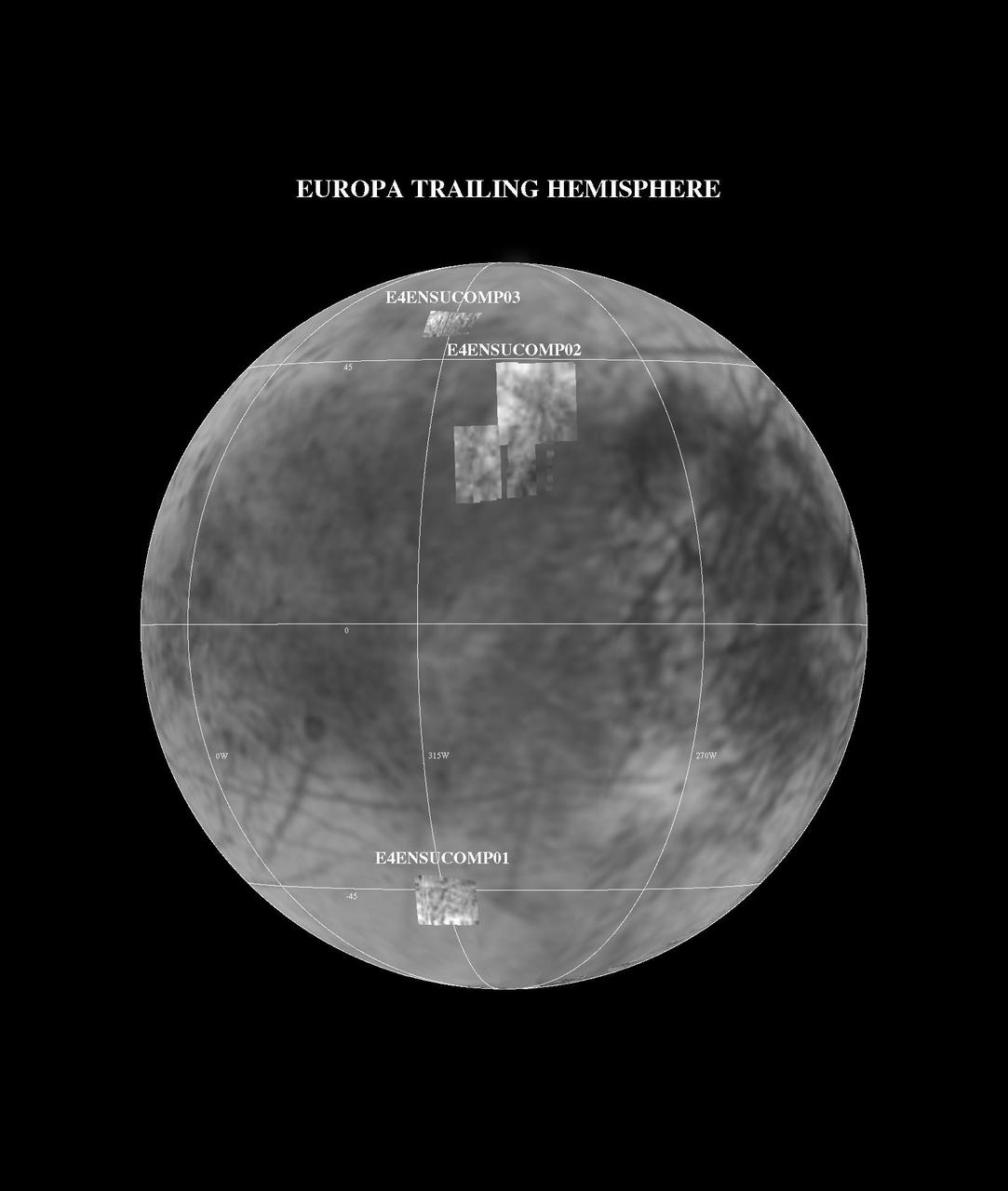
NIMS E4 Observations of Europa Trailing Hemisphere
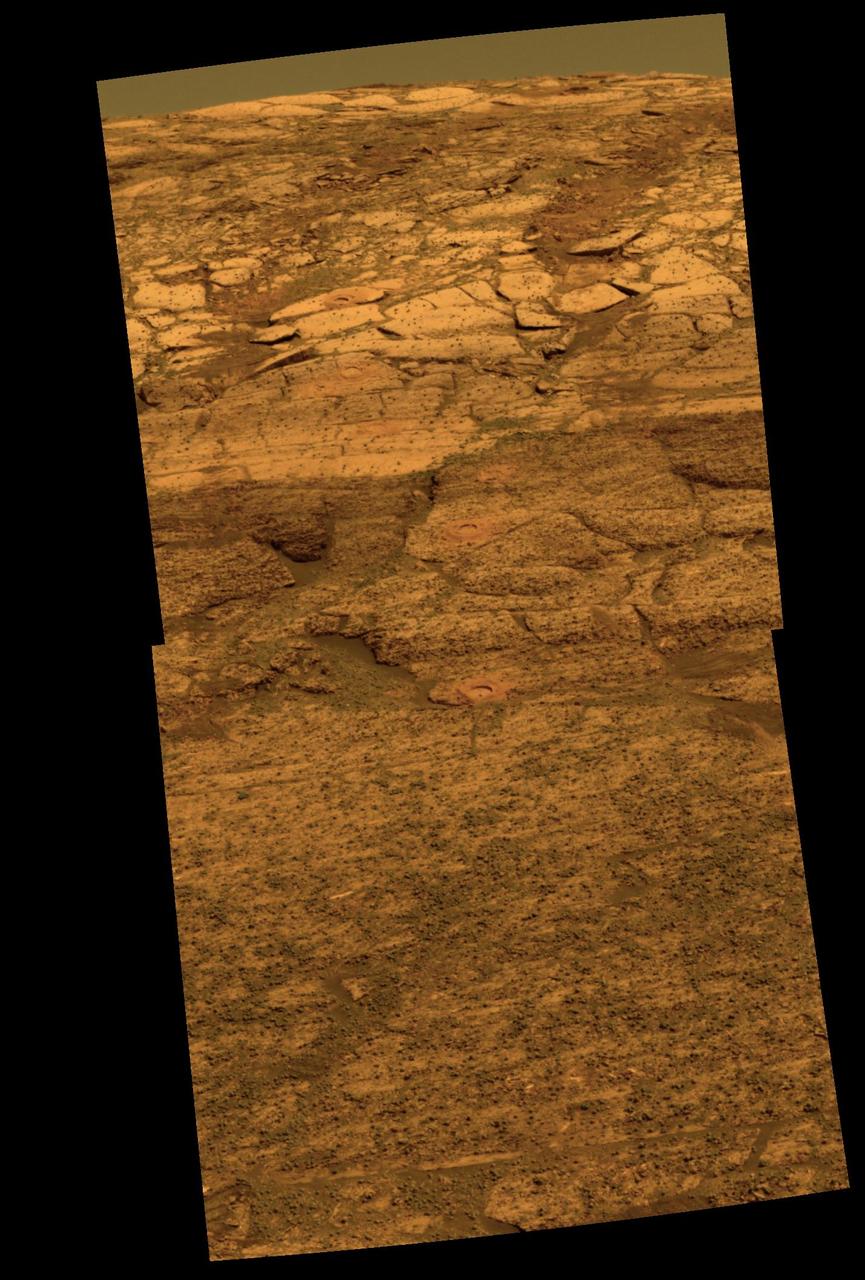
Color View of a Rat Hole Trail Inside Endurance

Go Instead Where There Is No Path and Leave a Trail
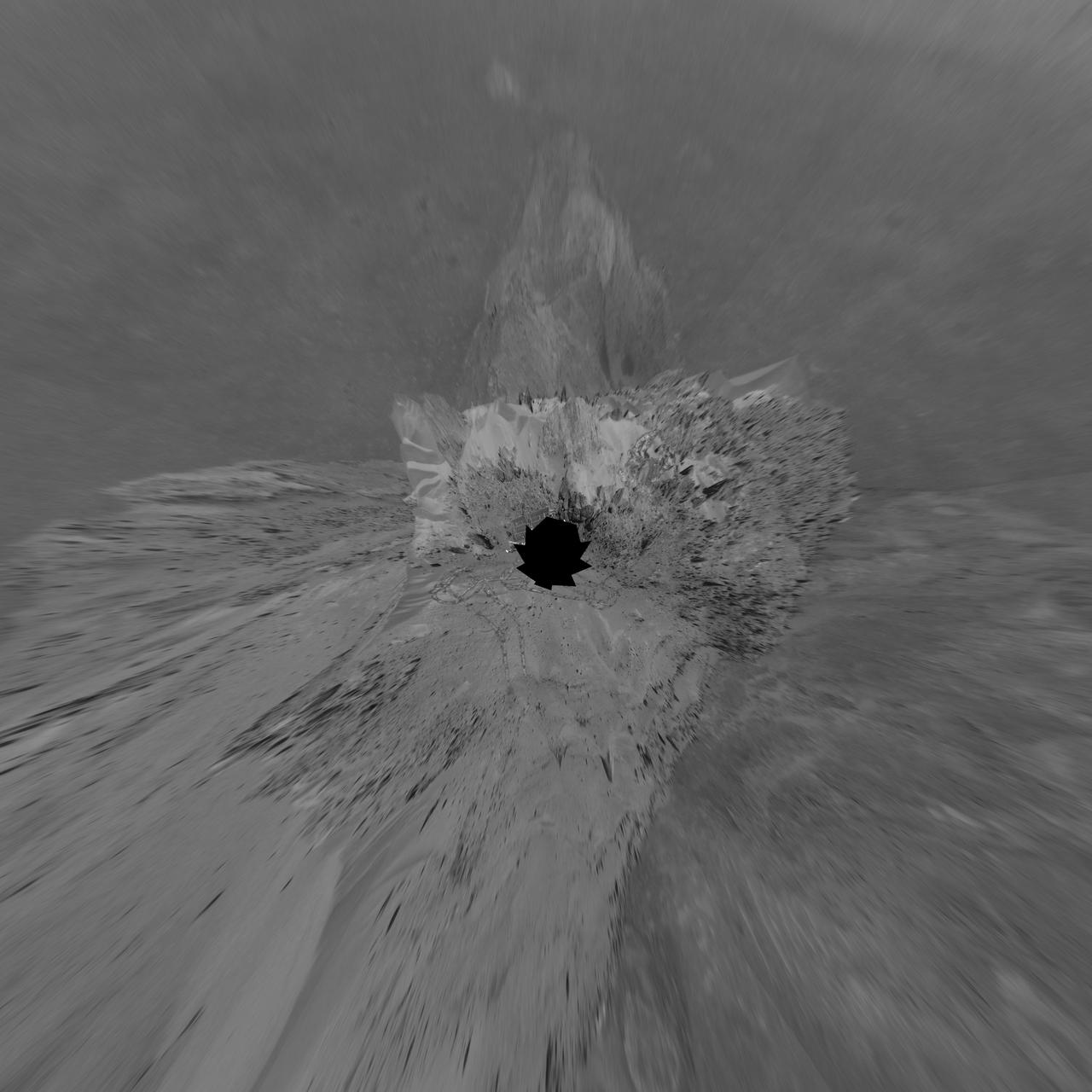
Looking Back at Spirit Trail to the Summit Polar
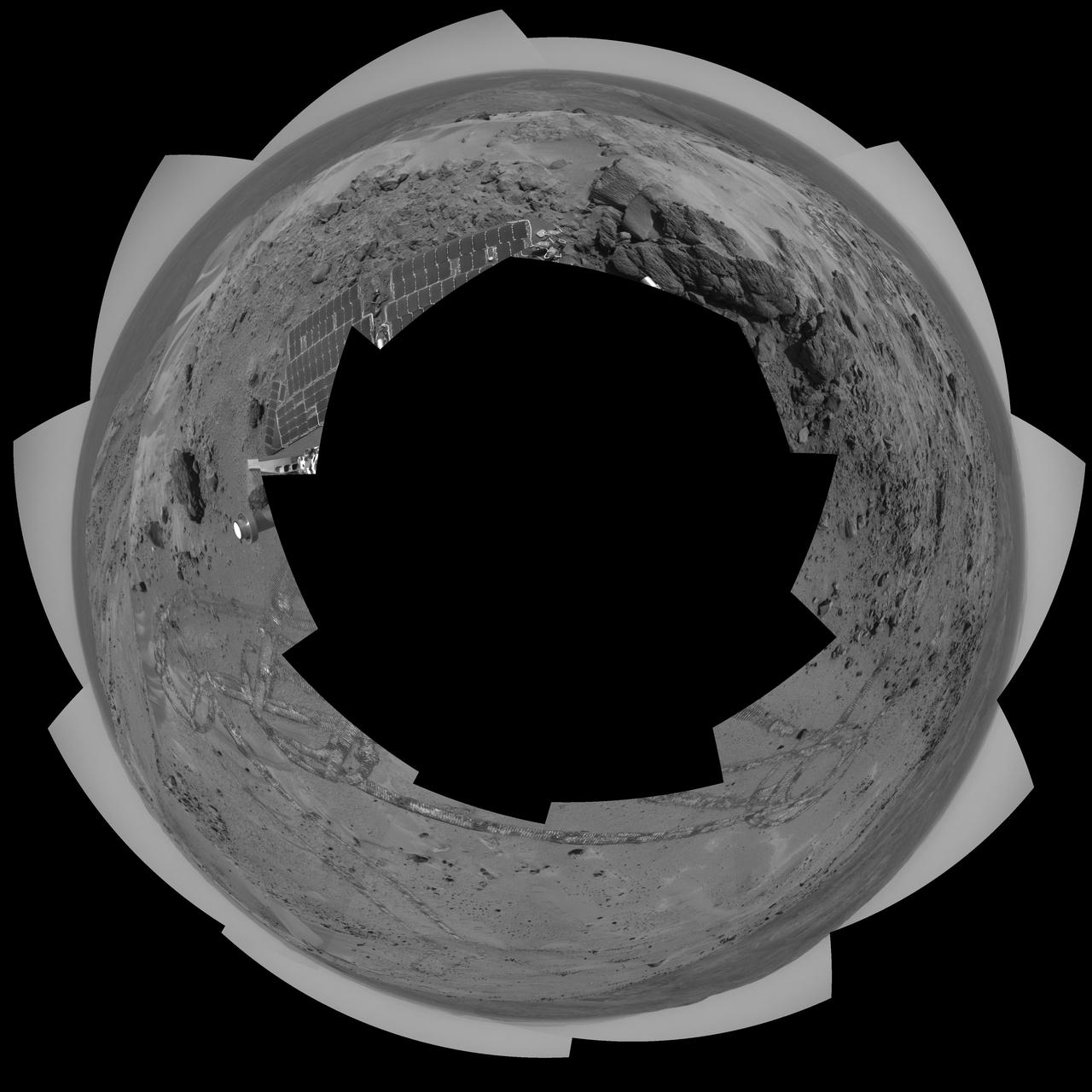
Looking Back at Spirit Trail to the Summit Vertical

False-Color View of a Rat Hole Trail
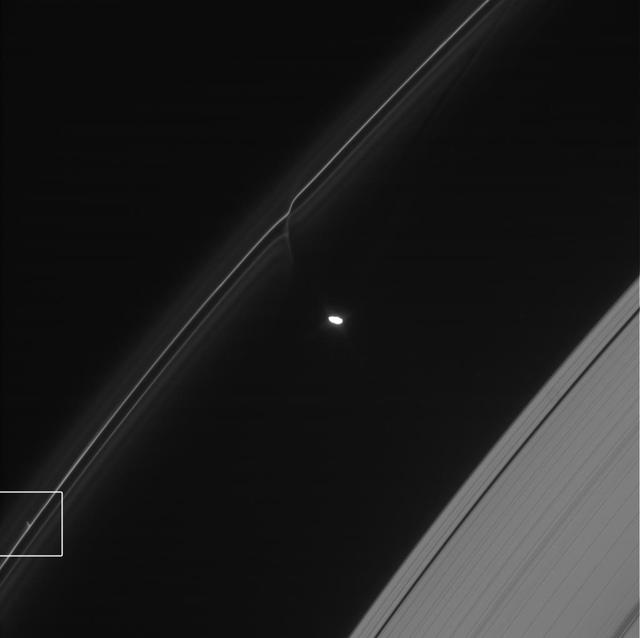
One of the glittering trails caused by small objects punching through Saturn F ring is highlighted in this image from NASA Cassini spacecraft. These trails show how the F ring, the outermost of Saturn main rings, is constantly changing.
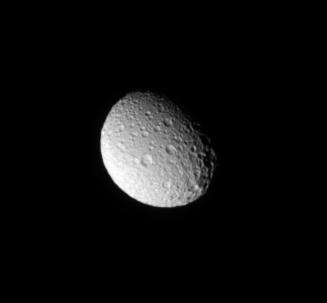
The Cassini spacecraft looks down on the north pole of Mimas and sees the moon cratered trailing hemisphere.
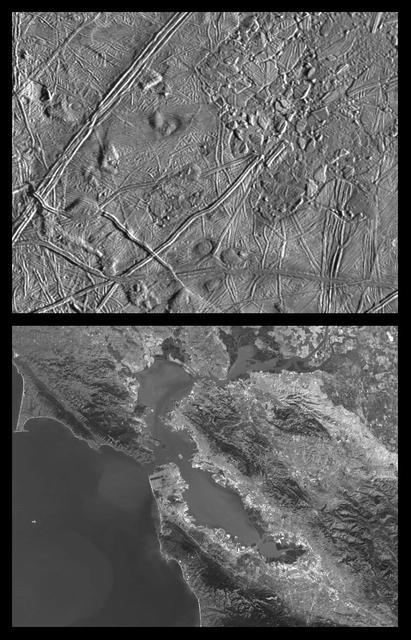
Close-up of Europa Trailing Hemisphere and similar scales on Earth
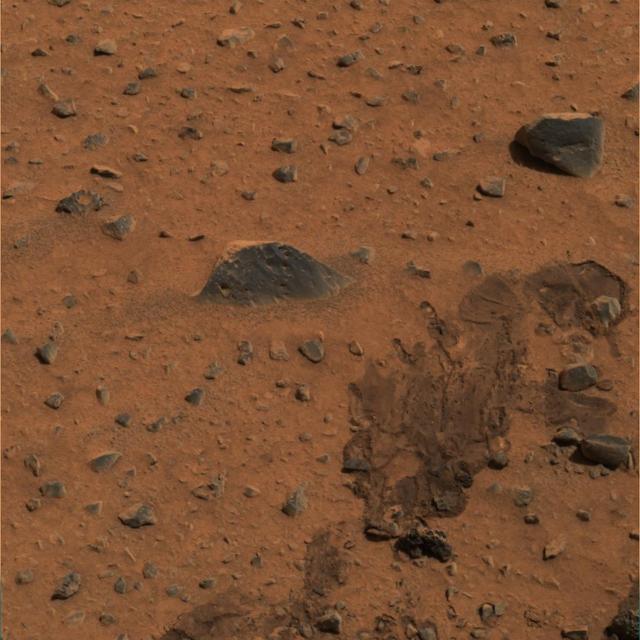
Airbag Trail Dubbed Magic
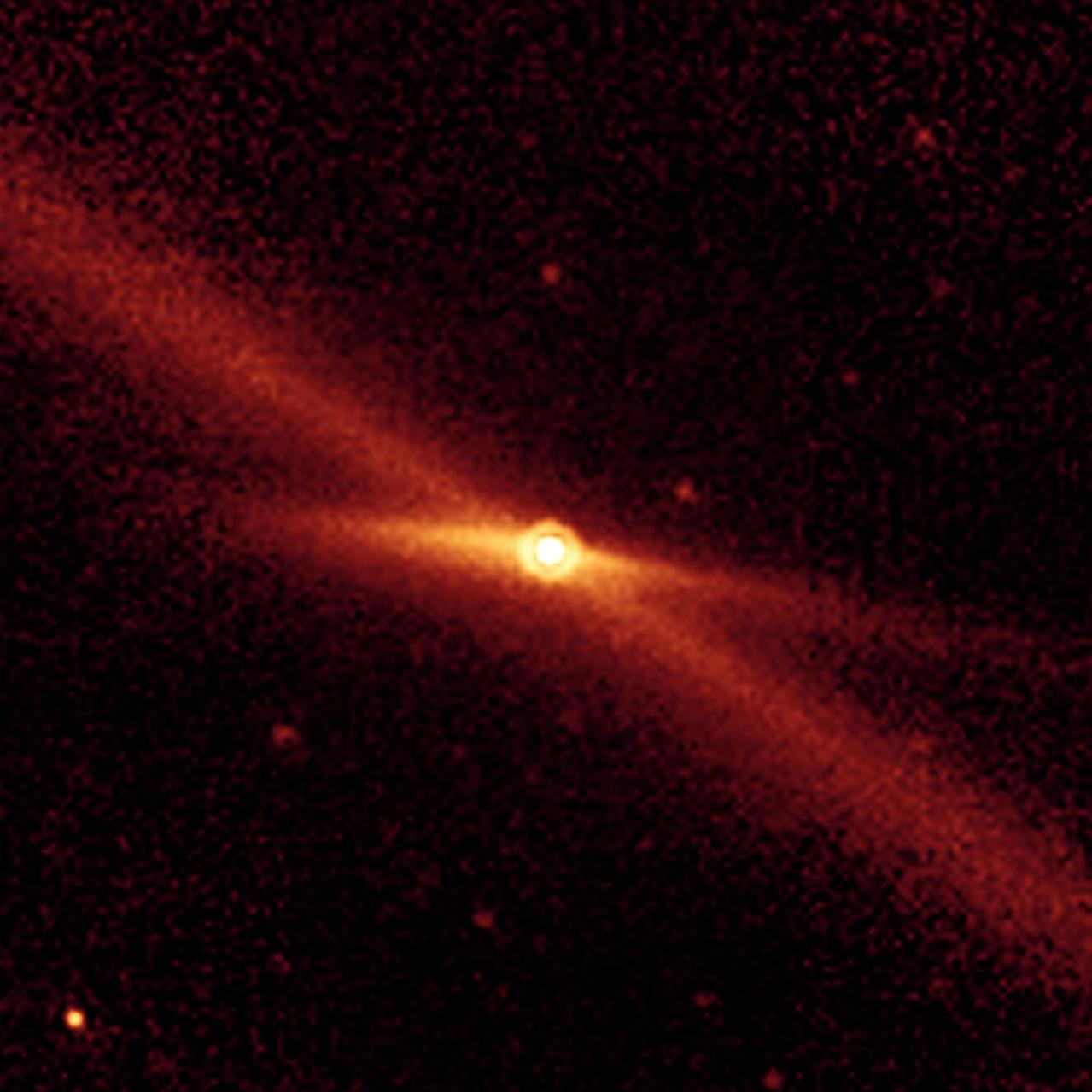
This image taken by NASA Spitzer Space Telescope shows the comet Encke riding along its pebbly trail of debris long diagonal line between the orbits of Mars and Jupiter.

This uncalibrated image from NASA Lunar Reconnaissance Orbiter shows the Apollo 14 landing site and nearby Cone crater. The trail followed by the astronauts can clearly be discerned.
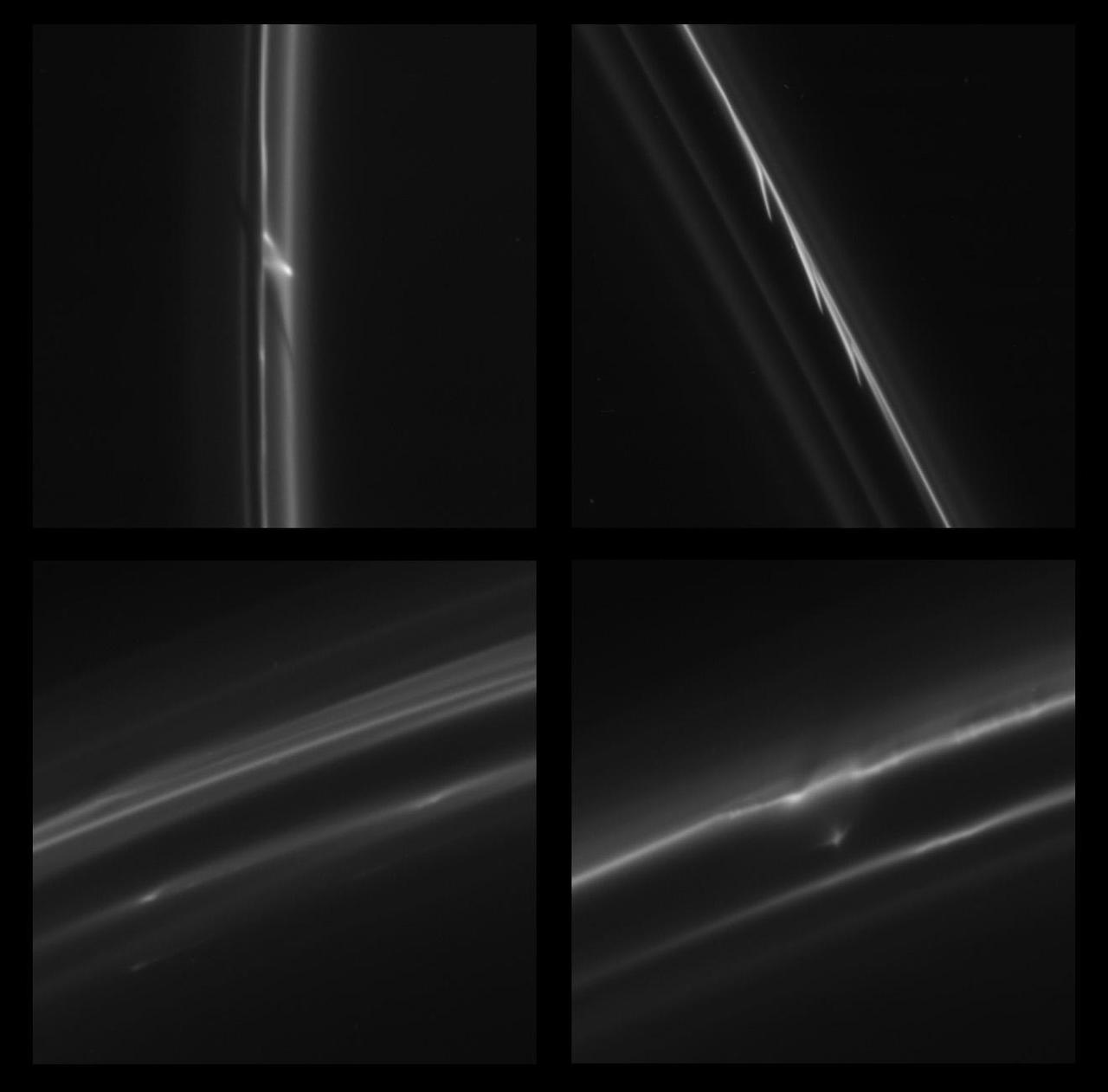
This image obtained by NASA Cassini spacecraft shows some of the more bizarre trails that were dragged out from Saturn F ring by objects about a half mile 1 kilometer in diameter.
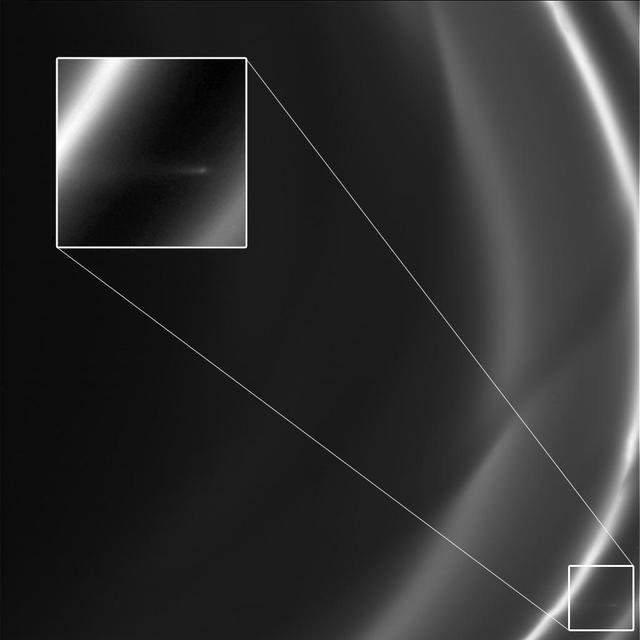
This image obtained by NASA Cassini spacecraft around the time it went into orbit around Saturn in 2004 shows a short trail of icy particles dragged out from Saturn F ring.
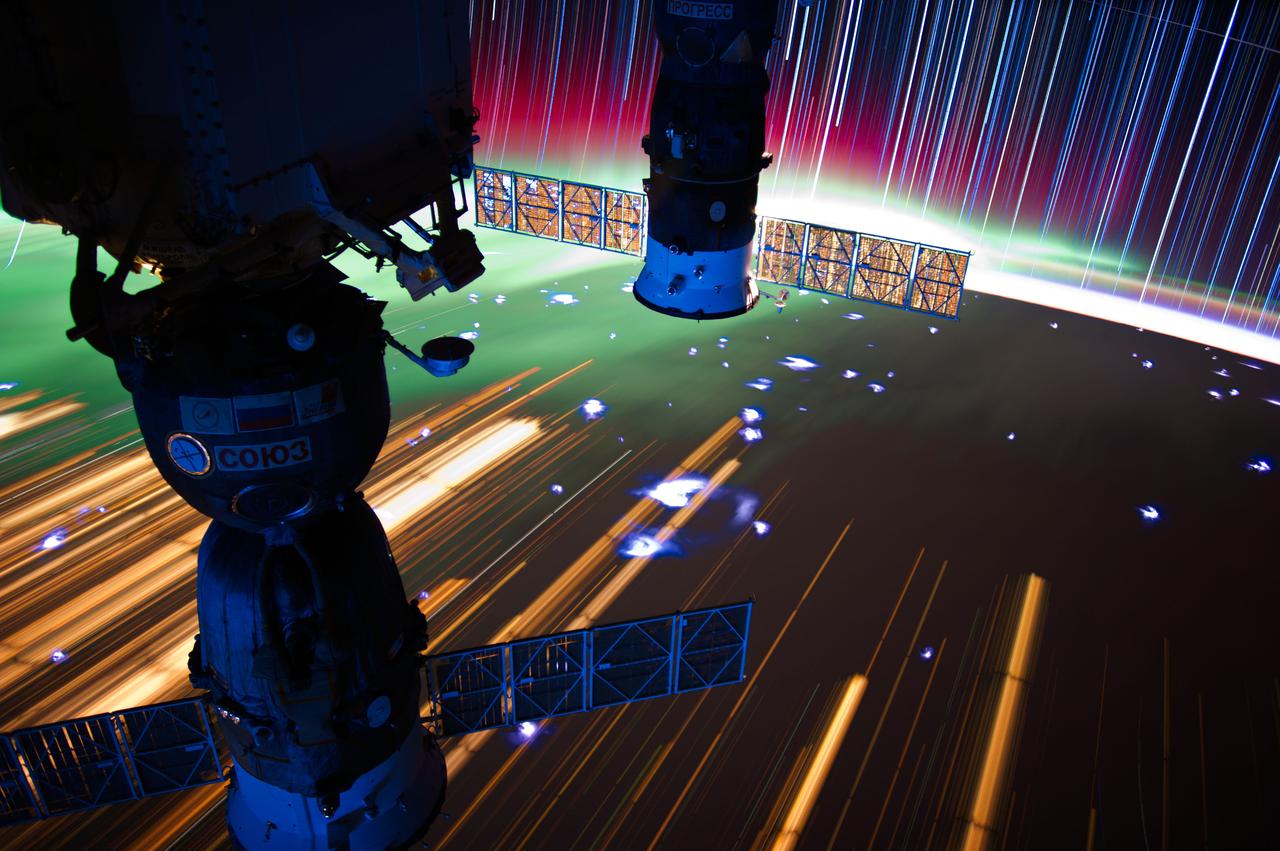
ISS031 star trail created with iss031e066034 thru iss031e066130
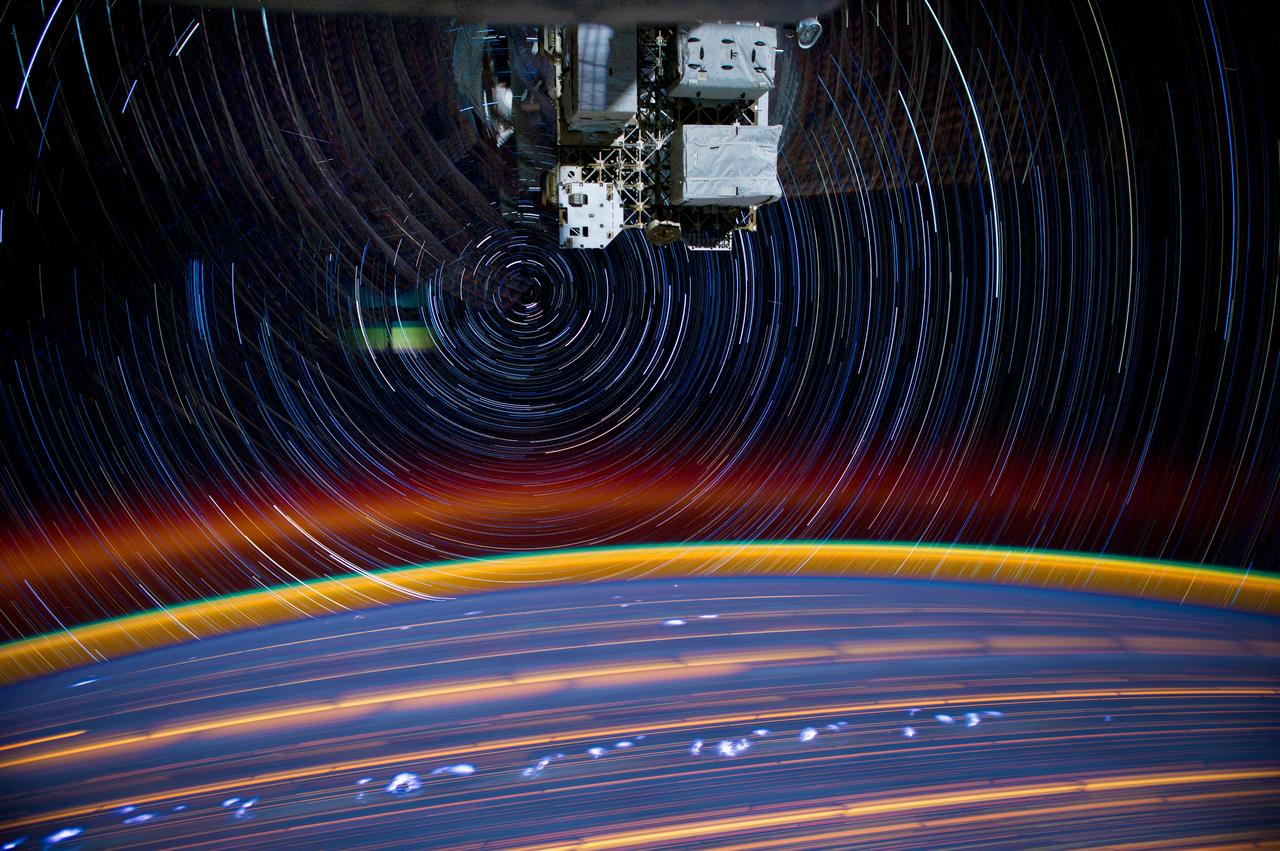
ISS030 star trail composite using iss030e158927 thru iss030e158944
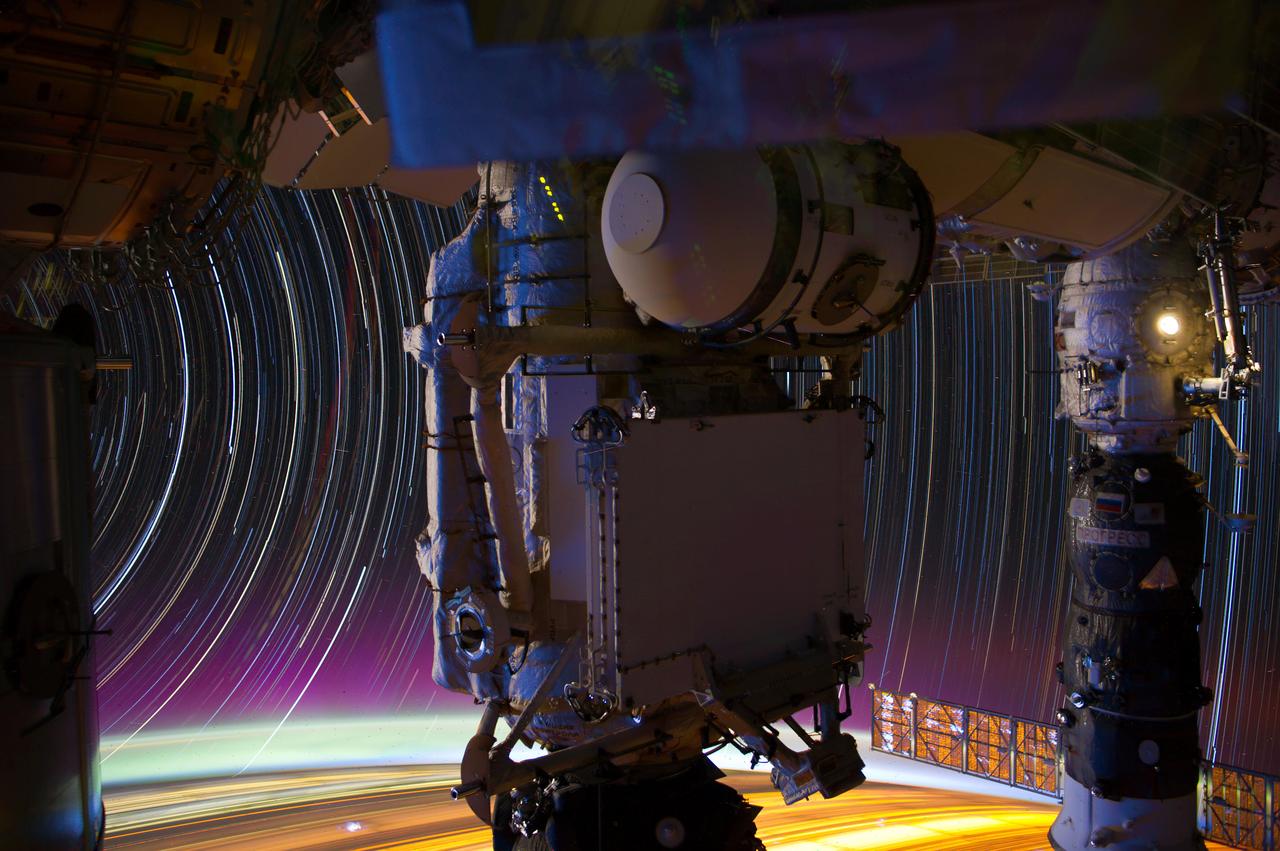
ISS030 star trail composite using iss030e159064 thru iss030e159110
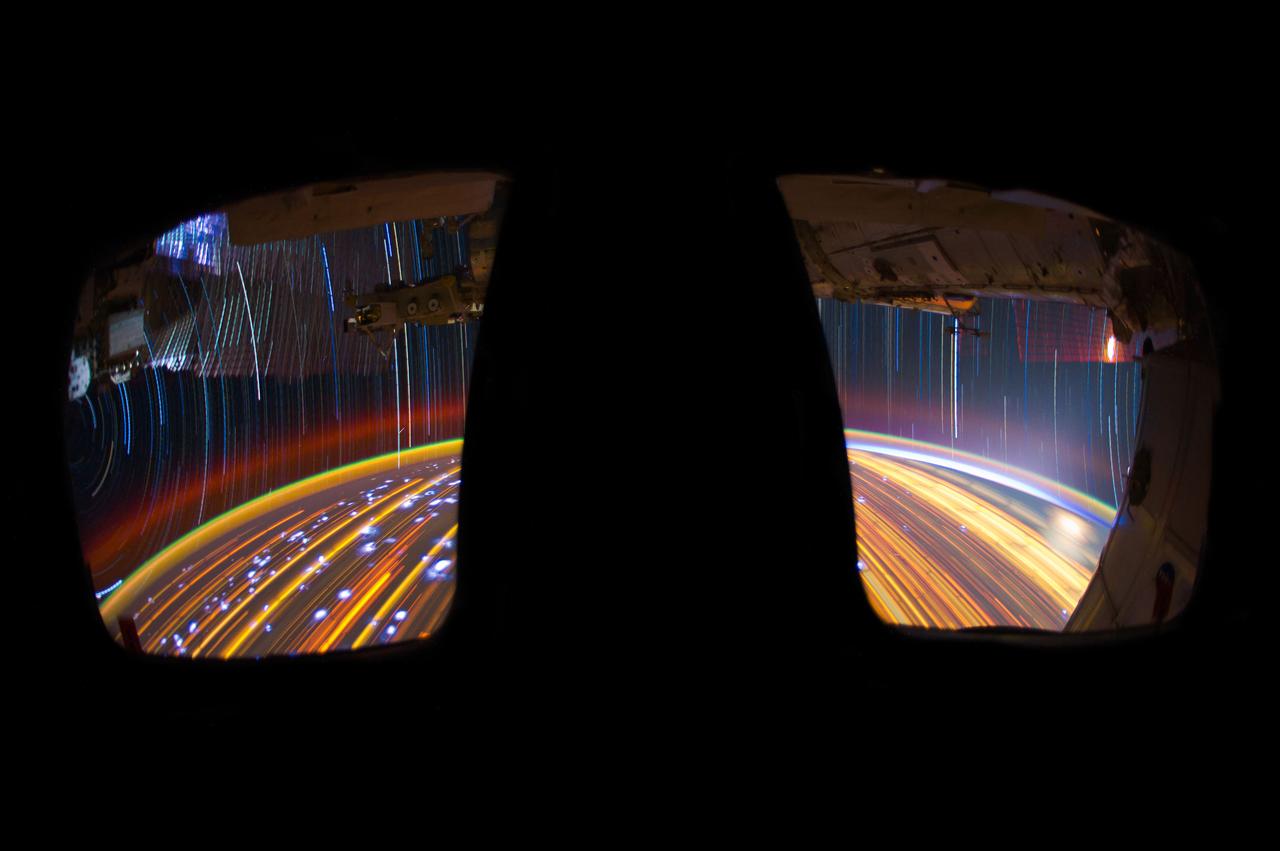
ISS030 star trail composite using iss030e158947 thru iss030e158992
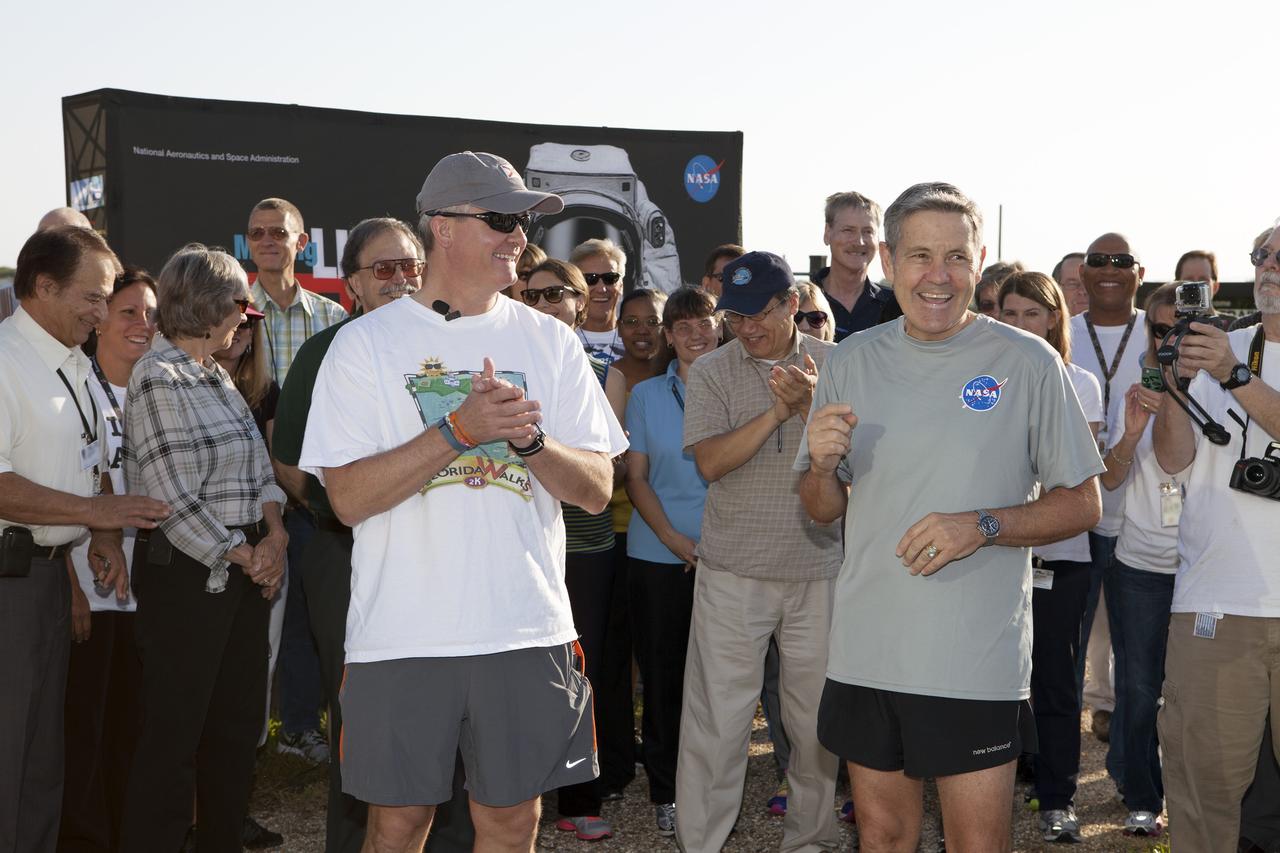
CAPE CANAVERAL, Fla. – Kennedy Space Center Director Bob Cabana, right, Florida State Surgeon General John Armstrong and other guests prepare for an early morning run at the center's Pathfinder Trail near the Operations and Support Building II at Kennedy Space Center in Florida, to officially kick off National Employee Health and Fitness Month with the NASA Moves! challenge. NASA Moves! challenged the workforce from each of the agency's field centers to engage in at least 20 minutes of activity, or 10,000 steps, each day from May 18-31. About 100 people participated in the kickoff event on the Pathfinder Trail in the heart of the center's Launch Complex 39. The one-third-mile-long gravel walkway traces the iconic shape of a space shuttle orbiter and features a set of exercise stations. The friendly contest is part of NASA's new Health4Life initiative, a Web-based health initiative designed to help employees track their health, fitness and nutrition. Health4Life also provides an array of resources geared toward increasing physical activity. Photo credit: NASA/Dimitri Gerondidakis
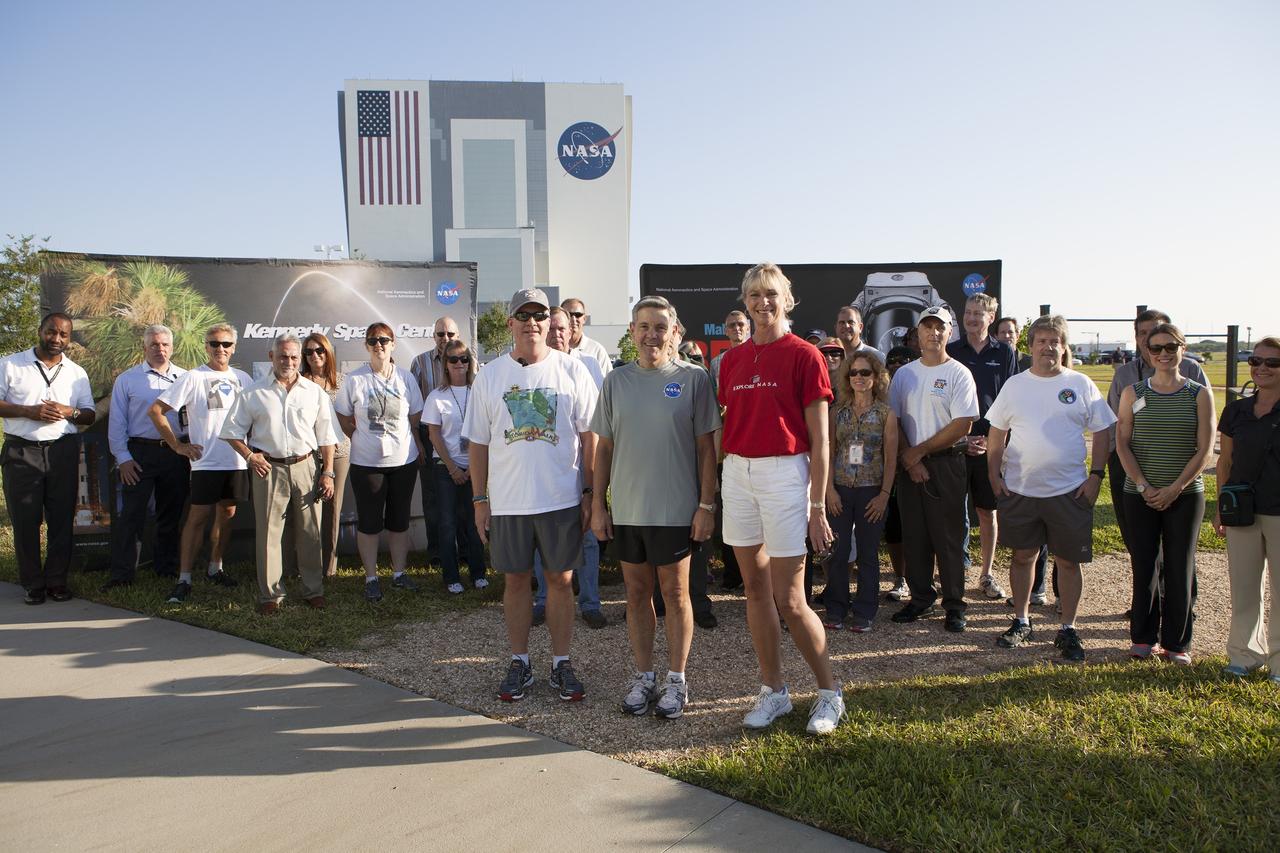
CAPE CANAVERAL, Fla. – From left, Florida State Surgeon General John Armstrong, Kennedy Space Center Director Bob Cabana, Center Operations Director Nancy Bray and Kennedy workers and guests prepare to take an early morning run along the center's Pathfinder Trail near the Operations and Support Building II at Kennedy Space Center in Florida, to officially kick off National Employee Health and Fitness Month with the NASA Moves! challenge. NASA Moves! challenged the workforce from each of the agency's field centers to engage in at least 20 minutes of activity, or 10,000 steps, each day from May 18-31. About 100 people participated in the kickoff event on the Pathfinder Trail in the heart of the center's Launch Complex 39. The one-third-mile-long gravel walkway traces the iconic shape of a space shuttle orbiter and features a set of exercise stations. The friendly contest is part of NASA's new Health4Life initiative, a Web-based health initiative designed to help employees track their health, fitness and nutrition. Health4Life also provides an array of resources geared toward increasing physical activity. Photo credit: NASA/Dimitri Gerondidakis

CAPE CANAVERAL, Fla. – Workers take an early morning walk along the Pathfinder Trail near the Operations and Support Building II at Kennedy Space Center in Florida, to officially kick off National Employee Health and Fitness Month with the NASA Moves! challenge. NASA Moves! challenged the workforce from each of the agency's field centers to engage in at least 20 minutes of activity, or 10,000 steps, each day from May 18-31. About 100 people participated in the kickoff event on the Pathfinder Trail in the heart of the center's Launch Complex 39. The one-third-mile-long gravel walkway traces the iconic shape of a space shuttle orbiter and features a set of exercise stations. The friendly contest is part of NASA's new Health4Life initiative, a Web-based health initiative designed to help employees track their health, fitness and nutrition. Health4Life also provides an array of resources geared toward increasing physical activity. Photo credit: NASA/Dimitri Gerondidakis
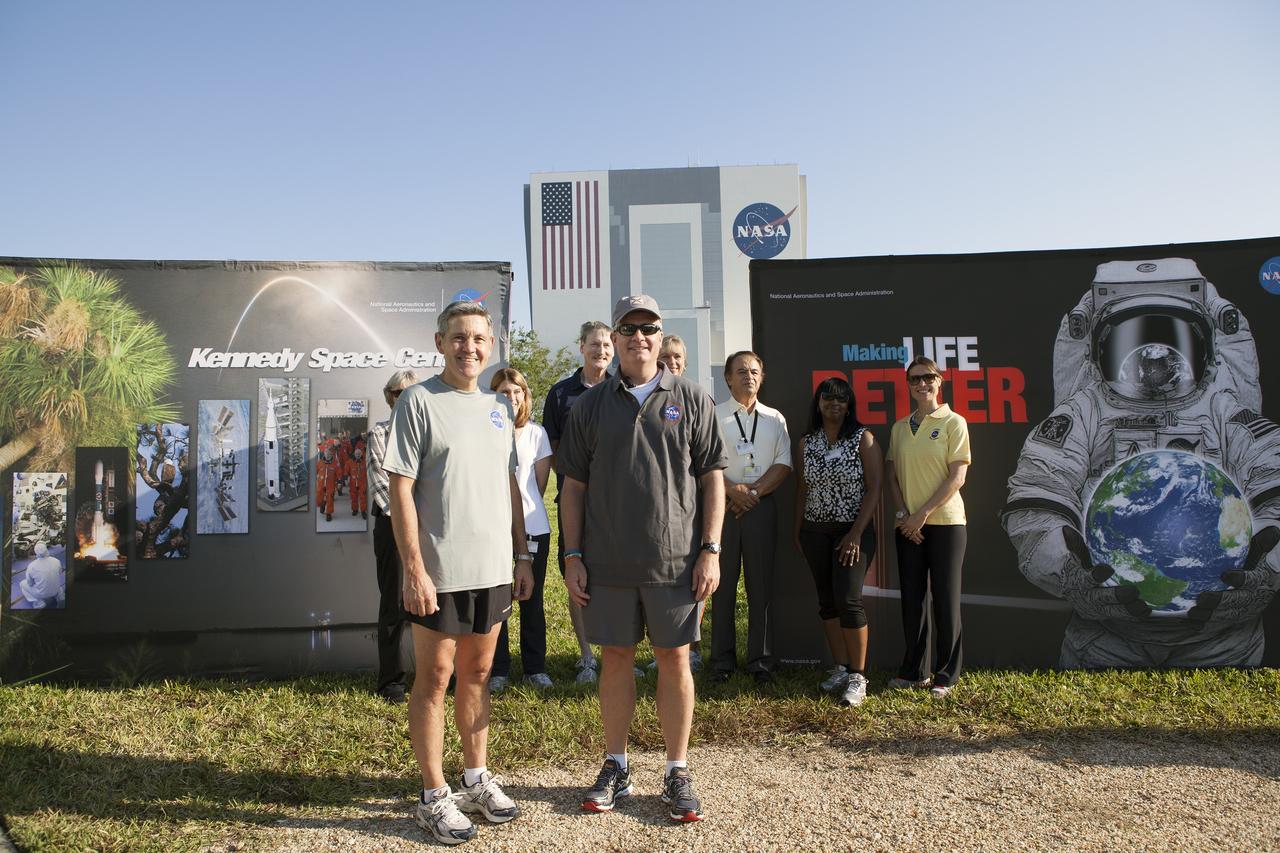
CAPE CANAVERAL, Fla. – Kennedy Space Center Director Bob Cabana, left, and Florida State Surgeon General John Armstrong complete an early morning run along the center's Pathfinder Trail near the Operations and Support Building II at Kennedy Space Center in Florida, to officially kick off National Employee Health and Fitness Month with the NASA Moves! challenge. NASA Moves! challenged the workforce from each of the agency's field centers to engage in at least 20 minutes of activity, or 10,000 steps, each day from May 18-31. About 100 people participated in the kickoff event on the Pathfinder Trail in the heart of the center's Launch Complex 39. The one-third-mile-long gravel walkway traces the iconic shape of a space shuttle orbiter and features a set of exercise stations. The friendly contest is part of NASA's new Health4Life initiative, a Web-based health initiative designed to help employees track their health, fitness and nutrition. Health4Life also provides an array of resources geared toward increasing physical activity. Photo credit: NASA/Dimitri Gerondidakis
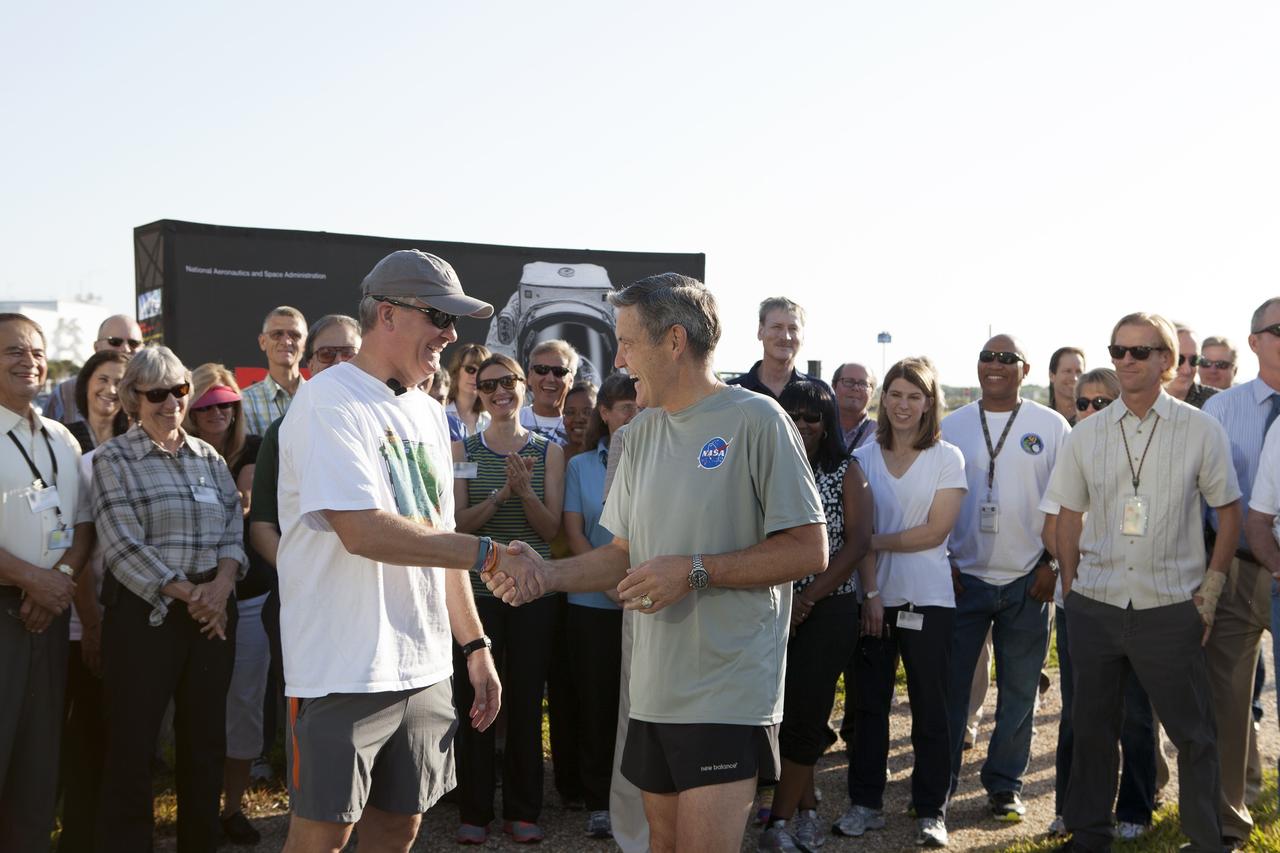
CAPE CANAVERAL, Fla. – Kennedy Space Center Director Bob Cabana, right, shakes hands with Florida State Surgeon General John Armstrong before an early morning run along the center's Pathfinder Trail near the Operations and Support Building II at Kennedy Space Center in Florida, to officially kick off National Employee Health and Fitness Month with the NASA Moves! challenge. NASA Moves! challenged the workforce from each of the agency's field centers to engage in at least 20 minutes of activity, or 10,000 steps, each day from May 18-31. About 100 people participated in the kickoff event on the Pathfinder Trail in the heart of the center's Launch Complex 39. The one-third-mile-long gravel walkway traces the iconic shape of a space shuttle orbiter and features a set of exercise stations. The friendly contest is part of NASA's new Health4Life initiative, a Web-based health initiative designed to help employees track their health, fitness and nutrition. Health4Life also provides an array of resources geared toward increasing physical activity. Photo credit: NASA/Dimitri Gerondidakis
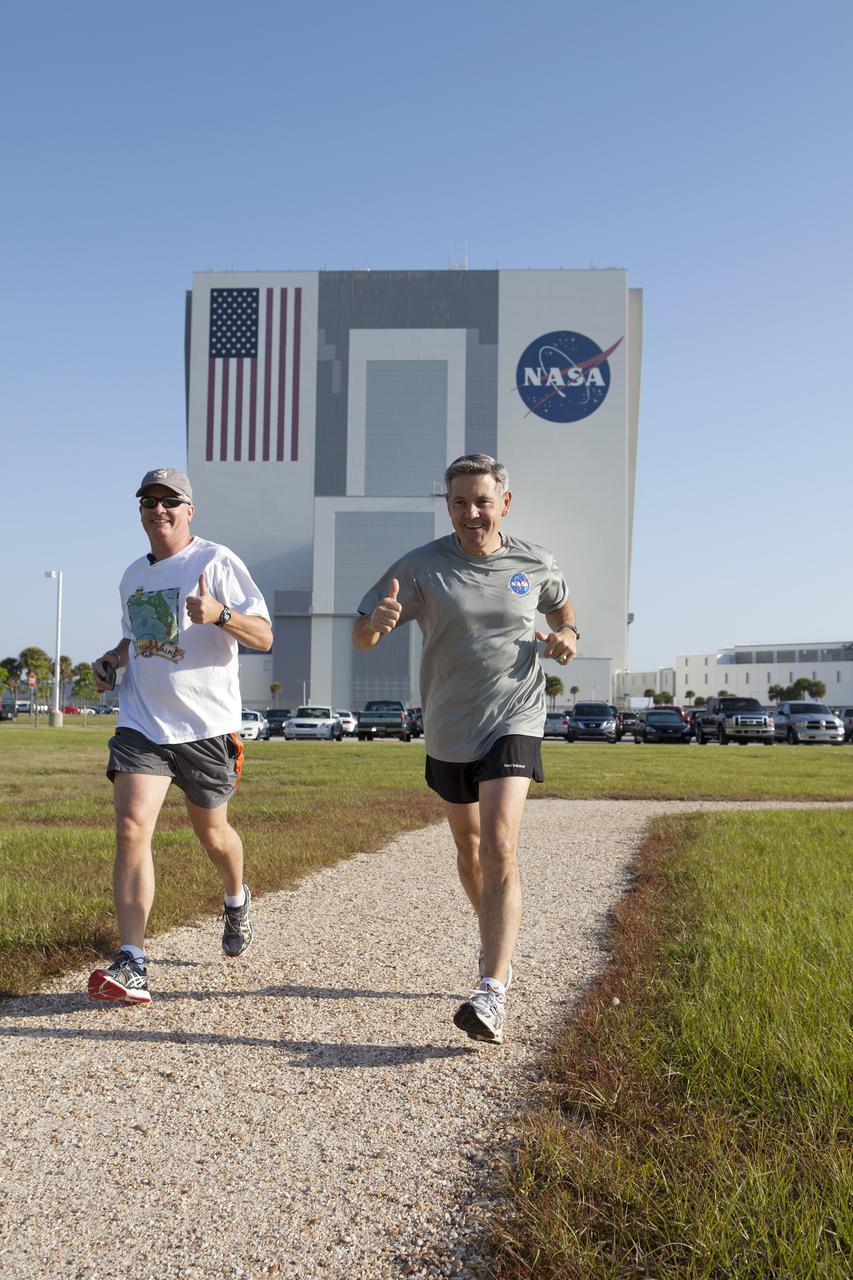
CAPE CANAVERAL, Fla. – Kennedy Space Center Director Bob Cabana, right, and Florida State Surgeon General John Armstrong take an early morning run along the center's Pathfinder Trail near the Operations and Support Building II at Kennedy Space Center in Florida, to officially kick off National Employee Health and Fitness Month with the NASA Moves! challenge. NASA Moves! challenged the workforce from each of the agency's field centers to engage in at least 20 minutes of activity, or 10,000 steps, each day from May 18-31. About 100 people participated in the kickoff event on the Pathfinder Trail in the heart of the center's Launch Complex 39. The one-third-mile-long gravel walkway traces the iconic shape of a space shuttle orbiter and features a set of exercise stations. The friendly contest is part of NASA's new Health4Life initiative, a Web-based health initiative designed to help employees track their health, fitness and nutrition. Health4Life also provides an array of resources geared toward increasing physical activity. Photo credit: NASA/Dimitri Gerondidakis
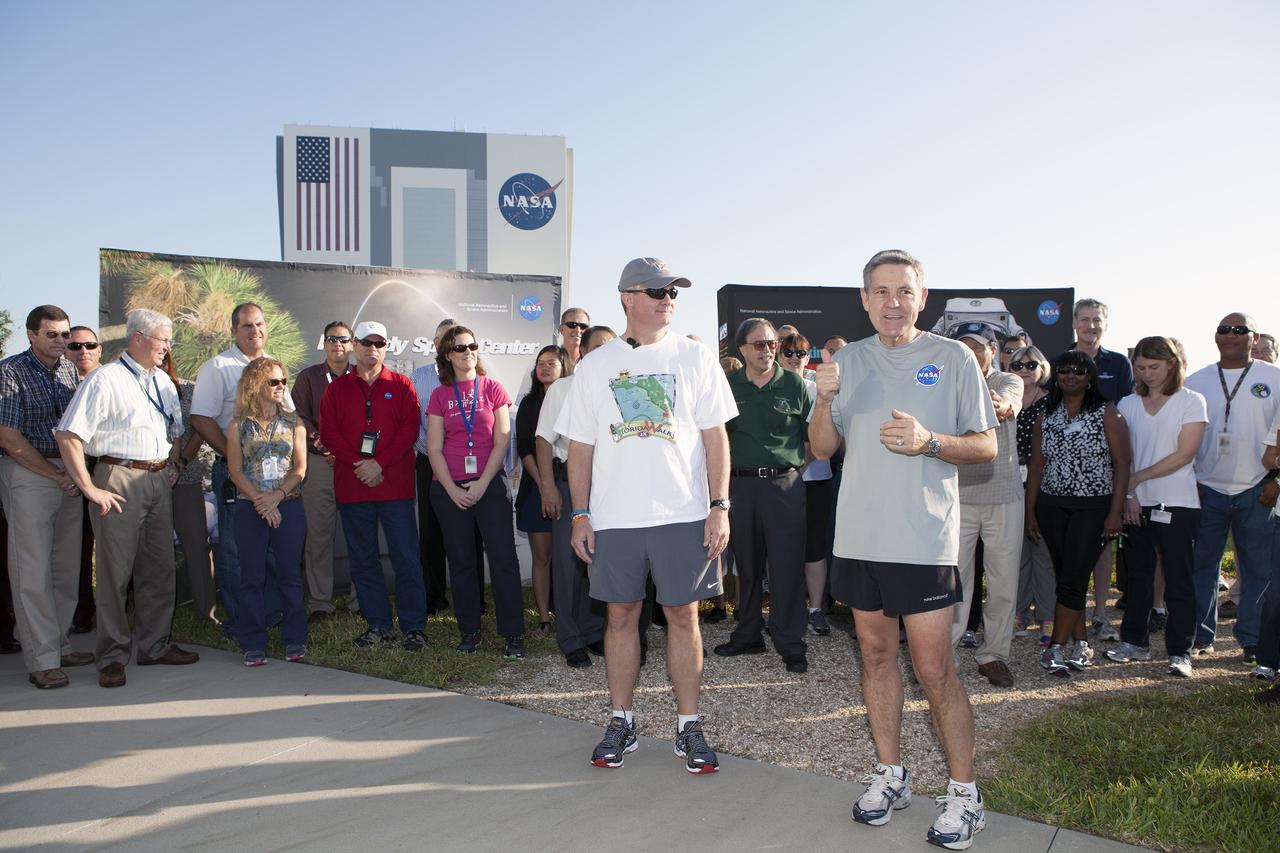
CAPE CANAVERAL, Fla. – Kennedy Space Center Director Bob Cabana, right, Florida State Surgeon General John Armstrong, other Kennedy managers and guests prepare for an early morning run at the center's Pathfinder Trail near the Operations and Support Building II at Kennedy Space Center in Florida, to officially kick off National Employee Health and Fitness Month with the NASA Moves! challenge. NASA Moves! challenged the workforce from each of the agency's field centers to engage in at least 20 minutes of activity, or 10,000 steps, each day from May 18-31. About 100 people participated in the kickoff event on the Pathfinder Trail in the heart of the center's Launch Complex 39. The one-third-mile-long gravel walkway traces the iconic shape of a space shuttle orbiter and features a set of exercise stations. The friendly contest is part of NASA's new Health4Life initiative, a Web-based health initiative designed to help employees track their health, fitness and nutrition. Health4Life also provides an array of resources geared toward increasing physical activity. Photo credit: NASA/Dimitri Gerondidakis

CAPE CANAVERAL, Fla. – Nancy Bray, right, Center Operations director at Kennedy Space Center, and Lori Hicks, Human Resources, take an early morning walk along the center's Pathfinder Trail near the Operations and Support Building II at Kennedy Space Center in Florida, to officially kick off National Employee Health and Fitness Month with the NASA Moves! challenge. NASA Moves! challenged the workforce from each of the agency's field centers to engage in at least 20 minutes of activity, or 10,000 steps, each day from May 18-31. About 100 people participated in the kickoff event on the Pathfinder Trail in the heart of the center's Launch Complex 39. The one-third-mile-long gravel walkway traces the iconic shape of a space shuttle orbiter and features a set of exercise stations. The friendly contest is part of NASA's new Health4Life initiative, a Web-based health initiative designed to help employees track their health, fitness and nutrition. Health4Life also provides an array of resources geared toward increasing physical activity. Photo credit: NASA/Dimitri Gerondidakis
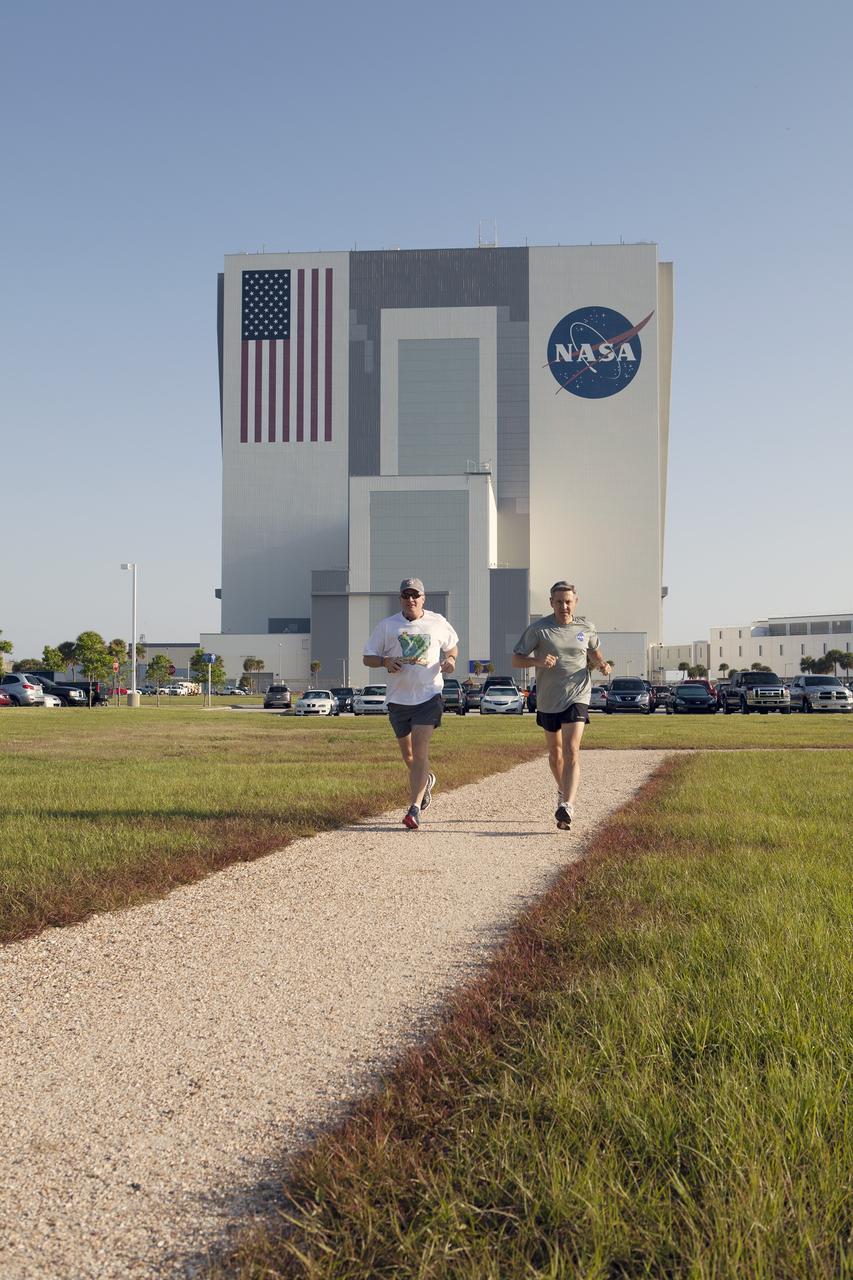
CAPE CANAVERAL, Fla. – Kennedy Space Center Director Bob Cabana, right, and Florida State Surgeon General John Armstrong begin an early morning run along the center's Pathfinder Trail near the Operations and Support Building II at Kennedy Space Center in Florida, to officially kick off National Employee Health and Fitness Month with the NASA Moves! challenge. NASA Moves! challenged the workforce from each of the agency's field centers to engage in at least 20 minutes of activity, or 10,000 steps, each day from May 18-31. About 100 people participated in the kickoff event on the Pathfinder Trail in the heart of the center's Launch Complex 39. The one-third-mile-long gravel walkway traces the iconic shape of a space shuttle orbiter and features a set of exercise stations. The friendly contest is part of NASA's new Health4Life initiative, a Web-based health initiative designed to help employees track their health, fitness and nutrition. Health4Life also provides an array of resources geared toward increasing physical activity. Photo credit: NASA/Dimitri Gerondidakis
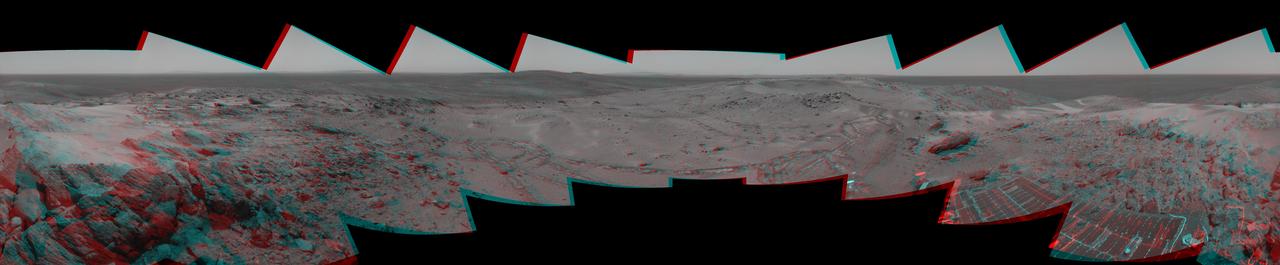
Before moving on to explore more of Mars, NASA Mars Exploration Rover Spirit looked back at the long and winding trail of twin wheel tracks the rover created to get to the top of Husband Hill. 3D glasses are necessary to view this image.
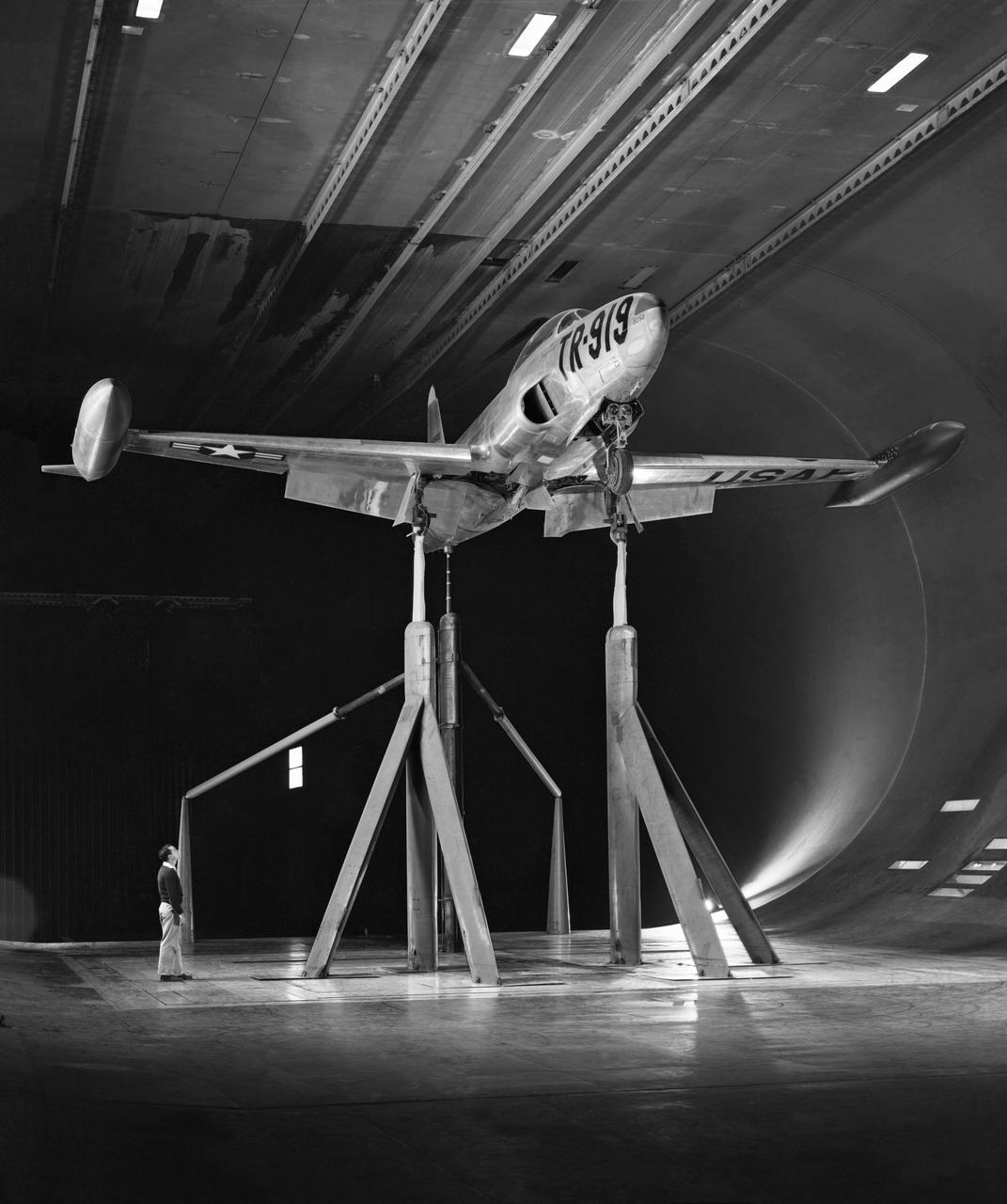
3/4 front view of Wind Tunnel investigation of the Lockheed T-33 modified for area-suction leading-edge and trailing edge flaps in Ames 40x80 foot Wind Tunnel.
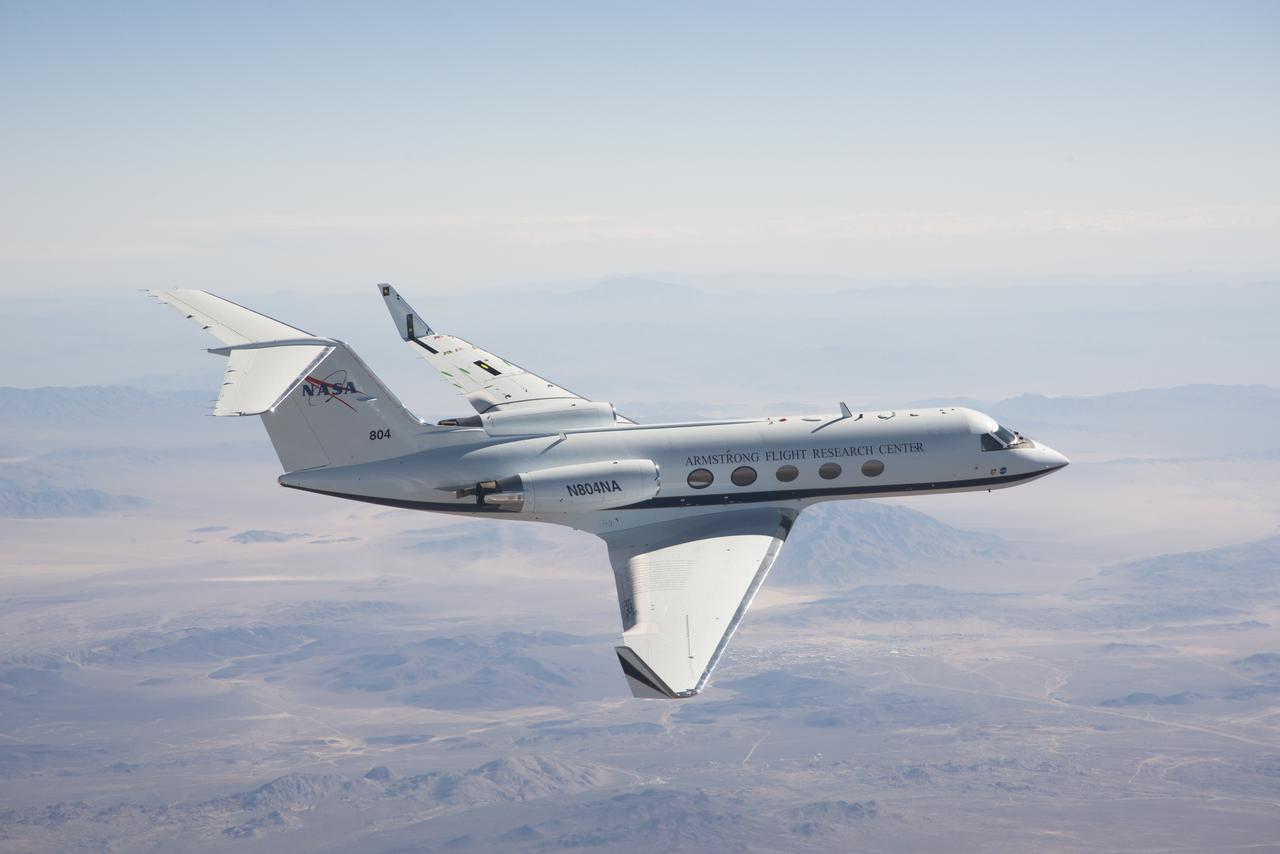
An Armstrong G-III aircraft carrying the Flexys© Adaptive Compliant Trailing Edge flap. The smooth transition between the flaps and wing reduced drag and noise.
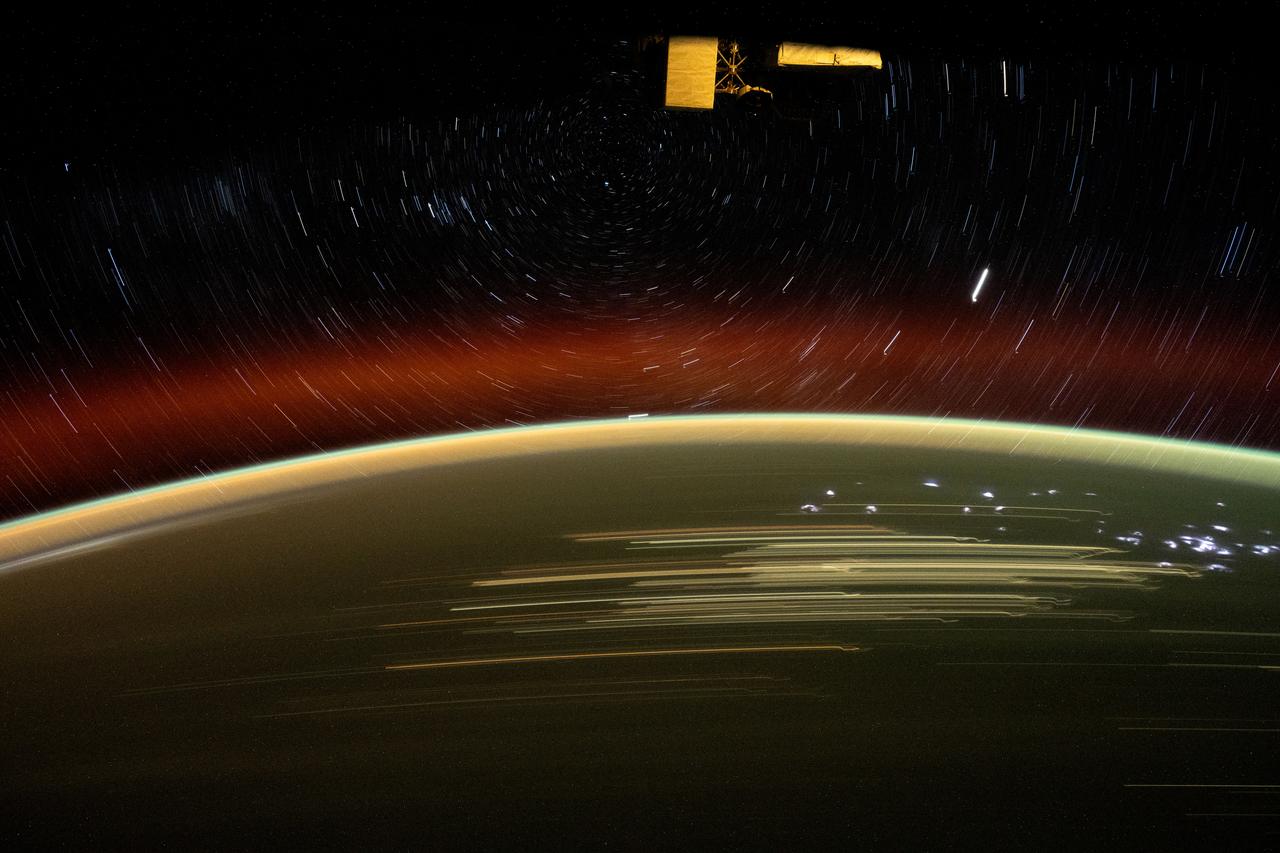
iss072e010734 (Oct. 1, 2024) -- As the International Space Station soared 266 miles over Western Australia, NASA astronaut Jeanette Epps captured this long-exposure shot of Earth at night and star trails glittering above the atmosphere.
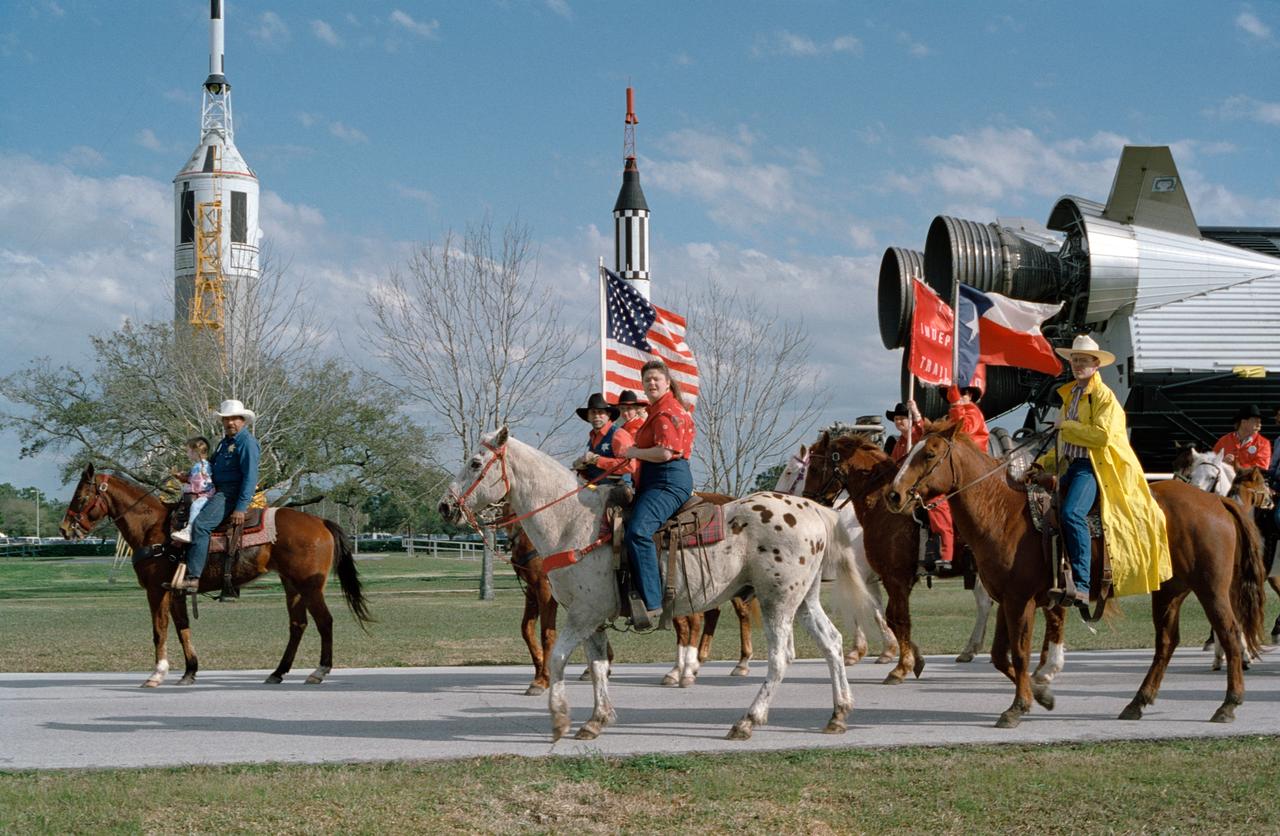
Rose Gardner of the JSC Travel Office, center, rides with the Independence Trail Riders as they enter JSC at Rocket Park.
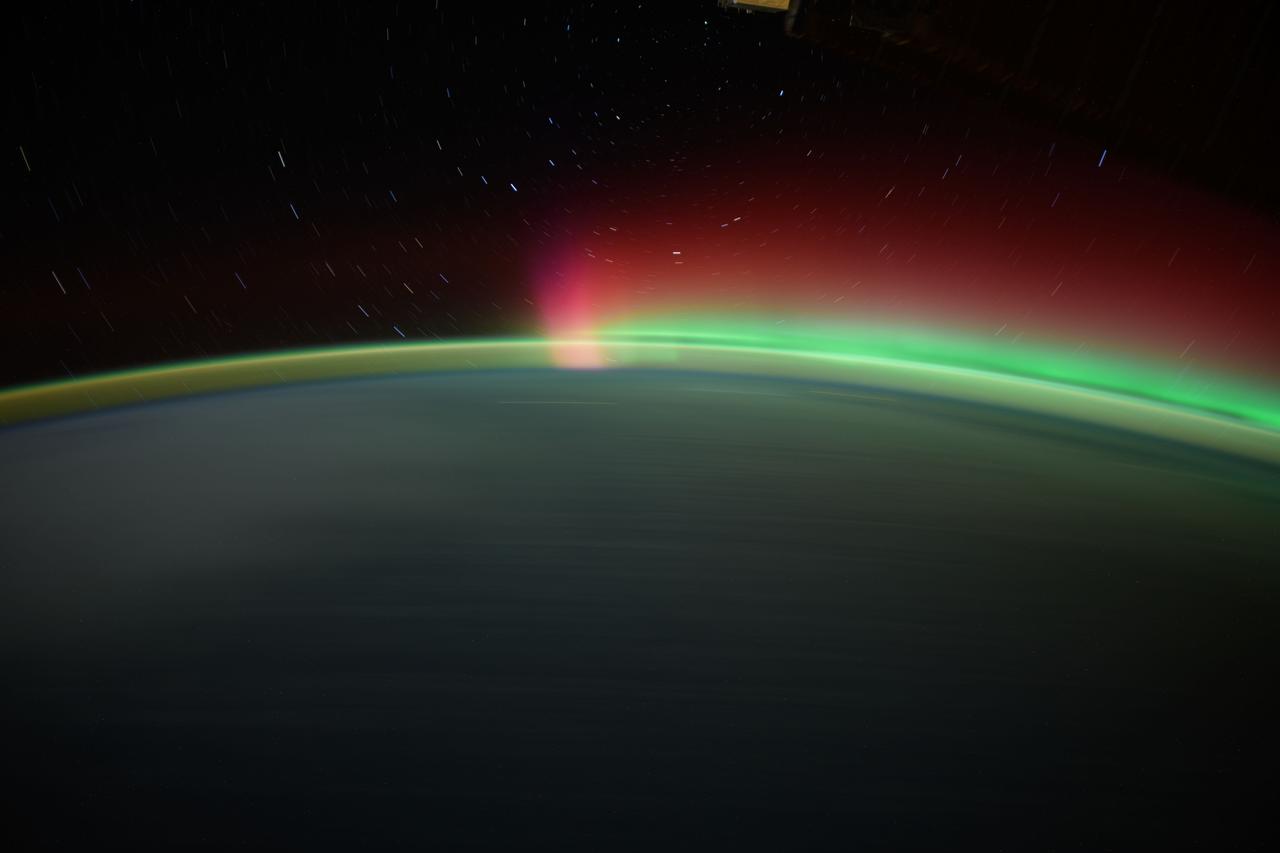
iss072e147691 (Nov. 9, 2024) --- Star trails, an aurora, and Earth's atmospheric glow highlight this long-duration photograph taken from the International Space Station as it orbited 259 miles above the North Pacific Ocean.
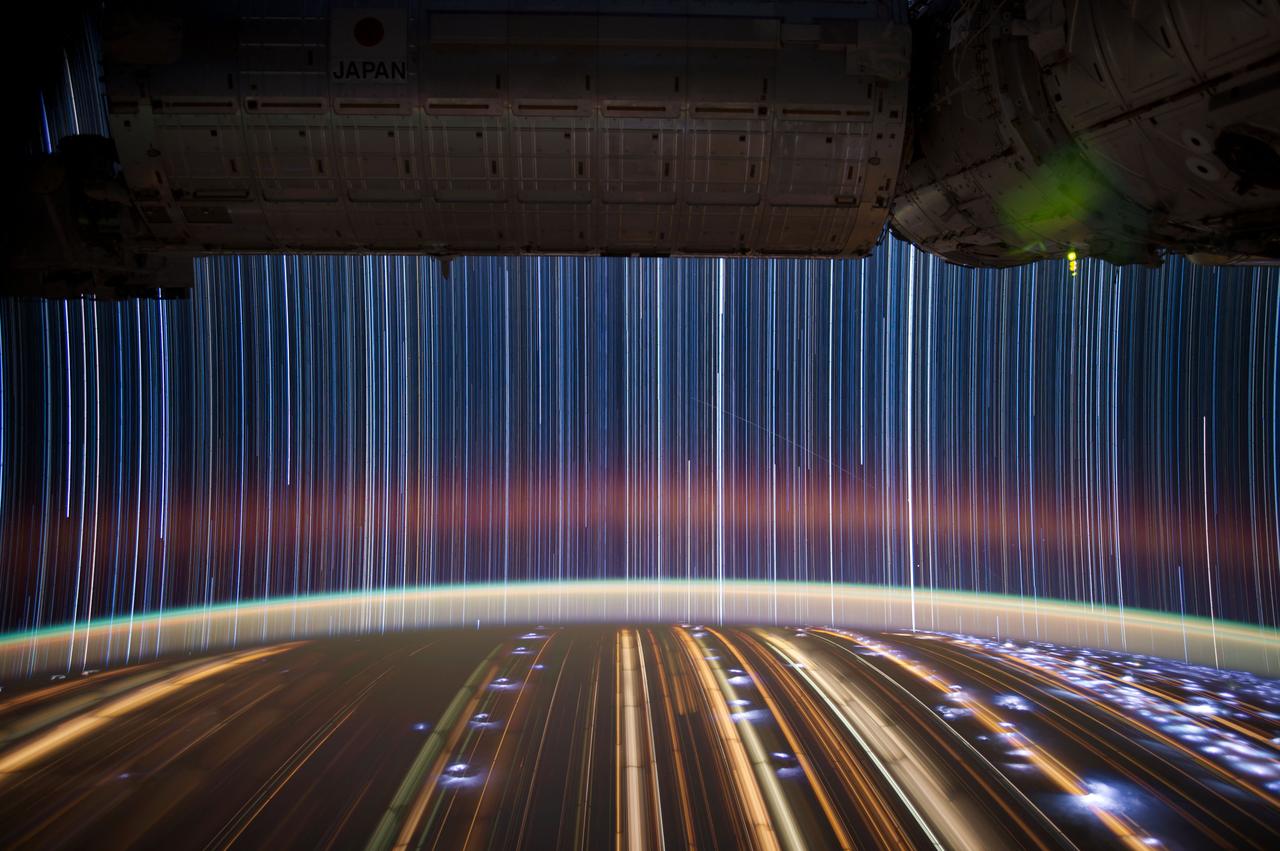
jsc2012e039800_alt (5 March 2012) --- This is a composite of a series of images photographed from a mounted camera on the Earth-orbiting International Space Station, from approximately 240 miles above Earth. Expedition 31 Flight Engineer Don Pettit relayed some information about photographic techniques used to achieve the images: "My star trail images are made by taking a time exposure of about 10 to 15 minutes. However, with modern digital cameras, 30 seconds is about the longest exposure possible, due to electronic detector noise effectively snowing out the image. To achieve the longer exposures I do what many amateur astronomers do. I take multiple 30-second exposures, then
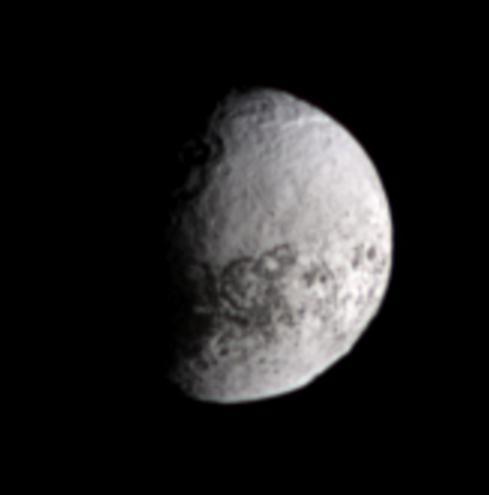
The Cassini spacecraft views terrain on the bright, trailing side of Iapetus in natural color
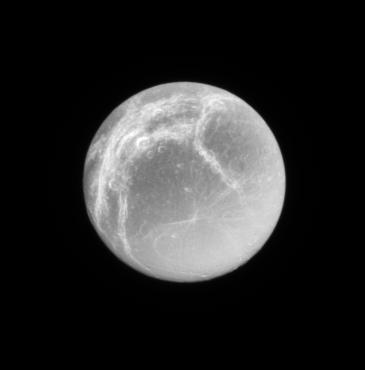
Bright icy fractures, or linea, cover the trailing hemisphere of Saturn moon, Dione
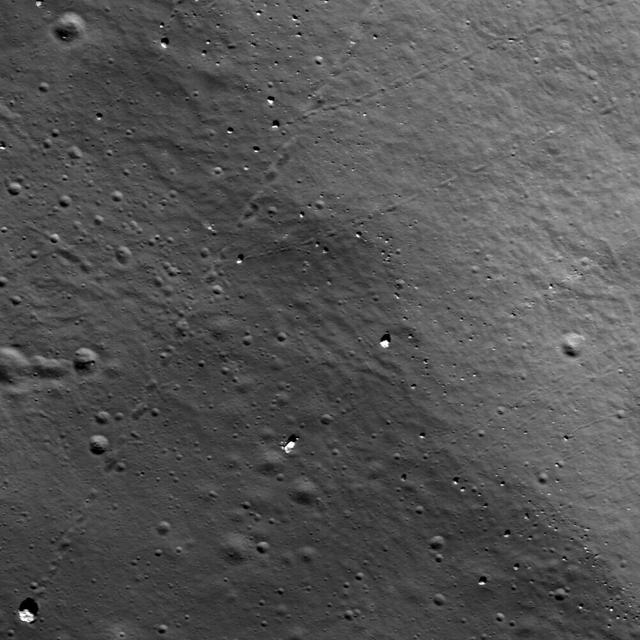
NASA Lunar Reconnaissance Orbiter spies many boulder trails are found on the lunar crater walls and basin massifs. Some of the trails are smooth and nearly straight while others are curvy or gouge into the surface.
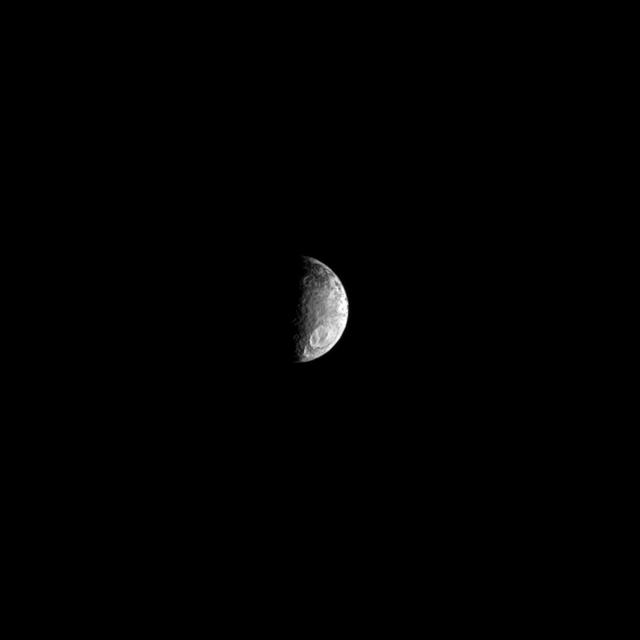
A large crater can be seen in the southern hemisphere of Saturn two-tone moon Iapetus. Lit terrain seen here is on the trailing hemisphere while the leading hemisphere is extremely dark and whose trailing hemisphere is as white as snow.
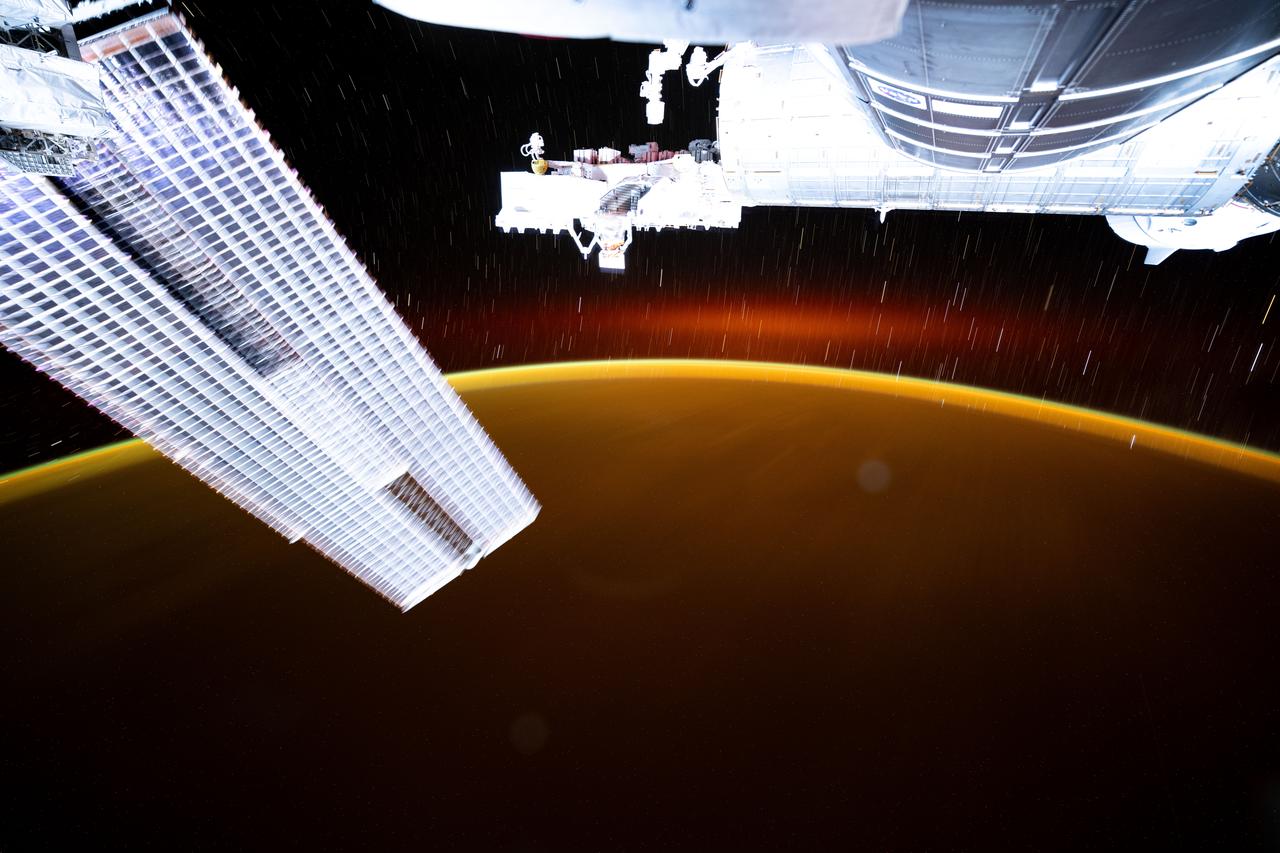
iss072e921626 (March 30, 2025) --- This long-duration photograph from the International Space Station highlights star trails and an atmospheric glow blanketing Earth's horizon. In the foreground, is a set of the space station's main solar arrays (left), the Kibo laboratory module (right), and Kibo's External Platform that houses experiments exposed to the vacuum of space. The orbital outpost was soaring 259 miles above the Pacific Ocean southeast of Japan moments before sunset.
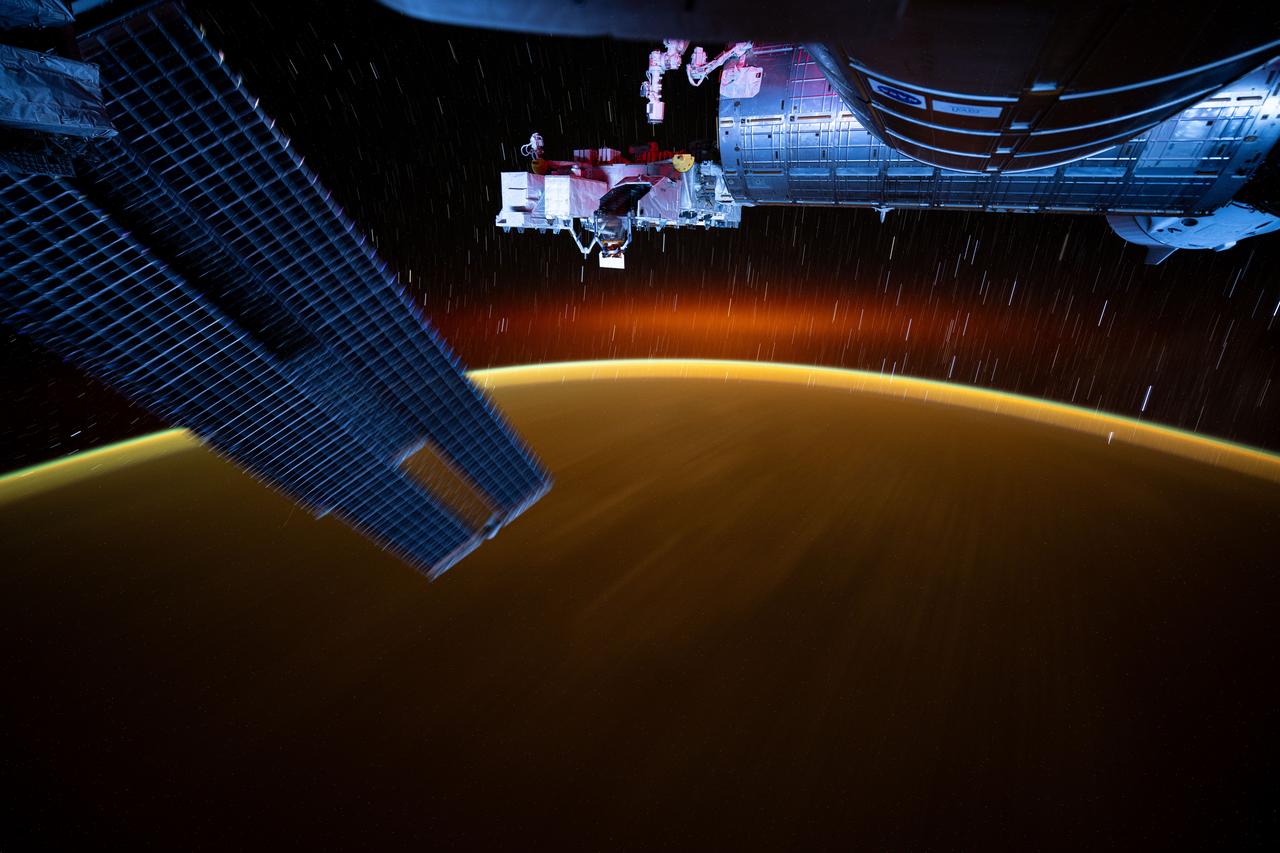
iss072e921628 (March 30, 2025) --- This long-duration photograph from the International Space Station highlights star trails and an atmospheric glow blanketing Earth's horizon. In the foreground, is a set of the space station's main solar arrays (left), the Kibo laboratory module (right), and Kibo's External Platform that houses experiments exposed to the vacuum of space. The orbital outpost was soaring 259 miles above the Pacific Ocean southeast of Japan just after sunset.
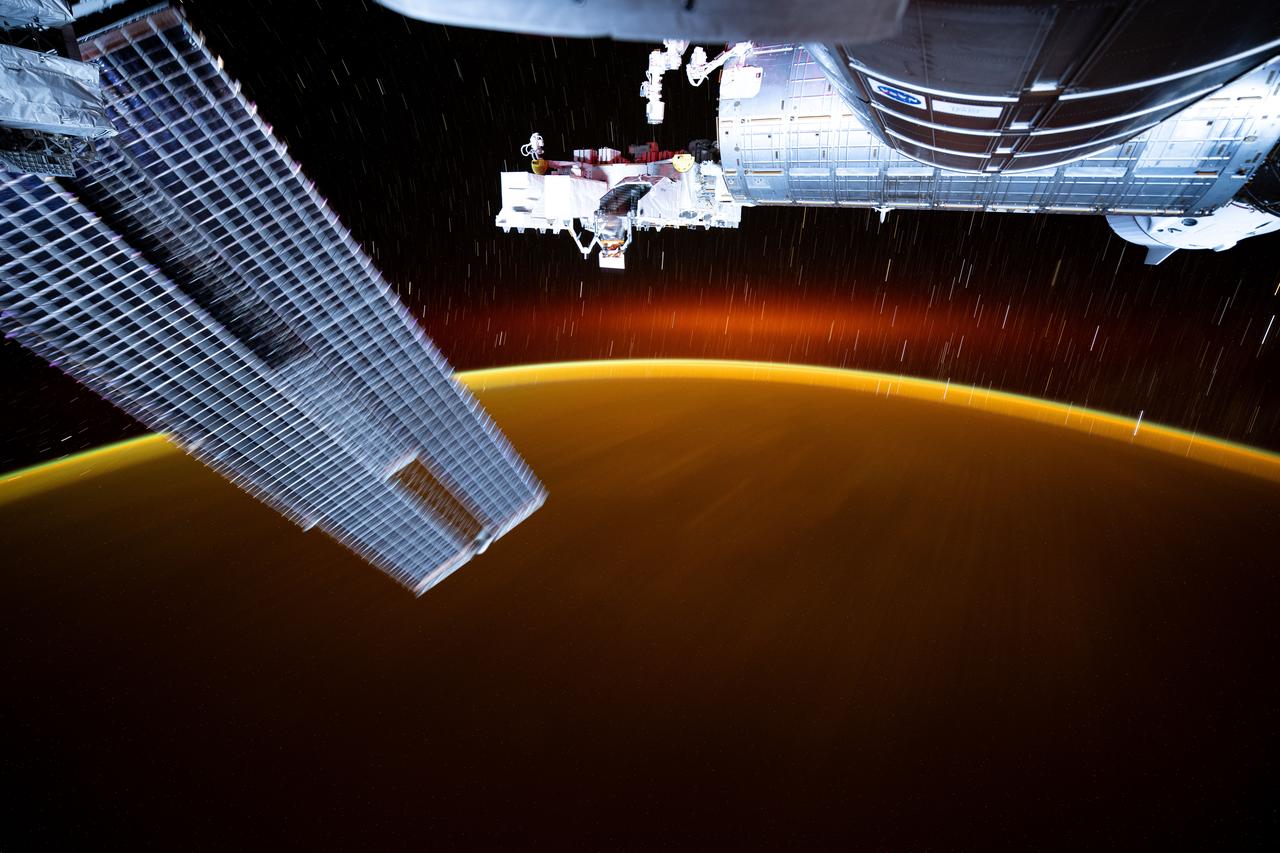
iss072e921627 (March 30, 2025) --- This long-duration photograph from the International Space Station highlights star trails and an atmospheric glow blanketing Earth's horizon. In the foreground, is a set of the space station's main solar arrays (left), the Kibo laboratory module (right), and Kibo's External Platform that houses experiments exposed to the vacuum of space. The orbital outpost was soaring 259 miles above the Pacific Ocean southeast of Japan going into a sunset.
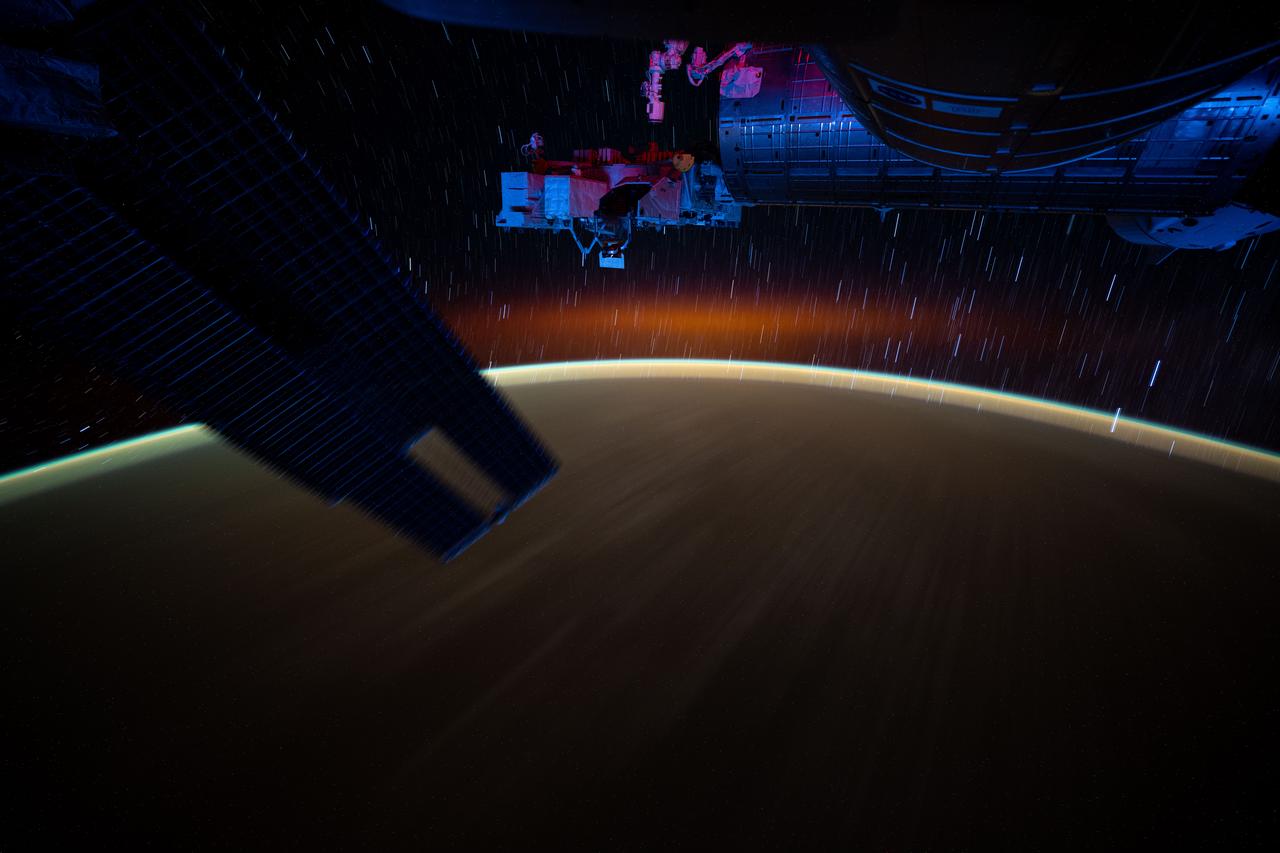
iss072e921629 (March 30, 2025) --- This long-duration photograph from the International Space Station highlights star trails and an atmospheric glow blanketing Earth's horizon. In the foreground, is a set of the space station's main solar arrays (left), the Kibo laboratory module (right), and Kibo's External Platform that houses experiments exposed to the vacuum of space. The orbital outpost was soaring 259 miles above the Pacific Ocean southeast of Japan after sunset.

iss072e940709 (April 2, 2025) --- This long duration photograph looks out from a window on the cupola revealing Earth's atmopsheric glow underneath star trails as the International Space Station orbited 258 miles above the Pacific Ocean southeast of Hawaii at approximately 8:15 p.m. local time. In the foreground, is the Kibo laboratory module (left), and Kibo's External Platform (center) that houses experiments exposed to the vacuum of space, and a set of the space station's main solar arrays (right).
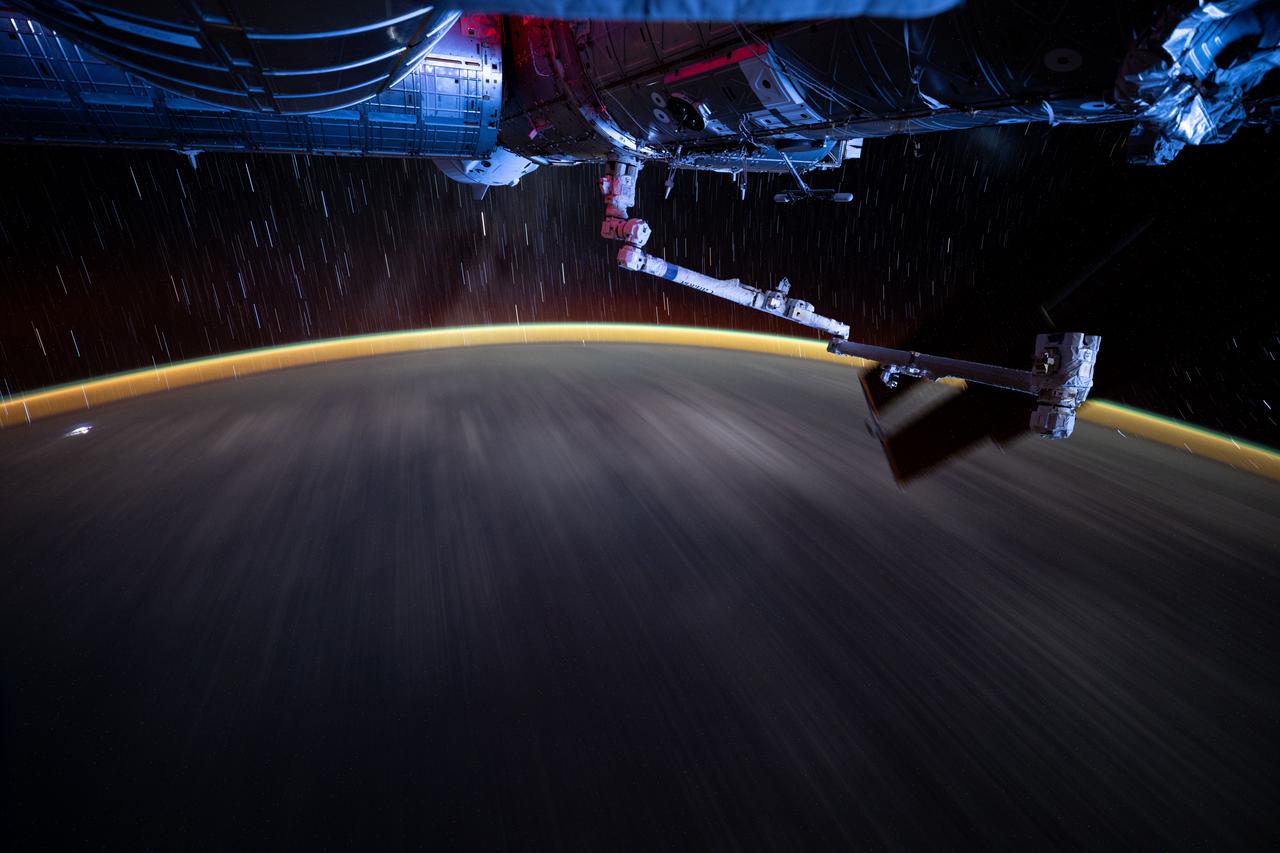
iss072e940398 (April 2, 2025) --- This long duration photograph reveals Earth's atmopsheric glow underneath star trails as the International Space Station orbited 258 miles above the Pacific Ocean southeast of Hawaii at approximately 8:16 p.m. local time. In the foreground (from left), is the Kibo laboratory module, the partially obscured SpaceX Dragon crew spacecraft docked to the Harmony module, the Canadarm2 robotic arm, and the Destiny laboratory module.
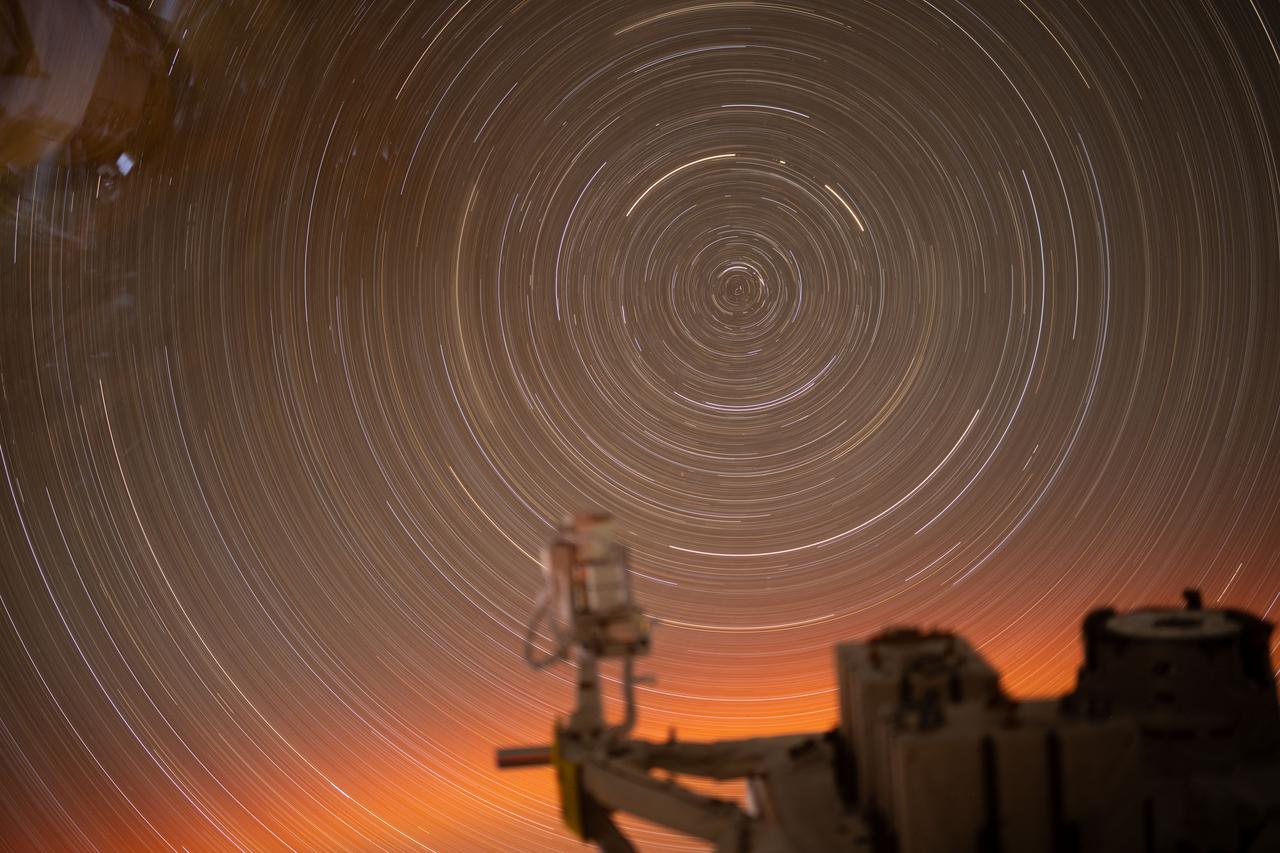
iss073e0427643 (July 26, 2025) --- This long-exposure photograph, taken over 31 minutes from a window inside the International Space Station’s Kibo laboratory module, captures the circular arcs of star trails. In the foreground is a portion of Kibo’s Exposed Facility, where various payloads and experiments are mounted to be exposed directly to the vacuum of space.
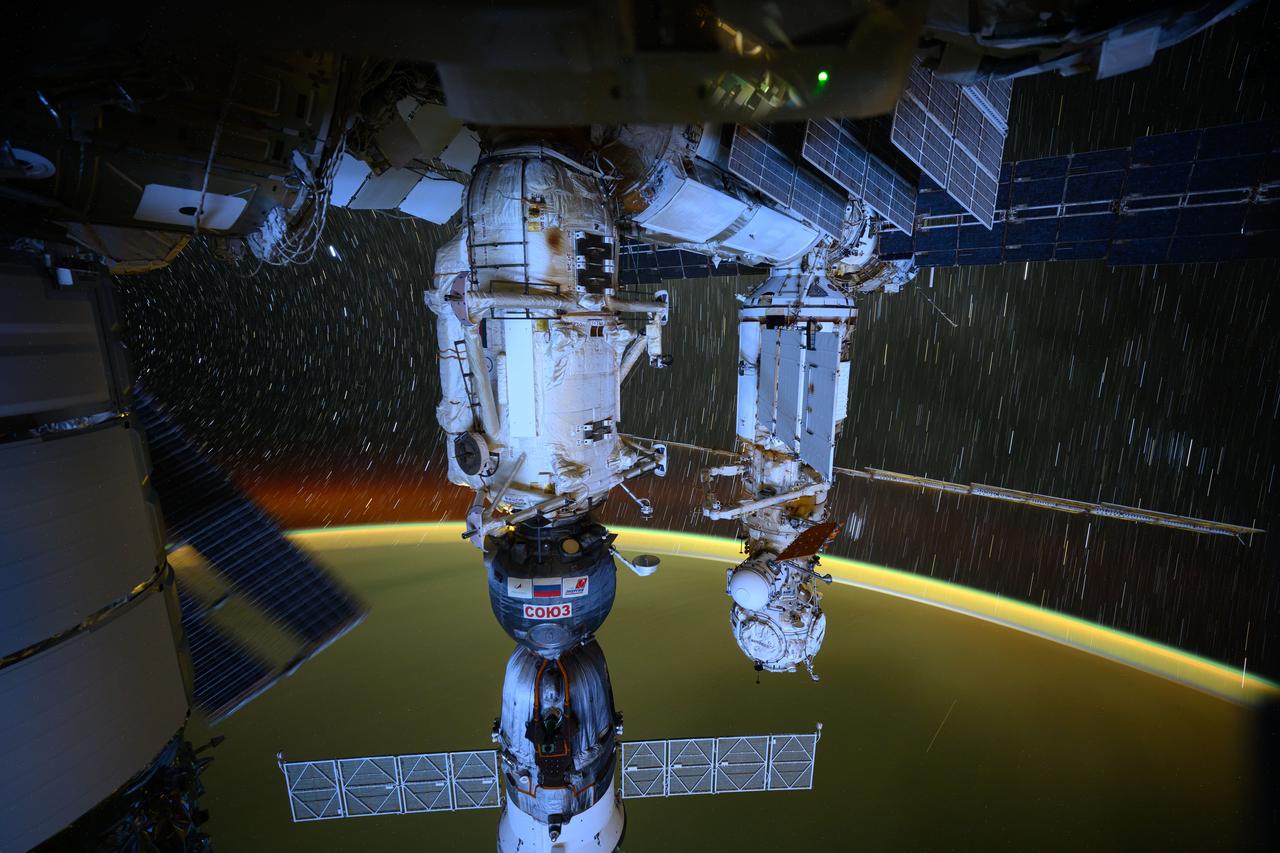
iss072e454972 (Jan. 9, 2025) --- This long-duration photograph highlights the Roscosmos segment of the International Space Station with the Soyuz MS-26 crew ship (bottom center) docked to the Rassvet module. Star trails and Earth's atmospheric glow are also prominently pictured from the orbital outpost as it soared 258 miles above the Pacific Ocean.
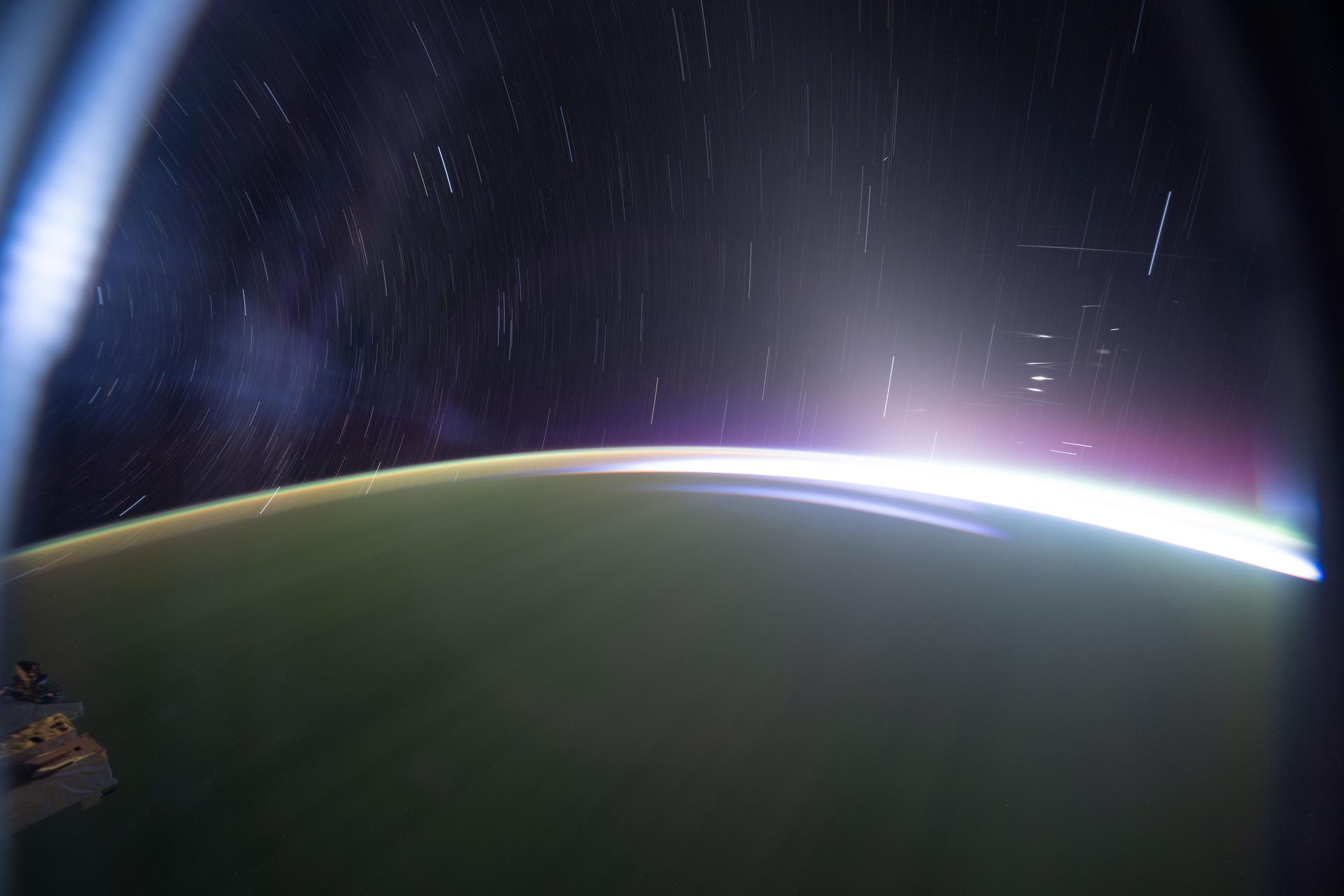
iss074e0409626 (March 23, 2026) --- This long-duration photograph, with an exposure of 90 seconds, highlights star trails and an orbital sunrise as the International Space Station soared 268 miles above the southern Indian Ocean at approximately 3:45 a.m. local time. Credit: NASA/Chris Williams
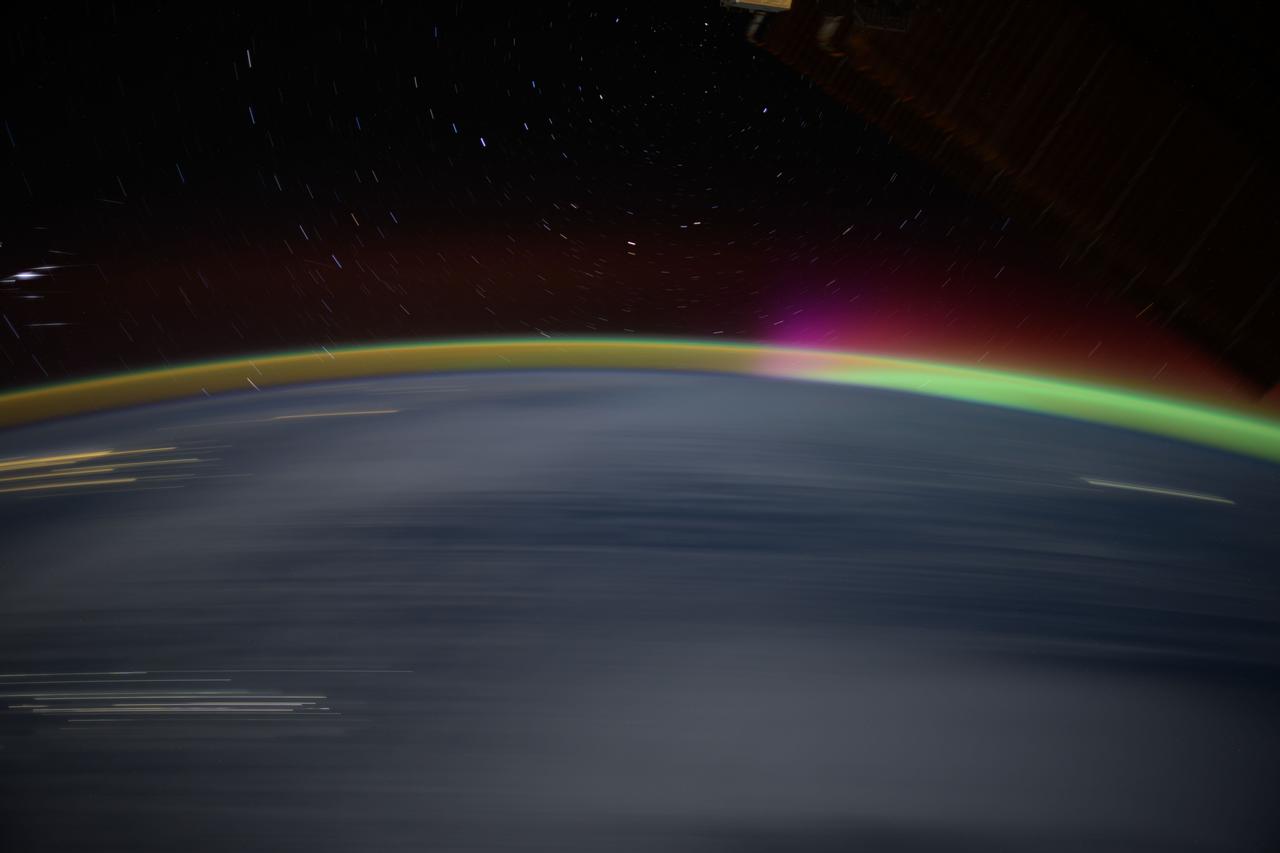
iss072e147765 (Nov. 9, 2024) --- The streaks of city lights, star trails, an aurora, and Earth's atmospheric glow highlight this long-duration photograph taken from the International Space Station as it orbited 259 miles above the North Pacific Ocean off the coast of Japan.

A toy dog named Seaman Jr., representing the Newfoundland that accompanied Lewis and Clark on their historic expedition in the 1800's, is seen here, Thursday, May 3, 2018 at NASA Headquarters in Washington. Seaman Jr. is headed to the International Space Station this summer to help celebrate NASA’s 60th Anniversary and the National Trail System’s 50th anniversary. Photo Credit: (NASA/Aubrey Gemignani)

A toy dog named Seaman Jr., representing the Newfoundland that accompanied Lewis and Clark on their historic expedition in the 1800's, is seen here, Thursday, May 3, 2018 at NASA Headquarters in Washington. Seaman Jr. is headed to the International Space Station this summer to help celebrate NASA’s 60th Anniversary and the National Trail System’s 50th anniversary. Photo Credit: (NASA/Aubrey Gemignani)
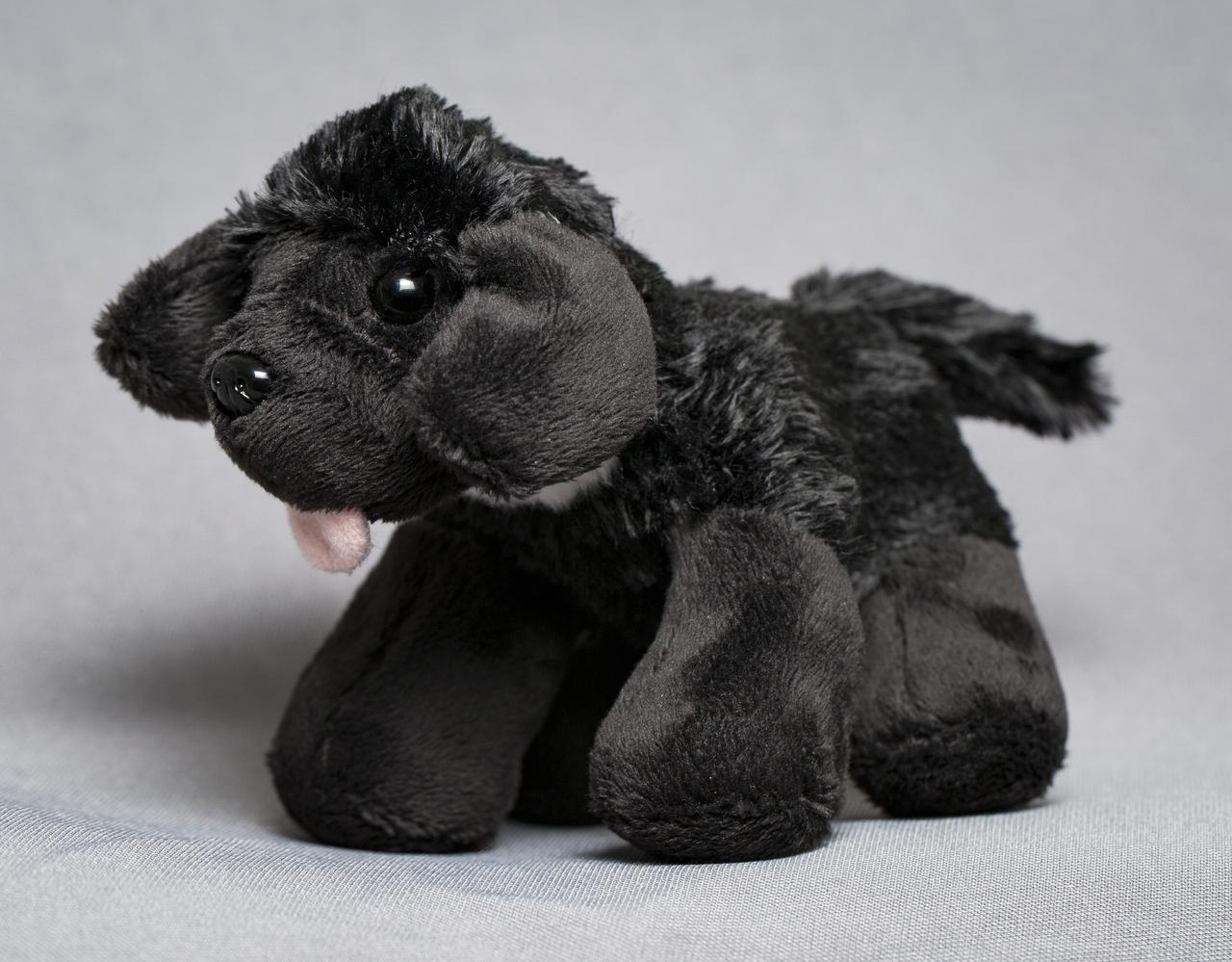
A toy dog named Seaman Jr., representing the Newfoundland that accompanied Lewis and Clark on their historic expedition in the 1800's, is seen here, Thursday, May 3, 2018 at NASA Headquarters in Washington. Seaman Jr. is headed to the International Space Station this summer to help celebrate NASA’s 60th Anniversary and the National Trail System’s 50th anniversary. Photo Credit: (NASA/Aubrey Gemignani)

A toy dog named Seaman Jr., representing the Newfoundland that accompanied Lewis and Clark on their historic expedition in the 1800's, is seen here, Thursday, May 3, 2018 at NASA Headquarters in Washington. Seaman Jr. is headed to the International Space Station this summer to help celebrate NASA’s 60th Anniversary and the National Trail System’s 50th anniversary. Photo Credit: (NASA/Aubrey Gemignani)
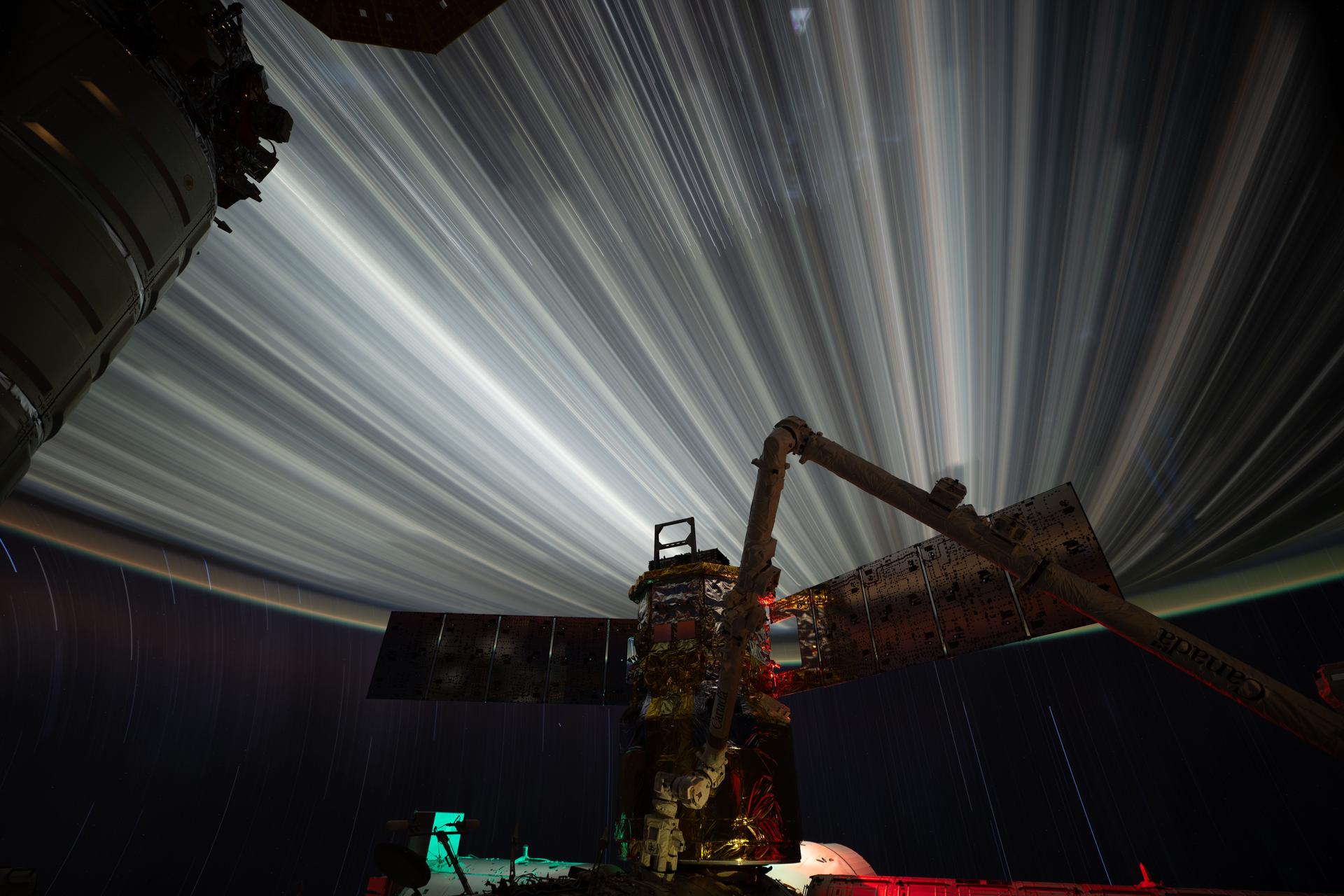
iss074e0319679 (Feb. 19, 2026) --- Star trails and city lights streak by in this long-duration photograph taken from the International Space Station as it orbited 261 miles above the India-Pakistan border at approximately 2:35 a.m. local time. In the foreground is JAXA’s (Japan Aerospace Exploration Agency) HTV-X1 cargo craft, berthed to the Harmony module’s Earth-facing port, with the Canadarm2 robotic arm perched on a portable data grapple fixture in front. Credit: NASA/Chris Williams
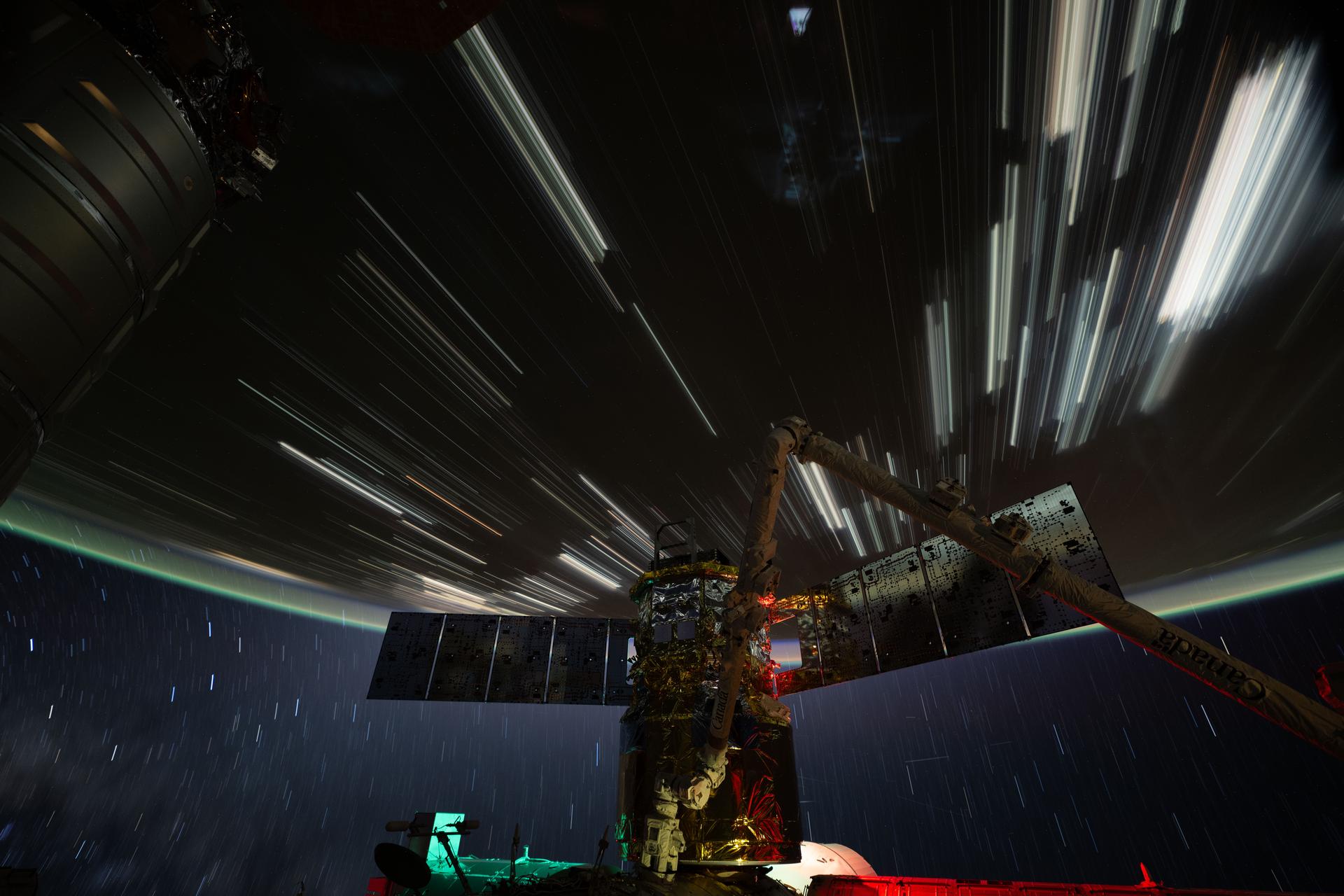
iss074e0319682 (Feb. 19, 2026) --- Star trails and city lights streak across this long-duration photograph taken from the International Space Station as it orbited 261 miles above the China–Mongolia border at approximately 4:42 a.m. local time. In the foreground is JAXA’s (Japan Aerospace Exploration Agency) HTV-X1 cargo craft, berthed to the Harmony module’s Earth-facing port, with the Canadarm2 robotic arm perched on a portable data grapple fixture in front. Credit: NASA/Chris Williams
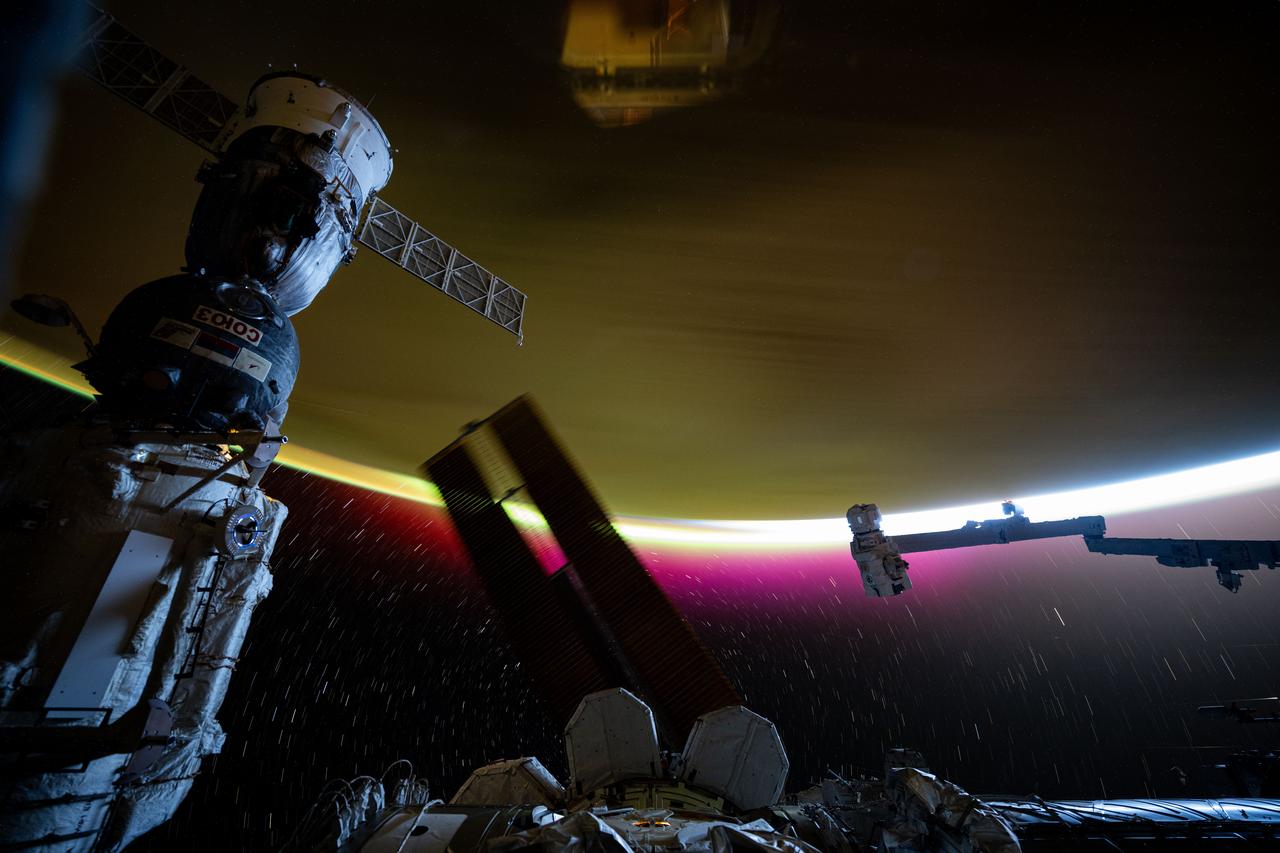
iss072e941128 (April 2, 2025) --- This long duration photograph, taken from the International Space Station as it orbited 271 miles above the South Georgia and the South Sandwich Islands in the southern Atlantic Ocean, highlights star trails and Earth's atmospheric glow moments before the orbital outpost soared into a sunrise. In the foreground (from left), are the Soyuz MS-26 spacecraft docked to the Rassvet module, a set of the station's main solar arrays, and the Canadarm2 robotic arm.
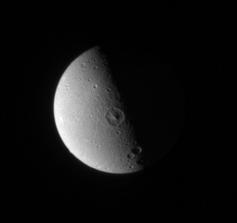
Dione leading hemisphere appears relatively smooth and placid here, compared to the fractured landscape on its trailing hemisphere

The oblong form of Prometheus glides by, trailing behind it wiggles in Saturn ribbon-like F ring
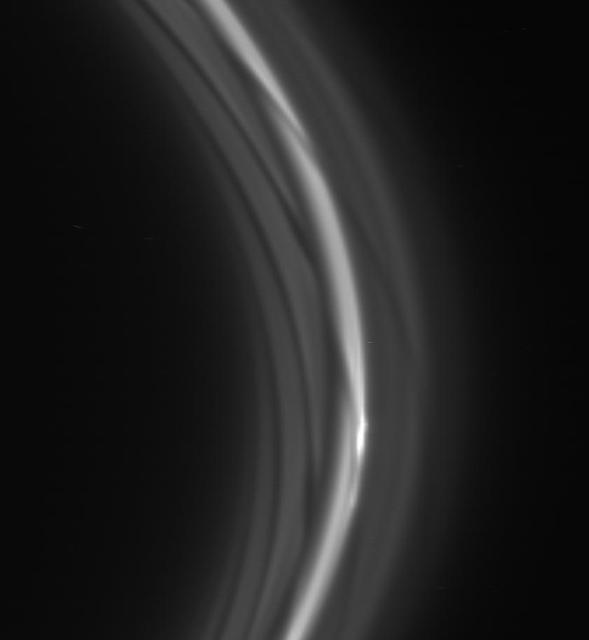
The striated appearance of the F ring is immediately apparent in the region of the ring that trails behind the moon Prometheus
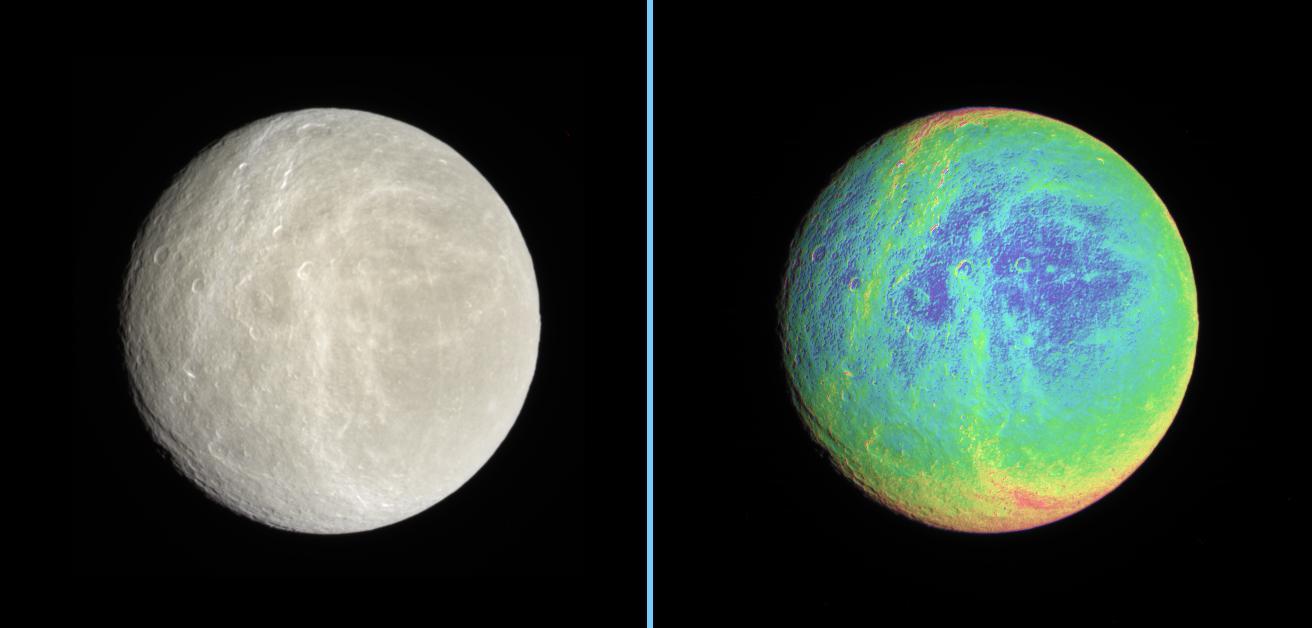
Side-by-side natural color and false-color views highlight the wispy terrain on Rhea trailing hemisphere
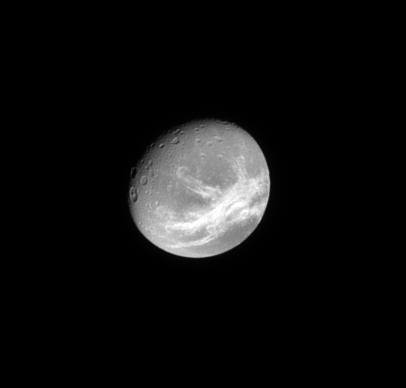
The Cassini spacecraft looks toward the wispy, fractured terrain of the trailing hemisphere of the moon Dione.
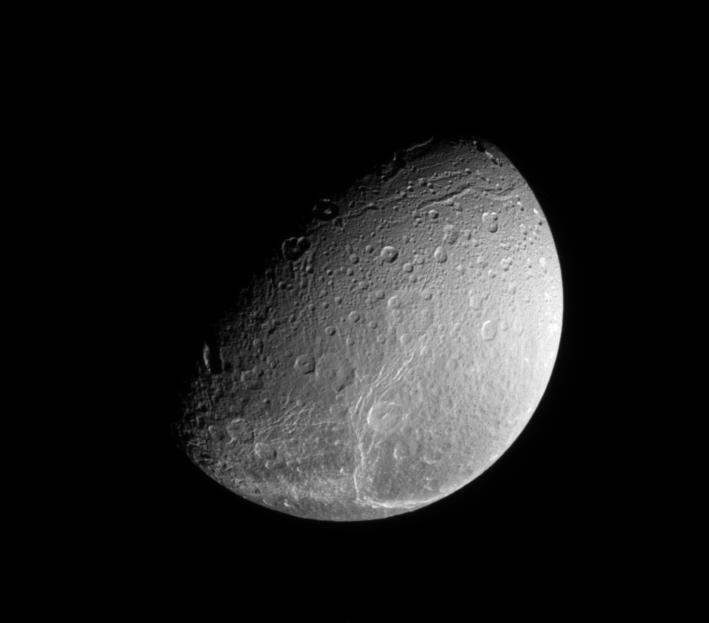
The Cassini spacecraft looks down on the north pole of Dione and the fine fractures that cross its trailing hemisphere.
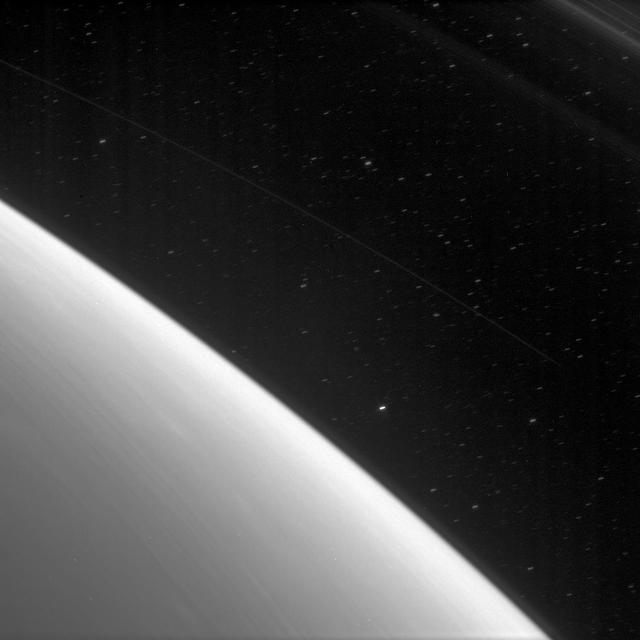
Stars trail across the background during this exposure, timed to capture the faint light from these D ring features
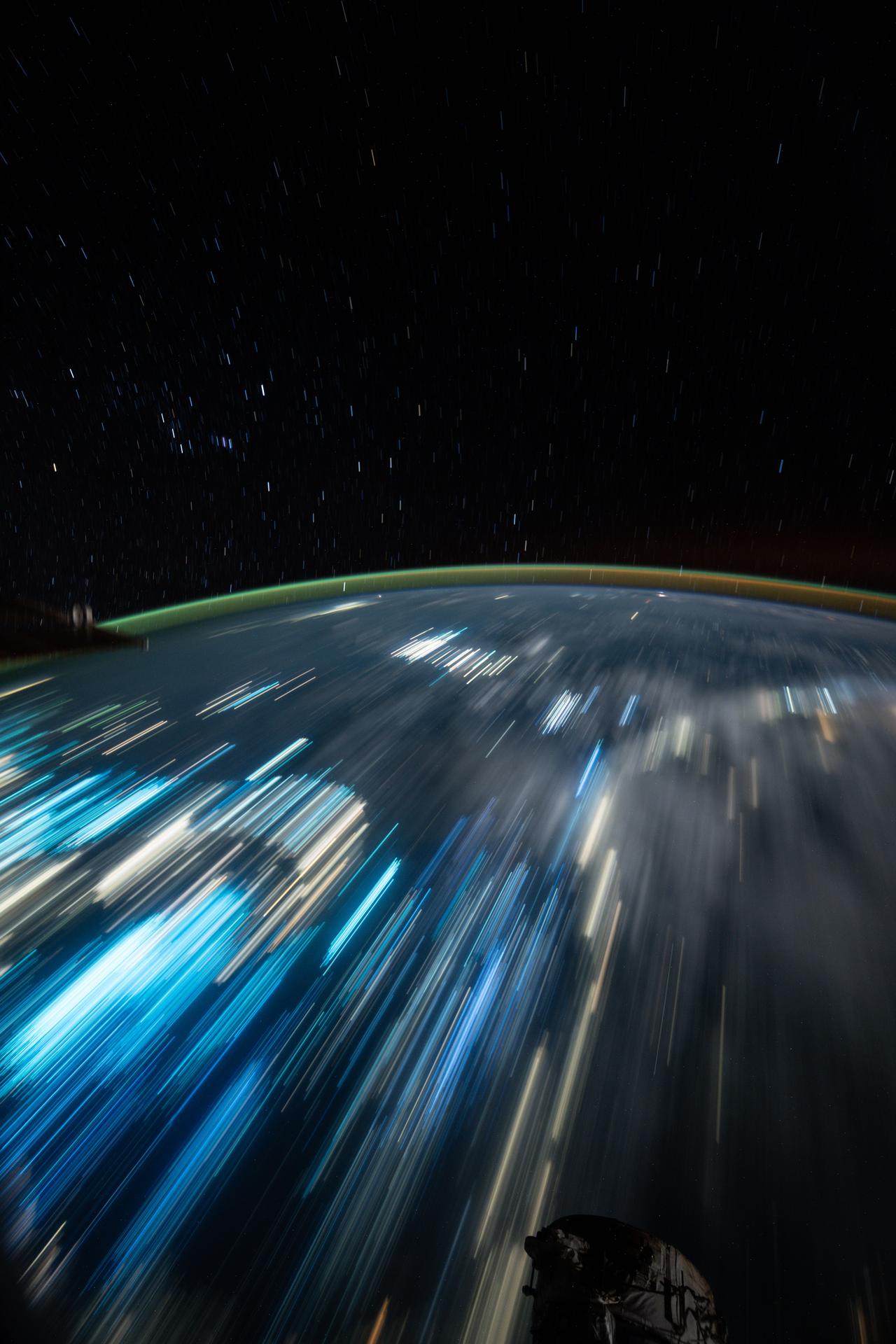
iss075e0144232 (Sept. 20, 2026) --- This long-duration image shows star trails above Earth and the blue lights of fishing boats and the yellow lights of Indonesian cities stretching below the International Space Station as it orbited 258 miles above the Banda Sea. Credit: NASA/Anil Menon
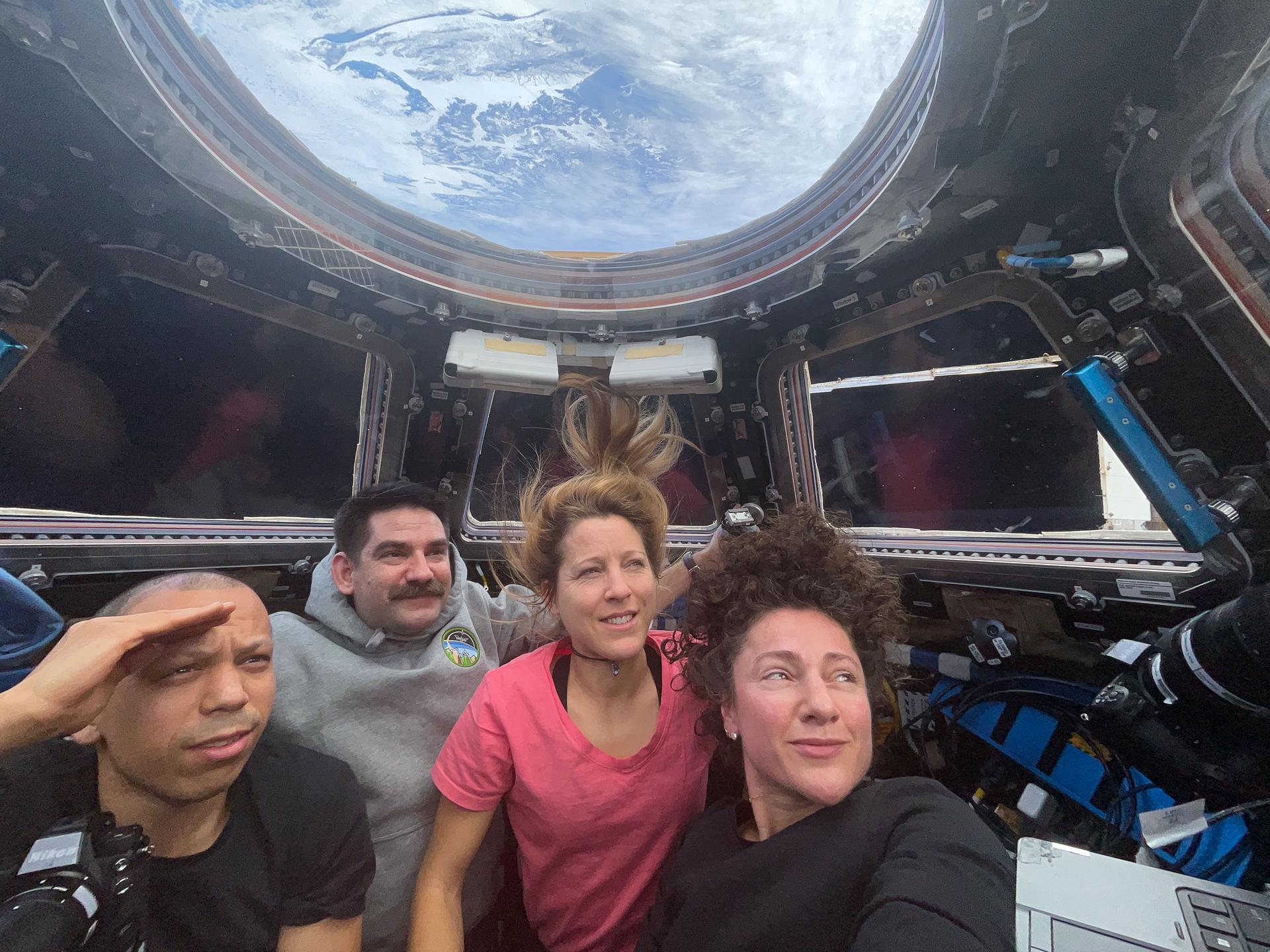
iss074e0458251 (April 10, 2026) --- Expedition 74 flight engineers (from left) Chris Williams, Jack Hathaway, Sophie Adenot, and Jessica Meir are inside the International Space Station’s cupola, waiting to observe the plasma trail of the Orion spacecraft—with the Artemis II crew aboard—as it reenters Earth’s atmosphere. Meir posted on her @astro_jessica Instagram account: "Eyes peeled in the cupola awaiting the safe return of our @nasaartemis friends. Our trajectory on @iss will be passing nearby over the Pacific, so we hope to catch a glimpse!" Credit: NASA/Jessica Meir
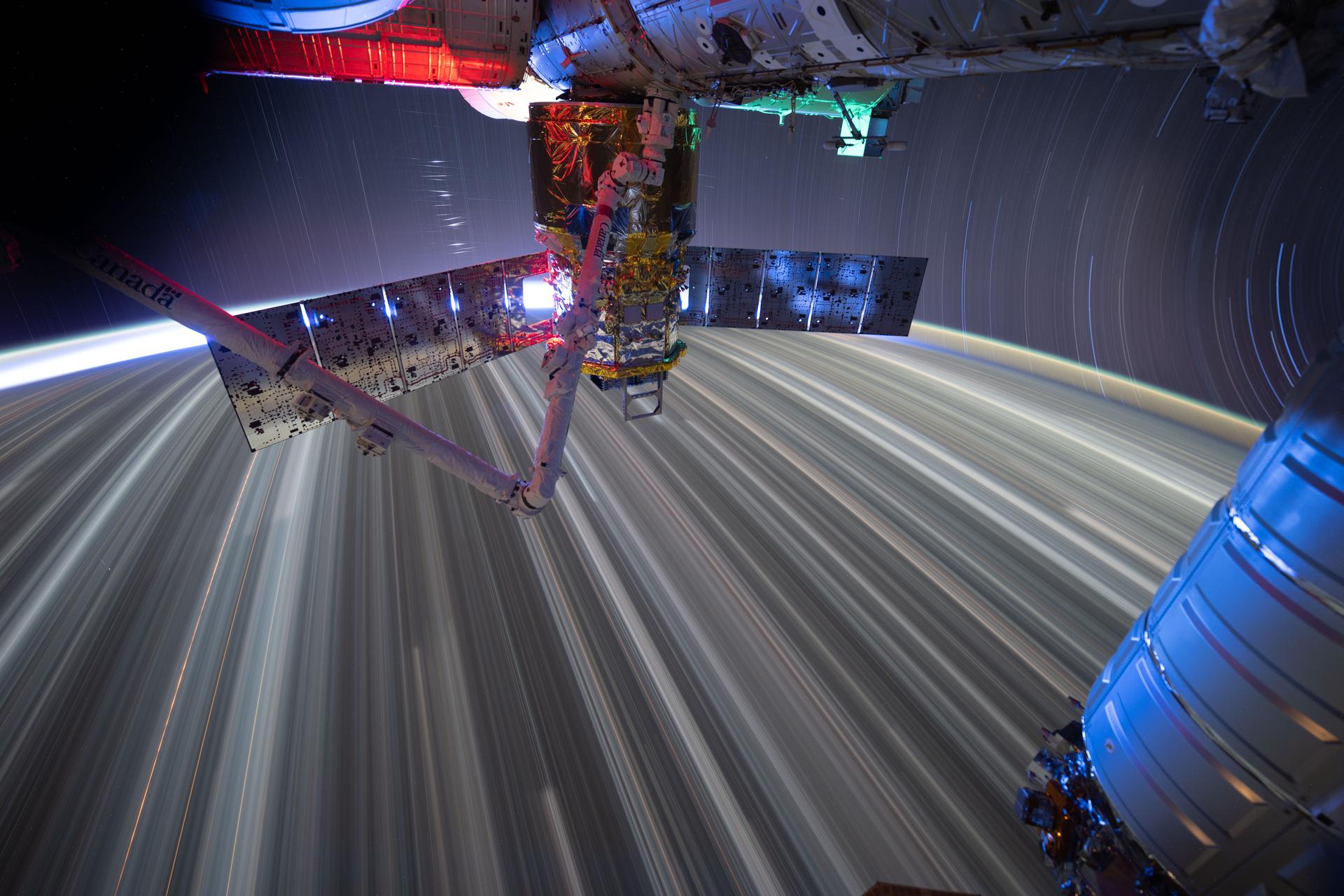
iss074e0319988 (Feb. 19, 2026) --- Star trails and city lights streak by in this long-duration photograph—exposed for nearly nine-and-a-half minutes—taken from the International Space Station as it orbited 260 miles above the Middle East. In the upper foreground is JAXA’s (Japan Aerospace Exploration Agency) HTV-X1 cargo craft, berthed to the Harmony module’s Earth-facing port, with the Canadarm2 robotic arm attached to a portable data grapple fixture in front. At bottom right is a portion of the Northrop Grumman Cygnus XL cargo craft. Credit: NASA/Chris Williams
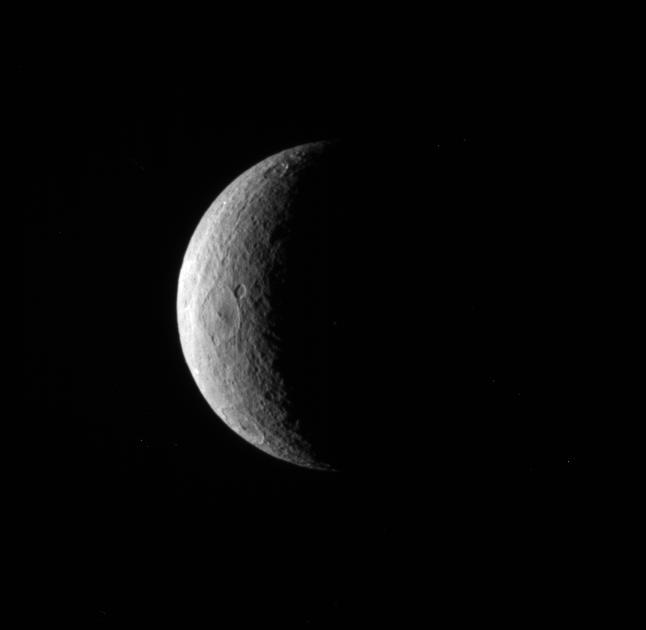
NASA Cassini spacecraft pictures a crescent of Saturn moon Rhea. Although craters dominate this particular view, the trailing hemisphere of Rhea also features wispy fractures.
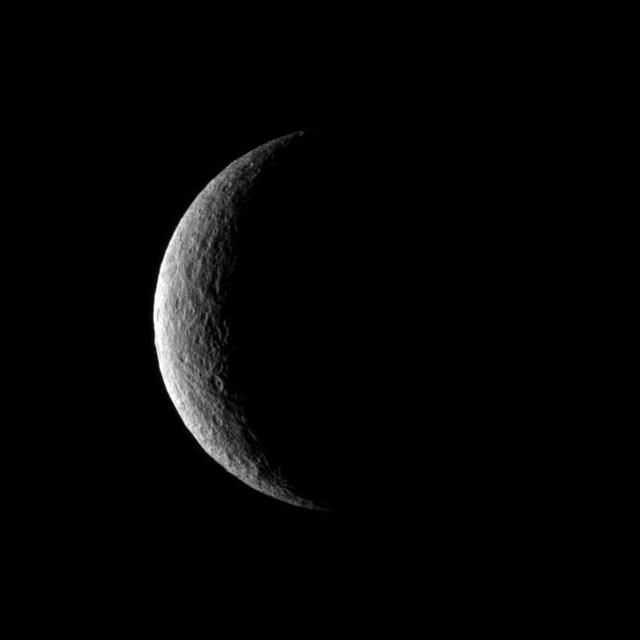
NASA Cassini spacecraft captures a crescent of crater-covered surface on the moon Rhea. Lit terrain seen here is on the trailing hemisphere of Rhea. North on Rhea is up.
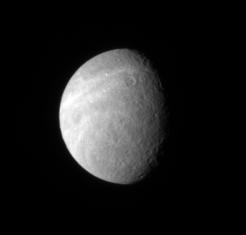
Wispy markings reach out across Rhea surface from its trailing hemisphere. The bright markings appear to be fractures, like those found on Dione
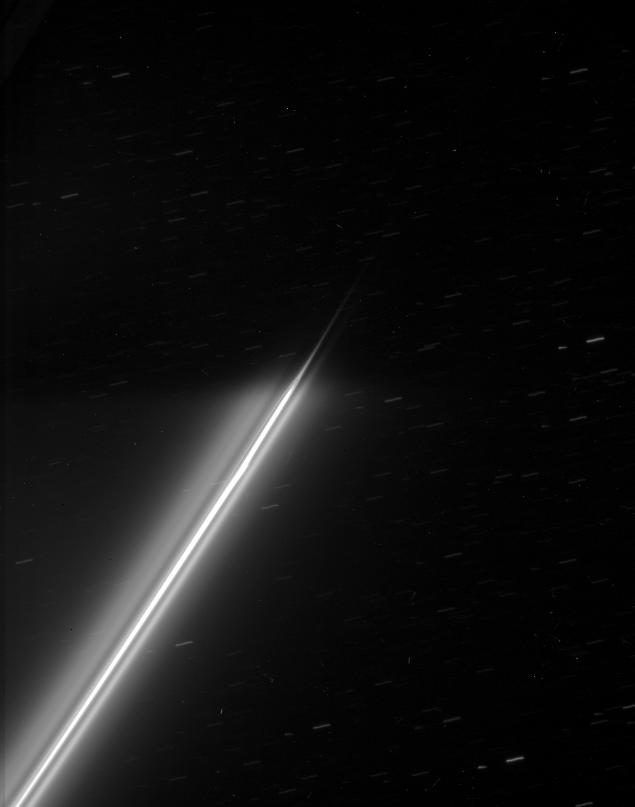
The strands of Saturn F ring disappear into the darkness of the planet shadow. Background stars make trails across the sky during the long exposure
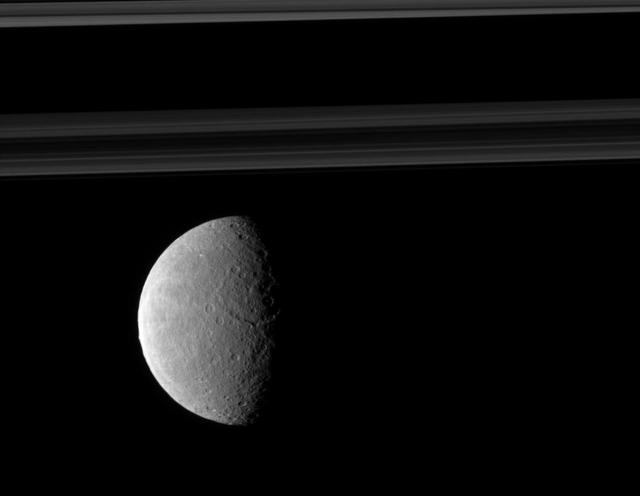
Rhea trailing hemisphere shows off its wispy terrain on the left of this image taken by NASA Cassini spacecraft which includes Saturn rings in the distance.
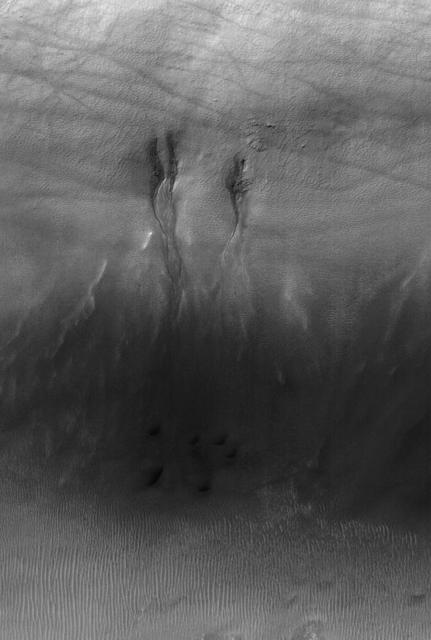
This MOC image shows gullies in the north wall of a crater south of Proctor Crater in Noachis Terra. Dark streaks cutting across the scene were formed by passing dust devils
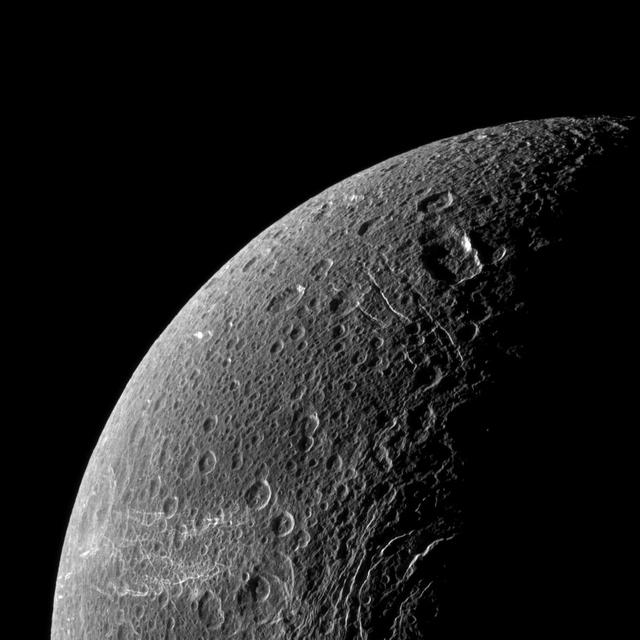
Wispy terrain reflects sunlight brightly in the lower left of this NASA Cassini image of the northern latitudes of Saturn moon Dione.
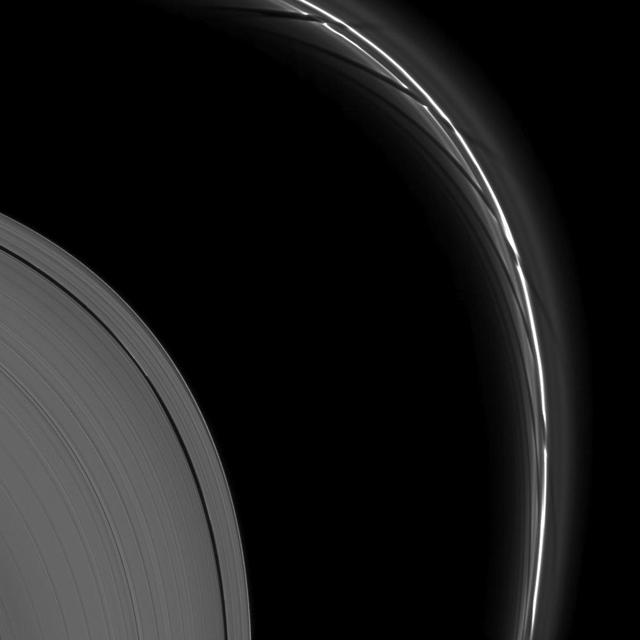
The effects of the moon Prometheus create intricate formations in Saturn thin F ring.
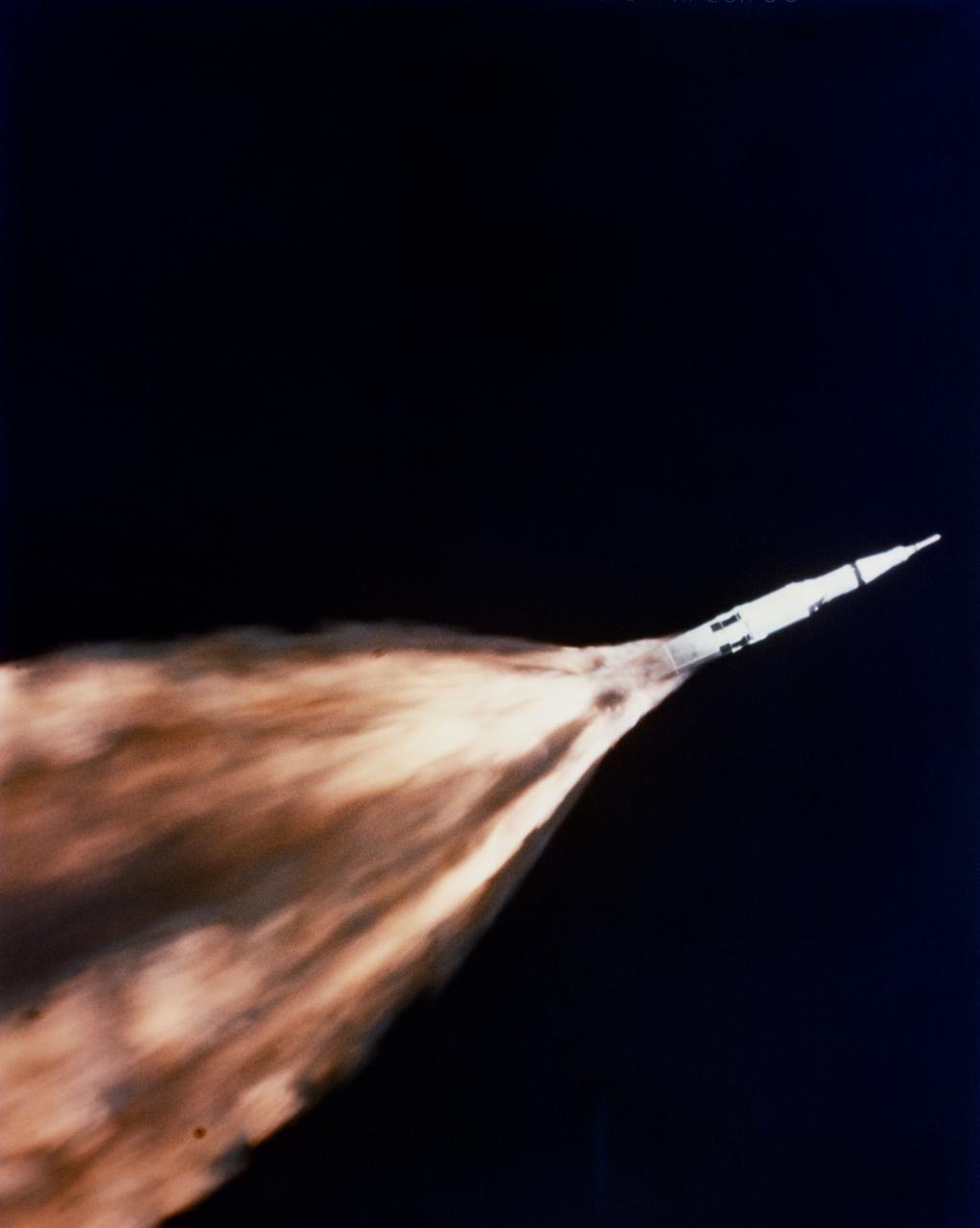
S68-27365 (4 April 1968) --- The five F-1 engines of the huge Apollo/Saturn V space vehicle's first (S-IC) stage leave a gigantic trail of flame in the sky above the Kennedy Space Center seconds after liftoff. The launch of the Apollo 6 (Spacecraft 020/Saturn 502) unmanned space mission occurred at 07:00:01.5 (EST), April 4, 1968. This view of the Apollo 6 launch was taken from a chase plane.
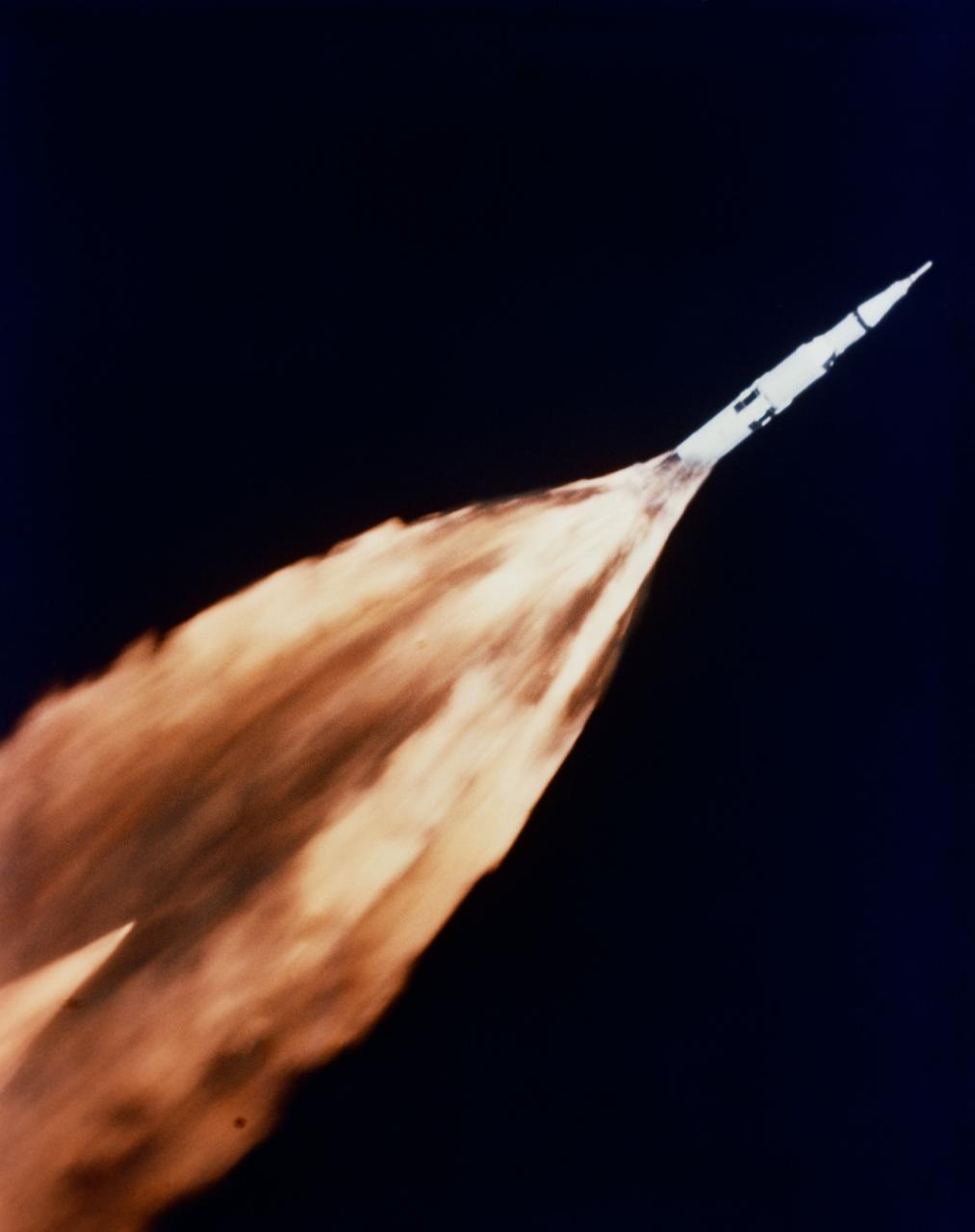
S68-27366 (4 April 1968) --- The five F-1 engines of the huge Apollo/Saturn V space vehicle's first (S-IC) stage leave a gigantic trail of flame in the sky above the Kennedy Space Center seconds after liftoff. The launch of the Apollo 6 (Spacecraft 020/Saturn 502) unmanned space mission occurred at 07:00:01.5 (EST), April 4, 1968. This view of the Apollo 6 launch was taken from a chase plane.

This image was obtained by NASA Cassini radar instrument during a flyby on July 7, 2010. Southern mid-latitudes trailing hemisphere, Northern Mezzoramia. https://photojournal.jpl.nasa.gov/catalog/PIA06679