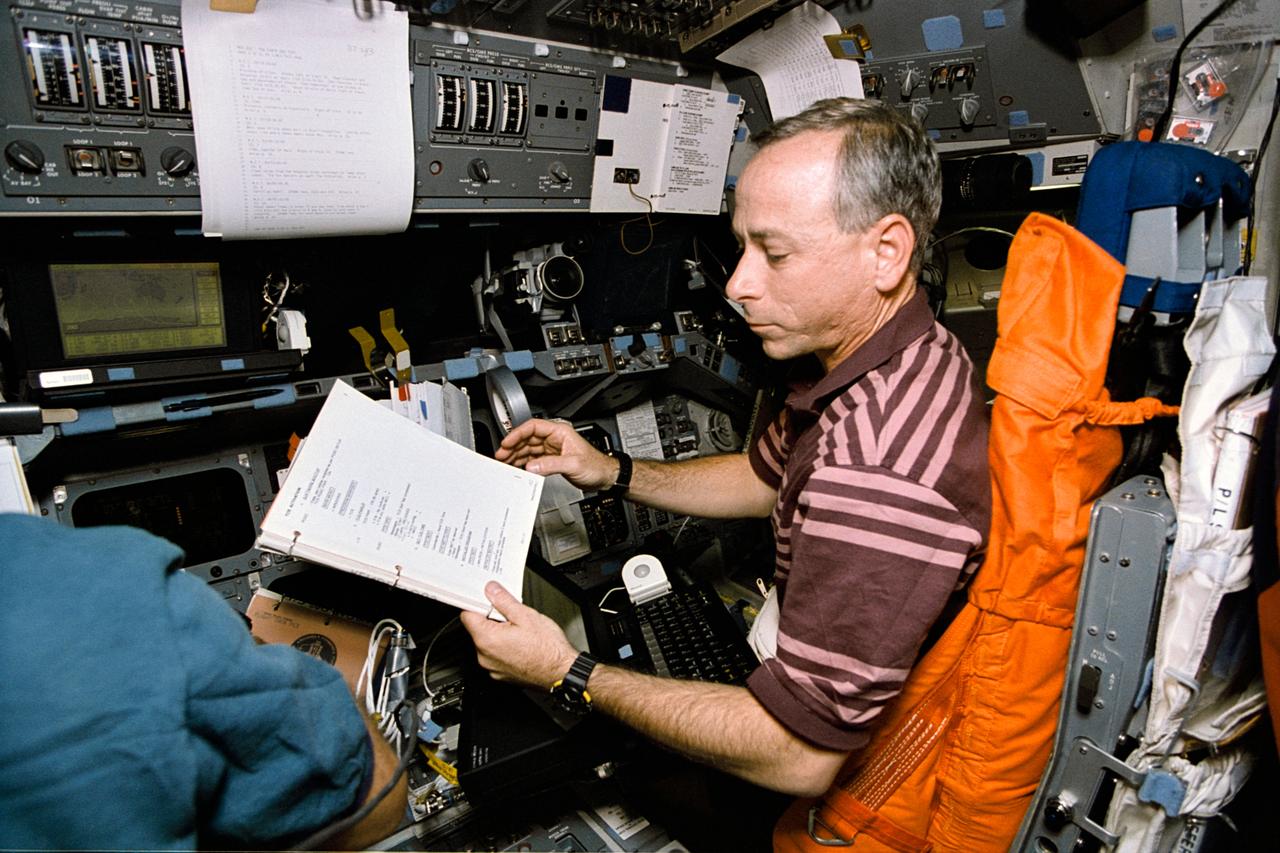
STS064-22-024 (9-20 Sept. 1994) --- With a manual and lap top computer in front of him, astronaut Carl J. Meade, STS-64 mission specialist, supports operations with the Trajectory Control Sensor (TCS) aboard the Earth-orbiting space shuttle Discovery. For this exercise, Meade temporarily mans the pilot's station on the forward flight deck. The TCS is the work of a team of workers at NASA's Johnson Space Center. Data gathered during this flight was expected to prove valuable in designing and developing a sensor for use during the rendezvous and mating phases of orbiter missions to the space station. For this demonstration, the Shuttle Pointed Autonomous Research Tool for Astronomy 201 (SPARTAN 201) was used as the target vehicle during release and retrieval operations. Photo credit: NASA or National Aeronautics and Space Administration
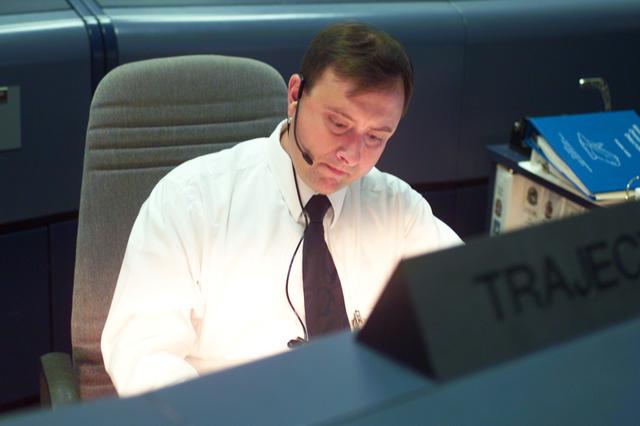
JSC2001-E-25391 (17 August 2001) --- Darrin Leleux, STS-105 trajectory officer, studies data at his console in the shuttle flight control room (WFCR) in Houston’s Mission Control Center (MCC).
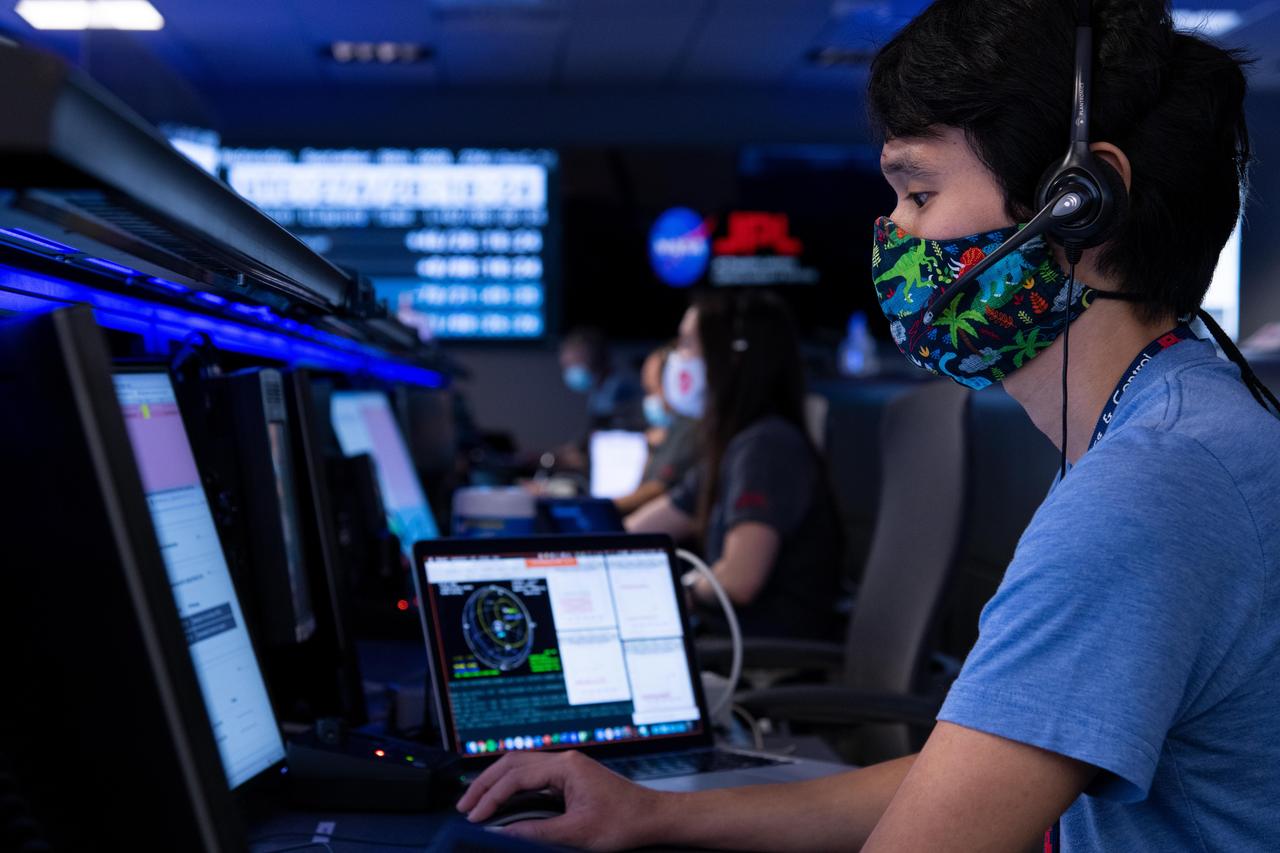
Attitude Control Systems lead Chris Pong donned a dinosaur-themed mask for his participation in the Mars 2020 mission's second trajectory correction maneuver at NASA's Jet Propulsion Laboratory in Southern California. The navigation team successfully sent commands to the spacecraft to adjust its flight path during its long cruise to Mars. https://photojournal.jpl.nasa.gov/catalog/PIA24191

S70-35368 (16 April 1970) --- Overall view showing some of the feverish activity in the Mission Operations Control Room (MOCR) of the Mission Control Center (MCC) during the final 24 hours of the problem-plagued Apollo 13 mission. Here, flight controllers and several NASA/MSC officials confer at the flight director's console. When this picture was made, the Apollo 13 lunar landing had already been canceled, and the Apollo 13 crewmembers were in trans-Earth trajectory attempting to bring their crippled spacecraft back home.
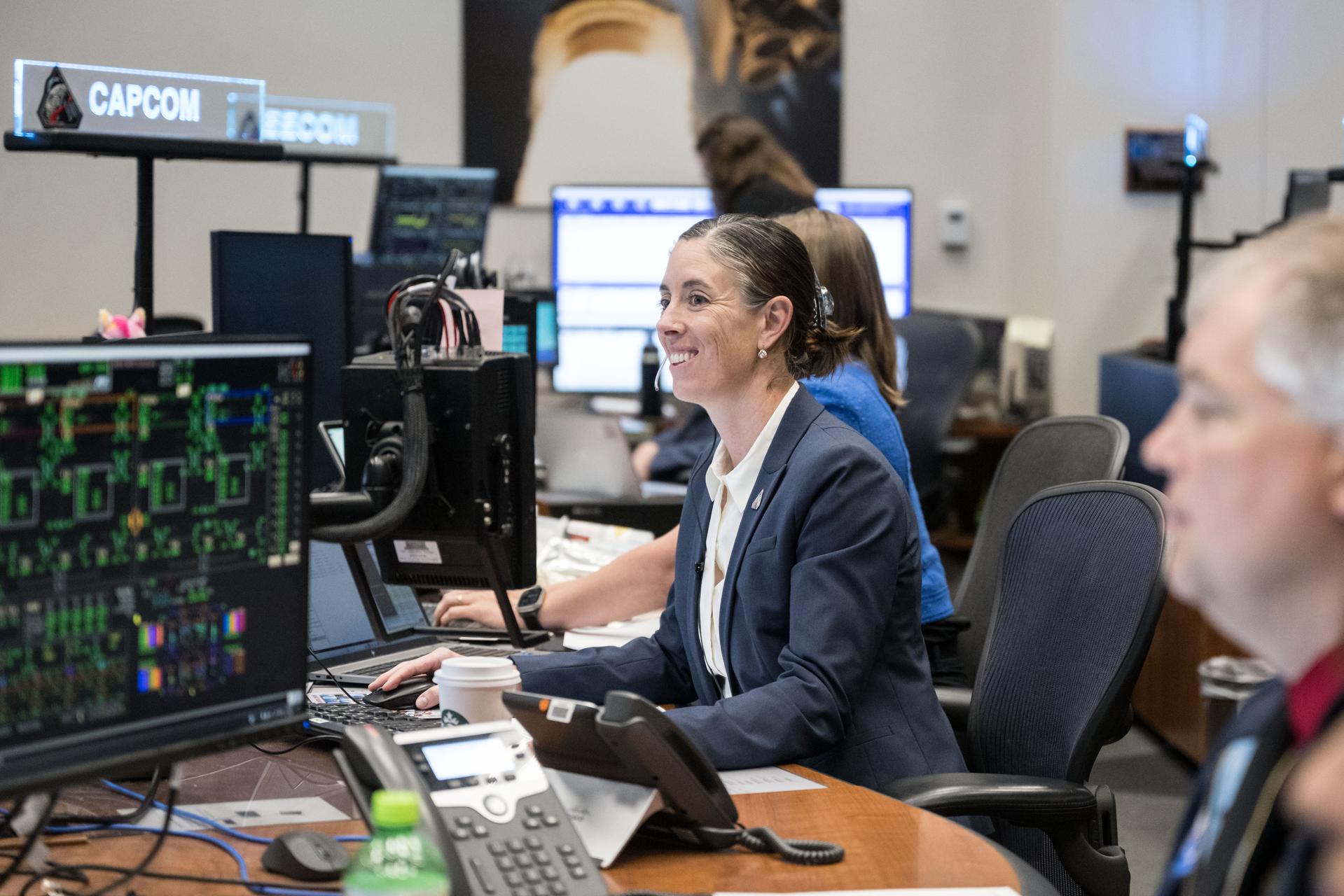
jsc2026e019614 (April 2, 2026) – NASA astronaut Chris Birch serves as capsule communicator (capcom) in the Mission Control Center at NASA’s Johnson Space Center during the mission’s translunar injection burn, which sent the crew in Orion out of Earth orbit and on a trajectory toward the Moon.
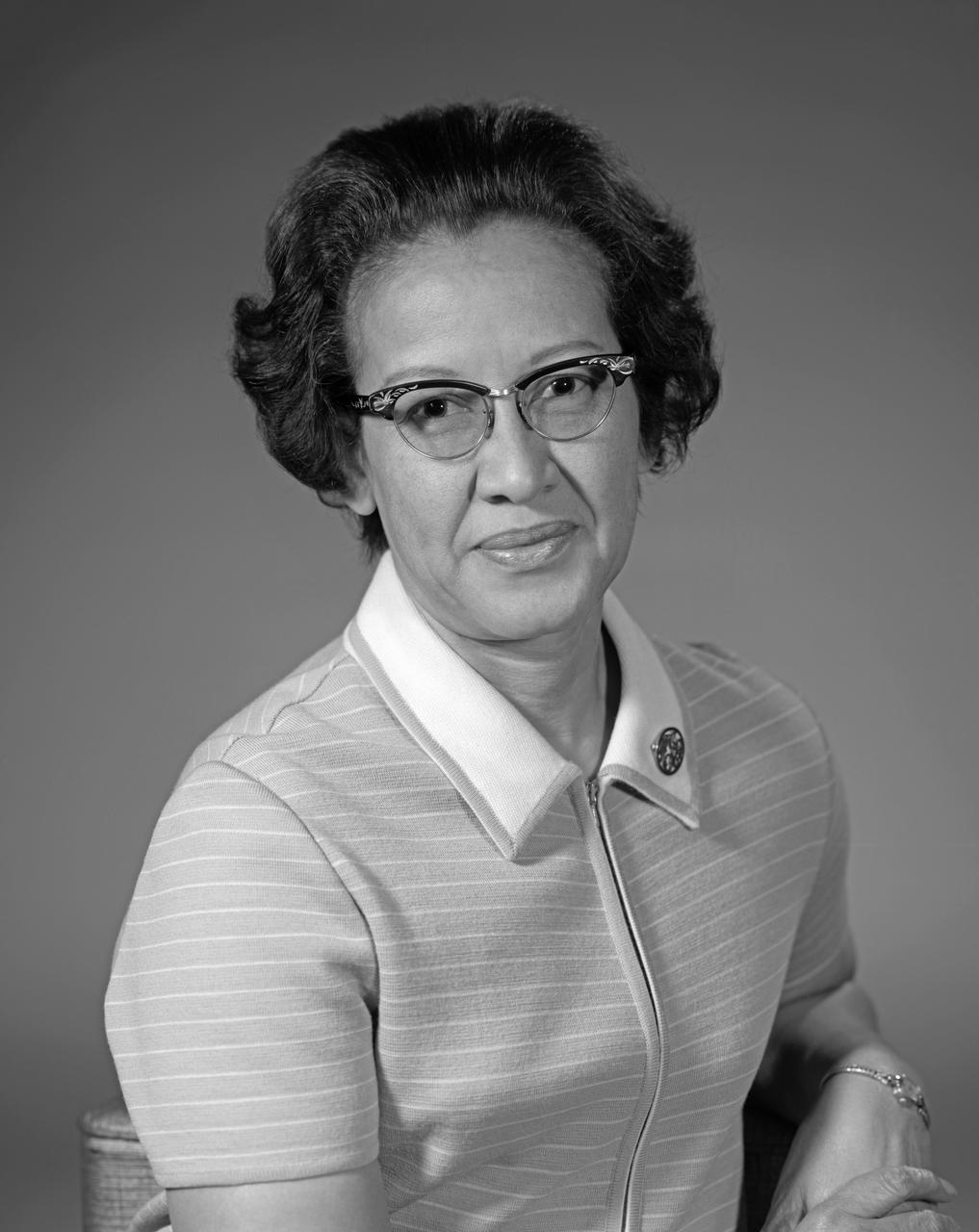
Portrait Katherine G. Johnson. Hall of Honor inductee 2017. Langley Research Center NACA and NASA Hall of Honor. In recognition of contributions to the development of methodologies for analysis of manned mission (from Mercury to Apollo) and satellite (Echo) trajectories, and dynamic control of large space structures.
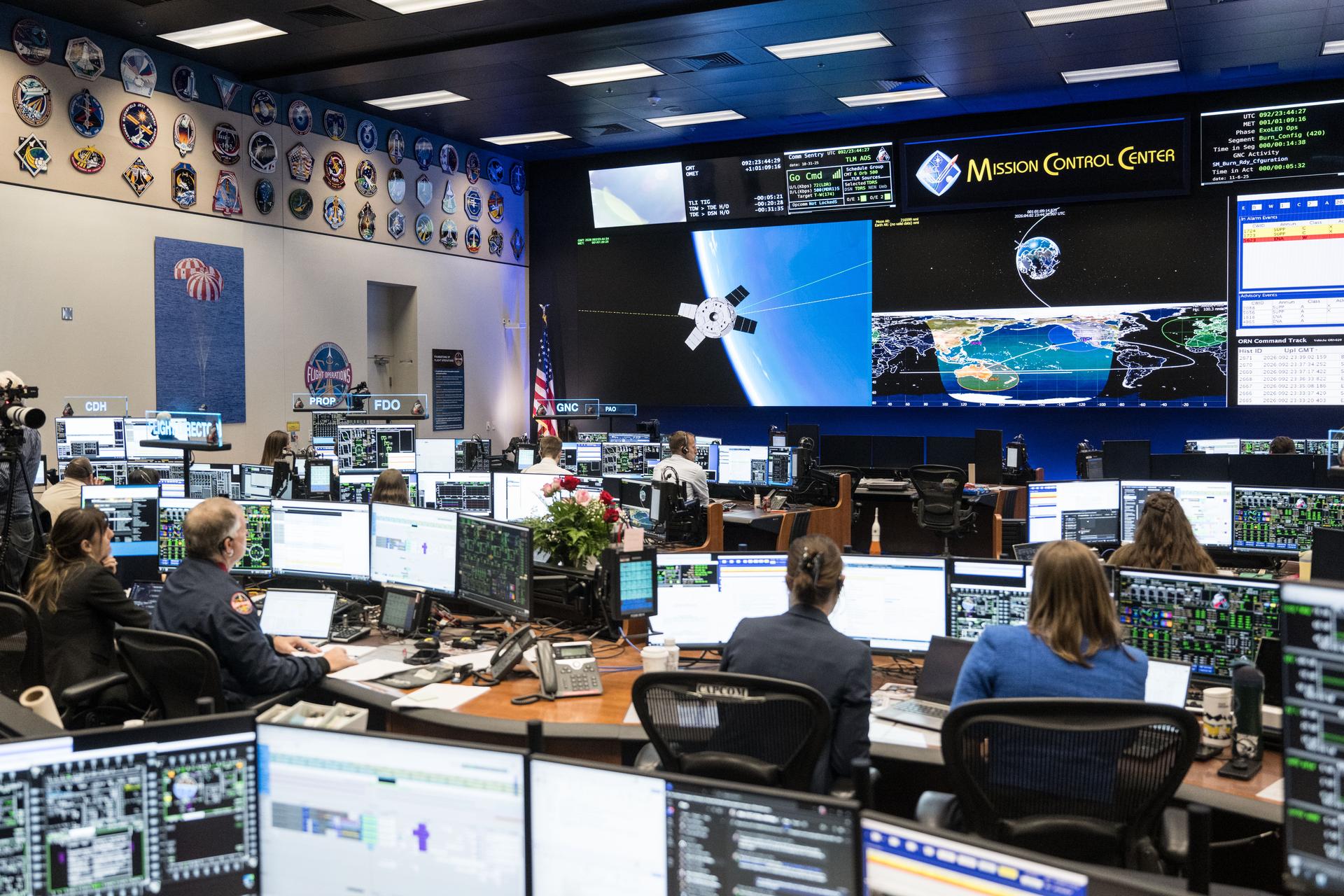
jsc2026e019618 (April 2, 2026) – The Artemis II flight control team pictured at the White Flight Control Room in the Mission Control Center at NASA’s Johnson Space Center monitors mission operations during the translunar injection (TLI) burn, which sent the crew in Orion out of Earth orbit and on a trajectory toward the Moon. After the mission management team polled “Go” for the operation, NASA’s Orion spacecraft fired its main engine for five minutes and 50 seconds beginning at 7:49 p.m. ET, to successfully complete the TLI burn.
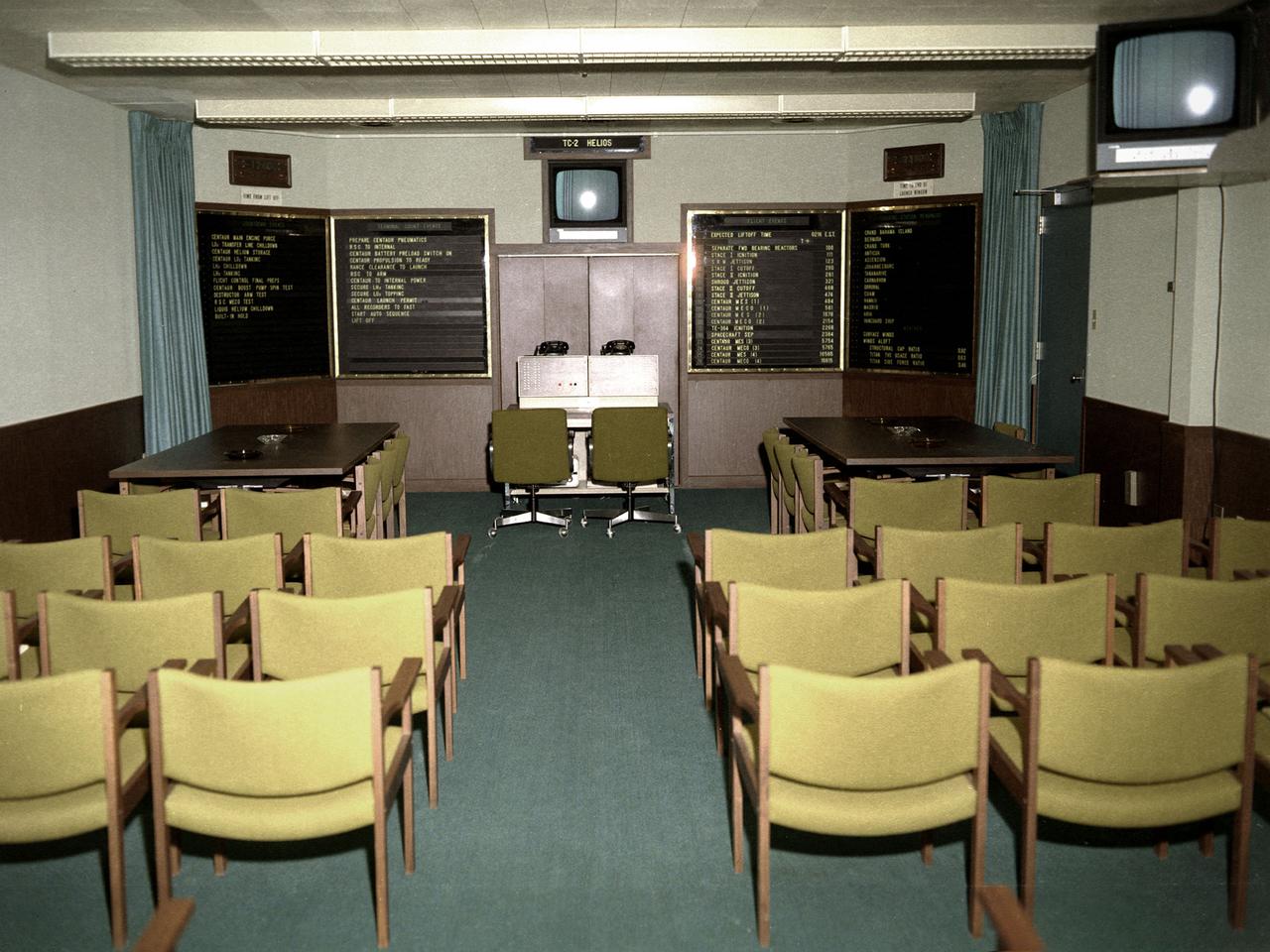
A Centaur rocket control room in the Development Engineering Building (DEB) at the National Aeronautics and Space Administration (NASA) Lewis Research Center in Cleveland, Ohio. The DEB, completed in the mid-1960s, provided office space for several hundred development engineers outside the center’s main gate. The location of the DEB emphasized the development staff’s separation from the research side of the laboratory. This control room at Lewis was directly linked to Cape Kennedy. The Lewis staff in Cleveland could monitor and back up the Lewis launch team in the actual control room at the Cape. This photograph was taken during the preparations for the Titan-Centaur-Helios launch on December 10, 1974. The panels to the left listed the countdown events for the Centaur rocket. The launch countdown clock can be seen above these panels. The two panels on the right listed events predicted to occur during the flight and the availability of the tracking stations. The clock above the panels indicated the time remaining before the launch window expired. The Launch Vehicles Division was created in 1969 to manage the launches of all Centaur and Agena rockets. The Launch Vehicles Division worked with the engineers to design the payload in a manner that ensured that its size and weight were within Centaur’s parameters. They also developed the proper trajectory analysis for the launch. These trajectories often had to be adjusted if the launch did not occur on the planned date.
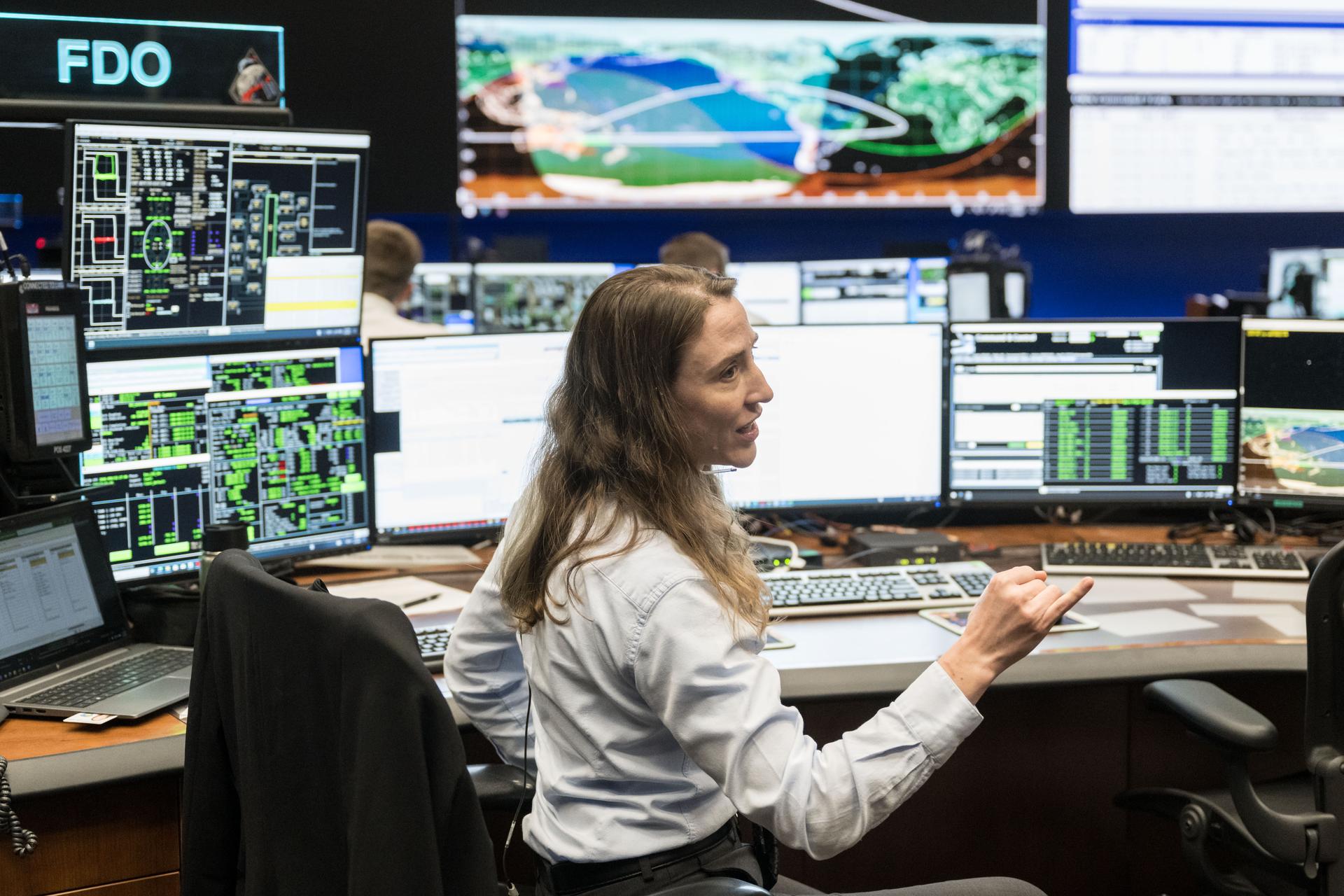
jsc2026e020048 (April 2, 2026) – Flight Dynamics Officer Natasha Peake in Mission Control during Artemis II’s translunar injection burn on April 2, 2026, which not only sent the crew in Orion out of Earth orbit and on a trajectory toward the Moon, but also set them on the course that will ultimately bring them home for a splashdown in the Pacific Ocean.
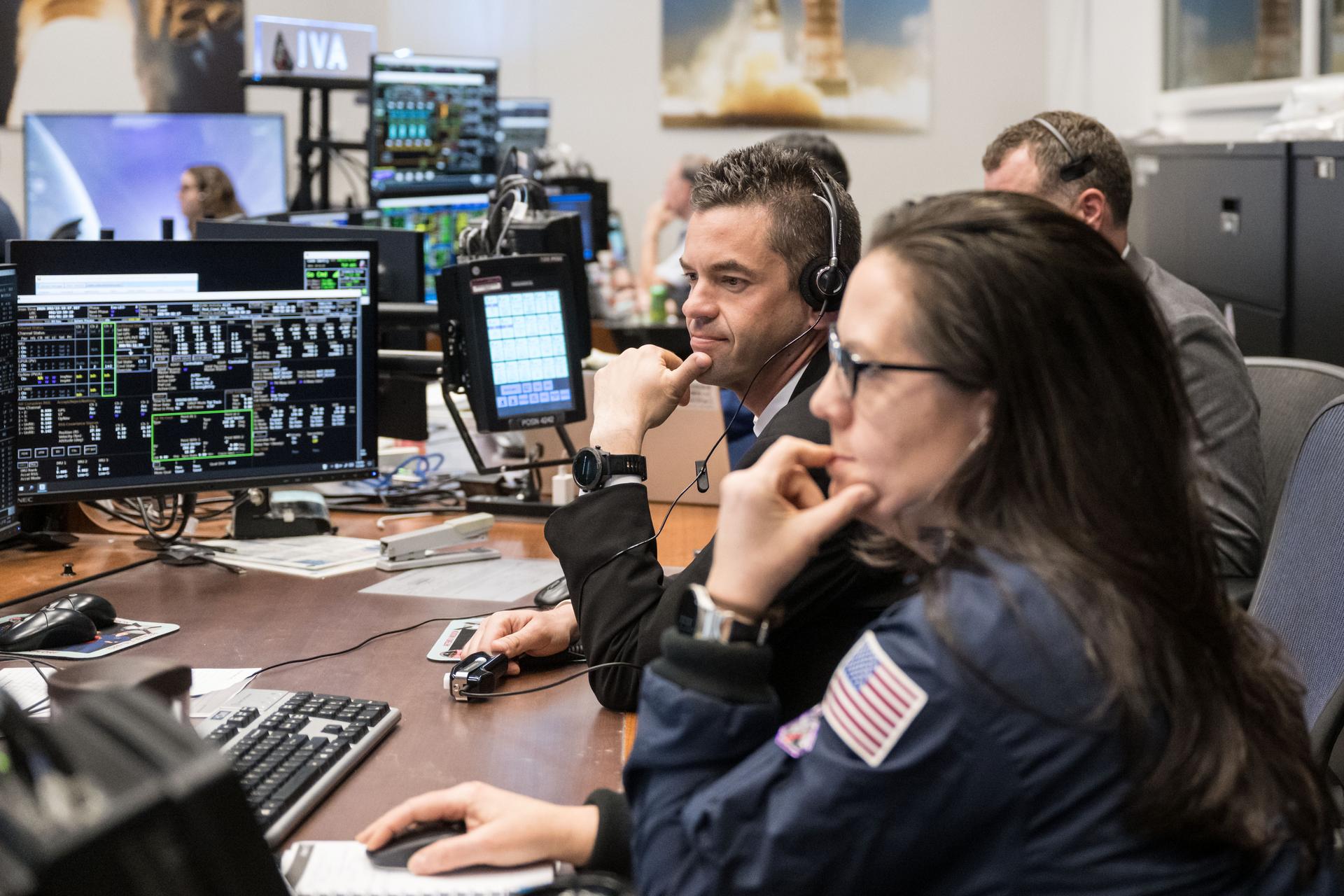
jsc2026e020085 (April 2, 2026) – NASA Administrator Jared Isaacman (left) and NASA Chief Flight Director Emily Nelson (right) in the Mission Control Center at NASA’s Johnson Space Center monitor mission operations during the translunar injection (TLI) burn, which sent the crew in Orion out of Earth orbit and on a trajectory toward the Moon.
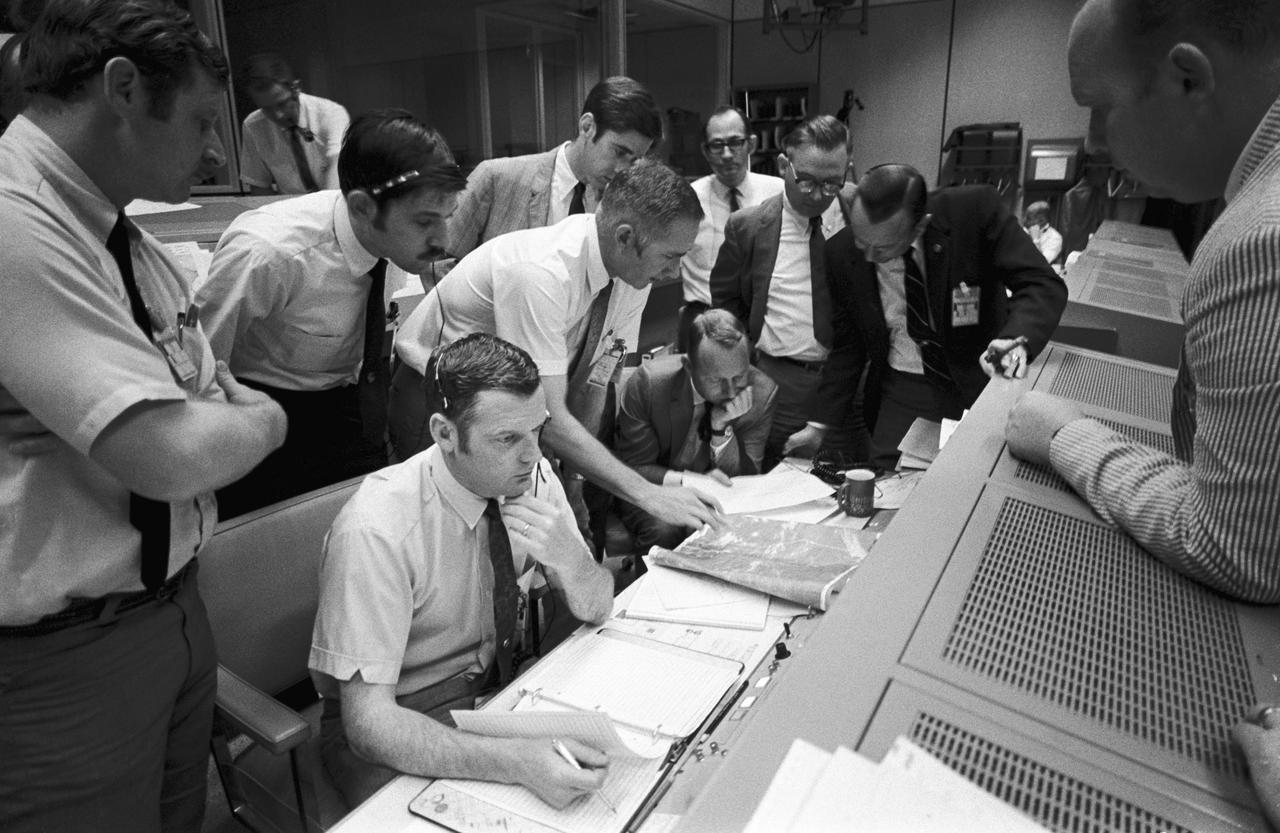
S70-35014 (15 April 1970) --- A group of flight controllers gathers around the console of Glenn S. Lunney (seated, nearest camera), Shift 4 flight director, in the Mission Operations Control Room (MOCR) of Mission Control Center (MCC), located in Building 30 at the Manned Spacecraft Center (MSC). Their attention is drawn to a weather map of the proposed landing site in the South Pacific Ocean. Among those looking on is Dr. Christopher C. Kraft, deputy director, MSC, standing in black suit, on right. When this photograph was taken, the Apollo 13 lunar landing mission had been canceled, and the problem-plagued Apollo 13 crew members were in trans-Earth trajectory attempting to bring their crippled spacecraft back home.
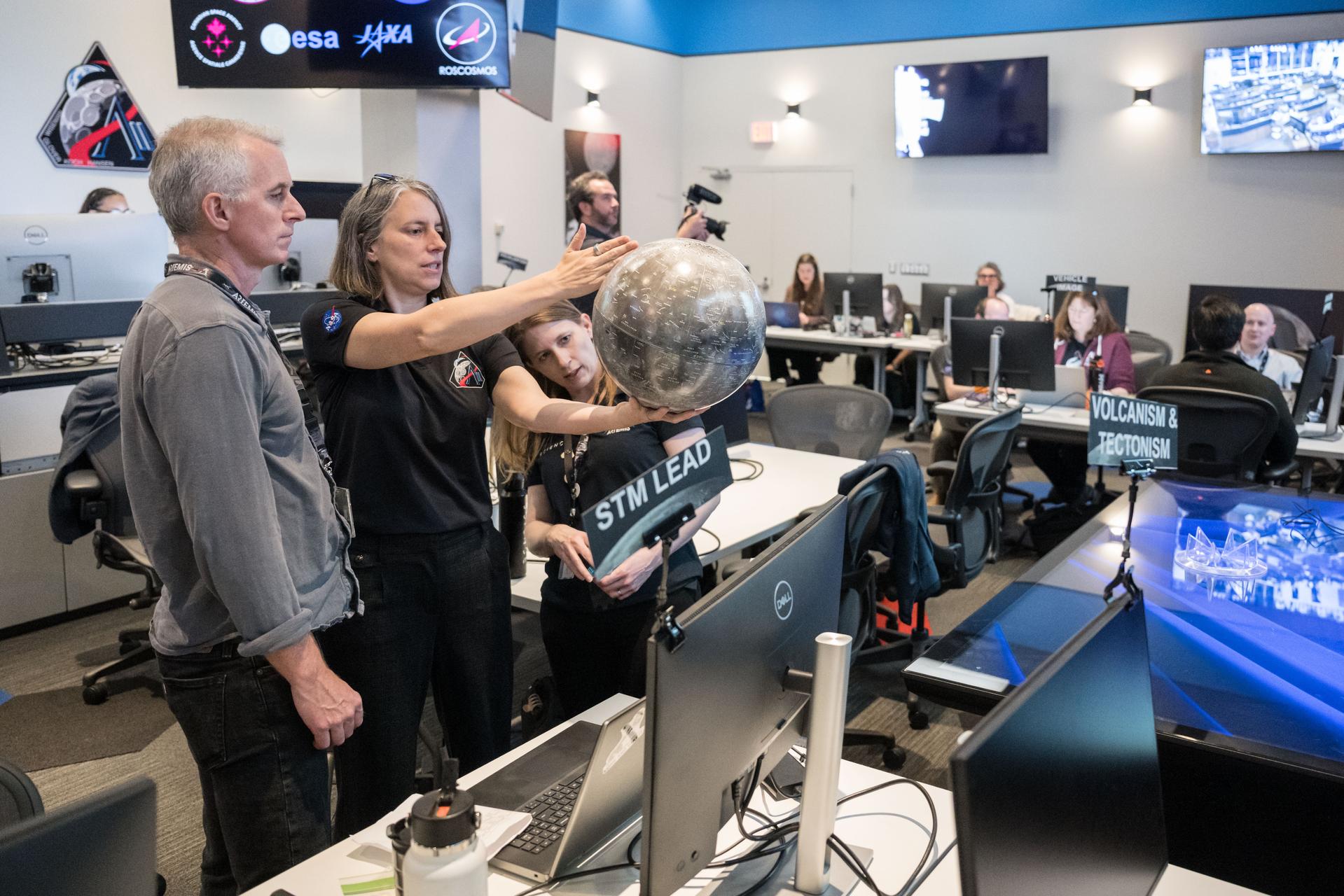
Artemis II lunar science team members, from left, Ryan Ewing, Juliane Gross, and Debra Needham, discuss lunar geography ahead of the translunar injection burn that accelerated the Orion spacecraft to break free of Earth’s orbit and began the outbound trajectory toward the Moon. They are in the Science Evaluation Room (SER) a back room that supports lunar science and planetary observations for the Artemis science officer in the mission’s main flight control room. Built specifically for Artemis missions with these science priorities in mind, the SER is equipped to support rapid data interpretation, collaborative analysis, real-time decision making, and seamless coordination between the science and operations teams.
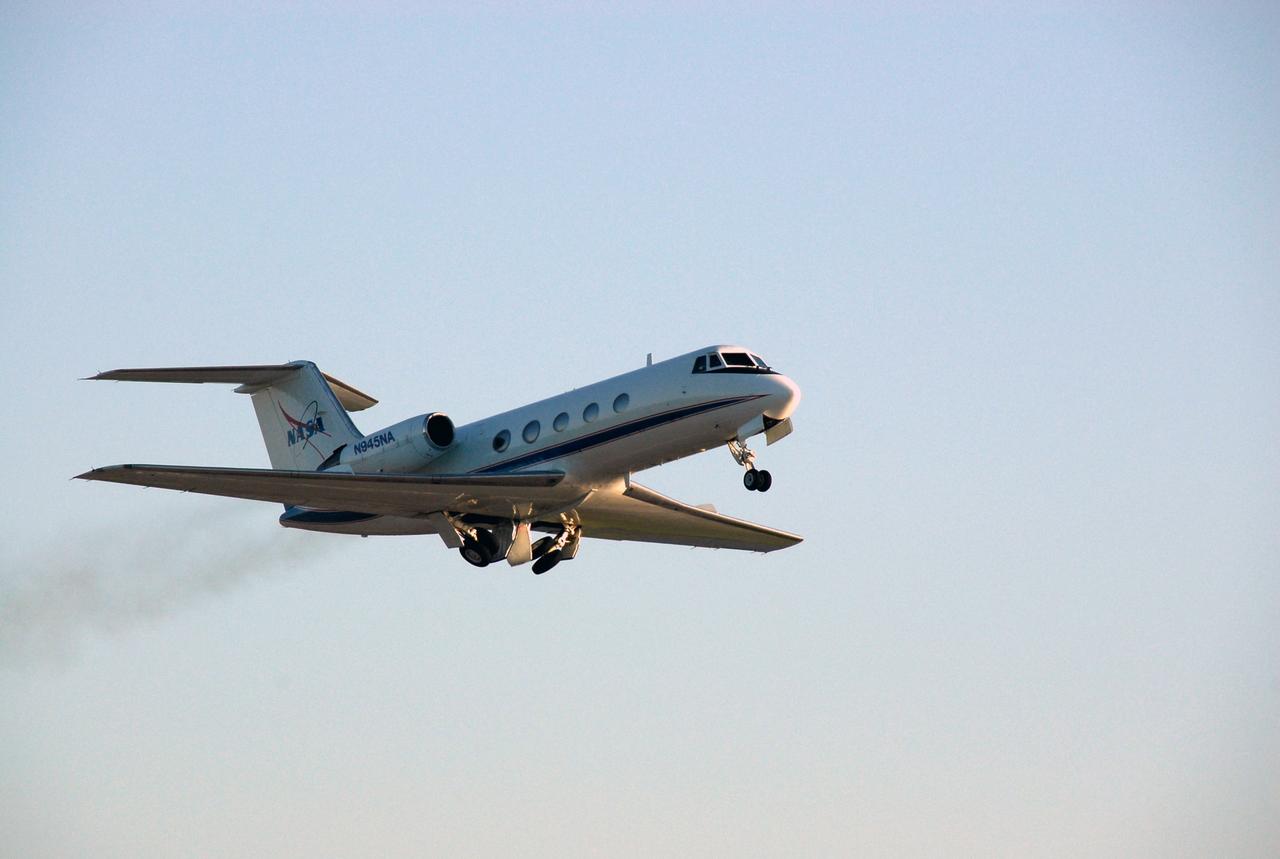
CAPE CANAVERAL, Fla. -- One of the shuttle training aircraft, or STA, takes off from the runway at NASA Kennedy Space Center's Shuttle Landing Facility. Handling the controls is the pilot of the STS-124 mission, Ken Ham, who will practice landing the shuttle. The STA is a Grumman American Aviation-built Gulf Stream II jet that was modified to simulate an orbiter's cockpit, motion and visual cues, and handling qualities. In flight, the aircraft duplicates the orbiter's atmospheric descent trajectory from approximately 35,000 feet altitude to landing on a runway. Space shuttle Discovery is scheduled to lift off on the STS-124 mission at 5:02 p.m. May 31. Photo credit: NASA/Kim Shiflett
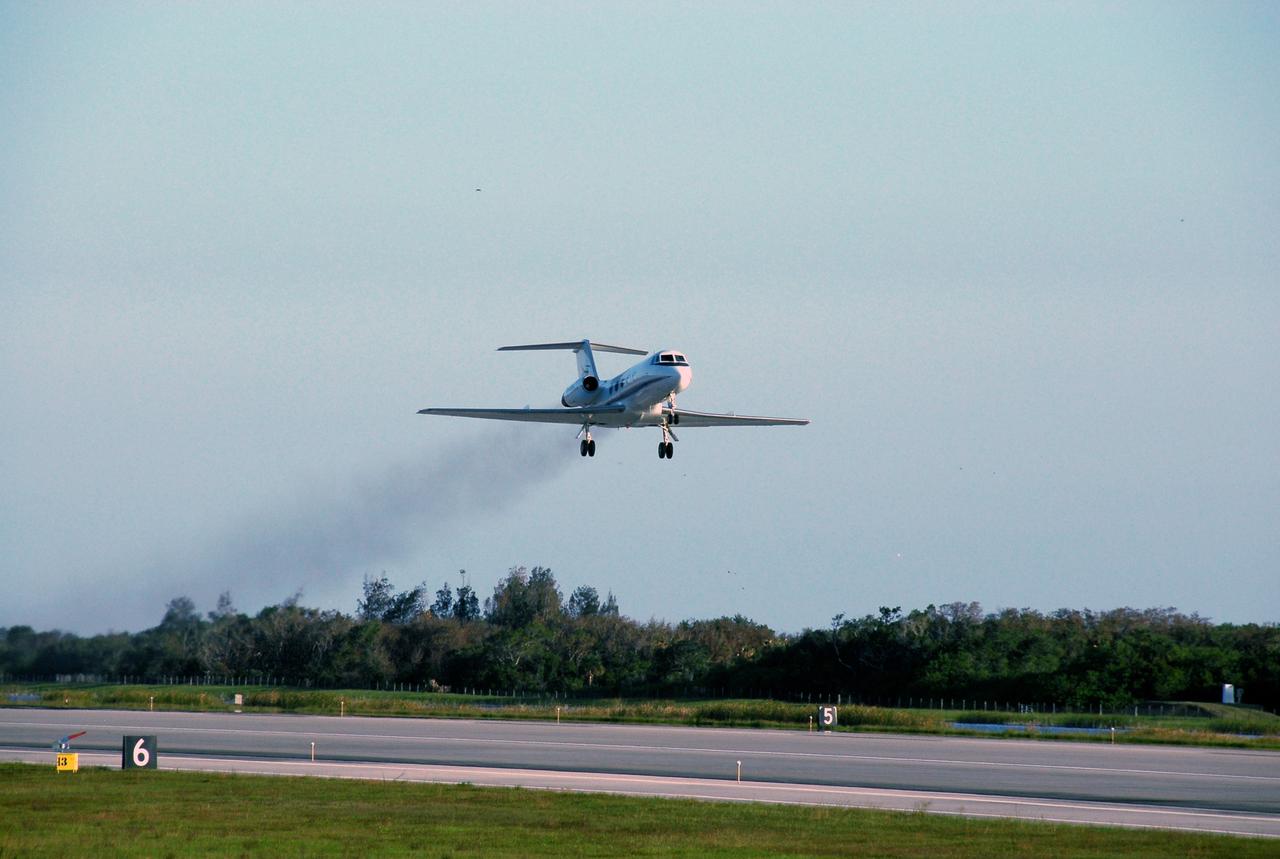
CAPE CANAVERAL, Fla. -- One of the shuttle training aircraft, or STA, takes off from the runway at NASA Kennedy Space Center's Shuttle Landing Facility. Handling the controls is the commander of the STS-124 mission, Mark Kelly, who will practice landing the shuttle. The STA is a Grumman American Aviation-built Gulf Stream II jet that was modified to simulate an orbiter's cockpit, motion and visual cues, and handling qualities. In flight, the aircraft duplicates the orbiter's atmospheric descent trajectory from approximately 35,000 feet altitude to landing on a runway. Space shuttle Discovery is scheduled to lift off on the STS-124 mission at 5:02 p.m. May 31. Photo credit: NASA/Kim Shiflett
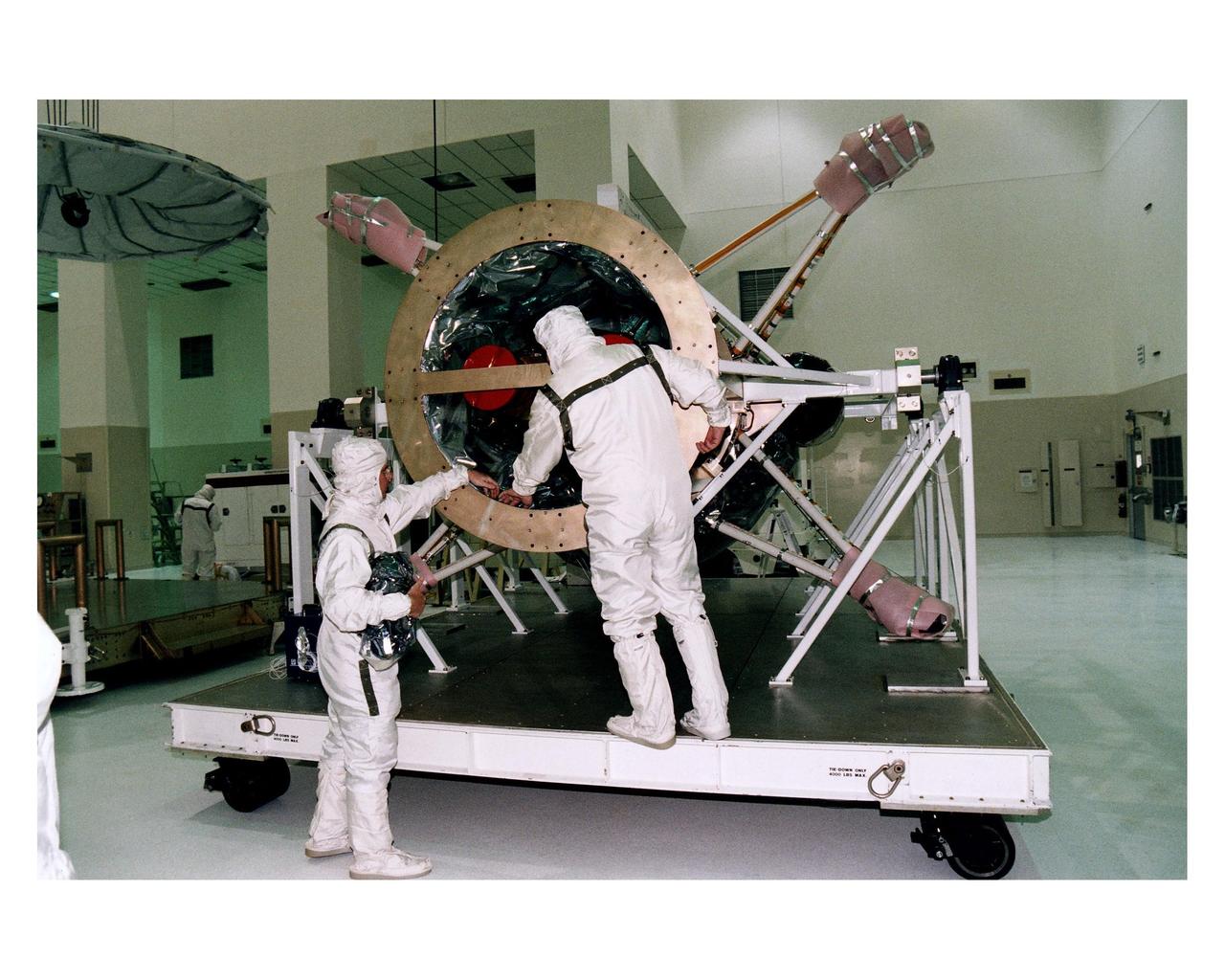
Workers take off the protective covering on the propulsion module for the Cassini spacecraft after uncrating the module at KSC's Spacecraft Assembly and Encapsulation Facility-2 (SAEF-2). The extended journey of 6.7 years to Saturn and the 4-year mission for Cassini once it gets there will require the spacecraft to carry a large amount of propellant for inflight trajectory-correction maneuvers and attitude control, particularly during the science observations. The propulsion module has redundant 445-newton main engines that burn nitrogen tetraoxide and monomethyl-hydrazine for main propulsion and 16 smaller 1-newton engines that burn hydrazine to control attitude and to correct small deviations from the spacecraft flight path. Cassini will be launched on a Titan IVB/Centaur expendable launch vehicle. Liftoff is targeted for October 6 from Launch Complex 40, Cape Canaveral Air Station
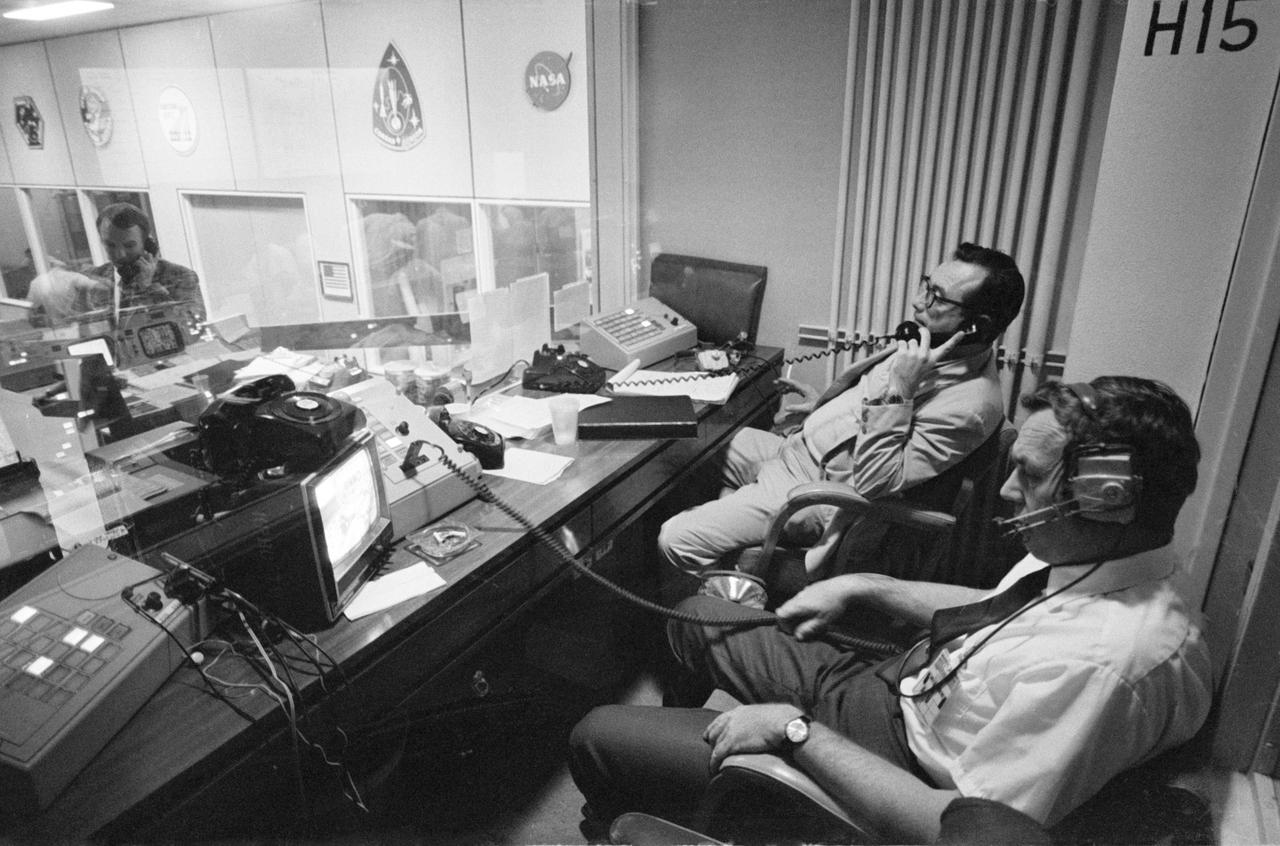
S70-35012 (15 April 1970) --- Two phases of busy activity during critical moments of the Apollo 13 mission are reflected in this view in the Mission Control Center, Building 30, Manned Spacecraft Center. In the foreground, Henry Simmons (left) of Newsweek magazine and John E. Riley, public information specialist, Public Affairs Office, MSC, man their positions in the Press Room. At extreme left of photo, Gerald D. Griffin, Shift 2 flight director, talks on telephone in Mission Operations Control Room. When this photograph was taken, the Apollo 13 lunar landing had been canceled, and the problem-plagued Apollo 13 crewmen were in trans-Earth trajectory attempting to bring their crippled spacecraft back home.
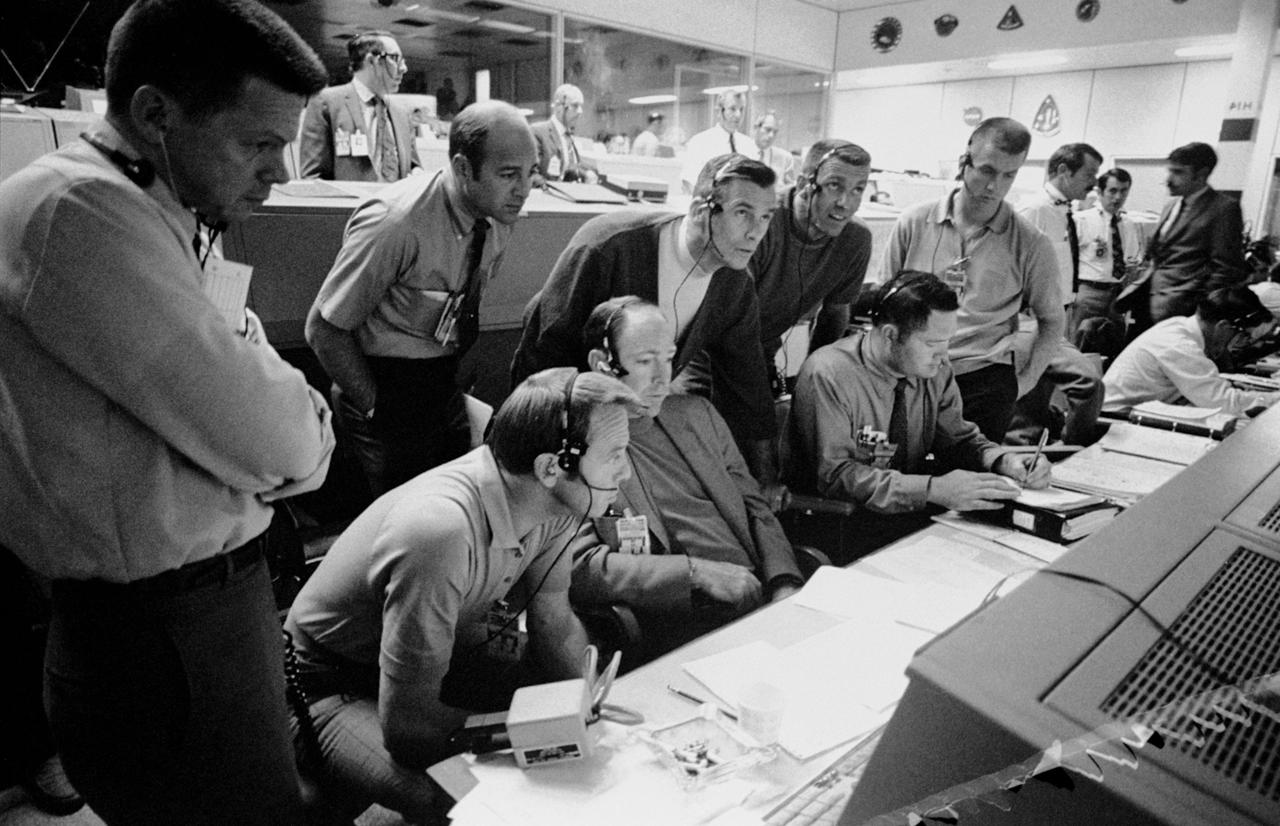
S70-34986 (14 April 1970) --- A group of six astronauts and two flight controllers monitor the console activity in the Mission Operations Control Room (MOCR) of the Mission Control Center (MCC) during the problem-plagued Apollo 13 lunar landing mission. Seated, left to right, are MOCR Guidance Officer Raymond F. Teague; astronaut Edgar D. Mitchell, Apollo 14 prime crew lunar module pilot; and astronaut Alan B. Shepard Jr., Apollo 14 prime crew commander. Standing, left to right, are scientist-astronaut Anthony W. England; astronaut Joe H. Engle, Apollo 14 backup crew lunar module pilot; astronaut Eugene A. Cernan, Apollo 14 backup crew commander; astronaut Ronald E. Evans, Apollo 14 backup crew command module pilot; and M.P. Frank, a flight controller. When this picture was made, the Apollo 13 moon landing had already been canceled, and the Apollo 13 crew men were in trans-Earth trajectory attempting to bring their damaged spacecraft back home.

ISS024-E-007261 (2 July 2010) --- Russian cosmonauts Alexander Skvortsov (foreground) and Mikhail Kornienko, Expedition 24 commander and flight engineer, respectively, monitor data at the manual TORU docking system controls in the Zvezda Service Module of the International Space Station during the approach of the ISS Progress 38 supply vehicle. The attempted docking on July 2, 2010, was aborted when telemetry between the Progress and the space station was lost about 25 minutes before its planned docking. As a result, the Progress vehicle continued on its trajectory and glided past the space station. Later, the Progress successfully docked to Zvezda?s aft end at 12:17 p.m. (EDT) on July 4, 2010. The docking was executed flawlessly by Progress? Kurs automated rendezvous system.

ISS024-E-007259 (2 July 2010) --- Russian cosmonauts Alexander Skvortsov (foreground) and Mikhail Kornienko, Expedition 24 commander and flight engineer, respectively, monitor data at the manual TORU docking system controls in the Zvezda Service Module of the International Space Station during the approach of the ISS Progress 38 supply vehicle. The attempted docking on July 2, 2010, was aborted when telemetry between the Progress and the space station was lost about 25 minutes before its planned docking. As a result, the Progress vehicle continued on its trajectory and glided past the space station. Later, the Progress successfully docked to Zvezda?s aft end at 12:17 p.m. (EDT) on July 4, 2010. The docking was executed flawlessly by Progress? Kurs automated rendezvous system.
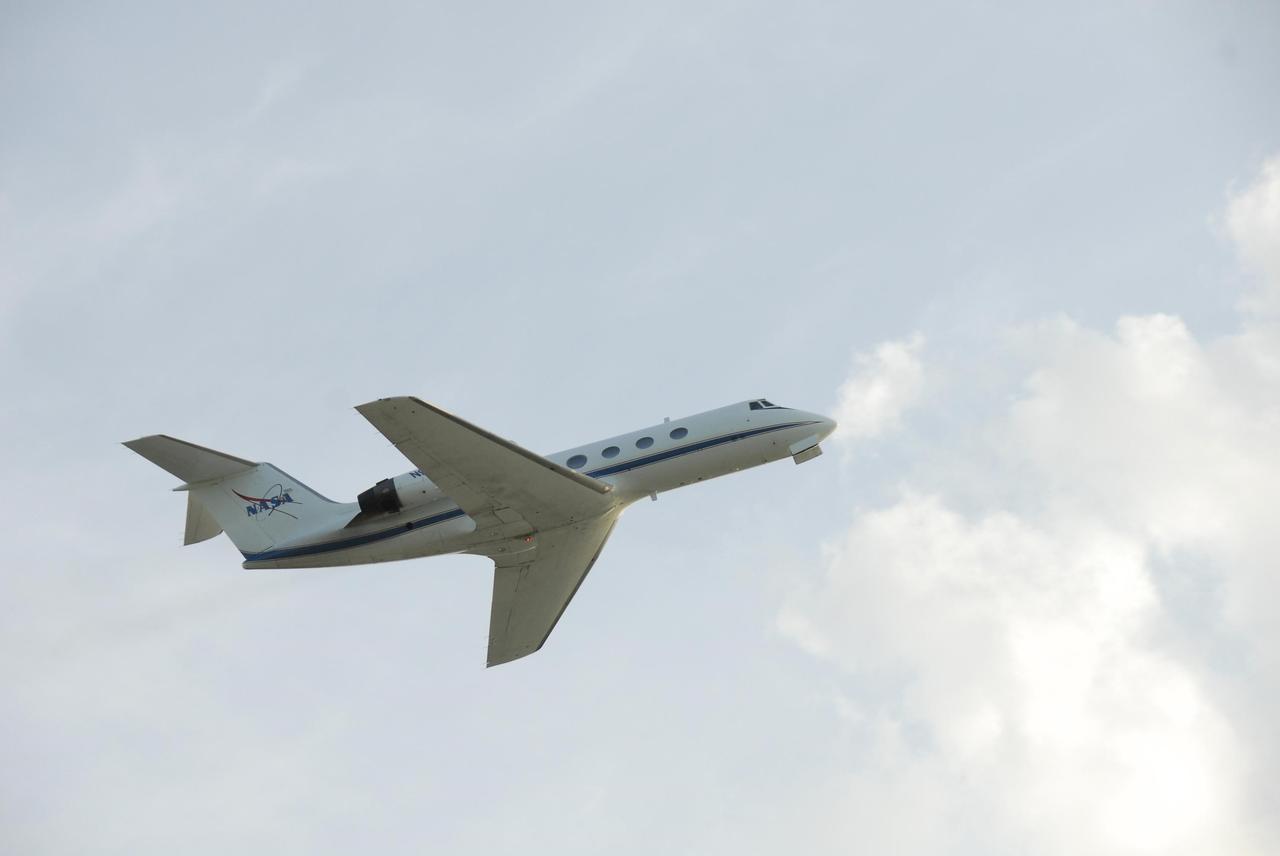
KENNEDY SPACE CENTER, FLA. -- STS-117 Commander Frederick Sturckow and Pilot Lee Archambault aim high to begin landing practice in the shuttle training aircraft (STA). The STA is a Grumman American Aviation-built Gulf Stream II jet that was modified to simulate an orbiter's cockpit, motion and visual cues, and handling qualities. In flight, the STA duplicates the orbiter's atmospheric descent trajectory from approximately 35,000 feet altitude to landing on a runway. STS-117 is scheduled to launch at 7:38 p.m. June 8. During the 11-day mission and three spacewalks, the crew will work with flight controllers at NASA's Johnson Space Center in Houston to install the 17-ton segment on the station's girder-like truss and deploy the set of solar arrays, S3/S4. The mission will increase the space station's power capability in preparation for the arrival of new science modules from the European and Japanese space agencies. Photo credit: NASA/Kim Shiflett

ISS024-E-007263 (2 July 2010) --- Russian cosmonauts Alexander Skvortsov (background) and Mikhail Kornienko, Expedition 24 commander and flight engineer, respectively, monitor data at the manual TORU docking system controls in the Zvezda Service Module of the International Space Station during the approach of the ISS Progress 38 supply vehicle. The attempted docking on July 2, 2010, was aborted when telemetry between the Progress and the space station was lost about 25 minutes before its planned docking. As a result, the Progress vehicle continued on its trajectory and glided past the space station. Later, the Progress successfully docked to Zvezda?s aft end at 12:17 p.m. (EDT) on July 4, 2010. The docking was executed flawlessly by Progress? Kurs automated rendezvous system.

CAPE CANAVERAL, Fla. - On the Shuttle Landing Facility at NASA's Kennedy Space Center in Florida, space shuttle Endeavour’s STS-126 commander, Chris Ferguson, sits at the controls of the Shuttle Training Aircraft, or STA. Ferguson flew the STA to practice landing the shuttle on the runway. The STA is a Grumman American Aviation-built Gulf Stream II jet that was modified to simulate a shuttle’s cockpit, motion and visual cues, and handling qualities. In flight, the aircraft duplicates the shuttle’s atmospheric descent trajectory from approximately 35,000 feet altitude to landing on a runway. Ferguson previously served as pilot on the STS-115 mission, which flew in September 2006. The STS-126 mission to the International Space Station is targeted to launch Nov. 16. Photo credit: NASA/Cory Huston
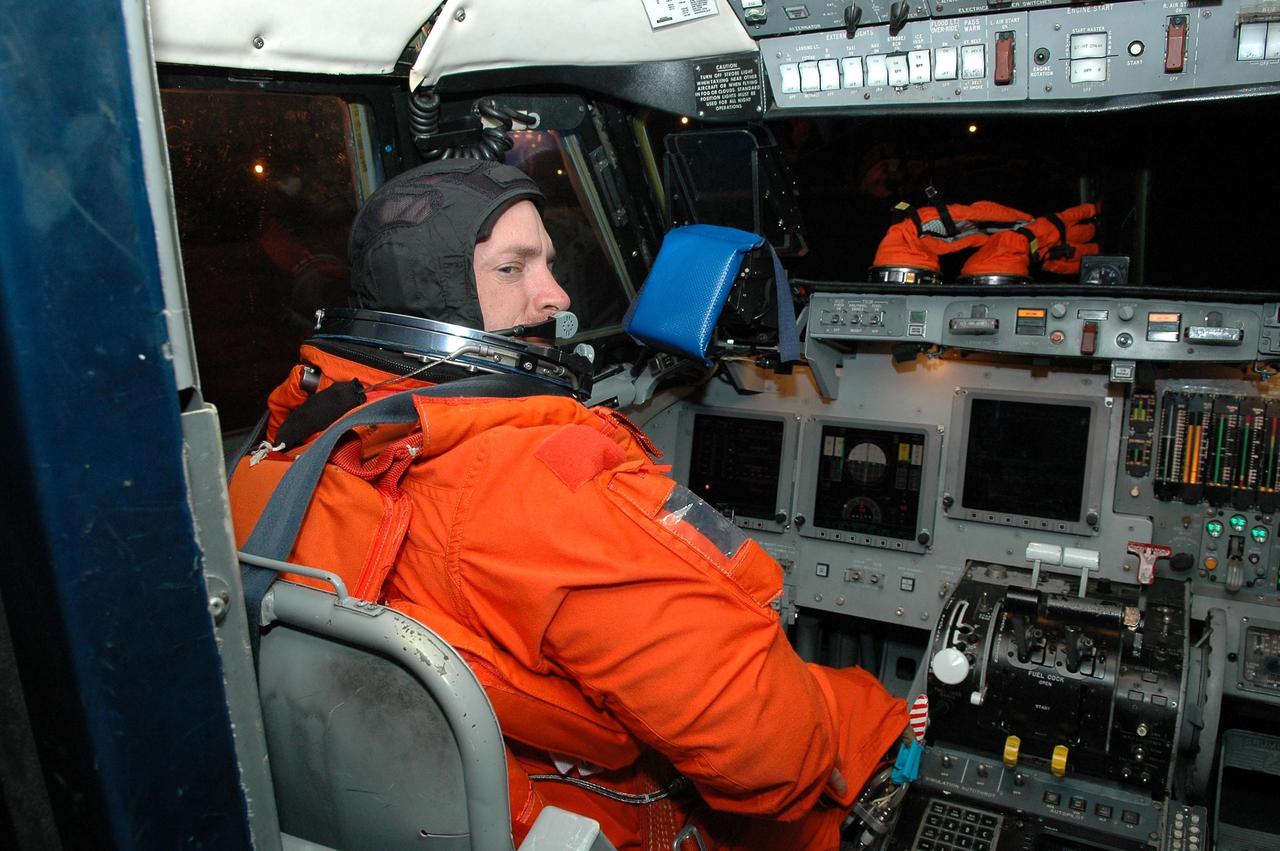
KENNEDY SPACE CENTER, FLA. - Inside the Shuttle Training Aircraft (STA), STS-121 Pilot Mark Kelly takes control in the cockpit. Kelly and Commander Steven Lindsey will be making practice landings in preparation for the July 1 launch of Space Shuttle Discovery. The STA is a Grumman American Aviation-built Gulf Stream II jet that was modified to simulate an orbiter’s cockpit, motion and visual cues, and handling qualities. In flight, the STA duplicates the orbiter’s atmospheric descent trajectory from approximately 35,000 feet altitude to landing on a runway. Because the orbiter is unpowered during re-entry and landing, its high-speed glide must be perfectly executed the first time. Photo credit: NASA/Kim Shiflett
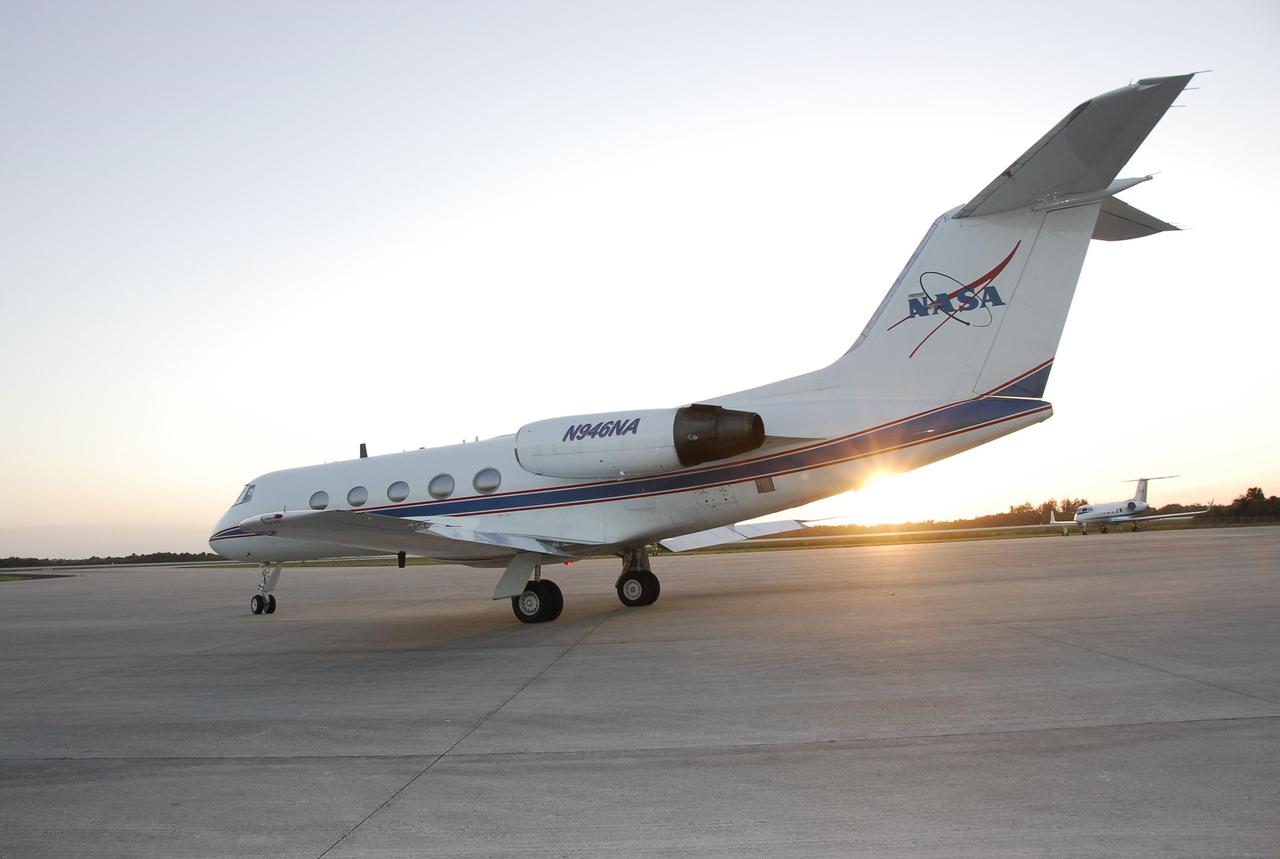
KENNEDY SPACE CENTER, FLA. -- On the Shuttle Landing Facility at NASA's Kennedy Space Center, the shuttle training aircraft, or STA, is ready for flight with STS-122 Commander Steve Frick and Pilot Alan Poindexter at the controls. They are practicing shuttle landings in the STA before the Feb. 7 launch of space shuttle Atlantis. The STA is a Grumman American Aviation-built Gulf Stream II jet that was modified to simulate an orbiter's cockpit, motion and visual cues, and handling qualities. In flight, the STA duplicates the orbiter's atmospheric descent trajectory from approximately 35,000 feet altitude to landing on a runway. Because the orbiter is unpowered during re-entry and landing, its high-speed glide must be perfectly executed the first time. Photo credit: NASA/Kim Shiflett

KENNEDY SPACE CENTER, FLA. -- STS-117 Commander Frederick Sturckow climbs into the shuttle training aircraft, or STA, at KSC's Shuttle Landing Facility. He will be making practice landings in the STA, which is a Grumman American Aviation-built Gulf Stream II jet that was modified to simulate an orbiter's cockpit, motion and visual cues, and handling qualities. In flight, the STA duplicates the orbiter's atmospheric descent trajectory from approximately 35,000 feet altitude to landing on a runway. STS-117 is scheduled to launch at 7:38 p.m. June 8. During the 11-day mission and three spacewalks, the crew will work with flight controllers at NASA's Johnson Space Center in Houston to install the 17-ton segment on the station's girder-like truss and deploy the set of solar arrays, S3/S4. The mission will increase the space station's power capability in preparation for the arrival of new science modules from the European and Japanese space agencies. Photo credit: NASA/Kim Shiflett
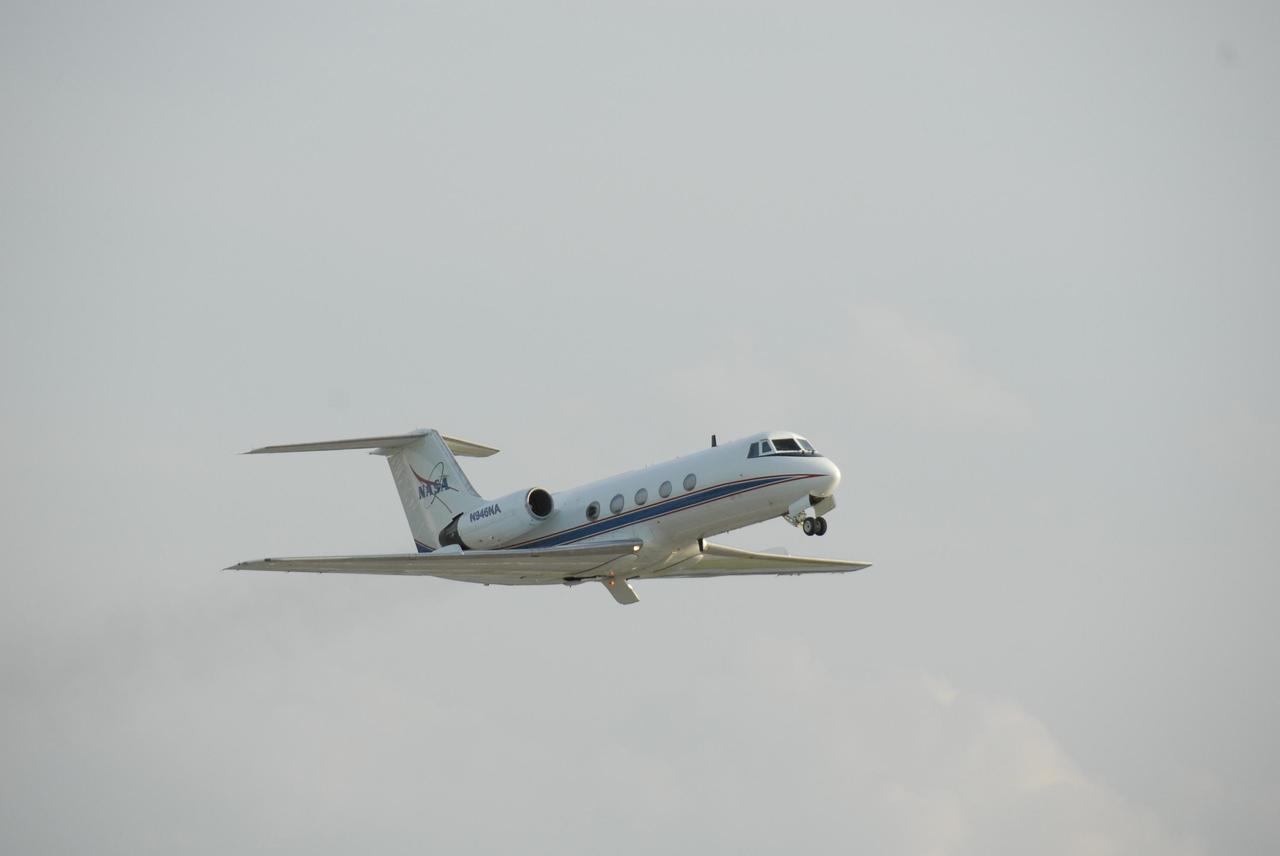
KENNEDY SPACE CENTER, FLA. -- It's wheels up for the shuttle training aircraft, or STA, after takeoff from KSC's Shuttle Landing Facility with STS-117 Commander Frederick Sturckow and Pilot Lee Archambault in the cockpit. Sturckow and Archambault will be making practice landings in the STA, which is a Grumman American Aviation-built Gulf Stream II jet that was modified to simulate an orbiter's cockpit, motion and visual cues, and handling qualities. In flight, the STA duplicates the orbiter's atmospheric descent trajectory from approximately 35,000 feet altitude to landing on a runway. STS-117 is scheduled to launch at 7:38 p.m. June 8. During the 11-day mission and three spacewalks, the crew will work with flight controllers at NASA's Johnson Space Center in Houston to install the 17-ton segment on the station's girder-like truss and deploy the set of solar arrays, S3/S4. The mission will increase the space station's power capability in preparation for the arrival of new science modules from the European and Japanese space agencies. Photo credit: NASA/Kim Shiflett

KENNEDY SPACE CENTER, FLA. -- Back at KSC's Shuttle Landing Facility, STS-117 Pilot Lee Archambault and Commander Frederick Sturckow are satisfied with their landing practice in the shuttle training aircraft (STA) behind them. The STA is a Grumman American Aviation-built Gulf Stream II jet that was modified to simulate an orbiter's cockpit, motion and visual cues, and handling qualities. In flight, the STA duplicates the orbiter's atmospheric descent trajectory from approximately 35,000 feet altitude to landing on a runway. STS-117 is scheduled to launch at 7:38 p.m. June 8. During the 11-day mission and three spacewalks, the crew will work with flight controllers at NASA's Johnson Space Center in Houston to install the 17-ton segment on the station's girder-like truss and deploy the set of solar arrays, S3/S4. The mission will increase the space station's power capability in preparation for the arrival of new science modules from the European and Japanese space agencies. Photo credit: NASA/Kim Shiflett
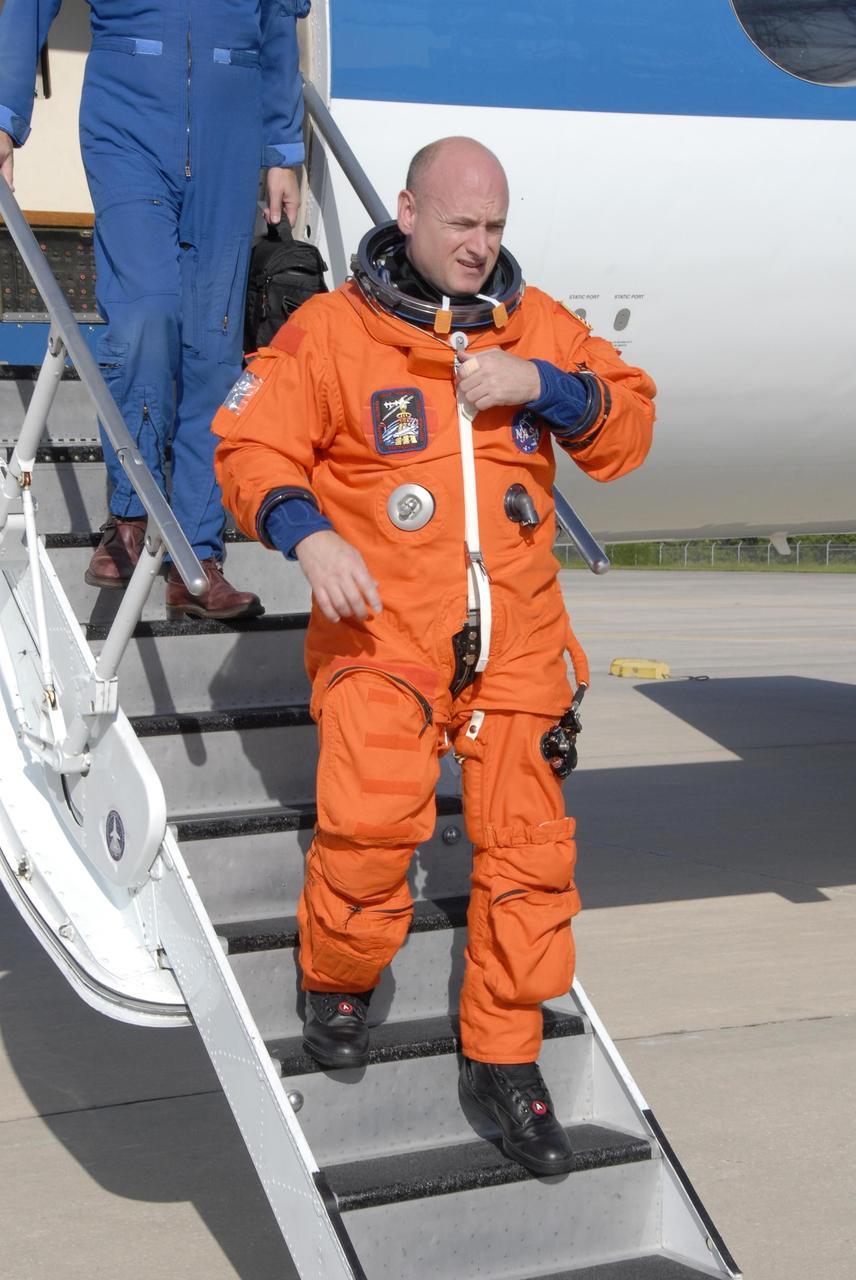
KENNEDY SPACE CENTER, FLA. - STS-118 Commander Scott Kelly is satisfied with his training session in the shuttle training aircraft, or STA, at the Shuttle Landing Facility, Kennedy Space Center's airstrip. He and STS-118 Pilot Charlie Hobaugh were at the facility to practice landings for their upcoming mission. The STA is a Grumman American Aviation-built Gulf Stream II jet that was modified to simulate an orbiter's cockpit, motion and visual cues, and handling qualities. In flight, the STA duplicates the orbiter's atmospheric descent trajectory from approximately 35,000 feet altitude to landing on a runway. Endeavour's STS-118 mission is the 22nd shuttle flight to the International Space Station. It will continue space station construction by delivering a third starboard truss segment, S5. Other payloads include the SPACEHAB module, making its last voyage, and the external stowage platform 3 with a control moment gyroscope on it. The flight will include at least three spacewalks. The crew will also debut a new system that enables docked shuttles to draw electrical power from the station to extend visits to the outpost. Launch is set for Aug. 8 at 6:36 p.m. EDT. NASA/Kim Shiflett
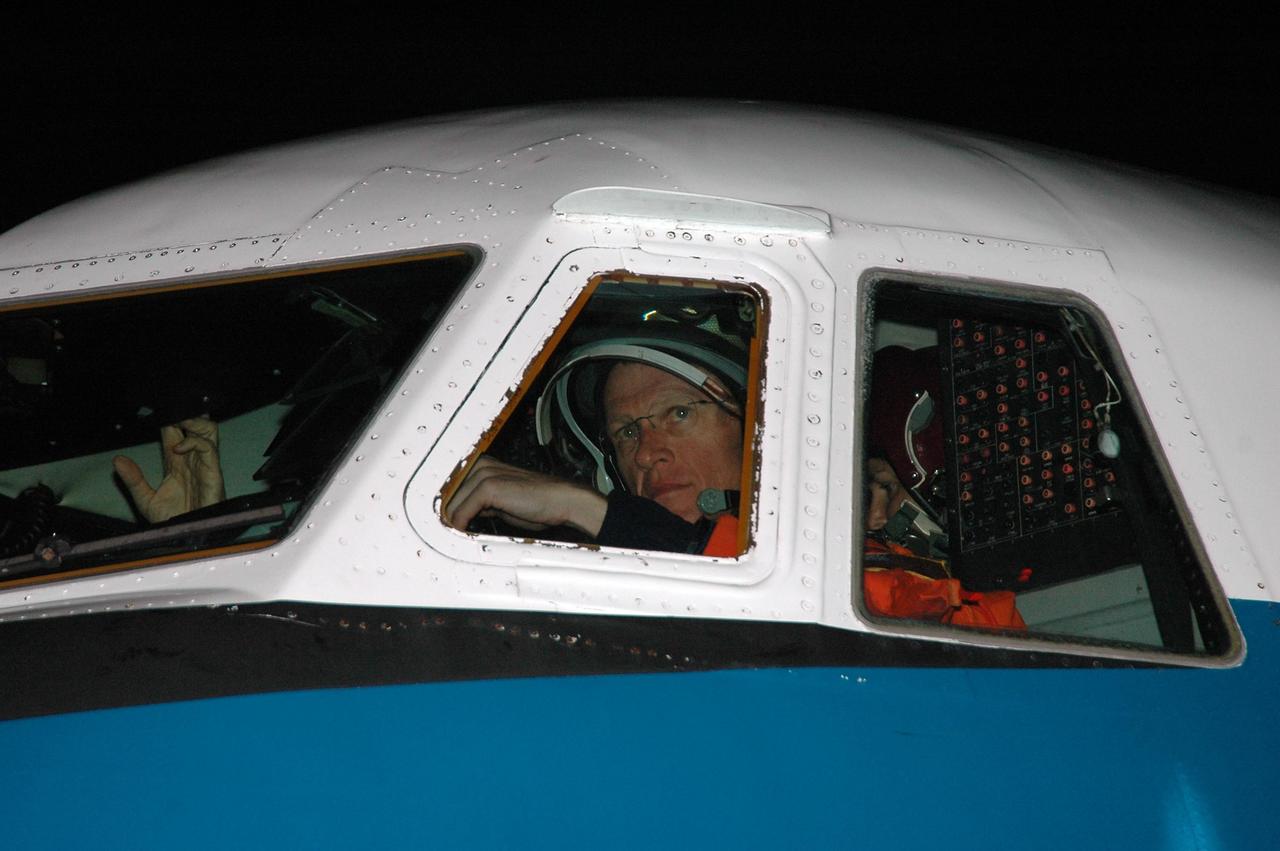
KENNEDY SPACE CENTER, FLA. - STS-115 Commander Brent Jett is seen at the controls of the Shuttle Training Aircraft which he will fly to practice landing the shuttle. STA practice is part of launch preparations. The STA is a Grumman American Aviation-built Gulf Stream II jet that was modified to simulate an orbiter’s cockpit, motion and visual cues, and handling qualities. In flight, the STA duplicates the orbiter’s atmospheric descent trajectory from approximately 35,000 feet altitude to landing on a runway. Because the orbiter is unpowered during re-entry and landing, its high-speed glide must be perfectly executed the first time. Mission STS-115 is scheduled to lift off about 4:30 p.m. Aug. 27. The crew will deliver and install the P3/P4 segment to the port side of the integrated truss system on the International Space Station. The truss includes a new set of photovoltaic solar arrays. When unfurled to their full length of 240 feet, the arrays will provide additional power for the station in preparation for the delivery of international science modules over the next two years. The mission is expected to last 11 days and includes three scheduled spacewalks. Photo credit: NASA/Kim Shiflett

KENNEDY SPACE CENTER, FLA. -- Back at KSC's Shuttle Landing Facility, STS-117 Commander Frederick Sturckow (left) and Pilot Lee Archambault are satisfied with their landing practice in the shuttle training aircraft (STA) behind them. The STA is a Grumman American Aviation-built Gulf Stream II jet that was modified to simulate an orbiter's cockpit, motion and visual cues, and handling qualities. In flight, the STA duplicates the orbiter's atmospheric descent trajectory from approximately 35,000 feet altitude to landing on a runway. STS-117 is scheduled to launch at 7:38 p.m. June 8. During the 11-day mission and three spacewalks, the crew will work with flight controllers at NASA's Johnson Space Center in Houston to install the 17-ton segment on the station's girder-like truss and deploy the set of solar arrays, S3/S4. The mission will increase the space station's power capability in preparation for the arrival of new science modules from the European and Japanese space agencies. Photo credit: NASA/Kim Shiflett

KENNEDY SPACE CENTER, FLA. -- STS-117 Commander Frederick Sturckow settles into his seat in the shuttle training aircraft, or STA, at KSC's Shuttle Landing Facility. He will be making practice landings in the STA, which is a Grumman American Aviation-built Gulf Stream II jet that was modified to simulate an orbiter's cockpit, motion and visual cues, and handling qualities. In flight, the STA duplicates the orbiter's atmospheric descent trajectory from approximately 35,000 feet altitude to landing on a runway. STS-117 is scheduled to launch at 7:38 p.m. June 8. During the 11-day mission and three spacewalks, the crew will work with flight controllers at NASA's Johnson Space Center in Houston to install the 17-ton segment on the station's girder-like truss and deploy the set of solar arrays, S3/S4. The mission will increase the space station's power capability in preparation for the arrival of new science modules from the European and Japanese space agencies. Photo credit: NASA/Kim Shiflett
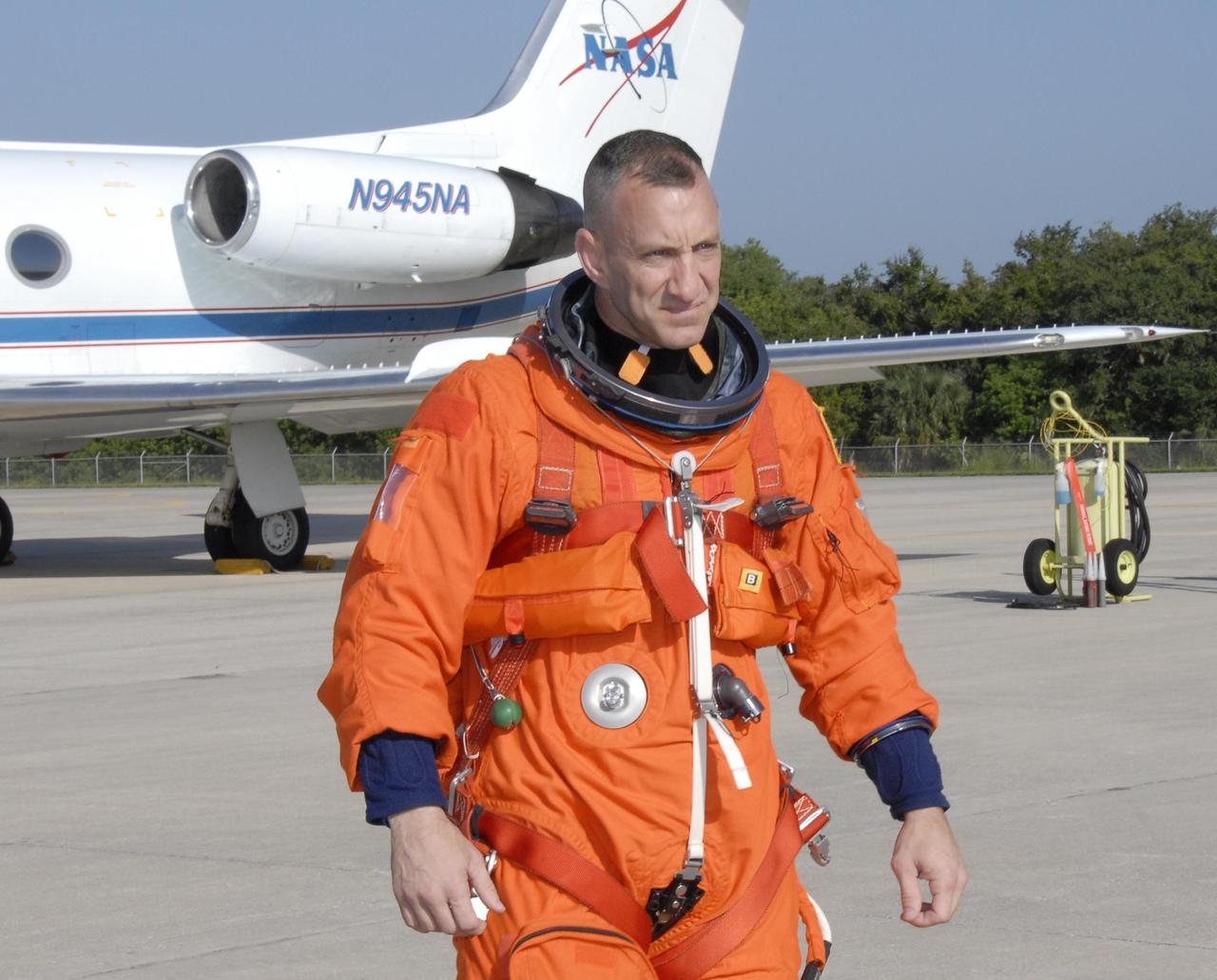
KENNEDY SPACE CENTER, FLA. - STS-118 Pilot Charlie Hobaugh is satisfied with his training session in the shuttle training aircraft, or STA, at the Shuttle Landing Facility, Kennedy Space Center's airstrip. He and STS-118 Commander Scott Kelly were at the facility to practice landings for their upcoming mission. The STA is a Grumman American Aviation-built Gulf Stream II jet that was modified to simulate an orbiter's cockpit, motion and visual cues, and handling qualities. In flight, the STA duplicates the orbiter's atmospheric descent trajectory from approximately 35,000 feet altitude to landing on a runway. Endeavour's STS-118 mission is the 22nd shuttle flight to the International Space Station. It will continue space station construction by delivering a third starboard truss segment, S5. Other payloads include the SPACEHAB module, making its last voyage, and the external stowage platform 3 with a control moment gyroscope on it. The flight will include at least three spacewalks. The crew will also debut a new system that enables docked shuttles to draw electrical power from the station to extend visits to the outpost. Launch is set for Aug. 8 at 6:36 p.m. EDT. NASA/Kim Shiflett
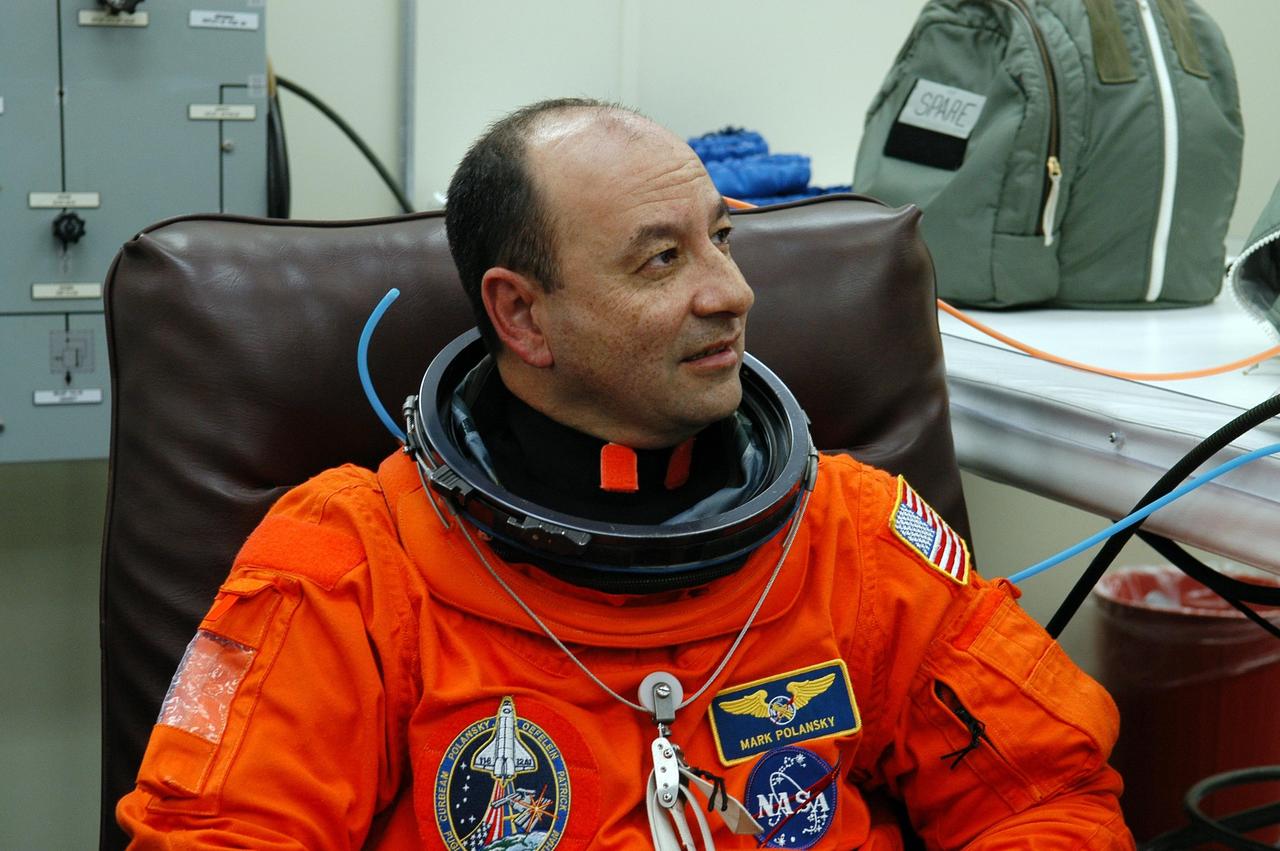
KENNEDY SPACE CENTER, FLA. -- STS-116 Commander Mark Polansky is getting a suit fit-check after practicing landing the orbiter at the controls of the shuttle training aircraft. The STA is a Grumman American Aviation-built Gulf Stream II jet that was modified to simulate an orbiter's cockpit, motion and visual cues, and handling qualities. In flight, the STA duplicates the orbiter's atmospheric descent trajectory from approximately 35,000 feet altitude to landing on a runway. Because the orbiter is unpowered during re-entry and landing, its high-speed glide must be perfectly executed the first time. Launch of Space Shuttle Discovery on mission STS-116 is scheduled for 9:35 p.m. Dec. 7. On the mission, the STS-116 crew will deliver truss segment, P5, to the International Space Station and begin the intricate process of reconfiguring and redistributing the power generated by two pairs of U.S. solar arrays. The P5 will be mated to the P4 truss that was delivered and attached during the STS-115 mission in September. Photo credit: NASA/Kim Shiflett
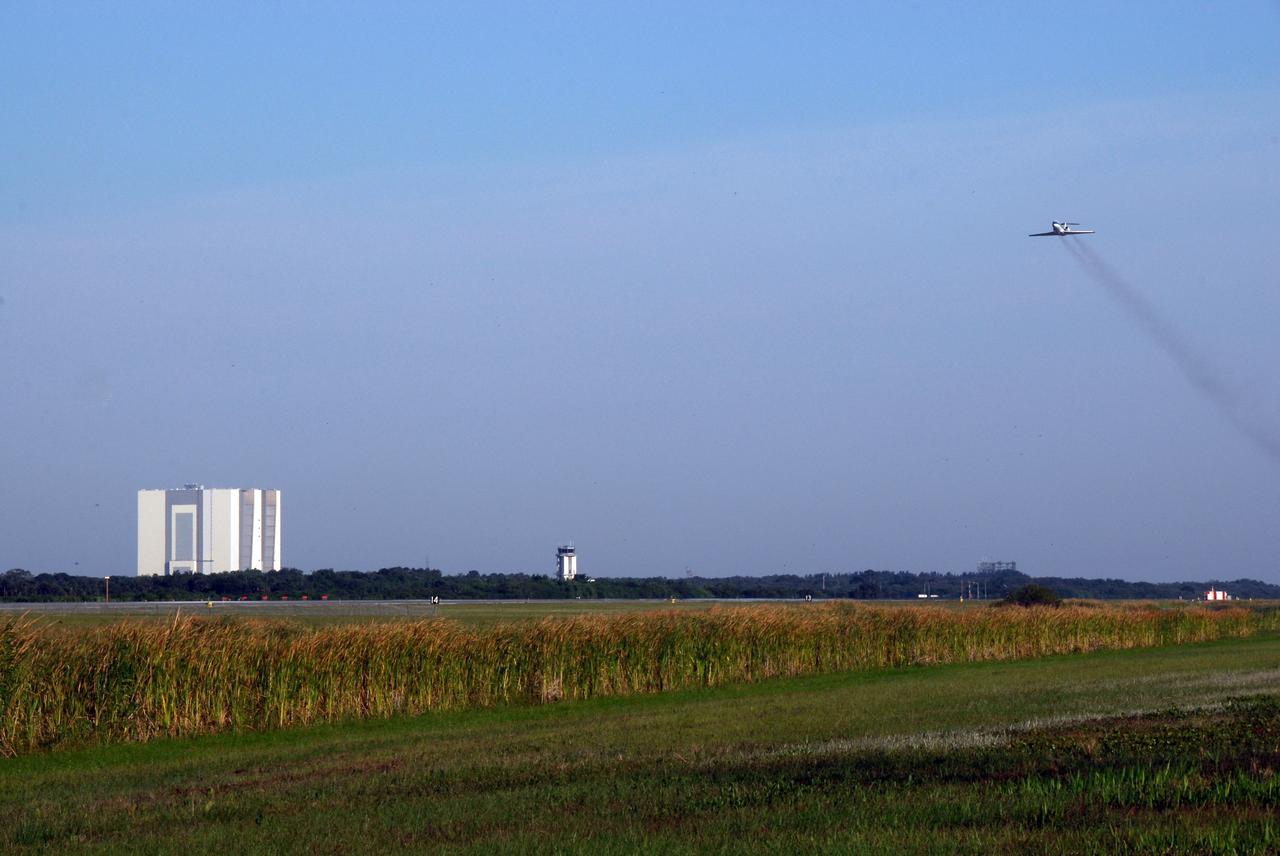
CAPE CANAVERAL, Fla. -- NASA's Shuttle Training Aircraft, or STA, soars into the sky (at right) over the NASA Kennedy Space Center Shuttle Landing Facility. At the controls is either STS-124 Commander Mark Kelly or Pilot Ken Ham, who are practicing space shuttle landings. At left, in the background, is the Vehicle Assembly Building. The STA is a Grumman American Aviation-built Gulf Stream II jet that was modified to simulate an orbiter's cockpit, motion and visual cues, and handling qualities. In flight, the STA duplicates the orbiter's atmospheric descent trajectory from approximately 35,000 feet altitude to landing on a runway. Because the orbiter is unpowered during re-entry and landing, its high-speed glide must be perfectly executed the first time. The crew for space shuttle Discovery's STS-124 mission is at Kennedy for a full launch dress rehearsal, known as the terminal countdown demonstration test, or TCDT. Providing astronauts and ground crews with an opportunity to participate in various simulated countdown activities, TCDT includes equipment familiarization and emergency training. Discovery's launch is targeted for May 31. Photo credit: NASA/Kim Shiflett
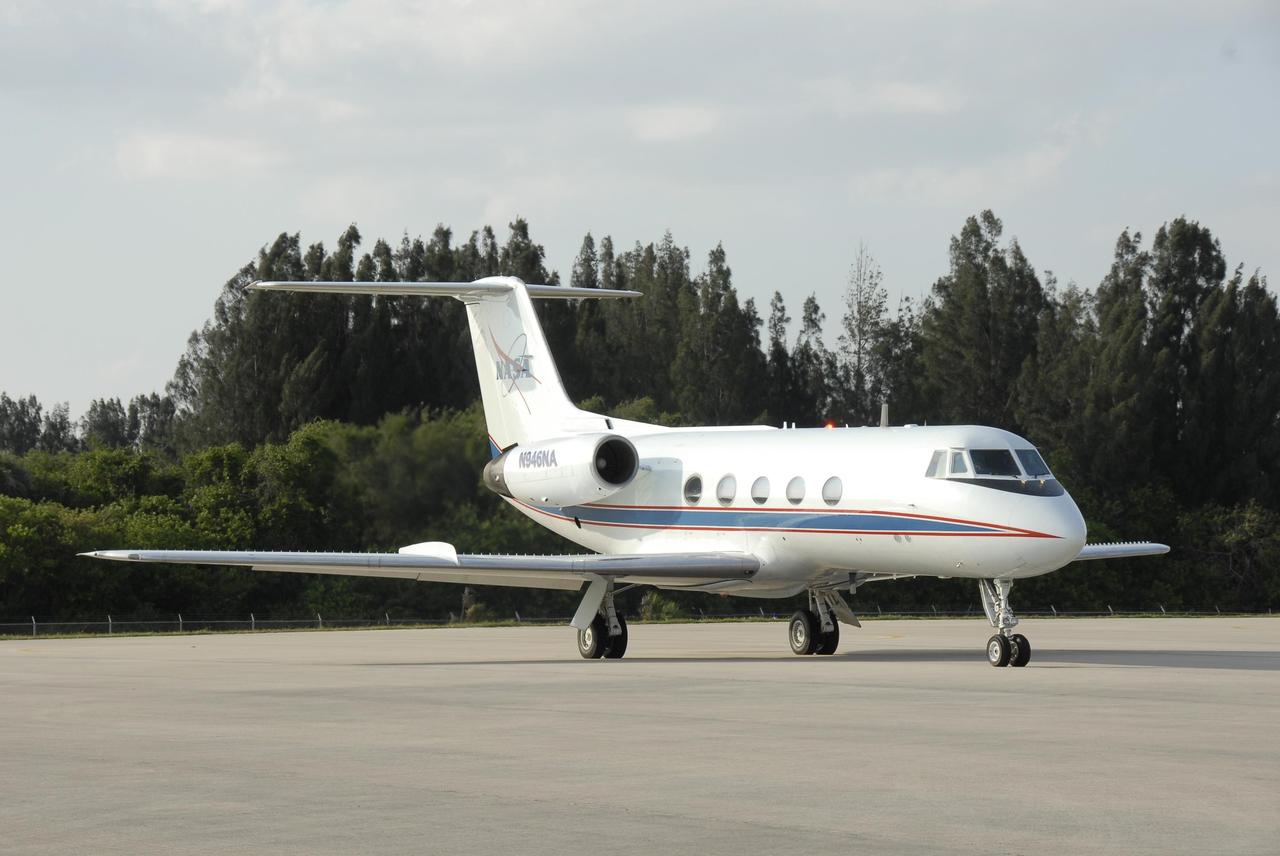
KENNEDY SPACE CENTER, FLA. -- The shuttle training aircraft, or STA, with STS-117 Commander Frederick Sturckow and Pilot Lee Archambault in the cockpit begins to taxi to the runway at KSC's Shuttle Landing Facility. Sturckow and Archambault will be making practice landings in the STA, which is a Grumman American Aviation-built Gulf Stream II jet that was modified to simulate an orbiter's cockpit, motion and visual cues, and handling qualities. In flight, the STA duplicates the orbiter's atmospheric descent trajectory from approximately 35,000 feet altitude to landing on a runway. STS-117 is scheduled to launch at 7:38 p.m. June 8. During the 11-day mission and three spacewalks, the crew will work with flight controllers at NASA's Johnson Space Center in Houston to install the 17-ton segment on the station's girder-like truss and deploy the set of solar arrays, S3/S4. The mission will increase the space station's power capability in preparation for the arrival of new science modules from the European and Japanese space agencies. Photo credit: NASA/Kim Shiflett
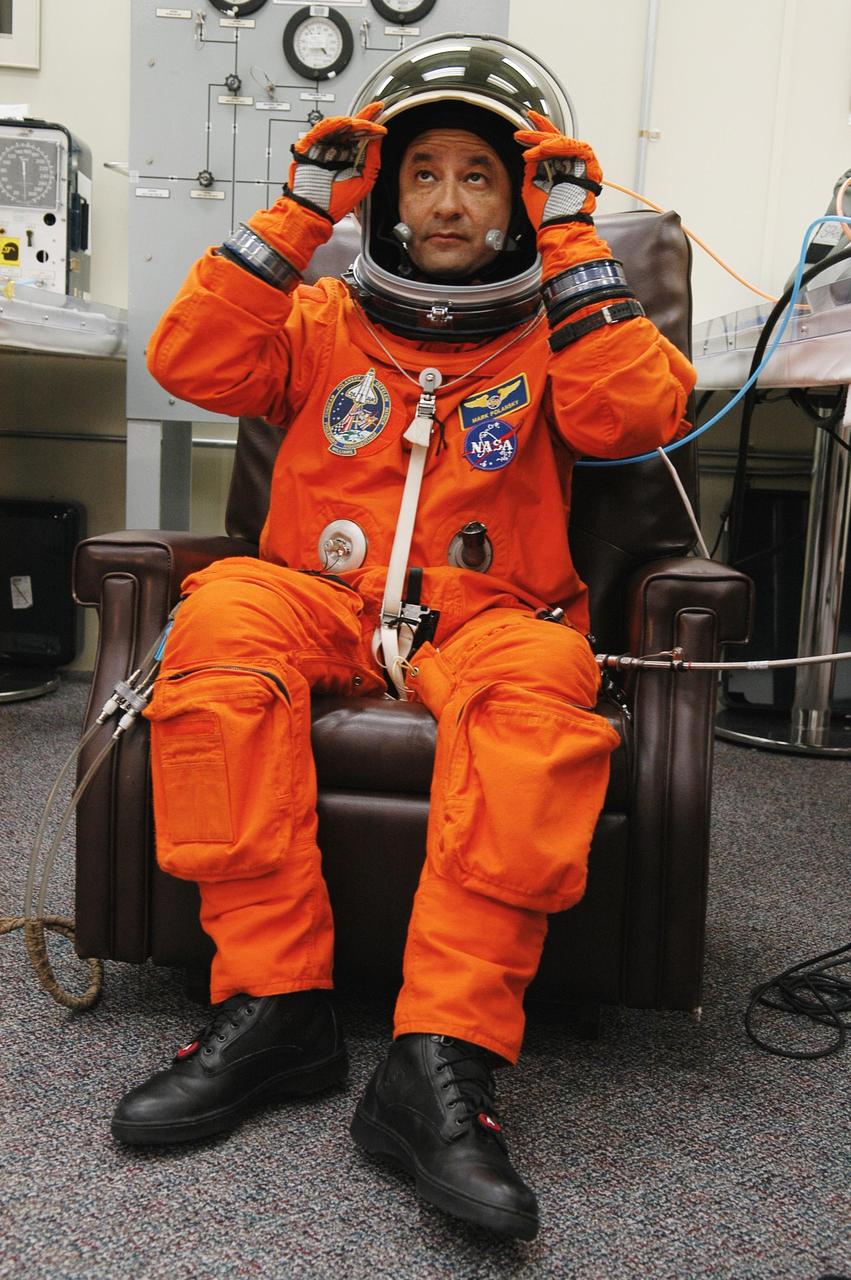
KENNEDY SPACE CENTER, FLA. -- STS-116 Commander Mark Polansky adjusts his helmet during a suit fit-check. Polansky has returned from practicing landing the orbiter at the controls of the shuttle training aircraft. The STA is a Grumman American Aviation-built Gulf Stream II jet that was modified to simulate an orbiter's cockpit, motion and visual cues, and handling qualities. In flight, the STA duplicates the orbiter's atmospheric descent trajectory from approximately 35,000 feet altitude to landing on a runway. Because the orbiter is unpowered during re-entry and landing, its high-speed glide must be perfectly executed the first time. Launch of Space Shuttle Discovery on mission STS-116 is scheduled for 9:35 p.m. Dec. 7. On the mission, the STS-116 crew will deliver truss segment, P5, to the International Space Station and begin the intricate process of reconfiguring and redistributing the power generated by two pairs of U.S. solar arrays. The P5 will be mated to the P4 truss that was delivered and attached during the STS-115 mission in September. Photo credit: NASA/Kim Shiflett
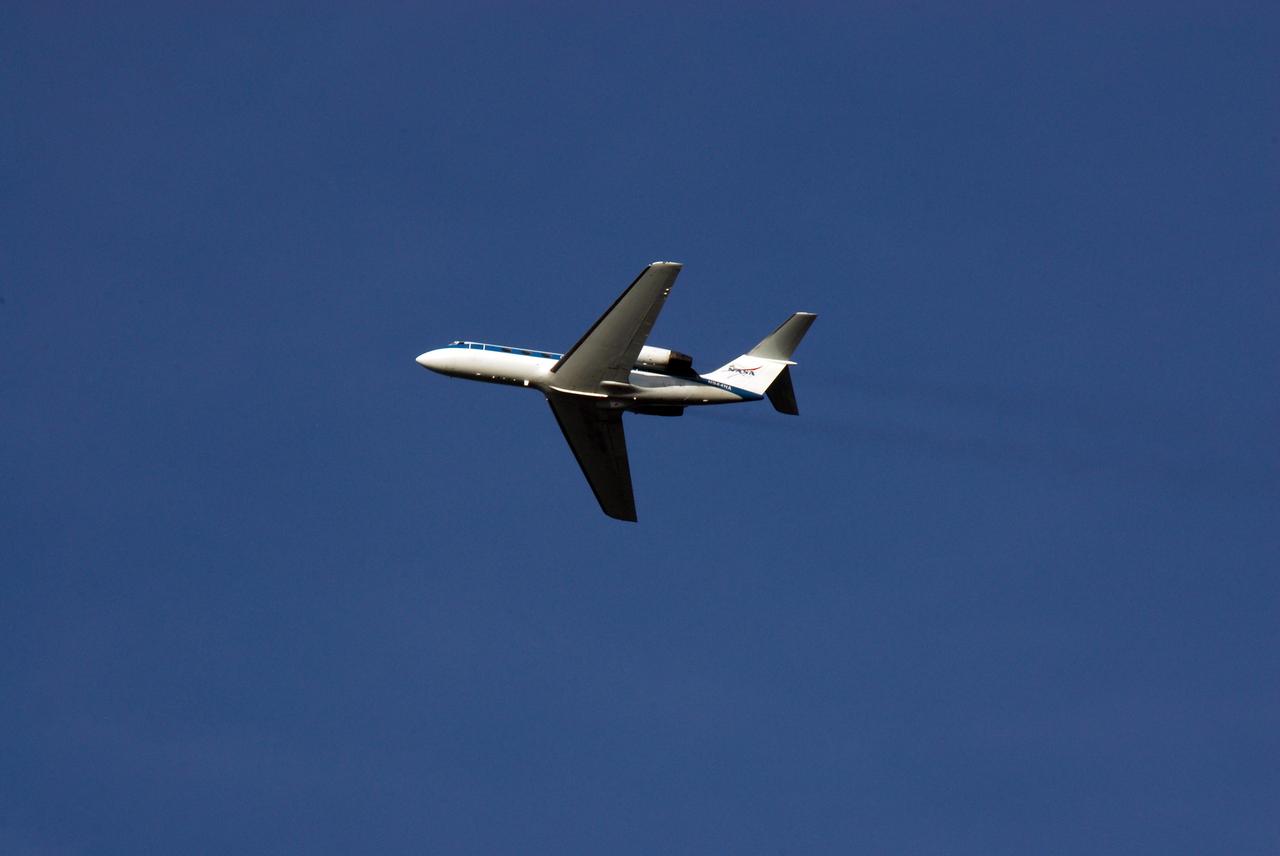
CAPE CANAVERAL, Fla. -- NASA's Shuttle Training Aircraft, or STA, soars into the blue Florida sky to begin the space shuttle landing practice. STS-124 Commander Mark Kelly or Pilot Ken Ham is at the controls. The STA is a Grumman American Aviation-built Gulf Stream II jet that was modified to simulate an orbiter's cockpit, motion and visual cues, and handling qualities. In flight, the STA duplicates the orbiter's atmospheric descent trajectory from approximately 35,000 feet altitude to landing on a runway. Because the orbiter is unpowered during re-entry and landing, its high-speed glide must be perfectly executed the first time. The crew for space shuttle Discovery's STS-124 mission is at Kennedy for a full launch dress rehearsal, known as the terminal countdown demonstration test, or TCDT. Providing astronauts and ground crews with an opportunity to participate in various simulated countdown activities, TCDT includes equipment familiarization and emergency training. Discovery's launch is targeted for May 31. Photo credit: NASA/Kim Shiflett

KENNEDY SPACE CENTER, FLA. -- STS-117 Commander Frederick Sturckow (left) and Pilot Lee Archambault head for the shuttle training aircraft, or STA, at KSC's Shuttle Landing Facility. They will be making practice landings in the STA, which is a Grumman American Aviation-built Gulf Stream II jet that was modified to simulate an orbiter's cockpit, motion and visual cues, and handling qualities. In flight, the STA duplicates the orbiter's atmospheric descent trajectory from approximately 35,000 feet altitude to landing on a runway. STS-117 is scheduled to launch at 7:38 p.m. June 8. During the 11-day mission and three spacewalks, the crew will work with flight controllers at NASA's Johnson Space Center in Houston to install the 17-ton segment on the station's girder-like truss and deploy the set of solar arrays, S3/S4. The mission will increase the space station's power capability in preparation for the arrival of new science modules from the European and Japanese space agencies. Photo credit: NASA/Kim Shiflett

KENNEDY SPACE CENTER, FLA. - STS-115 Commander Brent Jett studies the controls in the cockpit of the Shuttle Training Aircraft before a practice session of landing the shuttle. STA practice is part of launch preparations. The STA is a Grumman American Aviation-built Gulf Stream II jet that was modified to simulate an orbiter’s cockpit, motion and visual cues, and handling qualities. In flight, the STA duplicates the orbiter’s atmospheric descent trajectory from approximately 35,000 feet altitude to landing on a runway. Because the orbiter is unpowered during re-entry and landing, its high-speed glide must be perfectly executed the first time. Mission STS-115 is scheduled to lift off about 12:29 p.m. Sept. 6. Mission managers cancelled Atlantis' first launch campaign due to a lightning strike at the pad and the passage of Tropical Storm Ernesto along Florida's east coast. The mission will deliver and install the 17-and-a-half-ton P3/P4 truss segment to the port side of the integrated truss system on the orbital outpost. The truss includes a new set of photovoltaic solar arrays. When unfurled to their full length of 240 feet, the arrays will provide additional power for the station in preparation for the delivery of international science modules over the next two years. STS-115 is expected to last 11 days and includes three scheduled spacewalks. Photo credit: NASA/Kim Shiflett

KENNEDY SPACE CENTER, FLA. -- STS-117 Pilot Lee Archambault heads for the shuttle training aircraft, or STA, at KSC's Shuttle Landing Facility. He will be making practice landings in the STA, which is a Grumman American Aviation-built Gulf Stream II jet that was modified to simulate an orbiter's cockpit, motion and visual cues, and handling qualities. In flight, the STA duplicates the orbiter's atmospheric descent trajectory from approximately 35,000 feet altitude to landing on a runway. STS-117 is scheduled to launch at 7:38 p.m. June 8. During the 11-day mission and three spacewalks, the crew will work with flight controllers at NASA's Johnson Space Center in Houston to install the 17-ton segment on the station's girder-like truss and deploy the set of solar arrays, S3/S4. The mission will increase the space station's power capability in preparation for the arrival of new science modules from the European and Japanese space agencies. Photo credit: NASA/Kim Shiflett

KENNEDY SPACE CENTER, FLA. -- STS-117 Pilot Lee Archambault climbs into the shuttle training aircraft, or STA, at KSC's Shuttle Landing Facility. He will be making practice landings in the STA, which is a Grumman American Aviation-built Gulf Stream II jet that was modified to simulate an orbiter's cockpit, motion and visual cues, and handling qualities. In flight, the STA duplicates the orbiter's atmospheric descent trajectory from approximately 35,000 feet altitude to landing on a runway. STS-117 is scheduled to launch at 7:38 p.m. June 8. During the 11-day mission and three spacewalks, the crew will work with flight controllers at NASA's Johnson Space Center in Houston to install the 17-ton segment on the station's girder-like truss and deploy the set of solar arrays, S3/S4. The mission will increase the space station's power capability in preparation for the arrival of new science modules from the European and Japanese space agencies. Photo credit: NASA/Kim Shiflett
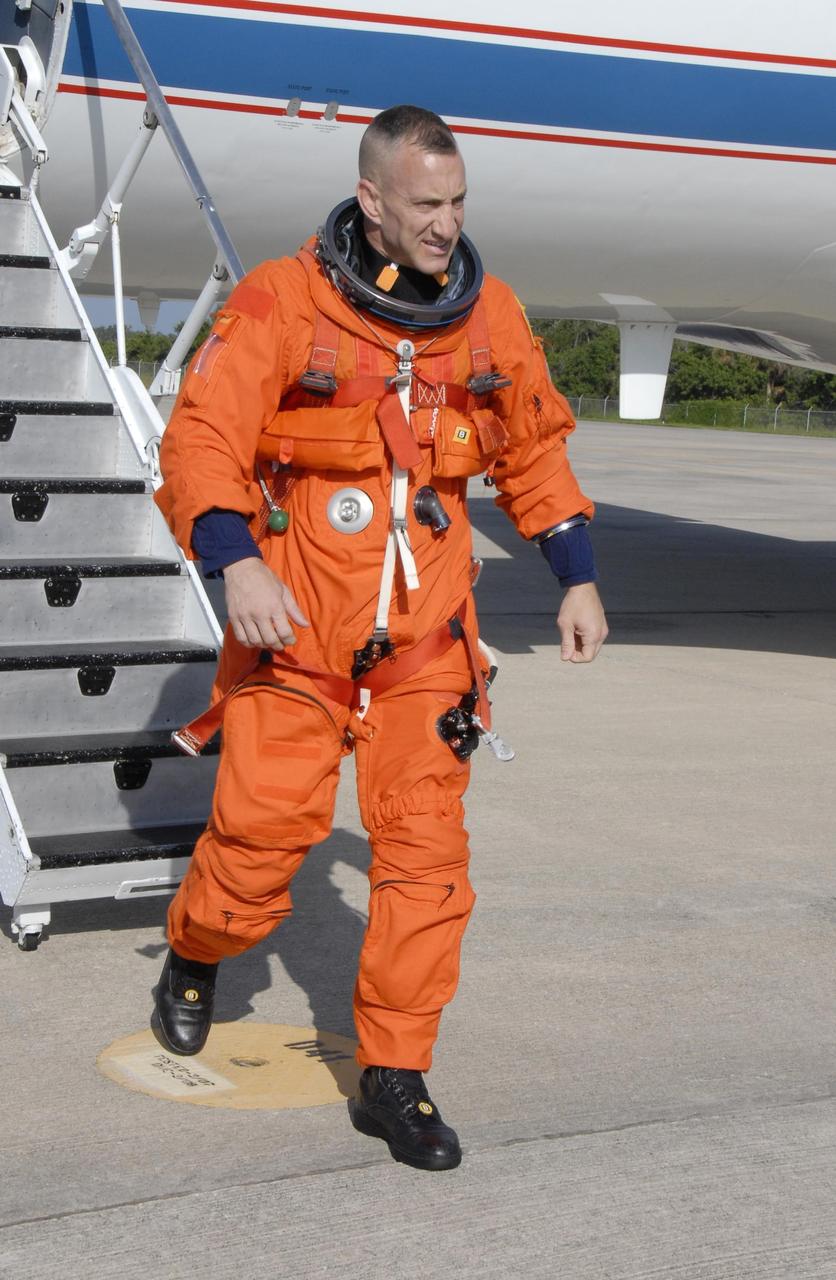
KENNEDY SPACE CENTER, FLA. - STS-118 Pilot Charlie Hobaugh disembarks from the shuttle training aircraft, or STA, at the Shuttle Landing Facility, Kennedy Space Center's airstrip. He and STS-118 Commander Scott Kelly were at the facility to practice landings for their upcoming mission. The STA is a Grumman American Aviation-built Gulf Stream II jet that was modified to simulate an orbiter's cockpit, motion and visual cues, and handling qualities. In flight, the STA duplicates the orbiter's atmospheric descent trajectory from approximately 35,000 feet altitude to landing on a runway. Endeavour's STS-118 mission is the 22nd shuttle flight to the International Space Station. It will continue space station construction by delivering a third starboard truss segment, S5. Other payloads include the SPACEHAB module, making its last voyage, and the external stowage platform 3 with a control moment gyroscope on it. The flight will include at least three spacewalks. The crew will also debut a new system that enables docked shuttles to draw electrical power from the station to extend visits to the outpost. Launch is set for Aug. 8 at 6:36 p.m. EDT. Photo credit: NASA/Kim Shiflett
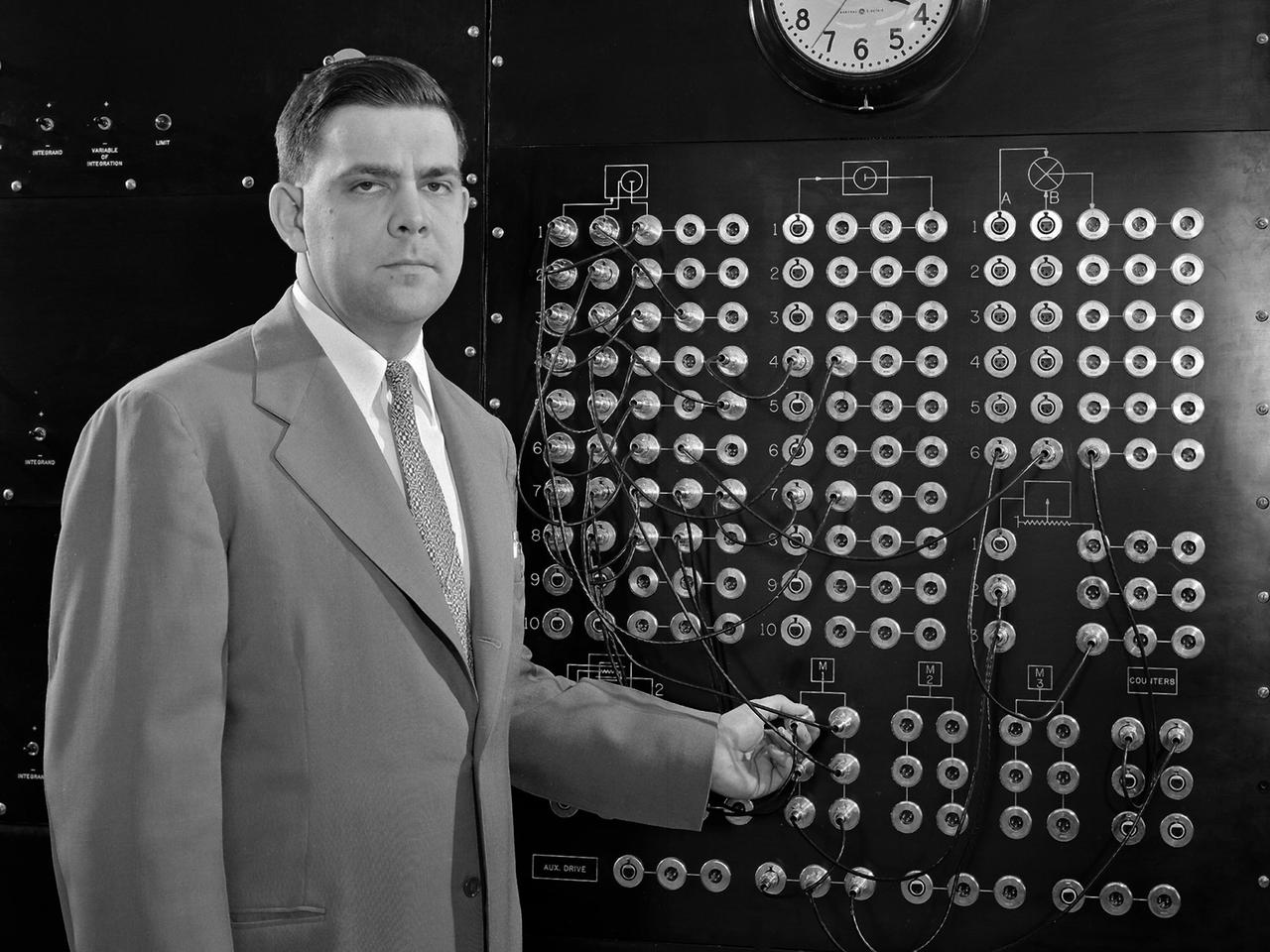
Harry Mergler stands at the control board of a differential analyzer in the new Instrument Research Laboratory at the National Advisory Committee for Aeronautics (NACA) Lewis Flight Propulsion Laboratory. The differential analyzer was a multi-variable analog computation machine devised in 1931 by Massachusetts Institute of Technology researcher and future NACA Committee member Vannevar Bush. The mechanical device could solve computations up to the sixth order, but had to be rewired before each new computation. Mergler modified Bush’s differential analyzer in the late 1940s to calculate droplet trajectories for Lewis’ icing research program. In four days Mergler’s machine could calculate what previously required weeks. NACA Lewis built the Instrument Research Laboratory in 1950 and 1951 to house the large analog computer equipment. The two-story structure also provided offices for the Mechanical Computational Analysis, and Flow Physics sections of the Physics Division. The division had previously operated from the lab’s hangar because of its icing research and flight operations activities. Mergler joined the Instrument Research Section of the Physics Division in 1948 after earning an undergraduate degree in Physics from the Case Institute of Technology. Mergler’s focus was on the synthesis of analog computers with the machine tools used to create compressor and turbine blades for jet engines.
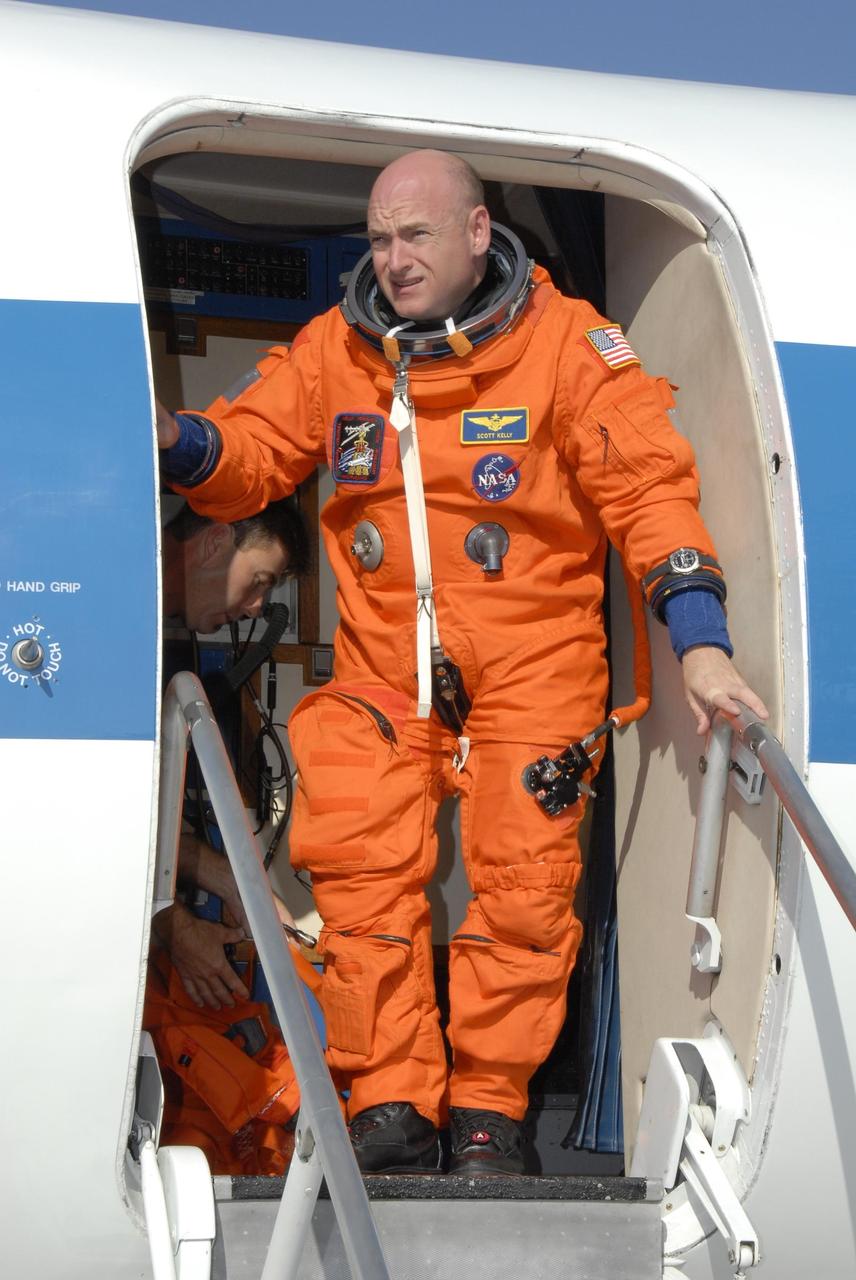
KENNEDY SPACE CENTER, FLA. - STS-118 Commander Scott Kelly disembarks from the shuttle training aircraft, or STA, at the Shuttle Landing Facility, Kennedy Space Center's airstrip. He and STS-118 Pilot Charlie Hobaugh were at the facility to practice landings for their upcoming mission. The STA is a Grumman American Aviation-built Gulf Stream II jet that was modified to simulate an orbiter's cockpit, motion and visual cues, and handling qualities. In flight, the STA duplicates the orbiter's atmospheric descent trajectory from approximately 35,000 feet altitude to landing on a runway. Endeavour's STS-118 mission is the 22nd shuttle flight to the International Space Station. It will continue space station construction by delivering a third starboard truss segment, S5. Other payloads include the SPACEHAB module, making its last voyage, and the external stowage platform 3 with a control moment gyroscope on it. The flight will include at least three spacewalks. The crew will also debut a new system that enables docked shuttles to draw electrical power from the station to extend visits to the outpost. Launch is set for Aug. 8 at 6:36 p.m. EDT. NASA/Kim Shiflett
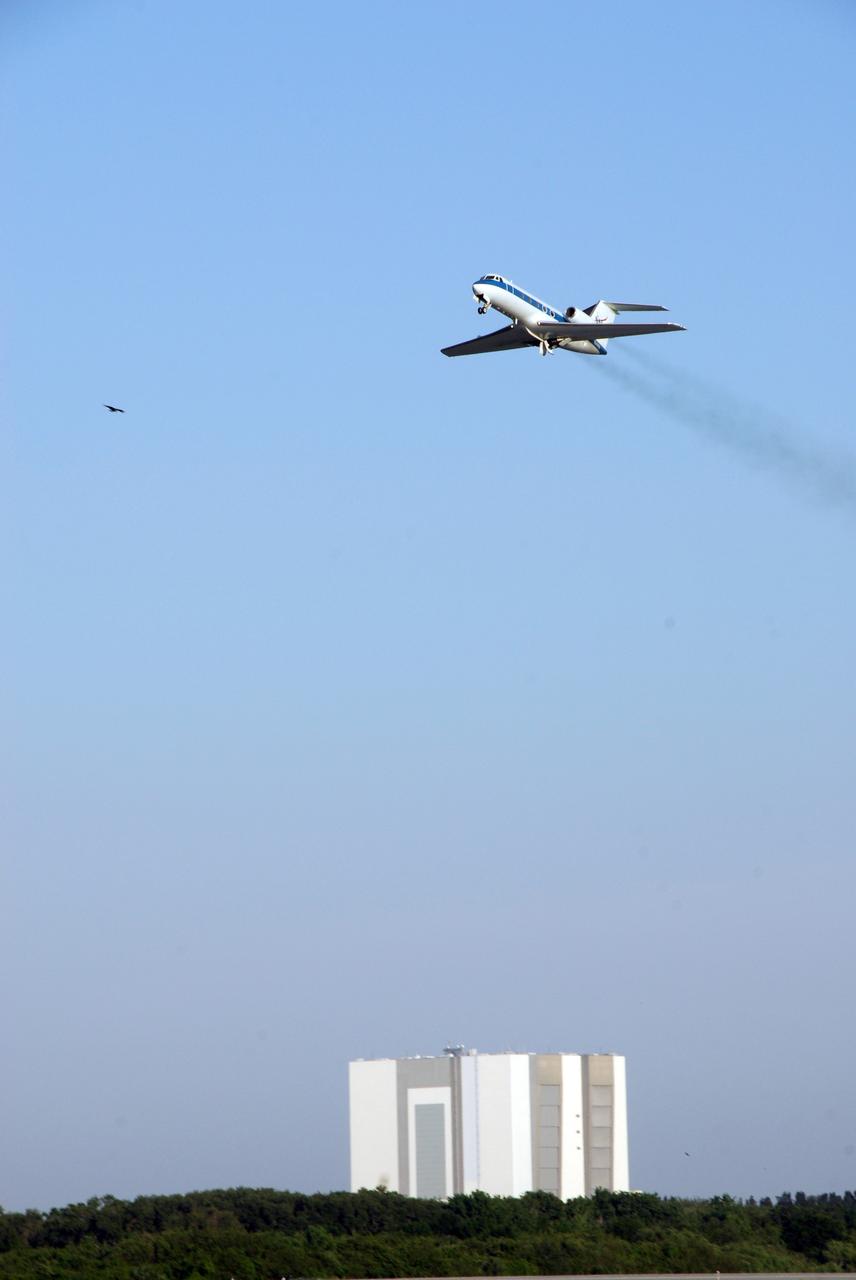
CAPE CANAVERAL, Fla. -- NASA's Shuttle Training Aircraft, or STA, soars into the sky from the NASA Kennedy Space Center Shuttle Landing Facility with STS-124 Commander Mark Kelly or Pilot Ken Ham at the controls. Below is the Vehicle Assembly Building. Kelly and Ham are practicing space shuttle landings. The STA is a Grumman American Aviation-built Gulf Stream II jet that was modified to simulate an orbiter's cockpit, motion and visual cues, and handling qualities. In flight, the STA duplicates the orbiter's atmospheric descent trajectory from approximately 35,000 feet altitude to landing on a runway. Because the orbiter is unpowered during re-entry and landing, its high-speed glide must be perfectly executed the first time. The crew for space shuttle Discovery's STS-124 mission is at Kennedy for a full launch dress rehearsal, known as the terminal countdown demonstration test, or TCDT. Providing astronauts and ground crews with an opportunity to participate in various simulated countdown activities, TCDT includes equipment familiarization and emergency training. Discovery's launch is targeted for May 31. Photo credit: NASA/Kim Shiflett

KENNEDY SPACE CENTER, FLA. -- STS-117 Pilot Lee Archambault settles into his seat in the shuttle training aircraft, or STA, at KSC's Shuttle Landing Facility. He will be making practice landings in the STA, which is a Grumman American Aviation-built Gulf Stream II jet that was modified to simulate an orbiter's cockpit, motion and visual cues, and handling qualities. In flight, the STA duplicates the orbiter's atmospheric descent trajectory from approximately 35,000 feet altitude to landing on a runway. STS-117 is scheduled to launch at 7:38 p.m. June 8. During the 11-day mission and three spacewalks, the crew will work with flight controllers at NASA's Johnson Space Center in Houston to install the 17-ton segment on the station's girder-like truss and deploy the set of solar arrays, S3/S4. The mission will increase the space station's power capability in preparation for the arrival of new science modules from the European and Japanese space agencies. Photo credit: NASA/Kim Shiflett
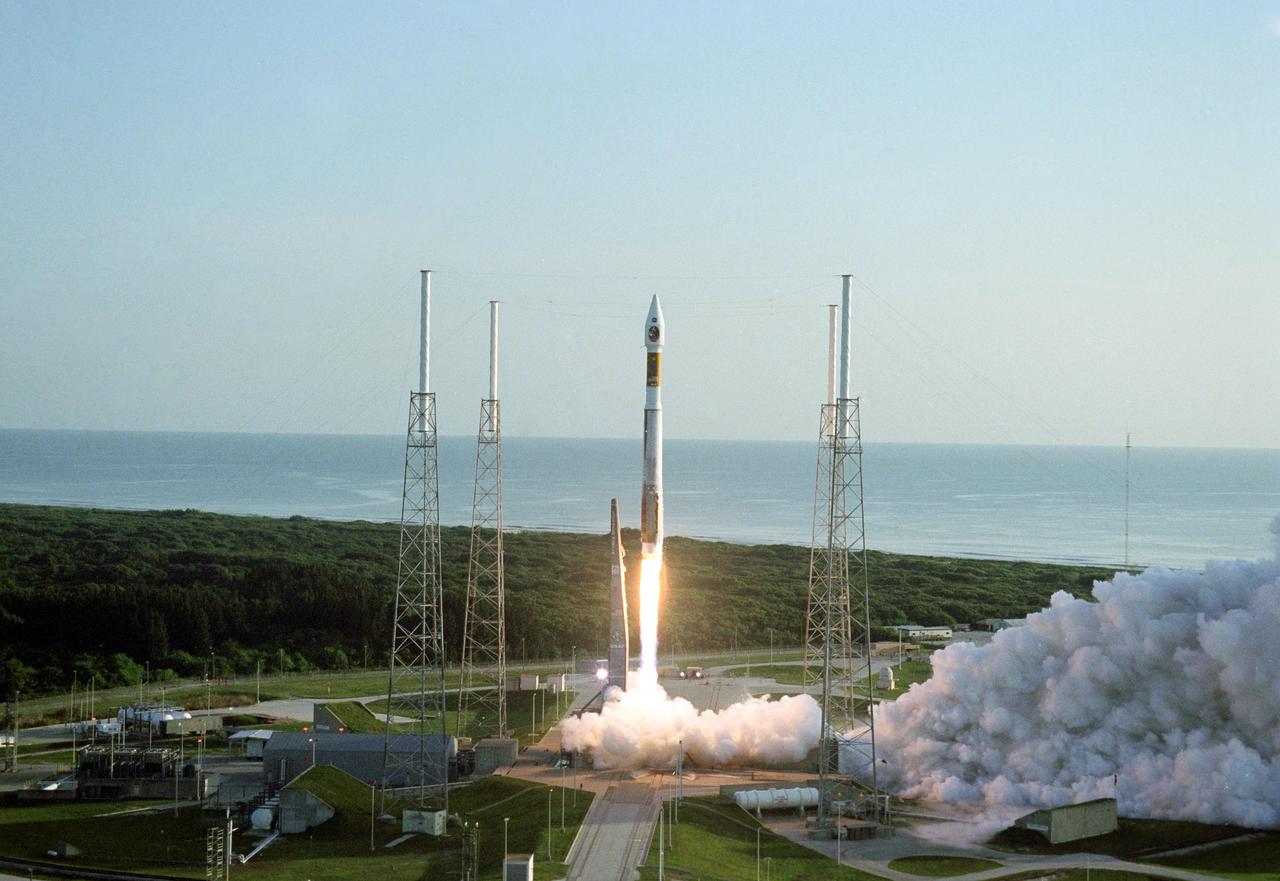
KENNEDY SPACE CENTER, FLA. - With the Atlantic Ocean as a backdrop, an Atlas V launch vehicle, 19 stories tall, with a two-ton Mars Reconnaissance Orbiter (MRO) on top, roars away from Launch Complex 41 at Cape Canaveral Air Force Station at 7:43 a.m. EDT. All systems performed nominally for NASA's first launch of an Atlas V on an interplanetary mission. MRO established radio contact with controllers 61 minutes after launch and within four minutes of separation from the upper stage. Initial contact came through an antenna at the Japan Aerospace Exploration Agency's Uchinoura Space Center in southern Japan. Mars is 72 million miles from Earth today, but the spacecraft will travel more than four times that distance on its outbound-arc trajectory to intercept the red planet on March 10, 2006. The orbiter carries six scientific instruments for examining the surface, atmosphere and subsurface of Mars in unprecedented detail from low orbit. NASA expects to get several times more data about Mars from MRO than from all previous Martian missions combined. Researchers will use the instruments to learn more about the history and distribution of Mars' water. That information will improve understanding of planetary climate change and will help guide the quest to answer whether Mars ever supported life. The orbiter will also evaluate potential landing sites for future missions. (Photo Credit: Pat Corkery/Lockheed Martin)
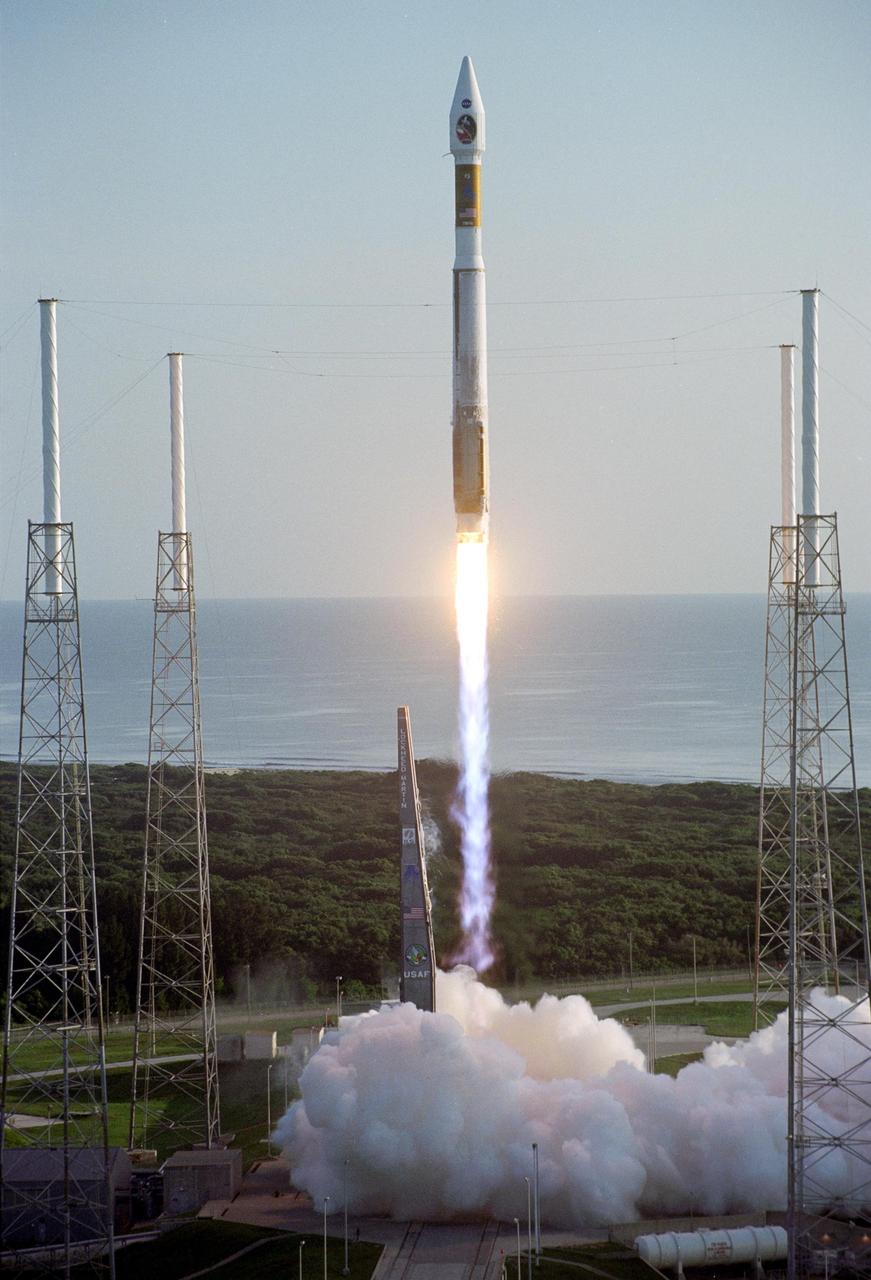
KENNEDY SPACE CENTER, FLA. - With the Atlantic Ocean as a backdrop, an Atlas V launch vehicle, 19 stories tall, with a two-ton Mars Reconnaissance Orbiter (MRO) on top, roars away from Launch Complex 41 at Cape Canaveral Air Force Station at 7:43 a.m. EDT. All systems performed nominally for NASA's first launch of an Atlas V on an interplanetary mission. MRO established radio contact with controllers 61 minutes after launch and within four minutes of separation from the upper stage. Initial contact came through an antenna at the Japan Aerospace Exploration Agency's Uchinoura Space Center in southern Japan. Mars is 72 million miles from Earth today, but the spacecraft will travel more than four times that distance on its outbound-arc trajectory to intercept the red planet on March 10, 2006. The orbiter carries six scientific instruments for examining the surface, atmosphere and subsurface of Mars in unprecedented detail from low orbit. NASA expects to get several times more data about Mars from MRO than from all previous Martian missions combined. Researchers will use the instruments to learn more about the history and distribution of Mars' water. That information will improve understanding of planetary climate change and will help guide the quest to answer whether Mars ever supported life. The orbiter will also evaluate potential landing sites for future missions. (Photo Credit: Pat Corkery/Lockheed Martin)
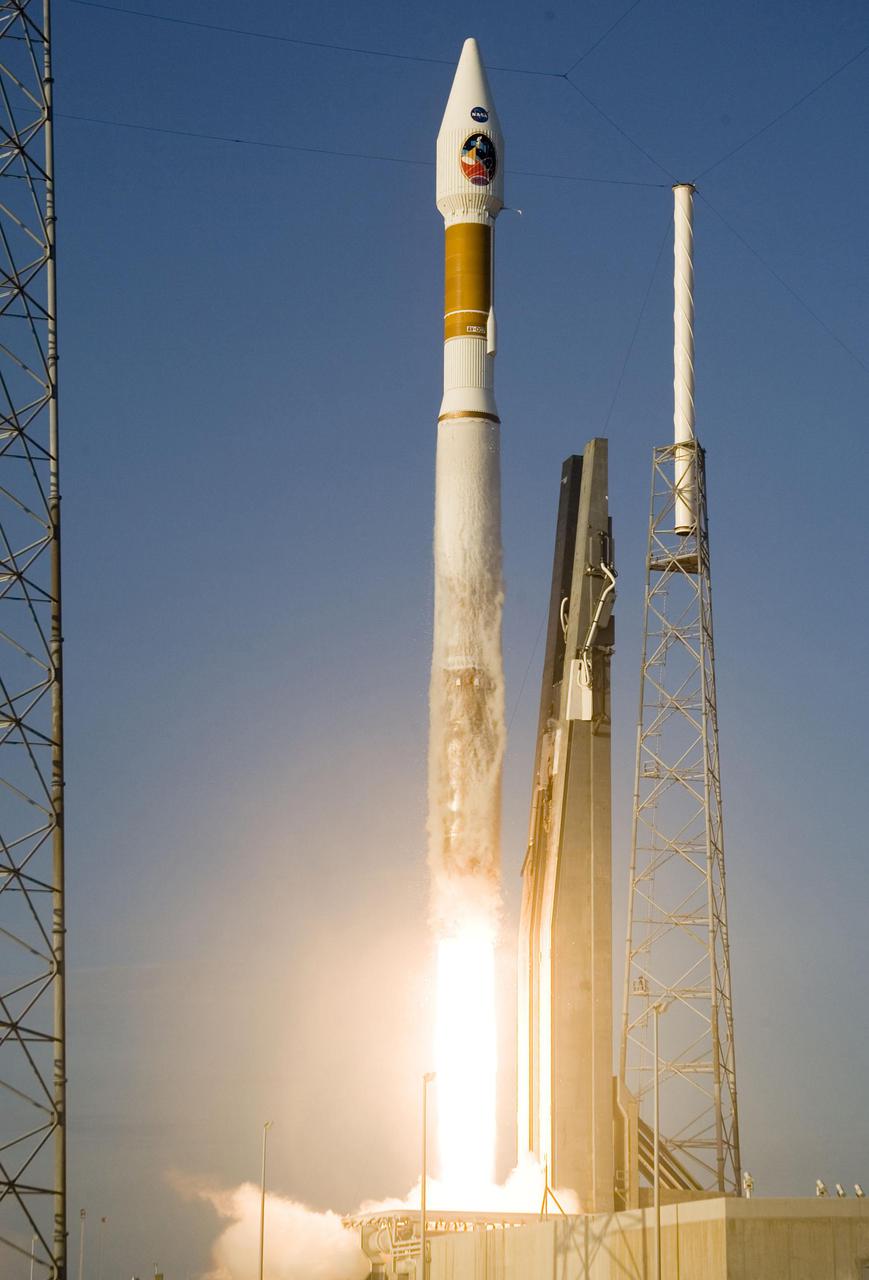
KENNEDY SPACE CENTER, FLA. - Trailing smoke and fire, an Atlas V launch vehicle, 19 stories tall, with a two-ton Mars Reconnaissance Orbiter (MRO) on top, roars away from Launch Complex 41 at Cape Canaveral Air Force Station at 7:43 a.m. EDT. All systems performed nominally for NASA's first launch of an Atlas V on an interplanetary mission. MRO established radio contact with controllers 61 minutes after launch and within four minutes of separation from the upper stage. Initial contact came through an antenna at the Japan Aerospace Exploration Agency's Uchinoura Space Center in southern Japan. Mars is 72 million miles from Earth today, but the spacecraft will travel more than four times that distance on its outbound-arc trajectory to intercept the red planet on March 10, 2006. The orbiter carries six scientific instruments for examining the surface, atmosphere and subsurface of Mars in unprecedented detail from low orbit. NASA expects to get several times more data about Mars from MRO than from all previous Martian missions combined. Researchers will use the instruments to learn more about the history and distribution of Mars' water. That information will improve understanding of planetary climate change and will help guide the quest to answer whether Mars ever supported life. The orbiter will also evaluate potential landing sites for future missions. (Photo Credit: Tom Rogers)
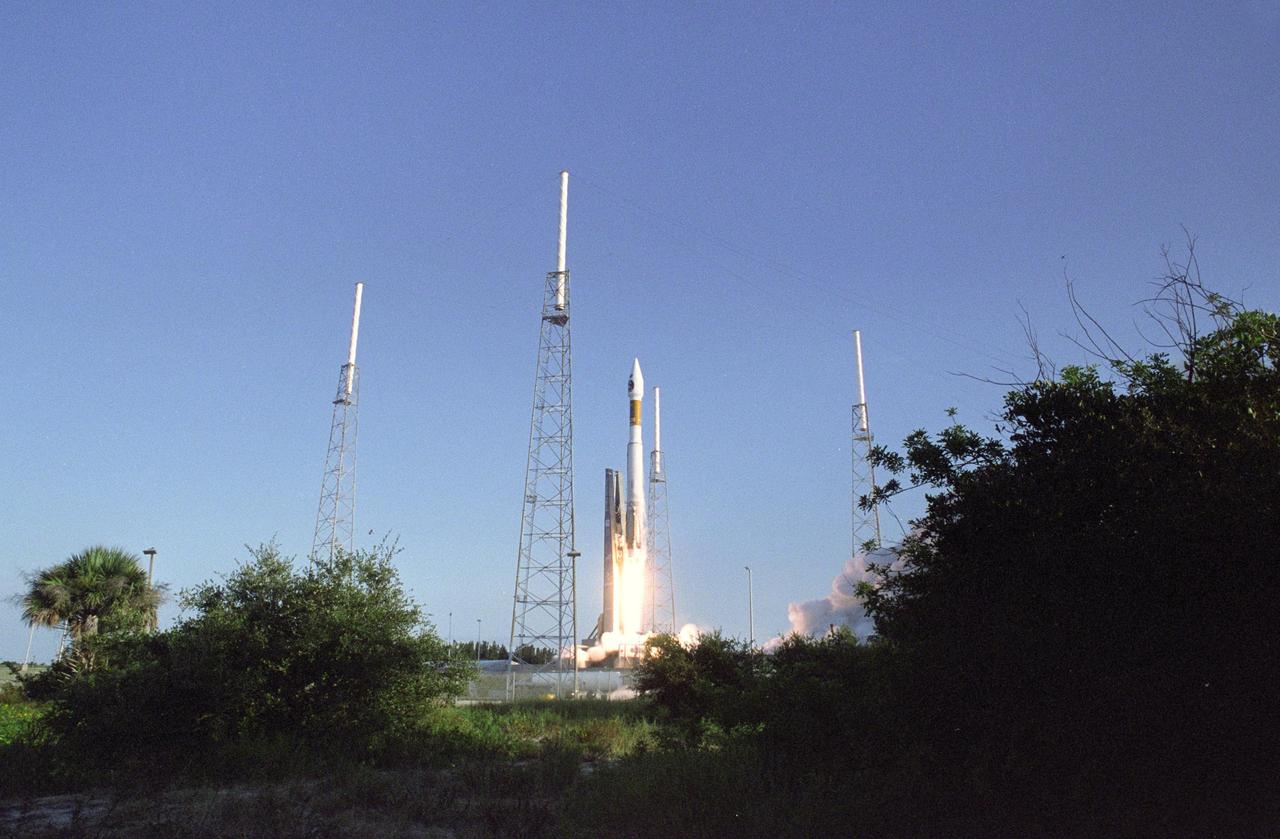
KENNEDY SPACE CENTER, FLA. - Viewed through a break in the greenscape around Launch Complex 41 at Cape Canaveral Air Force Station in Florida, the 19-stories-tall Atlas V launch vehicle roars off the launch pad, propelling the two-ton Mars Reconnaissance Orbiter (MRO) into a clear blue Florida sky and eventual orbit around Mars. Liftoff was at 7:43 a.m. EDT. All systems performed nominally for NASA's first launch of an Atlas V on an interplanetary mission. MRO established radio contact with controllers 61 minutes after launch and within four minutes of separation from the upper stage. Initial contact came through an antenna at the Japan Aerospace Exploration Agency's Uchinoura Space Center in southern Japan. Mars is 72 million miles from Earth today, but the spacecraft will travel more than four times that distance on its outbound-arc trajectory to intercept the red planet on March 10, 2006. The orbiter carries six scientific instruments for examining the surface, atmosphere and subsurface of Mars in unprecedented detail from low orbit. NASA expects to get several times more data about Mars from MRO than from all previous Martian missions combined. Researchers will use the instruments to learn more about the history and distribution of Mars' water. That information will improve understanding of planetary climate change and will help guide the quest to answer whether Mars ever supported life. The orbiter will also evaluate potential landing sites for future missions.
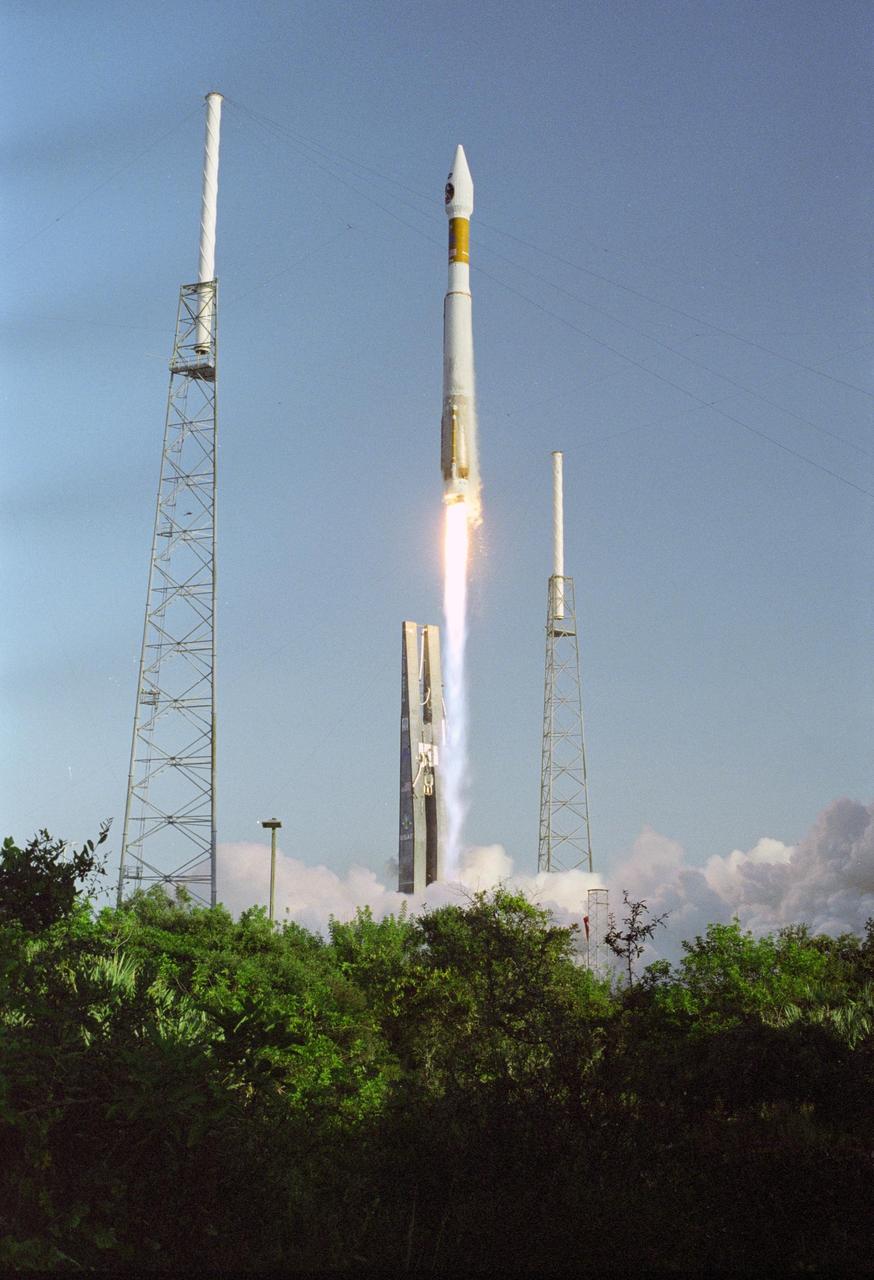
KENNEDY SPACE CENTER, FLA. - The 19-stories-tall Atlas V launch vehicle leaps above the trees near Launch Complex 41 at Cape Canaveral Air Force Station in Florida, propelling the two-ton Mars Reconnaissance Orbiter (MRO) into a clear blue Florida sky and eventual orbit around Mars. Liftoff was at 7:43 a.m. EDT. All systems performed nominally for NASA's first launch of an Atlas V on an interplanetary mission. MRO established radio contact with controllers 61 minutes after launch and within four minutes of separation from the upper stage. Initial contact came through an antenna at the Japan Aerospace Exploration Agency's Uchinoura Space Center in southern Japan. Mars is 72 million miles from Earth today, but the spacecraft will travel more than four times that distance on its outbound-arc trajectory to intercept the red planet on March 10, 2006. The orbiter carries six scientific instruments for examining the surface, atmosphere and subsurface of Mars in unprecedented detail from low orbit. NASA expects to get several times more data about Mars from MRO than from all previous Martian missions combined. Researchers will use the instruments to learn more about the history and distribution of Mars' water. That information will improve understanding of planetary climate change and will help guide the quest to answer whether Mars ever supported life. The orbiter will also evaluate potential landing sites for future missions.
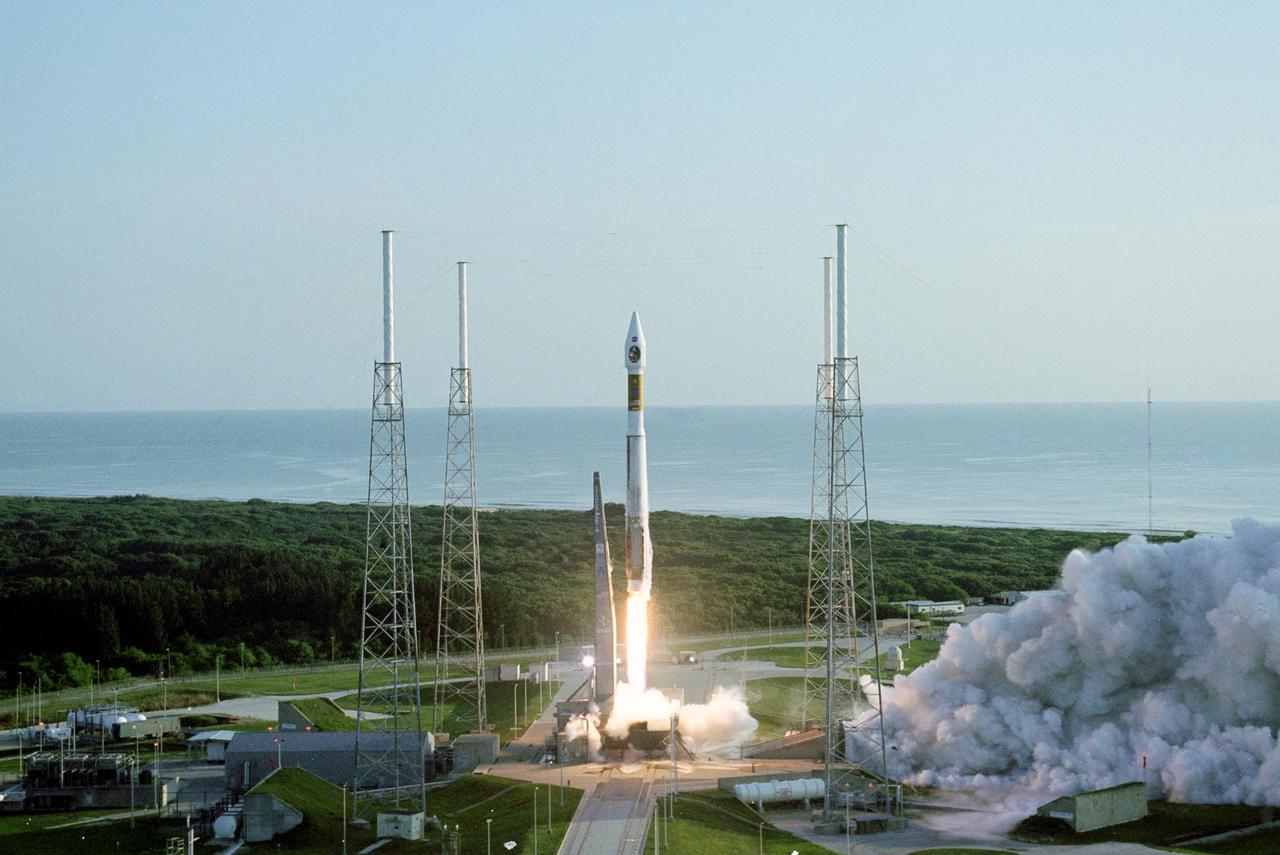
KENNEDY SPACE CENTER, FLA. - With the Atlantic Ocean as a backdrop, an Atlas V launch vehicle, 19 stories tall, with a two-ton Mars Reconnaissance Orbiter (MRO) on top, roars away from Launch Complex 41 at Cape Canaveral Air Force Station at 7:43 a.m. EDT. All systems performed nominally for NASA's first launch of an Atlas V on an interplanetary mission. MRO established radio contact with controllers 61 minutes after launch and within four minutes of separation from the upper stage. Initial contact came through an antenna at the Japan Aerospace Exploration Agency's Uchinoura Space Center in southern Japan. Mars is 72 million miles from Earth today, but the spacecraft will travel more than four times that distance on its outbound-arc trajectory to intercept the red planet on March 10, 2006. The orbiter carries six scientific instruments for examining the surface, atmosphere and subsurface of Mars in unprecedented detail from low orbit. NASA expects to get several times more data about Mars from MRO than from all previous Martian missions combined. Researchers will use the instruments to learn more about the history and distribution of Mars' water. That information will improve understanding of planetary climate change and will help guide the quest to answer whether Mars ever supported life. The orbiter will also evaluate potential landing sites for future missions. (Photo Credit: Pat Corkery/Lockheed Martin)
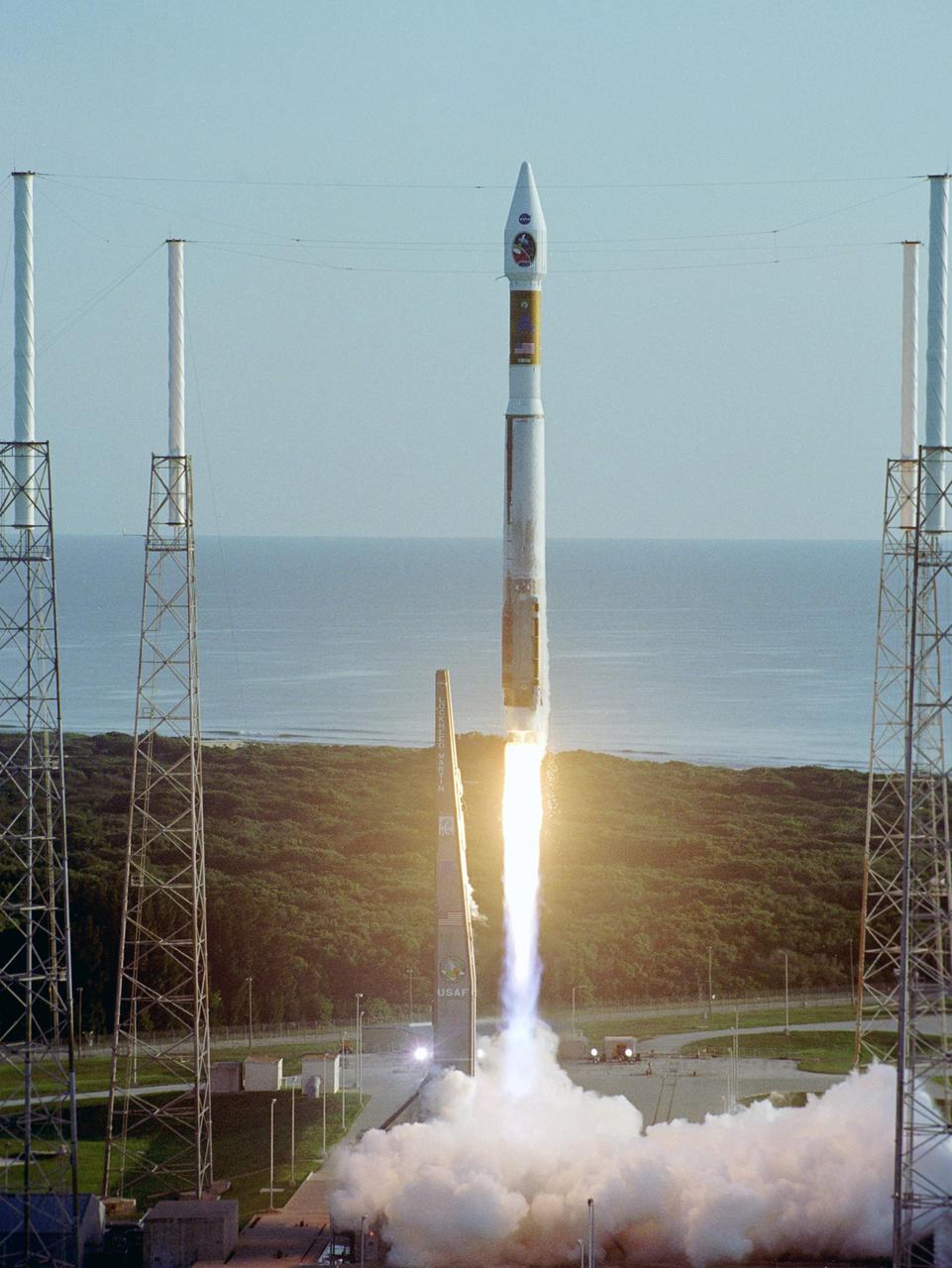
KENNEDY SPACE CENTER, FLA. - With the Atlantic Ocean as a backdrop, an Atlas V launch vehicle, 19 stories tall, with a two-ton Mars Reconnaissance Orbiter (MRO) on top, roars away from Launch Complex 41 at Cape Canaveral Air Force Station at 7:43 a.m. EDT. All systems performed nominally for NASA's first launch of an Atlas V on an interplanetary mission. MRO established radio contact with controllers 61 minutes after launch and within four minutes of separation from the upper stage. Initial contact came through an antenna at the Japan Aerospace Exploration Agency's Uchinoura Space Center in southern Japan. Mars is 72 million miles from Earth today, but the spacecraft will travel more than four times that distance on its outbound-arc trajectory to intercept the red planet on March 10, 2006. The orbiter carries six scientific instruments for examining the surface, atmosphere and subsurface of Mars in unprecedented detail from low orbit. NASA expects to get several times more data about Mars from MRO than from all previous Martian missions combined. Researchers will use the instruments to learn more about the history and distribution of Mars' water. That information will improve understanding of planetary climate change and will help guide the quest to answer whether Mars ever supported life. The orbiter will also evaluate potential landing sites for future missions. (Photo Credit: Pat Corkery/Lockheed Martin)
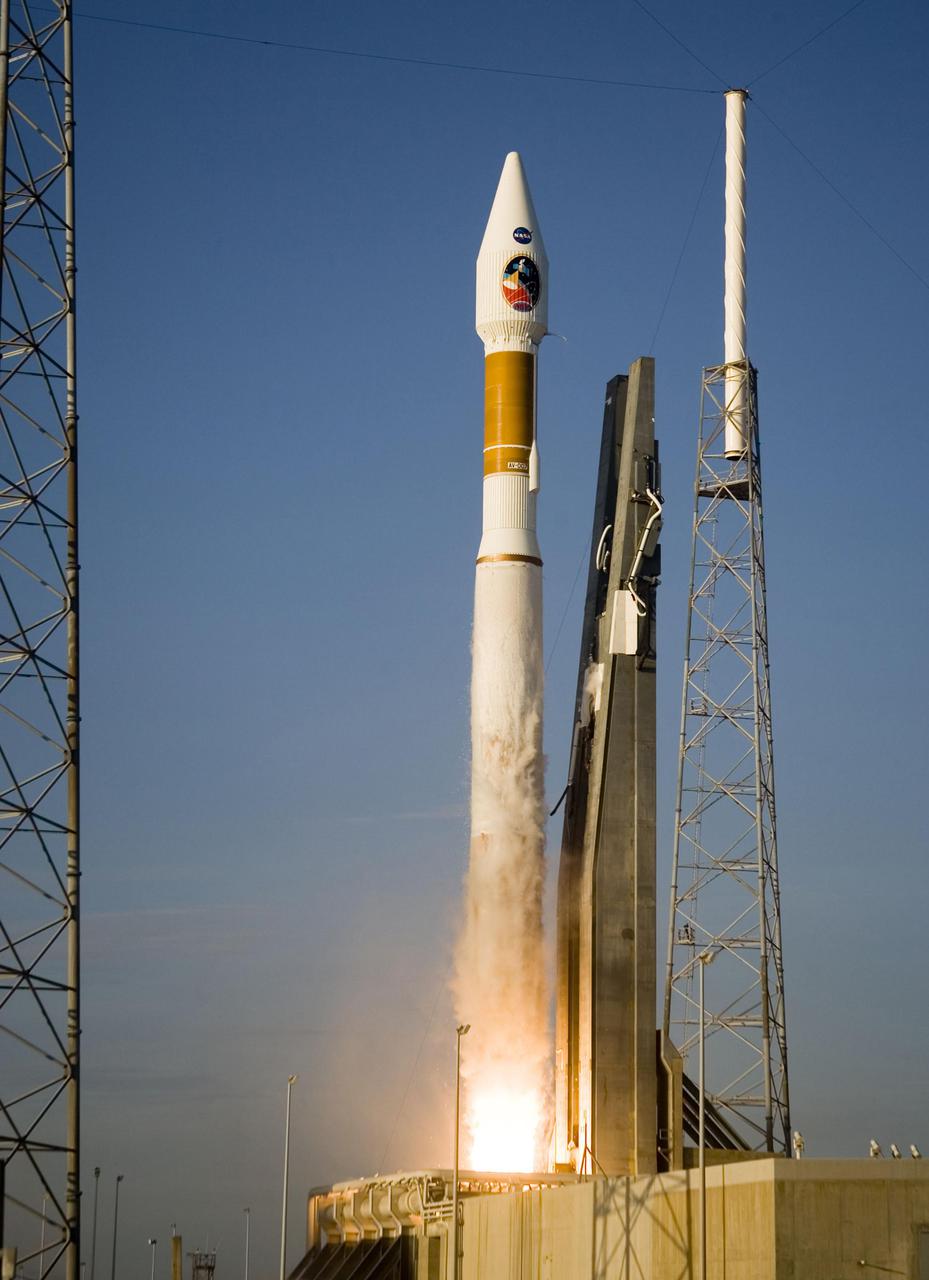
KENNEDY SPACE CENTER, FLA. - At 7:43 a.m. EDT an Atlas V launch vehicle, 19 stories tall, with a two-ton Mars Reconnaissance Orbiter (MRO) on top, lifts off the pad on Launch Complex 41 at Cape Canaveral Air Force Station in Florida. All systems performed nominally for NASA's first launch of an Atlas V on an interplanetary mission. MRO established radio contact with controllers 61 minutes after launch and within four minutes of separation from the upper stage. Initial contact came through an antenna at the Japan Aerospace Exploration Agency's Uchinoura Space Center in southern Japan. Mars is 72 million miles from Earth today, but the spacecraft will travel more than four times that distance on its outbound-arc trajectory to intercept the red planet on March 10, 2006. The orbiter carries six scientific instruments for examining the surface, atmosphere and subsurface of Mars in unprecedented detail from low orbit. NASA expects to get several times more data about Mars from MRO than from all previous Martian missions combined. Researchers will use the instruments to learn more about the history and distribution of Mars' water. That information will improve understanding of planetary climate change and will help guide the quest to answer whether Mars ever supported life. The orbiter will also evaluate potential landing sites for future missions. (Photo Credit: Tom Rogers)
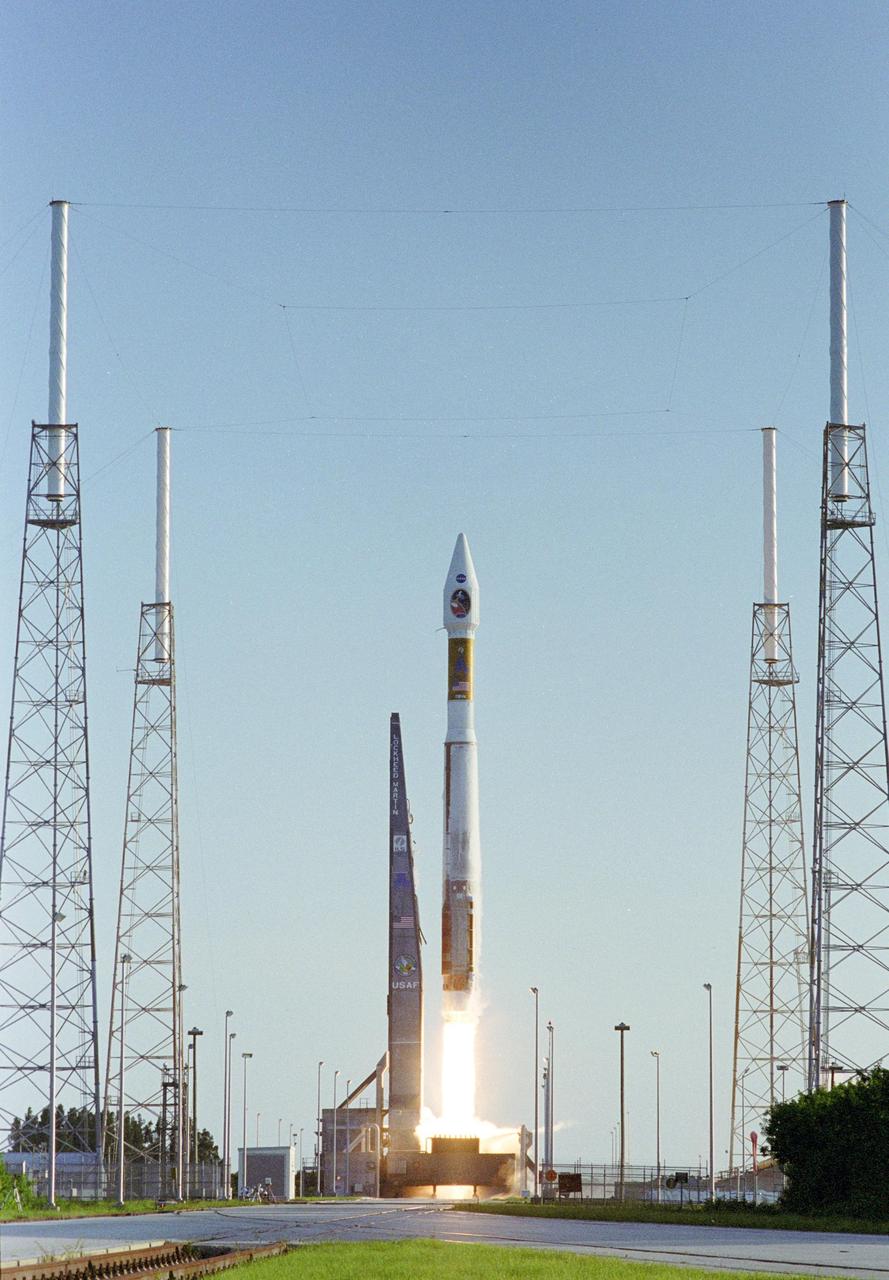
KENNEDY SPACE CENTER, FLA. - The 19-stories-tall Atlas V launch vehicle, with a two-ton Mars Reconnaissance Orbiter (MRO) on top, leaps away from Launch Complex 41 at Cape Canaveral Air Force Station at 7:43 a.m. EDT. All systems performed nominally for NASA's first launch of an Atlas V on an interplanetary mission. MRO established radio contact with controllers 61 minutes after launch and within four minutes of separation from the upper stage. Initial contact came through an antenna at the Japan Aerospace Exploration Agency's Uchinoura Space Center in southern Japan. Mars is 72 million miles from Earth today, but the spacecraft will travel more than four times that distance on its outbound-arc trajectory to intercept the red planet on March 10, 2006. The orbiter carries six scientific instruments for examining the surface, atmosphere and subsurface of Mars in unprecedented detail from low orbit. NASA expects to get several times more data about Mars from MRO than from all previous Martian missions combined. Researchers will use the instruments to learn more about the history and distribution of Mars' water. That information will improve understanding of planetary climate change and will help guide the quest to answer whether Mars ever supported life. The orbiter will also evaluate potential landing sites for future missions.
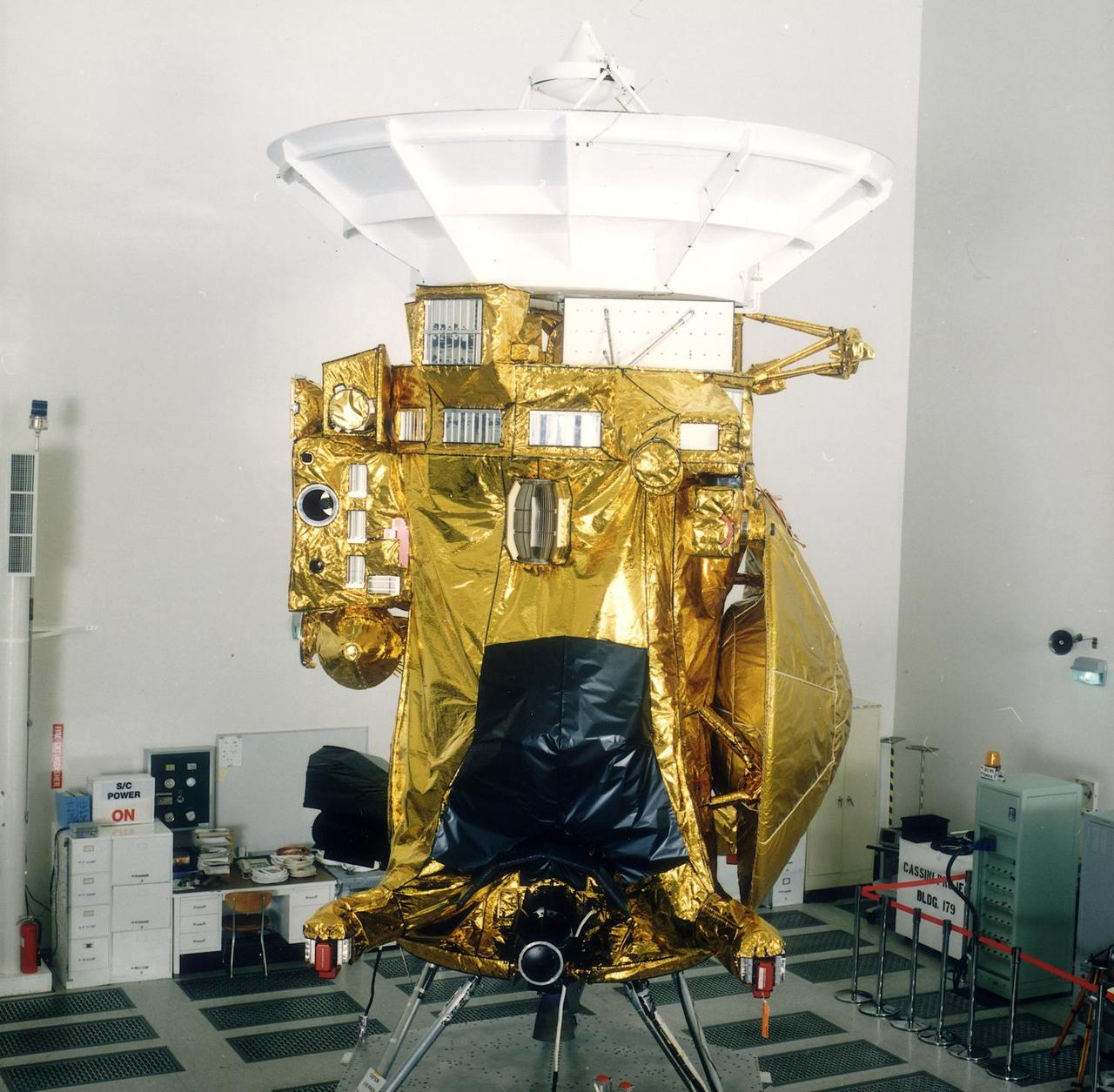
On October of 1997, a two-story-tall robotic spacecraft will begin a journey of many years to reach and explore the exciting realm of Saturn, the most distant planet that can easily be seen by the unaided human eye. In addition to Saturn's interesting atmosphere and interior, its vast system contains the most spectacular of the four planetary ring systems, numerous icy satellites with a variety of unique surface features. A huge magnetosphere teeming with particles that interact with the rings and moons, and the intriguing moon Titan, which is slightly larger than the planet Mercury, and whose hazy atmosphere is denser than that of Earth, make Saturn a fascinating planet to study. The Cassini mission is an international venture involving NASA, the European Space Agency (ESA), the Italian Space Agency (ASI), and several separate European academic and industrial partners. The mission is managed for NASA by JPL. The spacecraft will carry a sophisticated complement of scientific sensors to support 27 different investigations to probe the mysteries of the Saturn system. The large spacecraft will consist of an orbiter and ESA's Huygens Titan probe. The orbiter mass at launch will be nearly 5300 kg, over half of which is propellant for trajectory control. The mass of the Titan probe (2.7 m diameter) is roughly 350 kg. The mission is named in honor of the seventeenth-century, French-Italian astronomer Jean Dominique Cassini, who discovered the prominent gap in Saturn's main rings, as well as the icy moons Iapetus, Rhea, Dione, and Tethys. The ESA Titan probe is named in honor of the exceptional Dutch scientist Christiaan Huygens, who discovered Titan in 1655, followed in 1659 by his announcement that the strange Saturn "moons" seen by Galileo in 1610 were actually a ring system surrounding the planet. Huygens was also famous for his invention of the pendulum clock, the first accurate timekeeping device. http://photojournal.jpl.nasa.gov/catalog/PIA04603
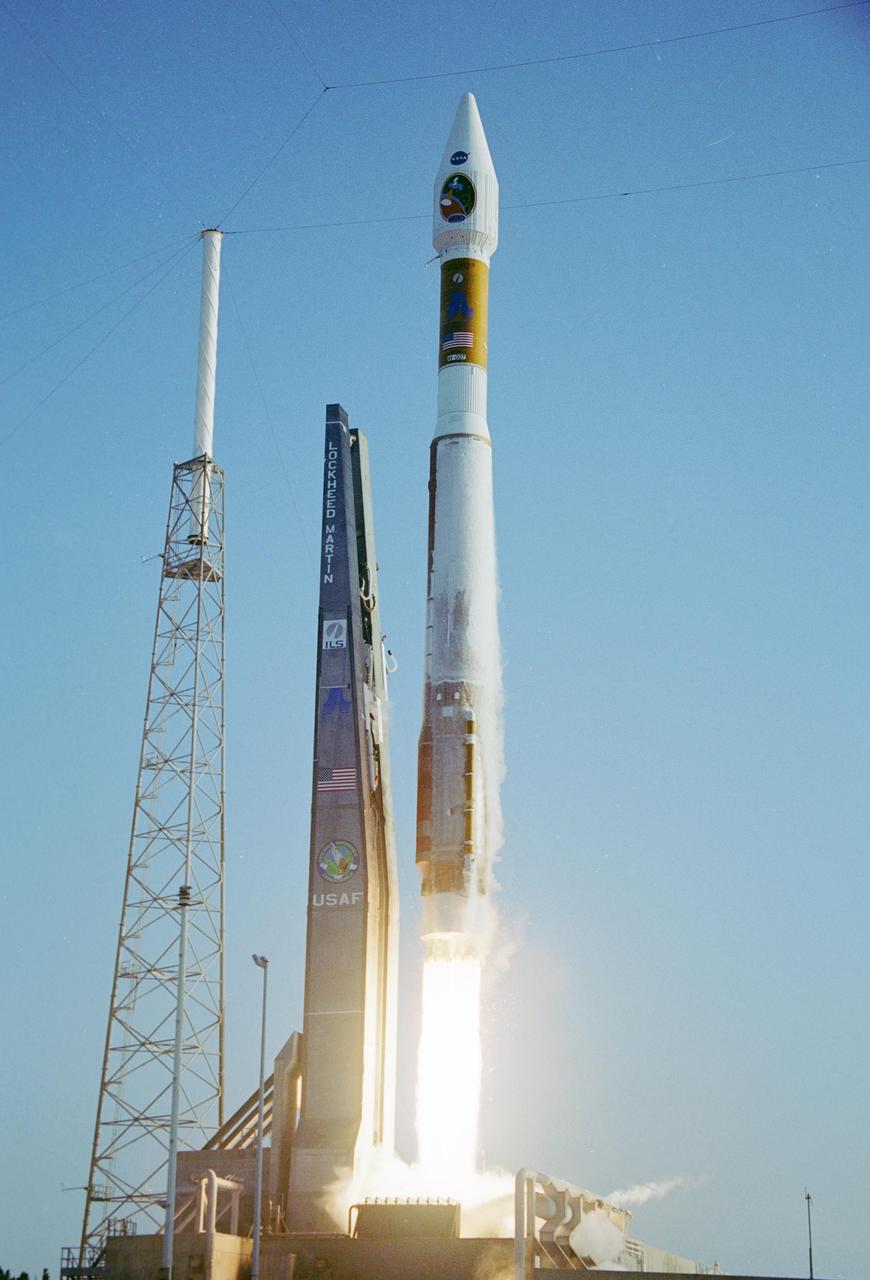
KENNEDY SPACE CENTER, FLA. - Trailing smoke and fire, the 19-stories-tall Atlas V launch vehicle, with a two-ton Mars Reconnaissance Orbiter (MRO) on top, roars away from Launch Complex 41 at Cape Canaveral Air Force Station at 7:43 a.m. EDT. All systems performed nominally for NASA's first launch of an Atlas V on an interplanetary mission. MRO established radio contact with controllers 61 minutes after launch and within four minutes of separation from the upper stage. Initial contact came through an antenna at the Japan Aerospace Exploration Agency's Uchinoura Space Center in southern Japan. Mars is 72 million miles from Earth today, but the spacecraft will travel more than four times that distance on its outbound-arc trajectory to intercept the red planet on March 10, 2006. The orbiter carries six scientific instruments for examining the surface, atmosphere and subsurface of Mars in unprecedented detail from low orbit. NASA expects to get several times more data about Mars from MRO than from all previous Martian missions combined. Researchers will use the instruments to learn more about the history and distribution of Mars' water. That information will improve understanding of planetary climate change and will help guide the quest to answer whether Mars ever supported life. The orbiter will also evaluate potential landing sites for future missions. (Photo Credit: Tom Rogers)
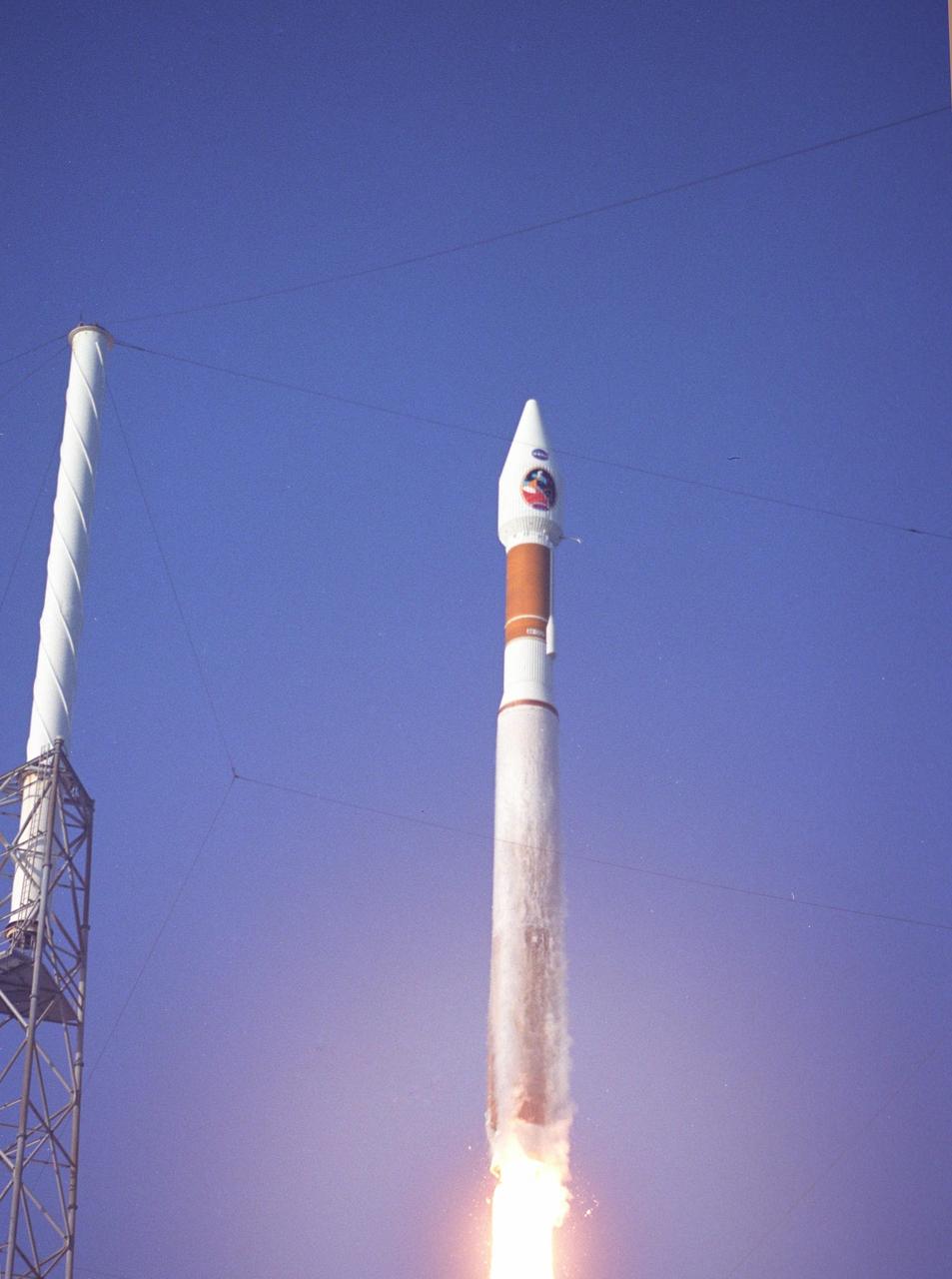
KENNEDY SPACE CENTER, FLA. - Just minutes after liftoff, the 19-stories-tall Atlas V launch vehicle, with a two-ton Mars Reconnaissance Orbiter (MRO) on top, roars into the clear blue sky from Launch Complex 41 at Cape Canaveral Air Force Station. Liftoff was at 7:43 a.m. EDT. All systems performed nominally for NASA's first launch of an Atlas V on an interplanetary mission. MRO established radio contact with controllers 61 minutes after launch and within four minutes of separation from the upper stage. Initial contact came through an antenna at the Japan Aerospace Exploration Agency's Uchinoura Space Center in southern Japan. Mars is 72 million miles from Earth today, but the spacecraft will travel more than four times that distance on its outbound-arc trajectory to intercept the red planet on March 10, 2006. The orbiter carries six scientific instruments for examining the surface, atmosphere and subsurface of Mars in unprecedented detail from low orbit. NASA expects to get several times more data about Mars from MRO than from all previous Martian missions combined. Researchers will use the instruments to learn more about the history and distribution of Mars' water. That information will improve understanding of planetary climate change and will help guide the quest to answer whether Mars ever supported life. The orbiter will also evaluate potential landing sites for future missions. (Photo Credit: Tom Rogers)