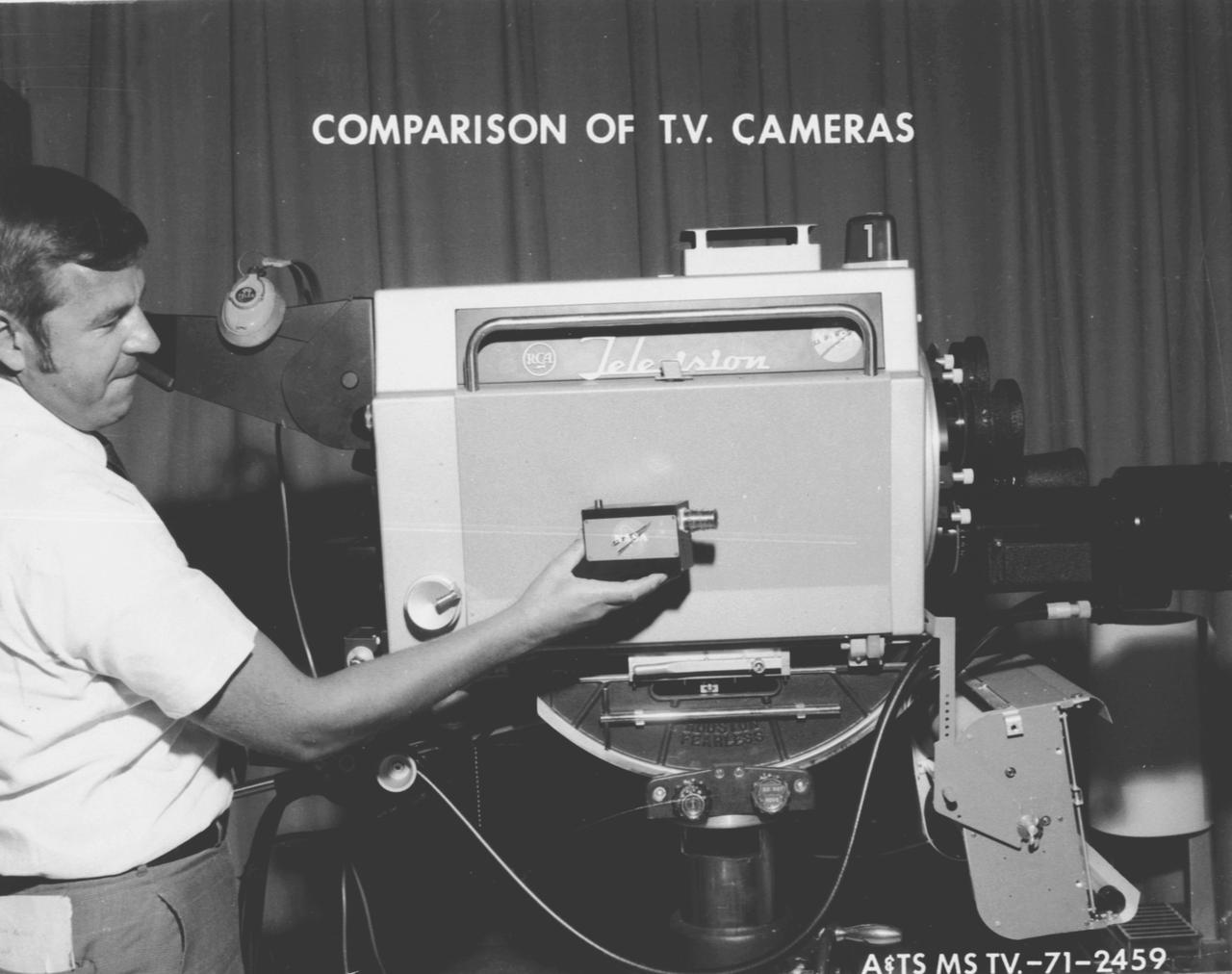
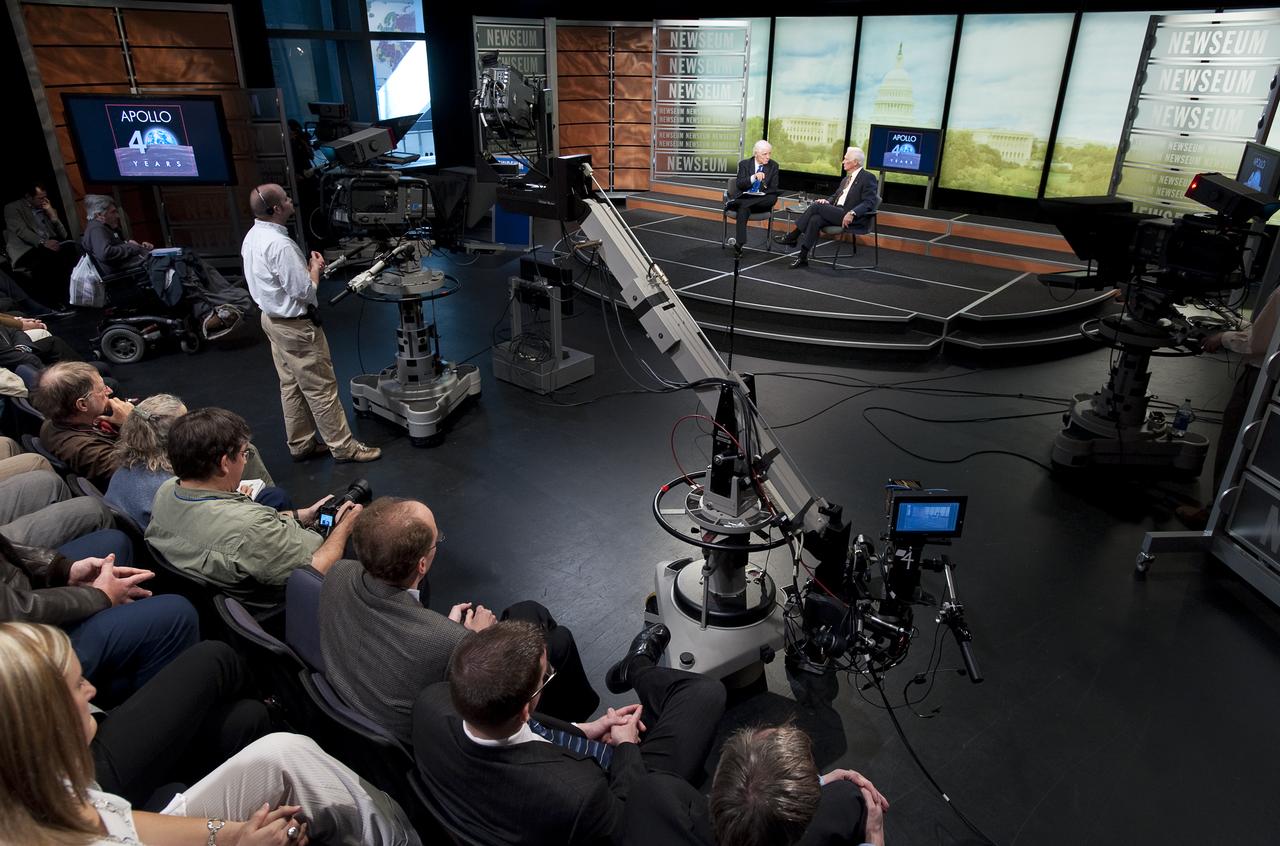
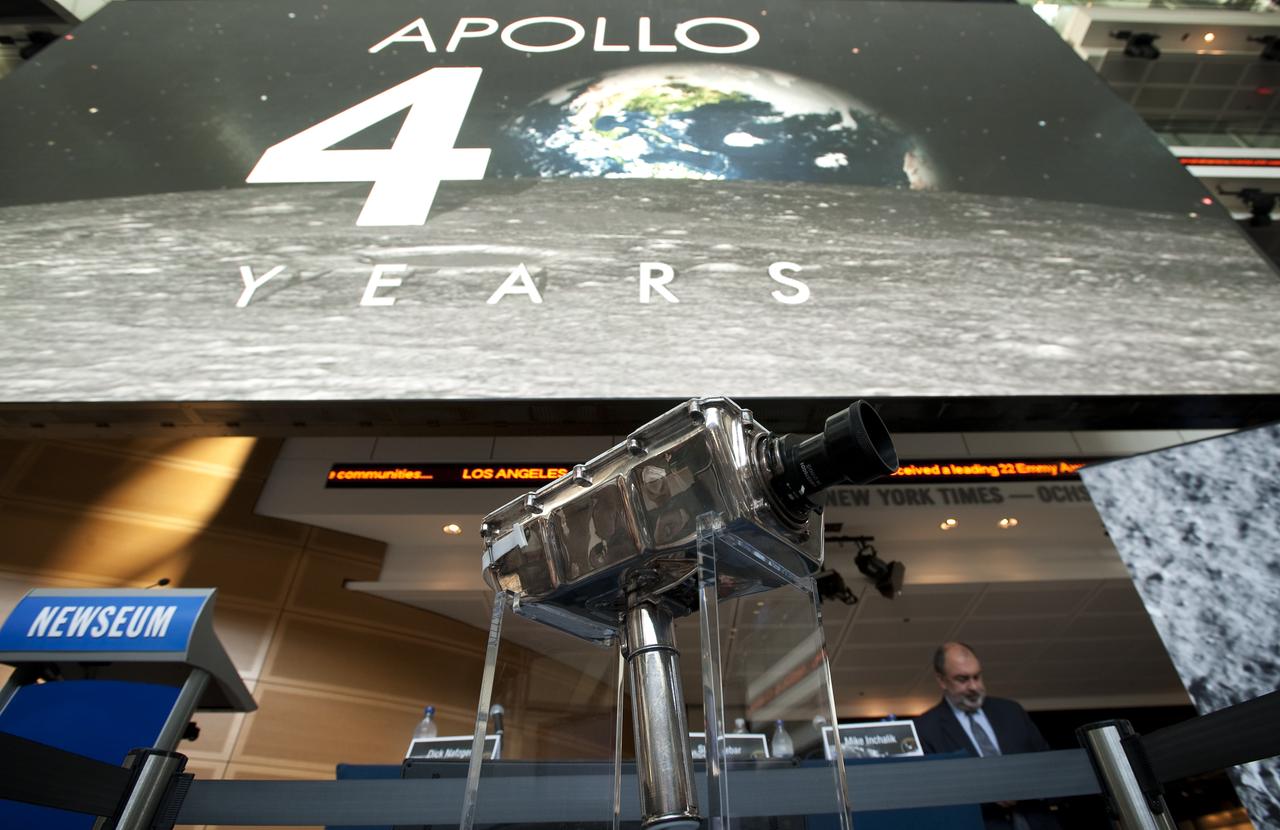
An Apollo TV camera from the National Electronic Museum in Baltimore, Maryland is on display for NASA's briefing to release restored Apollo 11 moonwalk footage at the Newseum, Thursday, July 16, 2009, in Washington, DC.  Photo Credit: (NASA/Bill Ingalls)
Apollo TV Camera
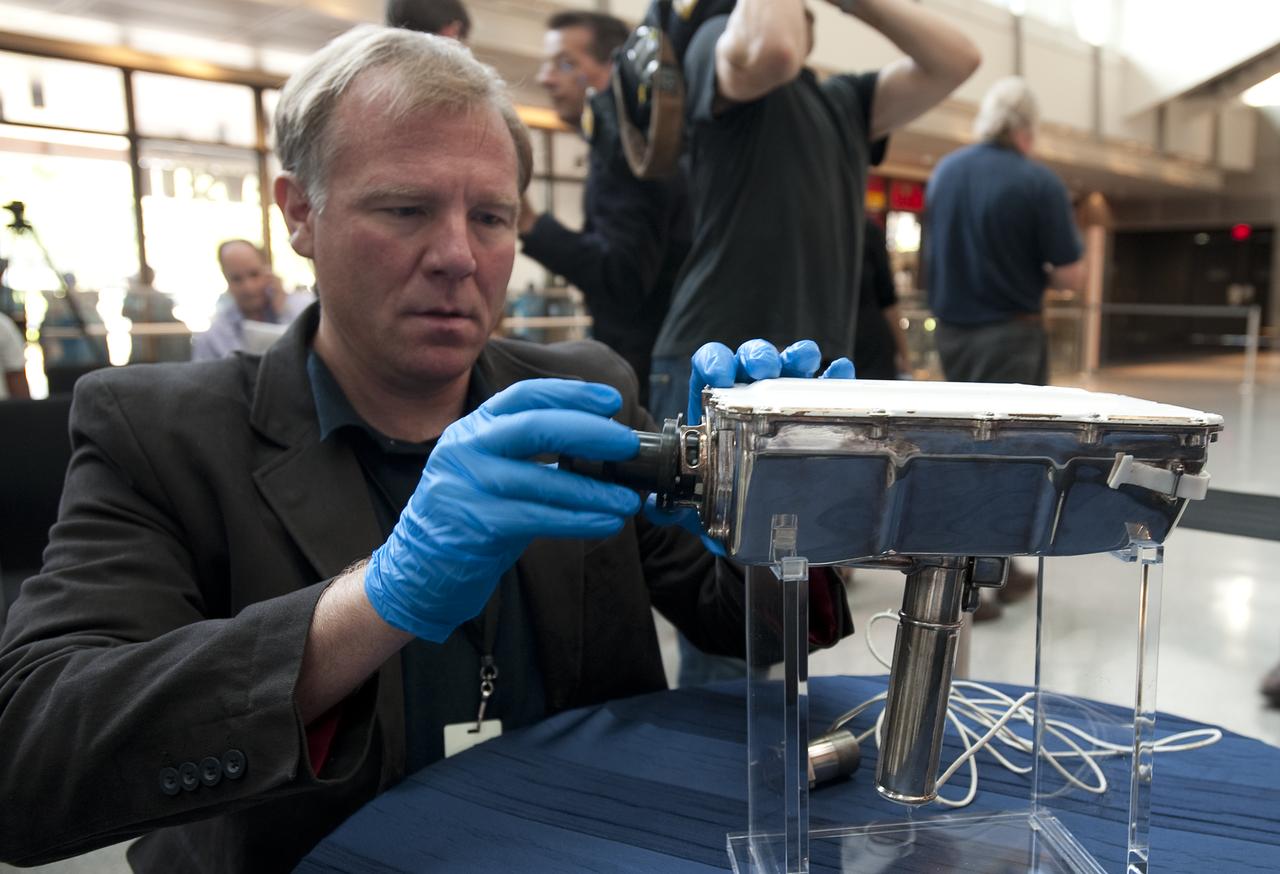
Mike Simons, Director of the National Electronic Museum in Baltimore, Maryland assembles an Apollo TV camera for display prior to NASA's briefing to release restored Apollo 11 moonwalk footage at the Newseum, Thursday, July 16, 2009, in Washington, DC.  Photo Credit: (NASA/Bill Ingalls)
Apollo TV Camera
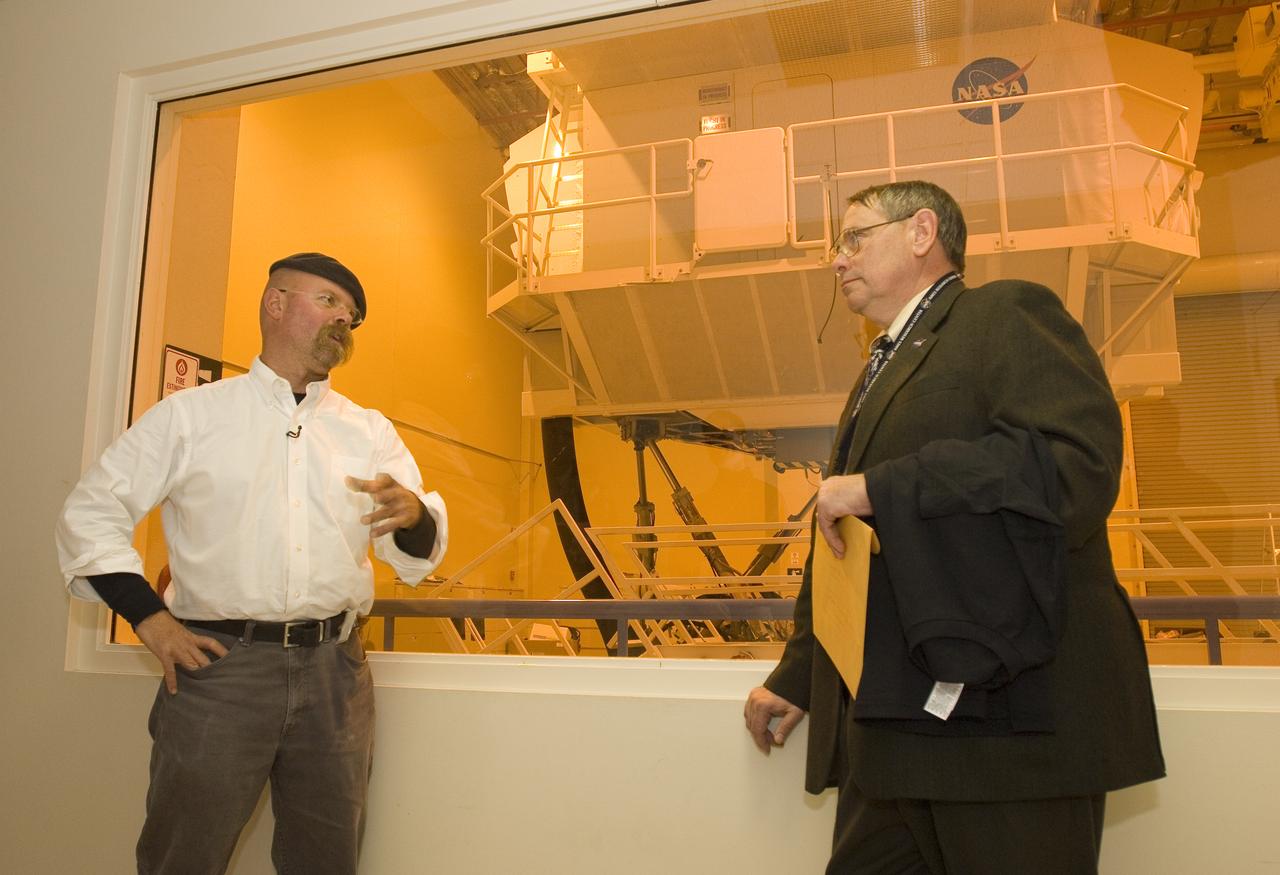
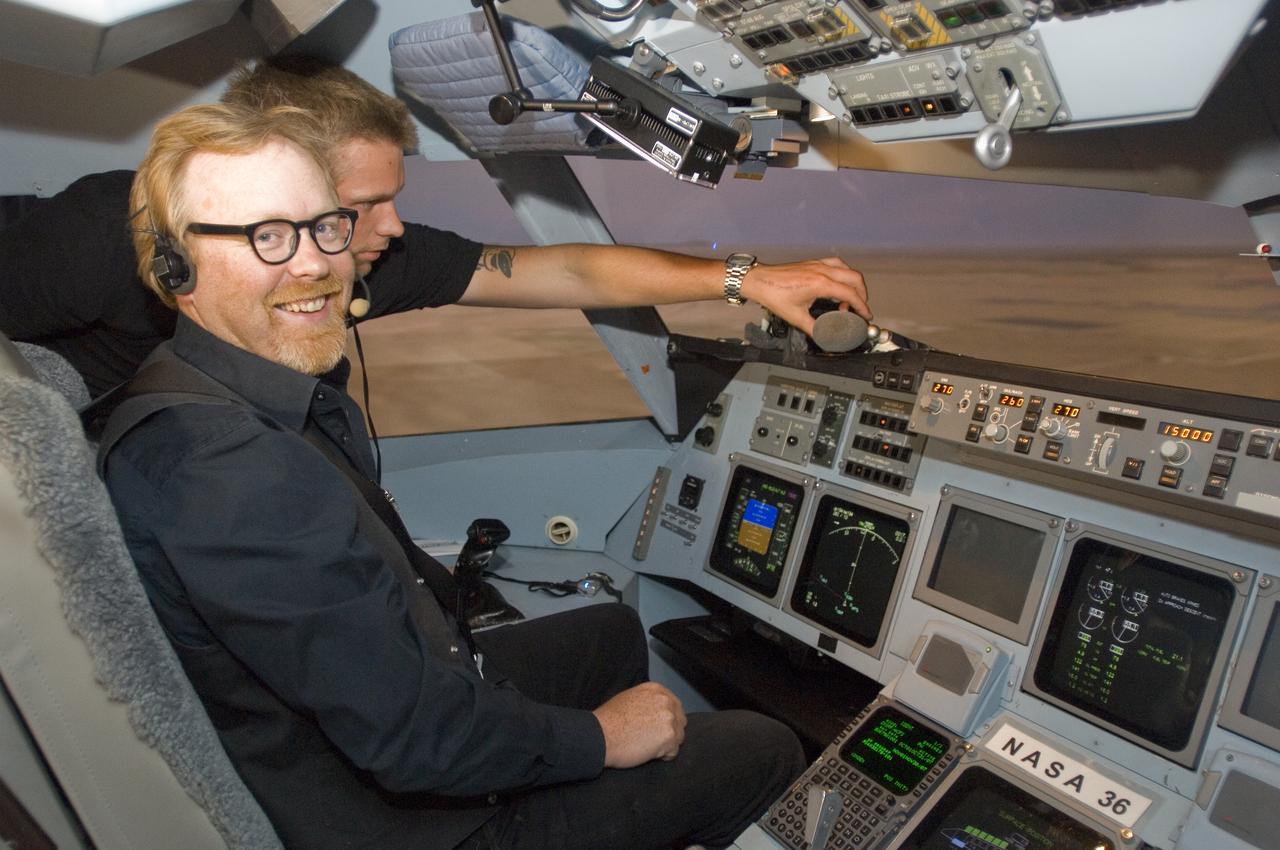
Mythbusters TV in Ames CVSRF Simulator  with Discovery Channel show hosts Adam Savage (black shirt) and Jamie Hyneman (white shirt) inside simulator cab.
ARC-2007-ACD07-0194-005
Mythbusters TV in Ames CVSRF Simulator  with Discovery Channel show host Jamie Hyneman (white shirt) and Ames Center Director Pete Worden
ARC-2007-ACD07-0194-003
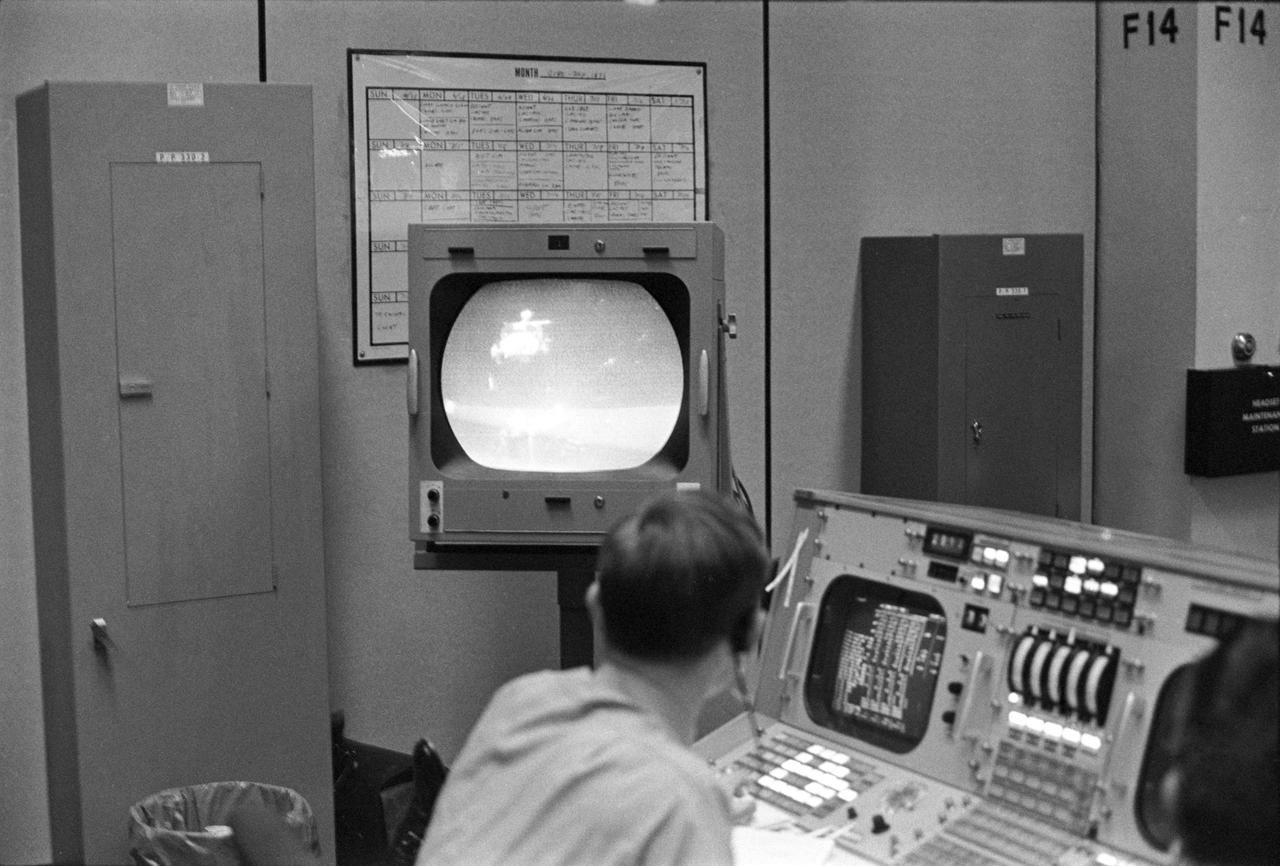
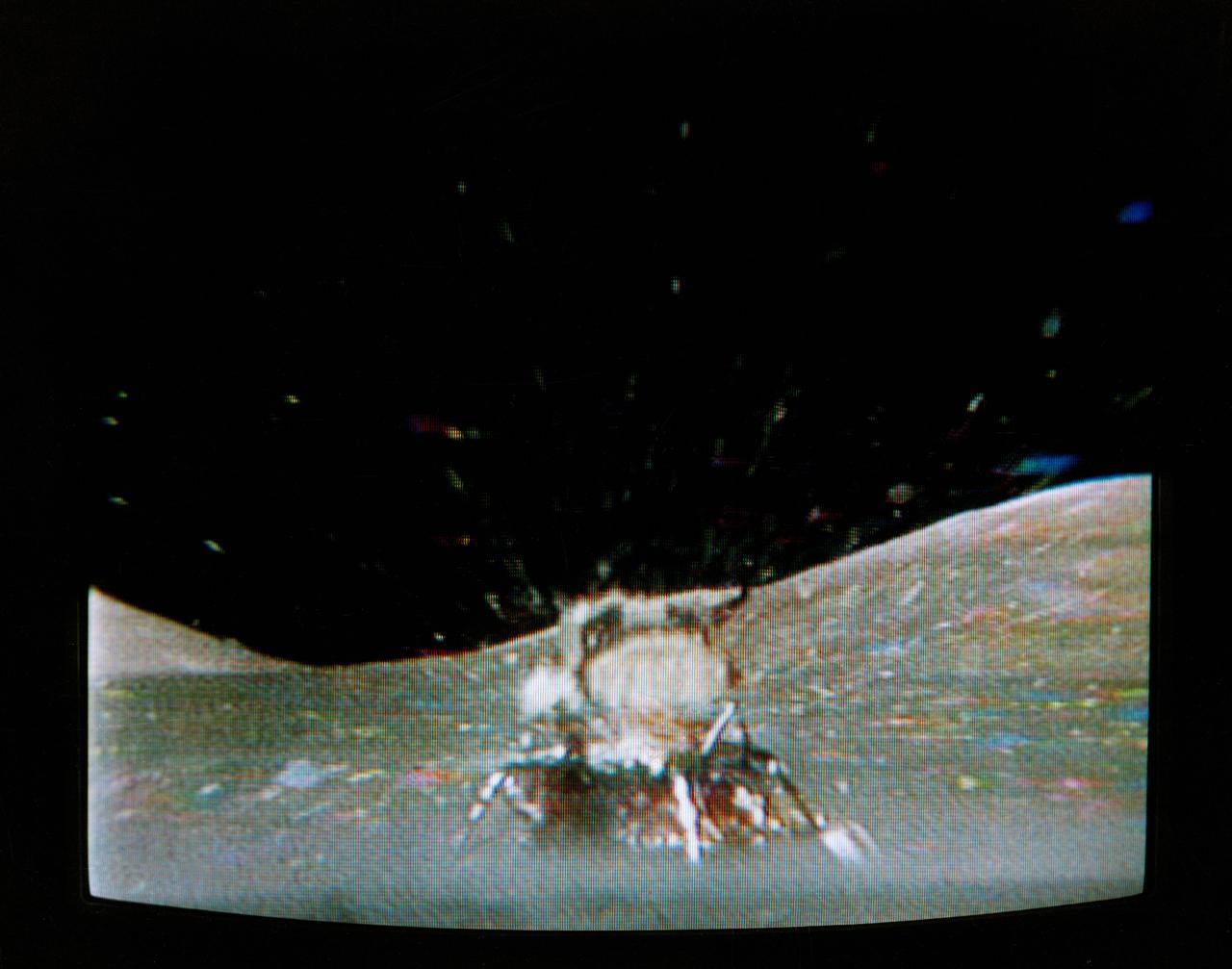
View of a photograph of the television (TV) monitor in the MCC showing a picture being transmitted from the color TV camera mounted on the parked Lunar Roving Vehicle (LRV) at the Hadley-Apennine Landing Site showing the liftoff of the Apollo 15  Lunar Module (LM) Ascent Stage from the Lunar surface.        MSC, Houston, TX
Apollo 15 Lunar Module (LM) View - Liftoff - Moon - TV Monitor - Mission Control Center (MCC) - MSC
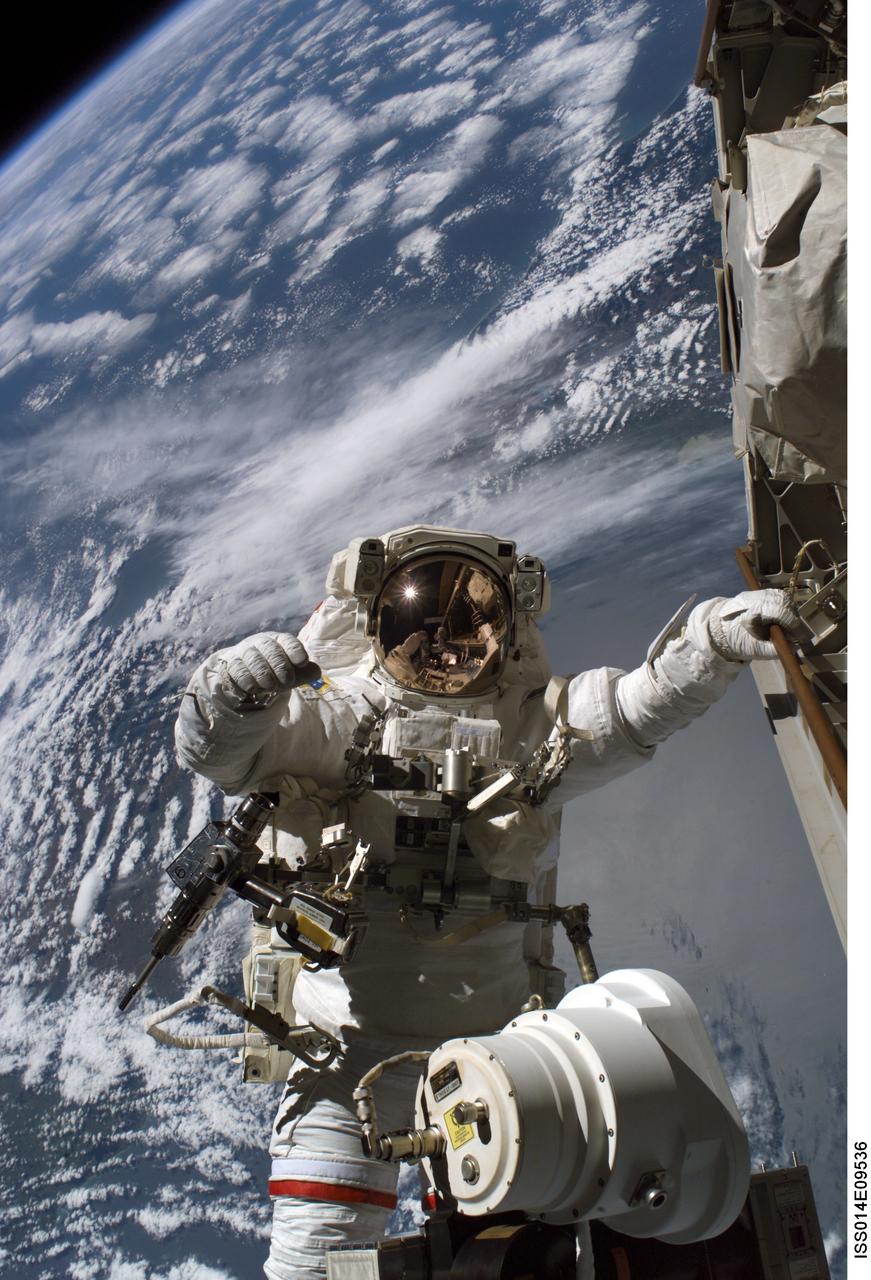
ISS014-E-09536 (12 Dec. 2006) --- Astronaut Robert L. Curbeam, Jr., STS-116 mission specialist, prepares to replace a faulty TV camera on the exterior of the International Space Station during the mission's first of three planned sessions of extravehicular activity (EVA). Astronaut Christer Fuglesang (out of frame), mission specialist representing the European Space Agency (ESA), also participated in the 6-hour, 36-minute spacewalk.
Curbeam replaces TV Camera during first EVA
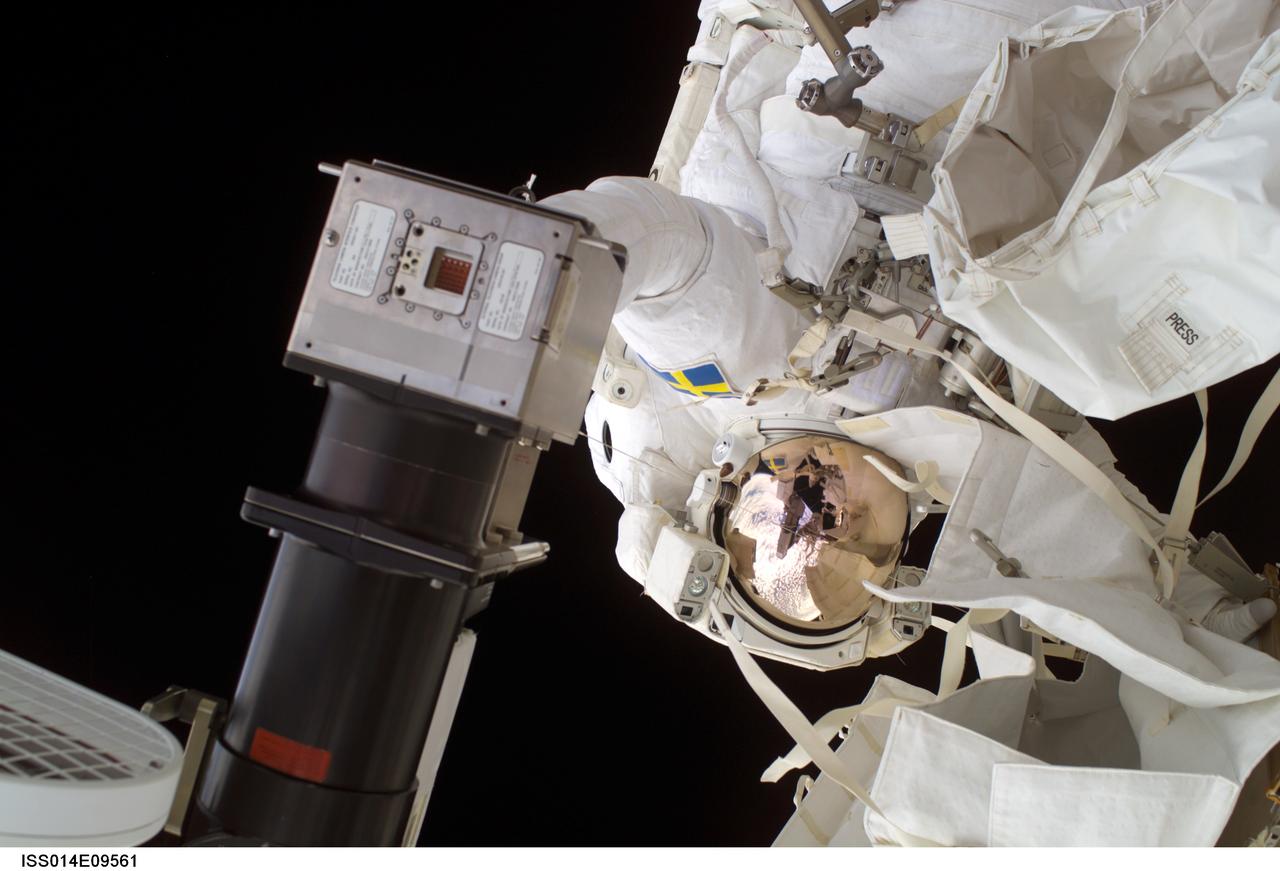
ISS014-E-09561 (12 Dec. 2006) --- European Space Agency (ESA) astronaut Christer Fuglesang, STS-116 mission specialist, replaces a faulty TV camera on the exterior of the International Space Station during the mission's first of three planned sessions of extravehicular activity (EVA). Astronaut Robert L. Curbeam, Jr. (out of frame), mission specialist, also participated in the 6-hour, 36-minute spacewalk.
Fuglesang replaces TV Camera during first EVA
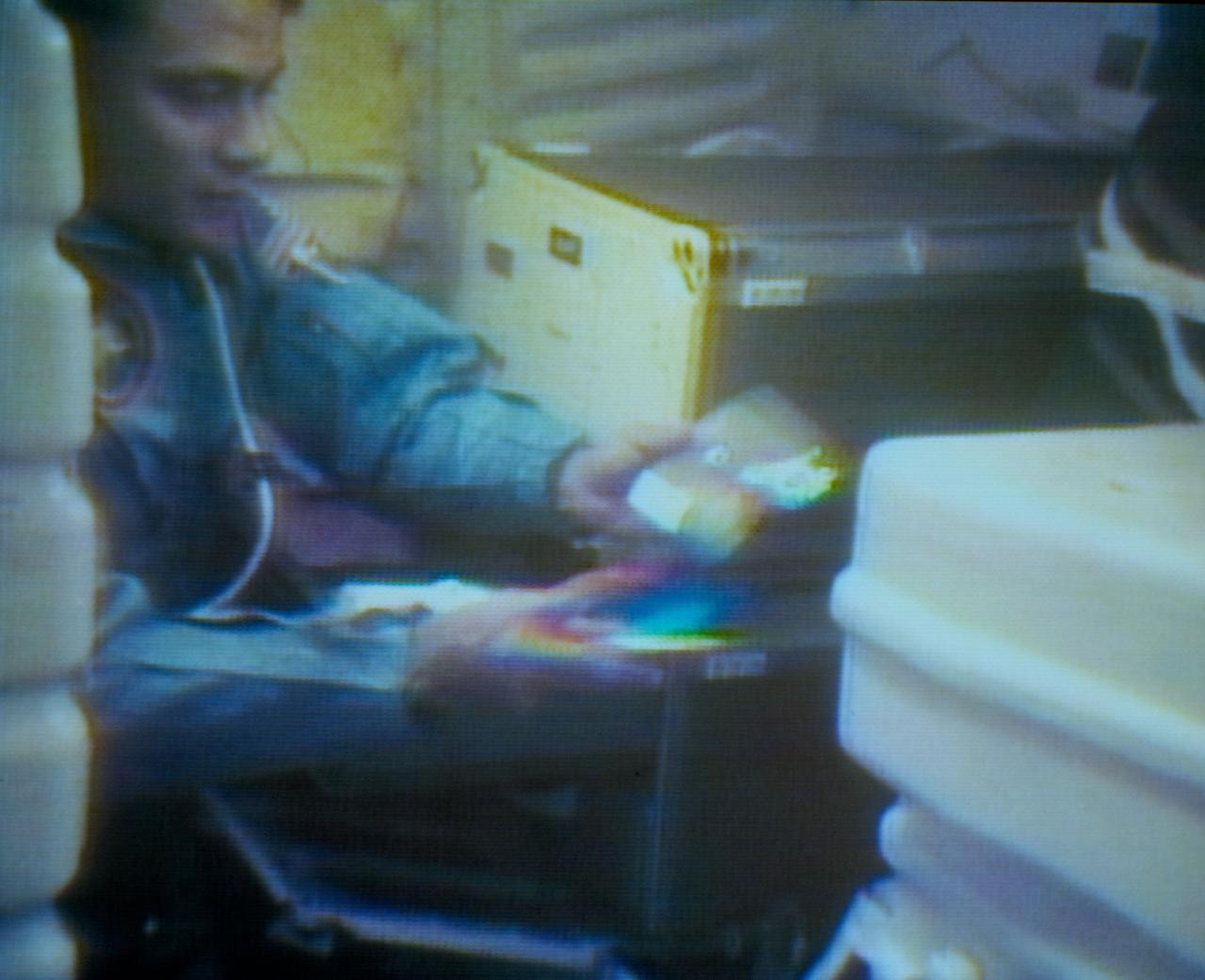
S73-26794 (26 May 1973) --- Two of the three Skylab 2 astronauts are seen in the wardroom of the crew quarters of the Orbital Workshop of the Skylab 1 space station cluster in Earth orbit in this reproduction taken from a color television transmission made by a TV camera aboard the space station. They are preparing a meal. Astronaut Charles Conrad Jr., commander, is in the right foreground. In the background is scientist-astronaut Joseph P. Kerwin, science pilot. Photo credit: NASA
ASTRONAUT CHARLE CONRAD - SKYLAB II (TV)
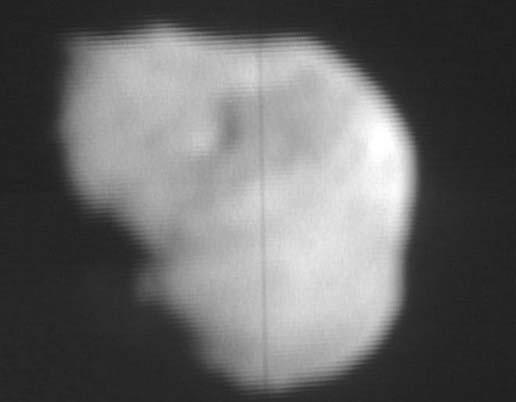
This image from NASA TV shows the nucleus of comet Tempel 1 from Deep Impact flyby high-resolution imager.
Tempel 1 Nucleus
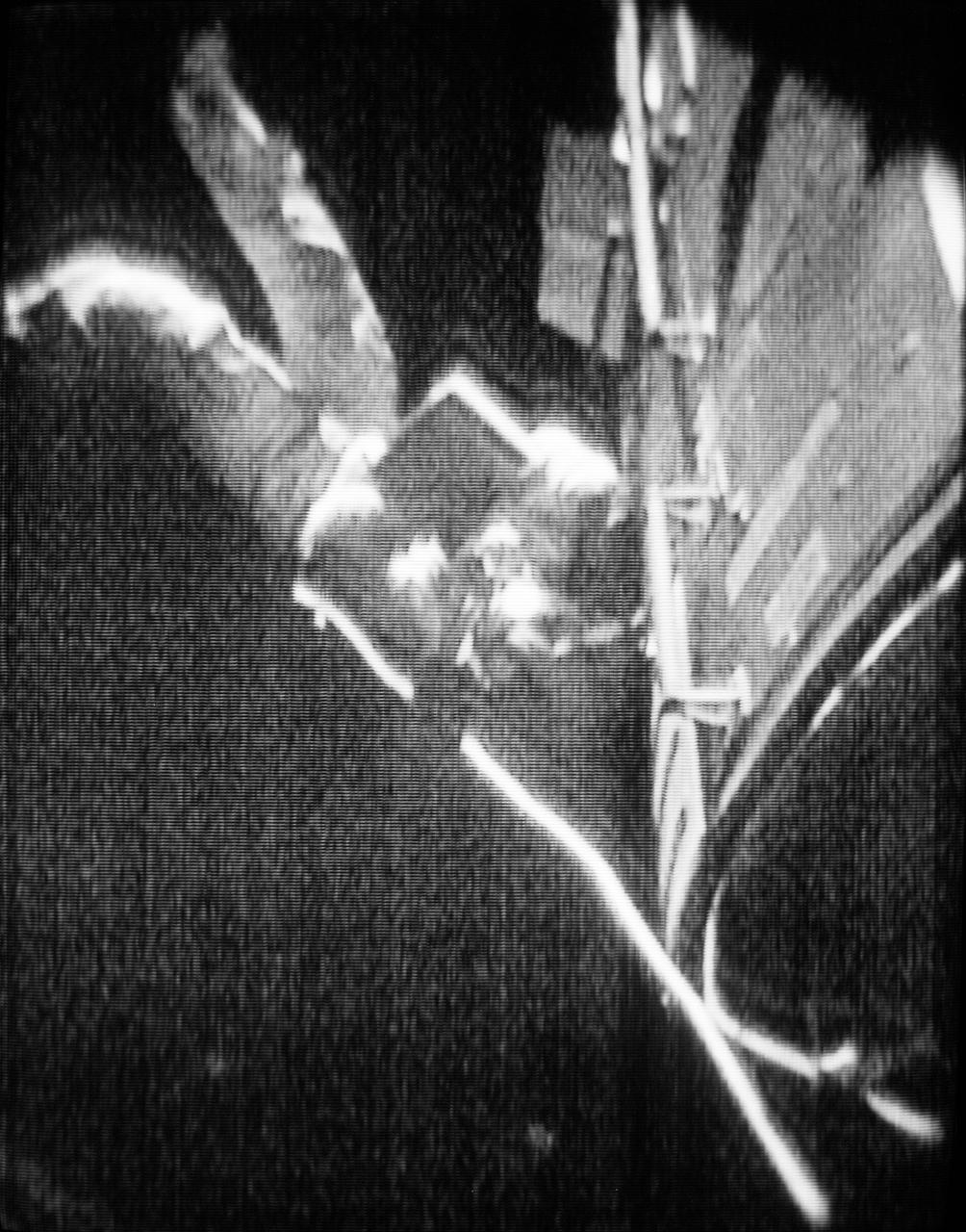
S72-35901 (25 April 1972) --- Astronaut Thomas K. (Ken) Mattingly II, command module pilot of the Apollo 16 lunar landing mission, floats in space outside the spacecraft during his trans-Earth extravehicular activity (EVA), as seen in this reproduction taken from a color television transmission made by a color TV camera mounted on the Command Module (CM) hatch. Mattingly used hand-holds and a foot restraint to hold himself in position, and he was secured to the spacecraft by an umbilical tether line. During his EVA, Mattingly made an inspection of the Service Module's (SM) Scientific Instrument Module (SIM) bay, and retrieved film cassettes from the Panoramic Camera and the Mapping Camera. The trans-Earth EVA occurred at ground elapsed time of 242:55, and 2:49 p.m. (CST), Tuesday, April 25, 1972.
TV Transmission Views (Poor Quality)
S72-35900 (25 April 1972) --- Astronaut Thomas K. (Ken) Mattingly II, command module pilot of the Apollo 16 lunar landing mission, floats in space outside the spacecraft during his trans-Earth extravehicular activity (EVA), as seen in this reproduction taken from a color television transmission made by a color TV camera mounted on the Command Module (CM) hatch. Mattingly used hand-holds and a foot restraint to hold himself in position, and he was secured to the spacecraft by an umbilical tether line. During his EVA, Mattingly made an inspection of the Service Module's (SM) Scientific Instrument Module (SIM) bay, and retrieved film cassettes from the Panoramic Camera and the Mapping Camera. The trans-Earth EVA occurred at ground elapsed time of 242:55, and 2:49 p.m. (CST), Tuesday, April 25, 1972.
TV transmission views (poor quality)
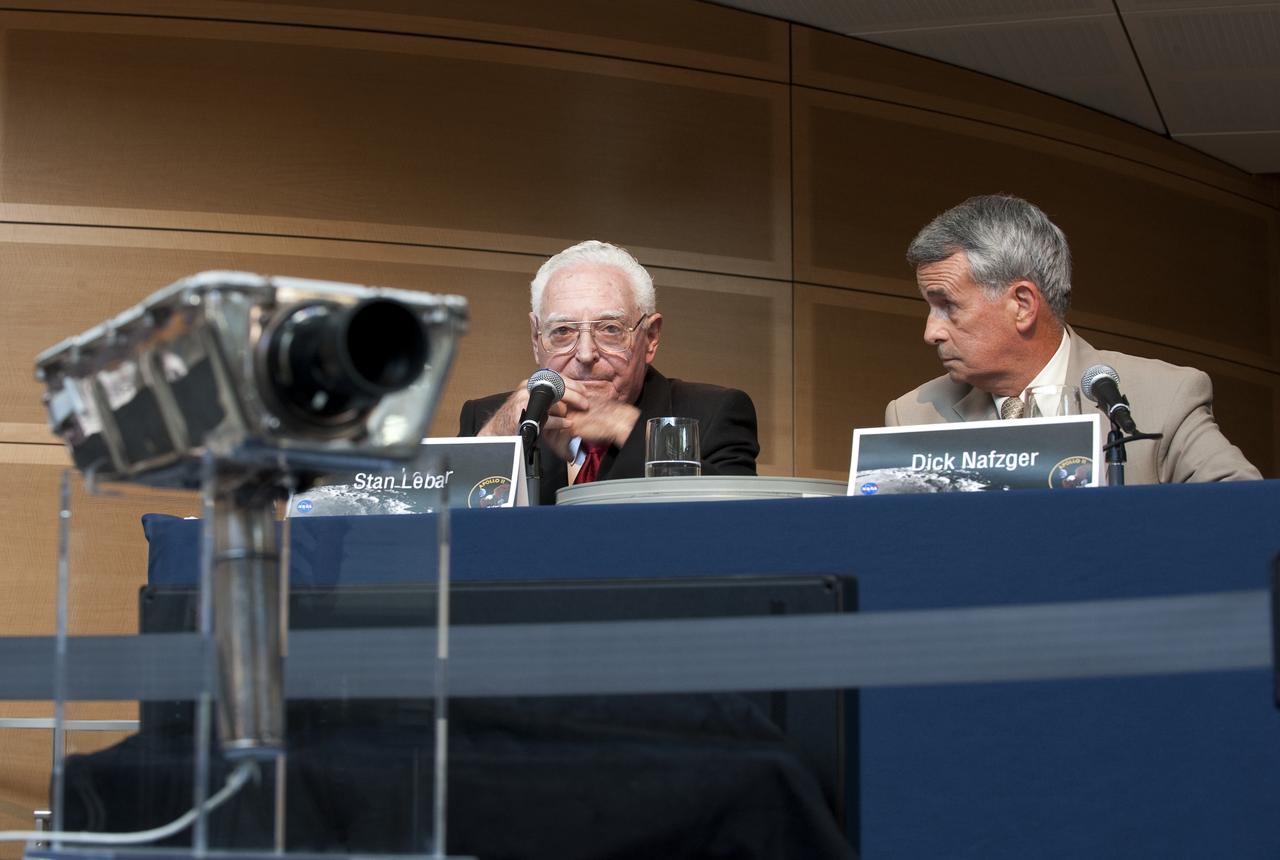
Stan Lebar, former Westinghouse Electric program manager, left, talks about the Apollo era TV cameras such as the one on display in the foreground as Richard Nafzger, team lead and Goddard engineer, listens at NASA's briefing where restored Apollo 11 moonwalk footage was revealed for the first time at the Newseum, Thursday, July 16, 2009, in Washington, DC.  Photo Credit: (NASA/Bill Ingalls)
Restored Moonwalk Footage Release
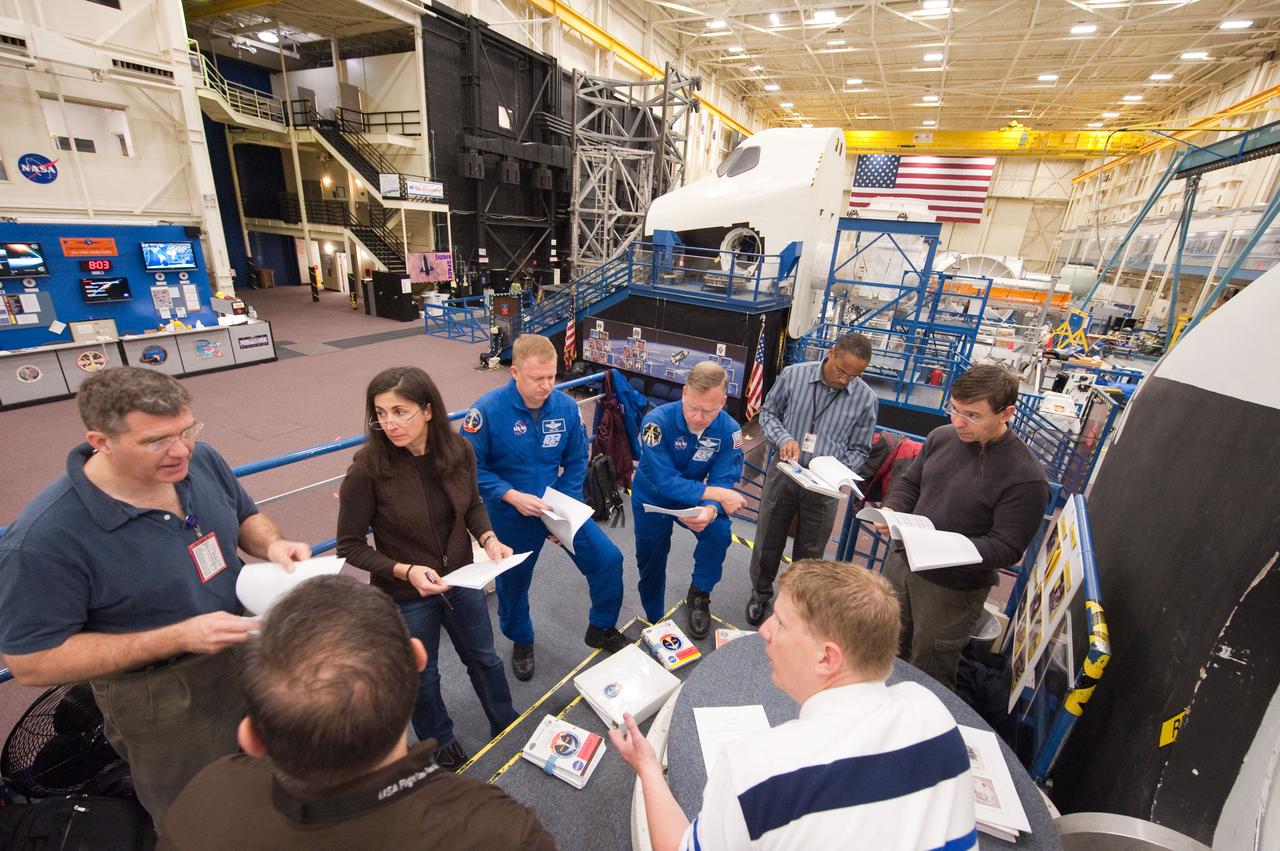
JSC2011-E-013954 (1 Feb. 2011) --- STS-133 crew members participate in a photo/TV training session in the Full Fuselage Trainer (FFT) mock-up in the Space Vehicle Mock-up Facility at NASA's Johnson Space Center. Pictured from the left are NASA astronauts Steve Lindsey, commander; Alvin Drew, Michael Barratt and Nicole Stott, all mission specialists. Photo credit: NASA or National Aeronautics and Space Administration
STS-133 crew during their photo/TV training with instructor Gary Kilgo.
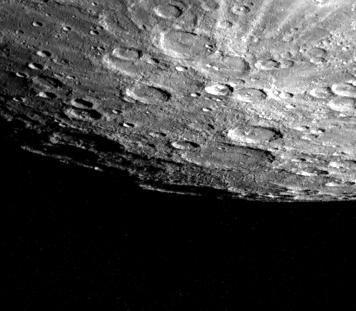
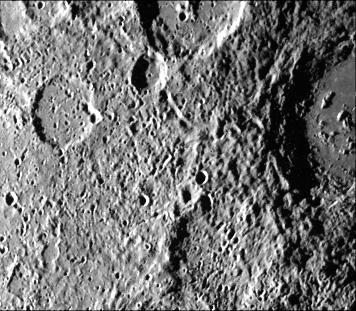
Mercury south pole was photographed by one of NASA Mariner 10 TV cameras; the pole is located inside the large crater on Mercury limb lower center.
Mercury South Pole
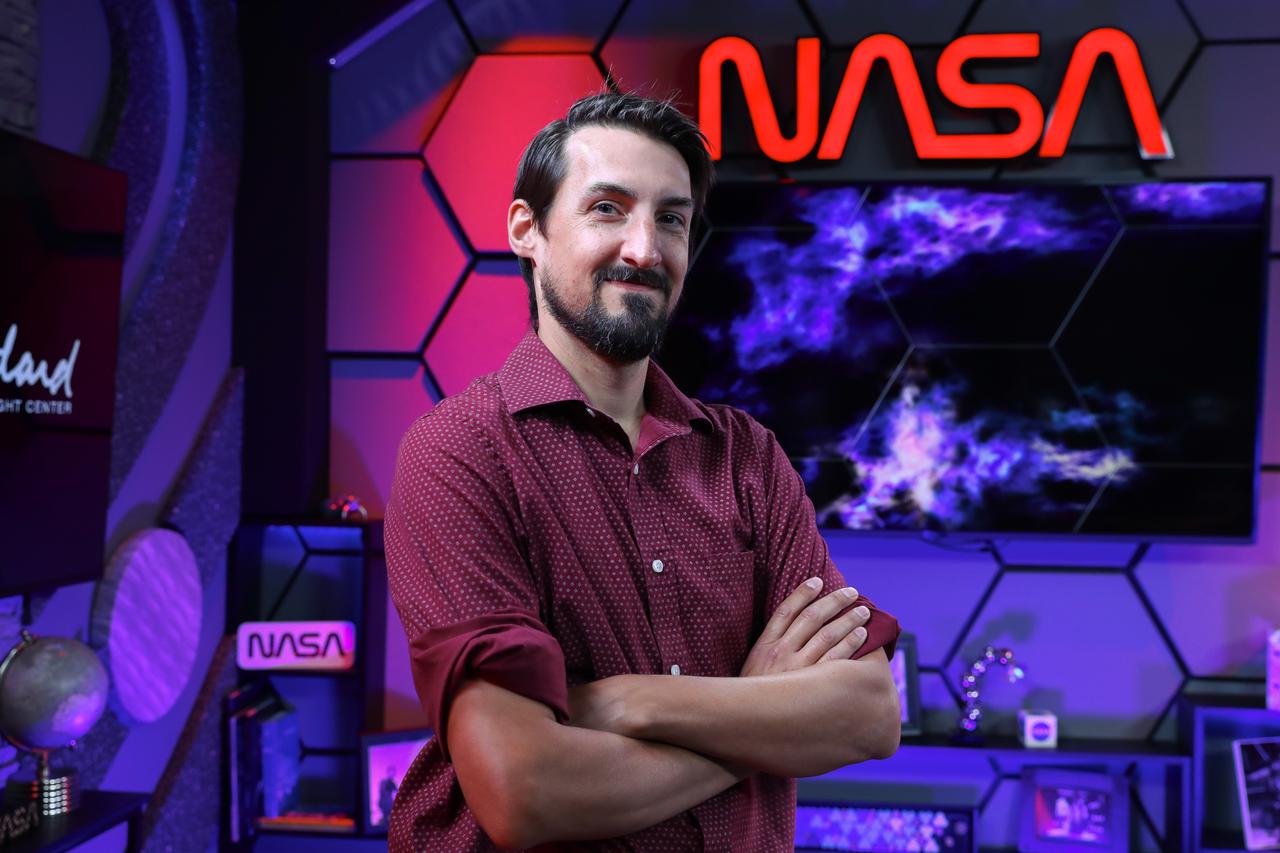
Rob Garner has worked in the Office of Communications at NASA's Goddard Space Flight Center in Greenbelt, Md., since 2007.
RobGarner
JSC2011-E-013949 (1 Feb. 2011) --- STS-133 crew members participate in a photo/TV training session in the Space Vehicle Mock-up Facility at NASA's Johnson Space Center. Pictured from the left are NASA astronauts Steve Bowen, Nicole Stott, both mission specialists; Eric Boe, pilot; Steve Lindsey, commander; Alvin Drew and Michael Barratt, both mission specialists. Crew trainer Gary Kilgo (right foreground) assisted the crew members. Photo credit: NASA or National Aeronautics and Space Administration
STS-133 crew during their photo/TV training with instructor Gary Kilgo.
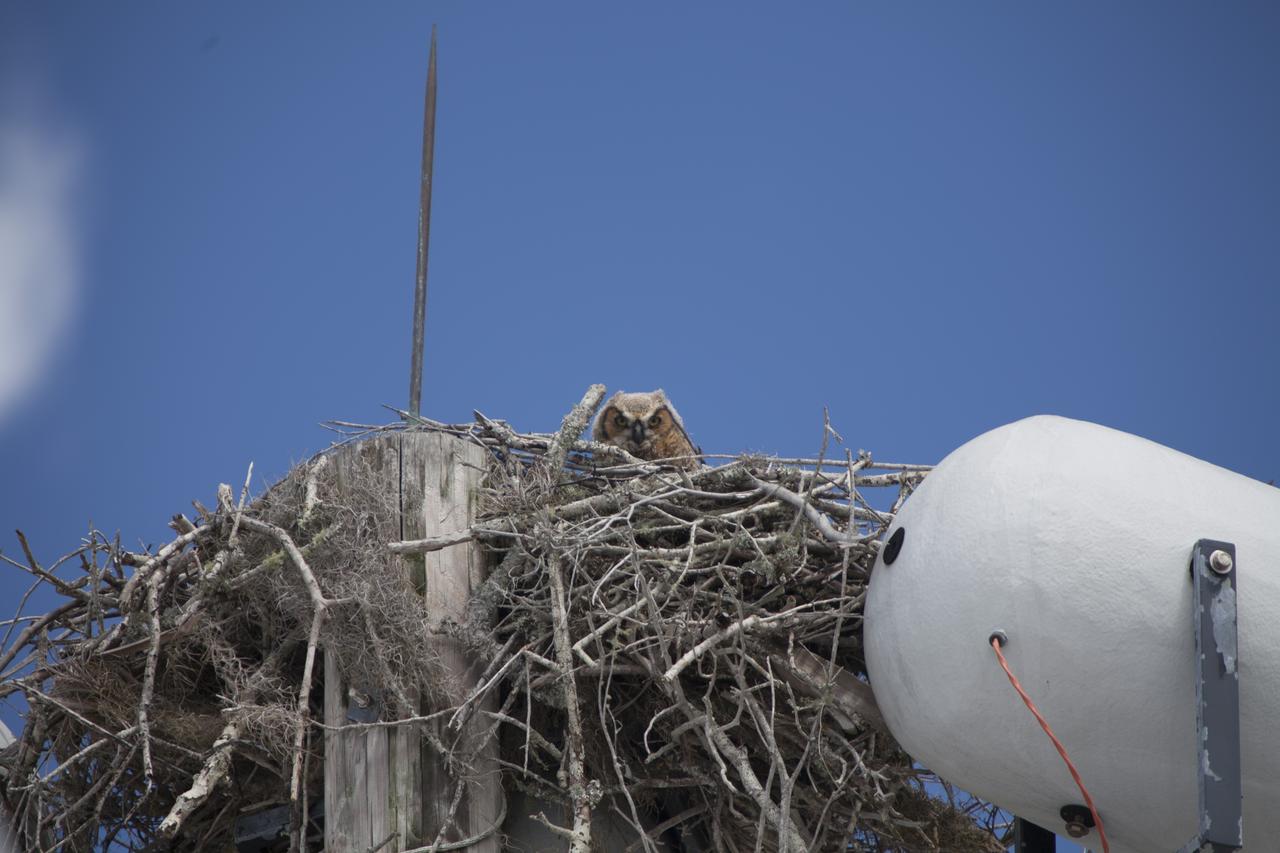
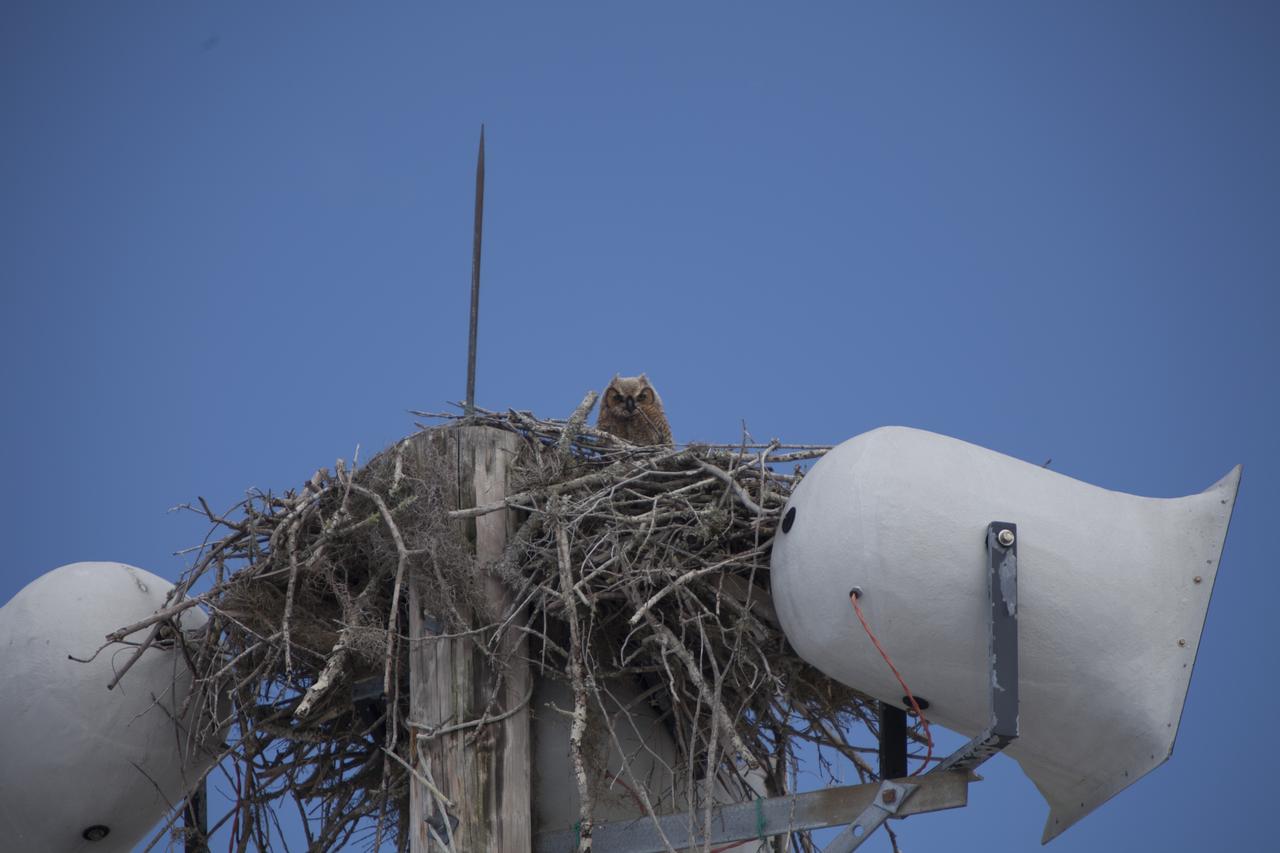
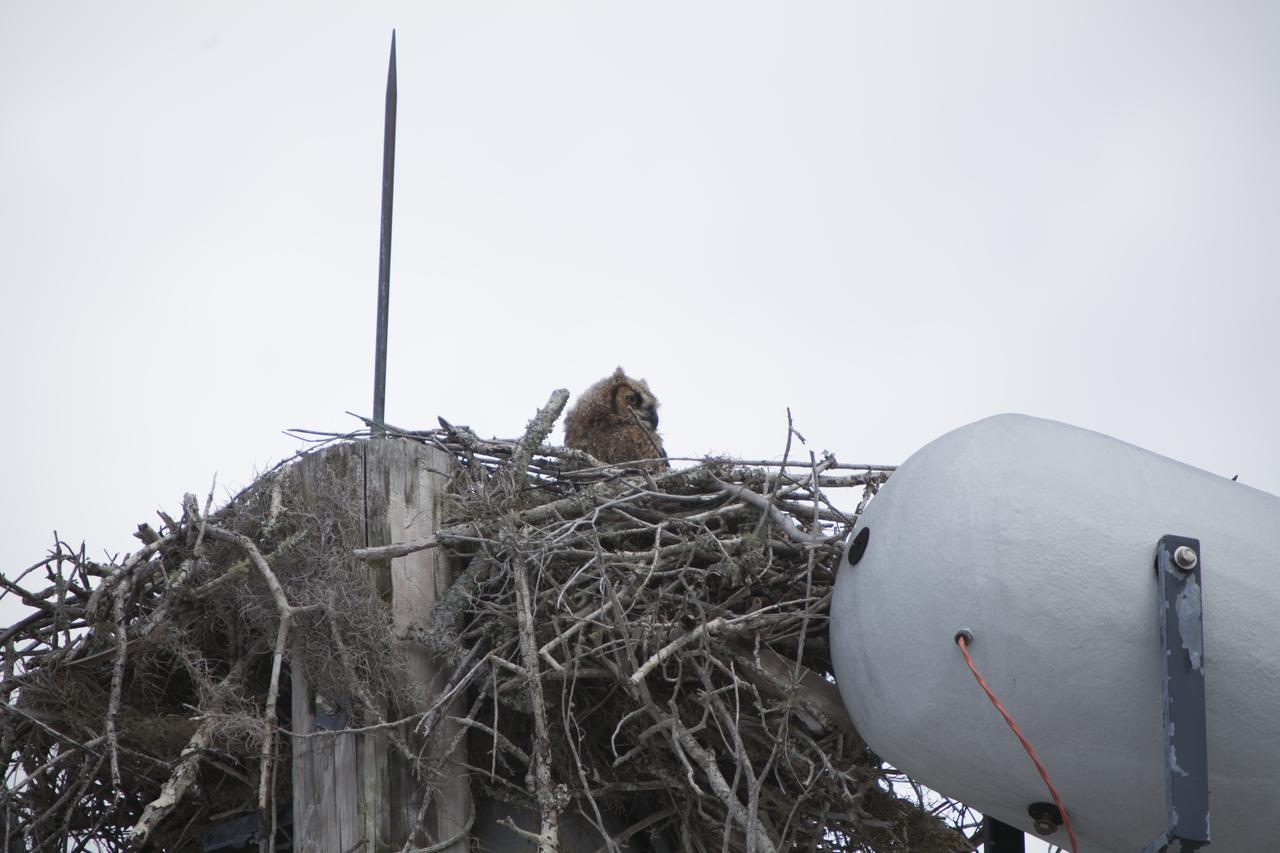
CAPE CANAVERAL, Fla. – At NASA's Kennedy Space Center in Florida, an Owl occupies a nest originally build by an Osprey atop a loudspeaker utility pole. Kennedy Space Center shares a boundary with the Merritt Island National Wildlife Refuge. The Refuge encompasses 140,000 acres that are a habitat for more than 331 species of birds, 31 mammals, 117 fishes, and 65 amphibians and reptiles. The marshes and open water of the refuge provide wintering areas for 23 species of migratory waterfowl, as well as a year-round home for great blue herons, great egrets, wood storks, cormorants, brown pelicans and other species of marsh and shore birds, as well as a variety of insects. For more information, visit: http://www.nasa.gov/centers/kennedy/shuttleoperations/alligators/kscovr.html Photo credit: NASA/Dimitri Gerondidakis
Owl Nest behind TV Building
CAPE CANAVERAL, Fla. – At NASA's Kennedy Space Center in Florida, an Owl occupies a nest originally build by an Osprey atop a loudspeaker utility pole. Kennedy Space Center shares a boundary with the Merritt Island National Wildlife Refuge. The Refuge encompasses 140,000 acres that are a habitat for more than 331 species of birds, 31 mammals, 117 fishes, and 65 amphibians and reptiles. The marshes and open water of the refuge provide wintering areas for 23 species of migratory waterfowl, as well as a year-round home for great blue herons, great egrets, wood storks, cormorants, brown pelicans and other species of marsh and shore birds, as well as a variety of insects. For more information, visit: http://www.nasa.gov/centers/kennedy/shuttleoperations/alligators/kscovr.html Photo credit: NASA/Dimitri Gerondidakis
Owl Nest behind TV Building
CAPE CANAVERAL, Fla. – At NASA's Kennedy Space Center in Florida, an Owl occupies a nest originally build by an Osprey atop a loudspeaker utility pole. Kennedy Space Center shares a boundary with the Merritt Island National Wildlife Refuge. The Refuge encompasses 140,000 acres that are a habitat for more than 331 species of birds, 31 mammals, 117 fishes, and 65 amphibians and reptiles. The marshes and open water of the refuge provide wintering areas for 23 species of migratory waterfowl, as well as a year-round home for great blue herons, great egrets, wood storks, cormorants, brown pelicans and other species of marsh and shore birds, as well as a variety of insects. For more information, visit: http://www.nasa.gov/centers/kennedy/shuttleoperations/alligators/kscovr.html Photo credit: NASA/Dimitri Gerondidakis
Owl Nest behind TV Building
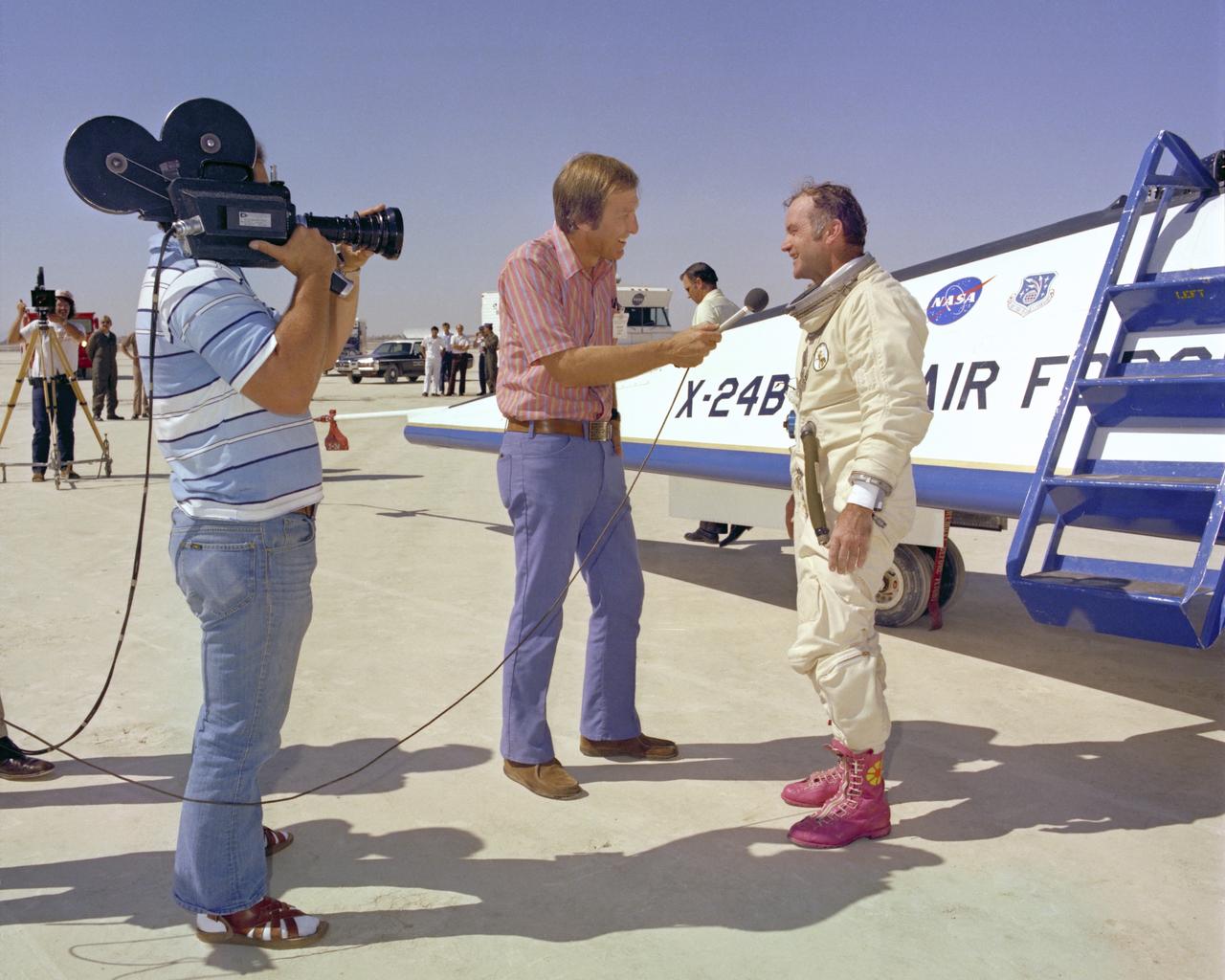
A TV reporter interviews NASA test pilot Bill Dana, wearing his infamous pink boots with yellow daisy decals, after the last powered flight of the X-24B.
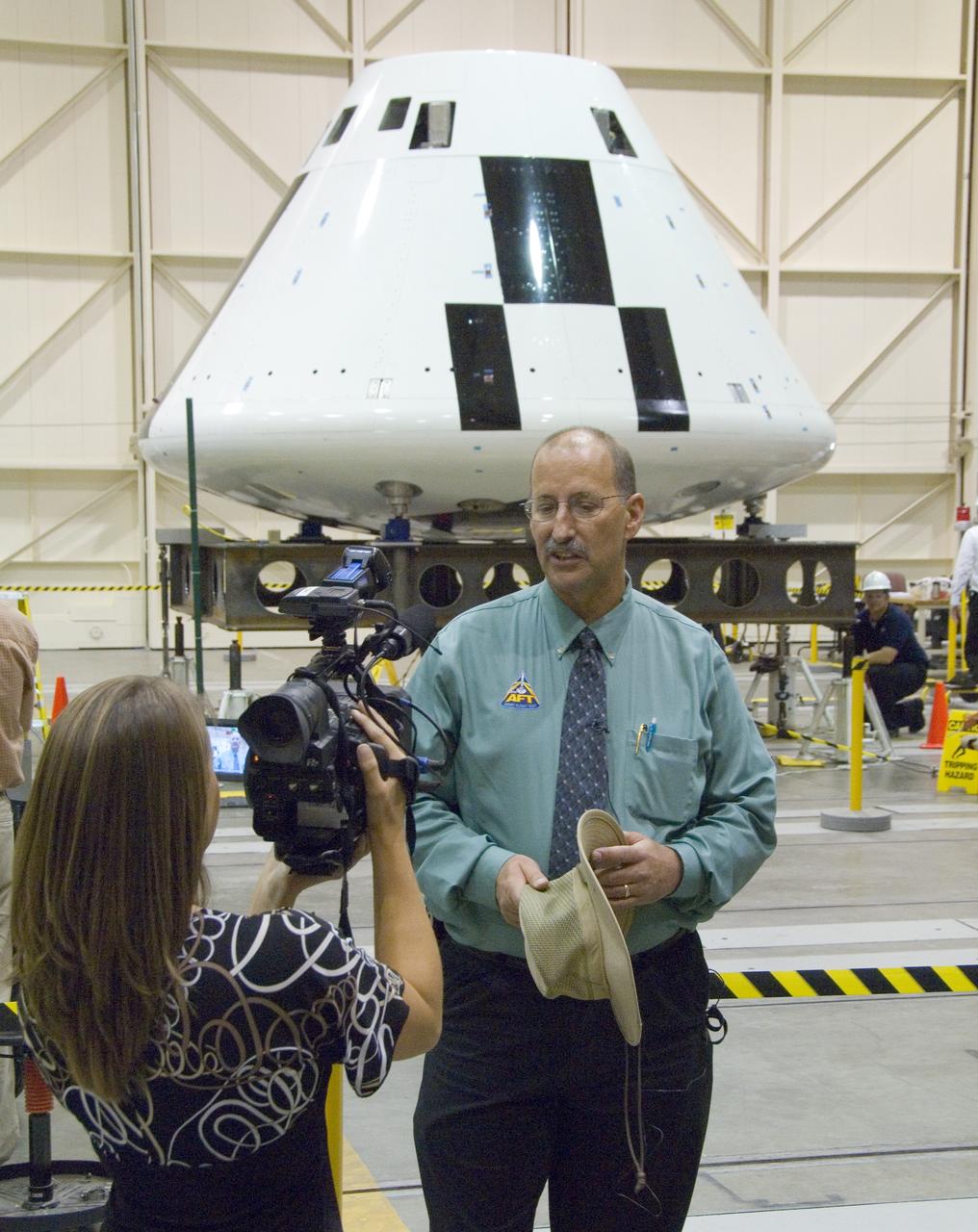
Reporter Julie Flannery of KERO-TV, Bakersfield, interviews NASA Dryden's Orion Abort Flight Test project manager Gary Martin in front of the Orion PA-1 crew module.
Reporter Julie Flannery of KERO-TV, Bakersfield, interviews NASA Dryden's Orion AFT project manager Gary Martin in front of the Orion PA-1 crew module.
KSC's Press Site serves as the stage for makers of "The Cape," a pilot television movie starring Corbin Bernsen (third from front).
KSC-396C-1732-12
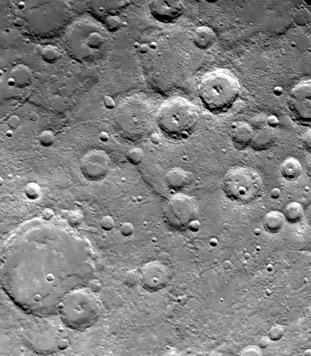
One of NASA Mariner 10 two TV cameras took this picture of a densely cratered region of Mercury on Sept. 21, 1974, 80 minutes prior to the spacecraft second close encounter with the planet.
Densely Cratered Region
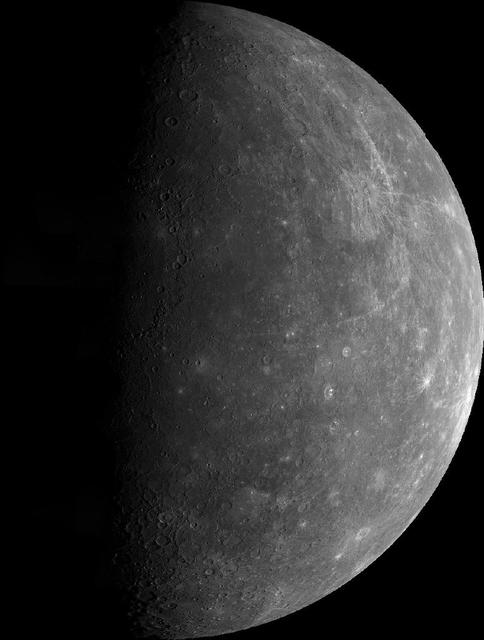
This mosaic, made from over 140 individual TV frames taken about two hours after encounter, shows the planet Mercury as seen by NASA Mariner 10 as it sped away from the planet on March 29, 1974.
Outgoing Hemisphere
Cratered terrain very similar to that on the Moon is shown in this TV photo of Mercury taken by NASA Mariner 10. Numerous small craters and linear grooves radial to the crater can be seen.
Mercury Cratered Terrain
Portrait; Garth Illingworth (for NASA TV press realease)
ARC-2011-ACD11-0033
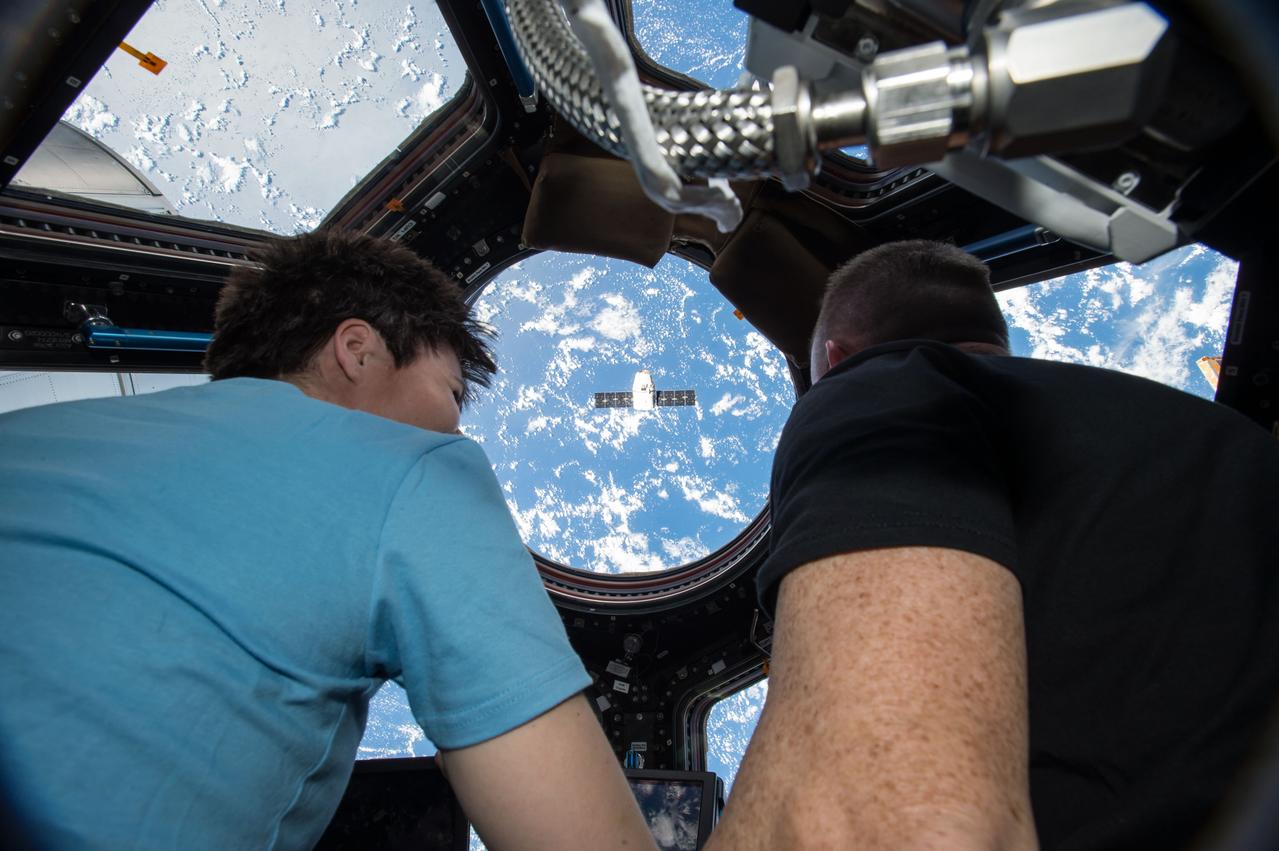
GMT012_11_49_Terry Virts_Dragon capture wide TV camera_130B
iss042e119671
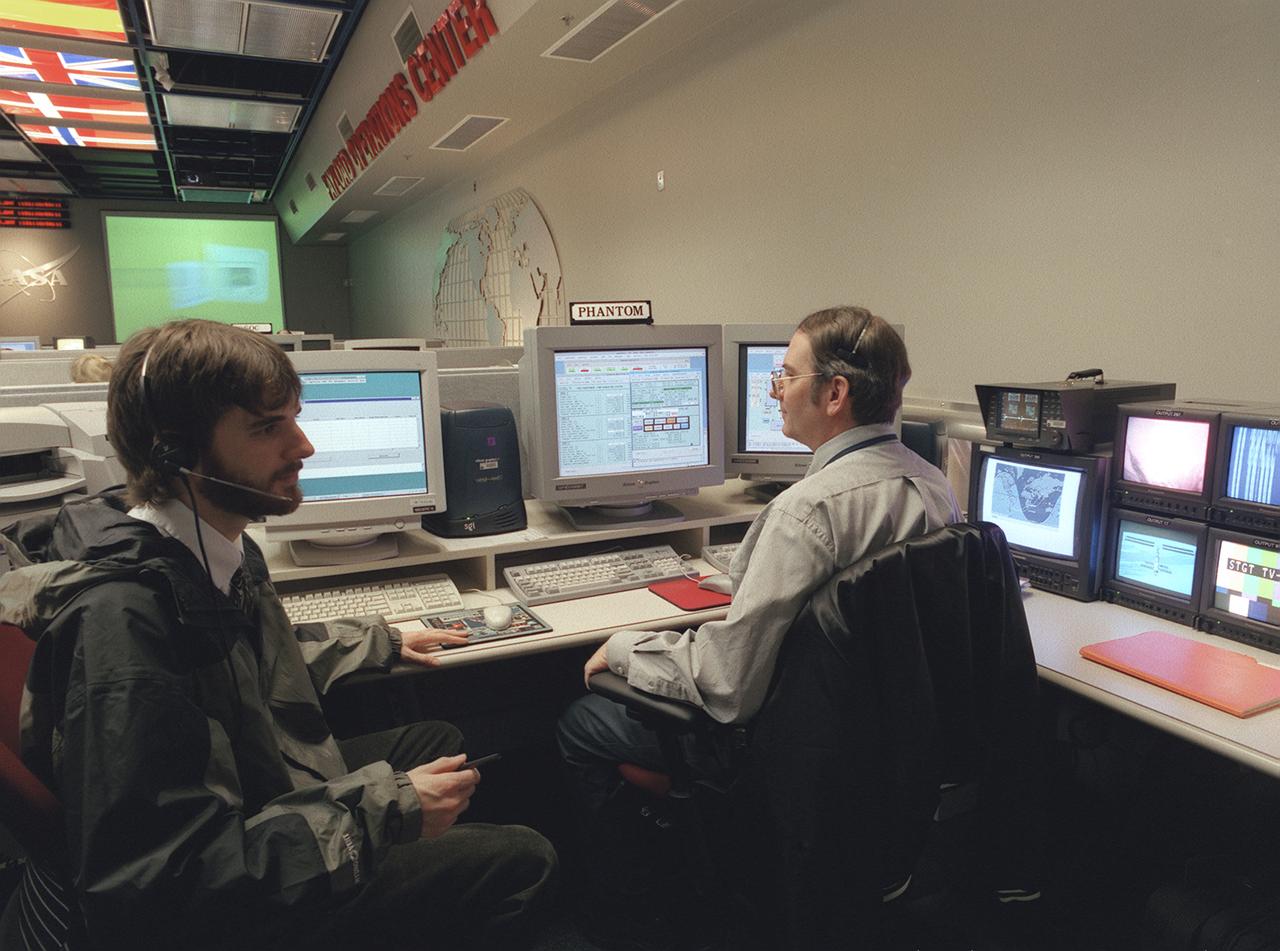
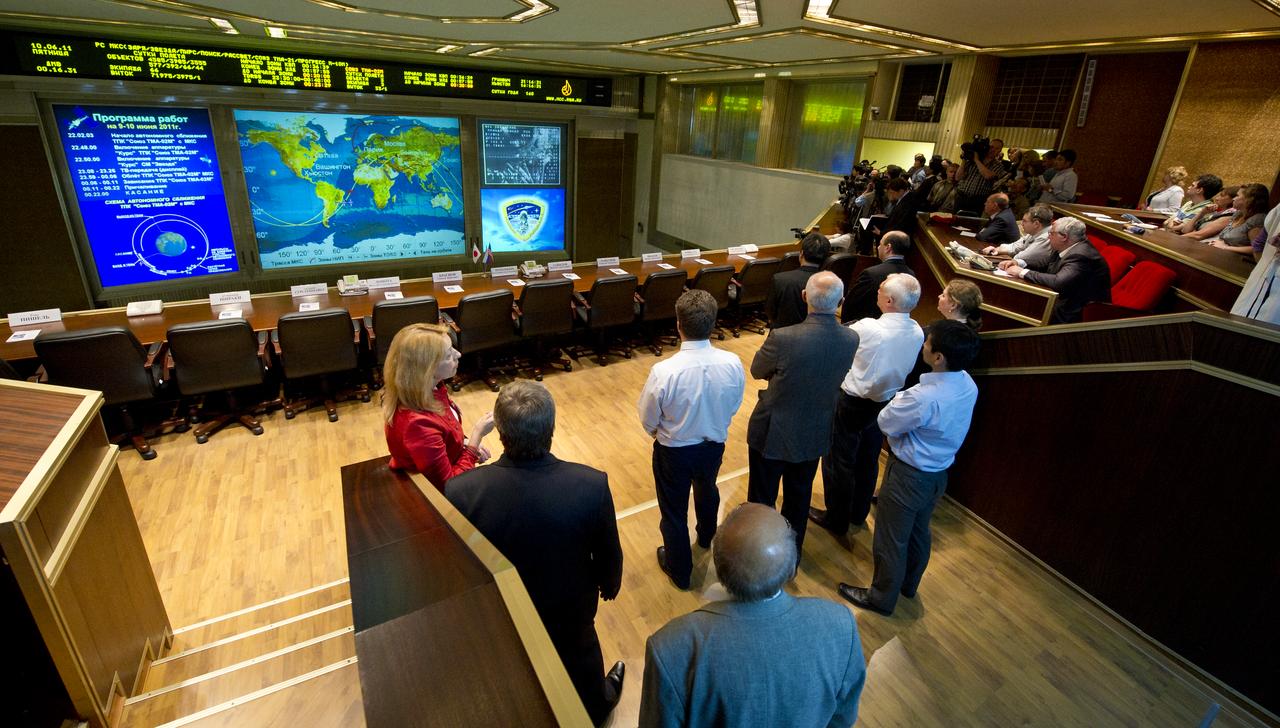
The Payload Operations Center (POC) is the science command post for the International Space Station (ISS). Located at NASA's Marshall Space Flight Center in Huntsville, Alabama, it is the focal point for American and international science activities aboard the ISS. The POC's unique capabilities allow science experts and researchers around the world to perform cutting-edge science in the unique microgravity environment of space. The POC is staffed around the clock by shifts of payload flight controllers. At any given time, 8 to 10 flight controllers are on consoles operating, plarning for, and controlling various systems and payloads. This photograph shows the Photo and TV Operations Manager (PHANTOM) at a work station. The PHANTOM configures all video systems aboard the ISS and ensures they are working properly, providing a video link from the ISS to the POC.
International Space Station (ISS)
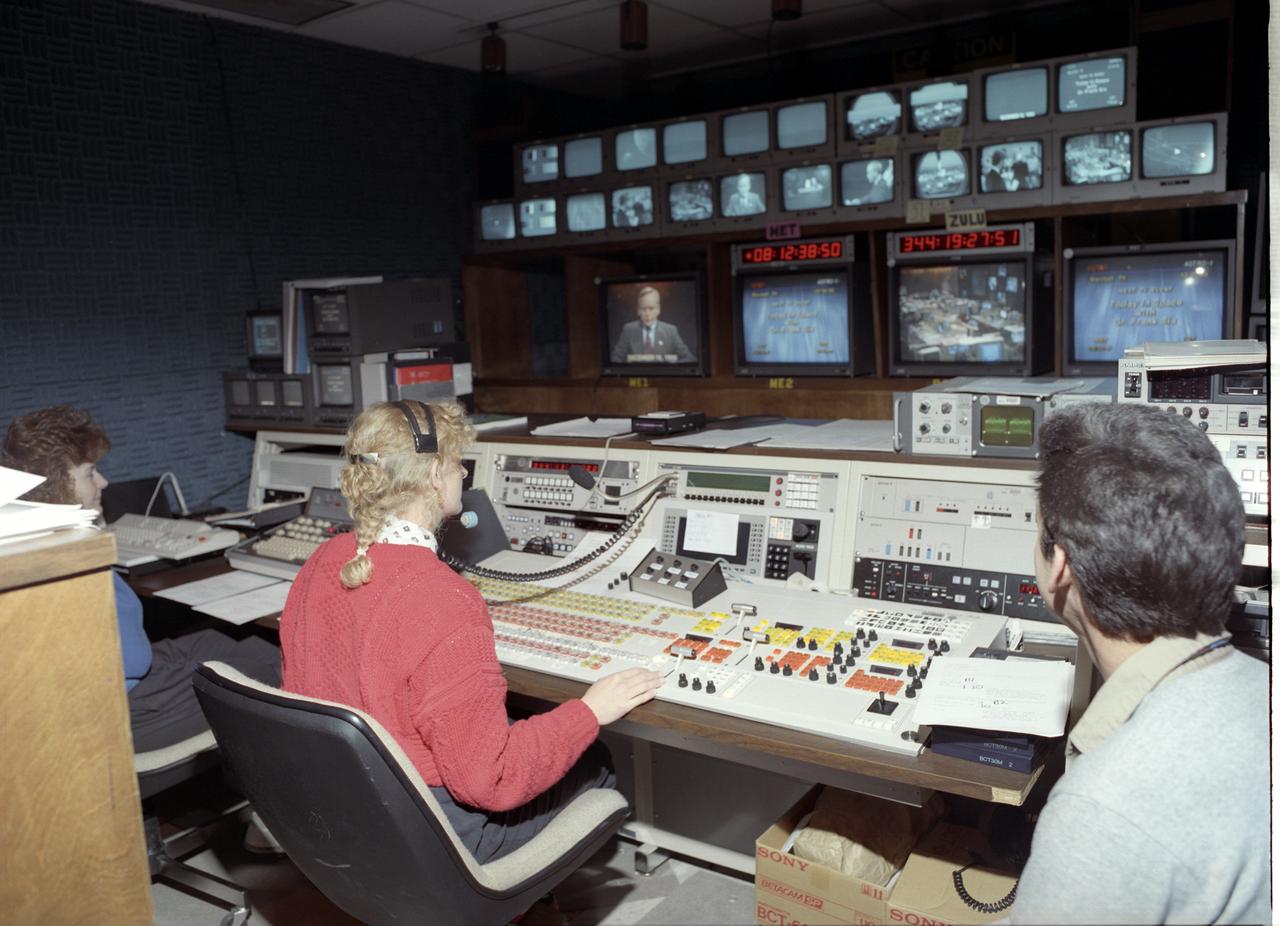
The primary objective of the STS-35 mission was round the clock observation of the celestial sphere in ultraviolet and X-Ray astronomy with the Astro-1 observatory which consisted of four telescopes: the Hopkins Ultraviolet Telescope (HUT); the Wisconsin Ultraviolet Photo-Polarimeter Experiment (WUPPE); the Ultraviolet Imaging Telescope (UIT); and the Broad Band X-Ray Telescope (BBXRT). The Huntsville Operations Support Center (HOSC) Spacelab Payload Operations Control Center (SL POCC) at the Marshall Space Flight Center (MSFC) was the air/ground communication channel used between the astronauts and ground control teams during the Spacelab missions. Teams of controllers and researchers directed on-orbit science operations, sent commands to the spacecraft, received data from experiments aboard the Space Shuttle, adjusted mission schedules to take advantage of unexpected science opportunities or unexpected results, and worked with crew members to resolve problems with their experiments. Pictured is the TV OPS area of the SL POCC.
Around Marshall
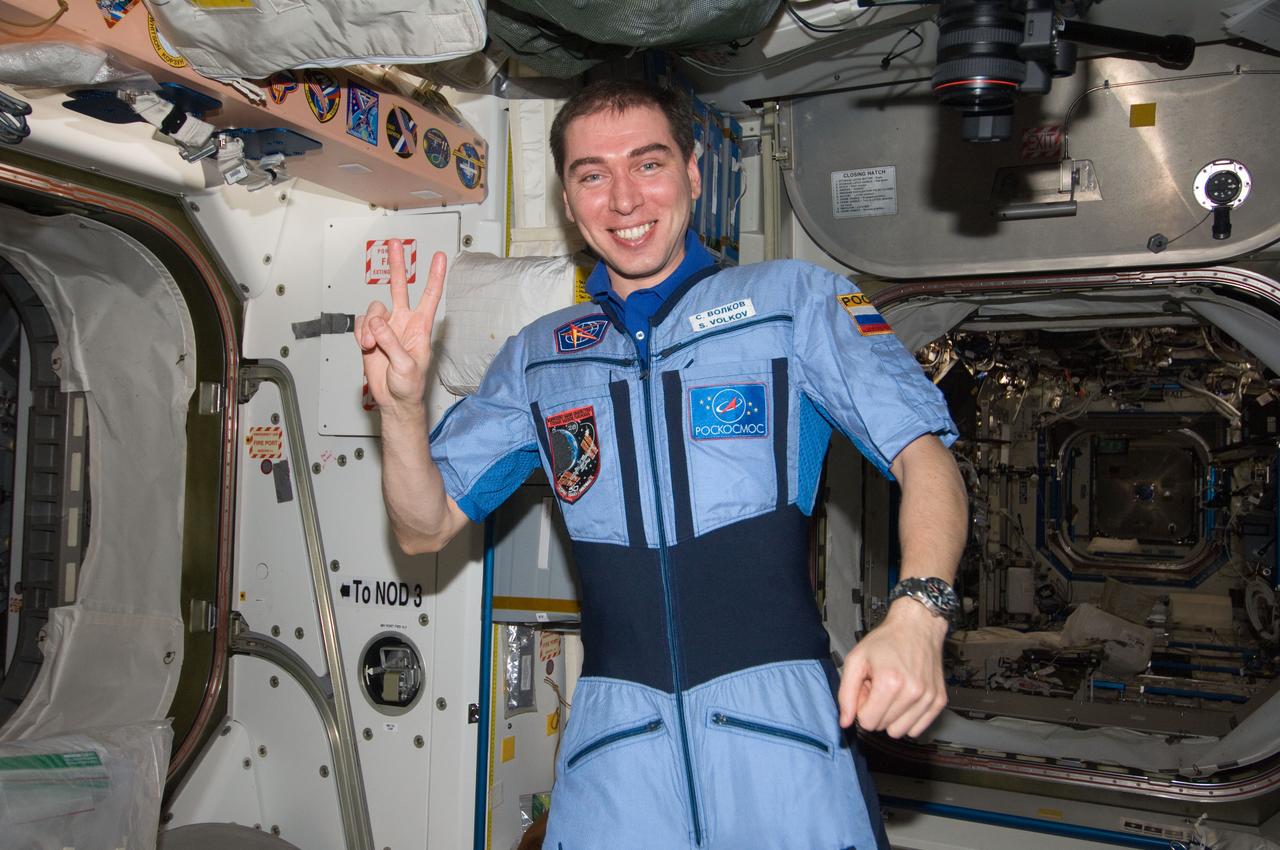
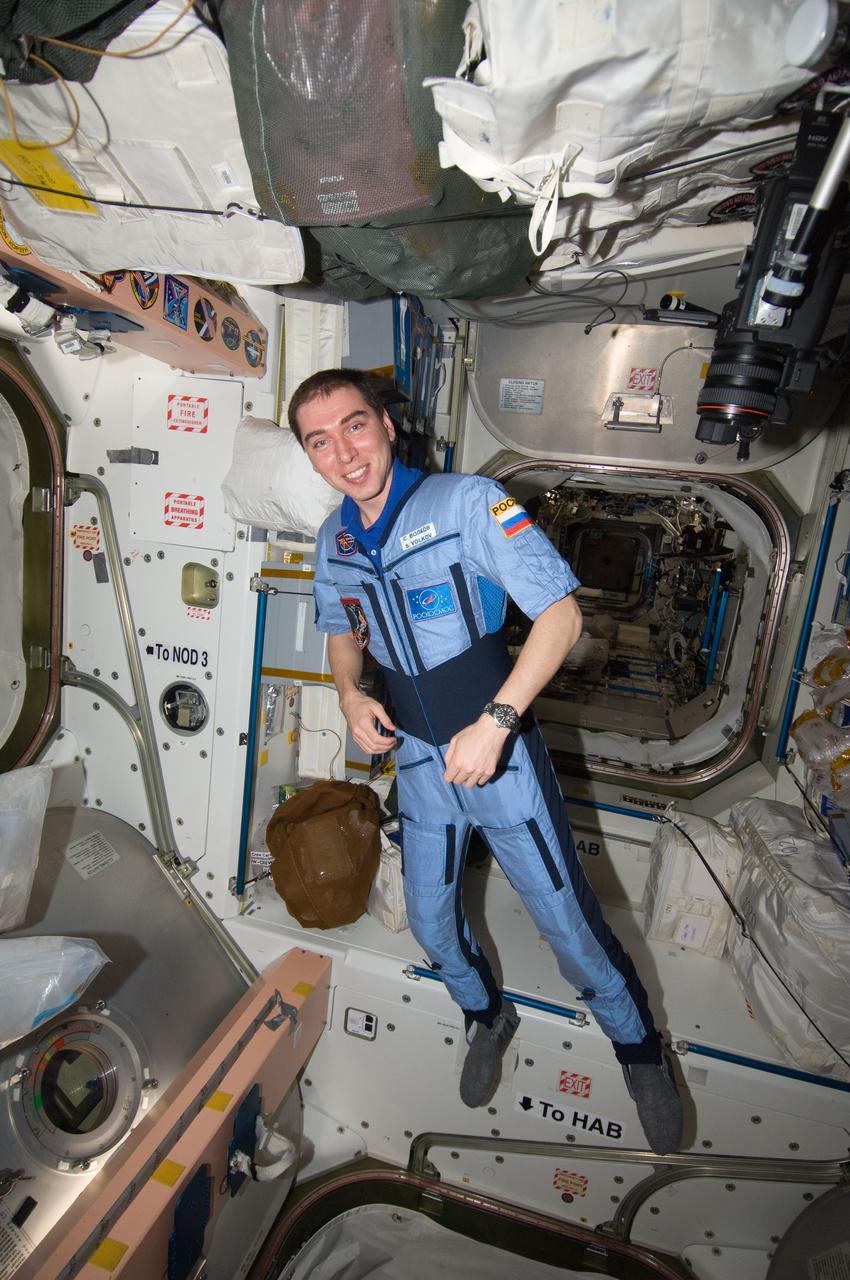
ISS028-E-032133 (17 Aug. 2011) --- Russian cosmonaut Sergei Volkov, Expedition 28 flight engineer, is pictured in the Unity node of the International Space Station while filming an installment of the ?The Orbital Station. Life on Orbit? video, intended for a documentary film to be prepared by the Roscosmos TV studio for the ?Kultura? State TV channel.
iss028e032133
Joann Morgan with WESH-TV 2 News Anchor Wendy Chioji
KSC-02PD-1411
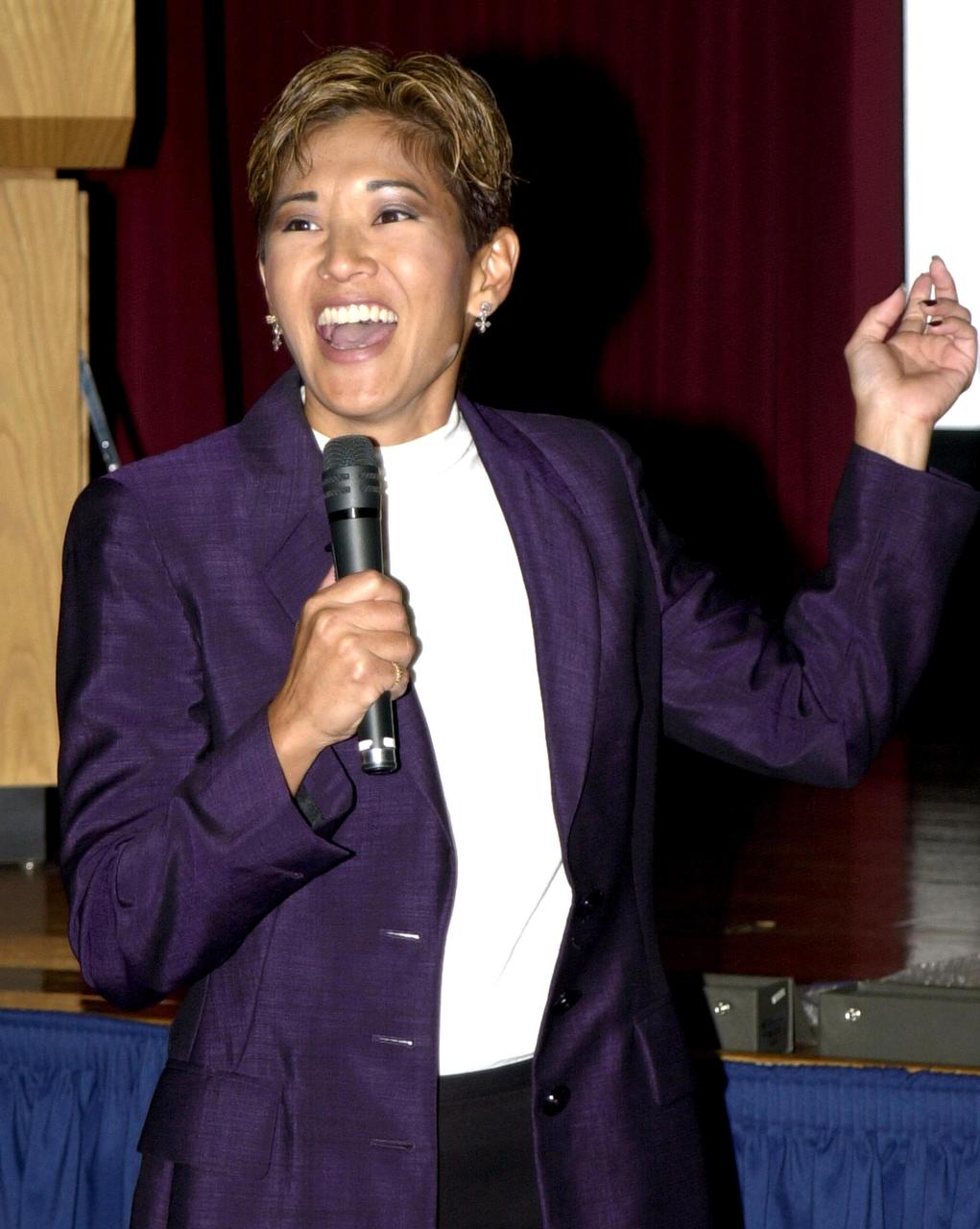
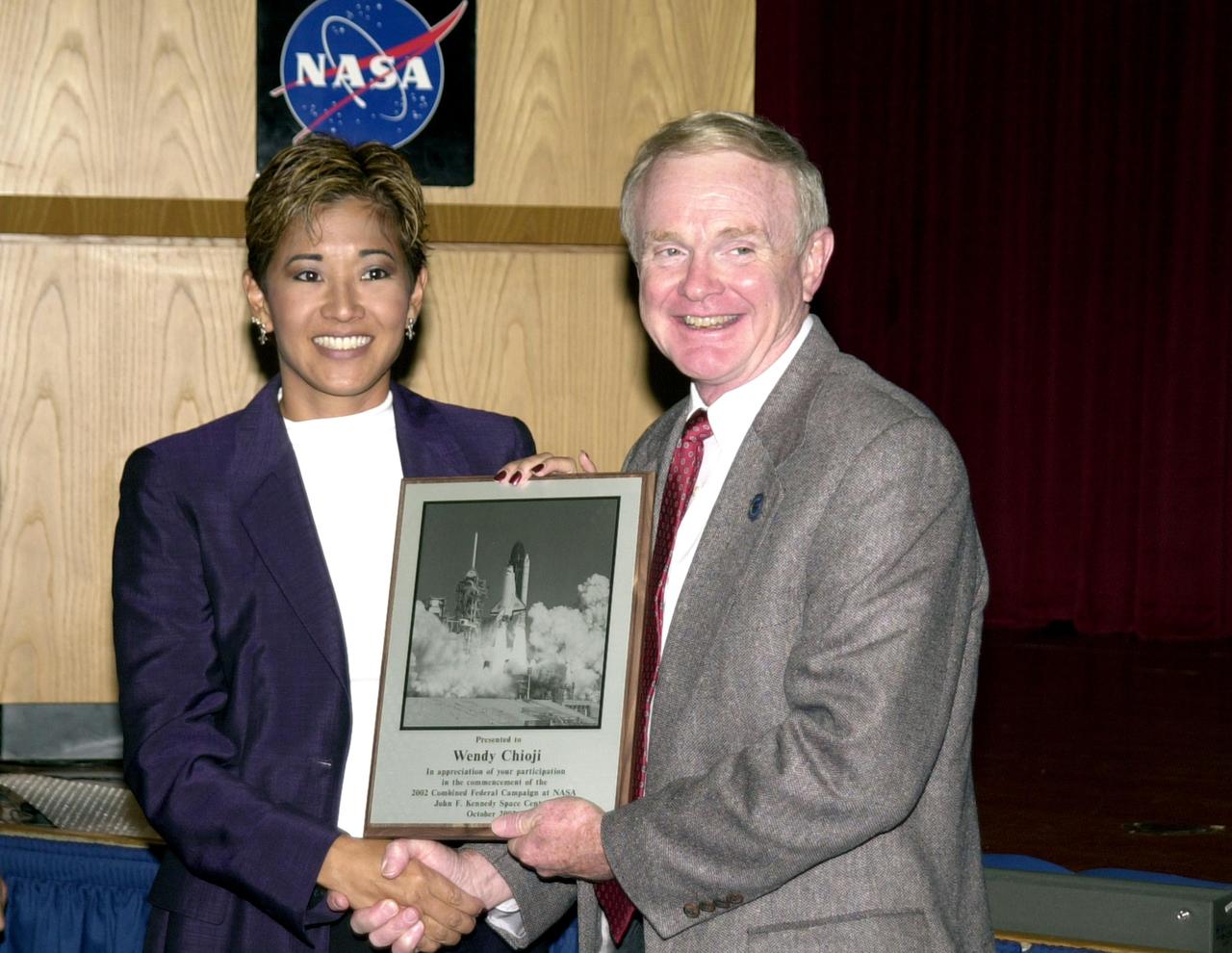
WESH-TV 2 News Anchor Wendy Chioji speaking at CFC kickoff
KSC-02PD-1414
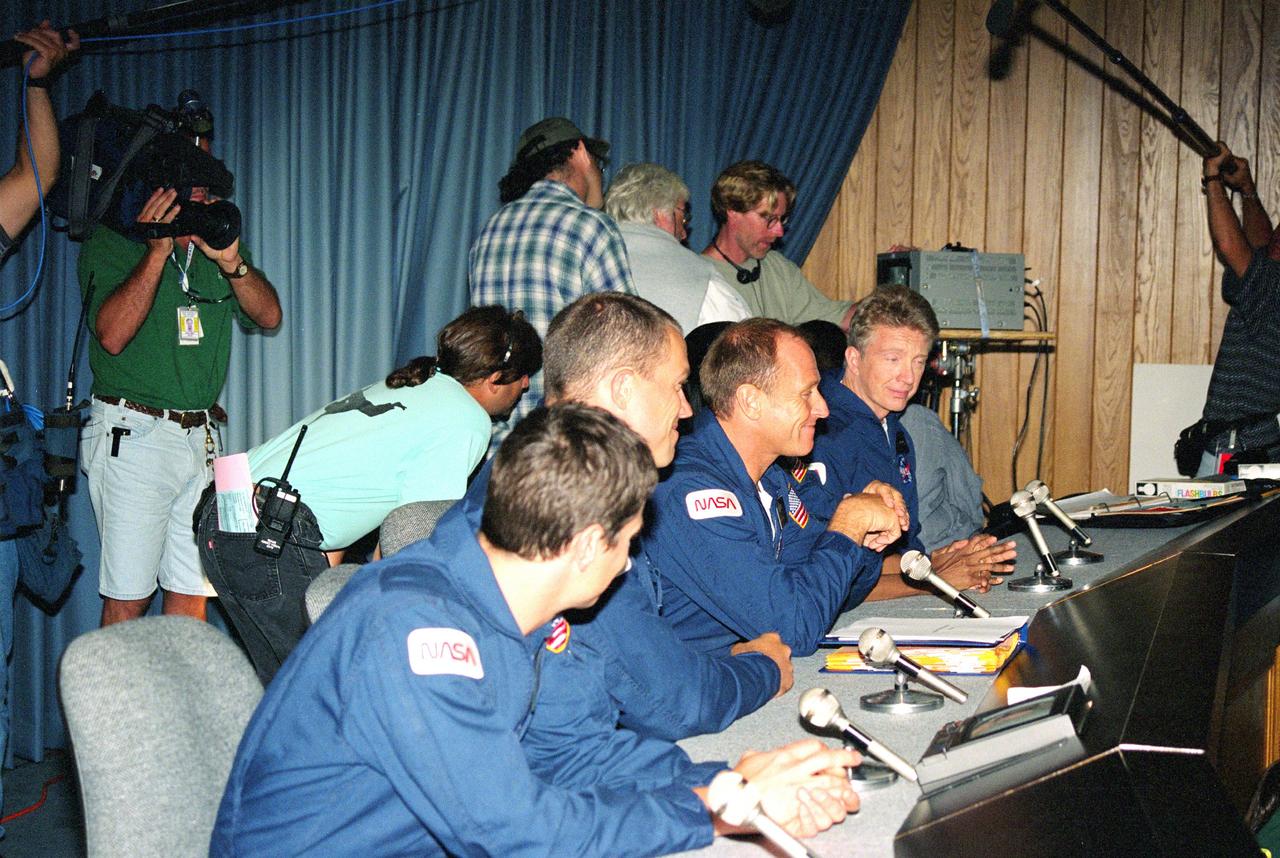
Press conference panel interviewing STS-8 onboard crew, 09/02/1983. Crew can be seen on TV screen.
Briefings/Conferences - STS-8
WESH-TV 2 News Anchor Wendy Chioji with Kennedy Space Center Director Roy Bridges
KSC-02PD-1415
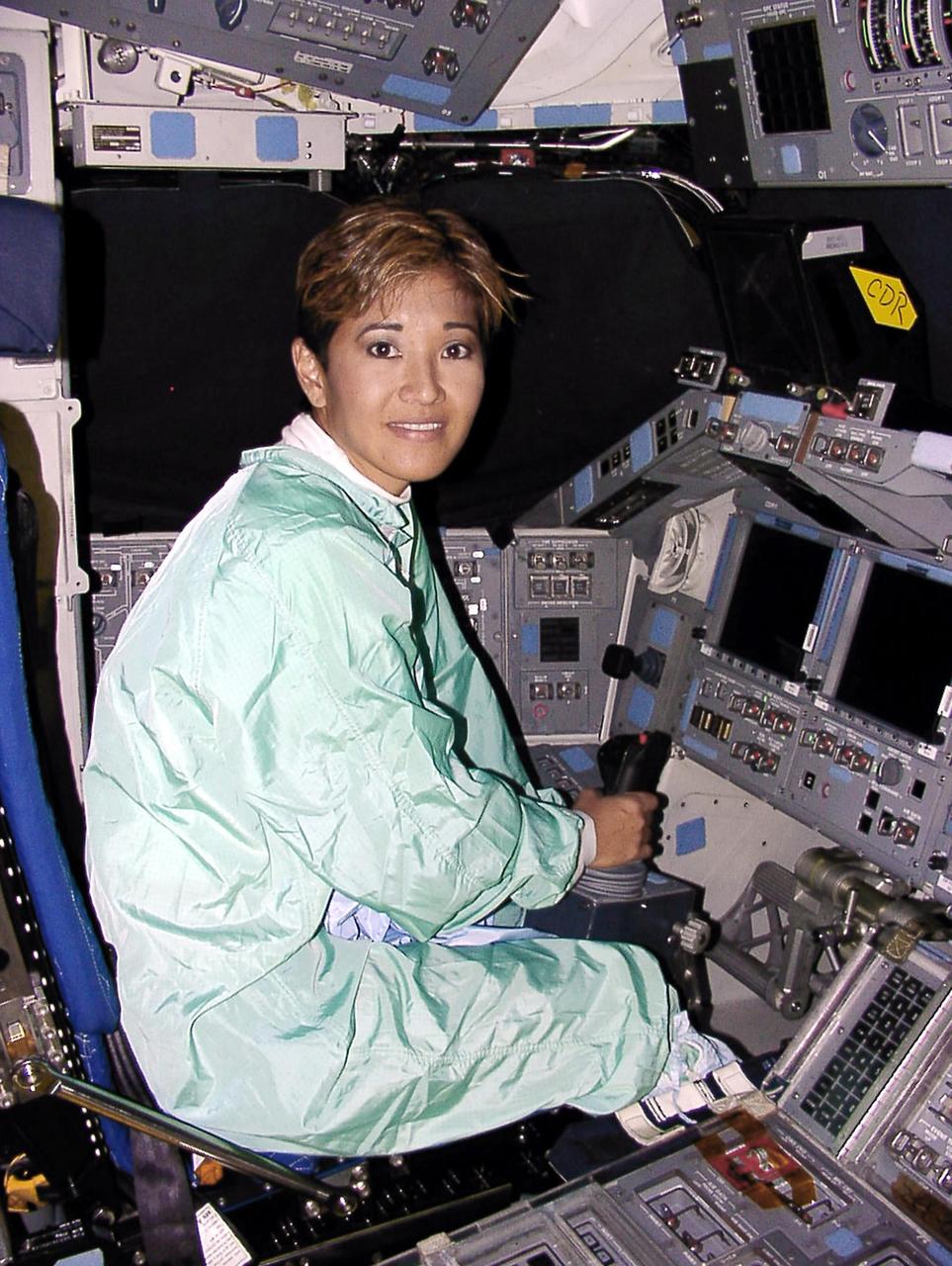
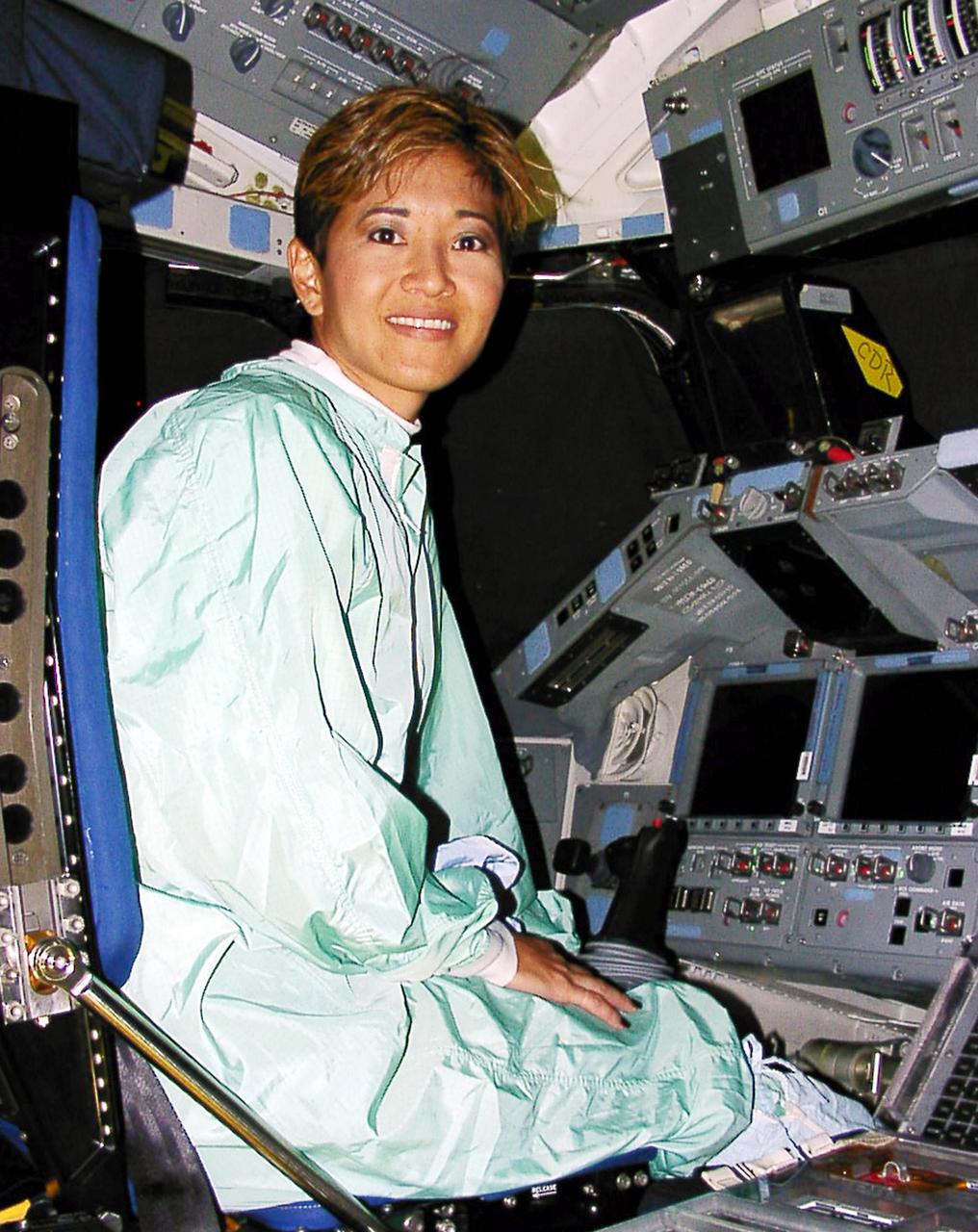
WESH-TV 2 News Anchor Wendy Chioji sits in the cockpit of a space shuttle while touring Kennedy Space Center.
KSC-02PD-1422
WESH-TV 2 News Anchor Wendy Chioji sits in the cockpit of a space shuttle while touring Kennedy Space Center.
KSC-02PD-1423
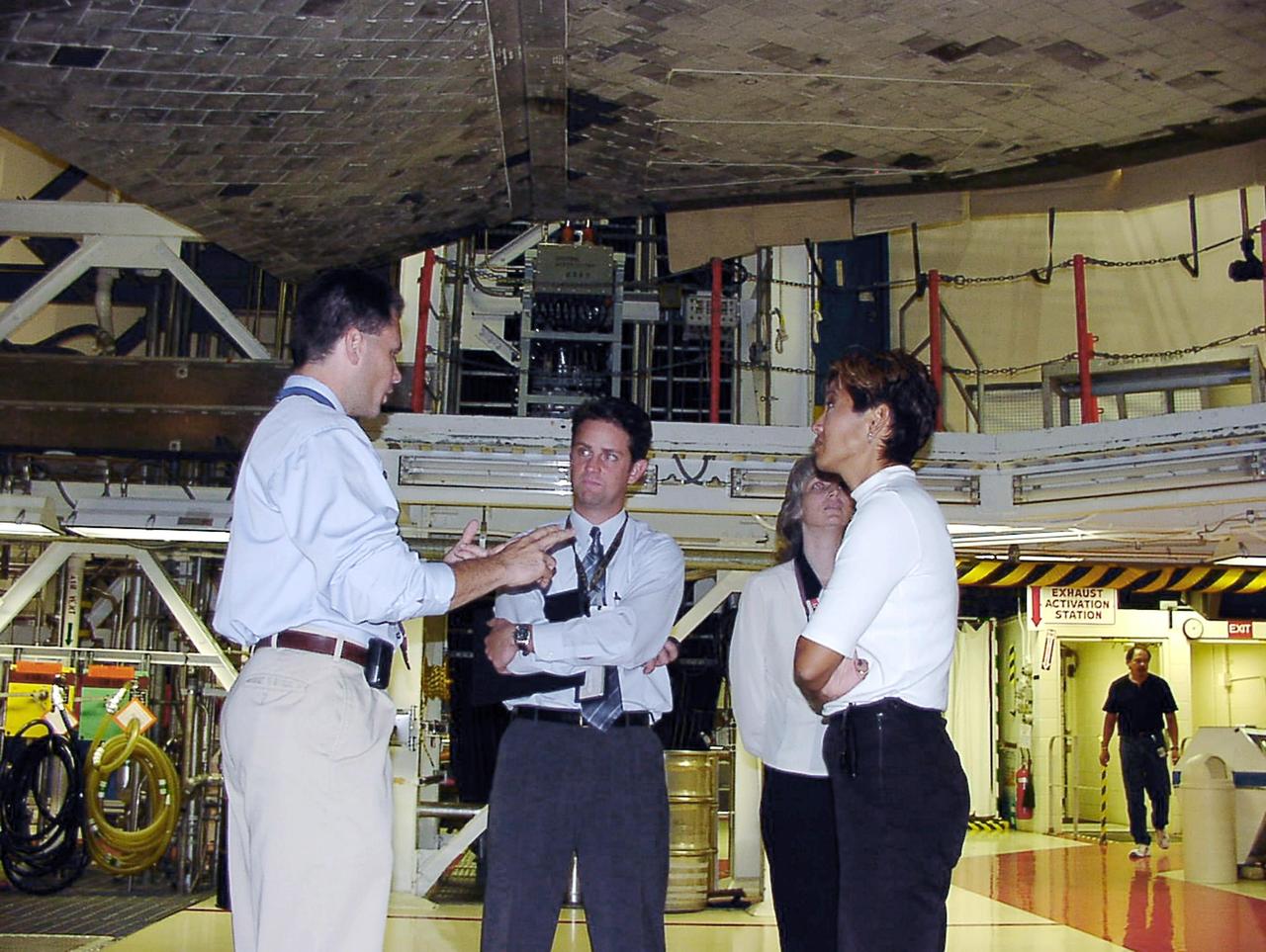
WESH-TV 2 News Anchor Wendy Chioji tours the Orbiter Processing Facility.
KSC-02PD-1420
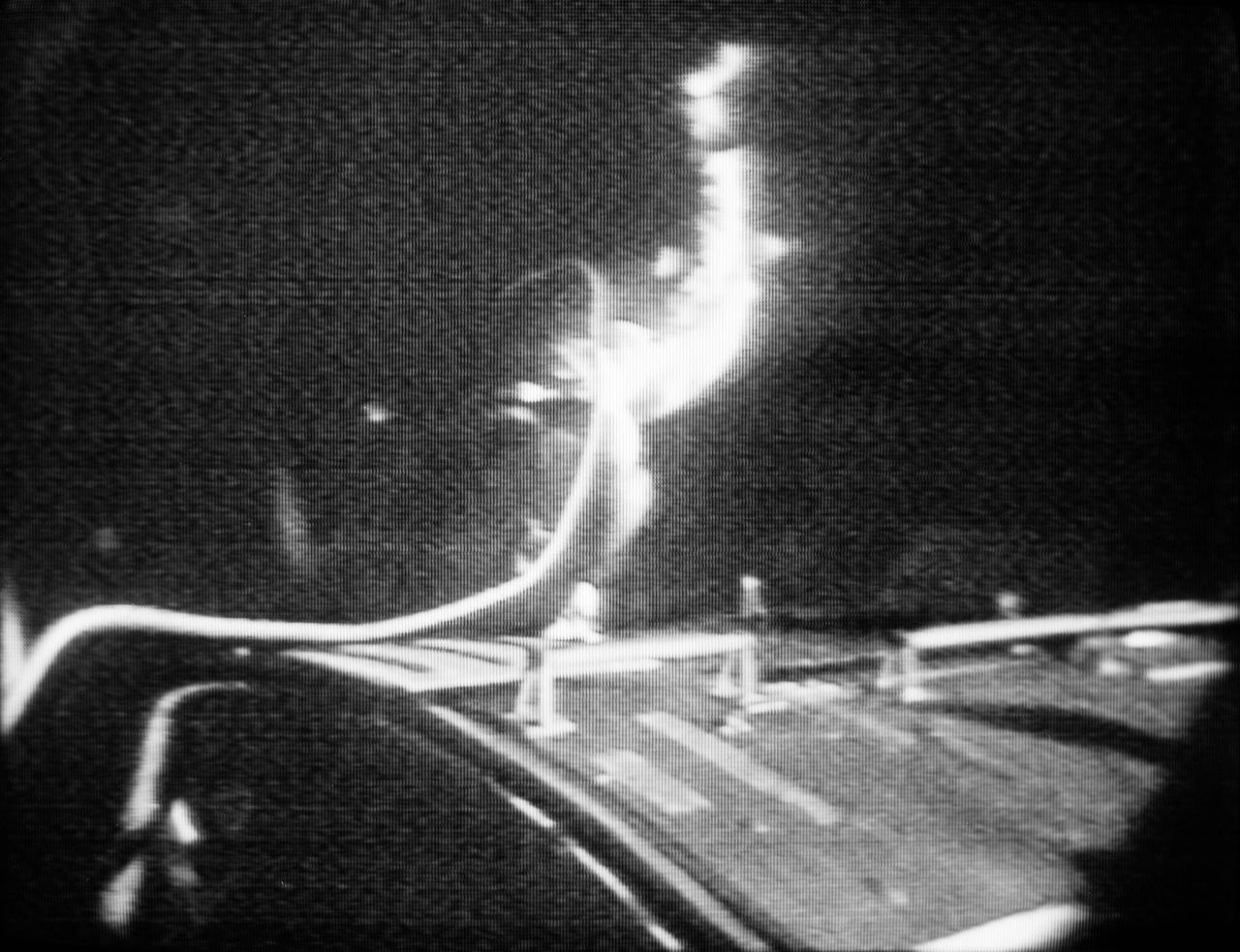
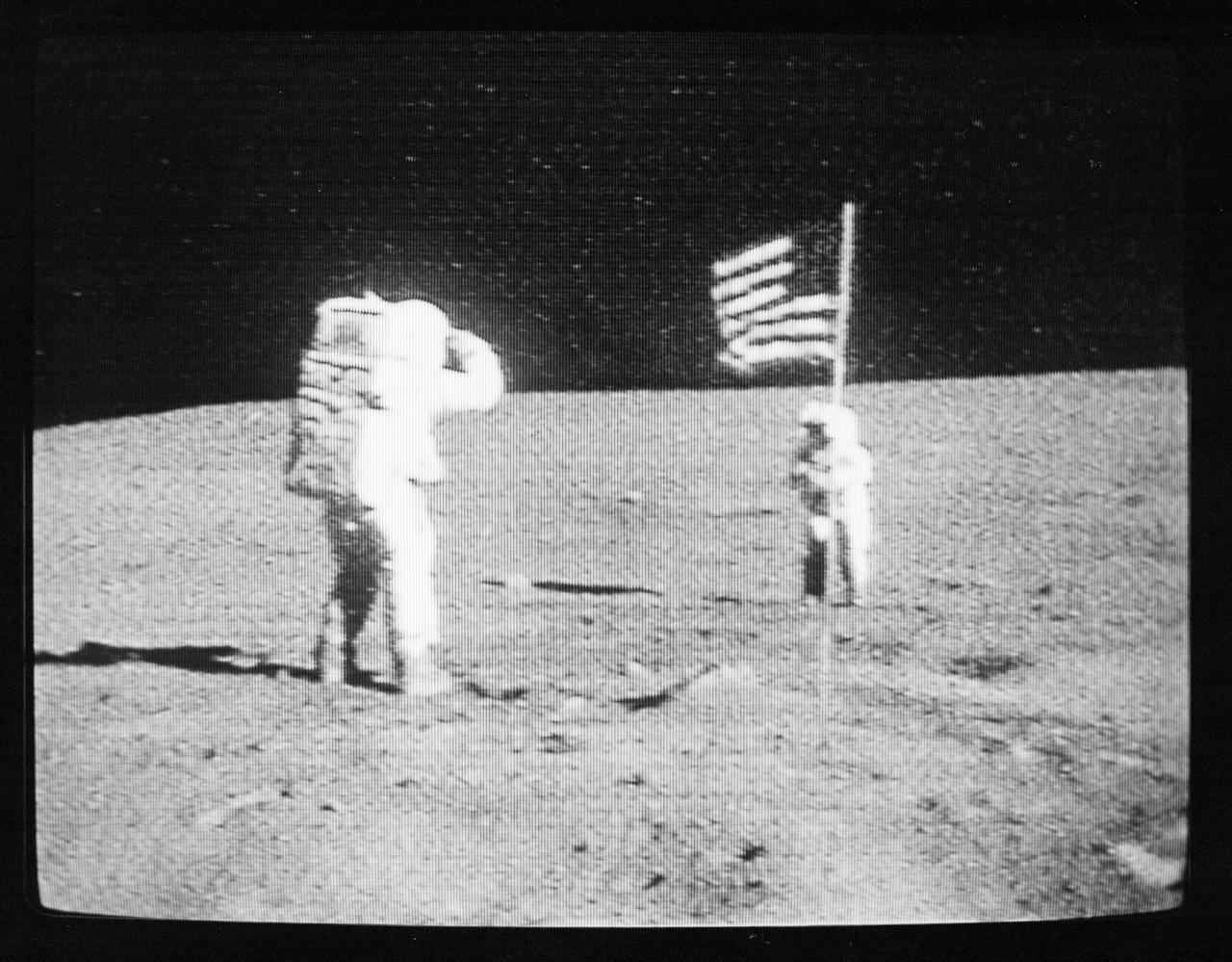
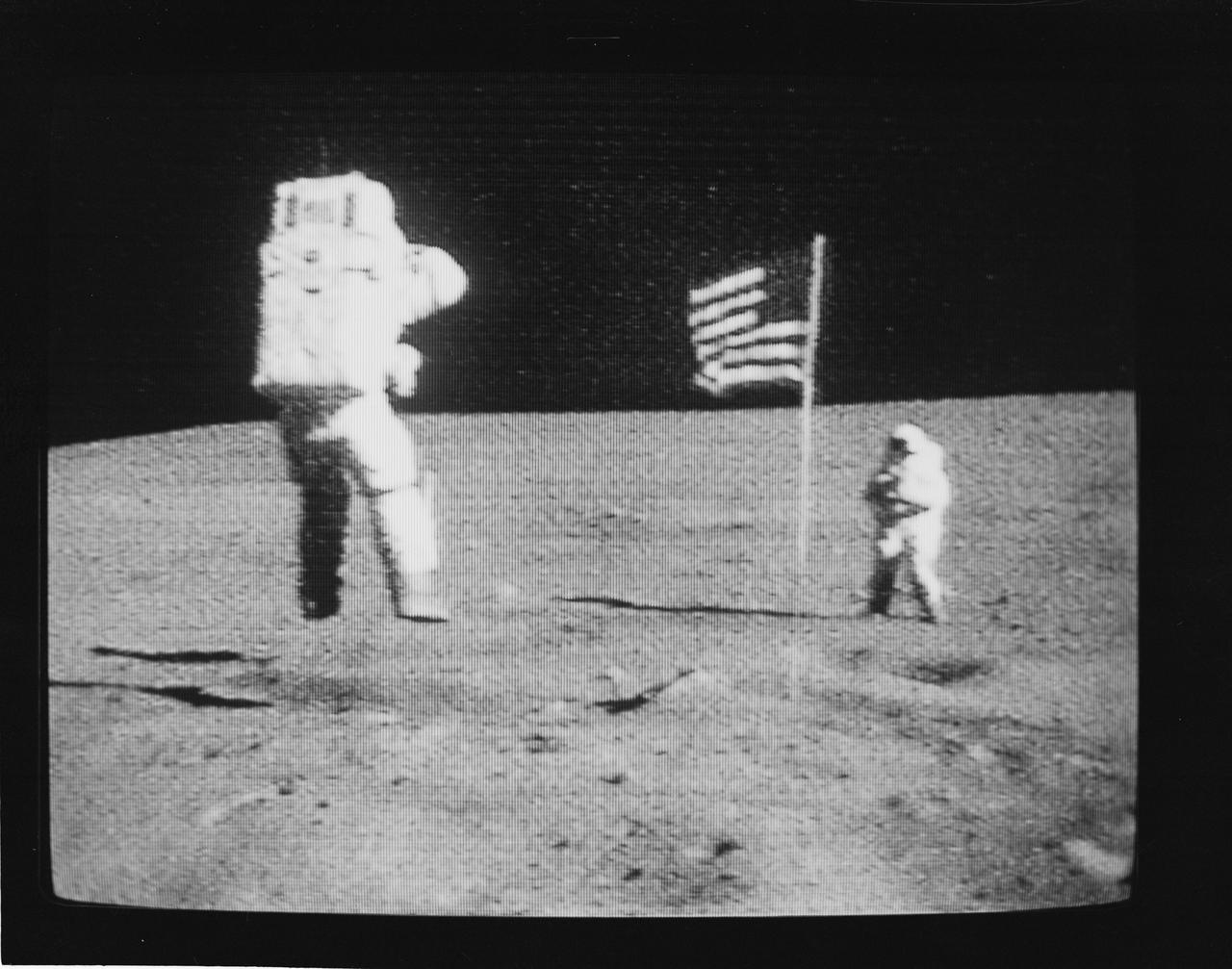
S72-35595 (21 April 1972) --- Astronaut Charles M. Duke Jr., lunar module pilot, salutes the United States flag during the first Apollo 16 extravehicular activity (EVA) on the moon, as seen in this black & white reproduction taken from a color television transmission made by the color TV camera mounted on the Lunar Roving Vehicle (LRV). Astronaut John W. Young, commander of the Apollo 16 lunar landing mission, stands beside the flag. While astronauts Young and Duke descended in the Apollo 16 Lunar Module (LM) "Orion" to explore the Descartes highlands landing site on the moon, astronaut Thomas K. Mattingly II, command module pilot, remained with the Command and Service Modules (CSM) "Casper" in lunar orbit.
TV Transmission Images - Apollo-Saturn (AS)-XVI Crewmen - Lunar Surface (Poor Quality)
S72-35594 (21 April 1972) --- Astronaut John W. Young, commander of the Apollo 16 lunar landing mission, leaps from the lunar surface as he salutes the United States flag during the first Apollo 16 extravehicular activity (EVA) on the moon, as seen in this black & white reproduction taken from a color television transmission made by the color TV camera mounted on the Lunar Roving Vehicle (LRV). Astronaut Charles M. Duke Jr., lunar module pilot, stands beside the flag. While astronauts Young and Duke descended in the Apollo 16 Lunar Module (LM) "Orion" to explore the Descartes highlands landing site on the moon, astronaut Thomas K. Mattingly II, command module pilot, remained with the Command and Service Modules (CSM) "Casper" in lunar orbit.
TV Transmission Images - Apollo/Saturn (A/S)-XVI Crewmen - Lunar Surface - Poor Quality.
As NASA Mariner 10 approached Mercury at nearly seven miles per second on March 29, 1974, its TV camera took this picture from an altitude of 35,000 kilometers 21,700 miles The picture shows a heavily-cratered surface with many low hills
Mercury Heavily Cratered Surface
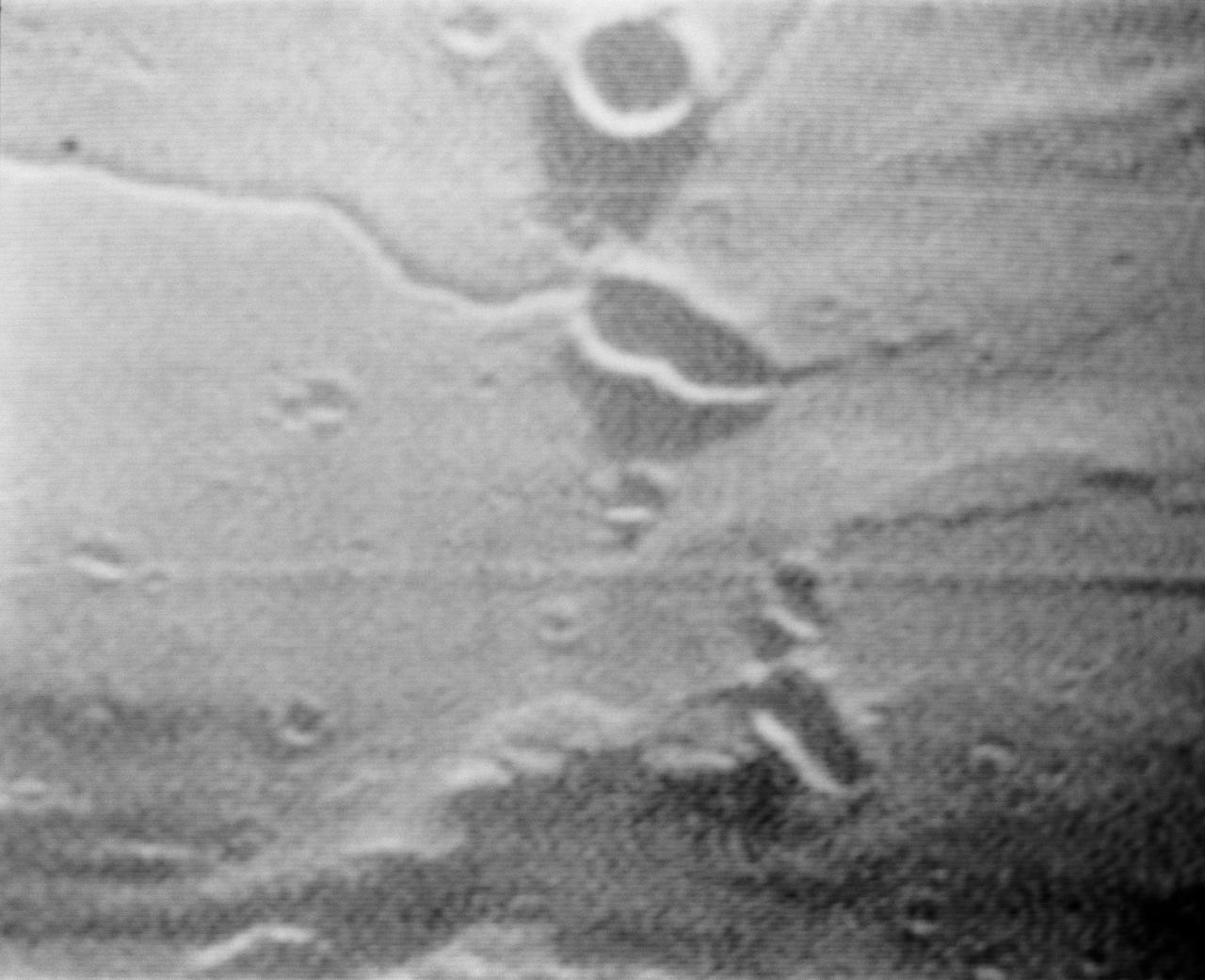
S69-39541 (19 July 1969) --- A near vertical view of Diamondback Rille is seen in this color reproduction taken from the fourth color television transmission from the Apollo 11 spacecraft, during its second revolution of the moon. The center of the picture is located at about 26.9 degrees east longitude and 1.2 degrees north latitude. This area is just east of the Apollo Landing Site 2. The crew of the Apollo 11 lunar landing mission is astronauts Neil A. Armstrong, commander; Michael Collins, command module pilot; and Edwin E. Aldrin Jr., lunar module pilot.
APOLLO 11 - TV TRANSMISSION
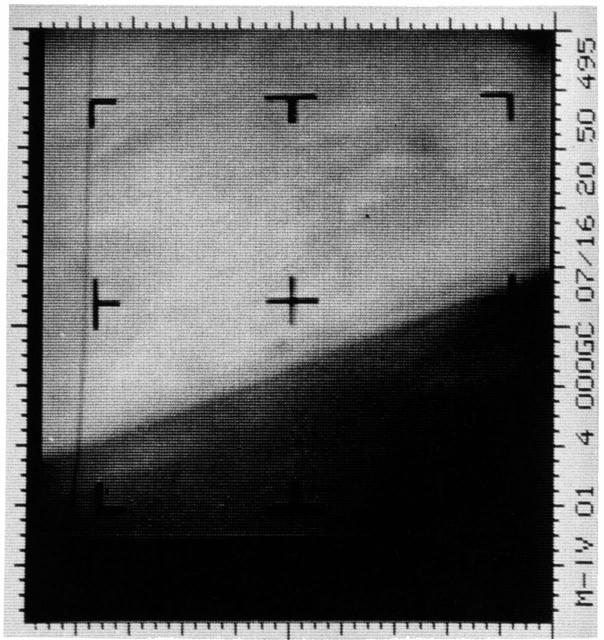
This is an enhanced contrast version of the first Mars photograph released on July 15, 1965. This is man first close-up photograph of another planet, a photographic representation of digital data radioed from Mars by the Mariner 4 spacecraft.
First TV Image of Mars
Originally devised to observe Saturn stage separation during Apollo flights, Marshall Space Flight Center's Miniature Television Camera, measuring only 4 x 3 x 1 1/2 inches, quickly made its way to the commercial telecommunications market.
Benefit from NASA
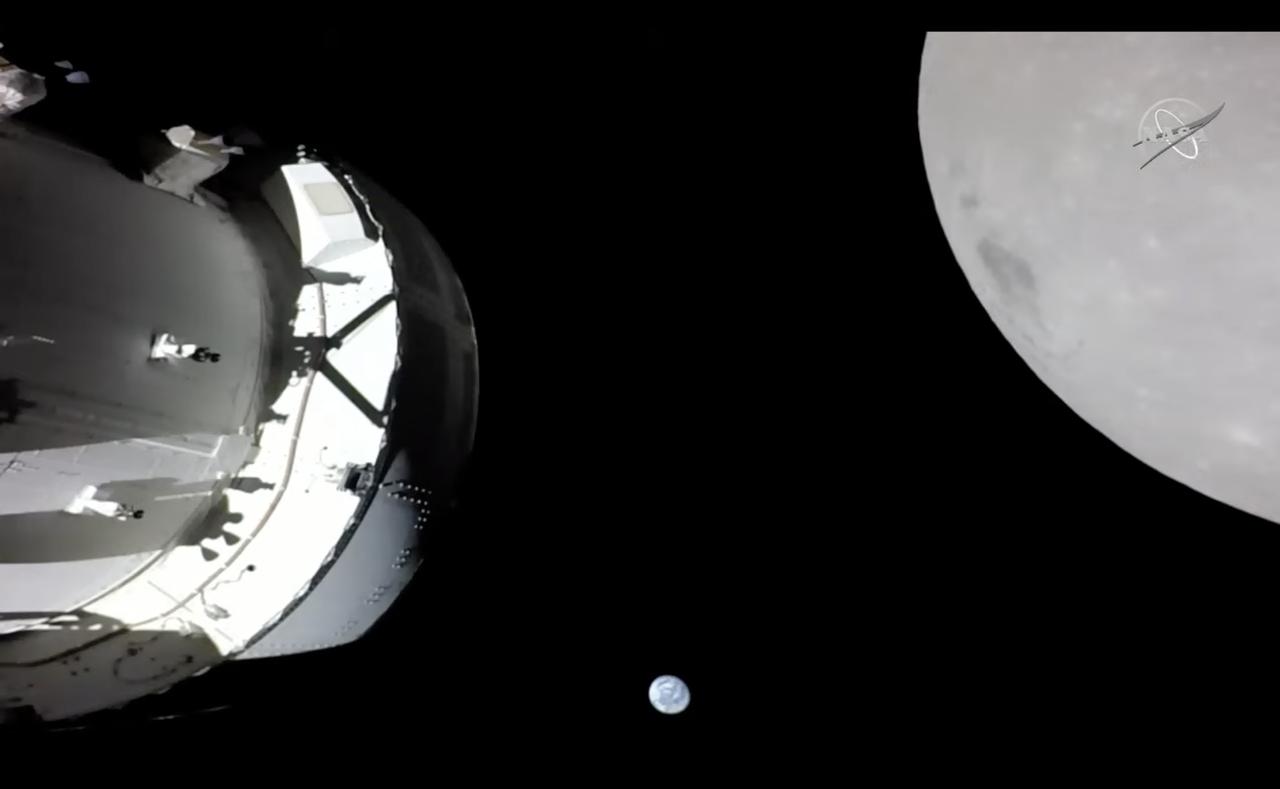
On Nov. 21, 2022, a camera on Orion's solar array wing captured this view of the spacecraft, the Earth and the Moon. Orion was making its outbound powered flyby of the Moon as part of the Artemis I mission, approaching within 80 miles of the lunar surface. Artemis I, the first flight test of NASA's Orion capsule and Space Launch System rocket, launched Nov. 16, 2022, and is scheduled to splashdown Dec. 11.
orion_earth_moon_20221121
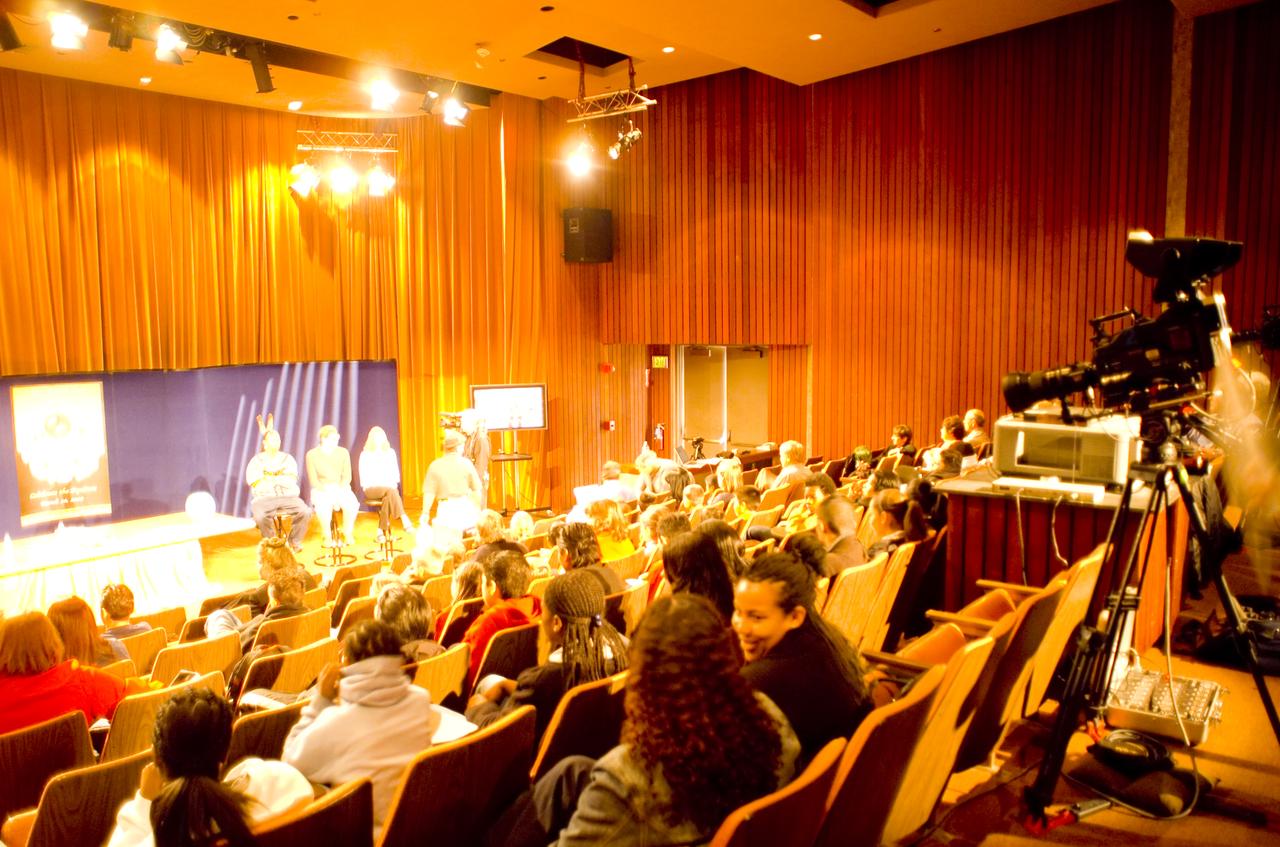
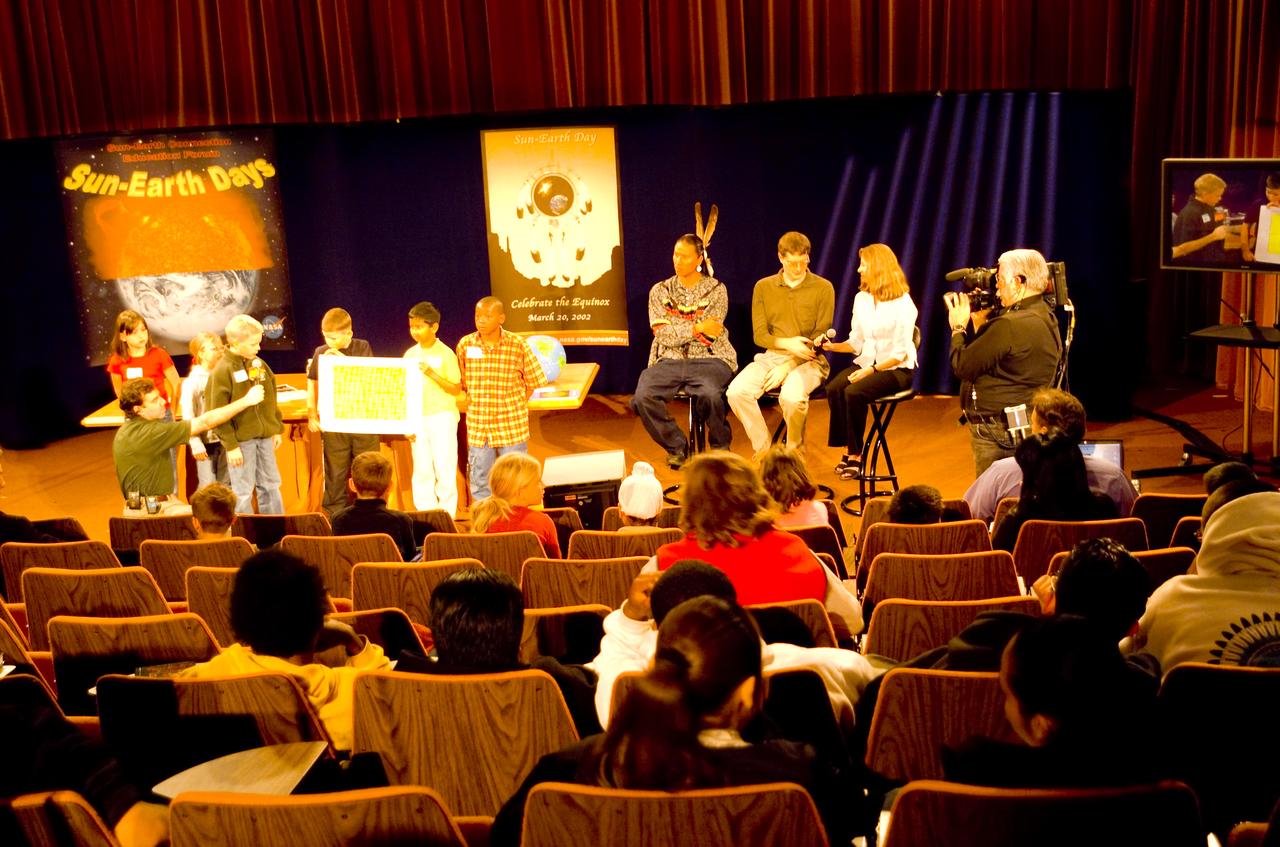
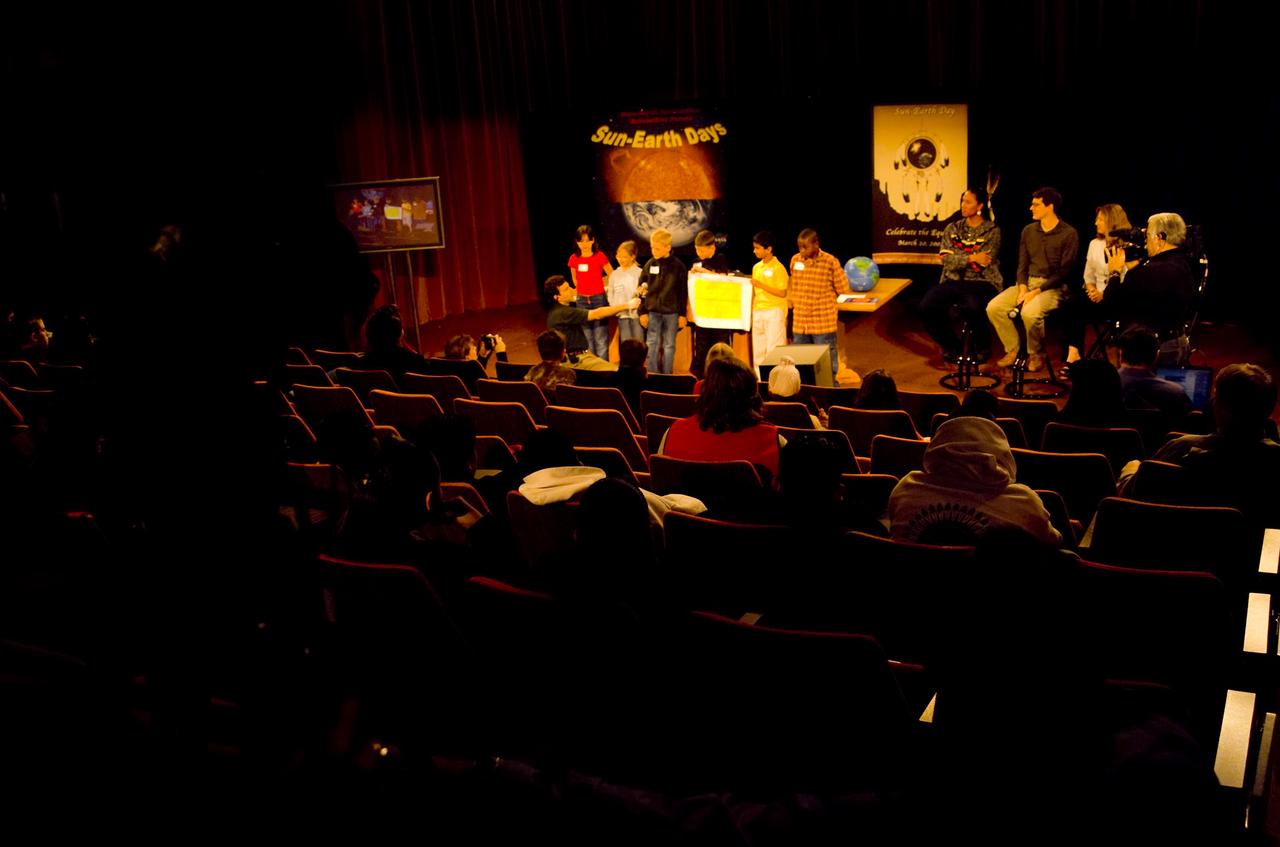
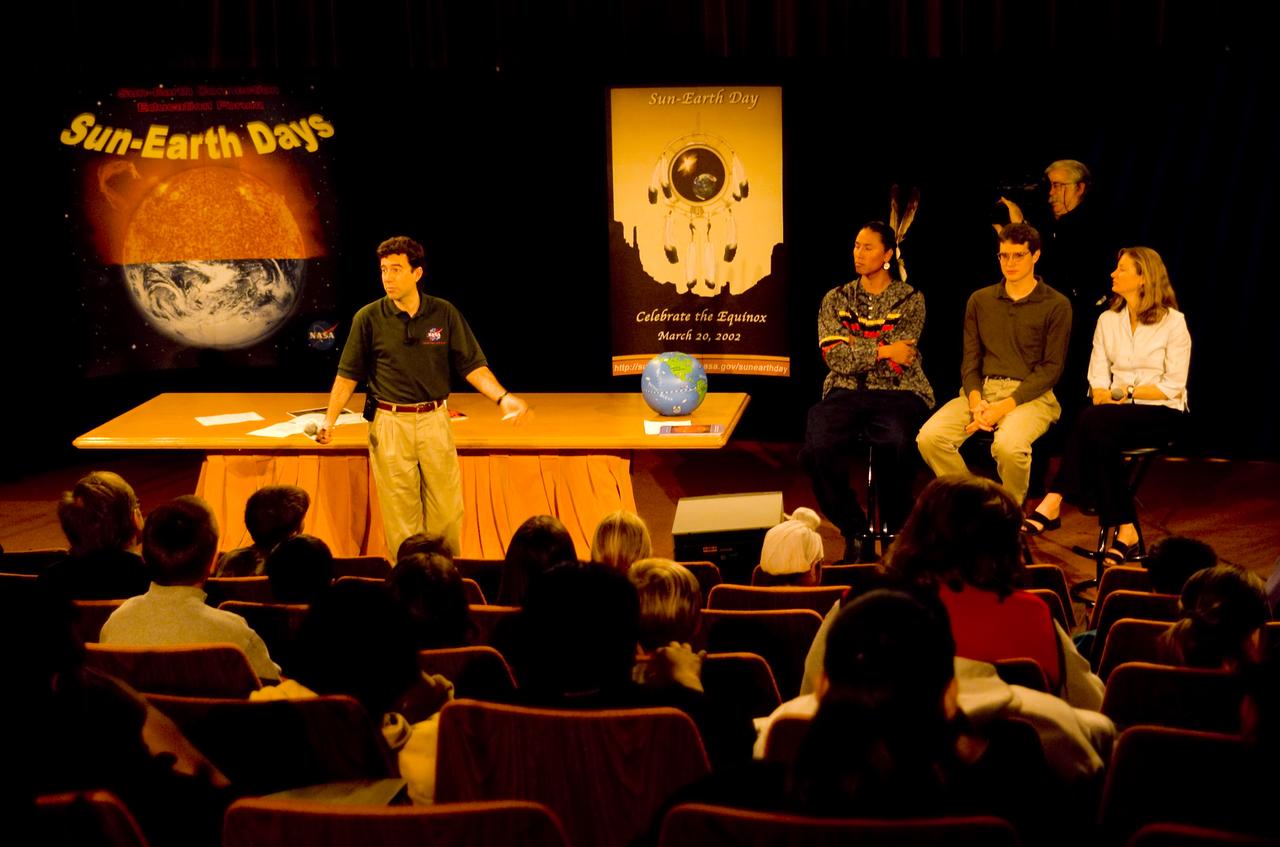
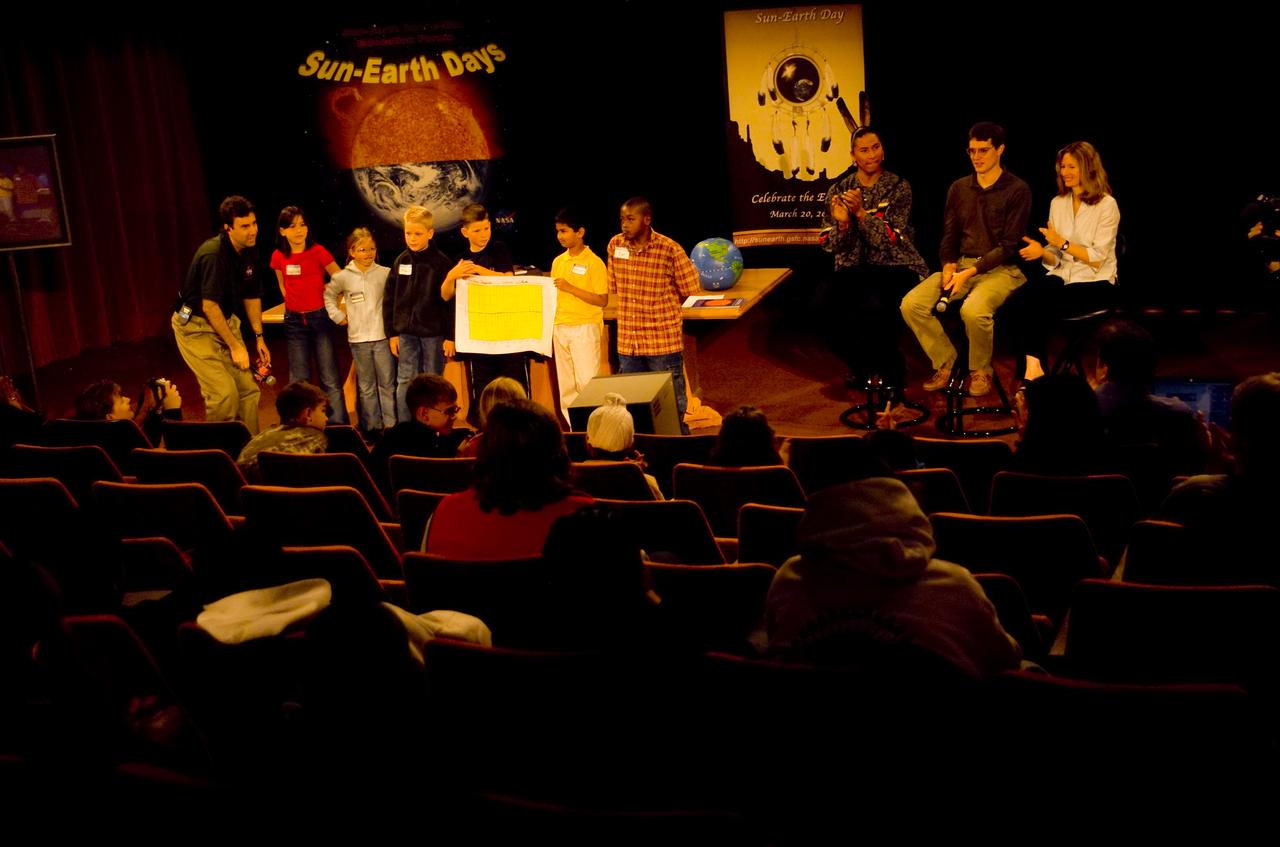
Sun Earth Day Webcast - NASA TV; Host Paul Mortefield, Astronomer Stanford Solar Center and Visiting Students from San Francisco Area Schools
ARC-2002-ACD02-0055-13
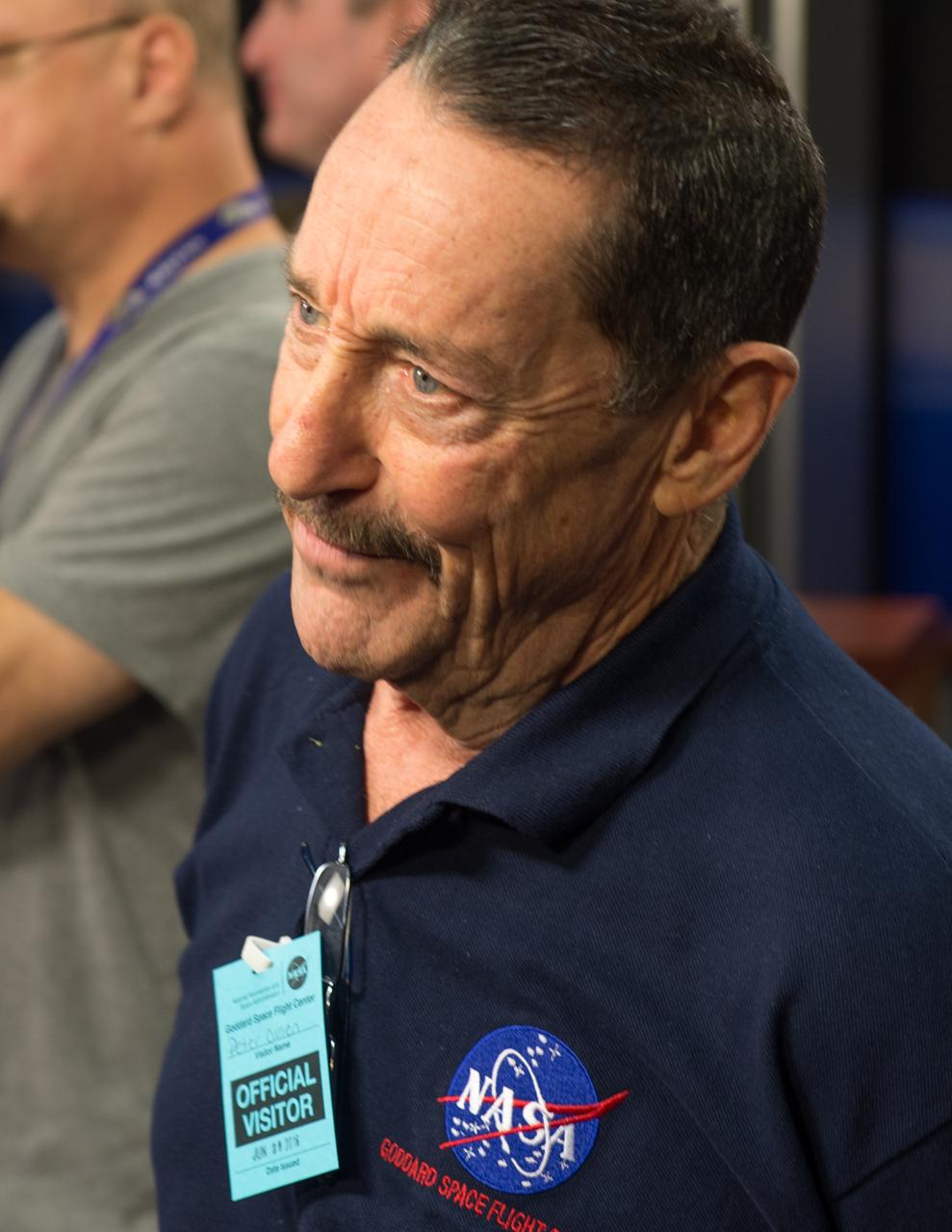
The Optimus Prime Challenge workshop for winning students recording a video segment in the NASA Goddard TV studio with Peter Cullen, the voice of Optimus
Actor Peter Cullen
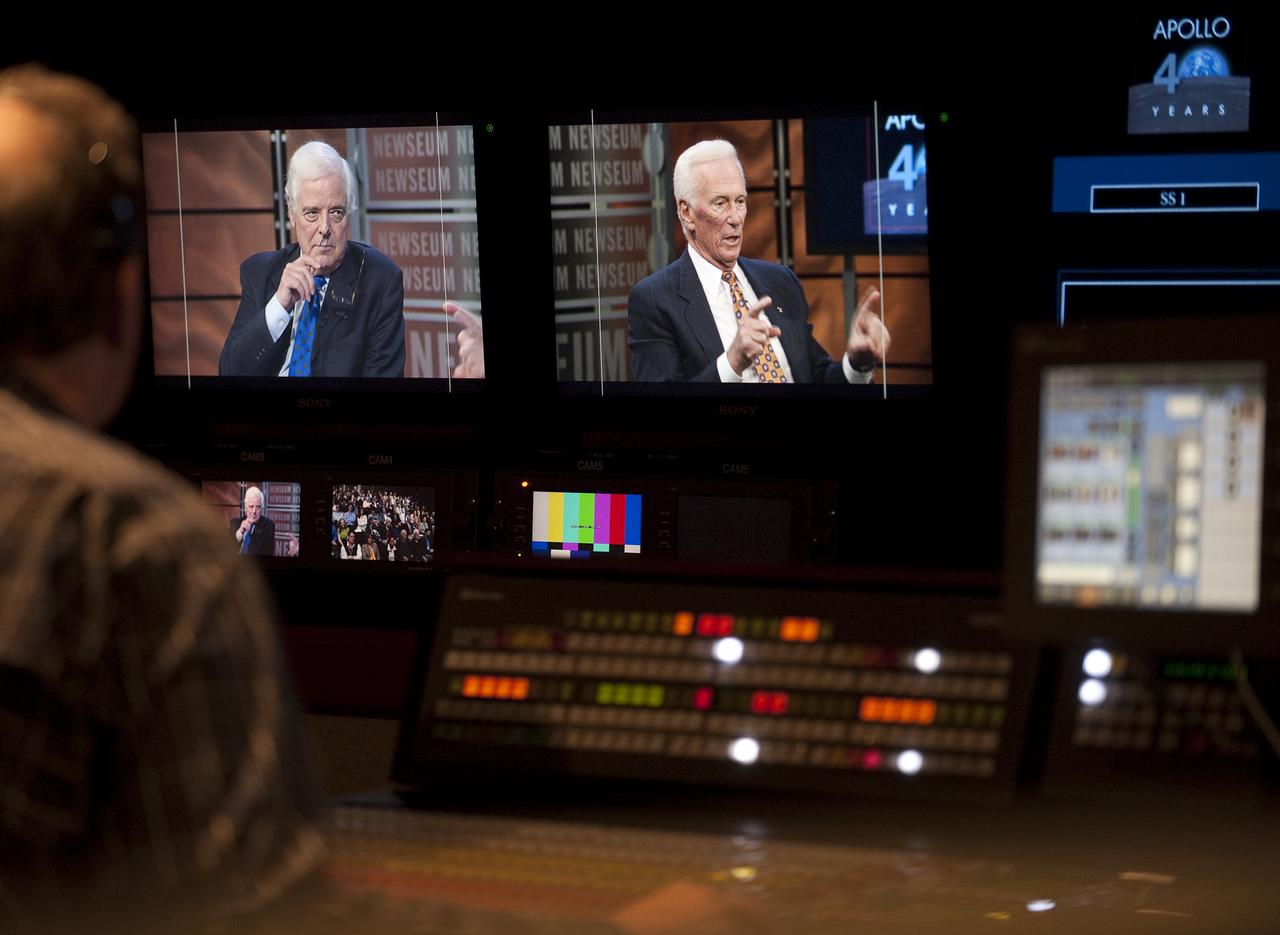
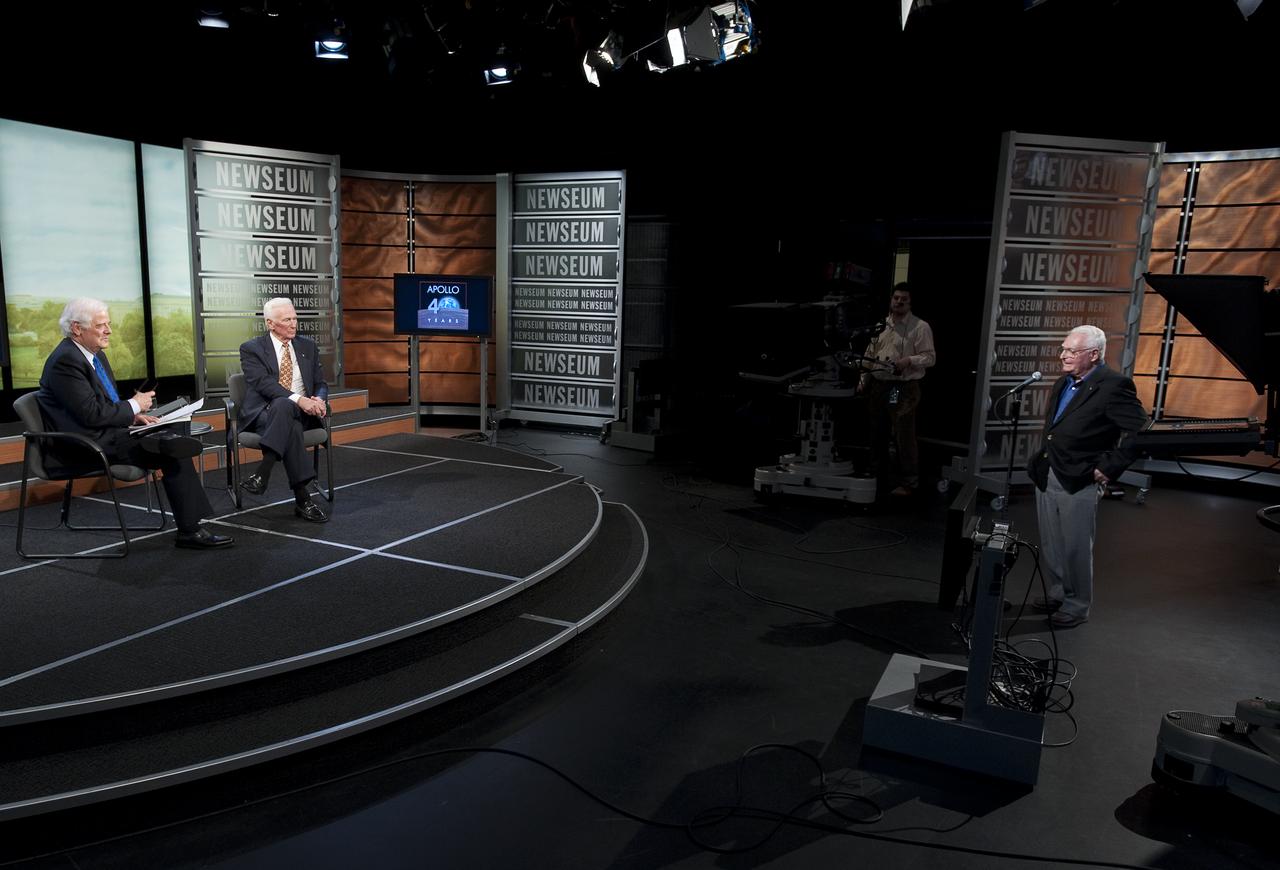
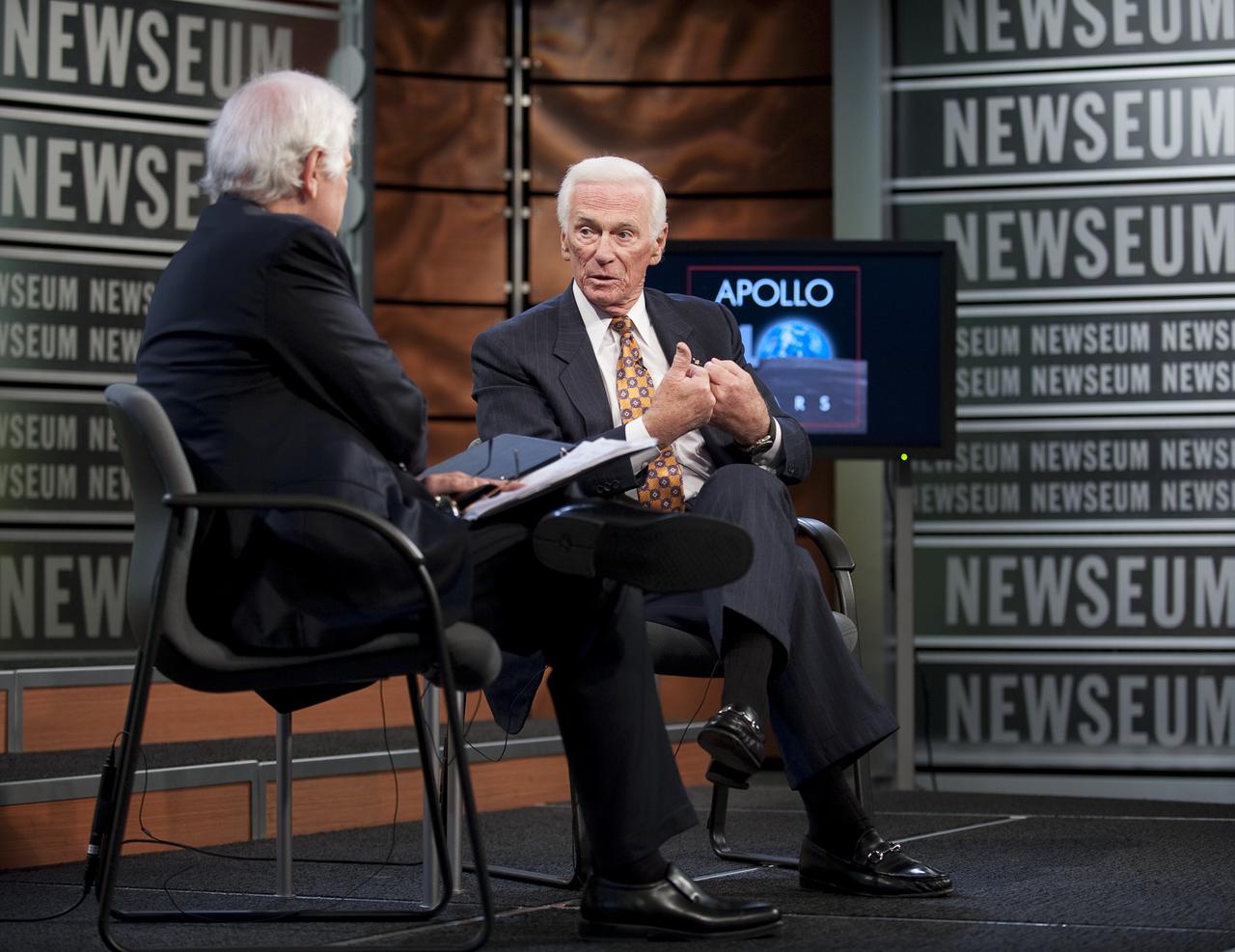
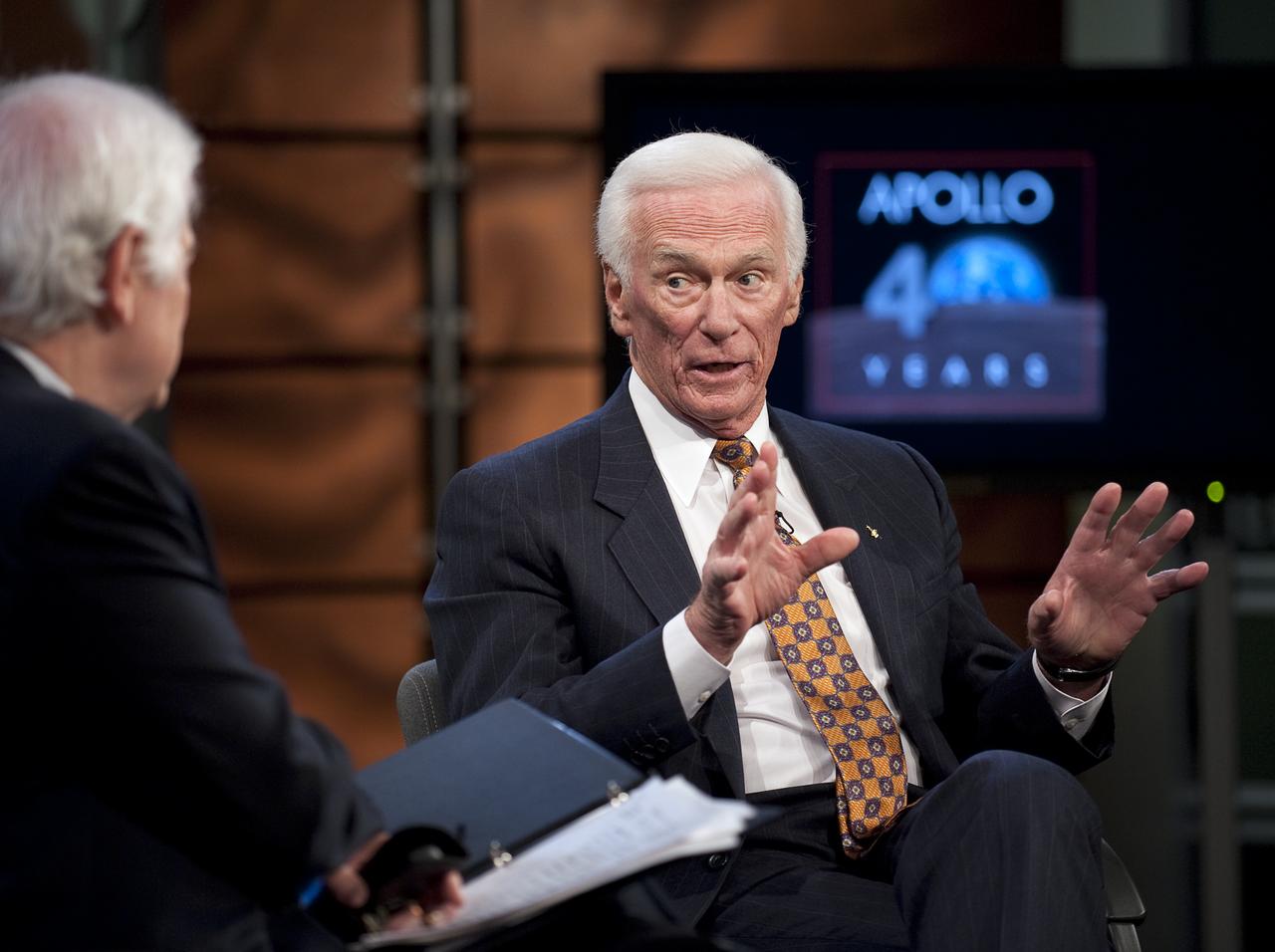
In this image made inside the TV production studio of the Newseum, NASA Apollo 10 Astronaut Gene Cernan, right monitor, answers questions from the Newseum's distinguished journalist-in-residence, Nick Clooney, left monitor, during a Newseum TV program celebrating the 40th anniversary of Apollo 10, Monday, May 18, 2009, in Washington.  Photo Credit (NASA/Bill Ingalls)
Apollo 10 40th Anniversary Program
ISS028-E-032136 (17 Aug. 2011) --- Russian cosmonaut Sergei Volkov, Expedition 28 flight engineer, is pictured floating freely in the Unity node of the International Space Station while filming an installment of the ?The Orbital Station. Life on Orbit? video, intended for a documentary film to be prepared by the Roscosmos TV studio for the ?Kultura? State TV channel.
iss028e032136
NASA Apollo 10 Astronaut Gene Cernan, on stage, right, and the Newseum's distinguished journalist-in-residence, Nick Clooney, on stage, left, talk with a Stan LeBar, Program Manager of the Apollo TV Lunar Camera who helped see that Apollo 10 was the first mission to broadcast in color from the moon during a Newseum TV program celebrating the 40th anniversary of Apollo 10, Monday, May 18, 2009, in Washington.  Photo Credit (NASA/Bill Ingalls)
Apollo 10 40th Anniversary Program
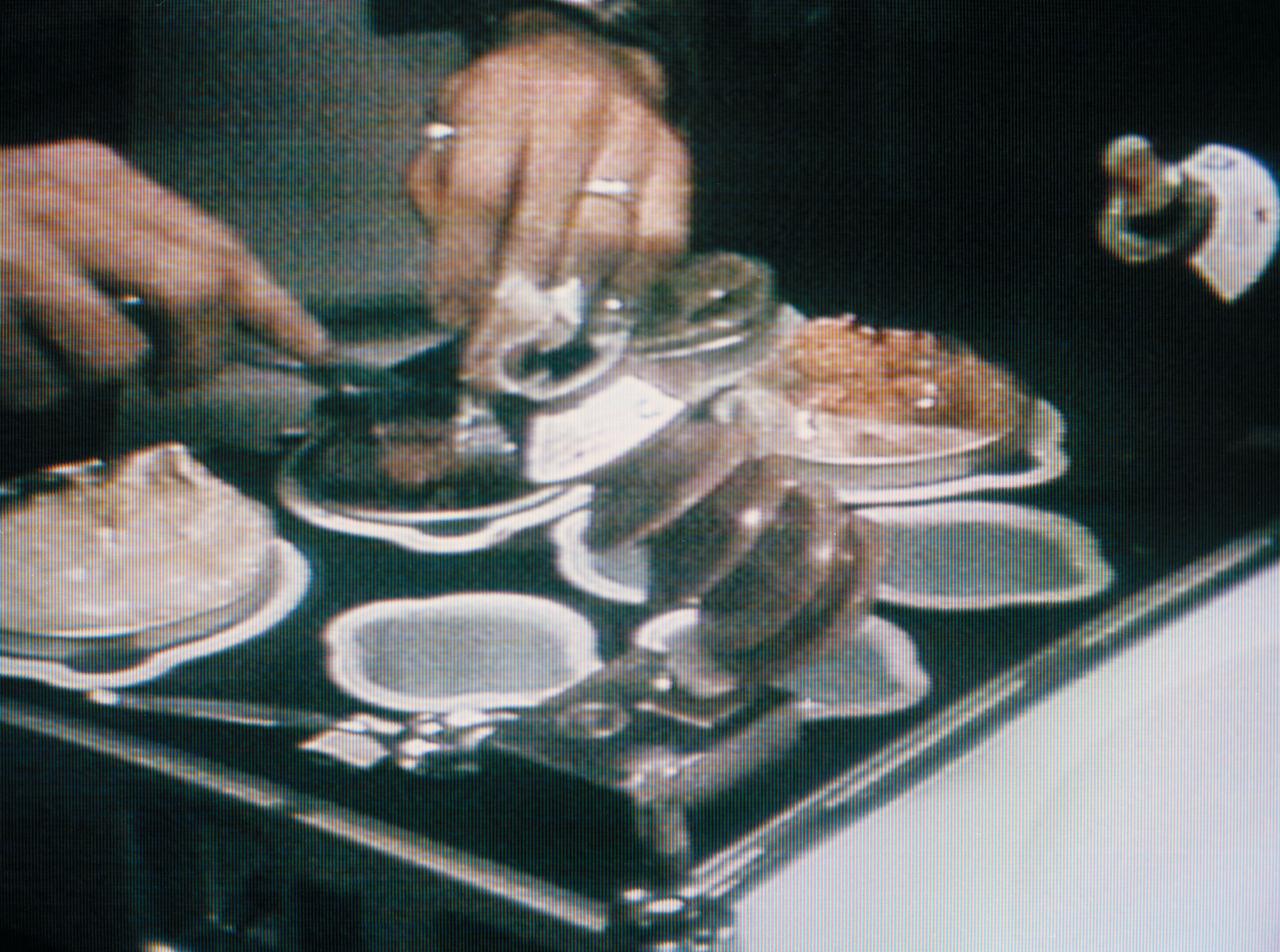
S73-34198 (1 Aug. 1973) --- A close-up view of the hands of astronaut Jack R. Lousma, Skylab 3 pilot, using a silverware utensil to gather food at the food station, in this photographic reproduction taken from a television transmission made by a color TV camera aboard the Skylab space station in Earth orbit.  Astronaut Alan L. Bean, commander, had just zoomed the TV camera in for this close-up of the food tray following a series of wide shots of Lousma at the food station. Photo credit: NASA
Skylab (SL)-3 - Astronaut Jack R. Lousma - Utensils
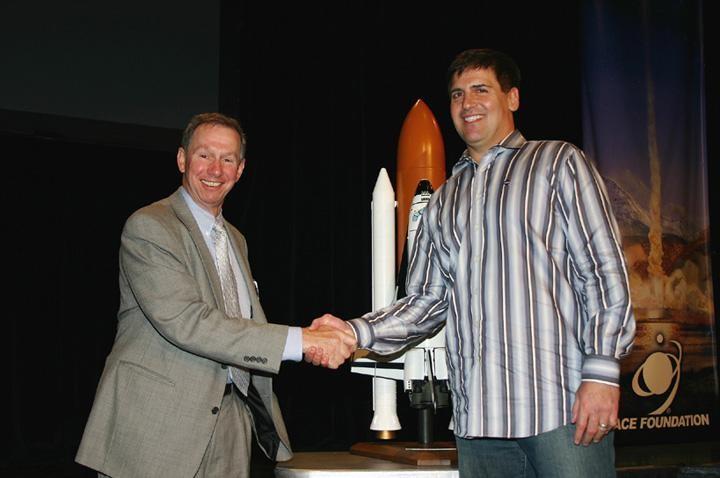
KENNEDY SPACE CENTER, FLA. -  NASA Administrator Mike Griffin (left) and HDNet Chairman and President Mark Cuban shake hands after announcing an agreement for HDNet to provide high definition TV coverage of space shuttle launches through 2010.  The announcement was made at a news conference held in Colorado Springs, Colo.  The news conference was hosted by the Space Foundation during its 22nd National Space Symposium that ended today.   HDNet will broadcast the shuttle flights in high definition TV, known as HDTV, which has at least twice the resolution of standard television formats. HDNet also will provide the agency a standard broadcast signal of launches for use by media networks and NASA TV. When possible, it will air HDTV coverage of NASA's expendable rocket launches on its network.
KSC-06pd0588
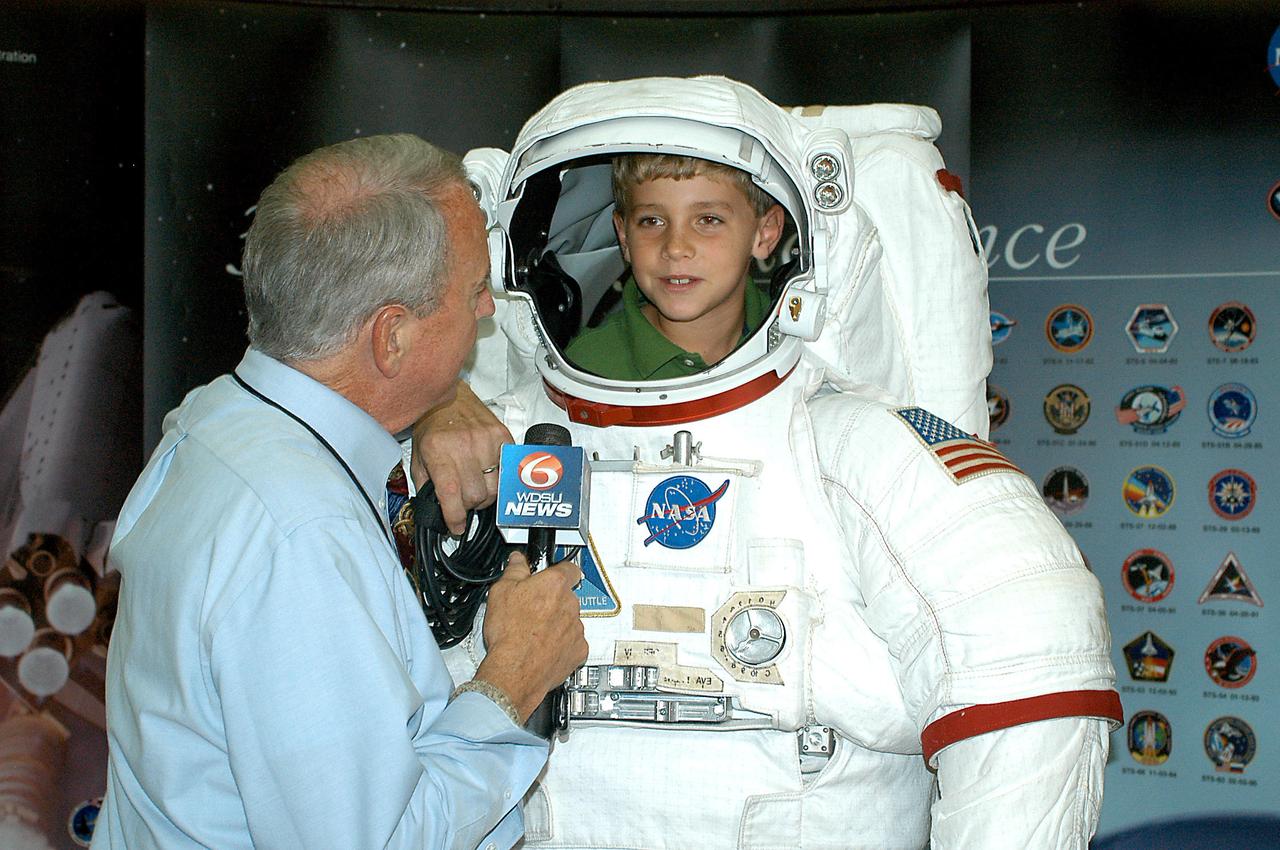
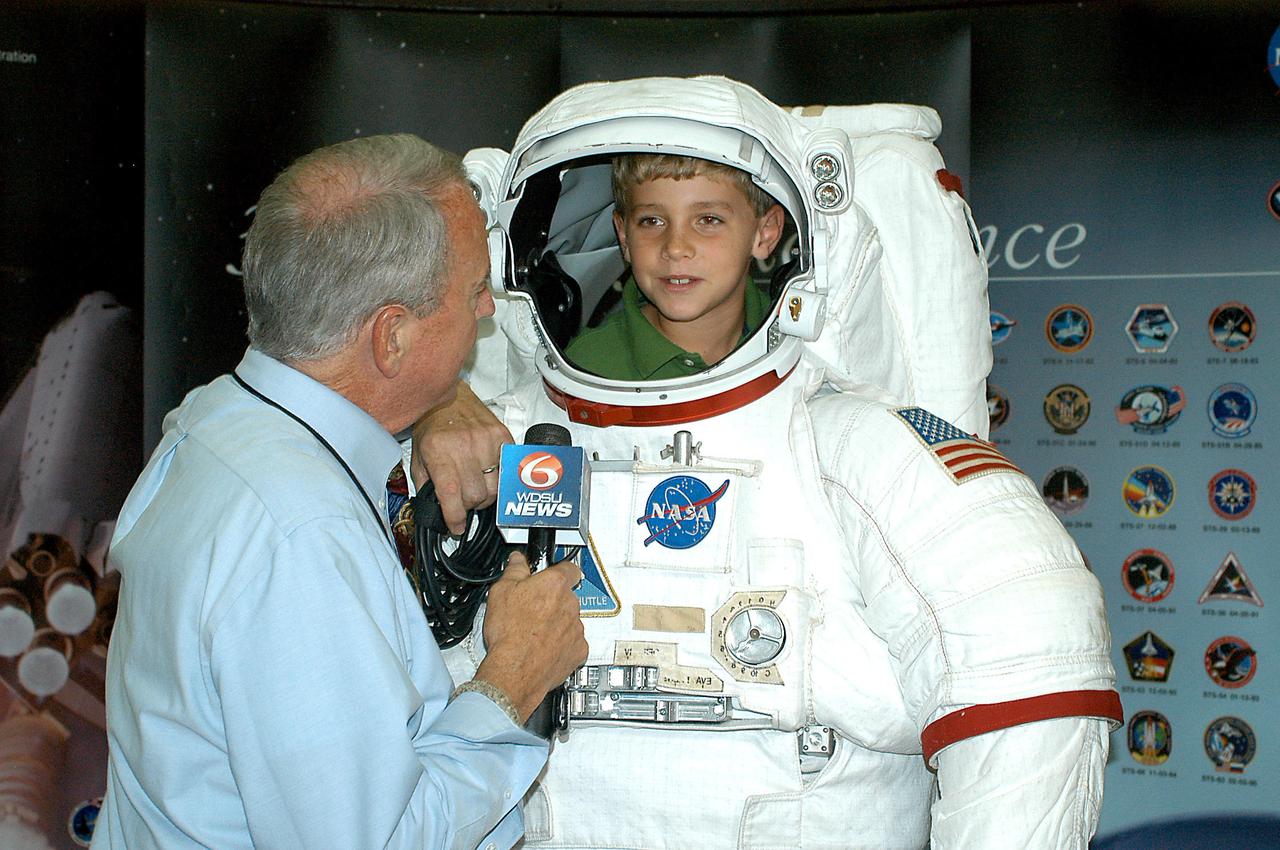
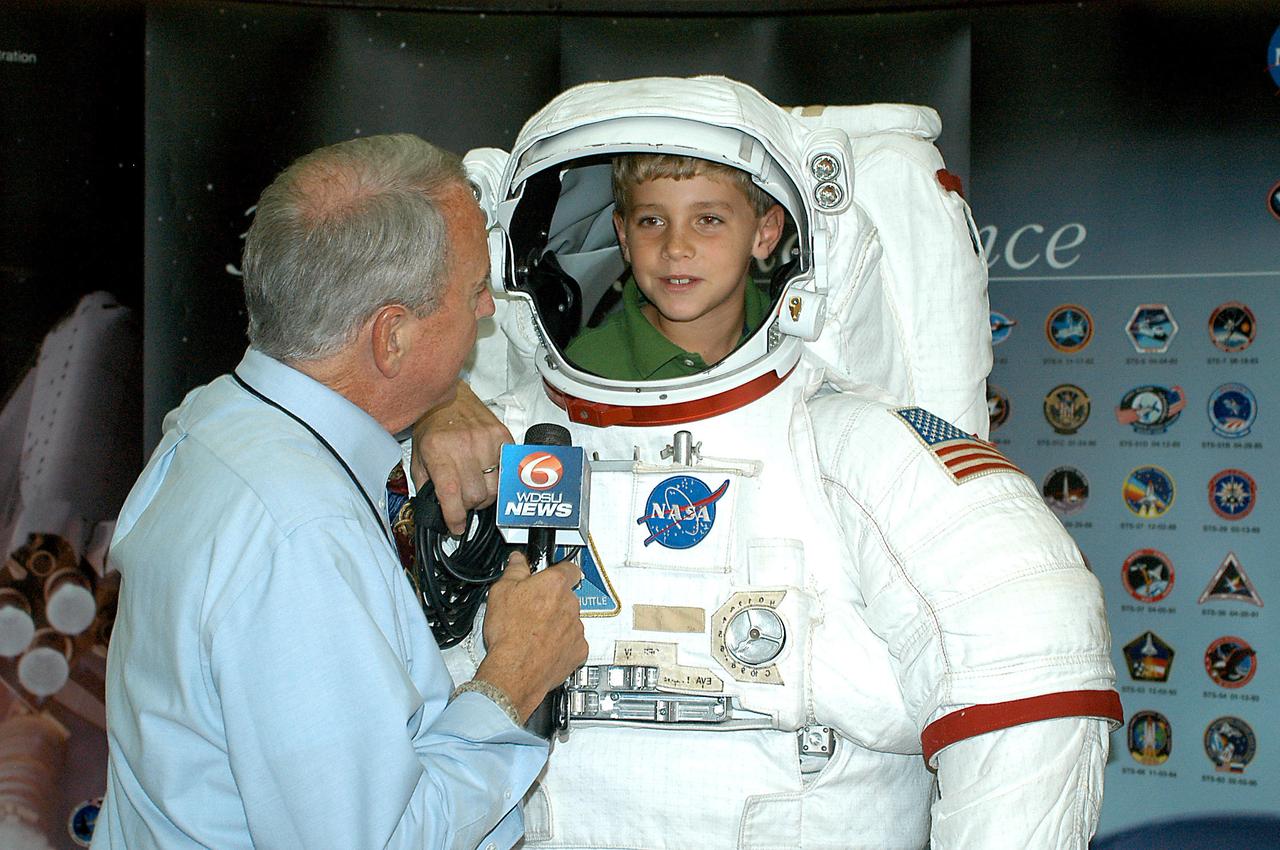
'Astronaut' Patrick Johnston, 8, is interviewed by Heath Allen, a reporter with WDSU-TV in New Orleans, about his experience at the INFINITY at NASA Stennis Space Center facility during ribbon-cutting activities April 11, 2012.
INFINITY ribbon-cutting
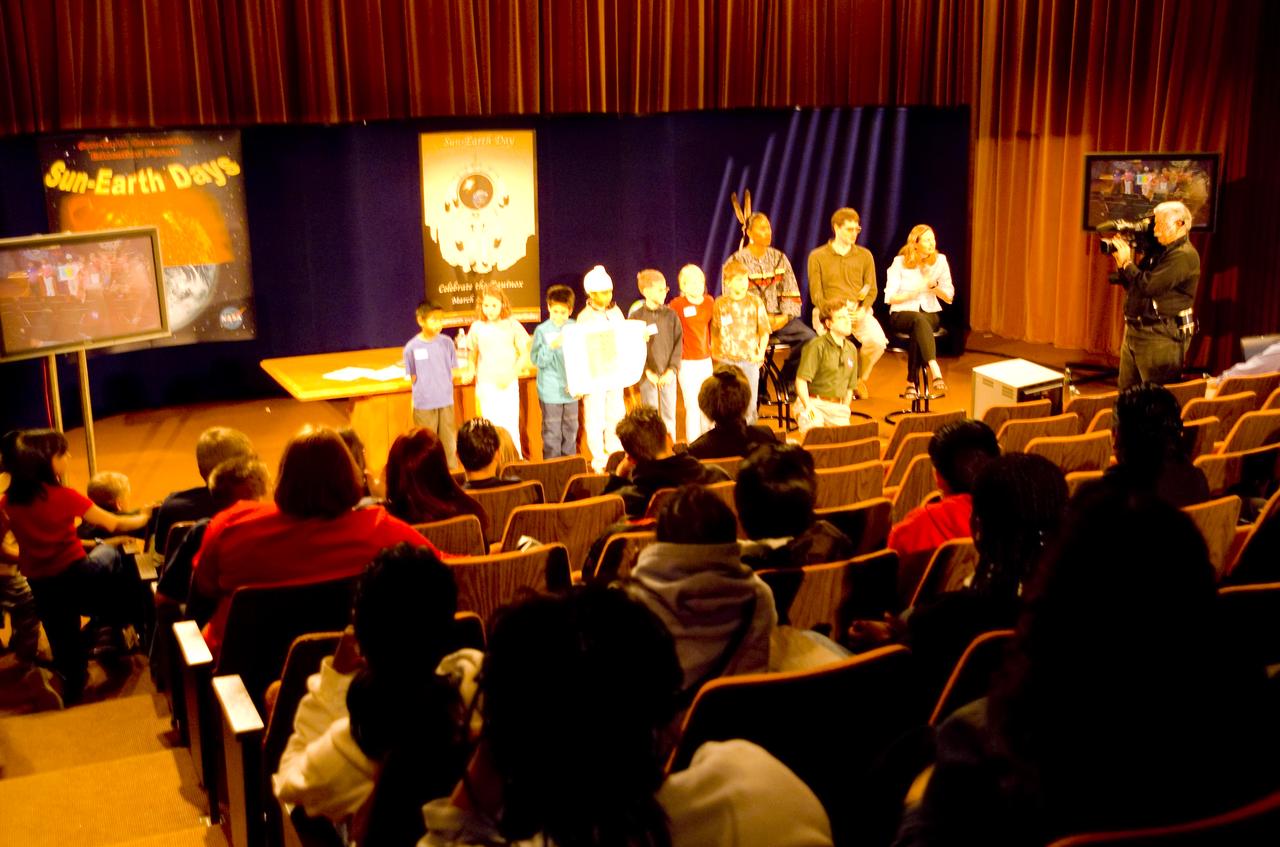
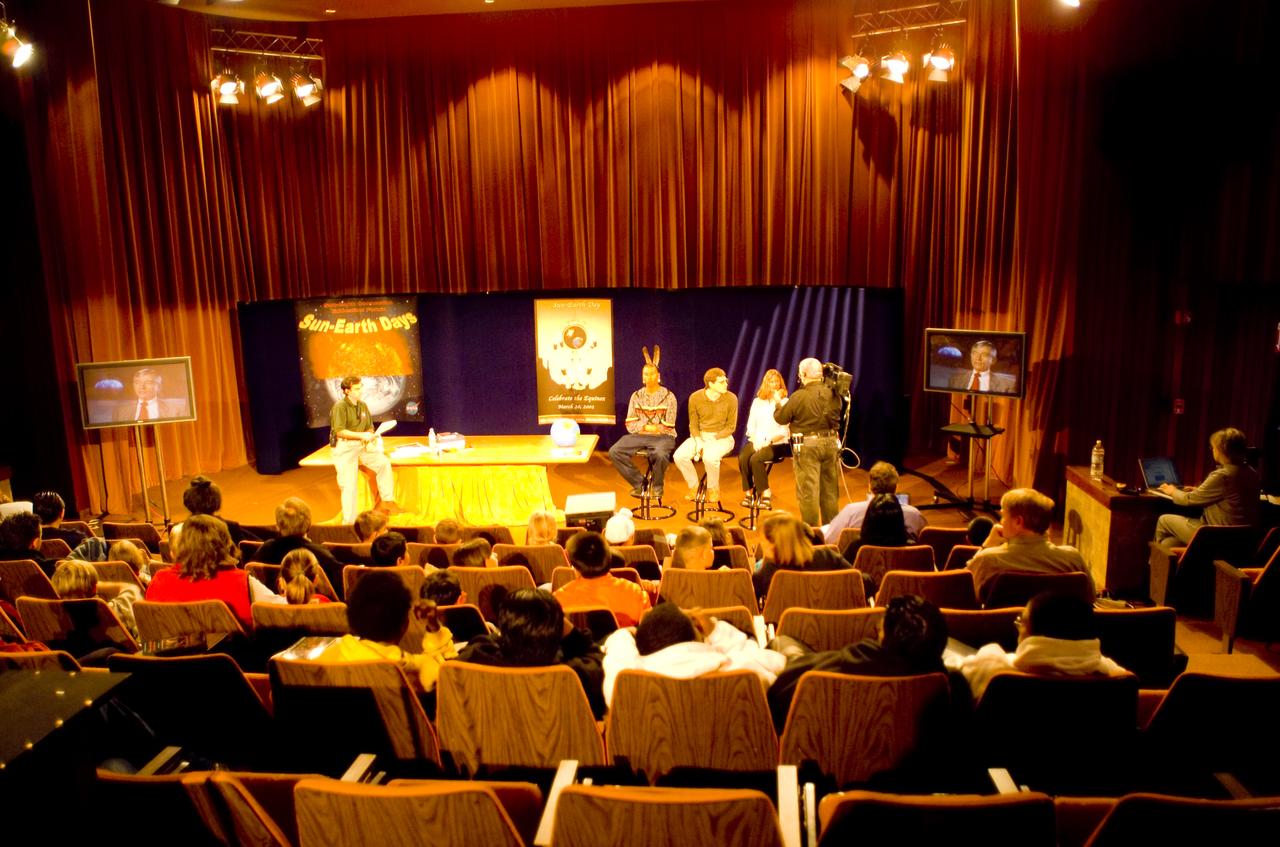
Sun-Earth Day WEBCAST - NASA TV; Host Paul Mortfield, Astronomer Stanford Solar Center and visiting students from San Francisco Bay Area Schools
ARC-2002-ACD02-0055-03
Sun-Earth Day WEBCAST - NASA TV; Host Paul Mortfield, Astronomer Stanford Solar Center and visiting students from San Francisco Bay Area Schools
ARC-2002-ACD02-0055-10
Sun-Earth Day WEBCAST - NASA TV; Host Paul Mortfield, Astronomer Stanford Solar Center and visiting students from San Francisco Bay Area Schools
ARC-2002-ACD02-0055-06
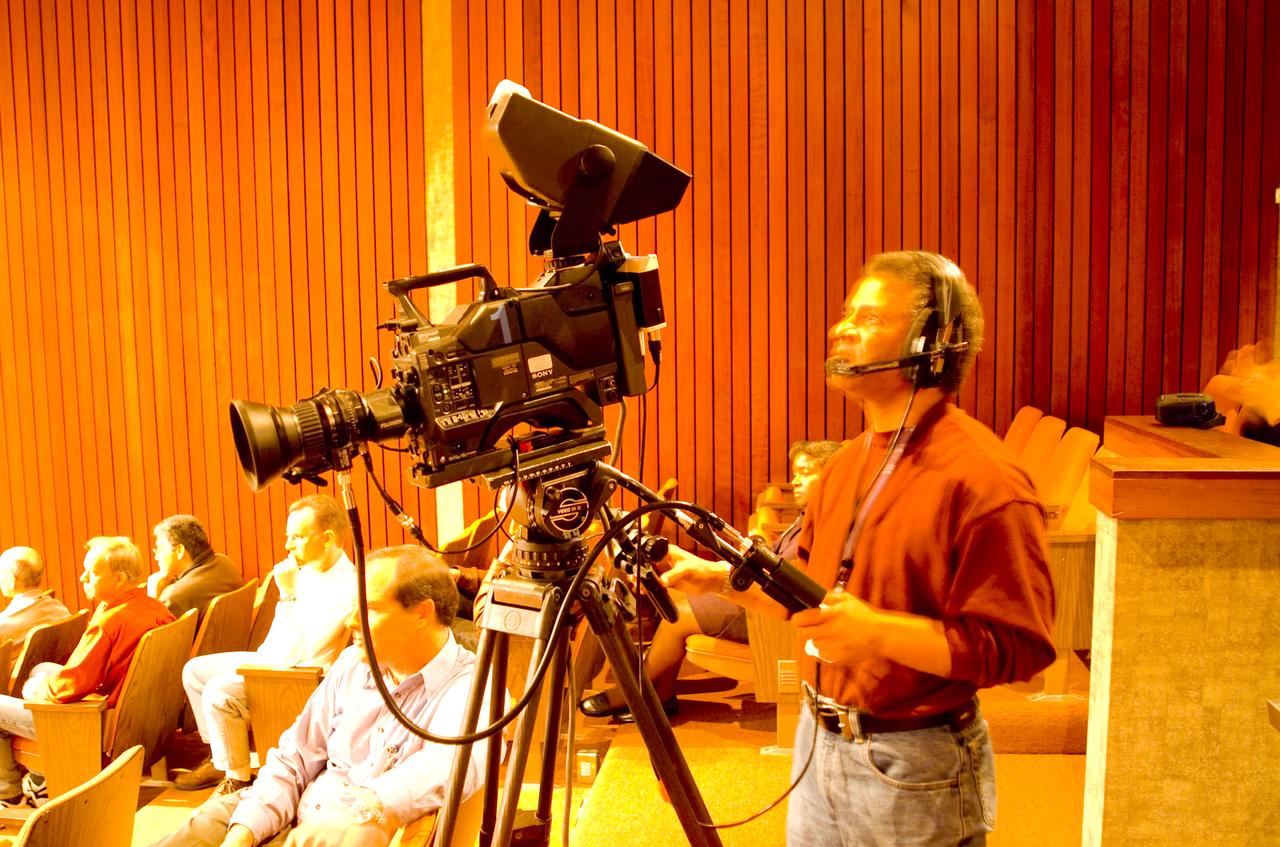
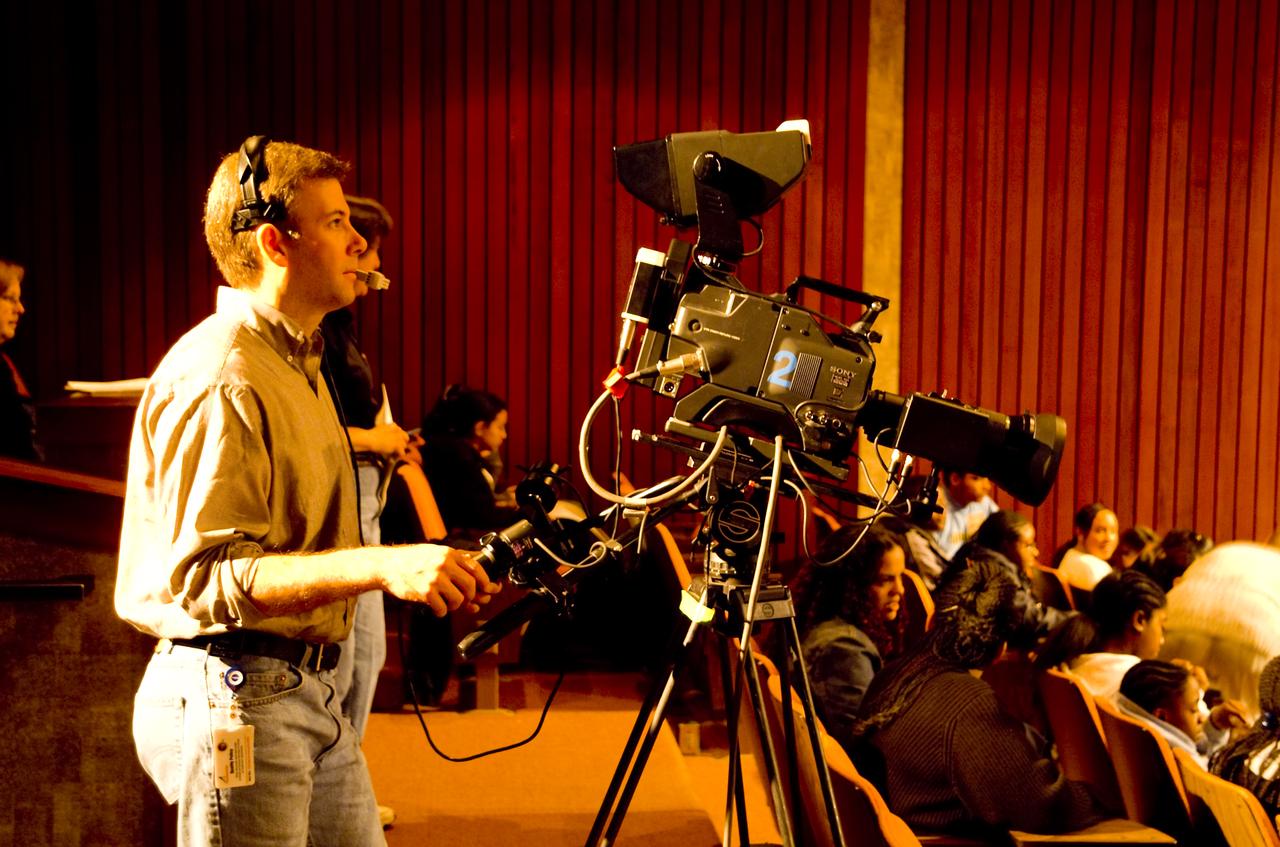
Sun-Earth Day WEBCAST - NASA TV; Host Paul Mortfield, Astronomer Stanford Solar Center and visiting students from San Francisco Bay Area Schools Paul Langston, Videographer operates camera
ARC-2002-ACD02-0055-12
'Astronaut' Patrick Johnston, 8, is interviewed by Heath Allen, a reporter with WDSU-TV in New Orleans, about his experience at the INFINITY at NASA Stennis Space Center facility during ribbon-cutting activities April 11, 2012.
INFINITY ribbon-cutting
Sun-Earth Day WEBCAST - NASA TV; Host Paul Mortfield, Astronomer Stanford Solar Center and visiting students from San Francisco Bay Area Schools
ARC-2002-ACD02-0055-11
'Astronaut' Patrick Johnston, 8, is interviewed by Heath Allen, a reporter with WDSU-TV in New Orleans, about his experience at the INFINITY at NASA Stennis Space Center facility during ribbon-cutting activities April 11, 2012.
INFINITY ribbon-cutting
Sun-Earth Day WEBCAST - NASA TV; Host Paul Mortfield, Astronomer Stanford Solar Center and visiting students from San Francisco Bay Area Schools David Maurantonio, Videographer operates camera
ARC-2002-ACD02-0055-02
Sun-Earth Day WEBCAST - NASA TV; Host Paul Mortfield, Astronomer Stanford Solar Center and visiting students from San Francisco Bay Area Schools
ARC-2002-ACD02-0055-07
Sun-Earth Day WEBCAST - NASA TV; Host Paul Mortfield, Astronomer Stanford Solar Center and visiting students from San Francisco Bay Area Schools
ARC-2002-ACD02-0055-09
S83-34270 (18 June 1983) --- Astronaut C. Gordon Fullerton supplies helpful consultation for Edward I. Fendell (seated) at the Integrated Communications System (INCO) console in the Mission Operations Control Room (MOCR) of the Johnson Space Center's (JSC) Mission Control Center (MCC).  Fendell had control over the TV systems during a brief television transmission that featured the opening of the payload bay doors and the revealing of the cargo in the space shuttle Challenger's 18-meter (60-feet) long payload bay.  The door-opening was the first of a series of many TV sessions planned for this six-day flight. Photo credit: NASA
INFLIGHT (MISSION OPERATIONS CONTROL ROOM [MOCR]) - STS-7 - JSC
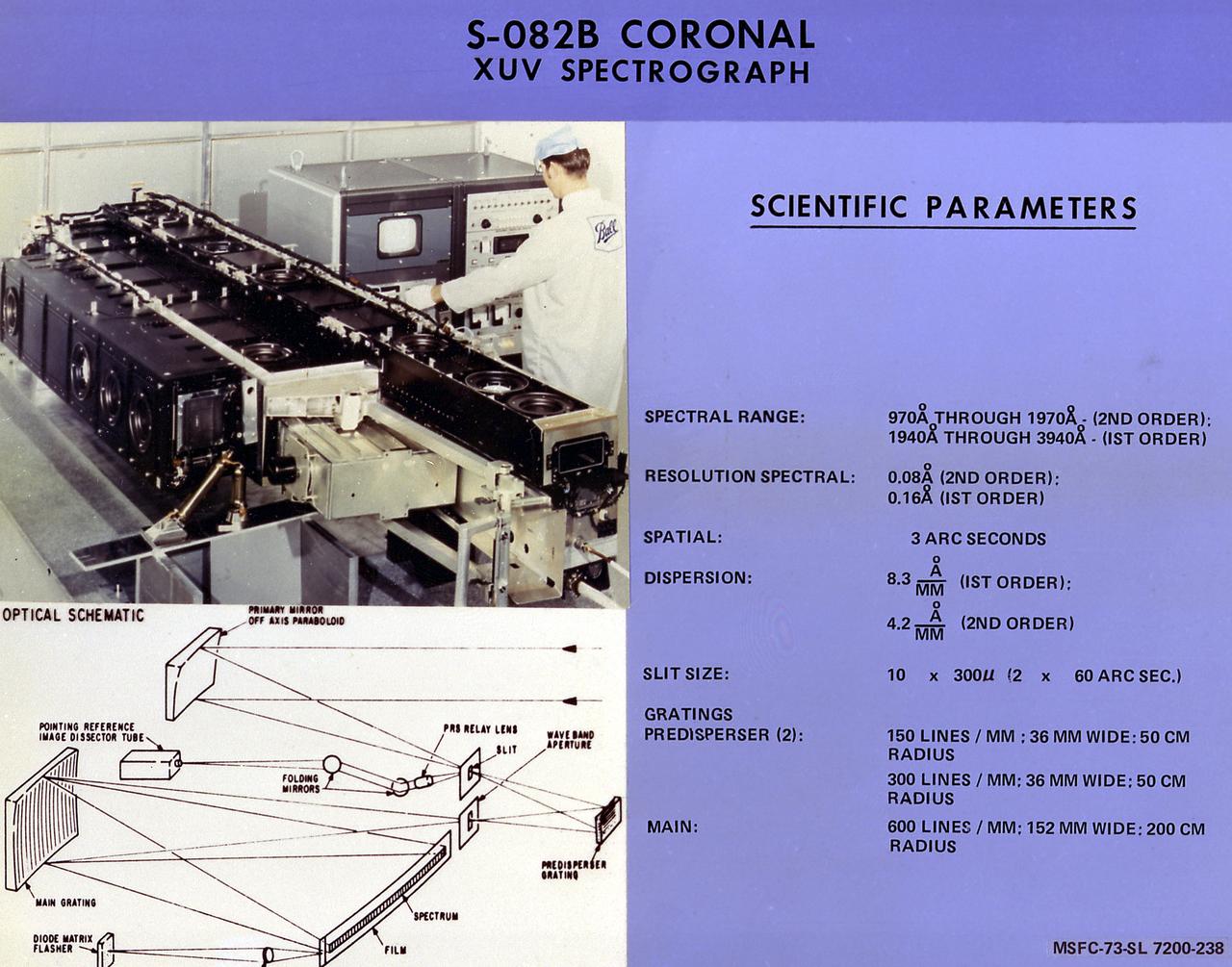
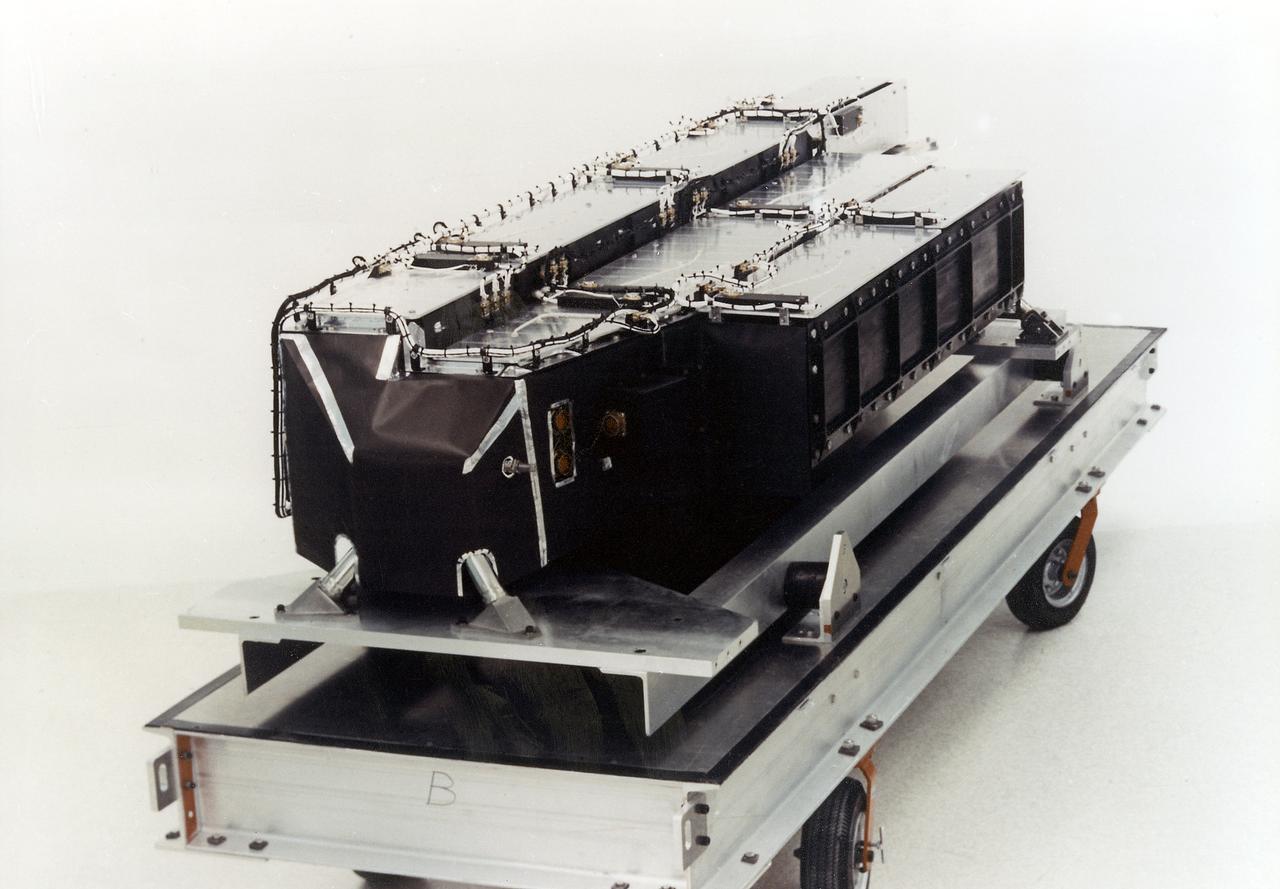
This 1970 photograph shows the Skylab's Ultraviolet (UV) Spectrograph, an Apollo Telescope Mount instrument. Its telescope, with camera and TV capability, photographed the Sun in selected ultraviolet wavelengths. The spectrograph was used to record the spectrum of UV emissions, such as flares or filaments, from a small individual feature on the solar disc. Real-time TV was used by the crew to monitor the performance of the telescope, transmit to the ground, and record. The exposed films were retrieved by astronaut extravehicular activities. The Marshall Space Flight Center had program management responsibility for the development of the Skylab hardware and experiments.
Skylab
This 1973 chart details Skylab's Ultraviolet (UV) Spectrograph, an Apollo Telescope Mount instrument. Its telescope, with camera and TV capability, photographed the Sun in selected ultraviolet wavelengths. The spectrograph was used to record the spectrum of UV emissions, such as flares or filaments, from a small individual feature on the solar disc. Real-time TV was used by the crew to monitor performance of the telescope, transmit to the ground and record. The exposed films were retrieved by astronaut extravehicular activities. The Marshall Space Flight Center had program management responsibility for the development of the Skylab hardware and experiments.
Skylab
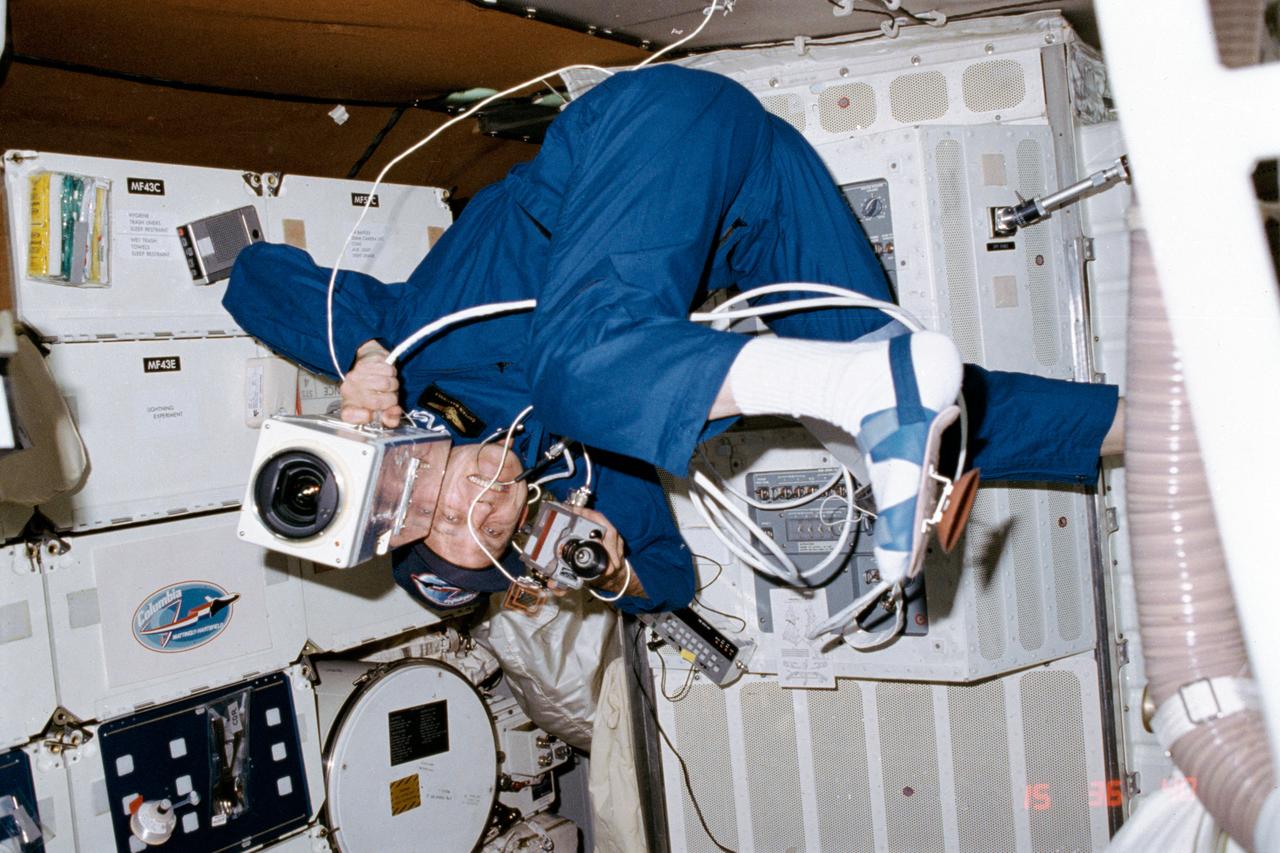
STS004-23-131 (27 June-4 July 1982) ---Astronaut Thomas K. Mattingly II, STS-4 commander, floats in the middeck area of the Earth-orbiting space shuttle Columbia. He handles two cameras at one time. In the commander’s right hand is a 16mm data acquisition camera (DAC), and in his left hand is a TV camera. Note the suction-cup equipped footwear which Mattingly revealed to the world via TV on one of his popular “cook’s tours” from crewmate Henry W. Hartsfield, pilot, operated a 35mm camera to expose this frame. Photo credit: NASA
Commander Mattingly uses 16mm DAC and FS crew cabin camera on middeck
The Apollo 17 Lunar Module (LM) "Challenger" ascent stage leaves the Taurus-Littrow landing site as it makes its spectacular liftoff from the lunar surface, as seen in this reproduction taken from a color television transmission made by the color RCA TV camera mounted on the Lunar Roving Vehicle (LRV). The LRV-mounted TV camera, remotely controlled from the Mission Control Center (MCC) in Houston, made it possible for people on Earth to watch the fantastic event. The LM liftoff was at 188:01:36 ground elapsed time, 4:54:36 p.m. (CST), Thursday, December 14, 1972.
APOLLO 17 - INFLIGHT
S72-55167 (12 Dec. 1972) --- The two moon-exploring Apollo 17 crew men are seen facing the TV camera during the second extravehicular activity (EVA) at the Taurus -Littrow landing site, in this black and white reproduction taken from a color television transmission made by the color TV camera mounted on the Lunar Roving Vehicle (LRV). They are astronauts Eugene A Cernan, on left , commander, and scientist-astronaut Harrison H. Schmitt, lunar module pilot. Astronaut Ronald E. Evans, command module pilot, remained with the Apollo 17 Command and Service Modules (CSM) in lunar orbit.
APOLLO 17 - INFLIGHT (2ND EVA)
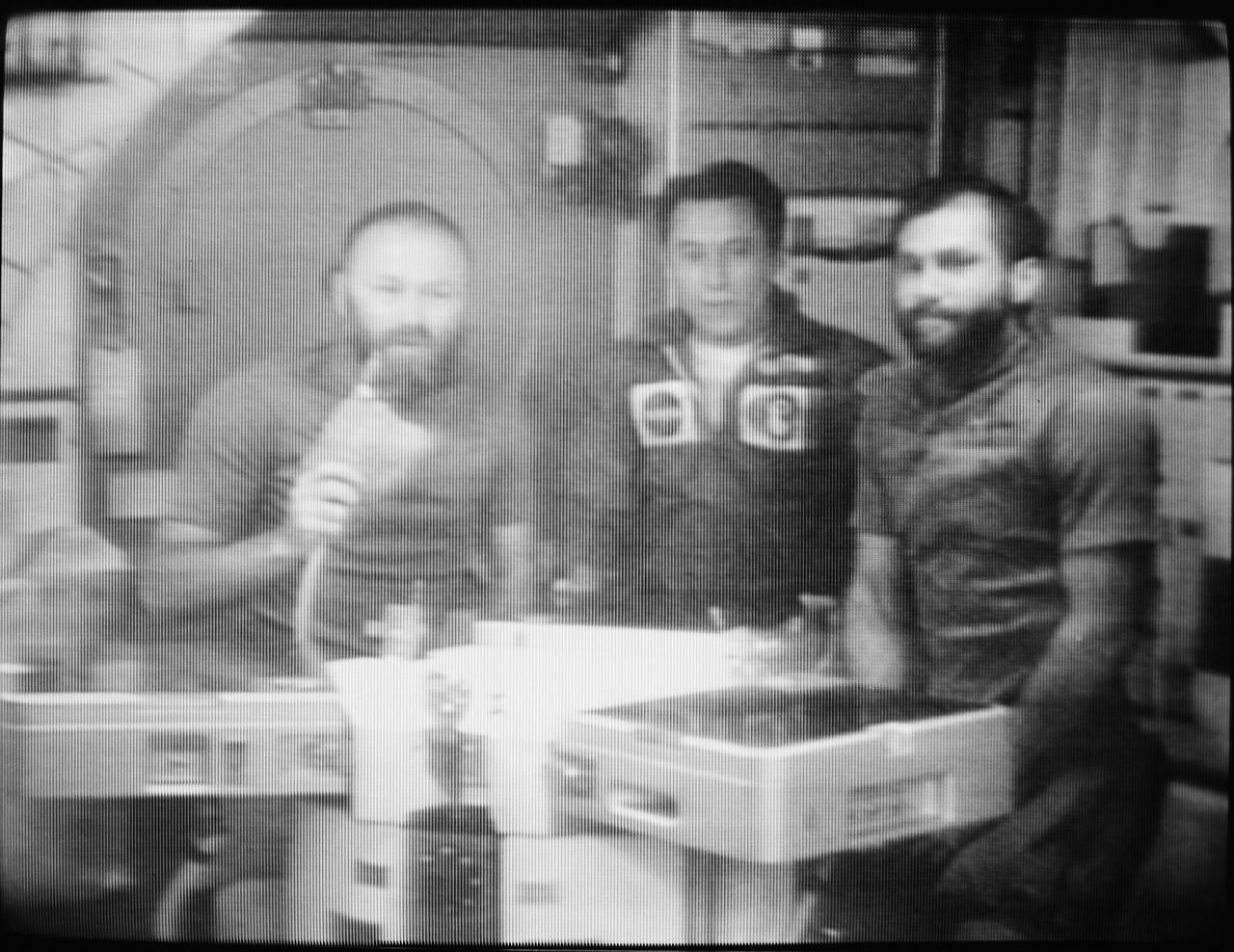
S73-38962 (28 Dec. 1973) --- The three members of the Skylab 4 crew confer via television communication with Dr. Lubos Kohoutek, discoverer of the Comet Kohoutek. This picture of the three astronauts was reproduced from a TV transmission made by a TV camera aboard the space station in Earth orbit. They are, left to right, Gerald P. Carr, commander; Edward G. Gibson, science pilot; and William R. Pogue, pilot. They are seated in the crew quarters wardroom of the Orbital Workshop. Professor Kohoutek, who is employed at the Hamburg Observatory in West Germany, was visiting the Johnson Space Center in Houston when he conferred with the Skylab 4 crewmen. Photo credit: NASA
Skylab 4 - Television (Crew)
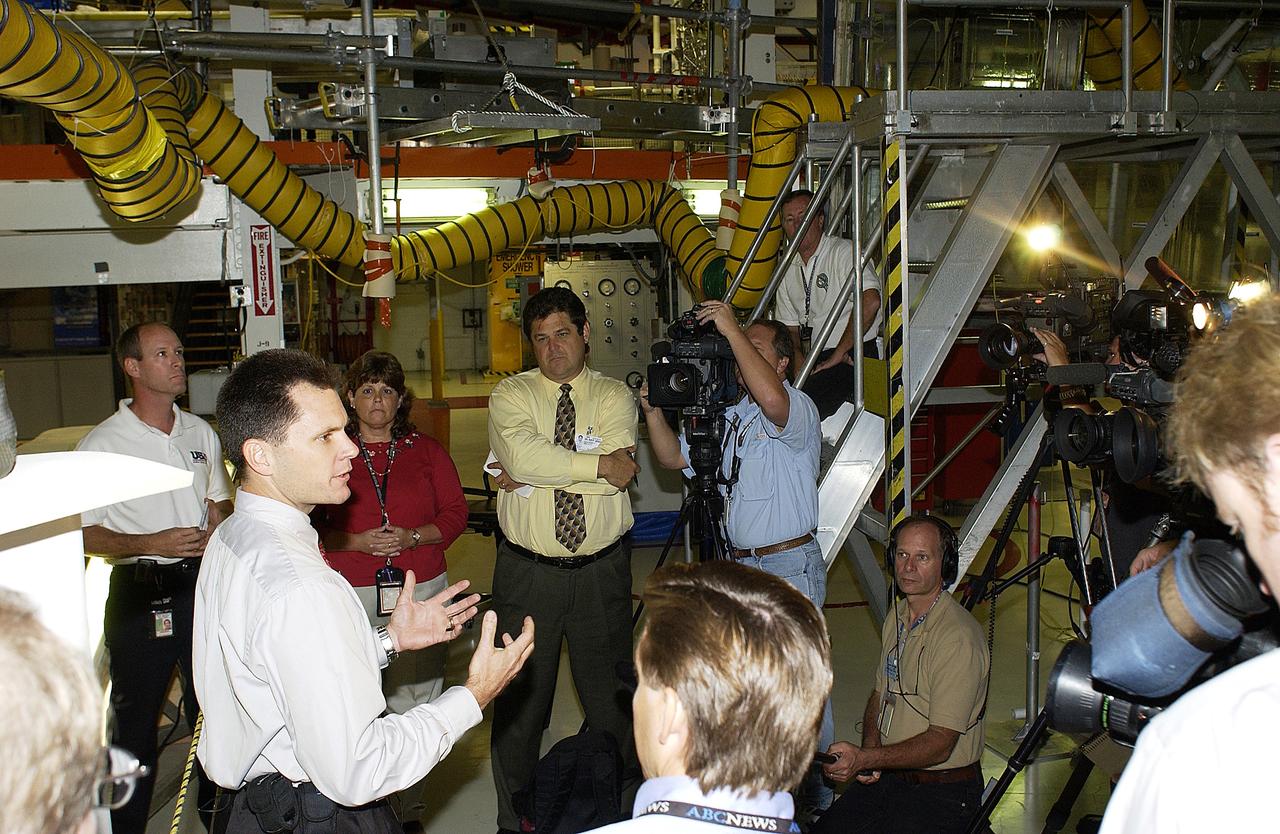
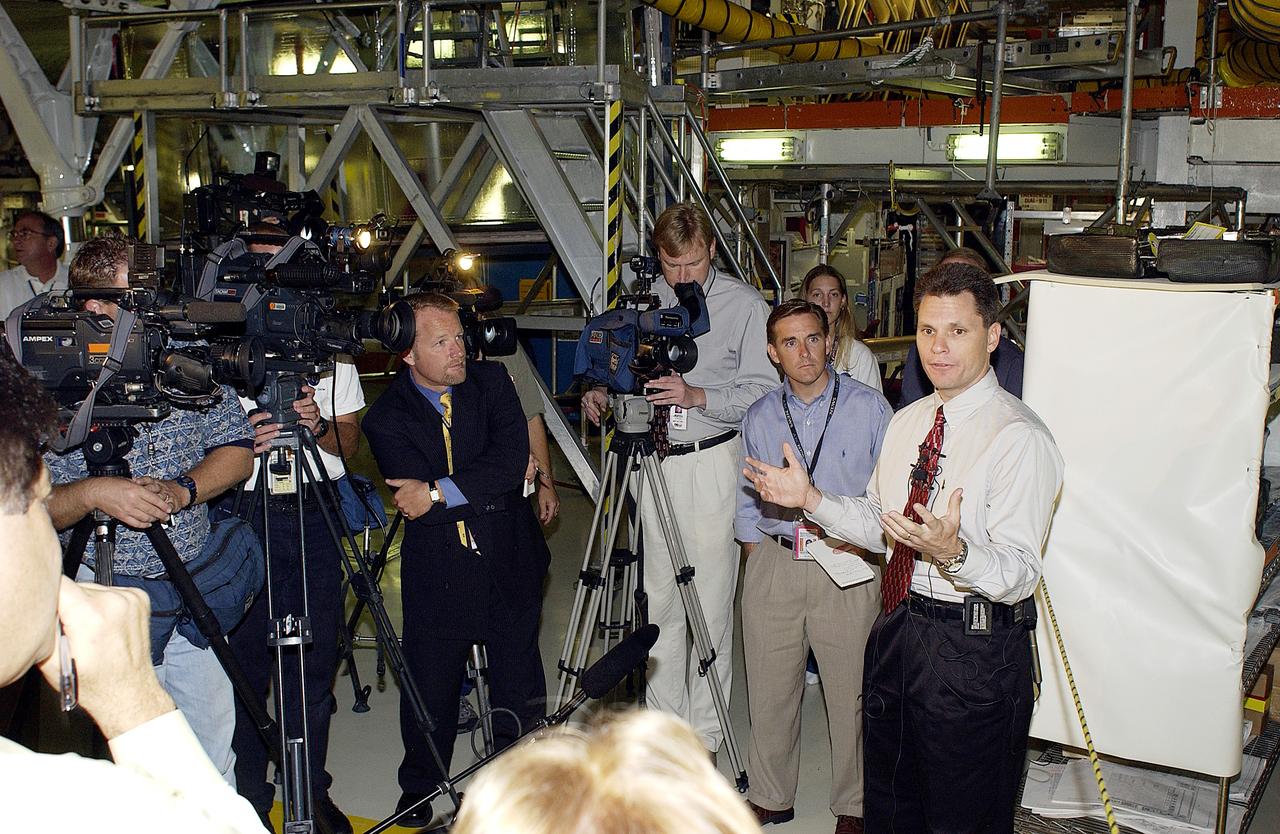
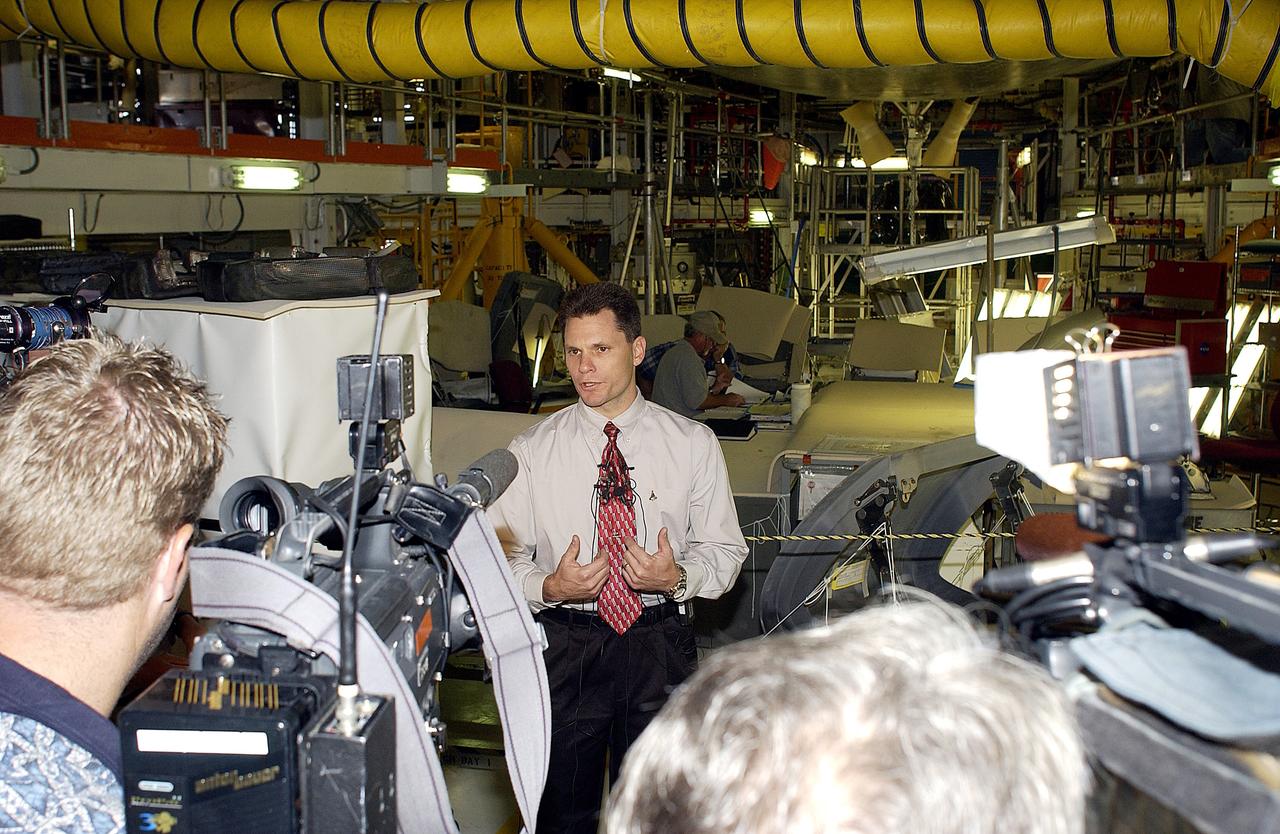
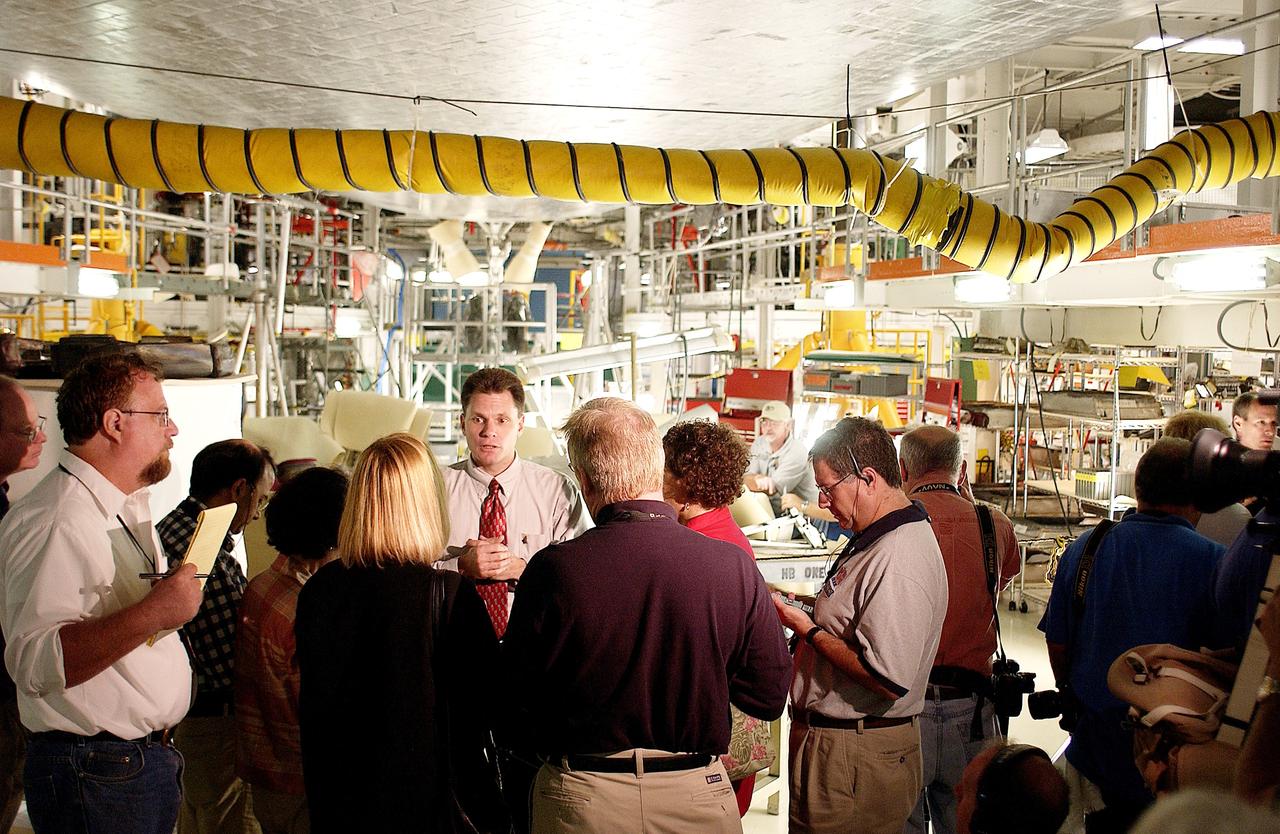
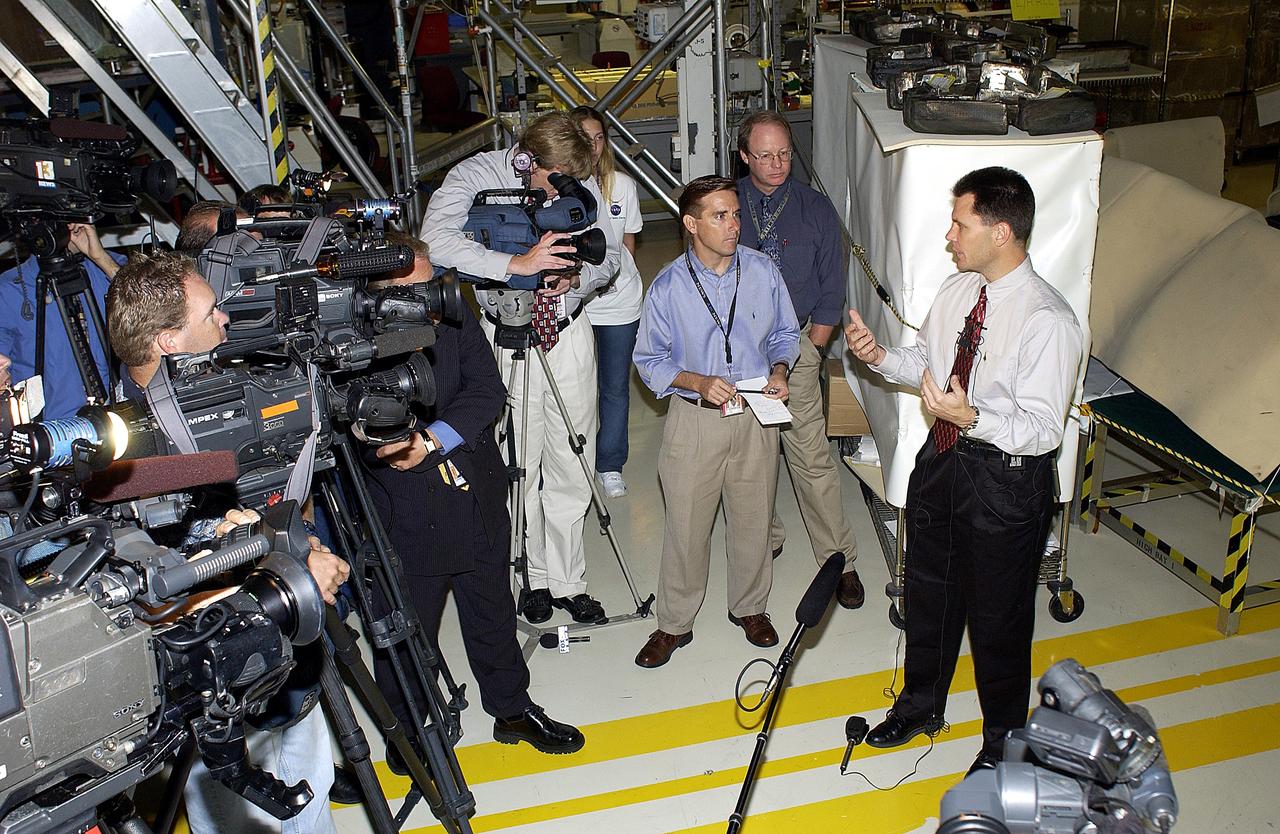
KENNEDY SPACE CENTER, FLA. -  NASA Vehicle Manager Scott Thurston (facing camera) talks to the media in the Orbiter Processing Facility.  The media was invited to see the orbiter Atlantis as it is being prepared for Return to Flight.  Both local and national reporters representing print and TV networks were able to see work in progress on Atlantis, including the reinstallation of the Reinforced Carbon-Carbon panels on the orbiter’s wing leading edge; wiring inspections; and checks of the engines in the Orbital Maneuvering System.
KENNEDY SPACE CENTER, FLA. - NASA Vehicle Manager Scott Thurston (facing camera) talks to the media in the Orbiter Processing Facility. The media was invited to see the orbiter Atlantis as it is being prepared for Return to Flight. Both local and national reporters representing print and TV networks were able to see work in progress on Atlantis, including the reinstallation of the Reinforced Carbon-Carbon panels on the orbiter’s wing leading edge; wiring inspections; and checks of the engines in the Orbital Maneuvering System.
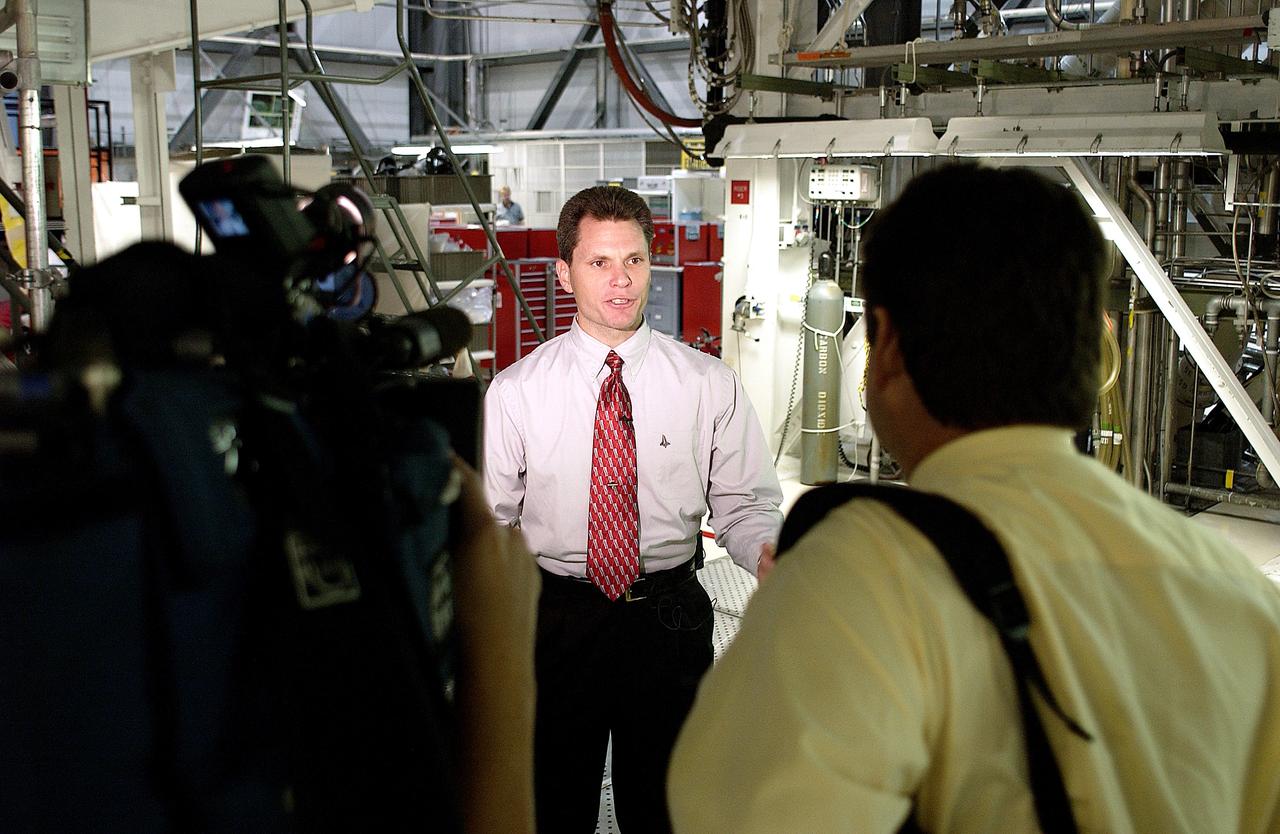
KENNEDY SPACE CENTER, FLA. -  NASA Vehicle Manager Scott Thurston talks to the media in the Orbiter Processing Facility.  The media was invited to see the orbiter Atlantis as it is being prepared for Return to Flight.  Both local and national reporters representing print and TV networks were able to see work in progress on Atlantis, including the reinstallation of the Reinforced Carbon-Carbon panels on the orbiter’s wing leading edge; wiring inspections; and checks of the engines in the Orbital Maneuvering System.
KENNEDY SPACE CENTER, FLA. - NASA Vehicle Manager Scott Thurston talks to the media in the Orbiter Processing Facility. The media was invited to see the orbiter Atlantis as it is being prepared for Return to Flight. Both local and national reporters representing print and TV networks were able to see work in progress on Atlantis, including the reinstallation of the Reinforced Carbon-Carbon panels on the orbiter’s wing leading edge; wiring inspections; and checks of the engines in the Orbital Maneuvering System.
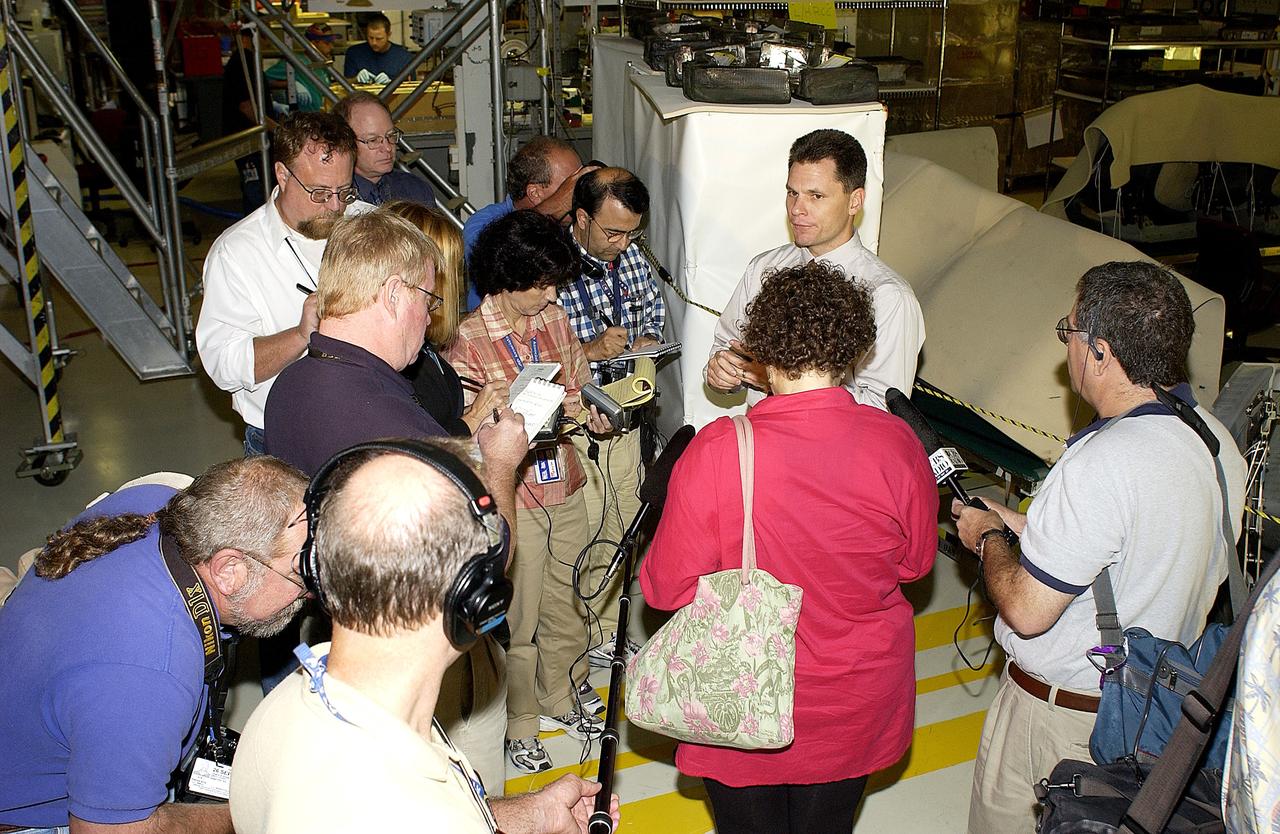
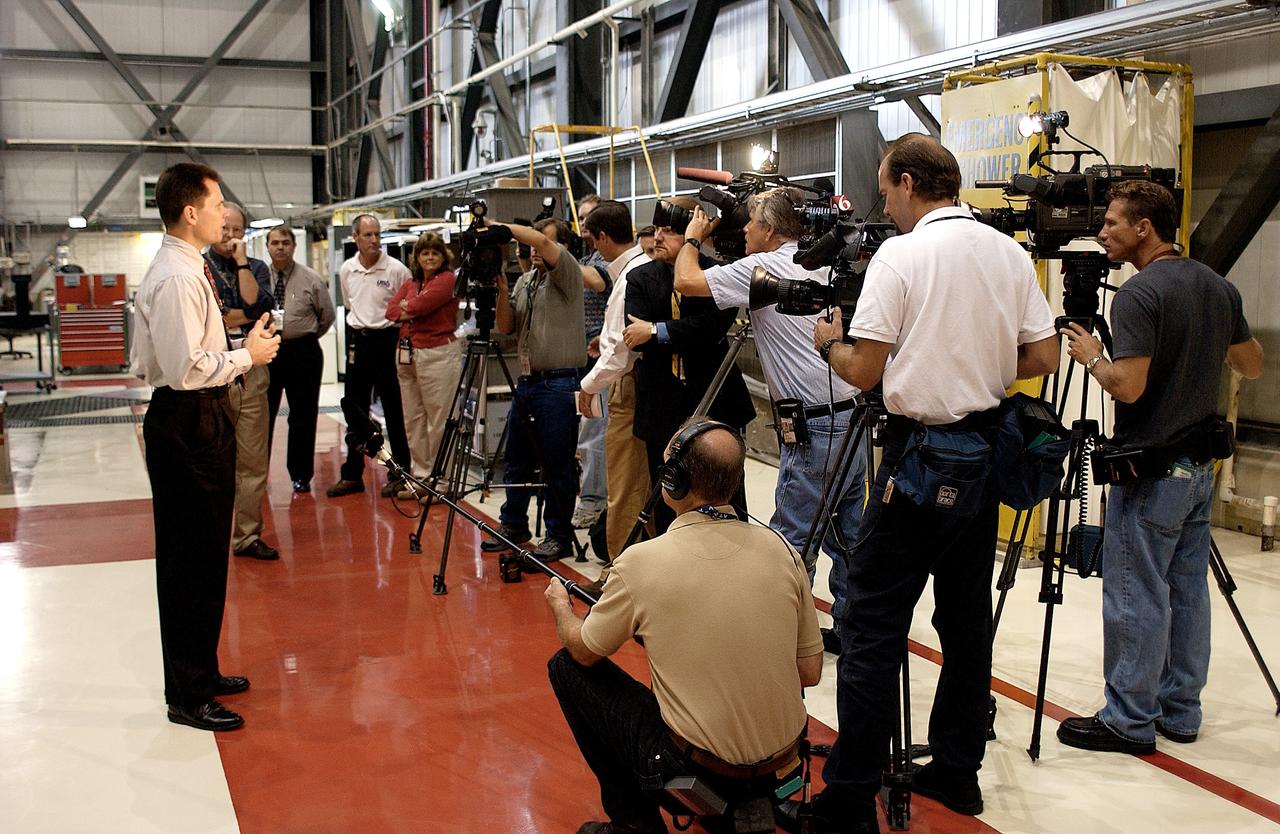
KENNEDY SPACE CENTER, FLA. - NASA Vehicle Manager Scott Thurston (left) talks to a phalanx of media in the Orbiter Processing Facility.  The media was invited to see the orbiter Atlantis as it is being prepared for Return to Flight.  Both local and national reporters representing print and TV networks were able to see work in progress on Atlantis, including the reinstallation of the Reinforced Carbon-Carbon panels on the orbiter’s wing leading edge; wiring inspections; and checks of the engines in the Orbital Maneuvering System.
KENNEDY SPACE CENTER, FLA. - NASA Vehicle Manager Scott Thurston (left) talks to a phalanx of media in the Orbiter Processing Facility. The media was invited to see the orbiter Atlantis as it is being prepared for Return to Flight. Both local and national reporters representing print and TV networks were able to see work in progress on Atlantis, including the reinstallation of the Reinforced Carbon-Carbon panels on the orbiter’s wing leading edge; wiring inspections; and checks of the engines in the Orbital Maneuvering System.
KENNEDY SPACE CENTER, FLA. -  NASA Vehicle Manager Scott Thurston (facing camera) talks to the media in the Orbiter Processing Facility.  The media was invited to see the orbiter Atlantis as it is being prepared for Return to Flight.  Both local and national reporters representing print and TV networks were able to see work in progress on Atlantis, including the reinstallation of the Reinforced Carbon-Carbon panels on the orbiter’s wing leading edge; wiring inspections; and checks of the engines in the Orbital Maneuvering System.
KENNEDY SPACE CENTER, FLA. - NASA Vehicle Manager Scott Thurston (facing camera) talks to the media in the Orbiter Processing Facility. The media was invited to see the orbiter Atlantis as it is being prepared for Return to Flight. Both local and national reporters representing print and TV networks were able to see work in progress on Atlantis, including the reinstallation of the Reinforced Carbon-Carbon panels on the orbiter’s wing leading edge; wiring inspections; and checks of the engines in the Orbital Maneuvering System.
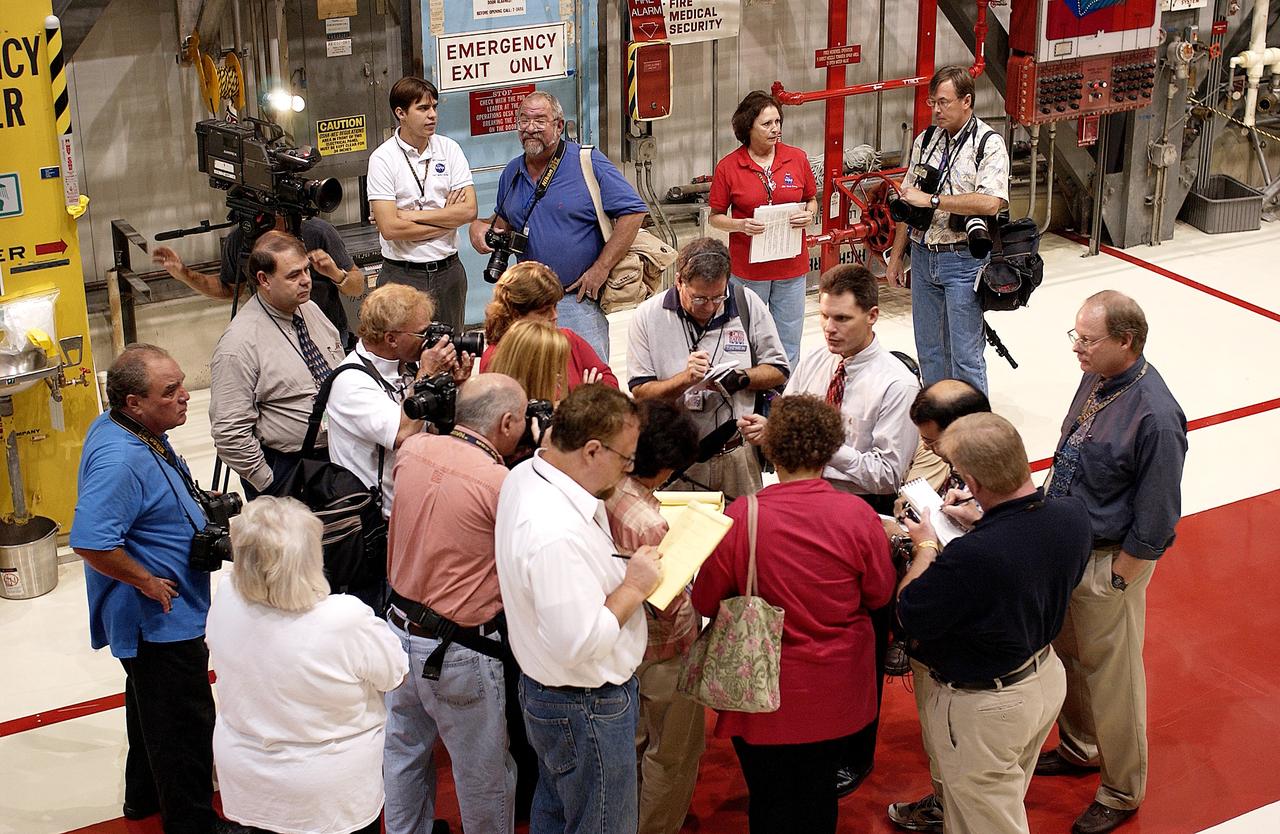
KENNEDY SPACE CENTER, FLA. -   The media gather around NASA Vehicle Manager Scott Thurston (white shirt, right) who talks about some of the work being done on the orbiter Atlantis as it is being prepared for Return to Flight in the Orbiter Processing Facility.   Both local and national reporters representing print and TV networks were able to see work in progress on Atlantis, including the reinstallation of the Reinforced Carbon-Carbon panels on the orbiter’s wing leading edge; wiring inspections; and checks of the engines in the Orbital Maneuvering System.
KENNEDY SPACE CENTER, FLA. - The media gather around NASA Vehicle Manager Scott Thurston (white shirt, right) who talks about some of the work being done on the orbiter Atlantis as it is being prepared for Return to Flight in the Orbiter Processing Facility. Both local and national reporters representing print and TV networks were able to see work in progress on Atlantis, including the reinstallation of the Reinforced Carbon-Carbon panels on the orbiter’s wing leading edge; wiring inspections; and checks of the engines in the Orbital Maneuvering System.
KENNEDY SPACE CENTER, FLA. -   NASA Vehicle Manager Scott Thurston (right)  talks to the media in the Orbiter Processing Facility.  The media was invited to see the orbiter Atlantis as it is being prepared for Return to Flight.  Both local and national reporters representing print and TV networks were able to see work in progress on Atlantis, including the reinstallation of the Reinforced Carbon-Carbon panels on the orbiter’s wing leading edge; wiring inspections; and checks of the engines in the Orbital Maneuvering System.  will be available to discuss the work and answer questions.
KENNEDY SPACE CENTER, FLA. - NASA Vehicle Manager Scott Thurston (right) talks to the media in the Orbiter Processing Facility. The media was invited to see the orbiter Atlantis as it is being prepared for Return to Flight. Both local and national reporters representing print and TV networks were able to see work in progress on Atlantis, including the reinstallation of the Reinforced Carbon-Carbon panels on the orbiter’s wing leading edge; wiring inspections; and checks of the engines in the Orbital Maneuvering System. will be available to discuss the work and answer questions.
KENNEDY SPACE CENTER, FLA. -   NASA Vehicle Manager Scott Thurston (right)  talks to the media in the Orbiter Processing Facility .  The media was invited to see the orbiter Atlantis as it is being prepared for Return to Flight.  Both local and national reporters representing print and TV networks were able to see work in progress on Atlantis, including the reinstallation of the Reinforced Carbon-Carbon panels on the orbiter’s wing leading edge; wiring inspections; and checks of the engines in the Orbital Maneuvering System.
KENNEDY SPACE CENTER, FLA. - NASA Vehicle Manager Scott Thurston (right) talks to the media in the Orbiter Processing Facility . The media was invited to see the orbiter Atlantis as it is being prepared for Return to Flight. Both local and national reporters representing print and TV networks were able to see work in progress on Atlantis, including the reinstallation of the Reinforced Carbon-Carbon panels on the orbiter’s wing leading edge; wiring inspections; and checks of the engines in the Orbital Maneuvering System.
KENNEDY SPACE CENTER, FLA. -   NASA Vehicle Manager Scott Thurston talks to the media in the Orbiter Processing Facility.  The media was invited to see the orbiter Atlantis as it is being prepared for Return to Flight.  Both local and national reporters representing print and TV networks were able to see work in progress on Atlantis, including the reinstallation of the Reinforced Carbon-Carbon panels on the orbiter’s wing leading edge; wiring inspections; and checks of the engines in the Orbital Maneuvering System.
KENNEDY SPACE CENTER, FLA. - NASA Vehicle Manager Scott Thurston talks to the media in the Orbiter Processing Facility. The media was invited to see the orbiter Atlantis as it is being prepared for Return to Flight. Both local and national reporters representing print and TV networks were able to see work in progress on Atlantis, including the reinstallation of the Reinforced Carbon-Carbon panels on the orbiter’s wing leading edge; wiring inspections; and checks of the engines in the Orbital Maneuvering System.
KENNEDY SPACE CENTER, FLA. -   NASA Vehicle Manager Scott Thurston (hands extended) talks to the media in the Orbiter Processing Facility.  The media was invited to see the orbiter Atlantis as it is being prepared for Return to Flight.  Both local and national reporters representing print and TV networks were able to see work in progress on Atlantis, including the reinstallation of the Reinforced Carbon-Carbon panels on the orbiter’s wing leading edge; wiring inspections; and checks of the engines in the Orbital Maneuvering System.
KENNEDY SPACE CENTER, FLA. - NASA Vehicle Manager Scott Thurston (hands extended) talks to the media in the Orbiter Processing Facility. The media was invited to see the orbiter Atlantis as it is being prepared for Return to Flight. Both local and national reporters representing print and TV networks were able to see work in progress on Atlantis, including the reinstallation of the Reinforced Carbon-Carbon panels on the orbiter’s wing leading edge; wiring inspections; and checks of the engines in the Orbital Maneuvering System.
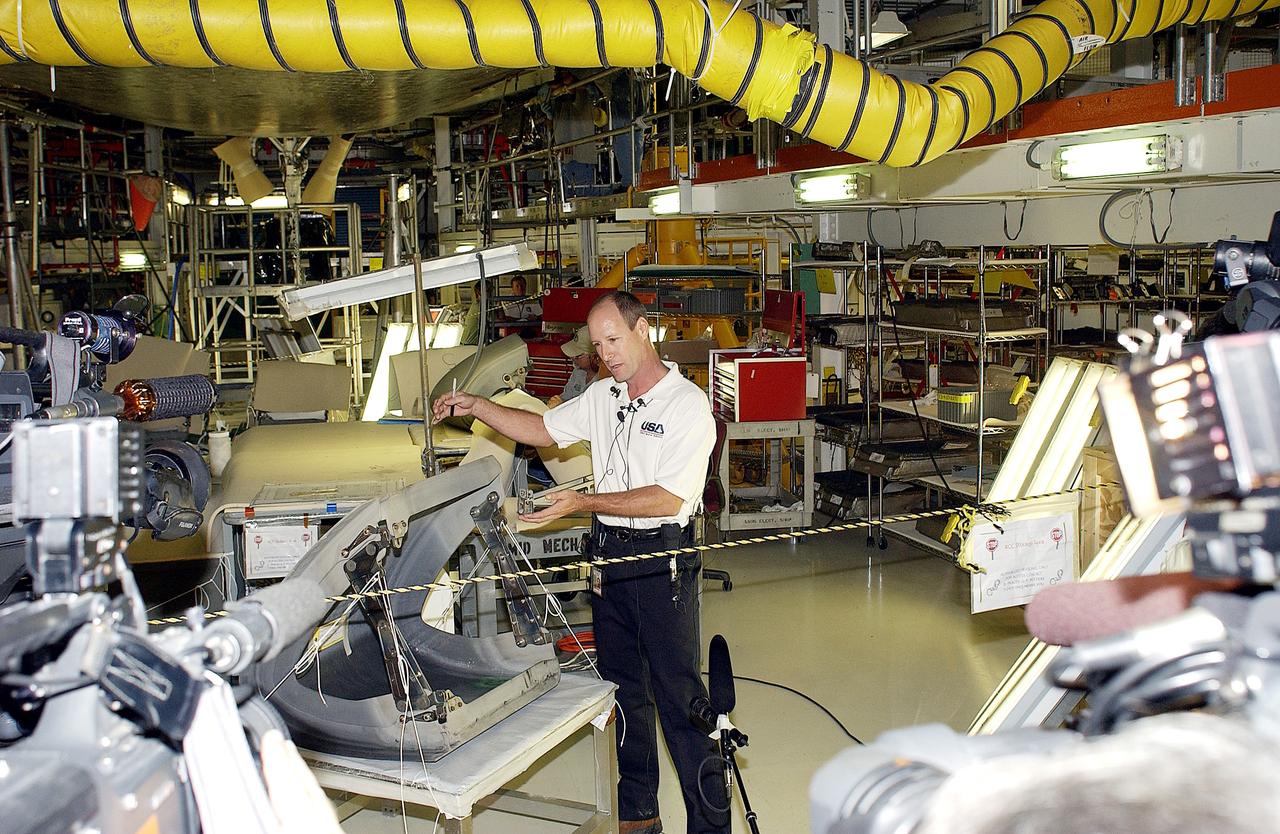
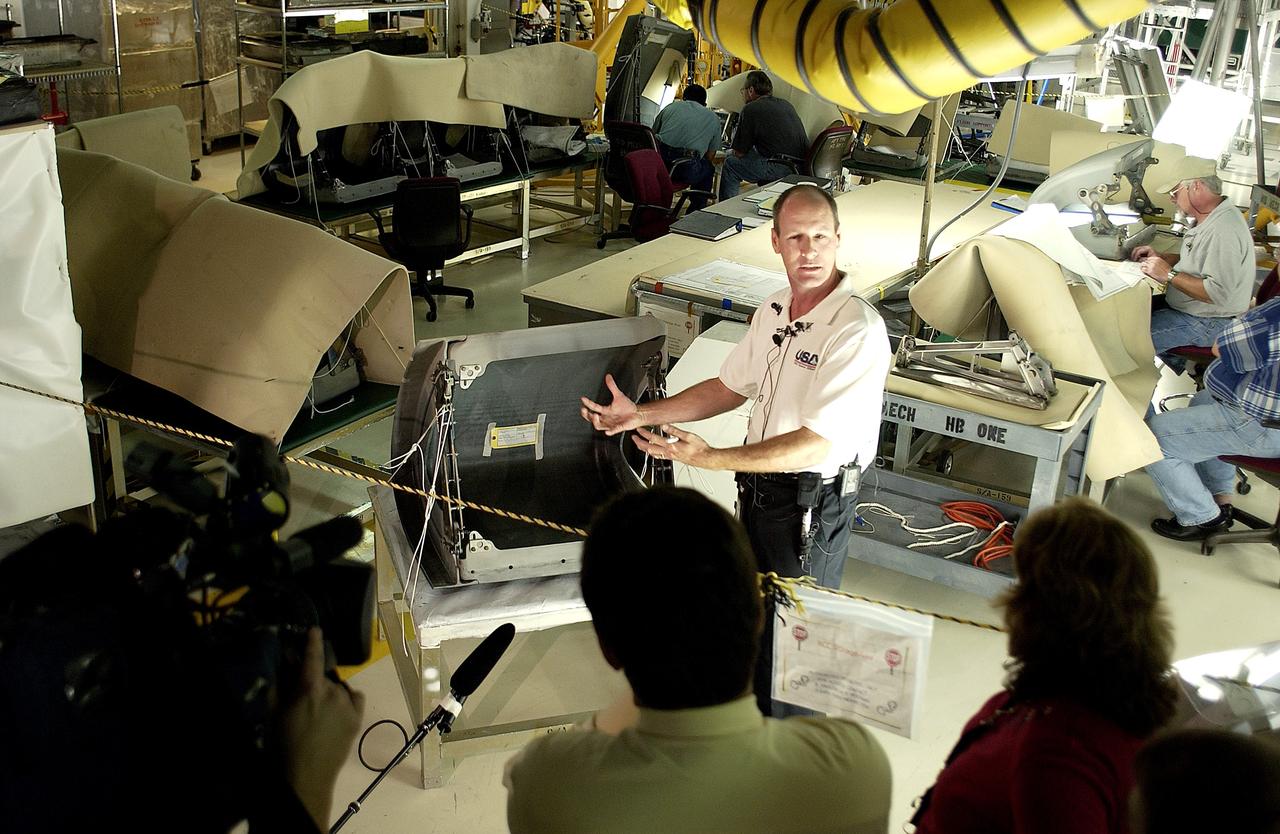
KENNEDY SPACE CENTER, FLA. -  In the Orbiter Processing Facility, Rick Beckwith (center), an orbiter engineer with United Space Alliance, explains to the media the reinstallation of the Reinforced Carbon-Carbon panels on the orbiter Atlantis’ wing leading edge.  The media was invited to tour the OPF at KSC and to see the orbiter Atlantis as it is being prepared for Return to Flight.  Both local and national reporters representing print and TV networks were able to see work in progress on Atlantis, also including wiring inspections and checks of the engines in the Orbital Maneuvering System.
KENNEDY SPACE CENTER, FLA. - In the Orbiter Processing Facility, Rick Beckwith (center), an orbiter engineer with United Space Alliance, explains to the media the reinstallation of the Reinforced Carbon-Carbon panels on the orbiter Atlantis’ wing leading edge. The media was invited to tour the OPF at KSC and to see the orbiter Atlantis as it is being prepared for Return to Flight. Both local and national reporters representing print and TV networks were able to see work in progress on Atlantis, also including wiring inspections and checks of the engines in the Orbital Maneuvering System.
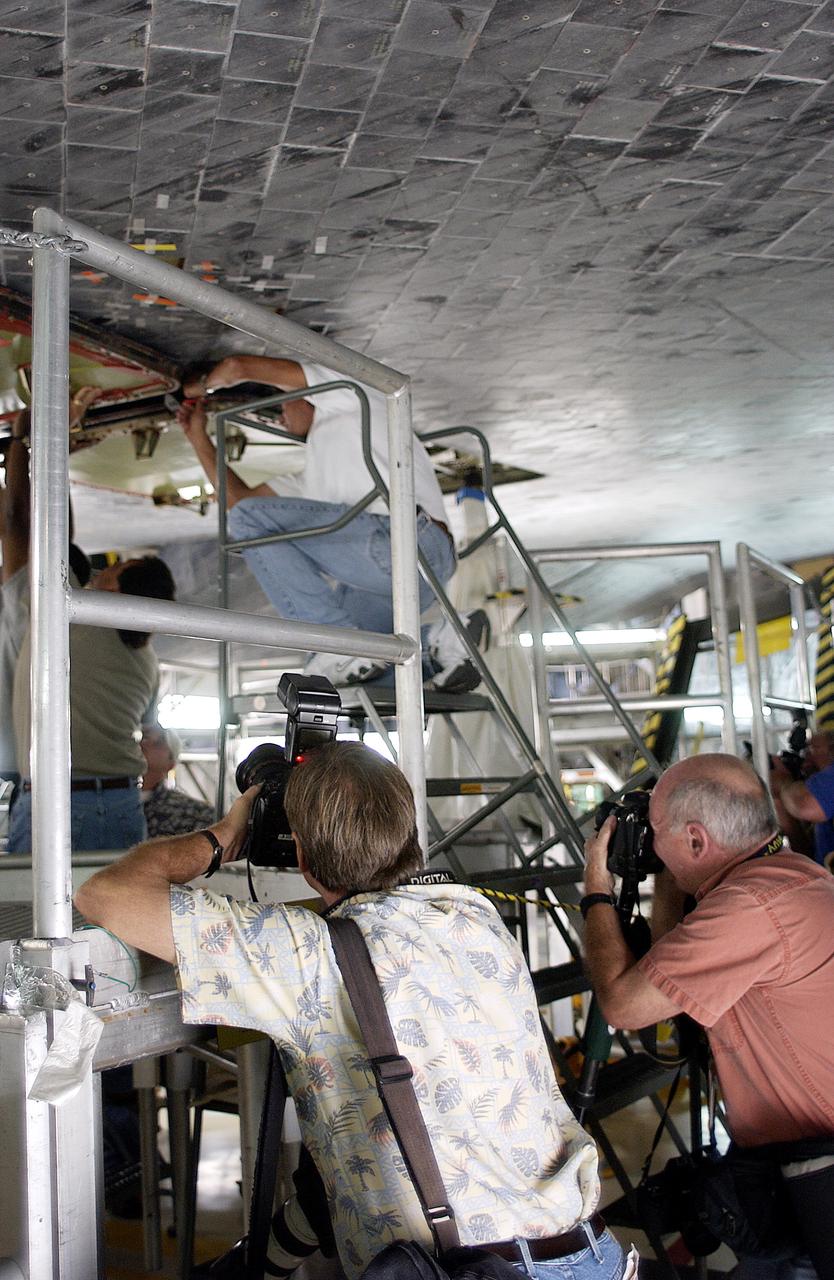
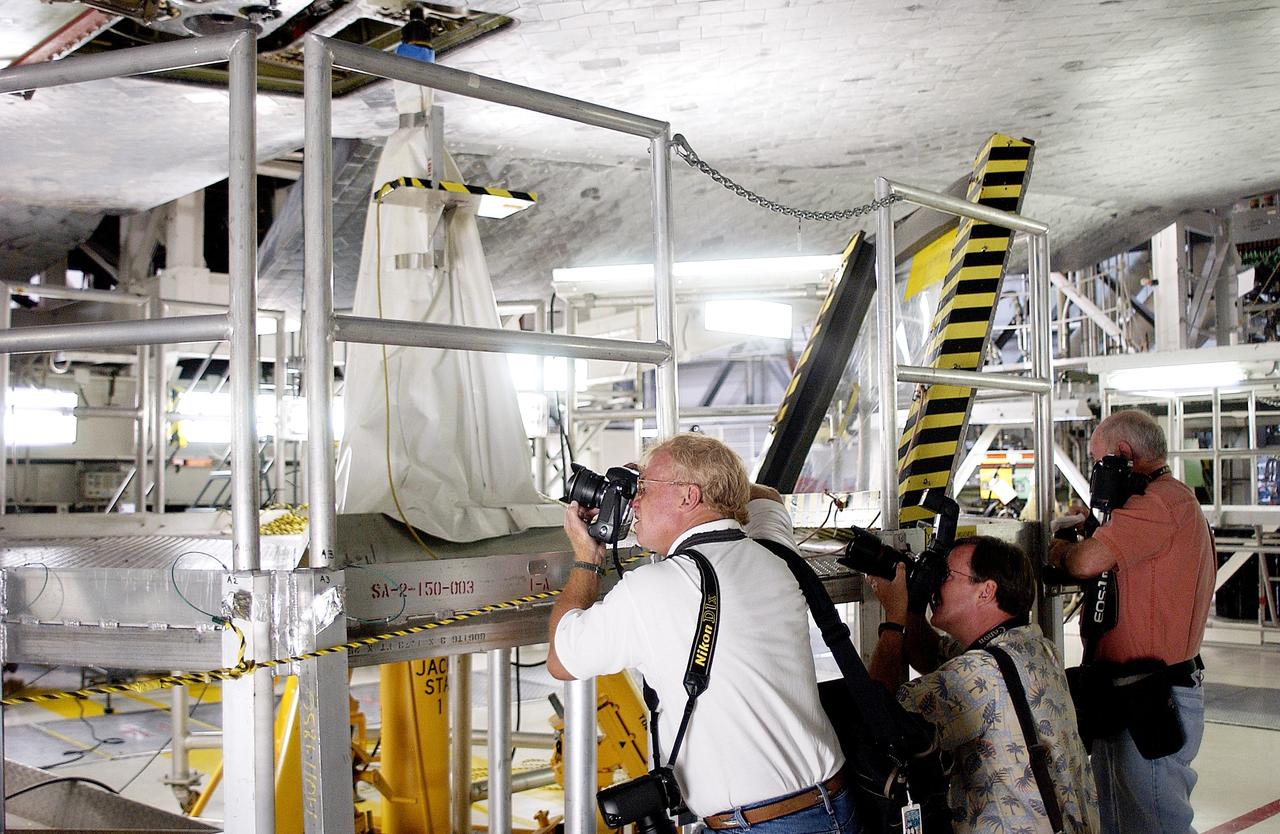
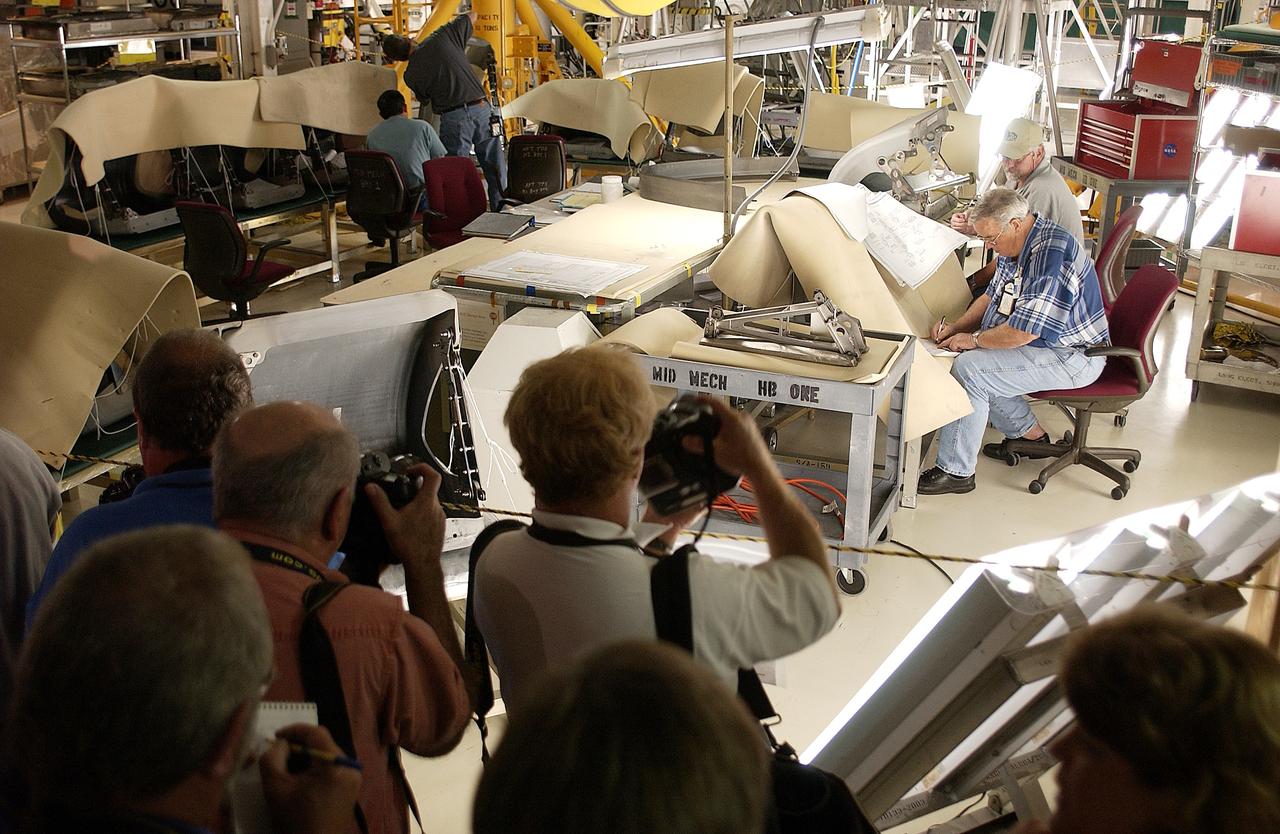
KENNEDY SPACE CENTER, FLA. -   In the Orbiter Processing Facility,  the media photograph work being done on the tiles on the orbiter Atlantis as it is being prepared for Return to Flight in the Orbiter Processing Facility.   Both local and national reporters representing print and TV networks were able to see work in progress on Atlantis, including the reinstallation of the Reinforced Carbon-Carbon panels on the orbiter’s wing leading edge; wiring inspections; and checks of the engines in the Orbital Maneuvering System.
KENNEDY SPACE CENTER, FLA. - In the Orbiter Processing Facility, the media photograph work being done on the tiles on the orbiter Atlantis as it is being prepared for Return to Flight in the Orbiter Processing Facility. Both local and national reporters representing print and TV networks were able to see work in progress on Atlantis, including the reinstallation of the Reinforced Carbon-Carbon panels on the orbiter’s wing leading edge; wiring inspections; and checks of the engines in the Orbital Maneuvering System.
KENNEDY SPACE CENTER, FLA. -  In the Orbiter Processing Facility,  the media photograph work being done on the tiles on the orbiter Atlantis as it is being prepared for Return to Flight in the Orbiter Processing Facility.   Both local and national reporters representing print and TV networks were able to see work in progress on Atlantis, including the reinstallation of the Reinforced Carbon-Carbon panels on the orbiter’s wing leading edge; wiring inspections; and checks of the engines in the Orbital Maneuvering System.
KENNEDY SPACE CENTER, FLA. - In the Orbiter Processing Facility, the media photograph work being done on the tiles on the orbiter Atlantis as it is being prepared for Return to Flight in the Orbiter Processing Facility. Both local and national reporters representing print and TV networks were able to see work in progress on Atlantis, including the reinstallation of the Reinforced Carbon-Carbon panels on the orbiter’s wing leading edge; wiring inspections; and checks of the engines in the Orbital Maneuvering System.
KENNEDY SPACE CENTER, FLA. -  In the Orbiter Processing Facility (OPF), Rick Beckwith, an orbiter engineer with United Space Alliance, explains to the media the reinstallation of the Reinforced Carbon-Carbon panels on the orbiter Atlantis’ wing leading edge.  The media was invited to tour the OPF at KSC and to see the orbiter Atlantis as it is being prepared for Return to Flight.  Both local and national reporters representing print and TV networks were able to see work in progress on Atlantis, also including wiring inspections and checks of the engines in the Orbital Maneuvering System.
KENNEDY SPACE CENTER, FLA. - In the Orbiter Processing Facility (OPF), Rick Beckwith, an orbiter engineer with United Space Alliance, explains to the media the reinstallation of the Reinforced Carbon-Carbon panels on the orbiter Atlantis’ wing leading edge. The media was invited to tour the OPF at KSC and to see the orbiter Atlantis as it is being prepared for Return to Flight. Both local and national reporters representing print and TV networks were able to see work in progress on Atlantis, also including wiring inspections and checks of the engines in the Orbital Maneuvering System.
KENNEDY SPACE CENTER, FLA. -  In the Orbiter Processing Facility, the media record workers on the job preparing the orbiter Atlantis for Return to Flight. Both local and national reporters representing print and TV networks were invited to see work in progress on Atlantis, including the reinstallation of the Reinforced Carbon-Carbon panels on the orbiter’s wing leading edge; wiring inspections; and checks of the engines in the Orbital Maneuvering System.
KENNEDY SPACE CENTER, FLA. - In the Orbiter Processing Facility, the media record workers on the job preparing the orbiter Atlantis for Return to Flight. Both local and national reporters representing print and TV networks were invited to see work in progress on Atlantis, including the reinstallation of the Reinforced Carbon-Carbon panels on the orbiter’s wing leading edge; wiring inspections; and checks of the engines in the Orbital Maneuvering System.
KENNEDY SPACE CENTER, FLA. -  In the Orbiter Processing Facility (OPF), Rick Beckwith, an orbiter engineer with United Space Alliance, explains to the media the reinstallation of the Reinforced Carbon-Carbon panels on Atlantis’ wing leading edge.  The media was invited to tour the OPF at KSC and to see the orbiter Atlantis as it is being prepared for Return to Flight.  Both local and national reporters representing print and TV networks were able to see work in progress on Atlantis, also including wiring inspections and checks of the engines in the Orbital Maneuvering System.
KENNEDY SPACE CENTER, FLA. - In the Orbiter Processing Facility (OPF), Rick Beckwith, an orbiter engineer with United Space Alliance, explains to the media the reinstallation of the Reinforced Carbon-Carbon panels on Atlantis’ wing leading edge. The media was invited to tour the OPF at KSC and to see the orbiter Atlantis as it is being prepared for Return to Flight. Both local and national reporters representing print and TV networks were able to see work in progress on Atlantis, also including wiring inspections and checks of the engines in the Orbital Maneuvering System.
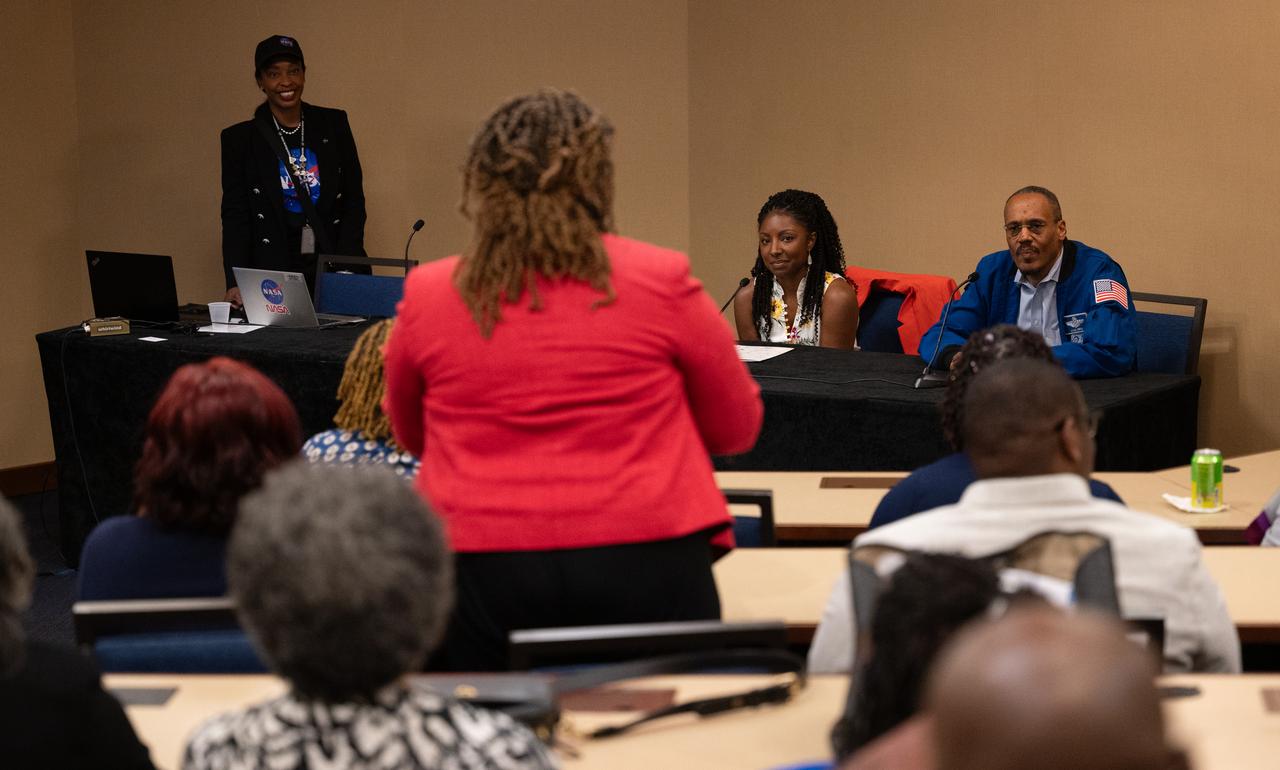
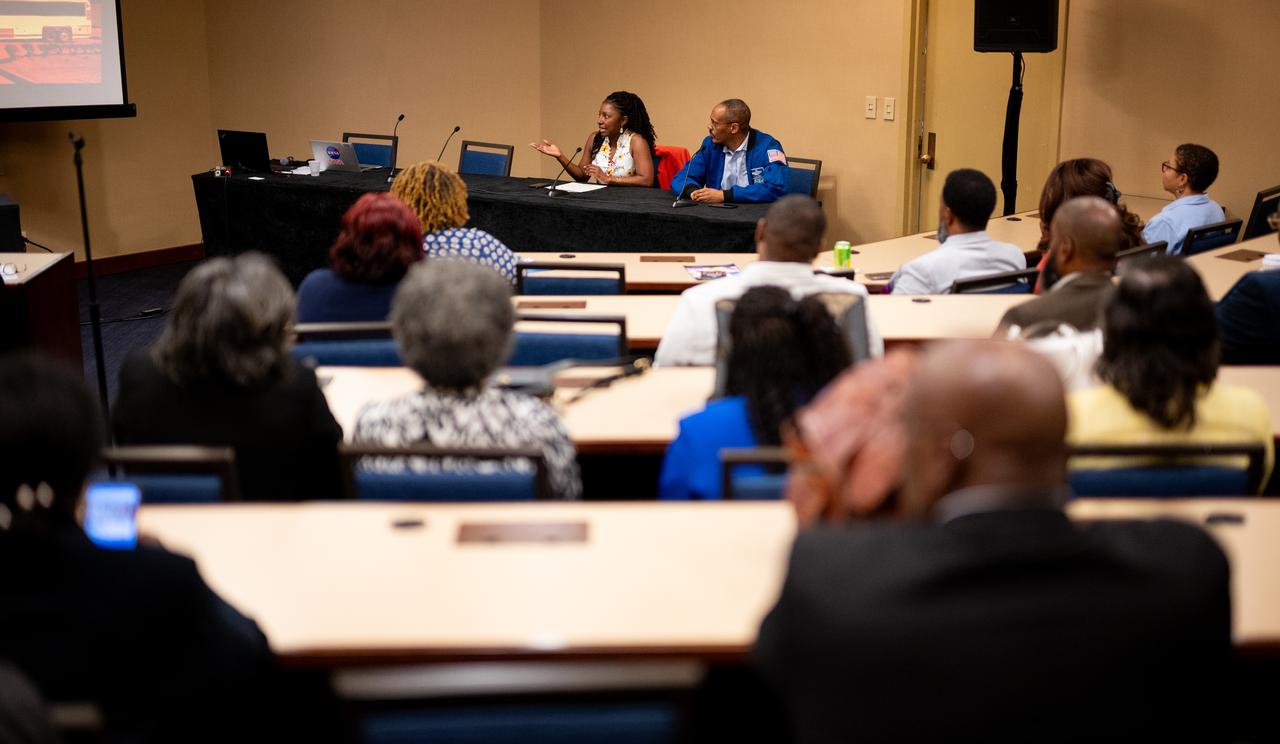
NASA’s Lisa Frazier introduces NASA TV producer of “The Color of Space” Jori Kates and NASA astronaut Alvin Drew before a screening of “The Color of Space” as part of the Department of Education’s HBCU Week Conference, Monday, Sept. 25, 2023, at the Hyatt Regency in Arlington, Va.  Photo Credit: (NASA/Joel Kowsky)
Dept. of Edu. HBCU Week Conference Screening of The Color of Spa
KENNEDY SPACE CENTER, FLA. -- WESH-TV 2 News Anchor Wendy Chioji (right) is given a briefing on how to pilot a Space Shuttle orbiter during a tour inside the cockpit of an orbiter. Chioji was at KSC to speak at the 2002 Combined Federal Campaign (CFC) kickoff rally.
KSC-02pd1421
VANDENBERG AFB, Calif. – A NASA TV technician sets up equipment to record the launch of a United Launch Alliance Atlas V rocket carrying the Landsat Data Continuity Mission spacecraft from Vandenberg Air Force Base in California. Photo credit: NASA_Ben Smegelsky
KSC-2013-1645
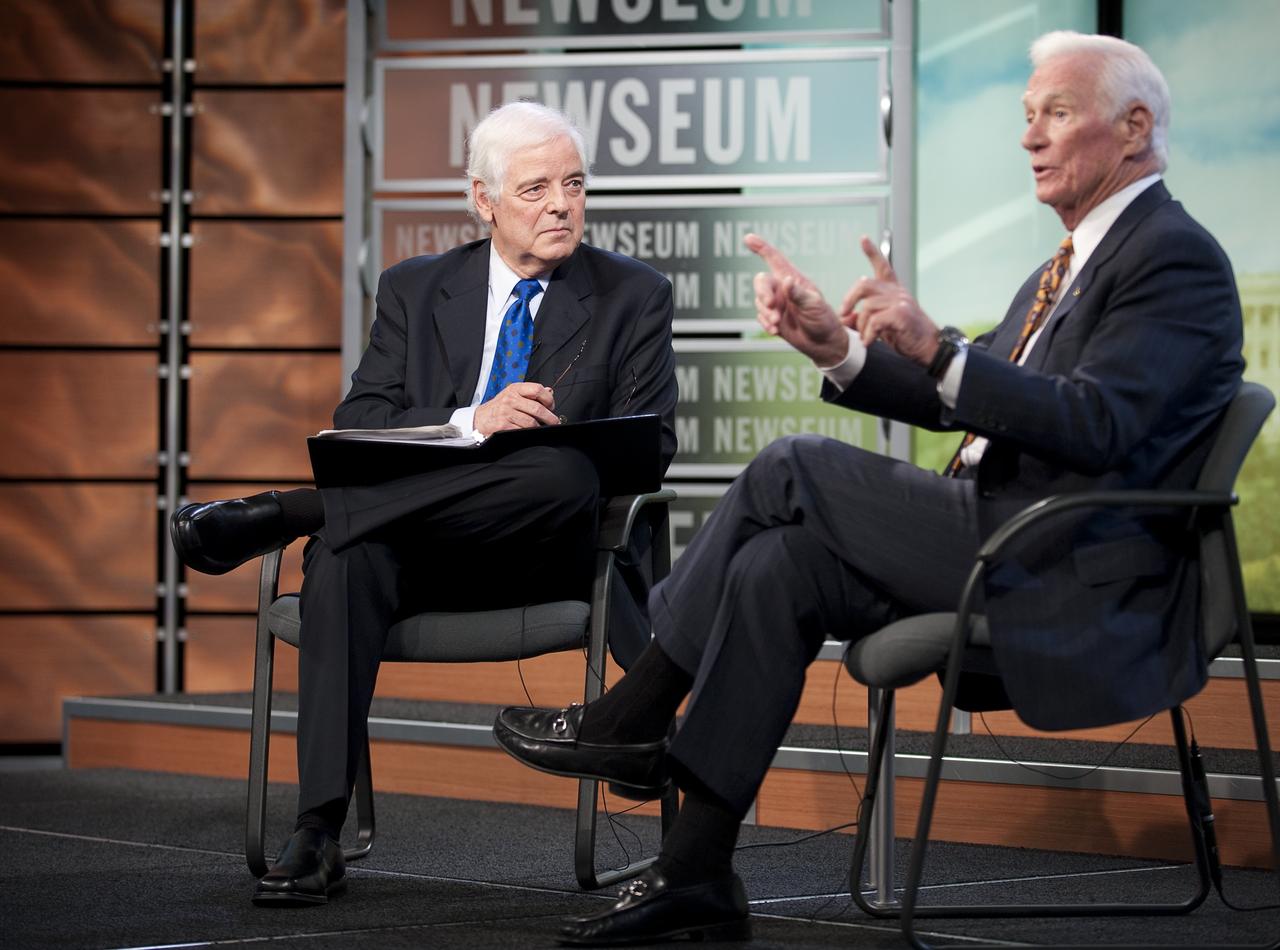
NASA Apollo 10 Astronaut Gene Cernan, right, answers questions from the Newseum's distinguished journalist-in-residence, Nick Clooney during a Newseum TV program celebrating the 40th anniversary of Apollo 10, Monday, May 18, 2009, in Washington.  Photo Credit (NASA/Bill Ingalls)
Apollo 10 40th Anniversary Program
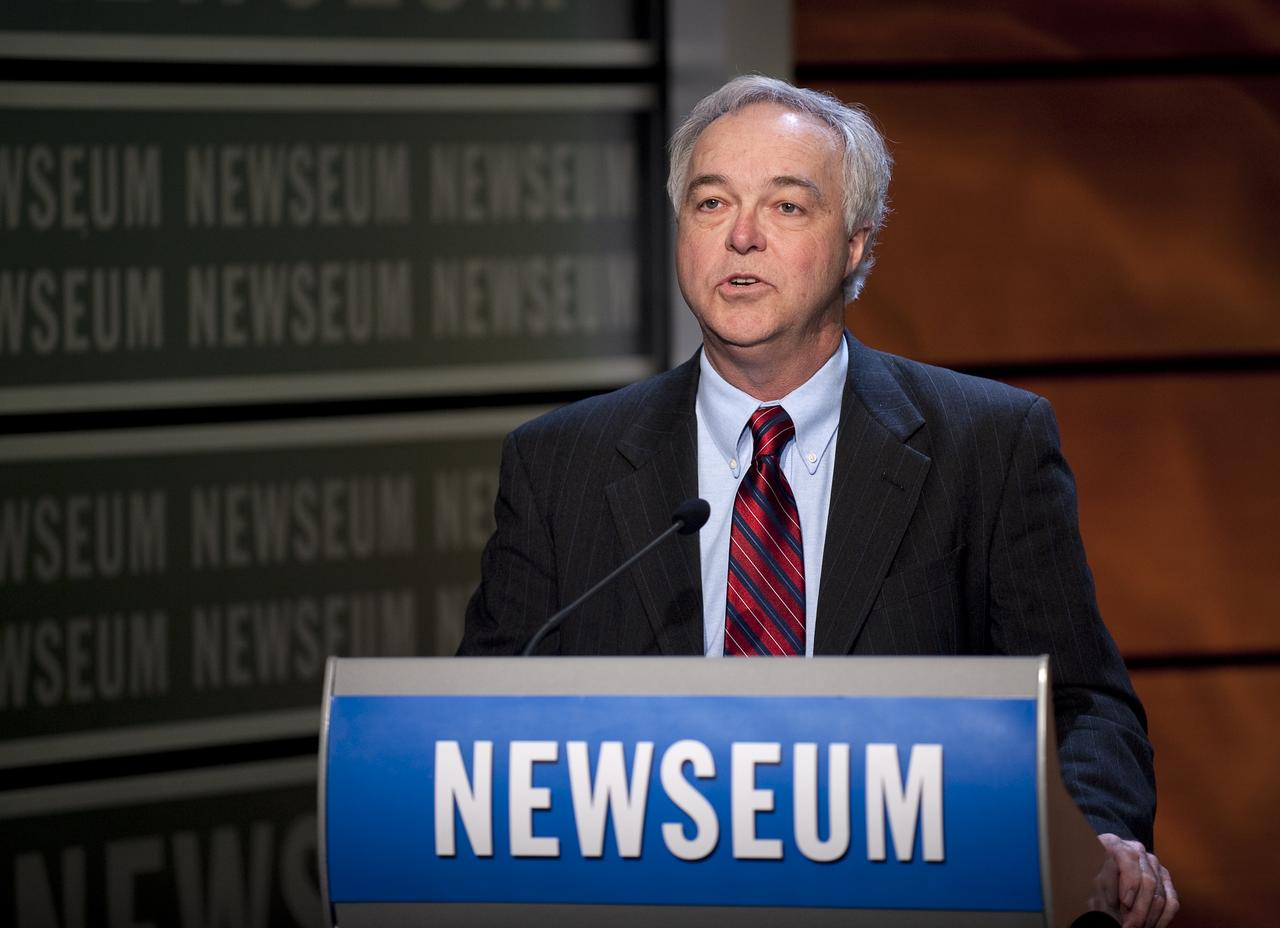
Stan Lebar, former Westinghouse Electric program manager, talks about the Apollo era TV cameras during NASA's briefing where restored Apollo 11 moonwalk footage was revealed for the first time at the Newseum, Thursday, July 16, 2009, in Washington, DC.  Photo Credit: (NASA/Bill Ingalls)
Restored Moonwalk Footage Release
VANDENBERG AFB, Calif. – A NASA TV technician sets up equipment to record the launch of a United Launch Alliance Atlas V rocket carrying the Landsat Data Continuity Mission spacecraft from Vandenberg Air Force Base in California. Photo credit: NASA_Ben Smegelsky
KSC-2013-1622
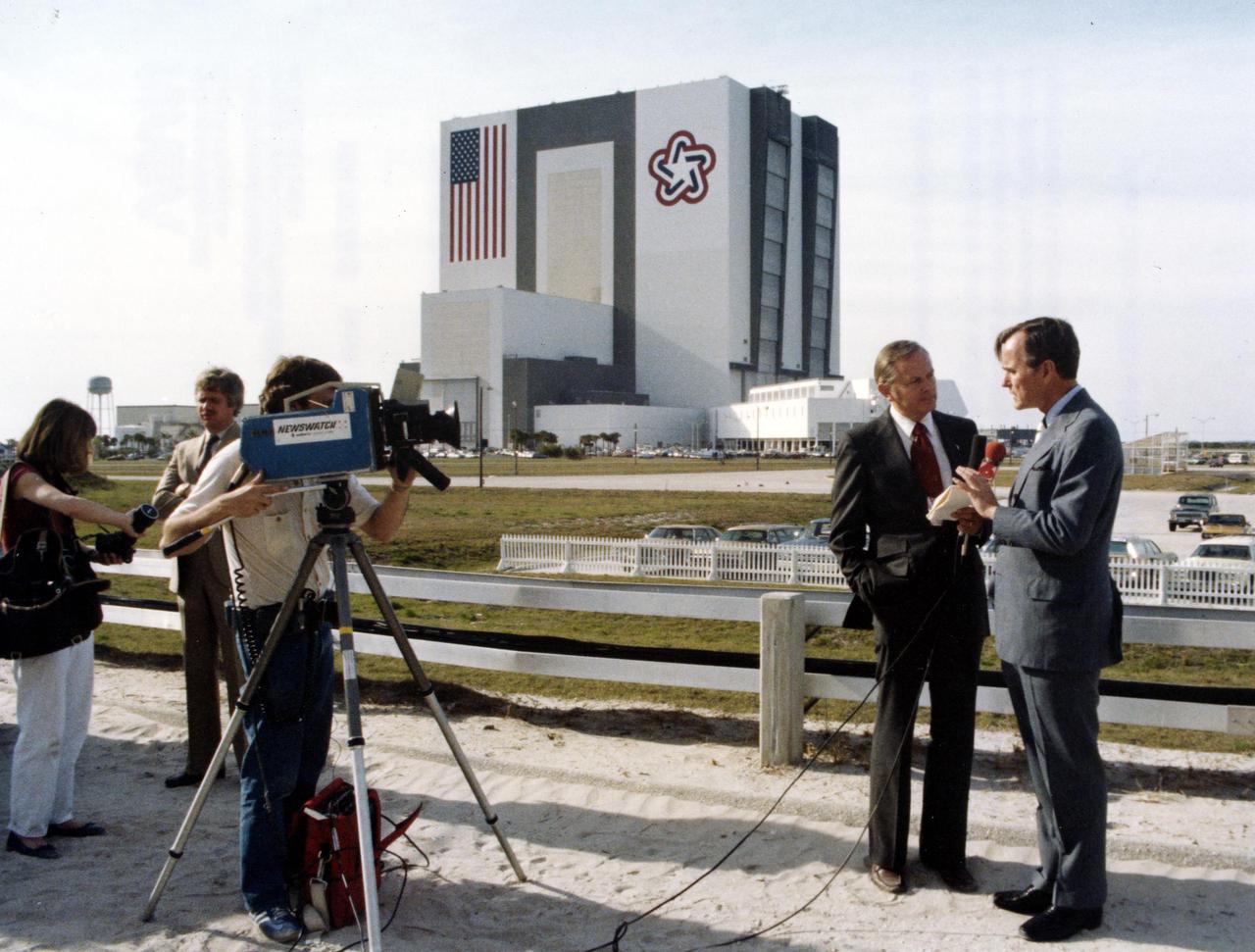
KENNEDY SPACE CENTER, FLA. -- Vice President George H. W. Bush, on a tour of KSC and Space Shuttle launch facilities, is interviewed at the Launch Complex 39 Press Site by Ben Aycrigg, anchorman for WDBO-TV News, Orlando.
KSC-81pc-231
S73-27734 (11 June 1973) --- Skylab 2 astronaut performs extravehicular activity (EVA) at the Skylab 1 and 2 space station cluster in Earth orbit, as seen in this reproduction taken from a color television transmission made by a TV camera aboard the station. Kerwin is just outside the Airlock Module. Photo credit: NASA
Skylab 2 Astronaut during EVA at Skylab 1 and 2 space station cluster
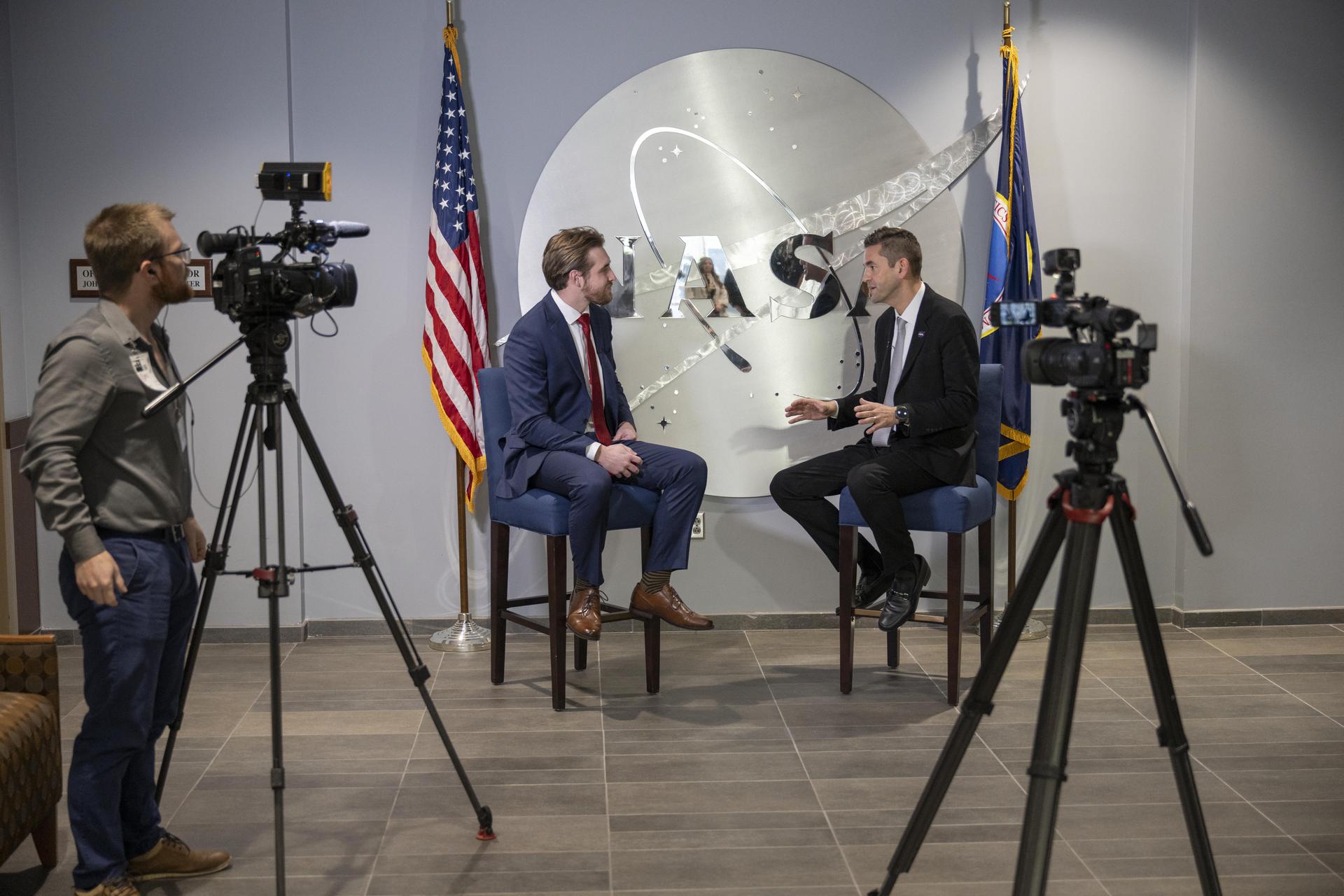
CAPE CANAVERAL, Fla. -- At NASA's Kennedy Space Center in Florida, Center Director Bob Cabana and Public Affairs Director Lisa Malone speak to the local media about the FY 2012 budget during an informal briefing held in the TV studio at the Press Site. Photo credit: NASA/Kim Shiflett
KSC-2011-1439
Two visitors watch a TV monitor showing plant growth inside a growth chamber designed for operation aboard the Space Shuttle as part of NASA's Space Product Development program. The exhibit, featuring work by the Wisconsin Center for Space Automation and Robotics, was at AirVenture 2000 sponsored by the Experimental Aircraft Association in Oshkosh, WI.
Microgravity
NASA Apollo 10 Astronaut Gene Cernan, right, answers questions from the Newseum's distinguished journalist-in-residence, Nick Clooney during a Newseum TV program celebrating the 40th anniversary of Apollo 10, Monday, May 18, 2009, in Washington.  Photo Credit (NASA/Bill Ingalls)
Apollo 10 40th Anniversary Program
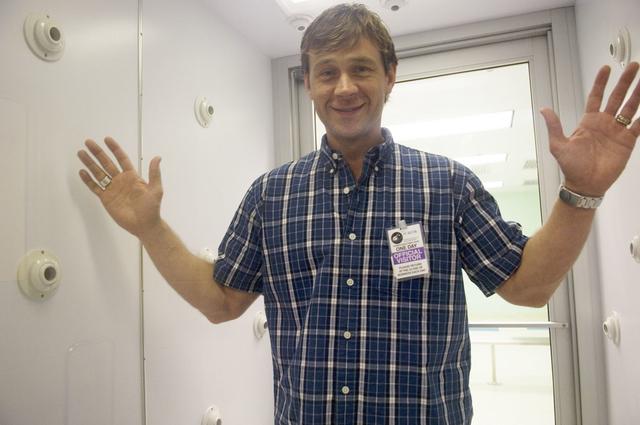
Actor Connor Trinneer, right, tours the high bay clean room in Building 29 at NASA's Goddard Space Flight Center in Greenbelt, Md. Trinneer is best known for his role as Chief Engineer "Trip" Tucker in the TV show "Star Trek: Enterprise."
G-2006-0200-018
ISS039-E-003124 (14 March 2014) --- Expedition 39 Commander Koichi Wakata of the Japan Aerospace Exploration Agency (JAXA) clowns with Robonaut 2, a humanoid robot,  in the U.S. lab Destiny while preparing for a public TV event.
Wakata and R2 in the US Lab
S69-34040 (18 May 1969) --- Partial view of activity in the Mission Operations Control Room in the Mission Control Center, Building 30, on the first day of the Apollo 10 lunar orbit mission. The television monitor shows a picture of Earth made during the second telecast from the Apollo 10's color TV camera.
APOLLO X - DUKE, MICHAEL B., DR. - MSC
VANDENBERG AFB, Calif. – NASA TV technicians work on the broadcast for the launch of a United Launch Alliance Atlas V rocket carrying the Landsat Data Continuity Mission spacecraft from Vandenberg Air Force Base in California. Photo credit: NASA/Ben Smegelsky
KSC-2013-1651
NASA TV producer of “The Color of Space” Jori Kates, left, and NASA astronaut Alvin Drew answer questions before a screening of “The Color of Space” as part of the Department of Education’s HBCU Week Conference, Monday, Sept. 25, 2023, at the Hyatt Regency in Arlington, Va.  Photo Credit: (NASA/Joel Kowsky)
Dept. of Edu. HBCU Week Conference Screening of The Color of Spa