![“Starting to host live broadcasts [brought up] so many emotions: terrified, excited, proud. And people have told me, ‘Oh my goodness, I feel like I would freeze up when the camera’s on,’ but that was the most natural position for me because I felt, just a little bit, like I was back on stage, cheerleading. You’re standing on the stage, the lights are off, you're in your head. And then the lights turn on, the music drops, and you’re on a world stage in front of thousands of people doing an incredibly difficult three-minute routine and who knows, you might even be injured right now, but you don't have an option. When those lights and that music comes on, it's almost like something bigger than yourself takes over and you just have to go. And that is the exact same feeling when they're counting you down for a live broadcast: “3, 2, 1. Hello, welcome to NASA. My name is Tahira Allen!” Before something like that happens, I am terrified. I am sitting here thinking, what is about to come out of my mouth? But just like with cheer, whatever you do, you keep moving. I don't know what's going to come out my mouth. But I need to keep talking and just embrace fear. Embrace being uncomfortable.” …You cannot grow without approaching the fear, embracing the fear, and then pushing past it.Science Mission Directorate Digital Lead Tahira Allen poses for a portrait Wednesday, Feb. 8, 2023, at the Mary W. Jackson NASA Headquarters building in Washington. Photo Credit: (NASA/Keegan Barber)](https://images-assets.nasa.gov/image/NHQ202302080001/NHQ202302080001~medium.jpg)
“Starting to host live broadcasts [brought up] so many emotions: terrified, excited, proud. And people have told me, ‘Oh my goodness, I feel like I would freeze up when the camera’s on,’ but that was the most natural position for me because I felt, just a little bit, like I was back on stage, cheerleading. You’re standing on the stage, the lights are off, you're in your head. And then the lights turn on, the music drops, and you’re on a world stage in front of thousands of people doing an incredibly difficult three-minute routine and who knows, you might even be injured right now, but you don't have an option. When those lights and that music comes on, it's almost like something bigger than yourself takes over and you just have to go. And that is the exact same feeling when they're counting you down for a live broadcast: “3, 2, 1. Hello, welcome to NASA. My name is Tahira Allen!” Before something like that happens, I am terrified. I am sitting here thinking, what is about to come out of my mouth? But just like with cheer, whatever you do, you keep moving. I don't know what's going to come out my mouth. But I need to keep talking and just embrace fear. Embrace being uncomfortable.” …You cannot grow without approaching the fear, embracing the fear, and then pushing past it.Science Mission Directorate Digital Lead Tahira Allen poses for a portrait Wednesday, Feb. 8, 2023, at the Mary W. Jackson NASA Headquarters building in Washington. Photo Credit: (NASA/Keegan Barber)
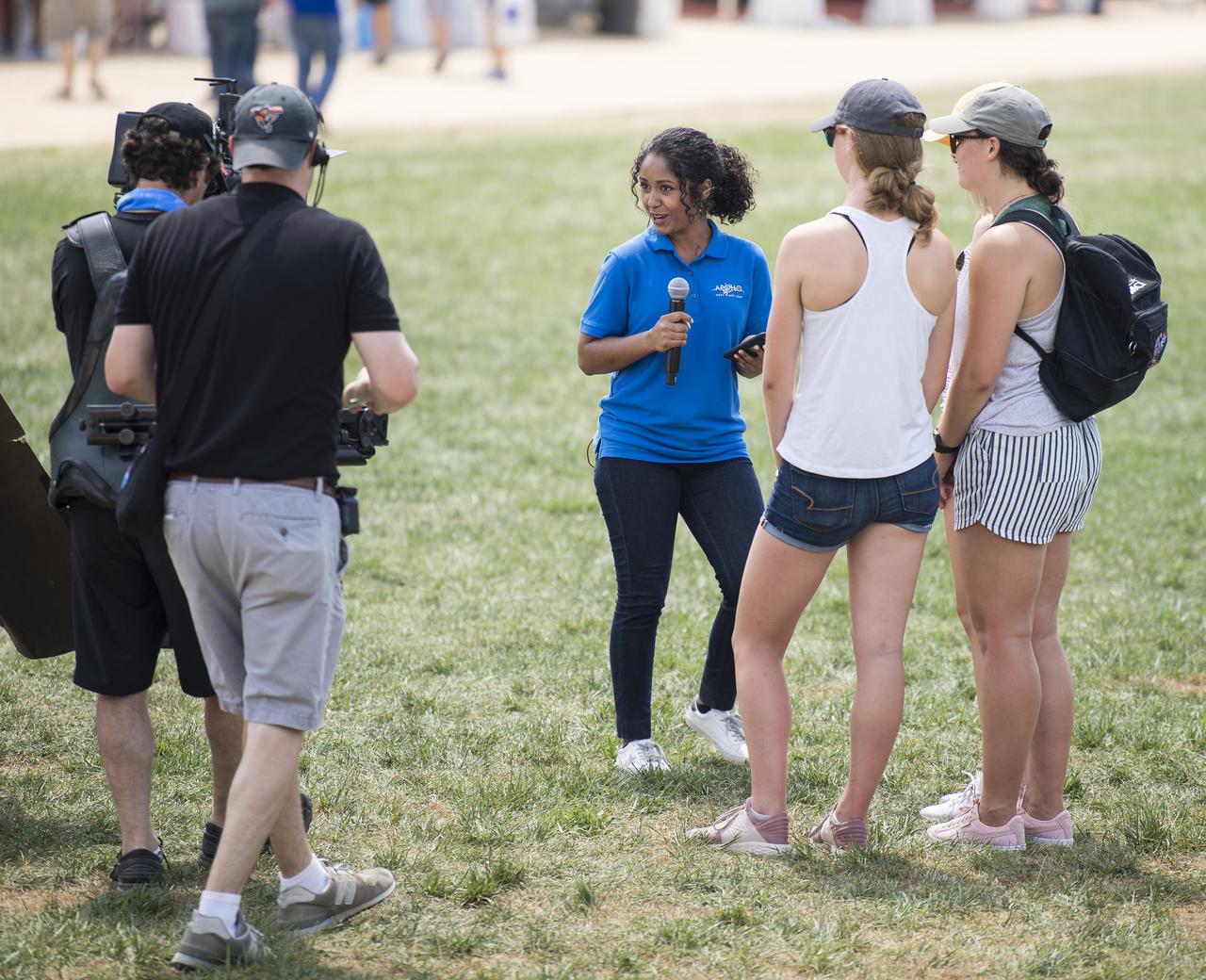
NASA Social Media Specialist, Tahira Allen, interviews visitors to the Apollo 11 50th Anniversary celebration on the National Mall during “NASA’s Giant Leaps: Past and Future," a live television program on Friday, July 19, 2019 in Washington. NASA and the world are recognizing the 50th anniversary of Apollo 11, in which astronauts Neil Armstrong, Michael Collins, and Buzz Aldrin crewed the first mission to land astronauts on the Moon. Photo Credit: (NASA/Aubrey Gemignani)
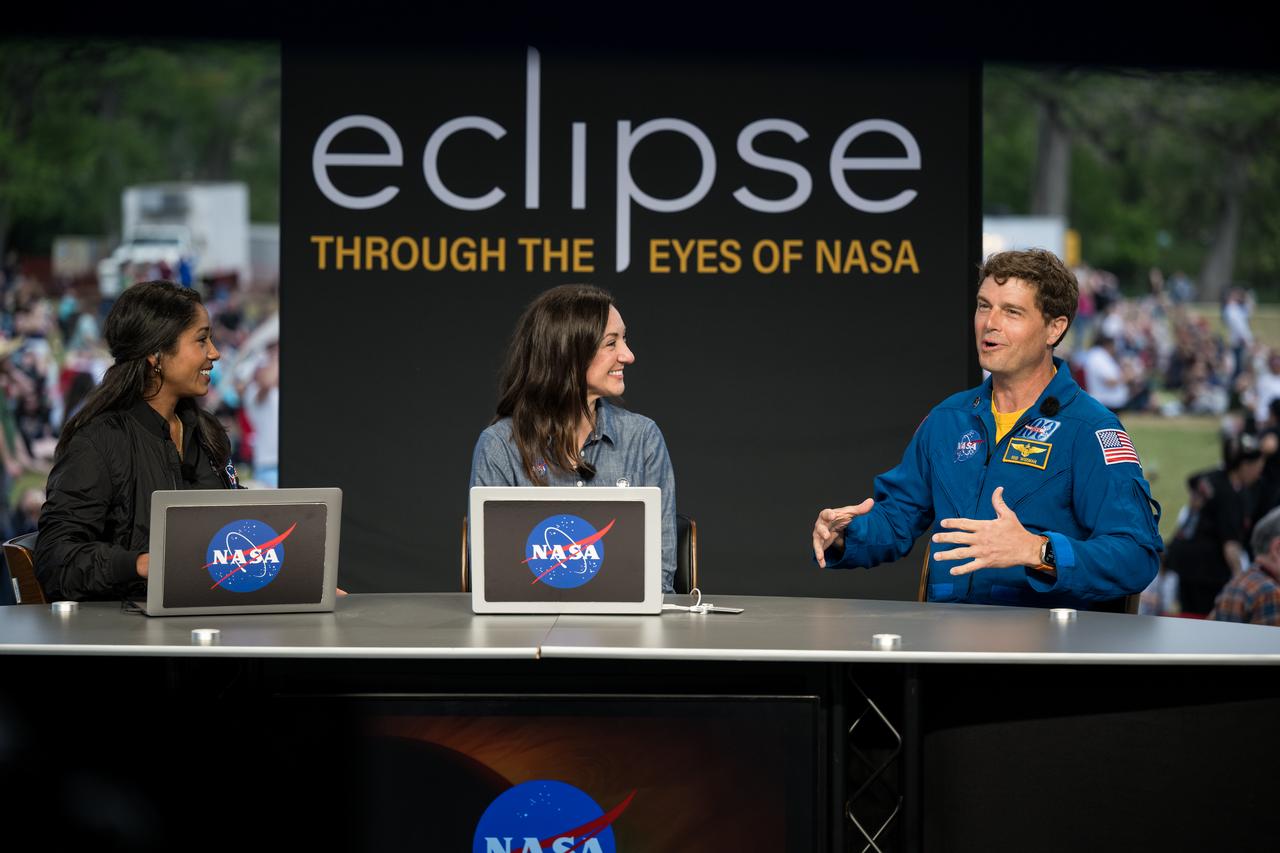
NASA Broadcast Host Tahira Allen, Space Physicist Gina DiBraccio, and NASA astronaut Reid Wiseman are seen during the broadcast of the total solar eclipse in Kerrville, TX on Monday, April 8, 2024. A total solar eclipse swept across a narrow portion of the North American continent from Mexico’s Pacific coast to the Atlantic coast of Newfoundland, Canada. A partial solar eclipse was visible across the entire North American continent along with parts of Central America and Europe. Photo Credit: (NASA/Aubrey Gemignani)
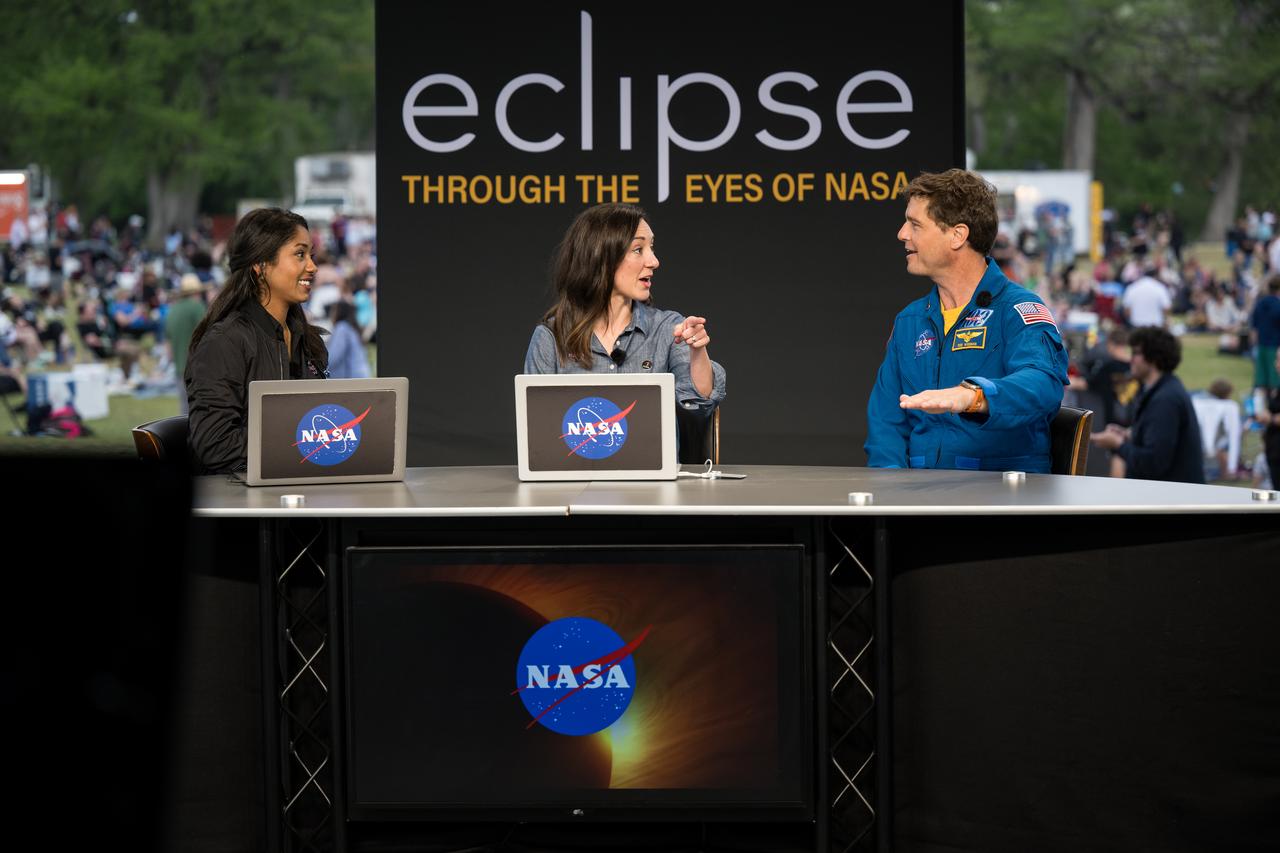
NASA Broadcast Host Tahira Allen, Space Physicist Gina DiBraccio, and NASA astronaut Reid Wiseman are seen during the broadcast of the total solar eclipse in Kerrville, TX on Monday, April 8, 2024. A total solar eclipse swept across a narrow portion of the North American continent from Mexico’s Pacific coast to the Atlantic coast of Newfoundland, Canada. A partial solar eclipse was visible across the entire North American continent along with parts of Central America and Europe. Photo Credit: (NASA/Aubrey Gemignani)
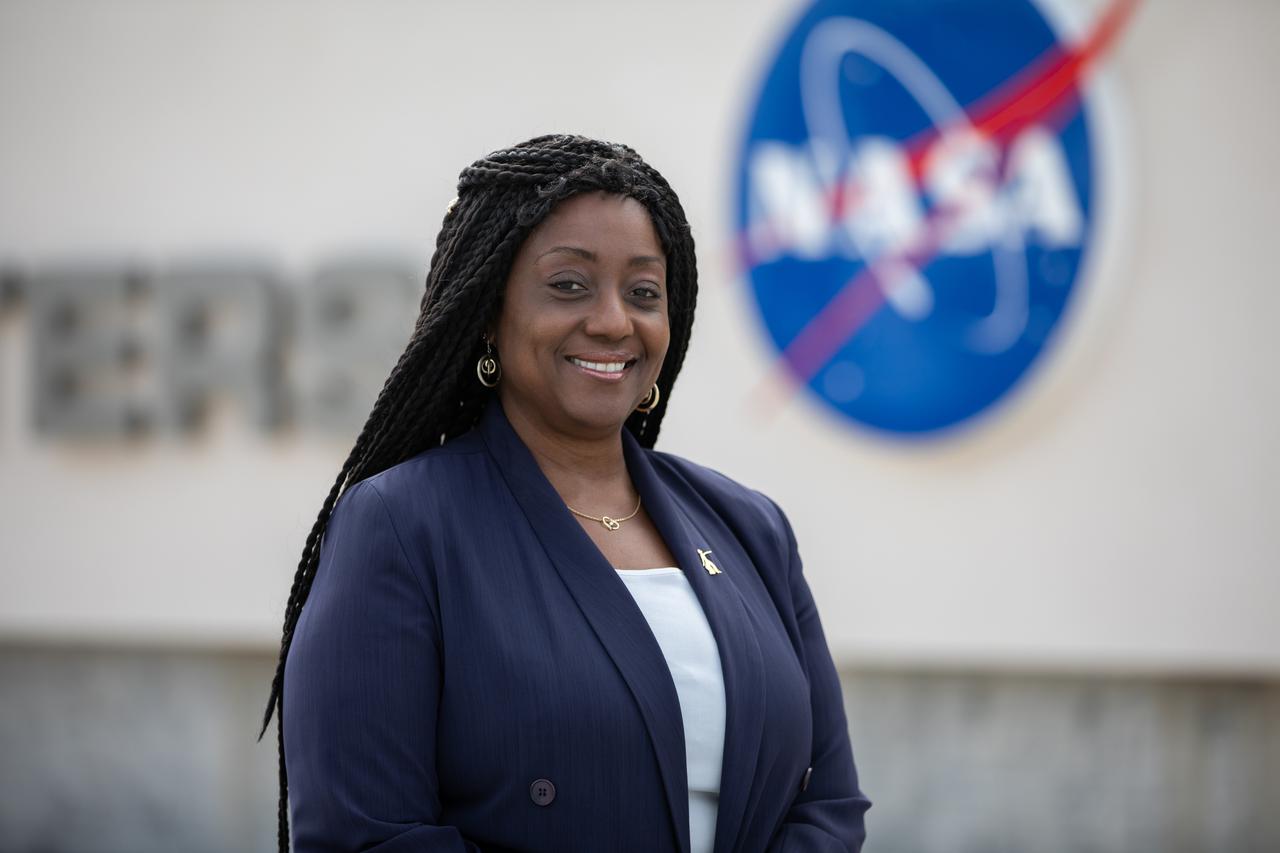
"I’ve worked in many different roles and what drives my passion is learning things that I don’t know. It is a part of my thirst for knowledge and knowing how things work. The harder the problem for me the better. When I first joined NASA as a full time employee, my supervisor would give me an assignment, and I would get it done quickly and come back to his desk and ask, ‘What do you have for me now?’ At one point, after about two months of working for him, he looked at me and kind of sighed. I said, ‘Okay, okay. If you don’t have anything for me right now, is it okay if I see if any of the other supervisors in the building need any help with anything?’ He agreed, and so I approached the other supervisors. "Now, here’s the interesting thing. I was a young Black female in an engineering role that was pretty much dominated by white males at the time, so it was not a norm for there to be females in the building – much less black females. I came to understand later that there was some skepticism on their part that I could do design engineering. I didn’t know that some of them, not all of them, were throwing things at me to show me I wasn’t qualified. But I would tackle their problems the same way I do anything else: if I don’t know it, I’ll go find it. I’ll research. I’ll dig. I’ll look for people that might have some experience that I don’t have and ask them. So, every hard problem that they threw at me, I solved. Eventually, my supervisor told me he didn't know what he was getting into when he agreed to let me go to the other supervisors because now, they were coming to him with their hardest problems, asking, 'Hey, can Barbara help with this?' So, I started to broaden my experience base right away." — Barbara Brown, Director of Exploration Research and Technology Programs, Kennedy Space Center Interviewer: NASA / Tahira Allen