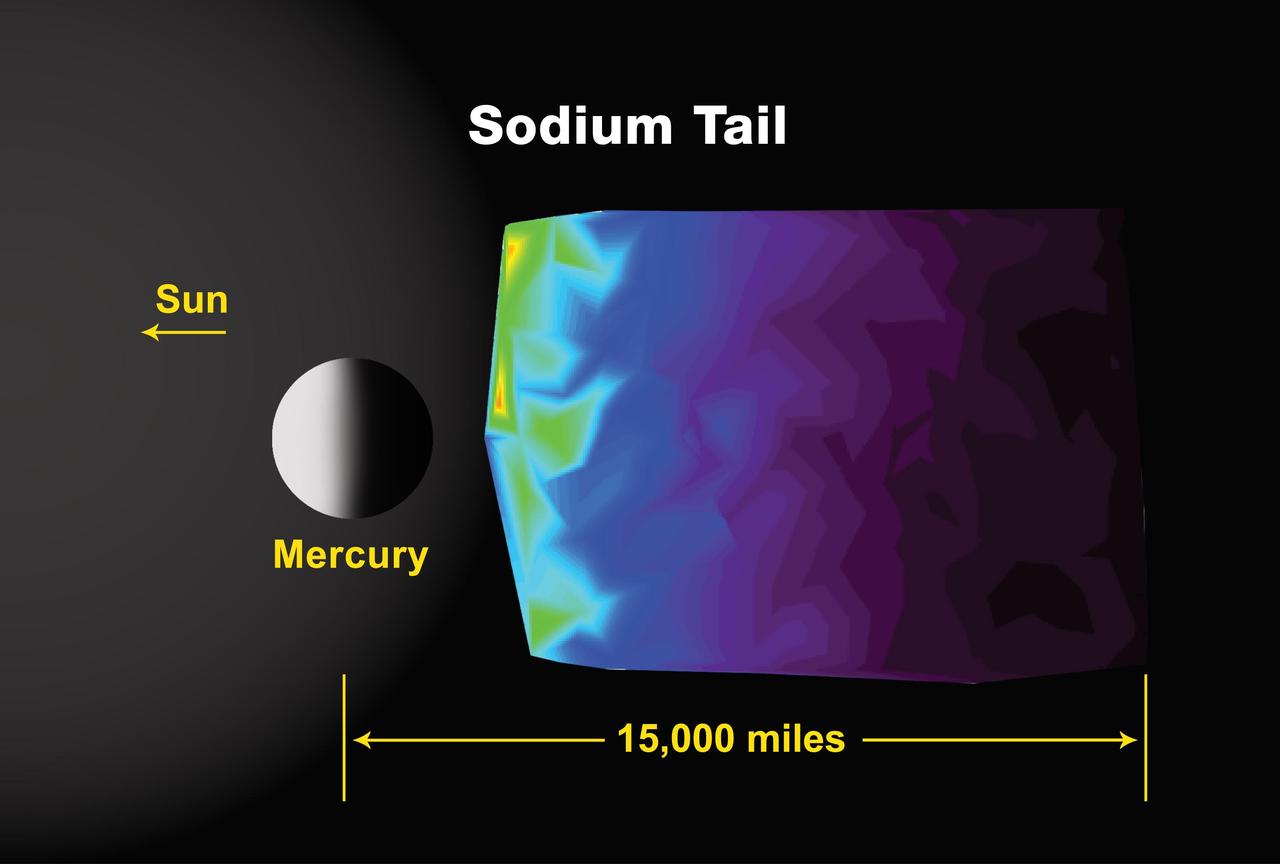
Mercury Sodium Tail
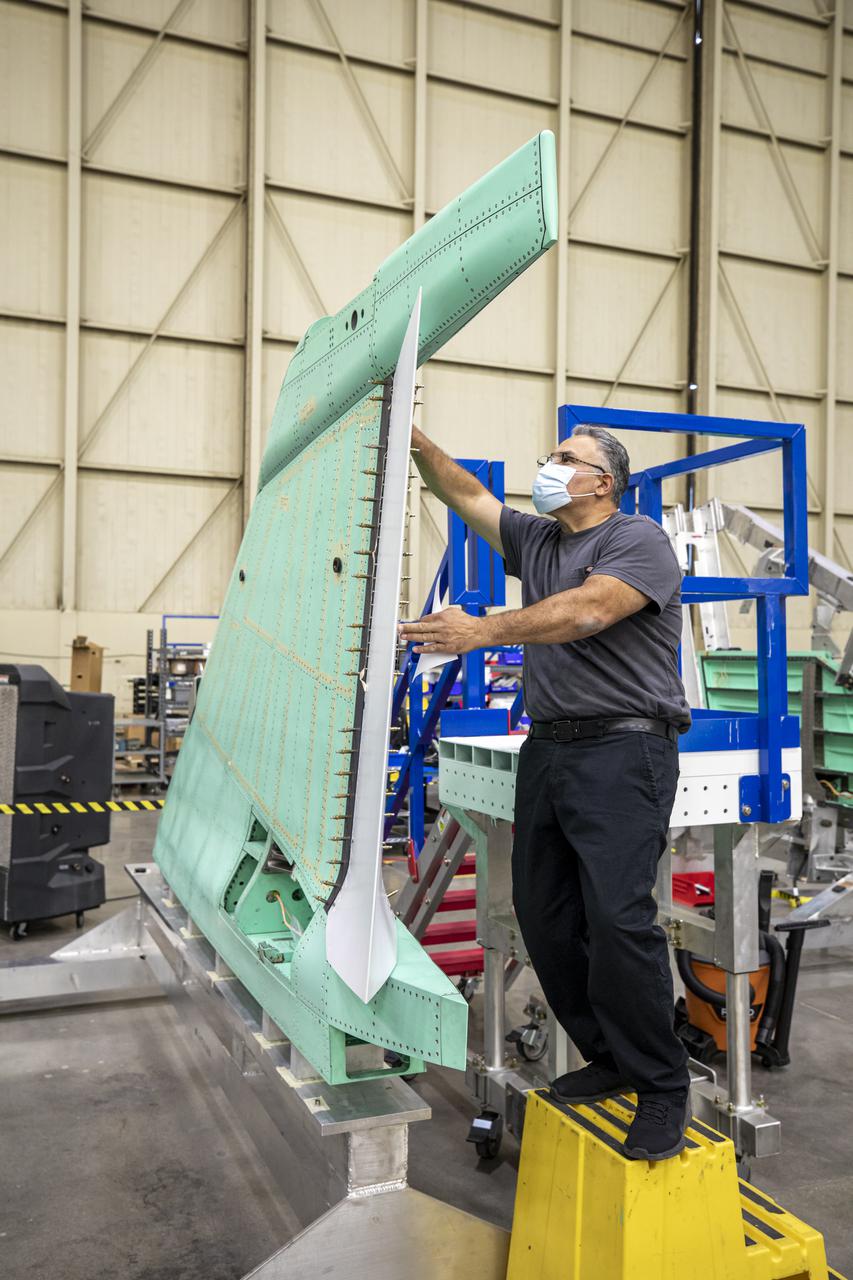
A technician is shown working on the X-59 vertical tail prior to installation. The aircraft, under construction at Lockheed Martin Skunk Works in Palmdale, California, will fly to demonstrate the ability to fly supersonic while reducing the loud sonic boom to a quiet sonic thump. Lockheed Martin Photography By Garry Tice 1011 Lockheed Way, Palmdale, Ca. 93599 Event: SEG 530 Vertical Tail - Rudder Installed Date: 5/12/2021
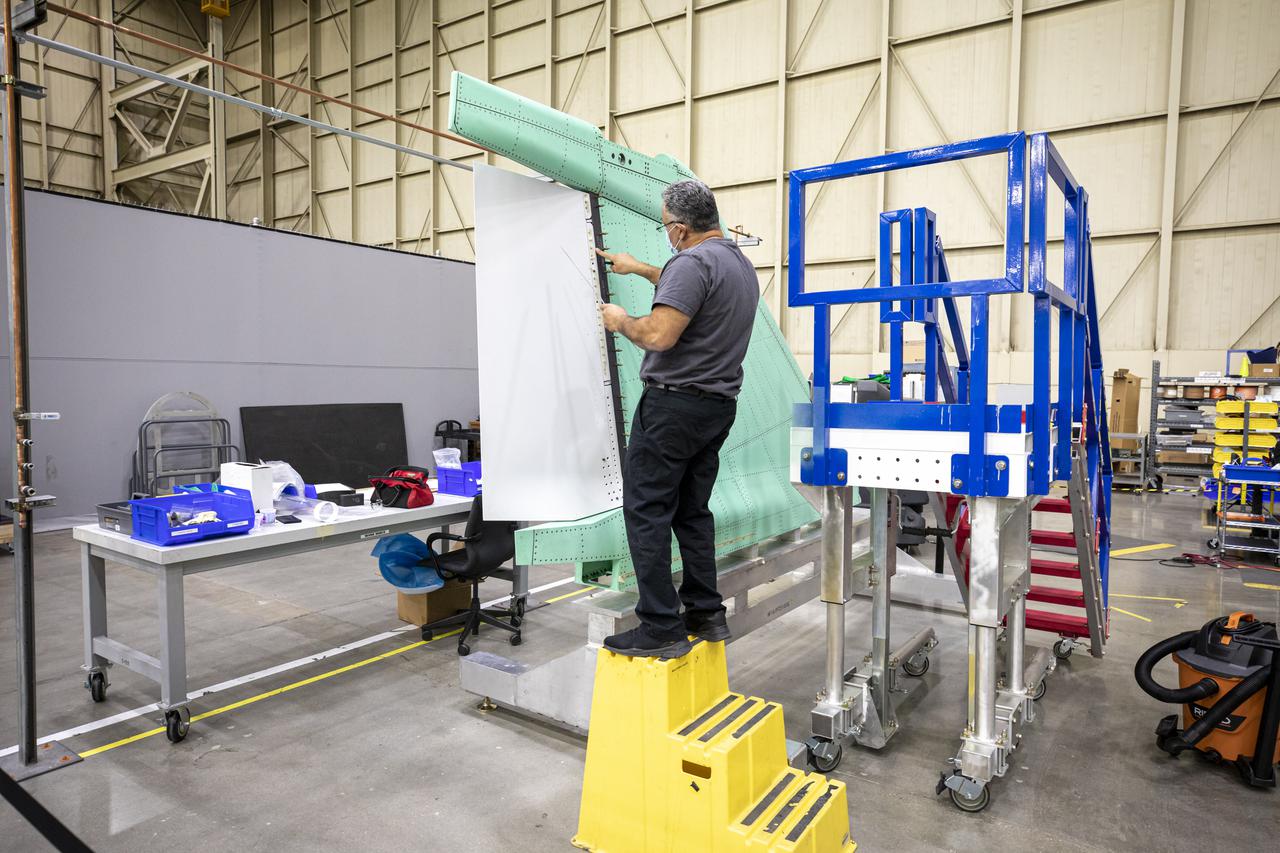
A technician is shown working on the X-59 Quiet SuperSonic Technology or QueSST aircraft’s vertical tail prior to installation. Lockheed Martin Photography By Garry Tice 1011 Lockheed Way, Palmdale, Ca. 93599 Event: SEG 530 Vertical Tail - Rudder Installed Date: 5/12/2021
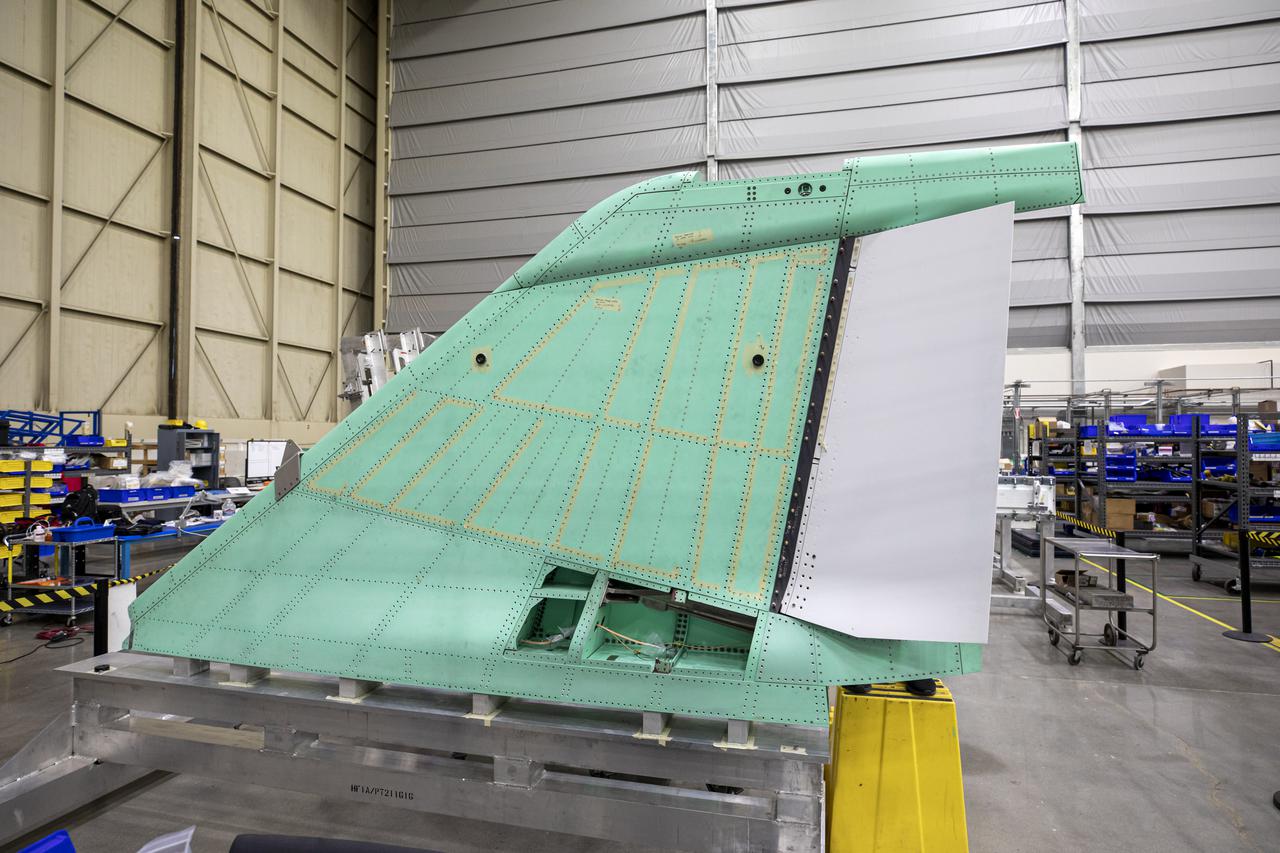
Pictured here is a close up view of the X-59 Quiet SuperSonic Technology or QueSST aircraft’s vertical tail prior to installation. Lockheed Martin Photography By Garry Tice 1011 Lockheed Way, Palmdale, Ca. 93599 Event: SEG 530 Vertical Tail - Rudder Installed Date: 5/12/2021
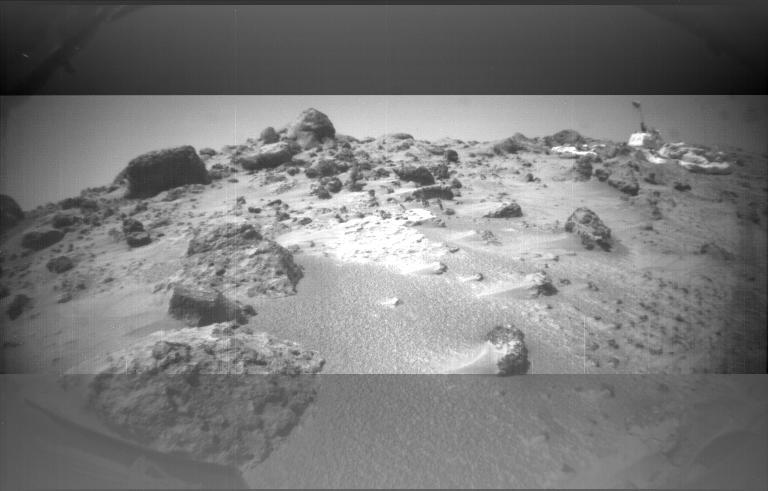
Dust Wind Tails Around Rocks
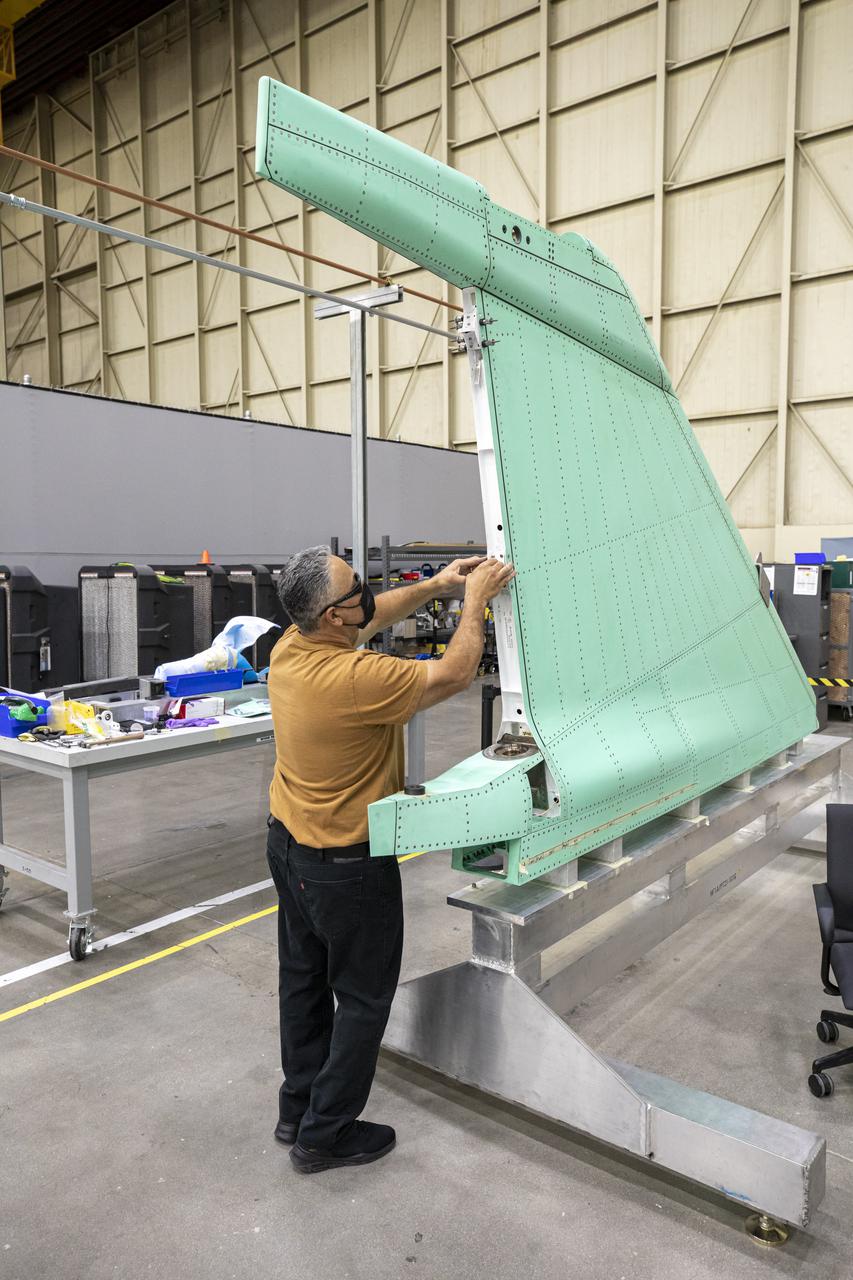
A technician is shown working on the X-59 vertical tail prior to installation at Lockheed Martin Skunk Works in Palmdale, California. The aircraft will fly to demonstrate the ability to fly supersonic while reducing the loud sonic boom to a quiet sonic thump. Lockheed Martin Photography By Garry Tice 1011 Lockheed Way, Palmdale, Ca. 93599 Event: SEG 530 Vertical Tail, Landing Gear Bay Doors Date: 4/28/2021

NASA’s Artemis III core stage boat-tail and RS-25 engines are shown inside the Space Systems Processing Facility at NASA’s Kennedy Space Center in Florida on Tuesday, Sept. 10, 2024. Used during the assembly of the SLS (Space Launch System) core stage for Artemis III, the boat tail is a fairing-like structure that protects the bottom end of the core stage. NASA’s Pegasus barge delivered the boat-tail, along with other hardware for future Artemis campaigns to NASA Kennedy on Thursday, Sept. 5, 2024.

NASA’s Artemis III core stage boat-tail and RS-25 engines are shown inside the Space Systems Processing Facility at NASA’s Kennedy Space Center in Florida on Tuesday, Sept. 10, 2024. Used during the assembly of the SLS (Space Launch System) core stage for Artemis III, the boat tail is a fairing-like structure that protects the bottom end of the core stage. NASA’s Pegasus barge delivered the boat-tail, along with other hardware for future Artemis campaigns to NASA Kennedy on Thursday, Sept. 5, 2024.
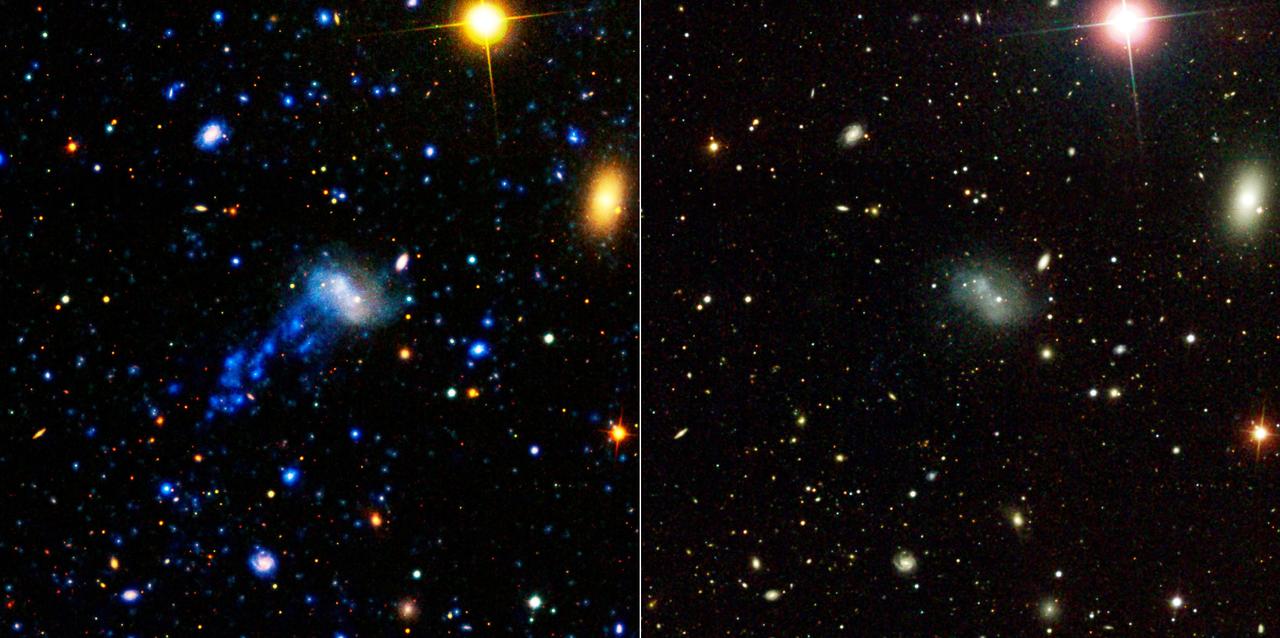
NASA Galaxy Evolution Explorer found a tail behind a galaxy called IC 3418. This star-studded tail was created as the galaxy plunged into gas in a family of galaxies known as the Virgo cluster.
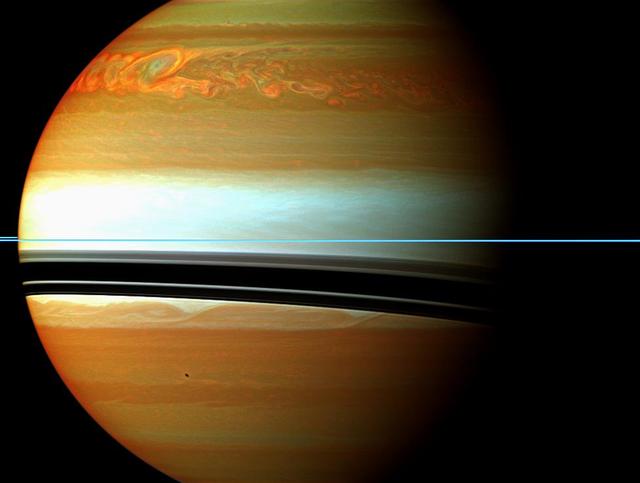
This false-color mosaic from NASA Cassini spacecraft shows the tail of Saturn huge northern storm. The head of the storm is beyond the horizon in this view.
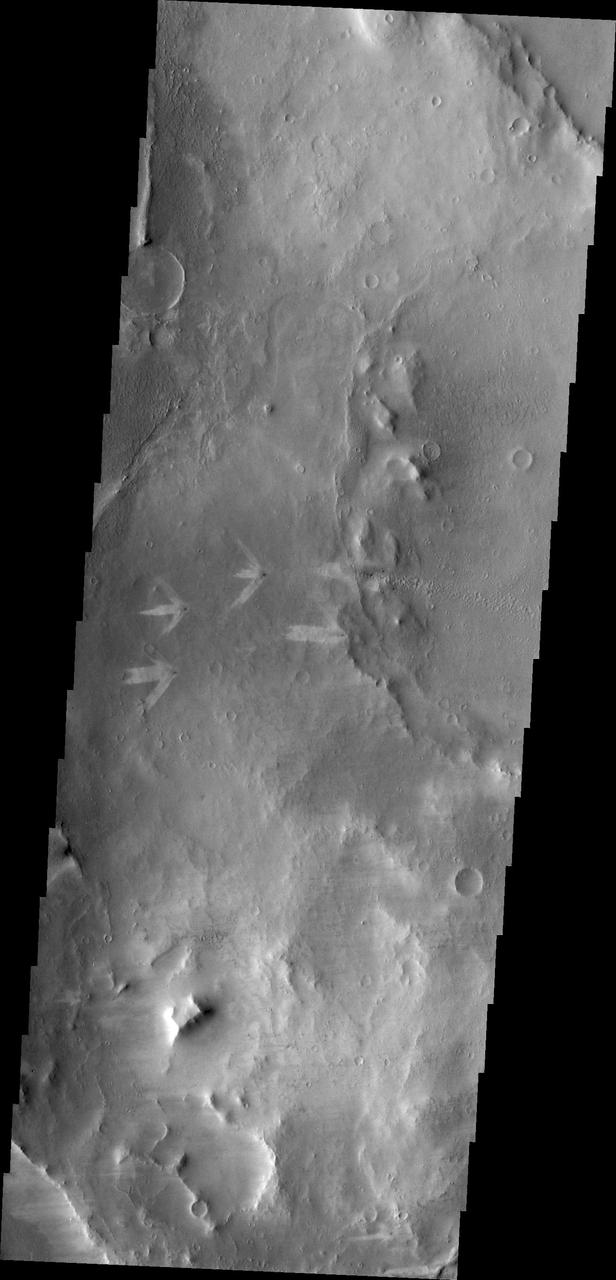
The triple tails of windstreaks behind these small craters in Arabia Terra indicate multiple wind directions in the area in this image from NASA Mars Odyssey.

P/2013 P5 on September 23, 2013. --- This NASA Hubble Space Telescope set of images reveals a never-before-seen set of six comet-like tails radiating from a body in the asteroid belt, designated P/2013 P5. The asteroid was discovered as an unusually fuzzy-looking object with the Panoramic Survey Telescope and Rapid Response System (Pan-STARRS) survey telescope in Hawaii. The multiple tails were discovered in Hubble images taken on Sept. 10, 2013. When Hubble returned to the asteroid on Sept. 23, the asteroid's appearance had totally changed. It looked as if the entire structure had swung around. One interpretation is that the asteroid's rotation rate has been increased to the point where dust is falling off the surface and escaping into space where the pressure of sunlight sweeps out fingerlike tails. According to this theory, the asteroid's spin has been accelerated by the gentle push of sunlight. The object, estimated to be no more than 1,400 feet across, has ejected dust for at least five months, based on analysis of the tail structure. These visible-light, false-color images were taken with Hubble's Wide Field Camera 3. Object Name: P/2013 P5 Image Type: Astronomical/Annotated Credit: NASA, ESA, and D. Jewitt (UCLA) <b><a href="http://www.nasa.gov/audience/formedia/features/MP_Photo_Guidelines.html" rel="nofollow">NASA image use policy.</a></b> <b><a href="http://www.nasa.gov/centers/goddard/home/index.html" rel="nofollow">NASA Goddard Space Flight Center</a></b> enables NASA’s mission through four scientific endeavors: Earth Science, Heliophysics, Solar System Exploration, and Astrophysics. Goddard plays a leading role in NASA’s accomplishments by contributing compelling scientific knowledge to advance the Agency’s mission. <b>Follow us on <a href="http://twitter.com/NASA_GoddardPix" rel="nofollow">Twitter</a></b> <b>Like us on <a href="http://www.facebook.com/pages/Greenbelt-MD/NASA-Goddard/395013845897?ref=tsd" rel="nofollow">Facebook</a></b> <b>Find us on <a href="http://instagram.com/nasagoddard?vm=grid" rel="nofollow">Instagram</a></b>
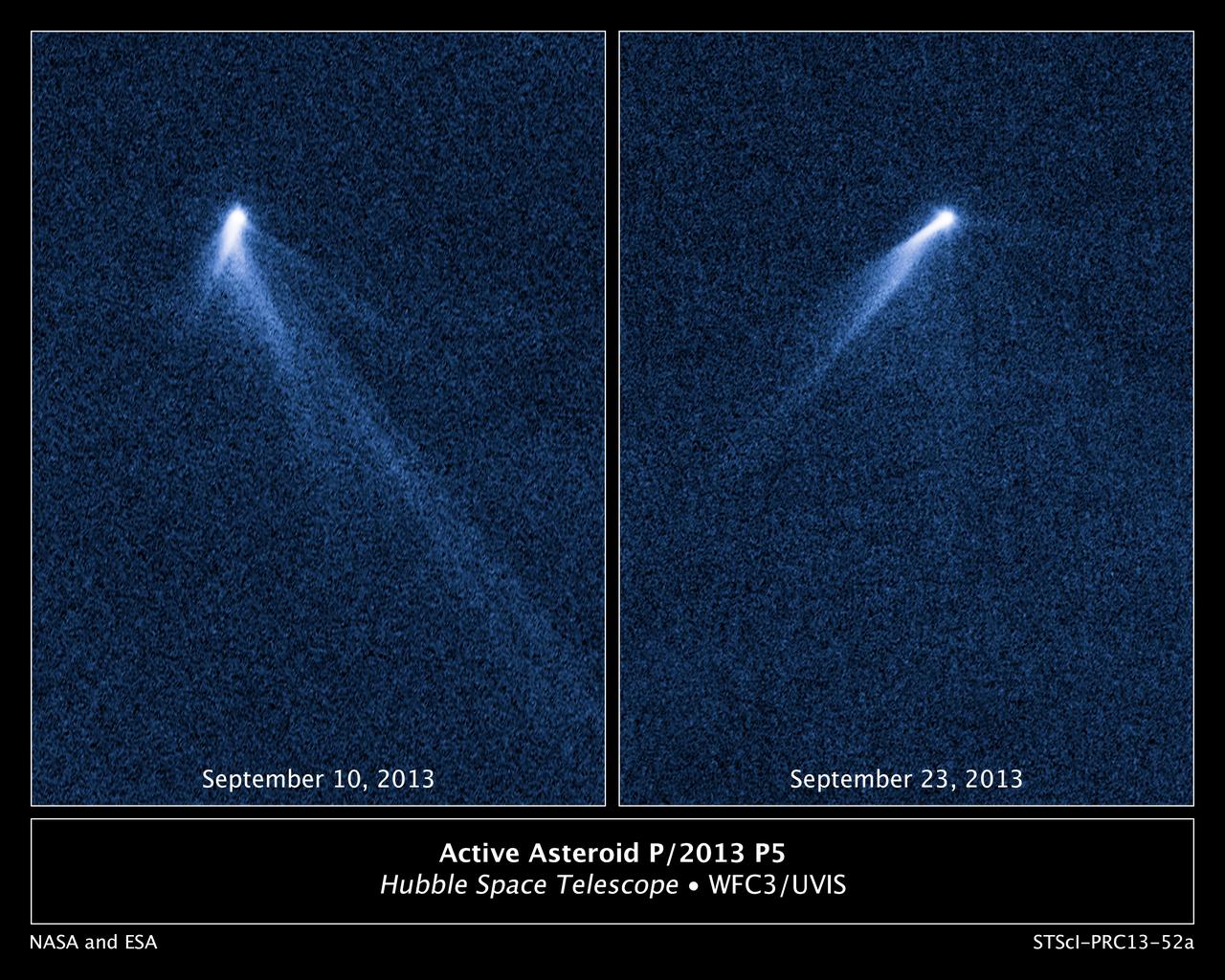
This NASA Hubble Space Telescope set of images reveals a never-before-seen set of six comet-like tails radiating from a body in the asteroid belt, designated P/2013 P5. The asteroid was discovered as an unusually fuzzy-looking object with the Panoramic Survey Telescope and Rapid Response System (Pan-STARRS) survey telescope in Hawaii. The multiple tails were discovered in Hubble images taken on Sept. 10, 2013. When Hubble returned to the asteroid on Sept. 23, the asteroid's appearance had totally changed. It looked as if the entire structure had swung around. One interpretation is that the asteroid's rotation rate has been increased to the point where dust is falling off the surface and escaping into space where the pressure of sunlight sweeps out fingerlike tails. According to this theory, the asteroid's spin has been accelerated by the gentle push of sunlight. The object, estimated to be no more than 1,400 feet across, has ejected dust for at least five months, based on analysis of the tail structure. These visible-light, false-color images were taken with Hubble's Wide Field Camera 3. Object Name: P/2013 P5 Image Type: Astronomical/Annotated Credit: NASA, ESA, and D. Jewitt (UCLA) <b><a href="http://www.nasa.gov/audience/formedia/features/MP_Photo_Guidelines.html" rel="nofollow">NASA image use policy.</a></b> <b><a href="http://www.nasa.gov/centers/goddard/home/index.html" rel="nofollow">NASA Goddard Space Flight Center</a></b> enables NASA’s mission through four scientific endeavors: Earth Science, Heliophysics, Solar System Exploration, and Astrophysics. Goddard plays a leading role in NASA’s accomplishments by contributing compelling scientific knowledge to advance the Agency’s mission. <b>Follow us on <a href="http://twitter.com/NASA_GoddardPix" rel="nofollow">Twitter</a></b> <b>Like us on <a href="http://www.facebook.com/pages/Greenbelt-MD/NASA-Goddard/395013845897?ref=tsd" rel="nofollow">Facebook</a></b> <b>Find us on <a href="http://instagram.com/nasagoddard?vm=grid" rel="nofollow">Instagram</a></b>

P/2013 P5 on September 10, 2013. --- This NASA Hubble Space Telescope set of images reveals a never-before-seen set of six comet-like tails radiating from a body in the asteroid belt, designated P/2013 P5. The asteroid was discovered as an unusually fuzzy-looking object with the Panoramic Survey Telescope and Rapid Response System (Pan-STARRS) survey telescope in Hawaii. The multiple tails were discovered in Hubble images taken on Sept. 10, 2013. When Hubble returned to the asteroid on Sept. 23, the asteroid's appearance had totally changed. It looked as if the entire structure had swung around. One interpretation is that the asteroid's rotation rate has been increased to the point where dust is falling off the surface and escaping into space where the pressure of sunlight sweeps out fingerlike tails. According to this theory, the asteroid's spin has been accelerated by the gentle push of sunlight. The object, estimated to be no more than 1,400 feet across, has ejected dust for at least five months, based on analysis of the tail structure. These visible-light, false-color images were taken with Hubble's Wide Field Camera 3. Object Name: P/2013 P5 Image Type: Astronomical/Annotated Credit: NASA, ESA, and D. Jewitt (UCLA) <b><a href="http://www.nasa.gov/audience/formedia/features/MP_Photo_Guidelines.html" rel="nofollow">NASA image use policy.</a></b> <b><a href="http://www.nasa.gov/centers/goddard/home/index.html" rel="nofollow">NASA Goddard Space Flight Center</a></b> enables NASA’s mission through four scientific endeavors: Earth Science, Heliophysics, Solar System Exploration, and Astrophysics. Goddard plays a leading role in NASA’s accomplishments by contributing compelling scientific knowledge to advance the Agency’s mission. <b>Follow us on <a href="http://twitter.com/NASA_GoddardPix" rel="nofollow">Twitter</a></b> <b>Like us on <a href="http://www.facebook.com/pages/Greenbelt-MD/NASA-Goddard/395013845897?ref=tsd" rel="nofollow">Facebook</a></b> <b>Find us on <a href="http://instagram.com/nasagoddard?vm=grid" rel="nofollow">Instagram</a></b>
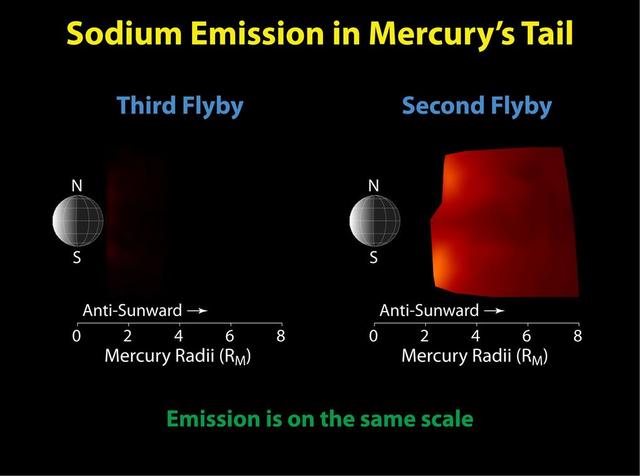
Mercury Flyby 3 Reveals a Highly Diminished Sodium Tail
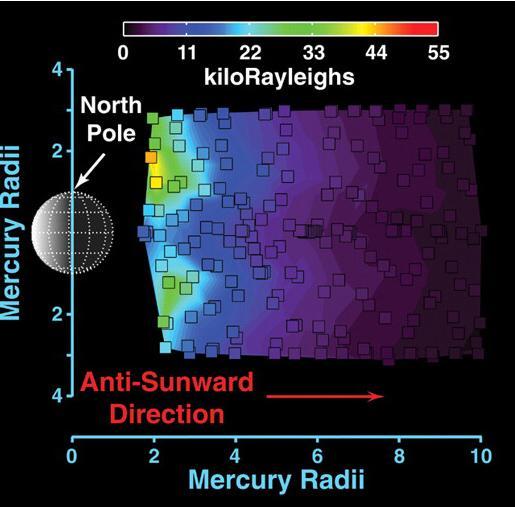
As the MESSENGER spacecraft approached Mercury, the UVVS field of view was scanned across the planet's exospheric "tail," which is produced by the solar wind pushing Mercury's exosphere (the planet's extremely thin atmosphere) outward. This figure, recently published in Science magazine, shows a map of the distribution of sodium atoms as they stream away from the planet (see PIA10396); red and yellow colors represent a higher abundance of sodium than darker shades of blue and purple, as shown in the colored scale bar, which gives the brightness intensity in units of kiloRayleighs. The escaping atoms eventually form a comet-like tail that extends in the direction opposite that of the Sun for many planetary radii. The small squares outlined in black correspond to individual measurements that were used to create the full map. These measurements are the highest-spatial-resolution observations ever made of Mercury's tail. In less than six weeks, on October 6, 2008, similar measurements will be made during MESSENGER's second flyby of Mercury. Comparing the measurements from the two flybys will provide an unprecedented look at how Mercury's dynamic exosphere and tail vary with time. Date Acquired: January 14, 2008. http://photojournal.jpl.nasa.gov/catalog/PIA11076
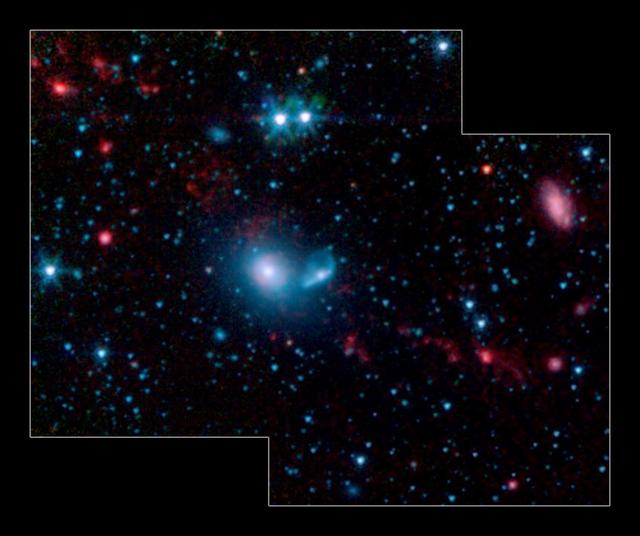
This false-color infrared image from NASA Spitzer Space Telescope shows little dwarf galaxies forming in the tails of two larger galaxies that are colliding together.
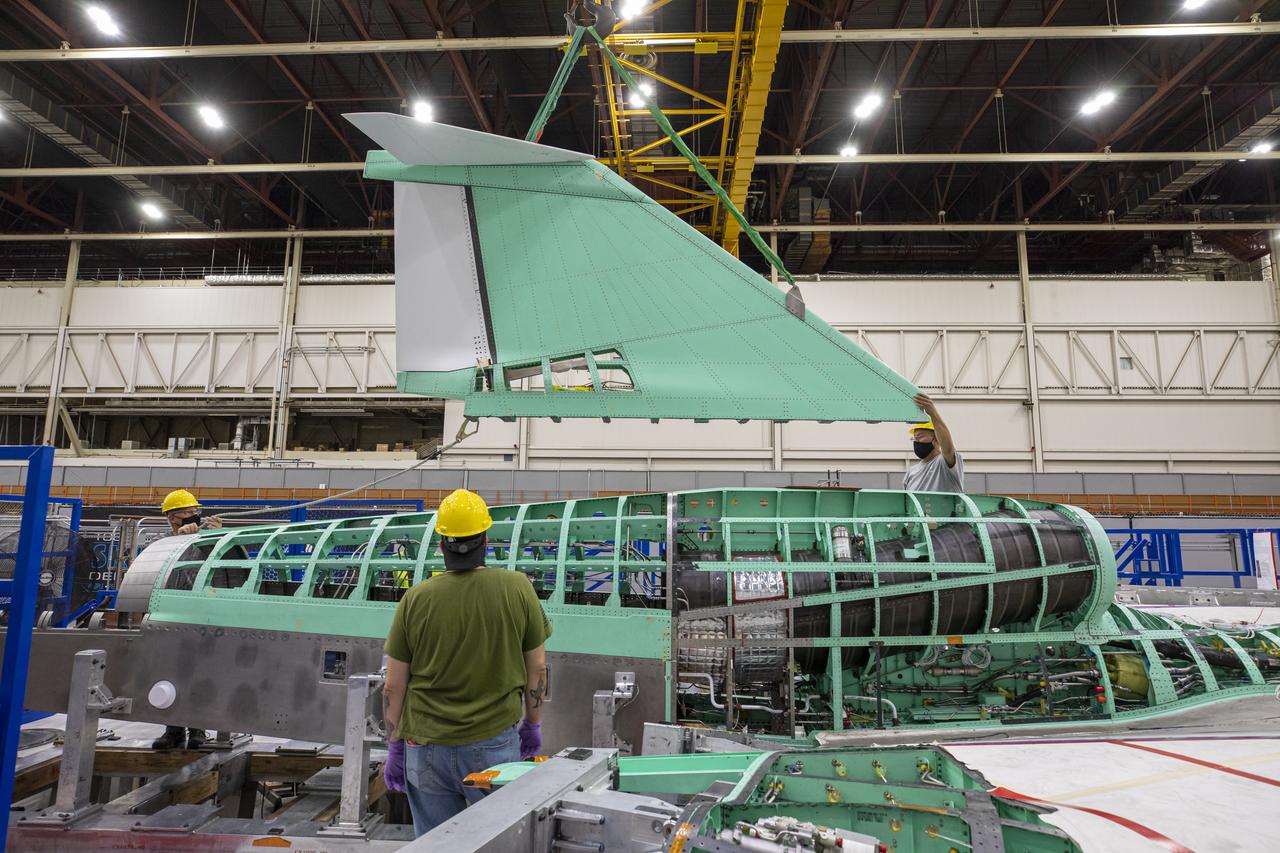
Event: SEG 570 Vertical Tail Assembly - Final Install Lockheed Martin technicians work on a fit check and installation of the vertical tail onto the X-59 aircraft. The plane is under construction at Lockheed Martin Skunk Works in Palmdale, California, will fly to demonstrate the ability to fly supersonic while reducing the loud sonic boom to a quiet sonic thump.
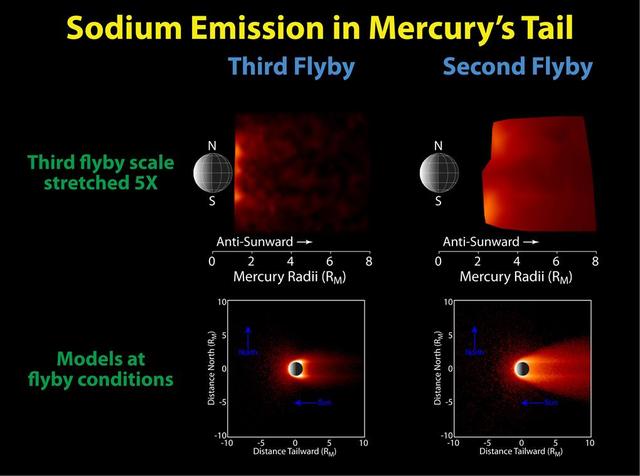
Modeling the Seasons of Mercury Tail
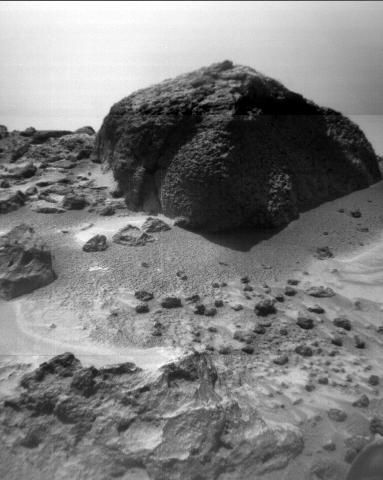
Wind Tails Near Chimp
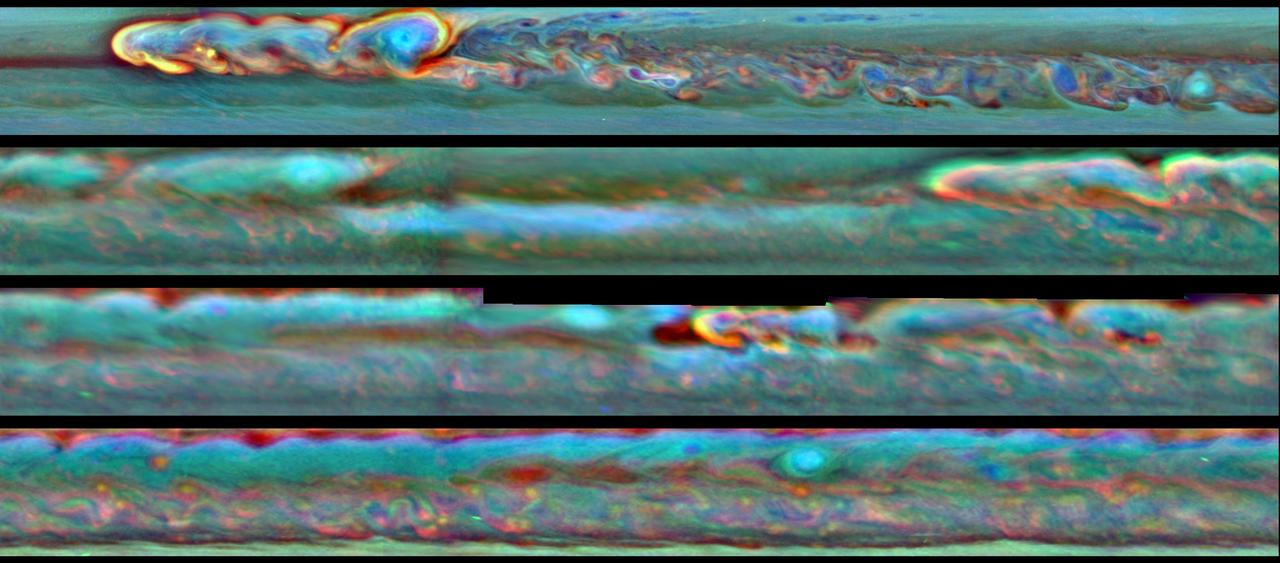
This set of images from NASA Cassini mission shows the evolution of a massive thunder-and-lightning storm that circled all the way around Saturn and fizzled when it ran into its own tail.
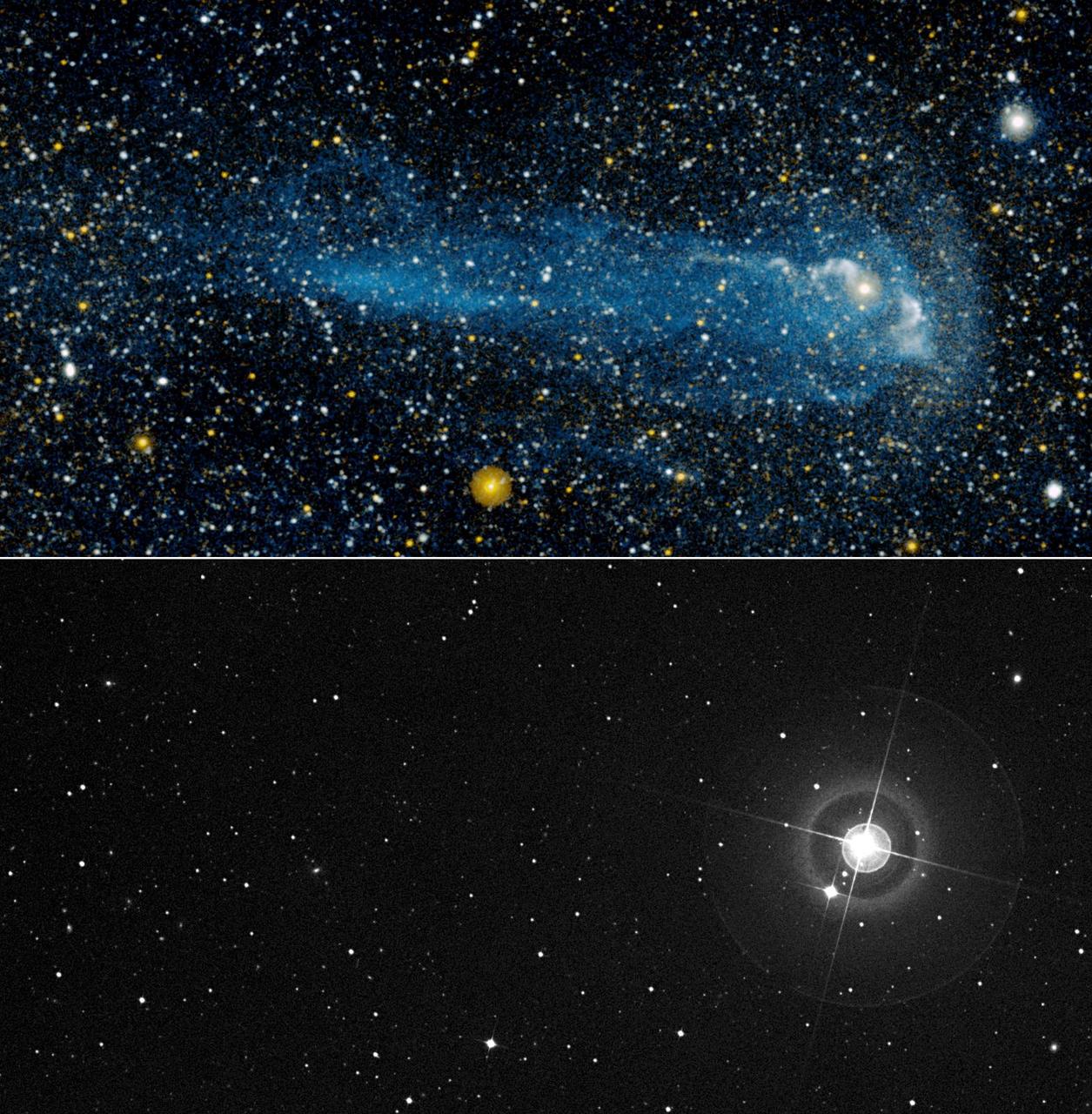
NASA Galaxy Evolution Explorer discovered an exceptionally long comet-like tail of material trailing behind Mira -- a star that has been studied thoroughly for about 400 years.
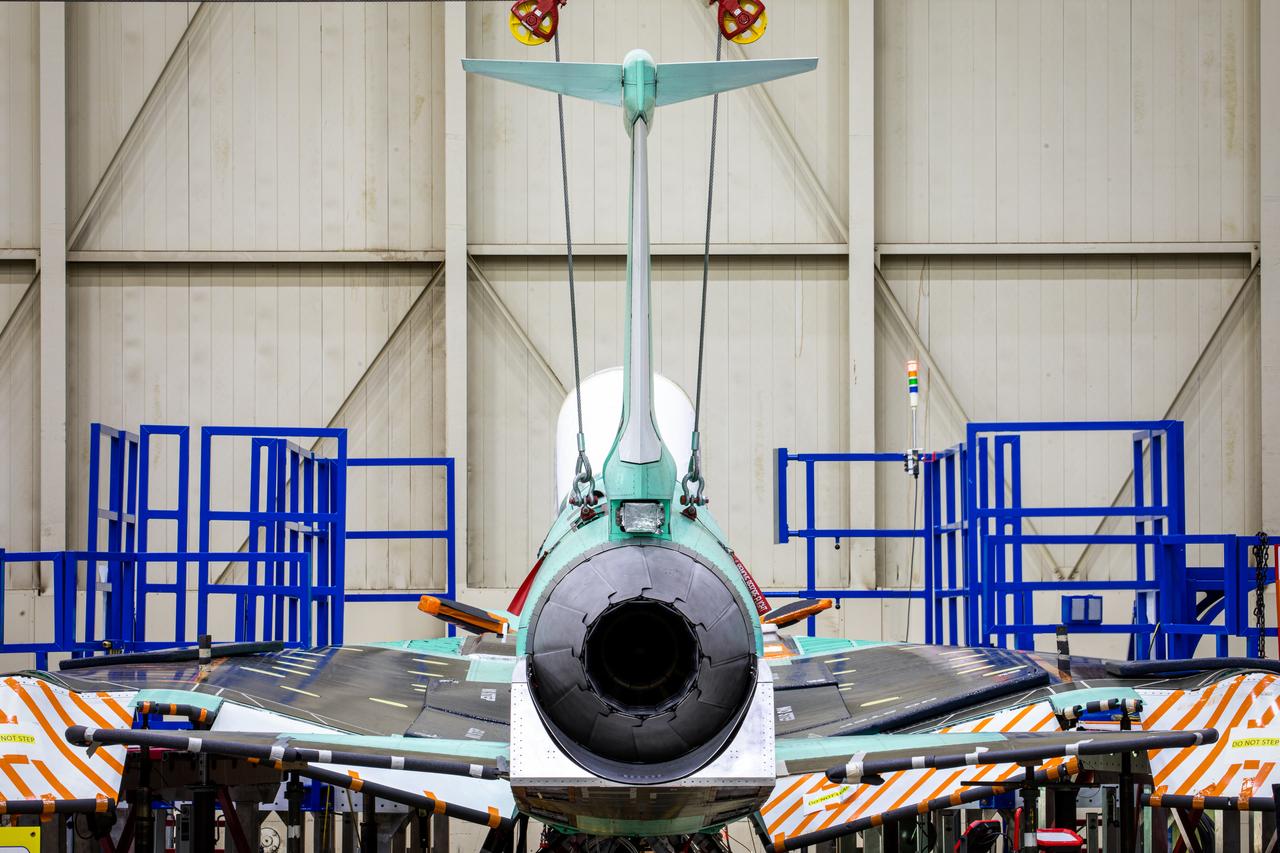
A perfectly framed up rearview shot of NASA’s X-59 tail after its recent installation of the lower empennage, or tail section, in late March at Lockheed Martin Skunk Works in Palmdale, California.

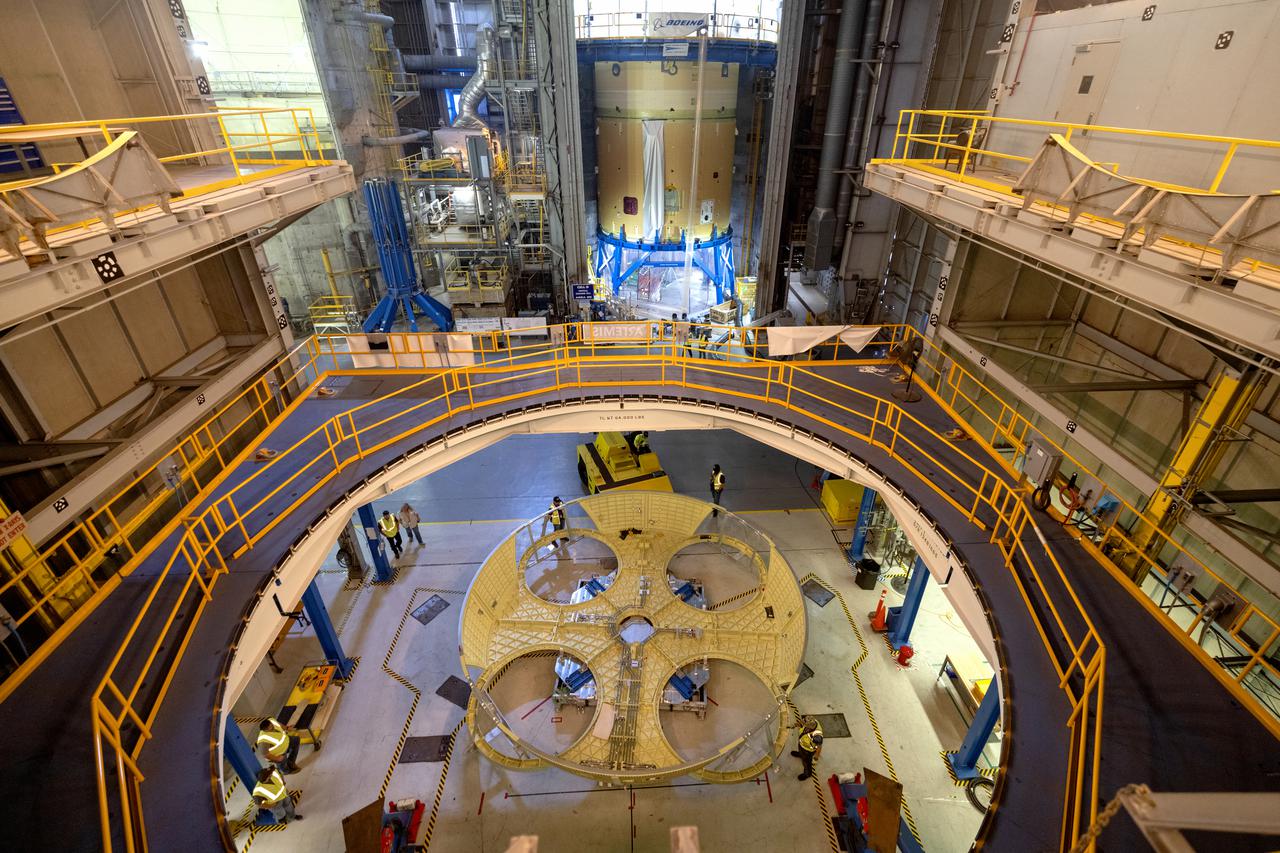
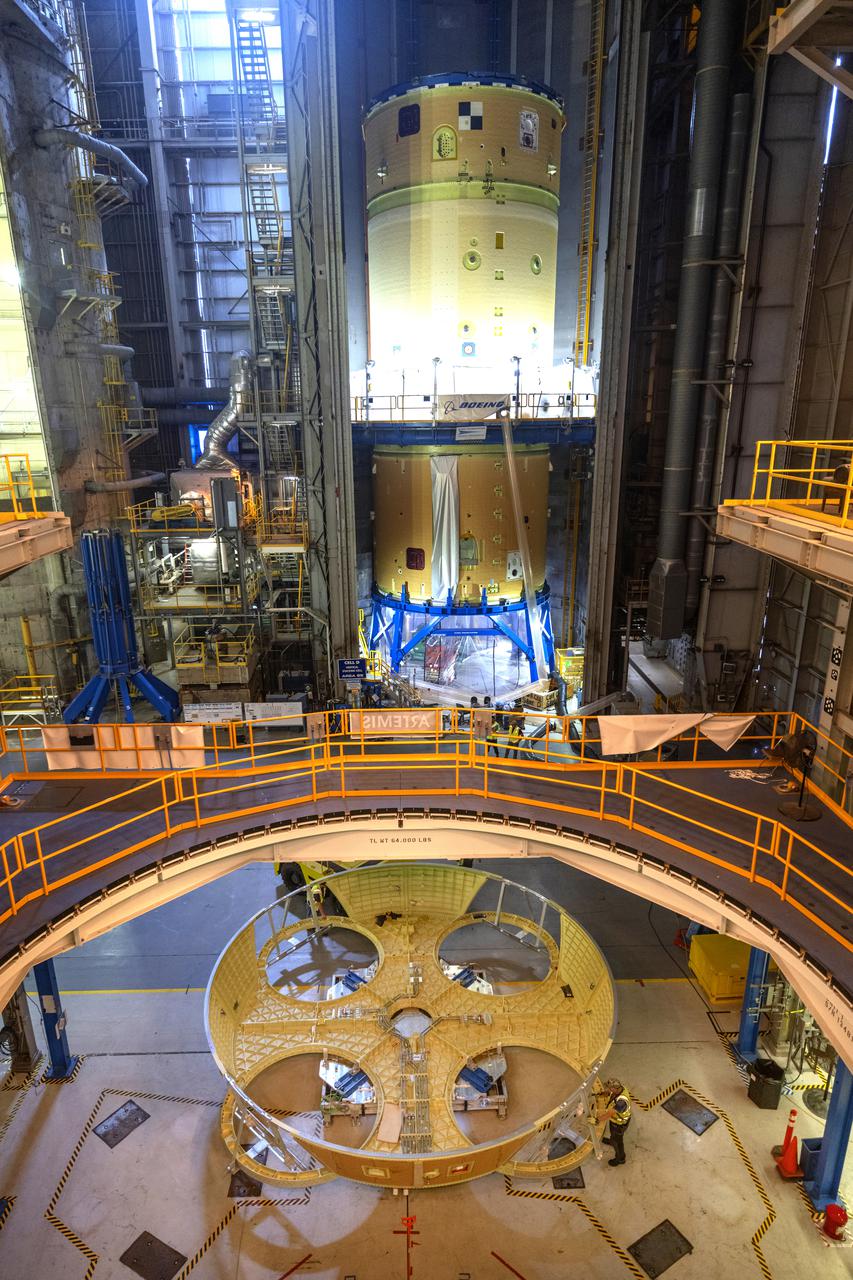
Teams from NASA’s Kennedy Space Center in Florida integrate NASA’s Artemis III SLS (Space Launch System) core stage engine section with its boat-tail inside the spaceport’s Vehicle Assembly Building on Wednesday, July 30, 2025. The boat-tail is a fairing-like structure that protects the bottom end of the core stage, while the engine section is one the most complex and intricate parts of the rocket stage that will help power the Artemis missions to the Moon.
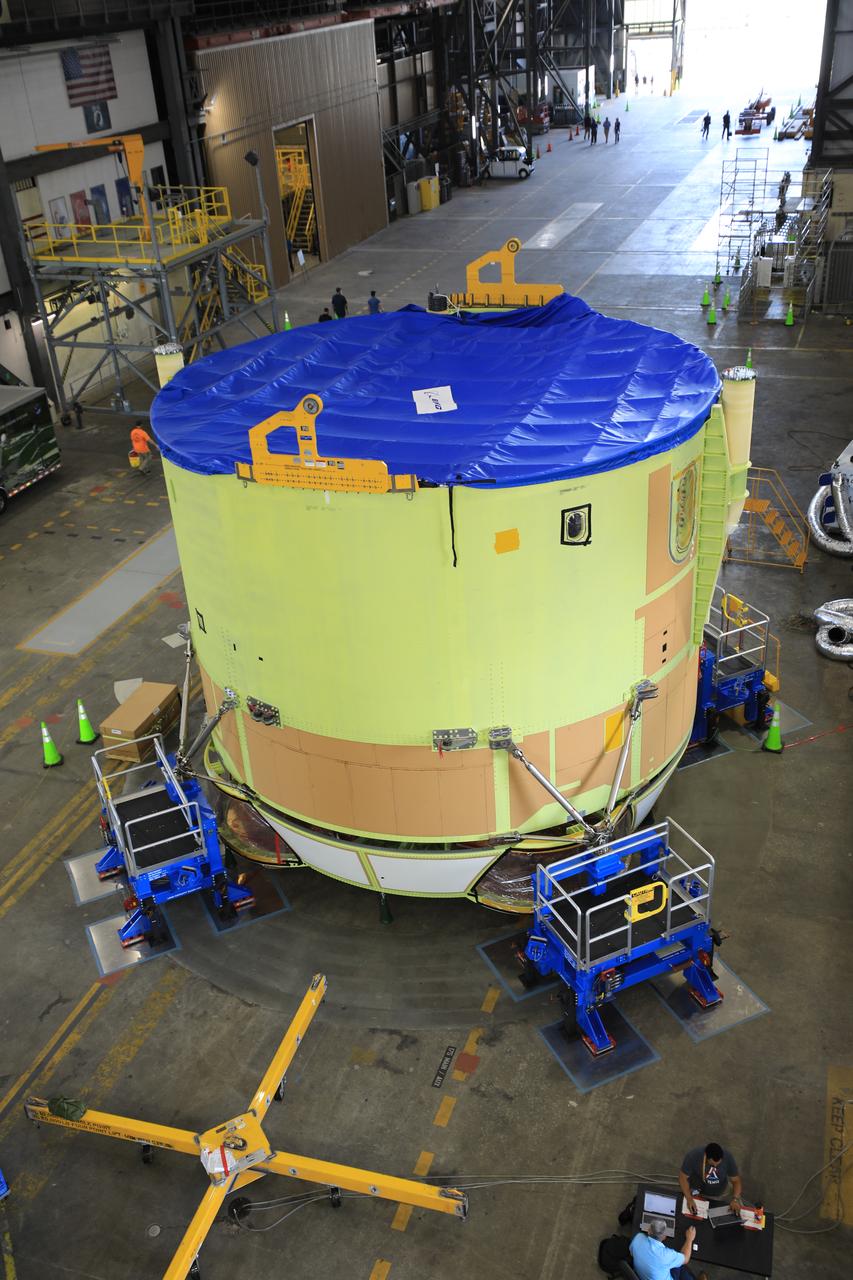
Teams from NASA’s Kennedy Space Center in Florida integrate NASA’s Artemis III SLS (Space Launch System) core stage engine section with its boat-tail inside the spaceport’s Vehicle Assembly Building on Wednesday, July 30, 2025. The boat-tail is a fairing-like structure that protects the bottom end of the core stage, while the engine section is one the most complex and intricate parts of the rocket stage that will help power the Artemis missions to the Moon.
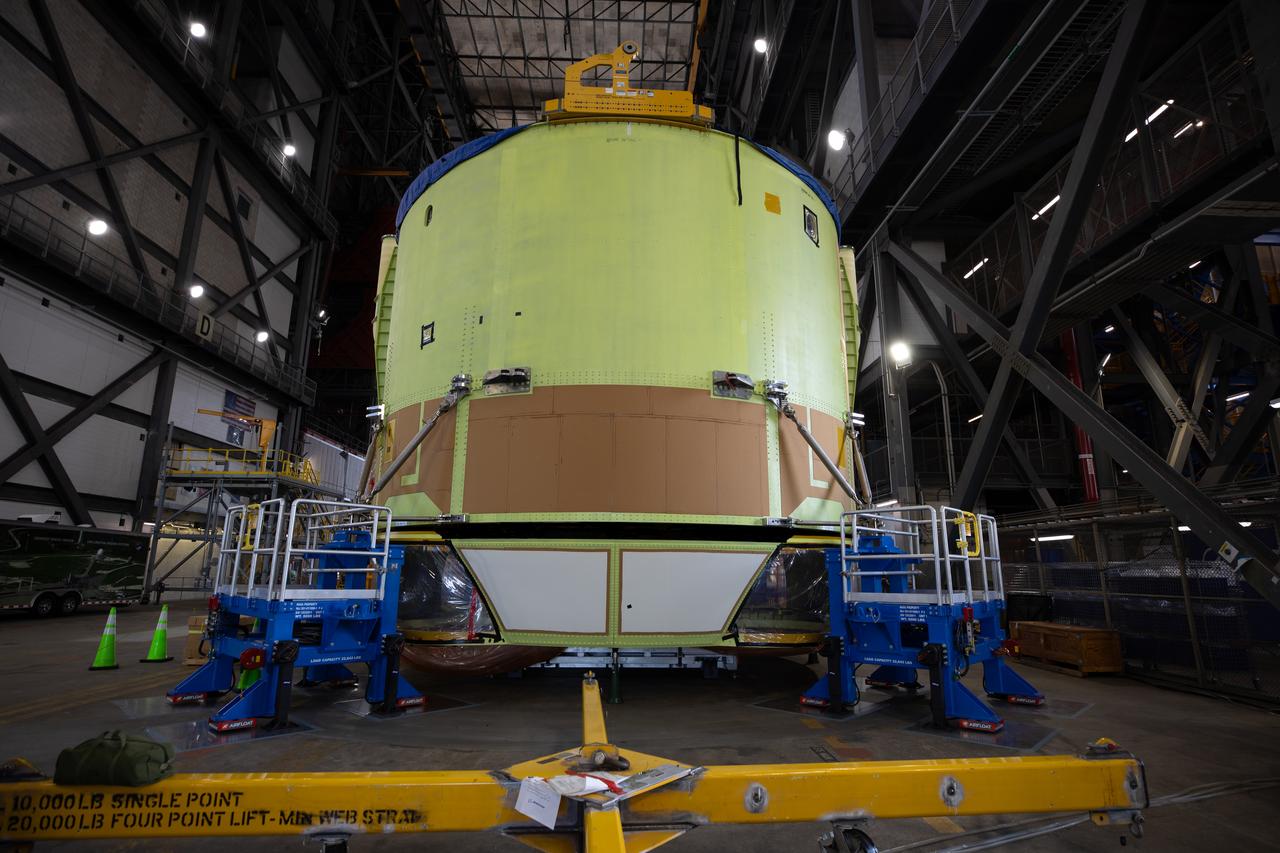
Teams from NASA’s Kennedy Space Center in Florida integrate NASA’s Artemis III SLS (Space Launch System) core stage engine section with its boat-tail inside the spaceport’s Vehicle Assembly Building on Wednesday, July 30, 2025. The boat-tail is a fairing-like structure that protects the bottom end of the core stage, while the engine section is one the most complex and intricate parts of the rocket stage that will help power the Artemis missions to the Moon.

Teams from NASA’s Kennedy Space Center in Florida integrate NASA’s Artemis III SLS (Space Launch System) core stage engine section with its boat-tail inside the spaceport’s Vehicle Assembly Building on Wednesday, July 30, 2025. The boat-tail is a fairing-like structure that protects the bottom end of the core stage, while the engine section is one the most complex and intricate parts of the rocket stage that will help power the Artemis missions to the Moon.
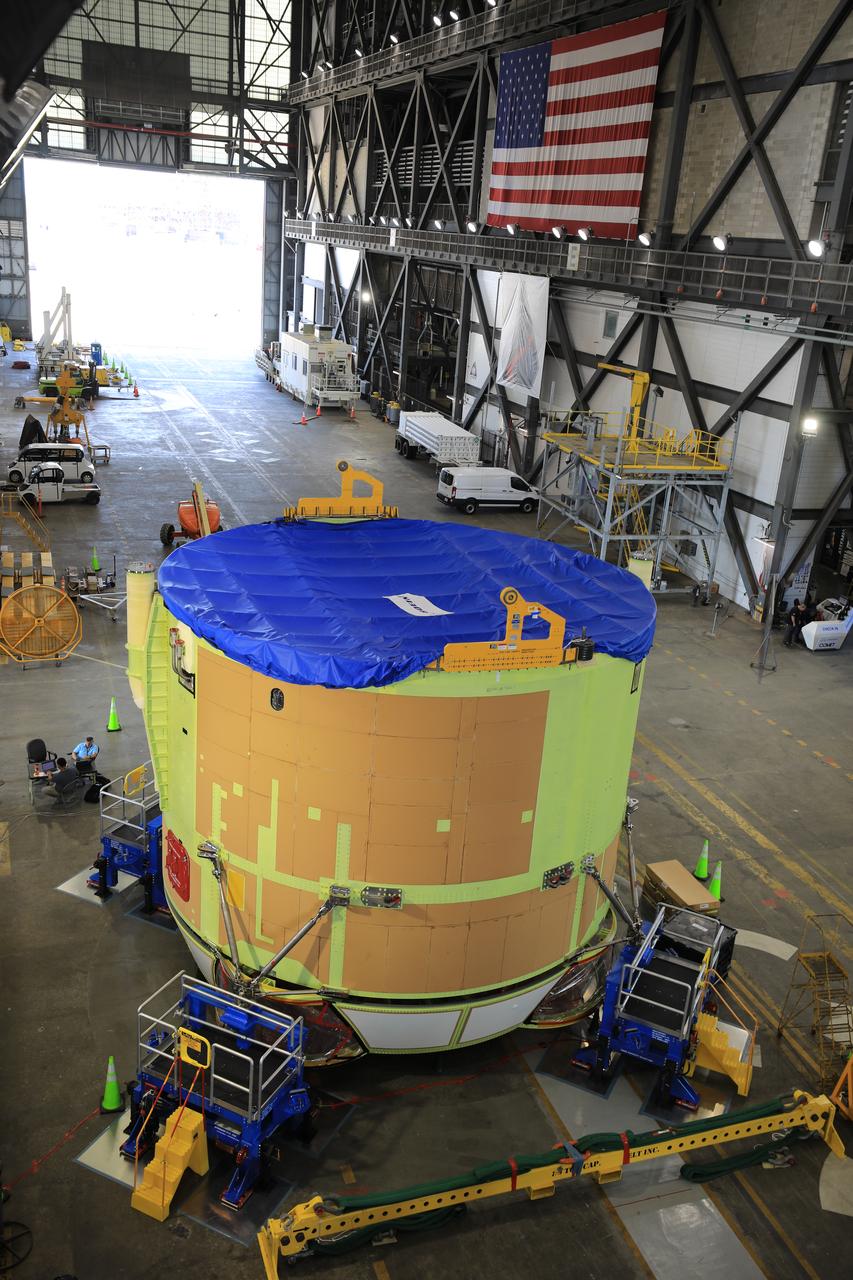
Teams from NASA’s Kennedy Space Center in Florida integrate NASA’s Artemis III SLS (Space Launch System) core stage engine section with its boat-tail inside the spaceport’s Vehicle Assembly Building on Wednesday, July 30, 2025. The boat-tail is a fairing-like structure that protects the bottom end of the core stage, while the engine section is one the most complex and intricate parts of the rocket stage that will help power the Artemis missions to the Moon.
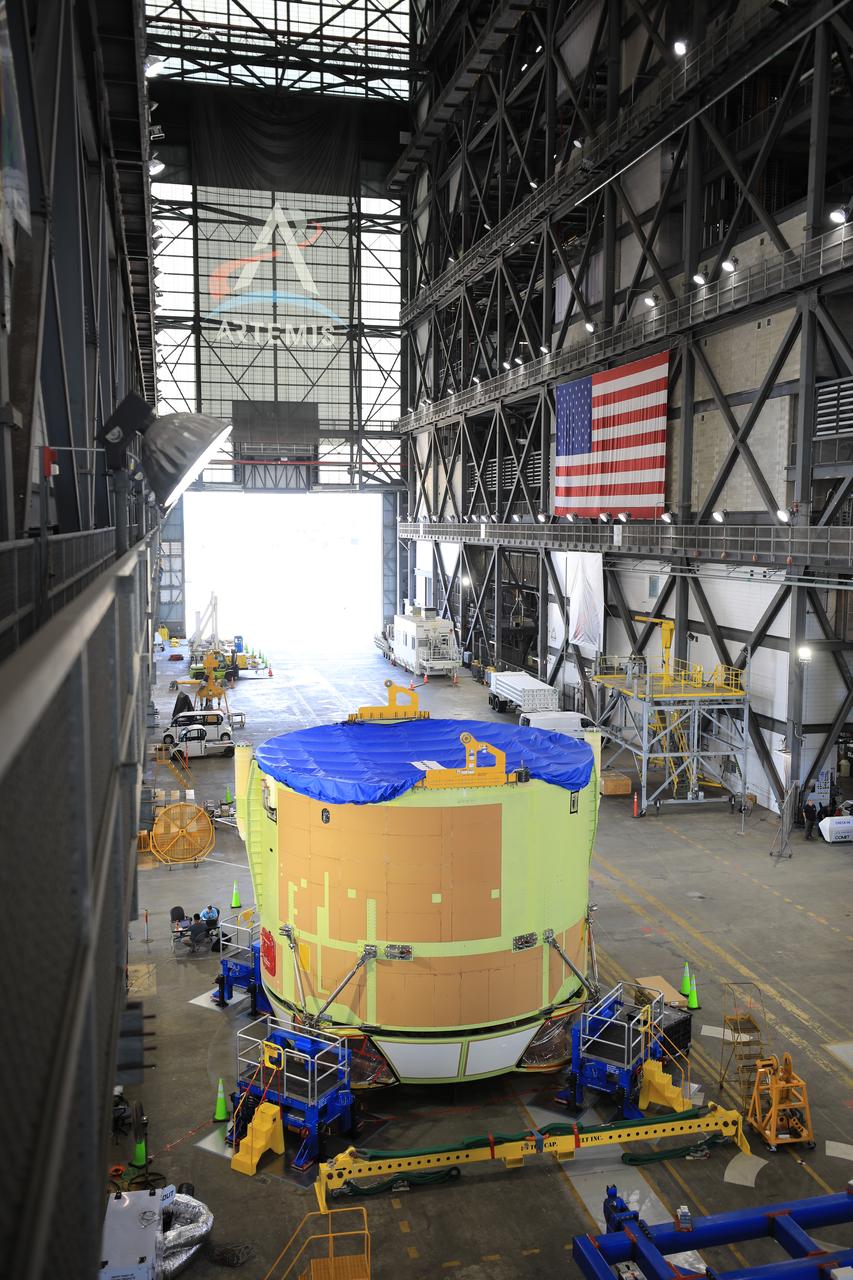
Teams from NASA’s Kennedy Space Center in Florida integrate NASA’s Artemis III SLS (Space Launch System) core stage engine section with its boat-tail inside the spaceport’s Vehicle Assembly Building on Wednesday, July 30, 2025. The boat-tail is a fairing-like structure that protects the bottom end of the core stage, while the engine section is one the most complex and intricate parts of the rocket stage that will help power the Artemis missions to the Moon.
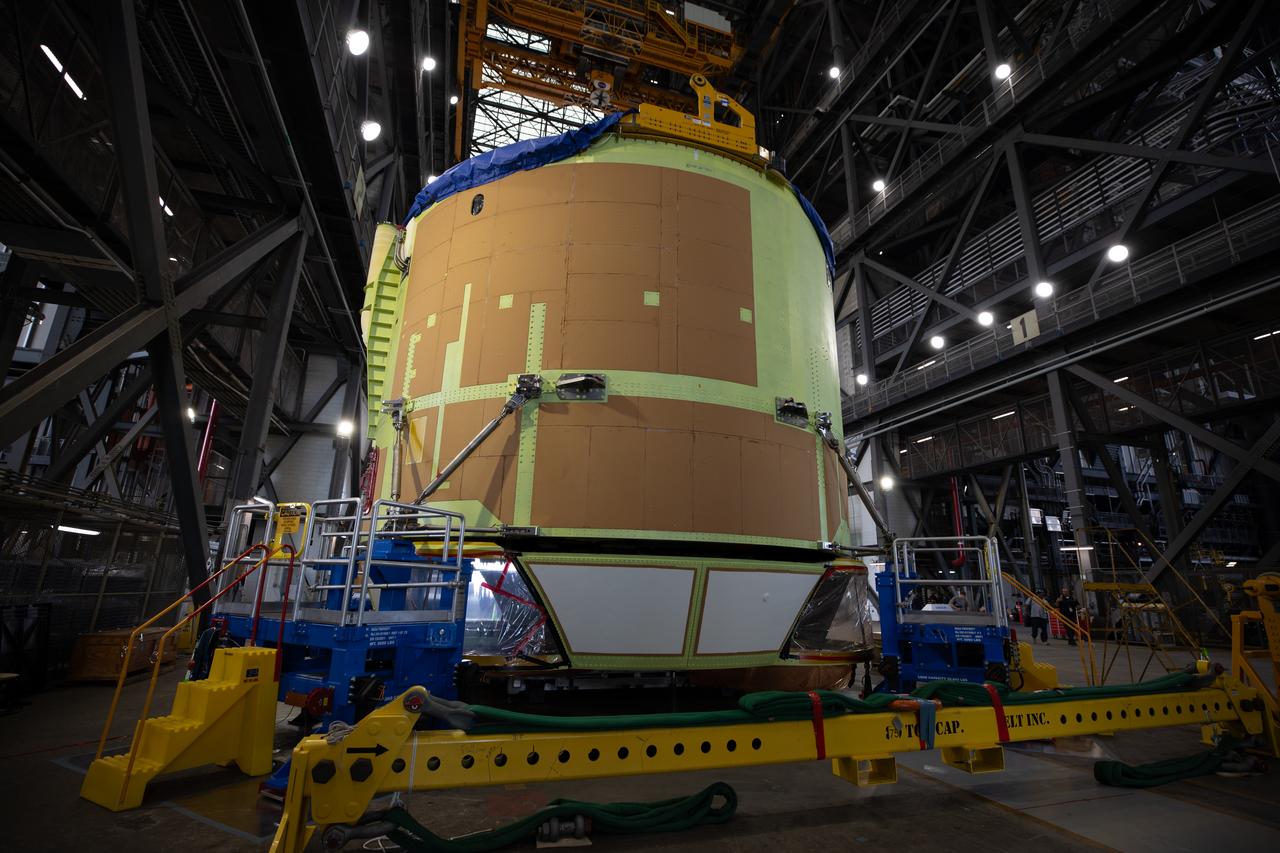
Teams from NASA’s Kennedy Space Center in Florida integrate NASA’s Artemis III SLS (Space Launch System) core stage engine section with its boat-tail inside the spaceport’s Vehicle Assembly Building on Wednesday, July 30, 2025. The boat-tail is a fairing-like structure that protects the bottom end of the core stage, while the engine section is one the most complex and intricate parts of the rocket stage that will help power the Artemis missions to the Moon.
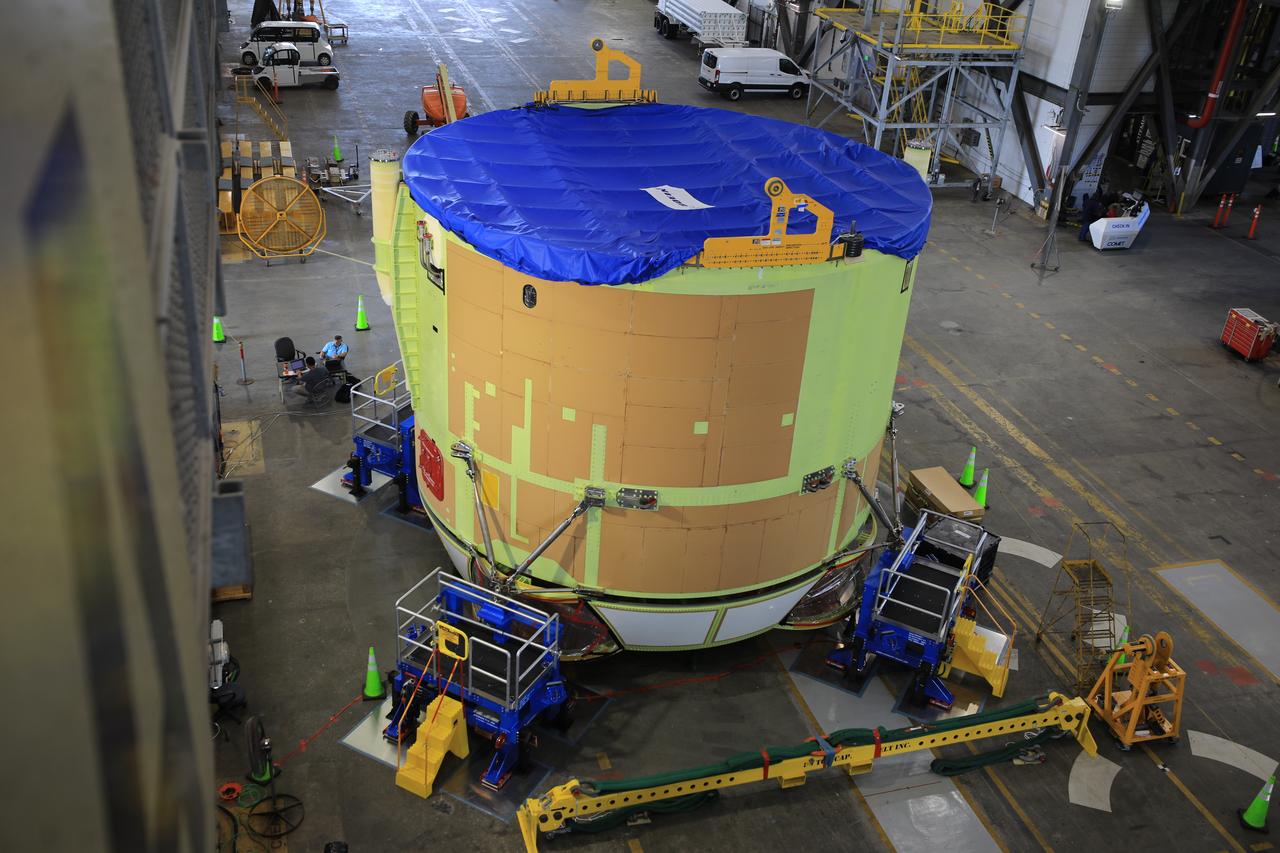
Teams from NASA’s Kennedy Space Center in Florida integrate NASA’s Artemis III SLS (Space Launch System) core stage engine section with its boat-tail inside the spaceport’s Vehicle Assembly Building on Wednesday, July 30, 2025. The boat-tail is a fairing-like structure that protects the bottom end of the core stage, while the engine section is one the most complex and intricate parts of the rocket stage that will help power the Artemis missions to the Moon.
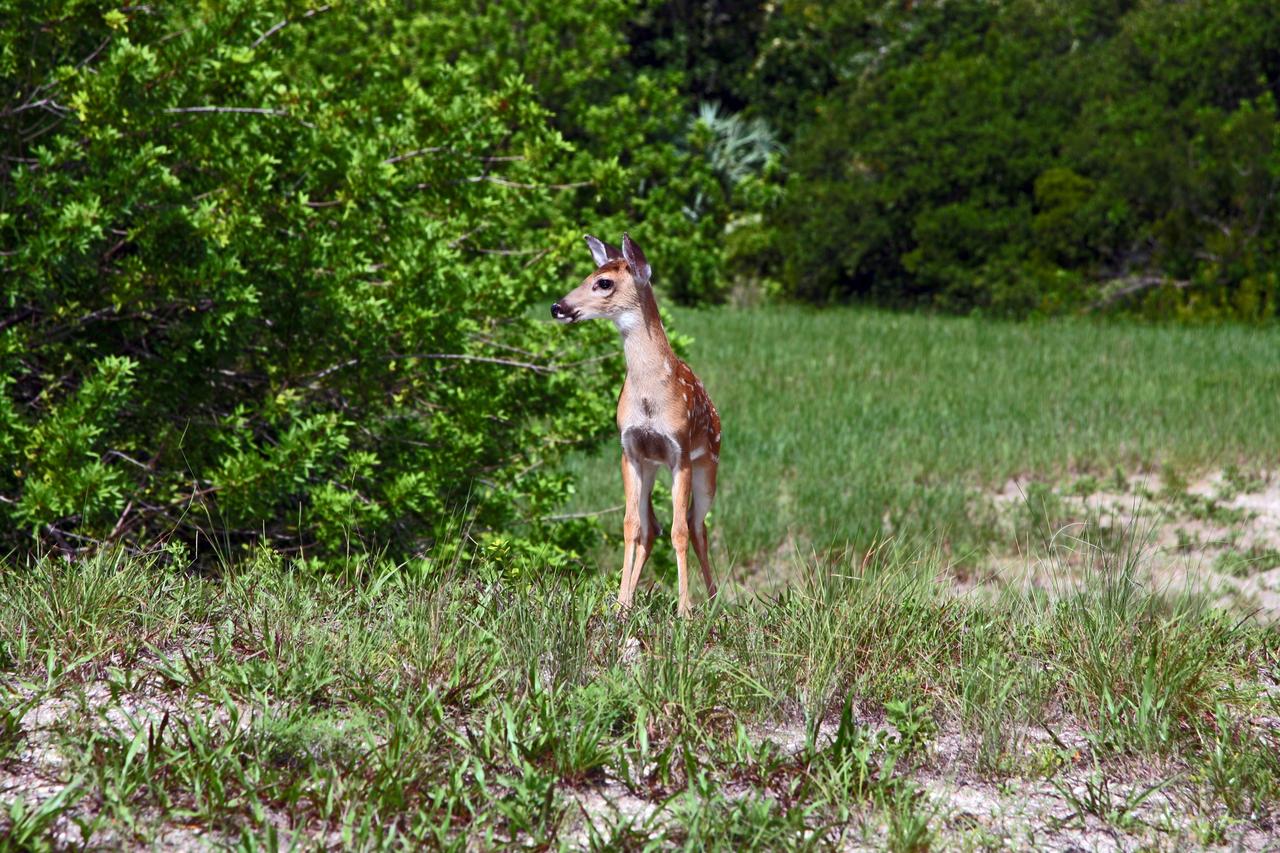
CAPE CANAVERAL, Fla. – A young white-tailed deer is spotted in the brush near Launch Complex 14 at Cape Canaveral Air Force Station, Fla., adjacent to NASA's Kennedy Space Center. White-tailed deer are found in forest edge habitats statewide. They feed primarily on twigs and leaves. Their diet also includes acorns, fruits and mushrooms. Kennedy shares a boundary with the Merritt Island National Wildlife Refuge, which encompasses 92,000 acres that are a habitat for more than 330 species of birds, 25 mammals, 117 fishes and 65 amphibians and reptiles. Photo credit: NASA/Dimitri Gerondidakis
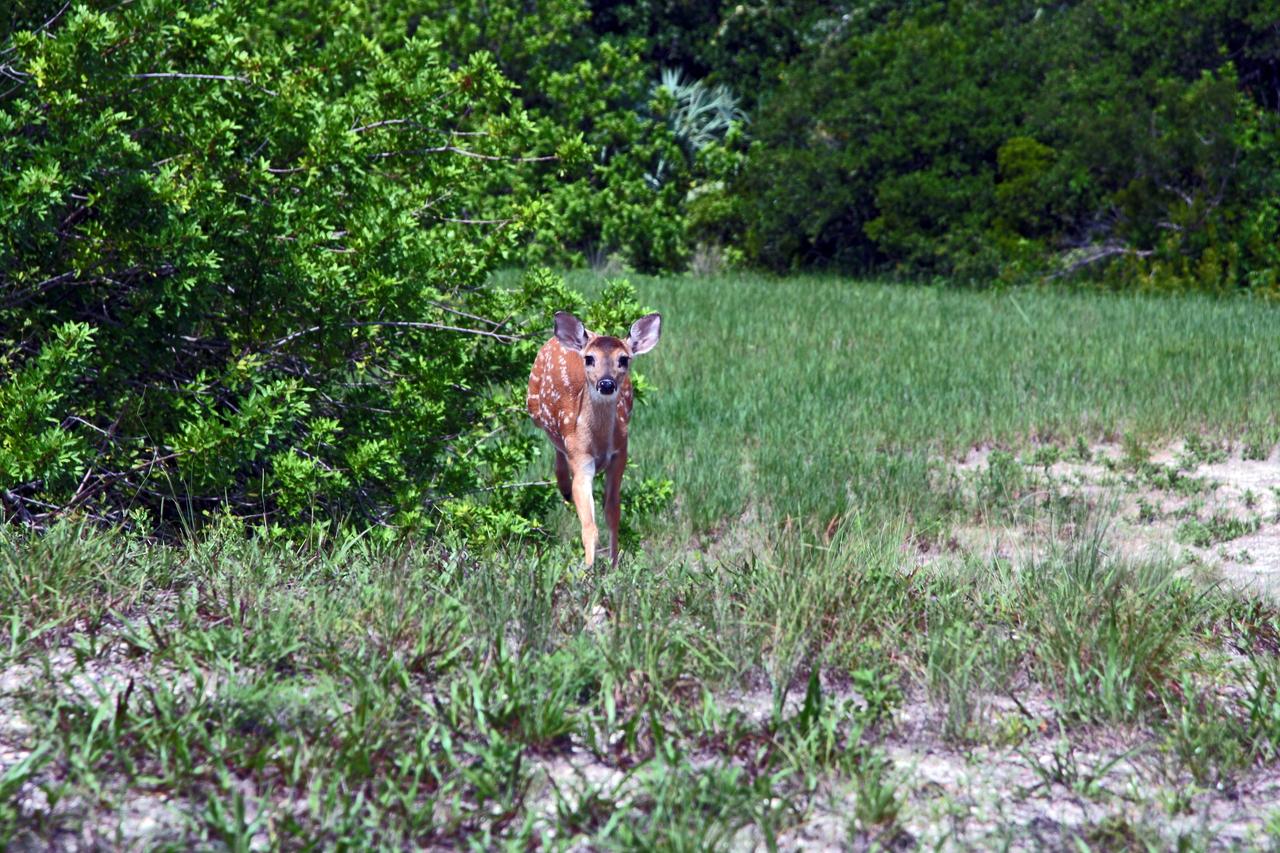
CAPE CANAVERAL, Fla. – A young white-tailed deer is spotted in the brush near Launch Complex 14 at Cape Canaveral Air Force Station, Fla., adjacent to NASA's Kennedy Space Center. White-tailed deer are found in forest edge habitats statewide. They feed primarily on twigs and leaves. Their diet also includes acorns, fruits and mushrooms. Kennedy shares a boundary with the Merritt Island National Wildlife Refuge, which encompasses 92,000 acres that are a habitat for more than 330 species of birds, 25 mammals, 117 fishes and 65 amphibians and reptiles. Photo credit: NASA/Dimitri Gerondidakis
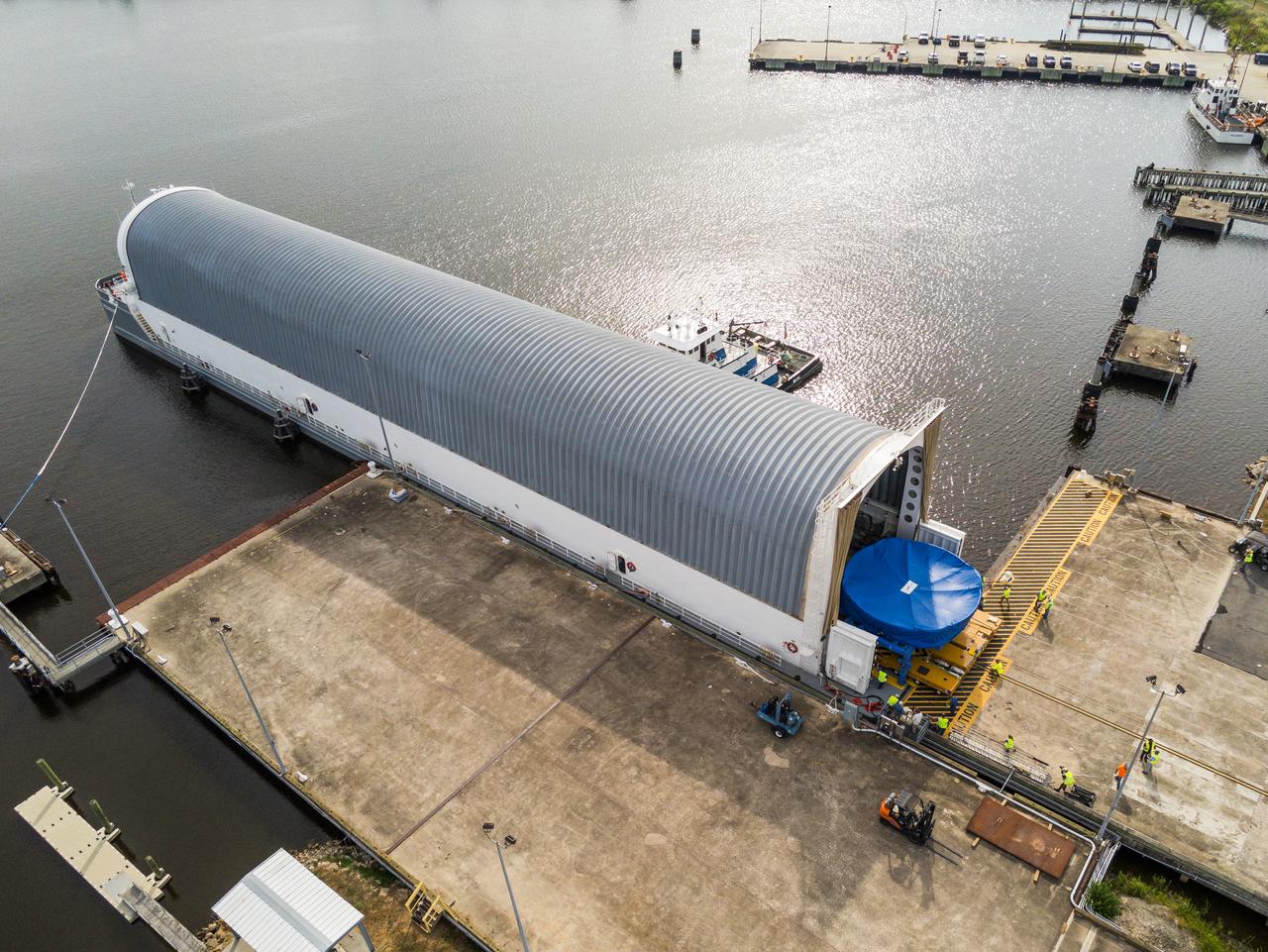
These photos and videos show teams at NASA’s Michoud Assembly Facility in New Orleans preparing, moving, and loading the engine section boat-tail of NASA’s SLS (Space Launch System) rocket for the Artemis III mission for transportation to NASA’s Kennedy Space Center in Florida via the agency’s Pegasus barge. Inside the factory on Aug. 14 prior to the move, technicians covered the spaceflight hardware with a tarp to help protect it on its journey aboard NASA’s Pegasus barge. Crews then rolled out the hardware on Aug. 27 from the factory floor to the barge. Once in Florida, the boat-tail will be integrated with the engine section -- also manufactured at Michoud -- inside Kennedy’s Space Station Processing Facility. The engine section arrived at NASA Kennedy in Dec. 2022. Located at the bottom of the engine section, the aerodynamic boat-tail fairing channels airflow and protects the stage’s four RS-25 engines from extreme temperatures during launch. The engine section is one of five major elements that make up the 212-foot-tall rocket stage. The core stage, along with its four RS-25 engines, produce two million pounds of thrust to help launch NASA’s Orion spacecraft, astronauts, and supplies beyond Earth’s orbit and to the lunar surface for Artemis.
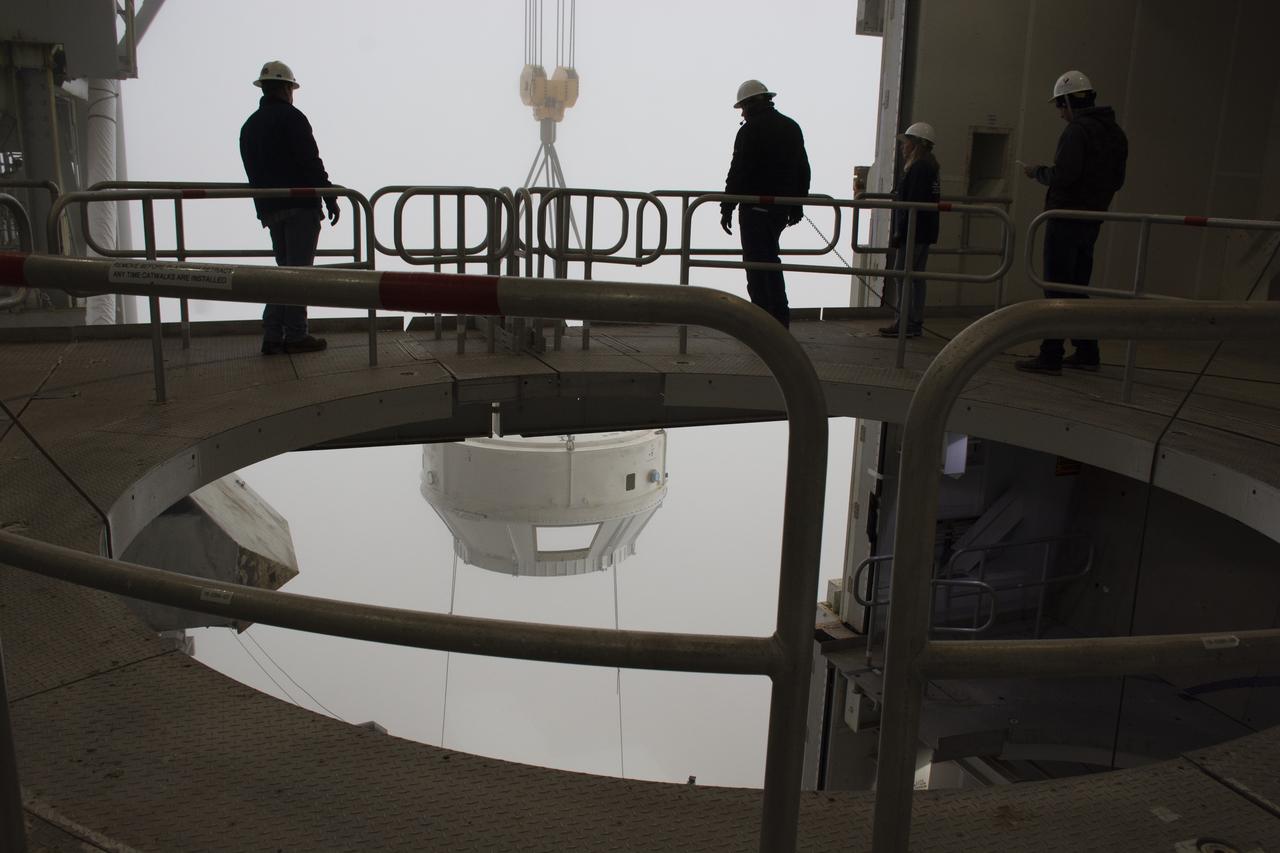
JPSS-2 Boat Tail transport and mate from HIF to SLC-3 and SLC-3, Vandenberg Space Force Base in California.
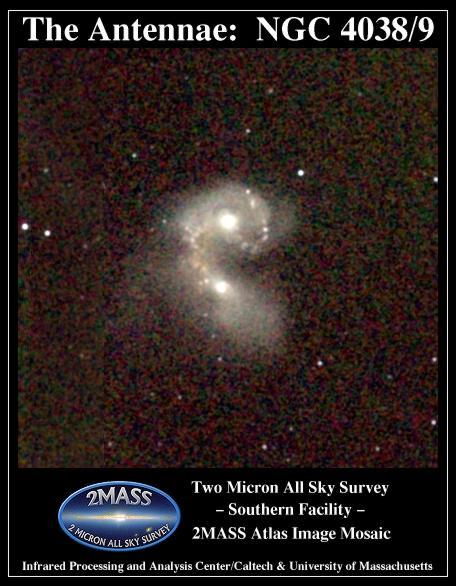
Atlas Image mosaic, covering 7 x 7 on the sky of the interacting galaxies NGC 4038 and NGC 4039, better known as the Antennae, or Ring Tail galaxies. The two galaxies are engaged in a tug-of-war as they collide.
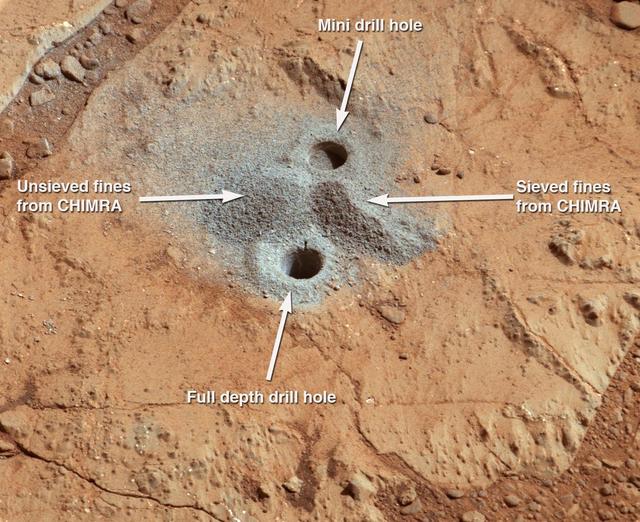
This image shows the first holes into rock drilled by NASA Mars rover Curiosity, with drill tailings around the holes plus piles of powdered rock collected from the deeper hole and later discarded.
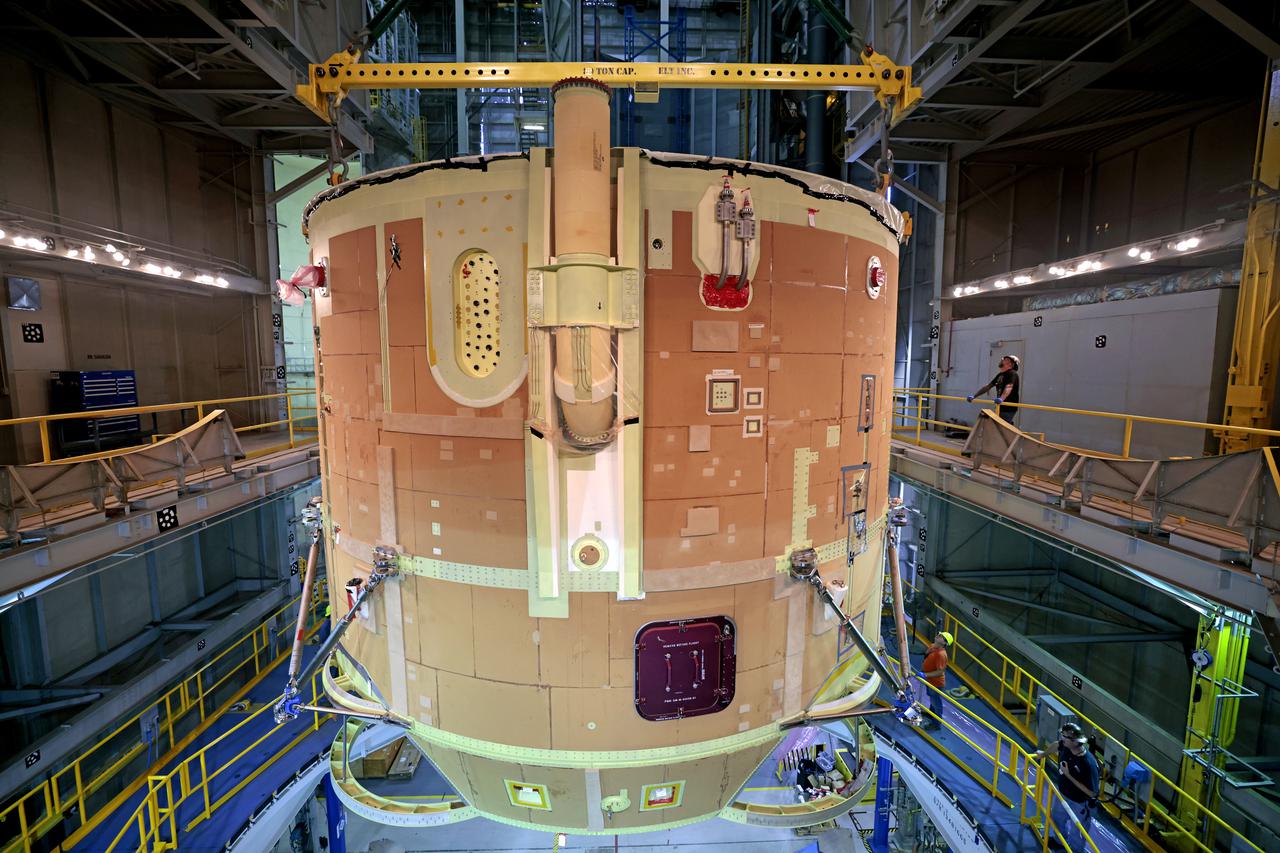
Technicians at NASA’s Michoud Assembly Facility have joined the engine and boat-tail sections of NASA’s Space Launch System rocket for Artemis II in preparation for its next step in production. When complete, the engine section will house the four RS-25 engines and include vital systems for mounting, controlling and delivering fuel from the propellant tanks to the rocket’s engines. The boat-tail is designed to protect the bottom end of the core stage and the RS-25 engines and was joined with the engine section to comprise the lowest portion of the 212-foot-tall core stage. Together with its four RS-25 engines and its twin solid rocket boosters, it will produce 8.8 million pounds of thrust to send NASA’s Orion spacecraft, astronauts, and supplies beyond Earth’s orbit to the Moon and, ultimately, Mars. Offering more payload mass, volume capability, and energy to speed missions through space, the SLS rocket, along with NASA’s Gateway in lunar orbit, the Human Landing System, and Orion spacecraft, is part of NASA’s backbone for deep space exploration and the Artemis lunar program. No other rocket is capable of carrying astronauts in Orion around the Moon in a single mission.
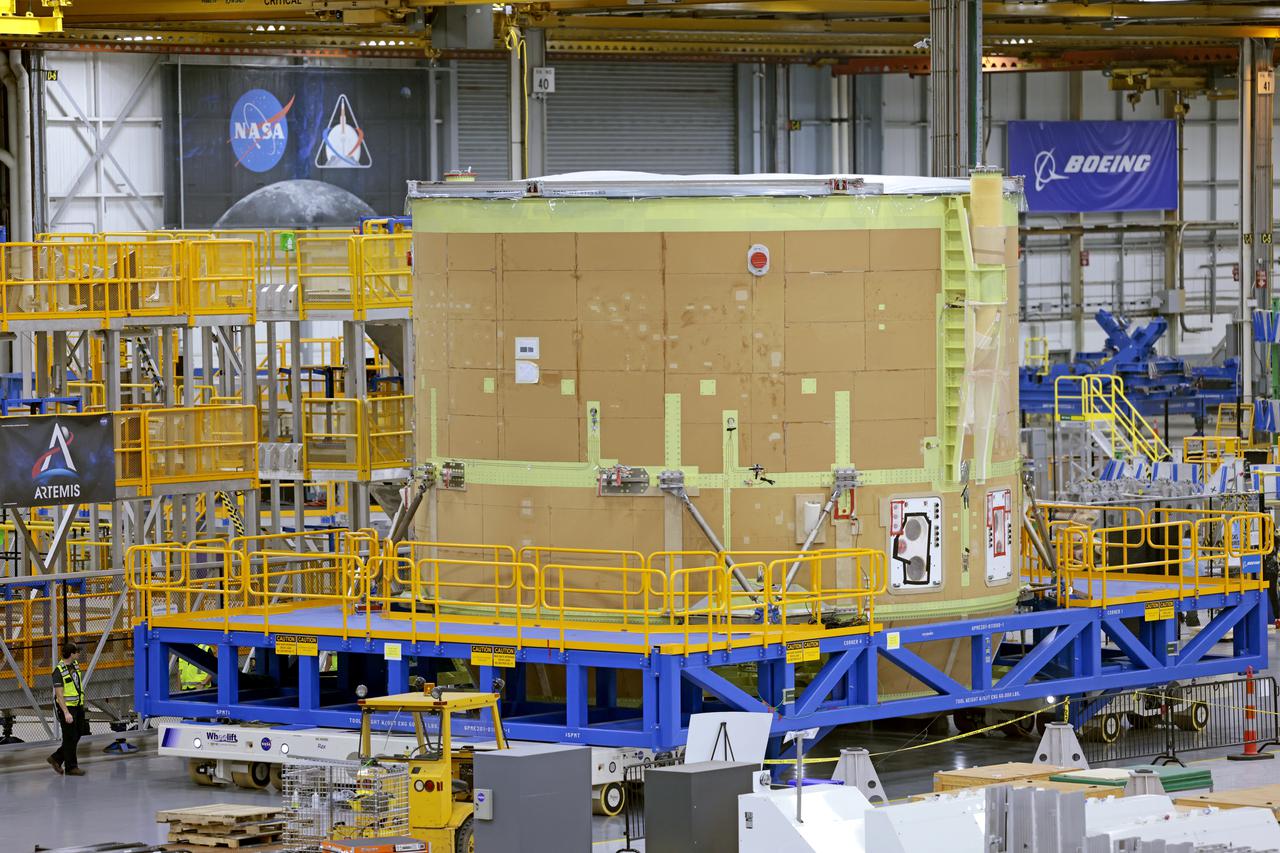
Technicians at NASA’s Michoud Assembly Facility have joined the engine and boat-tail sections of NASA’s Space Launch System rocket for Artemis II in preparation for its next step in production. When complete, the engine section will house the four RS-25 engines and include vital systems for mounting, controlling and delivering fuel from the propellant tanks to the rocket’s engines. The boat-tail is designed to protect the bottom end of the core stage and the RS-25 engines and was joined with the engine section to comprise the lowest portion of the 212-foot-tall core stage. Together with its four RS-25 engines and its twin solid rocket boosters, it will produce 8.8 million pounds of thrust to send NASA’s Orion spacecraft, astronauts, and supplies beyond Earth’s orbit to the Moon and, ultimately, Mars. Offering more payload mass, volume capability, and energy to speed missions through space, the SLS rocket, along with NASA’s Gateway in lunar orbit, the Human Landing System, and Orion spacecraft, is part of NASA’s backbone for deep space exploration and the Artemis lunar program. No other rocket is capable of carrying astronauts in Orion around the Moon in a single mission.
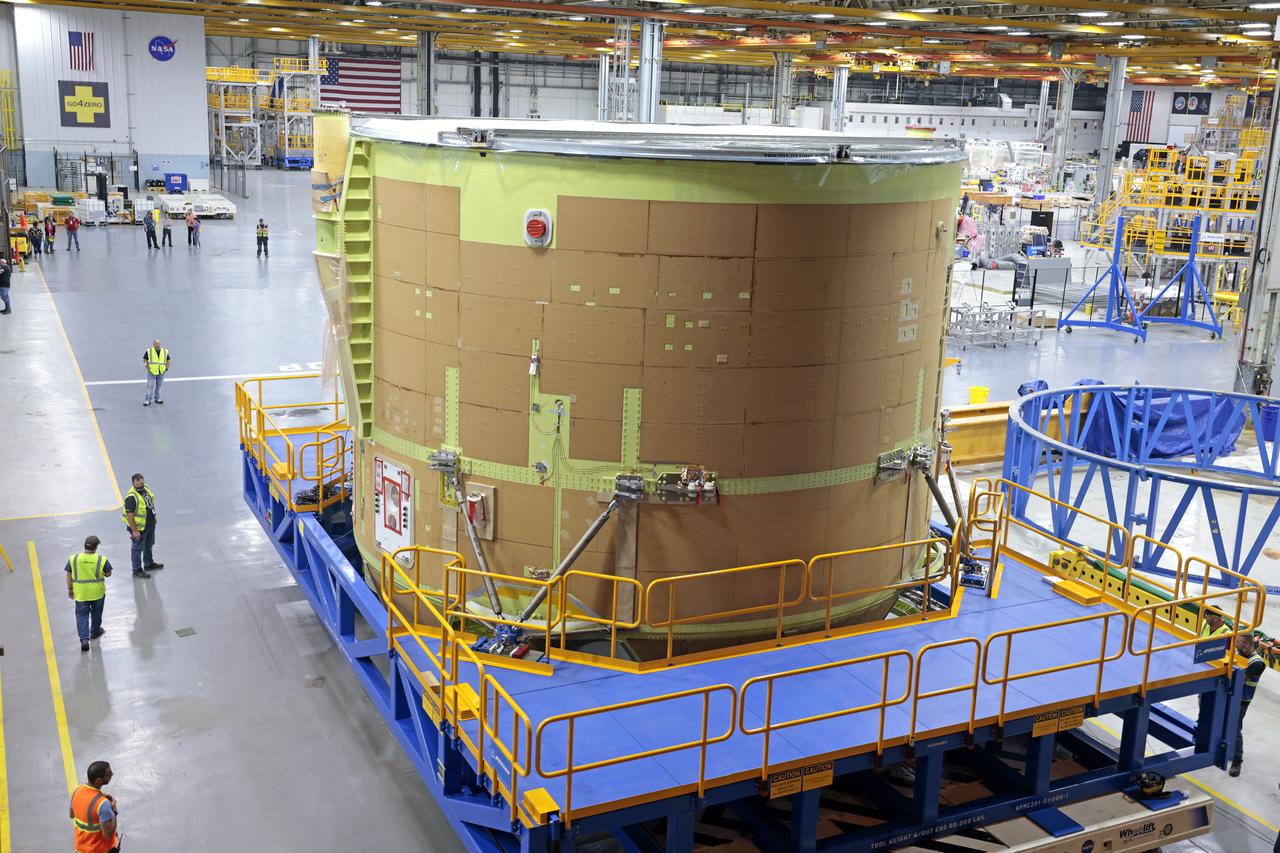
Technicians at NASA’s Michoud Assembly Facility have joined the engine and boat-tail sections of NASA’s Space Launch System rocket for Artemis II in preparation for its next step in production. When complete, the engine section will house the four RS-25 engines and include vital systems for mounting, controlling and delivering fuel from the propellant tanks to the rocket’s engines. The boat-tail is designed to protect the bottom end of the core stage and the RS-25 engines and was joined with the engine section to comprise the lowest portion of the 212-foot-tall core stage. Together with its four RS-25 engines and its twin solid rocket boosters, it will produce 8.8 million pounds of thrust to send NASA’s Orion spacecraft, astronauts, and supplies beyond Earth’s orbit to the Moon and, ultimately, Mars. Offering more payload mass, volume capability, and energy to speed missions through space, the SLS rocket, along with NASA’s Gateway in lunar orbit, the Human Landing System, and Orion spacecraft, is part of NASA’s backbone for deep space exploration and the Artemis lunar program. No other rocket is capable of carrying astronauts in Orion around the Moon in a single mission.

Technicians at NASA’s Michoud Assembly Facility have joined the engine and boat-tail sections of NASA’s Space Launch System rocket for Artemis II in preparation for its next step in production. When complete, the engine section will house the four RS-25 engines and include vital systems for mounting, controlling and delivering fuel from the propellant tanks to the rocket’s engines. The boat-tail is designed to protect the bottom end of the core stage and the RS-25 engines and was joined with the engine section to comprise the lowest portion of the 212-foot-tall core stage. Together with its four RS-25 engines and its twin solid rocket boosters, it will produce 8.8 million pounds of thrust to send NASA’s Orion spacecraft, astronauts, and supplies beyond Earth’s orbit to the Moon and, ultimately, Mars. Offering more payload mass, volume capability, and energy to speed missions through space, the SLS rocket, along with NASA’s Gateway in lunar orbit, the Human Landing System, and Orion spacecraft, is part of NASA’s backbone for deep space exploration and the Artemis lunar program. No other rocket is capable of carrying astronauts in Orion around the Moon in a single mission.
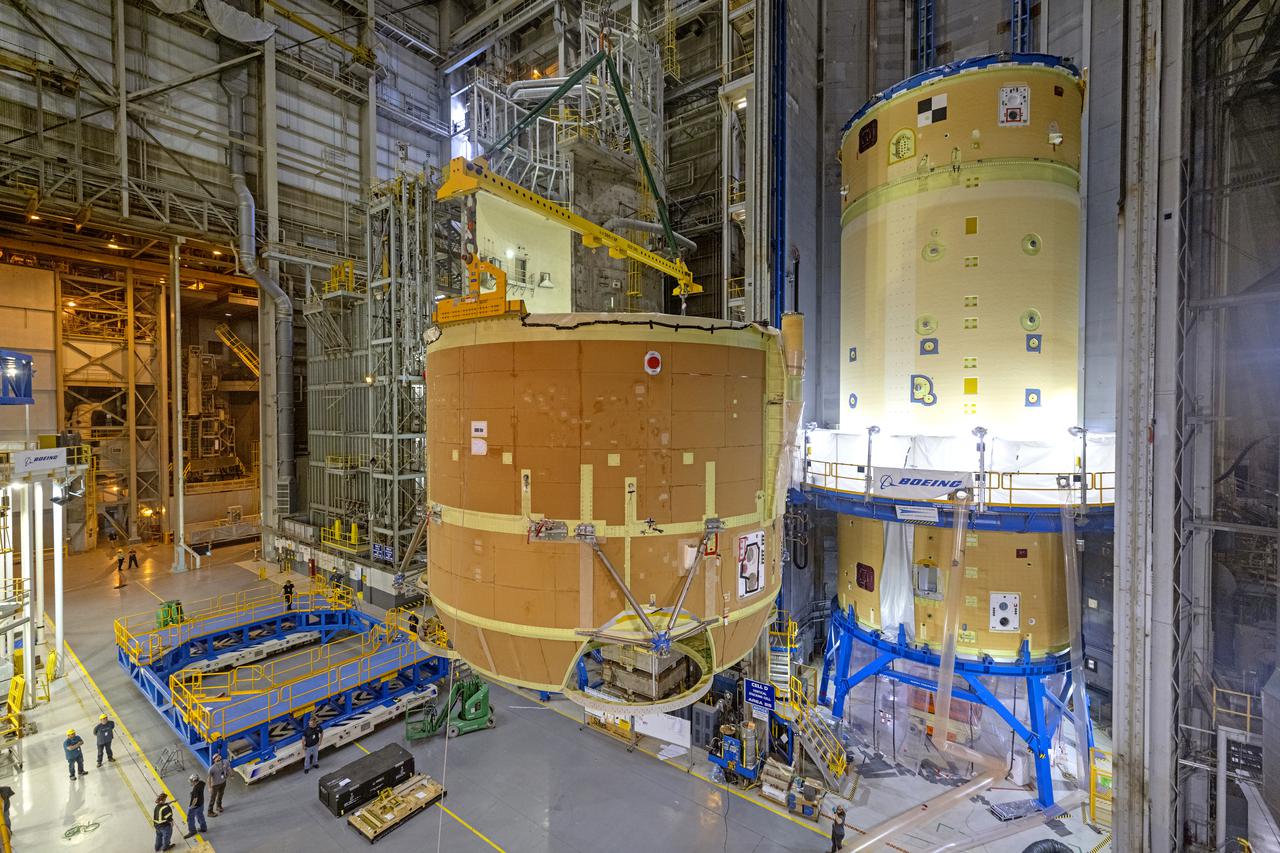
Technicians at NASA’s Michoud Assembly Facility have joined the engine and boat-tail sections of NASA’s Space Launch System rocket for Artemis II in preparation for its next step in production. When complete, the engine section will house the four RS-25 engines and include vital systems for mounting, controlling and delivering fuel from the propellant tanks to the rocket’s engines. The boat-tail is designed to protect the bottom end of the core stage and the RS-25 engines and was joined with the engine section to comprise the lowest portion of the 212-foot-tall core stage. Together with its four RS-25 engines and its twin solid rocket boosters, it will produce 8.8 million pounds of thrust to send NASA’s Orion spacecraft, astronauts, and supplies beyond Earth’s orbit to the Moon and, ultimately, Mars. Offering more payload mass, volume capability, and energy to speed missions through space, the SLS rocket, along with NASA’s Gateway in lunar orbit, the Human Landing System, and Orion spacecraft, is part of NASA’s backbone for deep space exploration and the Artemis lunar program. No other rocket is capable of carrying astronauts in Orion around the Moon in a single mission.
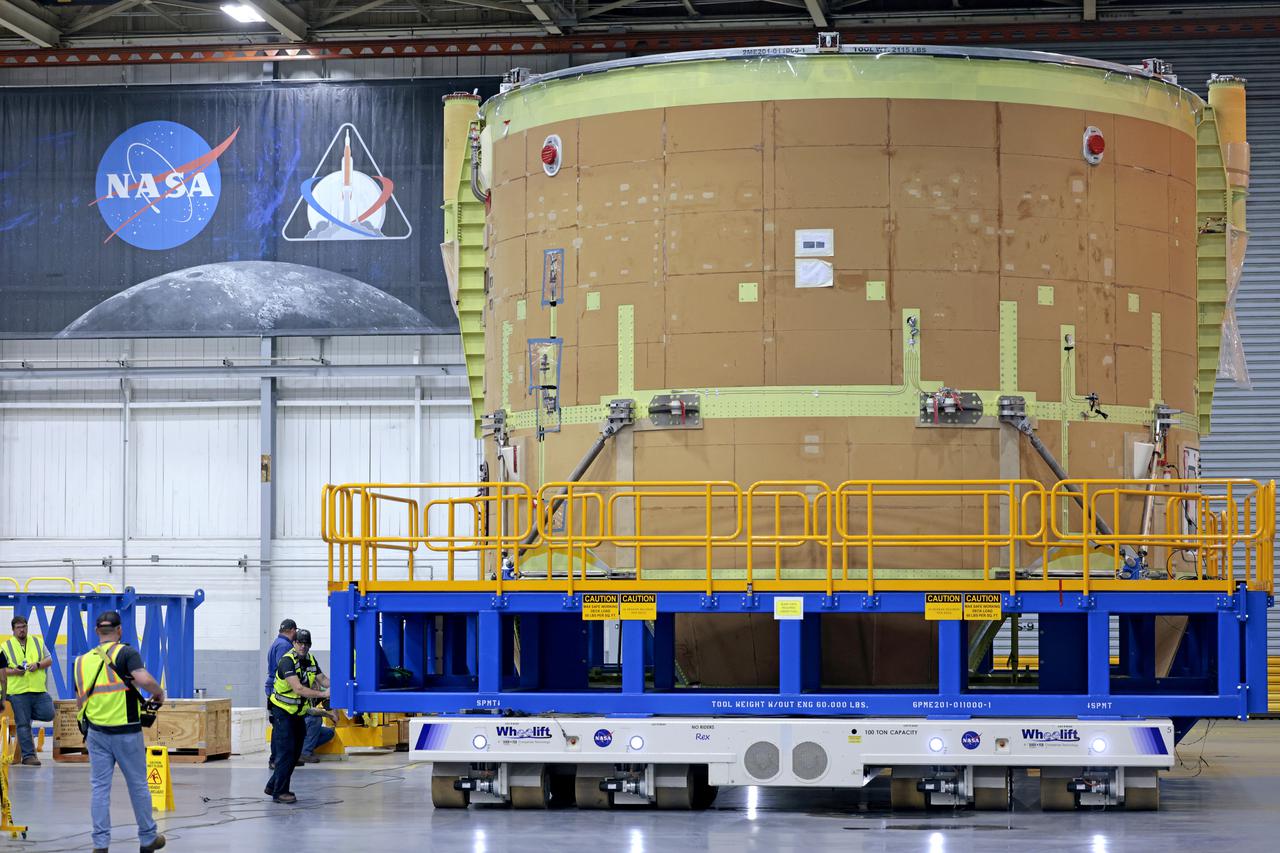
Technicians at NASA’s Michoud Assembly Facility have joined the engine and boat-tail sections of NASA’s Space Launch System rocket for Artemis II in preparation for its next step in production. When complete, the engine section will house the four RS-25 engines and include vital systems for mounting, controlling and delivering fuel from the propellant tanks to the rocket’s engines. The boat-tail is designed to protect the bottom end of the core stage and the RS-25 engines and was joined with the engine section to comprise the lowest portion of the 212-foot-tall core stage. Together with its four RS-25 engines and its twin solid rocket boosters, it will produce 8.8 million pounds of thrust to send NASA’s Orion spacecraft, astronauts, and supplies beyond Earth’s orbit to the Moon and, ultimately, Mars. Offering more payload mass, volume capability, and energy to speed missions through space, the SLS rocket, along with NASA’s Gateway in lunar orbit, the Human Landing System, and Orion spacecraft, is part of NASA’s backbone for deep space exploration and the Artemis lunar program. No other rocket is capable of carrying astronauts in Orion around the Moon in a single mission.
Technicians at NASA’s Michoud Assembly Facility have joined the engine and boat-tail sections of NASA’s Space Launch System rocket for Artemis II in preparation for its next step in production. When complete, the engine section will house the four RS-25 engines and include vital systems for mounting, controlling and delivering fuel from the propellant tanks to the rocket’s engines. The boat-tail is designed to protect the bottom end of the core stage and the RS-25 engines and was joined with the engine section to comprise the lowest portion of the 212-foot-tall core stage. Together with its four RS-25 engines and its twin solid rocket boosters, it will produce 8.8 million pounds of thrust to send NASA’s Orion spacecraft, astronauts, and supplies beyond Earth’s orbit to the Moon and, ultimately, Mars. Offering more payload mass, volume capability, and energy to speed missions through space, the SLS rocket, along with NASA’s Gateway in lunar orbit, the Human Landing System, and Orion spacecraft, is part of NASA’s backbone for deep space exploration and the Artemis lunar program. No other rocket is capable of carrying astronauts in Orion around the Moon in a single mission.
Technicians at NASA’s Michoud Assembly Facility have joined the engine and boat-tail sections of NASA’s Space Launch System rocket for Artemis II in preparation for its next step in production. When complete, the engine section will house the four RS-25 engines and include vital systems for mounting, controlling and delivering fuel from the propellant tanks to the rocket’s engines. The boat-tail is designed to protect the bottom end of the core stage and the RS-25 engines and was joined with the engine section to comprise the lowest portion of the 212-foot-tall core stage. Together with its four RS-25 engines and its twin solid rocket boosters, it will produce 8.8 million pounds of thrust to send NASA’s Orion spacecraft, astronauts, and supplies beyond Earth’s orbit to the Moon and, ultimately, Mars. Offering more payload mass, volume capability, and energy to speed missions through space, the SLS rocket, along with NASA’s Gateway in lunar orbit, the Human Landing System, and Orion spacecraft, is part of NASA’s backbone for deep space exploration and the Artemis lunar program. No other rocket is capable of carrying astronauts in Orion around the Moon in a single mission.
Technicians at NASA’s Michoud Assembly Facility have joined the engine and boat-tail sections of NASA’s Space Launch System rocket for Artemis II in preparation for its next step in production. When complete, the engine section will house the four RS-25 engines and include vital systems for mounting, controlling and delivering fuel from the propellant tanks to the rocket’s engines. The boat-tail is designed to protect the bottom end of the core stage and the RS-25 engines and was joined with the engine section to comprise the lowest portion of the 212-foot-tall core stage. Together with its four RS-25 engines and its twin solid rocket boosters, it will produce 8.8 million pounds of thrust to send NASA’s Orion spacecraft, astronauts, and supplies beyond Earth’s orbit to the Moon and, ultimately, Mars. Offering more payload mass, volume capability, and energy to speed missions through space, the SLS rocket, along with NASA’s Gateway in lunar orbit, the Human Landing System, and Orion spacecraft, is part of NASA’s backbone for deep space exploration and the Artemis lunar program. No other rocket is capable of carrying astronauts in Orion around the Moon in a single mission.
Technicians at NASA’s Michoud Assembly Facility have joined the engine and boat-tail sections of NASA’s Space Launch System rocket for Artemis II in preparation for its next step in production. When complete, the engine section will house the four RS-25 engines and include vital systems for mounting, controlling and delivering fuel from the propellant tanks to the rocket’s engines. The boat-tail is designed to protect the bottom end of the core stage and the RS-25 engines and was joined with the engine section to comprise the lowest portion of the 212-foot-tall core stage. Together with its four RS-25 engines and its twin solid rocket boosters, it will produce 8.8 million pounds of thrust to send NASA’s Orion spacecraft, astronauts, and supplies beyond Earth’s orbit to the Moon and, ultimately, Mars. Offering more payload mass, volume capability, and energy to speed missions through space, the SLS rocket, along with NASA’s Gateway in lunar orbit, the Human Landing System, and Orion spacecraft, is part of NASA’s backbone for deep space exploration and the Artemis lunar program. No other rocket is capable of carrying astronauts in Orion around the Moon in a single mission.
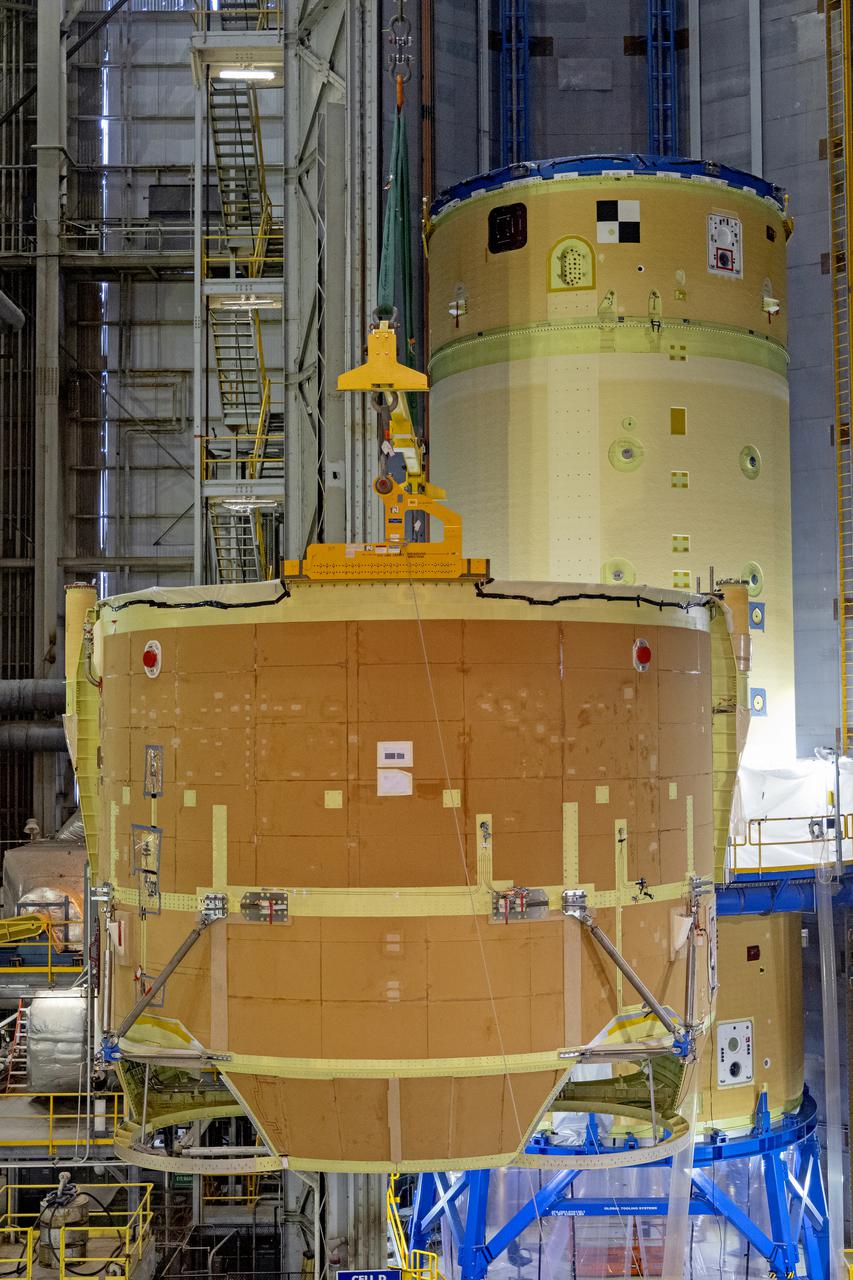
Technicians at NASA’s Michoud Assembly Facility have joined the engine and boat-tail sections of NASA’s Space Launch System rocket for Artemis II in preparation for its next step in production. When complete, the engine section will house the four RS-25 engines and include vital systems for mounting, controlling and delivering fuel from the propellant tanks to the rocket’s engines. The boat-tail is designed to protect the bottom end of the core stage and the RS-25 engines and was joined with the engine section to comprise the lowest portion of the 212-foot-tall core stage. Together with its four RS-25 engines and its twin solid rocket boosters, it will produce 8.8 million pounds of thrust to send NASA’s Orion spacecraft, astronauts, and supplies beyond Earth’s orbit to the Moon and, ultimately, Mars. Offering more payload mass, volume capability, and energy to speed missions through space, the SLS rocket, along with NASA’s Gateway in lunar orbit, the Human Landing System, and Orion spacecraft, is part of NASA’s backbone for deep space exploration and the Artemis lunar program. No other rocket is capable of carrying astronauts in Orion around the Moon in a single mission.
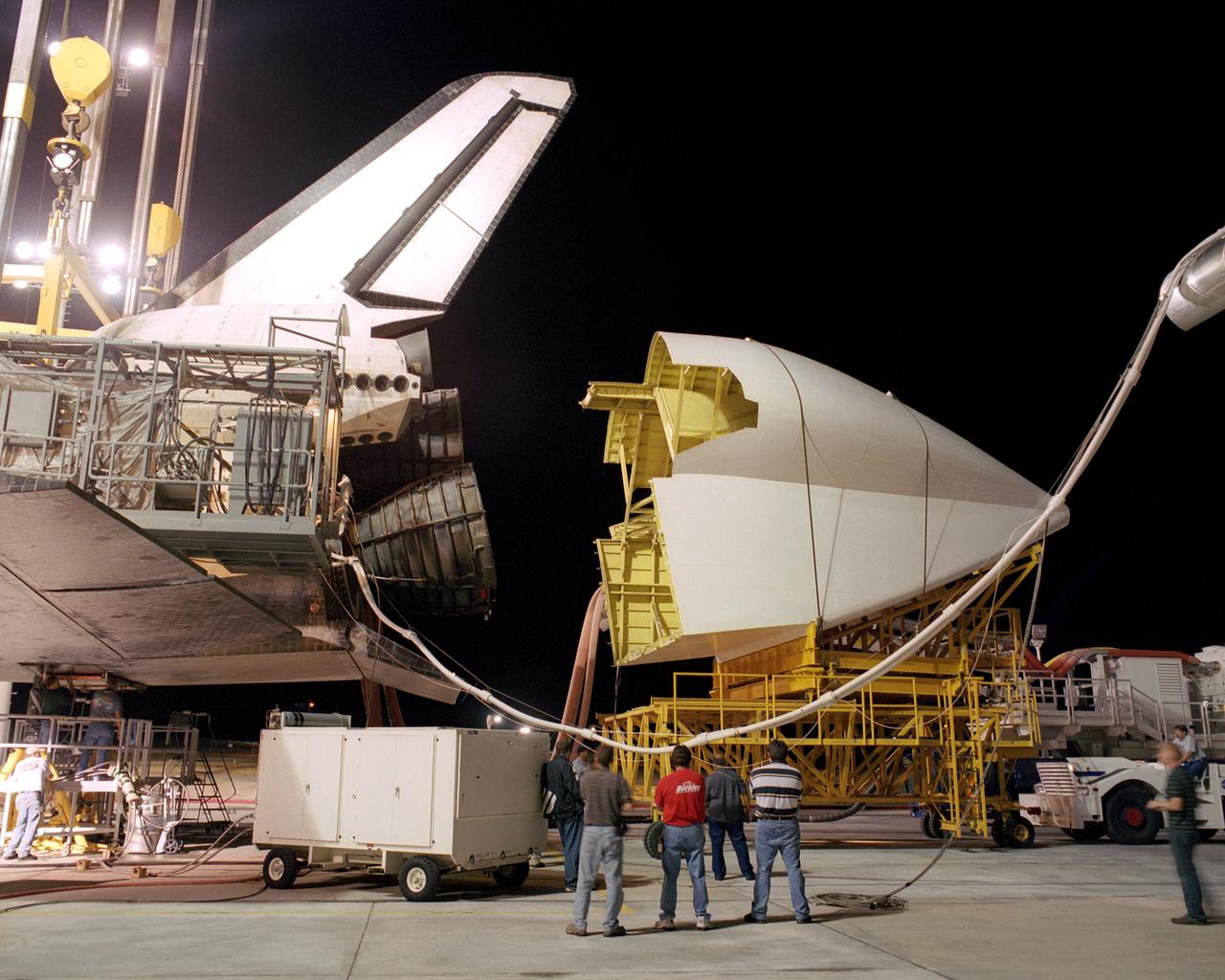
Workers position the tail cone on the Space Shuttle Discovery in preparation for its return to NASA's Kennedy Space Center in Florida. After the tail-cone is installed, Discovery will be mounted on NASA's modified Boeing 747 Shuttle Carrier Aircraft, or SCA, for the return flight. The tail cone is a fitting that helps reduce aerodynamic drag and turbulence during its ferry flight. Space Shuttle Discovery landed safely at NASA's Dryden Flight Research Center at Edwards Air Force Base in California at 5:11:22 a.m. PDT, August 9, 2005, following the very successful 14-day STS-114 return to flight mission. During their two weeks in space, Commander Eileen Collins and her six crewmates tested out new safety procedures and delivered supplies and equipment the International Space Station. Discovery spent two weeks in space, where the crew demonstrated new methods to inspect and repair the Shuttle in orbit. The crew also delivered supplies, outfitted and performed maintenance on the International Space Station. A number of these tasks were conducted during three spacewalks. In an unprecedented event, spacewalkers were called upon to remove protruding gap fillers from the heat shield on Discovery's underbelly. In other spacewalk activities, astronauts installed an external platform onto the Station's Quest Airlock and replaced one of the orbital outpost's Control Moment Gyroscopes. Inside the Station, the STS-114 crew conducted joint operations with the Expedition 11 crew. They unloaded fresh supplies from the Shuttle and the Raffaello Multi-Purpose Logistics Module. Before Discovery undocked, the crews filled Raffeallo with unneeded items and returned to Shuttle payload bay. Discovery launched on July 26 and spent almost 14 days on orbit.
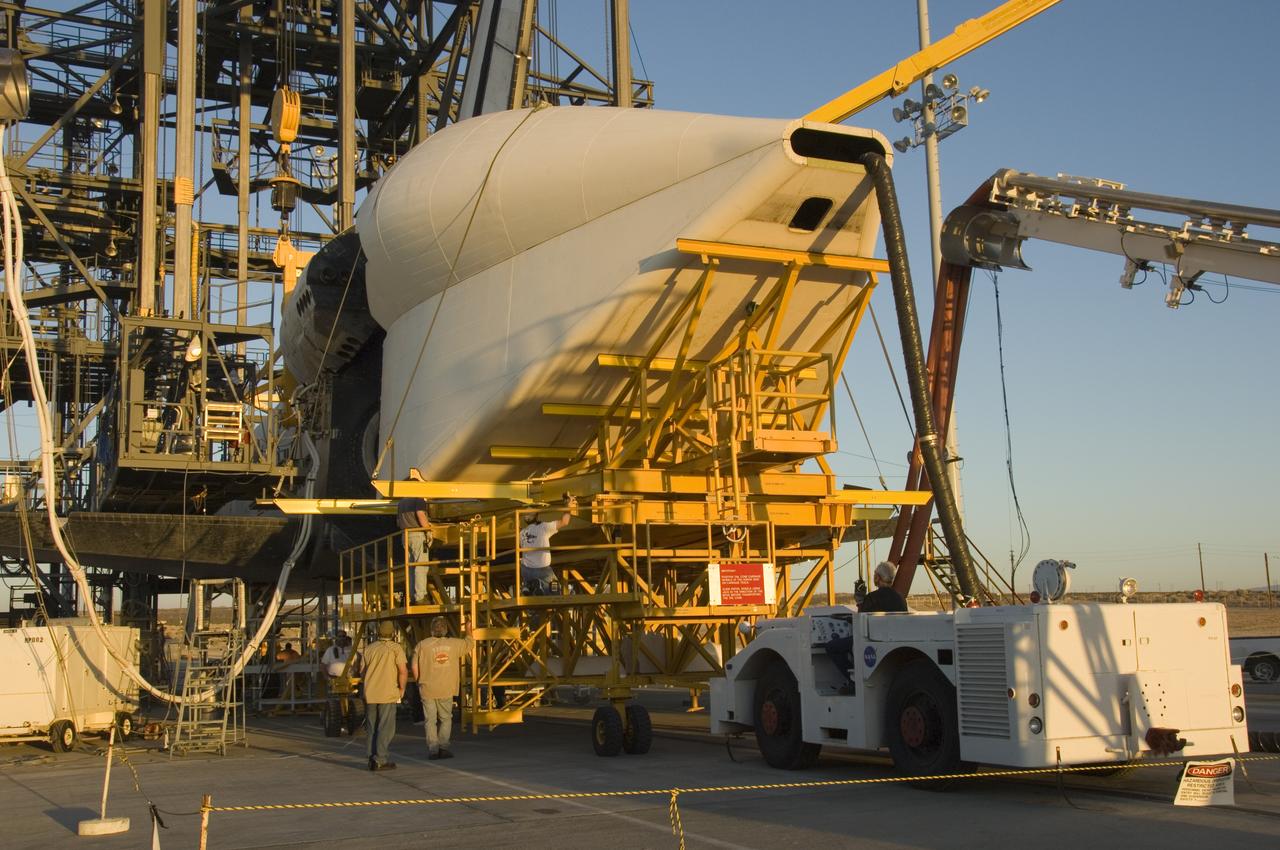
Technicians attach the tail cone, which helps reduce aerodynamic drag and turbulence during its ferry flight, to the Space Shuttle Atlantis in preparation for its return to NASA's Kennedy Space Center in Florida. After the tail-cone is installed, Discovery will be mounted on NASA's modified Boeing 747 Shuttle Carrier Aircraft, or SCA, for the return flight.
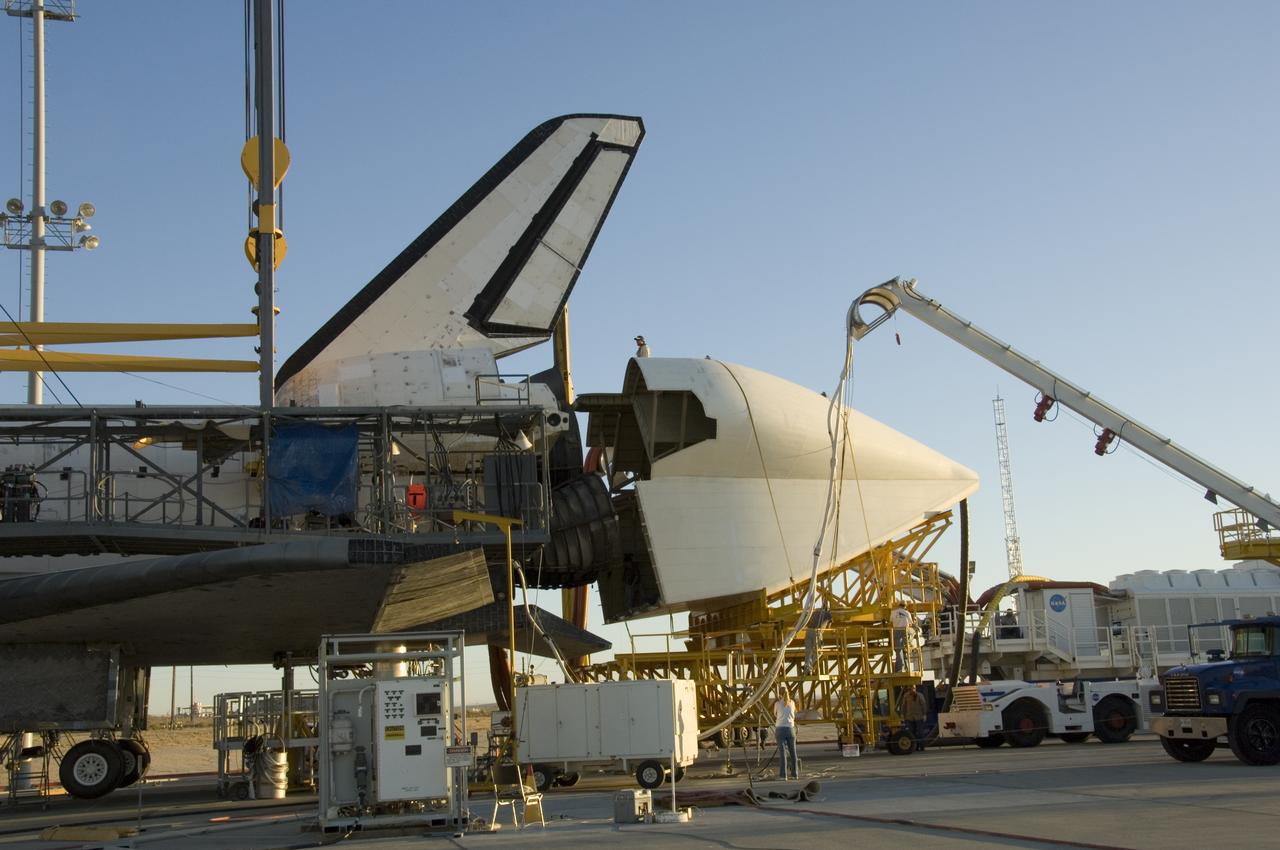
Technicians attach the tail cone, which helps reduce aerodynamic drag and turbulence during its ferry flight, to the Space Shuttle Atlantis in preparation for its return to NASA's Kennedy Space Center in Florida. After the tail-cone is installed, Discovery will be mounted on NASA's modified Boeing 747 Shuttle Carrier Aircraft, or SCA, for the return flight.
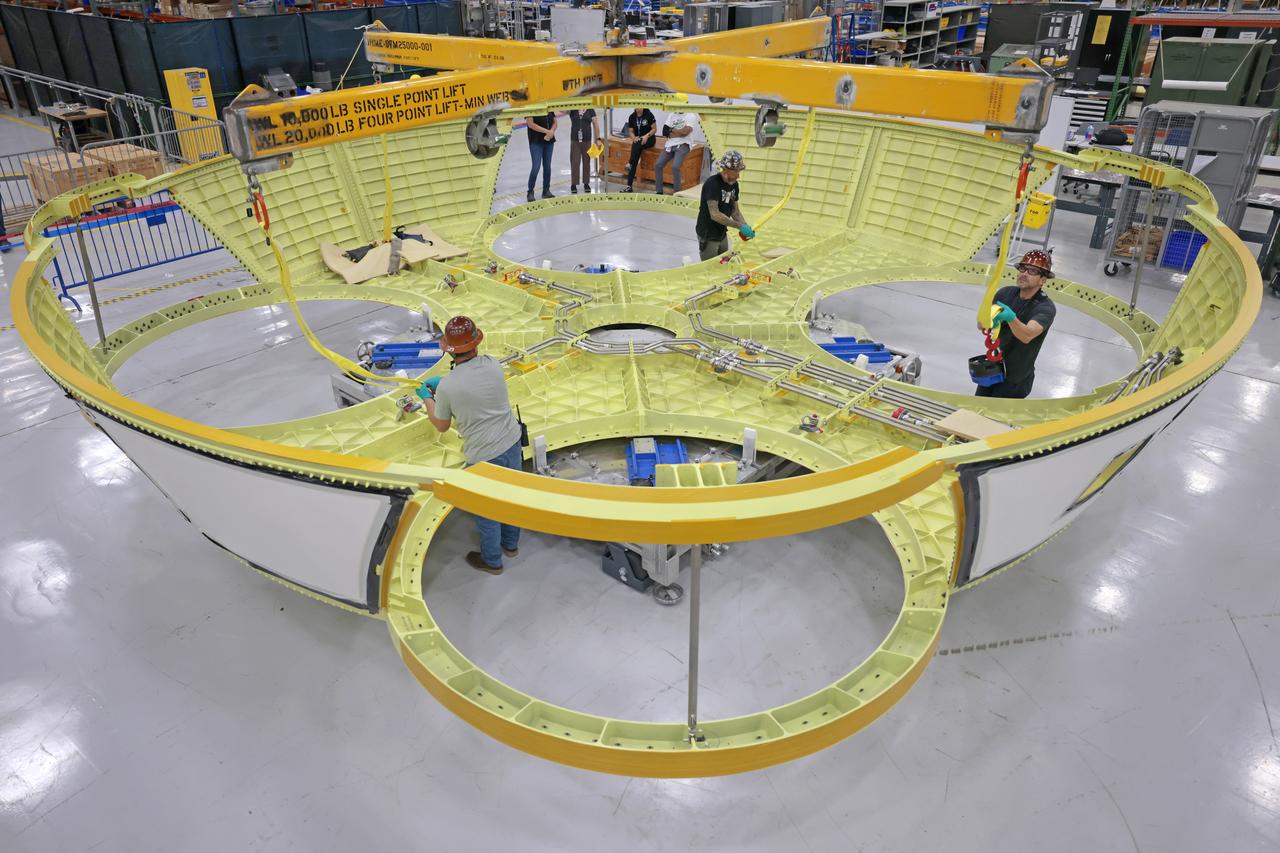
These photos show teams at NASA’s Michoud Assembly Facility in New Orleans preparing, moving, and loading the engine section boat-tail of NASA’s SLS (Space Launch System) rocket for the Artemis III mission for transportation to NASA’s Kennedy Space Center in Florida via the agency’s Pegasus barge. Inside the factory on Aug. 14 prior to the move, technicians covered the spaceflight hardware with a tarp to help protect it on its journey aboard NASA’s Pegasus barge. Crews then rolled out the hardware on Aug. 27 from the factory floor to the barge. Once in Florida, the boat-tail will be integrated with the engine section -- also manufactured at Michoud -- inside Kennedy’s Space Station Processing Facility. The engine section arrived at NASA Kennedy in Dec. 2022. Located at the bottom of the engine section, the aerodynamic boat-tail fairing channels airflow and protects the stage’s four RS-25 engines from extreme temperatures during launch. The engine section is one of five major elements that make up the 212-foot-tall rocket stage. The core stage, along with its four RS-25 engines, produce two million pounds of thrust to help launch NASA’s Orion spacecraft, astronauts, and supplies beyond Earth’s orbit and to the lunar surface for Artemis. Image credit: NASA/Michael DeMocker
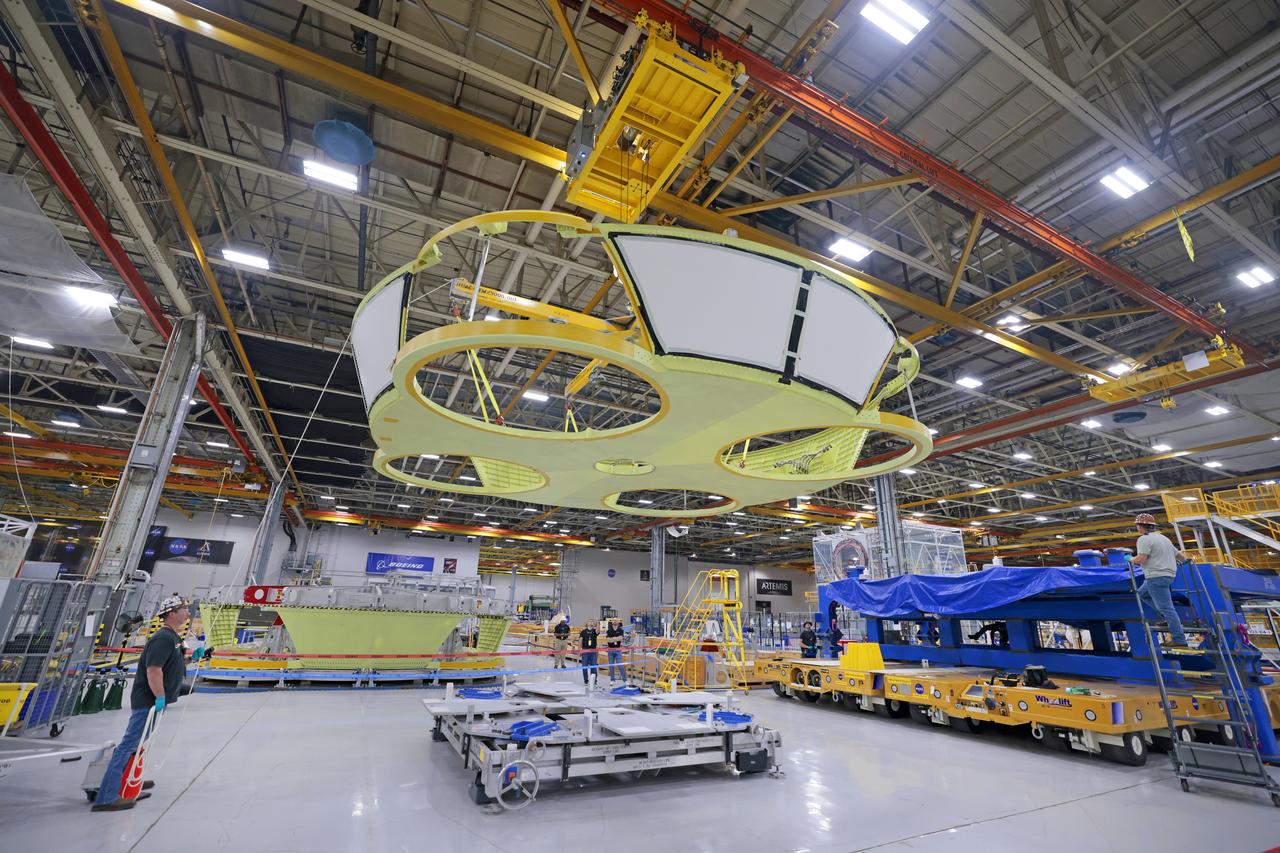
These photos show teams at NASA’s Michoud Assembly Facility in New Orleans preparing, moving, and loading the engine section boat-tail of NASA’s SLS (Space Launch System) rocket for the Artemis III mission for transportation to NASA’s Kennedy Space Center in Florida via the agency’s Pegasus barge. Inside the factory on Aug. 14 prior to the move, technicians covered the spaceflight hardware with a tarp to help protect it on its journey aboard NASA’s Pegasus barge. Crews then rolled out the hardware on Aug. 27 from the factory floor to the barge. Once in Florida, the boat-tail will be integrated with the engine section -- also manufactured at Michoud -- inside Kennedy’s Space Station Processing Facility. The engine section arrived at NASA Kennedy in Dec. 2022. Located at the bottom of the engine section, the aerodynamic boat-tail fairing channels airflow and protects the stage’s four RS-25 engines from extreme temperatures during launch. The engine section is one of five major elements that make up the 212-foot-tall rocket stage. The core stage, along with its four RS-25 engines, produce two million pounds of thrust to help launch NASA’s Orion spacecraft, astronauts, and supplies beyond Earth’s orbit and to the lunar surface for Artemis. Image credit: NASA/Michael DeMocker
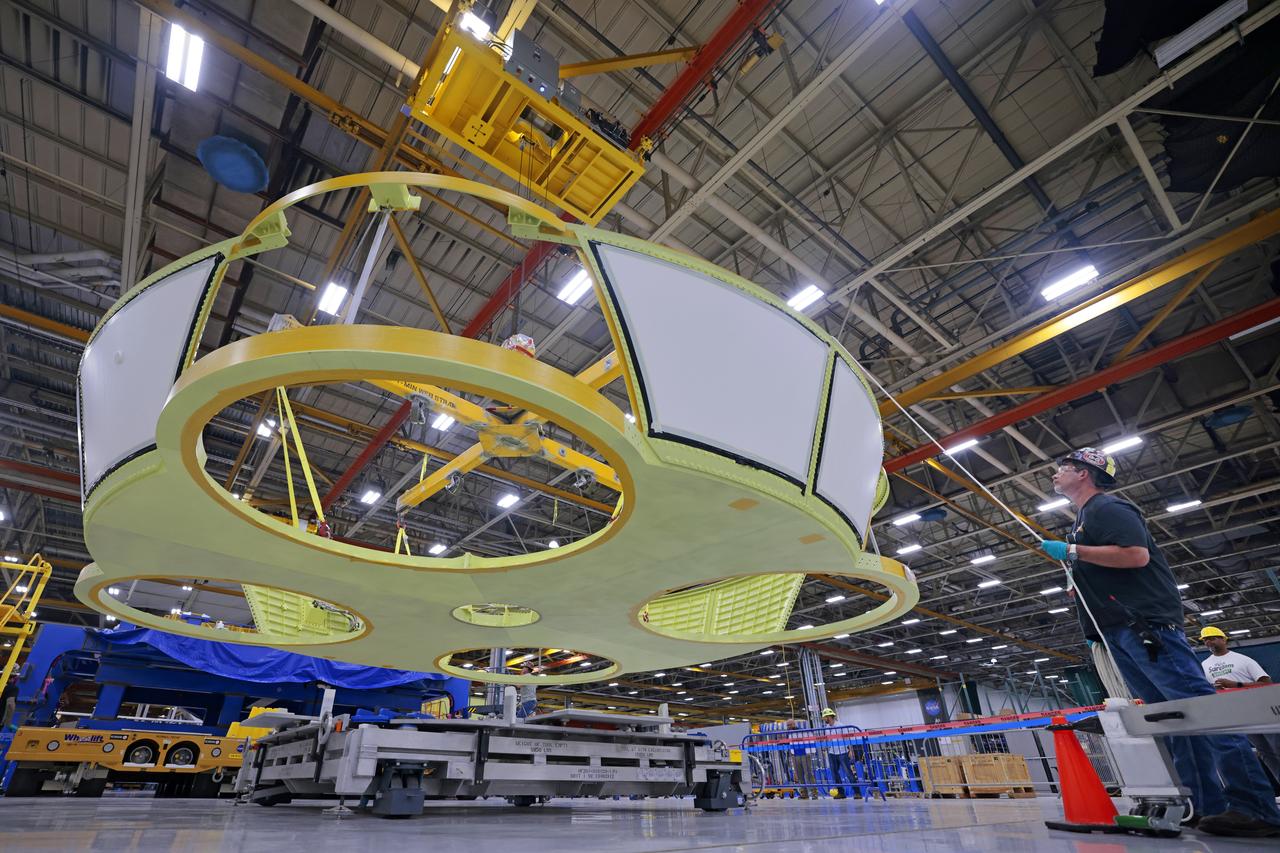
These photos show teams at NASA’s Michoud Assembly Facility in New Orleans preparing, moving, and loading the engine section boat-tail of NASA’s SLS (Space Launch System) rocket for the Artemis III mission for transportation to NASA’s Kennedy Space Center in Florida via the agency’s Pegasus barge. Inside the factory on Aug. 14 prior to the move, technicians covered the spaceflight hardware with a tarp to help protect it on its journey aboard NASA’s Pegasus barge. Crews then rolled out the hardware on Aug. 27 from the factory floor to the barge. Once in Florida, the boat-tail will be integrated with the engine section -- also manufactured at Michoud -- inside Kennedy’s Space Station Processing Facility. The engine section arrived at NASA Kennedy in Dec. 2022. Located at the bottom of the engine section, the aerodynamic boat-tail fairing channels airflow and protects the stage’s four RS-25 engines from extreme temperatures during launch. The engine section is one of five major elements that make up the 212-foot-tall rocket stage. The core stage, along with its four RS-25 engines, produce two million pounds of thrust to help launch NASA’s Orion spacecraft, astronauts, and supplies beyond Earth’s orbit and to the lunar surface for Artemis. Image credit: NASA/Michael DeMocker
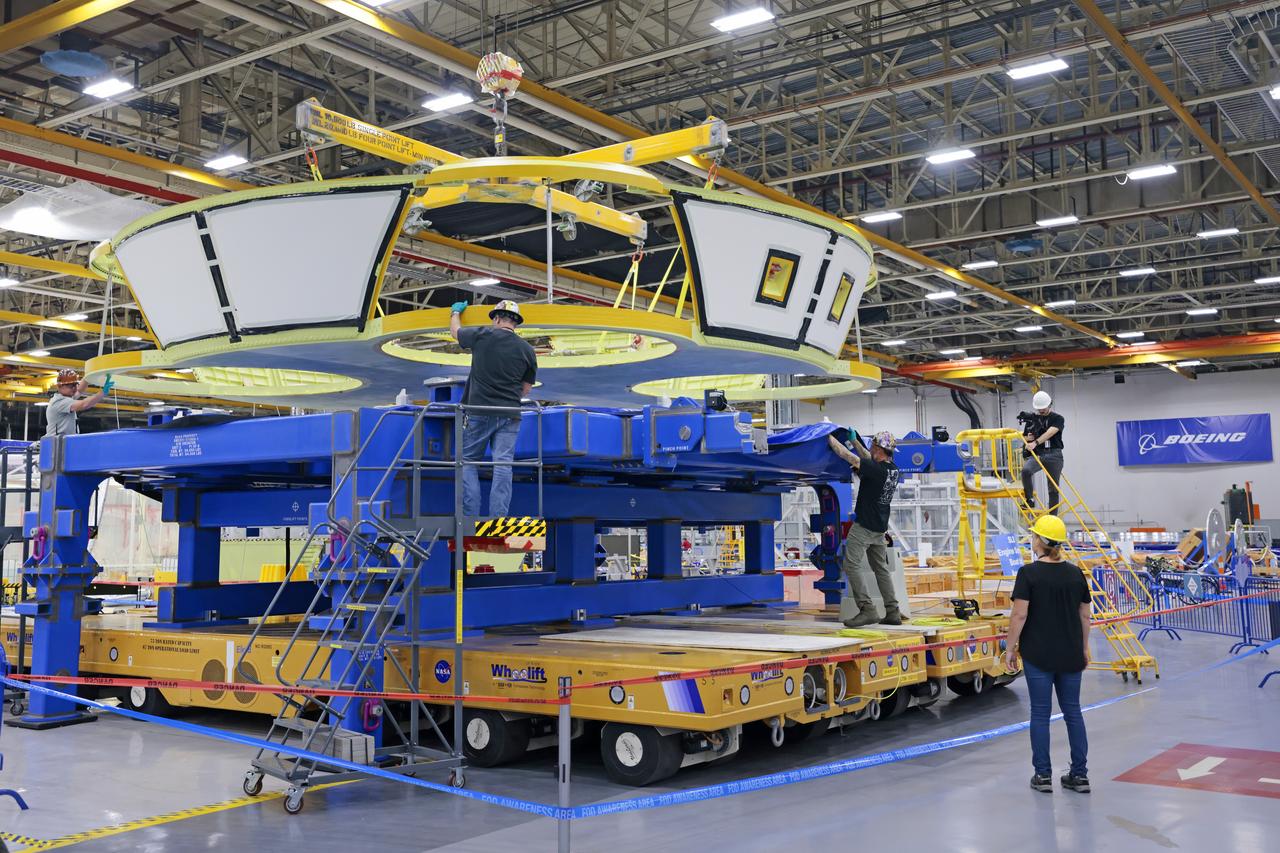
These photos show teams at NASA’s Michoud Assembly Facility in New Orleans preparing, moving, and loading the engine section boat-tail of NASA’s SLS (Space Launch System) rocket for the Artemis III mission for transportation to NASA’s Kennedy Space Center in Florida via the agency’s Pegasus barge. Inside the factory on Aug. 14 prior to the move, technicians covered the spaceflight hardware with a tarp to help protect it on its journey aboard NASA’s Pegasus barge. Crews then rolled out the hardware on Aug. 27 from the factory floor to the barge. Once in Florida, the boat-tail will be integrated with the engine section -- also manufactured at Michoud -- inside Kennedy’s Space Station Processing Facility. The engine section arrived at NASA Kennedy in Dec. 2022. Located at the bottom of the engine section, the aerodynamic boat-tail fairing channels airflow and protects the stage’s four RS-25 engines from extreme temperatures during launch. The engine section is one of five major elements that make up the 212-foot-tall rocket stage. The core stage, along with its four RS-25 engines, produce two million pounds of thrust to help launch NASA’s Orion spacecraft, astronauts, and supplies beyond Earth’s orbit and to the lunar surface for Artemis. Image credit: NASA/Michael DeMocker
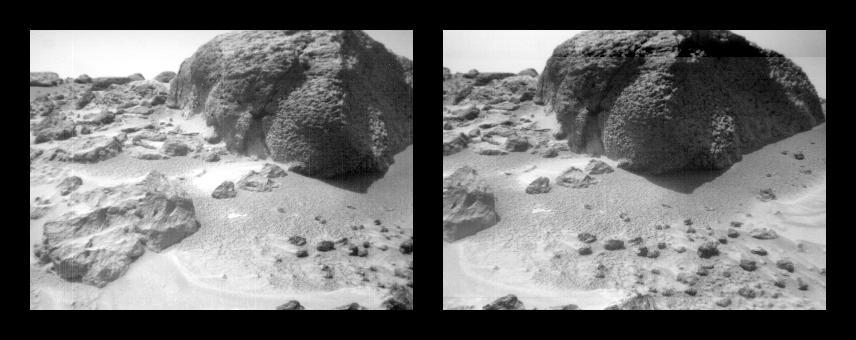
Stereo Images of Wind Tails Near Chimp
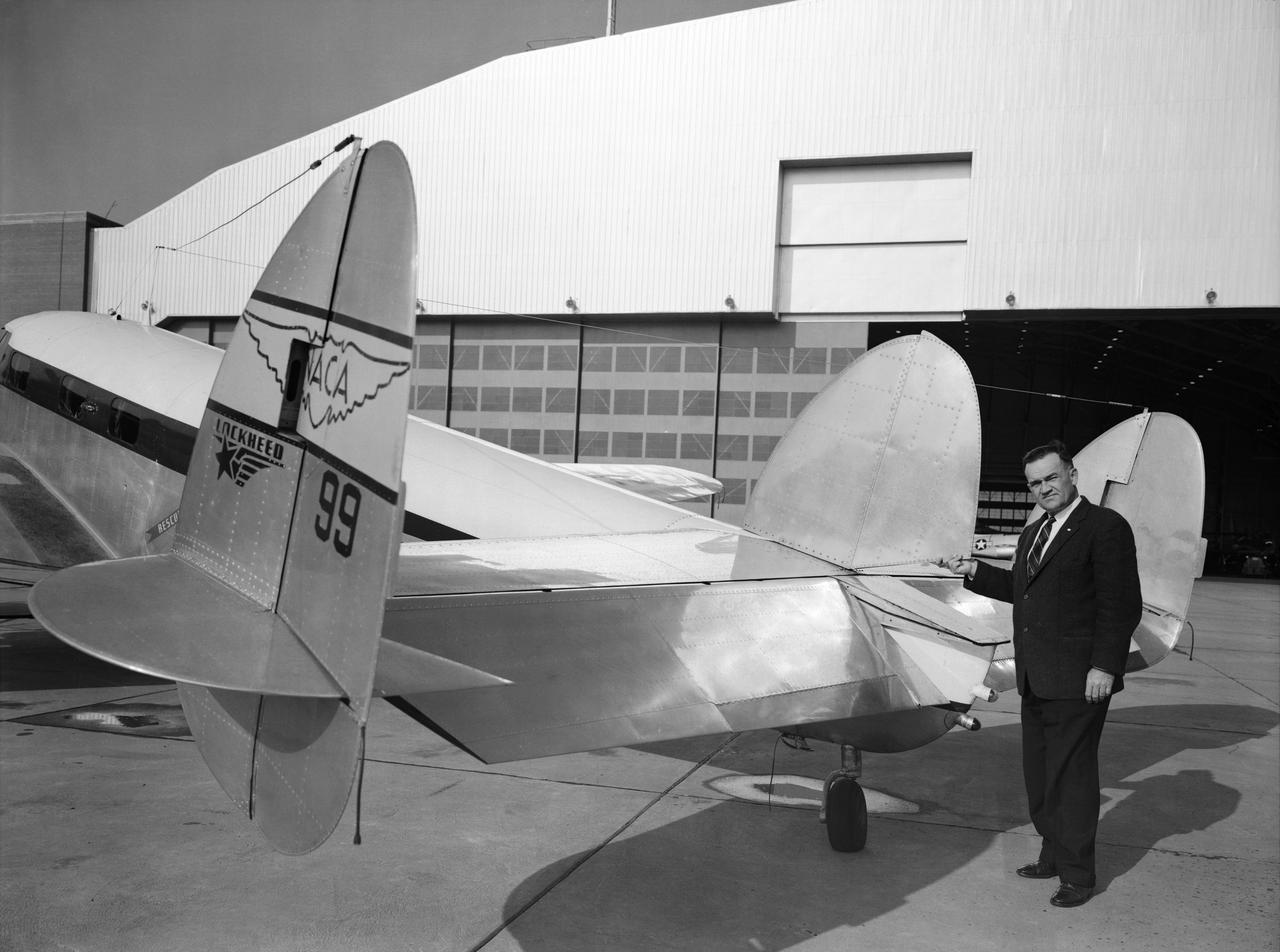
Melvin Gough at the Tail of a NACA Lockheed Plane
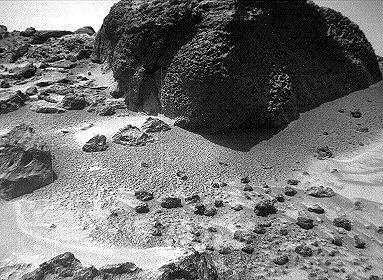
Wind Tails Near Chimp - Right Eye
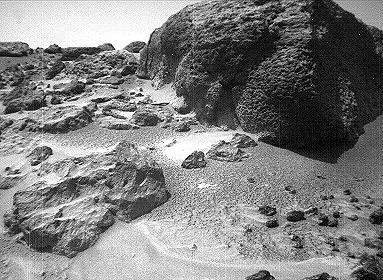
Wind Tails Near Chimp - Left Eye
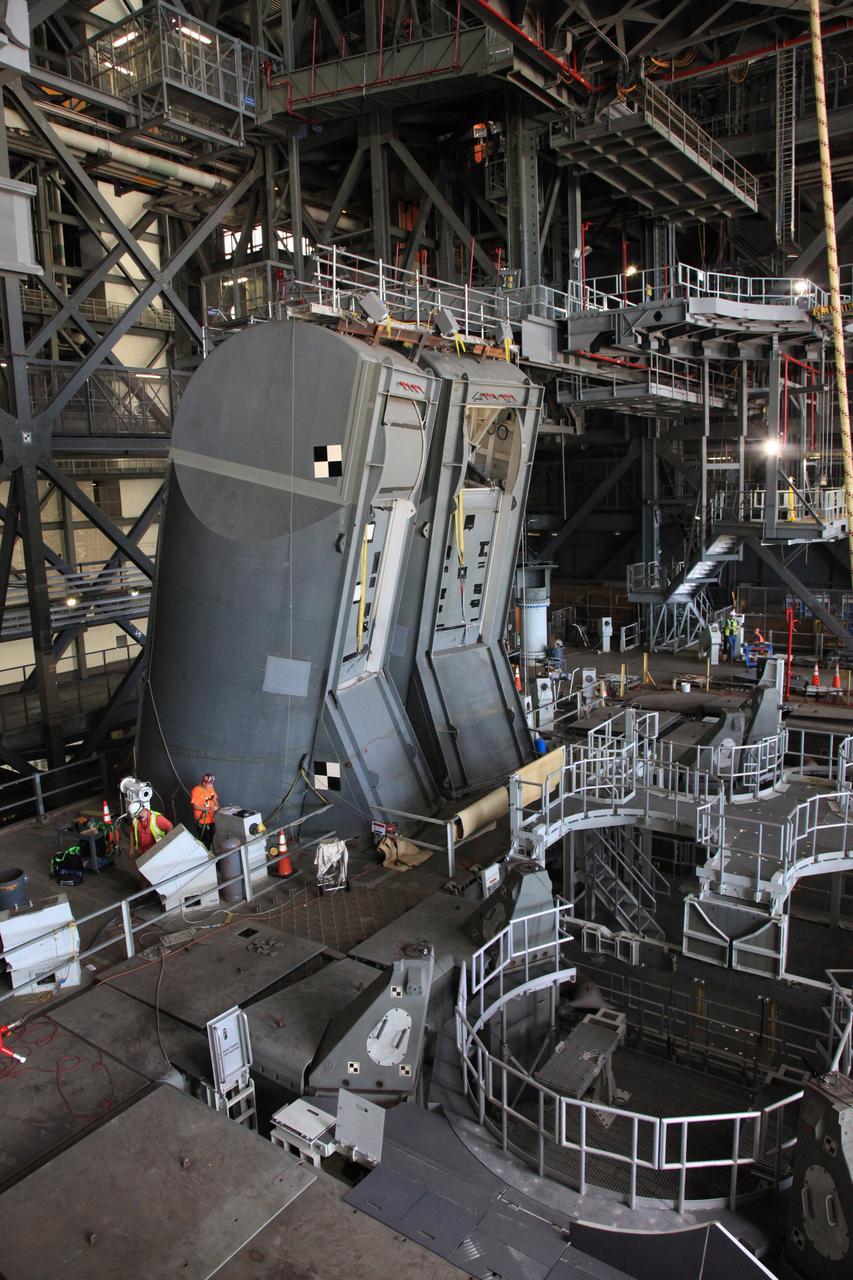
Preparations are underway to conduct a drop test of the Tail Service Mast Umbilicals (TSMU) for NASA’s Space Launch System (SLS) rocket on the mobile launcher in High Bay 3 of the Vehicle Assembly Building at NASA’s Kennedy Space Center in Florida on June 19, 2019. The 35-foot-tall TSMUs will connect to the SLS core stage aft section and provide liquid oxygen and liquid hydrogen fluid lines and electrical cable connections to the core stage engine section to support propellant handling during prelaunch operations. The drop test is being performed to ensure that the umbilicals will disconnect before launch of the SLS carrying Orion on its first uncrewed mission, Artemis 1, from Launch Complex 39B. Exploration Ground Systems and Engineering are completing the tests.
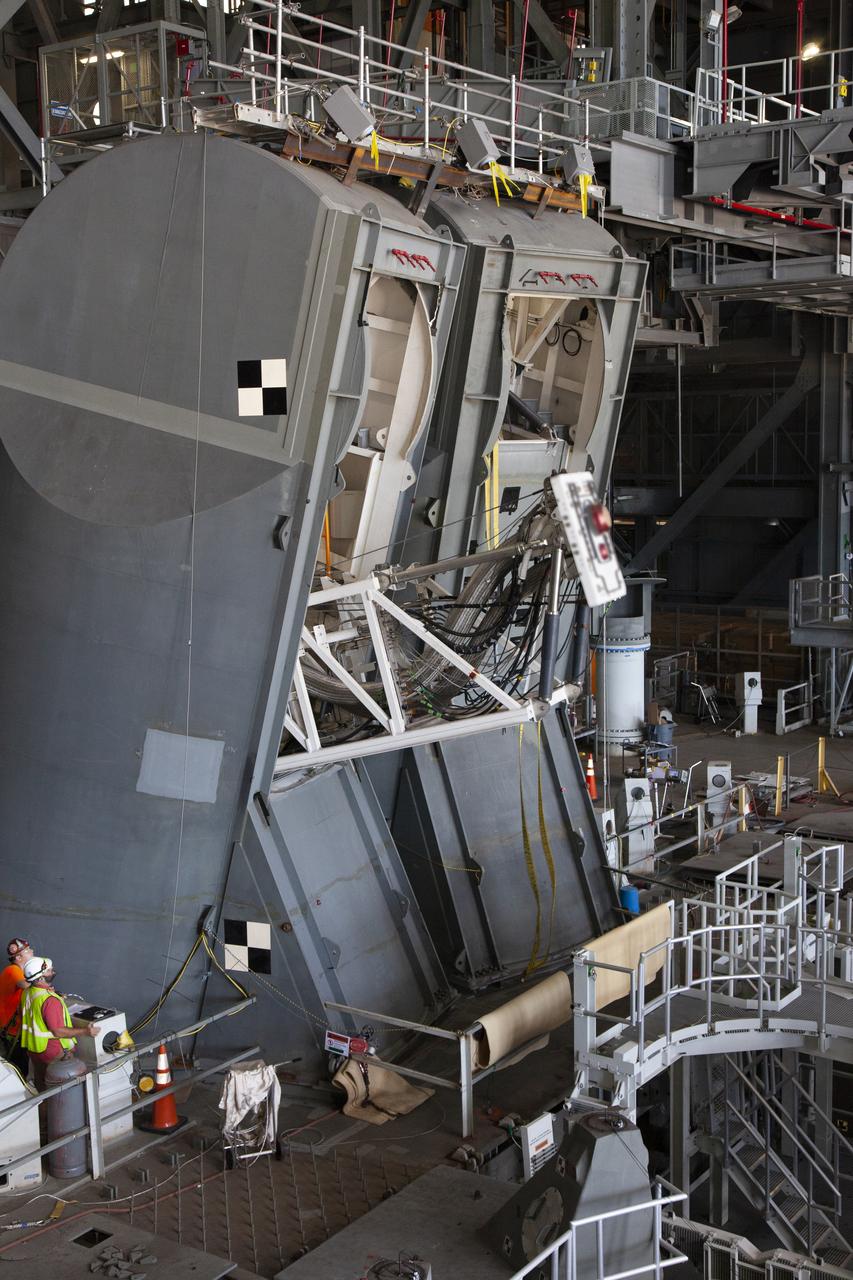
A drop test of the Tail Service Mast Umbilicals (TSMU) for NASA’s Space Launch System (SLS) rocket is underway on the mobile launcher in High Bay 3 of the Vehicle Assembly Building at NASA’s Kennedy Space Center in Florida on June 19, 2019. The 35-foot-tall TSMUs will connect to the SLS core stage aft section and provide liquid oxygen and liquid hydrogen fluid lines and electrical cable connections to the core stage engine section to support propellant handling during prelaunch operations. The drop test is being performed to ensure that the umbilicals will disconnect before launch of the SLS carrying Orion on its first uncrewed mission, Artemis 1, from Launch Complex 39B. Exploration Ground Systems and Engineering are completing the tests.
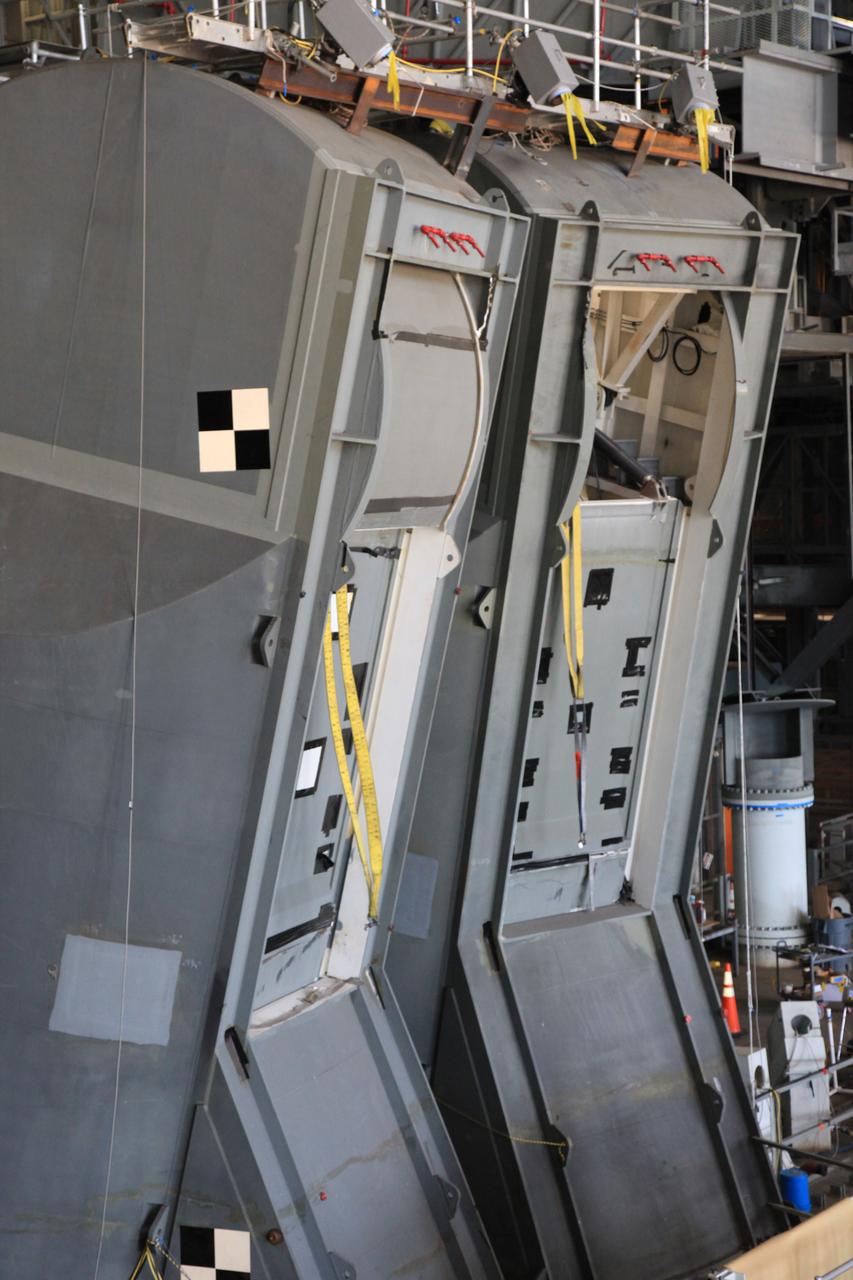
Preparations are underway to conduct a drop test of the Tail Service Mast Umbilicals (TSMU) for NASA’s Space Launch System (SLS) rocket on the mobile launcher in High Bay 3 of the Vehicle Assembly Building at NASA’s Kennedy Space Center in Florida on June 19, 2019. The 35-foot-tall TSMUs will connect to the SLS core stage aft section and provide liquid oxygen and liquid hydrogen fluid lines and electrical cable connections to the core stage engine section to support propellant handling during prelaunch operations. The drop test is being performed to ensure that the umbilicals will disconnect before launch of the SLS carrying Orion on its first uncrewed mission, Artemis 1, from Launch Complex 39B. Exploration Ground Systems and Engineering are completing the tests.
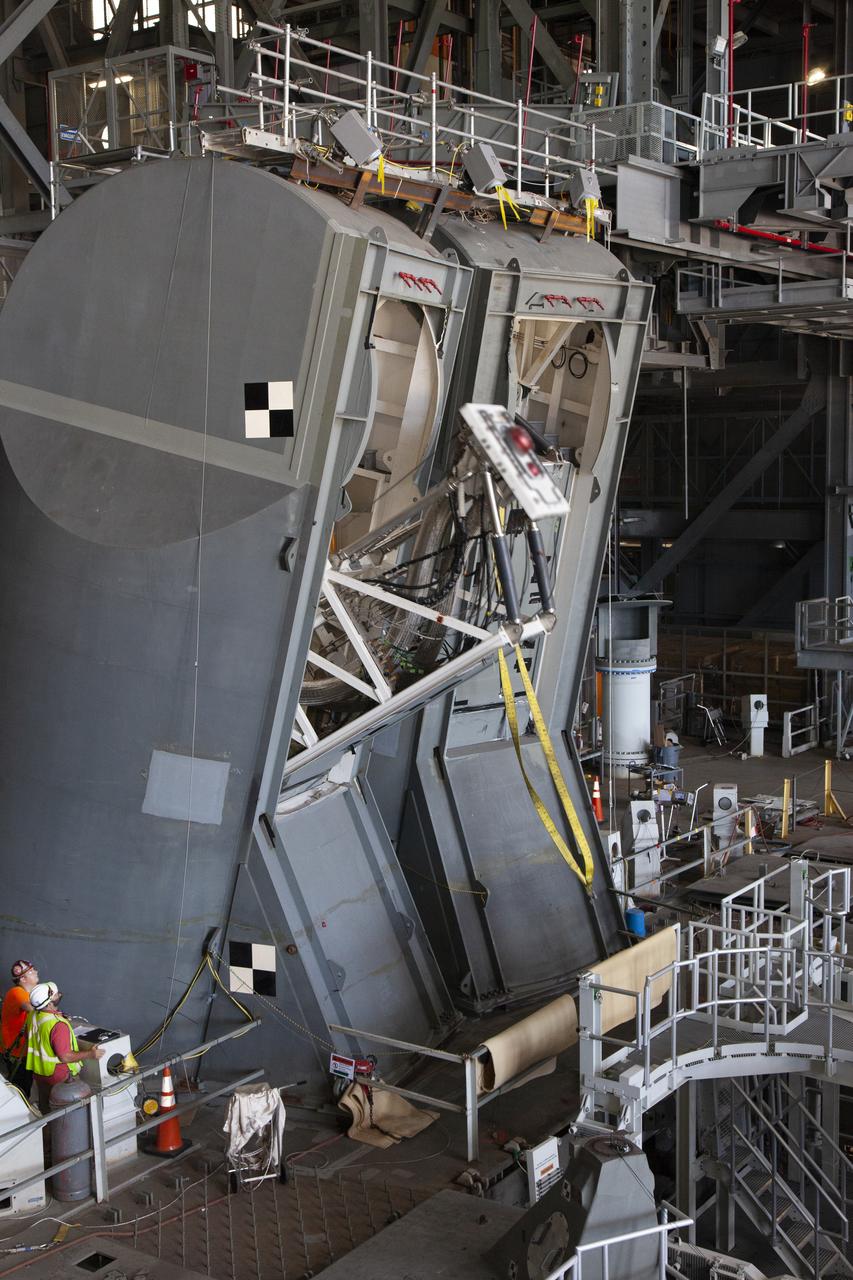
A drop test of the Tail Service Mast Umbilicals (TSMU) for NASA’s Space Launch System (SLS) rocket is underway on the mobile launcher in High Bay 3 of the Vehicle Assembly Building at NASA’s Kennedy Space Center in Florida on June 19, 2019. The 35-foot-tall TSMUs will connect to the SLS core stage aft section and provide liquid oxygen and liquid hydrogen fluid lines and electrical cable connections to the core stage engine section to support propellant handling during prelaunch operations. The drop test is being performed to ensure that the umbilicals will disconnect before launch of the SLS carrying Orion on its first uncrewed mission, Artemis 1, from Launch Complex 39B. Exploration Ground Systems and Engineering are completing the tests.
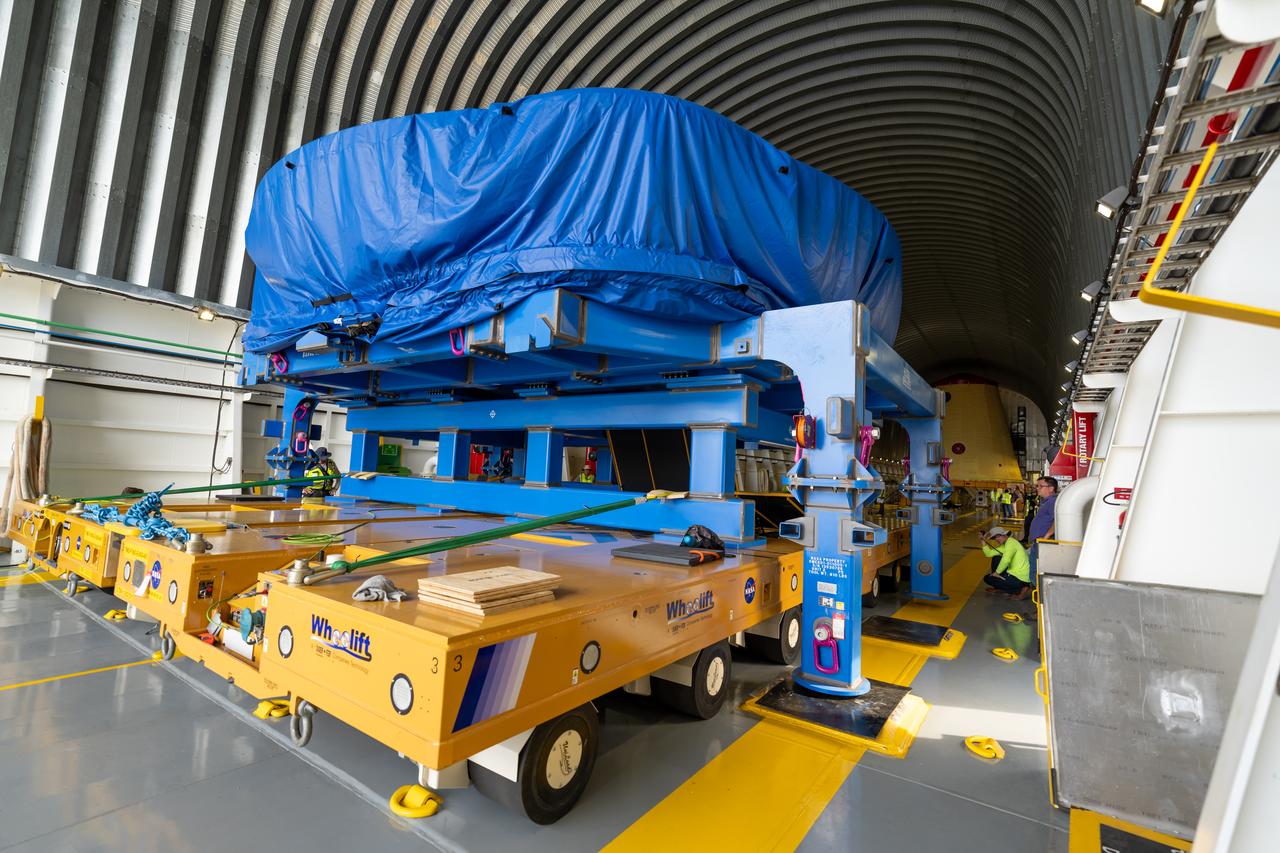
These photos and videos show teams at NASA’s Michoud Assembly Facility in New Orleans preparing, moving, and loading the engine section boat-tail of NASA’s SLS (Space Launch System) rocket for the Artemis III mission for transportation to NASA’s Kennedy Space Center in Florida via the agency’s Pegasus barge. Inside the factory on Aug. 14 prior to the move, technicians covered the spaceflight hardware with a tarp to help protect it on its journey aboard NASA’s Pegasus barge. Crews then rolled out the hardware on Aug. 27 from the factory floor to the barge. Once in Florida, the boat-tail will be integrated with the engine section -- also manufactured at Michoud -- inside Kennedy’s Space Station Processing Facility. The engine section arrived at NASA Kennedy in Dec. 2022. Located at the bottom of the engine section, the aerodynamic boat-tail fairing channels airflow and protects the stage’s four RS-25 engines from extreme temperatures during launch. The engine section is one of five major elements that make up the 212-foot-tall rocket stage. The core stage, along with its four RS-25 engines, produce two million pounds of thrust to help launch NASA’s Orion spacecraft, astronauts, and supplies beyond Earth’s orbit and to the lunar surface for Artemis.
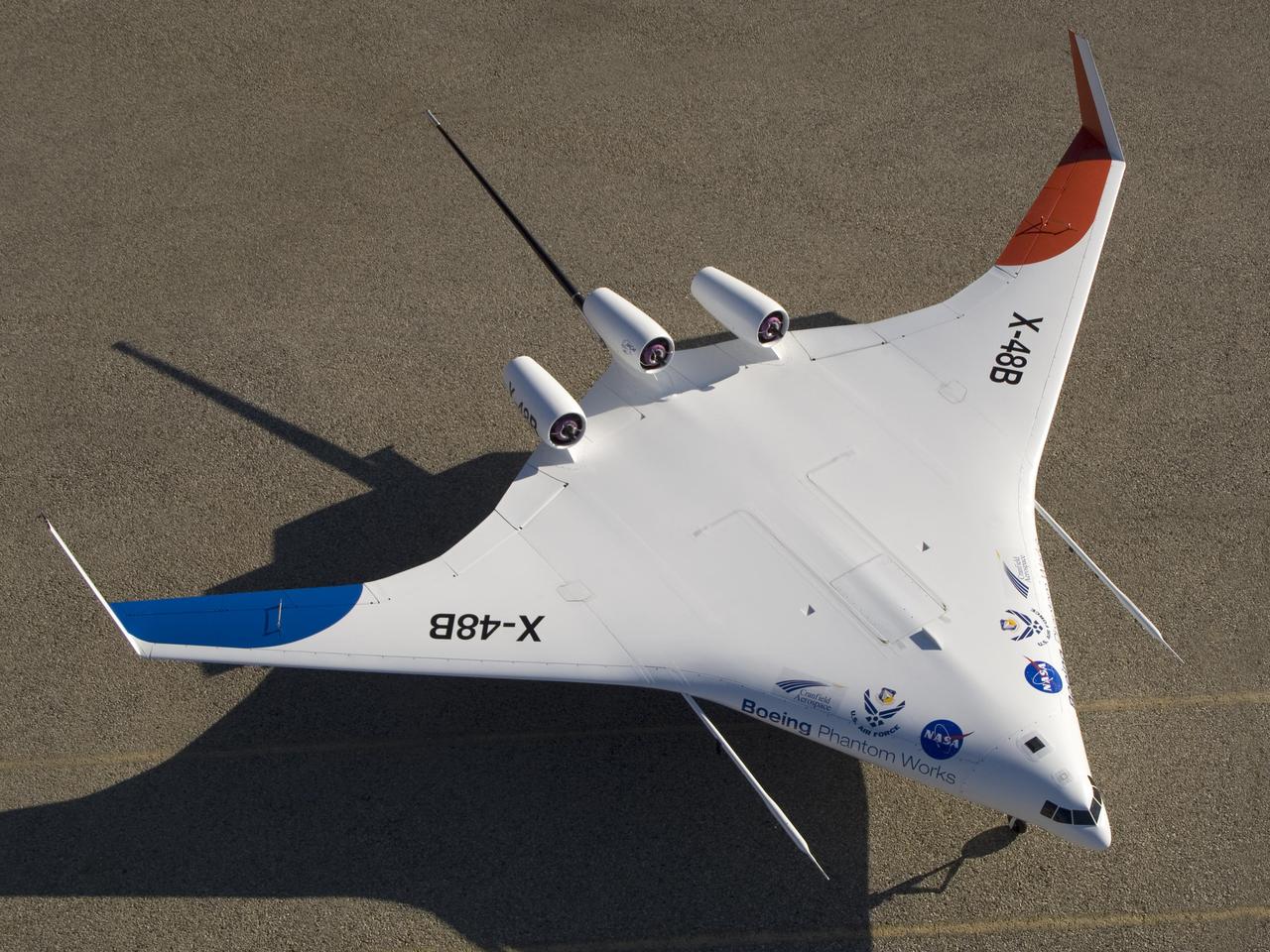
With its spin parachute tail stinger extending aft, Boeing's sub-scale X-48B BWB technology demonstrator showed off its clean semi-triangular shape.

Technicians and engineers move the boat-tail structure for the core stage of NASA’s Space Launch System’s (SLS) rocket for Artemis II, the first crewed mission of NASA’s Artemis program at NASA’s Michoud Assembly Facility. The boat-tail, a fairing-like cover that attaches to the engine section on the bottom of the core stage, protects and covers most of the four RS-25 engines’ critical systems. Together with its four RS-25 engines, the rocket’s massive 212-foot-tall core stage — the largest stage NASA has ever built — and its twin solid rocket boosters will produce 8.8 million pounds of thrust to send NASA’s Orion spacecraft, astronauts and supplies beyond Earth’s orbit to the Moon and, ultimately, Mars. Offering more payload mass, volume capability and energy to speed missions through space, the SLS rocket, along with NASA’s Gateway in lunar orbit, the Human Landing System, and Orion spacecraft, is part of NASA’s backbone for deep space exploration and the Artemis lunar program. No other rocket is capable of carrying astronauts in Orion around the Moon in a single mission. Photographed on Wednesday, June 9, 2021. Image credit: NASA/Michael DeMocker
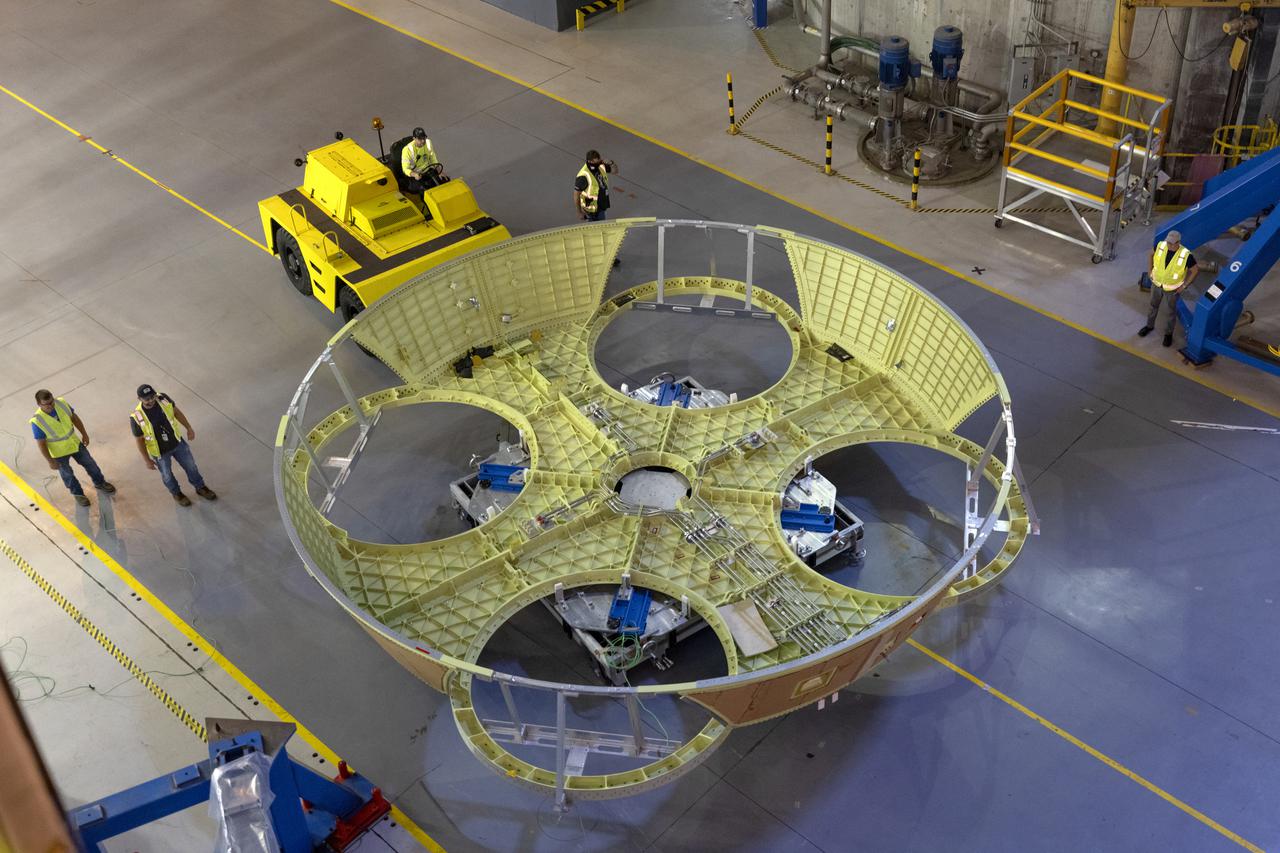
Technicians and engineers move the boat-tail structure for the core stage of NASA’s Space Launch System’s (SLS) rocket for Artemis II, the first crewed mission of NASA’s Artemis program at NASA’s Michoud Assembly Facility. The boat-tail, a fairing-like cover that attaches to the engine section on the bottom of the core stage, protects and covers most of the four RS-25 engines’ critical systems. Together with its four RS-25 engines, the rocket’s massive 212-foot-tall core stage — the largest stage NASA has ever built — and its twin solid rocket boosters will produce 8.8 million pounds of thrust to send NASA’s Orion spacecraft, astronauts and supplies beyond Earth’s orbit to the Moon and, ultimately, Mars. Offering more payload mass, volume capability and energy to speed missions through space, the SLS rocket, along with NASA’s Gateway in lunar orbit, the Human Landing System, and Orion spacecraft, is part of NASA’s backbone for deep space exploration and the Artemis lunar program. No other rocket is capable of carrying astronauts in Orion around the Moon in a single mission. Photographed on Wednesday, June 9, 2021. Image credit: NASA/Michael DeMocker
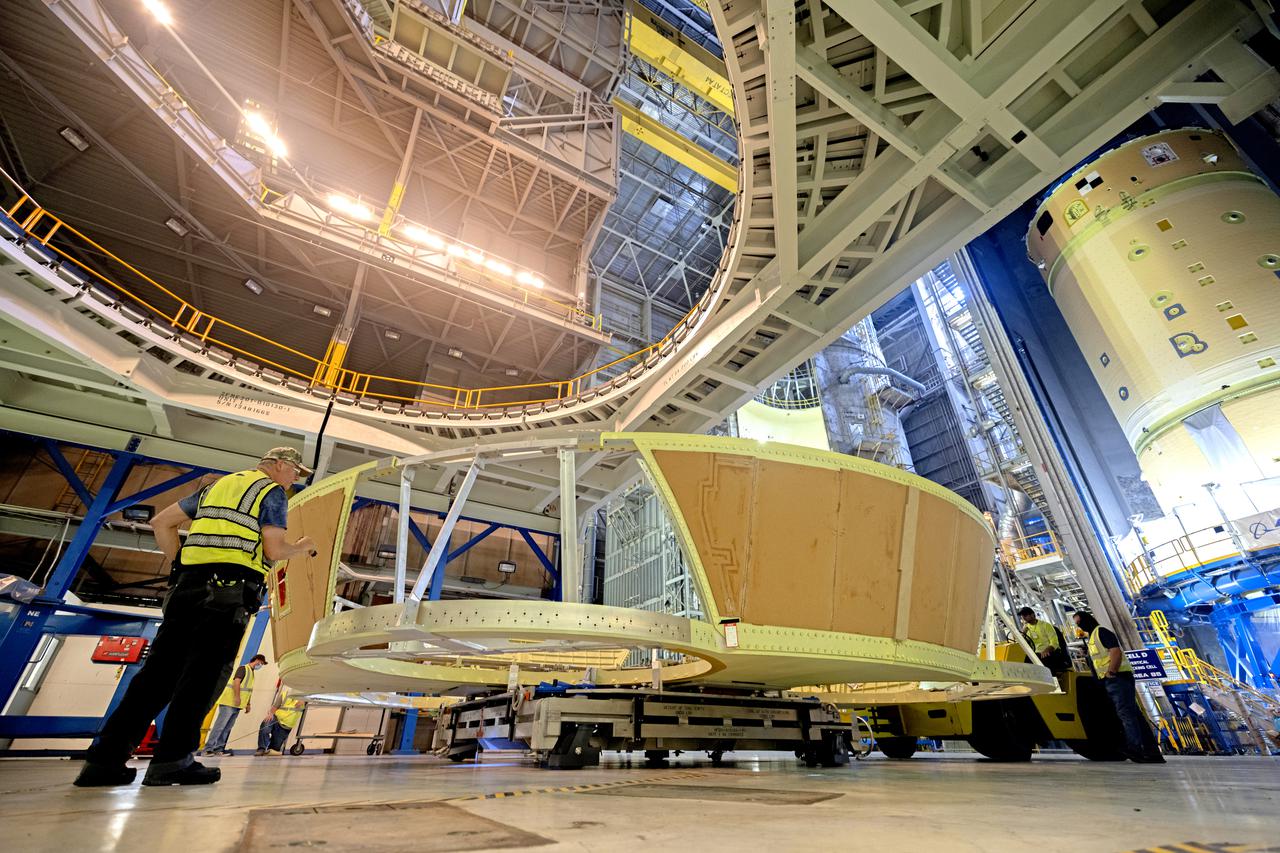
Technicians and engineers move the boat-tail structure for the core stage of NASA’s Space Launch System’s (SLS) rocket for Artemis II, the first crewed mission of NASA’s Artemis program at NASA’s Michoud Assembly Facility. The boat-tail, a fairing-like cover that attaches to the engine section on the bottom of the core stage, protects and covers most of the four RS-25 engines’ critical systems. Together with its four RS-25 engines, the rocket’s massive 212-foot-tall core stage — the largest stage NASA has ever built — and its twin solid rocket boosters will produce 8.8 million pounds of thrust to send NASA’s Orion spacecraft, astronauts and supplies beyond Earth’s orbit to the Moon and, ultimately, Mars. Offering more payload mass, volume capability and energy to speed missions through space, the SLS rocket, along with NASA’s Gateway in lunar orbit, the Human Landing System, and Orion spacecraft, is part of NASA’s backbone for deep space exploration and the Artemis lunar program. No other rocket is capable of carrying astronauts in Orion around the Moon in a single mission. Photographed on Wednesday, June 9, 2021. Image credit: NASA/Michael DeMocker
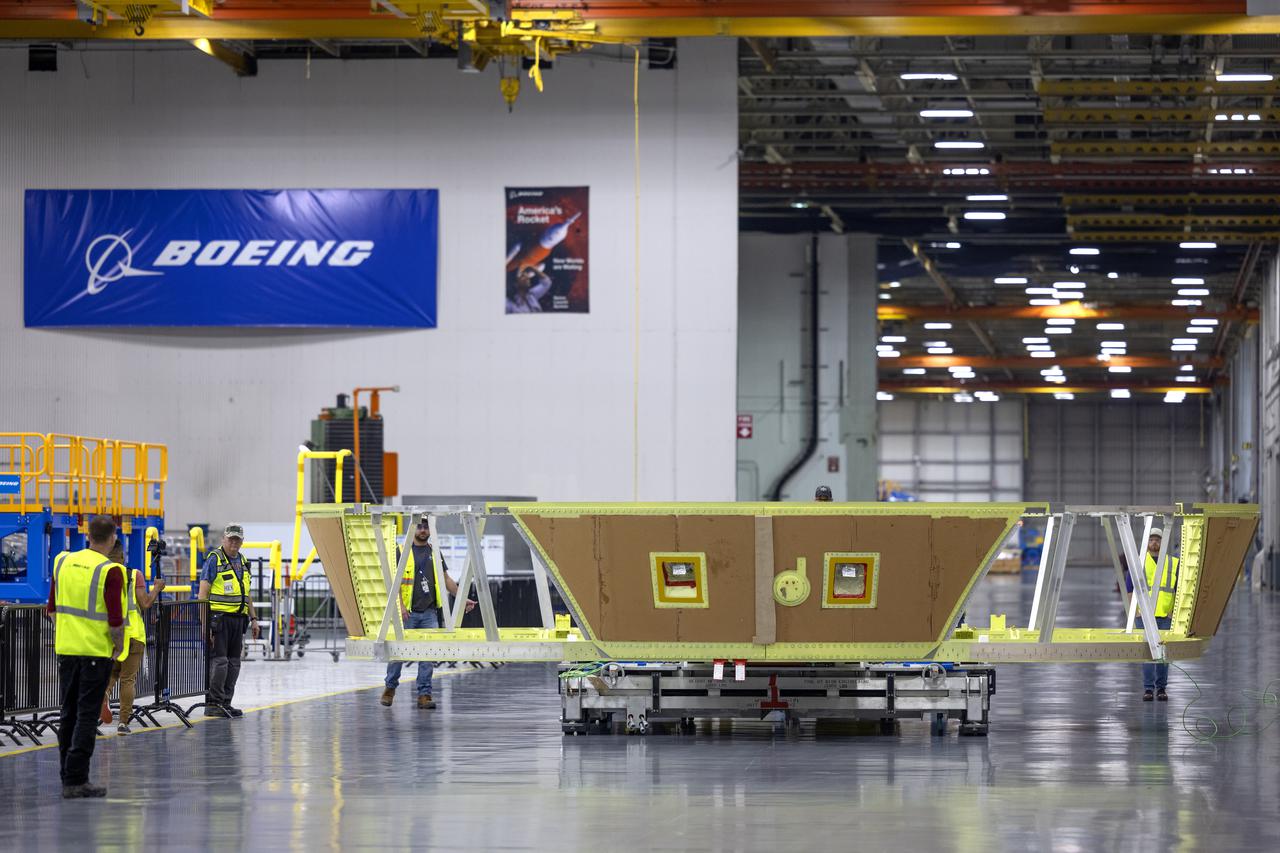
Technicians and engineers move the boat-tail structure for the core stage of NASA’s Space Launch System’s (SLS) rocket for Artemis II, the first crewed mission of NASA’s Artemis program at NASA’s Michoud Assembly Facility. The boat-tail, a fairing-like cover that attaches to the engine section on the bottom of the core stage, protects and covers most of the four RS-25 engines’ critical systems. Together with its four RS-25 engines, the rocket’s massive 212-foot-tall core stage — the largest stage NASA has ever built — and its twin solid rocket boosters will produce 8.8 million pounds of thrust to send NASA’s Orion spacecraft, astronauts and supplies beyond Earth’s orbit to the Moon and, ultimately, Mars. Offering more payload mass, volume capability and energy to speed missions through space, the SLS rocket, along with NASA’s Gateway in lunar orbit, the Human Landing System, and Orion spacecraft, is part of NASA’s backbone for deep space exploration and the Artemis lunar program. No other rocket is capable of carrying astronauts in Orion around the Moon in a single mission. Photographed on Wednesday, June 9, 2021. Image credit: NASA/Michael DeMocker
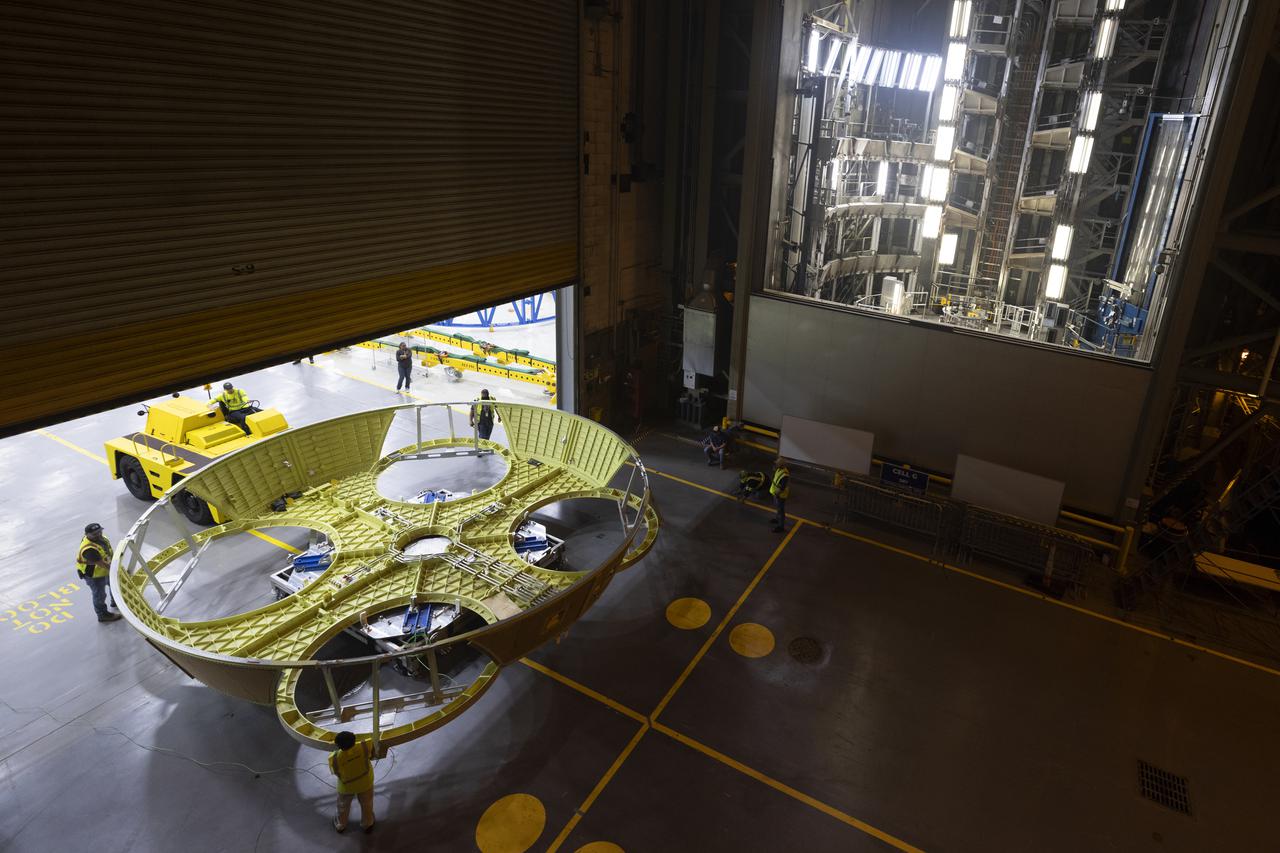
Technicians and engineers move the boat-tail structure for the core stage of NASA’s Space Launch System’s (SLS) rocket for Artemis II, the first crewed mission of NASA’s Artemis program at NASA’s Michoud Assembly Facility. The boat-tail, a fairing-like cover that attaches to the engine section on the bottom of the core stage, protects and covers most of the four RS-25 engines’ critical systems. Together with its four RS-25 engines, the rocket’s massive 212-foot-tall core stage — the largest stage NASA has ever built — and its twin solid rocket boosters will produce 8.8 million pounds of thrust to send NASA’s Orion spacecraft, astronauts and supplies beyond Earth’s orbit to the Moon and, ultimately, Mars. Offering more payload mass, volume capability and energy to speed missions through space, the SLS rocket, along with NASA’s Gateway in lunar orbit, the Human Landing System, and Orion spacecraft, is part of NASA’s backbone for deep space exploration and the Artemis lunar program. No other rocket is capable of carrying astronauts in Orion around the Moon in a single mission. Photographed on Wednesday, June 9, 2021. Image credit: NASA/Michael DeMocker
Technicians and engineers move the boat-tail structure for the core stage of NASA’s Space Launch System’s (SLS) rocket for Artemis II, the first crewed mission of NASA’s Artemis program at NASA’s Michoud Assembly Facility. The boat-tail, a fairing-like cover that attaches to the engine section on the bottom of the core stage, protects and covers most of the four RS-25 engines’ critical systems. Together with its four RS-25 engines, the rocket’s massive 212-foot-tall core stage — the largest stage NASA has ever built — and its twin solid rocket boosters will produce 8.8 million pounds of thrust to send NASA’s Orion spacecraft, astronauts and supplies beyond Earth’s orbit to the Moon and, ultimately, Mars. Offering more payload mass, volume capability and energy to speed missions through space, the SLS rocket, along with NASA’s Gateway in lunar orbit, the Human Landing System, and Orion spacecraft, is part of NASA’s backbone for deep space exploration and the Artemis lunar program. No other rocket is capable of carrying astronauts in Orion around the Moon in a single mission. Photographed on Wednesday, June 9, 2021. Image credit: NASA/Michael DeMocker
Technicians and engineers move the boat-tail structure for the core stage of NASA’s Space Launch System’s (SLS) rocket for Artemis II, the first crewed mission of NASA’s Artemis program at NASA’s Michoud Assembly Facility. The boat-tail, a fairing-like cover that attaches to the engine section on the bottom of the core stage, protects and covers most of the four RS-25 engines’ critical systems. Together with its four RS-25 engines, the rocket’s massive 212-foot-tall core stage — the largest stage NASA has ever built — and its twin solid rocket boosters will produce 8.8 million pounds of thrust to send NASA’s Orion spacecraft, astronauts and supplies beyond Earth’s orbit to the Moon and, ultimately, Mars. Offering more payload mass, volume capability and energy to speed missions through space, the SLS rocket, along with NASA’s Gateway in lunar orbit, the Human Landing System, and Orion spacecraft, is part of NASA’s backbone for deep space exploration and the Artemis lunar program. No other rocket is capable of carrying astronauts in Orion around the Moon in a single mission. Photographed on Wednesday, June 9, 2021. Image credit: NASA/Michael DeMocker
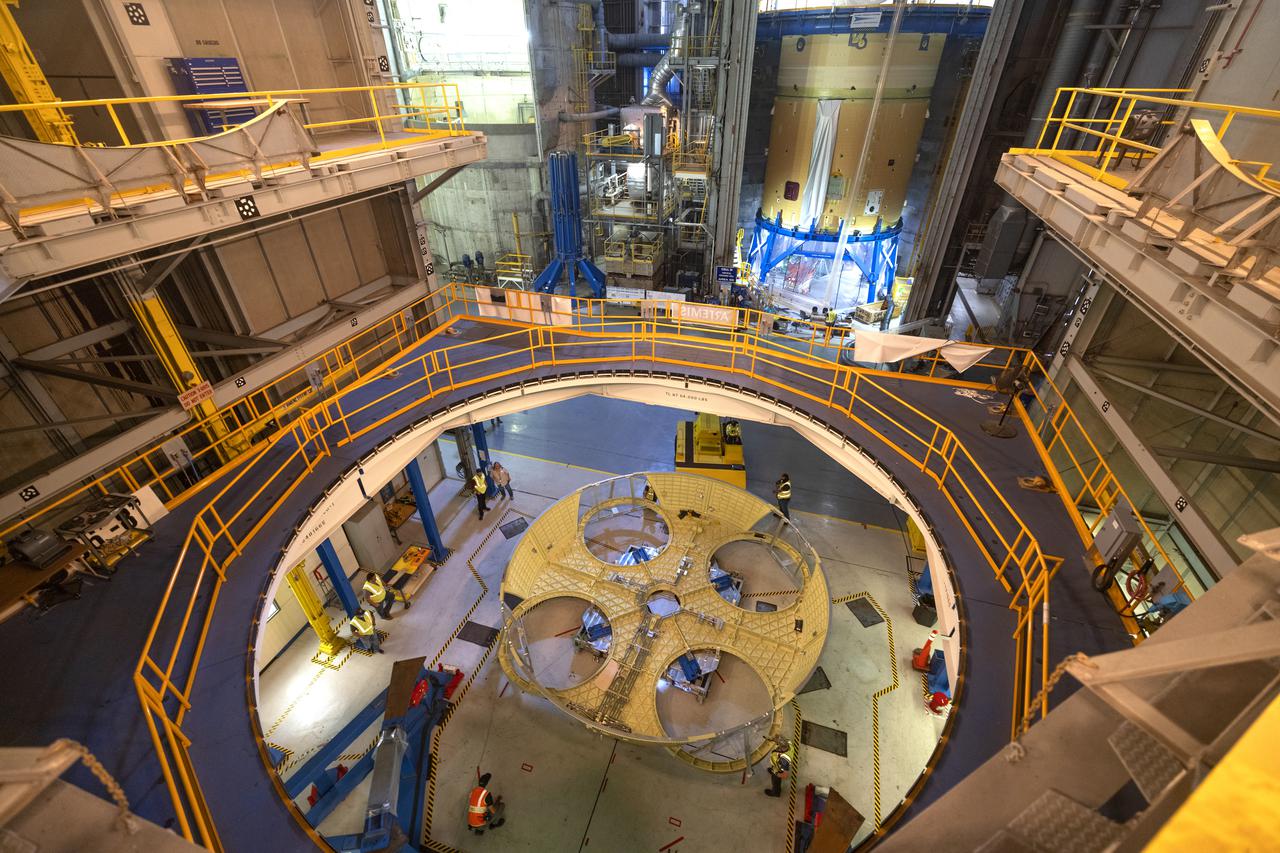
Technicians and engineers move the boat-tail structure for the core stage of NASA’s Space Launch System’s (SLS) rocket for Artemis II, the first crewed mission of NASA’s Artemis program at NASA’s Michoud Assembly Facility. The boat-tail, a fairing-like cover that attaches to the engine section on the bottom of the core stage, protects and covers most of the four RS-25 engines’ critical systems. Together with its four RS-25 engines, the rocket’s massive 212-foot-tall core stage — the largest stage NASA has ever built — and its twin solid rocket boosters will produce 8.8 million pounds of thrust to send NASA’s Orion spacecraft, astronauts and supplies beyond Earth’s orbit to the Moon and, ultimately, Mars. Offering more payload mass, volume capability and energy to speed missions through space, the SLS rocket, along with NASA’s Gateway in lunar orbit, the Human Landing System, and Orion spacecraft, is part of NASA’s backbone for deep space exploration and the Artemis lunar program. No other rocket is capable of carrying astronauts in Orion around the Moon in a single mission. Photographed on Wednesday, June 9, 2021. Image credit: NASA/Michael DeMocker
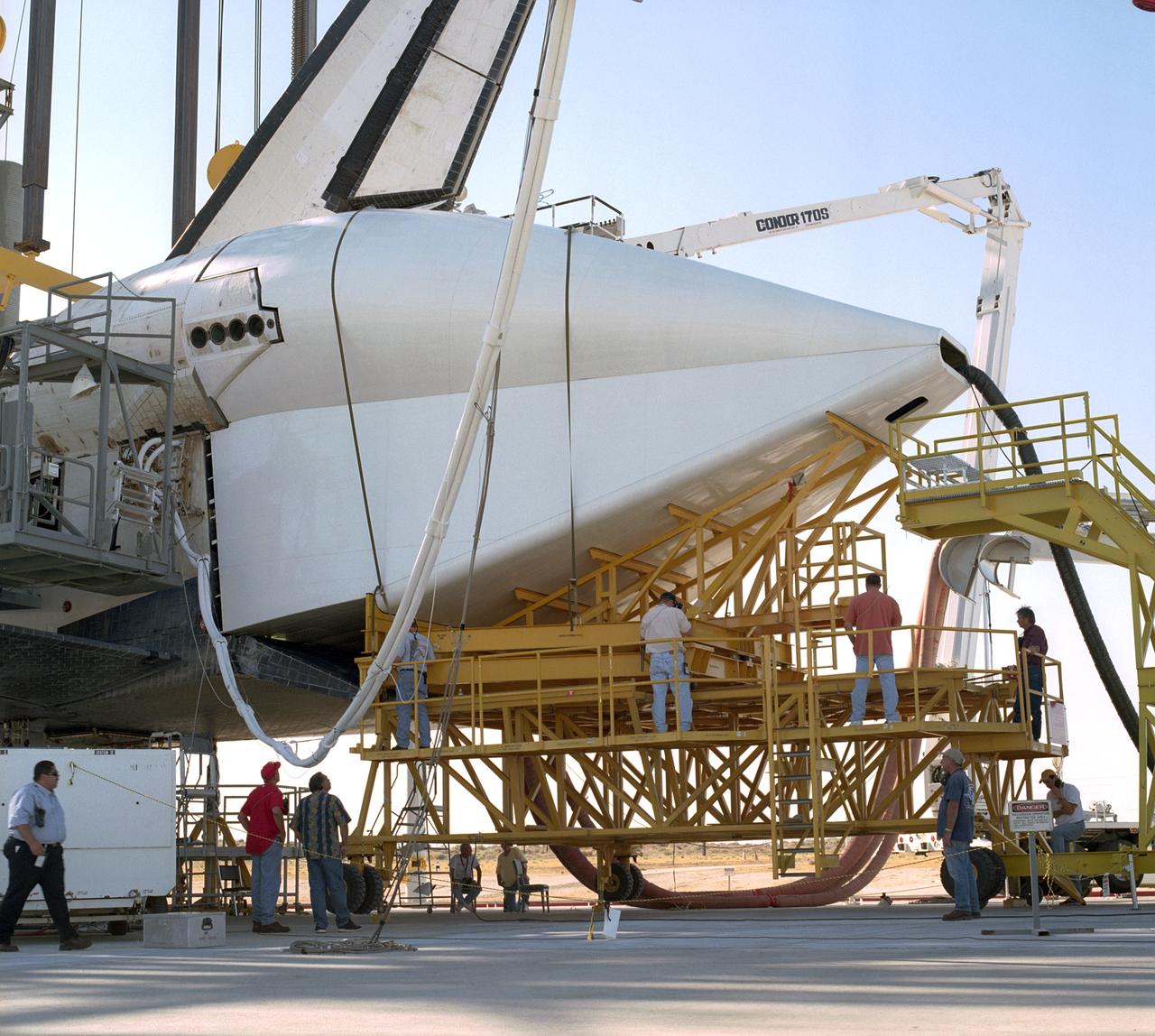
Technicians attach the tail cone, which helps reduce aerodynamic drag and turbulence during its ferry flight, to the Space Shuttle Discovery in preparation for its return to NASA's Kennedy Space Center in Florida. After the tail-cone is installed, Discovery will be mounted on NASA's modified Boeing 747 Shuttle Carrier Aircraft, or SCA, for the return flight. Space Shuttle Discovery landed safely at NASA's Dryden Flight Research Center at Edwards Air Force Base in California at 5:11:22 a.m. PDT, August 9, 2005, following the very successful 14-day STS-114 return to flight mission. During their two weeks in space, Commander Eileen Collins and her six crewmates tested out new safety procedures and delivered supplies and equipment the International Space Station. Discovery spent two weeks in space, where the crew demonstrated new methods to inspect and repair the Shuttle in orbit. The crew also delivered supplies, outfitted and performed maintenance on the International Space Station. A number of these tasks were conducted during three spacewalks. In an unprecedented event, spacewalkers were called upon to remove protruding gap fillers from the heat shield on Discovery's underbelly. In other spacewalk activities, astronauts installed an external platform onto the Station's Quest Airlock and replaced one of the orbital outpost's Control Moment Gyroscopes. Inside the Station, the STS-114 crew conducted joint operations with the Expedition 11 crew. They unloaded fresh supplies from the Shuttle and the Raffaello Multi-Purpose Logistics Module. Before Discovery undocked, the crews filled Raffeallo with unneeded items and returned to Shuttle payload bay. Discovery launched on July 26 and spent almost 14 days on orbit.
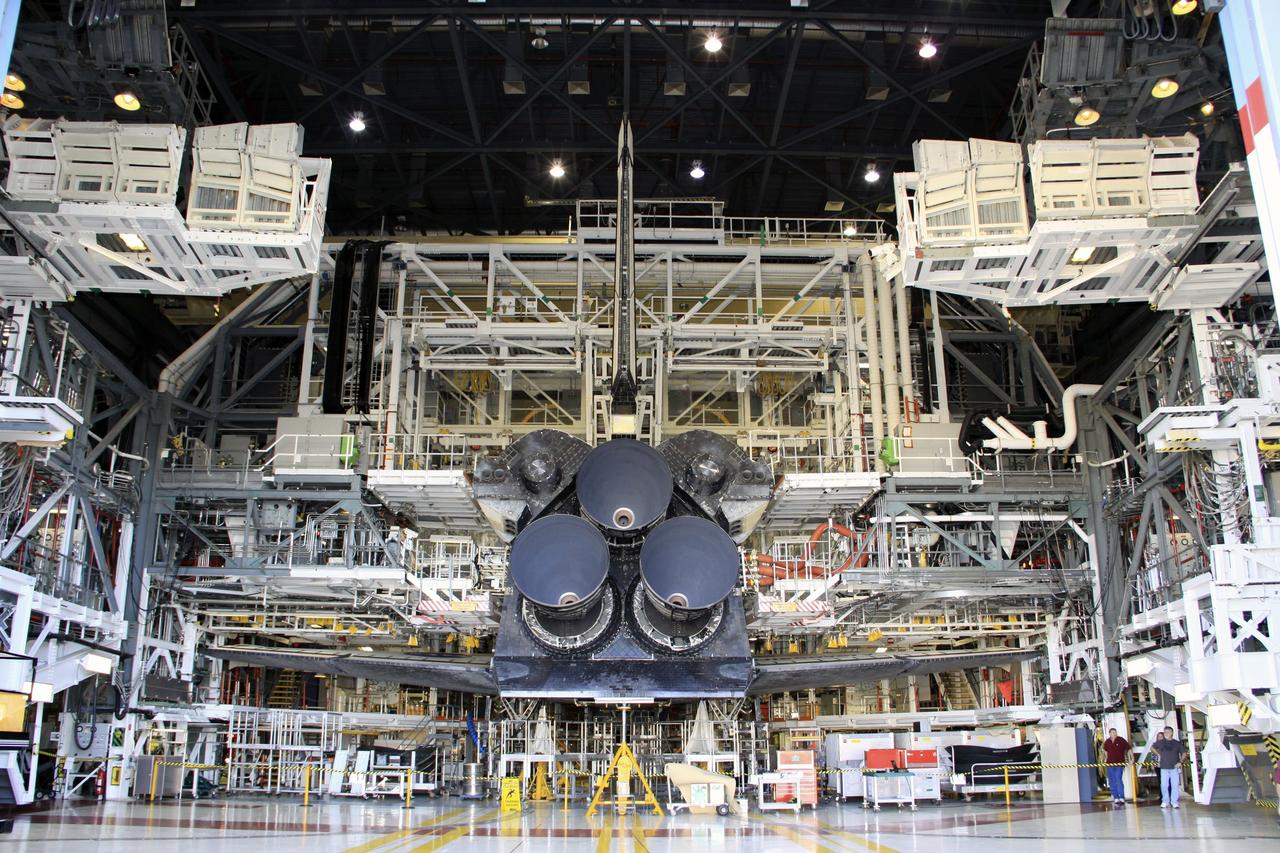
CAPE CANAVERAL, Fla. -- Inside Orbiter Processing Facility-1 at NASA’s Kennedy Space Center in Florida, space shuttle Discovery’s three replica shuttle main engines (RSMEs) are in view as technicians await the arrival of the tail cone. The tail cone will be installed around Discovery’s RSMEs for protection. The work is part of the Space Shuttle Program’s transition and retirement processing of shuttle Discovery. Discovery is being prepared for display at the Smithsonian’s National Air and Space Museum, Steven F. Udvar-Hazy Center in Chantilly, Va. For more information, visit http://www.nasa.gov/shuttle. Photo credit: NASA/Jim Grossmann

CAPE CANAVERAL, Fla. -- Inside Orbiter Processing Facility-1 at NASA’s Kennedy Space Center in Florida, technicians monitor the progress as the tail cone for space shuttle Discovery’s three replica shuttle main engines (RSMEs) arrives. The tail cone will be installed around Discovery’s RSMEs for protection. The work is part of the Space Shuttle Program’s transition and retirement processing of shuttle Discovery. Discovery is being prepared for display at the Smithsonian’s National Air and Space Museum, Steven F. Udvar-Hazy Center in Chantilly, Va. For more information, visit http://www.nasa.gov/shuttle. Photo credit: NASA/Jim Grossmann

CAPE CANAVERAL, Fla. -- The tail cone for space shuttle Discovery’s three replica shuttle main engines (RSMEs) arrives at Orbiter Processing Facility-1 at NASA’s Kennedy Space Center in Florida. The tail cone will be installed around Discovery’s RSMEs for protection. The work is part of the Space Shuttle Program’s transition and retirement processing of shuttle Discovery. Discovery is being prepared for display at the Smithsonian’s National Air and Space Museum, Steven F. Udvar-Hazy Center in Chantilly, Va. For more information, visit http://www.nasa.gov/shuttle. Photo credit: NASA/Jim Grossmann
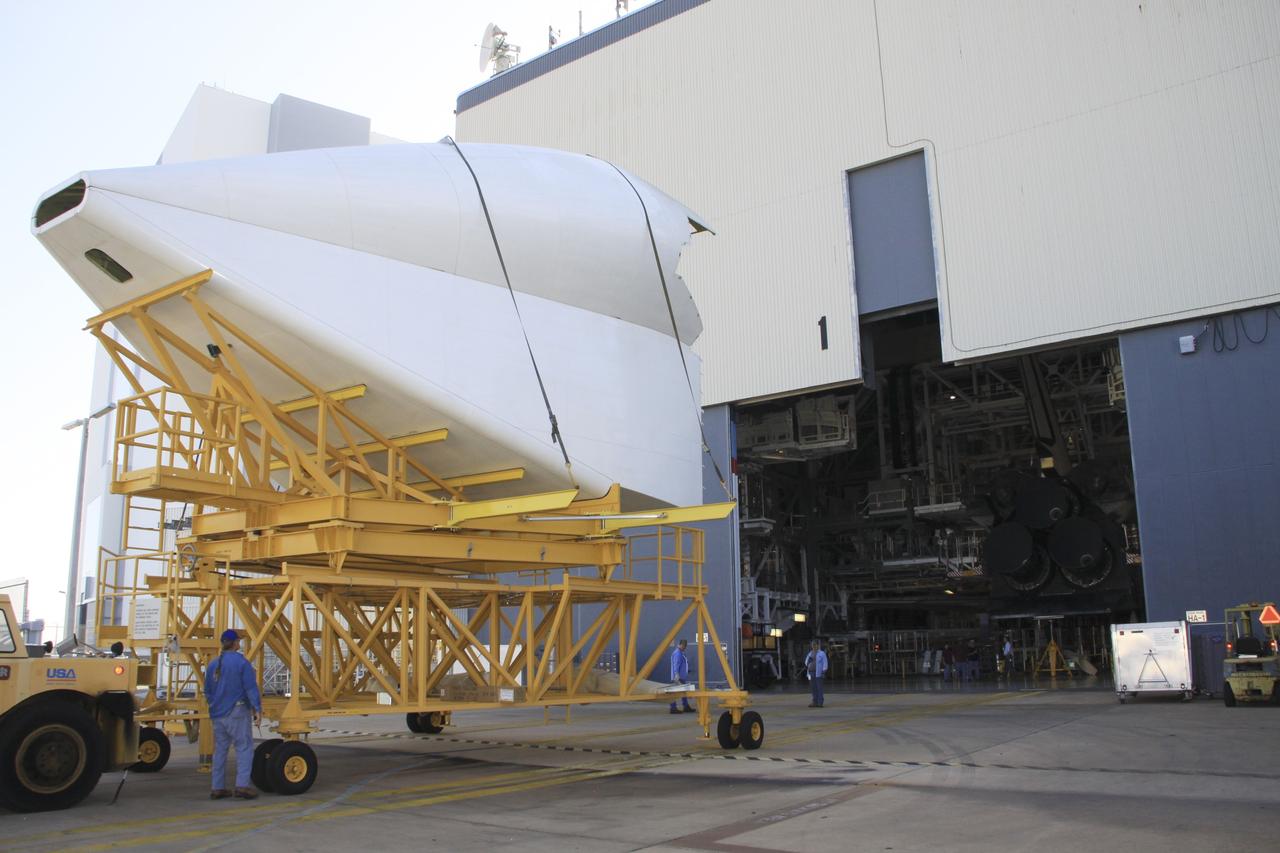
CAPE CANAVERAL, Fla. -- The tail cone for space shuttle Discovery’s three replica shuttle main engines (RSMEs) arrives at Orbiter Processing Facility-1 at NASA’s Kennedy Space Center in Florida. The tail cone will be installed around Discovery’s RSMEs for protection. The work is part of the Space Shuttle Program’s transition and retirement processing of shuttle Discovery. Discovery is being prepared for display at the Smithsonian’s National Air and Space Museum, Steven F. Udvar-Hazy Center in Chantilly, Va. For more information, visit http://www.nasa.gov/shuttle. Photo credit: NASA/Jim Grossmann
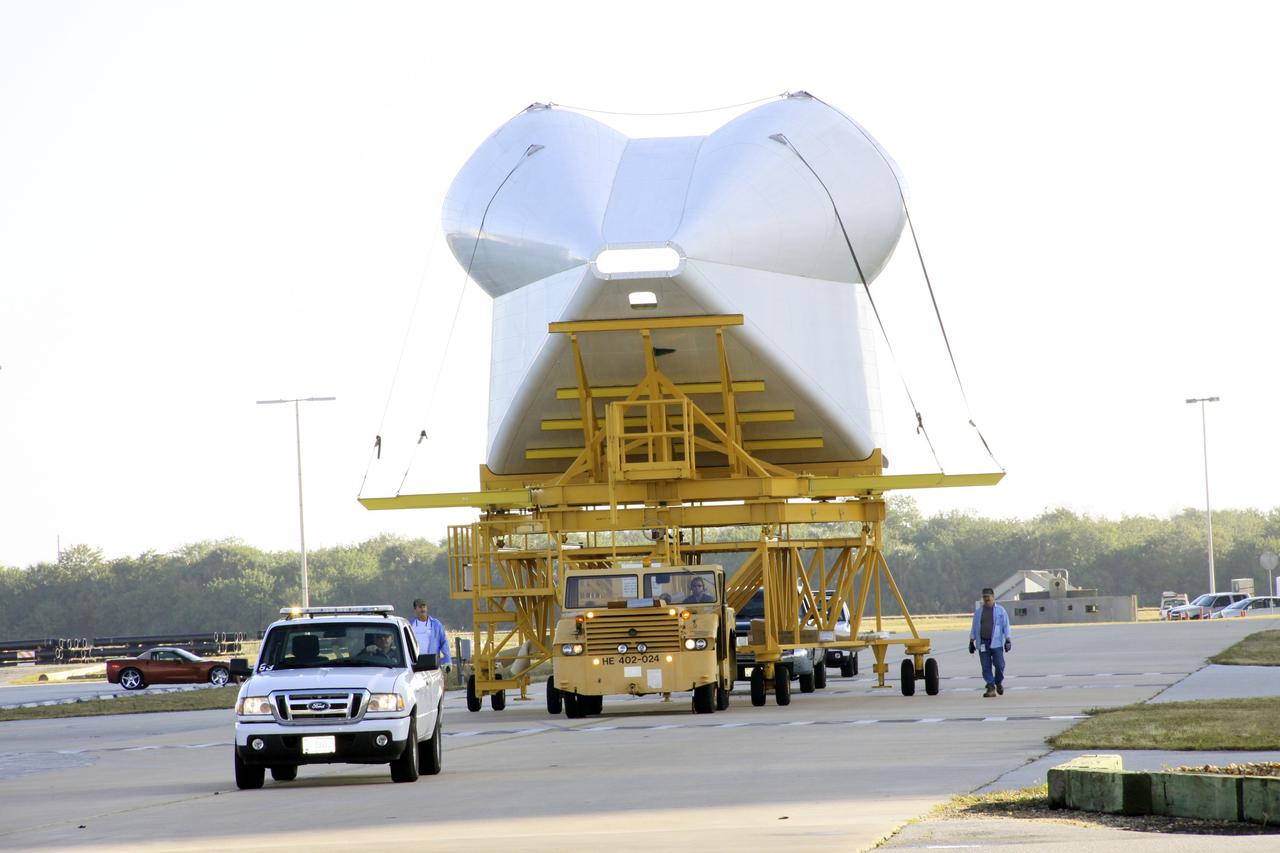
CAPE CANAVERAL, Fla. -- The tail cone for space shuttle Discovery’s three replica shuttle main engines (RSMEs) is being transported to Orbiter processing Facility-1 at NASA’s Kennedy Space Center in Florida. The tail cone will be installed around Discovery’s RSMEs for protection. The work is part of the Space Shuttle Program’s transition and retirement processing of shuttle Discovery. Discovery is being prepared for display at the Smithsonian’s National Air and Space Museum, Steven F. Udvar-Hazy Center in Chantilly, Va. For more information, visit http://www.nasa.gov/shuttle. Photo credit: NASA/Jim Grossmann
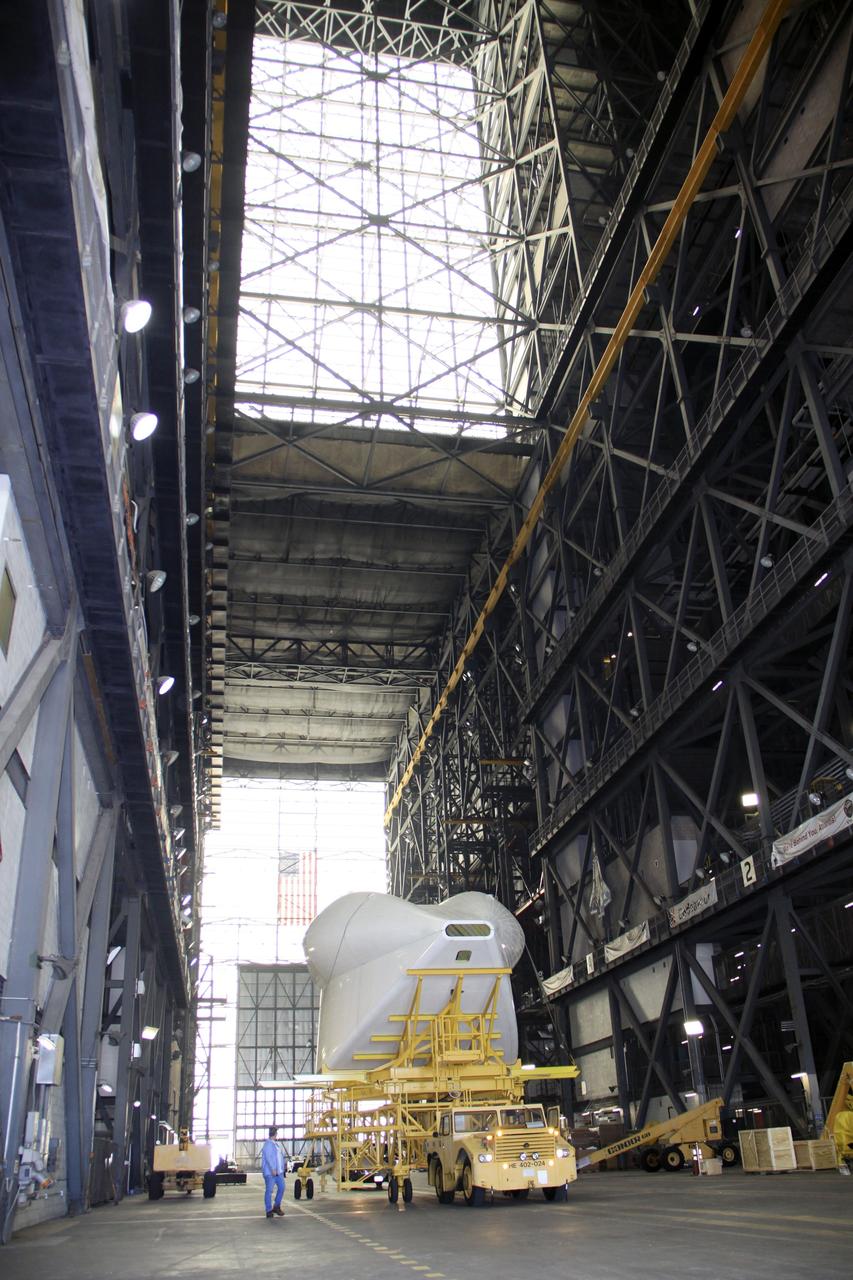
CAPE CANAVERAL, Fla. -- In the transfer aisle of the Vehicle Assembly Building at NASA’s Kennedy Space Center in Florida, the tail cone for space shuttle Discovery’s three replica shuttle main engines (RSMEs) is being transported to Orbiter Processing Facility-1. The tail cone will be installed around Discovery’s RSMEs for protection. The work is part of the Space Shuttle Program’s transition and retirement processing of shuttle Discovery. Discovery is being prepared for display at the Smithsonian’s National Air and Space Museum, Steven F. Udvar-Hazy Center in Chantilly, Va. For more information, visit http://www.nasa.gov/shuttle. Photo credit: NASA/Jim Grossmann

CAPE CANAVERAL, Fla. -- Inside Orbiter Processing Facility-1 at NASA’s Kennedy Space Center in Florida, a view from inside the tail cone reveals space shuttle Discovery’s three replica shuttle main engines (RSMEs). The tail cone is being installed around the RSMEs for protection. The work is part of the Space Shuttle Program’s transition and retirement processing of shuttle Discovery. Discovery is being prepared for display at the Smithsonian’s National Air and Space Museum, Steven F. Udvar-Hazy Center in Chantilly, Va. For more information, visit http://www.nasa.gov/shuttle. Photo credit: NASA/Jim Grossmann
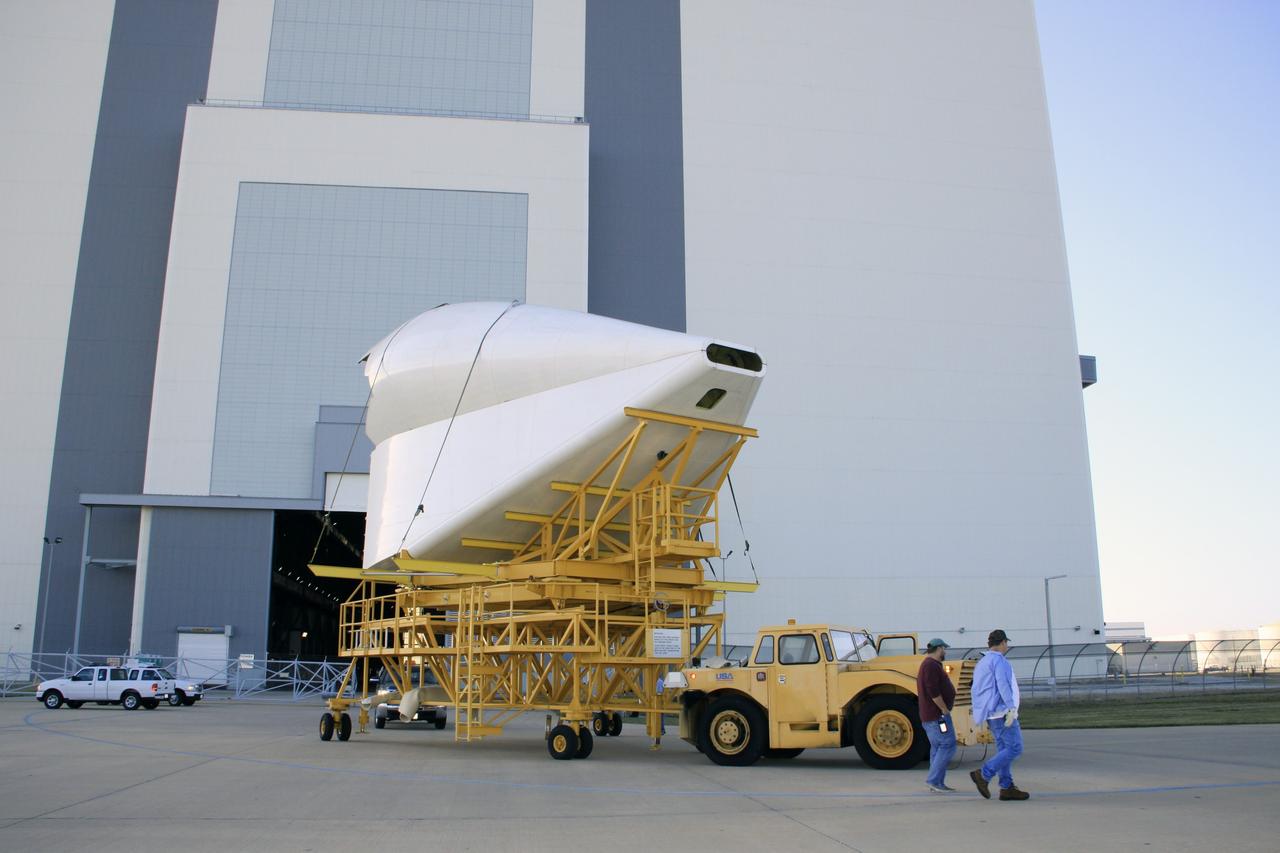
CAPE CANAVERAL, Fla. -- The tail cone for space shuttle Discovery’s three replica shuttle main engines (RSMEs) is being transported from the Vehicle Assembly Building to Orbiter Processing Facility-1 at NASA’s Kennedy Space Center in Florida. The tail cone will be installed around Discovery’s RSMEs for protection. The work is part of the Space Shuttle Program’s transition and retirement processing of shuttle Discovery. Discovery is being prepared for display at the Smithsonian’s National Air and Space Museum, Steven F. Udvar-Hazy Center in Chantilly, Va. For more information, visit http://www.nasa.gov/shuttle. Photo credit: NASA/Jim Grossmann
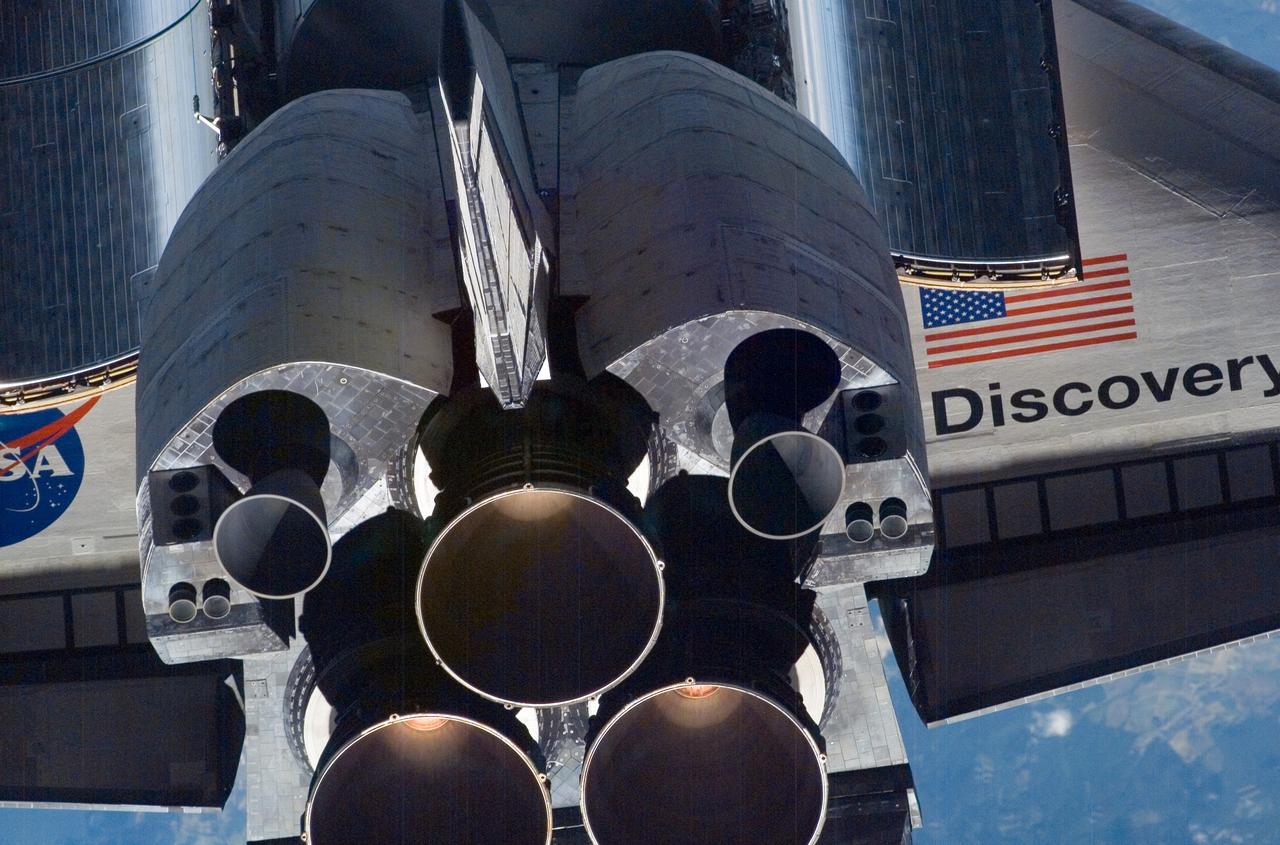
A close-up view of Space Shuttle Discovery's tail section is featured in this image photographed by an Expedition 13 crew member on the International Space Station (ISS) during the STS-121 Rotating Pitch Maneuver (RPM) survey. Visible are the space shuttle's main engines (SSME), vertical stabilizer, orbital maneuvering system (OMS) pods and a portion of the aft cargo bay and wings. The Marshall Space Flight Center (MSFC) has management responsibility for development of the SSME.
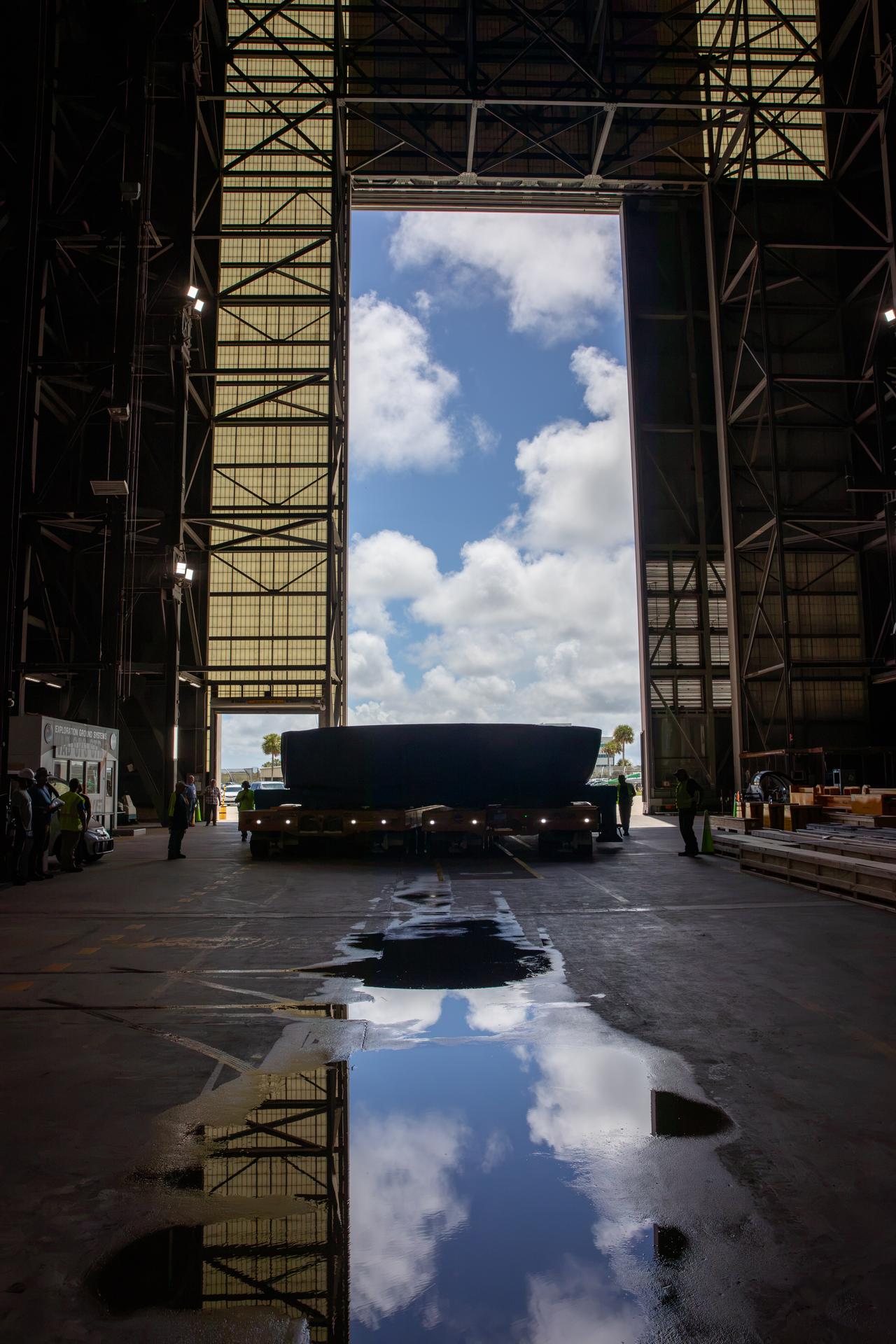
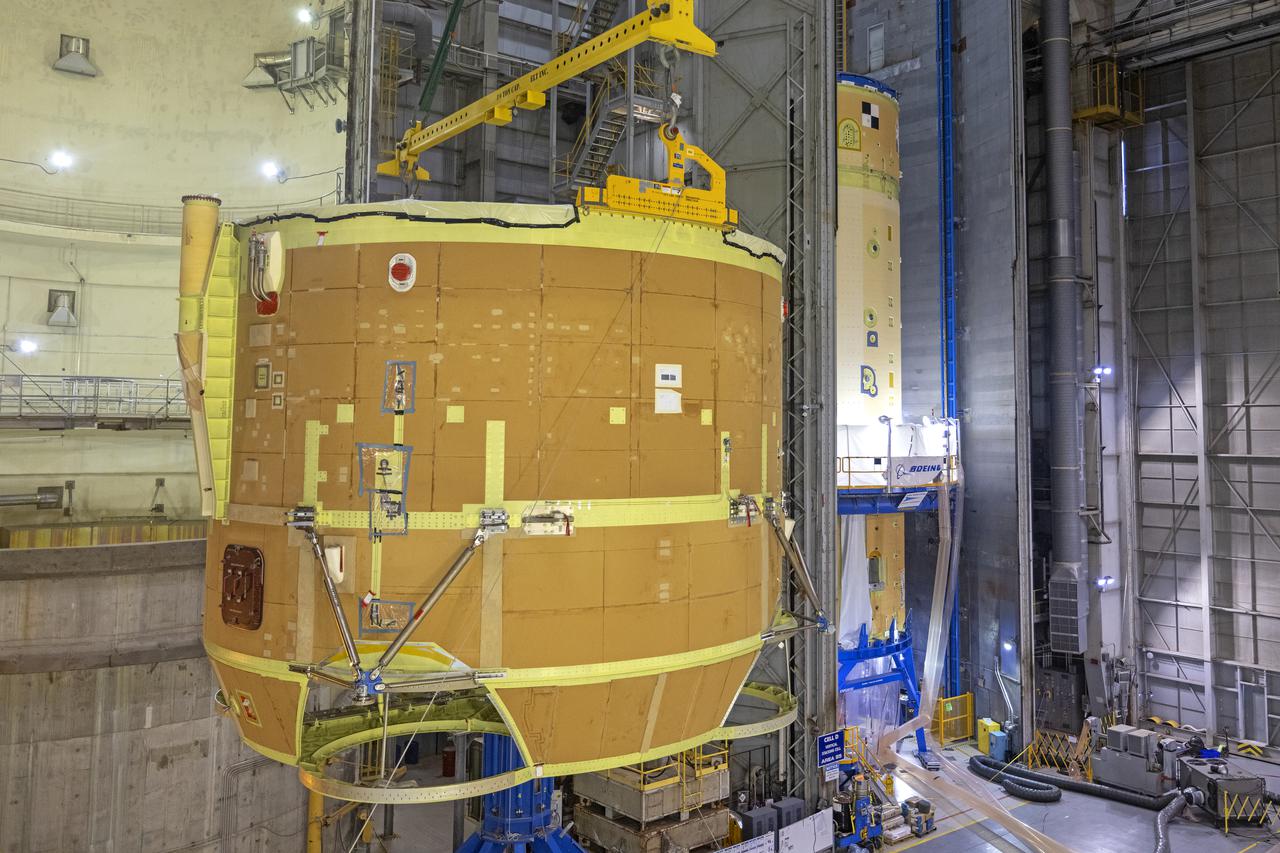
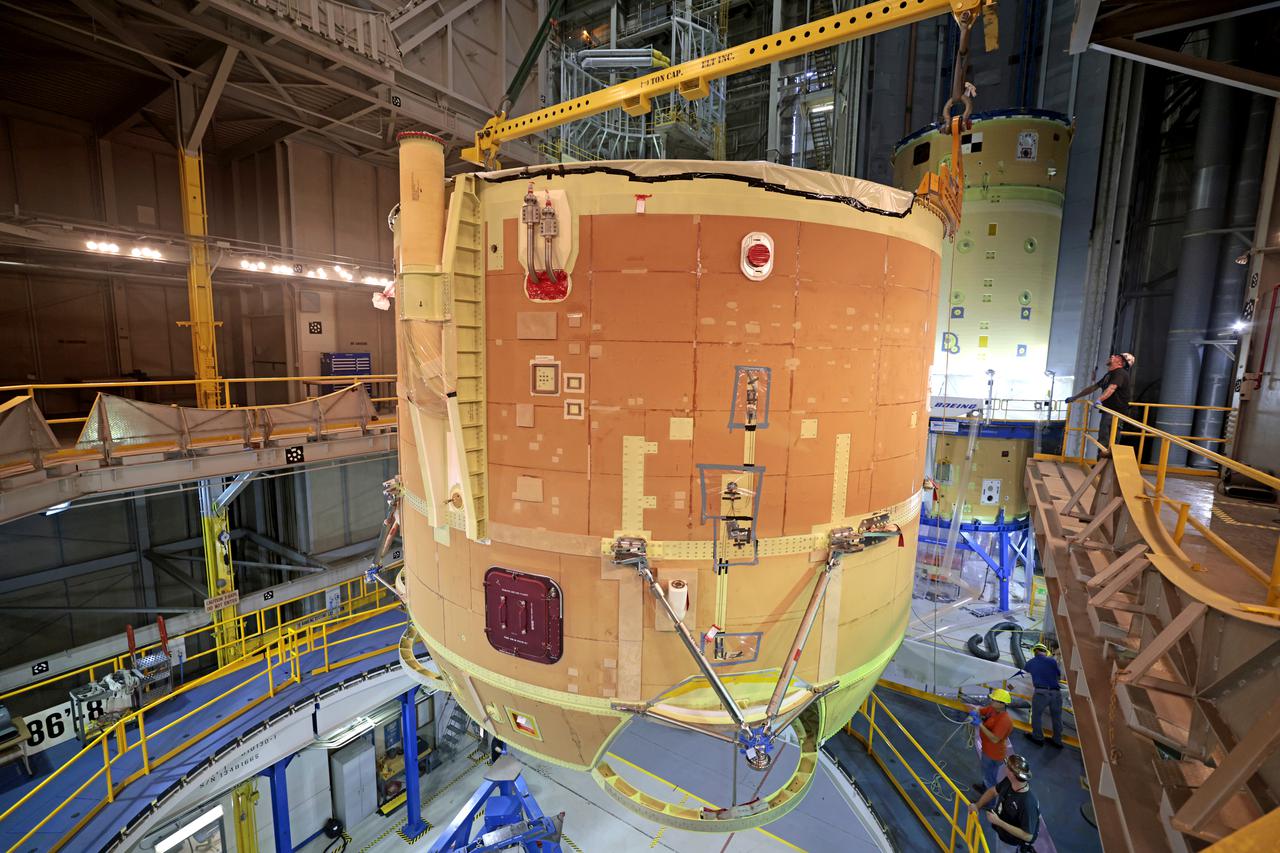
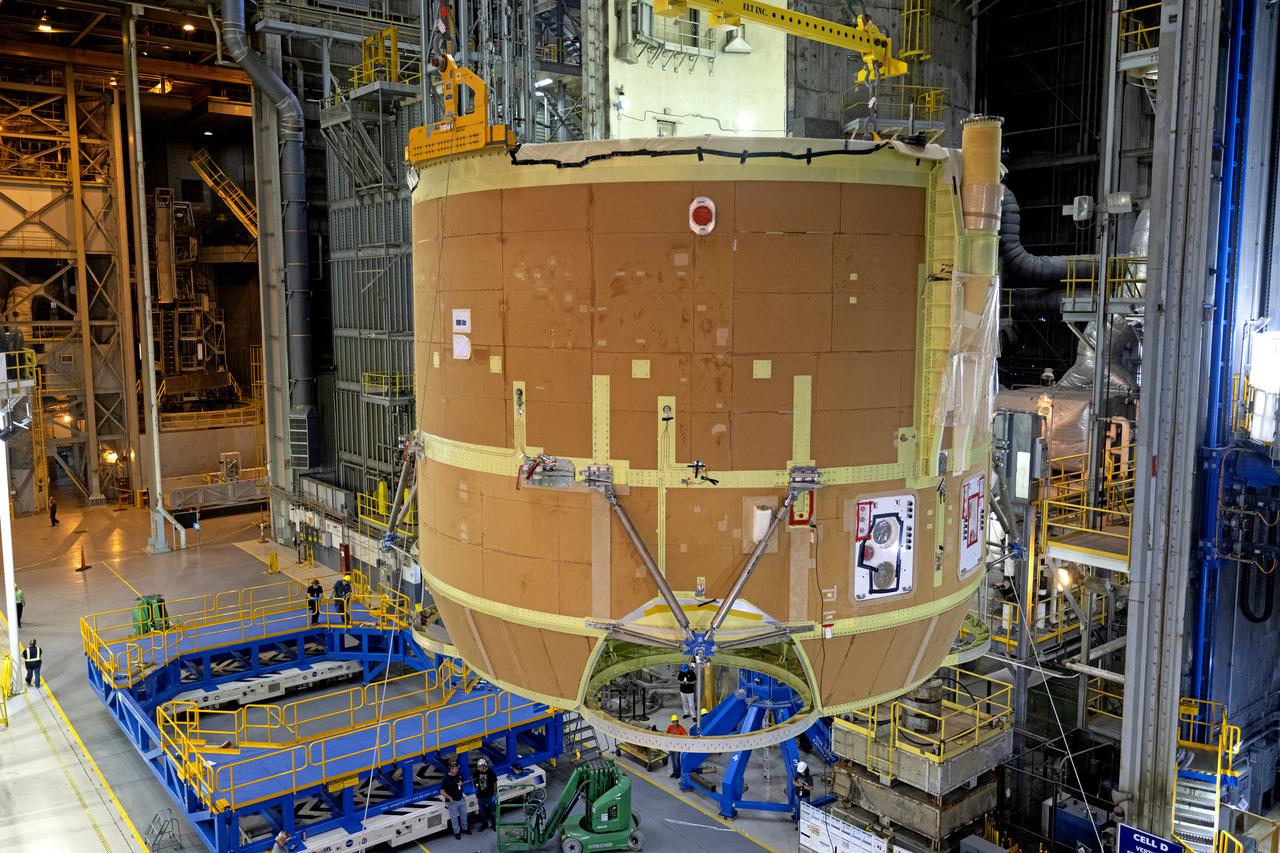
NASA’s Artemis IV SLS (Space Launch System) core stage boat-tail, covered in a protective blue tarp, arrives inside the NASA’s Vehicle Assembly Building at Kennedy Space Center in Florida on Monday, Aug. 31, 2026. Manufactured at NASA’s Michoud Assembly Facility in New Orleans, Louisiana, the boat-tail is a fairing-like structure that protects the bottom end of the SLS (Space Launch System) rocket core stage and RS-25 engines.
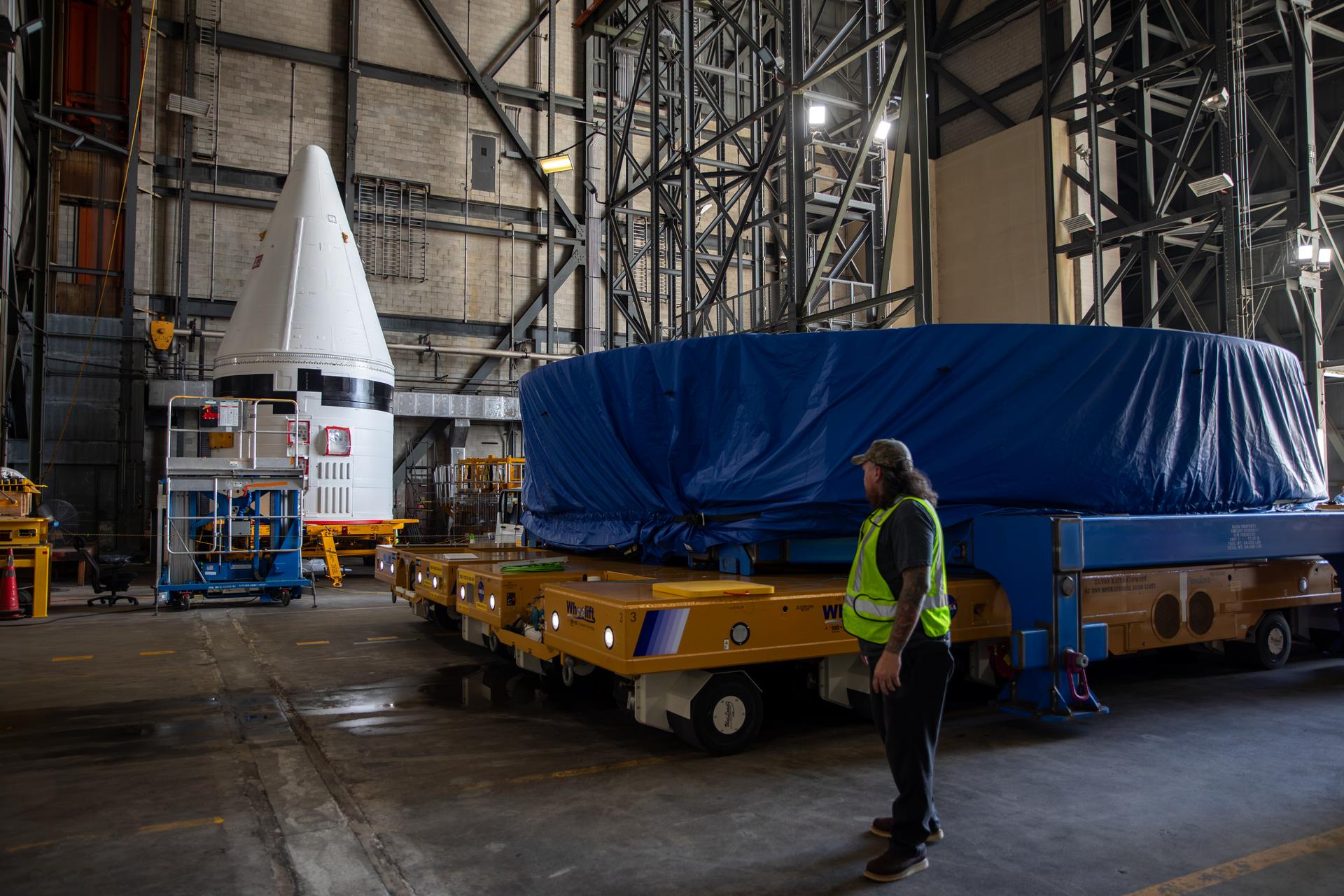
NASA’s Artemis IV SLS (Space Launch System) core stage boat-tail, covered in a protective blue tarp, arrives inside the NASA’s Vehicle Assembly Building at Kennedy Space Center in Florida on Monday, Aug. 31, 2026. Manufactured at NASA’s Michoud Assembly Facility in New Orleans, Louisiana, the boat-tail is a fairing-like structure that protects the bottom end of the SLS (Space Launch System) rocket core stage and RS-25 engines.
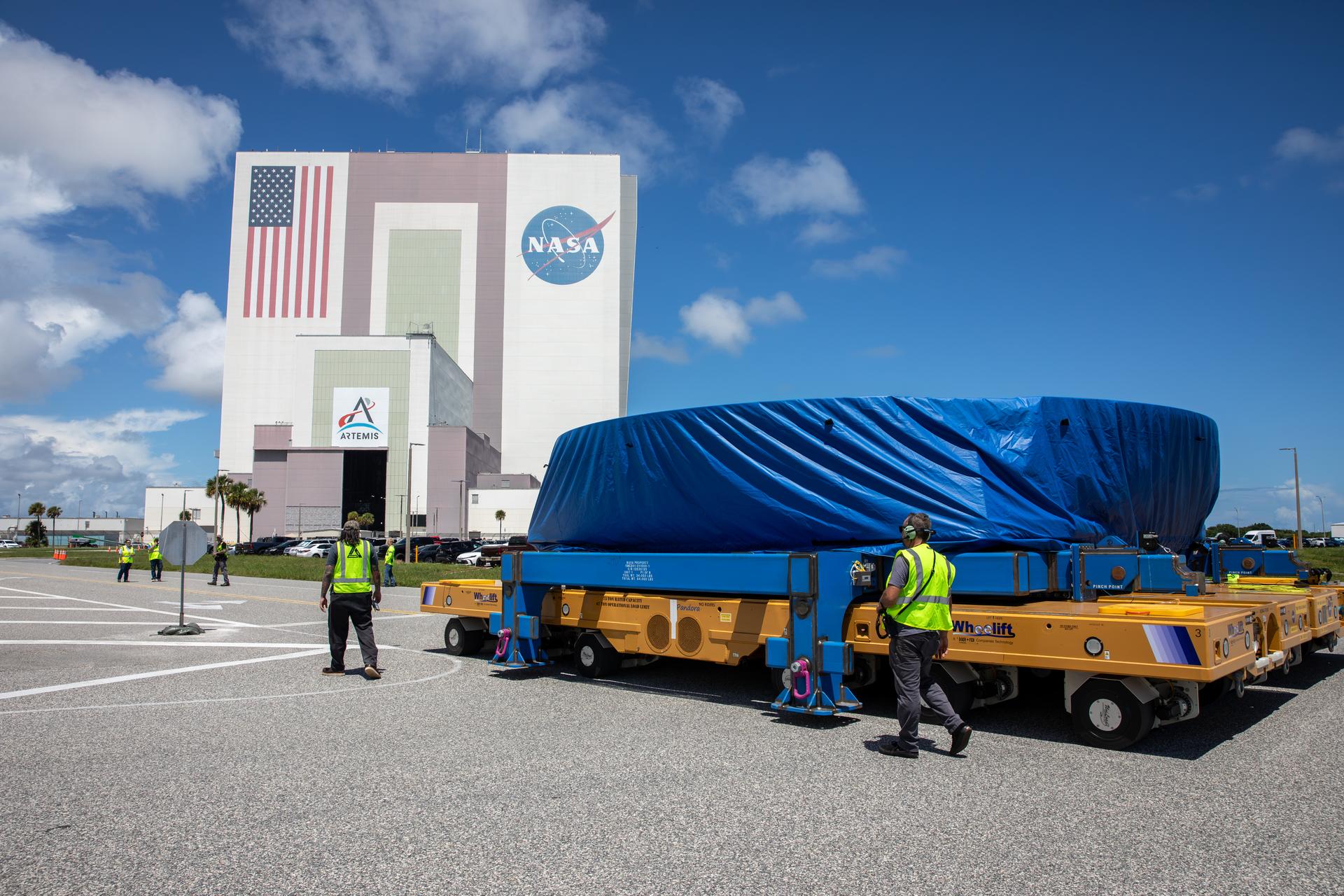
Teams from NASA’s Kennedy Space Center in Florida transport the agency’s Artemis IV SLS (Space Launch System) core stage boat-tail from NASA’s Pegasus barge to inside the NASA’s Vehicle Assembly Building at Kennedy Space Center in Florida on Monday, Aug. 31, 2026. Manufactured at NASA’s Michoud Assembly Facility in New Orleans, Louisiana, the boat-tail is a fairing-like structure that protects the bottom end of the SLS (Space Launch System) rocket core stage and RS-25 engines.
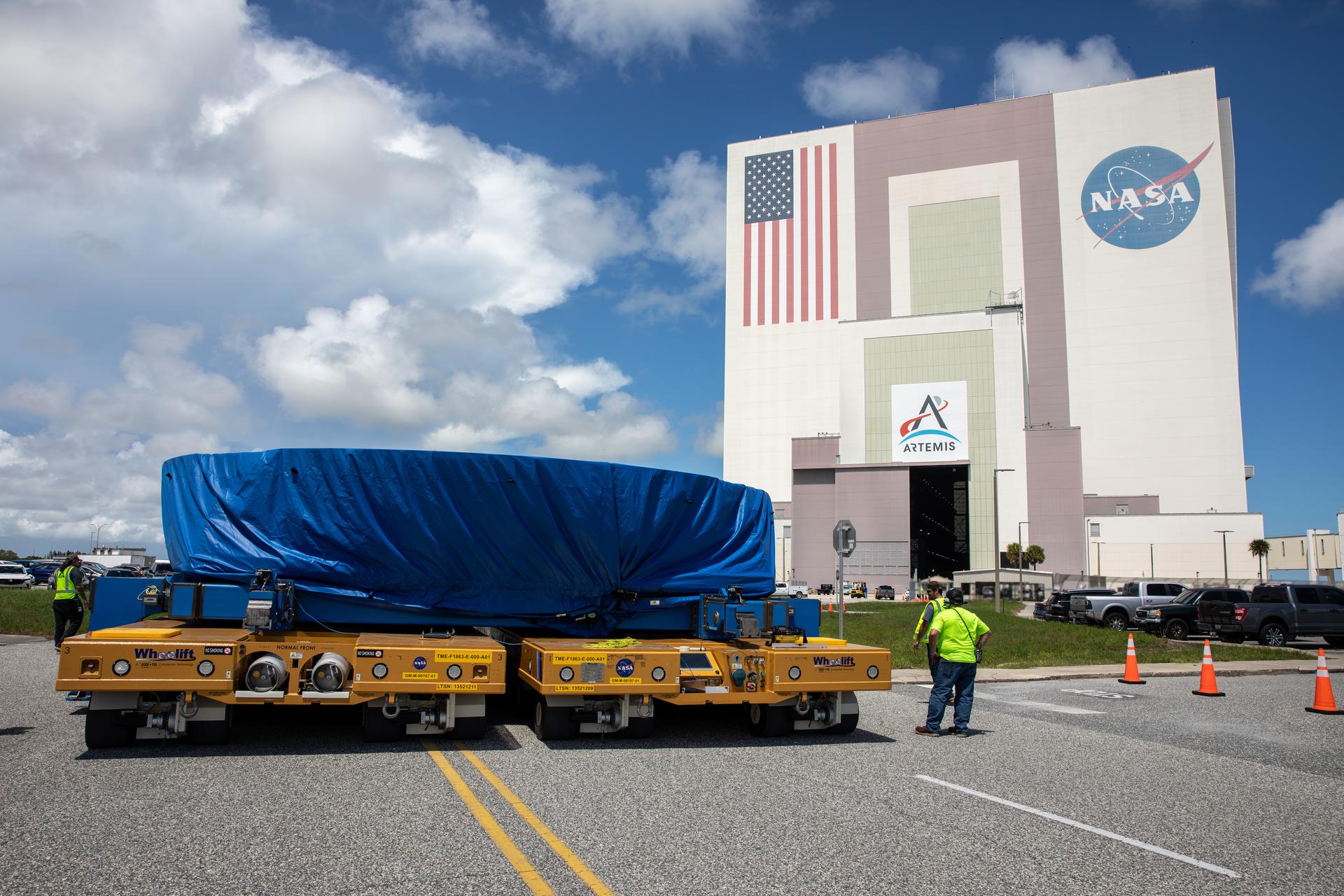
Teams from NASA’s Kennedy Space Center in Florida transport the agency’s Artemis IV SLS (Space Launch System) core stage boat-tail from NASA’s Pegasus barge to inside the NASA’s Vehicle Assembly Building at Kennedy Space Center in Florida on Monday, Aug. 31, 2026. Manufactured at NASA’s Michoud Assembly Facility in New Orleans, Louisiana, the boat-tail is a fairing-like structure that protects the bottom end of the SLS (Space Launch System) rocket core stage and RS-25 engines.
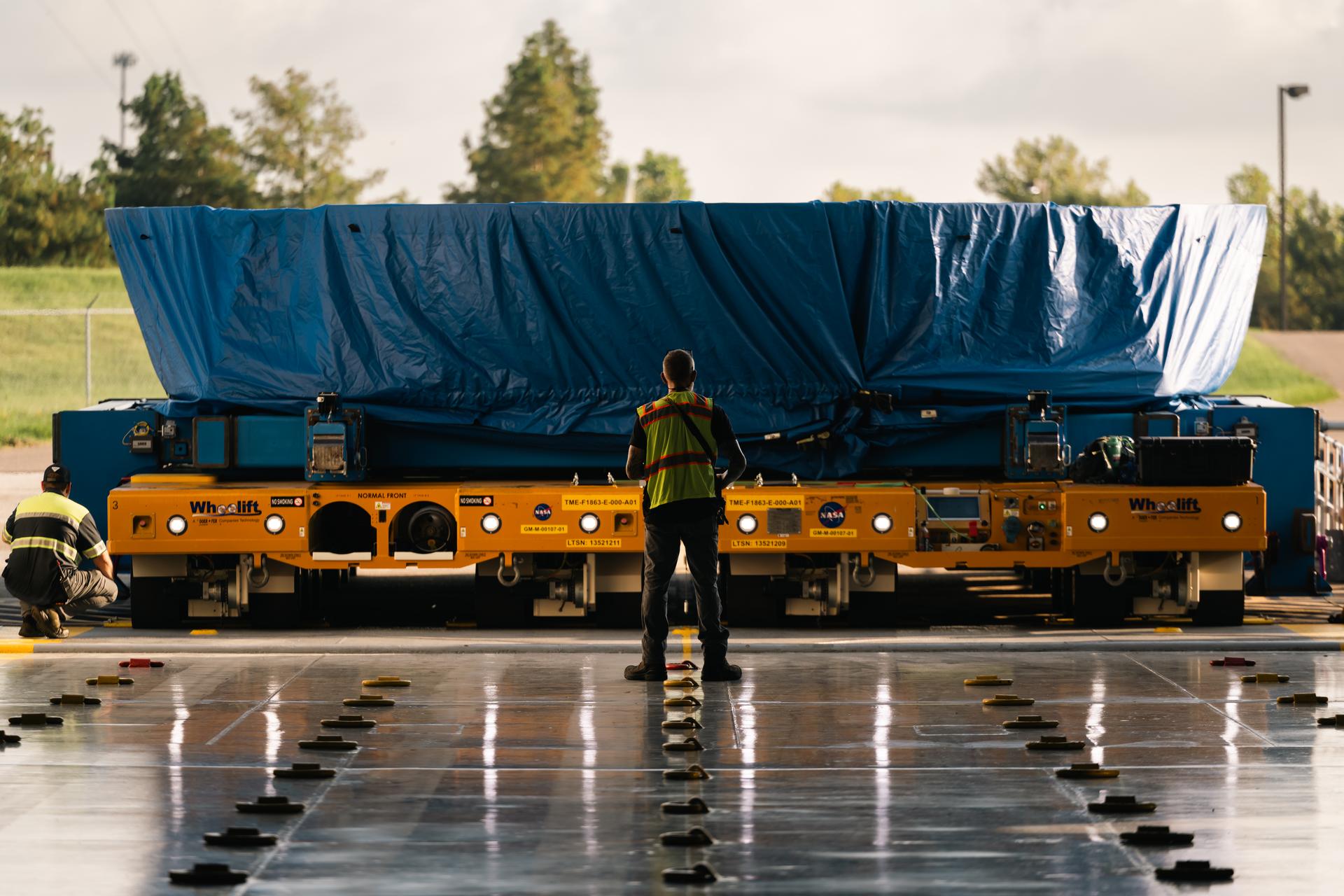
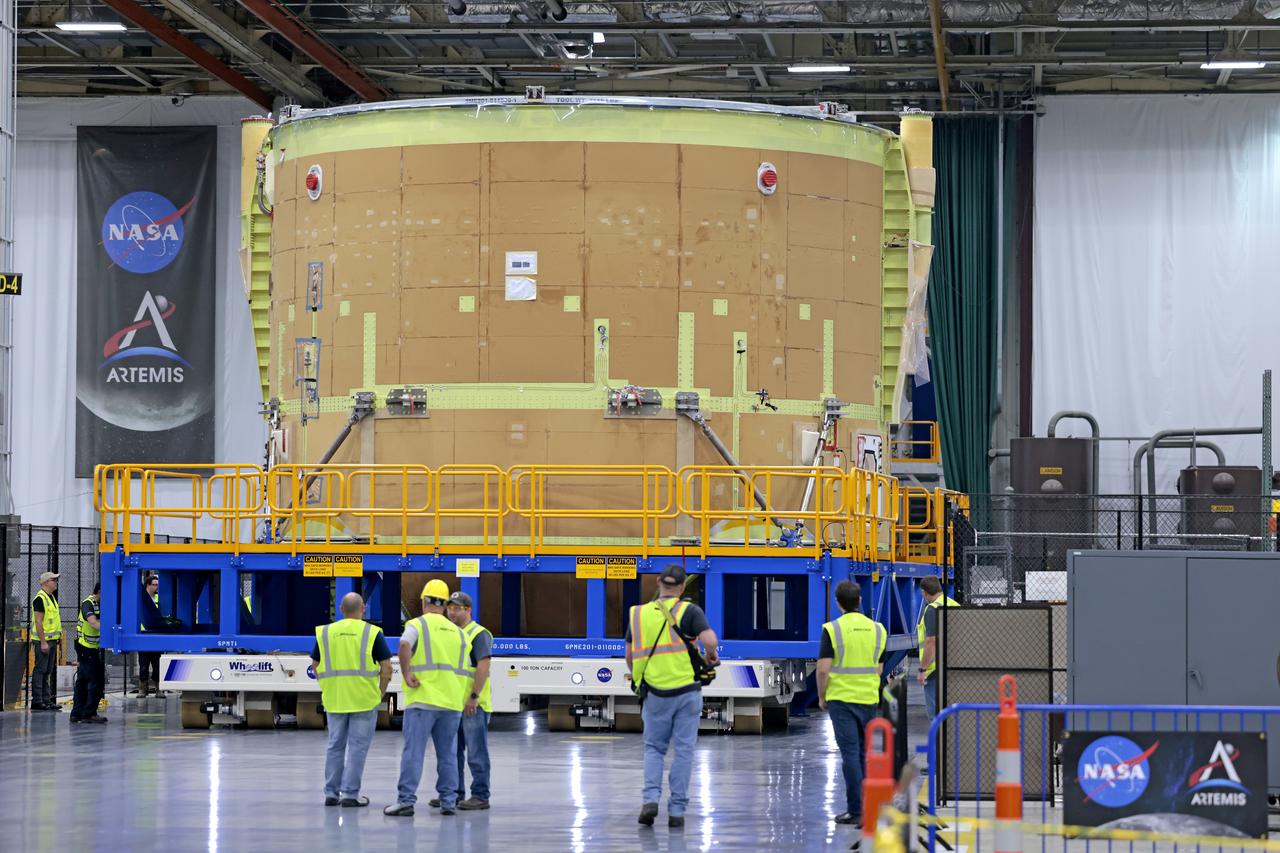
The Artemis IV core stage’s boat tail section is lifted and moved from its production area at NASA’s Michoud Assembly Facility in New Orleans on Aug. 24, 2026. The boat tail refers to the aerodynamic portion positioned directly above the exposed RS-25 engine nozzles, which comprise the lower portions of the core stage’s engine section. The boat tail critically shields the rocket’s lowermost hardware, including the engines’ upper components, plumbing, and critical control systems, protecting them from the extreme heat, vibrations, and pressures during launch. The completed hardware is lifted via the factory’s overhead crane system and secured onto two self-propelled modular transporters—NASA’s mobile heavy transport platforms,—for a short, low-speed drive across the facility, from the factory to the Pegasus barge. From New Orleans, the hardware travels to Kennedy Space Center for future engine section integration, and eventual stacking following the Artemis III mission. Through the Artemis campaign, NASA will send astronauts to explore the Moon for scientific discovery, economic benefits, and to build the foundation for the first crewed missions to Mars—for the benefit of all.
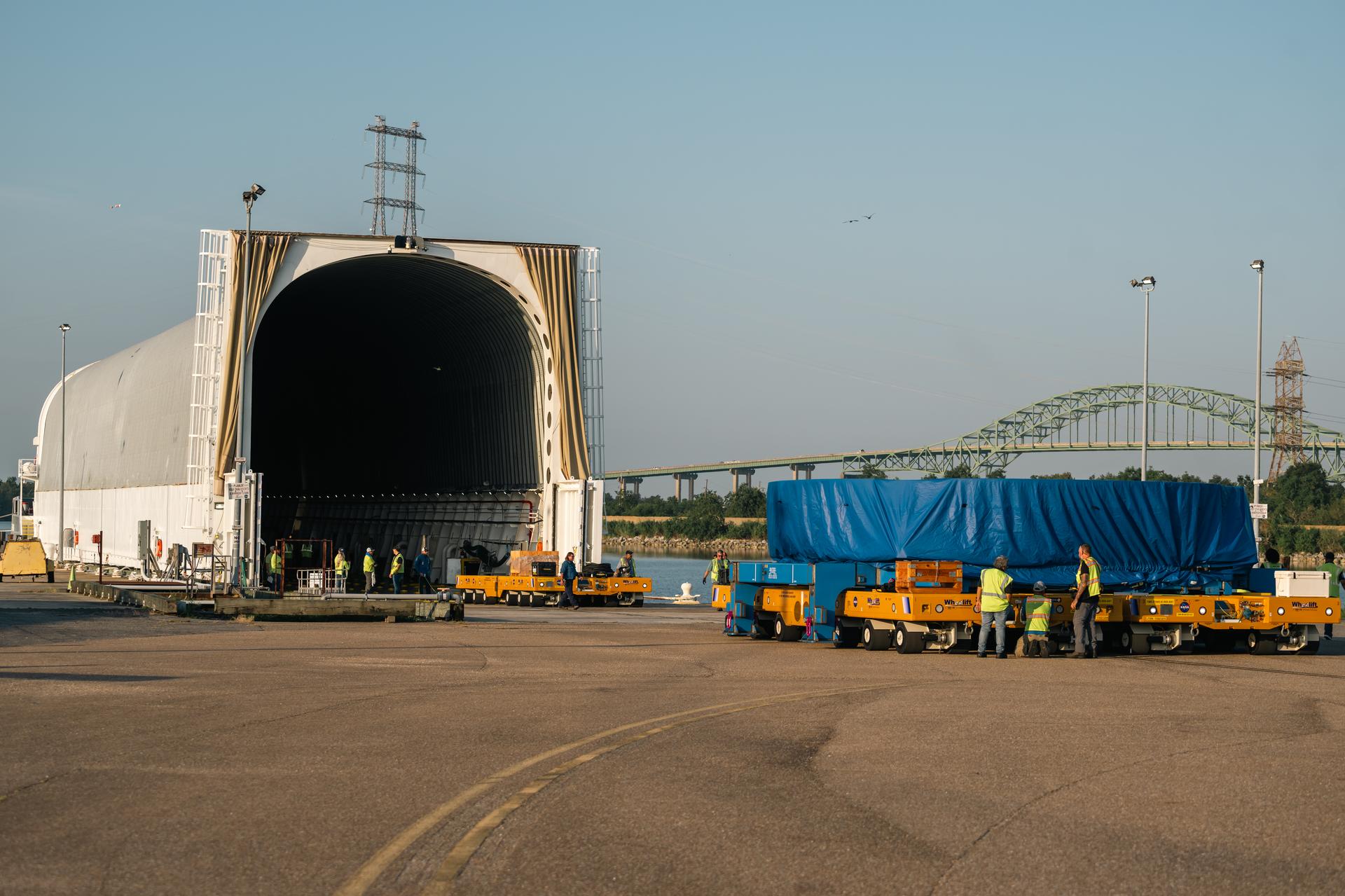
The Artemis IV core stage’s boat tail section is lifted and moved from its production area at NASA’s Michoud Assembly Facility in New Orleans on Aug. 24, 2026. The boat tail refers to the aerodynamic portion positioned directly above the exposed RS-25 engine nozzles, which comprise the lower portions of the core stage’s engine section. The boat tail critically shields the rocket’s lowermost hardware, including the engines’ upper components, plumbing, and critical control systems, protecting them from the extreme heat, vibrations, and pressures during launch. The completed hardware is lifted via the factory’s overhead crane system and secured onto two self-propelled modular transporters—NASA’s mobile heavy transport platforms,—for a short, low-speed drive across the facility, from the factory to the Pegasus barge. From New Orleans, the hardware travels to Kennedy Space Center for future engine section integration, and eventual stacking following the Artemis III mission. Through the Artemis campaign, NASA will send astronauts to explore the Moon for scientific discovery, economic benefits, and to build the foundation for the first crewed missions to Mars—for the benefit of all.

This image from NASA MESSENGER spacecraft is stitched together from thousands of observations made over the past 4 years by the MASCS/UVVS instrument, which measures sunlight scattered off of Mercury tenuous atmosphere. Scattered sunlight gives the sodium a bright orange glow. This scattering process also gives sodium atoms a push - this "radiation pressure" is strong enough, during parts of Mercury's year, to strip the atmosphere and give Mercury a long glowing tail. Someone standing on Mercury's nightside at the right time of year would see a faint orange similar to a city sky illuminated by sodium lamps! Instrument: Mercury Atmospheric and Surface Composition Spectrometer (MASCS)/Ultraviolet and Visible Spectrometer (UVVS) http://photojournal.jpl.nasa.gov/catalog/PIA19418
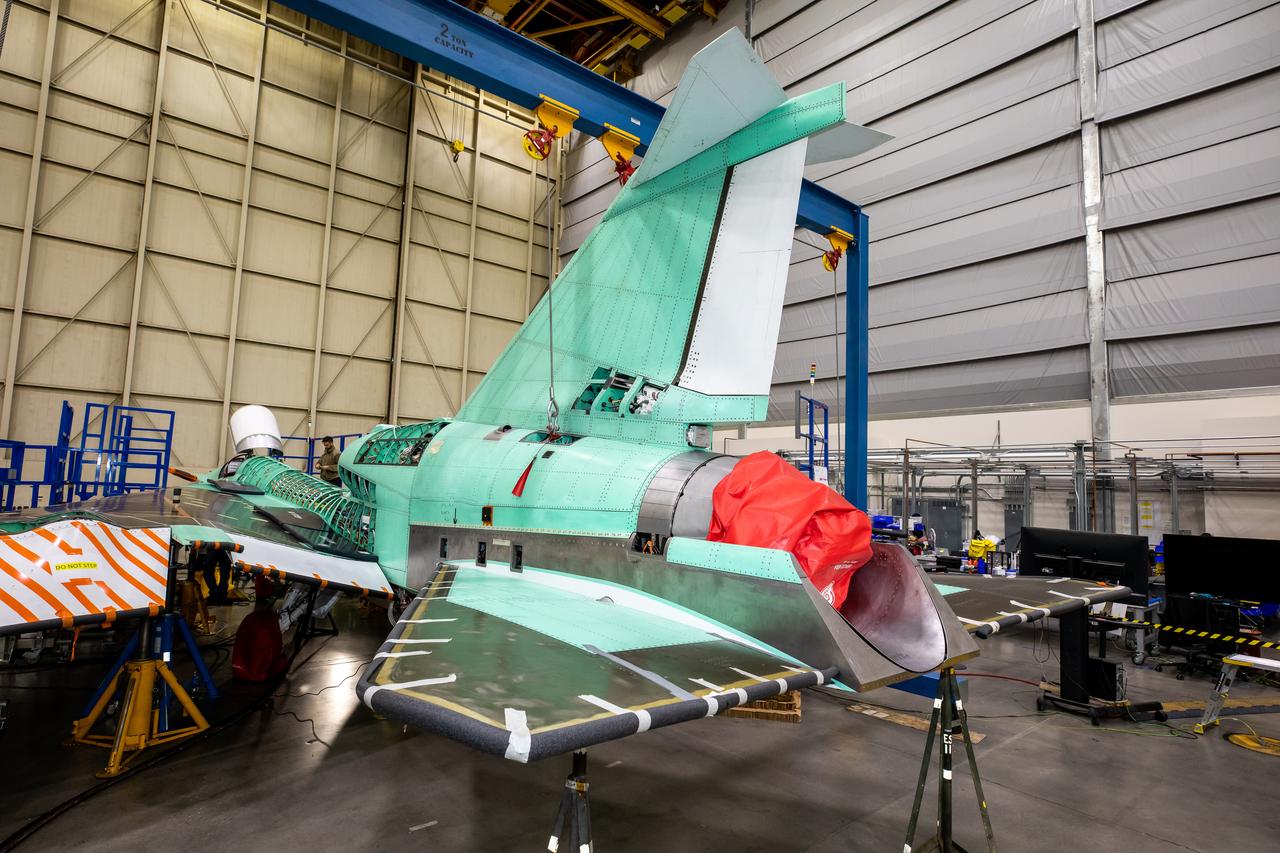
The tail of NASA’s X-59 aircraft is shown here in late March at Lockheed Martin Skunk Works in Palmdale, California where the plane recently underwent a final install of the lower empennage or better known as tail section of the plane.
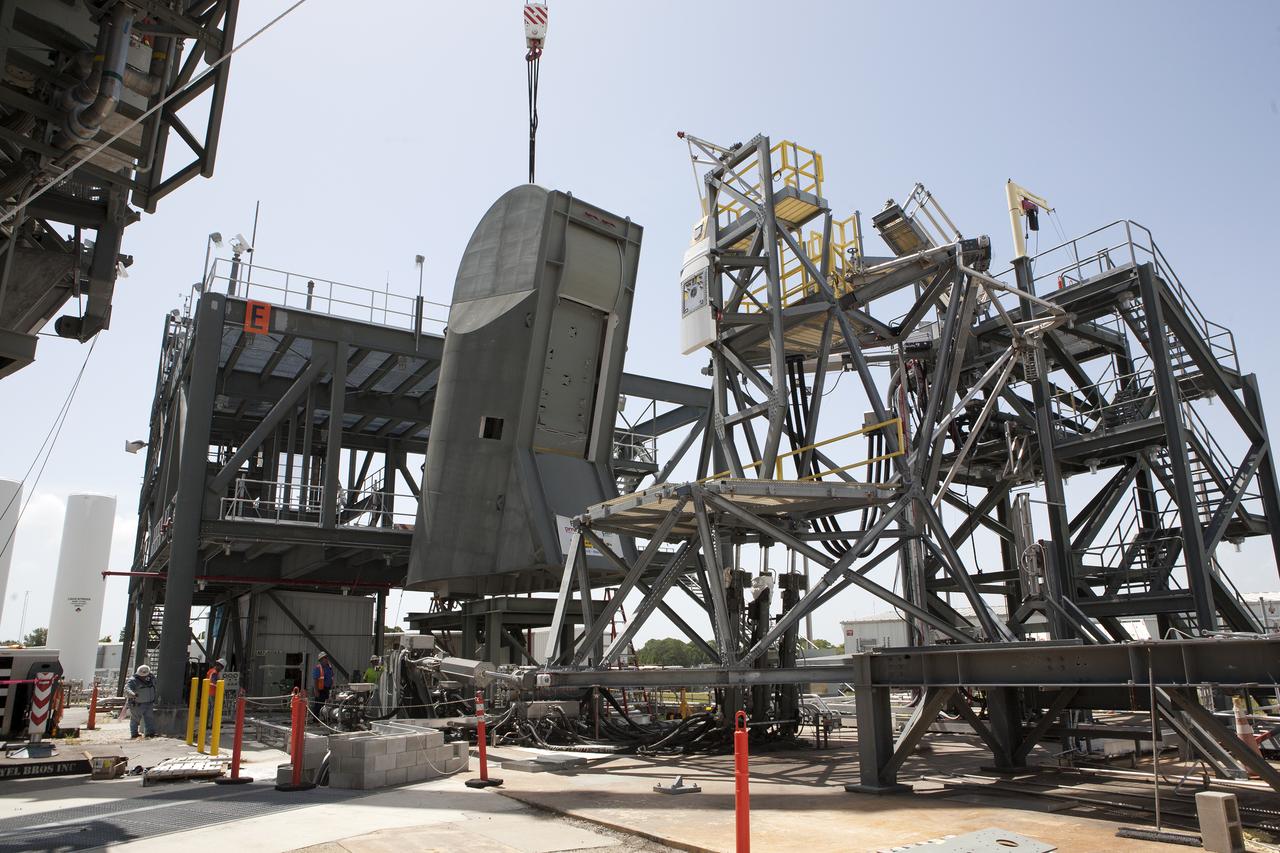
Technician monitors the progress as a crane lowers the first Tail Service Mast Umbilical (TSMU) onto a test stand at the Launch Equipment Test Facility at NASA’s Kennedy Space Center in Florida. Two TSMUs will provide liquid propellants and power to the Space Launch System (SLS) rocket’s core stage engine. Both TSMUs will connect to the zero-level deck on the mobile launcher, providing fuel and electricity to the SLS rocket before it launches on Exploration Mission 1. The TSMU will undergo testing and validation at the LETF to verify it is functioning properly. The center’s Engineering Directorate and the Ground Systems Development and Operations Program are overseeing processing and testing of the umbilicals.
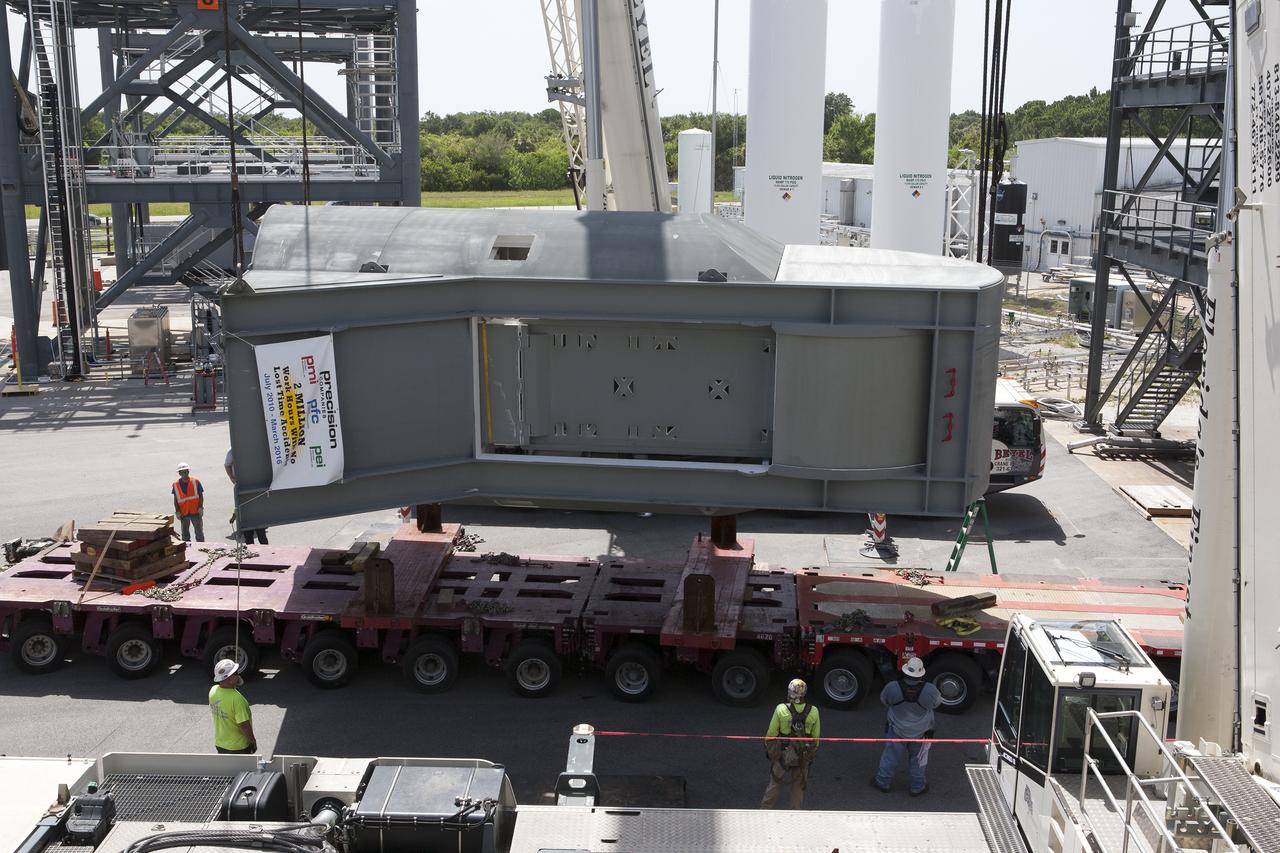
Technicians assist as a crane is used to lift the first Tail Service Mast Umbilical (TSMU) up from the flatbed of the transport truck at the Launch Equipment Test Facility (LETF) at NASA’s Kennedy Space Center in Florida. Two TSMUs will provide liquid propellants and power to the Space Launch System (SLS) rocket’s core stage engine. Both TSMUs will connect to the zero-level deck on the mobile launcher, providing fuel and electricity to the SLS rocket before it launches on Exploration Mission 1. The TSMU will undergo testing and validation at the LETF to verify it is functioning properly. The center’s Engineering Directorate and the Ground Systems Development and Operations Program are overseeing processing and testing of the umbilicals.
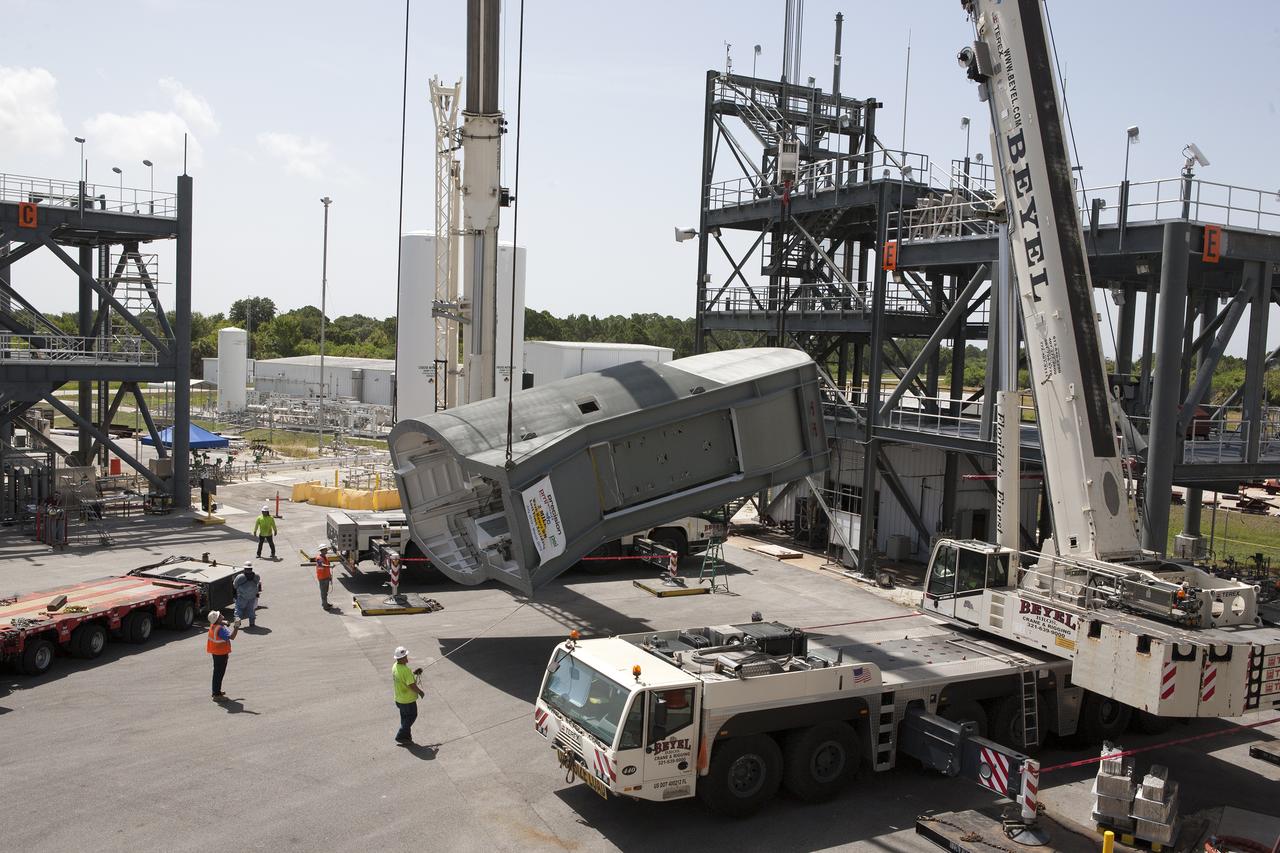
Technicians assist as a crane is used to lift the first Tail Service Mast Umbilical (TSMU) away from the flatbed of the transport truck at the Launch Equipment Test Facility (LETF) at NASA’s Kennedy Space Center in Florida. Two TSMUs will provide liquid propellants and power to the Space Launch System (SLS) rocket’s core stage engine. Both TSMUs will connect to the zero-level deck on the mobile launcher, providing fuel and electricity to the SLS rocket before it launches on Exploration Mission 1. The TSMU will undergo testing and validation at the LETF to verify it is functioning properly. The center’s Engineering Directorate and the Ground Systems Development and Operations Program are overseeing processing and testing of the umbilicals.
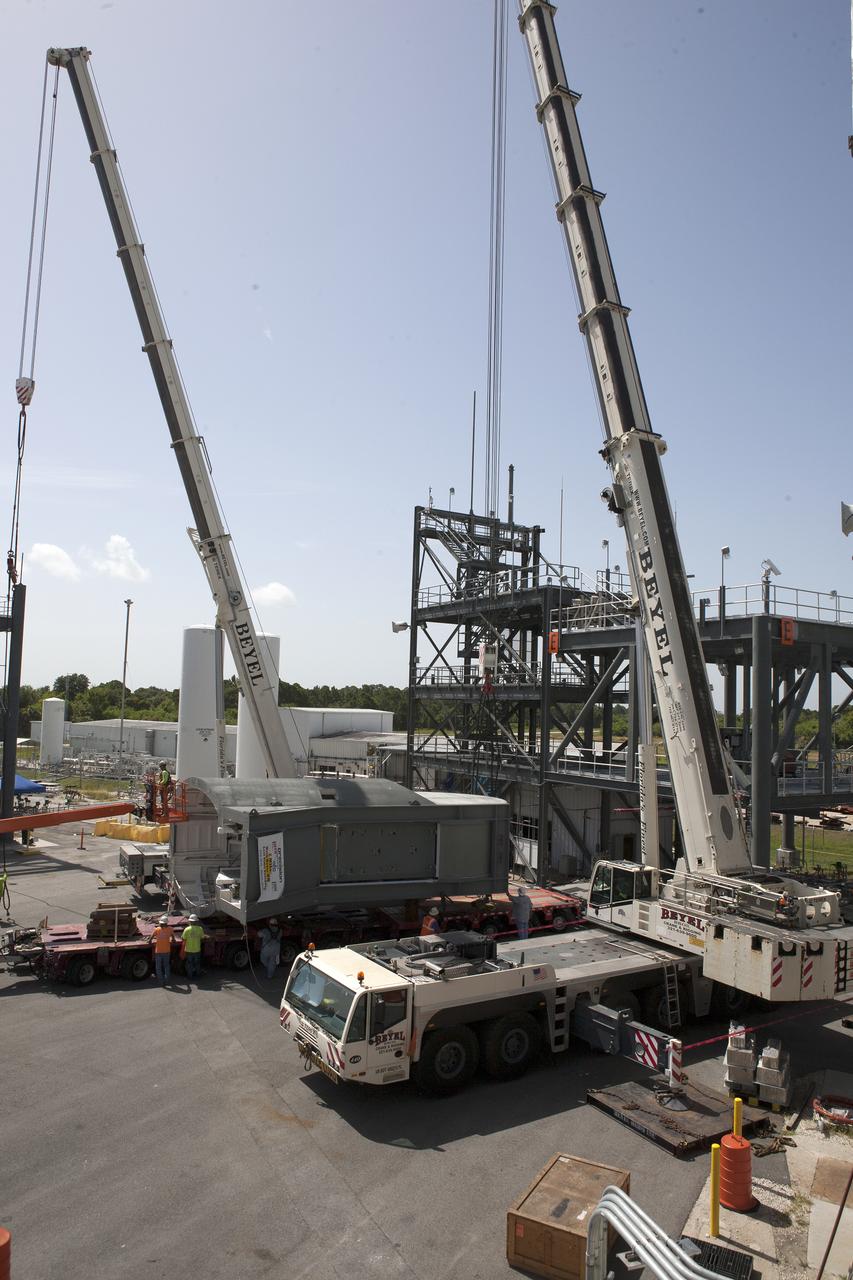
A crane is prepared to help lift the first Tail Service Mast Umbilical (TSMU) for NASA’s Space Launch System (SLS) at the Launch Equipment Test Facility (LETF) at NASA’s Kennedy Space Center in Florida. Two TSMUs will provide liquid propellants and power to the Space Launch System (SLS) rocket’s core stage engine. Both TSMUs will connect to the zero-level deck on the mobile launcher, providing fuel and electricity to the SLS rocket before it launches on Exploration Mission 1. The TSMU will undergo testing and validation at the LETF to verify it is functioning properly. The center’s Engineering Directorate and the Ground Systems Development and Operations Program are overseeing processing and testing of the umbilicals.
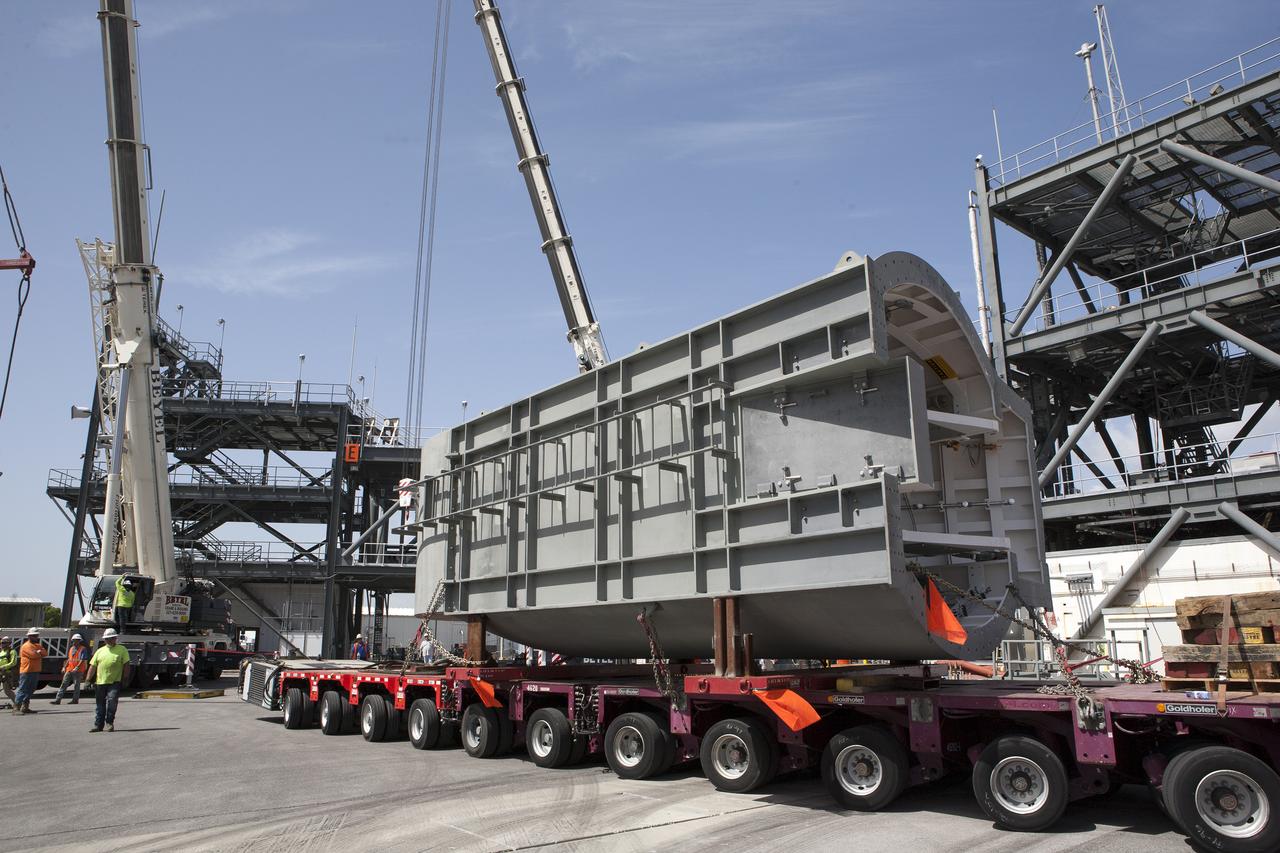
A crane is attached to the first Tail Service Mast Umbilical (TSMU) for NASA’s Space Launch System (SLS) at the Launch Equipment Test Facility at NASA’s Kennedy Space Center in Florida. Two TSMUs will provide liquid propellants and power to the Space Launch System (SLS) rocket’s core stage engine. Both TSMUs will connect to the zero-level deck on the mobile launcher, providing fuel and electricity to the SLS rocket before it launches on Exploration Mission 1. The TSMU will undergo testing and validation at the LETF to verify it is functioning properly. The center’s Engineering Directorate and the Ground Systems Development and Operations Program are overseeing processing and testing of the umbilicals.
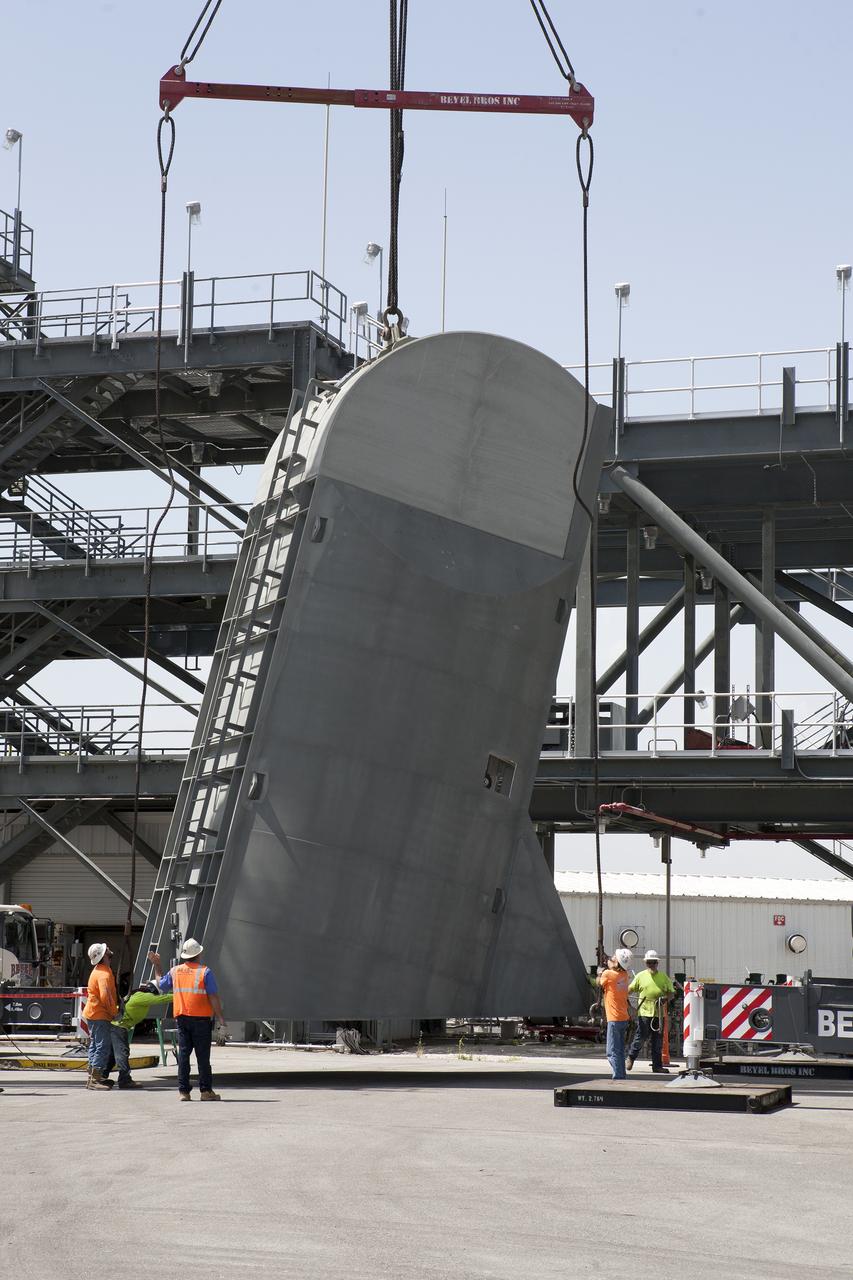
Technicians assist as a crane is used to lift the first Tail Service Mast Umbilical (TSMU) into the vertical position at the Launch Equipment Test Facility (LETF) at NASA’s Kennedy Space Center in Florida. Two TSMUs will provide liquid propellants and power to the Space Launch System (SLS) rocket’s core stage engine. Both TSMUs will connect to the zero-level deck on the mobile launcher, providing fuel and electricity to the SLS rocket before it launches on Exploration Mission 1. The TSMU will undergo testing and validation at the LETF to verify it is functioning properly. The center’s Engineering Directorate and the Ground Systems Development and Operations Program are overseeing processing and testing of the umbilicals.
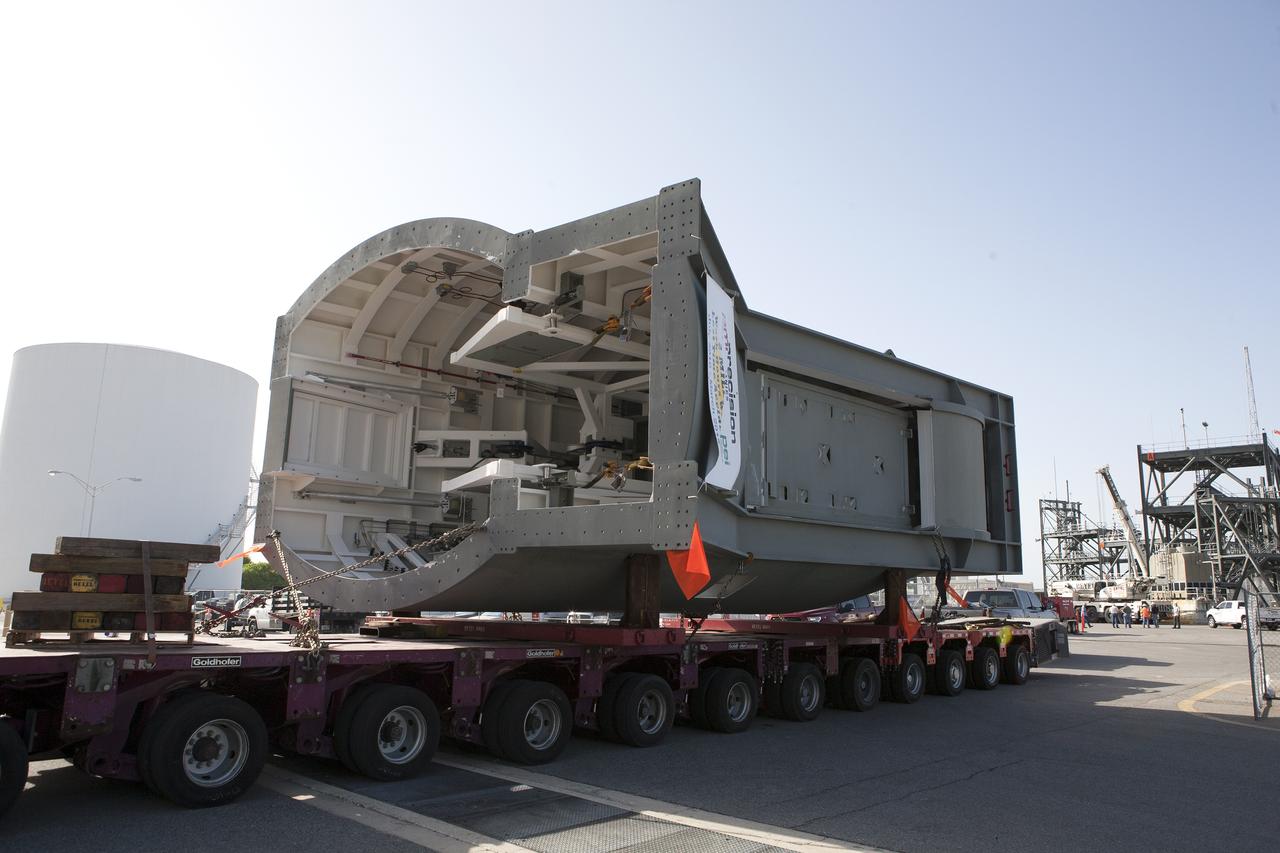
A heavy-lift transport truck arrives at the Launch Equipment Test Facility (LETF) at NASA’s Kennedy Space Center in Florida, with the first of two Tail Service Mast Umbilicals (TSMU) for NASA’s Space Launch System (SLS). Two TSMUs will provide liquid propellants and power to the Space Launch System (SLS) rocket’s core stage engine. Both TSMUs will connect to the zero-level deck on the mobile launcher, providing fuel and electricity to the SLS rocket before it launches on Exploration Mission 1. The TSMU will undergo testing and validation at the LETF to verify it is functioning properly. The center’s Engineering Directorate and the Ground Systems Development and Operations Program are overseeing processing and testing of the umbilicals.
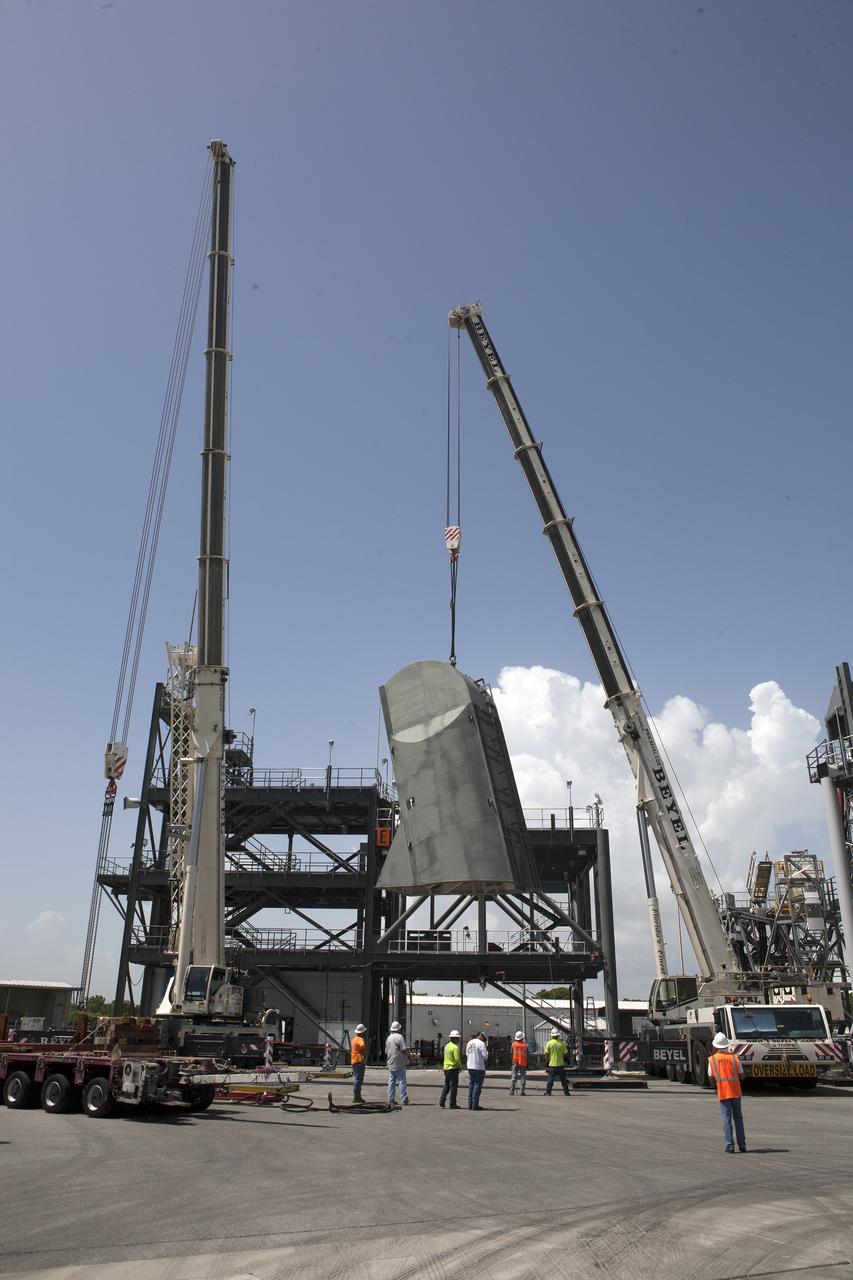
A crane lifts the first Tail Service Mast Umbilical (TSMU) up for placement on a test stand at the Launch Equipment Test Facility at NASA’s Kennedy Space Center in Florida. Two TSMUs will provide liquid propellants and power to the Space Launch System (SLS) rocket’s core stage engine. Both TSMUs will connect to the zero-level deck on the mobile launcher, providing fuel and electricity to the SLS rocket before it launches on Exploration Mission 1. The TSMU will undergo testing and validation at the LETF to verify it is functioning properly. The center’s Engineering Directorate and the Ground Systems Development and Operations Program are overseeing processing and testing of the umbilicals.
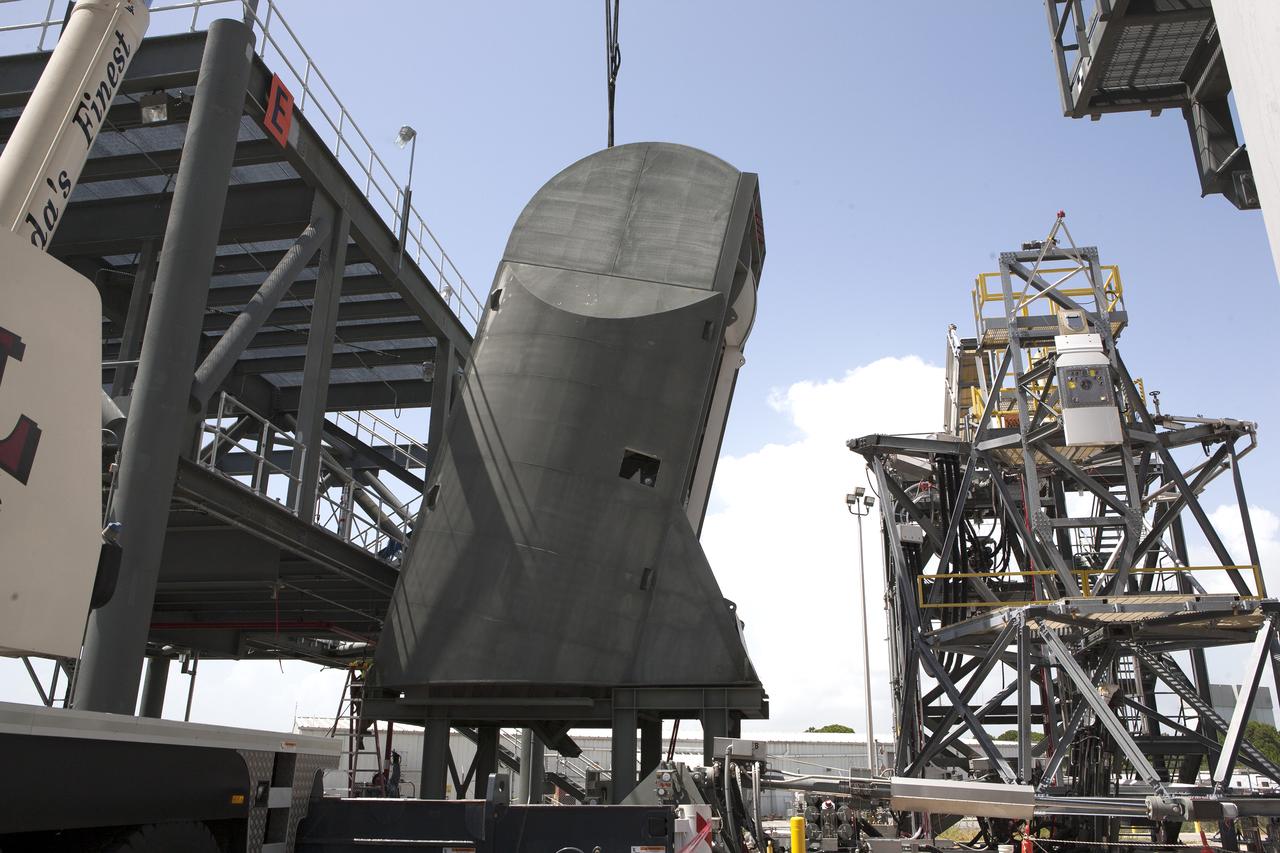
A crane lowers the first Tail Service Mast Umbilical (TSMU) onto a test stand at the Launch Equipment Test Facility at NASA’s Kennedy Space Center in Florida. Two TSMUs will provide liquid propellants and power to the Space Launch System (SLS) rocket’s core stage engine. Both TSMUs will connect to the zero-level deck on the mobile launcher, providing fuel and electricity to the SLS rocket before it launches on Exploration Mission 1. The TSMU will undergo testing and validation at the LETF to verify it is functioning properly. The center’s Engineering Directorate and the Ground Systems Development and Operations Program are overseeing processing and testing of the umbilicals.