
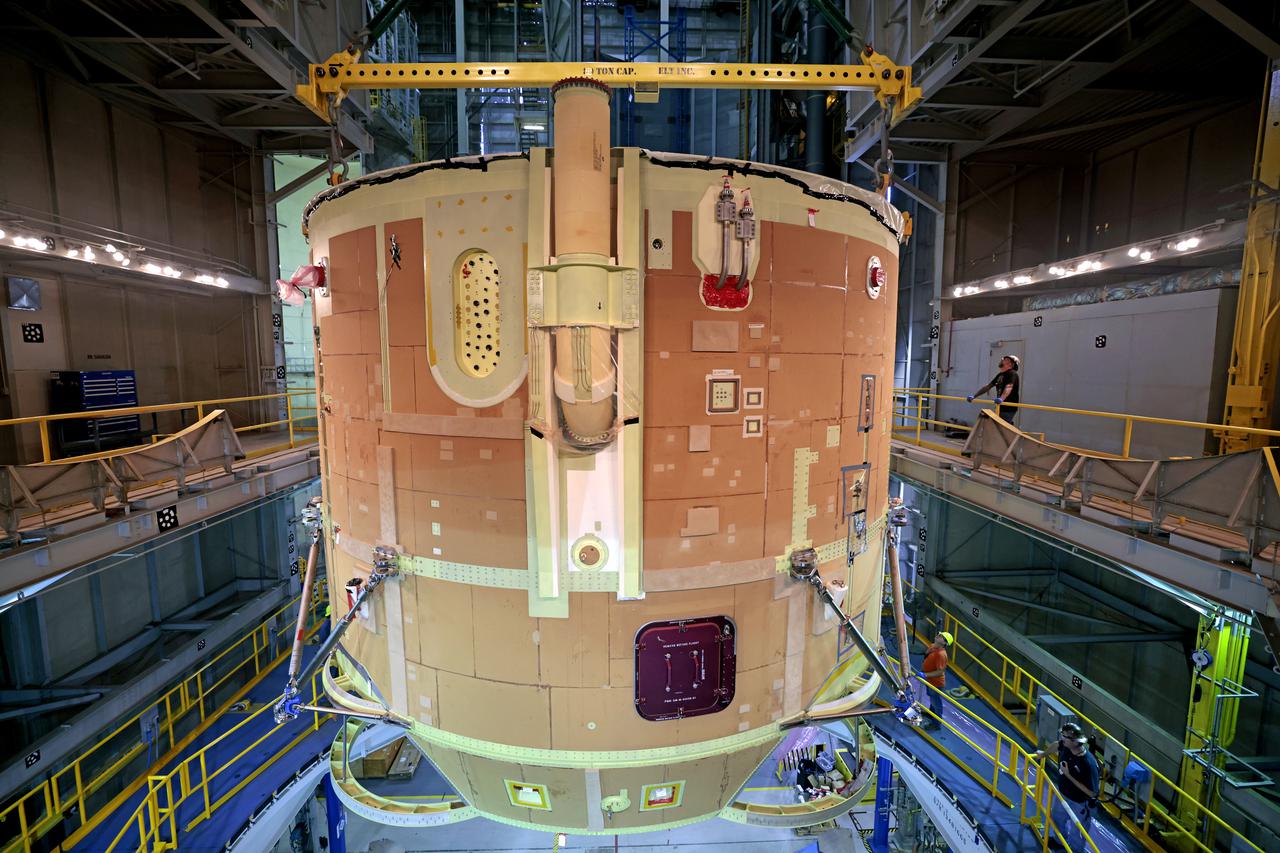
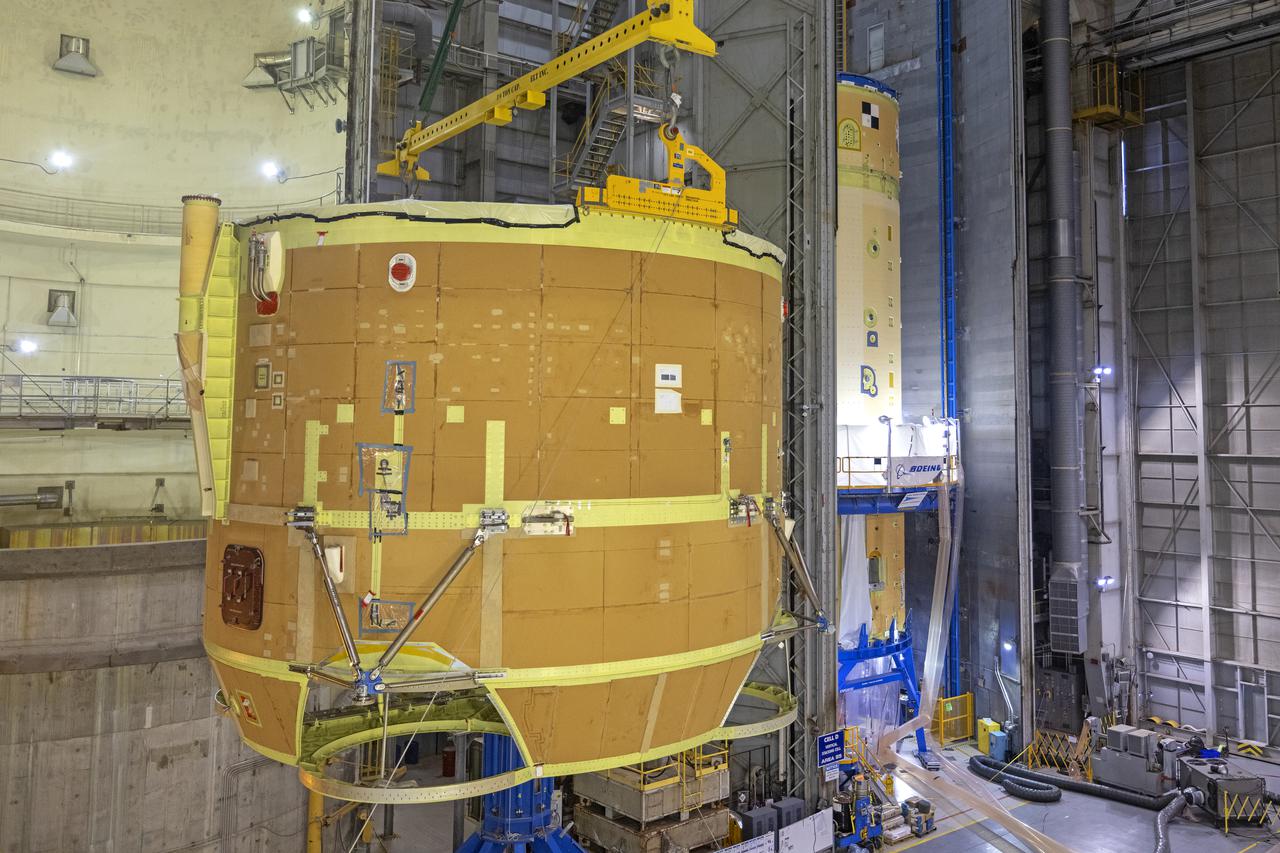
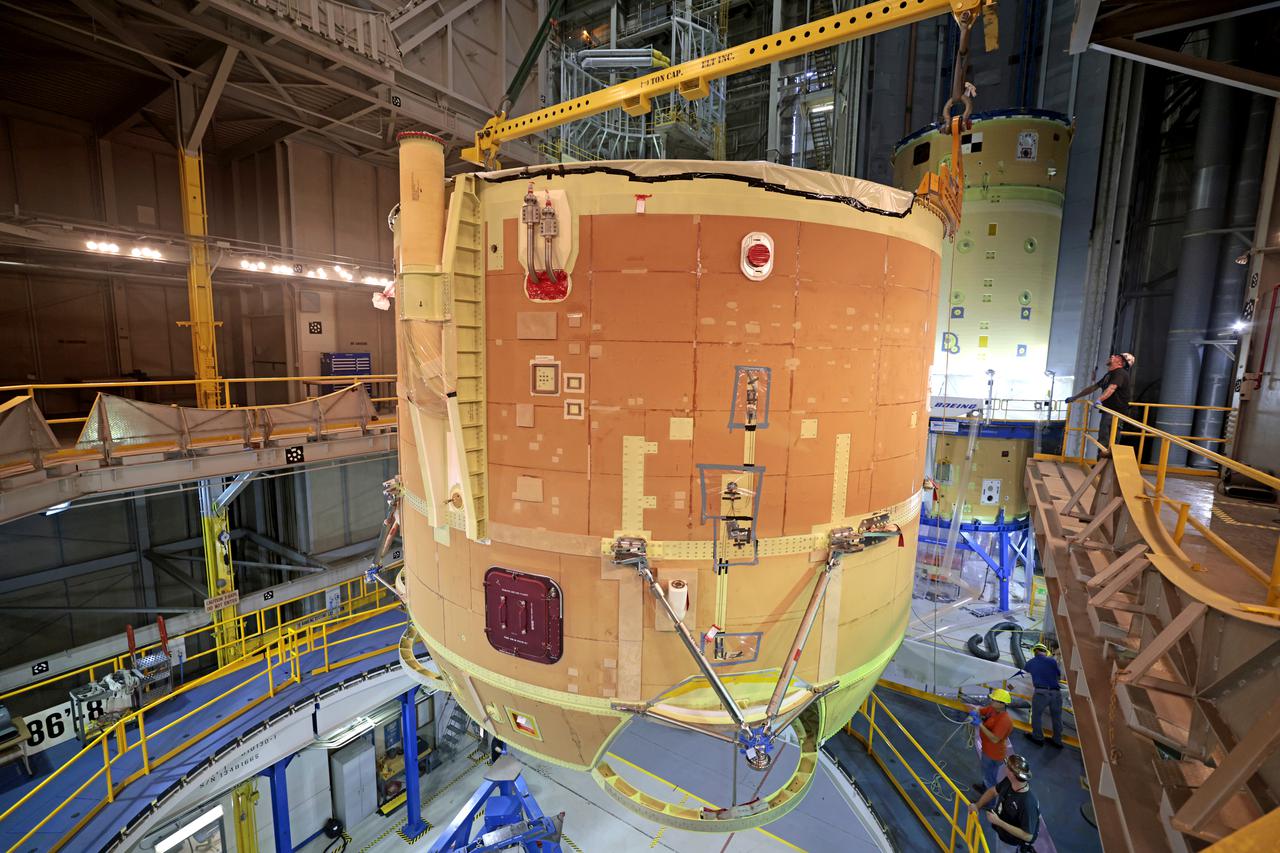
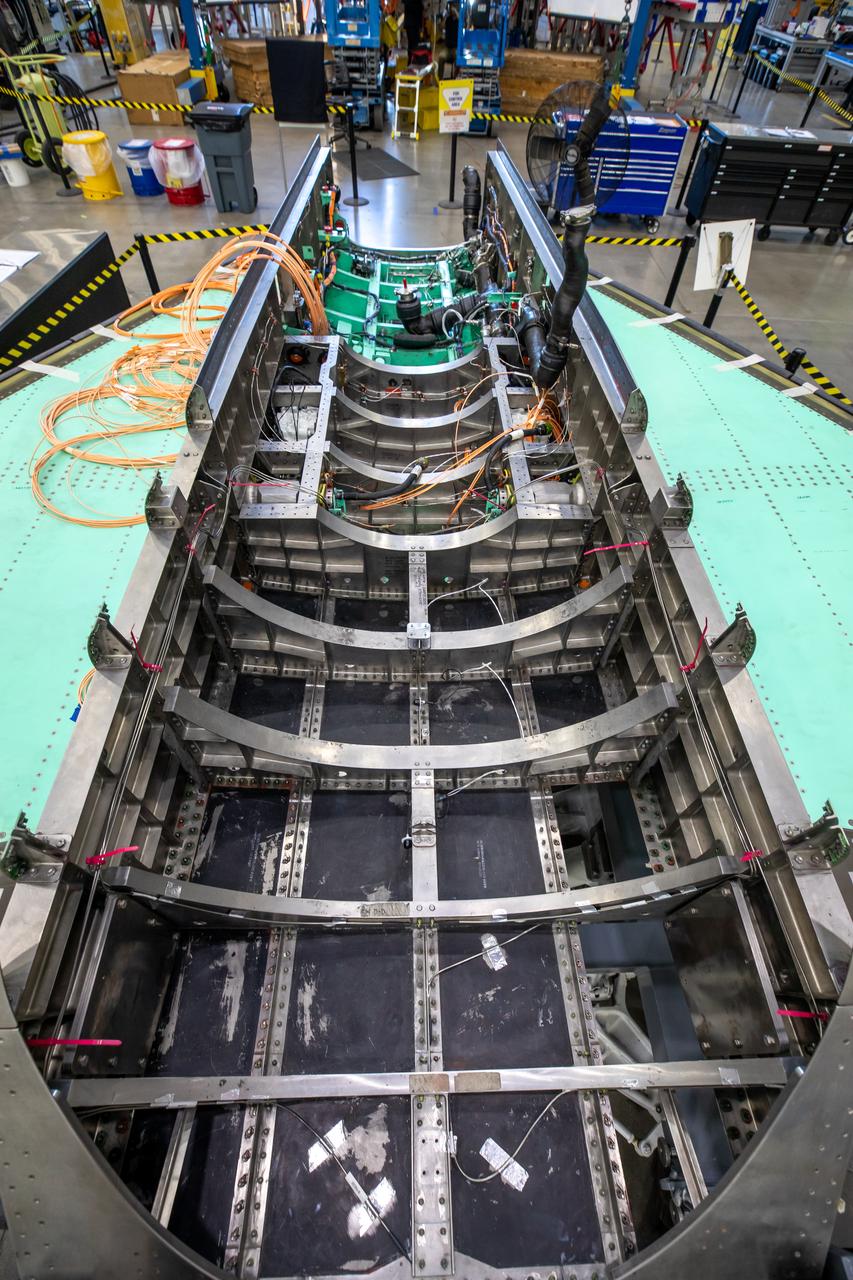
Teams from NASA’s Kennedy Space Center in Florida integrate NASA’s Artemis III SLS (Space Launch System) core stage engine section with its boat-tail inside the spaceport’s Vehicle Assembly Building on Wednesday, July 30, 2025. The boat-tail is a fairing-like structure that protects the bottom end of the core stage, while the engine section is one the most complex and intricate parts of the rocket stage that will help power the Artemis missions to the Moon.
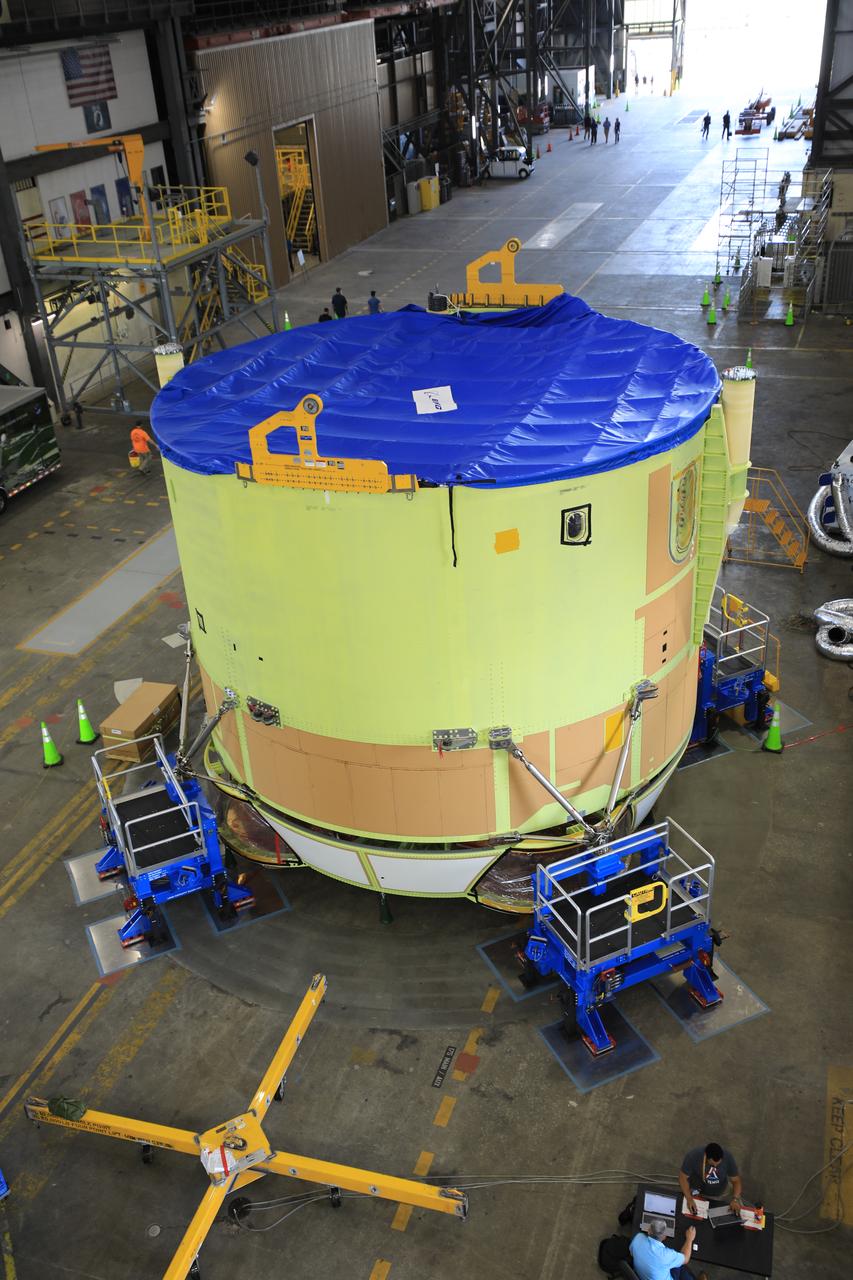
Teams from NASA’s Kennedy Space Center in Florida integrate NASA’s Artemis III SLS (Space Launch System) core stage engine section with its boat-tail inside the spaceport’s Vehicle Assembly Building on Wednesday, July 30, 2025. The boat-tail is a fairing-like structure that protects the bottom end of the core stage, while the engine section is one the most complex and intricate parts of the rocket stage that will help power the Artemis missions to the Moon.
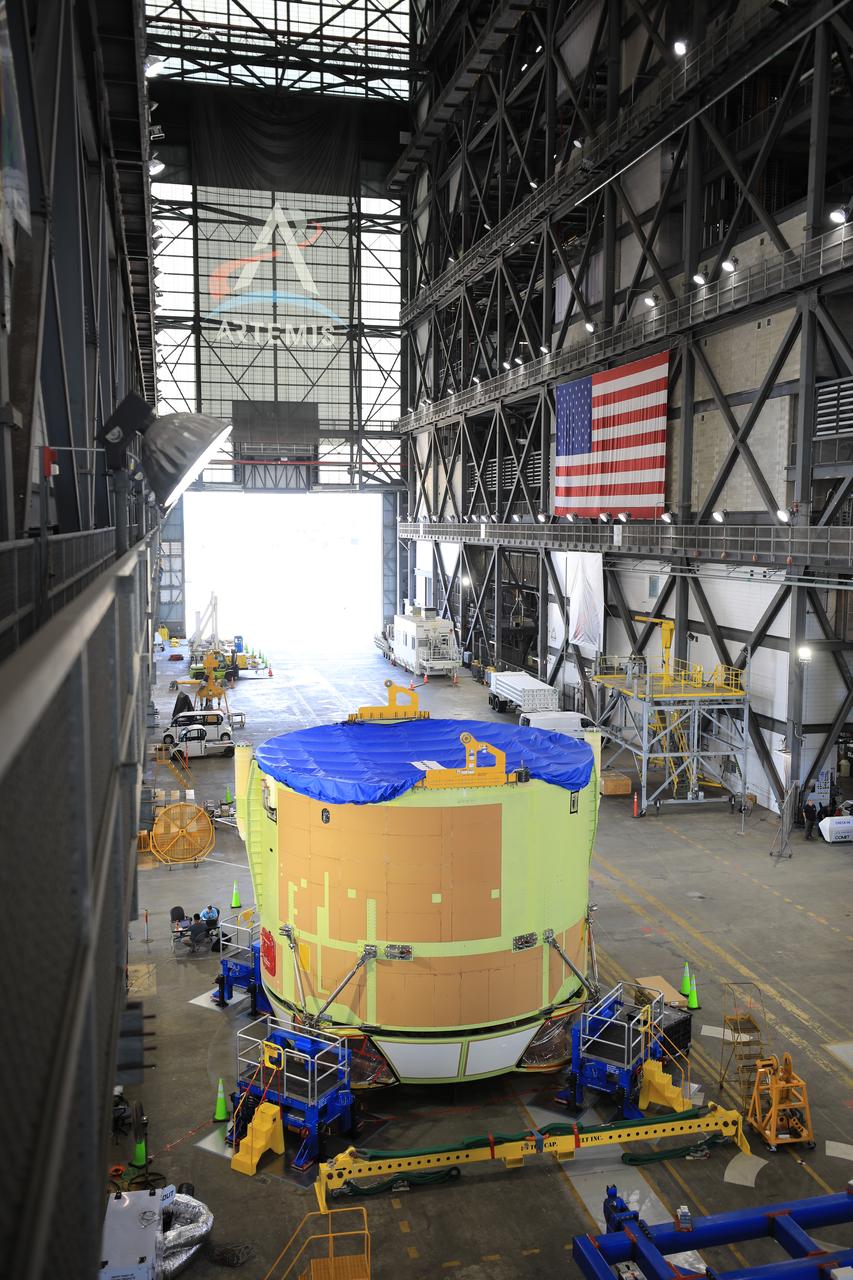
Teams from NASA’s Kennedy Space Center in Florida integrate NASA’s Artemis III SLS (Space Launch System) core stage engine section with its boat-tail inside the spaceport’s Vehicle Assembly Building on Wednesday, July 30, 2025. The boat-tail is a fairing-like structure that protects the bottom end of the core stage, while the engine section is one the most complex and intricate parts of the rocket stage that will help power the Artemis missions to the Moon.
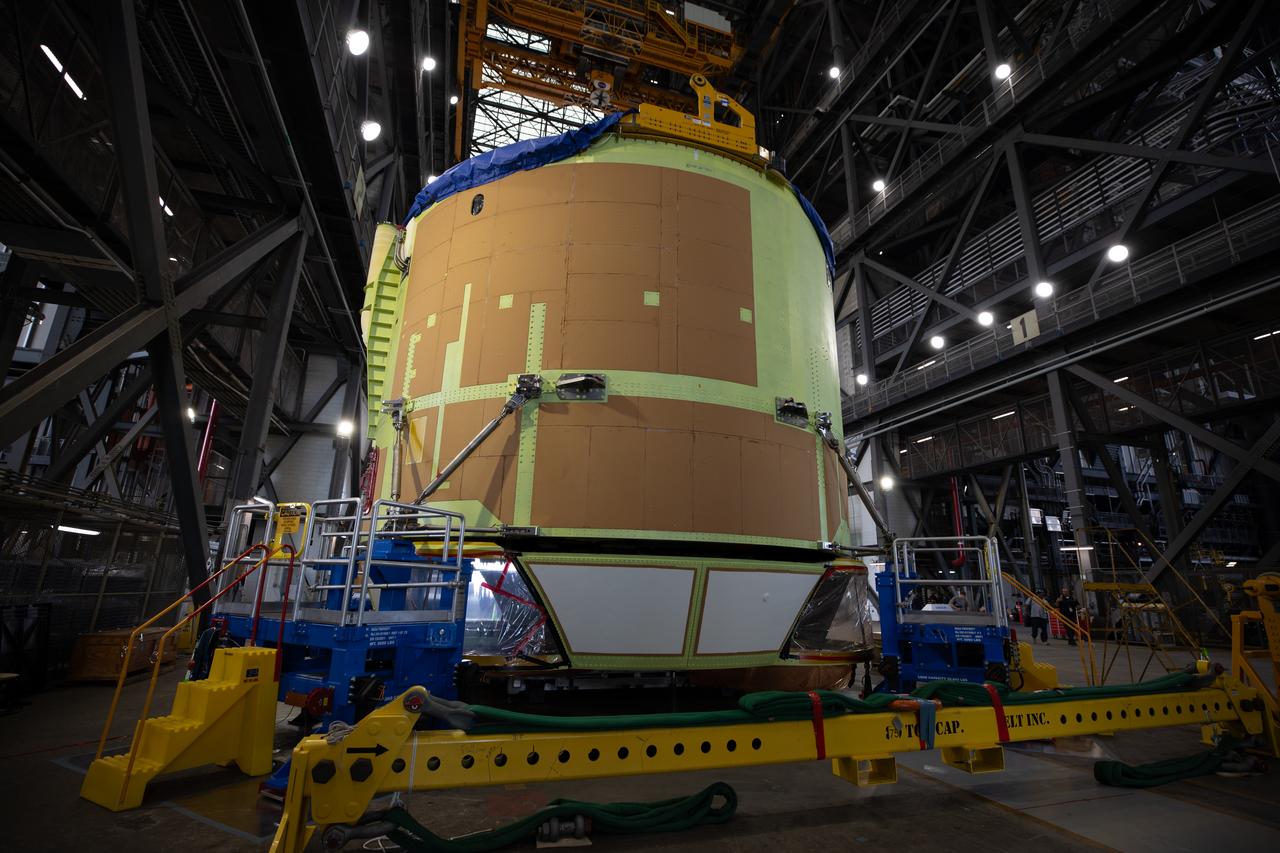
Teams from NASA’s Kennedy Space Center in Florida integrate NASA’s Artemis III SLS (Space Launch System) core stage engine section with its boat-tail inside the spaceport’s Vehicle Assembly Building on Wednesday, July 30, 2025. The boat-tail is a fairing-like structure that protects the bottom end of the core stage, while the engine section is one the most complex and intricate parts of the rocket stage that will help power the Artemis missions to the Moon.
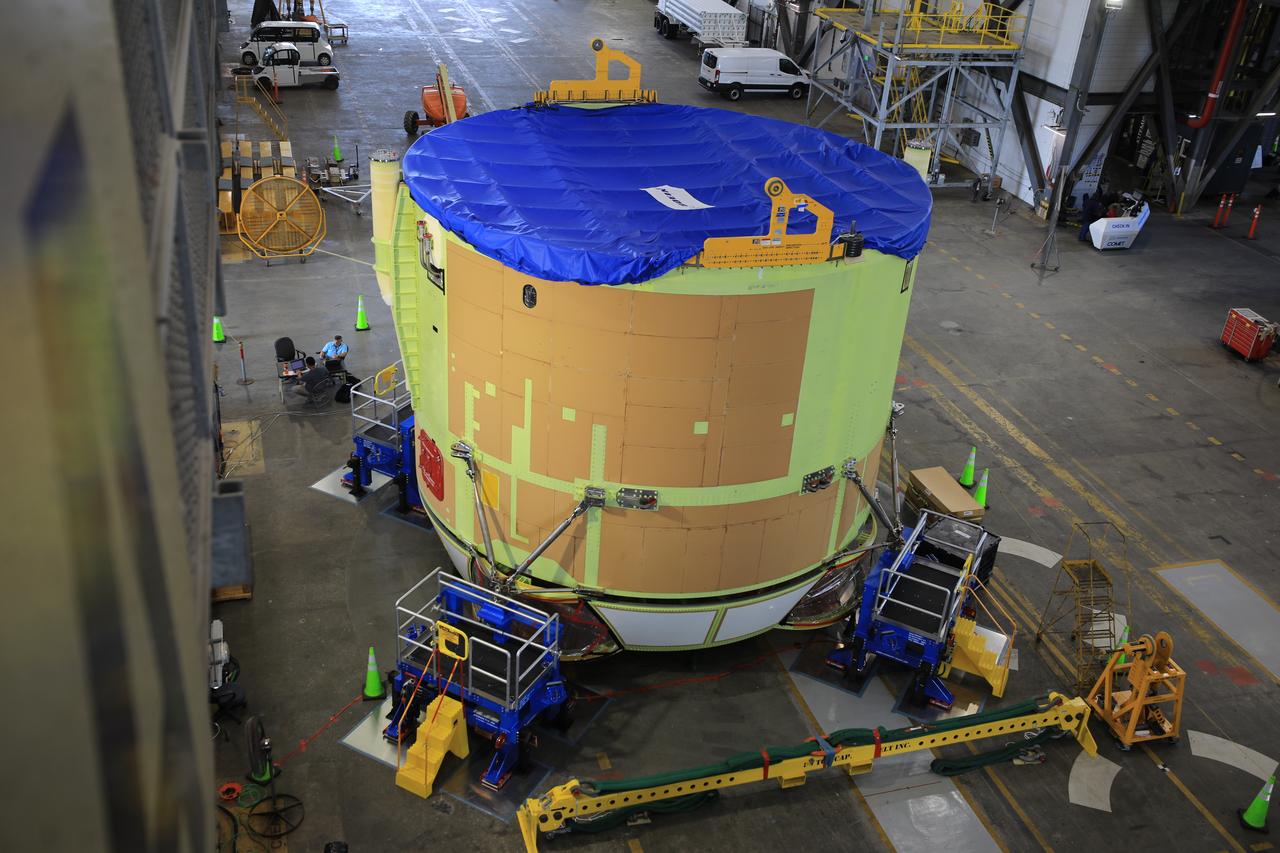
Teams from NASA’s Kennedy Space Center in Florida integrate NASA’s Artemis III SLS (Space Launch System) core stage engine section with its boat-tail inside the spaceport’s Vehicle Assembly Building on Wednesday, July 30, 2025. The boat-tail is a fairing-like structure that protects the bottom end of the core stage, while the engine section is one the most complex and intricate parts of the rocket stage that will help power the Artemis missions to the Moon.
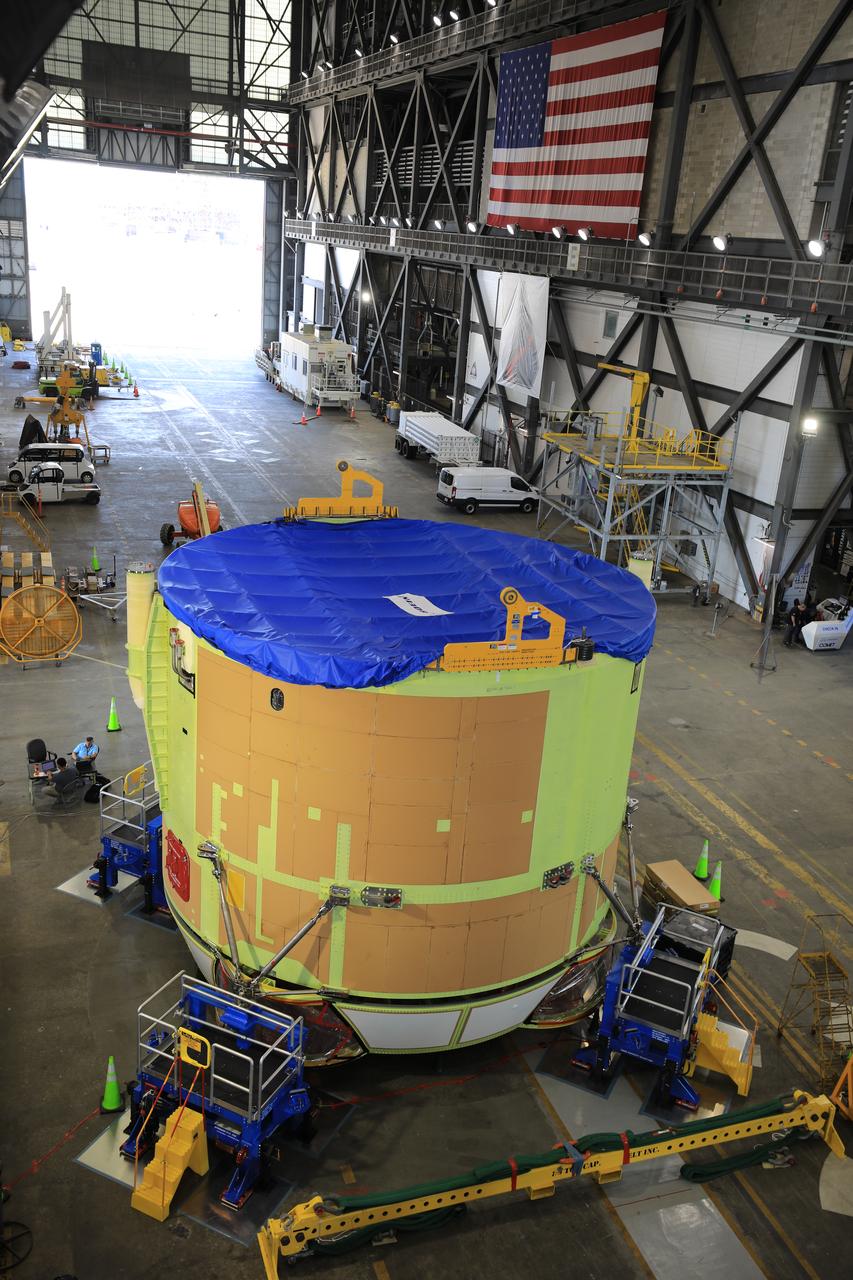
Teams from NASA’s Kennedy Space Center in Florida integrate NASA’s Artemis III SLS (Space Launch System) core stage engine section with its boat-tail inside the spaceport’s Vehicle Assembly Building on Wednesday, July 30, 2025. The boat-tail is a fairing-like structure that protects the bottom end of the core stage, while the engine section is one the most complex and intricate parts of the rocket stage that will help power the Artemis missions to the Moon.

Teams from NASA’s Kennedy Space Center in Florida integrate NASA’s Artemis III SLS (Space Launch System) core stage engine section with its boat-tail inside the spaceport’s Vehicle Assembly Building on Wednesday, July 30, 2025. The boat-tail is a fairing-like structure that protects the bottom end of the core stage, while the engine section is one the most complex and intricate parts of the rocket stage that will help power the Artemis missions to the Moon.
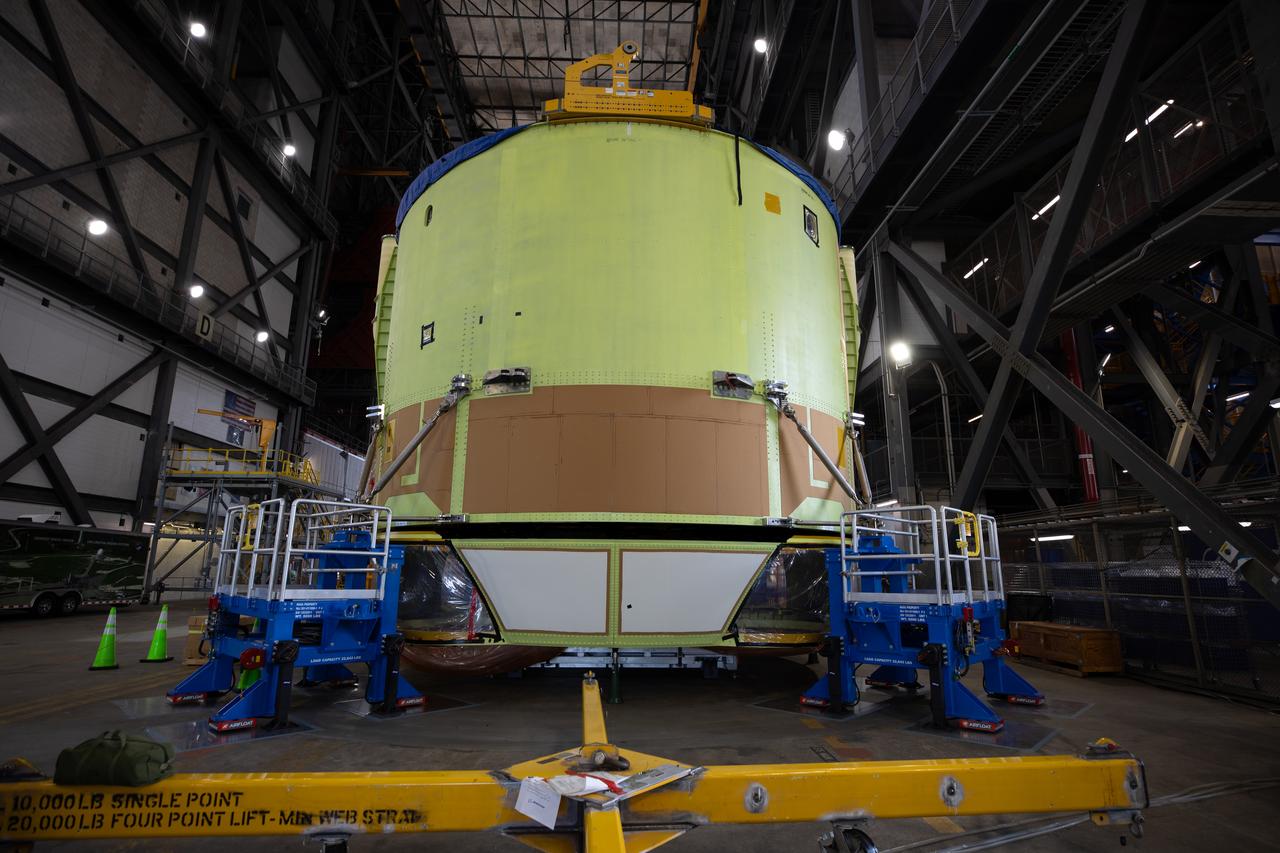
Teams from NASA’s Kennedy Space Center in Florida integrate NASA’s Artemis III SLS (Space Launch System) core stage engine section with its boat-tail inside the spaceport’s Vehicle Assembly Building on Wednesday, July 30, 2025. The boat-tail is a fairing-like structure that protects the bottom end of the core stage, while the engine section is one the most complex and intricate parts of the rocket stage that will help power the Artemis missions to the Moon.
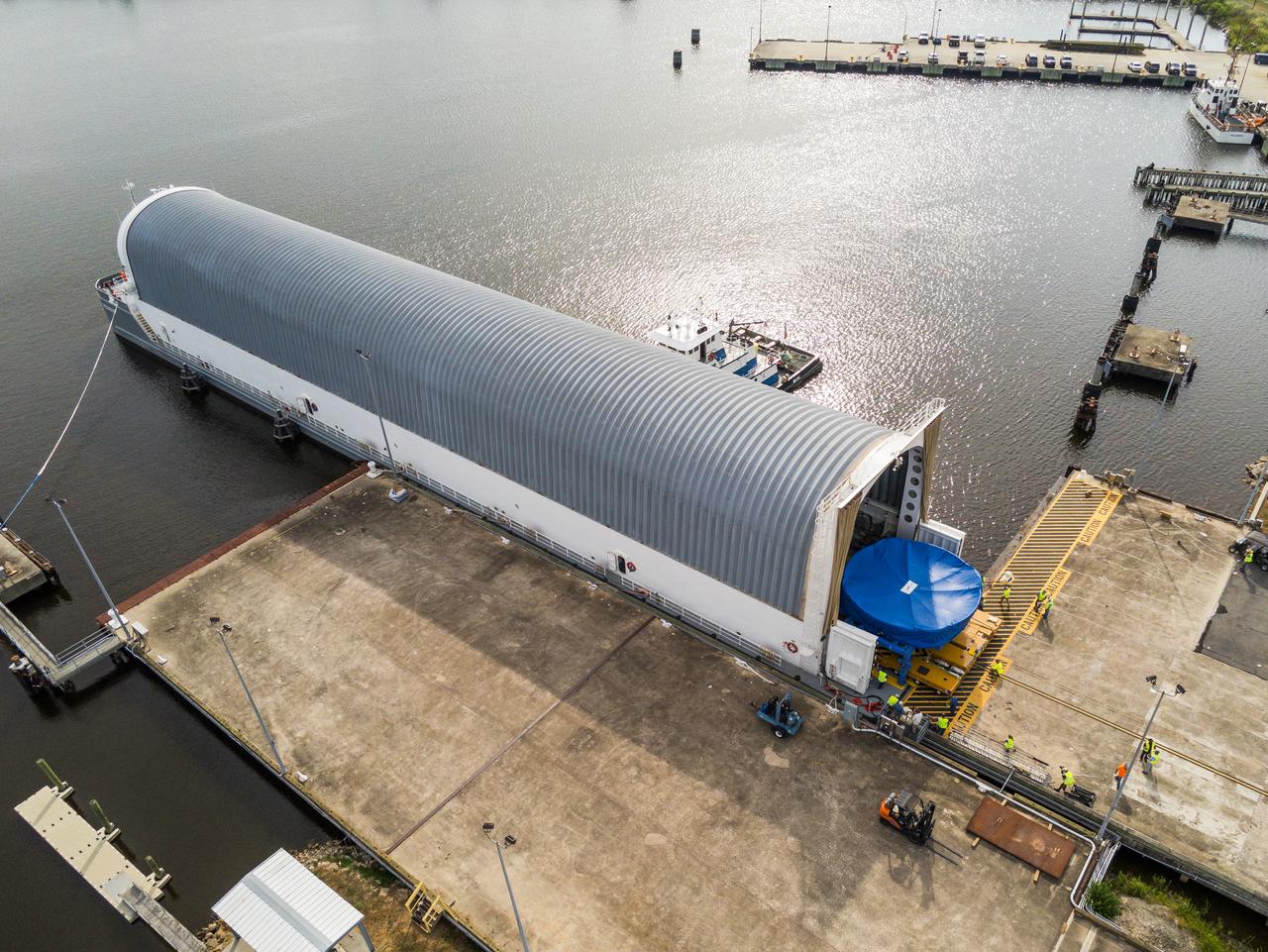
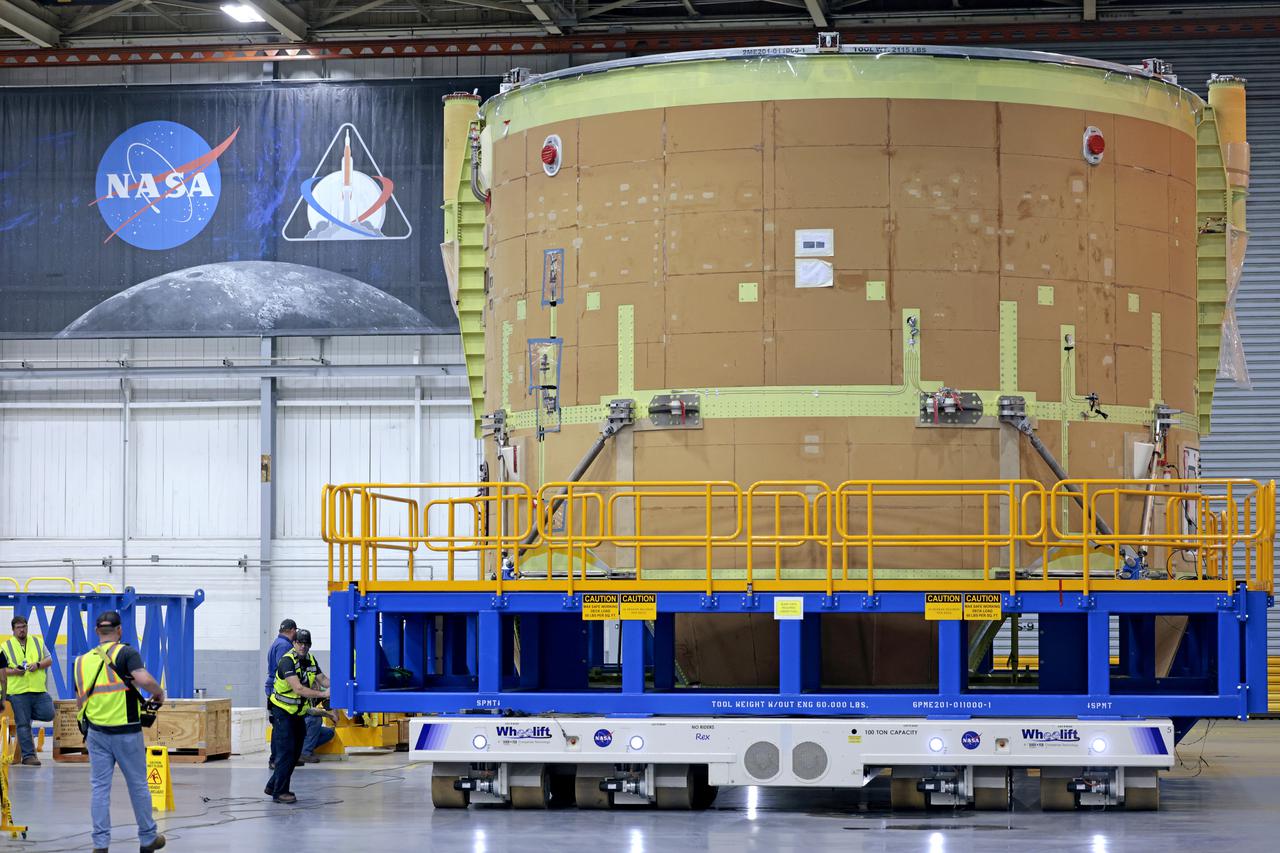
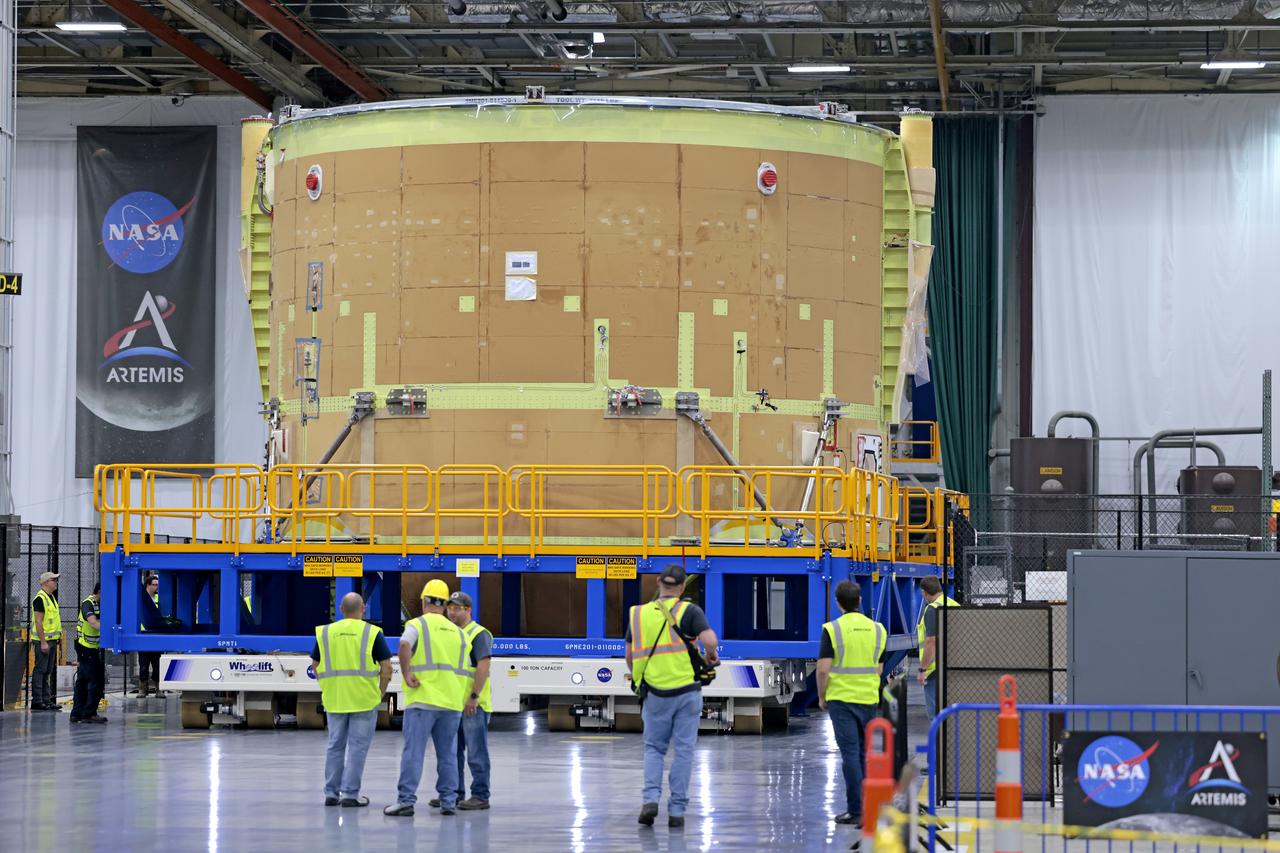
These photos and videos show teams at NASA’s Michoud Assembly Facility in New Orleans preparing, moving, and loading the engine section boat-tail of NASA’s SLS (Space Launch System) rocket for the Artemis III mission for transportation to NASA’s Kennedy Space Center in Florida via the agency’s Pegasus barge. Inside the factory on Aug. 14 prior to the move, technicians covered the spaceflight hardware with a tarp to help protect it on its journey aboard NASA’s Pegasus barge. Crews then rolled out the hardware on Aug. 27 from the factory floor to the barge. Once in Florida, the boat-tail will be integrated with the engine section -- also manufactured at Michoud -- inside Kennedy’s Space Station Processing Facility. The engine section arrived at NASA Kennedy in Dec. 2022. Located at the bottom of the engine section, the aerodynamic boat-tail fairing channels airflow and protects the stage’s four RS-25 engines from extreme temperatures during launch. The engine section is one of five major elements that make up the 212-foot-tall rocket stage. The core stage, along with its four RS-25 engines, produce two million pounds of thrust to help launch NASA’s Orion spacecraft, astronauts, and supplies beyond Earth’s orbit and to the lunar surface for Artemis.
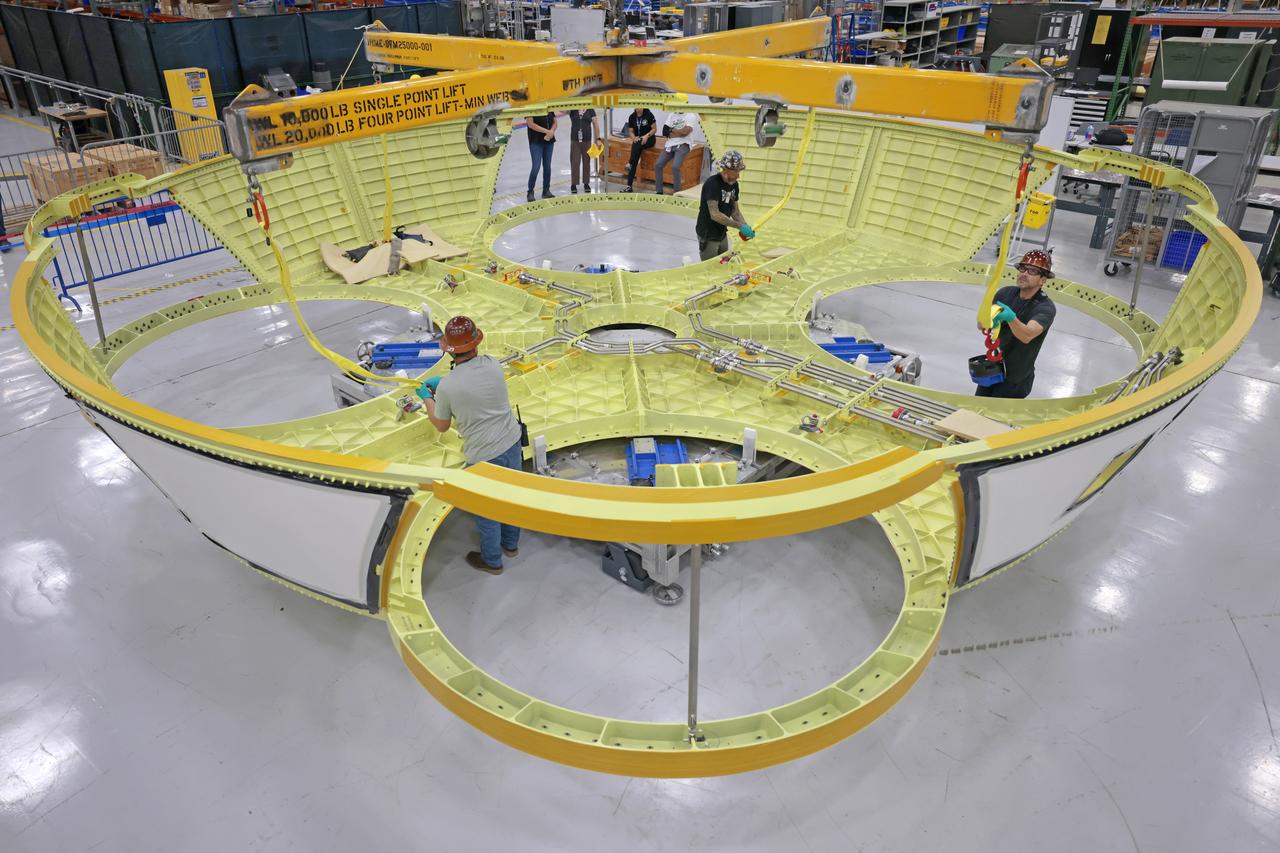
These photos show teams at NASA’s Michoud Assembly Facility in New Orleans preparing, moving, and loading the engine section boat-tail of NASA’s SLS (Space Launch System) rocket for the Artemis III mission for transportation to NASA’s Kennedy Space Center in Florida via the agency’s Pegasus barge. Inside the factory on Aug. 14 prior to the move, technicians covered the spaceflight hardware with a tarp to help protect it on its journey aboard NASA’s Pegasus barge. Crews then rolled out the hardware on Aug. 27 from the factory floor to the barge. Once in Florida, the boat-tail will be integrated with the engine section -- also manufactured at Michoud -- inside Kennedy’s Space Station Processing Facility. The engine section arrived at NASA Kennedy in Dec. 2022. Located at the bottom of the engine section, the aerodynamic boat-tail fairing channels airflow and protects the stage’s four RS-25 engines from extreme temperatures during launch. The engine section is one of five major elements that make up the 212-foot-tall rocket stage. The core stage, along with its four RS-25 engines, produce two million pounds of thrust to help launch NASA’s Orion spacecraft, astronauts, and supplies beyond Earth’s orbit and to the lunar surface for Artemis. Image credit: NASA/Michael DeMocker
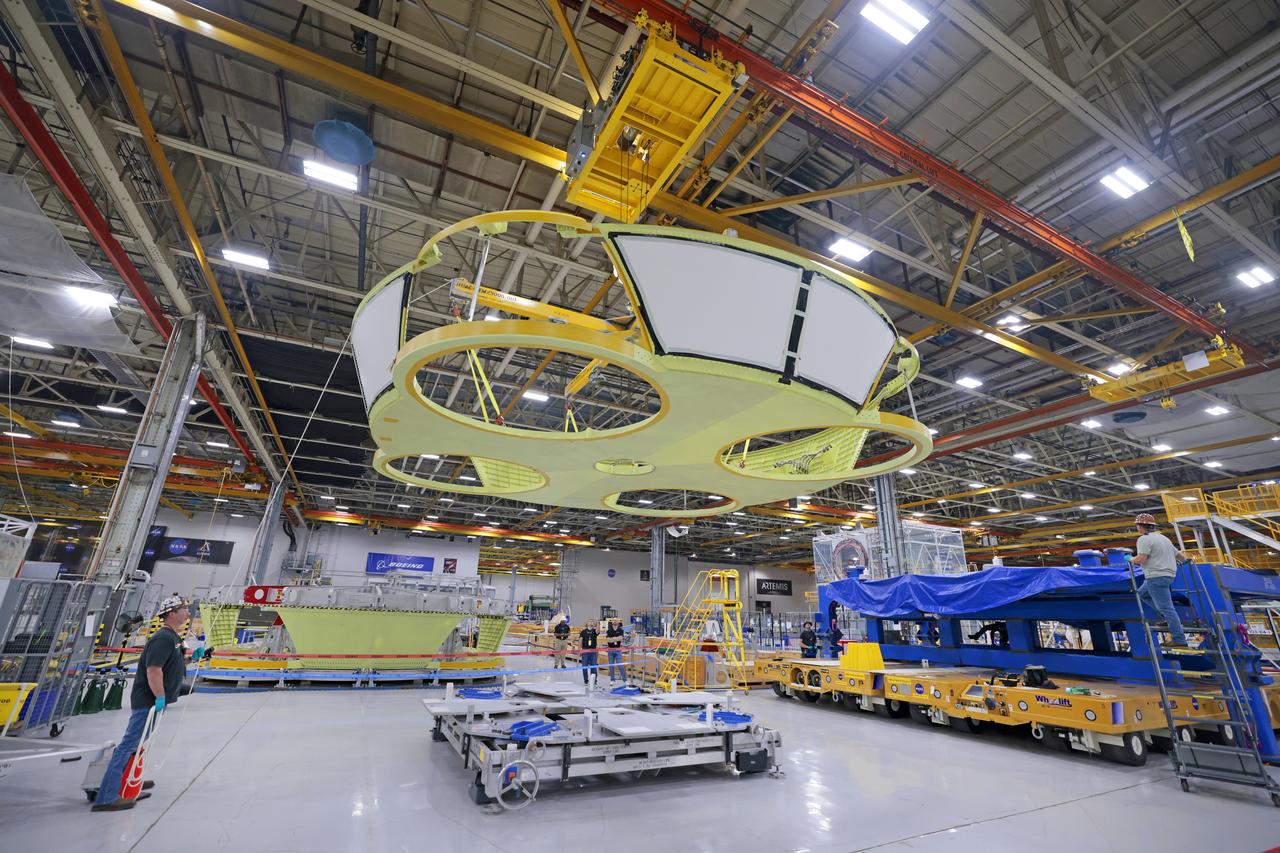
These photos show teams at NASA’s Michoud Assembly Facility in New Orleans preparing, moving, and loading the engine section boat-tail of NASA’s SLS (Space Launch System) rocket for the Artemis III mission for transportation to NASA’s Kennedy Space Center in Florida via the agency’s Pegasus barge. Inside the factory on Aug. 14 prior to the move, technicians covered the spaceflight hardware with a tarp to help protect it on its journey aboard NASA’s Pegasus barge. Crews then rolled out the hardware on Aug. 27 from the factory floor to the barge. Once in Florida, the boat-tail will be integrated with the engine section -- also manufactured at Michoud -- inside Kennedy’s Space Station Processing Facility. The engine section arrived at NASA Kennedy in Dec. 2022. Located at the bottom of the engine section, the aerodynamic boat-tail fairing channels airflow and protects the stage’s four RS-25 engines from extreme temperatures during launch. The engine section is one of five major elements that make up the 212-foot-tall rocket stage. The core stage, along with its four RS-25 engines, produce two million pounds of thrust to help launch NASA’s Orion spacecraft, astronauts, and supplies beyond Earth’s orbit and to the lunar surface for Artemis. Image credit: NASA/Michael DeMocker
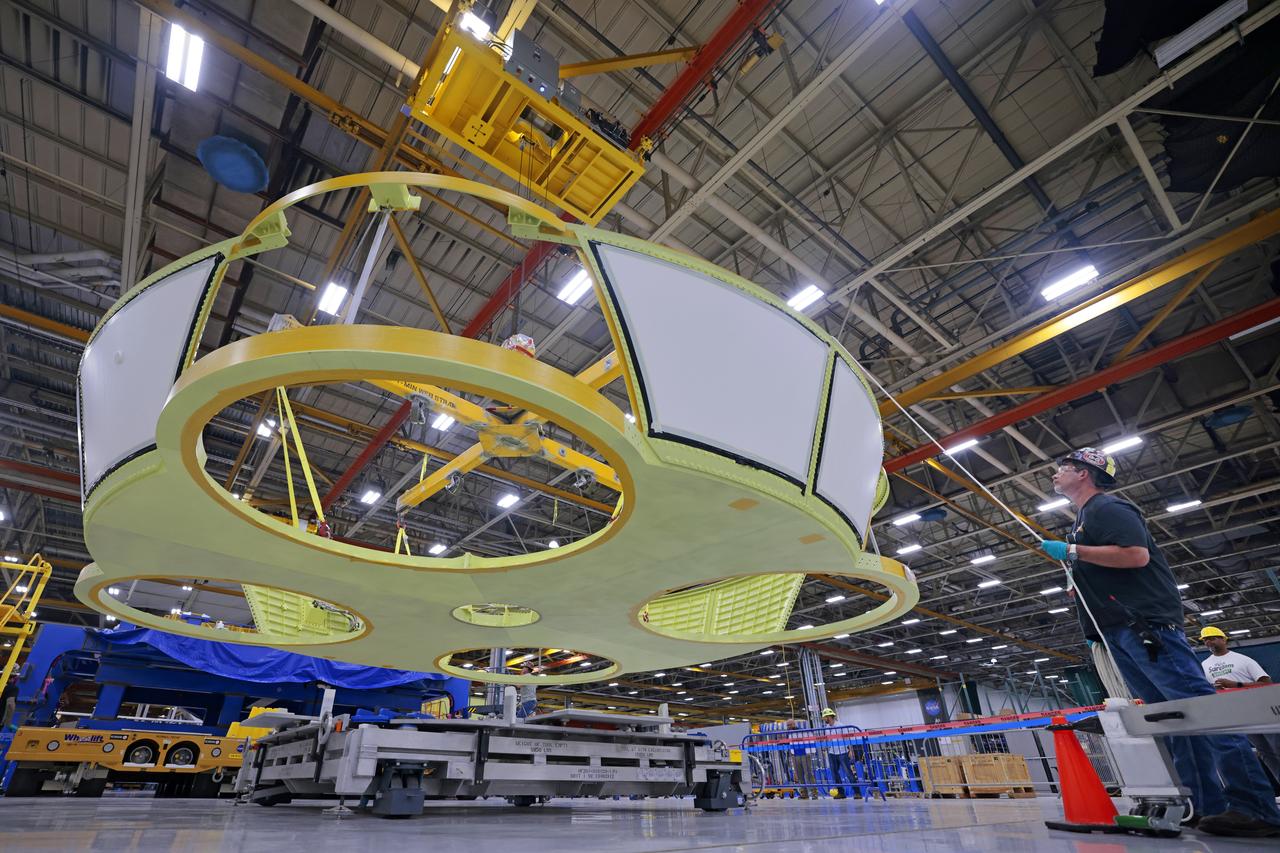
These photos show teams at NASA’s Michoud Assembly Facility in New Orleans preparing, moving, and loading the engine section boat-tail of NASA’s SLS (Space Launch System) rocket for the Artemis III mission for transportation to NASA’s Kennedy Space Center in Florida via the agency’s Pegasus barge. Inside the factory on Aug. 14 prior to the move, technicians covered the spaceflight hardware with a tarp to help protect it on its journey aboard NASA’s Pegasus barge. Crews then rolled out the hardware on Aug. 27 from the factory floor to the barge. Once in Florida, the boat-tail will be integrated with the engine section -- also manufactured at Michoud -- inside Kennedy’s Space Station Processing Facility. The engine section arrived at NASA Kennedy in Dec. 2022. Located at the bottom of the engine section, the aerodynamic boat-tail fairing channels airflow and protects the stage’s four RS-25 engines from extreme temperatures during launch. The engine section is one of five major elements that make up the 212-foot-tall rocket stage. The core stage, along with its four RS-25 engines, produce two million pounds of thrust to help launch NASA’s Orion spacecraft, astronauts, and supplies beyond Earth’s orbit and to the lunar surface for Artemis. Image credit: NASA/Michael DeMocker
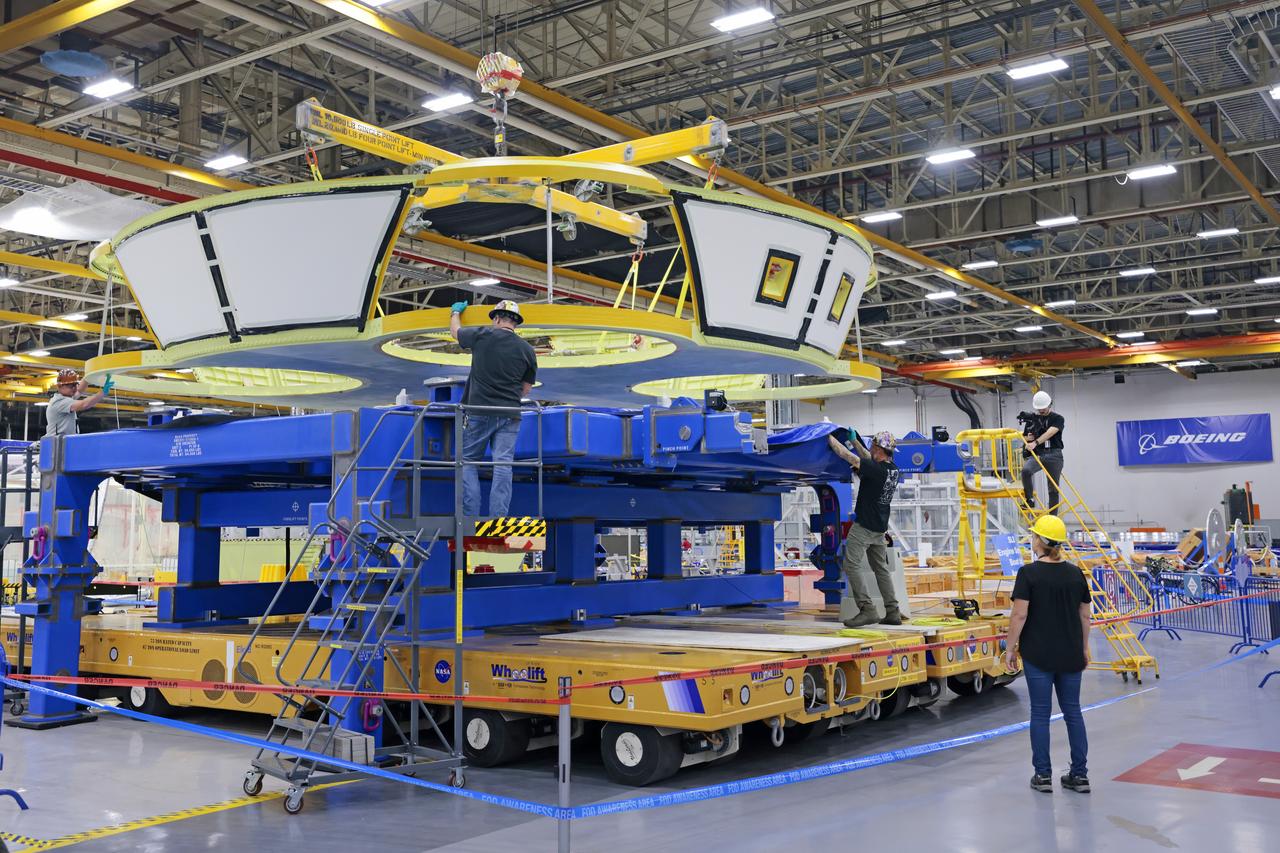
These photos show teams at NASA’s Michoud Assembly Facility in New Orleans preparing, moving, and loading the engine section boat-tail of NASA’s SLS (Space Launch System) rocket for the Artemis III mission for transportation to NASA’s Kennedy Space Center in Florida via the agency’s Pegasus barge. Inside the factory on Aug. 14 prior to the move, technicians covered the spaceflight hardware with a tarp to help protect it on its journey aboard NASA’s Pegasus barge. Crews then rolled out the hardware on Aug. 27 from the factory floor to the barge. Once in Florida, the boat-tail will be integrated with the engine section -- also manufactured at Michoud -- inside Kennedy’s Space Station Processing Facility. The engine section arrived at NASA Kennedy in Dec. 2022. Located at the bottom of the engine section, the aerodynamic boat-tail fairing channels airflow and protects the stage’s four RS-25 engines from extreme temperatures during launch. The engine section is one of five major elements that make up the 212-foot-tall rocket stage. The core stage, along with its four RS-25 engines, produce two million pounds of thrust to help launch NASA’s Orion spacecraft, astronauts, and supplies beyond Earth’s orbit and to the lunar surface for Artemis. Image credit: NASA/Michael DeMocker
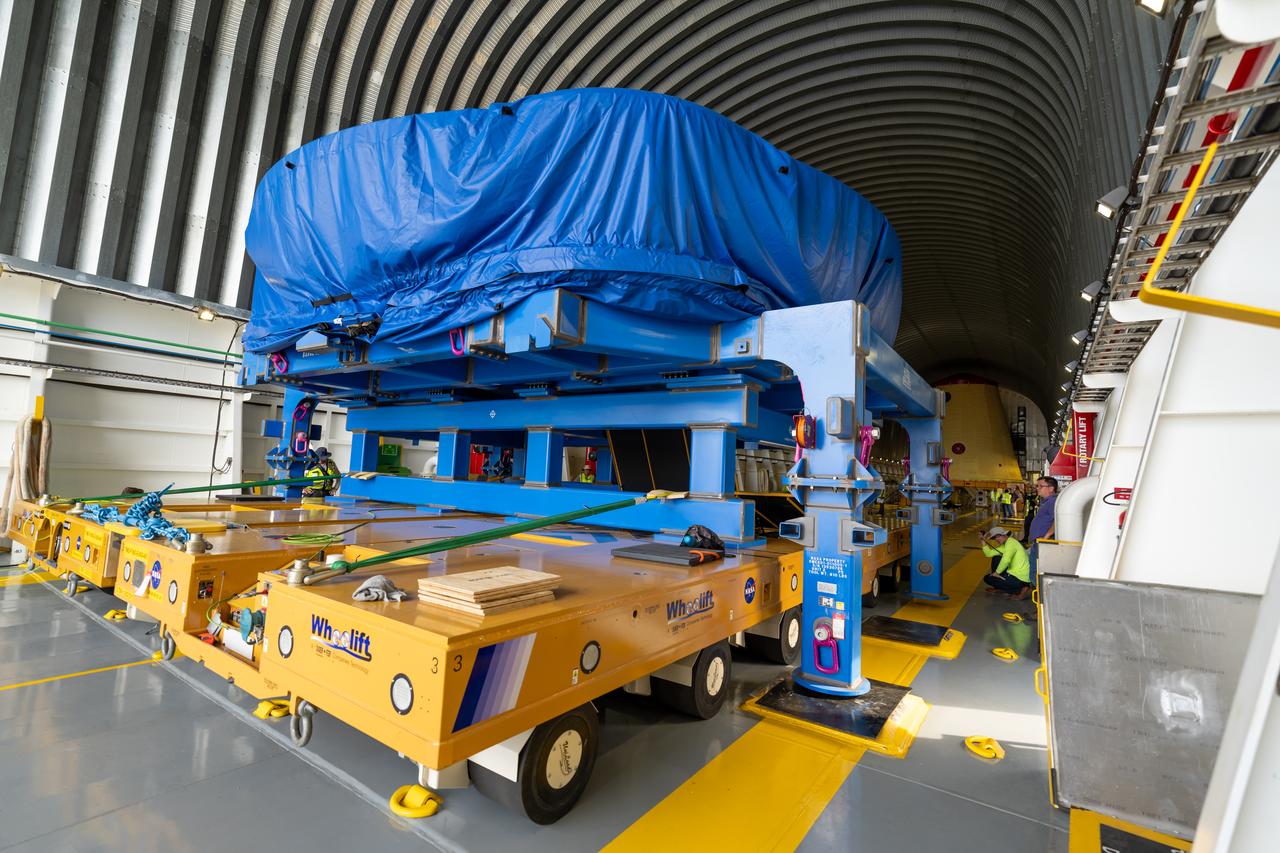
These photos and videos show teams at NASA’s Michoud Assembly Facility in New Orleans preparing, moving, and loading the engine section boat-tail of NASA’s SLS (Space Launch System) rocket for the Artemis III mission for transportation to NASA’s Kennedy Space Center in Florida via the agency’s Pegasus barge. Inside the factory on Aug. 14 prior to the move, technicians covered the spaceflight hardware with a tarp to help protect it on its journey aboard NASA’s Pegasus barge. Crews then rolled out the hardware on Aug. 27 from the factory floor to the barge. Once in Florida, the boat-tail will be integrated with the engine section -- also manufactured at Michoud -- inside Kennedy’s Space Station Processing Facility. The engine section arrived at NASA Kennedy in Dec. 2022. Located at the bottom of the engine section, the aerodynamic boat-tail fairing channels airflow and protects the stage’s four RS-25 engines from extreme temperatures during launch. The engine section is one of five major elements that make up the 212-foot-tall rocket stage. The core stage, along with its four RS-25 engines, produce two million pounds of thrust to help launch NASA’s Orion spacecraft, astronauts, and supplies beyond Earth’s orbit and to the lunar surface for Artemis.
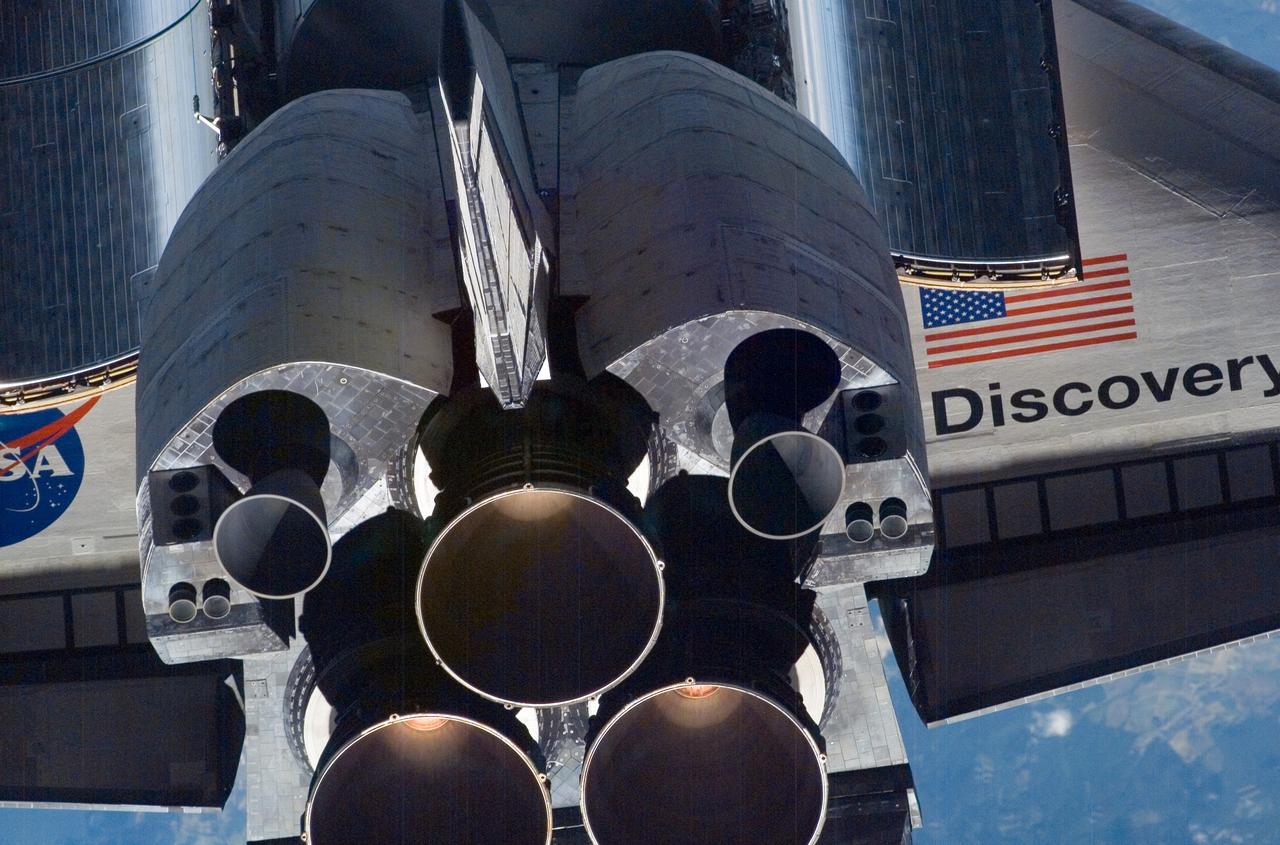
A close-up view of Space Shuttle Discovery's tail section is featured in this image photographed by an Expedition 13 crew member on the International Space Station (ISS) during the STS-121 Rotating Pitch Maneuver (RPM) survey. Visible are the space shuttle's main engines (SSME), vertical stabilizer, orbital maneuvering system (OMS) pods and a portion of the aft cargo bay and wings. The Marshall Space Flight Center (MSFC) has management responsibility for development of the SSME.

Technicians at NASA’s Michoud Assembly Facility have joined the engine and boat-tail sections of NASA’s Space Launch System rocket for Artemis II in preparation for its next step in production. When complete, the engine section will house the four RS-25 engines and include vital systems for mounting, controlling and delivering fuel from the propellant tanks to the rocket’s engines. The boat-tail is designed to protect the bottom end of the core stage and the RS-25 engines and was joined with the engine section to comprise the lowest portion of the 212-foot-tall core stage. Together with its four RS-25 engines and its twin solid rocket boosters, it will produce 8.8 million pounds of thrust to send NASA’s Orion spacecraft, astronauts, and supplies beyond Earth’s orbit to the Moon and, ultimately, Mars. Offering more payload mass, volume capability, and energy to speed missions through space, the SLS rocket, along with NASA’s Gateway in lunar orbit, the Human Landing System, and Orion spacecraft, is part of NASA’s backbone for deep space exploration and the Artemis lunar program. No other rocket is capable of carrying astronauts in Orion around the Moon in a single mission.
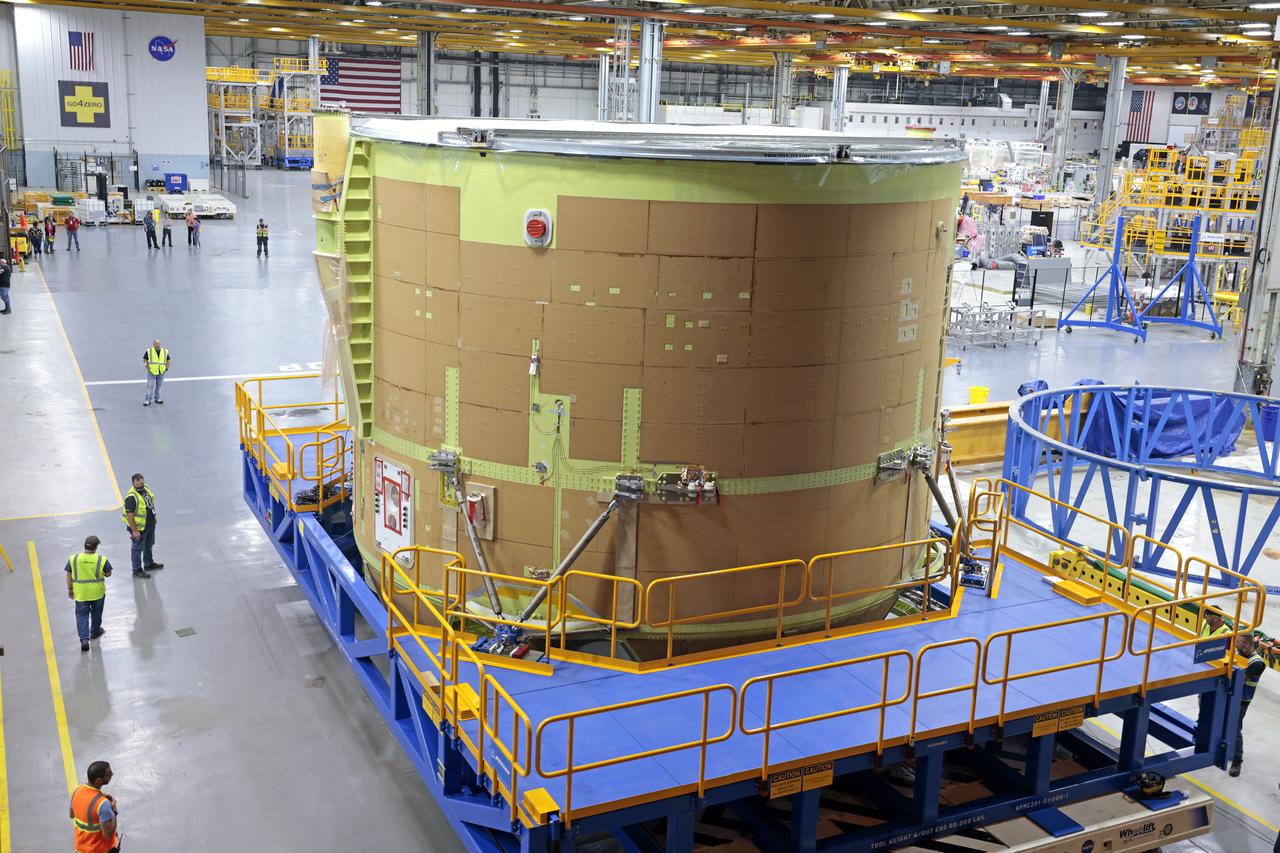
Technicians at NASA’s Michoud Assembly Facility have joined the engine and boat-tail sections of NASA’s Space Launch System rocket for Artemis II in preparation for its next step in production. When complete, the engine section will house the four RS-25 engines and include vital systems for mounting, controlling and delivering fuel from the propellant tanks to the rocket’s engines. The boat-tail is designed to protect the bottom end of the core stage and the RS-25 engines and was joined with the engine section to comprise the lowest portion of the 212-foot-tall core stage. Together with its four RS-25 engines and its twin solid rocket boosters, it will produce 8.8 million pounds of thrust to send NASA’s Orion spacecraft, astronauts, and supplies beyond Earth’s orbit to the Moon and, ultimately, Mars. Offering more payload mass, volume capability, and energy to speed missions through space, the SLS rocket, along with NASA’s Gateway in lunar orbit, the Human Landing System, and Orion spacecraft, is part of NASA’s backbone for deep space exploration and the Artemis lunar program. No other rocket is capable of carrying astronauts in Orion around the Moon in a single mission.
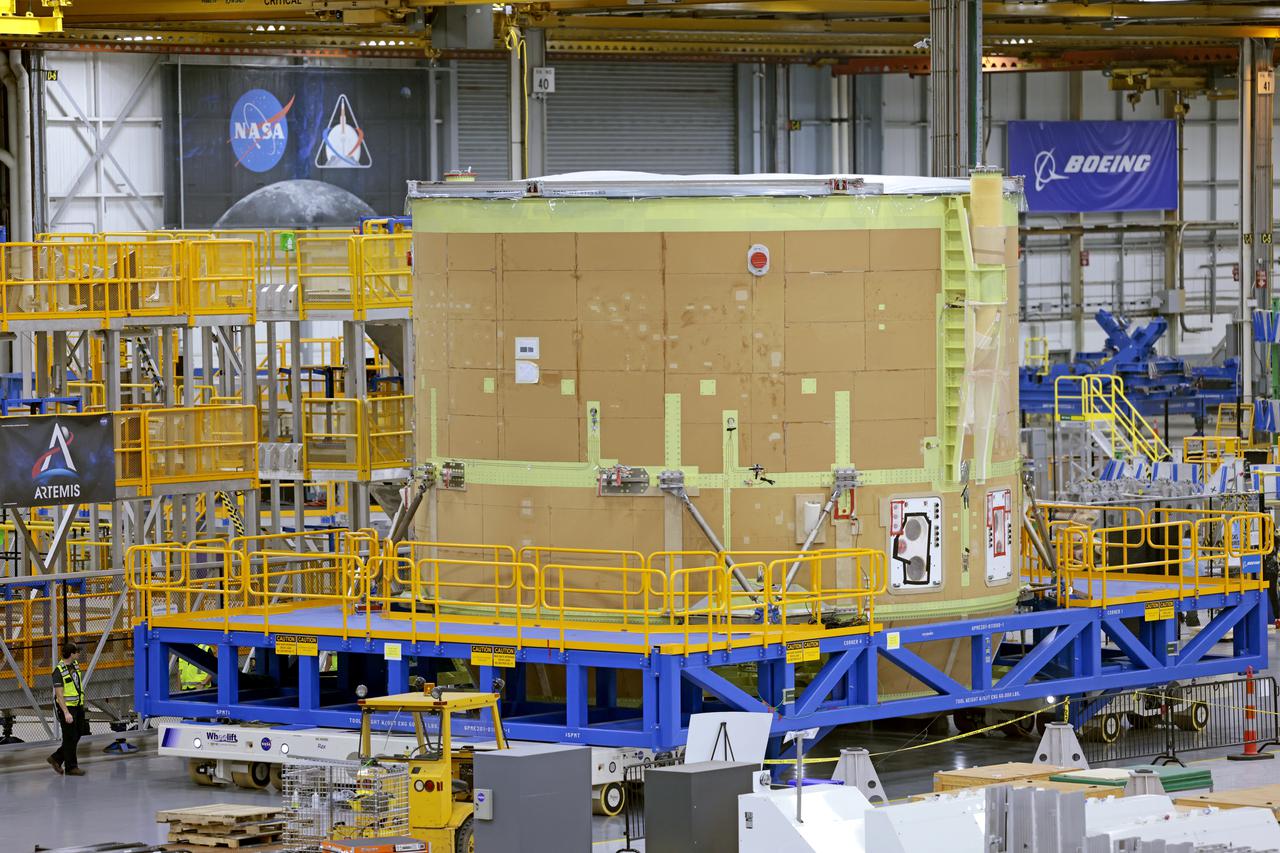
Technicians at NASA’s Michoud Assembly Facility have joined the engine and boat-tail sections of NASA’s Space Launch System rocket for Artemis II in preparation for its next step in production. When complete, the engine section will house the four RS-25 engines and include vital systems for mounting, controlling and delivering fuel from the propellant tanks to the rocket’s engines. The boat-tail is designed to protect the bottom end of the core stage and the RS-25 engines and was joined with the engine section to comprise the lowest portion of the 212-foot-tall core stage. Together with its four RS-25 engines and its twin solid rocket boosters, it will produce 8.8 million pounds of thrust to send NASA’s Orion spacecraft, astronauts, and supplies beyond Earth’s orbit to the Moon and, ultimately, Mars. Offering more payload mass, volume capability, and energy to speed missions through space, the SLS rocket, along with NASA’s Gateway in lunar orbit, the Human Landing System, and Orion spacecraft, is part of NASA’s backbone for deep space exploration and the Artemis lunar program. No other rocket is capable of carrying astronauts in Orion around the Moon in a single mission.
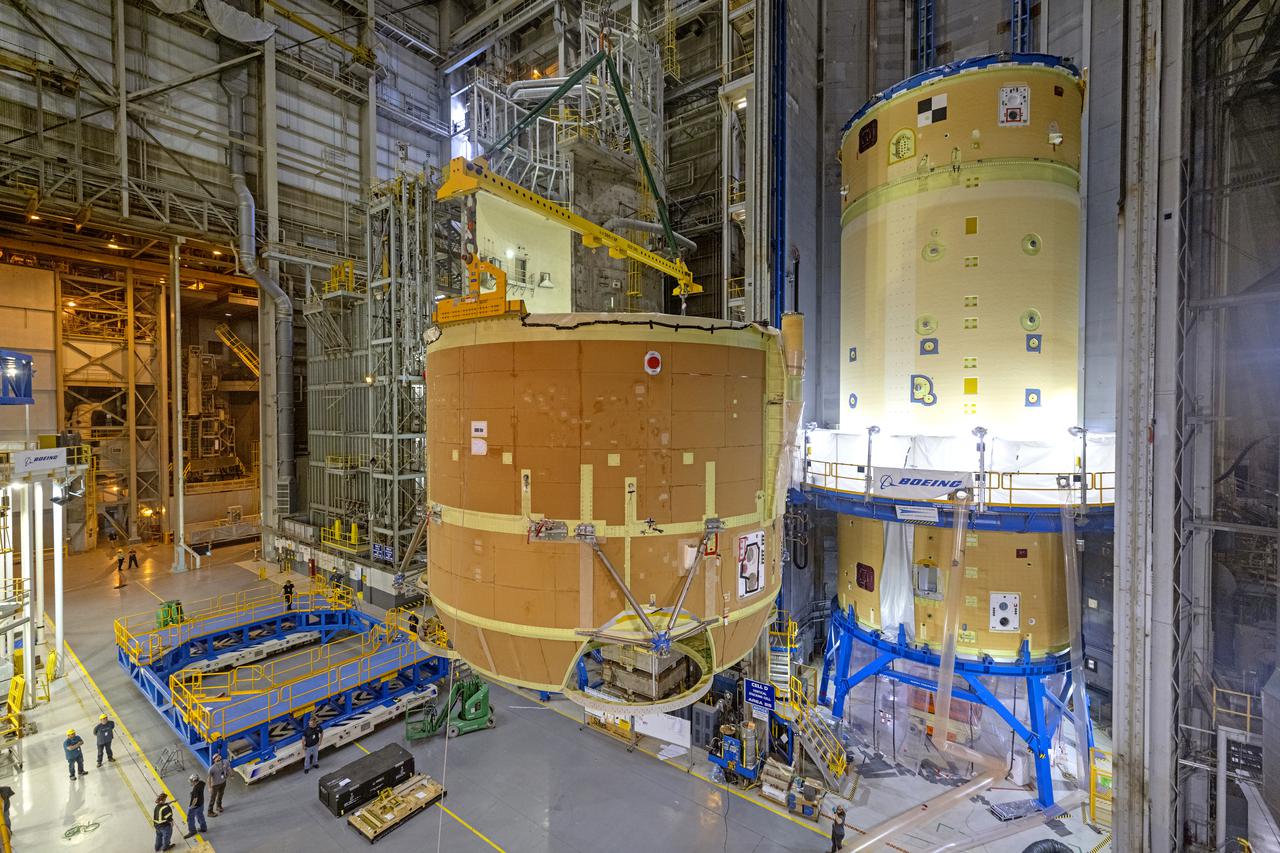
Technicians at NASA’s Michoud Assembly Facility have joined the engine and boat-tail sections of NASA’s Space Launch System rocket for Artemis II in preparation for its next step in production. When complete, the engine section will house the four RS-25 engines and include vital systems for mounting, controlling and delivering fuel from the propellant tanks to the rocket’s engines. The boat-tail is designed to protect the bottom end of the core stage and the RS-25 engines and was joined with the engine section to comprise the lowest portion of the 212-foot-tall core stage. Together with its four RS-25 engines and its twin solid rocket boosters, it will produce 8.8 million pounds of thrust to send NASA’s Orion spacecraft, astronauts, and supplies beyond Earth’s orbit to the Moon and, ultimately, Mars. Offering more payload mass, volume capability, and energy to speed missions through space, the SLS rocket, along with NASA’s Gateway in lunar orbit, the Human Landing System, and Orion spacecraft, is part of NASA’s backbone for deep space exploration and the Artemis lunar program. No other rocket is capable of carrying astronauts in Orion around the Moon in a single mission.
Technicians at NASA’s Michoud Assembly Facility have joined the engine and boat-tail sections of NASA’s Space Launch System rocket for Artemis II in preparation for its next step in production. When complete, the engine section will house the four RS-25 engines and include vital systems for mounting, controlling and delivering fuel from the propellant tanks to the rocket’s engines. The boat-tail is designed to protect the bottom end of the core stage and the RS-25 engines and was joined with the engine section to comprise the lowest portion of the 212-foot-tall core stage. Together with its four RS-25 engines and its twin solid rocket boosters, it will produce 8.8 million pounds of thrust to send NASA’s Orion spacecraft, astronauts, and supplies beyond Earth’s orbit to the Moon and, ultimately, Mars. Offering more payload mass, volume capability, and energy to speed missions through space, the SLS rocket, along with NASA’s Gateway in lunar orbit, the Human Landing System, and Orion spacecraft, is part of NASA’s backbone for deep space exploration and the Artemis lunar program. No other rocket is capable of carrying astronauts in Orion around the Moon in a single mission.
Technicians at NASA’s Michoud Assembly Facility have joined the engine and boat-tail sections of NASA’s Space Launch System rocket for Artemis II in preparation for its next step in production. When complete, the engine section will house the four RS-25 engines and include vital systems for mounting, controlling and delivering fuel from the propellant tanks to the rocket’s engines. The boat-tail is designed to protect the bottom end of the core stage and the RS-25 engines and was joined with the engine section to comprise the lowest portion of the 212-foot-tall core stage. Together with its four RS-25 engines and its twin solid rocket boosters, it will produce 8.8 million pounds of thrust to send NASA’s Orion spacecraft, astronauts, and supplies beyond Earth’s orbit to the Moon and, ultimately, Mars. Offering more payload mass, volume capability, and energy to speed missions through space, the SLS rocket, along with NASA’s Gateway in lunar orbit, the Human Landing System, and Orion spacecraft, is part of NASA’s backbone for deep space exploration and the Artemis lunar program. No other rocket is capable of carrying astronauts in Orion around the Moon in a single mission.
Technicians at NASA’s Michoud Assembly Facility have joined the engine and boat-tail sections of NASA’s Space Launch System rocket for Artemis II in preparation for its next step in production. When complete, the engine section will house the four RS-25 engines and include vital systems for mounting, controlling and delivering fuel from the propellant tanks to the rocket’s engines. The boat-tail is designed to protect the bottom end of the core stage and the RS-25 engines and was joined with the engine section to comprise the lowest portion of the 212-foot-tall core stage. Together with its four RS-25 engines and its twin solid rocket boosters, it will produce 8.8 million pounds of thrust to send NASA’s Orion spacecraft, astronauts, and supplies beyond Earth’s orbit to the Moon and, ultimately, Mars. Offering more payload mass, volume capability, and energy to speed missions through space, the SLS rocket, along with NASA’s Gateway in lunar orbit, the Human Landing System, and Orion spacecraft, is part of NASA’s backbone for deep space exploration and the Artemis lunar program. No other rocket is capable of carrying astronauts in Orion around the Moon in a single mission.
Technicians at NASA’s Michoud Assembly Facility have joined the engine and boat-tail sections of NASA’s Space Launch System rocket for Artemis II in preparation for its next step in production. When complete, the engine section will house the four RS-25 engines and include vital systems for mounting, controlling and delivering fuel from the propellant tanks to the rocket’s engines. The boat-tail is designed to protect the bottom end of the core stage and the RS-25 engines and was joined with the engine section to comprise the lowest portion of the 212-foot-tall core stage. Together with its four RS-25 engines and its twin solid rocket boosters, it will produce 8.8 million pounds of thrust to send NASA’s Orion spacecraft, astronauts, and supplies beyond Earth’s orbit to the Moon and, ultimately, Mars. Offering more payload mass, volume capability, and energy to speed missions through space, the SLS rocket, along with NASA’s Gateway in lunar orbit, the Human Landing System, and Orion spacecraft, is part of NASA’s backbone for deep space exploration and the Artemis lunar program. No other rocket is capable of carrying astronauts in Orion around the Moon in a single mission.
Technicians at NASA’s Michoud Assembly Facility have joined the engine and boat-tail sections of NASA’s Space Launch System rocket for Artemis II in preparation for its next step in production. When complete, the engine section will house the four RS-25 engines and include vital systems for mounting, controlling and delivering fuel from the propellant tanks to the rocket’s engines. The boat-tail is designed to protect the bottom end of the core stage and the RS-25 engines and was joined with the engine section to comprise the lowest portion of the 212-foot-tall core stage. Together with its four RS-25 engines and its twin solid rocket boosters, it will produce 8.8 million pounds of thrust to send NASA’s Orion spacecraft, astronauts, and supplies beyond Earth’s orbit to the Moon and, ultimately, Mars. Offering more payload mass, volume capability, and energy to speed missions through space, the SLS rocket, along with NASA’s Gateway in lunar orbit, the Human Landing System, and Orion spacecraft, is part of NASA’s backbone for deep space exploration and the Artemis lunar program. No other rocket is capable of carrying astronauts in Orion around the Moon in a single mission.
Technicians at NASA’s Michoud Assembly Facility have joined the engine and boat-tail sections of NASA’s Space Launch System rocket for Artemis II in preparation for its next step in production. When complete, the engine section will house the four RS-25 engines and include vital systems for mounting, controlling and delivering fuel from the propellant tanks to the rocket’s engines. The boat-tail is designed to protect the bottom end of the core stage and the RS-25 engines and was joined with the engine section to comprise the lowest portion of the 212-foot-tall core stage. Together with its four RS-25 engines and its twin solid rocket boosters, it will produce 8.8 million pounds of thrust to send NASA’s Orion spacecraft, astronauts, and supplies beyond Earth’s orbit to the Moon and, ultimately, Mars. Offering more payload mass, volume capability, and energy to speed missions through space, the SLS rocket, along with NASA’s Gateway in lunar orbit, the Human Landing System, and Orion spacecraft, is part of NASA’s backbone for deep space exploration and the Artemis lunar program. No other rocket is capable of carrying astronauts in Orion around the Moon in a single mission.
Technicians at NASA’s Michoud Assembly Facility have joined the engine and boat-tail sections of NASA’s Space Launch System rocket for Artemis II in preparation for its next step in production. When complete, the engine section will house the four RS-25 engines and include vital systems for mounting, controlling and delivering fuel from the propellant tanks to the rocket’s engines. The boat-tail is designed to protect the bottom end of the core stage and the RS-25 engines and was joined with the engine section to comprise the lowest portion of the 212-foot-tall core stage. Together with its four RS-25 engines and its twin solid rocket boosters, it will produce 8.8 million pounds of thrust to send NASA’s Orion spacecraft, astronauts, and supplies beyond Earth’s orbit to the Moon and, ultimately, Mars. Offering more payload mass, volume capability, and energy to speed missions through space, the SLS rocket, along with NASA’s Gateway in lunar orbit, the Human Landing System, and Orion spacecraft, is part of NASA’s backbone for deep space exploration and the Artemis lunar program. No other rocket is capable of carrying astronauts in Orion around the Moon in a single mission.

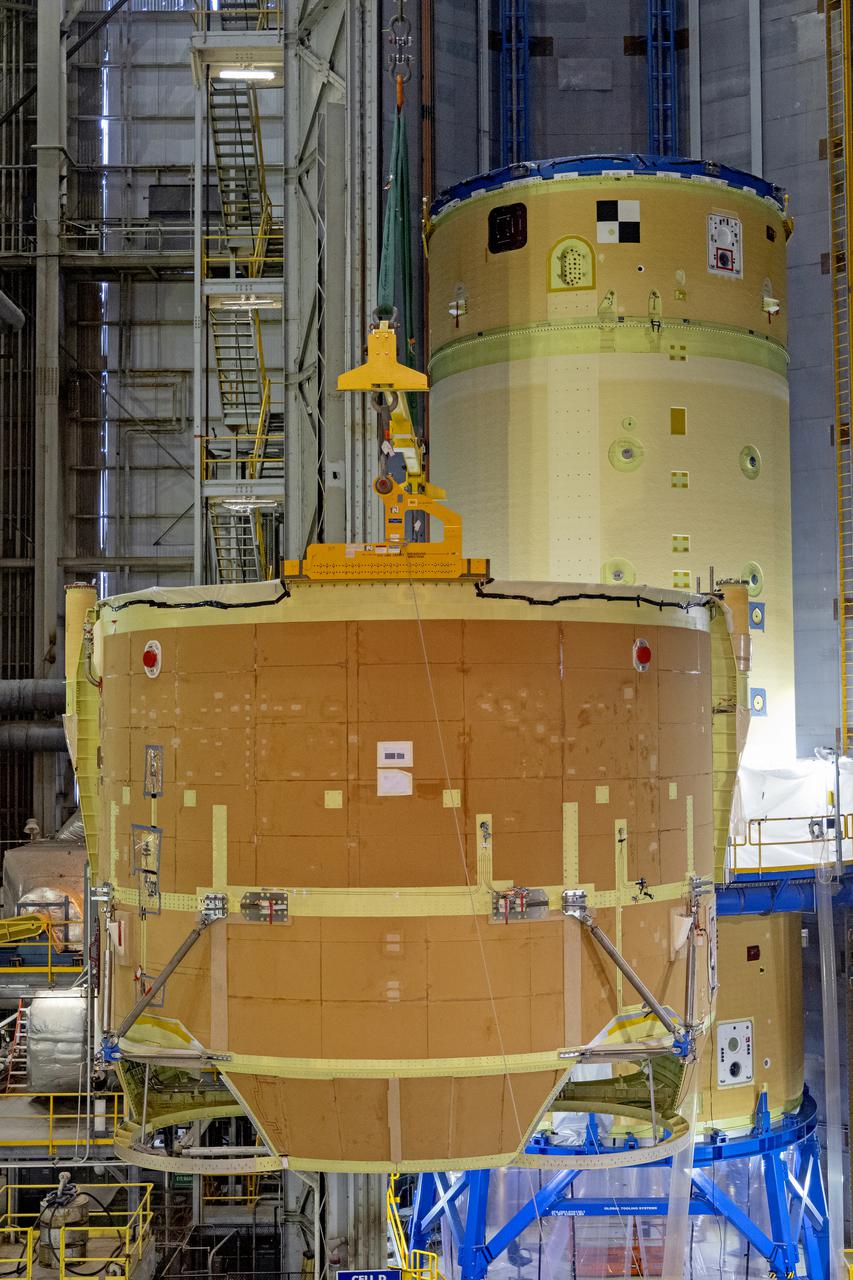
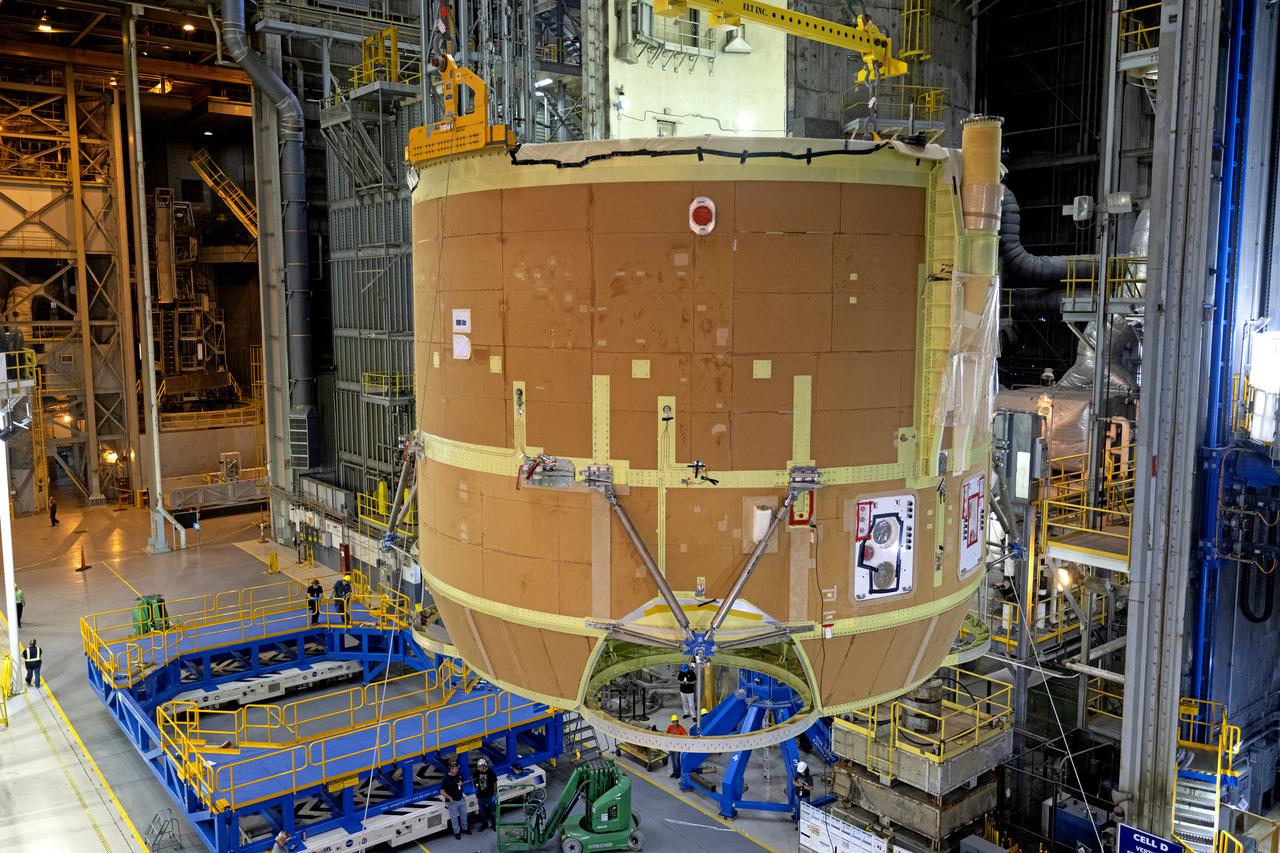
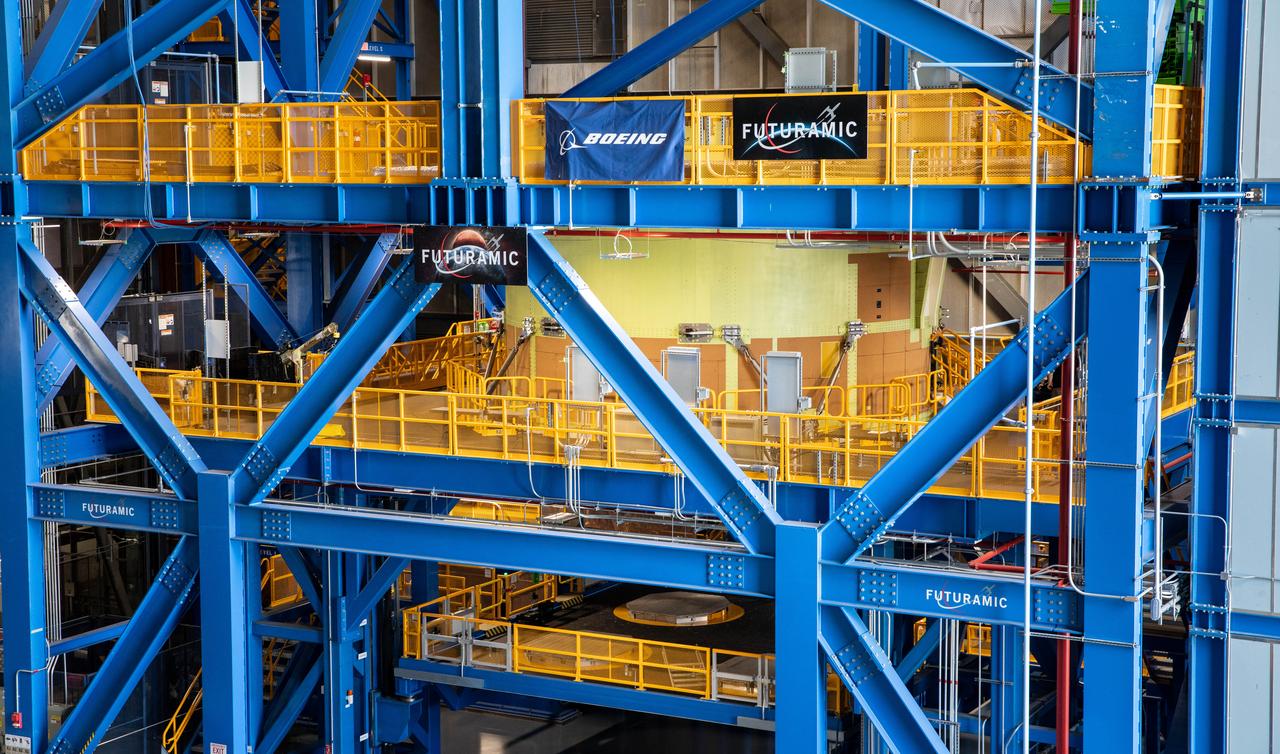
Teams from Kennedy lift NASA’s integrated Artemis III SLS (Space Launch System) core stage engine section with its boat-tail inside the center’s Vehicle Assembly Building at NASA’s Kennedy Space Center in Florida on Wednesday, Aug. 13, 2025. Shown inside the facility’s High Bay 2 for processing, the engine section is one the most complex and intricate parts of the rocket stage that will help power the Artemis missions to the Moon.
Teams from Kennedy lift NASA’s integrated Artemis III SLS (Space Launch System) core stage engine section with its boat-tail inside the center’s Vehicle Assembly Building at NASA’s Kennedy Space Center in Florida on Wednesday, Aug. 13, 2025. Shown inside the facility’s High Bay 2 for processing, the engine section is one the most complex and intricate parts of the rocket stage that will help power the Artemis missions to the Moon.
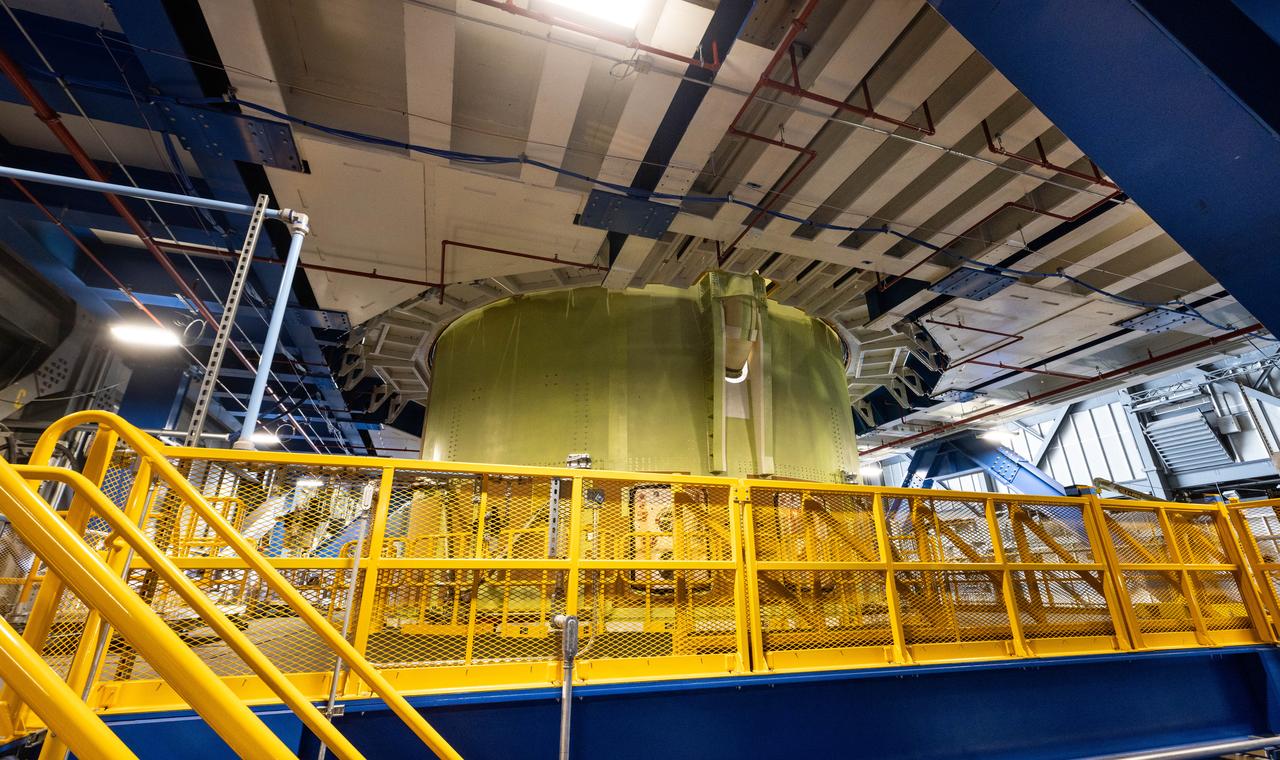
Teams from Kennedy lift NASA’s integrated Artemis III SLS (Space Launch System) core stage engine section with its boat-tail inside the center’s Vehicle Assembly Building at NASA’s Kennedy Space Center in Florida on Wednesday, Aug. 13, 2025. Shown inside the facility’s High Bay 2 for processing, the engine section is one the most complex and intricate parts of the rocket stage that will help power the Artemis missions to the Moon.

Teams from Kennedy lift NASA’s integrated Artemis III SLS (Space Launch System) core stage engine section with its boat-tail inside the center’s Vehicle Assembly Building at NASA’s Kennedy Space Center in Florida on Wednesday, Aug. 13, 2025. Shown inside the facility’s High Bay 2 for processing, the engine section is one the most complex and intricate parts of the rocket stage that will help power the Artemis missions to the Moon.
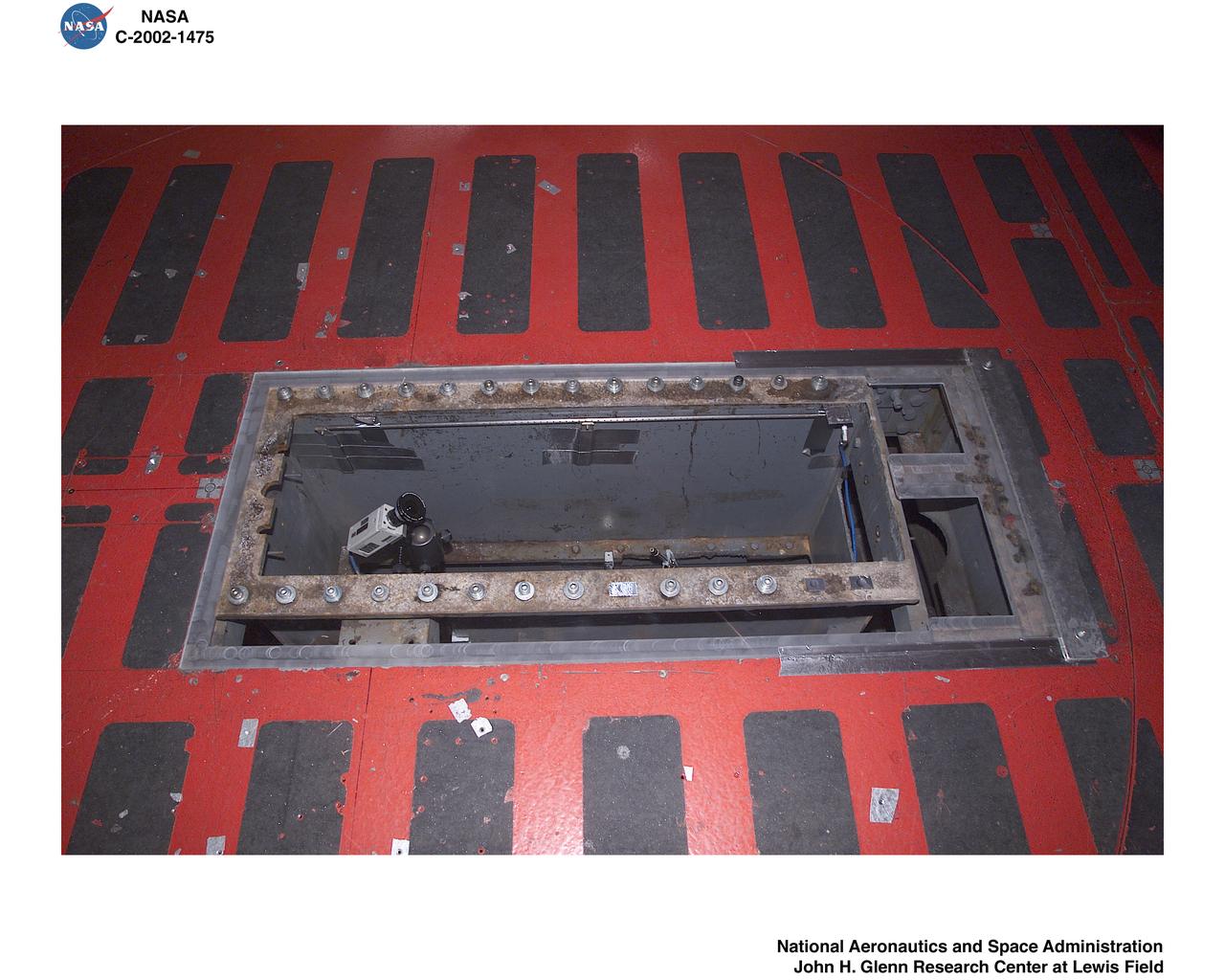
RAYTHEON HORIZONTAL TAIL SECTION
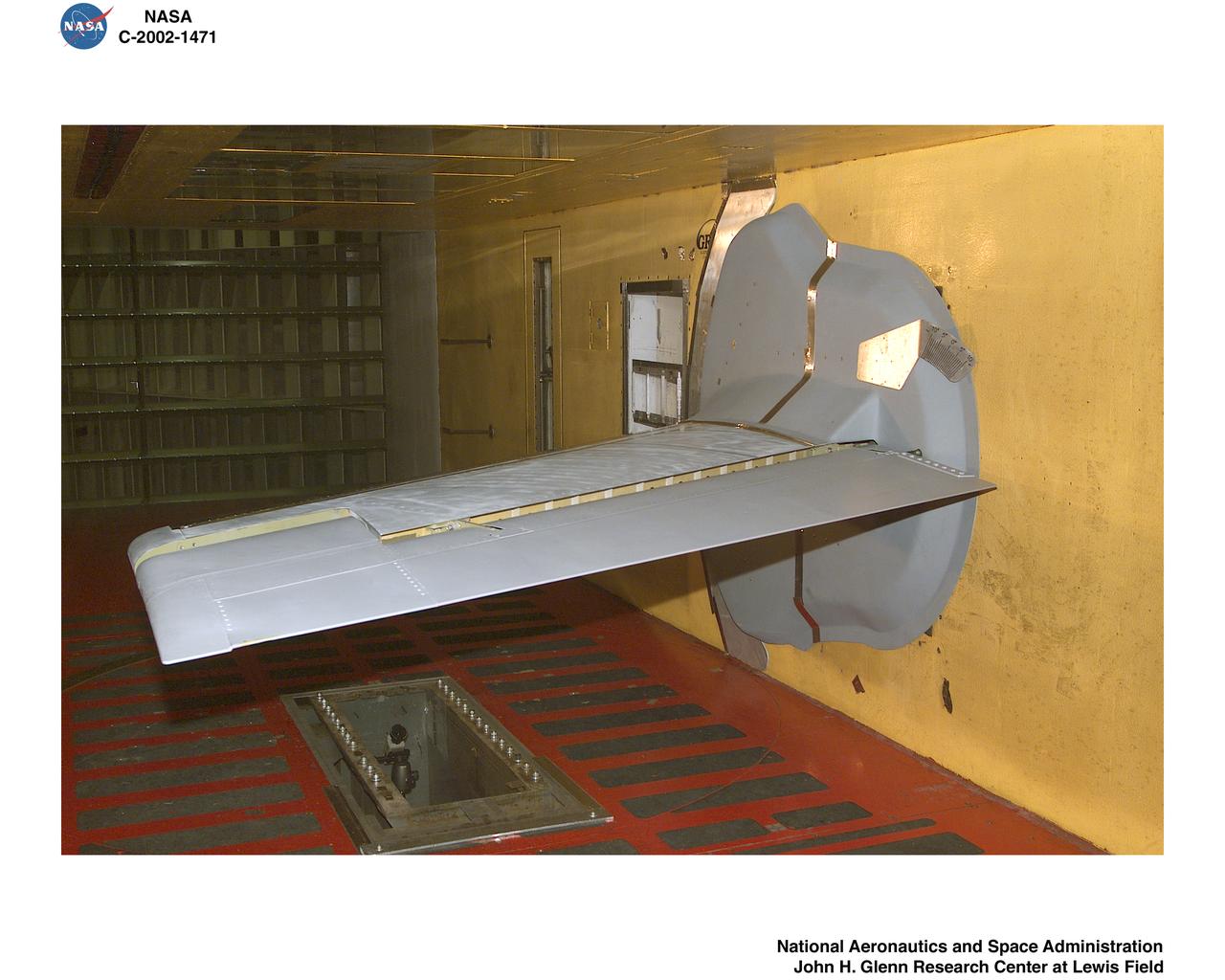
RAYTHEON HORIZONTAL TAIL SECTION
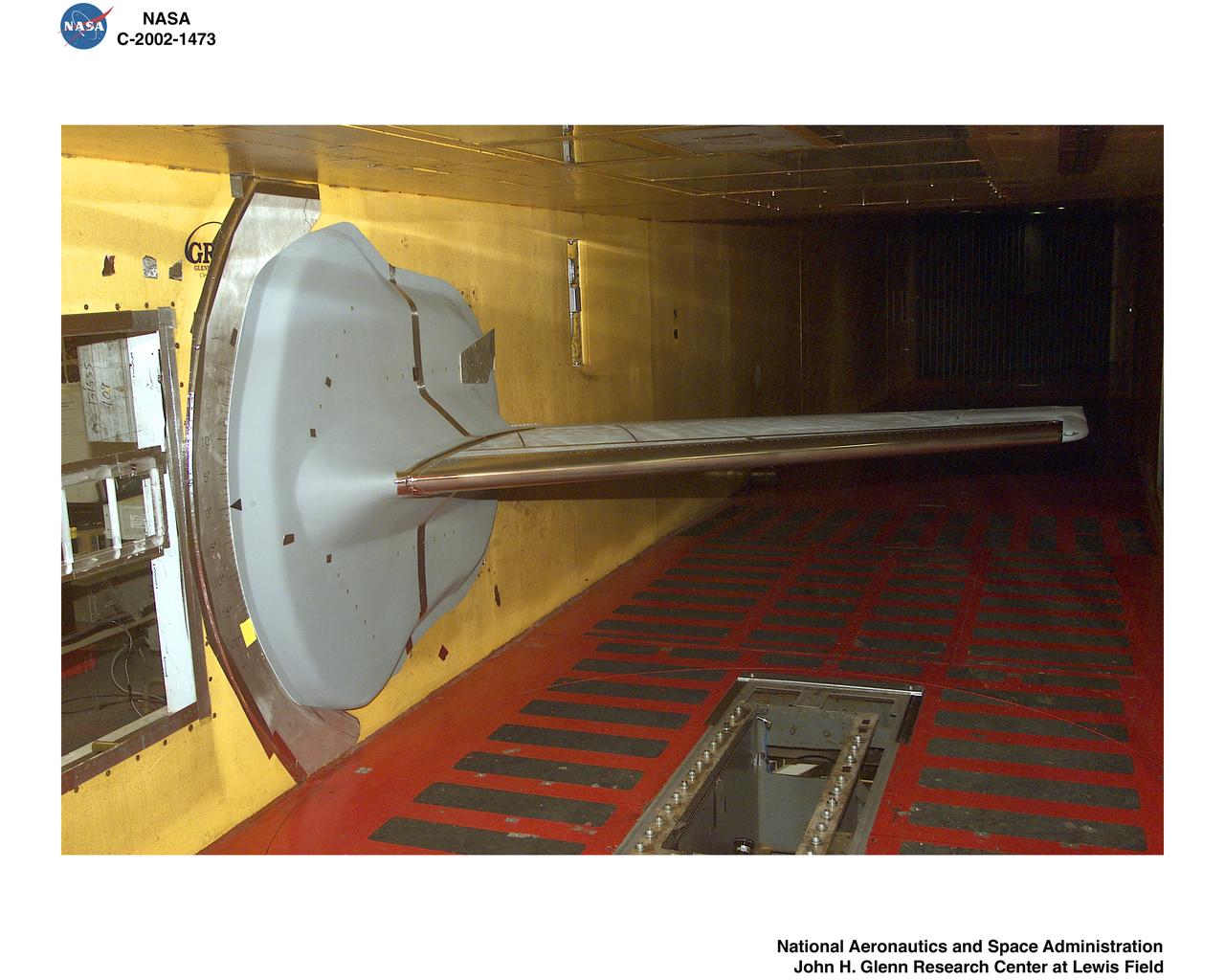
RAYTHEON HORIZONTAL TAIL SECTION
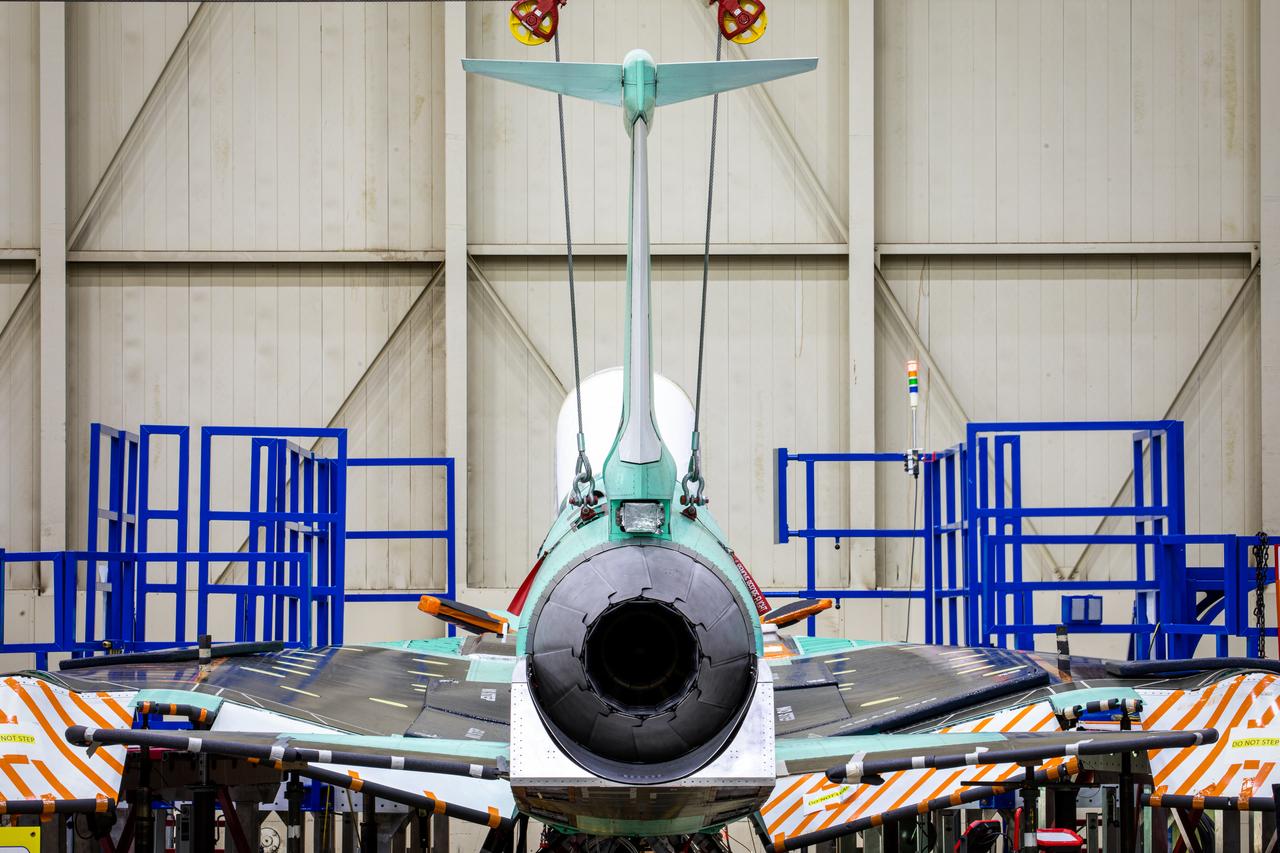
A perfectly framed up rearview shot of NASA’s X-59 tail after its recent installation of the lower empennage, or tail section, in late March at Lockheed Martin Skunk Works in Palmdale, California.
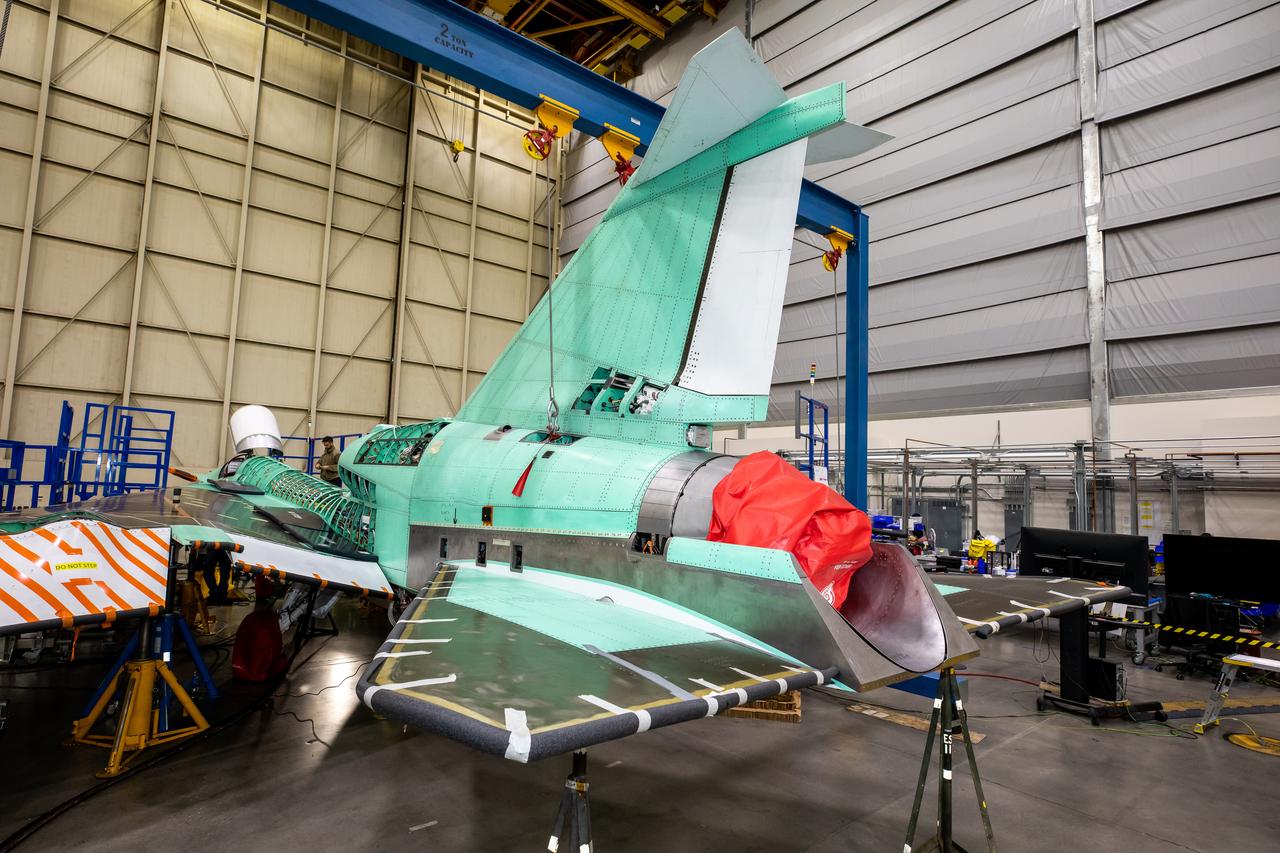
The tail of NASA’s X-59 aircraft is shown here in late March at Lockheed Martin Skunk Works in Palmdale, California where the plane recently underwent a final install of the lower empennage or better known as tail section of the plane.
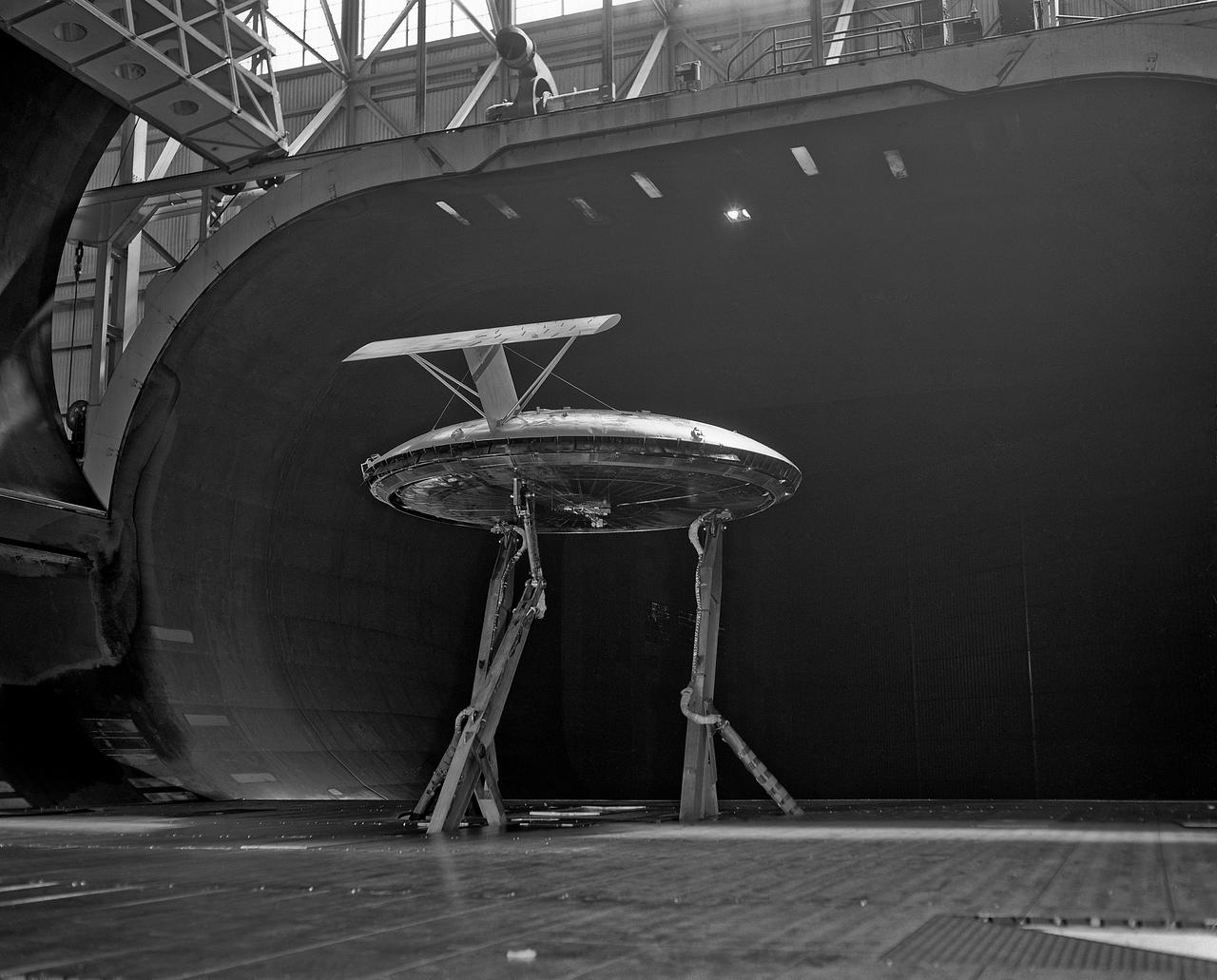
Rear view of the Avrocar with tail, mounted on variable height struts. Overhead doors of the wind tunnel test section open.
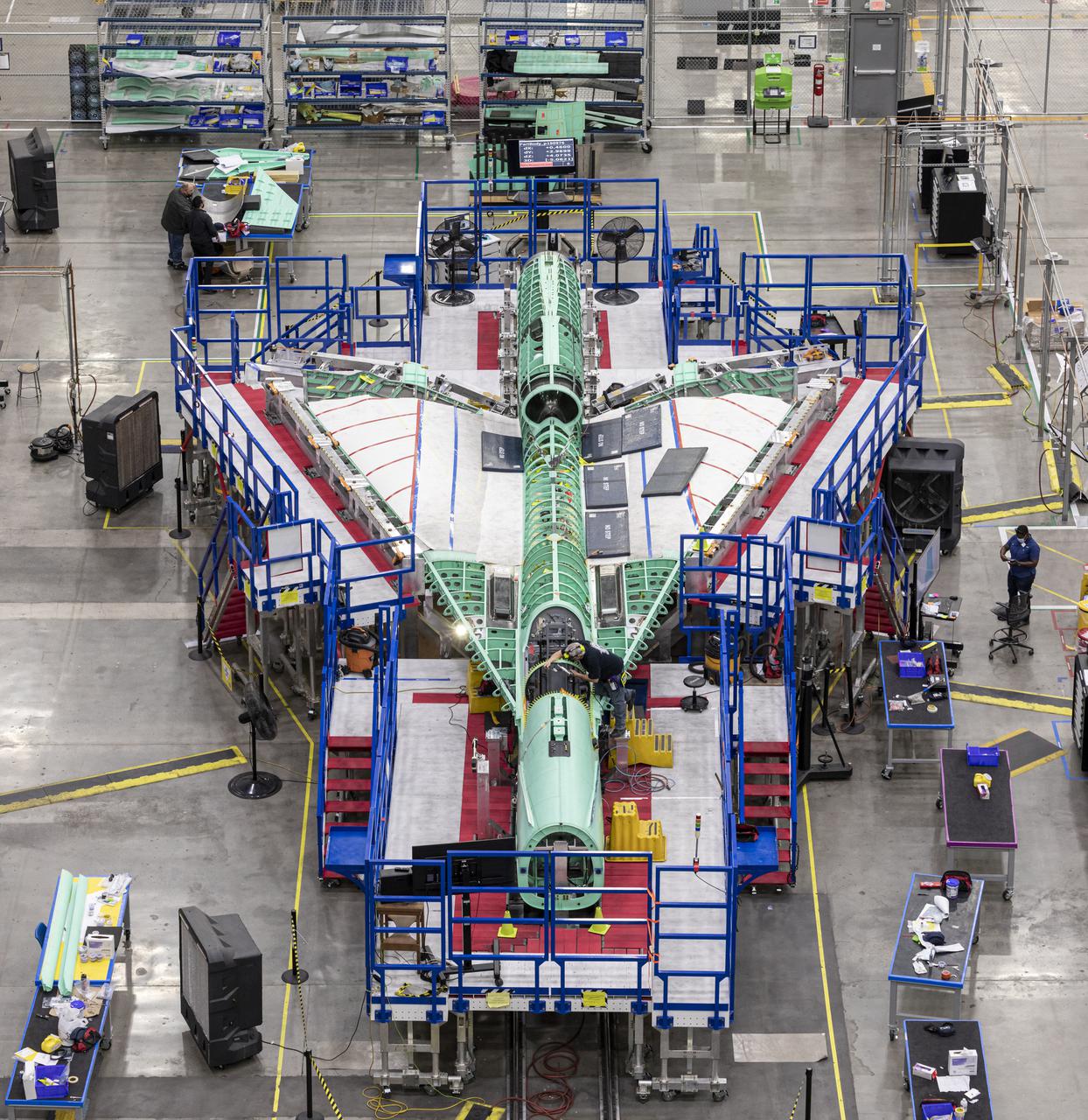
This overhead view shows NASA’s X-59 Quiet SuperSonic Technology or QueSST aircraft as it comes together for the merger of its main parts – the wing, forward section and tail assembly. Lockheed Martin Photography By Garry Tice 1011 Lockheed Way, Palmdale, Ca. 93599 Event: Manufacturing Area From Above Date: 5/26/2021
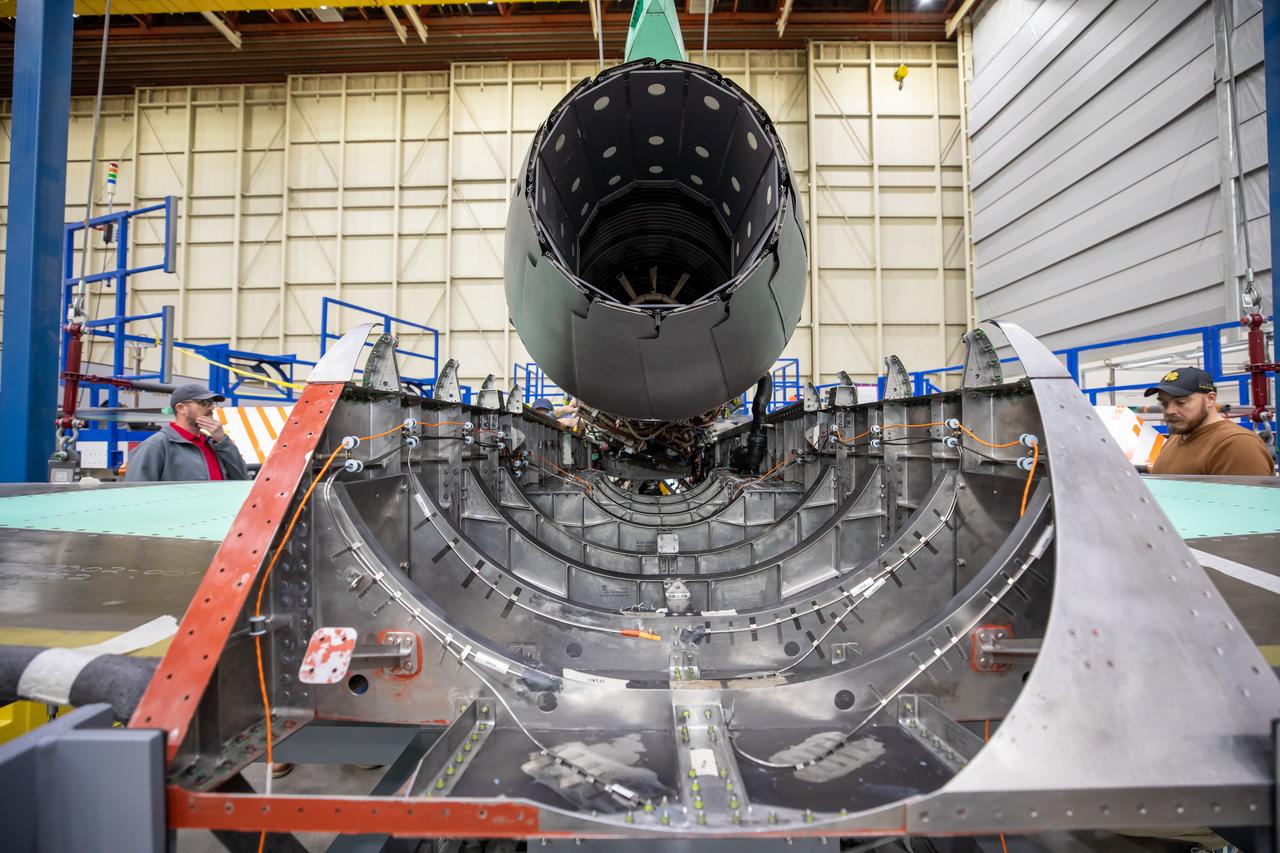
Here is a close-up of the GE F414 engine, from the aft deck or rear, before the tail section of the X-59 is lifted into place and attached to the aircraft. The aft deck helps control the shockwaves at the end of the aircraft and reduce the noise of a sonic boom to more of a sonic thump.
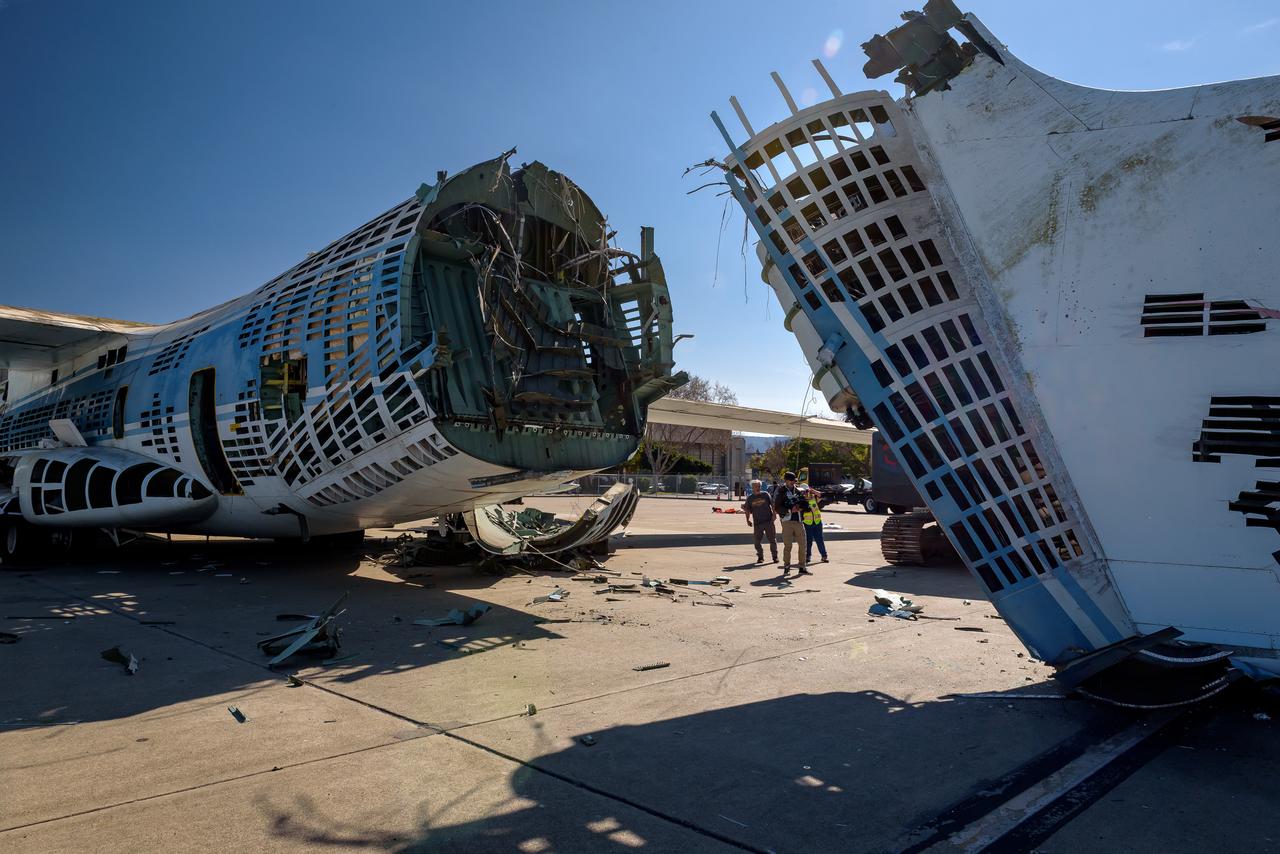
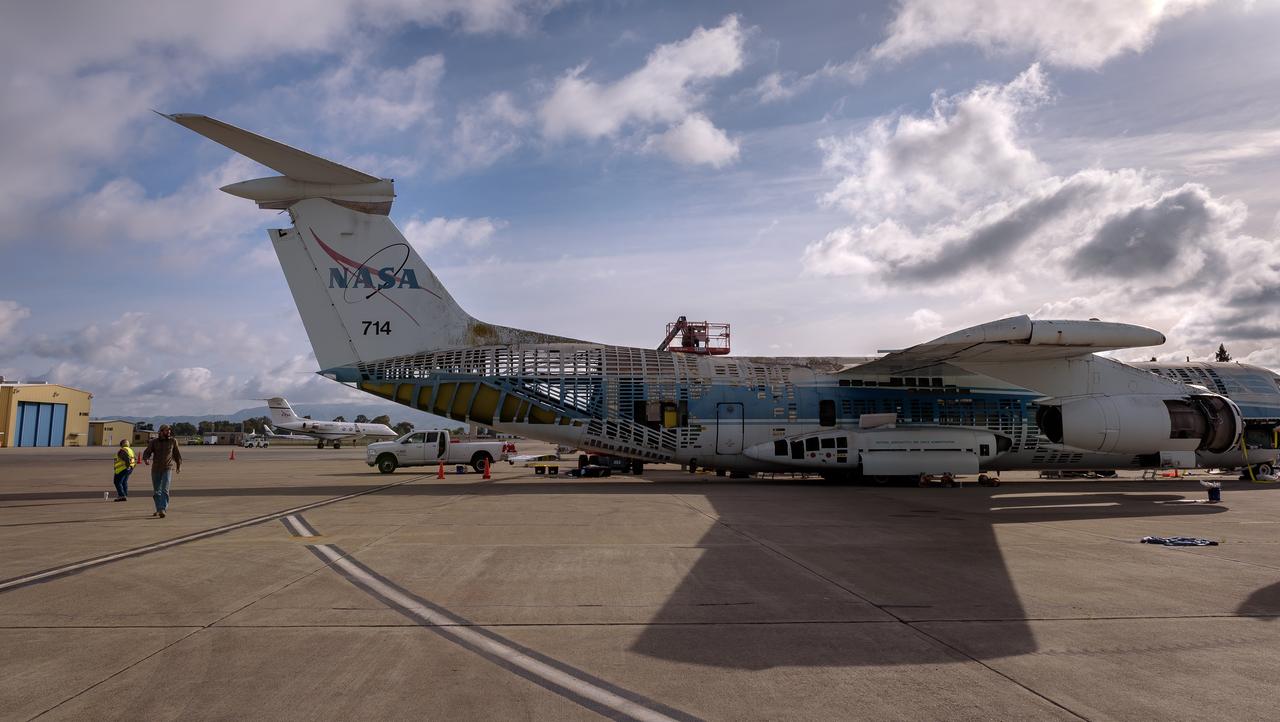
The tail section of the modified C-141 Kuiper Airborne Observatory, (KAO) (NASA-714), severed from the fuselage on the N211 apron of Moffett Field, California.
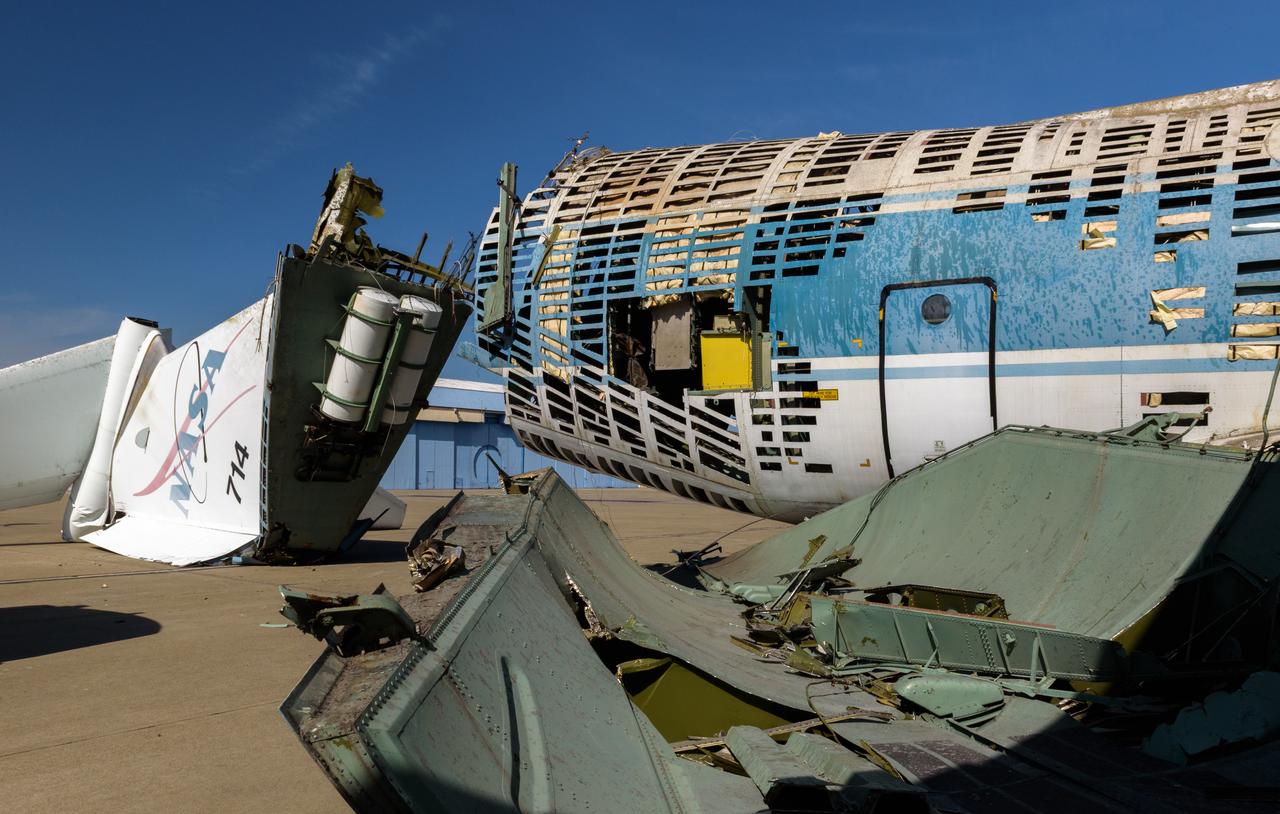
The tail section of the modified C-141 Kuiper Airborne Observatory, (KAO) (NASA-714), severed from the fuselage on the N211 apron of Moffett Field, California.
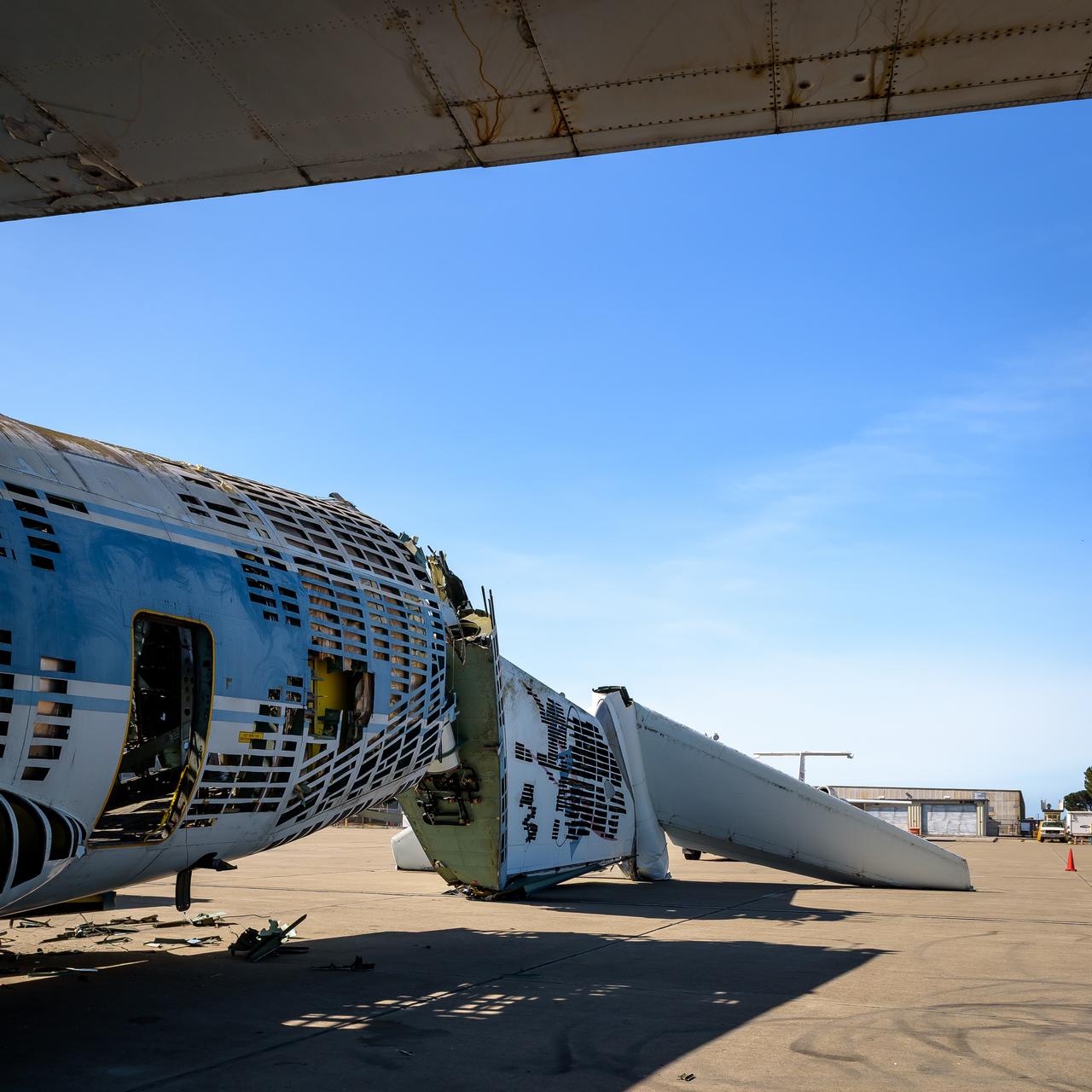
The tail section of the modified C-141 Kuiper Airborne Observatory, (KAO) (NASA-714), severed from the fuselage on the N211 apron of Moffett Field, California.
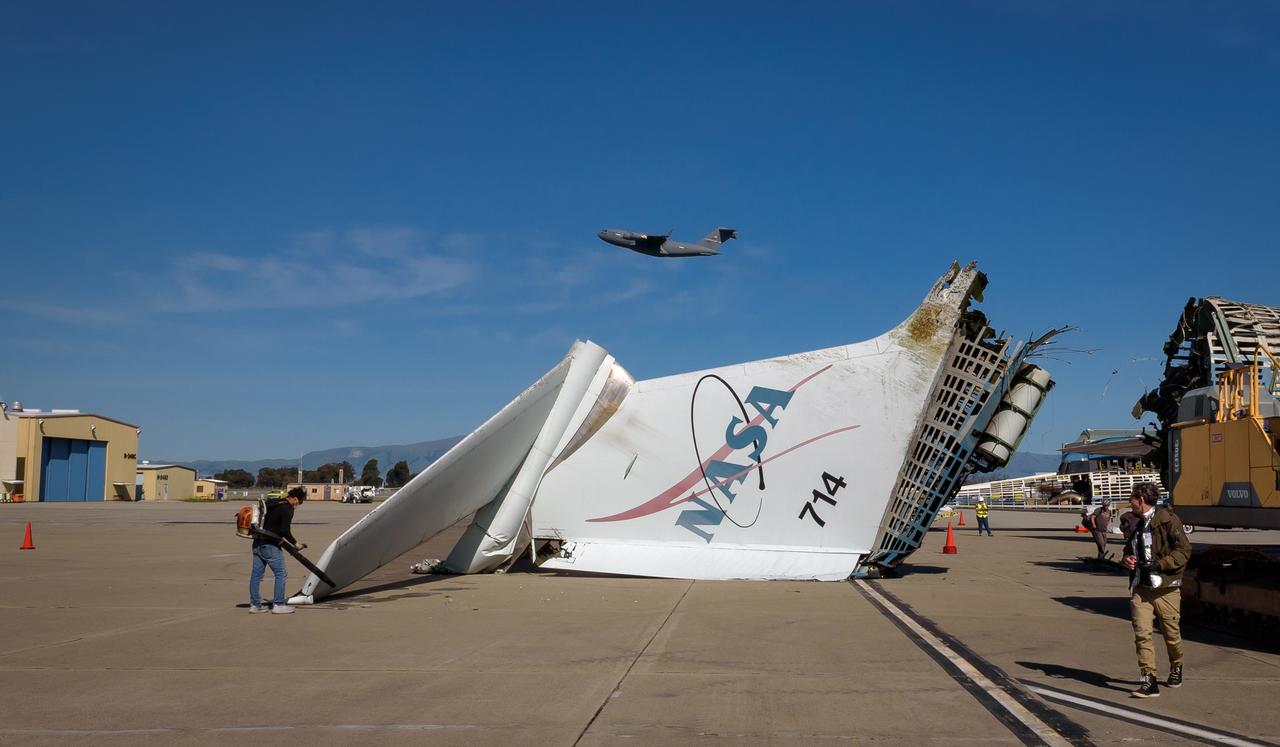
The tail section of the modified C-141 Kuiper Airborne Observatory, (KAO) (NASA-714), severed from the fuselage on the N211 apron of Moffett Field, California.

Technicians lift the engine section for NASA’s Artemis IV SLS (Space Launch System) rocket ahead of further processing inside the high bay of the Space Systems Processing Facility at the agency's Kennedy Space Center in Florida on Monday, Oct. 21, 2024. The engine section is one of five major elements that makes up the SLS rocket’s 212-foot-tall core stage, which house the rocket’s four RS-25 engines and vital systems for mounting, controlling, and delivering fuel from the stage’s two massive liquid propellant tanks to the engines.
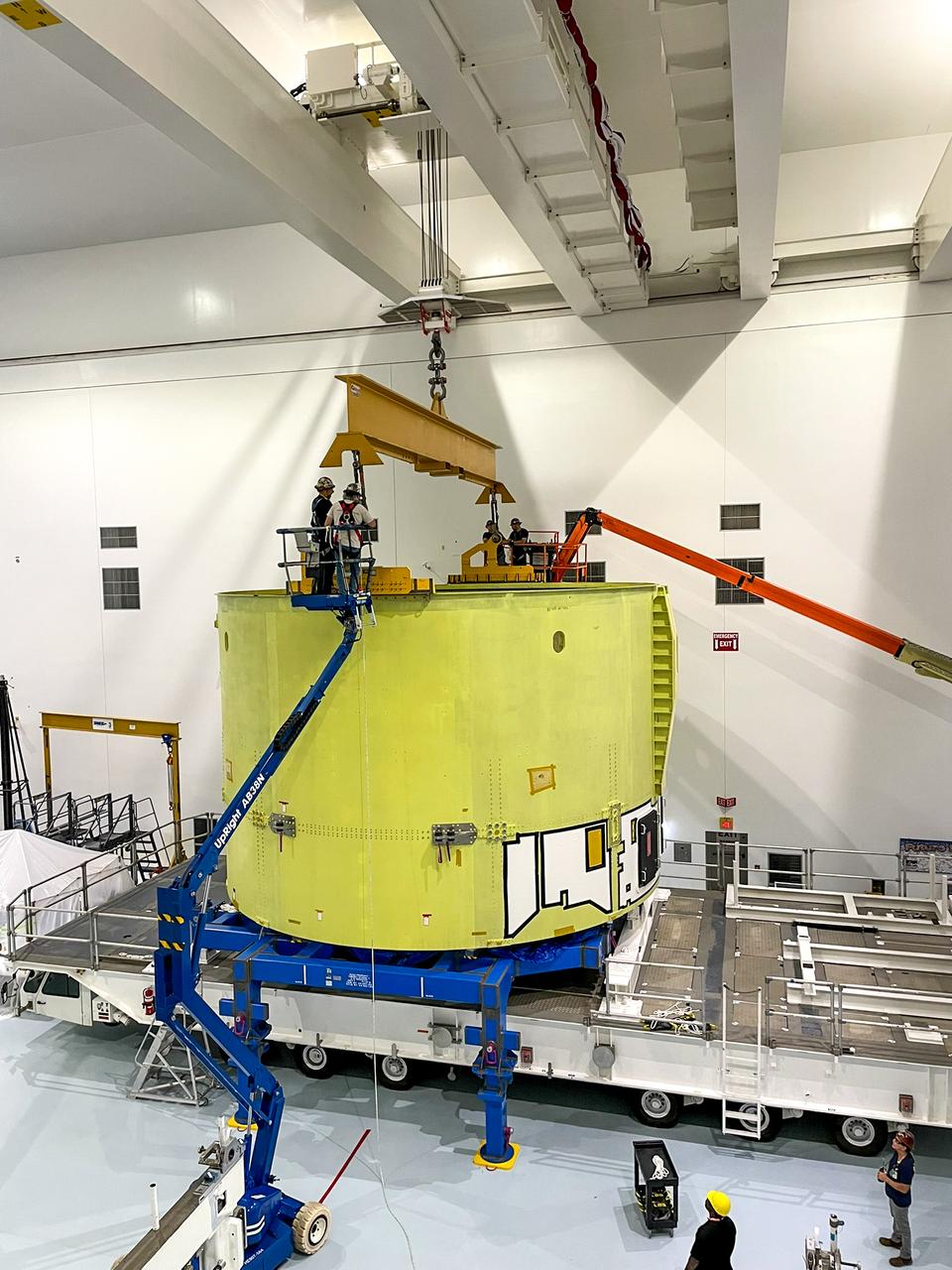
Technicians lift the engine section for NASA’s Artemis IV SLS (Space Launch System) rocket ahead of further processing inside the high bay of the Space Systems Processing Facility at the agency's Kennedy Space Center in Florida on Monday, Oct. 21, 2024. The engine section is one of five major elements that makes up the SLS rocket’s 212-foot-tall core stage, which house the rocket’s four RS-25 engines and vital systems for mounting, controlling, and delivering fuel from the stage’s two massive liquid propellant tanks to the engines.
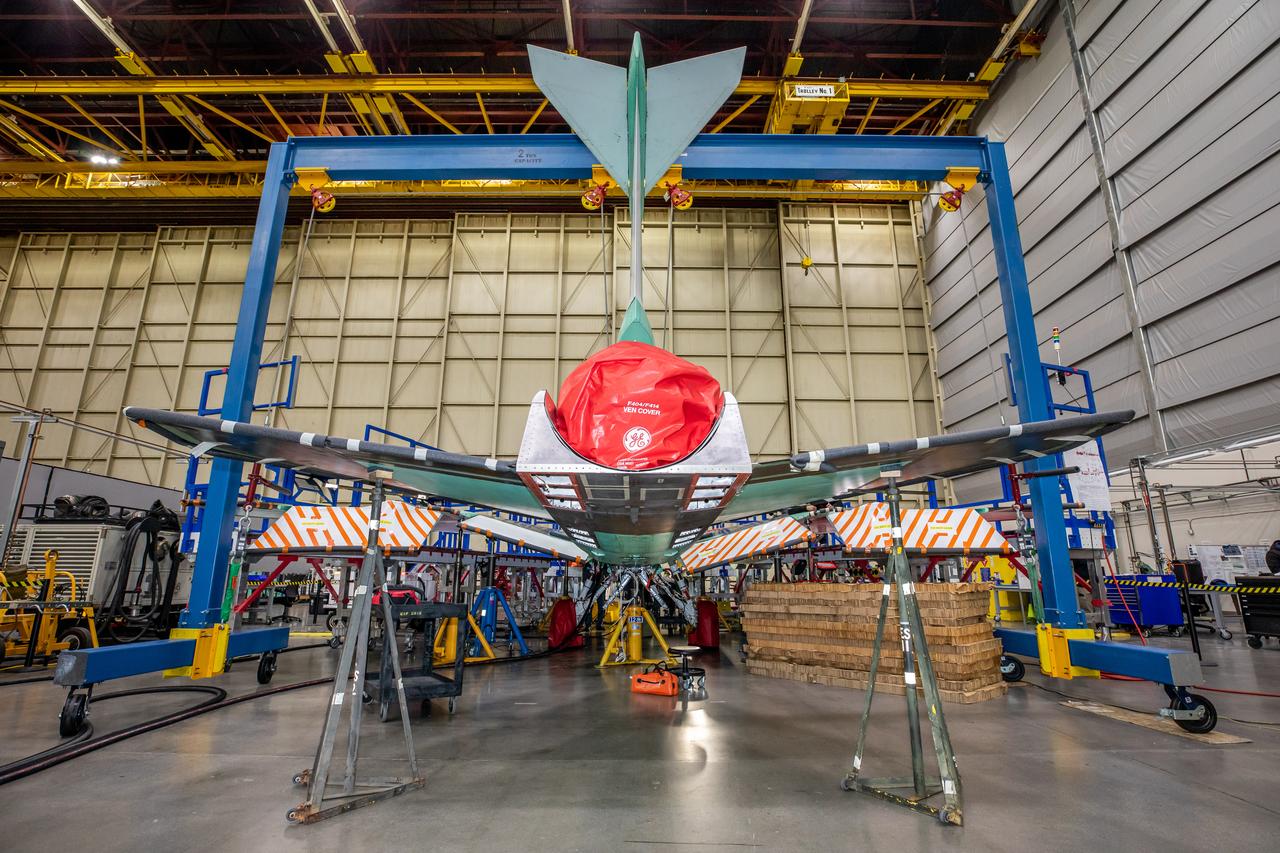
NASA’s X-59 sits in support framing while undergoing the installation of its lower empennage, or tail section, at Lockheed Martin Skunk Works in Palmdale, California in late March.
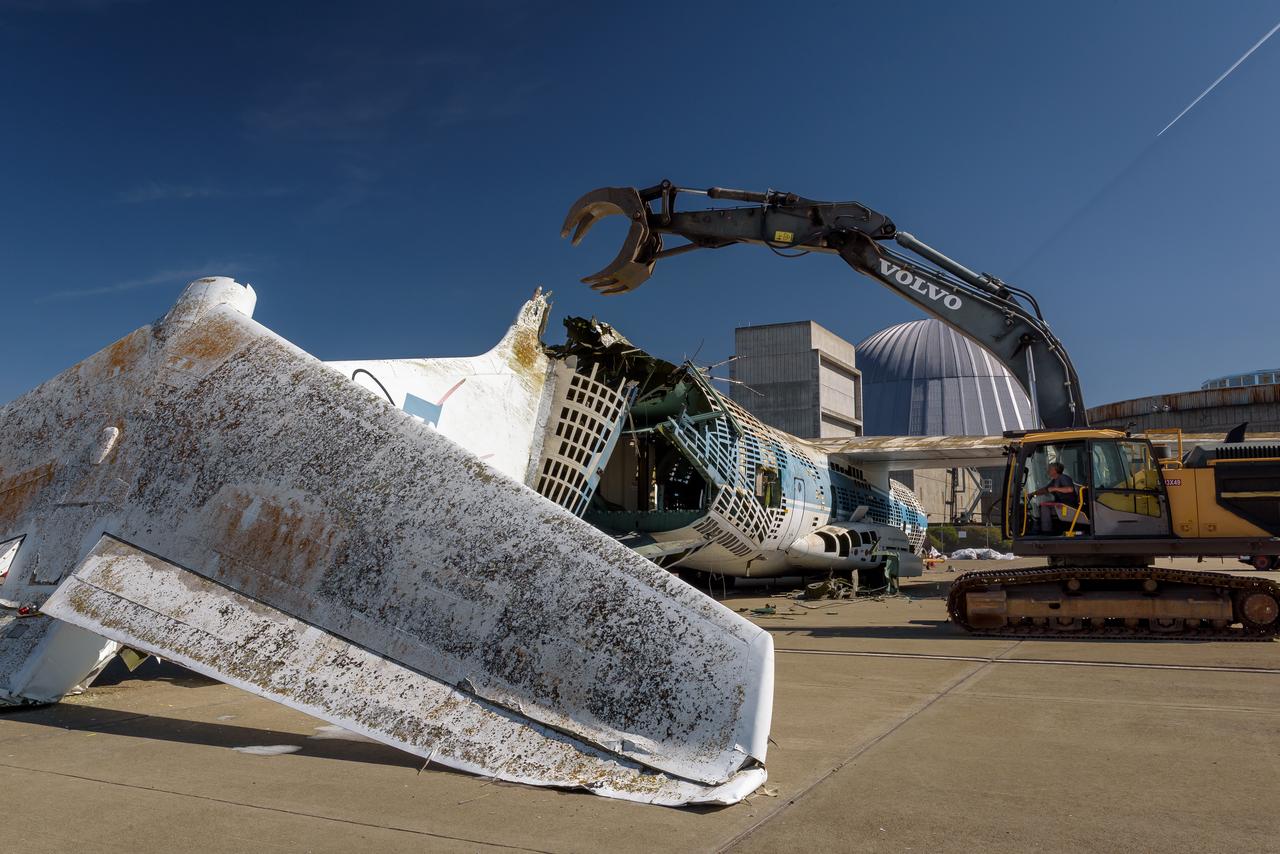
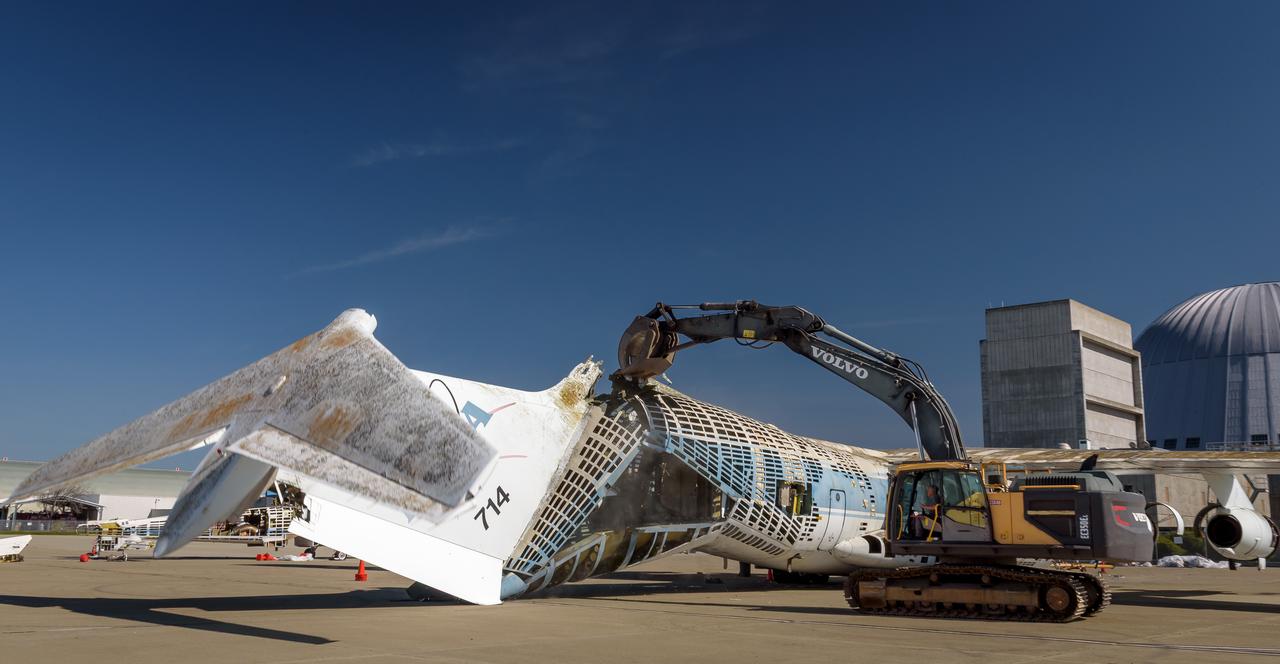
A Volvo Crawler Excavator severs the airframe, separating the tail section from the fuselage, of the modified C-141 Kuiper Airborne Observatory, (KAO) (NASA-714), on the N211 apron of Moffett Field, California.
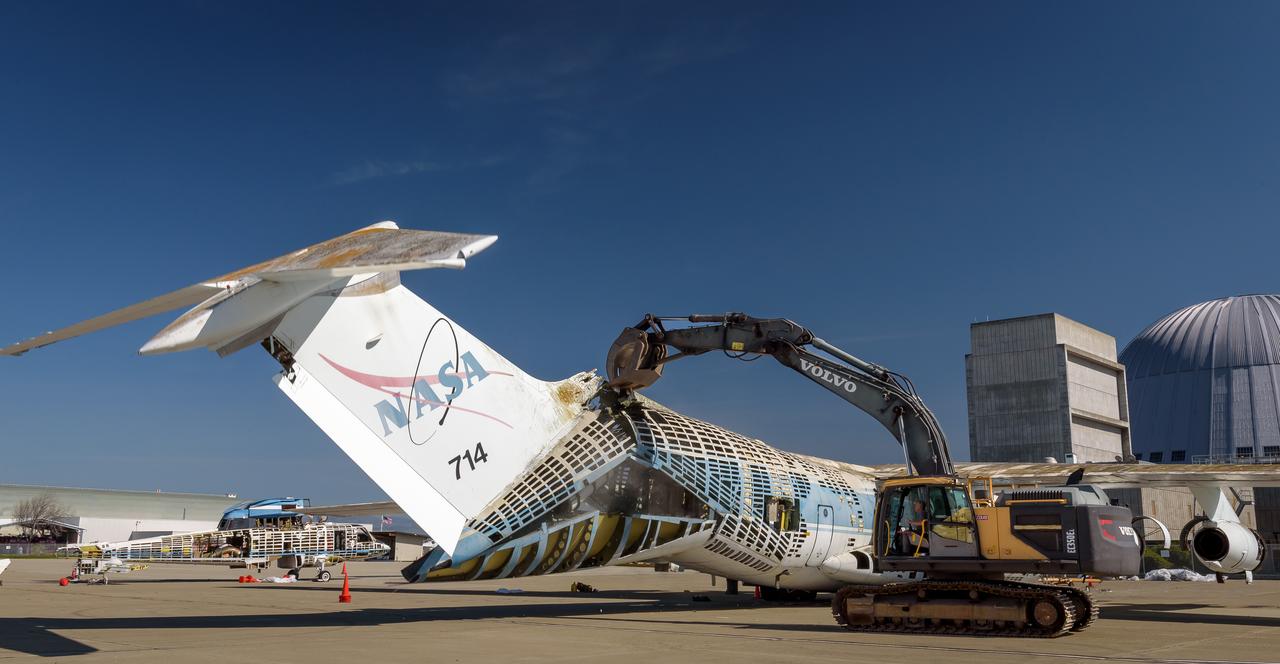
A Volvo Crawler Excavator severs the airframe, separating the tail section from the fuselage, of the modified C-141 Kuiper Airborne Observatory, (KAO) (NASA-714), on the N211 apron of Moffett Field, California.

Close-up view of the tail section of the modified C-141 Kuiper Airborne Observatory, (KAO) (NASA-714), during its demolition on the N211 apron at Moffett Field, California.
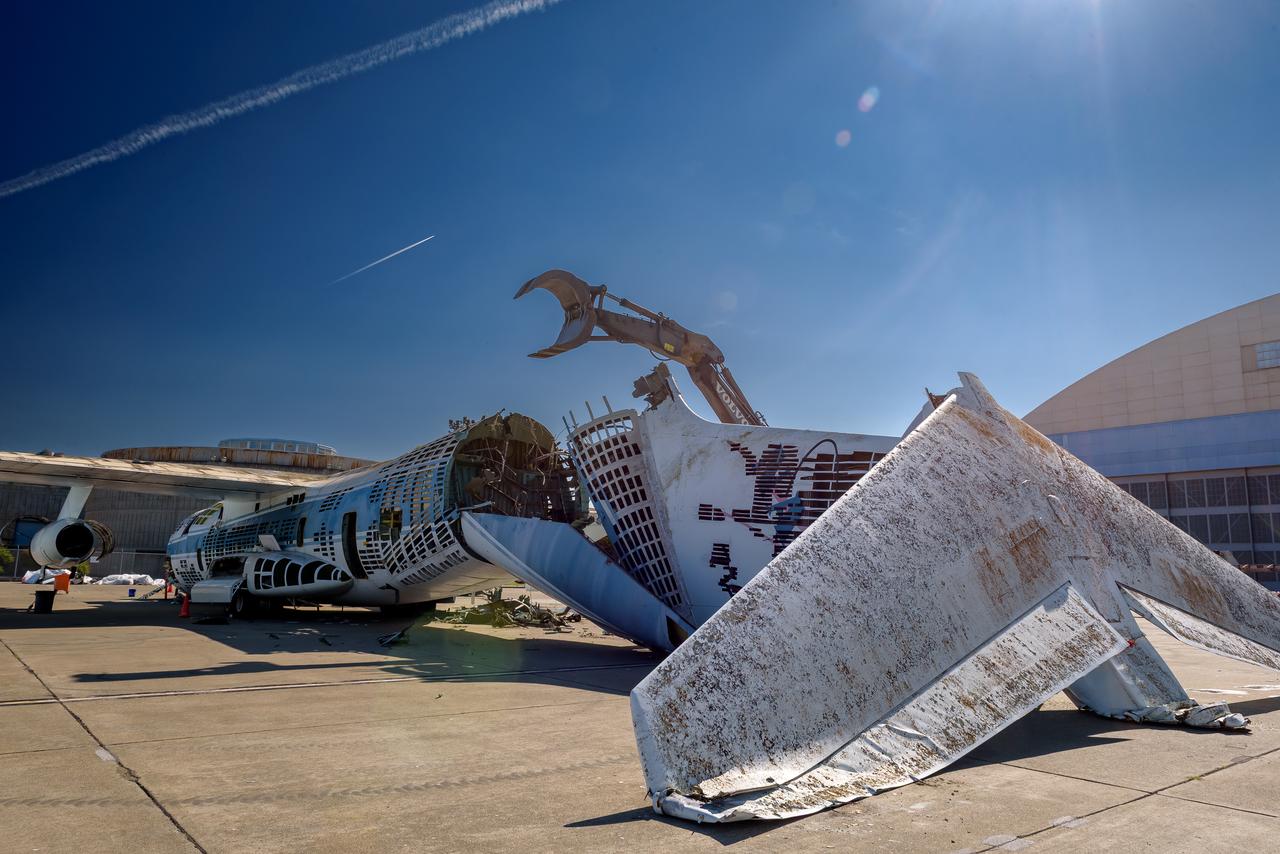
A Volvo Crawler Excavator severs the airframe, separating the tail section from the fuselage, of the modified C-141 Kuiper Airborne Observatory, (KAO) (NASA-714), on the N211 apron of Moffett Field, California.
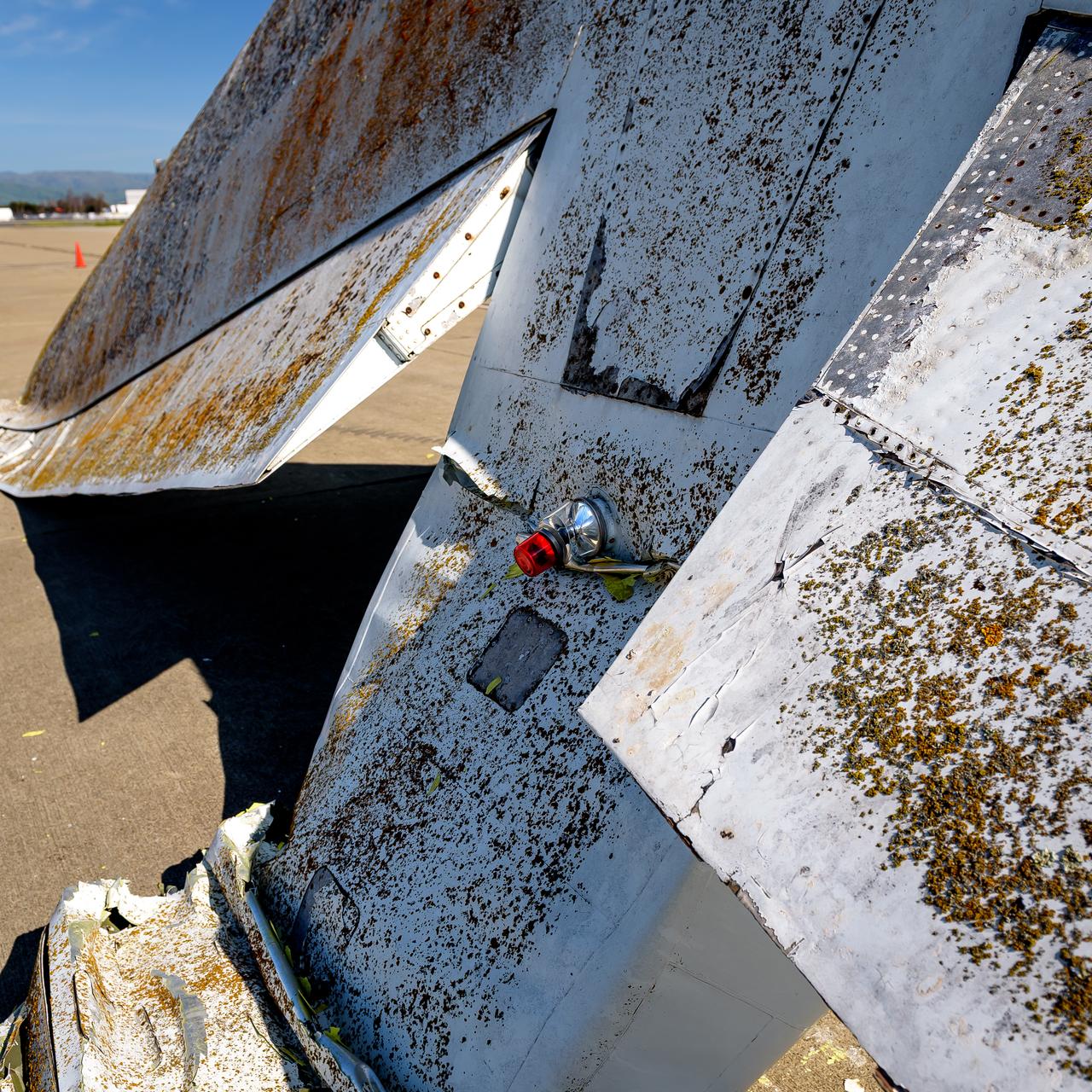
Close-up view of the tail section of the modified C-141 Kuiper Airborne Observatory, (KAO) (NASA-714), severed from the fuselage on the N211 apron at Moffett Field, California.
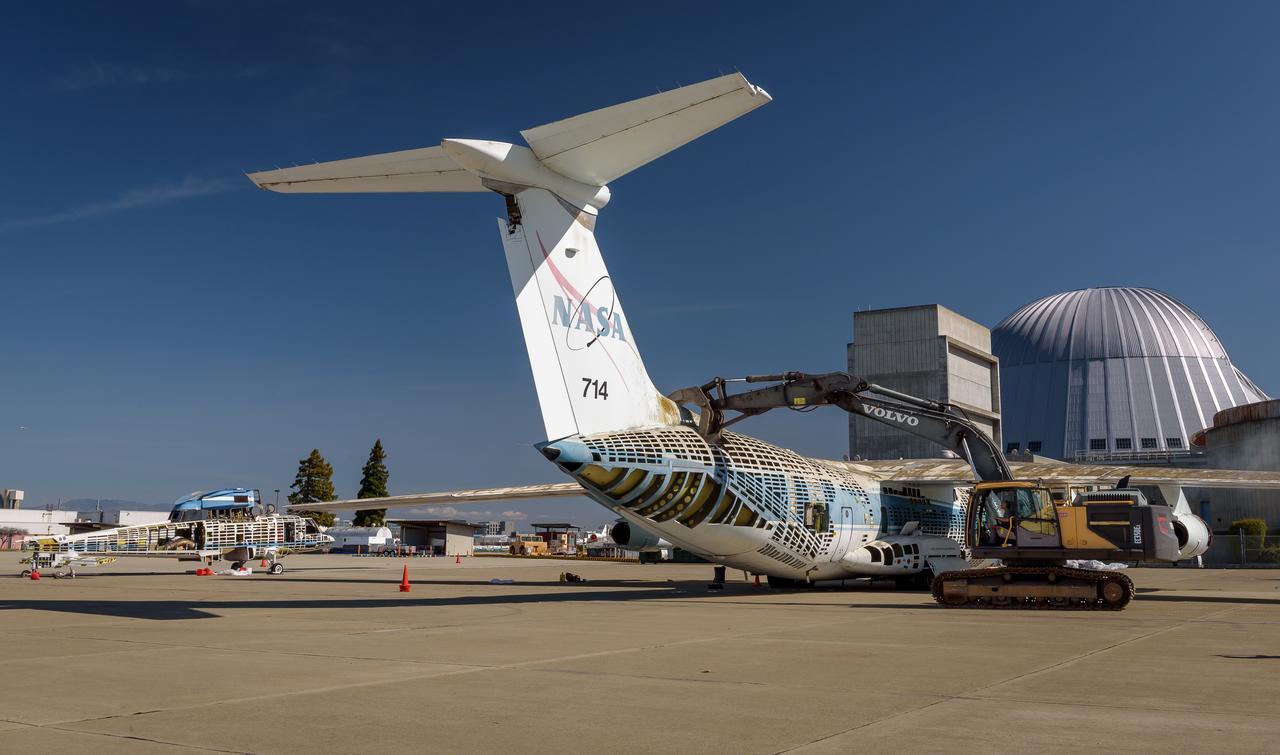
A Volvo Crawler Excavator severs the airframe, separating the tail section from the fuselage, of the modified C-141 Kuiper Airborne Observatory, (KAO) (NASA-714), on the N211 apron of Moffett Field, California.
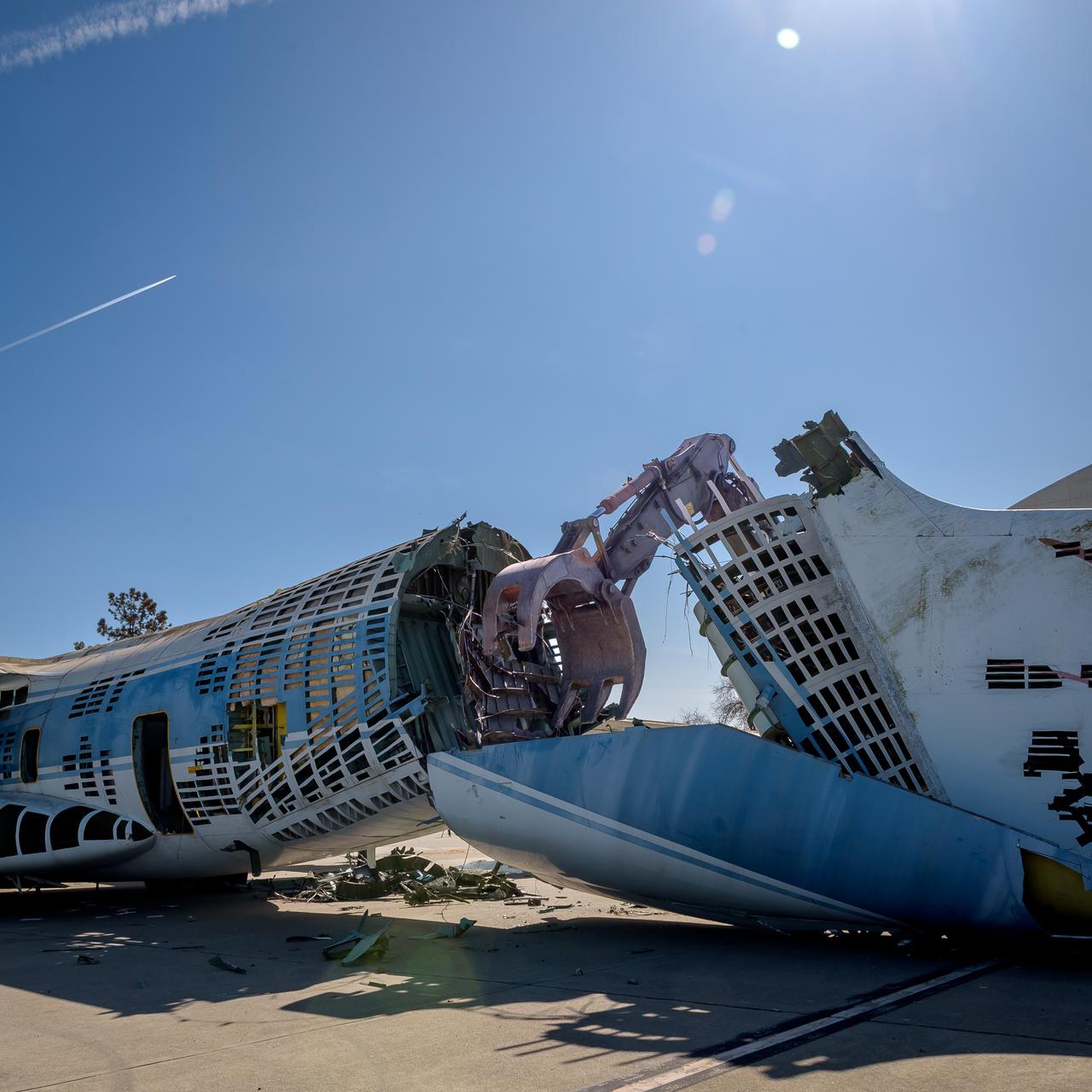
Daylight shines through the airframe during the demolition of the modified C-141 Kuiper Airborne Observatory, (KAO) (NASA-714), tail section on the N211 apron at Moffett Field, California.
A Volvo Crawler Excavator severs the airframe, separating the tail section from the fuselage, of the modified C-141 Kuiper Airborne Observatory, (KAO) (NASA-714), on the N211 apron of Moffett Field, California.
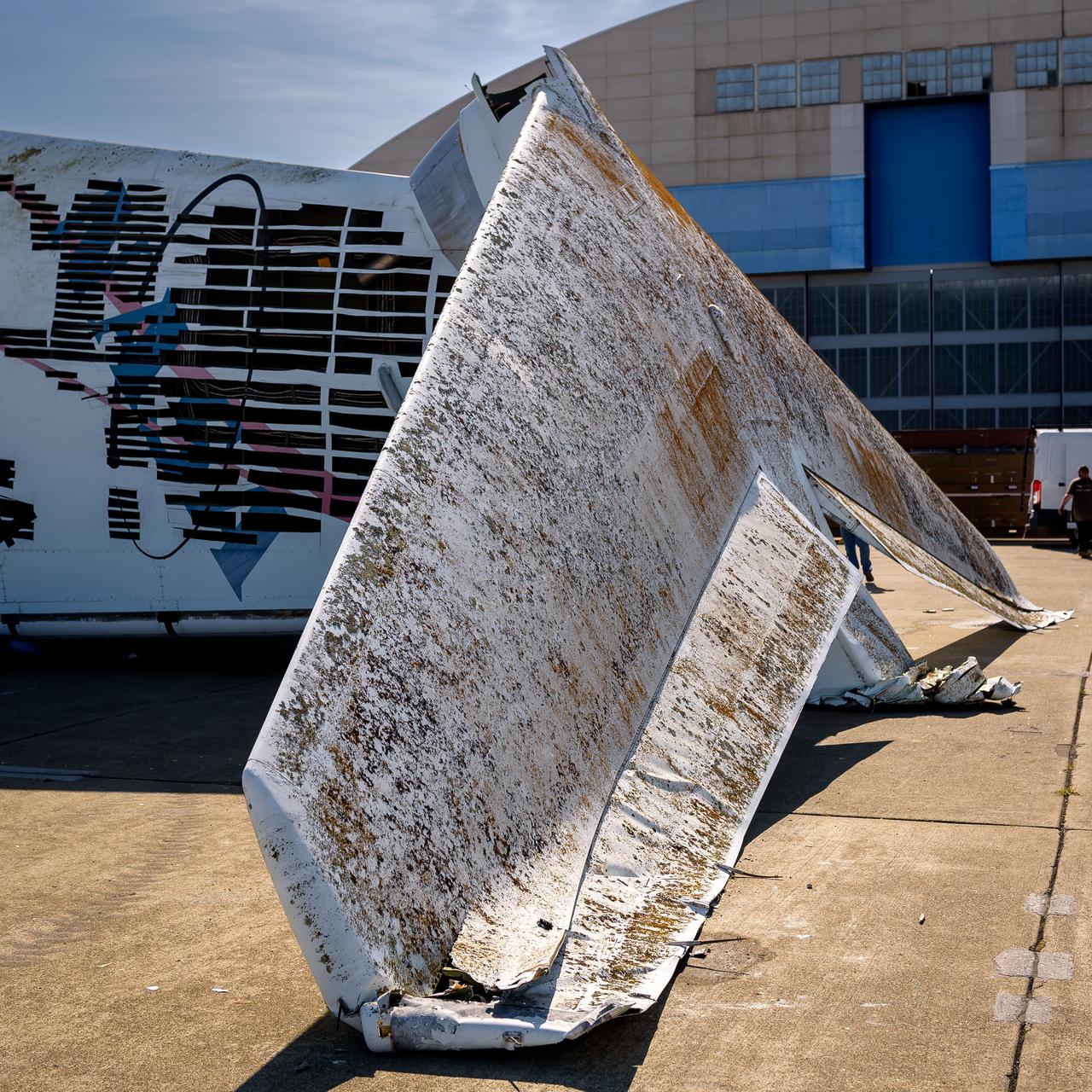
Close-up view of the tail section of the modified C-141 Kuiper Airborne Observatory, (KAO) (NASA-714), severed from the fuselage on the N211 apron at Moffett Field, California.
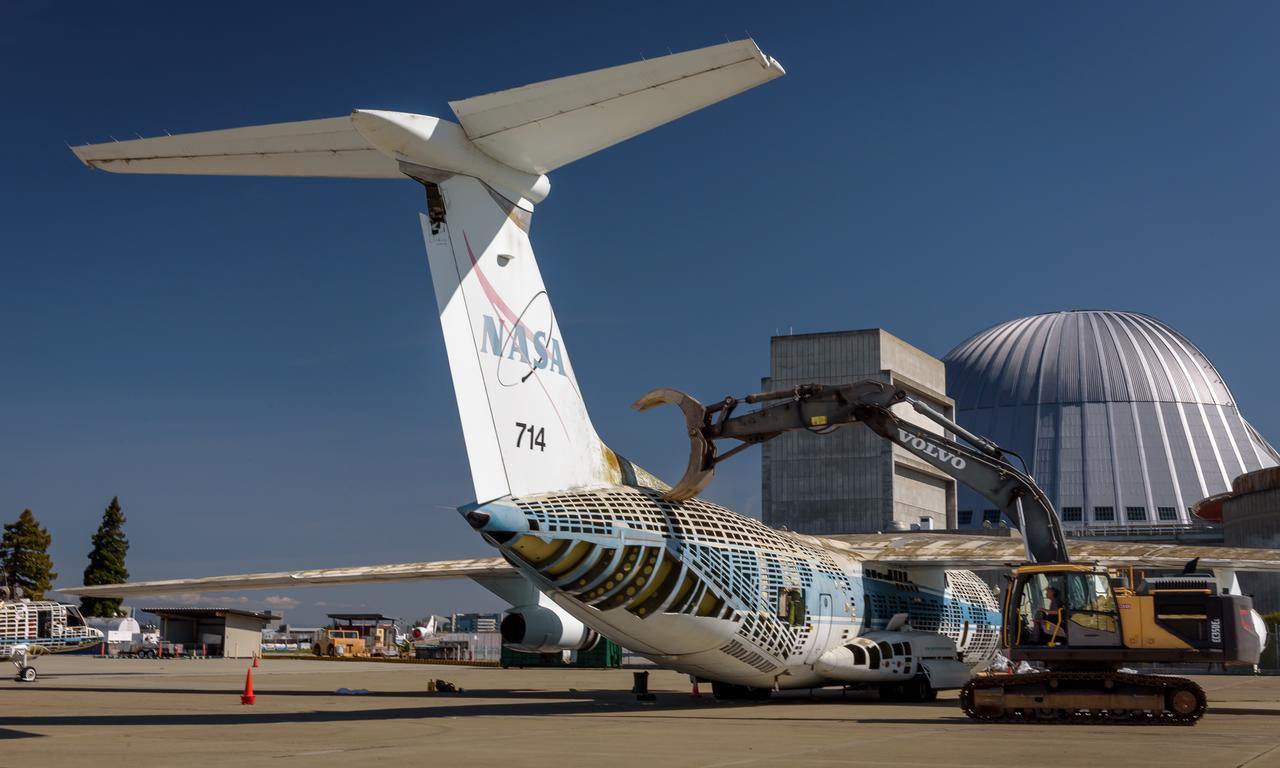
A Volvo Crawler Excavator severs the airframe, separating the tail section from the fuselage, of the modified C-141 Kuiper Airborne Observatory, (KAO) (NASA-714), on the N211 apron of Moffett Field, California.
A Volvo Crawler Excavator severs the airframe, separating the tail section from the fuselage, of the modified C-141 Kuiper Airborne Observatory, (KAO) (NASA-714), on the N211 apron of Moffett Field, California.
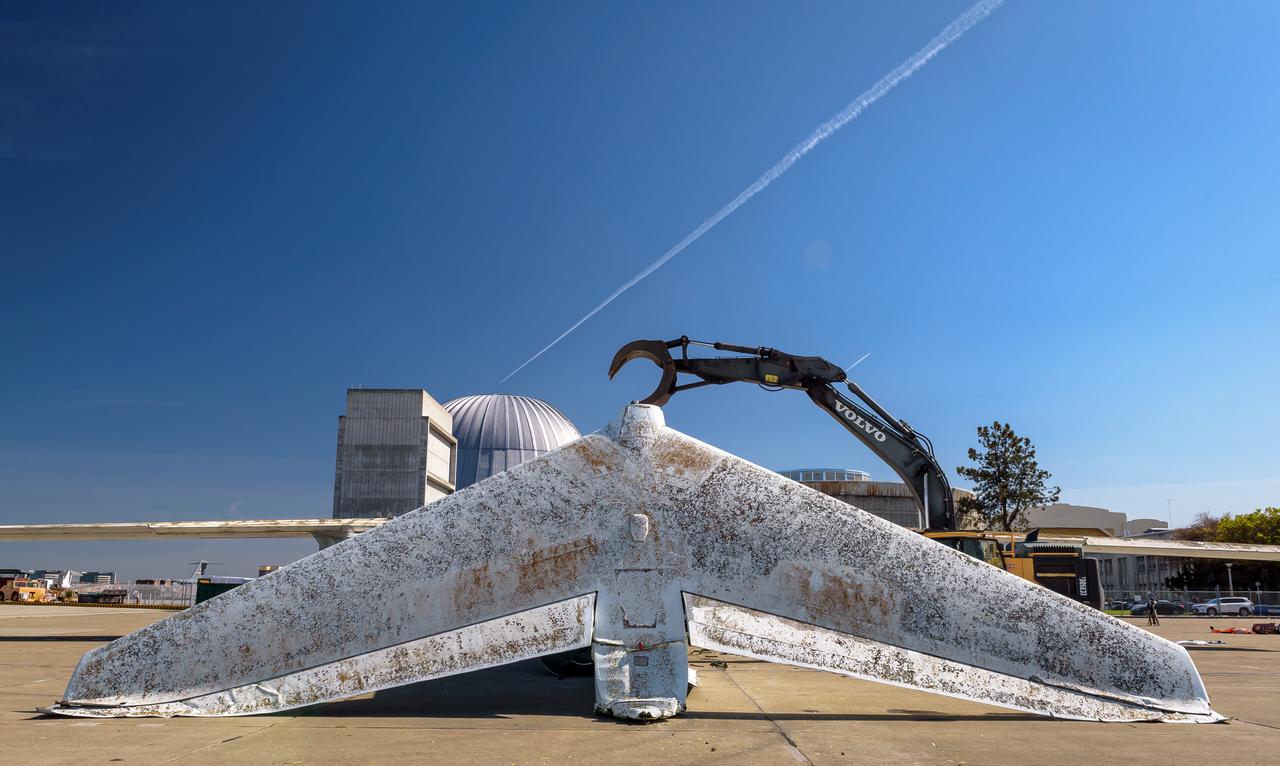
A Volvo Crawler Excavator severs the airframe, separating the tail section from the fuselage, of the modified C-141 Kuiper Airborne Observatory, (KAO) (NASA-714), on the N211 apron of Moffett Field, California.

Technicians with NASA and Boeing complete attaching the engine section to the boat-tail for the agency’s Artemis III SLS (Space Launch System) rocket inside the high bay of the Space Systems Processing Facility at NASA’s Kennedy Space Center in Florida on Wednesday, Oct. 30, 2024. The engine section is one of five major elements that makes up the SLS rocket’s 212-foot-tall core stage, which house the rocket’s four RS-25 engines and vital systems for mounting, controlling, and delivering fuel from the stage’s two massive liquid propellant tanks to the engines. The boat-tail is designed to protect the bottom end of the core stage and the RS-25 engines.
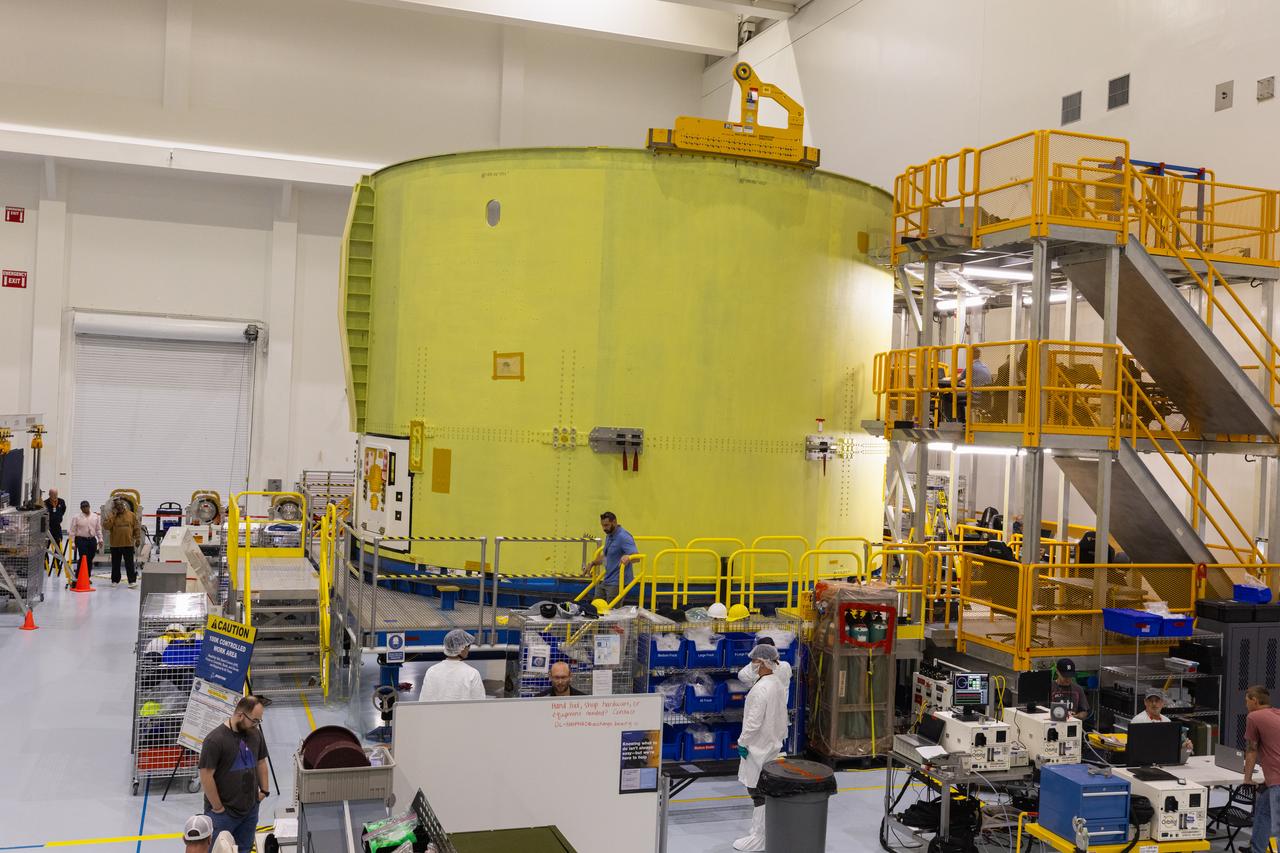
Technicians with NASA and Boeing complete attaching the engine section to the boat-tail for the agency’s Artemis III SLS (Space Launch System) rocket inside the high bay of the Space Systems Processing Facility at NASA’s Kennedy Space Center in Florida on Wednesday, Oct. 30, 2024. The engine section is one of five major elements that makes up the SLS rocket’s 212-foot-tall core stage, which house the rocket’s four RS-25 engines and vital systems for mounting, controlling, and delivering fuel from the stage’s two massive liquid propellant tanks to the engines. The boat-tail is designed to protect the bottom end of the core stage and the RS-25 engines.

Technicians with NASA and Boeing complete attaching the engine section to the boat-tail for the agency’s Artemis III SLS (Space Launch System) rocket inside the high bay of the Space Systems Processing Facility at NASA’s Kennedy Space Center in Florida on Wednesday, Oct. 30, 2024. The engine section is one of five major elements that makes up the SLS rocket’s 212-foot-tall core stage, which house the rocket’s four RS-25 engines and vital systems for mounting, controlling, and delivering fuel from the stage’s two massive liquid propellant tanks to the engines. The boat-tail is designed to protect the bottom end of the core stage and the RS-25 engines.
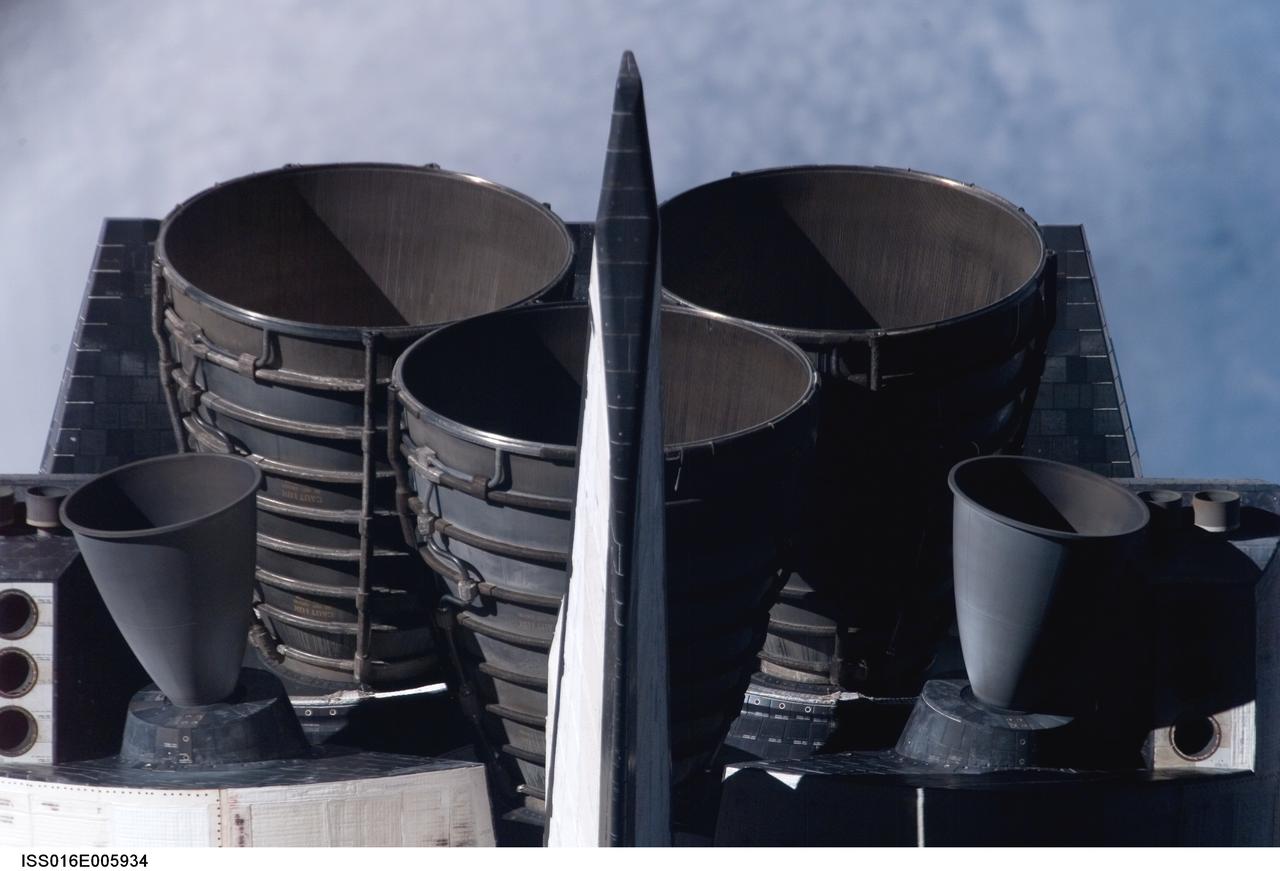
ISS016-E-005934 (25 Oct. 2007) --- The Space Shuttle Discovery's tail section is featured in this image photographed by an Expedition 16 crewmember during a backflip maneuver performed by the approaching visitors (STS-120) to the International Space Station. Visible are the shuttle's main engines and vertical stabilizer.
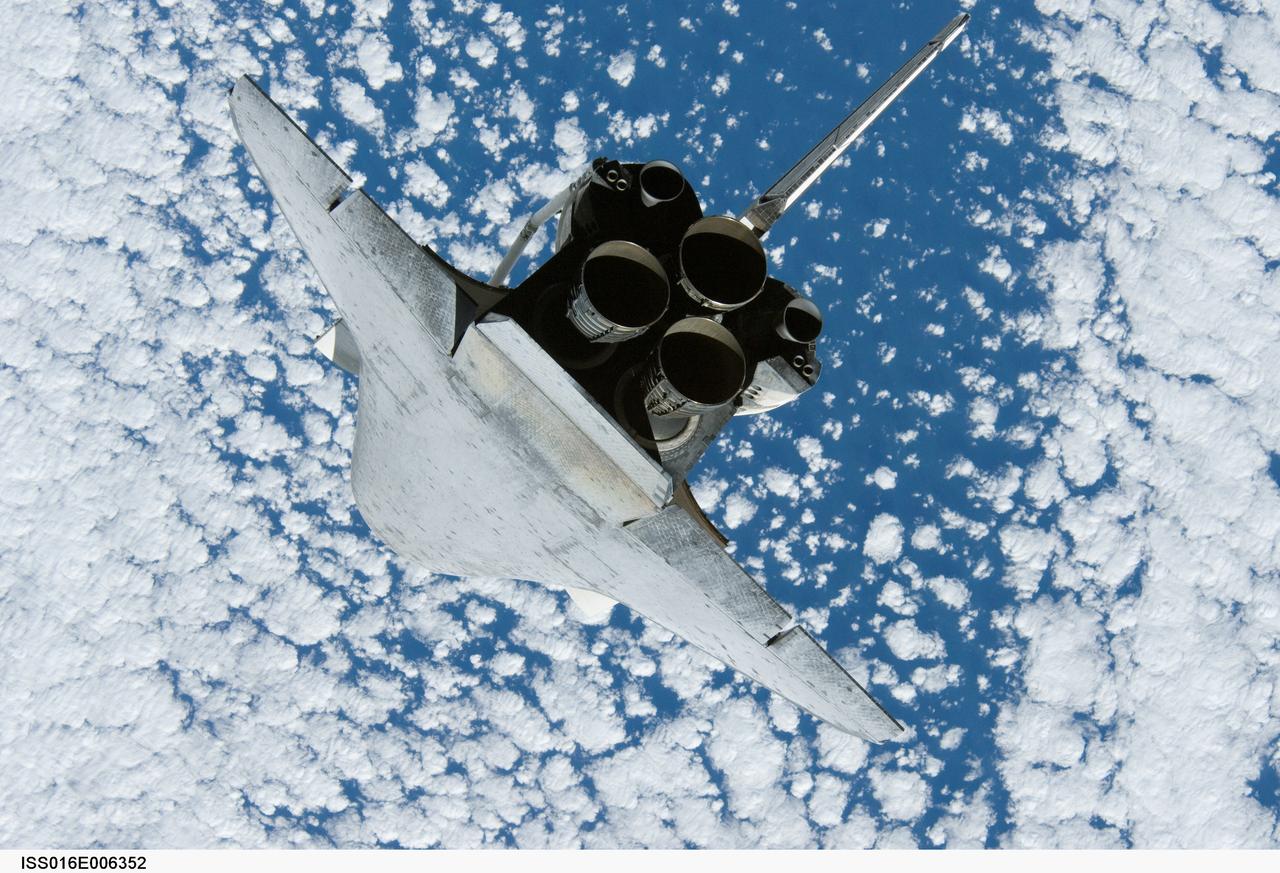
ISS016-E-006352 (25 Oct. 2007) --- Backdropped by a blue and white Earth, the tail section and underside of the Space Shuttle Discovery are featured in this image photographed by an Expedition 16 crewmember during a backflip maneuver performed by the approaching visitors (STS-120) to the International Space Station.
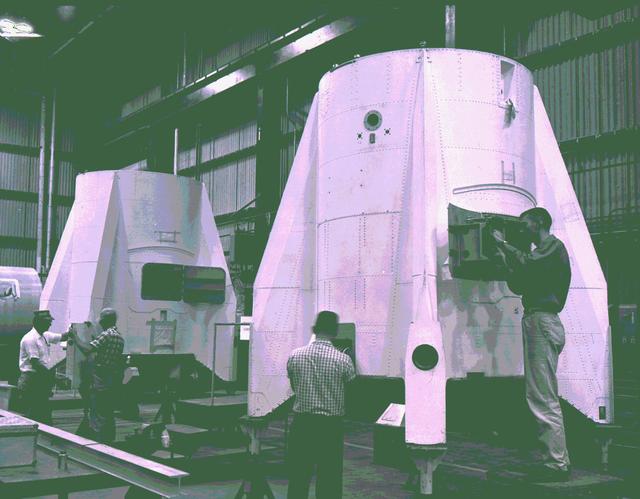
In this 1959 photograph, technicians prepare tail sections for Mercury-Redstone vehicles in Building 4706 at Redstone Arsenal in Huntsville, Alabama. Developed by Dr. Wernher von Braun and the rocket team at Redstone, the Mercury-Redstone launched the first two marned U.S. missions.
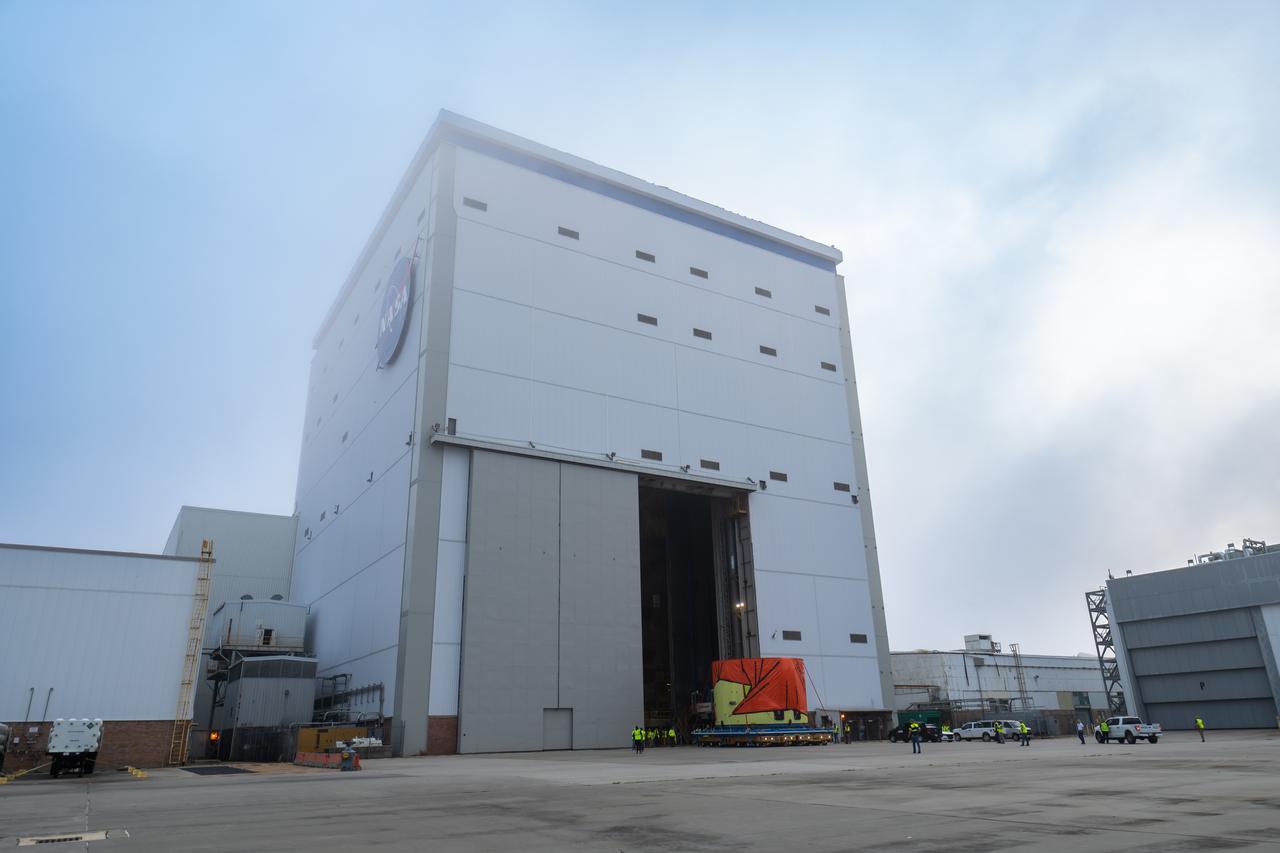
Teams at NASA’s Michoud Assembly Facility in New Orleans move the engine section flight hardware to the agency’s Pegasus barge Sunday, Dec. 4. The barge will ferry the engine section of NASA’s Space Launch System (SLS) rocket for Artemis III to the agency’s Kennedy Space Center in Florida. Once there, teams at Kennedy will finish outfitting the engine section, which comprises the tail-end of the rocket’s 212-foot-tall core stage, before integrating it to the rest of the stage. Beginning with production for Artemis III, NASA and core stage lead contractor Boeing will use Michoud, where the SLS core stages are currently manufactured, to produce and outfit the core stage’s five elements, and available space at Kennedy for final assembly and integration.
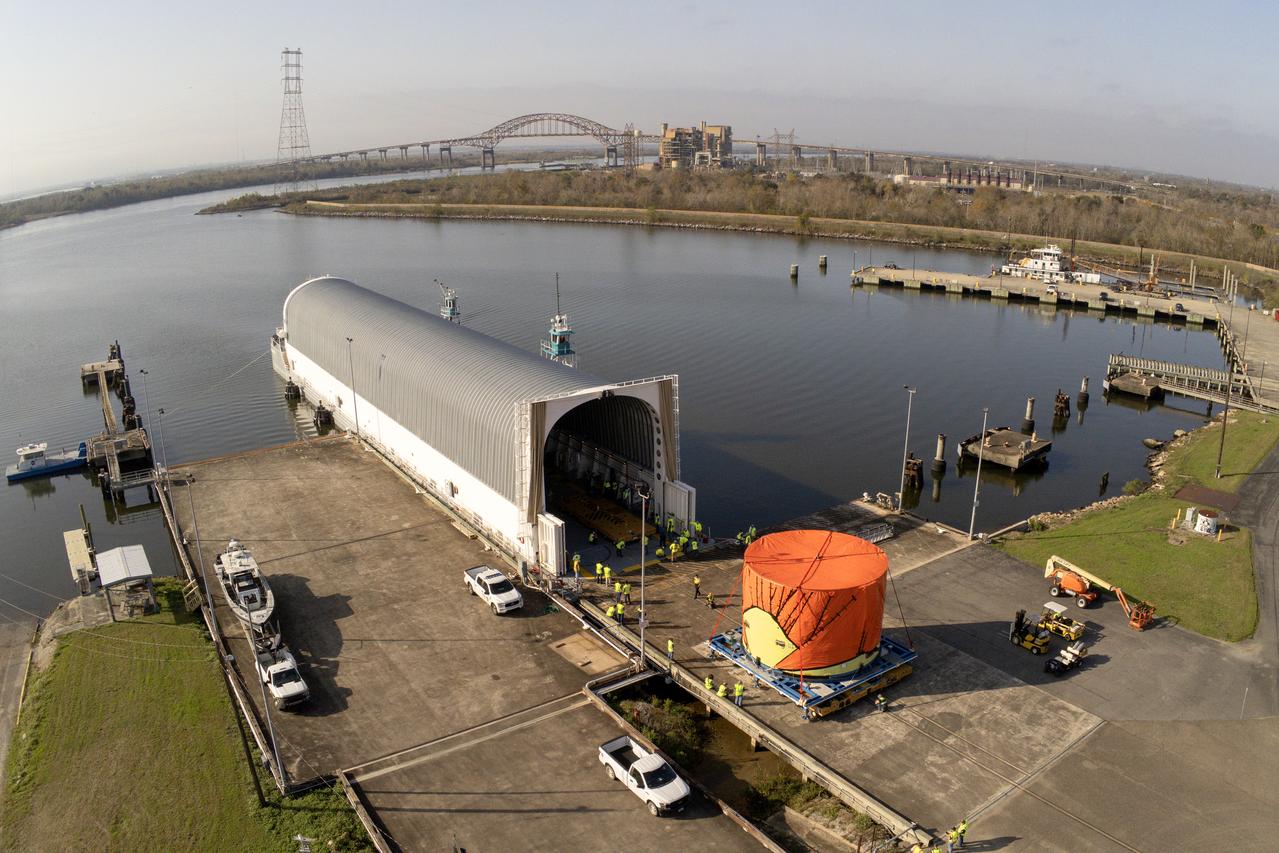
Teams at NASA’s Michoud Assembly Facility in New Orleans move the engine section flight hardware to the agency’s Pegasus barge on Sunday, December 4, 2022. The barge will ferry the engine section of NASA’s Space Launch System (SLS) rocket for Artemis III to the agency’s Kennedy Space Center in Florida. Once there, teams at Kennedy will finish outfitting the engine section, which comprises the tail-end of the rocket’s 212-foot-tall core stage, before integrating it to the rest of the stage. Beginning with production for Artemis III, NASA and core stage lead contractor Boeing will use Michoud, where the SLS core stages are currently manufactured, to produce and outfit the core stage’s five elements, and available space at Kennedy for final assembly and integration. Image credit: NASA/Michael DeMocker
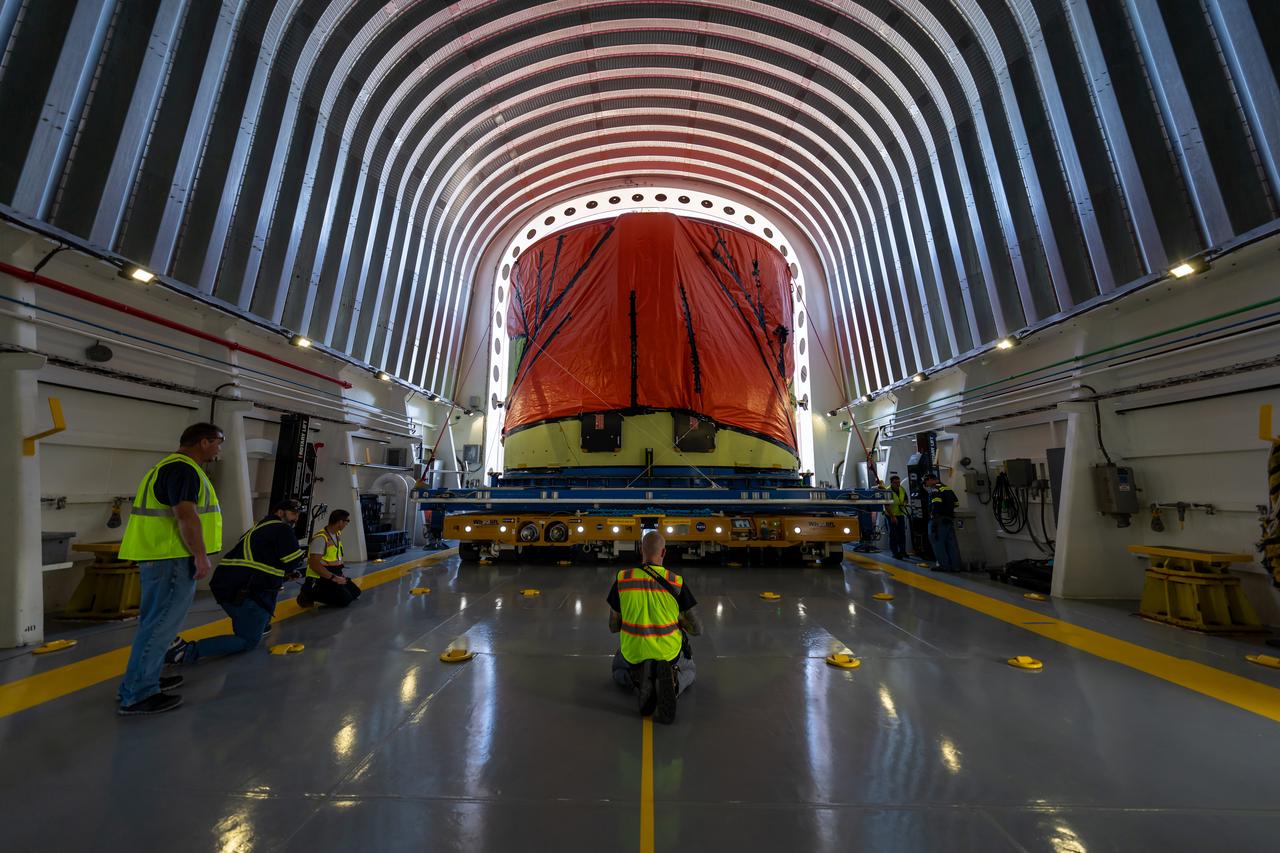
Teams at NASA’s Michoud Assembly Facility in New Orleans move the engine section flight hardware to the agency’s Pegasus barge Sunday, Dec. 4. The barge will ferry the engine section of NASA’s Space Launch System (SLS) rocket for Artemis III to the agency’s Kennedy Space Center in Florida. Once there, teams at Kennedy will finish outfitting the engine section, which comprises the tail-end of the rocket’s 212-foot-tall core stage, before integrating it to the rest of the stage. Beginning with production for Artemis III, NASA and core stage lead contractor Boeing will use Michoud, where the SLS core stages are currently manufactured, to produce and outfit the core stage’s five elements, and available space at Kennedy for final assembly and integration.
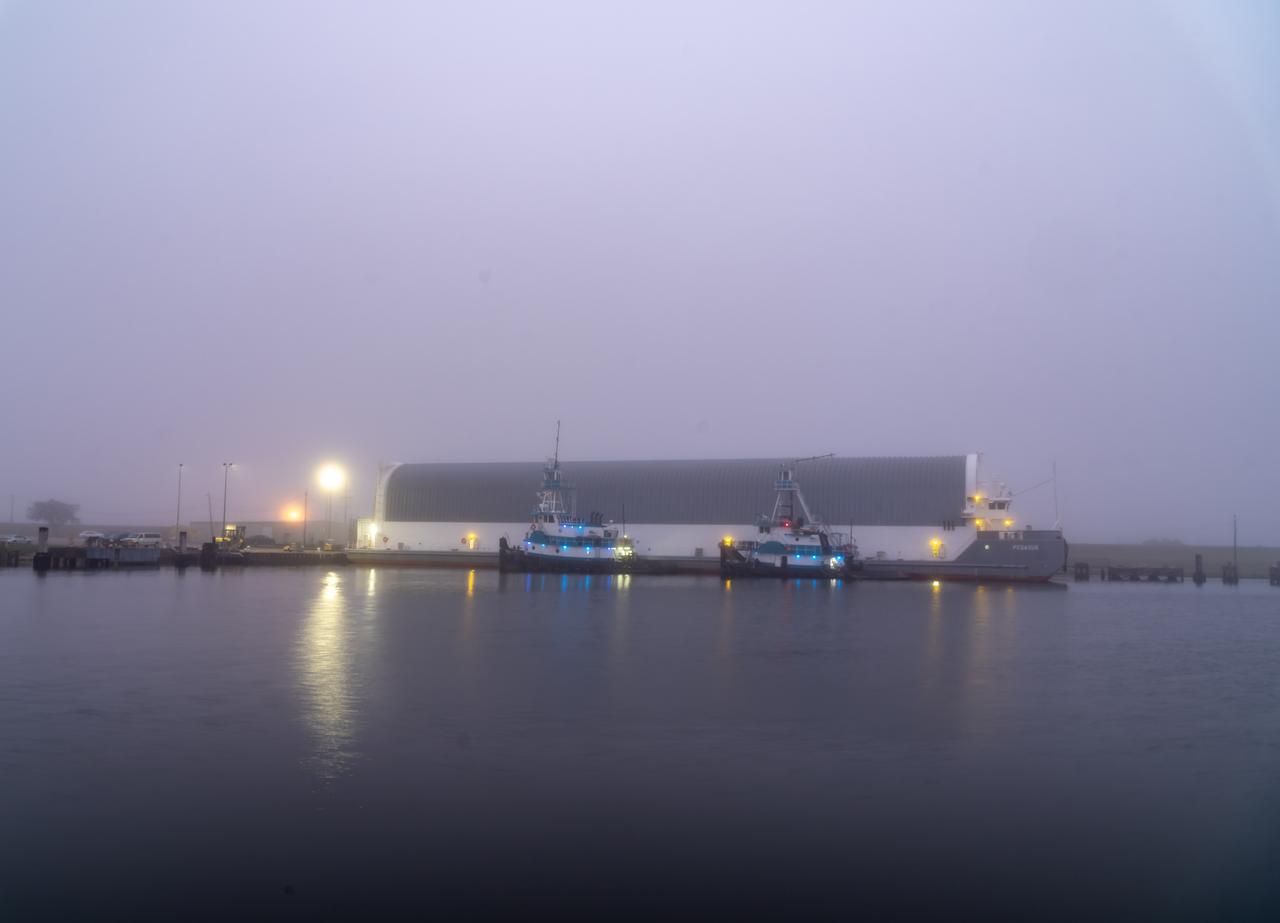
Teams at NASA’s Michoud Assembly Facility in New Orleans move the engine section flight hardware to the agency’s Pegasus barge Sunday, Dec. 4. The barge will ferry the engine section of NASA’s Space Launch System (SLS) rocket for Artemis III to the agency’s Kennedy Space Center in Florida. Once there, teams at Kennedy will finish outfitting the engine section, which comprises the tail-end of the rocket’s 212-foot-tall core stage, before integrating it to the rest of the stage. Beginning with production for Artemis III, NASA and core stage lead contractor Boeing will use Michoud, where the SLS core stages are currently manufactured, to produce and outfit the core stage’s five elements, and available space at Kennedy for final assembly and integration.
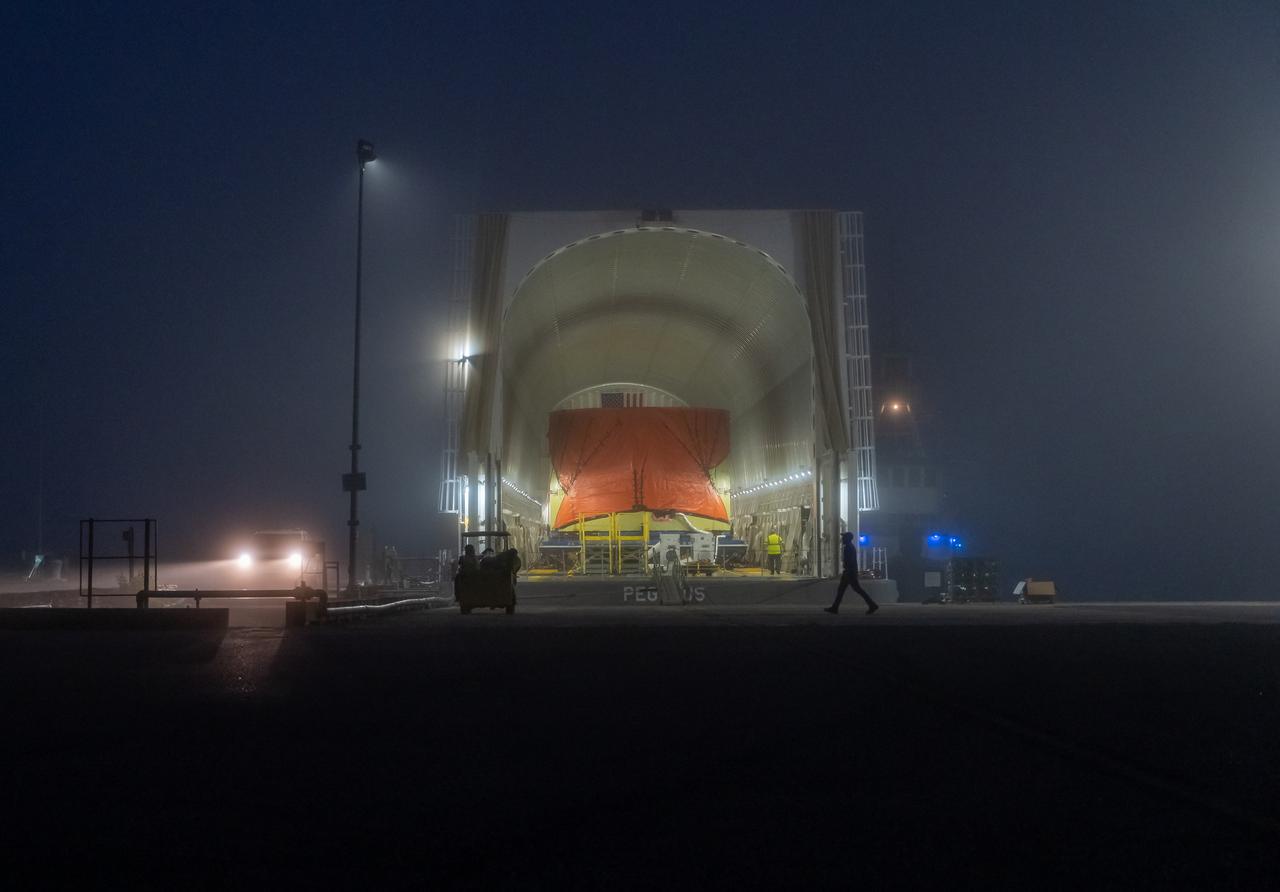
Teams at NASA’s Michoud Assembly Facility in New Orleans move the engine section flight hardware to the agency’s Pegasus barge Sunday, Dec. 4. The barge will ferry the engine section of NASA’s Space Launch System (SLS) rocket for Artemis III to the agency’s Kennedy Space Center in Florida. Once there, teams at Kennedy will finish outfitting the engine section, which comprises the tail-end of the rocket’s 212-foot-tall core stage, before integrating it to the rest of the stage. Beginning with production for Artemis III, NASA and core stage lead contractor Boeing will use Michoud, where the SLS core stages are currently manufactured, to produce and outfit the core stage’s five elements, and available space at Kennedy for final assembly and integration.
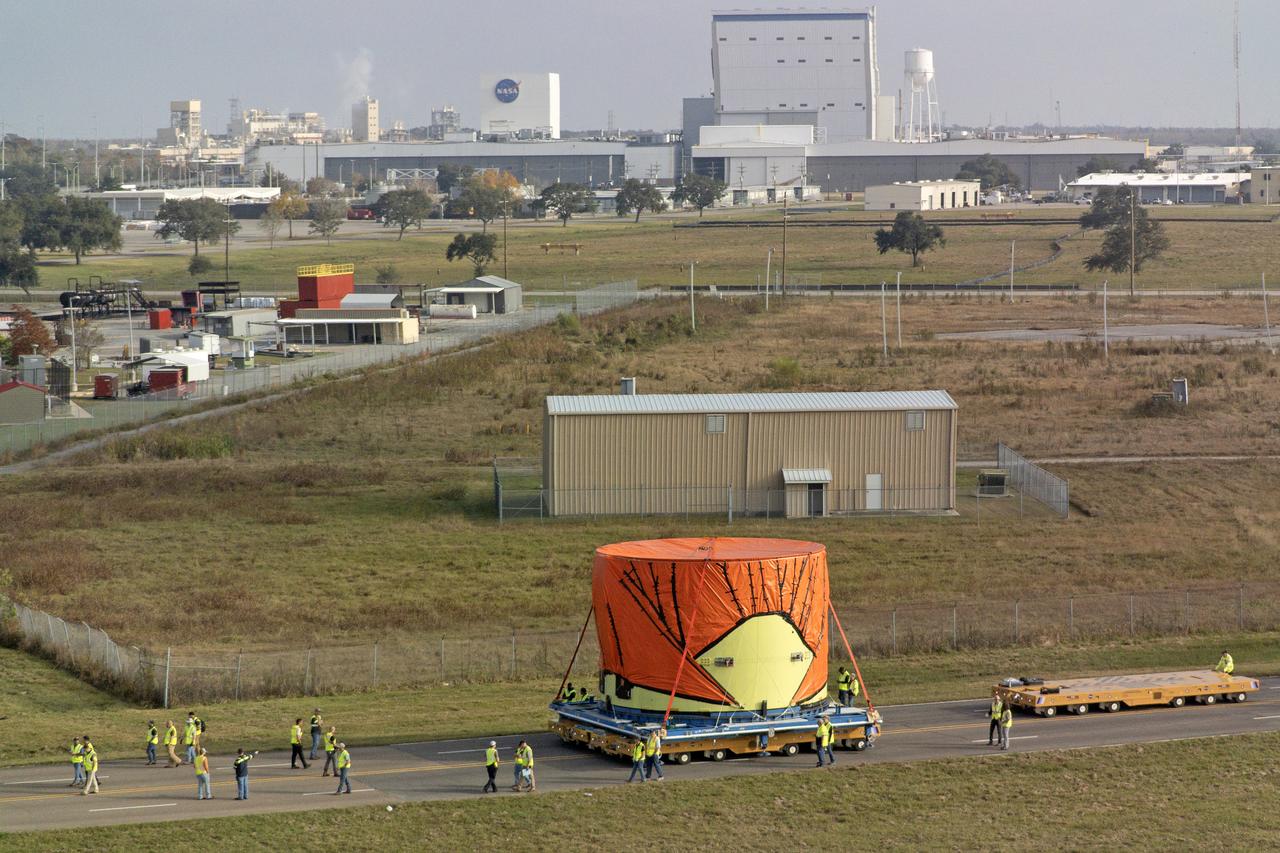
Teams at NASA’s Michoud Assembly Facility in New Orleans move the engine section flight hardware to the agency’s Pegasus barge on Sunday, December 4, 2022. The barge will ferry the engine section of NASA’s Space Launch System (SLS) rocket for Artemis III to the agency’s Kennedy Space Center in Florida. Once there, teams at Kennedy will finish outfitting the engine section, which comprises the tail-end of the rocket’s 212-foot-tall core stage, before integrating it to the rest of the stage. Beginning with production for Artemis III, NASA and core stage lead contractor Boeing will use Michoud, where the SLS core stages are currently manufactured, to produce and outfit the core stage’s five elements, and available space at Kennedy for final assembly and integration. Image credit: NASA/Michael DeMocker
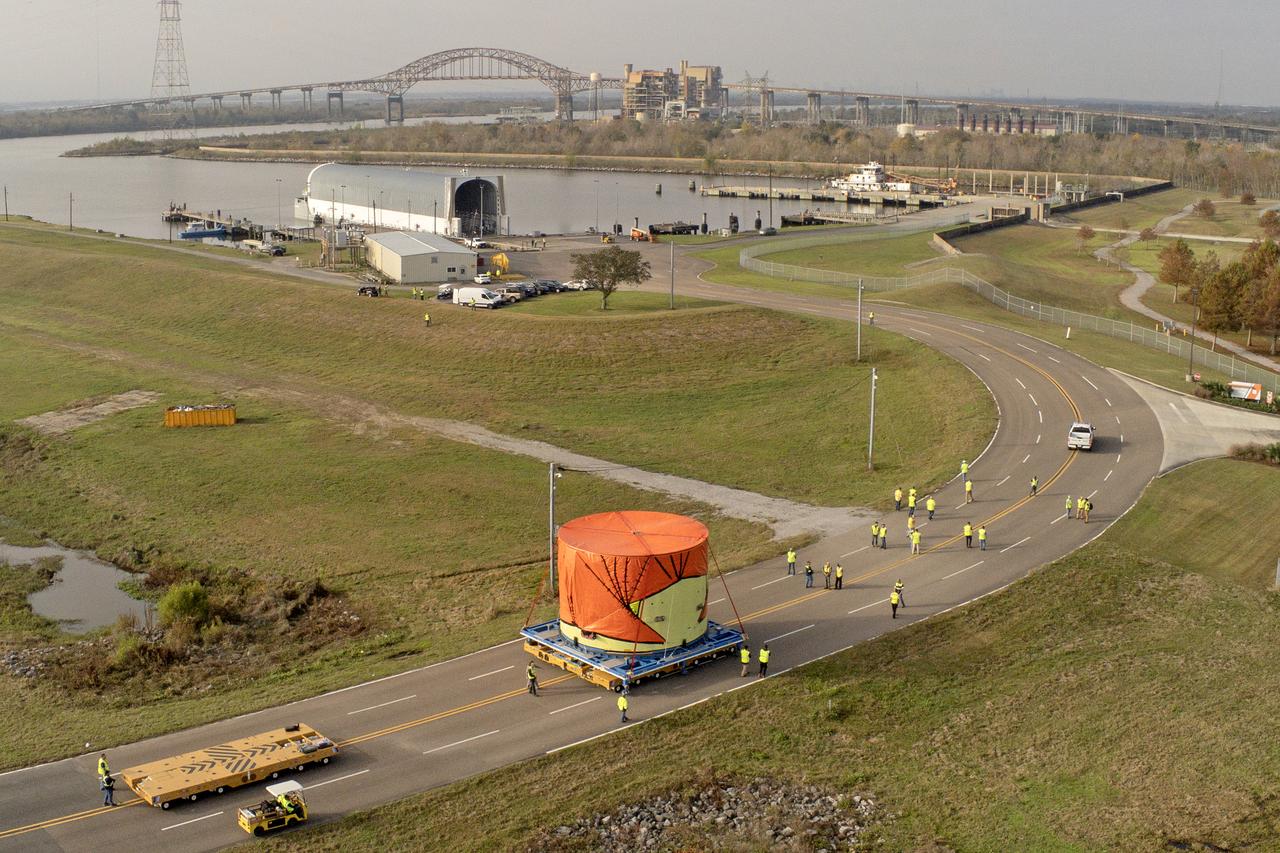
Teams at NASA’s Michoud Assembly Facility in New Orleans move the engine section flight hardware to the agency’s Pegasus barge on Sunday, December 4, 2022. The barge will ferry the engine section of NASA’s Space Launch System (SLS) rocket for Artemis III to the agency’s Kennedy Space Center in Florida. Once there, teams at Kennedy will finish outfitting the engine section, which comprises the tail-end of the rocket’s 212-foot-tall core stage, before integrating it to the rest of the stage. Beginning with production for Artemis III, NASA and core stage lead contractor Boeing will use Michoud, where the SLS core stages are currently manufactured, to produce and outfit the core stage’s five elements, and available space at Kennedy for final assembly and integration. Image credit: NASA/Michael DeMocker
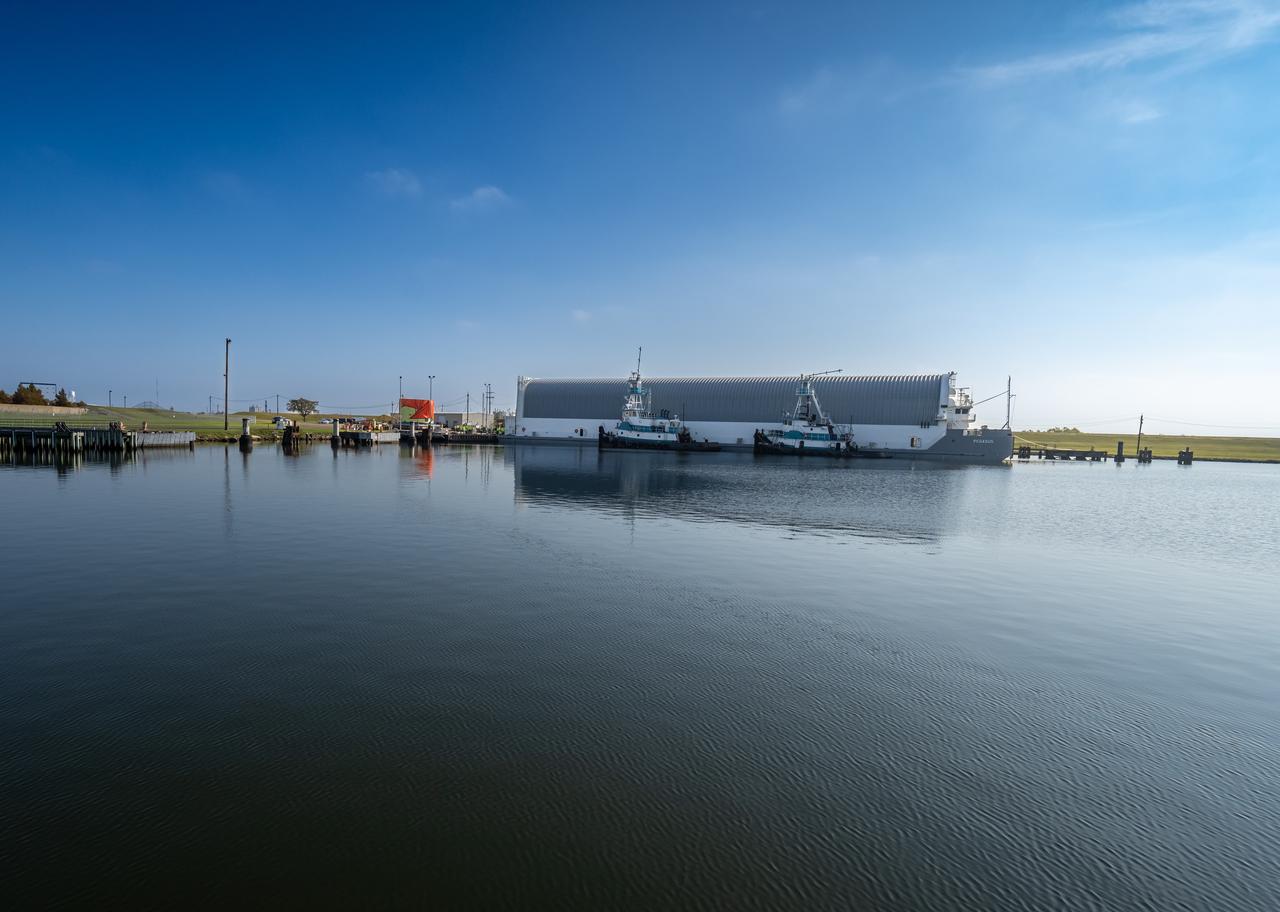
Teams at NASA’s Michoud Assembly Facility in New Orleans move the engine section flight hardware to the agency’s Pegasus barge Sunday, Dec. 4. The barge will ferry the engine section of NASA’s Space Launch System (SLS) rocket for Artemis III to the agency’s Kennedy Space Center in Florida. Once there, teams at Kennedy will finish outfitting the engine section, which comprises the tail-end of the rocket’s 212-foot-tall core stage, before integrating it to the rest of the stage. Beginning with production for Artemis III, NASA and core stage lead contractor Boeing will use Michoud, where the SLS core stages are currently manufactured, to produce and outfit the core stage’s five elements, and available space at Kennedy for final assembly and integration.
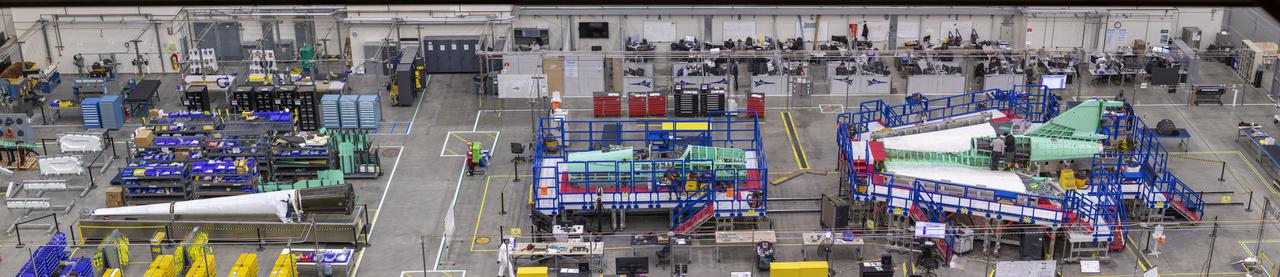
This overhead shot of the X-59 Quiet SuperSonic Technology or QueSST aircraft shows the assembly progress of the vehicle during Spring 2021. Pictured here you can see the nose (far left) which will later be mounted to the middle section in the photo known as the fuselage and the last section is the wing and tail in the far right of the photo. Lockheed Martin Photography By Garry Tice 1011 Lockheed Way, Palmdale, Ca. 93599 Event: Manufacture Area From Above Date: 3/30/2021
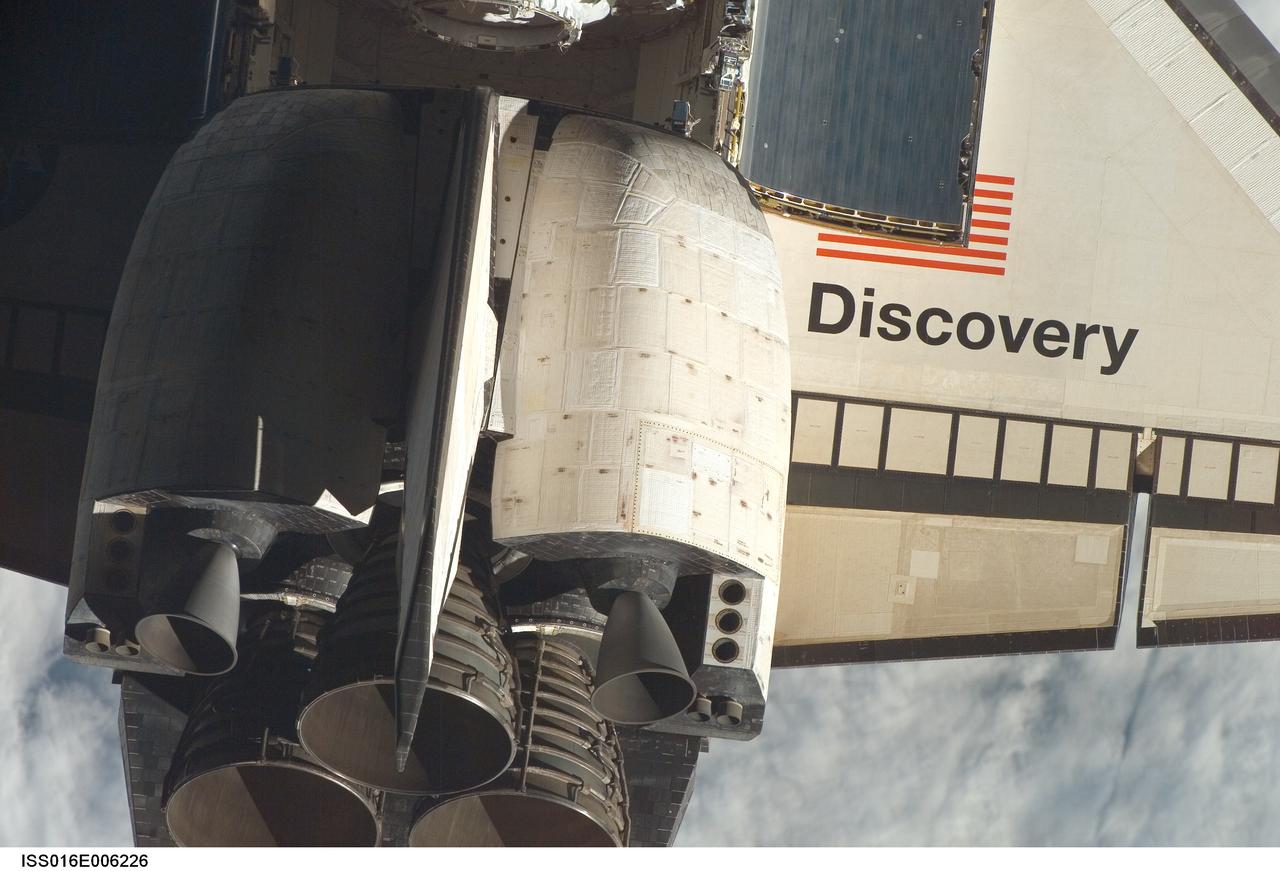
ISS016-E-006226 (25 Oct. 2007) --- Space Shuttle Discovery's tail section is featured in this close-up image photographed by an Expedition 16 crewmember during a backflip maneuver performed by the approaching visitors (STS-120) to the International Space Station. The image provides partial views of the shuttle's main engines, starboard wing section, orbital maneuvering system (OMS) pods, vertical stabilizer and payload bay door panels.
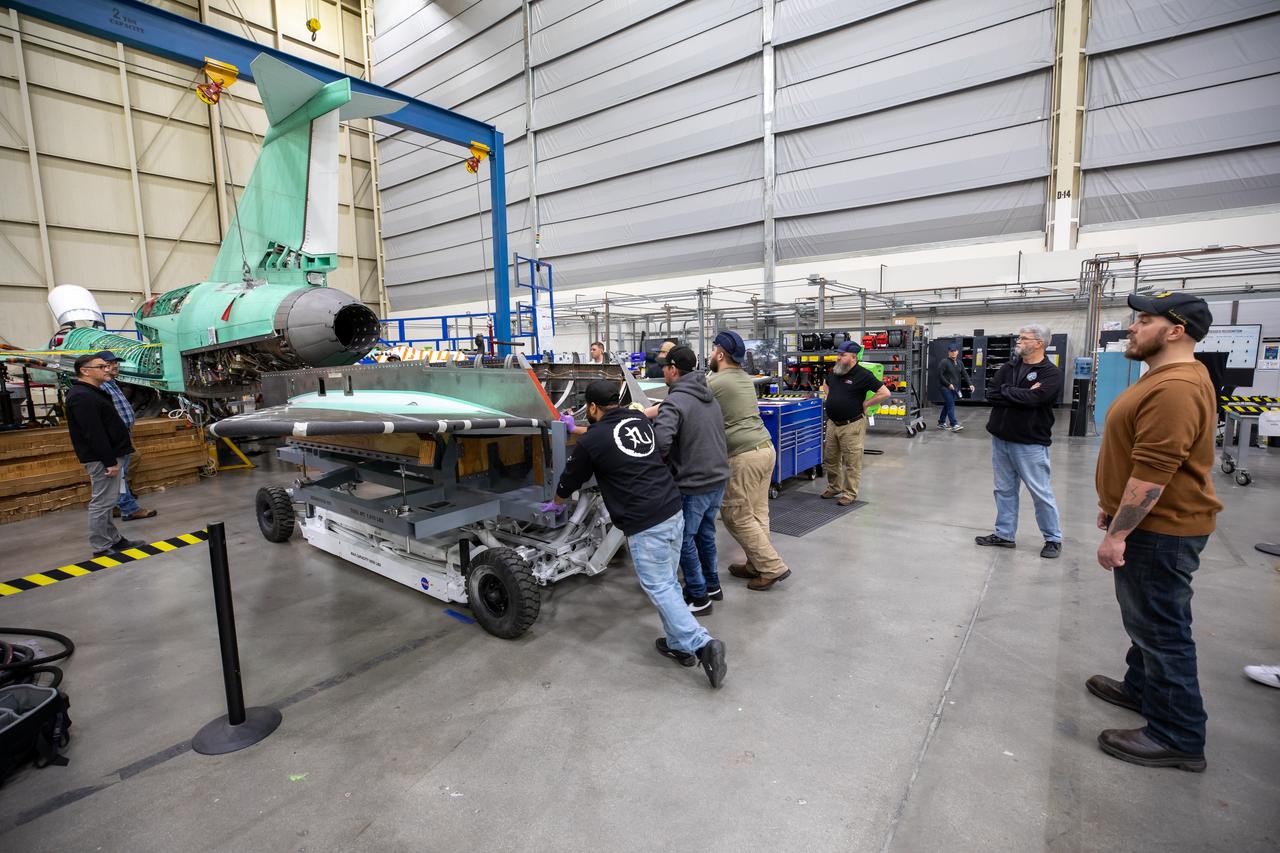
The X-59 team at Lockheed Martin Skunk Works in Palmdale, California, load the lower empennage - the tail section - into place. The surfaces used to control the tilt of the airplane are called stabilators and are connected to the lower empennage. The X-59 is the centerpiece of NASA’s Quesst mission, which could help enable commercial supersonic air travel over land.
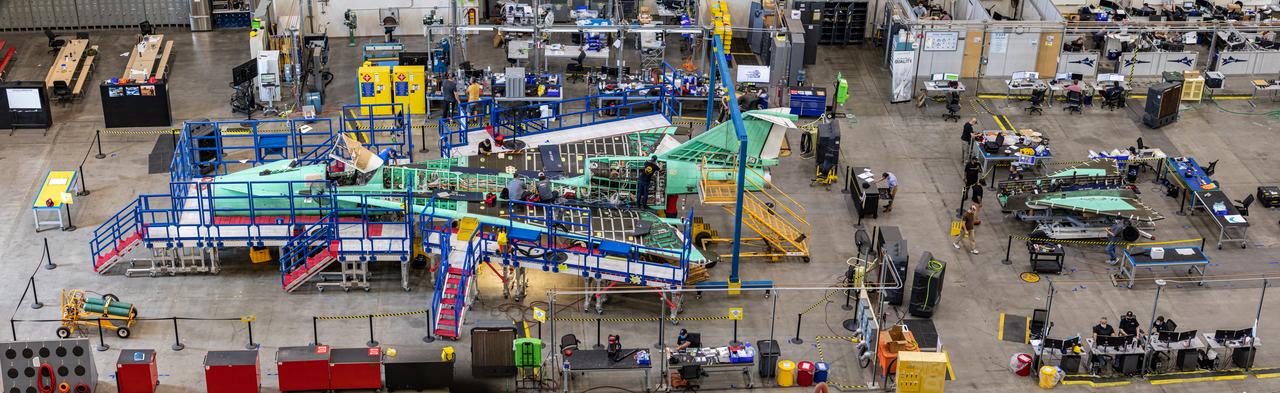
This overhead view of the X-59 shows the aircraft at Lockheed Martin Skunk Works in Palmdale, California. During the assembly of this experimental aircraft, the team often has to remove components to effectively and safely assemble other sections of the aircraft. In this image, the nose is not attached and the horizontal stabilators are shown behind the tail. The X-59 is the centerpiece of NASA’s Quesst mission which plans to produce data that will help enable commercial supersonic air travel over land.
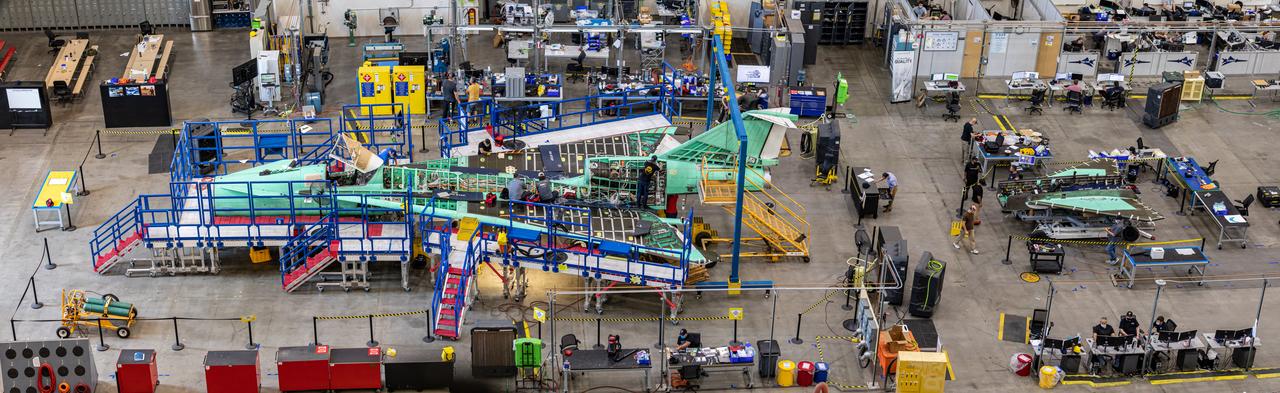
This overhead view of the X-59 shows the aircraft at Lockheed Martin Skunk Works in Palmdale, California. During the assembly of this experimental aircraft, the team often has to remove components to effectively and safely assemble other sections of the aircraft. In this image, the nose is not attached and the horizontal stabilators are shown behind the tail. The X-59 is the centerpiece of NASA’s Quesst mission which plans to produce data that will help enable commercial supersonic air travel over land.
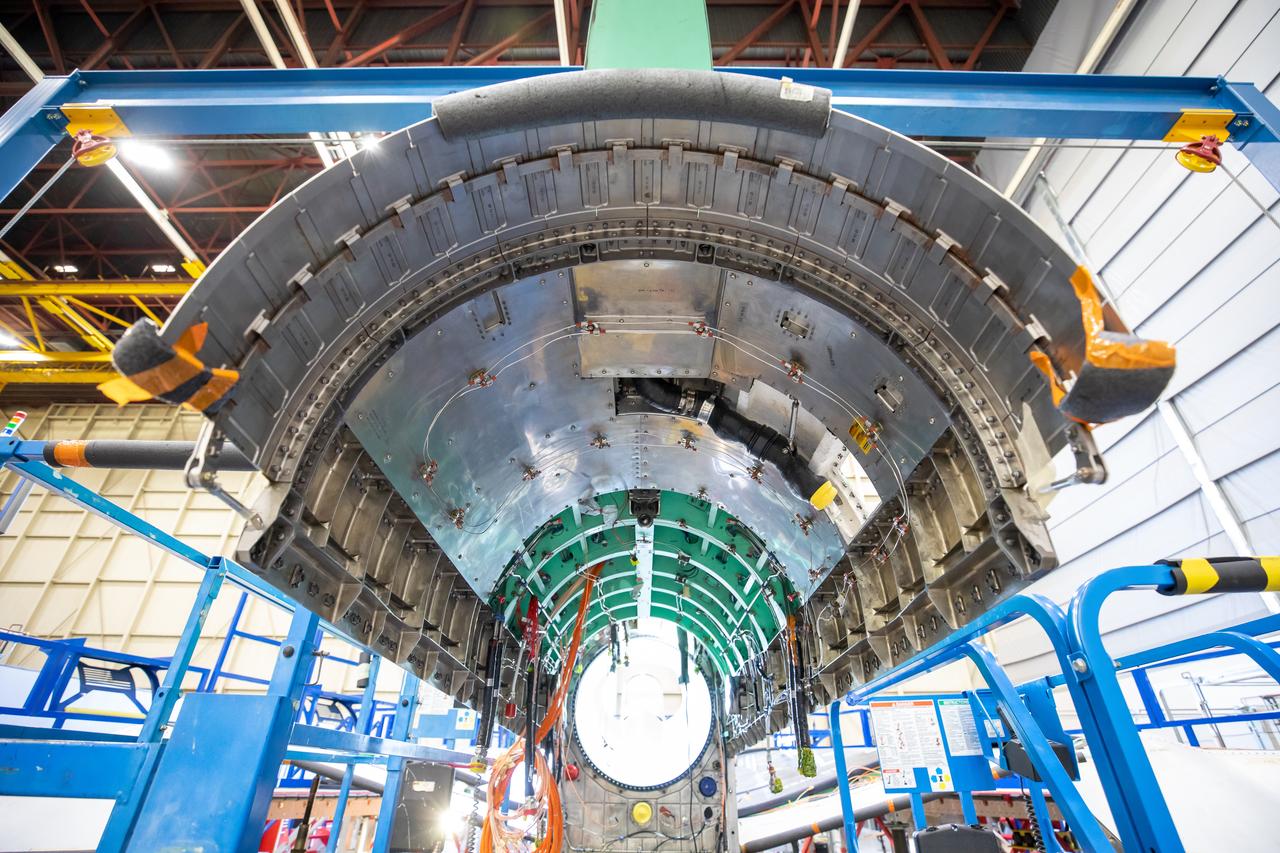
The upper empennage, or tail section of the plane, and engine bay is surrounded by a blue gantry that is used to assist with ground installation and removal of the X-59’s lower empennage and engine. Once fully assembled, the X-59 aircraft will demonstrate the ability to fly supersonic while reducing the loud sonic boom to a quiet sonic thump and help enable commercial supersonic air travel over land. This aircraft is the centerpiece of NASA’s Quesst mission.
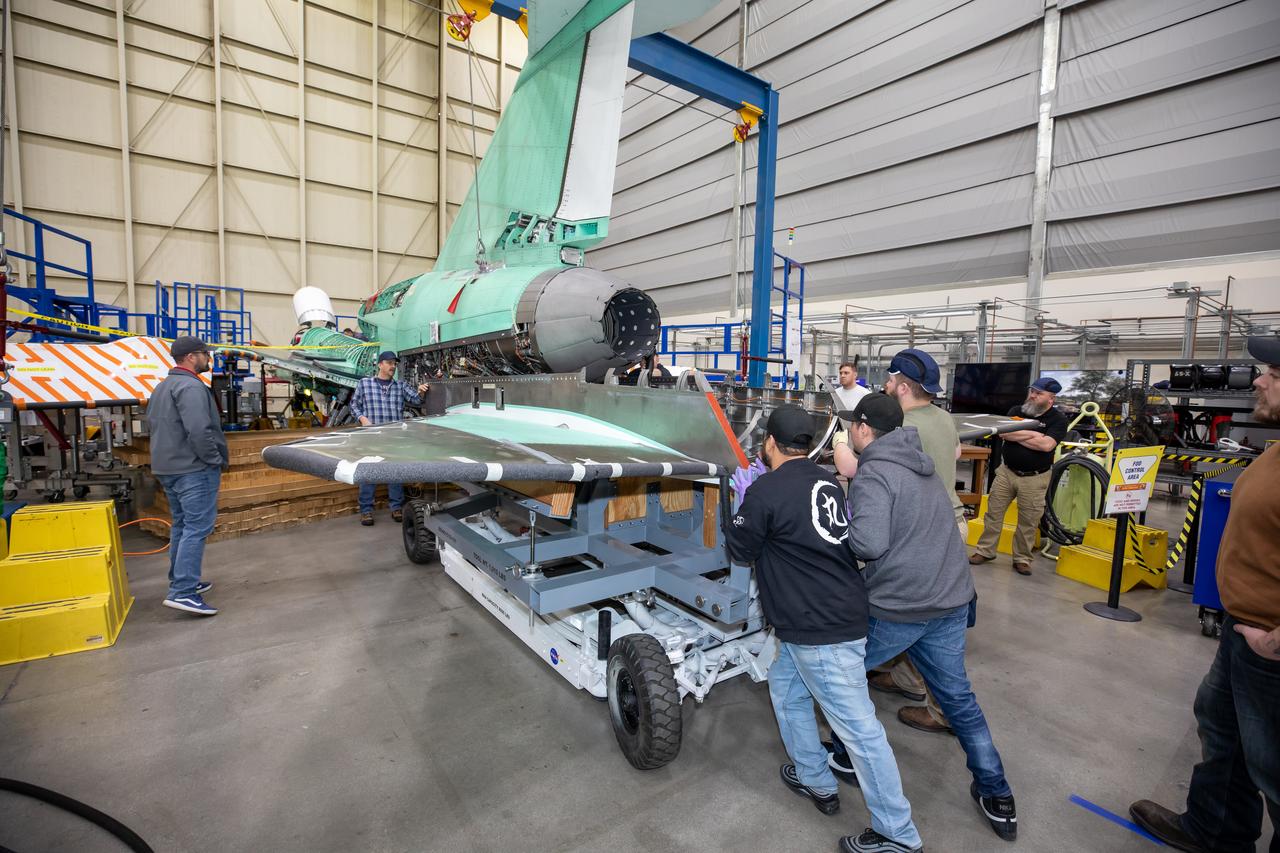
The X-59 team at Lockheed Martin Skunk Works in Palmdale, California, load the lower empennage - the tail section - into place. The surfaces used to control the tilt of the airplane are called stabilators and are connected to the lower empennage. The X-59 is the centerpiece of NASA’s Quesst mission, which could help enable commercial supersonic air travel over land.
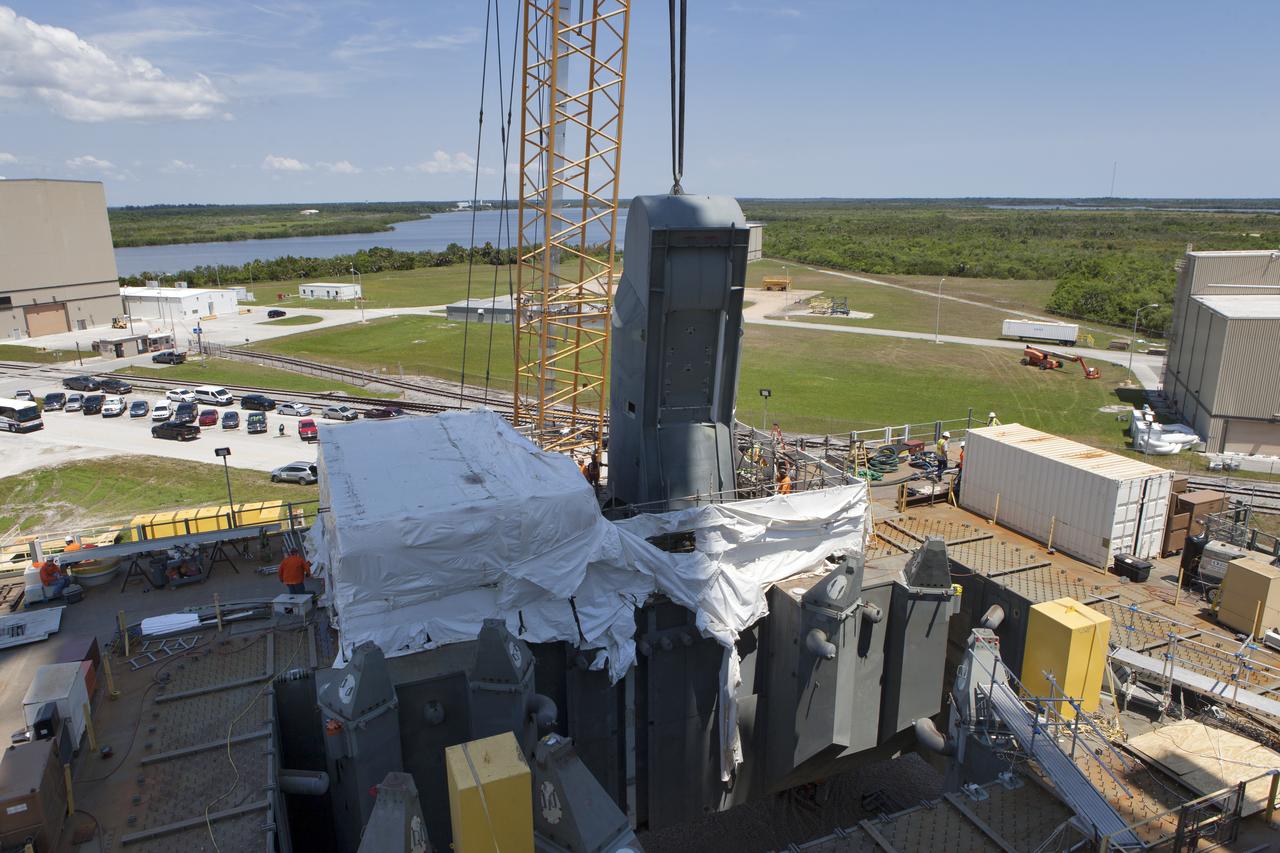
A crane is used to lower the first of two Tail Service Mast Umbilicals for installation on the 0-level deck of the mobile launcher on July 12, at NASA's Kennedy Space Center in Florida. The 35-foot-tall umbilical will connect to NASA's Space Launch System rocket core stage aft section and provide liquid oxygen and electrical cable connections to the core stage engine section to support propellant handling during prelaunch operations. The installation brings Exploration Ground Systems one step closer to supporting prelaunch operations for the agency's SLS rocket and Orion spacecraft on Exploration Mission-1 and deep space destinations.
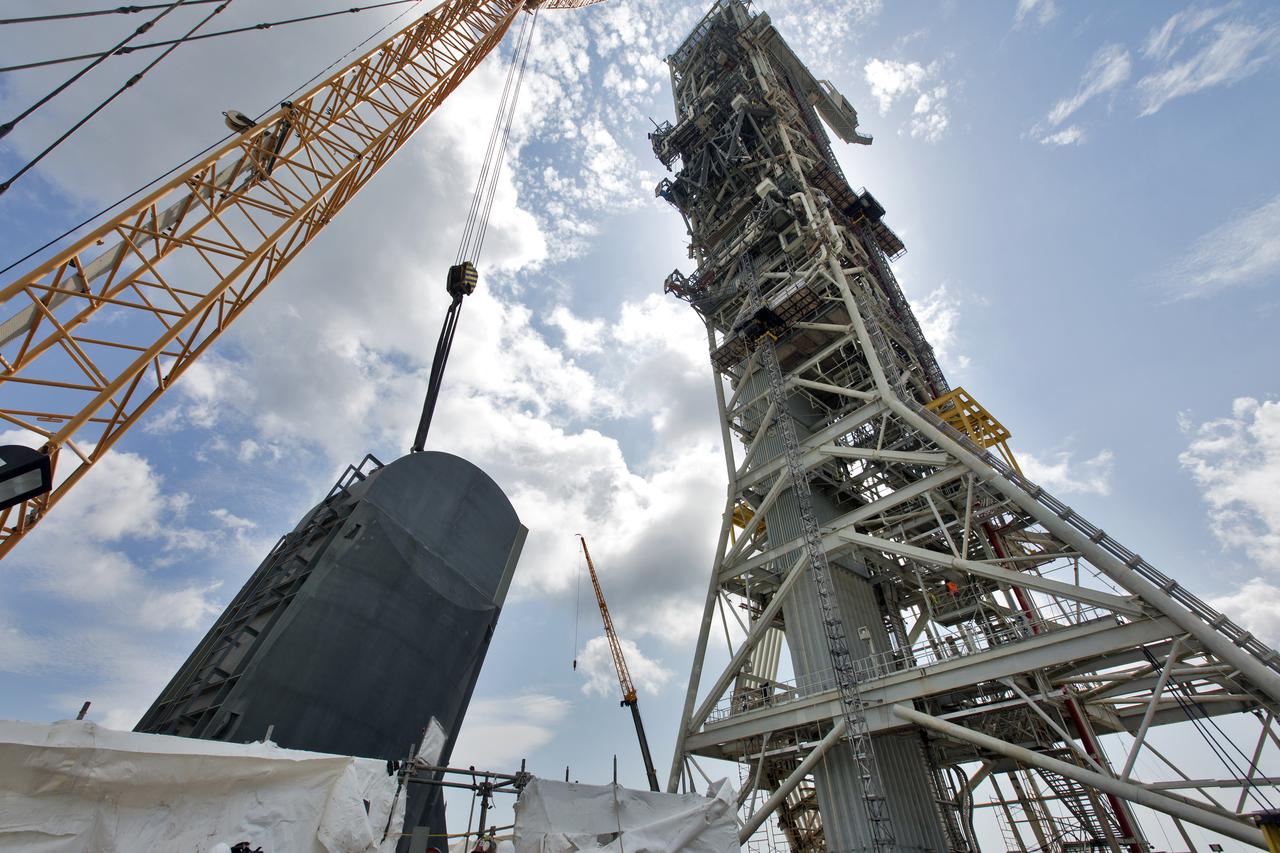
The second of two Tail Service Mast Umbilicals is lowered by crane for installation on the 0-level deck of the mobile launcher on July 27, at NASA's Kennedy Space Center in Florida. The 35-foot-tall umbilical will connect to NASA's Space Launch System (SLS) rocket core stage aft section and provide liquid hydrogen and electrical cable connections to the core stage engine section to support propellant handling during prelaunch operations. The installation brings Exploration Ground Systems one step closer to supporting prelaunch operations for the agency's SLS rocket and Orion spacecraft on Exploration Mission-1 and deep space destinations.

The first of two Tail Service Mast Umbilicals is lowered onto the 0-level deck of the mobile launcher on July 12, at NASA's Kennedy Space Center in Florida. The 35-foot-tall umbilical will connect to NASA's Space Launch System rocket core stage aft section and provide liquid oxygen and electrical cable connections to the core stage engine section to support propellant handling during prelaunch operations. The installation brings Exploration Ground Systems one step closer to supporting prelaunch operations for the agency's SLS rocket and Orion spacecraft on Exploration Mission-1 and deep space destinations.
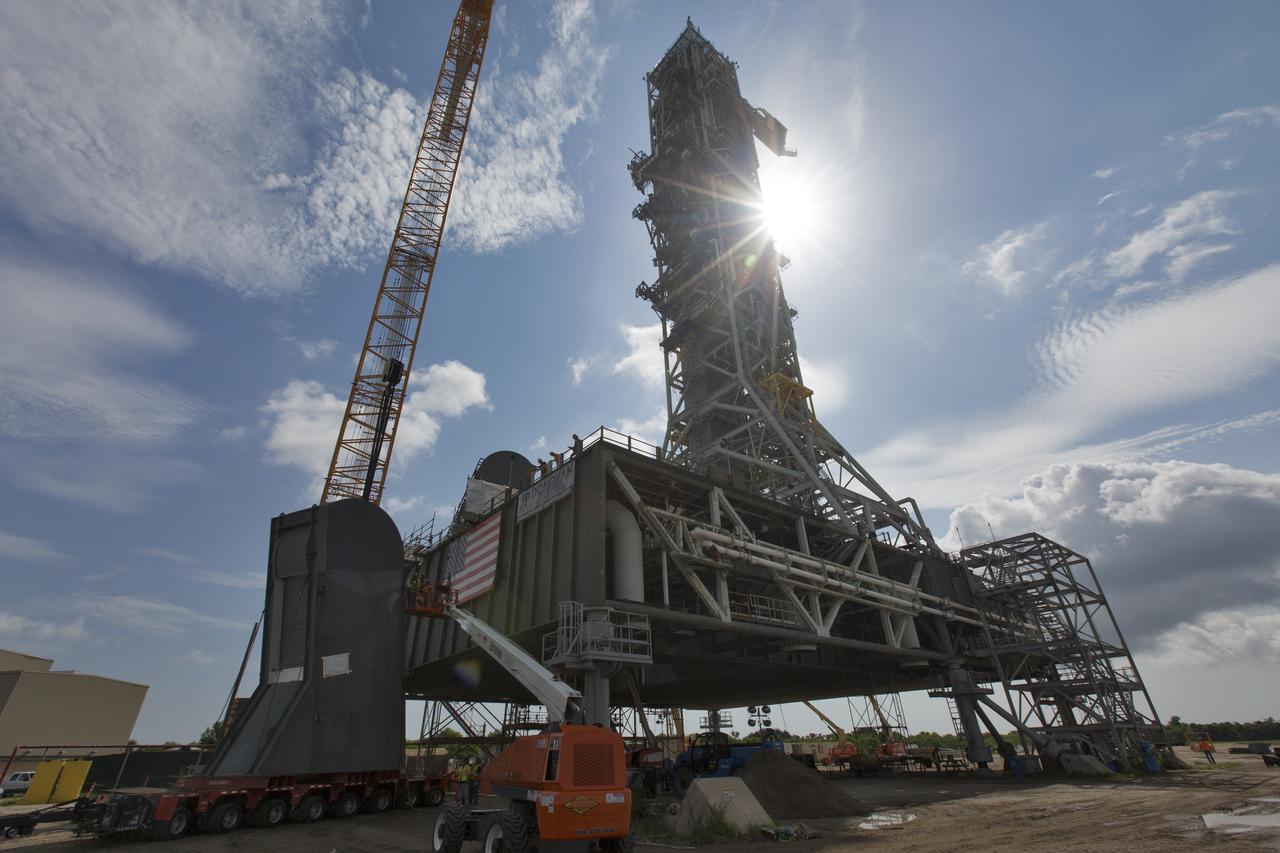
Preparations are underway to install the second of two Tail Service Mast Umbilicals on the 0-level deck of the mobile launcher on July 27, at NASA's Kennedy Space Center in Florida. The 35-foot-tall umbilical will connect to NASA's Space Launch System (SLS) rocket core stage aft section and provide liquid hydrogen and electrical cable connections to the core stage engine section to support propellant handling during prelaunch operations. The installation brings Exploration Ground Systems one step closer to supporting prelaunch operations for the agency's SLS rocket and Orion spacecraft on Exploration Mission-1 and deep space destinations.
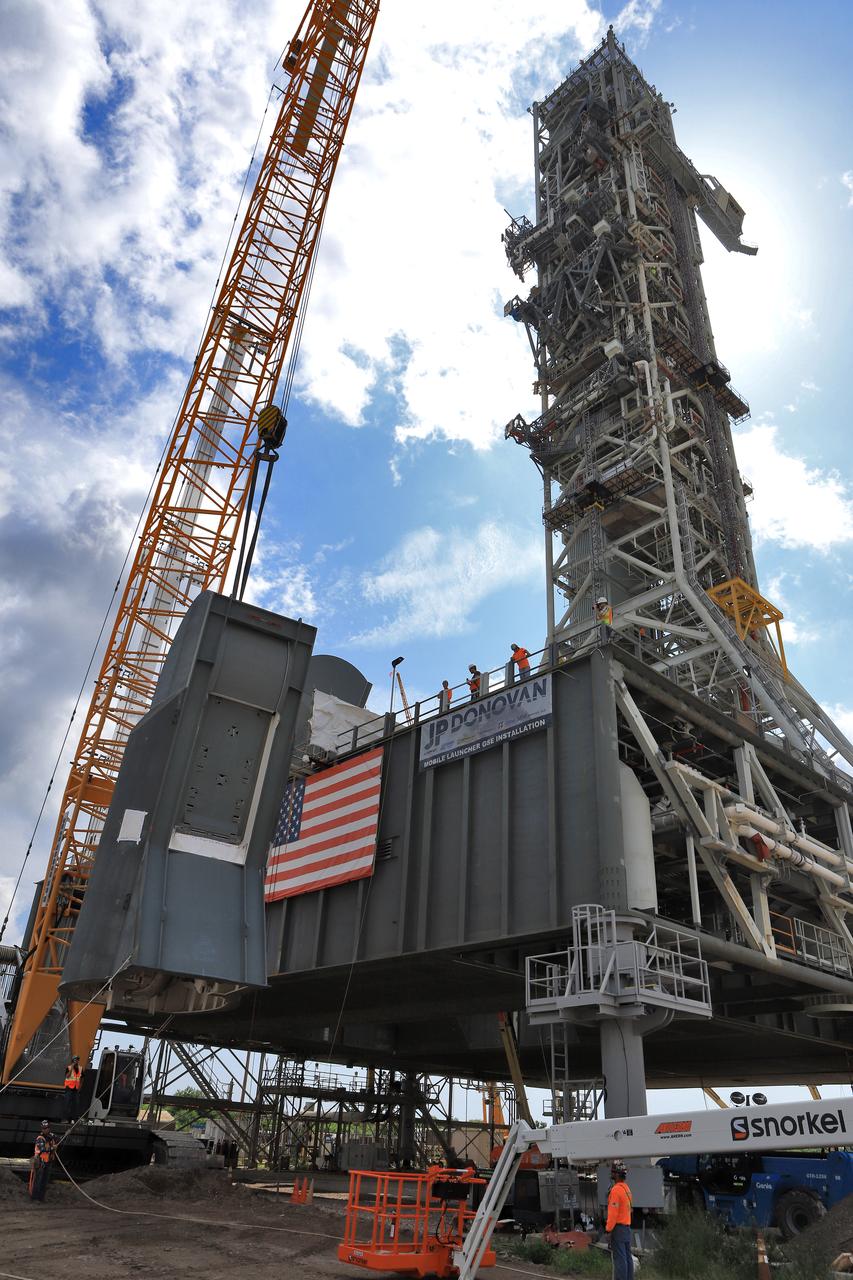
The second of two Tail Service Mast Umbilicals is lifted by crane for installation on the 0-level deck of the mobile launcher on July 27, at NASA's Kennedy Space Center in Florida. The 35-foot-tall umbilical will connect to NASA's Space Launch System (SLS) rocket core stage aft section and provide liquid hydrogen and electrical cable connections to the core stage engine section to support propellant handling during prelaunch operations. The installation brings Exploration Ground Systems one step closer to supporting prelaunch operations for the agency's SLS rocket and Orion spacecraft on Exploration Mission-1 and deep space destinations.
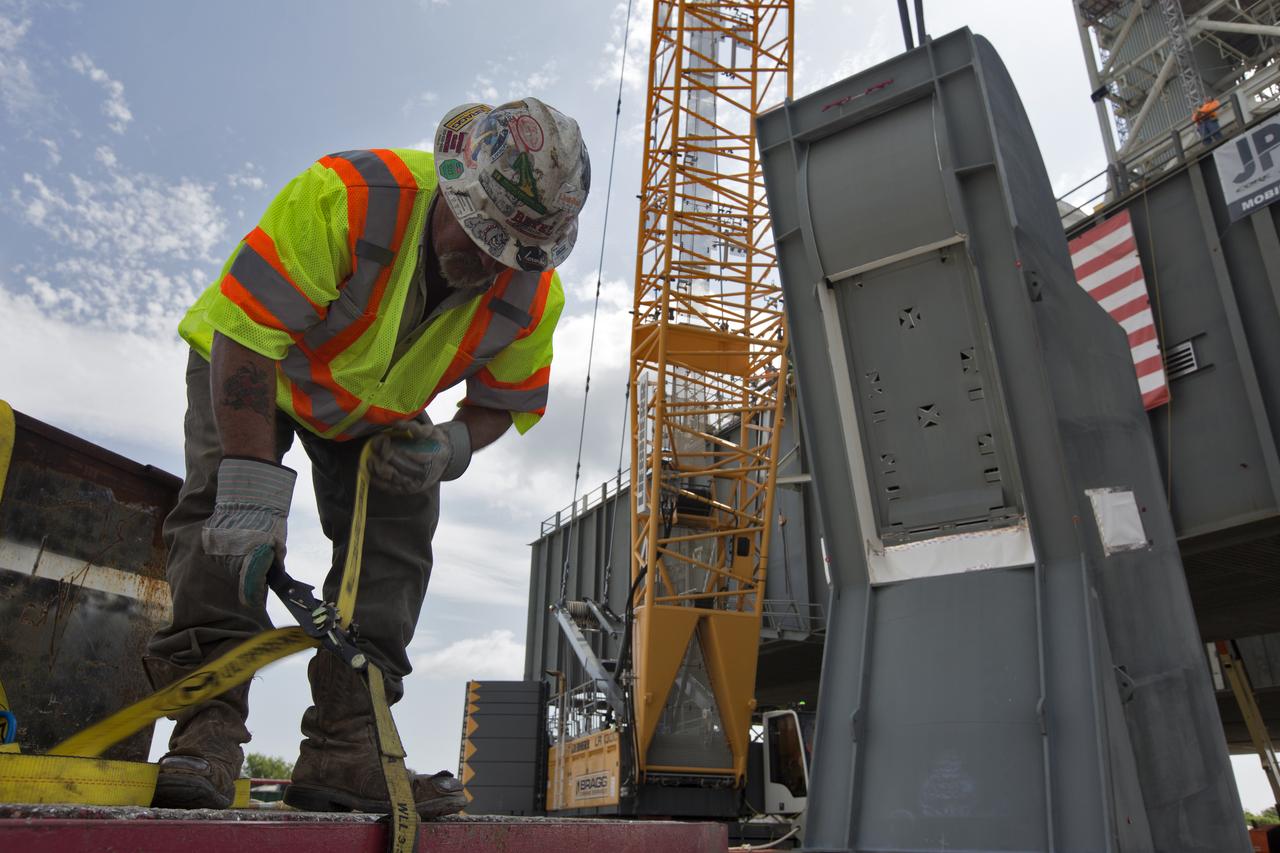
A JP Donovan construction worker makes preparations for lifting of the second of two Tail Service Mast Umbilicals for installation on the 0-level deck of the mobile launcher on July 27, at NASA's Kennedy Space Center in Florida. The 35-foot-tall umbilical will connect to NASA's Space Launch System (SLS) rocket core stage aft section and provide hydrogen and electrical cable connections to the core stage engine section to support propellant handling during prelaunch operations. The installation brings Exploration Ground Systems one step closer to supporting prelaunch operations for the agency's SLS rocket and Orion spacecraft on Exploration Mission-1 and deep space destinations.
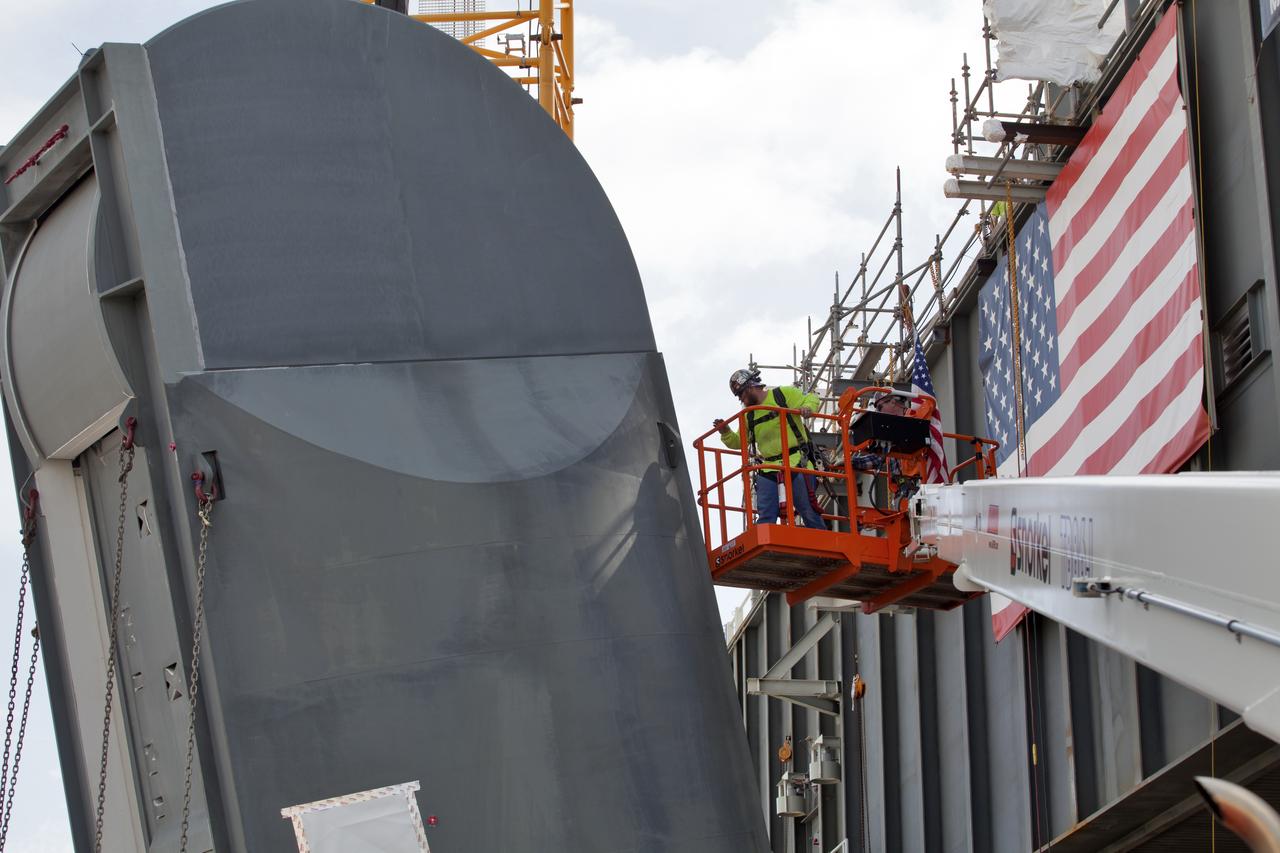
Preparations are underway to install the second of two Tail Service Mast Umbilicals on the 0-level deck of the mobile launcher on July 27, at NASA's Kennedy Space Center in Florida. The 35-foot-tall umbilical will connect to NASA's Space Launch System (SLS) rocket core stage aft section and provide liquid hydrogen and electrical cable connections to the core stage engine section to support propellant handling during prelaunch operations. The installation brings Exploration Ground Systems one step closer to supporting prelaunch operations for the agency's SLS rocket and Orion spacecraft on Exploration Mission-1 and deep space destinations.
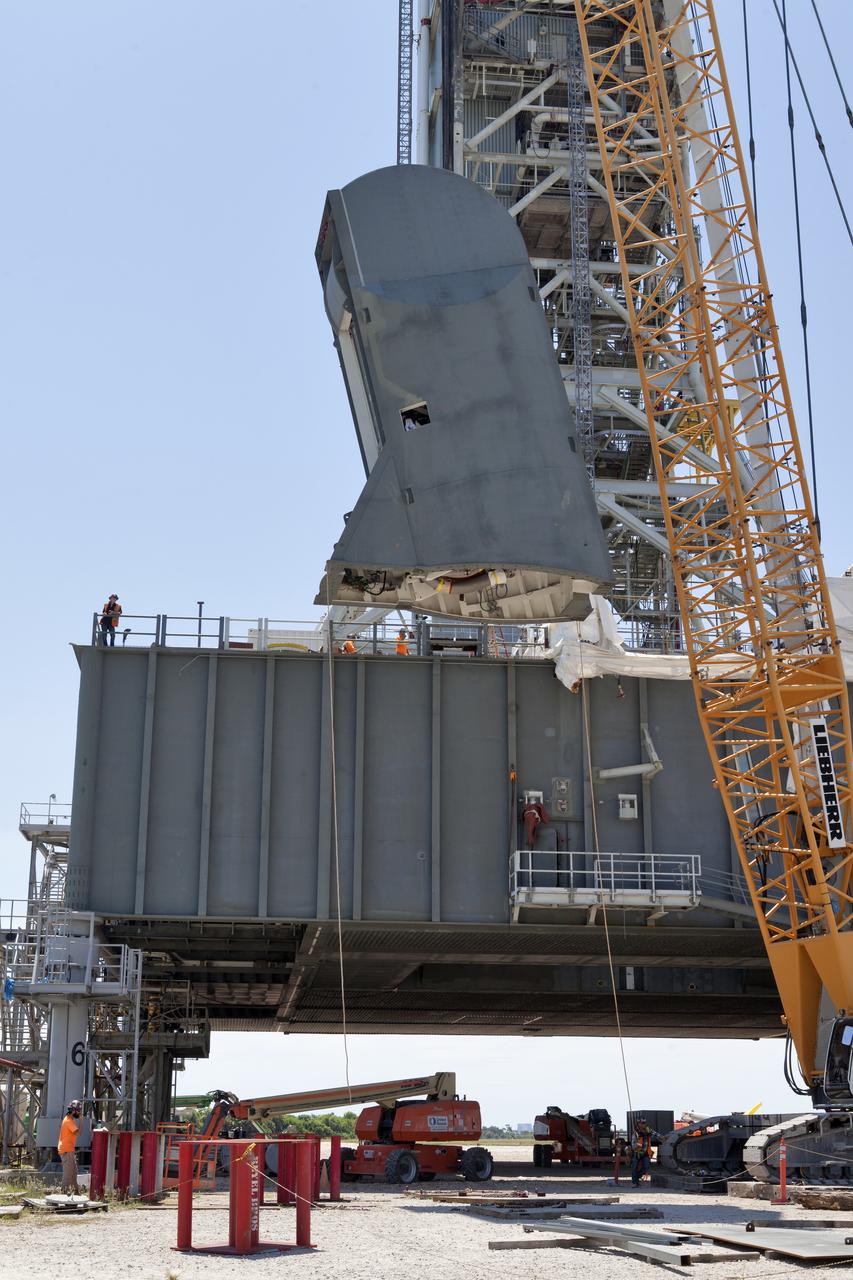
The first of two Tail Service Mast Umbilicals is lifted up for installation on the 0-level deck of the mobile launcher on July 12, at NASA's Kennedy Space Center in Florida. The 35-foot-tall umbilical will connect to NASA's Space Launch System rocket core stage aft section and provide liquid oxygen and electrical cable connections to the core stage engine section to support propellant handling during prelaunch operations. The installation brings Exploration Ground Systems one step closer to supporting prelaunch operations for the agency's SLS rocket and Orion spacecraft on Exploration Mission-1 and deep space destinations.
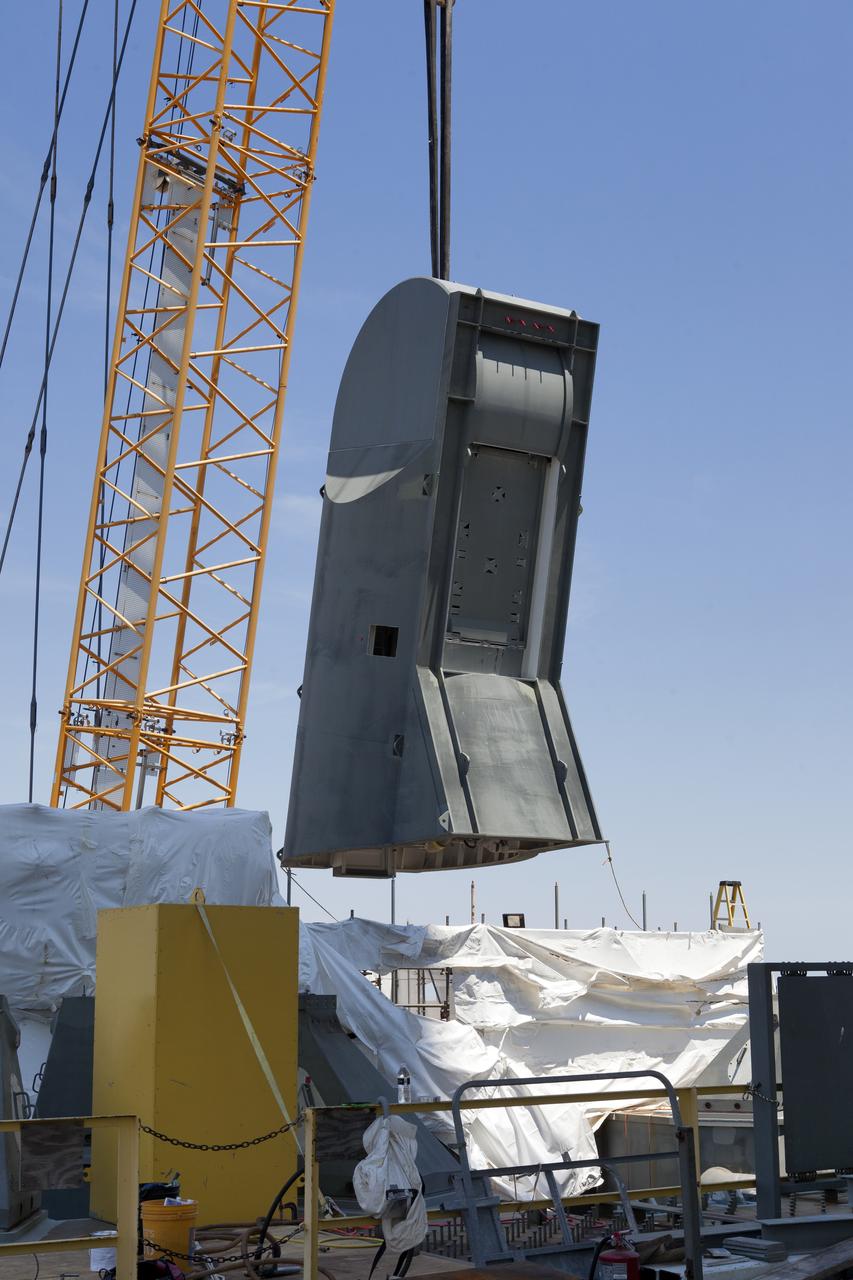
A crane is used to lift up the first of two Tail Service Mast Umbilicals for installation on the 0-level deck of the mobile launcher on July 12, at NASA's Kennedy Space Center in Florida. The 35-foot-tall umbilical will connect to NASA's Space Launch System rocket core stage aft section and provide liquid oxygen and electrical cable connections to the core stage engine section to support propellant handling during prelaunch operations. The installation brings Exploration Ground Systems one step closer to supporting prelaunch operations for the agency's SLS rocket and Orion spacecraft on Exploration Mission-1 and deep space destinations.
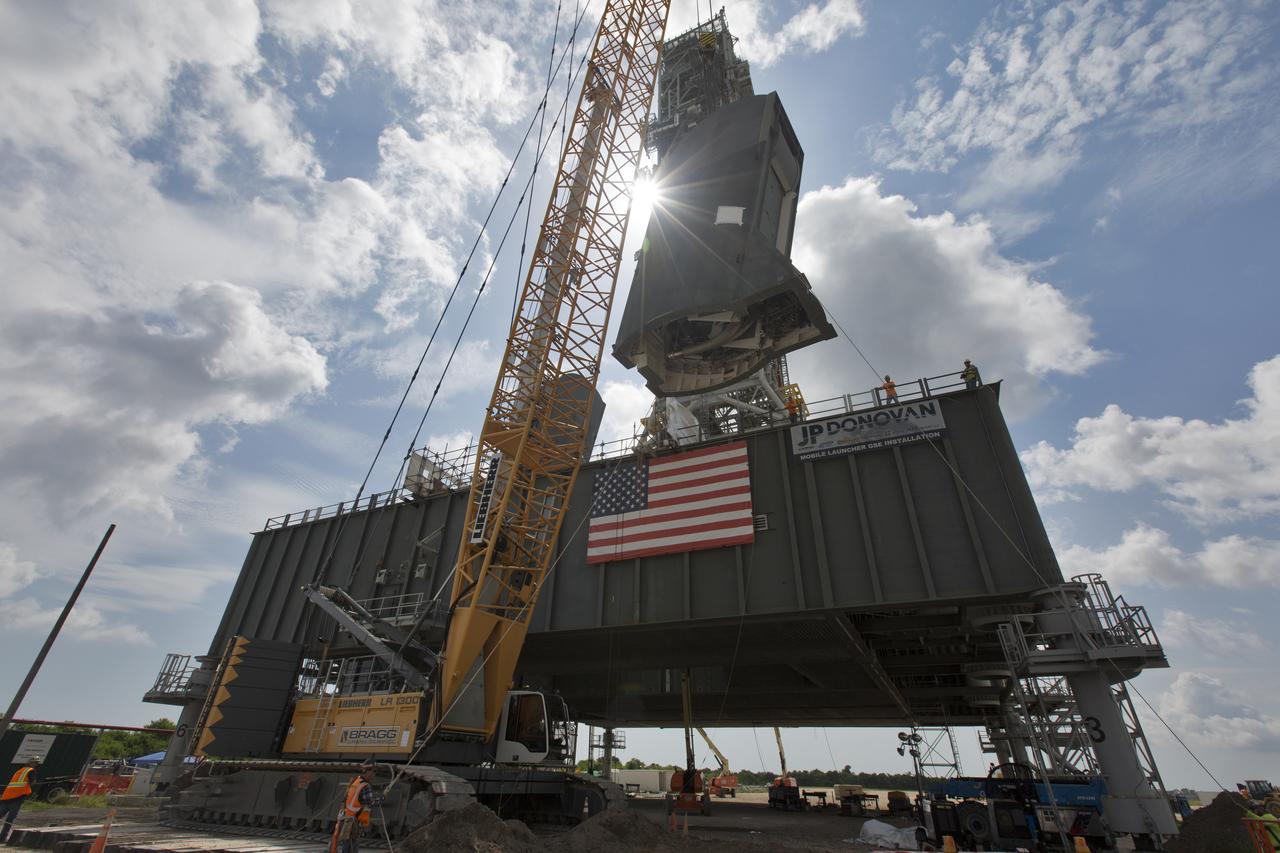
The second of two Tail Service Mast Umbilicals is lifted by crane for installation on the 0-level deck of the mobile launcher on July 27, at NASA's Kennedy Space Center in Florida. The 35-foot-tall umbilical will connect to NASA's Space Launch System (SLS) rocket core stage aft section and provide liquid hydrogen and electrical cable connections to the core stage engine section to support propellant handling during prelaunch operations. The installation brings Exploration Ground Systems one step closer to supporting prelaunch operations for the agency's SLS rocket and Orion spacecraft on Exploration Mission-1 and deep space destinations.
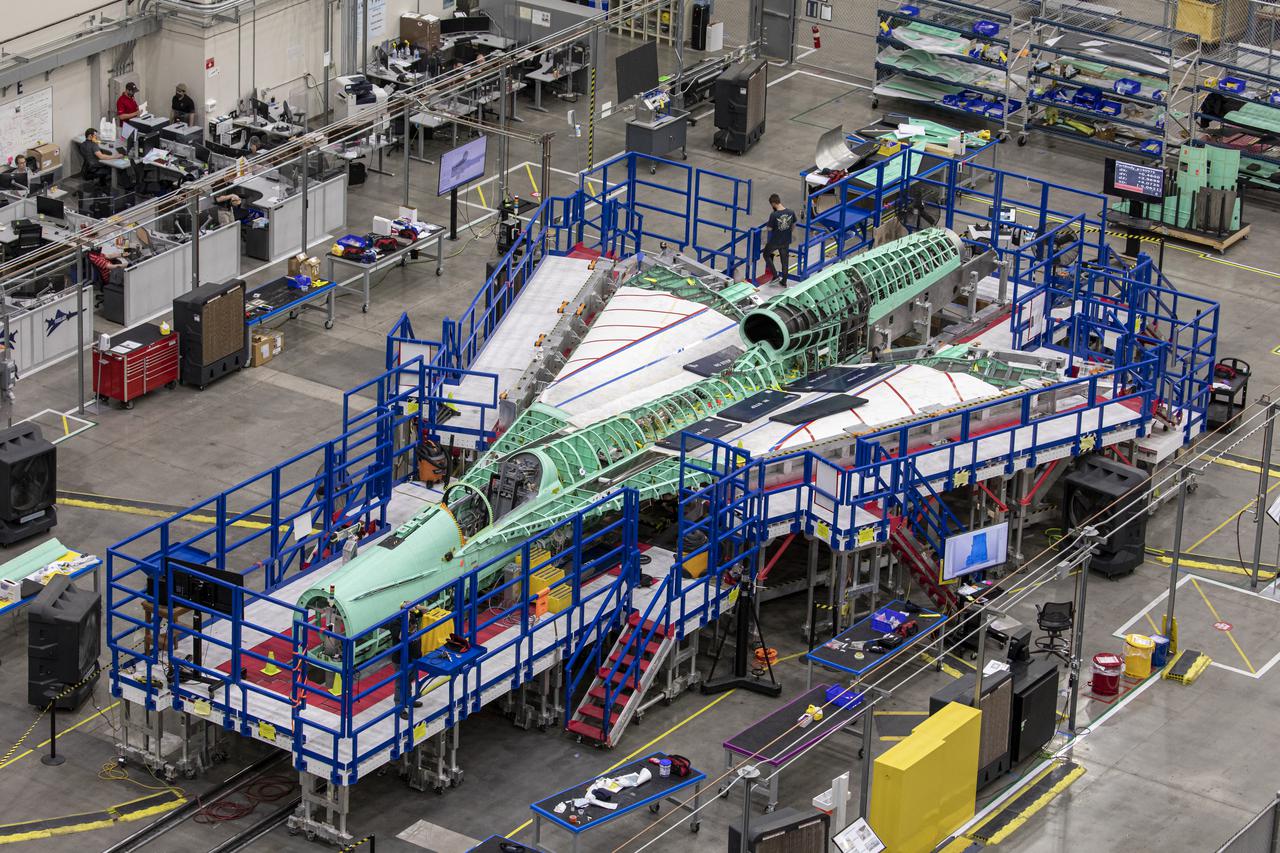
The team at Lockheed Martin Skunk Works in Palmdale, California, merged the major sections of the X-59 Quiet SuperSonic Technology aircraft, which includes the wing, tail assembly, and fuselage or forward section. This marks the first time the X-59 resembles an actual aircraft. (Pictured here is a overhead view of the X-59 as it comes together for the major assembly merger in summer 2021.) Lockheed Martin Photography By Garry Tice 1011 Lockheed Way, Palmdale, Ca. 93599 Event: Manufacturing Area From Above Date: 5/26/2021
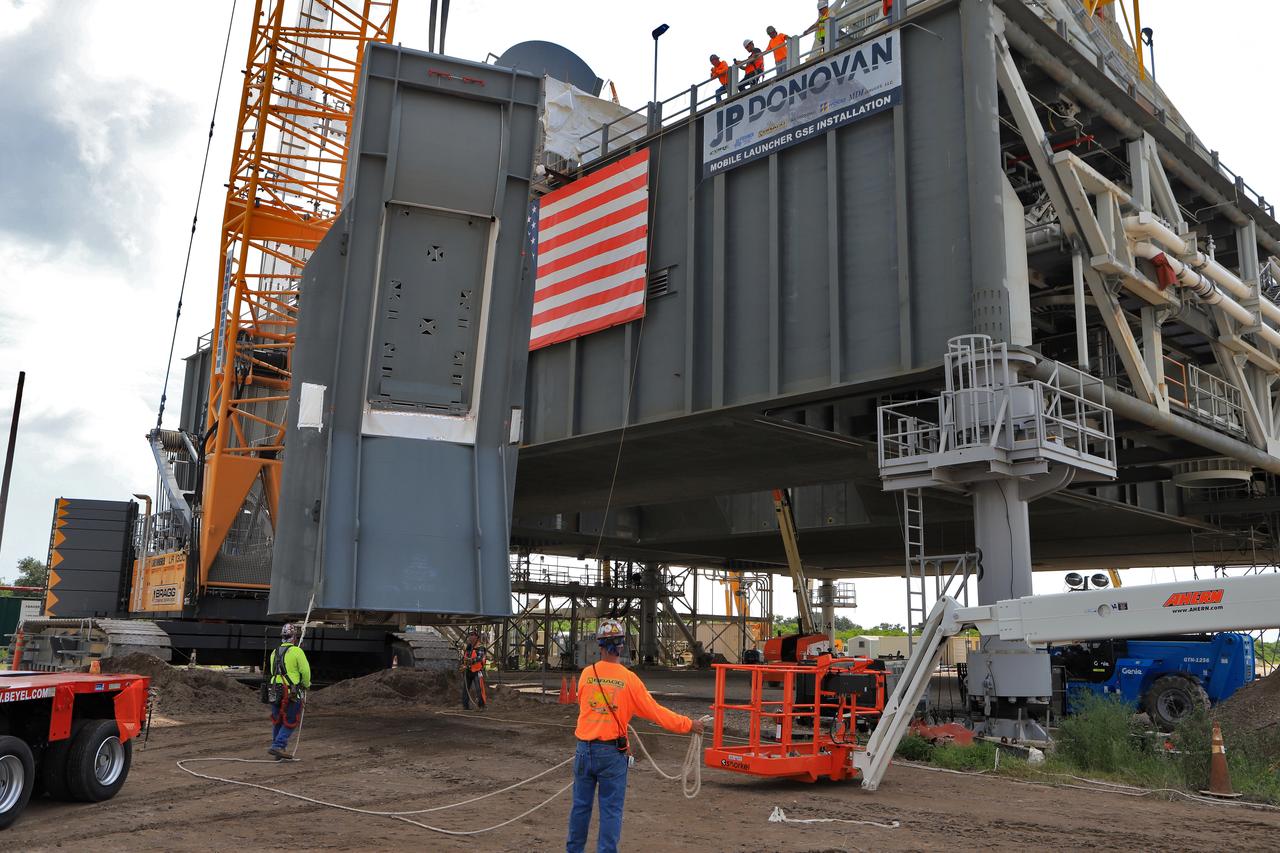
Construction workers with JP Donovan assist as a crane lifts the second of two Tail Service Mast Umbilicals up for installation on the 0-level deck of the mobile launcher on July 27, at NASA's Kennedy Space Center in Florida. The 35-foot-tall umbilical will connect to NASA's Space Launch System rocket core stage aft section and provide liquid hydrogen and electrical cable connections to the core stage engine section to support propellant handling during prelaunch operations. The installation brings Exploration Ground Systems one step closer to supporting prelaunch operations for the agency's SLS rocket and Orion spacecraft on Exploration Mission-1 and deep space destinations.
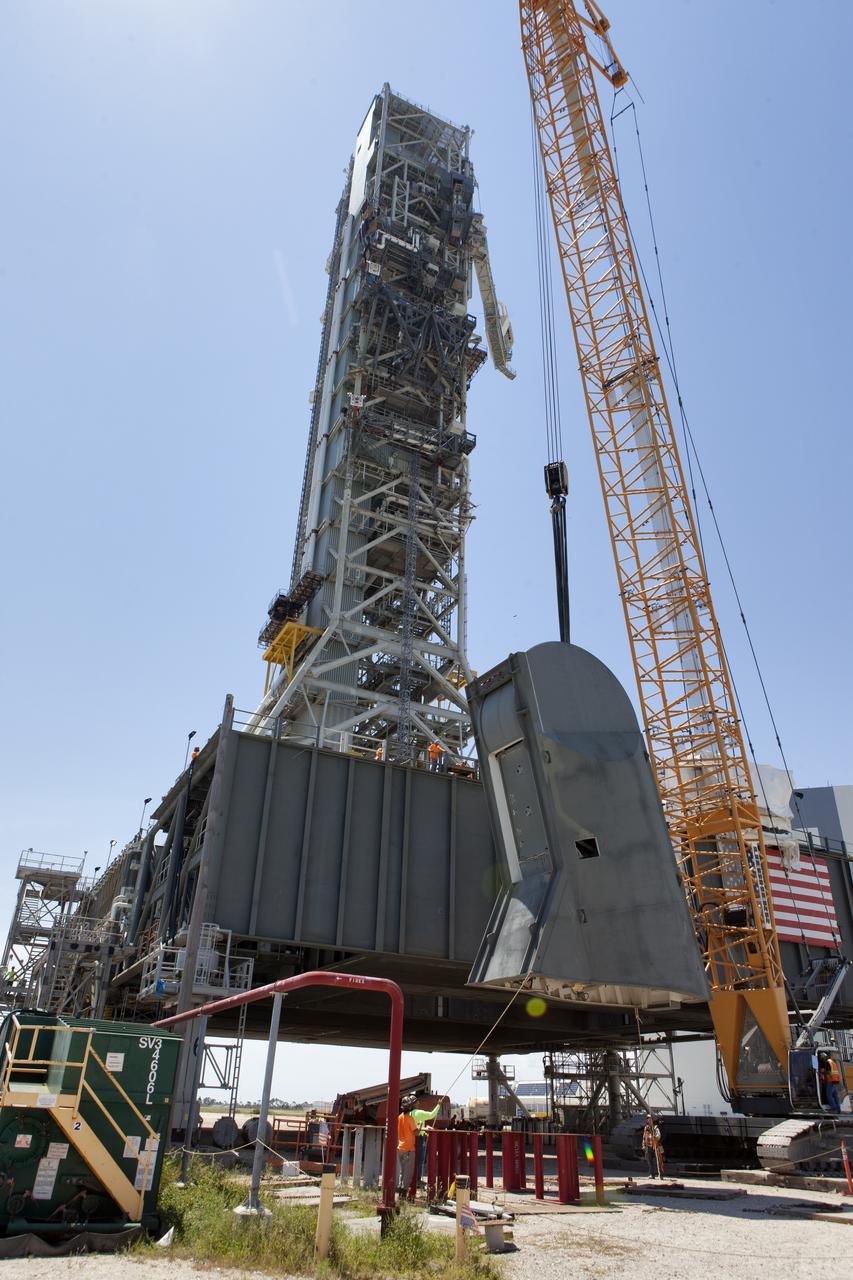
The first of two Tail Service Mast Umbilicals is lifted up for installation on the 0-level deck of the mobile launcher on July 12, at NASA's Kennedy Space Center in Florida. The 35-foot-tall umbilical will connect to NASA's Space Launch System rocket core stage aft section and provide liquid oxygen and electrical cable connections to the core stage engine section to support propellant handling during prelaunch operations. The installation brings Exploration Ground Systems one step closer to supporting prelaunch operations for the agency's SLS rocket and Orion spacecraft on Exploration Mission-1 and deep space destinations.
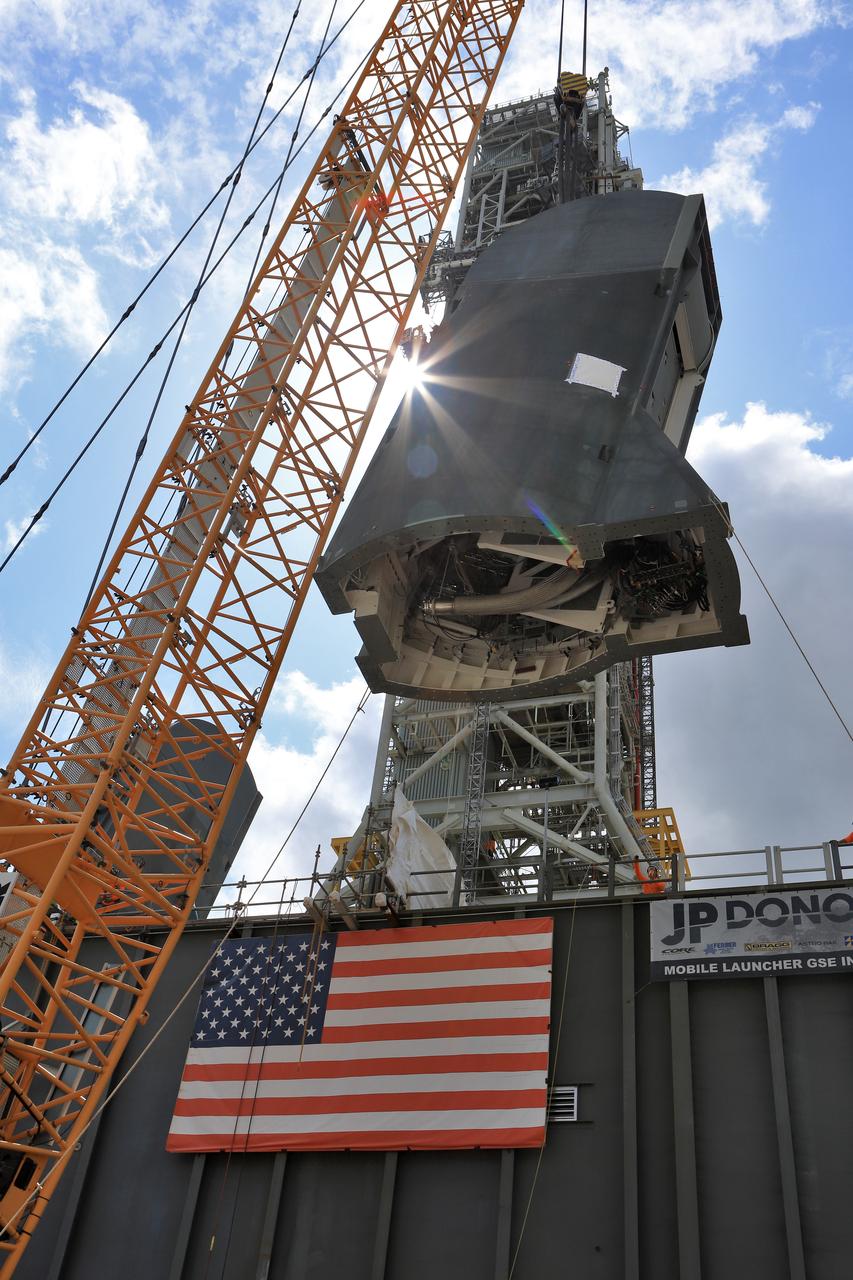
The second of two Tail Service Mast Umbilicals is lifted by crane for installation on the 0-level deck of the mobile launcher on July 27, at NASA's Kennedy Space Center in Florida. The 35-foot-tall umbilical will connect to NASA's Space Launch System (SLS) rocket core stage aft section and provide liquid hydrogen and electrical cable connections to the core stage engine section to support propellant handling during prelaunch operations. The installation brings Exploration Ground Systems one step closer to supporting prelaunch operations for the agency's SLS rocket and Orion spacecraft on Exploration Mission-1 and deep space destinations.
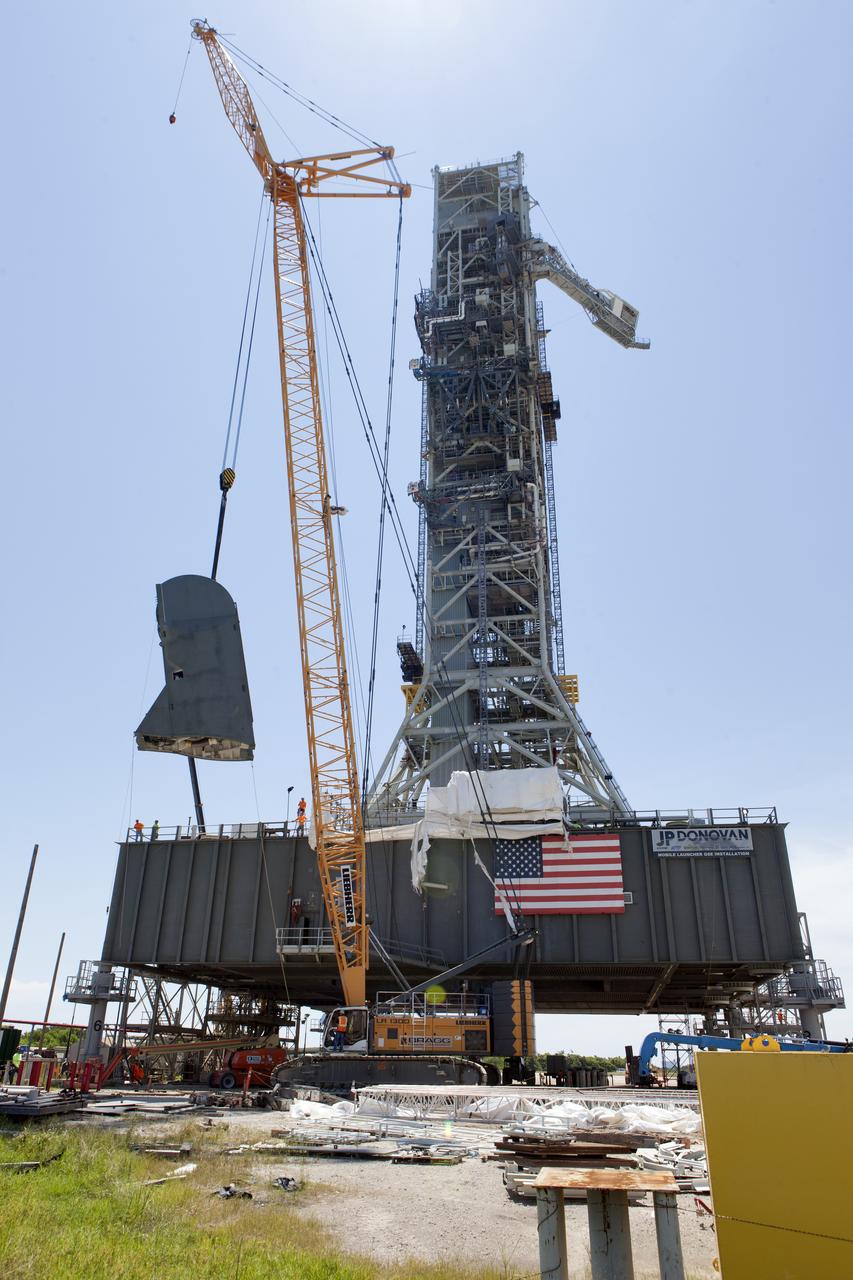
A crane is used to lift up the first of two Tail Service Mast Umbilicals for installation on the 0-level deck of the mobile launcher on July 12, at NASA's Kennedy Space Center in Florida. The 35-foot-tall umbilical will connect to NASA's Space Launch System rocket core stage aft section and provide liquid oxygen and electrical cable connections to the core stage engine section to support propellant handling during prelaunch operations. The installation brings Exploration Ground Systems one step closer to supporting prelaunch operations for the agency's SLS rocket and Orion spacecraft on Exploration Mission-1 and deep space destinations.
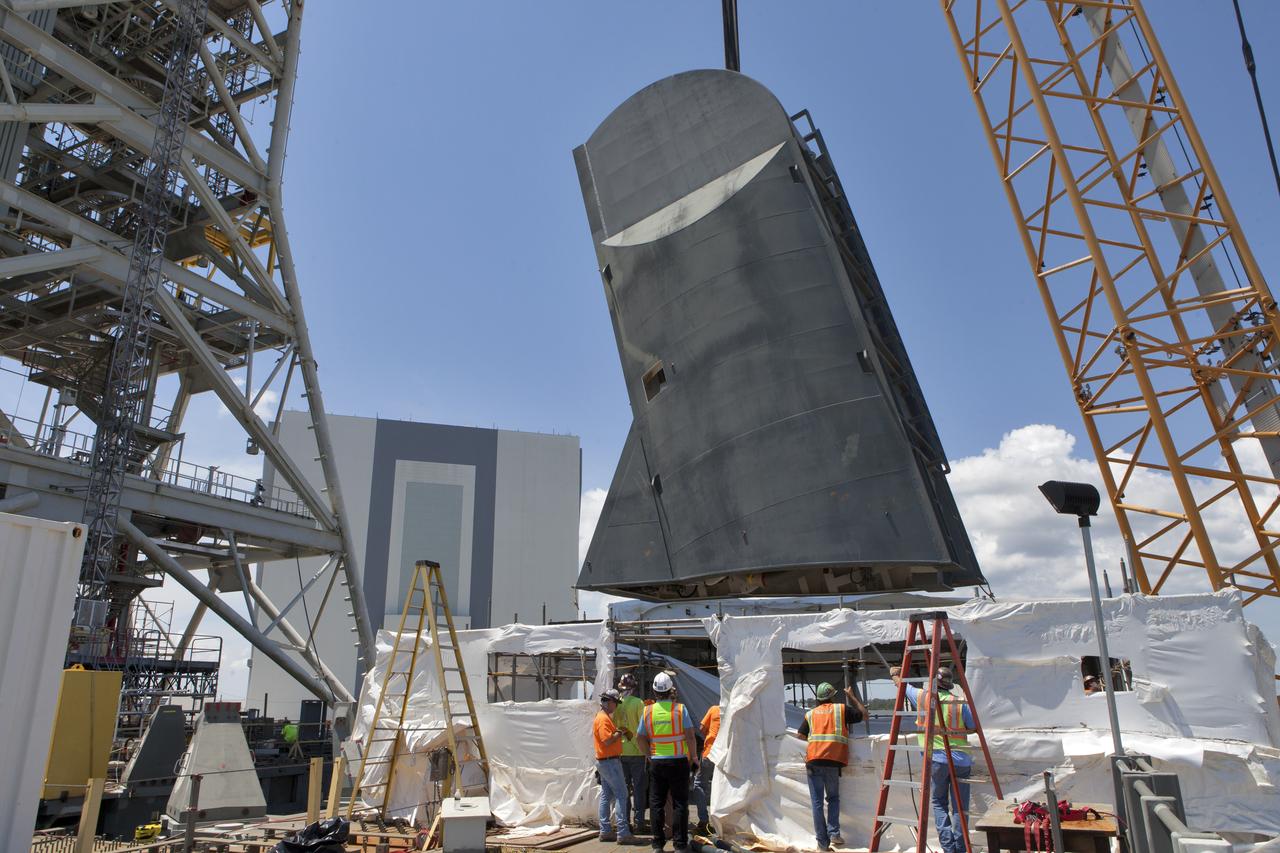
Construction workers with JP Donovan monitor operations as a crane is used to lower the first of two Tail Service Mast Umbilicals for installation on the 0-level deck of the mobile launcher on July 12, at NASA's Kennedy Space Center in Florida. The 35-foot-tall umbilical will connect to NASA's Space Launch System rocket core stage aft section and provide liquid oxygen and electrical cable connections to the core stage engine section to support propellant handling during prelaunch operations. The installation brings Exploration Ground Systems one step closer to supporting prelaunch operations for the agency's SLS rocket and Orion spacecraft on Exploration Mission-1 and deep space destinations.
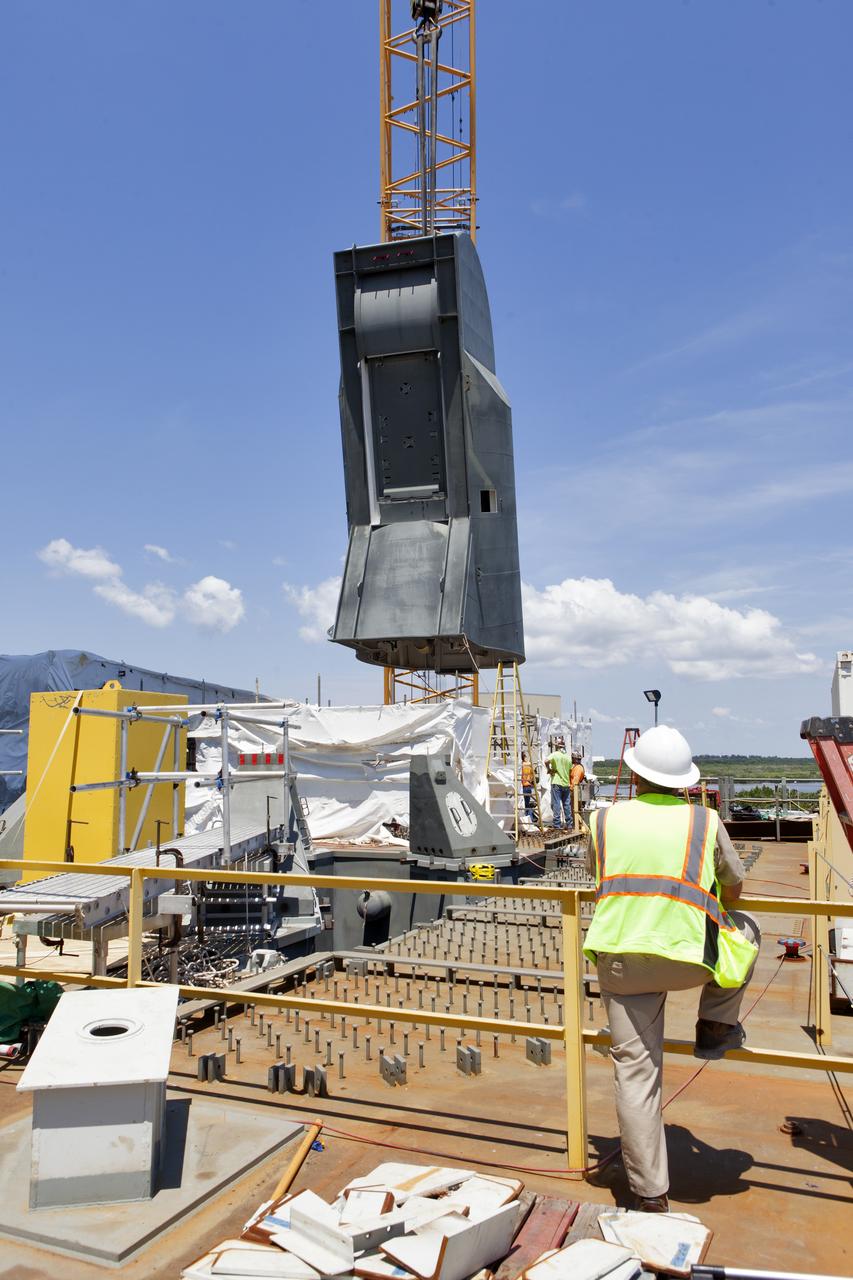
A crane is used to lower the first of two Tail Service Mast Umbilicals for installation on the 0-level deck of the mobile launcher on July 12, at NASA's Kennedy Space Center in Florida. The 35-foot-tall umbilical will connect to NASA's Space Launch System rocket core stage aft section and provide liquid oxygen and electrical cable connections to the core stage engine section to support propellant handling during prelaunch operations. The installation brings Exploration Ground Systems one step closer to supporting prelaunch operations for the agency's SLS rocket and Orion spacecraft on Exploration Mission-1 and deep space destinations.
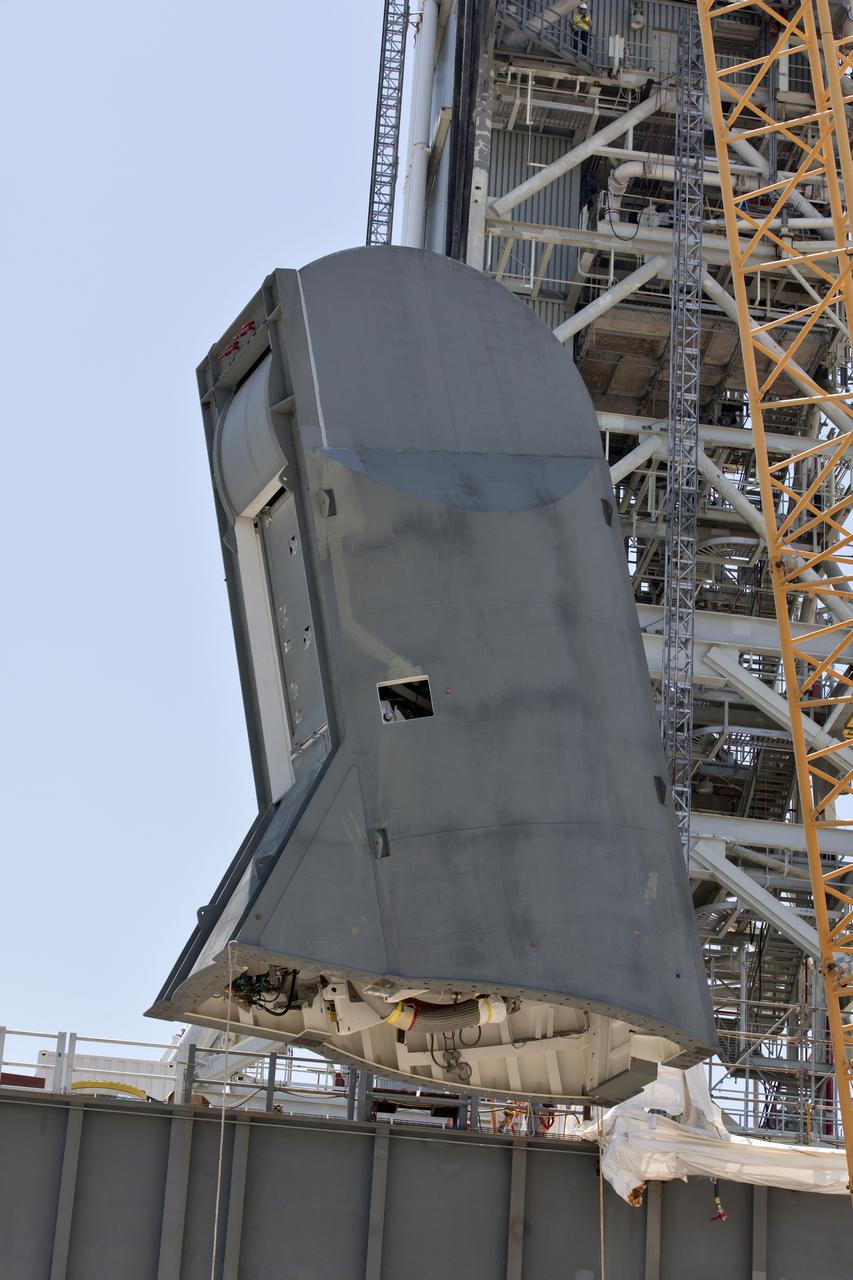
The first of two Tail Service Mast Umbilicals is lifted up for installation on the 0-level deck of the mobile launcher on July 12, at NASA's Kennedy Space Center in Florida. The 35-foot-tall umbilical will connect to NASA's Space Launch System rocket core stage aft section and provide liquid oxygen and electrical cable connections to the core stage engine section to support propellant handling during prelaunch operations. The installation brings Exploration Ground Systems one step closer to supporting prelaunch operations for the agency's SLS rocket and Orion spacecraft on Exploration Mission-1 and deep space destinations.
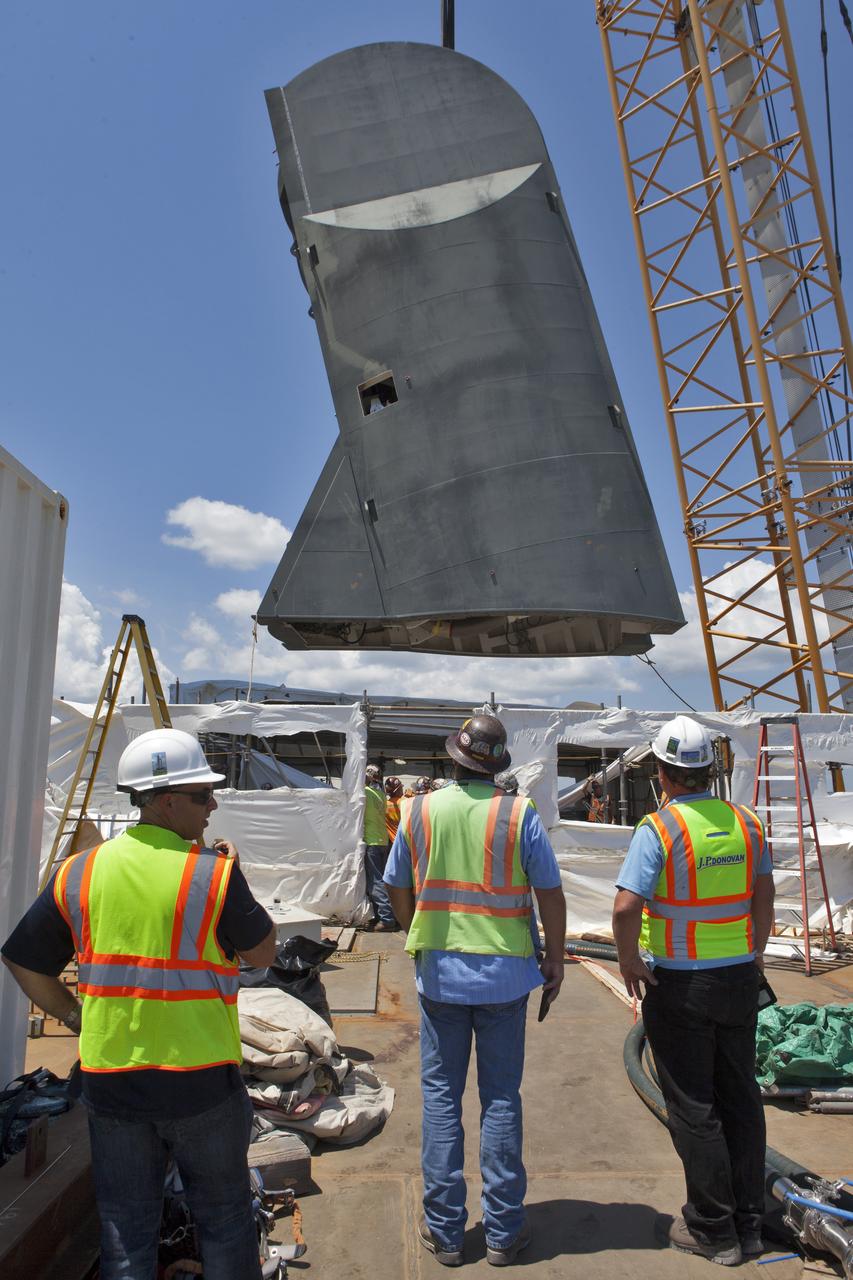
Construction workers with JP Donovan monitor operations as a crane is used to lower the first of two Tail Service Mast Umbilicals for installation on the 0-level deck of the mobile launcher on July 12, at NASA's Kennedy Space Center in Florida. The 35-foot-tall umbilical will connect to NASA's Space Launch System rocket core stage aft section and provide liquid oxygen and electrical cable connections to the core stage engine section to support propellant handling during prelaunch operations. The installation brings Exploration Ground Systems one step closer to supporting prelaunch operations for the agency's SLS rocket and Orion spacecraft on Exploration Mission-1 and deep space destinations.
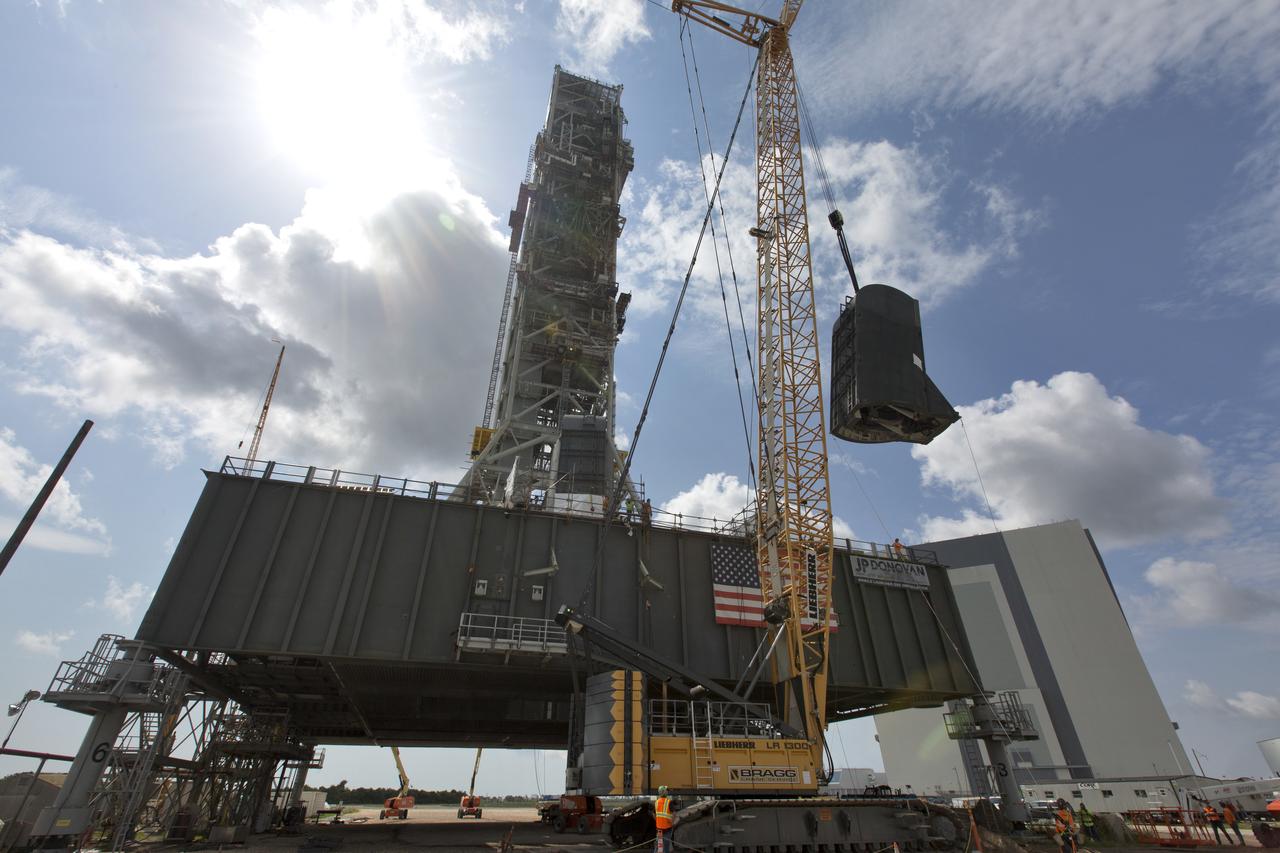
The second of two Tail Service Mast Umbilicals is lifted by crane for installation on the 0-level deck of the mobile launcher on July 27, at NASA's Kennedy Space Center in Florida. The 35-foot-tall umbilical will connect to NASA's Space Launch System (SLS) rocket core stage aft section and provide liquid hydrogen and electrical cable connections to the core stage engine section to support propellant handling during prelaunch operations. The installation brings Exploration Ground Systems one step closer to supporting prelaunch operations for the agency's SLS rocket and Orion spacecraft on Exploration Mission-1 and deep space destinations.
This image shows the X-59 aircraft’s lower empennage structure, or tail section of the plane, that was installed. The stabilators, the outer surfaces also seen in the photo, attach to the lower empennage and are used to help regulate the aircraft pitch which controls the up and down movement of the motion of the plane. The 13-foot engine will pack 22,000 pounds of propulsion and energy and power the X-plane to its planned cruising speed of Mach 1.4. Once complete, the X-59 aircraft will demonstrate the ability to fly supersonic while reducing the loud sonic boom to a quiet sonic thump and help enable commercial supersonic air travel over land. This aircraft is the centerpiece of NASA’s Quesst mission.

The second of two Tail Service Mast Umbilicals (TSMU), at left, is lowered for installation on the 0-level deck of the mobile launcher on July 27, at NASA's Kennedy Space Center in Florida. The 35-foot-tall umbilical will connect to NASA's Space Launch System (SLS) rocket core stage aft section and provide liquid hydrogen and electrical cable connections to the core stage engine section to support propellant handling during prelaunch operations. In view at right is the TSMU that will provide liquid oxygen and electrical cable connections to the core stage engine section. The installation brings Exploration Ground Systems one step closer to supporting prelaunch operations for the agency's SLS rocket and Orion spacecraft on Exploration Mission-1 and deep space destinations.