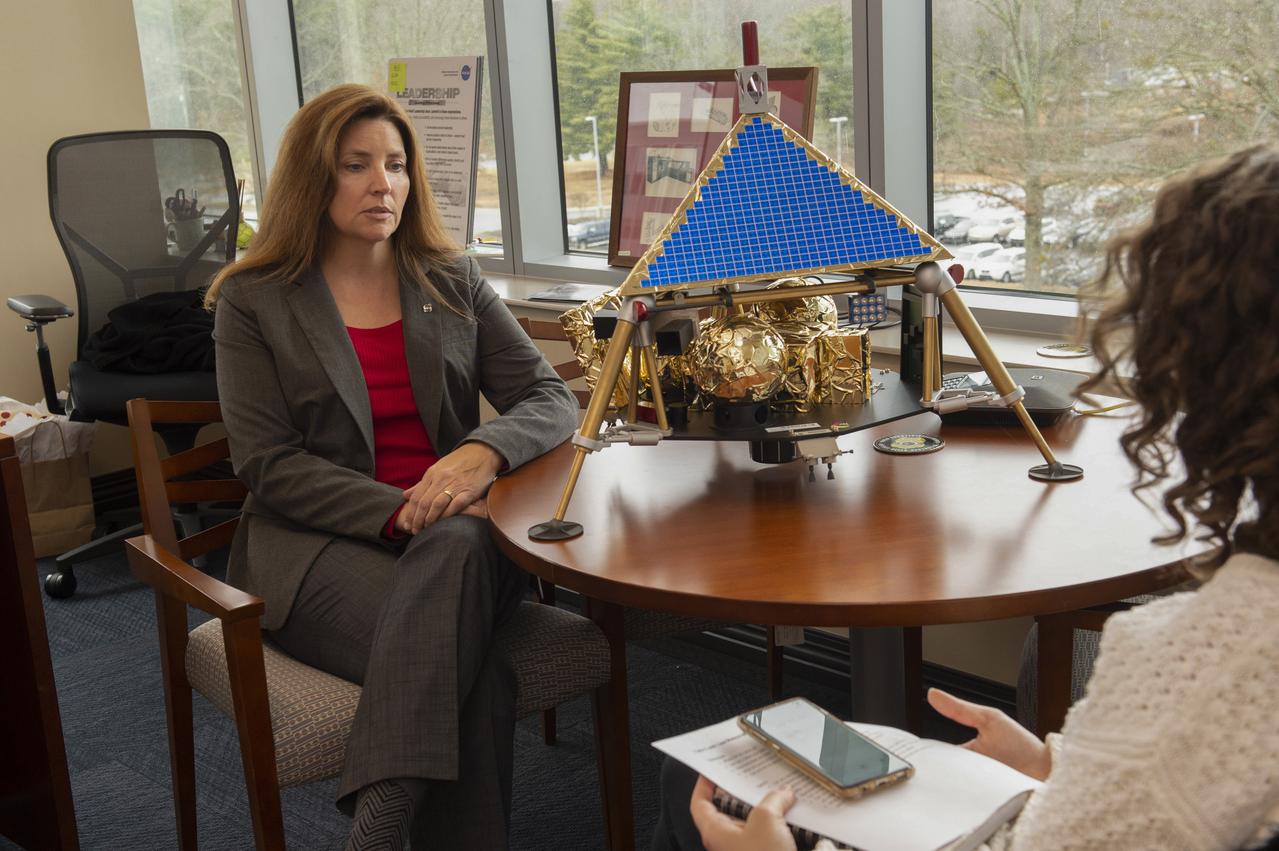
Lisa Watson-Morgan is interviewed for “TAKE FIVE†column in Marshall Star newspaper
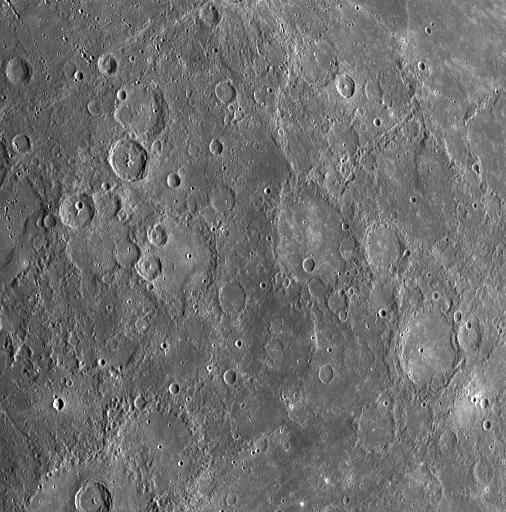
During NASA MESSENGER spacecraft flyby of Mercury on January 14, 2008, part of the planned sequence of observations included taking images of the same portion of Mercury surface from five different viewing angles.

This artist concept takes us on a journey to 55 Cancri, a star with a family of five known planets - the most planets discovered so far around a star besides our own.

KENNEDY SPACE CENTER, FLA. - STS-79 Commander William F. Readdy arrives at KSC's Shuttle Landing Facility with five fellow astronauts, ready to participate in the Terminal Countdown Demonstration Test (TCDT). The TCDT is a dress rehearsal for launch for the flight crew and launch team. Over the next several days, the astronauts will take part in training exercises at the launch pad that will culminate in a simulated launch countdown. The Space Shuttle Atlantis is being prepared for liftoff on STS-79 around Sept. 12.
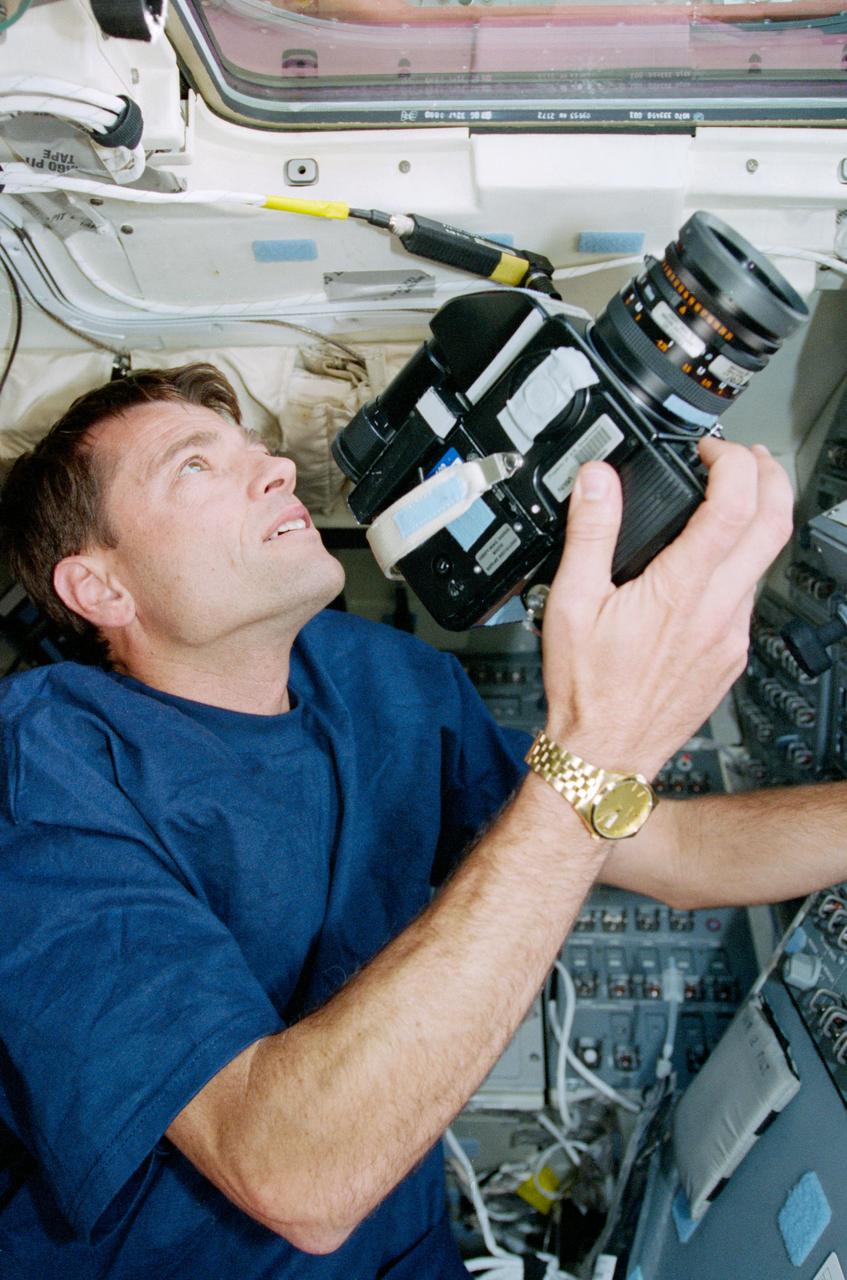
STS093-327-016 (23-27 July 1999) --- Astronaut Jeffrey S. Ashby, pilot, prepares to take a still photograph from Columbia's flight deck. Ashby and four other astronauts spent almost five days in Earth orbit in July 1999.
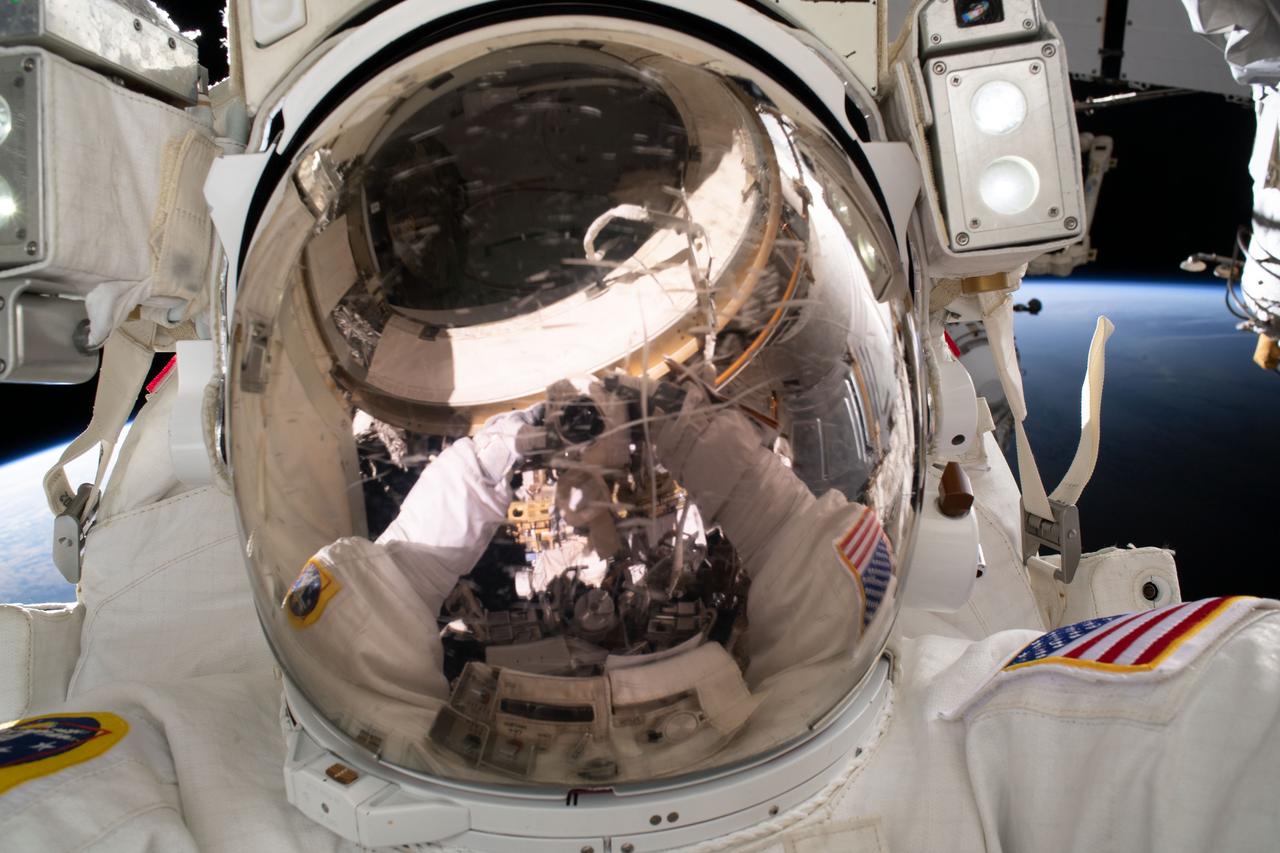
iss069e020708 (June 15, 2023) --- NASA astronaut and Expedition 68 Flight Engineer Woody Hoburg points the camera toward himself and takes an out-of-this-world "space-selfie" during a five-hour and 35-minute spacewalk to install a roll-out solar array on the International Space Station's truss structure.
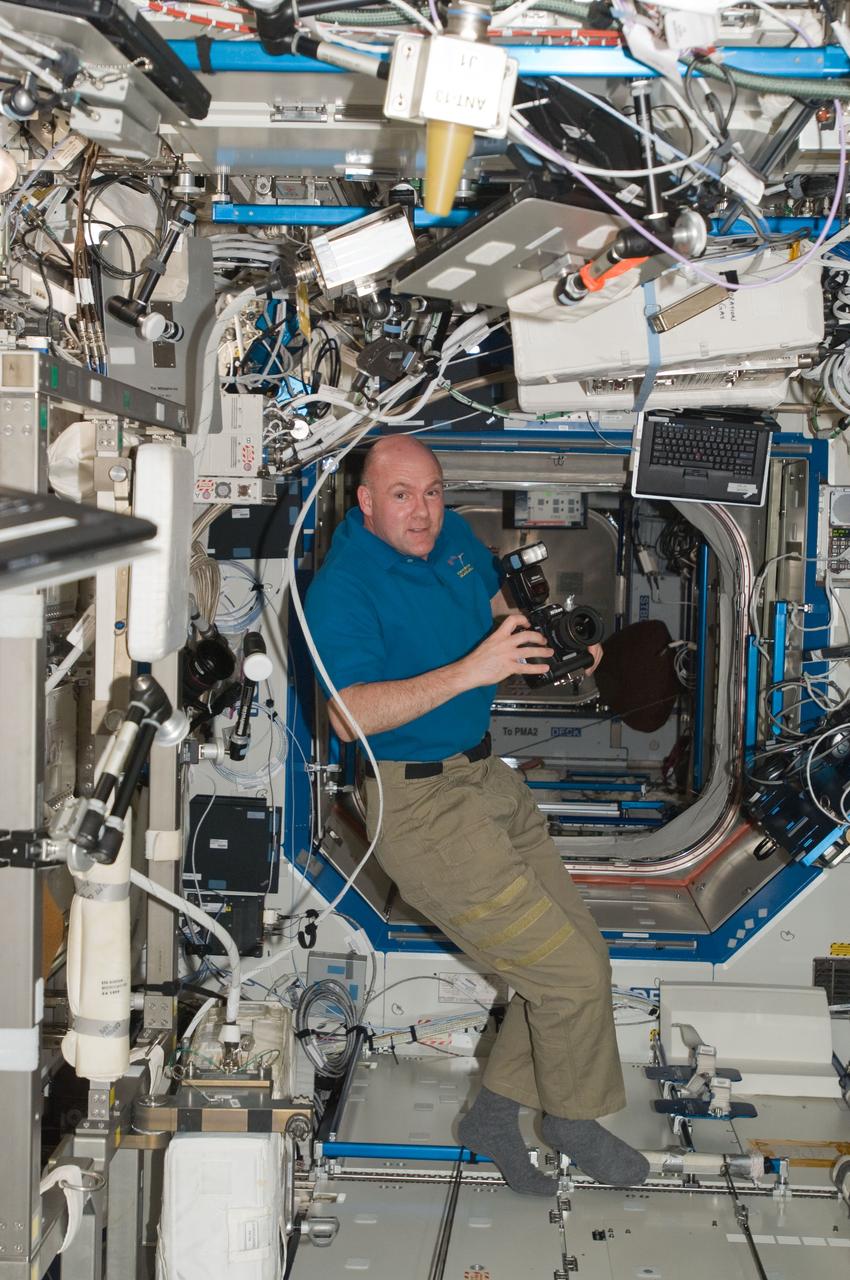
ISS030-E-015658 (25 Dec. 2011) --- European Space Agency astronaut Andre Kuipers takes pictures in Node 2 (Harmony) aboard the International Space Station. The Expedition 30/31 flight engineer came aboard the orbital outpost about two days ago, joining a total of five other astronauts and cosmonauts.
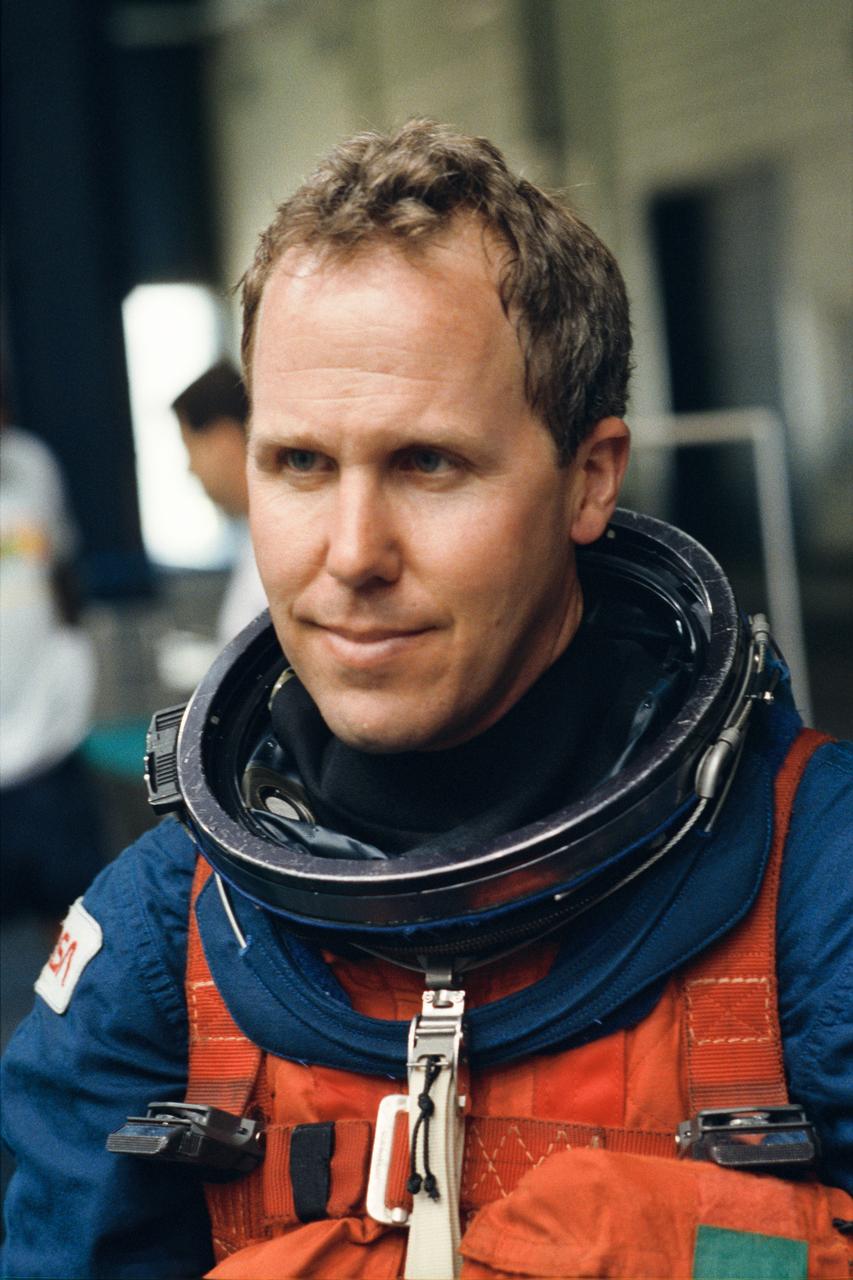
S93-43108 (2 June 1993) --- Astronaut Thomas D. Jones, mission specialist, takes a break during emergency bailout training at the Johnson Space Center's (JSC) Weightless Environment Training Facility (WET-F). Jones and five other NASA astronauts are scheduled to fly aboard the Space Shuttle Endeavour next year.
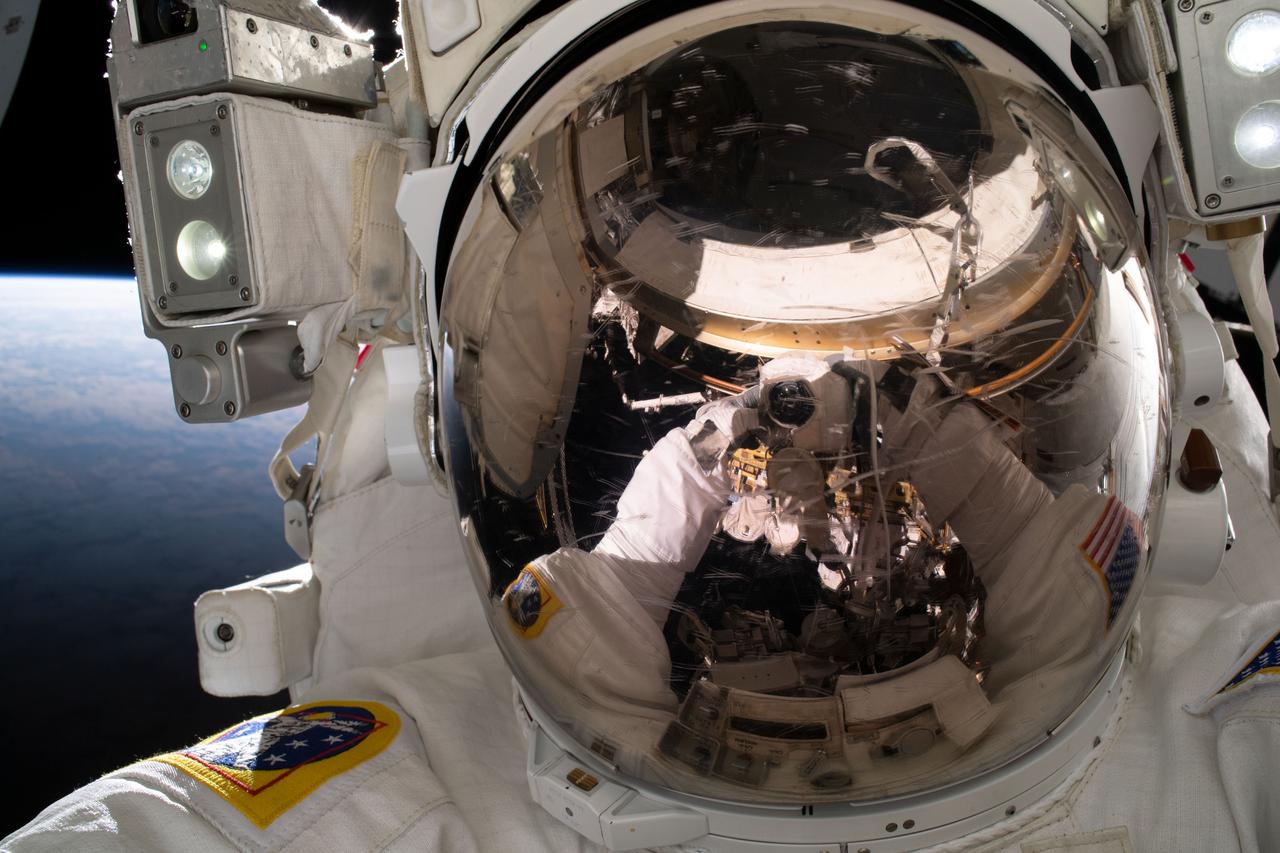
iss069e020706 (June 15, 2023) --- NASA astronaut and Expedition 68 Flight Engineer Woody Hoburg points the camera toward himself and takes an out-of-this-world "space-selfie" during a five-hour and 35-minute spacewalk to install a roll-out solar array on the International Space Station's truss structure.
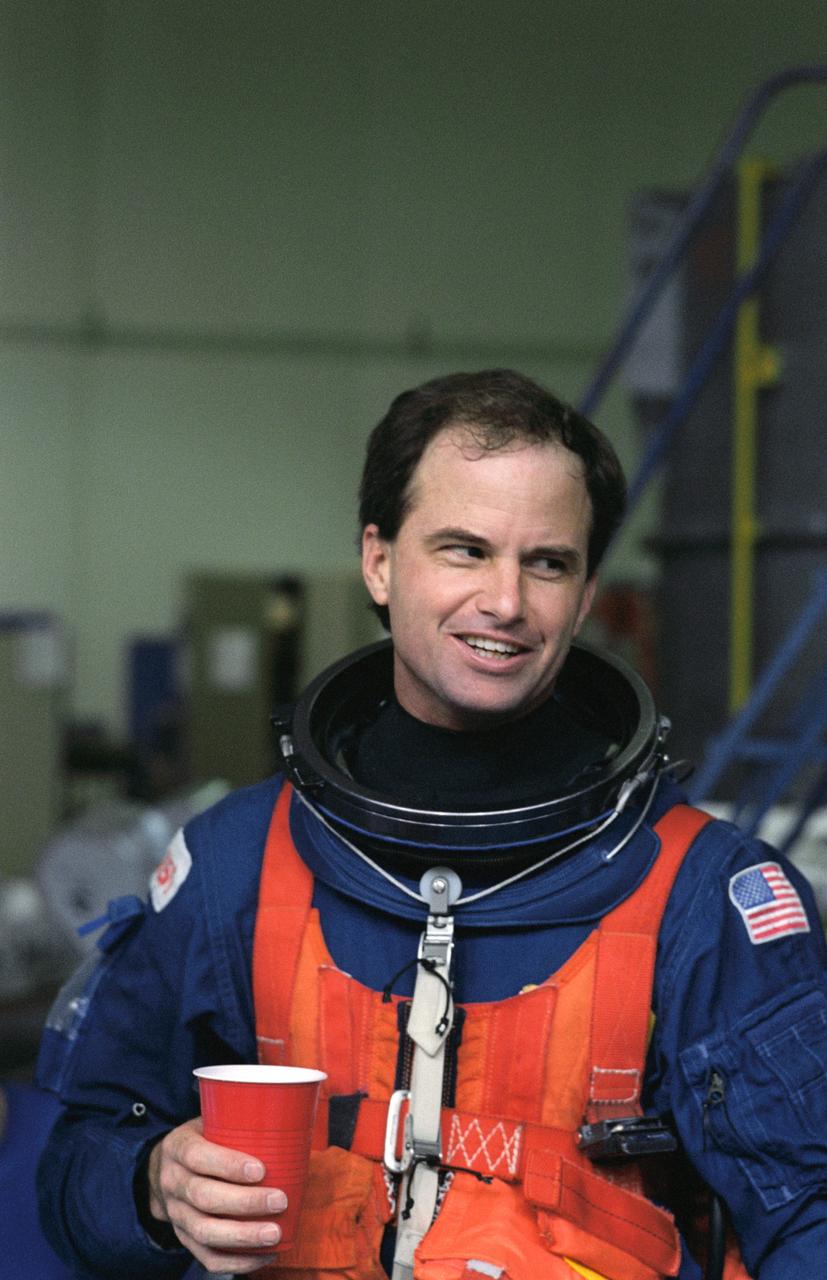
S93-50720 (22 Dec 1993) --- Astronaut Kevin P. Chilton, pilot, takes a break during emergency bailout training at the Johnson Space Center's (JSC) Weightless Environment Training Facility (WET-F). Chilton and five other NASA astronauts are scheduled to fly aboard the Space Shuttle Endeavour next year.
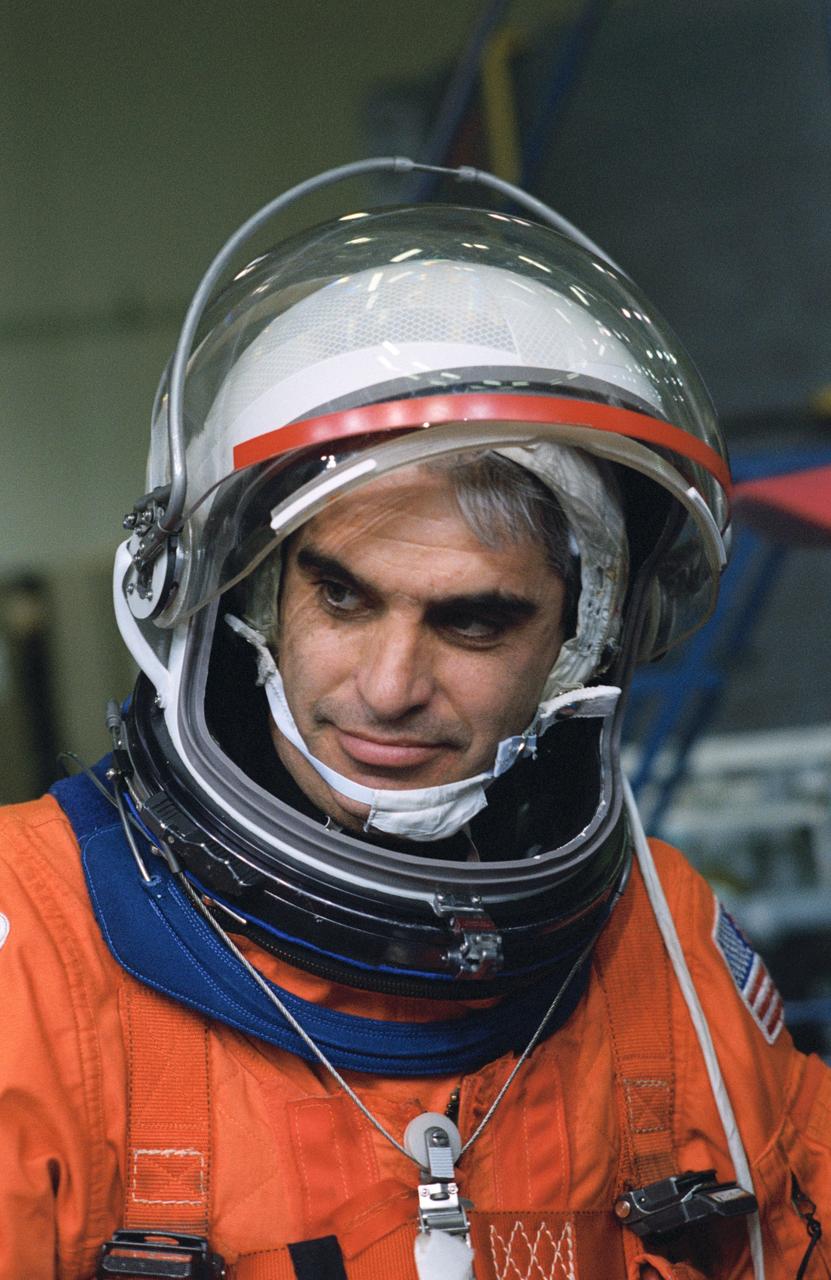
S93-50710 (22 Dec 1993) --- Astronaut Sidney M. Gutierrez, commander, takes a break during emergency bailout training at the Johnson Space Center's (JSC) Weightless Environment Training Facility (WET-F). Gutierrez and five other NASA astronauts are scheduled to fly aboard the Space Shuttle Endeavour next year.

Seen from across the backwaters of the Indian River Lagoon, the Space Shuttle Atlantis, atop the mobile launcher platform and crawler-transporter, nears Launch Pad 39A at 1 mph. The crawler-transporter takes about five hours to cover the 3.4 miles from the Vehicle Assembly Building to the launch pad. The crawler-transporter carries its cargo at 1 mph, taking about five hours to cover the 3.4 miles from the Vehicle Assembly Building to the launch pad. A leveling system on the crawler-transporter keeps the top of the Space Shuttle vertical, especially negotiating the ramp leading to the launch pads and when it is raised and lowered on pedestals at the pad. Liftoff of Atlantis on mission STS-101 is scheduled for April 17 at 7:03 p.m. EDT. STS-101 is a logistics and resupply mission for the International Space Station, to restore full redundancy to the International Space Station power system in preparation for the arrival of the next pressurized module, the Russian-built Zvezda
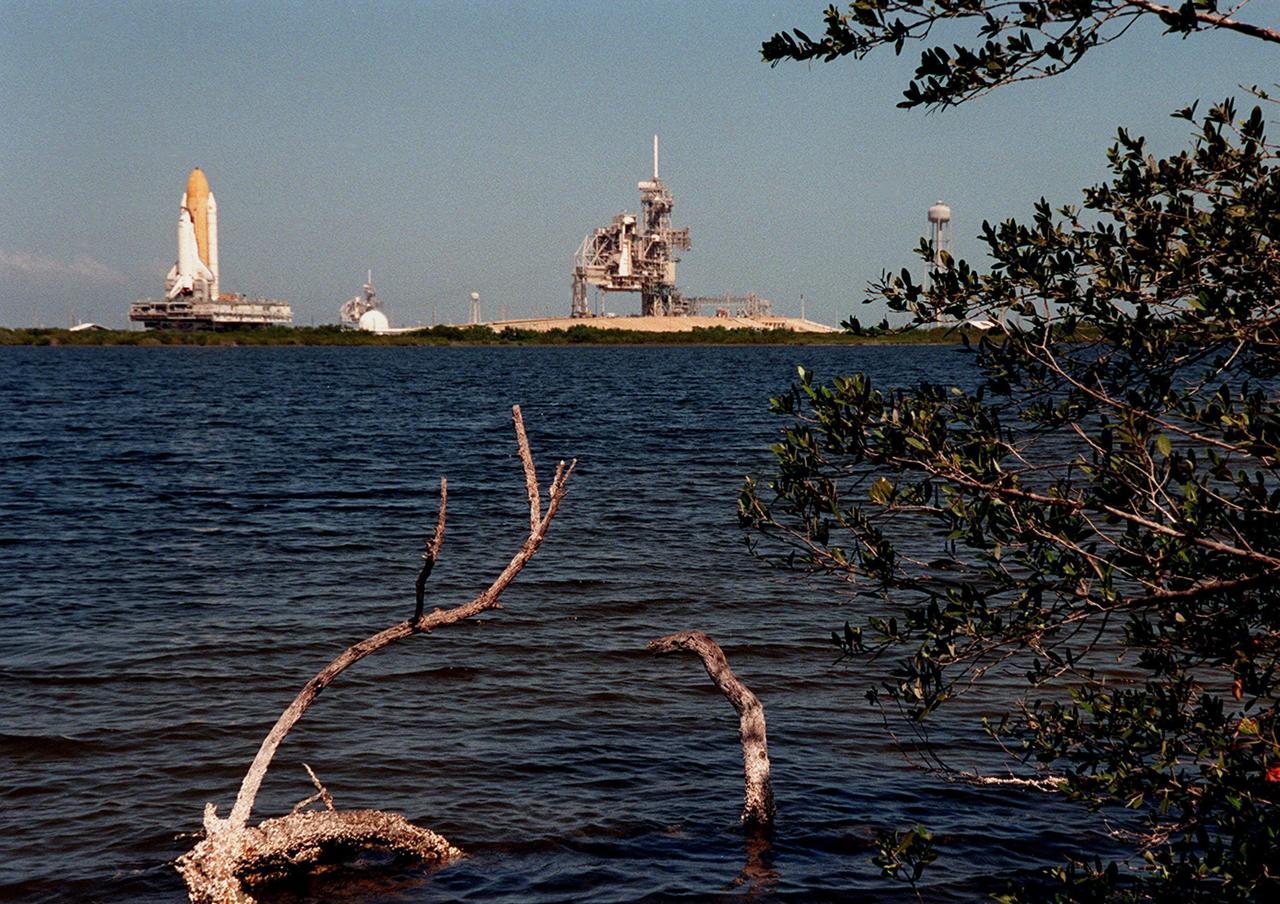
Seen from across the backwaters of the Indian River Lagoon, the Space Shuttle Atlantis, atop the mobile launcher platform and crawler-transporter, nears Launch Pad 39A at 1 mph. The crawler-transporter takes about five hours to cover the 3.4 miles from the Vehicle Assembly Building to the launch pad. The crawler-transporter carries its cargo at 1 mph, taking about five hours to cover the 3.4 miles from the Vehicle Assembly Building to the launch pad. A leveling system on the crawler-transporter keeps the top of the Space Shuttle vertical, especially negotiating the ramp leading to the launch pads and when it is raised and lowered on pedestals at the pad. Liftoff of Atlantis on mission STS-101 is scheduled for April 17 at 7:03 p.m. EDT. STS-101 is a logistics and resupply mission for the International Space Station, to restore full redundancy to the International Space Station power system in preparation for the arrival of the next pressurized module, the Russian-built Zvezda
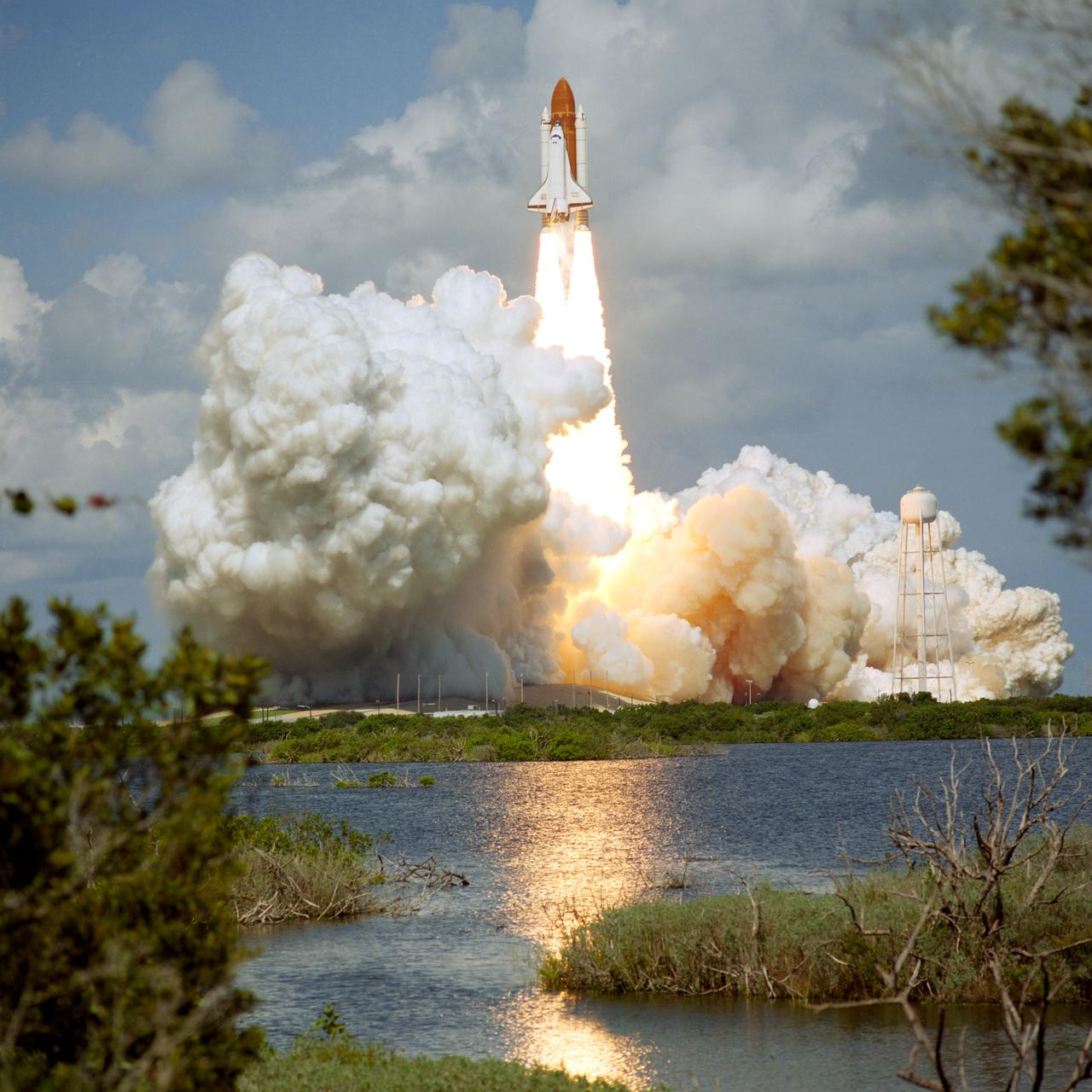
STS034-S-025 (18 Oct 1989) --- The STS-34 Space Shuttle Atlantis lifts off from Launch Pad 39-B at 2:53:39:983 p.m. (EDT), marking the beginning of a five-day mission in space. Atlantis carries a crew of five and the spacecraft Galileo, along with a number of other scientific experiments. The Jupiter-bound probe will be deployed from Atlantis some six hours after launch. The journey to the giant planet is expected to take over six years. Crewmembers for the mission are astronauts Donald E. Williams, Michael J. McCulley, Shannon W. Lucid, Franklin R. Chang-Diaz and Ellen S. Baker. The scene was recorded with a 70mm camera.
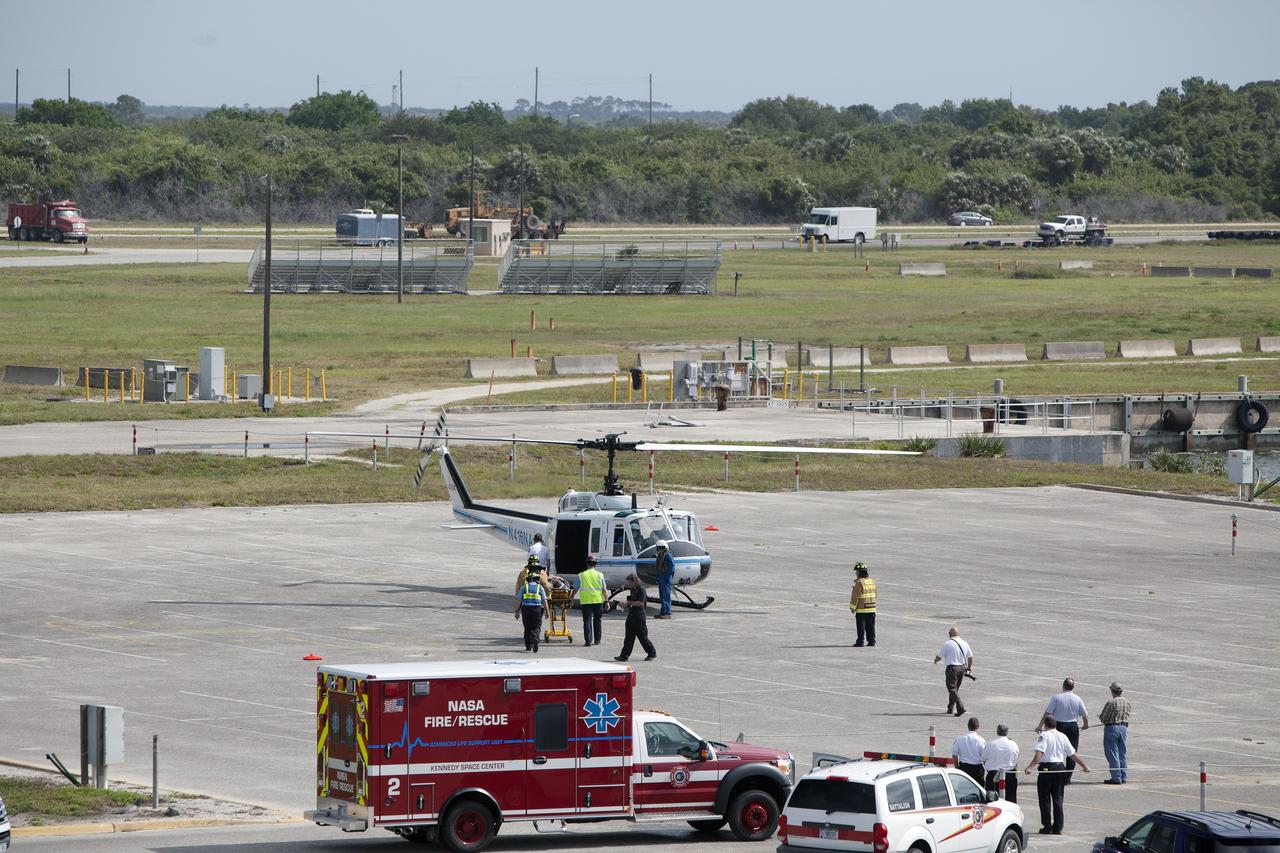
CAPE CANAVERAL, Fla. -- At NASA's Kennedy Space Center in Florida, paramedics and Fire Rescue personnel move a stretcher to the waiting helicopter as they work quickly to have the patient ready to transport five minutes after he was removed from a vehicle. The activity taking place in Kennedy's Launch Complex 39 turn-basin parking lot was only one of several drills. It was part of a new training program that was developed by Kennedy's Fire Rescue department along with NASA Aircraft Operations to sharpen the skills needed to help rescue personnel learn how to collaborate with helicopter pilots in taking injured patients to hospitals as quickly as possible. Photo credit: NASA/Dan Casper
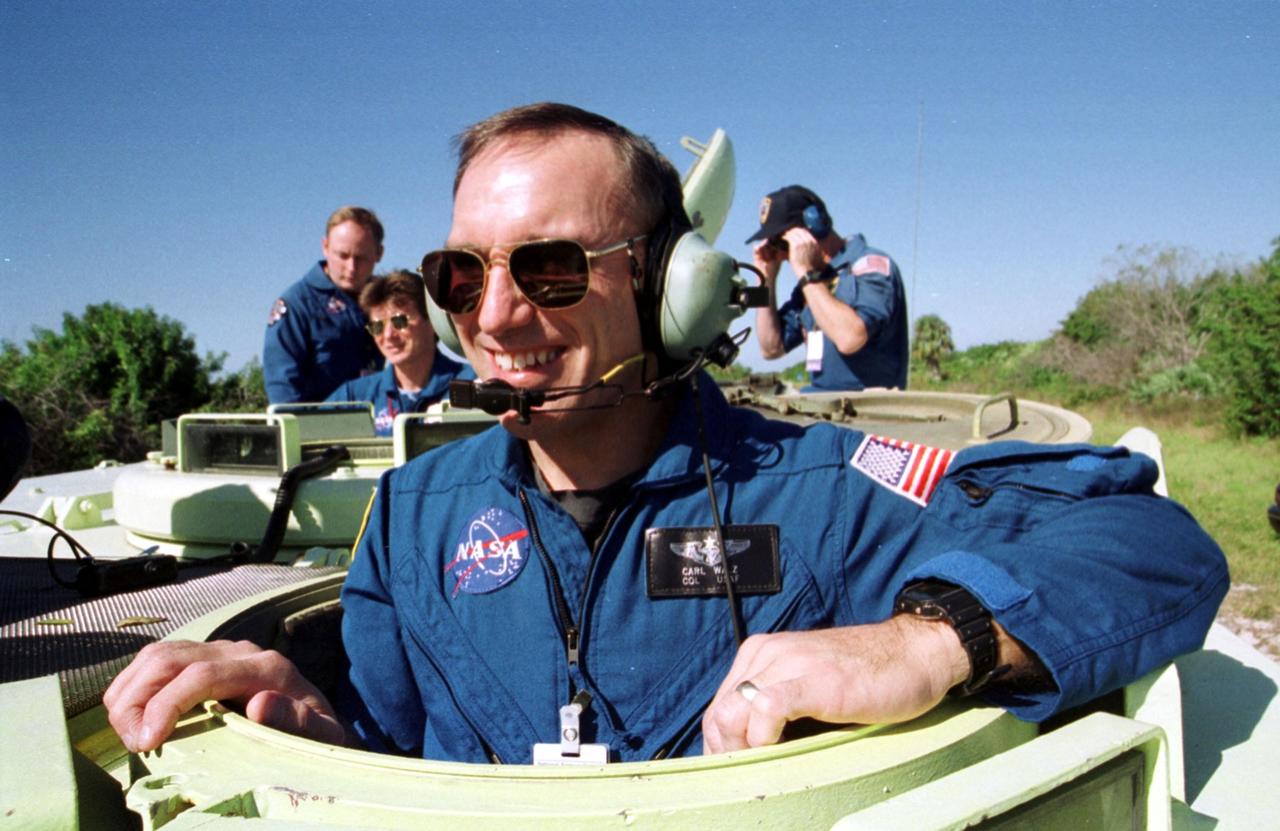
KENNEDY SPACE CENTER, Fla. -- Expedition 4 crew member Carl E. Walz is ready to take his turn driving an M-113 armored personnel carrier. He and other crew members are taking part in Terminal Countdown Demonstration Test activities, which include emergency exit from the launch pad and a simulated launch countdown. Walz will be transported to the International Space Station on mission STS-108, targeted for launch Nov. 29 on Space Shuttle Endeavour. The Expedition 4 crew will spend more than five months living and working on the permanently manned Station and return on mission STS-111 in May 2002
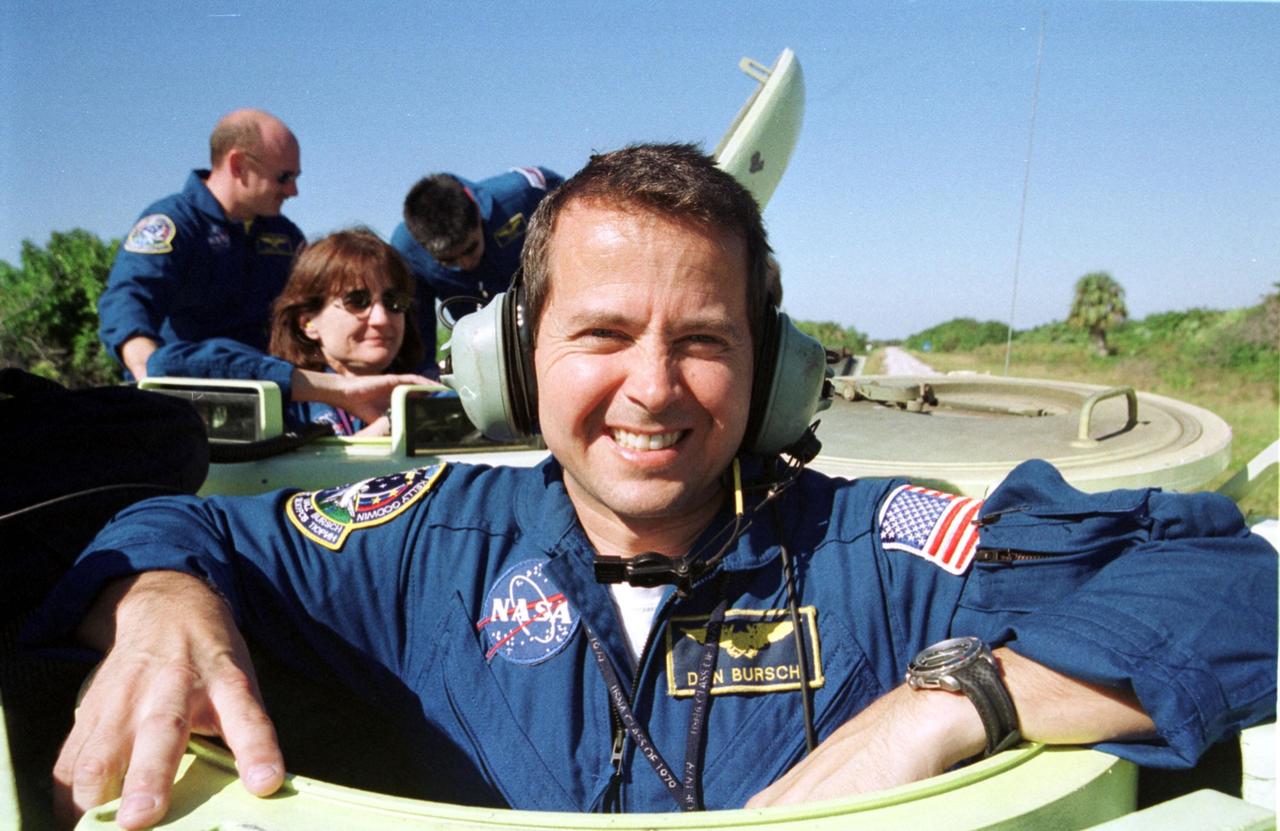
KENNEDY SPACE CENTER, Fla. -- Expedition 4 crew member Daniel W. Bursch is ready to take his turn driving an M-113 armored personnel carrier. He and other crew members are taking part in Terminal Countdown Demonstration Test activities, which include emergency exit from the launch pad and a simulated launch countdown. Bursch will be transported to the International Space Station on mission STS-108, targeted for launch Nov. 29 on Space Shuttle Endeavour. The Expedition 4 crew will spend more than five months living and working on the permanently manned Station and return on mission STS-111 in May 2002
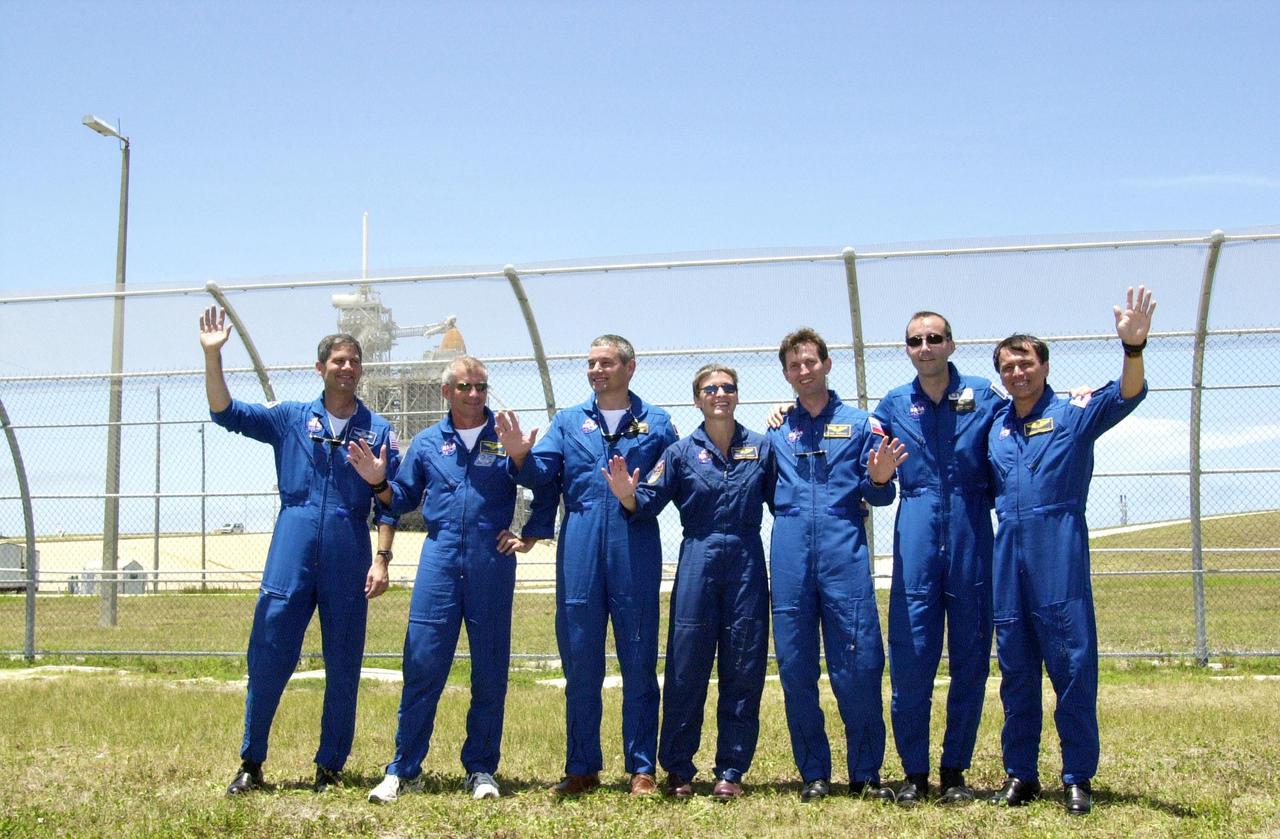
KENNEDY SPACE CENTER, FLA. -- At Launch Pad 39-A, the STS-111 and Expedition Five crews take time out from a tour of the pad with their friends and family to pose for a group portrait. From left, they are STS-111 Pilot Paul Lockhart, STS-111 Commander Kenneth Cockrell, Expedition Five Commander Valeri Korzun (RSA), Expedition Five astronaut Peggy Whitson, Expedition Five cosmonaut Sergei Treschev (RSA), and STS-111 Mission Specialists Philippe Perrin (CNES) and Franklin Chang-Diaz. Expedition Five is traveling to the International Space Station on Space Shuttle Endeavour as the replacement crew for Expedition Four, who will return to Earth aboard the orbiter. Known as Utilization Flight 2, STS-111 is carrying supplies and equipment to the Station. The payload includes the Multi-Purpose Logistics Module Leonardo, the Mobile Base System, which will be installed on the Mobile Transporter to complete the Canadian Mobile Servicing System, or MSS, and a replacement wrist/roll joint for Canadarm 2. The mechanical arm will then have the capability to "inchworm" from the U.S. Lab Destiny to the MSS and travel along the truss to work sites. Launch is scheduled for May 30, 2002
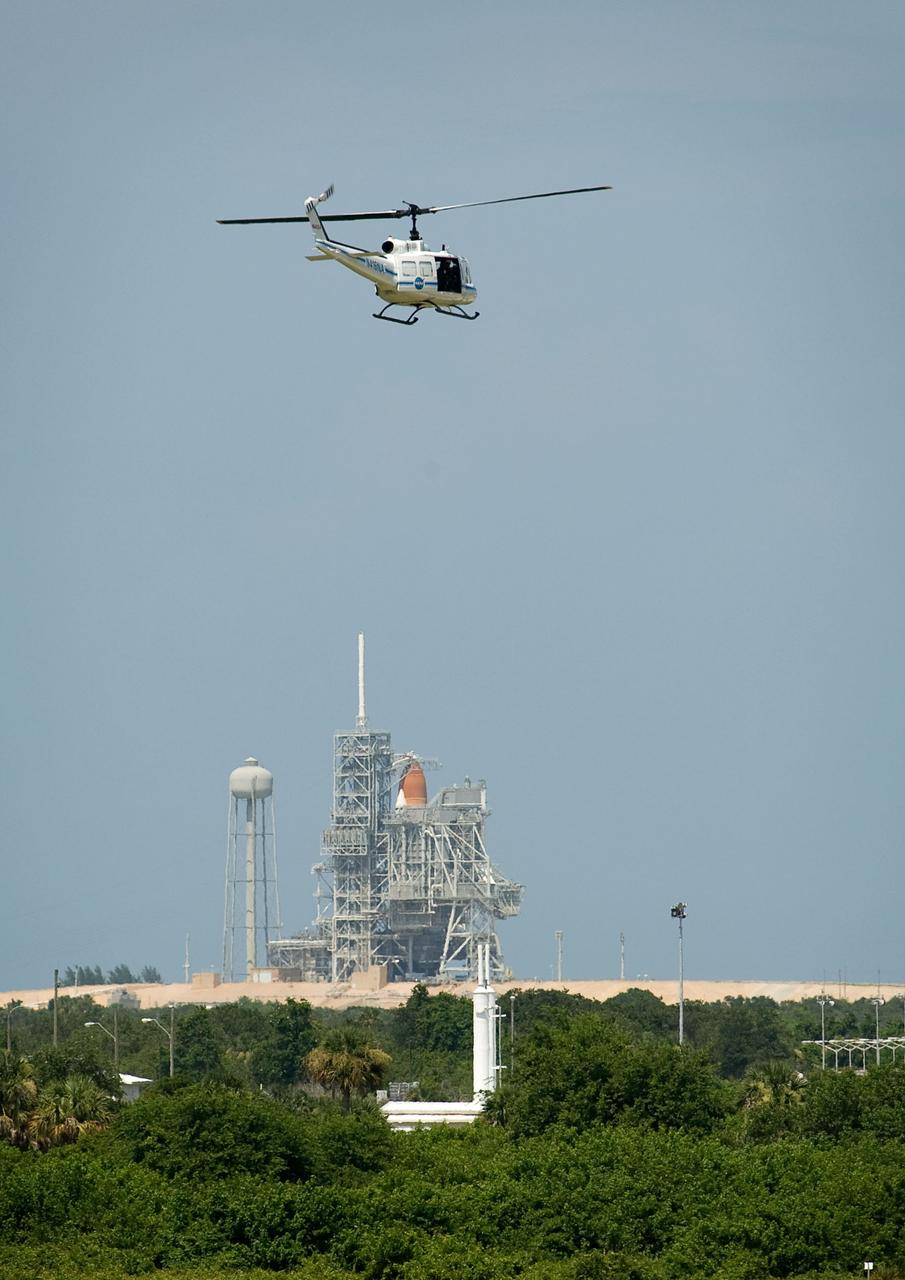
A NASA Security helicopter watches over the Astrovan as it takes the crew of STS-127 to the space shuttle Endeavour at pad 39a at NASA's Kennedy Space Center in Cape Canaveral, Florida, Saturday, July 12, 2009. Endeavour is set to launch at 7:13p.m. EDT with the crew of STS-127 and start a 16-day mission that will feature five spacewalks and complete construction of the Japan Aerospace Exploration Agency's Kibo laboratory. Photo Credit: (NASA/Bill Ingalls)
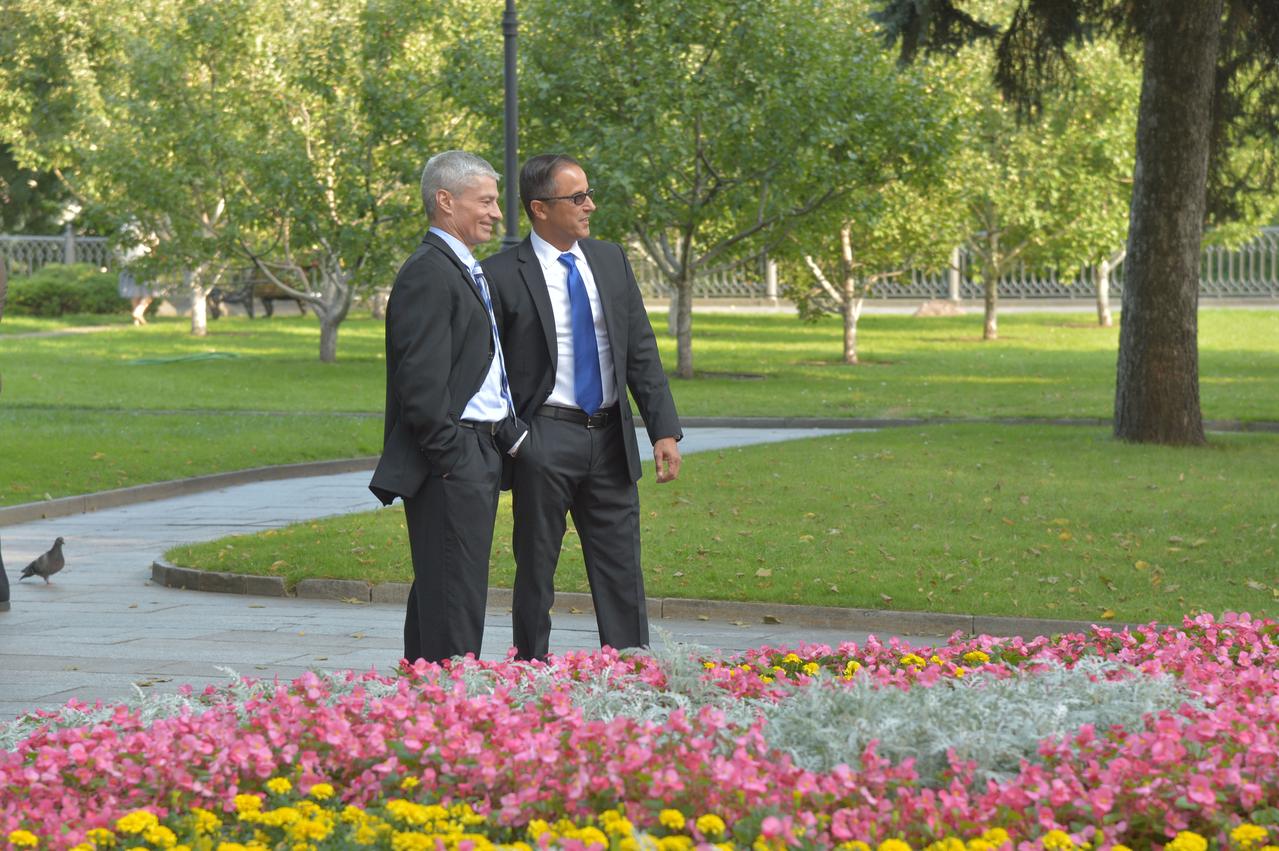
jsc2017e114487 (Sept. 1, 2017) --- Expedition 53-54 crewmembers Mark Vande Hei (left) and Joe Acaba (right) of NASA take a moment to relish the view Sept. 1 as they toured the Kremlin in Moscow as part of traditional pre-launch ceremonies. Vande Hei, Acaba and Alexander Misurkin of Roscosmos will launch Sept. 13 from the Baikonur Cosmodrome in Kazakhstan Sept. 13 on the Soyuz MS-06 spacecraft for a five and a half month mission on the International Space Station. Credit: NASA/Elizabeth Weissinger
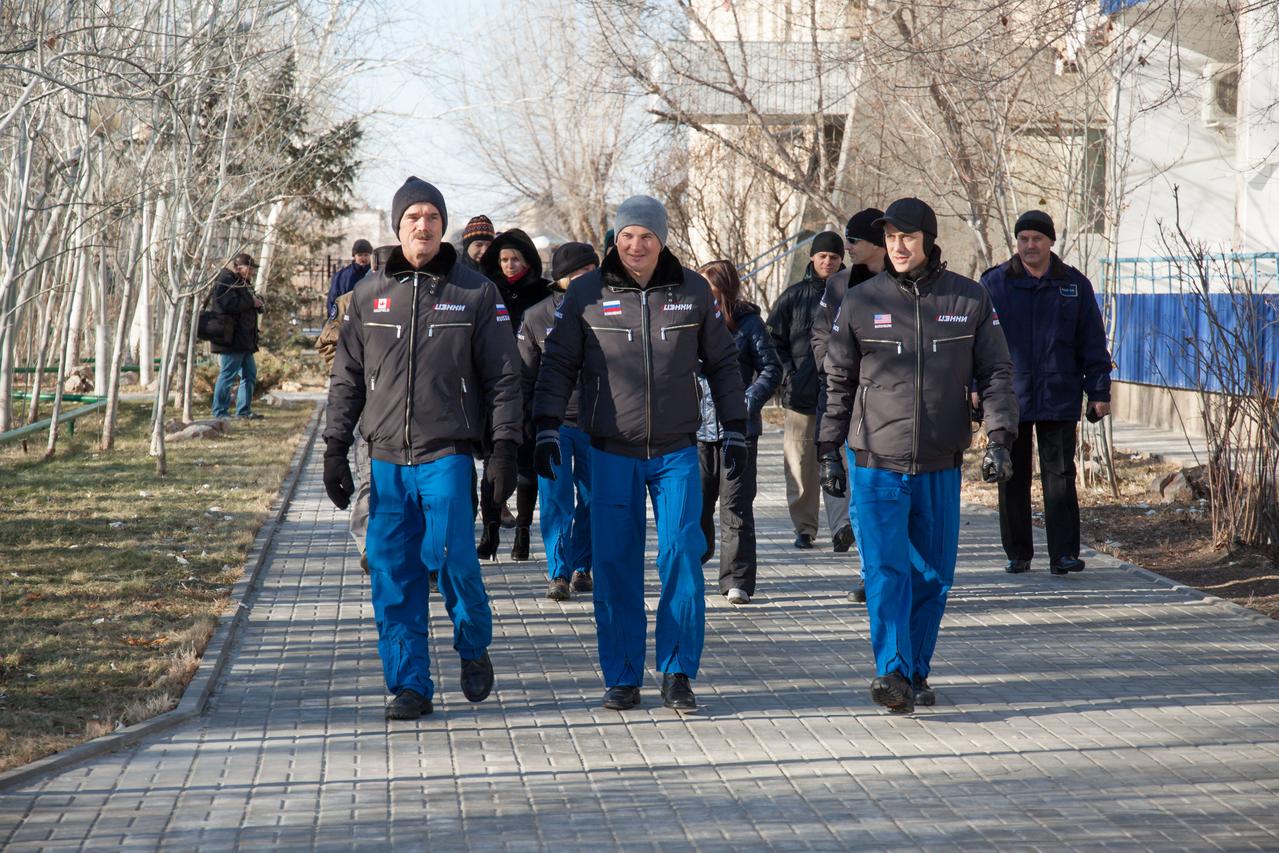
At the Cosmonaut Hotel crew quarters in Baikonur, Kazakhstan, Expedition 34/35 crewmembers Flight Engineer Chris Hadfield of the Canadian Space Agency (left), Soyuz Commander Roman Romanenko (center) and Flight Engineer Tom Marshburn (right) take a stroll down the Walk of Cosmonauts Dec. 13, 2012 as part of traditional pre-launch ceremonies. The trio will launch Dec. 19 from the Baikonur Cosmodrome in Kazakhstan Dec. 19 on the Soyuz TMA-07M spacecraft for a five-month mission on the International Space Station. NASA/Victor Zelentsov
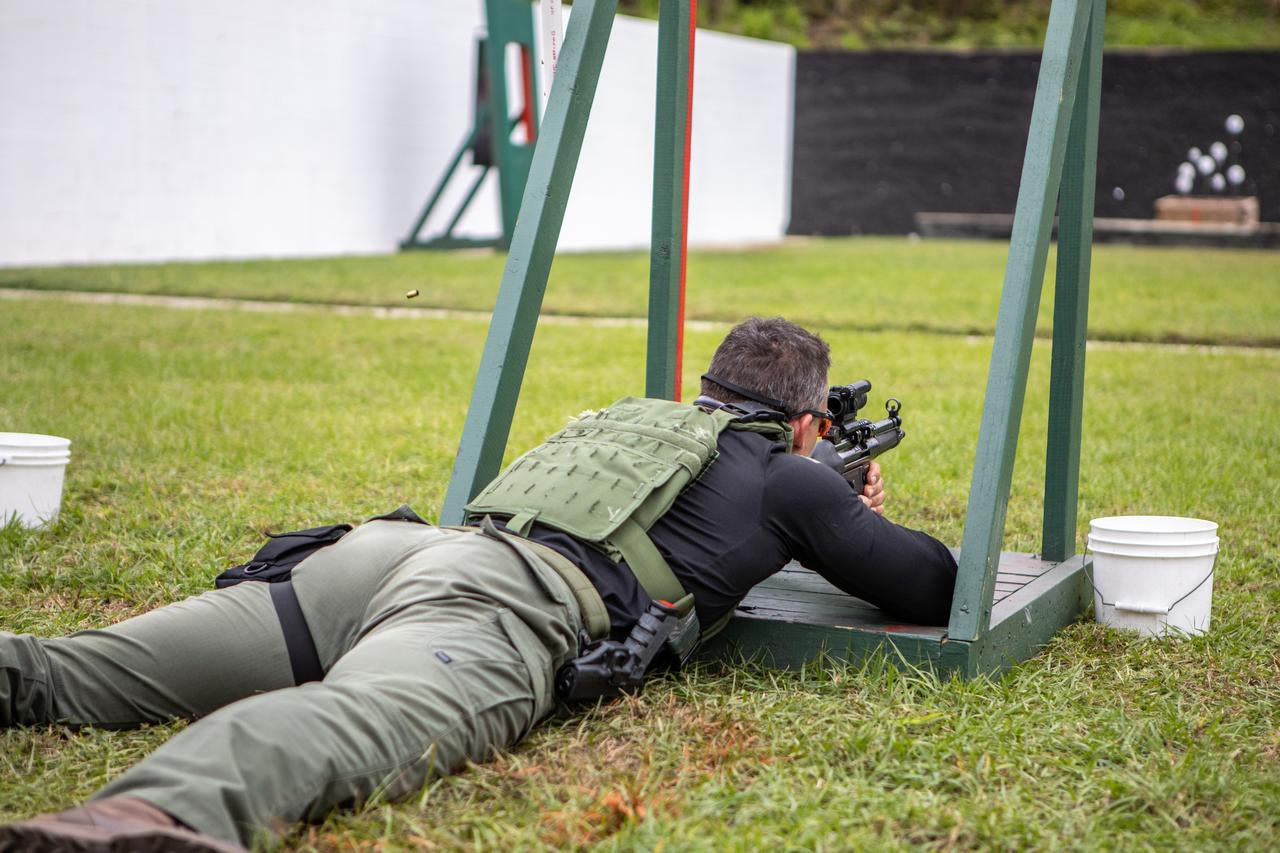
A member of NASA Kennedy Space Center's Emergency Response Team takes aim at a target during the sharpshooter tactical challenge at the 37th Annual SWAT Round-Up International at the Lawson Lamar Firearms and Tactical Training Center in Orlando, Florida. The competition was held Nov. 10 to 15, 2019, and featured five different tactical challenges. Kennedy's ERT members exchanged best practices and competed with more than 50 teams from the U.S. and around the world.
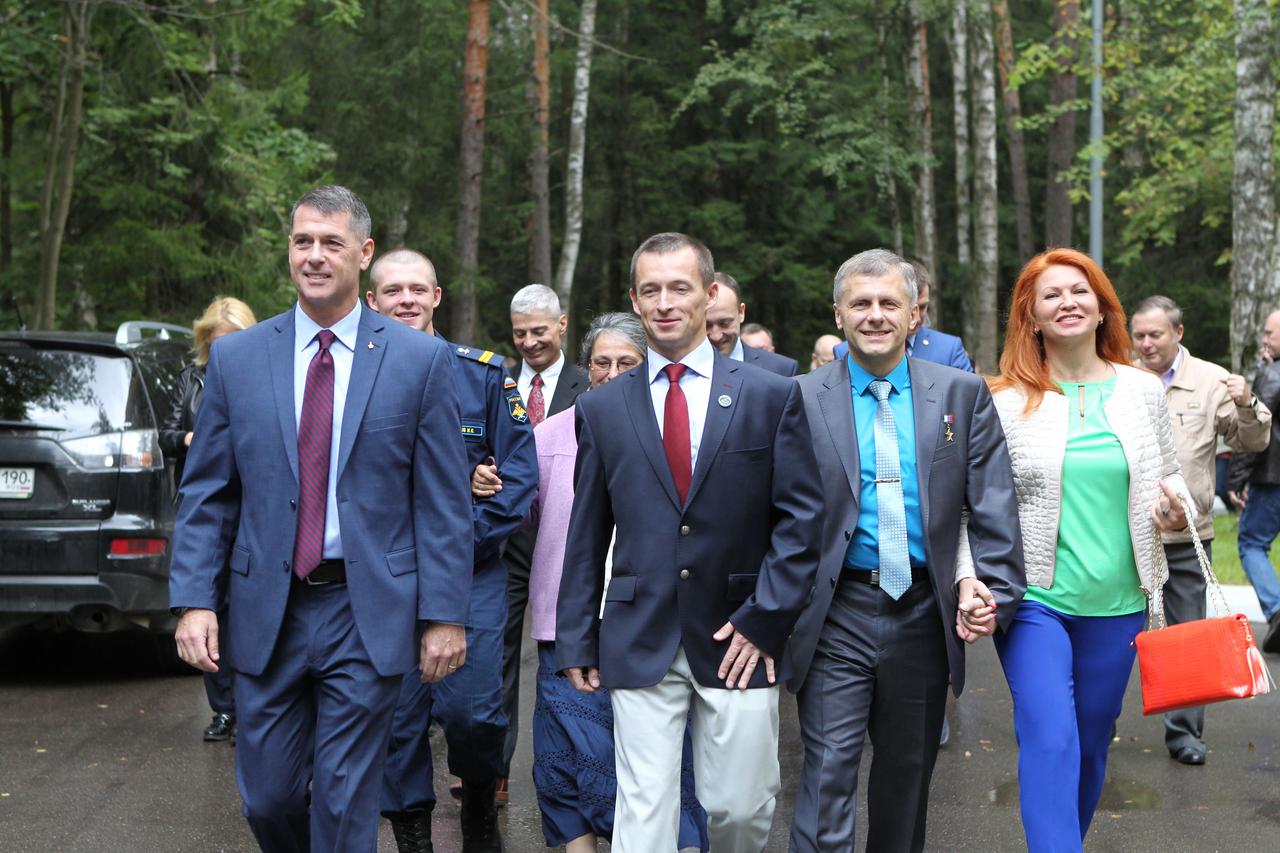
At the Gagarin Cosmonaut Training Center in Star City, Russia, Expedition 49 crewmembers Shane Kimbrough of NASA (left) and Sergey Ryzhikov (center) and Andrey Borisenko (right) of Roscosmos walk to busses Sept. 8 that will take them to nearby Chkalovsky Airfield and a flight to the launch site at the Baikonur Cosmodrome in Kazakhstan, where they will launch on Sept. 24, Kazakh time on the Soyuz MS-02 spacecraft for a five-month mission on the International Space Station. NASA/Stephanie Stoll
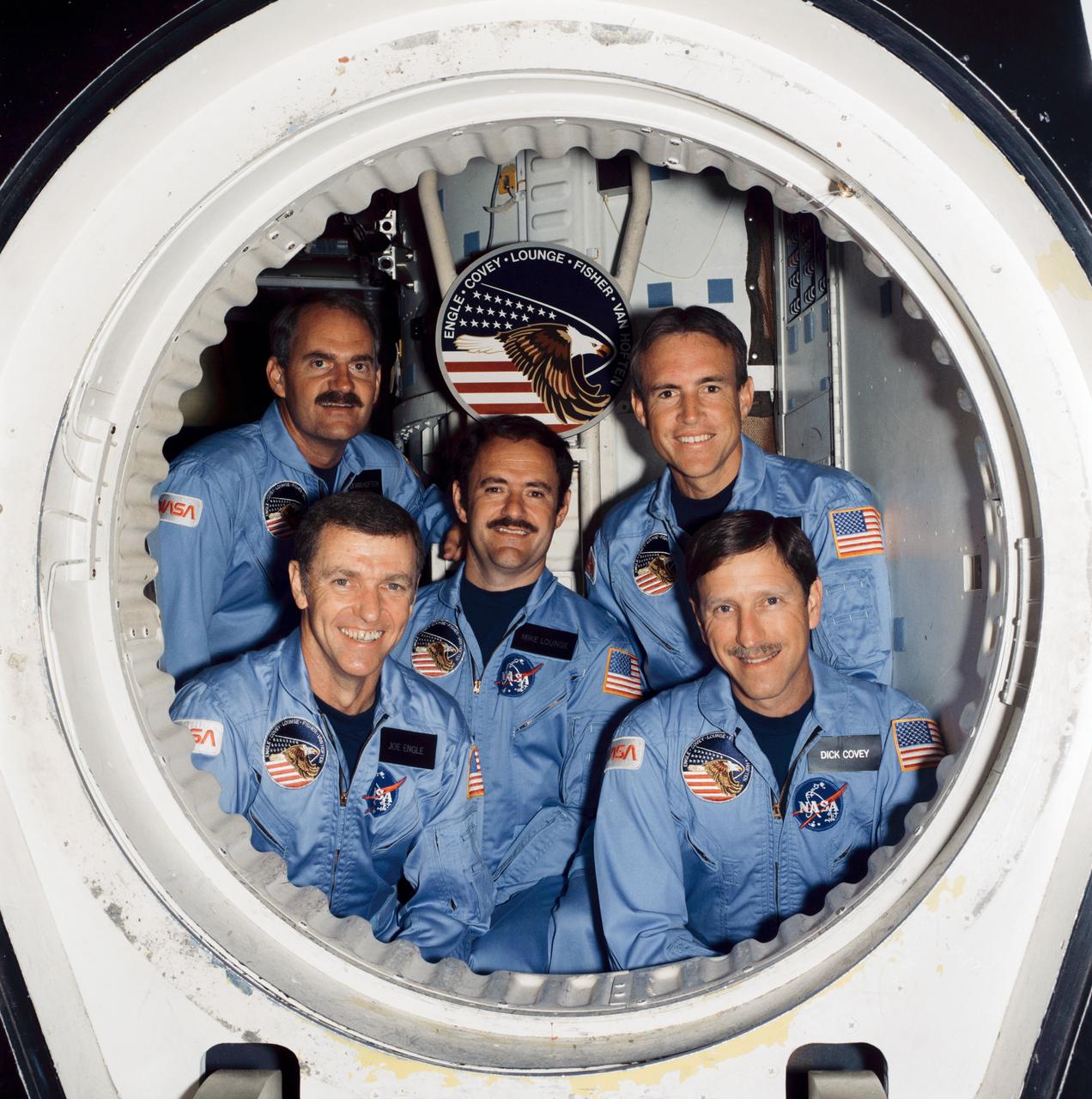
S85-36062 (1 July 1985) --- These five NASA astronauts make up the crew for the mission STS-51I, scheduled for launch in August of this year. Taking a break from rehearsals in the crew compartment trainer in the Shuttle Mockup and Integration Laboratory at JSC are astronauts Joe H. Engle (front left), crew commander; Richard O. Covey (front right), pilot; and (back row, left-to-right) astronauts James D. van Hoften, John M. (Mike) Lounge and William F. Fisher -- all mission specialists.
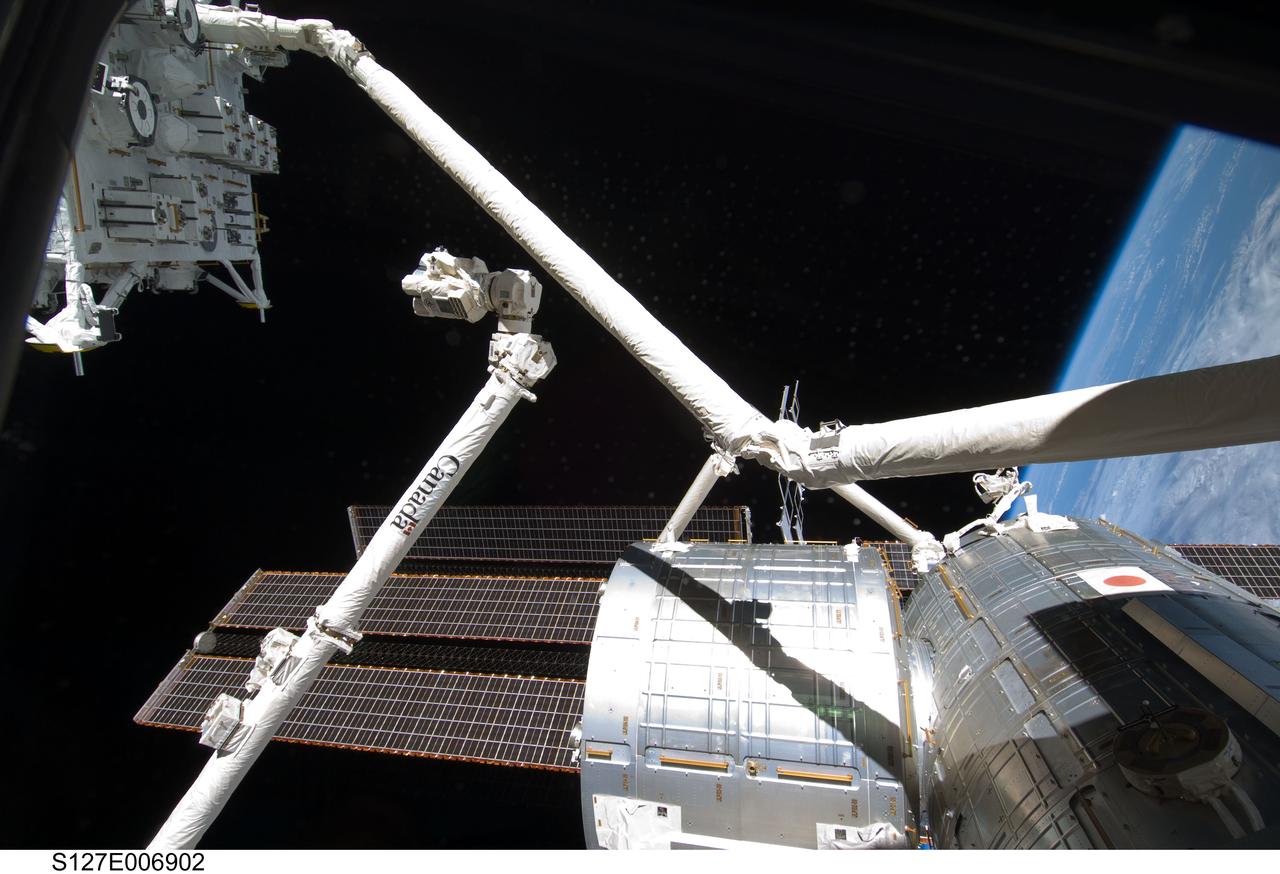
S127-E-006902 (18 July 2009) --- The Japanese Experiment Module - Exposed Facility (JEF) is pictured in the grasp of the Space Shuttle Endeavour's remote manipulator system (RMS) arm during flight day four robotics activity. The International Space Station's remote manipulutor system (SSRMS or Canadarm2) prepares to take the hand-off from the shuttle's robot arm. Astronauts also began a series of five spacewalks on this day to continue work on the International Space Station.
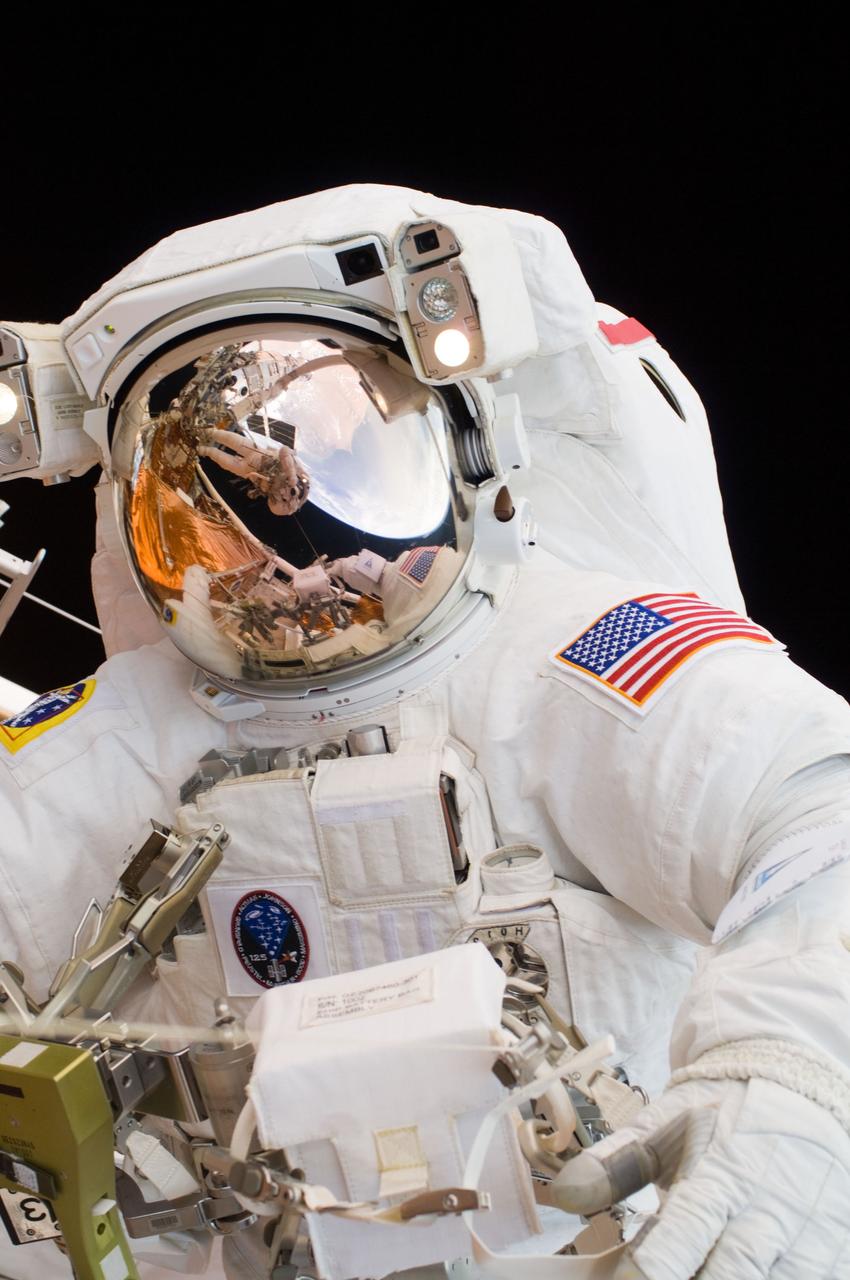
S125-E-007491 (14 May 2009) --- In this close-up scene featuring astronaut John Grunsfeld performing a spacewalk to work on the Hubble Space Telescope, the reflection in his helmet visor shows astronaut Andrew Feustel taking the photo as he's perched on the end of the Canadian-built remote manipulator system arm. The mission specialists are performing the first of five STS-125 spacewalks and the first of three for this duo.
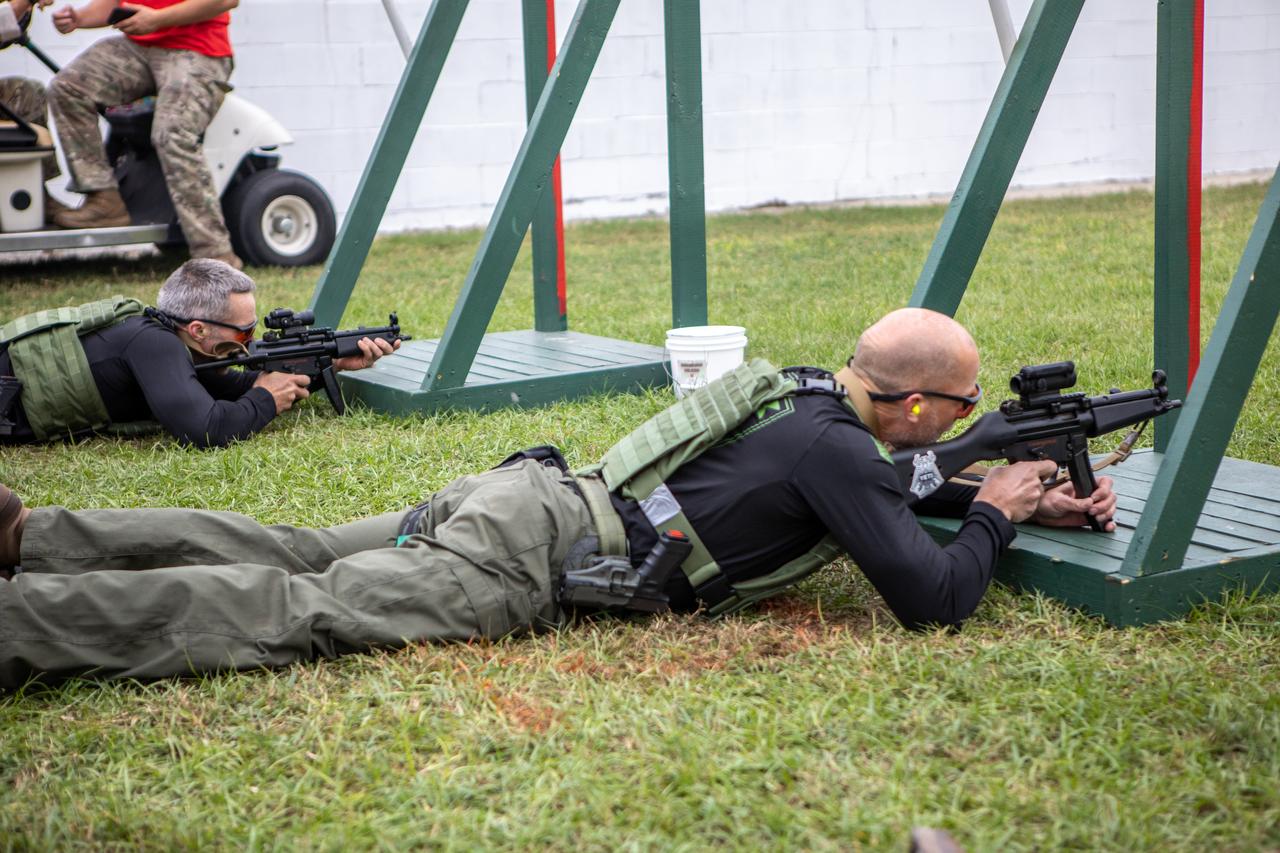
Members of NASA Kennedy Space Center's Emergency Response Team take aim at targets during the sharpshooter tactical challenge at the 37th Annual SWAT Round-Up International at the Lawson Lamar Firearms and Tactical Training Center in Orlando, Florida. The competition was held Nov. 10 to 15, 2019, and featured five different tactical challenges. Kennedy's ERT members exchanged best practices and competed with more than 50 teams from the U.S. and around the world.
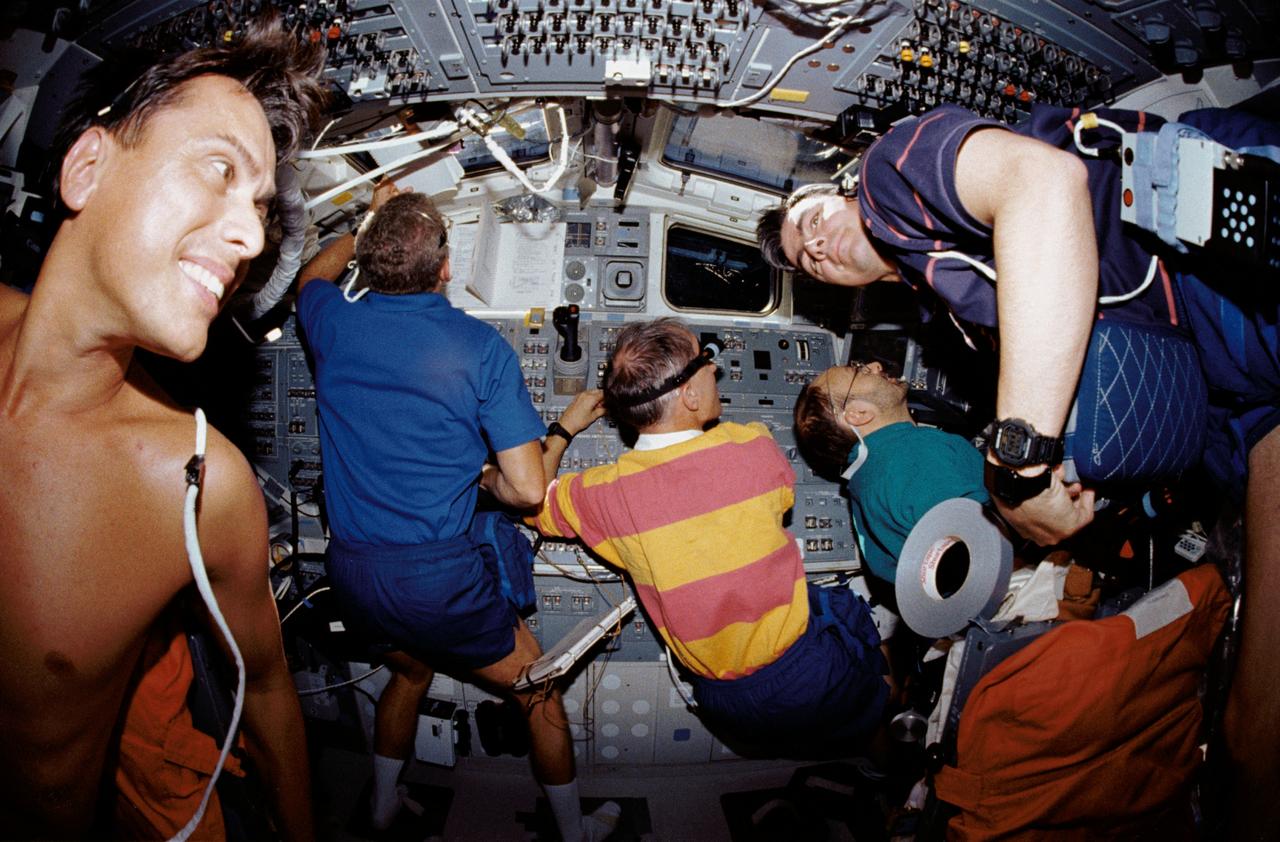
STS046-14-013 (4 Aug. 1992) --- Five of the seven crew members squeezed into this busy scene on the Space Shuttle Atlantis' flight deck during operations with the Tethered Satellite System (TSS). Pictured are, left to right, Franklin R. Chang-Diaz, Loren J. Shriver, Claude Nicollier, Franco Malerba and Andrew M. Allen. Not pictured are astronauts Jeffrey A. Hoffman and Marsha S. Ivins. Mission specialist Ivins used a 35mm camera with a 16mm lens to take this picture.

At the Cosmonaut Hotel crew quarters in Baikonur, Kazakhstan, Expedition 34/35 Flight Engineer Tom Marshburn of NASA takes his turn in the weight room Dec. 13, 2012 as preparations continue for his launch Dec. 19 with Flight Engineer Chris Hadfield of the Canadian Space Agency and Soyuz Commander Roman Romanenko from the Baikonur Cosmodrome on the Soyuz TMA-07M spacecraft for a five-month mission on the International Space Station. NASA/Victor Zelentsov
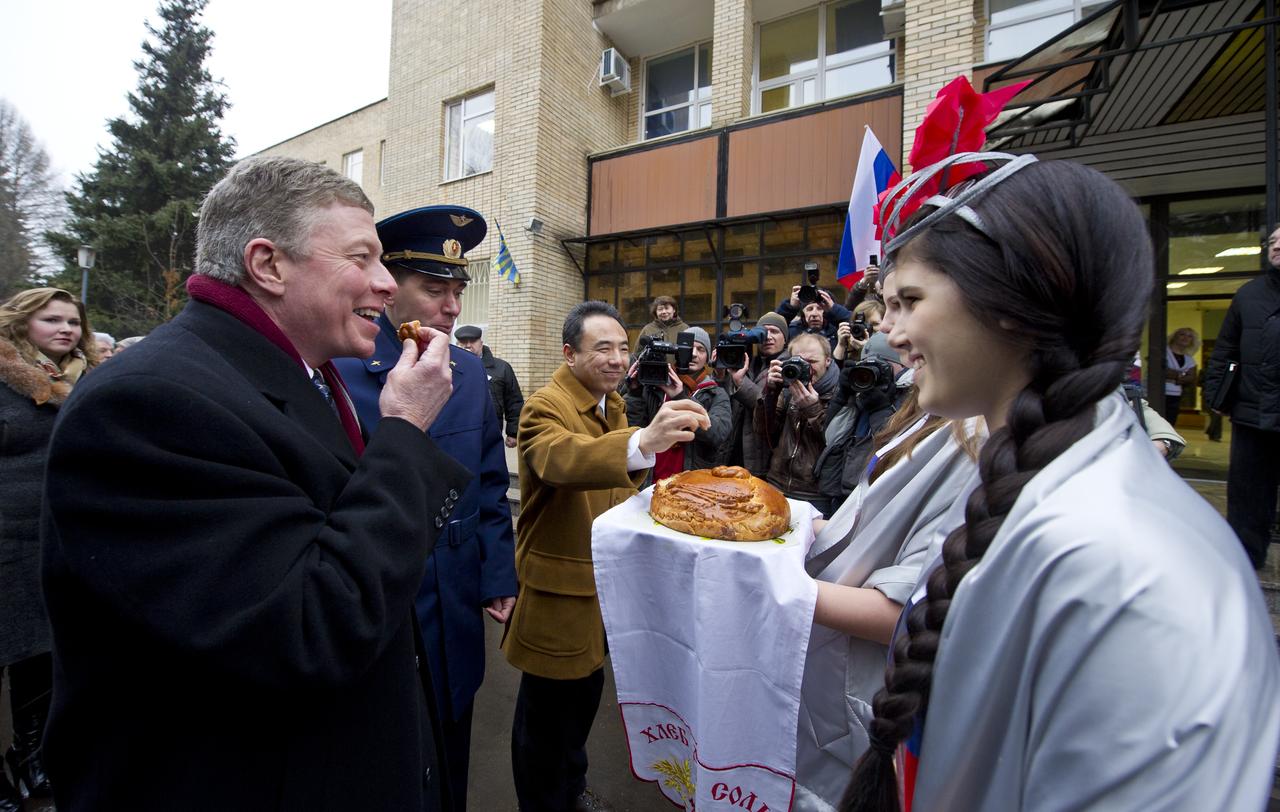
Expedition 29 Commander Mike Fossum, left, Russian cosmonaut Sergei Volkov and Japanese Aerospace Exploration Agency astronaut Satoshi Furukawa, third from left, take part in a traditional welcome home ceremony at the Gagarin Cosmonaut Training Center in Star City, Russia on Thursday, Dec. 15, 2011. The crew landed on the steppes of Kazakhstan on November 22nd after spending five months living and working aboard the International Space Station. Photo Credit: (NASA/Carla Cioffi)
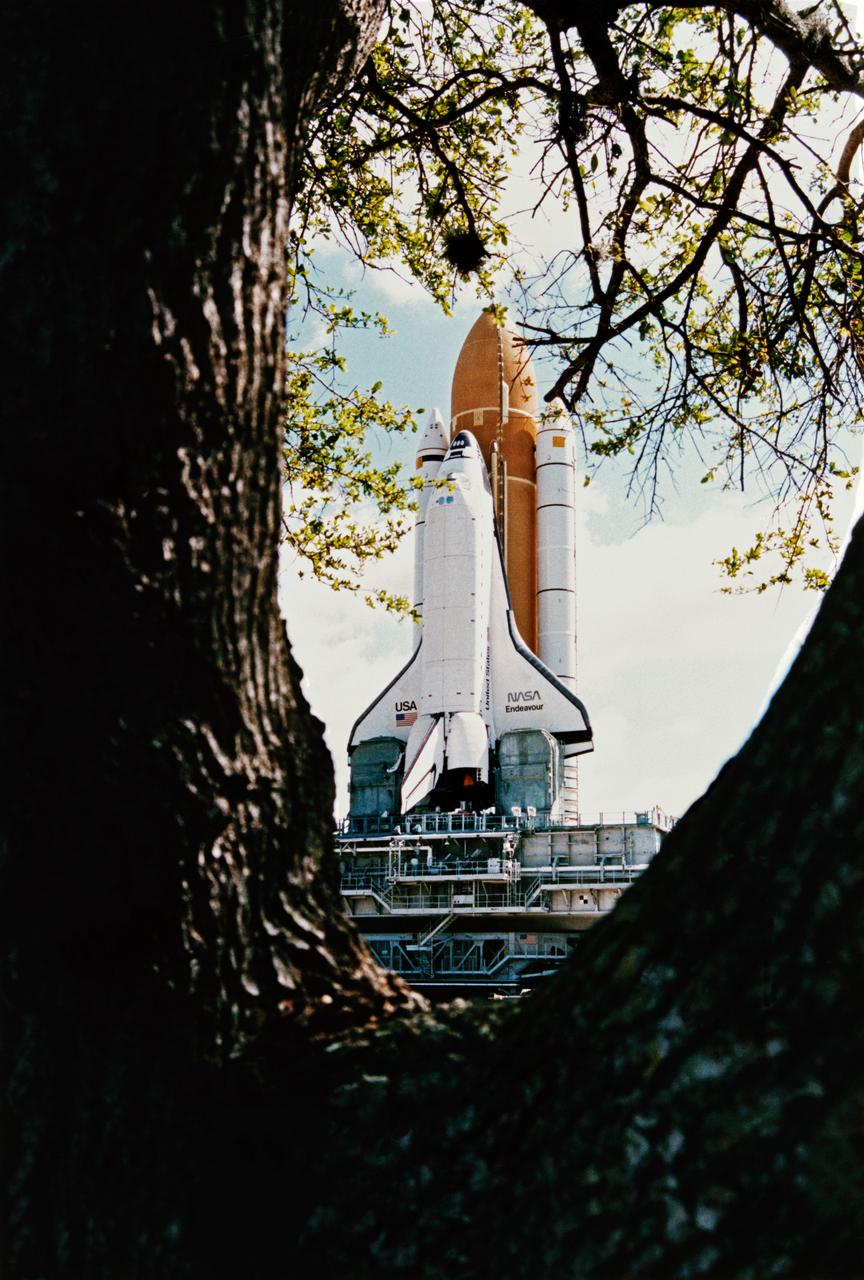
STS077-S-044 (16 April 1996) --- The Space Shuttle Endeavour atop the Mobile Launcher Platform and Crawler-Transporter (MLP/CT) slowly lumbers past a tree alongside the crawlerway, at the Kennedy Space Center (KSC). The journey from the Vehicle Assembly Building (VAB) to Launch Pad 39B will take about five to six hours to complete. Once hard down at the pad, preparations will continue to ready Endeavour for its upcoming spaceflight on STS-77.
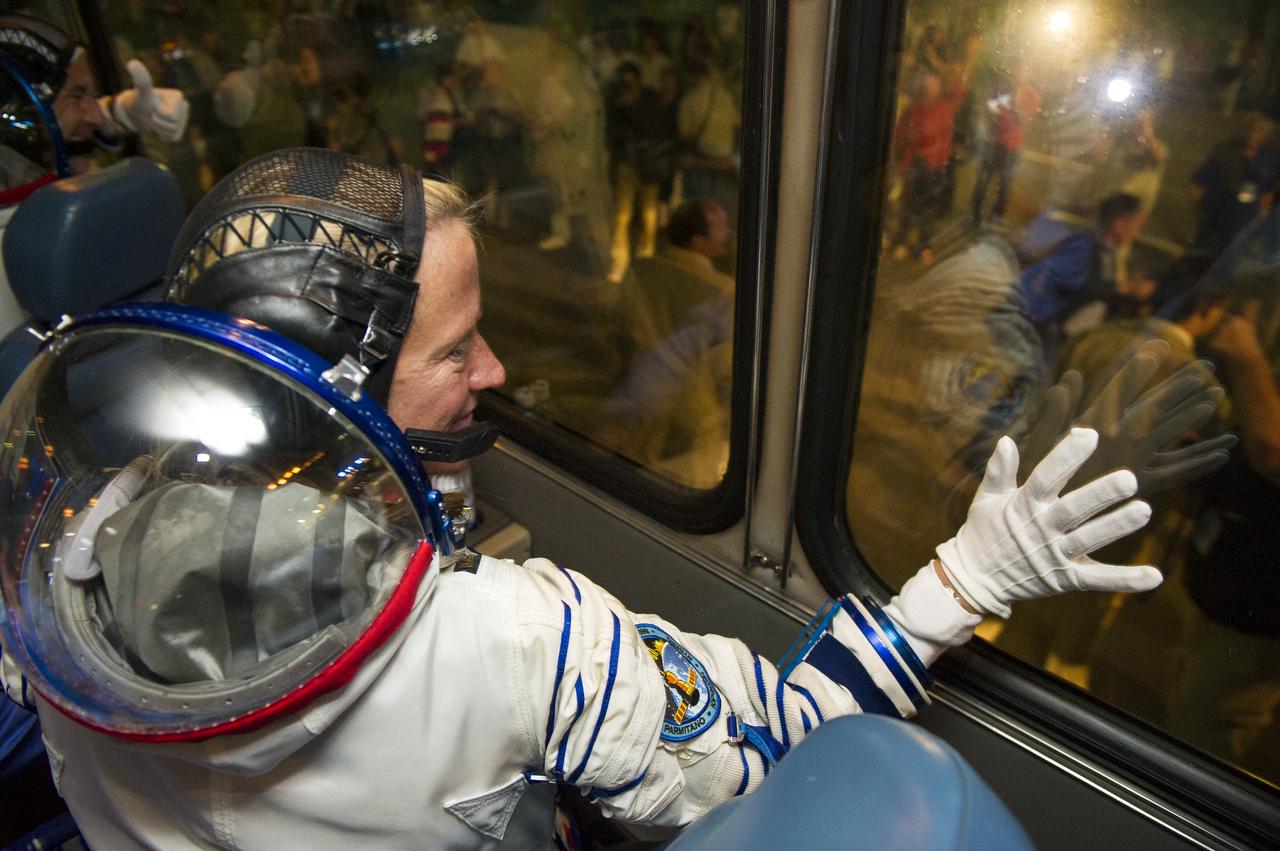
Expedition 36 NASA Flight Engineer Karen Nyberg is seen waving goodbye to friends and family after boarding the bus that will take her to the Soyuz launch pad hours ahead of her launch, Tuesday, May 28, 2013 at the Baikonur Cosmodrome in Kazakhstan. Launch of the Soyuz rocket will send Nyberg, Soyuz Commander Fyodor Yurchikhin and European Space Agency Flight Engineer Luca Parmitano on a five and a half-month mission aboard the International Space Station. Photo Credit: (NASA/GCTC/Andrey Shelepin)
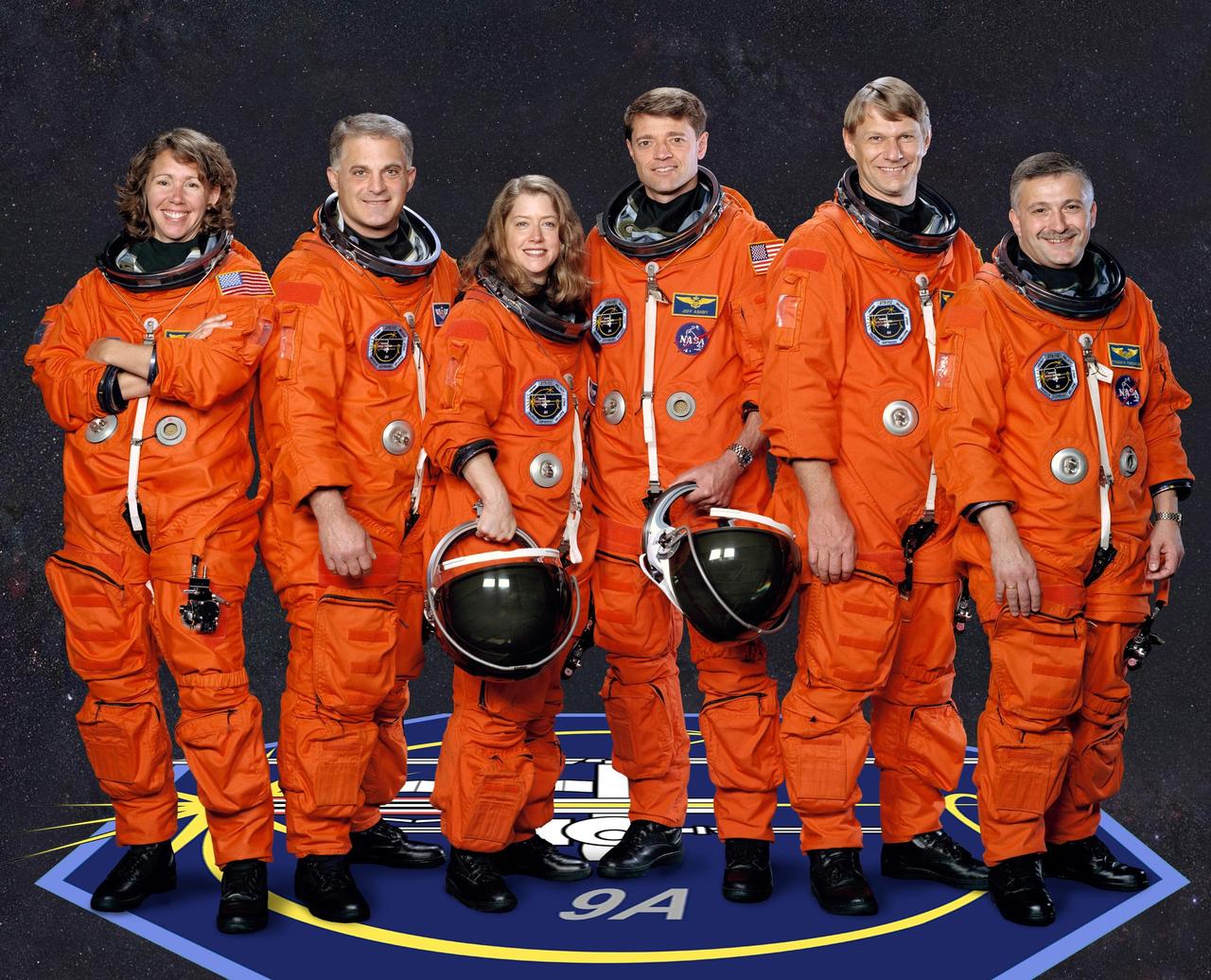
JOHNSON SPACE CENTER, HOUSTON, TEXAS -- (STS112-S-002) These five astronauts and cosmonaut take a break from training to pose for the STS-112 crew portrait. Astronauts Pamela A. Melroy and Jeffrey S. Ashby, pilot and commander respectively, are in the center of the photo. The mission specialists are from left to right, astronauts Sandra H. Magnus, David A. Wolf and Piers J. Sellers, and cosmonaut Fyodor Yurchikhin, who represents Rosaviakosmos.

STS072-321-019 (11-20 Jan. 1996) --- Astronaut Koichi Wakata takes advantage of the microgravity environment on the middeck of the Earth-orbiting Space Shuttle Endeavour. Representing Japan's National Space Development Agency (NASDA), Wakata joined five other astronauts for a week and a half of activity aboard Endeavour. Astronaut Leroy Chiao works in the background.

Members of NASA Kennedy Space Center's Emergency Response Team take a break between tactical challenges during the 37th Annual SWAT Round-Up International at the Lawson Lamar Firearms and Tactical Training Center in Orlando, Florida. The competition was held Nov. 10 to 15, 2019, and featured five different tactical challenges. Kennedy's ERT members exchanged best practices and competed with more than 50 teams from the U.S. and around the world.
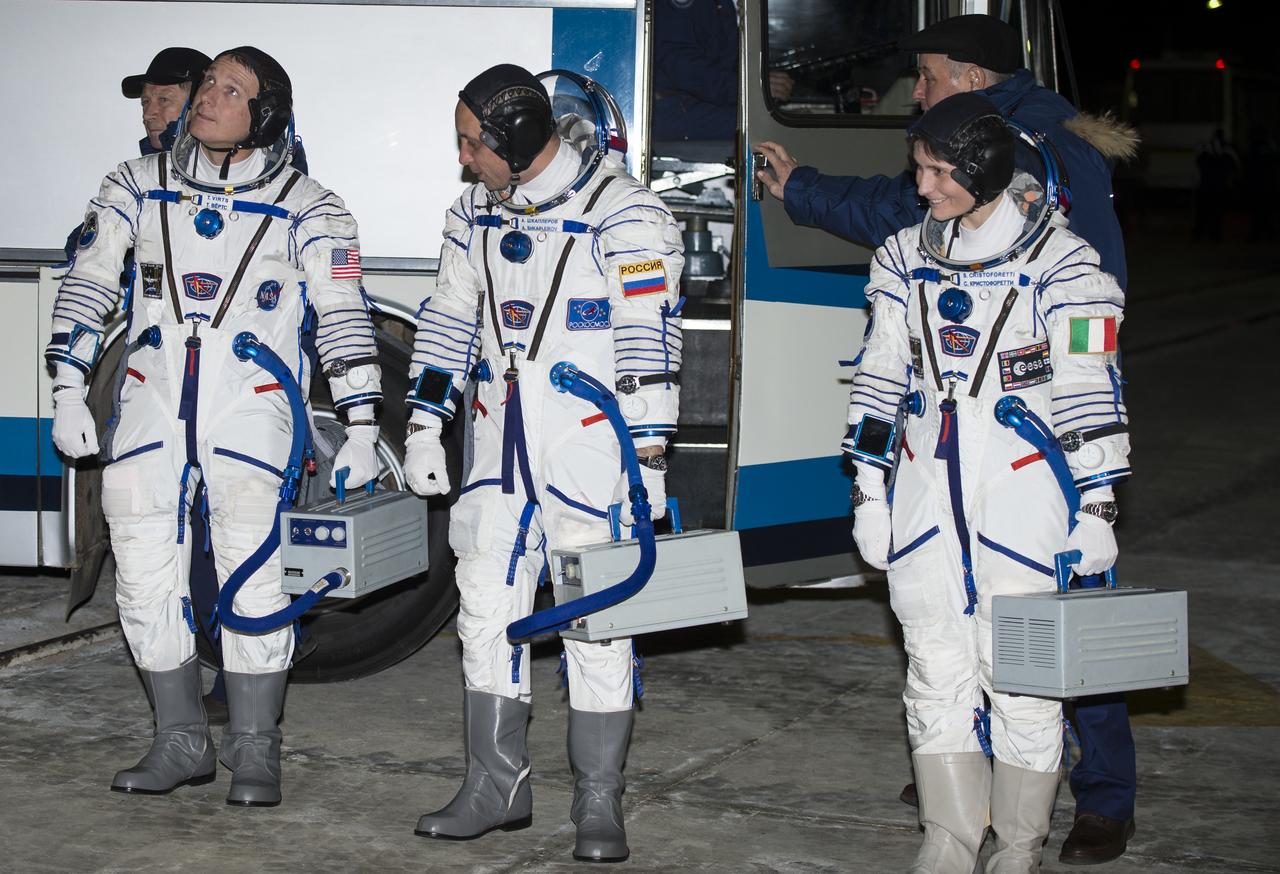
Expedition 42 Flight Engineer Terry Virts of NASA, left, takes a quick glimpse up at the Soyuz TMA-15M spacecraft before boarding to launch with fellow crewmates Soyuz Commander Anton Shkaplerov of the Russian Federal Space Agency (Roscosmos) and Flight Engineer Samantha Cristoforetti of the European Space Agency (ESA) Monday, Nov. 24, 2014 at the Baikonur Cosmodrome in Kazakhstan. Cristoforetti, Virts, and Shkaplerov will spend the next five and a half months aboard the International Space Station. Photo Credit: (NASA/Aubrey Gemignani)
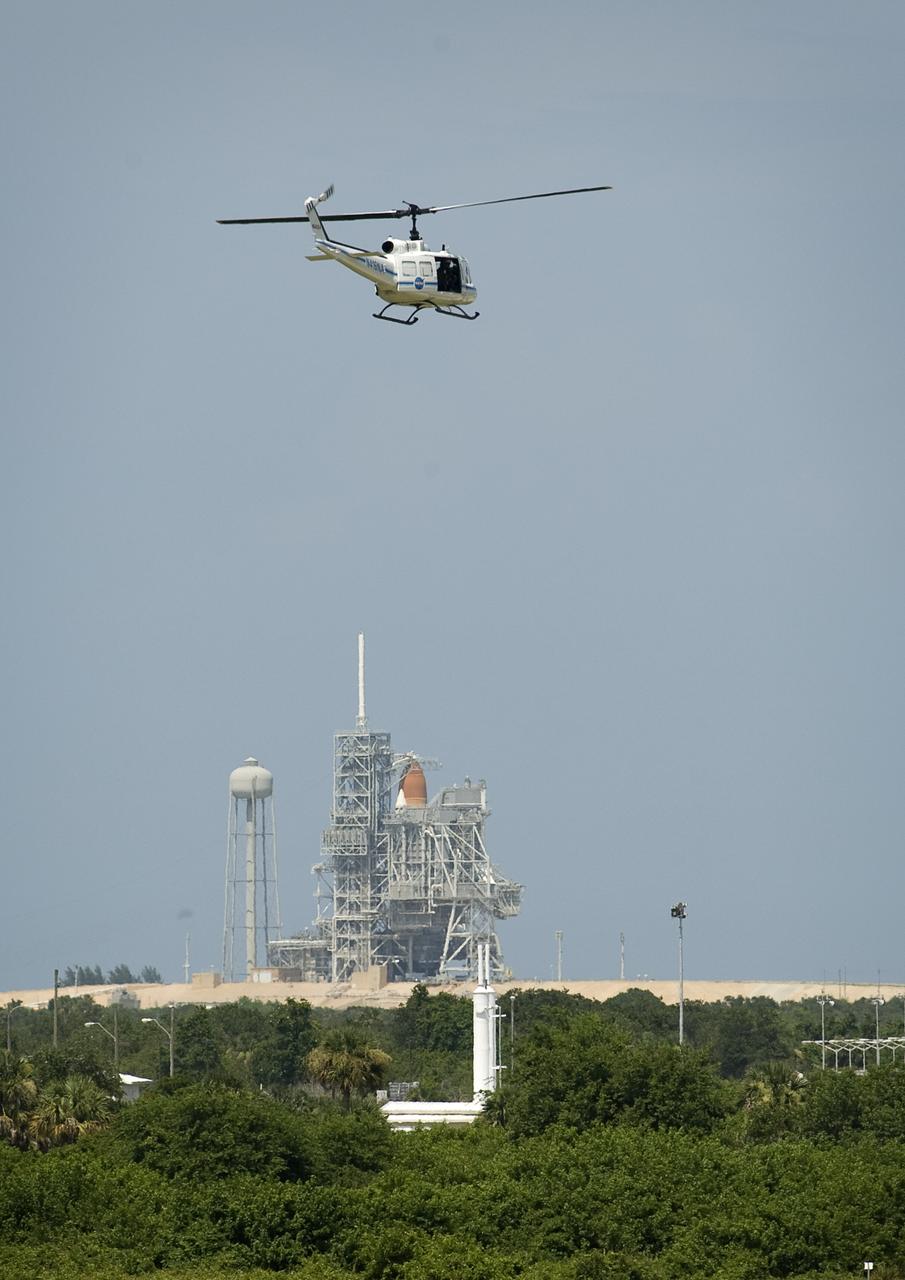
A NASA Security helicopter watches over the Astrovan as it takes the crew of STS-127 to the space shuttle Endeavour at pad 39a at NASA's Kennedy Space Center in Cape Canaveral, Florida, Sunday, July 12, 2009. Endeavour is set to launch at 7:13p.m. EDT with the crew of STS-127 and start a 16-day mission that will feature five spacewalks and complete construction of the Japan Aerospace Exploration Agency's Kibo laboratory. Photo Credit: (NASA/Bill Ingalls)
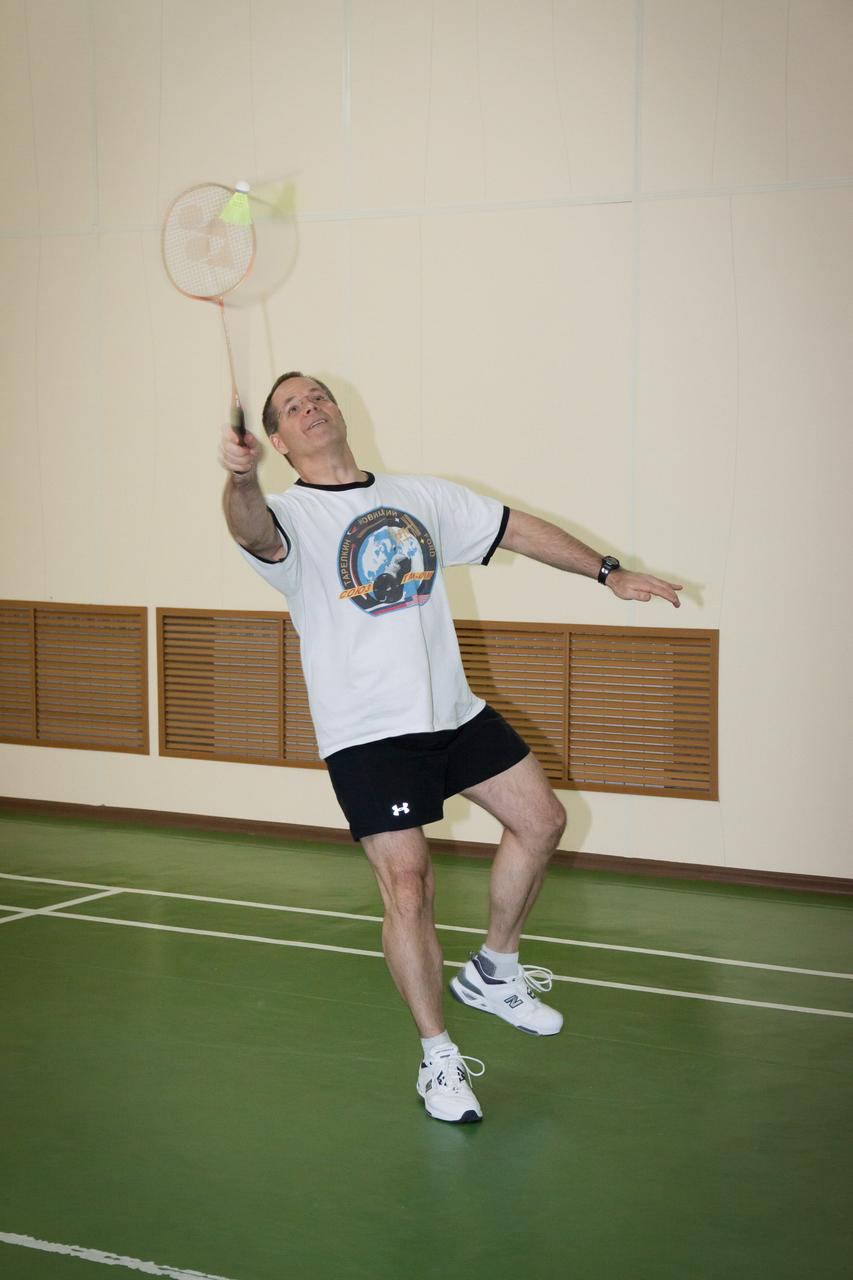
Taking time out from training, Expedition 33/34 Flight Engineer Kevin Ford of NASA plays a game of badminton at the Cosmonaut Hotel crew quarters in Baikonur, Kazakhstan October 17, 2012. Ford, Soyuz Commander Oleg Novitskiy and Flight Engineer Evgeny Tarelkin are preparing for launch October 23 in their Soyuz TMA-06M spacecraft to spend five months on the International Space Station. NASA/Victor Zelentsov
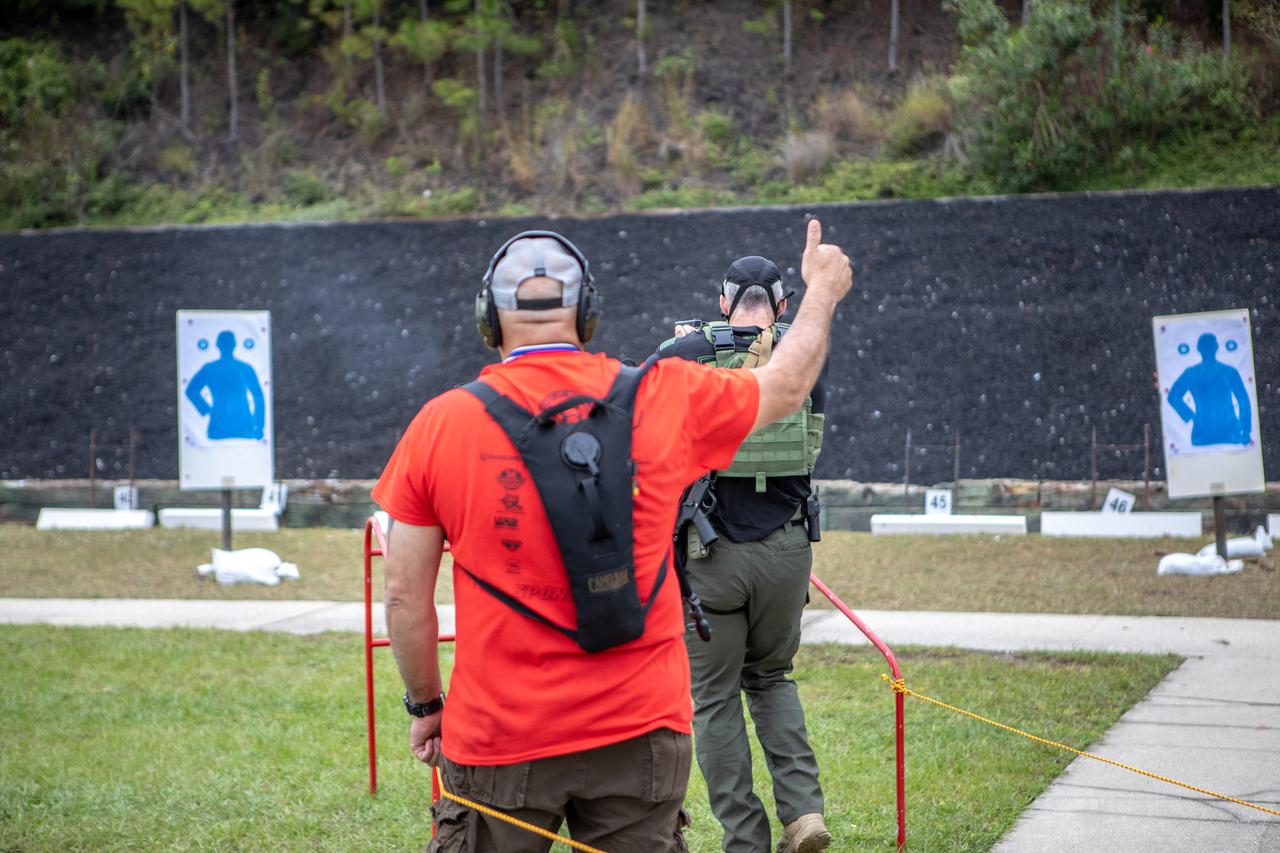
A member of NASA Kennedy Space Center's Emergency Response Team waits for the signal from the judge and then takes aim to shoot at a target with a handgun during one of the tactical challenges at the 35th Annual SWAT Round-up International at the Lawson Lamar Firearms and Tactical Training Center in Orlando, Florida. The competition was held Nov. 10 to 15, 2019, and featured five different tactical challenges. Kennedy's ERT members exchanged best practices and competed with more than 50 teams from the U.S. and around the world.
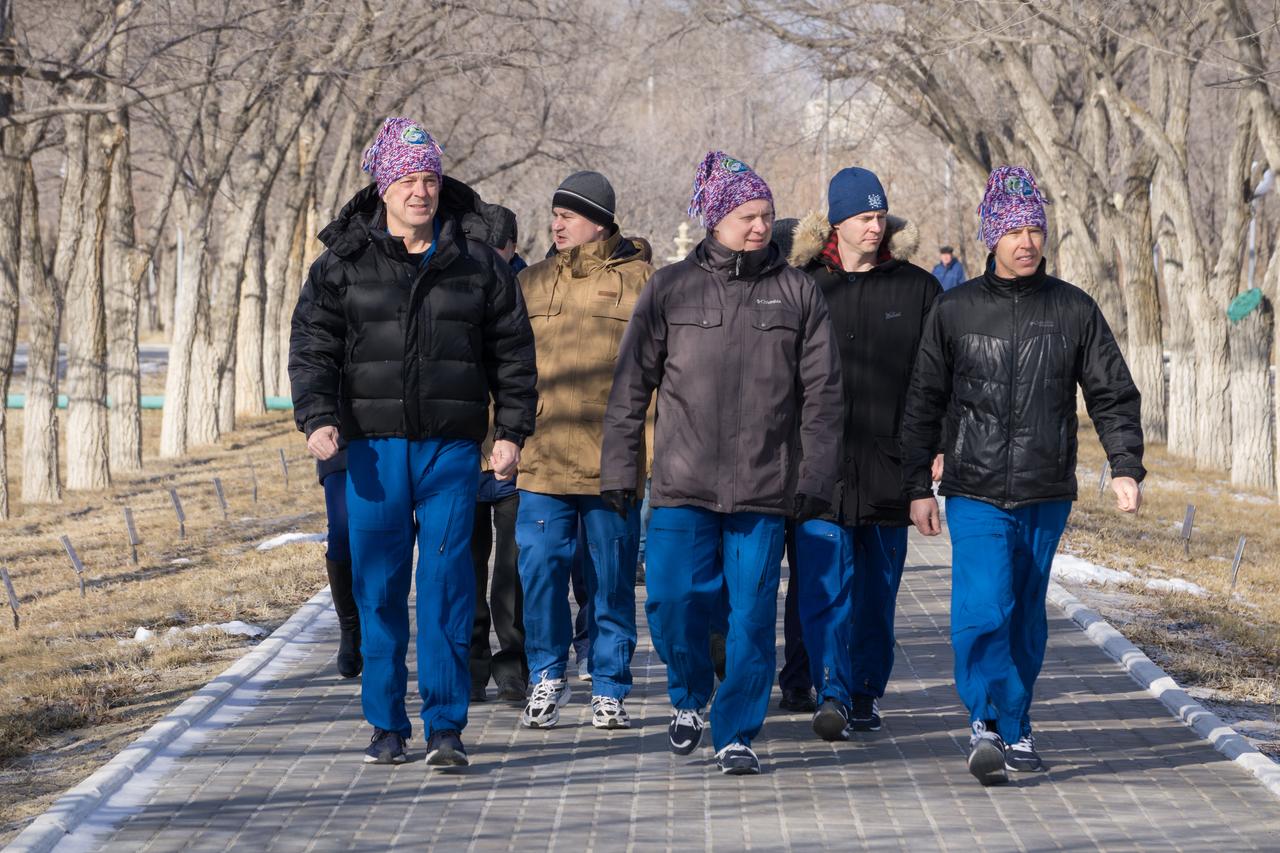
jsc2018e025539 - At the Cosmonaut Hotel crew quarters in Baikonur, Kazakhstan, Expedition 55 crewmembers Ricky Arnold of NASA (left), Oleg Artemyev of Roscosmos (center) and Drew Feustel of NASA (right) take a stroll down the Walk of Cosmonauts March 15 as part of their pre-launch activities. They will launch March 21 on the Soyuz MS-08 spacecraft from the Baikonur Cosmodrome on a five-month mission to the International Space Station...NASA/Victor Zelentsov.
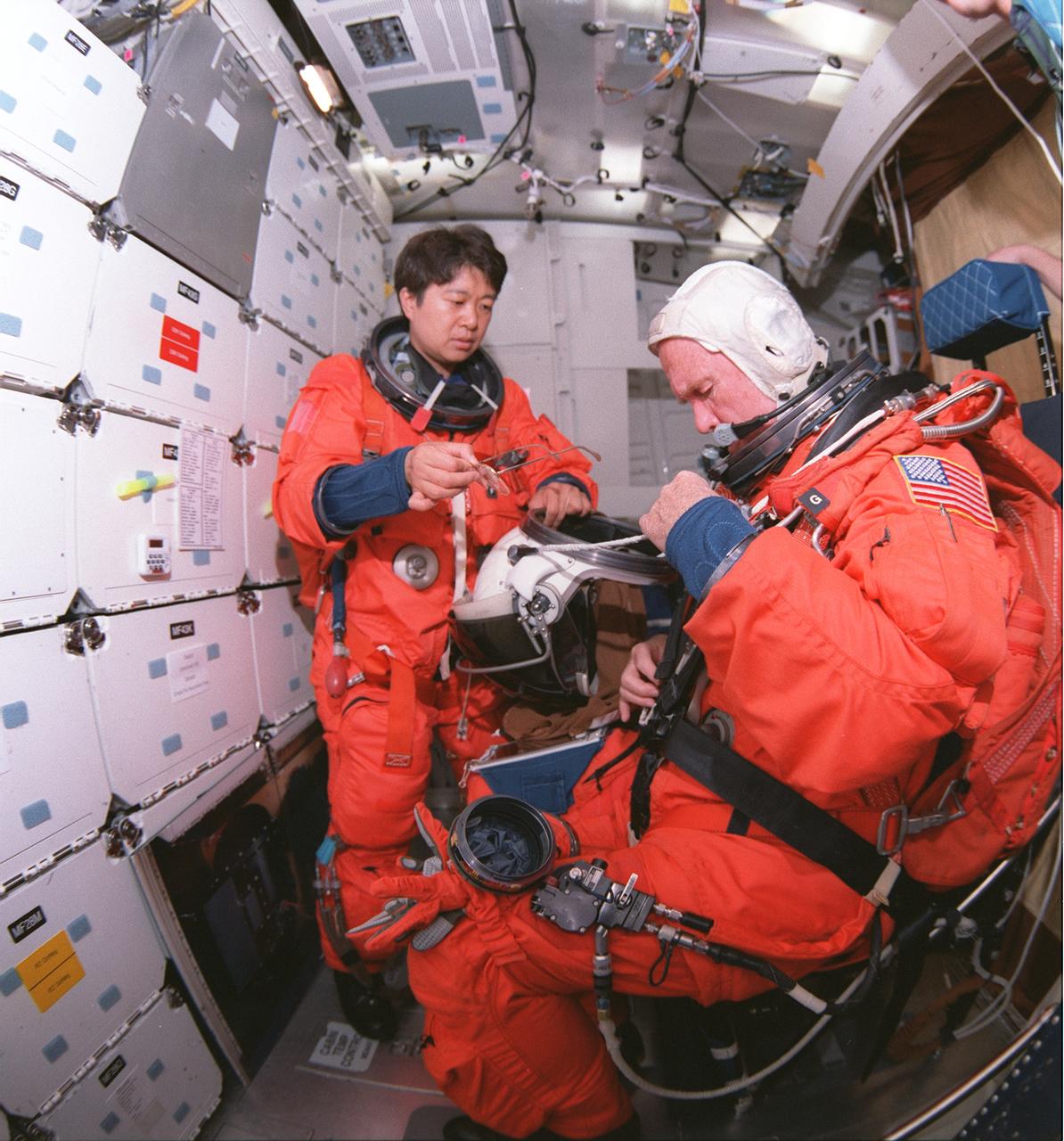
S98-07970 (5 June 1998) --- The two payload specialists in training for the STS-95 mission aboard the Space Shuttle Discovery prepare to take their assigned launch and entry seats on the mid deck of one of the shutte training mockups in JSC's systems integration facility. Wearing training versions of the shuttle partial pressure launch and entry suits, the two were joined by the other five STS-95 crew members for the training session, one of many planned in preparation for the scheduled October launch aboard Discovery.

S125-E-007489 (14 May 2009) --- In this close-up scene featuring astronaut John Grunsfeld performing a spacewalk to work on the Hubble Space Telescope, the reflection in his helmet visor shows astronaut Andrew Feustel taking the photo as he's perched on the end of the Canadian-built remote manipulator system arm. The mission specialists are performing the first of five STS-125 spacewalks and the first of three for this duo.
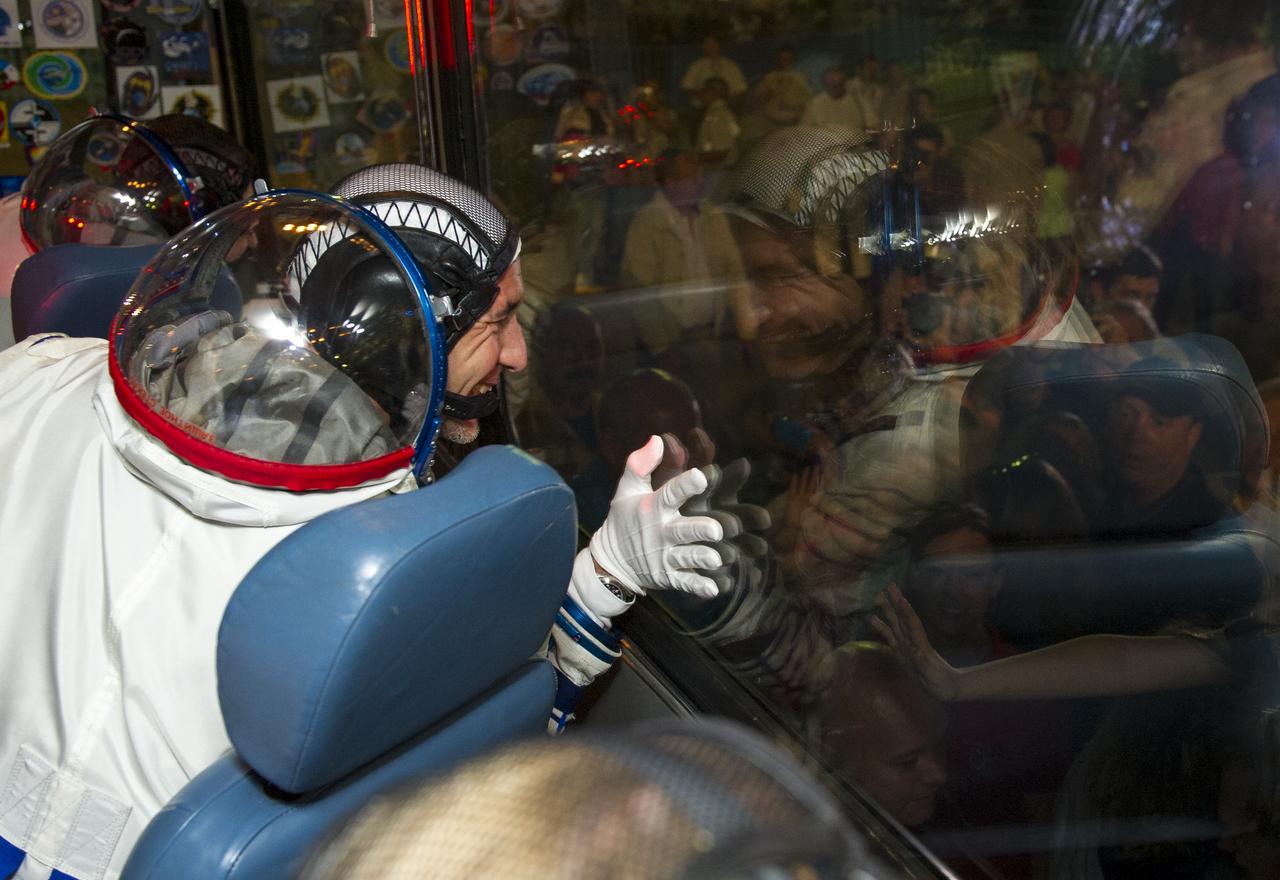
Expedition 36 European Space Agency Flight Engineer Luca Parmitano is seen waving goodbye to friends and family after boarding the bus that will take him to the Soyuz launch pad hours ahead of his launch, Tuesday, May 28, 2013 at the Baikonur Cosmodrome in Kazakhstan. Launch of the Soyuz rocket will send Parmitano, Soyuz Commander Fyodor Yurchikhin and Flight Engineer Karen Nyberg on a five and a half-month mission aboard the International Space Station. Photo Credit: (NASA/GCTC/Andrey Shelepin)
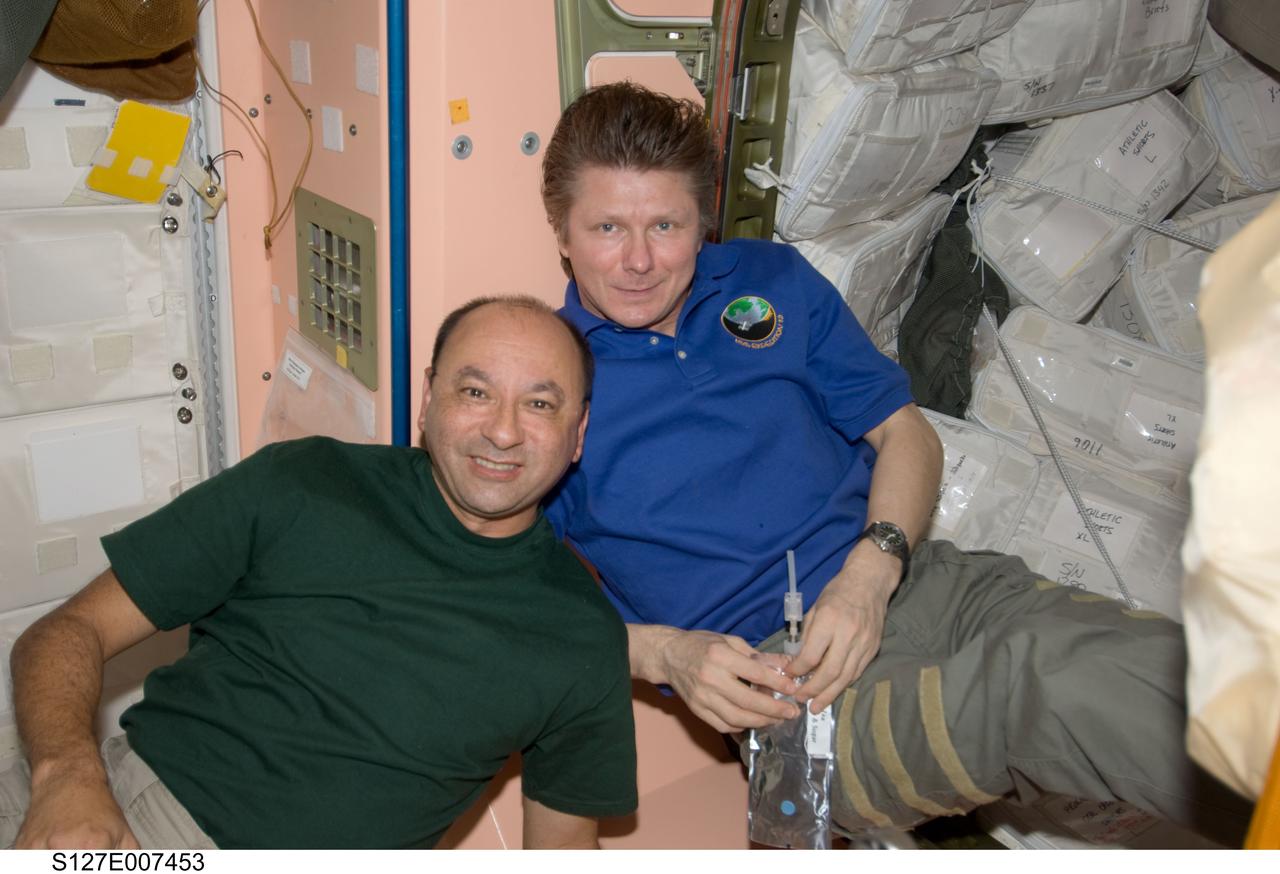
S127-E-007453 (21 July 2009) --- Astronaut Mark Polansky (left) and Russian Federal Space Agency cosmonaut Gennady Padalka take a break from a busy agenda onboard the International Space Station on the eve of the third of five spacewalks scheduled as part of more than a week's worth of joint activities for Endeavour and ISS crewmembers. Polansky is STS-127 commander, and Padalka is the station commander.
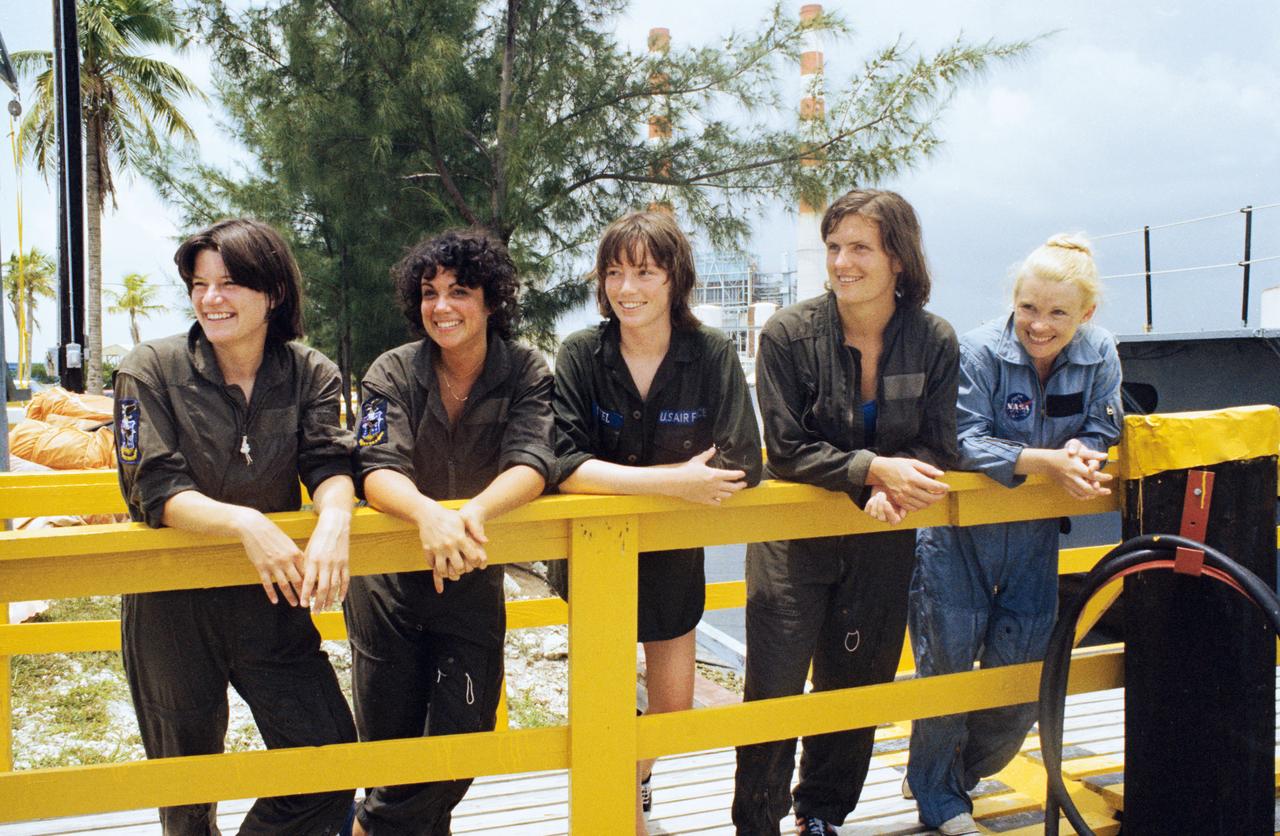
S78-33616 (31 July-2 Aug 1978) --- Taking a break from the various training exercises at a three-day water survival school held near Homestead Air Force Base, Florida are these five astronaut candidates left to right are Sally K. Ride, Judith A. Resnik, Anna L. Fisher; Kathryn D. Sullivan and Rhea Seddon. They were among fifteen mission specialist-astronaut candidates who joined one of the pilot astronaut candidates for the training.

Taking time out from training, Expedition 33/34 Flight Engineer Kevin Ford of NASA works out on a treadmill at the Cosmonaut Hotel crew quarters in Baikonur, Kazakhstan October 17, 2012 under the watchful eye of backup Flight Engineer Chris Cassidy of NASA. Ford, Soyuz Commander Oleg Novitskiy and Flight Engineer Evgeny Tarelkin are preparing for launch October 23 in their Soyuz TMA-06M spacecraft to spend five months on the International Space Station. NASA/Victor Zelentsov
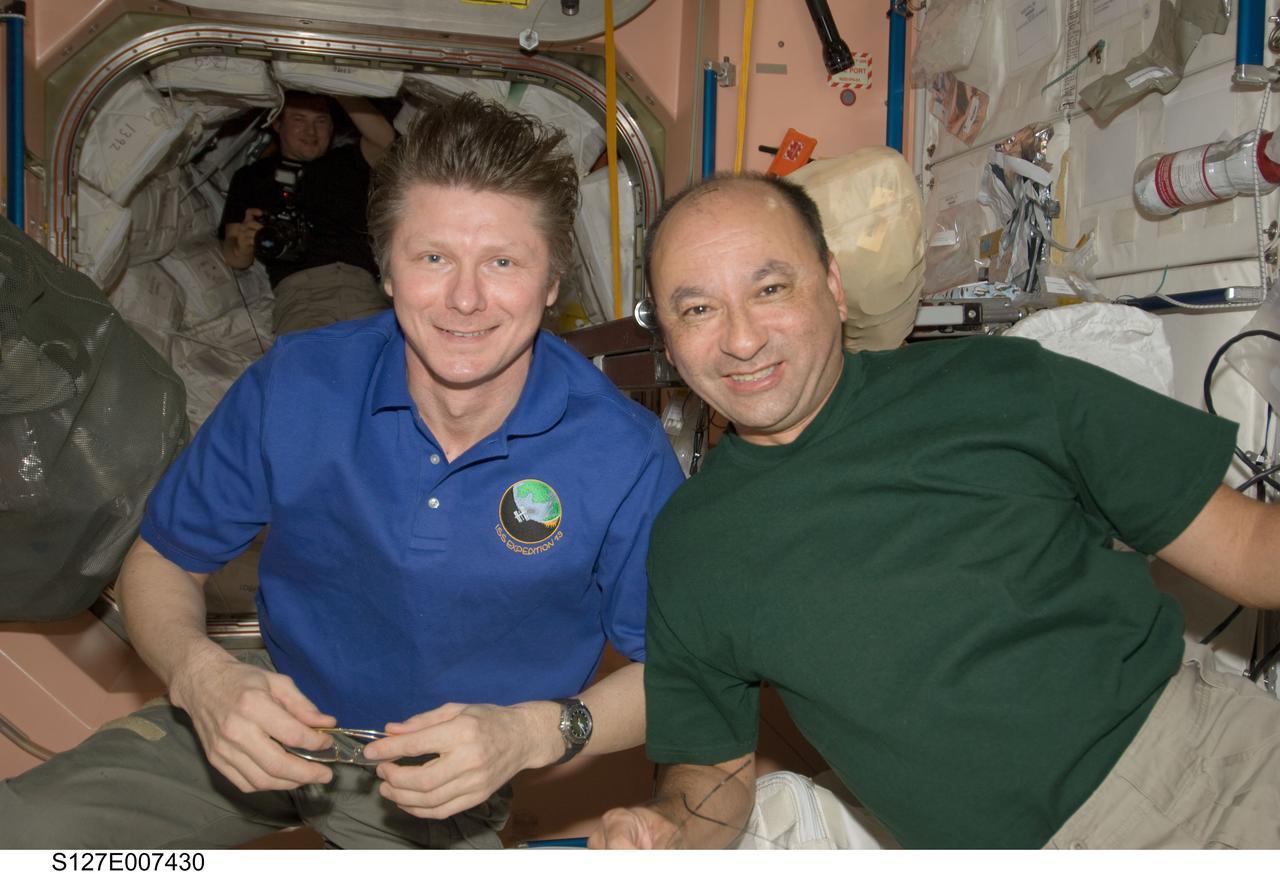
S127-E-007430 (21 July 2009) --- Astronaut Mark Polansky (right) and Russian Federal Space Agency cosmonaut Gennady Padalka take a break from a busy agenda onboard the International Space Station on the eve of the third of five spacewalks scheduled as part of more than a week's worth of joint activities for Endeavour and ISS crewmembers. Polansky is STS-127 commander, and Padalka is the station commander.
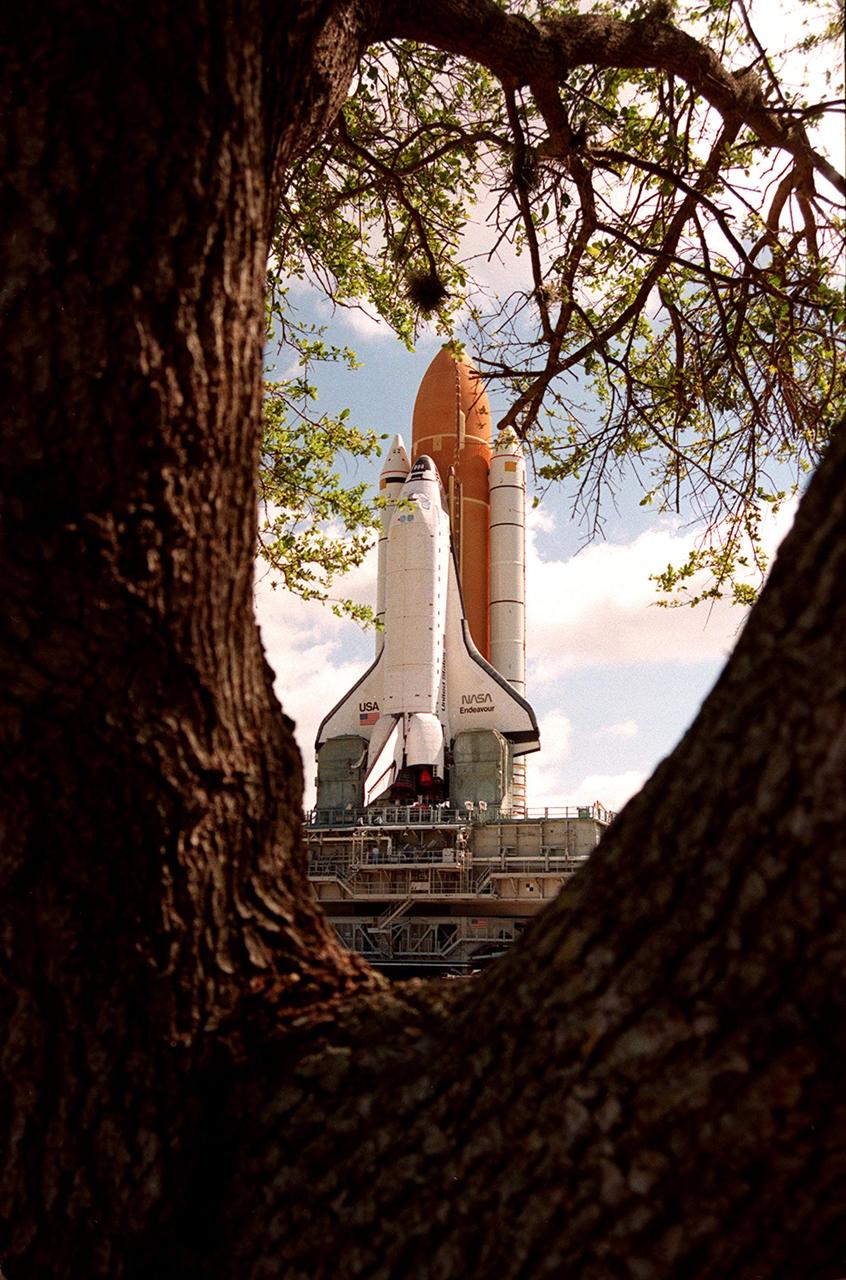
KENNEDY SPACE CENTER, FLA. -- The Space Shuttle Endeavour, atop the Mobile Launcher Platform and Crawler-Transporter, slowly lumbers past a tree alongside the crawlerway. The journey from the Vehicle Assembly Building to Pad 39B will take about five or six hours to complete. Once hard down at the pad, preparations will continue to ready Endeavour for its upcoming spaceflight on Mission STS-77

Taking time out from training, Expedition 33/34 Flight Engineer Kevin Ford of NASA (left) and backup Flight Engineer Alexander Misurkin (right) play a game of chess at their Cosmonaut Hotel crew quarters in Baikonur, Kazakhstan October 17, 2012. Ford, Soyuz Commander Oleg Novitskiy and Flight Engineer Evgeny Tarelkin are preparing for launch October 23 in their Soyuz TMA-06M spacecraft to spend five months on the International Space Station. NASA/Victor Zelentsov
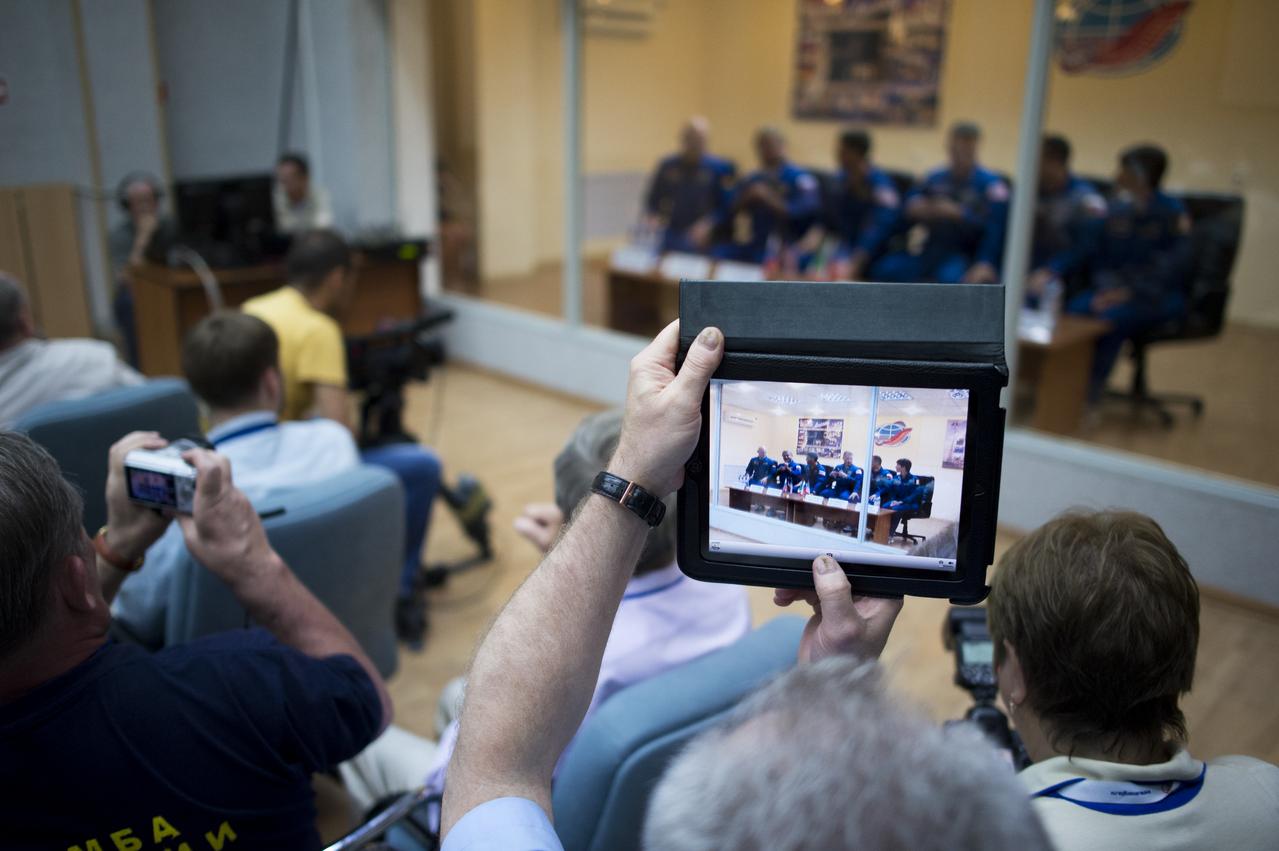
A guest takes a photo of the Expedition 40 prime and backup crews, as they sit behind glass, while in quarantine, during the State Commission meeting held to approve the Soyuz launch of the crew for a five and a half month mission aboard the International Space Station, Tuesday, May 27, 2014 at the Cosmonaut Hotel in Baikonur, Kazakhstan. Photo Credit: (NASA/Joel Kowsky)
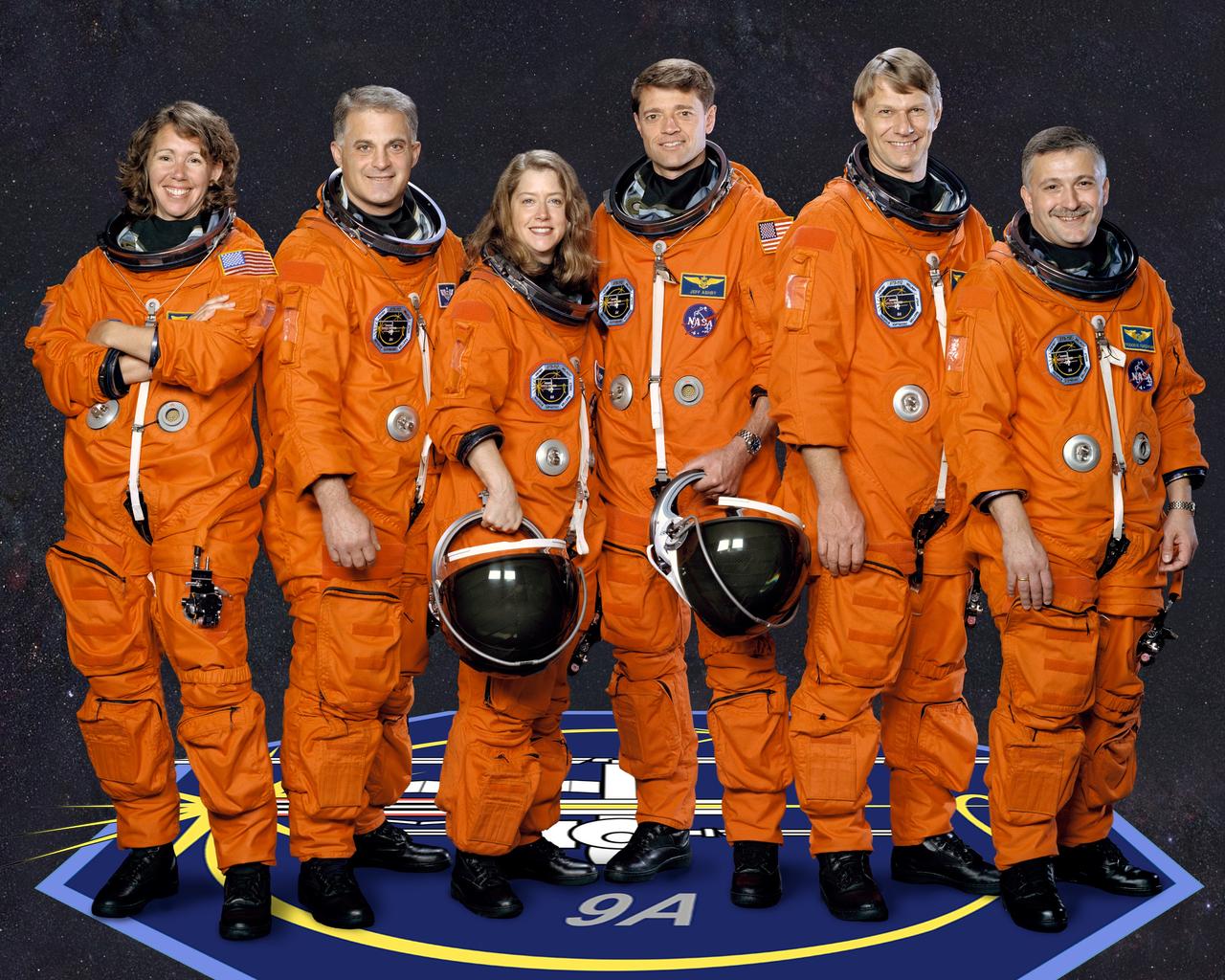
STS112-S-002 (May 2002) --- These five astronauts and cosmonaut take a break from training to pose for the STS-112 crew portrait. Astronauts Jeffrey S. Ashby and Pamela A. Melroy, commander and pilot, respectively, are in the center of the photo. The mission specialists are, from left to right, astronauts Sandra H. Magnus, David A. Wolf and Piers J. Sellers and cosmonaut Fyodor Yurchikhin, who represents Rosaviakosmos.

iss072e575164 (Jan. 30, 2025) --- NASA astronaut and Expedition 72 Commander Suni Williams' camera is reflected in her spacesuit helmet's visor as she points it toward herself and takes an out-of-this-world "space-selfie" during a five-hour and 26-minute spacewalk. The International Space Station was orbiting 263 miles above the Pacific Ocean at the time of this photograph.

The terrain for the scientific work conducted by ICESCAPE scientists on July 4, 2010, is Arctic sea ice and melt ponds in the Chukchi Sea. The five-week field mission is dedicated to sampling the physical, chemical and biological characteristics of the ocean and sea ice. Impacts of Climate change on the Eco-Systems and Chemistry of the Arctic Pacific Environment (ICESCAPE) is a multi-year NASA shipborne project. The bulk of the research will take place in the Beaufort and Chukchi Sea’s in summer of 2010 and fall of 2011. Photo Credit: (NASA/Kathryn Hansen)

S125-E-007493 (14 May 2009) --- In this close-up scene featuring astronaut John Grunsfeld performing a spacewalk to work on the Hubble Space Telescope, the reflection in his helmet visor shows astronaut Andrew Feustel taking the photo as he's perched on the end of the Canadian-built remote manipulator system arm. The mission specialists are performing the first of five STS-125 spacewalks and the first of three for this duo.
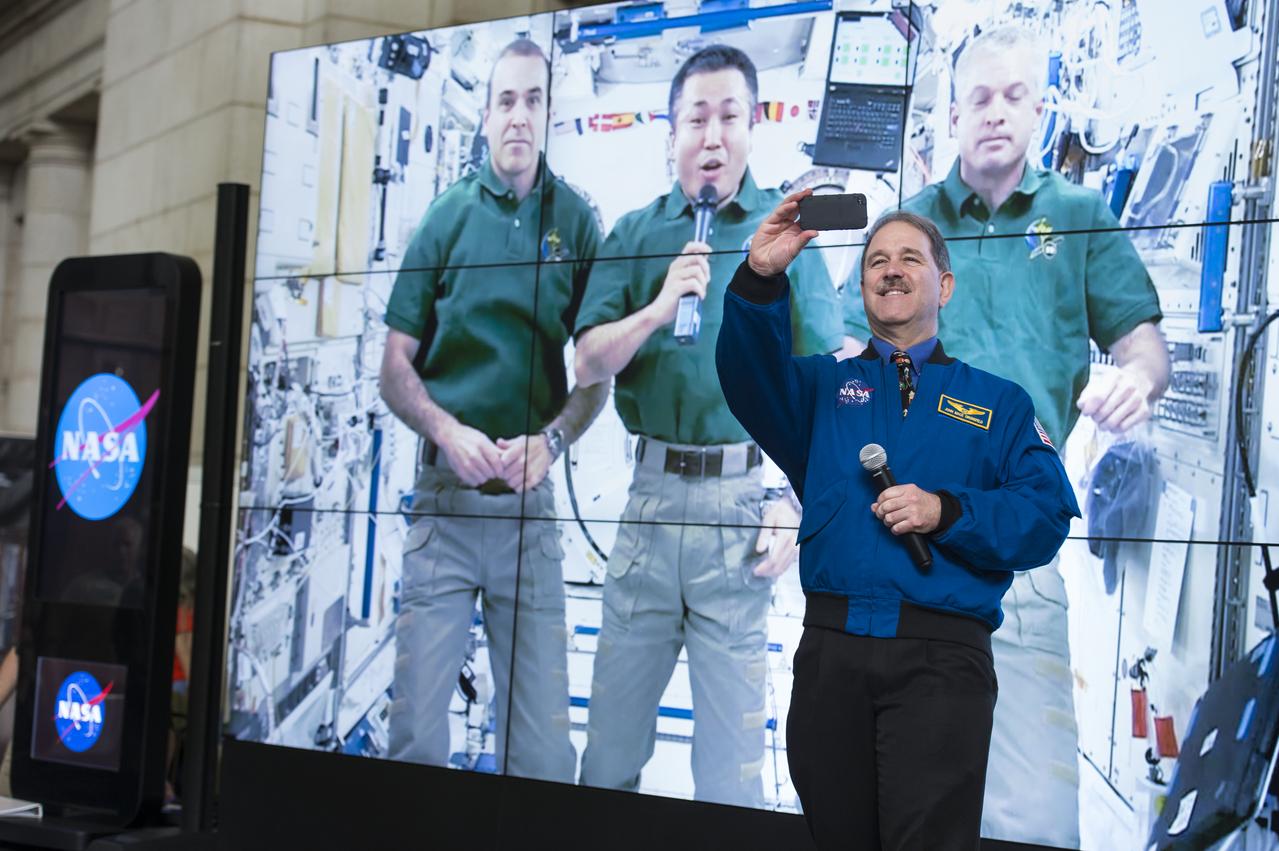
NASA Astronaut John Mace Grunsfeld takes a quick selfie with astronauts at the International Space Station at the NASA sponsored Earth Day event April 22, 2014 at Union Station in Washington, DC. NASA announced the "Global Selfie" event as part of its "Earth Right Now" campaign, celebrating the launch of five Earth-observing missions in 2014. All selfies posted to social media with the hashtag "GlobalSelfie" will be included in a mosaic image of Earth. Photo Credit: (NASA/Aubrey Gemignani)
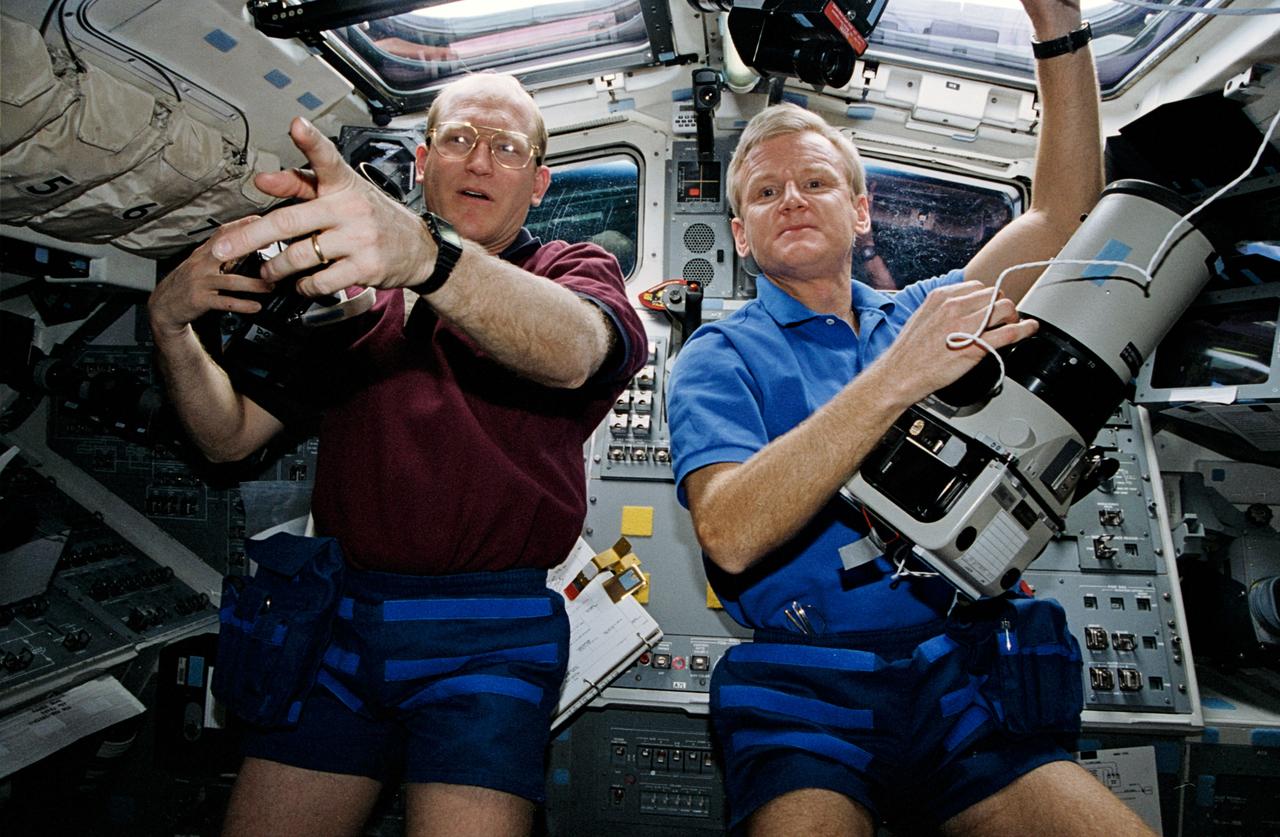
STS062-06-030 (4-18 March 1994) --- With cameras in hand two of the STS-62 astronauts prepare to take pictures of their home planet. John H. Casper (right), mission commander, handles a large format, Linhof camera, while Charles D. (Sam) Gemar, mission specialist, has just added a roll of film to a 70mm handheld Hasselblad camera. Earth observations and documentation occupied muc of the on-duty time of all five of the STS-62 crewmembers during their 14-day mission in earth orbit.
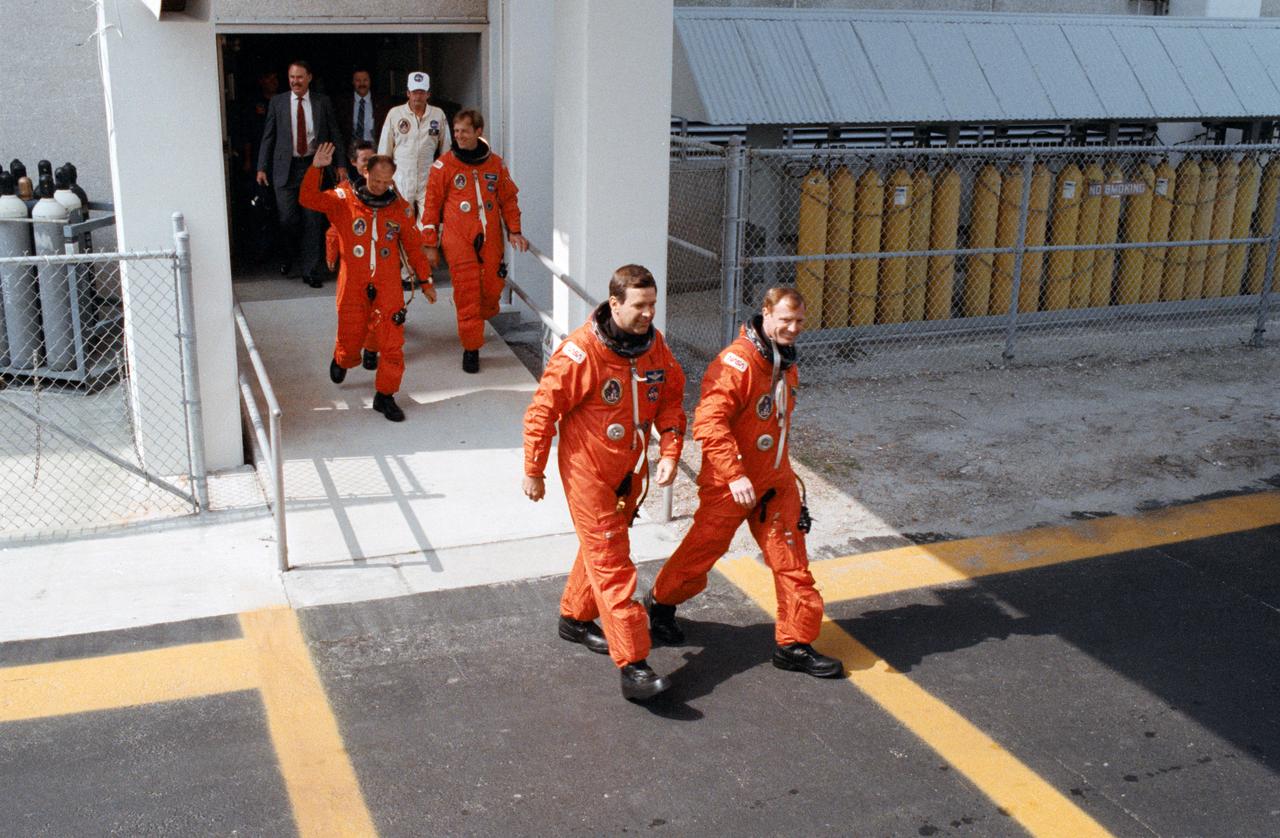
STS030-S-139 (4 May 1989) --- The five astronaut crewmembers of STS-30 leave the operations and checkout building en route to a transfer van that will take them to Pad 39B for a date with the Space Shuttle Atlantis. From front to back are Astronauts David M. Walker, Ronald J. Grabe, Norman E. Thagard, Mark C. Lee (aside) and Mary L. Cleave.
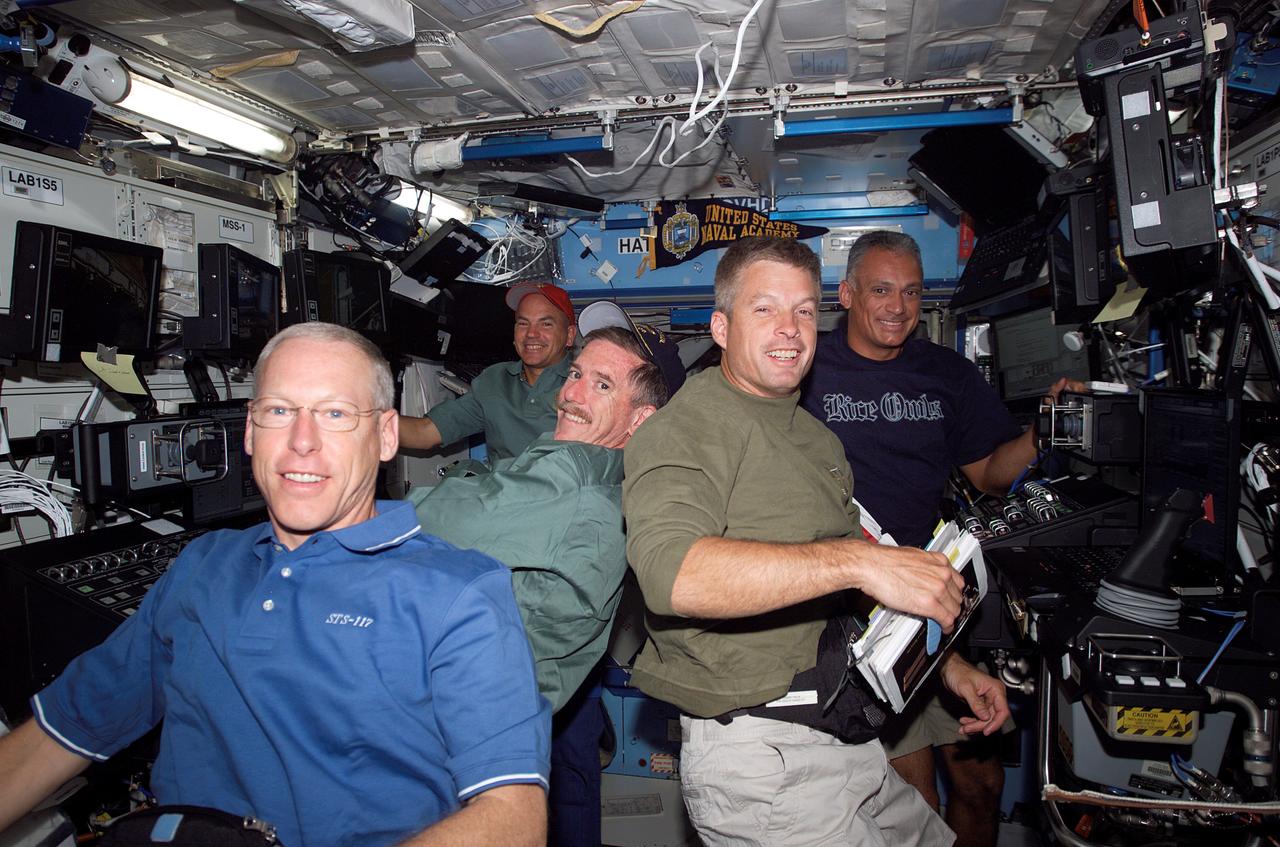
ISS015-E-11959 (12 June 2007) --- STS-117 crewmembers take a moment to pose for a photo while working various tasks in the Destiny laboratory of the International Space Station during flight day five activities while Space Shuttle Atlantis was docked with the station. Pictured at left are astronauts Patrick Forrester (foreground), Jim Reilly, both mission specialists; and Rick Sturckow, commander. On the right are astronauts Steven Swanson (foreground) and John "Danny" Olivas, both mission specialists.
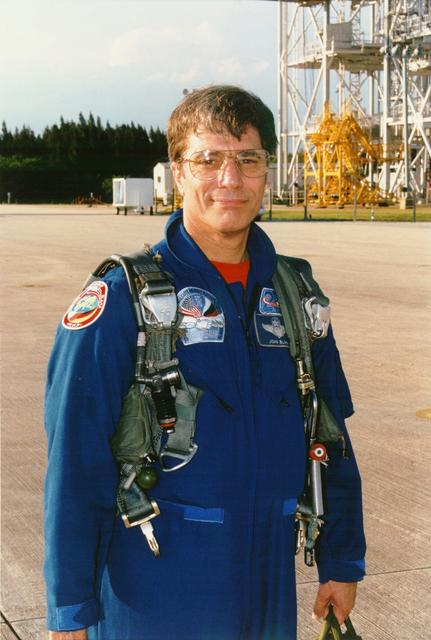
KENNEDY SPACE CENTER, FLA. - STS-79 Mission Specialist John E. Blaha arrives at KSC's Shuttle Landing Facility with five fellow astronauts, ready to participate in the Terminal Countdown Demonstration Test (TCDT). The TCDT is a dress rehearsal for launch for the flight crew and launch team. Over the next several days, the astronauts will take part in training exercises at the launch pad that will culminate in a simulated launch countdown. The Space Shuttle Atlantis is being prepared for liftoff around Sept. 12 on STS-79, the fourth docking between the U.S. Shuttle and Russian Space Station Mir. During the approximately nine-day flight, Blaha will change places with fellow spaceflight veteran Shannon Lucid, who is wrapping up a record-setting stay on Mir. Blaha will remain aboard the Station for about four months, returning to Earth in January 1997 withthe crew of Shuttle Mission STS-81.
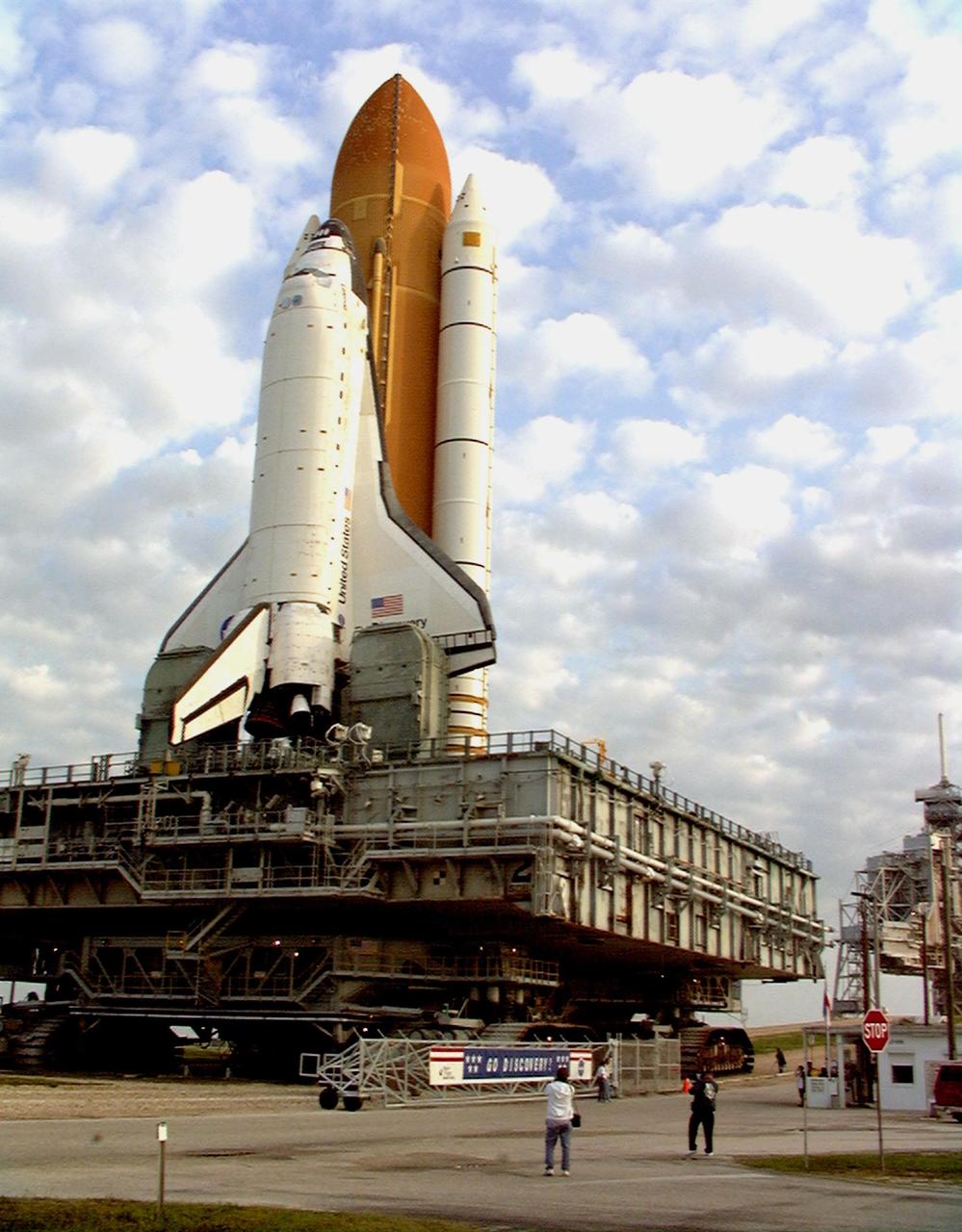
Against a popcorn-clouded blue sky, Space Shuttle Discovery, atop the mobile launcher platform and crawler transporter, ends its five-hour trek from the Vehicle Assembly Building as it crosses through the gate at Launch Pad 39B. Earlier in the week, the Shuttle was rolled back to the VAB from the pad to repair hail damage on the external tank's foam insulation. The 4.2-mile trek takes about five hours at the 1-mph speed of the crawler. Mission STS-96, the 94th launch in the Space Shuttle Program, is scheduled for liftoff May 27 at 6:48 a.m. EDT STS-96 is a logistics and resupply mission for the International Space Station, carrying such payloads as a Russian crane, the Strela; a U.S.-built crane; the Spacehab Oceaneering Space System Box (SHOSS), a logistics items carrier; and STARSHINE, a student-shared experiment
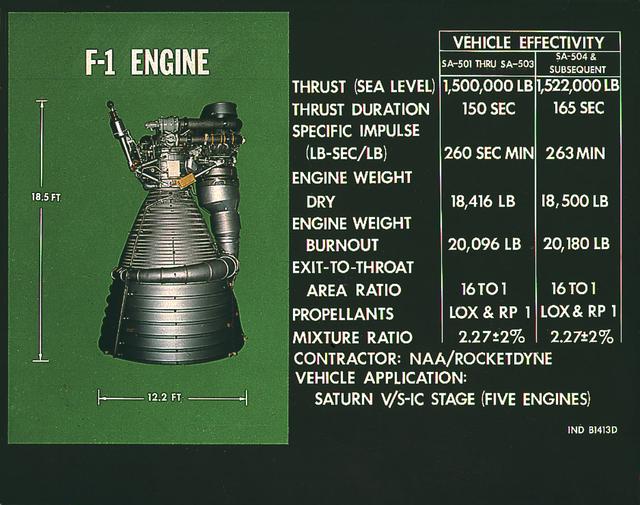
This chart provides the vital statistics for the F-1 rocket engine. Developed by Rocketdyne, under the direction of the Marshall Space Flight Center, the F-1 engine was utilized in a cluster of five engines to propel the Saturn V's first stage, the S-IC. Liquid oxygen and kerosene were used as its propellant. Initially rated at 1,500,000 pounds of thrust, the engine was later uprated to 1,522,000 pounds of thrust after the third Saturn V launch (Apollo 8, the first marned Saturn V mission) in December 1968. The cluster of five F-1 engines burned over 15 tons of propellant per second, during its two and one-half minutes of operation, to take the vehicle to a height of about 36 miles and to a speed of about 6,000 miles per hour.
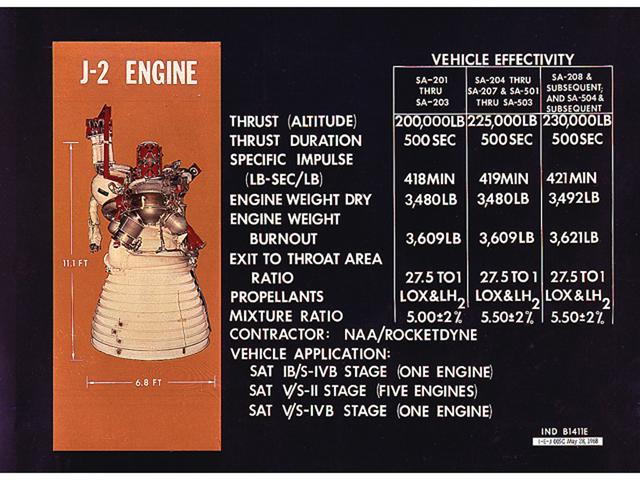
This chart is an illustration of J-2 Engine characteristics. A cluster of five J-2 engines powered the Saturn V S-II (second) stage with each engine providing a thrust of 200,000 pounds. A single J-2 engine powered the S-IVB stage, the Saturn IB second stage, and the Saturn V third stage. The engine was uprated to provide 230,000 pounds of thrust for the fourth Apollo Saturn V flight and subsequent missions. Burning liquid hydrogen as fuel and using liquid oxygen as the oxidizer, the cluster of five J-2 engines for the S-II stage burned over one ton of propellant per second, during about 6 1/2 minutes of operation, to take the vehicle to an altitude of about 108 miles and a speed of near orbital velocity, about 17,400 miles per hour.
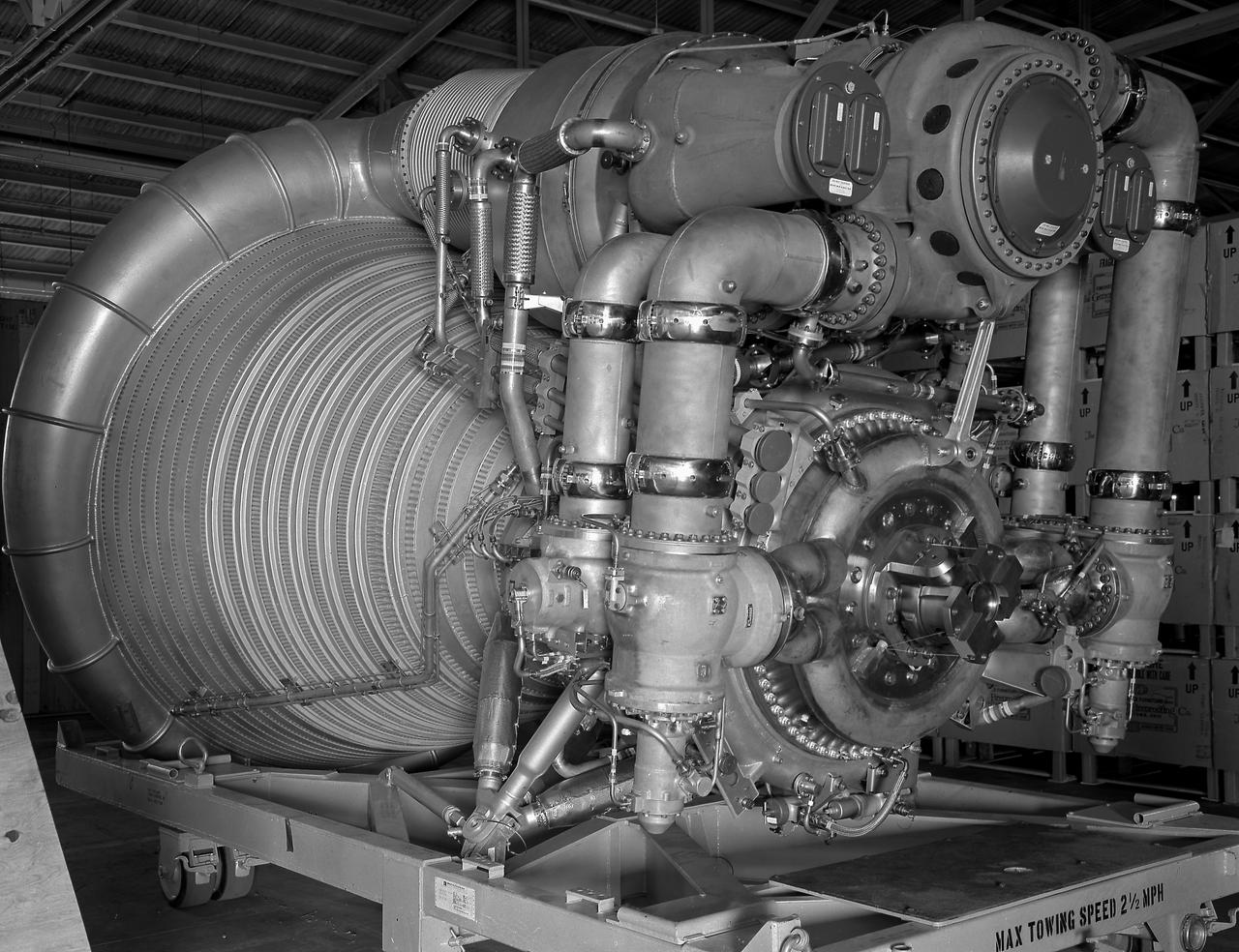
A close-up view of the F-1 Engine for the Saturn V S-IC (first) stage depicts the complexity of the engine. Developed by Rocketdyne under the direction of the Marshall Space Flight Center, the F-1 engine was utilized in a cluster of five engines to propel the Saturn V's first stage, the S-IC. Liquid oxygen and kerosene were used as its propellant. Initially rated at 1,500,000 pounds of thrust, the engine was later uprated to 1,522,000 pounds of thrust after the third Saturn V launch (Apollo 8, the first marned Saturn V mission) in December 1968. The cluster of five F-1 engines burned over 15 tons of propellant per second, during its two and one-half minutes of operation, to take the vehicle to a height of about 36 miles and to a speed of about 6,000 miles per hour.
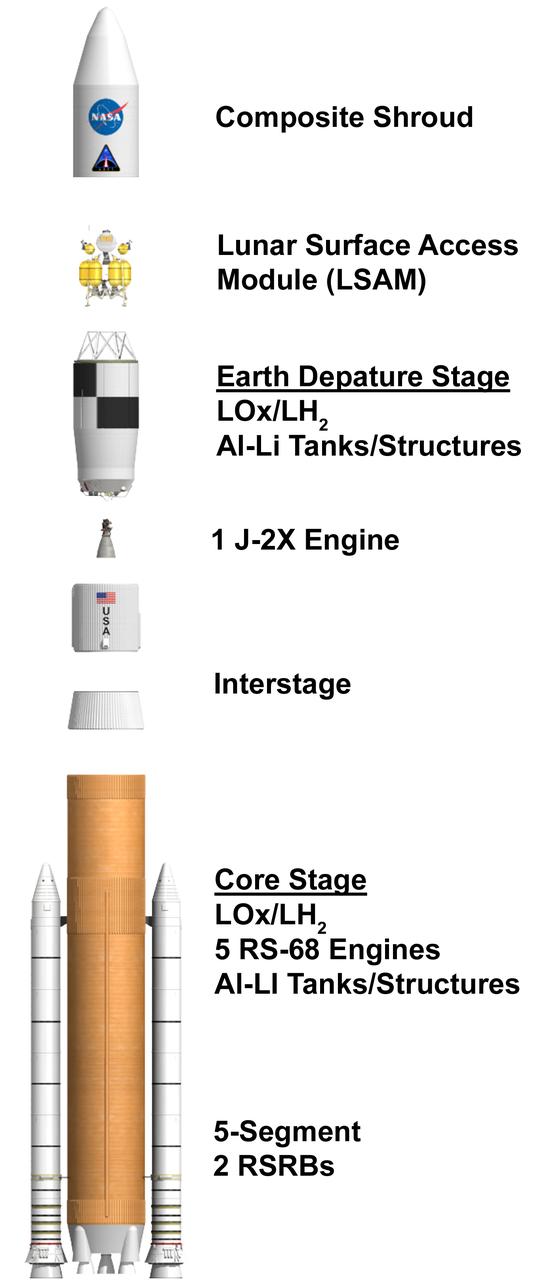
The NASA developed Ares rockets, named for the Greek god associated with Mars, will return humans to the moon and later take them to Mars and other destinations. This is an illustration of the Ares V with call outs. The Ares V is a heavy lift launch vehicle that will use five RS-68 liquid oxygen/liquid hydrogen engines mounted below a larger version of the space shuttle external tank, and two five-segment solid propellant rocket boosters for the first stage. The upper stage will use the same J-2X engine as the Ares I and past Apollo vehicles. The Ares V can lift more than 286,000 pounds to low Earth orbit and stands approximately 360 feet tall. This versatile system will be used to carry cargo and the components into orbit needed to go to the moon and later to Mars. Ares V is subject to configuration changes before it is actually launched. This illustration reflects the latest configuration as of January 2007.
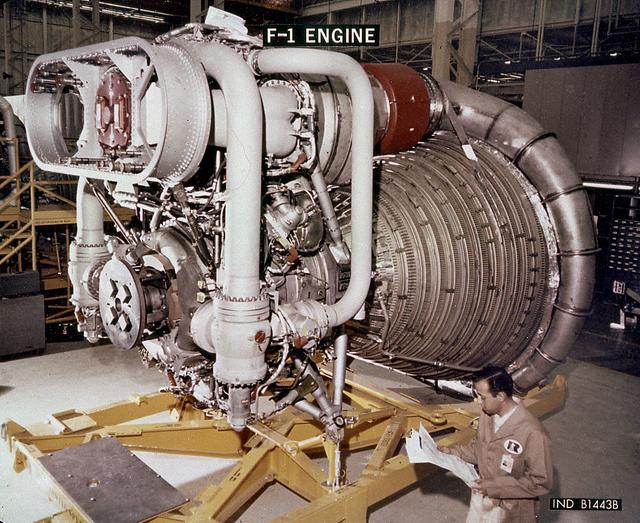
This close-up view of the F-1 engine for the Saturn V S-IC (first) stage shows the engine's complexity, and also its large size as it dwarfs the technician. Developed by Rocketdyne, under the direction of the Marshall Space Flight Center, the F-1 engine was utilized in a cluster of five engines to propel the Saturn V's first stage, the S-IC. Liquid oxygen and kerosene were used as its propellant. Initially rated at 1,500,000 pounds of thrust, the engine was later uprated to 1,522,000 pounds of thrust after the third Saturn V launch (Apollo 8, the first marned Saturn V mission) in December 1968. The cluster of five F-1 engines burned over 15 tons of propellant per second, during its two and one-half minutes of operation, to take the vehicle to a height of about 36 miles and to a speed of about 6,000 miles per hour.
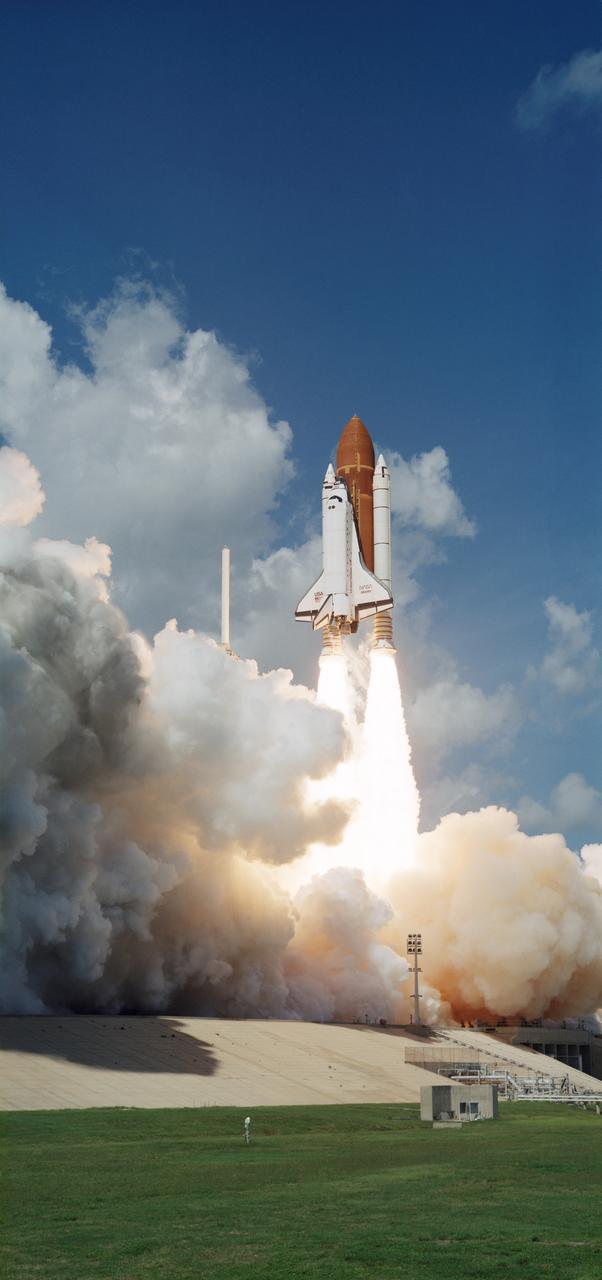
STS034-S-023 (18 Oct. 1989) --- The STS-34 Space Shuttle Atlantis lifts off from Kennedy Space Center’s launch pad 39-B at l2:53:39 p.m. (EDT) on Oct. 18, 1989, marking the beginning of a five-day mission in space. Atlantis carries a crew of five and the spacecraft Galileo. The Jupiter-bound probe will be deployed from Atlantis some six hours after launch. The journey to the giant planet is expected to take over six years. Crewmembers for the mission are astronauts Donald E. Williams, Michael J. McCulley, Shannon W. Lucid, Franklin R. Chang-Diaz and Ellen S. Baker. The scene was recorded with a 70mm camera.
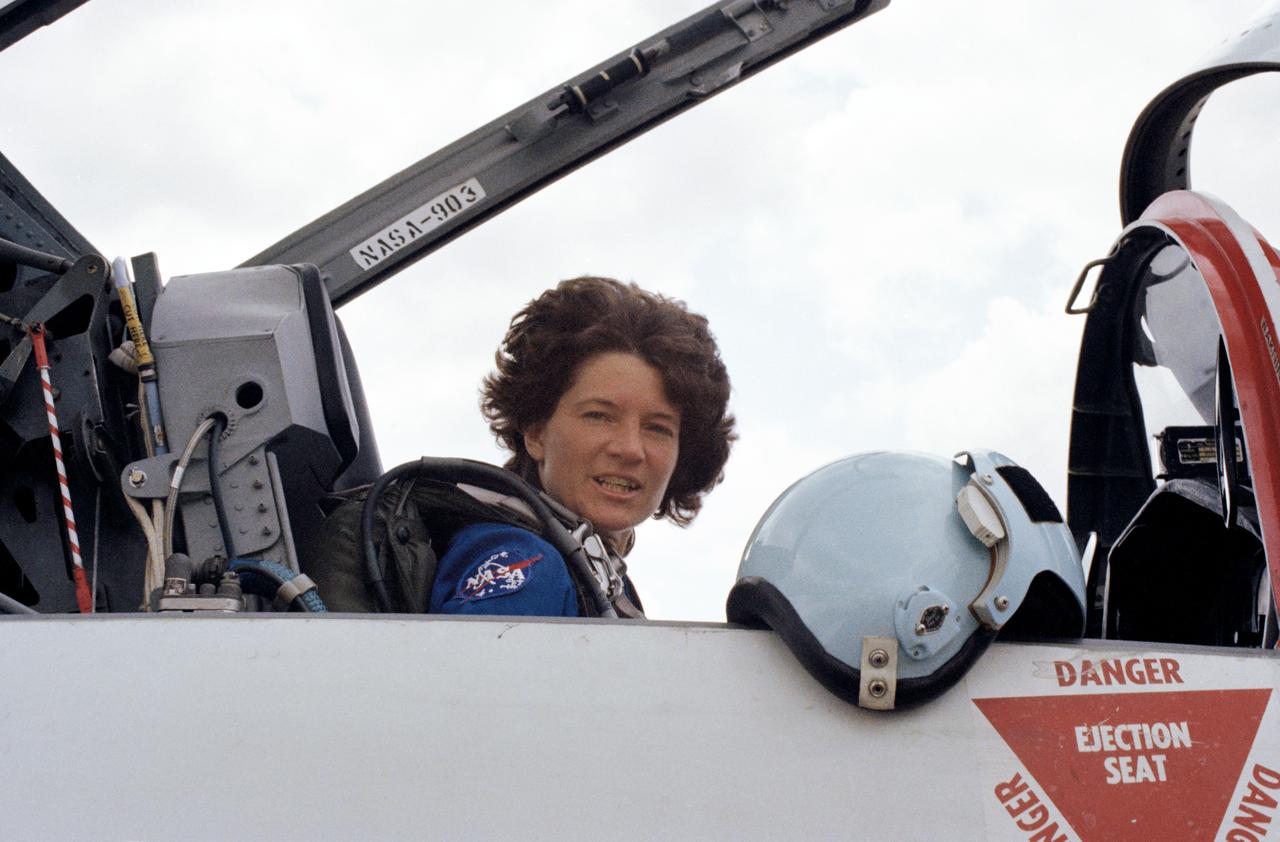
S83-34151 (15 June 1983) --- Astronaut Sally K. Ride, STS-7 mission specialist, takes one last look at familiar training environs before taking off from NASA’s Houston facility in a T-38 jet aircraft, destination: Florida and the Kennedy Space Center (KSC). After a few days of preparation at KSC, Dr. Ride and four other astronauts will be the first NASA five-member crew to fly in space as they liftoff in the Challenger from Launch Pad 39A. The mission specialist is positioned in the rear station of the jet, piloted by astronaut Robert L. Crippen, STS-7 commander. The T-38 fleet is kept at Ellington Base near the Johnson Space Center (JSC).
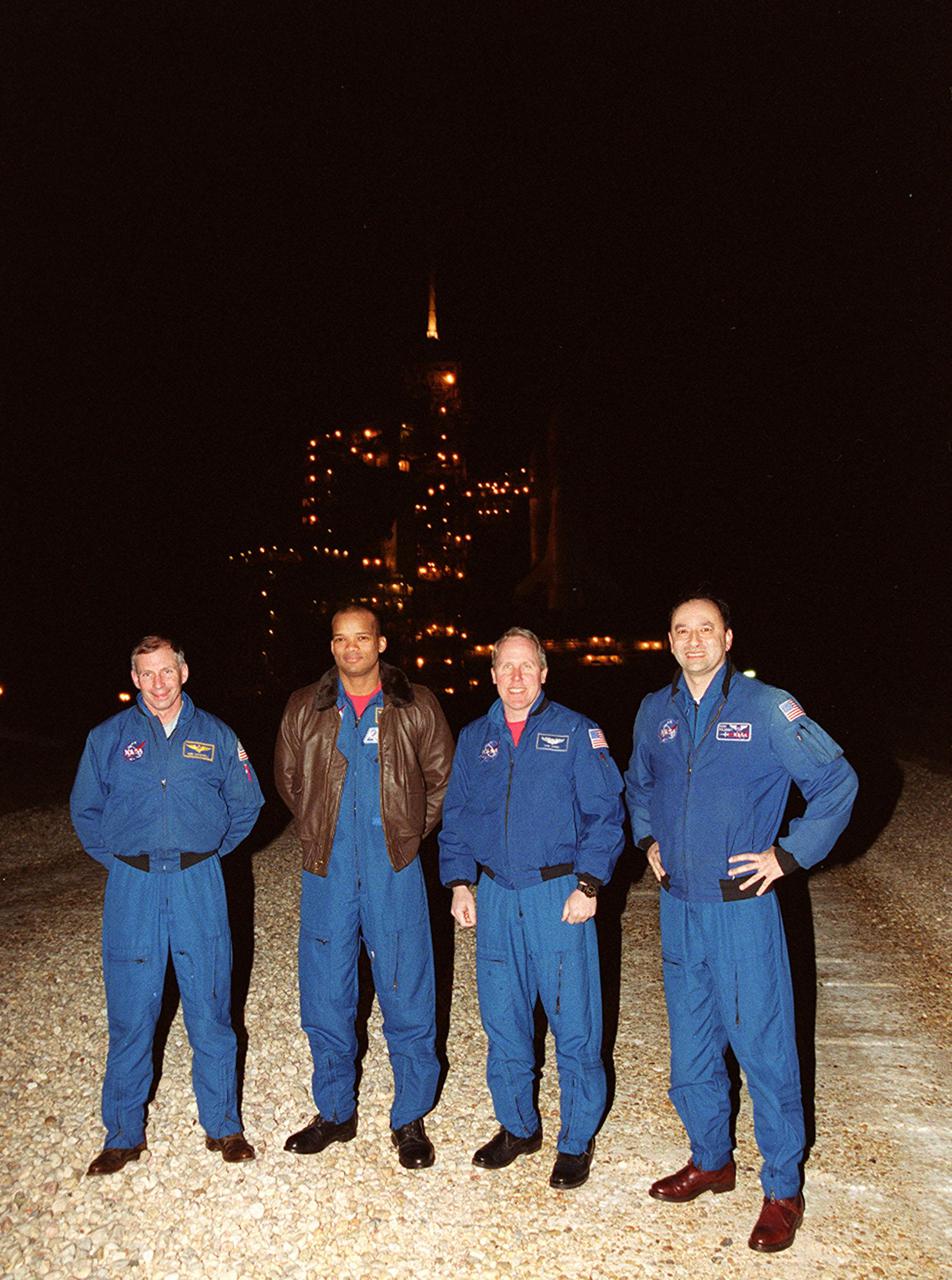
Members of the STS-98 crew pause for a photo after their arrival at KSC. From left, they are Commander Ken Cockrell, Mission Specialists Robert Curbeam and Thomas Jones, and Pilot Mark Polansky. Missing is Mission Specialist Marsha Ivins who was planning to arrive later. The crew is at KSC to take part in Terminal Countdown Test Demonstration activities in preparation for launch. They will be training in emergency procedures from the pad, checking the payload and taking part in a simulated countdown. The payload for the mission is the U.S. Lab Destiny, a key element in the construction of the International Space Station. The lab has five system racks already installed inside the module. After delivery of electronics in the lab, electrically powered attitude control for Control Moment Gyroscopes will be activated. STS-98 is the seventh construction flight to the ISS
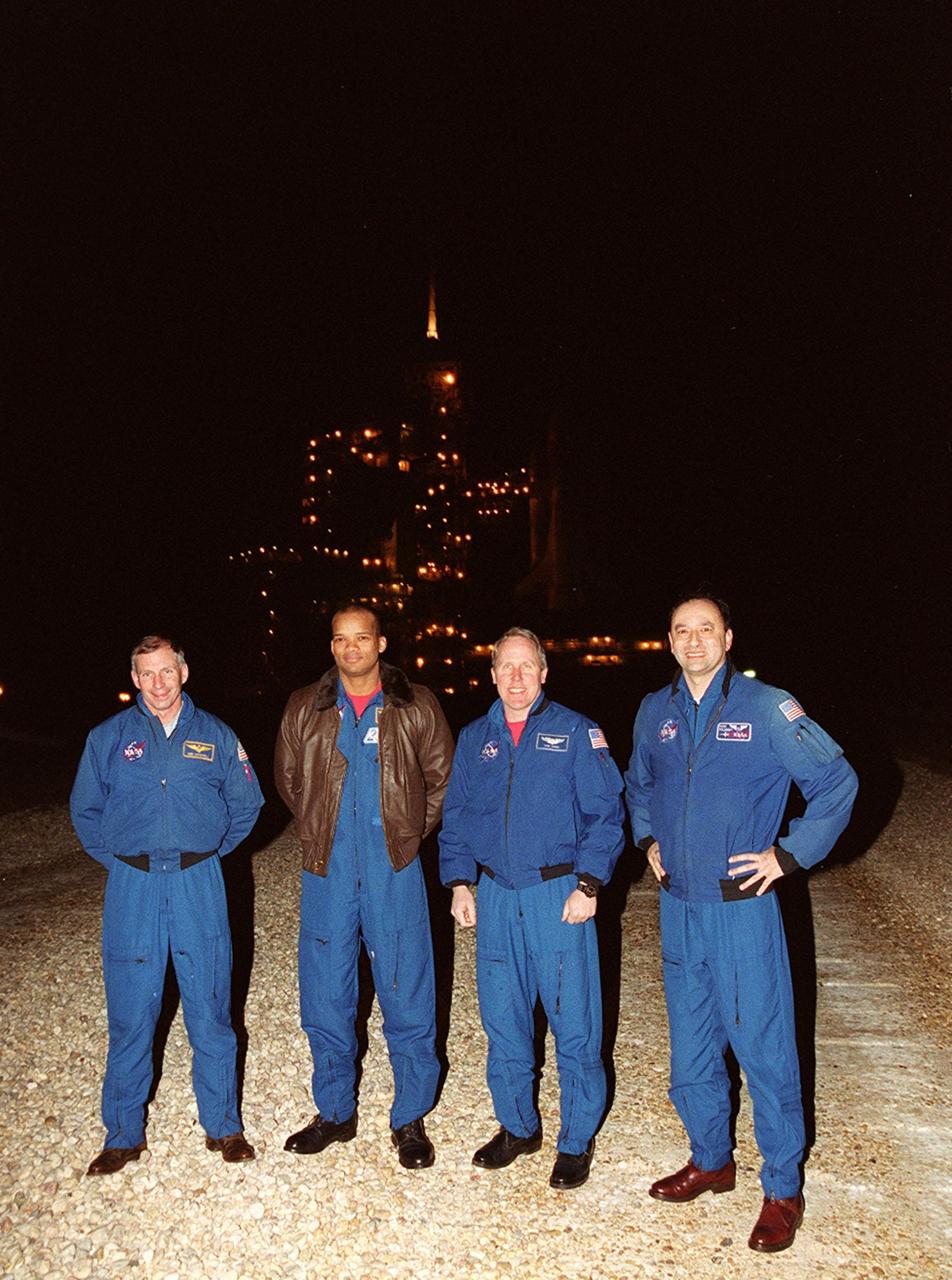
Members of the STS-98 crew pause for a photo after their arrival at KSC. From left, they are Commander Ken Cockrell, Mission Specialists Robert Curbeam and Thomas Jones, and Pilot Mark Polansky. Missing is Mission Specialist Marsha Ivins who was planning to arrive later. The crew is at KSC to take part in Terminal Countdown Test Demonstration activities in preparation for launch. They will be training in emergency procedures from the pad, checking the payload and taking part in a simulated countdown. The payload for the mission is the U.S. Lab Destiny, a key element in the construction of the International Space Station. The lab has five system racks already installed inside the module. After delivery of electronics in the lab, electrically powered attitude control for Control Moment Gyroscopes will be activated. STS-98 is the seventh construction flight to the ISS
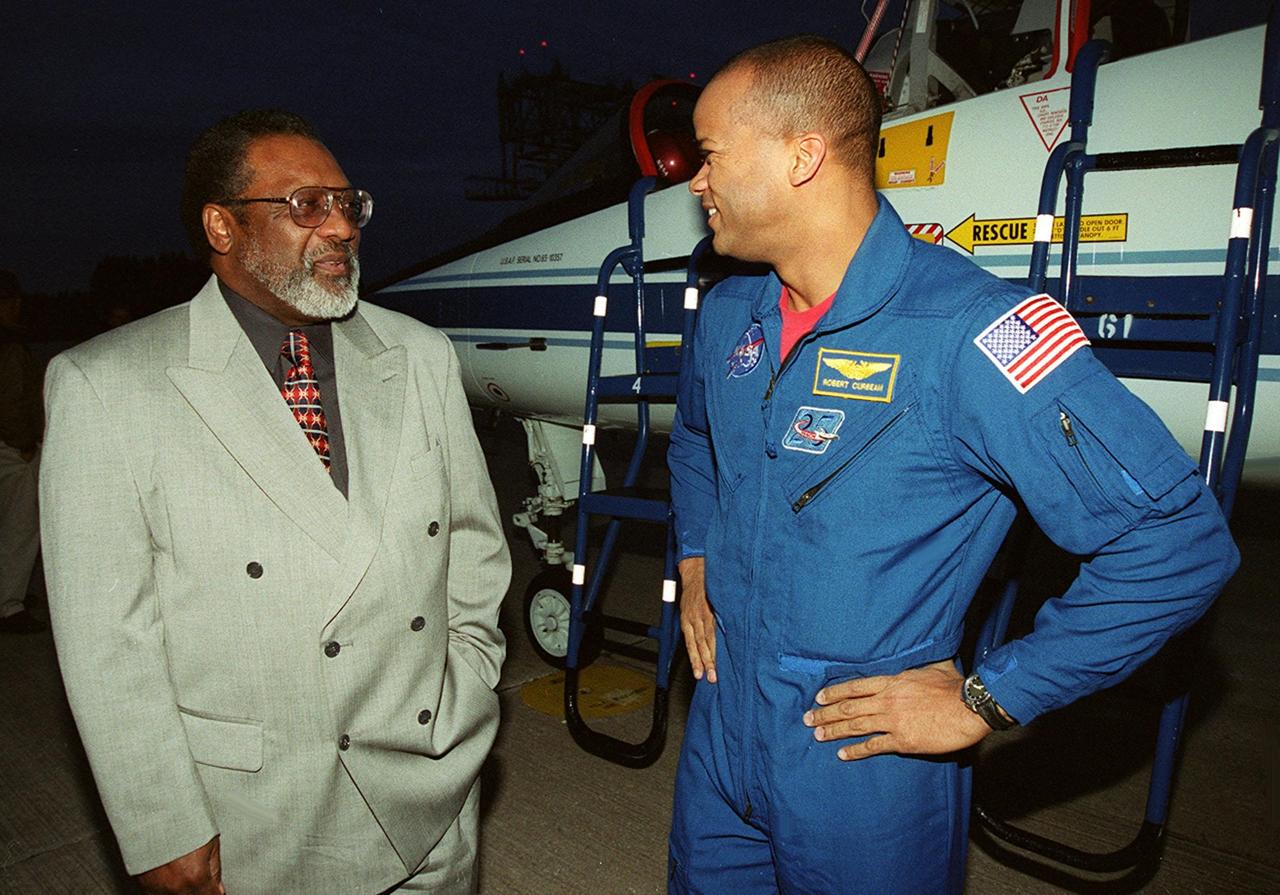
KSC’s Deputy Director James Jennings (left) welcomes STS-98 Mission Specialist Robert Curbeam to KSC. The STS-98 crew Commander Ken Cockrell, Pilot Mark Polansky and Mission Specialists Curbeam, Thomas Jones and Marsha Ivins arrived to take part in Terminal Countdown Test Demonstration activities in preparation for launch. They will be training in emergency procedures from the pad, checking the payload and taking part in a simulated countdown. The payload for the mission is the U.S. Lab Destiny, a key element in the construction of the International Space Station. The lab has five system racks already installed inside the module. After delivery of electronics in the lab, electrically powered attitude control for Control Moment Gyroscopes will be activated. STS-98 is the seventh construction flight to the ISS
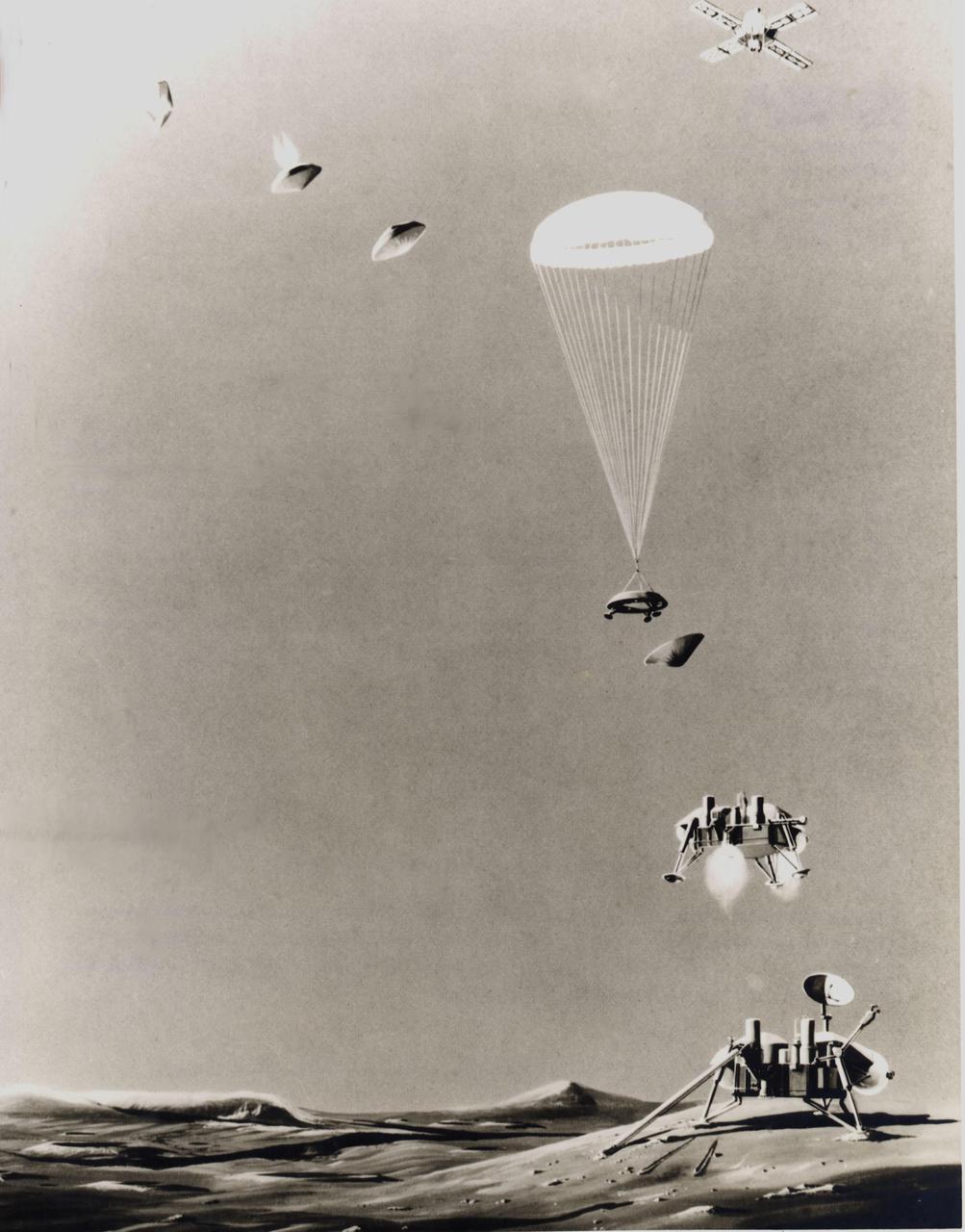
This is an artist's conception of the sequence of events that will take place just prior to landing a life-detection laboratory on the surface of Mars on July 4, 1976. Above right, the Viking spacecraft, composed of an orbiter and a lander, has been in orbit around the Red Planet since June 19, 1976, taking pictures of the planned landing site to ascertain its safety before releasing the lander (top, left) for its threeto five-hour descent. Protected by aeroshells, the heat-sterilized lander hurtles into the thin Martian atmosphere at a speed of about 10,000 mph, to be slowed first by aerodynamic drag until the shell is discarded, then by parachute (center) and finally by retrorockets to assure a gentle landing. Instruments will study the structure and composition of the Martian atmosphere as the lander drifts down. Viking 2 is scheduled to arrive at Mars on Aug. 7 and touch down on the surface on Sept. 4.
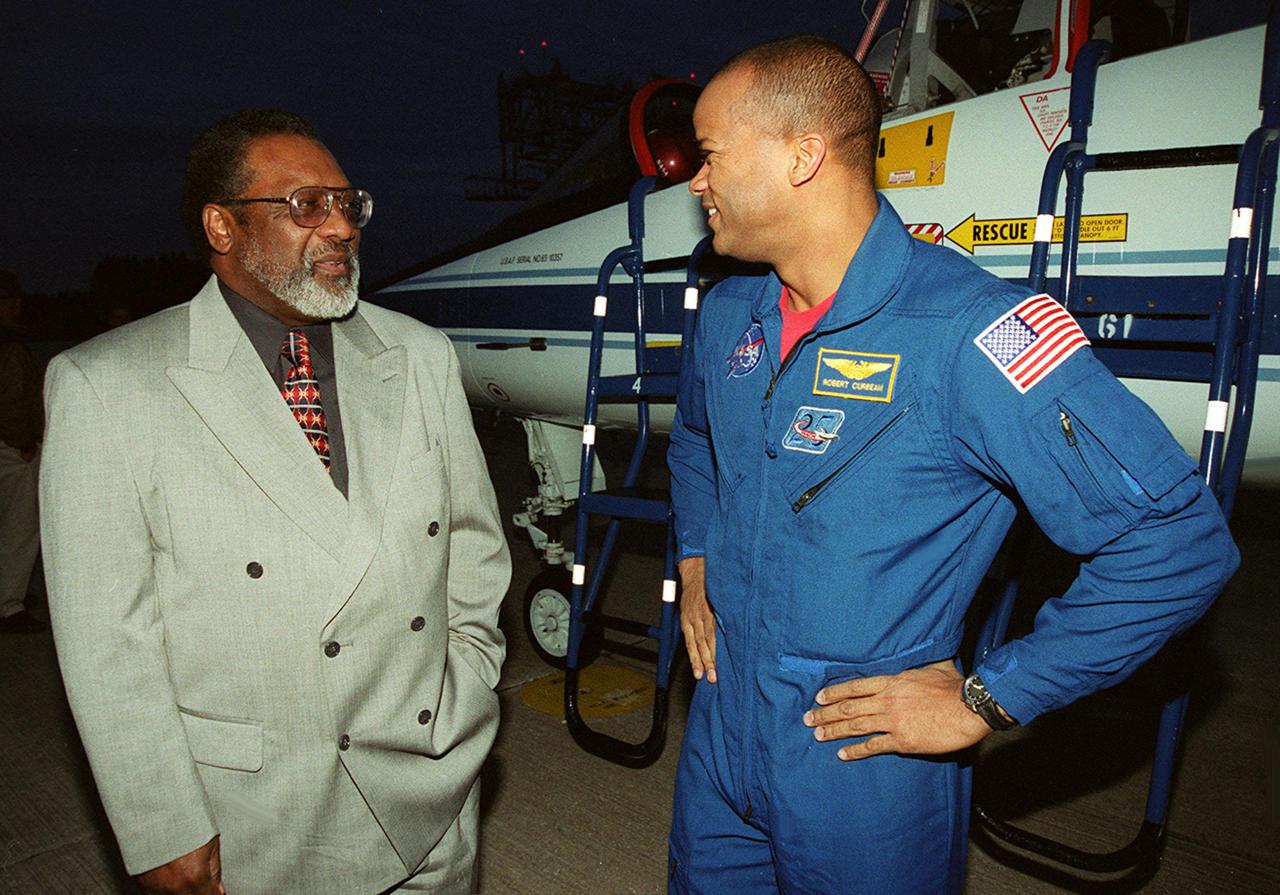
KSC’s Deputy Director James Jennings (left) welcomes STS-98 Mission Specialist Robert Curbeam to KSC. The STS-98 crew Commander Ken Cockrell, Pilot Mark Polansky and Mission Specialists Curbeam, Thomas Jones and Marsha Ivins arrived to take part in Terminal Countdown Test Demonstration activities in preparation for launch. They will be training in emergency procedures from the pad, checking the payload and taking part in a simulated countdown. The payload for the mission is the U.S. Lab Destiny, a key element in the construction of the International Space Station. The lab has five system racks already installed inside the module. After delivery of electronics in the lab, electrically powered attitude control for Control Moment Gyroscopes will be activated. STS-98 is the seventh construction flight to the ISS
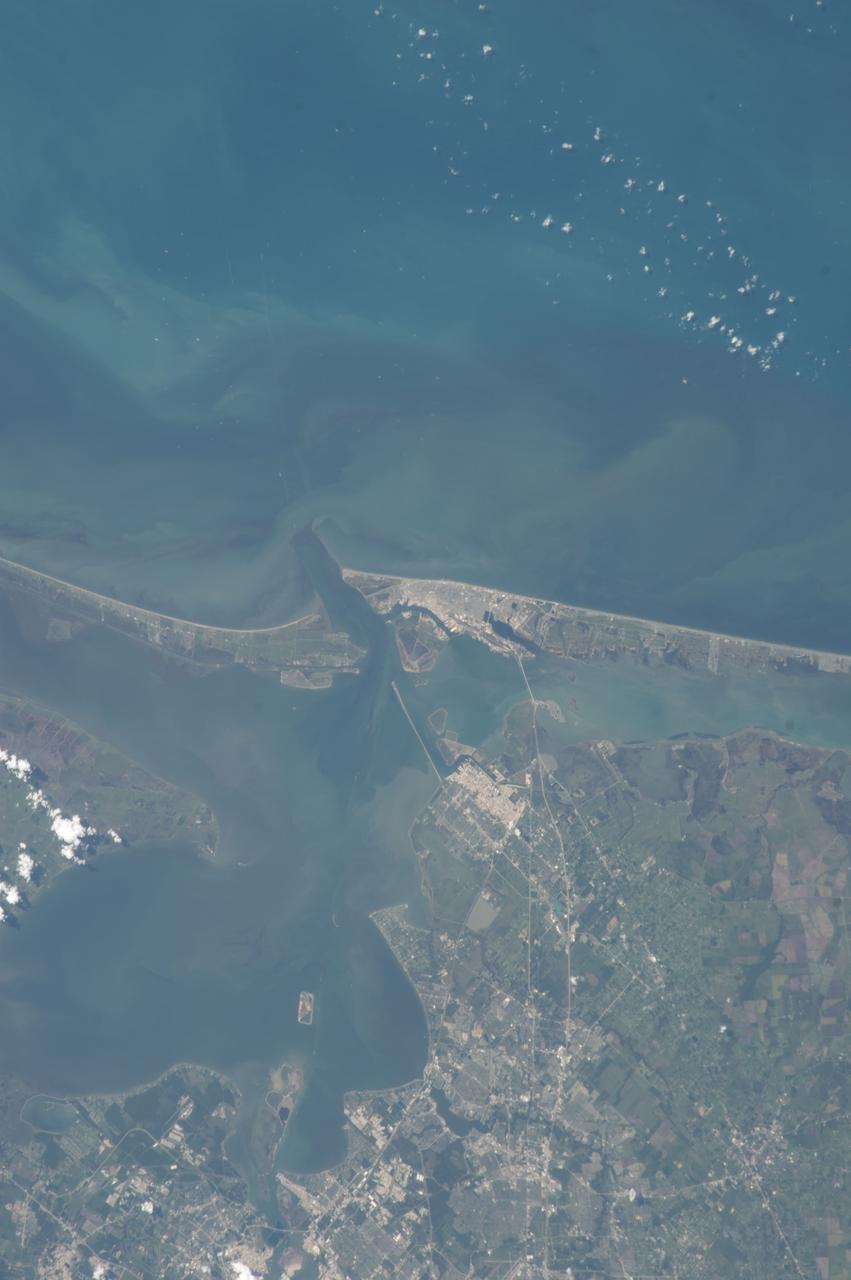
ISS036-E-037747 (28 Aug. 2013) --- One of the Expedition 36 crew members aboard the International Space Station on Aug. 28 photographed this vertical image that shows much of Galveston County and a small portion of southeast Harris County, Texas. Gulf of Mexico waters take up the top half of the picture. Galveston Island runs from just left of center through center right of the image, and the Bolivar Peninsula, highly impacted by Hurricane Ike five years ago, is the land mass at left center. Galveston Bay takes up much of the lower left quadrant of the pictured area. The NASA Johnson Space Center, the normal work place for NASA astronauts Chris Cassidy and Karen Nyberg, currently onboard the orbital complex, is in the bottom portion of the frame.
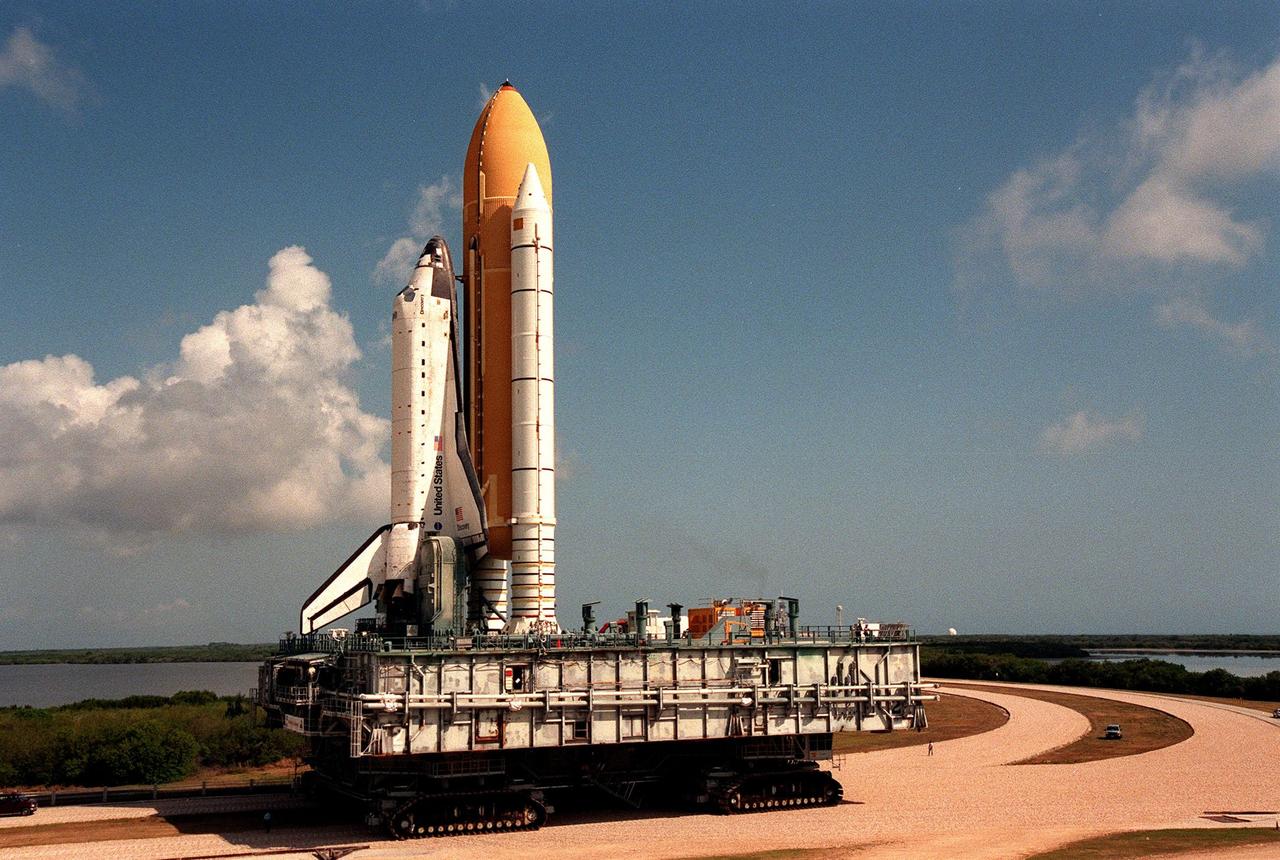
KENNEDY SPACE CENTER, Fla. -- The Space Shuttle Discovery, atop the mobile launcher platform and crawler-transporter, dwarfs the car parked at right on the median of the 130-foot-wide crawlerway. Traveling at 1 mph, the crawler-transporter takes about five hours to cover the journey from the Vehicle Assembly Building to Launch Pad 39B. Here it is moving toward the turn that will take it to the pad. Liftoff of Discovery on mission STS-96 is targeted for May 20 at 9:32 a.m. EDT. STS-96 is a logistics and resupply mission for the International Space Station, carrying such payloads as a Russian crane, the Strela; a U.S.-built crane; the Spacehab Oceaneering Space System Box (SHOSS), a logistics items carrier; and STARSHINE, a student-led experiment
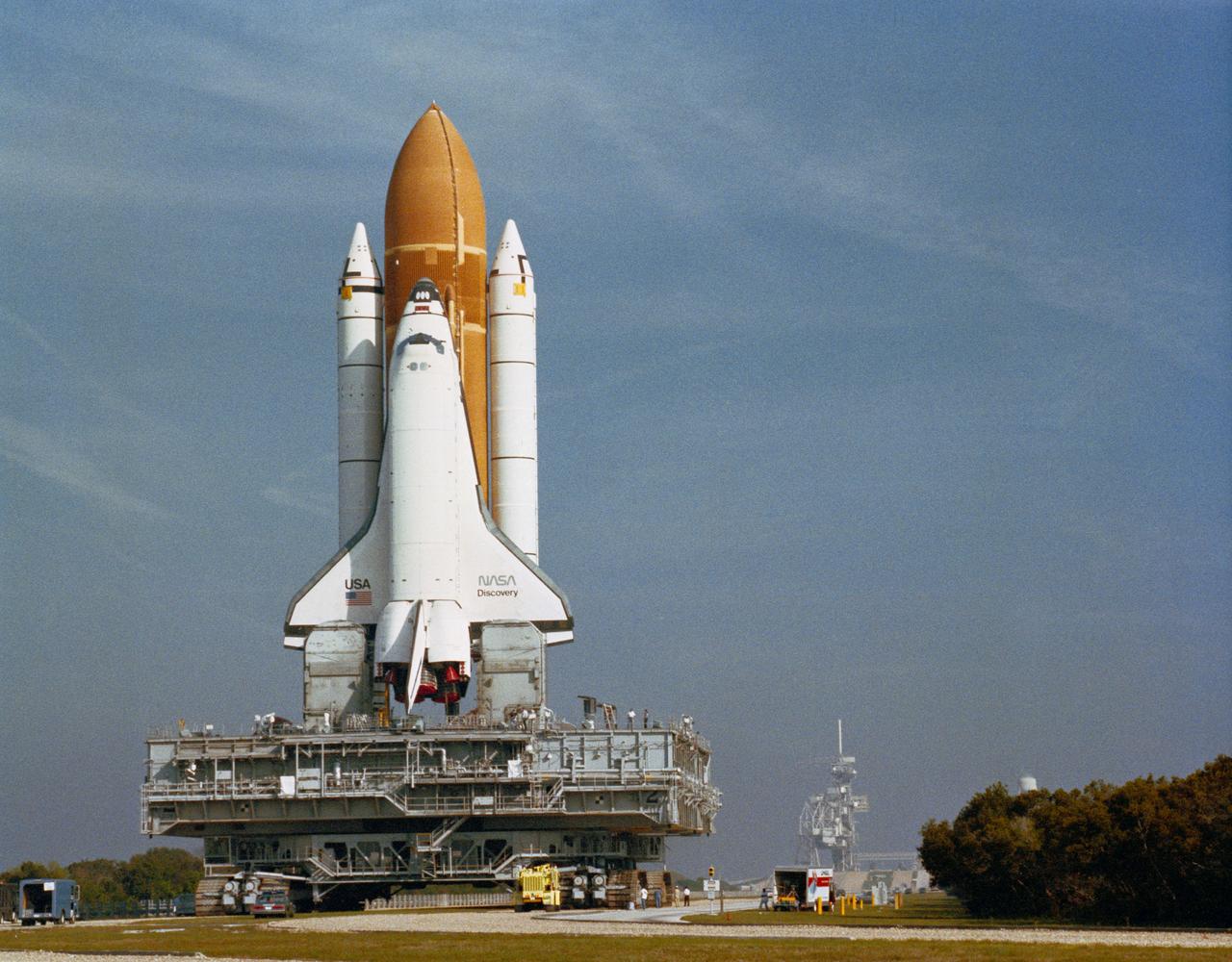
S89-28110 (3 Feb 1989) ---The Space Shuttle Discovery, atop a mobile launch platform, is rolled toward Kennedy Space Center's Launch Pad 39-B on Feb. 3, l989. It rolled through the doors of the huge vehicle assembly building (VAB) at 6 a.m.,several hours ago. The Launch Complex is in view here. The trip to the pad takes approximately 5 and 1/2 hours. Onboard the spacecraft in mid-March for a five-day mission, on which will be deployed a third tracking and data relay satellite (TDRS-D), will be Astronauts Michael L. Coats, John E. Blaha, James F. Buchli, James P. Bagian and Robert C. Springer.
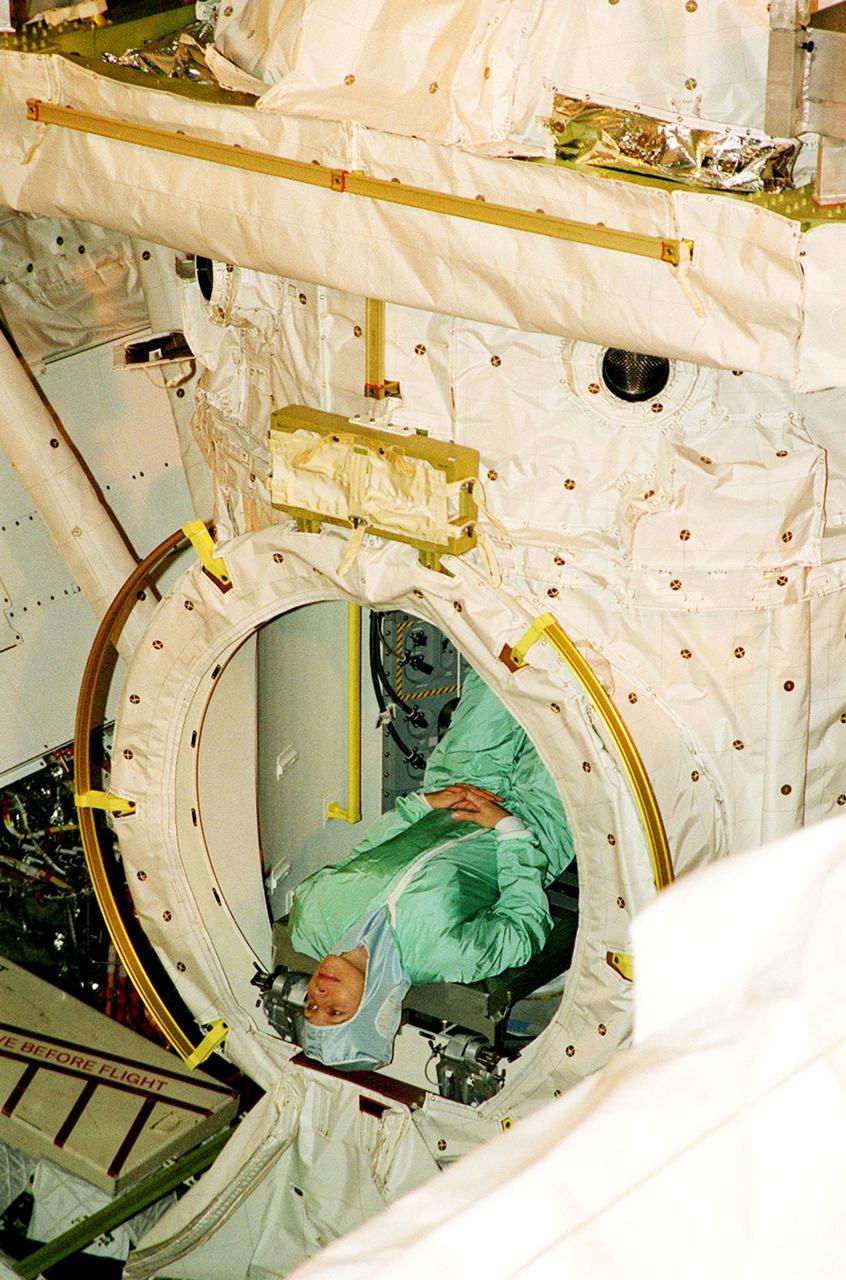
KENNEDY SPACE CENTER, FLA. -- STS-98 Mission Specialist Marsha Ivins takes a topsy-turvy look at the EVA hatch in the Orbiter Docking System, which is already installed in the payload bay of orbiter Atlantis. She and the rest of the crew are at KSC for Crew Equipment Interface Test activities. Launch on mission STS-98 is scheduled for Jan. 18, 2001. It will be transporting the U.S. Lab, Destiny, to the International Space Station with five system racks already installed inside of the module. After delivery of electronics in the lab, electrically powered attitude control for Control Moment Gyroscopes will be activated
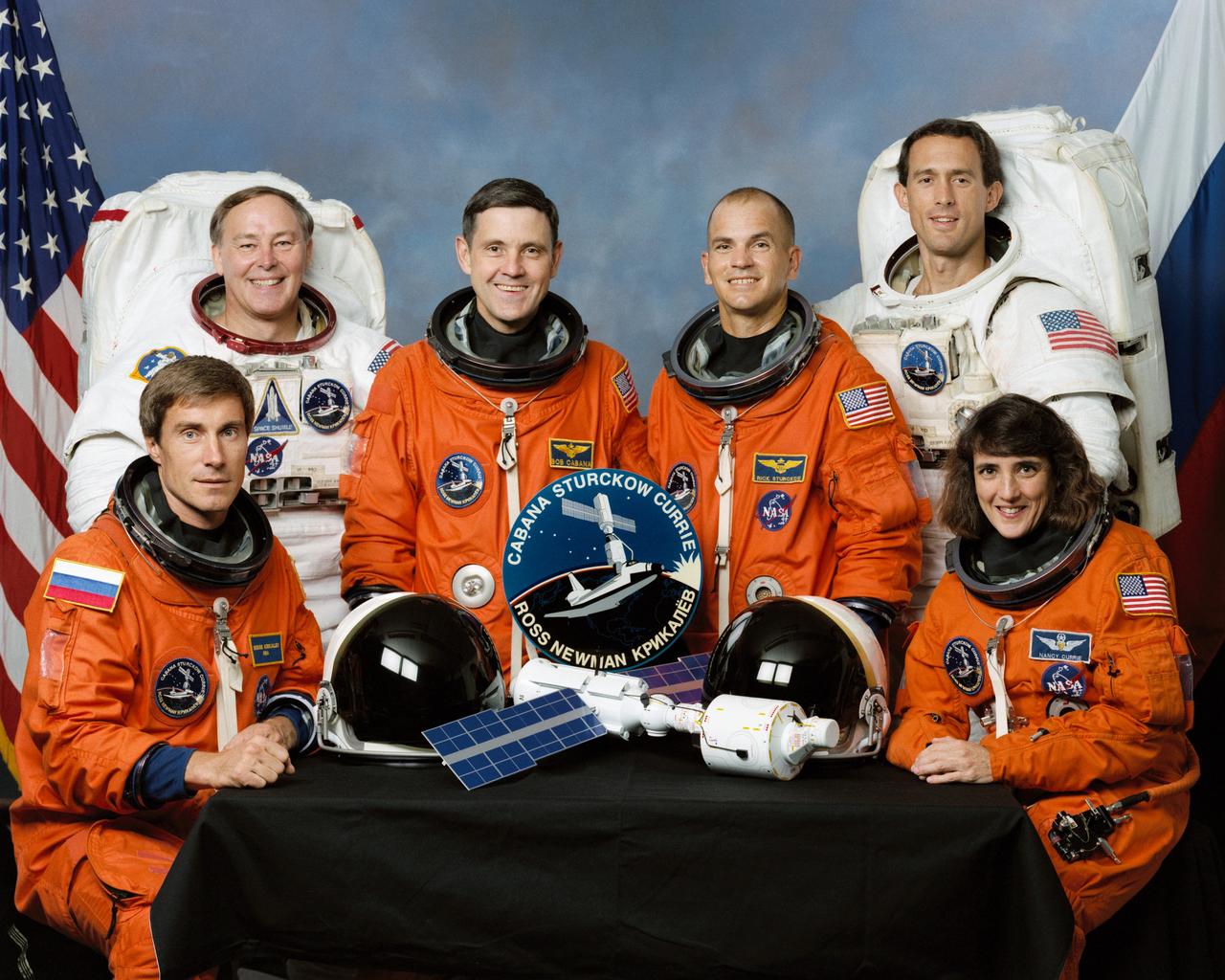
STS088-S-002 (November 1998) --- Five NASA astronauts and a Russian cosmonaut assigned to the mission, scheduled for an early December 1998 launch, take time out from their busy training agenda for a crew portrait. Seated in front are Sergei K. Krikalev, a mission specialist representing the Russian Space Agency (RSA), and astronaut Nancy J. Currie, mission specialist. In the rear, from the left, are astronauts Jerry L. Ross, mission specialist; Robert D. Cabana, mission commander; Frederick W. Sturckow, pilot; and James H. Newman, mission specialist.
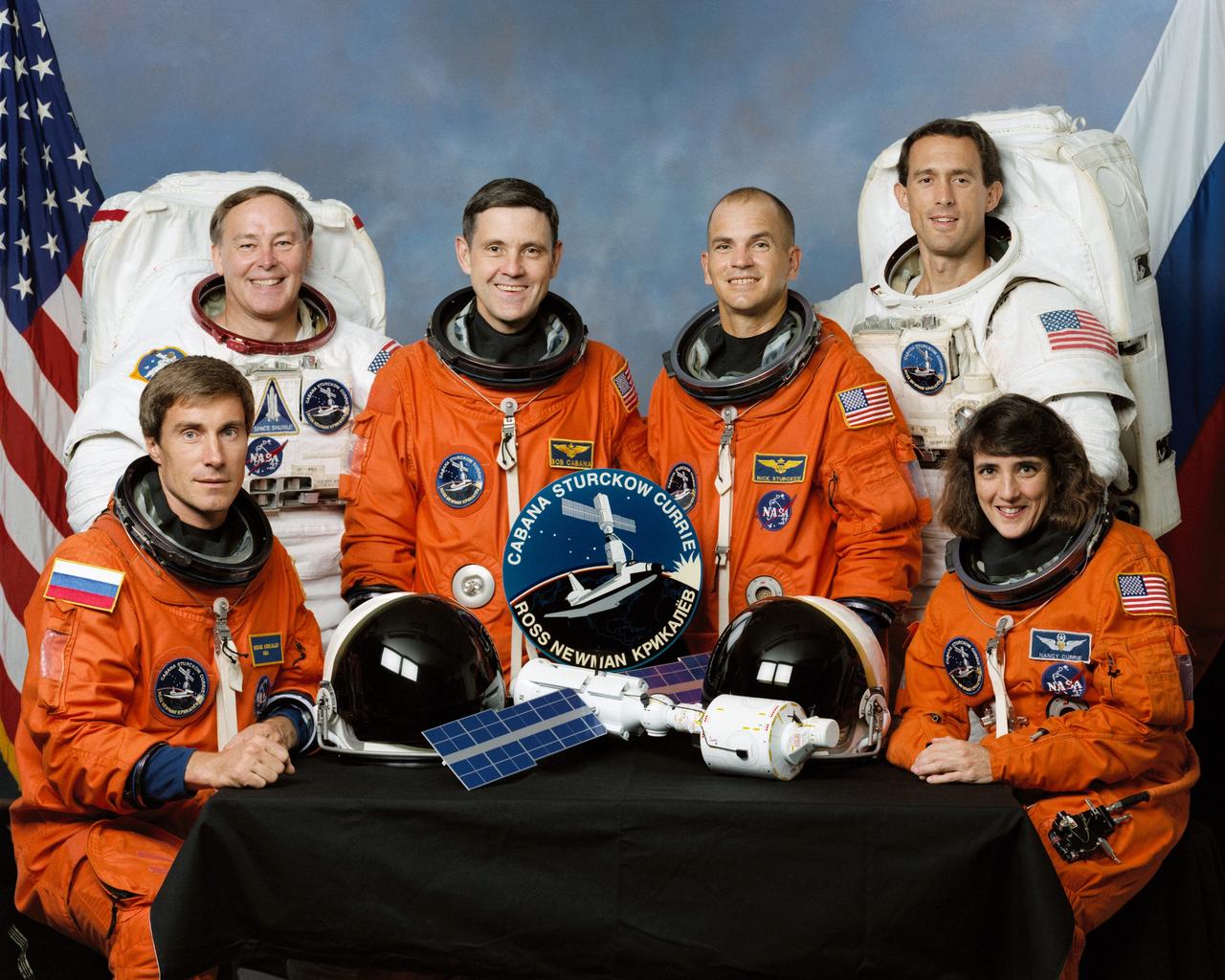
JOHNSON SPACE CENTER, Houston, Texas -- STS088(S)002 -- Five NASA astronauts and a Russian cosmonaut assigned to the STS-88 mission, scheduled for an early December launch, take time out from their busy training agenda for a crew portrait. Seated in front are Sergei K. Krikalev, a mission specialist representing the Russian Space Agency (RSA), and astronaut Nancy J. Currie, mission specialist. In the rear, from the left, are astronauts Jerry L. Ross, mission specialist; Robert D. Cabana, mission commander; Frederick W. Sturckow, pilot; and James H. Newman, mission specialist.
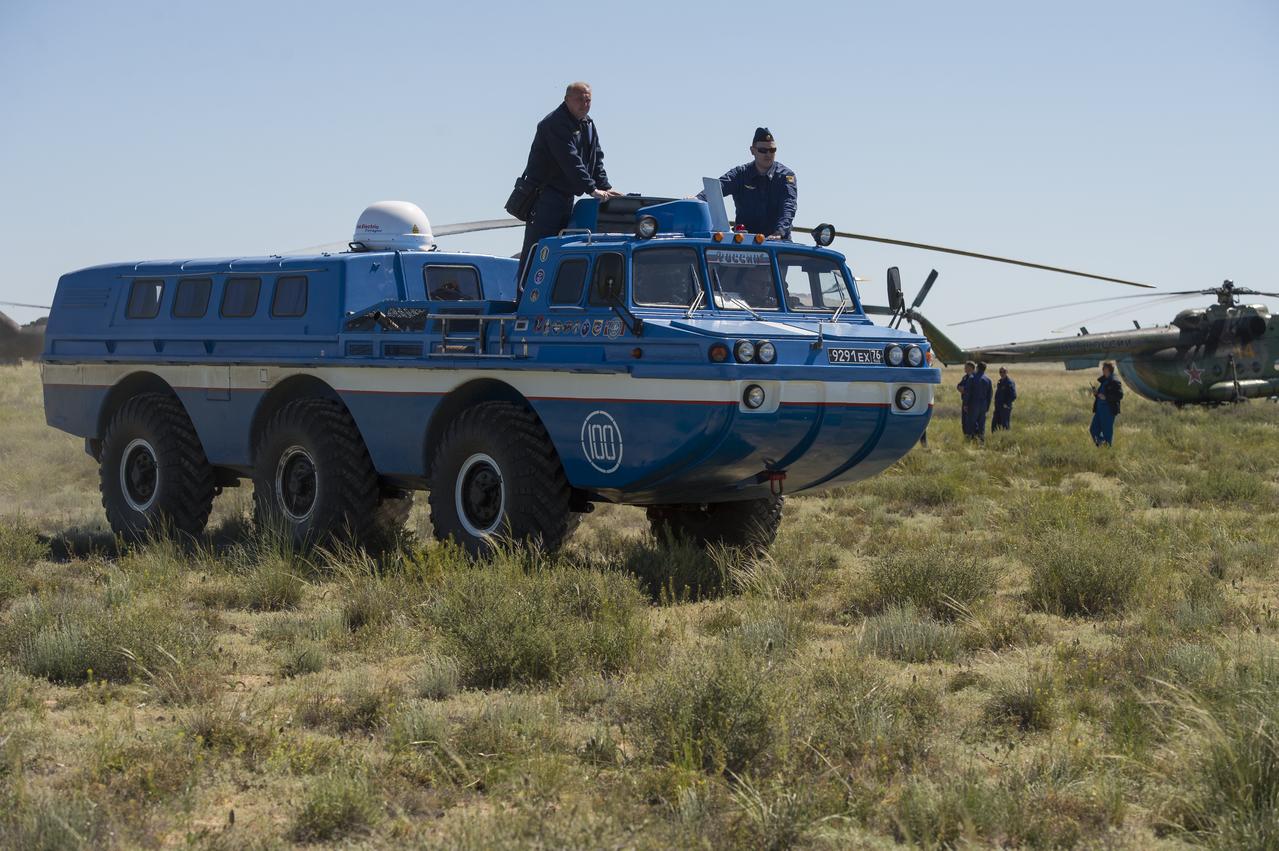
A Russian all terrain vehicle (ATV) takes Expedition 35 NASA Flight Engineer Tom Marshburn to a helicopter from the Soyuz TMA-07M spacecraft shortly after the capsule landed with Marshburn and Expedition 35 Commander Chris Hadfield of the Canadian Space Agency (CSA) and Russian Flight Engineer Roman Romanenko in a remote area near the town of Zhezkazgan, Kazakhstan, Tuesday, May 14, 2013. Marshburn, Hadfield and Romanenko are returning from five months onboard the International Space Station where they served as members of the Expedition 34 and 35 crews. Photo Credit: (NASA/Carla Cioffi)
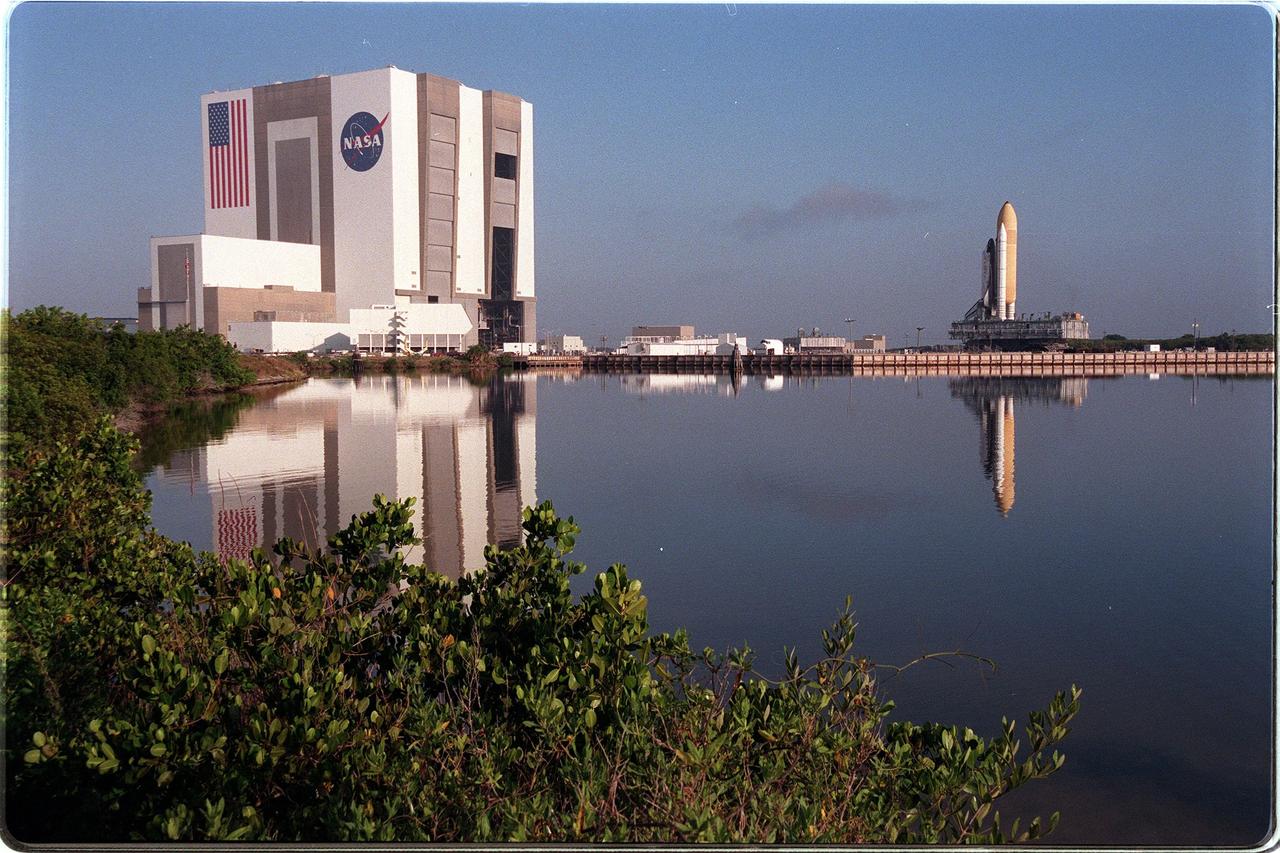
KENNEDY SPACE CENTER, Fla. -- Reflected in the turn basin at Launch Complex 39 Area, the Space Shuttle Discovery stands atop the crawler-transporter, which carries its cargo at 1 mph to Launch Pad 39B. The vehicle takes about five hours to cover the journey from the Vehicle Assembly Building to the launch pad. Liftoff of Discovery on mission STS-96 is targeted for May 20 at 9:32 a.m. EDT. STS-96 is a logistics and resupply mission for the International Space Station, carrying such payloads as a Russian crane, the Strela; a U.S.-built crane; the Spacehab Oceaneering Space System Box (SHOSS), a logistics items carrier; and STARSHINE, a student-led experiment
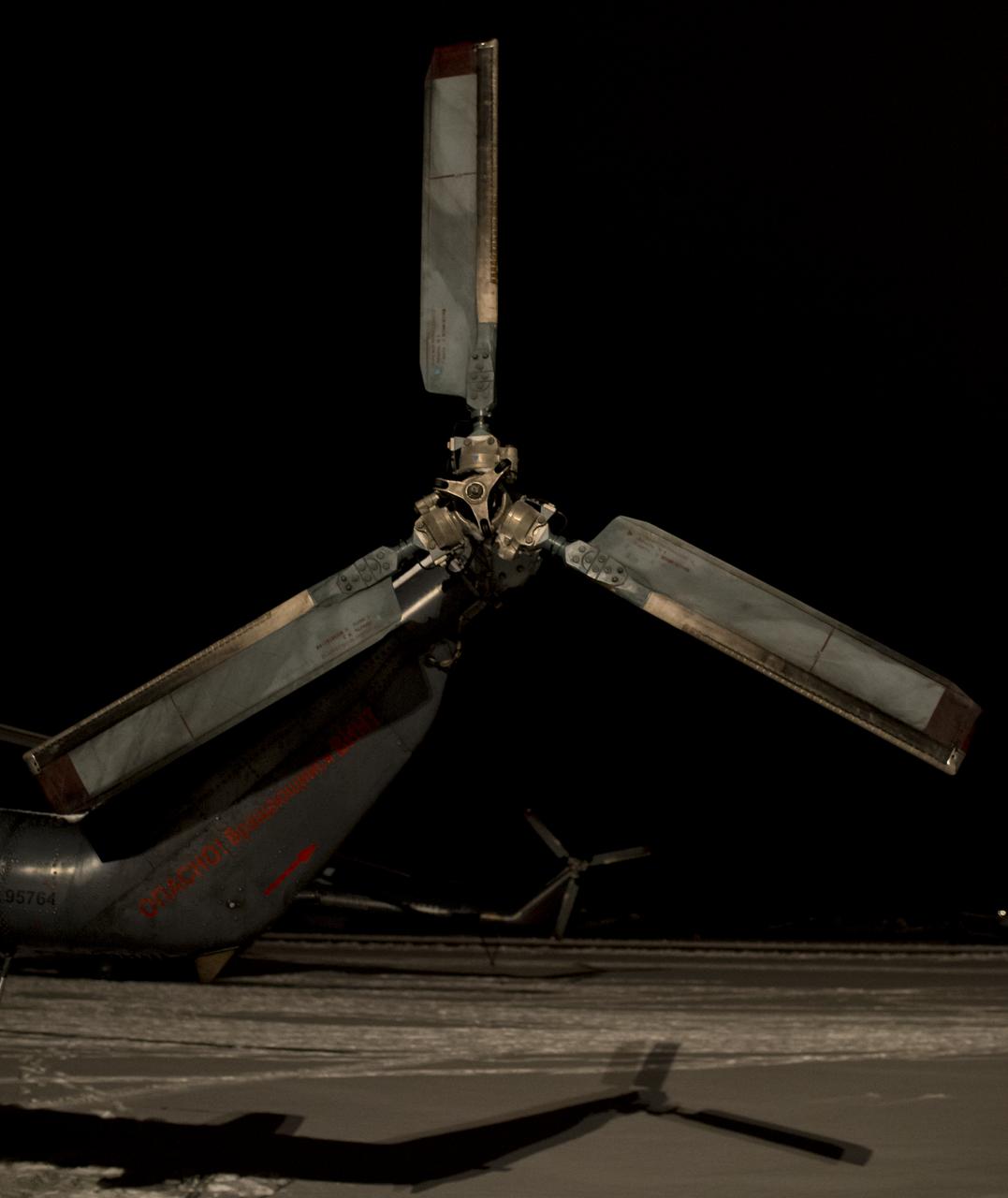
Russian Search and Rescue helicopter tail rotors are seen as teams wait to take off from Kustanay, Kazakhstan to support the Soyuz TMA-13M spacecraft landing with Expedition 41 Commander Max Suraev of the Russian Federal Space Agency (Roscosmos), NASA Flight Engineer Reid Wiseman and Flight Engineer Alexander Gerst of the European Space Agency (ESA) on Monday, Nov. 10, 2014. Suraev, Wiseman and Gerst returned to Earth after more than five months onboard the International Space Station where they served as members of the Expedition 40 and 41 crews. Photo Credit: (NASA/Bill Ingalls)
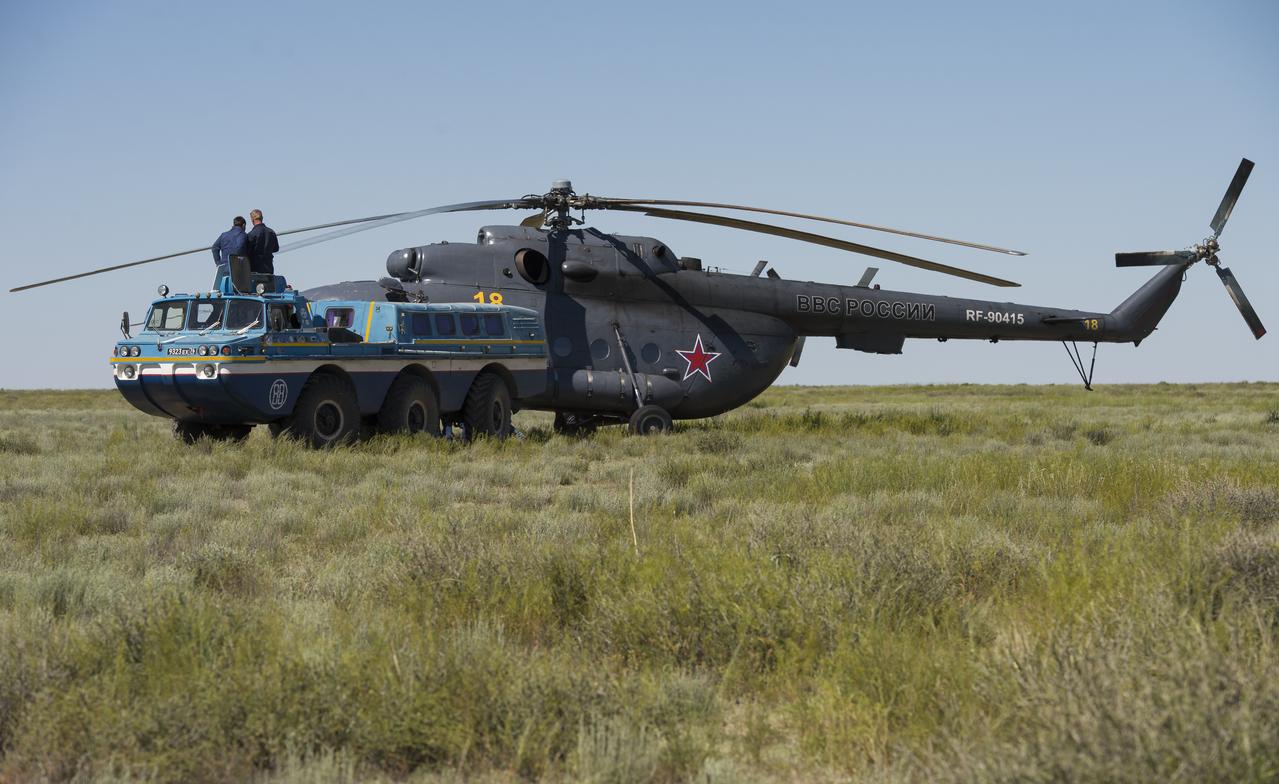
A Russian all terrain vehicle (ATV) takes Expedition 35 Commander Chris Hadfield of the Canadian Space Agency (CSA) to a helicopter from the Soyuz TMA-07M spacecraft shortly after the capsule landed with Hadfield and Expedition 35 Flight Engineers Tom Marshburn and Roman Romanenko in a remote area near the town of Zhezkazgan, Kazakhstan, Tuesday, May 14, 2013. Hadfield, Marshburn and Romanenko are returning from five months onboard the International Space Station where they served as members of the Expedition 34 and 35 crews. Photo Credit: (NASA/Carla Cioffi)
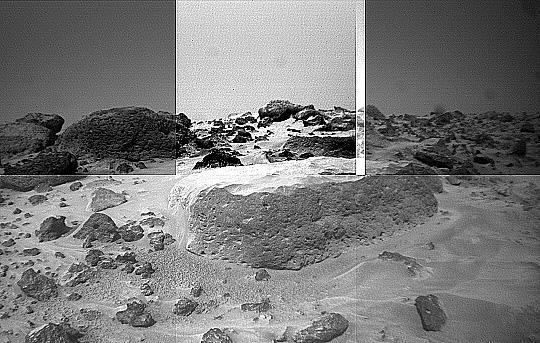
This image of the rock "Flat Top" was taken from the left of the Sojourner rover's front cameras on Sol 42. Pits on the edge of the rock and a fluted surface are clearly visible. The rocks in the left background comprise the Rock Garden. Sojourner spent 83 days of a planned seven-day mission exploring the Martian terrain, acquiring images, and taking chemical, atmospheric and other measurements. The final data transmission received from Pathfinder was at 10:23 UTC on September 27, 1997. Although mission managers tried to restore full communications during the following five months, the successful mission was terminated on March 10, 1998. http://photojournal.jpl.nasa.gov/catalog/PIA01554
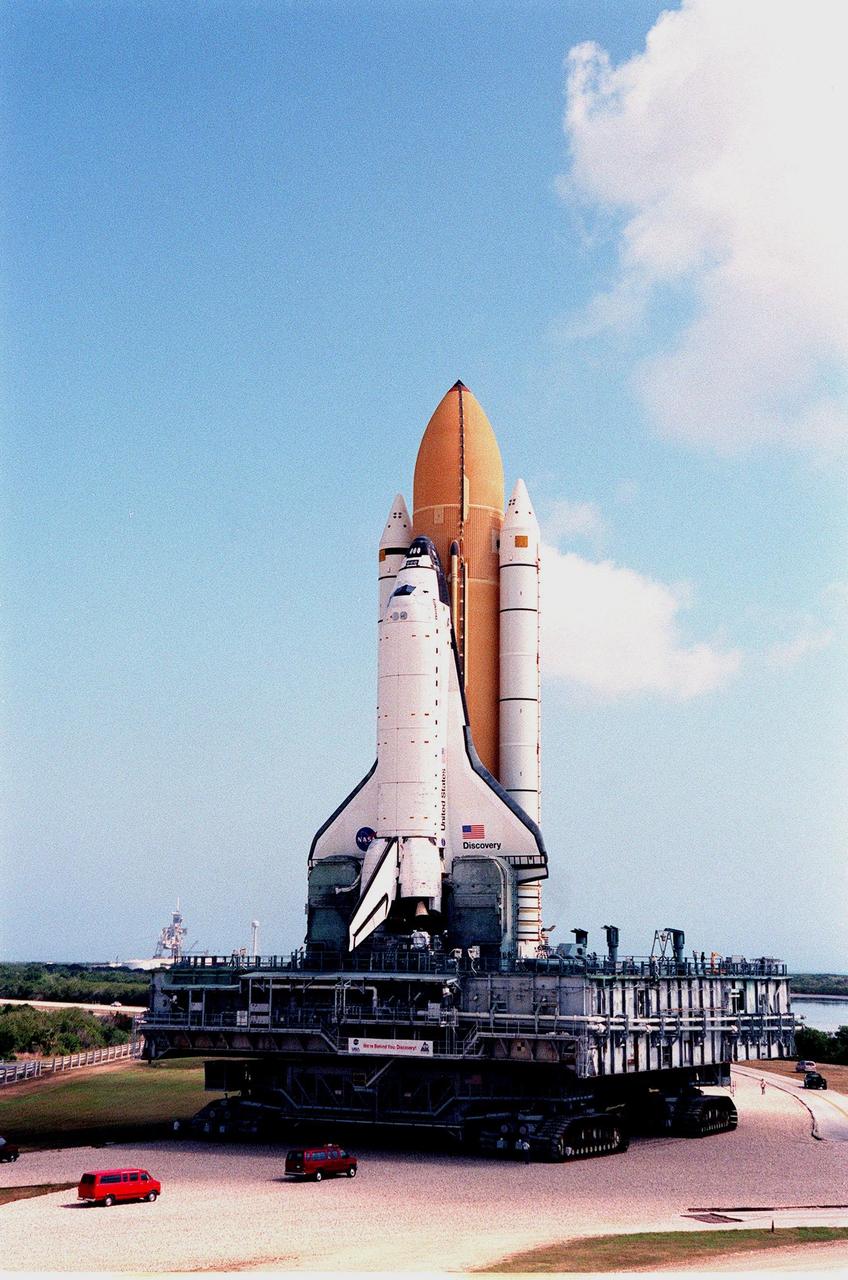
KENNEDY SPACE CENTER, Fla. -- The Space Shuttle Discovery, atop the mobile launcher platform and crawler-transporter, approaches the turn in the crawlerway as it creeps to Launch Pad 39B at 1 mph. The crawler-transporter takes about five hours to cover the journey from the Vehicle Assembly Building to the launch pad. Liftoff of Discovery on mission STS-96 is targeted for May 20 at 9:32 a.m. EDT. STS-96 is a logistics and resupply mission for the International Space Station, carrying such payloads as a Russian crane, the Strela; a U.S.-built crane; the Spacehab Oceaneering Space System Box (SHOSS), a logistics items carrier; and STARSHINE, a student-led experiment
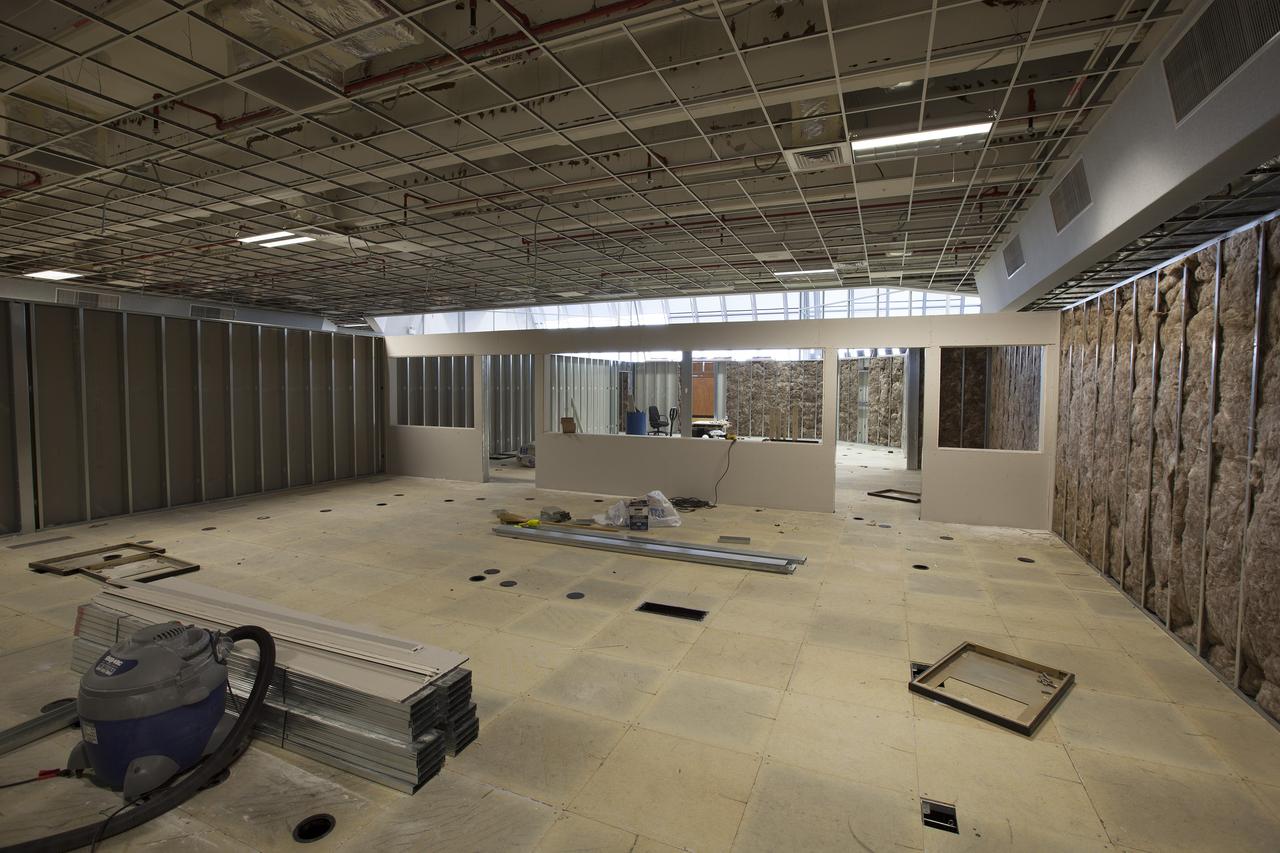
CAPE CANAVERAL, Fla. – Modifications to Firing Room 4 in the Launch Control Center at NASA's Kennedy Space Center in Florida continue to take shape. Construction workers have installed the framing and some of the insulation and inner walls. The Ground Systems Development and Operations Program is overseeing efforts to create a new firing room based on a multi-user concept. The design of Firing Room 4 will incorporate five control room areas that are flexible to meet current and future NASA and commercial user requirements. The equipment and most of the consoles from Firing Room 4 were moved to Firing Room 2 for possible future reuse. Photo credit: NASA/Dimitri Gerondidakis
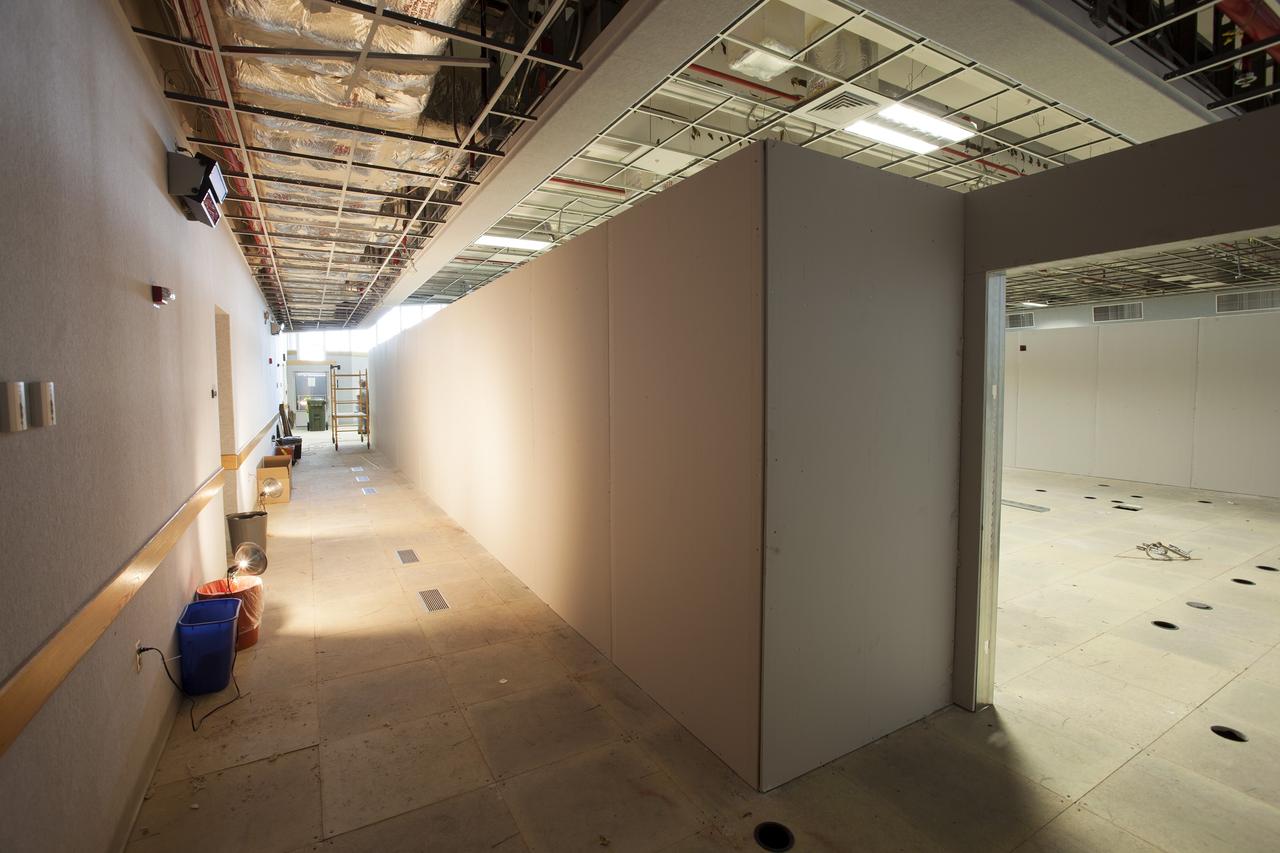
CAPE CANAVERAL, Fla. – Modifications to Firing Room 4 in the Launch Control Center at NASA's Kennedy Space Center in Florida continue to take shape. Construction workers have installed the framing and some of the inner walls. The Ground Systems Development and Operations Program is overseeing efforts to create a new firing room based on a multi-user concept. The design of Firing Room 4 will incorporate five control room areas that are flexible to meet current and future NASA and commercial user requirements. The equipment and most of the consoles from Firing Room 4 were moved to Firing Room 2 for possible future reuse. Photo credit: NASA/Dimitri Gerondidakis
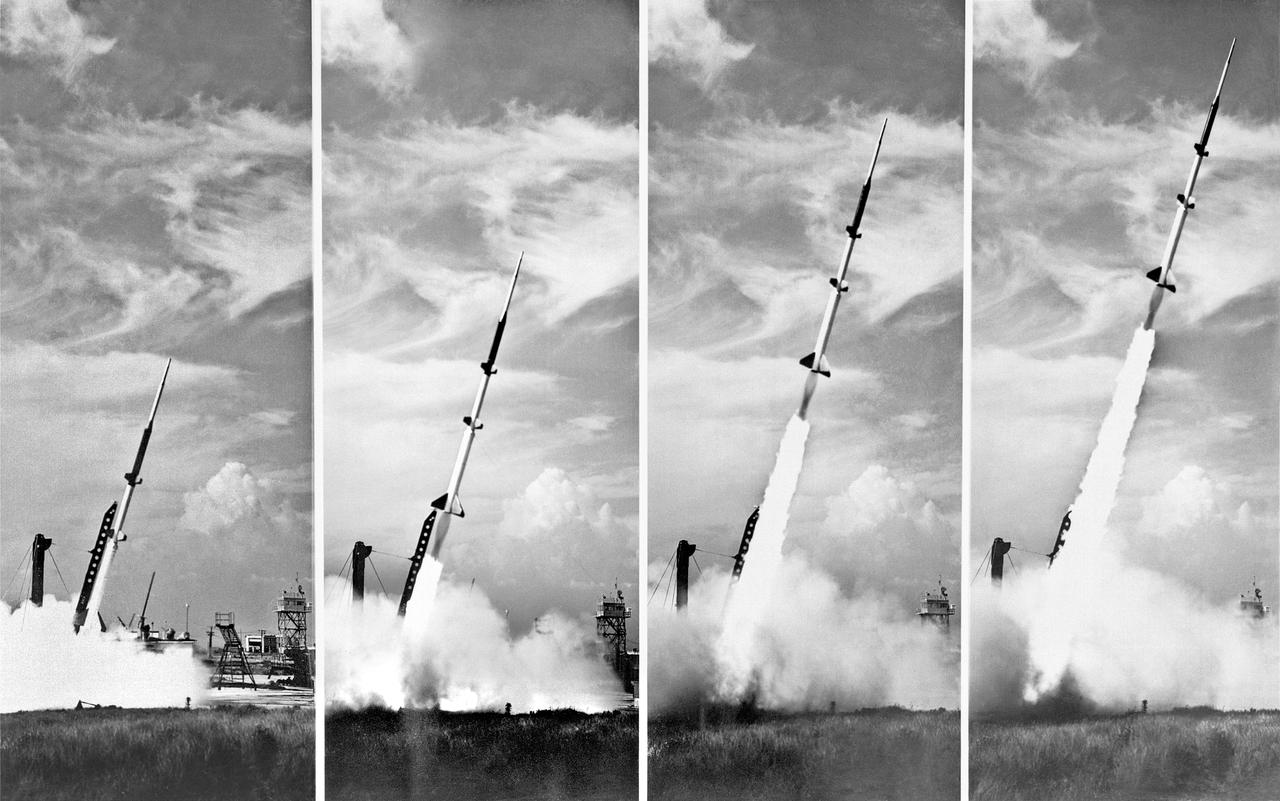
**Note also copied and numbered as L90-3749. -- L57-4827 caption: Take off of a five-stage missile research rocket from Wallops Island in 1957. The first two stages propelled the model to about 100,000 feet the last three stages were fired on a descending path to simulate the reentry conditions of ballistic missiles. -- Photograph published in Winds of Change, 75th Anniversary NASA publication (page 72), by James Schultz. -- Photograph also published in Engineer in Charge: A History of the Langley Aeronautical Laboratory, 1917-1958 by James R. Hansen (page 380).
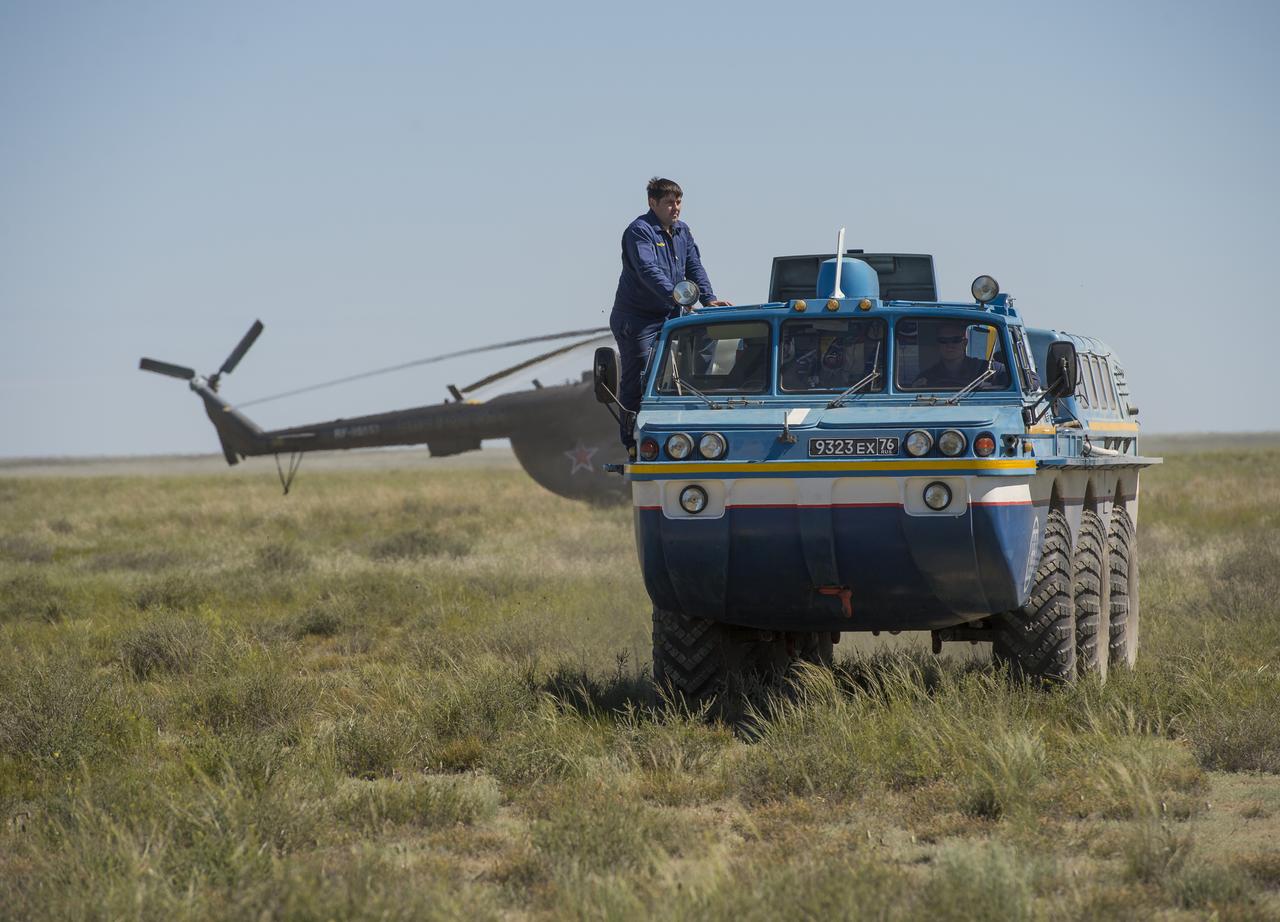
A Russian all terrain vehicle (ATV) takes Expedition 35 Commander Chris Hadfield of the Canadian Space Agency (CSA) to a helicopter from the Soyuz TMA-07M spacecraft shortly after the capsule landed with Hadfield and Expedition 35 Flight Engineers Tom Marshburn and Roman Romanenko in a remote area near the town of Zhezkazgan, Kazakhstan, Tuesday, May 14, 2013. Hadfield, Marshburn and Romanenko are returning from five months onboard the International Space Station where they served as members of the Expedition 34 and 35 crews. Photo Credit: (NASA/Carla Cioffi)
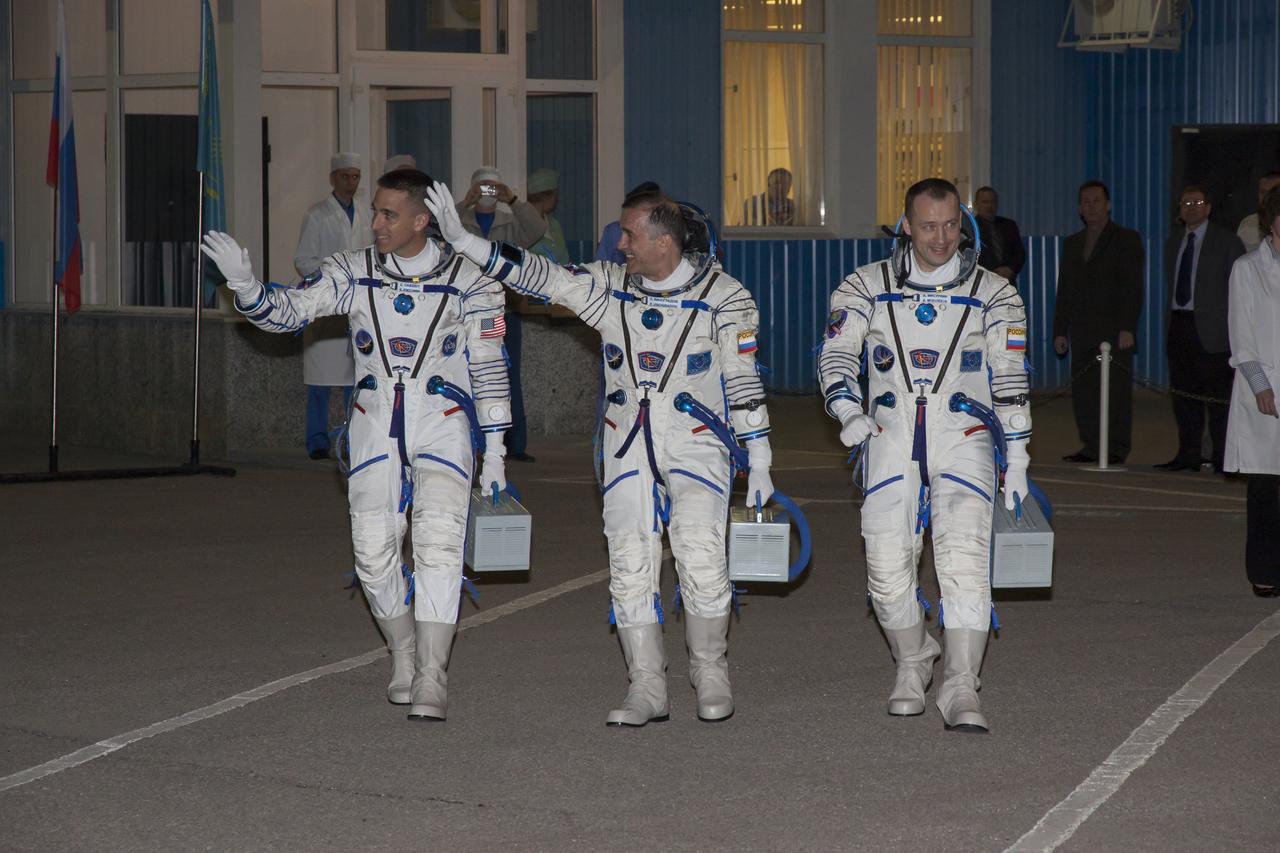
Expedition 35 crew members NASA Flight Engineer Chris Cassidy, left, Soyuz Commander Pavel Vinogradov and Russian Flight Engineer Alexander Misurkin, right, walk out of building 254 of the Baikonur Cosmodrome to board a bus that will take them to the launch pad for their launch onboard a Soyuz TMA-08M spacecraft to the International Space Station, Thursday, March 28, 2013, in Baikonur, Kazakhstan. Launch of the Soyuz rocket will send Cassidy, Vinogradov and Misurkin on a five and a half month mission aboard the International Space Station. Photo Credit: (NASA/Victor Zelentsov)
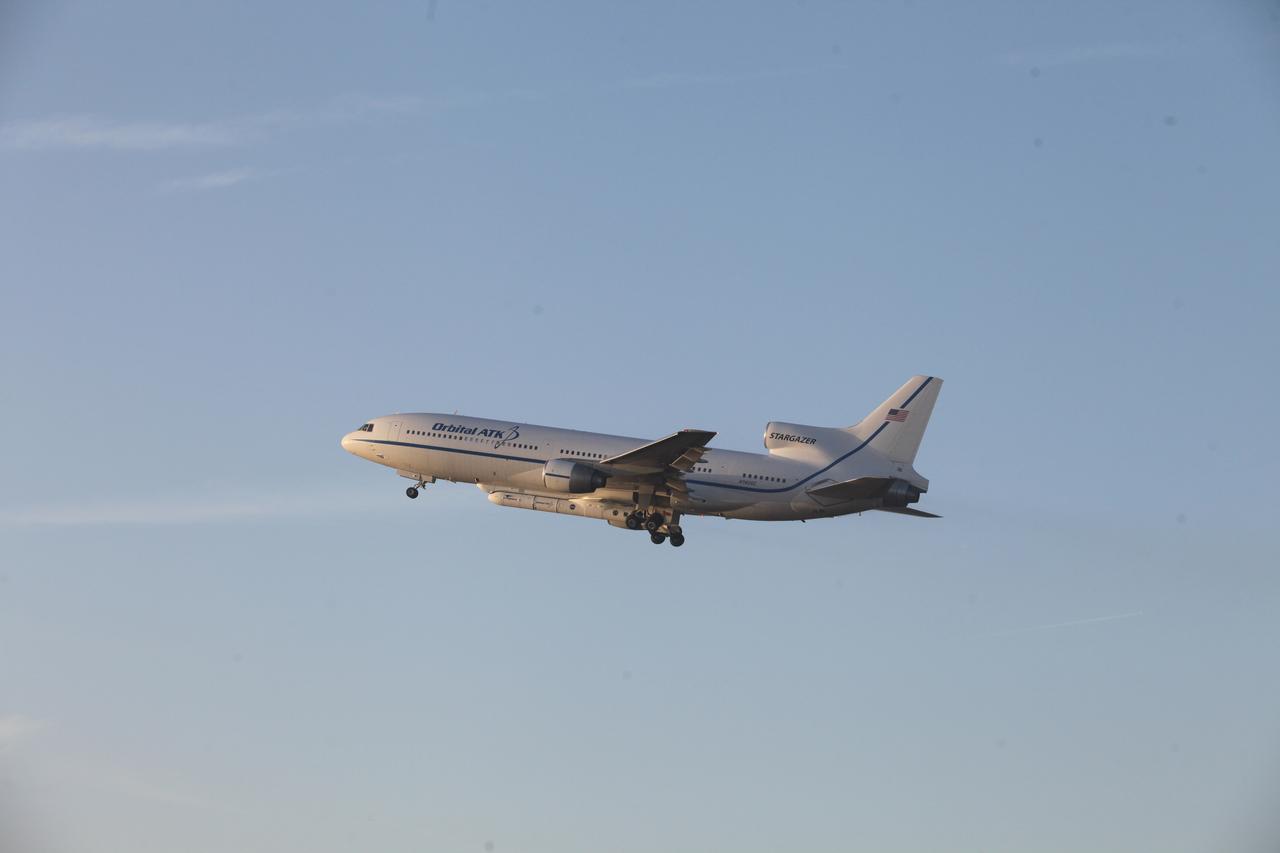
An Orbital ATK L-1011 Stargazer aircraft carrying a Pegasus XL Rocket with eight NASA Cyclone Global Navigation Satellite System, or CYGNSS, spacecraft takes off from the Skid Strip at Cape Canaveral Air Force Station, Florida. With the aircraft flying off shore, the Pegasus rocket will be released. Five seconds later, the solid propellant engine will ignite and boost the eight hurricane observatories to orbit. The eight CYGNSS satellites will make frequent and accurate measurements of ocean surface winds throughout the life cycle of tropical storms and hurricanes.
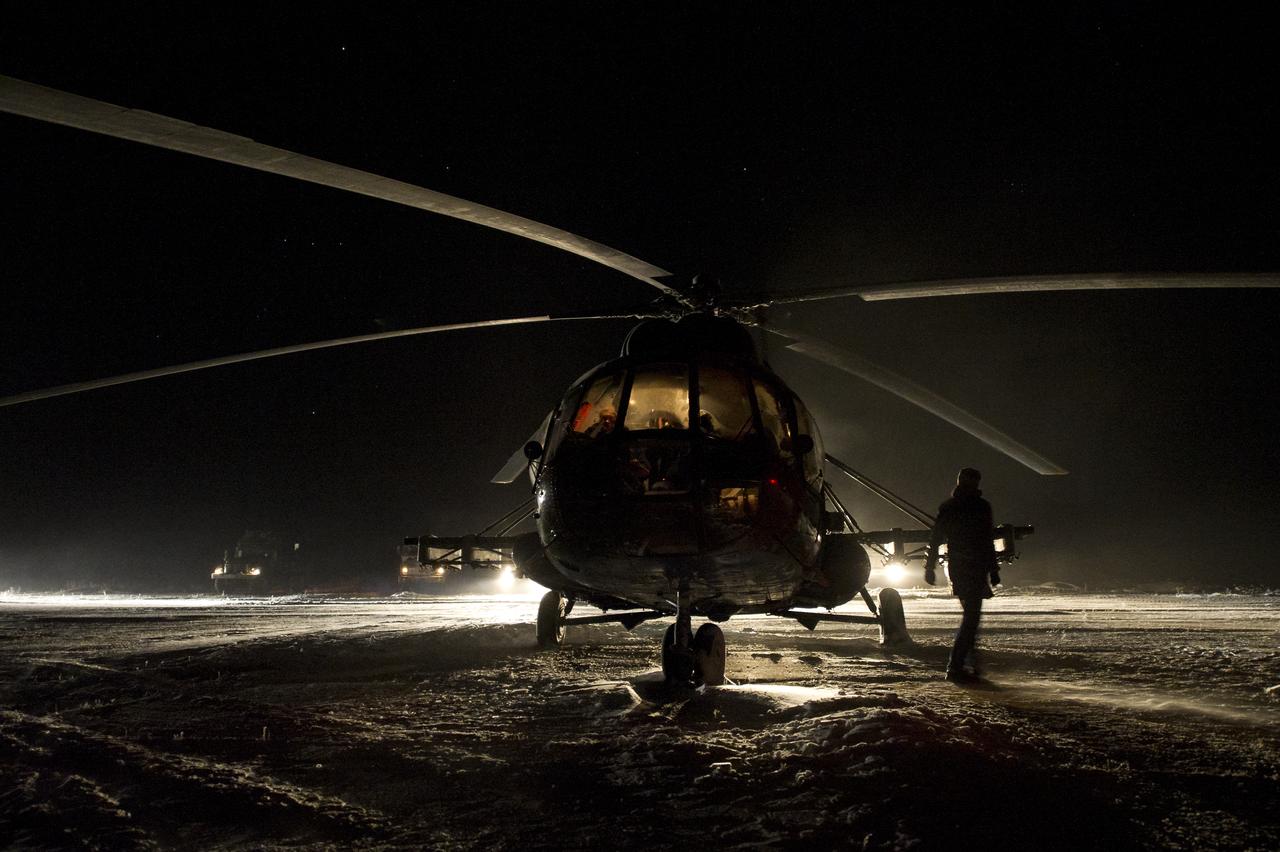
Russian Search and Rescue forces prepare their helicopters for take off in support of the Soyuz TMA-02M spacecraft landing with Expedition 29 Commander Mike Fossum, and Flight Engineers Sergei Volkov and Satoshi Furukawa in Arkalyk, Kazakhstan, on Tuesday, Nov. 22, 2011. NASA Astronaut Fossum, Russian Cosmonaut Volkov and JAXA (Japan Aerospace Exploration Agency) Astronaut Furukawa are returning from more than five months onboard the International Space Station where they served as members of the Expedition 28 and 29 crews. Photo Credit: (NASA/Bill Ingalls)
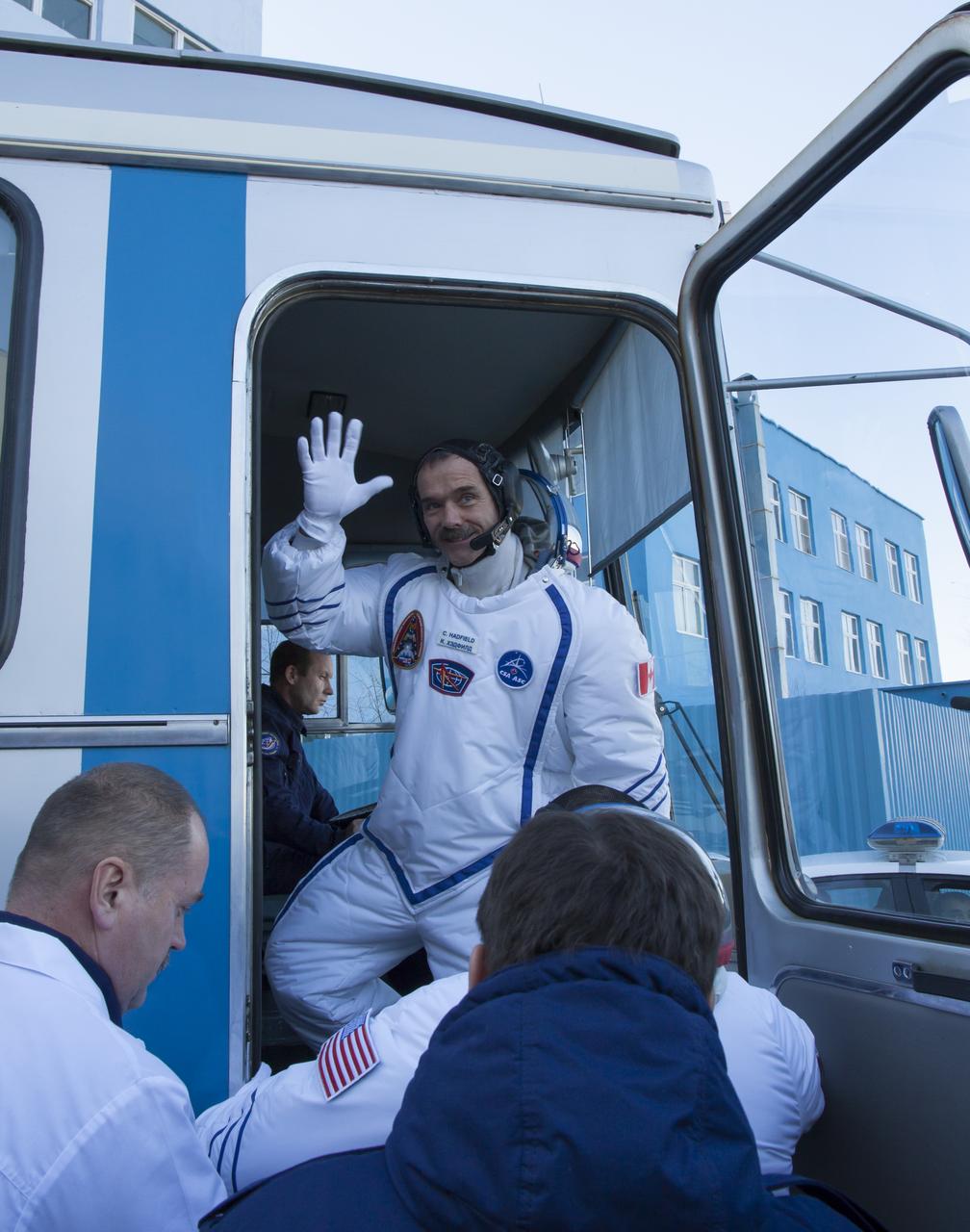
Expedition 34/35 Flight Engineer Chris Hadfield of the Canadian Space Agency (CSA) waves goodbye as he boards the bus that will take him to the launch pad where he and his fellow crew mates will board their Soyuz TMA-07M rocket, on Wednesday, Dec. 19, 2012, in Baikonur, Kazakhstan. The crew are donning special cold-weather suits over their Sokol suits to keep them insulated from the extreme sub-zero temperature. Launch of the Soyuz rocket will send Hadfield, Romanenko and Marshburn on a five-month mission aboard the International Space Station. Photo Credit: (NASA/Victor Zelentsov)
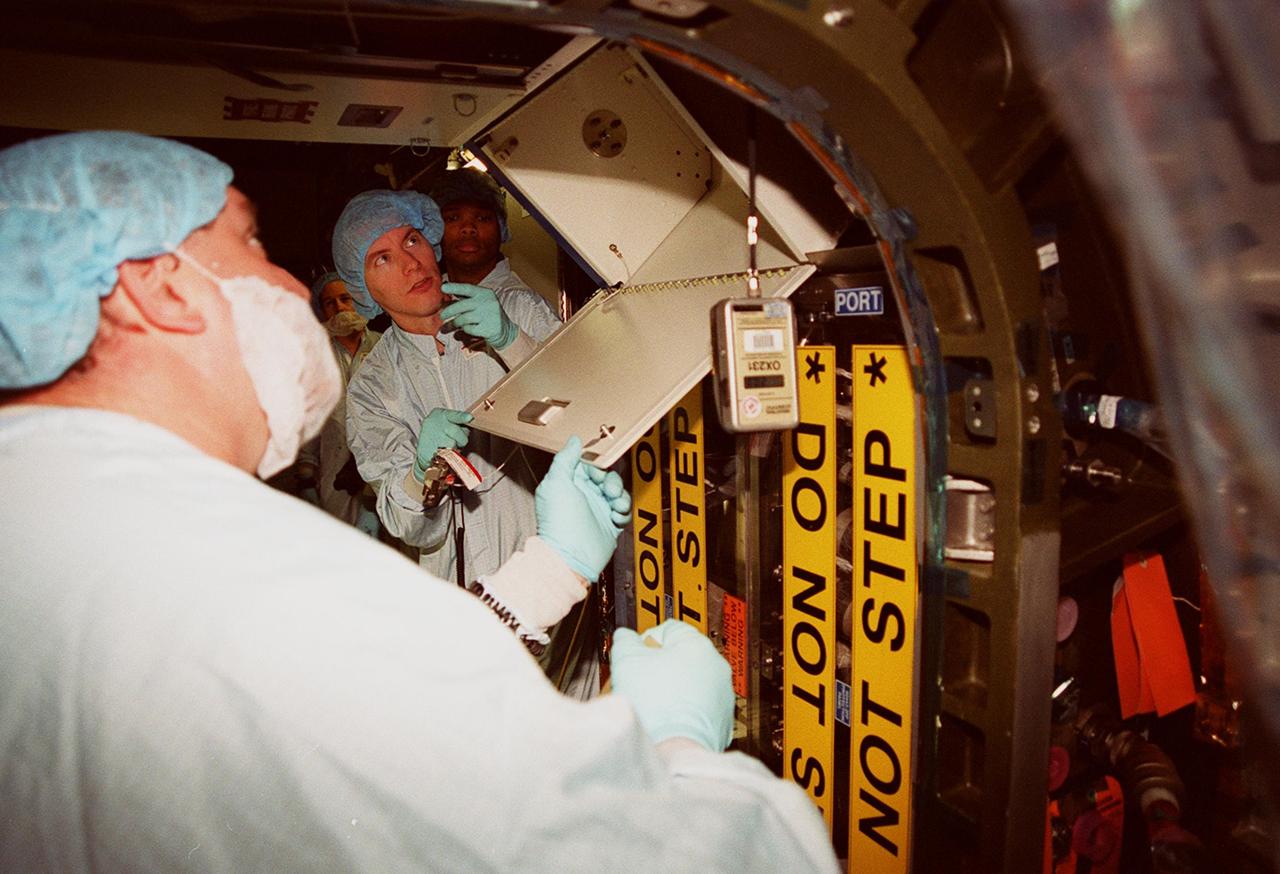
In the Space Station Processing Facility, members of the STS-98 crew check out components inside the U.S. Lab, Destiny, under the watchful eye of trainers. The crew comprises Commander Ken Cockrell, Pilot Mark Polansky and Mission Specialists Robert Curbeam, Thomas Jones and Marsha Ivins. They are taking part in Crew Equipment Interface Test activities, becoming familiar with equipment they will be handling during the mission. The mission will be transporting the Lab to the International Space Station with five system racks already installed inside of the module. With delivery of electronics in the lab, electrically powered attitude control for Control Moment Gyroscopes will be activated. The STS-98 launch is scheduled for Jan. 18, 2001
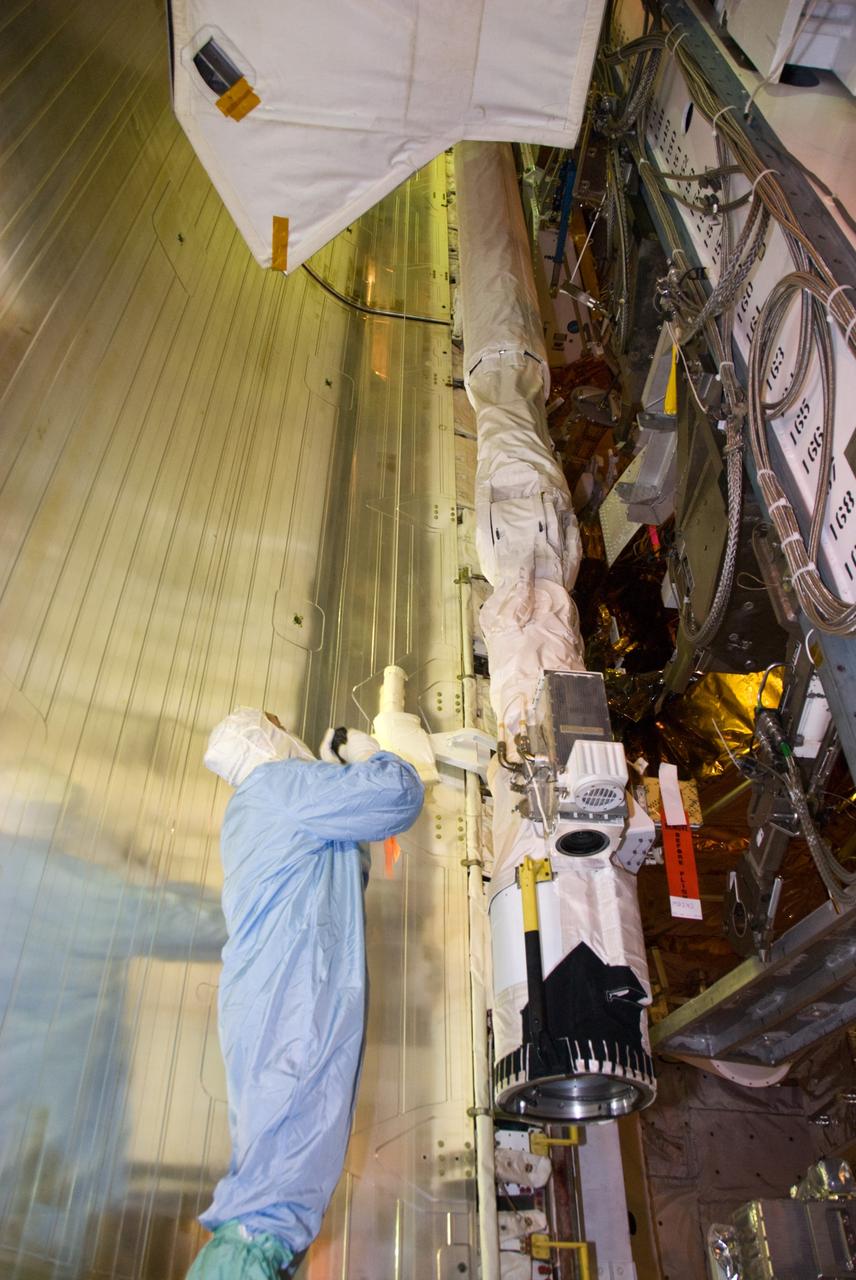
CAPE CANAVERAL, Fla. –– In space shuttle Atlantis' payload bay at NASA Kennedy Space Center's Launch Pad 39A, STS-125 crew members take a final close look at the hardware for the Hubble servicing mission before the targeted May 11 launch. Atlantis' 11-day mission will include five spacewalks to refurbish and upgrade the telescope with state-of-the-art science instruments. The payload bay holds four carriers of equipment that include the Wide Field Camera 3, Cosmic Origins Spectrograph, the Soft Capture Mechanism and replacement gyroscopes and batteries. As a result, Hubble's capabilities will be expanded and its operational lifespan extended through at least 2014. Photo credit: NASA/Kim Shiflett
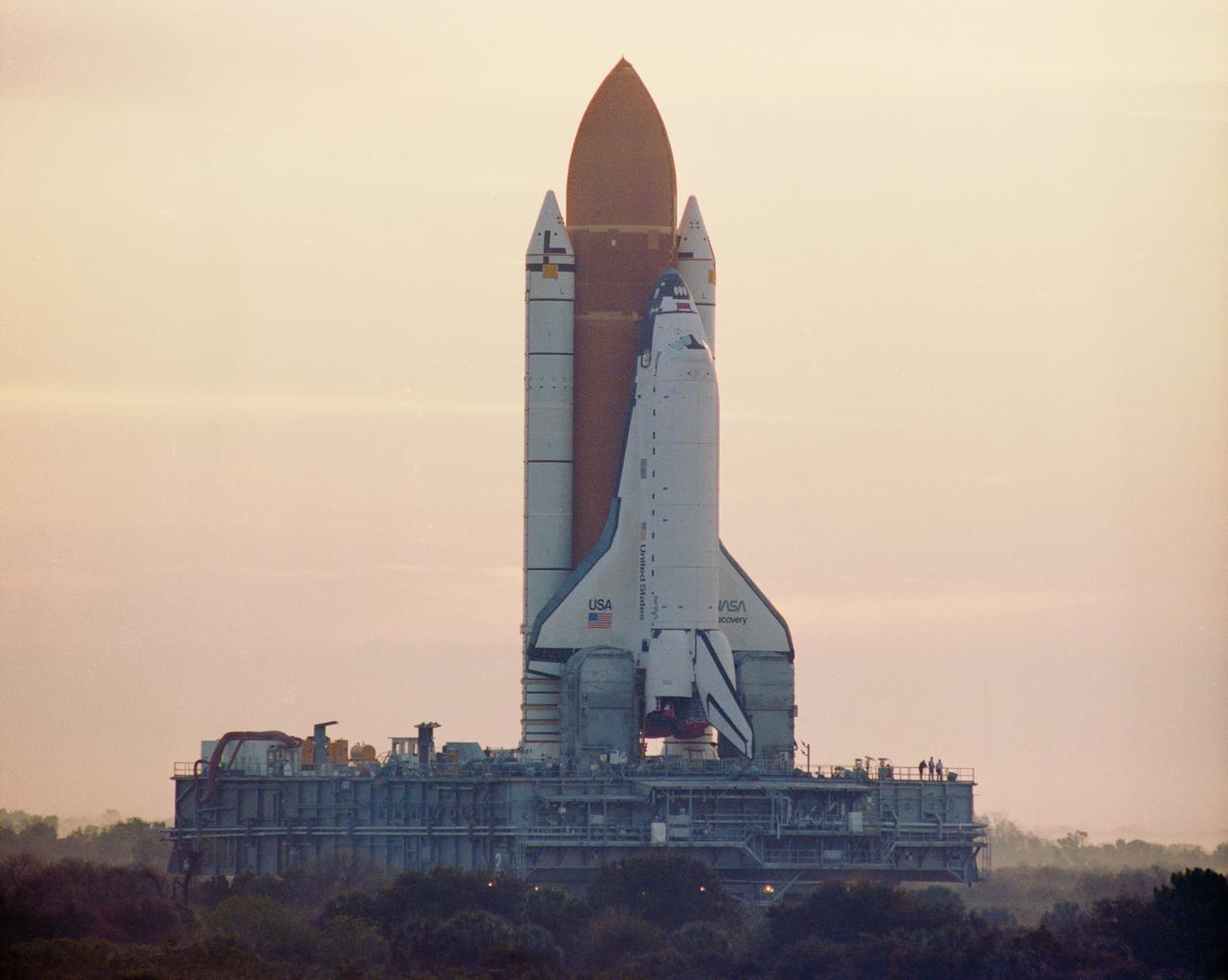
S89-28112 (3 Feb 1989) --- The Space Shuttle Discovery, atop a mobile launch platform, is rolled toward Kennedy Space Center's Launch Pad 39-B in the early morning hours of Feb. 3, l989. It rolled through the doors of the huge vehicle assembly building (VAB) at 6 a.m. The trip to the pad takes approximately 5 and 1/2 hours. Onboard the spacecraft in mid-March for a five-day mission, on which will be deployed a third tracking and data relay satellite (TDRS-D), will be Astronauts Michael L. Coats, John E. Blaha, James F. Buchli, James P. Bagian and Robert C. Springer.
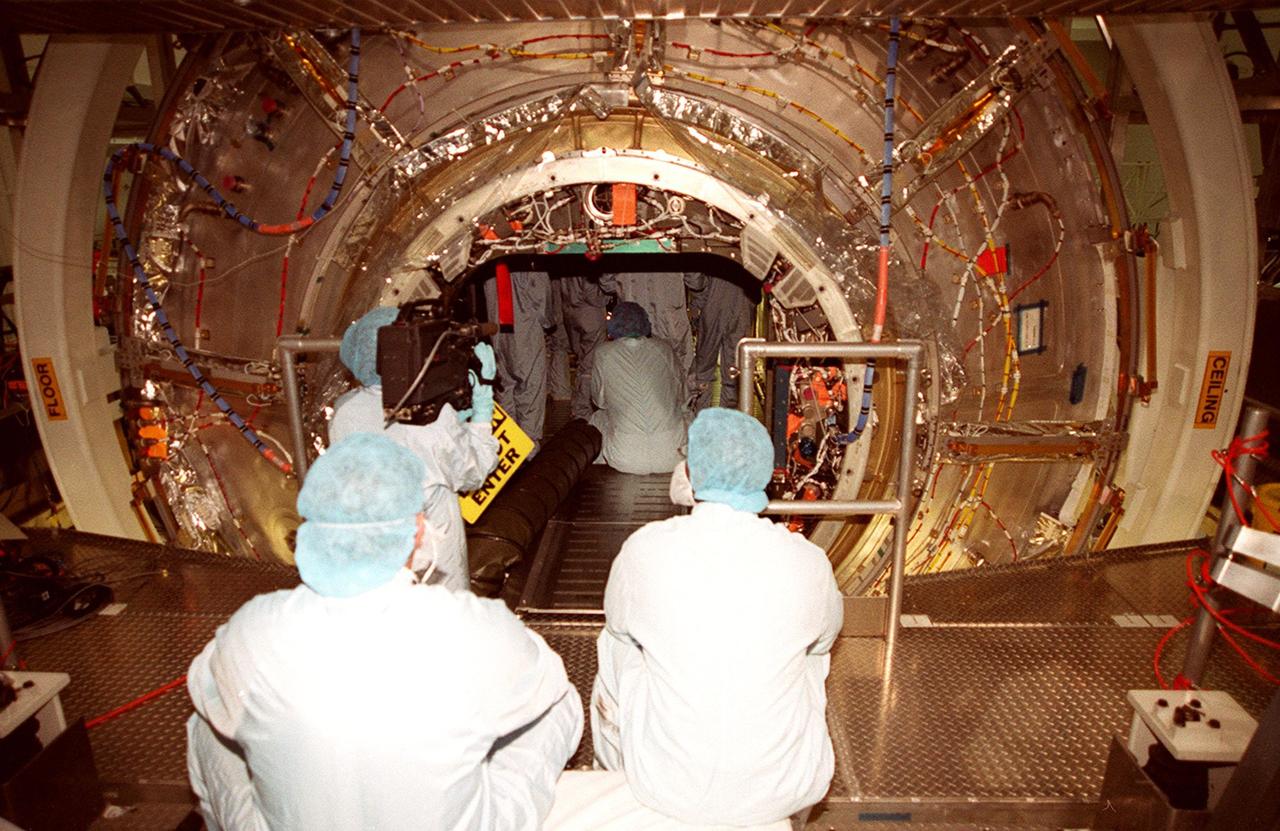
In the Space Station Processing Facility, workers in the foreground watch and wait while members of the STS-98 crew check out the U.S. Lab, Destiny in the background. The crew comprises Commander Ken Cockrell, Pilot Mark Polansky and Mission Specialists Robert Curbeam, Thomas Jones and Marsha Ivins. They are taking part in Crew Equipment Interface Test activities, becoming familiar with equipment they will be handling during the mission. The mission will be transporting the Lab to the International Space Station with five system racks already installed inside of the module. With delivery of electronics in the lab, electrically powered attitude control for Control Moment Gyroscopes will be activated. The STS-98 launch is scheduled for Jan. 18, 2001
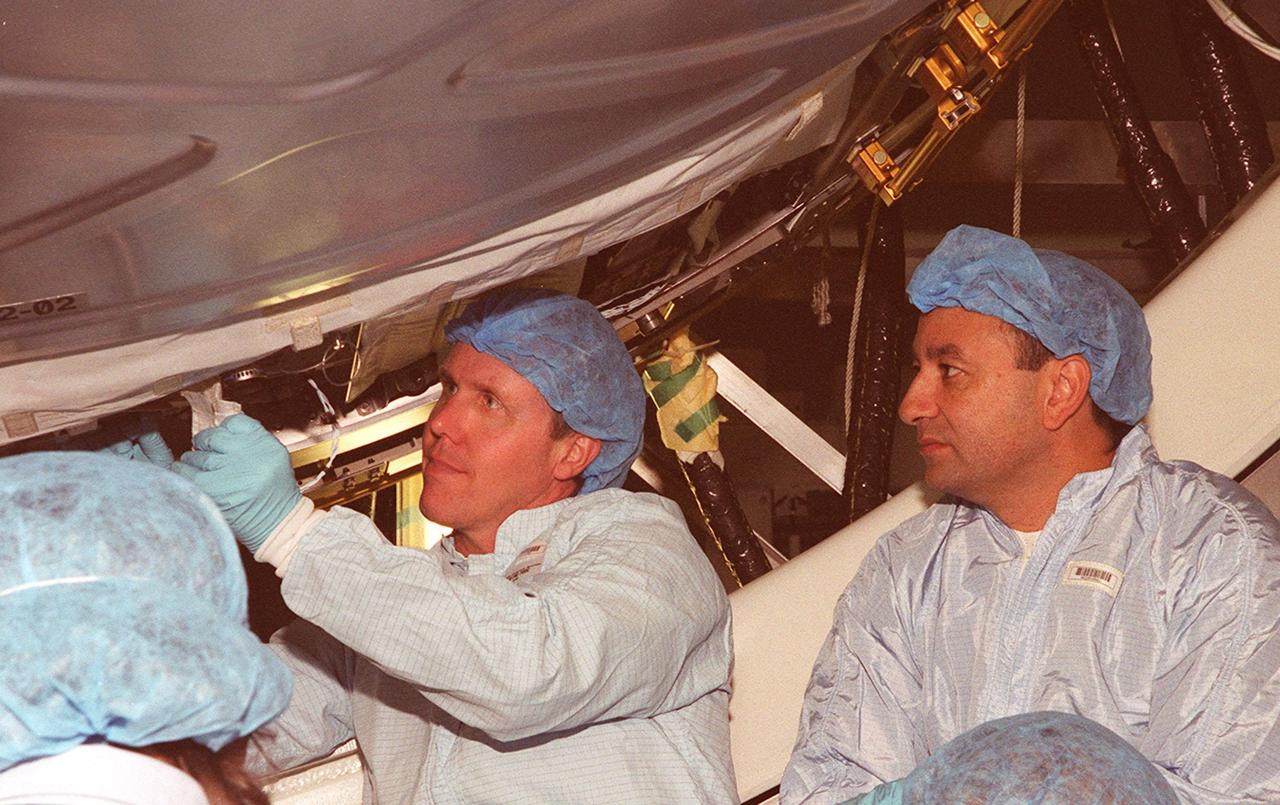
In the Space Station Processing Facility, STS-98 Mission Specialist Thomas Jones works on a part of the U.S. Lab, Destiny. Watching at right is Pilot Mark Polansky. Jones and Polansky, along with other crew members, are taking part in Crew Equipment Interface Test activities to become familiar with equipment they will be handling during the mission. Others in the crew are Commander Ken Cockrell and Mission Specialists Robert Curbeam and Marsha Ivins. The mission will be transporting the Lab to the International Space Station with five system racks already installed inside of the module. With delivery of electronics in the lab, electrically powered attitude control for Control Moment Gyroscopes will be activated. The STS-98 launch is scheduled for Jan. 18, 2001
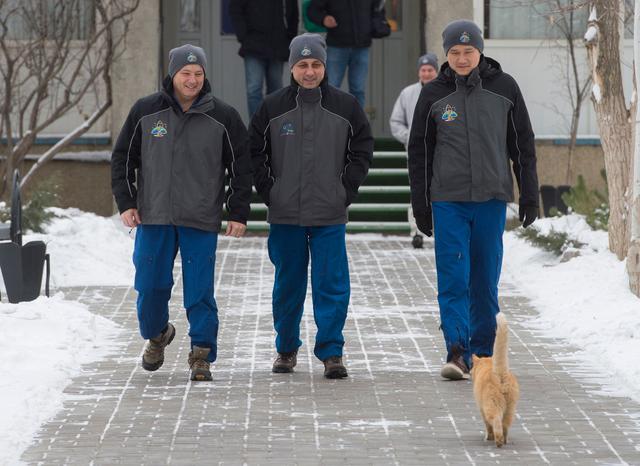
jsc2017e137336 - At their Cosmonaut Hotel crew quarters in Baikonur, Kazakhstan, Expedition 54-55 prime crewmembers Scott Tingle of NASA (left), Anton Shkaplerov of the Russian Federal Space Agency (Roscosmos, center) and Norishige Kanai of the Japan Aerospace Exploration Agency (JAXA, right) are greeted by a kitty cat Dec. 11 as they take a stroll around the grounds of the complex. Minus the kitty cat, they will launch Dec. 17 on the Soyuz MS-07 spacecraft from the Baikonur Cosmodrome for a five month mission on the International Space Station...Andrey Shelepin / Gagarin Cosmonaut Training Center.
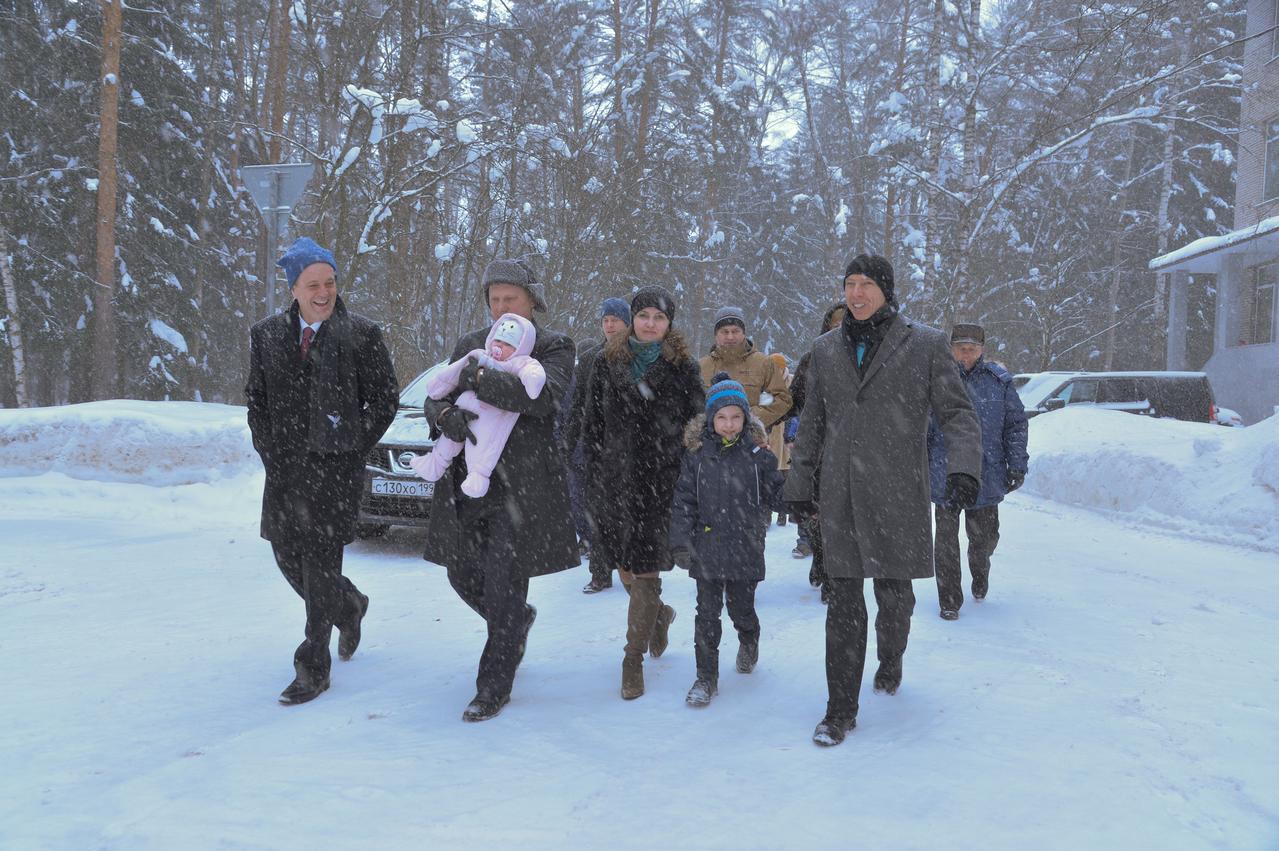
jsc2018e010821 - Bundled up against a blizzard, Expedition 55 crewmember Oleg Artemyev of Roscosmos (center) holds his infant child March 4 at the Gagarin Cosmonaut Training Center in Star City, Russia as he and his crewmates walk to a waiting bus to take them to a nearby airport for a flight to the launch site at the Baikonur Cosmodrome in Kazakhstan. Looking on are crewmates Ricky Arnold of NASA (left) and Drew Feustel of NASA (right). The trio will launch March 21 on the Soyuz MS-08 spacecraft for a five month mission on the International Space Station...NASA/Elizabeth Weissinger.
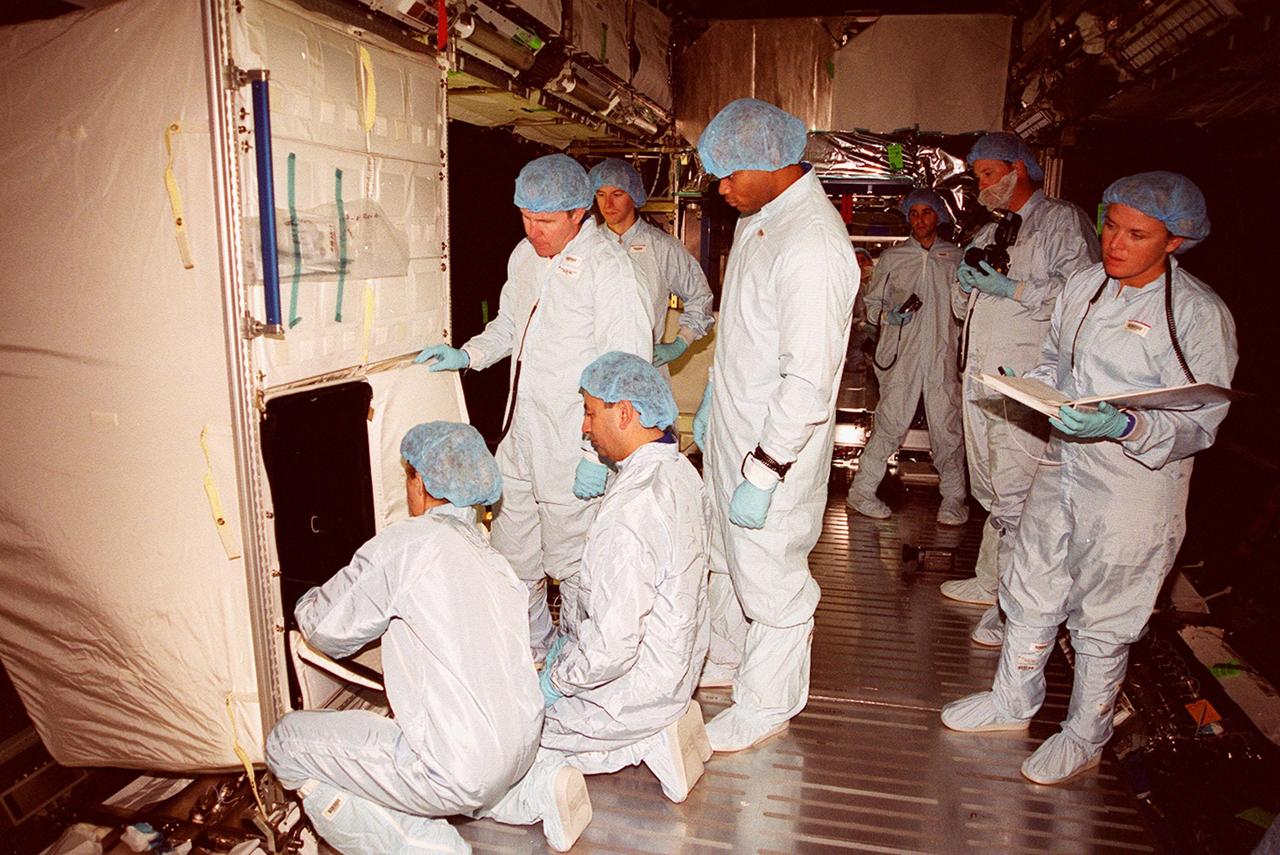
Inside the U.S. Lab, Destiny, members of the STS-98 crew work with technicians (in the background) to learn more about the equipment in the module. They are taking part in Crew Equipment Interface Test activities. At left, back to camera, is Mission Specialist Marsha Ivins. Standing are Mission Specialists Thomas Jones (left) and Robert Curbeam (right). Other crew members not seen are Commander Ken Cockrell and Pilot Mark Polansky. The mission will be transporting the Lab to the International Space Station with five system racks already installed inside of the module. With delivery of electronics in the lab, electrically powered attitude control for Control Moment Gyroscopes will be activated. The STS-98 launch is scheduled for Jan. 18, 2001