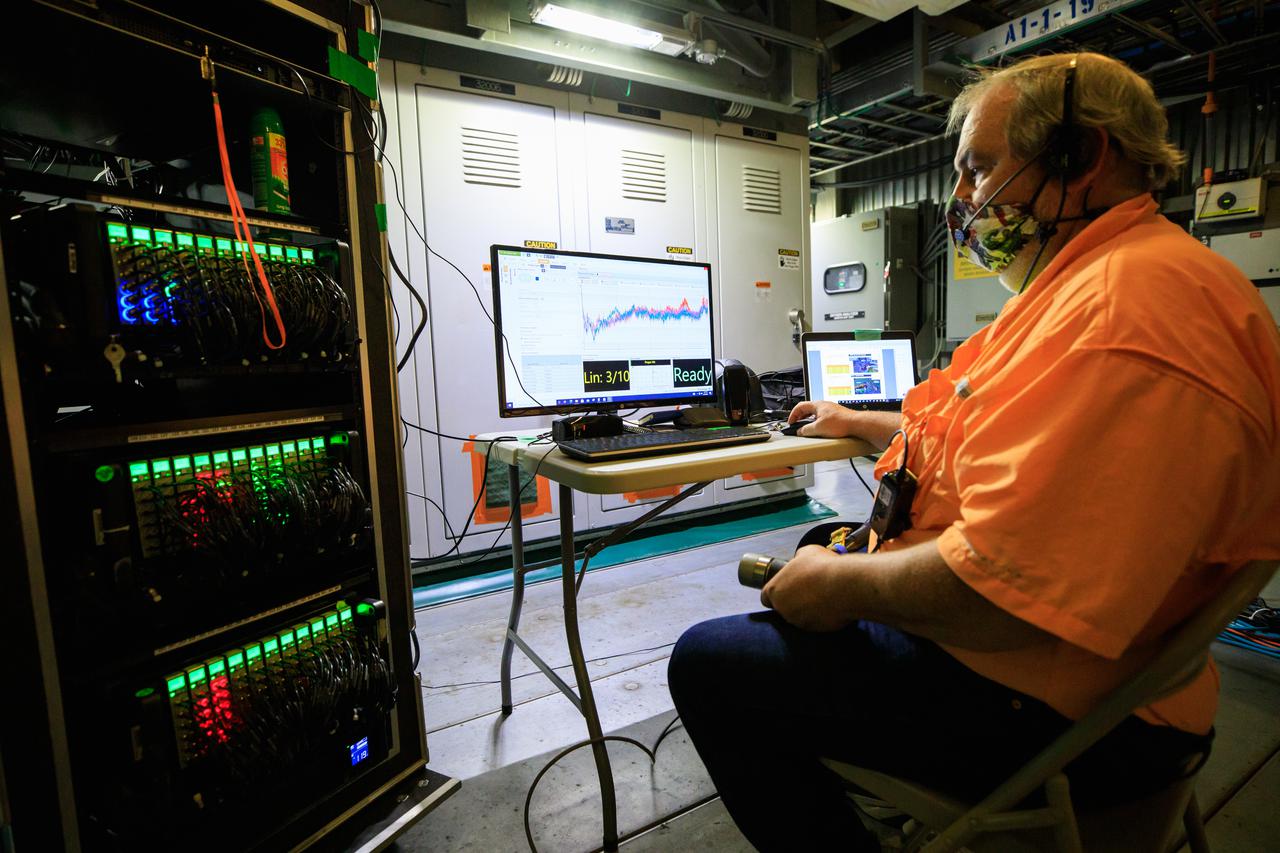
An engineer with contractor Jacobs prepares for a modal tap test on the Space Launch System (SLS) rocket for Artemis I in a room under the zero deck of the mobile launcher inside the Vehicle Assembly Building at NASA’s Kennedy Space Center in Florida on Aug. 16, 2021. The Exploration Ground systems and Jacobs team, along with the SLS team from NASA’s Marshall Space Flight Center in Huntsville, Alabama, are performing the tests with support from personnel at other NASA centers. Engineers are using the mass simulator for Orion and the Orion stage adapter structural test article for the modal test. The tests will determine the different modes of vibration with the recently stacked and integrated SLS rocket before launch of the Artemis I mission. Artemis I will be an uncrewed test of the Orion spacecraft and SLS rocket as an integrated system ahead of crewed flights to the Moon. Under Artemis, NASA aims to land the first woman and first person of color on the Moon and establish sustainable lunar exploration.
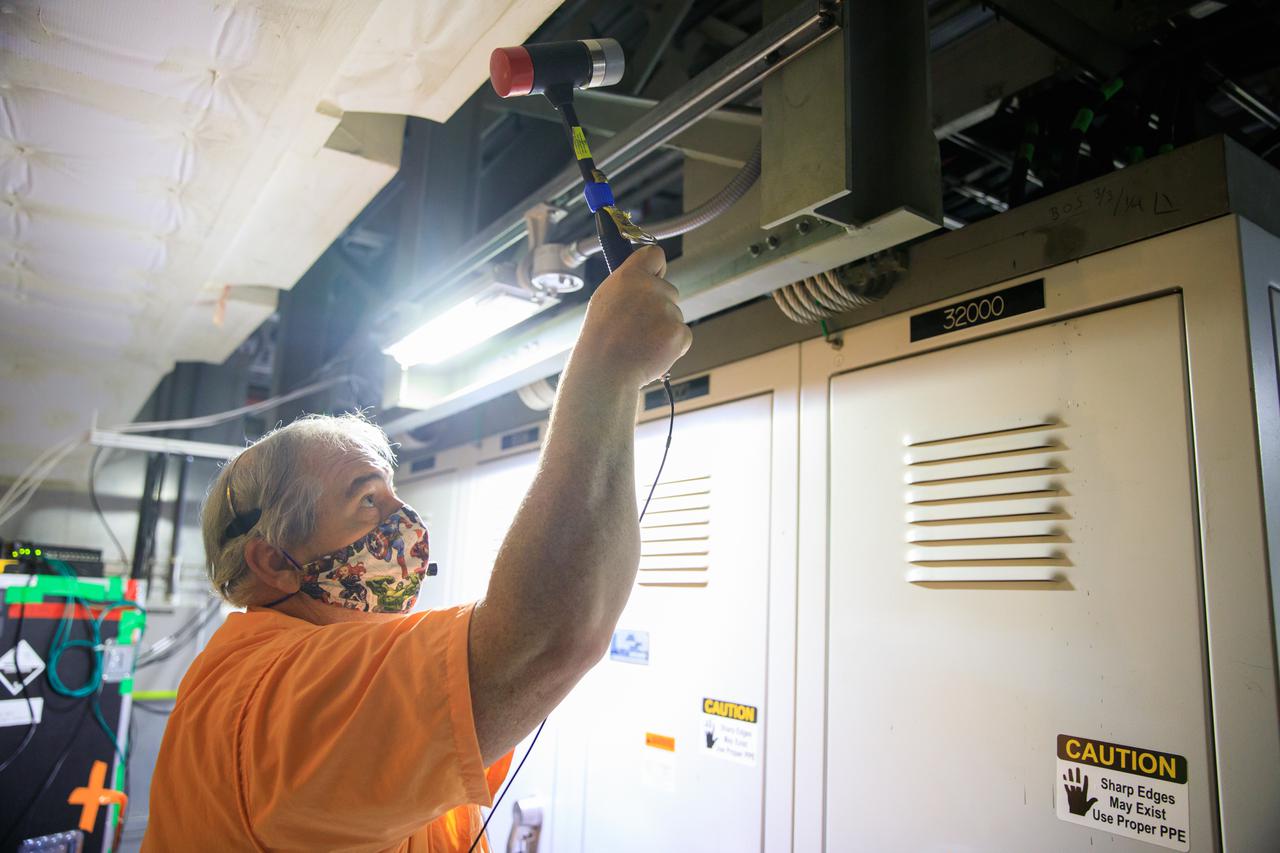
An engineer with contractor Jacobs prepares for a modal tap test on the Space Launch System (SLS) rocket for Artemis I in a room under the zero deck of the mobile launcher inside the Vehicle Assembly Building at NASA’s Kennedy Space Center in Florida on Aug. 16, 2021. The Exploration Ground systems and Jacobs team, along with the SLS team from NASA’s Marshall Space Flight Center in Huntsville, Alabama, are performing the tests with support from personnel at other NASA centers. Engineers are using the mass simulator for Orion and the Orion stage adapter structural test article for the modal test. The tests will determine the different modes of vibration with the recently stacked and integrated SLS rocket before launch of the Artemis I mission. Artemis I will be an uncrewed test of the Orion spacecraft and SLS rocket as an integrated system ahead of crewed flights to the Moon. Under Artemis, NASA aims to land the first woman and first person of color on the Moon and establish sustainable lunar exploration.
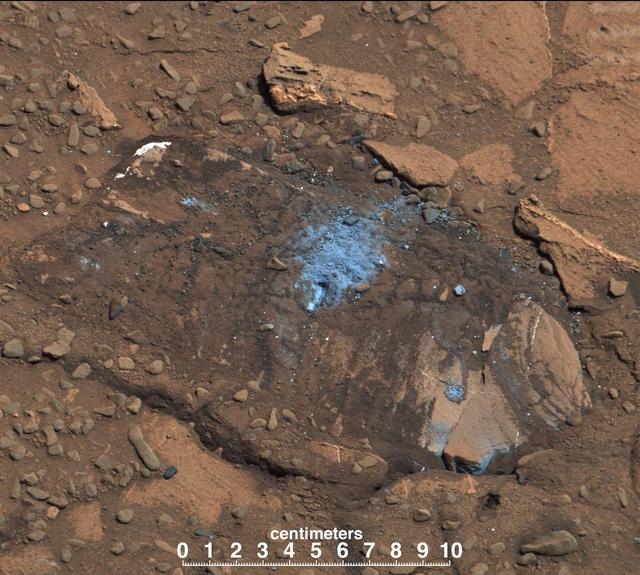
The Bonanza King rock on Mars, pictured here, was tapped by the drill belonging to NASA Mars rover Curiosity. The tapping resulted in sand piling up on the rock after drilling, showing the rock was not firmly in place.
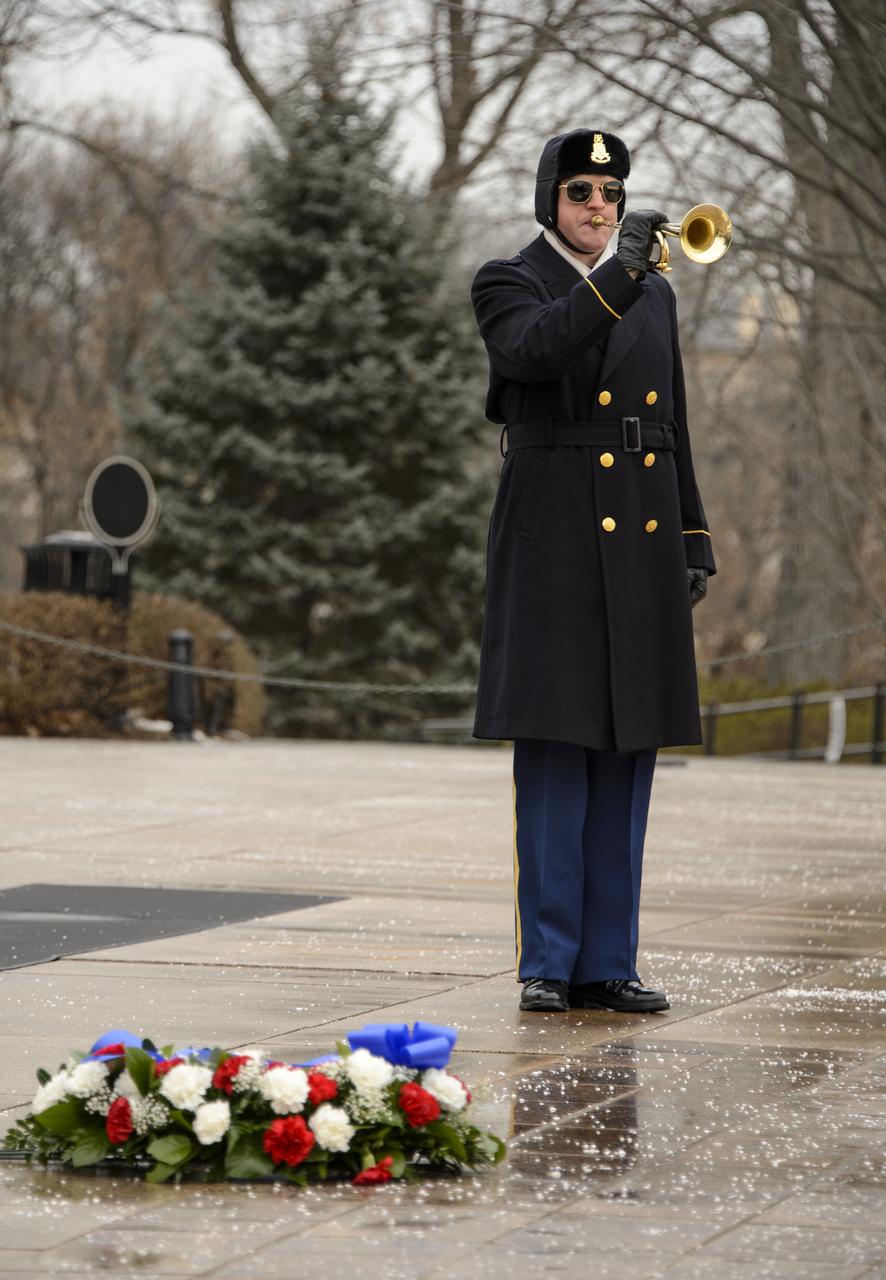
Taps is played by the Honor Guard after NASA Administrator Charles Bolden and his wife Alexis laid a wreath at the Tomb of the Unknowns as part of NASA's Day of Remembrance, Friday, Jan. 31, 2014, at Arlington National Cemetery. The wreaths were laid in memory of those men and women who lost their lives in the quest for space exploration. Photo Credit: (NASA/Bill Ingalls)
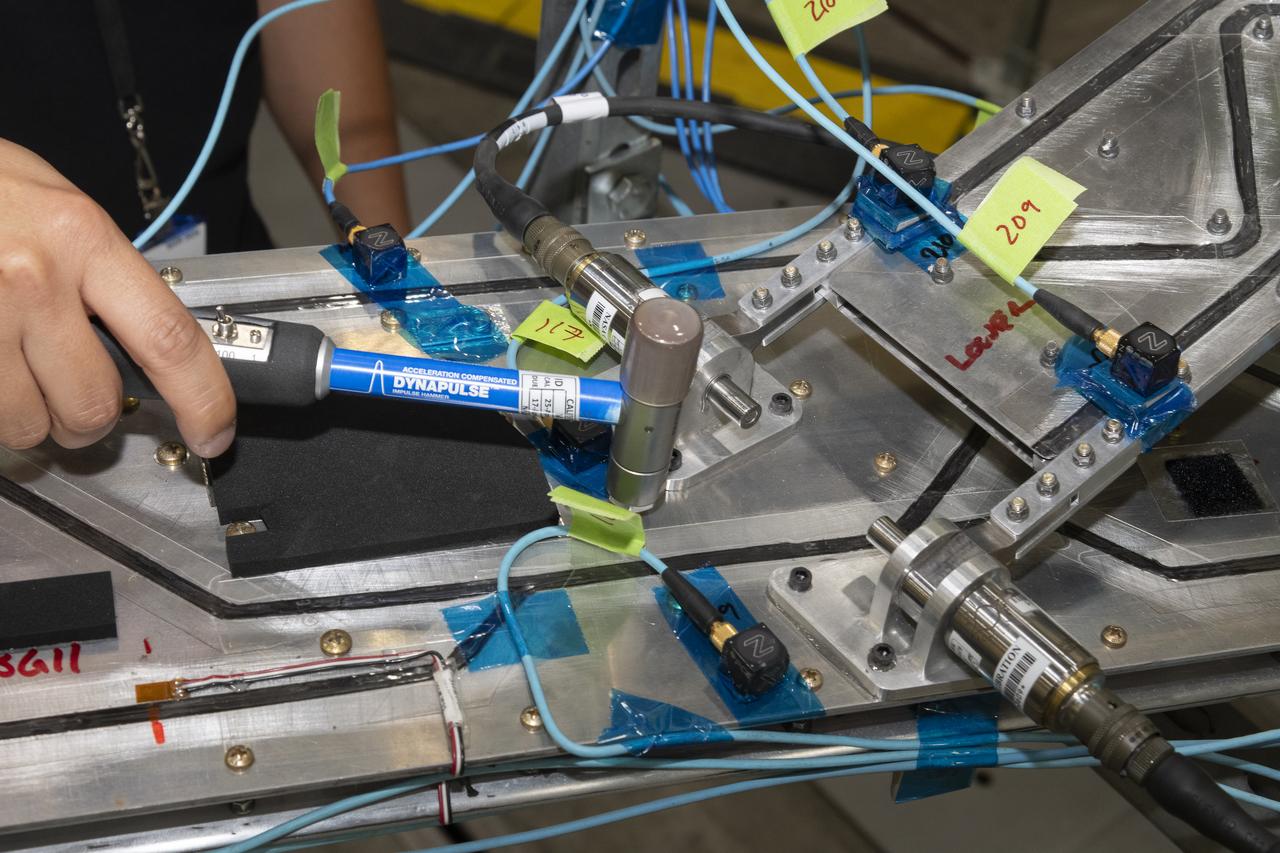
Researchers test a 10-foot Mock Truss-Braced Wing at NASA’s Armstrong Flight Research Center in Edwards, California. Ben Park, NASA mock wing ground vibration test director, taps the wing structure with an instrumented hammer in key locations and sensors monitor the results. The aircraft concept involves a wing braced on an aircraft using diagonal struts that also add lift and could result in significantly improved aerodynamics.

"Taps" is played during the funeral service for former astronaut and U.S. Senator John Glenn, who was buried with full military honors, at Arlington National Cemetery in Virginia on Thursday, April 6, 2017, the day on which he and his wife Annie were married in 1943. Glenn was the first American to orbit Earth on Feb. 20, 1962, in a five-hour flight aboard the Friendship 7 spacecraft. In 1998, he broke another record by returning to space at the age of 77 on the Space Shuttle Discovery. Photo Credit: (NASA/Aubrey Gemignani)
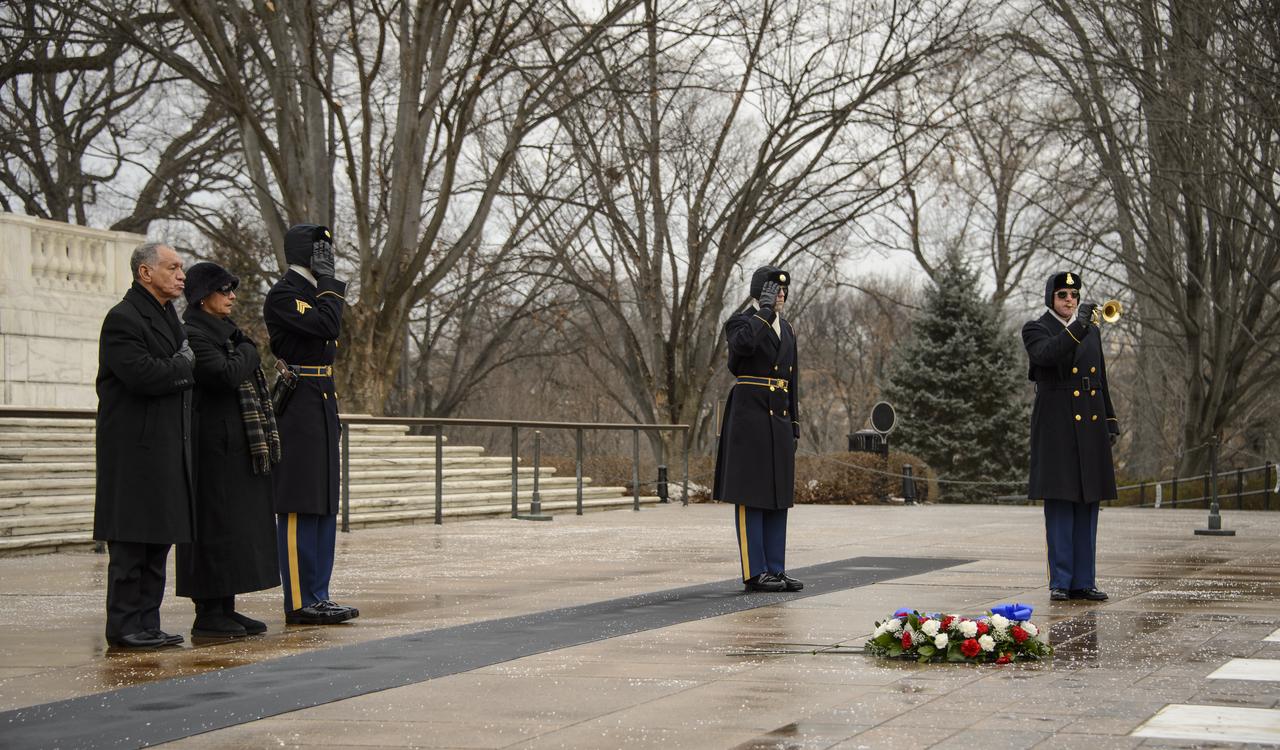
Taps is played by the Honor Guard after NASA Administrator Charles Bolden, left, and his wife Alexis laid a wreath at the Tomb of the Unknowns as part of NASA's Day of Remembrance, Friday, Jan. 31, 2014, at Arlington National Cemetery. The wreaths were laid in memory of those men and women who lost their lives in the quest for space exploration. Photo Credit: (NASA/Bill Ingalls)

Taps is played by a member of The Old Guard after a wreath was laid at the Tomb of the Unknowns by acting NASA Administrator Steve Jurczyk as part of NASA's Day of Remembrance, Thursday, Jan. 28, 2021, at Arlington National Cemetery in Arlington, Va. The wreaths were laid in memory of those men and women who lost their lives in the quest for space exploration. Photo Credit: (NASA/Bill Ingalls)
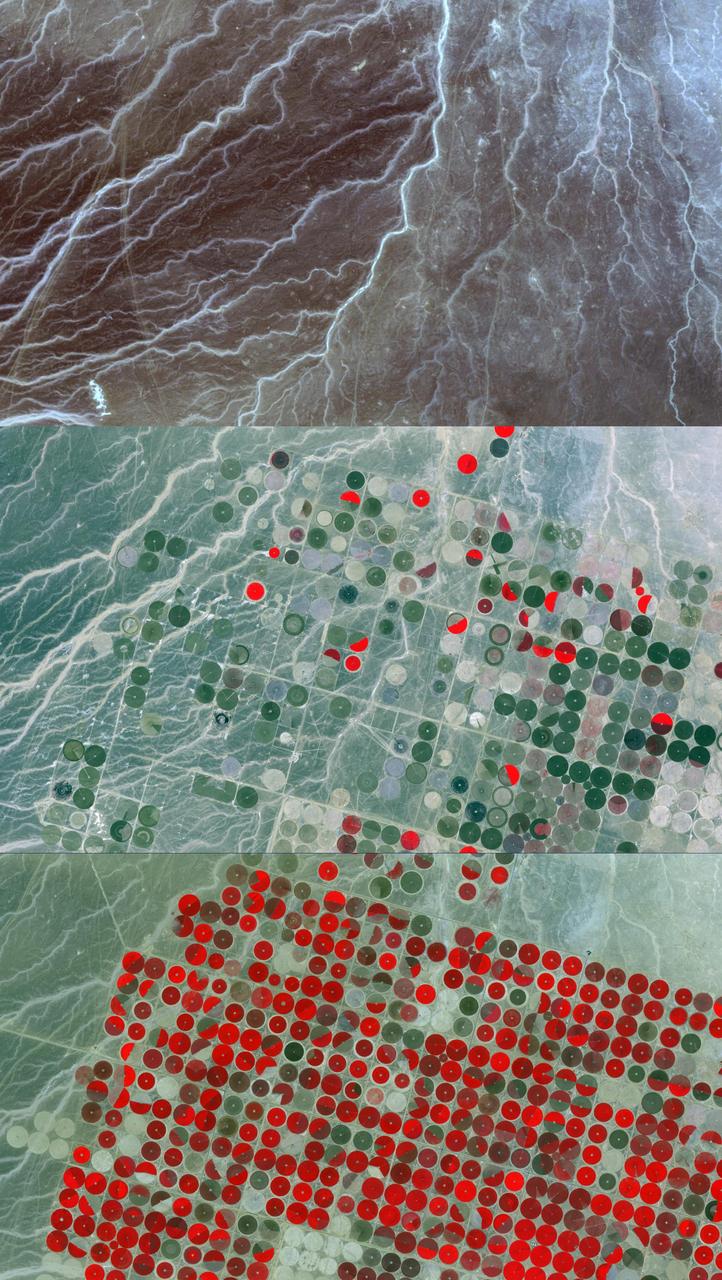
Acquired by NASA Terra spacecraft on in 2011, this image shows the Wadi As-Sirhan Basin in northwest Saudi Arabia, which has been steadily developing agricultural fields using center pivot irrigation by tapping into fossil ground water.
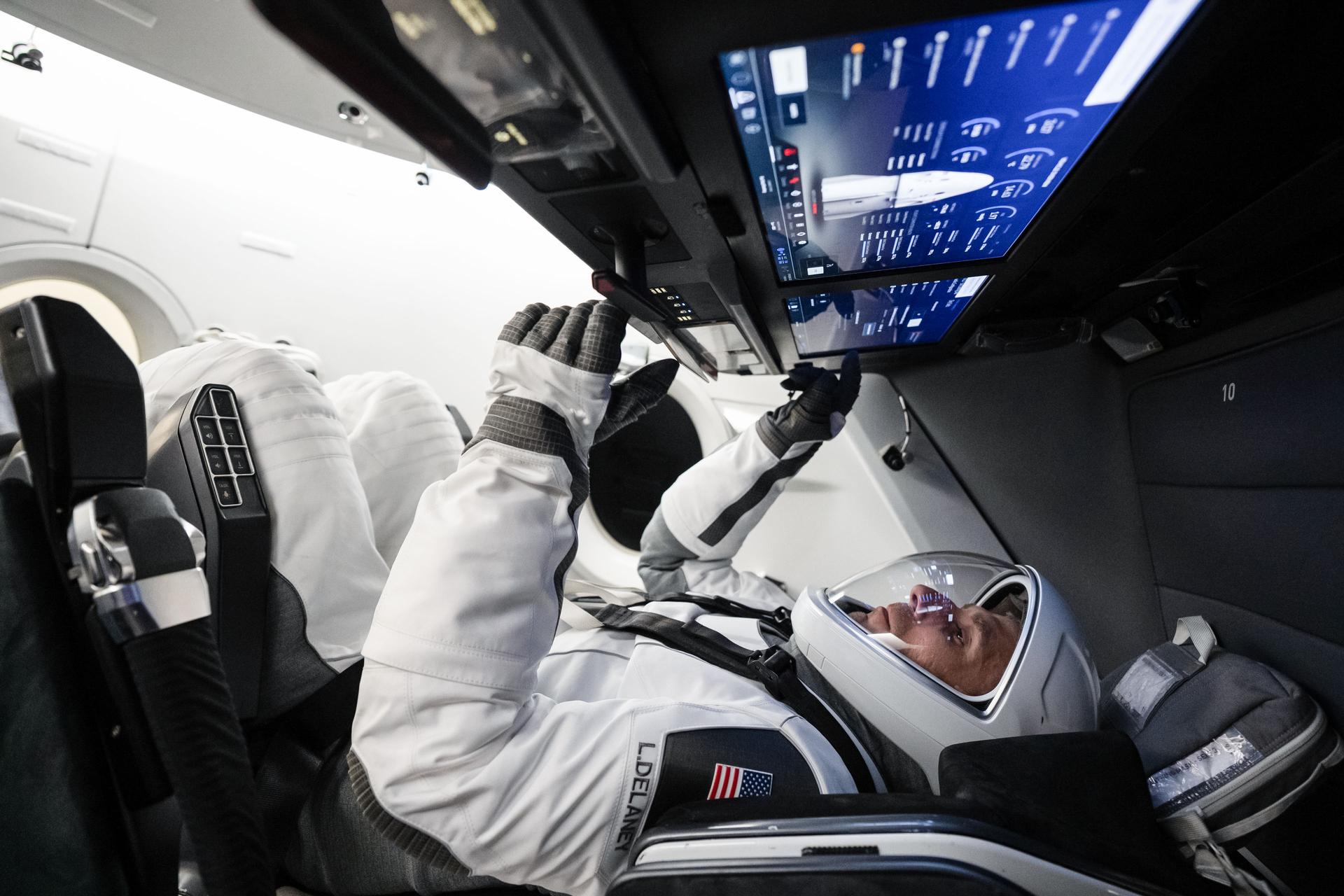
jsc2026e404727 (June 8, 2026) --- NASA astronaut and SpaceX Crew‑13 Pilot Luke Delaney sits inside a Dragon spacecraft mockup while tapping a cockpit screen interface during a pre‑flight training session at SpaceX headquarters in Hawthorne, California. Credit: SpaceX
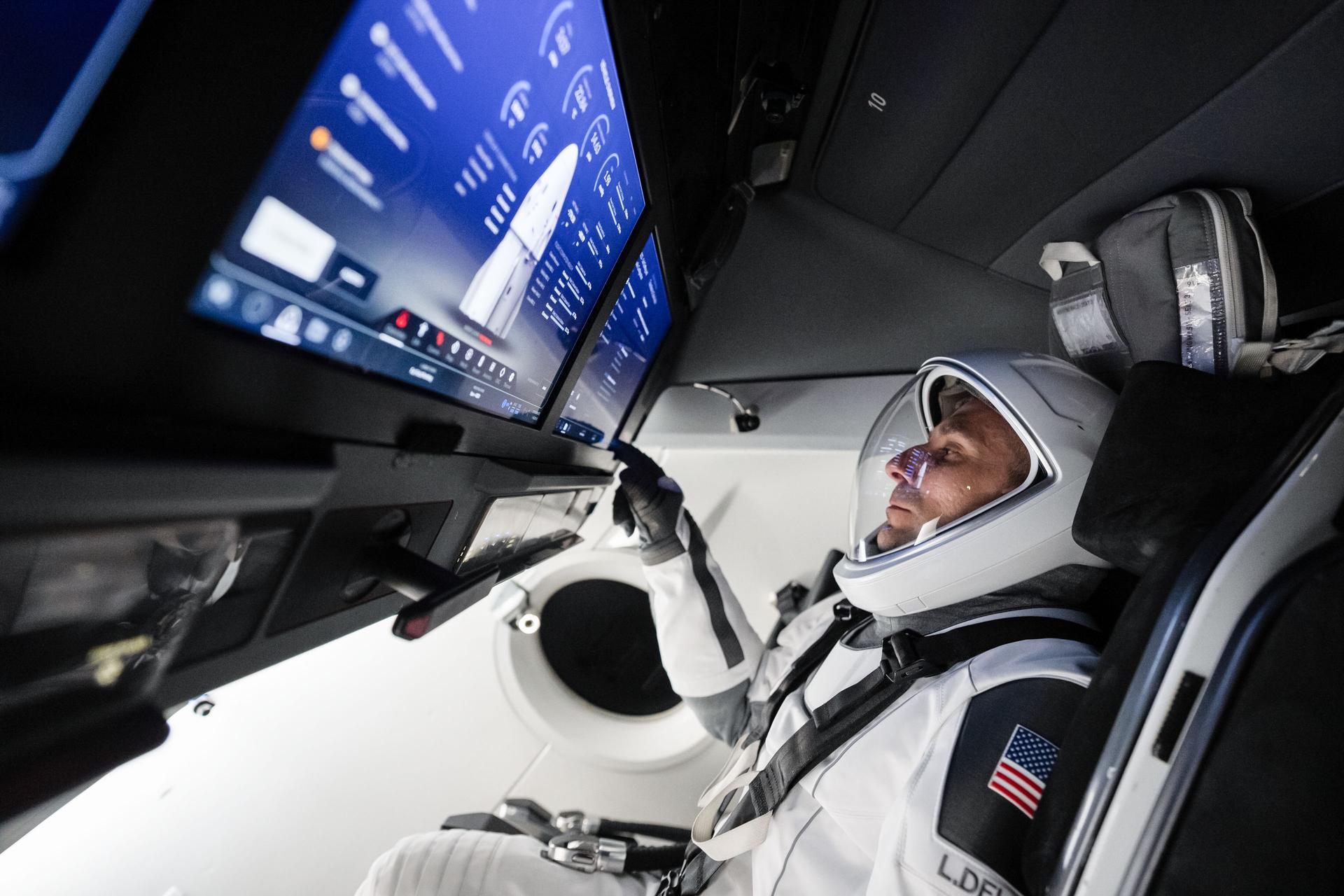
jsc2026e404725 (June 8, 2026) --- NASA astronaut and SpaceX Crew‑13 Pilot Luke Delaney sits inside a Dragon spacecraft mockup while tapping a cockpit screen interface during a pre‑flight training session at SpaceX headquarters in Hawthorne, California. Credit: SpaceX

A view of one of the RS-25 engines on the Space Launch System rocket as seen from the zero deck of the mobile launcher inside the Vehicle Assembly Building on Aug. 16, 2021. Four RS-25 engines will fire for over eight minutes at liftoff of the Artemis I mission to help get the Orion spacecraft to orbit. Artemis I will be an uncrewed test of the Orion spacecraft and SLS rocket as an integrated system ahead of crewed flights to the Moon. Under Artemis, NASA aims to land the first woman and first person of color on the Moon and establish sustainable lunar exploration.

After the scoop on the end of NASA's Mars InSight lander was used to push down on the top of the spacecraft's "mole," or self-hammering heat probe, it was held in place to essentially block the mole from popping out of the soil. The movement of sand grains in the scoop, seen here, suggested that the mole had began bumping up against the bottom of the scoop while hammering on June 20, 2020. Movie available at https://photojournal.jpl.nasa.gov/catalog/PIA23896

Taps is played during the interment service for former NASA astronaut Captain Bruce McCandless II, USN (Ret.), Tuesday, Jan. 16, 2018 at the United States Naval Academy Cemetery in Annapolis, Maryland. Photo Credit: (NASA/Bill Ingalls)
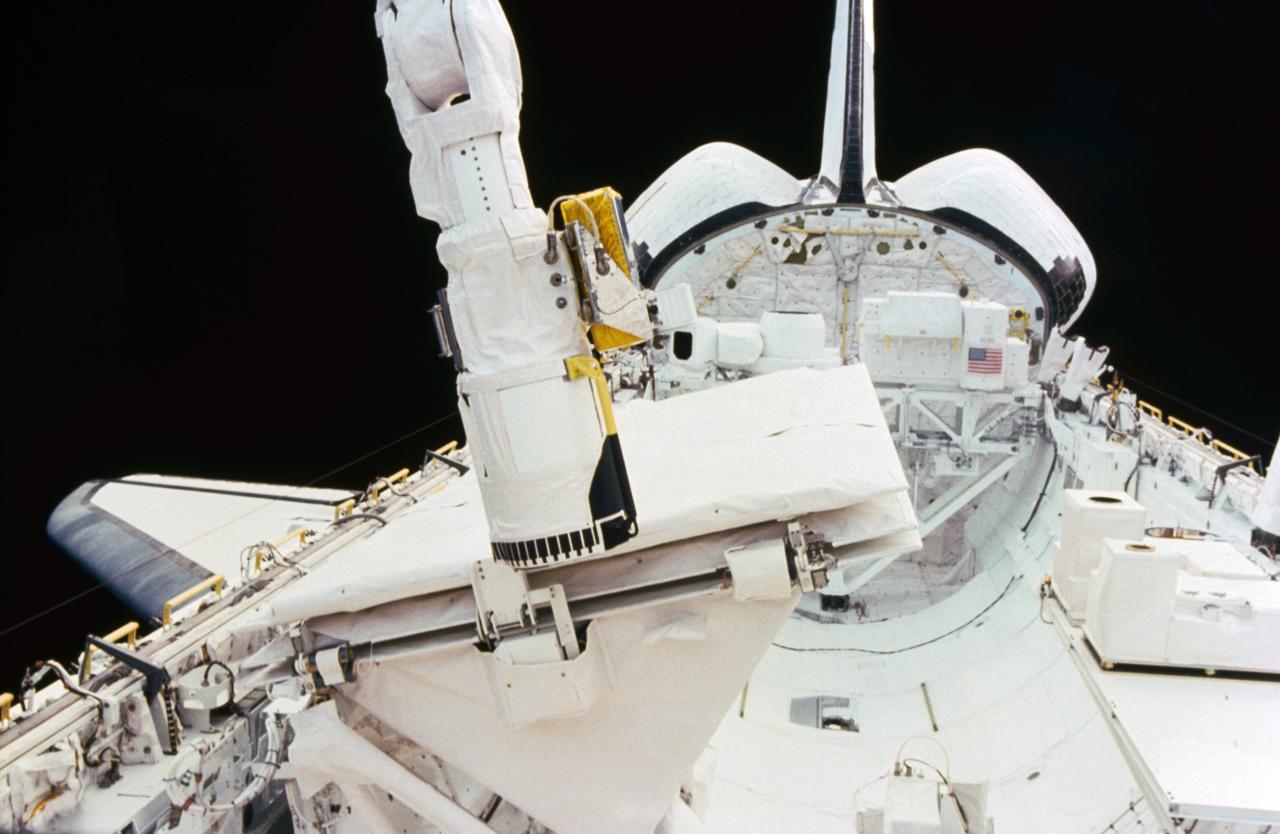
41G-03-008 (5-13 Oct. 1984) --- The end effector of the space shuttle Challenger's remote manipulator system (RMS) taps against the shuttle imaging radar's (SIR-B) antenna to secure it during NASA's 41-G mission. Photo credit: NASA
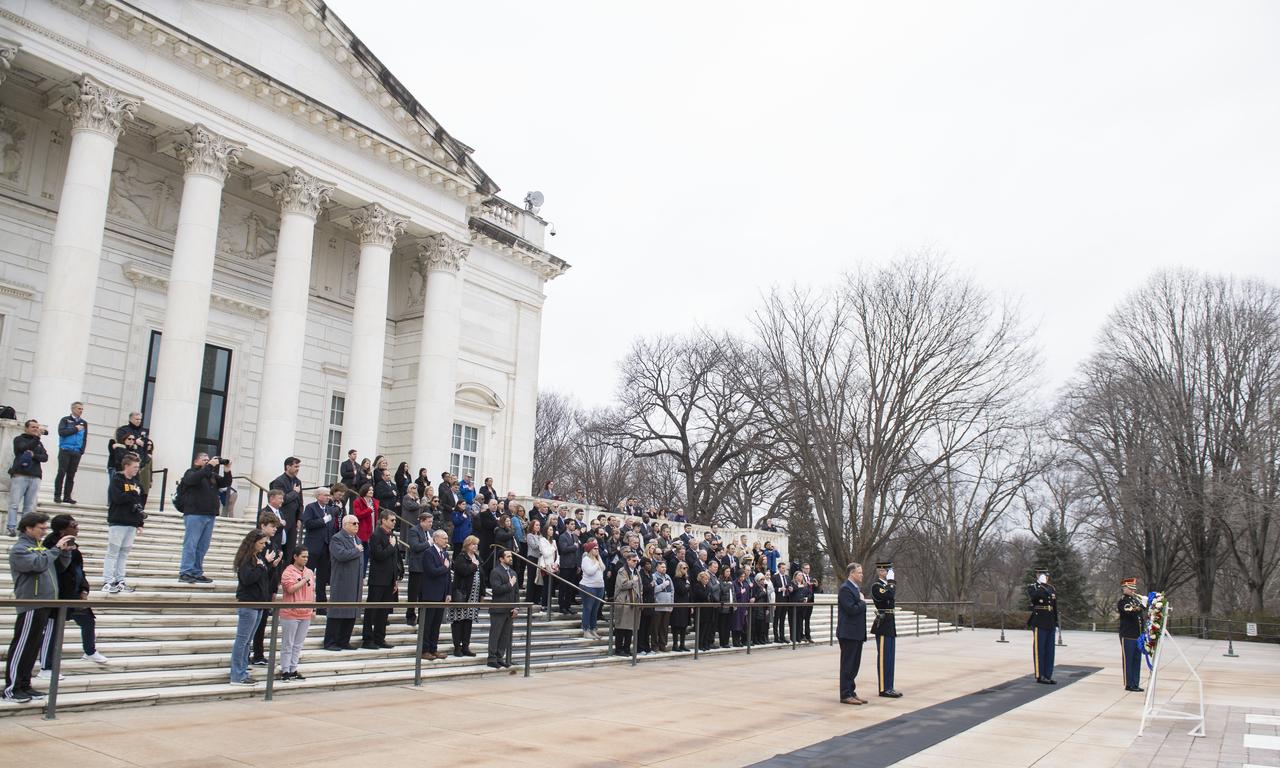
Taps is played by a member of The Old Guard after NASA Administrator Jim Bridenstine laid a wreath at the Tomb of the Unknowns as part of NASA's Day of Remembrance, Thursday, Feb. 7, 2019, at Arlington National Cemetery in Arlington, Va. The wreaths were laid in memory of those men and women who lost their lives in the quest for space exploration. Photo Credit: (NASA/Aubrey Gemignani)
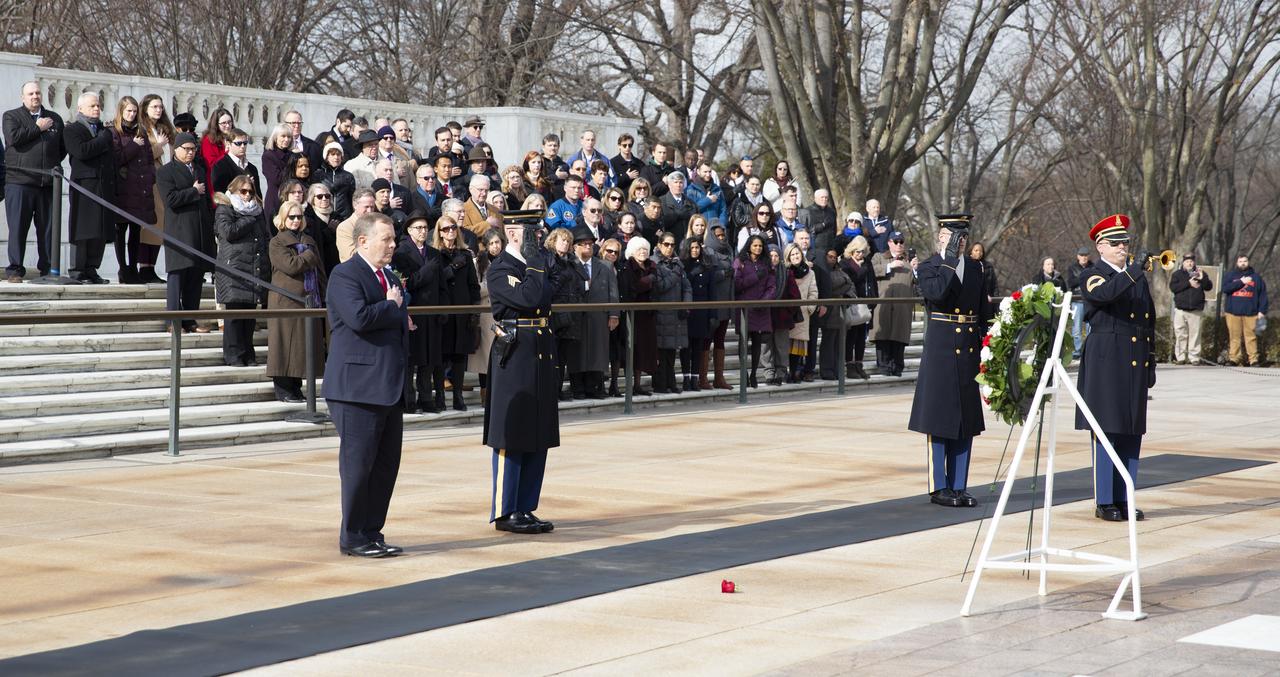
Taps is played by a member of The Old Guard after NASA Deputy Administrator Jim Morhard laid a wreath at the Tomb of the Unknowns as part of NASA’s Day of Remembrance, Thursday, Jan. 30, 2020, at Arlington National Cemetery in Arlington, Va. The wreaths were laid in memory of those men and women who lost their lives in the quest for space exploration. Photo Credit: (NASA/Joel Kowsky)

U.S. Navy Musician First Class Ben Hauser plays taps during the interment services for former astronaut Alan Bean, Thursday, Nov. 8, 2018 at Arlington National Cemetery in Virginia. Selected as an astronaut in 1963, Bean flew in space twice, becoming the fourth human to walk on the Moon on Nov. 19, 1969 and spent 59 days in space as commander of the second Skylab mission in 1973. Photo Credit: (NASA/Joel Kowsky)

Taps is played by a member of The Old Guard after NASA Deputy Administrator Jim Morhard laid a wreath at the Tomb of the Unknowns as part of NASA’s Day of Remembrance, Thursday, Jan. 30, 2020, at Arlington National Cemetery in Arlington, Va. The wreaths were laid in memory of those men and women who lost their lives in the quest for space exploration. Photo Credit: (NASA/Joel Kowsky)

Taps is played by a member of The Old Guard after NASA Deputy Administrator Jim Morhard laid a wreath at the Tomb of the Unknowns as part of NASA’s Day of Remembrance, Thursday, Jan. 30, 2020, at Arlington National Cemetery in Arlington, Va. The wreaths were laid in memory of those men and women who lost their lives in the quest for space exploration. Photo Credit: (NASA/Joel Kowsky)

Taps is played by a member of The Old Guard after acting NASA Administrator Robert Lightfoot, Amy Resnik, sister-in-law, and Chuck Resnik, brother of the late space shuttle Challenger astronaut Judy Resnik laid a wreath at the Tomb of the Unknowns as part of NASA's Day of Remembrance, Thursday, Jan. 25, 2018, at Arlington National Cemetery in Arlington, Virginia. Wreaths were laid in memory of those men and women who lost their lives in the quest for space exploration. Photo Credit: (NASA/Bill Ingalls)
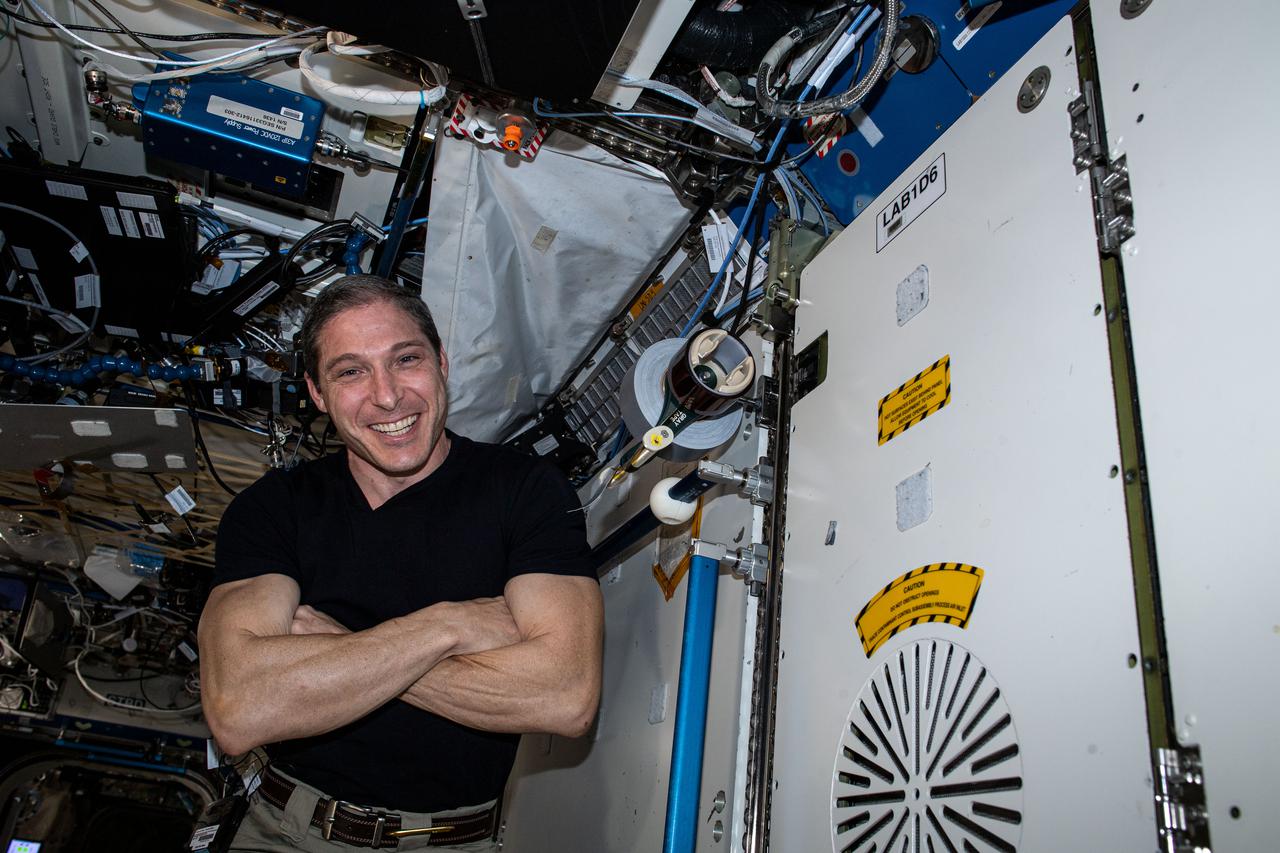
Working in microgravity creates new challenges, even for simple tasks. Next to a floating Hopkins is a HUNCH Tape Dispenser specialized for operations in microgravity. This tape dispenser, developed by high school students through the NASA HUNCH (High Schools United with NASA to Create Hardware) program, requires only one hand to cut pieces of tap. This improves crew efficiency and addresses human factors that must be considered when working in the microgravity environment.

Taps is played by a member of The Old Guard after NASA Administrator Jim Bridenstine laid a wreath at the Tomb of the Unknowns as part of NASA's Day of Remembrance, Thursday, Feb. 7, 2019, at Arlington National Cemetery in Arlington, Va. The wreaths were laid in memory of those men and women who lost their lives in the quest for space exploration. Photo Credit: (NASA/Aubrey Gemignani)

A member of the U.S. Navy Honor Guard salutes as taps is played during interment services for former astronaut Alan Bean, Thursday, Nov. 8, 2018 at Arlington National Cemetery in Virginia. Selected as an astronaut in 1963, Bean flew in space twice, becoming the fourth human to walk on the Moon on Nov. 19, 1969 and spent 59 days in space as commander of the second Skylab mission in 1973. Photo Credit: (NASA/Joel Kowsky)

NASA personnel watch as "Taps" is played by The Old Guard after a wreath was laid at the Tomb of the Unknowns by NASA Administrator Jim Bridenstine as part of NASA's Day of Remembrance, Thursday, Feb. 7, 2019, at Arlington National Cemetery in Arlington, Va. The wreaths were laid in memory of those men and women who lost their lives in the quest for space exploration. Photo Credit: (NASA/Aubrey Gemignani)
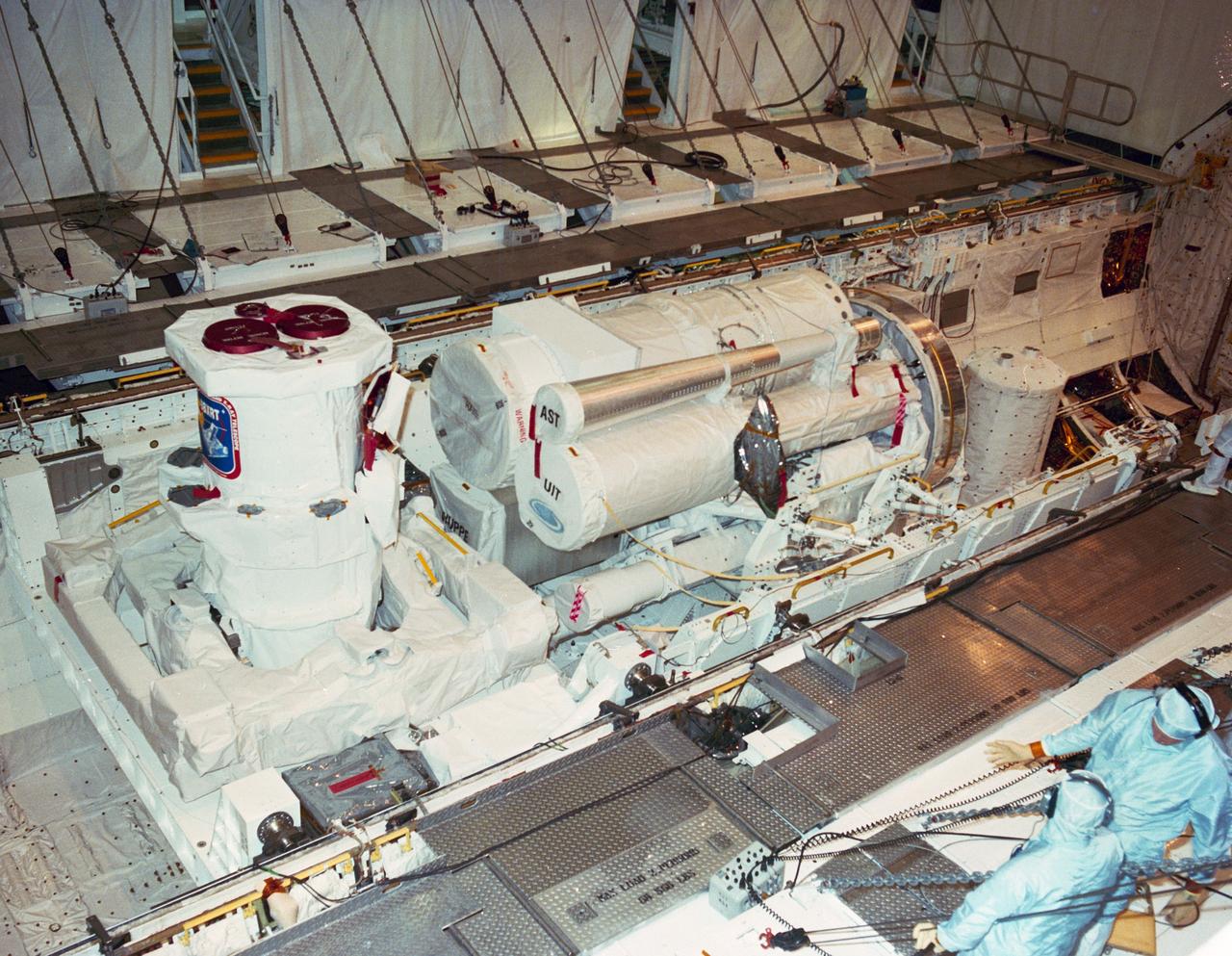
STS-35 Astronomy Laboratory 1 (ASTRO-1) is installed in Columbia's, Orbiter Vehicle (OV) 102's, payload bay (PLB) at the Kennedy Space Center (KSC) Orbiter Processing Facility (OPF). On the left, in the aft PLB is the Broad Band X Ray Telescope (BBXRT) mounted on the two axis pointing system (TAPS). In the center, the three ultraviolet telescopes - Wisconsin Ultraviolet Photo-Polarimeter Experiment (WUPPE), the Hopkins Ultraviolet Telescope (HUT), and the Ultraviolet Imaging Telescope (UIT) - are mounted on the instrument pointing system (IPS) and are in stowed position. At the far right is the Spacelab Pallet System (SPS) igloo. View provided by KSC with alternate number KSSC-90PC-421.
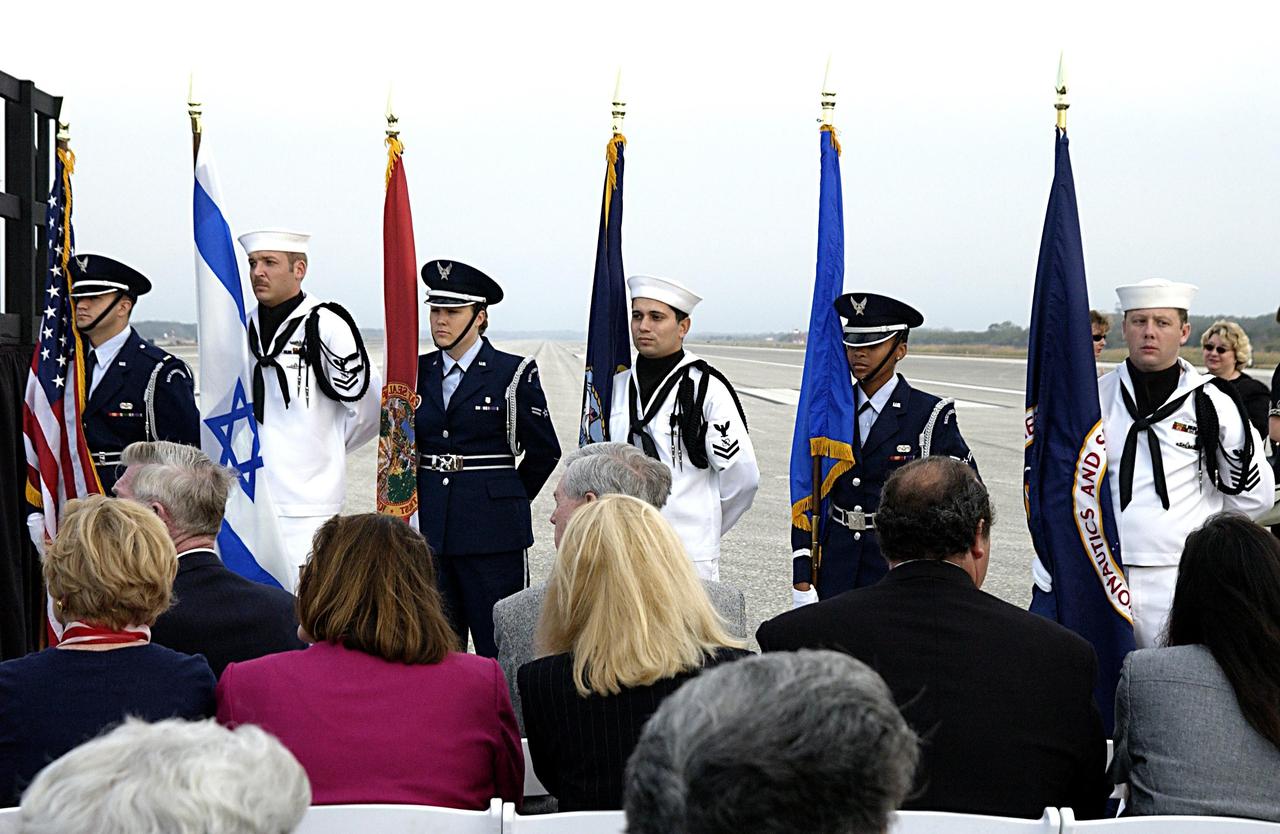
KENNEDY SPACE CENTER, FLA. -- The Patrick Air Force Base Honor Guard stands at attention during "Taps" at the conclusion of the STS-107 Columbia Crew Memorial Service held at KSC. The crew were lost on Feb. 1, 2003, over East Texas as they returned to Earth after the 16-day research mission STS-107. Also taking part in the service were NASA Administrator Sean O'Keefe, former KSC Director Robert Crippen, astronaut Jim Halsell, several employees and area clergymen. Crippen was the first to fly Columbia in 1981; Halsell first flew Columbia in 1994 and again in 1997.
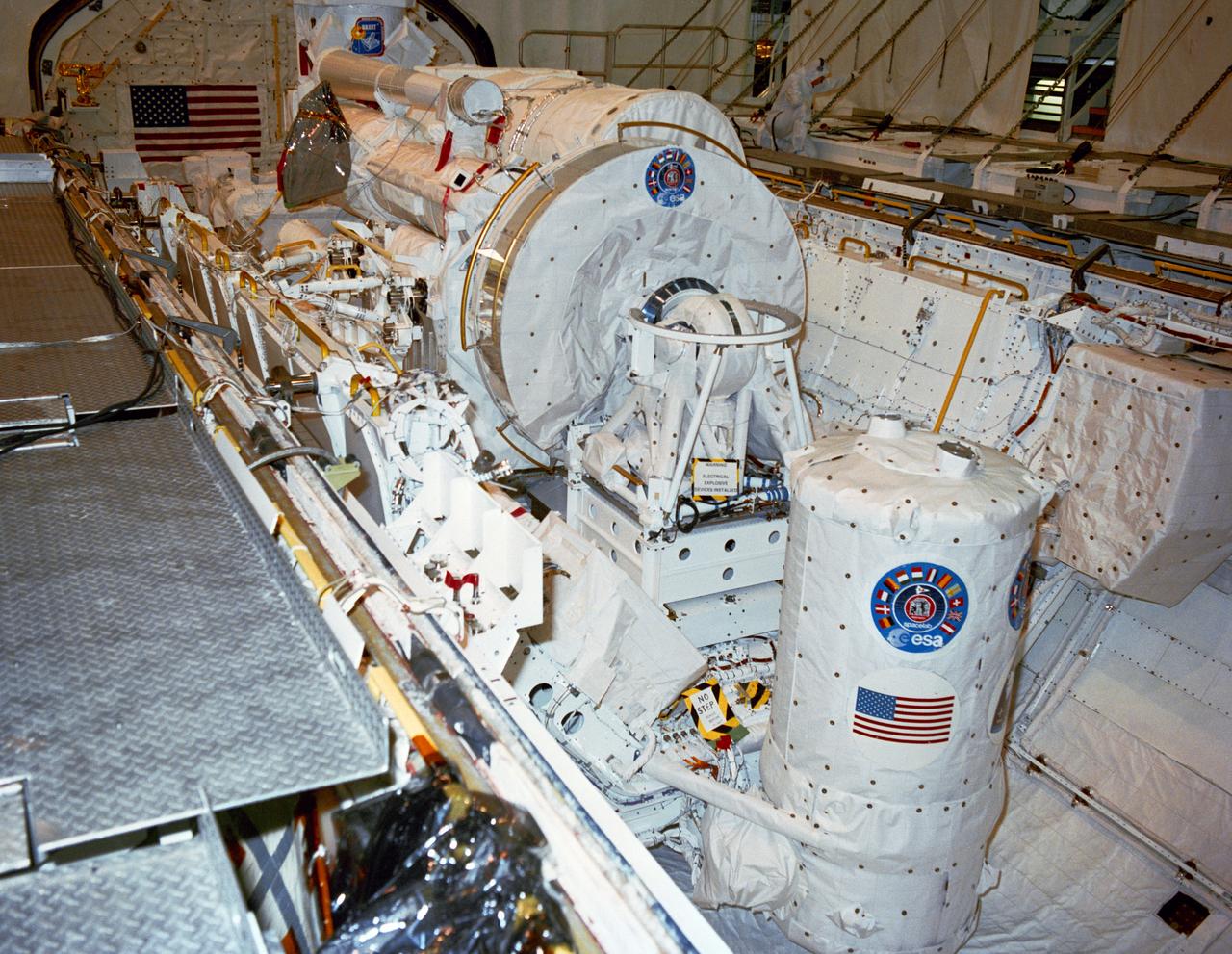
S90-36708 (7 May 1990) --- STS-35 Astronomy Laboratory 1 (ASTRO-1) view shows its telescopes, instrument pointing system (IPS), and support equipment installed in Columbia's, Orbiter Vehicle (OV) 102's, payload bay (PLB) at the Kennedy Space Center (KSC) Orbiter Processing Facility (OPF). In the foreground is the Spacelab Pallet System (SPS) igloo. The stowed IPS with its three ultraviolet telescopes appears in the center of the picture. In the background, the Broad Band X Ray Telescope (BBXRT) two axis pointing system (TAPS) is barely visible. View provided by KSC with alternate number KSC-90PC-423.
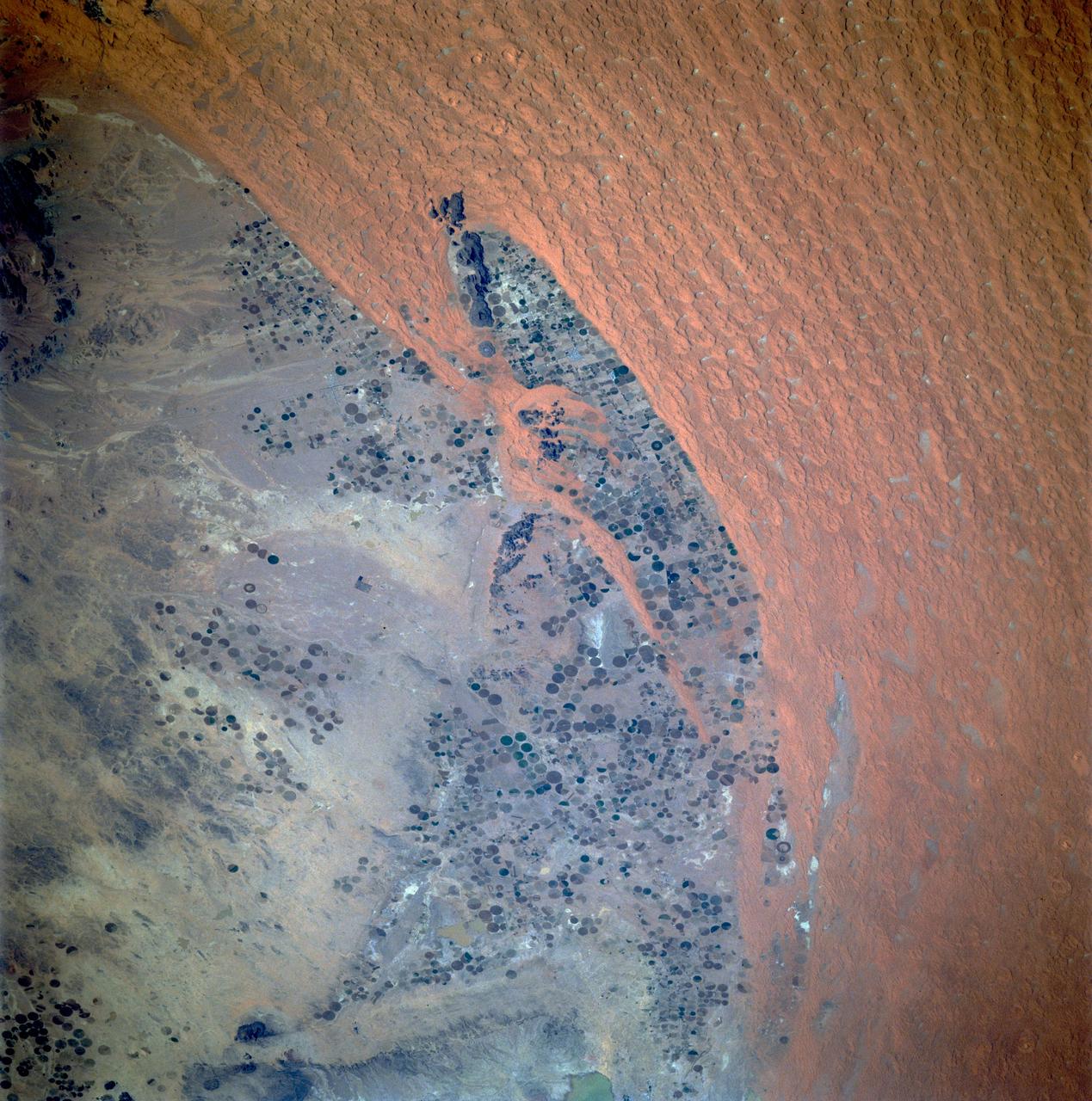
STS087-703-089 (19 November – 5 December 1997) --- Featured in this view is center pivot irrigation in central Saudi Arabia. Abundant petroleum has provided the energy source for deep-well pumps that tap groundwater stored in bedrock many thousands of years ago when the climate was much wetter. The fields are carved out of ancient alluvial fan deposits, also formed when rainfall was much greater; the fields are pushed right to the edge of the Nafud al Mazhur (sand sea), representative of the present climate. The mining of petroleum and groundwater has enabled Saudi Arabia to become an exporter of wheat and other commodities, in addition to the oil for which it is famous. This picture is one of the 70mm Earth observation visuals used by the crew at its post flight presentation events.
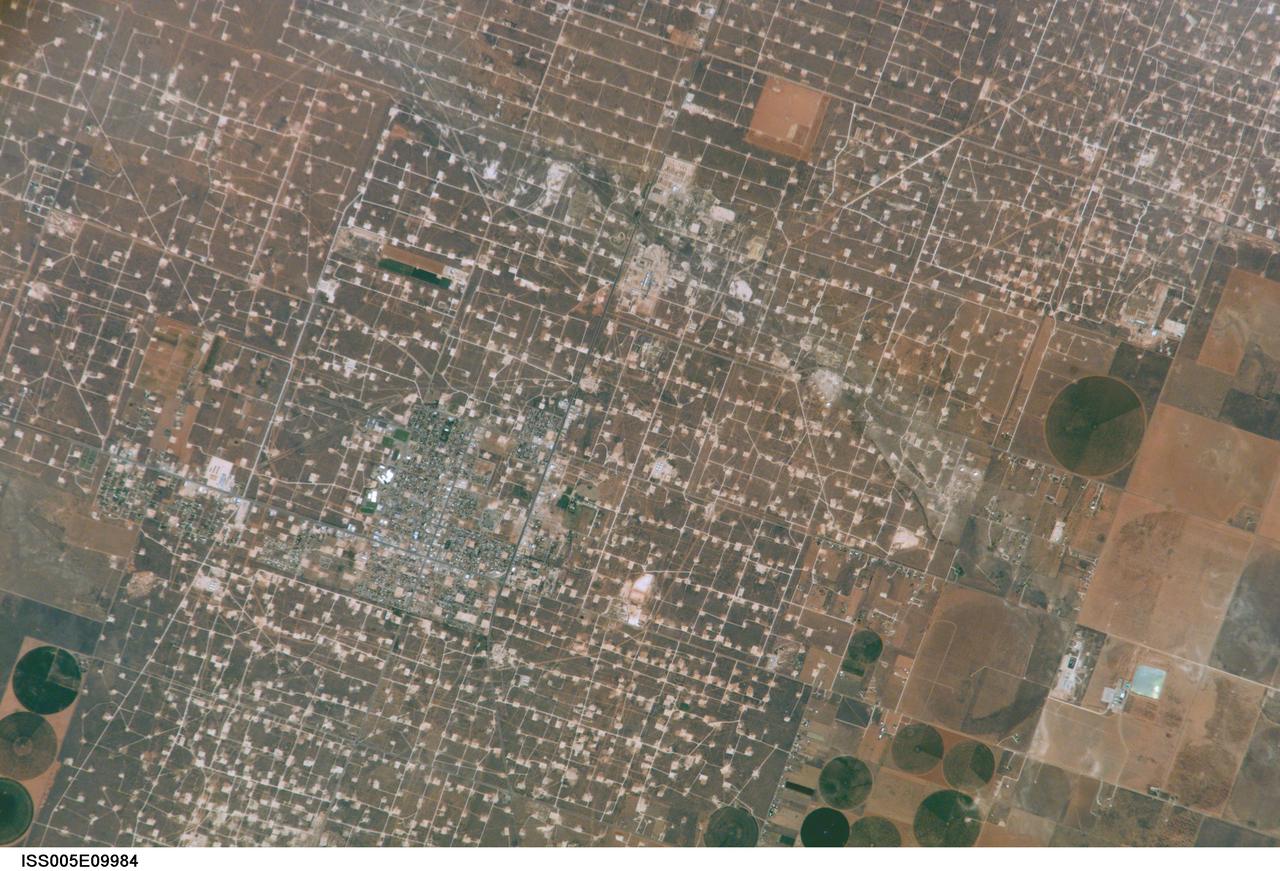
ISS005-E-9984 (17 August 2002) --- This digital still photograph, taken from the International Space Station (ISS) during its fifth staffing, depicts both agriculture and the petroleum industry, which compete for land use near Denver City, Texas. The photo was recently released by the Earth Sciences and Image Analysis Laboratory at Johnson Space Center. The area is southwest of Lubbock near the New Mexico border. According to analysts studying the station imagery, the economy of this region is almost completely dependent on its underground resources of petroleum and water. Both resources result in distinctive land use patterns visible from space. Historically this area has produced vast quantities of oil and gas since development began in the 1930s. A fine, light-colored grid of roads and pipelines connect well sites over this portion of the Wasson Oil Field, one of the state’s most productive. Since the 1940s, agricultural land use has shifted from grazing to irrigated cultivation of cotton, sorghum, wheat, hay, and corn. The water supply is drawn from wells tapping the vast Ogallala Aquifer. Note the large, circular center-pivot irrigation systems in the lower corners of the image. The largest is nearly a mile in diameter.

NASA's F/A-18 Hornet is seen here in a banked turn over Rogers Dry Lake in the Mojave desert on an early research flight. It was flown by NASA's Dryden Flight Research Center, Edwards, California, in a multi-year, joint NASA/DOD/industry program, the former Navy fighter was modified into a unique Systems Research Aircraft (SRA) to investigate a host of new technologies in the areas of flight controls, airdata sensing and advanced computing. One of the more than 20 experiments tested aboard the SRA F-18 was an advanced air data sensing system which used a group of pressure taps flush-mounted on the forward fuselage to measure both altitude and wind speed and direction--critical data for flight control and research investigations. The Real-Time Flush Air Data Sensing system concept was evaluated for possible use on the X-33 and X-34 resuable space-launch vehicles. The primary goal of the SRA program was to validate through flight research cutting-edge technologies which could benefit future aircraft and spacecraft by improving efficiency and performance, reducing weight and complexity, with a resultant reduction on development and operational costs.
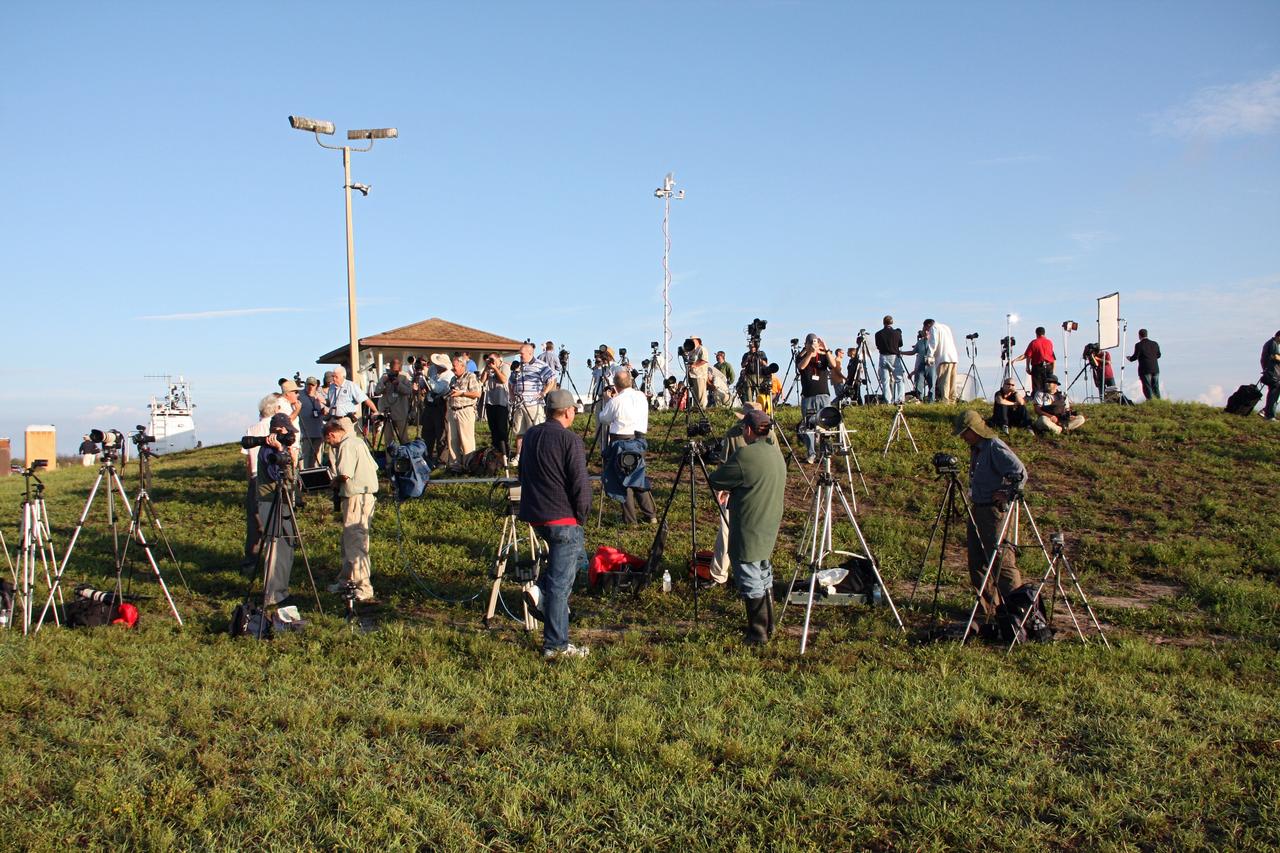
CAPE CANAVERAL, Fla. -- Media representatives set up their camera tripods at Press Site 1 near Space Launch Complex 17B on Cape Canaveral Air Force Station. On tap is the launch of NASA's Gravity Recovery and Interior Laboratory mission. Liftoff aboard a United Launch Alliance Delta II Heavy rocket is scheduled for 8:37:06 a.m. EDT. GRAIL will fly twin spacecraft in tandem around the moon to precisely measure and map variations in the moon's gravitational field. The mission will provide the most accurate global gravity field to date for any planet, including Earth. This detailed information will reveal differences in the density of the moon's crust and mantle and will help answer fundamental questions about the moon's internal structure, thermal evolution, and history of collisions with asteroids. The aim is to map the moon's gravity field so completely that future lunar vehicles can safely navigate anywhere on the moon’s surface. For more information, visit http://www.nasa.gov/grail. Photo credit: NASA/Ken Thornsley
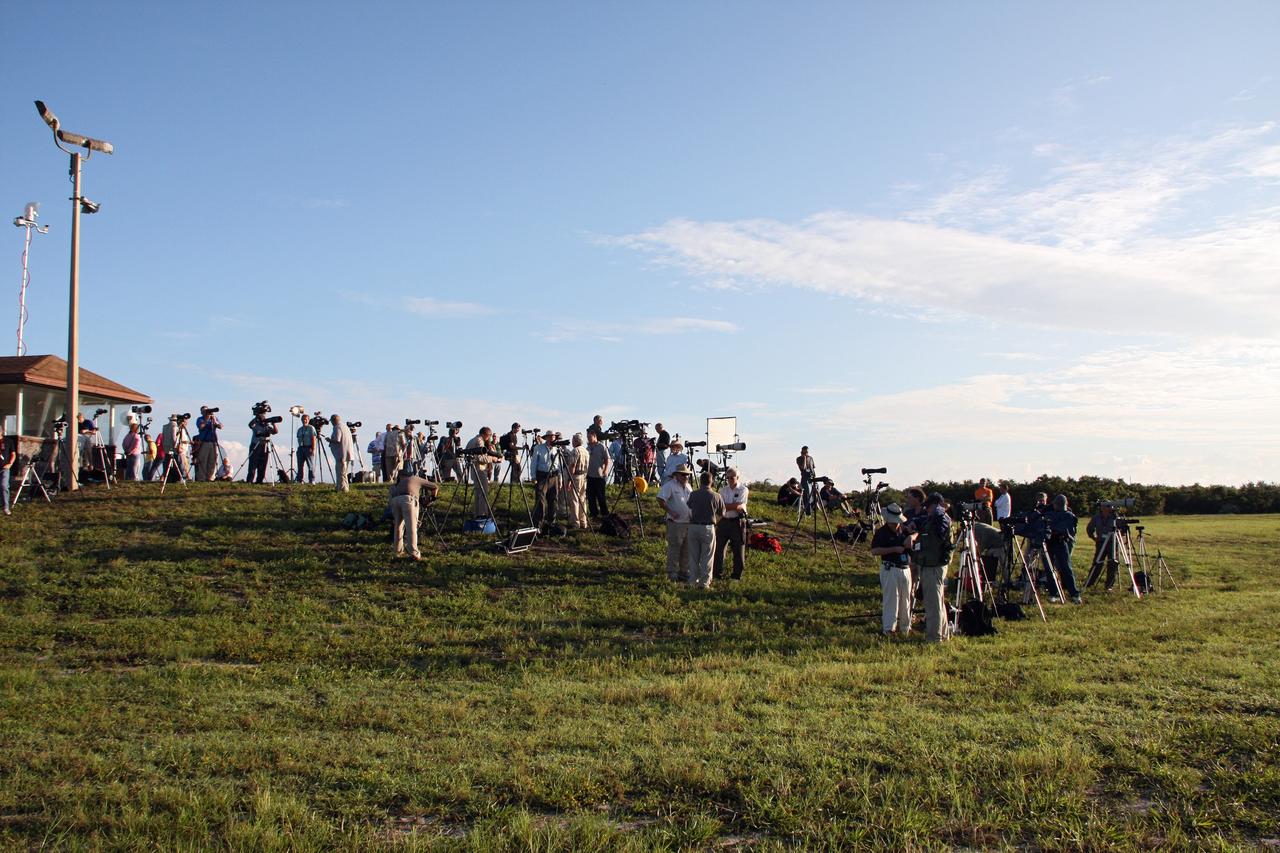
CAPE CANAVERAL, Fla. -- Media representatives vie for the best positions for their camera tripods at Press Site 1 near Space Launch Complex 17B on Cape Canaveral Air Force Station. On tap is the launch of NASA's Gravity Recovery and Interior Laboratory mission. Liftoff aboard a United Launch Alliance Delta II Heavy rocket is scheduled for 8:37:06 a.m. EDT. GRAIL will fly twin spacecraft in tandem around the moon to precisely measure and map variations in the moon's gravitational field. The mission will provide the most accurate global gravity field to date for any planet, including Earth. This detailed information will reveal differences in the density of the moon's crust and mantle and will help answer fundamental questions about the moon's internal structure, thermal evolution, and history of collisions with asteroids. The aim is to map the moon's gravity field so completely that future lunar vehicles can safely navigate anywhere on the moon’s surface. For more information, visit http://www.nasa.gov/grail. Photo credit: NASA/Ken Thornsley
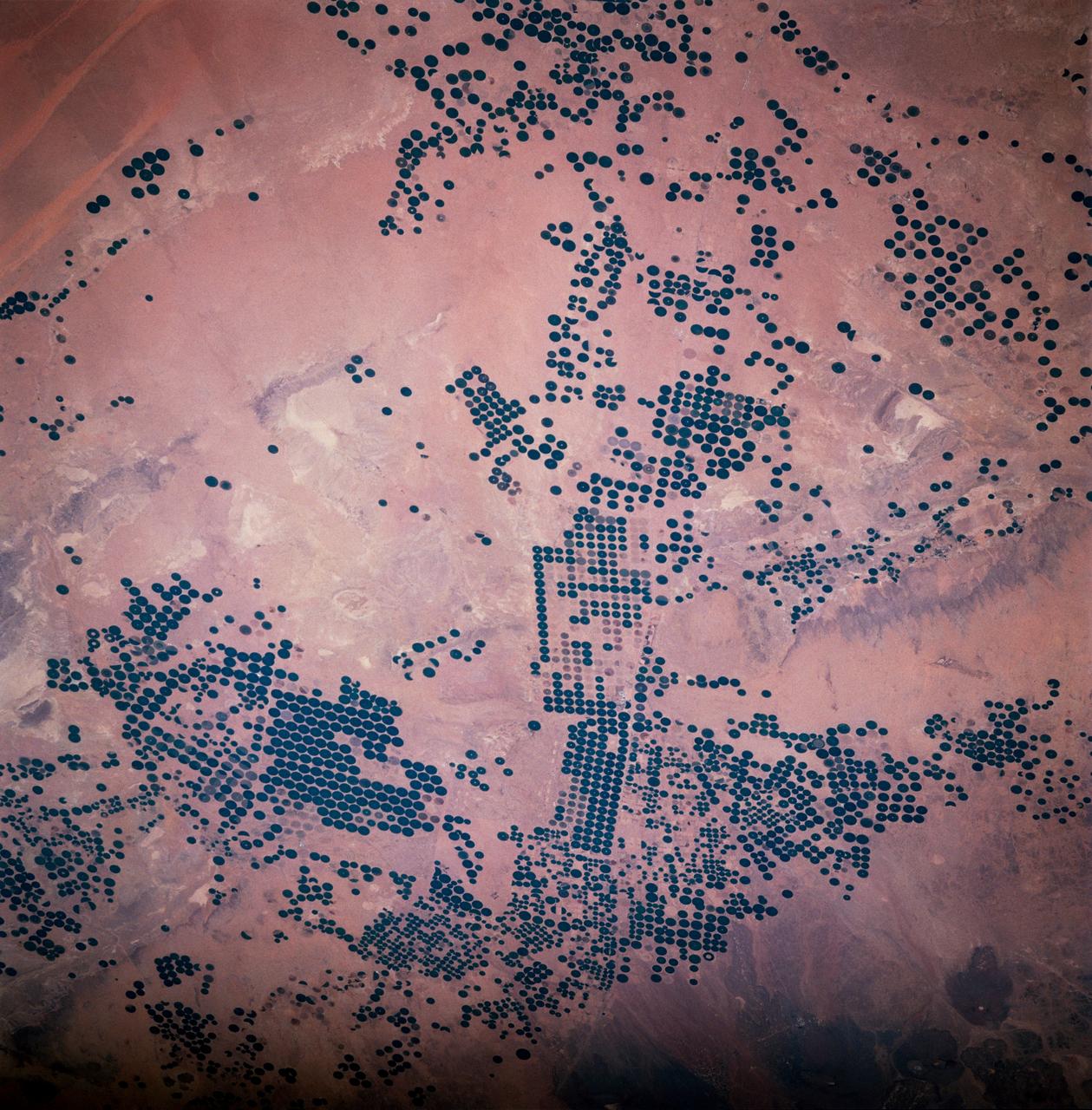
STS083-747-033 (4-8 April 1997) --- Center Pivot Irrigation, in Saudi Arabia. This irrigation project in Saudi Arabia is typical of many isolated irrigation projects scattered throughout the arid and hyper-arid regions of the Earth. Fossil water is mined from depths as great as 3,000 feet, pumped to the surface, and distributed via large center pivot irrigation feeds. The circles of green irrigated vegetation may comprise a variety of agricultural commodities from alfalfa to wheat. Diameters of the normally circular fields range from a few hundred meters to as much as 2 miles. The projects often trace out a narrow, sinuous, and seemingly random path. Actually, engineers generally seek ancient river channels now buried by the sand seas. The fossil waters mined in these projects accumulated during periods of wetter climate in the Pleistocene glacial epochs, between 10,000 to 2 million years ago, and are not being replenished under current climatic conditions. The projects, therefore, will have limited production as the reservoirs are drained. Water, of course, is the key to agriculture in Saudi Arabia. The Kingdom has implemented a multifaceted program to provide the vast supplies of water necessary to achieve the spectacular growth of the agricultural sector. A network of dams has been built to trap and utilize precious seasonal floods. Vast underground water reservoirs have been tapped through deep wells. Desalination plants have been built to produce fresh water from the sea for urban and industrial use, thereby freeing other sources for agriculture. Facilities have also been put into place to treat urban and industrial run-off for agricultural irrigation. These efforts collectively have helped transform vast tracts of the desert into fertile farmland. Land under cultivation has grown from under 400,000 acres in 1976 to more than 8 million acres in 1993.
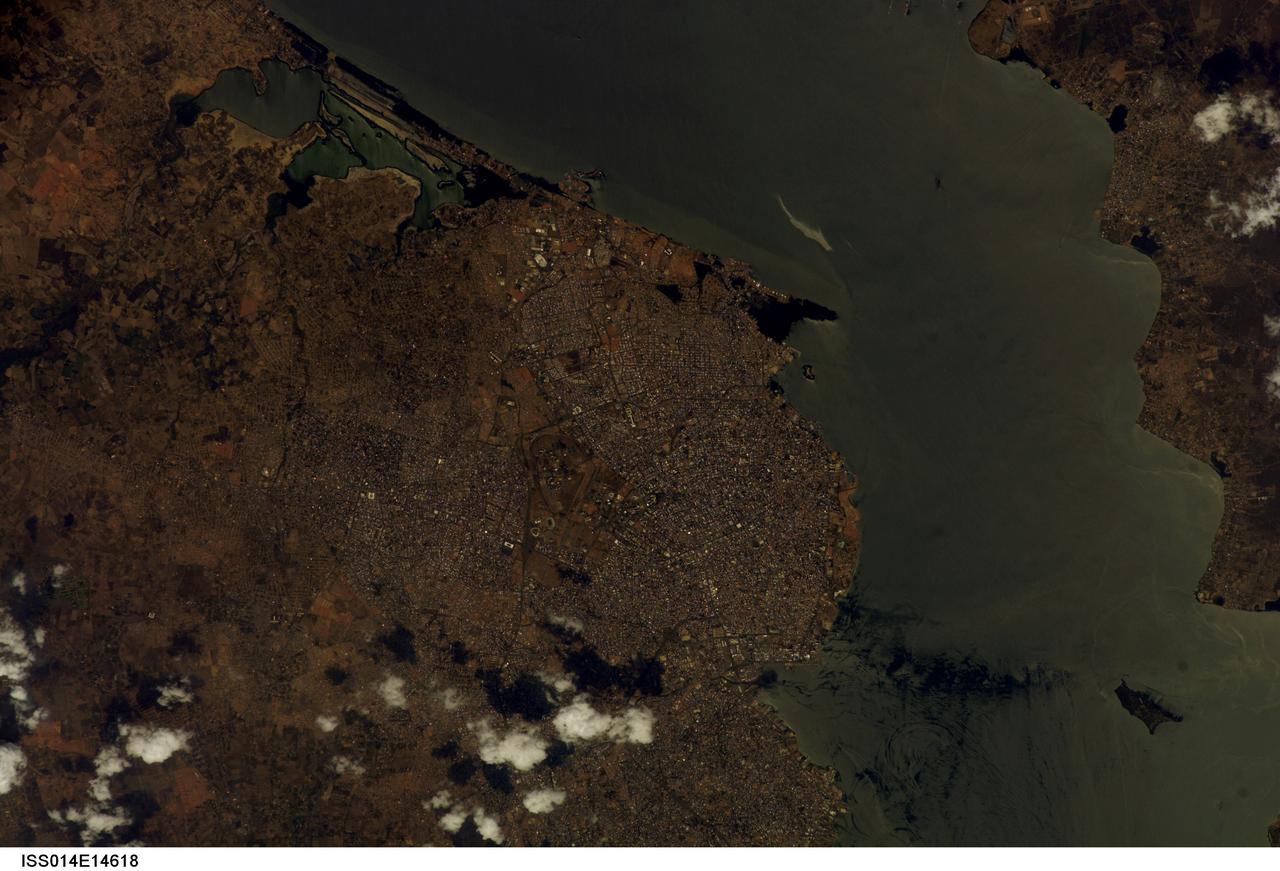
ISS014-E-14618 (23 Feb. 2007) --- Maracaibo City and Oil Slick, Venezuela are featured in this image photographed by an Expedition 14 crewmember on the International Space Station. This view depicts the narrow (6 kilometers) strait between Lake Maracaibo to the south and the Gulf of Venezuela to the north. This brackish lake in northern Venezuela is the largest in South America. The lake and its small basin are situated atop a vast reservoir of buried oil deposits, first tapped in 1914. Venezuela is now the world's fifth largest oil producer. The narrow strait is deepened to allow access by ocean-going vessels, dozens of which now daily transport approximately 80 per cent of Venezuela's oil to world markets. Shipping is one of the main polluters of the lake, caused by the dumping of ballast and other waste. An oil slick, likely related to bilge pumping, can be seen as a bright streak northeast of El Triunfo. Other sources of pollution to the lake include underwater oil pipeline leakage, untreated municipal and industrial waste from coastal cities, and runoff of chemicals from surrounding farm land. Deepening the narrow channel for shipping has also allowed saltwater intrusion into the lake, leading to adverse effects to Lake Biota. Since the discovery of oil, cities like Maracaibo have sprung up along the northwestern coastline of the lake. With satellite cities such as San Luis and El Triunfo, greater Maracaibo has a population of approximately 2.5 million. Just outside the lower margin of the picture a major bridge spans the narrows pictured here, connecting cities such as Altagracia (top right) to Maracaibo.