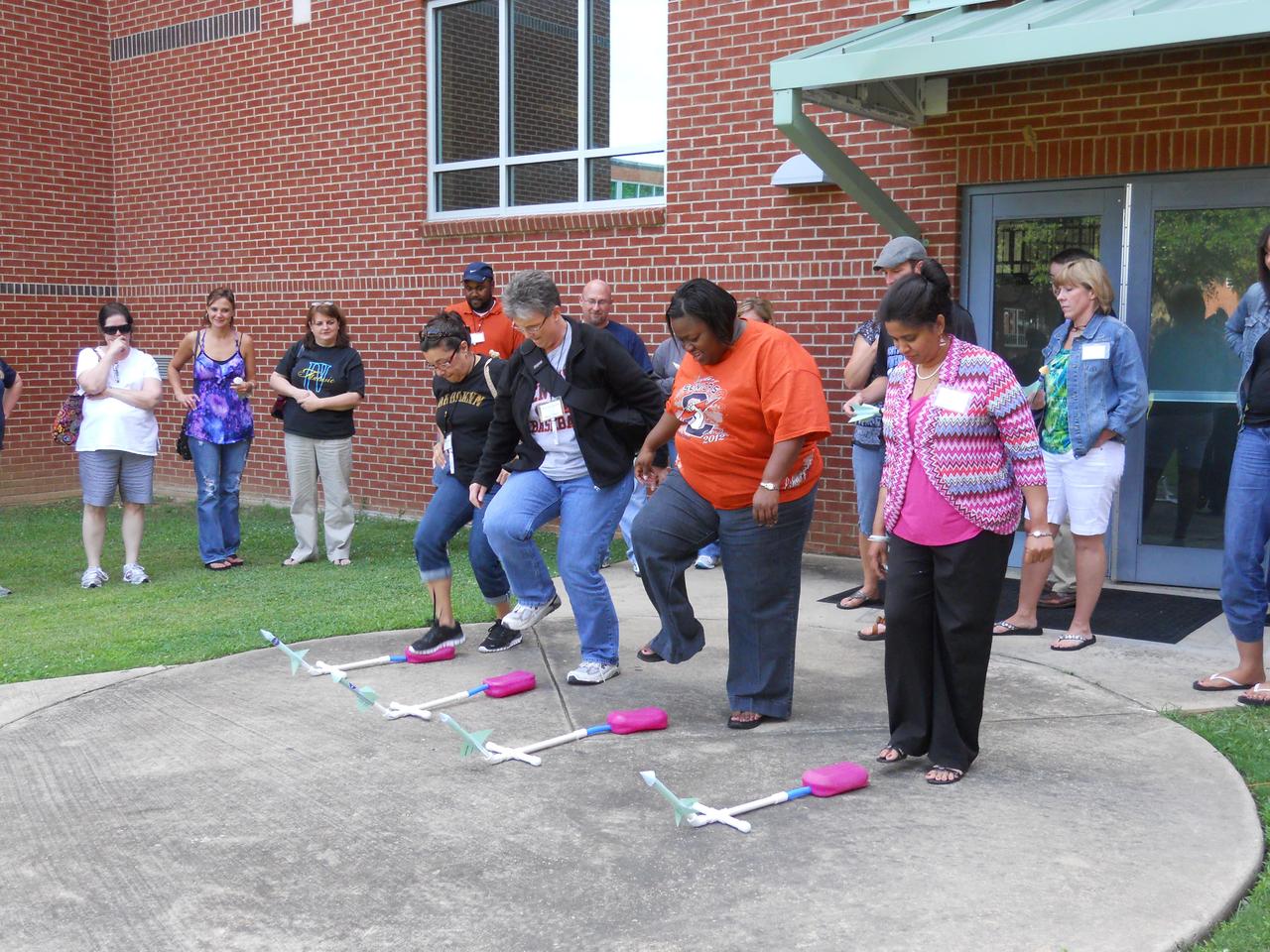
Mississippi educators participated in a variety of hands-on activities, including rocketry, robotics, and NASA's BEST (Beginning Engineering, Science, and Technology) during a pair of during a pair of professional development workshops conducted by Stennis Space Center educators in June. On June 14, Stennis educators presented workshops to 96 kindergarten-through-12th-grade science teachers and eight Jackson State University faculty, as part of JSU's Project MAST (Mississippi Academy for Science Teaching) Project. On June 21, educators presented workshops in Starkville to 43 fourth-through-eighth-grade science teachers as part of Mississippi State University's Advancing Teachers of Middle School Science initiative.
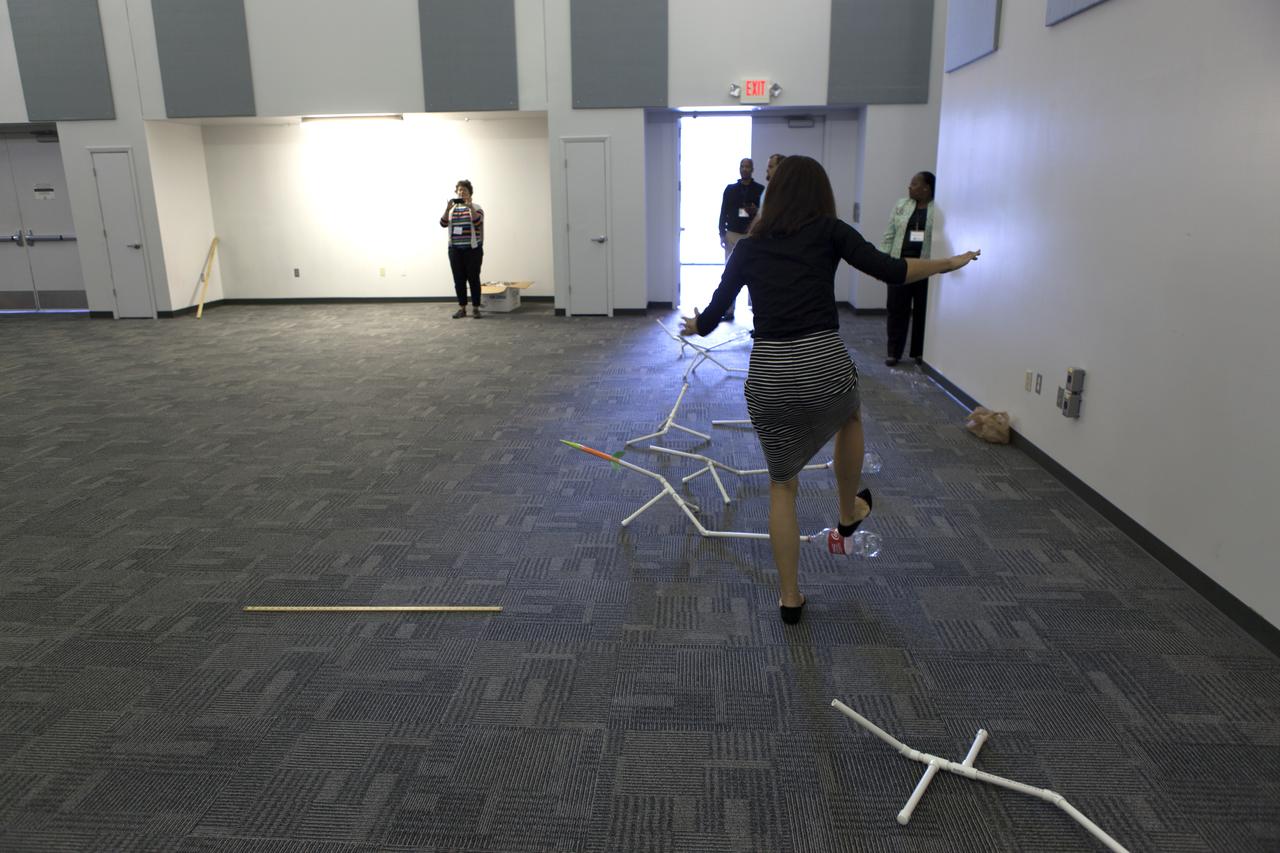
Teachers prepare to demonstrate the projects they built for the Rocketry Engineering Design Challenge during the 2017 GE Foundation High School STEM Integration Conference at the Center for Space Education at NASA's Kennedy Space Center. High school teachers from across the country took part in the week-long conference, which is designed to explore effective ways for teachers, schools and districts from across the country to integrate STEM throughout the curriculum. The conference is a partnership between GE Foundation and the National Science Teachers Association.
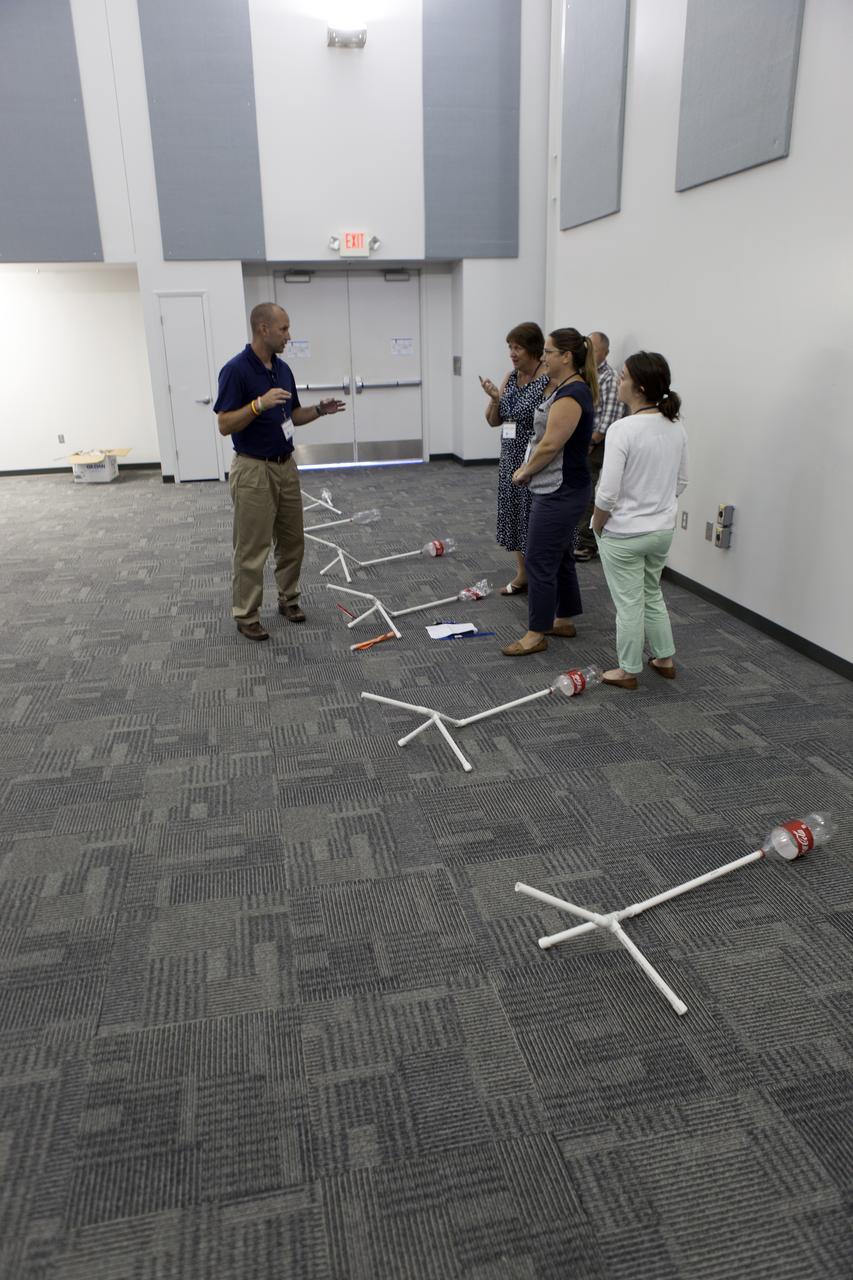
Teachers prepare to demonstrate the projects they built for the Rocketry Engineering Design Challenge during the 2017 GE Foundation High School STEM Integration Conference at the Center for Space Education at NASA's Kennedy Space Center. High school teachers from across the country took part in the week-long conference, which is designed to explore effective ways for teachers, schools and districts from across the country to integrate STEM throughout the curriculum. The conference is a partnership between GE Foundation and the National Science Teachers Association.
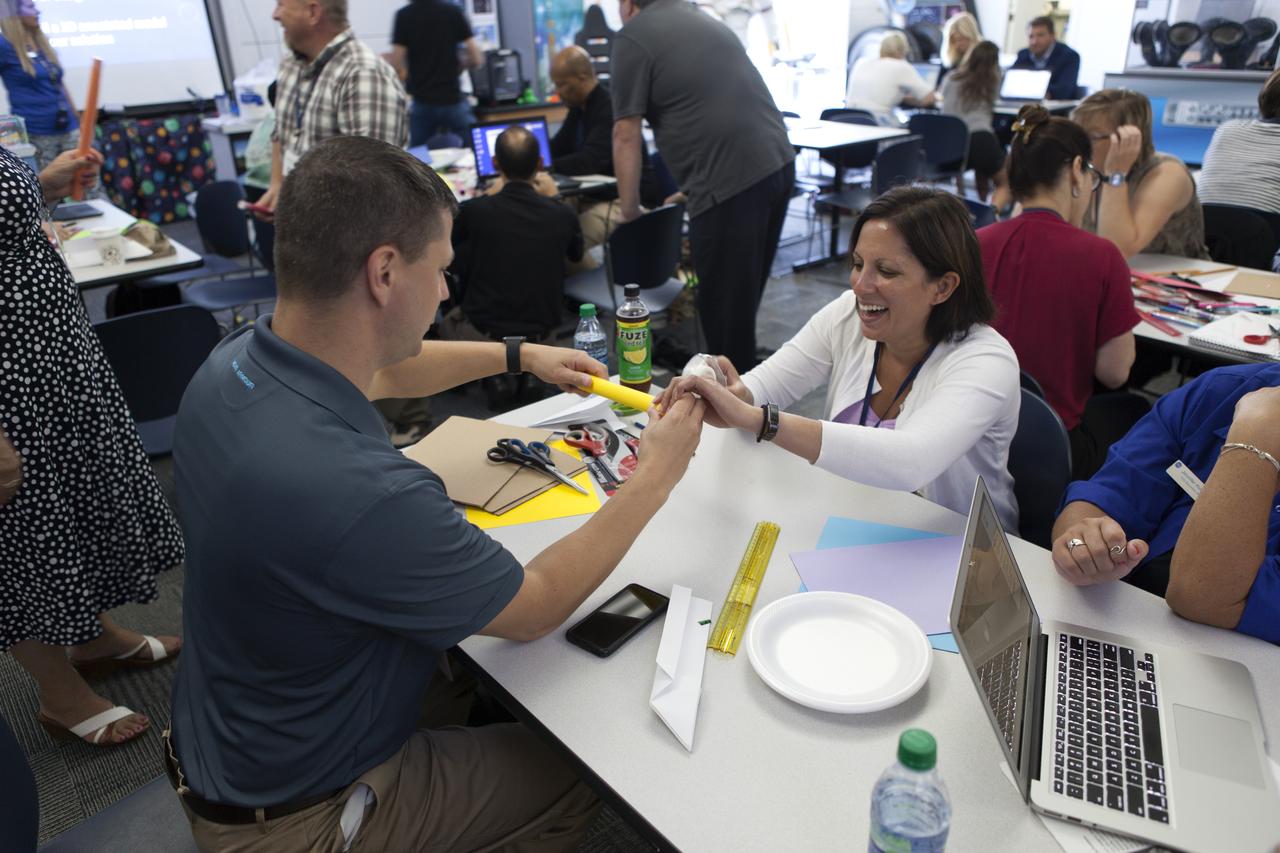
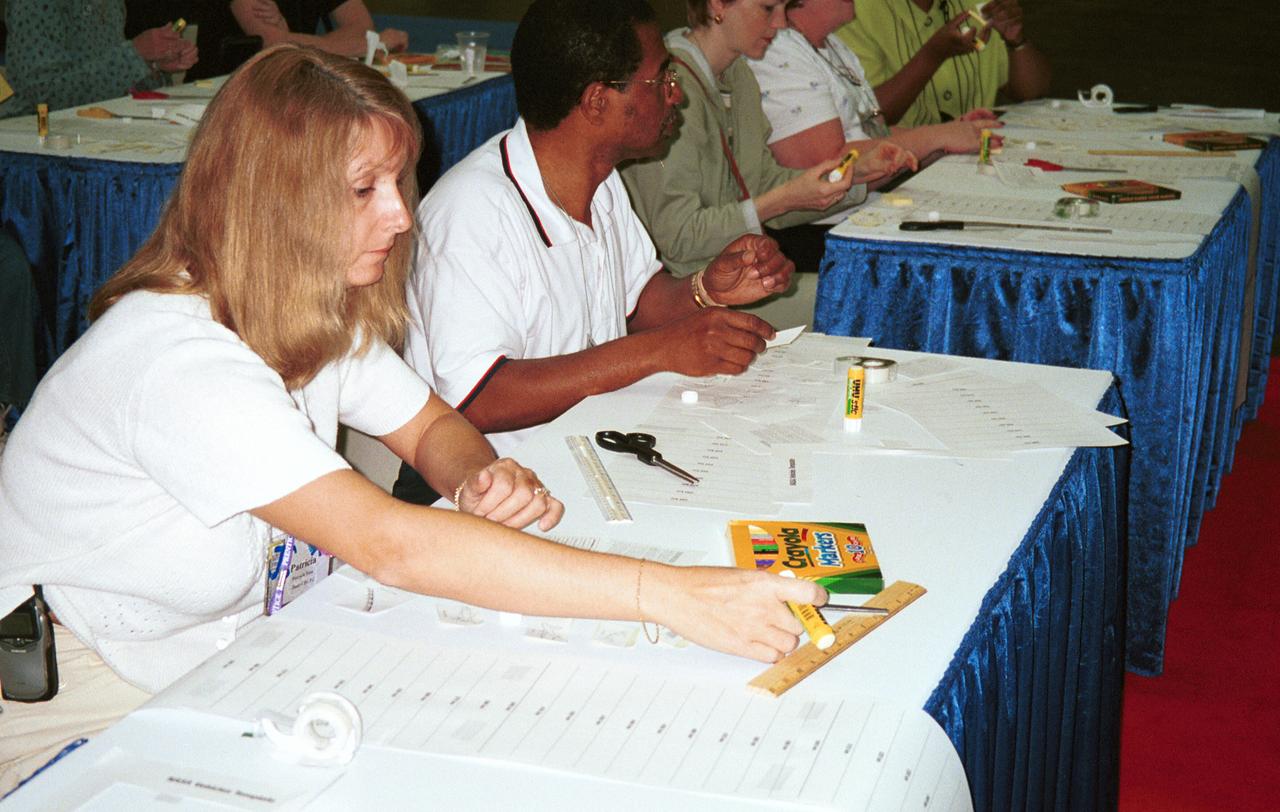
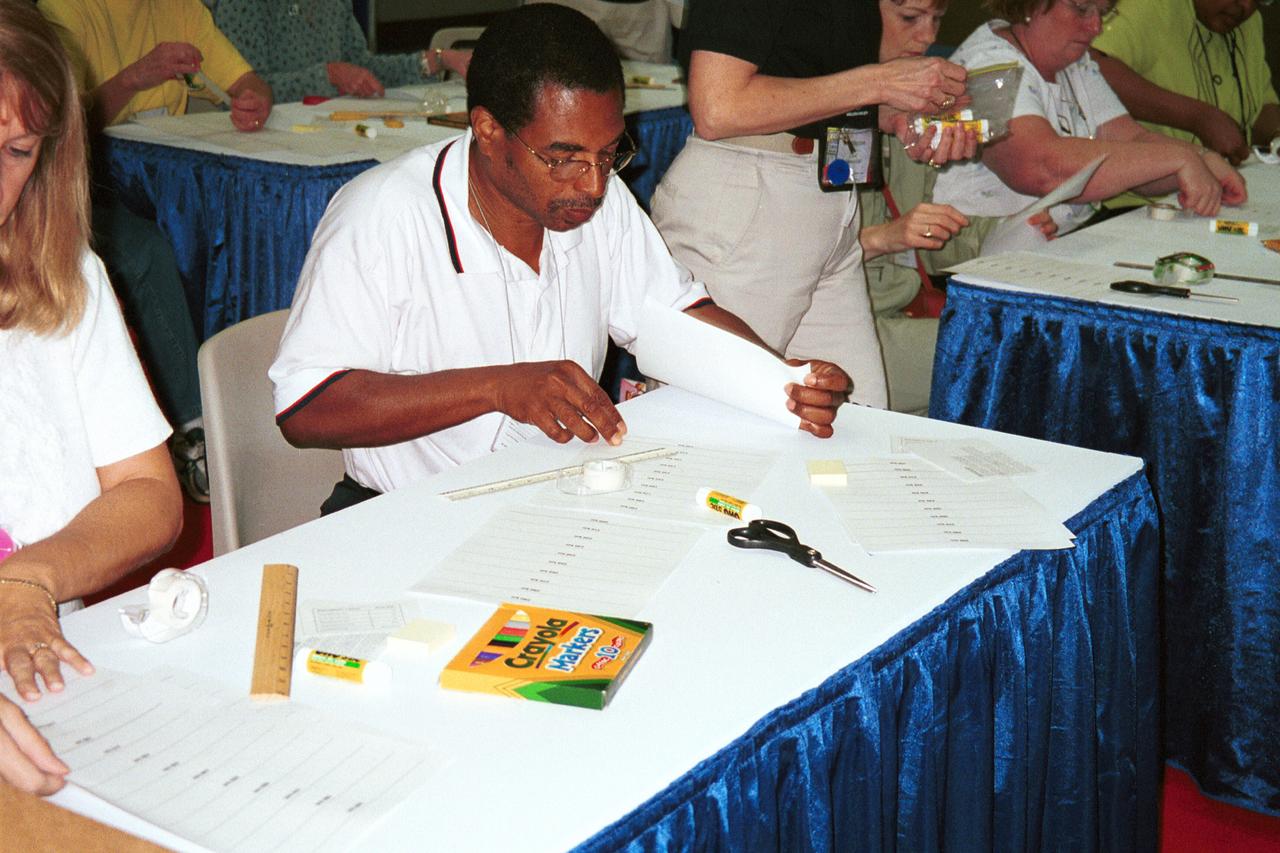
Teachers participate in the Rocketry Engineering Design Challenge during the 2017 GE Foundation High School STEM Integration Conference at the Center for Space Education at NASA's Kennedy Space Center. High school teachers from across the country took part in the week-long conference, which is designed to explore effective ways for teachers, schools and districts from across the country to integrate STEM throughout the curriculum. The conference is a partnership between GE Foundation and the National Science Teachers Association.
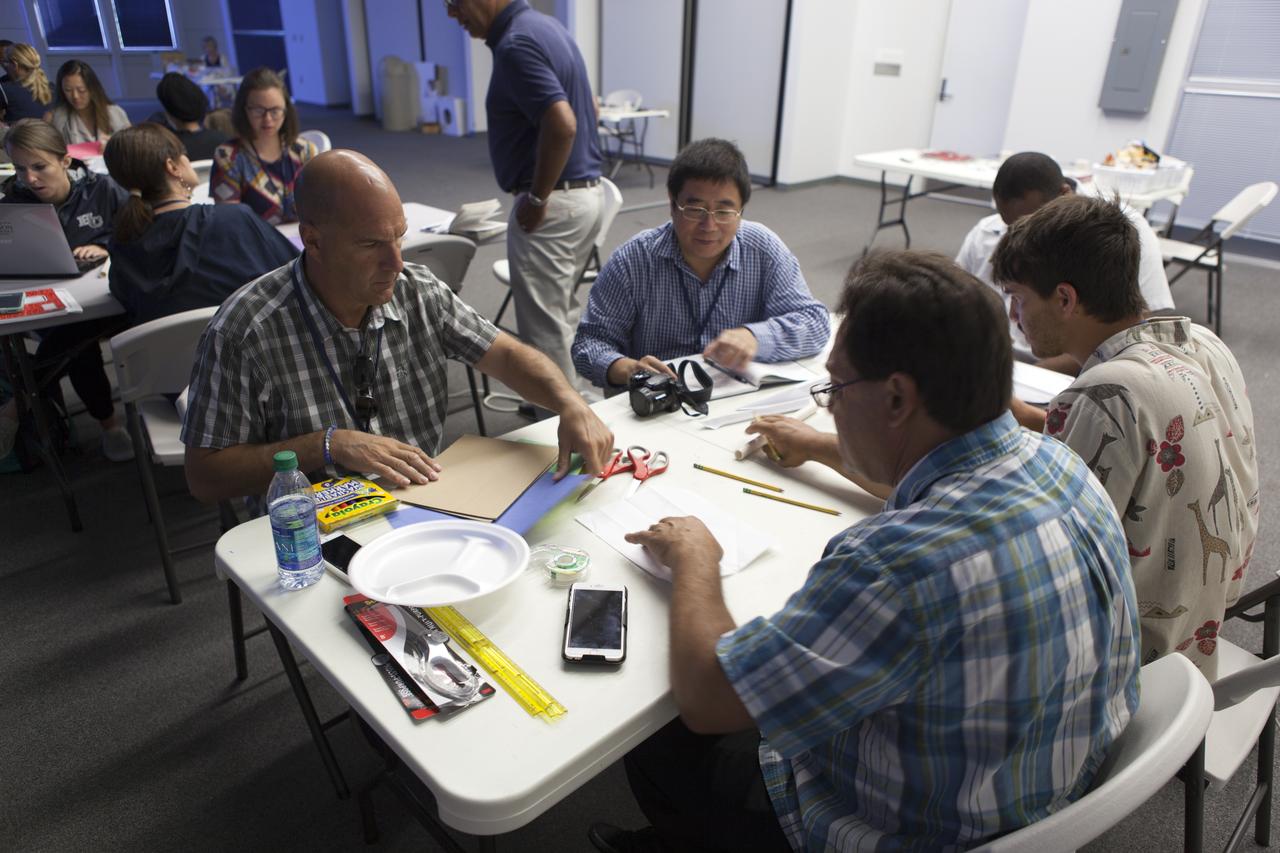
Teachers participate in the Rocketry Engineering Design Challenge during the 2017 GE Foundation High School STEM Integration Conference at the Center for Space Education at NASA's Kennedy Space Center. High school teachers from across the country took part in the week-long conference, which is designed to explore effective ways for teachers, schools and districts from across the country to integrate STEM throughout the curriculum. The conference is a partnership between GE Foundation and the National Science Teachers Association.
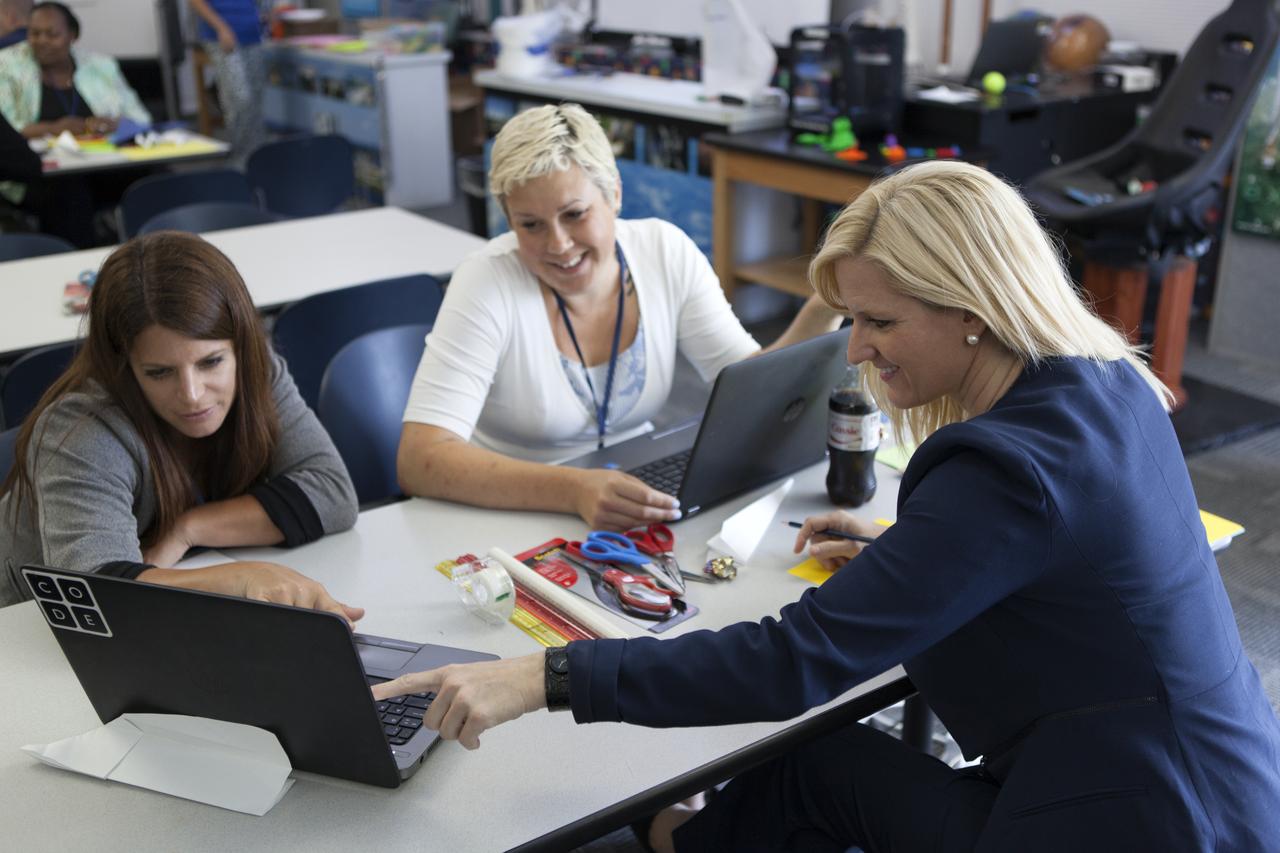
Teachers participate in the Rocketry Engineering Design Challenge during the 2017 GE Foundation High School STEM Integration Conference at the Center for Space Education at NASA's Kennedy Space Center. High school teachers from across the country took part in the week-long conference, which is designed to explore effective ways for teachers, schools and districts from across the country to integrate STEM throughout the curriculum. The conference is a partnership between GE Foundation and the National Science Teachers Association.
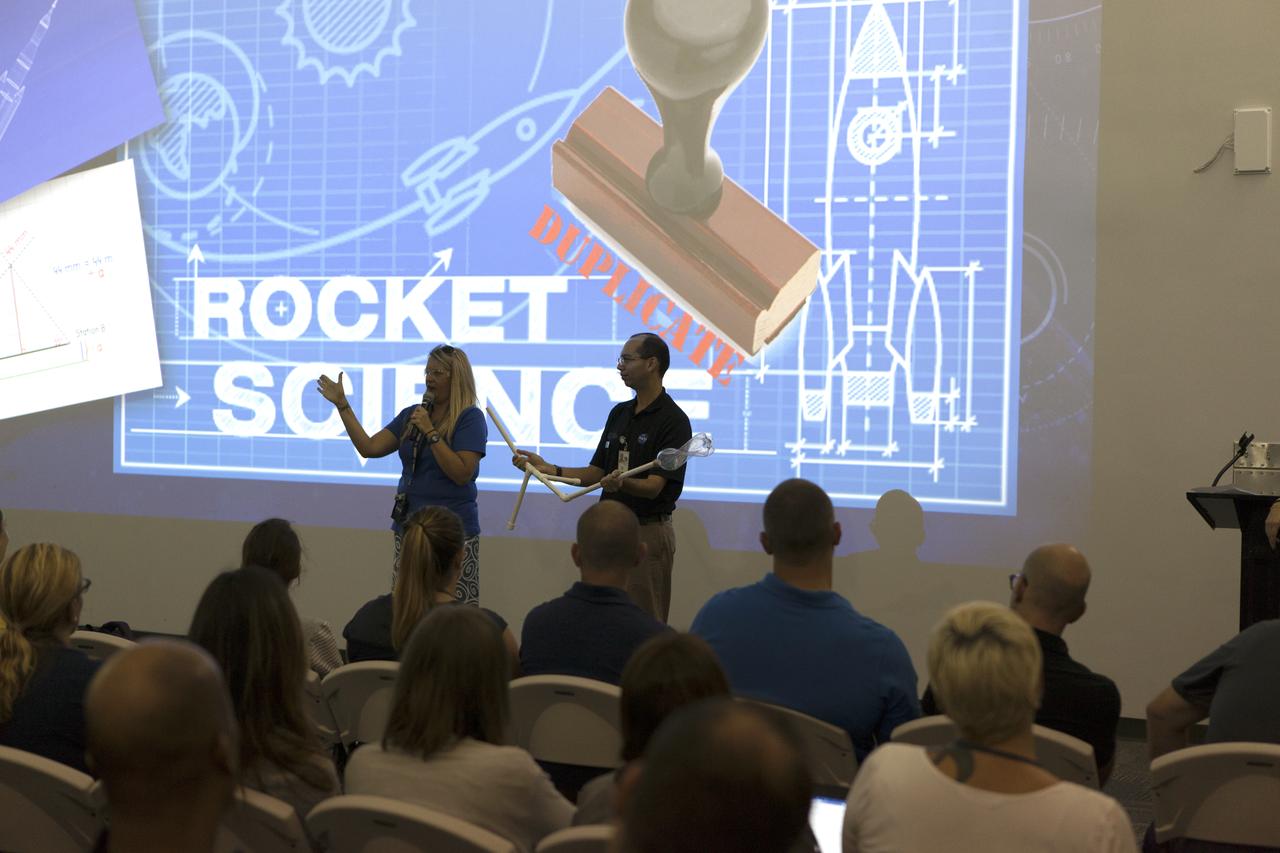
Education Specialists Lynn Dotson, left, of the NASA Public Engagement Center, and Lester Morales, right, of Texas State University's NASA STEM Educator Professional Development Collaborative, explain the Rocketry Engineering Design Challenge to teachers participating in the 2017 GE Foundation High School STEM Integration Conference at the Center for Space Education at NASA's Kennedy Space Center. High school teachers from across the country took part in the week-long conference, which is designed to explore effective ways for teachers, schools and districts from across the country to integrate STEM throughout the curriculum. The conference is a partnership between GE Foundation and the National Science Teachers Association.
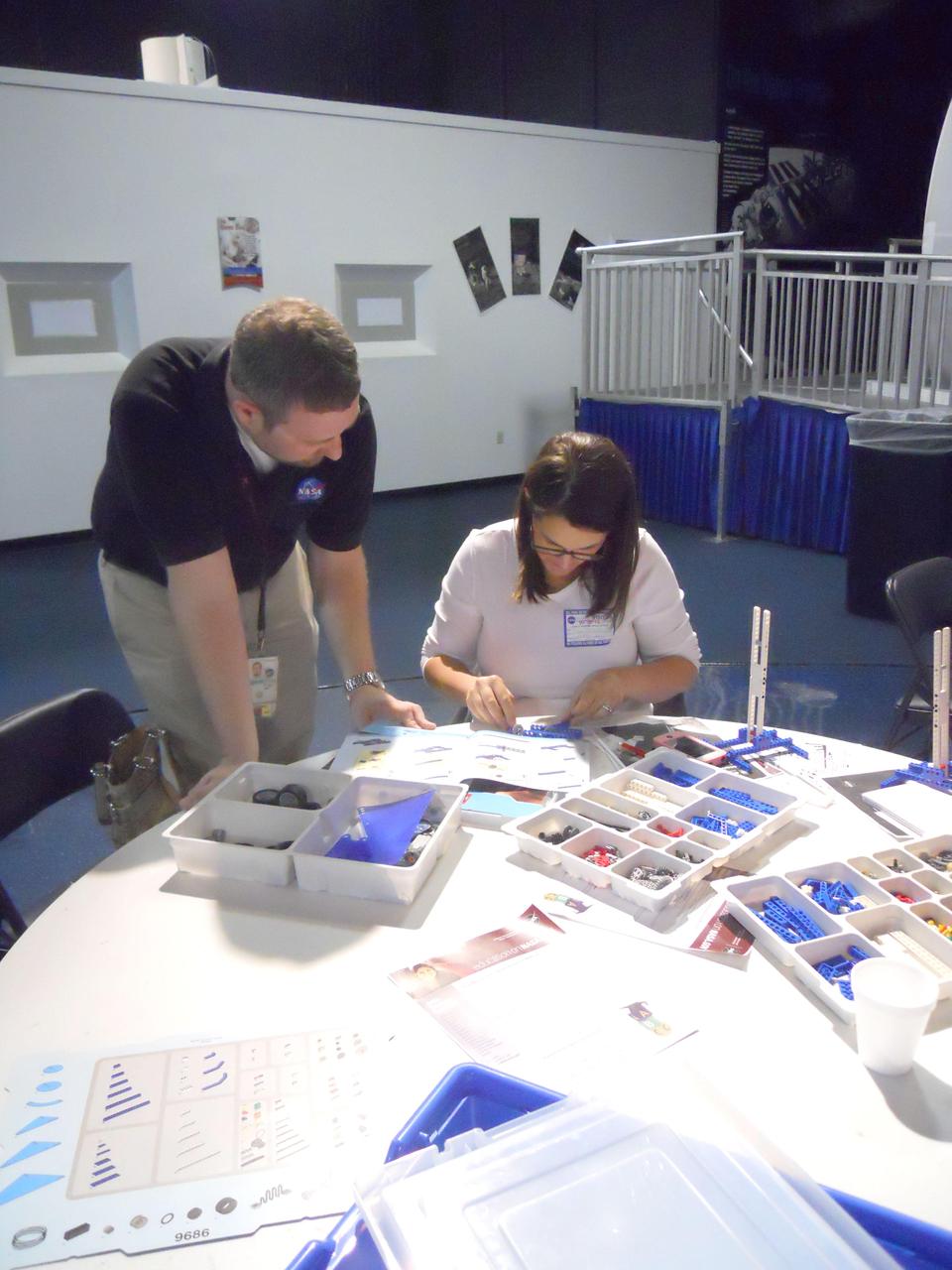
John C. Stennis Space Center educators and area teachers partnered together during a professional development workshop Oct. 20 to learn about the LEGO Bricks in Space curriculum issued by NASA. The curriculum is designed to encourage students in areas of science, technology, engineering and mathematics. The Stennis Space Center Educator Resource Center hosted the workshop to equip teachers of grades 3-12.
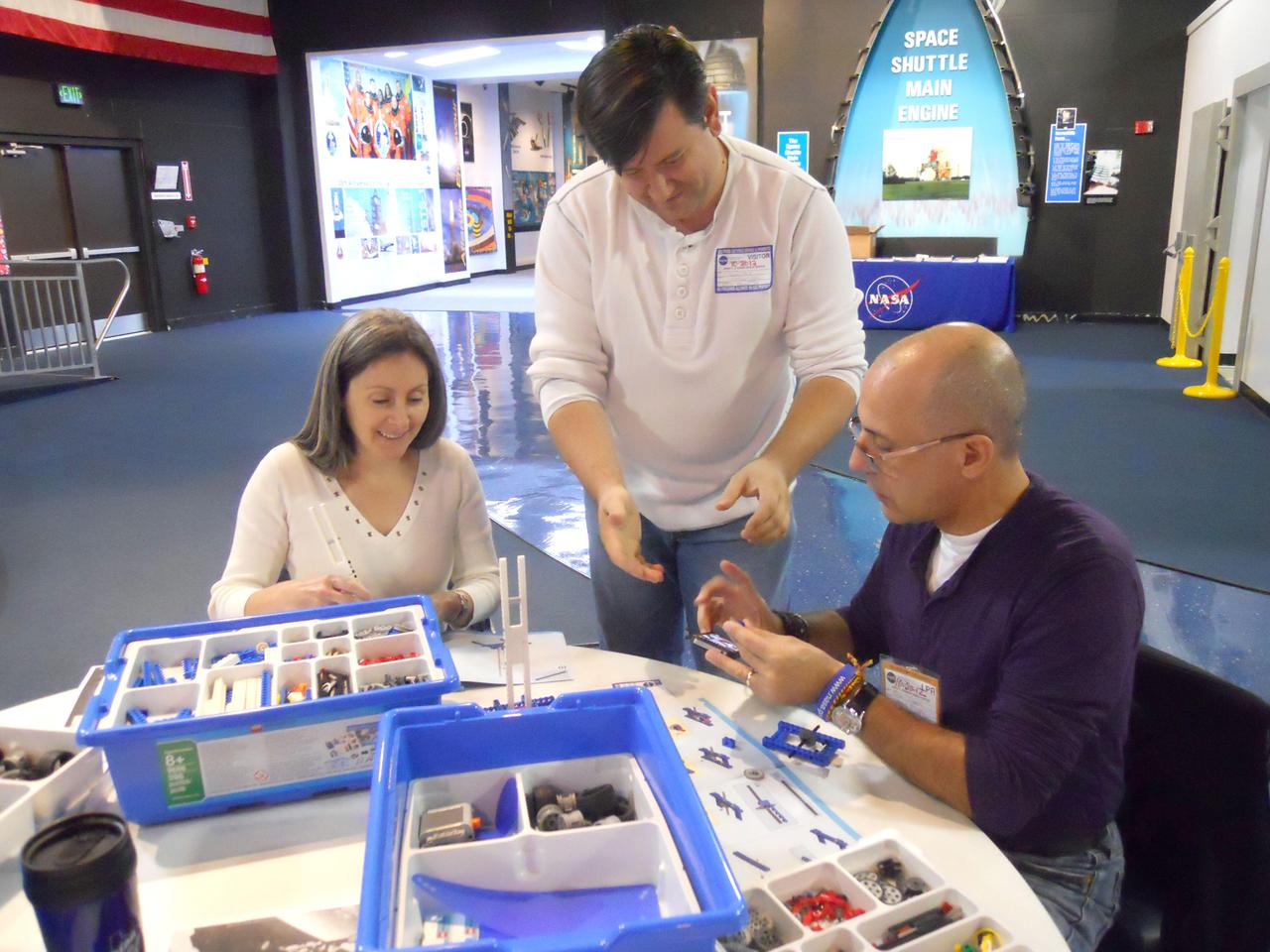
The John C. Stennis Space Center Educator Resource Center hosted an Oct. 20 workshop to equip teachers of grades 3 through 12 in using the LEGO Bricks in Space curriculum issued by NASA. Participants in the professional development workshop built their own LEGO simple machine prototypes and explored the engineering principles that make them work (on Earth and in space).
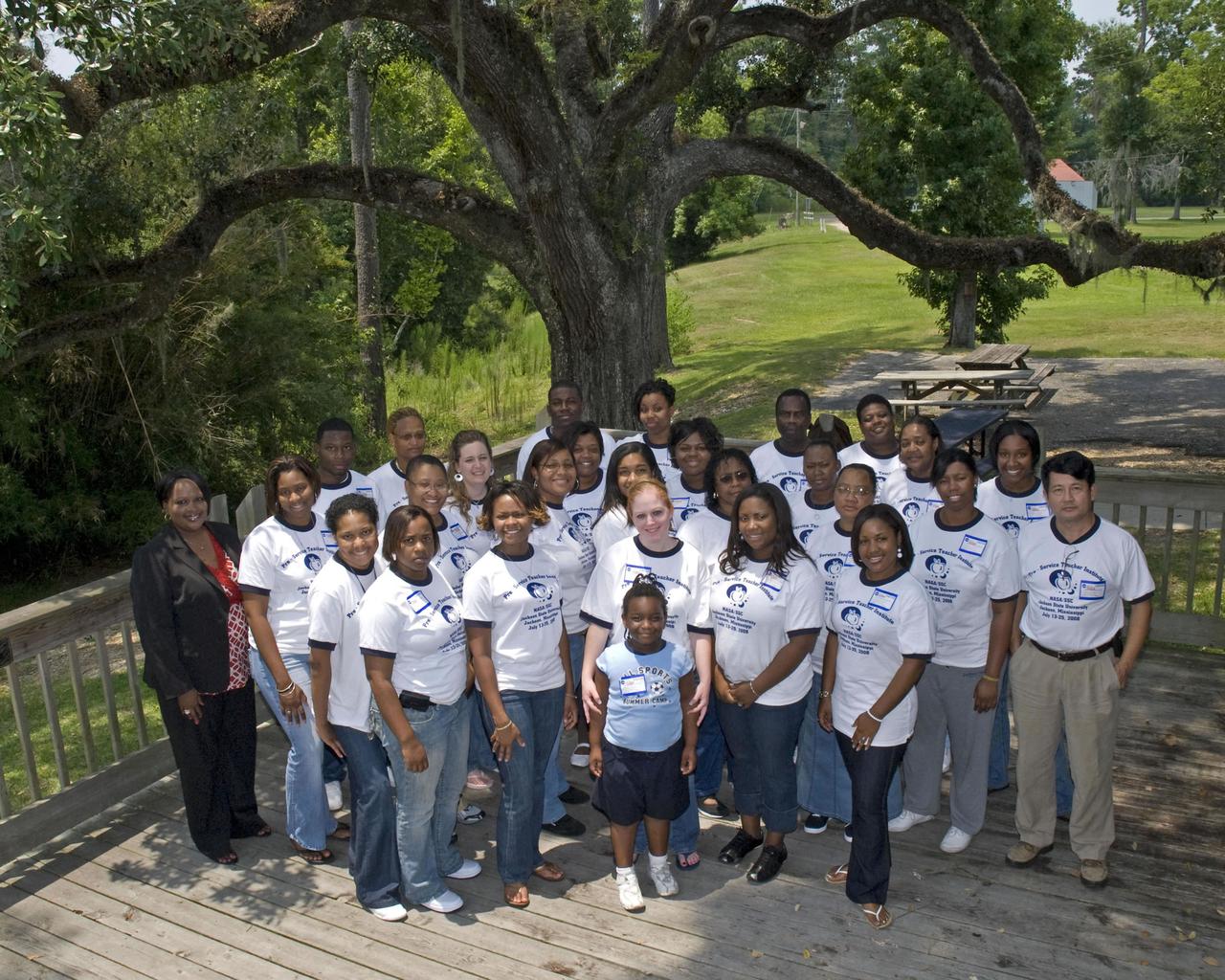
The Pre-Service Teachers Institute sponsored by Jackson (Miss.) State University participated in an agencywide Hubble Space Telescope workshop at Stennis Space Center on July 18. Twenty-five JSU junior education majors participated in the workshop, a site tour and educational presentations by Karma Snyder of the NASA SSC Engineering & Safety Center and Anne Peek of the NASA SSC Deputy Science & Technology Division.
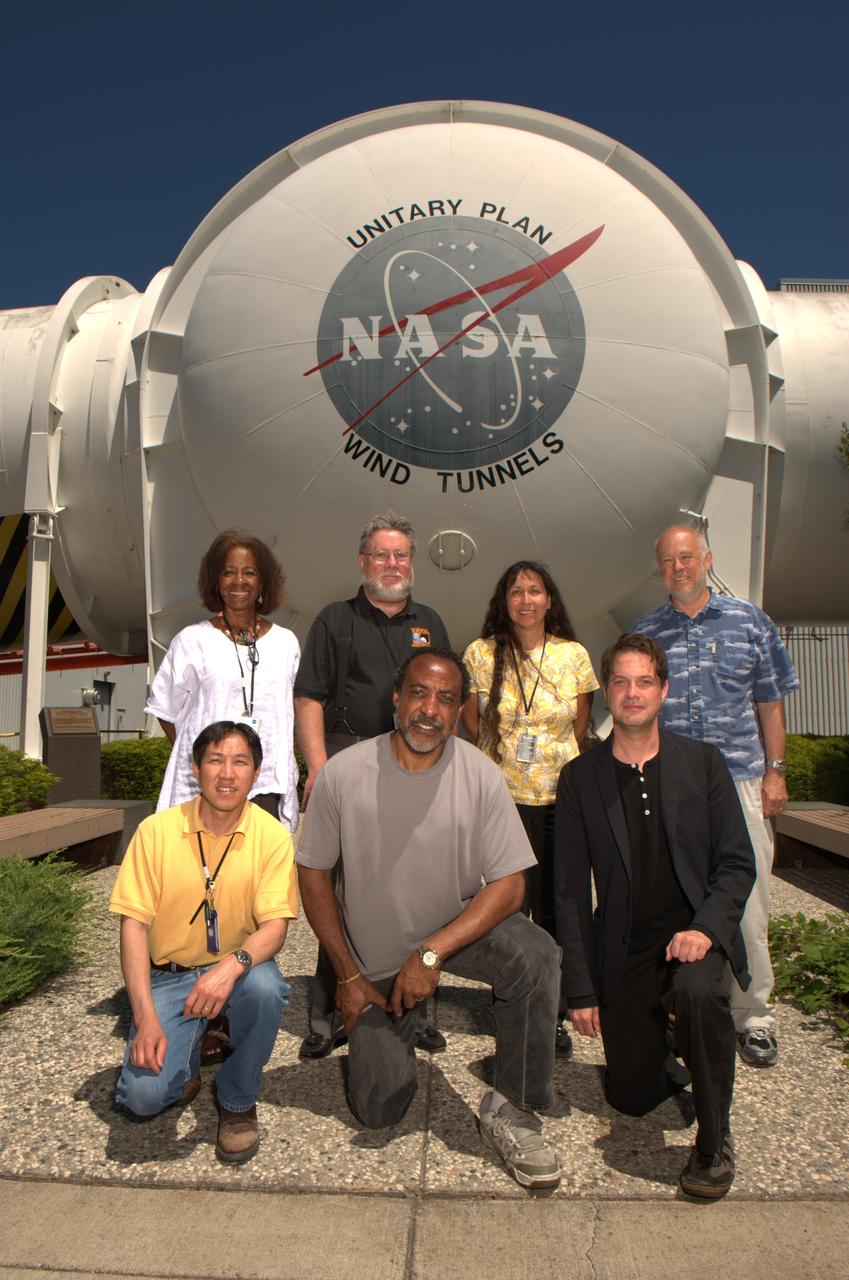
MODIM Teacher Professional Development Pilot Team (for Group Achievement Award) Frank Hui, Vern Battiste, David Hash, Leslye Mogford, Erie Fretter, Imelda Terresas-Salinas, Walter Johnson.
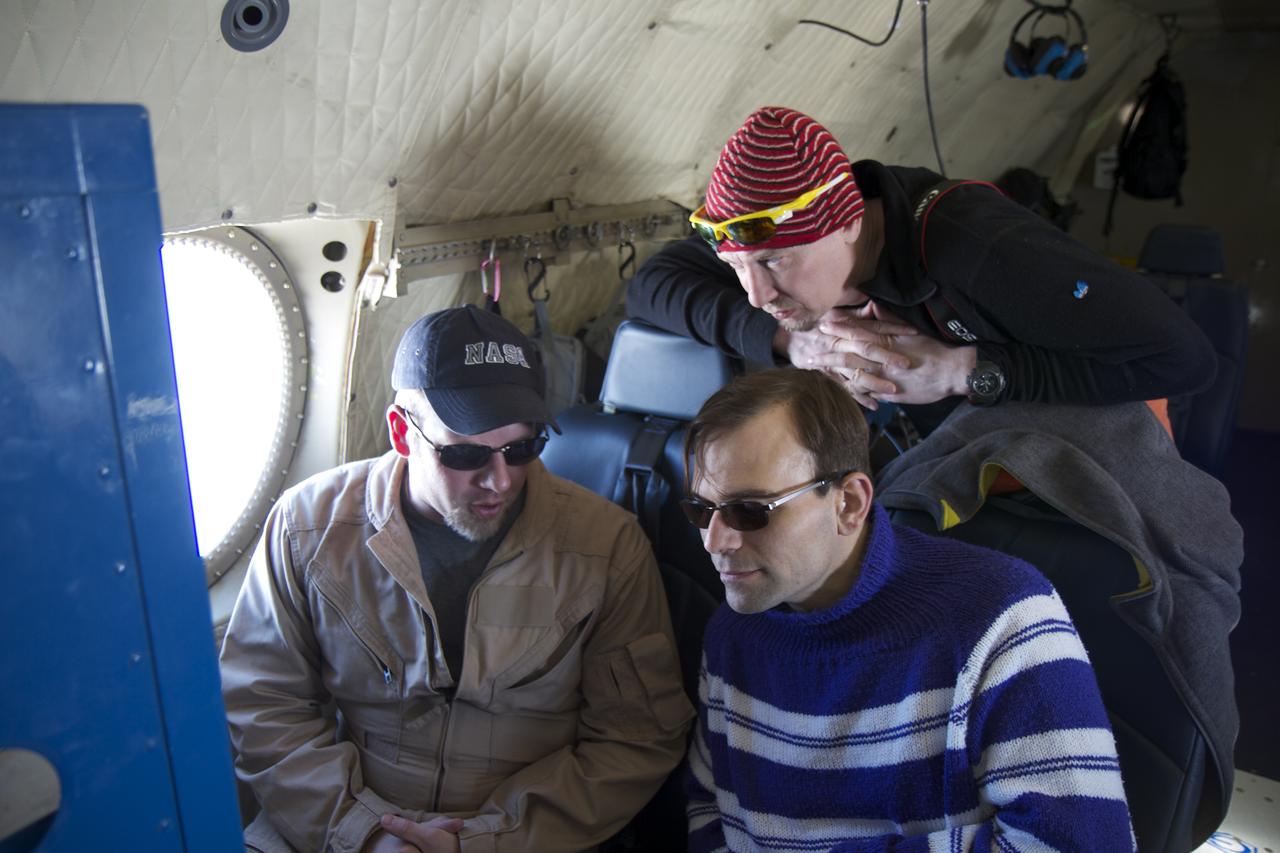
James Jacobson, a Data Analyst based out of Ames Research Center, explains his Digital Mapping System instrument to two teachers flying with Operation IceBridge, (top to bottom) Tom Koch Svennesen, of Greenland, and Peter Gross, of Denmark, on April 14, 2012. Credit: NASA/Jefferson Beck ============= IceBridge, a six-year NASA mission, is the largest airborne survey of Earth's polar ice ever flown. It will yield an unprecedented three-dimensional view of Arctic and Antarctic ice sheets, ice shelves and sea ice. These flights will provide a yearly, multi-instrument look at the behavior of the rapidly changing features of the Greenland and Antarctic ice. To read more about this mission go to: <a href="http://www.nasa.gov/mission_pages/icebridge/index.html" rel="nofollow">www.nasa.gov/mission_pages/icebridge/index.html</a> <b><a href="http://www.nasa.gov/audience/formedia/features/MP_Photo_Guidelines.html" rel="nofollow">NASA image use policy.</a></b> <b><a href="http://www.nasa.gov/centers/goddard/home/index.html" rel="nofollow">NASA Goddard Space Flight Center</a></b> enables NASA’s mission through four scientific endeavors: Earth Science, Heliophysics, Solar System Exploration, and Astrophysics. Goddard plays a leading role in NASA’s accomplishments by contributing compelling scientific knowledge to advance the Agency’s mission. <b>Follow us on <a href="http://twitter.com/NASA_GoddardPix" rel="nofollow">Twitter</a></b> <b>Like us on <a href="http://www.facebook.com/pages/Greenbelt-MD/NASA-Goddard/395013845897?ref=tsd" rel="nofollow">Facebook</a></b> <b>Find us on <a href="http://instagrid.me/nasagoddard/?vm=grid" rel="nofollow">Instagram</a></b>
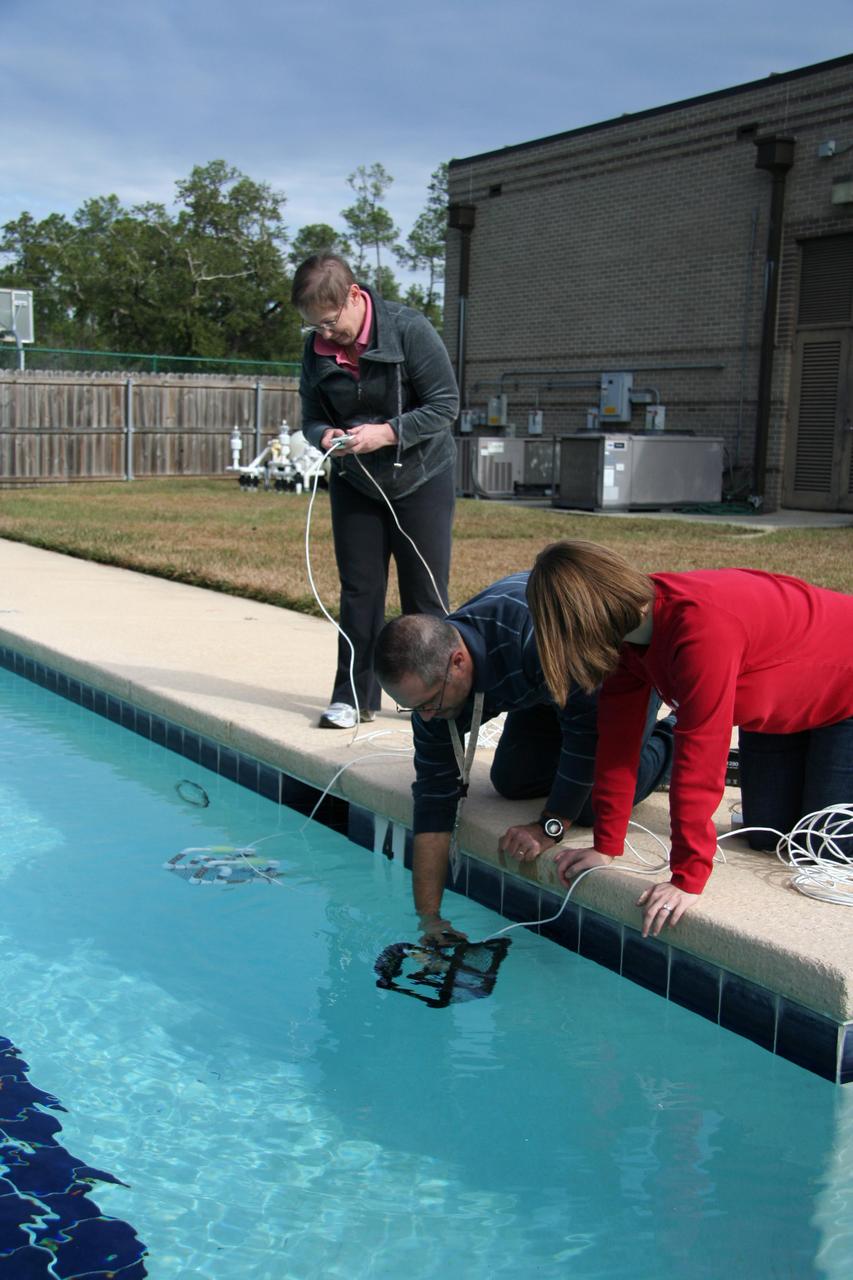
David Lalejini, an employee of the Naval Research Laboratory at NASA's John C. Stennis Space Center, helps a pair of teachers deploy a remotely-operated underwater Sea Perch robot during workshop activities Dec. 11. The Stennis Education Office teamed with Naval Research Laboratory counterparts to conduct a two-day workshop Dec. 10-11 for Louisiana and Mississippi teachers. During the no-cost workshop, teachers learned to build and operate Sea Perch robots. The teachers now can take the Sea Perch Program back to students.
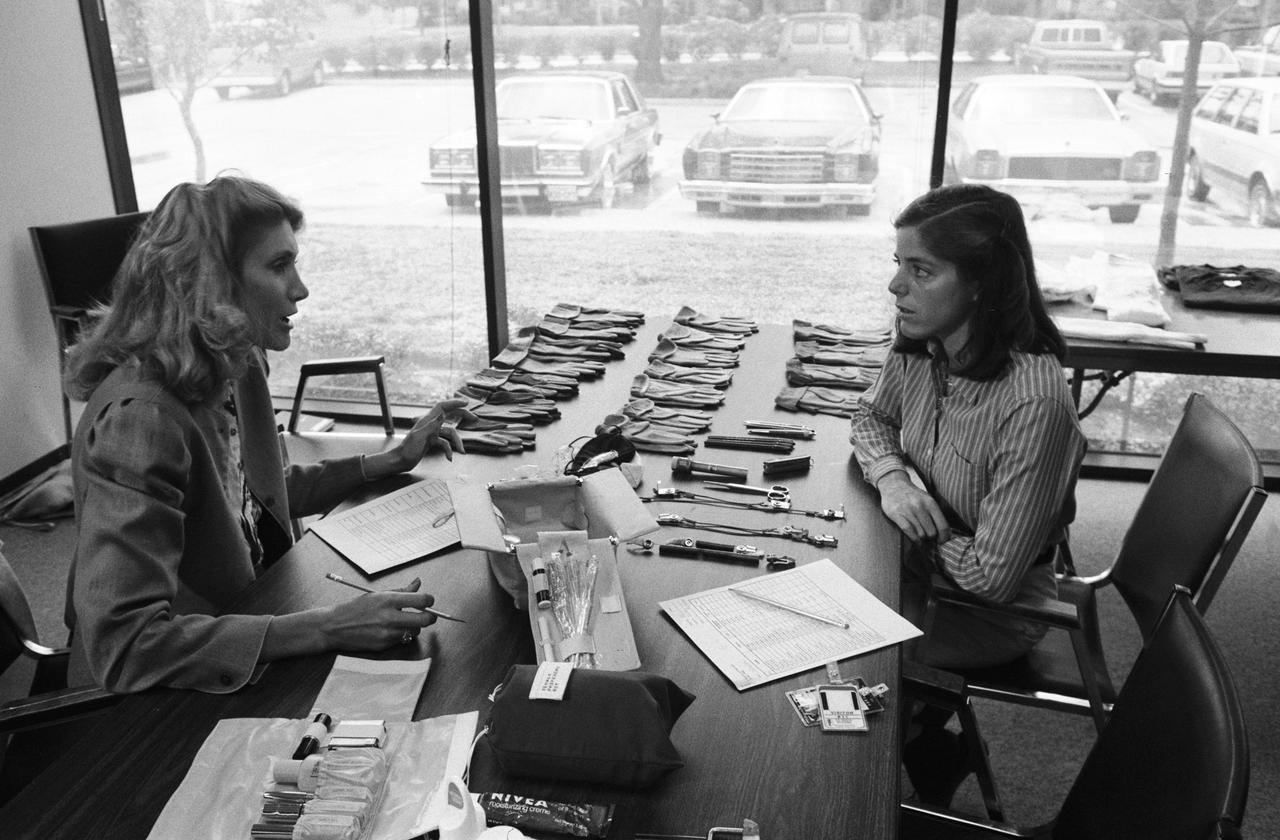
Views of STS-33/51L crew personnel Prime McAuliffe and Backup Morgan at the ILC Facility during clothing selection and Building #37 during food sampling, and with the rest of the STS-33/51L crew. 40074: "Teacher-in-Space" Participant Barbara Morgan (right) is briefed on her suit and on personal hygiene equipment to be used on the STS-51L Mission. 1. JSC - Education Program (Teacher in Space) 2. Barbara Morgan 3. Christa McAuliffe 4. STS-33/51L - Crew Training (Uniforms/Food/Crew)
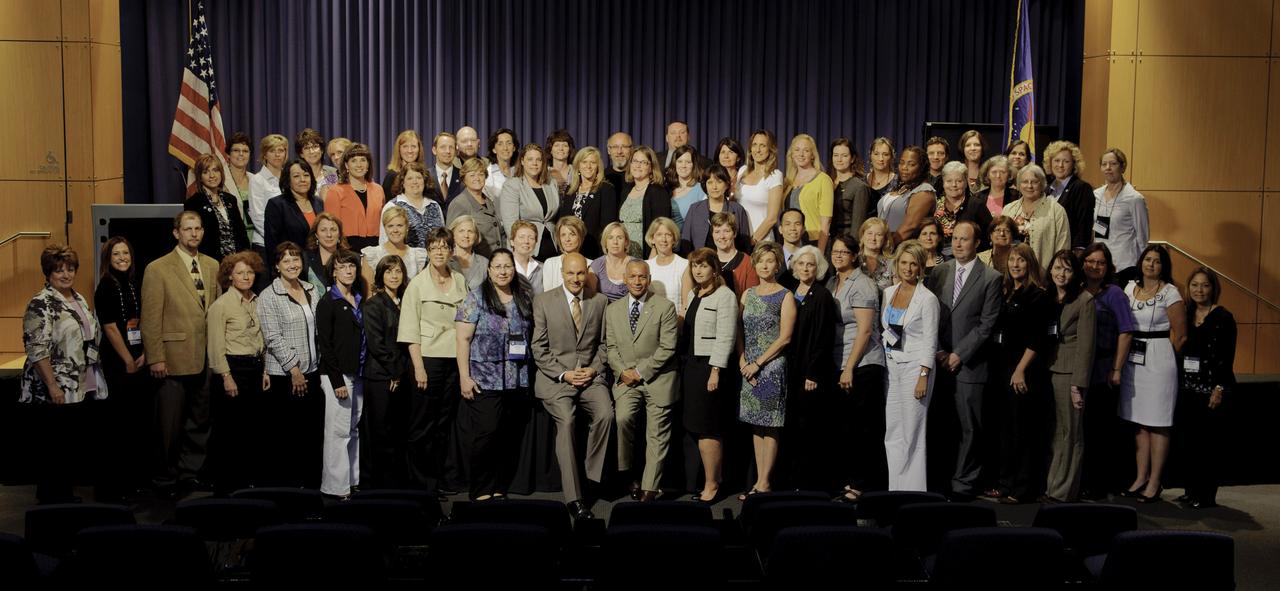
Recipients of the Presidential Award for Excellence in Mathematics and Science Teaching stand together with NASA Administrator Charles Bolden and chief scientist Waleed Abdalati, center, at NASA Headquarters in Washington on Wednesday, May 19, 2011. Photo Credit: (NASA/Paul E. Alers)
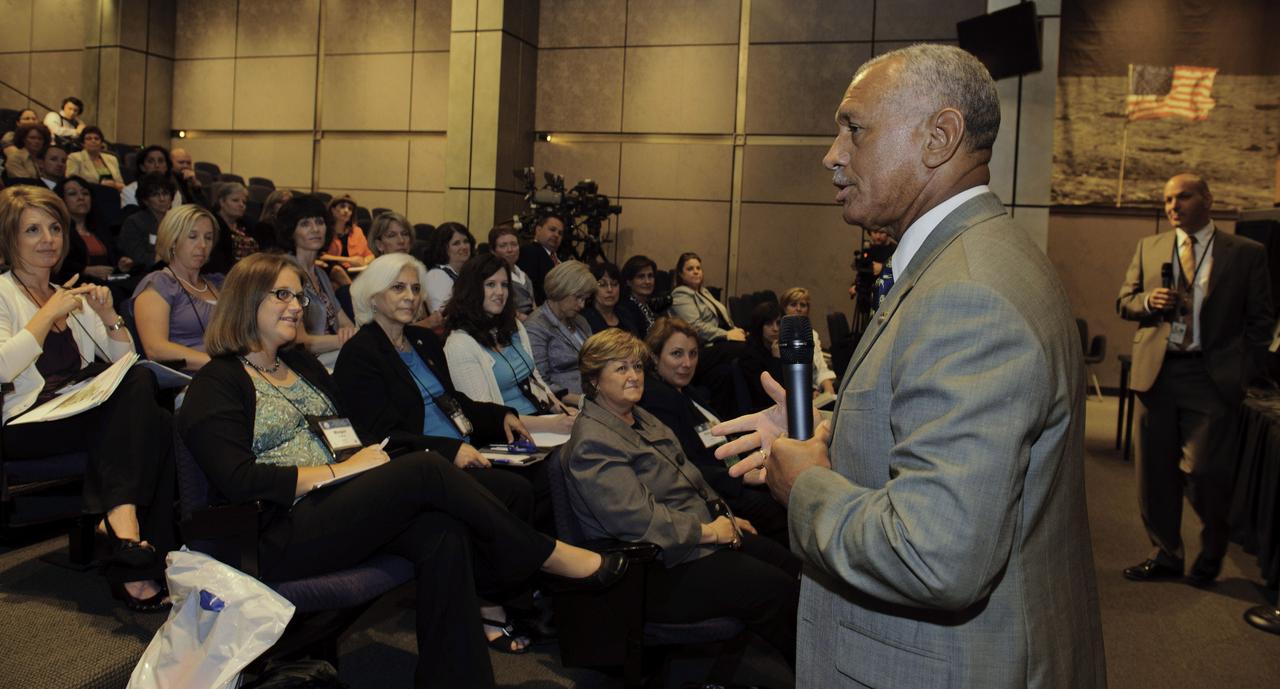
NASA Administrator Charles Bolden speaks to recipients of the Presidential Award for Excellence in Mathematics and Science Teaching at NASA Headquarters in Washington on Wednesday, May 19, 2011. Photo Credit: (NASA/Paul E. Alers)
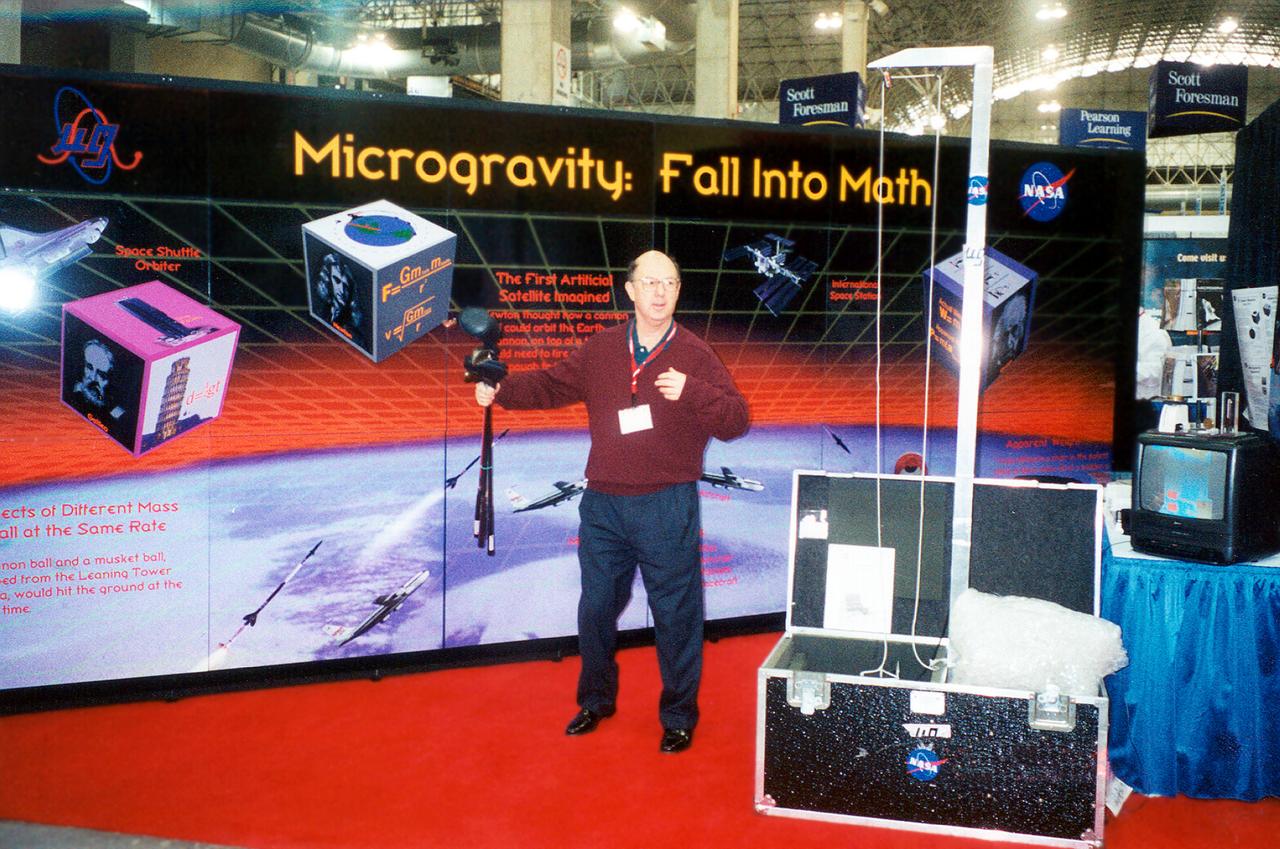
Don Gillies, a materials scientist at NASA/Marshall Space Flight Center (MSFC), demonstrates the classroom-size Microgravity Drop Tower Demonstrator. The apparatus provides 1/6 second of microgravity for small experiments. A video camera helps teachers observe what happens inside the package. This demonstration was at the April 2000 conference of the National Council of Teachers of Mathematics (NCTM) in Chicago. Photo credit: NASA/Marshall Space Flight Center (MSFC)
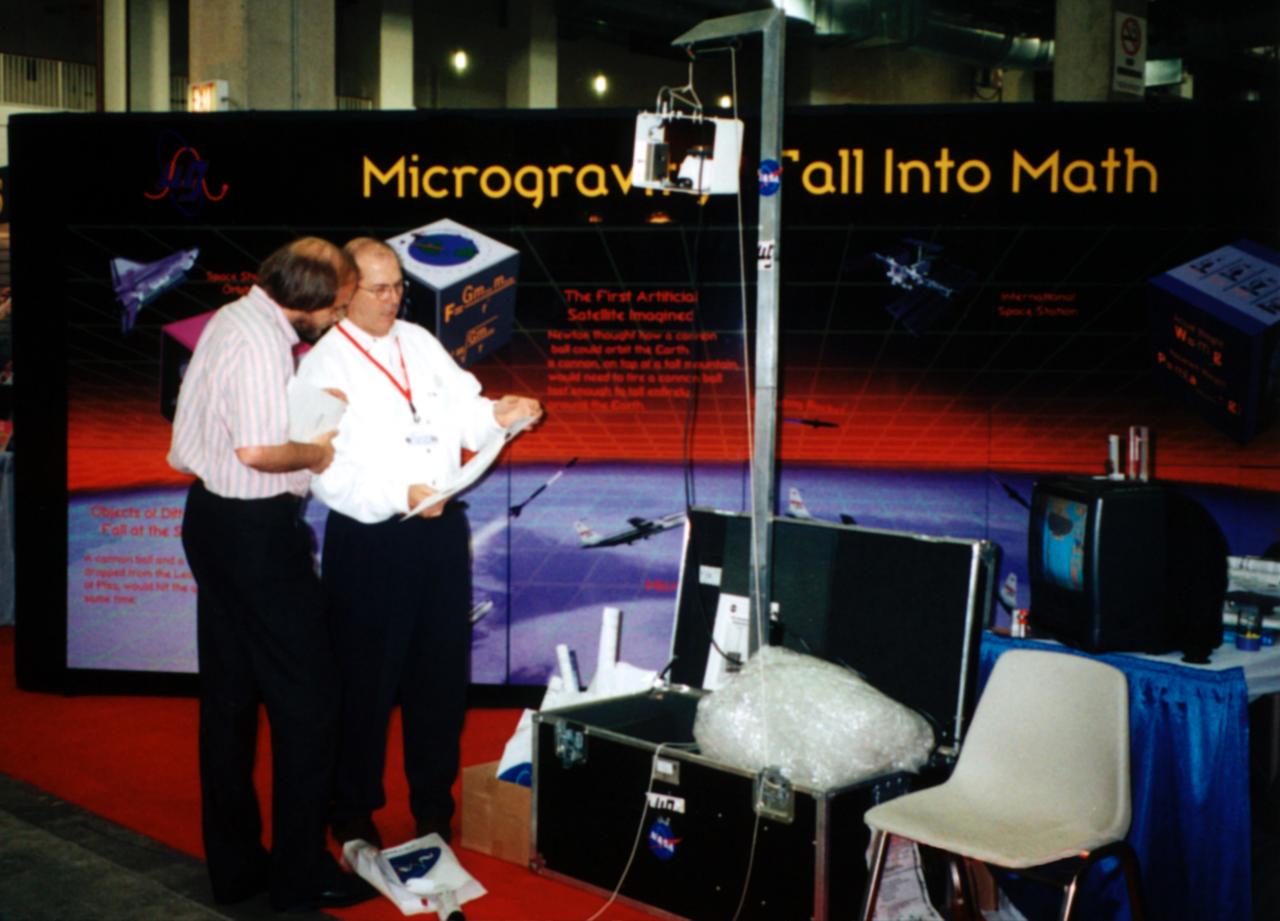
Jimmy Grisham of the Microgravity Program Plarning Integration Office at NASA/Marshall Space Flight Center, demonstrates the classroom-size Microgravity Drop Tower Demonstrator. The apparatus provides 1/6 second of microgravity for small experiments. A video camera helps teachers observe what happens inside the package. This demonstration was at the April 2000 conference of the National Council of Teachers of Mathematics (NCTM) in Chicago. Photo credit: NASA/Marshall Space Flight Center (MSFC)
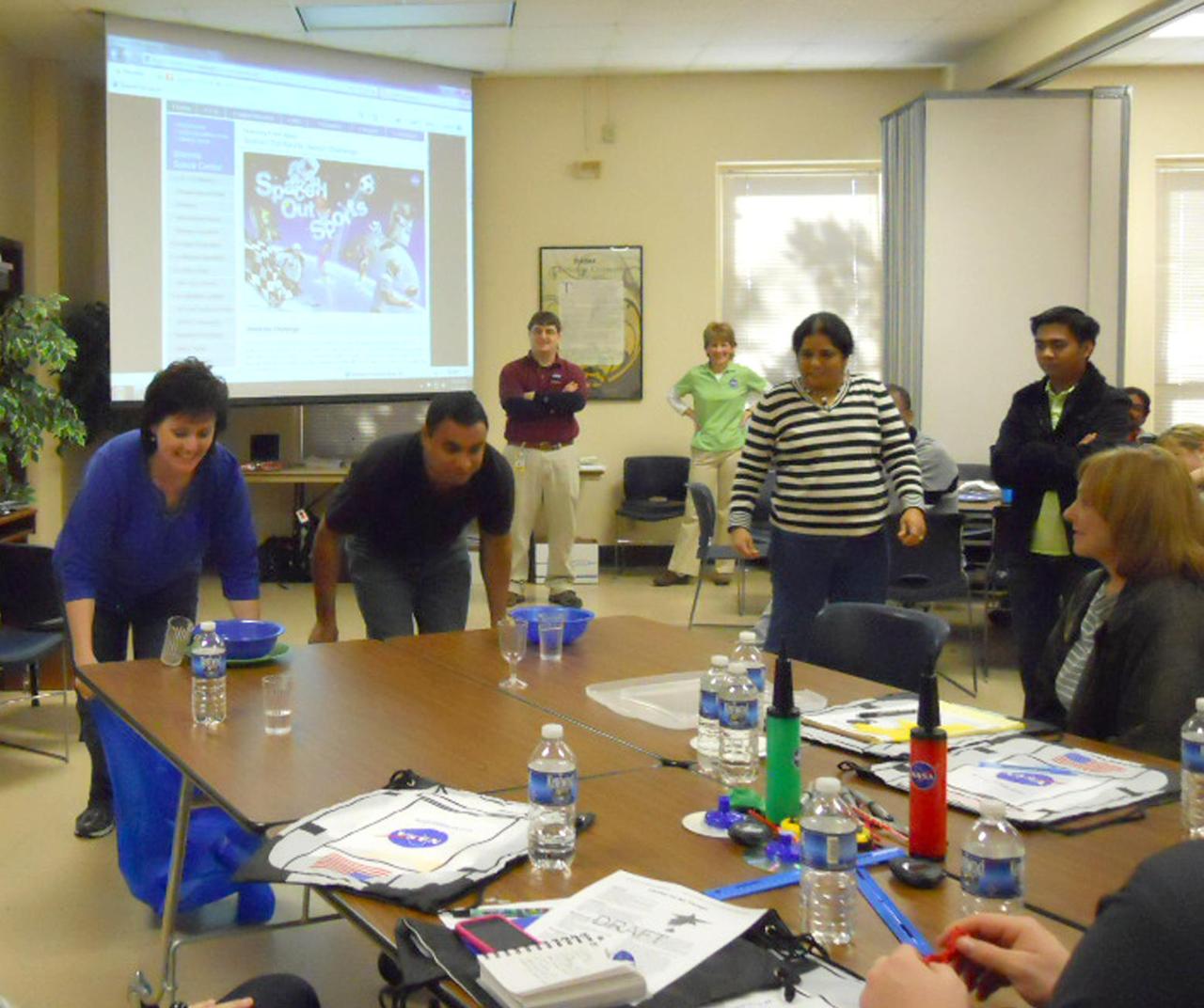
Middle school teachers from across Louisiana participate in a hands-on activity during a professional development workshop at Louisiana State University in Baton Rouge on Jan. 22, 2011. Fifty-five teachers participated in the workshop, which was hosted by the Stennis Education Office. During the workshop, Stennis specialists presented hands-on, problem-based learning and technology-based activities teachers can use in their classrooms to promote interest in areas of science, technology, engineering and mathematics.
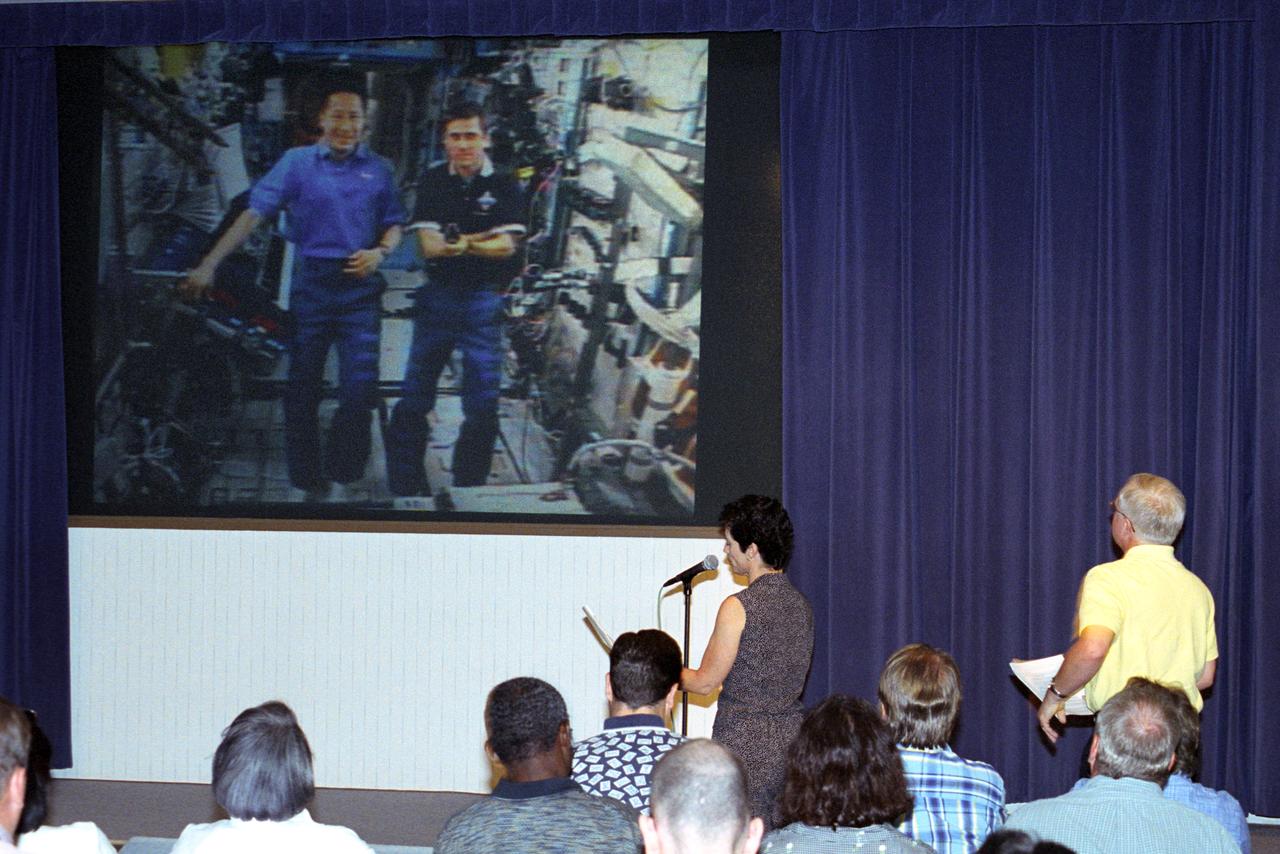
Teacher Kim Cantrell from the Edwards Air Force Base Middle School, Edwards, Calif., participating in a live uplink at NASA Dryden as part of NASA's Explorer Schools program, asks the crew of the International Space Station a question.
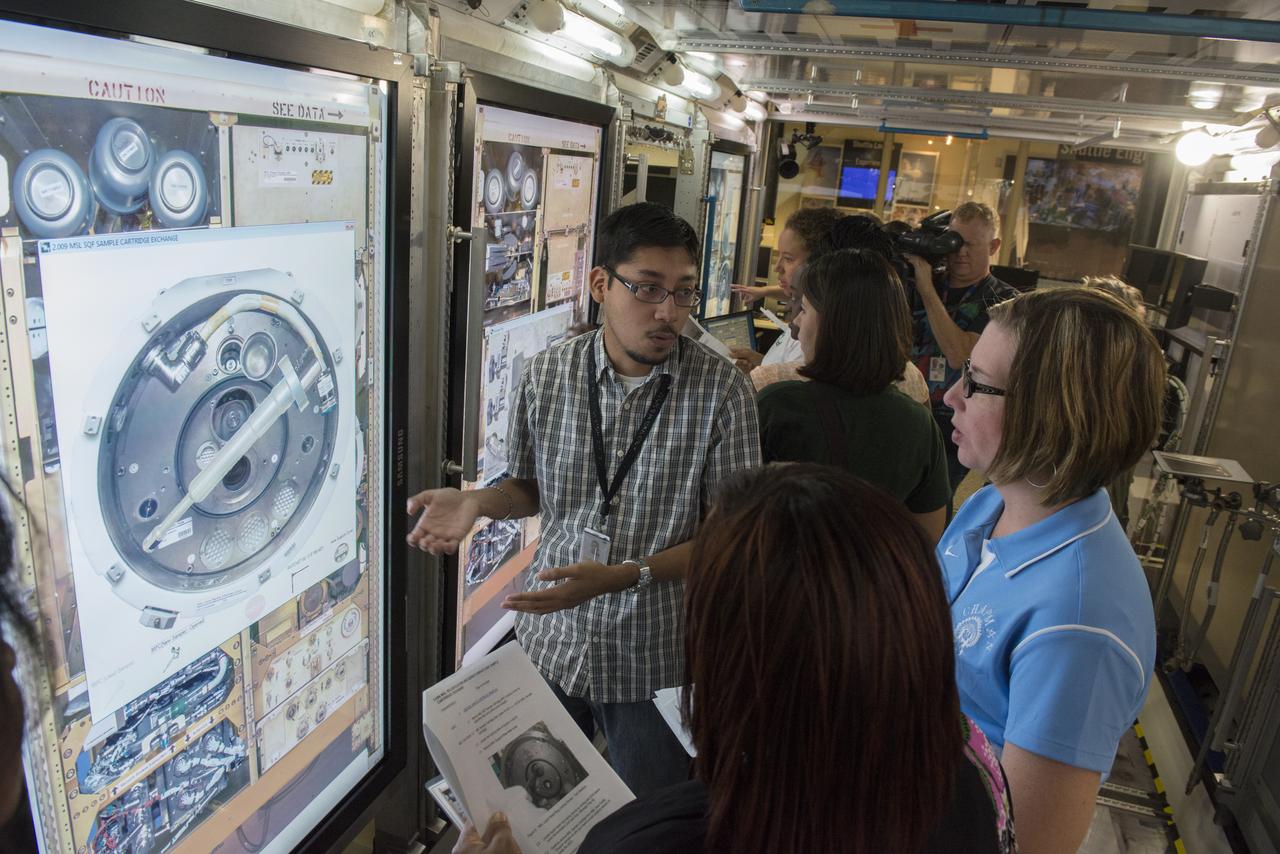
VINCENT VIDAURRI, CENTER, A TECHNICAL SPECIALIST WITH TELEDYNE BROWN ENGINEERING SUPPORTING MISSION OPERATIONS AT THE MARSHALL SPACE FLIGHT CENTER, PROVIDES DETAILS ABOUT A MOCK-UP OF THE INTERNATIONAL SPACE STATION SCIENCE LAB TO A GROUP OF AREA TEACHERS AS PART OF "BACK-2-SCHOOL DAY." TEAM REDSTONE -- WHICH INCLUDES THE MARSHALL SPACE FLIGHT CENTER AND U.S. ARMY ORGANIZATIONS ON REDSTONE ARSENAL -- INVITED 50 TEACHERS TO TOUR REDSTONE ARSENAL AUG. 15, GIVING THEM AN OPPORTUNITY TO LEARN OF AND SEE RESOURCES AVAILABLE TO THEM AND THEIR STUDENTS. THE TOUR FOCUSED ON SITES AVAILABLE FOR FIELD TRIPS FOR STUDENTS STUDYING MATH, SCIENCE, TECHNOLOGY AND ENGINEERING. STOPS INCLUDED MARSHALL'S PAYLOAD OPERATIONS INTEGRATION CENTER AND THE HIGH SCHOOLS UNITED WITH NASA TO CREATE HARDWARE LAB, OR HUNCH, BOTH LOCATED IN BUILDING 4663. THE PROGRAM GIVES HIGH SCHOOL STUDENTS THE CHANCE TO WORK WITH NASA ENGINEERS TO DESIGN AND BUILD HARDWARE FOR USE ON THE INTERNATIONAL SPACE STATION. THE TEACHERS ALSO VISITED THE ARMY AVIATION & MISSILE RESEARCH DEVELOPMENT & ENGINEERING CENTER AND THE REDSTONE TEST CENTER
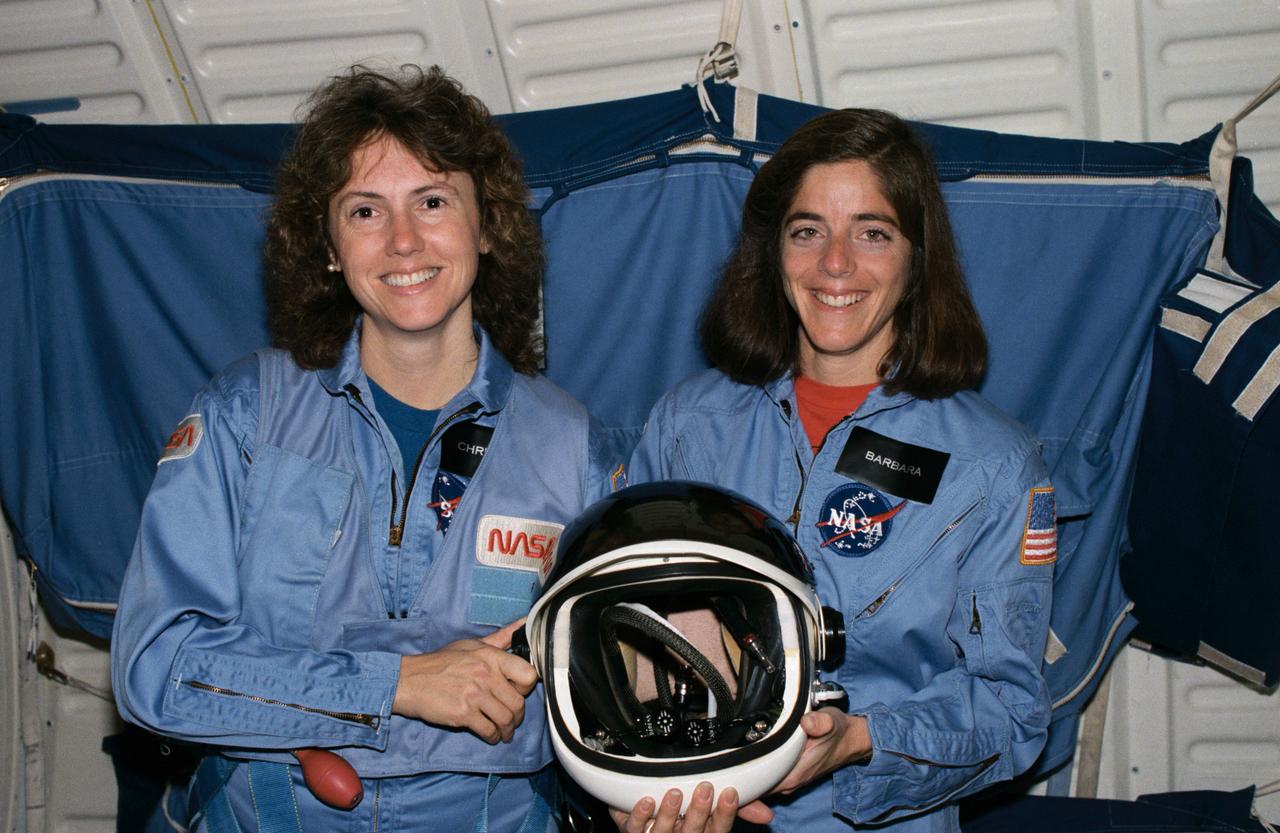
S85-46205 (December 1985) --- Sharon Christa McAuliffe (left), from Concord, New Hampshire, and Barbara R. Morgan of McCall, Idaho, have been named NASA Teacher-in-Space Project prime and backup payload specialists, respectively, for the first citizen observer position of the STS program, scheduled for a Challenger flight in January 1986. Photo credit: NASA

S85-41239 (26 Sept. 1985) --- Astronaut Sharon Christa McAuliffe, payload specialist Teacher in Space Project. NOTE: Payload specialist/teacher McAuliffe died in the STS-51L space shuttle Challenger accident, Jan. 28, 1986. Photo credit: NASA
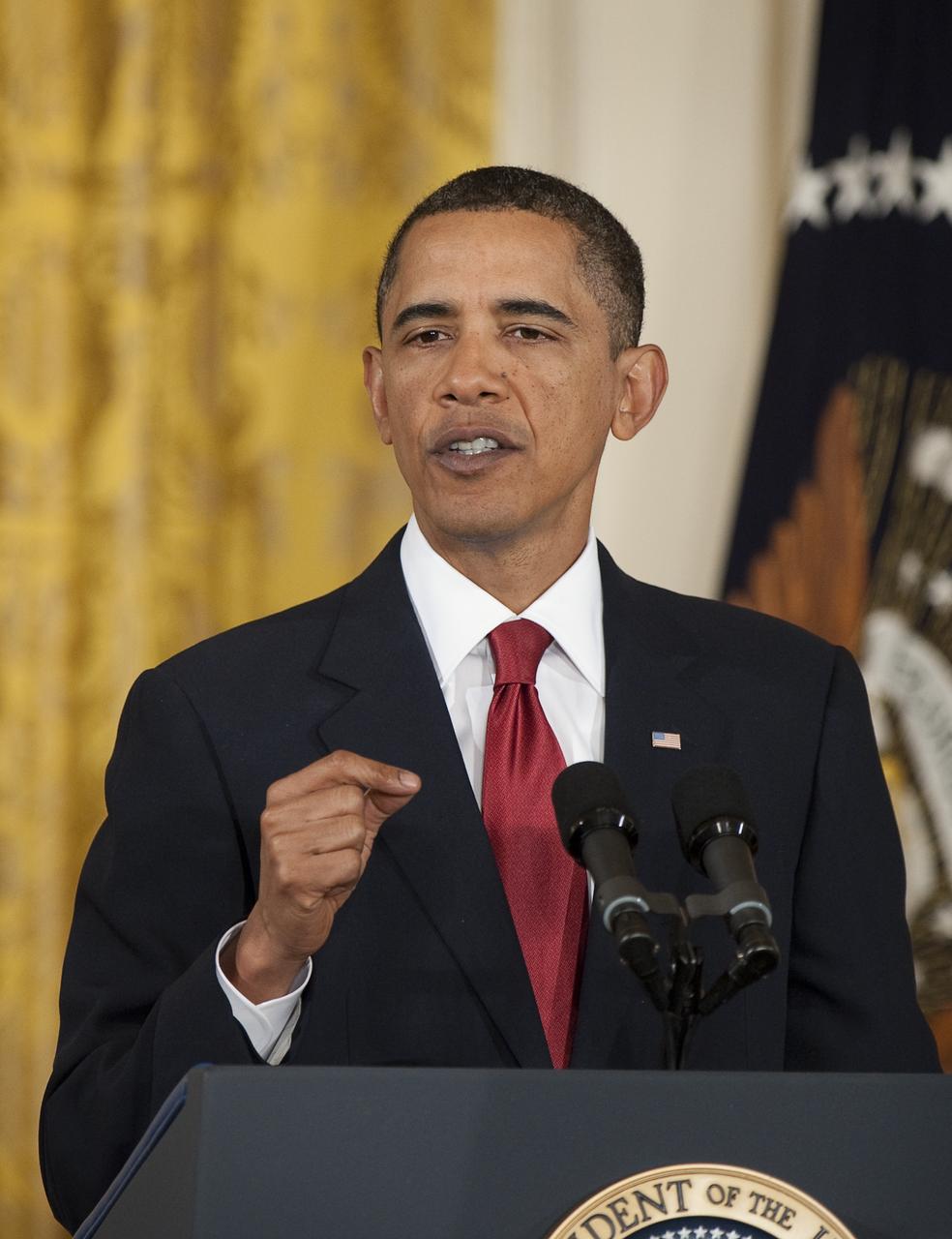
U.S. President Barack Obama speaks in the East Room of the White House in Washington, Wednesday, Jan. 6, 2010, during an 'Educate to Innovate' event where he honored teachers who received awards for excellence in Science, Technology, Engineering and Math (STEM) education. NASA's 'Summer of Innovation' program supports the President's 'Educate to Innovate' campaign. Photo Credit: (NASA/Bill Ingalls)
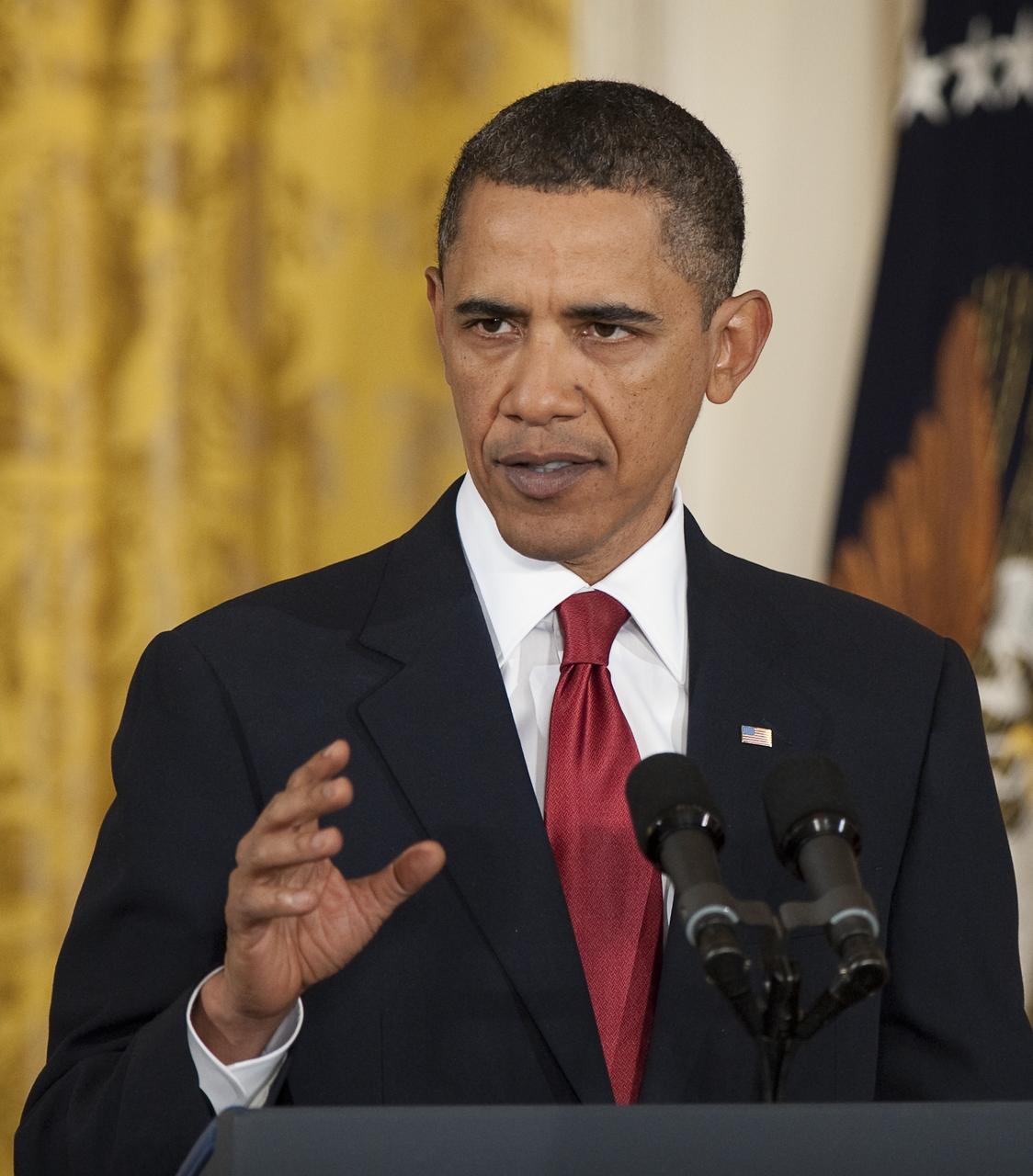
U.S. President Barack Obama speaks in the East Room of the White House in Washington, Wednesday, Jan. 6, 2010, during an 'Educate to Innovate' event where he honored teachers who received awards for excellence in Science, Technology, Engineering and Math (STEM) education. NASA's 'Summer of Innovation' program supports the President's 'Educate to Innovate' campaign. Photo Credit: (NASA/Bill Ingalls)
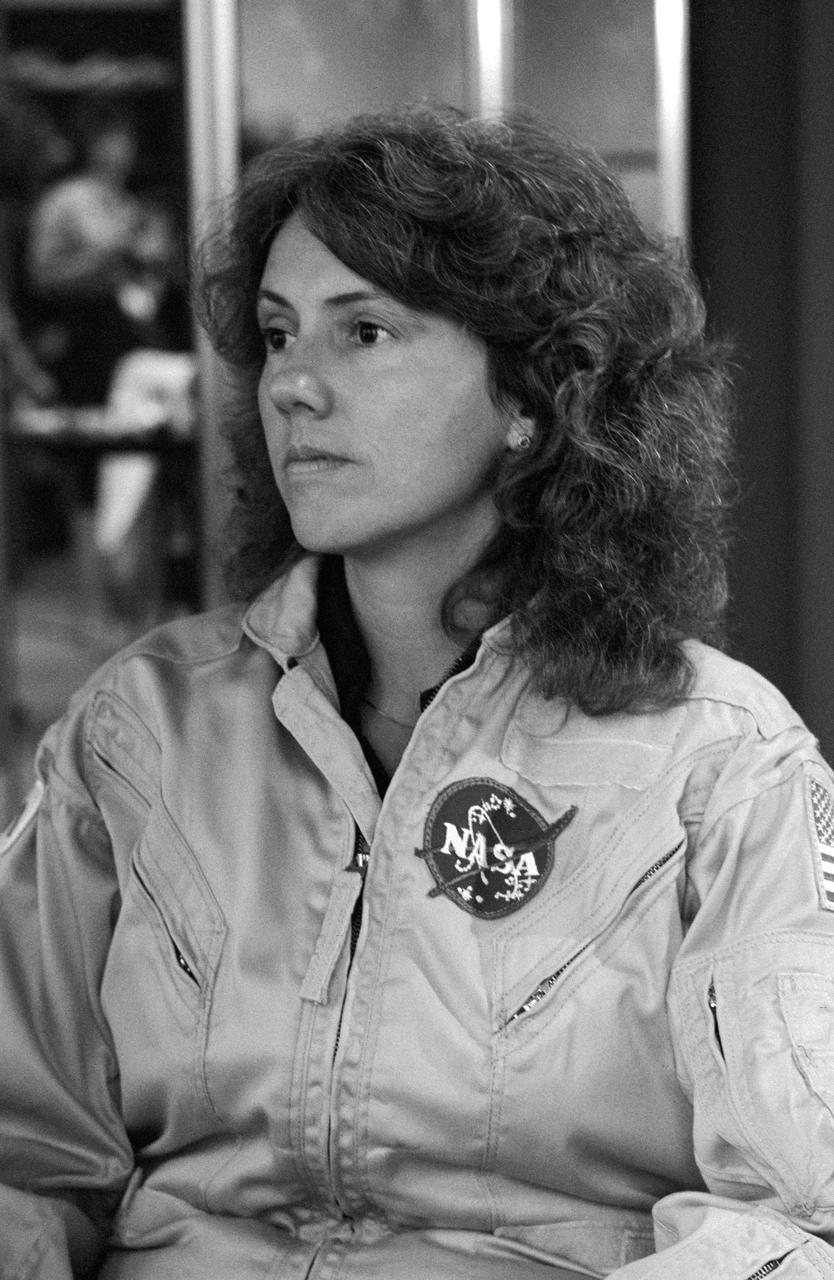
S85-40075 (12 Sept. 1985) --- Teacher-in-Space participant Christa McAuliffe is pictured during her briefing on suit and personal hygiene equipment to be used on the STS-51L mission. Photo credit: NASA
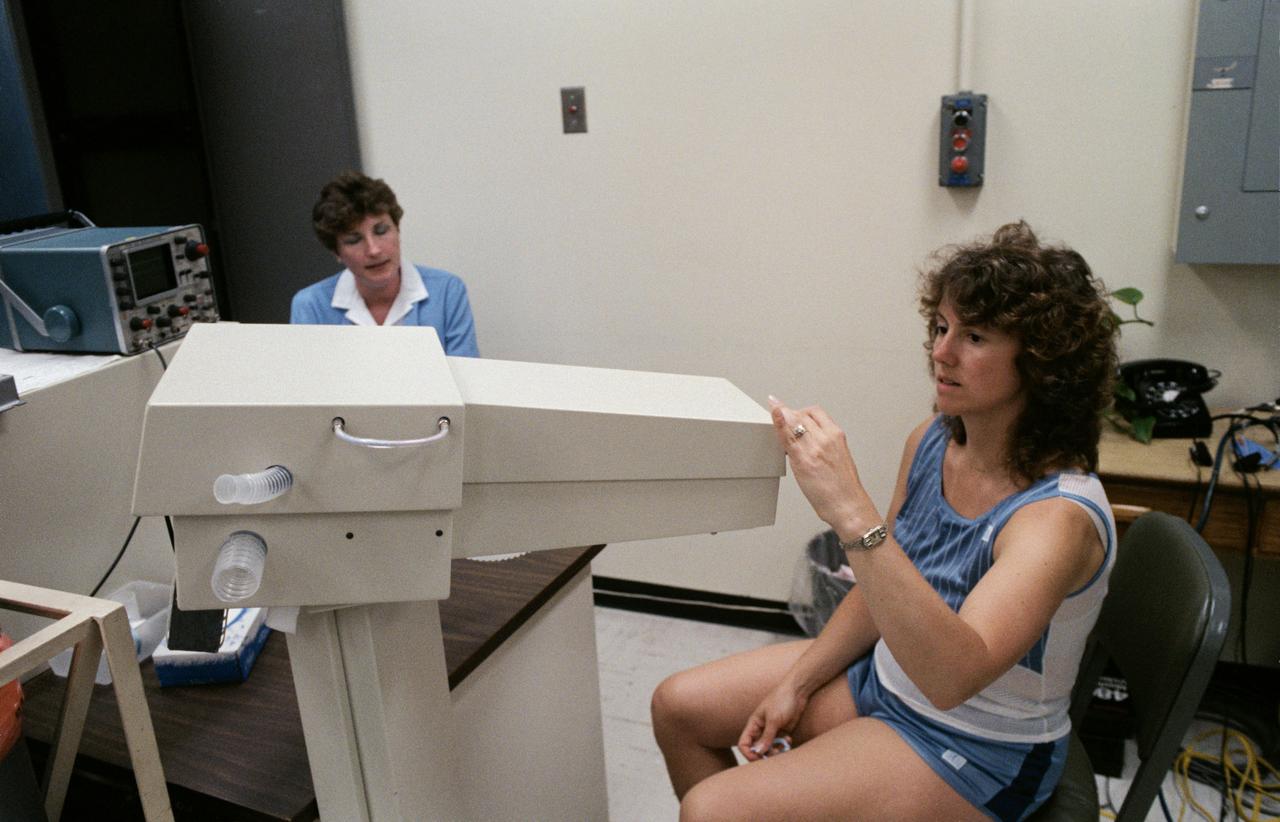
S85-36966 (10 July 1985) --- Teacher Sharon Christa McAuliffe prepares to test her lung capacity during medical examinations at the Johnson Space Center (JSC) clinic. Photo credit: NASA
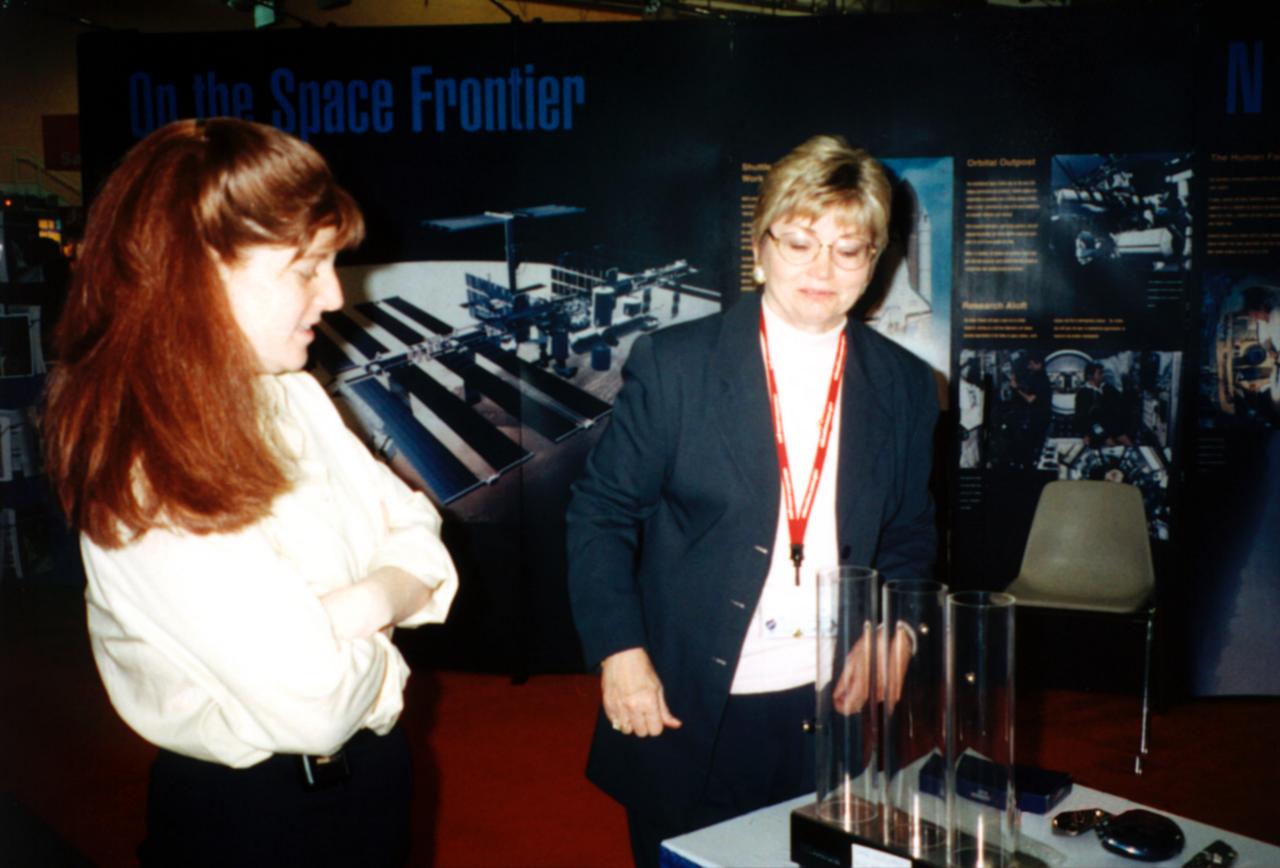
Pat Doty (right) of NASA/Marshall Space Flight Center (MSFC) demonstrates the greater bounce to the ounce of metal made from a supercooled bulk metallic glass alloy that NASA is studying in space expepriments. The metal plates at the bottom of plexiglass tubes are made of three different types of metal. Bulk mettalic glass is more resilient and, as a result, the dropped ball bearing bounces higher. Experiments in space allow scientists to study fundamental properties that carnot be observed on Earth. This demonstration was at the April 2000 conference of the National Council of Teachers of Mathematics (NCTM) in Chicago. Photo credit: NASA/Marshall Space Flight Center (MSFC)
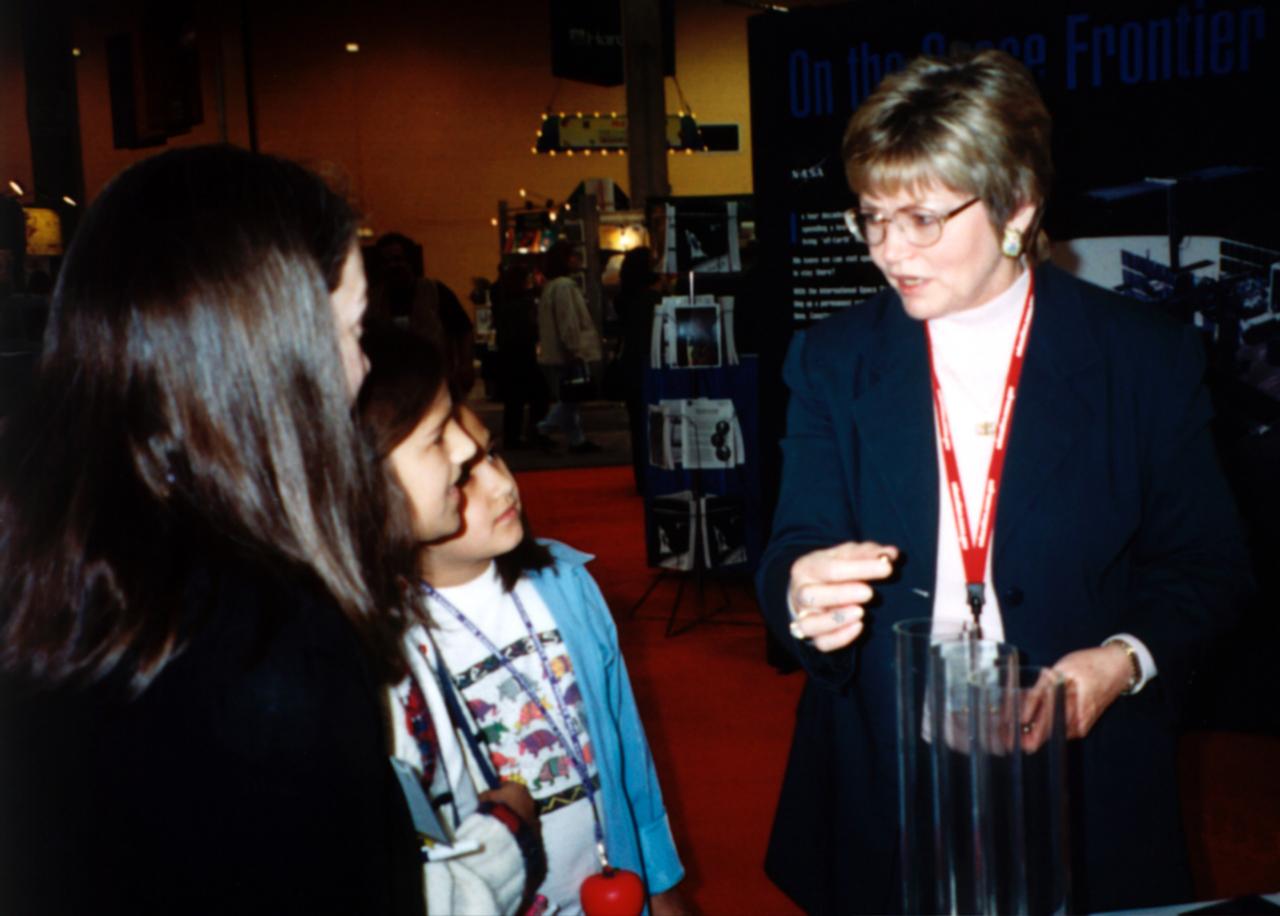
Pat Doty (right) of NASA/Marshall Space Flight Center (MSFC) demonstrates the greater bounce to the ounce of metal made from a supercooled bulk metallic glass alloy that NASA is studying in space experiments. The metal plates at the bottom of the plexiglass tubes are made of three different types of metal. Bulk metallic glass is more resilient and, as a result, the dropped ball bearing bounces higher. Experiments in space allow scientists to study fundamental properties that carnot be observed on Earth. This demonstration was at the April 200 conference of the National Council of Teachers of Mathematics (NCTM) in Chicago. photo credit: NASA/Marshall Space Flight Center (MSFC)
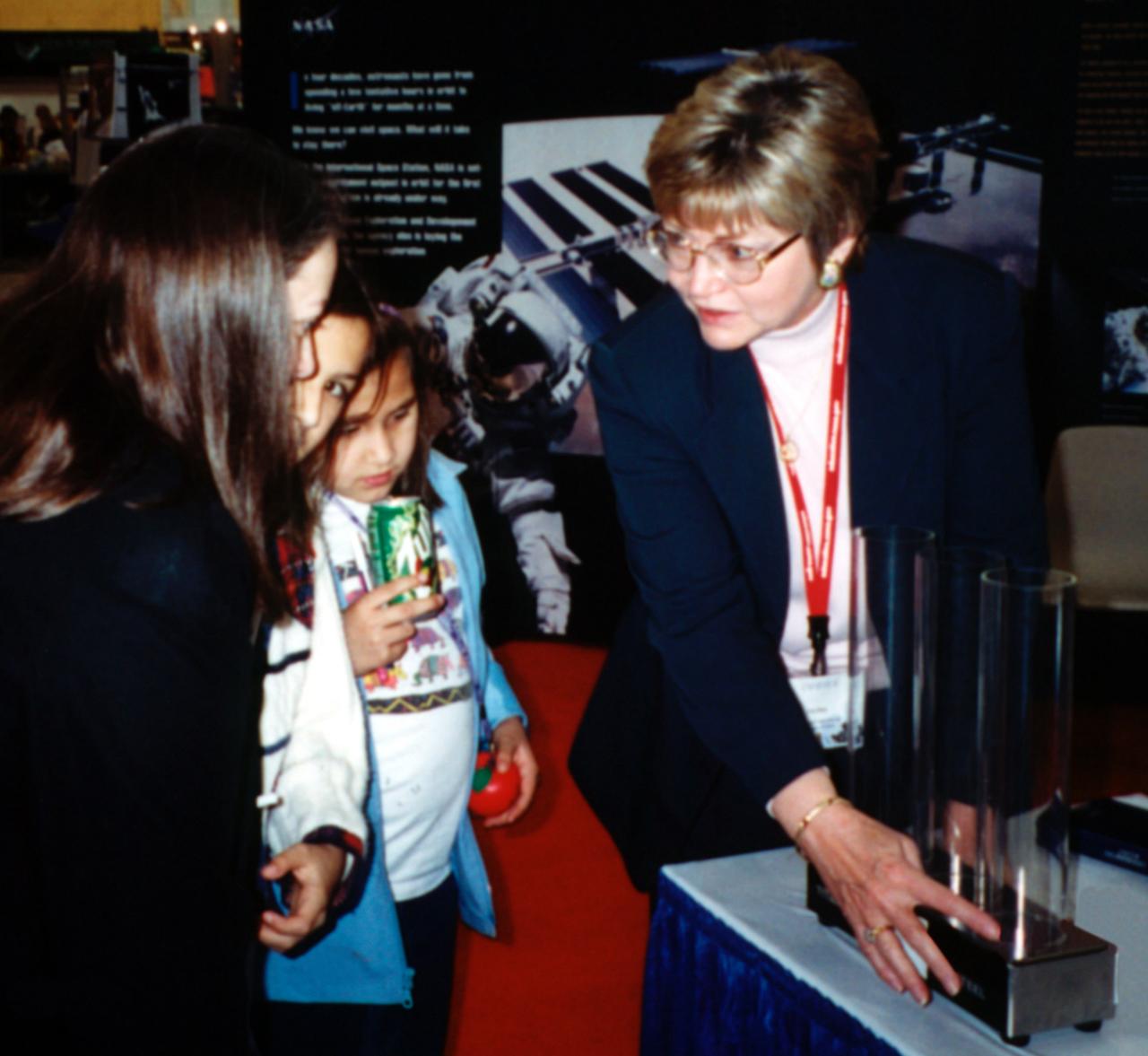
Pat Doty (right) of NASA/Marshall Space Flight Center (MSFC) demonstrates the greater bounce to the ounce of metal made from a supercooled bulk metallic glass alloy that NASA is studying in space experiments. The metal plates at the bottom of the plexiglass tubes are made of three different types of metal. Bulk metallic glass is more resilient and, as a result, the dropped ball bearing bounces higher. Experiments in space allow scientists to study fundamental properties that carnot be observed on Earth. This demonstration was at the April 2000 conference of the National Council of Teachers of Mathematics in Chicago. Photo credit: NASA/Marshall Space Flight Center (MSFC)
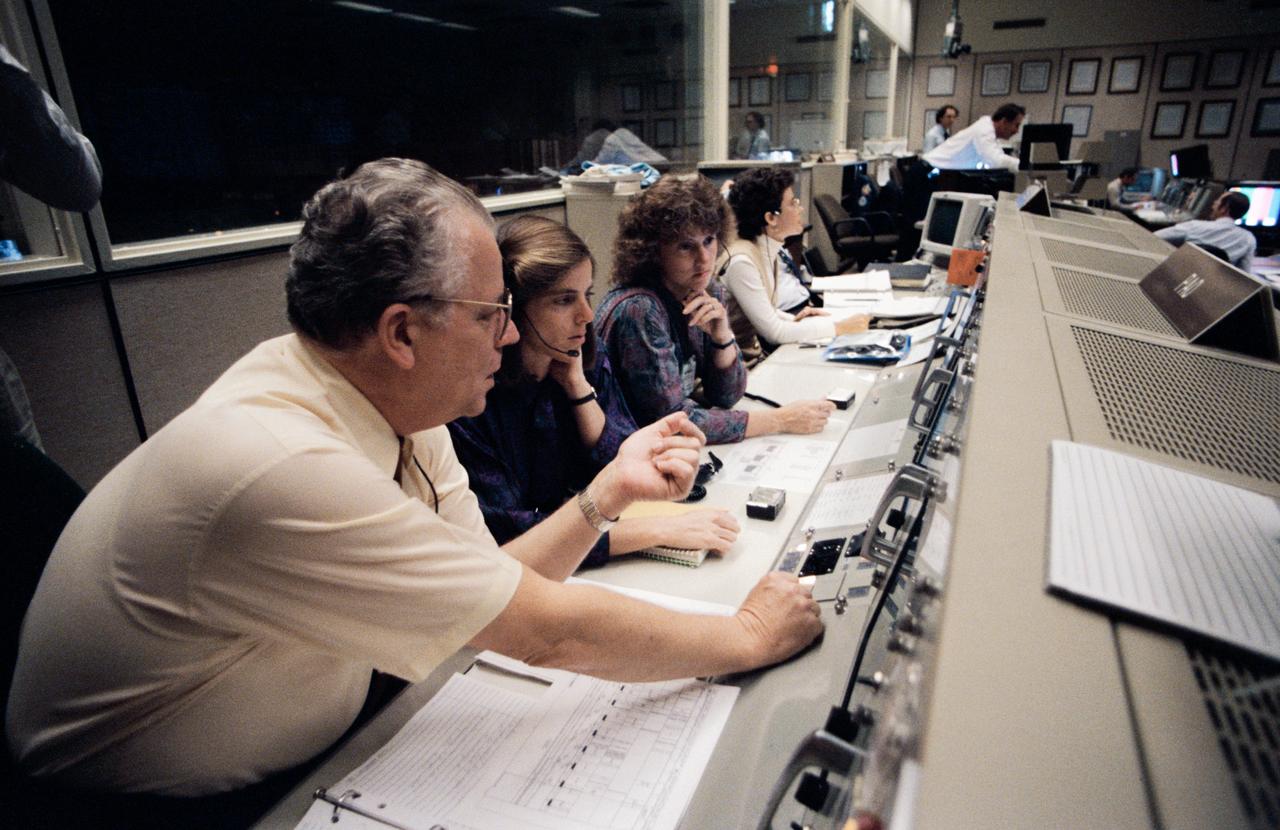
61A-S-135 (5 Nov 1985) --- Two school teachers in training at the Johnson Space Center got their first ?real time? exposure to a Space Shuttle mission as they monitor activity aboard the Spacelab D-1 science module from the mission control center. Sharon Christa McAuliffe (frame center) and Barbara R. Morgan are briefed by Terry White at the Public Affairs console during a television downlink from the Earth-orbiting Space Shuttle Challenger. McAuliffe is scheduled to fly as teacher/citizen observer on the STS 51-L mission early next year; and Morgan is in training as her backup.
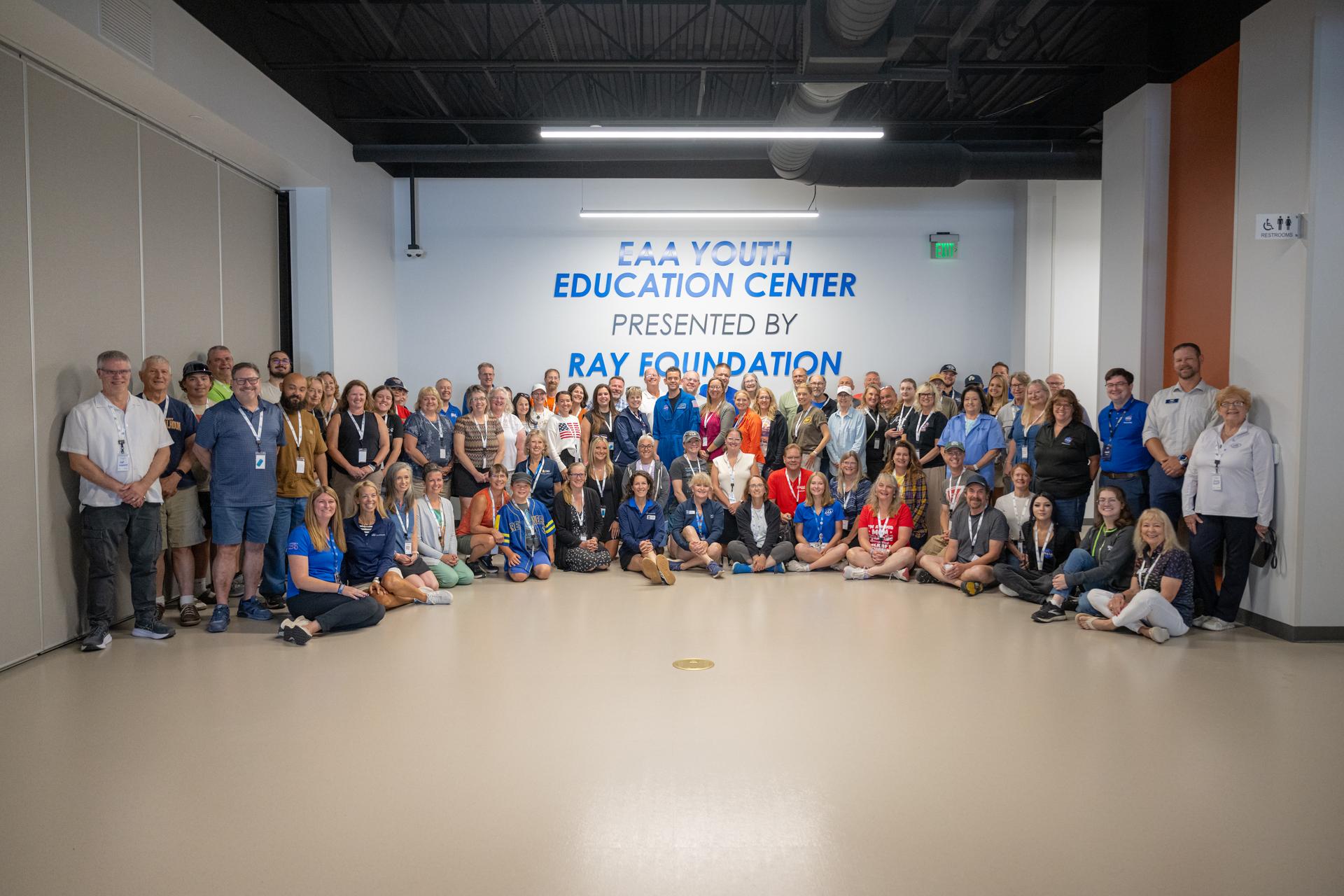
NASA Administrator Jared Isaacman poses for a photograph with K-12 educators during a "Teacher Day" event, Friday, July 24, 2026, at EAA AirVenture Oshkosh at Wittman Regional Airport in Oshkosh, Wis. Photo Credit: (NASA/John Kraus)
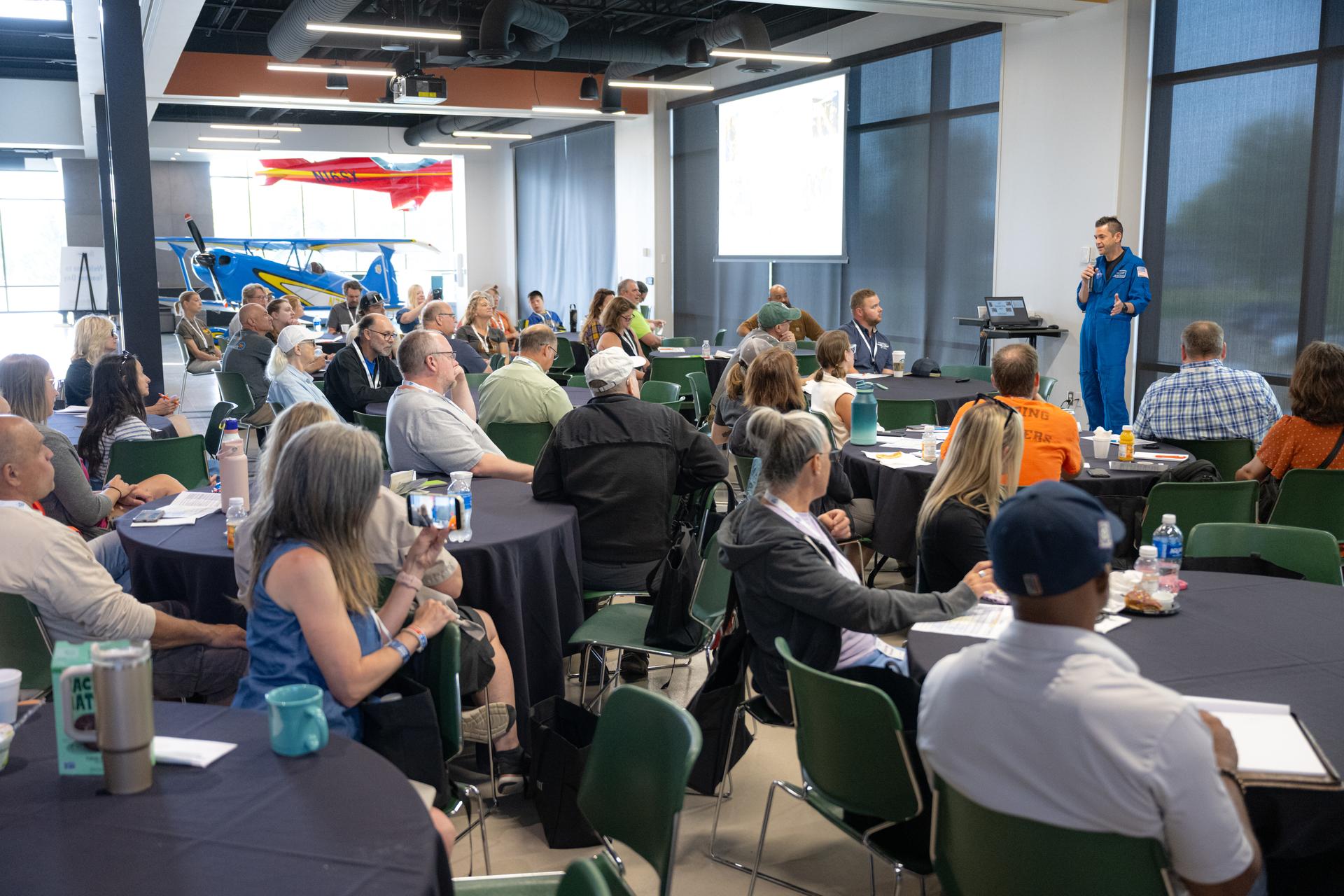
NASA Administrator Jared Isaacman speaks to K-12 educators during a "Teacher Day" event, Friday, July 24, 2026, at EAA AirVenture Oshkosh at Wittman Regional Airport in Oshkosh, Wis. Photo Credit: (NASA/John Kraus)
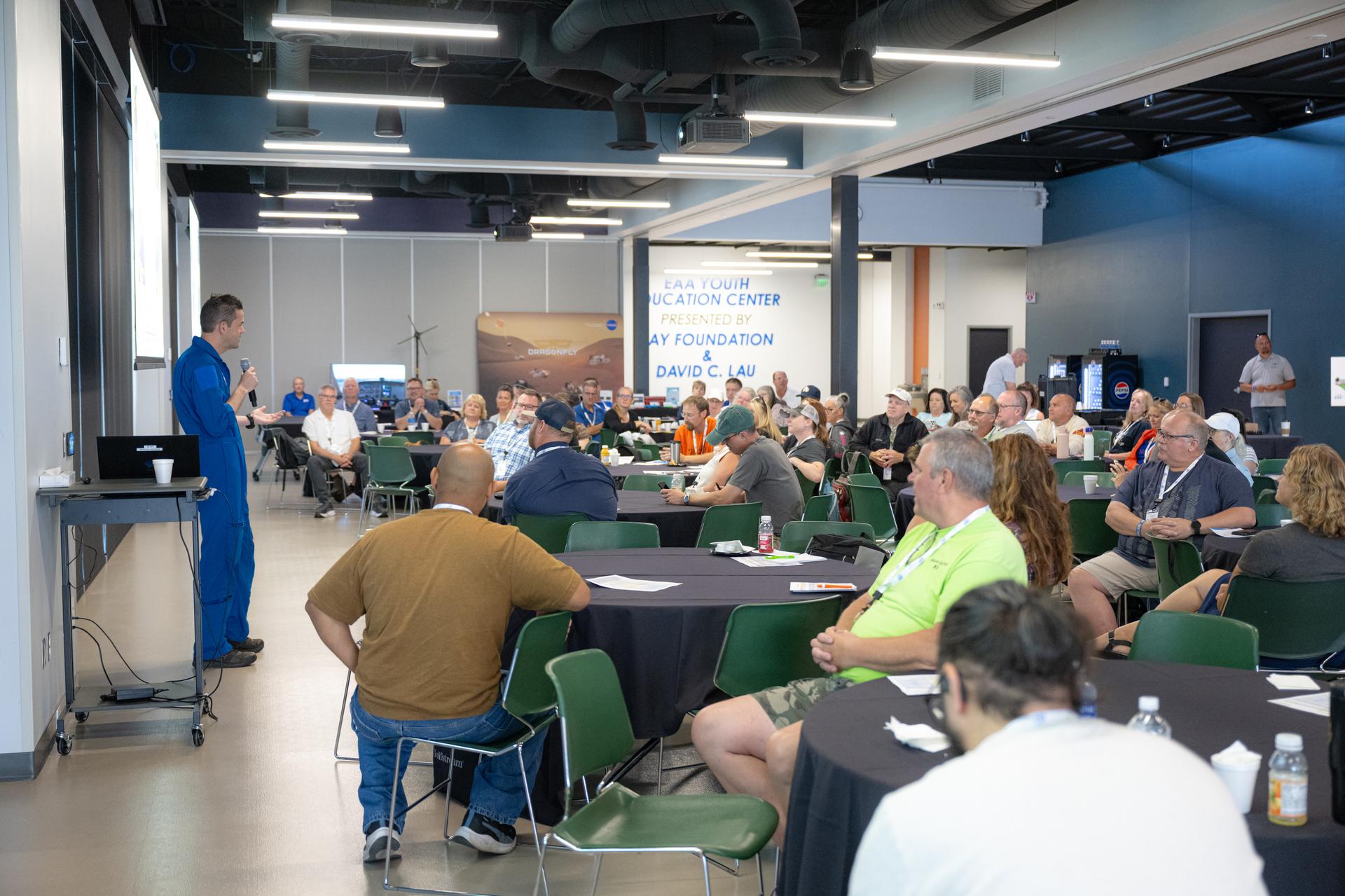
NASA Administrator Jared Isaacman speaks to K-12 educators during a "Teacher Day" event, Friday, July 24, 2026, at EAA AirVenture Oshkosh at Wittman Regional Airport in Oshkosh, Wis. Photo Credit: (NASA/John Kraus)
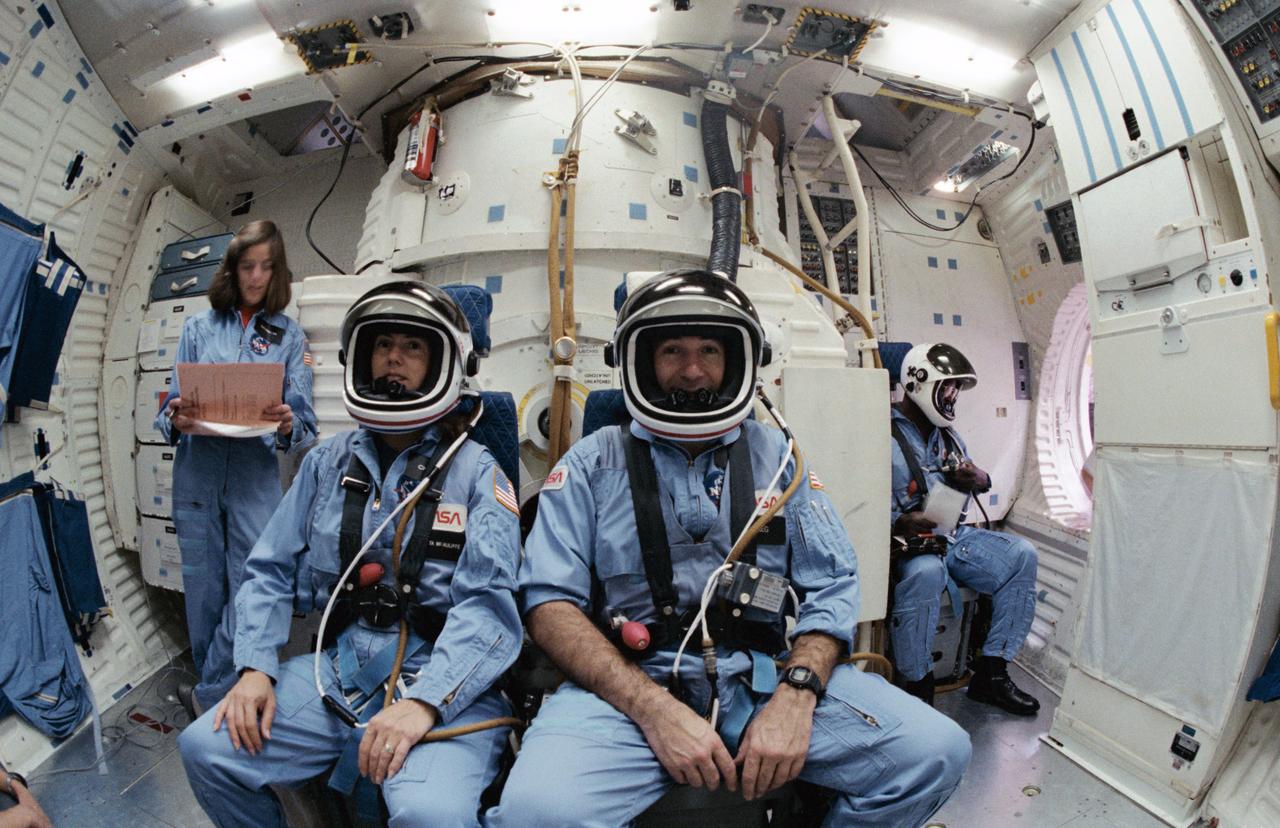
S85-46208 (December 1985) --- L.?R., backup Payload Specialist Barbara R. Morgan, Teacher Payload Specialist Christa McAuliffe, Hughes Payload Specialist Gregory B. Jarvis and Mission Specialist Ronald E. McNair in shuttle mission simulator at the Johnson Space Center. Photo was taken by Bill Bowers. Photo credit: NASA
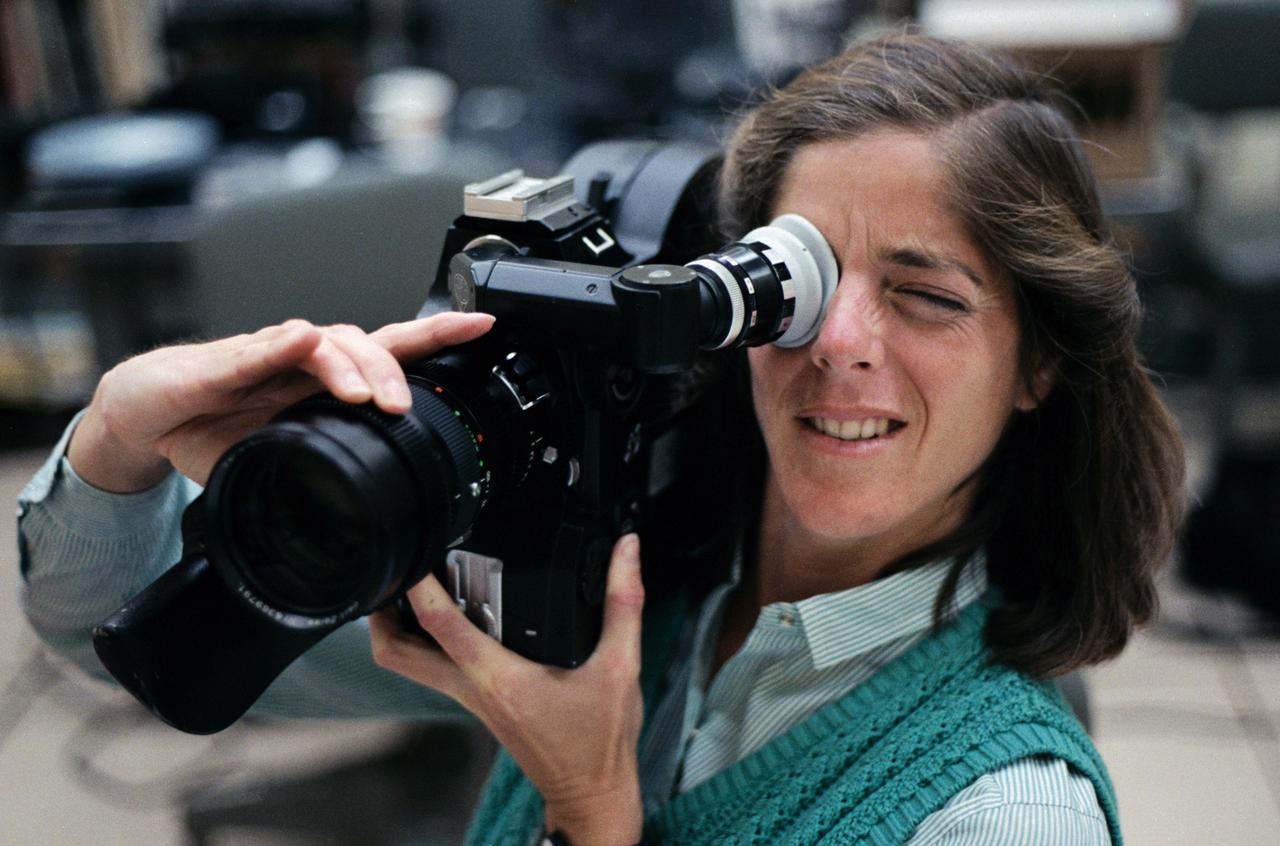
S85-40671 (18 Sept. 1985) --- The two teachers, Barbara R. Morgan and Sharon Christa McAuliffe (out of frame) have hands-on experience with an Arriflex motion picture camera following a briefing on space photography. The two began training Sept. 10, 1985 with the STS-51L crew and learning basic procedures for space travelers. The second week of training included camera training, aircraft familiarization and other activities. Morgan zeroes in on a test subject during a practice session with the Arriflex. Photo credit: NASA
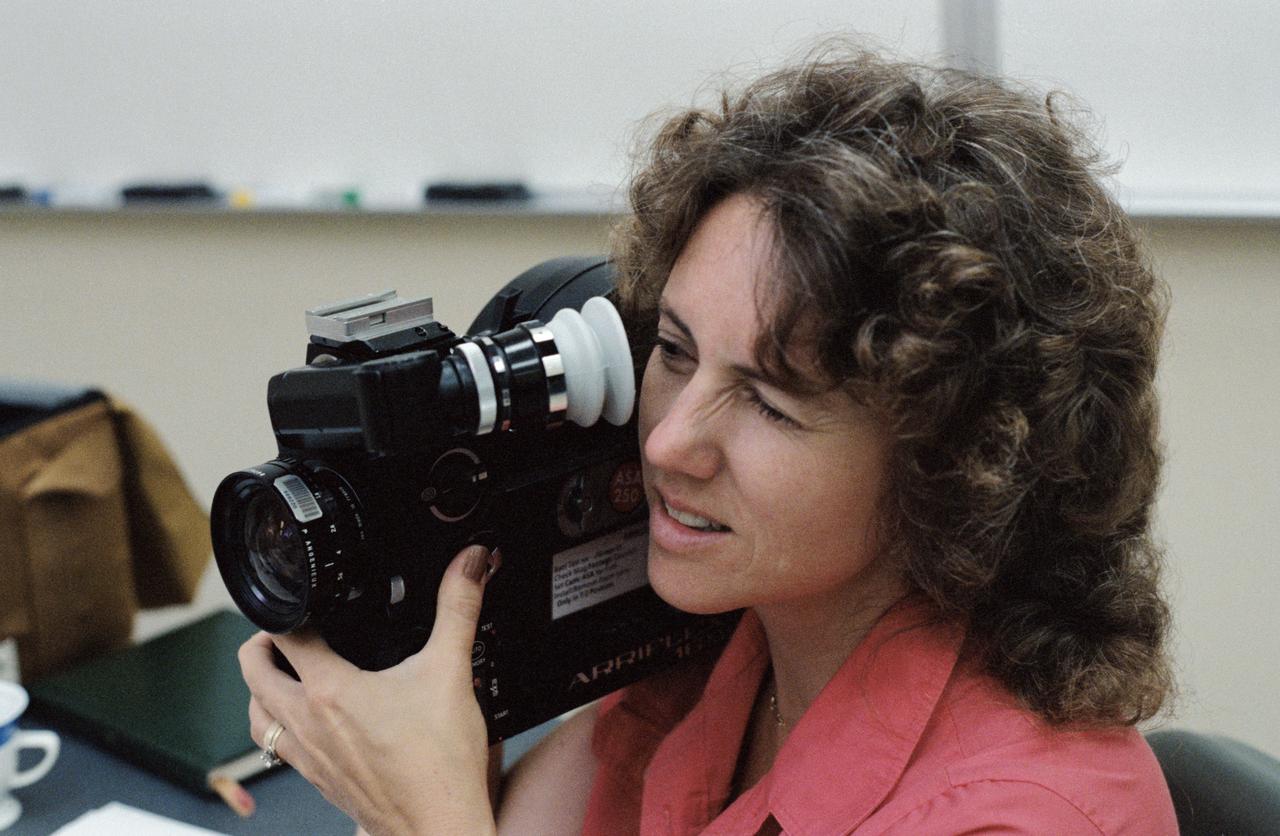
S85-40670 (18 Sept. 1985) --- The two teachers, Sharon Christa McAuliffe and Barbara R. Morgan (out of frame) have hands-on experience with an Arriflex motion picture camera following a briefing on space photography. The two began training Sept. 10, 1985 with the STS-51L crew and learning basic procedures for space travelers. The second week of training included camera training, aircraft familiarization and other activities. McAuliffe zeroes in on a test subject during a practice session with the Arriflex. Photo credit: NASA
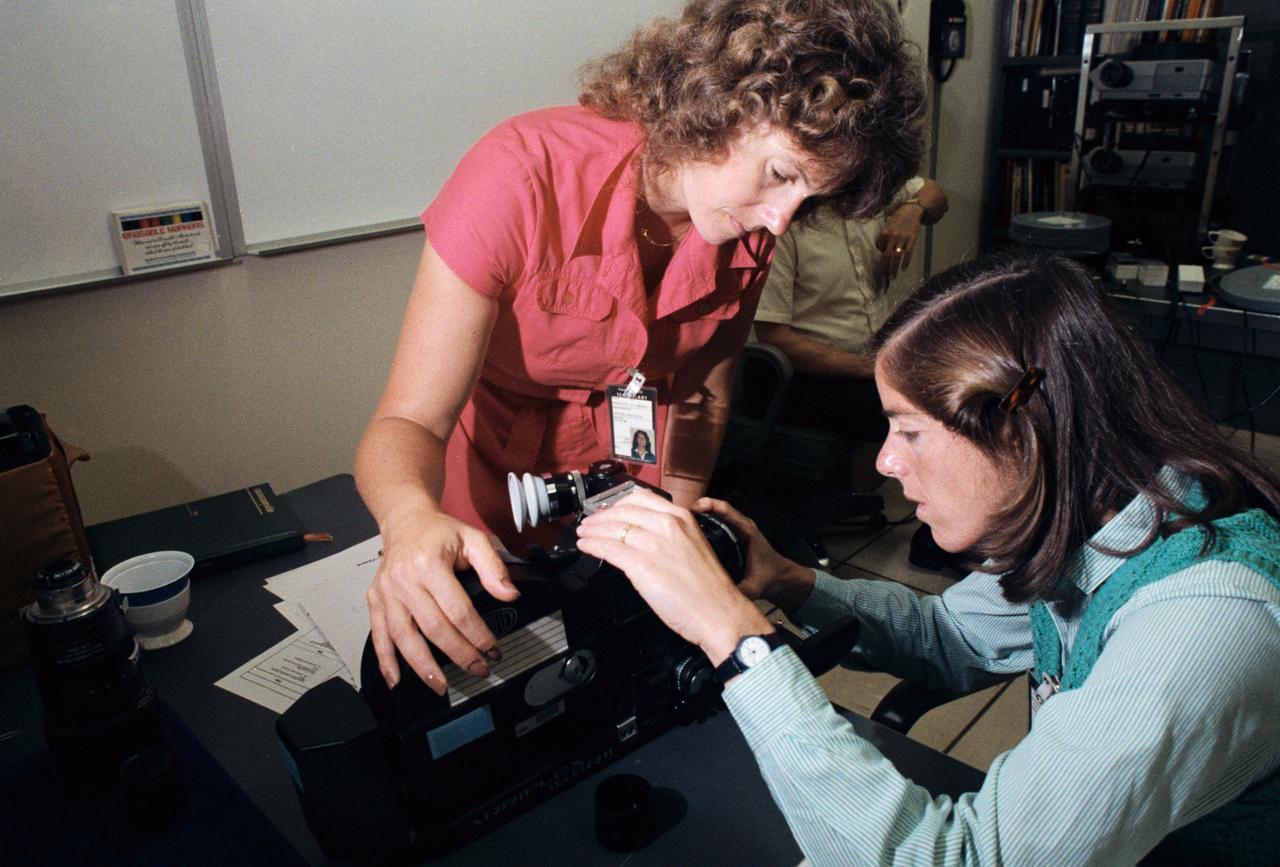
S85-40669 (18 Sept. 1985) --- The two teachers, Sharon Christa McAuliffe (left) and Barbara R. Morgan have hands-on experience with an Arriflex motion picture camera following a briefing on space photography. The two began training Sept. 10, 1985 with the STS-51L crew and learning basic procedure for space travelers. The second week of training included camera training, aircraft familiarization and other activities. Morgan adjusts a lens as a studious McAuliffe looks on. Photo credit: NASA
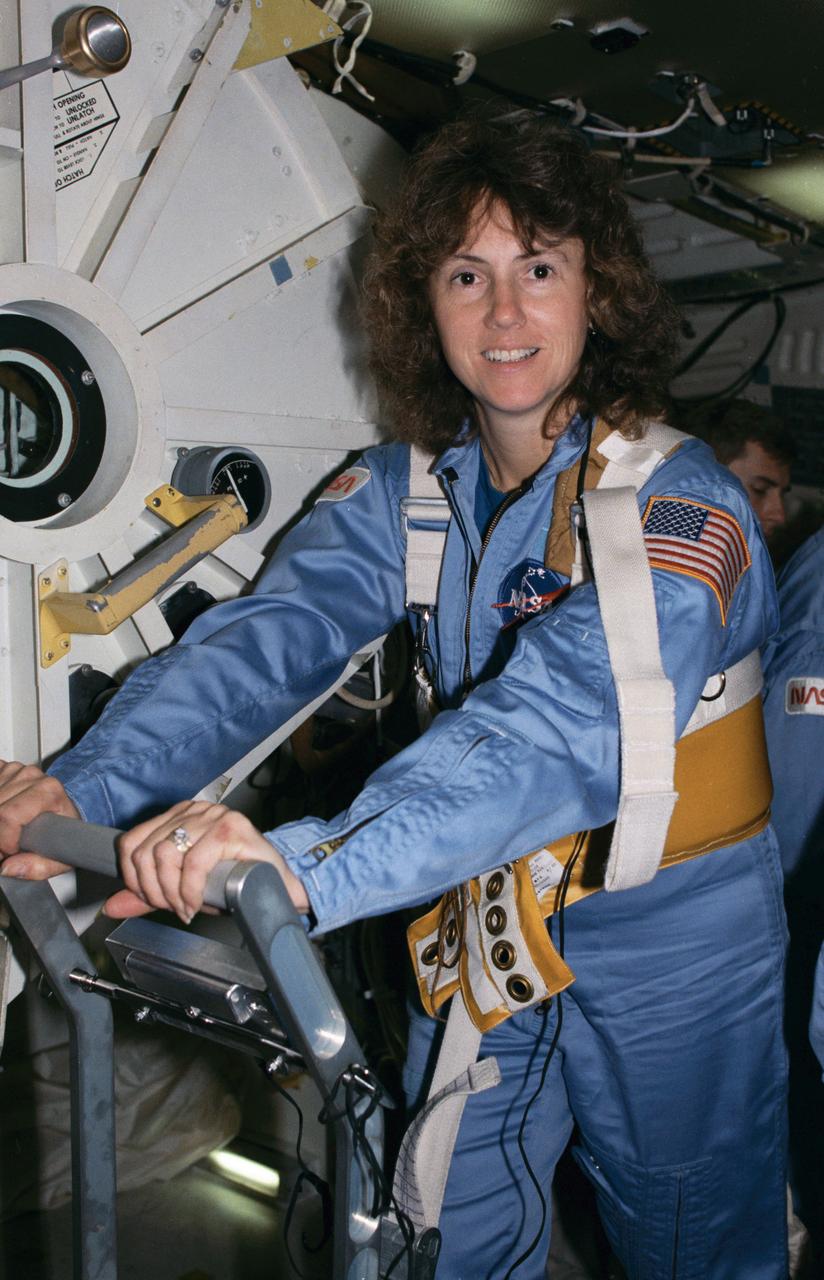
S85-46206 (December 1985) --- Sharon Christa McAuliffe, STS-51L payload specialist representing the Teacher-in-Space Project, uses a treadmill exercising device during a training session at the Johnson Space Center in preparation for January?s week-long mission aboard the space shuttle Challenger. This photo was taken by Bill Bower. Photo credit: NASA
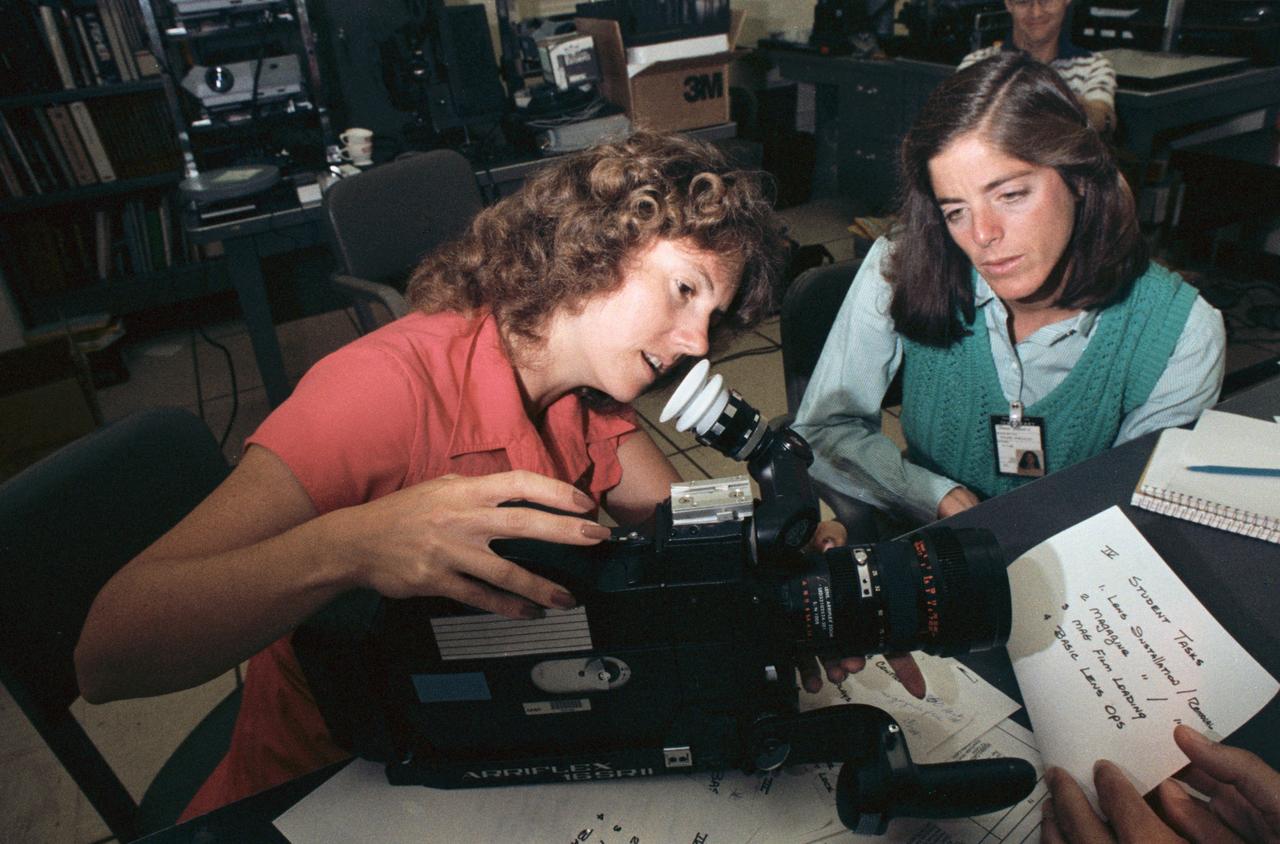
S85-40668 (18 Sept. 1985) --- The two teachers, Sharon Christa McAuliffe (left) and Barbara R. Morgan have hands-on experience with an Arriflex motion picture camera following a briefing on space photography. The two began training Sept. 10, 1985 with the STS-51L crew and learning basic procedures for space travelers. The second week of training included camera training, aircraft familiarization and other activities. Photo credit: NASA
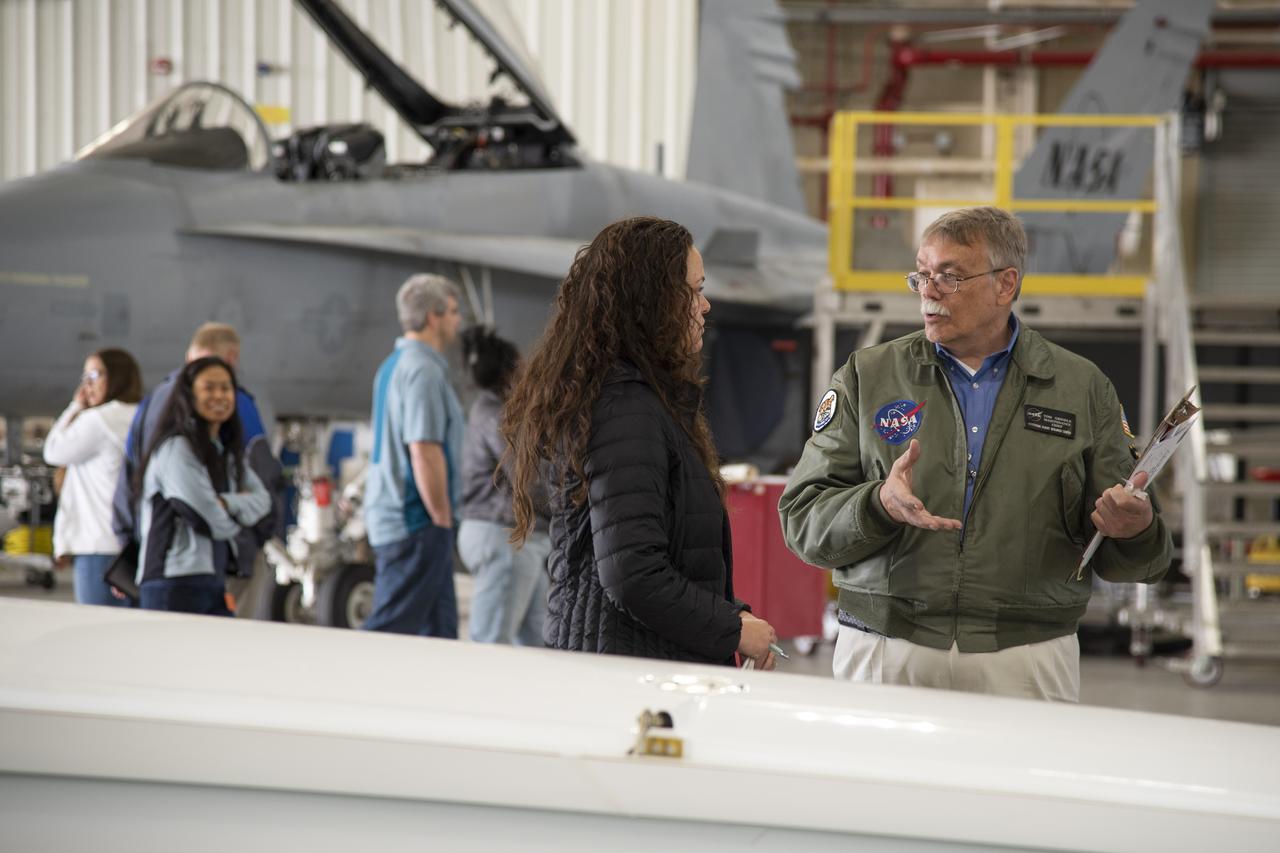
NASA Armstrong’s Chief of Maintenance, Tom Grindle, leads a tour inside the hangar with a group of teachers.
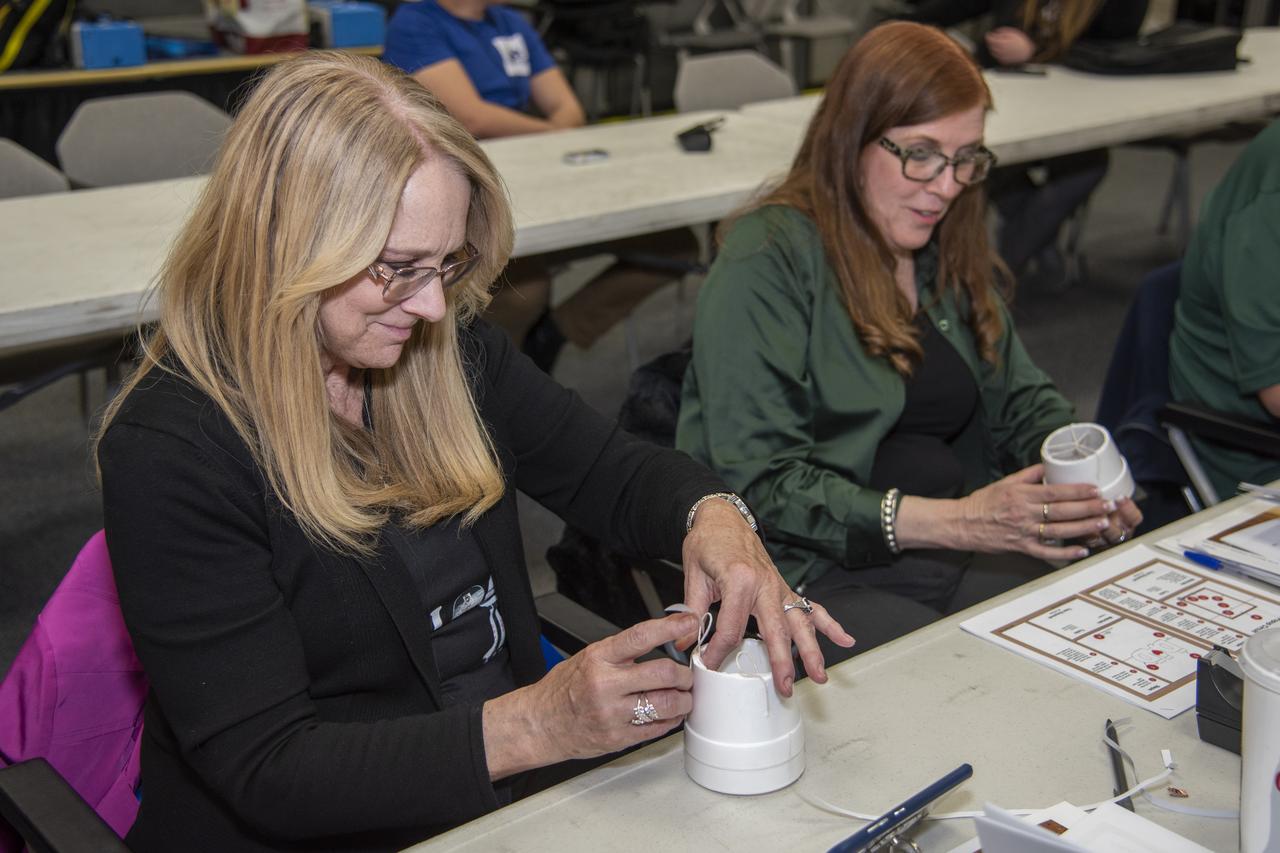
Teacher Kristen Deckner learns how to build a Remote Manipulator (Robotic) Arm during the Educational Technology Institute hosted by NASA Armstrong's Office of STEM Engagement.
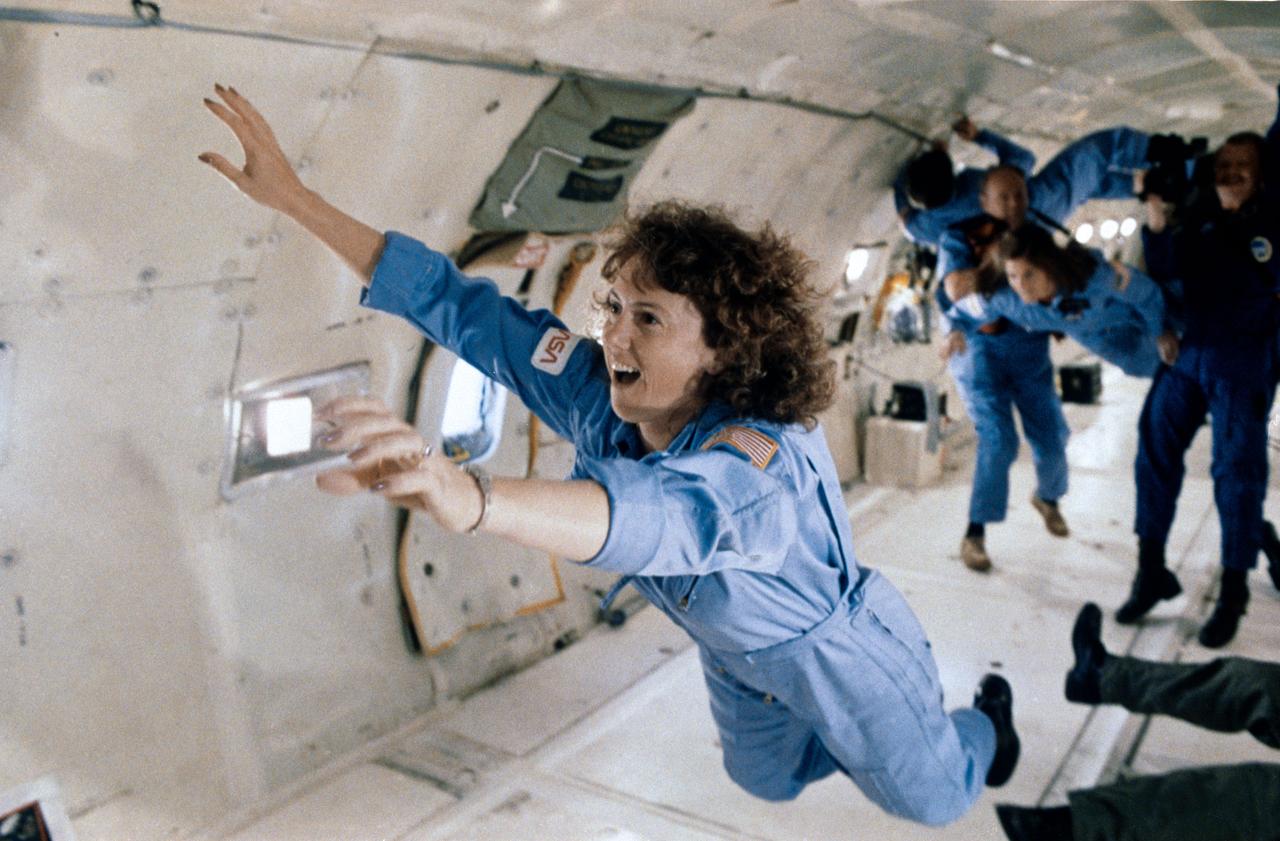
S86-25180 (October 1985) --- Sharon Christa McAuliffe, STS-51L citizen observer/payload specialist, representing the Teacher-in-Space Project, floats forward and upward during a few moments of weightlessness aboard a KC-135 aircraft. The flight is part of her training for the scheduled five-day flight aboard the Challenger in January of next year. Barbara R. Morgan, backup payload specialist for STS-51L, is partially visible in the background. The photo was taken by Keith Meyers of the New York Times. Photo credit: NASA
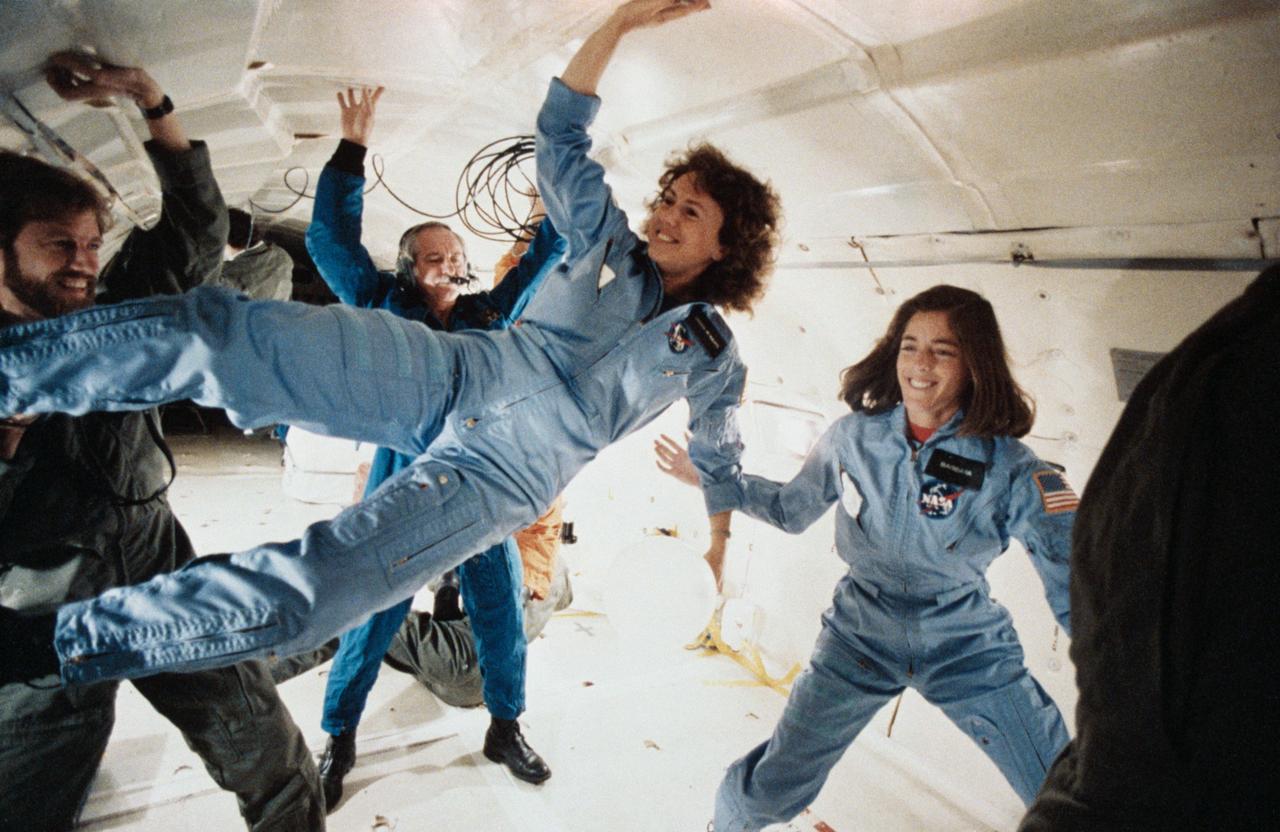
S86-25191 (for release January 1986) --- The two representatives of the Teacher-in-Space Project continue their training program at the Johnson Space Center with an additional flight aboard NASA?s KC-135 ?zero gravity? aircraft. Sharon Christa McAuliffe, left, is prime crew payload specialist, and Barbara R. Morgan is in training as backup payload specialist. The photo was taken by Keith Meyers of New York Times. Photo credit: NASA
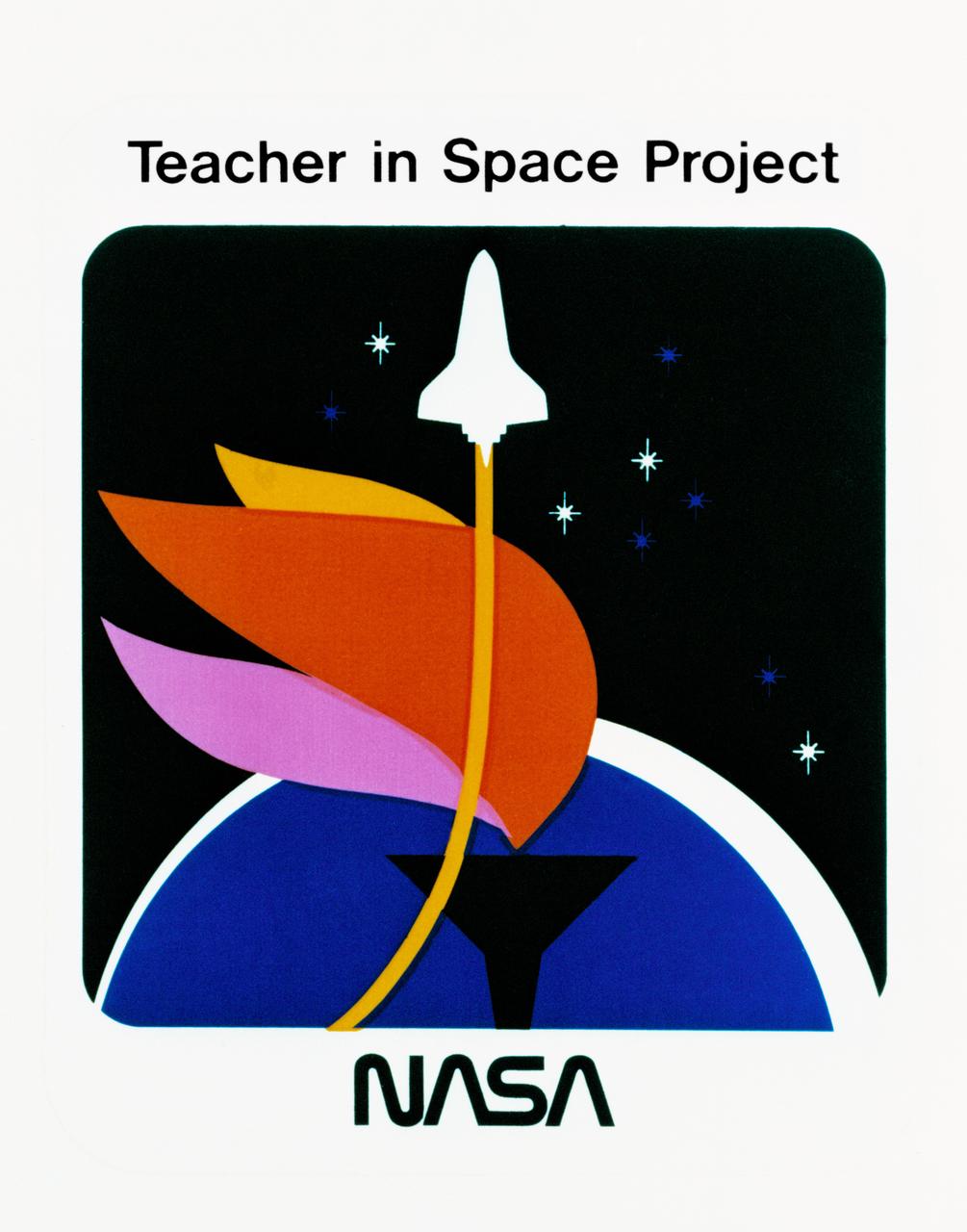
S85-38312 (September 1985) --- Logo designed for use by the 10 finalists in NASA’s Teacher in Space Project, who were at JSC for training and orientation the week of July 8–12, 1985. They are David M. Marquart, Boise High, Boise, Idaho; Michael W. Metcalf, Hazen Union School, Hardwick, Vermont; Judith Marie Garcia, Thomas Jefferson School for Science and Technology, Alexandria, Virginia; Peggy J. Lathlaen, Westwood Elementary, Friendswood, Texas; Niki Mason Wenger, Vandevender Junior High, Parkersburg, West Virginia; Barbara R. Morgan, McCall-Donnelly Elementary, McCall, Idaho; Kathleen Anne Beres, Kenwood High, Baltimore, Maryland; Richard A. Methia, New Bedford High, New Bedford, Mass.; Sharon Christa McAuliffe, Concord High, Concord, New Hampshire; and Robert S. Foerster, Cumberland Elementary School, West Lafayette, Indiana. Photo credit: NASA
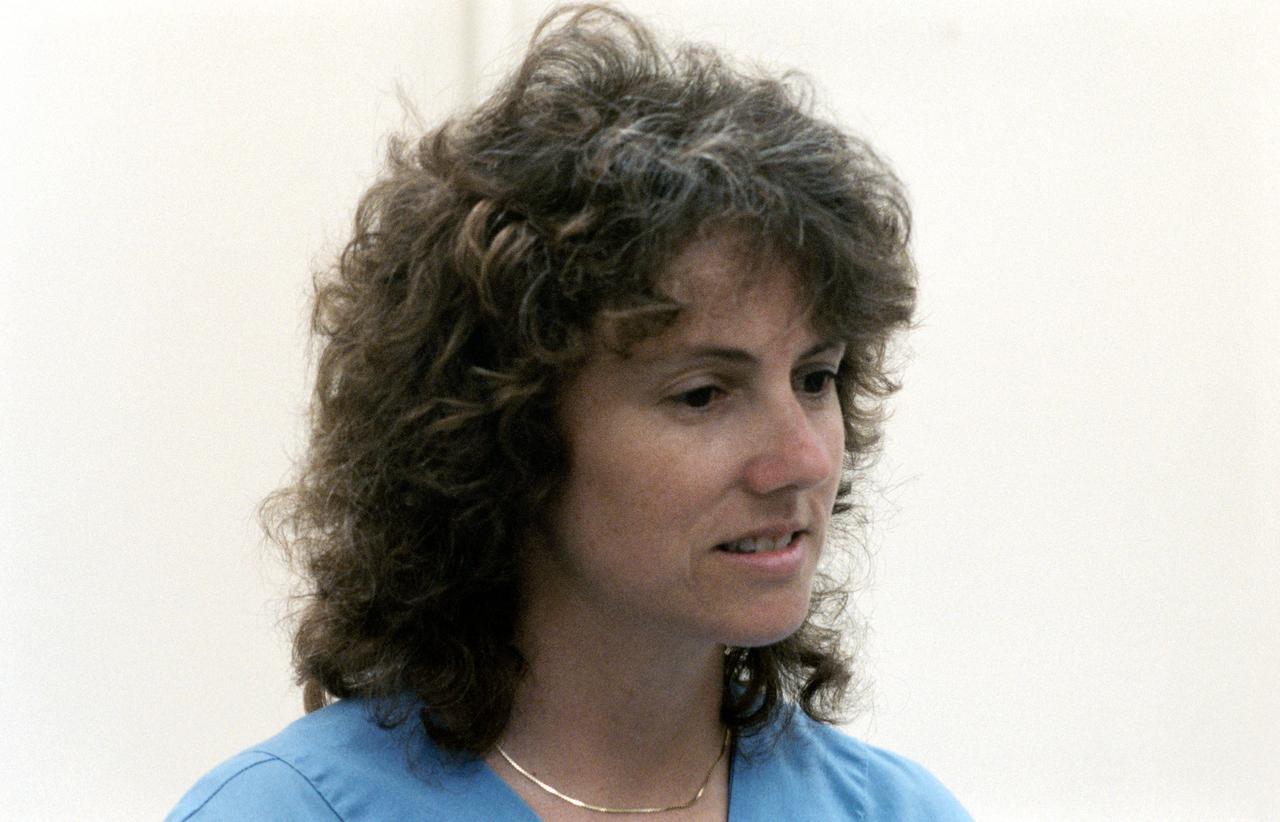
S85-37164 (8-12 July 1985) --- Sharon C. (Christa) McAuliffe of Concord High, Concord, New Hampshire, talks to the media at Johnson Space Center. Christa McAuliffe was eventually chosen as the first Teacher in Space and was a member of the seven-member Challenger shuttle crew which died tragically in the explosion of the spacecraft during the launch of STS-51L from the Kennedy Space Center about 11:40 a.m., EST, on Jan. 28, 1986. The explosion occurred 73 seconds into the flight as a result of a leak in one of two Solid Rocket Boosters that ignited the main liquid fuel tank. The crew members of the Challenger represented a cross-section of the American population in terms of race, gender, geography, background, and religion. The explosion became one of the most significant events of the 1980s, as billions around the world saw the accident on television and empathized with any one of the several crew members killed. Photo credit: NASA
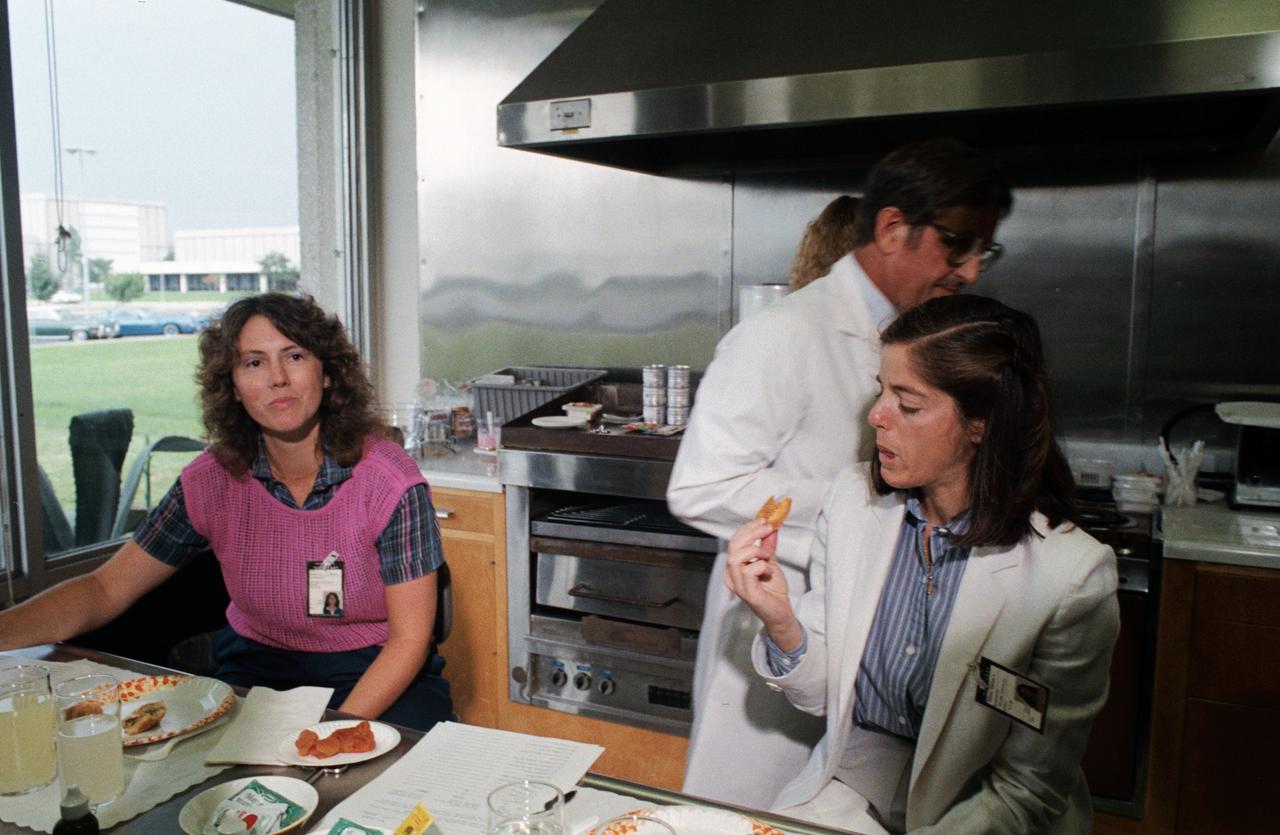
S85-39978 (10 Sept. 1985) --- Sharon Christa McAuliffe, left, appears to be deciding what she thinks of a piece of space food she tastes during a session of interfacing with space shuttle life sciences. Barbara R. Morgan samples an apricot. The two are in early training at the Johnson Space Center (JSC) in preparation for the STS-51L spaceflight early next year. McAuliffe is prime payload specialist representing the Teacher in Space Project, and Morgan is her backup. Dr. C.T. Bourland, a dietitian specialist, assists the two. Photo credit: NASA
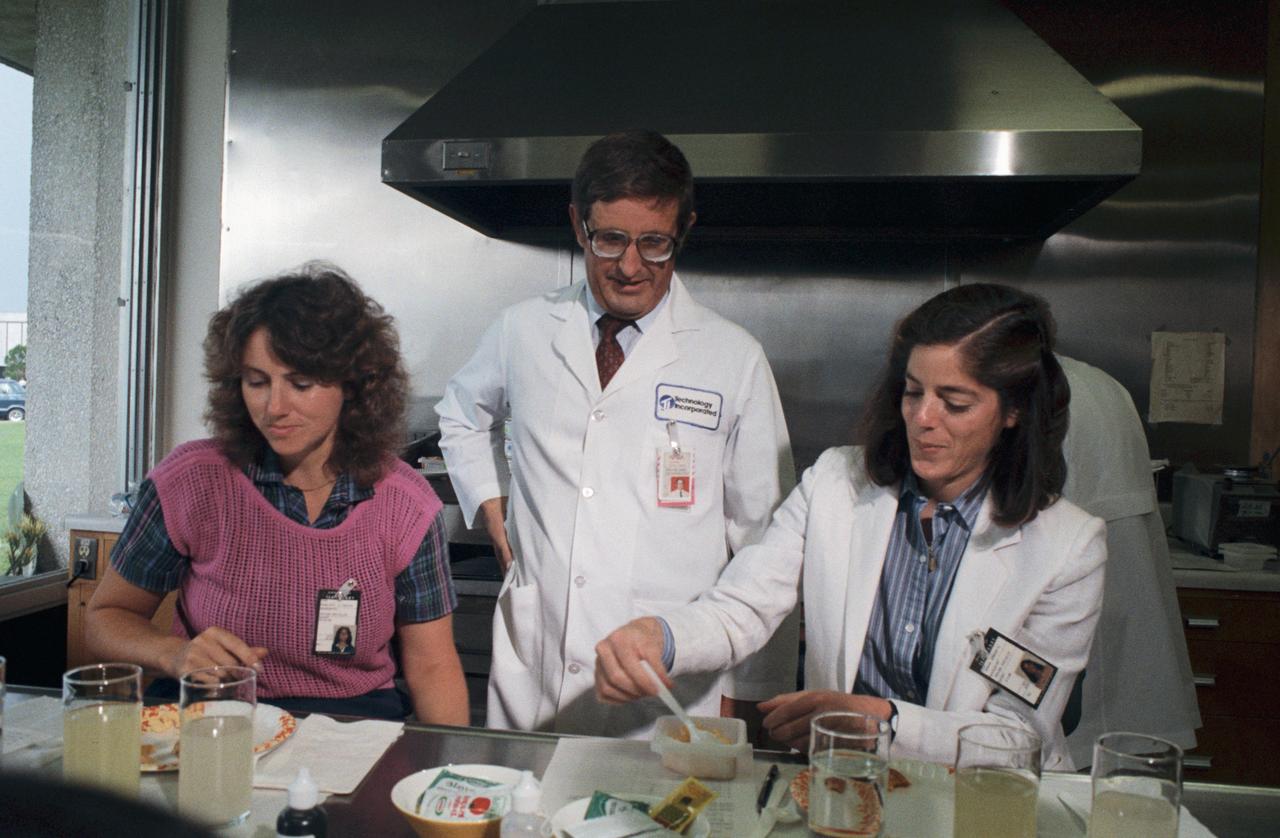
S85-39979 (10 Sept. 1985) --- Two teachers training for participation in the STS-51L flight get their first introduction to space food during an orientation session in the life sciences building at the Johnson Space Center (JSC). Sharon Christa McAuliffe (left) chews on a morsel while Barbara R. Morgan reaches for a bite. Dr. C.T. Bourland of Technology, Incorporated, looks on. McAuliffe was chosen from among ten finalists as prime citizen observer payload specialist and Morgan was named as backup for the STS-51L flight. Photo credit: NASA
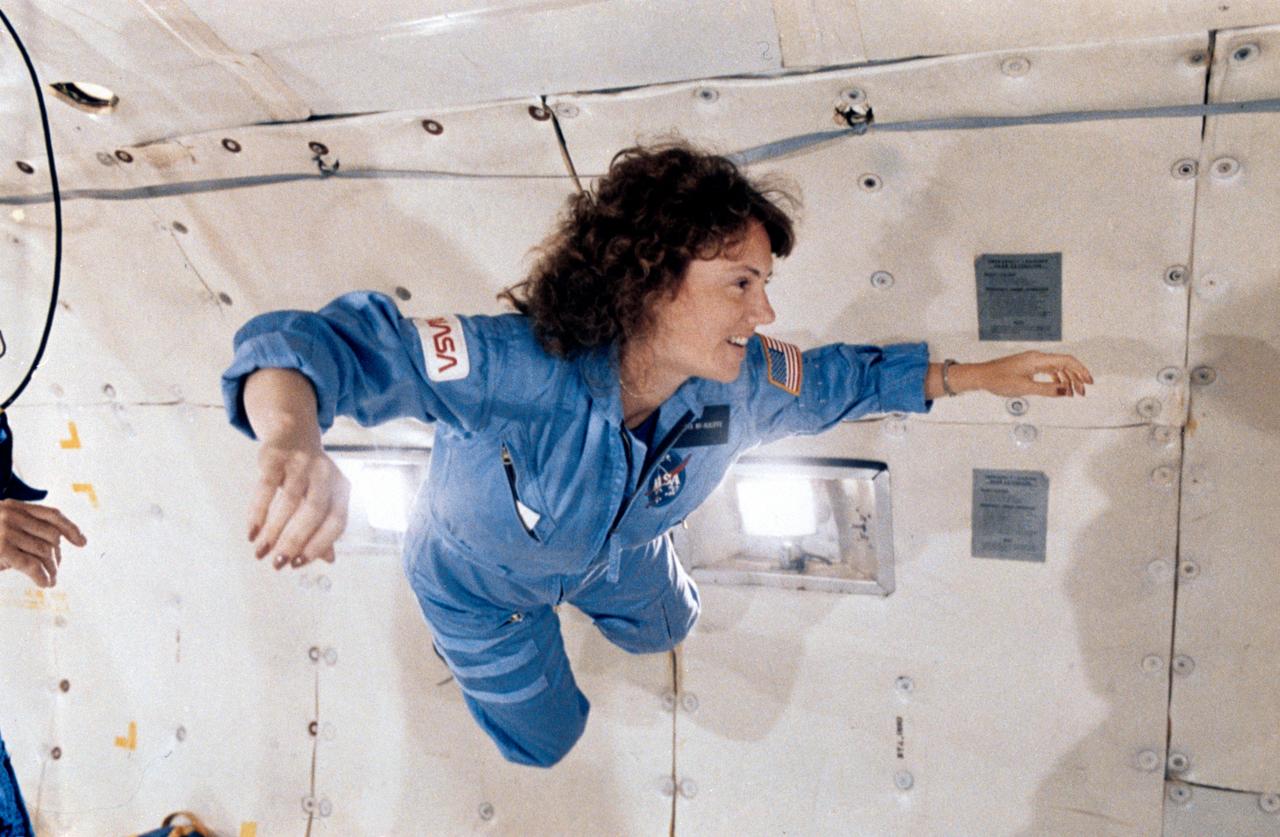
S86-25196 (January 1986) --- Sharon Christa McAuliffe, STS-51L citizen observer/payload specialist, gets a preview of microgravity during a special flight aboard NASA?s KC-135 ?zero gravity? aircraft. McAuliffe will represent the Teacher-in-Space Project aboard the space shuttle Challenger when it launches later this month. This photograph was taken by Keith Meyers of the New York Times. EDITOR?S NOTE: The STS-51L crew members lost their lives in the space shuttle Challenger accident moments after launch on Jan. 28, 1986 from the Kennedy Space Center (KSC). Photo credit: NASA
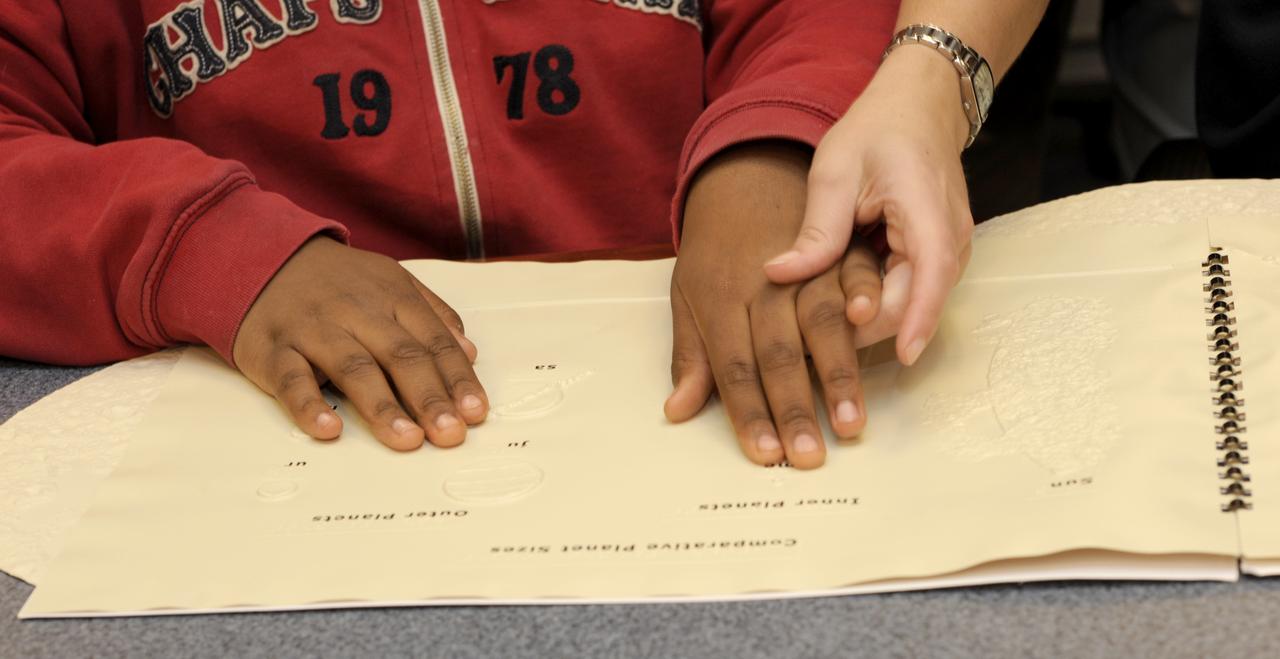
The hands of Maryland School for the Blind student Andrea Washington, are guided across a topographical map of the Solar System by science teacher Colleen Shovestull during a visit to NASA Headquarters in Washington, Thursday, Oct. 29, 2009. Seven students from the Maryland School for the Blind visited NASA and participated in activities to learn about NASA'smission, functions, and careers. Photo Credit: (NASA/Paul E. Alers)
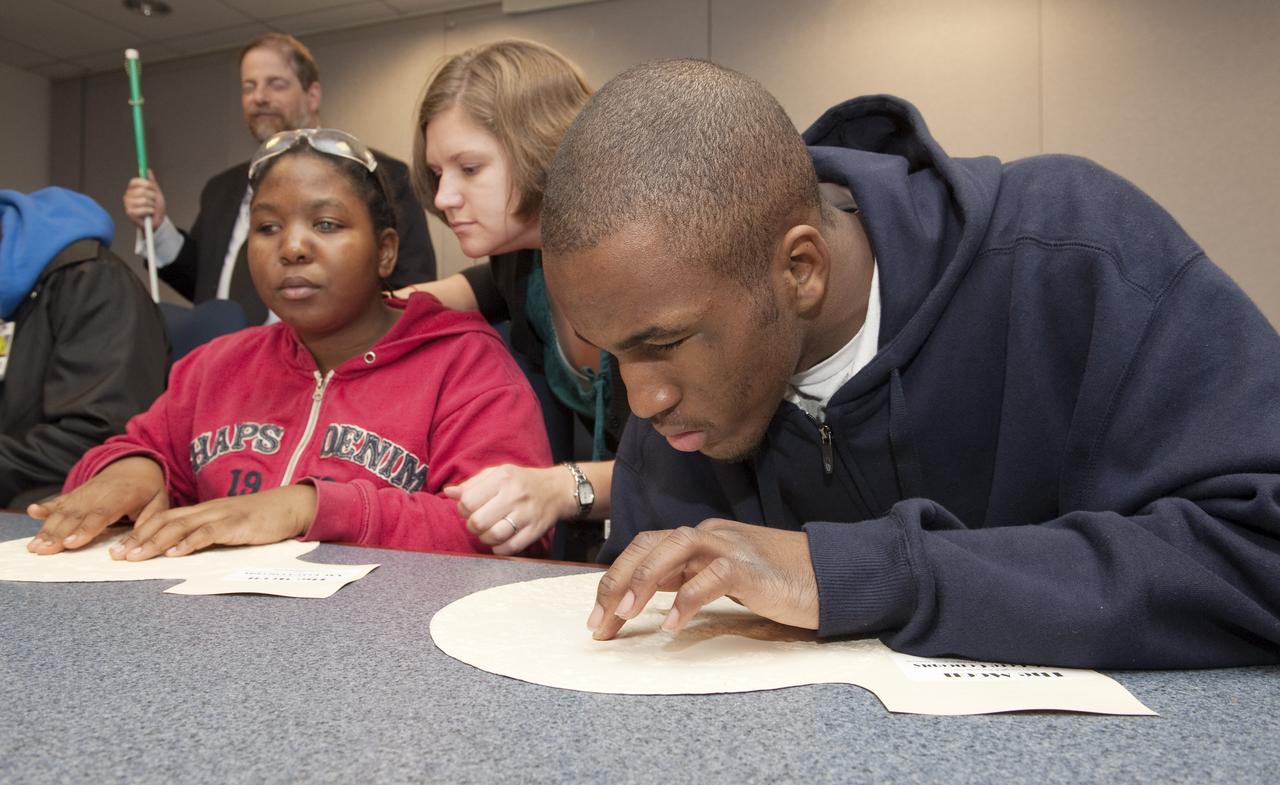
Maryland School for the Blind students Andrea Washington, left, and Derontay Taylor, right, along with science teacher Colleen Shovestull, center, use their sense of touch on topographical maps to learn about the Moon during a visit to NASA Headquarters in Washington, Thursday, Oct. 29, 2009. Seven students from the Maryland School for the Blind visited NASA and participated in activities to learn about NASA'smission, functions, and careers. Photo Credit: (NASA/Paul E. Alers)
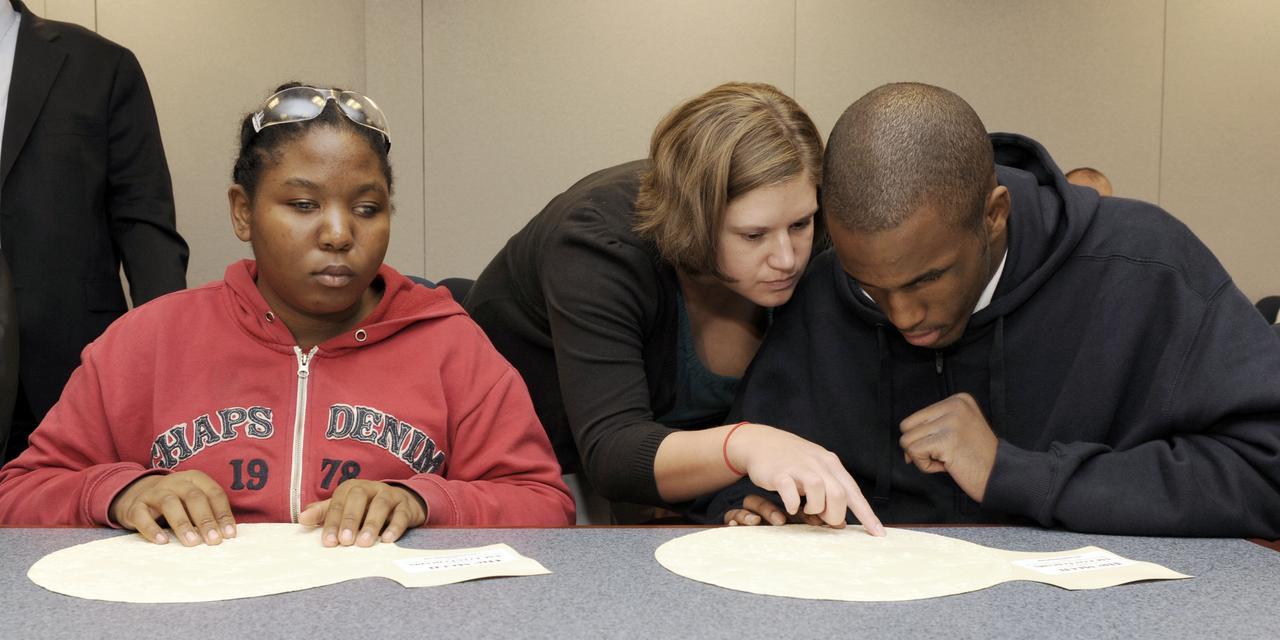
Maryland School for the Blind students Andrea Washington, left, and Derontay Taylor, right, along with science teacher Colleen Shovestull, center, use their sense of touch on topographical maps to learn about the Moon during a visit to NASA Headquarters in Washington, Thursday, Oct. 29, 2009. Seven students from the Maryland School for the Blind visited NASA and participated in activities to learn about NASA'smission, functions, and careers. Photo Credit: (NASA/Paul E. Alers)
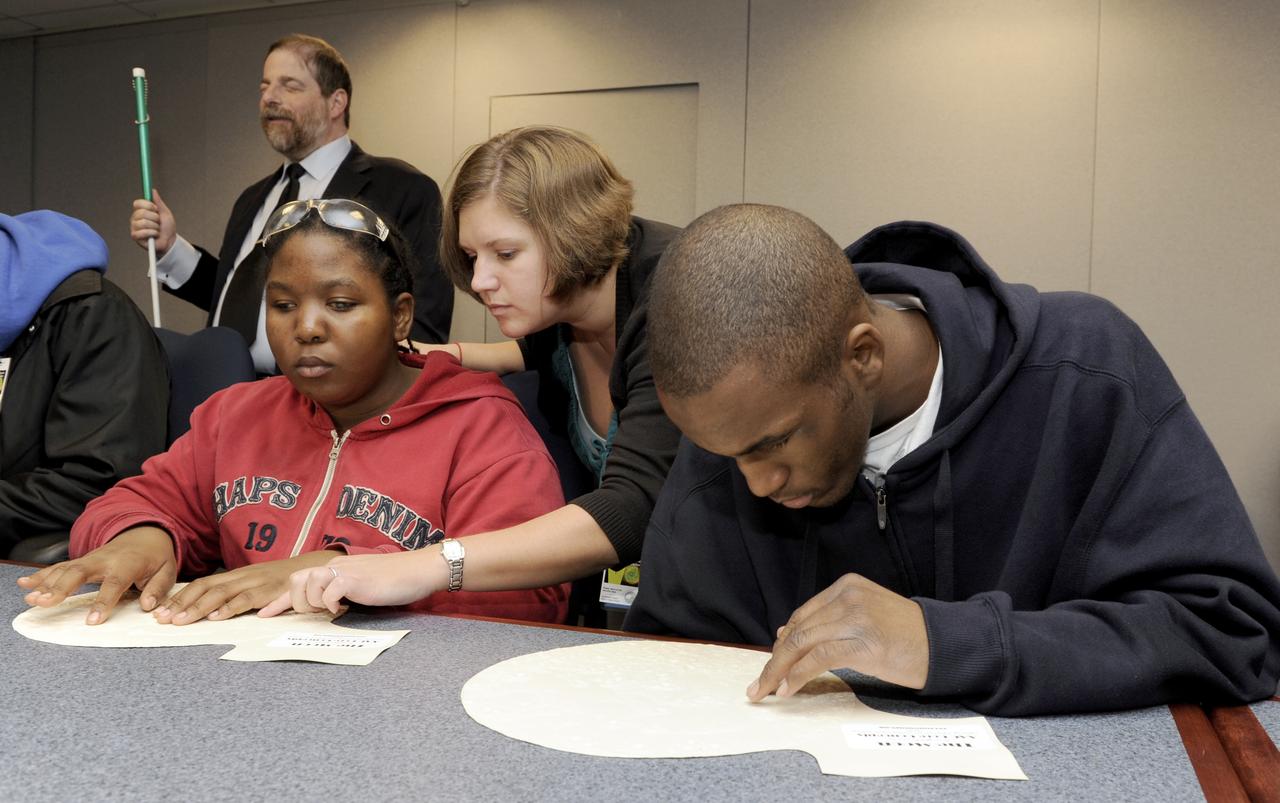
Maryland School for the Blind students Andrea Washington, left, and Derontay Taylor, right, along with science teacher Colleen Shovestull, center, use their sense of touch on topographical maps to learn about the Moon during a visit to NASA Headquarters in Washington, Thursday, Oct. 29, 2009. Seven students from the Maryland School for the Blind visited NASA and participated in activities to learn about NASA'smission, functions, and careers. Photo Credit: (NASA/Paul E. Alers)
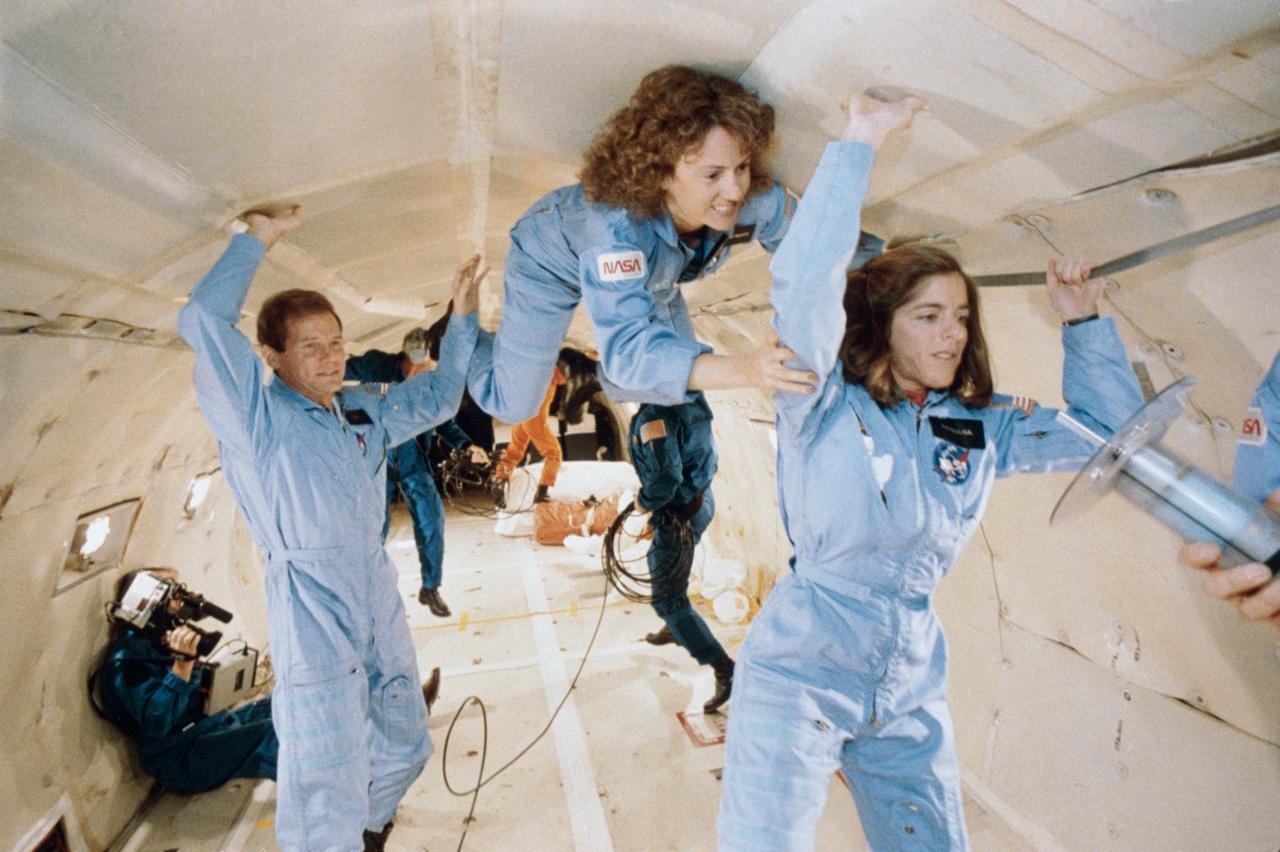
S86-25192 (January 1986) --- Two payload specialists in training for the STS-51L mission, and a payload specialist from STS-61C share a ?zero-gravity? flight aboard a KC-135 aircraft over the Gulf of Mexico. Left to right are United States Representative Bill Nelson (Democrat, Florida), Sharon Christa McAuliffe, and Barbara R. Morgan. The congressman is a payload specialist for the STS-61C mission. McAuliffe is the prime payload specialist for the Teacher-in-Space Project aboard the STS-51L mission; and Morgan is her backup. The photo was taken by Keith meyers of the New York Times. EDITOR?S NOTE: The STS-51L crew members lost their lives in the space shuttle Challenger accident moments after launch on Jan. 28, 1986 from the Kennedy Space Center (KSC). Photo credit: NASA
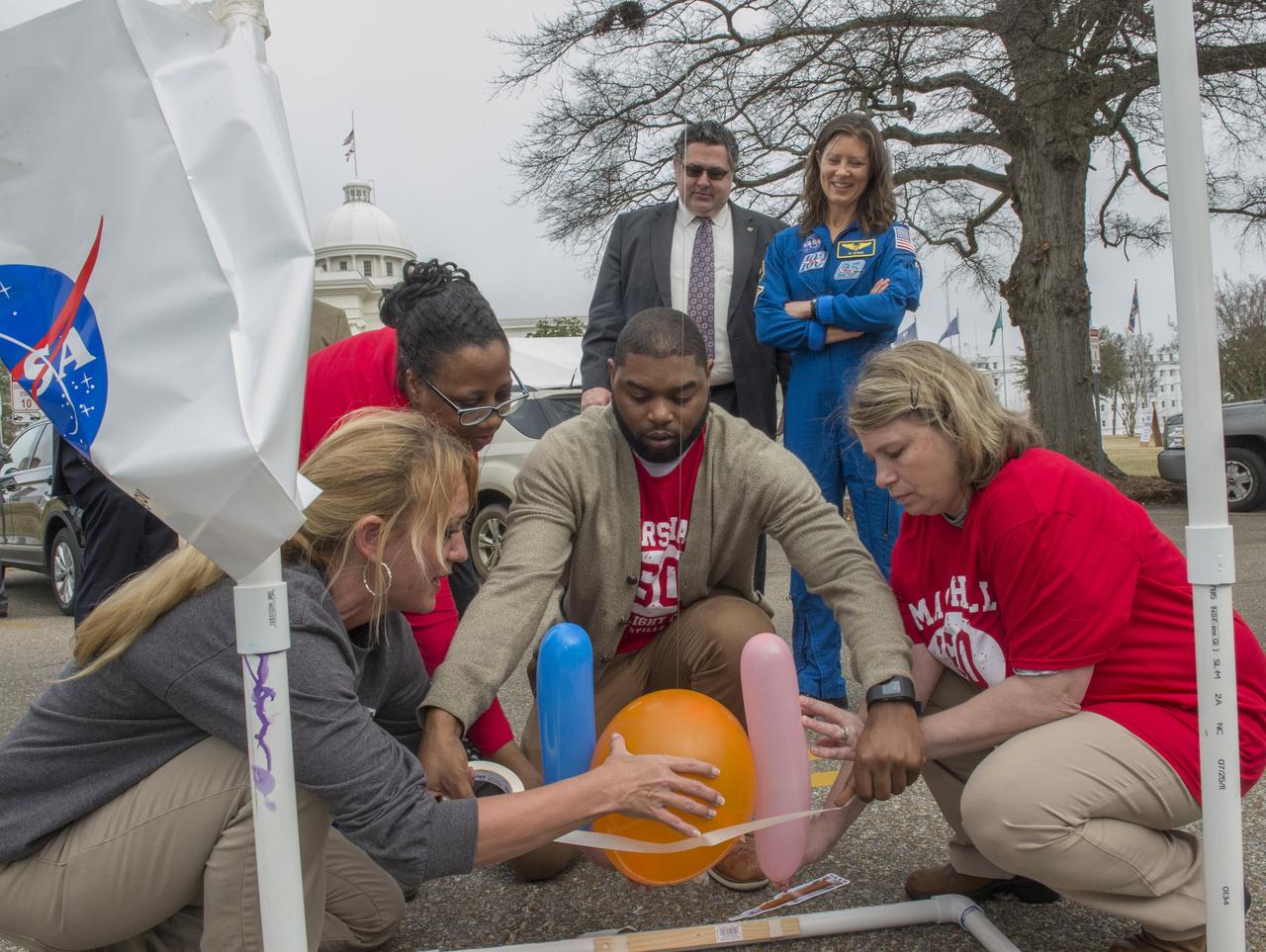
Officials from Marshall Space Flight Center discussed the state's role in leading America back to the Moon and on to Mars with elected officials, industry leaders, students and the public during the Aerospace States Association’s Alabama Aerospace Week in Montgomery, Ala. NASA was honored by the Alabama legislature with a resolution and proclamation from Gov. Kay Ivey recognizing the agency's achievements. NASA Trained Alabama Lead Teachers, (LtoR) Jacquelyn Adams, Arlinda Davis,Timothy Johnson,Laura Crowe demonstrate how rocket boosters work.
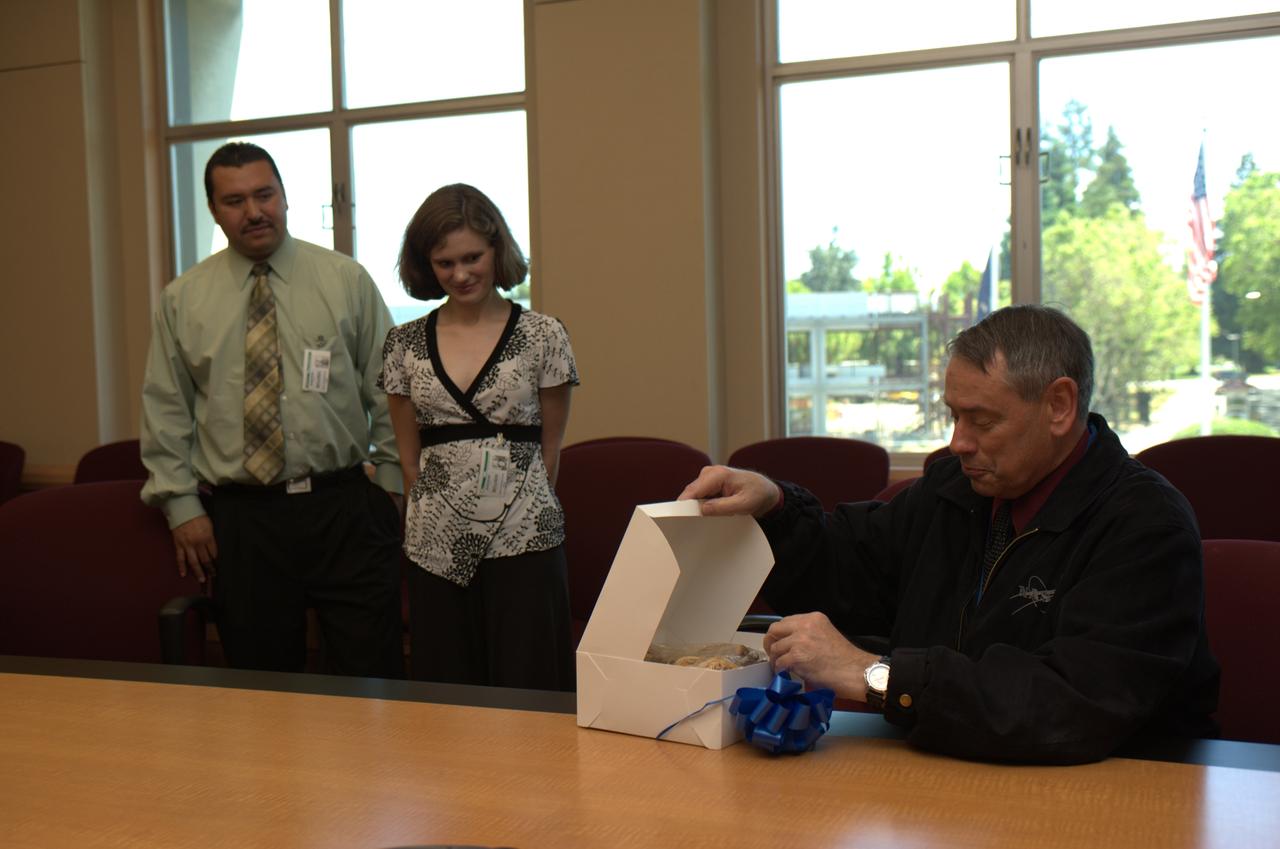
Park Avenue Elementary Teachers Visit / Thank You for Donation of Computers: Ames Director Pete Worden opening gift from school with Sergio Torris, Principal and a unnamed teacher.
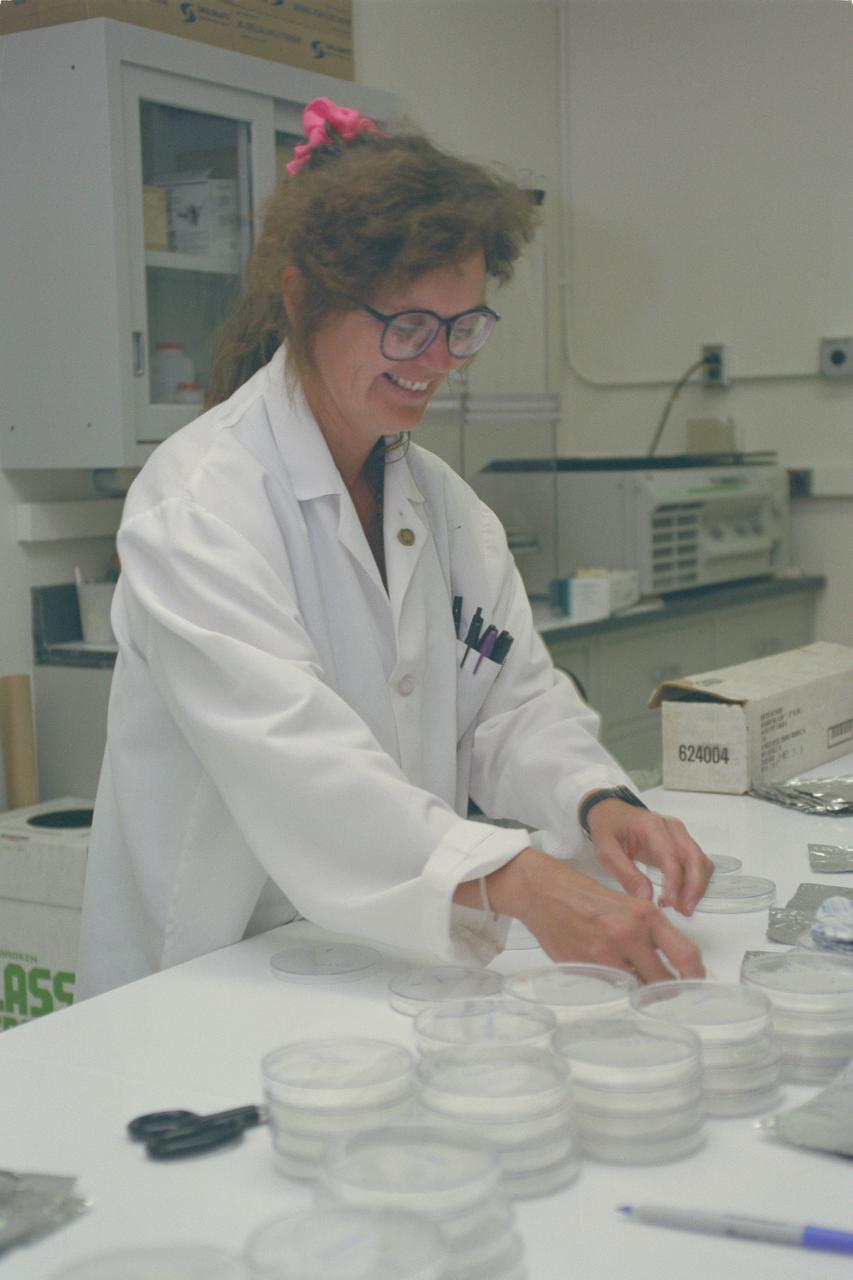
1996 'STELLAR' teacher in CELSS lab
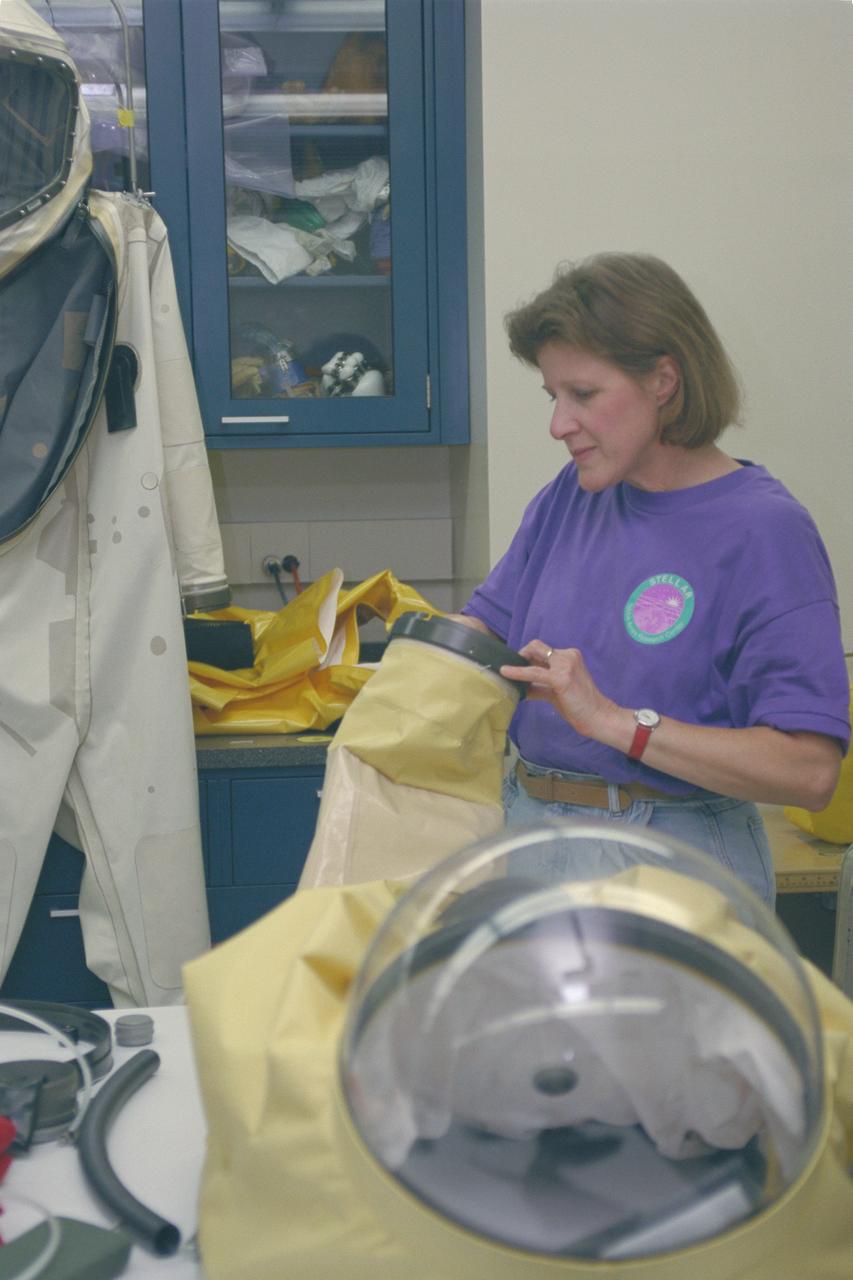
1996 'STELLAR' teacher in Space Suit Lab
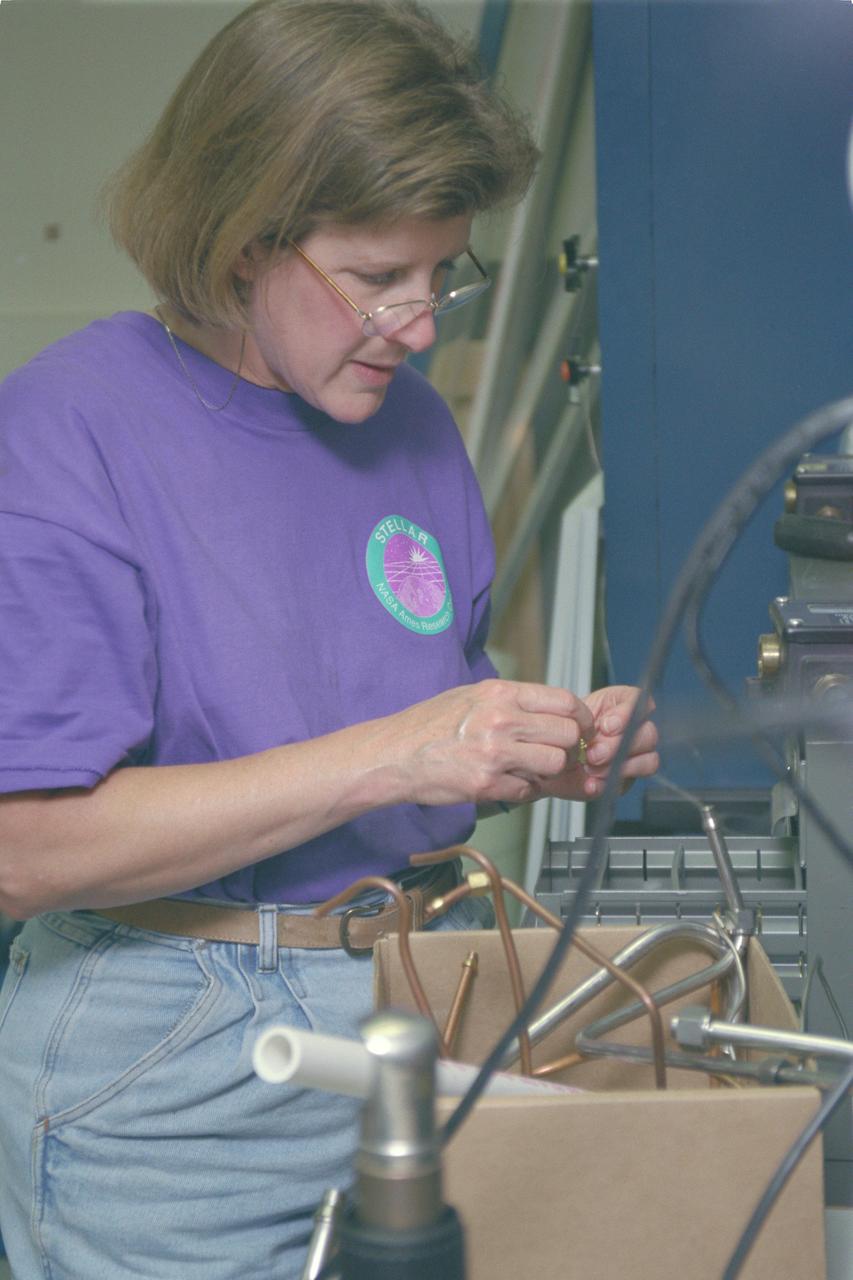
1996 'STELLAR' teacher in Space Suit lab
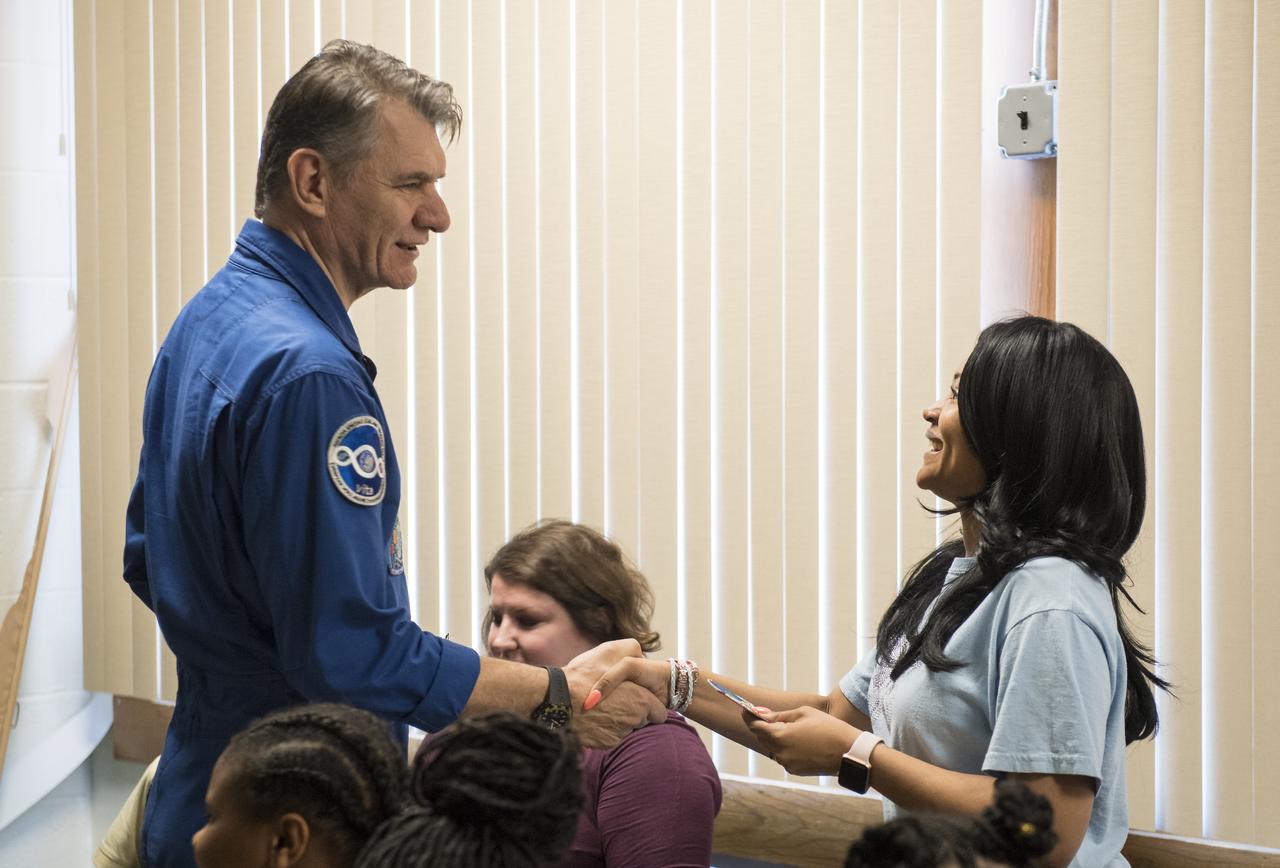
ESA astronaut Paolo Nespoli gives a patch to a teacher for Teacher Appreciation Week after speaking about his time onboard the International Space Station during expeditions 52/53, Friday, May 11, 2018 at the Washington School for Girls in Washington. Photo Credit: (NASA/Aubrey Gemignani)
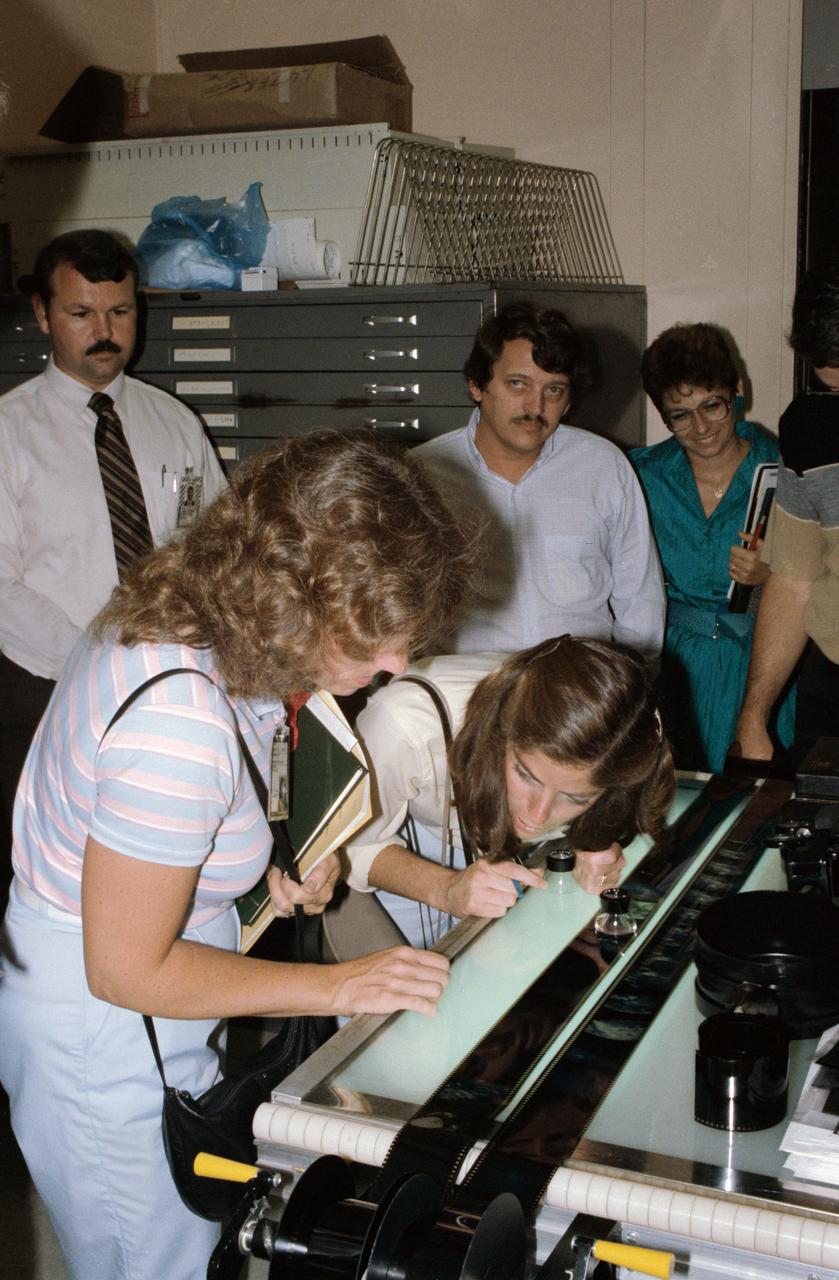
View of STS-33/51L Prime Teacher, Christa McAuliffe (left foreground) and Barbara Morgan (second left), both "Teacher in Space" Trainees, review film shot while training with Arriflex camera. 1. McAuliffe, S. Christa - Photography 2. Morgan, Barbara - Photography
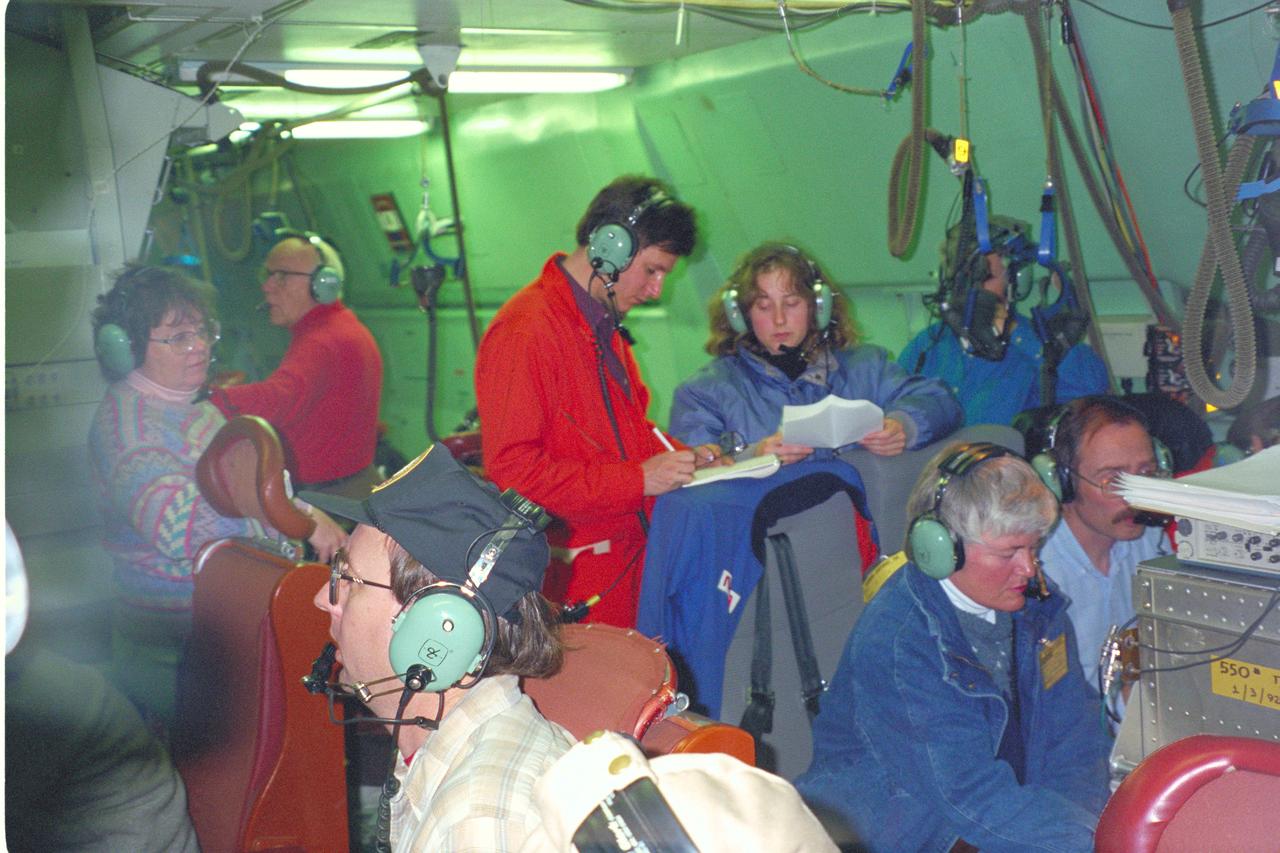
C-141 KAO - Fall 1993 Foster Teachers Flight
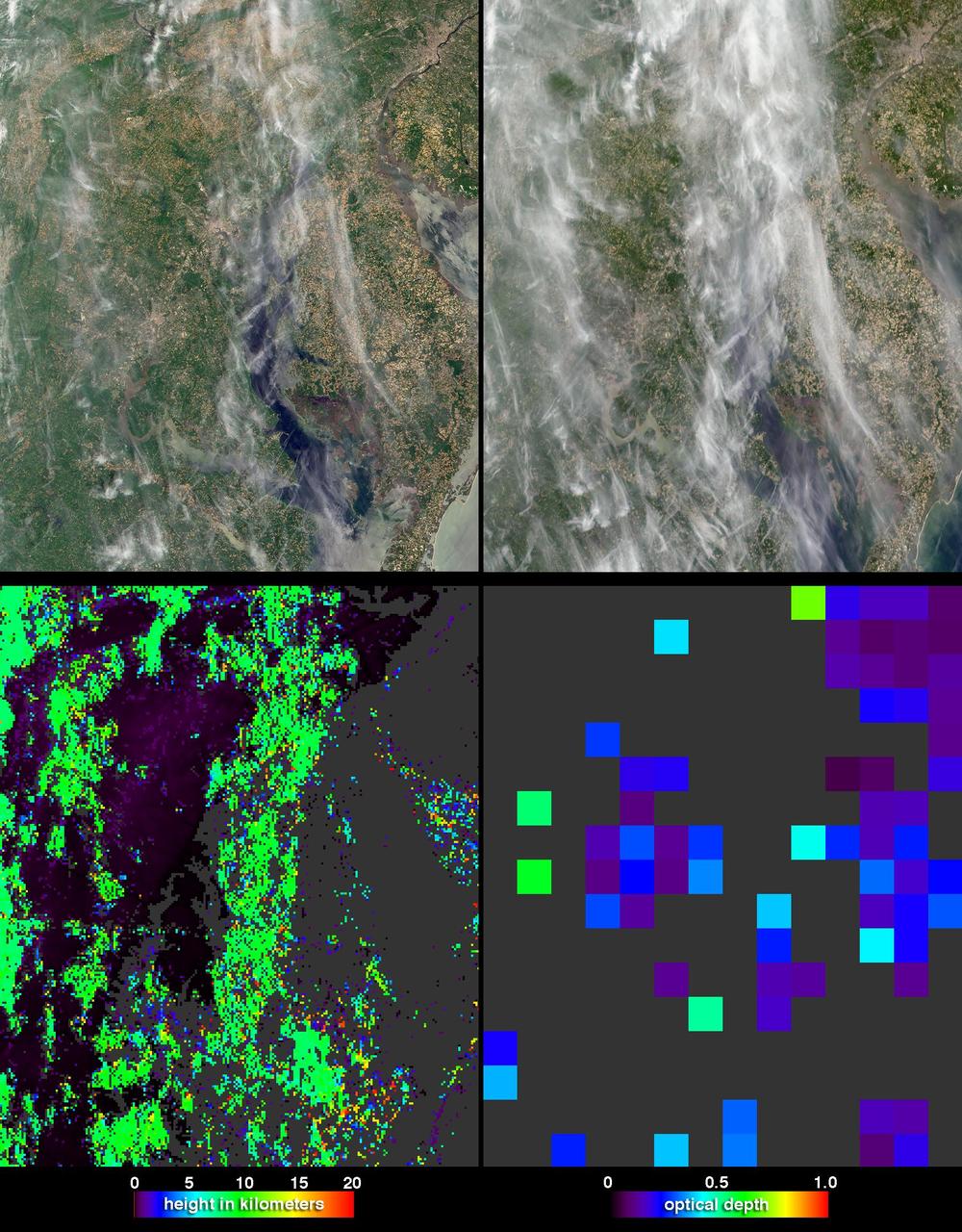
During Spring 2003, students, teachers, and scientists worked side-by-side, measuring the properties of aerosols fine particulate matter suspended in the air over Baltimore, Maryland using hand-held instruments shown here by NASA Terra spacecraft.
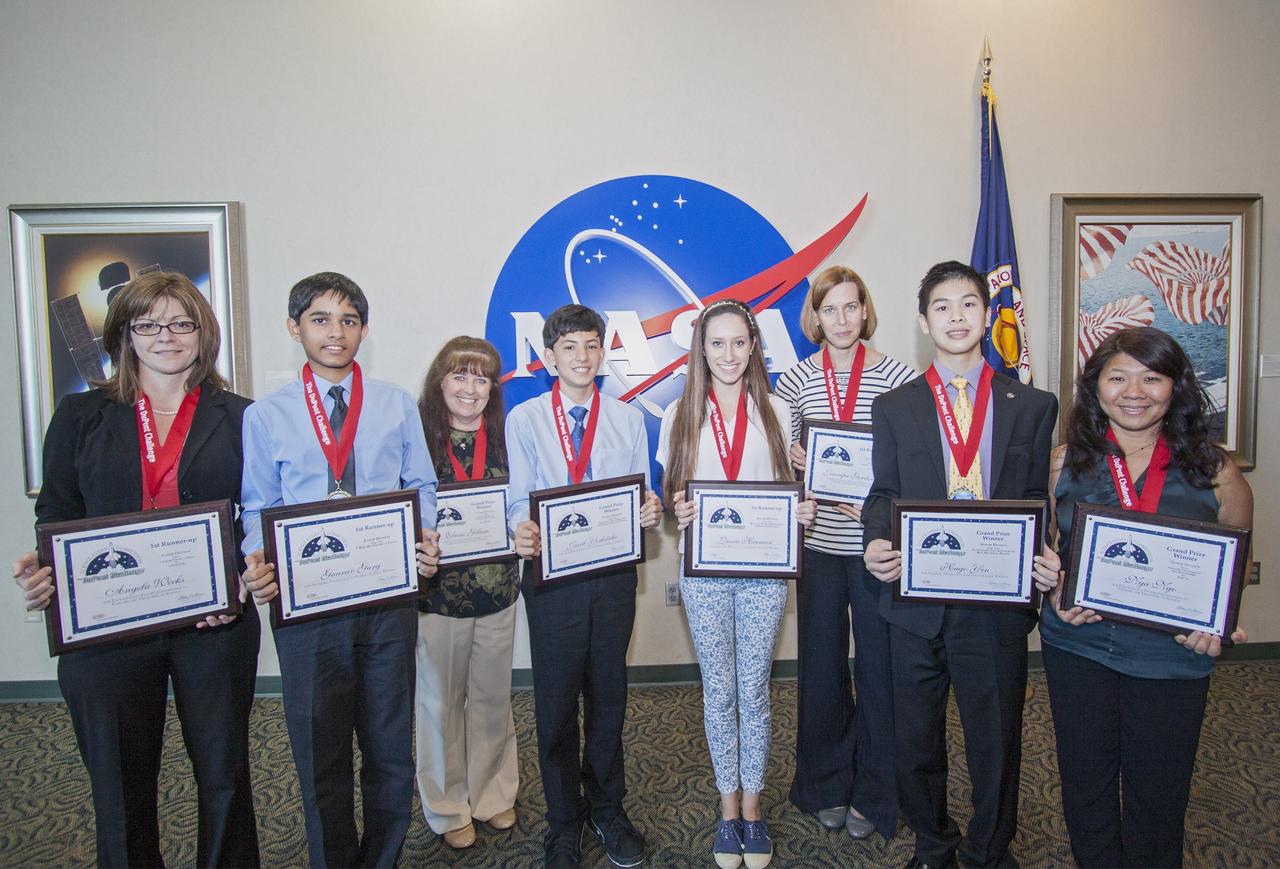
CAPE CANAVERAL, Fla. - The winning students and their teachers of the 2013 DuPont Challenge Science Essay Competition show off their awards after a ceremony at the Kennedy Space Center Visitor Complex in Florida. From left are sponsoring teacher Angela Weeks and Junior Division first runner-up Gaurav Garg of Beckendorff Junior High in Katy, Texas sponsoring teacher Elaine Gillum and Senior Division grand prize winner Jacob Yoshitake of Marshall Middle School in San Diego, Calif. Senior Division first runner-up Laura Herman and sponsoring teacher Jennifer Gordinier of Pine Crest School in Fort Lauderdale, Fla. and Senior Division grand prize awardee Hugo Yen and sponsoring teacher Nga Ngo of Troy High in Fullerton, Calif. The challenge, now in its 27th year, reaches out to students from grades seven through 12 from all 50 states and Canada. More than 200,000 students entered the competition. The DuPont Challenge aims to inspire students to excel and achieve in scientific writing and pursue careers in science, technology, engineering and mathematics STEM. The challenge honors space shuttle Challenger's STS-51L crew members who gave their lives while furthering the cause of exploration and discovery. For more information on the challenge, go to http://thechallenge.dupont.com/sponsors/nasa.php.
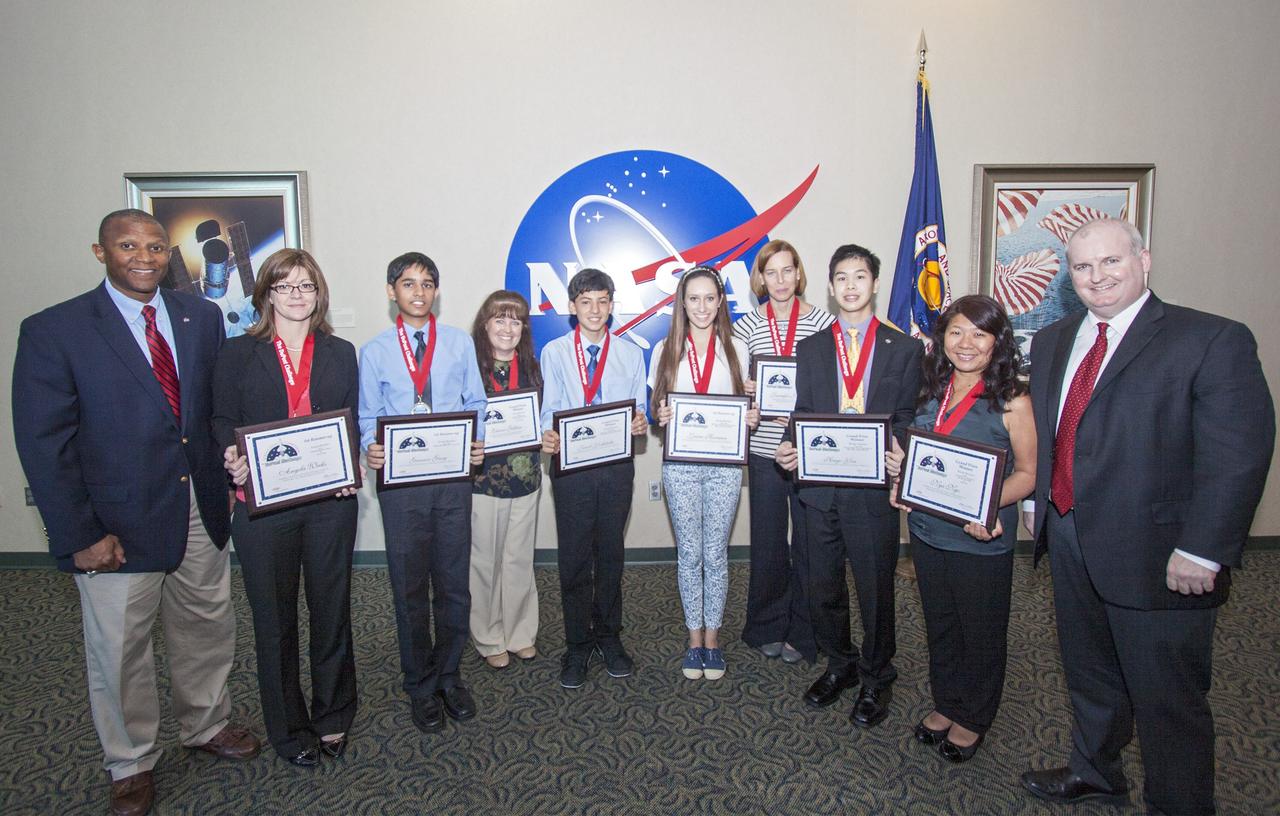
CAPE CANAVERAL, Fla. - The winning students and their teachers of the 2013 DuPont Challenge Science Essay Competition show off their awards after a ceremony at the Kennedy Space Center Visitor Complex in Florida. From left are, Kelvin Manning, the center's associate deputy director sponsoring teacher Angela Weeks and Junior Division first runner-up Gaurav Garg of Beckendorff Junior High in Katy, Texas sponsoring teacher Elaine Gillum and Senior Division grand prize winner Jacob Yoshitake of Marshall Middle School in San Diego, Calif. Senior Division first runner-up Laura Herman and sponsoring teacher Jennifer Gordinier of Pine Crest School in Fort Lauderdale, Fla. and Senior Division grand prize awardee Hugo Yen and sponsoring teacher Nga Ngo of Troy High in Fullerton, Calif. The challenge, now in its 27th year, reaches out to students from grades seven through 12 from all 50 states and Canada. More than 200,000 students entered the competition. The DuPont Challenge aims to inspire students to excel and achieve in scientific writing and pursue careers in science, technology, engineering and mathematics STEM. The challenge honors space shuttle Challenger's STS-51L crew members who gave their lives while furthering the cause of exploration and discovery. For more information on the challenge, go to http://thechallenge.dupont.com/sponsors/nasa.php.
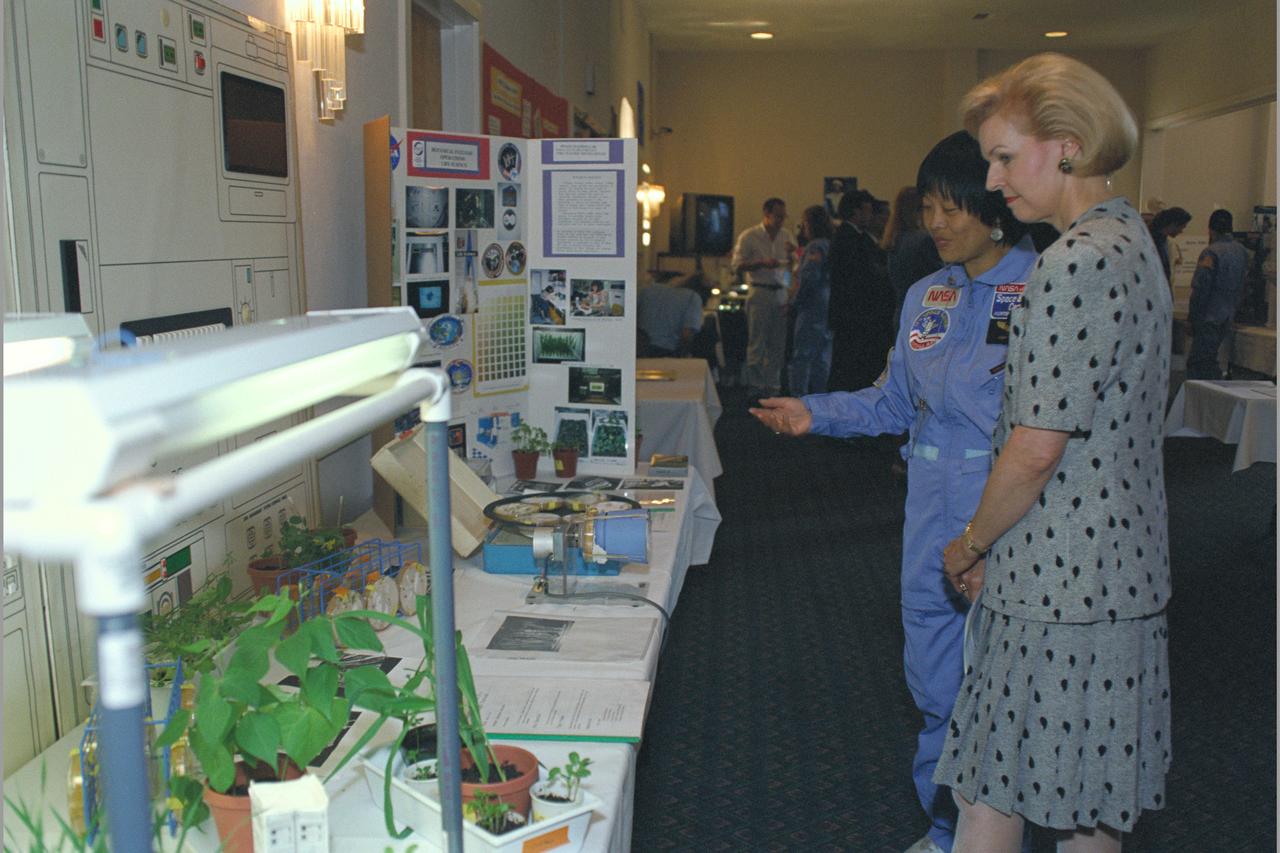
1996 'STELLAR' program commencement with special guest Mrs. Gayle Wilson (CA governor's wife) as she tours the STELLAR project displays with STELLAR students and teachers
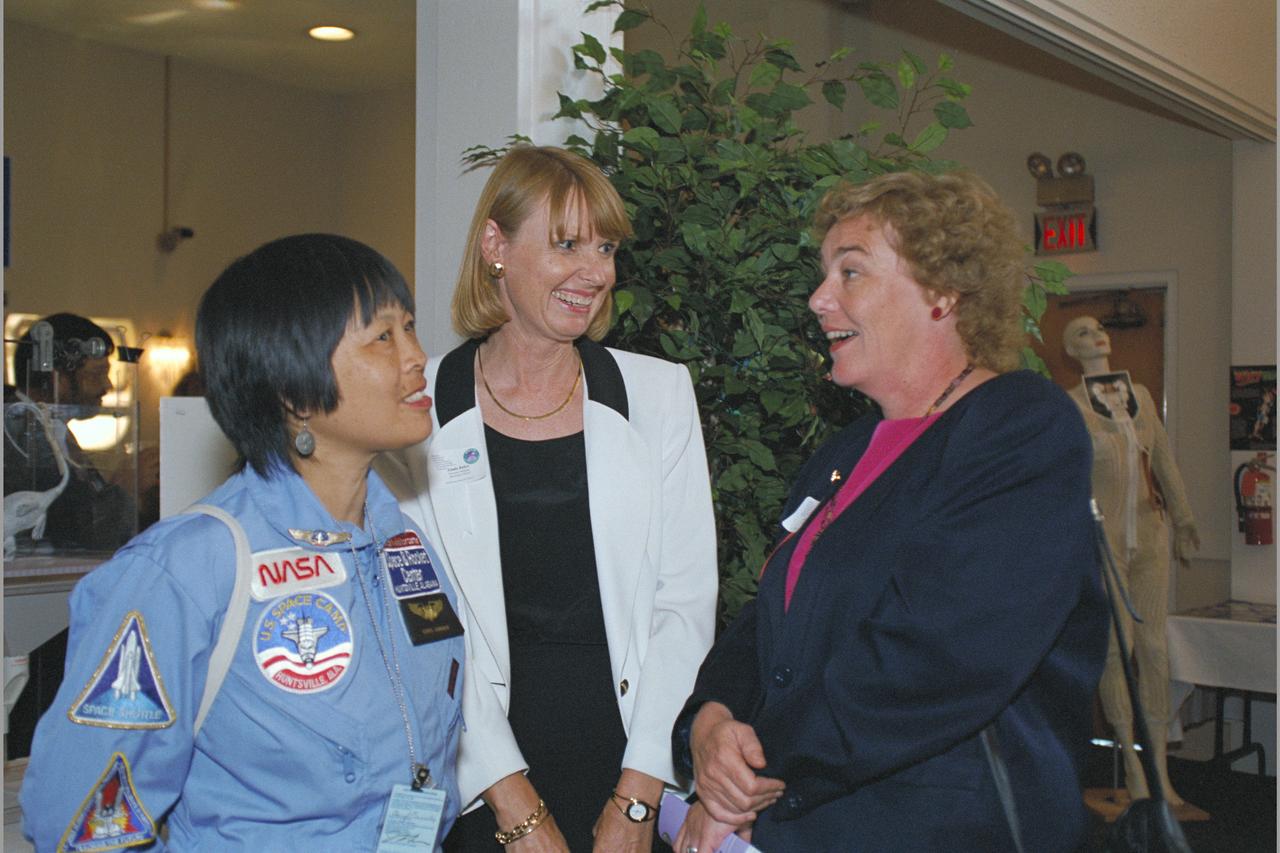
1996 'STELLAR' program commencement with special guest Zoe Lofgren (U.S. Congresswoman, CA) as she tours the STELLAR project displays with STELLAR students and teachers
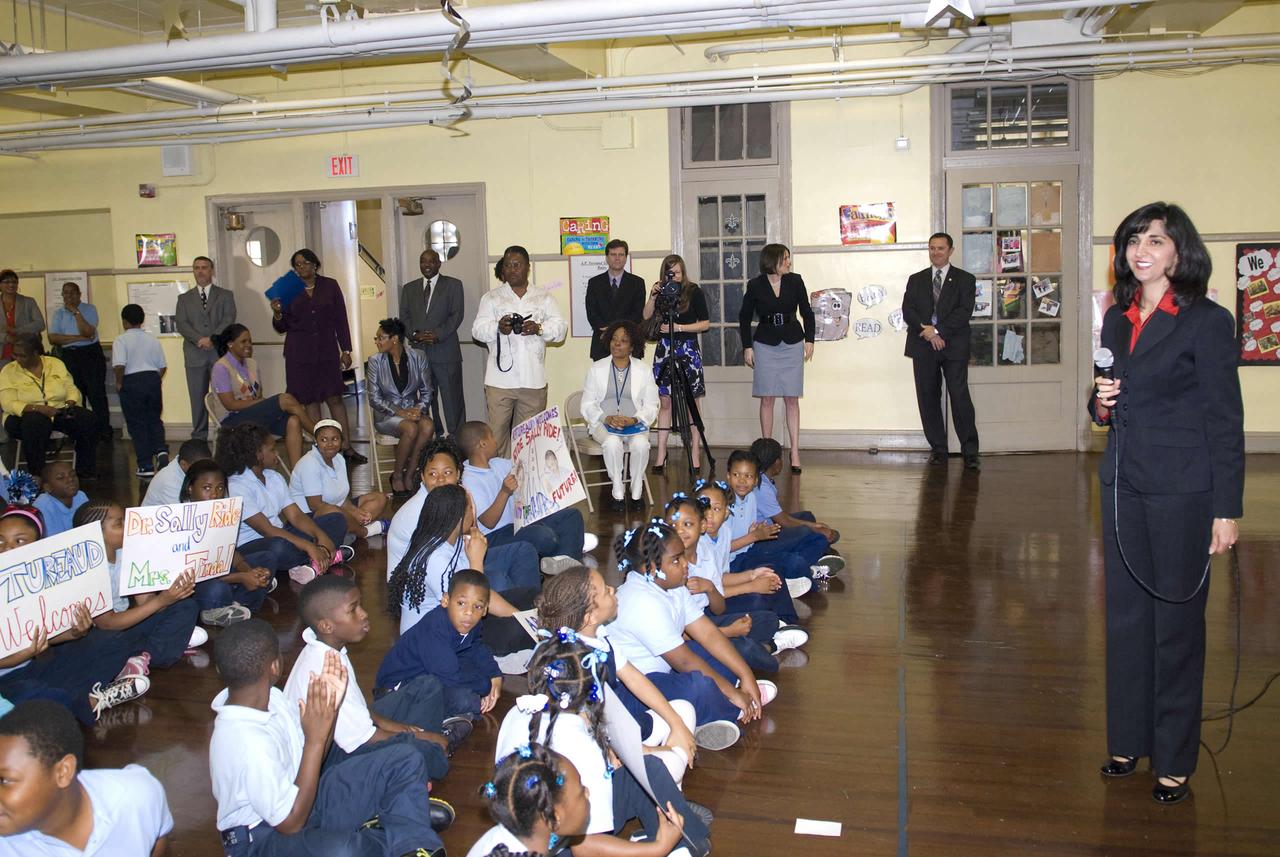
Louisiana first lady Supriya Jindal joins astronaut Sally Ride in speaking to teachers and students at A.P. Tureaud Elementary School in New Orleans.
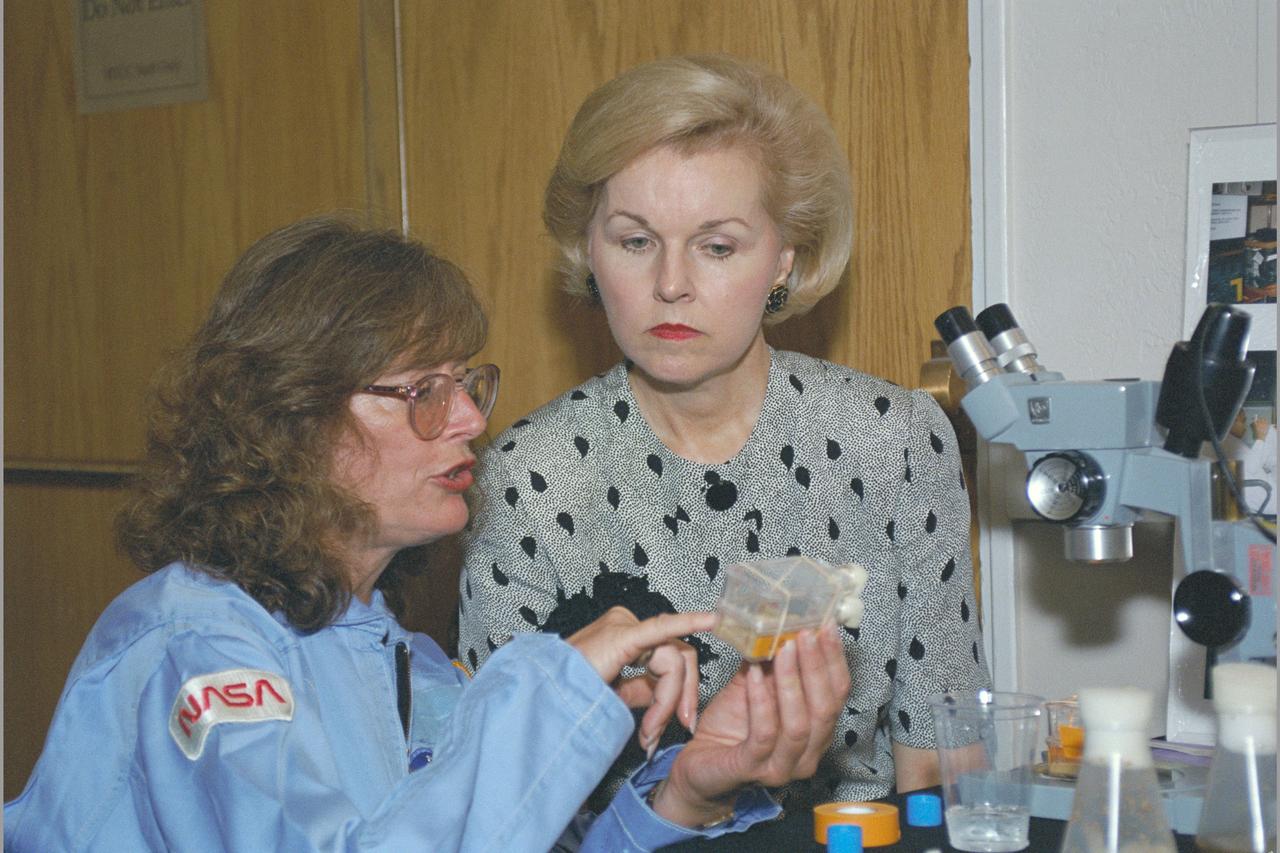
1996 'STELLAR' program commencement with special guest Mrs. Gayle Wilson (CA governor's wife) as she tours the STELLAR project displays with STELLAR students and teachers
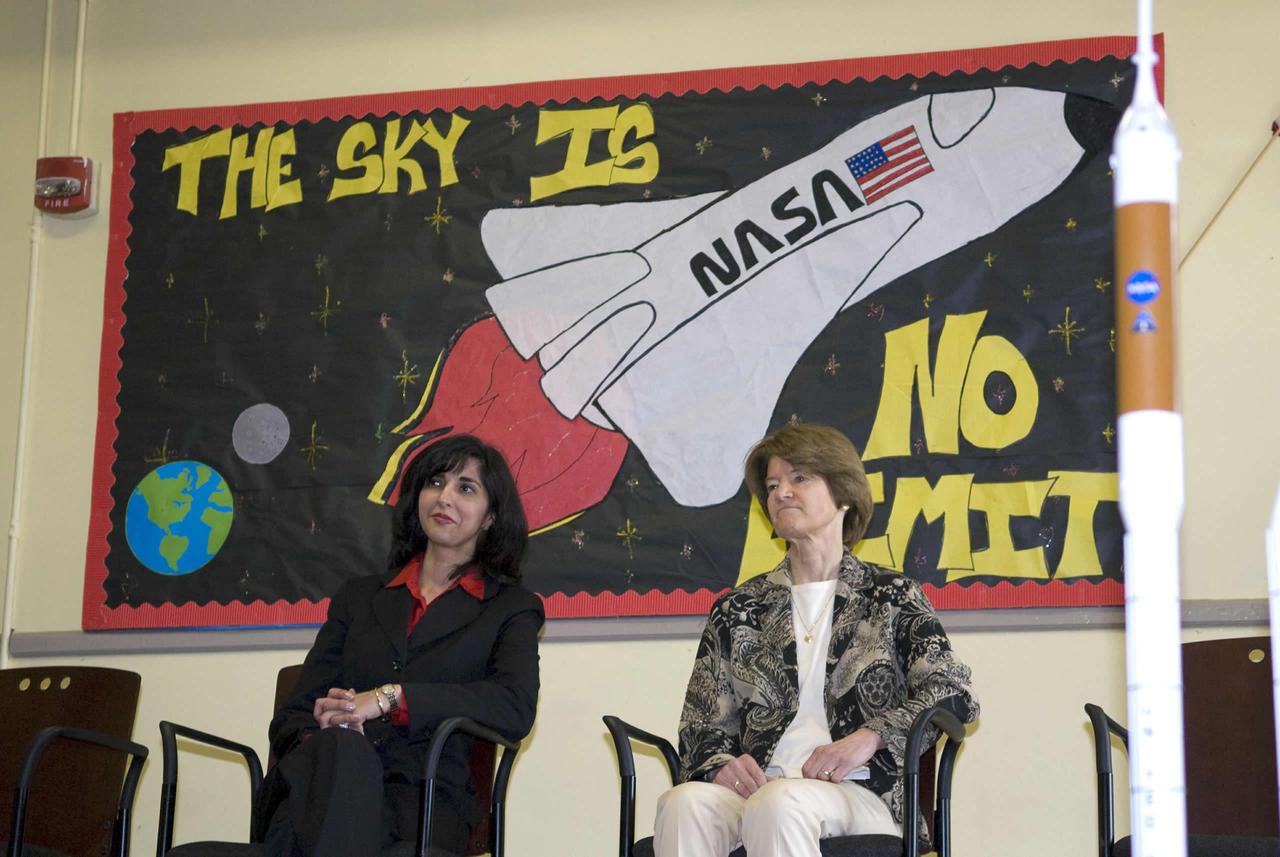
Louisiana first lady Supriya Jindal joins astronaut Sally Ride in speaking to teachers and students at A.P. Tureaud Elementary School in New Orleans.
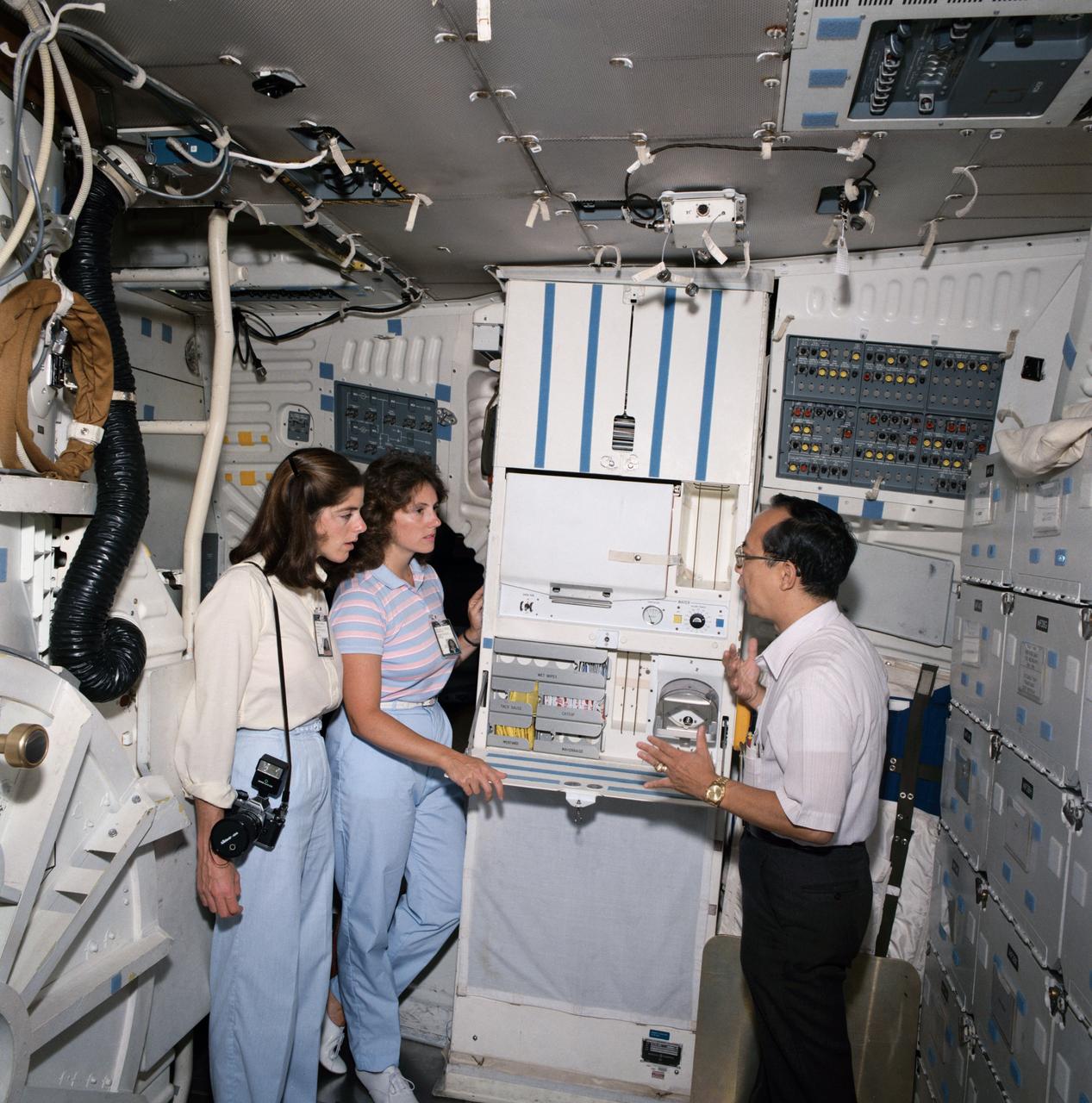
S85-40509 (23 Sept. 1985) --- Two women representing the Teacher-in-Space project undergo training in preparation for the STS-51L mission in two photographs made in Johnson Space Center trainers. Barbara R. Morgan (left), 51-L’s backup teacher, and McAuliffe are briefed by L.W. Lew on the space shuttle galley, located on the middeck. Photo credit: NASA
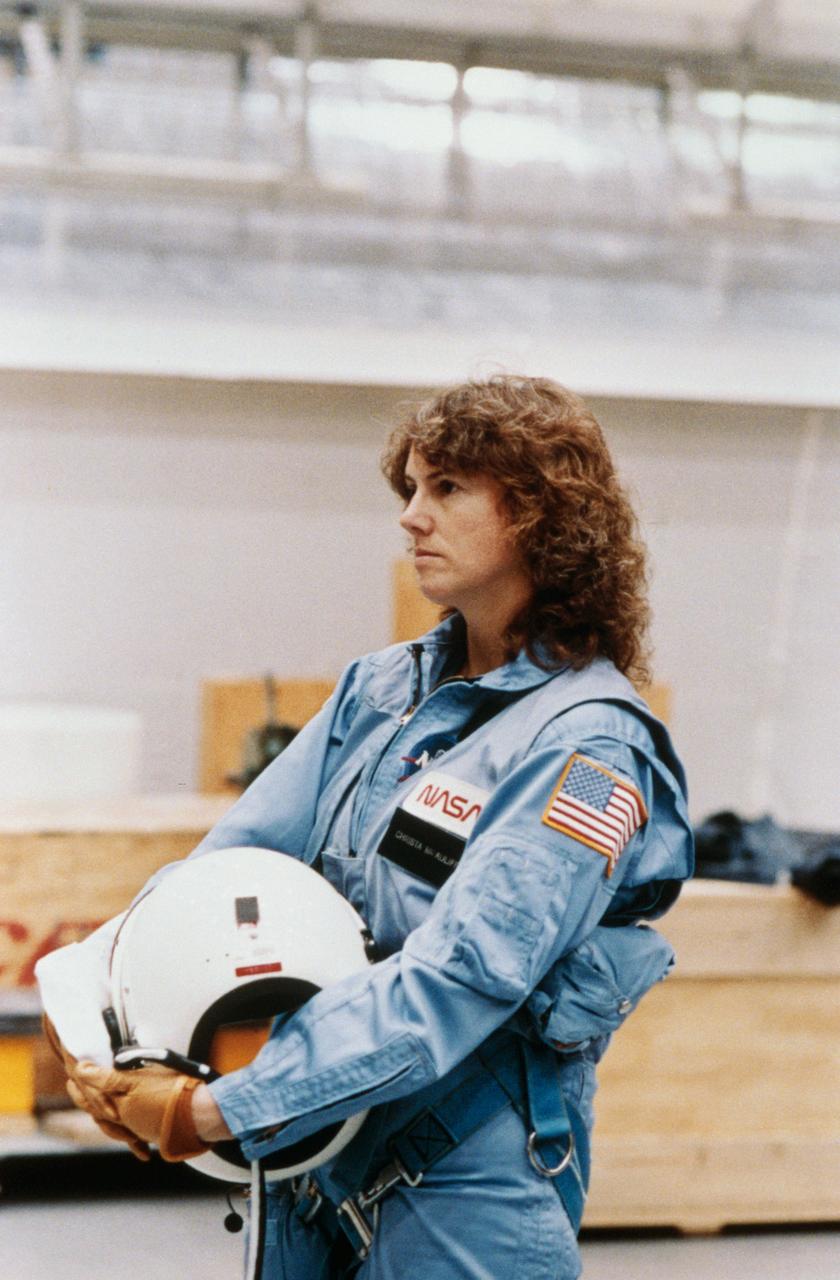
S86-25251 (January 1986) --- Sharon Christa McAuliffe, payload specialist for STS-51L, takes a breather following a busy day?s training in the Johnson Space Center?s Shuttle Mock-up and Integration Laboratory. McAuliffe, a New Hampshire school teacher, was chosen from among ten finalists in the Teacher-in-Space Project to serve as citizen observer aboard the Challenger. This photo was taken by Keith Meyers of the New York Times. Photo credit: NASA
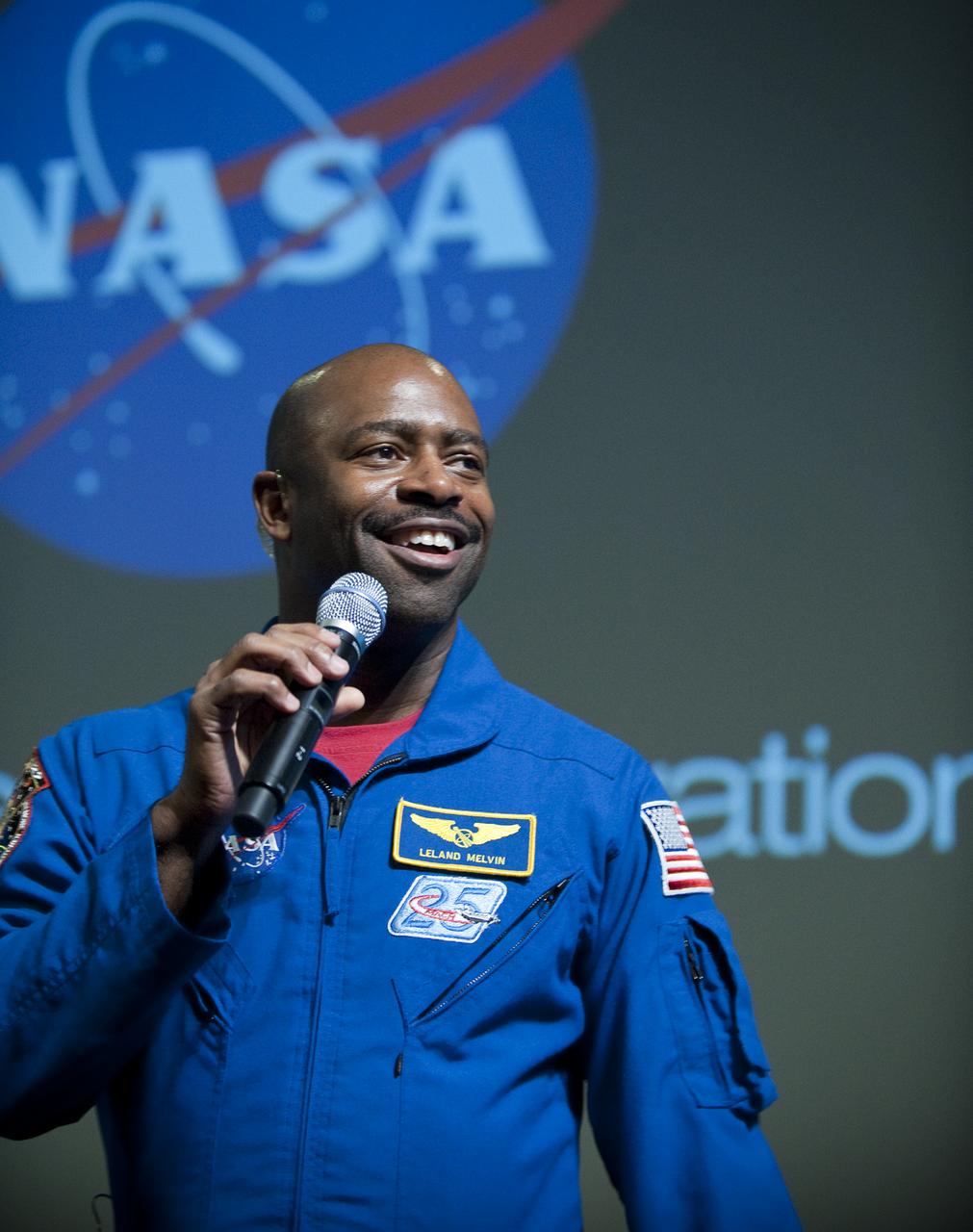
NASA astronaut Leland Melvin welcomes teachers and middle school students to the kick off of NASA's Summer of Innovation program at the Jet Propulsion Laboratory in Pasadena, Calif., Thursday, June 10, 2010. Through the program, NASA will engage thousands of middle school students and teachers in stimulating math and science-based education programs with the goal of increasing the number of future scientists, mathematicians, and engineers. Photo Credit: (NASA/Bill Ingalls)
One of NASA's newest education publications made its debut at the arnual National Council of Teachers of Mathematics (NCTM) conference held in Orlando, Florida April 5-7. How High Is It? An Educator's Guide with Activities Focused on Scale Models of Distances was presented by Carla Rosenberg of the National Center for Microgravity Research at Glenn Research Center. Rosenberg, an author of the Guide, led teachers in several hands-on activities from the Guide. This image is from a digital still camera; higher resolution is not available.
One of NASA's newest education publications made its debut at the arnual National Council of Teachers of Mathematics (NCTM) conference held in Orlando, Florida April 5-7. How High Is It? An Educator's Guide with Activities Focused on Scale Models of Distances was presented by Carla Rosenberg of the National Center for Microgravity Research at Glenn Research Center. Rosenberg, an author of the Guide, led teachers in several hands-on activities from the Guide. This image is from a digital still camera; higher resolution is not available.
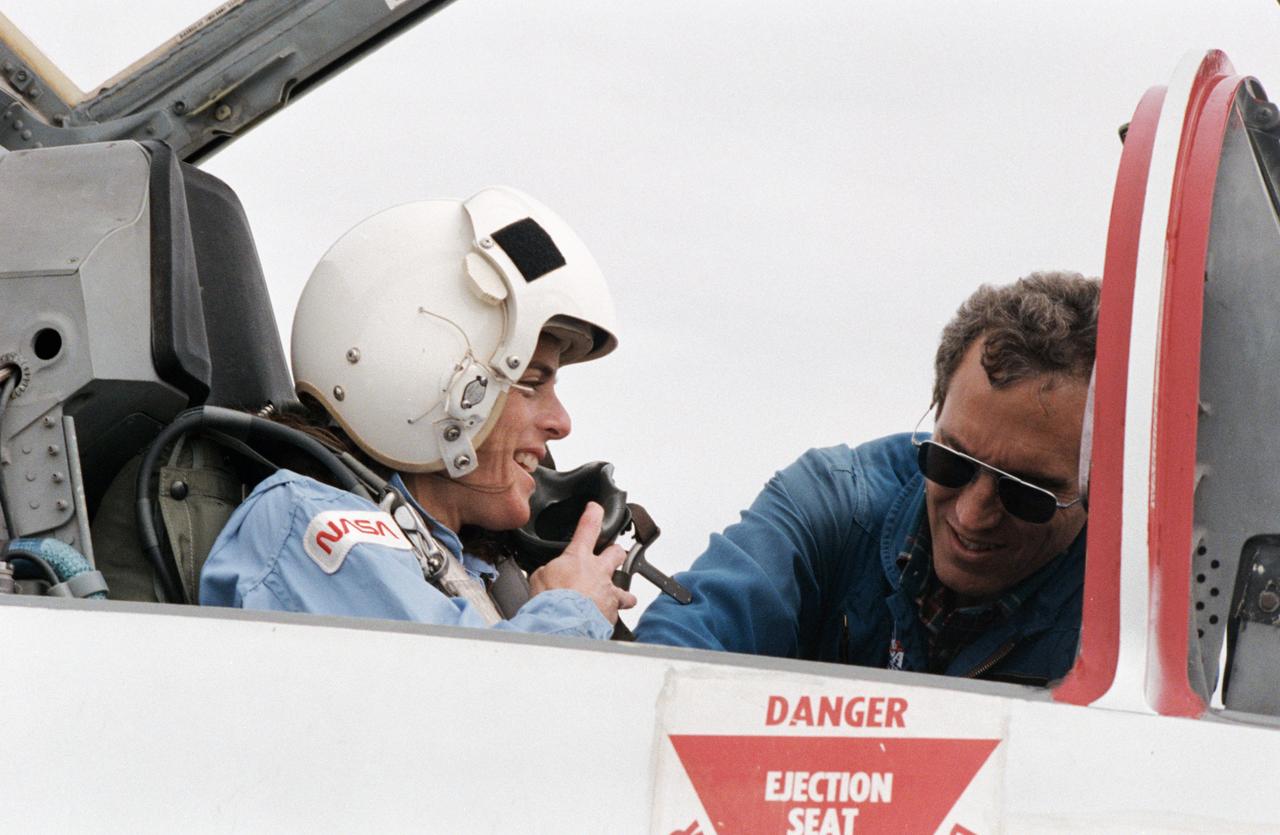
S85-41451 (3 Oct. 1985) --- Barbara Morgan, backup to the Teacher-in-Space participant Christa McAuliffe, prepares for a ride in the rear station of one of NASA's T-38 jet trainers at Ellington Field, near the Johnson Space Center (JSC). The McCall, Idaho teacher is briefed by astronaut Michael J. Smith, 51-L pilot, before departing Ellington Field. Photo credit: NASA
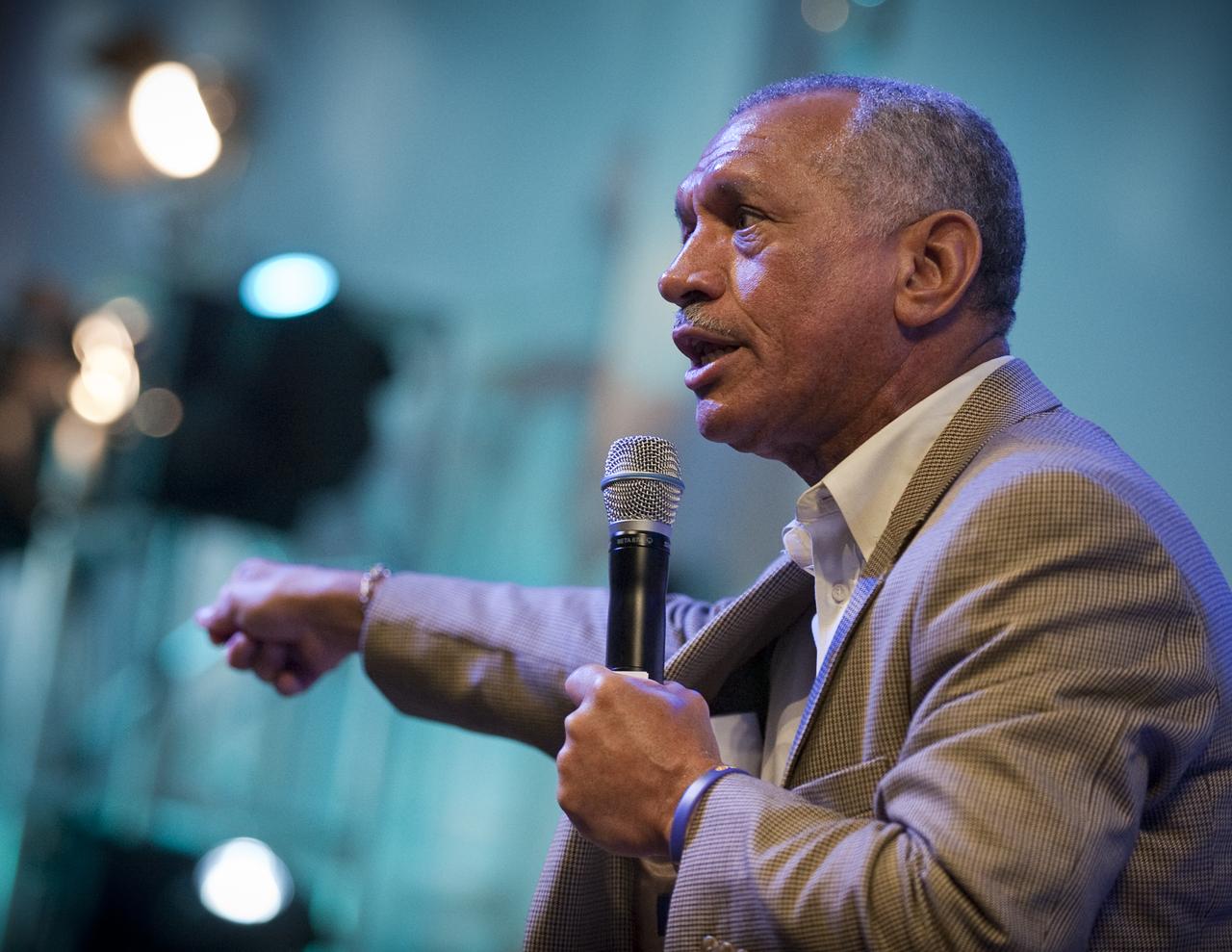
NASA Administrator Charles Bolden speaks with teachers and middle school students during the kick off of NASA's Summer of Innovation program at the Jet Propulsion Laboratory in Pasadena, Calif., Thursday, June 10, 2010. Through the program, NASA will engage thousands of middle school students and teachers in stimulating math and science-based education programs with the goal of increasing the number of future scientists, mathematicians, and engineers. Photo Credit: (NASA/Bill Ingalls)

Jet Propulsion Laboratory Director Dr. Charles Elachi speaks with teachers and middle school students during the kick off of NASA's Summer of Innovation program at JPL in Pasadena, Calif., Thursday, June 10, 2010. Through the program, NASA will engage thousands of middle school students and teachers in stimulating math and science-based education programs with the goal of increasing the number of future scientists, mathematicians, and engineers. Photo Credit: (NASA/Bill Ingalls)

Performers from Los Angeles Hamilton High School's Kid Tribe entertain teachers and middle school students during the kick off of NASA's Summer of Innovation program at the Jet Propulsion Laboratory in Pasadena, Calif., Thursday, June 10, 2010. Through the program, NASA will engage thousands of middle school students and teachers in stimulating math and science-based education programs with the goal of increasing the number of future scientists, mathematicians, and engineers. Photo Credit: (NASA/Bill Ingalls)
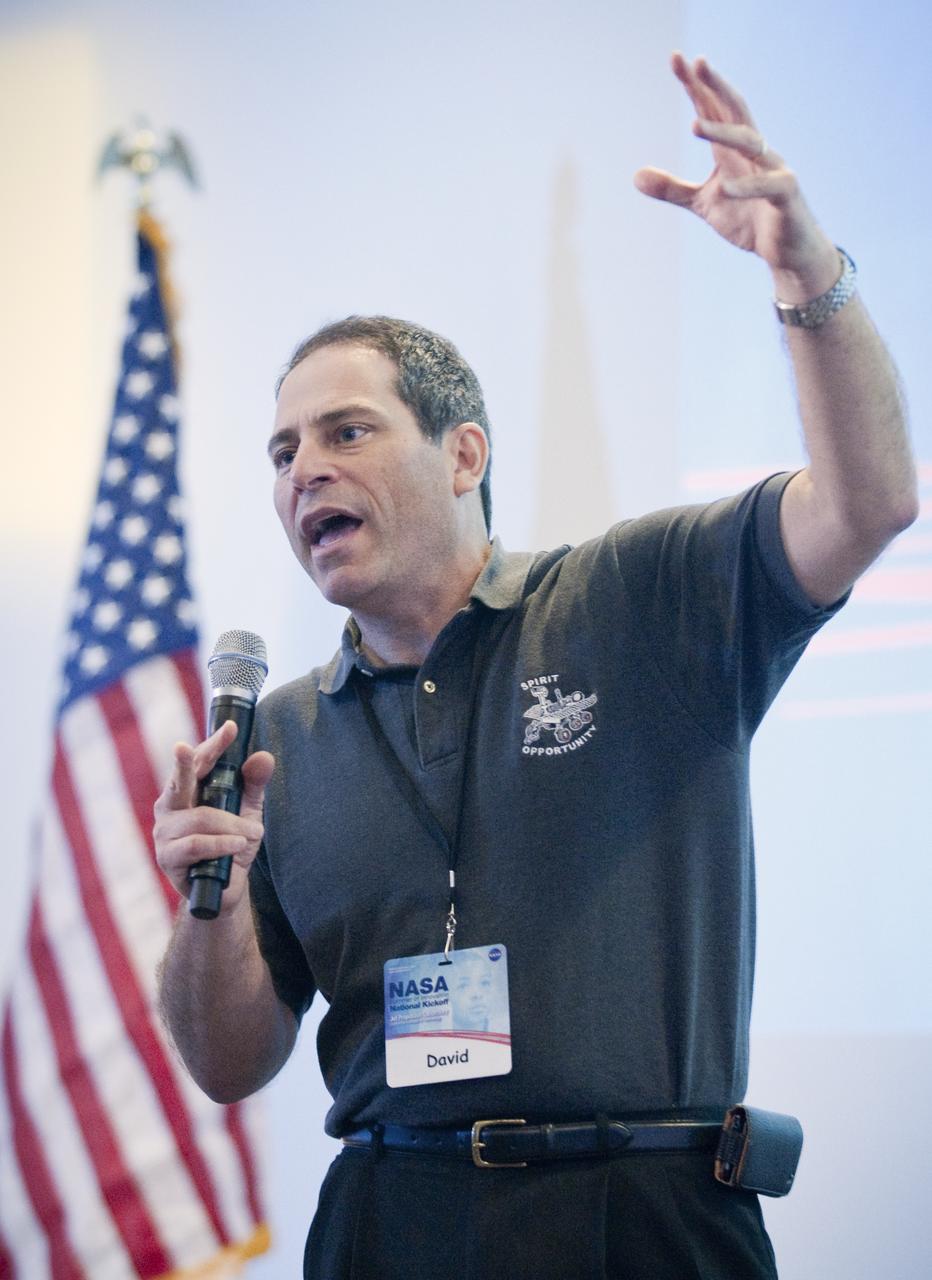
Jet Propulsion Laboratory Manager of Elementary and Secondary Education David Seidel motivates teachers and middle school students during the kick off of NASA's Summer of Innovation program at the Jet Propulsion Laboratory in Pasadena, Calif., Thursday, June 10, 2010. Through the program, NASA will engage thousands of middle school students and teachers in stimulating math and science-based education programs with the goal of increasing the number of future scientists, mathematicians, and engineers. Photo Credit: (NASA/Bill Ingalls)
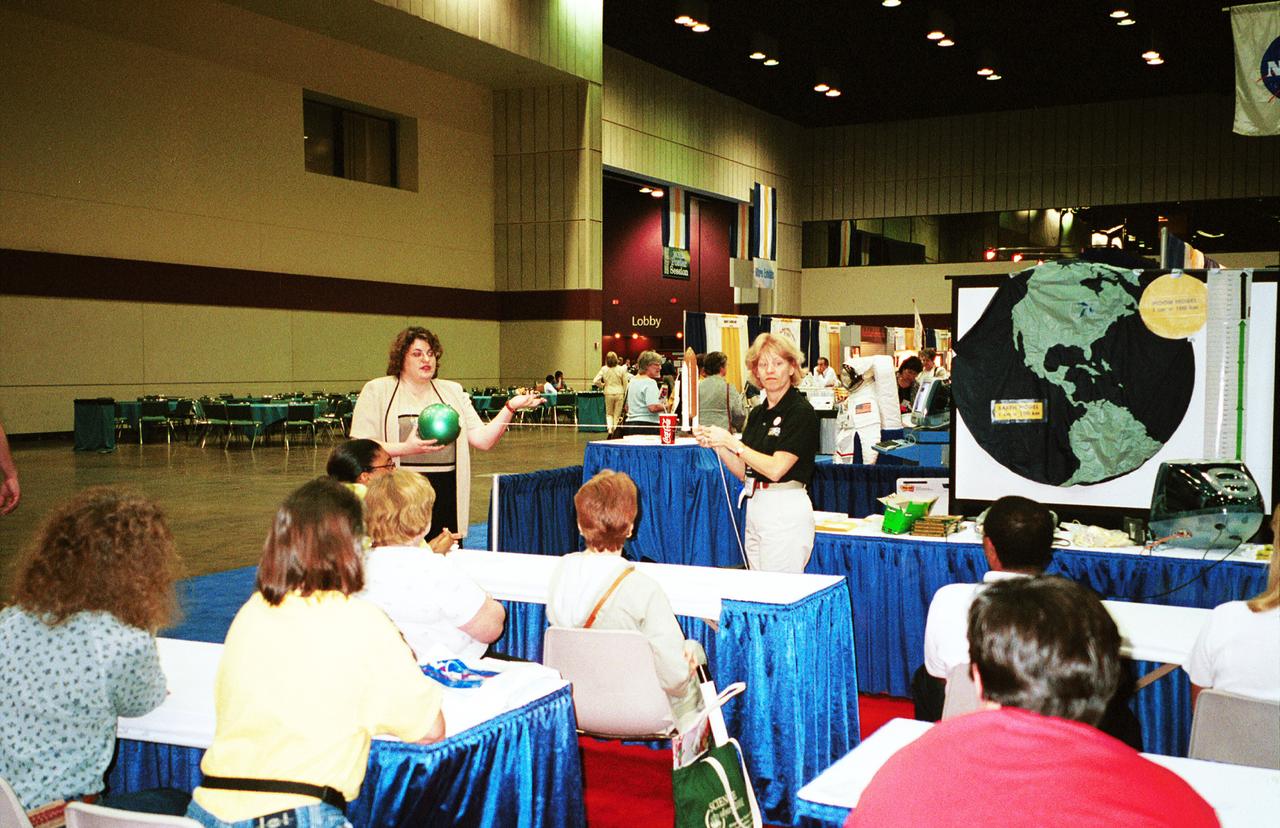
One of NASA's newest education publications made its debut at the arnual National Council of Teachers of Mathematics (NCTM) conference held in Orlando, Florida April 5-7. How High Is It? An Educator's Guide with Activities Focused on Scale Models of Distances was presented by Carla Rosenberg of the National Center for Microgravity Research at Glenn Research Center. Rosenberg, an author of the Guide, led teachers in several hands-on activities from the Guide. This image is from a digital still camera; higher resolution is not available.
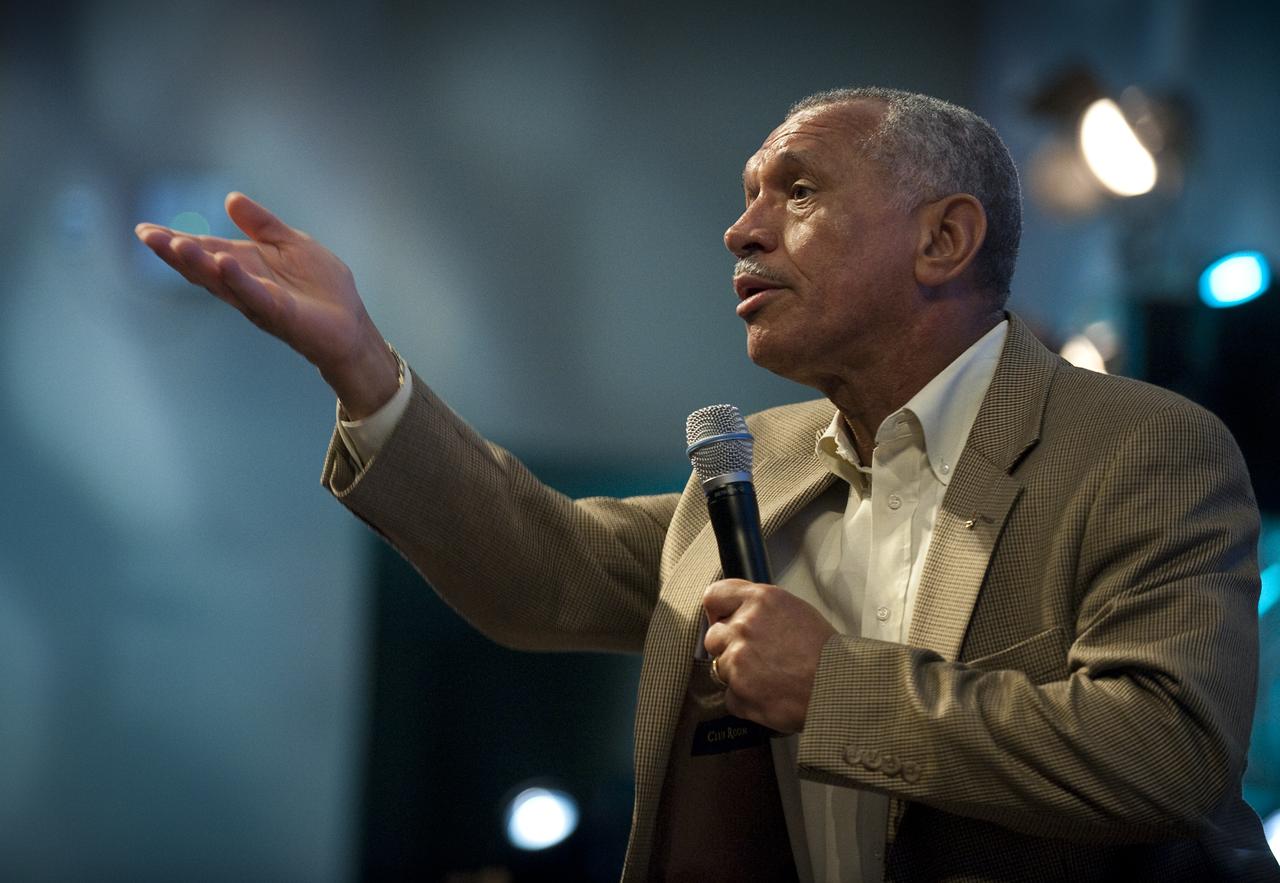
NASA Administrator Charles Bolden speaks with teachers and middle school students during the kick off of NASA's Summer of Innovation program at the Jet Propulsion Laboratory in Pasadena, Calif., Thursday, June 10, 2010. Through the program, NASA will engage thousands of middle school students and teachers in stimulating math and science-based education programs with the goal of increasing the number of future scientists, mathematicians, and engineers. Photo Credit: (NASA/Bill Ingalls)

Teachers and middle school students react to performers from Los Angeles Hamilton High School's Kid Tribe during the kick off of NASA's Summer of Innovation program at the Jet Propulsion Laboratory in Pasadena, Calif., Thursday, June 10, 2010. Through the program, NASA will engage thousands of middle school students and teachers in stimulating math and science-based education programs with the goal of increasing the number of future scientists, mathematicians, and engineers. Photo Credit: (NASA/Bill Ingalls)
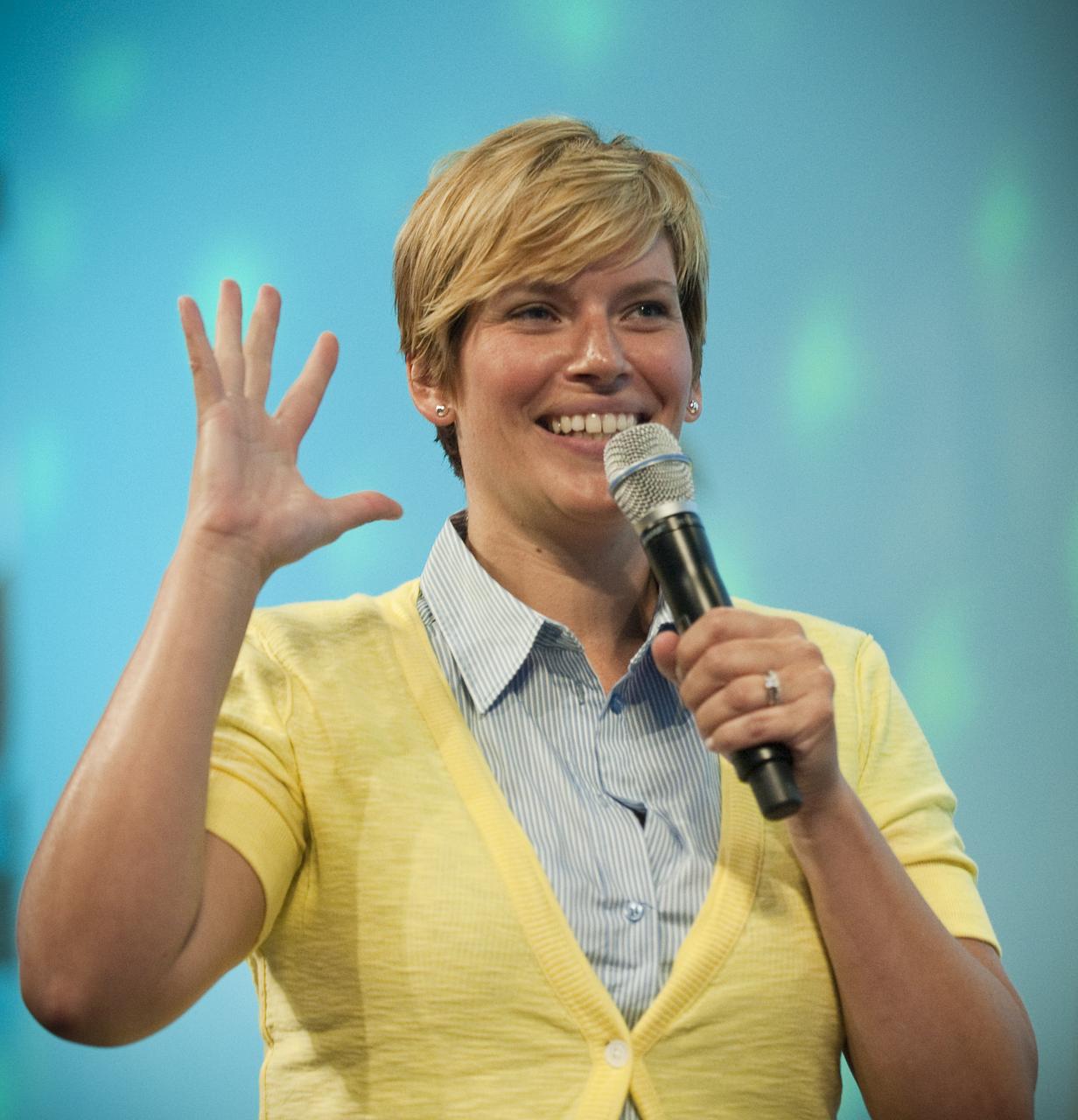
Erin Gilbert, Director of Professional Development from the National Summer Learning Associations, motivates teachers and middle school students during the kick off of NASA's Summer of Innovation program at the Jet Propulsion Laboratory in Pasadena, Calif., Thursday, June 10, 2010. Through the program, NASA will engage thousands of middle school students and teachers in stimulating math and science-based education programs with the goal of increasing the number of future scientists, mathematicians, and engineers. Photo Credit: (NASA/Bill Ingalls)
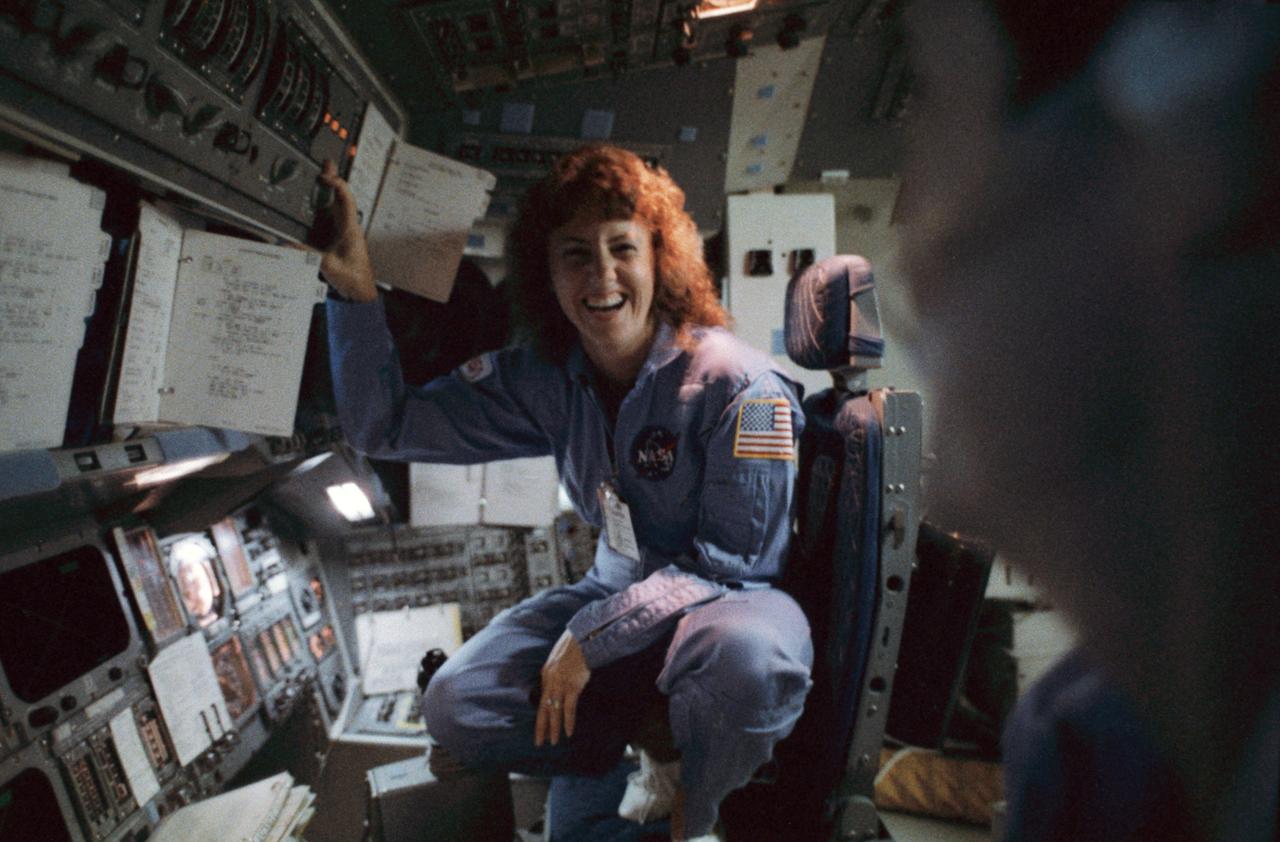
S85-44507 (October 1985) --- Sharon Christa McAuliffe, a teacher from Concord, New Hampshire, trains for the January 1986 mission of the space shuttle Challenger in the Johnson Space Center’s shuttle mission simulator (SMS). Learning about the overall spacecraft systems, McAuliffe is pictured here in the pilot’s station. For actual launch and landing phases, the Teacher-in-Space Project payload specialist would sit on the middeck. The photograph was taken by Michael O’Brien of Life Magazine. Photo credit: NASA

A performer from Los Angeles Hamilton High School's Kid Tribe entertains teachers and middle school students during the kick off of NASA's Summer of Innovation program at the Jet Propulsion Laboratory in Pasadena, Calif., Thursday, June 10, 2010. Through the program, NASA will engage thousands of middle school students and teachers in stimulating math and science-based education programs with the goal of increasing the number of future scientists, mathematicians, and engineers. Photo Credit: (NASA/Bill Ingalls)
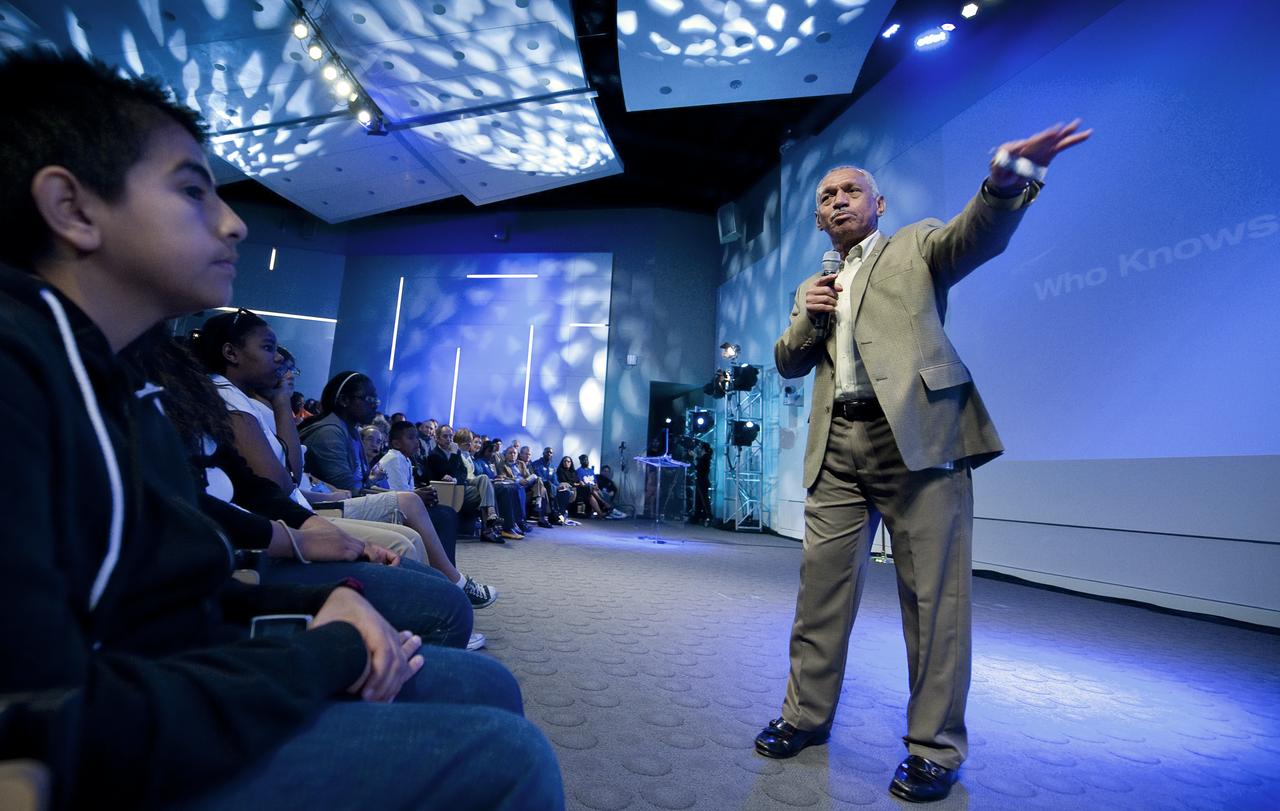
NASA Administrator Charles Bolden speaks with teachers and middle school students during the kick off of NASA's Summer of Innovation program at the Jet Propulsion Laboratory in Pasadena, Calif., Thursday, June 10, 2010. Through the program, NASA will engage thousands of middle school students and teachers in stimulating math and science-based education programs with the goal of increasing the number of future scientists, mathematicians, and engineers. Photo Credit: (NASA/Bill Ingalls)
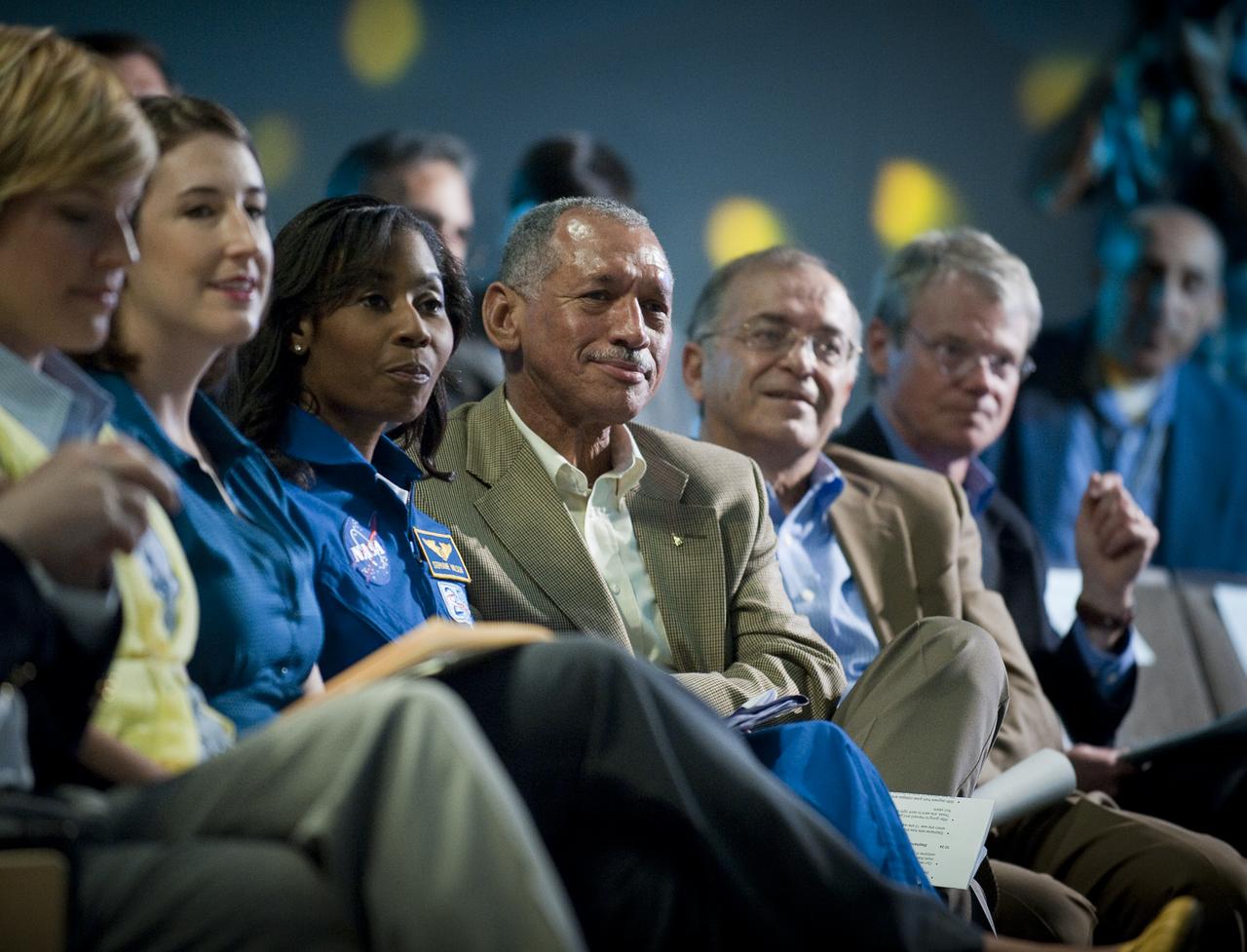
NASA Administrator Charles Bolden, center, listens as NASA astronaut Leland Melvin welcomes teachers and middle school students to the kick off of NASA's Summer of Innovation program at the Jet Propulsion Laboratory in Pasadena, Calif., Thursday, June 10, 2010. Through the program, NASA will engage thousands of middle school students and teachers in stimulating math and science-based education programs with the goal of increasing the number of future scientists, mathematicians, and engineers. Photo Credit: (NASA/Bill Ingalls)

Performers from Los Angeles Hamilton High School's Kid Tribe entertain teachers and middle school students during the kick off of NASA's Summer of Innovation program at the Jet Propulsion Laboratory in Pasadena, Calif., Thursday, June 10, 2010. Through the program, NASA will engage thousands of middle school students and teachers in stimulating math and science-based education programs with the goal of increasing the number of future scientists, mathematicians, and engineers. Photo Credit: (NASA/Bill Ingalls)
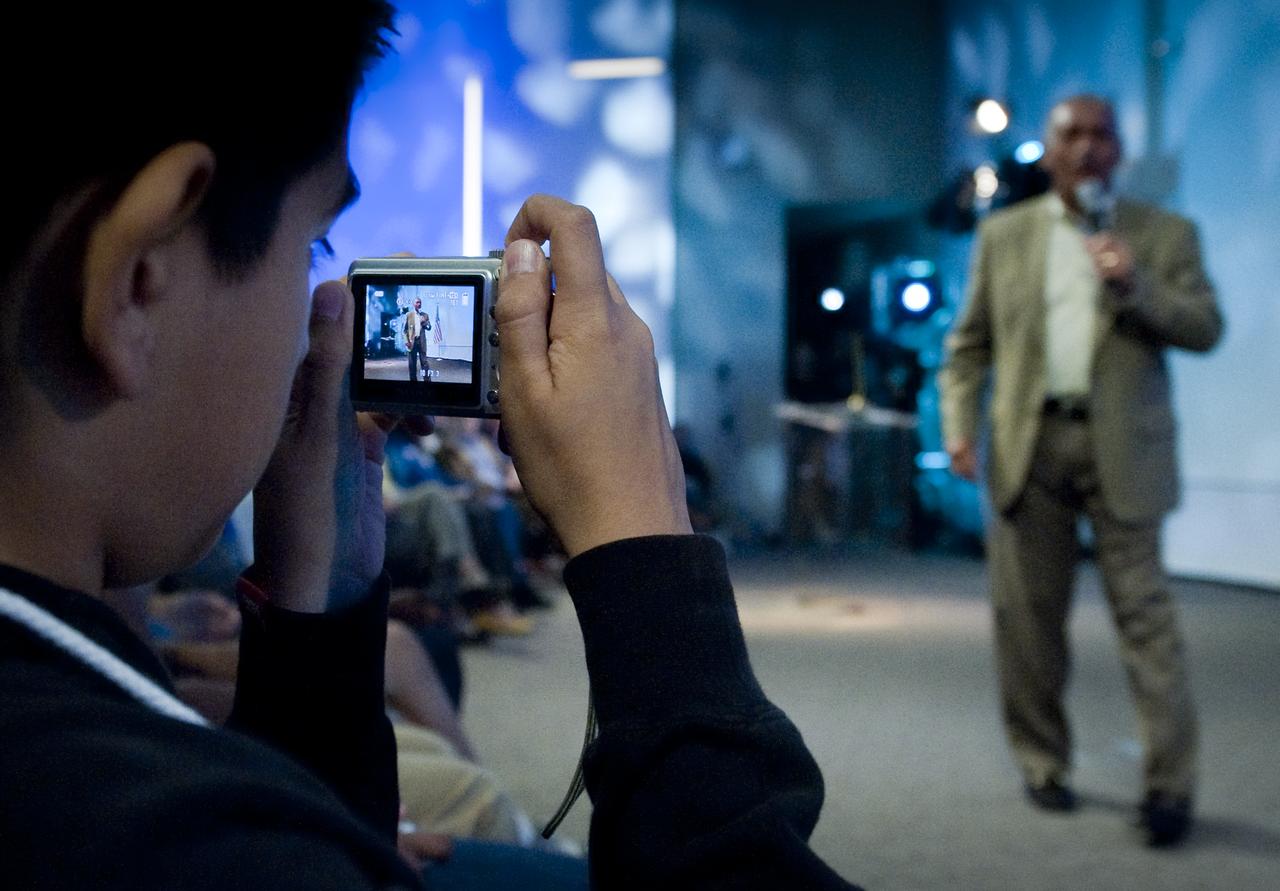
NASA Administrator Charles Bolden speaks with teachers and middle school students during the kick off of NASA's Summer of Innovation program at the Jet Propulsion Laboratory in Pasadena, Calif., Thursday, June 10, 2010. Through the program, NASA will engage thousands of middle school students and teachers in stimulating math and science-based education programs with the goal of increasing the number of future scientists, mathematicians, and engineers. Photo Credit: (NASA/Bill Ingalls)
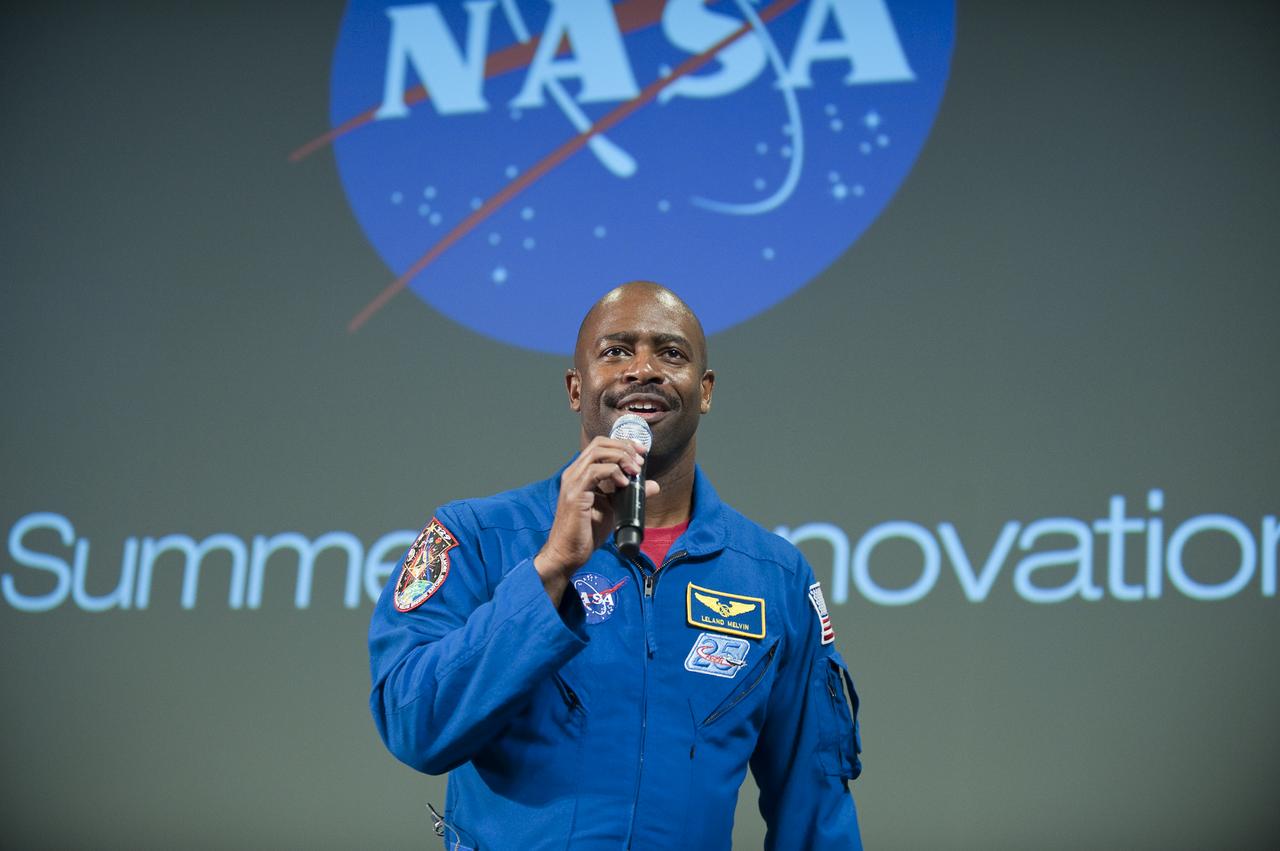
NASA astronaut Leland Melvin welcomes teachers and middle school students to the kick off of NASA's Summer of Innovation program at the Jet Propulsion Laboratory in Pasadena, Calif., Thursday, June 10, 2010. Through the program, NASA will engage thousands of middle school students and teachers in stimulating math and science-based education programs with the goal of increasing the number of future scientists, mathematicians, and engineers. Photo Credit: (NASA/Bill Ingalls)

Julie Townsend, JPL Engineer, talks about her experiences to teachers and middle school students during the kick off of NASA's Summer of Innovation program at the Jet Propulsion Laboratory in Pasadena, Calif., Thursday, June 10, 2010. Through the program, NASA will engage thousands of middle school students and teachers in stimulating math and science-based education programs with the goal of increasing the number of future scientists, mathematicians, and engineers. Photo Credit: (NASA/Bill Ingalls)
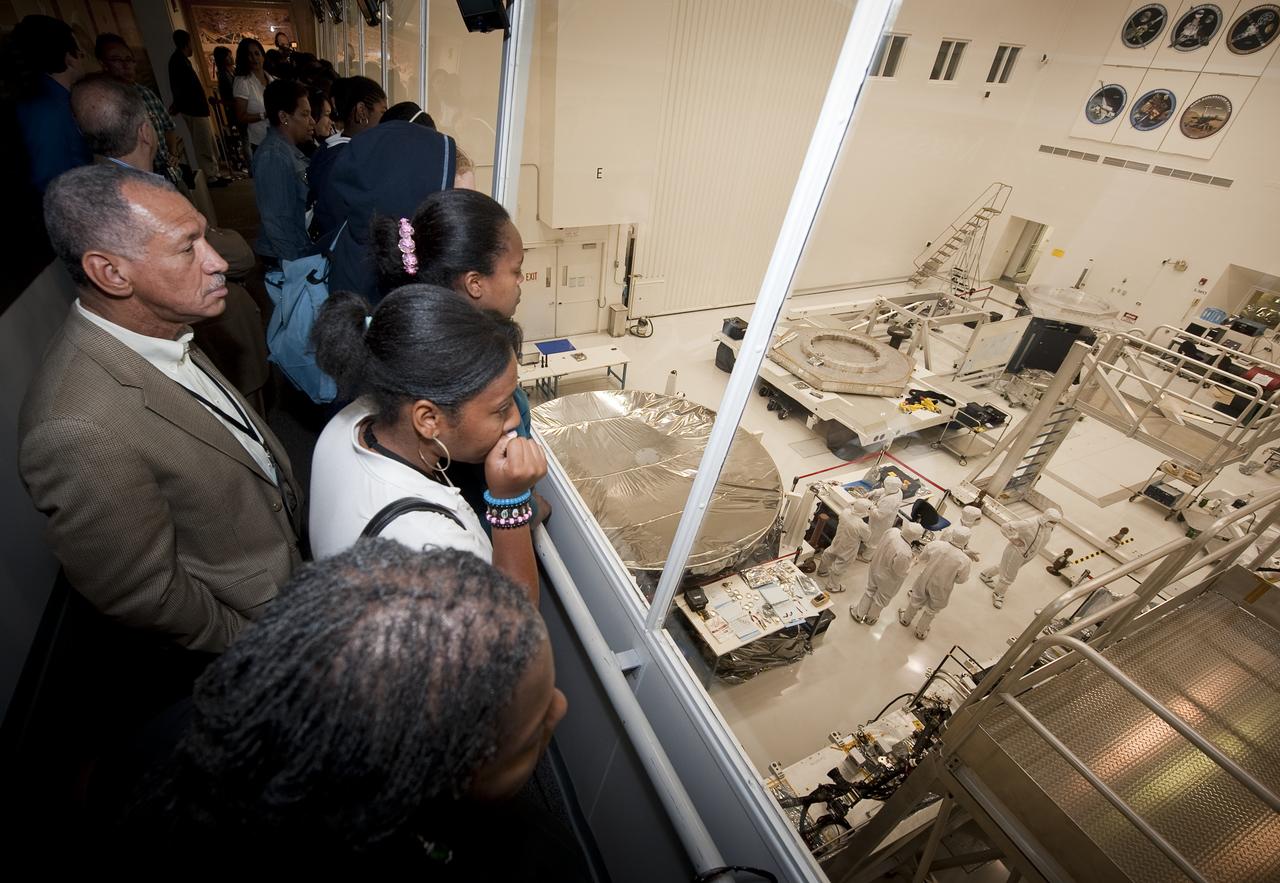
NASA Administrator Charles Bolden, left, along with teachers and middle school students visit High Bay One in the Spacecraft Assembly Building as part of the kick off to NASA's Summer of Innovation program at the Jet Propulsion Laboratory in Pasadena, Calif., Thursday, June 10, 2010. Through the program, NASA will engage thousands of middle school students and teachers in stimulating math and science-based education programs with the goal of increasing the number of future scientists, mathematicians, and engineers. Photo Credit: (NASA/Bill Ingalls)
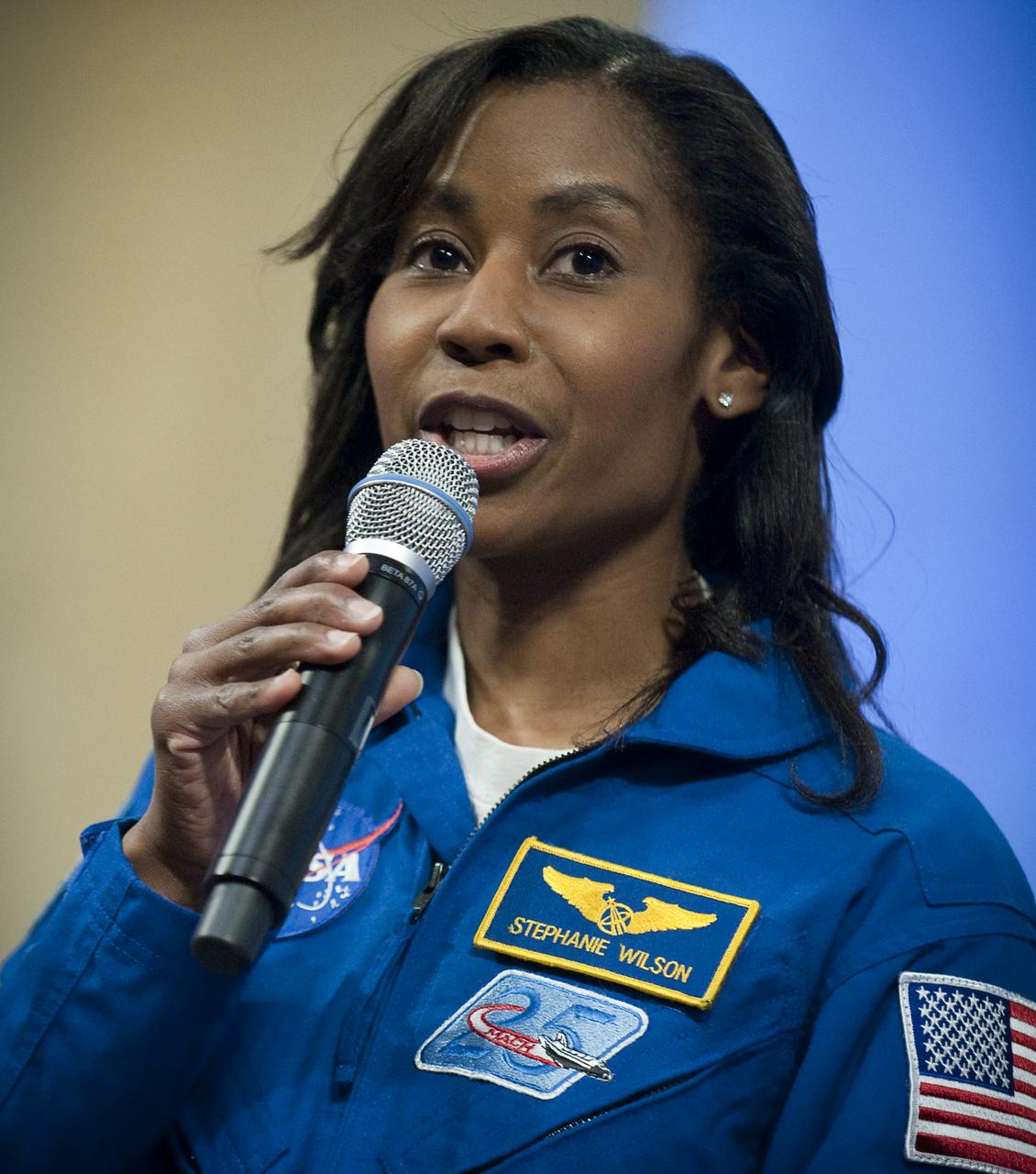
NASA astronaut Stephanie Wilson talks about her experiences to teachers and middle school students during the kick off of NASA's Summer of Innovation program at the Jet Propulsion Laboratory in Pasadena, Calif., Thursday, June 10, 2010. Through the program, NASA will engage thousands of middle school students and teachers in stimulating math and science-based education programs with the goal of increasing the number of future scientists, mathematicians, and engineers. Photo Credit: (NASA/Bill Ingalls)
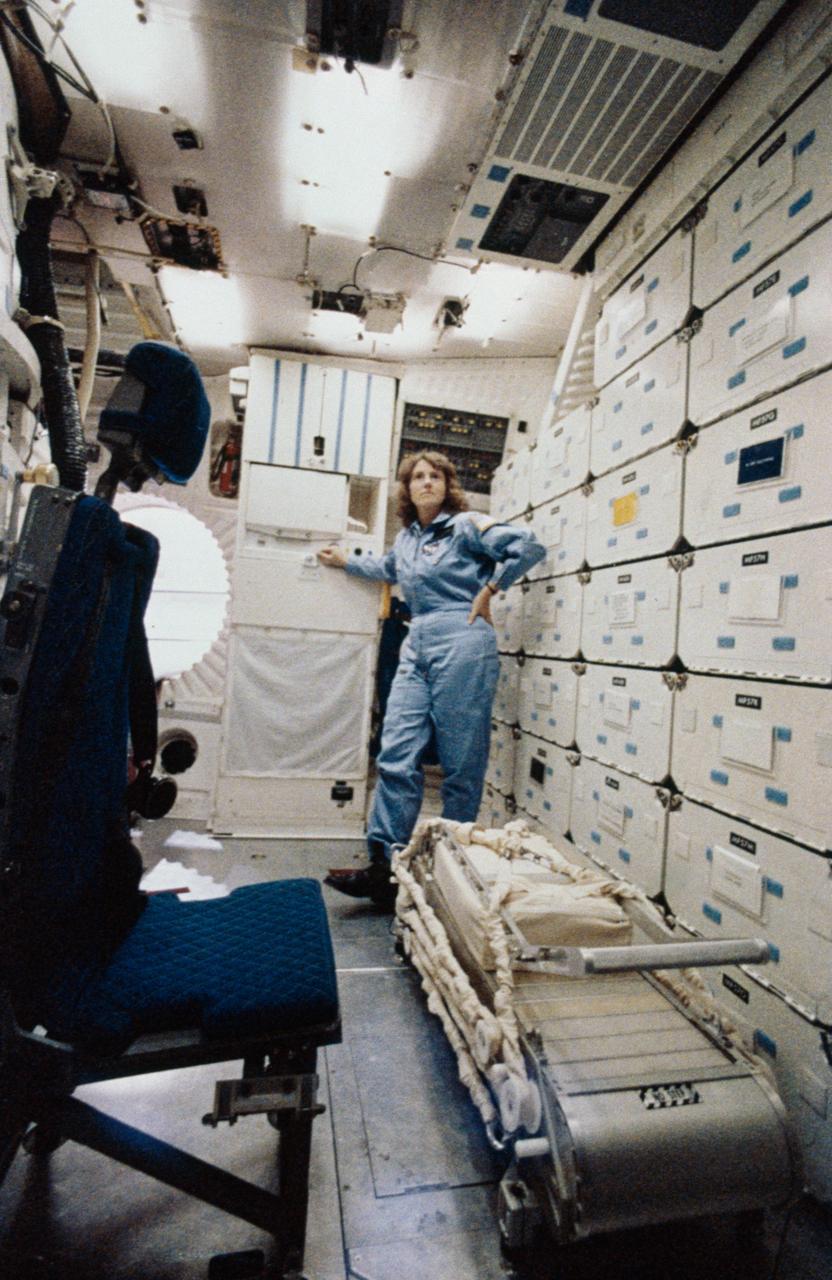
S86-25188 (December 1985) --- Sharon Christa McAuliffe, a school teacher Concord New Hampshire, surveys a ground training replica of the quarters she?ll be using in space when the space shuttle Challenger taxis two women and five men into space in January of 1986. The STS-51L citizen observer/payload specialist is in training at the Johnson Space Center, representing the Teacher-in-Space Project. The photo was taken by Keith Meyers of the New York Times. Photo credit: NASA

One of NASA's newest education publications made its debut at the arnual National Council of Teachers of Mathematics (NCTM) conference held in Orlando, Florida April 5-7. How High Is It? An Educator's Guide with Activities Focused on Scale Models of Distances was presented by Carla Rosenberg of the National Center for Microgravity Research at Glenn Research Center. Rosenberg, an author of the Guide, led teachers in several hands-on activities from the Guide. This image is from a digital still camera; higher resolution is not available.

A performer from Los Angeles Hamilton High School's Kid Tribe entertains teachers and middle school students during the kick off of NASA's Summer of Innovation program at the Jet Propulsion Laboratory in Pasadena, Calif., Thursday, June 10, 2010. Through the program, NASA will engage thousands of middle school students and teachers in stimulating math and science-based education programs with the goal of increasing the number of future scientists, mathematicians, and engineers. Photo Credit: (NASA/Bill Ingalls)

Spaceward Bound event in the Mojave Deser , CA (an outreach exercise) with Dr Chris McKay and Ames Education department personnel Brian Day, Barbara Bazar accompaning teachers (learning for the the classroom)
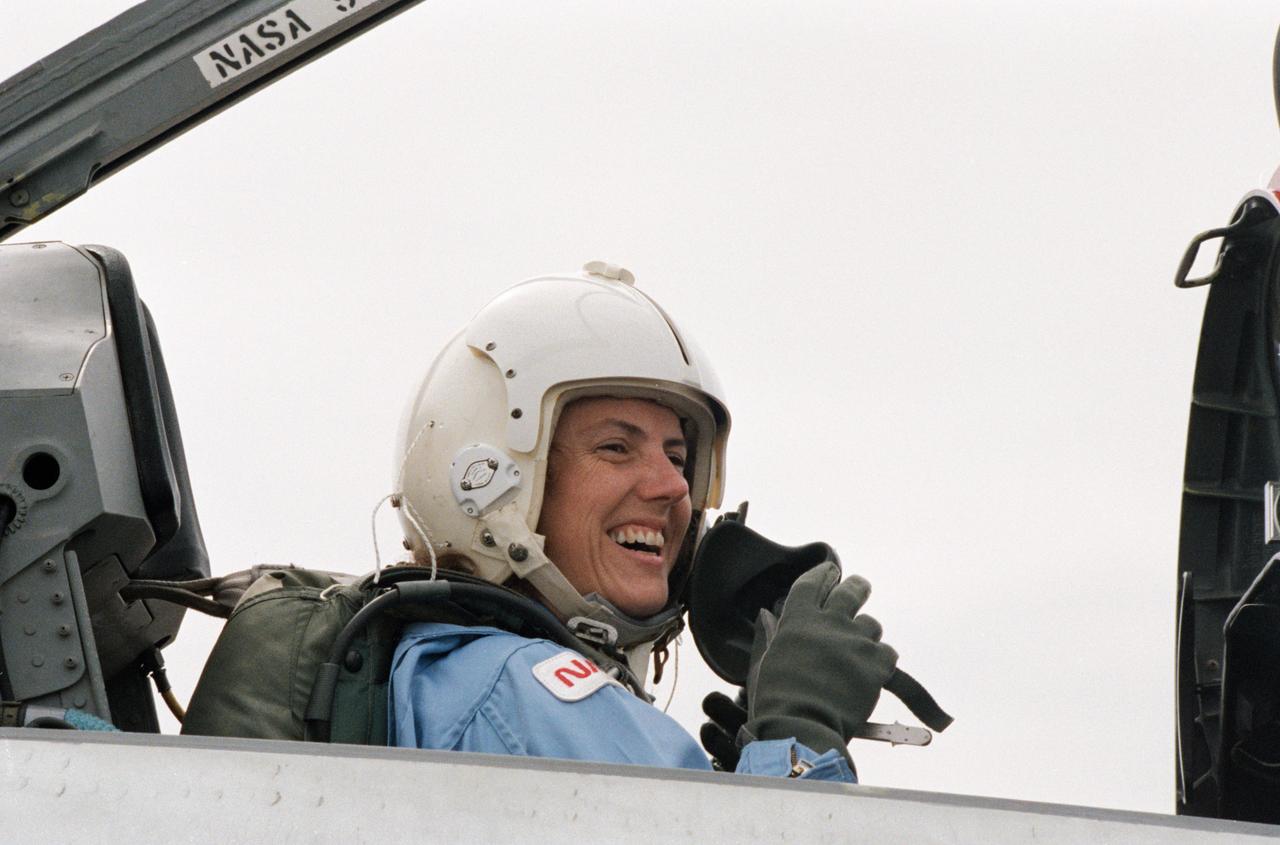
Sharon Christa McAuliffe, the Teacher in Space participant from Concord, New Hampshire, prepares for a ride in the rear station of one of NASA's T-38 jet trainers at Ellington Field near JSC.

Spaceward Bound event in the Mojave Deser , CA (an outreach exercise) with Dr Chris McKay and Ames Education department personnel Brian Day, Barbara Bazar accompaning teachers (learning for the the classroom)