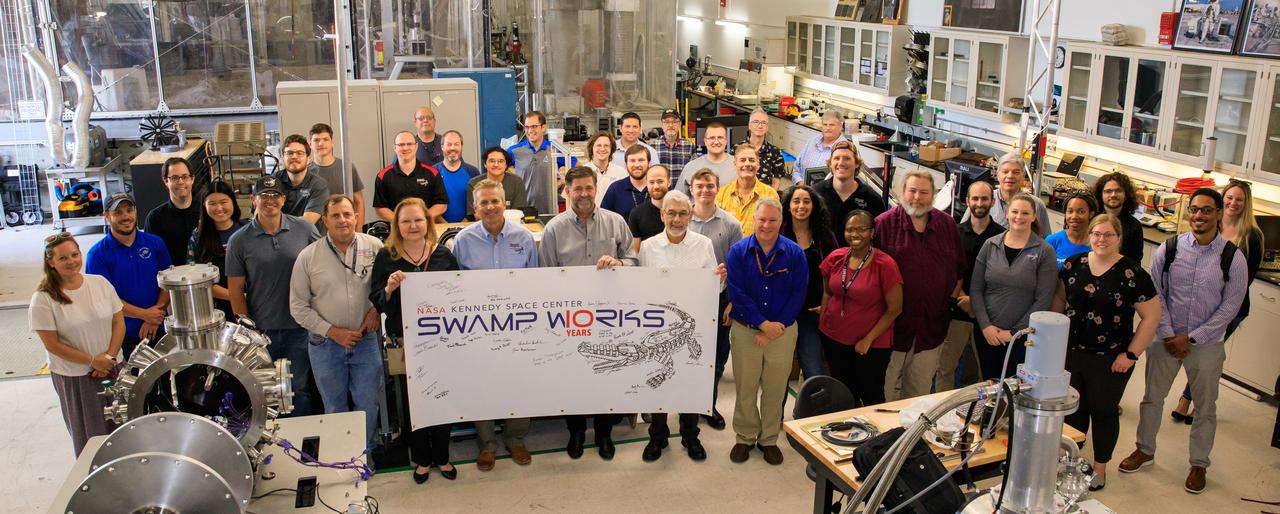
To celebrate its 10-year anniversary, the Swamp Works team poses for a group photograph inside the Swamp Works laboratory area at NASA’s Kennedy Space Center in Florida on April 21, 2023. Swamp Works includes several laboratories where hands-on, cutting-edge technology is developed for NASA and its exploration goals, as well as for benefits on Earth.
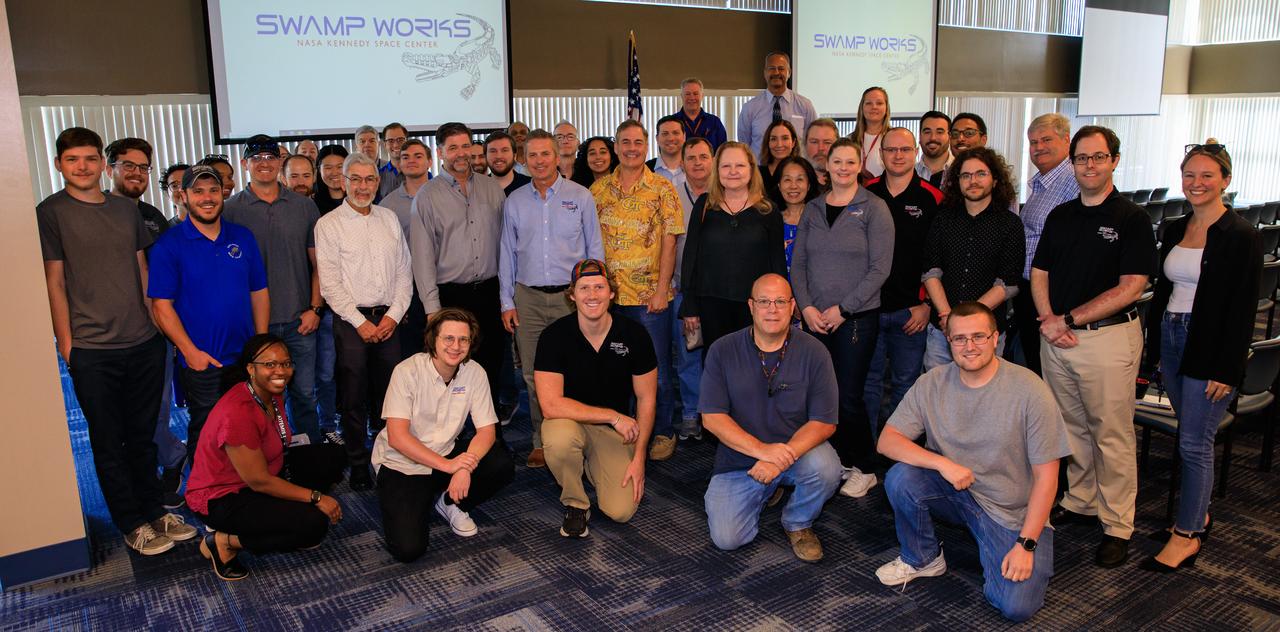
To celebrate its 10-year anniversary, the Swamp Works team poses for a group photograph inside the Space Station Processing Facility conference room at NASA’s Kennedy Space Center in Florida on April 21, 2023. Swamp Works includes several laboratories where hands-on, cutting-edge technology is developed for NASA and its exploration goals, as well as for benefits on Earth.
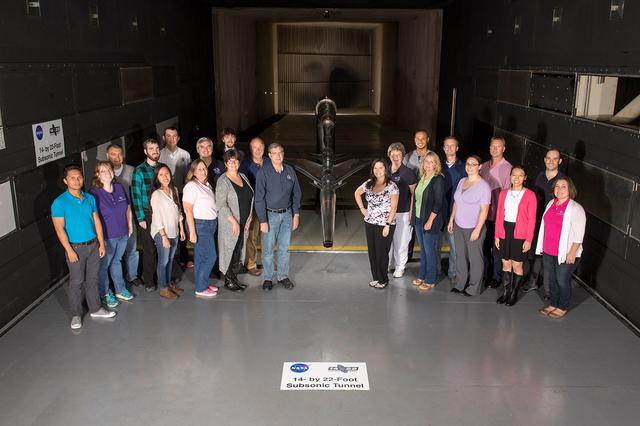
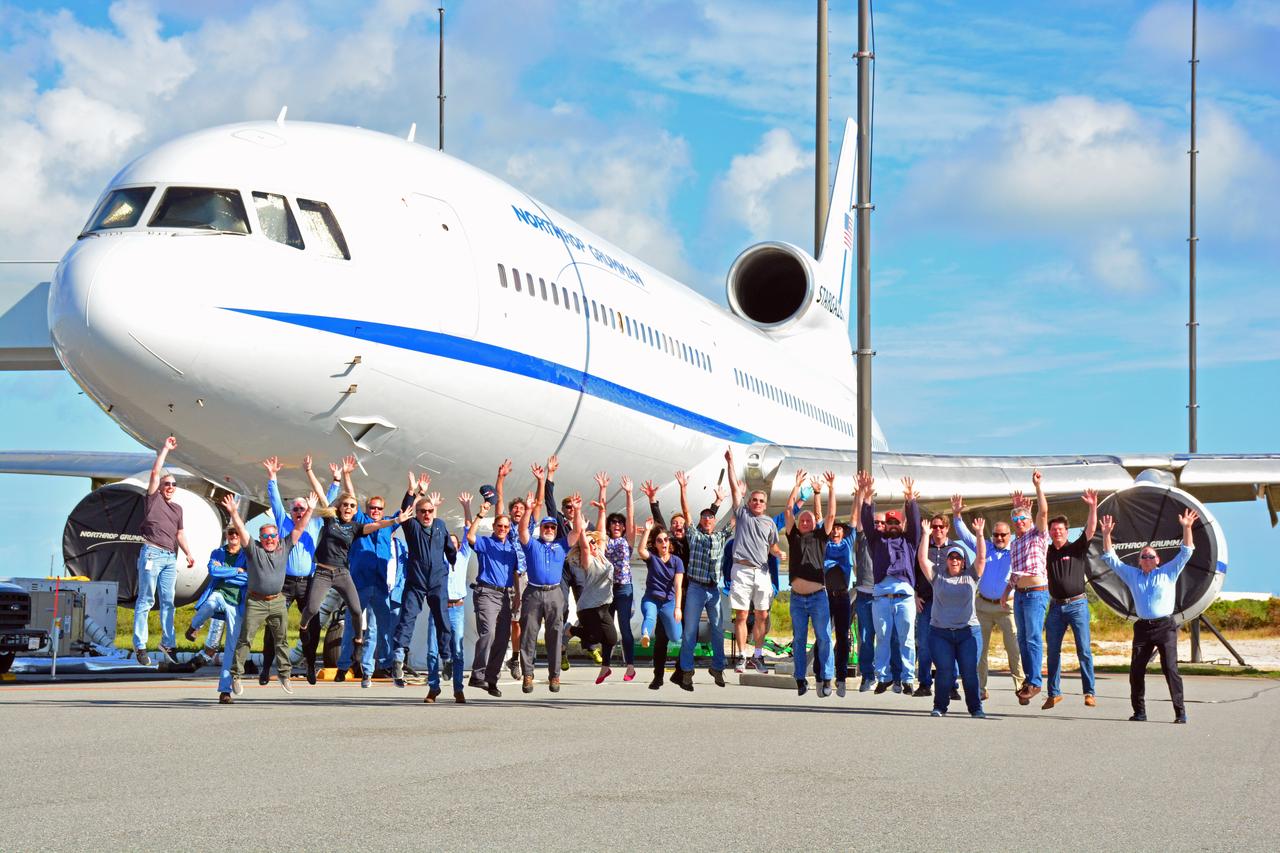
Members of the launch team for NASA’s Ionospheric Connection Explorer (ICON) gather for a joyous group photo in front of the Northrop Grumman L-1011 Stargazer aircraft carrying the Pegasus XL rocket at the Skid Strip at Florida’s Cape Canaveral Air Force Station, Nov. 10, 2019. Hours later, the rocket containing ICON air-launched from beneath the aircraft off the coast of Daytona Beach. ICON will study the frontier of space - the dynamic zone high in Earth's atmosphere where terrestrial weather from below meets space weather above. The explorer will help determine the physics of Earth's space environment and pave the way for mitigating its effects on our technology, communications systems and society.
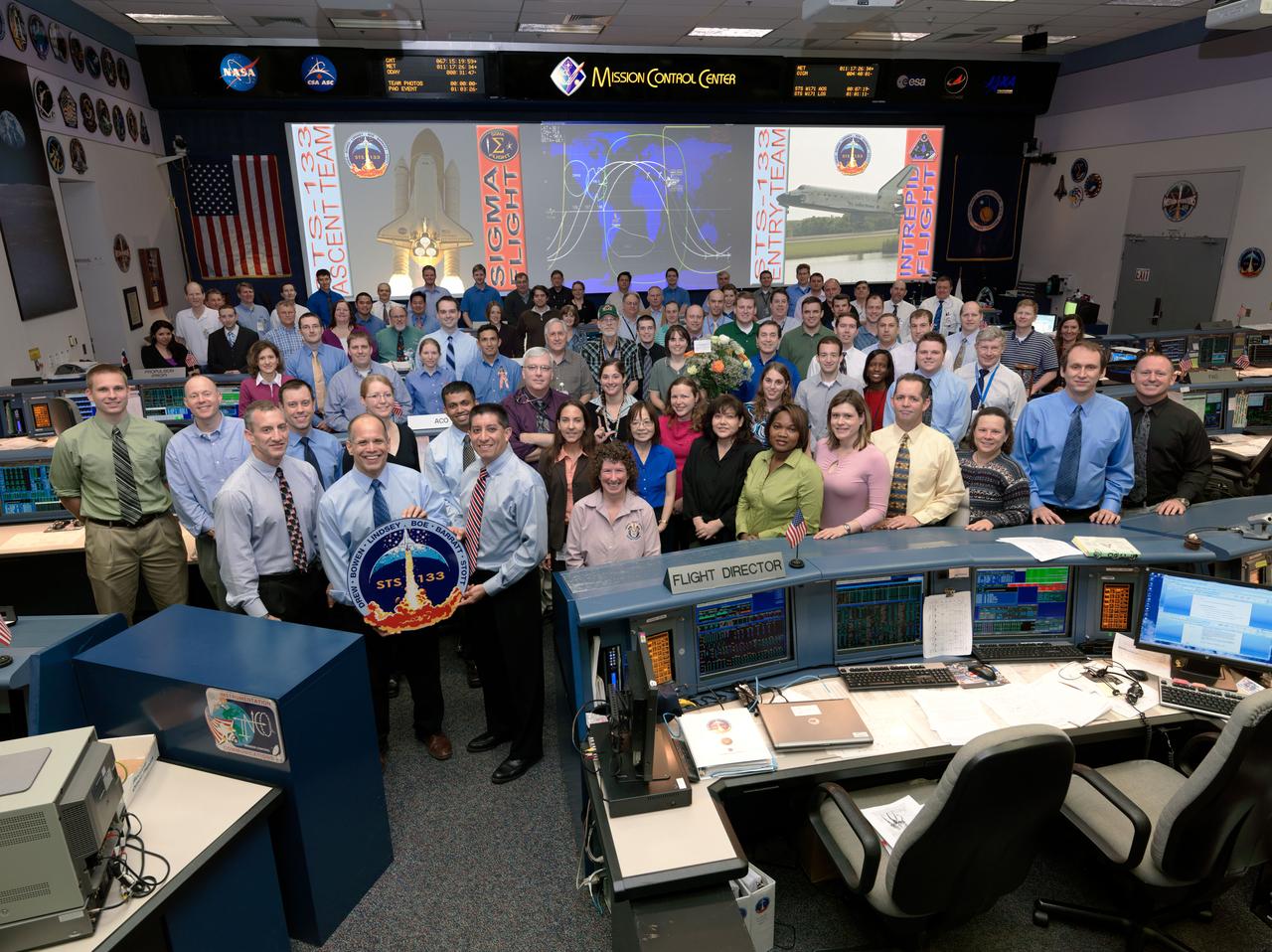
STS-133/ULF5 Ascent and Entry flight control team photo with Flight Director's Tony Ceccacci (Entry) and Richard Jones (Ascent). Photo Date: March 08, 2011. Location: Building 30 south - WFCR. Photographer: Robert Markowitz.

NASA and its partners work on the solar array wings for the agency’s Artemis III Orion spacecraft on Thursday, April 30, 2026, inside the Neil A. Armstrong Operations and Checkout Building at NASA’s Kennedy Space Center in Florida. Orion’s solar arrays, manufactured and installed by ESA (European Space Agency) and its contractor Airbus, have been temporarily installed ahead of acoustic testing on the spacecraft. The Artemis III mission will launch astronauts in 2027 to Earth’s orbit aboard the Orion spacecraft on top of the SLS (Space Launch System) rocket to test rendezvous and docking capabilities between Orion and commercial spacecraft needed to land Artemis IV astronauts on the Moon in 2028.
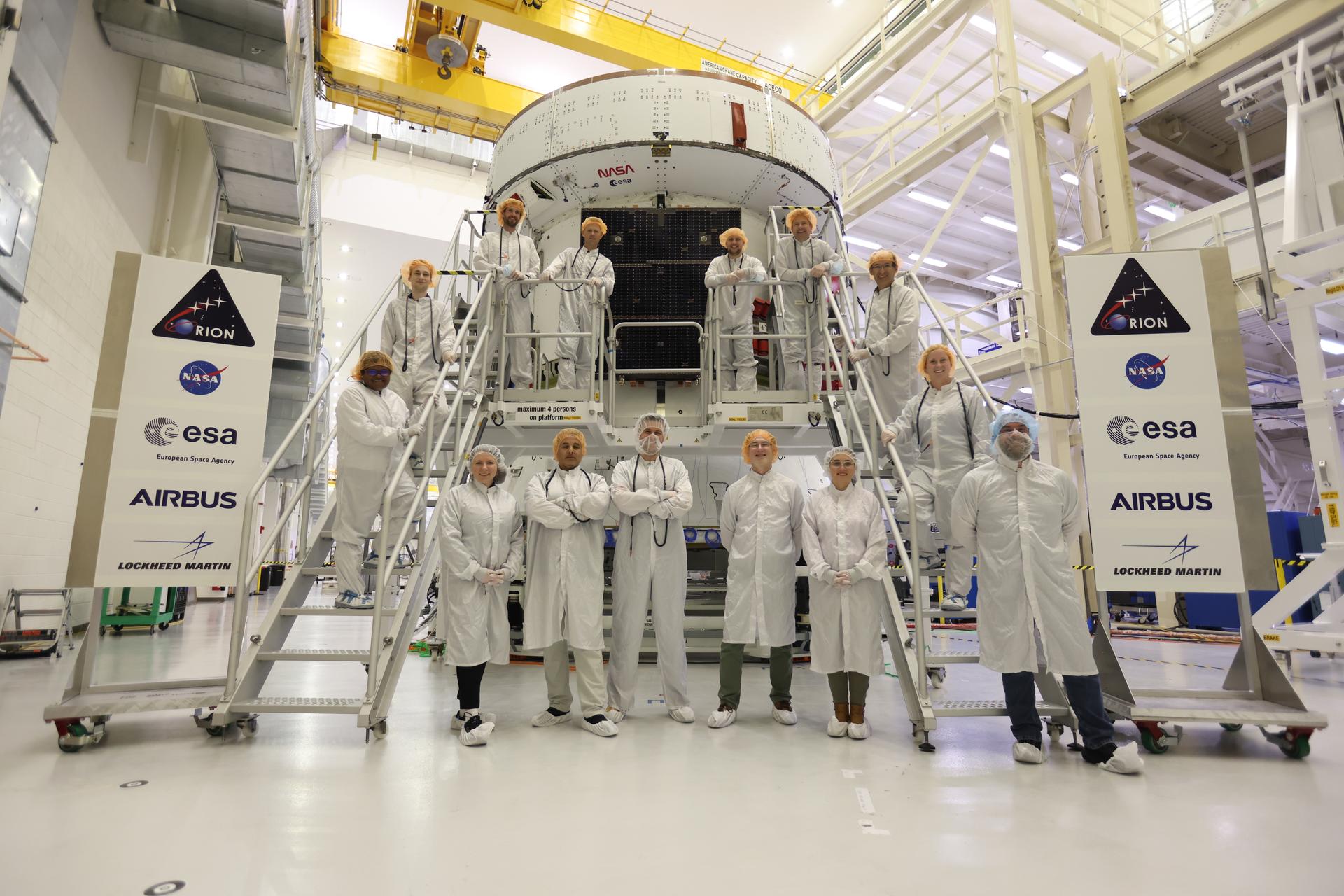
NASA and its partners work on the solar array wings for the agency’s Artemis III Orion spacecraft on Thursday, April 30, 2026, inside the Neil A. Armstrong Operations and Checkout Building at NASA’s Kennedy Space Center in Florida. Orion’s solar arrays, manufactured and installed by ESA (European Space Agency) and its contractor Airbus, have been temporarily installed ahead of acoustic testing on the spacecraft. The Artemis III mission will launch astronauts in 2027 to Earth’s orbit aboard the Orion spacecraft on top of the SLS (Space Launch System) rocket to test rendezvous and docking capabilities between Orion and commercial spacecraft needed to land Artemis IV astronauts on the Moon in 2028.
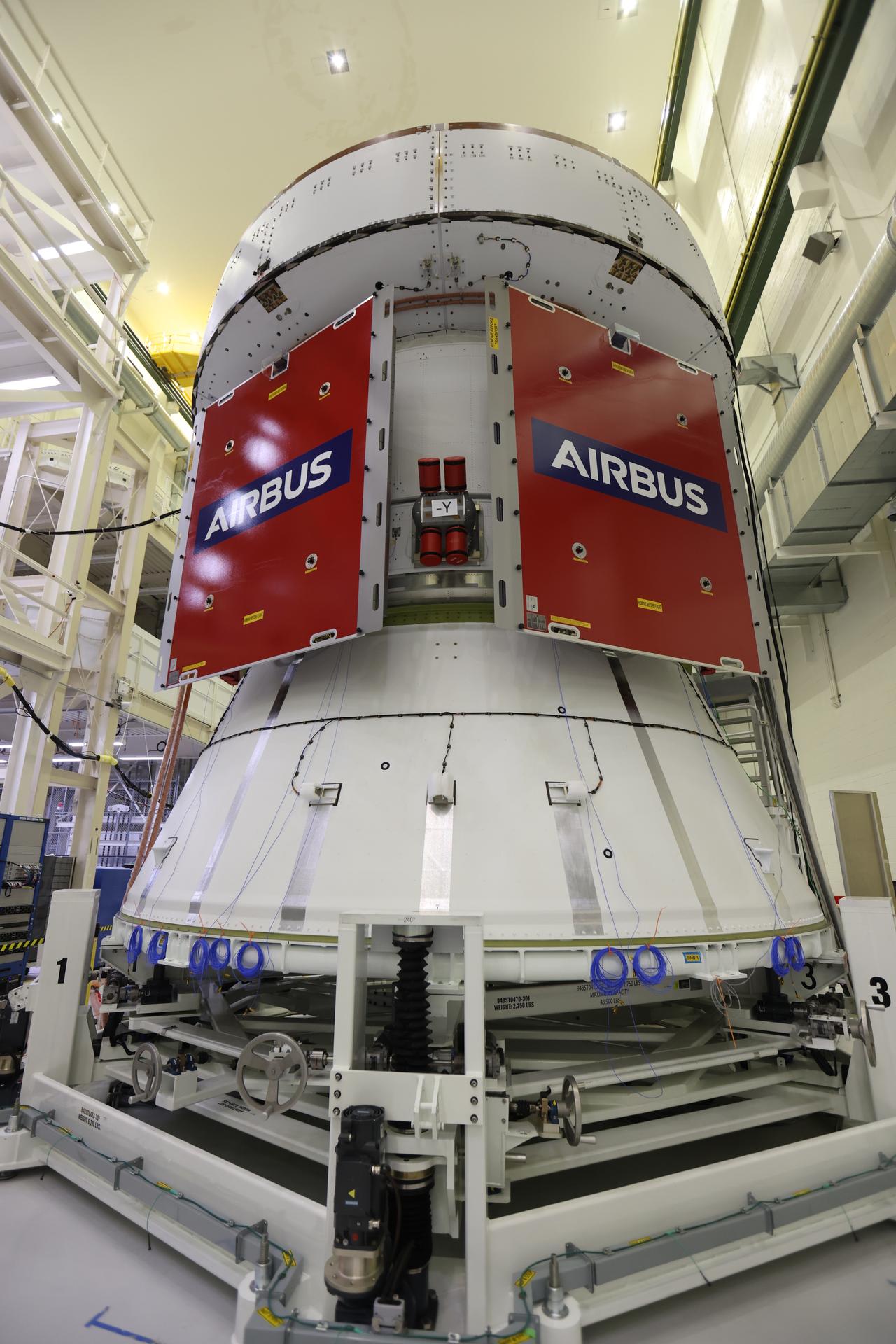
NASA and its partners work on the solar array wings for the agency’s Artemis III Orion spacecraft on Thursday, April 30, 2026, inside the Neil A. Armstrong Operations and Checkout Building at NASA’s Kennedy Space Center in Florida. Orion’s solar arrays, manufactured and installed by ESA (European Space Agency) and its contractor Airbus, have been temporarily installed ahead of acoustic testing on the spacecraft. The Artemis III mission will launch astronauts in 2027 to Earth’s orbit aboard the Orion spacecraft on top of the SLS (Space Launch System) rocket to test rendezvous and docking capabilities between Orion and commercial spacecraft needed to land Artemis IV astronauts on the Moon in 2028.
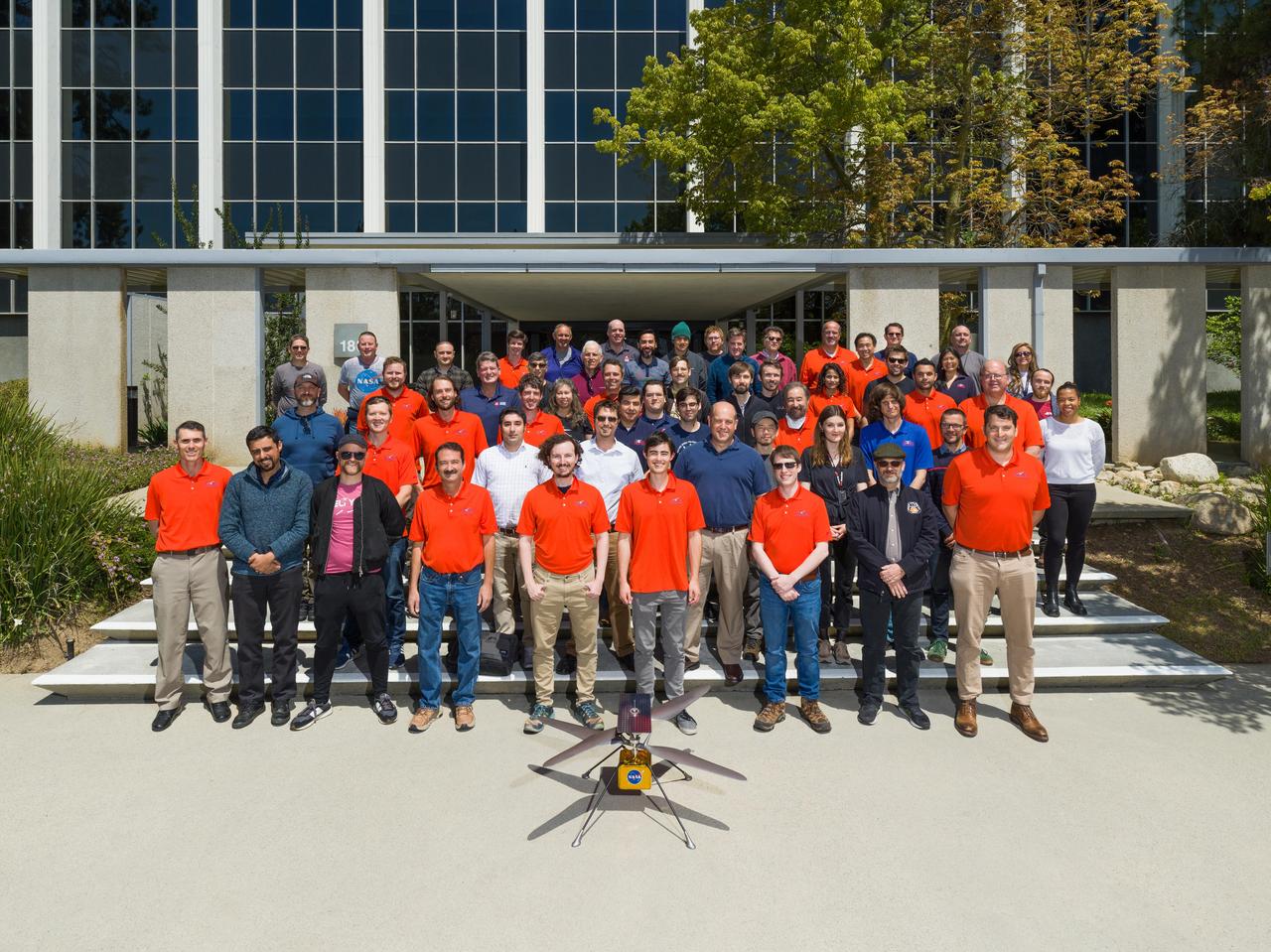
Members of NASA's Ingenuity Mars Helicopter team got together for a team photo on the second anniversary of the rotorcraft's first flight on Mars. The image was taken at the agency's Jet Propulsion Laboratory in Southern California on April 19, 2023. https://photojournal.jpl.nasa.gov/catalog/PIA25882
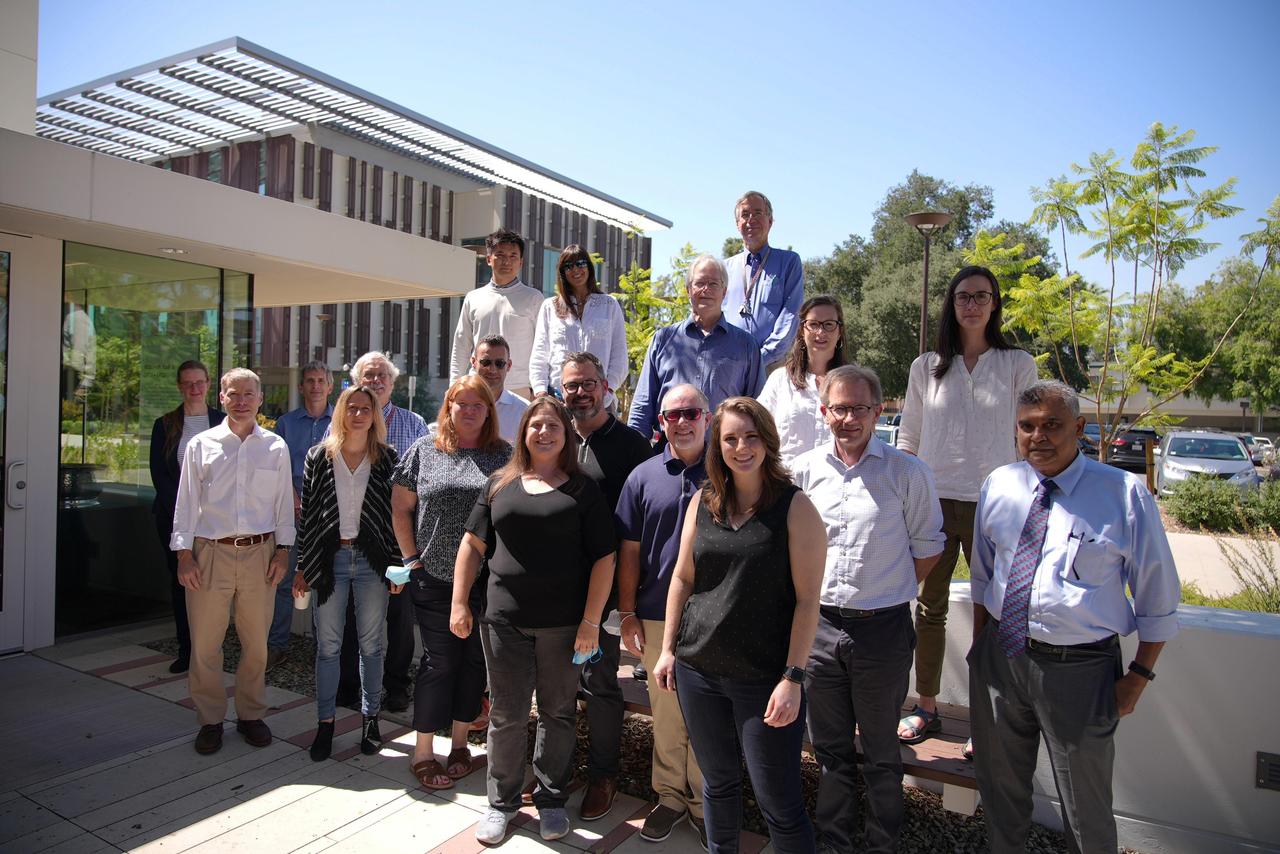
The Mars Sample Return Campaign Science Group gathered at the Keck Institute for Space Studies at Caltech for an initial meeting on June 28-29, 2022. This June 28 photo includes team members who attended in person; several others attended virtually or were not able to participate. The committee will provide oversight with the goal of maximizing the scientific potential of Mars rock and sediment samples that would be returned to Earth for in-depth analysis, as part of the Campaign. https://photojournal.jpl.nasa.gov/catalog/PIA25442
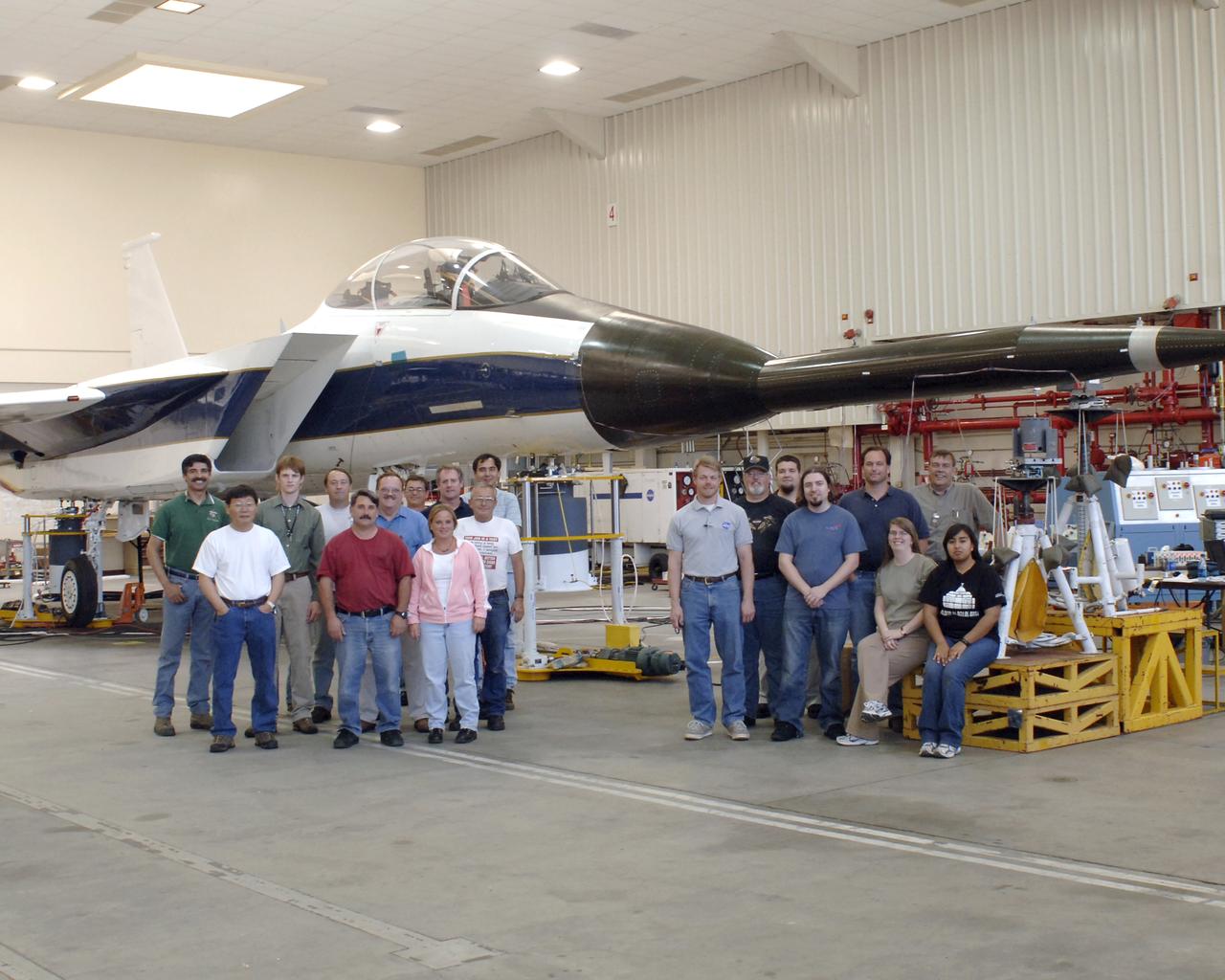
Some of the test team for the Gulfstream Quiet Spike project assembled for a group photo on May 3, 2006. The project seeks to verify the structural integrity of the multi-segmented, articulating spike attachment designed to reduce and control a sonic boom.
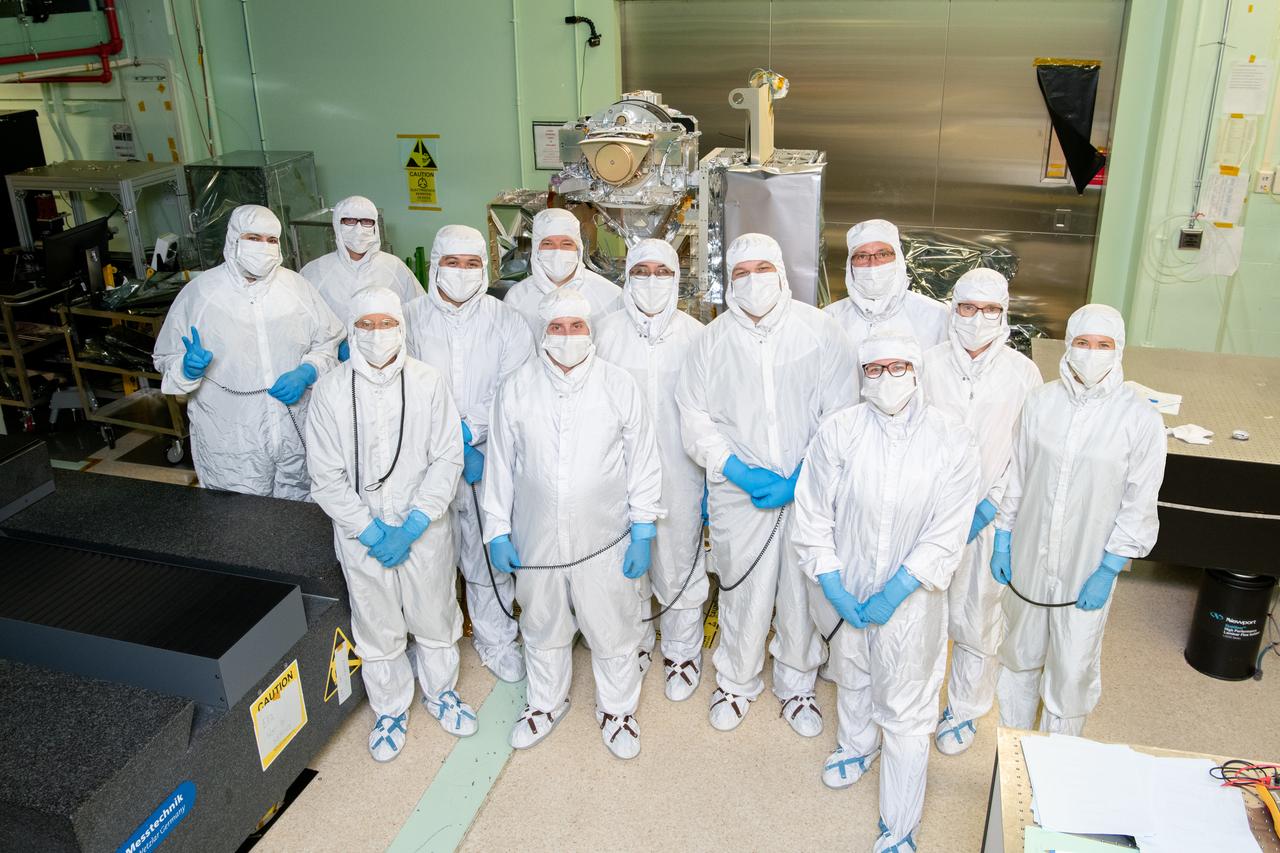
Mechanical integration team members pose with the Ocean Color Instrument (OCI) after successful integration of the main optical components onto the flight deck. OCI is a highly advanced optical spectrometer that will be used to measure properties of light over portions of the electromagnetic spectrum. It will enable continuous measurement of light at finer wavelength resolution than previous NASA satellite sensors, extending key system ocean color data records for climate studies. OCI is PACE's (Plankton, Aerosol, Cloud, ocean Ecosystem) primary sensor built at Goddard Space Flight Center in Greenbelt, MD.
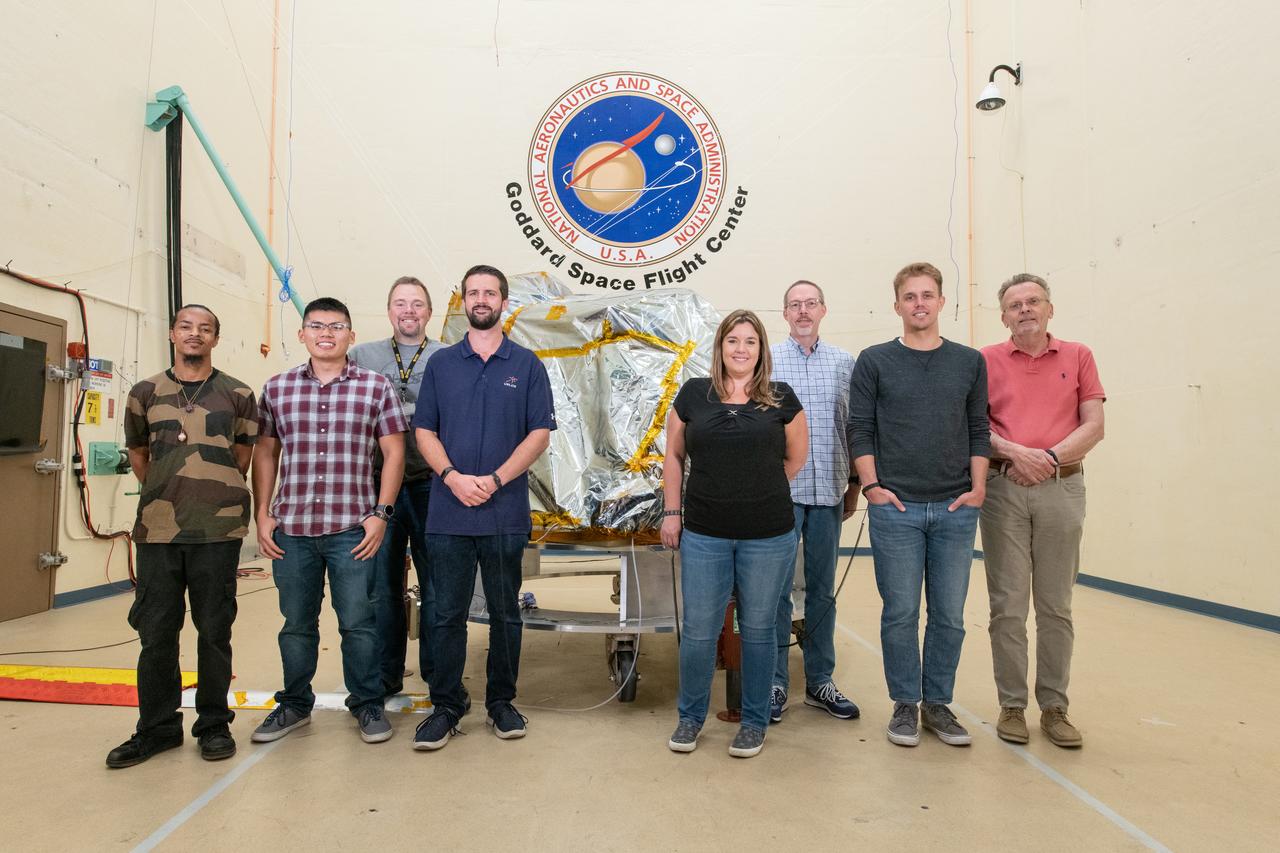
The Goddard Space Flight Center (GSFC) environmental testing team poses with the bagged Ocean Color Instrument (OCI) behind them in the acoustic chamber prior to testing. The acoustic testing will ensure that functionality of OCI is not impaired by severe launch environments. OCI is a highly advanced optical spectrometer that will be used to measure properties of light over portions of the electromagnetic spectrum. It will enable continuous measurement of light at finer wavelength resolution than previous NASA satellite sensors, extending key system ocean color data records for climate studies. OCI is PACE's (Plankton, Aerosol, Cloud, ocean Ecosystem) primary sensor built at Goddard Space Flight Center in Greenbelt, MD.
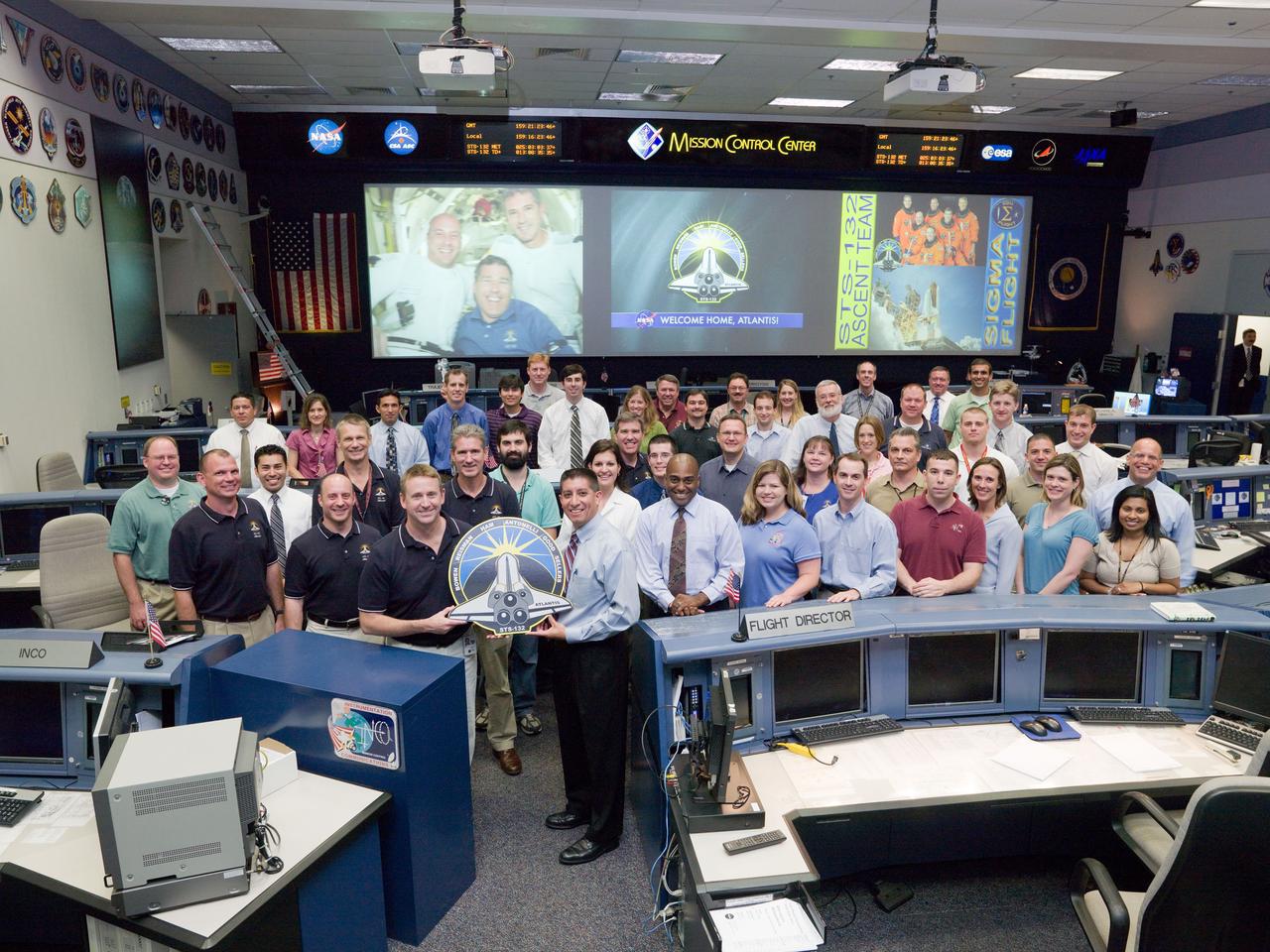
JSC2010-E-090665 (8 June 2010) --- The members of the STS-132 Ascent flight control team and crew members pose for a group portrait in the space shuttle flight control room in the Mission Control Center at NASA's Johnson Space Center. Flight director Richard Jones (right) and NASA astronaut Ken Ham, STS-132 commander, hold the STS-132 mission logo. Additional crew members pictured are NASA astronauts Tony Antonelli, pilot; along with Garrett Reisman, Piers Sellers, Michael Good and Steve Bowen, all mission specialists. Photo credit: NASA or National Aeronautics and Space Administration
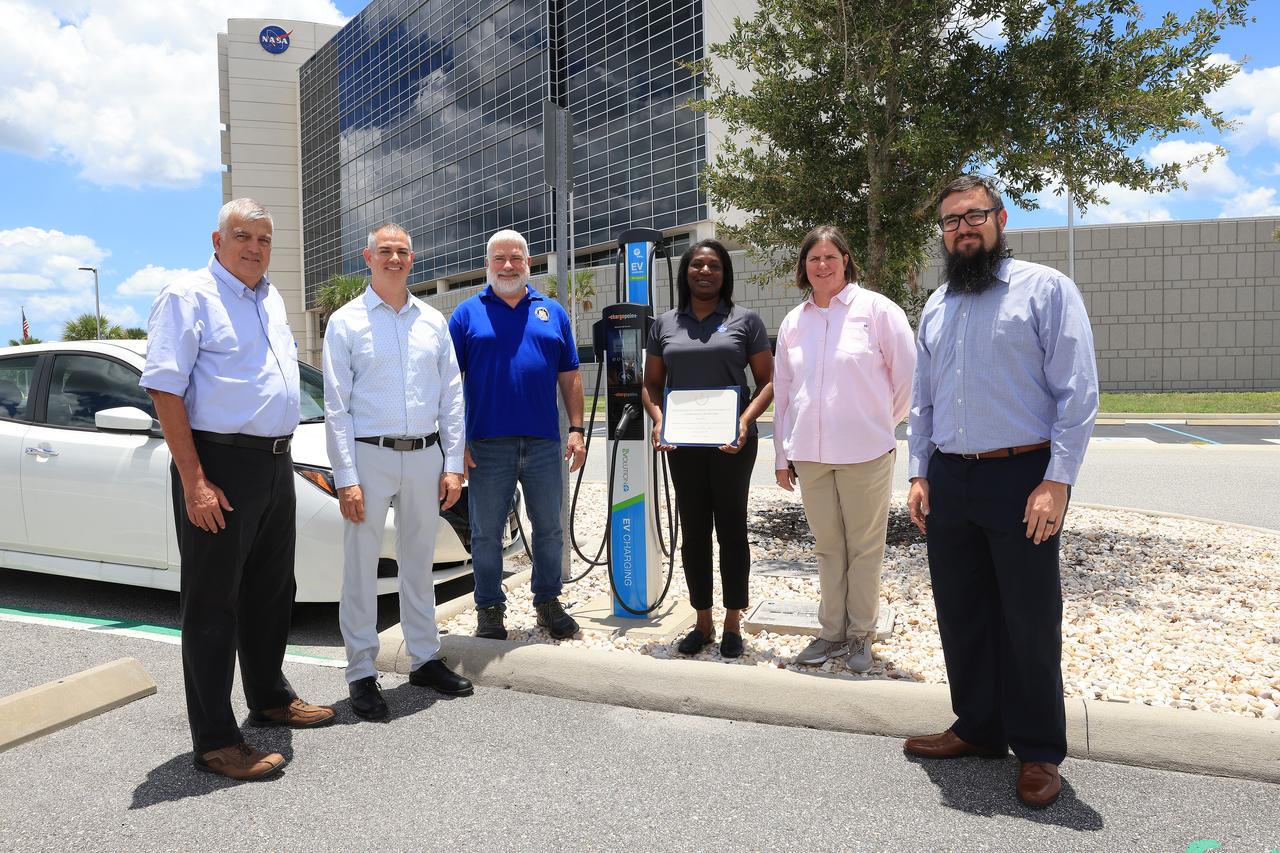
Six of the seven members of the NASA Kennedy Space Center team recognized by the White House on Tuesday, June 25, 2024, during the Presidential Federal Sustainability Awards stand next to an electric vehicle (EV) charging station in front of Kennedy's Central Campus Headquarters Building. Those members are, from left to right, center services division chief Gustavo Diaz, partnership development office chief Matthew Jimenez, then branch chief Gerald “Jay” Green, sustainability lead Lashanda Battle, transportation officer Melissa Coleman, and then transportation specialist Spencer Davis. This EV station is one of 28 installed on center through a partnership with local utility provider Florida Power & Light, allowing up to 56 electric vehicles to be charged at the same time. An additional 31 EV stations are planned at Kennedy by fall 2024, increasing the center's vehicle charging capacity by up to 118 vehicles simultaneously once they're operational.
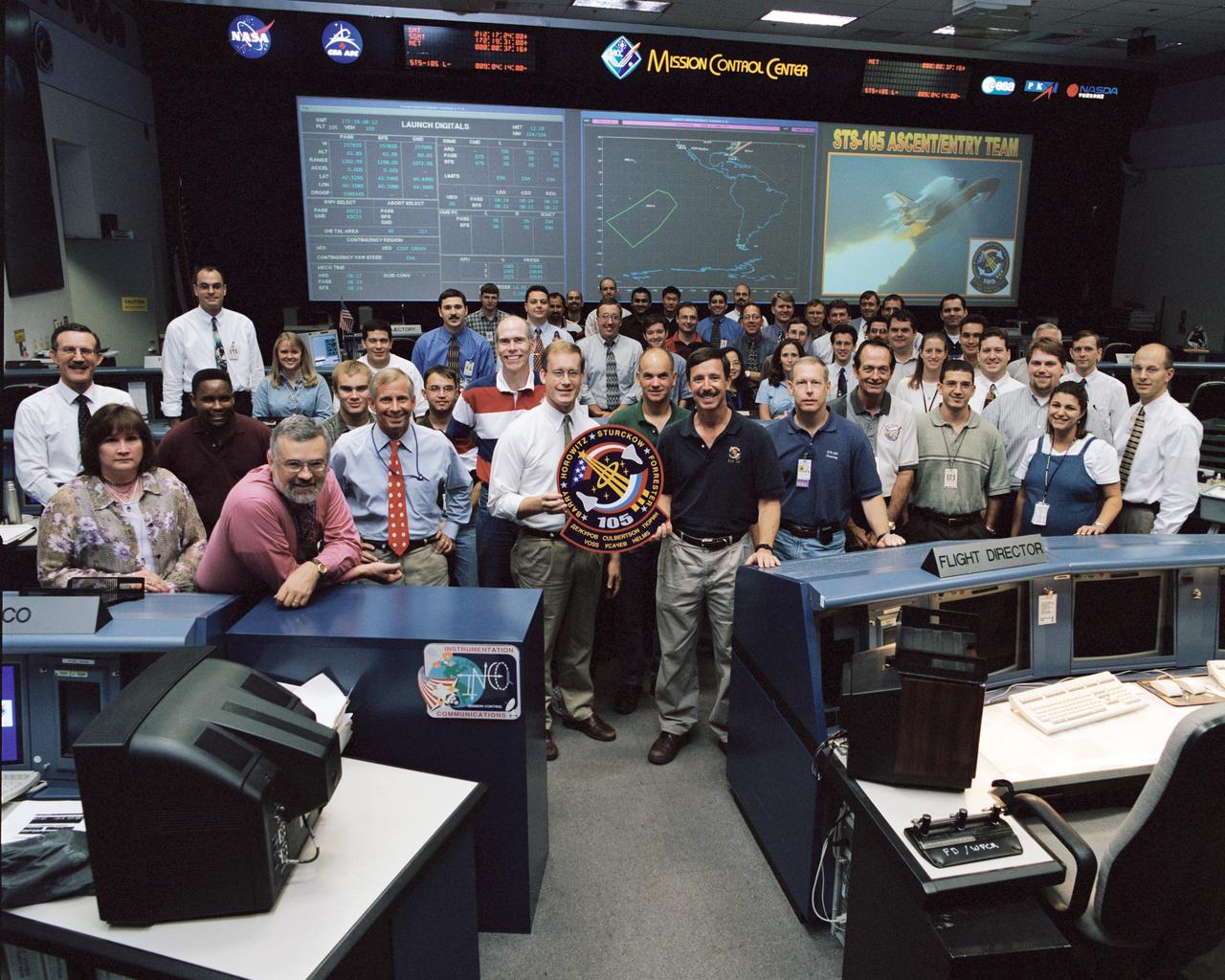
JSC2001-02115 (31 July 2001) --- The flight controllers for the Ascent/Entry shift for the upcoming STS-105 mission pose with the assigned astronaut crew for a team portrait in the Shuttle Flight Control Room (WFCR) of Houston's Mission Control Center (MCC). Flight director John Shannon (left center) and STS-105 commander Scott J. Horowitz hold the mission logo. Also pictured on the front row are spacecraft communicator Kenneth D. Cockrell and STS-105 crew members Daniel T. Barry, Frederick W. (Rick) Sturckow and Patrick G. Forrester. The team had been participating in an integrated simulation for the scheduled August mission.
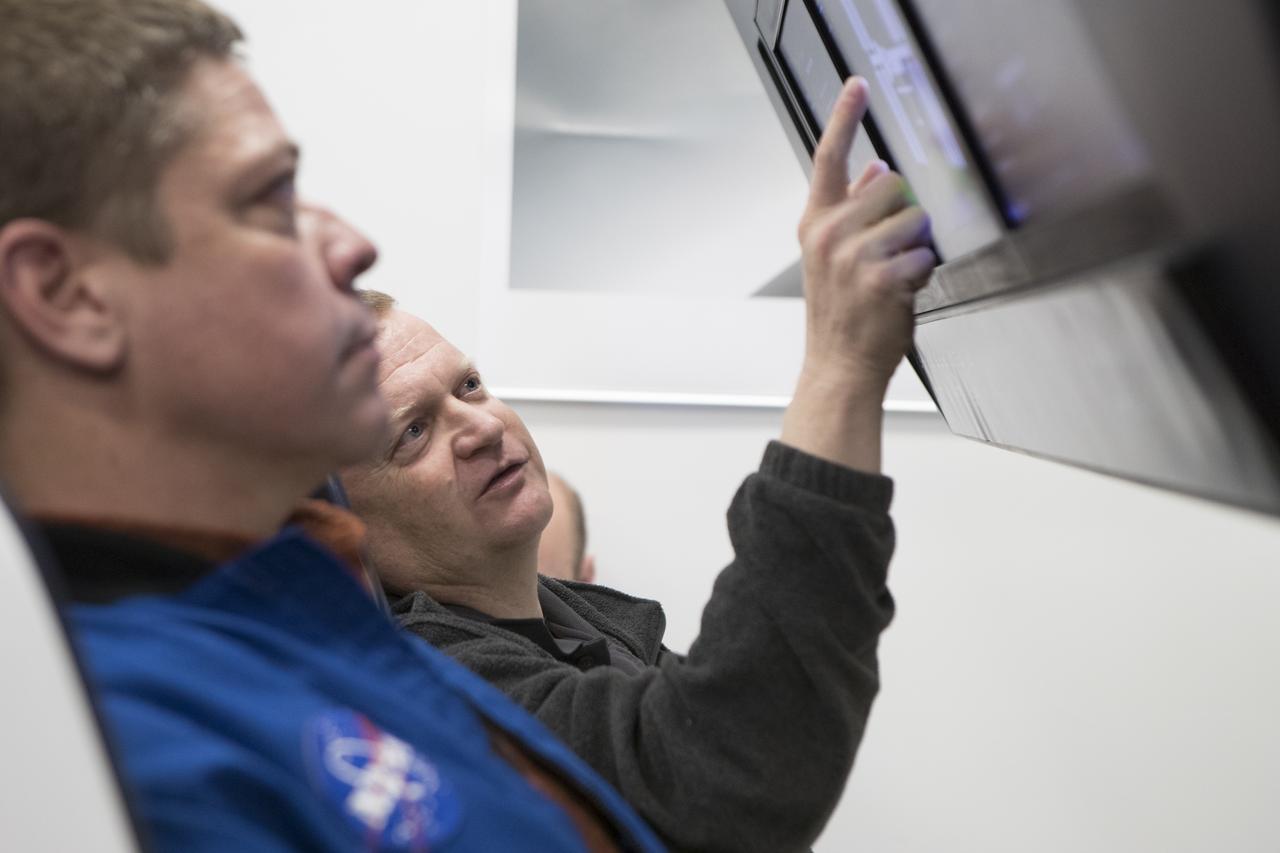
During a tour of SpaceX headquarters in Hawthorne, California, commercial crew astronauts Bob Behnken, left, and Eric Boe participate in joint test team training using mockup components of the Crew Dragon on Feb. 23, 2017. Crew Dragon is being developed and manufactured in partnership with NASA's Commercial Crew Program to return human spaceflight capabilities to the U.S.
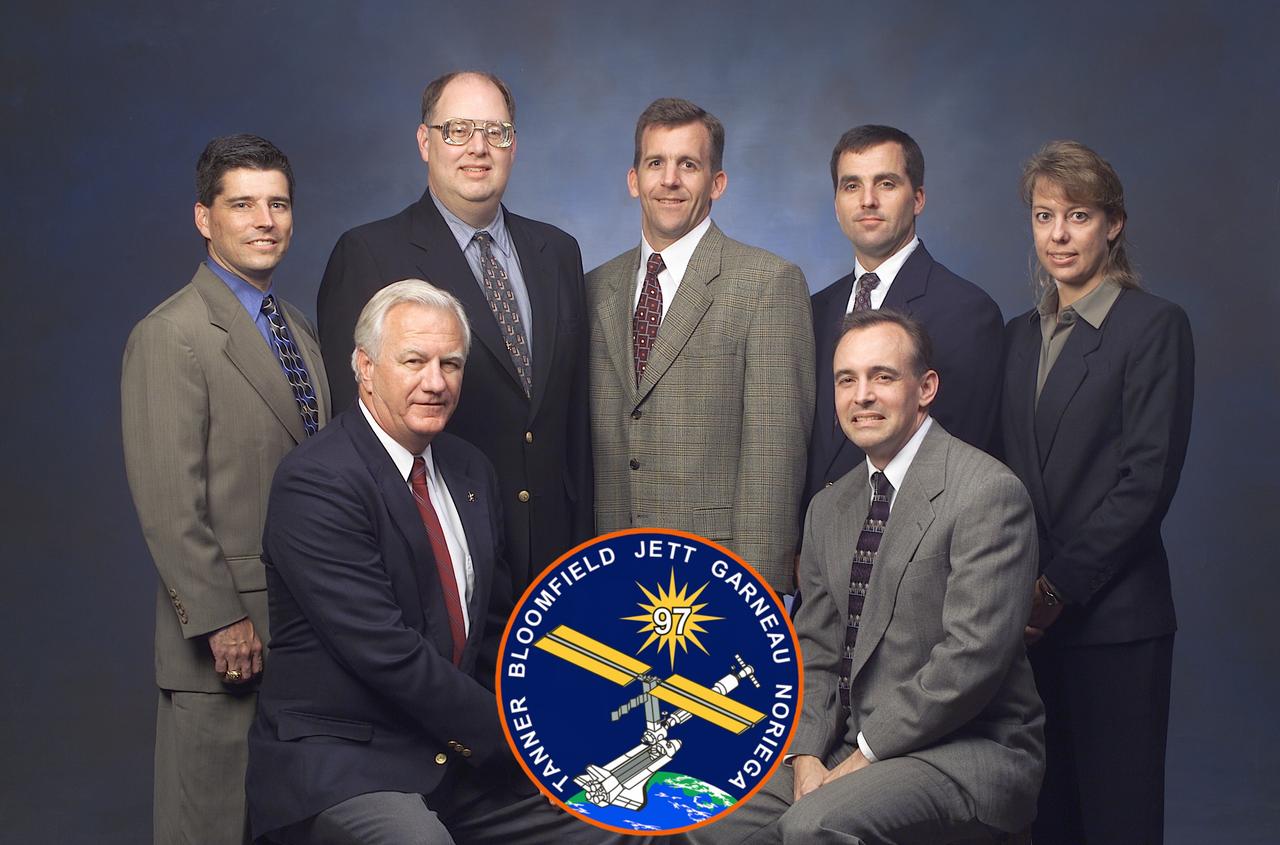
JSC2000-E-29413 (November 2000) --- Flight directors (FD) for the STS-97 mission pose for a pre-flight group portrait with the mission's insignia. Front row: Lead FD Bill Reeves (left), and Jeff Hanley. Back row, from the left: John Curry, Wayne Hale, LeRoy Cain, Paul Hill and Kelly Beck.
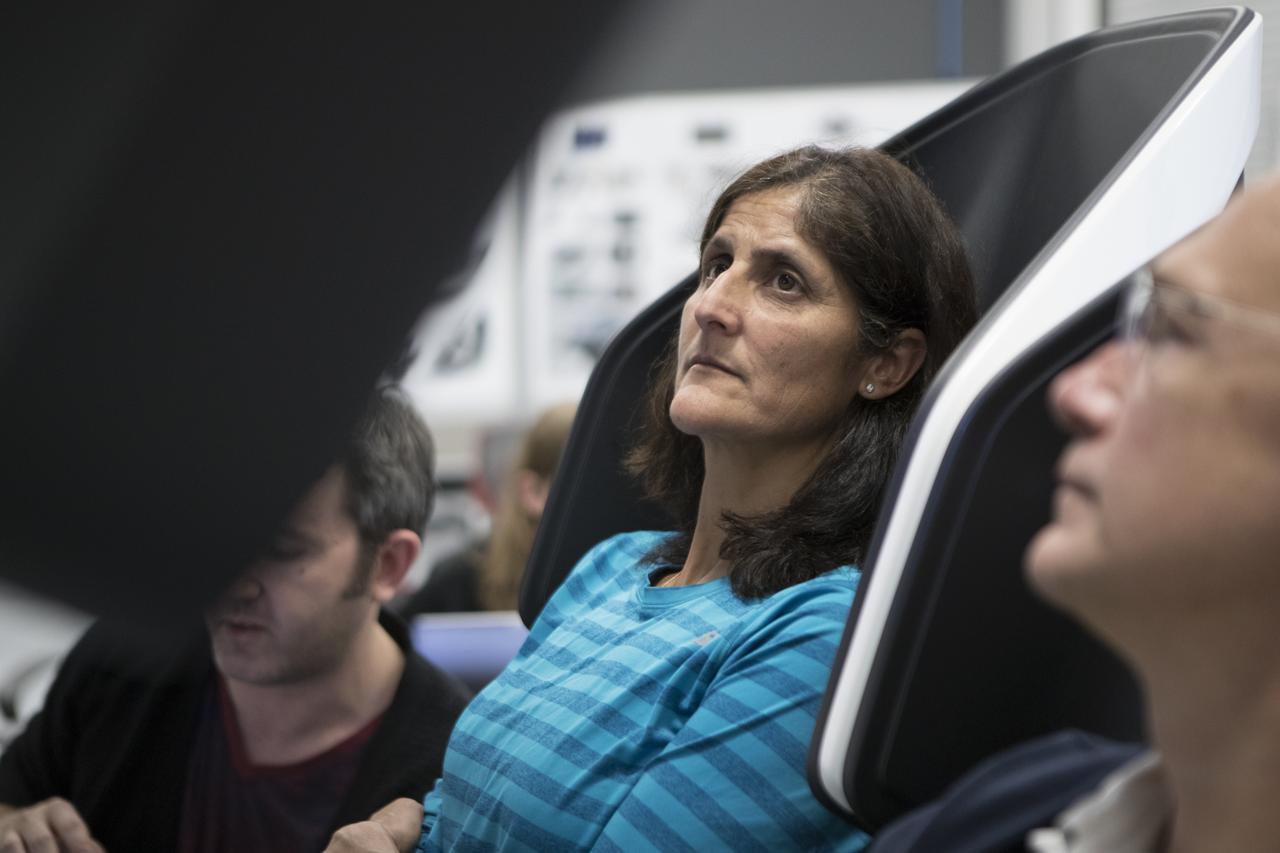
During a tour of SpaceX headquarters in Hawthorne, California, commercial crew astronauts Suni Williams, left, and Doug Hurley participate in joint test team training using mockup components of the Crew Dragon on Feb. 23, 2017. Crew Dragon is being developed and manufactured in partnership with NASA's Commercial Crew Program to return human spaceflight capabilities to the U.S.
/nasa-goddard-astrobio (2)~medium.jpg)
Researchers at NASA's Goddard Space Flight Center in Greenbelt, Maryland, who had a hand in studying the asteroid Bennu sample delivered to Earth by the agency's OSIRIS-REx (Origins, Spectral Interpretation, Resource Identification, and Security – Regolith Explorer) mission.
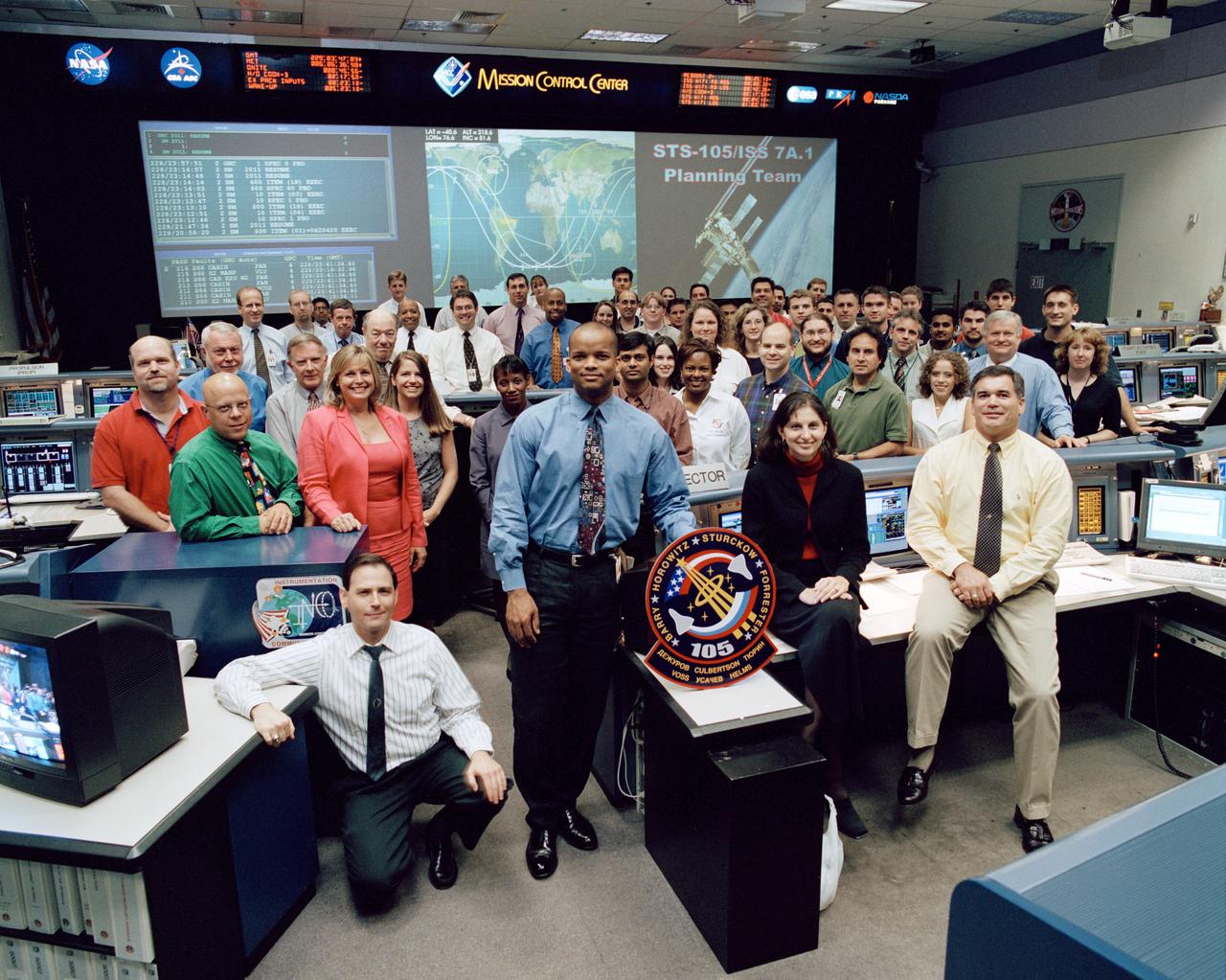
JSC2001-02228 (16 August 2001) --- The members of the STS-105/ISS 7A.1 Planning team pose for a group portrait in the shuttle flight control room (WFCR) in Houston’s Mission Control Center (MCC). Astronaut Robert L. Curbeam, Jr., spacecraft communicator (CAPCOM), stands behind the STS-105 mission logo. Flight director Bryan Austin is visible in the front row on the far right.
/nasa-goddard-astrobio (1)~medium.jpg)
Researchers at NASA's Goddard Space Flight Center in Greenbelt, Maryland, who had a hand in studying the asteroid Bennu sample delivered to Earth by the agency's OSIRIS-REx (Origins, Spectral Interpretation, Resource Identification, and Security – Regolith Explorer) mission.
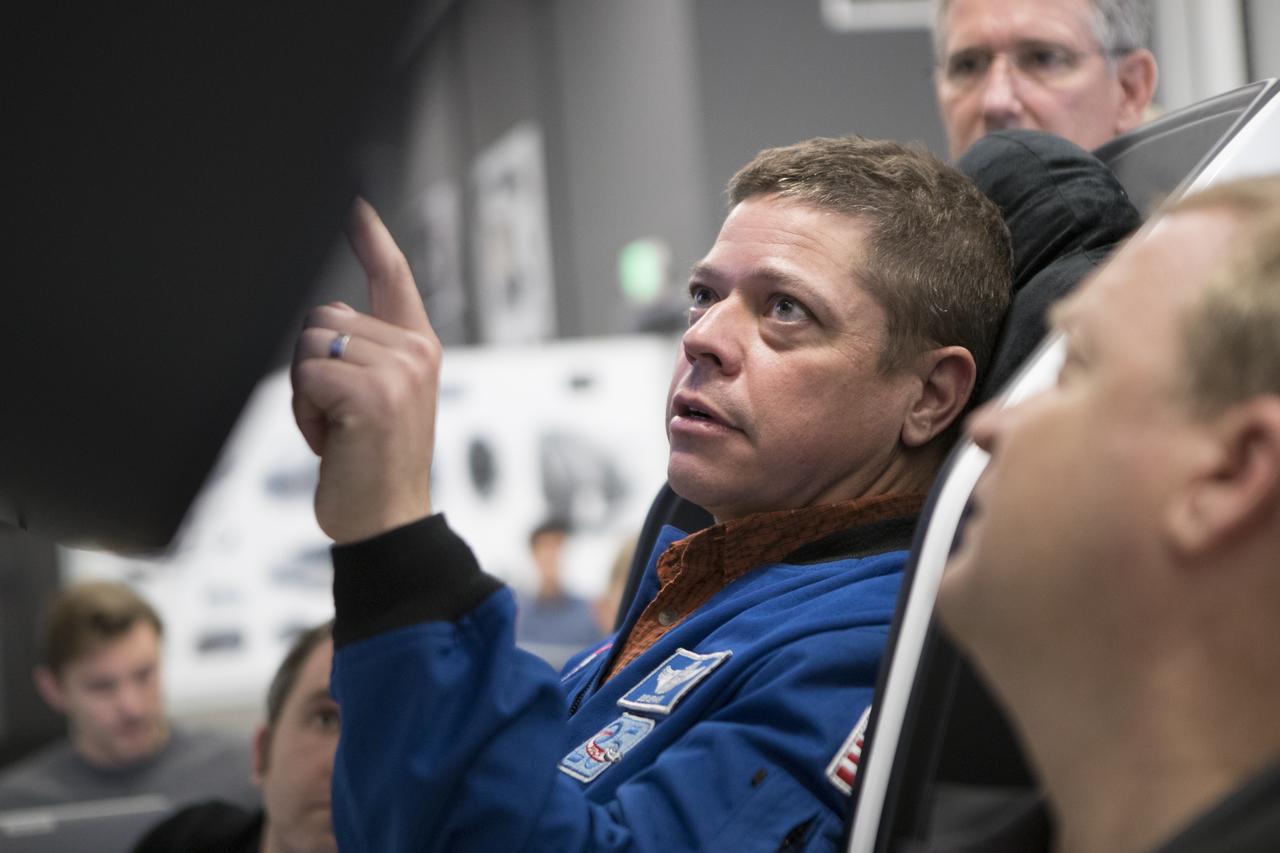
During a tour of SpaceX headquarters in Hawthorne, California, commercial crew astronauts Bob Behnken, left, and Eric Boe participate in joint test team training using mockup components of the Crew Dragon on Feb. 23, 2017. Mike Good, program manager for Crew Operations and Testing at Johnson Space Center in Houston, is in the background. Crew Dragon is being developed and manufactured in partnership with NASA's Commercial Crew Program to return human spaceflight capabilities to the U.S.
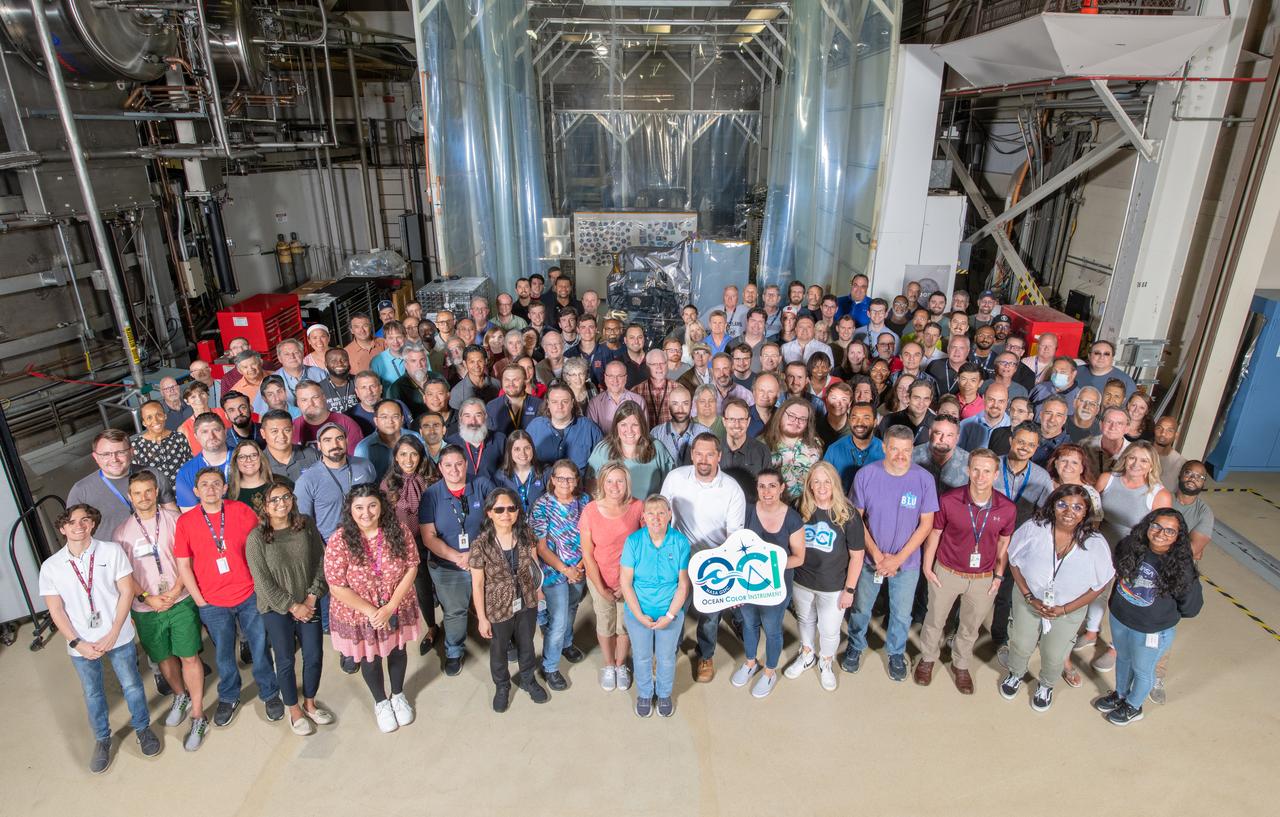
The Ocean Color Instrument (OCI) team pose with OCI and its integrated Earth Shade behind a clean tent curtain. This composite image made of two frames shows the Ocean Color Instrument team standing in front of the flight hardware before the instrument is integrated to the Plankton, Aerosol, Cloud, ocean Ecosystem spacecraft in summer, 2022. OCI is a highly advanced optical spectrometer that will be used to measure properties of light over portions of the electromagnetic spectrum. It will enable continuous measurement of light at finer wavelength resolution than previous NASA satellite sensors, extending key system ocean color data records for climate studies. OCI is PACE's (Plankton, Aerosol, Cloud, ocean Ecosystem) primary sensor built at Goddard Space Flight Center in Greenbelt, MD.
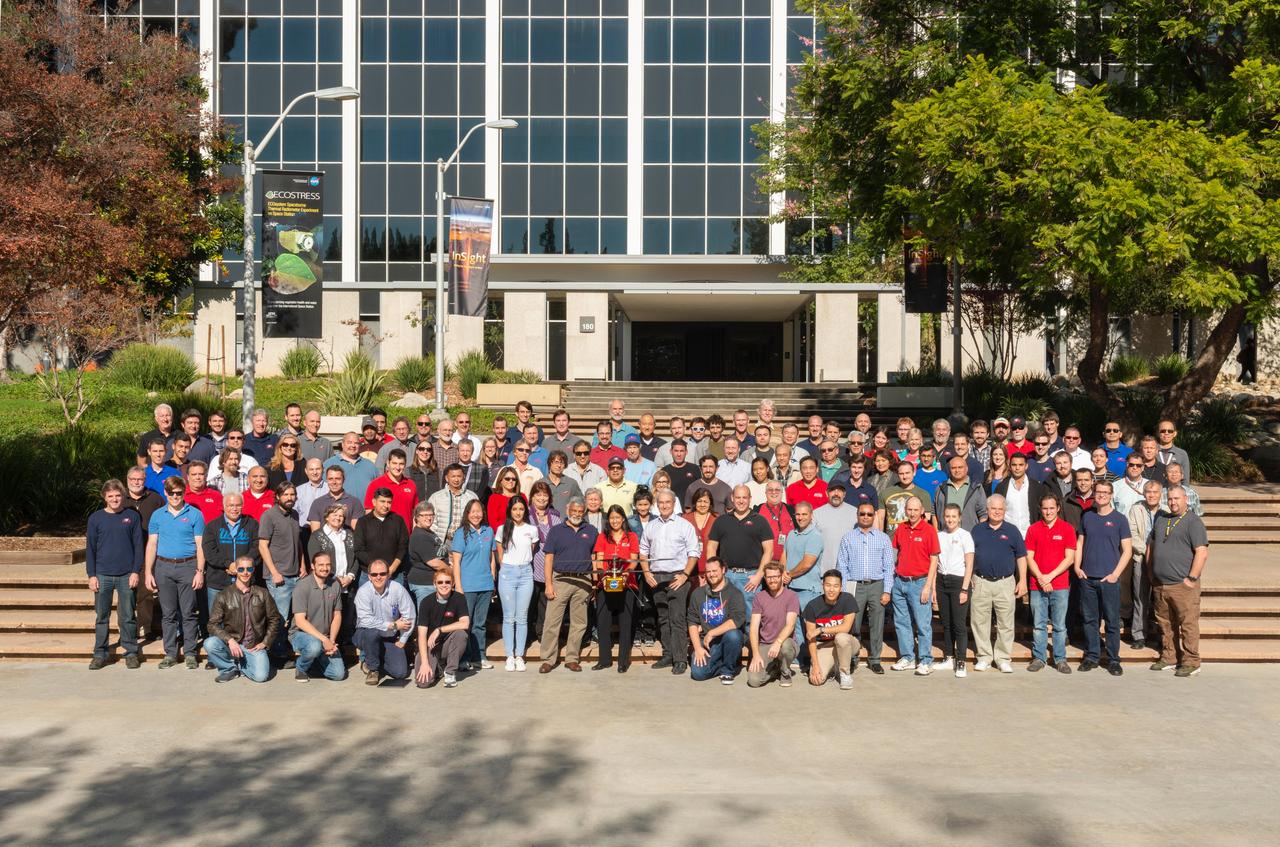
The Mars Helicopter team gathers for a group photo at NASA's Jet Propulsion Laboratory in Southern California on Dec. 3, 2018. Holding a full-size model of the helicopter, named Ingenuity, is MiMi Aung, the project manager at JPL. https://photojournal.jpl.nasa.gov/catalog/PIA22649
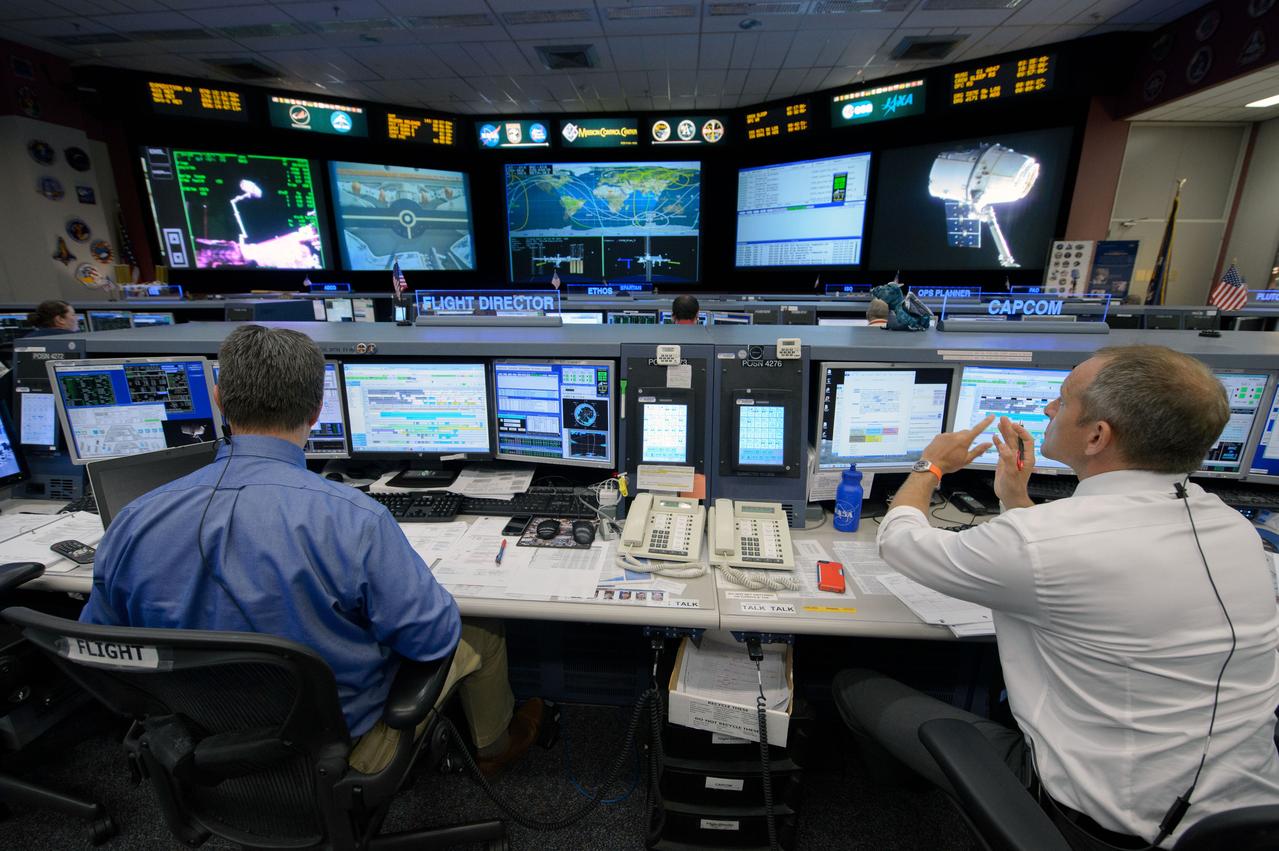
Expedition 43 flight control team with Flight Director Gary Horlacher during the release of SpaceX Dragon cargo vehicle. Photo Date: May 21, 2015. Location: Building 30 - FCR1. Photographer: Robert Markowitz
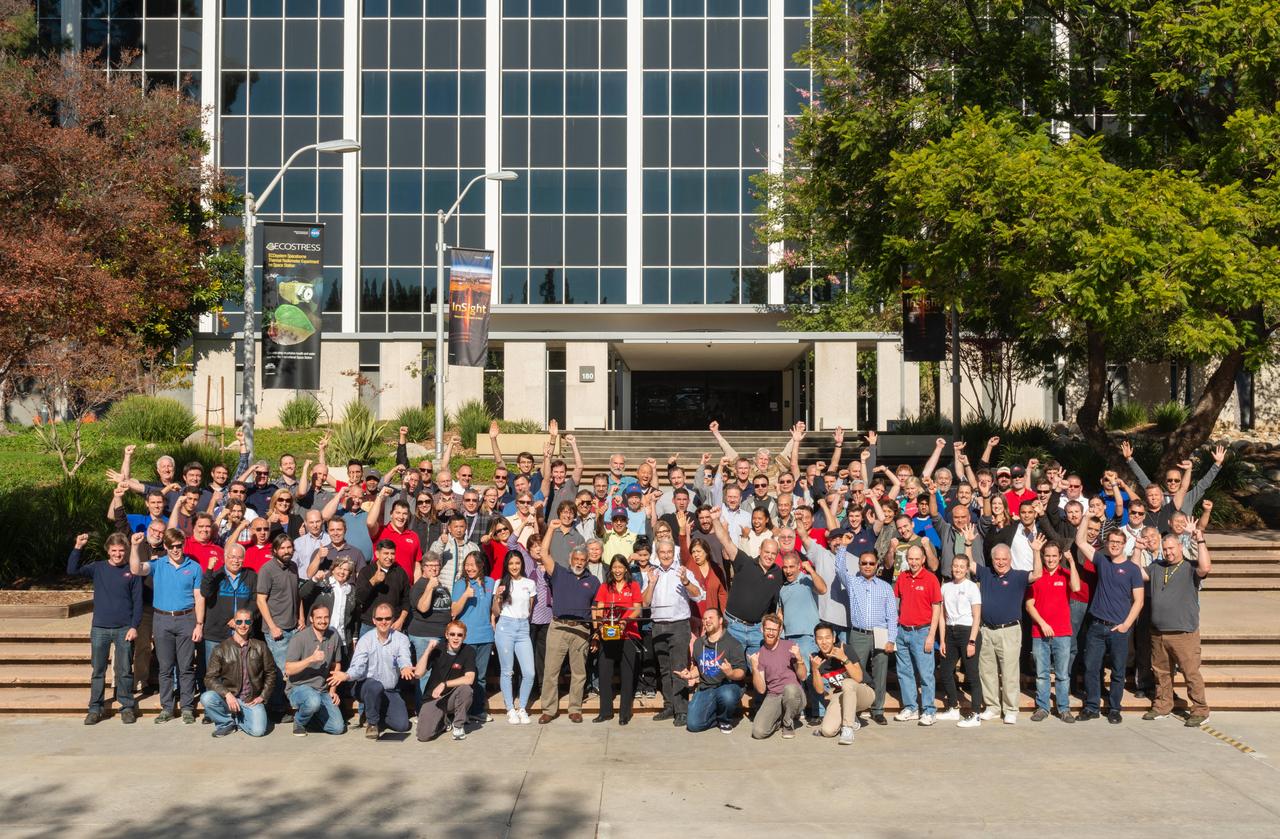
Morale was high as the Mars Helicopter team gathered for a group photo on Dec. 3, 2018, at NASA's Jet Propulsion Laboratory in Southern California. The helicopter, named Ingenuity, is a technology demonstration to test the first powered flight on another world. The helicopter will ride to Mars attached inside the belly of the Perseverance rover. https://photojournal.jpl.nasa.gov/catalog/PIA22650
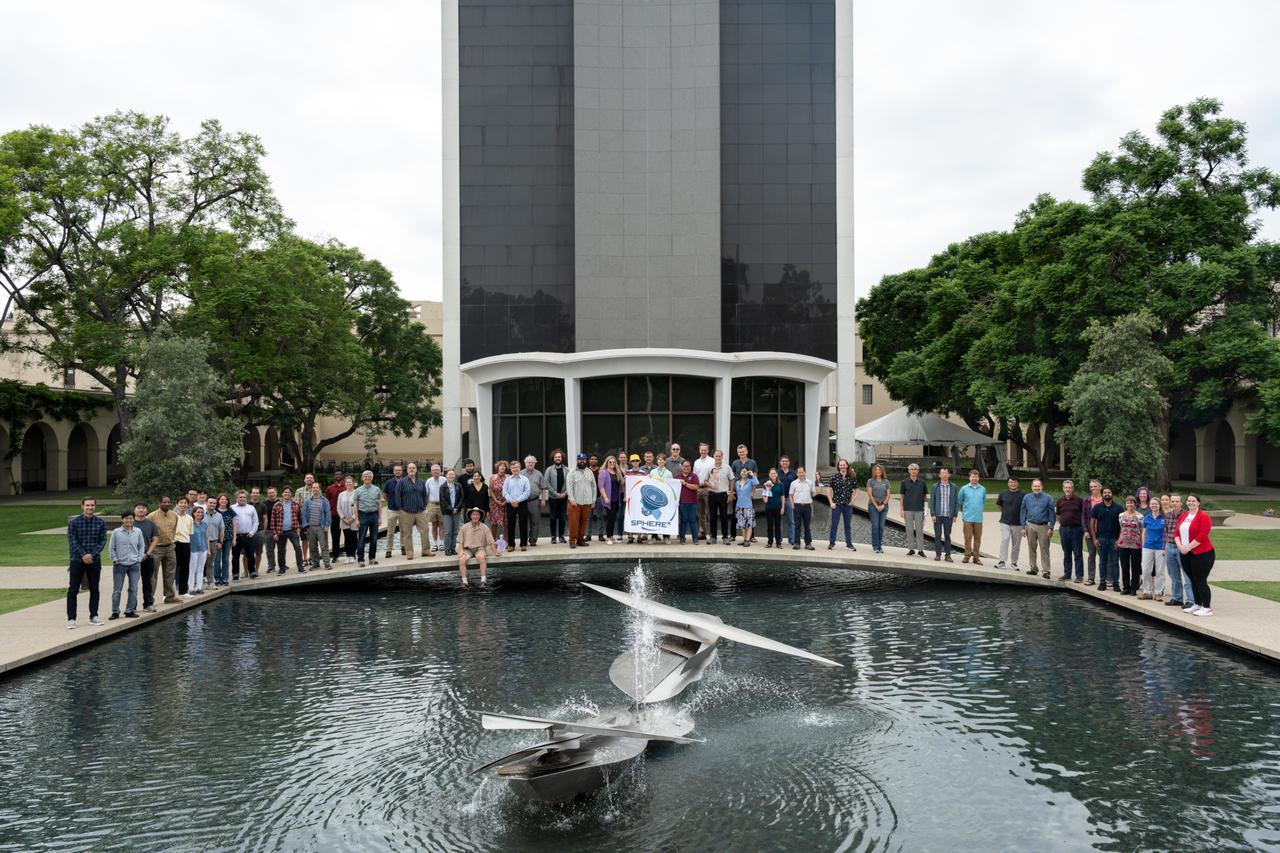
Members of the SPHEREx mission team pose for a photo on the campus of Caltech in Pasadena, California, in October 2023. Short for Spectro-Photometer for the History of the Universe, Epoch of Reionization and Ices Explorer, SPHEREx will create a map of the cosmos like no other. Using a technique called spectroscopy to image the entire sky in 102 wavelengths of infrared light, SPHEREx will gather information about the composition of and distance to millions of galaxies and stars. With this map, scientists will study what happened in the first fraction of a second after the big bang, how galaxies formed and evolved, and the origins of water in planetary systems in our galaxy. https://photojournal.jpl.nasa.gov/catalog/PIA26534
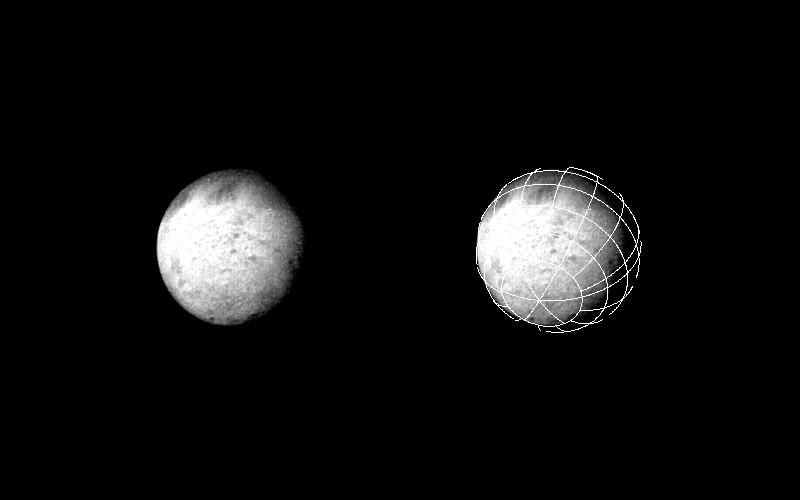
This photo of Triton is one of a continuing series of observatory phase images obtained by NASA Voyager spacecraft. Lines inscribed on the image at right form a reference grid used by the Imaging Science Team.
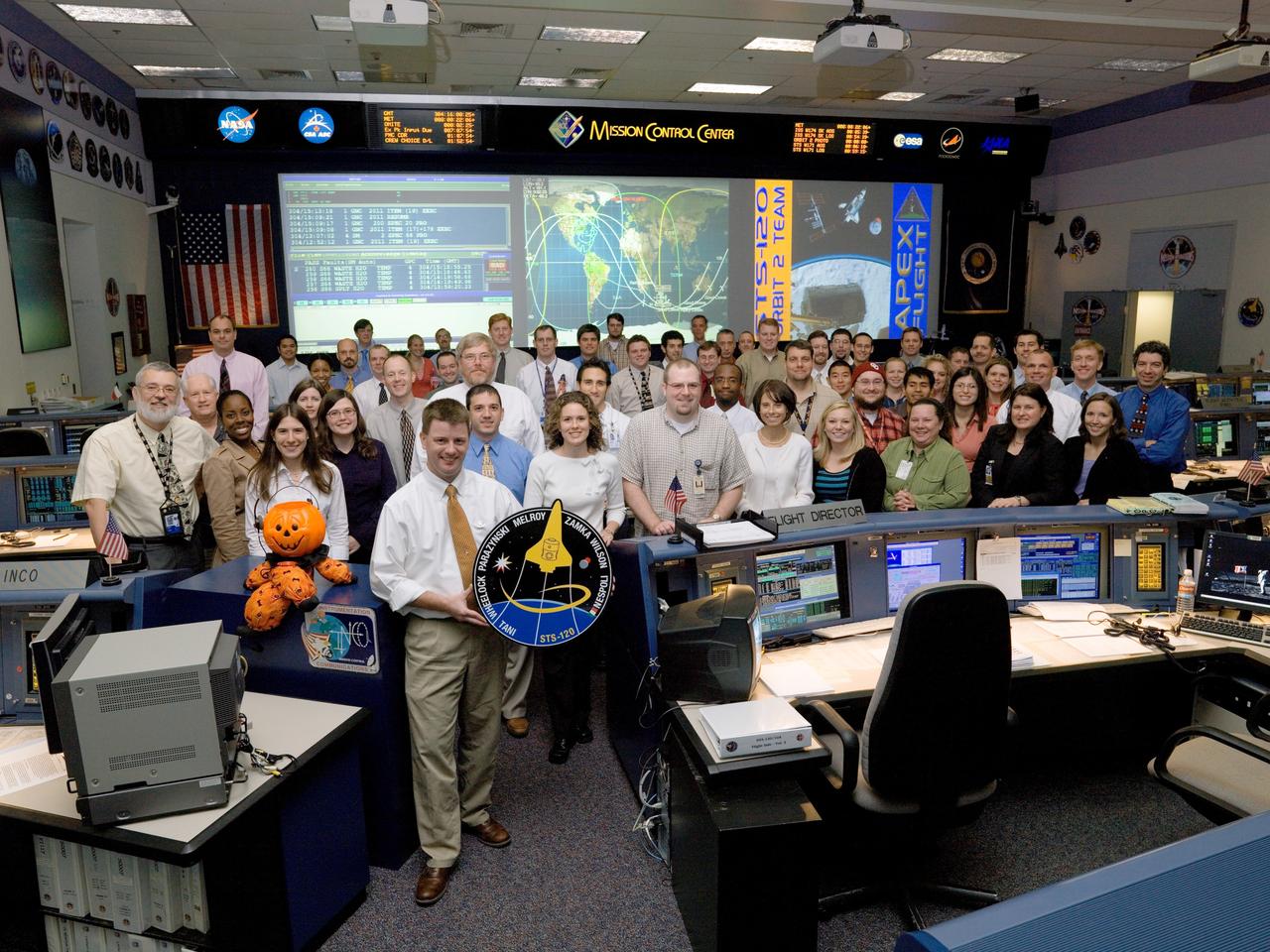
JSC2007-E-095908 (31 Oct. 2007) --- The members of the STS-120 Orbit 2 flight control team pose for a group portrait in the space shuttle flight control room of Houston's Mission Control Center (MCC). Flight director Mike Moses holds the STS-120 mission logo.
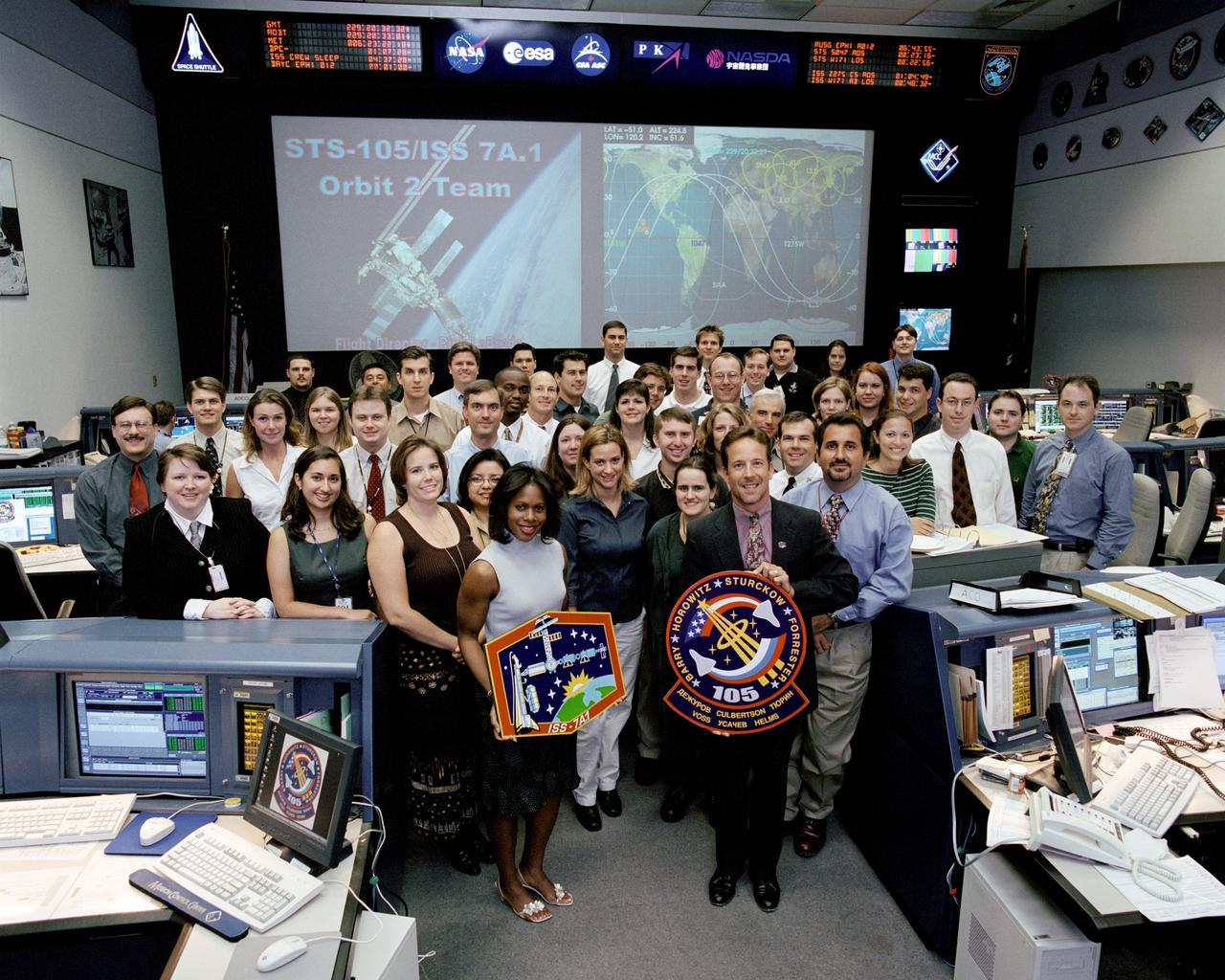
JSC2001-02225 (17 August 2001) --- The members of the STS-105/ISS 7A.1 Orbit 2 team pose for a group portrait in the International Space Station (ISS) flight control room (BFCR) in Houston’s Mission Control Center (MCC). Orbit 2 flight director Rick LaBrode (front right) holds the STS-105 mission logo, and Astronaut Joan E. Higginbotham, ISS spacecraft communicator (CAPCOM), holds the ISS 7A.1 mission logo.
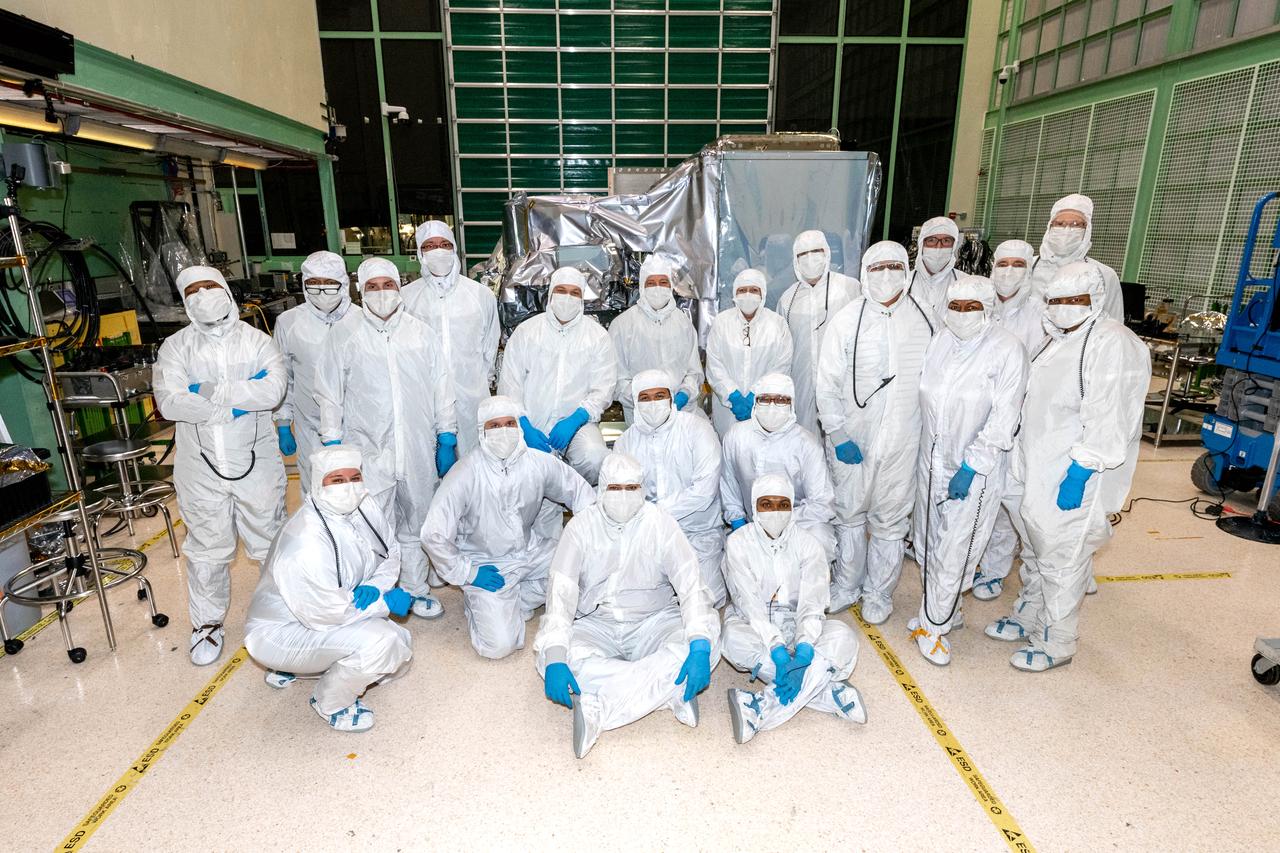
Ocean Color Instrument (OCI) team members pose with the flight hardware after successful instrument integration to the Tilt mechanism. OCI is a highly advanced optical spectrometer that will be used to measure properties of light over portions of the electromagnetic spectrum. It will enable continuous measurement of light at finer wavelength resolution than previous NASA satellite sensors, extending key system ocean color data records for climate studies. OCI is PACE's (Plankton, Aerosol, Cloud, ocean Ecosystem) primary sensor built at Goddard Space Flight Center in Greenbelt, MD.
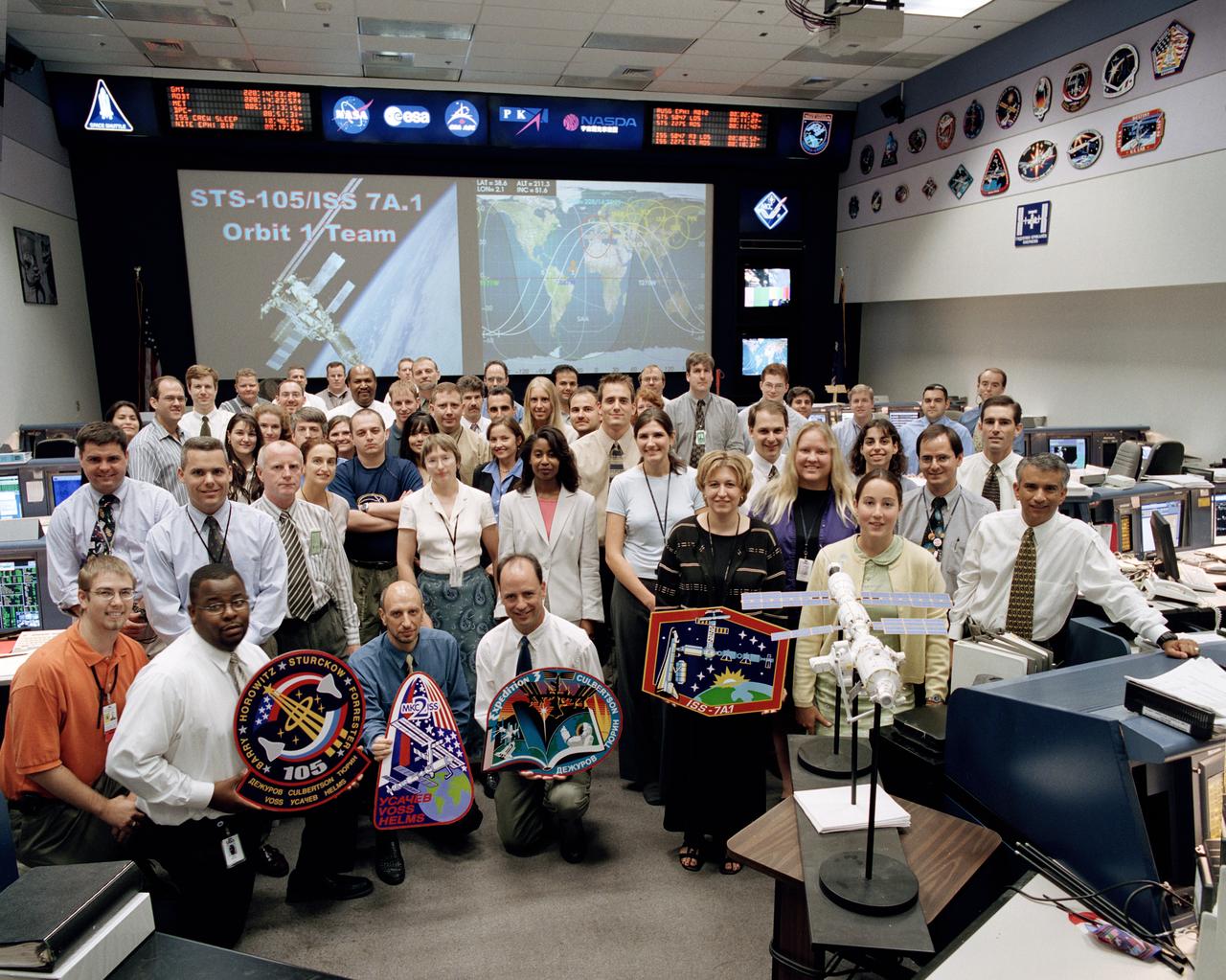
JSC2001-02229 (16 August 2001) --- The members of the STS-105/ISS 7A.1 Orbit 1 team pose for a group portrait in the International Space Station (ISS) flight control room (BFCR) in Houston’s Mission Control Center (MCC). Flight director Mark Ferring is kneeling as he holds the Expedition Three mission logo. Astronaut Stephanie D. Wilson, ISS spacecraft communicator (CAPCOM), is standing behind Ferring.

The Ocean Color Instrument (OCI) Electro-Magnetic Interference (EMI) & Electrical Ground Support Equipment (EGSE) Team pose in the control room. From this room, they are able to analyze the data from the test remotely and send commands through electrical cables that run through the walls into the EMI lab. OCI is a highly advanced optical spectrometer that will be used to measure properties of light over portions of the electromagnetic spectrum. It will enable continuous measurement of light at finer wavelength resolution than previous NASA satellite sensors, extending key system ocean color data records for climate studies. OCI is PACE's (Plankton, Aerosol, Cloud, ocean Ecosystem) primary sensor built at Goddard Space Flight Center in Greenbelt, MD.
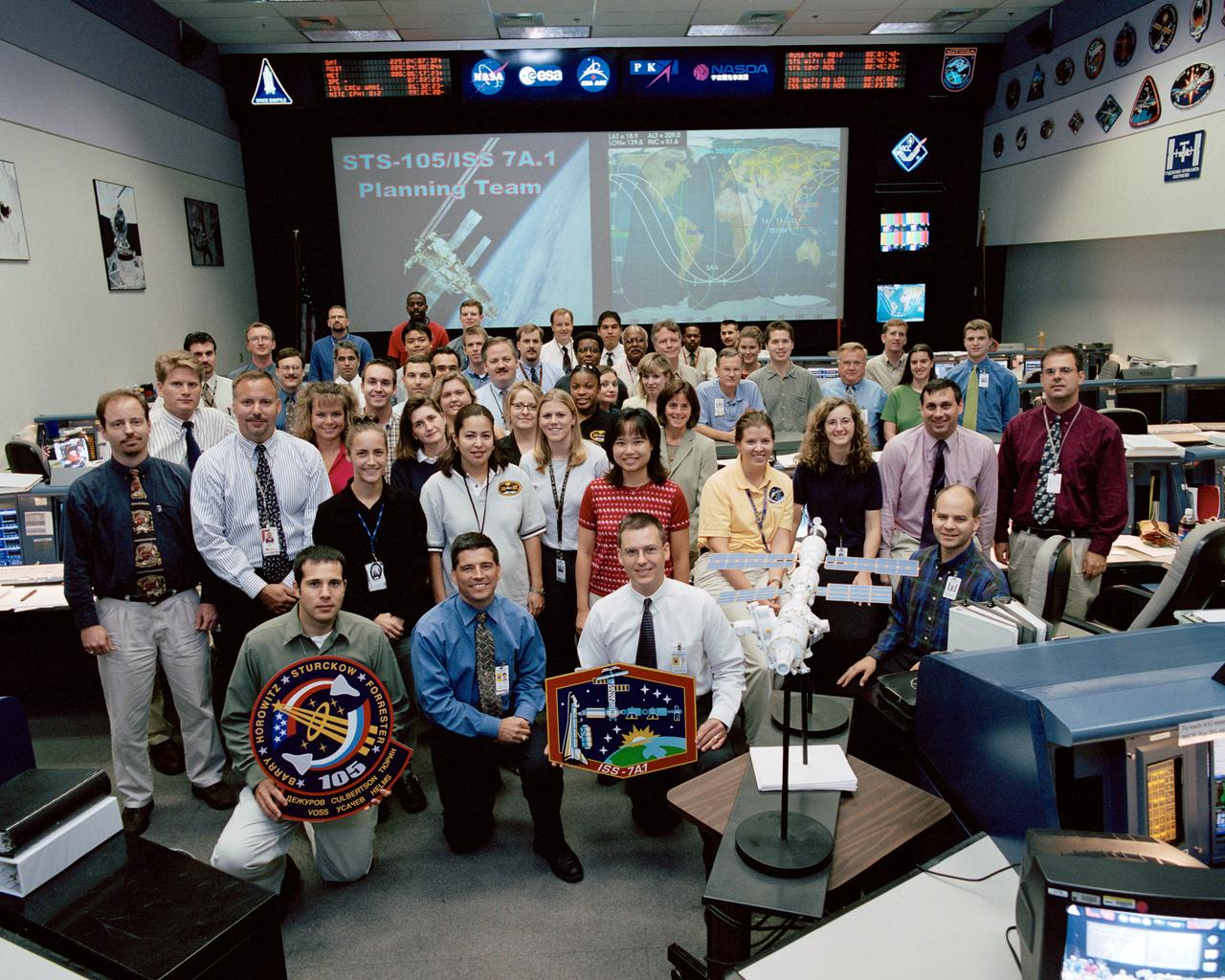
JSC2001-02227 (16 August 2001) --- The members of the STS-105/ISS 7A.1 Planning team pose for a group portrait in the International Space Station (ISS) flight control room (BFCR) in Houston’s Mission Control Center (MCC).
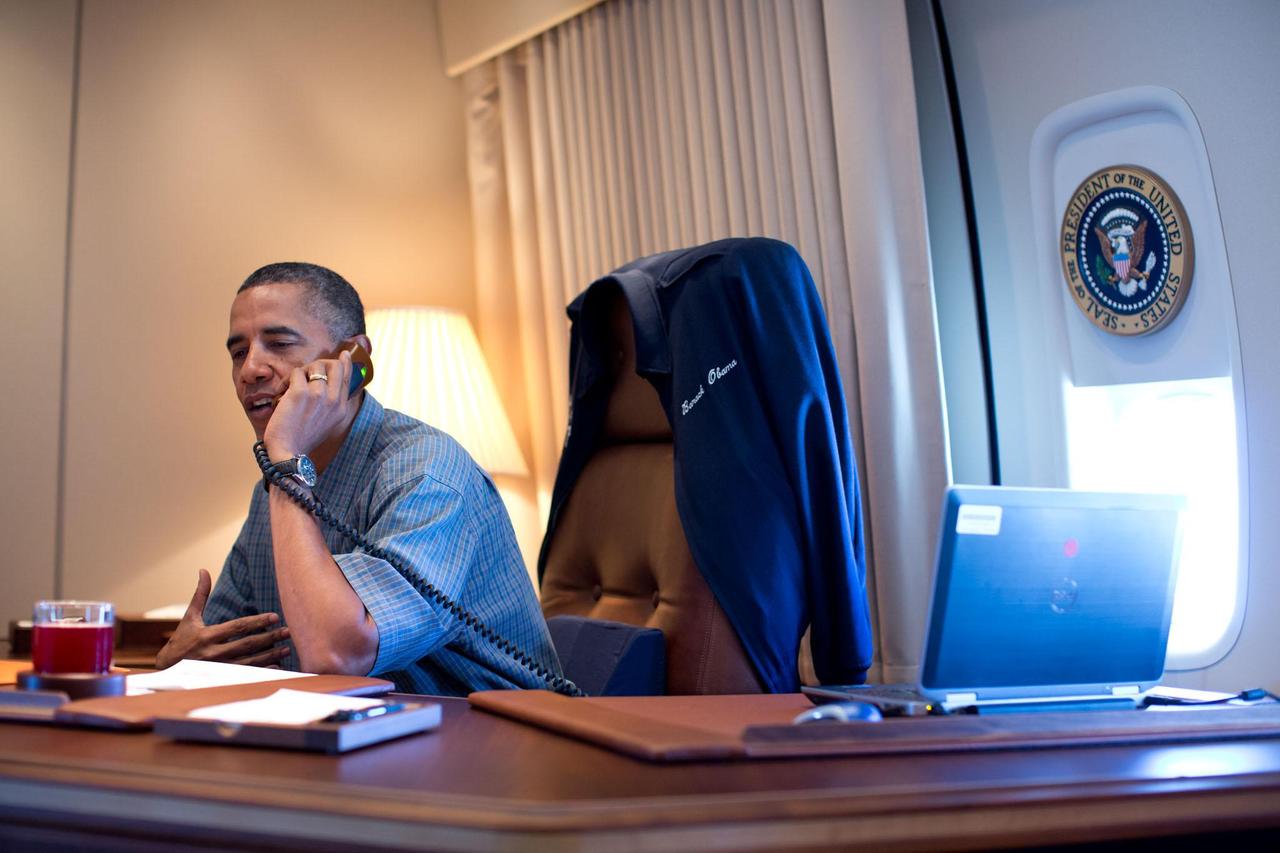
President Barack Obama talks on the phone with NASA Curiosity Mars rover team aboard Air Force One during a flight to Offutt Air Force Base in Nebraska, Aug. 13, 2012. Official White House Photo by Pete Souza
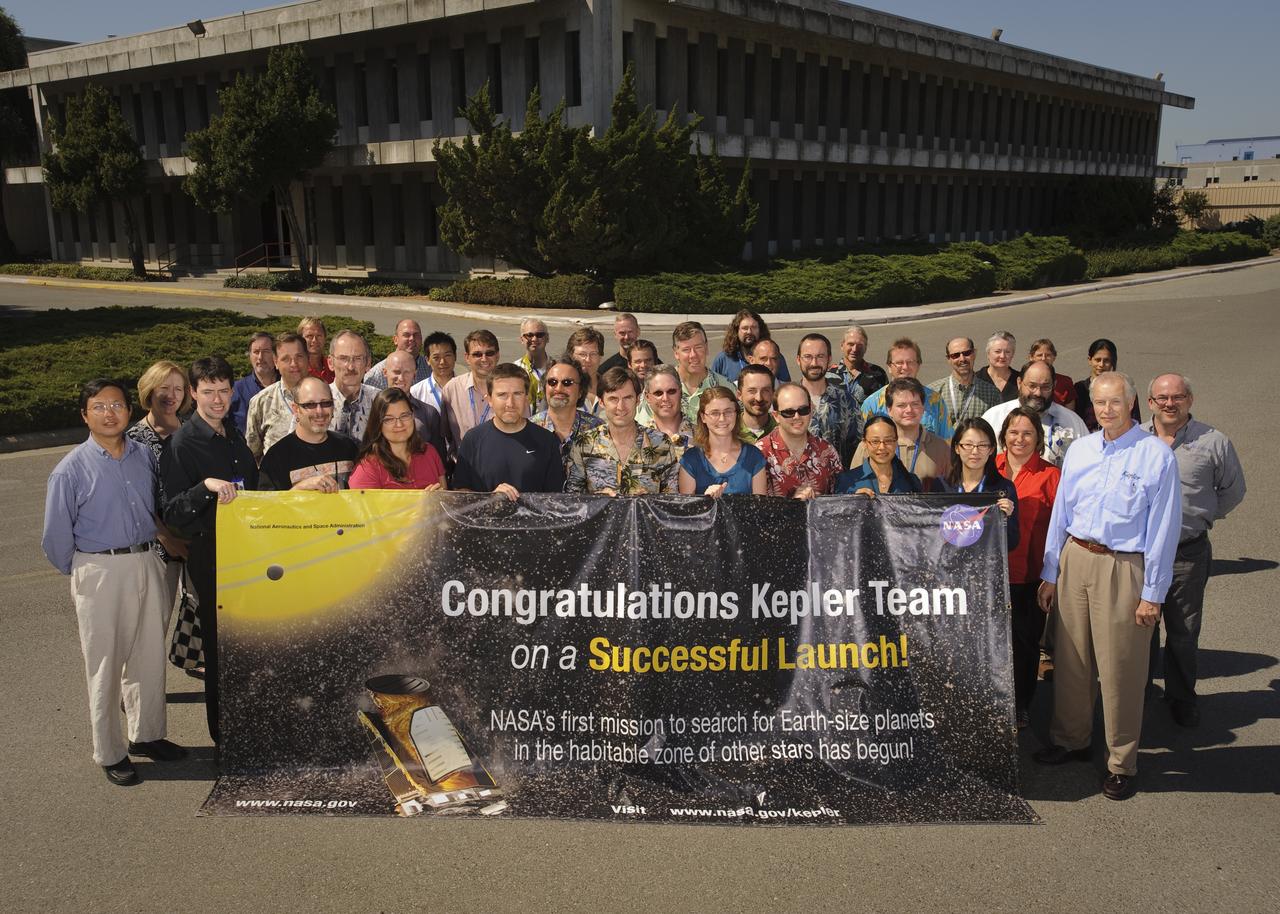
Kepler Project Team Photo
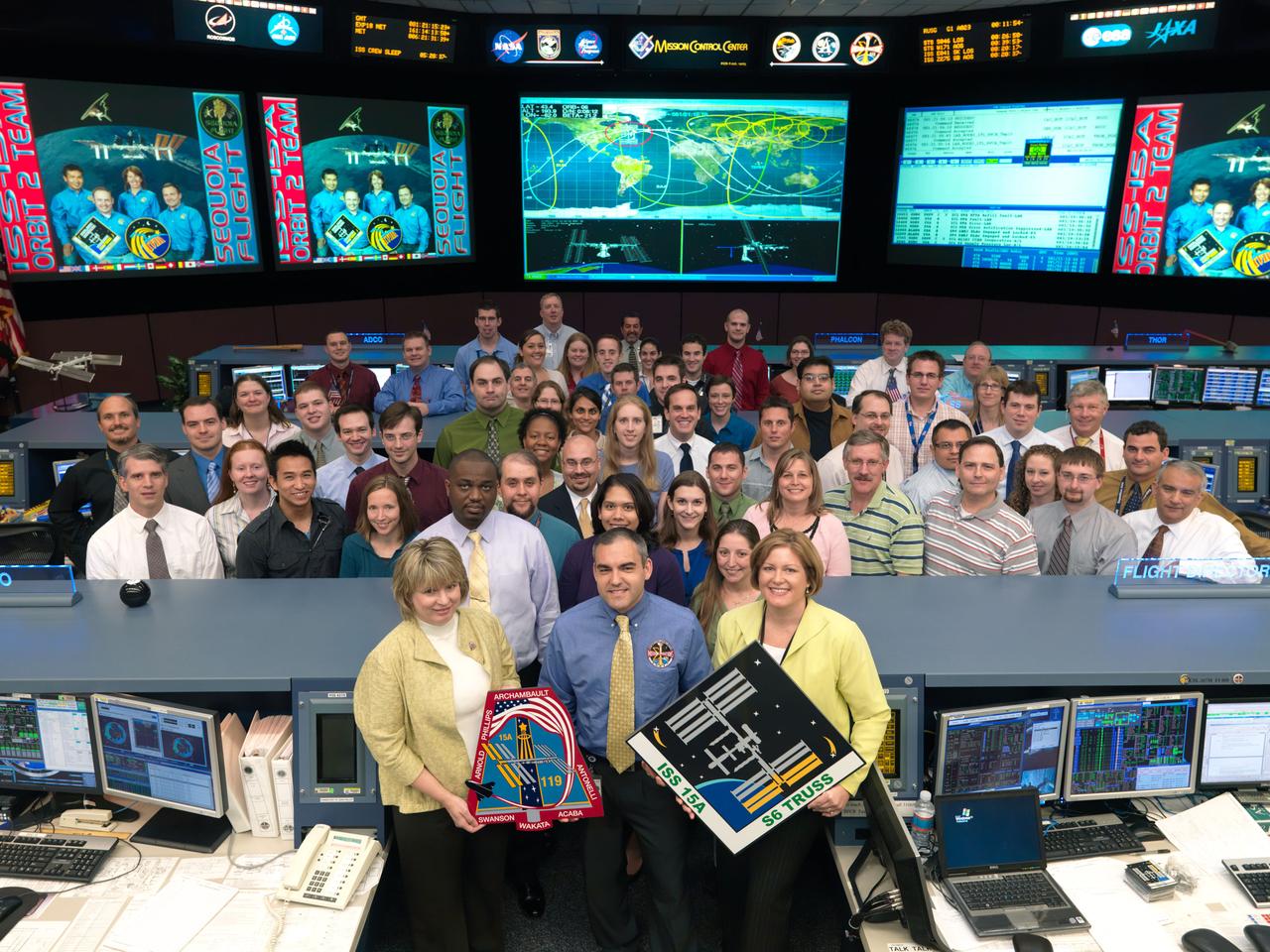
PHOTO DATE: 22 March 2009 - 3:30pm LOCATION: Bldg. 30, FCR-1 SUBJECT: Team photo of ISS 15A Flight Control Team - Orbit 2 - Flight Director Heather Rarick PHOTOGRAPHER: Bill Stafford
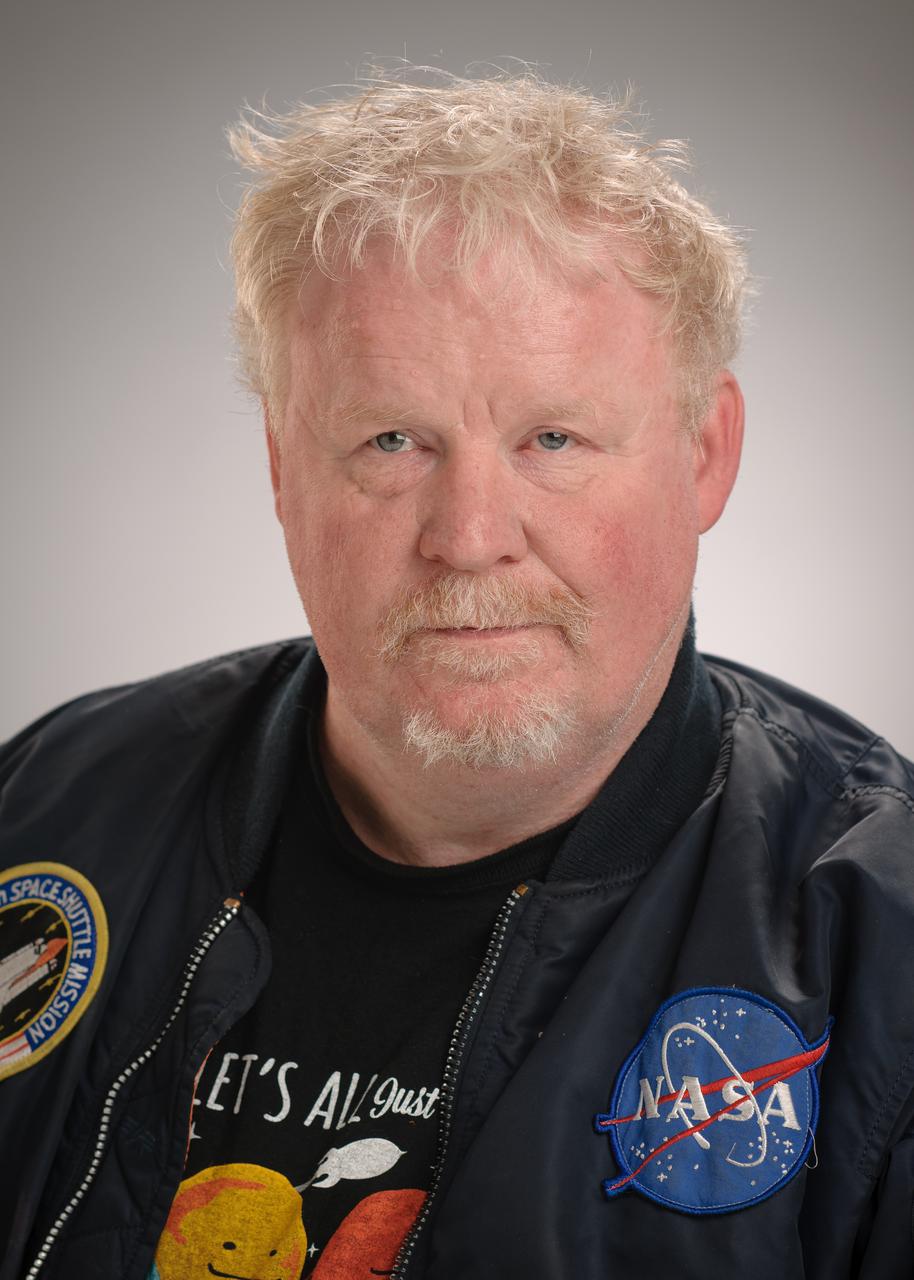
Christopher Hull Kepler/K2 Team, Official NASA Photo
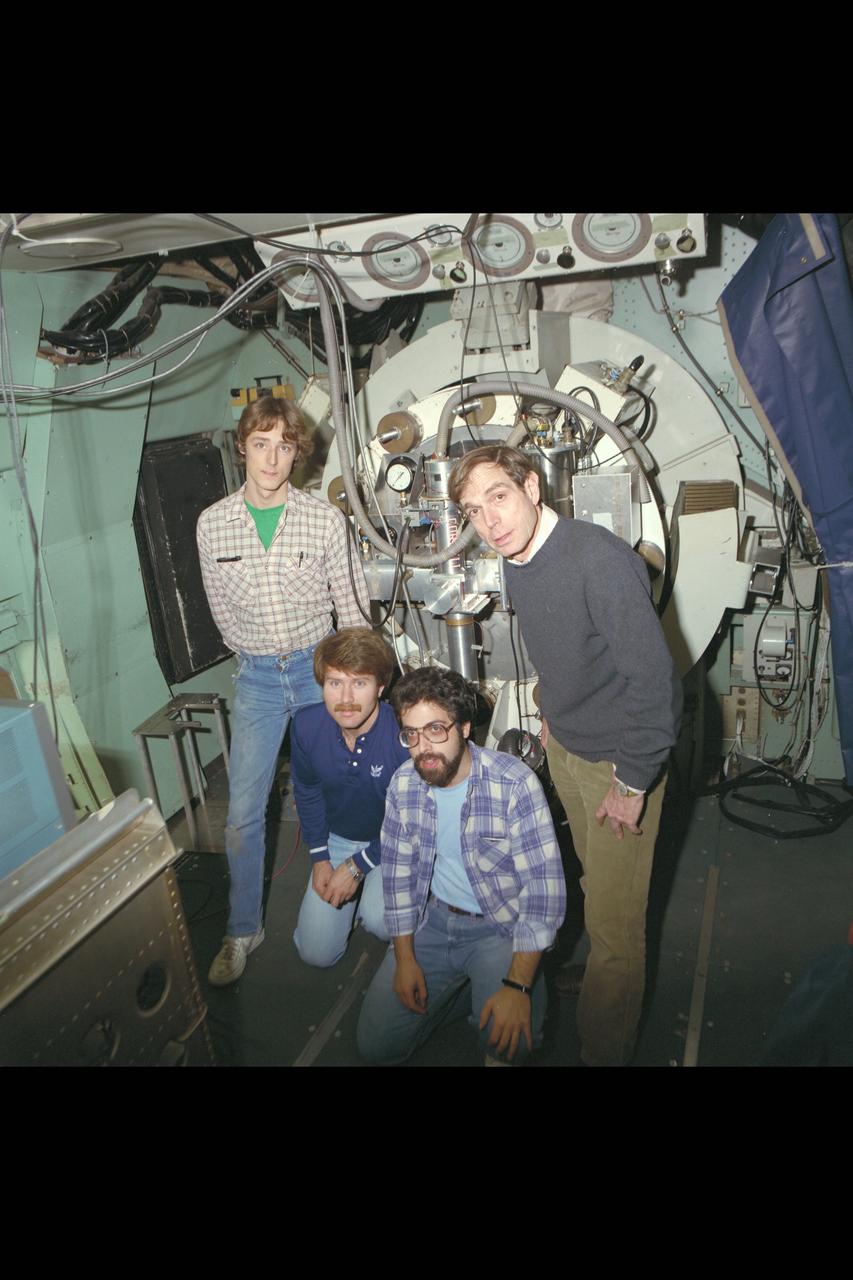
C-141 KAO: Cornell University, FAR Infrared Interferometer (Team Photo)
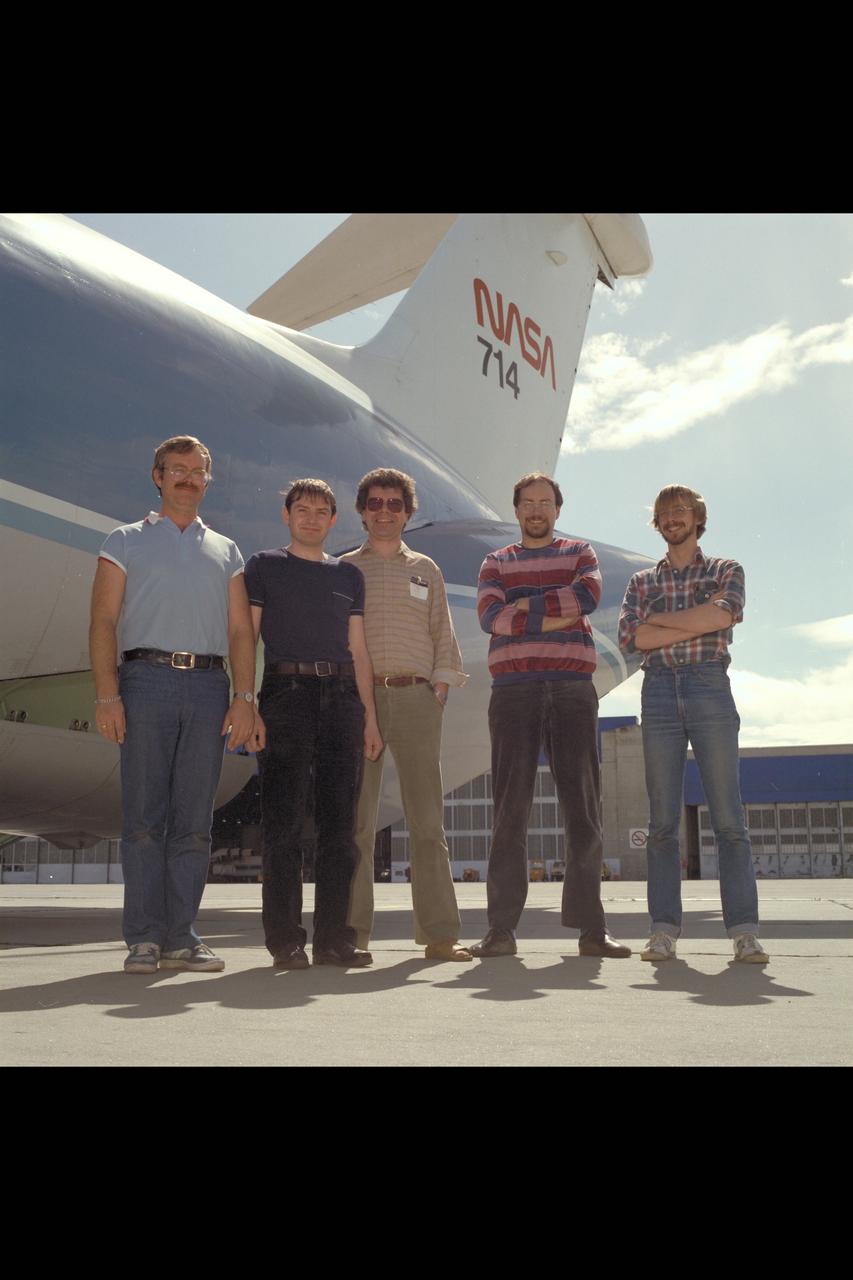
C-141 KAO: Planck Institute Heterdyne Spectrometer (Team Photo)
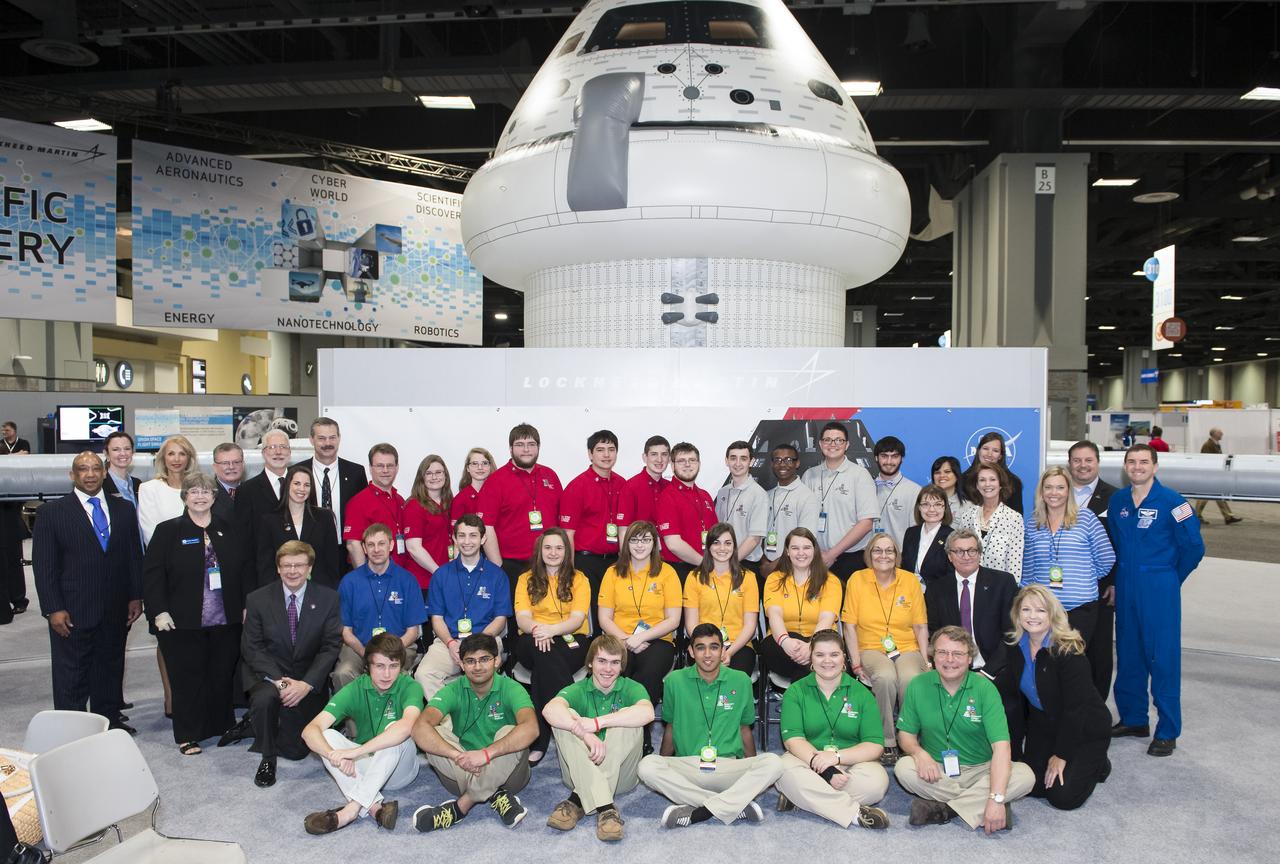
Sponsors of all of the semi-finalist teams in the Exploration Design Challenge pose for a group photo with the teams. Team ARES from the Governors School for Science and Technology in Hampton, Va. won the challenge with their radiation shield design, which will be built and flown aboard the Orion/EFT-1. The award was announced at the USA Science and Engineering Festival on April 25, 2014 at the Washington Convention Center. Photo Credit: (NASA/Aubrey Gemignani)
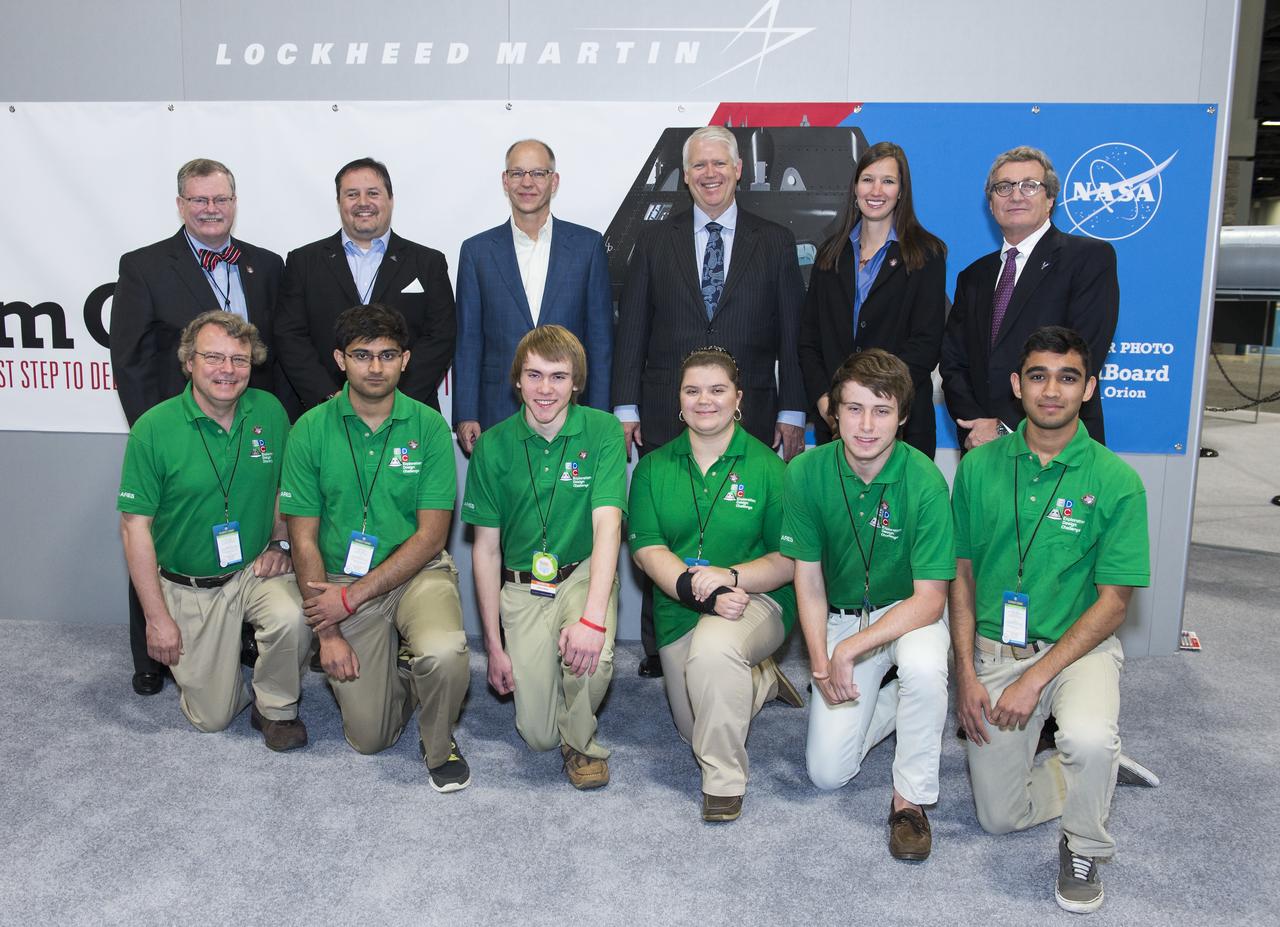
Sponsors of Team ARES pose for a group photo with the winning high school team in the Exploration Design Challenge. Team ARES from the Governors School for Science and Technology in Hampton, Va. won the challenge with their radiation shield design, which will be built and flown aboard the Orion/EFT-1. The award was announced at the USA Science and Engineering Festival on April 25, 2014 at the Washington Convention Center. Photo Credit: (NASA/Aubrey Gemignani)
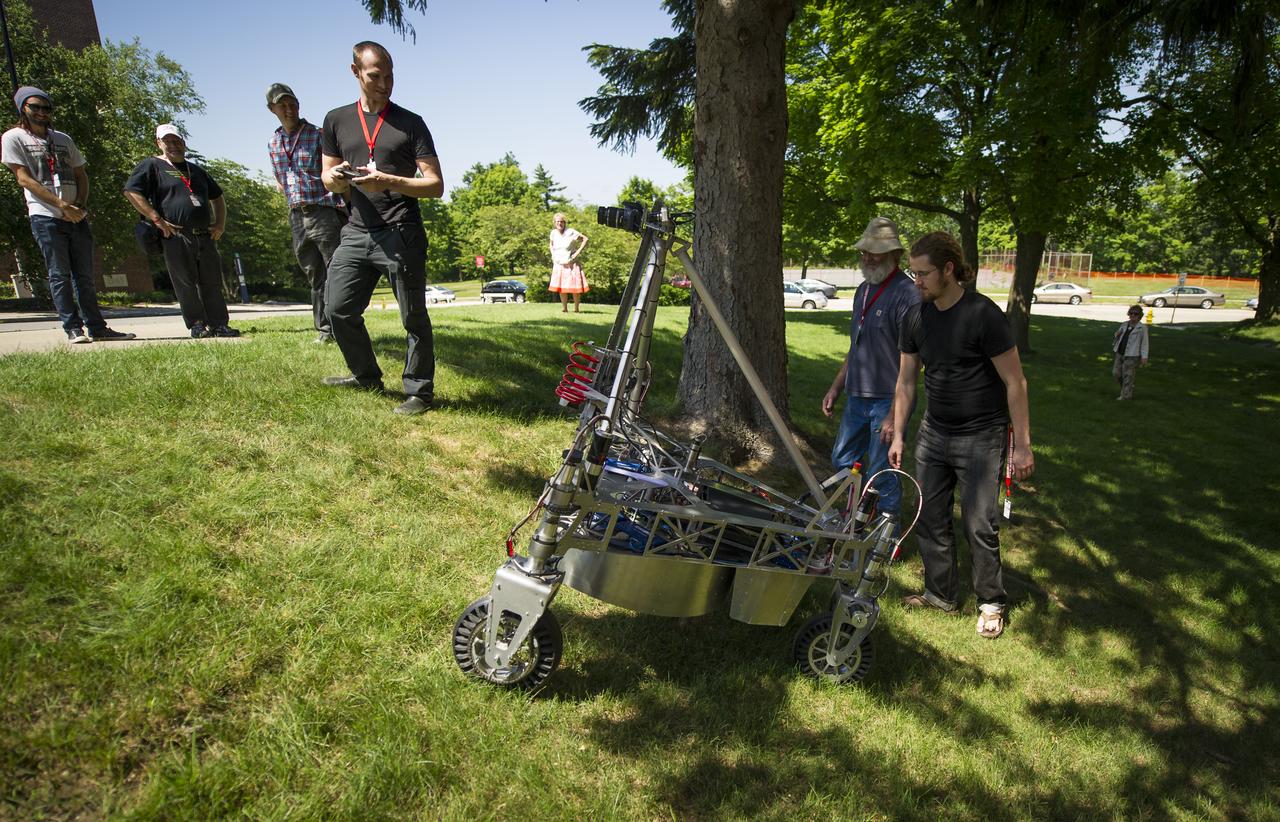
Team members of "Survey" drive their robot around the campus on Saturday, June 16, 2012 at the Worcester Polytechnic Institute (WPI) in Worcester, Mass. The Survey team was one of the final teams participating in the NASA-WPI Sample Return Robot Centennial Challenge at WPI. Teams were challenged to build autonomous robots that can identify, collect and return samples. NASA needs autonomous robotic capability for future planetary exploration. Photo Credit: (NASA/Bill Ingalls)
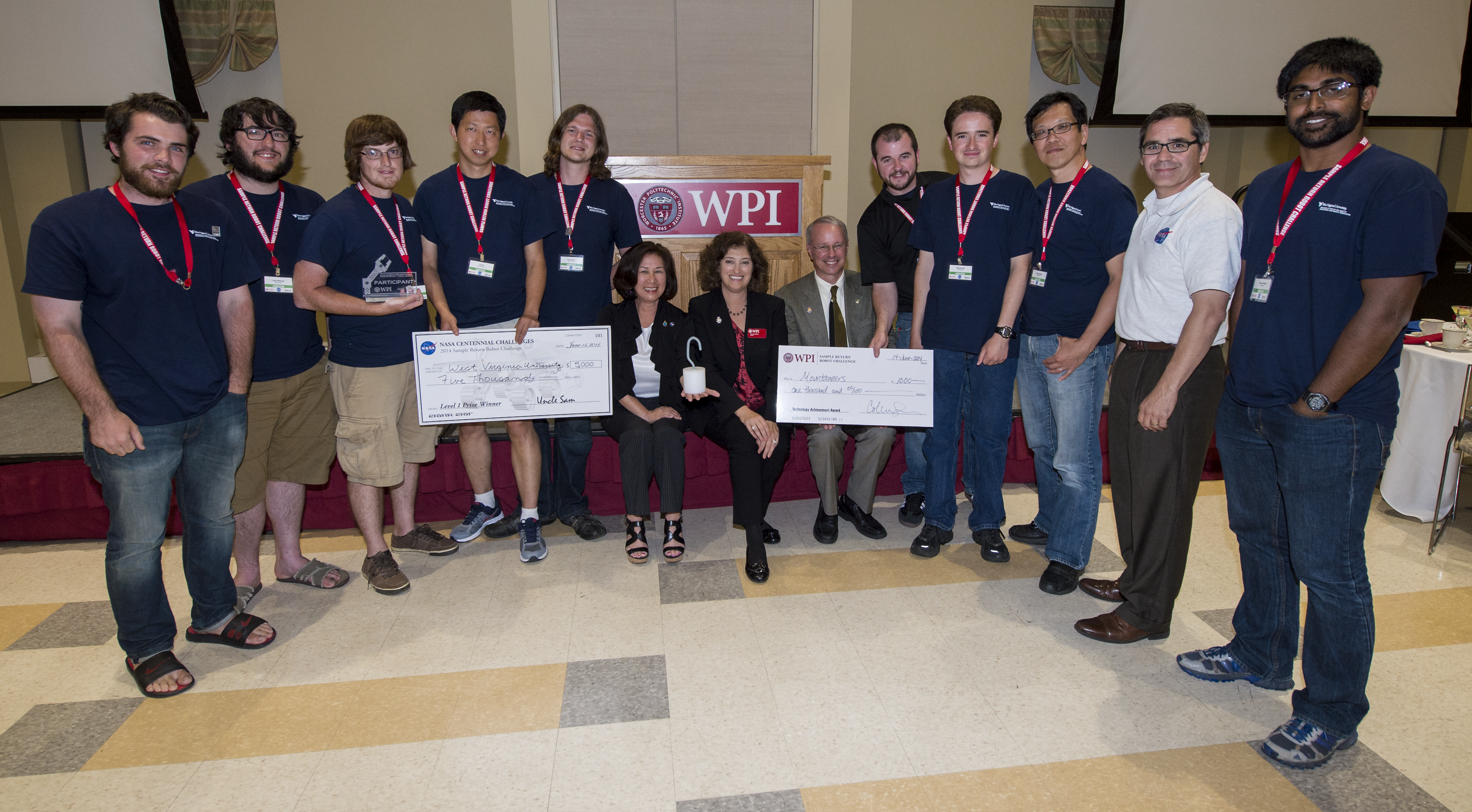
The NASA Centennial Challenges prize, level one, is presented to team Mountaineers for successfully completing level one of the NASA 2014 Sample Return Robot Challenge, from left, Ryan Watson, Team Mountaineers; Lucas Behrens, Team Mountaineers; Jarred Strader, Team Mountaineers; Yu Gu, Team Mountaineers; Scott Harper, Team Mountaineers; Dorothy Rasco, NASA Deputy Associate Administrator for the Space Technology Mission Directorate; Laurie Leshin, Worcester Polytechnic Institute (WPI) President; David Miller, NASA Chief Technologist; Alexander Hypes, Team Mountaineers; Nick Ohi,Team Mountaineers; Marvin Cheng, Team Mountaineers; Sam Ortega, NASA Program Manager for Centennial Challenges; and Tanmay Mandal, Team Mountaineers;, Saturday, June 14, 2014, at Worcester Polytechnic Institute (WPI) in Worcester, Mass. Team Mountaineers was the only team to complete the level one challenge. During the competition, teams were required to demonstrate autonomous robots that can locate and collect samples from a wide and varied terrain, operating without human control. The objective of this NASA-WPI Centennial Challenge was to encourage innovations in autonomous navigation and robotics technologies. Innovations stemming from the challenge may improve NASA's capability to explore a variety of destinations in space, as well as enhance the nation's robotic technology for use in industries and applications on Earth. Photo Credit: (NASA/Joel Kowsky)
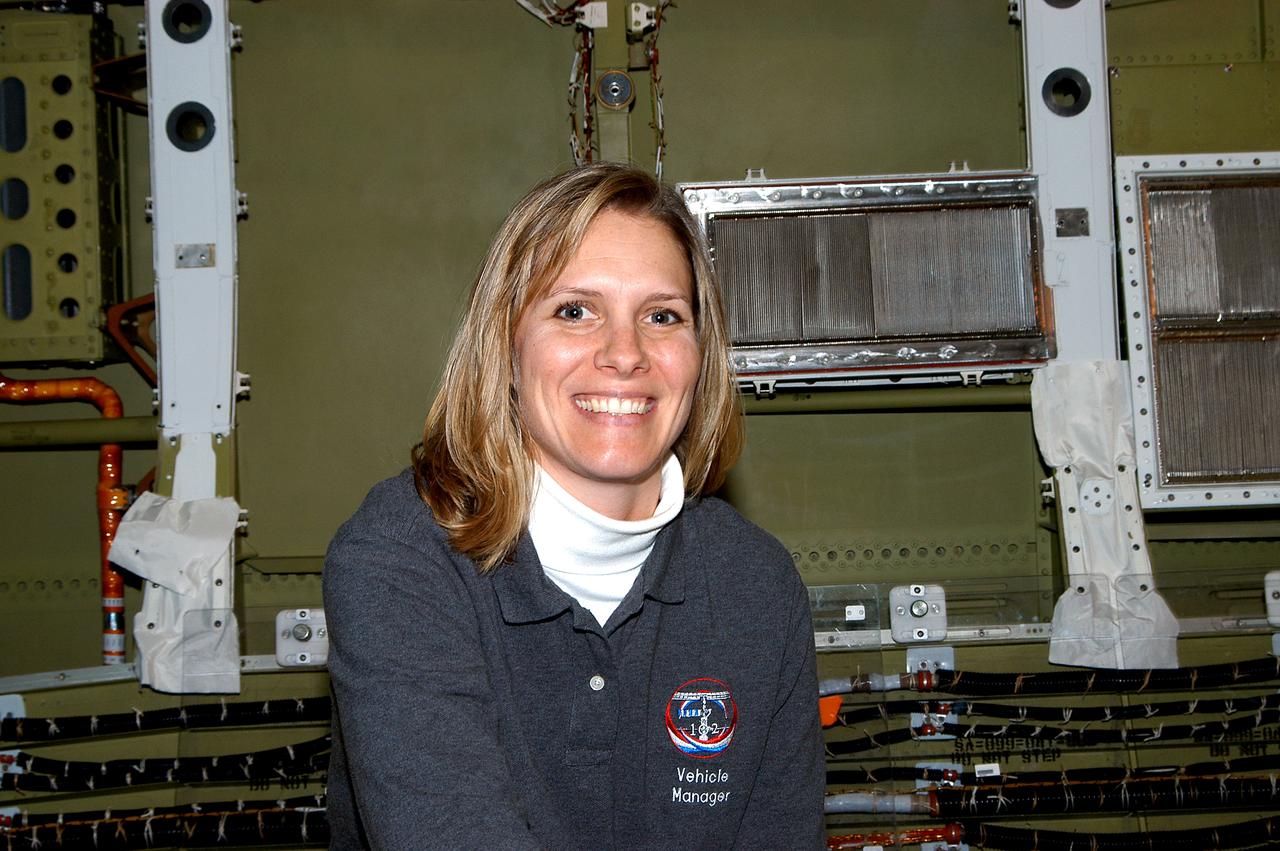
KENNEDY SPACE CENTER, FLA. - NASA Vehicle Manager for Discovery, Stephanie Stilson poses for a photo after working with a KSC Web team who were filming a special feature for the KSC Web. Stilson explained her role in the recent Orbiter Major Modification period, which included inspection, modifications and reservicing of most systems onboard. The work on Discovery also included the installation of a Multifunction Electronic Display Subsystem (MEDS) - a state-of-the-art “glass cockpit.” The orbiter is now being prepared for eventual launch on a future mission.

The No Chase COA (NCC) team at NASA Armstrong Flight Research Center pose for a group photo with the unmanned aircraft system the Ikhana.
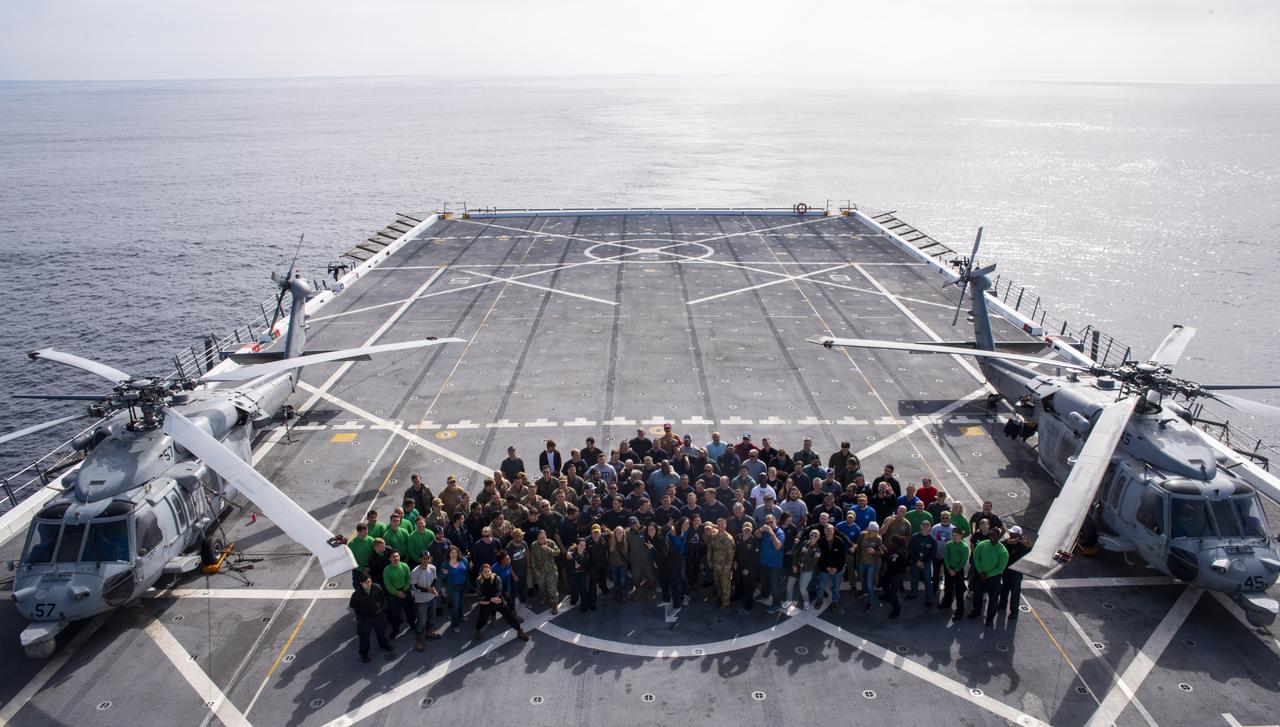
The NASA and DoD Recovery Team aboard the USS John P. Murtha for the Underway Recovery Test 9 (URT-9).

JSC2001-00310 (February 2001) --- These sixty-plus flight controllers support the STS-98/5a mission's orbit 1 shift from various consoles in the shuttle flight control room in the Johnson Space Center's Mission Control Center (MCC). Flight director Robert Castle holds the crew insignia near center frame.
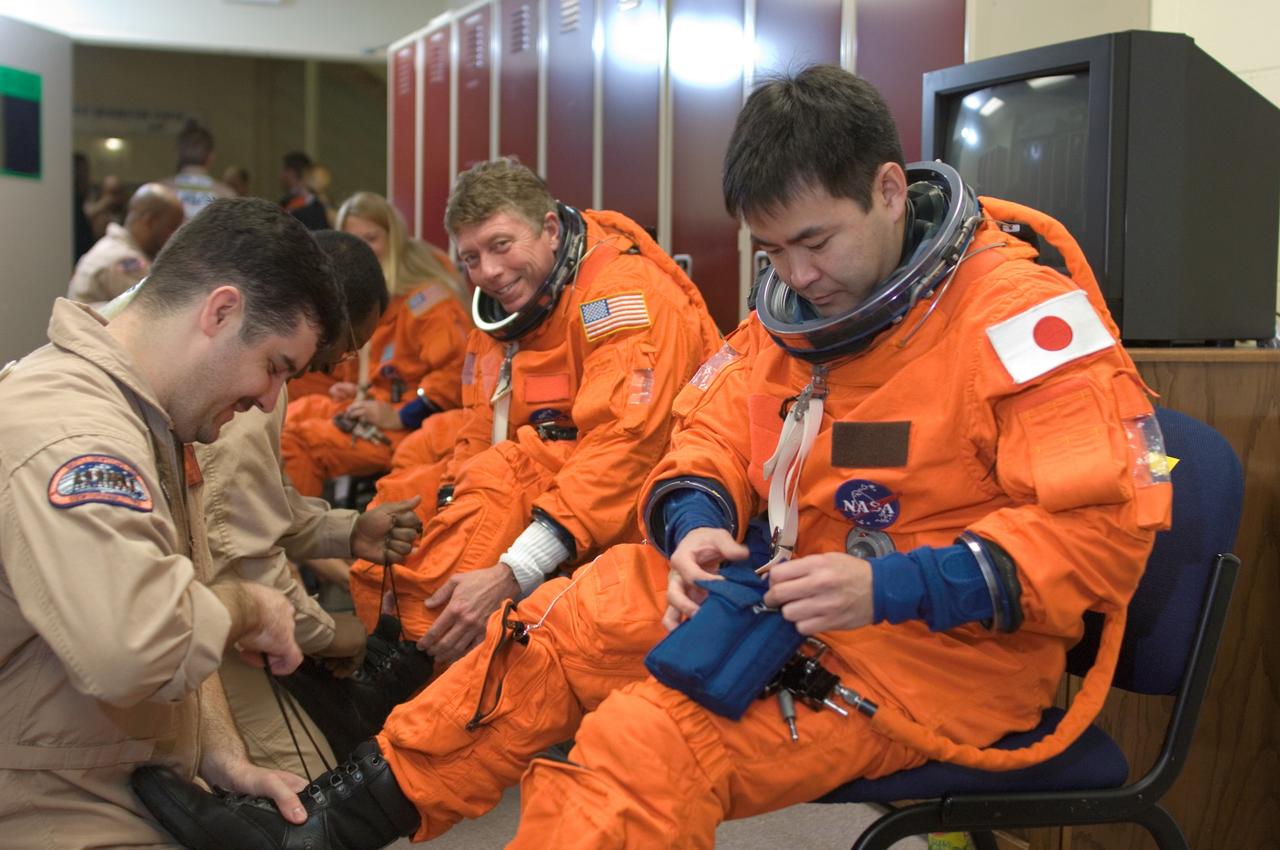
JSC2008-E-009419 (31 Jan. 2008) --- Japan Aerospace Exploration Agency (JAXA) astronaut Akihiko Hoshide (right), STS-124 mission specialist, dons a training version of his shuttle launch and entry suit in preparation for a training session in the Space Vehicle Mockup Facility at Johnson Space Center. United Space Alliance suit technician Carlos Ramos assisted Hoshide. Astronaut Michael E. Fossum, mission specialist, is also visible.
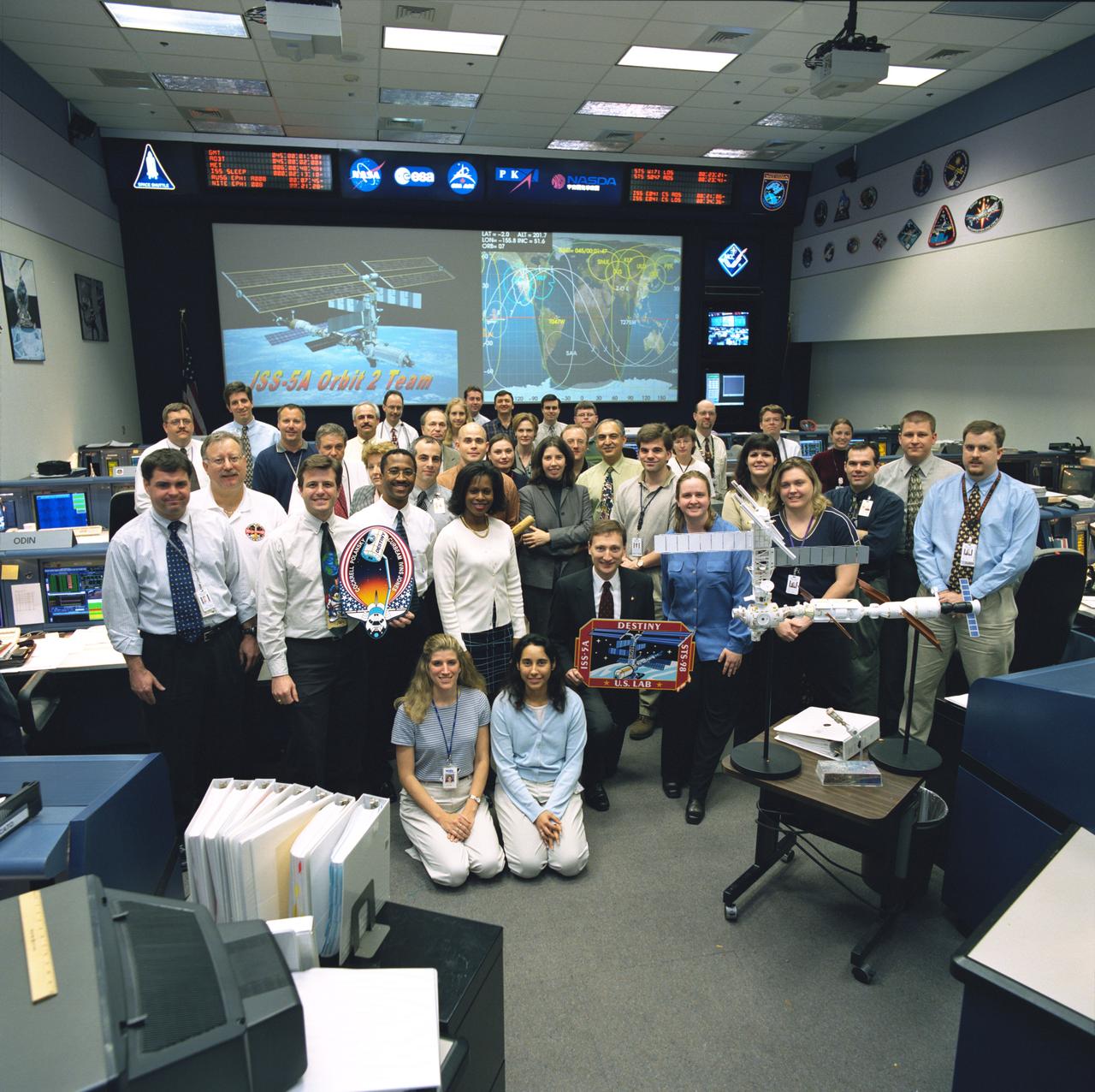
JSC2001-00308 (February 2001) --- These forty-plus flight controllers support the International Space Station (ISS) 5a mission's orbit 2 shift from various consoles in the station flight control room in the Johnson Space Center's Mission Control Center (MCC).
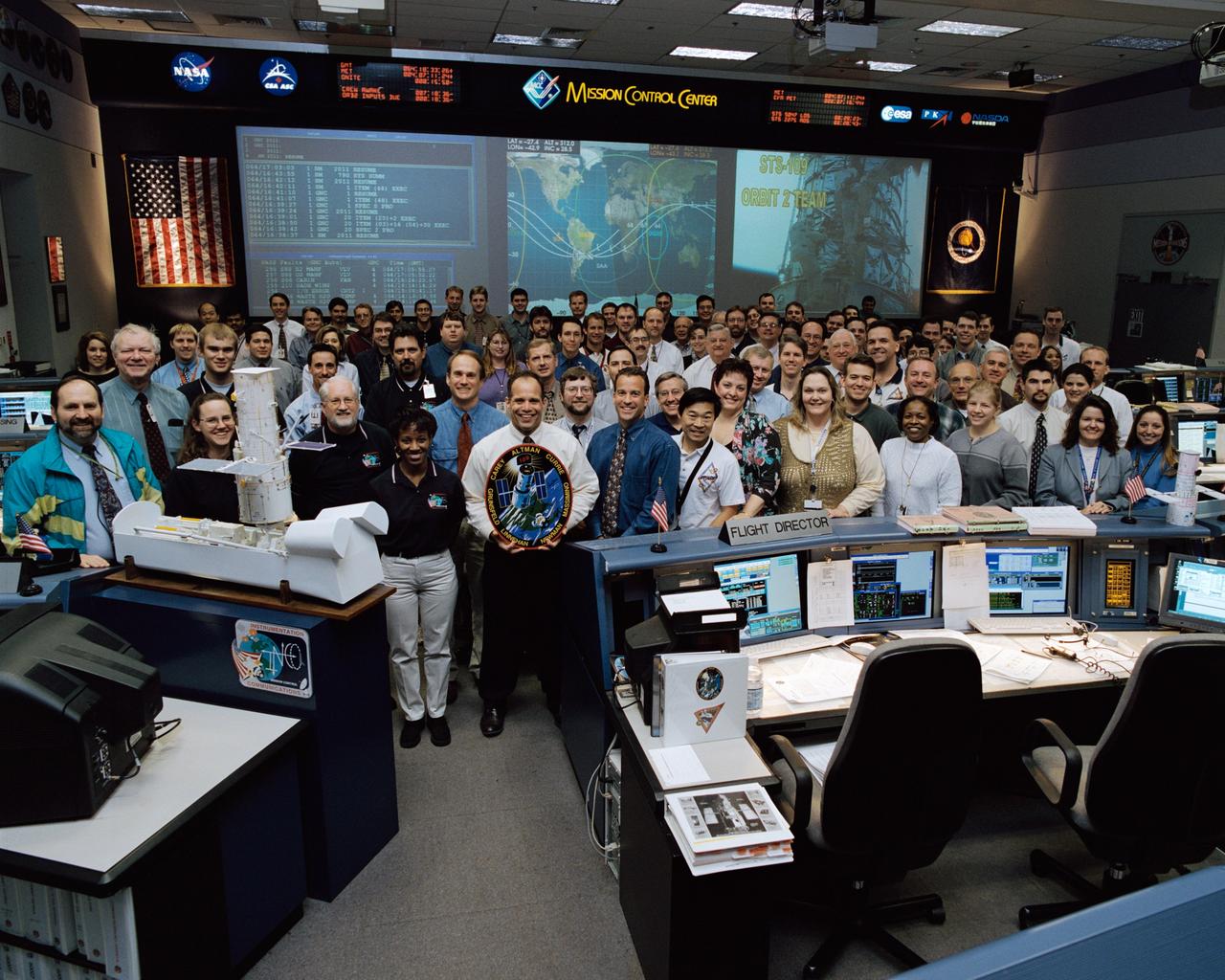
JSC2002-00574 (5 March 2002) --- The members of the STS-109 Orbit 2 Team pose for a group portrait in the shuttle flight control room (WFCR) in Houston's Mission Control Center (MCC). Flight director Tony Ceccacci holds the STS-109 mission logo.
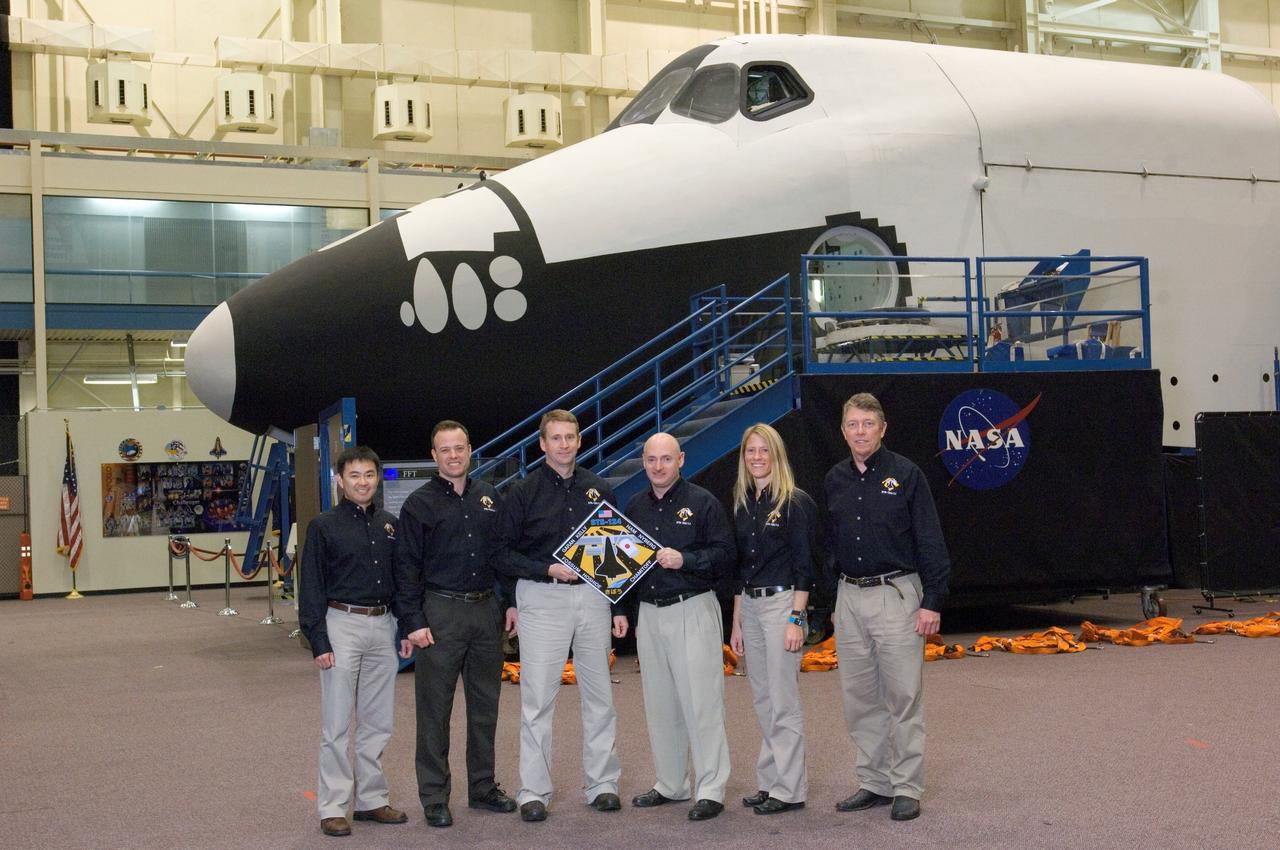
JSC2008-E-009414 (31 Jan. 2008) --- The STS-124 crewmembers take a moment to pose for a portrait during a training session in the Space Vehicle Mockup Facility at the Johnson Space Center. Astronauts Mark E. Kelly (center right) and Kenneth T. Ham, commander and pilot, respectively, hold the STS-124 mission logo. Also pictured (from the left) are Japan Aerospace Exploration Agency (JAXA) astronaut Akihiko Hoshide, NASA astronauts Ronald J. Garan, Karen L. Nyberg and Michael E. Fossum, all mission specialists.

The NASA and DoD Recovery Team aboard the USS John P. Murtha for the Underway Recovery Test 9 (URT-9).
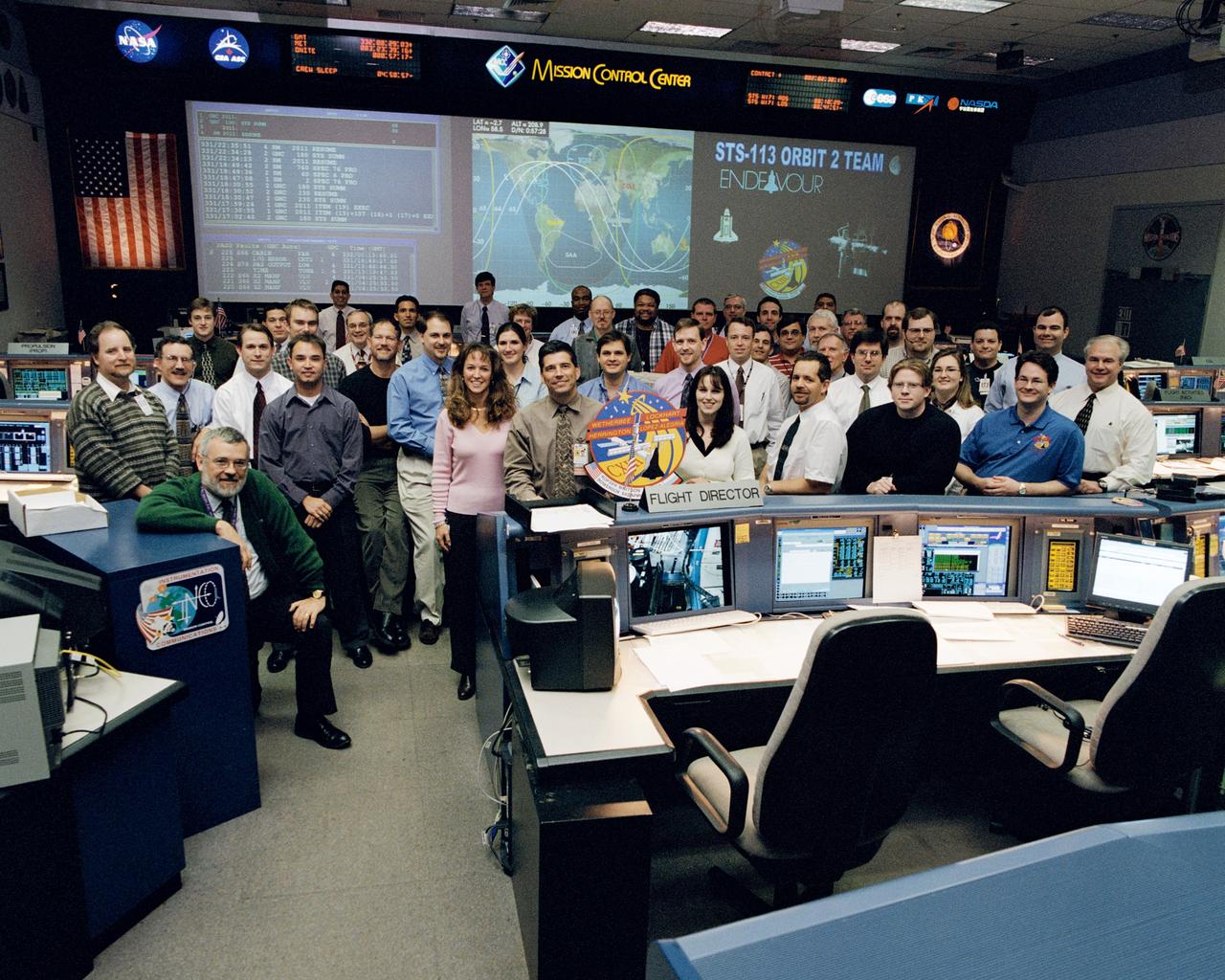
JSC2002-02106 (27 November 2002) --- The members of the STS-113 Orbit 2 Team pose for a group portrait in the shuttle flight control room (WFCR) in Houston’s Mission Control Center (MCC). Flight Director John Curry stands to the left of the STS-113 mission logo and astronaut Lisa M. Nowak, spacecraft communicator (CAPCOM), stands to the left of Curry.
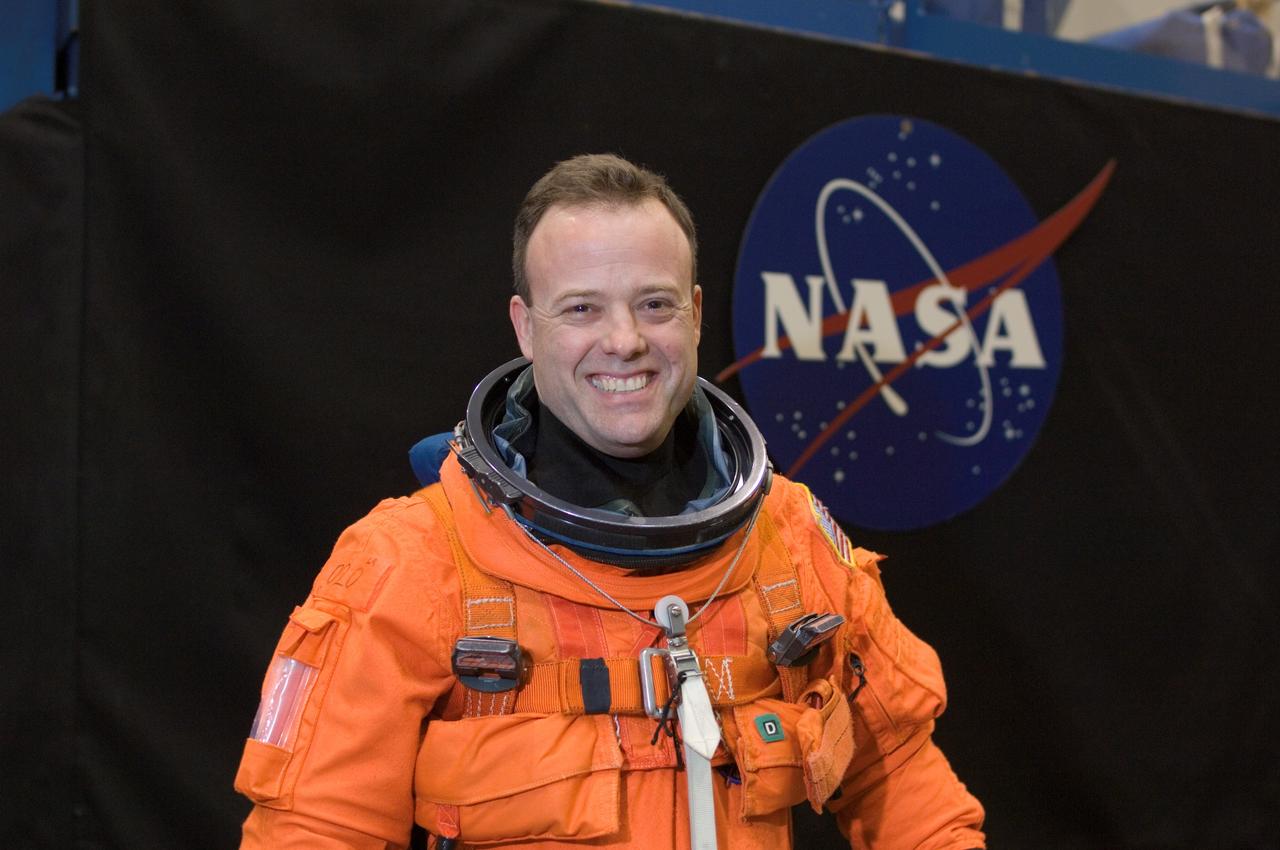
JSC2008-E-009434 (31 Jan. 2008) --- Attired in a training version of his shuttle launch and entry suit, astronaut Ronald J. Garan, STS-124 mission specialist, awaits the start of a training session in the Space Vehicle Mockup Facility at Johnson Space Center.
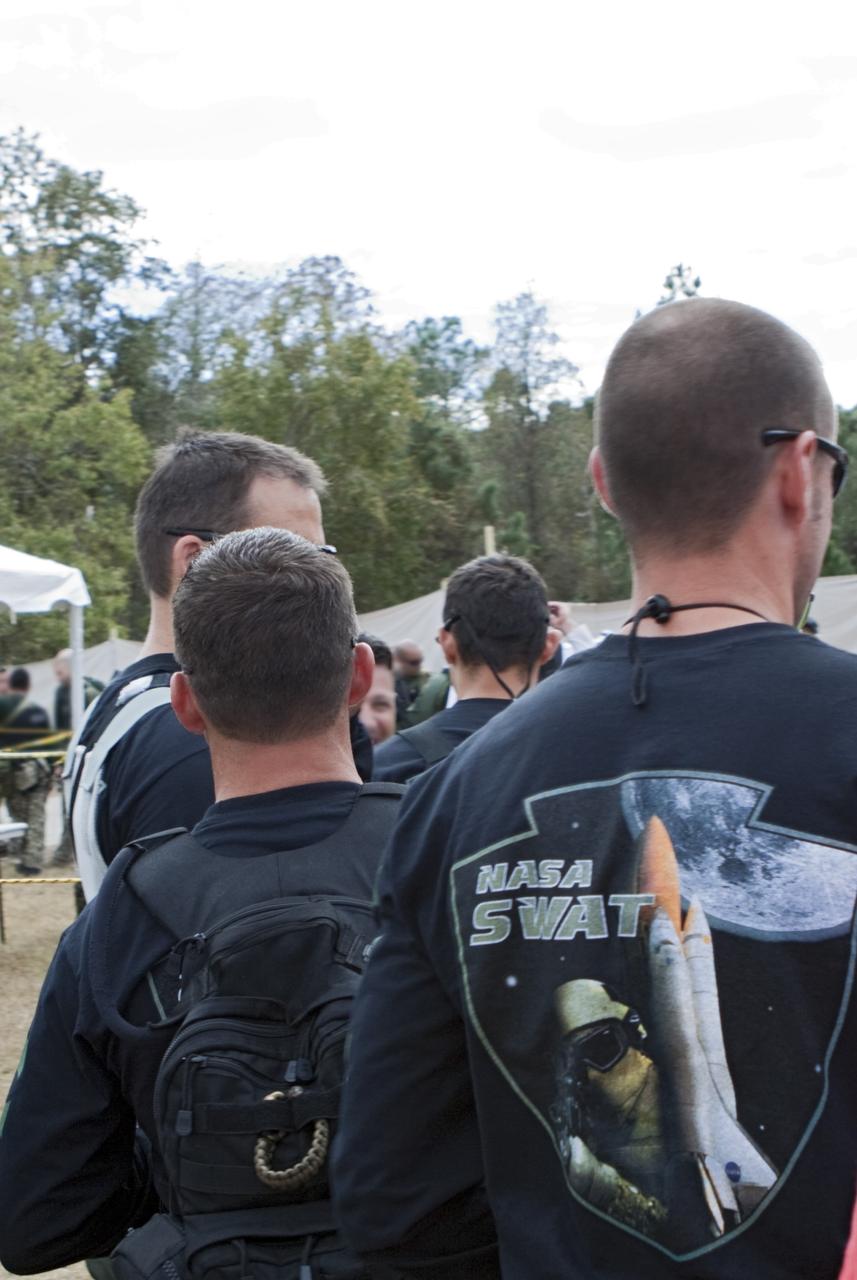
ORLANDO, Fla. – The Emergency Response Team, or ERT, from NASA's Kennedy Space Center competed in the 30th Annual SWAT Round-Up International in Orlando, Florida. The team won the international competition in 2011, besting special operations squads from law enforcement agencies around the world. Photo credit: NASA/Jim Grossmann
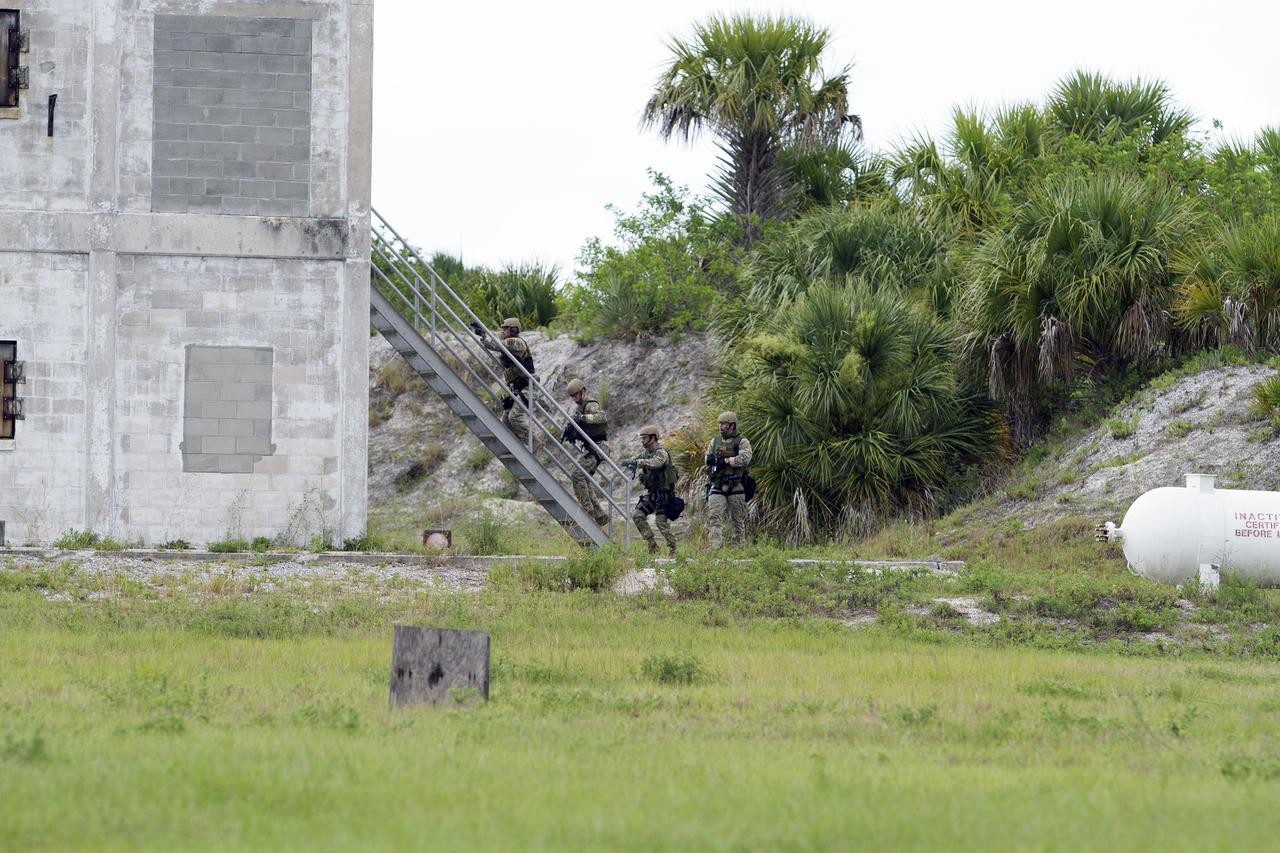
CAPE CANAVERAL, Fla. – Emergency Response Team officers from the Protective Services branch of NASA's Kennedy Space Center in Florida enter an objective during a training exercise simulating a situation the team could confront at the center. Photo credit: NASA/Dan Casper
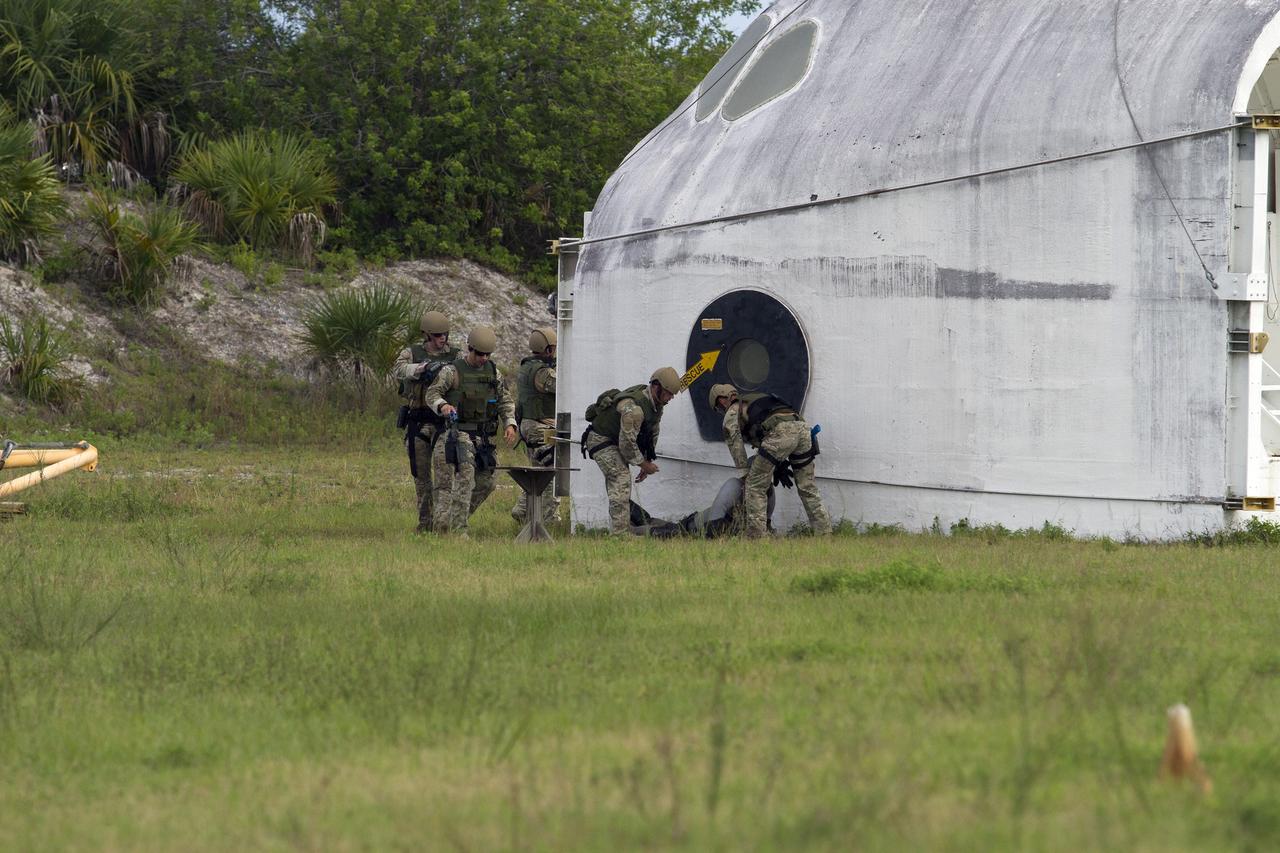
CAPE CANAVERAL, Fla. – Emergency Response Team officers from the Protective Services branch of NASA's Kennedy Space Center in Florida operate near an objective during a training exercise simulating a situation the team could confront at the center. Photo credit: NASA/Dan Casper
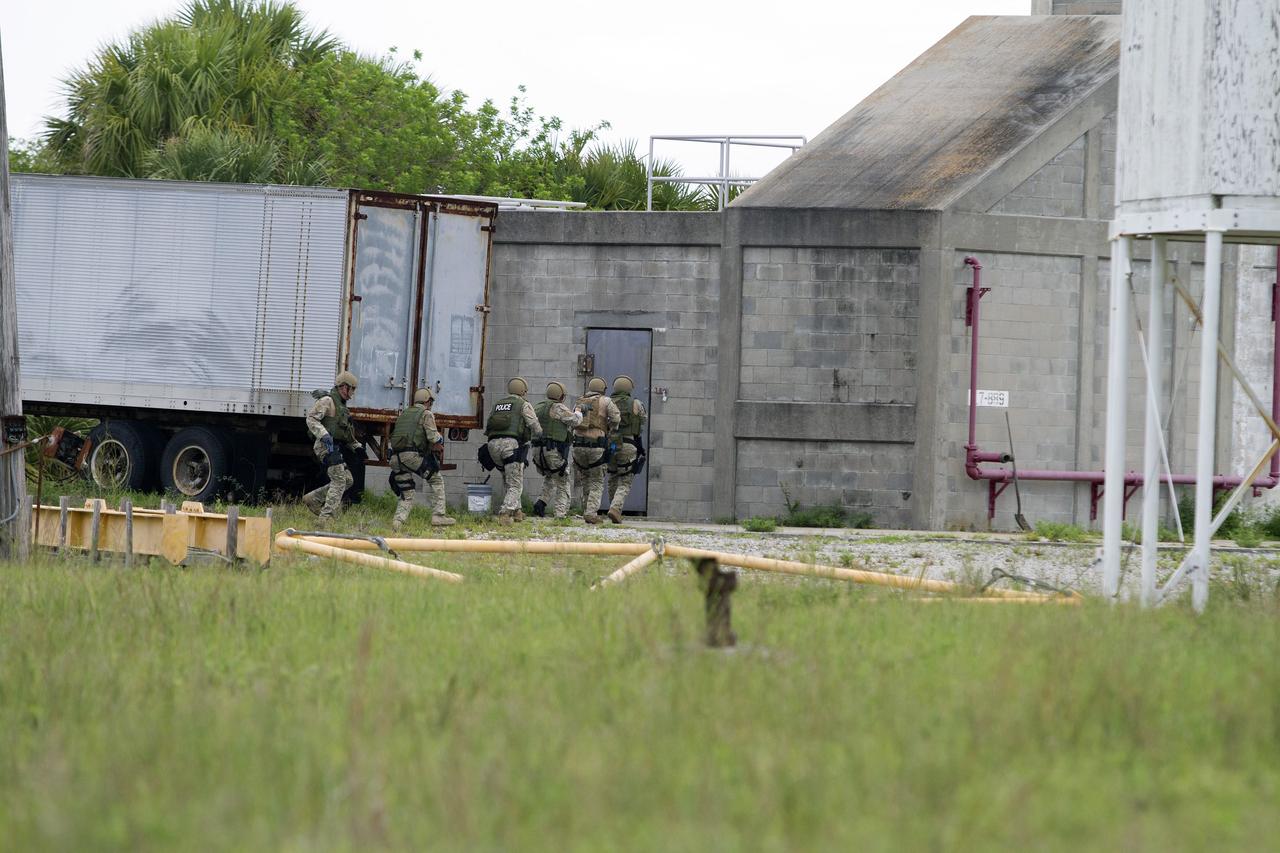
CAPE CANAVERAL, Fla. – Emergency Response Team officers from the Protective Services branch of NASA's Kennedy Space Center in Florida prepare to enter an objective during a training exercise simulating a situation the team could confront at the center. Photo credit: NASA/Dan Casper
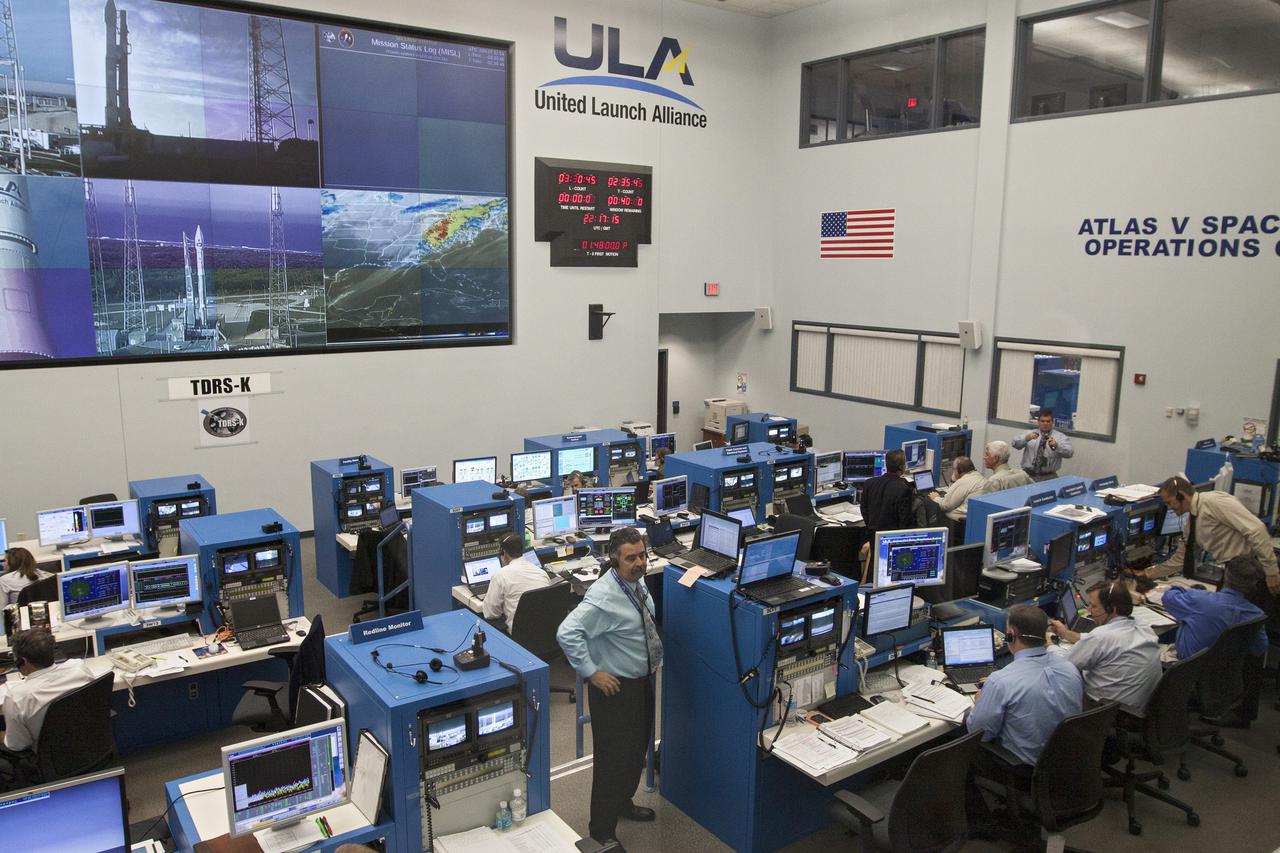
CAPE CANAVERAL, Fla. – The NASA and United Launch Alliance launch teams monitor the countdown before the launch of the TDRS-K spacecraft on an Atlas V rocket. The teams work inside the Atlas Space Operations Center at Cape Canaveral Air Force Station, Fla., known as the ASOC. Photo credit: NASA_Kim Shiflett

CAPE CANAVERAL, Fla. – The NASA and United Launch Alliance launch teams monitor the countdown before the launch of the TDRS-K spacecraft on an Atlas V rocket. The teams work inside the Atlas Space Operations Center at Cape Canaveral Air Force Station, Fla., known as the ASOC. Photo credit: NASA_Kim Shiflett
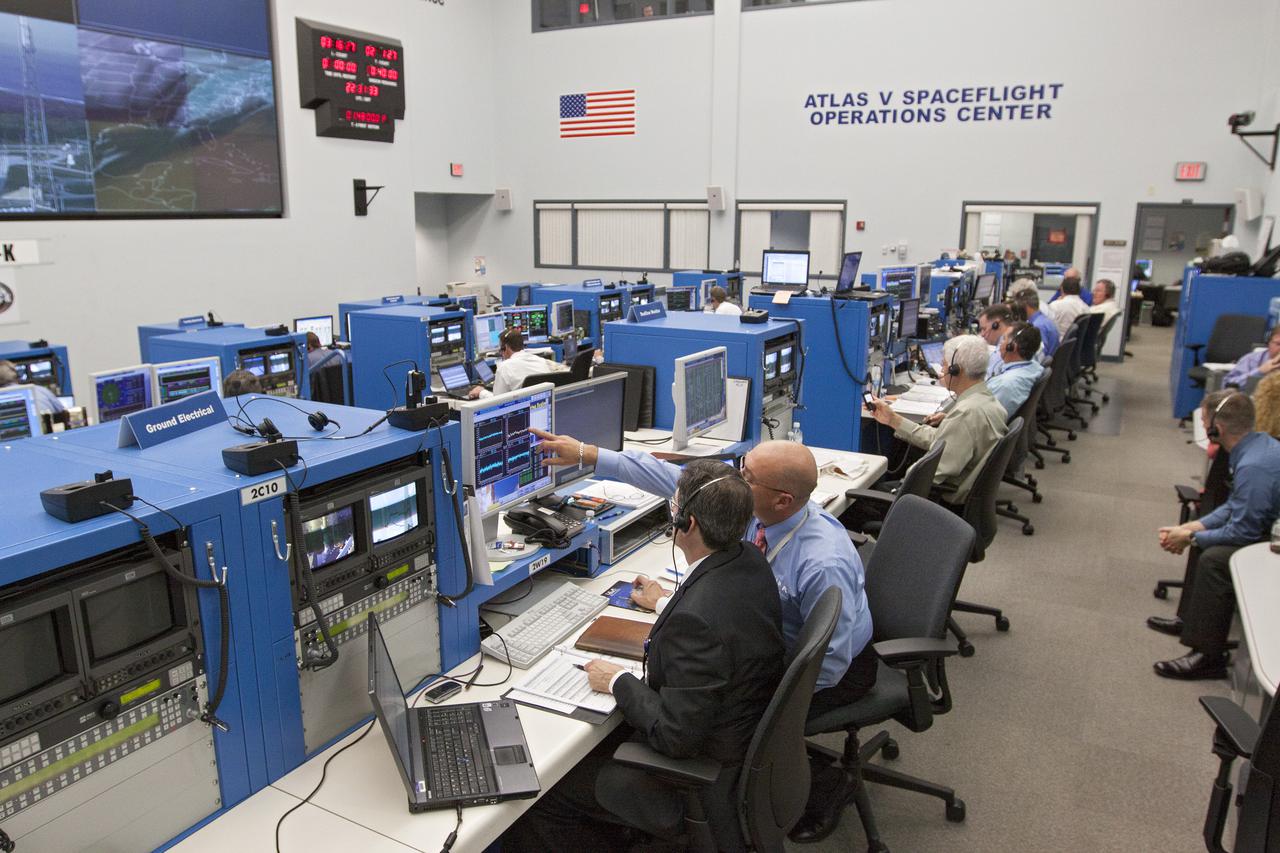
CAPE CANAVERAL, Fla. – The NASA and United Launch Alliance launch teams monitor the countdown before the launch of the TDRS-K spacecraft on an Atlas V rocket. The teams work inside the Atlas Space Operations Center at Cape Canaveral Air Force Station, Fla., known as the ASOC. Photo credit: NASA_Kim Shiflett
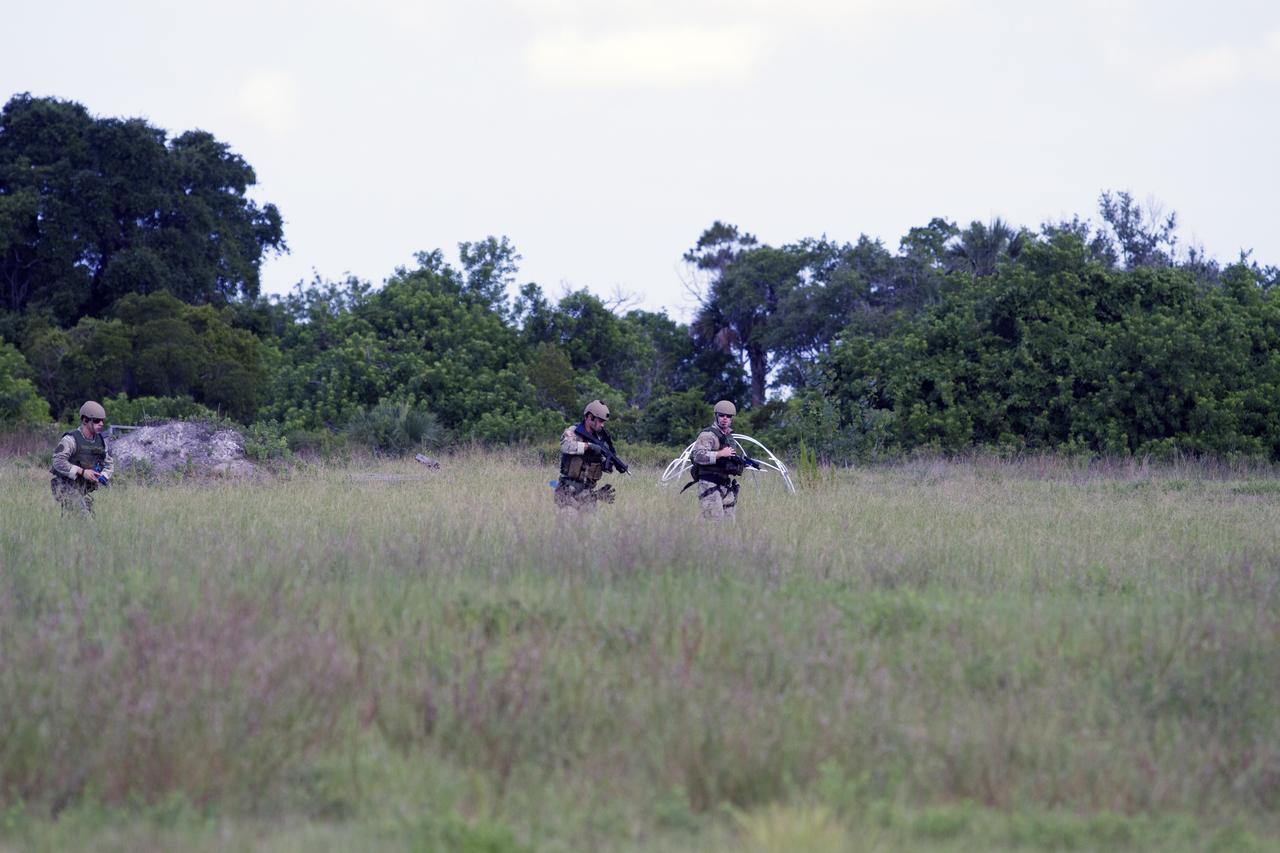
CAPE CANAVERAL, Fla. – Emergency Response Team officers from the Protective Services branch of NASA's Kennedy Space Center in Florida move through a field on their way to an objective during a training exercise simulating a situation the team could confront at the center. Photo credit: NASA/Dan Casper
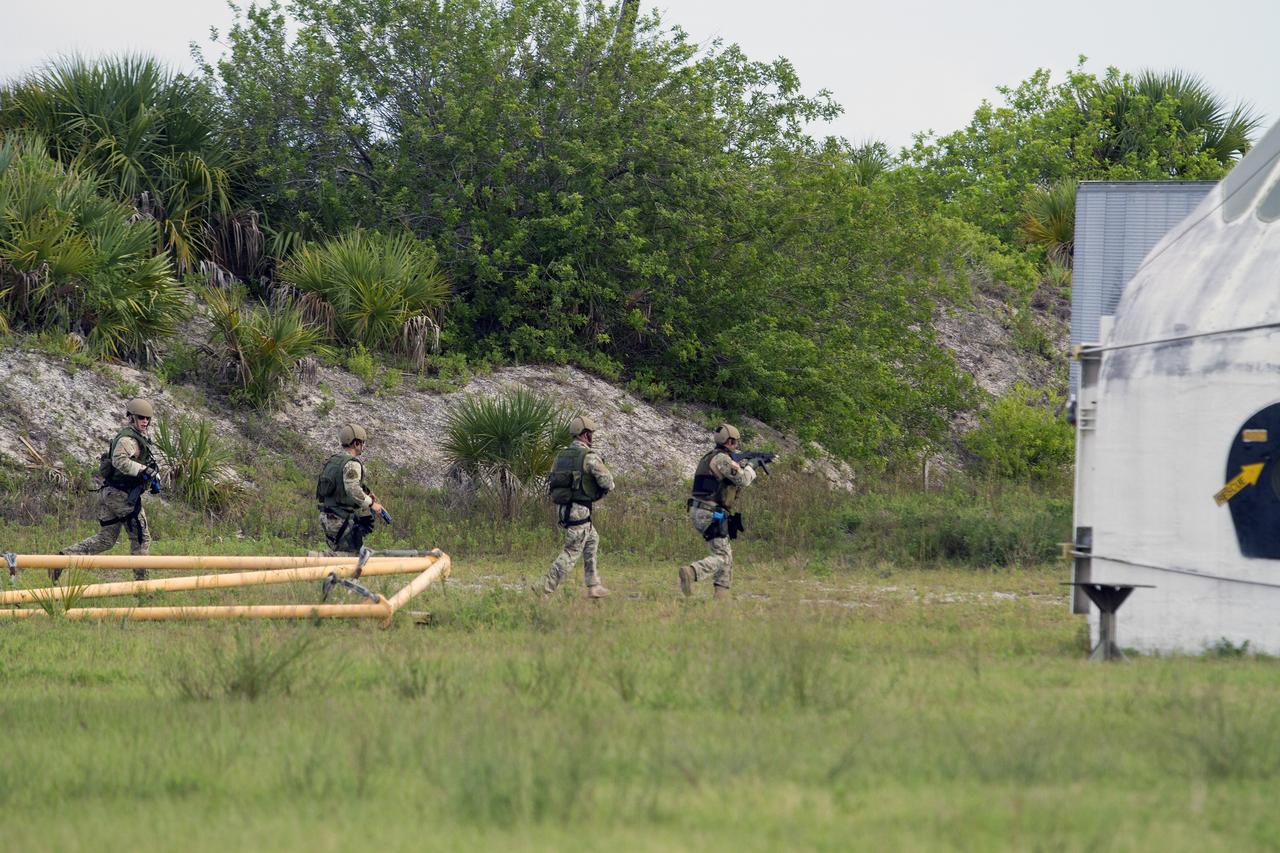
CAPE CANAVERAL, Fla. – Emergency Response Team officers from the Protective Services branch of NASA's Kennedy Space Center in Florida move toward an objective during a training exercise simulating a situation the team could confront at the center. Photo credit: NASA/Dan Casper
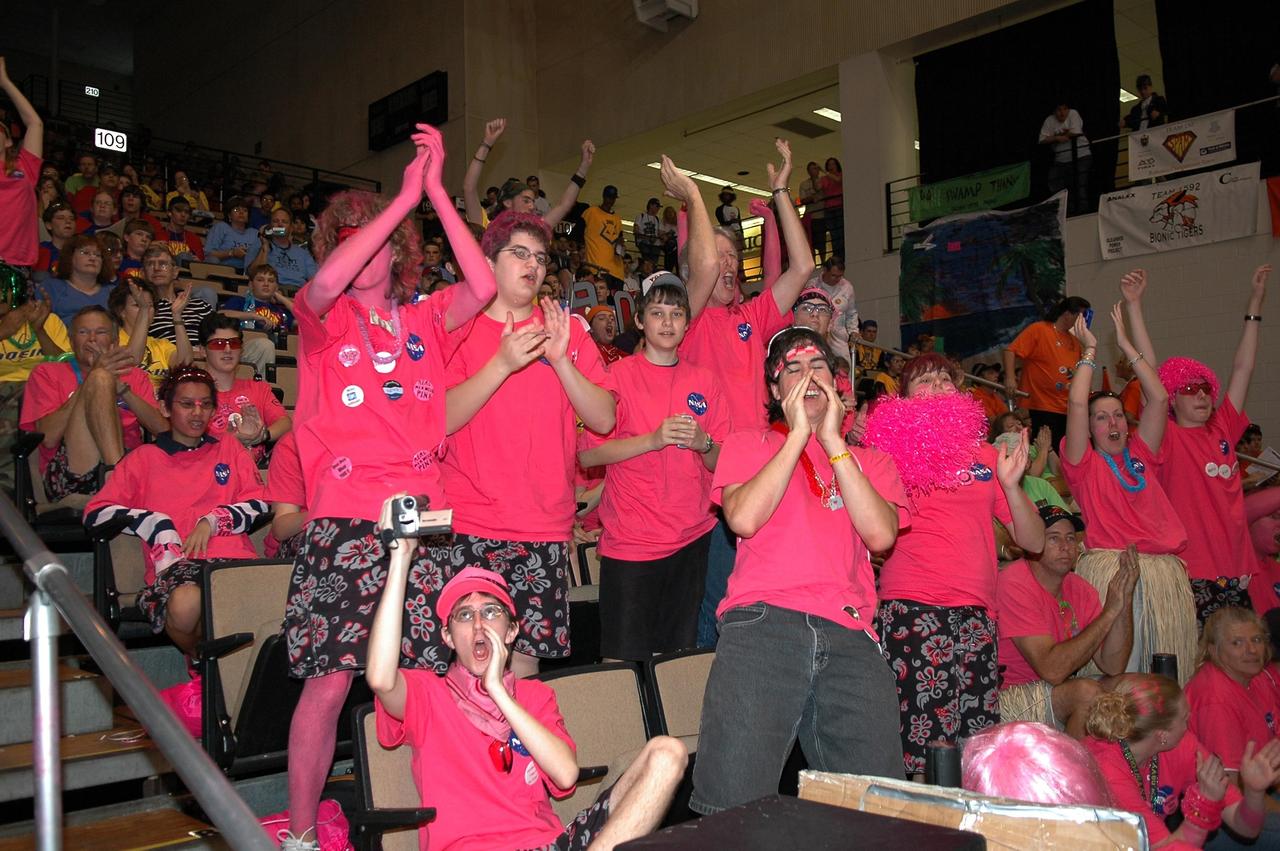
KENNEDY SPACE CENTER, FLA. - Members of the "Pink Team" cheer on their robot, Roccobot, during matches at the 2006 FIRST Robotics Regional Competition held March 9-11 at the University of Central Florida in Orlando. The Pink Team comprises students from Rockledge High and Cocoa Beach High Schools and is co-sponsored by NASA KSC. The team received the Regional Chairman's Award, described as going to the team judged to have created the best partnership effort among team participants and to have best exemplified the true meaning of FIRST. The FIRST Robotics Competition challenges teams of young people and their mentors to solve a common problem in a six-week timeframe using a standard "kit of parts" and a common set of rules. Teams build robots from the parts and enter them in a series of competitions. FIRST, which is based on "For Inspiration and Recognition of Science and Technology," redefines winning for these students. Teams are rewarded for excellence in design, demonstrated team spirit, gracious professionalism and maturity, and ability to overcome obstacles. Scoring the most points is a secondary goal. Winning means building partnerships that last. NASA and the University of Central Florida are co-sponsors of the regional event, which this year included more than 50 teams. Photo credit: NASA/Kim Shiflett
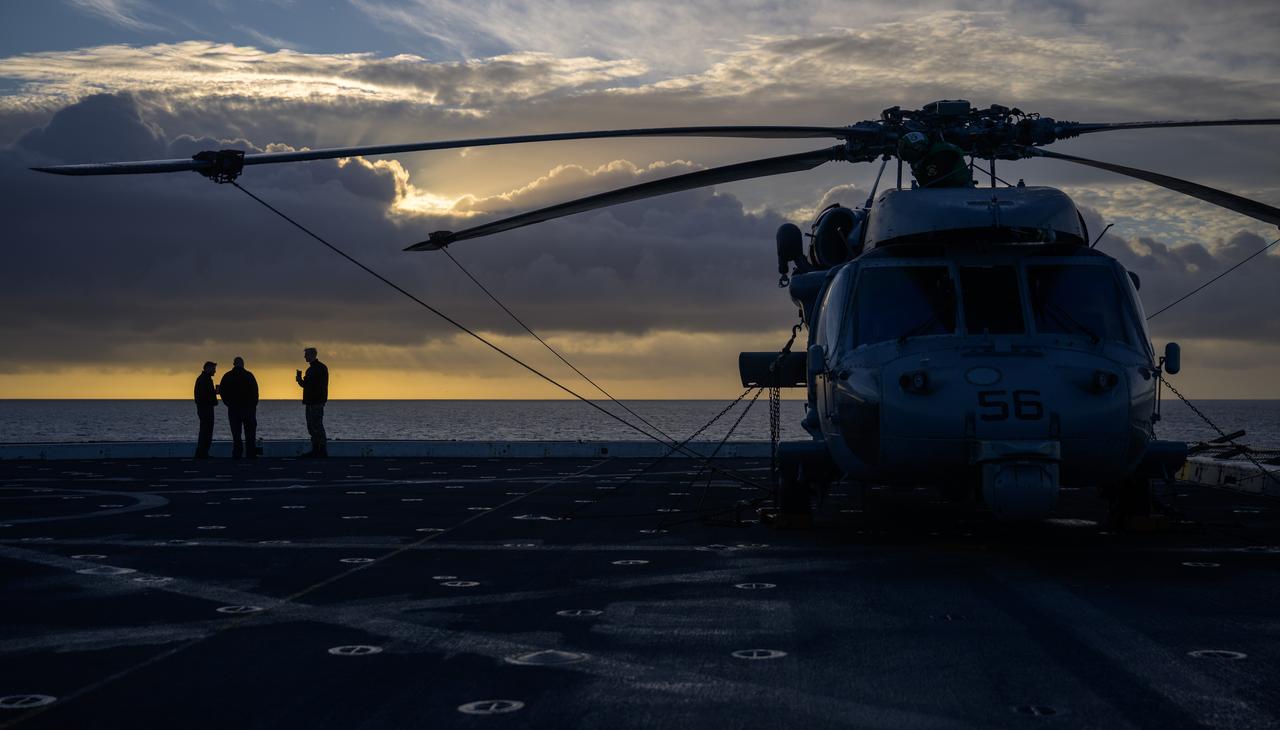
Navy MH-60 Seahawk helicopter team members are seen onboard USS Somerset off the coast of California, as NASA and Department of Defense teams participate in Underway Recovery Test-12, Friday, March 28, 2025. During the test, teams are practicing to ensure recovery procedures are validated as NASA plans to send the Artemis II astronauts around the Moon and splashdown in the Pacific Ocean. Photo Credit: (NASA/Bill Ingalls)
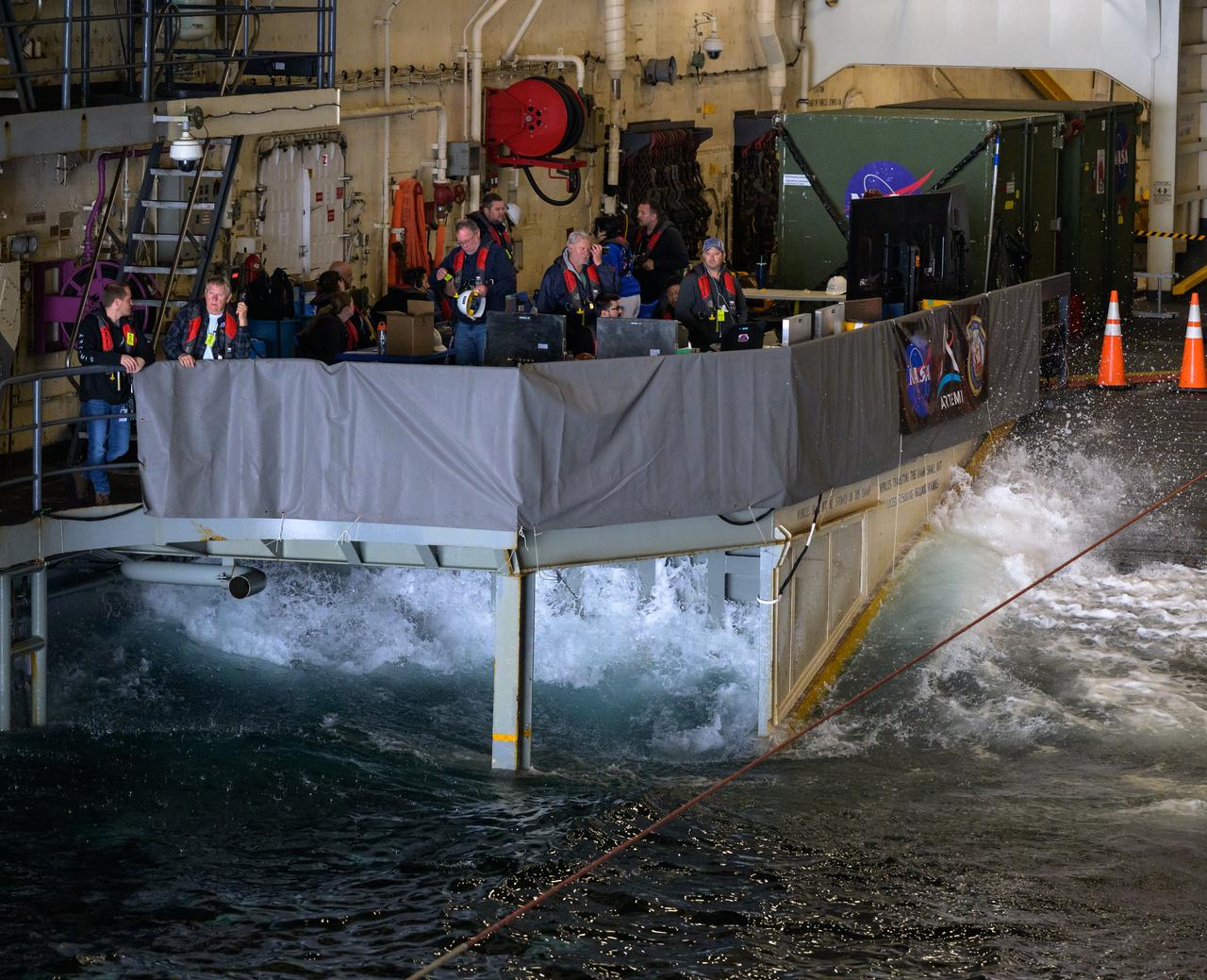
Members of NASA’s Landing and Recovery team are seen as they recover the Crew Module Test Article (CMTA), a full scale mockup of the Orion spacecraft, as teams practice Artemis recovery operations during Underway Recovery Test-12 onboard USS Somerset off the coast of California, Saturday, March 29, 2025. During the test, NASA and Department of Defense teams are practicing to ensure recovery procedures are validated as NASA plans to send Artemis II around the Moon and splashdown in the Pacific Ocean. Photo Credit: (NASA/Bill Ingalls)
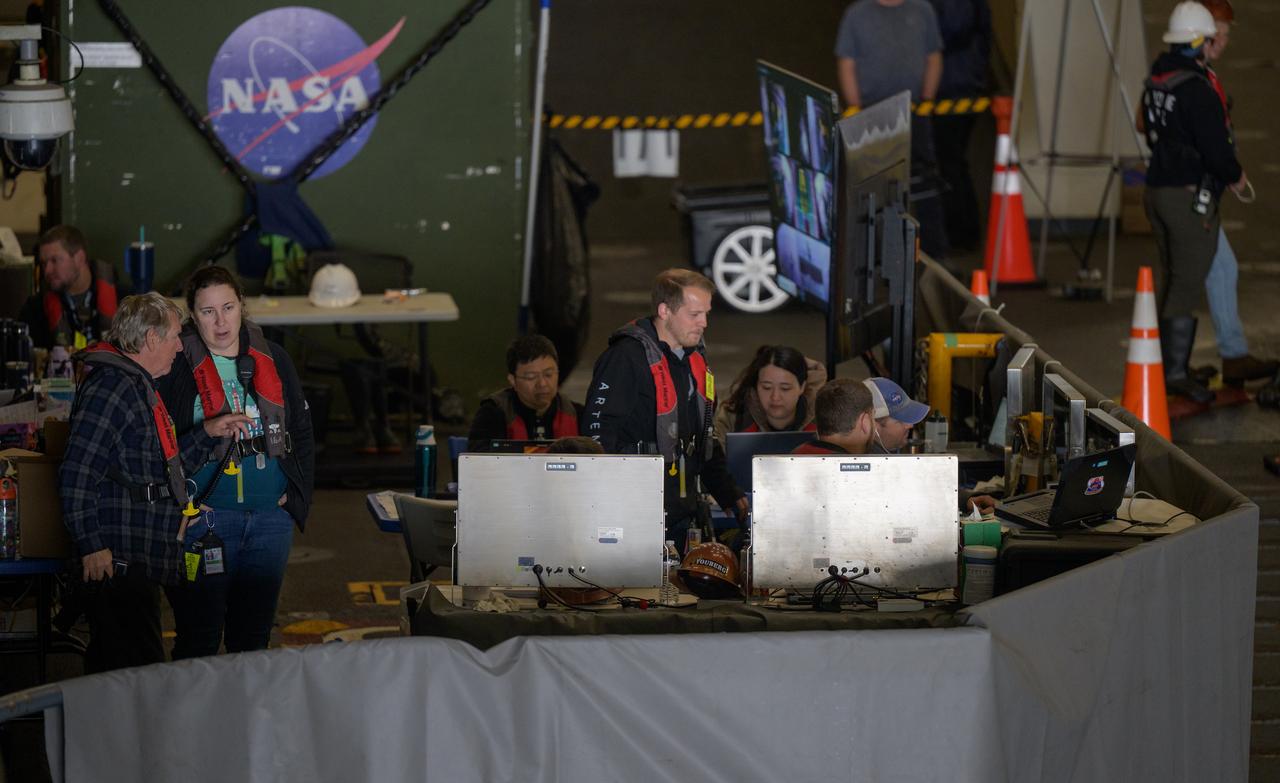
Members of NASA’s Landing and Recovery team are seen as they recover the Crew Module Test Article (CMTA), a full scale mockup of the Orion spacecraft, as teams practice Artemis recovery operations during Underway Recovery Test-12 onboard USS Somerset off the coast of California, Saturday, March 29, 2025. During the test, NASA and Department of Defense teams are practicing to ensure recovery procedures are validated as NASA plans to send Artemis II around the Moon and splashdown in the Pacific Ocean. Photo Credit: (NASA/Bill Ingalls)
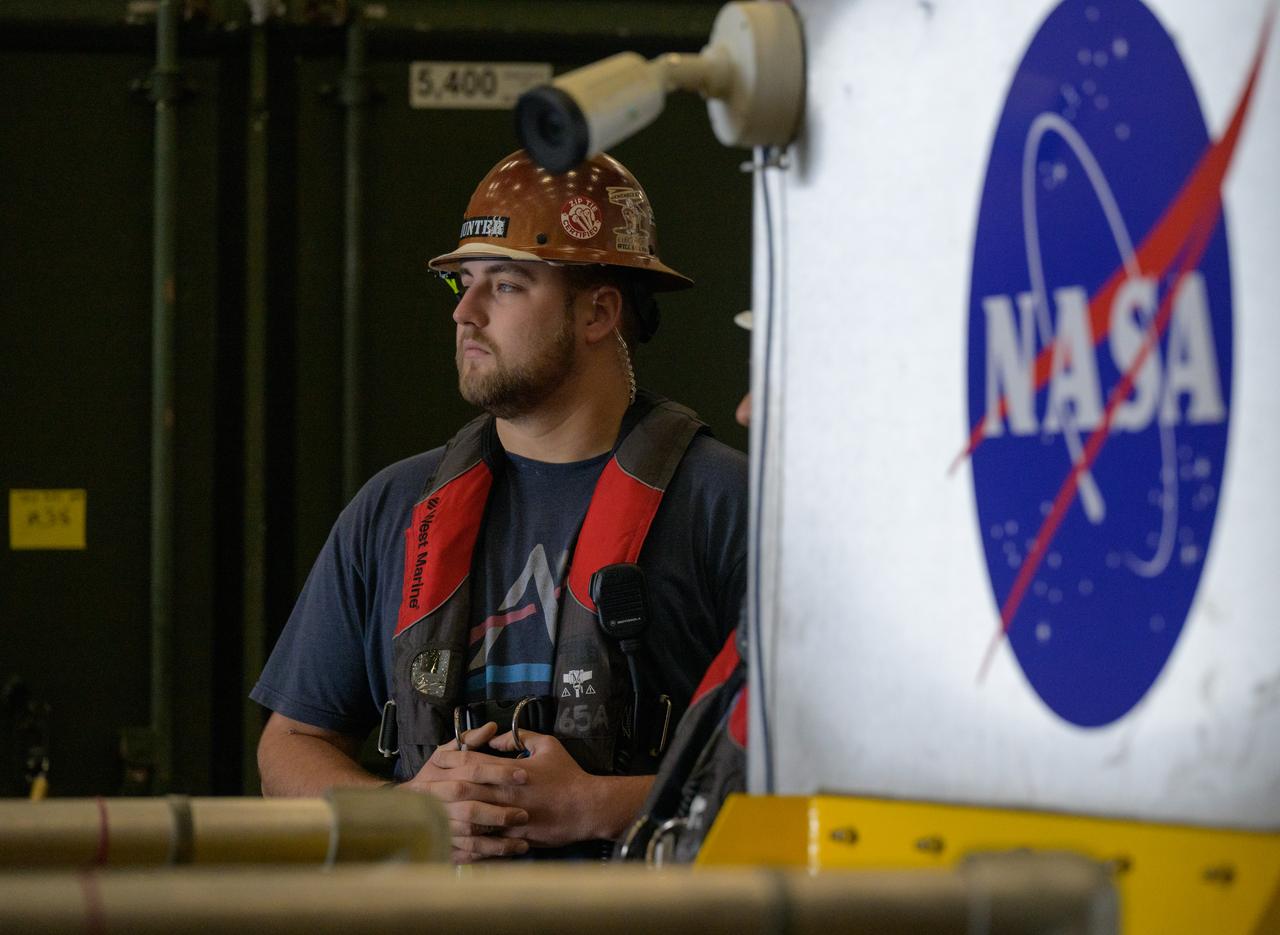
Members of NASA’s Landing and Recovery team are seen as they recover the Crew Module Test Article (CMTA), a full scale mockup of the Orion spacecraft, as teams practice Artemis recovery operations during Underway Recovery Test-12 onboard USS Somerset off the coast of California, Saturday, March 29, 2025. During the test, NASA and Department of Defense teams are practicing to ensure recovery procedures are validated as NASA plans to send Artemis II around the Moon and splashdown in the Pacific Ocean. Photo Credit: (NASA/Bill Ingalls)
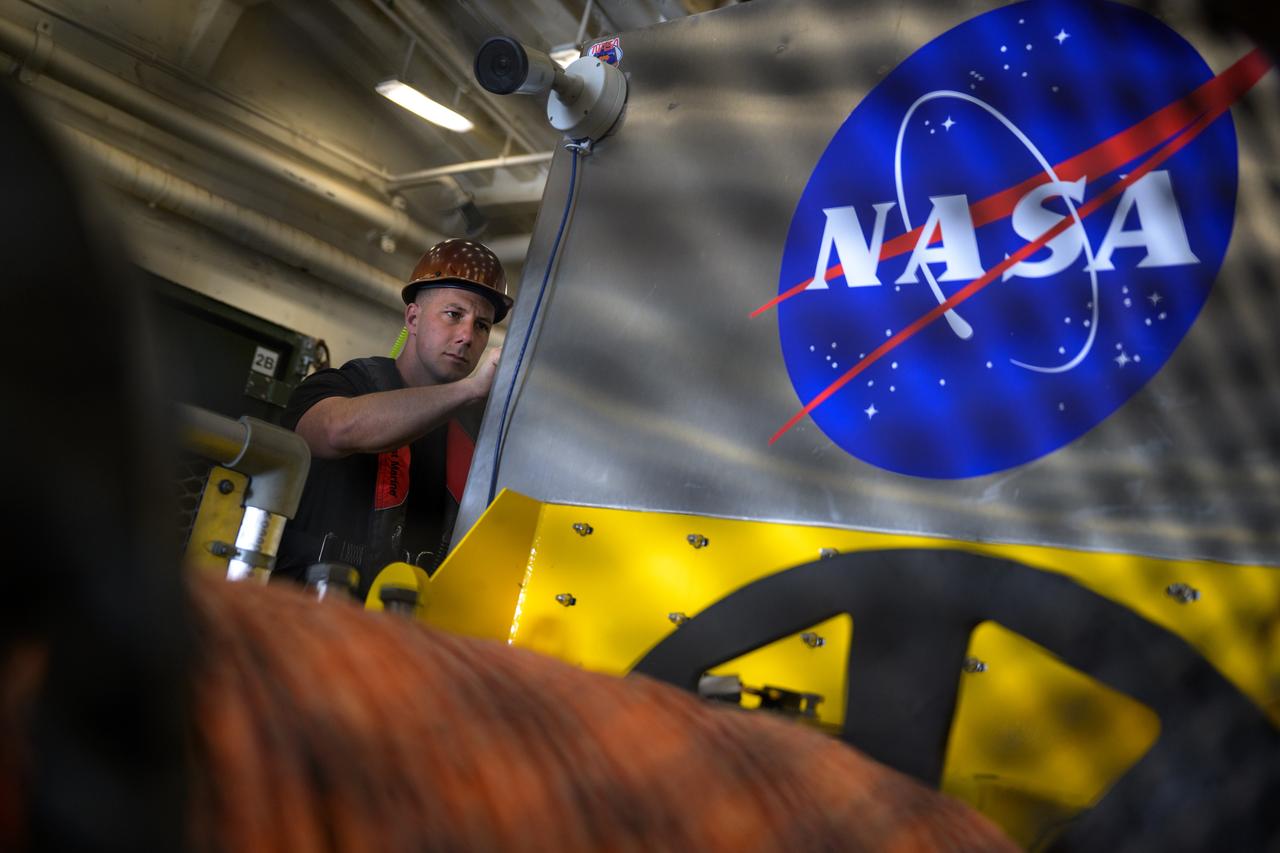
Members of NASA’s Landing and Recovery team are seen as they recover the Crew Module Test Article (CMTA), a full scale mockup of the Orion spacecraft, as teams practice Artemis recovery operations during Underway Recovery Test-12 onboard USS Somerset off the coast of California, Saturday, March 29, 2025. During the test, NASA and Department of Defense teams are practicing to ensure recovery procedures are validated as NASA plans to send Artemis II around the Moon and splashdown in the Pacific Ocean. Photo Credit: (NASA/Bill Ingalls)
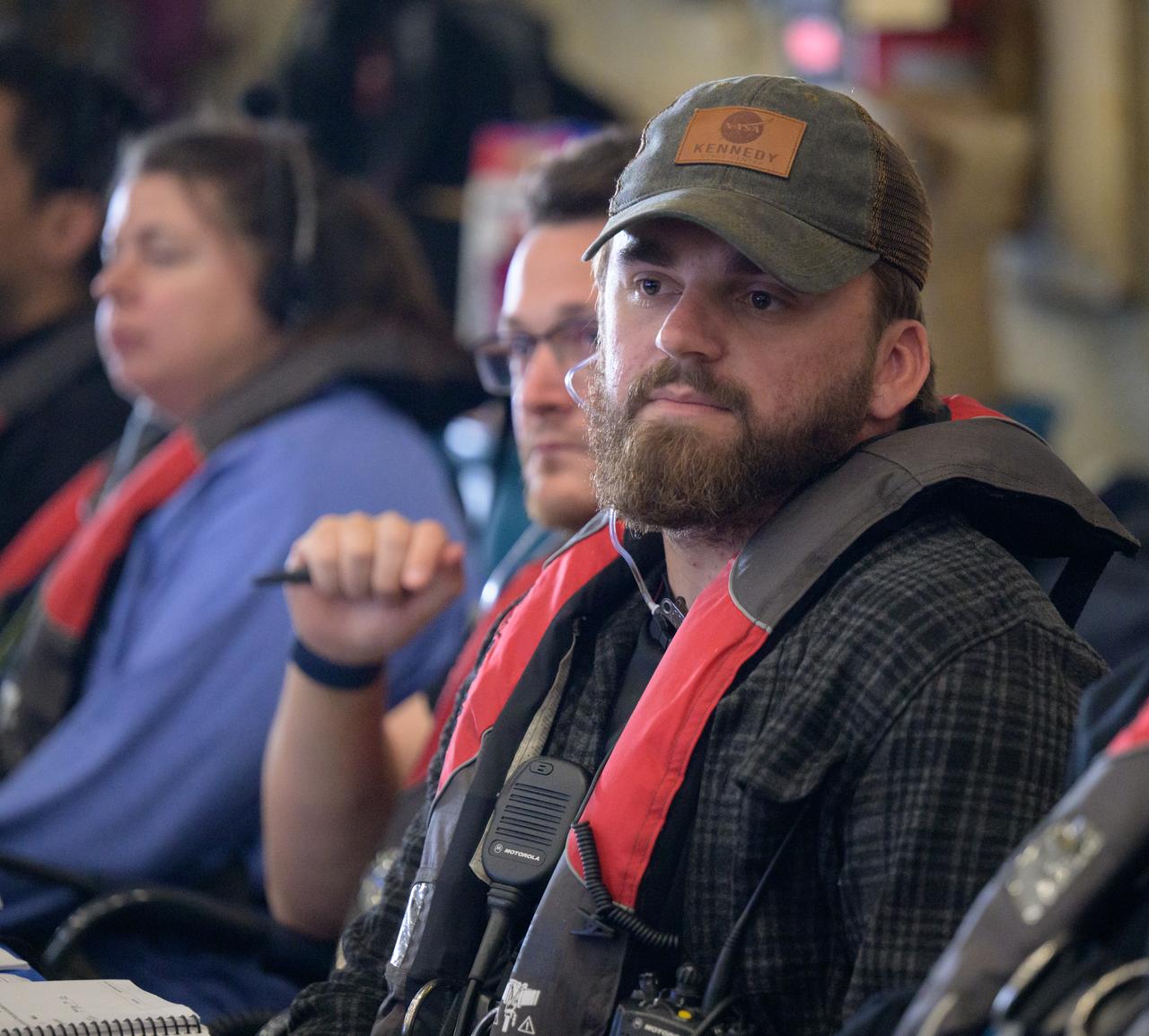
Members of NASA’s Landing and Recovery team are seen as they recover the Crew Module Test Article (CMTA), a full scale mockup of the Orion spacecraft, as teams practice Artemis recovery operations during Underway Recovery Test-12 onboard USS Somerset off the coast of California, Saturday, March 29, 2025. During the test, NASA and Department of Defense teams are practicing to ensure recovery procedures are validated as NASA plans to send Artemis II around the Moon and splashdown in the Pacific Ocean. Photo Credit: (NASA/Bill Ingalls)
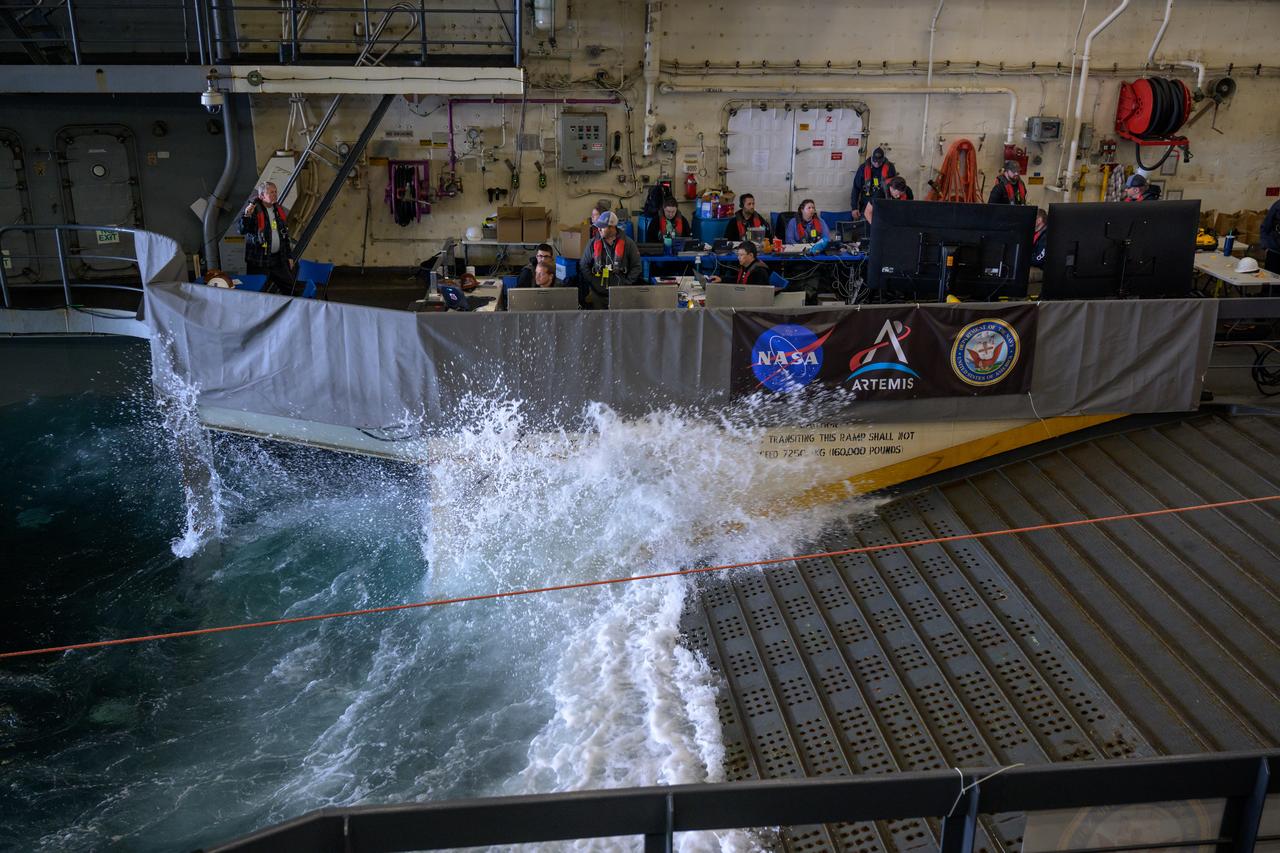
Members of NASA’s Landing and Recovery team are seen as they recover the Crew Module Test Article (CMTA), a full scale mockup of the Orion spacecraft, as teams practice Artemis recovery operations during Underway Recovery Test-12 onboard USS Somerset off the coast of California, Saturday, March 29, 2025. During the test, NASA and Department of Defense teams are practicing to ensure recovery procedures are validated as NASA plans to send Artemis II around the Moon and splashdown in the Pacific Ocean. Photo Credit: (NASA/Bill Ingalls)
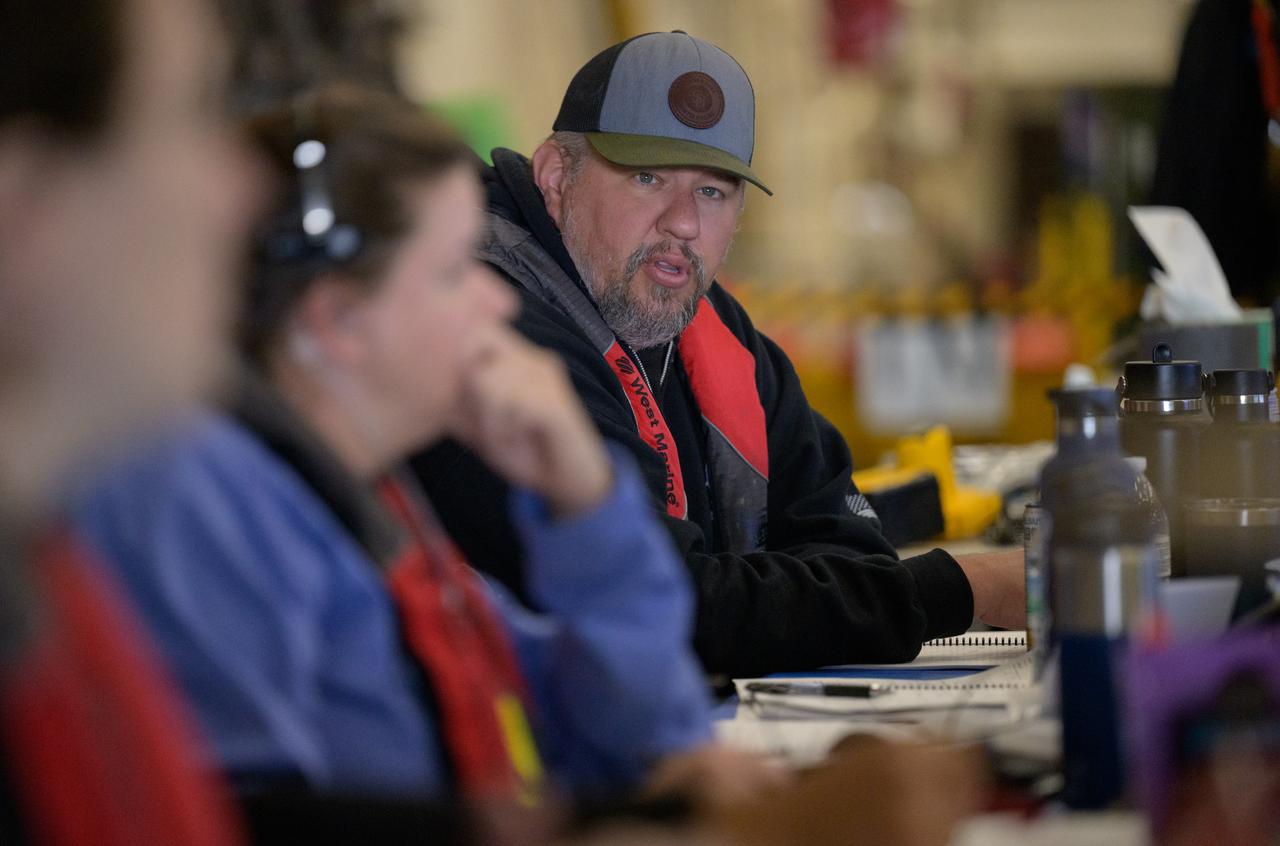
Members of NASA’s Landing and Recovery team are seen as they recover the Crew Module Test Article (CMTA), a full scale mockup of the Orion spacecraft, as teams practice Artemis recovery operations during Underway Recovery Test-12 onboard USS Somerset off the coast of California, Saturday, March 29, 2025. During the test, NASA and Department of Defense teams are practicing to ensure recovery procedures are validated as NASA plans to send Artemis II around the Moon and splashdown in the Pacific Ocean. Photo Credit: (NASA/Bill Ingalls)
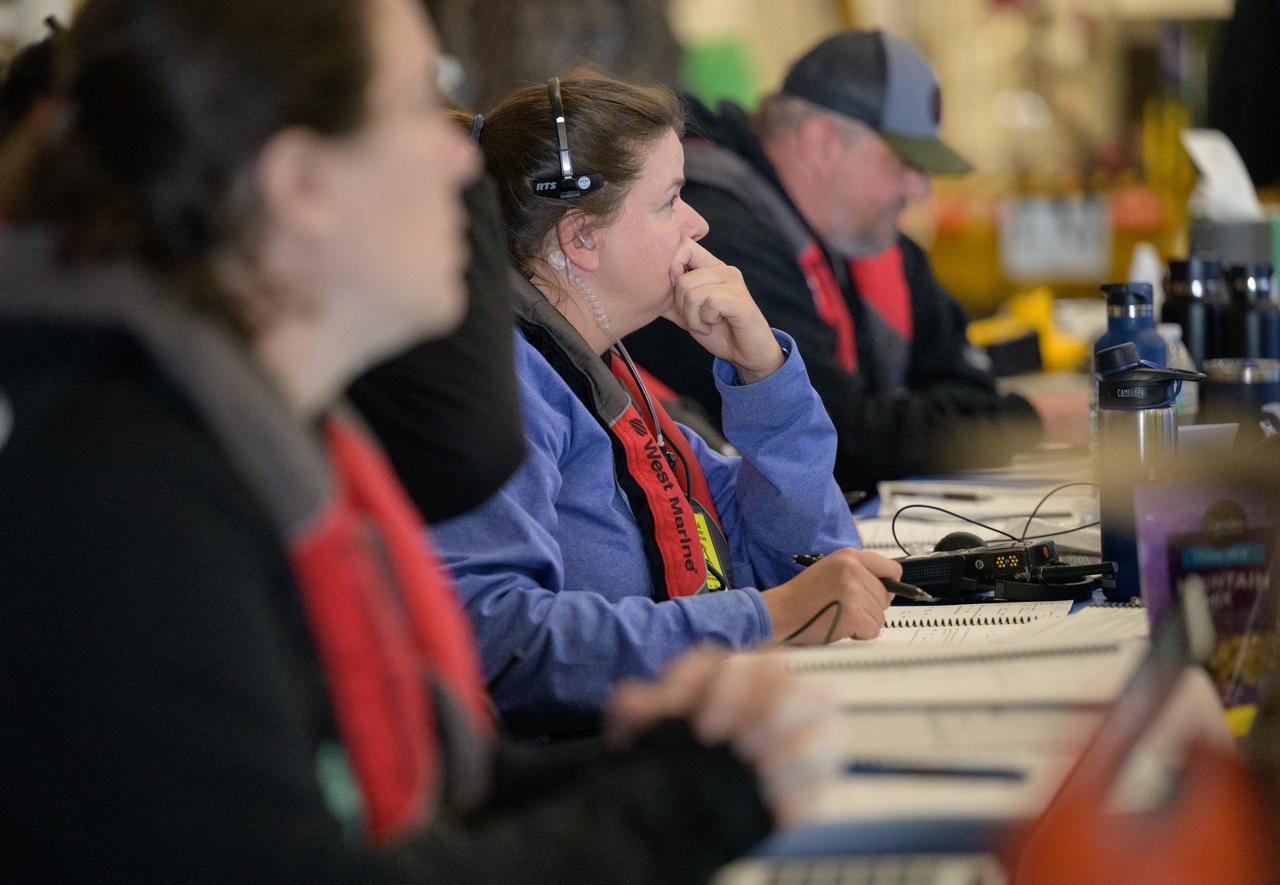
Members of NASA’s Landing and Recovery team are seen as they recover the Crew Module Test Article (CMTA), a full scale mockup of the Orion spacecraft, as teams practice Artemis recovery operations during Underway Recovery Test-12 onboard USS Somerset off the coast of California, Saturday, March 29, 2025. During the test, NASA and Department of Defense teams are practicing to ensure recovery procedures are validated as NASA plans to send Artemis II around the Moon and splashdown in the Pacific Ocean. Photo Credit: (NASA/Bill Ingalls)
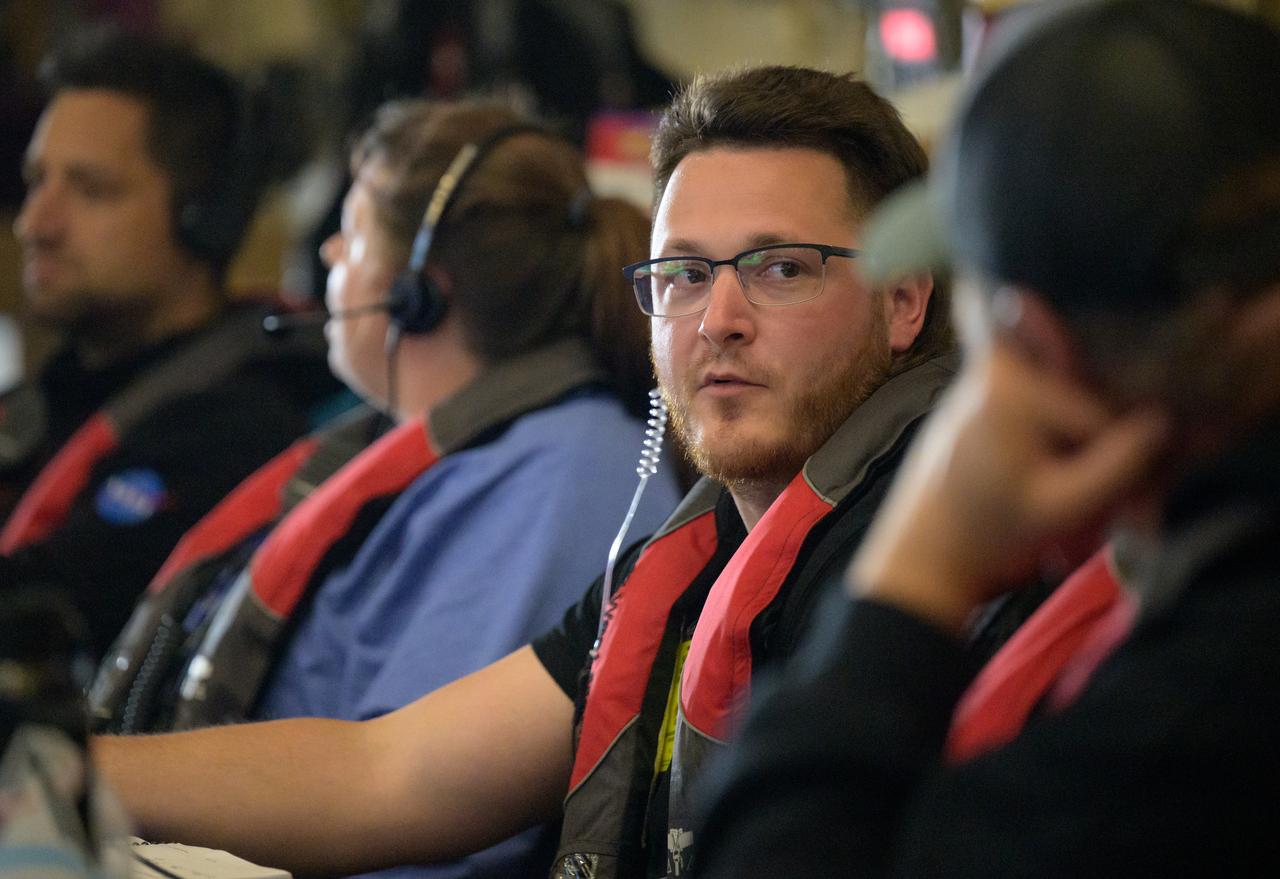
Members of NASA’s Landing and Recovery team are seen as they recover the Crew Module Test Article (CMTA), a full scale mockup of the Orion spacecraft, as teams practice Artemis recovery operations during Underway Recovery Test-12 onboard USS Somerset off the coast of California, Saturday, March 29, 2025. During the test, NASA and Department of Defense teams are practicing to ensure recovery procedures are validated as NASA plans to send Artemis II around the Moon and splashdown in the Pacific Ocean. Photo Credit: (NASA/Bill Ingalls)
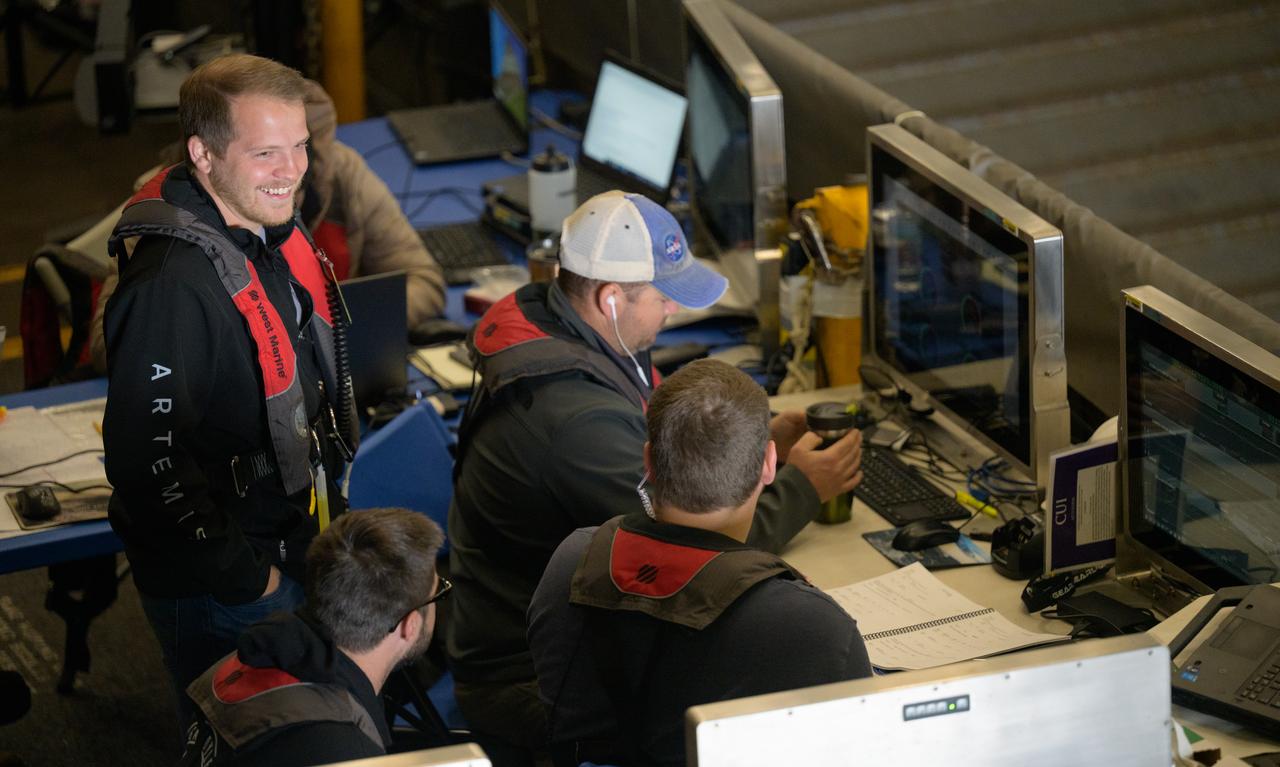
Members of NASA’s Landing and Recovery team are seen as they recover the Crew Module Test Article (CMTA), a full scale mockup of the Orion spacecraft, as teams practice Artemis recovery operations during Underway Recovery Test-12 onboard USS Somerset off the coast of California, Saturday, March 29, 2025. During the test, NASA and Department of Defense teams are practicing to ensure recovery procedures are validated as NASA plans to send Artemis II around the Moon and splashdown in the Pacific Ocean. Photo Credit: (NASA/Bill Ingalls)
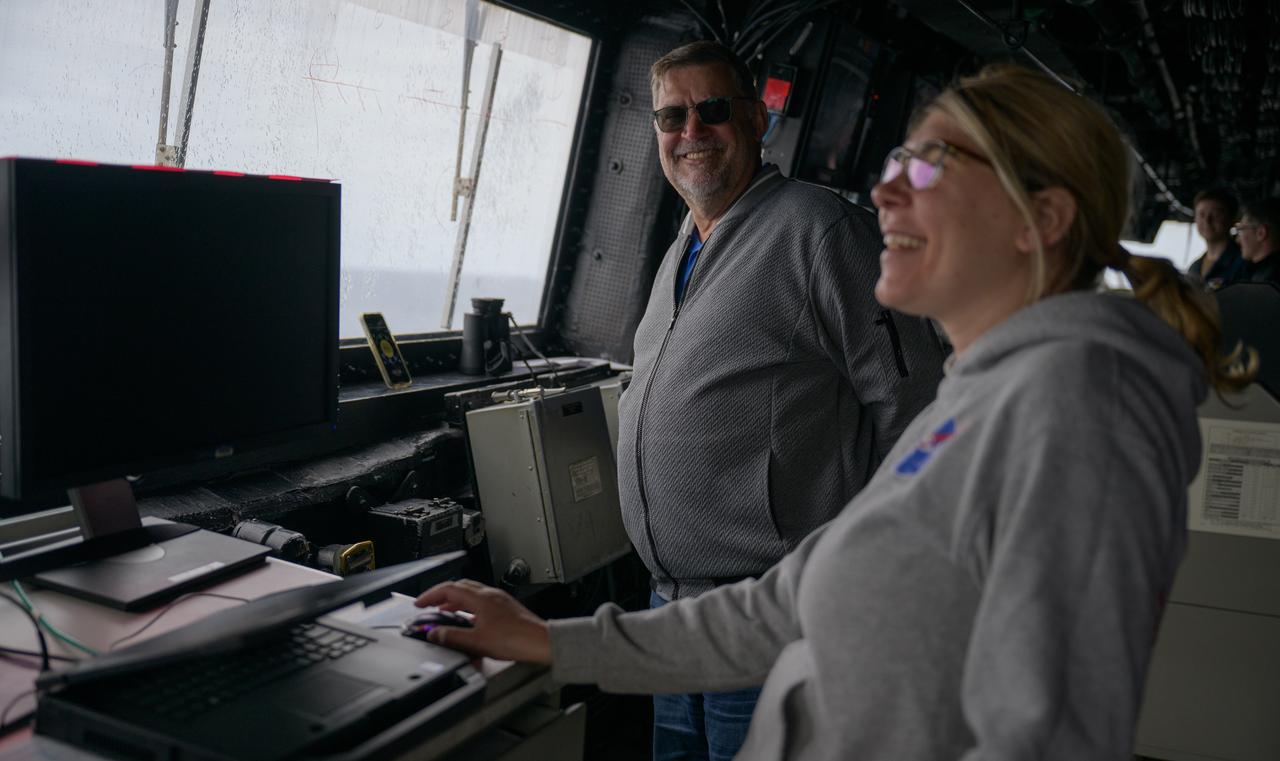
Members of NASA’s Landing and Recovery team are seen on the bridge of USS Somerset as teams practice Artemis recovery operations during Underway Recovery Test-12 off the coast of California, Saturday, March 29, 2025. During the test, NASA and Department of Defense teams are practicing to ensure recovery procedures are validated as NASA plans to send Artemis II around the Moon and splashdown in the Pacific Ocean. Photo Credit: (NASA/Bill Ingalls)
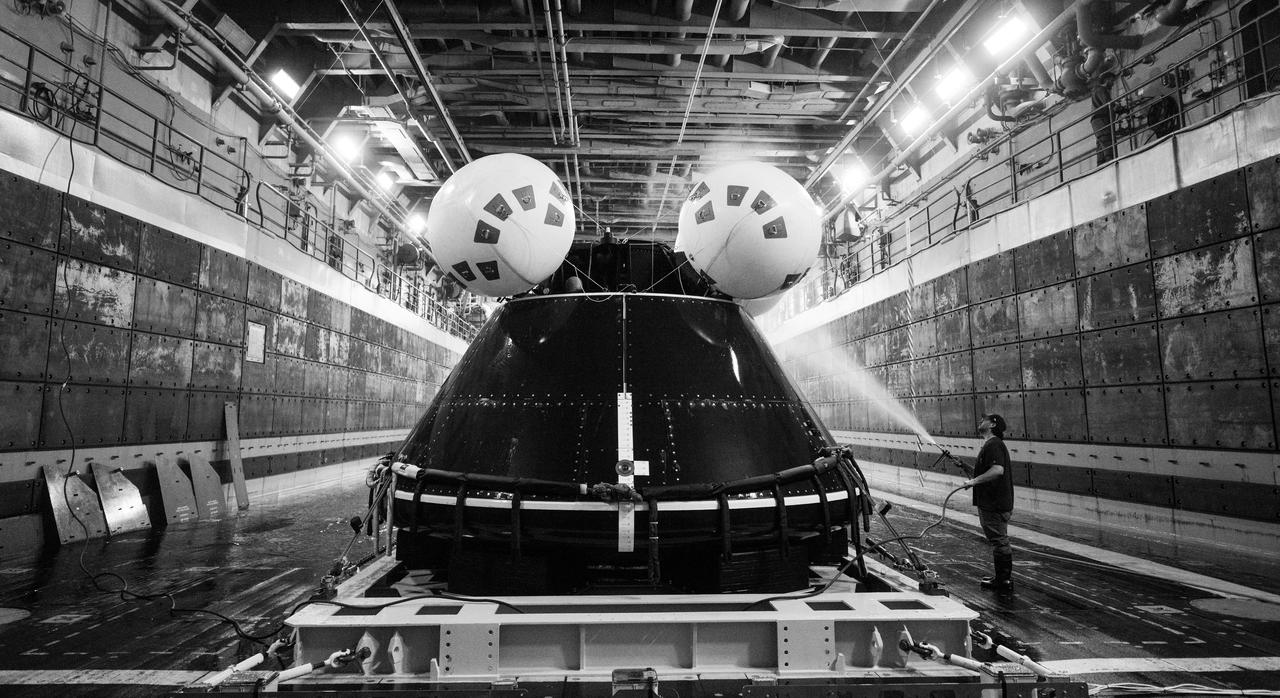
A member of NASA’s Landing and Recovery team washes saltwater off of the Crew Module Test Article (CMTA) after teams practiced recovery operations during Underway Recovery Test-12 onboard USS Somerset off the coast of California, Saturday, March 29, 2025. During the test, NASA and Department of Defense teams are practicing to ensure recovery procedures are validated as NASA plans to send the Artemis II astronauts around the Moon and splashdown in the Pacific Ocean. Photo Credit: (NASA/Joel Kowsky)
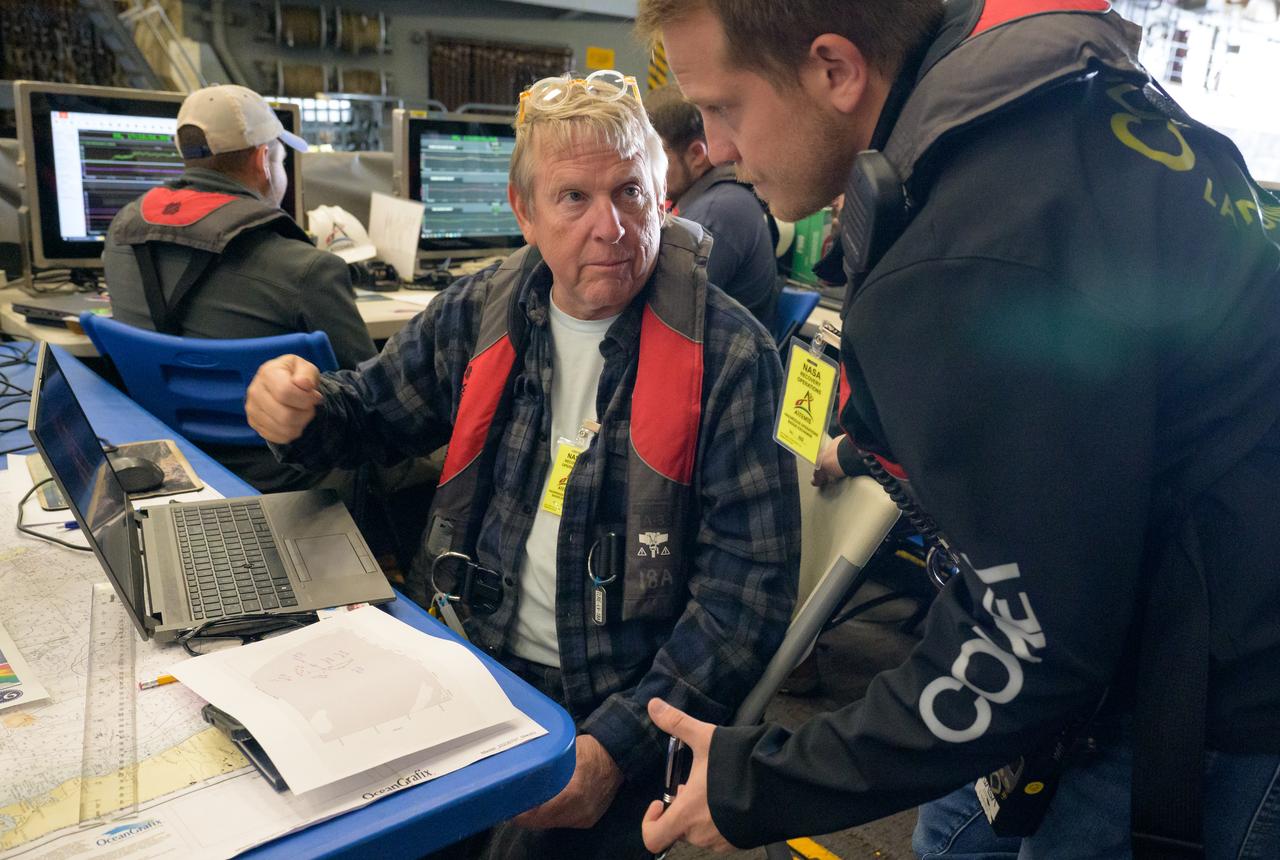
Members of NASA’s Landing and Recovery team are seen as they recover the Crew Module Test Article (CMTA), a full scale mockup of the Orion spacecraft, as teams practice Artemis recovery operations during Underway Recovery Test-12 onboard USS Somerset off the coast of California, Saturday, March 29, 2025. During the test, NASA and Department of Defense teams are practicing to ensure recovery procedures are validated as NASA plans to send Artemis II around the Moon and splashdown in the Pacific Ocean. Photo Credit: (NASA/Bill Ingalls)
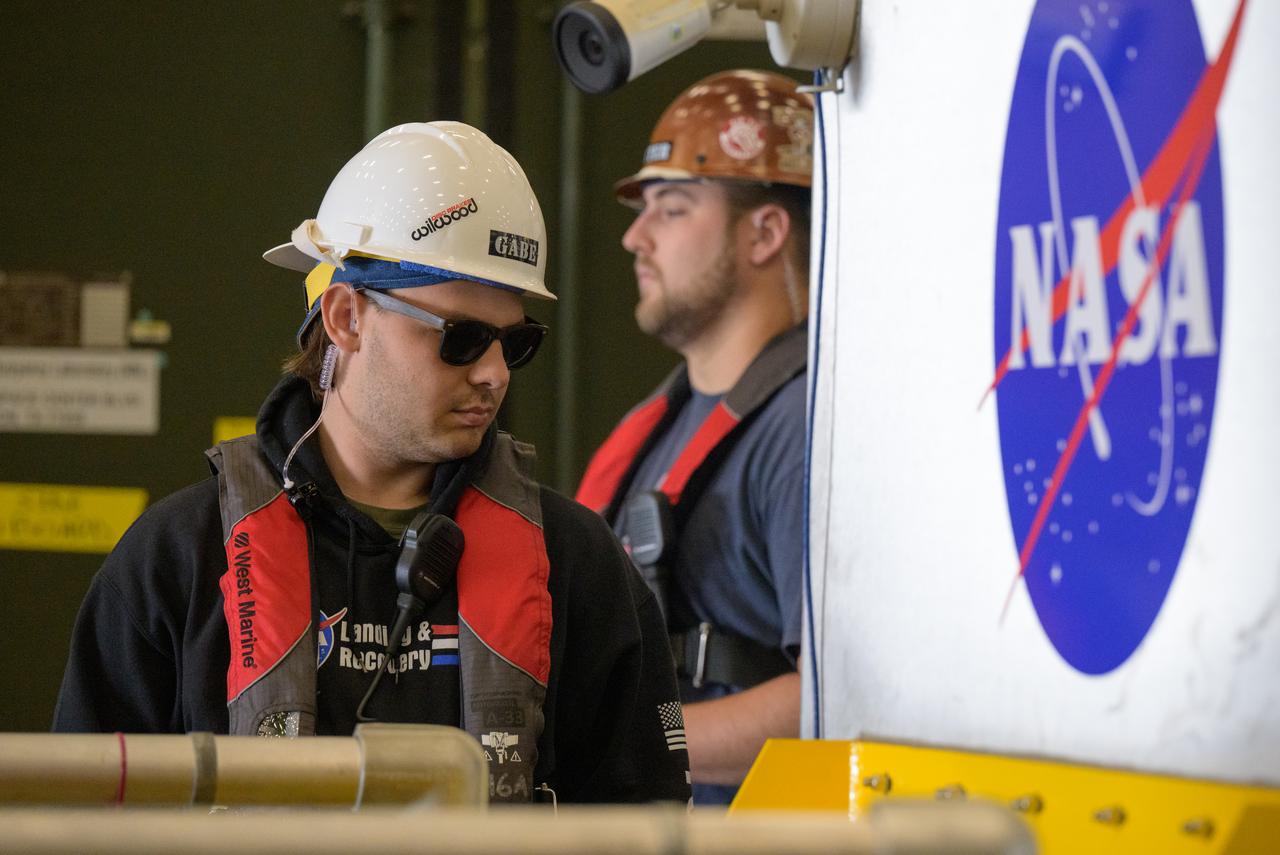
Members of NASA’s Landing and Recovery team are seen as they recover the Crew Module Test Article (CMTA), a full scale mockup of the Orion spacecraft, as teams practice Artemis recovery operations during Underway Recovery Test-12 onboard USS Somerset off the coast of California, Saturday, March 29, 2025. During the test, NASA and Department of Defense teams are practicing to ensure recovery procedures are validated as NASA plans to send Artemis II around the Moon and splashdown in the Pacific Ocean. Photo Credit: (NASA/Bill Ingalls)
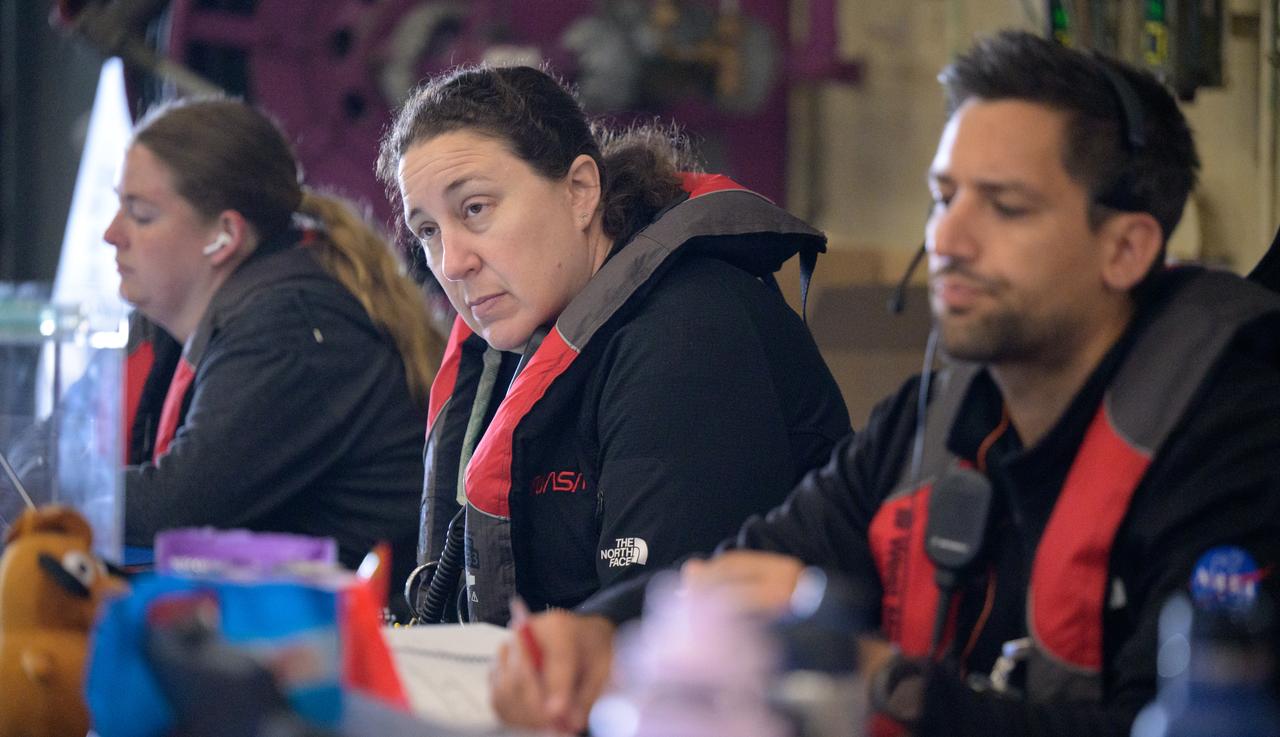
Members of NASA’s Landing and Recovery team are seen as they recover the Crew Module Test Article (CMTA), a full scale mockup of the Orion spacecraft, as teams practice Artemis recovery operations during Underway Recovery Test-12 onboard USS Somerset off the coast of California, Saturday, March 29, 2025. During the test, NASA and Department of Defense teams are practicing to ensure recovery procedures are validated as NASA plans to send Artemis II around the Moon and splashdown in the Pacific Ocean. Photo Credit: (NASA/Bill Ingalls)
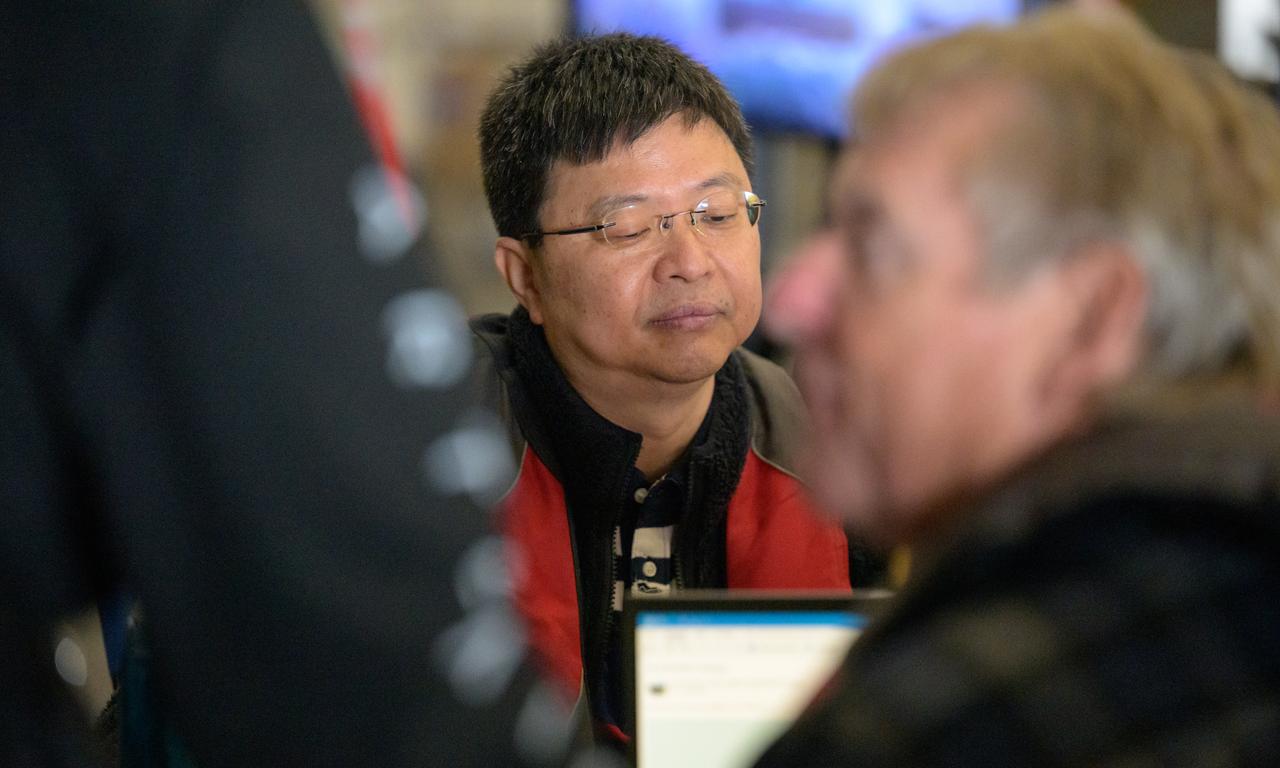
Members of NASA’s Landing and Recovery team are seen as they recover the Crew Module Test Article (CMTA), a full scale mockup of the Orion spacecraft, as teams practice Artemis recovery operations during Underway Recovery Test-12 onboard USS Somerset off the coast of California, Saturday, March 29, 2025. During the test, NASA and Department of Defense teams are practicing to ensure recovery procedures are validated as NASA plans to send Artemis II around the Moon and splashdown in the Pacific Ocean. Photo Credit: (NASA/Bill Ingalls)
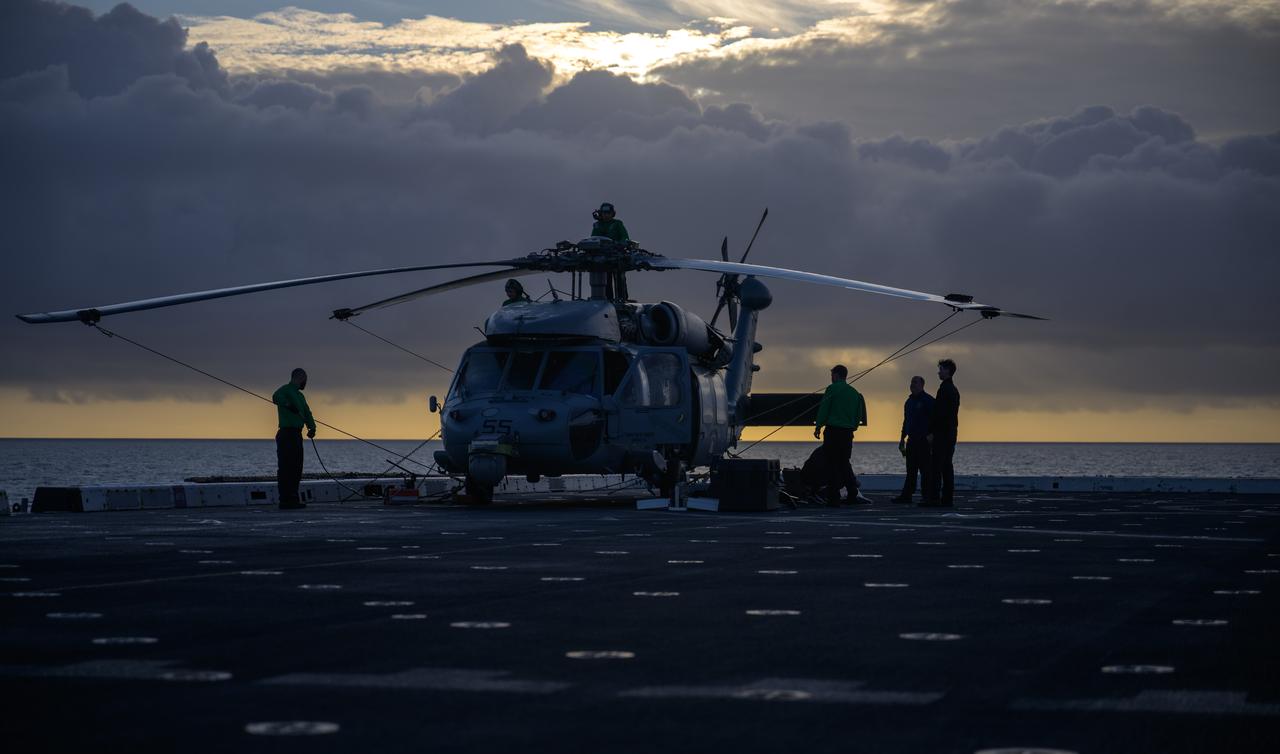
Navy MH-60 Seahawk helicopter team members are seen onboard USS Somerset off the coast of California, as NASA and Department of Defense teams participate in Underway Recovery Test-12, Friday, March 28, 2025. During the test, teams are practicing to ensure recovery procedures are validated as NASA plans to send the Artemis II astronauts around the Moon and splashdown in the Pacific Ocean. Photo Credit: (NASA/Bill Ingalls)
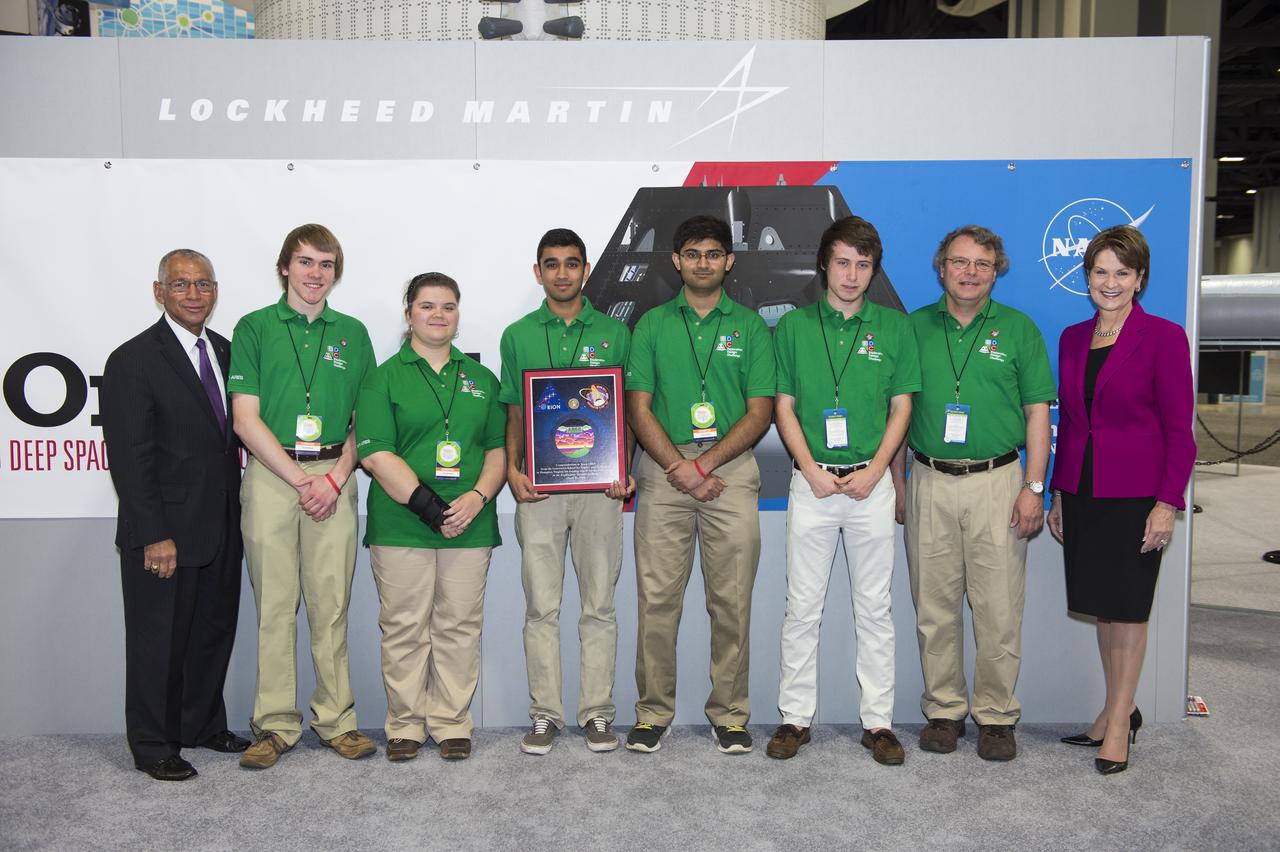
Team ARES poses with NASA Administrator Charles Bolden and Lockheed Martin CEO, Marillyn Hewson. Team ARES was the winner of the Exploration Design Challenge. The goal of the Exploration Design Challenge is for students to research and design ways to protect astronauts from space radiation. The winning team was announced on April 25, 2014 at the USA Science and Engineering Festival at the Washington Convention Center in Washington, DC. Photo Credit: (NASA/Aubrey Gemignani)
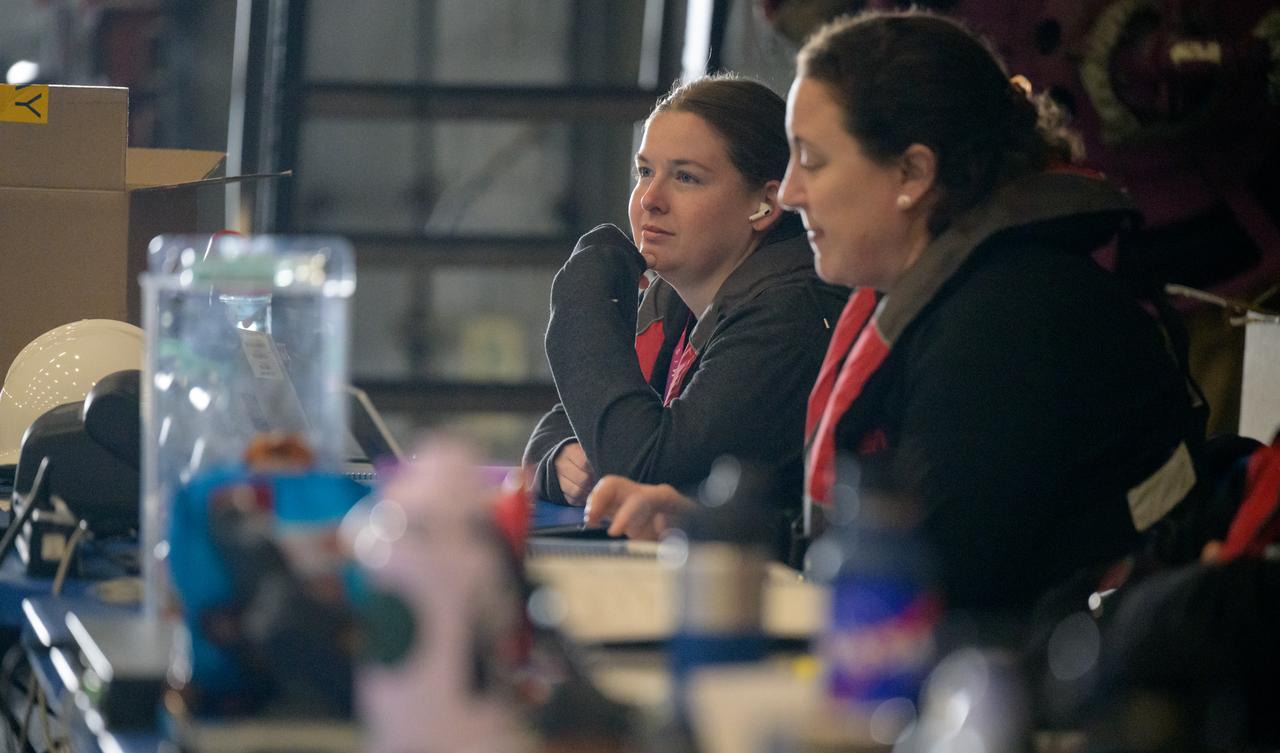
Members of NASA’s Landing and Recovery team are seen as they recover the Crew Module Test Article (CMTA), a full scale mockup of the Orion spacecraft, as teams practice Artemis recovery operations during Underway Recovery Test-12 onboard USS Somerset off the coast of California, Saturday, March 29, 2025. During the test, NASA and Department of Defense teams are practicing to ensure recovery procedures are validated as NASA plans to send Artemis II around the Moon and splashdown in the Pacific Ocean. Photo Credit: (NASA/Bill Ingalls)
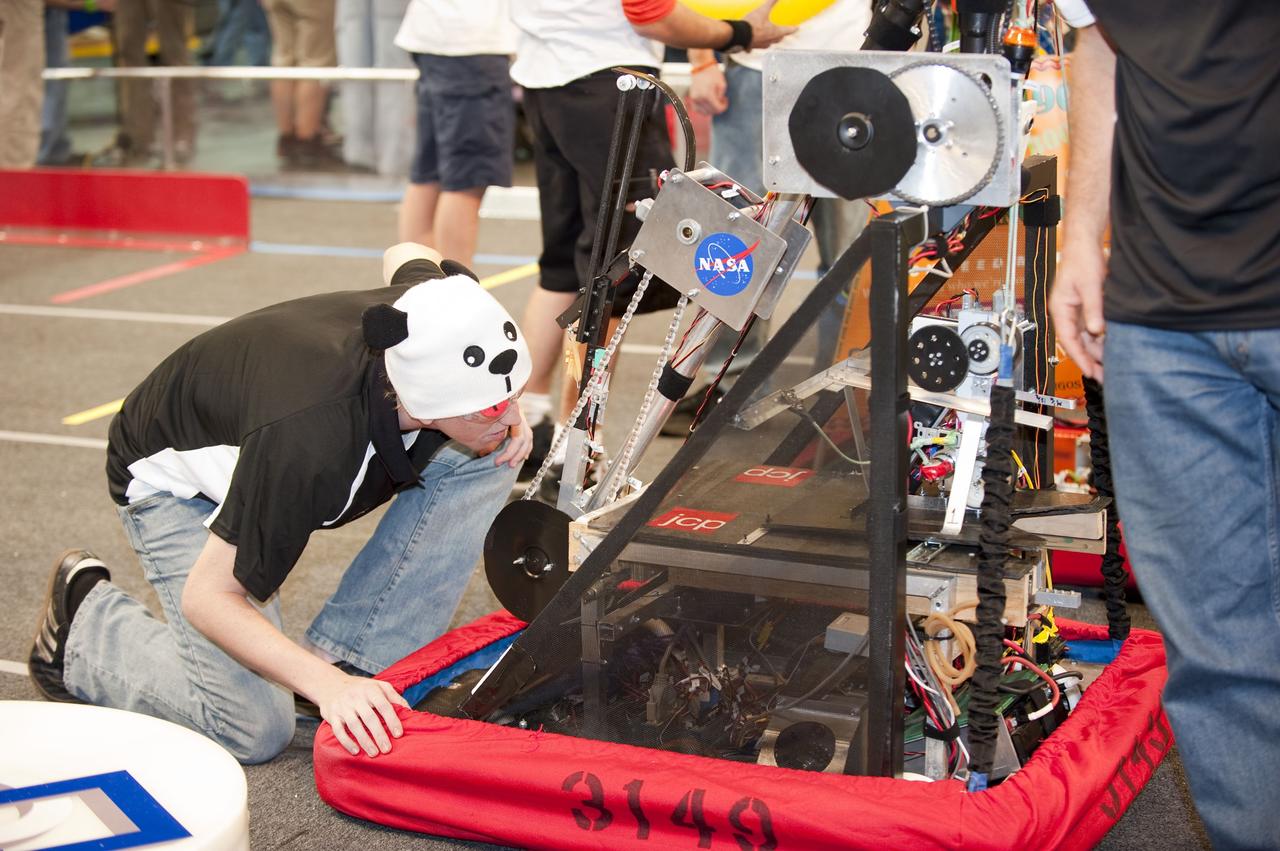
ORLANDO, Fla. – Team 3149 participates in the regional FIRST robotics competition at the University of Central Florida in Orlando. The team is made up of students from McKeel Academy of Technology in Lakeland, Fla. NASA is a sponsor of the team. Team 3149 finished eighth in the competition called "For Inspiration and Recognition of Science and Technology," or FIRST, among about 60 high school teams hoping to advance to the national robotics championship. FIRST, founded in 1989, is a non-profit organization that designs accessible, innovative programs to build self-confidence, knowledge and life skills while motivating young people to pursue academic opportunities. The robotics competition challenges teams of high school students and their mentors to solve a common problem in a six-week timeframe using a standard kit of parts and a common set of rules. Photo credit: NASA/Glenn Benson
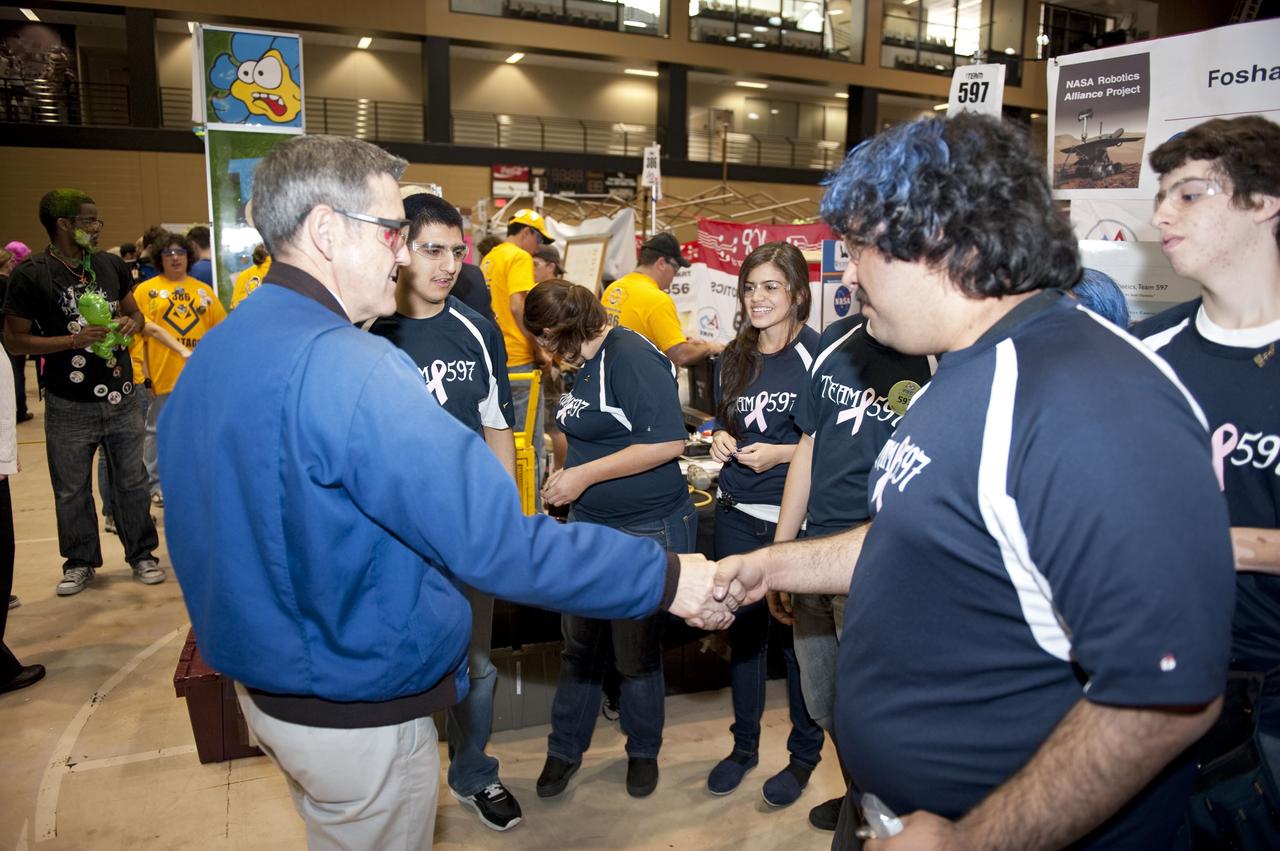
ORLANDO, Fla. – NASA Kennedy Space Center Director Bob Cabana talks to The Wolverines team at the regional FIRST robotics competition at the University of Central Florida in Orlando. The team is made up of students from the Foshay Learning Center located in Los Angeles. NASA is a sponsor of the team. About 60 high school teams took part in the competition called "For Inspiration and Recognition of Science and Technology," or FIRST, in hopes of advancing to the national robotics championship. The team took home the Industrial Safety Award sponsored by Underwriters Laboratories. FIRST, founded in 1989, is a non-profit organization that designs accessible, innovative programs to build self-confidence, knowledge and life skills while motivating young people to pursue academic opportunities. The robotics competition challenges teams of high school students and their mentors to solve a common problem in a six-week timeframe using a standard kit of parts and a common set of rules. Photo credit: NASA/Glenn Benson
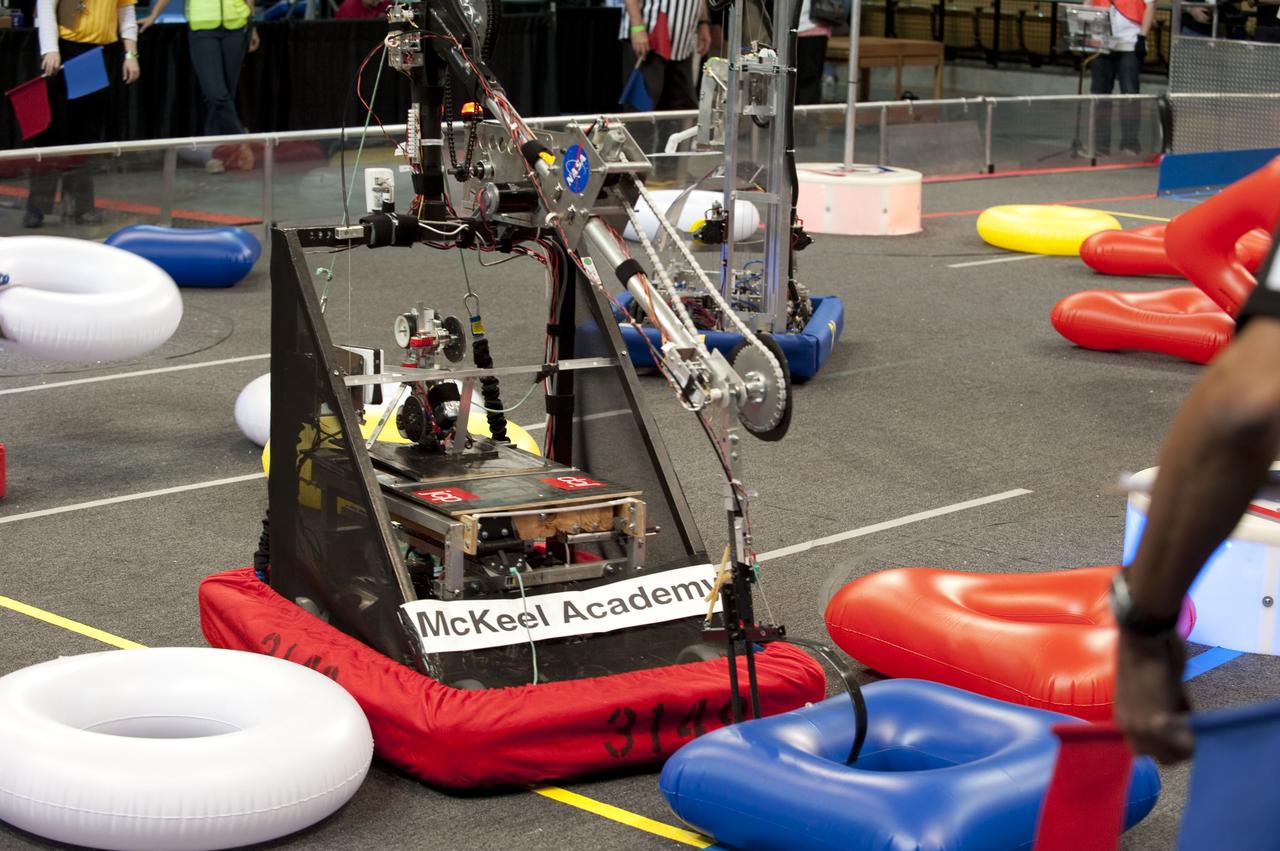
ORLANDO, Fla. – The Team 3149 robot participates in the regional FIRST robotics competition at the University of Central Florida in Orlando. The team is made up of students from McKeel Academy of Technology in Lakeland, Fla. NASA is a sponsor of the team. Team 3149 finished eighth in the competition called "For Inspiration and Recognition of Science and Technology," or FIRST, among about 60 high school teams hoping to advance to the national robotics championship. FIRST, founded in 1989, is a non-profit organization that designs accessible, innovative programs to build self-confidence, knowledge and life skills while motivating young people to pursue academic opportunities. The robotics competition challenges teams of high school students and their mentors to solve a common problem in a six-week timeframe using a standard kit of parts and a common set of rules. Photo credit: NASA/Glenn Benson
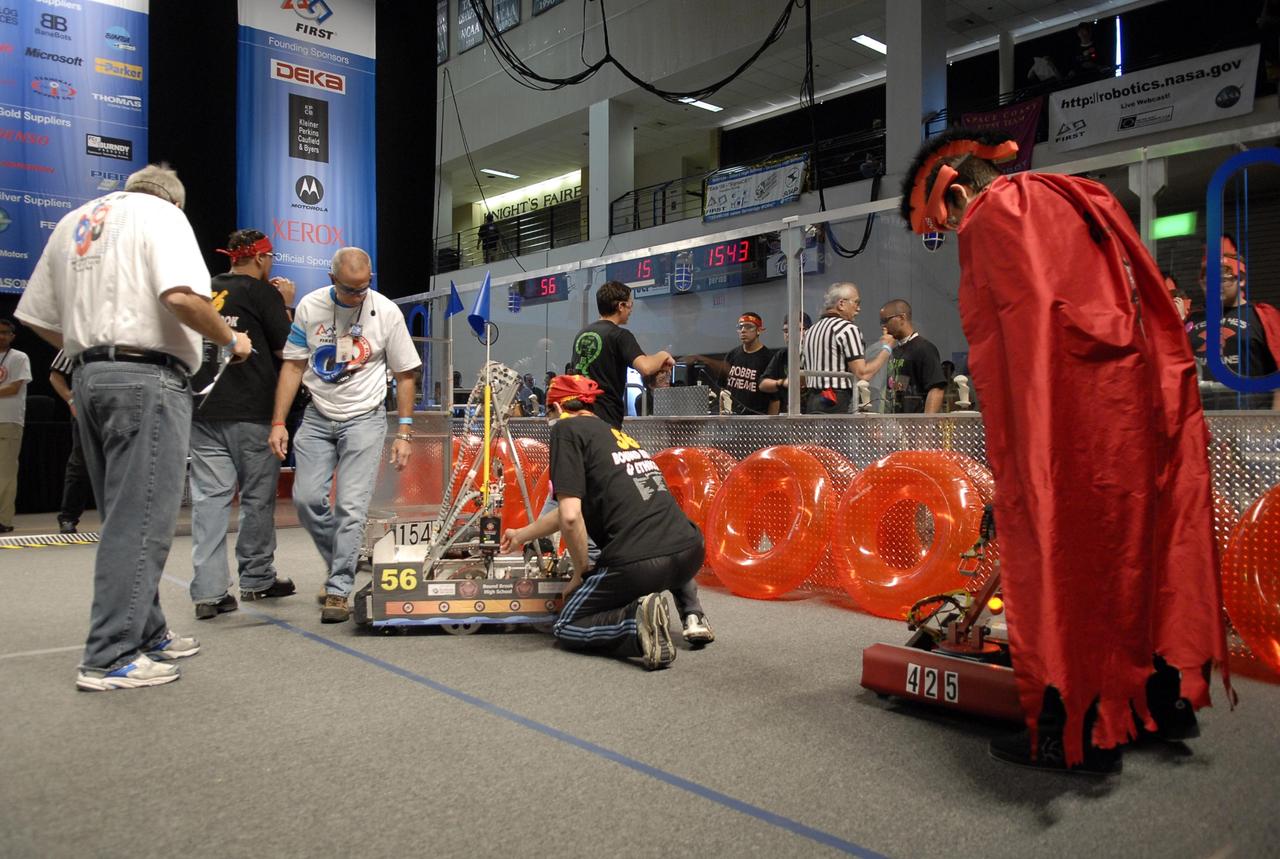
KENNEDY SPACE CENTER, FLA. -- A Kissimmee, Fla., team (right) prepares its robot for competition with a New Jersey team (center) during the FIRST robotics event held at the University of Central Florida Arena March 8-10. The FIRST, or For Inspiration and Recognition of Science and Technology, Robotics Competition challenges teams of young people and their mentors to solve a common problem in a six-week timeframe using a standard "kit of parts" and a common set of rules. Teams build robots from the parts and enter them in a series of competitions designed by FIRST founder Dean Kamen and Dr. Woodie Flowers, chairman and vice chairman of the Executive Advisory Board respectively, and a committee of engineers and other professionals. FIRST redefines winning for these students. Teams are rewarded for excellence in design, demonstrated team spirit, gracious professionalism and maturity, and ability to overcome obstacles. Scoring the most points is a secondary goal. Winning means building partnerships that last. Photo credit: NASA/Kim Shiflett

KENNEDY SPACE CENTER, FLA. - During the 2006 FIRST Robotics Regional Competition held March 9-11 at the University of Central Florida in Orlando, the "Pink Team," whose robot is named Roccobot and is co-sponsored by NASA KSC, stands for recognition. The FIRST Robotics Competition challenges teams of young people and their mentors to solve a common problem in a six-week timeframe using a standard "kit of parts" and a common set of rules. Teams build robots from the parts and enter them in a series of competitions. FIRST, which is based on "For Inspiration and Recognition of Science and Technology," redefines winning for these students. Teams are rewarded for excellence in design, demonstrated team spirit, gracious professionalism and maturity, and ability to overcome obstacles. Scoring the most points is a secondary goal. Winning means building partnerships that last. NASA and the University of Central Florida are co-sponsors of the regional event, which this year included more than 50 teams. Photo credit: NASA/Kim Shiflett
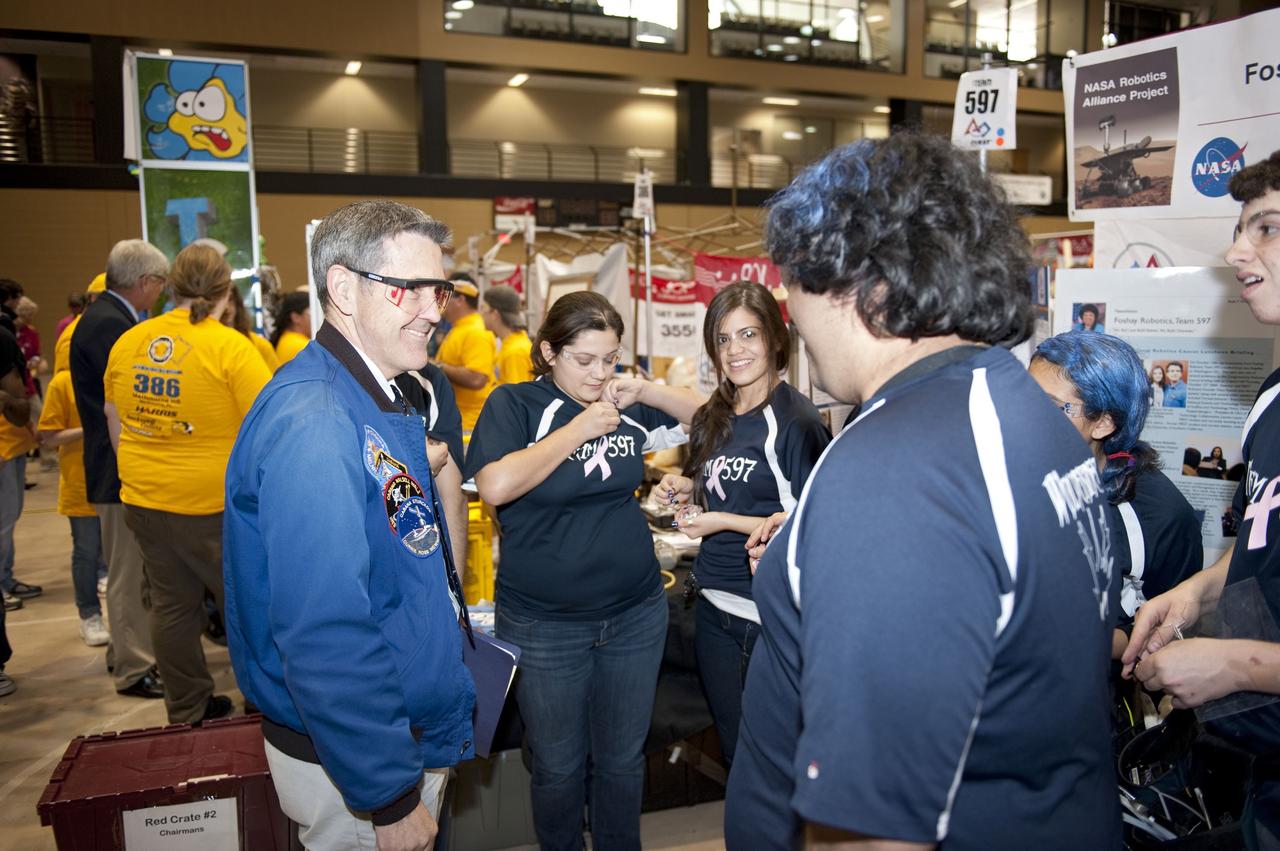
ORLANDO, Fla. – NASA Kennedy Space Center Director Bob Cabana talks to The Wolverines team at the regional FIRST robotics competition at the University of Central Florida in Orlando. The team is made up of students from the Foshay Learning Center located in Los Angeles. NASA is a sponsor of the team. About 60 high school teams took part in the competition called "For Inspiration and Recognition of Science and Technology," or FIRST, in hopes of advancing to the national robotics championship. The team took home the Industrial Safety Award sponsored by Underwriters Laboratories. FIRST, founded in 1989, is a non-profit organization that designs accessible, innovative programs to build self-confidence, knowledge and life skills while motivating young people to pursue academic opportunities. The robotics competition challenges teams of high school students and their mentors to solve a common problem in a six-week timeframe using a standard kit of parts and a common set of rules. Photo credit: NASA/Glenn Benson
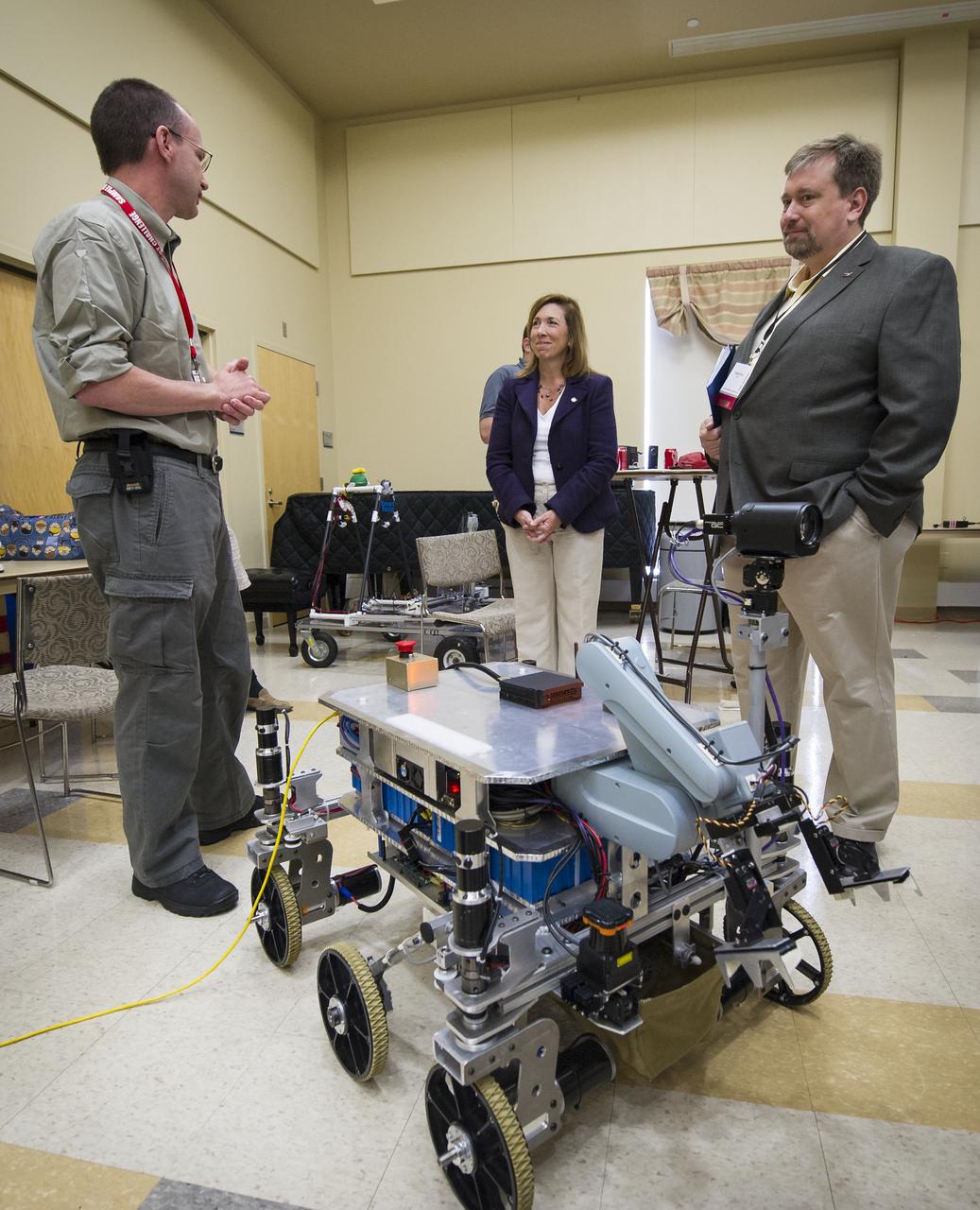
Intrepid Systems Team member Mark Curry, left, talks with NASA Deputy Administrator Lori Garver and NASA Chief Technologist Mason Peck, right, about his robot named "MXR - Mark's Exploration Robot" on Saturday, June 16, 2012 at the Worcester Polytechnic Institute (WPI) in Worcester, Mass. Curry's robot team was one of the final teams participating in the NASA-WPI Sample Return Robot Centennial Challenge at WPI. Teams were challenged to build autonomous robots that can identify, collect and return samples. NASA needs autonomous robotic capability for future planetary exploration. Photo Credit: (NASA/Bill Ingalls)
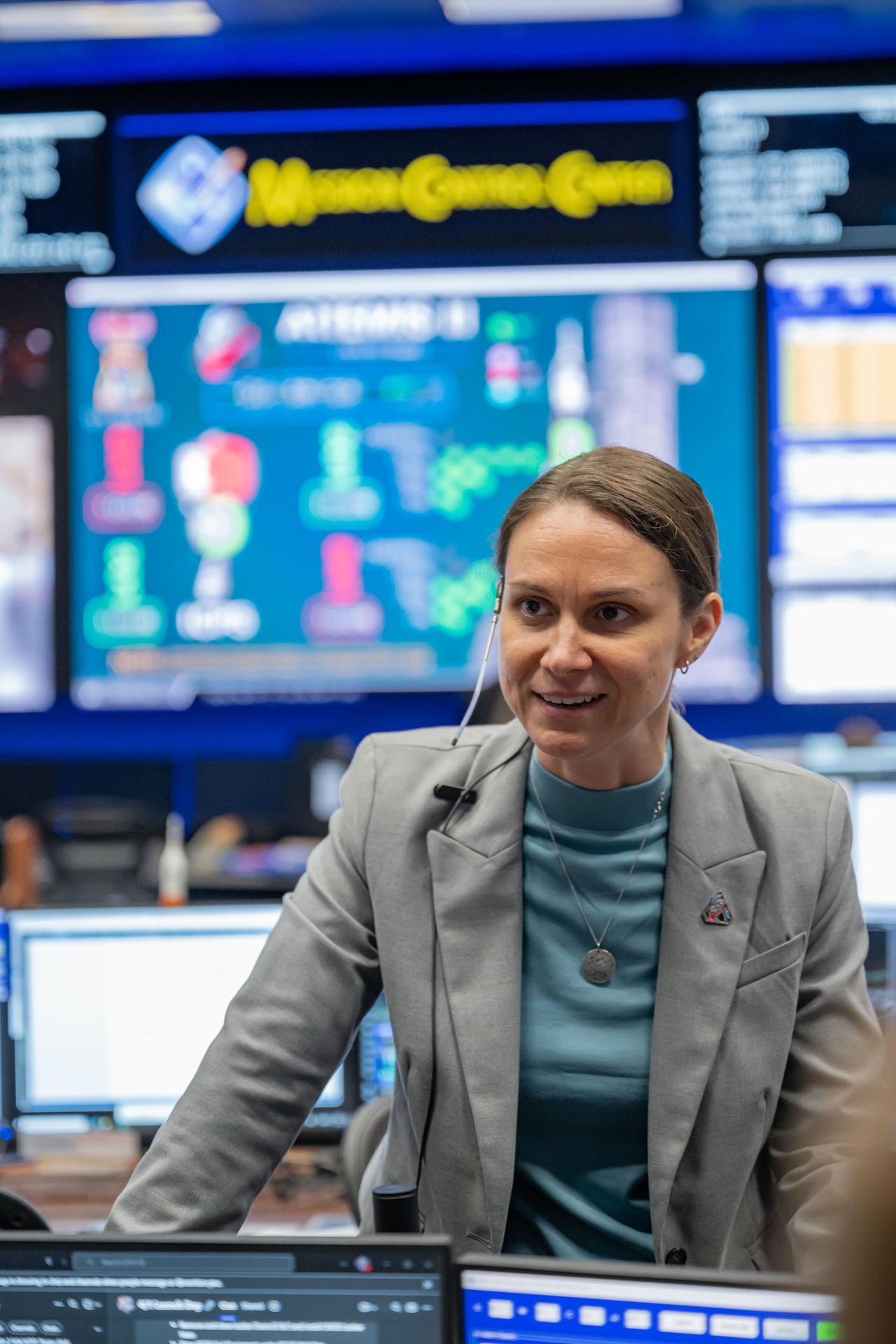
Artemis II Flight Control Team in WFCR during Launch & Ascent. Photo Date: April 1, 2026. Location: Building 30s, WFCR. Photo Credit: NASA/Robert Markowitz
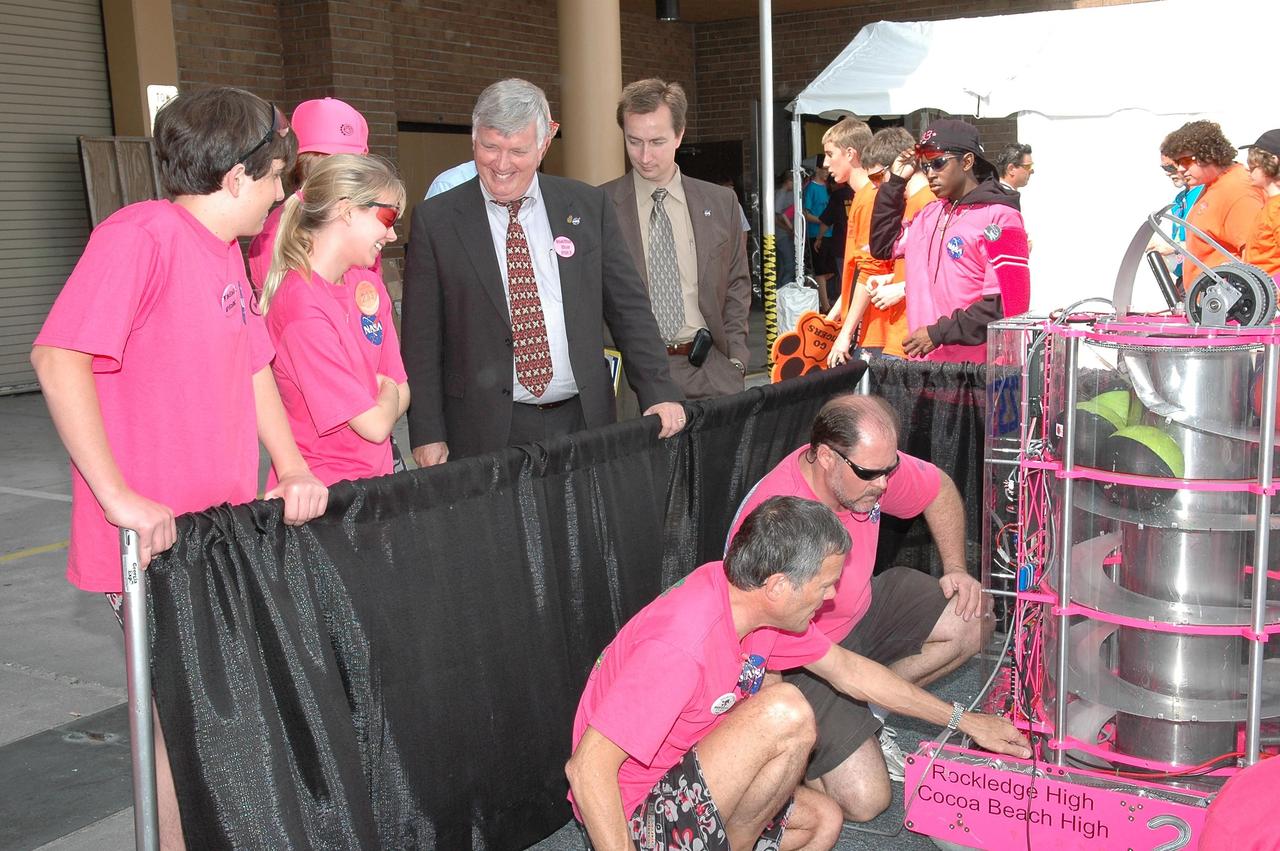
KENNEDY SPACE CENTER, FLA. - During the 2006 FIRST Robotics Regional Competition held March 9-11 at the University of Central Florida in Orlando, Kennedy Space Center Director Jim Kennedy and his intern Neil Berger talk with students on the Cocoa Beach High School-Rockledge High School robotic team known as the "Pink Team," which was co-sponsored by NASA KSC. The team's robot, at right, is called Roccobot. At least four teams in the competition were sponsored by KSC, NASA and contractors. The FIRST Robotics Competition challenges teams of young people and their mentors to solve a common problem in a six-week timeframe using a standard "kit of parts" and a common set of rules. Teams build robots from the parts and enter them in a series of competitions. FIRST, which is based on "For Inspiration and Recognition of Science and Technology," redefines winning for these students. Teams are rewarded for excellence in design, demonstrated team spirit, gracious professionalism and maturity, and ability to overcome obstacles. Scoring the most points is a secondary goal. Winning means building partnerships that last. NASA and the University of Central Florida are co-sponsors of the regional event, which this year included more than 50 teams. Photo credit: NASA/Kim Shiflett
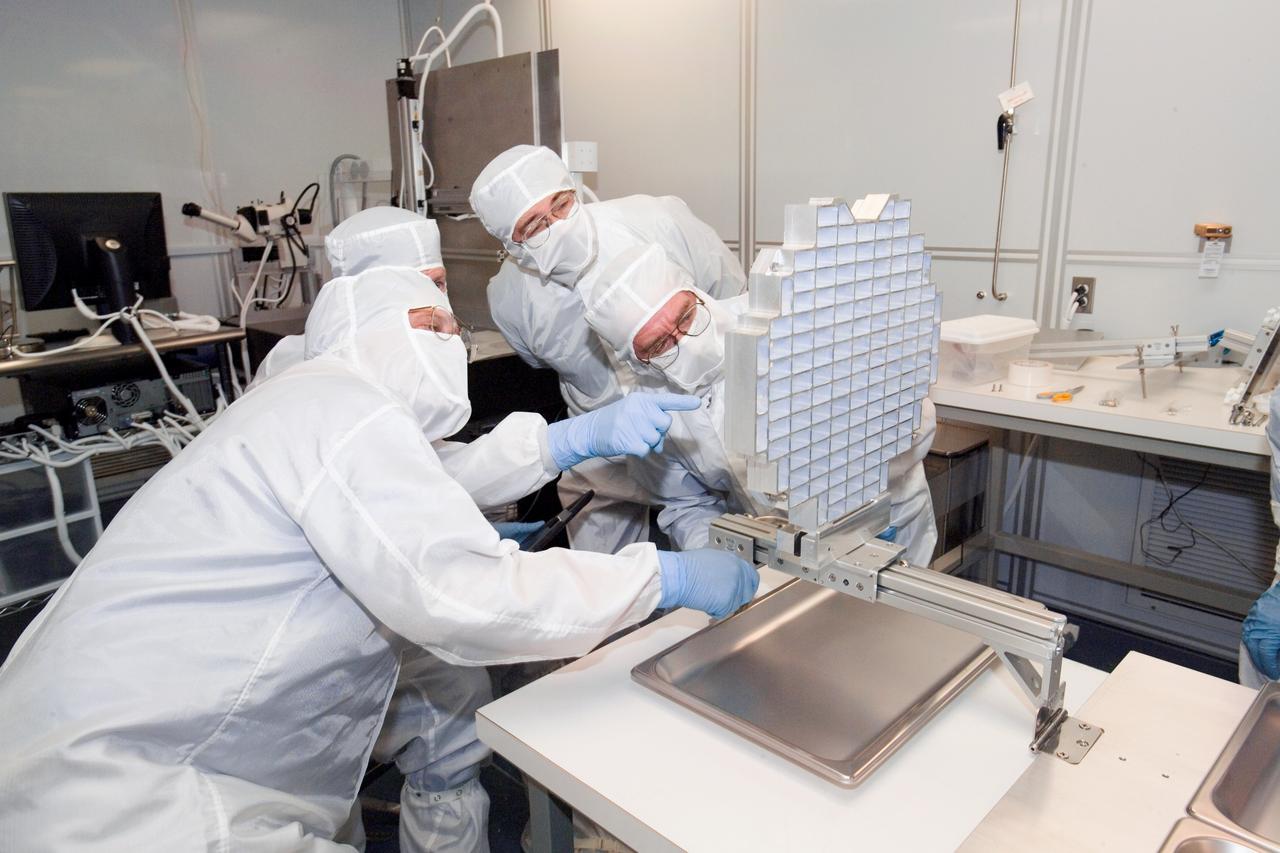
Stardust Photo documentation of Stardust Sample Return and Tray Separation at bldg 31, Stardust laboratory at JSC. The JSC Curation Team begins work with sample containers.

Photos of LaRC team weighting and performing Center of Gravity (CG) measurements of the Structural Test Article (STA) at NASA Langley Research Center.
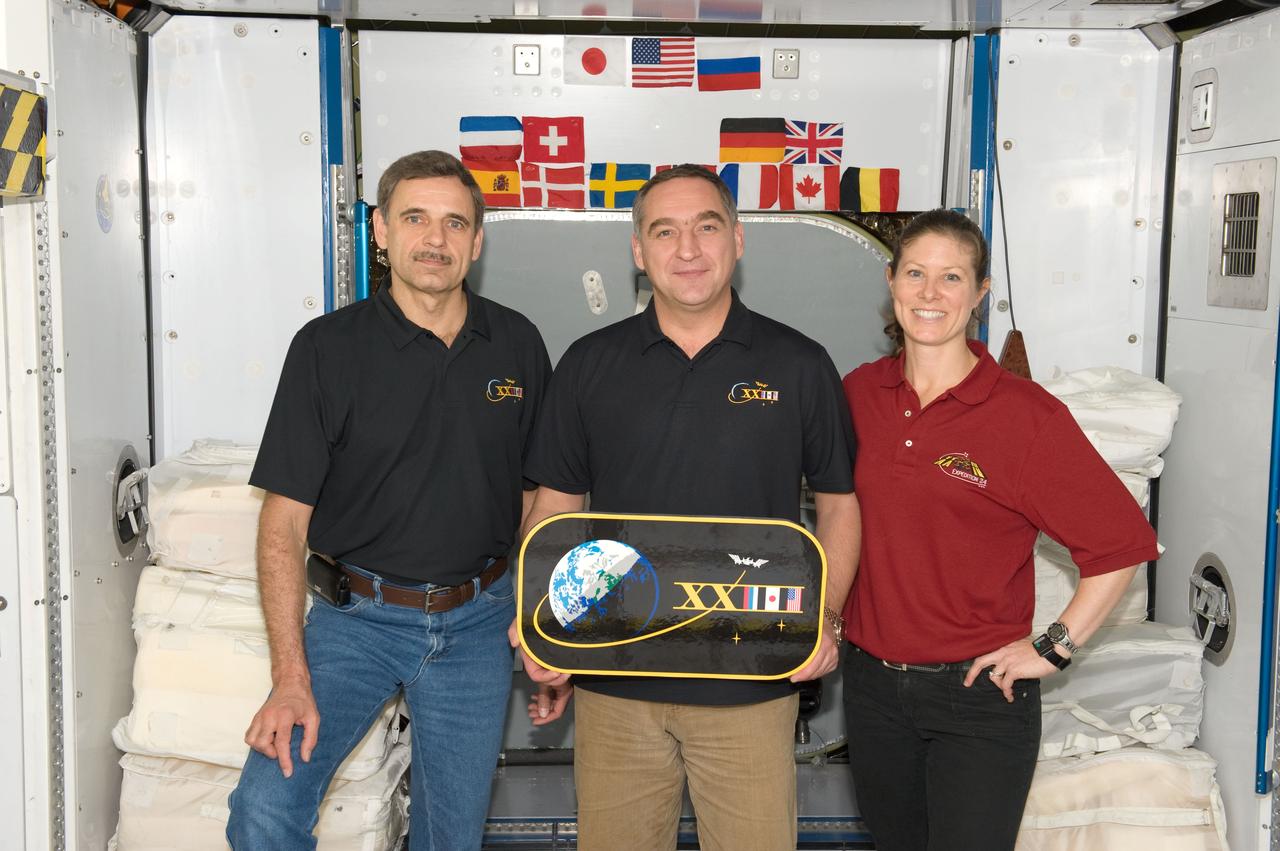
PHOTO DATE: 12-08-09 LOCATION: Bldg 9NW, ISS Mockups SUBJECT: Expedition 23 crew with the training team. PHOTOGRAPHER: James Blair
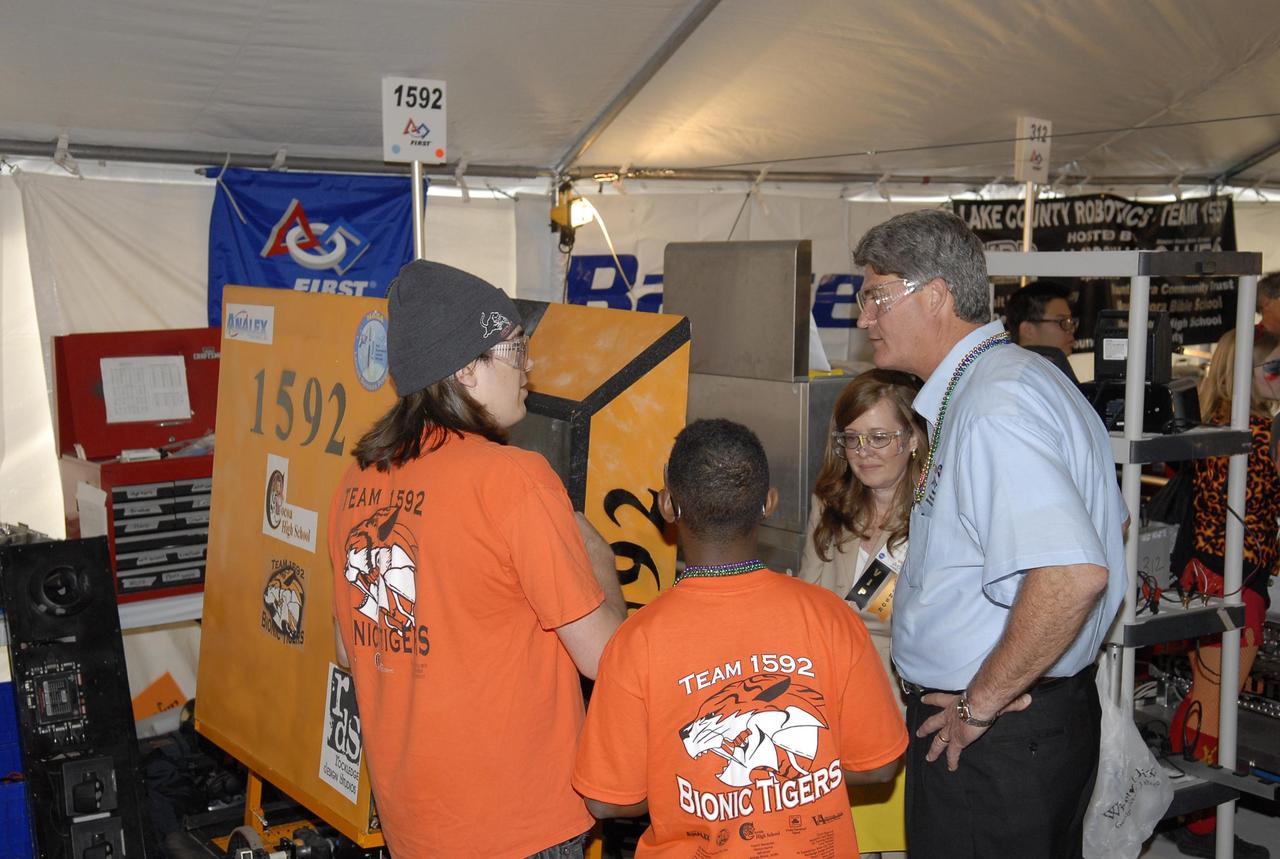
KENNEDY SPACE CENTER, FLA. -- Center Director Bill Parsons (right) talks with students of another NASA-sponsored robotic team during the FIRST robotics event held at the University of Central Florida Arena March 8-10. Next to Parsons is Lisa Malone, director of External Relations at Kennedy Space Center. The students of team 1592, the Bionic Tigers, represent the cosponsors Analex Corporation and NASA Launch Services Program and Cocoa High School in Central Florida. Participating since 2005, this is the first year for this team to receive NASA financial support. They were mentored by the Pink Team. The FIRST, or For Inspiration and Recognition of Science and Technology, Robotics Competition challenges teams of young people and their mentors to solve a common problem in a six-week timeframe using a standard "kit of parts" and a common set of rules. Teams build robots from the parts and enter them in a series of competitions designed by FIRST founder Dean Kamen and Dr. Woodie Flowers, chairman and vice chairman of the Executive Advisory Board respectively, and a committee of engineers and other professionals. FIRST redefines winning for these students. Teams are rewarded for excellence in design, demonstrated team spirit, gracious professionalism and maturity, and ability to overcome obstacles. Scoring the most points is a secondary goal. Winning means building partnerships that last. Photo credit: NASA/Kim Shiflett