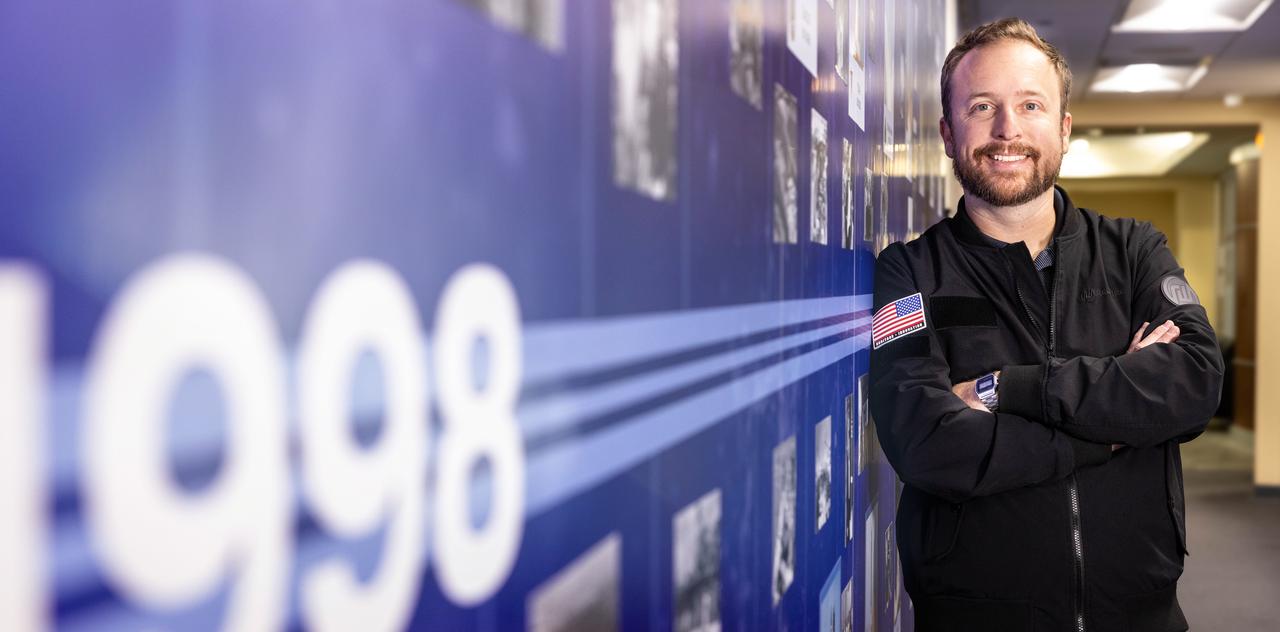
Brandon Marsell, deputy technical fellow for Cryogenics in NASA’s Engineering and Safety Center Technical Discipline Team at Kennedy Space Center in Florida, poses for a photograph on Wednesday, Aug. 20, 2025.
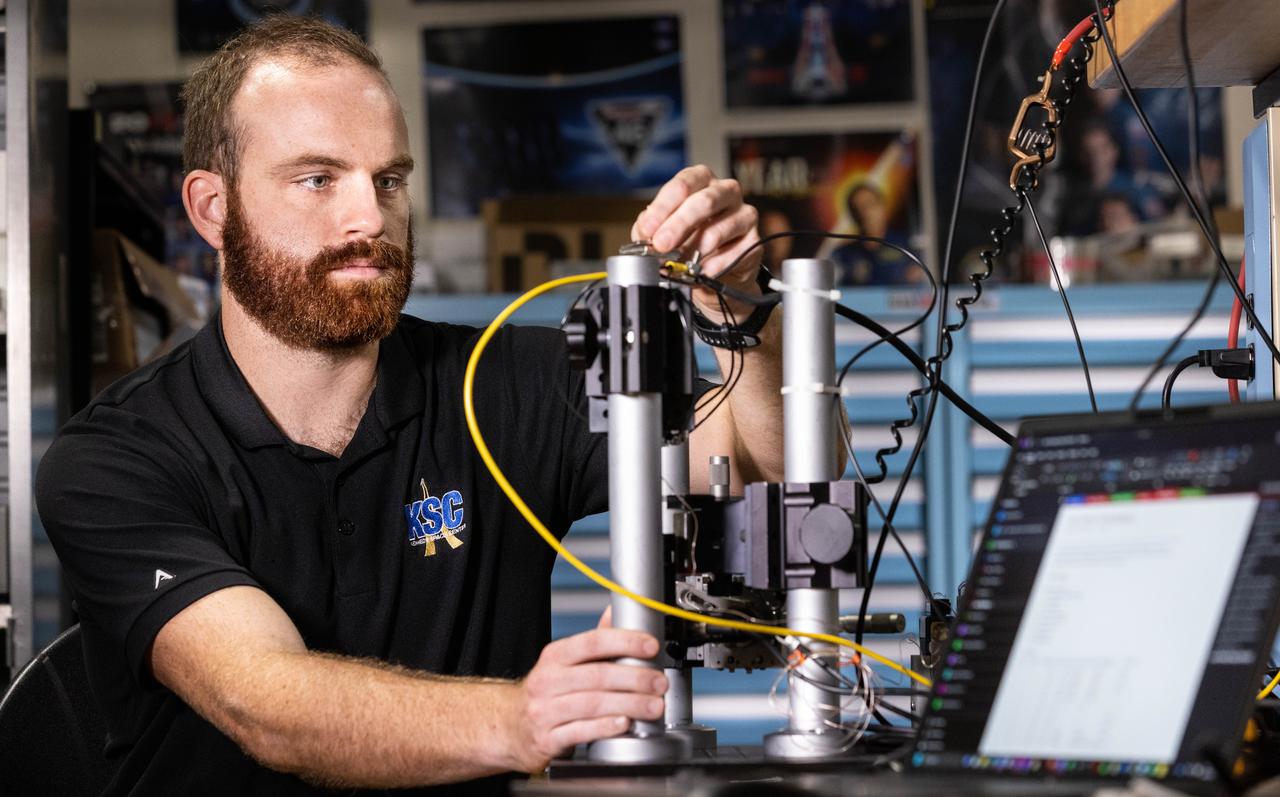
Stefan Tomovic from the Engineering Directorate at NASA’s Kennedy Space Center in Florida evaluates pressure transducers for NASA’s Engineering and Safety Center on Wednesday, Aug. 20, 2025. This probe is designed to improve the detection of thruster pressure sensor anomalies for the agency’s Commercial Crew Program.
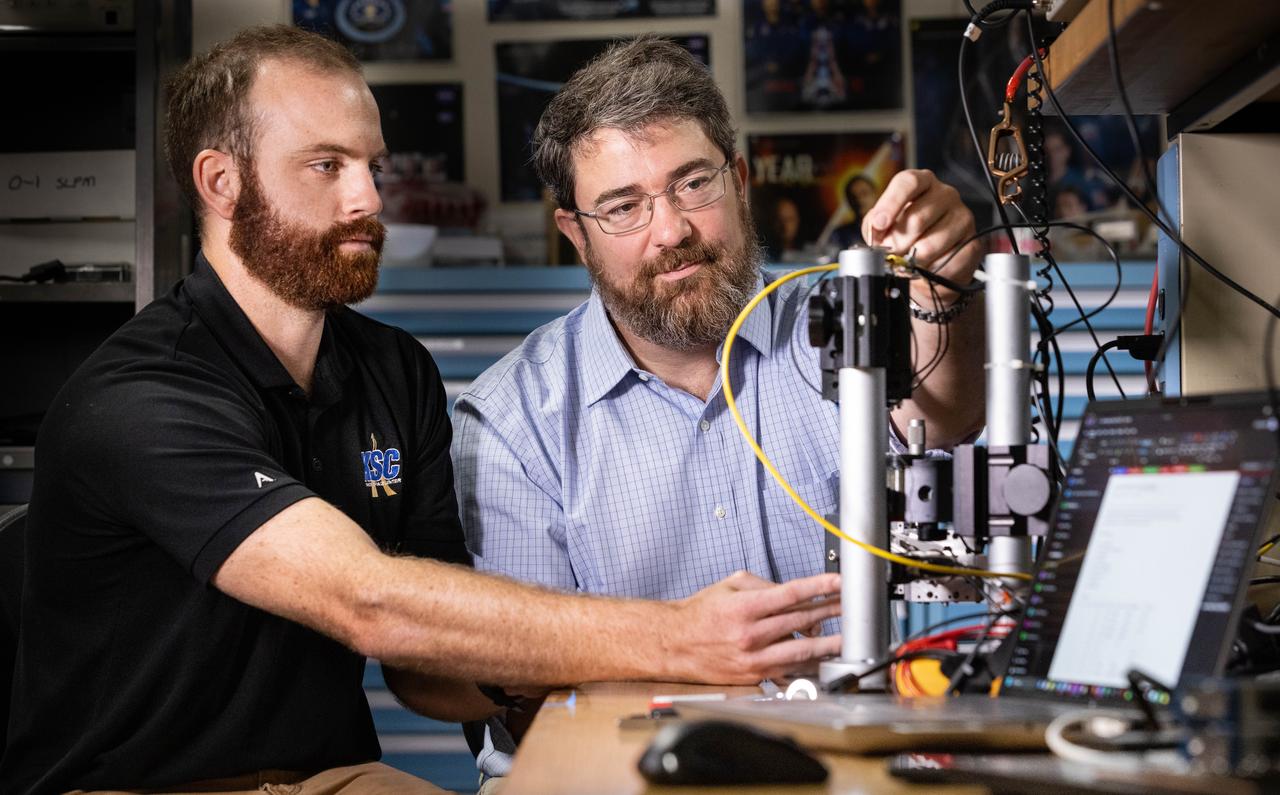
Left to right, Stefan Tomovic from the Engineering Directorate at NASA’s Kennedy Space Center in Florida and Christopher Biagi from the agency’s Exploration Research & Technology Program evaluate pressure transducers for NASA’s Engineering and Safety Center on Wednesday, Aug. 20, 2025. This probe is designed to improve the detection of thruster pressure sensor anomalies for the agency’s Commercial Crew Program.
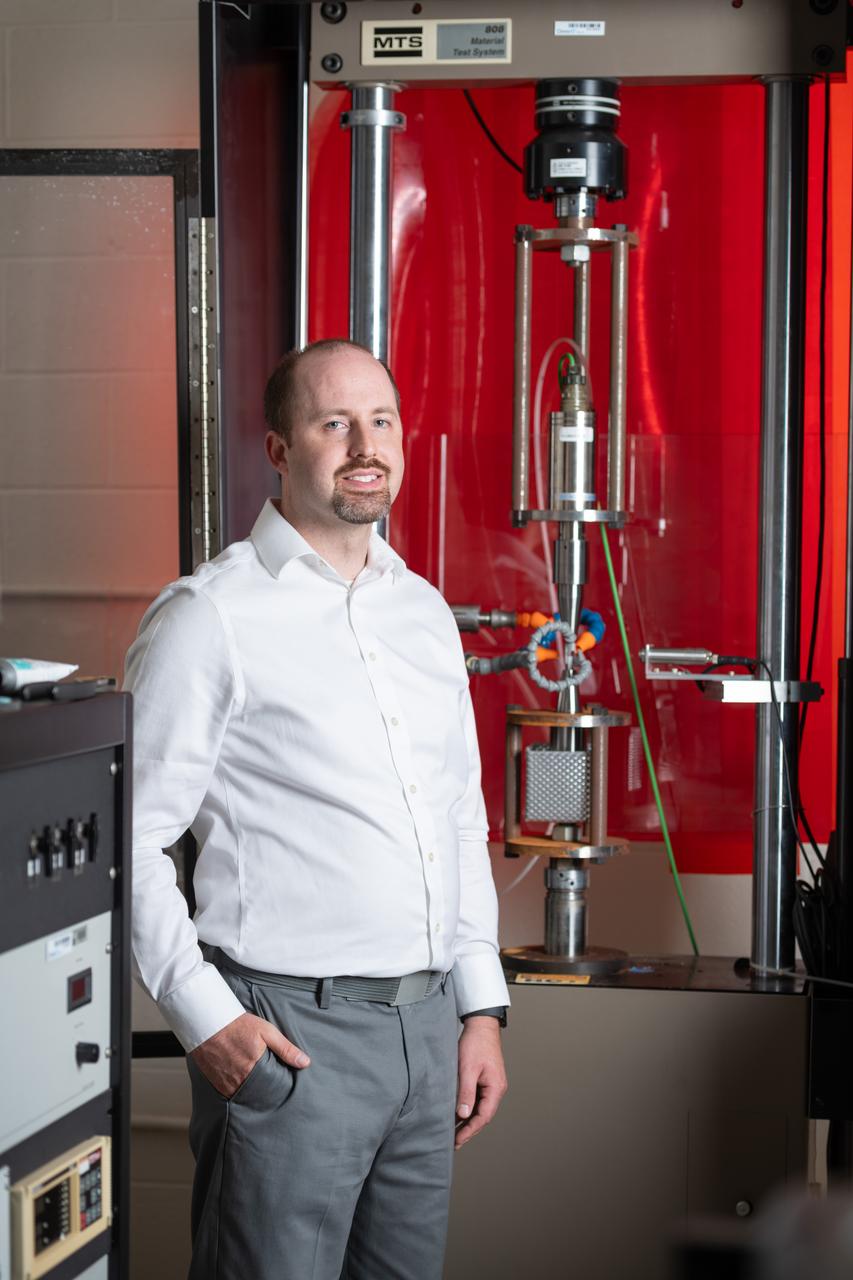
Each year, the NESC produces the NESC Technical Update, which highlights two or three individuals from each Center and includes assessments throughout the year. Because of the critical contributions to the NESC mission this year, Rob Jankovsky, NESC Chief Engineer at GRC, chose two individuals to be highlighted. This year, it is Andrew Ring and Michael Cooper. Mr. Ring, pictured here, performs stress and fatigue testing on all manner of materials in various environments and research on jet engine materials, looking for ways to increase the performance and safety of turbine blades and disks. Several NESC assessments have benefited from his expertise, most recently in understanding crack initiation and propagation in the aluminum-magnesium alloys that make up the modules of the ISS. He has also used image processing techniques to quantify the variables in parachute energy modulator production and performance and investigate flaws in the composite weave of overwrapped pressure vessels.
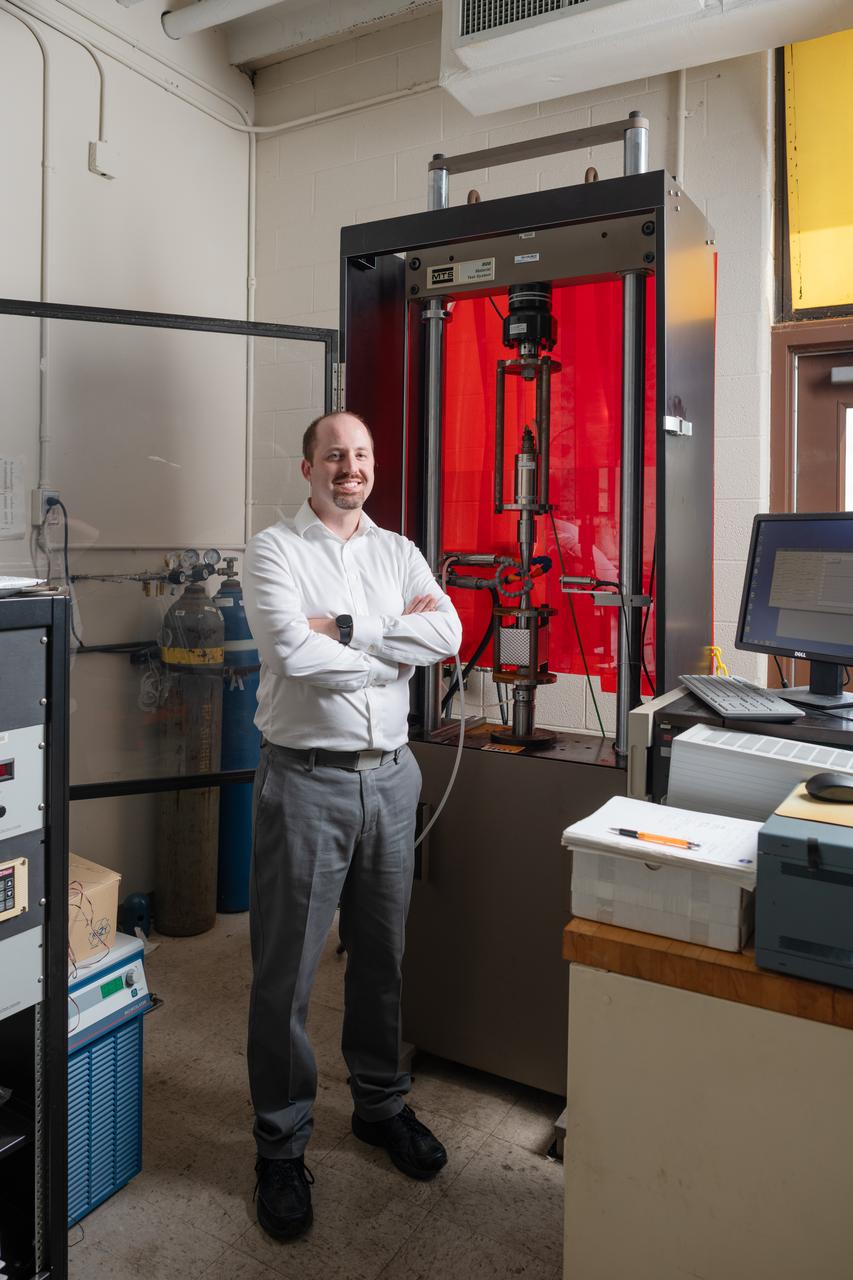
Each year, the NESC produces the NESC Technical Update, which highlights two or three individuals from each Center and includes assessments throughout the year. Because of the critical contributions to the NESC mission this year, Rob Jankovsky, NESC Chief Engineer at GRC, chose two individuals to be highlighted. This year, it is Andrew Ring and Michael Cooper. Mr. Ring, pictured here, performs stress and fatigue testing on all manner of materials in various environments and research on jet engine materials, looking for ways to increase the performance and safety of turbine blades and disks. Several NESC assessments have benefited from his expertise, most recently in understanding crack initiation and propagation in the aluminum-magnesium alloys that make up the modules of the ISS. He has also used image processing techniques to quantify the variables in parachute energy modulator production and performance and investigate flaws in the composite weave of overwrapped pressure vessels.
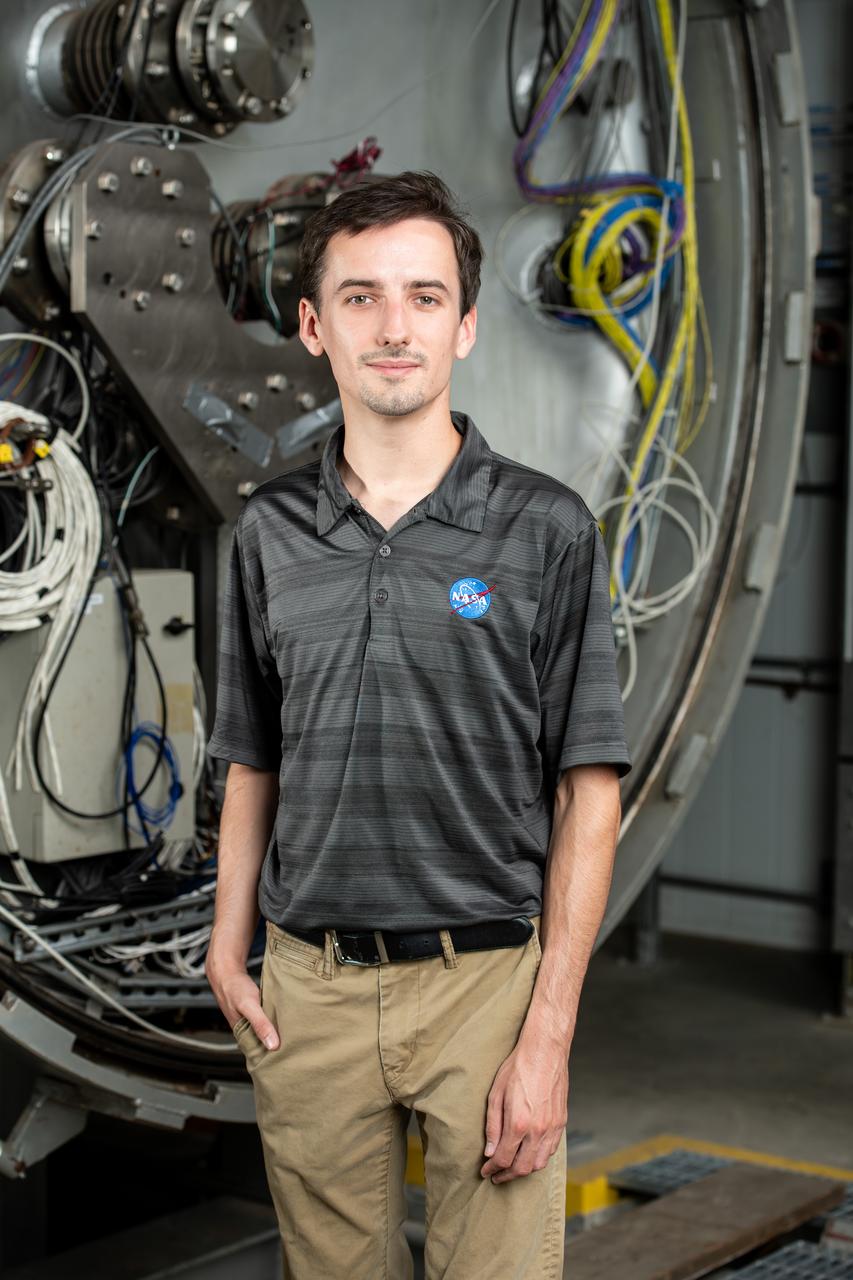
Each year, the NESC produces the NESC Technical Update, which highlights two or three individuals from each Center and includes assessments throughout the year. Because of the critical contributions to the NESC mission this year, Rob Jankovsky, NESC Chief Engineer at GRC, chose two individuals to be highlighted. This year, it is Andrew Ring and Michael Cooper. The Lead Analyst for GRC’s Chemical and Thermal Propulsion Systems branch, Mr. Michael Cooper, is supporting NESC test operations on reaction control system thrusters for Gateway’s Power & Propulsion Element. “These thrusters are small with few moving parts, but the heat and mass transfers involved are very complex,” he said. The test campaign is putting the thrusters through a rigorous profile to simulate the lifetime they will experience over decades in space. Mr. Cooper is analyzing test data gathered on chamber pressure, temperature, flow rates, and more to develop models on thruster performance. He also built the tool that read in that data from the test stand instrumentation. Photo Credit: (NASA/Sara Lowthian-Hanna)
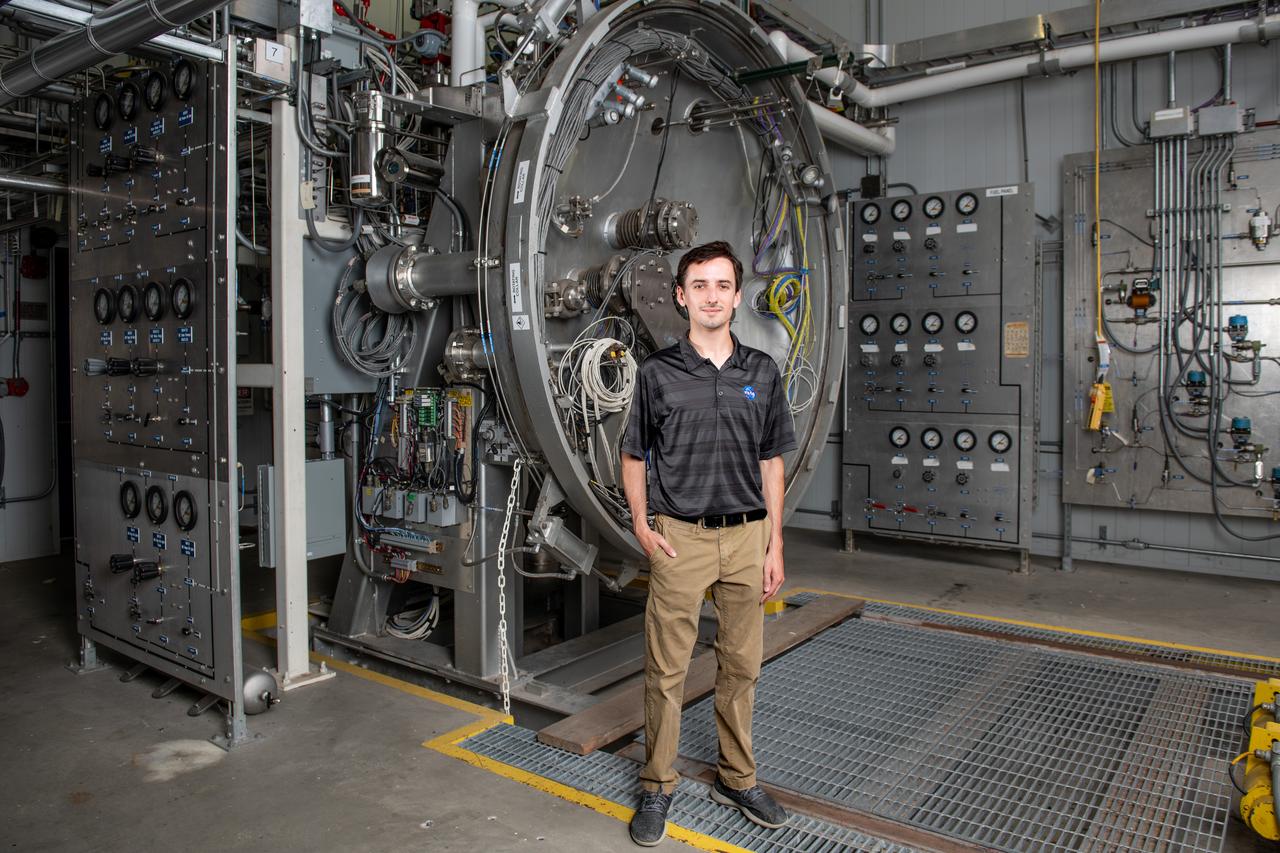
Each year, the NESC produces the NESC Technical Update, which highlights two or three individuals from each Center and includes assessments throughout the year. Because of the critical contributions to the NESC mission this year, Rob Jankovsky, NESC Chief Engineer at GRC, chose two individuals to be highlighted. This year, it is Andrew Ring and Michael Cooper. The Lead Analyst for GRC’s Chemical and Thermal Propulsion Systems branch, Mr. Michael Cooper pictured here in this environmental portrait on August 16, 2024. He is supporting NESC test operations on reaction control system thrusters for Gateway’s Power & Propulsion Element. “These thrusters are small with few moving parts, but the heat and mass transfers involved are very complex,” he said. The test campaign is putting the thrusters through a rigorous profile to simulate the lifetime they will experience over decades in space. Mr. Cooper is analyzing test data gathered on chamber pressure, temperature, flow rates, and more to develop models on thruster performance. He also built the tool that read in that data from the test stand instrumentation. Photo Credit: (NASA/Sara Lowthian-Hanna)
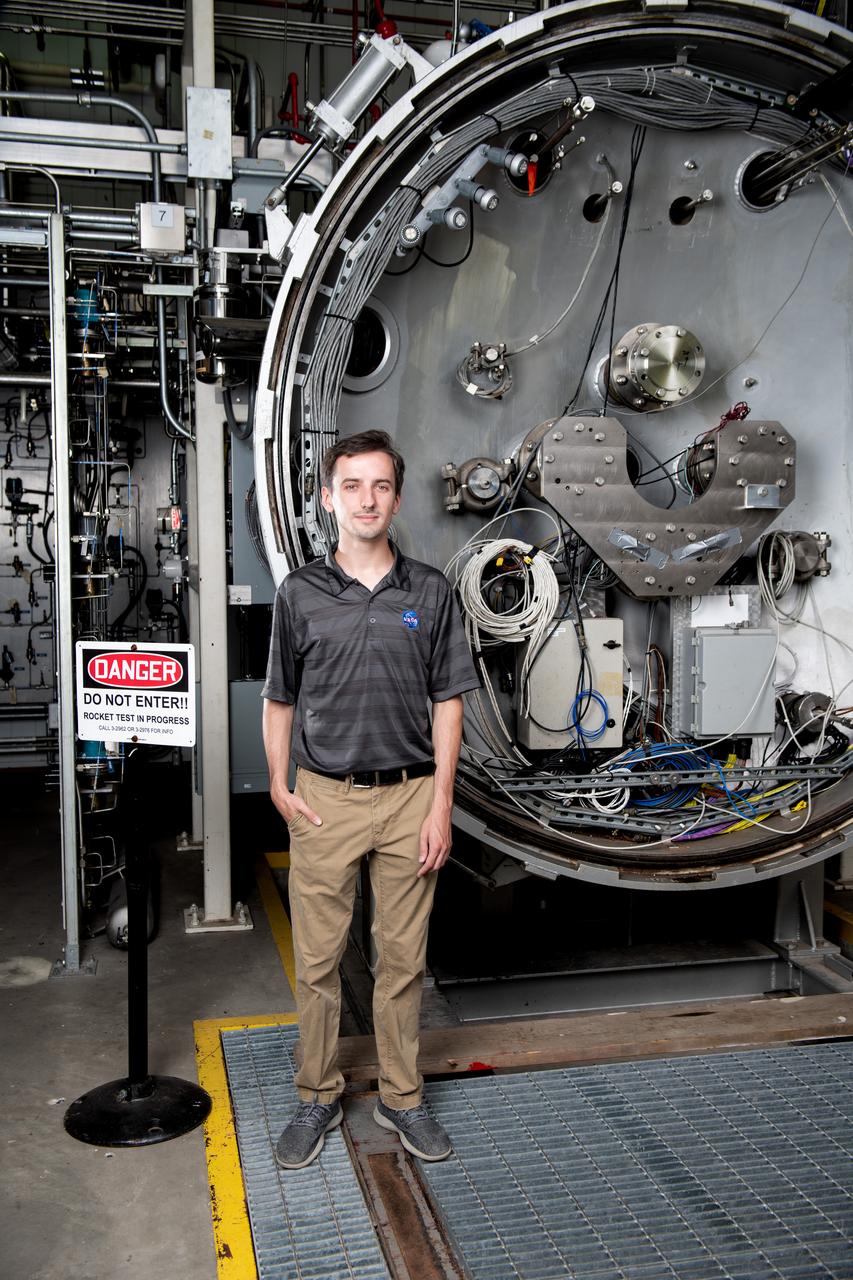
Each year, the NESC produces the NESC Technical Update, which highlights two or three individuals from each Center and includes assessments throughout the year. Because of the critical contributions to the NESC mission this year, Rob Jankovsky, NESC Chief Engineer at GRC, chose two individuals to be highlighted. This year, it is Andrew Ring and Michael Cooper. The Lead Analyst for GRC’s Chemical and Thermal Propulsion Systems branch, Mr. Michael Cooper, is supporting NESC test operations on reaction control system thrusters for Gateway’s Power & Propulsion Element. “These thrusters are small with few moving parts, but the heat and mass transfers involved are very complex,” he said. The test campaign is putting the thrusters through a rigorous profile to simulate the lifetime they will experience over decades in space. Mr. Cooper is analyzing test data gathered on chamber pressure, temperature, flow rates, and more to develop models on thruster performance. He also built the tool that read in that data from the test stand instrumentation. Photo Credit: (NASA/Sara Lowthian-Hanna)
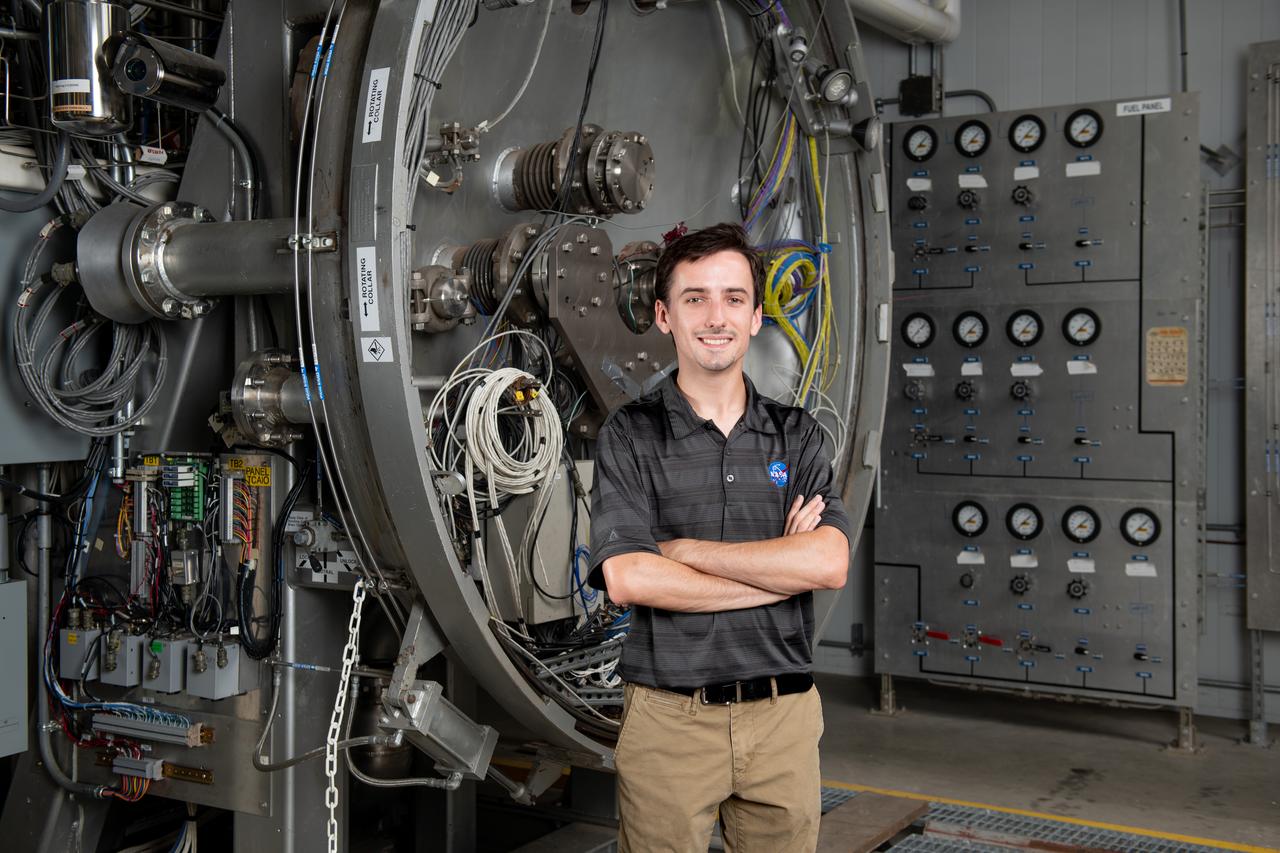
Each year, the NESC produces the NESC Technical Update, which highlights two or three individuals from each Center and includes assessments throughout the year. Because of the critical contributions to the NESC mission this year, Rob Jankovsky, NESC Chief Engineer at GRC, chose two individuals to be highlighted. This year, it is Andrew Ring and Michael Cooper. The Lead Analyst for GRC’s Chemical and Thermal Propulsion Systems branch, Mr. Michael Cooper, is supporting NESC test operations on reaction control system thrusters for Gateway’s Power & Propulsion Element. “These thrusters are small with few moving parts, but the heat and mass transfers involved are very complex,” he said. The test campaign is putting the thrusters through a rigorous profile to simulate the lifetime they will experience over decades in space. Mr. Cooper is analyzing test data gathered on chamber pressure, temperature, flow rates, and more to develop models on thruster performance. He also built the tool that read in that data from the test stand instrumentation. Photo Credit: (NASA/Sara Lowthian-Hanna)

Kelvin Manning, at left, Kennedy Space Center’s associate director, technical, visits one of the exhibitors at the Community Leaders Update, hosted by the center on Feb. 18, 2020, at the Kennedy Space Center Visitor Complex. At right is Tassos Abadiotakis, KIAC program manager. A panel discussion was moderated by Center Director Bob Cabana during the update. Attendees included community leaders, business executives, partners, educators and government leaders. After the presentation, guests had the opportunity to ask questions and visit displays from the programs and some of the commercial partners.

Jennifer Kunz, associate director, technical, at NASA’s Kennedy Space Center in Florida, participates in a virtual Town Hall meeting on Jan. 13, 2022, for Kennedy employees. Center Director Janet Petro and other center executive leaders hosted the virtual town hall to provide updates on center milestones and answer questions.
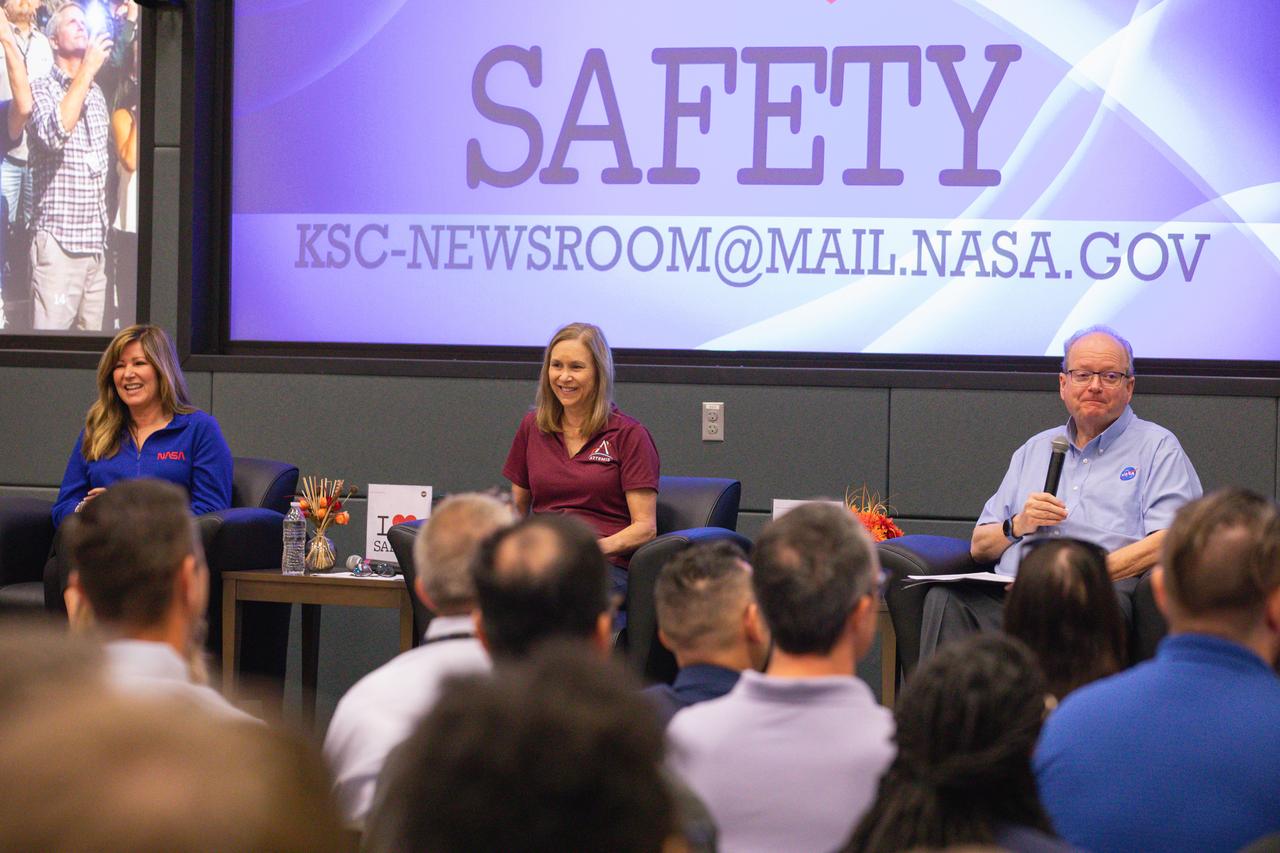
From left, Jennifer Kunz, associate director, technical; Janet Petro, center director; and Burt Summerfield, associate director, management, at NASA’s Kennedy Space Center in Florida participate in an employee town hall meeting held on Thursday, May 9, 2024, at Kennedy’s Operations Support Building II. Center leadership provided the workforce a center update, safety presentation, and answered employee questions during the town hall.
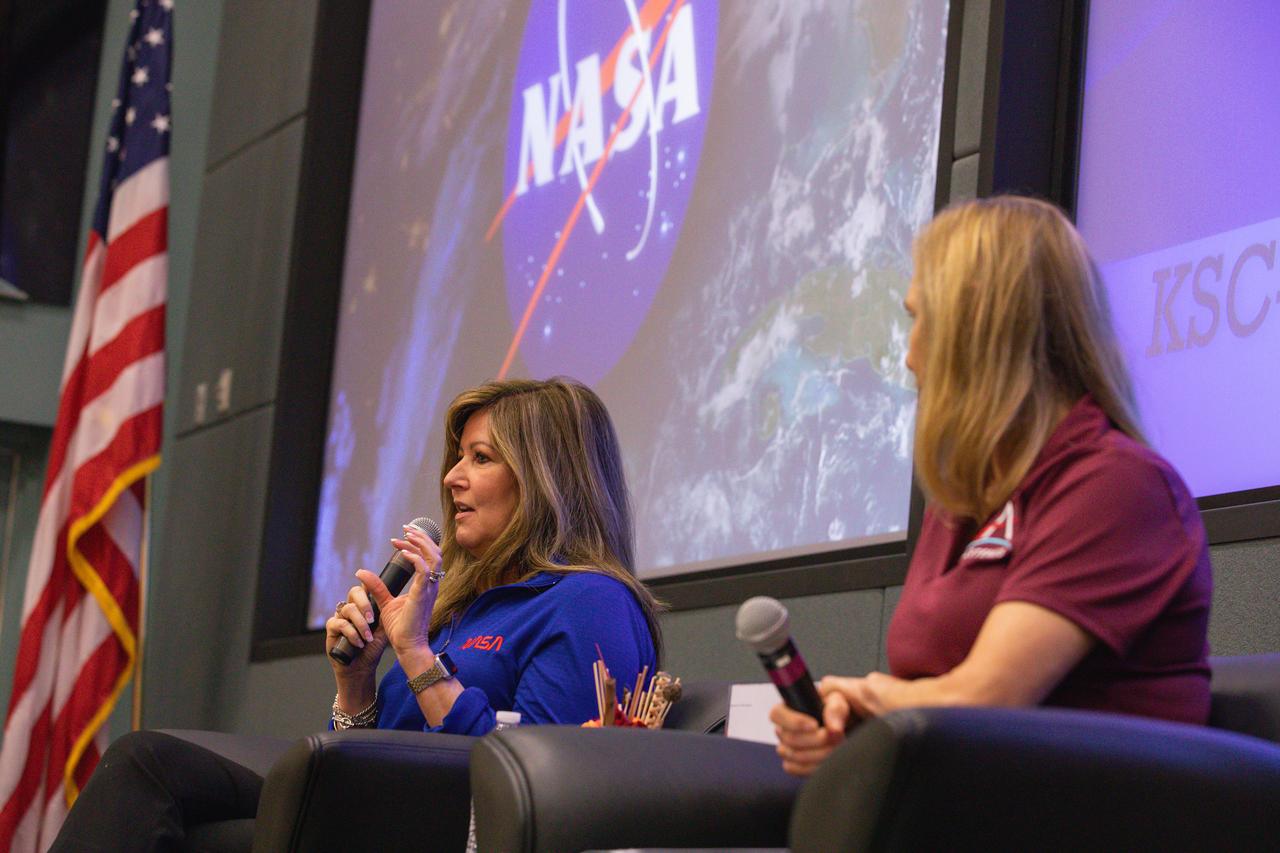
From left, Jennifer Kunz, associate director, technical, and Janet Petro, center director, at NASA’s Kennedy Space Center in Florida participate in an employee town hall meeting held on Thursday, May 9, 2024, at Kennedy’s Operations Support Building II. Center leadership provided the workforce a center update, safety presentation, and answered employee questions during the town hall.
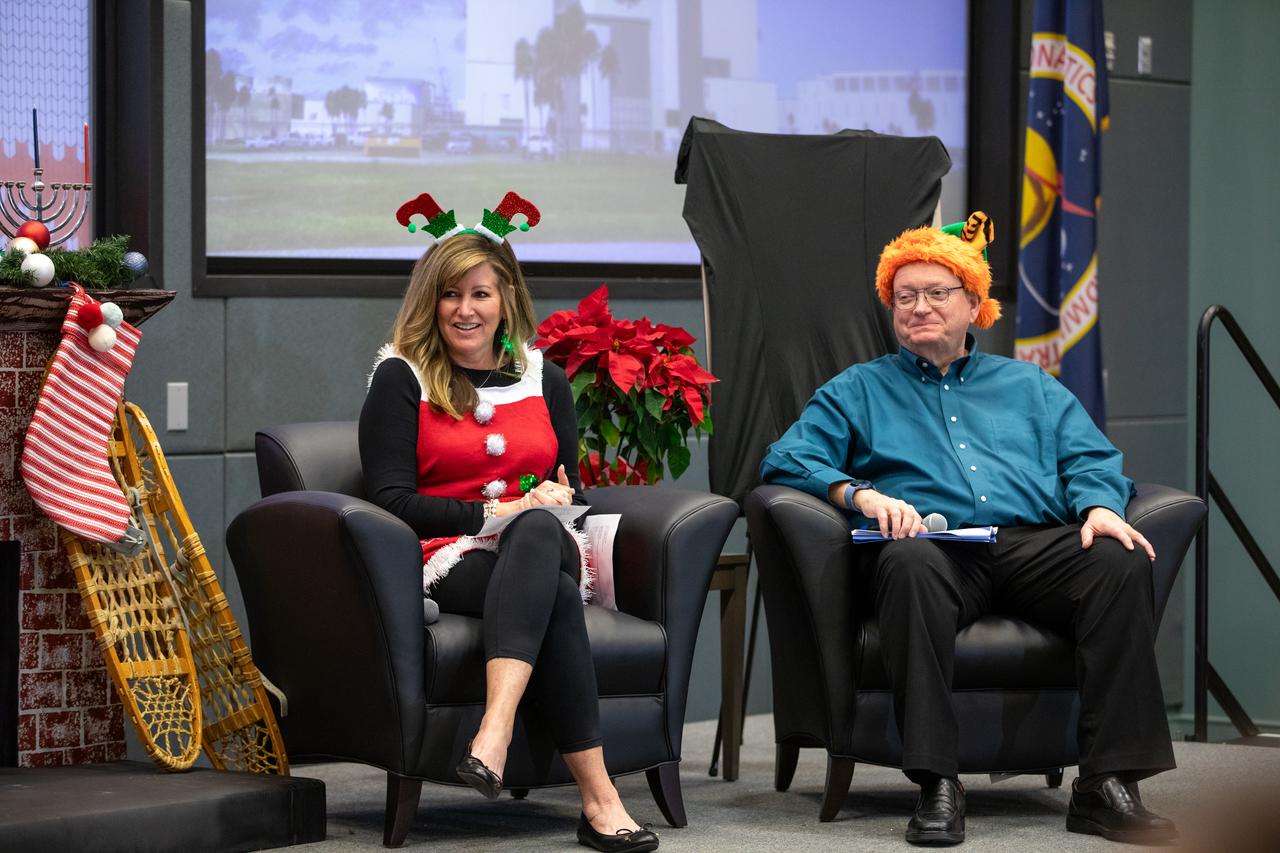
From left, Jennifer Kunz, associate director, technical, and Burt Summerfield, associate director, management, at NASA’s Kennedy Space Center in Florida participate in an employee town hall meeting held on Thursday, Dec. 7, 2023, at Kennedy’s Operations Support Building II. Center Director Janet Petro and other executive leadership hosted the meeting to provide updates on center milestones, celebrate the year’s achievements, and answer questions from the workforce.
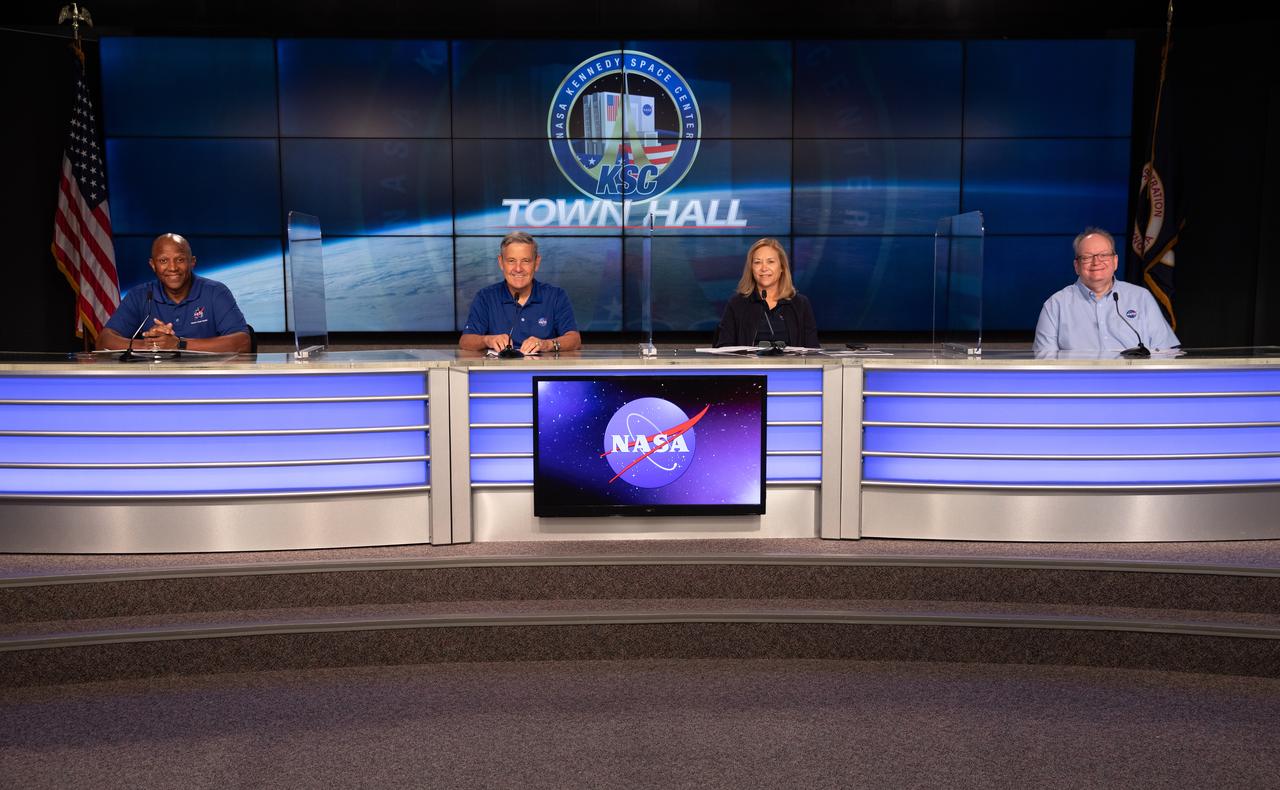
From left, NASA Kennedy Space Center Associate Director, Technical Kelvin Manning; Director Bob Cabana; Deputy Director Janet Petro; and Associate Director, Management Burt Summerfield participate in a virtual town hall meeting on Aug. 20, 2020, inside the Florida spaceport’s Press Site auditorium. During the town hall, Kennedy’s senior leaders answered questions submitted by the workforce and discussed a wide range of topics, including upcoming milestones, updates on the criteria for returning to onsite work, and diversity and inclusion at the multi-user spaceport.
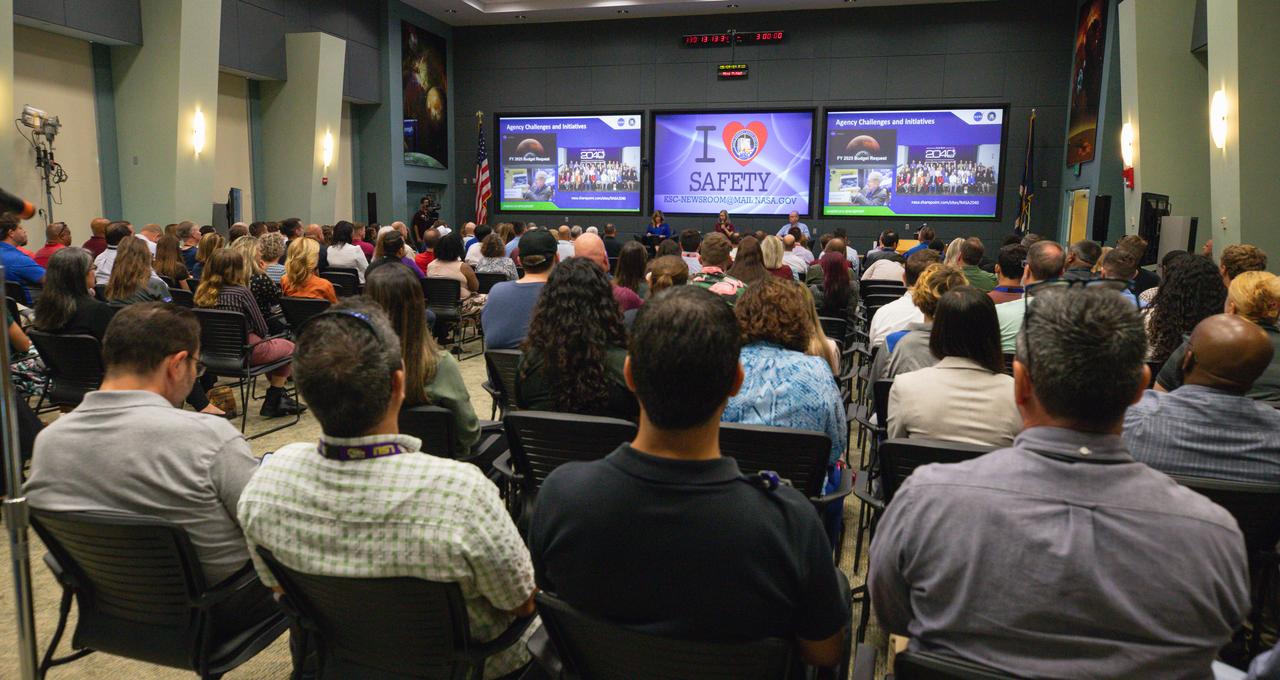
From left, Jennifer Kunz, associate director, technical; Janet Petro, center director; and Burt Summerfield, associate director, management, at NASA’s Kennedy Space Center in Florida participate in an employee town hall meeting held on Thursday, May 9, 2024, at Kennedy’s Operations Support Building II. Center leadership provided the workforce a center update, safety presentation, and answered employee questions during the town hall.
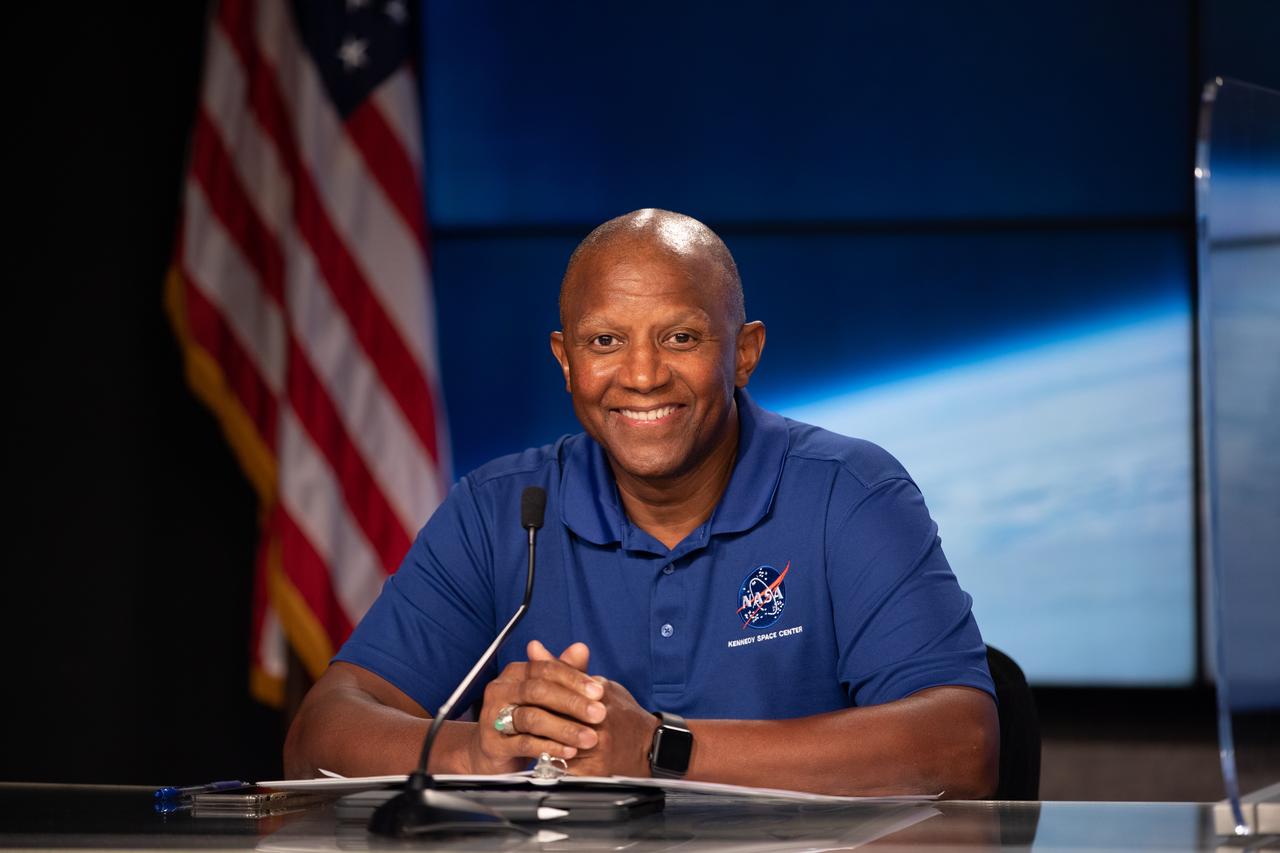
NASA Kennedy Space Center Associate Director, Technical Kelvin Manning participates in a virtual town hall meeting on Aug. 20, 2020, inside the Florida spaceport’s Press Site auditorium. During the town hall, Kennedy’s senior leaders answered questions submitted by the workforce and discussed a wide range of topics, including upcoming milestones, updates on the criteria for returning to onsite work, and diversity and inclusion at the multi-user spaceport.

From left, Jennifer Kunz, associate director, technical, and Burt Summerfield, associate director, management, at NASA’s Kennedy Space Center in Florida participate in an employee town hall meeting held on Thursday, Dec. 7, 2023, at Kennedy’s Operations Support Building II. Center Director Janet Petro and other executive leadership hosted the meeting to provide updates on center milestones, celebrate the year’s achievements, and answer questions from the workforce.
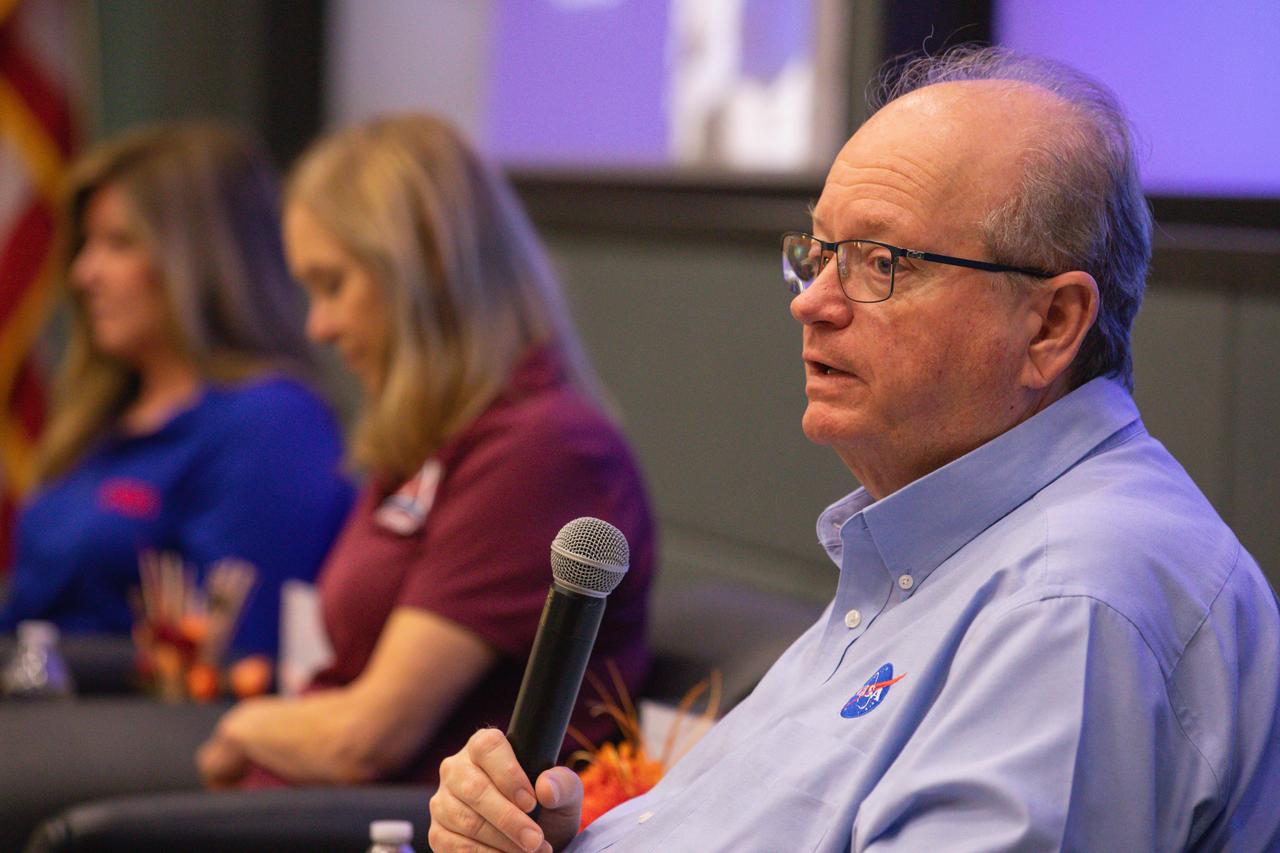
From left, Jennifer Kunz, associate director, technical; Janet Petro, center director; and Burt Summerfield, associate director, management, at NASA’s Kennedy Space Center in Florida participate in an employee town hall meeting held on Thursday, May 9, 2024, at Kennedy’s Operations Support Building II. Center leadership provided the workforce a center update, safety presentation, and answered employee questions during the town hall.
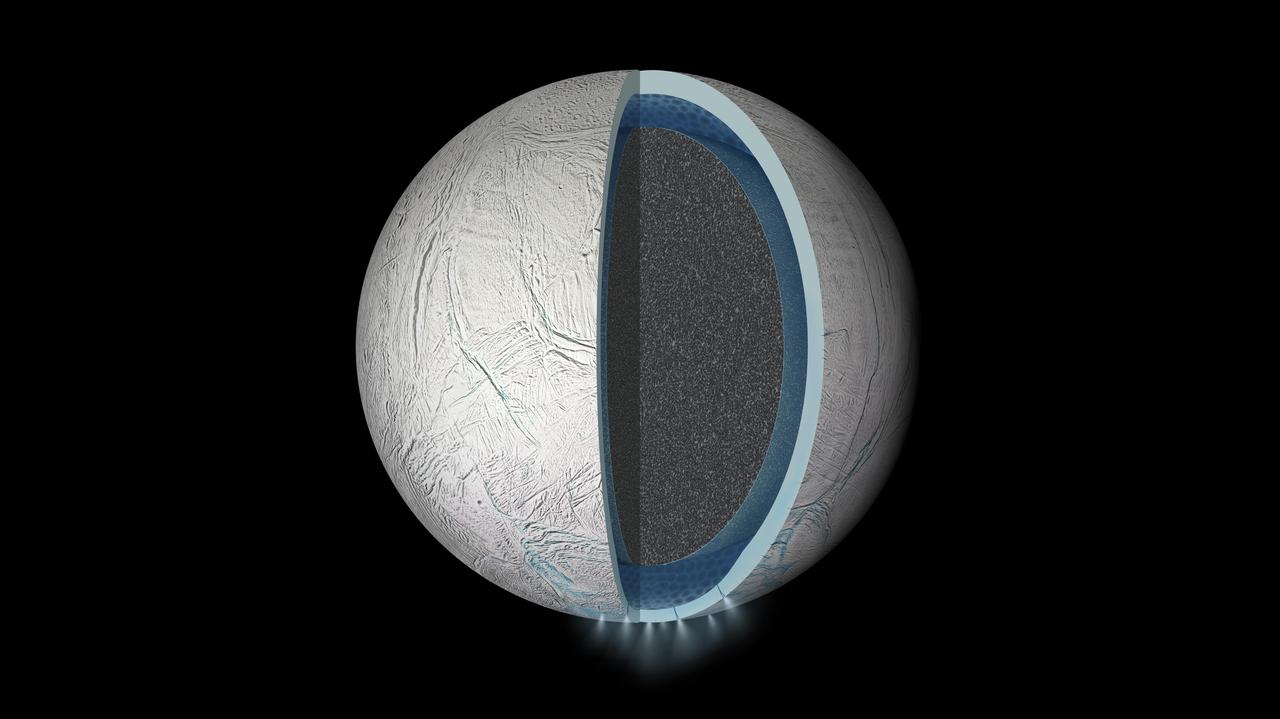
This illustration is a speculative representation of the interior of Saturn's moon Enceladus with a global liquid water ocean between its rocky core and icy crust. The thickness of layers shown here is not to scale. Scientists on NASA's Cassini mission determined that the slight wobble of Enceladus as it orbits Saturn is much too large for the moon to be frozen from surface to core. The wobble, technically referred to as a libration, reveals that the crust of Enceladus is disconnected from its rocky interior. This graphic is an update to PIA19058, which showed only a regional sea beneath the south polar region of Enceladus. Enceladus is 313 miles (504 kilometers) across. http://photojournal.jpl.nasa.gov/catalog/PIA19656
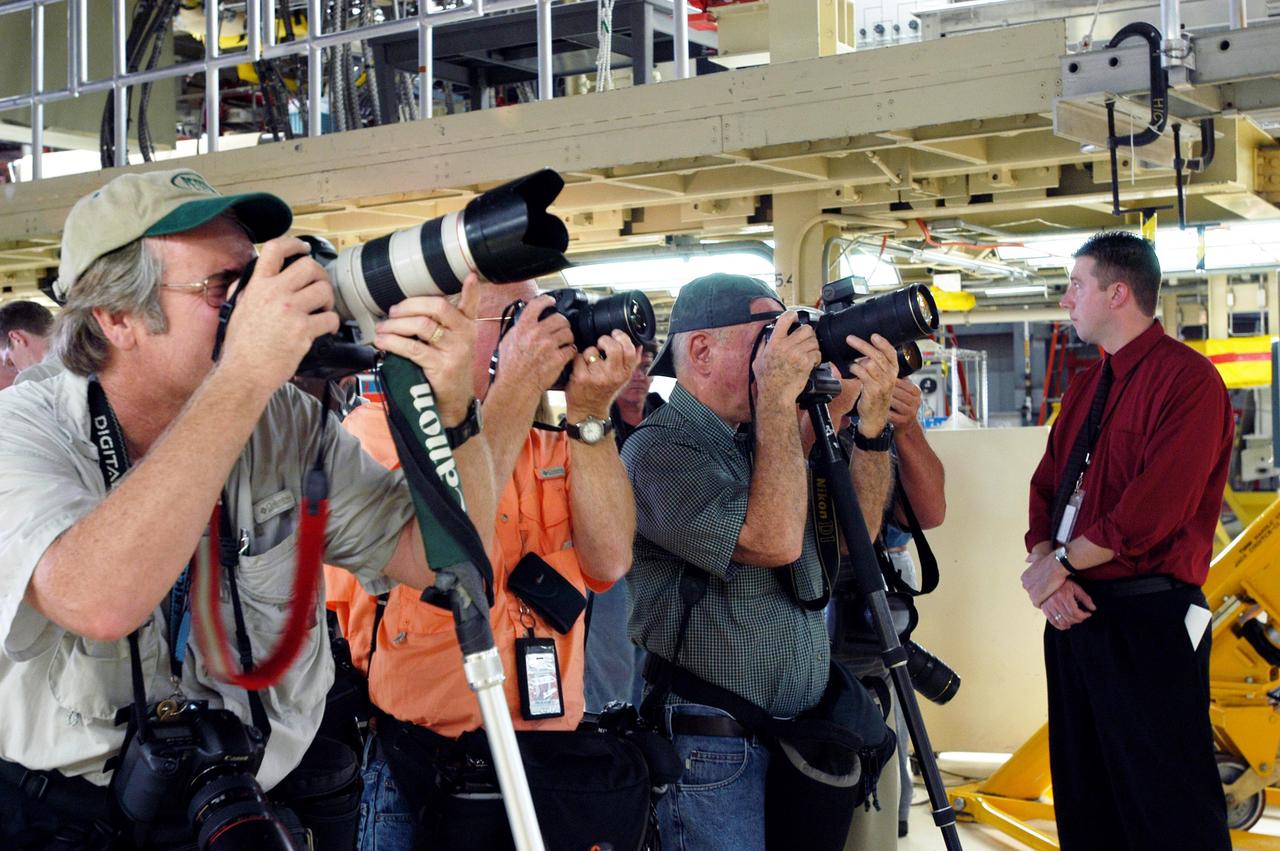
KENNEDY SPACE CENTER, FLA. - Media tour the Orbiter Processing Facility (OPF) housing the Space Shuttle Discovery at KSC. During this event, they received the latest information on Discovery’s processing and viewed workers preparing the vehicle for its safe return to flight scheduled for a launch planning window of March 2005. Kicking off the activities at the Press Site Auditorium, technical experts led two workshops addressing Reinforced Carbon-Carbon and vehicle instrumentation. Later, reporters toured the OPF to see work in progress on Discovery, including reinstallation of the Reinforced Carbon-Carbon panels on the Shuttle's wing leading edge, wiring inspections and instrumentation updates being completed for Return to Flight.
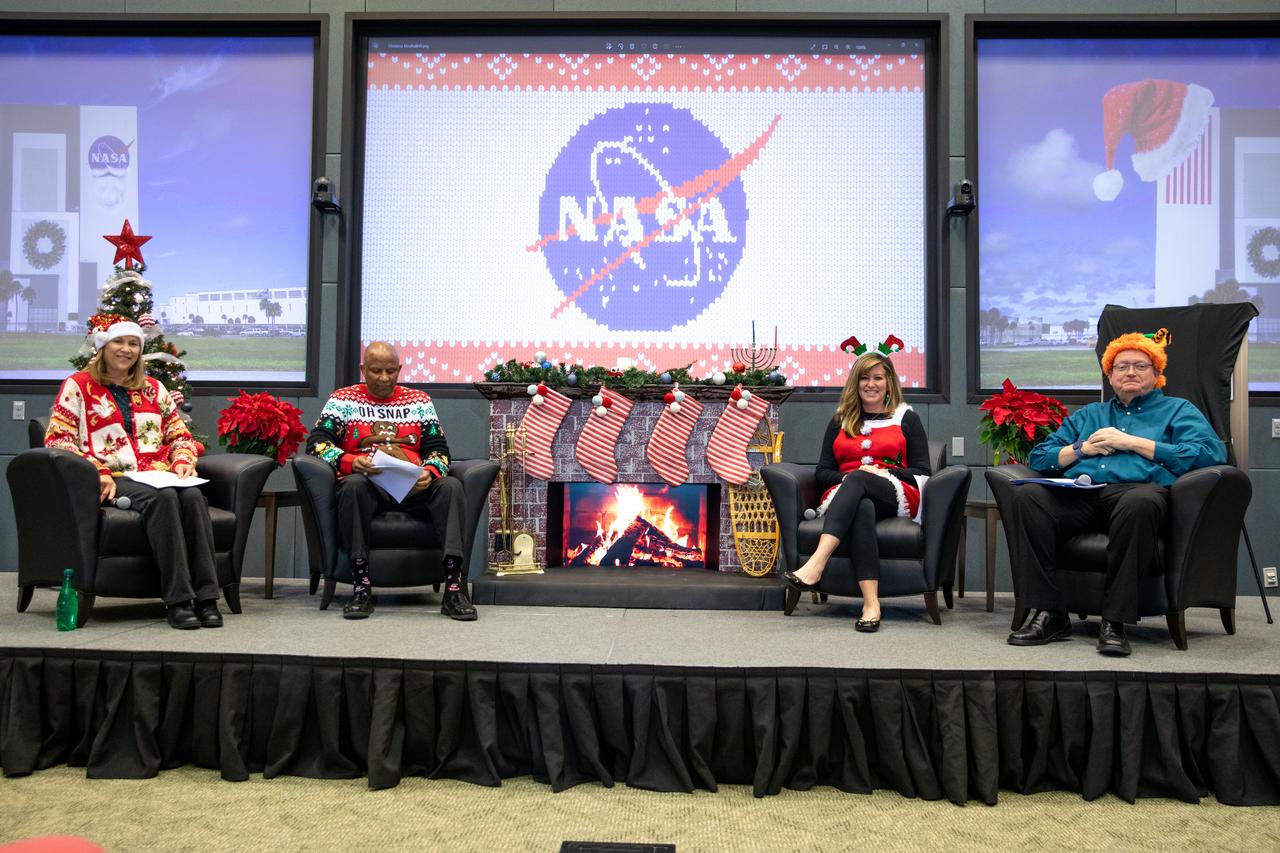
From left, NASA’s Kennedy Space Center Director Janet Petro, Kennedy Space Center Deputy Director Kelvin Manning, Kennedy Space Center Associate Director, Technical, Jennifer Kunz, and Kennedy Space Center Associate Director of Management Burt Summerfield participate in an employee town hall meeting held on Thursday, Dec. 7, 2023, at Kennedy’s Operations Support Building II. Kennedy’s executive leadership team donned holiday sweaters and competed for the title of “most festive” as they provided updates on center milestones, celebrated the year’s achievements, and answered questions from the workforce.
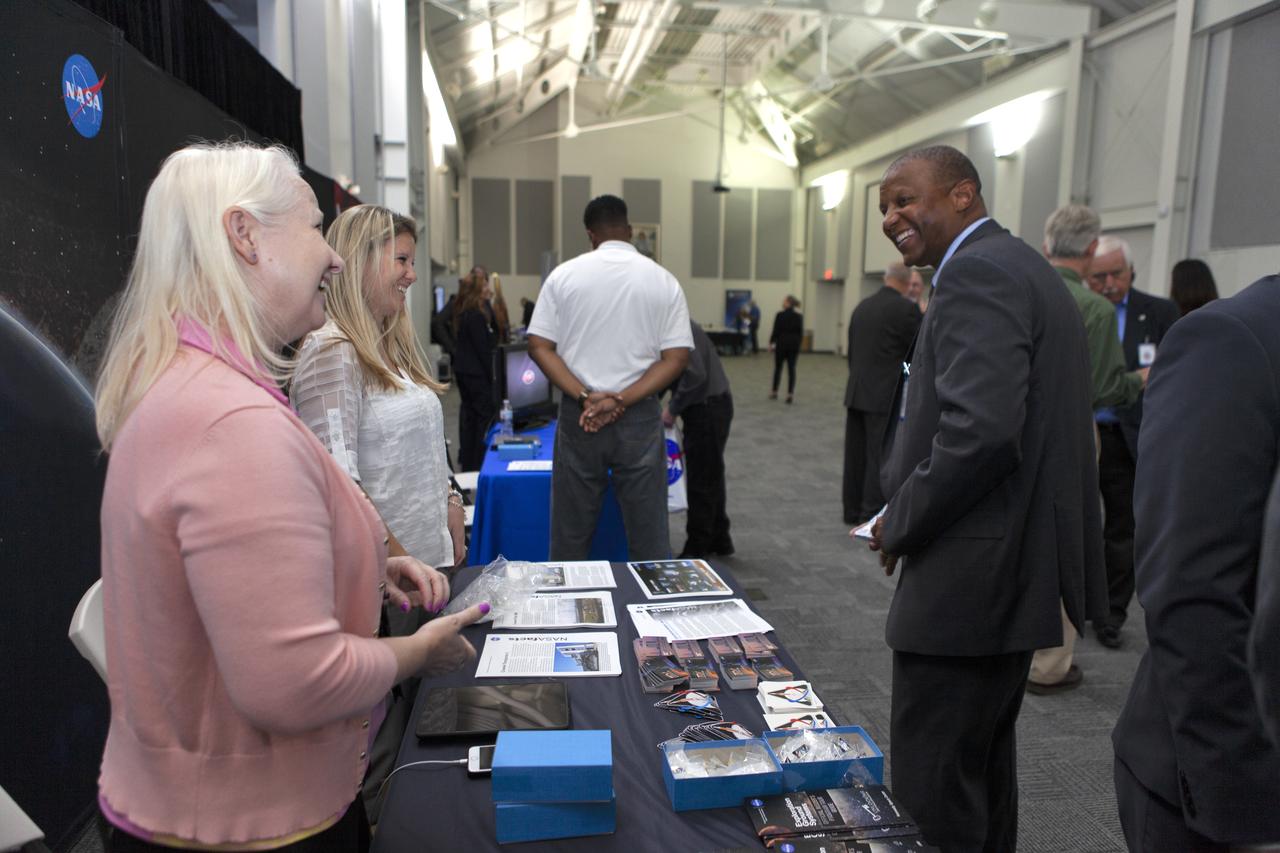
Kelvin Manning, Kennedy associate director, technical, at right, visits with representatives from Exploration Ground Systems during the center director update to community leaders, business executives, partners, educators and government leaders on March 29, 2019, at the Kennedy Space Center Visitor Complex in Florida. Center Director Bob Cabana recapped achievements and future plans for Kennedy-led programs, including the Commercial Crew Program, Exploration Ground Systems, Launch Services Program, Exploration Research and Technology, and Center Planning and Development. After the presentation, guests had the opportunity to ask questions and visit displays from the programs and some of the commercial partners.
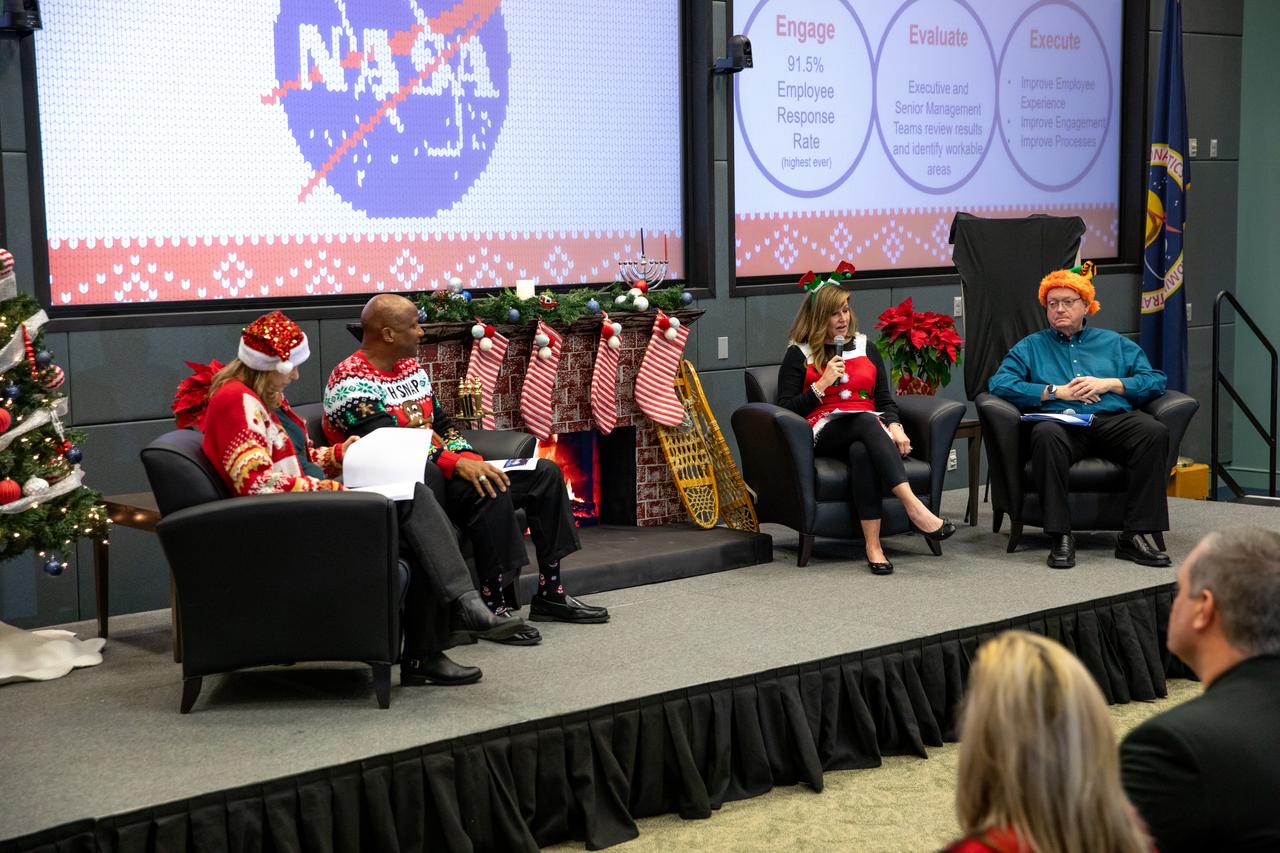
From left, NASA’s Kennedy Space Center Director Janet Petro, Kennedy Space Center Deputy Director Kelvin Manning, Kennedy Space Center Associate Director, Technical, Jennifer Kunz, and Kennedy Space Center Associate Director of Management Burt Summerfield participate in an employee town hall meeting held on Thursday, Dec. 7, 2023, at Kennedy’s Operations Support Building II. Kennedy’s executive leadership team donned holiday sweaters and competed for the title of “most festive” as they provided updates on center milestones, celebrated the year’s achievements, and answered questions from the workforce.
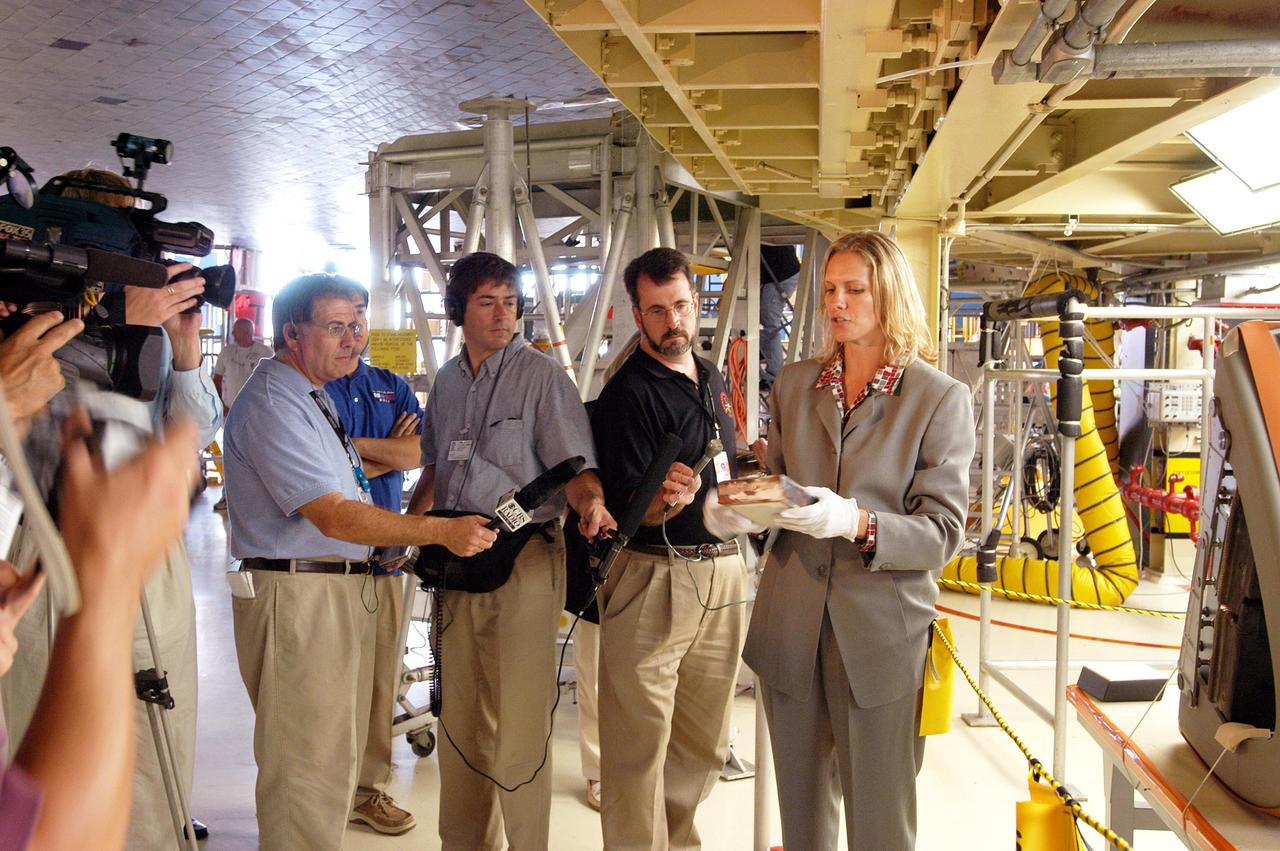
KENNEDY SPACE CENTER, FLA. - Stephanie Stilson (right), NASA Vehicle Manager, briefs the media attending an informative workshop and tour of the Orbiter Processing Facility (OPF) housing the Space Shuttle Discovery at KSC. During this event, the media received the latest information on Discovery’s processing and viewed workers preparing the vehicle for its safe return to flight scheduled for a launch planning window of March 2005. Kicking off the activities at the Press Site Auditorium, technical experts led two workshops addressing Reinforced Carbon-Carbon and vehicle instrumentation. During the tour of the OPF, reporters saw work in progress on Discovery, including reinstallation of the Reinforced Carbon-Carbon panels on the Shuttle's wing leading edge, wiring inspections and instrumentation updates being completed for Return to Flight.
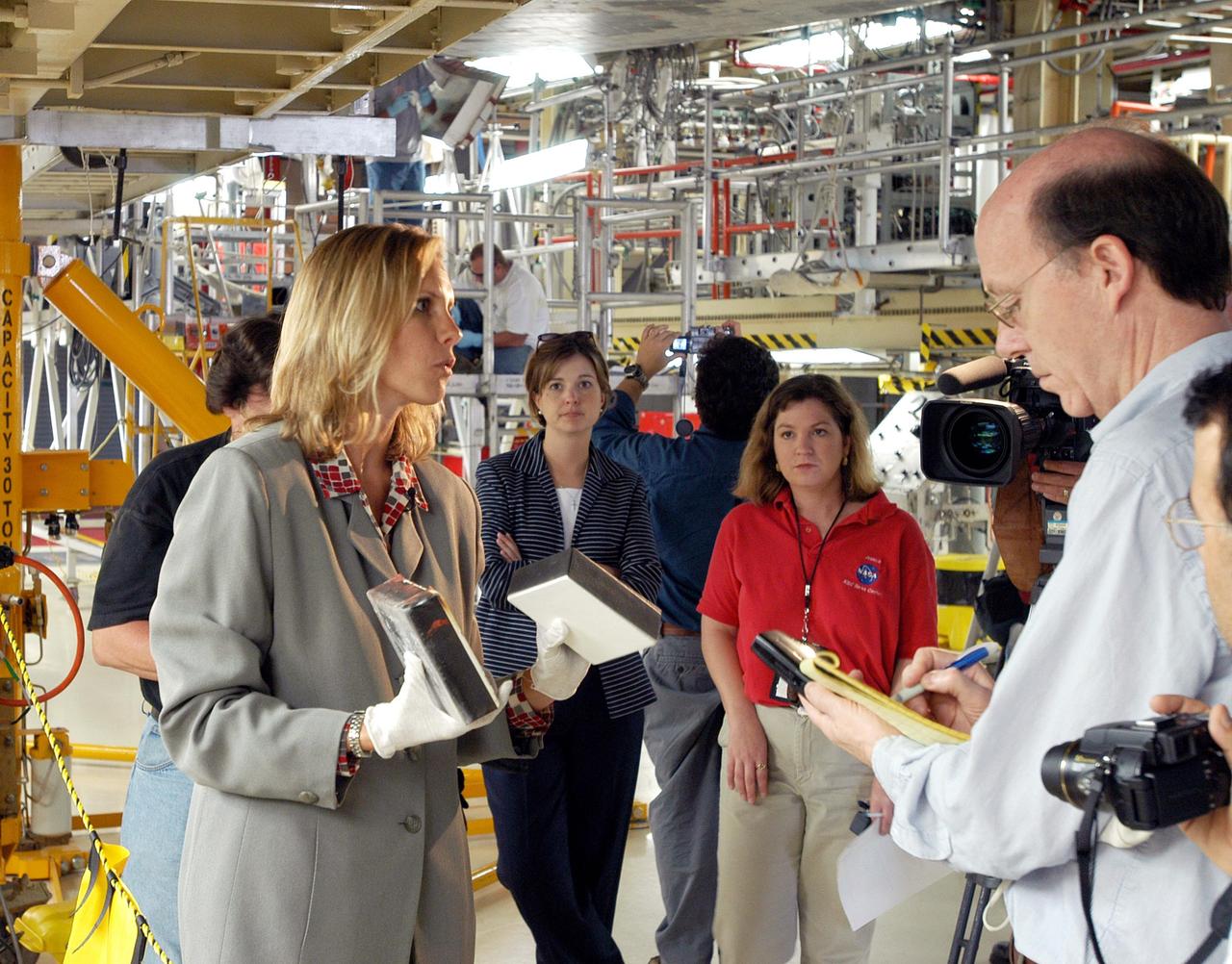
KENNEDY SPACE CENTER, FLA. - Stephanie Stilson (left), NASA Vehicle Manager, briefs the media attending an informative workshop and tour of the Orbiter Processing Facility (OPF) housing the Space Shuttle Discovery at KSC. During this event, the media received the latest information on Discovery’s processing and viewed workers preparing the vehicle for its safe return to flight scheduled for a launch planning window of March 2005. Kicking off the activities at the Press Site Auditorium, technical experts led two workshops addressing Reinforced Carbon-Carbon and vehicle instrumentation. During the tour of the OPF, reporters saw work in progress on Discovery, including reinstallation of the Reinforced Carbon-Carbon panels on the Shuttle's wing leading edge, wiring inspections and instrumentation updates being completed for Return to Flight.
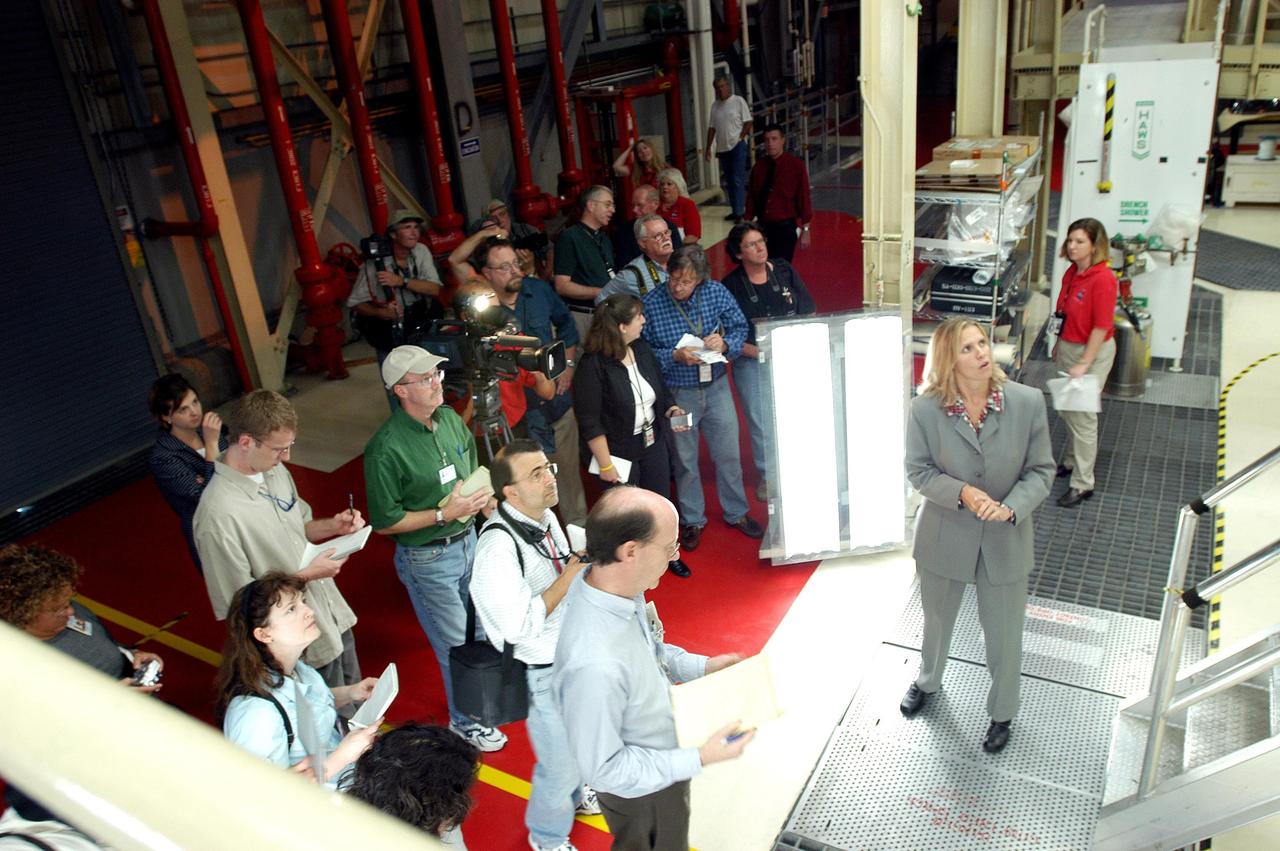
KENNEDY SPACE CENTER, FLA. - Stephanie Stilson (second from right), NASA Vehicle Manager, briefs the media attending an informative workshop and tour of the Orbiter Processing Facility (OPF) housing the Space Shuttle Discovery at KSC. During this event, the media received the latest information on Discovery’s processing and viewed workers preparing the vehicle for its safe return to flight scheduled for a launch planning window of March 2005. Kicking off the activities at the Press Site Auditorium, technical experts led two workshops addressing Reinforced Carbon-Carbon and vehicle instrumentation. During the tour of the OPF, reporters saw work in progress on Discovery, including reinstallation of the Reinforced Carbon-Carbon panels on the Shuttle's wing leading edge, wiring inspections and instrumentation updates being completed for Return to Flight.
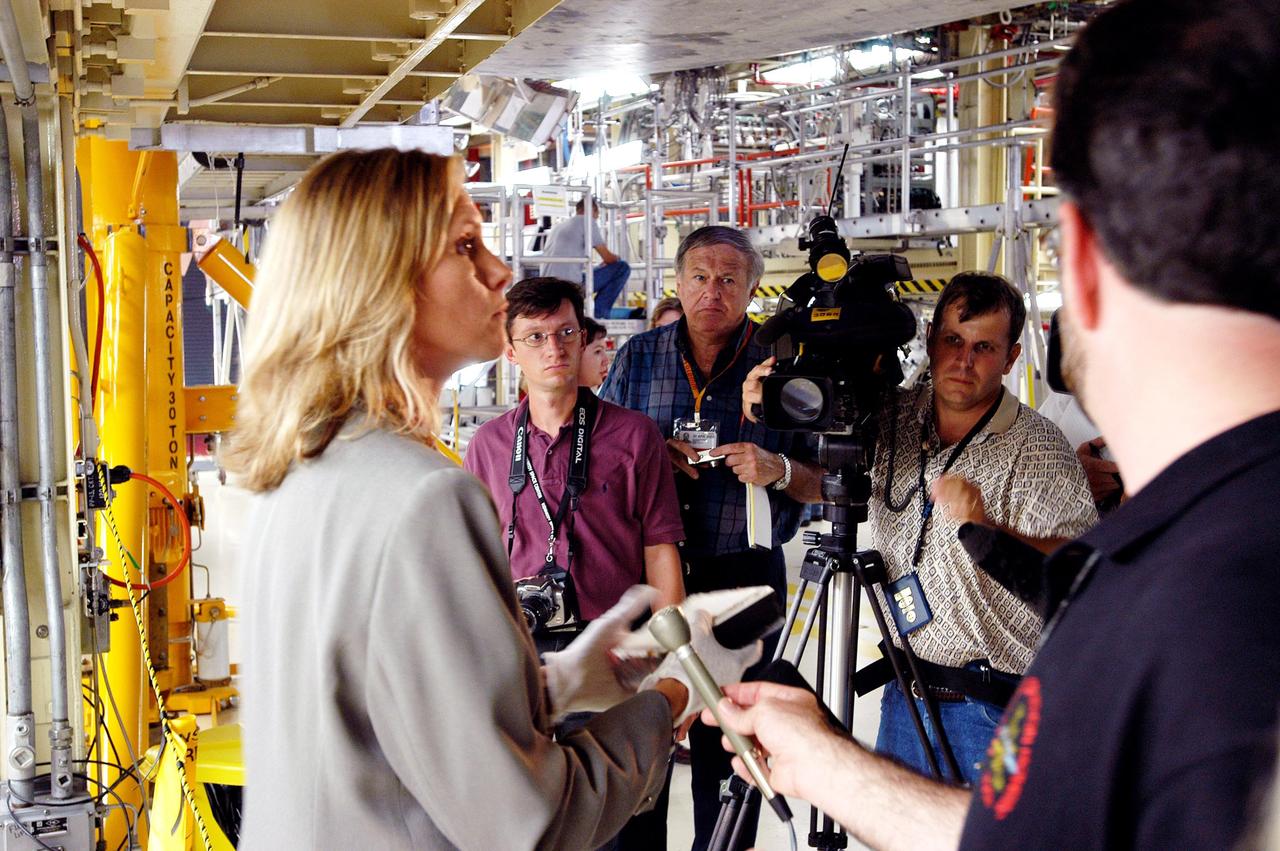
KENNEDY SPACE CENTER, FLA. - Stephanie Stilson (left), NASA Vehicle Manager, briefs the media attending an informative workshop and tour of the Orbiter Processing Facility (OPF) housing the Space Shuttle Discovery at KSC. During this event, the media received the latest information on Discovery’s processing and viewed workers preparing the vehicle for its safe return to flight scheduled for a launch planning window of March 2005. Kicking off the activities at the Press Site Auditorium, technical experts led two workshops addressing Reinforced Carbon-Carbon and vehicle instrumentation. During the tour of the OPF, reporters saw work in progress on Discovery, including reinstallation of the Reinforced Carbon-Carbon panels on the Shuttle's wing leading edge, wiring inspections and instrumentation updates being completed for Return to Flight.
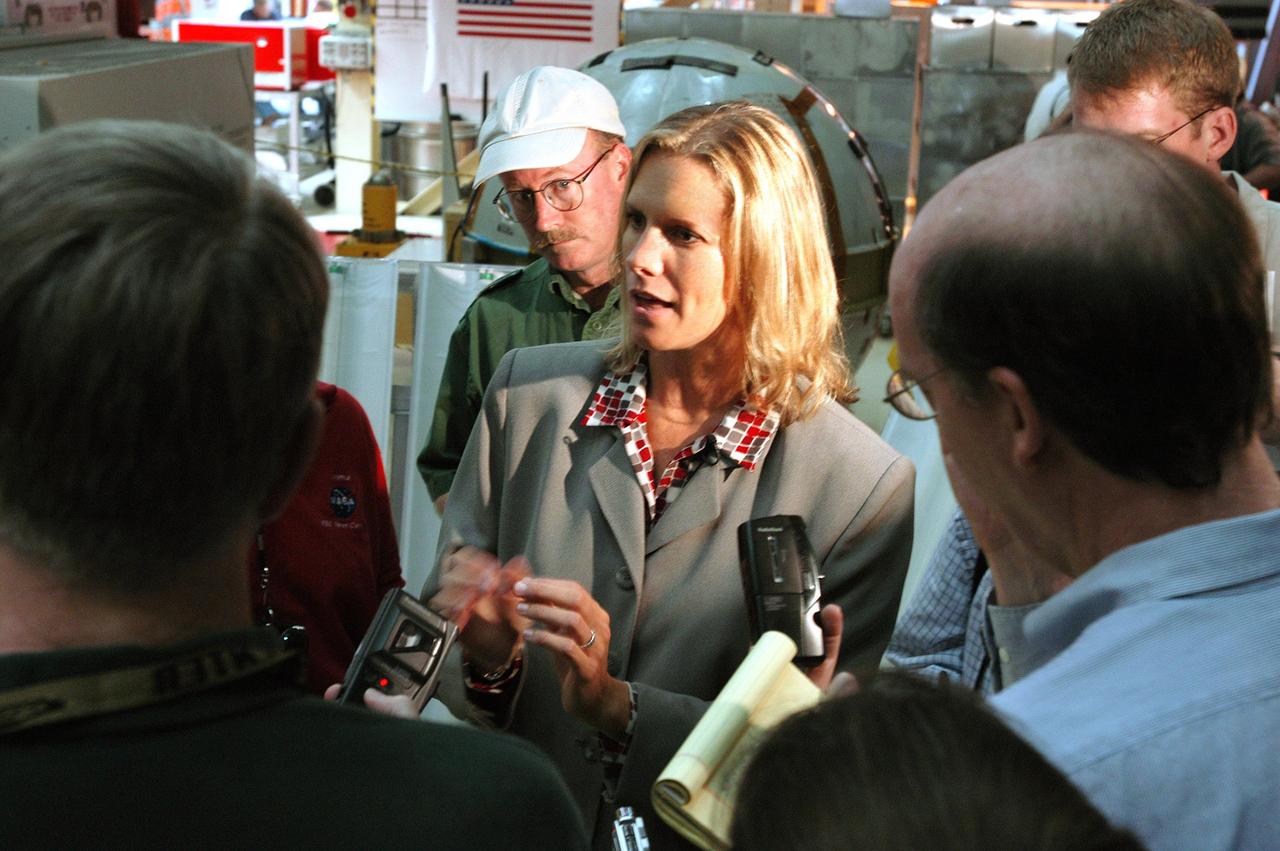
KENNEDY SPACE CENTER, FLA. - Stephanie Stilson (center), NASA Vehicle Manager, briefs the media attending an informative workshop and tour of the Orbiter Processing Facility (OPF) housing the Space Shuttle Discovery at KSC. During this event, the media received the latest information on Discovery’s processing and viewed workers preparing the vehicle for its safe return to flight scheduled for a launch planning window of March 2005. Kicking off the activities at the Press Site Auditorium, technical experts led two workshops addressing Reinforced Carbon-Carbon and vehicle instrumentation. During the tour of the OPF, reporters saw work in progress on Discovery, including reinstallation of the Reinforced Carbon-Carbon panels on the Shuttle's wing leading edge, wiring inspections and instrumentation updates being completed for Return to Flight.
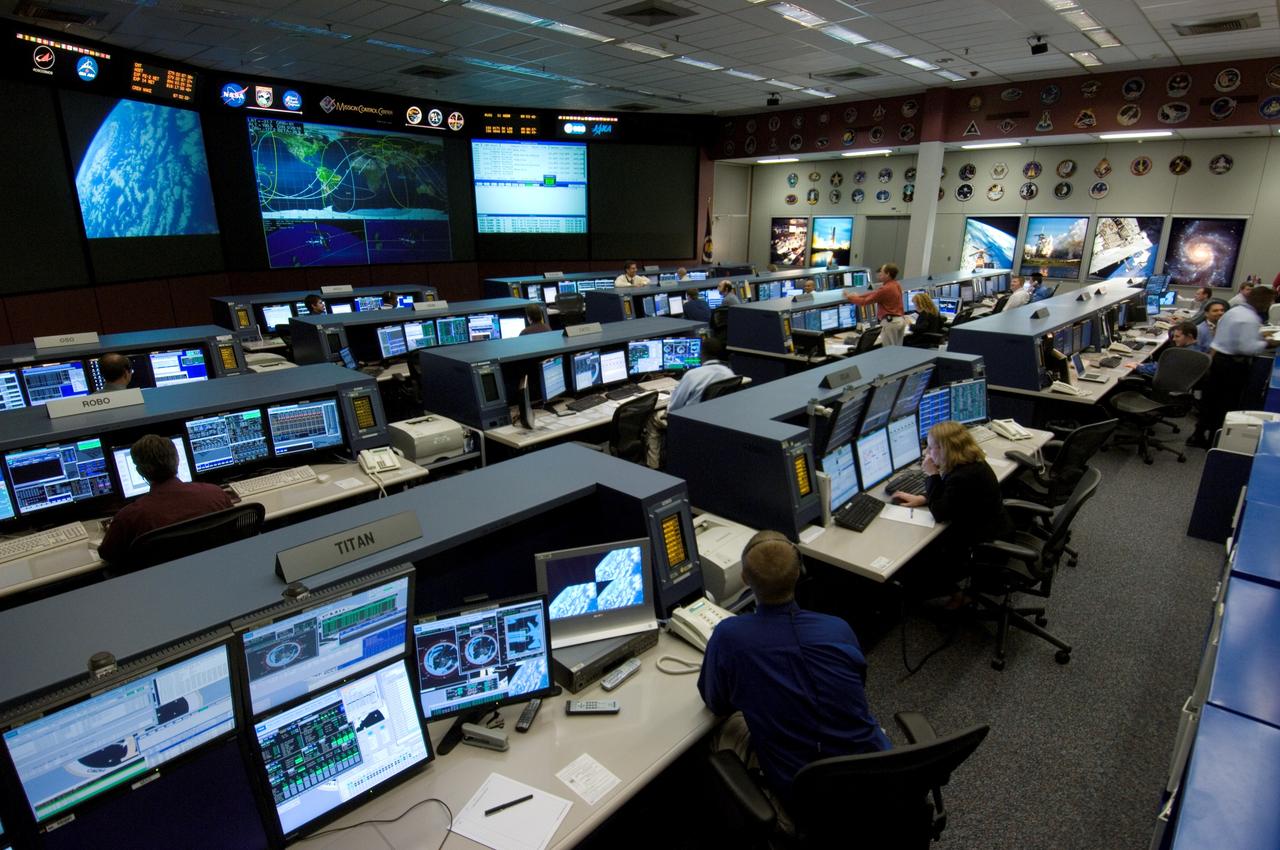
JSC2006-E-43860 (6 Oct. 2006)--- International Space Station flight controllers have this area as their new home with increased technical capabilities, more workspace and a long, distinguished history. The newly updated facility is just down the hall from its predecessor at NASA's Johnson Space Center, Houston. Known as Flight Control Room 1, it was first used to control a space flight 38 years ago, the mission of Apollo 7 launched Oct. 11, 1968. It was one of two control rooms for NASA's manned missions. The room it replaces in its new ISS role, designated the Blue Flight Control Room, had been in operation since the first station component was launched in 1998.
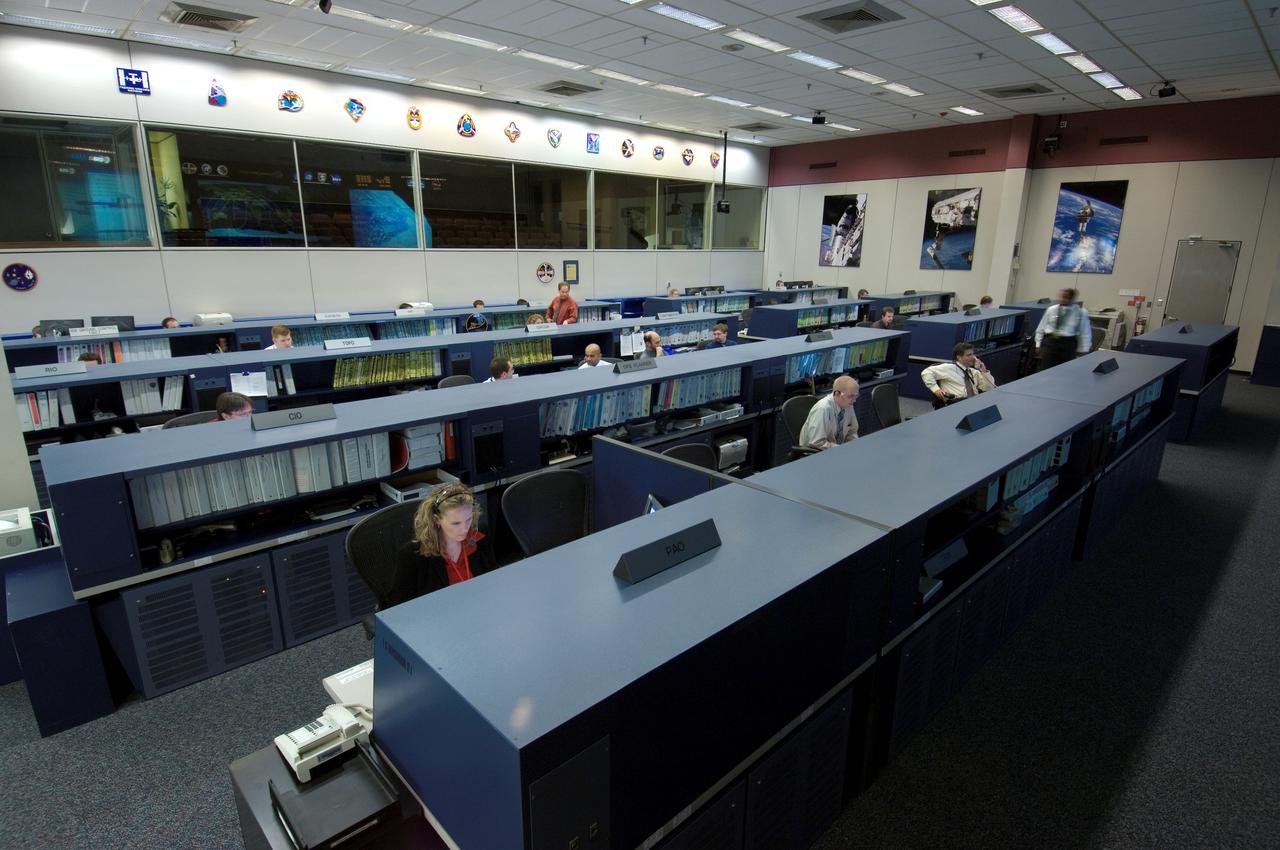
JSC2006-E-43863 (6 Oct. 2006)--- International Space Station flight controllers have this area as their new home with increased technical capabilities, more workspace and a long, distinguished history. The newly updated facility is just down the hall from its predecessor at NASA's Johnson Space Center, Houston. This view is toward the rear of the "new" room. Known as Flight Control Room 1, it was first used to control a space flight 38 years ago, the mission of Apollo 7 launched Oct. 11, 1968. It was one of two control rooms for NASA's manned missions. The room it replaces in its new ISS role, designated the Blue Flight Control Room, had been in operation since the first station component was launched in 1998.
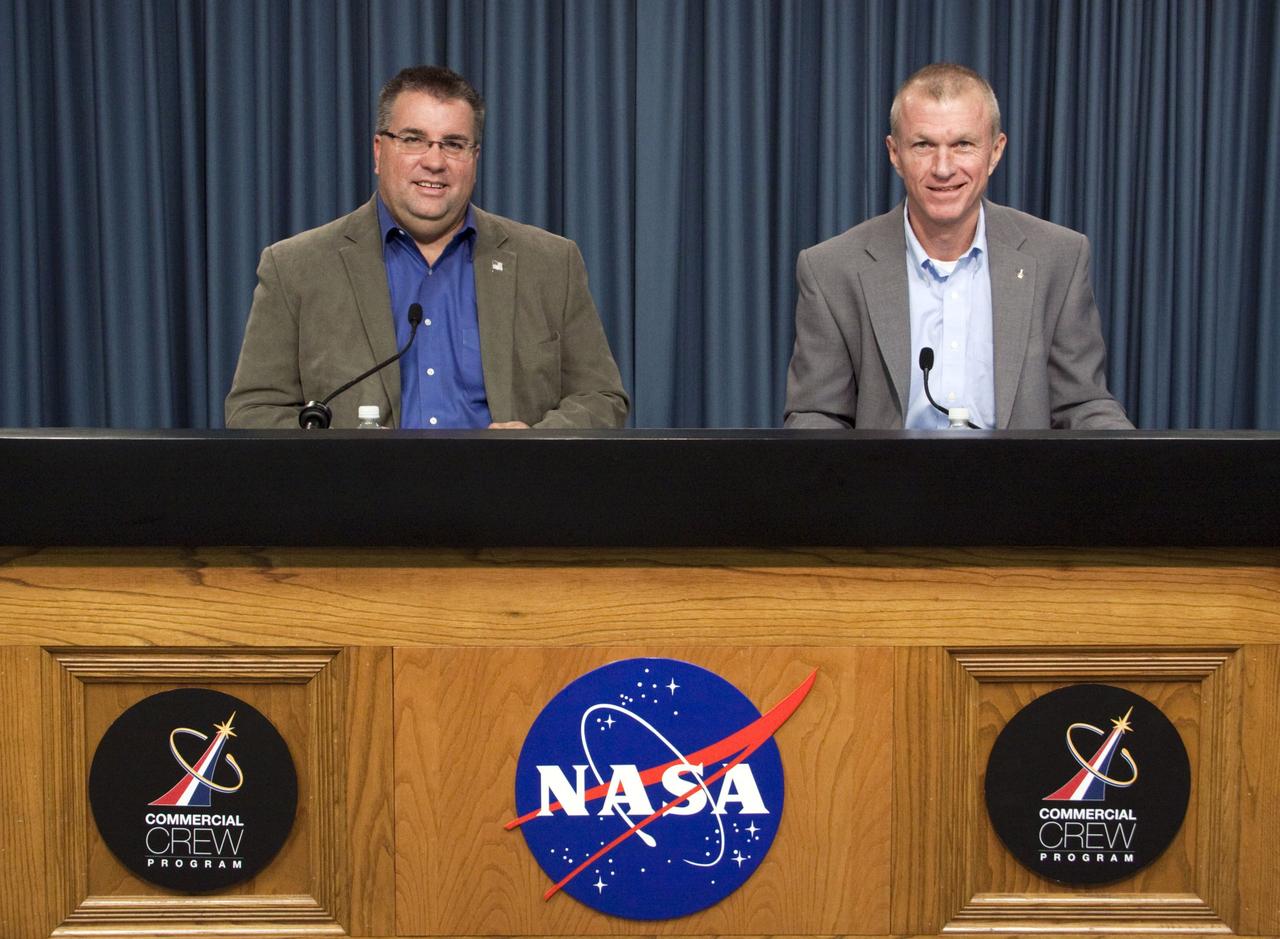
CAPE CANAVERAL, Fla. -- Commercial Crew Program (CCP) Manager Ed Mango, left, and Deputy Program Manager Brent Jett host a Program Strategy Forum at NASA's Kennedy Space Center in Florida. The forum was held to update industry partners about NASA's decision to use multiple, competitively awarded Space Act Agreements (SAAs) instead of an Integrated Design Contract for the agency's next phase of developing commercial space transportation system capabilities. Using SAAs instead of a contract will allow NASA to maintain multiple partners, with the flexibility to adjust technical direction, milestones and funding. The move was made so the program could adapt to dynamic budgetary circumstances while maintaining a high level of competition among transportation providers. CCP is helping to mature the design and development of a crew transportation system with the overall goal of accelerating a United States-led capability to the International Space Station. The goal of the program is to drive down the cost of space travel as well as open up space to more people than ever before by balancing industry’s own innovative capabilities with NASA's 50 years of human spaceflight experience. For more information, visit www.nasa.gov/commercialcrew. Photo credit: NASA/Jim Grossmann

For the 30th anniversary of one of the most iconic images taken by NASA's Voyager mission, a new version of the image known as "the Pale Blue Dot." Planet Earth is visible as a bright speck within the sunbeam just right of center and appears softly blue, as in the original version published in 1990 (see PIA00452). This updated version uses modern image-processing software and techniques to revisit the well-known Voyager view while attempting to respect the original data and intent of those who planned the images. In 1990, the Voyager project planned to shut off the Voyager 1 spacecraft's imaging cameras to conserve power and because the probe, along with its sibling Voyager 2, would not fly close enough to any other objects to take pictures. Before the shutdown, the mission commanded the probe to take a series of 60 images designed to produce what they termed the "Family Portrait of the Solar System." Executed on Valentine's Day 1990, this sequence returned images for making color views of six of the solar system's planets and also imaged the Sun in monochrome. The popular name of this view is traced to the title of the 1994 book by Voyager imaging scientist Carl Sagan, who originated the idea of using Voyager's cameras to image the distant Earth and played a critical role in enabling the family portrait images to be taken. The image of Earth was originally published by NASA in 1990. It is republished here to commemorate the 30th anniversary of the Family Portrait of the Solar System (see PIA00451) and the Pale Blue Dot image in particular. The planet occupies less than a single pixel in the image and thus is not fully resolved. (The actual width of the planet on the sky was less than one pixel in Voyager's camera.) By contrast, Jupiter and Saturn were large enough to fill a full pixel in their family portrait images. The direction of the Sun is toward the bottom of the view (where the image is brightest). Rays of sunlight scattered within the camera optics stretch across the scene. One of those light rays happens to have intersected dramatically with Earth. From Voyager 1's vantage point — a distance of approximately 3.8 billion miles (6 billion kilometers) — Earth was separated from the Sun by only a few degrees. The close proximity of the inner planets to the Sun was a key factor preventing these images from being taken earlier in the mission, as our star was still close and bright enough to damage the cameras with its blinding glare. The view is a color composite created by combining images taken using green, blue and violet spectral filters by the Voyager 1 Narrow-Angle Camera. They were taken at 4:48 GMT on Feb. 14, 1990, just 34 minutes before Voyager 1 powered off its cameras forever. Like the original version, this is technically a "false-color" view, as the color-filter images used were mapped to red, green and blue, respectively. The brightness of each color channel was balanced relative to the others, which is likely why the scene appears brighter but less grainy than the original. In addition, the color was balanced so that the main sunbeam (which overlays Earth) appears white, like the white light of the Sun. At its original resolution, the newly processed color image is 666 by 659 pixels in size; this is Figure A. The main image is an enlarged version. The image was processed by JPL engineer and image processing enthusiast Kevin M. Gill with input from two of the image's original planners, Candy Hansen and William Kosmann. https://photojournal.jpl.nasa.gov/catalog/PIA23645