
Multiple lightning bolts struck the Technology Test Bed, formerly the S-IC Static Test Stand, at the Marshall Space Flight Center (MSFC) during a thunderstorm. This spectacular image of lightning was photographed by MSFC photographer Dernis Olive on August 29, 1990.
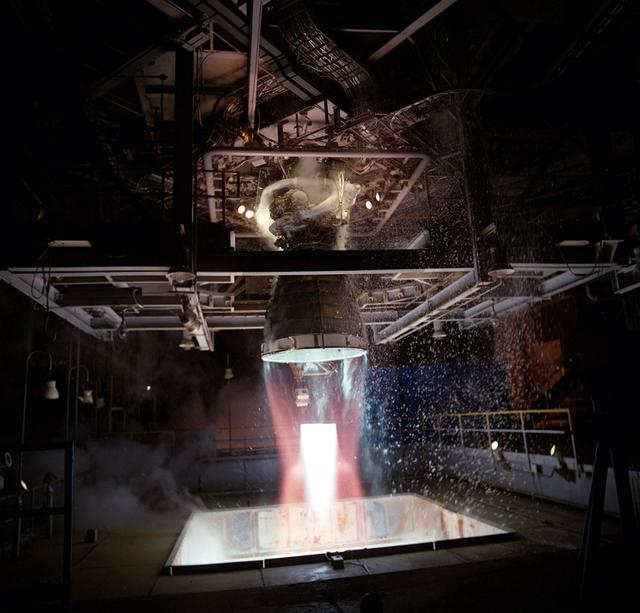
A modified Space Shuttle Main Engine is static fired at Marshall's Technology Test Bed.

A modified Space Shuttle Main Engine is static fired at Marshall's Technology Test Bed.

A modified Space Shuttle Main Engine is static fired at Marshall's Technology Test Bed.
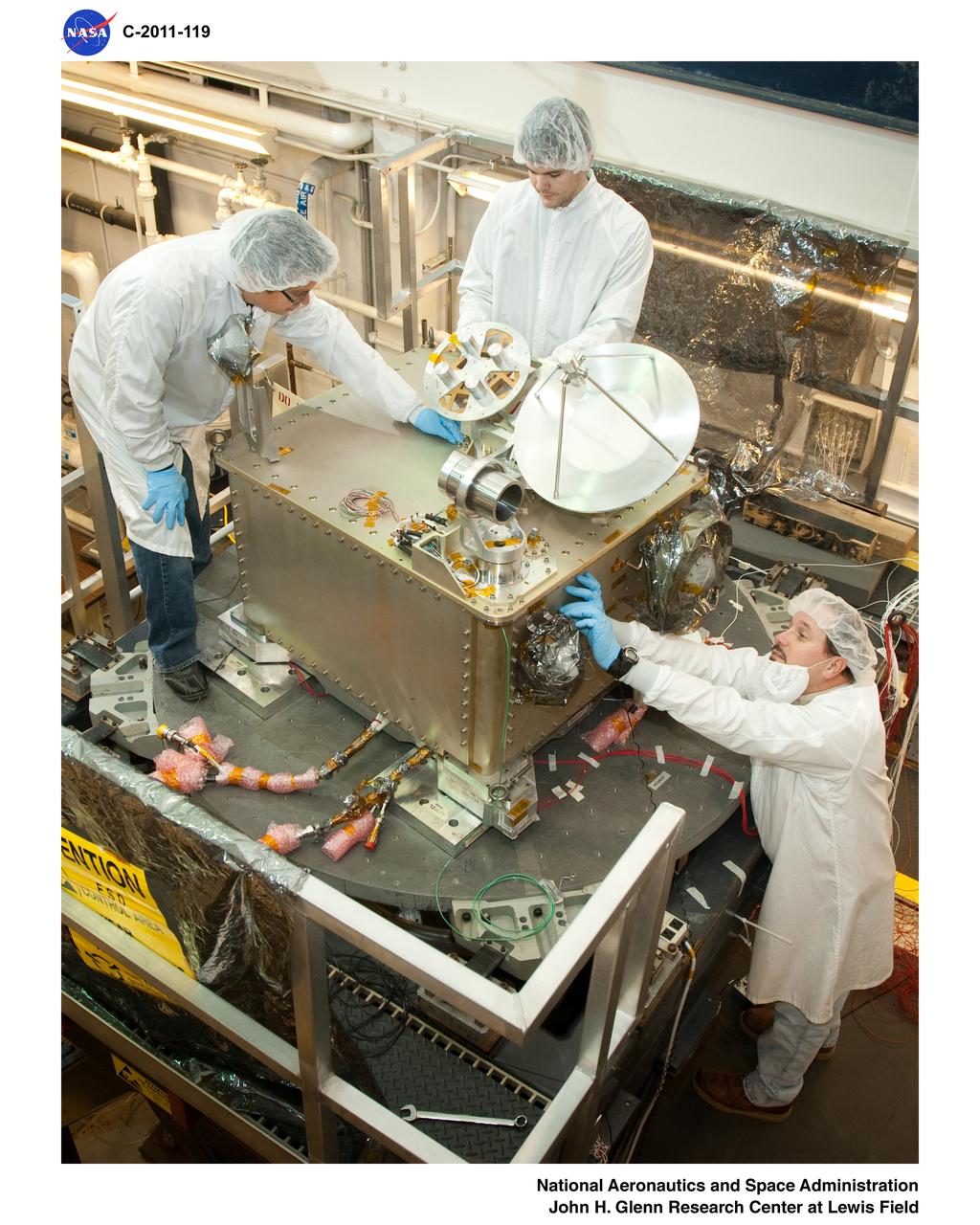
Communications Technology and Development - Communications, Navigation, and Network Reconfigurable Test-bed, CoNNeCT System-level Protoflight Vibration Test in the Structural Dynamics Laboratory, SDL

Artist's concept of the final configuration of the International Space Station (ISS) Alpha. The ISS is a multidisciplinary laboratory, technology test bed, and observatory that will provide an unprecedented undertaking in scientific, technological, and international experimentation.

An artist's concept of a fully deployed International Space Station (ISS) Alpha. The ISS-A is a multidisciplinary laboratory, technology test bed, and observatory that will provide an unprecedented undertaking in scientific, technological, and international experiments.
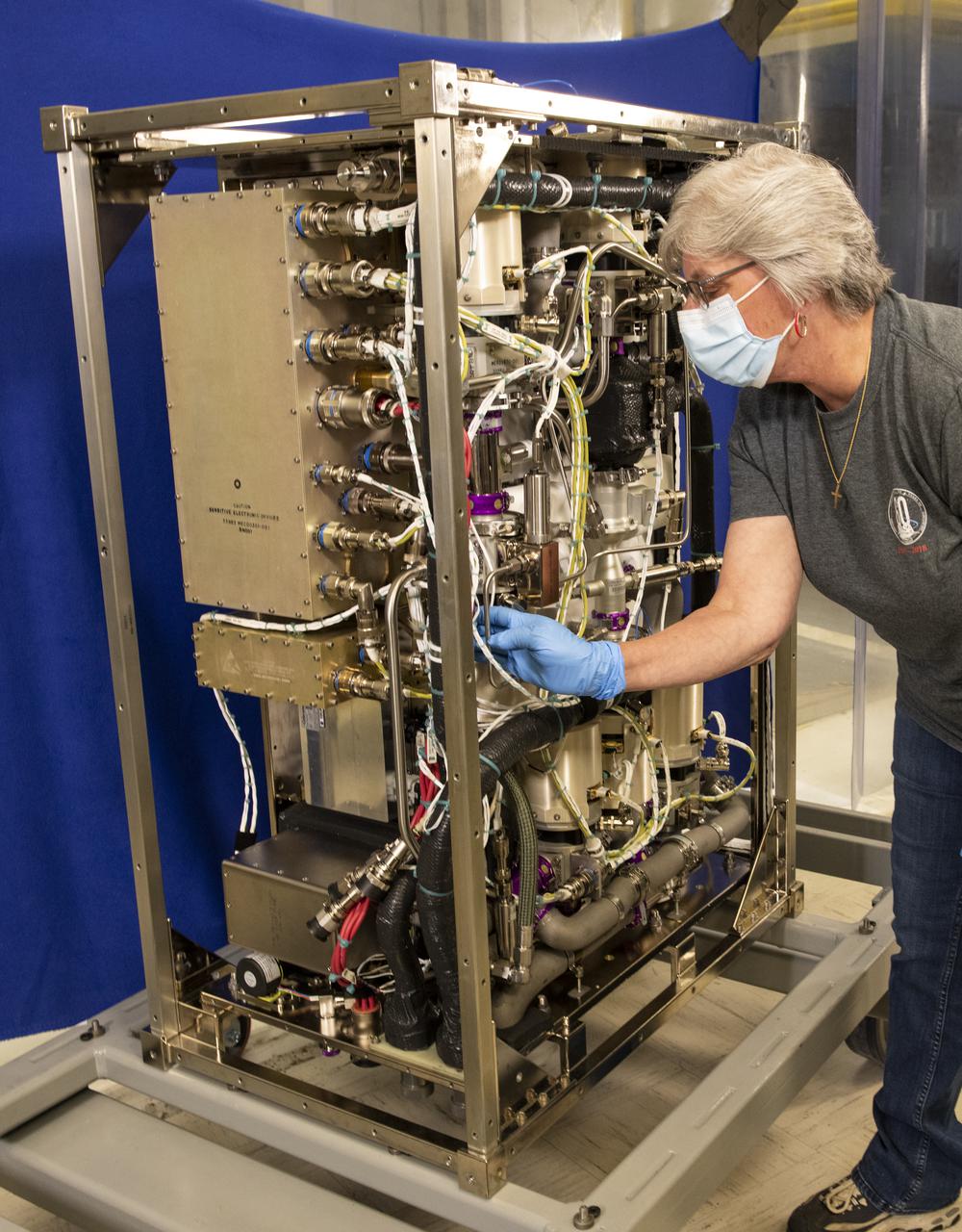
The flight demonstration unit of the next-generation 4-bed CO2 Scrubber (4BCO2) is targeted for launch aboard NG16 NET August 1, 2021. Once aboard the space station, this u nit will be mounted in a basic express rack. This four-bed technology is a mainstay for metabolic CO2 removal and crew life support. The new 4-Bed Carbon Dioxide Scrubber, developed, built, and tested at NASA’s Marshall Space Flight Center in Huntsville, Alabama, is checked out by Kathi Lange, a Bastion Technologies contractor supporting the quality assurance group in Marshall’s Safety and Mission Assurance Directorate, prior to its shipment to NASA’s Wallops Flight Facility in Wallops Island, Virginia.
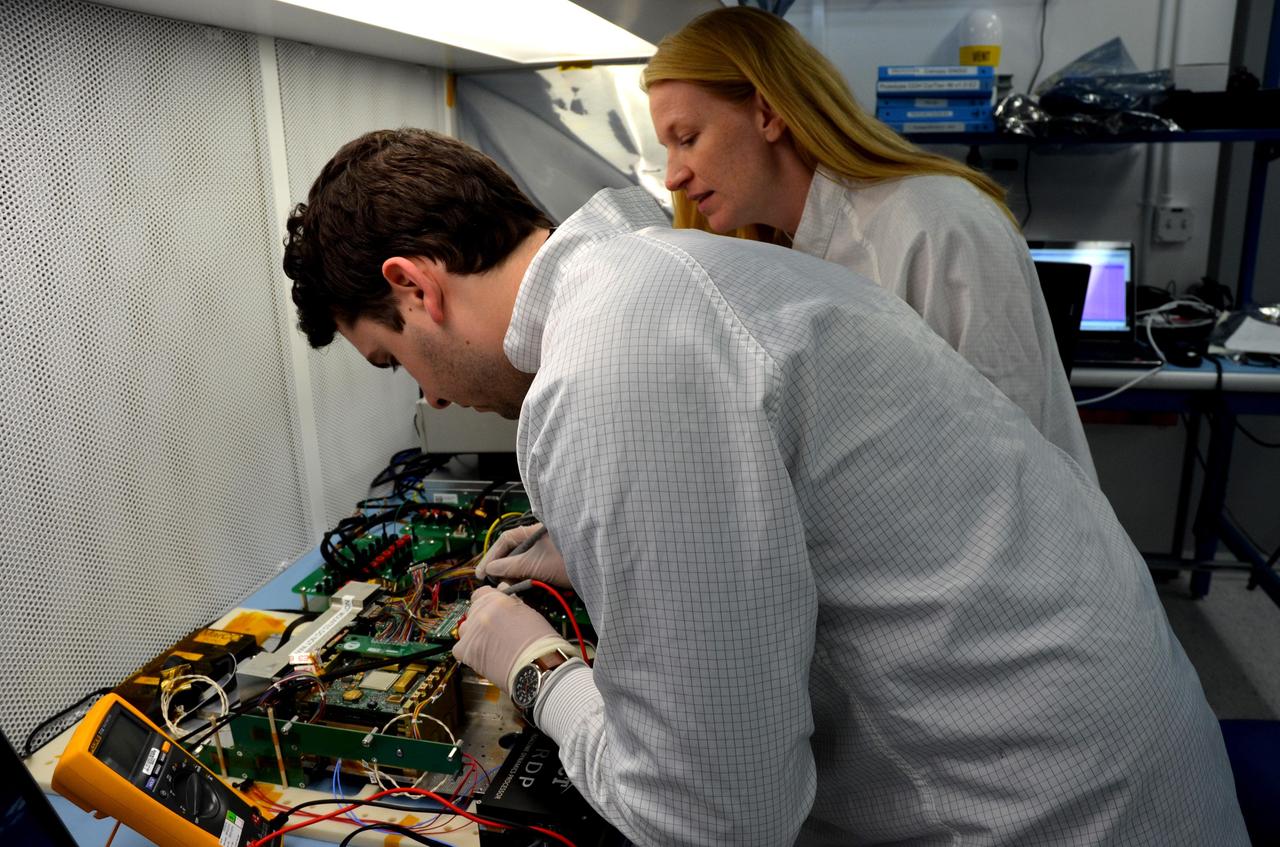
Engineers for NASA's MarCO (Mars Cube One) technology demonstration inspect the MarCO test bed, which contains components that are identical to those built for a flight to Mars. Cody Colley, left, MarCO integration and test deputy, and Shannon Statham, MarCO integration and test lead, are on the team at NASA's Jet Propulsion Laboratory, Pasadena, California, preparing twin MarCO CubeSats. The briefcase-size MarCO twins were designed to ride along with NASA's next Mars lander, InSight. Its planned March 2016 launch was suspended. InSight -- an acronym for Interior Exploration using Seismic Investigations, Geodesy and Heat Transport -- will study the interior of Mars to improve understanding of the processes that formed and shaped rocky planets, including Earth. Note: After thorough examination, NASA managers have decided to suspend the planned March 2016 launch of the Interior Exploration using Seismic Investigations Geodesy and Heat Transport (InSight) mission. The decision follows unsuccessful attempts to repair a leak in a section of the prime instrument in the science payload. http://photojournal.jpl.nasa.gov/catalog/PIA20341

An artist's conception of what the final configuration of the International Space Station (ISS) will look like when it is fully built and deployed. The ISS is a multidisciplinary laboratory, technology test bed, and observatory that will provide an unprecedented undertaking in scientific, technological, and international experimentation.
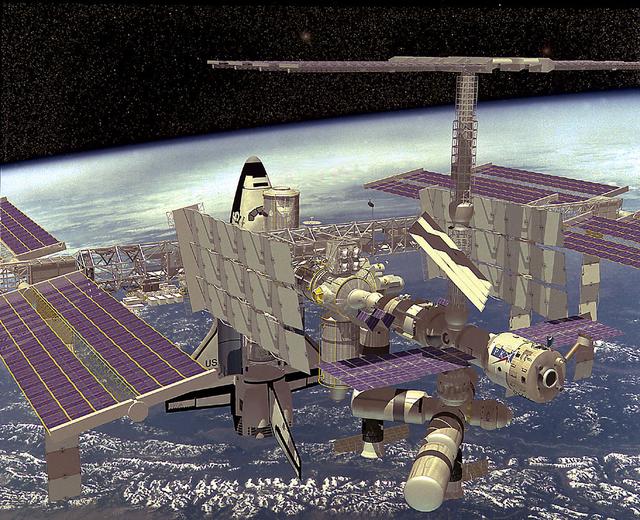
Artist's concept for Phase III of the International Space Station (ISS) as shown here in its completed and fully operational state with elements from the United States, Europe, Canada, Japan, and Russia. Sixteen countries are cooperating to provide a multidisciplinary laboratory, technology test bed, and observatory that will provide an unprecedented undertaking in scientific, technological, and international experimentation.

Artist's concept of the International Space Station (ISS) Alpha deployed and operational. This figure also includes the docking procedures for the Space Shuttle (shown with cargo bay open). The ISS is a multidisciplinary laboratory, technology test bed, and observatory that will provide an unprecedented undertaking in scientific, technological, and international experimentation.
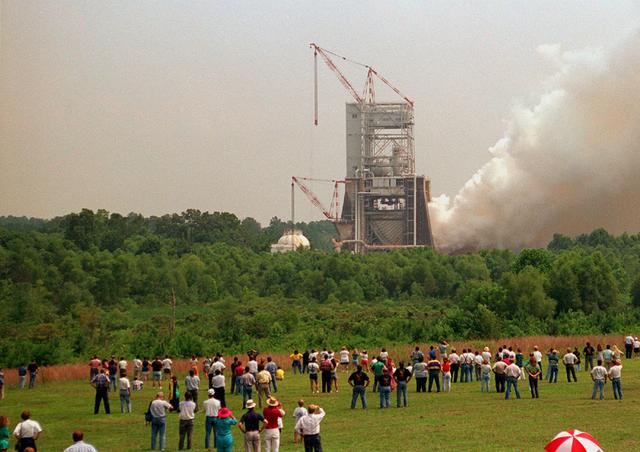
On the 25th Anniversary of the Apollo-11 space launch, Marshall celebrated with a test firing of the Space Shuttle Main Engine at the Technology Test Bed (SSME-TTB). This drew a large crowd who stood in the fields around the test site and watched as plumes of white smoke verified ignition.
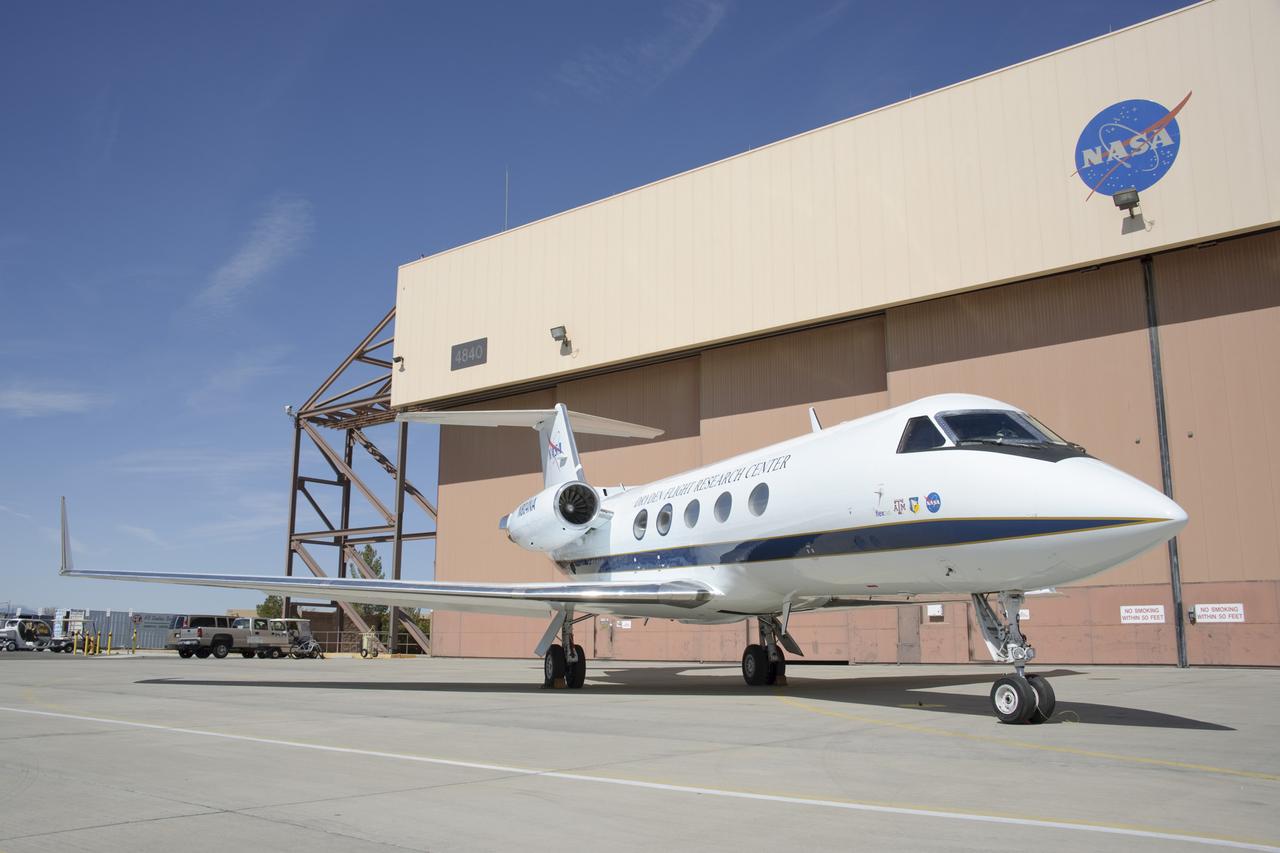
NASA’s Subsonic Research Aircraft Testbed, or SCRAT, is a modified Gulfstream III that operates out of Armstrong Flight Research Center in Edwards, California. SCRAT the test bed aircraft for the ACTE flexible-flap research project, which examines flexible wing flap technology’s benefits to aerodynamic efficiency.
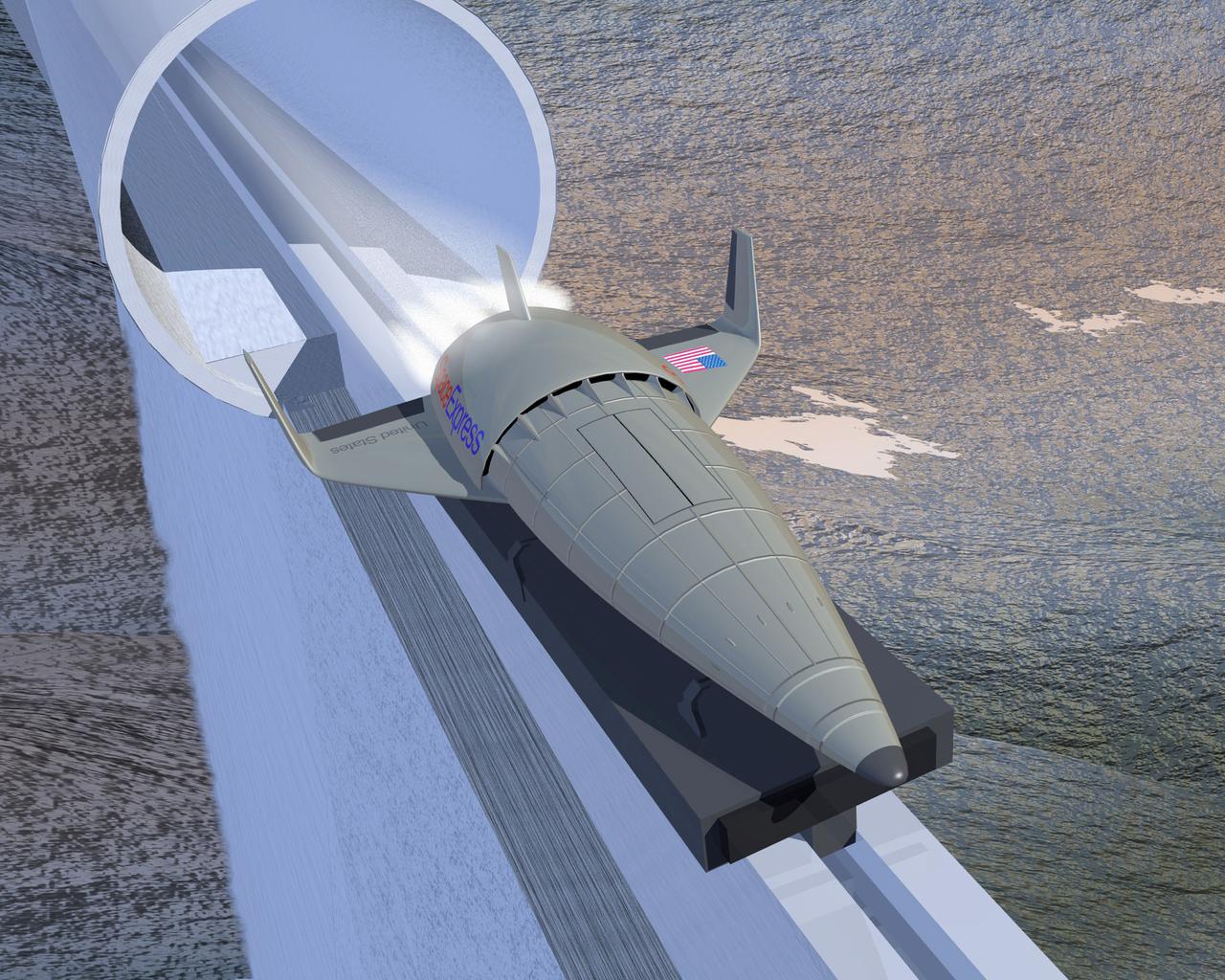
Pictured is an artist's concept of the Rocket Based Combined Cycle (RBCC) launch. The RBCC's overall objective is to provide a technology test bed to investigate critical technologies associated with opperational usage of these engines. The program will focus on near term technologies that can be leveraged to ultimately serve as the near term basis for Two Stage to Orbit (TSTO) air breathing propulsions systems and ultimately a Single Stage To Orbit (SSTO) air breathing propulsion system.
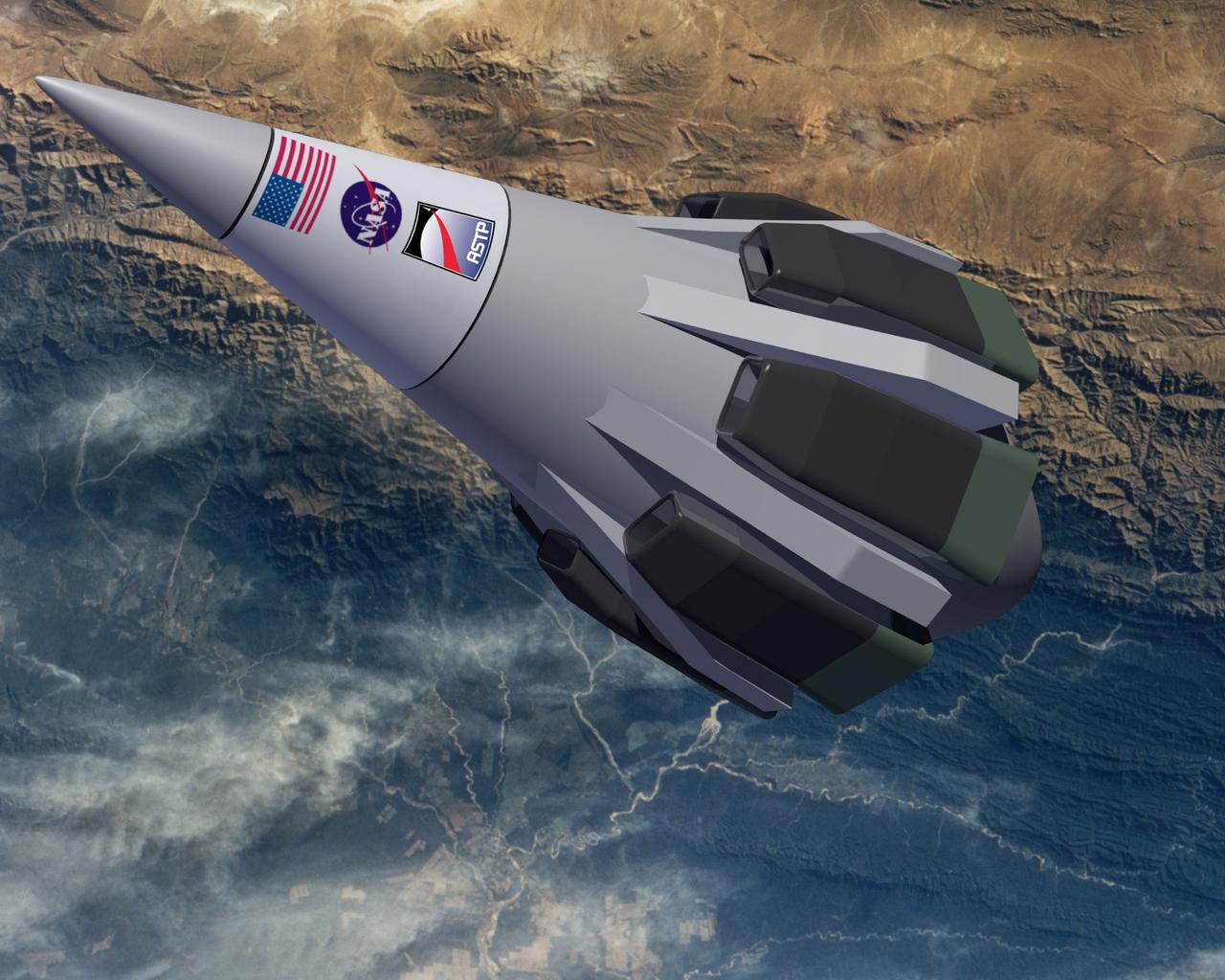
Pictured is an artist's concept of the Rocket Based Combined Cycle (RBCC) launch. The RBCC's overall objective is to provide a technology test bed to investigate critical technologies associated with opperational usage of these engines. The program will focus on near term technologies that can be leveraged to ultimately serve as the near term basis for Two Stage to Orbit (TSTO) air breathing propulsions systems and ultimately a Single Stage To Orbit (SSTO) air breathing propulsion system.
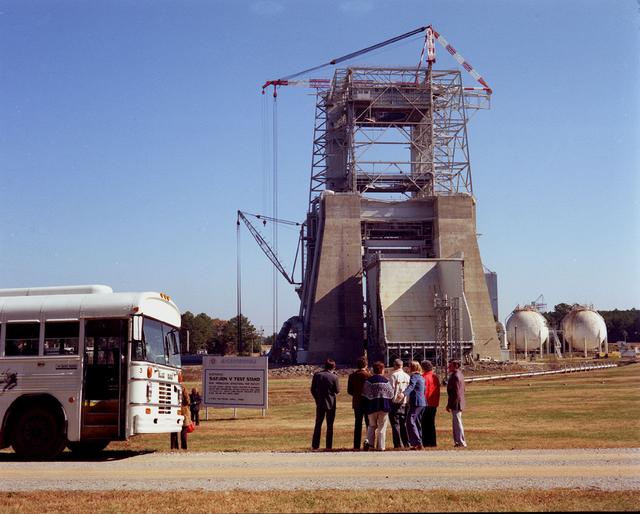
Constructed in 1964, the S-IC Static Test Stand was designed to develop and test the first stage (S-IC) of the Saturn V launch vehicle. In the 1974 the test stand was modified to test the liquid hydrogen tank on the Space Shuttle External Tank. The facility was again modified in 1986 and its name was changed to the Advanced Engine Test Facility. These modifications were made to accommodate the Technology Test Bed engine which is a derivative of the Space Shuttle Main Engine.
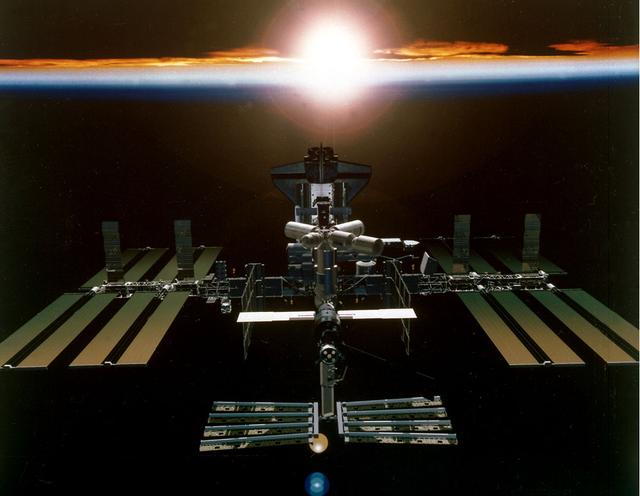
Artist's digital concept of the International Space Station (ISS), a gateway to permanent human presence in space, after all assembly is completed in Year 2003. The Station will be powered by almost an acre of solar panels and have a mass of almost one million pounds. Station modules are being provided by the United States, Russia, Japan, and Europe. Canada is providing a mechanical arm and Canada Hand. Sixteen countries are cooperating to provide a multidisciplinary laboratory, technology test bed, and observatory that will provide an unprecedented undertaking in scientific, technological, and international experimentation.
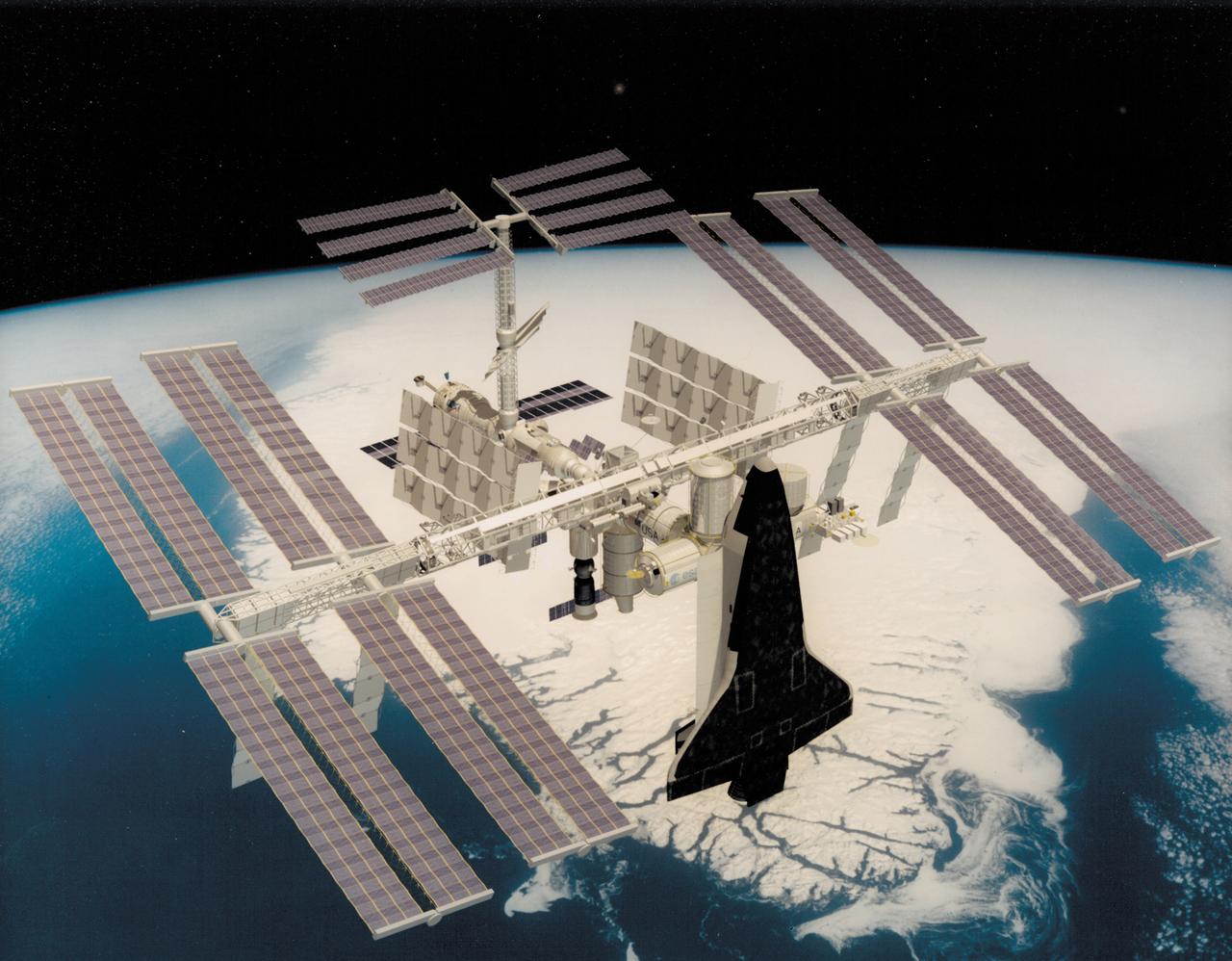
An artist's concept of what the International Space Station (ISS)Alpha will look like in its completed and fully operational state. All the elements of the Station are shown - the United States, European, Japanese, and Russian. The artist also included the Space Shuttle in the docked position. Sixteen countries are cooperating to provide a multidisciplinary laboratory, technology test bed, and observatory that will provide an unprecedented undertaking in scientific, technological, and international experimentation.
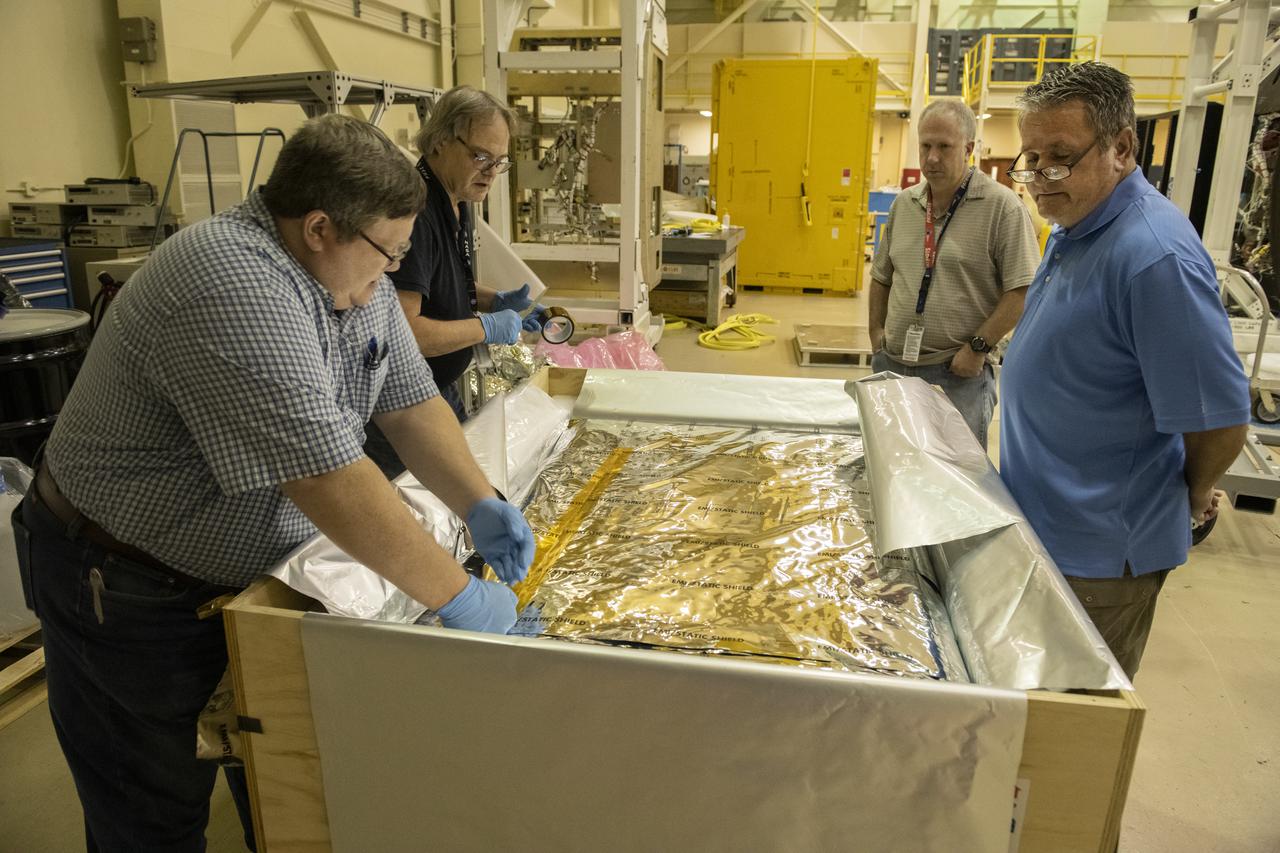
The 4-bed Carbon Dioxide Scrubber, new Environmental Control and Life Support Systems technology developed, built, tested, and integrated at NASA's Marshall Space Flight Center to be launched to the International Space Station, is readied for shipment to NASA's Wallops Flight Facility in Wallops Island, Virginia. The hardware will fly to space Aug. 1 via the Cygnus NG-16 commercial spacecraft, and will be tested aboard the space station for one year.
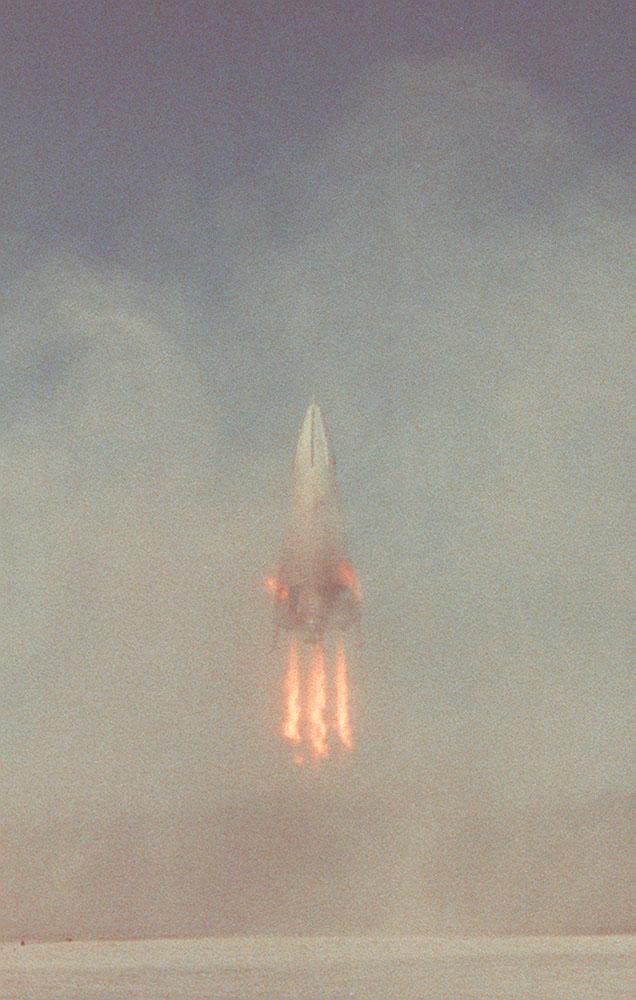
The Delta Clipper-Experimental Advanced (DC-XA) is a single-stage-to-orbit, vertical takeoff / vertical landing launch vehicle concept, whose development was geared to significantly reduce launch cost and provided a test bed for NASA Reusable Launch Vehicle (RLV) technology. This photograph shows the descending vehicle landing during the first successful test flight at White Sands Missile Range, New Mexico. The program was discontinued in 2003.
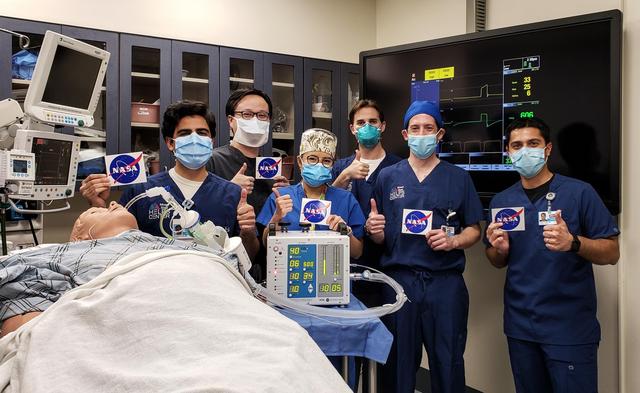
After testing a ventilator prototype developed by NASA's Jet Propulsion Laboratory, doctors in the Department of Anesthesiology and the Human Simulation Lab at the Icahn School of Medicine at Mount Sinai in New York City give a thumbs up. Developed in response to the coronavirus outbreak, the device, called VITAL (Ventilator Intervention Technology Accessible Locally), requires far fewer parts than traditional ventilators, making it cheaper to build and ideal for rapid manufacture. Lying on the bed is a human patient simulator used to test the device. https://photojournal.jpl.nasa.gov/catalog/PIA23772

This artist's concept depicts the completely assembled International Space Station (ISS) passing over Florida and the Bahamas. As a gateway to permanent human presence in space, the Space Station Program is to expand knowledge benefiting all people and nations. The ISS is a multidisciplinary laboratory, technology test bed, and observatory that will provide unprecedented undertakings in scientific, technological, and international experimentation. Experiments to be conducted in the ISS include: microgravity research, Earth science, space science, life sciences, space product development, and engineering research and technology. The sixteen countries participating in the ISS are: United States, Russian Federation, Canada, Japan, United Kingdom, Germany, Italy, France, Norway, Netherlands, Belgium, Spain, Denmark, Sweden, Switzerland, and Brazil.

This artist's digital concept depicts the completely assembled International Space Station (ISS) passing over Florida. As a gateway to permanent human presence in space, the Space Station Program is to expand knowledge benefiting all people and nations. The ISS is a multidisciplinary laboratory, technology test bed, and observatory that will provide unprecedented undertakings in scientific, technological, and international experimentation. Experiments to be conducted in the ISS include: microgravity research, Earth science, space science, life sciences, space product development, and engineering research and technology. The sixteen countries participating the ISS are: United States, Russian Federation, Canada, Japan, United Kingdom, Germany, Italy, France, Norway, Netherlands, Belgium, Spain, Denmark, Sweden, Switzerland, and Brazil.
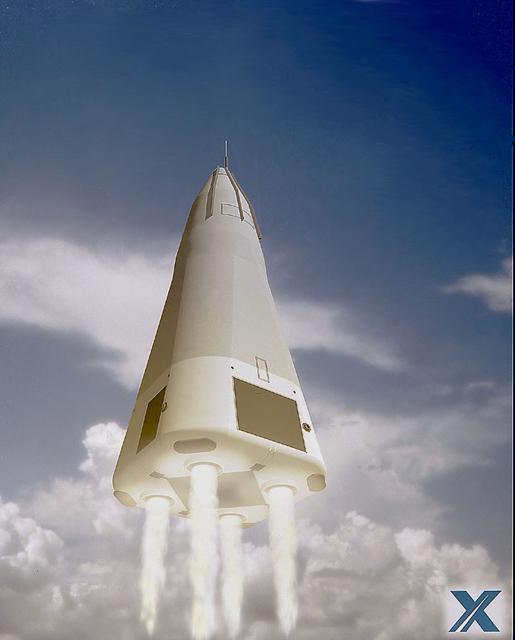
Pictured here is a DC-XA Reusable Launch Vehicle (RLV) prototype concept with an RLV logo. The Delta Clipper-Experimental (DC-X) was originally developed by McDornell Douglas for the Department of Defense (DOD). The DC-XA is a single-stage-to-orbit, vertical takeoff/vertical landing, launch vehicle concept, whose development is geared to significantly reduce launch costs and will provide a test bed for NASA Reusable Launch Vehicle (RLV) technology as the Delta Clipper-Experimental Advanced (DC-XA).
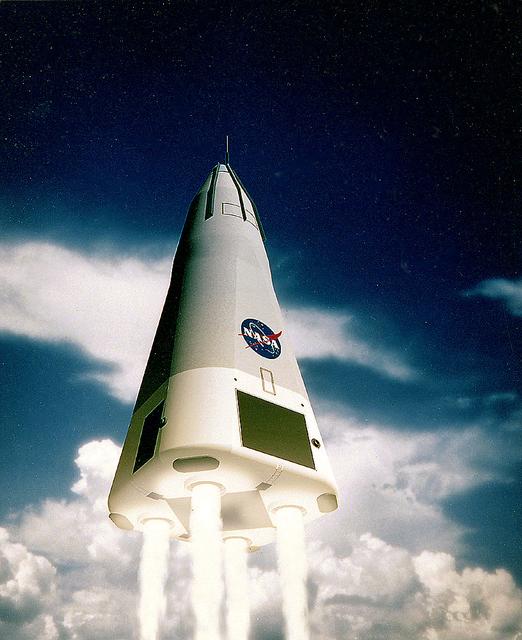
This is the McDornell Douglas CD-XA Reusable Launch Vehicle (RLV) concept. The Delta Clipper-Experimental (DC-X) was originally developed by McDonnell Douglas for the DOD. The DC-XA is a single-stage-to-orbit, vertical takeoff/vertical landing, launch vehicle concept, whose development is geared to significantly reduce launch cost and provided a test bed for NASA Reusable Launch Vehicle (RLV) technology as the Delta Clipper-Experimental Advanced (DC-XA). The program was discontinued in 2003.

Pictured is an artist's concept of the International Space Station (ISS) with solar panels fully deployed. In addition to the use of solar energy, the ISS will employ at least three types of propulsive support systems for its operation. The first type is to reboost the Station to correct orbital altitude to offset the effects of atmospheric and other drag forces. The second function is to maneuver the ISS to avoid collision with oribting bodies (space junk). The third is for attitude control to position the Station in the proper attitude for various experiments, temperature control, reboost, etc. The ISS, a gateway to permanent human presence in space, is a multidisciplinary laboratory, technology test bed, and observatory that will provide an unprecedented undertaking in scientific, technological, and international experimentation by cooperation of sixteen countries.
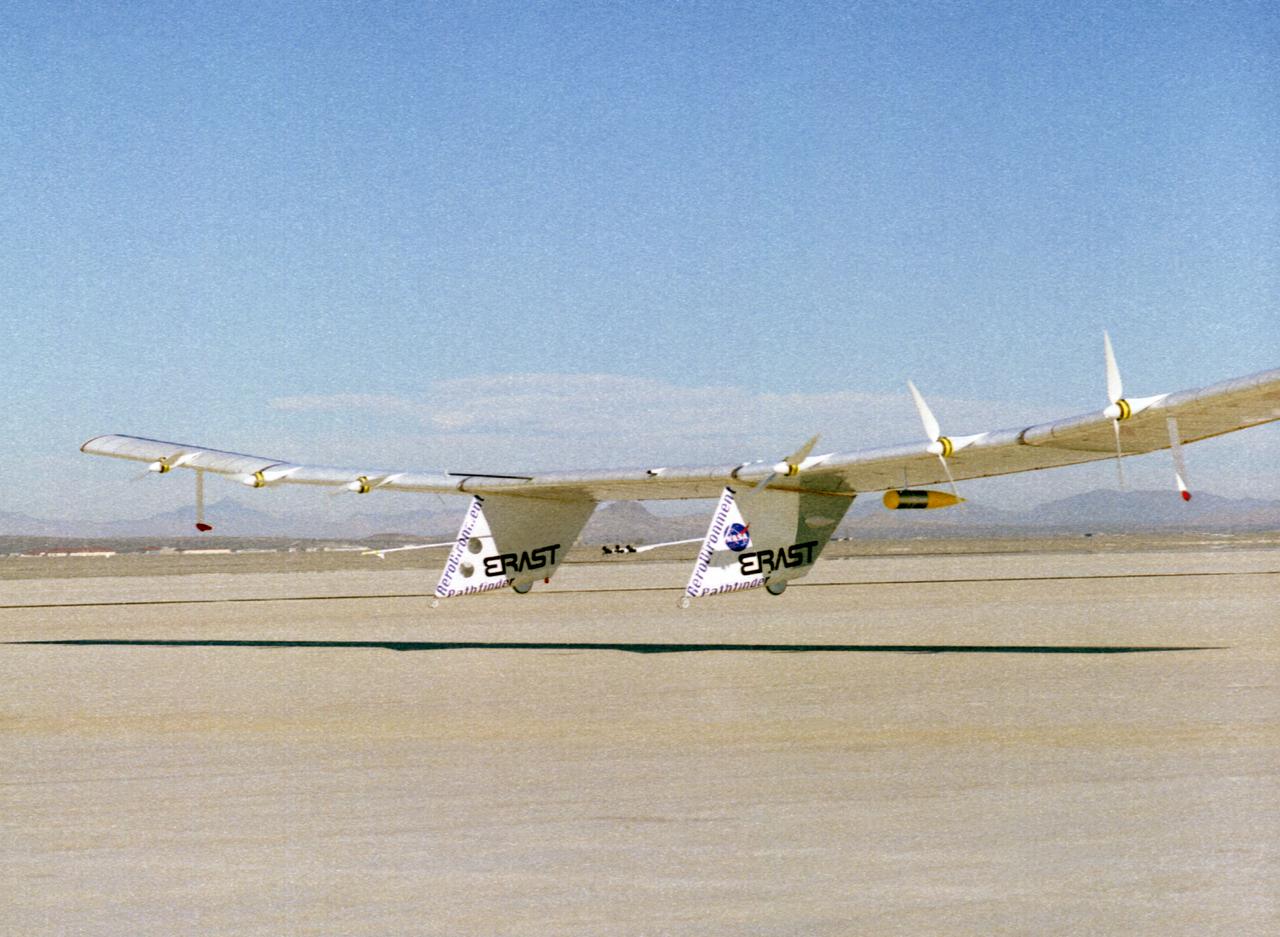
The Pathfinder solar-powered research aircraft settles in for landing on the bed of Rogers Dry Lake at the Dryden Flight Research Center, Edwards, California, after a successful test flight Nov. 19, 1996. The ultra-light craft flew a racetrack pattern at low altitudes over the flight test area for two hours while project engineers checked out various systems and sensors on the uninhabited aircraft. The Pathfinder was controlled by two pilots, one in a mobile control unit which followed the craft, the other in a stationary control station. Pathfinder, developed by AeroVironment, Inc., is one of several designs being evaluated under NASA's Environmental Research Aircraft and Sensor Technology (ERAST) program.

This artist's concept depicts the completely assembled International Space Station (ISS) passing over the Straits of Gibraltar and the Mediterranean Sea. As a gateway to permanent human presence in space, the Space Station Program is to expand knowledge benefiting all people and nations. The ISS is a multidisciplinary laboratory, technology test bed, and observatory that will provide unprecedented undertakings in scientific, technological, and international experimentation. Experiments to be conducted in the ISS include: microgravity research, Earth science, space science, life sciences, space product development, and engineering research and technology. The sixteen countries participating the ISS are: United States, Russian Federation, Canada, Japan, United Kingdom, Germany, Italy, France, Norway, Netherlands, Belgium, Spain, Denmark, Sweden, Switzerland, and Brazil.
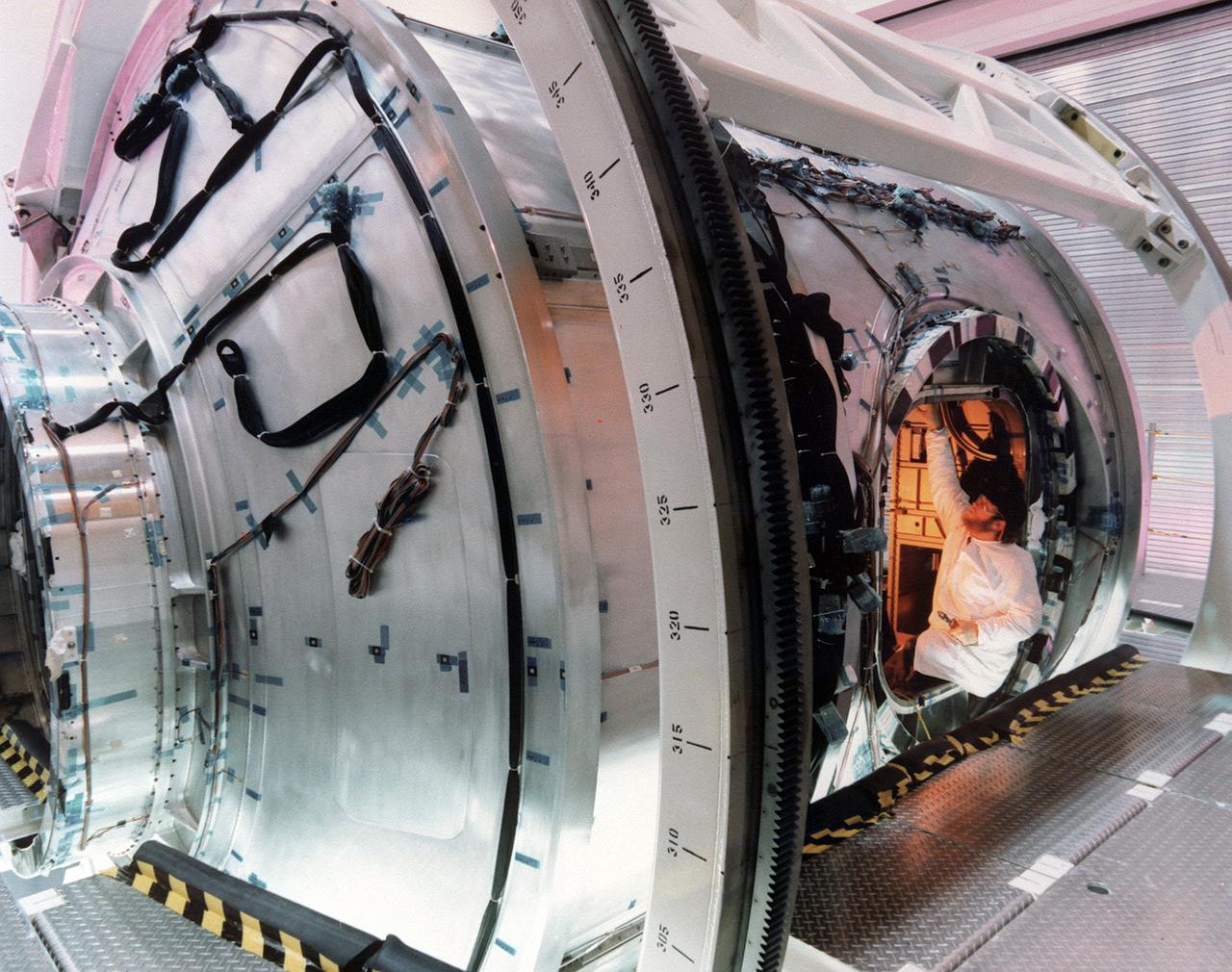
This photograph, taken by the Boeing Company,shows Boeing technicians preparing to install one of six hatches or doors to the Node 1 (also called Unity), the first U.S. Module for the International Space Station (ISS). The Node 1, or Unity, serves as a cornecting passageway to Space Station modules and was manufactured by the Boeing Company at the Marshall Space Flight Center from 1994 to 1997. The U.S. built Unity module was launched aboard the orbiter Endeavour (STS-88 mission) on December 4, 1998 and connected to the Zarya, the Russian-built Functional Energy Block (FGB). The Zarya was launched on a Russian proton rocket prior to the launch of the Unity. The ISS is a multidisciplinary laboratory, technology test bed, and observatory that will provide unprecedented undertakings in scientific, technological, and international experimentation.
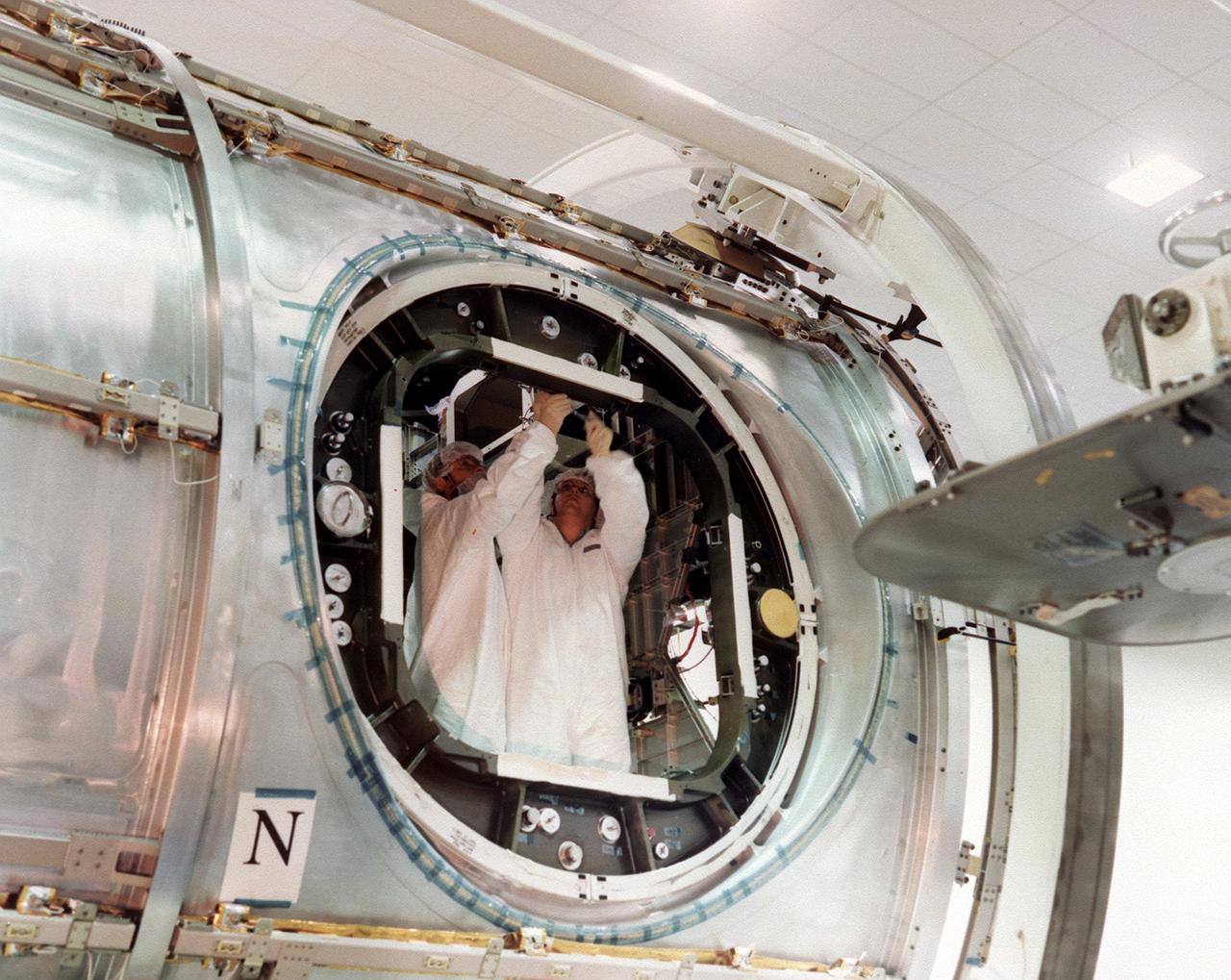
This photograph, taken by the Boeing Company, shows Boeing technicians preparing to install one of six hatches or doors to the Node 1 (also called Unity), the first U.S. Module for the International Space Station (ISS). The Node 1, or Unity, serves as a cornecting passageway to Space Station modules and was manufactured by the Boeing Company at the Marshall Space Flight Center from 1994 to 1997. The U.S. built Unity module was launched aboard the orbiter Endeavour (STS-88 mission) on December 4, 1998 and connected to the Zarya, the Russian-built Functional Energy Block (FGB). The Zarya was launched on a Russian proton rocket prior to the launch of the Unity. The ISS is a multidisciplinary laboratory, technology test bed, and observatory that will provide unprecedented undertakings in scientific, technological, and international experimentation.
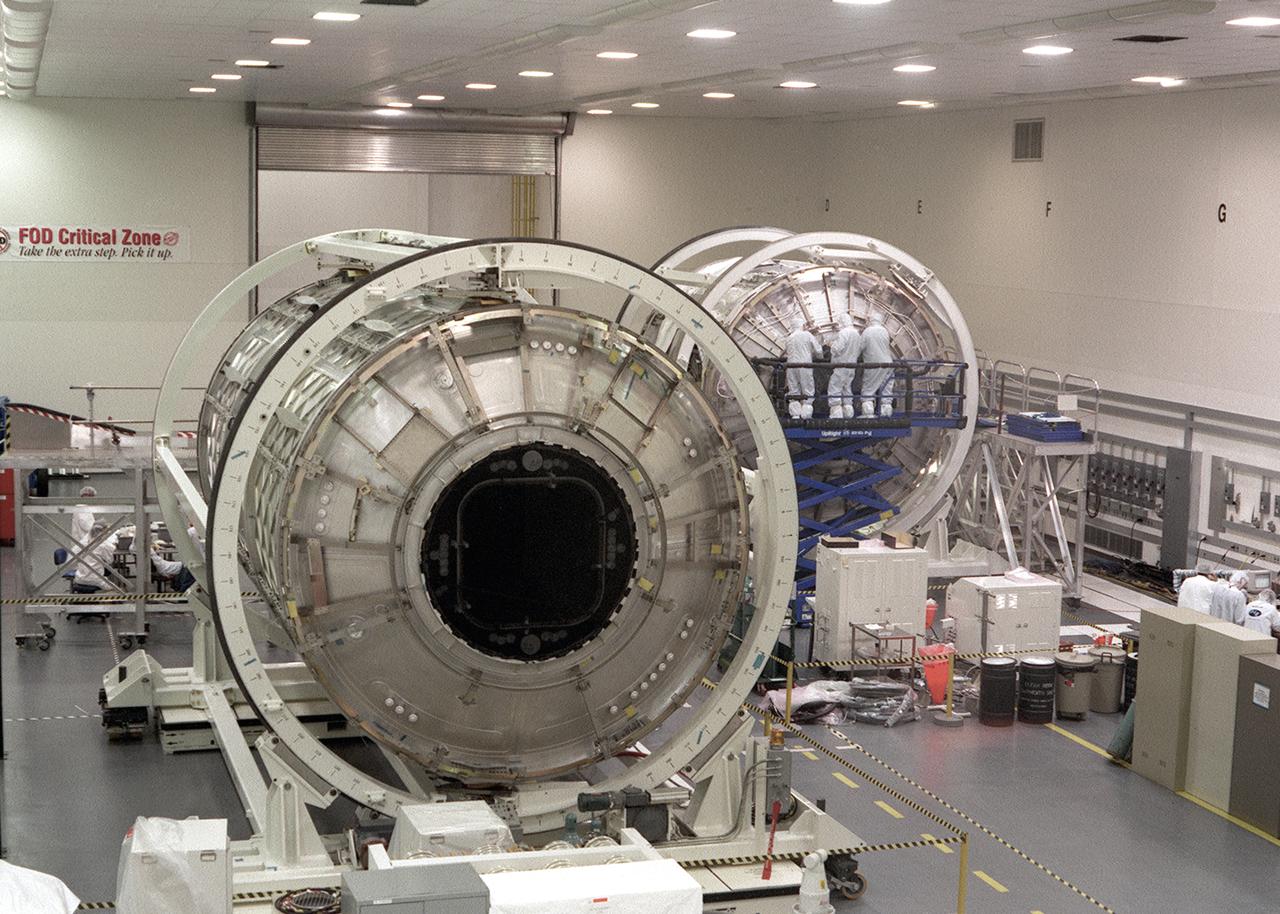
This Boeing photograph shows the Node 1, Unity module, Flight Article (at right) and the U.S. Laboratory module, Destiny, Flight Article for the International Space Station (ISS) being manufactured in the High Bay Clean Room of the Space Station Manufacturing Facility at the Marshall Space Flight Center. The Node 1, or Unity, serves as a cornecting passageway to Space Station modules. The U.S. built Unity module was launched aboard the orbiter Endeavour (STS-88 mission) on December 4, 1998 and connected to the Zarya, the Russian-built Functional Energy Block (FGB). The U.S. Laboratory (Destiny) module is the centerpiece of the ISS, where science experiments will be performed in the near-zero gravity of space. The U.S. Laboratory/Destiny was launched aboard the orbiter Atlantis (STS-98 mission) on February 7, 2001. The ISS is a multidisciplinary laboratory, technology test bed, and observatory that will provide unprecedented undertakings in scientific, technological, and international experimentation.
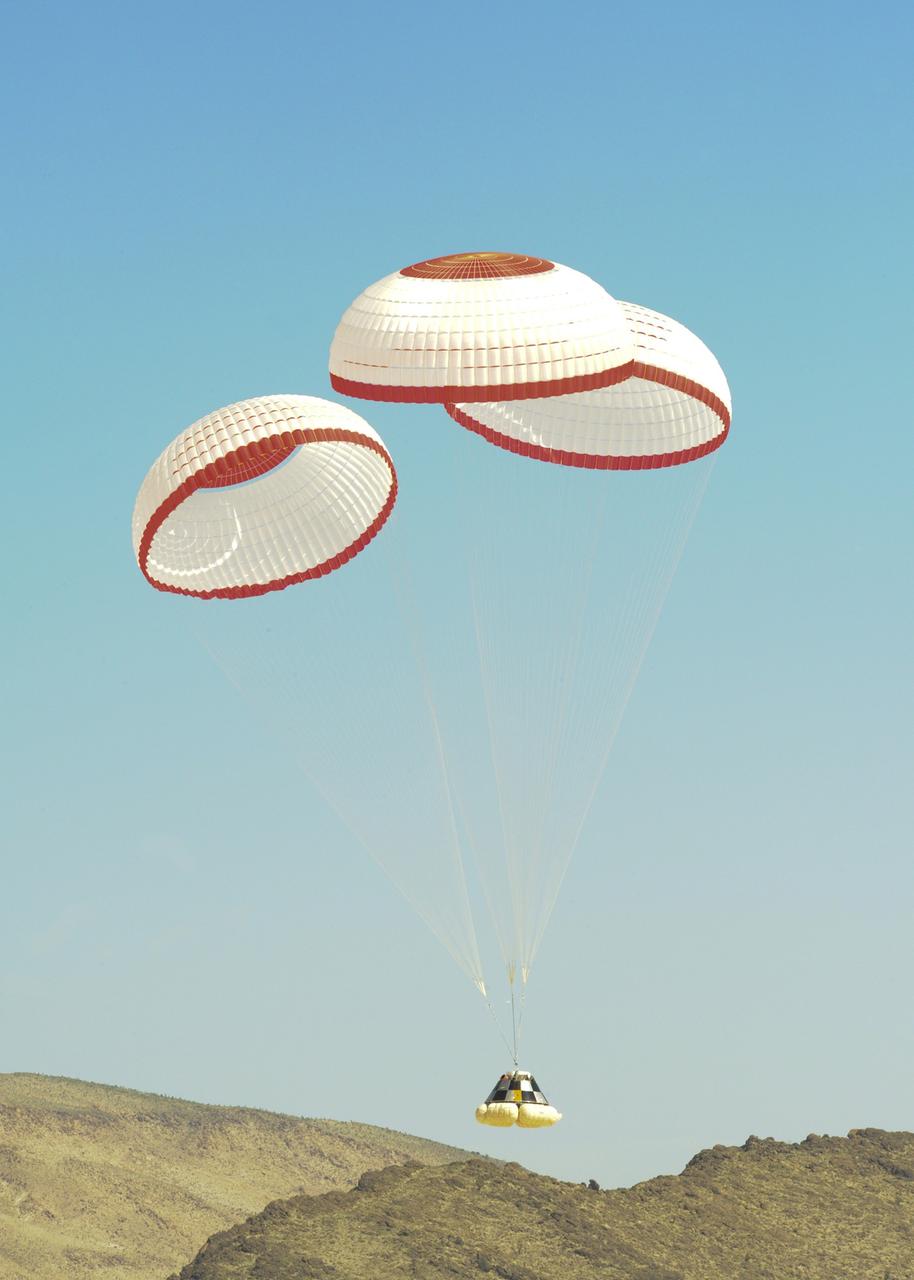
DELAMAR DRY LAKE BED, Nev. – The Boeing Company's CST-100 crew capsule floats to a smooth landing beneath three main parachutes over the Delamar Dry Lake Bed near Alamo, Nev. This is the second parachute test that Boeing performed under its partnership with NASA's Commercial Crew Program CCP. The first showed the parachute system’s deployment scheme worked and that it could be re-packed and re-used for this second test. In 2011, NASA selected Boeing during Commercial Crew Development Round 2 CCDev2) activities to mature the design and development of a crew transportation system with the overall goal of accelerating a United States-led capability to the International Space Station. The goal of CCP is to drive down the cost of space travel as well as open up space to more people than ever before by balancing industry’s own innovative capabilities with NASA's 50 years of human spaceflight experience. Six other aerospace companies also are maturing launch vehicle and spacecraft designs under CCDev2, including Alliant Techsystems Inc. ATK, Excalibur Almaz Inc., Blue Origin, Sierra Nevada, Space Exploration Technologies SpaceX, and United Launch Alliance ULA. For more information, visit www.nasa.gov/commercialcrew. Image credit: Boeing
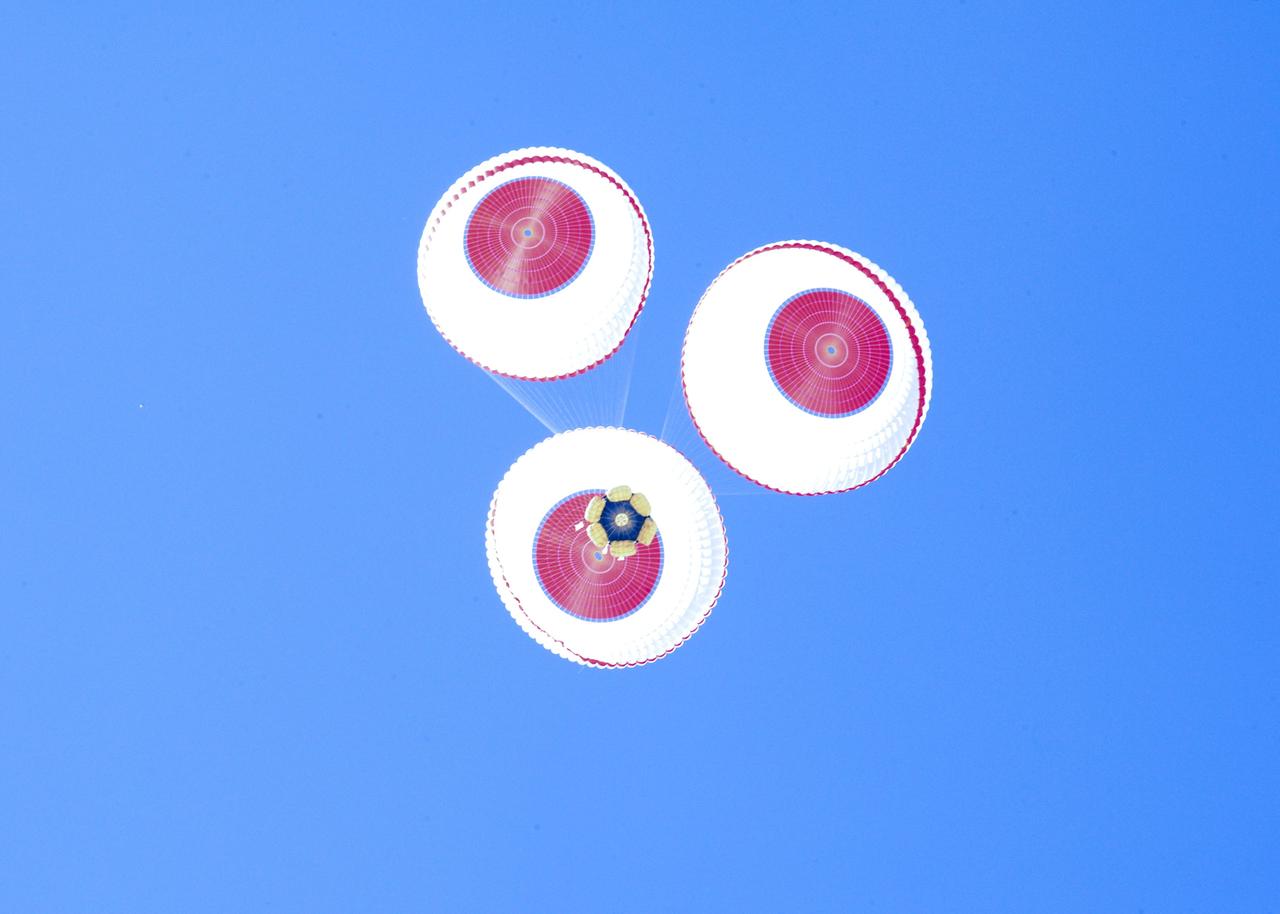
DELAMAR DRY LAKE BED, Nev. – The Boeing Company's CST-100 crew capsule floats to a smooth landing beneath three main parachutes over the Delamar Dry Lake Bed near Alamo, Nev. This is the second parachute test that Boeing performed under its partnership with NASA's Commercial Crew Program CCP. The first showed the parachute system’s deployment scheme worked and that it could be re-packed and re-used for this second test. In 2011, NASA selected Boeing during Commercial Crew Development Round 2 CCDev2) activities to mature the design and development of a crew transportation system with the overall goal of accelerating a United States-led capability to the International Space Station. The goal of CCP is to drive down the cost of space travel as well as open up space to more people than ever before by balancing industry’s own innovative capabilities with NASA's 50 years of human spaceflight experience. Six other aerospace companies also are maturing launch vehicle and spacecraft designs under CCDev2, including Alliant Techsystems Inc. ATK, Excalibur Almaz Inc., Blue Origin, Sierra Nevada, Space Exploration Technologies SpaceX, and United Launch Alliance ULA. For more information, visit www.nasa.gov/commercialcrew. Image credit: Boeing
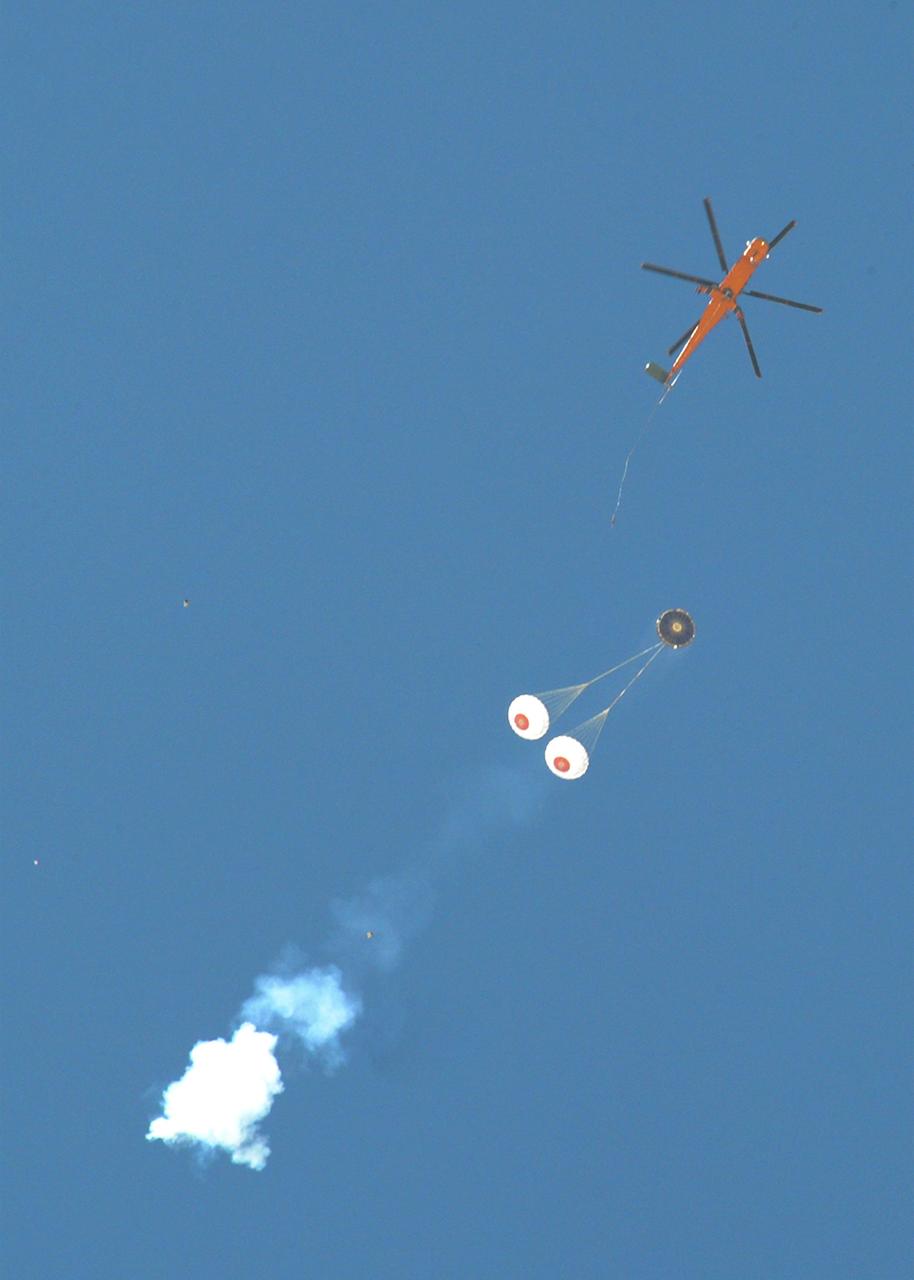
DELAMAR DRY LAKE BED, Nev. – An Erickson Sky Crane helicopter releases The Boeing Company's CST-100 crew capsule over the Delamar Dry Lake Bed near Alamo, Nev., where it floated to a smooth landing beneath its parachute system. This is the second parachute test that Boeing performed under its partnership with NASA's Commercial Crew Program CCP. The first showed the parachute system’s deployment scheme worked and that it could be re-packed and re-used for this second test. In 2011, NASA selected Boeing during Commercial Crew Development Round 2 CCDev2) activities to mature the design and development of a crew transportation system with the overall goal of accelerating a United States-led capability to the International Space Station. The goal of CCP is to drive down the cost of space travel as well as open up space to more people than ever before by balancing industry’s own innovative capabilities with NASA's 50 years of human spaceflight experience. Six other aerospace companies also are maturing launch vehicle and spacecraft designs under CCDev2, including Alliant Techsystems Inc. ATK, Excalibur Almaz Inc., Blue Origin, Sierra Nevada, Space Exploration Technologies SpaceX, and United Launch Alliance ULA. For more information, visit www.nasa.gov/commercialcrew. Image credit: Boeing

CAPE CANAVERAL, Fla. - NASA's Morpheus lander, a vertical test bed vehicle, is unloaded at the Kennedy Space Center in Florida. Morpheus is designed to demonstrate new green propellant propulsion systems and autonomous landing and an Autonomous Landing and Hazard Avoidance Technology, or ALHAT, system. Checkout of the prototype lander has been ongoing at NASA’s Johnson Space Center in Houston in preparation for its first free flight. The SLF site will provide the lander with the kind of field necessary for realistic testing. Project Morpheus is one of 20 small projects comprising the Advanced Exploration Systems, or AES, program in NASA’s Human Exploration and Operations Mission Directorate. AES projects pioneer new approaches for rapidly developing prototype systems, demonstrating key capabilities and validating operational concepts for future human missions beyond Earth orbit. For more information on Project Morpheus, visit http://www.nasa.gov/centers/johnson/exploration/morpheus/index.html Photo credit: NASA/ Charisse Nahser
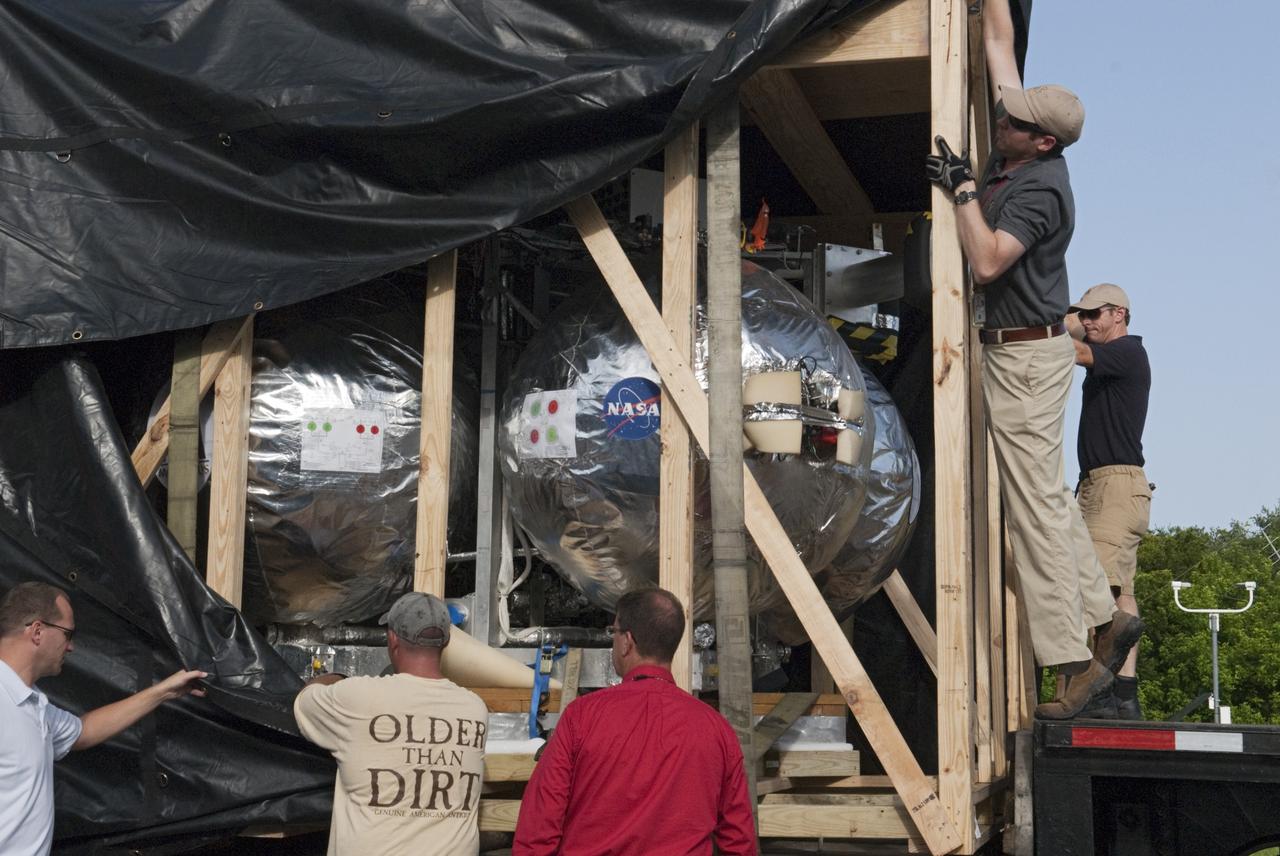
CAPE CANAVERAL, Fla. - NASA's Morpheus lander, a vertical test bed vehicle, is unloaded at the Kennedy Space Center in Florida. Morpheus is designed to demonstrate new green propellant propulsion systems and autonomous landing and an Autonomous Landing and Hazard Avoidance Technology, or ALHAT, system. Checkout of the prototype lander has been ongoing at NASA’s Johnson Space Center in Houston in preparation for its first free flight. The SLF site will provide the lander with the kind of field necessary for realistic testing. Project Morpheus is one of 20 small projects comprising the Advanced Exploration Systems, or AES, program in NASA’s Human Exploration and Operations Mission Directorate. AES projects pioneer new approaches for rapidly developing prototype systems, demonstrating key capabilities and validating operational concepts for future human missions beyond Earth orbit. For more information on Project Morpheus, visit http://www.nasa.gov/centers/johnson/exploration/morpheus/index.html Photo credit: NASA/ Charisse Nahser
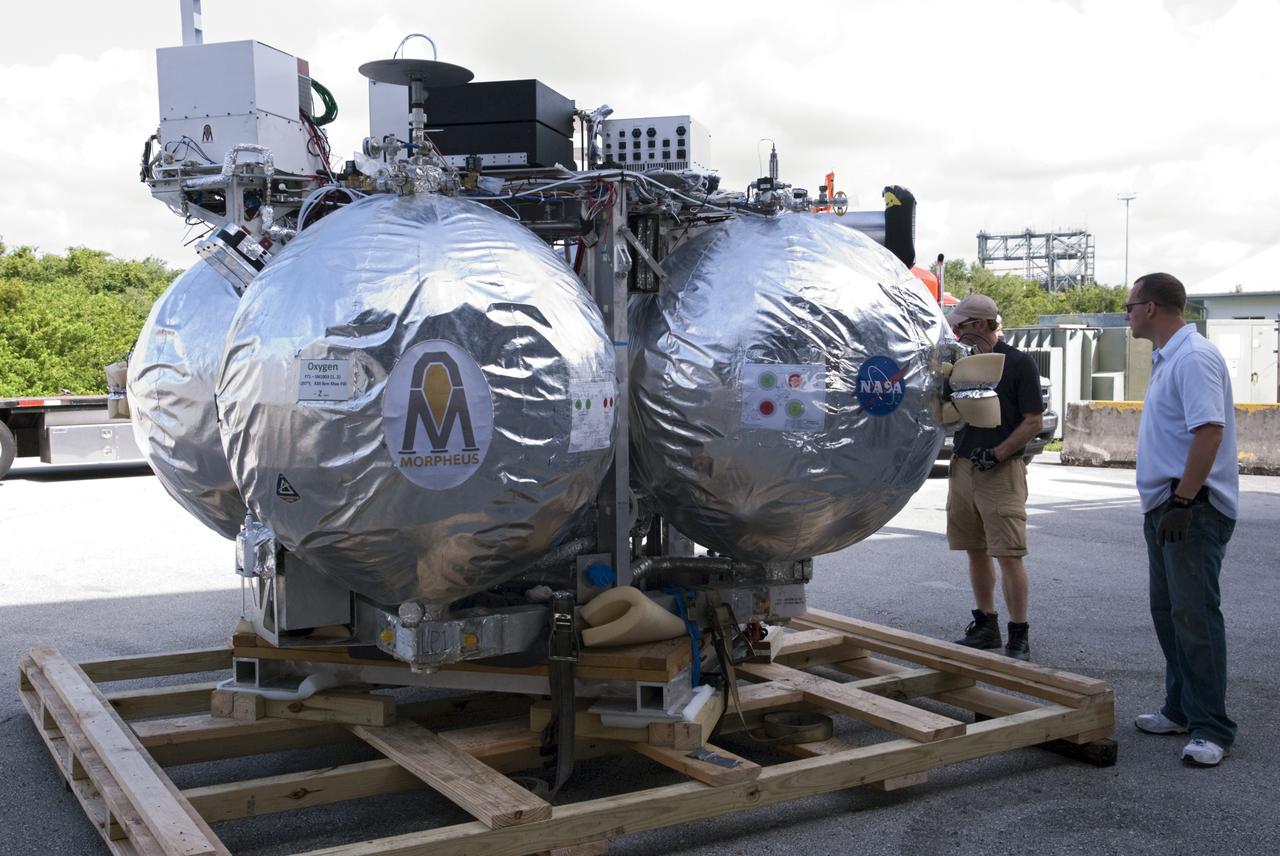
CAPE CANAVERAL, Fla. - NASA's Morpheus lander, a vertical test bed vehicle, is unloaded at the Kennedy Space Center in Florida. Morpheus is designed to demonstrate new green propellant propulsion systems and autonomous landing and an Autonomous Landing and Hazard Avoidance Technology, or ALHAT, system. Checkout of the prototype lander has been ongoing at NASA’s Johnson Space Center in Houston in preparation for its first free flight. The SLF site will provide the lander with the kind of field necessary for realistic testing. Project Morpheus is one of 20 small projects comprising the Advanced Exploration Systems, or AES, program in NASA’s Human Exploration and Operations Mission Directorate. AES projects pioneer new approaches for rapidly developing prototype systems, demonstrating key capabilities and validating operational concepts for future human missions beyond Earth orbit. For more information on Project Morpheus, visit http://www.nasa.gov/centers/johnson/exploration/morpheus/index.html Photo credit: NASA/ Charisse Nahser
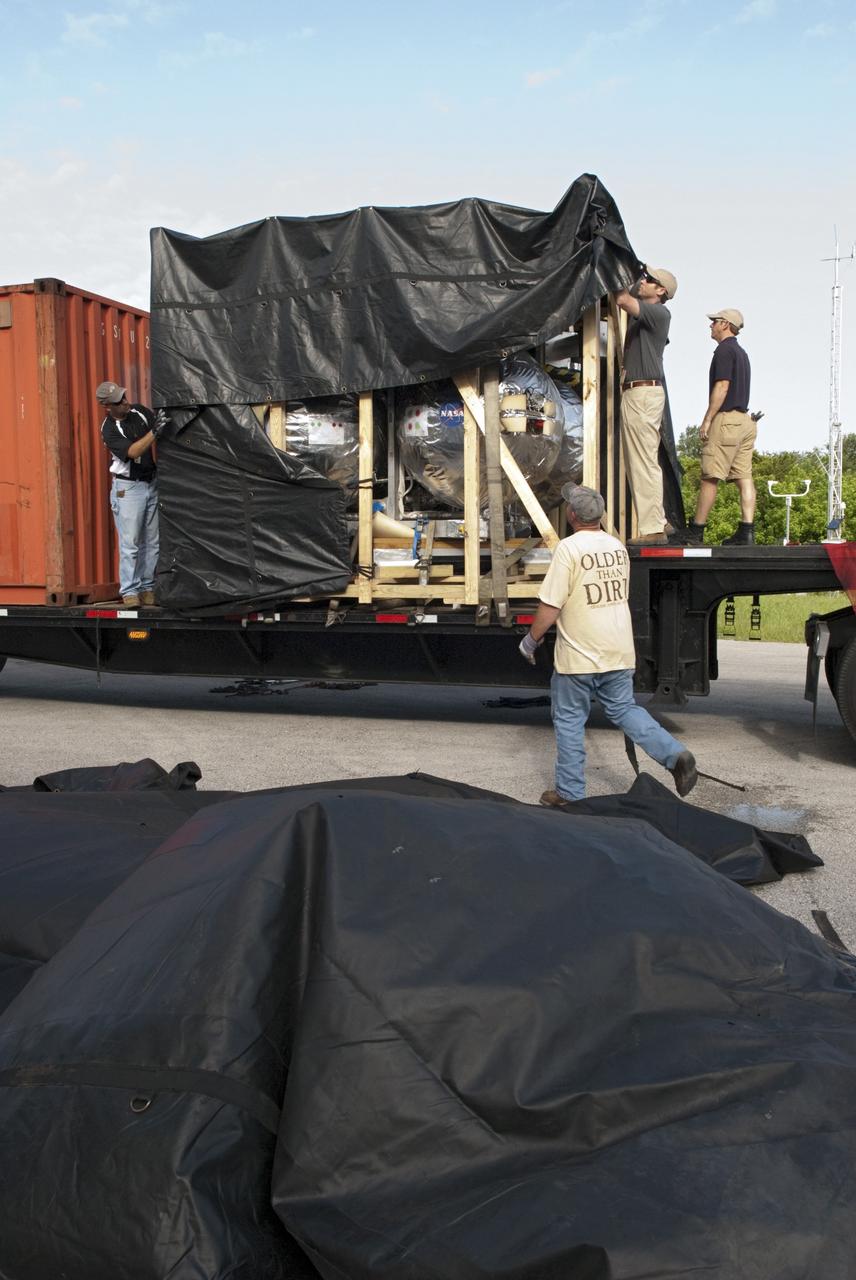
CAPE CANAVERAL, Fla. - NASA's Morpheus lander, a vertical test bed vehicle, is unloaded at the Kennedy Space Center in Florida. Morpheus is designed to demonstrate new green propellant propulsion systems and autonomous landing and an Autonomous Landing and Hazard Avoidance Technology, or ALHAT, system. Checkout of the prototype lander has been ongoing at NASA’s Johnson Space Center in Houston in preparation for its first free flight. The SLF site will provide the lander with the kind of field necessary for realistic testing. Project Morpheus is one of 20 small projects comprising the Advanced Exploration Systems, or AES, program in NASA’s Human Exploration and Operations Mission Directorate. AES projects pioneer new approaches for rapidly developing prototype systems, demonstrating key capabilities and validating operational concepts for future human missions beyond Earth orbit. For more information on Project Morpheus, visit http://www.nasa.gov/centers/johnson/exploration/morpheus/index.html Photo credit: NASA/ Charisse Nahser
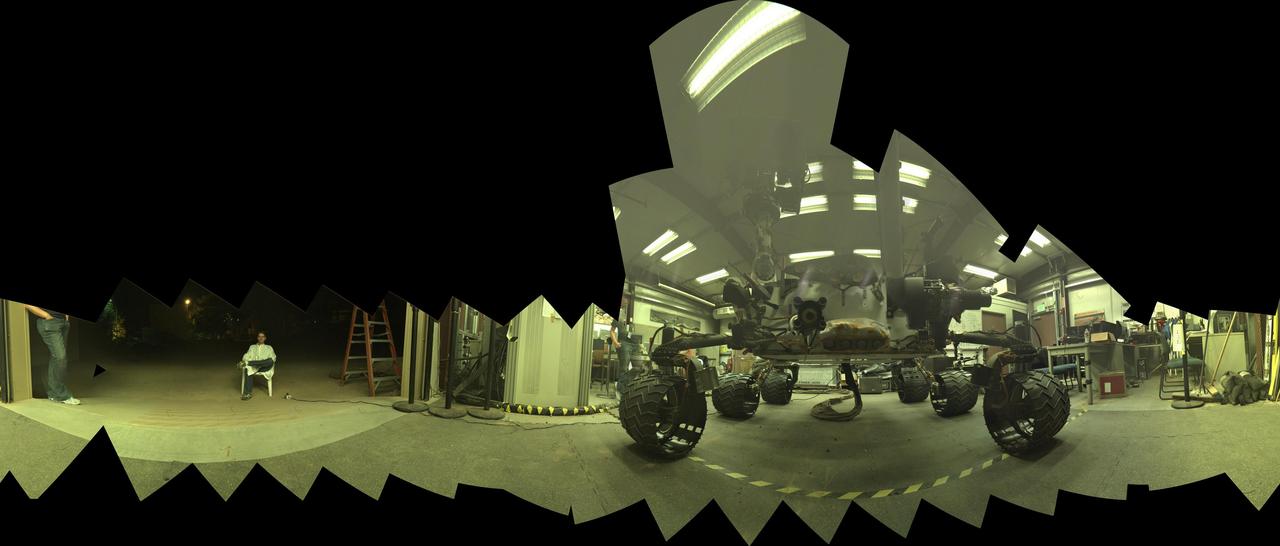
This view of a test rover at NASA's Jet Propulsion Laboratory, Pasadena, California, results from advance testing of arm positions and camera pointings for taking a low-angle self-portrait of NASA's Curiosity Mars rover. This rehearsal in California led to a dramatic Aug. 5, 2015, selfie of Curiosity, online at PIA19807. Curiosity's arm-mounted Mars Hand Lens Imager (MAHLI) camera took 92 of component images that were assembled into that mosaic. The rover team positioned the camera lower in relation to the rover body than for any previous full self-portrait of Curiosity. This practice version was taken at JPL's Mars Yard in July 2013, using the Vehicle System Test Bed (VSTB) rover, which has a test copy of MAHLI on its robotic arm. MAHLI was built by Malin Space Science Systems, San Diego. JPL, a division of the California Institute of Technology in Pasadena, manages the Mars Science Laboratory Project for the NASA Science Mission Directorate, Washington. JPL designed and built the project's Curiosity rover. http://photojournal.jpl.nasa.gov/catalog/PIA19810
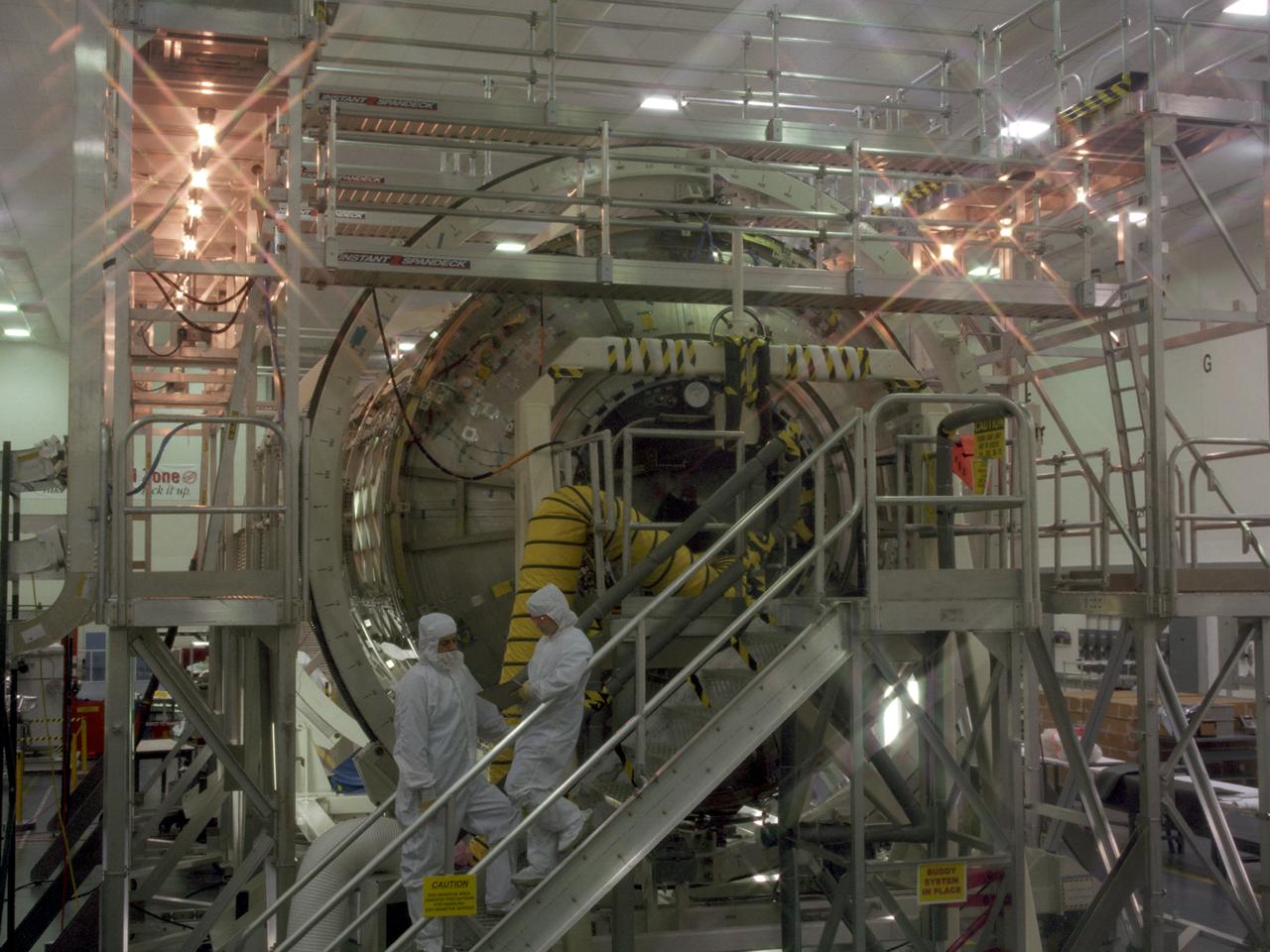
This photograph shows the U.S. Laboratory Module (also called Destiny) for the International Space Station (ISS), under construction in the Space Station manufacturing facility at the Marshall Space Flight Center. The U.S. Laboratory module is the centerpiece of the ISS, where science experiments will be performed in the near-zero gravity of space. The Destiny Module was launched aboard the Space Shuttle orbiter Atlantis (STS-67 mission) on February 7, 2001. The aluminum module is 8.5 meters (28 feet) long and 4.3 meters (14 feet) in diameter. The laboratory consists of three cylindrical sections and two end cones with hatches that will be mated to other station components. A 50.9-centimeter- (20-inch-) diameter window is located on one side of the center module segment. This pressurized module is designed to accommodate pressurized payloads. It has a capacity of 24 rack locations, and payload racks will occupy 13 locations especially designed to support experiments. The ISS is a multidisciplinary laboratory, technology test bed, and observatory that will provide unprecedented undertakings in scientific, technological, and international experimentation.
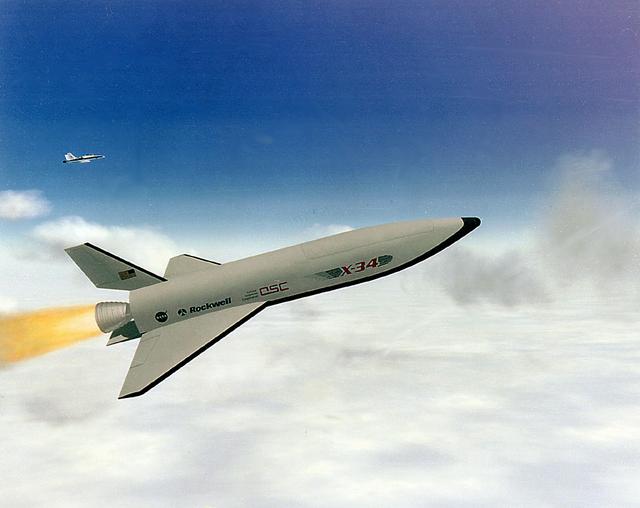
The X-34 Reusable Launch Vehicle (RLV) concept is pictured here. NASA plarned to utilize the X-34 small reusable booster for research of Reusable Launch Vehicle (RLV) technologies that may be applicable to future larger RLV's. It was being developed cooperatively by Orbital Science Corporation, Rockwell International Corporation, and NASA. The objectives of the X-34 program were to significantly reduce launch costs for small payloads and to provide a test bed for NASA RLV technology. The X-34 would be launched from a 747 shuttle carrier aircraft. After delivering its payload (booster by an upper stage) to orbit, it would land autonomously on the same runway from which the 747 departed. The X-34 vehicle was powered by a liquid oxygen tank (LOX) and an RP-1 liquid Fastrac engine that was designed and built by Marshall Space Flight Center. The X-34 would be capable of speeds up to Mach 8 and altitudes of 250,000 feet. The X-34 program was cancelled in 2001.
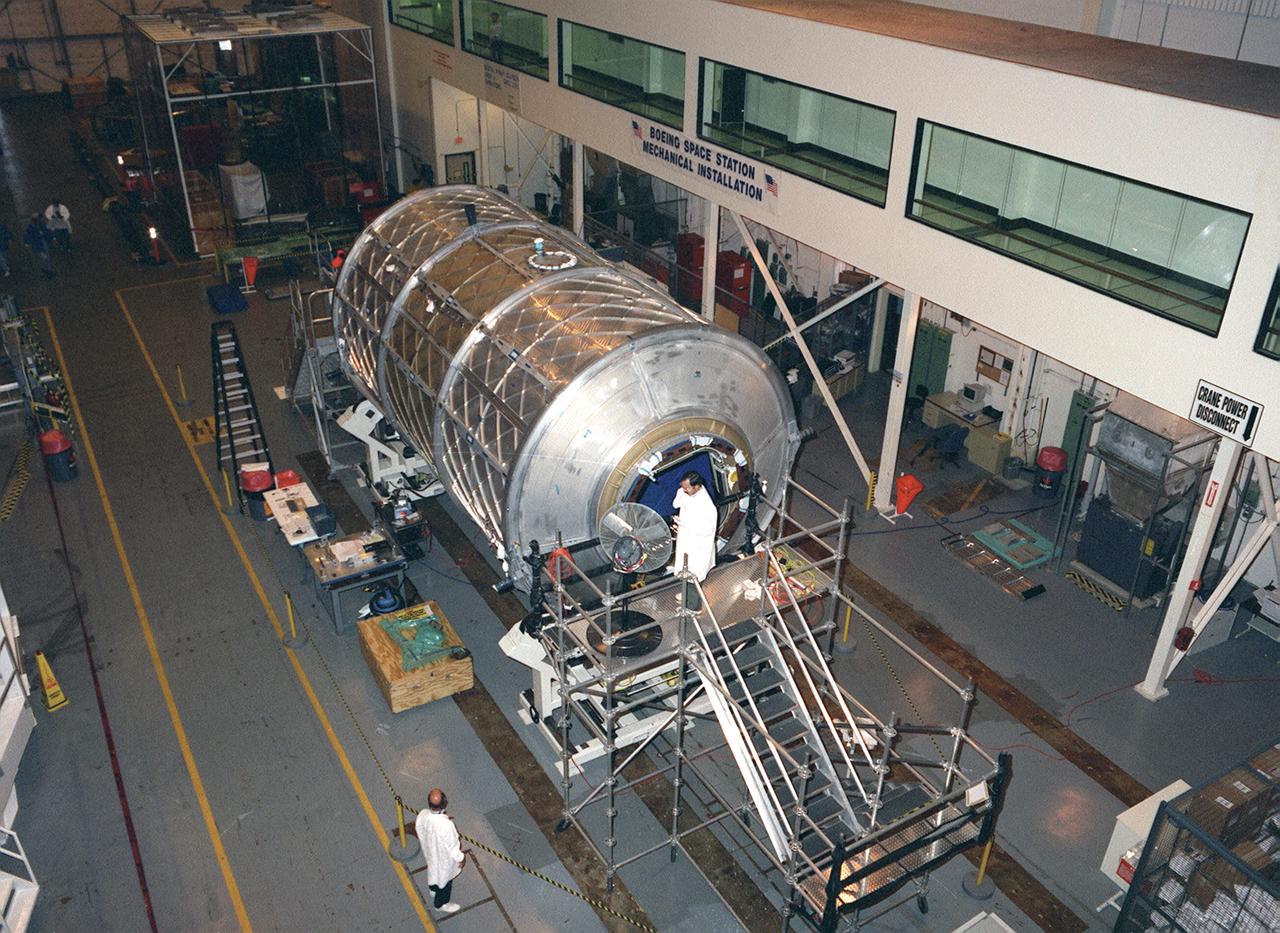
In this photograph, the U.S. Laboratory Module (also called Destiny) for the International Space Station (ISS) is shown under construction in the West High Bay of the Space Station manufacturing facility (building 4708) at the Marshall Space Flight Center. The U.S. Laboratory module is the centerpiece of the ISS, where science experiments will be performed in the near-zero gravity of space. The Destiny Module was launched aboard the Space Shuttle orbiter Atlantis (STS-98 mission) on February 7, 2001. The aluminum module is 8.5 meters (28 feet) long and 4.3 meters (14 feet) in diameter. The laboratory consists of three cylindrical sections and two endcones with hatches that will be mated to other station components. A 50.9-centimeter- (20-inch-) diameter window is located on one side of the center module segment. This pressurized module is designed to accommodate pressurized payloads. It has a capacity of 24 rack locations, and payload racks will occupy 13 locations especially designed to support experiments. The ISS is a multidisciplinary laboratory, technology test bed, and observatory that will provide unprecedented undertakings in scientific, technological, and international experimentation.
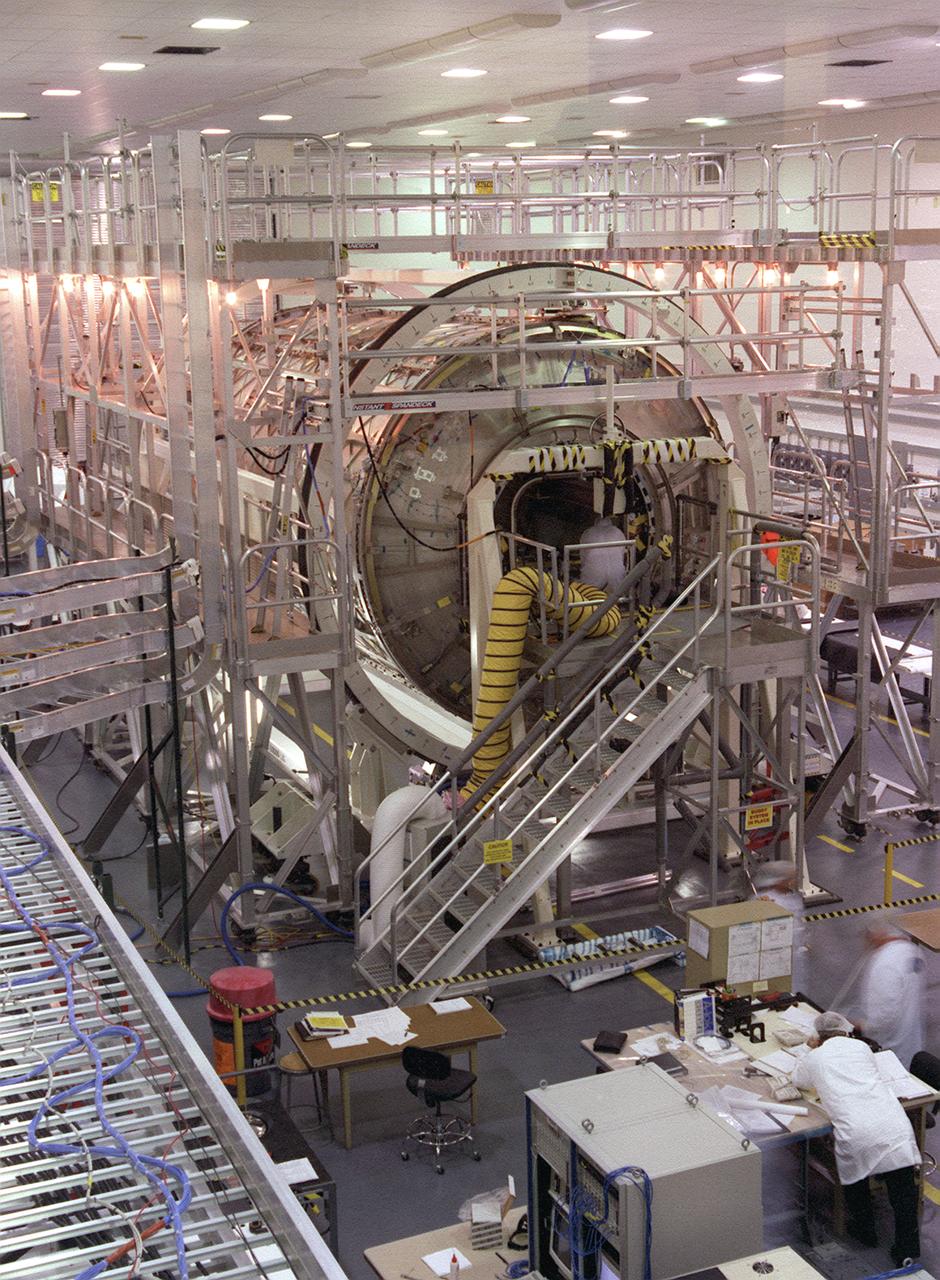
In this photograph, the U.S. Laboratory Module (also called Destiny) for the International Space Station (ISS) is shown under construction in the West High Bay of the Space Station manufacturing facility (building 4708) at the Marshall Space Flight Center. The U.S. Laboratory module is the centerpiece of the ISS, where science experiments will be performed in the near-zero gravity of space. The Destiny Module was launched aboard the Space Shuttle orbiter Atlantis (STS-98 mission) on February 7, 2001. The aluminum module is 8.5 meters (28 feet) long and 4.3 meters (14 feet) in diameter. The laboratory consists of three cylindrical sections and two endcones with hatches that will be mated to other station components. A 50.9-centimeter- (20-inch-) diameter window is located on one side of the center module segment. This pressurized module is designed to accommodate pressurized payloads. It has a capacity of 24 rack locations, and payload racks will occupy 13 locations especially designed to support experiments. The ISS is a multidisciplinary laboratory, technology test bed, and observatory that will provide unprecedented undertakings in scientific, technological, and international experimentation.
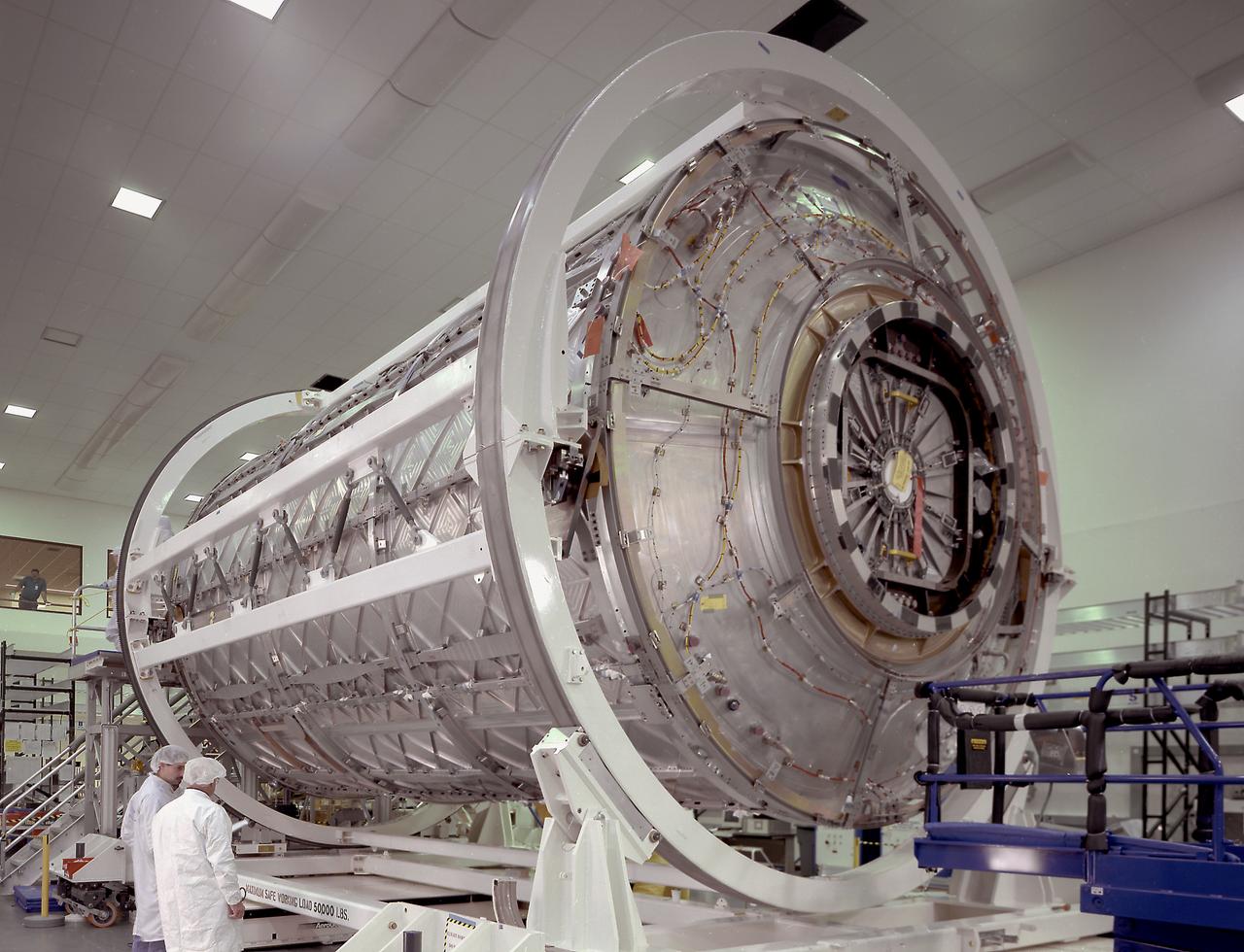
This photograph shows the U.S. Laboratory Module (also called Destiny) for the International Space Station (ISS), in the Space Station manufacturing facility at the Marshall Space Flight Center, being readied for shipment to the Kennedy Space Center. The U.S. Laboratory module is the centerpiece of the ISS, where science experiments will be performed in the near-zero gravity of space. The Destiny Module was launched aboard the Space Shuttle orbiter Atlantis (STS-67 mission) on February 7, 2001. The aluminum module is 8.5 meters (28 feet) long and 4.3 meters (14 feet) in diameter. The laboratory consists of three cylindrical sections and two endcones with hatches that will be mated to other station components. A 50.9-centimeter- (20-inch-) diameter window is located on one side of the center module segment. This pressurized module is designed to accommodate pressurized payloads. It has a capacity of 24 rack locations, and payload racks will occupy 13 locations especially designed to support experiments. The ISS is a multidisciplinary laboratory, technology test bed, and observatory that will provide unprecedented undertakings in scientific, technological, and international experimentation.
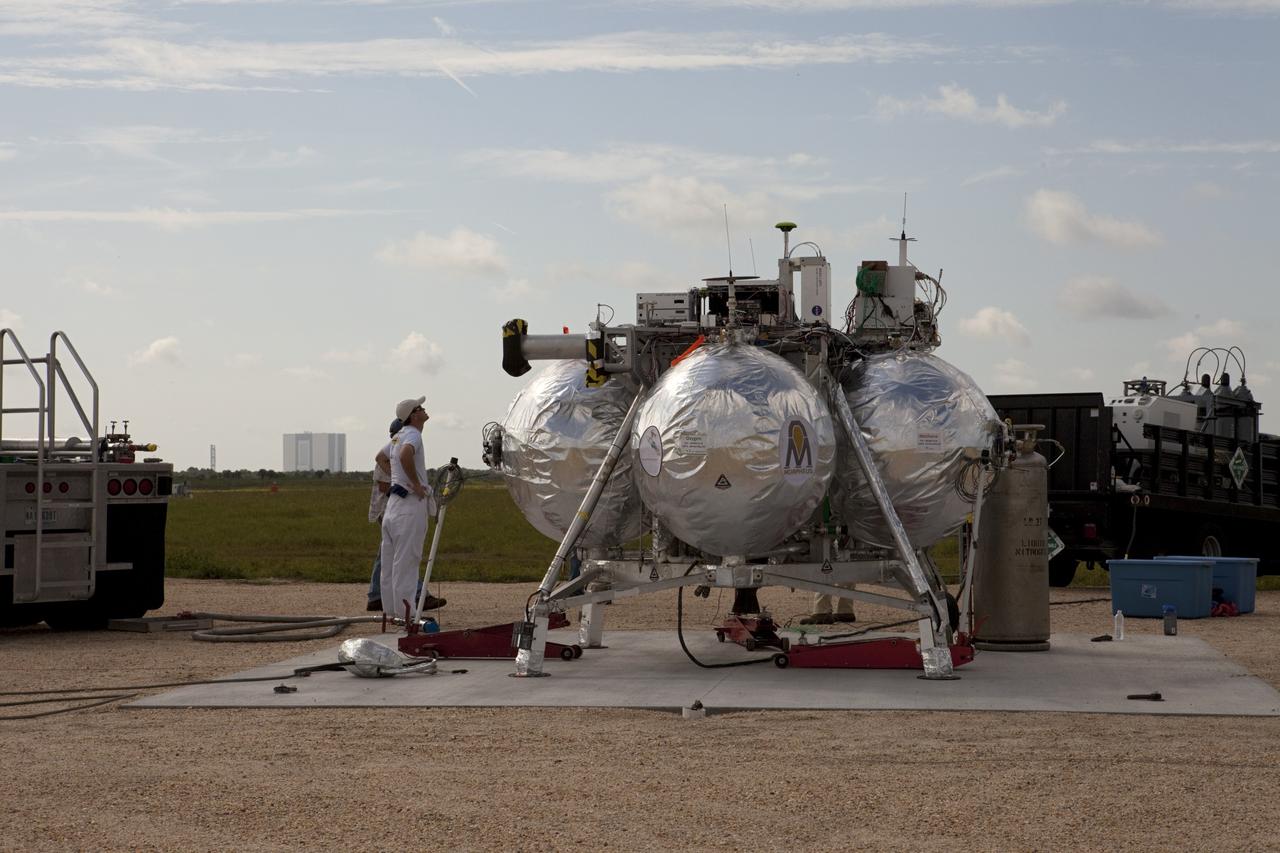
CAPE CANAVERAL, Fla. - At the north end of the Shuttle Landing Facility, or SLF, at the Kennedy Space Center in Florida, technicians check out NASA's Morpheus lander, a vertical test bed vehicle. A rock and crater-filled planetary scape, has been built so engineers can test the Autonomous Landing and Hazard Avoidance Technology, or ALHAT, system on the Project Morpheus lander. Checkout of the prototype lander has been ongoing at NASA’s Johnson Space Center in Houston in preparation for its first free flight. The SLF site will provide the lander with the kind of field necessary for realistic testing. Project Morpheus is one of 20 small projects comprising the Advanced Exploration Systems, or AES, program in NASA’s Human Exploration and Operations Mission Directorate. AES projects pioneer new approaches for rapidly developing prototype systems, demonstrating key capabilities and validating operational concepts for future human missions beyond Earth orbit. For more information on Project Morpheus, visit http://www.nasa.gov/centers/johnson/exploration/morpheus/index.html Photo credit: NASA/Kim Shiflett
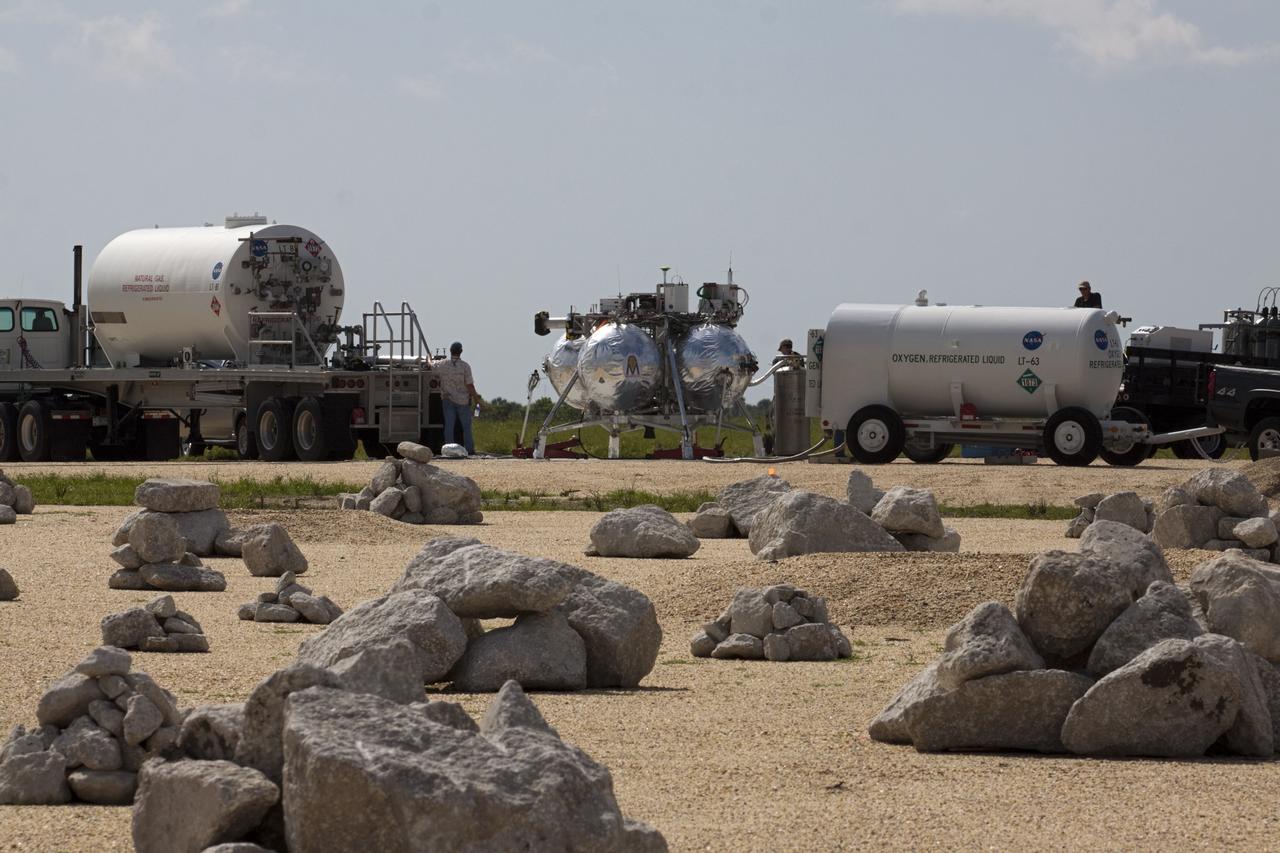
CAPE CANAVERAL, Fla. - At the north end of the Shuttle Landing Facility, or SLF, at the Kennedy Space Center in Florida, NASA's Morpheus lander, a vertical test bed vehicle, is being fueled. A rock and crater-filled planetary scape, seen in the foreground, has been built so engineers can test the Autonomous Landing and Hazard Avoidance Technology, or ALHAT, system on the Project Morpheus lander. Checkout of the prototype lander has been ongoing at NASA’s Johnson Space Center in Houston in preparation for its first free flight. The SLF site will provide the lander with the kind of field necessary for realistic testing. Project Morpheus is one of 20 small projects comprising the Advanced Exploration Systems, or AES, program in NASA’s Human Exploration and Operations Mission Directorate. AES projects pioneer new approaches for rapidly developing prototype systems, demonstrating key capabilities and validating operational concepts for future human missions beyond Earth orbit. For more information on Project Morpheus, visit http://www.nasa.gov/centers/johnson/exploration/morpheus/index.html Photo credit: NASA/Kim Shiflett
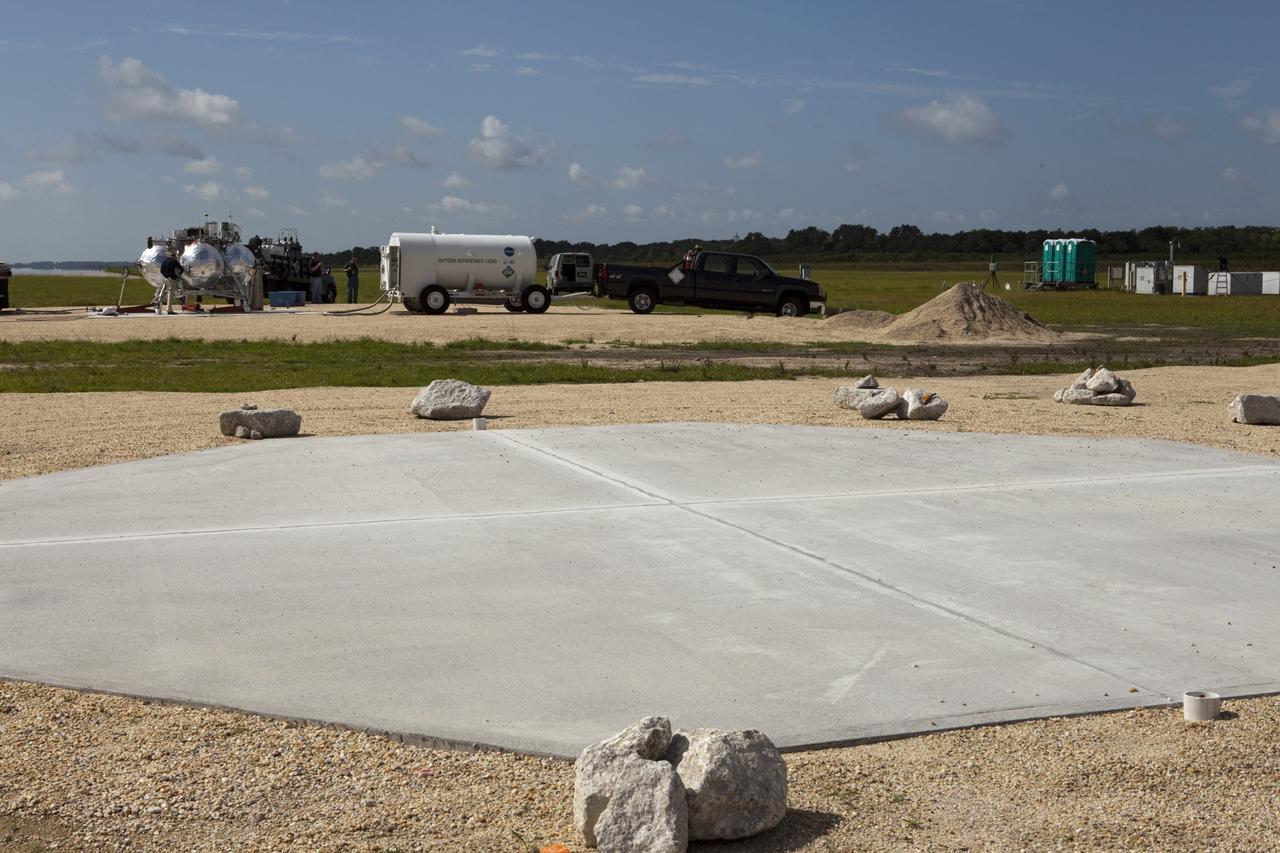
CAPE CANAVERAL, Fla. - At the north end of the Shuttle Landing Facility, or SLF, at the Kennedy Space Center in Florida, NASA's Morpheus lander, a vertical test bed vehicle, is being prepared for further assessment. A rock and crater-filled planetary scape, seen in the foreground, has been built so engineers can test the Autonomous Landing and Hazard Avoidance Technology, or ALHAT, system on the Project Morpheus lander. Checkout of the prototype lander has been ongoing at NASA’s Johnson Space Center in Houston in preparation for its first free flight. The SLF site will provide the lander with the kind of field necessary for realistic testing. Project Morpheus is one of 20 small projects comprising the Advanced Exploration Systems, or AES, program in NASA’s Human Exploration and Operations Mission Directorate. AES projects pioneer new approaches for rapidly developing prototype systems, demonstrating key capabilities and validating operational concepts for future human missions beyond Earth orbit. For more information on Project Morpheus, visit http://www.nasa.gov/centers/johnson/exploration/morpheus/index.html Photo credit: NASA/Kim Shiflett

CAPE CANAVERAL, Fla. - At the north end of the Shuttle Landing Facility, or SLF, at the Kennedy Space Center in Florida, NASA's Morpheus lander, a vertical test bed vehicle, is being fueled. A rock and crater-filled planetary scape, seen in the foreground, has been built so engineers can test the Autonomous Landing and Hazard Avoidance Technology, or ALHAT, system on the Project Morpheus lander. Checkout of the prototype lander has been ongoing at NASA’s Johnson Space Center in Houston in preparation for its first free flight. The SLF site will provide the lander with the kind of field necessary for realistic testing. Project Morpheus is one of 20 small projects comprising the Advanced Exploration Systems, or AES, program in NASA’s Human Exploration and Operations Mission Directorate. AES projects pioneer new approaches for rapidly developing prototype systems, demonstrating key capabilities and validating operational concepts for future human missions beyond Earth orbit. For more information on Project Morpheus, visit http://www.nasa.gov/centers/johnson/exploration/morpheus/index.html Photo credit: NASA/Kim Shiflett
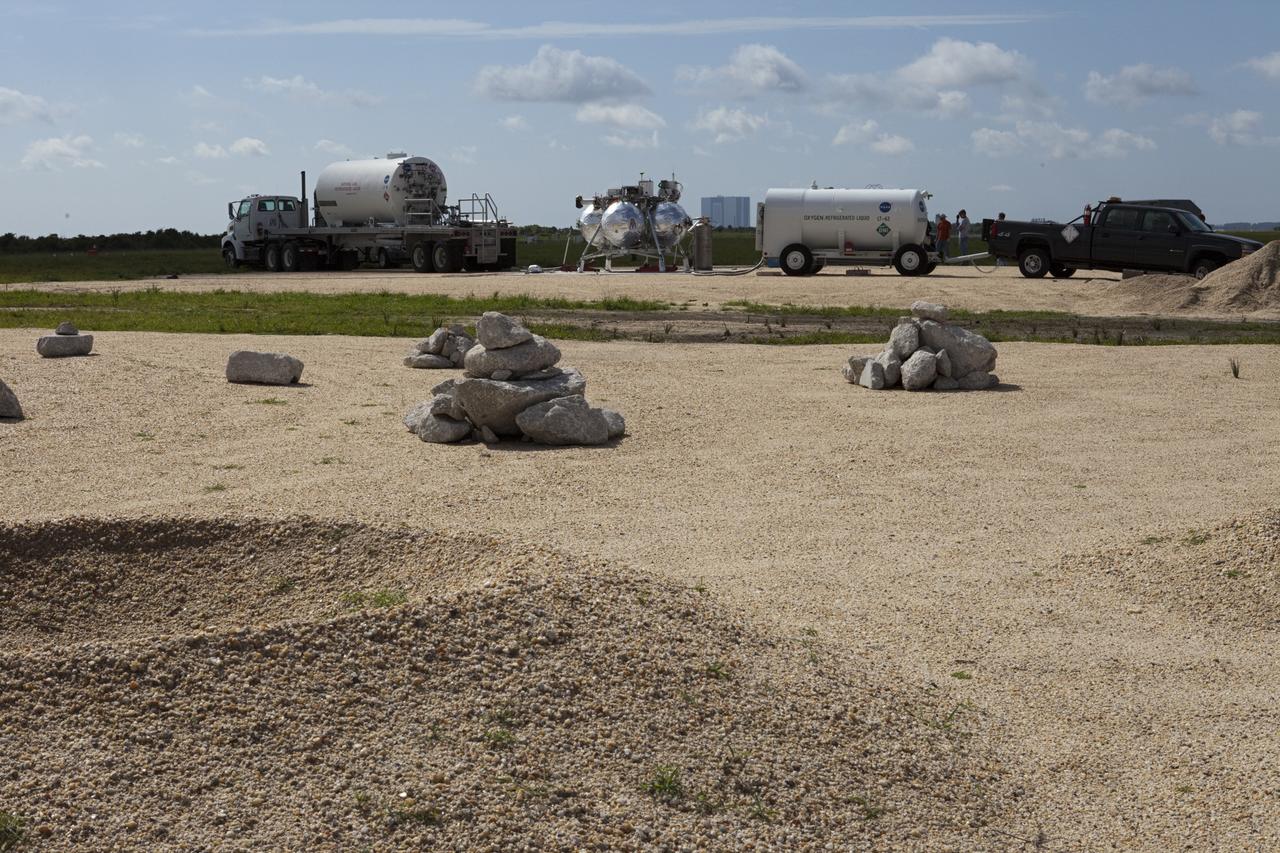
CAPE CANAVERAL, Fla. - At the north end of the Shuttle Landing Facility, or SLF, at the Kennedy Space Center in Florida, NASA's Morpheus lander, a vertical test bed vehicle, is being prepared for further assessment. A rock and crater-filled planetary scape, seen in the foreground, has been built so engineers can test the Autonomous Landing and Hazard Avoidance Technology, or ALHAT, system on the Project Morpheus lander. Checkout of the prototype lander has been ongoing at NASA’s Johnson Space Center in Houston in preparation for its first free flight. The SLF site will provide the lander with the kind of field necessary for realistic testing. Project Morpheus is one of 20 small projects comprising the Advanced Exploration Systems, or AES, program in NASA’s Human Exploration and Operations Mission Directorate. AES projects pioneer new approaches for rapidly developing prototype systems, demonstrating key capabilities and validating operational concepts for future human missions beyond Earth orbit. For more information on Project Morpheus, visit http://www.nasa.gov/centers/johnson/exploration/morpheus/index.html Photo credit: NASA/Kim Shiflett
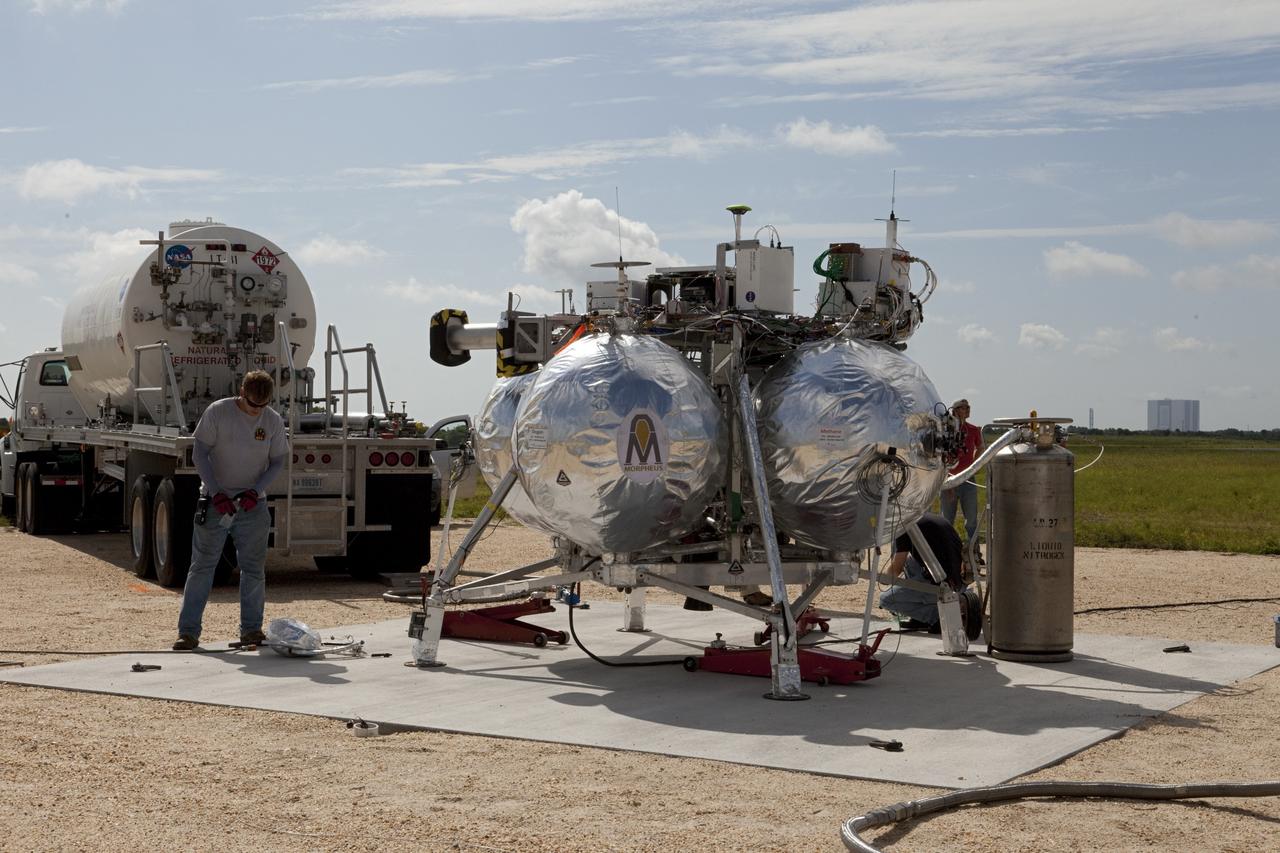
CAPE CANAVERAL, Fla. - At the north end of the Shuttle Landing Facility, or SLF, at the Kennedy Space Center in Florida, NASA's Morpheus lander, a vertical test bed vehicle is being checked out. A rock and crater-filled planetary scape, has been built so engineers can test the Autonomous Landing and Hazard Avoidance Technology, or ALHAT, system on the Project Morpheus lander. Checkout of the prototype lander has been ongoing at NASA’s Johnson Space Center in Houston in preparation for its first free flight. The SLF site will provide the lander with the kind of field necessary for realistic testing. Project Morpheus is one of 20 small projects comprising the Advanced Exploration Systems, or AES, program in NASA’s Human Exploration and Operations Mission Directorate. AES projects pioneer new approaches for rapidly developing prototype systems, demonstrating key capabilities and validating operational concepts for future human missions beyond Earth orbit. For more information on Project Morpheus, visit http://www.nasa.gov/centers/johnson/exploration/morpheus/index.html Photo credit: NASA/Kim Shiflett
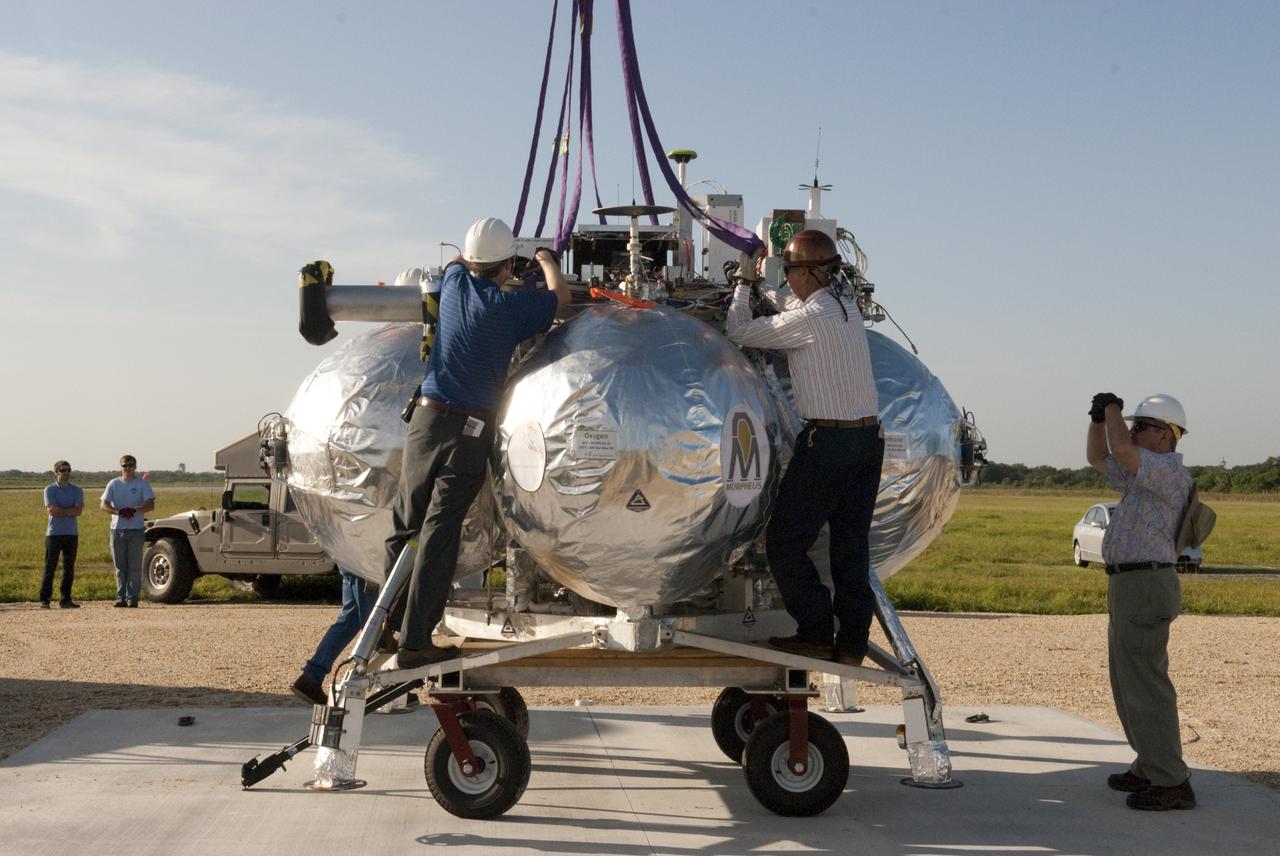
CAPE CANAVERAL, Fla. - Technicians secure connections for a crane which will be used to set up NASA's Morpheus lander, a vertical test bed vehicle, at its launch position along the runway at the Shuttle Landing Facility, or SLF, at the Kennedy Space Center in Florida. Morpheus is designed to demonstrate new green propellant propulsion systems and autonomous landing and an Autonomous Landing and Hazard Avoidance Technology, or ALHAT, system. Checkout of the prototype lander has been ongoing at NASA’s Johnson Space Center in Houston in preparation for its first free flight. The SLF site will provide the lander with the kind of field necessary for realistic testing. Project Morpheus is one of 20 small projects comprising the Advanced Exploration Systems, or AES, program in NASA’s Human Exploration and Operations Mission Directorate. AES projects pioneer new approaches for rapidly developing prototype systems, demonstrating key capabilities and validating operational concepts for future human missions beyond Earth orbit. For more information on Project Morpheus, visit http://www.nasa.gov/centers/johnson/exploration/morpheus/index.html Photo credit: NASA/Dimitri Gerondidakis
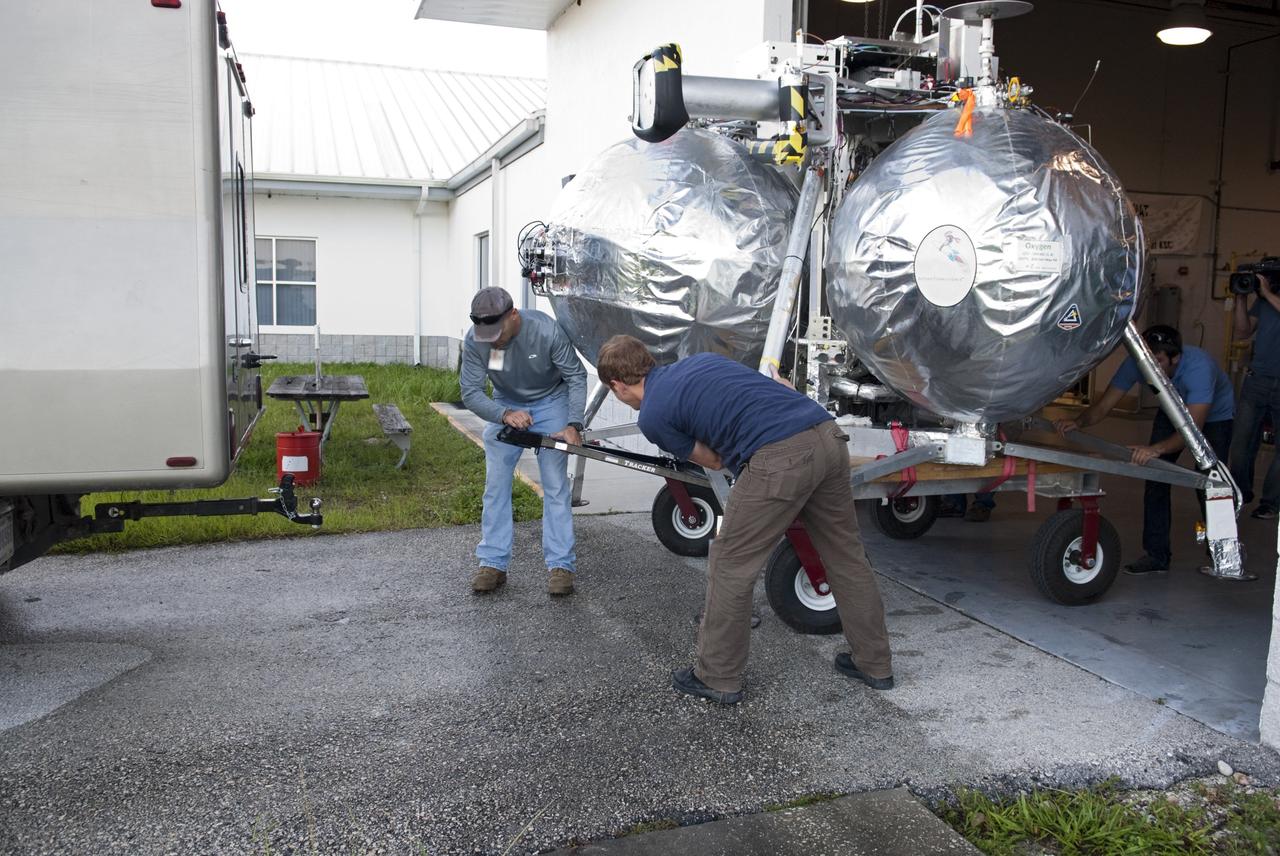
CAPE CANAVERAL, Fla. - NASA's Morpheus lander, a vertical test bed vehicle, is being moved out of its checkout building for a short trip to a launch position at the Shuttle Landing Facility, or SLF, at the Kennedy Space Center in Florida. Morpheus is designed to demonstrate new green propellant propulsion systems and autonomous landing and an Autonomous Landing and Hazard Avoidance Technology, or ALHAT, system. Checkout of the prototype lander has been ongoing at NASA’s Johnson Space Center in Houston in preparation for its first free flight. The SLF site will provide the lander with the kind of field necessary for realistic testing. Project Morpheus is one of 20 small projects comprising the Advanced Exploration Systems, or AES, program in NASA’s Human Exploration and Operations Mission Directorate. AES projects pioneer new approaches for rapidly developing prototype systems, demonstrating key capabilities and validating operational concepts for future human missions beyond Earth orbit. For more information on Project Morpheus, visit http://www.nasa.gov/centers/johnson/exploration/morpheus/index.html Photo credit: NASA/Dimitri Gerondidakis
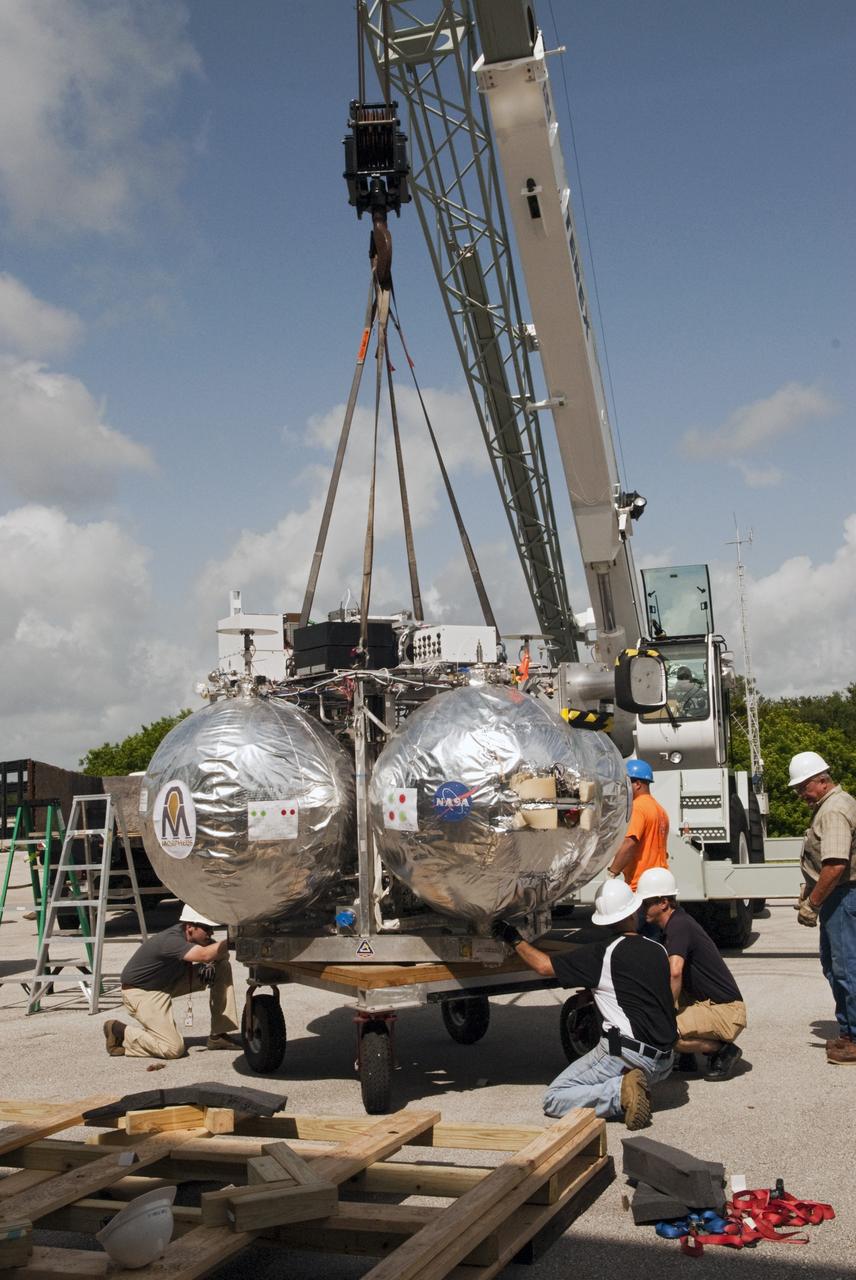
CAPE CANAVERAL, Fla. - A crane supports unloading of NASA's Morpheus lander, a vertical test bed vehicle, at the Kennedy Space Center in Florida. Morpheus is designed to demonstrate new green propellant propulsion systems and autonomous landing and an Autonomous Landing and Hazard Avoidance Technology, or ALHAT, system. Checkout of the prototype lander has been ongoing at NASA’s Johnson Space Center in Houston in preparation for its first free flight. The SLF site will provide the lander with the kind of field necessary for realistic testing. Project Morpheus is one of 20 small projects comprising the Advanced Exploration Systems, or AES, program in NASA’s Human Exploration and Operations Mission Directorate. AES projects pioneer new approaches for rapidly developing prototype systems, demonstrating key capabilities and validating operational concepts for future human missions beyond Earth orbit. For more information on Project Morpheus, visit http://www.nasa.gov/centers/johnson/exploration/morpheus/index.html Photo credit: NASA/ Charisse Nahser
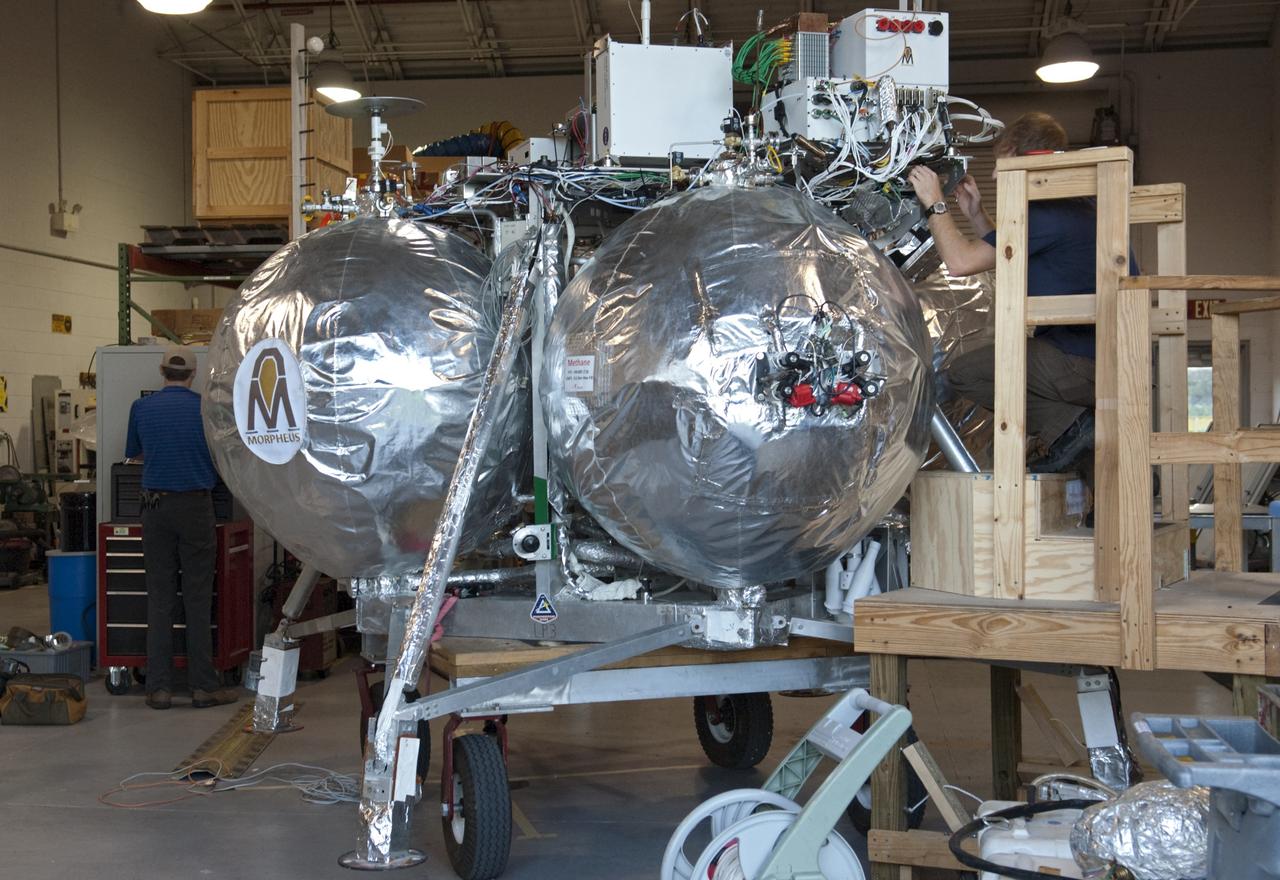
CAPE CANAVERAL, Fla. - NASA's Morpheus lander, a vertical test bed vehicle, is being checked out in a building at the Shuttle Landing Facility, or SLF, at the Kennedy Space Center in Florida. Morpheus is designed to demonstrate new green propellant propulsion systems and autonomous landing and an Autonomous Landing and Hazard Avoidance Technology, or ALHAT, system. Checkout of the prototype lander has been ongoing at NASA’s Johnson Space Center in Houston in preparation for its first free flight. The SLF site will provide the lander with the kind of field necessary for realistic testing. Project Morpheus is one of 20 small projects comprising the Advanced Exploration Systems, or AES, program in NASA’s Human Exploration and Operations Mission Directorate. AES projects pioneer new approaches for rapidly developing prototype systems, demonstrating key capabilities and validating operational concepts for future human missions beyond Earth orbit. For more information on Project Morpheus, visit http://www.nasa.gov/centers/johnson/exploration/morpheus/index.html Photo credit: NASA/Dimitri Gerondidakis
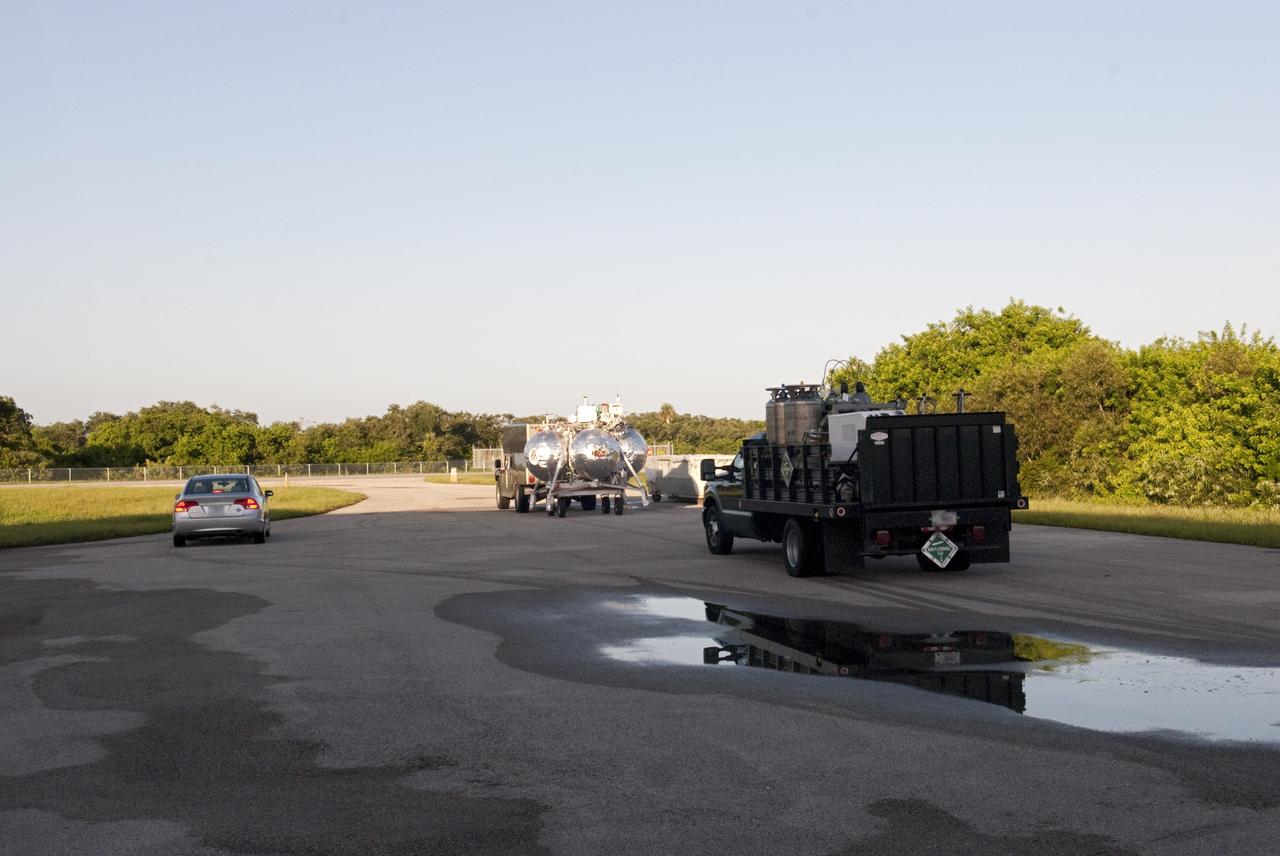
CAPE CANAVERAL, Fla. - NASA's Morpheus lander, a vertical test bed vehicle, is being transported out from its checkout building for a short trip to a launch position at the Shuttle Landing Facility, or SLF, at the Kennedy Space Center in Florida. Morpheus is designed to demonstrate new green propellant propulsion systems and autonomous landing and an Autonomous Landing and Hazard Avoidance Technology, or ALHAT, system. Checkout of the prototype lander has been ongoing at NASA’s Johnson Space Center in Houston in preparation for its first free flight. The SLF site will provide the lander with the kind of field necessary for realistic testing. Project Morpheus is one of 20 small projects comprising the Advanced Exploration Systems, or AES, program in NASA’s Human Exploration and Operations Mission Directorate. AES projects pioneer new approaches for rapidly developing prototype systems, demonstrating key capabilities and validating operational concepts for future human missions beyond Earth orbit. For more information on Project Morpheus, visit http://www.nasa.gov/centers/johnson/exploration/morpheus/index.html Photo credit: NASA/Dimitri Gerondidakis
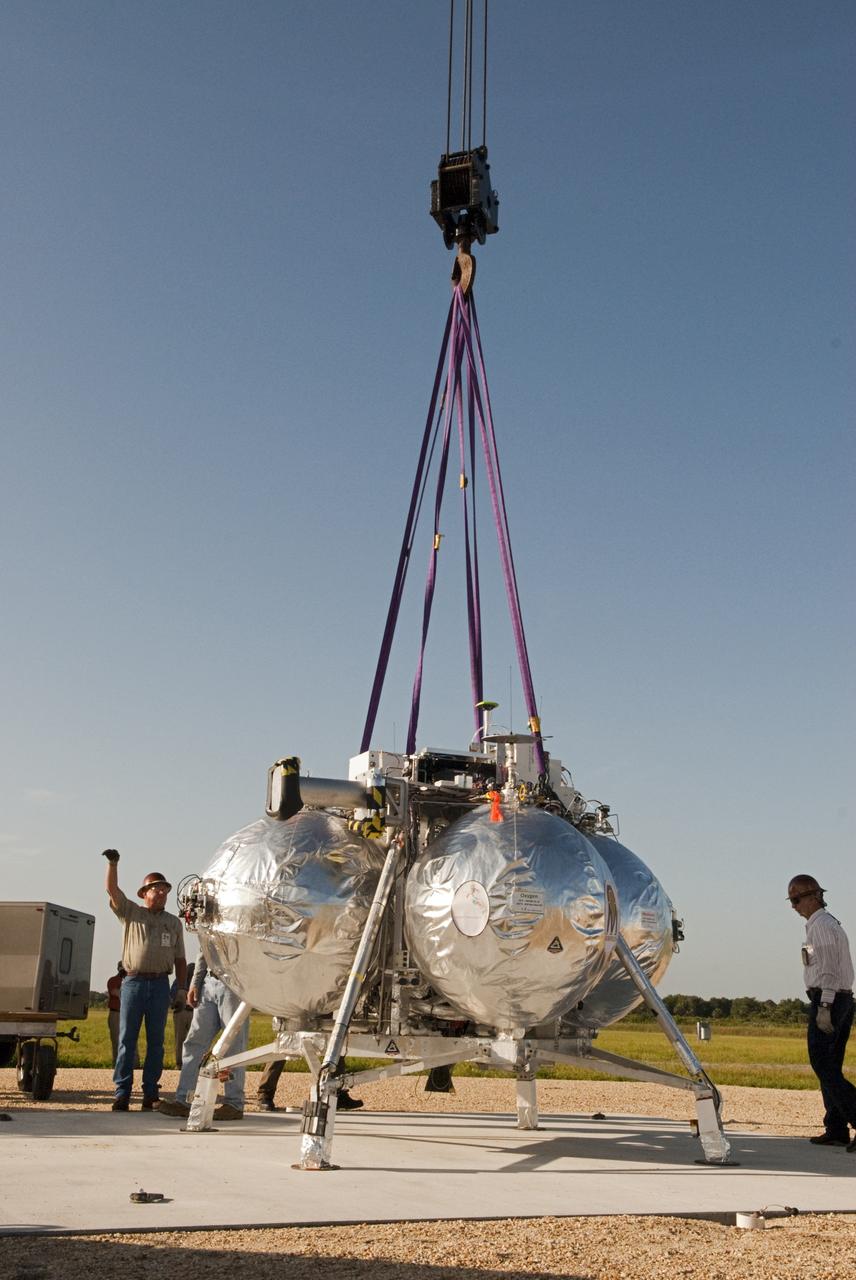
CAPE CANAVERAL, Fla. - A crane is being used to set up NASA's Morpheus lander, a vertical test bed vehicle, at its launch position along the runway at the Shuttle Landing Facility, or SLF, at the Kennedy Space Center in Florida. Morpheus is designed to demonstrate new green propellant propulsion systems and autonomous landing and an Autonomous Landing and Hazard Avoidance Technology, or ALHAT, system. Checkout of the prototype lander has been ongoing at NASA’s Johnson Space Center in Houston in preparation for its first free flight. The SLF site will provide the lander with the kind of field necessary for realistic testing. Project Morpheus is one of 20 small projects comprising the Advanced Exploration Systems, or AES, program in NASA’s Human Exploration and Operations Mission Directorate. AES projects pioneer new approaches for rapidly developing prototype systems, demonstrating key capabilities and validating operational concepts for future human missions beyond Earth orbit. For more information on Project Morpheus, visit http://www.nasa.gov/centers/johnson/exploration/morpheus/index.html Photo credit: NASA/Dimitri Gerondidakis
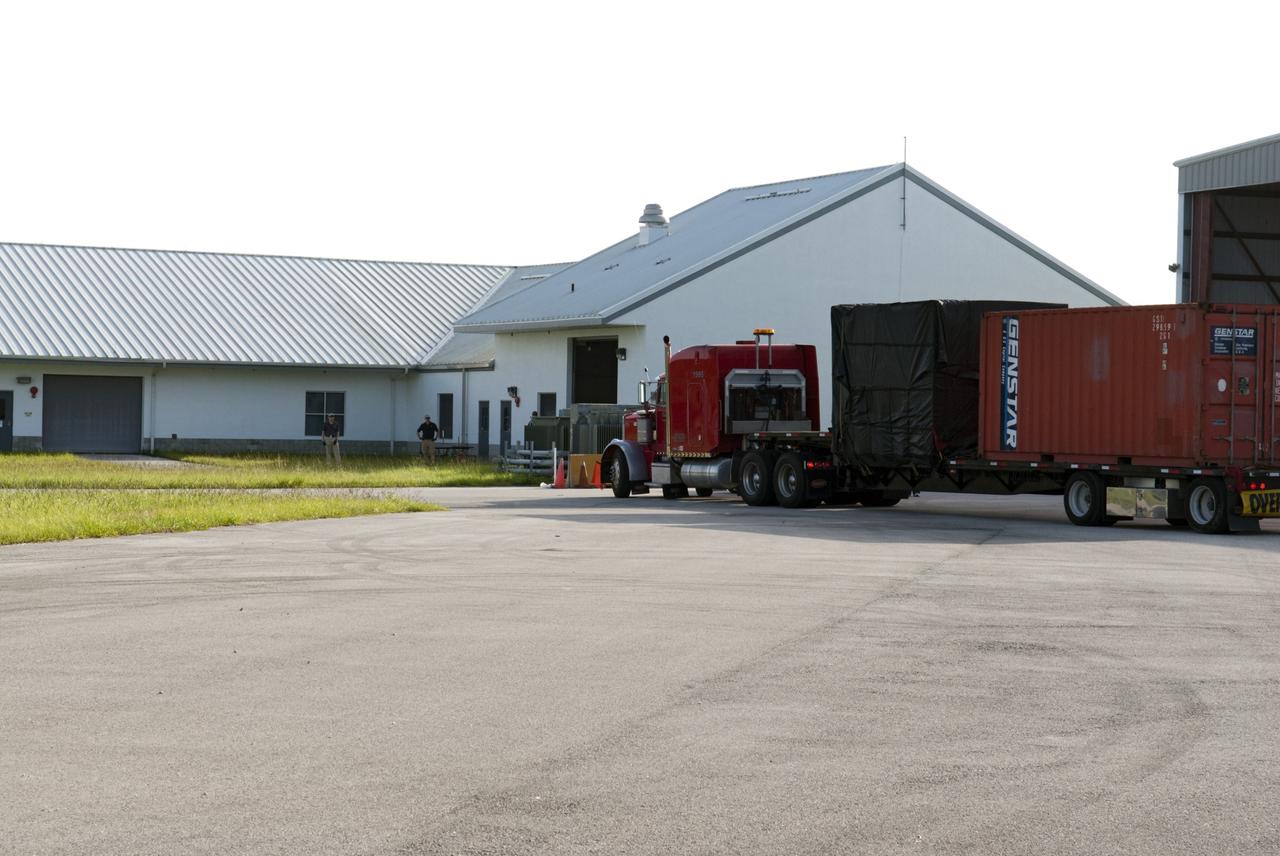
CAPE CANAVERAL, Fla. - A truck transporting NASA's Morpheus lander, a vertical test bed vehicle, arrives at a building at the Shuttle Landing Facility, or SLF, at the Kennedy Space Center in Florida for unloading. Morpheus is designed to demonstrate new green propellant propulsion systems and autonomous landing and an Autonomous Landing and Hazard Avoidance Technology, or ALHAT, system. Checkout of the prototype lander has been ongoing at NASA’s Johnson Space Center in Houston in preparation for its first free flight. The SLF site will provide the lander with the kind of field necessary for realistic testing. Project Morpheus is one of 20 small projects comprising the Advanced Exploration Systems, or AES, program in NASA’s Human Exploration and Operations Mission Directorate. AES projects pioneer new approaches for rapidly developing prototype systems, demonstrating key capabilities and validating operational concepts for future human missions beyond Earth orbit. For more information on Project Morpheus, visit http://www.nasa.gov/centers/johnson/exploration/morpheus/index.html Photo credit: NASA/ Charisse Nahser
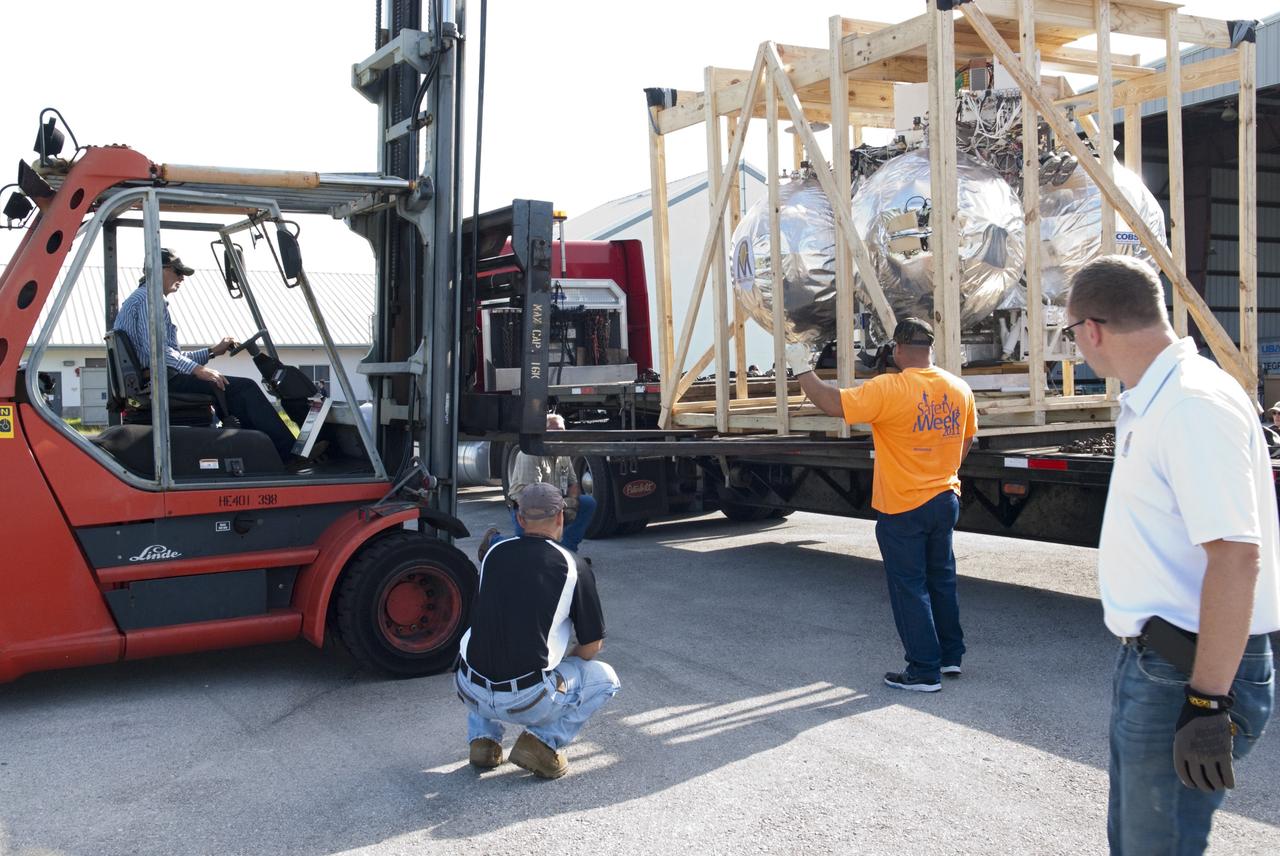
CAPE CANAVERAL, Fla. - NASA's Morpheus lander, a vertical test bed vehicle, is unloaded at a building at the Shuttle Landing Facility, or SLF, at the Kennedy Space Center in Florida. Morpheus is designed to demonstrate new green propellant propulsion systems and autonomous landing and an Autonomous Landing and Hazard Avoidance Technology, or ALHAT, system. Checkout of the prototype lander has been ongoing at NASA’s Johnson Space Center in Houston in preparation for its first free flight. The SLF site will provide the lander with the kind of field necessary for realistic testing. Project Morpheus is one of 20 small projects comprising the Advanced Exploration Systems, or AES, program in NASA’s Human Exploration and Operations Mission Directorate. AES projects pioneer new approaches for rapidly developing prototype systems, demonstrating key capabilities and validating operational concepts for future human missions beyond Earth orbit. For more information on Project Morpheus, visit http://www.nasa.gov/centers/johnson/exploration/morpheus/index.html Photo credit: NASA/ Charisse Nahser
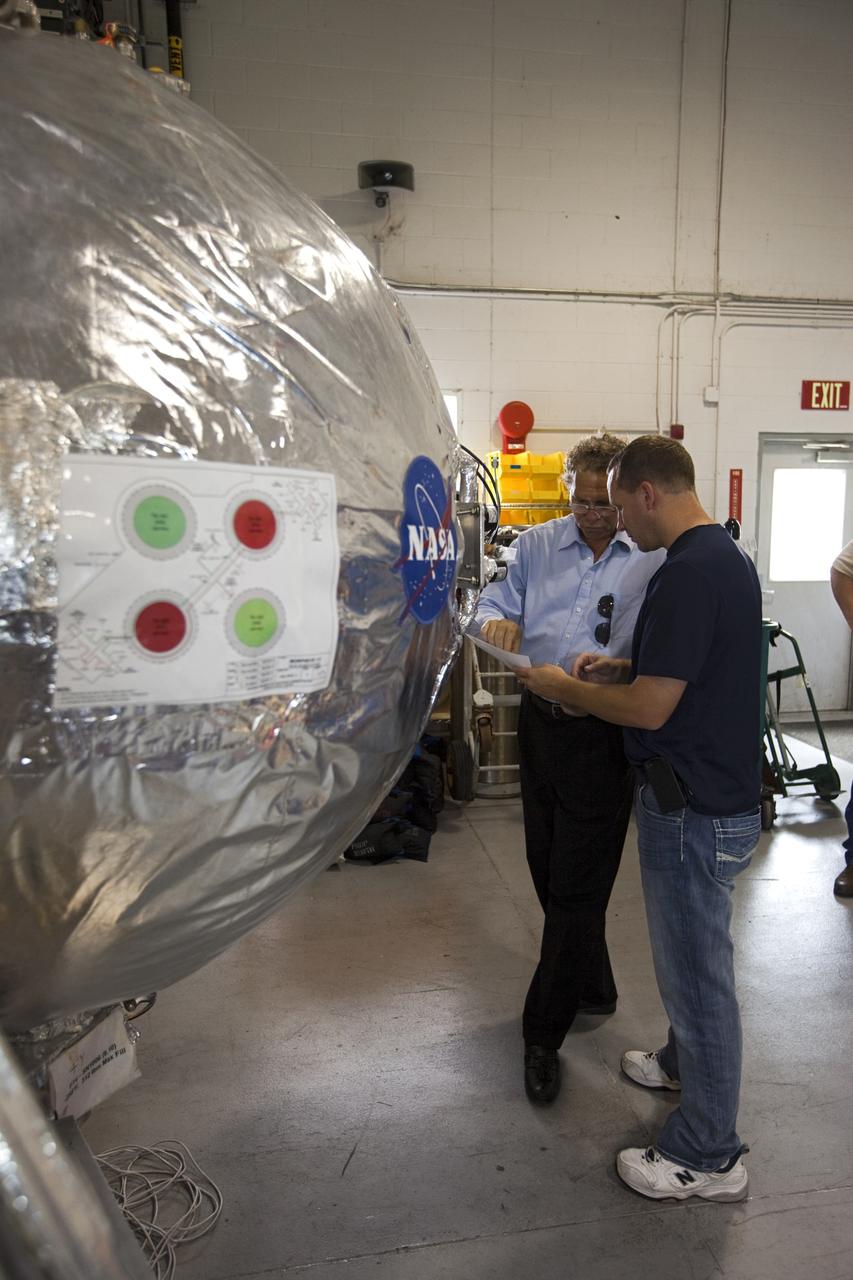
CAPE CANAVERAL, Fla. - Russell Romanella, director of Safety and Mission Assurance at NASA's Kennedy Space Center in Florida, left, is briefed on NASA's Morpheus lander, a vertical test bed vehicle. Morpheus is being checked out by technicians and engineers in a building at the Shuttle Landing Facility, or SLF, at Kennedy. Morpheus is designed to demonstrate new green propellant propulsion systems and autonomous landing and an Autonomous Landing and Hazard Avoidance Technology, or ALHAT, system. Checkout of the prototype lander has been ongoing at NASA’s Johnson Space Center in Houston in preparation for its first free flight. The SLF site will provide the lander with the kind of field necessary for realistic testing. Project Morpheus is one of 20 small projects comprising the Advanced Exploration Systems, or AES, program in NASA’s Human Exploration and Operations Mission Directorate. AES projects pioneer new approaches for rapidly developing prototype systems, demonstrating key capabilities and validating operational concepts for future human missions beyond Earth orbit. For more information on Project Morpheus, visit http://www.nasa.gov/centers/johnson/exploration/morpheus/index.html Photo credit: NASA/Dimitri Gerondidakis
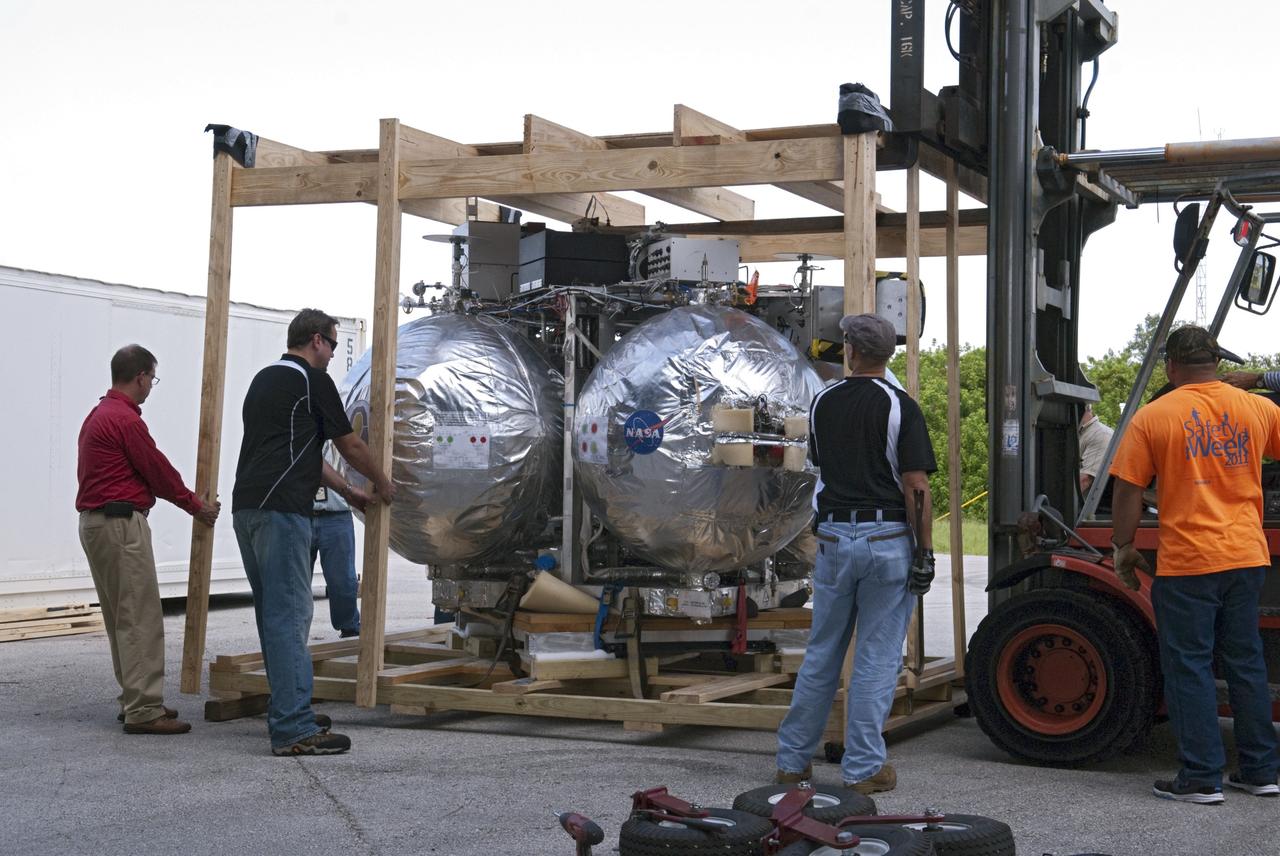
CAPE CANAVERAL, Fla. - NASA's Morpheus lander, a vertical test bed vehicle, is uncrated after unloading at the Kennedy Space Center in Florida. Morpheus is designed to demonstrate new green propellant propulsion systems and autonomous landing and an Autonomous Landing and Hazard Avoidance Technology, or ALHAT, system. Checkout of the prototype lander has been ongoing at NASA’s Johnson Space Center in Houston in preparation for its first free flight. The SLF site will provide the lander with the kind of field necessary for realistic testing. Project Morpheus is one of 20 small projects comprising the Advanced Exploration Systems, or AES, program in NASA’s Human Exploration and Operations Mission Directorate. AES projects pioneer new approaches for rapidly developing prototype systems, demonstrating key capabilities and validating operational concepts for future human missions beyond Earth orbit. For more information on Project Morpheus, visit http://www.nasa.gov/centers/johnson/exploration/morpheus/index.html Photo credit: NASA/ Charisse Nahser
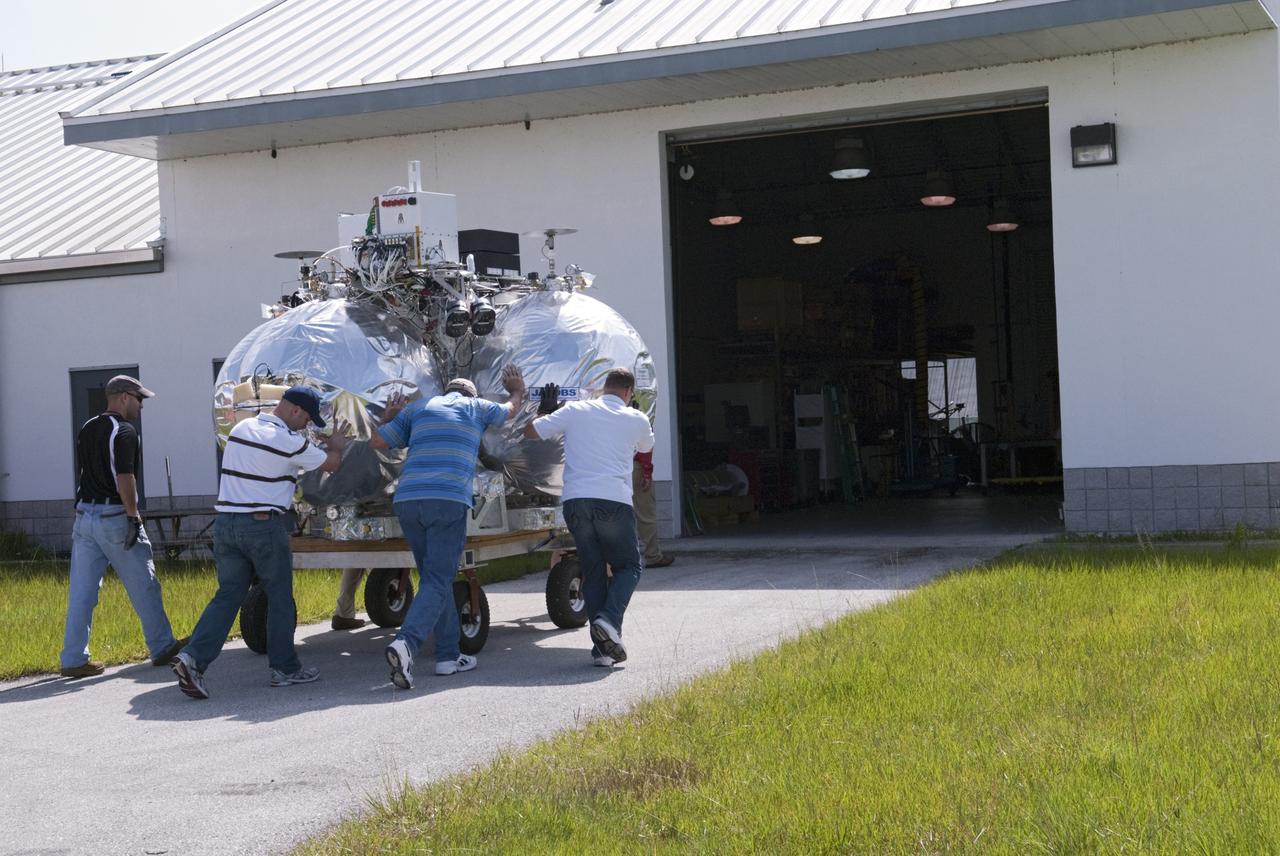
CAPE CANAVERAL, Fla. - NASA's Morpheus lander, a vertical test bed vehicle, is moved into a building at the Shuttle Landing Facility, or SLF, at the Kennedy Space Center in Florida. Morpheus is designed to demonstrate new green propellant propulsion systems and autonomous landing and an Autonomous Landing and Hazard Avoidance Technology, or ALHAT, system. Checkout of the prototype lander has been ongoing at NASA’s Johnson Space Center in Houston in preparation for its first free flight. The SLF site will provide the lander with the kind of field necessary for realistic testing. Project Morpheus is one of 20 small projects comprising the Advanced Exploration Systems, or AES, program in NASA’s Human Exploration and Operations Mission Directorate. AES projects pioneer new approaches for rapidly developing prototype systems, demonstrating key capabilities and validating operational concepts for future human missions beyond Earth orbit. For more information on Project Morpheus, visit http://www.nasa.gov/centers/johnson/exploration/morpheus/index.html Photo credit: NASA/ Charisse Nahser
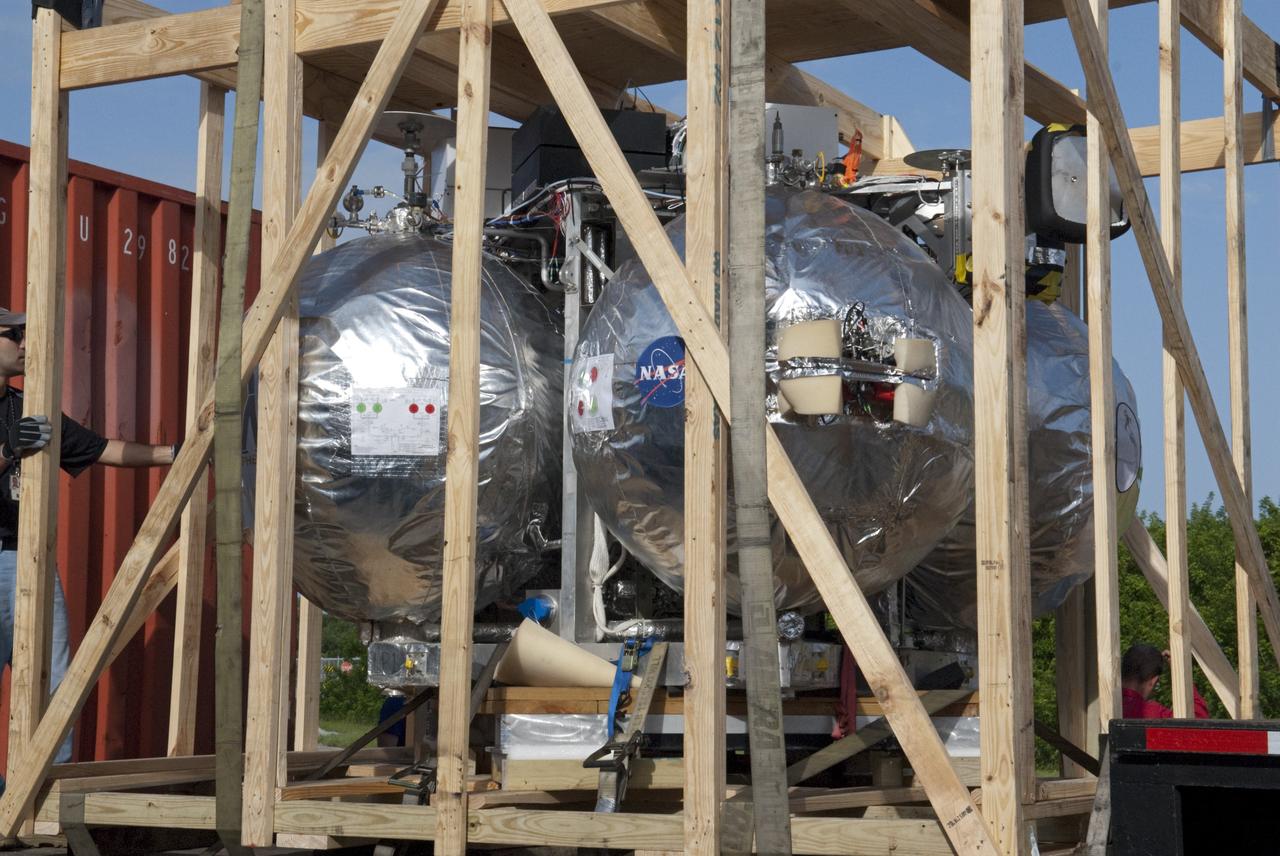
CAPE CANAVERAL, Fla. - NASA's Morpheus lander, a vertical test bed vehicle, is ready to be uncrated at the Kennedy Space Center in Florida. Morpheus is designed to demonstrate new green propellant propulsion systems and autonomous landing and an Autonomous Landing and Hazard Avoidance Technology, or ALHAT, system. Checkout of the prototype lander has been ongoing at NASA’s Johnson Space Center in Houston in preparation for its first free flight. The SLF site will provide the lander with the kind of field necessary for realistic testing. Project Morpheus is one of 20 small projects comprising the Advanced Exploration Systems, or AES, program in NASA’s Human Exploration and Operations Mission Directorate. AES projects pioneer new approaches for rapidly developing prototype systems, demonstrating key capabilities and validating operational concepts for future human missions beyond Earth orbit. For more information on Project Morpheus, visit http://www.nasa.gov/centers/johnson/exploration/morpheus/index.html Photo credit: NASA/ Charisse Nahser

CAPE CANAVERAL, Fla. - NASA's Morpheus lander, a vertical test bed vehicle, arrives at its launch position along the runway at the Shuttle Landing Facility, or SLF, at the Kennedy Space Center in Florida. Morpheus is designed to demonstrate new green propellant propulsion systems and autonomous landing and an Autonomous Landing and Hazard Avoidance Technology, or ALHAT, system. Checkout of the prototype lander has been ongoing at NASA’s Johnson Space Center in Houston in preparation for its first free flight. The SLF site will provide the lander with the kind of field necessary for realistic testing. Project Morpheus is one of 20 small projects comprising the Advanced Exploration Systems, or AES, program in NASA’s Human Exploration and Operations Mission Directorate. AES projects pioneer new approaches for rapidly developing prototype systems, demonstrating key capabilities and validating operational concepts for future human missions beyond Earth orbit. For more information on Project Morpheus, visit http://www.nasa.gov/centers/johnson/exploration/morpheus/index.html Photo credit: NASA/Dimitri Gerondidakis
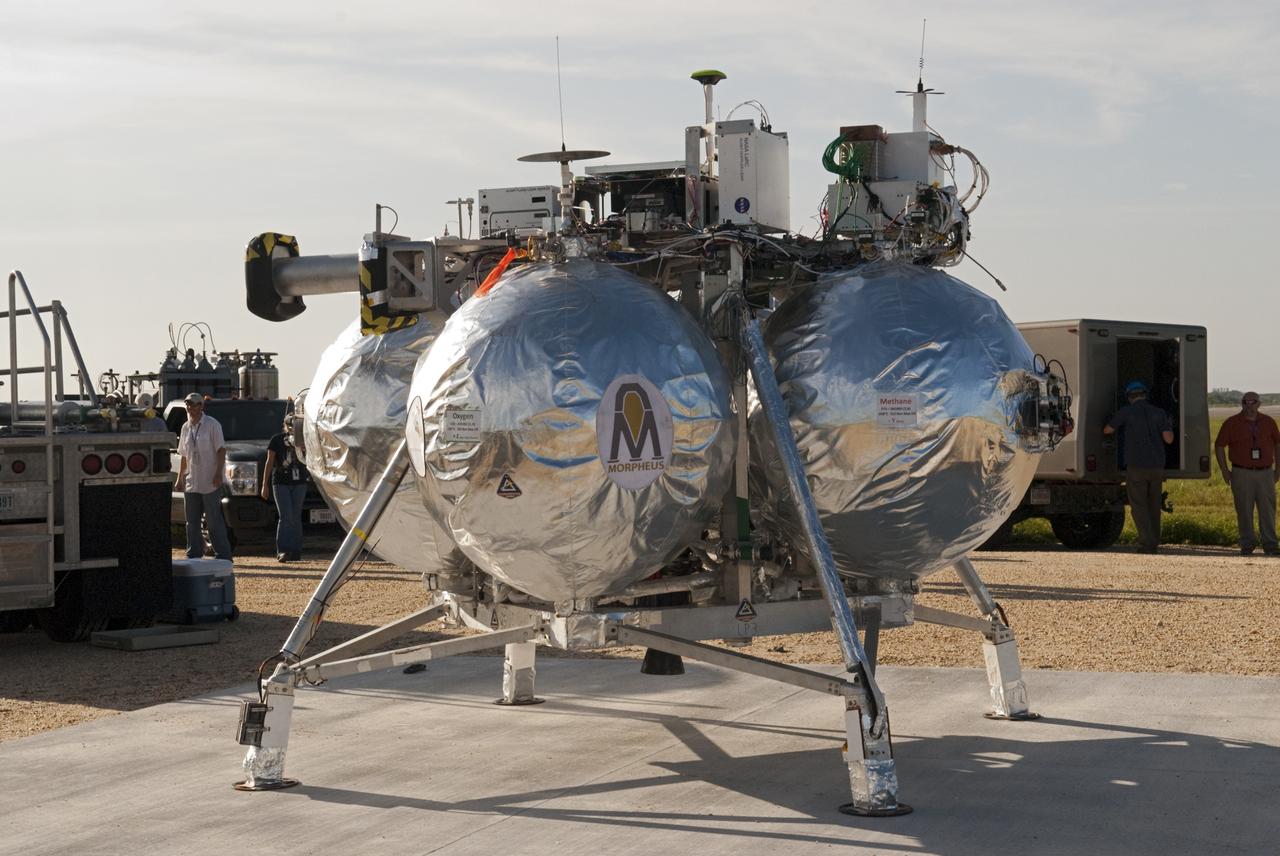
CAPE CANAVERAL, Fla. - NASA's Morpheus lander, a vertical test bed vehicle, has been set up at its launch position along the runway at the Shuttle Landing Facility, or SLF, at the Kennedy Space Center in Florida. Morpheus is designed to demonstrate new green propellant propulsion systems and autonomous landing and an Autonomous Landing and Hazard Avoidance Technology, or ALHAT, system. Checkout of the prototype lander has been ongoing at NASA’s Johnson Space Center in Houston in preparation for its first free flight. The SLF site will provide the lander with the kind of field necessary for realistic testing. Project Morpheus is one of 20 small projects comprising the Advanced Exploration Systems, or AES, program in NASA’s Human Exploration and Operations Mission Directorate. AES projects pioneer new approaches for rapidly developing prototype systems, demonstrating key capabilities and validating operational concepts for future human missions beyond Earth orbit. For more information on Project Morpheus, visit http://www.nasa.gov/centers/johnson/exploration/morpheus/index.html Photo credit: NASA/Dimitri Gerondidakis
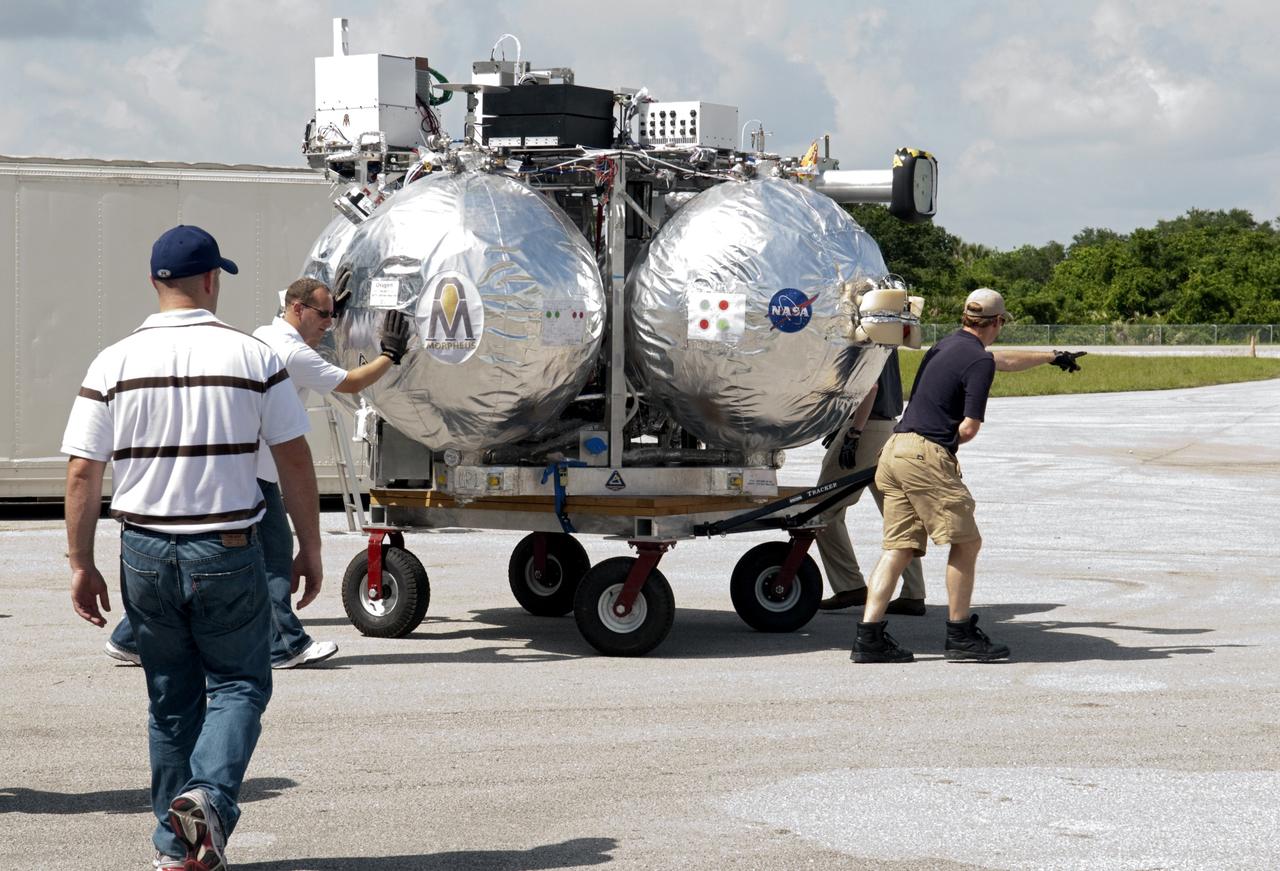
CAPE CANAVERAL, Fla. - NASA's Morpheus lander, a vertical test bed vehicle, is moved into a building at the Shuttle Landing Facility, or SLF, at the Kennedy Space Center in Florida. Morpheus is designed to demonstrate new green propellant propulsion systems and autonomous landing and an Autonomous Landing and Hazard Avoidance Technology, or ALHAT, system. Checkout of the prototype lander has been ongoing at NASA’s Johnson Space Center in Houston in preparation for its first free flight. The SLF site will provide the lander with the kind of field necessary for realistic testing. Project Morpheus is one of 20 small projects comprising the Advanced Exploration Systems, or AES, program in NASA’s Human Exploration and Operations Mission Directorate. AES projects pioneer new approaches for rapidly developing prototype systems, demonstrating key capabilities and validating operational concepts for future human missions beyond Earth orbit. For more information on Project Morpheus, visit http://www.nasa.gov/centers/johnson/exploration/morpheus/index.html Photo credit: NASA/ Charisse Nahser
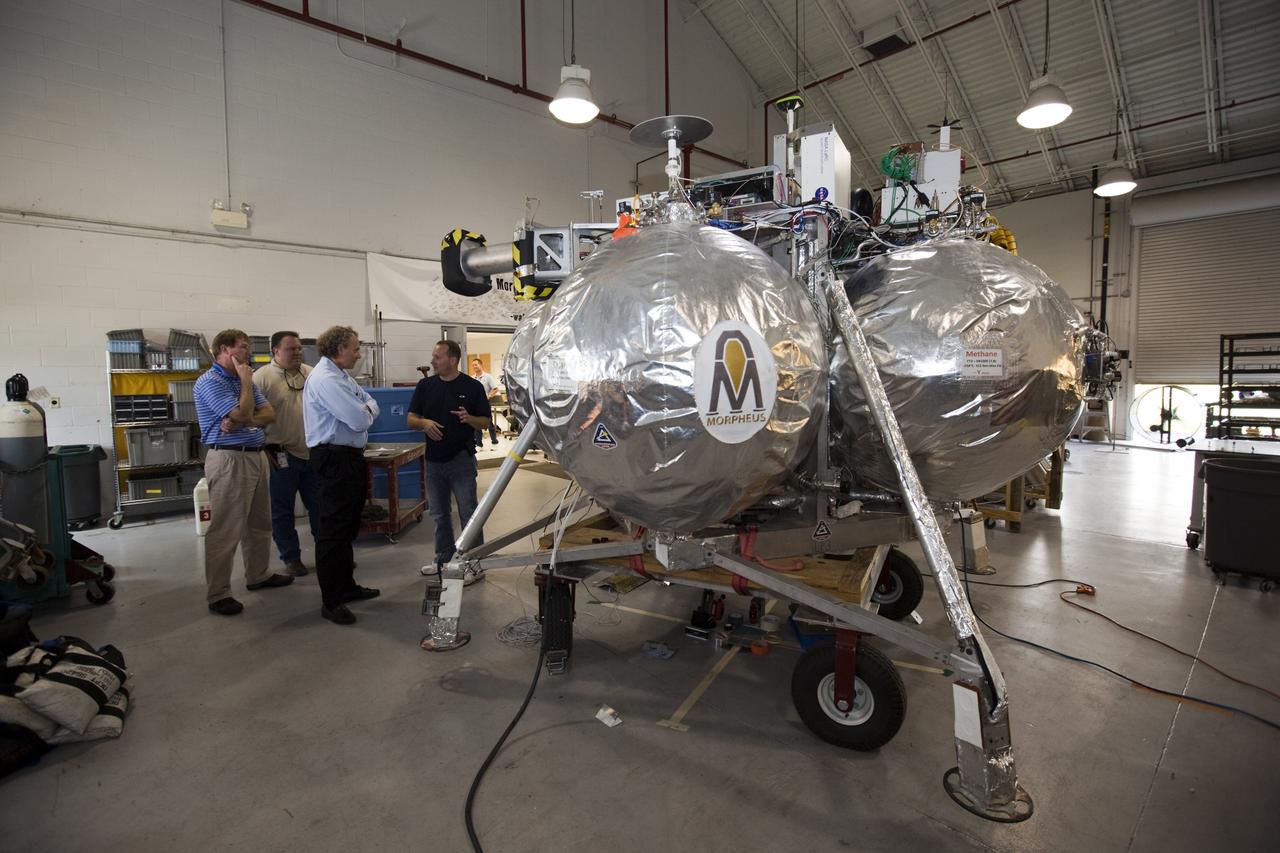
CAPE CANAVERAL, Fla. - Russell Romanella, director of Safety and Mission Assurance at NASA's Kennedy Space Center in Florida, right-center, is briefed on NASA's Morpheus lander, a vertical test bed vehicle. Morpheus is being checked out by technicians and engineers in a building at the Shuttle Landing Facility, or SLF, at Kennedy. Morpheus is designed to demonstrate new green propellant propulsion systems and autonomous landing and an Autonomous Landing and Hazard Avoidance Technology, or ALHAT, system. Checkout of the prototype lander has been ongoing at NASA’s Johnson Space Center in Houston in preparation for its first free flight. The SLF site will provide the lander with the kind of field necessary for realistic testing. Project Morpheus is one of 20 small projects comprising the Advanced Exploration Systems, or AES, program in NASA’s Human Exploration and Operations Mission Directorate. AES projects pioneer new approaches for rapidly developing prototype systems, demonstrating key capabilities and validating operational concepts for future human missions beyond Earth orbit. For more information on Project Morpheus, visit http://www.nasa.gov/centers/johnson/exploration/morpheus/index.html Photo credit: NASA/Dimitri Gerondidakis

CAPE CANAVERAL, Fla. - NASA's Morpheus lander, a vertical test bed vehicle, is being transported along the Shuttle Landing Facility, or SLF, at the Kennedy Space Center in Florida for a short trip to a launch position along the runway. Morpheus is designed to demonstrate new green propellant propulsion systems and autonomous landing and an Autonomous Landing and Hazard Avoidance Technology, or ALHAT, system. Checkout of the prototype lander has been ongoing at NASA’s Johnson Space Center in Houston in preparation for its first free flight. The SLF site will provide the lander with the kind of field necessary for realistic testing. Project Morpheus is one of 20 small projects comprising the Advanced Exploration Systems, or AES, program in NASA’s Human Exploration and Operations Mission Directorate. AES projects pioneer new approaches for rapidly developing prototype systems, demonstrating key capabilities and validating operational concepts for future human missions beyond Earth orbit. For more information on Project Morpheus, visit http://www.nasa.gov/centers/johnson/exploration/morpheus/index.html Photo credit: NASA/Dimitri Gerondidakis
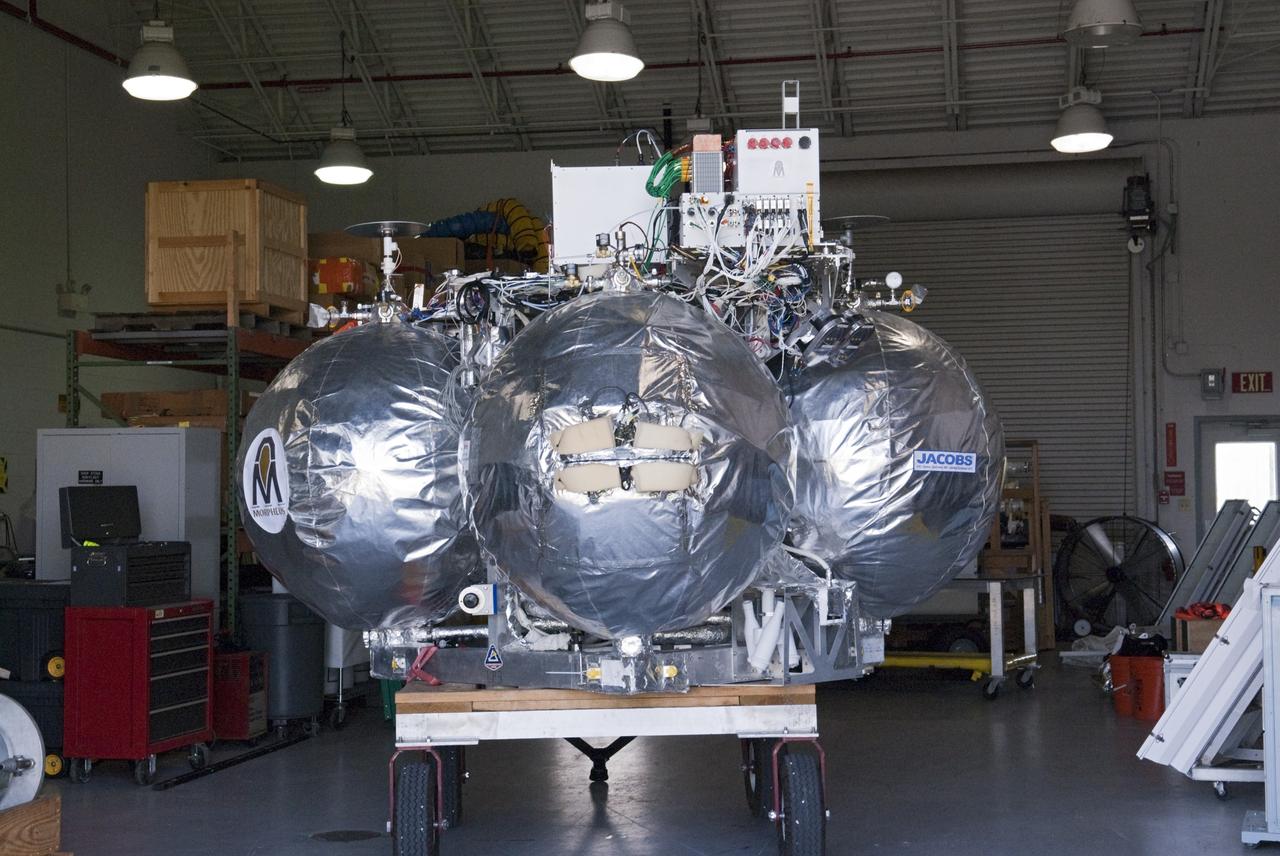
CAPE CANAVERAL, Fla. - NASA's Morpheus lander, a vertical test bed vehicle, has been moved into a building at the Shuttle Landing Facility, or SLF, at the Kennedy Space Center in Florida. Morpheus is designed to demonstrate new green propellant propulsion systems and autonomous landing and an Autonomous Landing and Hazard Avoidance Technology, or ALHAT, system. Checkout of the prototype lander has been ongoing at NASA’s Johnson Space Center in Houston in preparation for its first free flight. The SLF site will provide the lander with the kind of field necessary for realistic testing. Project Morpheus is one of 20 small projects comprising the Advanced Exploration Systems, or AES, program in NASA’s Human Exploration and Operations Mission Directorate. AES projects pioneer new approaches for rapidly developing prototype systems, demonstrating key capabilities and validating operational concepts for future human missions beyond Earth orbit. For more information on Project Morpheus, visit http://www.nasa.gov/centers/johnson/exploration/morpheus/index.html Photo credit: NASA/ Charisse Nahser
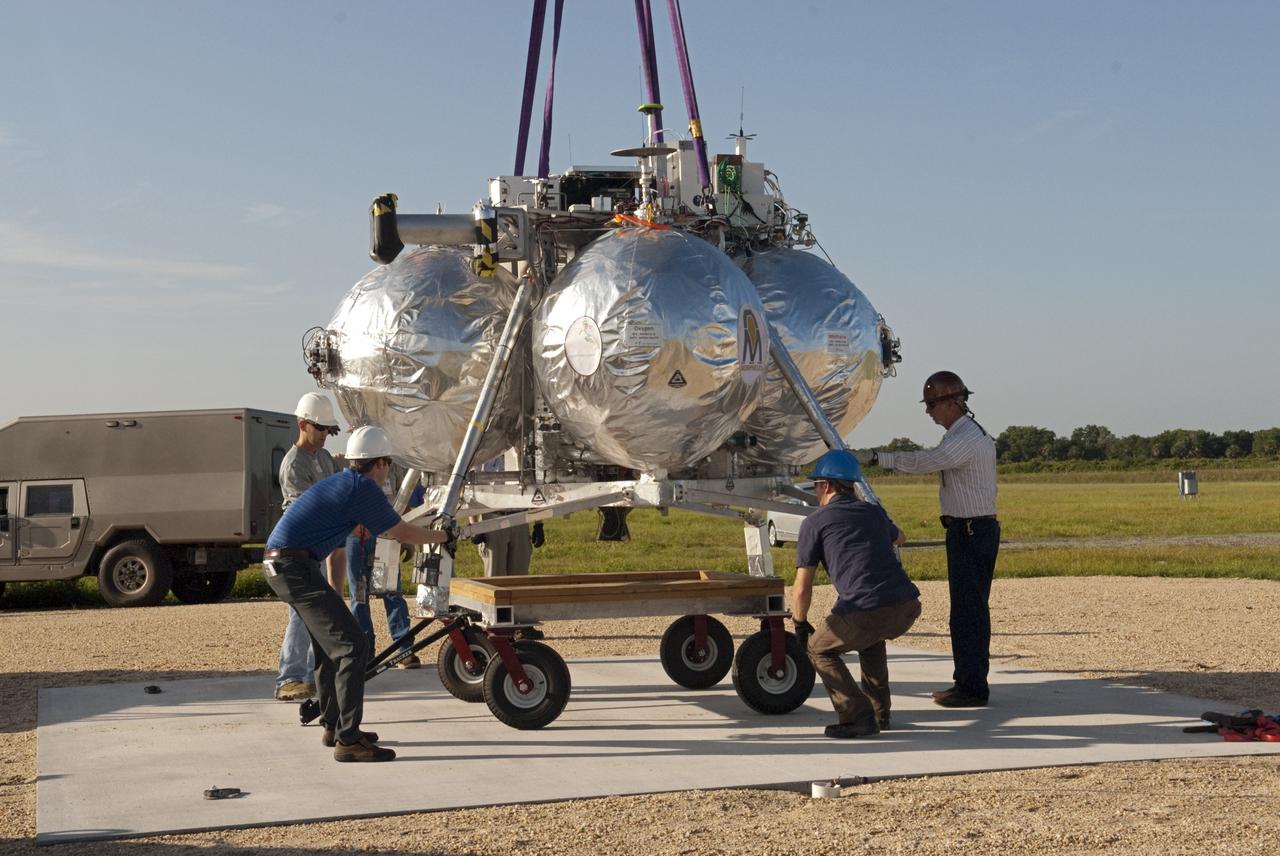
CAPE CANAVERAL, Fla. - Technicians set up NASA's Morpheus lander, a vertical test bed vehicle, at its launch position along the runway at the Shuttle Landing Facility, or SLF, at the Kennedy Space Center in Florida. Morpheus is designed to demonstrate new green propellant propulsion systems and autonomous landing and an Autonomous Landing and Hazard Avoidance Technology, or ALHAT, system. Checkout of the prototype lander has been ongoing at NASA’s Johnson Space Center in Houston in preparation for its first free flight. The SLF site will provide the lander with the kind of field necessary for realistic testing. Project Morpheus is one of 20 small projects comprising the Advanced Exploration Systems, or AES, program in NASA’s Human Exploration and Operations Mission Directorate. AES projects pioneer new approaches for rapidly developing prototype systems, demonstrating key capabilities and validating operational concepts for future human missions beyond Earth orbit. For more information on Project Morpheus, visit http://www.nasa.gov/centers/johnson/exploration/morpheus/index.html Photo credit: NASA/Dimitri Gerondidakis

CAPE CANAVERAL, Fla. - NASA's Morpheus lander, a vertical test bed vehicle, is inspected after unloading at the Kennedy Space Center in Florida. Morpheus is designed to demonstrate new green propellant propulsion systems and autonomous landing and an Autonomous Landing and Hazard Avoidance Technology, or ALHAT, system. Checkout of the prototype lander has been ongoing at NASA’s Johnson Space Center in Houston in preparation for its first free flight. The SLF site will provide the lander with the kind of field necessary for realistic testing. Project Morpheus is one of 20 small projects comprising the Advanced Exploration Systems, or AES, program in NASA’s Human Exploration and Operations Mission Directorate. AES projects pioneer new approaches for rapidly developing prototype systems, demonstrating key capabilities and validating operational concepts for future human missions beyond Earth orbit. For more information on Project Morpheus, visit http://www.nasa.gov/centers/johnson/exploration/morpheus/index.html Photo credit: NASA/ Charisse Nahser
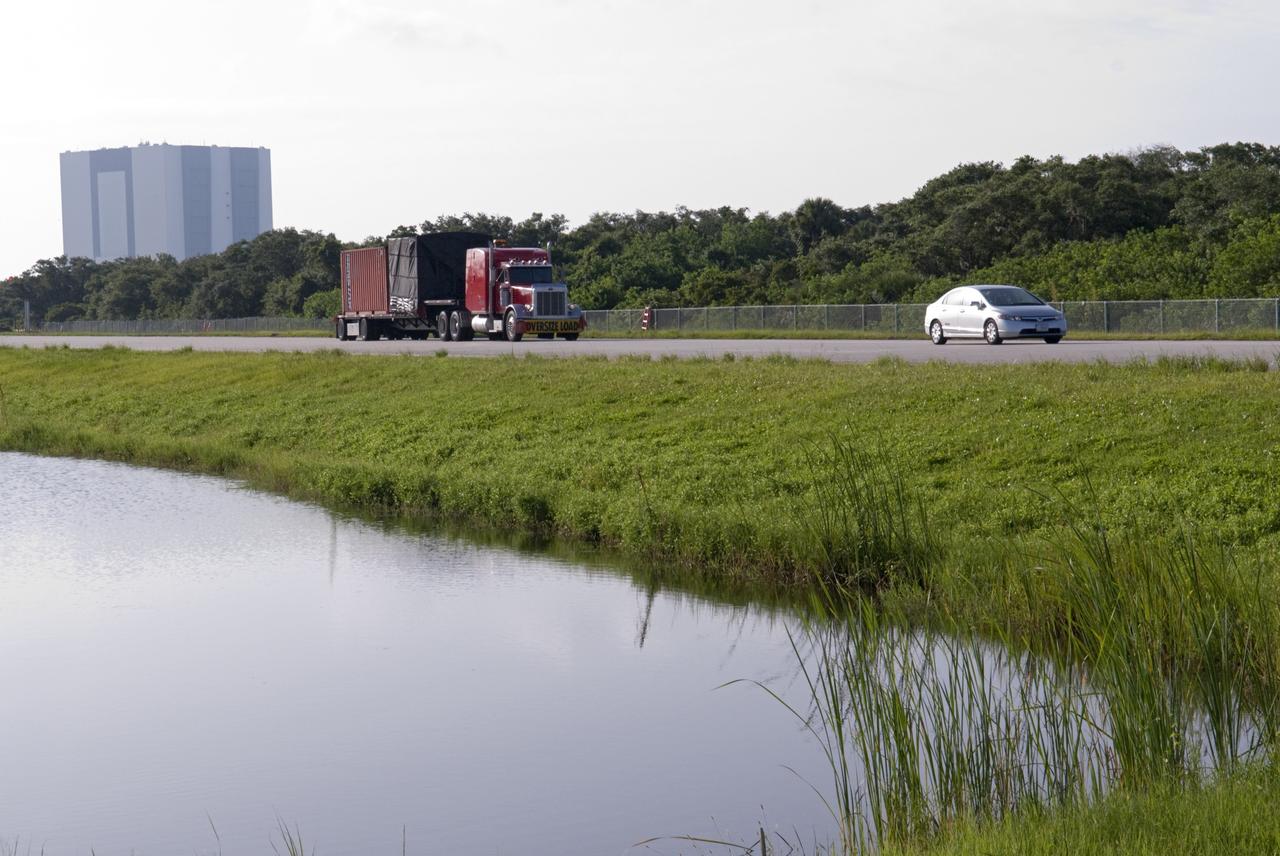
CAPE CANAVERAL, Fla. - A truck transporting NASA's Morpheus lander, a vertical test bed vehicle, heads towards the Shuttle Landing Facility, or SLF, at the Kennedy Space Center in Florida for unloading. Morpheus is designed to demonstrate new green propellant propulsion systems and autonomous landing and an Autonomous Landing and Hazard Avoidance Technology, or ALHAT, system. Checkout of the prototype lander has been ongoing at NASA’s Johnson Space Center in Houston in preparation for its first free flight. The SLF site will provide the lander with the kind of field necessary for realistic testing. Project Morpheus is one of 20 small projects comprising the Advanced Exploration Systems, or AES, program in NASA’s Human Exploration and Operations Mission Directorate. AES projects pioneer new approaches for rapidly developing prototype systems, demonstrating key capabilities and validating operational concepts for future human missions beyond Earth orbit. For more information on Project Morpheus, visit http://www.nasa.gov/centers/johnson/exploration/morpheus/index.html Photo credit: NASA/ Charisse Nahser
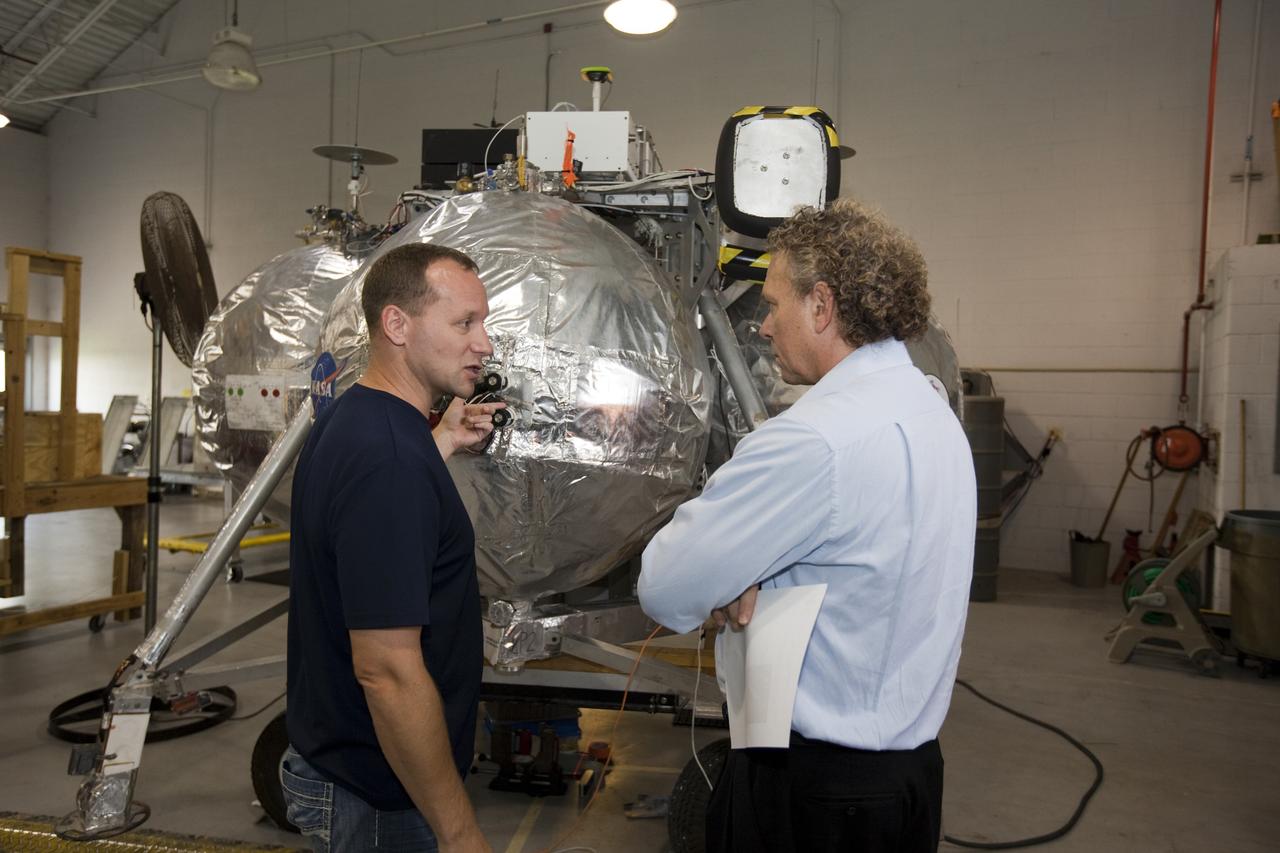
CAPE CANAVERAL, Fla. - Russell Romanella, director of Safety and Mission Assurance at NASA's Kennedy Space Center in Florida, right, is briefed on NASA's Morpheus lander, a vertical test bed vehicle. Morpheus is being checked out by technicians and engineers in a building at the Shuttle Landing Facility, or SLF, at Kennedy. Morpheus is designed to demonstrate new green propellant propulsion systems and autonomous landing and an Autonomous Landing and Hazard Avoidance Technology, or ALHAT, system. Checkout of the prototype lander has been ongoing at NASA’s Johnson Space Center in Houston in preparation for its first free flight. The SLF site will provide the lander with the kind of field necessary for realistic testing. Project Morpheus is one of 20 small projects comprising the Advanced Exploration Systems, or AES, program in NASA’s Human Exploration and Operations Mission Directorate. AES projects pioneer new approaches for rapidly developing prototype systems, demonstrating key capabilities and validating operational concepts for future human missions beyond Earth orbit. For more information on Project Morpheus, visit http://www.nasa.gov/centers/johnson/exploration/morpheus/index.html Photo credit: NASA/Dimitri Gerondidakis
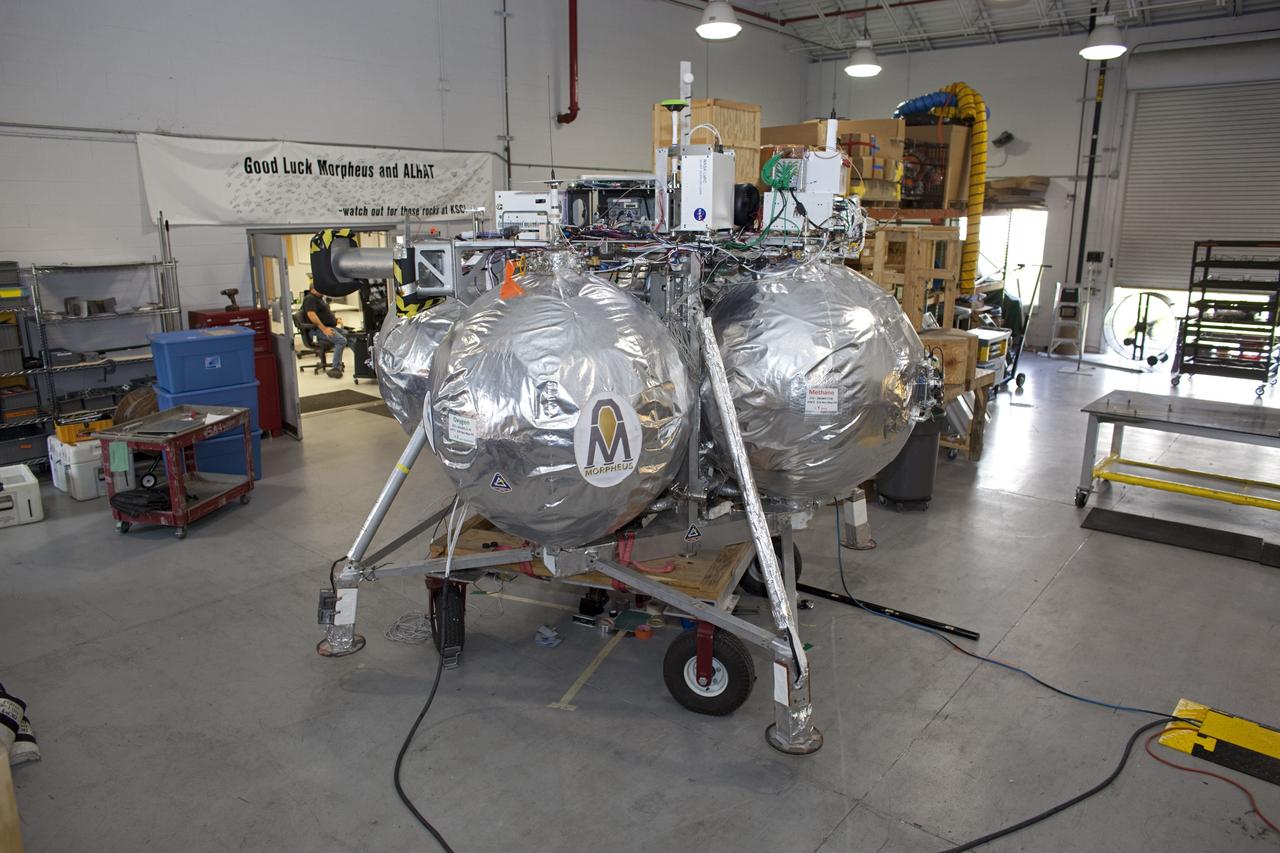
CAPE CANAVERAL, Fla. - NASA's Morpheus lander, a vertical test bed vehicle, is being checked out in a building at the Shuttle Landing Facility, or SLF, at the Kennedy Space Center in Florida. Morpheus is designed to demonstrate new green propellant propulsion systems and autonomous landing and an Autonomous Landing and Hazard Avoidance Technology, or ALHAT, system. Checkout of the prototype lander has been ongoing at NASA’s Johnson Space Center in Houston in preparation for its first free flight. The SLF site will provide the lander with the kind of field necessary for realistic testing. Project Morpheus is one of 20 small projects comprising the Advanced Exploration Systems, or AES, program in NASA’s Human Exploration and Operations Mission Directorate. AES projects pioneer new approaches for rapidly developing prototype systems, demonstrating key capabilities and validating operational concepts for future human missions beyond Earth orbit. For more information on Project Morpheus, visit http://www.nasa.gov/centers/johnson/exploration/morpheus/index.html Photo credit: NASA/Dimitri Gerondidakis
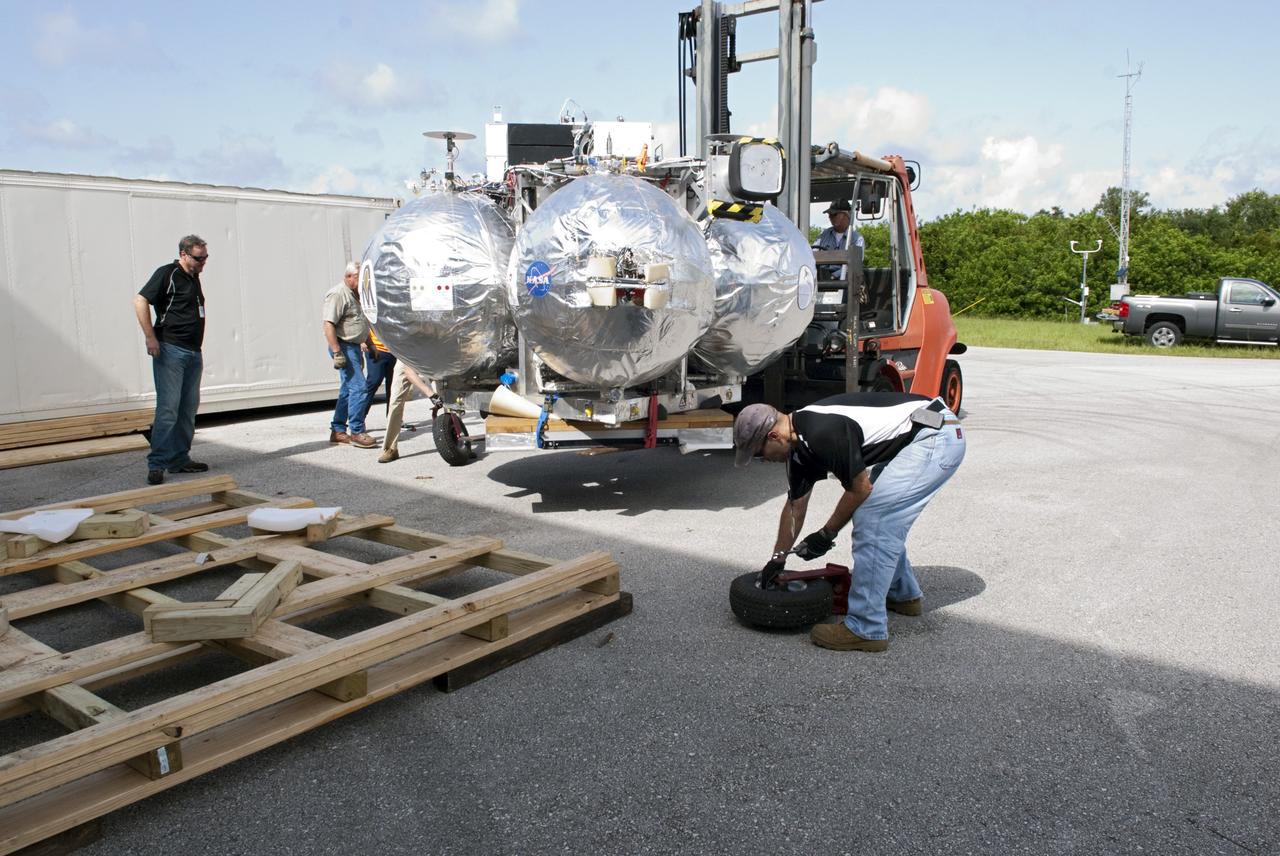
CAPE CANAVERAL, Fla. - Wheels are assembled for transporting NASA's Morpheus lander, a vertical test bed vehicle after its arrival at the Kennedy Space Center in Florida. Morpheus is designed to demonstrate new green propellant propulsion systems and autonomous landing and an Autonomous Landing and Hazard Avoidance Technology, or ALHAT, system. Checkout of the prototype lander has been ongoing at NASA’s Johnson Space Center in Houston in preparation for its first free flight. The SLF site will provide the lander with the kind of field necessary for realistic testing. Project Morpheus is one of 20 small projects comprising the Advanced Exploration Systems, or AES, program in NASA’s Human Exploration and Operations Mission Directorate. AES projects pioneer new approaches for rapidly developing prototype systems, demonstrating key capabilities and validating operational concepts for future human missions beyond Earth orbit. For more information on Project Morpheus, visit http://www.nasa.gov/centers/johnson/exploration/morpheus/index.html Photo credit: NASA/ Charisse Nahser
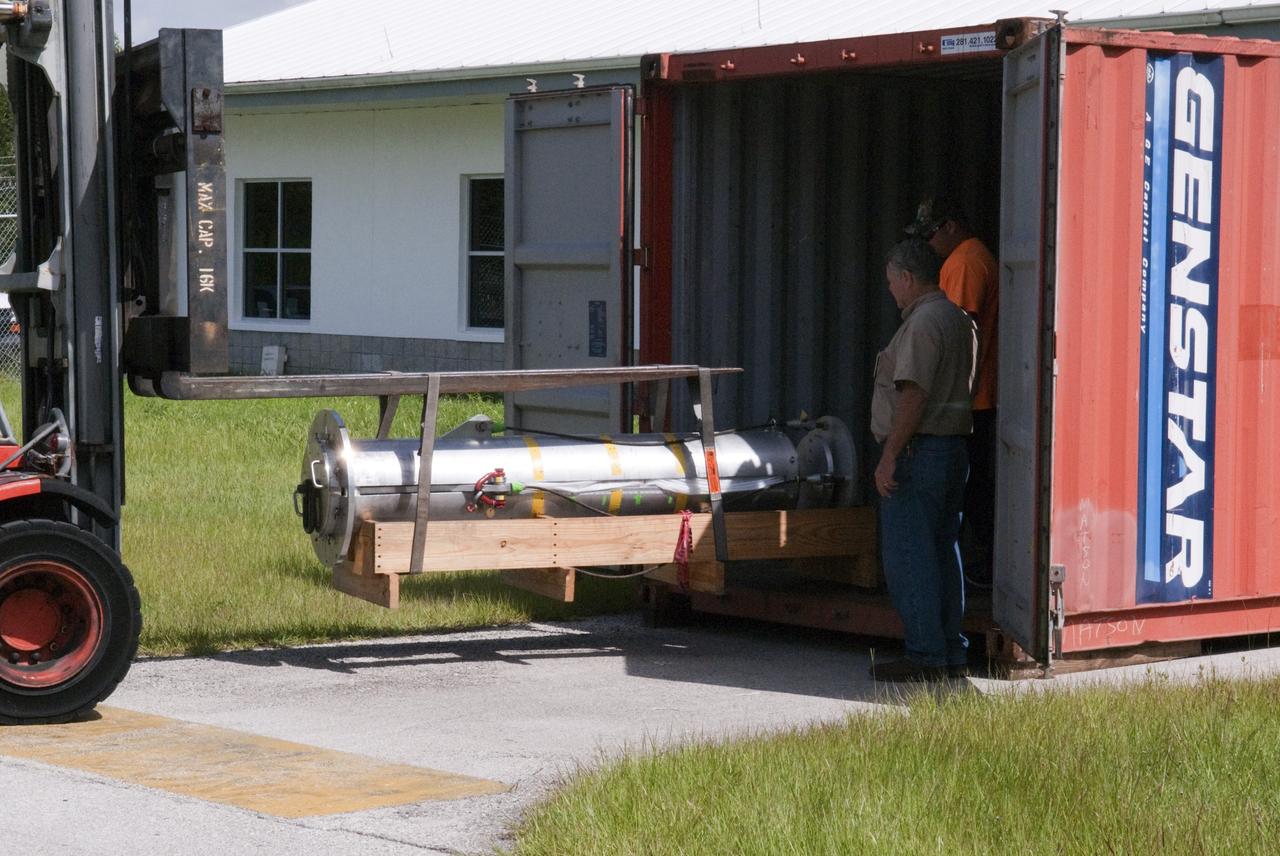
CAPE CANAVERAL, Fla. - Support equipment for NASA's Morpheus lander, a vertical test bed vehicle, is unloaded at a building at the Shuttle Landing Facility, or SLF, at the Kennedy Space Center in Florida. Morpheus is designed to demonstrate new green propellant propulsion systems and autonomous landing and an Autonomous Landing and Hazard Avoidance Technology, or ALHAT, system. Checkout of the prototype lander has been ongoing at NASA’s Johnson Space Center in Houston in preparation for its first free flight. The SLF site will provide the lander with the kind of field necessary for realistic testing. Project Morpheus is one of 20 small projects comprising the Advanced Exploration Systems, or AES, program in NASA’s Human Exploration and Operations Mission Directorate. AES projects pioneer new approaches for rapidly developing prototype systems, demonstrating key capabilities and validating operational concepts for future human missions beyond Earth orbit. For more information on Project Morpheus, visit http://www.nasa.gov/centers/johnson/exploration/morpheus/index.html Photo credit: NASA/ Charisse Nahser
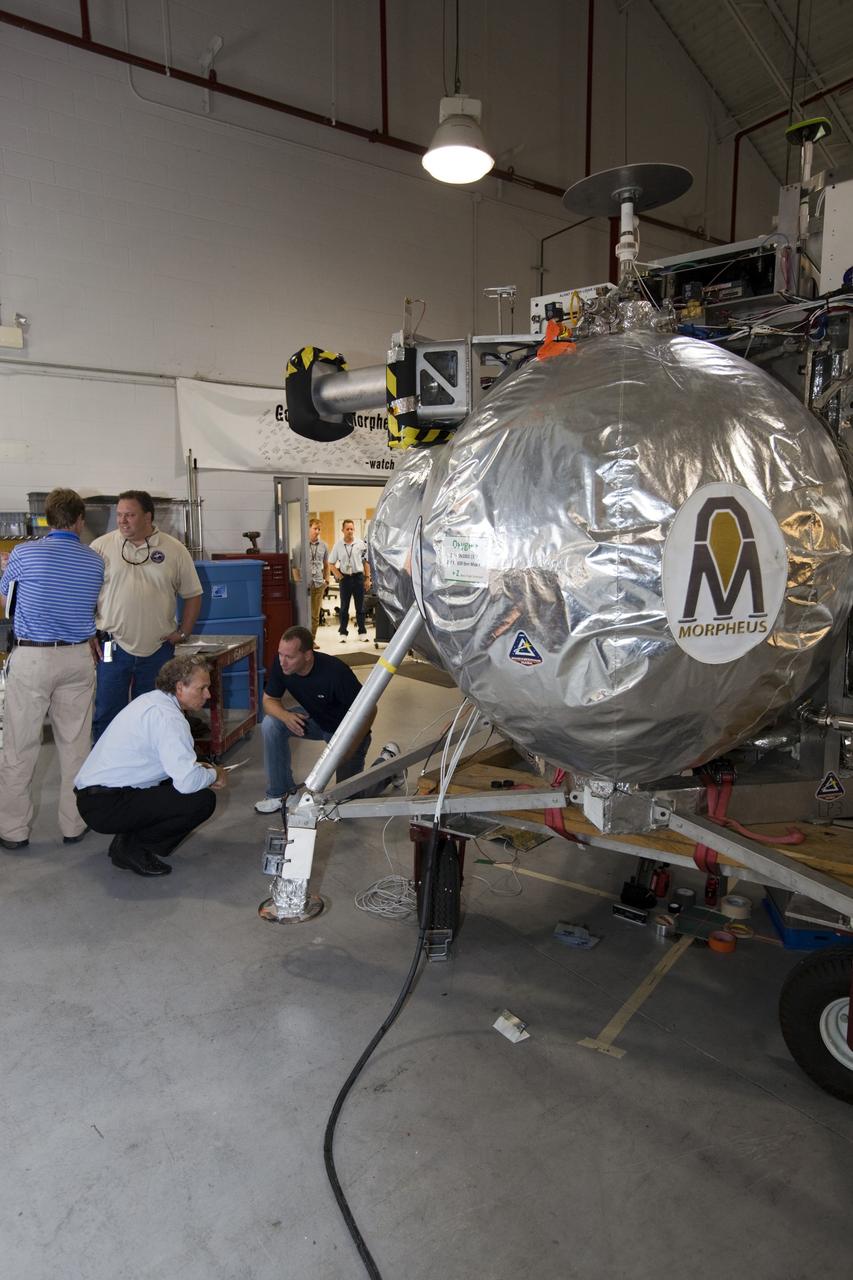
CAPE CANAVERAL, Fla. - Russell Romanella, director of Safety and Mission Assurance at NASA's Kennedy Space Center in Florida, kneeling on the left, is briefed on NASA's Morpheus lander, a vertical test bed vehicle. Morpheus is being checked out by technicians and engineers in a building at the Shuttle Landing Facility, or SLF, at Kennedy. Morpheus is designed to demonstrate new green propellant propulsion systems and autonomous landing and an Autonomous Landing and Hazard Avoidance Technology, or ALHAT, system. Checkout of the prototype lander has been ongoing at NASA’s Johnson Space Center in Houston in preparation for its first free flight. The SLF site will provide the lander with the kind of field necessary for realistic testing. Project Morpheus is one of 20 small projects comprising the Advanced Exploration Systems, or AES, program in NASA’s Human Exploration and Operations Mission Directorate. AES projects pioneer new approaches for rapidly developing prototype systems, demonstrating key capabilities and validating operational concepts for future human missions beyond Earth orbit. For more information on Project Morpheus, visit http://www.nasa.gov/centers/johnson/exploration/morpheus/index.html Photo credit: NASA/Dimitri Gerondidakis
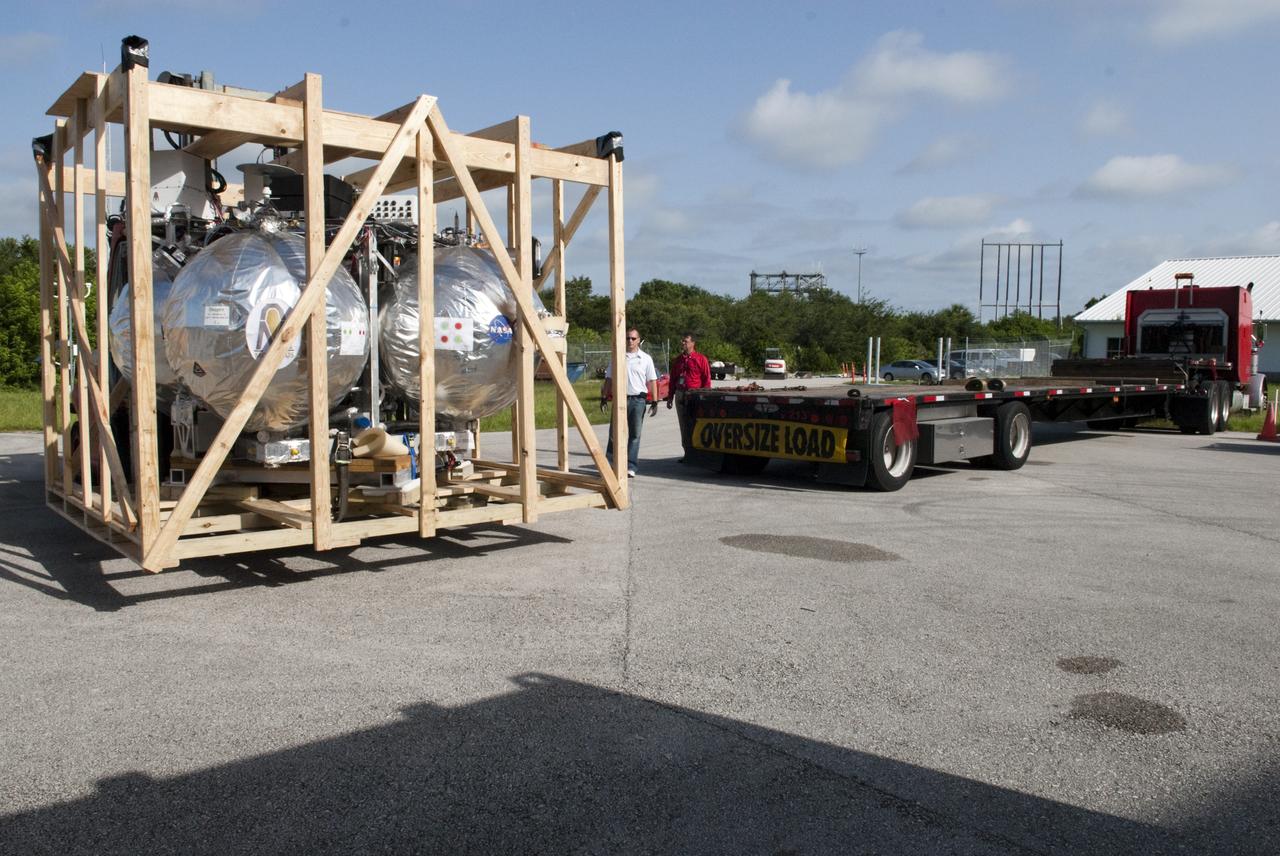
CAPE CANAVERAL, Fla. - NASA's Morpheus lander, a vertical test bed vehicle, has been unloaded at the Kennedy Space Center in Florida. Morpheus is designed to demonstrate new green propellant propulsion systems and autonomous landing and an Autonomous Landing and Hazard Avoidance Technology, or ALHAT, system. Checkout of the prototype lander has been ongoing at NASA’s Johnson Space Center in Houston in preparation for its first free flight. The SLF site will provide the lander with the kind of field necessary for realistic testing. Project Morpheus is one of 20 small projects comprising the Advanced Exploration Systems, or AES, program in NASA’s Human Exploration and Operations Mission Directorate. AES projects pioneer new approaches for rapidly developing prototype systems, demonstrating key capabilities and validating operational concepts for future human missions beyond Earth orbit. For more information on Project Morpheus, visit http://www.nasa.gov/centers/johnson/exploration/morpheus/index.html Photo credit: NASA/ Charisse Nahser
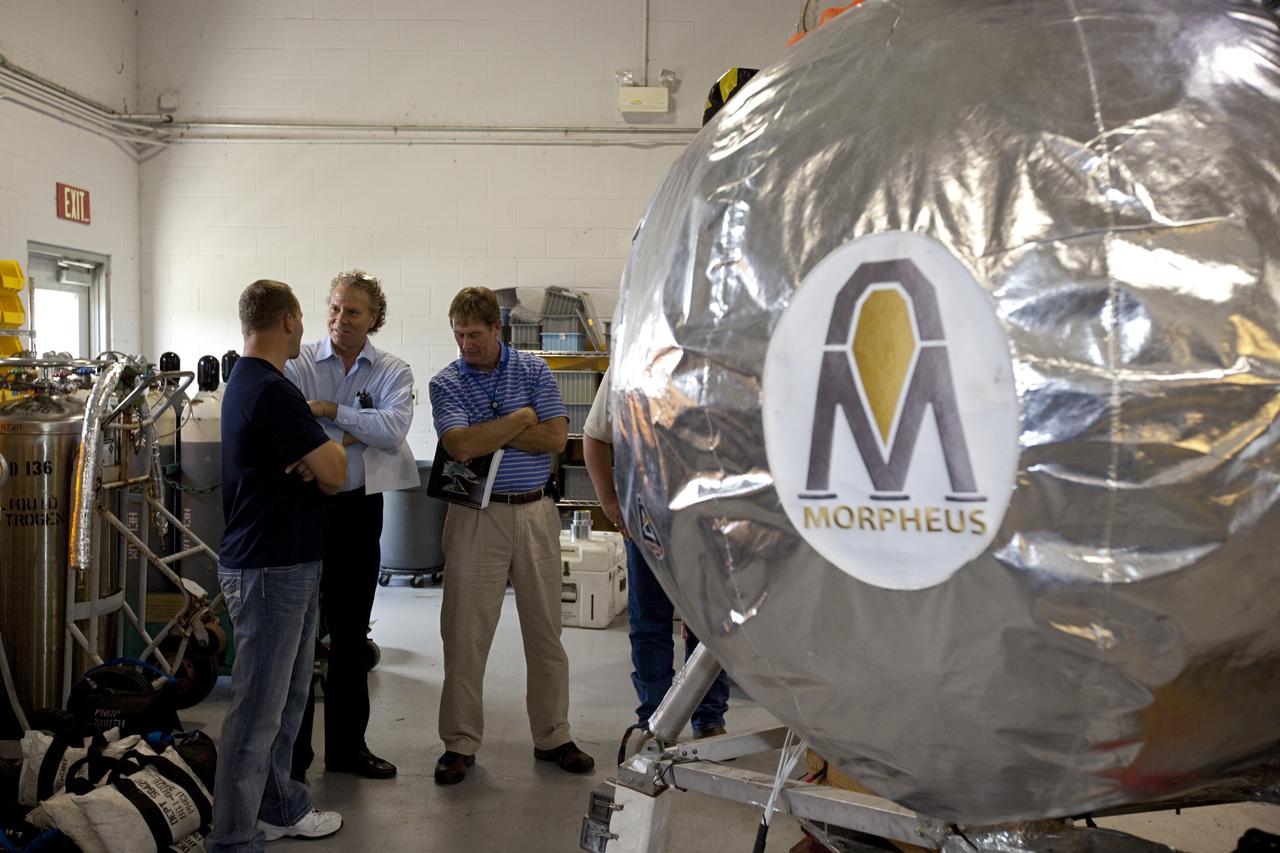
CAPE CANAVERAL, Fla. - Russell Romanella, director of Safety and Mission Assurance at NASA's Kennedy Space Center in Florida, center, is briefed on NASA's Morpheus lander, a vertical test bed vehicle. Morpheus is being checked out by technicians and engineers in a building at the Shuttle Landing Facility, or SLF, at Kennedy. Morpheus is designed to demonstrate new green propellant propulsion systems and autonomous landing and an Autonomous Landing and Hazard Avoidance Technology, or ALHAT, system. Checkout of the prototype lander has been ongoing at NASA’s Johnson Space Center in Houston in preparation for its first free flight. The SLF site will provide the lander with the kind of field necessary for realistic testing. Project Morpheus is one of 20 small projects comprising the Advanced Exploration Systems, or AES, program in NASA’s Human Exploration and Operations Mission Directorate. AES projects pioneer new approaches for rapidly developing prototype systems, demonstrating key capabilities and validating operational concepts for future human missions beyond Earth orbit. For more information on Project Morpheus, visit http://www.nasa.gov/centers/johnson/exploration/morpheus/index.html Photo credit: NASA/Dimitri Gerondidakis

CAPE CANAVERAL, Fla. - A crane is being used to set up NASA's Morpheus lander, a vertical test bed vehicle, at its launch position along the runway at the Shuttle Landing Facility, or SLF, at the Kennedy Space Center in Florida. Morpheus is designed to demonstrate new green propellant propulsion systems and autonomous landing and an Autonomous Landing and Hazard Avoidance Technology, or ALHAT, system. Checkout of the prototype lander has been ongoing at NASA’s Johnson Space Center in Houston in preparation for its first free flight. The SLF site will provide the lander with the kind of field necessary for realistic testing. Project Morpheus is one of 20 small projects comprising the Advanced Exploration Systems, or AES, program in NASA’s Human Exploration and Operations Mission Directorate. AES projects pioneer new approaches for rapidly developing prototype systems, demonstrating key capabilities and validating operational concepts for future human missions beyond Earth orbit. For more information on Project Morpheus, visit http://www.nasa.gov/centers/johnson/exploration/morpheus/index.html Photo credit: NASA/Dimitri Gerondidakis
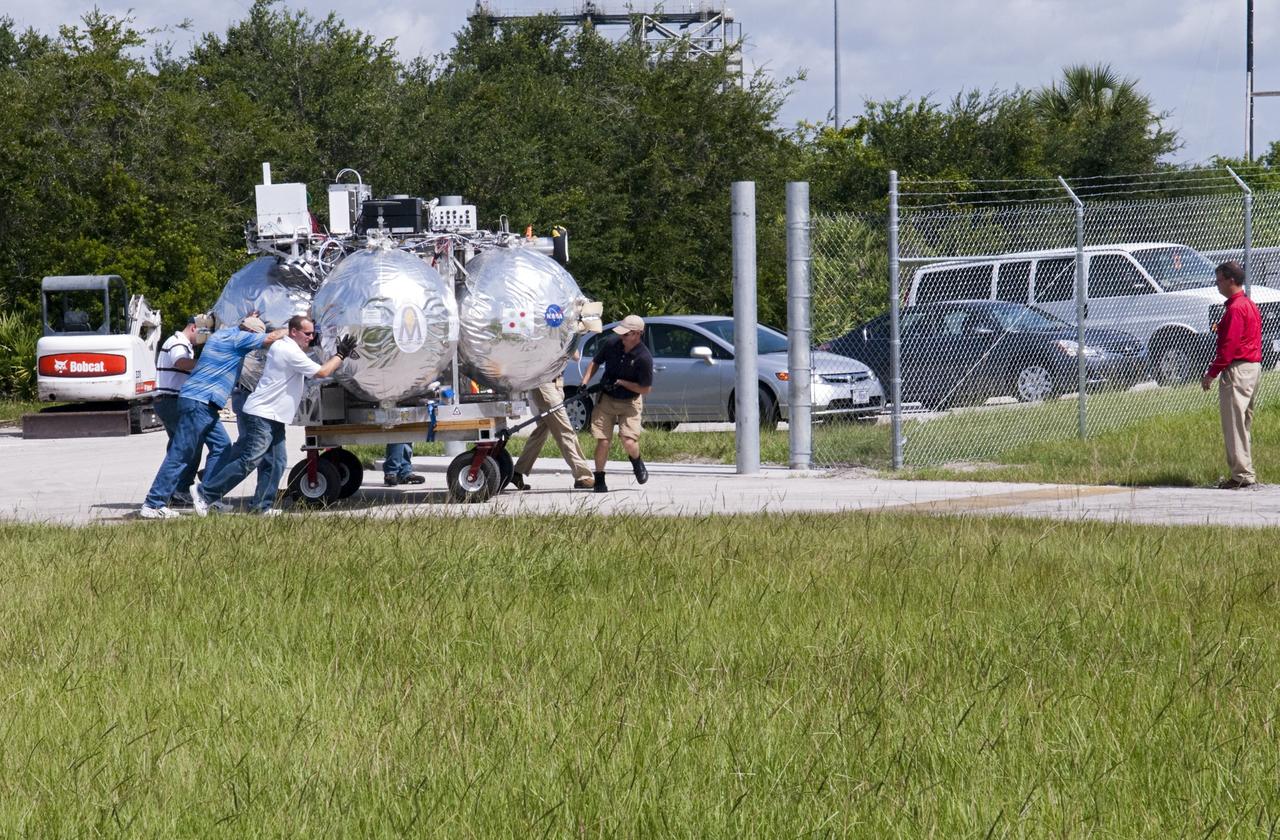
CAPE CANAVERAL, Fla. - NASA's Morpheus lander, a vertical test bed vehicle, is moved into a building at the Shuttle Landing Facility, or SLF, at the Kennedy Space Center in Florida. Morpheus is designed to demonstrate new green propellant propulsion systems and autonomous landing and an Autonomous Landing and Hazard Avoidance Technology, or ALHAT, system. Checkout of the prototype lander has been ongoing at NASA’s Johnson Space Center in Houston in preparation for its first free flight. The SLF site will provide the lander with the kind of field necessary for realistic testing. Project Morpheus is one of 20 small projects comprising the Advanced Exploration Systems, or AES, program in NASA’s Human Exploration and Operations Mission Directorate. AES projects pioneer new approaches for rapidly developing prototype systems, demonstrating key capabilities and validating operational concepts for future human missions beyond Earth orbit. For more information on Project Morpheus, visit http://www.nasa.gov/centers/johnson/exploration/morpheus/index.html Photo credit: NASA/ Charisse Nahser
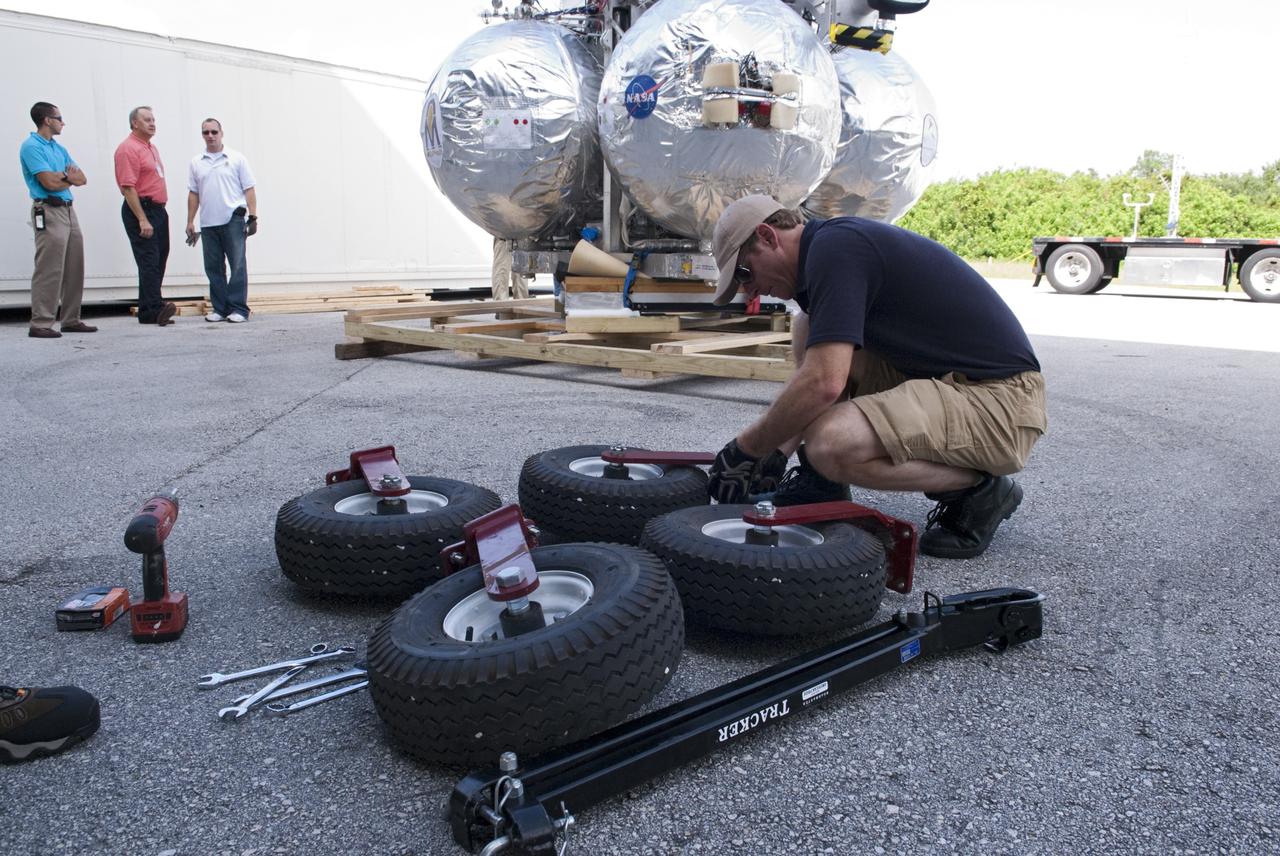
CAPE CANAVERAL, Fla. - Wheels are assembled for transporting NASA's Morpheus lander, a vertical test bed vehicle after its arrival at the Kennedy Space Center in Florida. Morpheus is designed to demonstrate new green propellant propulsion systems and autonomous landing and an Autonomous Landing and Hazard Avoidance Technology, or ALHAT, system. Checkout of the prototype lander has been ongoing at NASA’s Johnson Space Center in Houston in preparation for its first free flight. The SLF site will provide the lander with the kind of field necessary for realistic testing. Project Morpheus is one of 20 small projects comprising the Advanced Exploration Systems, or AES, program in NASA’s Human Exploration and Operations Mission Directorate. AES projects pioneer new approaches for rapidly developing prototype systems, demonstrating key capabilities and validating operational concepts for future human missions beyond Earth orbit. For more information on Project Morpheus, visit http://www.nasa.gov/centers/johnson/exploration/morpheus/index.html Photo credit: NASA/ Charisse Nahser
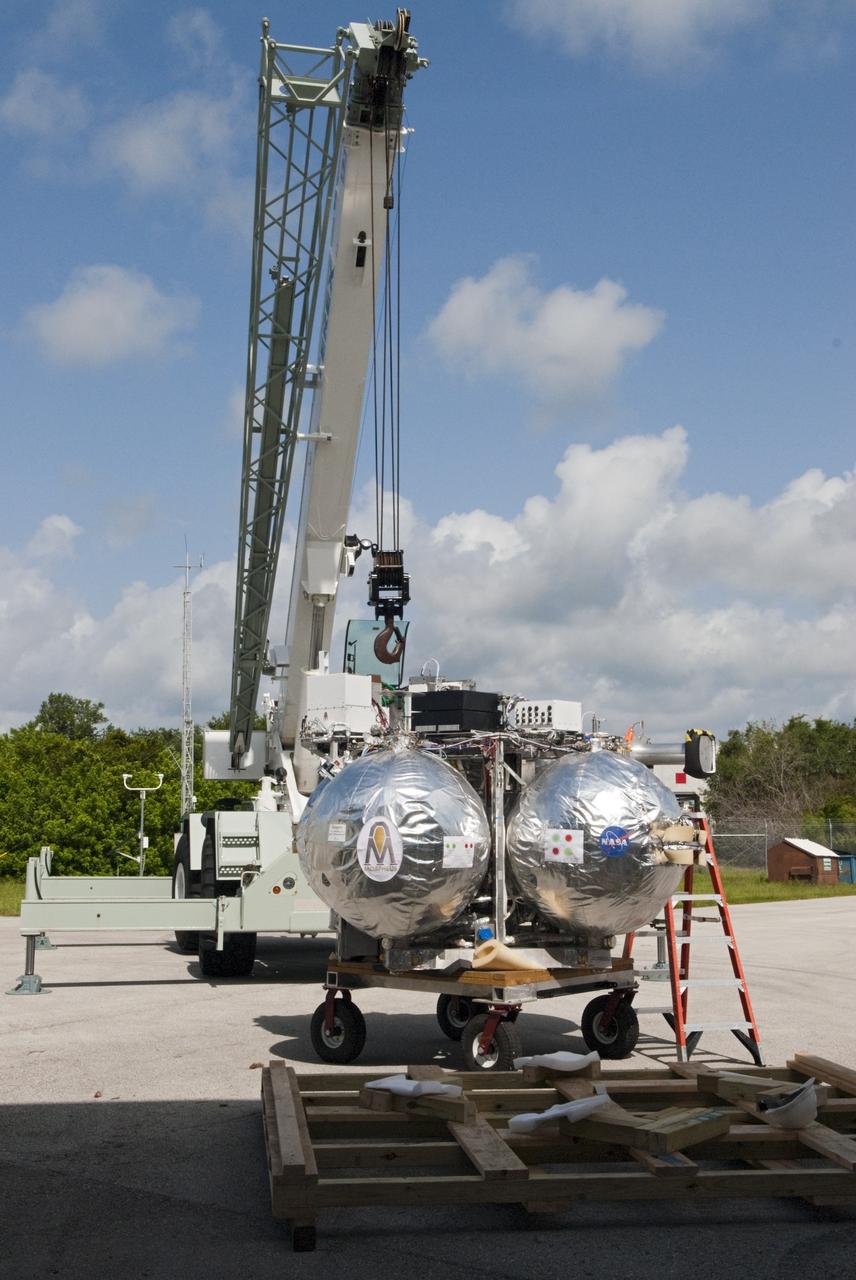
CAPE CANAVERAL, Fla. - A crane supports unloading of NASA's Morpheus lander, a vertical test bed vehicle, at the Kennedy Space Center in Florida. Morpheus is designed to demonstrate new green propellant propulsion systems and autonomous landing and an Autonomous Landing and Hazard Avoidance Technology, or ALHAT, system. Checkout of the prototype lander has been ongoing at NASA’s Johnson Space Center in Houston in preparation for its first free flight. The SLF site will provide the lander with the kind of field necessary for realistic testing. Project Morpheus is one of 20 small projects comprising the Advanced Exploration Systems, or AES, program in NASA’s Human Exploration and Operations Mission Directorate. AES projects pioneer new approaches for rapidly developing prototype systems, demonstrating key capabilities and validating operational concepts for future human missions beyond Earth orbit. For more information on Project Morpheus, visit http://www.nasa.gov/centers/johnson/exploration/morpheus/index.html Photo credit: NASA/ Charisse Nahser
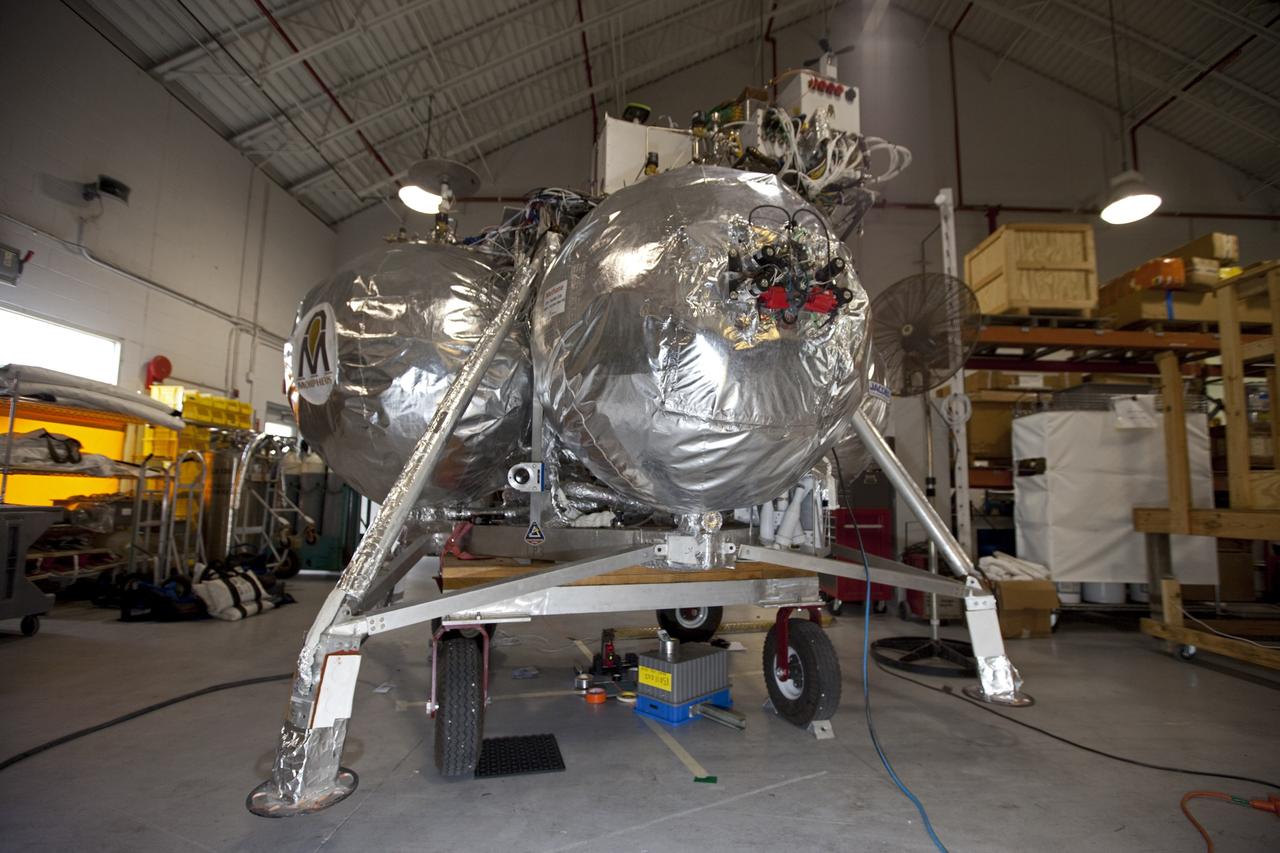
CAPE CANAVERAL, Fla. - NASA's Morpheus lander, a vertical test bed vehicle, is being checked out in a building at the Shuttle Landing Facility, or SLF, at the Kennedy Space Center in Florida. Morpheus is designed to demonstrate new green propellant propulsion systems and autonomous landing and an Autonomous Landing and Hazard Avoidance Technology, or ALHAT, system. Checkout of the prototype lander has been ongoing at NASA’s Johnson Space Center in Houston in preparation for its first free flight. The SLF site will provide the lander with the kind of field necessary for realistic testing. Project Morpheus is one of 20 small projects comprising the Advanced Exploration Systems, or AES, program in NASA’s Human Exploration and Operations Mission Directorate. AES projects pioneer new approaches for rapidly developing prototype systems, demonstrating key capabilities and validating operational concepts for future human missions beyond Earth orbit. For more information on Project Morpheus, visit http://www.nasa.gov/centers/johnson/exploration/morpheus/index.html Photo credit: NASA/Dimitri Gerondidakis
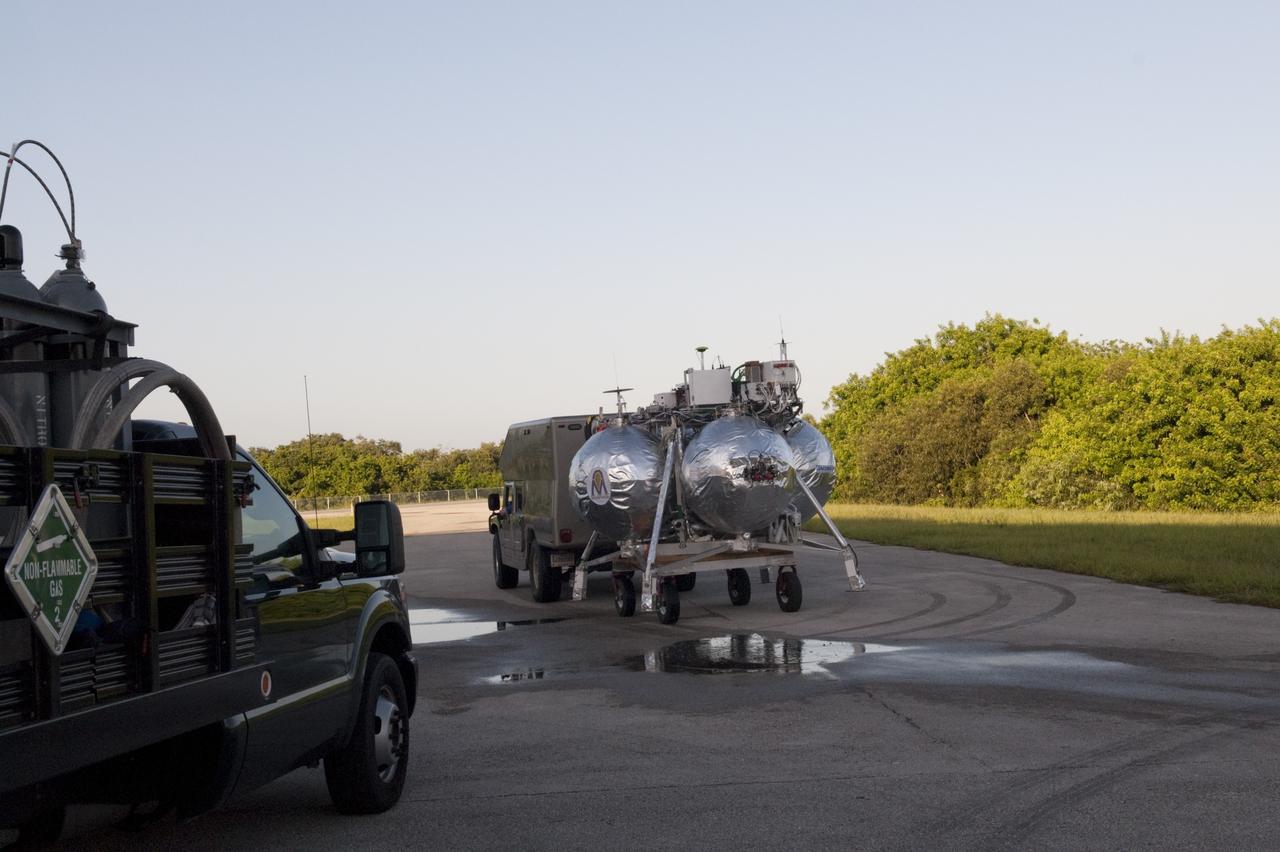
CAPE CANAVERAL, Fla. - NASA's Morpheus lander, a vertical test bed vehicle, is being transported out from its checkout building for a short trip to a launch position at the Shuttle Landing Facility, or SLF, at the Kennedy Space Center in Florida. Morpheus is designed to demonstrate new green propellant propulsion systems and autonomous landing and an Autonomous Landing and Hazard Avoidance Technology, or ALHAT, system. Checkout of the prototype lander has been ongoing at NASA’s Johnson Space Center in Houston in preparation for its first free flight. The SLF site will provide the lander with the kind of field necessary for realistic testing. Project Morpheus is one of 20 small projects comprising the Advanced Exploration Systems, or AES, program in NASA’s Human Exploration and Operations Mission Directorate. AES projects pioneer new approaches for rapidly developing prototype systems, demonstrating key capabilities and validating operational concepts for future human missions beyond Earth orbit. For more information on Project Morpheus, visit http://www.nasa.gov/centers/johnson/exploration/morpheus/index.html Photo credit: NASA/Dimitri Gerondidakis
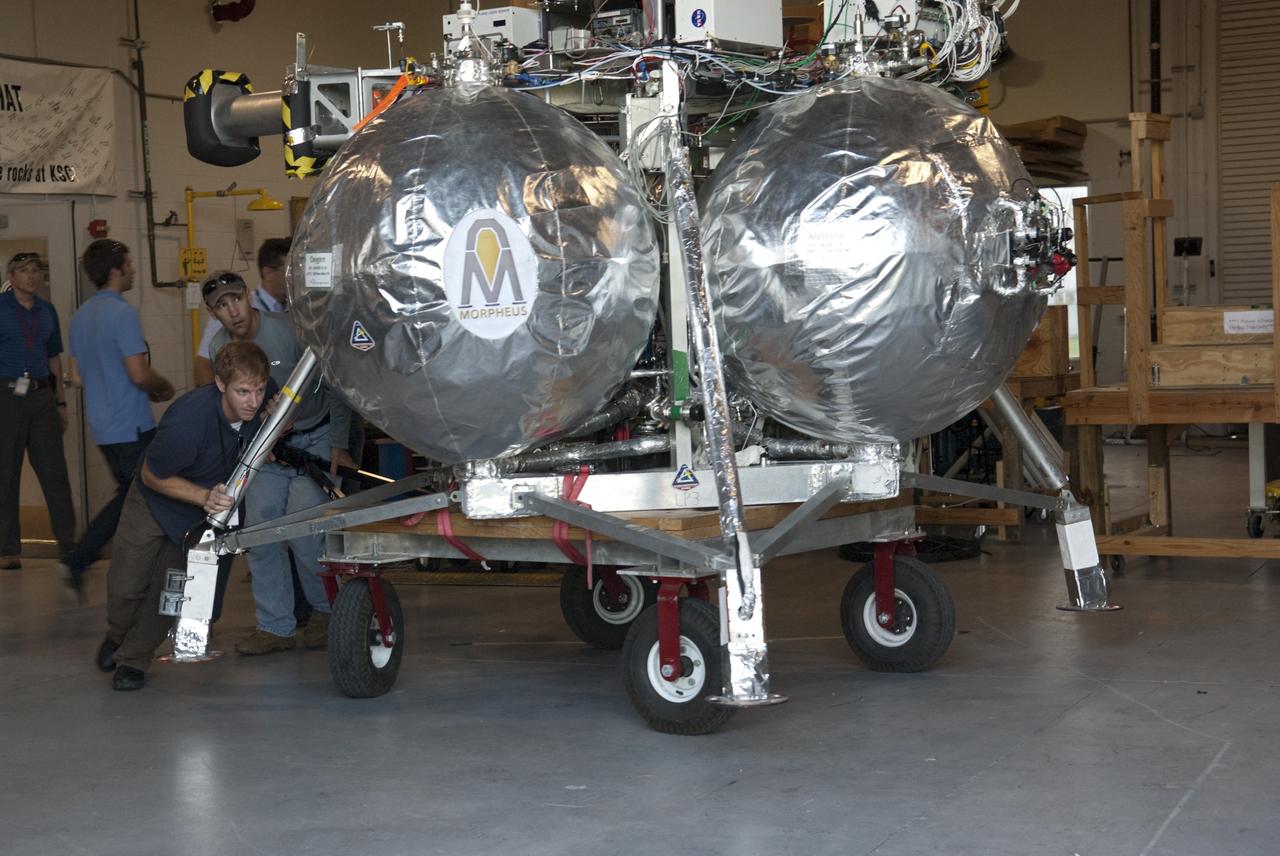
CAPE CANAVERAL, Fla. - NASA's Morpheus lander, a vertical test bed vehicle, is being moved out of its checkout building for a short trip to a launch position at the Shuttle Landing Facility, or SLF, at the Kennedy Space Center in Florida. Morpheus is designed to demonstrate new green propellant propulsion systems and autonomous landing and an Autonomous Landing and Hazard Avoidance Technology, or ALHAT, system. Checkout of the prototype lander has been ongoing at NASA’s Johnson Space Center in Houston in preparation for its first free flight. The SLF site will provide the lander with the kind of field necessary for realistic testing. Project Morpheus is one of 20 small projects comprising the Advanced Exploration Systems, or AES, program in NASA’s Human Exploration and Operations Mission Directorate. AES projects pioneer new approaches for rapidly developing prototype systems, demonstrating key capabilities and validating operational concepts for future human missions beyond Earth orbit. For more information on Project Morpheus, visit http://www.nasa.gov/centers/johnson/exploration/morpheus/index.html Photo credit: NASA/Dimitri Gerondidakis
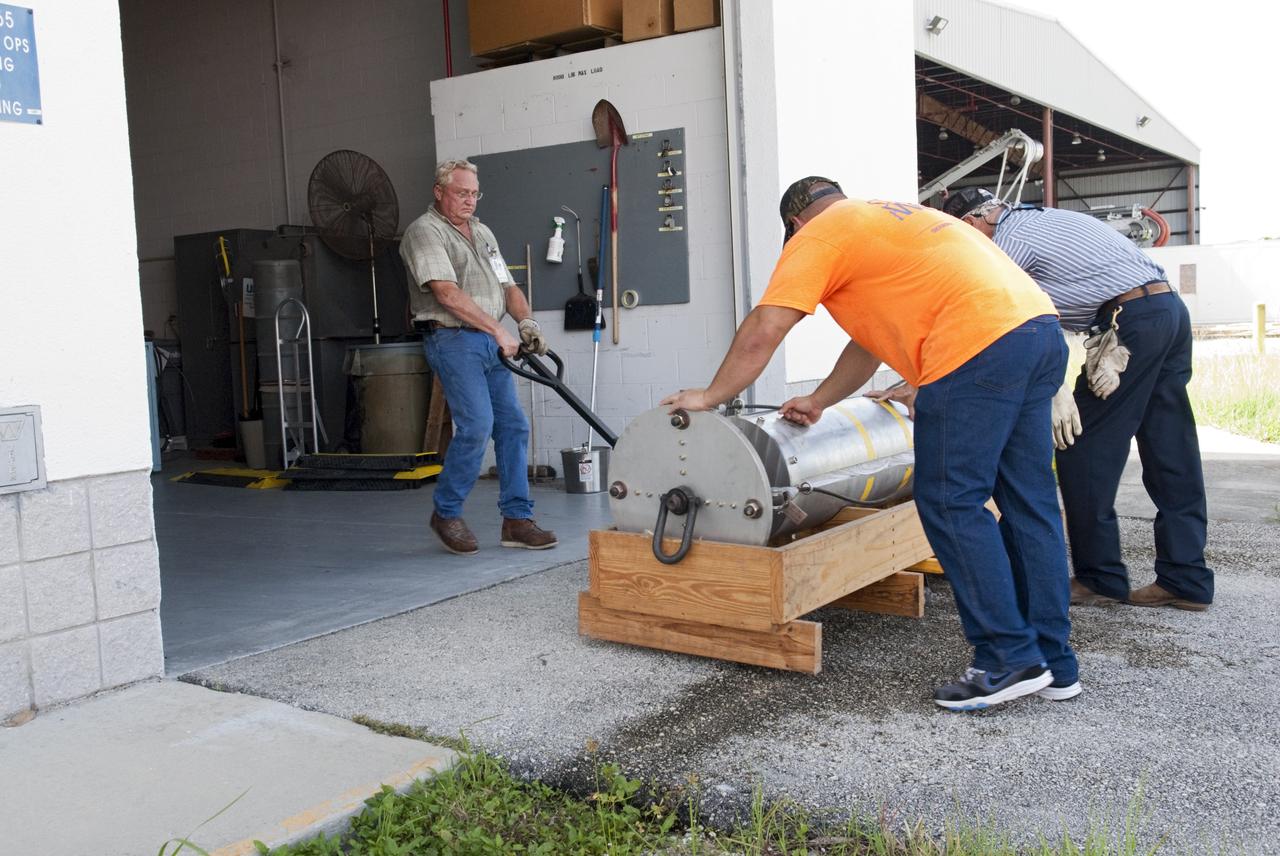
CAPE CANAVERAL, Fla. - Support equipment for NASA's Morpheus lander, a vertical test bed vehicle, is moved into a building at the Shuttle Landing Facility, or SLF, at the Kennedy Space Center in Florida. Morpheus is designed to demonstrate new green propellant propulsion systems and autonomous landing and an Autonomous Landing and Hazard Avoidance Technology, or ALHAT, system. Checkout of the prototype lander has been ongoing at NASA’s Johnson Space Center in Houston in preparation for its first free flight. The SLF site will provide the lander with the kind of field necessary for realistic testing. Project Morpheus is one of 20 small projects comprising the Advanced Exploration Systems, or AES, program in NASA’s Human Exploration and Operations Mission Directorate. AES projects pioneer new approaches for rapidly developing prototype systems, demonstrating key capabilities and validating operational concepts for future human missions beyond Earth orbit. For more information on Project Morpheus, visit http://www.nasa.gov/centers/johnson/exploration/morpheus/index.html Photo credit: NASA/ Charisse Nahser
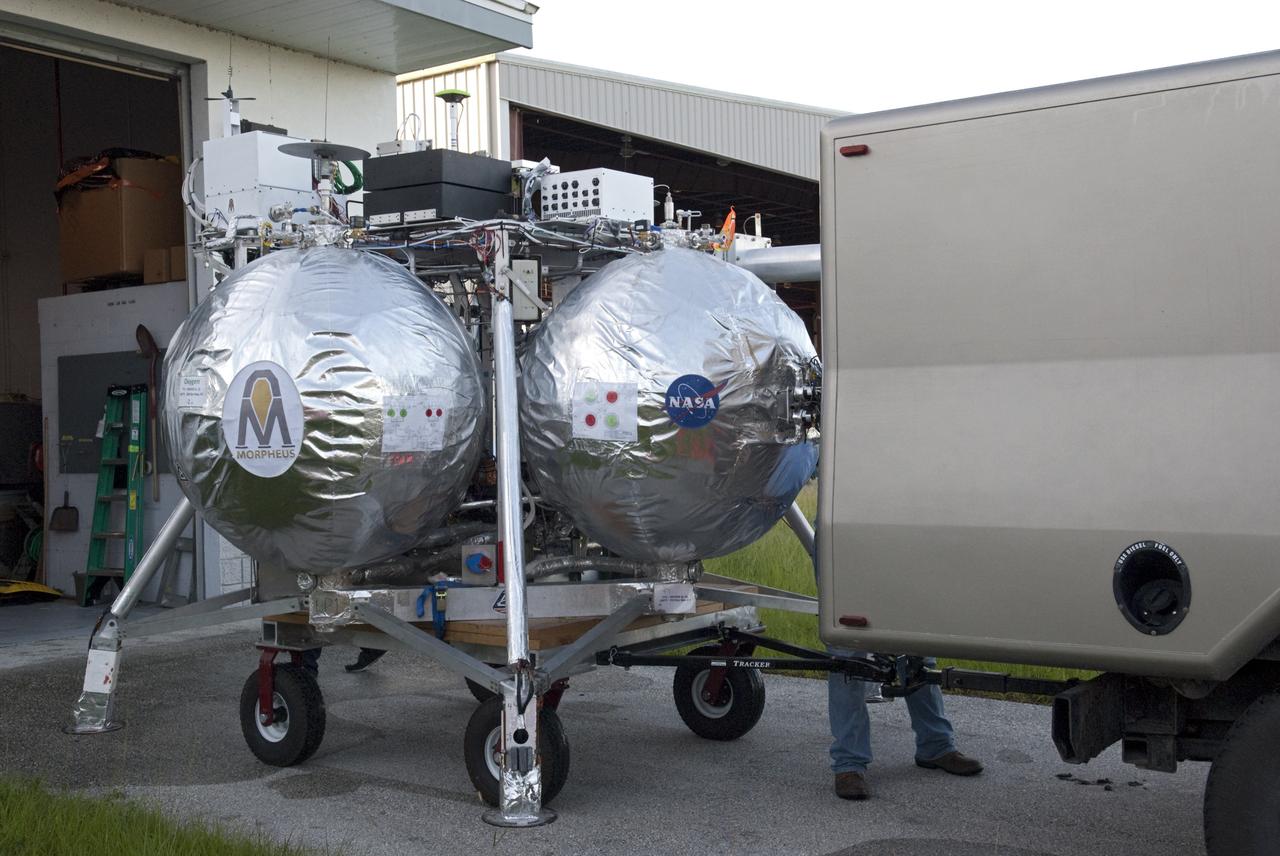
CAPE CANAVERAL, Fla. - NASA's Morpheus lander, a vertical test bed vehicle, is being transported out of its checkout building for a short trip to a launch position at the Shuttle Landing Facility, or SLF, at the Kennedy Space Center in Florida. Morpheus is designed to demonstrate new green propellant propulsion systems and autonomous landing and an Autonomous Landing and Hazard Avoidance Technology, or ALHAT, system. Checkout of the prototype lander has been ongoing at NASA’s Johnson Space Center in Houston in preparation for its first free flight. The SLF site will provide the lander with the kind of field necessary for realistic testing. Project Morpheus is one of 20 small projects comprising the Advanced Exploration Systems, or AES, program in NASA’s Human Exploration and Operations Mission Directorate. AES projects pioneer new approaches for rapidly developing prototype systems, demonstrating key capabilities and validating operational concepts for future human missions beyond Earth orbit. For more information on Project Morpheus, visit http://www.nasa.gov/centers/johnson/exploration/morpheus/index.html Photo credit: NASA/Dimitri Gerondidakis
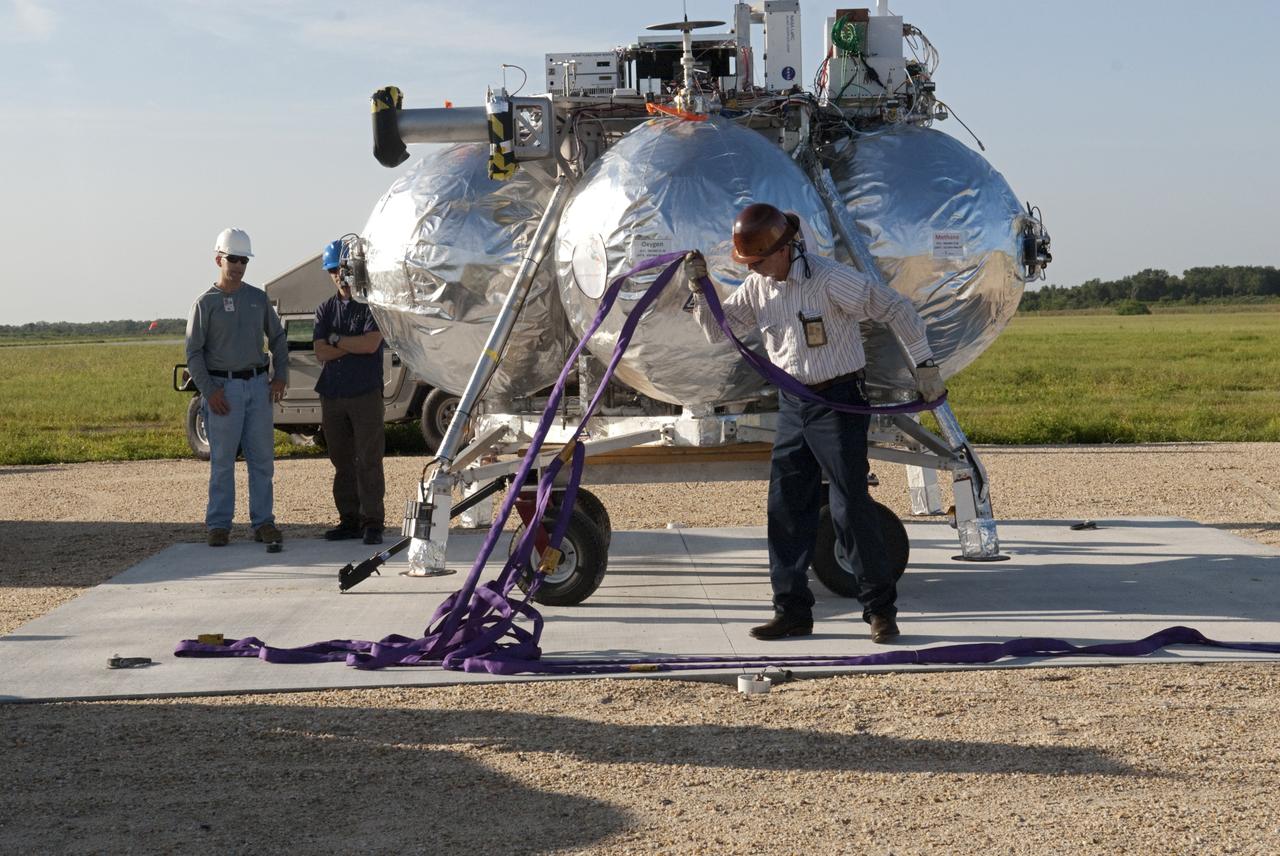
CAPE CANAVERAL, Fla. - NASA's Morpheus lander, a vertical test bed vehicle, is being set up at its launch position along the runway at the Shuttle Landing Facility, or SLF, at the Kennedy Space Center in Florida. Morpheus is designed to demonstrate new green propellant propulsion systems and autonomous landing and an Autonomous Landing and Hazard Avoidance Technology, or ALHAT, system. Checkout of the prototype lander has been ongoing at NASA’s Johnson Space Center in Houston in preparation for its first free flight. The SLF site will provide the lander with the kind of field necessary for realistic testing. Project Morpheus is one of 20 small projects comprising the Advanced Exploration Systems, or AES, program in NASA’s Human Exploration and Operations Mission Directorate. AES projects pioneer new approaches for rapidly developing prototype systems, demonstrating key capabilities and validating operational concepts for future human missions beyond Earth orbit. For more information on Project Morpheus, visit http://www.nasa.gov/centers/johnson/exploration/morpheus/index.html Photo credit: NASA/Dimitri Gerondidakis
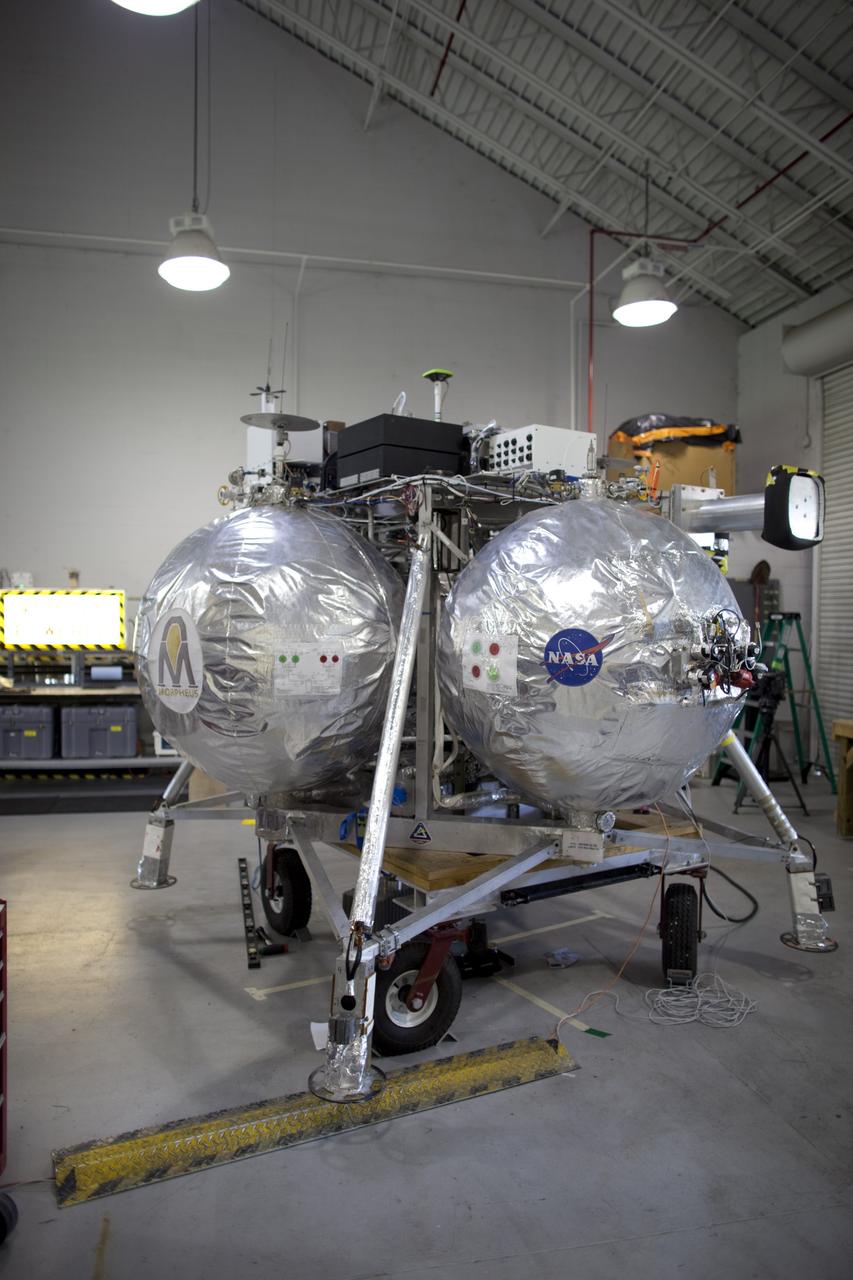
CAPE CANAVERAL, Fla. - NASA's Morpheus lander, a vertical test bed vehicle, is being checked out in a building at the Shuttle Landing Facility, or SLF, at the Kennedy Space Center in Florida. Morpheus is designed to demonstrate new green propellant propulsion systems and autonomous landing and an Autonomous Landing and Hazard Avoidance Technology, or ALHAT, system. Checkout of the prototype lander has been ongoing at NASA’s Johnson Space Center in Houston in preparation for its first free flight. The SLF site will provide the lander with the kind of field necessary for realistic testing. Project Morpheus is one of 20 small projects comprising the Advanced Exploration Systems, or AES, program in NASA’s Human Exploration and Operations Mission Directorate. AES projects pioneer new approaches for rapidly developing prototype systems, demonstrating key capabilities and validating operational concepts for future human missions beyond Earth orbit. For more information on Project Morpheus, visit http://www.nasa.gov/centers/johnson/exploration/morpheus/index.html Photo credit: NASA/Dimitri Gerondidakis
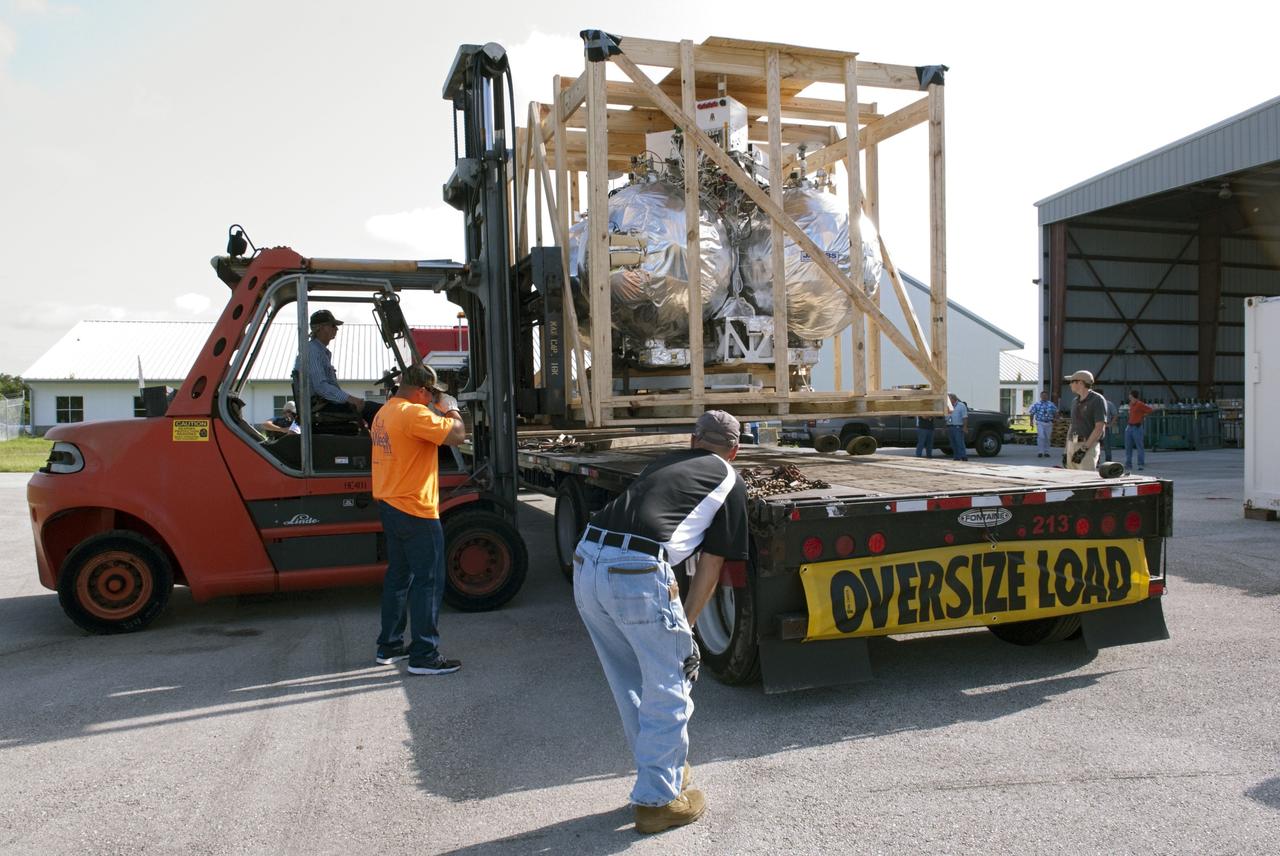
CAPE CANAVERAL, Fla. - A forklift is used at the Kennedy Space Center in Florida to unload NASA's Morpheus lander, a vertical test bed vehicle. Morpheus is designed to demonstrate new green propellant propulsion systems and autonomous landing and an Autonomous Landing and Hazard Avoidance Technology, or ALHAT, system. Checkout of the prototype lander has been ongoing at NASA’s Johnson Space Center in Houston in preparation for its first free flight. The SLF site will provide the lander with the kind of field necessary for realistic testing. Project Morpheus is one of 20 small projects comprising the Advanced Exploration Systems, or AES, program in NASA’s Human Exploration and Operations Mission Directorate. AES projects pioneer new approaches for rapidly developing prototype systems, demonstrating key capabilities and validating operational concepts for future human missions beyond Earth orbit. For more information on Project Morpheus, visit http://www.nasa.gov/centers/johnson/exploration/morpheus/index.html Photo credit: NASA/ Charisse Nahser
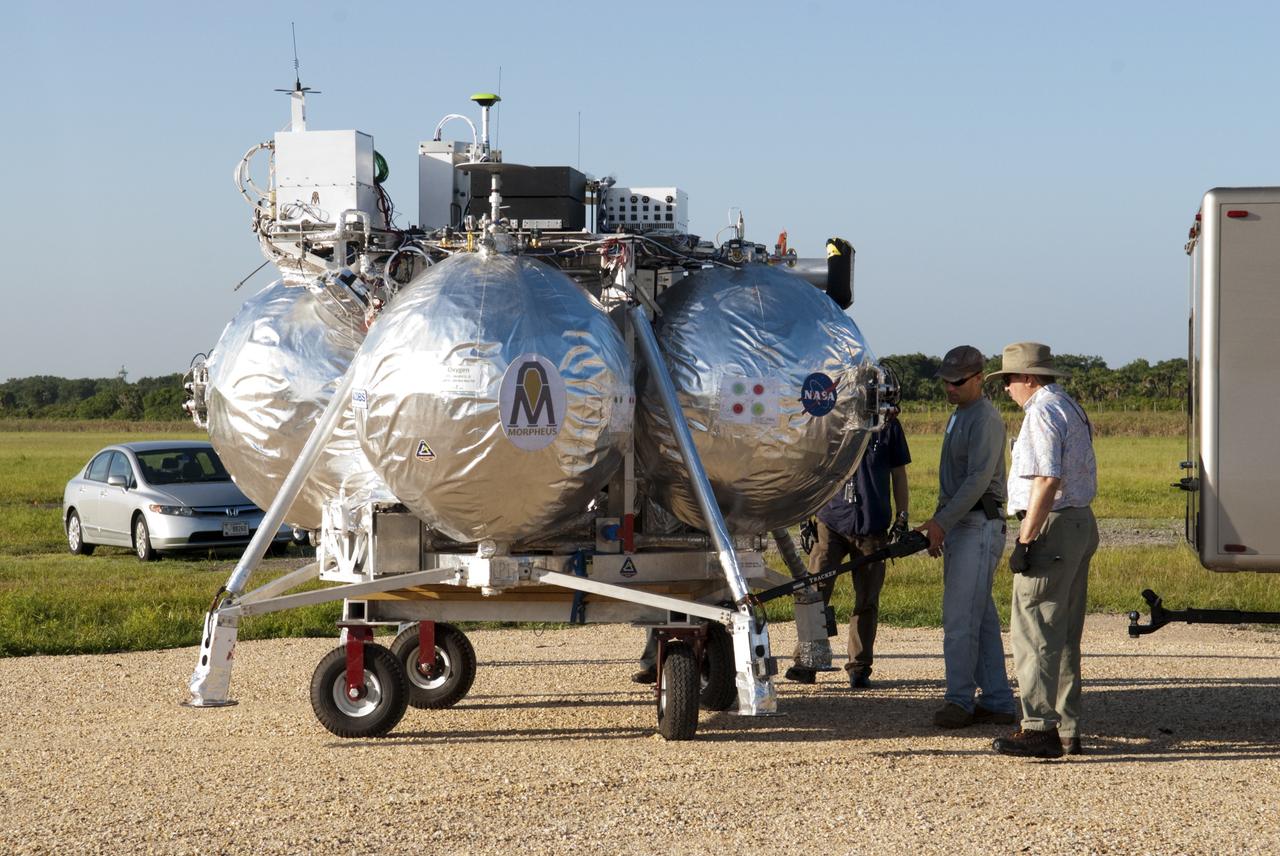
CAPE CANAVERAL, Fla. - NASA's Morpheus lander, a vertical test bed vehicle, is being set up at its launch position along the runway at the Shuttle Landing Facility, or SLF, at the Kennedy Space Center in Florida. Morpheus is designed to demonstrate new green propellant propulsion systems and autonomous landing and an Autonomous Landing and Hazard Avoidance Technology, or ALHAT, system. Checkout of the prototype lander has been ongoing at NASA’s Johnson Space Center in Houston in preparation for its first free flight. The SLF site will provide the lander with the kind of field necessary for realistic testing. Project Morpheus is one of 20 small projects comprising the Advanced Exploration Systems, or AES, program in NASA’s Human Exploration and Operations Mission Directorate. AES projects pioneer new approaches for rapidly developing prototype systems, demonstrating key capabilities and validating operational concepts for future human missions beyond Earth orbit. For more information on Project Morpheus, visit http://www.nasa.gov/centers/johnson/exploration/morpheus/index.html Photo credit: NASA/Dimitri Gerondidakis
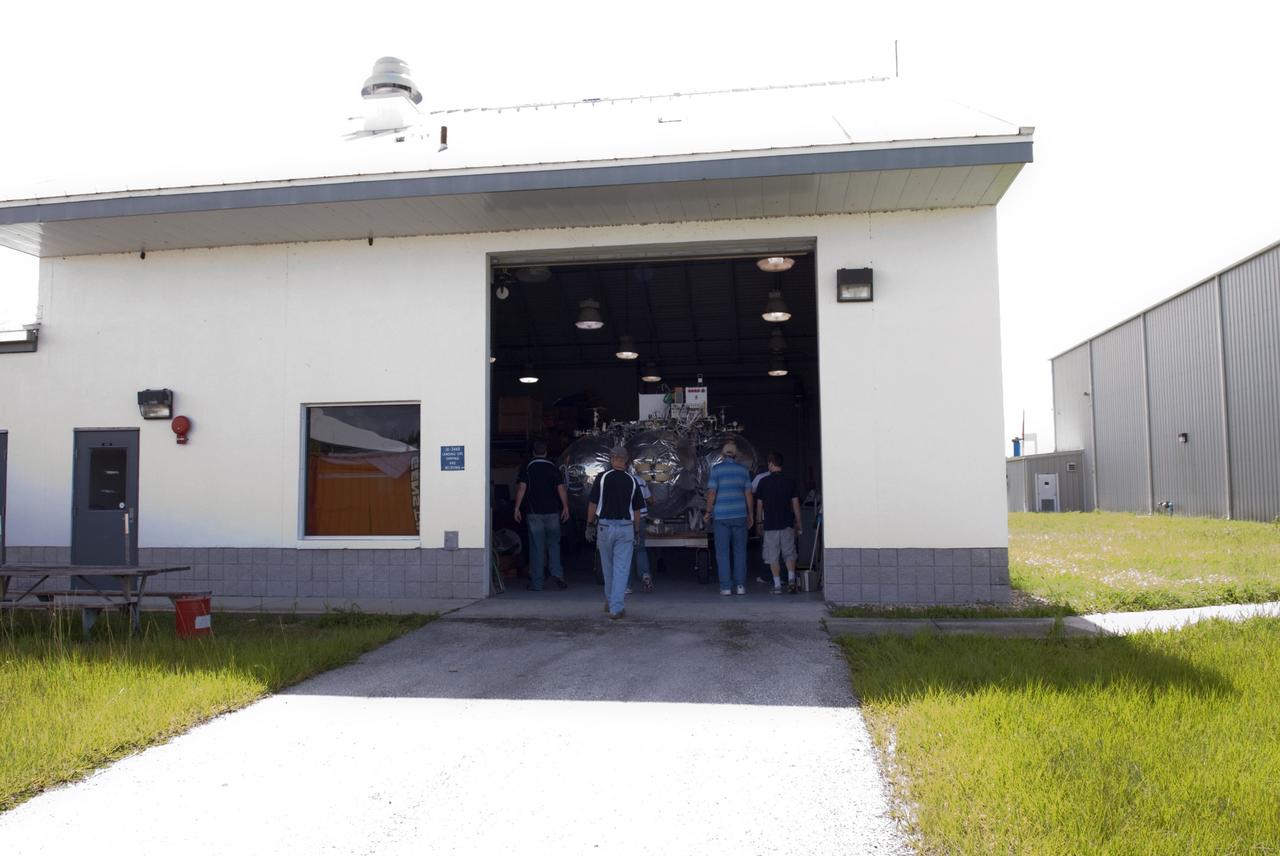
CAPE CANAVERAL, Fla. - NASA's Morpheus lander, a vertical test bed vehicle, has been moved into a building at the Shuttle Landing Facility, or SLF, at the Kennedy Space Center in Florida. Morpheus is designed to demonstrate new green propellant propulsion systems and autonomous landing and an Autonomous Landing and Hazard Avoidance Technology, or ALHAT, system. Checkout of the prototype lander has been ongoing at NASA’s Johnson Space Center in Houston in preparation for its first free flight. The SLF site will provide the lander with the kind of field necessary for realistic testing. Project Morpheus is one of 20 small projects comprising the Advanced Exploration Systems, or AES, program in NASA’s Human Exploration and Operations Mission Directorate. AES projects pioneer new approaches for rapidly developing prototype systems, demonstrating key capabilities and validating operational concepts for future human missions beyond Earth orbit. For more information on Project Morpheus, visit http://www.nasa.gov/centers/johnson/exploration/morpheus/index.html Photo credit: NASA/ Charisse Nahser
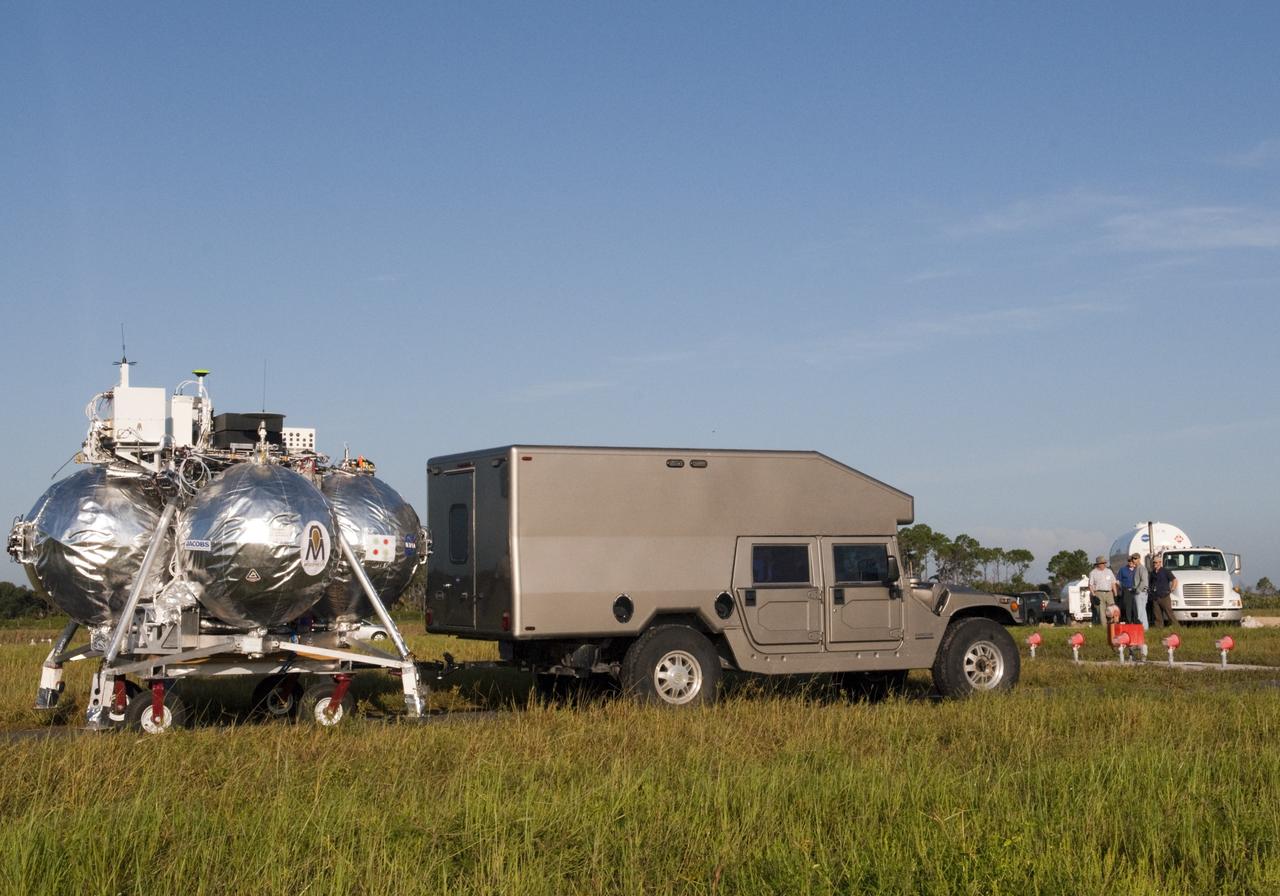
CAPE CANAVERAL, Fla. - NASA's Morpheus lander, a vertical test bed vehicle, is being transported along the Shuttle Landing Facility, or SLF, at the Kennedy Space Center in Florida for a short trip to a launch position along the runway. Morpheus is designed to demonstrate new green propellant propulsion systems and autonomous landing and an Autonomous Landing and Hazard Avoidance Technology, or ALHAT, system. Checkout of the prototype lander has been ongoing at NASA’s Johnson Space Center in Houston in preparation for its first free flight. The SLF site will provide the lander with the kind of field necessary for realistic testing. Project Morpheus is one of 20 small projects comprising the Advanced Exploration Systems, or AES, program in NASA’s Human Exploration and Operations Mission Directorate. AES projects pioneer new approaches for rapidly developing prototype systems, demonstrating key capabilities and validating operational concepts for future human missions beyond Earth orbit. For more information on Project Morpheus, visit http://www.nasa.gov/centers/johnson/exploration/morpheus/index.html Photo credit: NASA/Dimitri Gerondidakis
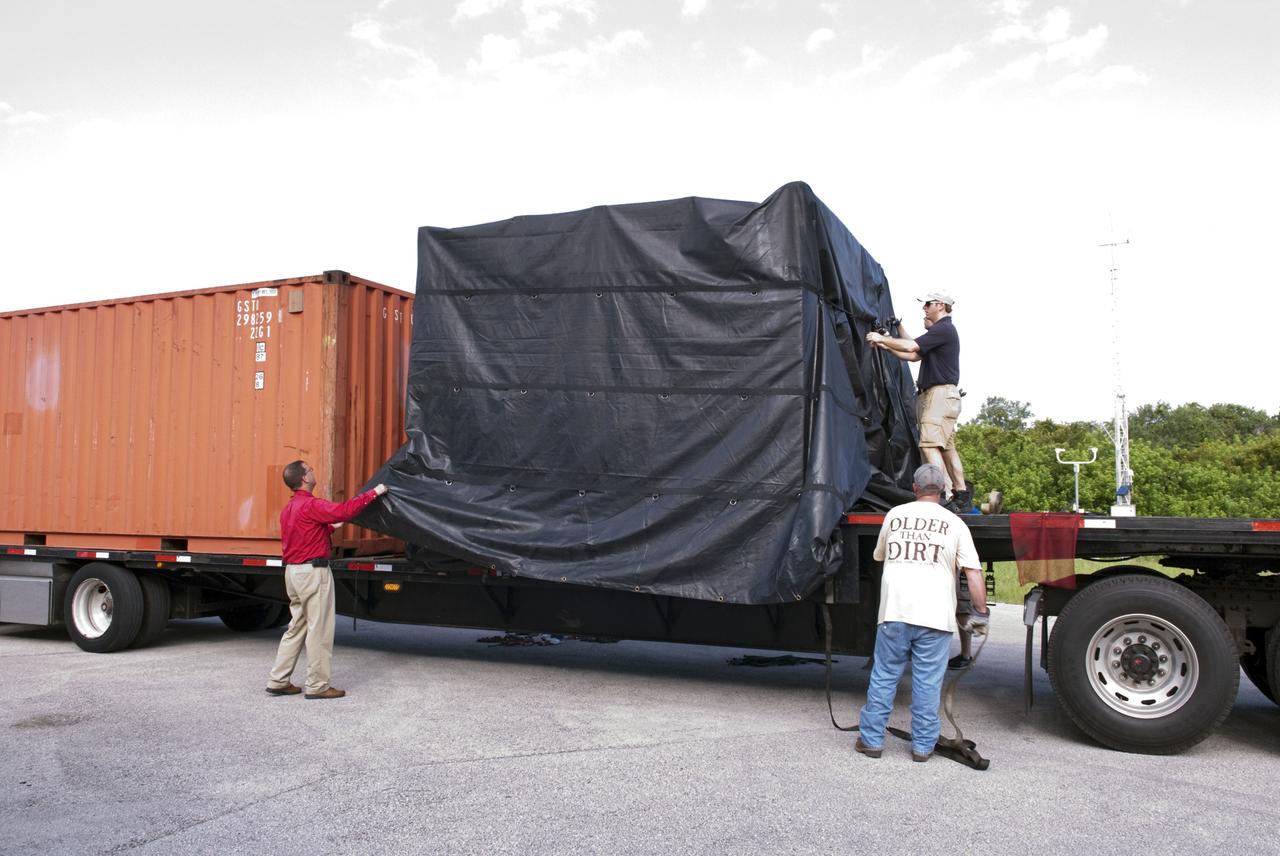
CAPE CANAVERAL, Fla. - NASA's Morpheus lander, a vertical test bed vehicle, is unloaded at a building at the Shuttle Landing Facility, or SLF, at the Kennedy Space Center in Florida. Morpheus is designed to demonstrate new green propellant propulsion systems and autonomous landing and an Autonomous Landing and Hazard Avoidance Technology, or ALHAT, system. Checkout of the prototype lander has been ongoing at NASA’s Johnson Space Center in Houston in preparation for its first free flight. The SLF site will provide the lander with the kind of field necessary for realistic testing. Project Morpheus is one of 20 small projects comprising the Advanced Exploration Systems, or AES, program in NASA’s Human Exploration and Operations Mission Directorate. AES projects pioneer new approaches for rapidly developing prototype systems, demonstrating key capabilities and validating operational concepts for future human missions beyond Earth orbit. For more information on Project Morpheus, visit http://www.nasa.gov/centers/johnson/exploration/morpheus/index.html Photo credit: NASA/ Charisse Nahser
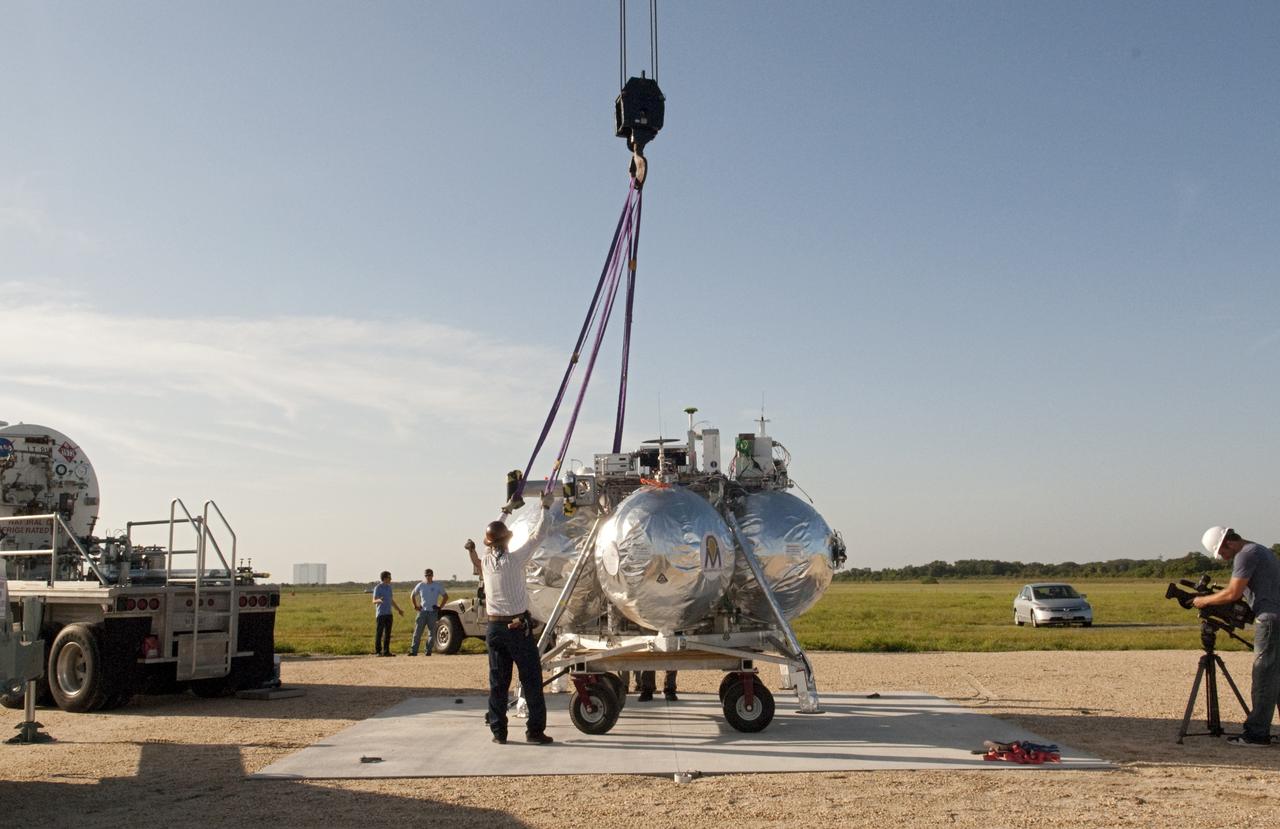
CAPE CANAVERAL, Fla. - A crane is being used to set up NASA's Morpheus lander, a vertical test bed vehicle, at its launch position along the runway at the Shuttle Landing Facility, or SLF, at the Kennedy Space Center in Florida. Morpheus is designed to demonstrate new green propellant propulsion systems and autonomous landing and an Autonomous Landing and Hazard Avoidance Technology, or ALHAT, system. Checkout of the prototype lander has been ongoing at NASA’s Johnson Space Center in Houston in preparation for its first free flight. The SLF site will provide the lander with the kind of field necessary for realistic testing. Project Morpheus is one of 20 small projects comprising the Advanced Exploration Systems, or AES, program in NASA’s Human Exploration and Operations Mission Directorate. AES projects pioneer new approaches for rapidly developing prototype systems, demonstrating key capabilities and validating operational concepts for future human missions beyond Earth orbit. For more information on Project Morpheus, visit http://www.nasa.gov/centers/johnson/exploration/morpheus/index.html Photo credit: NASA/Dimitri Gerondidakis
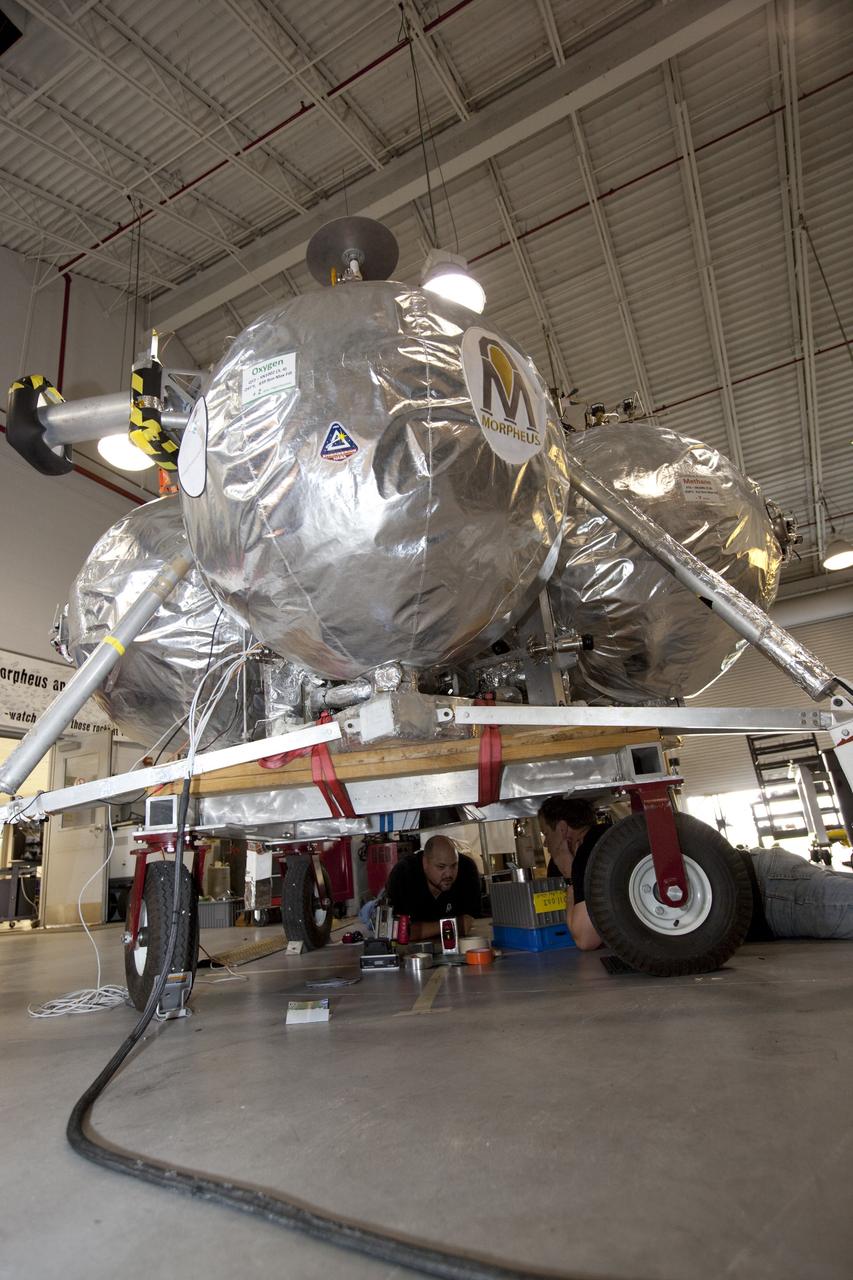
CAPE CANAVERAL, Fla. - NASA's Morpheus lander, a vertical test bed vehicle, is checked out by technicians in a building at the Shuttle Landing Facility, or SLF, at the Kennedy Space Center in Florida. Morpheus is designed to demonstrate new green propellant propulsion systems and autonomous landing and an Autonomous Landing and Hazard Avoidance Technology, or ALHAT, system. Checkout of the prototype lander has been ongoing at NASA’s Johnson Space Center in Houston in preparation for its first free flight. The SLF site will provide the lander with the kind of field necessary for realistic testing. Project Morpheus is one of 20 small projects comprising the Advanced Exploration Systems, or AES, program in NASA’s Human Exploration and Operations Mission Directorate. AES projects pioneer new approaches for rapidly developing prototype systems, demonstrating key capabilities and validating operational concepts for future human missions beyond Earth orbit. For more information on Project Morpheus, visit http://www.nasa.gov/centers/johnson/exploration/morpheus/index.html Photo credit: NASA/Dimitri Gerondidakis
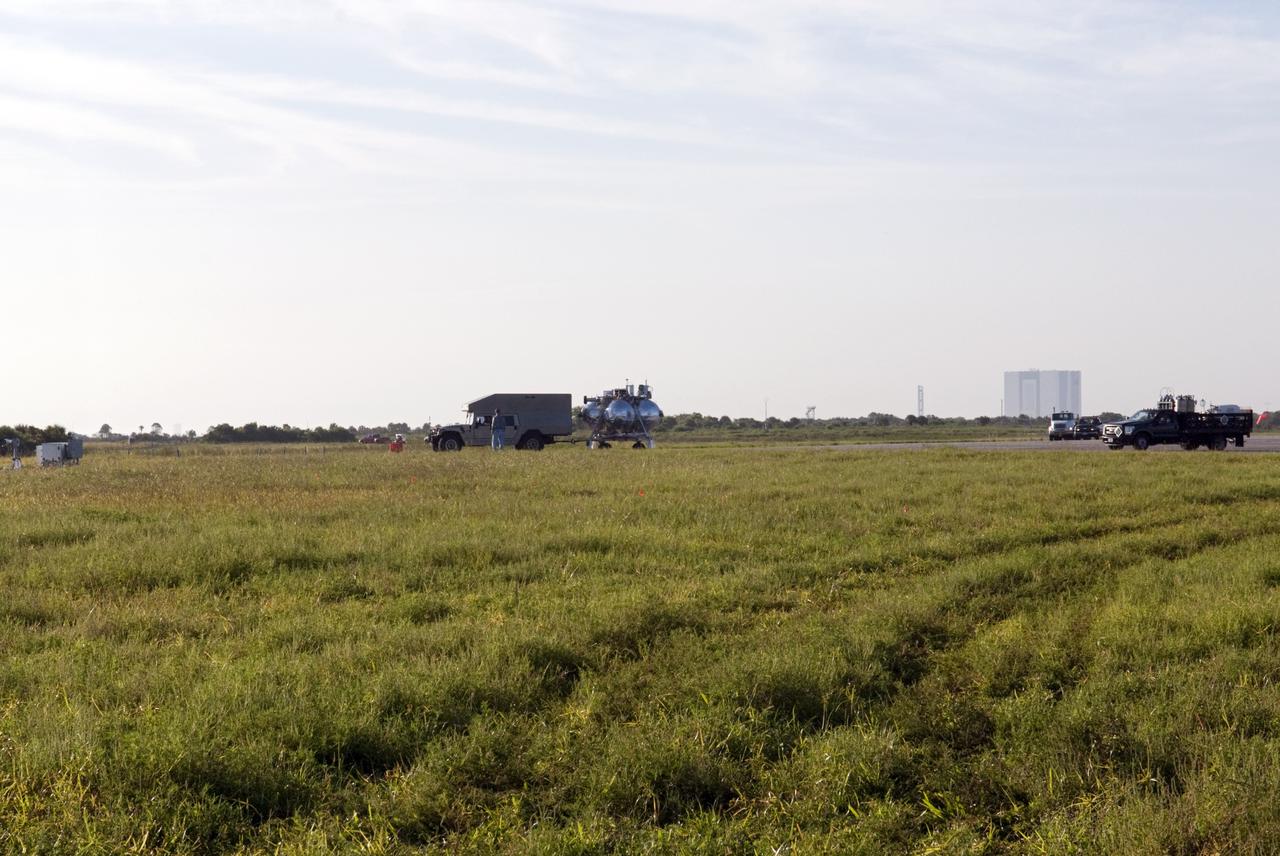
CAPE CANAVERAL, Fla. - NASA's Morpheus lander, a vertical test bed vehicle, is being transported along the Shuttle Landing Facility, or SLF, at the Kennedy Space Center in Florida for a short trip to a launch position along the runway. Morpheus is designed to demonstrate new green propellant propulsion systems and autonomous landing and an Autonomous Landing and Hazard Avoidance Technology, or ALHAT, system. Checkout of the prototype lander has been ongoing at NASA’s Johnson Space Center in Houston in preparation for its first free flight. The SLF site will provide the lander with the kind of field necessary for realistic testing. Project Morpheus is one of 20 small projects comprising the Advanced Exploration Systems, or AES, program in NASA’s Human Exploration and Operations Mission Directorate. AES projects pioneer new approaches for rapidly developing prototype systems, demonstrating key capabilities and validating operational concepts for future human missions beyond Earth orbit. For more information on Project Morpheus, visit http://www.nasa.gov/centers/johnson/exploration/morpheus/index.html Photo credit: NASA/Dimitri Gerondidakis
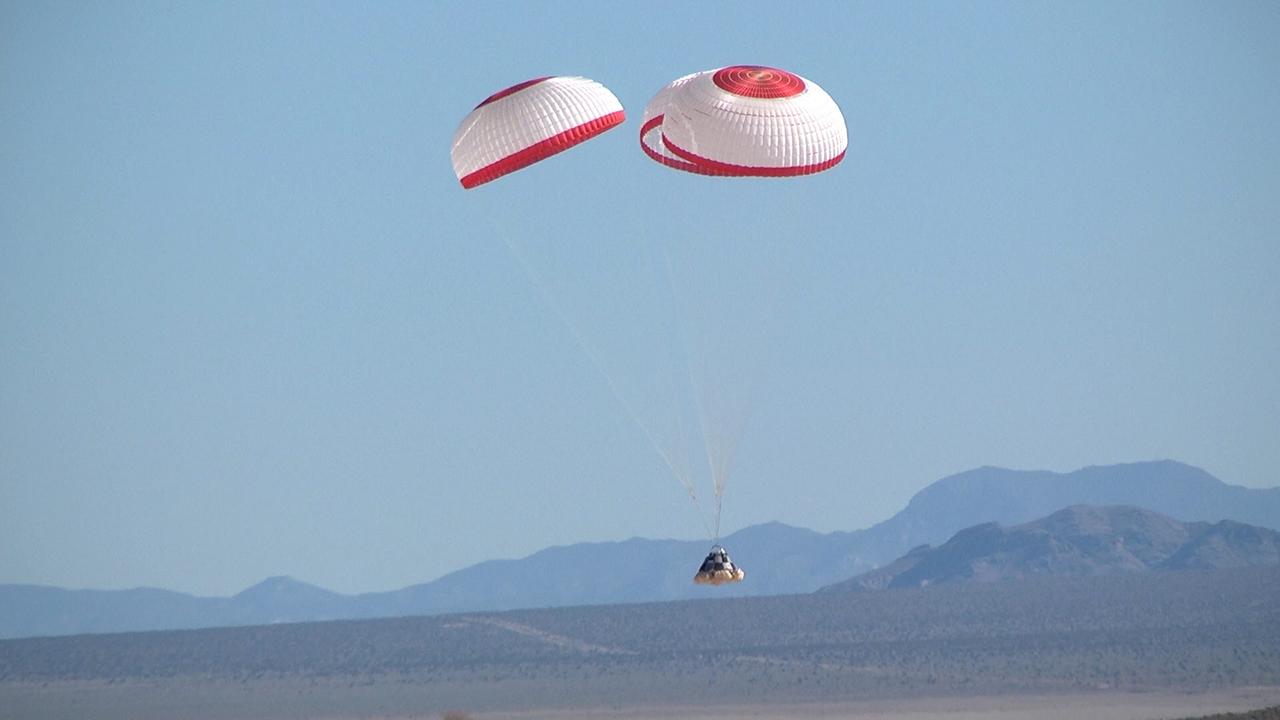
DELAMAR DRY LAKE BED, Nev. -- The Boeing Company's CST-100 boilerplate crew capsule floats toward a smooth landing beneath three main parachutes after being released from an Erickson Sky Crane helicopter at about 11,000 feet above Delamar Dry Lake Bed near Alamo, Nev. This is one of two tests that Boeing will perform for NASA's Commercial Crew Program CCP in order to validate the spacecraft's parachute system architecture and deployment scheme, characterize pyrotechnic shock loads, confirm parachute sizing and design, and identify potential forward compartment packaging and deployment issues. In 2011, NASA selected Boeing during Commercial Crew Development Round 2 CCDev2) activities to mature the design and development of a crew transportation system with the overall goal of accelerating a United States-led capability to the International Space Station. The goal of CCP is to drive down the cost of space travel as well as open up space to more people than ever before by balancing industry’s own innovative capabilities with NASA's 50 years of human spaceflight experience. Six other aerospace companies also are maturing launch vehicle and spacecraft designs under CCDev2, including Alliant Techsystems Inc. ATK, Excalibur Almaz Inc., Blue Origin, Sierra Nevada, Space Exploration Technologies SpaceX, and United Launch Alliance ULA. For more information, visit www.nasa.gov/commercialcrew. Image credit: Boeing
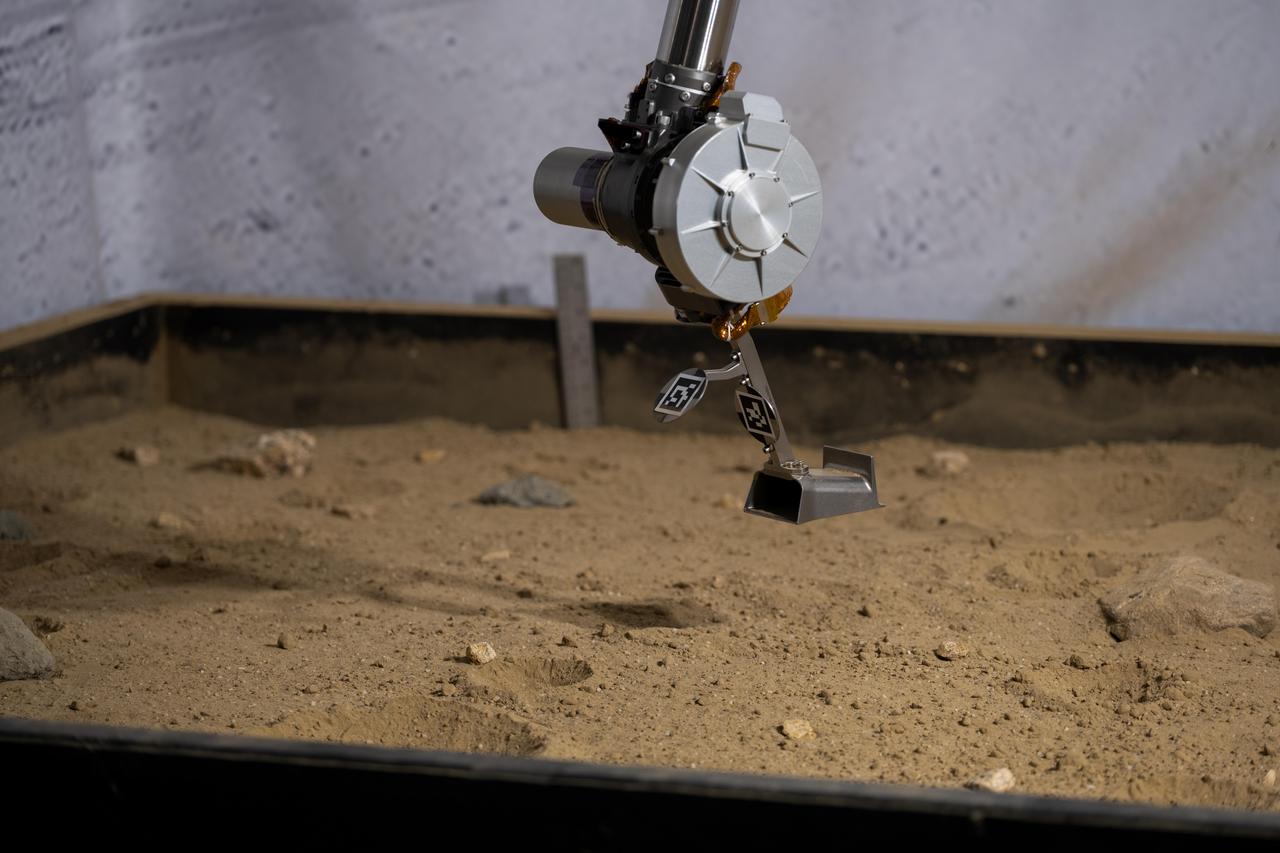
The 3D-printed titanium scoop of the Cold Operable Lunar Deployable Arm (COLDArm) robotic arm system is poised above a test bed filled with material to simulate lunar regolith (broken rocks and dust) at NASA's Jet Propulsion Laboratory in Southern California. COLDArm can function in temperatures as cold as minus 280 degrees Fahrenheit (minus 173 degrees Celsius). COLDArm is designed to go on a Moon lander and operate during lunar night, a period that lasts about 14 Earth days. Frigid temperatures during lunar night would stymie current spacecraft, which must rely on energy-consuming heaters to stay warm. To operate in the cold, the 6-foot-6-inch (2-meter) arm combines several key new technologies: gears made of bulk metallic glass that require no lubrication or heating, cold motor controllers that don't need to be kept warm in an electronics box near the core of the spacecraft, and a cryogenic six-axis force torque sensor that lets the arm "feel" what it's doing and make adjustments. A variety of attachments and small instruments could go on the end of the arm, including the scoop, which could be used for collecting samples from a planet's surface. Like the arm on NASA's InSight Mars lander, COLDArm could deploy science instruments to the surface. https://photojournal.jpl.nasa.gov/catalog/PIA25318