
February 17, 2021, The Terminal Tower is illuminated in red to commemorate the Landing of NASA’s Perseverance Rover on the surface of Mars, February 18, 2021. Terminal Tower is a 52-story, (771 ft), landmark skyscraper located on Public Square in downtown Cleveland, Ohio. Cleveland is also the home of the NASA Glenn Research Center.

February 17, 2021, The Terminal Tower is illuminated in red to commemorate the Landing of NASA’s Perseverance Rover on the surface of Mars, February 18, 2021. Terminal Tower is a 52-story, (771 ft), landmark skyscraper located on Public Square in downtown Cleveland, Ohio. Cleveland is also the home of the NASA Glenn Research Center.

February 17, 2021, The Terminal Tower is illuminated in red to commemorate the Landing of NASA’s Perseverance Rover on the surface of Mars, February 18, 2021. Terminal Tower is a 52-story, (771 ft), landmark skyscraper located on Public Square in downtown Cleveland, Ohio. Cleveland is also the home of the NASA Glenn Research Center.

February 17, 2021, The Terminal Tower is illuminated in red to commemorate the Landing of NASA’s Perseverance Rover on the surface of Mars, February 18, 2021. Terminal Tower is a 52-story, (771 ft), landmark skyscraper located on Public Square in downtown Cleveland, Ohio. Cleveland is also the home of the NASA Glenn Research Center.
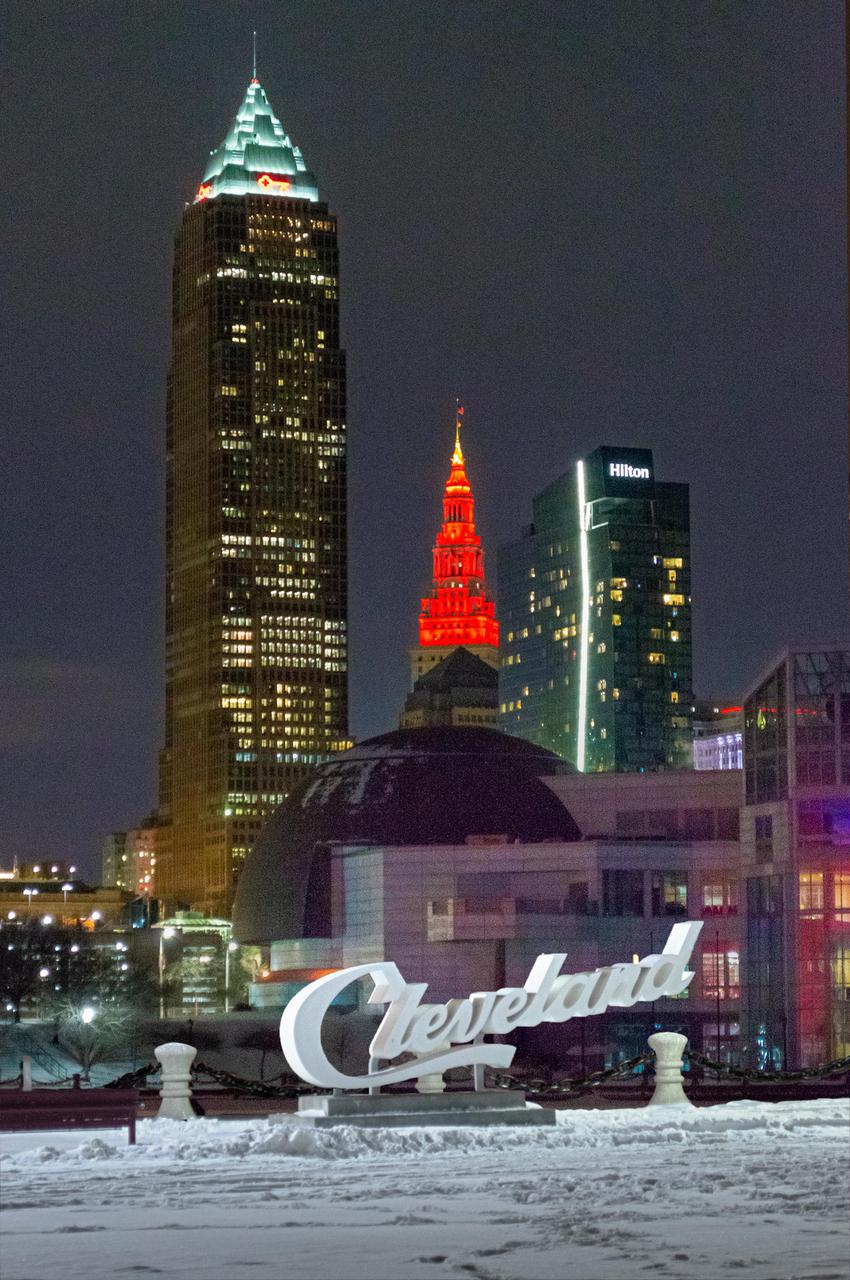
February 17, 2021, The Terminal Tower is illuminated in red to commemorate the Landing of NASA’s Perseverance Rover on the surface of Mars, February 18, 2021. Terminal Tower is a 52-story, (771 ft), landmark skyscraper located on Public Square in downtown Cleveland, Ohio. Cleveland is also the home of the NASA Glenn Research Center.

Cleveland’s Terminal Tower as seen from Public Square was lit up “Mars Red” leading up the Perseverance Rover’s arrival on Mars Wednesday night February 18th and Thursday morning.

Cleveland’s Terminal Tower as seen from Voinovich Bicentennial Park was lit up “Mars Red” leading up the Perseverance Rover’s arrival on Mars Wednesday night February 18th and Thursday morning.

The test subject of Airspace Technology Demonstration 2 is “Integrated Arrivals Departures Scheduling,” a software tool that coordinates schedules between the ramp, tower, terminal and center control facilities, allowing air traffic controllers to better predict where and when to send aircraft in order to reduce congestion.
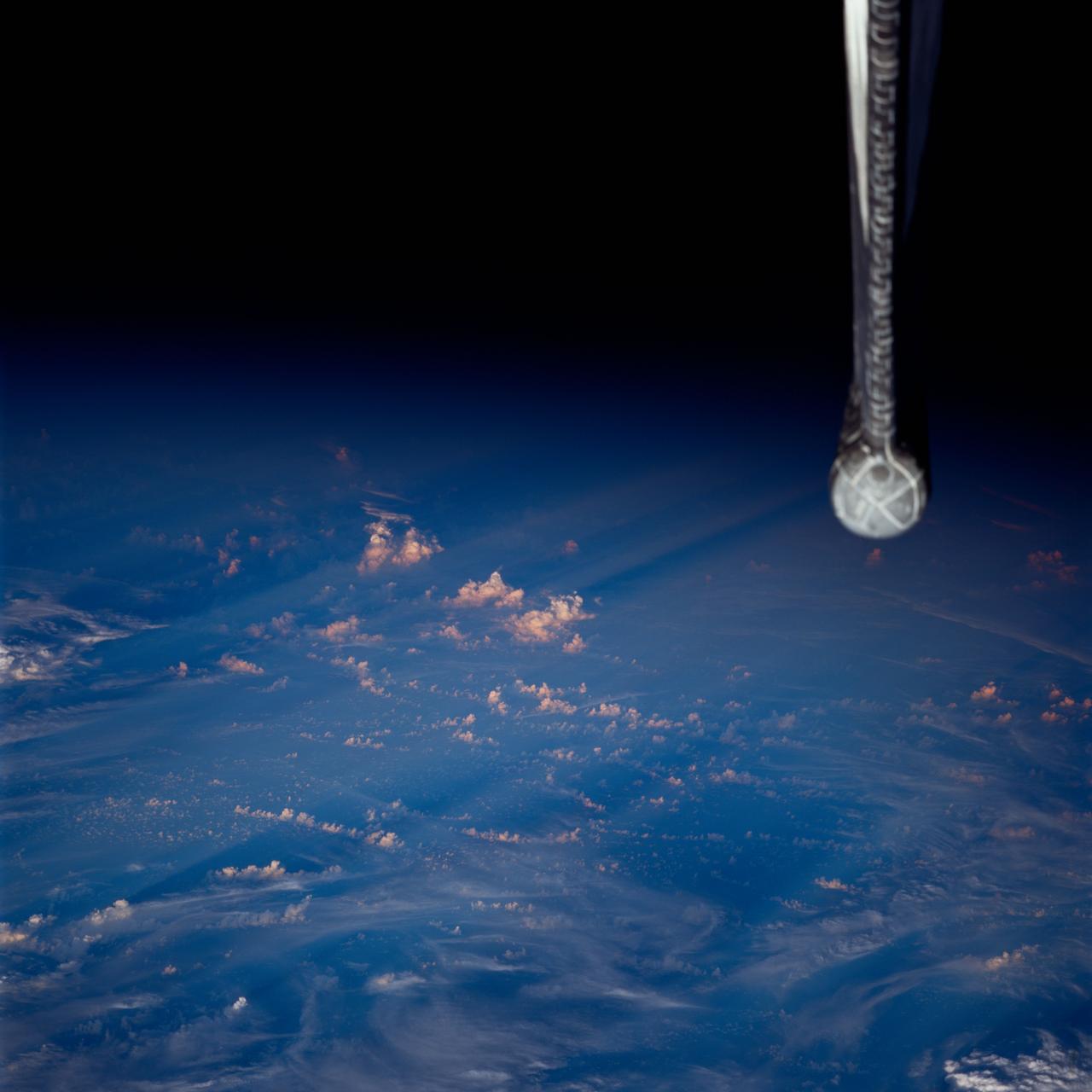
STS080-752-011 (19 Nov.-7 Dec. 1996) --- This view, photographed by one the crewmembers aboard the Earth-orbiting space shuttle Columbia, shows an area covered with clouds near the terminator thus the long shadows from the towering clouds. A portion of the vertical stabilizer of the space shuttle Columbia is seen on the right. Vortices indicate that it is a Southern Hemisphere photograph.
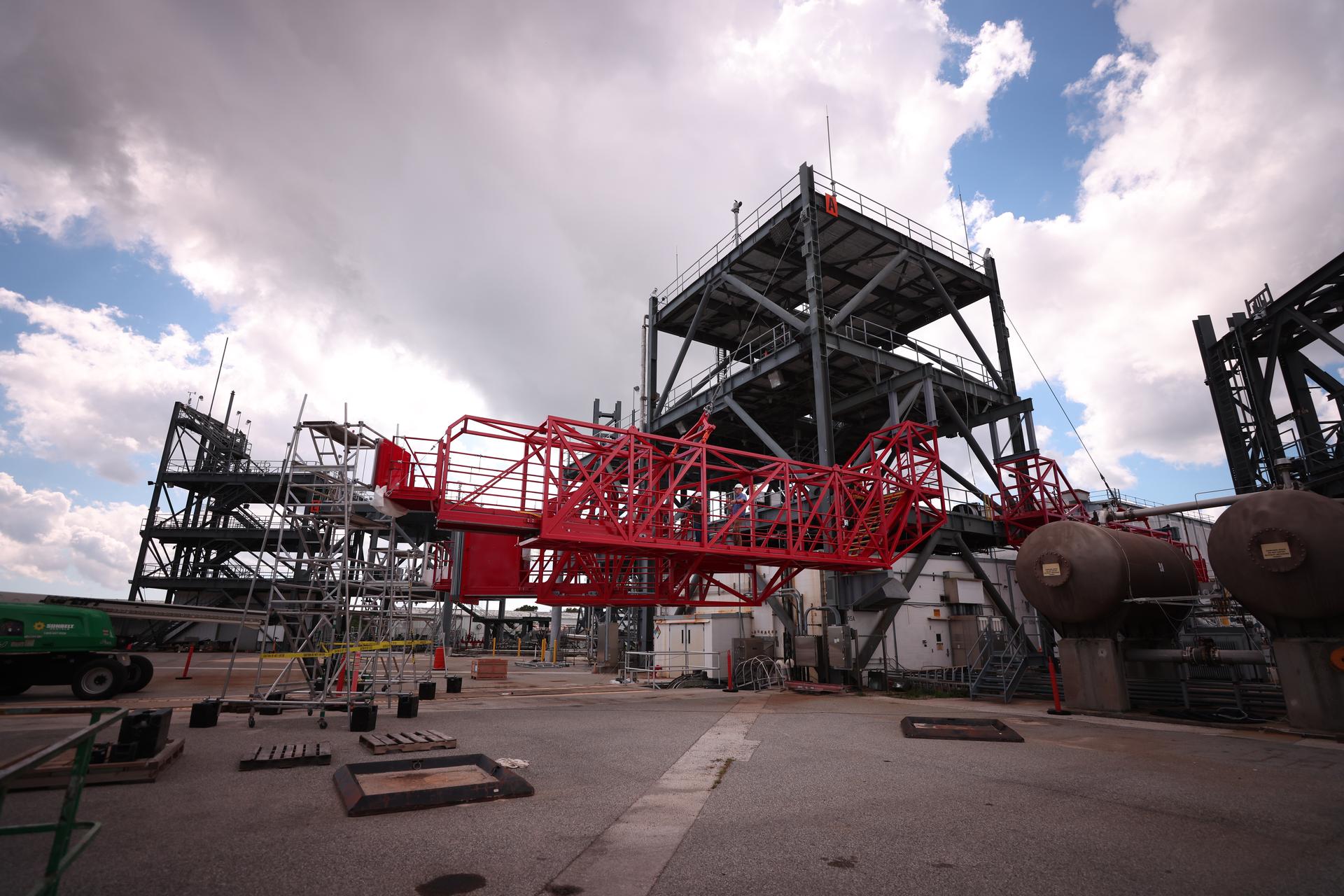
Crews test temporary contingency access platforms on the mobile launcher simulator tower on Wednesday, Oct. 29, 2025, at the Launch Equipment Test Facility at NASA’s Kennedy Space Center in Florida. The platforms will allow engineers to access the vehicle’s flight termination system on the rocket and the mobile launcher while at the pad rather than rolling back to the Vehicle Assembly Building to retest them. For Artemis II, four astronauts will venture around the Moon in early 2026, the first crewed mission on NASA’s path to establishing a long-term presence for science and exploration through Artemis.
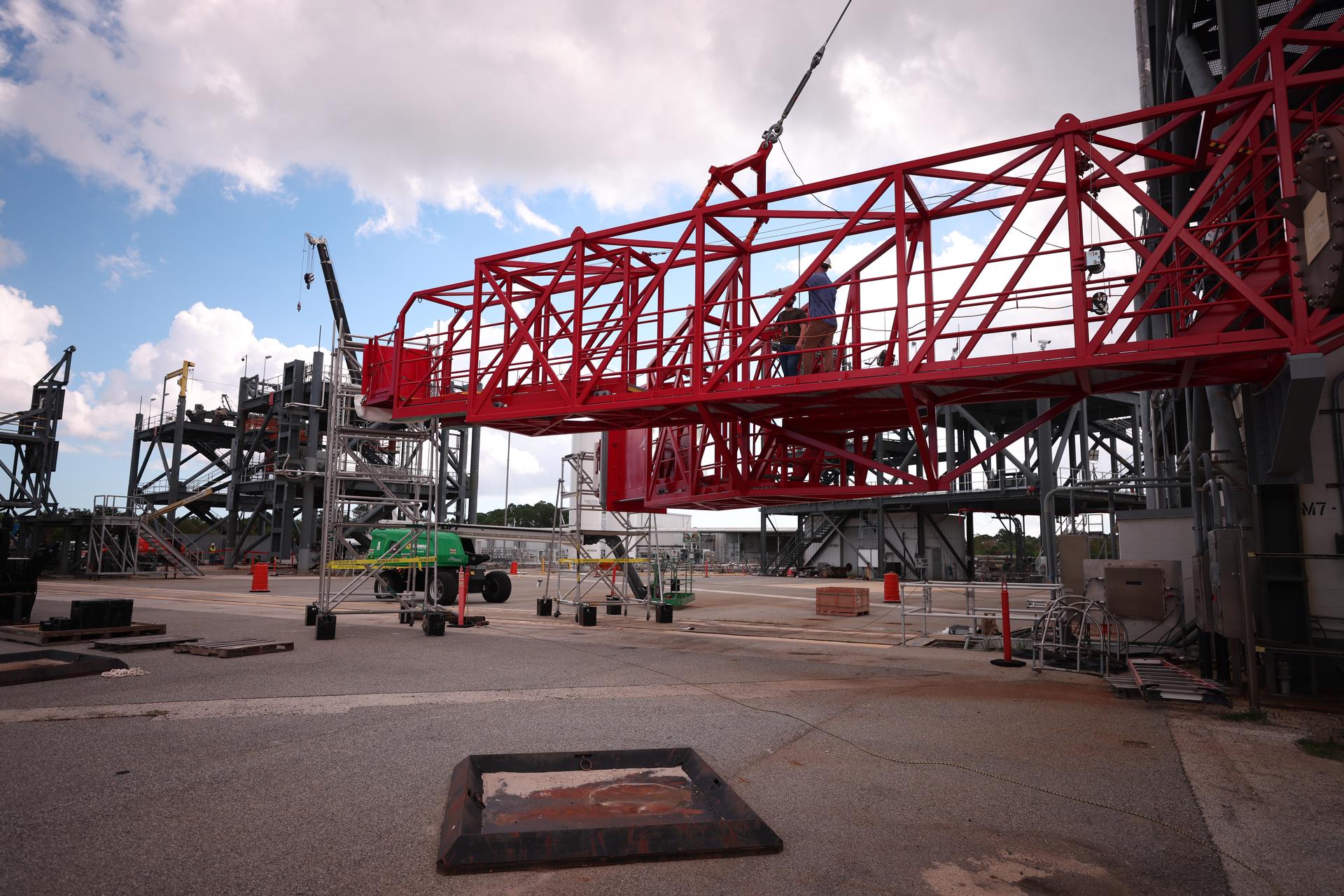
Crews test temporary contingency access platforms on the mobile launcher simulator tower on Wednesday, Oct. 29, 2025, at the Launch Equipment Test Facility at NASA’s Kennedy Space Center in Florida. The platforms will allow engineers to access the vehicle’s flight termination system on the rocket and the mobile launcher while at the pad rather than rolling back to the Vehicle Assembly Building to retest them. For Artemis II, four astronauts will venture around the Moon in early 2026, the first crewed mission on NASA’s path to establishing a long-term presence for science and exploration through Artemis.
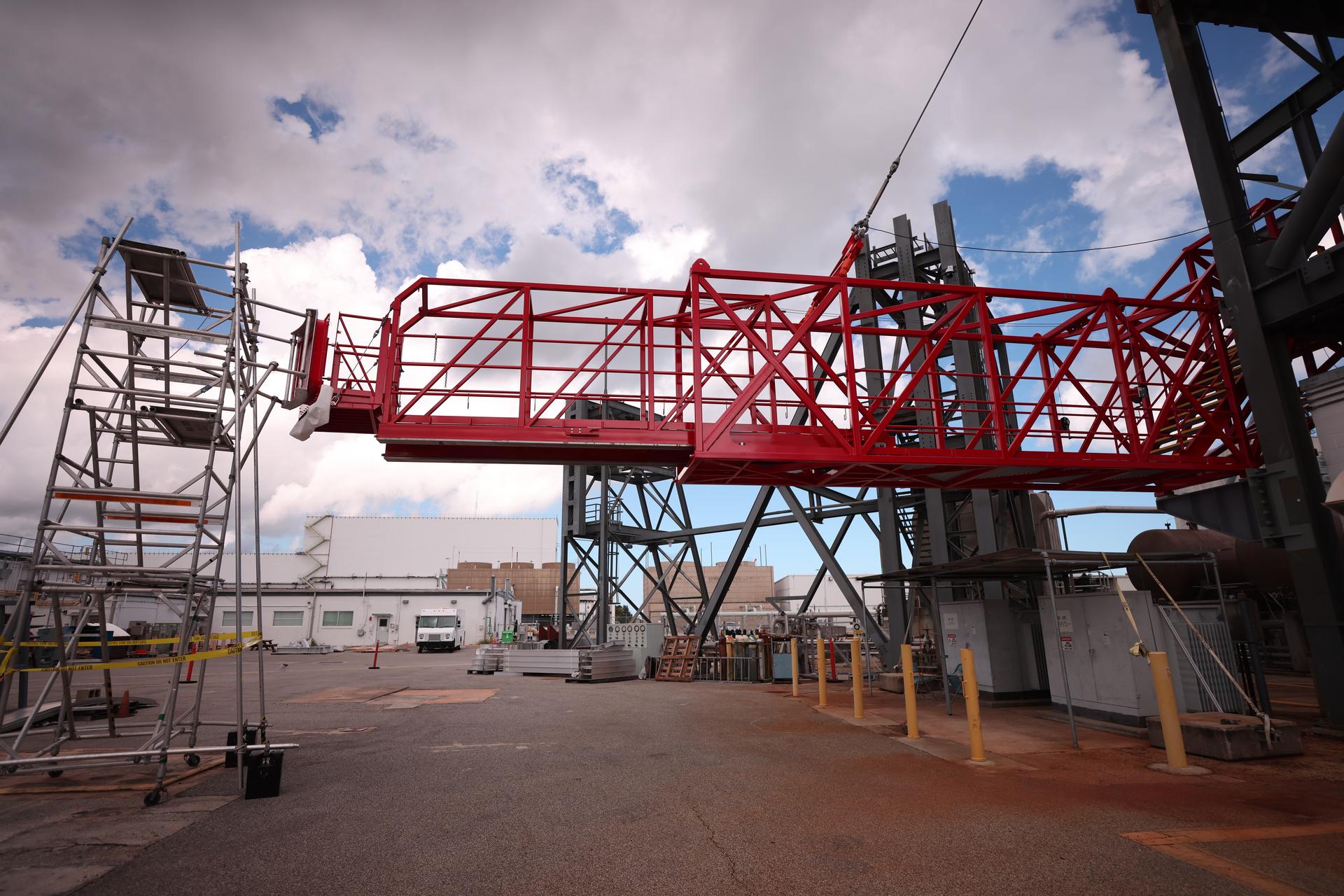
Crews test temporary contingency access platforms on the mobile launcher simulator tower on Wednesday, Oct. 29, 2025, at the Launch Equipment Test Facility at NASA’s Kennedy Space Center in Florida. The platforms will allow engineers to access the vehicle’s flight termination system on the rocket and the mobile launcher while at the pad rather than rolling back to the Vehicle Assembly Building to retest them. For Artemis II, four astronauts will venture around the Moon in early 2026, the first crewed mission on NASA’s path to establishing a long-term presence for science and exploration through Artemis.
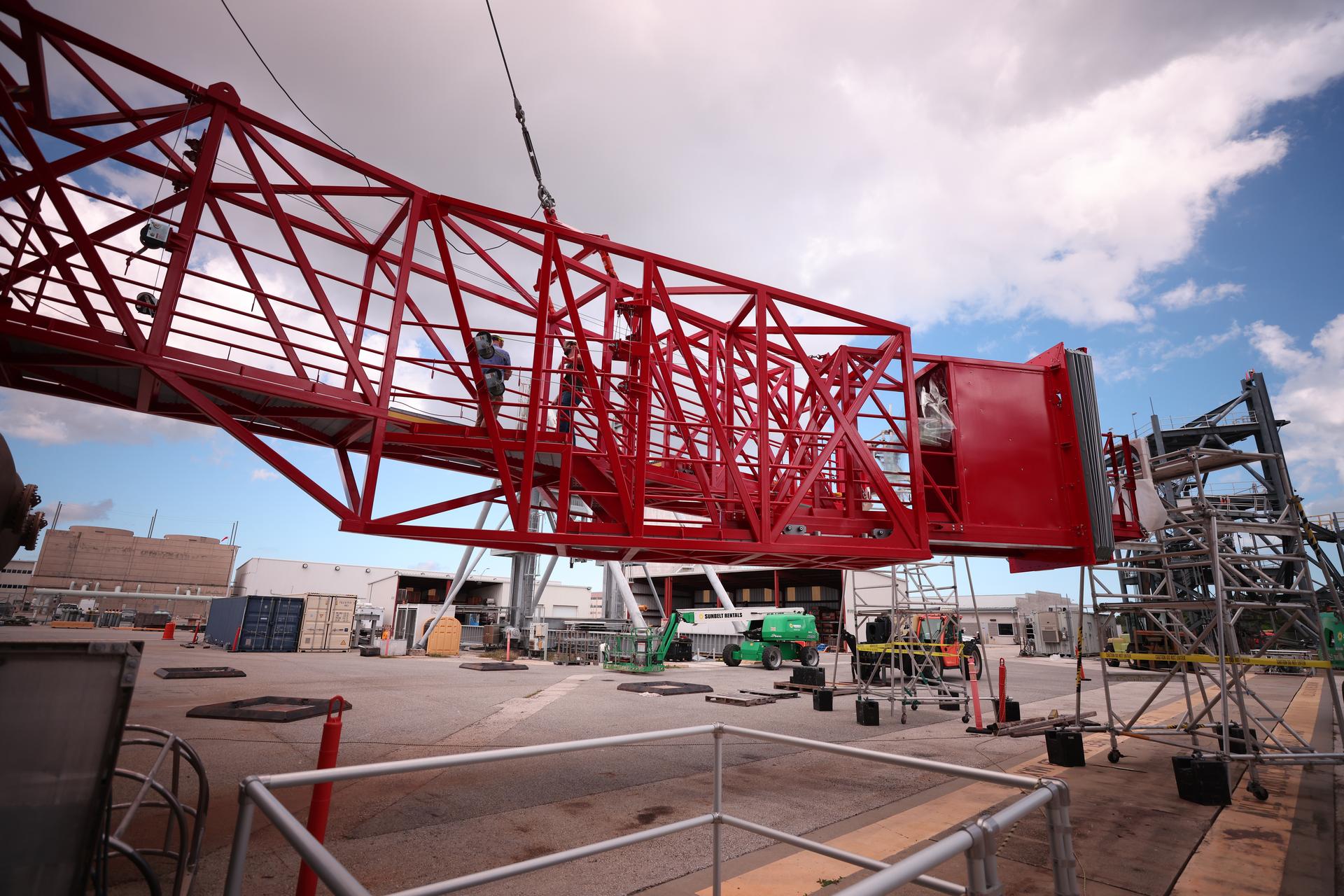
Crews test temporary contingency access platforms on the mobile launcher simulator tower on Wednesday, Oct. 29, 2025, at the Launch Equipment Test Facility at NASA’s Kennedy Space Center in Florida. The platforms will allow engineers to access the vehicle’s flight termination system on the rocket and the mobile launcher while at the pad rather than rolling back to the Vehicle Assembly Building to retest them. For Artemis II, four astronauts will venture around the Moon in early 2026, the first crewed mission on NASA’s path to establishing a long-term presence for science and exploration through Artemis.
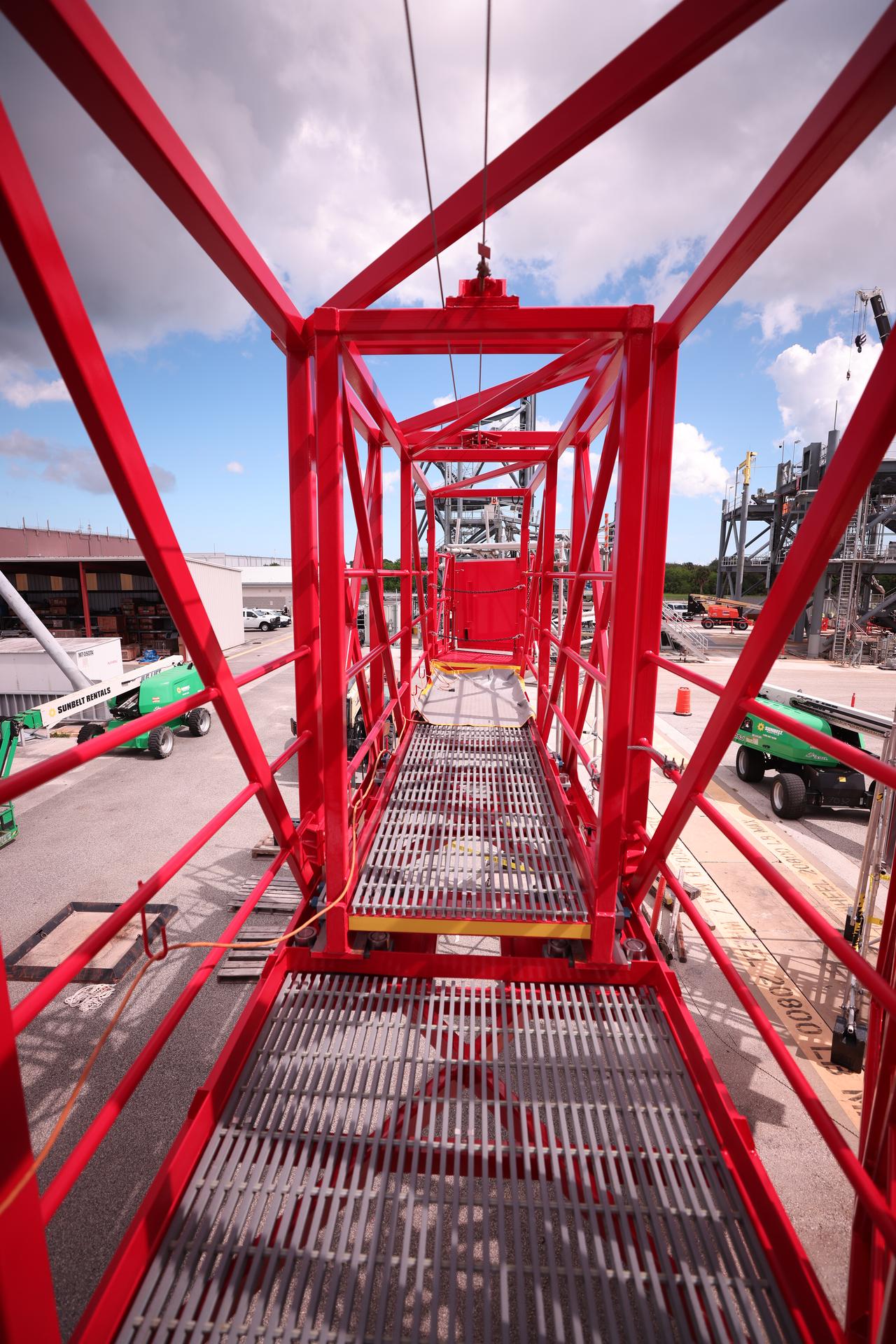
Crews test temporary contingency access platforms on the mobile launcher simulator tower on Wednesday, Oct. 29, 2025, at the Launch Equipment Test Facility at NASA’s Kennedy Space Center in Florida. The platforms will allow engineers to access the vehicle’s flight termination system on the rocket and the mobile launcher while at the pad rather than rolling back to the Vehicle Assembly Building to retest them. For Artemis II, four astronauts will venture around the Moon in early 2026, the first crewed mission on NASA’s path to establishing a long-term presence for science and exploration through Artemis.
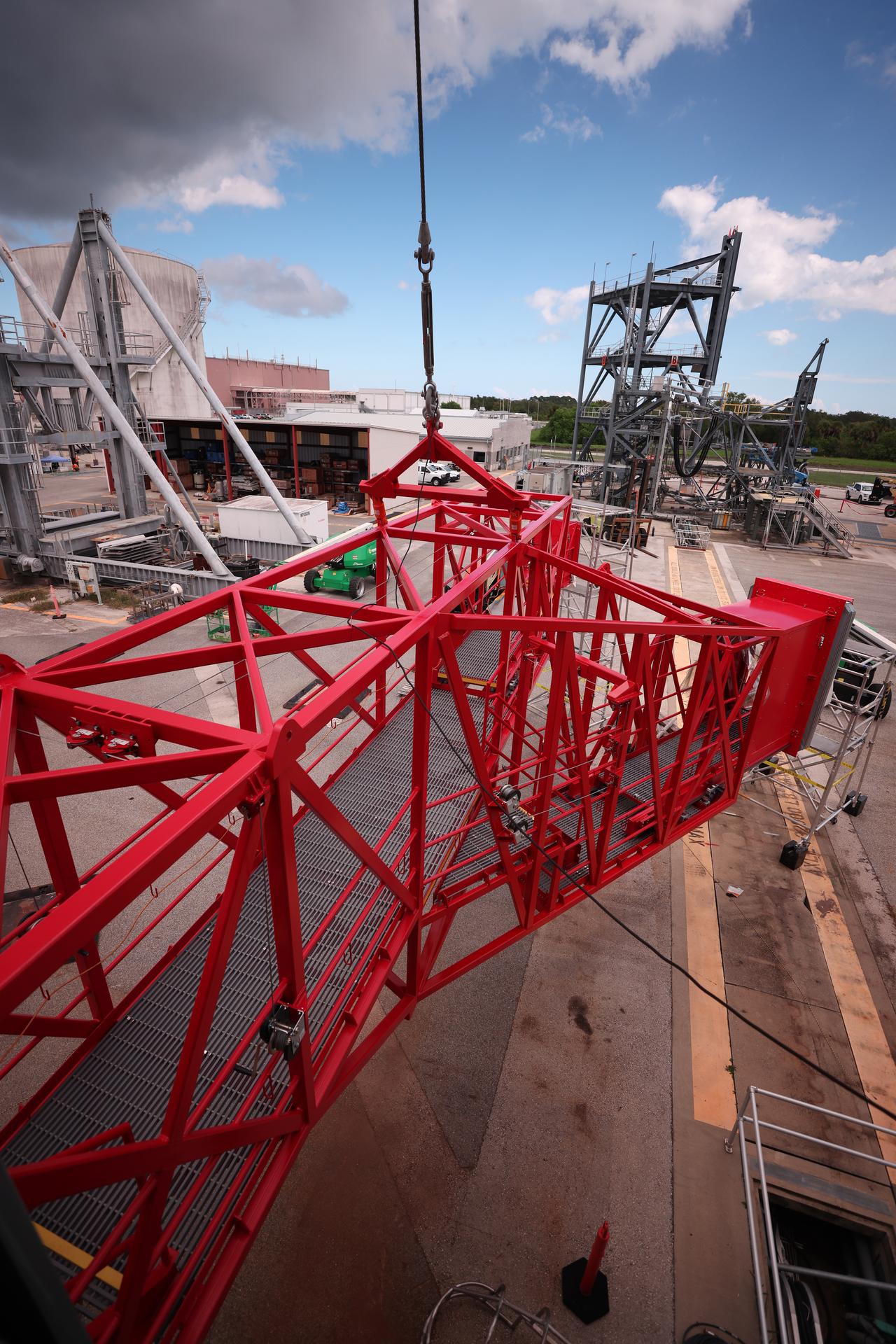
Crews test temporary contingency access platforms on the mobile launcher simulator tower on Wednesday, Oct. 29, 2025, at the Launch Equipment Test Facility at NASA’s Kennedy Space Center in Florida. The platforms will allow engineers to access the vehicle’s flight termination system on the rocket and the mobile launcher while at the pad rather than rolling back to the Vehicle Assembly Building to retest them. For Artemis II, four astronauts will venture around the Moon in early 2026, the first crewed mission on NASA’s path to establishing a long-term presence for science and exploration through Artemis.
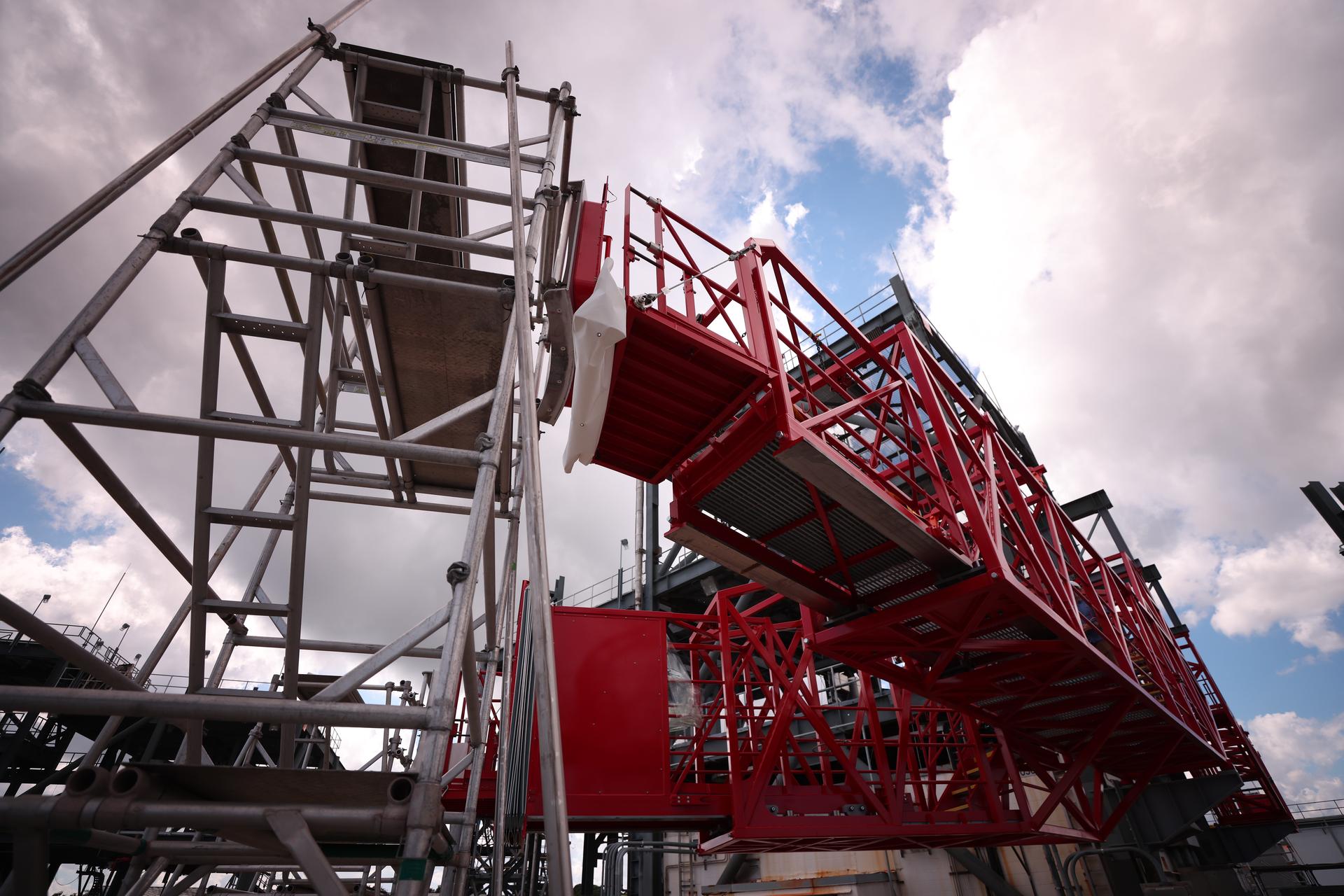
Crews test temporary contingency access platforms on the mobile launcher simulator tower on Wednesday, Oct. 29, 2025, at the Launch Equipment Test Facility at NASA’s Kennedy Space Center in Florida. The platforms will allow engineers to access the vehicle’s flight termination system on the rocket and the mobile launcher while at the pad rather than rolling back to the Vehicle Assembly Building to retest them. For Artemis II, four astronauts will venture around the Moon in early 2026, the first crewed mission on NASA’s path to establishing a long-term presence for science and exploration through Artemis.
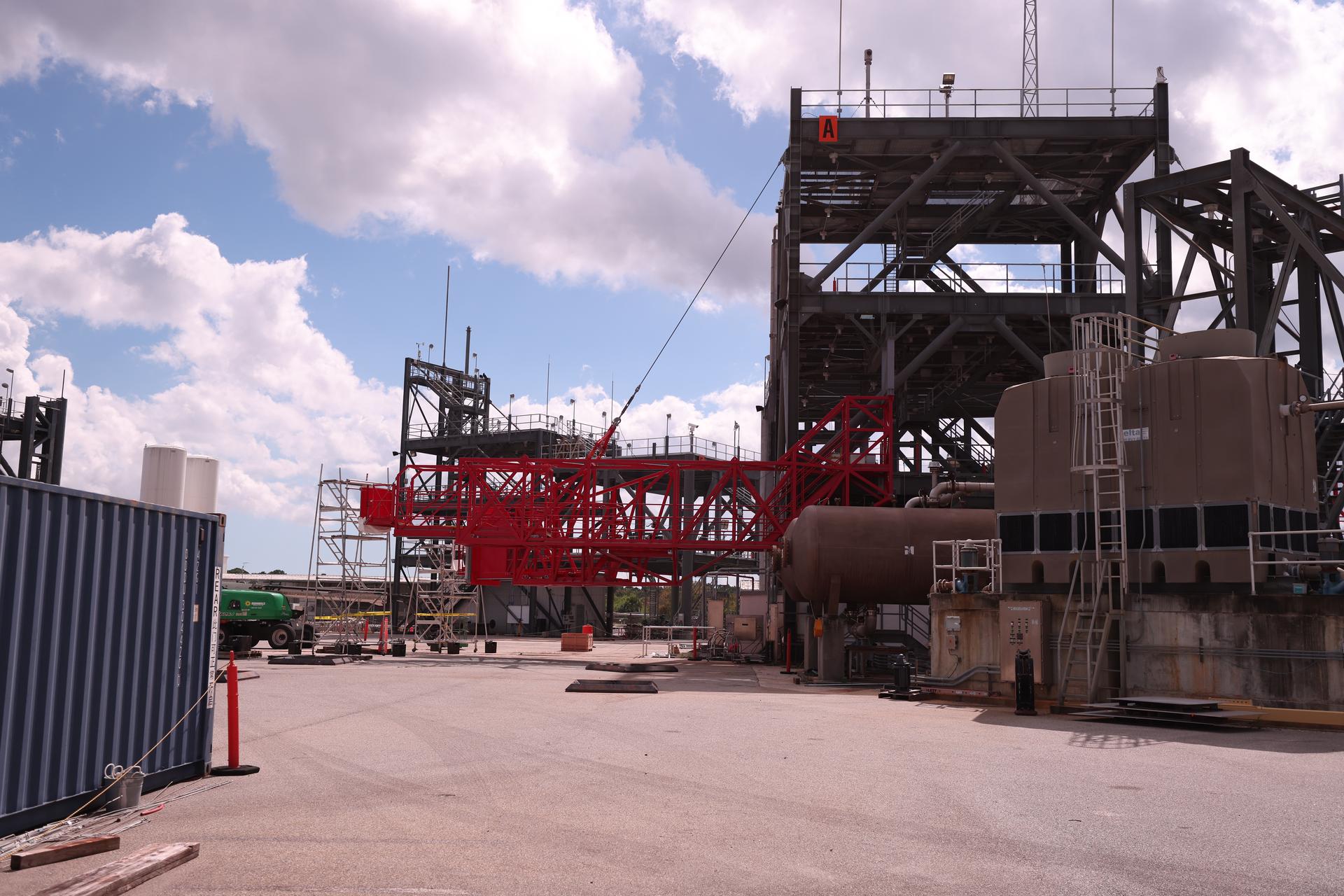
Crews test temporary contingency access platforms on the mobile launcher simulator tower on Wednesday, Oct. 29, 2025, at the Launch Equipment Test Facility at NASA’s Kennedy Space Center in Florida. The platforms will allow engineers to access the vehicle’s flight termination system on the rocket and the mobile launcher while at the pad rather than rolling back to the Vehicle Assembly Building to retest them. For Artemis II, four astronauts will venture around the Moon in early 2026, the first crewed mission on NASA’s path to establishing a long-term presence for science and exploration through Artemis.
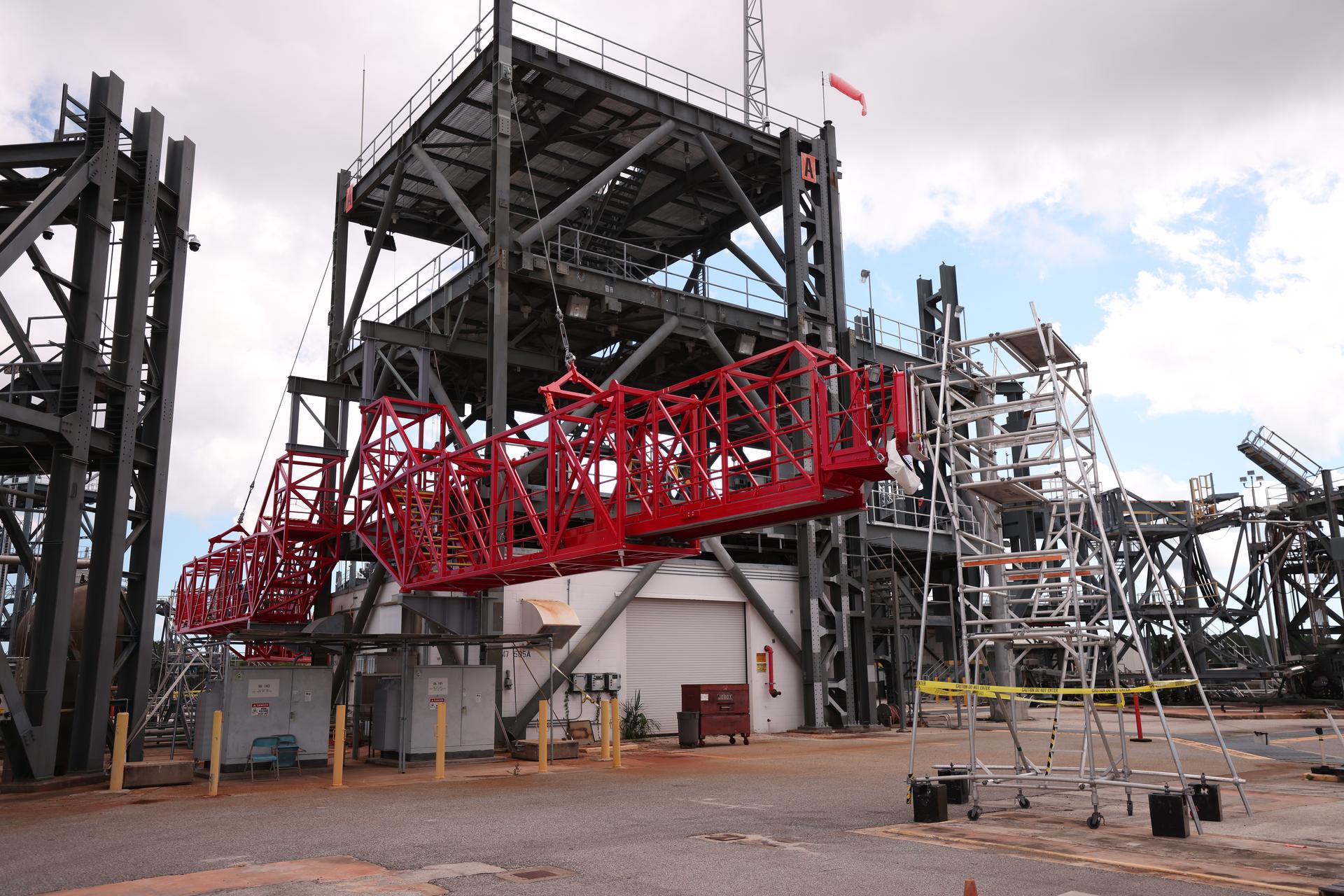
Crews test temporary contingency access platforms on the mobile launcher simulator tower on Wednesday, Oct. 29, 2025, at the Launch Equipment Test Facility at NASA’s Kennedy Space Center in Florida. The platforms will allow engineers to access the vehicle’s flight termination system on the rocket and the mobile launcher while at the pad rather than rolling back to the Vehicle Assembly Building to retest them. For Artemis II, four astronauts will venture around the Moon in early 2026, the first crewed mission on NASA’s path to establishing a long-term presence for science and exploration through Artemis.
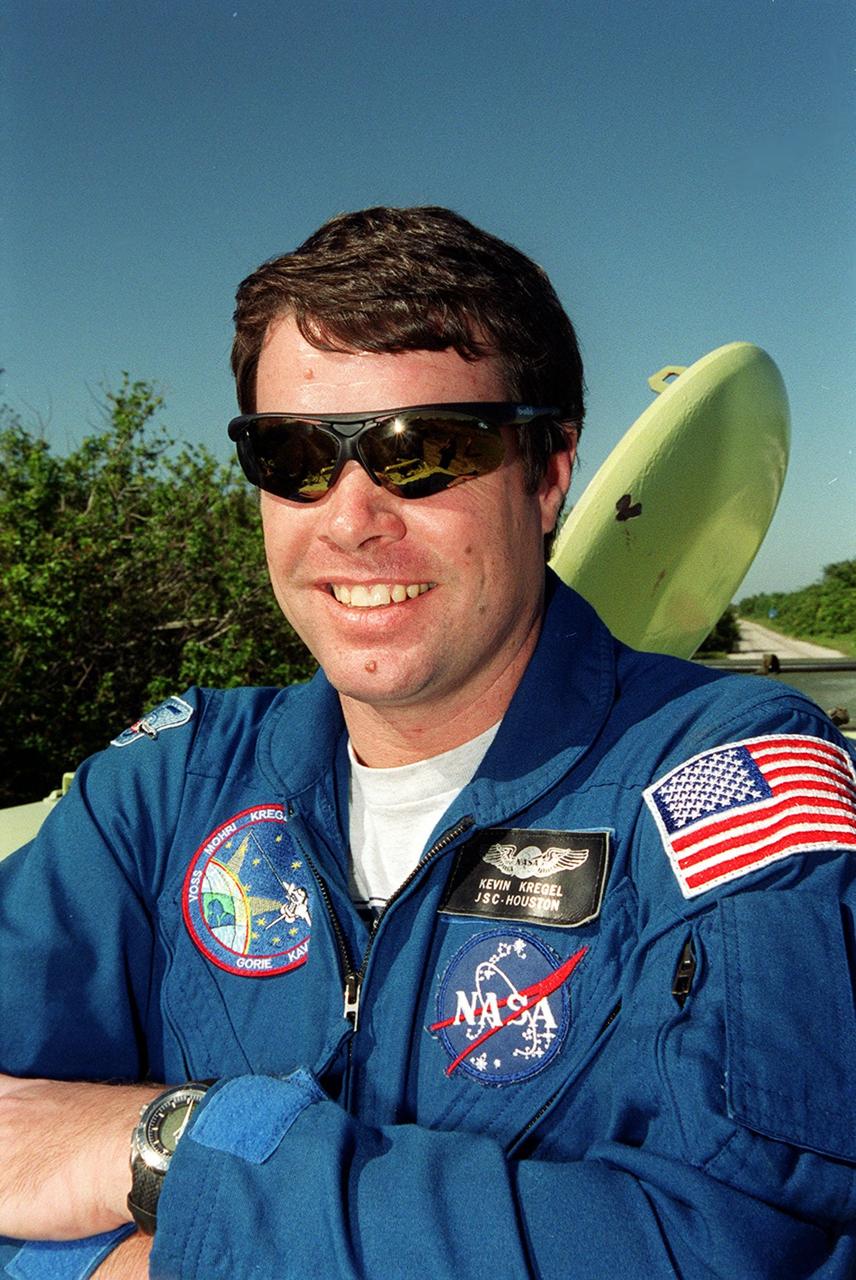
During Terminal Countdown Demonstration Test (TCDT) activities, STS-99 Commander Kevin Kregel is ready to practice driving the M-113, an armored personnel carrier. Part of Terminal Countdown Demonstration Test (TCDT) activities, the M-113 could be used by the crew in the event of an emergency at the pad during which the crew must make a quick exit from the area. TCDT provides the crew with simulated countdown exercises, emergency egress training, and opportunities to inspect the mission payloads in the orbiter's payload bay. STS-99 is the Shuttle Radar Topography Mission, which will chart a new course, using two antennae and a 200-foot-long section of space station-derived mast protruding from the payload bay to produce unrivaled 3-D images of the Earth's surface. The result of the Shuttle Radar Topography Mission could be close to 1 trillion measurements of the Earth's topography. Besides contributing to the production of better maps, these measurements could lead to improved water drainage modeling, more realistic flight simulators, better locations for cell phone towers, and enhanced navigation safety. Launch of Endeavour on the 11-day mission is scheduled for Jan. 31 at 12:47 p.m. EST
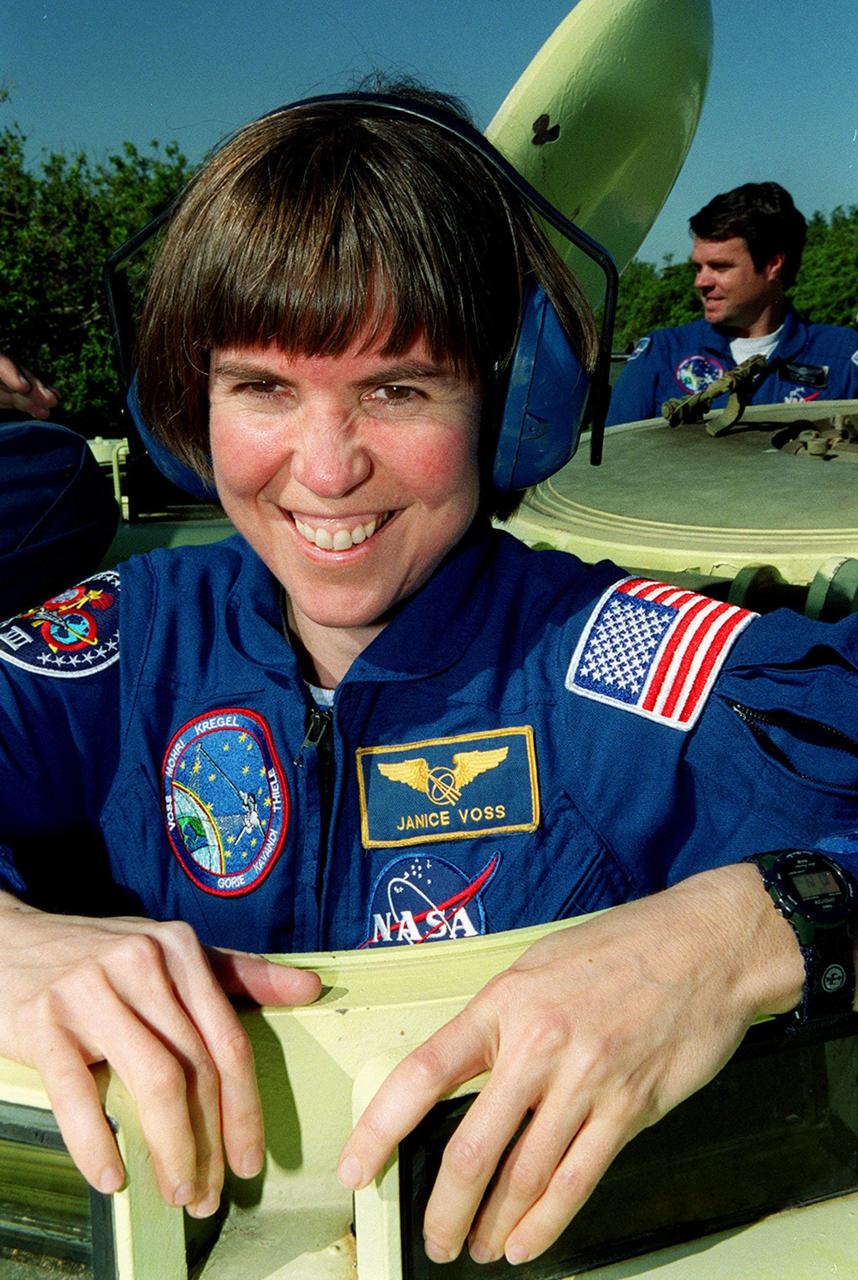
During Terminal Countdown Demonstration Test (TCDT) activities, STS-99 Mission Specialist Janice Voss (Ph.D.) is ready to practice driving the M-113, an armored personnel carrier. Part of Terminal Countdown Demonstration Test (TCDT) activities, the M-113 could be used by the crew in the event of an emergency at the pad during which the crew must make a quick exit from the area. In the rear (right) is Commander Kevin Kregel. TCDT provides the crew with simulated countdown exercises, emergency egress training, and opportunities to inspect the mission payloads in the orbiter's payload bay. STS-99 is the Shuttle Radar Topography Mission, which will chart a new course, using two antennae and a 200-foot-long section of space station-derived mast protruding from the payload bay to produce unrivaled 3-D images of the Earth's surface. The result of the Shuttle Radar Topography Mission could be close to 1 trillion measurements of the Earth's topography. Besides contributing to the production of better maps, these measurements could lead to improved water drainage modeling, more realistic flight simulators, better locations for cell phone towers, and enhanced navigation safety. Launch of Endeavour on the 11-day mission is scheduled for Jan. 31 at 12:47 p.m. EST
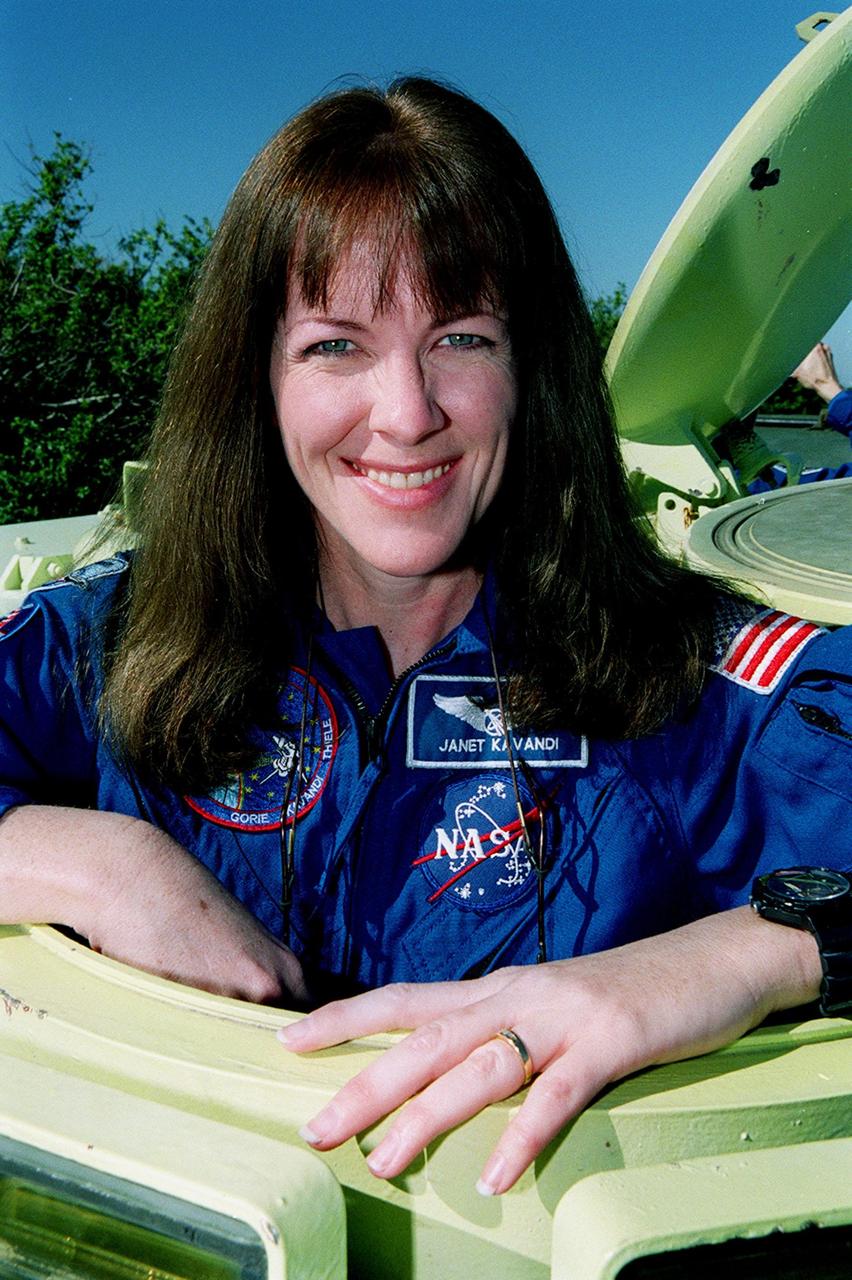
During Terminal Countdown Demonstration Test (TCDT) activities, STS-99 Mission Specialist Janet Lynn Kavandi (Ph.D.) is ready to practice driving the M-113, an armored personnel carrier. Part of Terminal Countdown Demonstration Test (TCDT) activities, the M-113 could be used by the crew in the event of an emergency at the pad during which the crew must make a quick exit from the area. TCDT provides the crew with simulated countdown exercises, emergency egress training, and opportunities to inspect the mission payloads in the orbiter's payload bay. STS-99 is the Shuttle Radar Topography Mission, which will chart a new course, using two antennae and a 200-foot-long section of space station-derived mast protruding from the payload bay to produce unrivaled 3-D images of the Earth's surface. The result of the Shuttle Radar Topography Mission could be close to 1 trillion measurements of the Earth's topography. Besides contributing to the production of better maps, these measurements could lead to improved water drainage modeling, more realistic flight simulators, better locations for cell phone towers, and enhanced navigation safety. Launch of Endeavour on the 11-day mission is scheduled for Jan. 31 at 12:47 p.m. EST
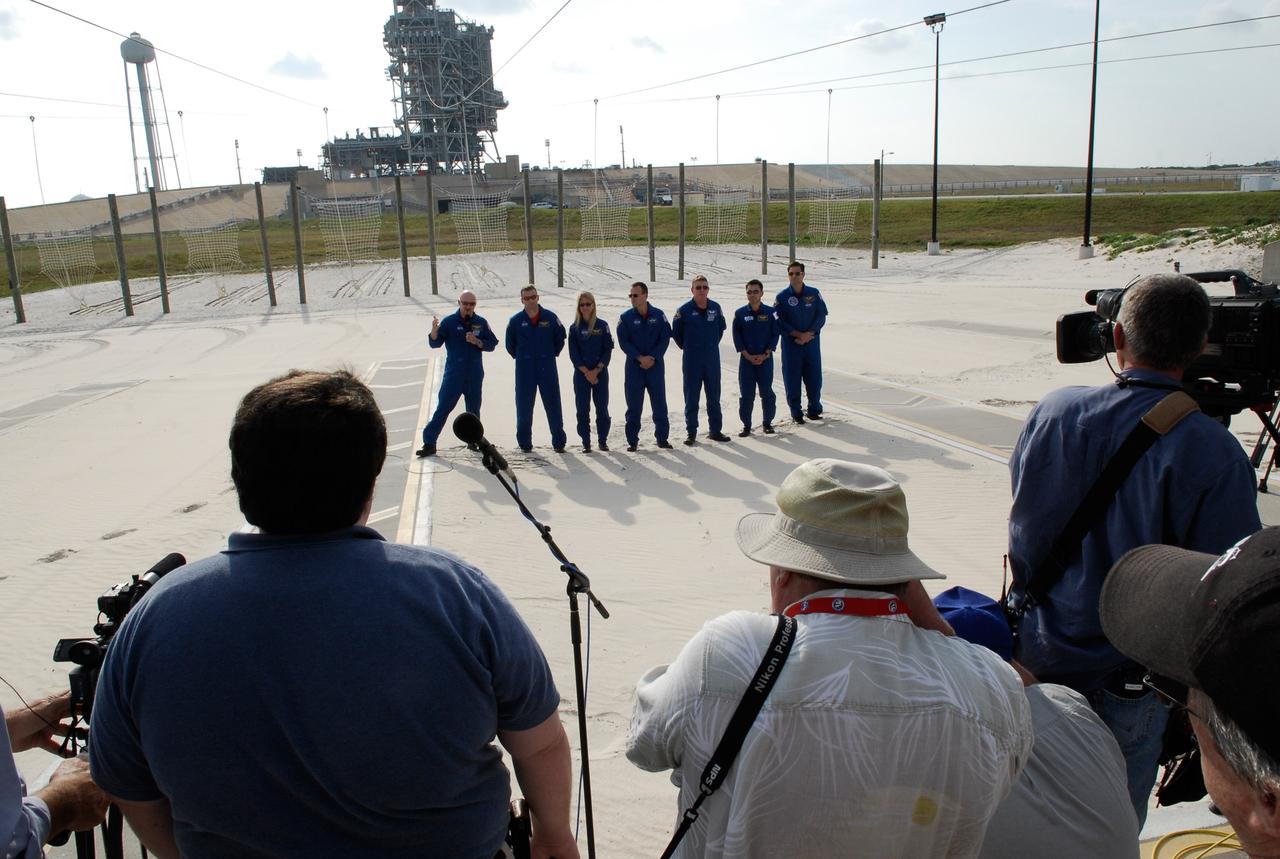
CAPE CANAVERAL, Fla. -- At the slidewire landing area of Launch Pad 39A at NASA's Kennedy Space Center, the STS-124 crew responds to reporters' questions during a media event. Seen from left are Commander Mark Kelly, Pilot Ken Ham, and Mission Specialists Karen Nyberg, Ron Garan, Mike Fossum, Akihiko Hoshide and Greg Chamitoff. Hoshide represents the Japan Aerospace Exploration Agency. In the background is the fixed service structure (center) and the 300-gallon water tower (left). The crew is at Kennedy for a dress launch rehearsal called the terminal countdown demonstration test. TCDT provides astronauts and ground crews with an opportunity to participate in various simulated countdown activities, including equipment familiarization and emergency training. On the STS-124 mission, the crew will deliver and install the Japanese Experiment Module – Pressurized Module and Japanese Remote Manipulator System. Discovery's launch is targeted for May 31. Photo credit: NASA/Kim Shiflett
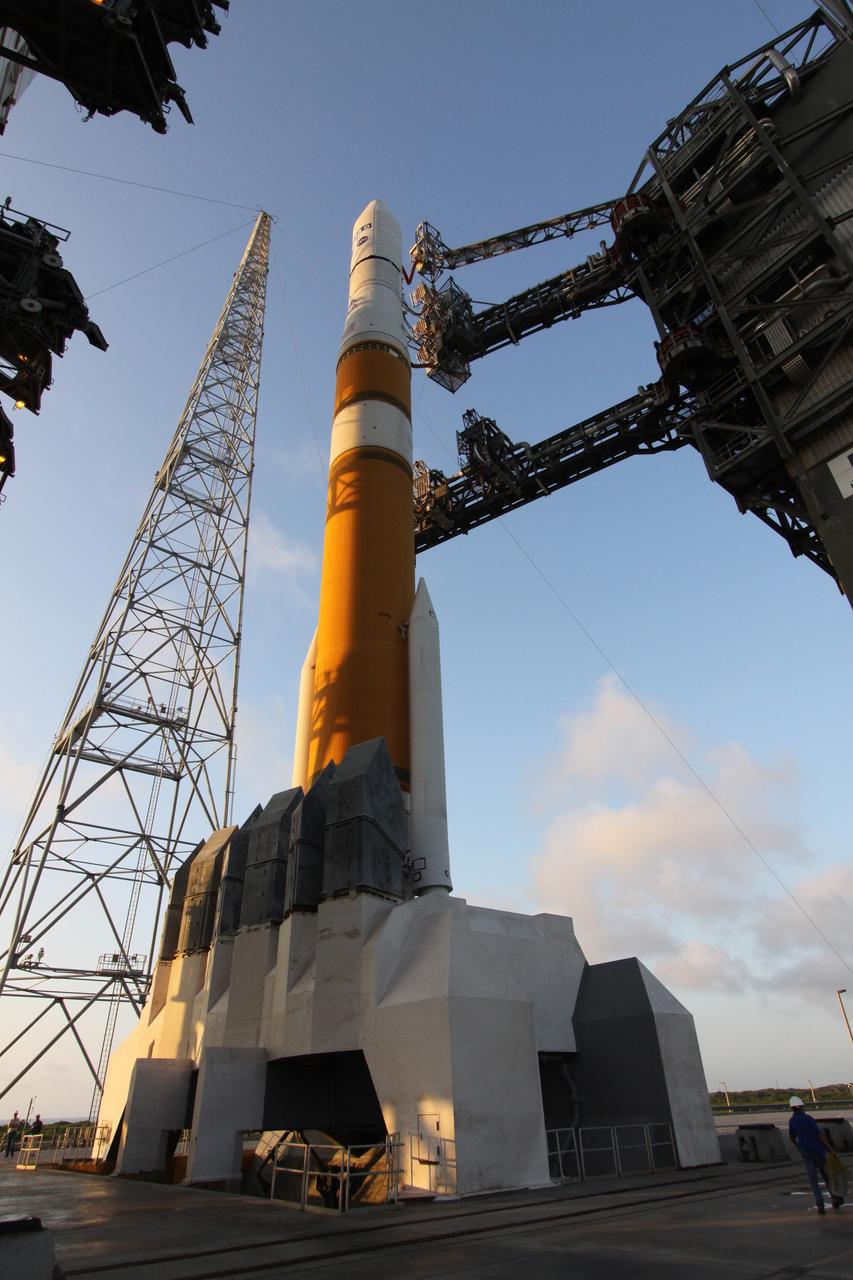
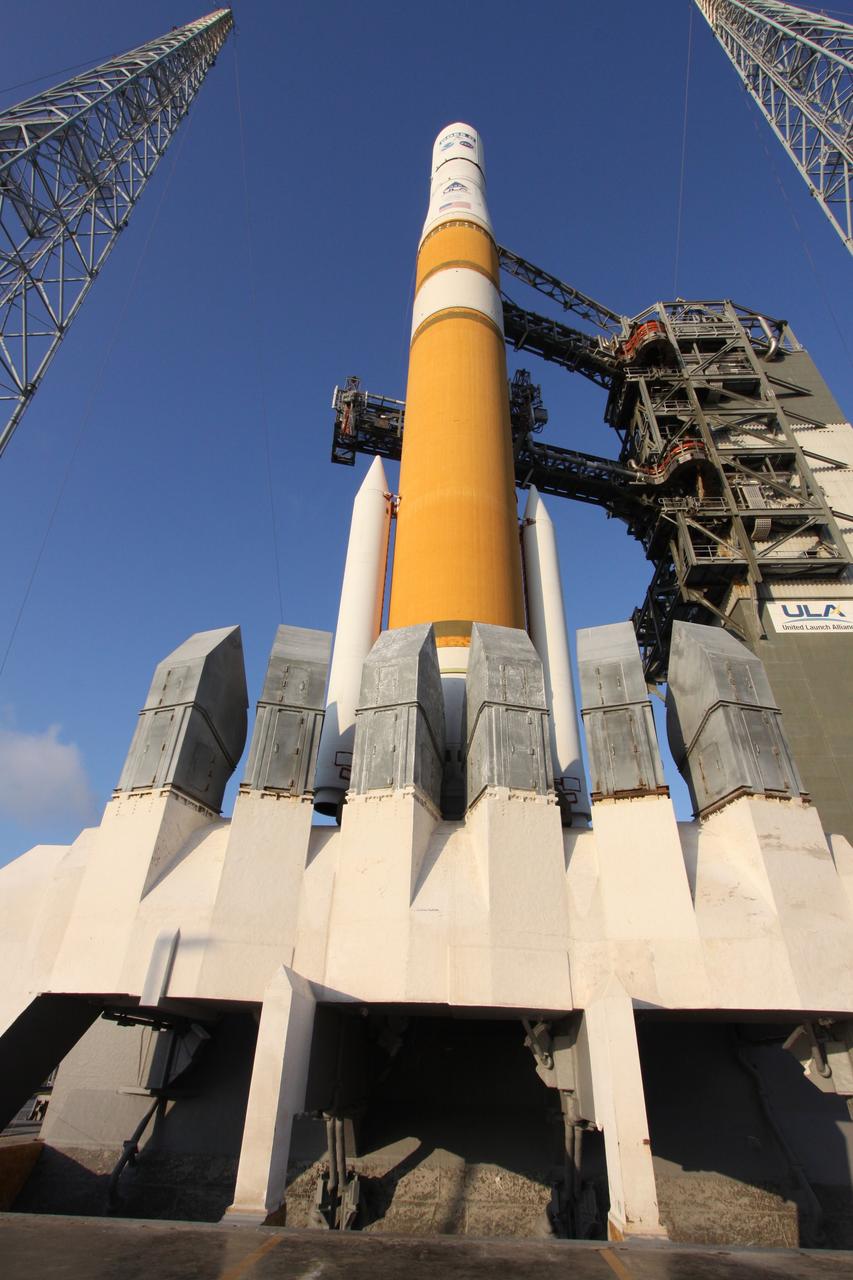
CAPE CANAVERAL, Fla. – The mobile service tower on Launch Complex 37 at Cape Canaveral Air Force Station rolls back to reveal the Boeing Delta IV rocket that will launch the GOES-O satellite into orbit. The terminal countdown to the liftoff of GOES-O will begin at 12:59 p.m. EDT for a launch window that extends from 6:14 p.m. to 7:14 p.m. June 26. The latest Geostationary Operational Environmental Satellite, GOES-O was developed by NASA for the National Oceanic and Atmospheric Administration, or NOAA. Each of the GOES satellites continuously provides observations of 60 percent of the Earth including the continental United States, providing weather monitoring and forecast operations as well as a continuous and reliable stream of environmental information and severe weather warnings. Once in orbit, GOES-O will be designated GOES-14, and NASA will provide on-orbit checkout and then transfer operational responsibility to NOAA. Photo credit: NASA/Jack Pfaller
CAPE CANAVERAL, Fla. – The mobile service tower on Launch Complex 37 at Cape Canaveral Air Force Station has been removed from around a Boeing Delta IV rocket as preparations continue to launch the GOES-O satellite. The terminal countdown to the liftoff of GOES-O will begin at 12:59 p.m. EDT for a launch window that extends from 6:14 p.m. to 7:14 p.m. June 26. The latest Geostationary Operational Environmental Satellite, GOES-O was developed by NASA for the National Oceanic and Atmospheric Administration, or NOAA. Each of the GOES satellites continuously provides observations of 60 percent of the Earth including the continental United States, providing weather monitoring and forecast operations as well as a continuous and reliable stream of environmental information and severe weather warnings. Once in orbit, GOES-O will be designated GOES-14, and NASA will provide on-orbit checkout and then transfer operational responsibility to NOAA. Photo credit: NASA/Jack Pfaller

STS052-152-047 (22 Oct- 1 Nov 1992) --- The Kalahari Desert had not seen any significant rainfall for months before the launch of STS-52. Here, Shuttle astronauts have captured the onset of the (Southern Hemisphere) summer monsoon over the Kalahari Desert, as illustrated by the large thunderstorm towers poking up through the sun's terminator. The summer monsoon, with its associated thunderstorms, generally lasts from November through March. Scientist observers of this area report that the summer monsoon contributes most of the annual rainfall to this environmentally sensitive area. Shuttle nadir position: 28.0 degrees south, 25.1 degrees east. The center of the scene is 22.0 degrees south, 25.0 degrees east, 16:20:04 GMT.
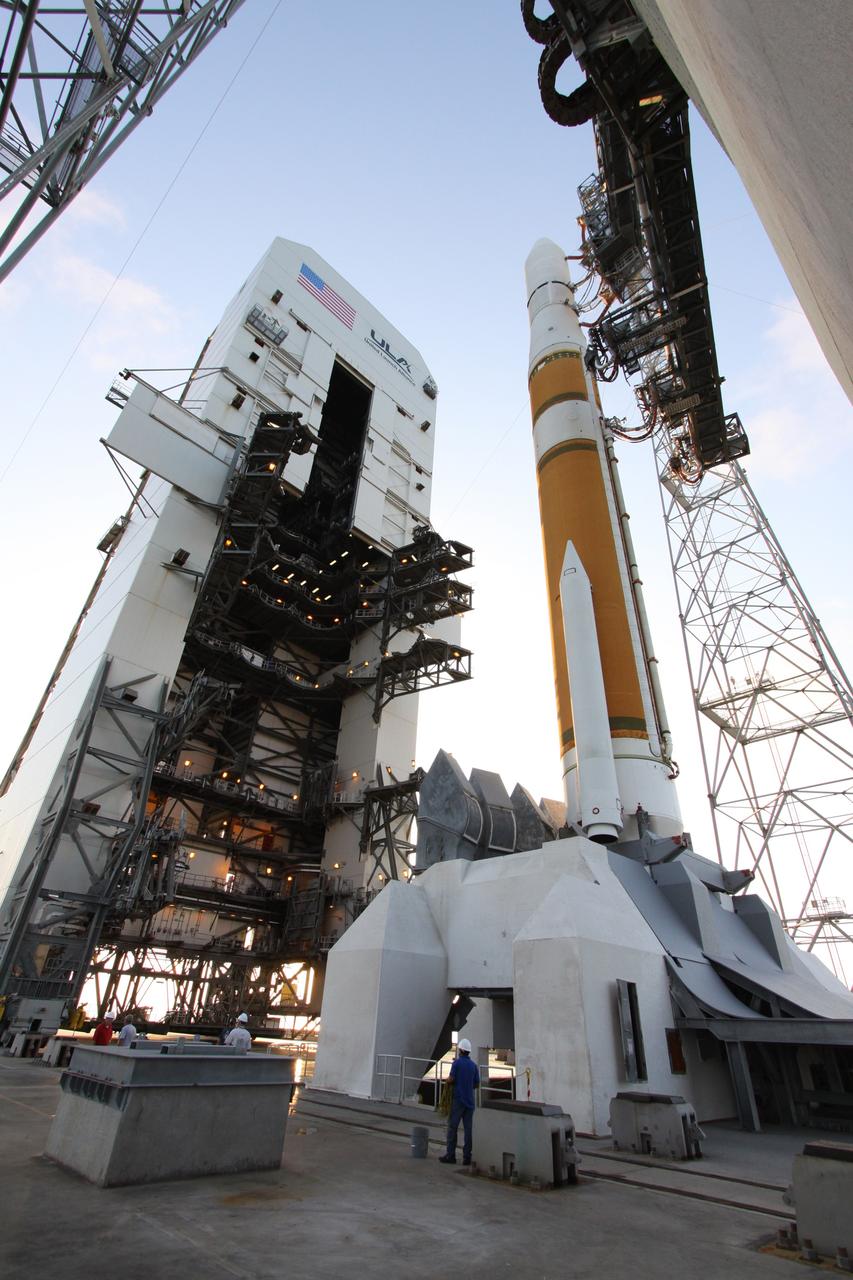
CAPE CANAVERAL, Fla. – Workers on Launch Complex 37 at Cape Canaveral Air Force Station monitor the movement of the mobile service tower as it slowly rolls away from the Boeing Delta IV rocket that will launch the GOES-O satellite into orbit. The terminal countdown to the liftoff of GOES-O will begin at 12:59 p.m. EDT for a launch window that extends from 6:14 p.m. to 7:14 p.m. June 26. The latest Geostationary Operational Environmental Satellite, GOES-O was developed by NASA for the National Oceanic and Atmospheric Administration, or NOAA. Each of the GOES satellites continuously provides observations of 60 percent of the Earth including the continental United States, providing weather monitoring and forecast operations as well as a continuous and reliable stream of environmental information and severe weather warnings. Once in orbit, GOES-O will be designated GOES-14, and NASA will provide on-orbit checkout and then transfer operational responsibility to NOAA. Photo credit: NASA/Jack Pfaller
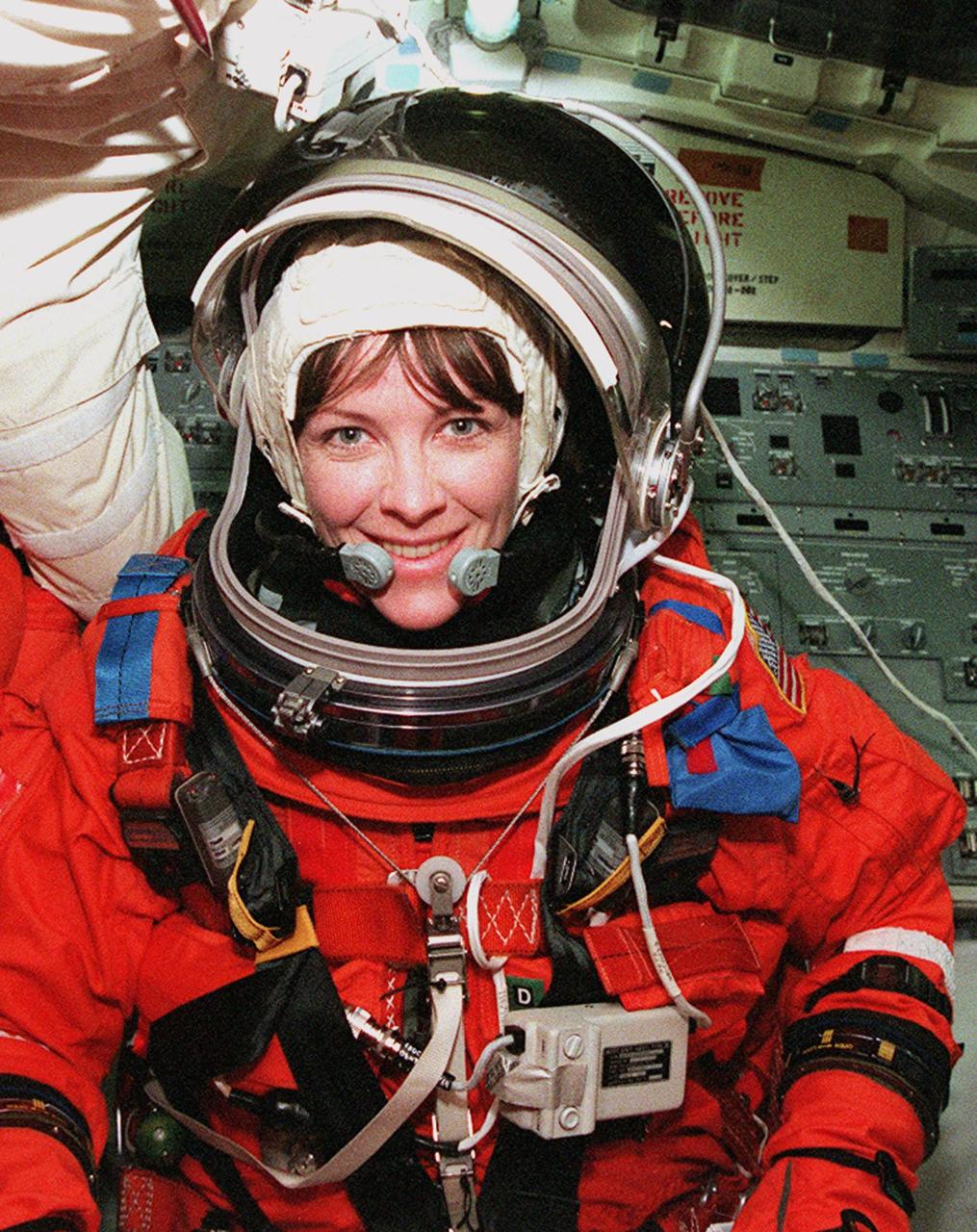
STS-99 Mission Specialist Janet Lynn Kavandi (Ph.D.) settles into her seat inside Space Shuttle Endeavour during Terminal Countdown Demonstration Test (TCDT) activities for the mission. The TCDT includes a simulation of the final launch countdown. STS-99 is the Shuttle Radar Topography Mission, which will chart a new course, using two antennae and a 200-foot-long section of space station-derived mast protruding from the payload bay to produce unrivaled 3-D images of the Earth's surface. The result of the Shuttle Radar Topography Mission could be close to 1 trillion measurements of the Earth's topography. Besides contributing to the production of better maps, these measurements could lead to improved water drainage modeling, more realistic flight simulators, better locations for cell phone towers, and enhanced navigation safety. Launch of Endeavour on the 11-day mission is scheduled for Jan. 31 at 12:47 p.m. EST
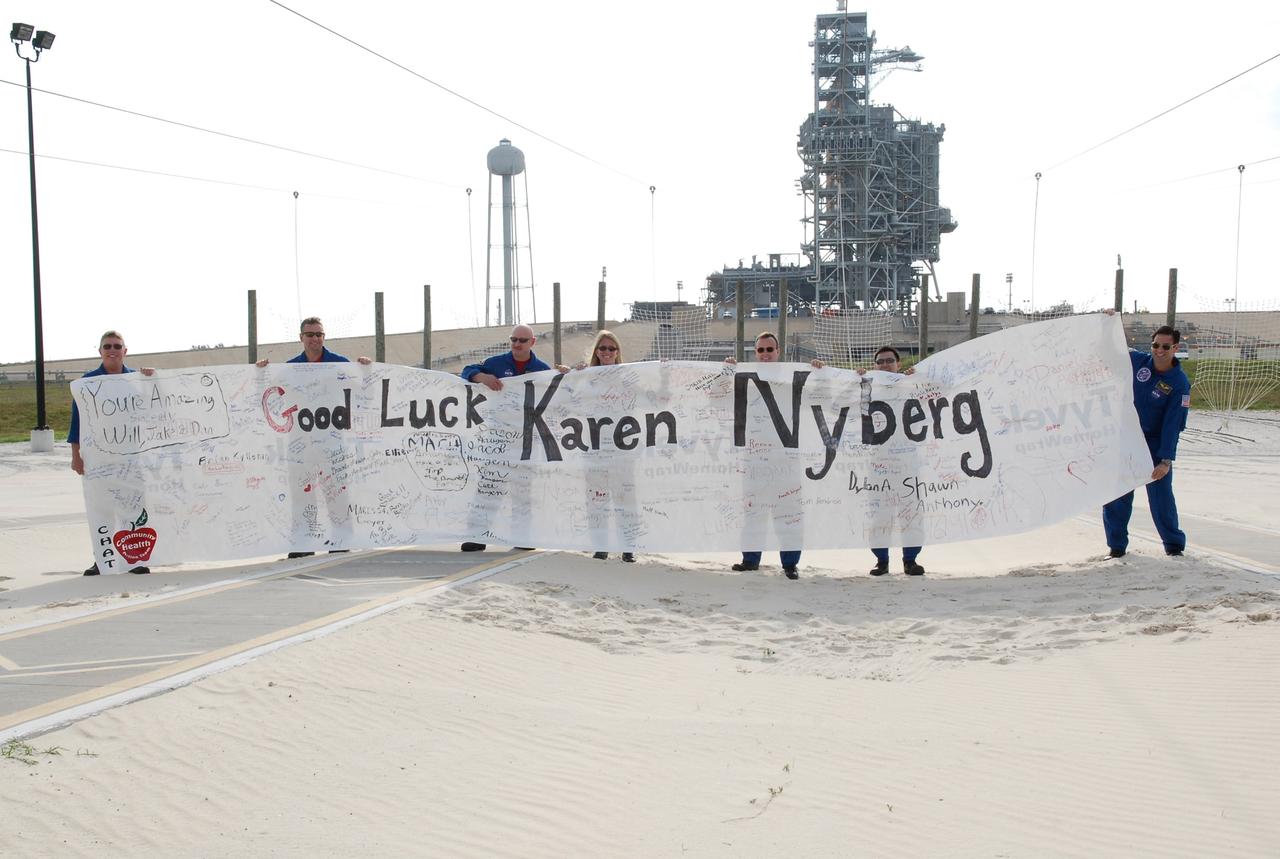
CAPE CANAVERAL, Fla. -- The STS-124 crew holds a good-luck banner presented to Mission Specialist Karen Nyberg that was created and signed by students at Henning Public School in the town of Henning, Minn. Holding the banner are (from left) Mission Specialist Mike Fossum, Pilot Ken Ham, Commander Mark Kelly, Nyberg, Mission Specialists Ron Garan, Akihiko Hoshide and Greg Chamitoff. Hoshide represents the Japan Aerospace Exploration Agency. In the background is the 300-gallon water tower (left) and the fixed service structure. The crew is at Kennedy for a dress launch rehearsal called the terminal countdown demonstration test. TCDT provides astronauts and ground crews with an opportunity to participate in various simulated countdown activities, including equipment familiarization and emergency training. On the STS-124 mission, the crew will deliver and install the Japanese Experiment Module – Pressurized Module and Japanese Remote Manipulator System. Discovery's launch is targeted for May 31. Photo credit: NASA/Kim Shiflett
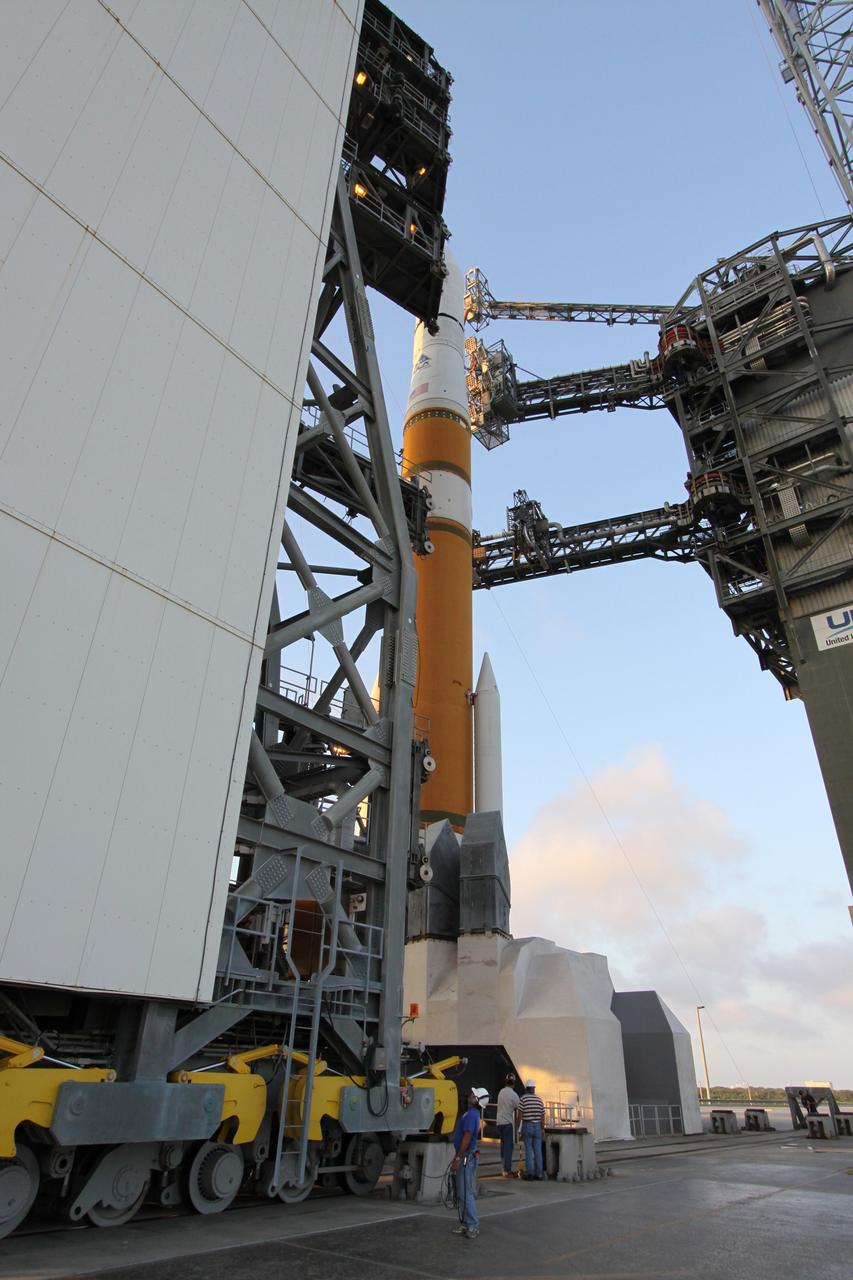
CAPE CANAVERAL, Fla. – Workers on Launch Complex 37 at Cape Canaveral Air Force Station monitor the progress of the mobile service tower as it slowly rolls back from the Boeing Delta IV rocket that will launch the GOES-O satellite into orbit. The terminal countdown to the liftoff of GOES-O will begin at 12:59 p.m. EDT for a launch window that extends from 6:14 p.m. to 7:14 p.m. June 26. The latest Geostationary Operational Environmental Satellite, GOES-O was developed by NASA for the National Oceanic and Atmospheric Administration, or NOAA. Each of the GOES satellites continuously provides observations of 60 percent of the Earth including the continental United States, providing weather monitoring and forecast operations as well as a continuous and reliable stream of environmental information and severe weather warnings. Once in orbit, GOES-O will be designated GOES-14, and NASA will provide on-orbit checkout and then transfer operational responsibility to NOAA. Photo credit: NASA/Jack Pfaller
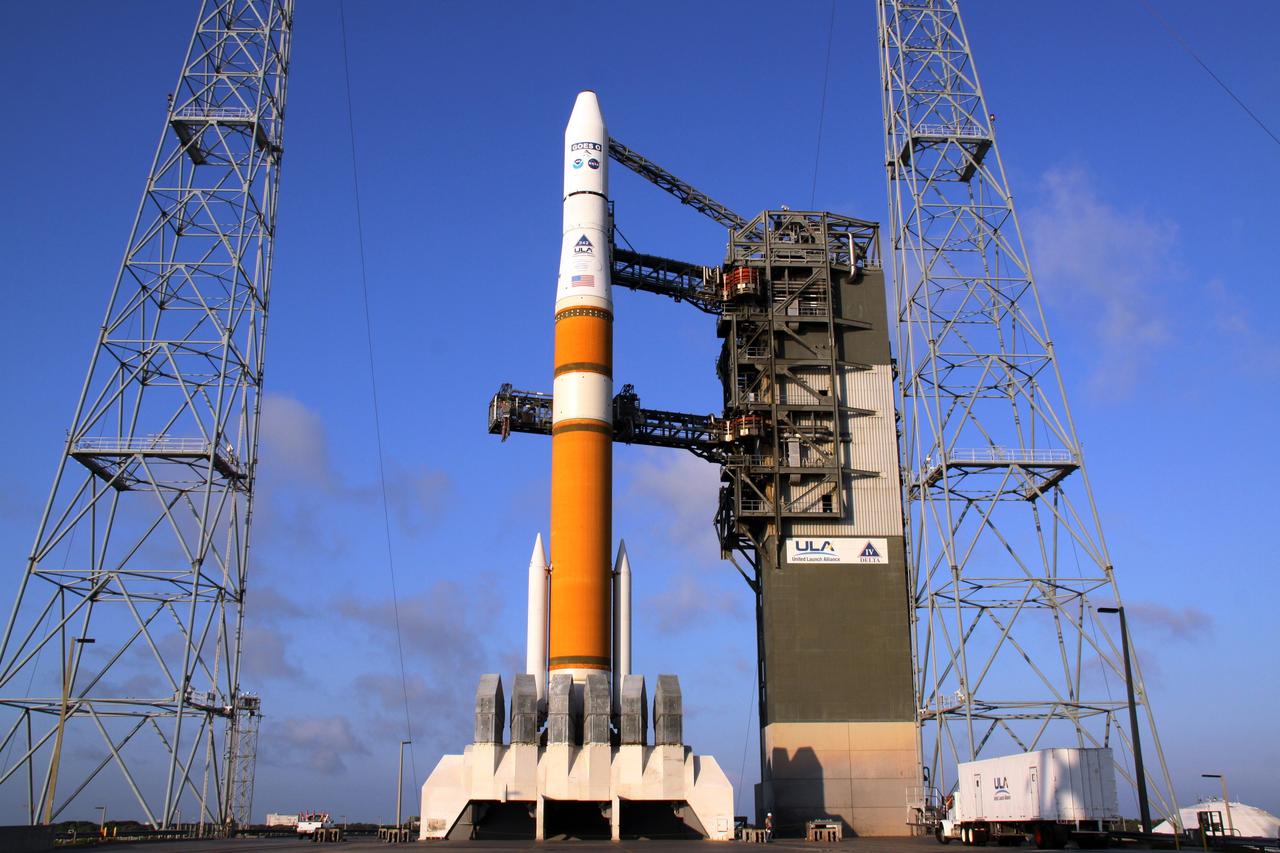
CAPE CANAVERAL, Fla. – The mobile service tower on Launch Complex 37 at Cape Canaveral Air Force Station has been removed from around a Boeing Delta IV rocket as preparations continue to launch the GOES-O satellite. The terminal countdown to the liftoff of GOES-O will begin at 12:59 p.m. EDT for a launch window that extends from 6:14 p.m. to 7:14 p.m. June 26. The latest Geostationary Operational Environmental Satellite, GOES-O was developed by NASA for the National Oceanic and Atmospheric Administration, or NOAA. Each of the GOES satellites continuously provides observations of 60 percent of the Earth including the continental United States, providing weather monitoring and forecast operations as well as a continuous and reliable stream of environmental information and severe weather warnings. Once in orbit, GOES-O will be designated GOES-14, and NASA will provide on-orbit checkout and then transfer operational responsibility to NOAA. Photo credit: NASA/Jack Pfaller
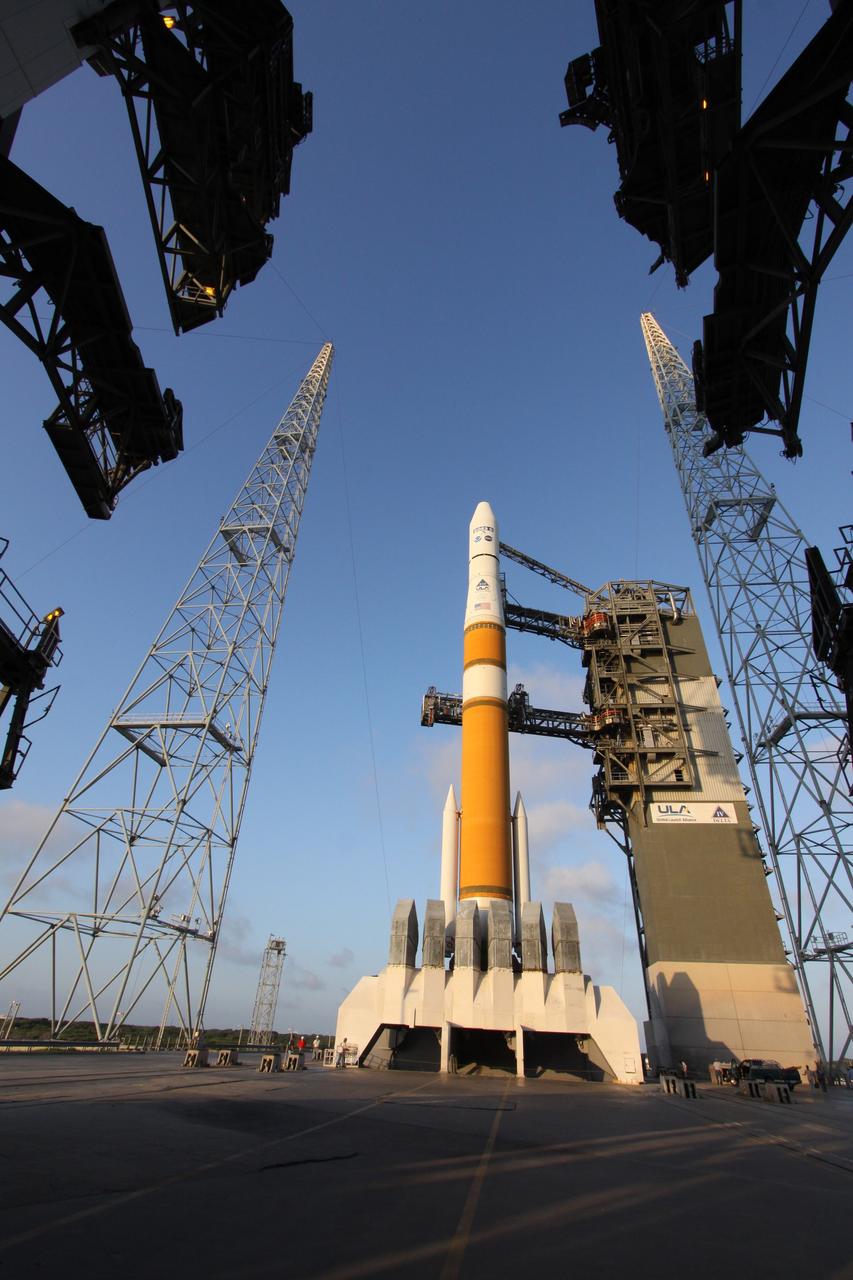
CAPE CANAVERAL, Fla. – The mobile service tower on Launch Complex 37 at Cape Canaveral Air Force Station has been rolled back to reveal the Boeing Delta IV rocket that will launch the GOES-O satellite into orbit. The terminal countdown to the liftoff of GOES-O will begin at 12:59 p.m. EDT for a launch window that extends from 6:14 p.m. to 7:14 p.m. June 26. The latest Geostationary Operational Environmental Satellite, GOES-O was developed by NASA for the National Oceanic and Atmospheric Administration, or NOAA. Each of the GOES satellites continuously provides observations of 60 percent of the Earth including the continental United States, providing weather monitoring and forecast operations as well as a continuous and reliable stream of environmental information and severe weather warnings. Once in orbit, GOES-O will be designated GOES-14, and NASA will provide on-orbit checkout and then transfer operational responsibility to NOAA. Photo credit: NASA/Jack Pfaller
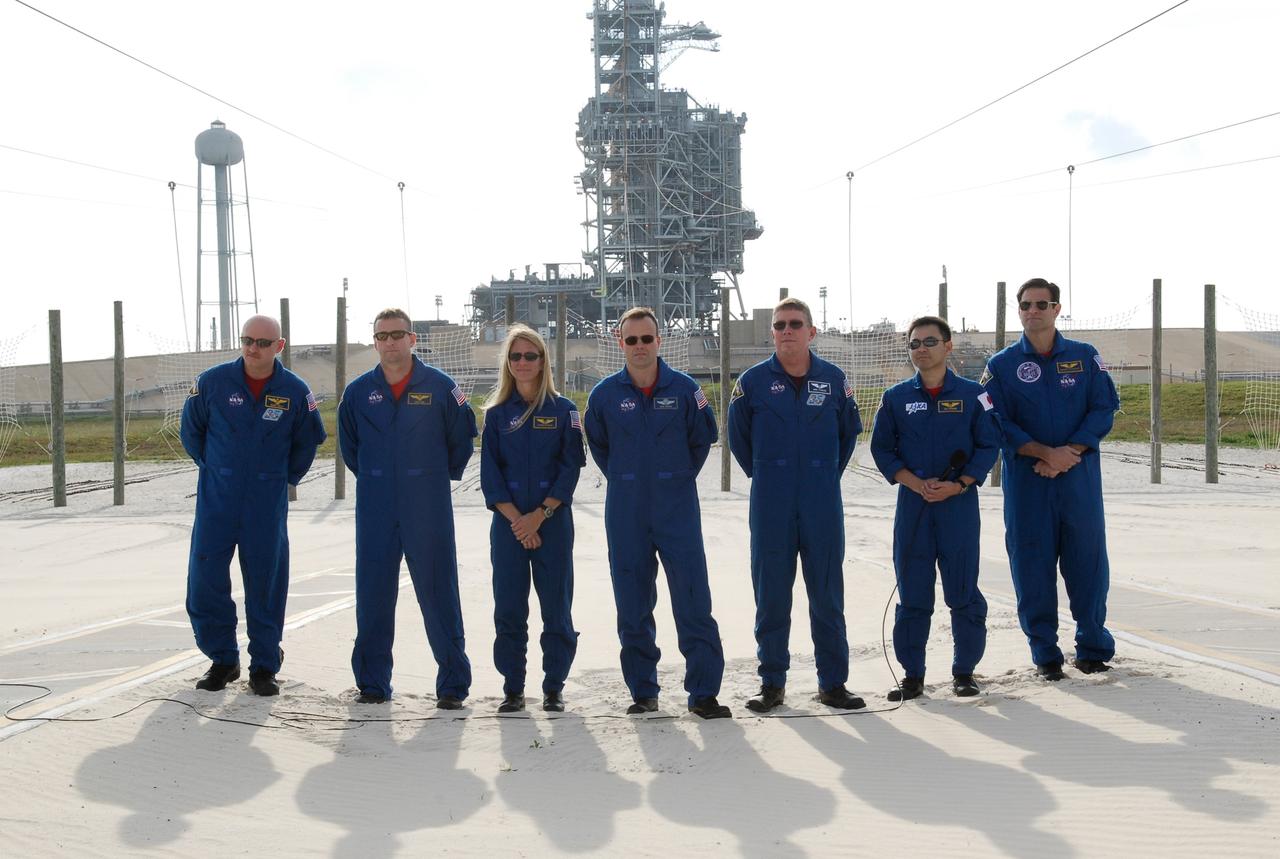
CAPE CANAVERAL, Fla. -- At the slidewire landing area of Launch Pad 39A at NASA's Kennedy Space Center, the STS-124 crew poses for a final group photo following the media question-and-answer event. From left are Commander Mark Kelly, Pilot Ken Ham, and Mission Specialists Karen Nyberg, Ron Garan, Mike Fossum, Akihiko Hoshide and Greg Chamitoff. Hoshide represents the Japan Aerospace Exploration Agency. In the background is the fixed service structure (center) and the 300-gallon water tower (left). The crew is at Kennedy for a dress launch rehearsal called the terminal countdown demonstration test. TCDT provides astronauts and ground crews with an opportunity to participate in various simulated countdown activities, including equipment familiarization and emergency training. On the STS-124 mission, the crew will deliver and install the Japanese Experiment Module – Pressurized Module and Japanese Remote Manipulator System. Discovery's launch is targeted for May 31. Photo credit: NASA/Kim Shiflett
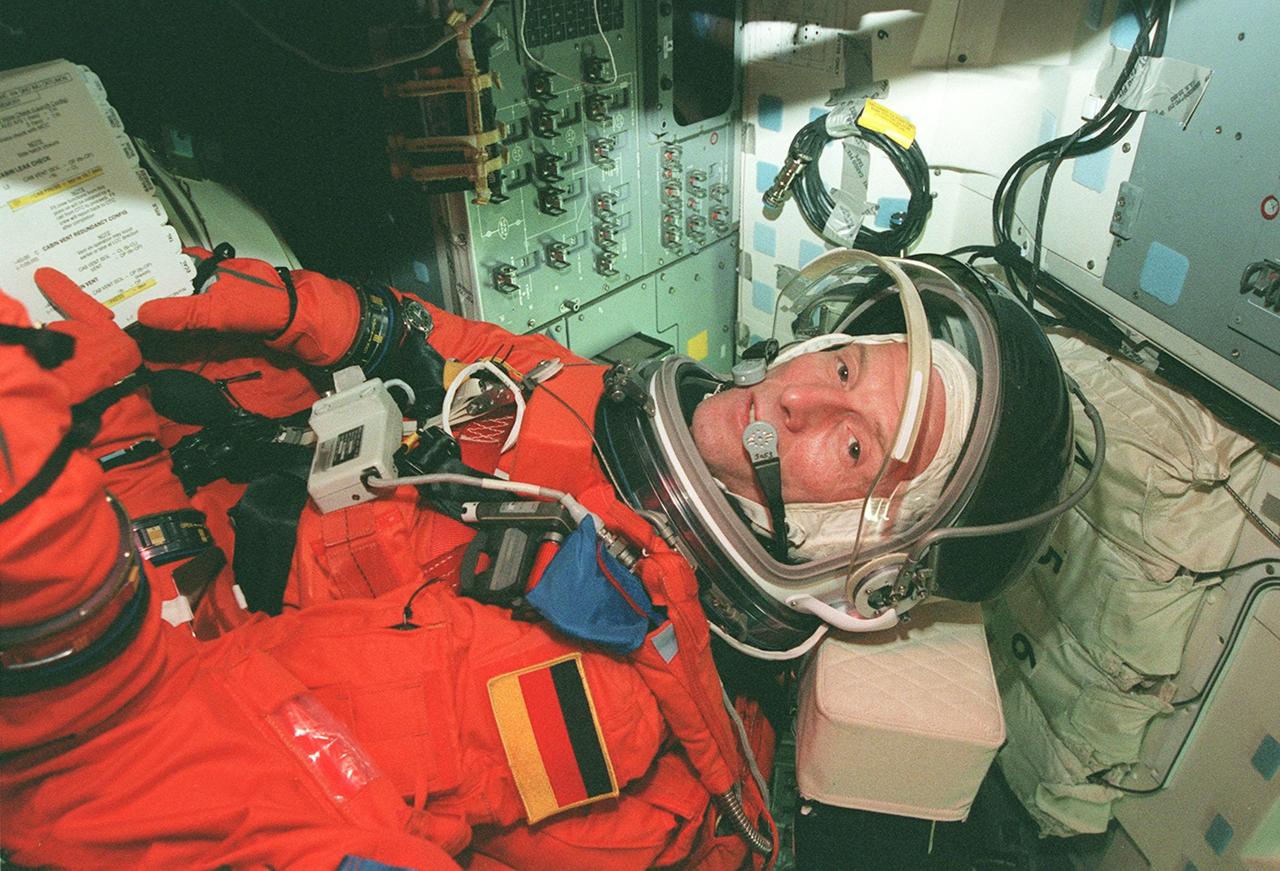
STS-99 Mission Specialist Gerhard Thiele, who is with the European Space Agency, goes through countdown procedures aboard the Space Shuttle Endeavour during Terminal Countdown Demonstration Test (TCDT) activities for the mission. The TCDT includes a simulation of the final launch countdown. STS-99 is the Shuttle Radar Topography Mission, which will chart a new course, using two antennae and a 200-foot-long section of space station-derived mast protruding from the payload bay to produce unrivaled 3-D images of the Earth's surface. The result of the Shuttle Radar Topography Mission could be close to 1 trillion measurements of the Earth's topography. Besides contributing to the production of better maps, these measurements could lead to improved water drainage modeling, more realistic flight simulators, better locations for cell phone towers, and enhanced navigation safety. Launch of Endeavour on the 11-day mission is scheduled for Jan. 31 at 12:47 p.m. EST
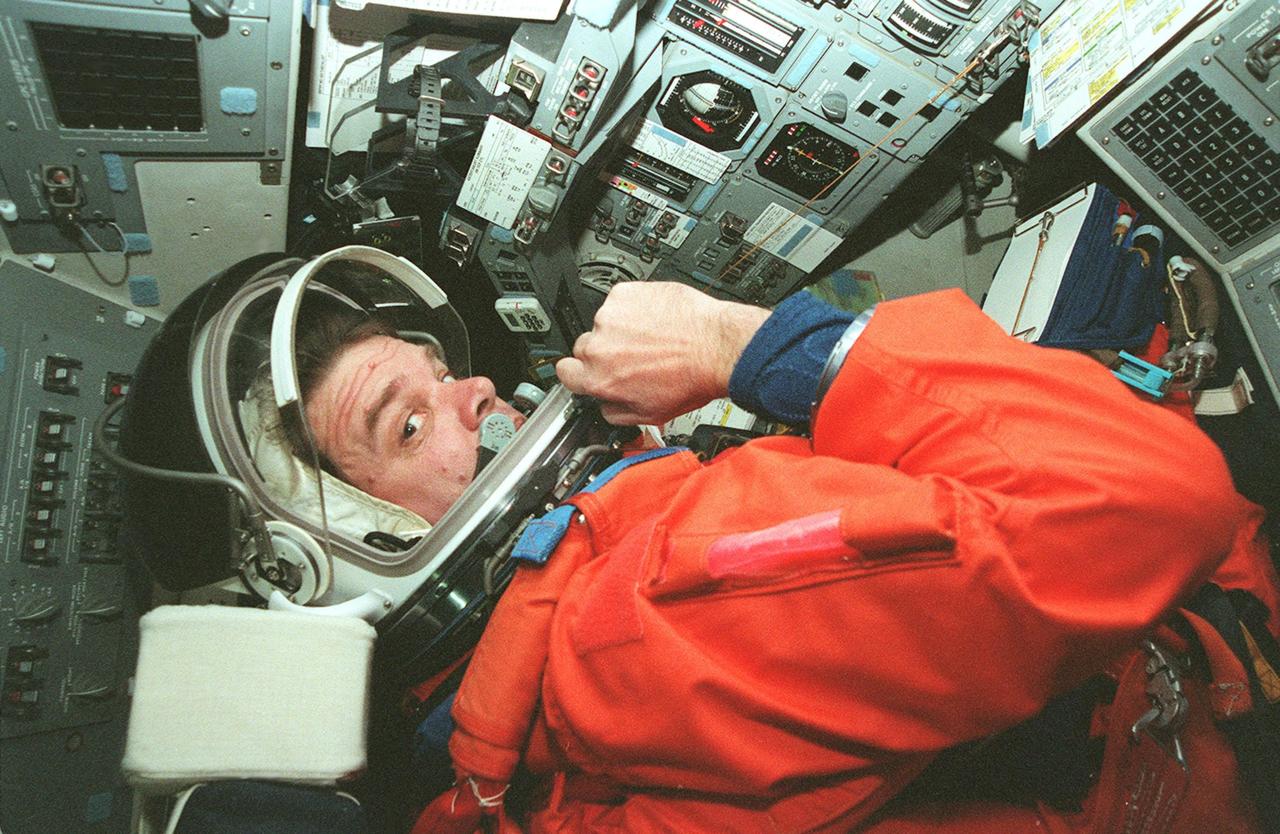
STS-99 Commander Kevin Kregel goes through countdown procedures on the flight deck aboard the Space Shuttle Endeavour during Terminal Countdown Demonstration Test (TCDT) activities for the mission. The TCDT includes a simulation of the final launch countdown. STS-99 is the Shuttle Radar Topography Mission, which will chart a new course, using two antennae and a 200-foot-long section of space station-derived mast protruding from the payload bay to produce unrivaled 3-D images of the Earth's surface. The result of the Shuttle Radar Topography Mission could be close to 1 trillion measurements of the Earth's topography. Besides contributing to the production of better maps, these measurements could lead to improved water drainage modeling, more realistic flight simulators, better locations for cell phone towers, and enhanced navigation safety. Launch of Endeavour on the 11-day mission is scheduled for Jan. 31 at 12:47 p.m. EST
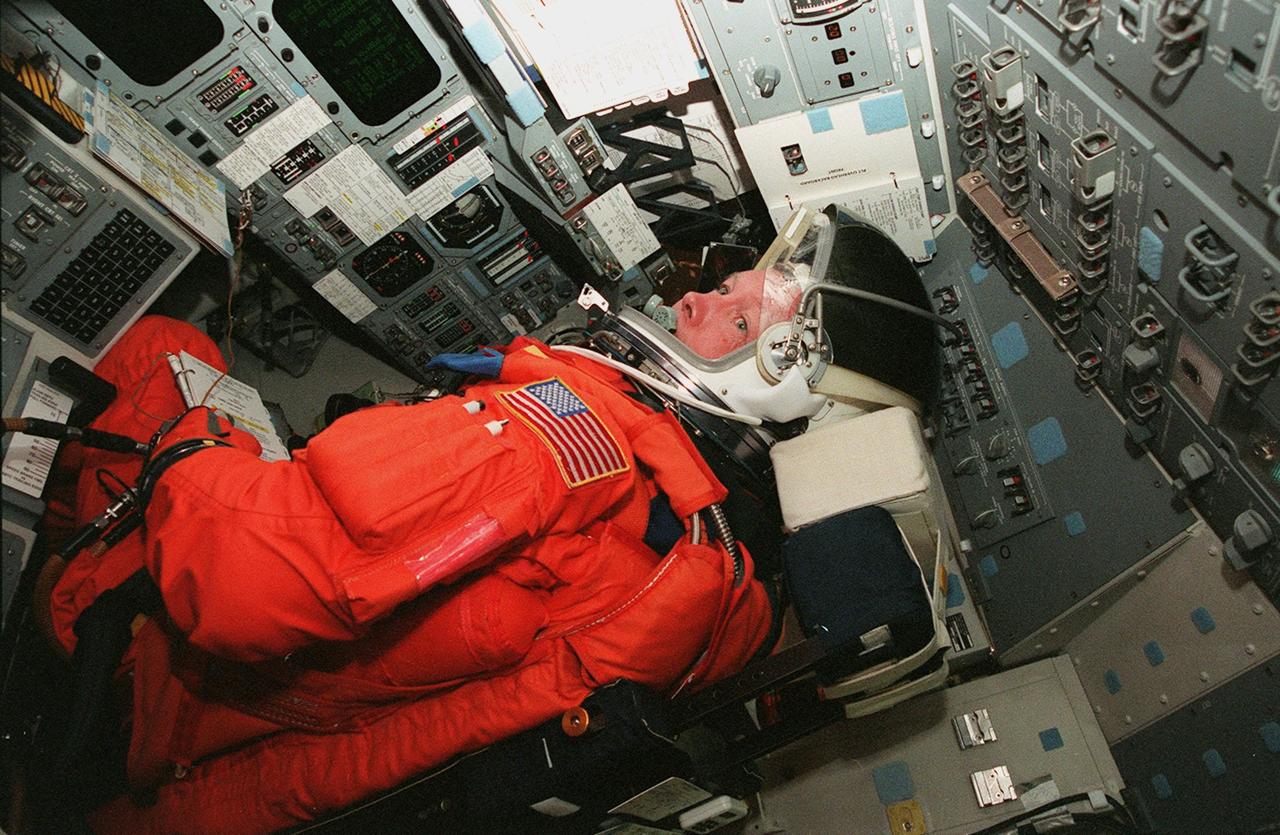
STS-99 Pilot Dominic Gorie goes through countdown procedures on the flight deck aboard the Space Shuttle Endeavour as part of Terminal Countdown Demonstration Test (TCDT) activities for the mission. The TCDT includes a simulation of the final launch countdown. STS-99 is the Shuttle Radar Topography Mission, which will chart a new course, using two antennae and a 200-foot-long section of space station-derived mast protruding from the payload bay to produce unrivaled 3-D images of the Earth's surface. The result of the Shuttle Radar Topography Mission could be close to 1 trillion measurements of the Earth's topography. Besides contributing to the production of better maps, these measurements could lead to improved water drainage modeling, more realistic flight simulators, better locations for cell phone towers, and enhanced navigation safety. Launch of Endeavour on the 11-day mission is scheduled for Jan. 31 at 12:47 p.m. EST
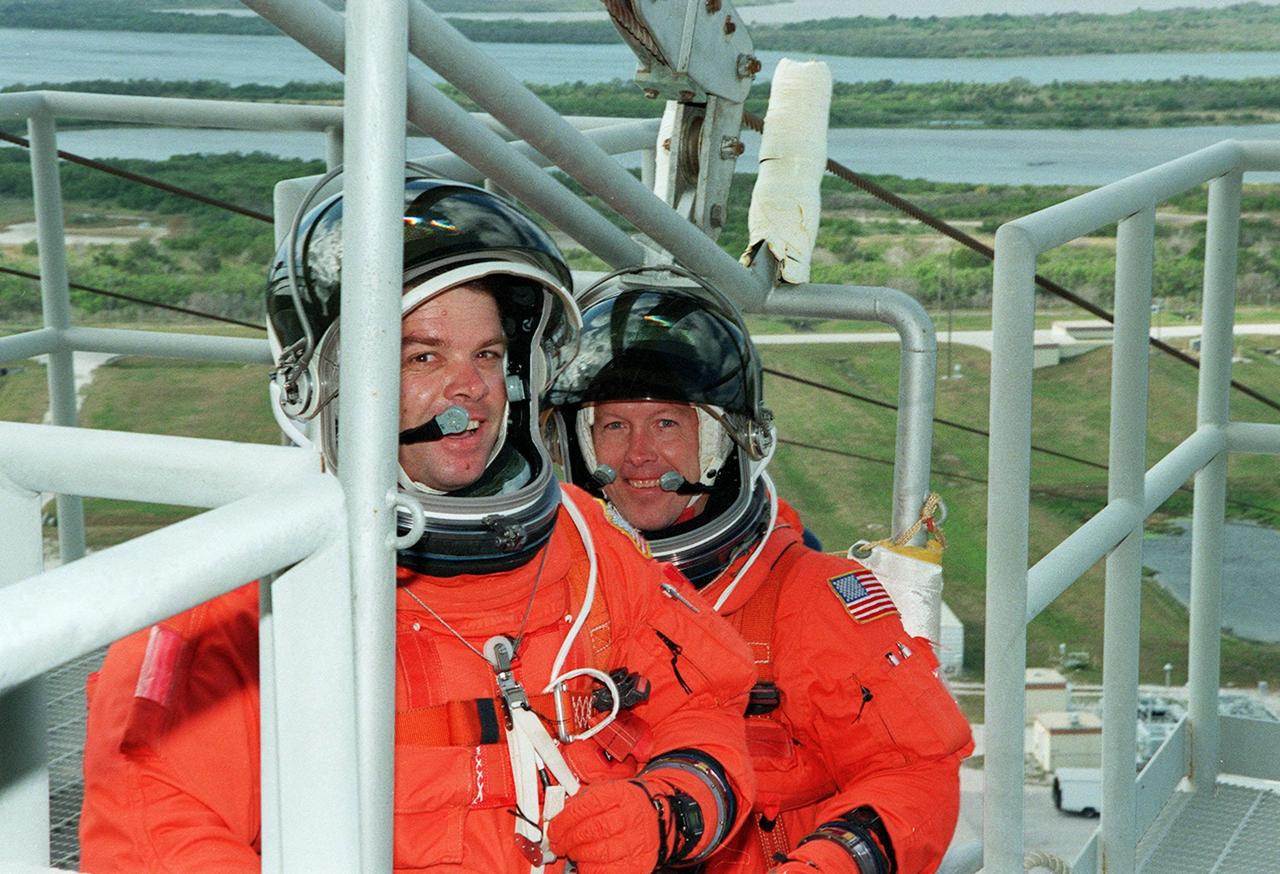
KENNEDY SPACE CENTER, Fla. -- At Launch Pad 39A, STS-99 Mission Specialists Gerhard Thiele (Ph.D.), of the European Space Agency (in front), and Janet Kavandi (Ph.D.) prepare to practice emergency egress procedures with a slidewire basket. Seven slidewires, with flatbottom baskets suspended from each wire, extend from the Fixed Service Structure at the orbiter access arm level. These baskets could provide an escape route for the astronauts until the final 30 seconds of the countdown in case of an emergency. The crew is taking part in Terminal Countdown Demonstration Test (TCDT) activities that provide the crew with simulated countdown exercises, emergency egress training, and opportunities to inspect the mission payloads in the orbiter's payload bay. STS-99 is the Shuttle Radar Topography Mission, which will chart a new course, using two antennae and a 200-foot-long section of space station-derived mast protruding from the payload bay to produce unrivaled 3-D images of the Earth's surface. The result of the Shuttle Radar Topography Mission could be close to 1 trillion measurements of the Earth's topography. Besides contributing to the production of better maps, these measurements could lead to improved water drainage modeling, more realistic flight simulators, better locations for cell phone towers, and enhanced navigation safety. Launch of Endeavour on the 11-day mission is scheduled for Jan. 31 at 12:47 p.m. EST.
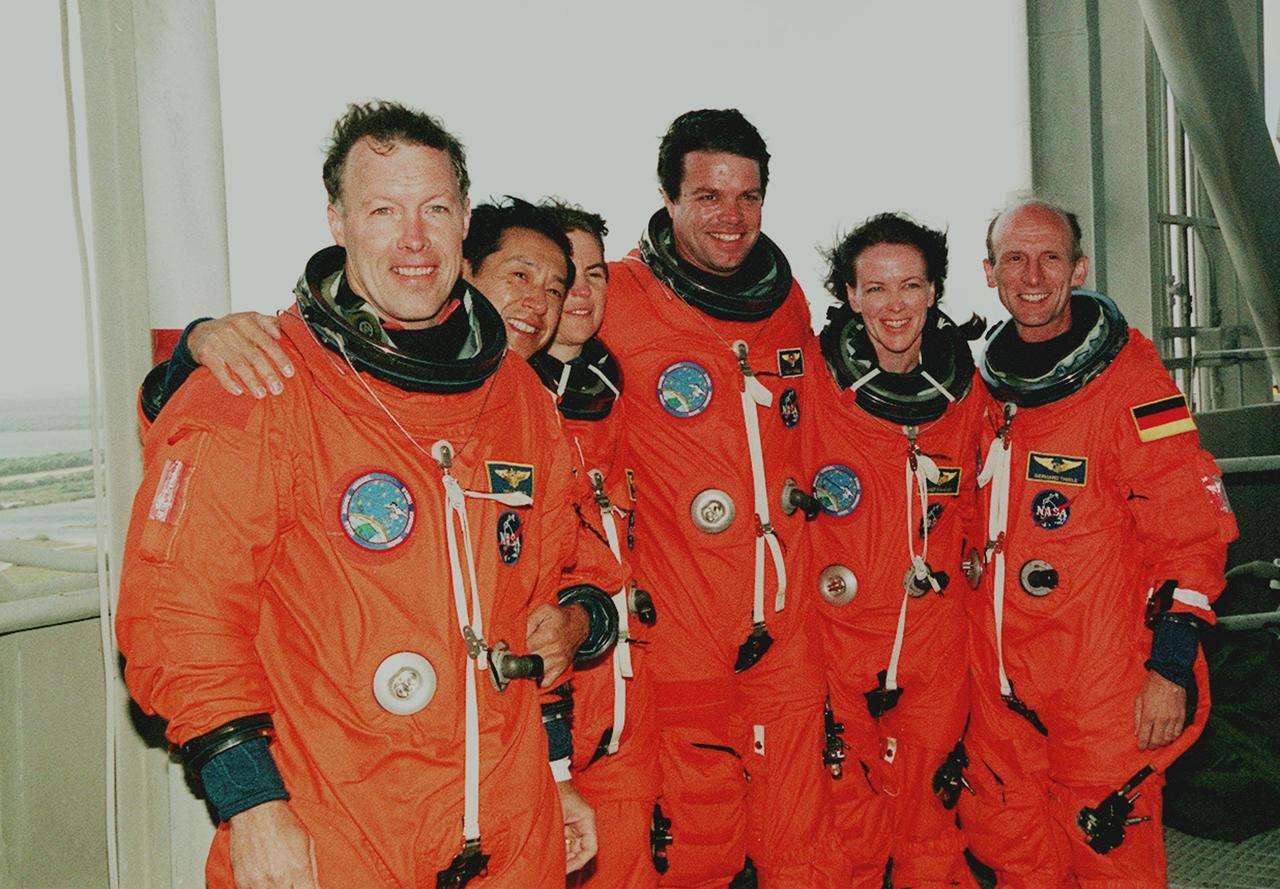
KENNEDY SPACE CENTER, Fla. -- At the 195-foot level of the Fixed Service Structure on Launch Pad 39A, the STS-99 crew pose for a photograph during Terminal Countdown Demonstration Test (TCDT) activities. Standing left to right are Pilot Dominic Gorie, Mission Specialist Mamoru Mohri (Ph.D.), Mission Specialist Janice Voss (Ph.D.), Commander Kevin Kregel, Mission Specialist Janet Lynn Kavandi (Ph.D.), and Mission Specialist Gerhard Thiele (Ph.D.). Thiele is with the European Space Agency and Mohri is with the National Space Development Agency (NASDA) of Japan. The TCDT provides the crew with simulated countdown exercises, emergency egress training, and opportunities to inspect the mission payloads in the orbiter's payload bay. STS-99 is the Shuttle Radar Topography Mission, which will chart a new course, using two antennae and a 200-foot-long section of space station-derived mast protruding from the payload bay to produce unrivaled 3-D images of the Earth's surface. The result of the Shuttle Radar Topography Mission could be close to 1 trillion measurements of the Earth's topography. Besides contributing to the production of better maps, these measurements could lead to improved water drainage modeling, more realistic flight simulators, better locations for cell phone towers, and enhanced navigation safety. Launch of Endeavour on the 11-day mission is scheduled for Jan. 31 at 12:47 p.m. EST
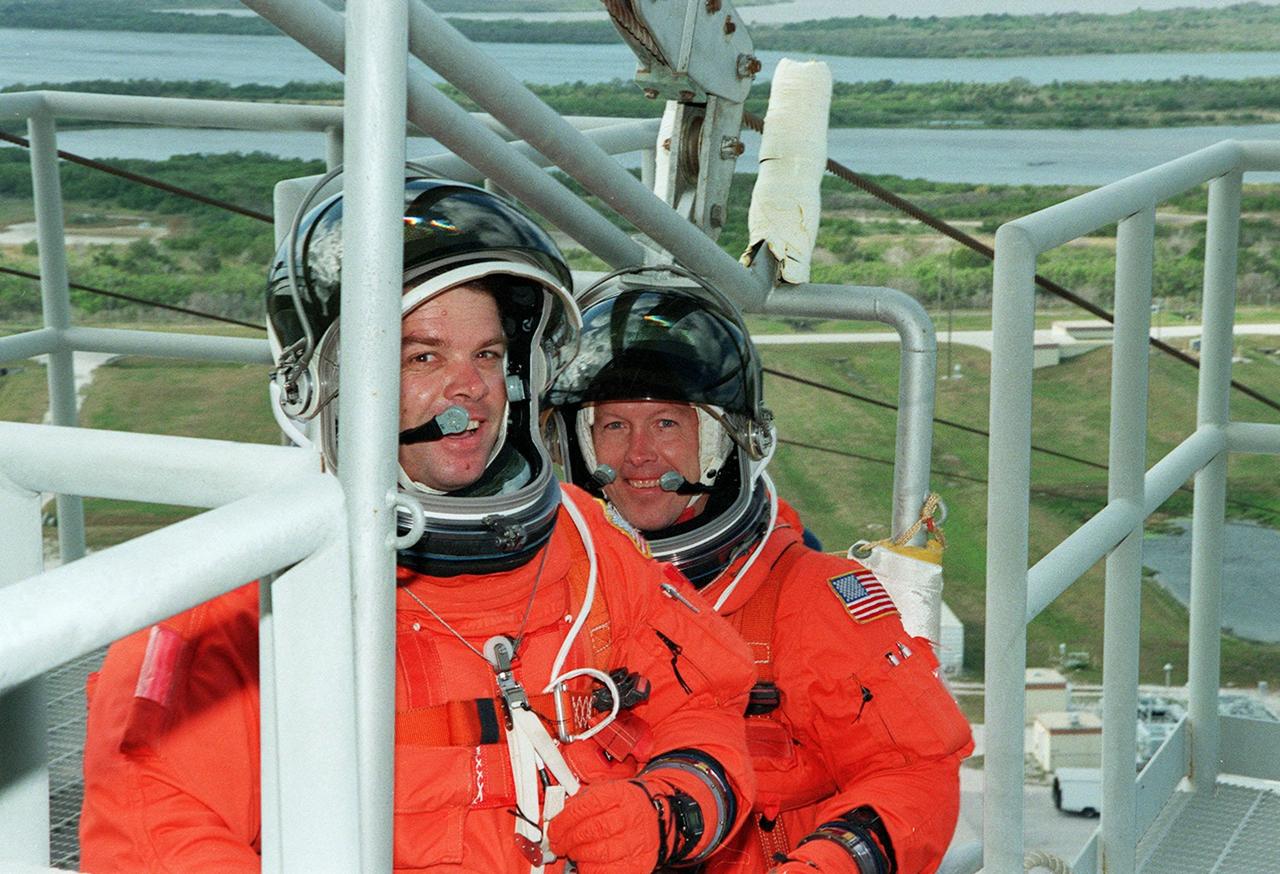
KENNEDY SPACE CENTER, Fla. -- At Launch Pad 39A, STS-99 Mission Specialists Gerhard Thiele (Ph.D.), of the European Space Agency (in front), and Janet Kavandi (Ph.D.) prepare to practice emergency egress procedures with a slidewire basket. Seven slidewires, with flatbottom baskets suspended from each wire, extend from the Fixed Service Structure at the orbiter access arm level. These baskets could provide an escape route for the astronauts until the final 30 seconds of the countdown in case of an emergency. The crew is taking part in Terminal Countdown Demonstration Test (TCDT) activities that provide the crew with simulated countdown exercises, emergency egress training, and opportunities to inspect the mission payloads in the orbiter's payload bay. STS-99 is the Shuttle Radar Topography Mission, which will chart a new course, using two antennae and a 200-foot-long section of space station-derived mast protruding from the payload bay to produce unrivaled 3-D images of the Earth's surface. The result of the Shuttle Radar Topography Mission could be close to 1 trillion measurements of the Earth's topography. Besides contributing to the production of better maps, these measurements could lead to improved water drainage modeling, more realistic flight simulators, better locations for cell phone towers, and enhanced navigation safety. Launch of Endeavour on the 11-day mission is scheduled for Jan. 31 at 12:47 p.m. EST.

KENNEDY SPACE CENTER, Fla. -- Near the bunker at Launch Pad 39A, STS-99 Mission Specialists Janice Voss (Ph.D.), Gerhard Thiele and Mamoru Mohri check out the slidewire basket used for emergency egress. The crew are taking part in Terminal Countdown Demonstration Test activities, which provide them with simulated countdown exercises, emergency egress training, and opportunities to inspect the mission payloads in the orbiter's payload bay. Thiele is with the European Space Agency and Mohri is with the National Space Development Agency (NASDA) of Japan. STS-99 is the Shuttle Radar Topography Mission, which will chart a new course, using two antennae and a 200-foot-long section of space station-derived mast protruding from the payload bay to produce unrivaled 3-D images of the Earth's surface. The result of the Shuttle Radar Topography Mission could be close to 1 trillion measurements of the Earth's topography. Besides contributing to the production of better maps, these measurements could lead to improved water drainage modeling, more realistic flight simulators, better locations for cell phone towers, and enhanced navigation safety. Launch of Endeavour on the 11-day mission is scheduled for Jan. 31 at 12:47 p.m. EST
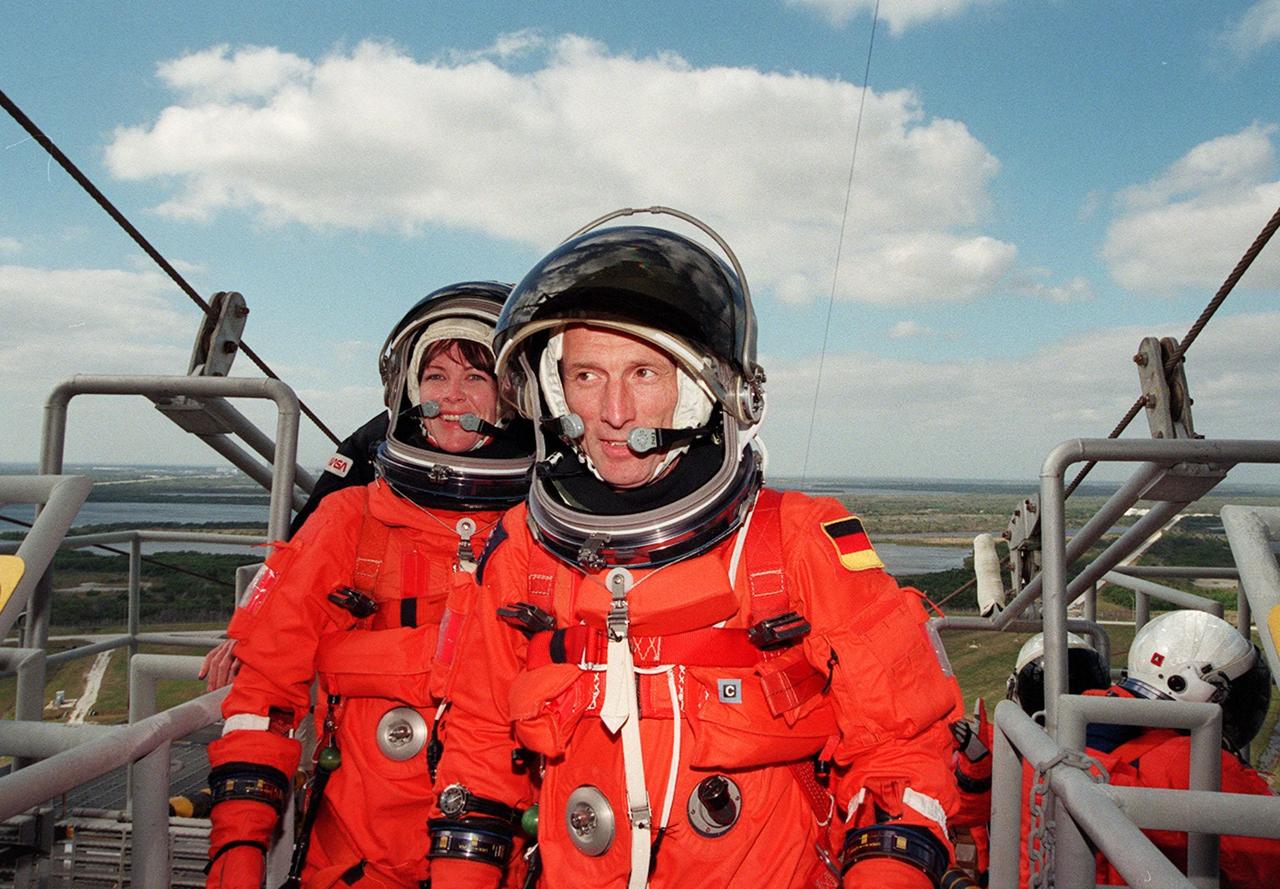
At Launch Pad 39A, STS-99 Mission Specialists Gerhard Thiele (Ph.D.), of the European Space Agency (in front), and Janet Kavandi (Ph.D.) prepare to practice emergency egress procedures with a slidewire basket. Seven slidewires, with flatbottom baskets suspended from each wire, extend from the Fixed Service Structure at the orbiter access arm level. These baskets could provide an escape route for the astronauts until the final 30 seconds of the countdown in case of an emergency. The crew is taking part in Terminal Countdown Demonstration Test (TCDT) activities that provide the crew with simulated countdown exercises, emergency egress training, and opportunities to inspect the mission payloads in the orbiter's payload bay. STS-99 is the Shuttle Radar Topography Mission, which will chart a new course, using two antennae and a 200-foot-long section of space station-derived mast protruding from the payload bay to produce unrivaled 3-D images of the Earth's surface. The result of the Shuttle Radar Topography Mission could be close to 1 trillion measurements of the Earth's topography. Besides contributing to the production of better maps, these measurements could lead to improved water drainage modeling, more realistic flight simulators, better locations for cell phone towers, and enhanced navigation safety. Launch of Endeavour on the 11-day mission is scheduled for Jan. 31 at 12:47 p.m. EST
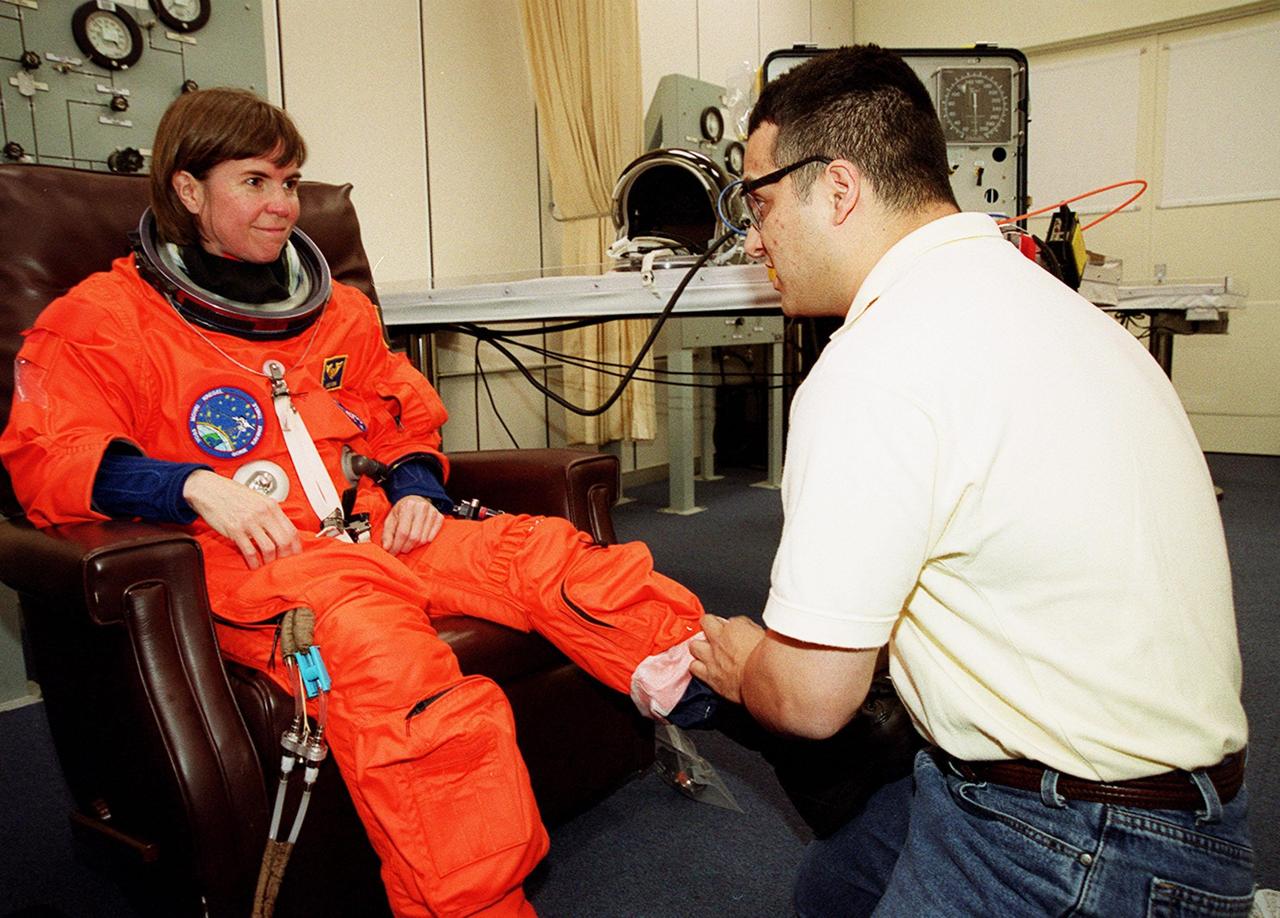
STS-99 Mission Specialist Janice Voss (Ph.D.) suits up in the Operations and Checkout Building, as part of a flight crew equipment fit check, prior to her trip to Launch Pad 39A. The crew is taking part in Terminal Countdown Demonstration Test (TCDT) activities that provide the crew with simulated countdown exercises, emergency egress training, and opportunities to inspect the mission payloads in the orbiter's payload bay. STS-99 is the Shuttle Radar Topography Mission, which will chart a new course, using two antennae and a 200-foot-long section of space station-derived mast protruding from the payload bay to produce unrivaled 3-D images of the Earth's surface. The result of the Shuttle Radar Topography Mission could be close to 1 trillion measurements of the Earth's topography. Besides contributing to the production of better maps, these measurements could lead to improved water drainage modeling, more realistic flight simulators, better locations for cell phone towers, and enhanced navigation safety. Launch of Endeavour on the 11-day mission is scheduled for Jan. 31 at 12:47 p.m. EST
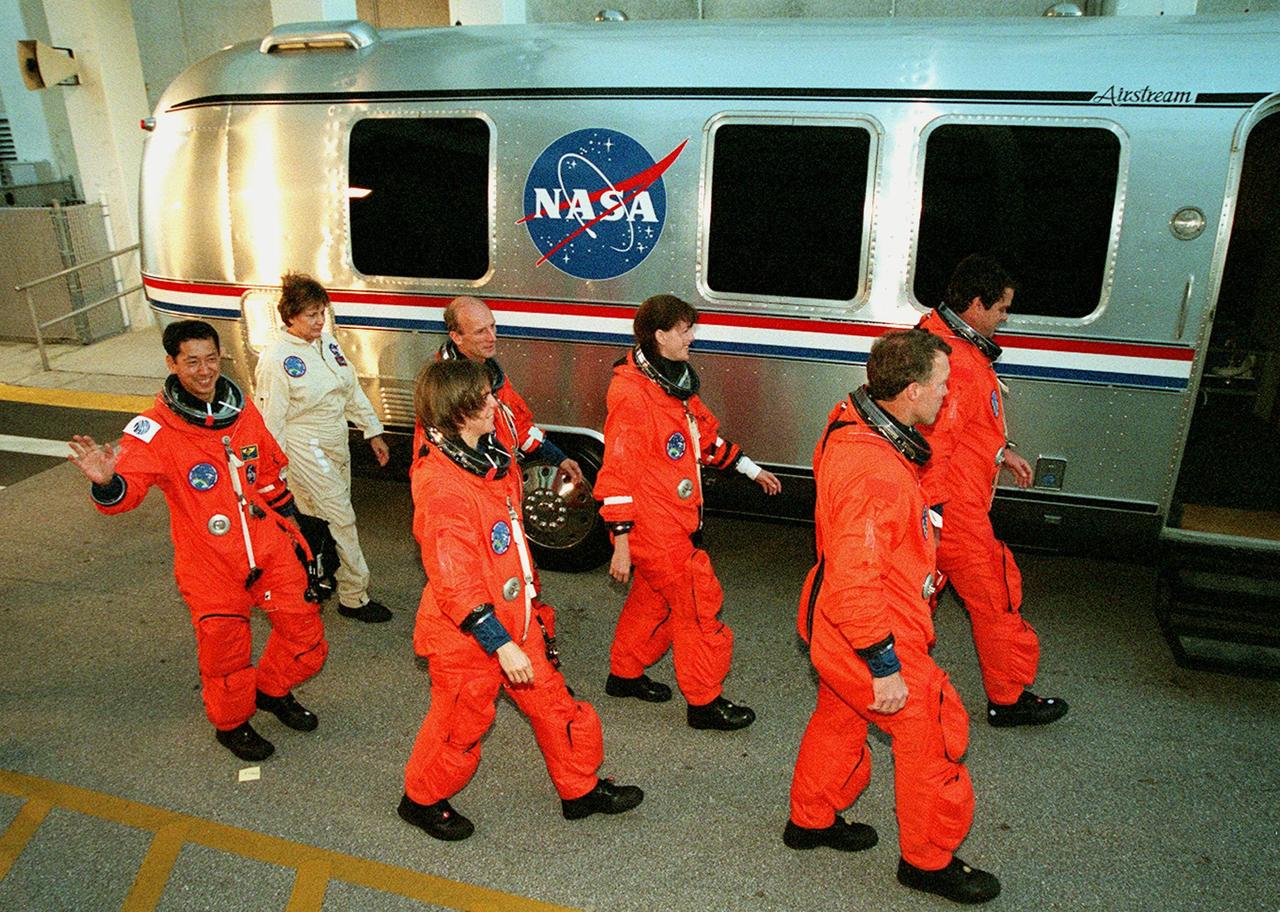
In their orange flight suits, the STS-99 crew head toward the "astrovan" that will take them to Launch Pad 39A for a simulated countdown exercise. From left to right are Mission Specialists Mamoru Mohri (waving), Gerhard Thiele, Janice Voss (Ph.D.) and Janet Lynn Kavandi (Ph.D.), Pilot Dominic Gorie and Commander Kevin Kregel. Mohri is with the National Space Development Agency (NASDA) of Japan and Thiele is with the European Space Agency. The crew are taking part in Terminal Countdown Demonstration Test activities, which provide them with simulated countdown exercises, emergency egress training, and opportunities to inspect the mission payloads in the orbiter's payload bay. STS-99 is the Shuttle Radar Topography Mission, which will chart a new course, using two antennae and a 200-foot-long section of space station-derived mast protruding from the payload bay to produce unrivaled 3-D images of the Earth's surface. The result of the Shuttle Radar Topography Mission could be close to 1 trillion measurements of the Earth's topography. Besides contributing to the production of better maps, these measurements could lead to improved water drainage modeling, more realistic flight simulators, better locations for cell phone towers, and enhanced navigation safety. Launch of Endeavour on the 11-day mission is scheduled for Jan. 31 at 12:47 p.m. EST
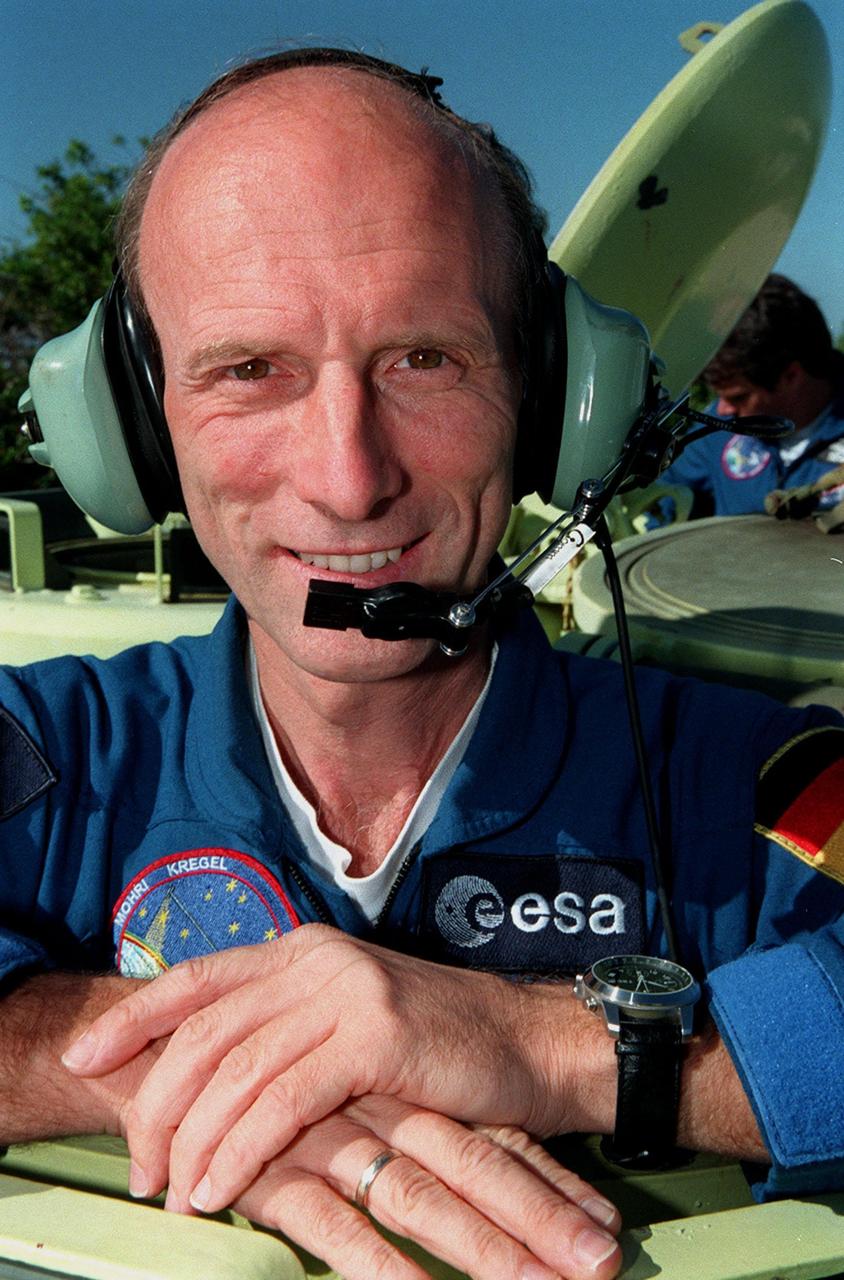
During Terminal Countdown Demonstration Test (TCDT) activities, STS-99 Mission Specialist Gerhard Thiele, who is with the European Space Agency, is ready to practice driving an armored personnel carrier that is part of emergency egress training and could be used by the crew in the event of an emergency at the pad during which the crew must make a quick exit from the area. TCDT provides the crew with simulated countdown exercises, emergency egress training, and opportunities to inspect the mission payloads in the orbiter's payload bay. STS-99 is the Shuttle Radar Topography Mission, which will chart a new course, using two antennae and a 200-foot-long section of space station-derived mast protruding from the payload bay to produce unrivaled 3-D images of the Earth's surface. The result of the Shuttle Radar Topography Mission could be close to 1 trillion measurements of the Earth's topography. Besides contributing to the production of better maps, these measurements could lead to improved water drainage modeling, more realistic flight simulators, better locations for cell phone towers, and enhanced navigation safety. Launch of Endeavour on the 11-day mission is scheduled for Jan. 31 at 12:47 p.m. EST
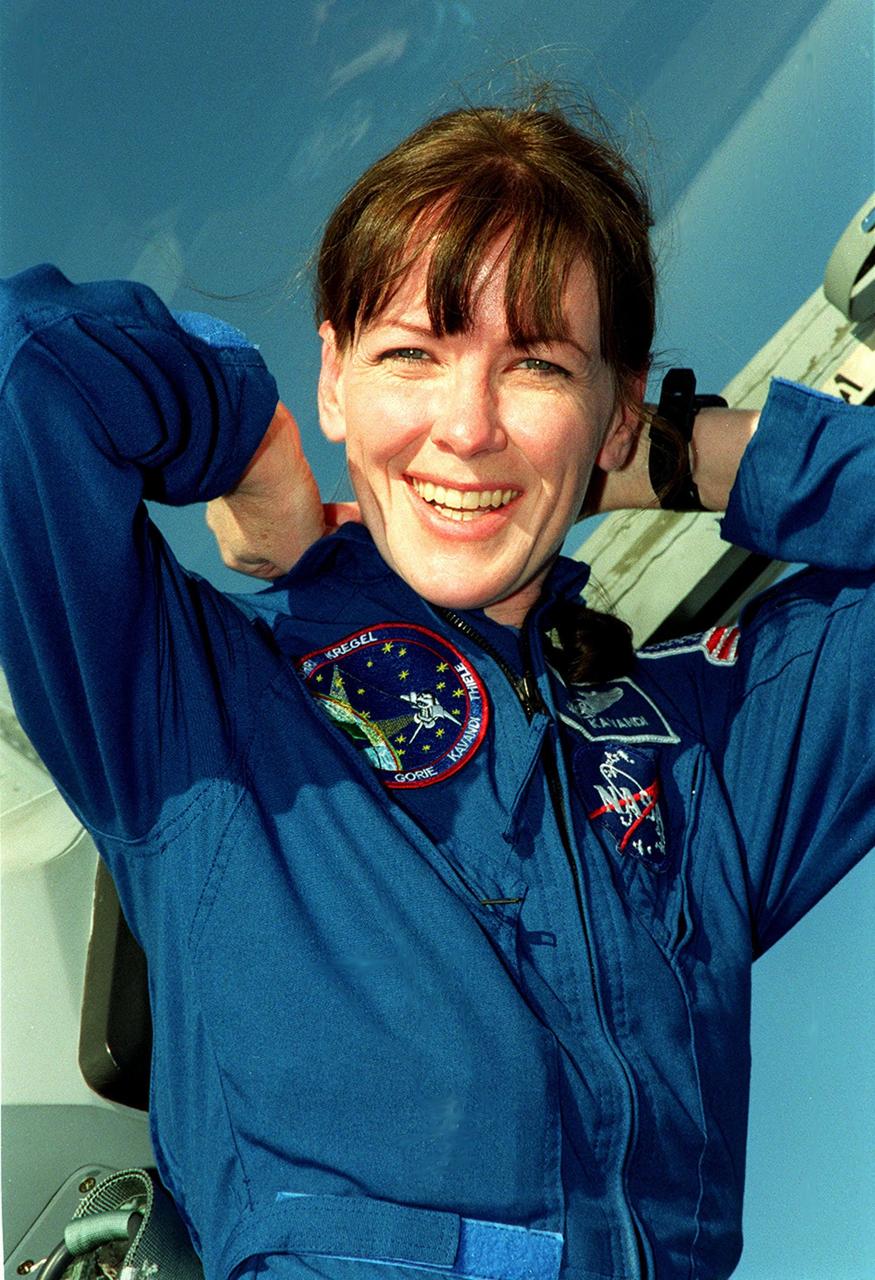
STS-99 Mission Specialist Janet Lynn Kavandi (Ph.D.) smiles on her arrival at KSC aboard a T-38 training jet aircraft to take part in a Terminal Countdown Demonstration Test (TCDT). The TCDT provides the crew with simulated countdown exercises, emergency egress training, and opportunities to inspect the mission payloads in the orbiter's payload bay. Other crew members taking part are Commander Kevin Kregel, Pilot Dominic Gorie, and Mission Specialists Janice Voss (Ph.D.), Mamoru Mohri, who is with the National Space Development Agency (NASDA) of Japan, and Gerhard Thiele, with the European Space Agency. STS-99 is the Shuttle Radar Topography Mission, which will chart a new course, using two antennae and a 200-foot-long section of space station-derived mast protruding from the payload bay to produce unrivaled 3-D images of the Earth's surface. The result of the Shuttle Radar Topography Mission could be close to 1 trillion measurements of the Earth's topography. Besides contributing to the production of better maps, these measurements could lead to improved water drainage modeling, more realistic flight simulators, better locations for cell phone towers, and enhanced navigation safety. Launch of Endeavour on the 11-day mission is scheduled for Jan. 31 at 12:47 p.m. EST
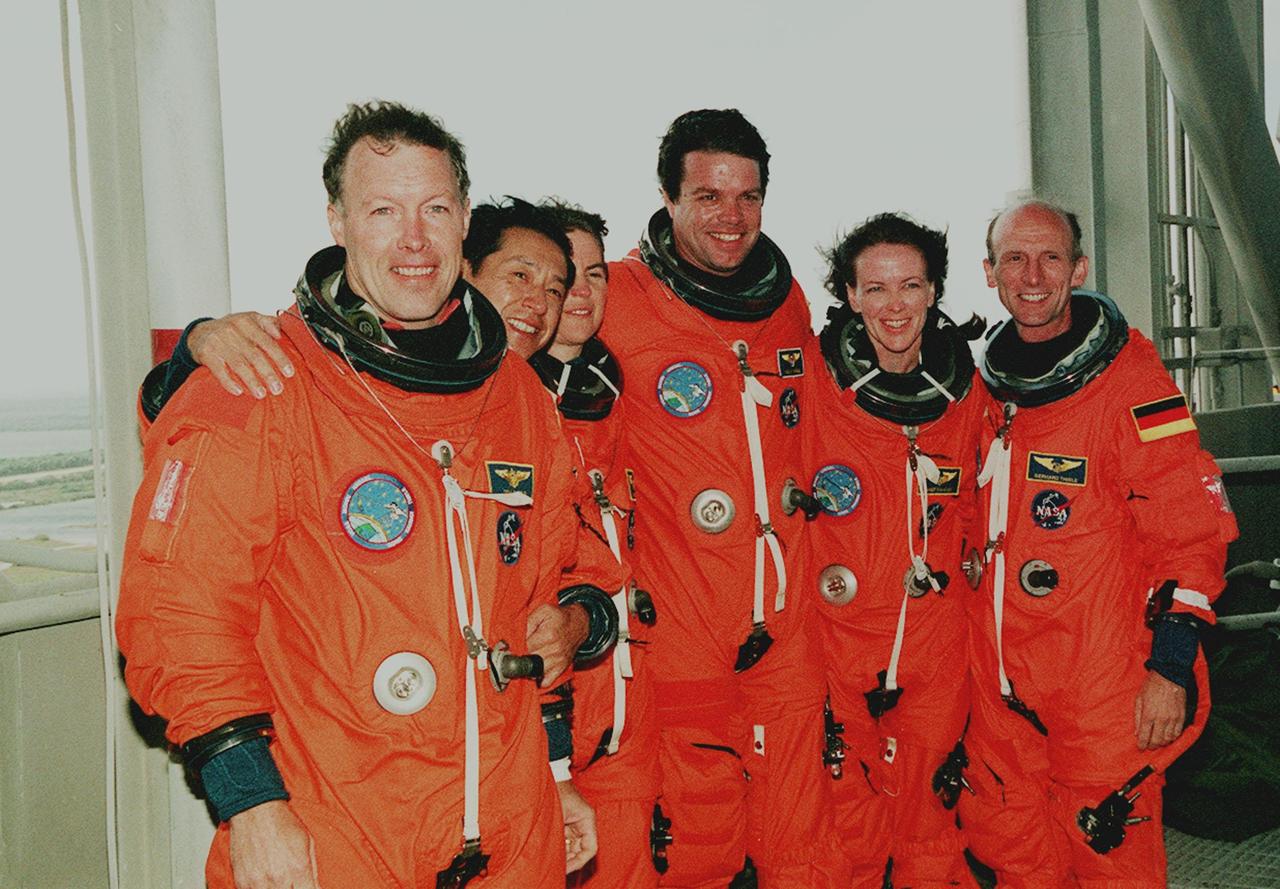
KENNEDY SPACE CENTER, Fla. -- At the 195-foot level of the Fixed Service Structure on Launch Pad 39A, the STS-99 crew pose for a photograph during Terminal Countdown Demonstration Test (TCDT) activities. Standing left to right are Pilot Dominic Gorie, Mission Specialist Mamoru Mohri (Ph.D.), Mission Specialist Janice Voss (Ph.D.), Commander Kevin Kregel, Mission Specialist Janet Lynn Kavandi (Ph.D.), and Mission Specialist Gerhard Thiele (Ph.D.). Thiele is with the European Space Agency and Mohri is with the National Space Development Agency (NASDA) of Japan. The TCDT provides the crew with simulated countdown exercises, emergency egress training, and opportunities to inspect the mission payloads in the orbiter's payload bay. STS-99 is the Shuttle Radar Topography Mission, which will chart a new course, using two antennae and a 200-foot-long section of space station-derived mast protruding from the payload bay to produce unrivaled 3-D images of the Earth's surface. The result of the Shuttle Radar Topography Mission could be close to 1 trillion measurements of the Earth's topography. Besides contributing to the production of better maps, these measurements could lead to improved water drainage modeling, more realistic flight simulators, better locations for cell phone towers, and enhanced navigation safety. Launch of Endeavour on the 11-day mission is scheduled for Jan. 31 at 12:47 p.m. EST
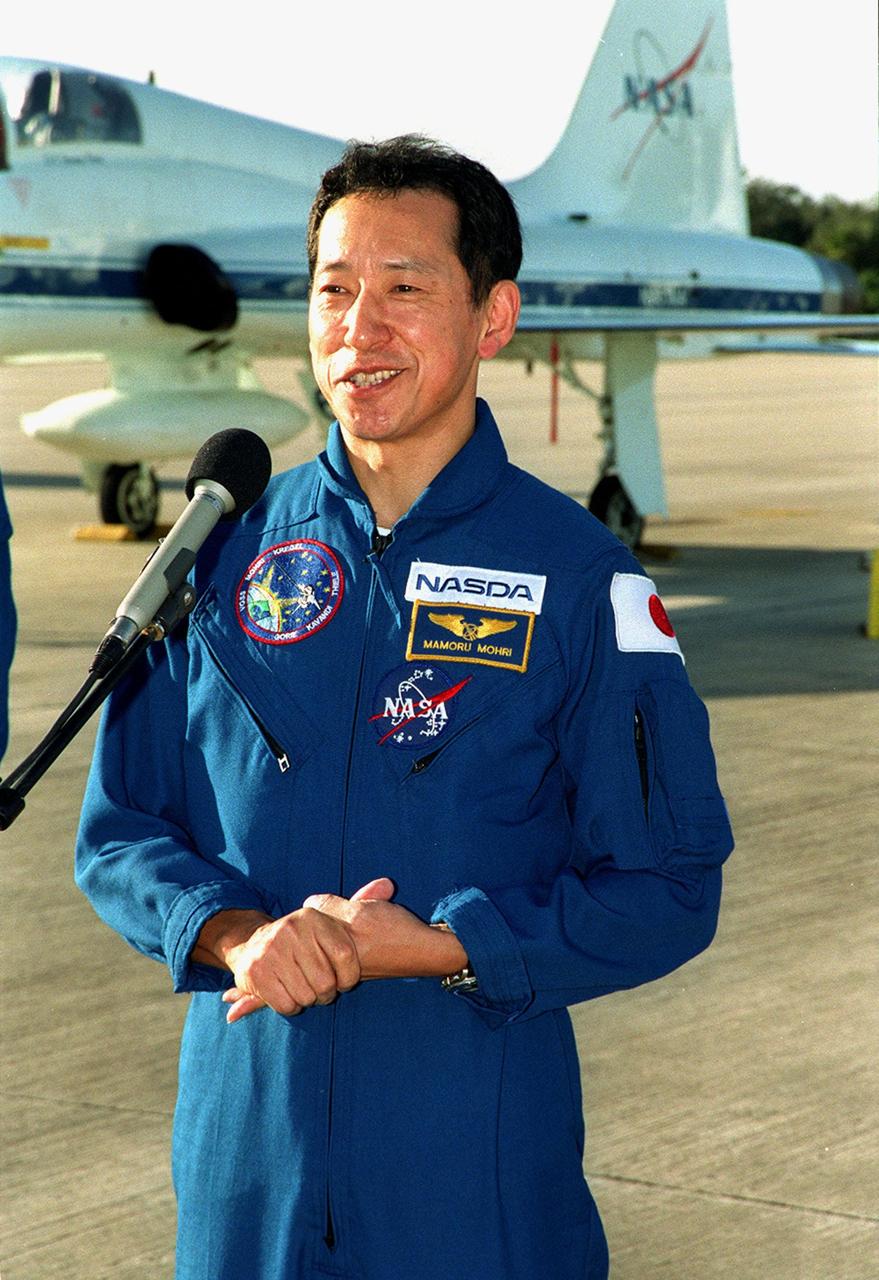
After their arrival at the Shuttle Landing Facility, the STS-99 crew talk to the media. At the microphone is Mission Specialist Mamoru Mohri, who is with the National Space Development Agency (NASDA) of Japan. The crew are here to take part in a Terminal Countdown Demonstration Test (TCDT), which provides simulated countdown exercises, emergency egress training, and opportunities to inspect the mission payloads in the orbiter's payload bay. Others taking part in the TCDT are Commander Kevin Kregel, Pilot Dominic Gorie and Mission Specialists Janice Voss (Ph.D.), Janet Lynn Kavandi (Ph.D.), and Gerhard Thiele, with the European Space Agency. STS-99 is the Shuttle Radar Topography Mission, which will chart a new course, using two antennae and a 200-foot-long section of space station-derived mast protruding from the payload bay to produce unrivaled 3-D images of the Earth's surface. The result of the Shuttle Radar Topography Mission could be close to 1 trillion measurements of the Earth's topography. Besides contributing to the production of better maps, these measurements could lead to improved water drainage modeling, more realistic flight simulators, better locations for cell phone towers, and enhanced navigation safety. Launch of Endeavour on the 11-day mission is scheduled for Jan. 31 at 12:47 p.m. EST
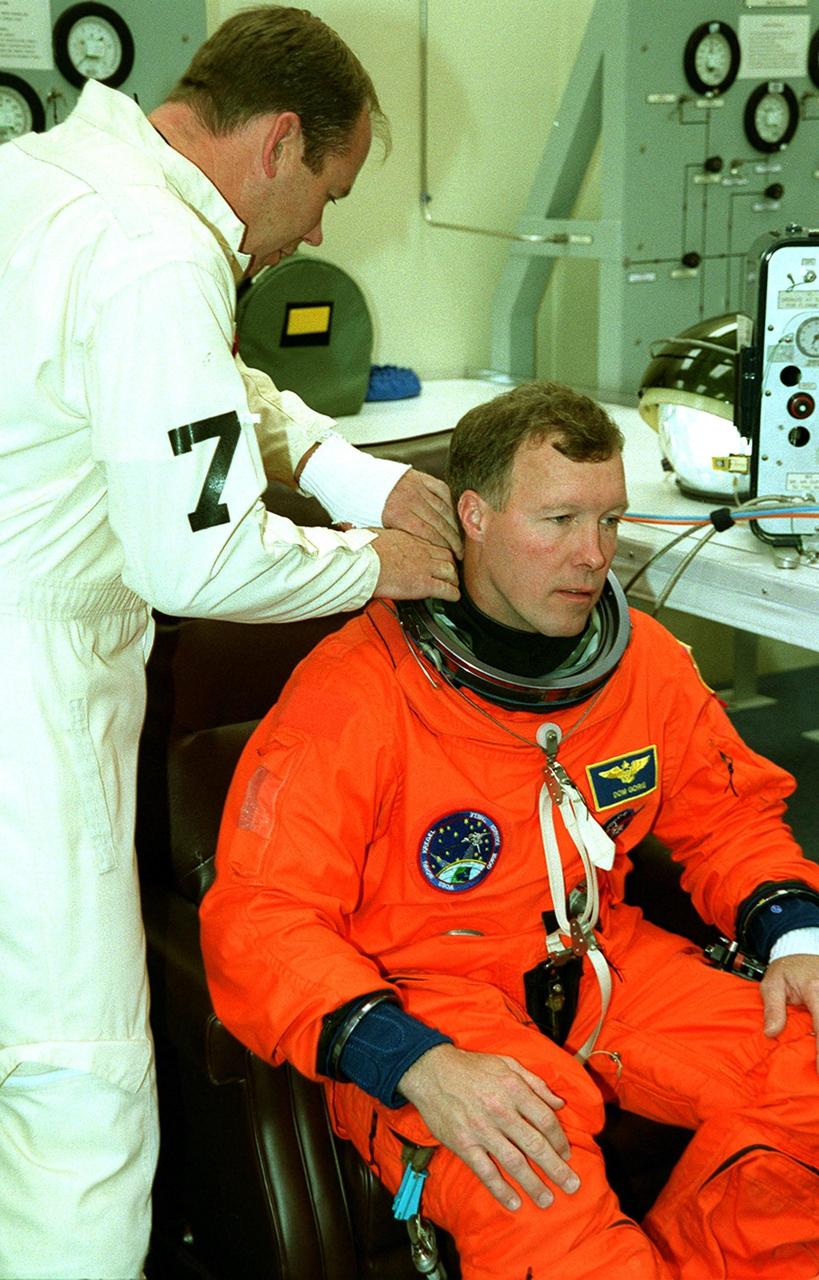
STS-99 Pilot Dominic Gorie suits up in the Operations and Checkout Building, as part of a flight crew equipment fit check, prior to his trip to Launch Pad 39A. The crew is taking part in Terminal Countdown Demonstration Test (TCDT) activities that provide the crew with simulated countdown exercises, emergency egress training, and opportunities to inspect the mission payloads in the orbiter's payload bay. STS-99 is the Shuttle Radar Topography Mission, which will chart a new course, using two antennae and a 200-foot-long section of space station-derived mast protruding from the payload bay to produce unrivaled 3-D images of the Earth's surface. The result of the Shuttle Radar Topography Mission could be close to 1 trillion measurements of the Earth's topography. Besides contributing to the production of better maps, these measurements could lead to improved water drainage modeling, more realistic flight simulators, better locations for cell phone towers, and enhanced navigation safety. Launch of Endeavour on the 11-day mission is scheduled for Jan. 31 at 12:47 p.m. EST

STS-99 Mission Specialist Gerhard Thiele, with the European Space Agency, arrives at KSC aboard a T-38 training jet aircraft to take part in a Terminal Countdown Demonstration Test (TCDT). The TCDT provides the crew with simulated countdown exercises, emergency egress training, and opportunities to inspect the mission payloads in the orbiter's payload bay. Other crew members taking part are Commander Kevin Kregel, Pilot Dominic Gorie, and Mission Specialists Janet Lynn Kavandi (Ph.D.), Janice Voss (Ph.D.), and Mamoru Mohri, who is with the National Space Development Agency (NASDA) of Japan. STS-99 is the Shuttle Radar Topography Mission, which will chart a new course, using two antennae and a 200-foot-long section of space station-derived mast protruding from the payload bay to produce unrivaled 3-D images of the Earth's surface. The result of the Shuttle Radar Topography Mission could be close to 1 trillion measurements of the Earth's topography. Besides contributing to the production of better maps, these measurements could lead to improved water drainage modeling, more realistic flight simulators, better locations for cell phone towers, and enhanced navigation safety. Launch of Endeavour on the 11-day mission is scheduled for Jan. 31 at 12:47 p.m. EST

STS-99 Pilot Dominic Gorie, under the watchful eye of Capt. George Hoggard, a trainer with the KSC Fire Department, practices driving the M-113, an armored personnel carrier. Part of Terminal Countdown Demonstration Test (TCDT) activities, the M-113 could be used by the crew in the event of an emergency at the pad during which the crew must make a quick exit from the area. Riding in the rear are Mission Specialists Mamoru Mohri, who is with the National Space Development Agency (NASDA) of Japan, Janet Lynn Kavandi (Ph.D.) and Janice Voss (Ph.D.). TCDT provides the crew with simulated countdown exercises, emergency egress training, and opportunities to inspect the mission payloads in the orbiter's payload bay. STS-99 is the Shuttle Radar Topography Mission, which will chart a new course, using two antennae and a 200-foot-long section of space station-derived mast protruding from the payload bay to produce unrivaled 3-D images of the Earth's surface. The result of the Shuttle Radar Topography Mission could be close to 1 trillion measurements of the Earth's topography. Besides contributing to the production of better maps, these measurements could lead to improved water drainage modeling, more realistic flight simulators, better locations for cell phone towers, and enhanced navigation safety. Launch of Endeavour on the 11-day mission is scheduled for Jan. 31 at 12:47 p.m. EST
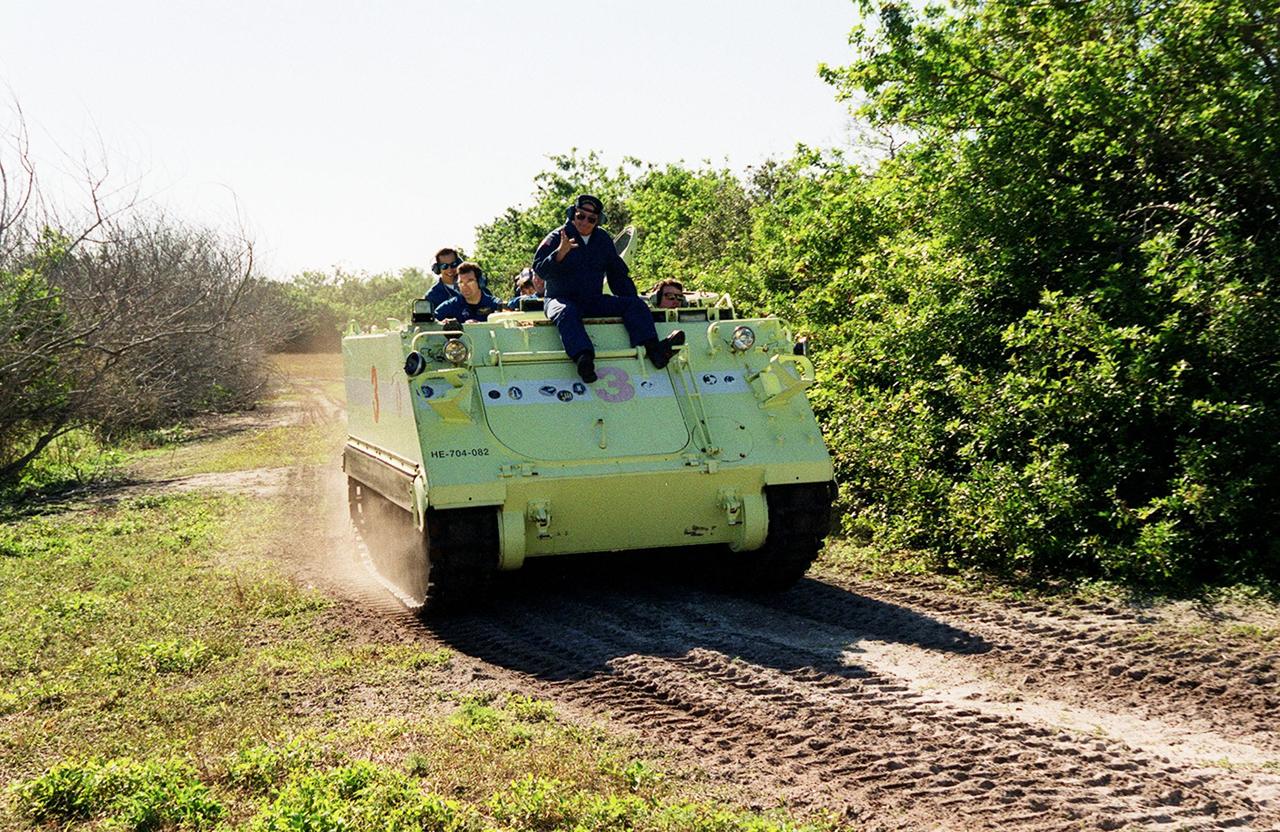
Under the watchful eye of Capt. George Hoggard, a trainer with the KSC Fire Department, STS-99 Commander Kevin Kregel practices driving the M-113, an armored personnel carrier. Part of Terminal Countdown Demonstration Test (TCDT) activities, the M-113 could be used by the crew in the event of an emergency at the pad during which the crew must make a quick exit from the area. TCDT provides the crew with simulated countdown exercises, emergency egress training, and opportunities to inspect the mission payloads in the orbiter's payload bay. STS-99 is the Shuttle Radar Topography Mission, which will chart a new course, using two antennae and a 200-foot-long section of space station-derived mast protruding from the payload bay to produce unrivaled 3-D images of the Earth's surface. The result of the Shuttle Radar Topography Mission could be close to 1 trillion measurements of the Earth's topography. Besides contributing to the production of better maps, these measurements could lead to improved water drainage modeling, more realistic flight simulators, better locations for cell phone towers, and enhanced navigation safety. Launch of Endeavour on the 11-day mission is scheduled for Jan. 31 at 12:47 p.m. EST
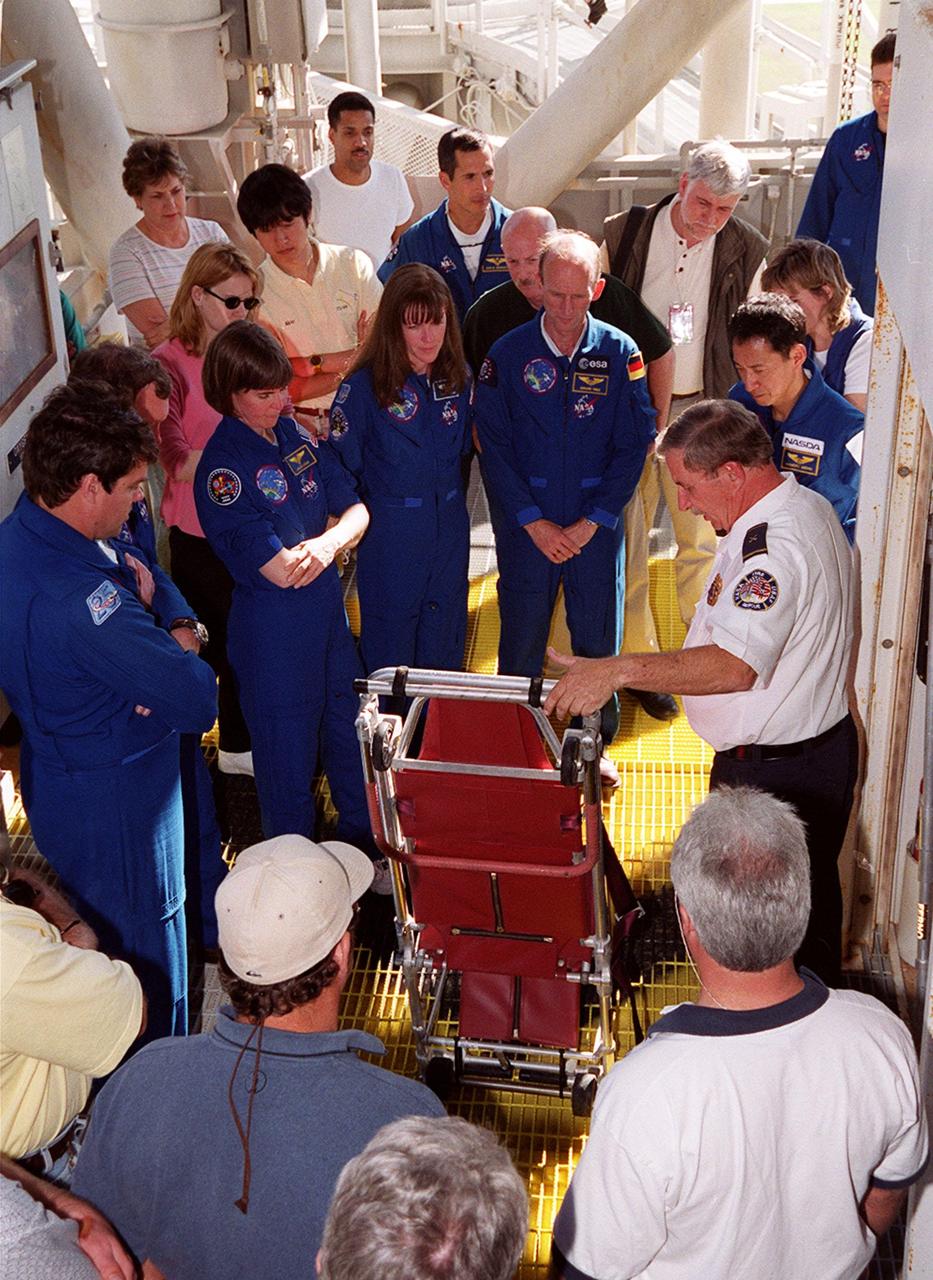
At Launch Pad 39A, members of the STS-99 crew and others look over part of the safety equipment. Standing left to right (in uniform) are Commander Kevin Kregel, Pilot Dominic Gorie, and Mission Specialists Janice Voss (Ph.D.), Janet Lynn Kavandi (Ph.D.), Gerhard Thiele and Mamoru Mohri. Thiele is with the European Space Agency and Mohri is with the National Space Development Agency (NASDA) of Japan. The crew are taking part in Terminal Countdown Demonstration Test activities, which provide them with simulated countdown exercises, emergency egress training, and opportunities to inspect the mission payloads in the orbiter's payload bay. STS-99 is the Shuttle Radar Topography Mission, which will chart a new course, using two antennae and a 200-foot-long section of space station-derived mast protruding from the payload bay to produce unrivaled 3-D images of the Earth's surface. The result of the Shuttle Radar Topography Mission could be close to 1 trillion measurements of the Earth's topography. Besides contributing to the production of better maps, these measurements could lead to improved water drainage modeling, more realistic flight simulators, better locations for cell phone towers, and enhanced navigation safety. Launch of Endeavour on the 11-day mission is scheduled for Jan. 31 at 12:47 p.m. EST

Under the watchful eye of Capt. George Hoggard, a trainer with the KSC Fire Department, STS-99 Commander Kevin Kregel practices driving the M-113, an armored personnel carrier. Part of Terminal Countdown Demonstration Test (TCDT) activities, the M-113 could be used by the crew in the event of an emergency at the pad during which the crew must make a quick exit from the area. TCDT provides the crew with simulated countdown exercises, emergency egress training, and opportunities to inspect the mission payloads in the orbiter's payload bay. STS-99 is the Shuttle Radar Topography Mission, which will chart a new course, using two antennae and a 200-foot-long section of space station-derived mast protruding from the payload bay to produce unrivaled 3-D images of the Earth's surface. The result of the Shuttle Radar Topography Mission could be close to 1 trillion measurements of the Earth's topography. Besides contributing to the production of better maps, these measurements could lead to improved water drainage modeling, more realistic flight simulators, better locations for cell phone towers, and enhanced navigation safety. Launch of Endeavour on the 11-day mission is scheduled for Jan. 31 at 12:47 p.m. EST
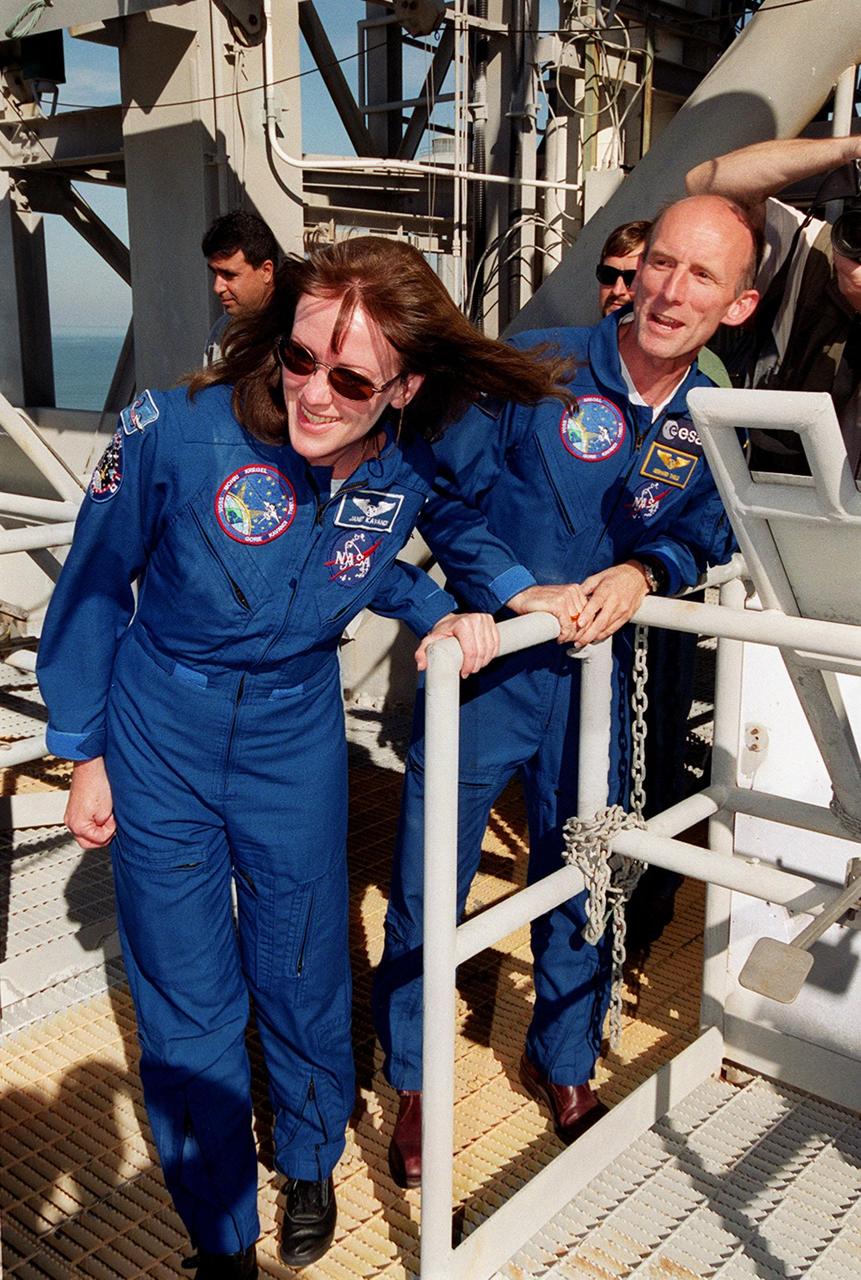
KENNEDY SPACE CENTER, Fla. -- On the Fixed Service Structure at Launch Pad 39A, STS-99 Mission Specialists Janet Lynn Kavandi (Ph.D.) and Gerhard Thiele, who is with the European Space Agency, look over the emergency egress equipment. The crew are taking part in Terminal Countdown Demonstration Test activities, which provide them with simulated countdown exercises, emergency egress training, and opportunities to inspect the mission payloads in the orbiter's payload bay. STS-99 is the Shuttle Radar Topography Mission, which will chart a new course, using two antennae and a 200-foot-long section of space station-derived mast protruding from the payload bay to produce unrivaled 3-D images of the Earth's surface. The result of the Shuttle Radar Topography Mission could be close to 1 trillion measurements of the Earth's topography. Besides contributing to the production of better maps, these measurements could lead to improved water drainage modeling, more realistic flight simulators, better locations for cell phone towers, and enhanced navigation safety. Launch of Endeavour on the 11-day mission is scheduled for Jan. 31 at 12:47 p.m. EST
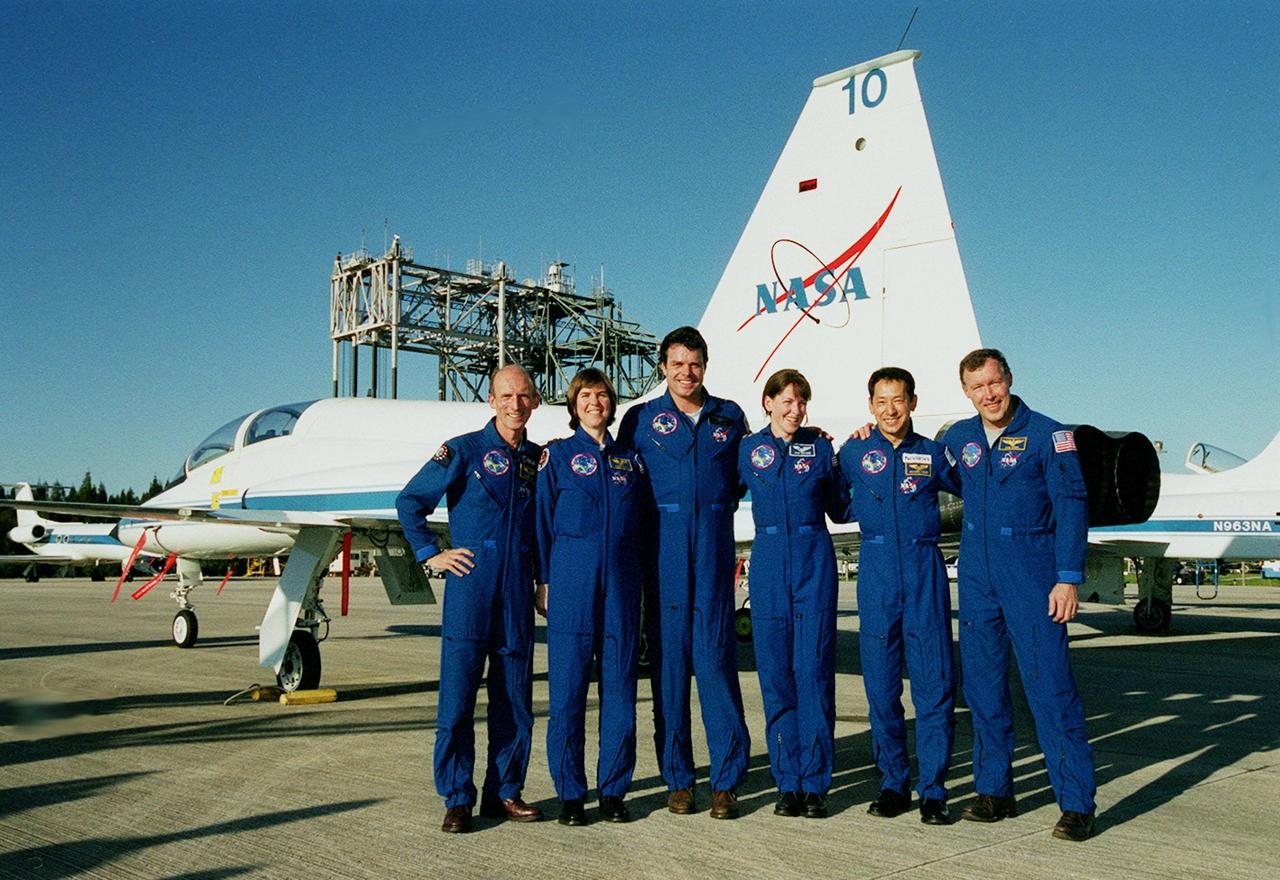
The STS-99 crew pose for a photo after their arrival at KSC's Shuttle Landing Facility. From left are Mission Specialists Gerhard Thiele, and Janice Voss (Ph.D.), Commander Kevin Kregel, Mission Specialists Janet Lynn Kavandi (Ph.D.) and Mamoru Mohri, and Pilot Dominic Gorie. Thiele is with the European Space Agency and Mohri is with the National Space Development Agency (NASDA) of Japan. The crew are here to take part in a Terminal Countdown Demonstration Test (TCDT), which provides simulated countdown exercises, emergency egress training, and opportunities to inspect the mission payloads in the orbiter's payload bay. STS-99 is the Shuttle Radar Topography Mission, which will chart a new course, using two antennae and a 200-foot-long section of space station-derived mast protruding from the payload bay to produce unrivaled 3-D images of the Earth's surface. The result of the Shuttle Radar Topography Mission could be close to 1 trillion measurements of the Earth's topography. Besides contributing to the production of better maps, these measurements could lead to improved water drainage modeling, more realistic flight simulators, better locations for cell phone towers, and enhanced navigation safety. Launch of Endeavour on the 11-day mission is scheduled for Jan. 31 at 12:47 p.m. EST
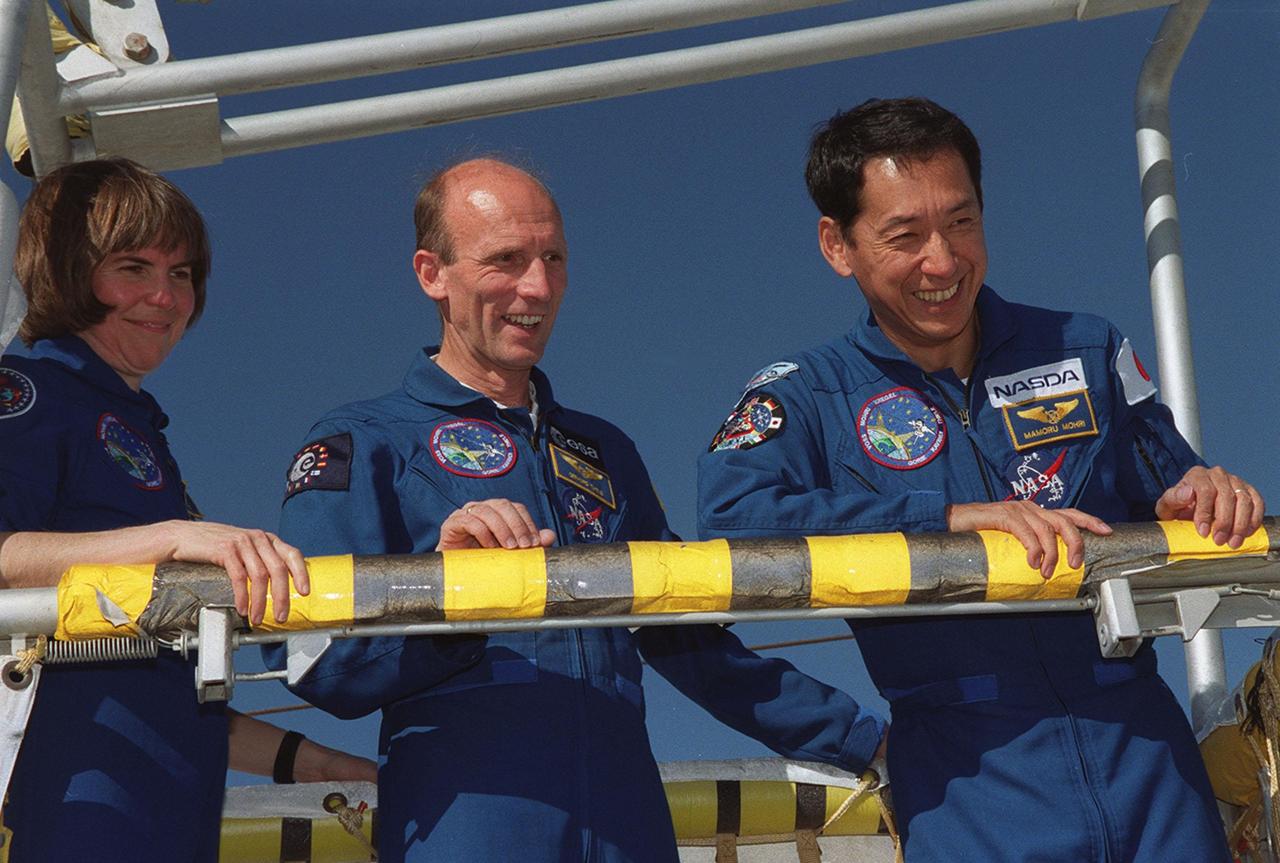
KENNEDY SPACE CENTER, Fla. -- At the 195-foot level on the Fixed Service Structure, Launch Pad 39A, the STS-99 crew receive instructions about emergency egress. From left (in uniform) are Mission Specialists Janice Voss (Ph.D.), Janet Lynn Kavandi (Ph.D.), Gerhard Thiele and Mamoru Mohri, Pilot Dominic Gorie and Commander Kevin Kregel. In the background can be seen the Vehicle Assembly Building at left and the waters of Banana Creek in between. The crew are taking part in Terminal Countdown Demonstration Test activities, which provide them with simulated countdown exercises, emergency egress training, and opportunities to inspect the mission payloads in the orbiter's payload bay. STS-99 is the Shuttle Radar Topography Mission, which will chart a new course, using two antennae and a 200-foot-long section of space station-derived mast protruding from the payload bay to produce unrivaled 3-D images of the Earth's surface. The result of the Shuttle Radar Topography Mission could be close to 1 trillion measurements of the Earth's topography. Besides contributing to the production of better maps, these measurements could lead to improved water drainage modeling, more realistic flight simulators, better locations for cell phone towers, and enhanced navigation safety. Launch of Endeavour on the 11-day mission is scheduled for Jan. 31 at 12:47 p.m. EST
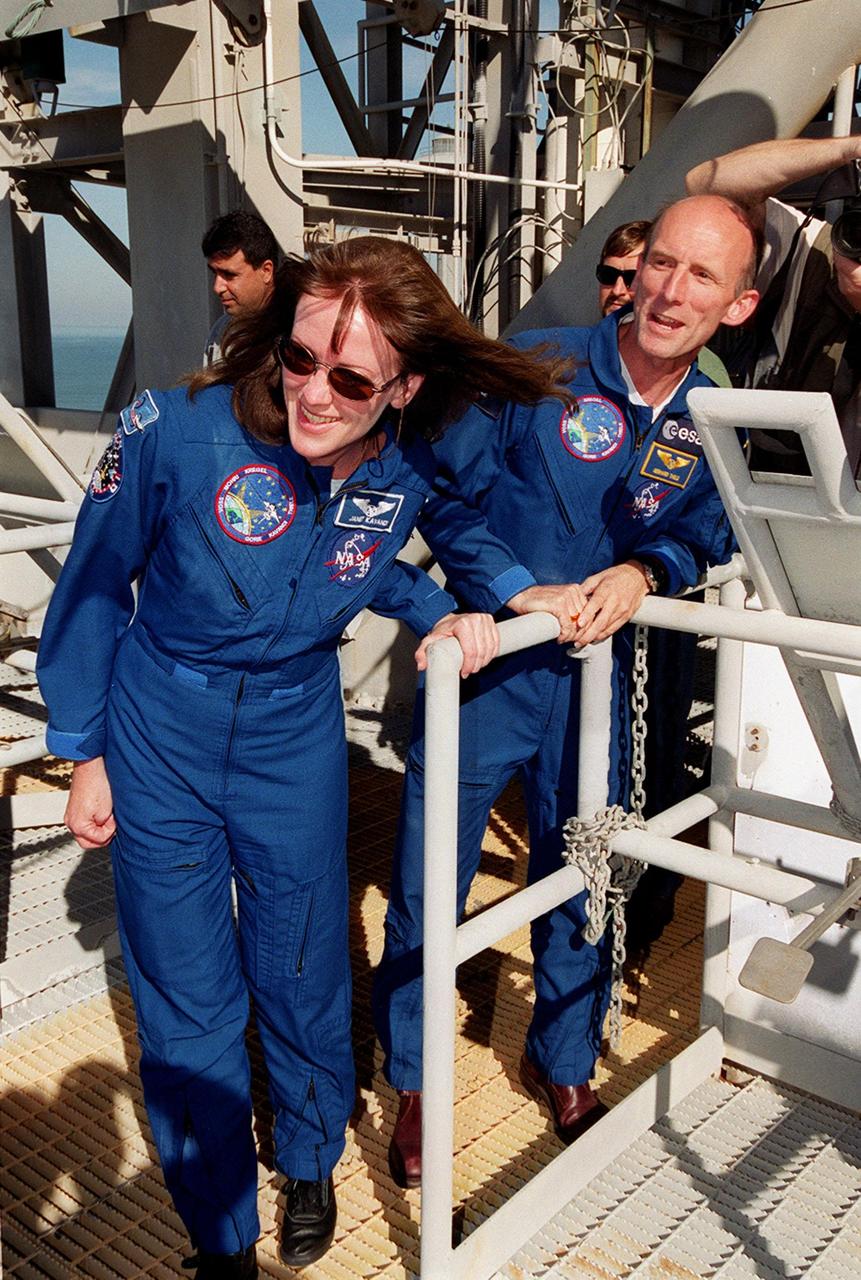
KENNEDY SPACE CENTER, Fla. -- On the Fixed Service Structure at Launch Pad 39A, STS-99 Mission Specialists Janet Lynn Kavandi (Ph.D.) and Gerhard Thiele, who is with the European Space Agency, look over the emergency egress equipment. The crew are taking part in Terminal Countdown Demonstration Test activities, which provide them with simulated countdown exercises, emergency egress training, and opportunities to inspect the mission payloads in the orbiter's payload bay. STS-99 is the Shuttle Radar Topography Mission, which will chart a new course, using two antennae and a 200-foot-long section of space station-derived mast protruding from the payload bay to produce unrivaled 3-D images of the Earth's surface. The result of the Shuttle Radar Topography Mission could be close to 1 trillion measurements of the Earth's topography. Besides contributing to the production of better maps, these measurements could lead to improved water drainage modeling, more realistic flight simulators, better locations for cell phone towers, and enhanced navigation safety. Launch of Endeavour on the 11-day mission is scheduled for Jan. 31 at 12:47 p.m. EST
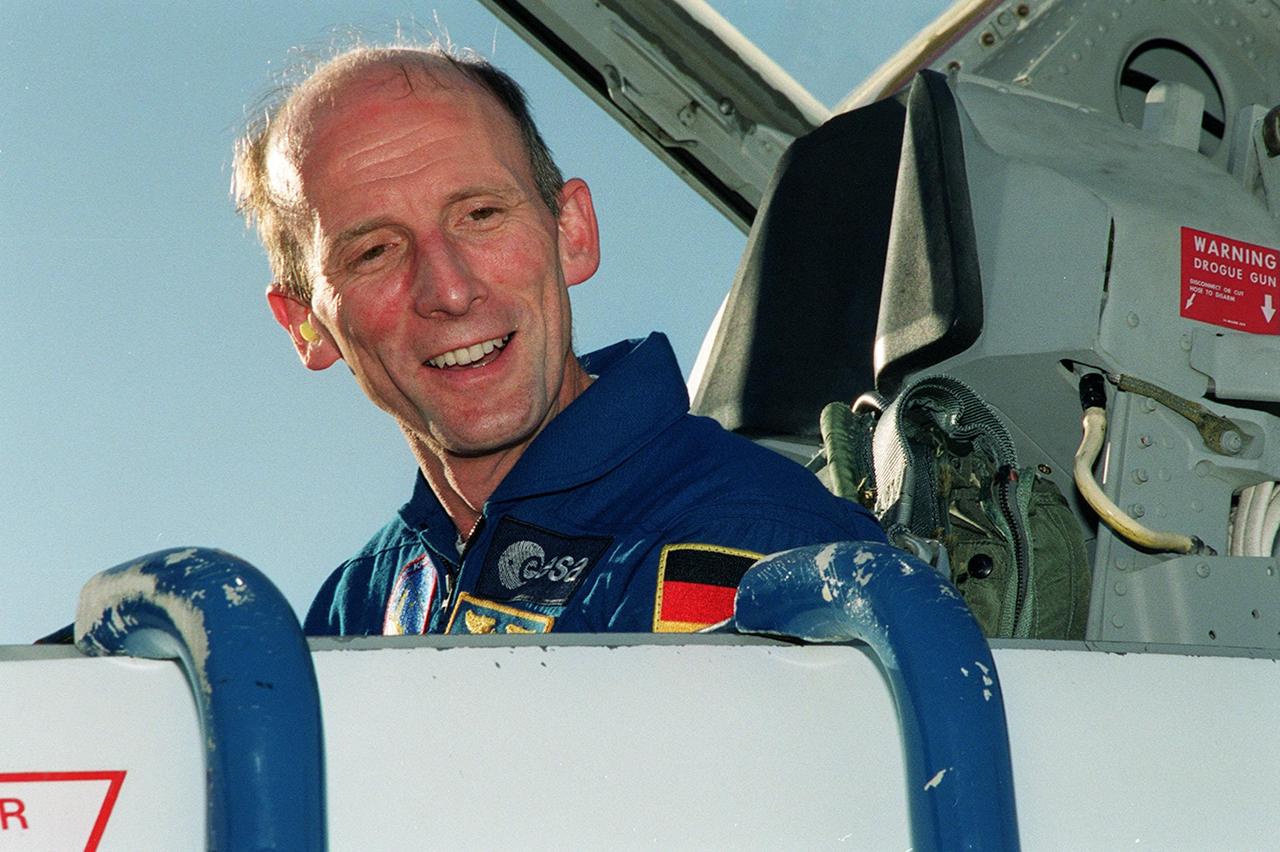
STS-99 Mission Specialist Gerhard Thiele, with the European Space Agency, arrives at KSC aboard a T-38 training jet aircraft to take part in a Terminal Countdown Demonstration Test (TCDT). The TCDT provides the crew with simulated countdown exercises, emergency egress training, and opportunities to inspect the mission payloads in the orbiter's payload bay. Other crew members taking part are Commander Kevin Kregel, Pilot Dominic Gorie, and Mission Specialists Janet Lynn Kavandi (Ph.D.), Janice Voss (Ph.D.), and Mamoru Mohri, who is with the National Space Development Agency (NASDA) of Japan. STS-99 is the Shuttle Radar Topography Mission, which will chart a new course, using two antennae and a 200-foot-long section of space station-derived mast protruding from the payload bay to produce unrivaled 3-D images of the Earth's surface. The result of the Shuttle Radar Topography Mission could be close to 1 trillion measurements of the Earth's topography. Besides contributing to the production of better maps, these measurements could lead to improved water drainage modeling, more realistic flight simulators, better locations for cell phone towers, and enhanced navigation safety. Launch of Endeavour on the 11-day mission is scheduled for Jan. 31 at 12:47 p.m. EST
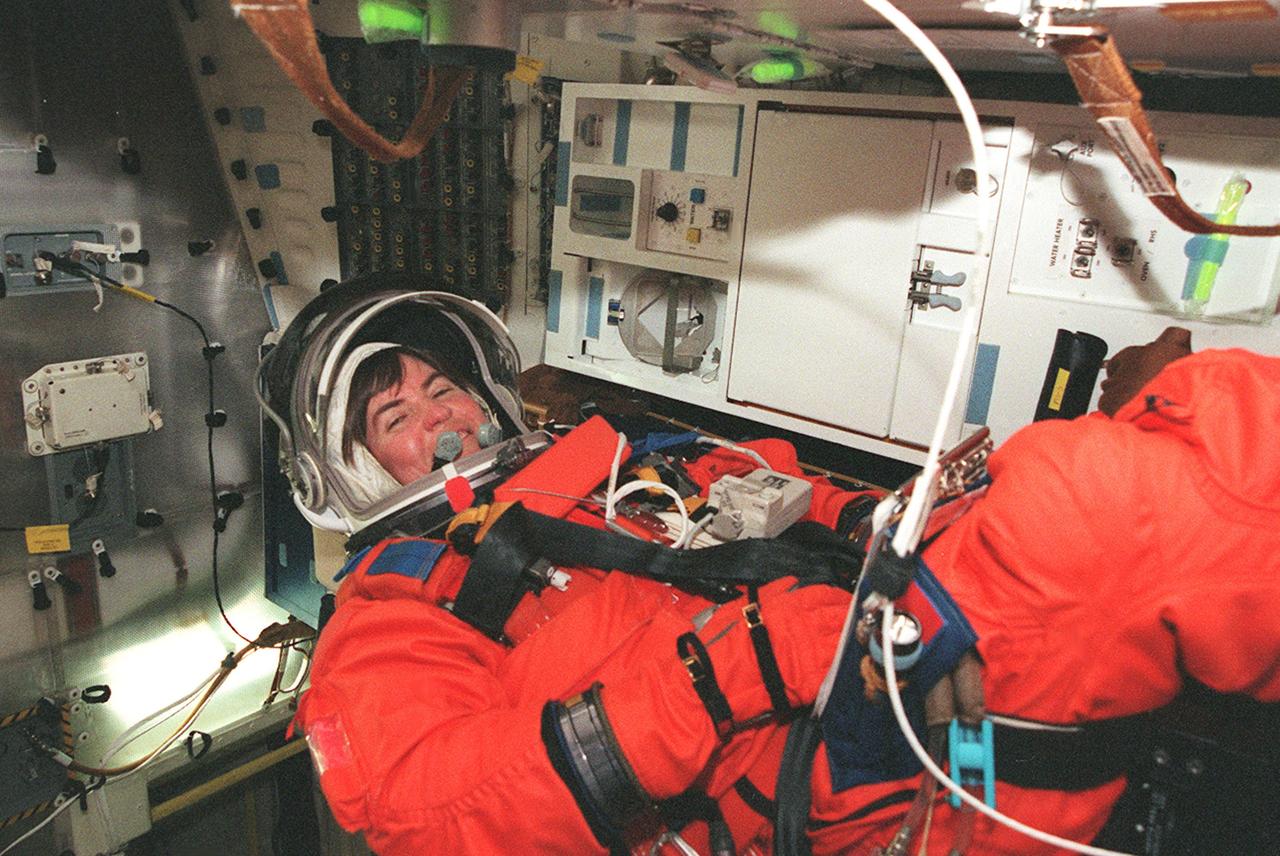
KENNEDY SPACE CENTER, FLA. -- STS-99 Mission Specialist Janice Voss (Ph.D.) settles into her seat inside Space Shuttle Endeavour for a practice launch countdown during Terminal Countdown Demonstration Test (TCDT) activities for the mission. The TCDT includes a simulation of the final launch countdown. STS-99 is the Shuttle Radar Topography Mission, which will chart a new course, using two antennae and a 200-foot-long section of the Space Station-derived mast protruding from the payload bay to produce unrivaled 3-D images of the Earth's surface. The result of the Shuttle Radar Topography Mission could be close to 1 trillion measurements of the Earth's topography. Besides contributing to the production of better maps, these measurements could lead to improved water drainage modeling, more realistic flight simulators, better locations for cell phone towers, and enhanced navigation safety. Launch of Endeavour on the 11-day mission is scheduled for Jan. 31 at 12:47 p.m. EST.
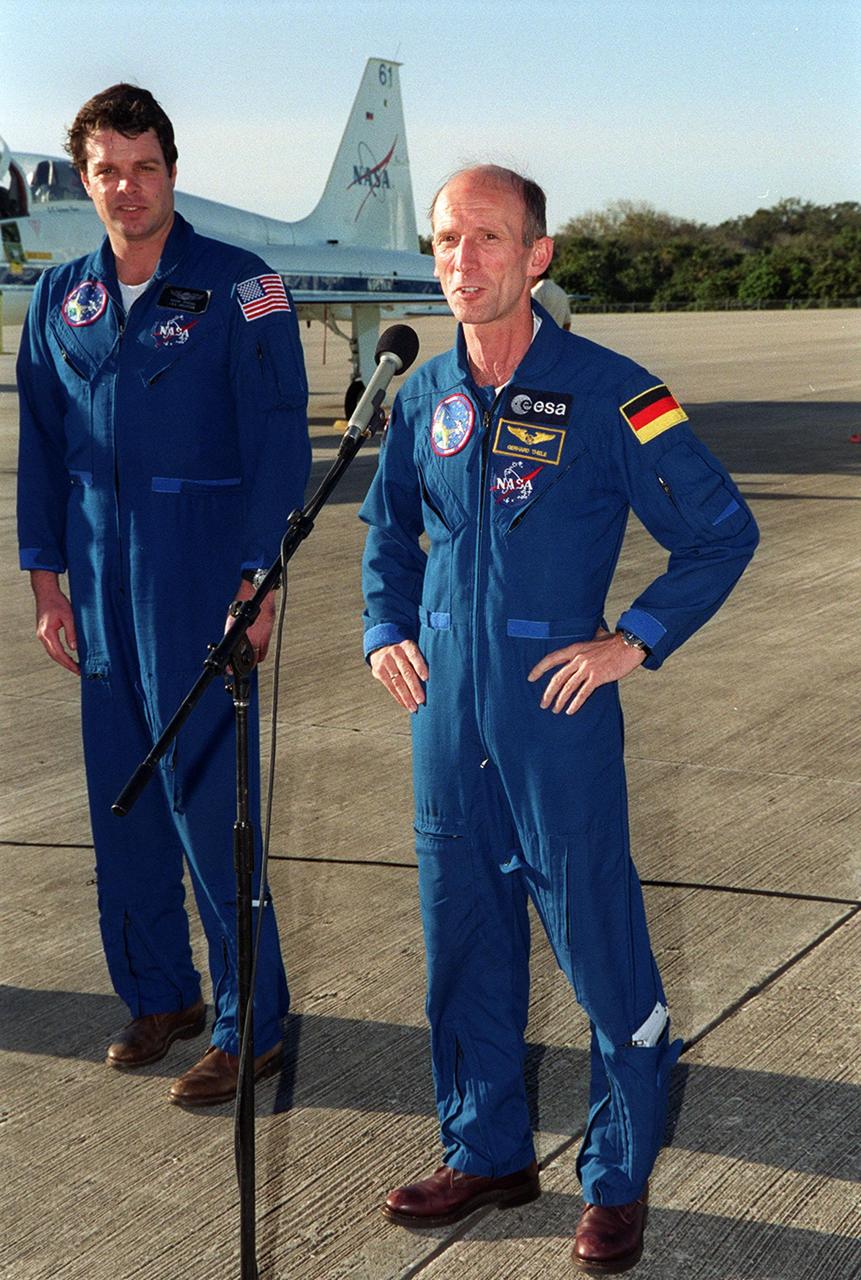
After their arrival at the Shuttle Landing Facility, the STS-99 crew talk to the media. At the microphone is Mission Specialist Gerhard Thiele, with the European Space Agency. At left is Commander Kevin Kregel. . The crew are here to take part in a Terminal Countdown Demonstration Test (TCDT), which provides simulated countdown exercises, emergency egress training, and opportunities to inspect the mission payloads in the orbiter's payload bay. Others taking part in the TCDT are Pilot Dominic Gorie and Mission Specialists Janice Voss (Ph.D.), Janet Lynn Kavandi (Ph.D.), Mamoru Mohri, who is with the National Space Development Agency (NASDA) of Japan. STS-99 is the Shuttle Radar Topography Mission, which will chart a new course, using two antennae and a 200-foot-long section of space station-derived mast protruding from the payload bay to produce unrivaled 3-D images of the Earth's surface. The result of the Shuttle Radar Topography Mission could be close to 1 trillion measurements of the Earth's topography. Besides contributing to the production of better maps, these measurements could lead to improved water drainage modeling, more realistic flight simulators, better locations for cell phone towers, and enhanced navigation safety. Launch of Endeavour on the 11-day mission is scheduled for Jan. 31 at 12:47 p.m. EST
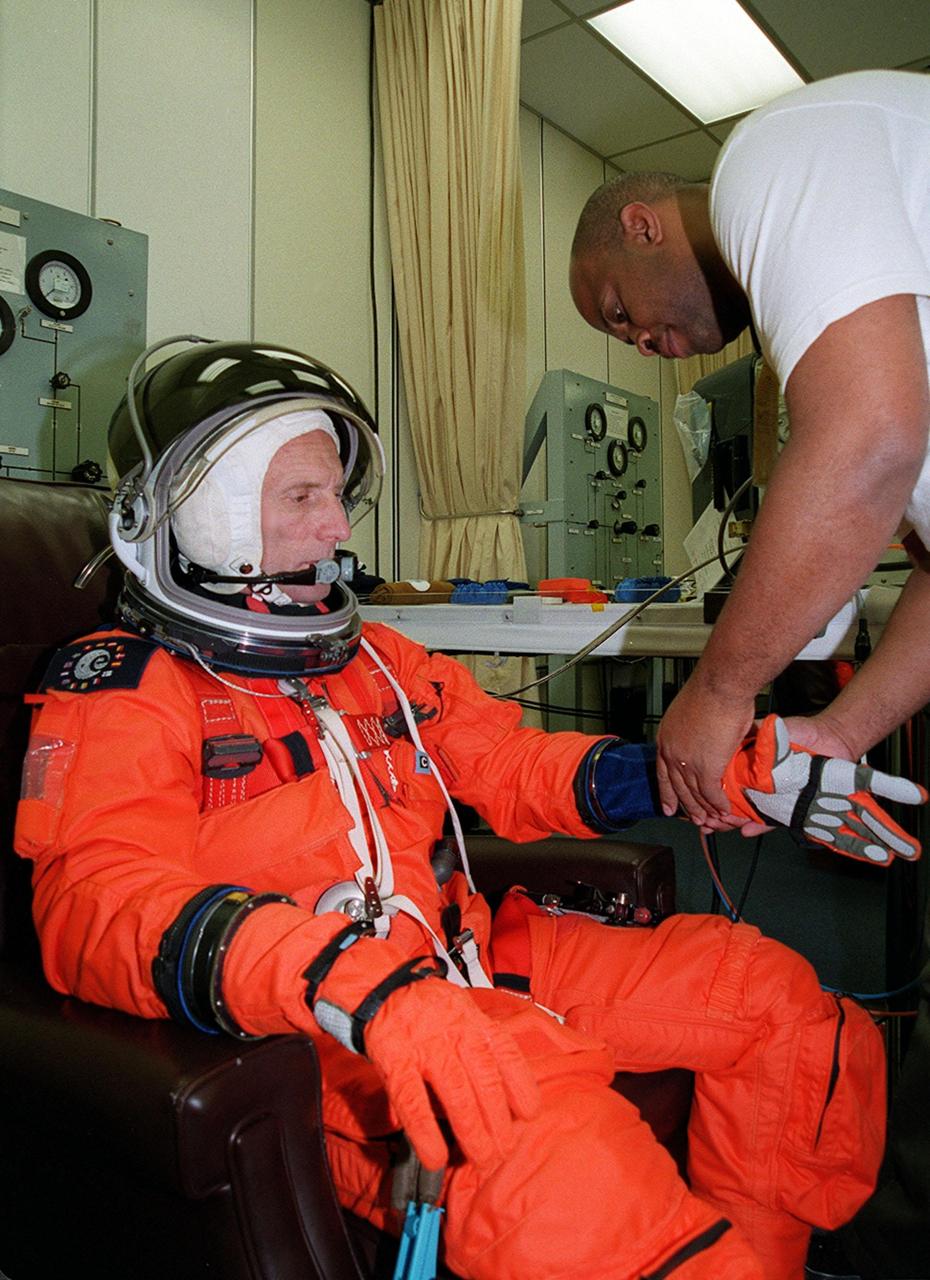
STS-99 Mission Specialist Gerhard Thiele, with the European Space Agency, gets help from a suit technician in the Operations and Checkout Building, as part of flight crew equipment fit check, prior to his trip to Launch Pad 39A. The crew is taking part in Terminal Countdown Demonstration Test (TCDT) activities that provide the crew with simulated countdown exercises, emergency egress training, and opportunities to inspect the mission payloads in the orbiter's payload bay. STS-99 is the Shuttle Radar Topography Mission, which will chart a new course, using two antennae and a 200-foot-long section of space station-derived mast protruding from the payload bay to produce unrivaled 3-D images of the Earth's surface. The result of the Shuttle Radar Topography Mission could be close to 1 trillion measurements of the Earth's topography. Besides contributing to the production of better maps, these measurements could lead to improved water drainage modeling, more realistic flight simulators, better locations for cell phone towers, and enhanced navigation safety. Launch of Endeavour on the 11-day mission is scheduled for Jan. 31 at 12:47 p.m. EST
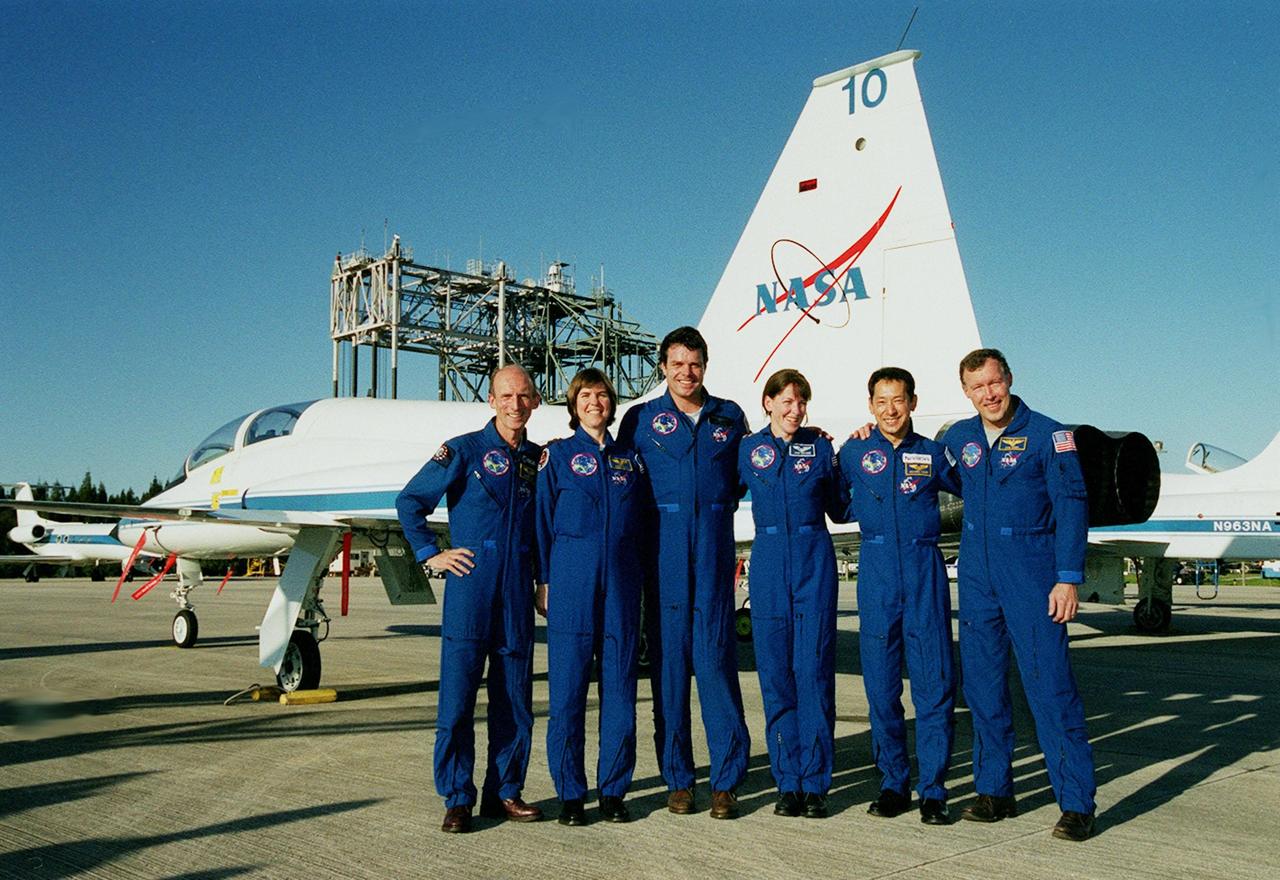
The STS-99 crew pose for a photo after their arrival at KSC's Shuttle Landing Facility. From left are Mission Specialists Gerhard Thiele, and Janice Voss (Ph.D.), Commander Kevin Kregel, Mission Specialists Janet Lynn Kavandi (Ph.D.) and Mamoru Mohri, and Pilot Dominic Gorie. Thiele is with the European Space Agency and Mohri is with the National Space Development Agency (NASDA) of Japan. The crew are here to take part in a Terminal Countdown Demonstration Test (TCDT), which provides simulated countdown exercises, emergency egress training, and opportunities to inspect the mission payloads in the orbiter's payload bay. STS-99 is the Shuttle Radar Topography Mission, which will chart a new course, using two antennae and a 200-foot-long section of space station-derived mast protruding from the payload bay to produce unrivaled 3-D images of the Earth's surface. The result of the Shuttle Radar Topography Mission could be close to 1 trillion measurements of the Earth's topography. Besides contributing to the production of better maps, these measurements could lead to improved water drainage modeling, more realistic flight simulators, better locations for cell phone towers, and enhanced navigation safety. Launch of Endeavour on the 11-day mission is scheduled for Jan. 31 at 12:47 p.m. EST
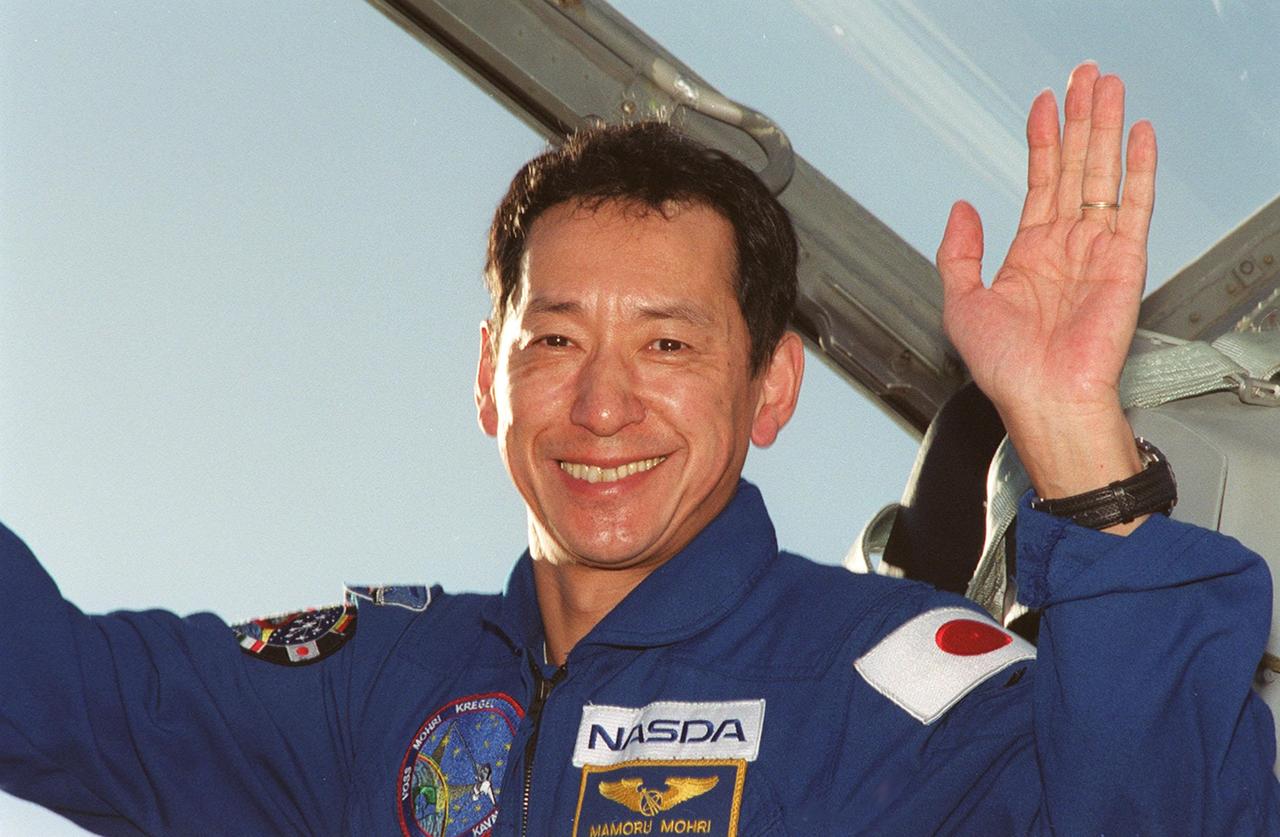
STS-99 Mission Specialist Mamoru Mohri, who is with the National Space Development Agency (NASDA) of Japan, waves after his arrival at KSC aboard a T-38 training jet aircraft to take part in a Terminal Countdown Demonstration Test (TCDT). The TCDT provides the crew with simulated countdown exercises, emergency egress training, and opportunities to inspect the mission payloads in the orbiter's payload bay. Other crew members taking part are Commander Kevin Kregel, Pilot Dominic L. Pudwill Gorie, and Mission Specialists Janet Lynn Kavandi (Ph.D.), Janice Voss (Ph.D.), and Gerhard P.J. Thiele, with the European Space Agency. STS-99 is the Shuttle Radar Topography Mission, which will chart a new course, using two antennae and a 200-foot-long section of space station-derived mast protruding from the payload bay to produce unrivaled 3-D images of the Earth's surface. The result of the Shuttle Radar Topography Mission could be close to 1 trillion measurements of the Earth's topography. Besides contributing to the production of better maps, these measurements could lead to improved water drainage modeling, more realistic flight simulators, better locations for cell phone towers, and enhanced navigation safety. Launch of Endeavour on the 11-day mission is scheduled for Jan. 31 at 12:47 p.m. EST
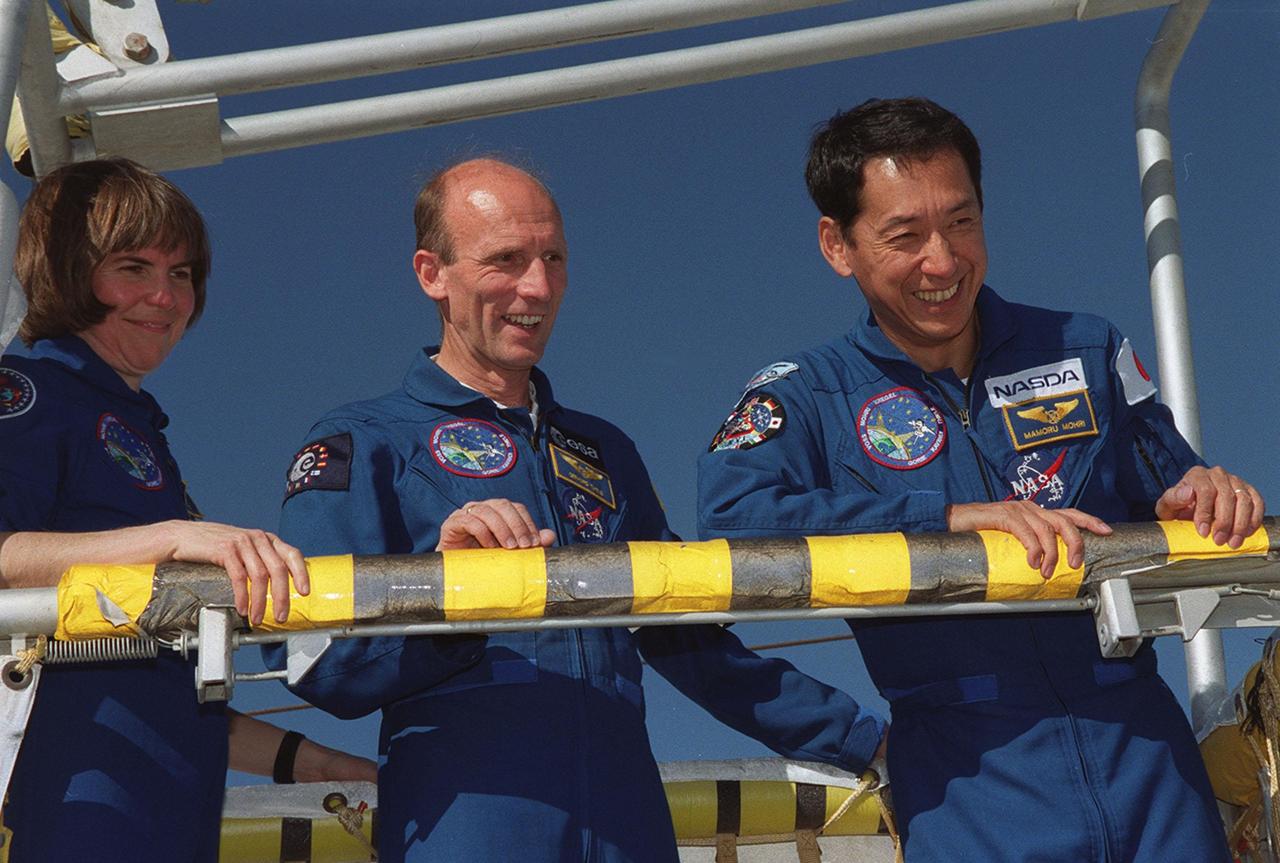
KENNEDY SPACE CENTER, Fla. -- At the 195-foot level on the Fixed Service Structure, Launch Pad 39A, the STS-99 crew receive instructions about emergency egress. From left (in uniform) are Mission Specialists Janice Voss (Ph.D.), Janet Lynn Kavandi (Ph.D.), Gerhard Thiele and Mamoru Mohri, Pilot Dominic Gorie and Commander Kevin Kregel. In the background can be seen the Vehicle Assembly Building at left and the waters of Banana Creek in between. The crew are taking part in Terminal Countdown Demonstration Test activities, which provide them with simulated countdown exercises, emergency egress training, and opportunities to inspect the mission payloads in the orbiter's payload bay. STS-99 is the Shuttle Radar Topography Mission, which will chart a new course, using two antennae and a 200-foot-long section of space station-derived mast protruding from the payload bay to produce unrivaled 3-D images of the Earth's surface. The result of the Shuttle Radar Topography Mission could be close to 1 trillion measurements of the Earth's topography. Besides contributing to the production of better maps, these measurements could lead to improved water drainage modeling, more realistic flight simulators, better locations for cell phone towers, and enhanced navigation safety. Launch of Endeavour on the 11-day mission is scheduled for Jan. 31 at 12:47 p.m. EST
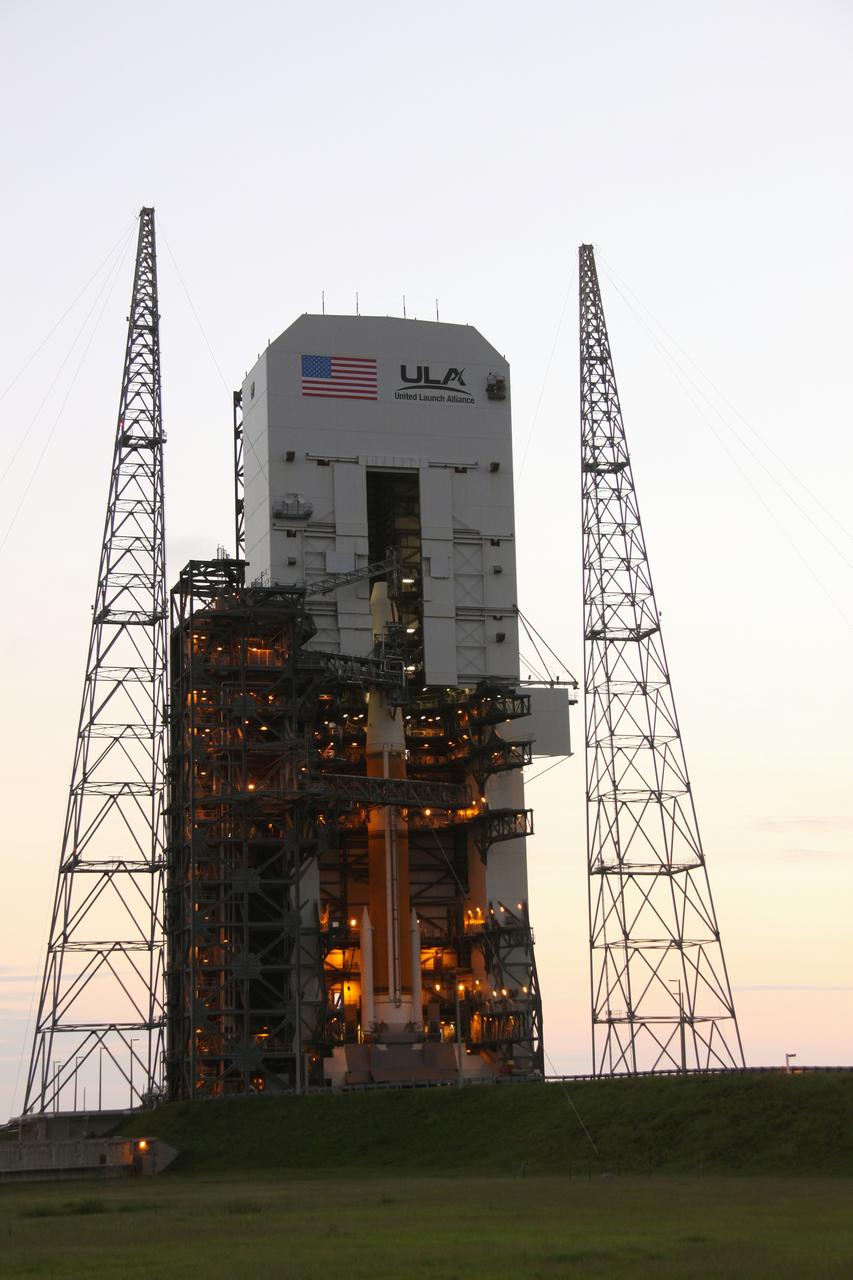
CAPE CANAVERAL, Fla. – As the sun rises on Launch Complex 37 at Cape Canaveral Air Force Station, preparations are under way to roll the mobile service tower from around the Boeing Delta IV rocket that will launch the GOES-O satellite into orbit. The terminal countdown to the liftoff of GOES-O will begin at 12:59 p.m. EDT for a launch window that extends from 6:14 p.m. to 7:14 p.m. June 26. The latest Geostationary Operational Environmental Satellite, GOES-O was developed by NASA for the National Oceanic and Atmospheric Administration, or NOAA. Each of the GOES satellites continuously provides observations of 60 percent of the Earth including the continental United States, providing weather monitoring and forecast operations as well as a continuous and reliable stream of environmental information and severe weather warnings. Once in orbit, GOES-O will be designated GOES-14, and NASA will provide on-orbit checkout and then transfer operational responsibility to NOAA. Photo credit: NASA/Jack Pfaller
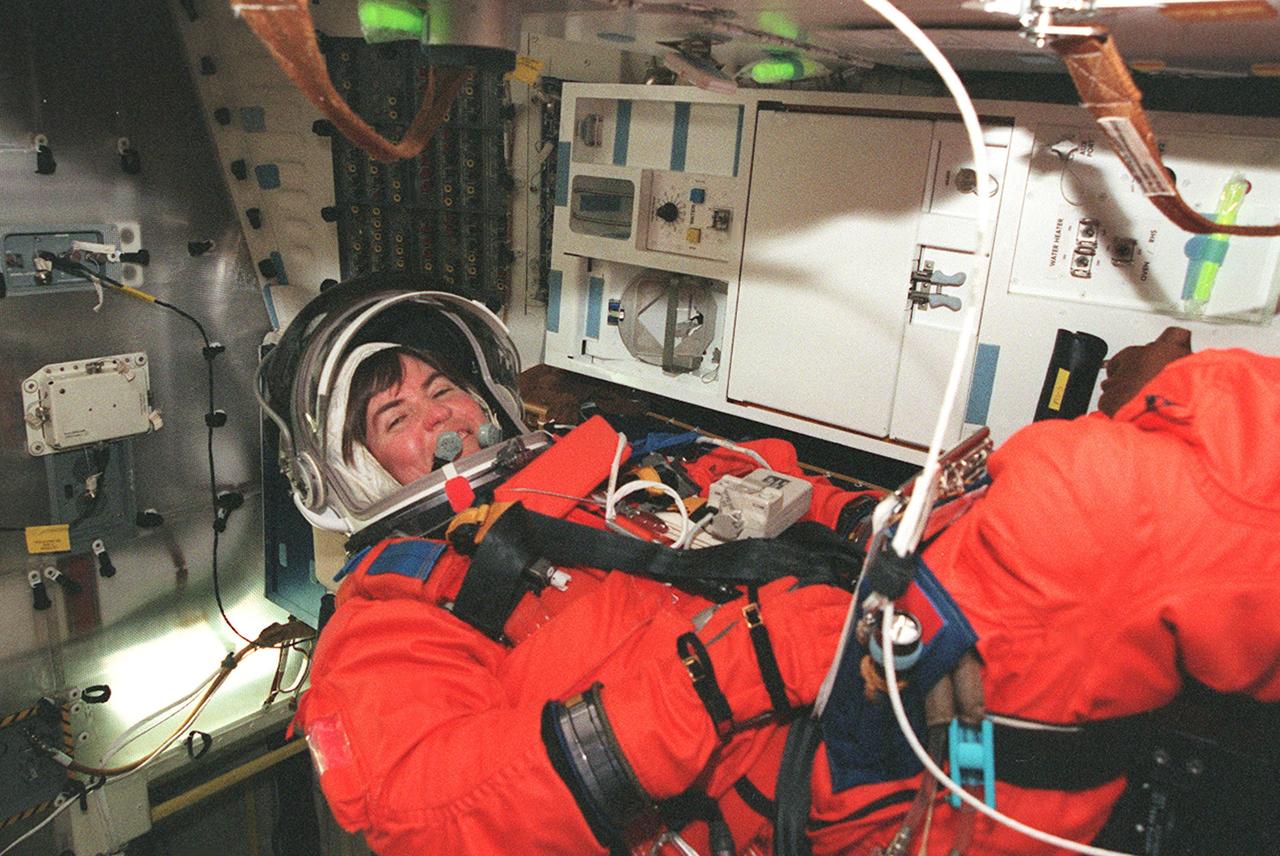
KENNEDY SPACE CENTER, FLA. -- STS-99 Mission Specialist Janice Voss (Ph.D.) settles into her seat inside Space Shuttle Endeavour for a practice launch countdown during Terminal Countdown Demonstration Test (TCDT) activities for the mission. The TCDT includes a simulation of the final launch countdown. STS-99 is the Shuttle Radar Topography Mission, which will chart a new course, using two antennae and a 200-foot-long section of the Space Station-derived mast protruding from the payload bay to produce unrivaled 3-D images of the Earth's surface. The result of the Shuttle Radar Topography Mission could be close to 1 trillion measurements of the Earth's topography. Besides contributing to the production of better maps, these measurements could lead to improved water drainage modeling, more realistic flight simulators, better locations for cell phone towers, and enhanced navigation safety. Launch of Endeavour on the 11-day mission is scheduled for Jan. 31 at 12:47 p.m. EST.
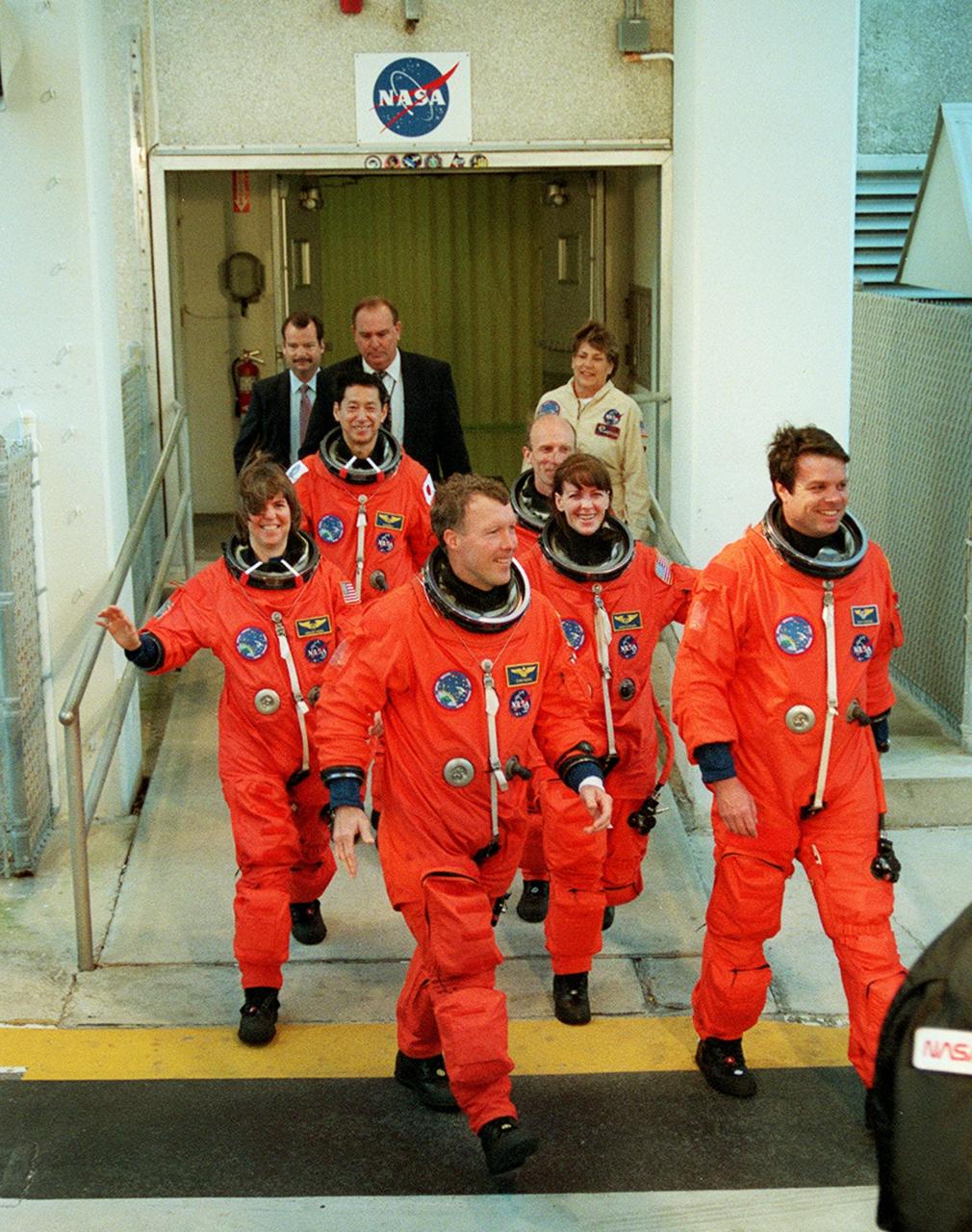
The STS-99 crew leave the Operations and Checkout Building on their way to Launch Pad 39A and a simulated countdown exercise. In the front row are Pilot Dominic Gorie and Commander Kevin Kregel; in the middle row are mission Specialists Janice Voss (Ph.D.) and Janet Lynn Kavandi (Ph.D.); in the back row are Mission Specialists Mamoru Mohri, who is with the National Space Development Agency (NASDA) of Japan, and Gerhard Thiele, who is with the European Space Agency. The crew are taking part in Terminal Countdown Demonstration Test activities, which provide them with simulated countdown exercises, emergency egress training, and opportunities to inspect the mission payloads in the orbiter's payload bay. STS-99 is the Shuttle Radar Topography Mission, which will chart a new course, using two antennae and a 200-foot-long section of space station-derived mast protruding from the payload bay to produce unrivaled 3-D images of the Earth's surface. The result of the Shuttle Radar Topography Mission could be close to 1 trillion measurements of the Earth's topography. Besides contributing to the production of better maps, these measurements could lead to improved water drainage modeling, more realistic flight simulators, better locations for cell phone towers, and enhanced navigation safety. Launch of Endeavour on the 11-day mission is scheduled for Jan. 31 at 12:47 p.m. EST
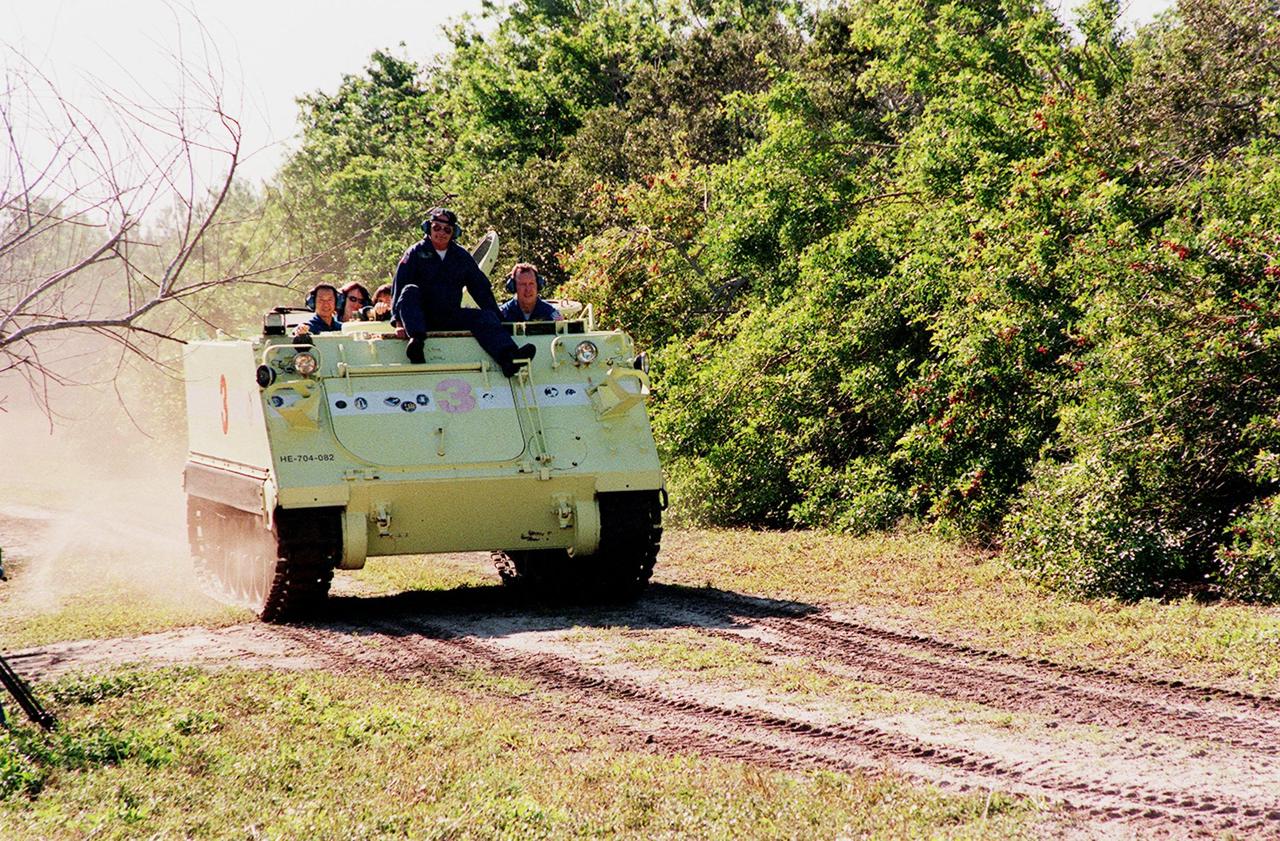
STS-99 Pilot Dominic Gorie, under the watchful eye of Capt. George Hoggard, a trainer with the KSC Fire Department, practices driving the M-113, an armored personnel carrier. Part of Terminal Countdown Demonstration Test (TCDT) activities, the M-113 could be used by the crew in the event of an emergency at the pad during which the crew must make a quick exit from the area. Riding in the rear are Mission Specialists Mamoru Mohri, who is with the National Space Development Agency (NASDA) of Japan, Janet Lynn Kavandi (Ph.D.) and Janice Voss (Ph.D.). TCDT provides the crew with simulated countdown exercises, emergency egress training, and opportunities to inspect the mission payloads in the orbiter's payload bay. STS-99 is the Shuttle Radar Topography Mission, which will chart a new course, using two antennae and a 200-foot-long section of space station-derived mast protruding from the payload bay to produce unrivaled 3-D images of the Earth's surface. The result of the Shuttle Radar Topography Mission could be close to 1 trillion measurements of the Earth's topography. Besides contributing to the production of better maps, these measurements could lead to improved water drainage modeling, more realistic flight simulators, better locations for cell phone towers, and enhanced navigation safety. Launch of Endeavour on the 11-day mission is scheduled for Jan. 31 at 12:47 p.m. EST
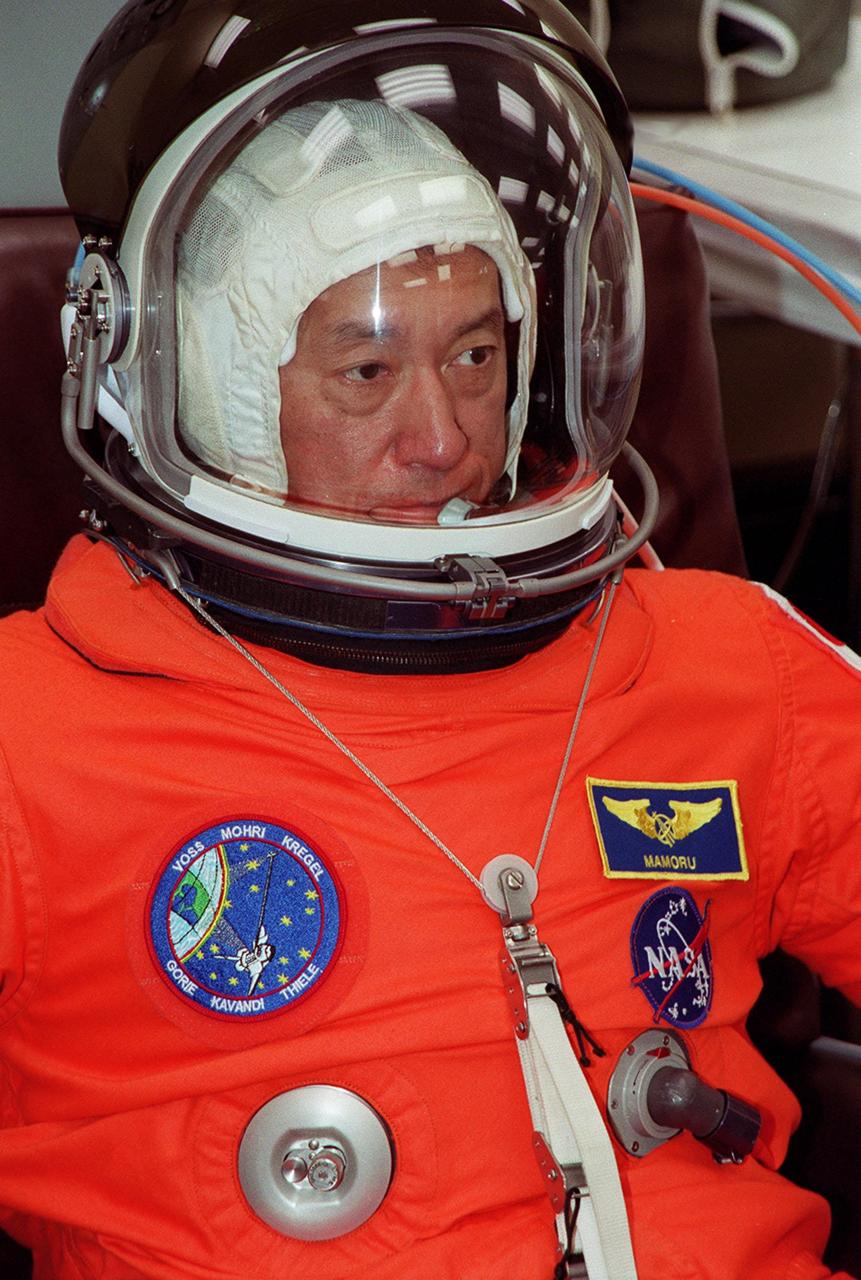
STS-99 Mission Specialist Mamoru Mohri (Ph.D.), who is with the National Space Development Agency (NASDA) of Japan, suits up in the Operations and Checkout Building, as part of a flight crew equipment fit check, prior to his trip to Launch Pad 39A. The crew is taking part in Terminal Countdown Demonstration Test (TCDT) activities that provide the crew with simulated countdown exercises, emergency egress training, and opportunities to inspect the mission payloads in the orbiter's payload bay. STS-99 is the Shuttle Radar Topography Mission, which will chart a new course, using two antennae and a 200-foot-long section of space station-derived mast protruding from the payload bay to produce unrivaled 3-D images of the Earth's surface. The result of the Shuttle Radar Topography Mission could be close to 1 trillion measurements of the Earth's topography. Besides contributing to the production of better maps, these measurements could lead to improved water drainage modeling, more realistic flight simulators, better locations for cell phone towers, and enhanced navigation safety. Launch of Endeavour on the 11-day mission is scheduled for Jan. 31 at 12:47 p.m. EST
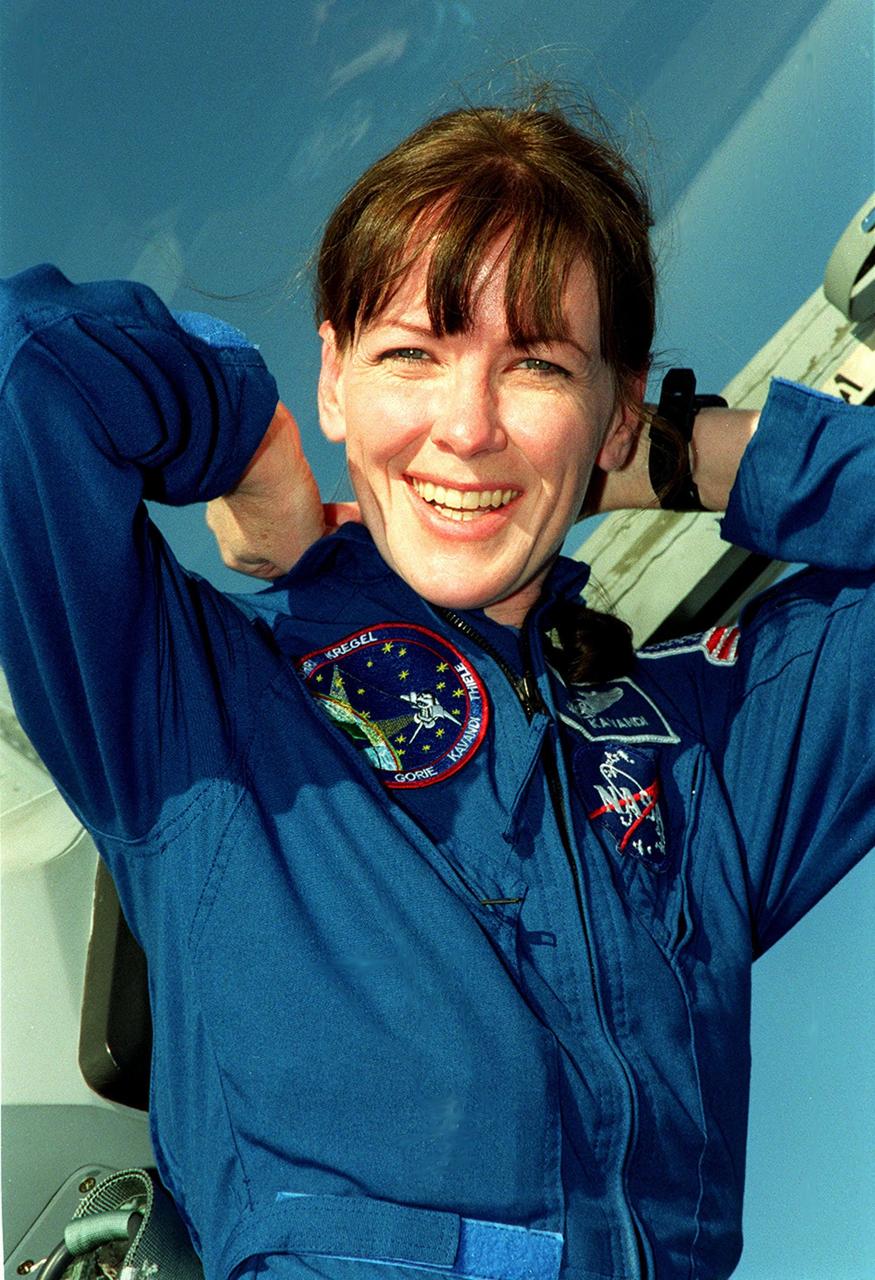
STS-99 Mission Specialist Janet Lynn Kavandi (Ph.D.) smiles on her arrival at KSC aboard a T-38 training jet aircraft to take part in a Terminal Countdown Demonstration Test (TCDT). The TCDT provides the crew with simulated countdown exercises, emergency egress training, and opportunities to inspect the mission payloads in the orbiter's payload bay. Other crew members taking part are Commander Kevin Kregel, Pilot Dominic Gorie, and Mission Specialists Janice Voss (Ph.D.), Mamoru Mohri, who is with the National Space Development Agency (NASDA) of Japan, and Gerhard Thiele, with the European Space Agency. STS-99 is the Shuttle Radar Topography Mission, which will chart a new course, using two antennae and a 200-foot-long section of space station-derived mast protruding from the payload bay to produce unrivaled 3-D images of the Earth's surface. The result of the Shuttle Radar Topography Mission could be close to 1 trillion measurements of the Earth's topography. Besides contributing to the production of better maps, these measurements could lead to improved water drainage modeling, more realistic flight simulators, better locations for cell phone towers, and enhanced navigation safety. Launch of Endeavour on the 11-day mission is scheduled for Jan. 31 at 12:47 p.m. EST
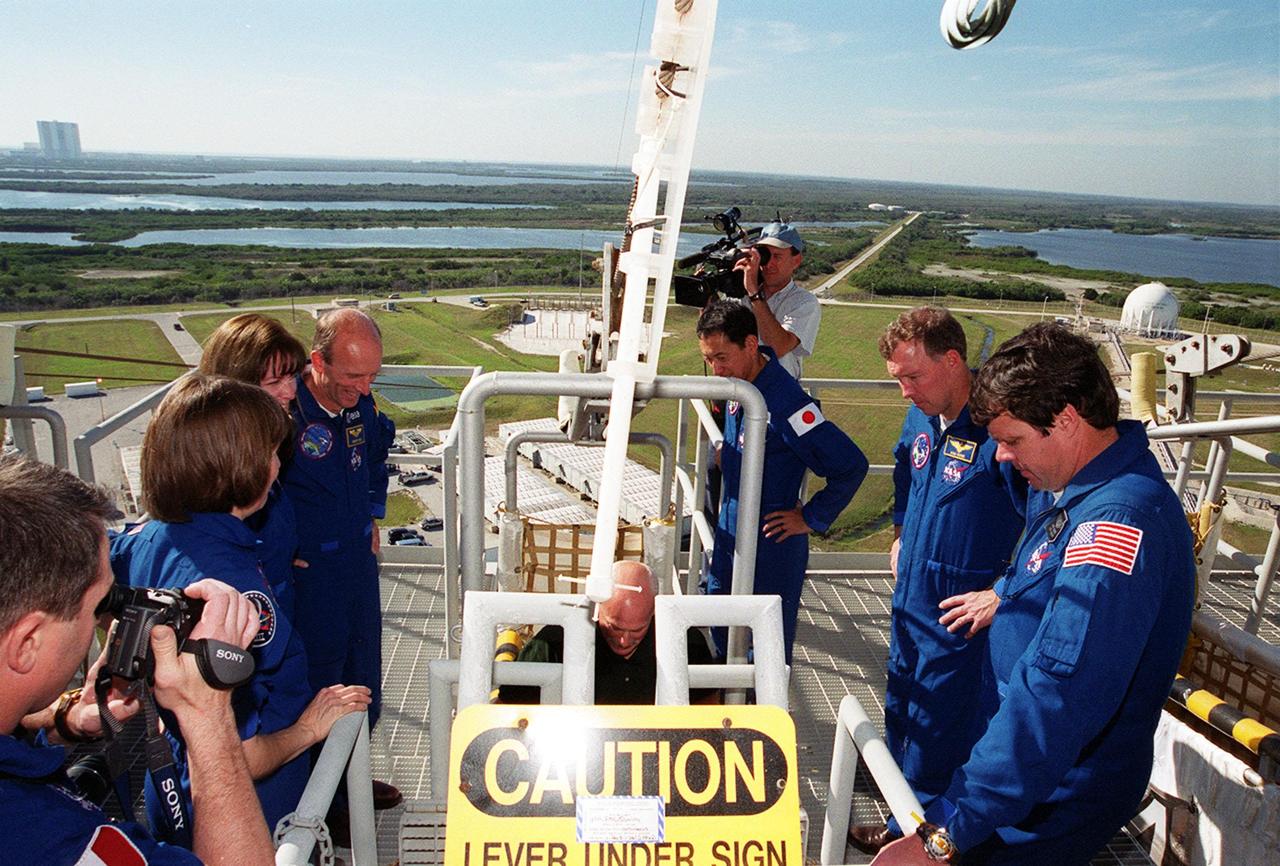
KENNEDY SPACE CENTER, Fla. -- Near the bunker at Launch Pad 39A, STS-99 Mission Specialists Janice Voss (Ph.D.), Gerhard Thiele and Mamoru Mohri check out the slidewire basket used for emergency egress. The crew are taking part in Terminal Countdown Demonstration Test activities, which provide them with simulated countdown exercises, emergency egress training, and opportunities to inspect the mission payloads in the orbiter's payload bay. Thiele is with the European Space Agency and Mohri is with the National Space Development Agency (NASDA) of Japan. STS-99 is the Shuttle Radar Topography Mission, which will chart a new course, using two antennae and a 200-foot-long section of space station-derived mast protruding from the payload bay to produce unrivaled 3-D images of the Earth's surface. The result of the Shuttle Radar Topography Mission could be close to 1 trillion measurements of the Earth's topography. Besides contributing to the production of better maps, these measurements could lead to improved water drainage modeling, more realistic flight simulators, better locations for cell phone towers, and enhanced navigation safety. Launch of Endeavour on the 11-day mission is scheduled for Jan. 31 at 12:47 p.m. EST
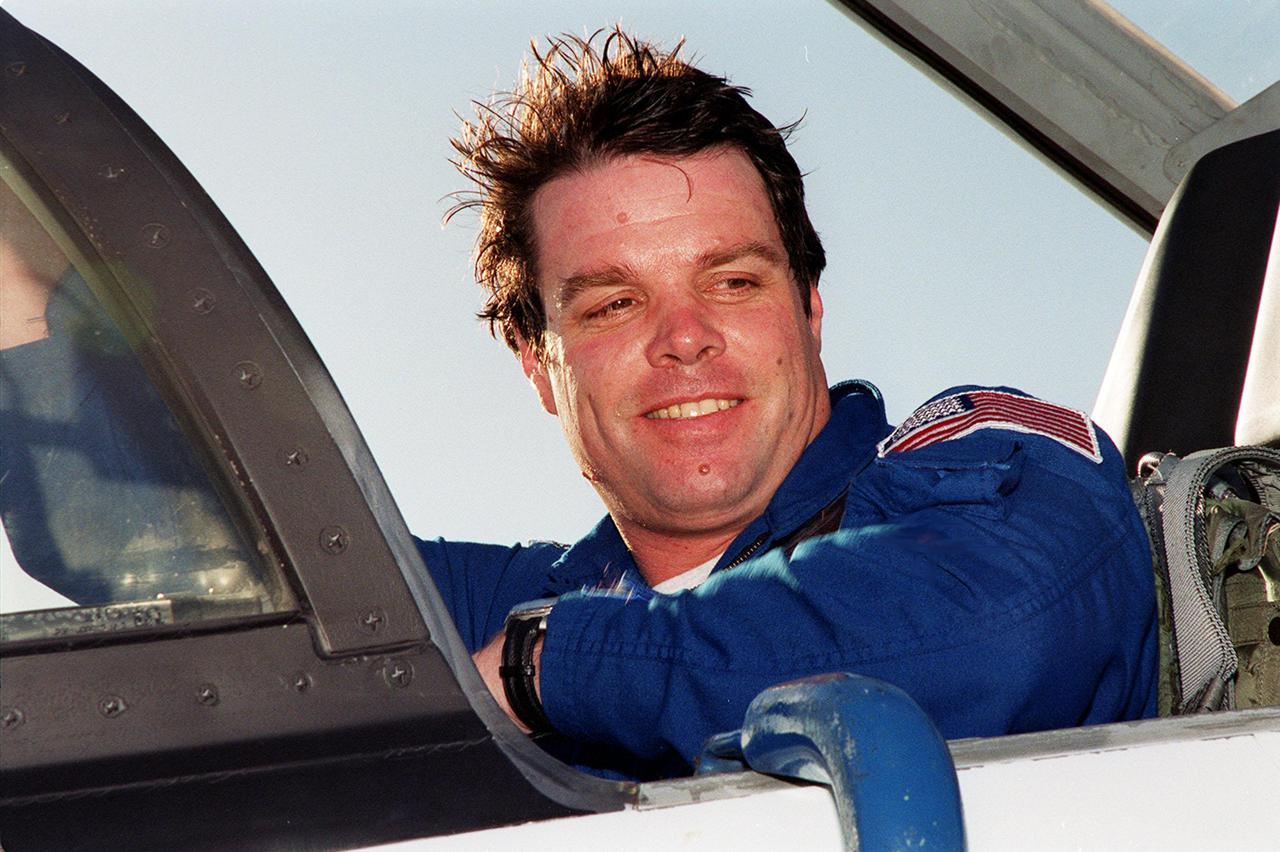
STS-99 Commander Kevin Kregel arrives at KSC's Shuttle Landing Facility aboard a T-38 training jet to take part in a Terminal Countdown Demonstration Test (TCDT). The TCDT provides the crew with simulated countdown exercises, emergency egress training, and opportunities to inspect the mission payloads in the orbiter's payload bay. Other crew members taking part are Pilot Dominic Gorie, and Mission Specialists Janet Lynn Kavandi (Ph.D.), Janice Voss (Ph.D.), Mamoru Mohri, who is with the National Space Development Agency (NASDA) of Japan, and Gerhard Thiele, who is with the European Space Agency. STS-99 is the Shuttle Radar Topography Mission, which will chart a new course, using two antennae and a 200-foot-long section of space station-derived mast protruding from the payload bay to produce unrivaled 3-D images of the Earth's surface. The result of the Shuttle Radar Topography Mission could be close to 1 trillion measurements of the Earth's topography. Besides contributing to the production of better maps, these measurements could lead to improved water drainage modeling, more realistic flight simulators, better locations for cell phone towers, and enhanced navigation safety. Launch of Endeavour on the 11-day mission is scheduled for Jan. 31 at 12:47 p.m. EST
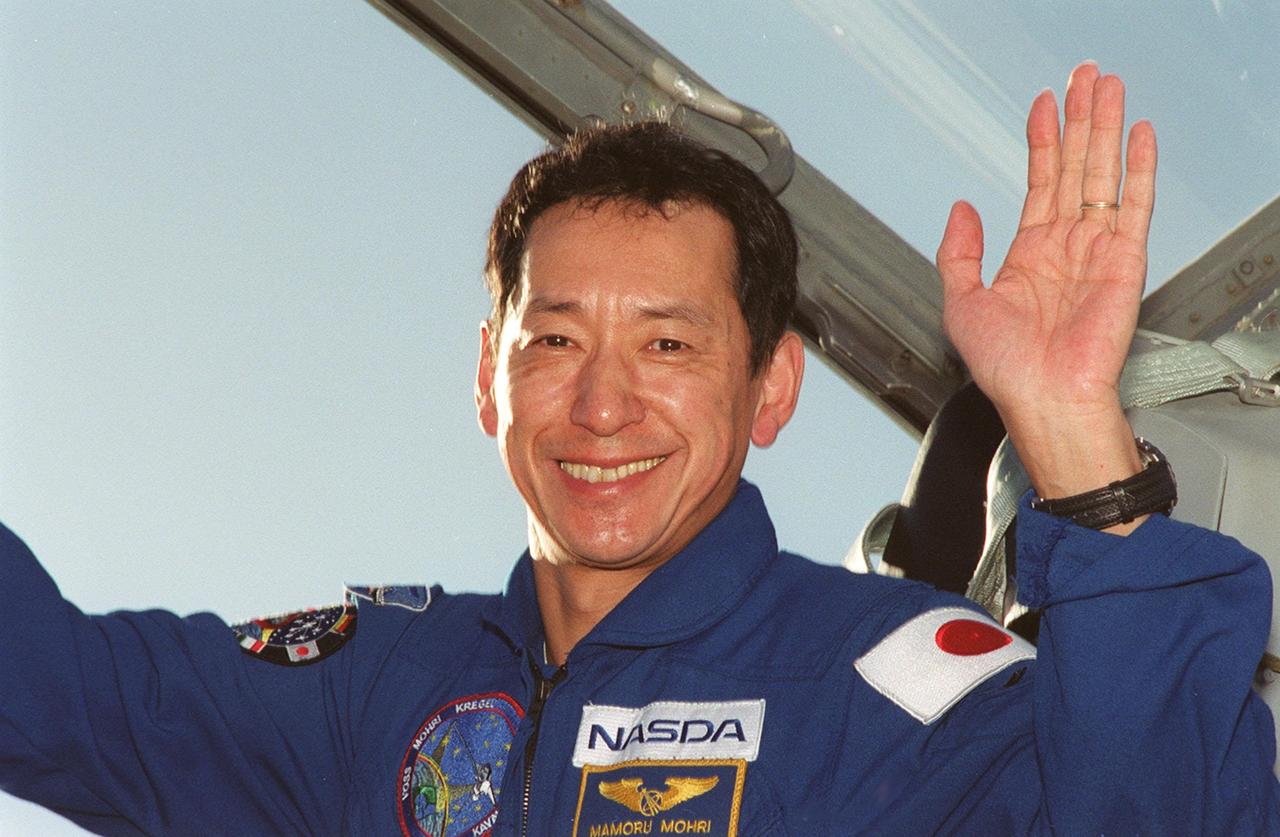
STS-99 Mission Specialist Mamoru Mohri, who is with the National Space Development Agency (NASDA) of Japan, waves after his arrival at KSC aboard a T-38 training jet aircraft to take part in a Terminal Countdown Demonstration Test (TCDT). The TCDT provides the crew with simulated countdown exercises, emergency egress training, and opportunities to inspect the mission payloads in the orbiter's payload bay. Other crew members taking part are Commander Kevin Kregel, Pilot Dominic L. Pudwill Gorie, and Mission Specialists Janet Lynn Kavandi (Ph.D.), Janice Voss (Ph.D.), and Gerhard P.J. Thiele, with the European Space Agency. STS-99 is the Shuttle Radar Topography Mission, which will chart a new course, using two antennae and a 200-foot-long section of space station-derived mast protruding from the payload bay to produce unrivaled 3-D images of the Earth's surface. The result of the Shuttle Radar Topography Mission could be close to 1 trillion measurements of the Earth's topography. Besides contributing to the production of better maps, these measurements could lead to improved water drainage modeling, more realistic flight simulators, better locations for cell phone towers, and enhanced navigation safety. Launch of Endeavour on the 11-day mission is scheduled for Jan. 31 at 12:47 p.m. EST
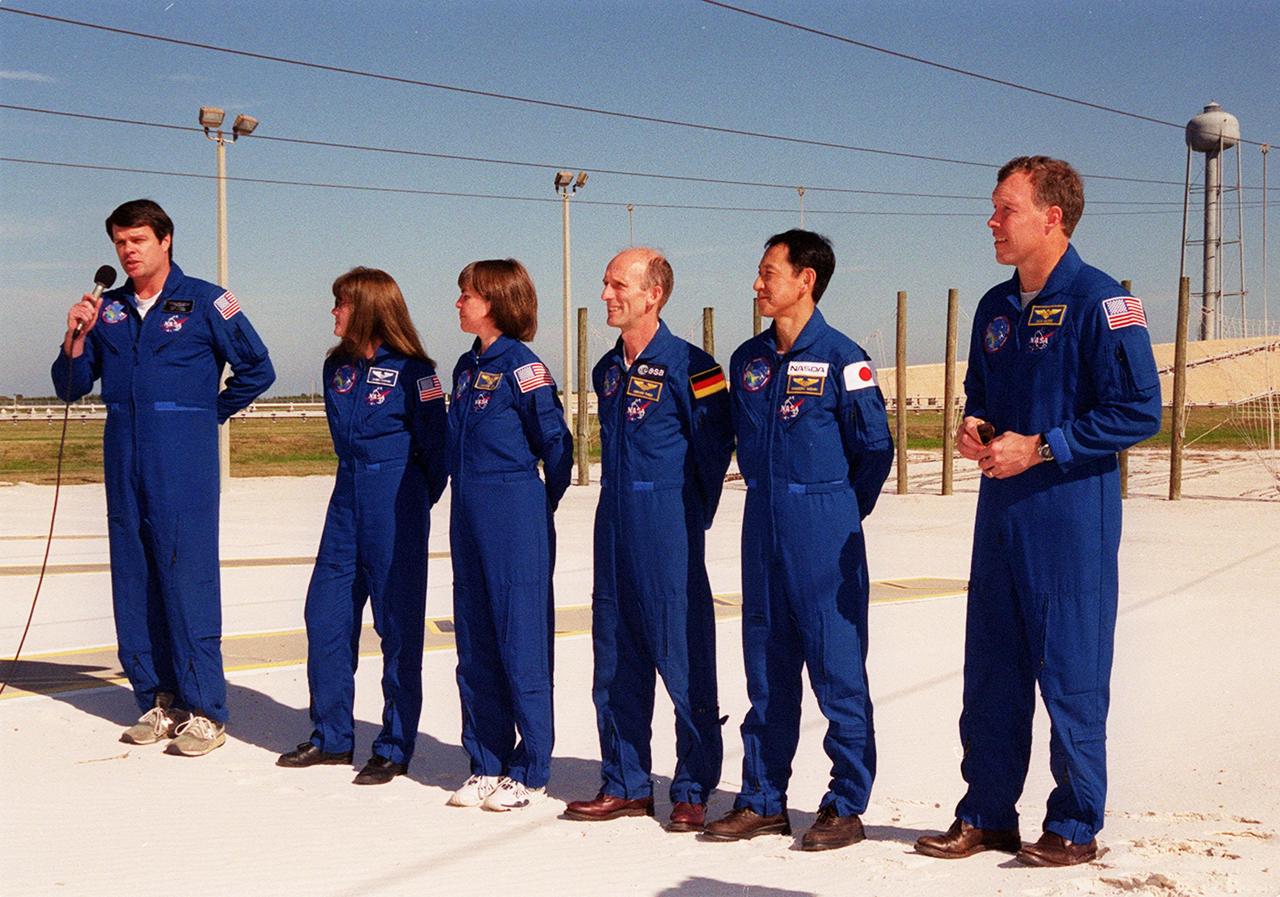
KENNEDY SPACE CENTER, Fla. -- The STS-99 crew take time out during Terminal Countdown Demonstration Test (TCDT) activities to talk to the media. From left to right are Commander Kevin Kregel, Mission Specialists Janet Lynn Kavandi (Ph.D.), Janice Voss (Ph.D.), Gerhard Thiele and Mamoru Mohri, and Pilot Dominic Gorie. Thiele is with the European Space Agency and Mohri is with the National Space Development Agency (NASDA) of Japan. The TCDT provides the crew with simulated countdown exercises, emergency egress training, and opportunities to inspect the mission payloads in the orbiter's payload bay. STS-99 is the Shuttle Radar Topography Mission, which will chart a new course, using two antennae and a 200-foot-long section of space station-derived mast protruding from the payload bay to produce unrivaled 3-D images of the Earth's surface. The result of the Shuttle Radar Topography Mission could be close to 1 trillion measurements of the Earth's topography. Besides contributing to the production of better maps, these measurements could lead to improved water drainage modeling, more realistic flight simulators, better locations for cell phone towers, and enhanced navigation safety. Launch of Endeavour on the 11-day mission is scheduled for Jan. 31 at 12:47 p.m. ES
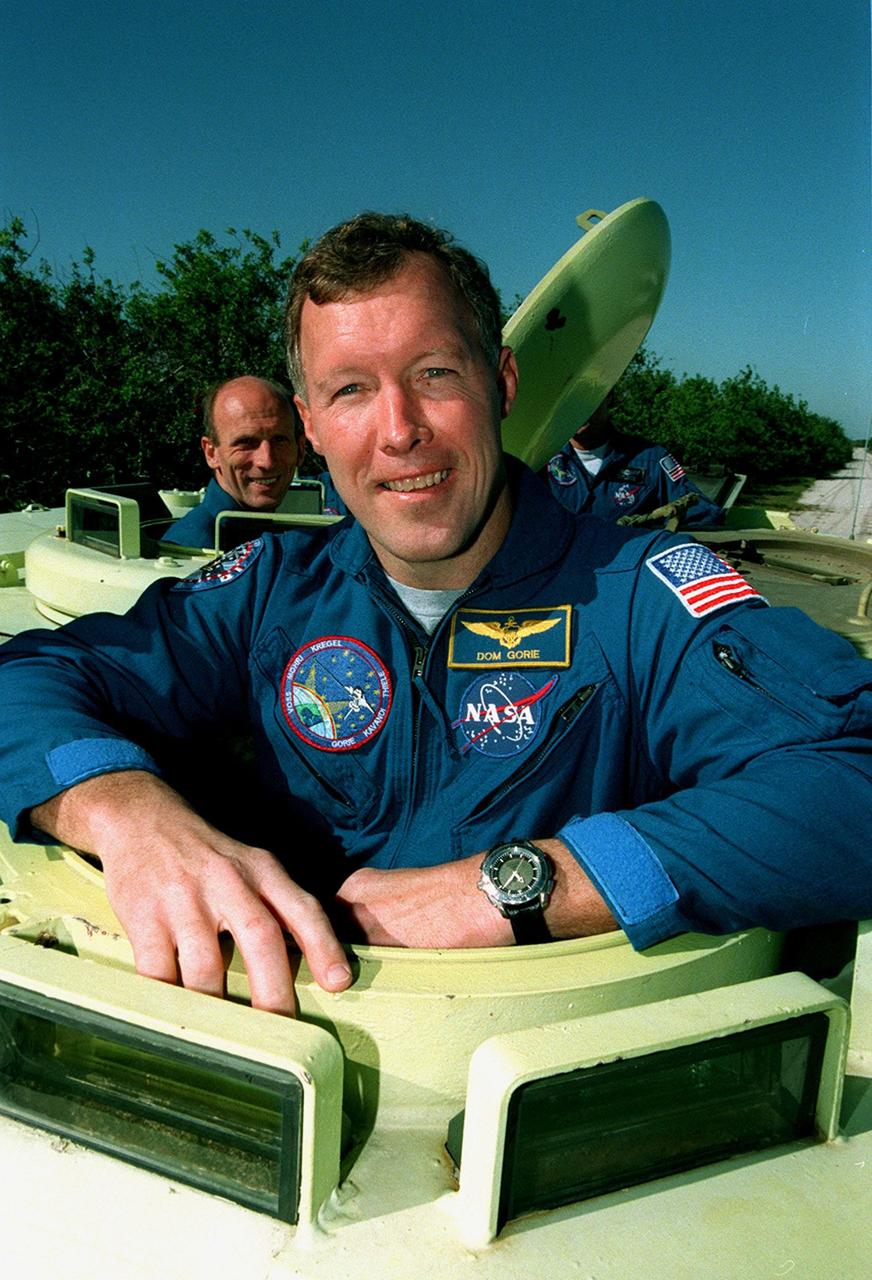
During Terminal Countdown Demonstration Test (TCDT) activities, STS-99 Pilot Dominic Gorie , is ready to practice driving an armored personnel carrier that is part of emergency egress training and could be used by the crew in the event of an emergency at the pad during which the crew must make a quick exit from the area. Behind him (left) is Mission Specialist Gerhard Thiele, who is with the European Space Agency. TCDT provides the crew with simulated countdown exercises, emergency egress training, and opportunities to inspect the mission payloads in the orbiter's payload bay. STS-99 is the Shuttle Radar Topography Mission, which will chart a new course, using two antennae and a 200-foot-long section of space station-derived mast protruding from the payload bay to produce unrivaled 3-D images of the Earth's surface. The result of the Shuttle Radar Topography Mission could be close to 1 trillion measurements of the Earth's topography. Besides contributing to the production of better maps, these measurements could lead to improved water drainage modeling, more realistic flight simulators, better locations for cell phone towers, and enhanced navigation safety. Launch of Endeavour on the 11-day mission is scheduled for Jan. 31 at 12:47 p.m. EST
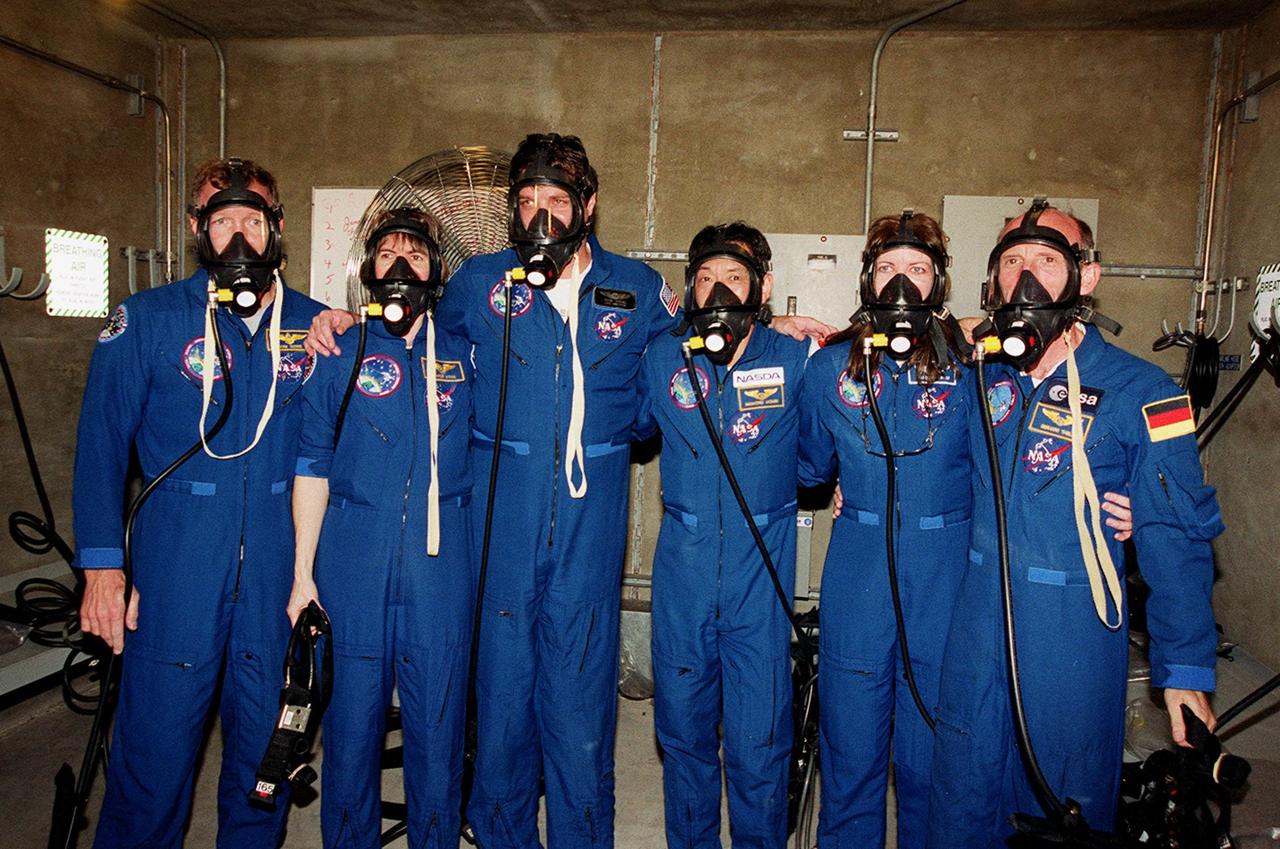
KENNEDY SPACE CENTER, Fla. -- In the bunker at Launch Pad 39A, the STS-99 crew try on oxygen masks. From left are Pilot Dominic Gorie, Mission Specialist Janice Voss (Ph.D.), Commander Kevin Kregel, and Mission Specialists Mamoru Mohri, Janet Lynn Kavandi (Ph.D.) and Gerhard Thiele. Mohri is with the National Space Development Agency (NASDA) of Japan and Thiele is with the European Space Agency. The crew are taking part in Terminal Countdown Demonstration Test activities, which provide them with simulated countdown exercises, emergency egress training, and opportunities to inspect the mission payloads in the orbiter's payload bay. STS-99 is the Shuttle Radar Topography Mission, which will chart a new course, using two antennae and a 200-foot-long section of space station-derived mast protruding from the payload bay to produce unrivaled 3-D images of the Earth's surface. The result of the Shuttle Radar Topography Mission could be close to 1 trillion measurements of the Earth's topography. Besides contributing to the production of better maps, these measurements could lead to improved water drainage modeling, more realistic flight simulators, better locations for cell phone towers, and enhanced navigation safety. Launch of Endeavour on the 11-day mission is scheduled for Jan. 31 at 12:47 p.m. EST
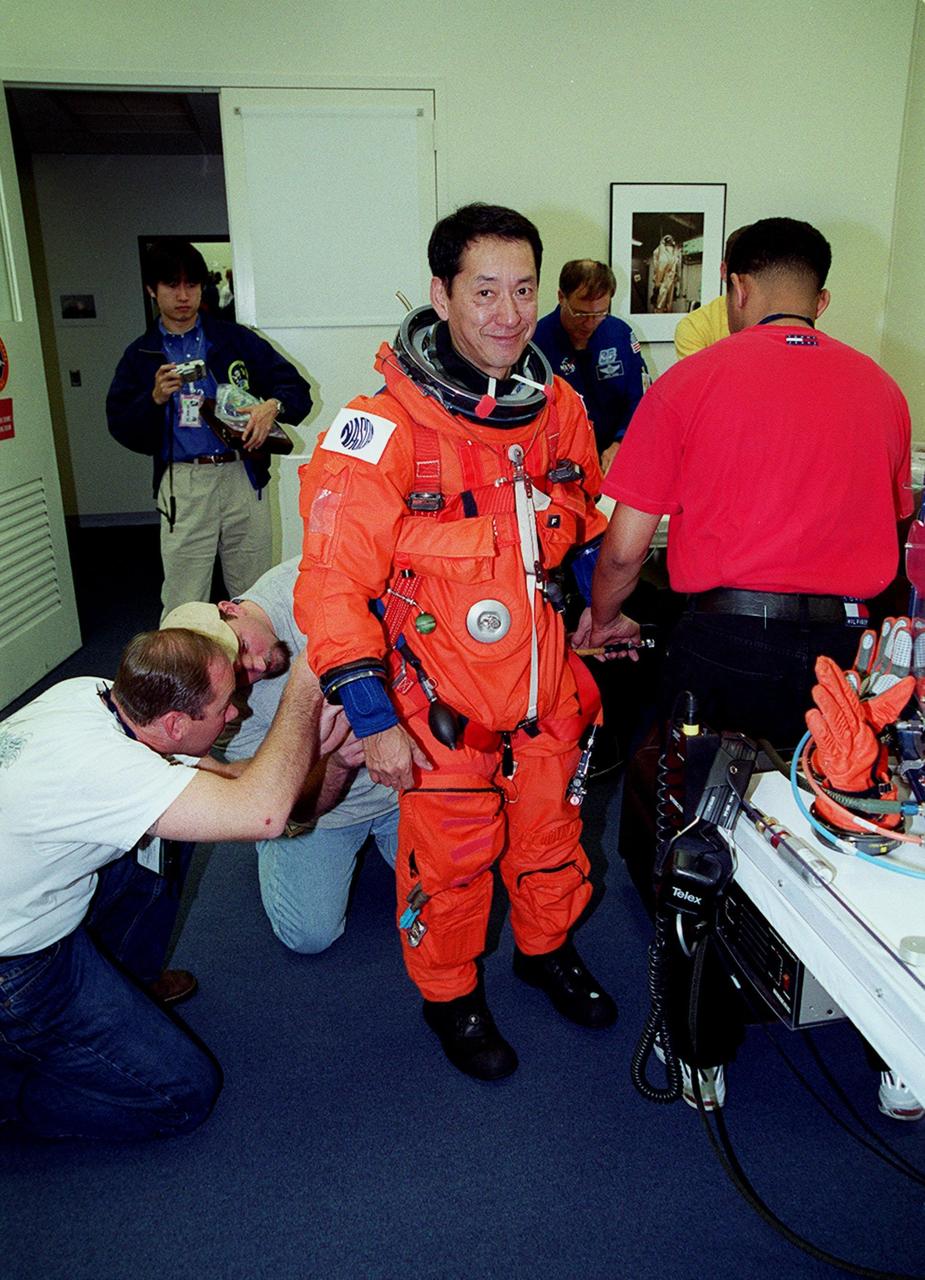
In the Operations and Checkout Building, STS-99 Mission Specialist Mamoru Mohri, who is with the National Space Development Agency (NASDA) of Japan, gets help from suit technicians during flight crew equipment fit check prior to his trip to Launch Pad 39A. The crew is taking part in Terminal Countdown Demonstration Test (TCDT) activities that provide the crew with simulated countdown exercises, emergency egress training, and opportunities to inspect the mission payloads in the orbiter's payload bay. STS-99 is the Shuttle Radar Topography Mission, which will chart a new course, using two antennae and a 200-foot-long section of space station-derived mast protruding from the payload bay to produce unrivaled 3-D images of the Earth's surface. The result of the Shuttle Radar Topography Mission could be close to 1 trillion measurements of the Earth's topography. Besides contributing to the production of better maps, these measurements could lead to improved water drainage modeling, more realistic flight simulators, better locations for cell phone towers, and enhanced navigation safety. Launch of Endeavour on the 11-day mission is scheduled for Jan. 31 at 12:47 p.m. EST
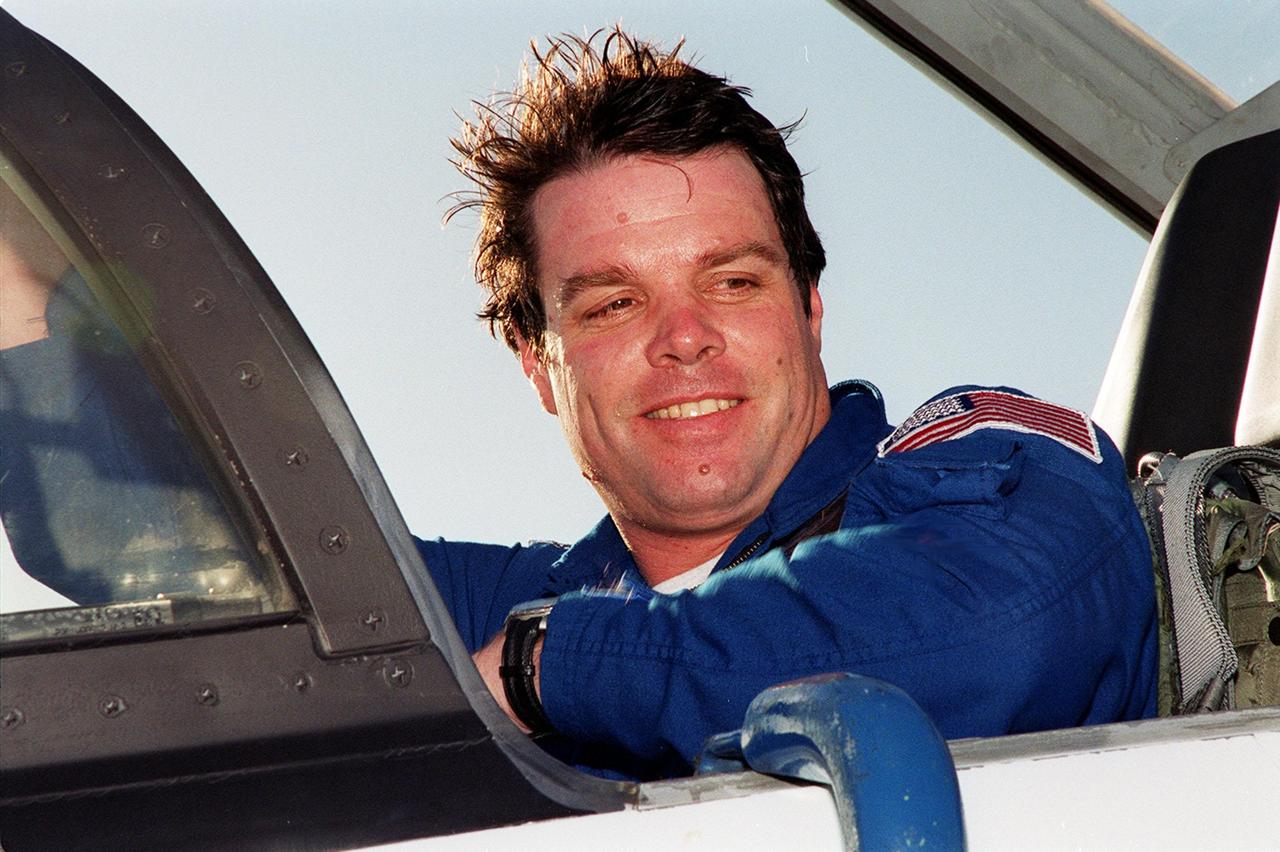
STS-99 Commander Kevin Kregel arrives at KSC's Shuttle Landing Facility aboard a T-38 training jet to take part in a Terminal Countdown Demonstration Test (TCDT). The TCDT provides the crew with simulated countdown exercises, emergency egress training, and opportunities to inspect the mission payloads in the orbiter's payload bay. Other crew members taking part are Pilot Dominic Gorie, and Mission Specialists Janet Lynn Kavandi (Ph.D.), Janice Voss (Ph.D.), Mamoru Mohri, who is with the National Space Development Agency (NASDA) of Japan, and Gerhard Thiele, who is with the European Space Agency. STS-99 is the Shuttle Radar Topography Mission, which will chart a new course, using two antennae and a 200-foot-long section of space station-derived mast protruding from the payload bay to produce unrivaled 3-D images of the Earth's surface. The result of the Shuttle Radar Topography Mission could be close to 1 trillion measurements of the Earth's topography. Besides contributing to the production of better maps, these measurements could lead to improved water drainage modeling, more realistic flight simulators, better locations for cell phone towers, and enhanced navigation safety. Launch of Endeavour on the 11-day mission is scheduled for Jan. 31 at 12:47 p.m. EST
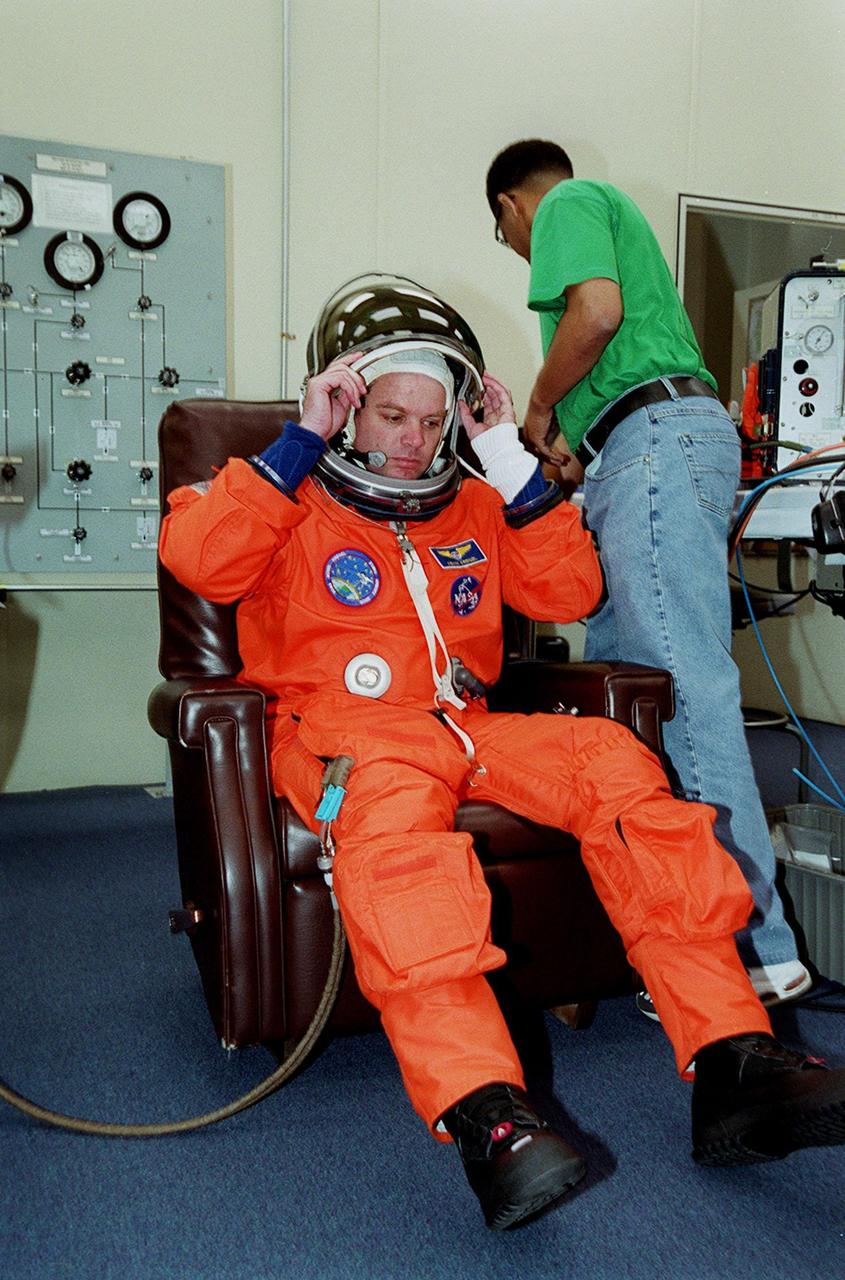
STS-99 Mission Commander Kevin Kregel suits up in the Operations and Checkout Building, as part of a flight crew equipment fit check, prior to his trip to Launch Pad 39A. The crew is taking part in Terminal Countdown Demonstration Test (TCDT) activities that provide the crew with simulated countdown exercises, emergency egress training, and opportunities to inspect the mission payloads in the orbiter's payload bay. STS-99 is the Shuttle Radar Topography Mission, which will chart a new course, using two antennae and a 200-foot-long section of space station-derived mast protruding from the payload bay to produce unrivaled 3-D images of the Earth's surface. The result of the Shuttle Radar Topography Mission could be close to 1 trillion measurements of the Earth's topography. Besides contributing to the production of better maps, these measurements could lead to improved water drainage modeling, more realistic flight simulators, better locations for cell phone towers, and enhanced navigation safety. Launch of Endeavour on the 11-day mission is scheduled for Jan. 31 at 12:47 p.m. EST
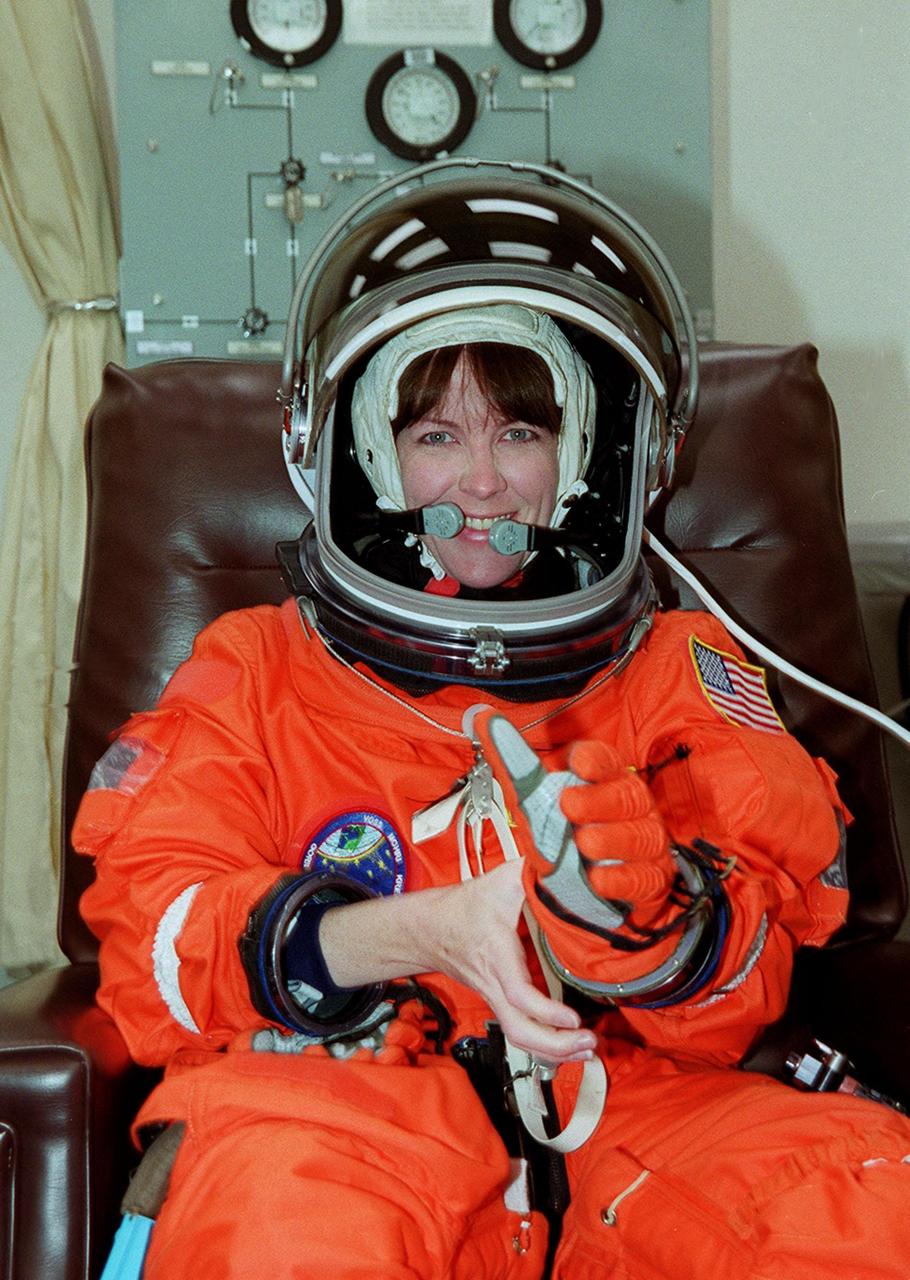
STS-99 Mission Specialist Janet Kavandi (Ph.D.) suits up in the Operations and Checkout Building, as part of a flight crew equipment fit check, prior to her trip to Launch Pad 39A. The crew is taking part in Terminal Countdown Demonstration Test (TCDT) activities that provide the crew with simulated countdown exercises, emergency egress training, and opportunities to inspect the mission payloads in the orbiter's payload bay. STS-99 is the Shuttle Radar Topography Mission, which will chart a new course, using two antennae and a 200-foot-long section of space station-derived mast protruding from the payload bay to produce unrivaled 3-D images of the Earth's surface. The result of the Shuttle Radar Topography Mission could be close to 1 trillion measurements of the Earth's topography. Besides contributing to the production of better maps, these measurements could lead to improved water drainage modeling, more realistic flight simulators, better locations for cell phone towers, and enhanced navigation safety. Launch of Endeavour on the 11-day mission is scheduled for Jan. 31 at 12:47 p.m. EST
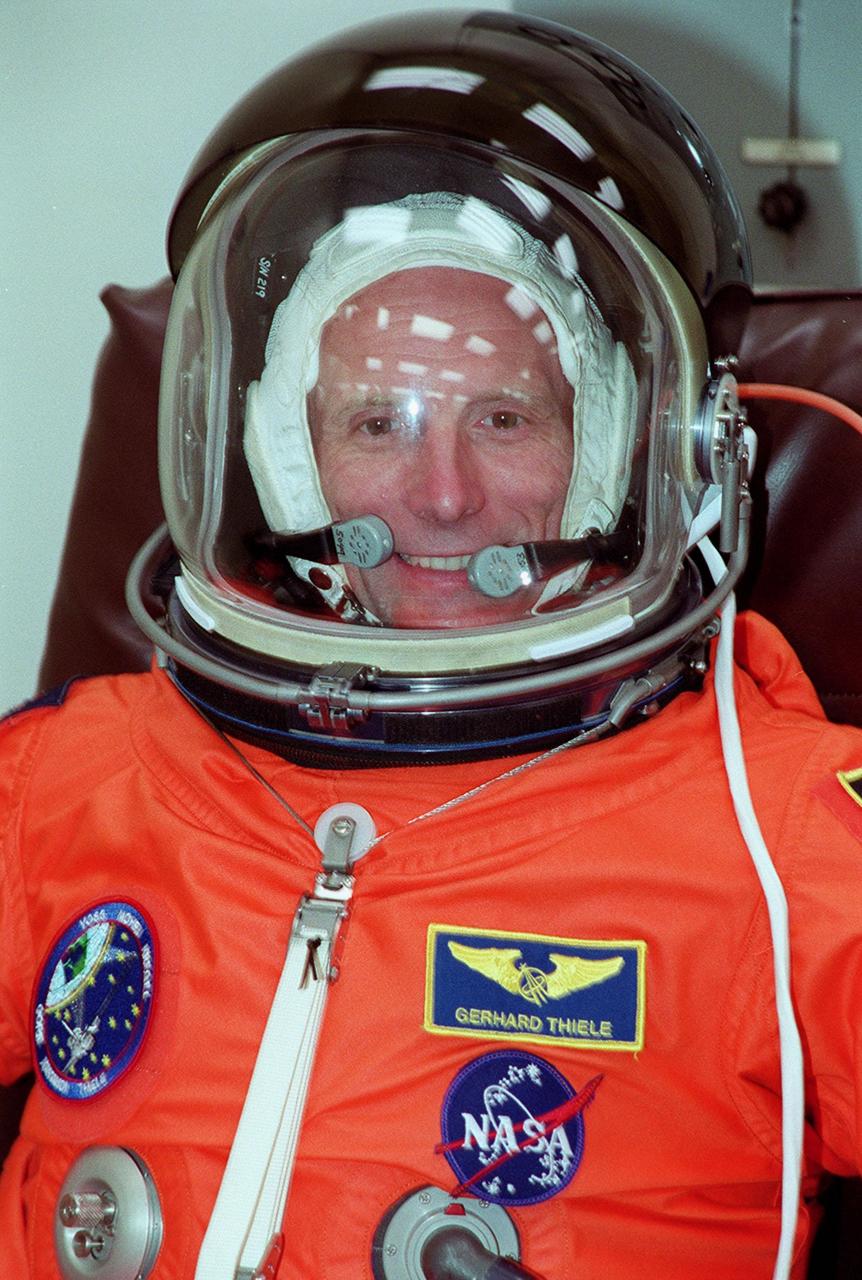
STS-99 Mission Specialist Gerhard Thiele, with the European Space Agency, suits up in the Operations and Checkout Building, as part of a flight crew equipment fit check, prior to his trip to Launch Pad 39A. The crew is taking part in Terminal Countdown Demonstration Test (TCDT) activities that provide the crew with simulated countdown exercises, emergency egress training, and opportunities to inspect the mission payloads in the orbiter's payload bay. STS-99 is the Shuttle Radar Topography Mission, which will chart a new course, using two antennae and a 200-foot-long section of space station-derived mast protruding from the payload bay to produce unrivaled 3-D images of the Earth's surface. The result of the Shuttle Radar Topography Mission could be close to 1 trillion measurements of the Earth's topography. Besides contributing to the production of better maps, these measurements could lead to improved water drainage modeling, more realistic flight simulators, better locations for cell phone towers, and enhanced navigation safety. Launch of Endeavour on the 11-day mission is scheduled for Jan. 31 at 12:47 p.m. EST
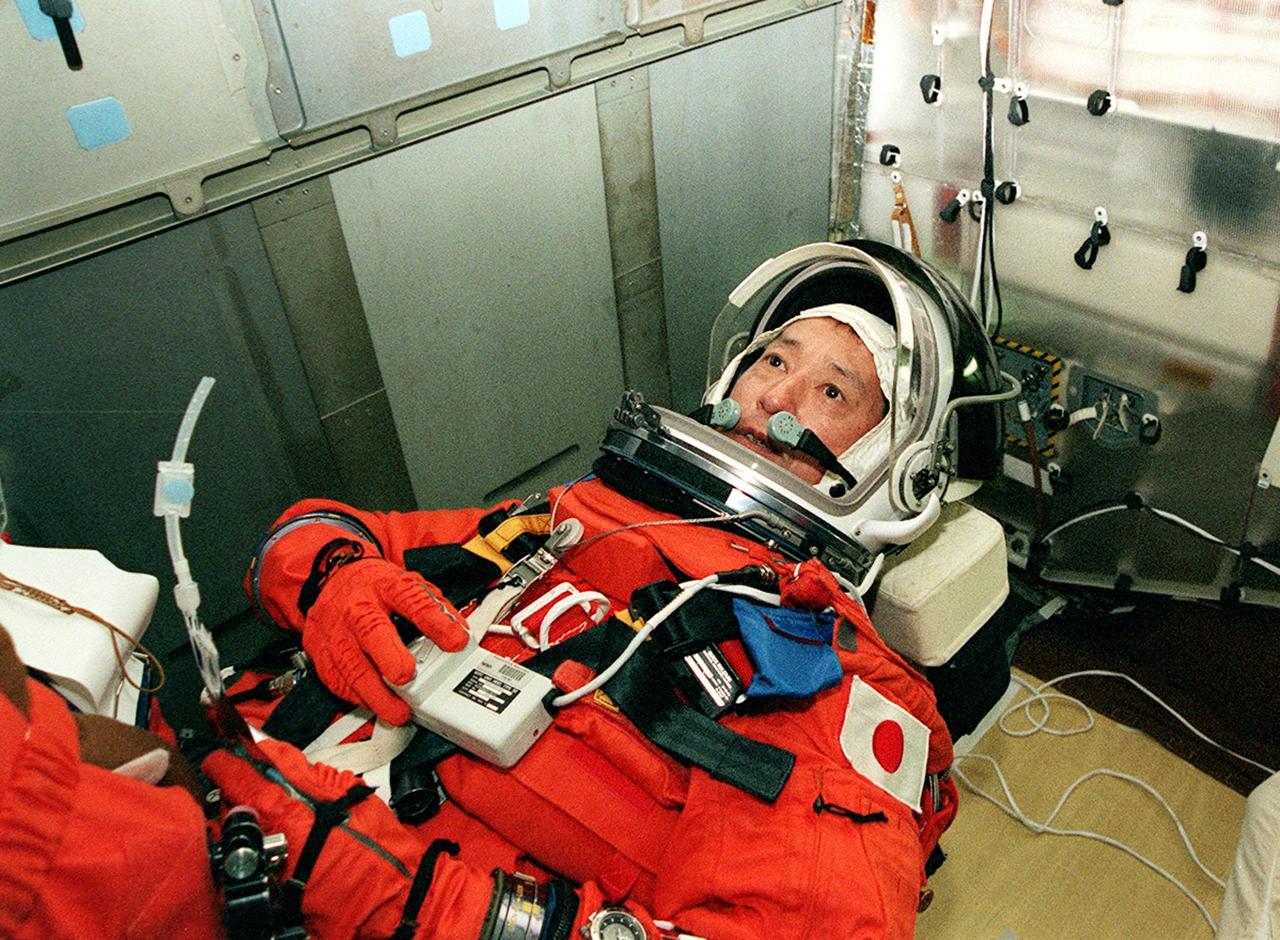
STS-99 Mission Specialist Mamoru Mohri (Ph.D.) takes his seat inside Space Shuttle Endeavour for a practice launch countdown during Terminal Countdown Demonstration Test (TCDT) activities for the mission. Mohri is with the National Space Development Agency (NASDA) of Japan. The TCDT includes a simulation of the final launch countdown. STS-99 is the Shuttle Radar Topography Mission, which will chart a new course, using two antennae and a 200-foot-long section of space station-derived mast protruding from the payload bay to produce unrivaled 3-D images of the Earth's surface. The result of the Shuttle Radar Topography Mission could be close to 1 trillion measurements of the Earth's topography. Besides contributing to the production of better maps, these measurements could lead to improved water drainage modeling, more realistic flight simulators, better locations for cell phone towers, and enhanced navigation safety. Launch of Endeavour on the 11-day mission is scheduled for Jan. 31 at 12:47 p.m. EST
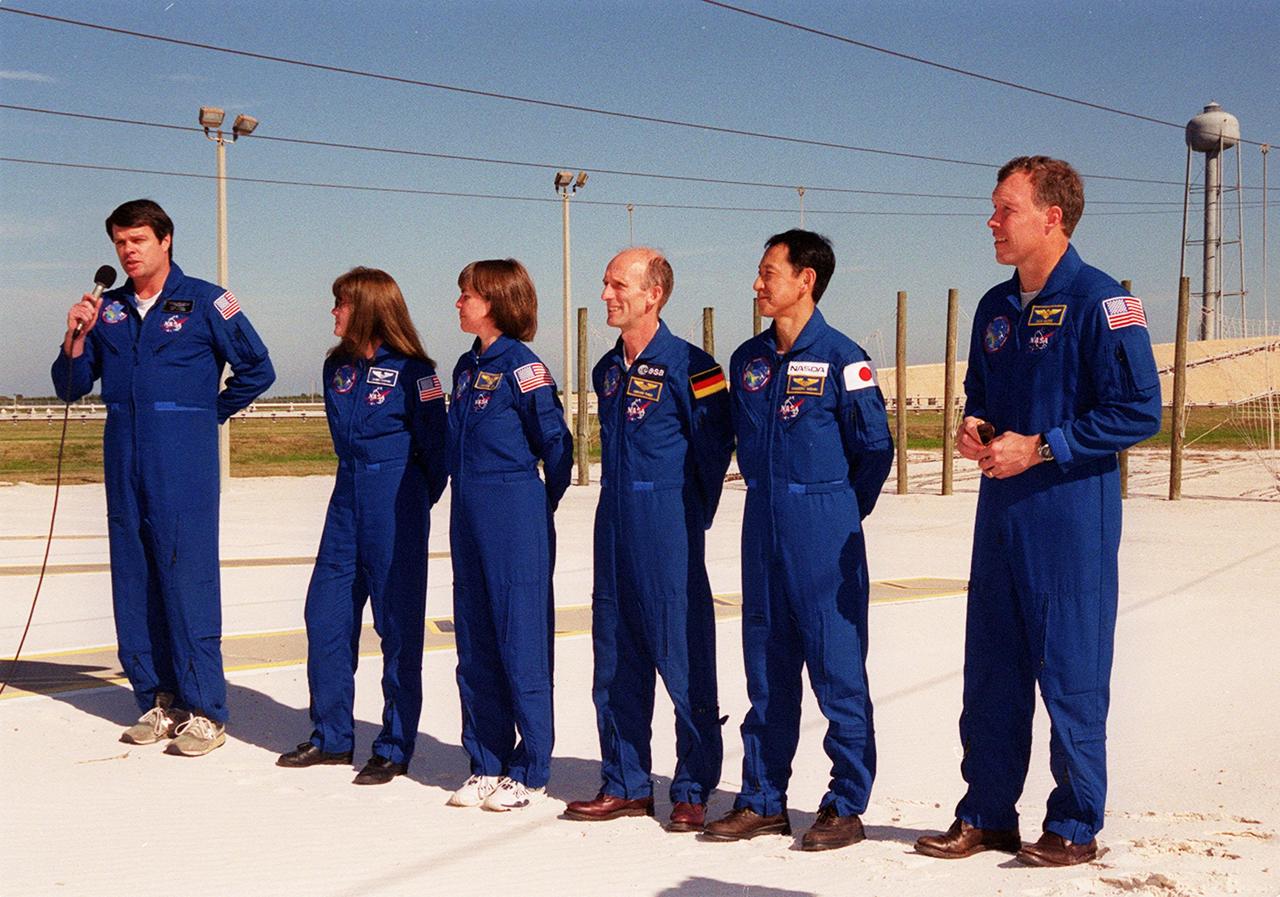
KENNEDY SPACE CENTER, Fla. -- The STS-99 crew take time out during Terminal Countdown Demonstration Test (TCDT) activities to talk to the media. From left to right are Commander Kevin Kregel, Mission Specialists Janet Lynn Kavandi (Ph.D.), Janice Voss (Ph.D.), Gerhard Thiele and Mamoru Mohri, and Pilot Dominic Gorie. Thiele is with the European Space Agency and Mohri is with the National Space Development Agency (NASDA) of Japan. The TCDT provides the crew with simulated countdown exercises, emergency egress training, and opportunities to inspect the mission payloads in the orbiter's payload bay. STS-99 is the Shuttle Radar Topography Mission, which will chart a new course, using two antennae and a 200-foot-long section of space station-derived mast protruding from the payload bay to produce unrivaled 3-D images of the Earth's surface. The result of the Shuttle Radar Topography Mission could be close to 1 trillion measurements of the Earth's topography. Besides contributing to the production of better maps, these measurements could lead to improved water drainage modeling, more realistic flight simulators, better locations for cell phone towers, and enhanced navigation safety. Launch of Endeavour on the 11-day mission is scheduled for Jan. 31 at 12:47 p.m. ES

KENNEDY SPACE CENTER, Fla. -- In the bunker at Launch Pad 39A, the STS-99 crew try on oxygen masks. From left are Pilot Dominic Gorie, Mission Specialist Janice Voss (Ph.D.), Commander Kevin Kregel, and Mission Specialists Mamoru Mohri, Janet Lynn Kavandi (Ph.D.) and Gerhard Thiele. Mohri is with the National Space Development Agency (NASDA) of Japan and Thiele is with the European Space Agency. The crew are taking part in Terminal Countdown Demonstration Test activities, which provide them with simulated countdown exercises, emergency egress training, and opportunities to inspect the mission payloads in the orbiter's payload bay. STS-99 is the Shuttle Radar Topography Mission, which will chart a new course, using two antennae and a 200-foot-long section of space station-derived mast protruding from the payload bay to produce unrivaled 3-D images of the Earth's surface. The result of the Shuttle Radar Topography Mission could be close to 1 trillion measurements of the Earth's topography. Besides contributing to the production of better maps, these measurements could lead to improved water drainage modeling, more realistic flight simulators, better locations for cell phone towers, and enhanced navigation safety. Launch of Endeavour on the 11-day mission is scheduled for Jan. 31 at 12:47 p.m. EST
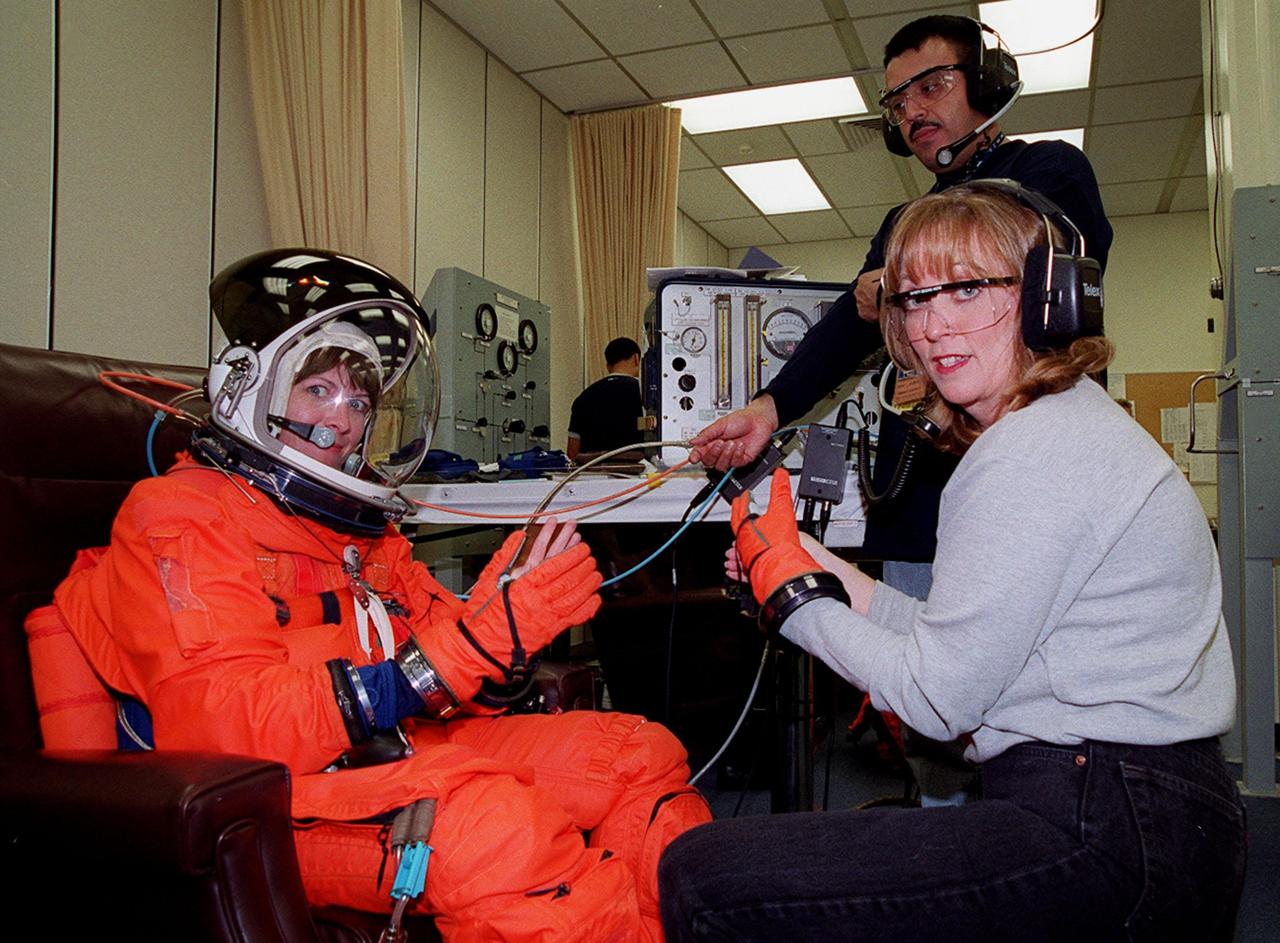
In the Operations and Checkout Building, STS-99 Mission Specialist Janet Lynn Kavandi (Ph.D.) is helped by a suit technician during flight crew equipment fit check prior to her trip to Launch Pad 39A. The crew is taking part in Terminal Countdown Demonstration Test (TCDT) activities that provide the crew with simulated countdown exercises, emergency egress training, and opportunities to inspect the mission payloads in the orbiter's payload bay. STS-99 is the Shuttle Radar Topography Mission, which will chart a new course, using two antennae and a 200-foot-long section of space station-derived mast protruding from the payload bay to produce unrivaled 3-D images of the Earth's surface. The result of the Shuttle Radar Topography Mission could be close to 1 trillion measurements of the Earth's topography. Besides contributing to the production of better maps, these measurements could lead to improved water drainage modeling, more realistic flight simulators, better locations for cell phone towers, and enhanced navigation safety. Launch of Endeavour on the 11-day mission is scheduled for Jan. 31 at 12:47 p.m. EST
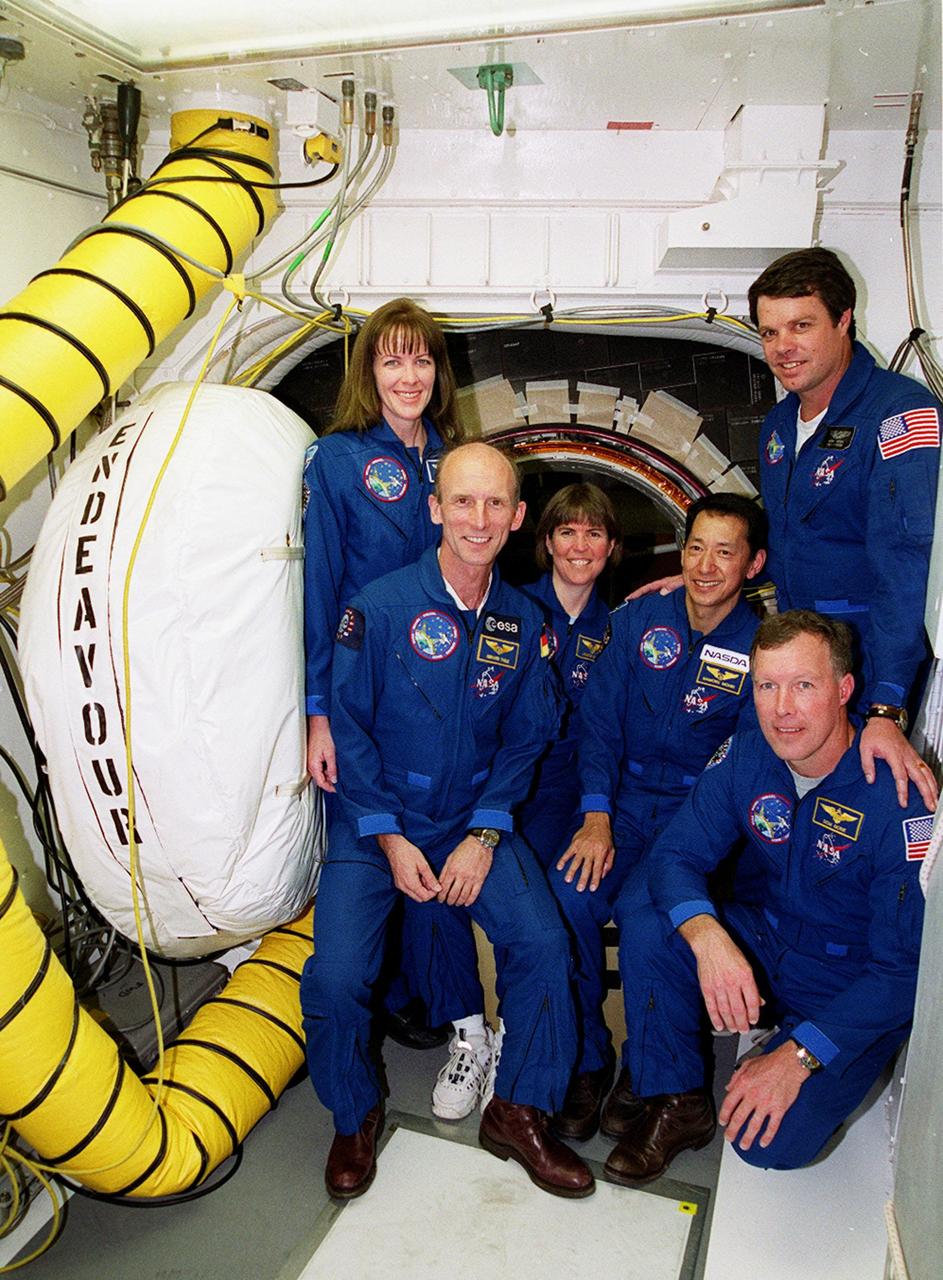
Inside the White Room attached to the Fixed Service Structure on Launch Pad 39A, the STS-99 crew pose at the entrance to the orbiter Endeavour. From left are Mission Specialists Janet Lynn Kavandi (Ph.D.), Gerhard Thiele, Janice Voss (Ph.D.) and Mamoru Mohri, Commander Kevin Kregel (standing) and Pilot Dominic Gorie (kneeling in front). Thiele is with the European Space Agency and Mohri is with the National Space Development Agency (NASDA) of Japan. The crew are taking part in Terminal Countdown Demonstration Test activities, which provide them with simulated countdown exercises, emergency egress training, and opportunities to inspect the mission payloads in the orbiter's payload bay. STS-99 is the Shuttle Radar Topography Mission, which will chart a new course, using two antennae and a 200-foot-long section of space station-derived mast protruding from the payload bay to produce unrivaled 3-D images of the Earth's surface. The result of the Shuttle Radar Topography Mission could be close to 1 trillion measurements of the Earth's topography. Besides contributing to the production of better maps, these measurements could lead to improved water drainage modeling, more realistic flight simulators, better locations for cell phone towers, and enhanced navigation safety. Launch of Endeavour on the 11-day mission is scheduled for Jan. 31 at 12:47 p.m. EST
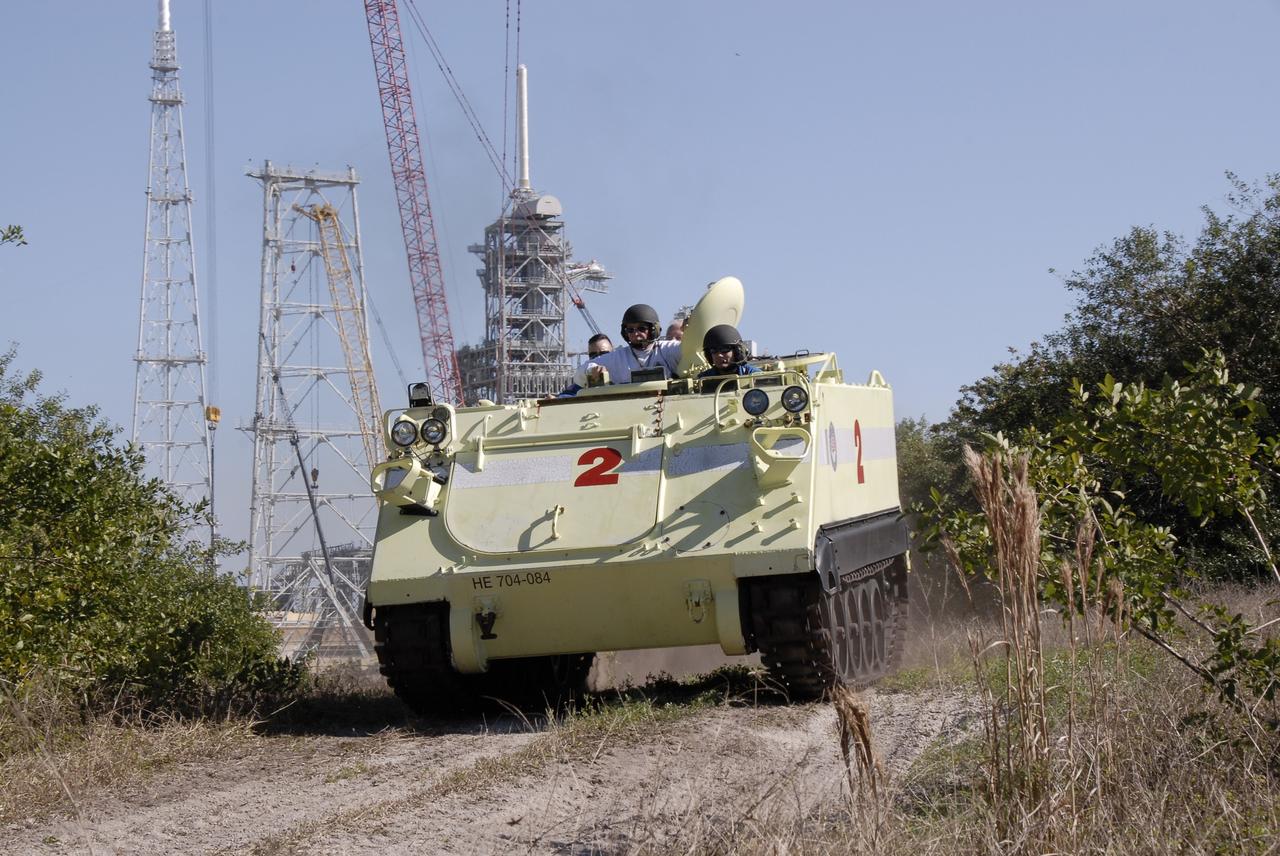
CAPE CANAVERAL, Fla. – At NASA's Kennedy Space Center in Florida, STS-119 Pilot Tony Antonelli drives the M-113 armored personnel carrier used for emergency escape, if needed, from the launch pad. Next to Antonelli is astronaut rescue team leader Capt. George Hoggard. Behind Hoggard is Commander Lee Archambault. At left of the path are the new lightning towers being constructed on Launch Pad 39B for the Constellation Program and behind is the fixed service structure with the 80-foot lightning mast on top. The crew members are at Kennedy for prelaunch preparation known as terminal countdown demonstration test, or TCDT. The training provides astronauts and ground crews with an opportunity to participate in various simulated countdown activities, including equipment familiarization and a simulated launch countdown. The crew of space shuttle Discovery is targeted to launch on the STS-119 mission Feb. 12. During Discovery's 14-day mission, the crew will install the S6 truss segment and solar arrays to the starboard side of the International Space Station, completing the station's truss, or backbone. Photo credit: NASA/Kim Shiflett
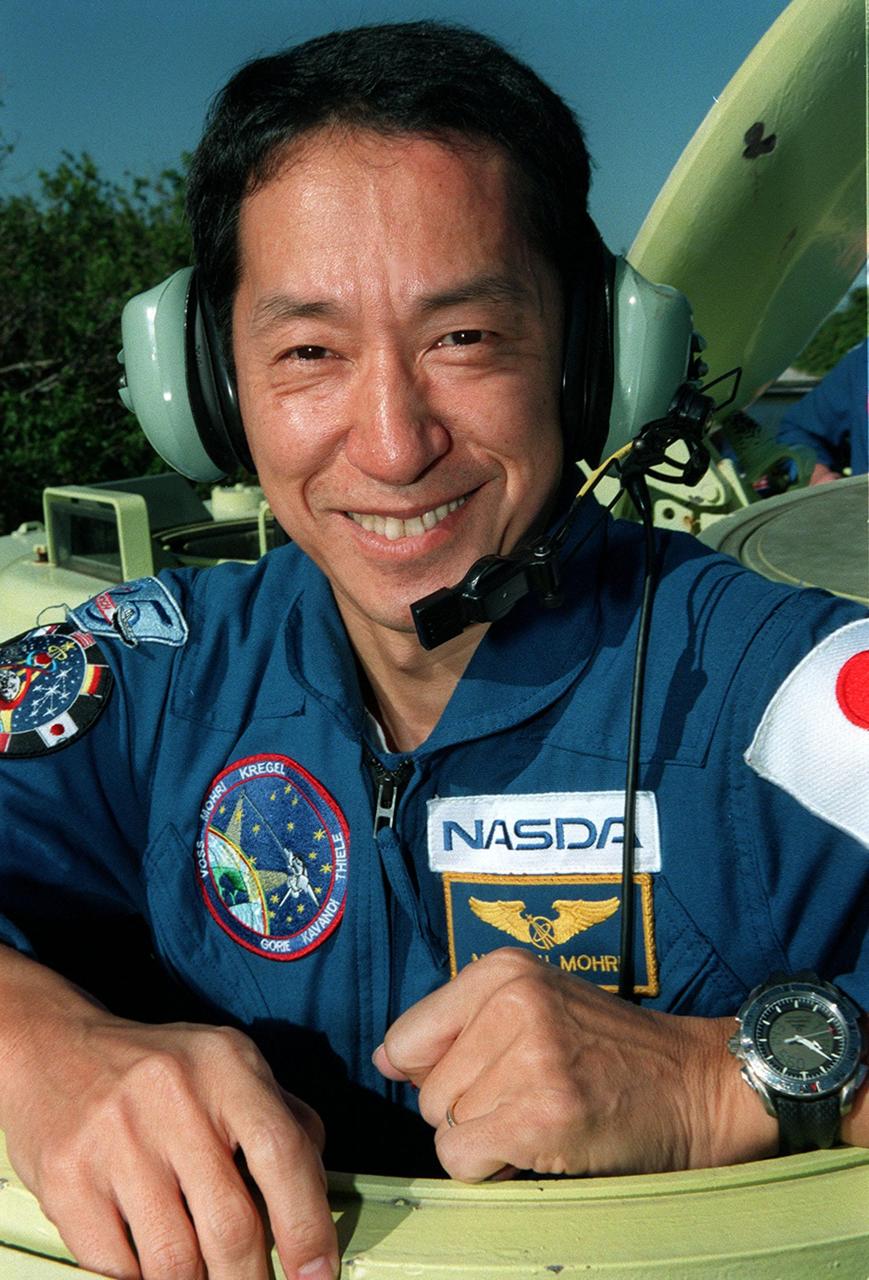
STS-99 Mission Specialist Mamoru Mohri, who is with the National Space Development Agency (NASDA) of Japan, smiles during training on the M-113, an armored personnel carrier that is part of emergency egress training during Terminal Countdown Demonstration Test (TCDT) activities. The tracked vehicle could be used by the crew in the event of an emergency at the pad during which the crew must make a quick exit from the area. TCDT provides the crew with simulated countdown exercises, emergency egress training, and opportunities to inspect the mission payloads in the orbiter's payload bay. STS-99 is the Shuttle Radar Topography Mission, which will chart a new course, using two antennae and a 200-foot-long section of space station-derived mast protruding from the payload bay to produce unrivaled 3-D images of the Earth's surface. The result of the Shuttle Radar Topography Mission could be close to 1 trillion measurements of the Earth's topography. Besides contributing to the production of better maps, these measurements could lead to improved water drainage modeling, more realistic flight simulators, better locations for cell phone towers, and enhanced navigation safety. Launch of Endeavour on the 11-day mission is scheduled for Jan. 31 at 12:47 p.m. EST

After their arrival at the Shuttle Landing Facility aboard T-38 training jet aircraft (background), the STS-99 crew talk to the media. From left are Mission Specialists Janice Voss (Ph.D.), Janet Lynn Kavandi (Ph.D.), Mamoru Mohri, who is with the National Space Development Agency (NASDA) of Japan, and Gerhard Thiele, with the European Space Agency, Commander Kevin Kregel (at microphone) and Pilot Dominic Gorie. The crew are here to take part in a Terminal Countdown Demonstration Test (TCDT), which provides simulated countdown exercises, emergency egress training, and opportunities to inspect the mission payloads in the orbiter's payload bay. STS-99 is the Shuttle Radar Topography Mission, which will chart a new course, using two antennae and a 200-foot-long section of space station-derived mast protruding from the payload bay to produce unrivaled 3-D images of the Earth's surface. The result of the Shuttle Radar Topography Mission could be close to 1 trillion measurements of the Earth's topography. Besides contributing to the production of better maps, these measurements could lead to improved water drainage modeling, more realistic flight simulators, better locations for cell phone towers, and enhanced navigation safety. Launch of Endeavour on the 11-day mission is scheduled for Jan. 31 at 12:47 p.m. EST

CAPE CANAVERAL, Fla. – As the sun rises on Launch Complex 37 at Cape Canaveral Air Force Station, preparations are under way to roll the mobile service tower from around the Boeing Delta IV rocket that will launch the GOES-O satellite into orbit. The terminal countdown to the liftoff of GOES-O will begin at 12:59 p.m. EDT for a launch window that extends from 6:14 p.m. to 7:14 p.m. June 26. The latest Geostationary Operational Environmental Satellite, GOES-O was developed by NASA for the National Oceanic and Atmospheric Administration, or NOAA. Each of the GOES satellites continuously provides observations of 60 percent of the Earth including the continental United States, providing weather monitoring and forecast operations as well as a continuous and reliable stream of environmental information and severe weather warnings. Once in orbit, GOES-O will be designated GOES-14, and NASA will provide on-orbit checkout and then transfer operational responsibility to NOAA. Photo credit: NASA/Jack Pfaller
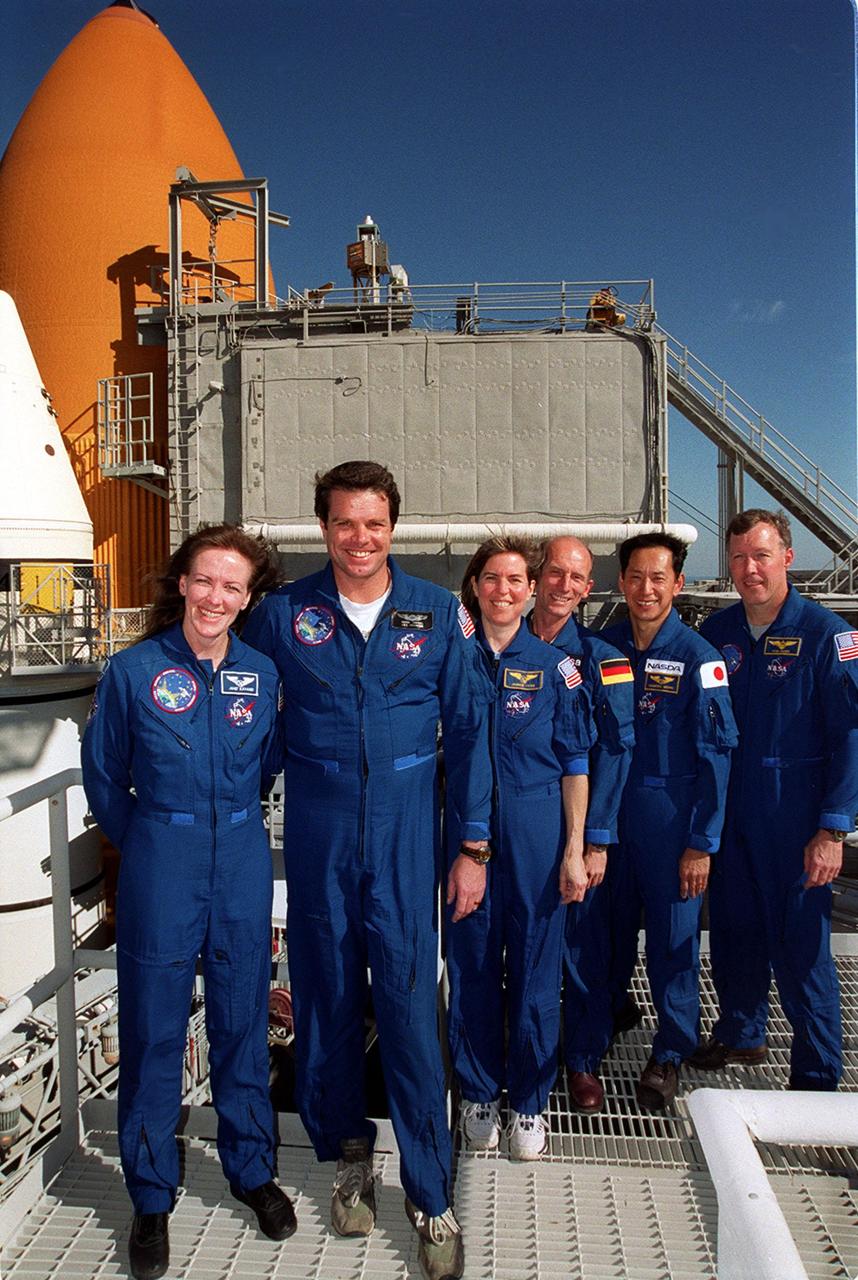
KENNEDY SPACE CENTER, Fla. -- At the 167-foot level of the Fixed Service Structure on Launch Pad 39A, the STS-99 crew pose for a photograph during Terminal Countdown Demonstration Test (TCDT) activities. Standing left to right are Mission Specialist Janet Lynn Kavandi (Ph.D.), Commander Kevin Kregel, Mission Specialists Janice Voss (Ph.D.), Gerhard Thiele and Mamoru Mohri, and Pilot Dominic Gorie. Thiele is with the European Space Agency and Mohri is with the National Space Development Agency (NASDA) of Japan. Behind them (left) are visible the top of a solid rocket booster (white) and external tank (orange). The TCDT provides the crew with simulated countdown exercises, emergency egress training, and opportunities to inspect the mission payloads in the orbiter's payload bay. STS-99 is the Shuttle Radar Topography Mission, which will chart a new course, using two antennae and a 200-foot-long section of space station-derived mast protruding from the payload bay to produce unrivaled 3-D images of the Earth's surface. The result of the Shuttle Radar Topography Mission could be close to 1 trillion measurements of the Earth's topography. Besides contributing to the production of better maps, these measurements could lead to improved water drainage modeling, more realistic flight simulators, better locations for cell phone towers, and enhanced navigation safety. Launch of Endeavour on the 11-day mission is scheduled for Jan. 31 at 12:47 p.m. EST

KENNEDY SPACE CENTER, Fla. -- At the 167-foot level of the Fixed Service Structure on Launch Pad 39A, the STS-99 crew pose for a photograph during Terminal Countdown Demonstration Test (TCDT) activities. Standing left to right are Mission Specialist Janet Lynn Kavandi (Ph.D.), Commander Kevin Kregel, Mission Specialists Janice Voss (Ph.D.), Gerhard Thiele and Mamoru Mohri, and Pilot Dominic Gorie. Thiele is with the European Space Agency and Mohri is with the National Space Development Agency (NASDA) of Japan. Behind them are visible the top of a solid rocket booster (white) and external tank (orange). The TCDT provides the crew with simulated countdown exercises, emergency egress training, and opportunities to inspect the mission payloads in the orbiter's payload bay. STS-99 is the Shuttle Radar Topography Mission, which will chart a new course, using two antennae and a 200-foot-long section of space station-derived mast protruding from the payload bay to produce unrivaled 3-D images of the Earth's surface. The result of the Shuttle Radar Topography Mission could be close to 1 trillion measurements of the Earth's topography. Besides contributing to the production of better maps, these measurements could lead to improved water drainage modeling, more realistic flight simulators, better locations for cell phone towers, and enhanced navigation safety. Launch of Endeavour on the 11-day mission is scheduled for Jan. 31 at 12:47 p.m. EST
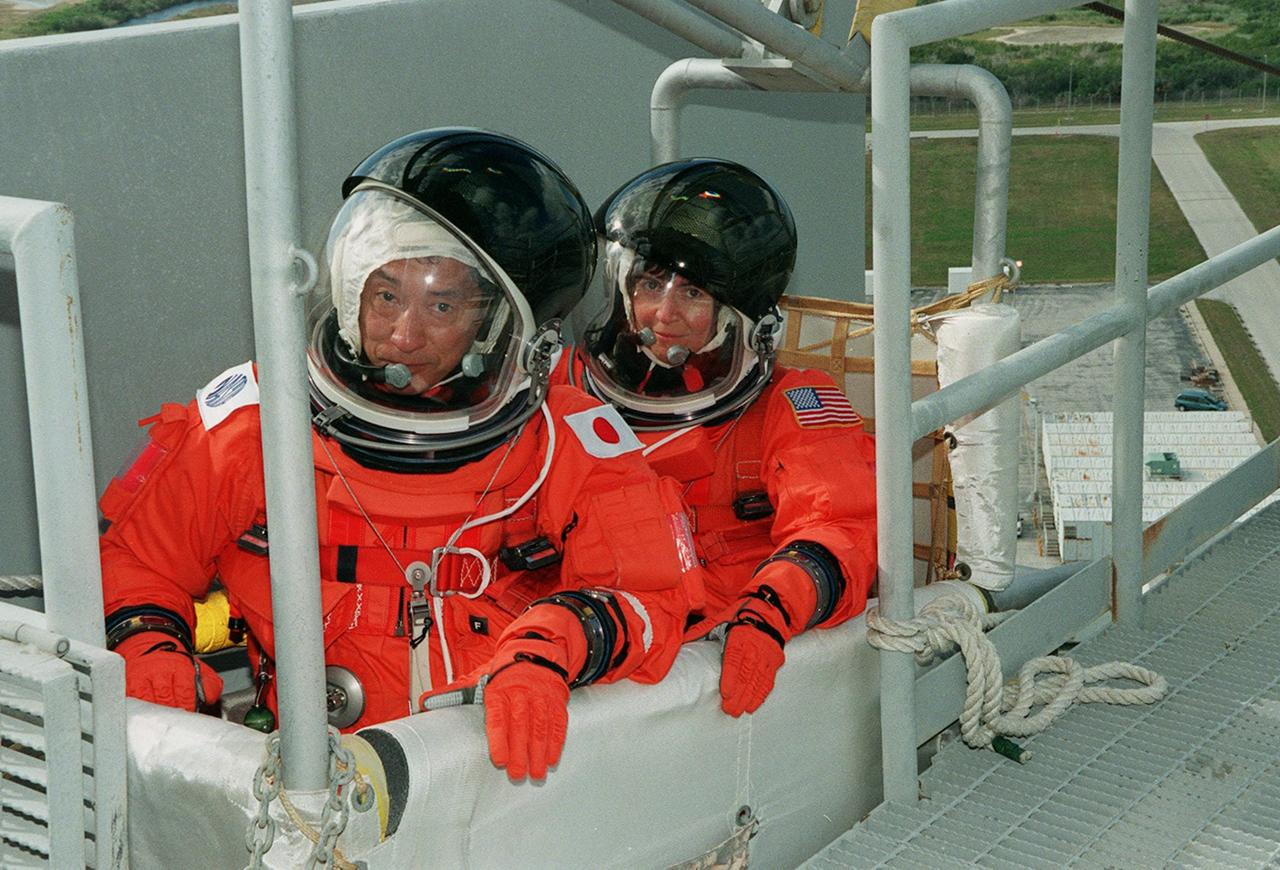
KENNEDY SPACE CENTER, Fla. -- At Launch Pad 39A, STS-99 Mission Specialists Mamoru Mohri (Ph.D.), who is with the National Space Development Agency (NASDA) of Japan, and Janice Voss (Ph.D.) practice emergency egress procedures in a slidewire basket. Seven slidewires, with flatbottom baskets suspended from each wire, extend from the Fixed Service Structure at the orbiter access arm level. These baskets could provide an escape route for the astronauts until the final 30 seconds of the countdown in case of an emergency. The crew is taking part in Terminal Countdown Demonstration Test (TCDT) activities that provide the crew with simulated countdown exercises, emergency egress training, and opportunities to inspect the mission payloads in the orbiter's payload bay. STS-99 is the Shuttle Radar Topography Mission, which will chart a new course, using two antennae and a 200-foot-long section of space station-derived mast protruding from the payload bay to produce unrivaled 3-D images of the Earth's surface. The result of the Shuttle Radar Topography Mission could be close to 1 trillion measurements of the Earth's topography. Besides contributing to the production of better maps, these measurements could lead to improved water drainage modeling, more realistic flight simulators, better locations for cell phone towers, and enhanced navigation safety. Launch of Endeavour on the 11-day mission is scheduled for Jan. 31 at 12:47 p.m. EST
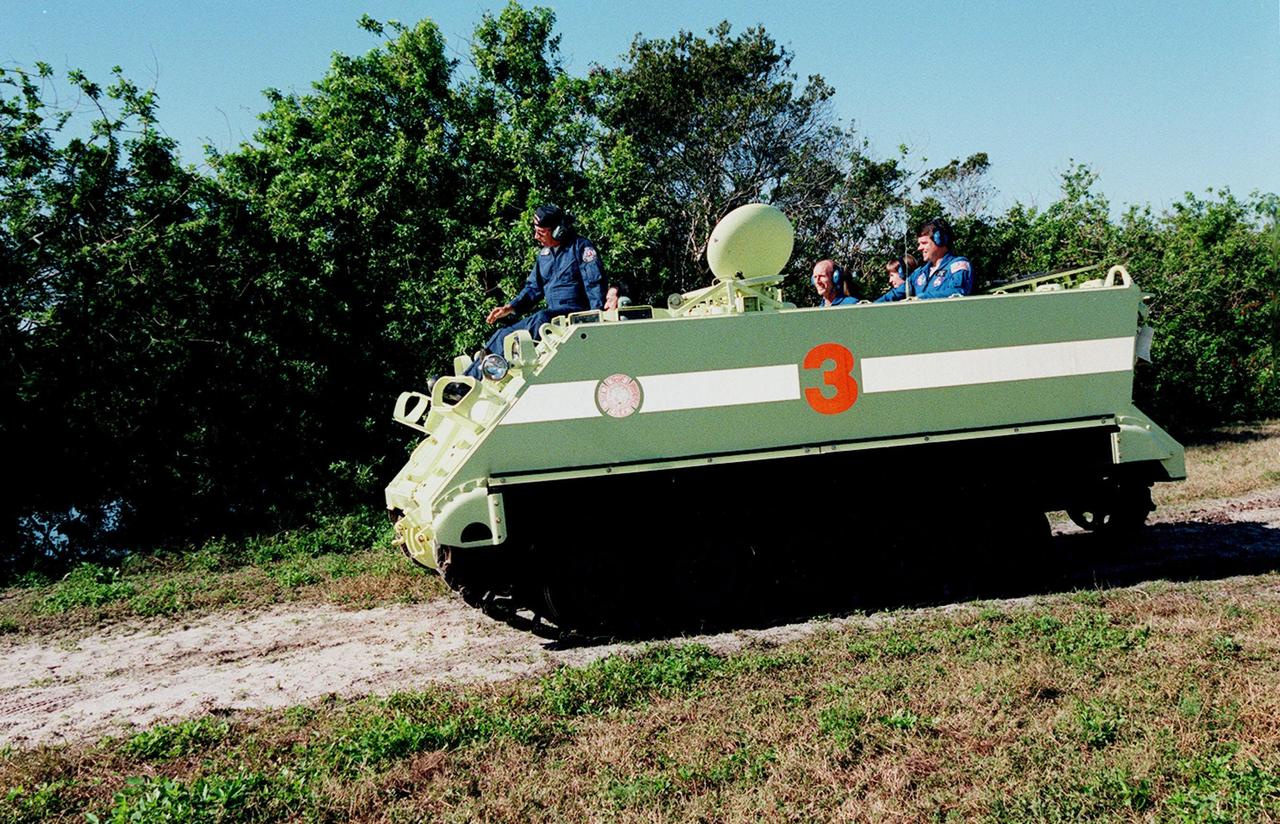
STS-99 Mission Specialist Mamoru Mohri, who is with the National Space Development Agency (NASDA) of Japan, practices driving an armored personnel carrier under the watchful eye of Capt. George Hoggard (riding on the front), trainer with the KSC Fire Department. The vehicle is part of emergency egress training during Terminal Countdown Demonstration Test (TCDT) activities and could be used by the crew in the event of an emergency at the pad during which the crew must make a quick exit from the area. Riding in the rear of the carrier are Mission Specialists Gerhard Thiele (center), Janice Voss (Ph.D.), and Commander Kevin Kregel. TCDT provides the crew with simulated countdown exercises, emergency egress training, and opportunities to inspect the mission payloads in the orbiter's payload bay. STS-99 is the Shuttle Radar Topography Mission, which will chart a new course, using two antennae and a 200-foot-long section of space station-derived mast protruding from the payload bay to produce unrivaled 3-D images of the Earth's surface. The result of the Shuttle Radar Topography Mission could be close to 1 trillion measurements of the Earth's topography. Besides contributing to the production of better maps, these measurements could lead to improved water drainage modeling, more realistic flight simulators, better locations for cell phone towers, and enhanced navigation safety. Launch of Endeavour on the 11-day mission is scheduled for Jan. 31 at 12:47 p.m. EST
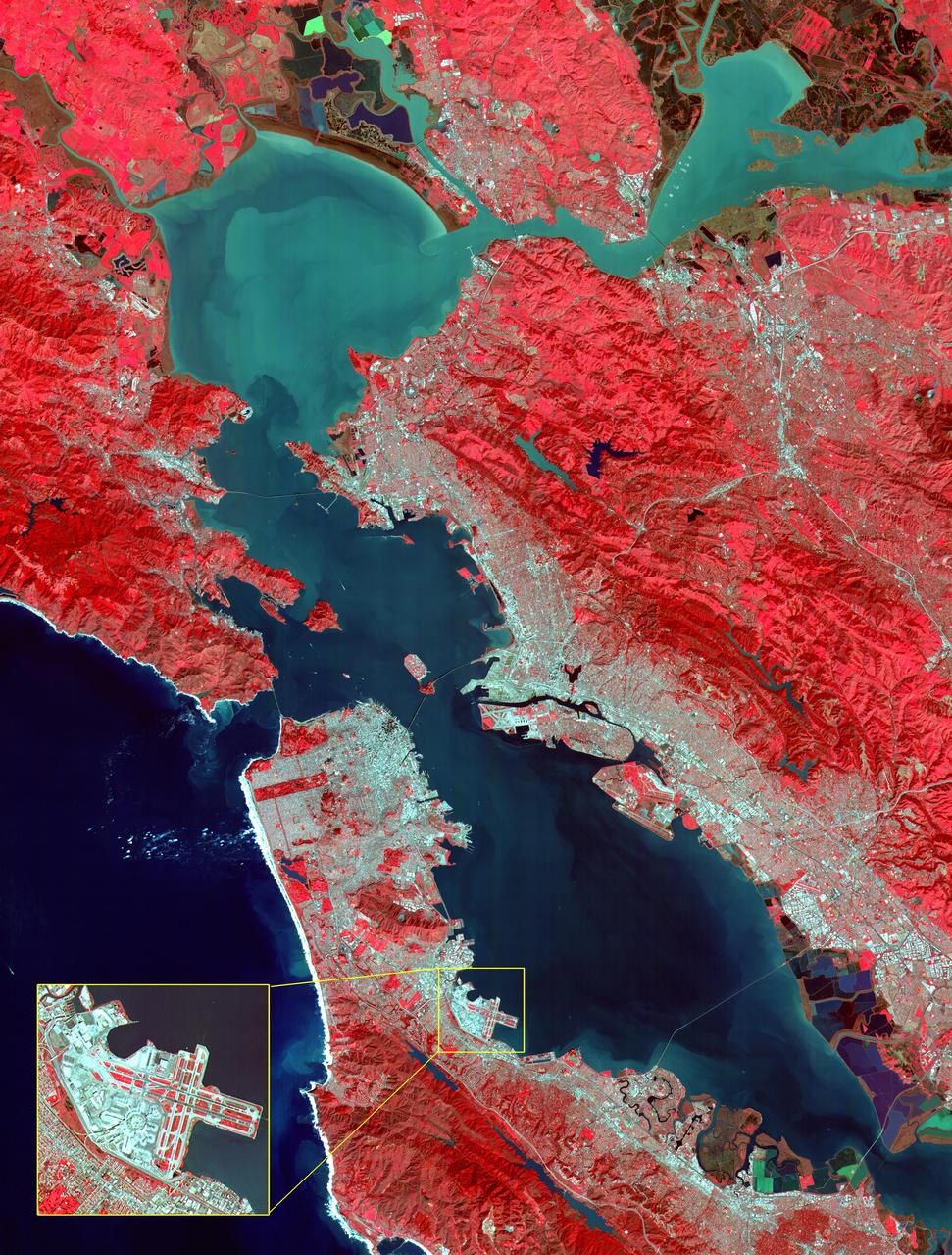
This image of the San Francisco Bay region was acquired on March 3, 2000 by the Advanced Spaceborne Thermal Emission and Reflection Radiometer (ASTER) on NASA's Terra satellite. With its 14 spectral bands from the visible to the thermal infrared wavelength region, and its high spatial resolution of 15 to 90 meters about 50 to 300 feet ), ASTER will image Earth for the next 6 years to map and monitor the changing surface of our planet. Image: This image covers an area 60 kilometers (37 miles) wide and 75 kilometers (47 miles) long in three bands of the reflected visible and infrared wavelength region. The combination of bands portrays vegetation in red, and urban areas in gray. Sediment in the Suisun Bay, San Pablo Bay, San Francisco Bay, and the Pacific Ocean shows up as lighter shades of blue. Along the west coast of the San Francisco Peninsula, strong surf can be seen as a white fringe along the shoreline. A powerful rip tide is visible extending westward from Daly City into the Pacific Ocean. In the lower right corner, the wetlands of the South San Francisco Bay National Wildlife Refuge appear as large dark blue and brown polygons. The high spatial resolution of ASTER allows fine detail to be observed in the scene. The main bridges of the area (San Mateo, San Francisco-Oakland Bay, Golden Gate, Richmond-San Rafael, Benicia-Martinez, and Carquinez) are easily picked out, connecting the different communities in the Bay area. Shadows of the towers along the Bay Bridge can be seen over the adjacent bay water. With enlargement the entire road network can be easily mapped; individual buildings are visible, including the shadows of the high-rises in downtown San Francisco. Inset: This enlargement of the San Francisco Airport highlights the high spatial resolution of ASTER. With further enlargement and careful examination, airplanes can be seen at the terminals. http://photojournal.jpl.nasa.gov/catalog/PIA02606
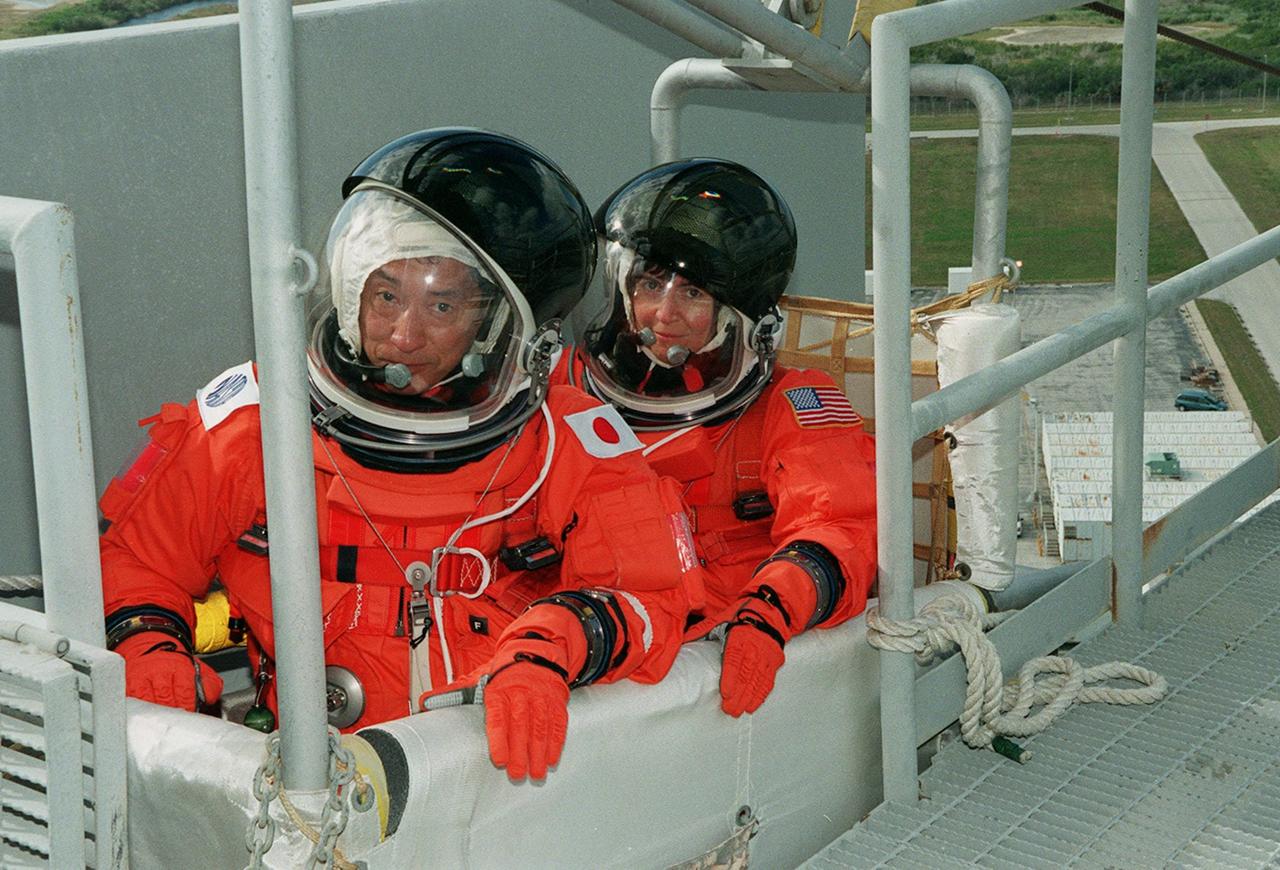
KENNEDY SPACE CENTER, Fla. -- At Launch Pad 39A, STS-99 Mission Specialists Mamoru Mohri (Ph.D.), who is with the National Space Development Agency (NASDA) of Japan, and Janice Voss (Ph.D.) practice emergency egress procedures in a slidewire basket. Seven slidewires, with flatbottom baskets suspended from each wire, extend from the Fixed Service Structure at the orbiter access arm level. These baskets could provide an escape route for the astronauts until the final 30 seconds of the countdown in case of an emergency. The crew is taking part in Terminal Countdown Demonstration Test (TCDT) activities that provide the crew with simulated countdown exercises, emergency egress training, and opportunities to inspect the mission payloads in the orbiter's payload bay. STS-99 is the Shuttle Radar Topography Mission, which will chart a new course, using two antennae and a 200-foot-long section of space station-derived mast protruding from the payload bay to produce unrivaled 3-D images of the Earth's surface. The result of the Shuttle Radar Topography Mission could be close to 1 trillion measurements of the Earth's topography. Besides contributing to the production of better maps, these measurements could lead to improved water drainage modeling, more realistic flight simulators, better locations for cell phone towers, and enhanced navigation safety. Launch of Endeavour on the 11-day mission is scheduled for Jan. 31 at 12:47 p.m. EST
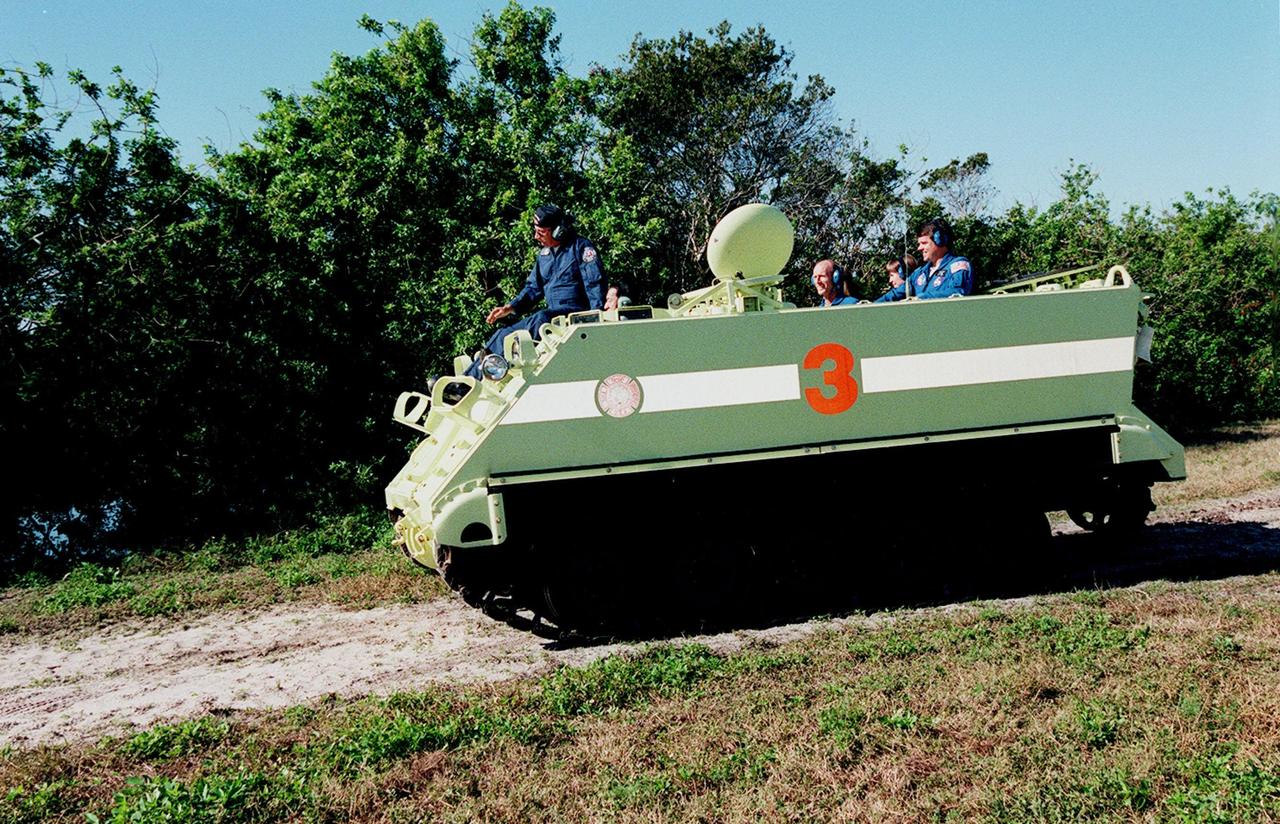
STS-99 Mission Specialist Mamoru Mohri, who is with the National Space Development Agency (NASDA) of Japan, practices driving an armored personnel carrier under the watchful eye of Capt. George Hoggard (riding on the front), trainer with the KSC Fire Department. The vehicle is part of emergency egress training during Terminal Countdown Demonstration Test (TCDT) activities and could be used by the crew in the event of an emergency at the pad during which the crew must make a quick exit from the area. Riding in the rear of the carrier are Mission Specialists Gerhard Thiele (center), Janice Voss (Ph.D.), and Commander Kevin Kregel. TCDT provides the crew with simulated countdown exercises, emergency egress training, and opportunities to inspect the mission payloads in the orbiter's payload bay. STS-99 is the Shuttle Radar Topography Mission, which will chart a new course, using two antennae and a 200-foot-long section of space station-derived mast protruding from the payload bay to produce unrivaled 3-D images of the Earth's surface. The result of the Shuttle Radar Topography Mission could be close to 1 trillion measurements of the Earth's topography. Besides contributing to the production of better maps, these measurements could lead to improved water drainage modeling, more realistic flight simulators, better locations for cell phone towers, and enhanced navigation safety. Launch of Endeavour on the 11-day mission is scheduled for Jan. 31 at 12:47 p.m. EST
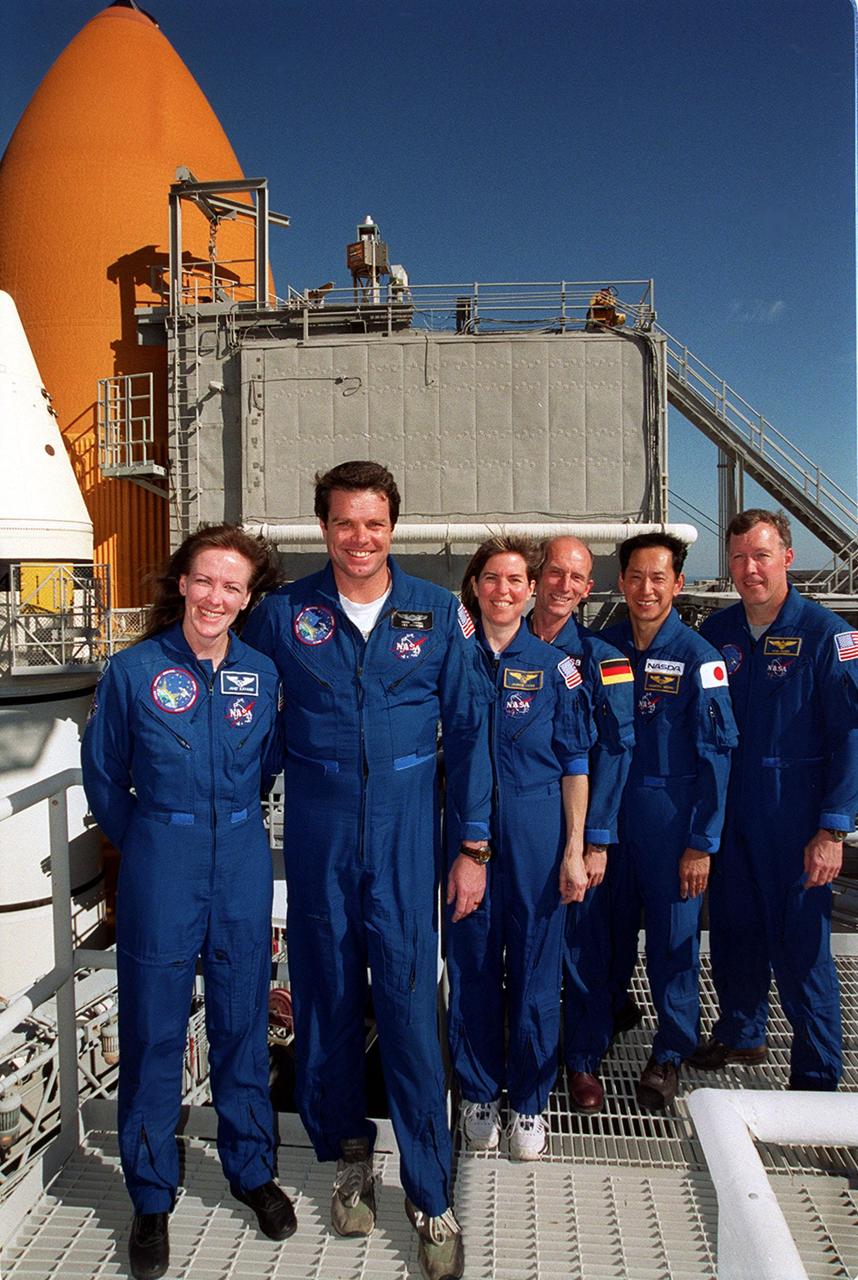
KENNEDY SPACE CENTER, Fla. -- At the 167-foot level of the Fixed Service Structure on Launch Pad 39A, the STS-99 crew pose for a photograph during Terminal Countdown Demonstration Test (TCDT) activities. Standing left to right are Mission Specialist Janet Lynn Kavandi (Ph.D.), Commander Kevin Kregel, Mission Specialists Janice Voss (Ph.D.), Gerhard Thiele and Mamoru Mohri, and Pilot Dominic Gorie. Thiele is with the European Space Agency and Mohri is with the National Space Development Agency (NASDA) of Japan. Behind them (left) are visible the top of a solid rocket booster (white) and external tank (orange). The TCDT provides the crew with simulated countdown exercises, emergency egress training, and opportunities to inspect the mission payloads in the orbiter's payload bay. STS-99 is the Shuttle Radar Topography Mission, which will chart a new course, using two antennae and a 200-foot-long section of space station-derived mast protruding from the payload bay to produce unrivaled 3-D images of the Earth's surface. The result of the Shuttle Radar Topography Mission could be close to 1 trillion measurements of the Earth's topography. Besides contributing to the production of better maps, these measurements could lead to improved water drainage modeling, more realistic flight simulators, better locations for cell phone towers, and enhanced navigation safety. Launch of Endeavour on the 11-day mission is scheduled for Jan. 31 at 12:47 p.m. EST
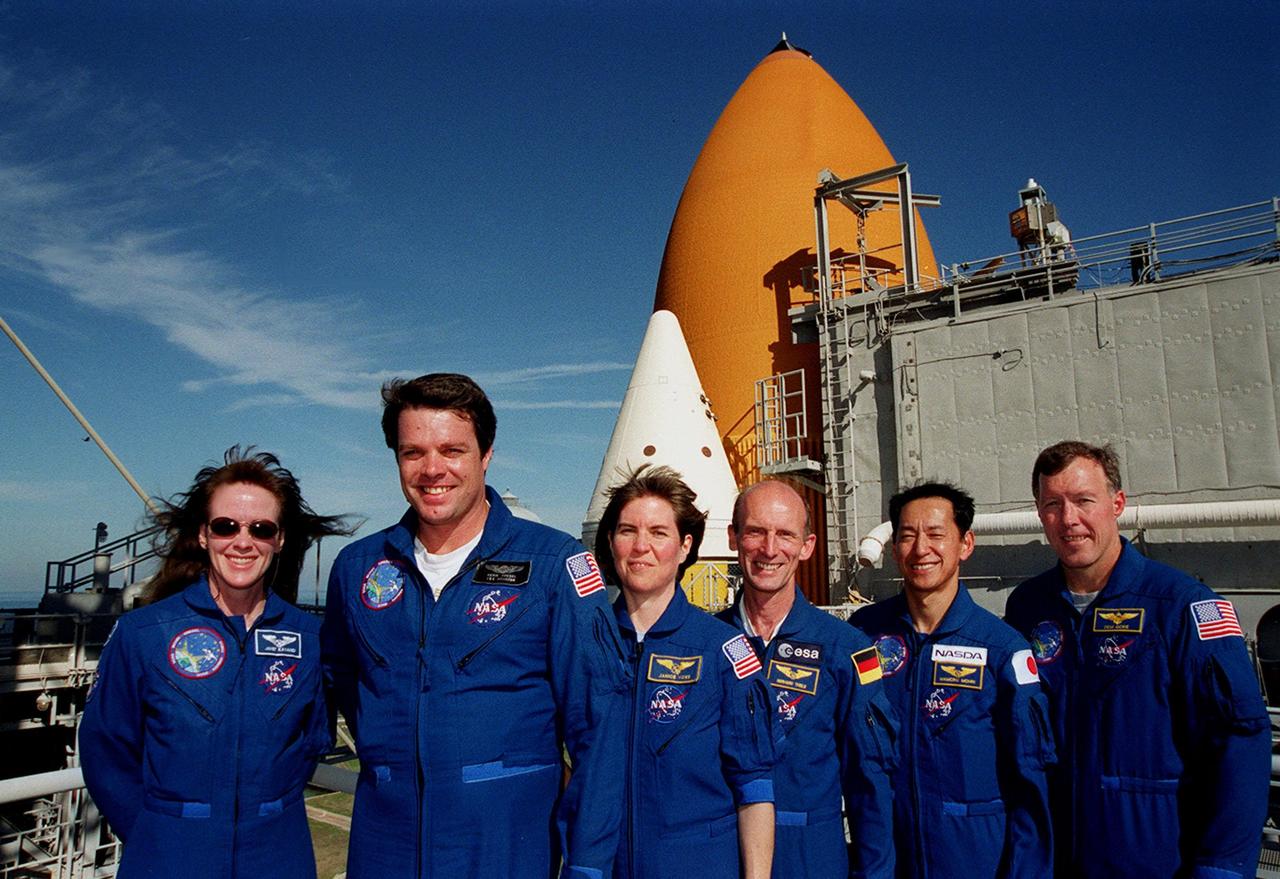
KENNEDY SPACE CENTER, Fla. -- At the 167-foot level of the Fixed Service Structure on Launch Pad 39A, the STS-99 crew pose for a photograph during Terminal Countdown Demonstration Test (TCDT) activities. Standing left to right are Mission Specialist Janet Lynn Kavandi (Ph.D.), Commander Kevin Kregel, Mission Specialists Janice Voss (Ph.D.), Gerhard Thiele and Mamoru Mohri, and Pilot Dominic Gorie. Thiele is with the European Space Agency and Mohri is with the National Space Development Agency (NASDA) of Japan. Behind them are visible the top of a solid rocket booster (white) and external tank (orange). The TCDT provides the crew with simulated countdown exercises, emergency egress training, and opportunities to inspect the mission payloads in the orbiter's payload bay. STS-99 is the Shuttle Radar Topography Mission, which will chart a new course, using two antennae and a 200-foot-long section of space station-derived mast protruding from the payload bay to produce unrivaled 3-D images of the Earth's surface. The result of the Shuttle Radar Topography Mission could be close to 1 trillion measurements of the Earth's topography. Besides contributing to the production of better maps, these measurements could lead to improved water drainage modeling, more realistic flight simulators, better locations for cell phone towers, and enhanced navigation safety. Launch of Endeavour on the 11-day mission is scheduled for Jan. 31 at 12:47 p.m. EST
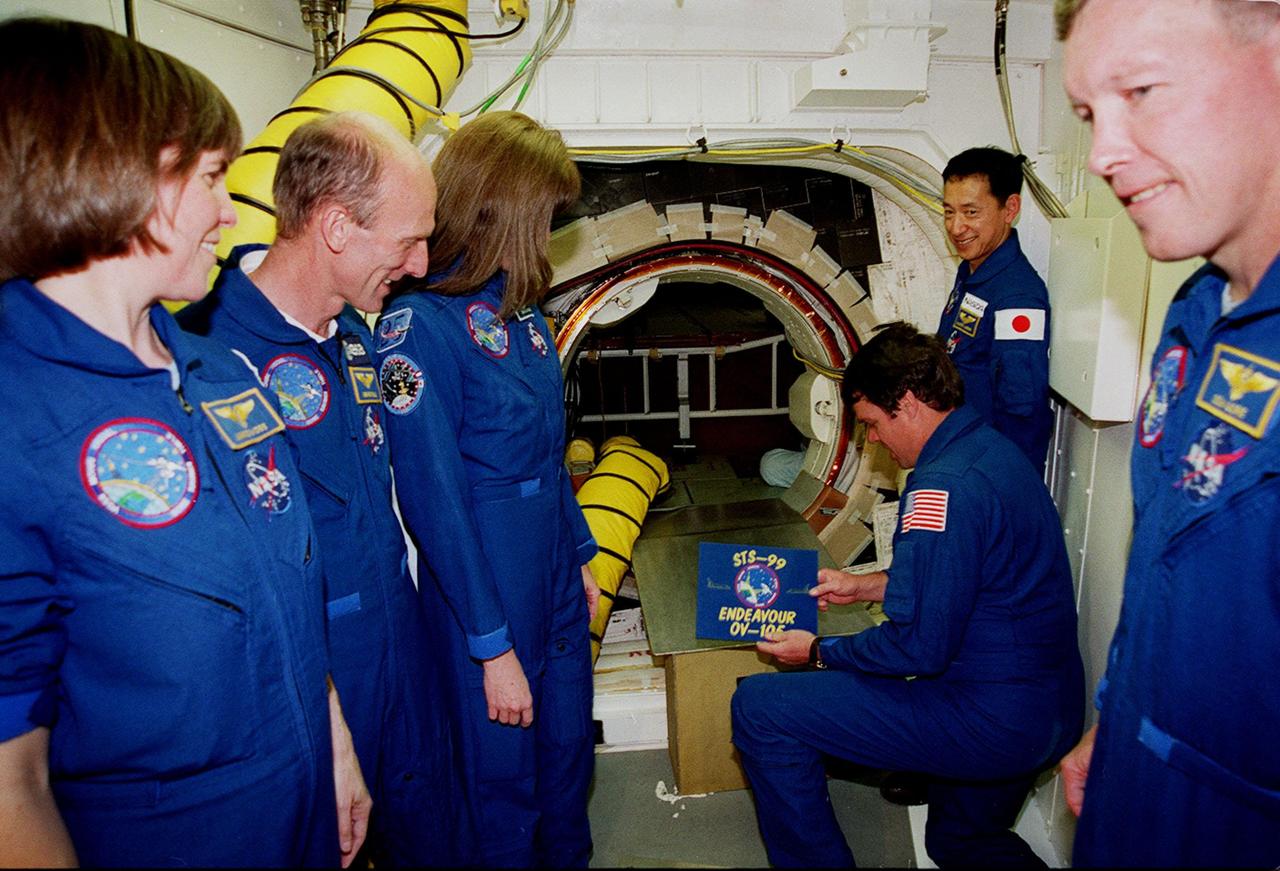
Inside the White Room attached to the Fixed Service Structure on Launch Pad 39A, STS-99 Commander Kevin Kregel gets ready to place a sign identifying the mission at the entrance to the orbiter Endeavour. Other crew members gathered around are (left to right) Mission Specialists Janice Voss (Ph.D.), Gerhard Thiele, Janet Lynn Kavandi (Ph.D.) and Mamoru Mohri (behind Kregel), and Pilot Dominic Gorie (at right). Thiele is with the European Space Agency and Mohri is with the National Space Development Agency (NASDA) of Japan. The crew are taking part in Terminal Countdown Demonstration Test activities, which provide them with simulated countdown exercises, emergency egress training, and opportunities to inspect the mission payloads in the orbiter's payload bay. STS-99 is the Shuttle Radar Topography Mission, which will chart a new course, using two antennae and a 200-foot-long section of space station-derived mast protruding from the payload bay to produce unrivaled 3-D images of the Earth's surface. The result of the Shuttle Radar Topography Mission could be close to 1 trillion measurements of the Earth's topography. Besides contributing to the production of better maps, these measurements could lead to improved water drainage modeling, more realistic flight simulators, better locations for cell phone towers, and enhanced navigation safety. Launch of Endeavour on the 11-day mission is scheduled for Jan. 31 at 12:47 p.m. EST

Grinding glaciers and granite peaks mingle in Chile’s Torres del Paine National Park. The Advanced Land Imager (ALI) on NASA’s Earth Observing-1 (EO-1) satellite captured this summertime image of the park on January 21, 2013. This image shows just a portion of the park, including Grey Glacier and the mountain range of Cordillera del Paine. The rivers of glacial ice in Torres del Paine National Park grind over bedrock, turning some of that rock to dust. Many of the glaciers terminate in freshwater lakes, which are rich with glacial flour that colors them brown to turquoise. Skinny rivers connect some of the lakes to each other (image upper and lower right). Cordillera del Paine rises between some of the wide glacial valleys. The compact mountain range is a combination of soaring peaks and small glaciers, most notably the Torres del Paine (Towers of Paine), three closely spaced peaks emblematic of the mountain range and the larger park. By human standards, the mountains of Cordillera del Paine are quite old. But compared to the Rocky Mountains (70 million years old), and the Appalachians (about 480 million years), the Cordillera del Paine are very young—only about 12 million years old. A study published in 2008 described how scientists used zircon crystals to estimate the age of Cordillera del Paine. The authors concluded that the mountain range was built in three pulses, creating a granite laccolith, or dome-shaped feature, more than 2,000 meters (7,000 feet) thick. NASA Earth Observatory image created by Jesse Allen and Robert Simmon, using Advanced Land Imager data from the NASA EO-1 team. Caption by Michon Scott. Instrument: EO-1 - ALI View more info: <a href="http://earthobservatory.nasa.gov/IOTD/view.php?id=80266" rel="nofollow">earthobservatory.nasa.gov/IOTD/view.php?id=80266</a> Credit: <b><a href="http://www.earthobservatory.nasa.gov/" rel="nofollow"> NASA Earth Observatory</a></b> <b><a href="http://www.nasa.gov/audience/formedia/features/MP_Photo_Guidelines.html" rel="nofollow">NASA image use policy.</a></b> <b><a href="http://www.nasa.gov/centers/goddard/home/index.html" rel="nofollow">NASA Goddard Space Flight Center</a></b> enables NASA’s mission through four scientific endeavors: Earth Science, Heliophysics, Solar System Exploration, and Astrophysics. Goddard plays a leading role in NASA’s accomplishments by contributing compelling scientific knowledge to advance the Agency’s mission. <b>Follow us on <a href="http://twitter.com/NASA_GoddardPix" rel="nofollow">Twitter</a></b> <b>Like us on <a href="http://www.facebook.com/pages/Greenbelt-MD/NASA-Goddard/395013845897?ref=tsd" rel="nofollow">Facebook</a></b> <b>Find us on <a href="http://instagrid.me/nasagoddard/?vm=grid" rel="nofollow">Instagram</a></b>