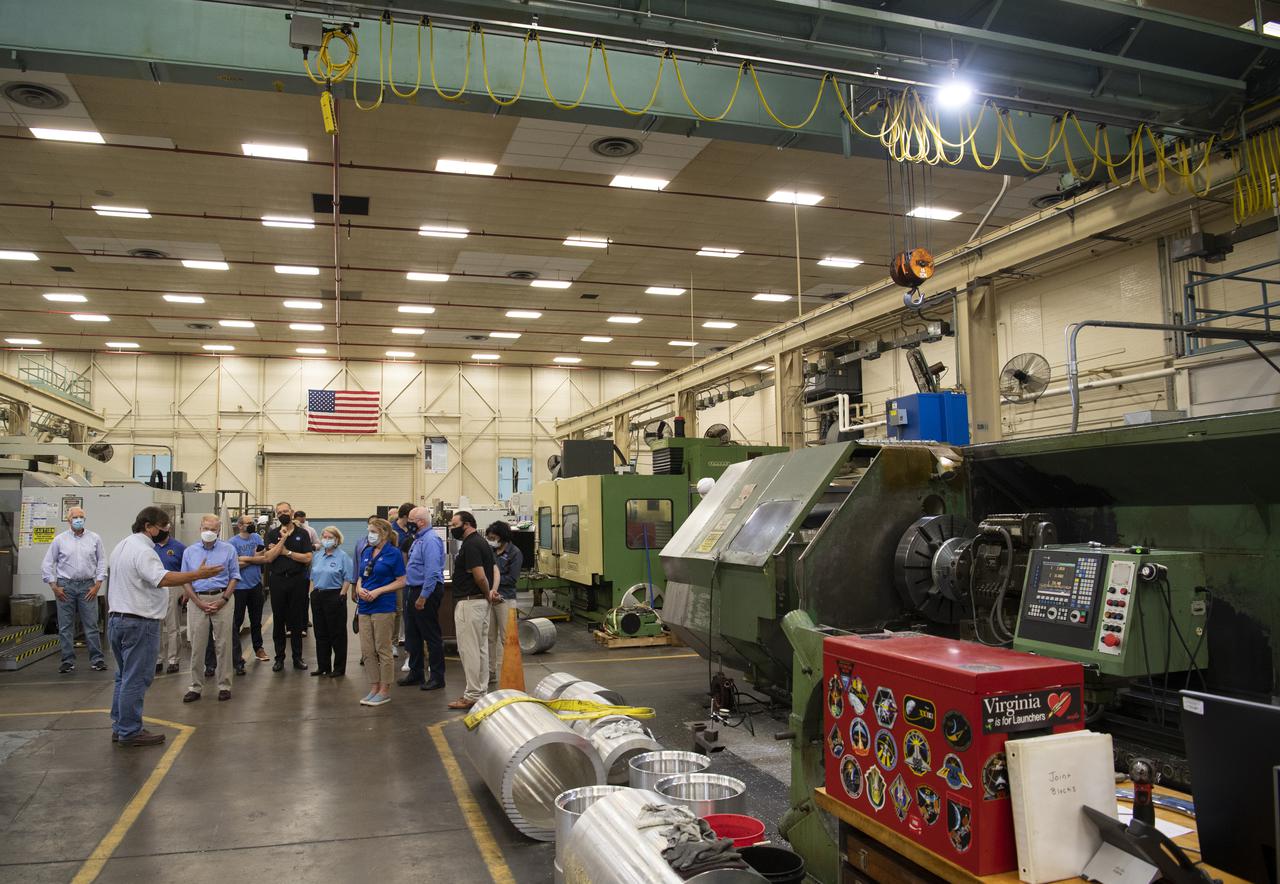
NASA Administrator Bill Nelson, NASA Deputy Administrator Pam Melroy, Thomas Zurbuchen, associate administrator for NASA's Science Mission Directorate, Dave Pierce, director of NASA's Wallops Flight Facility, and Dennis Andrucyk, director of NASA's Goddard Space Flight Center, are seen during a tour of the Sounding Rockets Machine Shop, Test and Evaluation Facility, Tuesday, Aug. 10, 2021, at NASA’s Wallops Flight Facility in Virginia. Photo Credit: (NASA/Joel Kowsky)
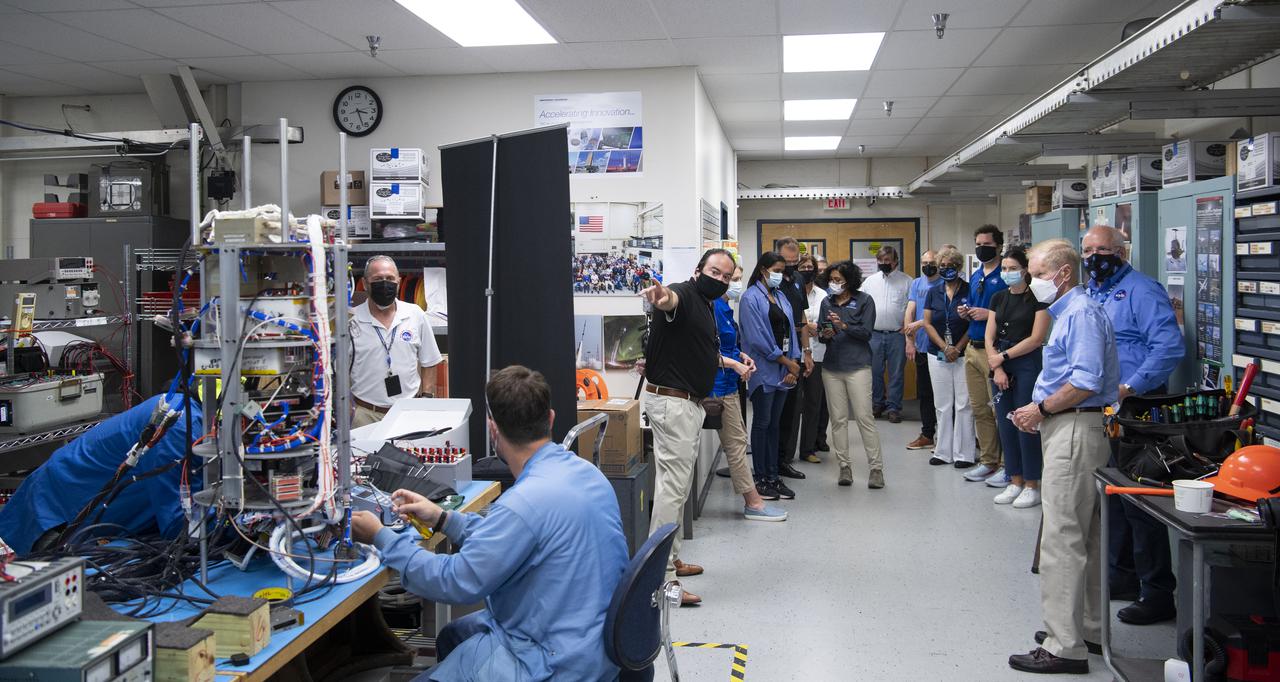
Giovanni Rosanova, chief of the Sounding Rocket Program Office at NASA's Wallops Flight Facility, center, describes work done in the Payload Integration Laboratory of the Sounding Rockets Machine Shop, Test and Evaluation Facility during a tour with NASA Administrator Bill Nelson and Dennis Andrucyk, director of NASA's Goddard Space Flight Center, Tuesday, Aug. 10, 2021, at NASA’s Wallops Flight Facility in Virginia. Photo Credit: (NASA/Joel Kowsky)
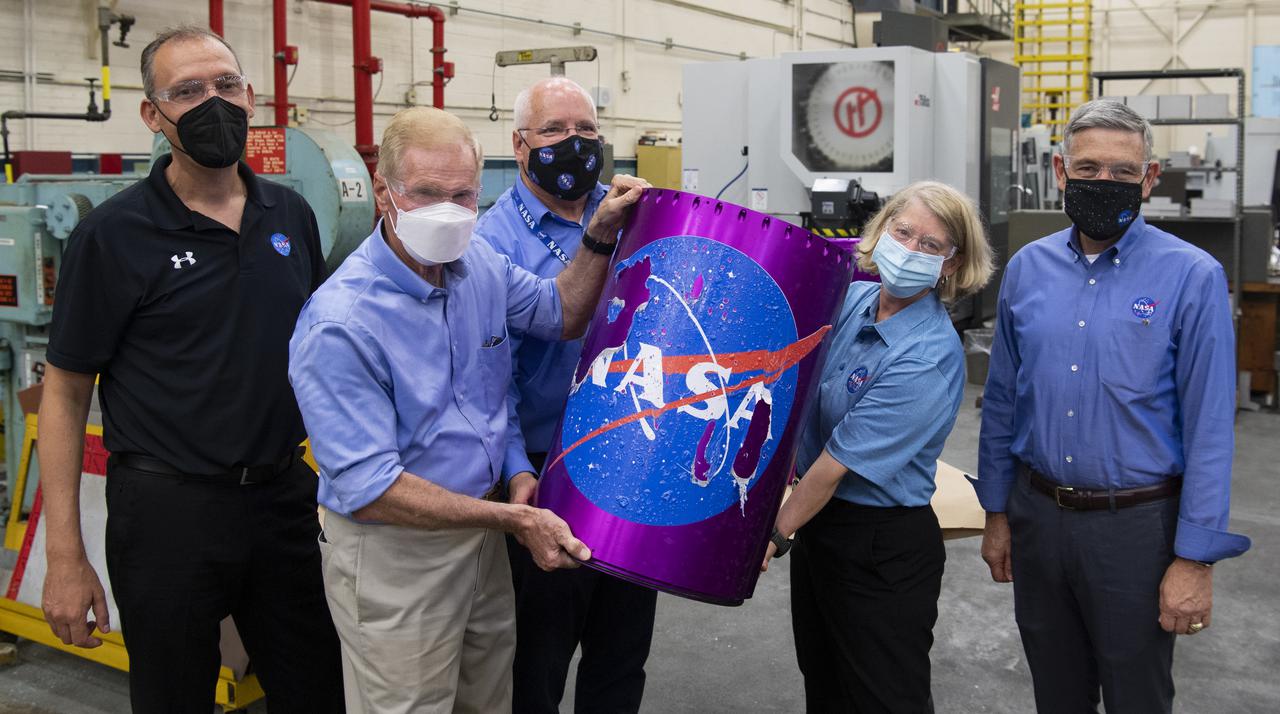
Thomas Zurbuchen, associate administrator for NASA’s Science Mission Directorate, left, NASA Administrator Bill Nelson second from left, Dennis Andrucyk, director of NASA's Goddard Space Flight Center, center, NASA Deputy Administrator Pam Melroy, second from right, and Bob Cabana, NASA associate administrator, right, hold a recovered portion of the Black Brant IX sounding rocket used for the Advanced Supersonic Parachute Inflation Research Experiment (ASPIRE), during a tour of the Sounding Rockets Machine Shop, Test and Evaluation Facility, Tuesday, Aug. 10, 2021, at NASA’s Wallops Flight Facility in Virginia. Photo Credit: (NASA/Joel Kowsky)
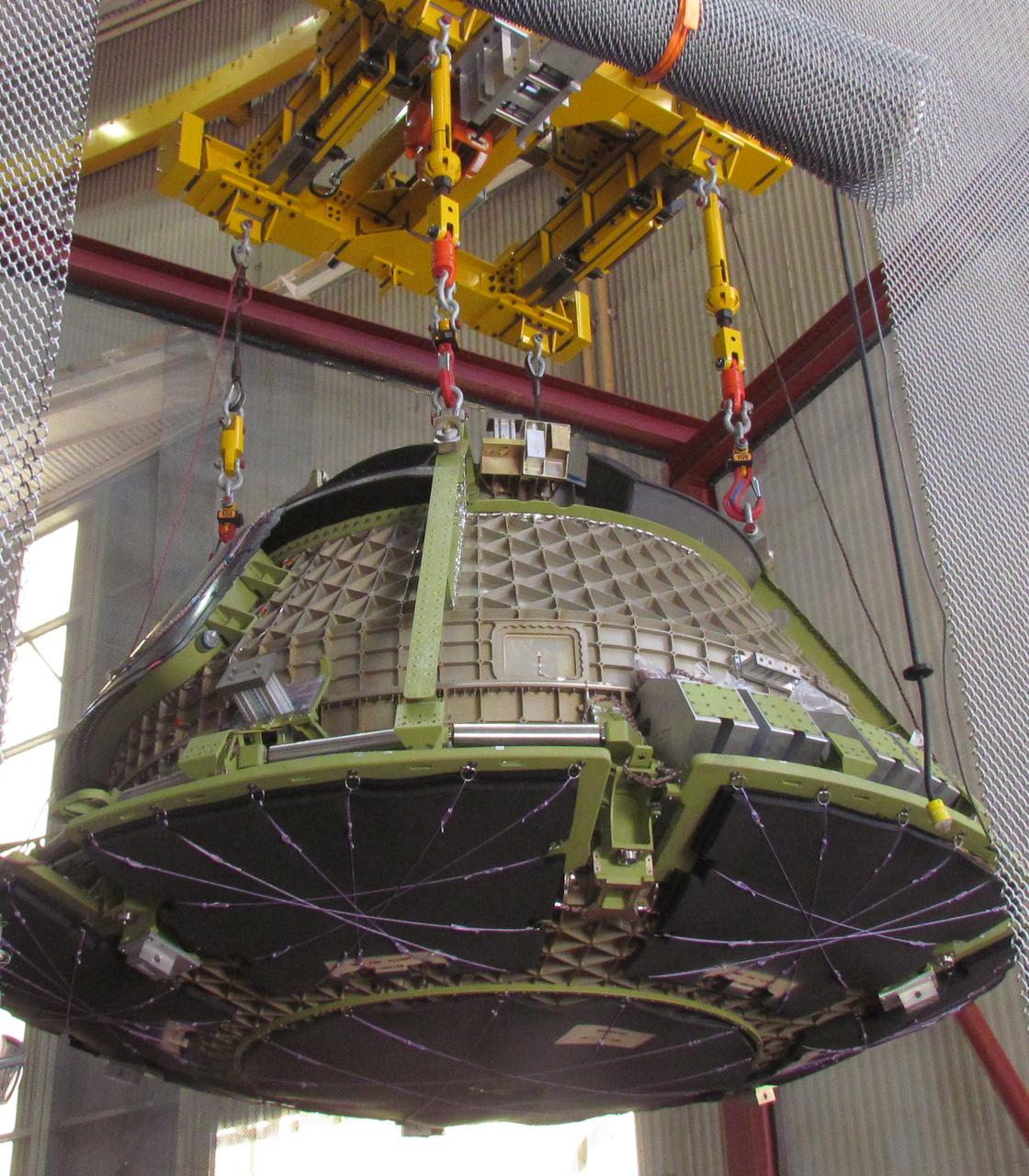
Boeing’s Structural Test Article of its CST-100 Starliner spacecraft arrives at the company’s Huntington Beach, California, facilities for evaluations. Built to the specifications of an operational spacecraft, the STA is intended to be evaluated through a series of thorough testing conditions.
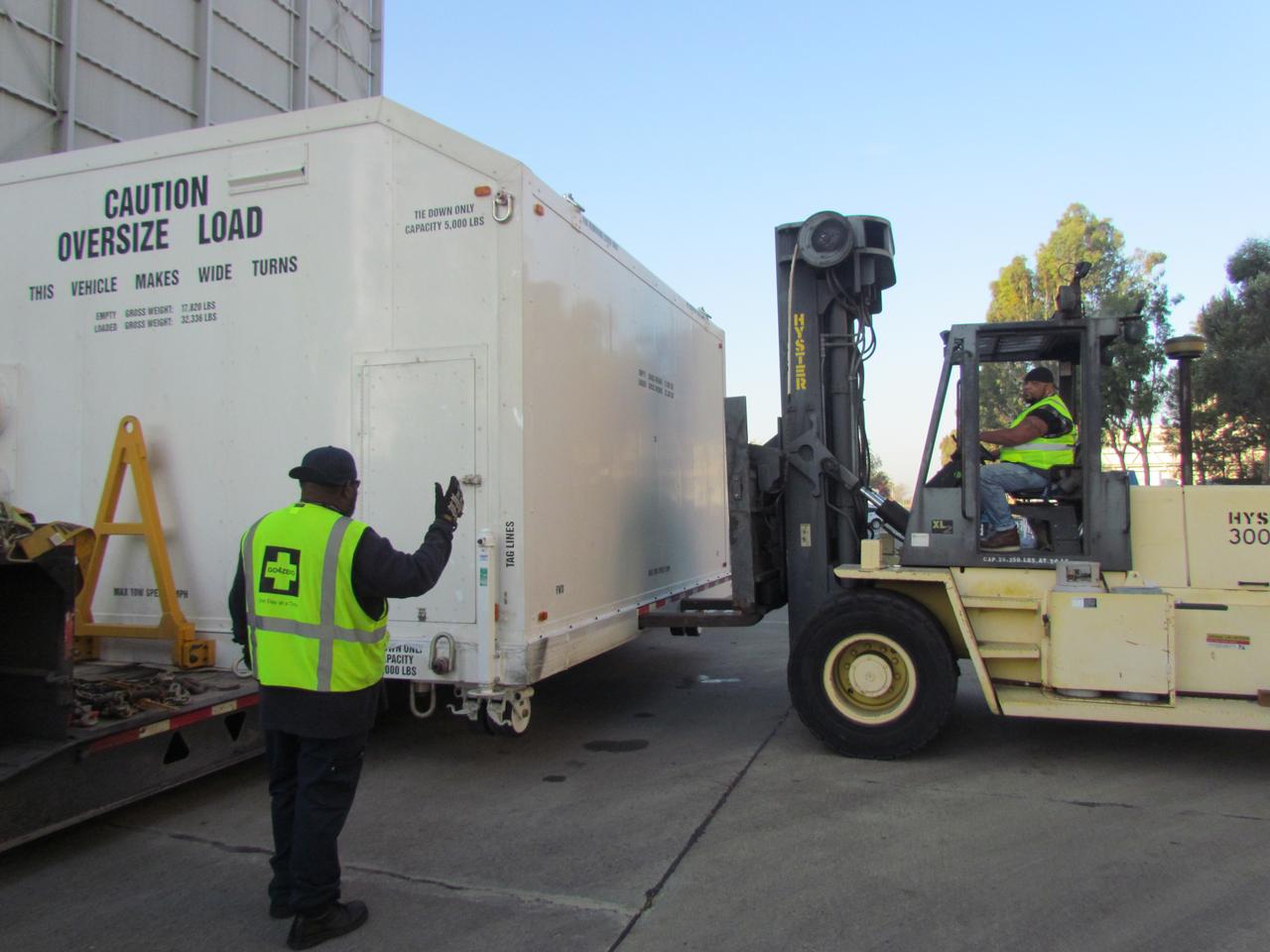
Boeing’s Structural Test Article of its CST-100 Starliner spacecraft arrives at the company’s Huntington Beach, California, facilities for evaluations. Built to the specifications of an operational spacecraft, the STA is intended to be evaluated through a series of thorough testing conditions.
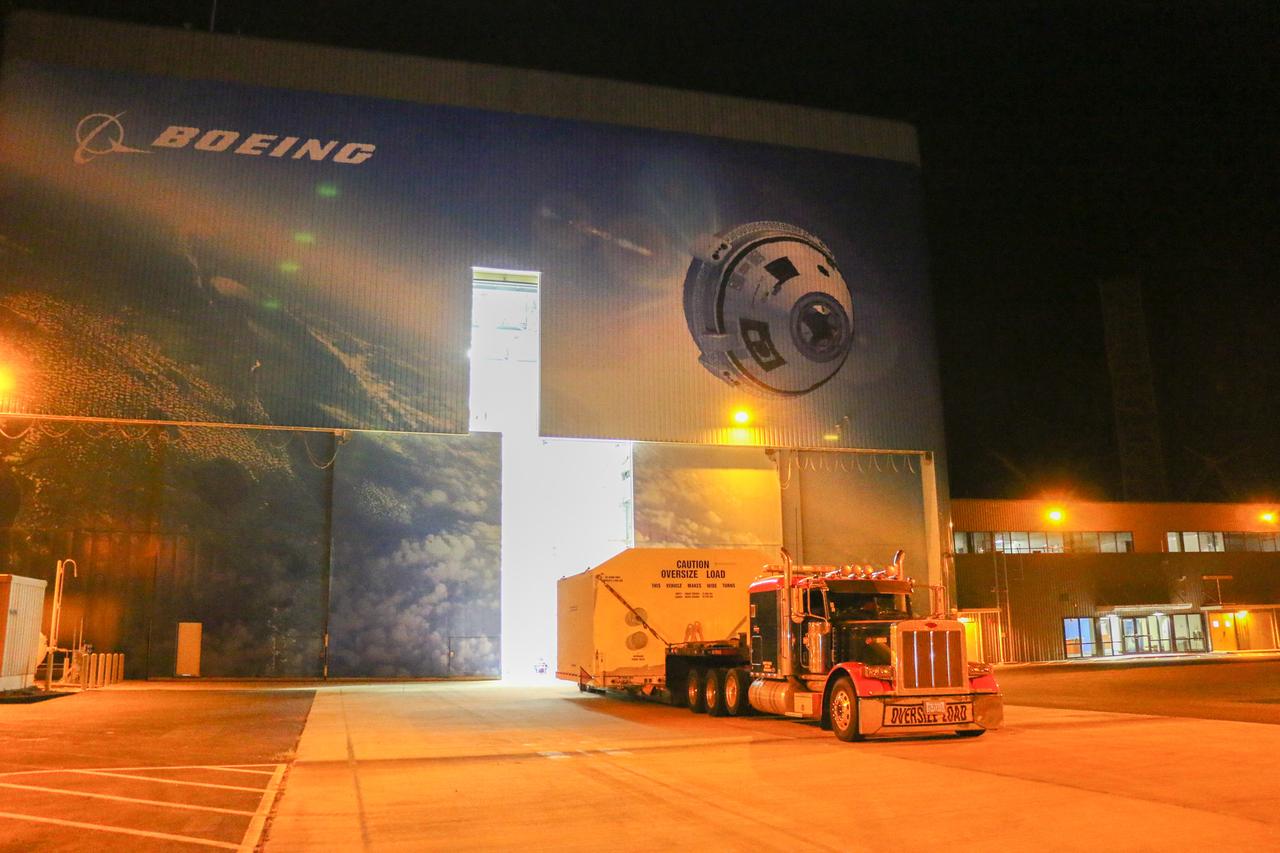
Boeing’s Structural Test Article of its CST-100 Starliner spacecraft is moved out of the company’s Commercial Crew and Cargo Processing Facility at NASA’s Kennedy Space Center on its way to Huntington Beach, California, for evaluations. Built to the specifications of an operational spacecraft, the STA is intended to be evaluated through a series of thorough testing conditions.
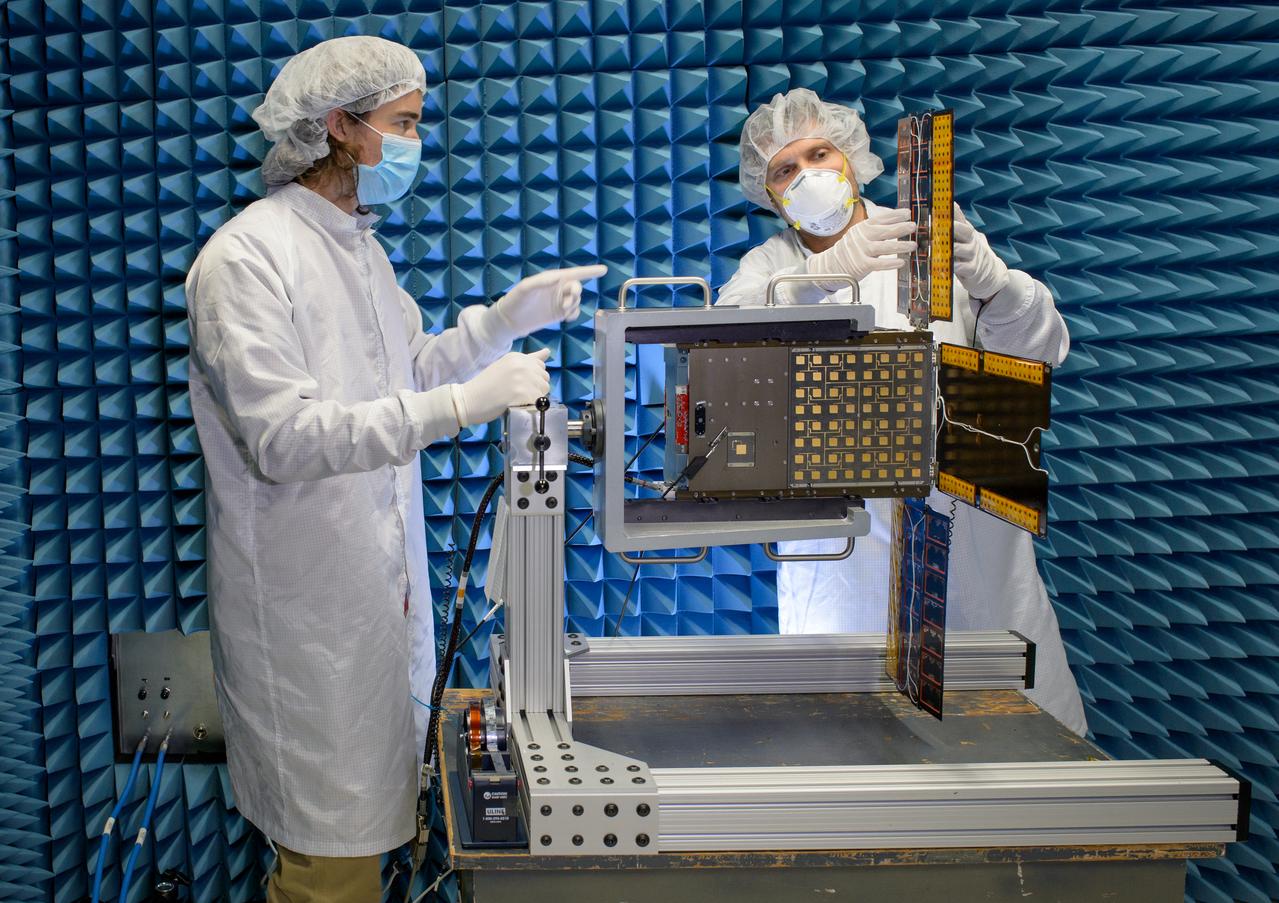
Austin Bowie, left, and Jesse Fusco fold the BioSentinel flight unit solar array in the Engineering Evaluation Laboratory, or EEL, Radio Frequency test facility, N244, after completion of an electromagnetic compatibility test procedure.
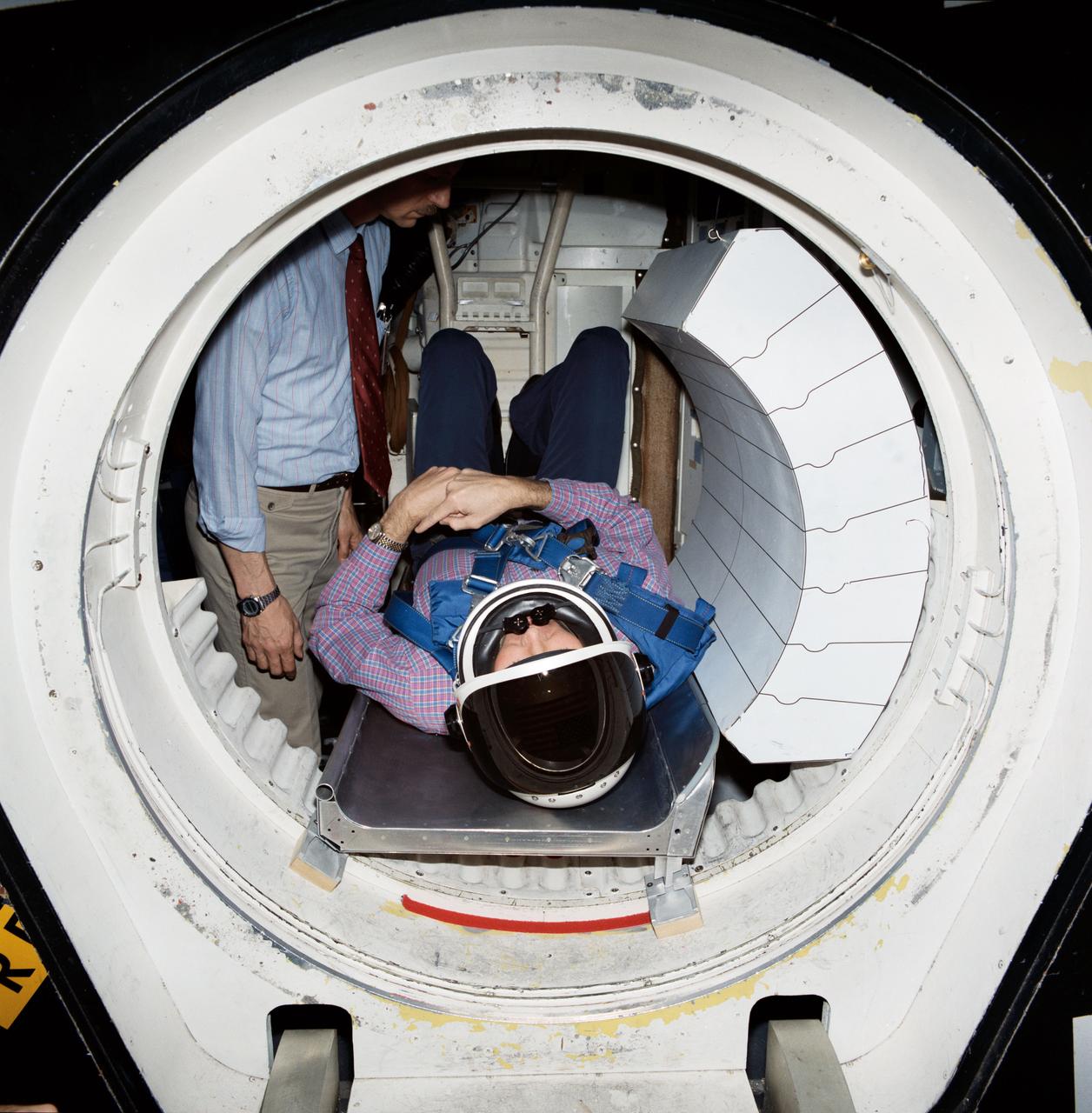
Shuttle crew escape systems test is conducted by astronauts Steven R. Nagel (left) and Manley L. (Sonny) Carter in JSC One Gravity Mockup and Training Facilities Bldg 9A crew compartment trainer (CCT). Nagel and Carter are evaluating methods for crew escape during Space Shuttle controlled gliding flight. JSC test was done in advance of tests scheduled for facilities in California and Utah. Here, Carter serves as test subject evaluating egress positioning for the tractor rocket escape method - one of the two systems currently being closely studied by NASA.
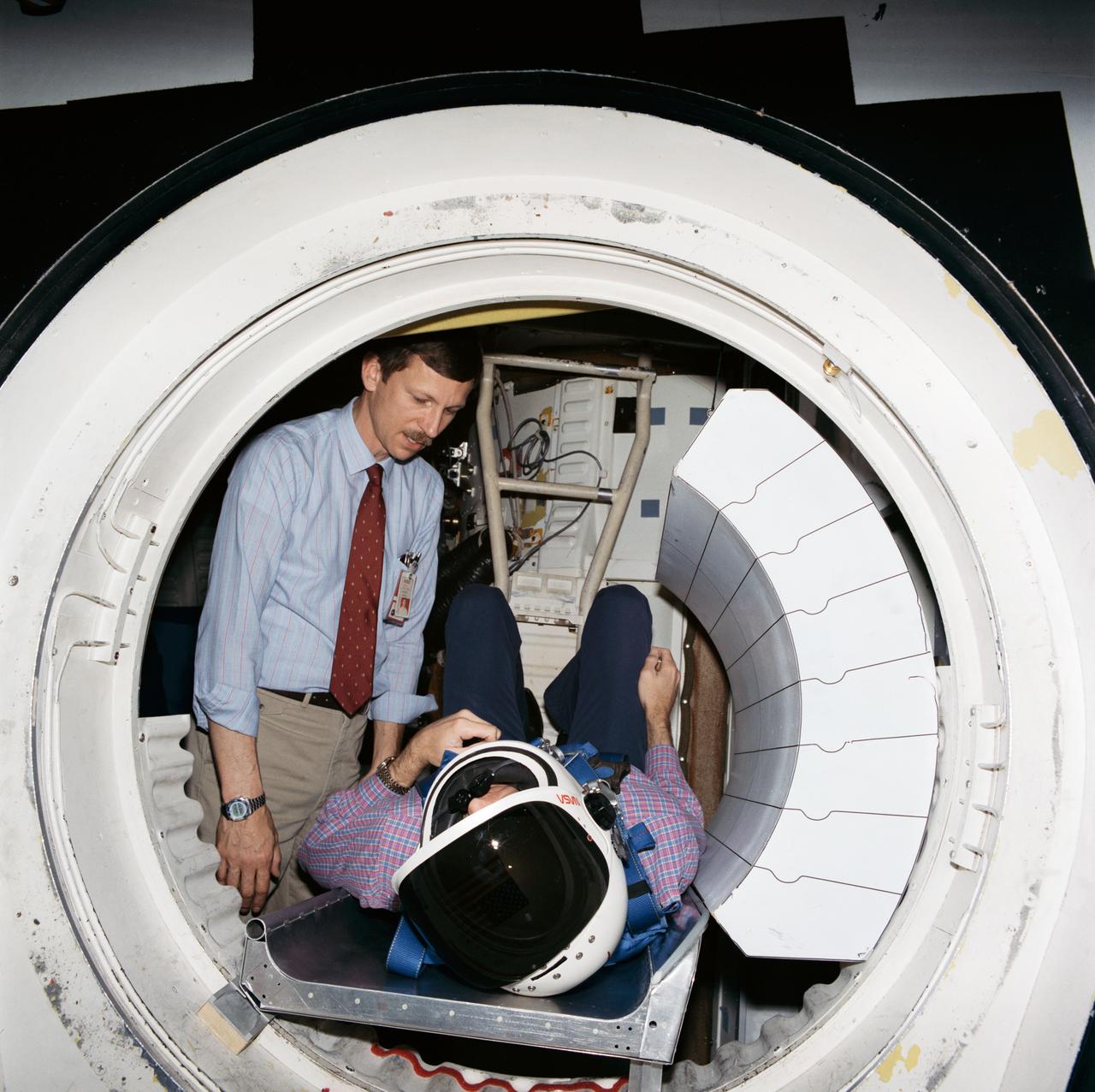
Shuttle crew escape systems test is conducted by astronauts Steven R. Nagel (left) and Manley L. (Sonny) Carter in JSC One Gravity Mockup and Training Facilities Bldg 9A crew compartment trainer (CCT). Nagel and Carter are evaluating methods for crew escape during Space Shuttle controlled gliding flight. JSC test was done in advance of tests scheduled for facilities in California and Utah. Here, Carter serves as test subject evaluating egress positioning for the tractor rocket escape method - one of the two systems currently being closely studied by NASA.

Shuttle crew escape systems test is conducted by astronauts Steven R. Nagel (left) and Manley L. (Sonny) Carter in JSC One Gravity Mockup and Training Facilities Bldg 9A crew compartment trainer (CCT). Nagel and Carter are evaluating methods for crew escape during Space Shuttle controlled gliding flight. JSC test was done in advance of tests scheduled for facilities in California and Utah. Here, Carter serves as test subject evaluating egress positioning for the tractor rocket escape method - one of the two systems currently being closely studied by NASA.
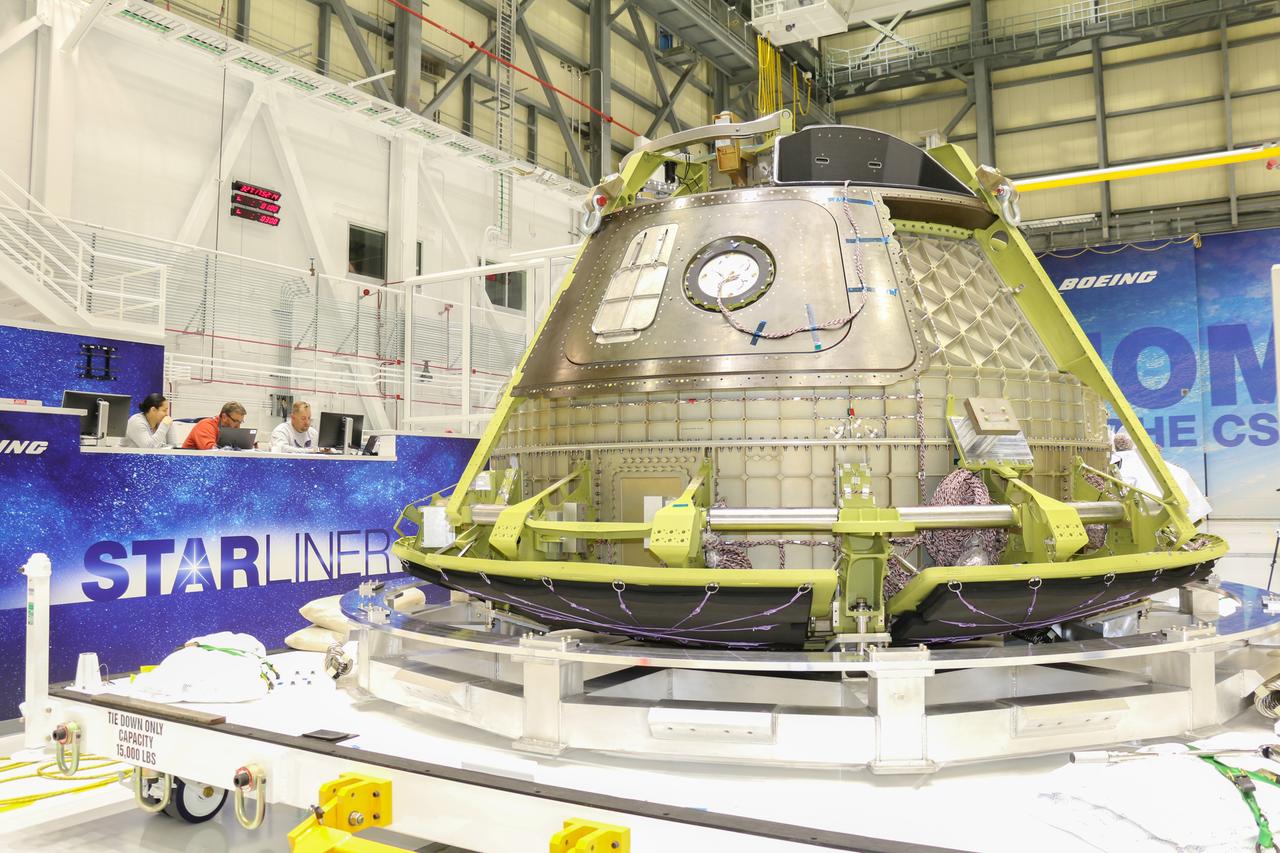
Boeing’s Structural Test Article of its CST-100 Starliner spacecraft is readied inside the company’s Commercial Crew and Cargo Processing Facility at NASA’s Kennedy Space Center. Built to the specifications of an operational spacecraft, the STA is intended to be evaluated through a series of thorough testing conditions at facilities in Huntington Beach, California.
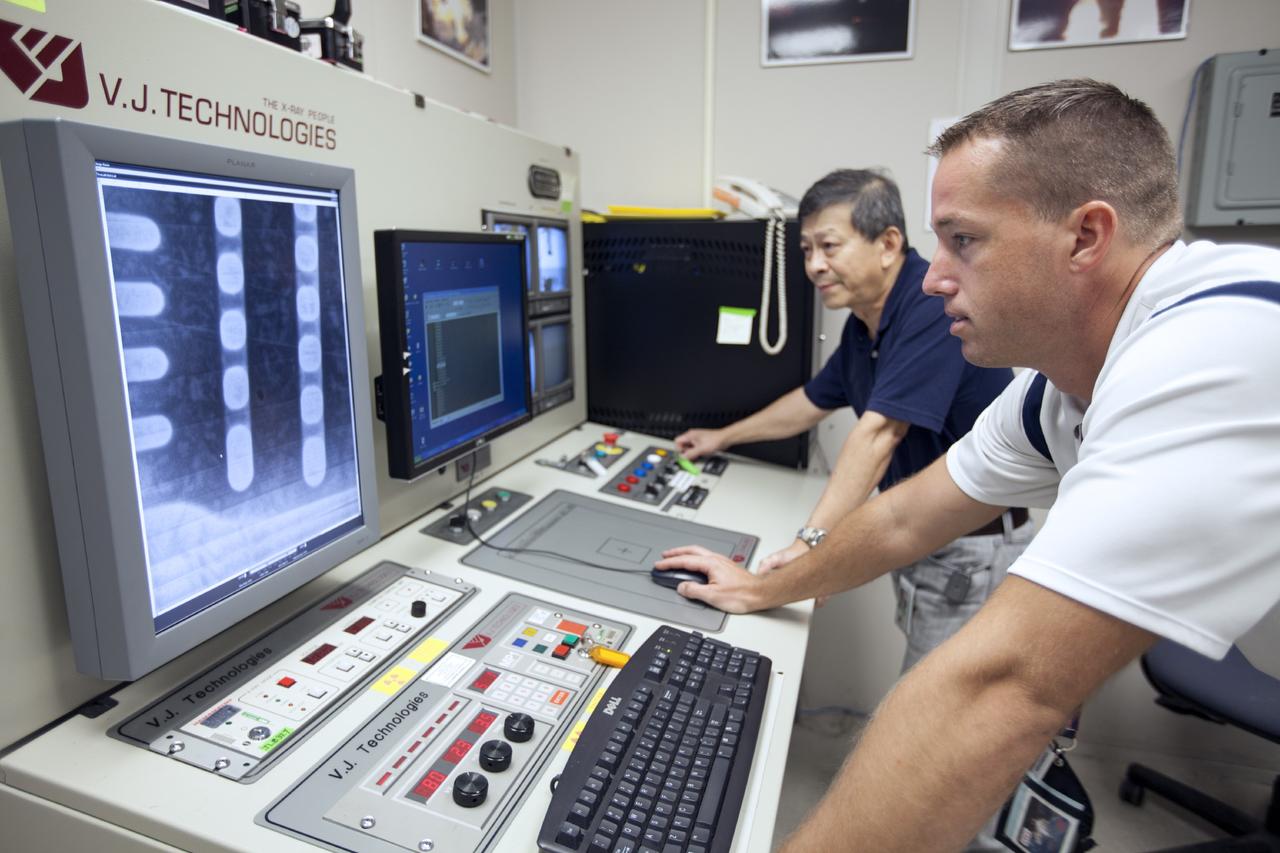
CAPE CANAVERAL, Fla. – In Hangar N at Cape Canaveral Air Force Station, PaR Systems, Inc. development engineer Wayne Cheng, left, and operations engineer Jeff Elston operate the controller for a robotic system used in nondestructive testing. The 11-axis robotic system takes X-ray images of hardware for evaluation. NASA's Kennedy Space Center in Florida recently established a partnership agreement with PaR Systems, Inc. of Shoreview, Minn., for operation of the Hangar N facility and its nondestructive testing and evaluation equipment. As the spaceport transitions from a historically government-only launch facility to a multi-user spaceport for both federal and commercial customers, partnerships between the space agency and other organizations will be a key element in that effort. Hangar N is located at Cape Canaveral Air Force Station adjacent to Kennedy and houses a unique inventory of test and evaluation equipment and the capability for current and future mission spaceflight support. Photo credit: NASA/ Dimitri Gerondidakis
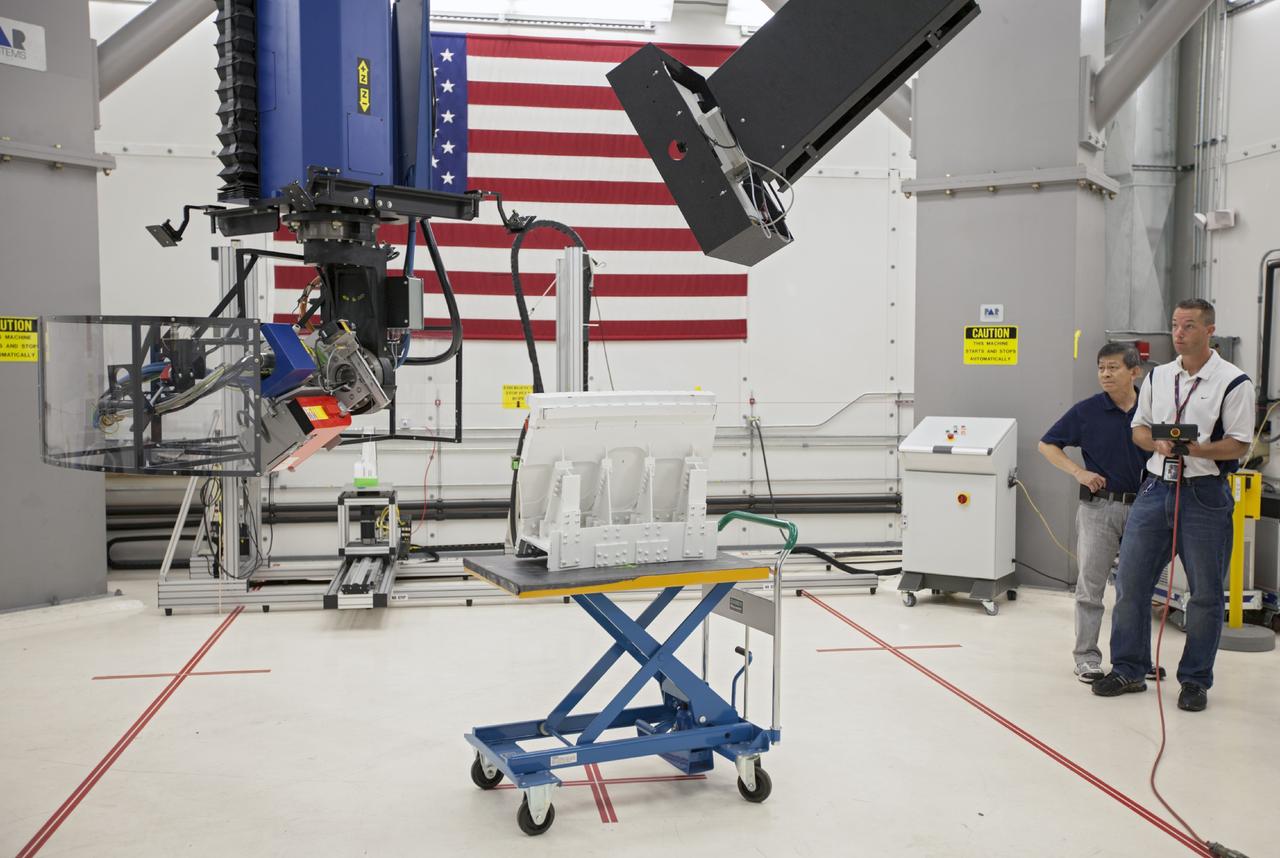
CAPE CANAVERAL, Fla. – In Hangar N at Cape Canaveral Air Force Station, PaR Systems, Inc. development engineer Wayne Cheng, left, and operations engineer Jeff Elston operate a robotic system used in nondestructive testing. The 11-axis robotic system takes X-ray images of hardware for evaluation. NASA's Kennedy Space Center in Florida recently established a partnership agreement with PaR Systems, Inc. of Shoreview, Minn., for operation of the Hangar N facility and its nondestructive testing and evaluation equipment. As the spaceport transitions from a historically government-only launch facility to a multi-user spaceport for both federal and commercial customers, partnerships between the space agency and other organizations will be a key element in that effort. Hangar N is located at Cape Canaveral Air Force Station adjacent to Kennedy and houses a unique inventory of test and evaluation equipment and the capability for current and future mission spaceflight support. Photo credit: NASA/ Dimitri Gerondidakis
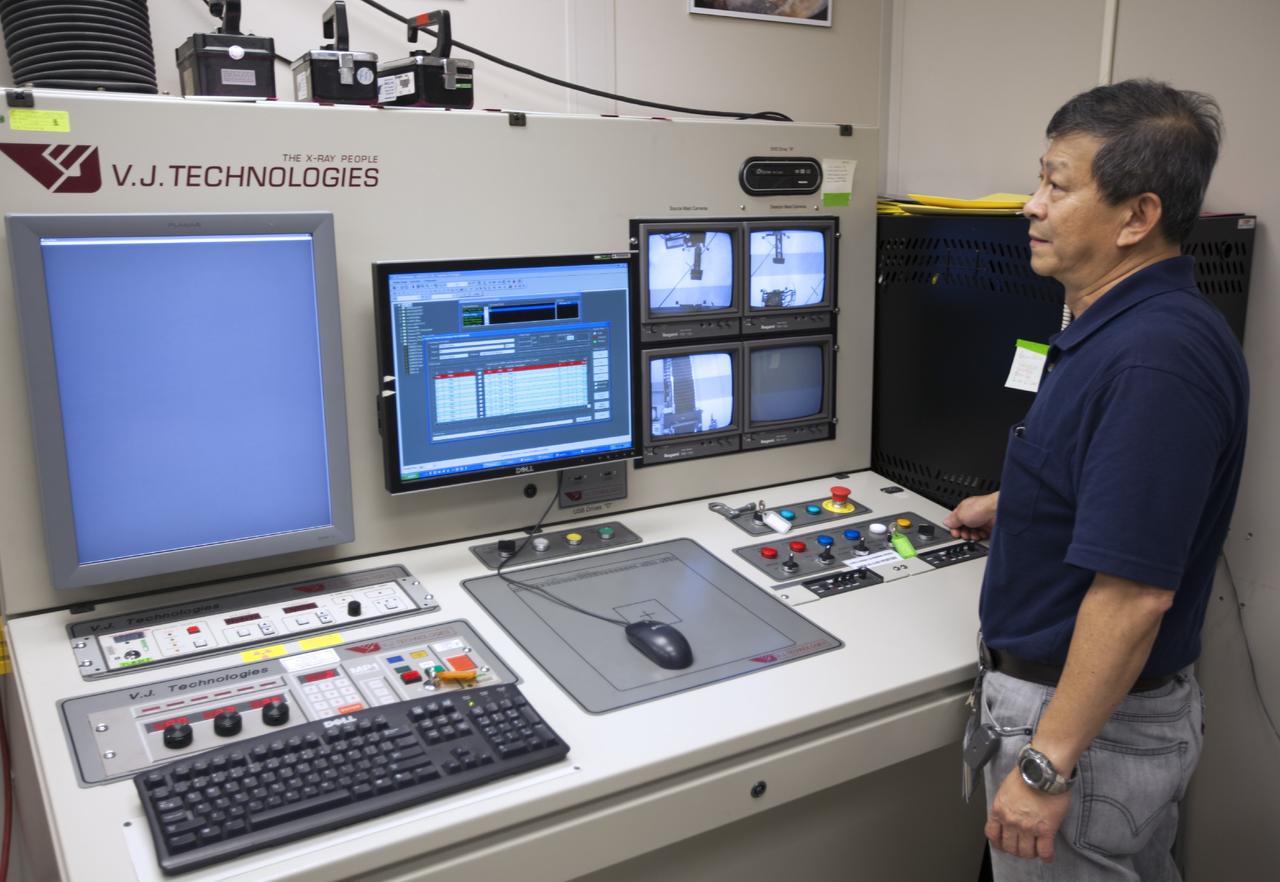
CAPE CANAVERAL, Fla. – In Hangar N at Cape Canaveral Air Force Station, PaR Systems, Inc. development engineer Wayne Cheng operates the controller for a robotic system used in nondestructive testing. The 11-axis robotic system takes X-ray images of hardware for evaluation. NASA's Kennedy Space Center in Florida recently established a partnership agreement with PaR Systems, Inc. of Shoreview, Minn., for operation of the Hangar N facility and its nondestructive testing and evaluation equipment. As the spaceport transitions from a historically government-only launch facility to a multi-user spaceport for both federal and commercial customers, partnerships between the space agency and other organizations will be a key element in that effort. Hangar N is located at Cape Canaveral Air Force Station adjacent to Kennedy and houses a unique inventory of test and evaluation equipment and the capability for current and future mission spaceflight support. Photo credit: NASA/ Dimitri Gerondidakis
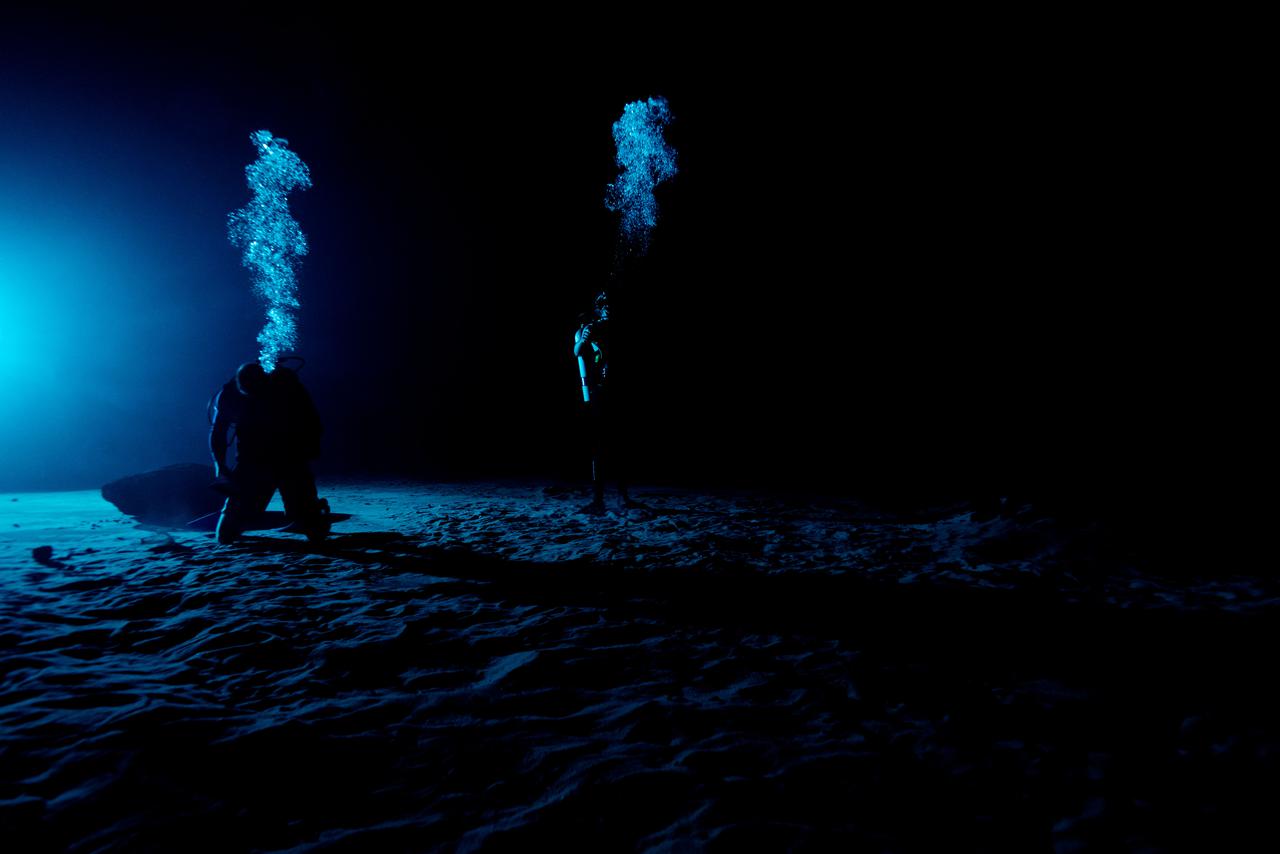
Test subjects performing mission-relevant tasks and evaluating shadow quality during NBL Preliminary Lunar Lighting Evaluation. Divers at the Neutral Buoyancy Laboratory (NBL) in Houston are setting the stage for future Moonwalk training by simulating lunar lighting conditions. At the Lunar South Pole, the Sun will remain no more than a few degrees above the horizon, resulting in extremely long and dark shadows. To prepare astronauts for these challenging lighting conditions, the team at the NBL has begun preliminary evaluations of lunar lighting solutions at the bottom of the 40-foot deep pool. This testing and evaluation involved turning off all the lights in the facility, installing black curtains on the pool walls to minimize reflections, and using a powerful underwater cinematic lamp, to get the conditions just right ahead of upcoming training for astronauts.
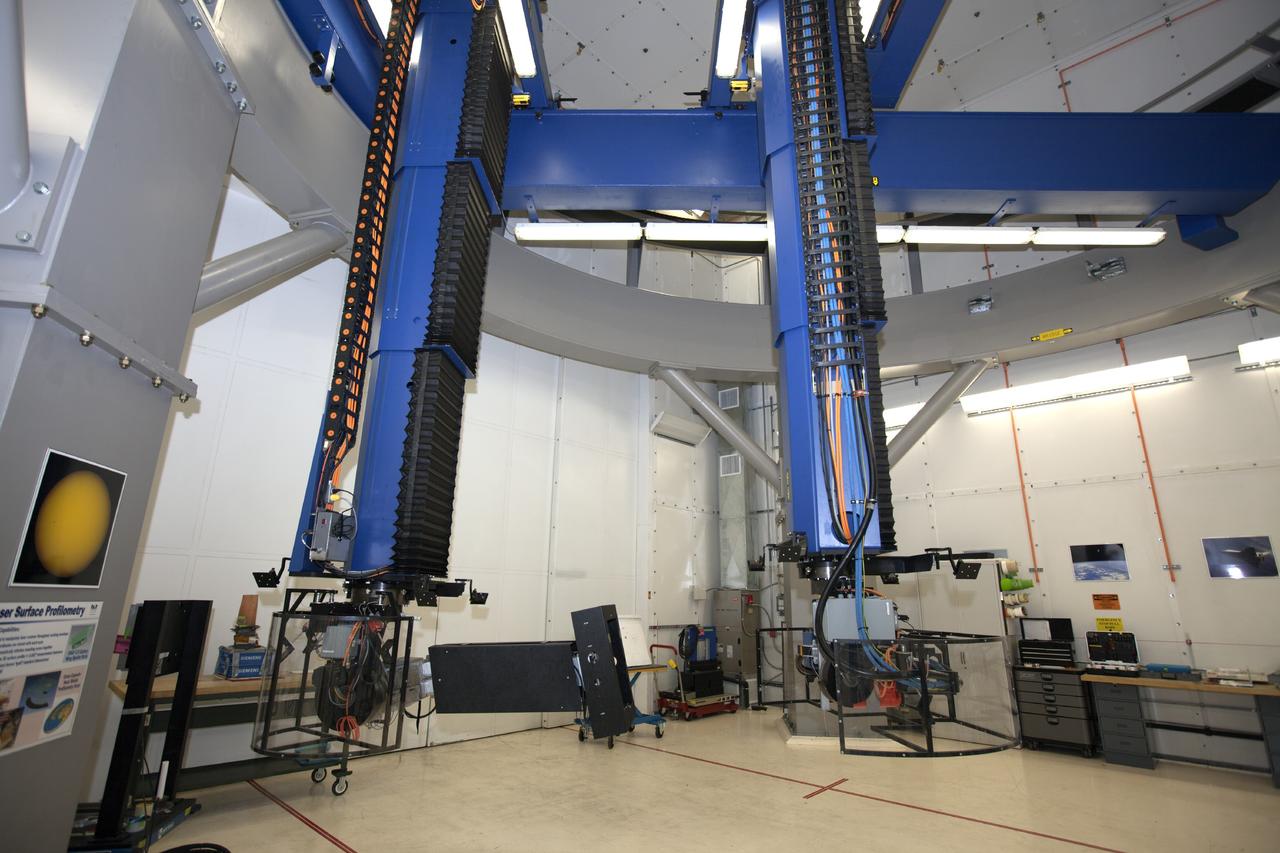
CAPE CANAVERAL, Fla. – In Hangar N at Cape Canaveral Air Force Station, an 11-axis robotic X-ray system takes images of hardware for evaluation. The activity is part of work performed by PaR Systems, Inc. under a partnership agreement with NASA. NASA's Kennedy Space Center in Florida recently established a partnership agreement with PaR Systems, Inc. of Shoreview, Minn., for operation of the Hangar N facility and its nondestructive testing and evaluation equipment. As the spaceport transitions from a historically government-only launch facility to a multi-user spaceport for both federal and commercial customers, partnerships between the space agency and other organizations will be a key element in that effort. Hangar N is located at Cape Canaveral Air Force Station adjacent to Kennedy and houses a unique inventory of test and evaluation equipment and the capability for current and future mission spaceflight support. Photo credit: NASA/ Dimitri Gerondidakis
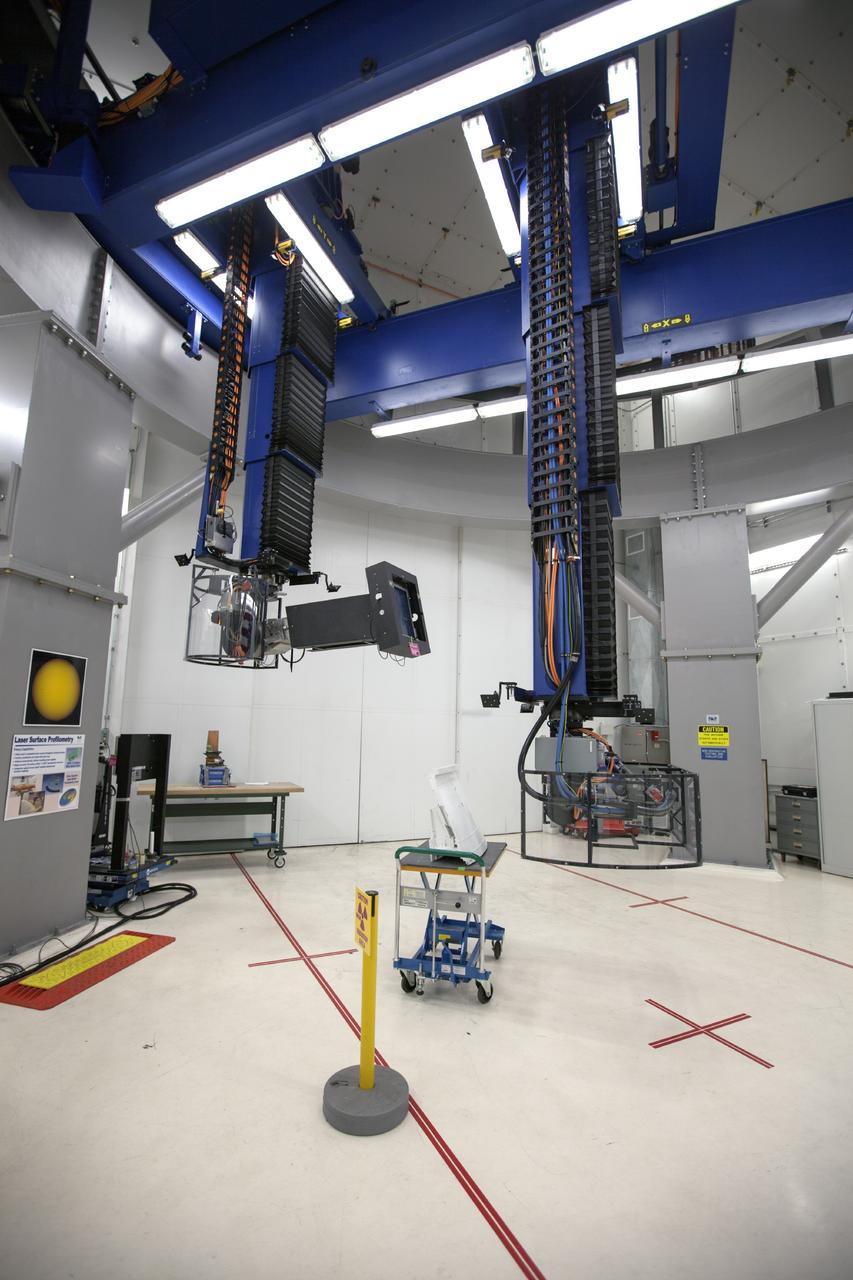
CAPE CANAVERAL, Fla. – In Hangar N at Cape Canaveral Air Force Station, an 11-axis robotic X-ray system takes images of hardware for evaluation. The activity is part of work performed by PaR Systems, Inc. under a partnership agreement with NASA. NASA's Kennedy Space Center in Florida recently established a partnership agreement with PaR Systems, Inc. of Shoreview, Minn., for operation of the Hangar N facility and its nondestructive testing and evaluation equipment. As the spaceport transitions from a historically government-only launch facility to a multi-user spaceport for both federal and commercial customers, partnerships between the space agency and other organizations will be a key element in that effort. Hangar N is located at Cape Canaveral Air Force Station adjacent to Kennedy and houses a unique inventory of test and evaluation equipment and the capability for current and future mission spaceflight support. Photo credit: NASA/ Dimitri Gerondidakis
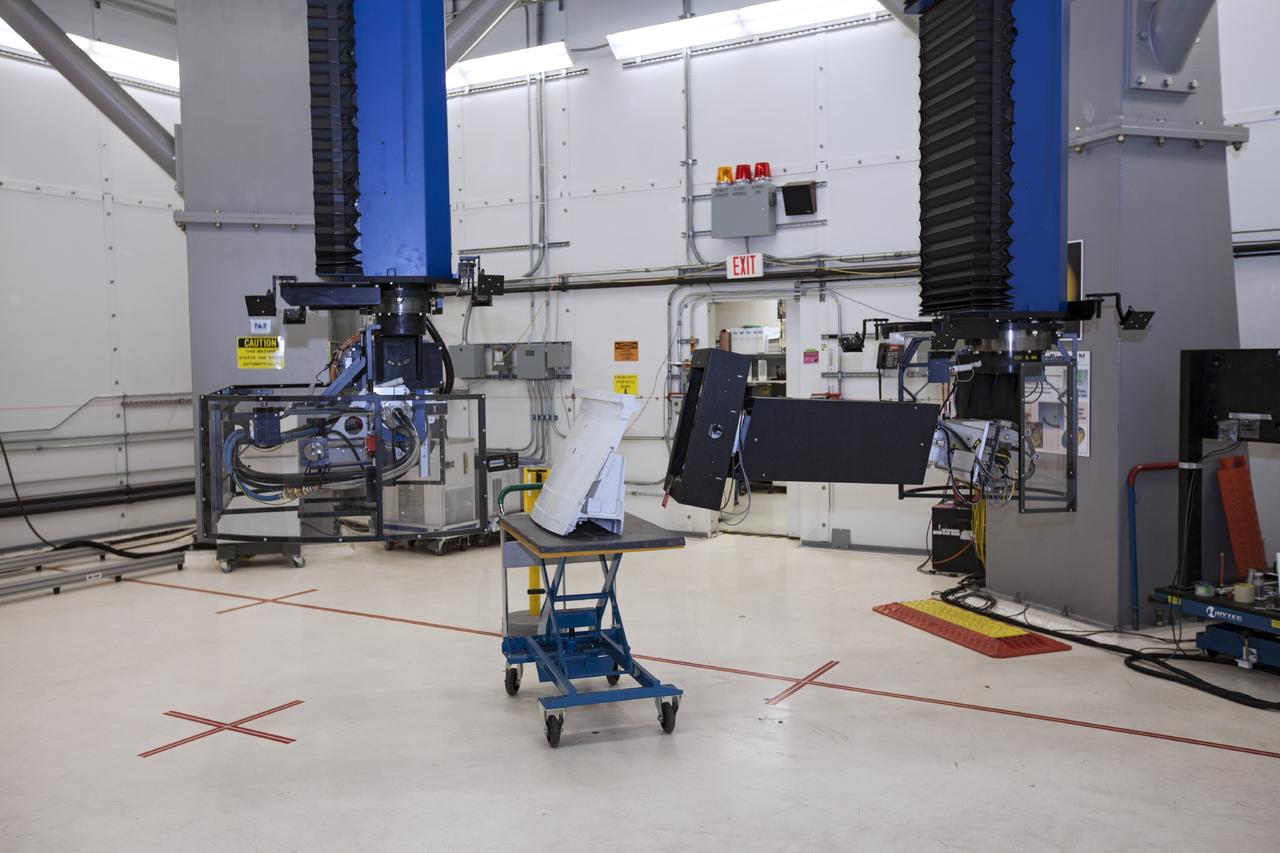
CAPE CANAVERAL, Fla. – In Hangar N at Cape Canaveral Air Force Station, an 11-axis robotic X-ray system takes images of hardware for evaluation. The activity is part of work performed by PaR Systems, Inc. under a partnership agreement with NASA. NASA's Kennedy Space Center in Florida recently established a partnership agreement with PaR Systems, Inc. of Shoreview, Minn., for operation of the Hangar N facility and its nondestructive testing and evaluation equipment. As the spaceport transitions from a historically government-only launch facility to a multi-user spaceport for both federal and commercial customers, partnerships between the space agency and other organizations will be a key element in that effort. Hangar N is located at Cape Canaveral Air Force Station adjacent to Kennedy and houses a unique inventory of test and evaluation equipment and the capability for current and future mission spaceflight support. Photo credit: NASA/ Dimitri Gerondidakis
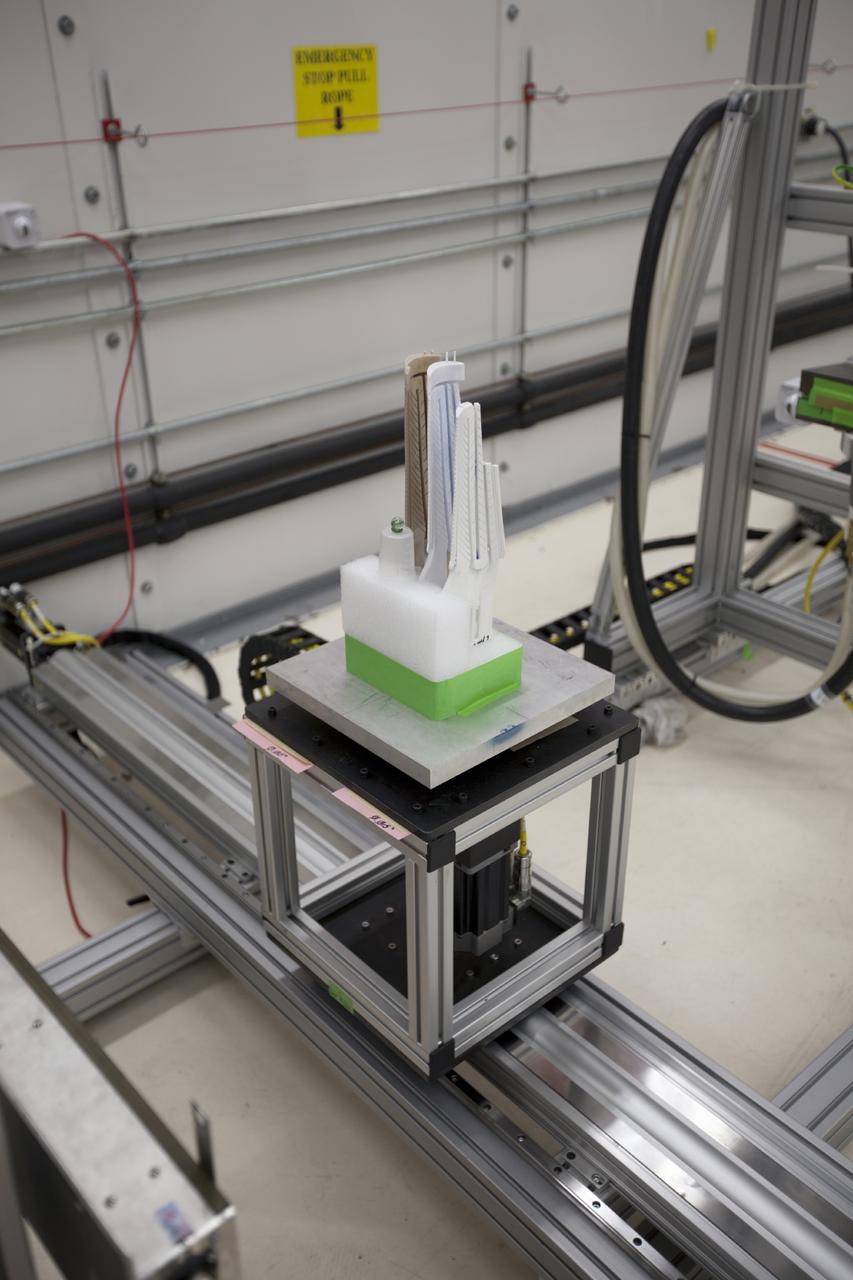
CAPE CANAVERAL, Fla. – In Hangar N at Cape Canaveral Air Force Station, ceramic materials are positioned for Advanced Partial Angle Computed Tomography testing. The activity is part of work performed by PaR Systems, Inc. under a partnership agreement with NASA. NASA's Kennedy Space Center in Florida recently established a partnership agreement with PaR Systems, Inc. of Shoreview, Minn., for operation of the Hangar N facility and its nondestructive testing and evaluation equipment. As the spaceport transitions from a historically government-only launch facility to a multi-user spaceport for both federal and commercial customers, partnerships between the space agency and other organizations will be a key element in that effort. Hangar N is located at Cape Canaveral Air Force Station adjacent to Kennedy and houses a unique inventory of test and evaluation equipment and the capability for current and future mission spaceflight support. Photo credit: NASA/ Dimitri Gerondidakis
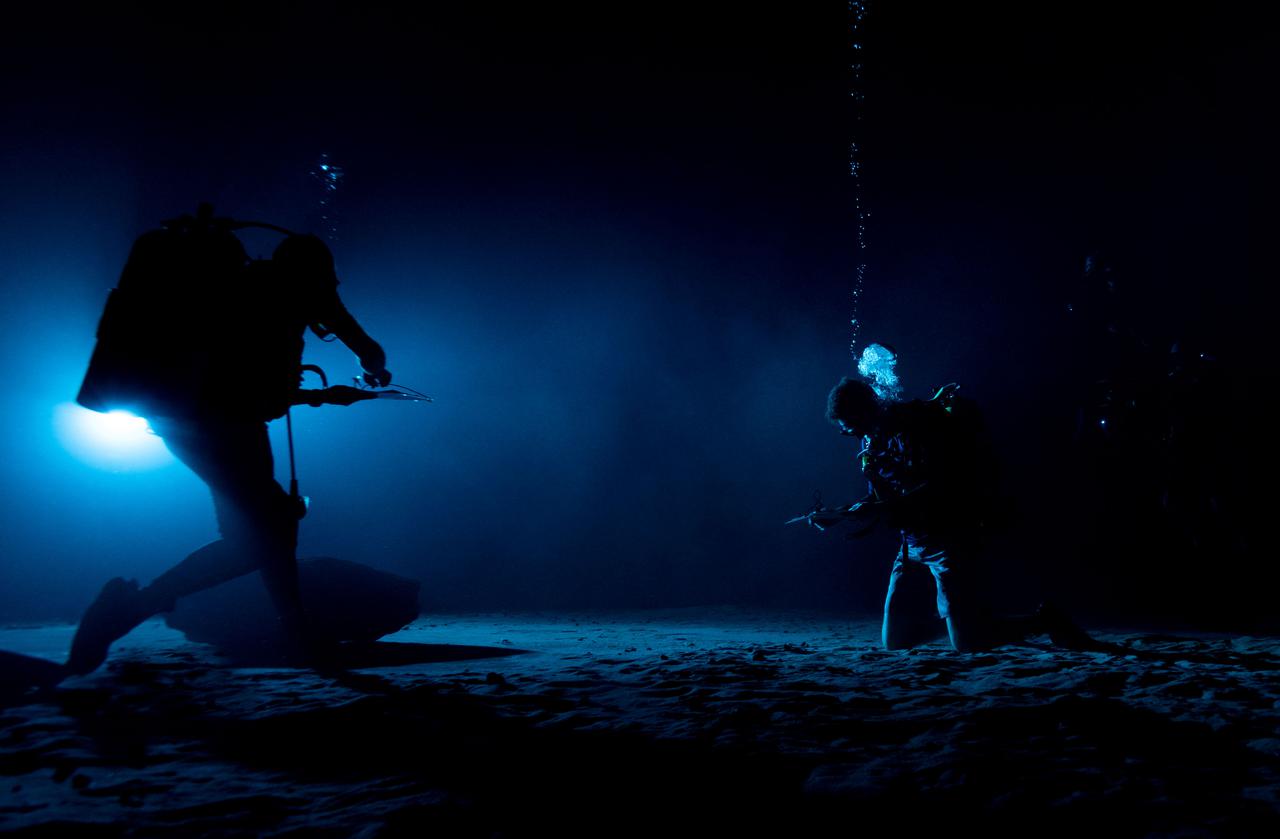
Test subjects performing subjective assessment of underwater lamp source during NBL Preliminary Lunar Lighting Evaluation. Divers at the Neutral Buoyancy Laboratory (NBL) in Houston are setting the stage for future Moonwalk training by simulating lunar lighting conditions. At the Lunar South Pole, the Sun will remain no more than a few degrees above the horizon, resulting in extremely long and dark shadows. To prepare astronauts for these challenging lighting conditions, the team at the NBL has begun preliminary evaluations of lunar lighting solutions at the bottom of the 40-foot deep pool. This testing and evaluation involved turning off all the lights in the facility, installing black curtains on the pool walls to minimize reflections, and using a powerful underwater cinematic lamp, to get the conditions just right ahead of upcoming training for astronauts.
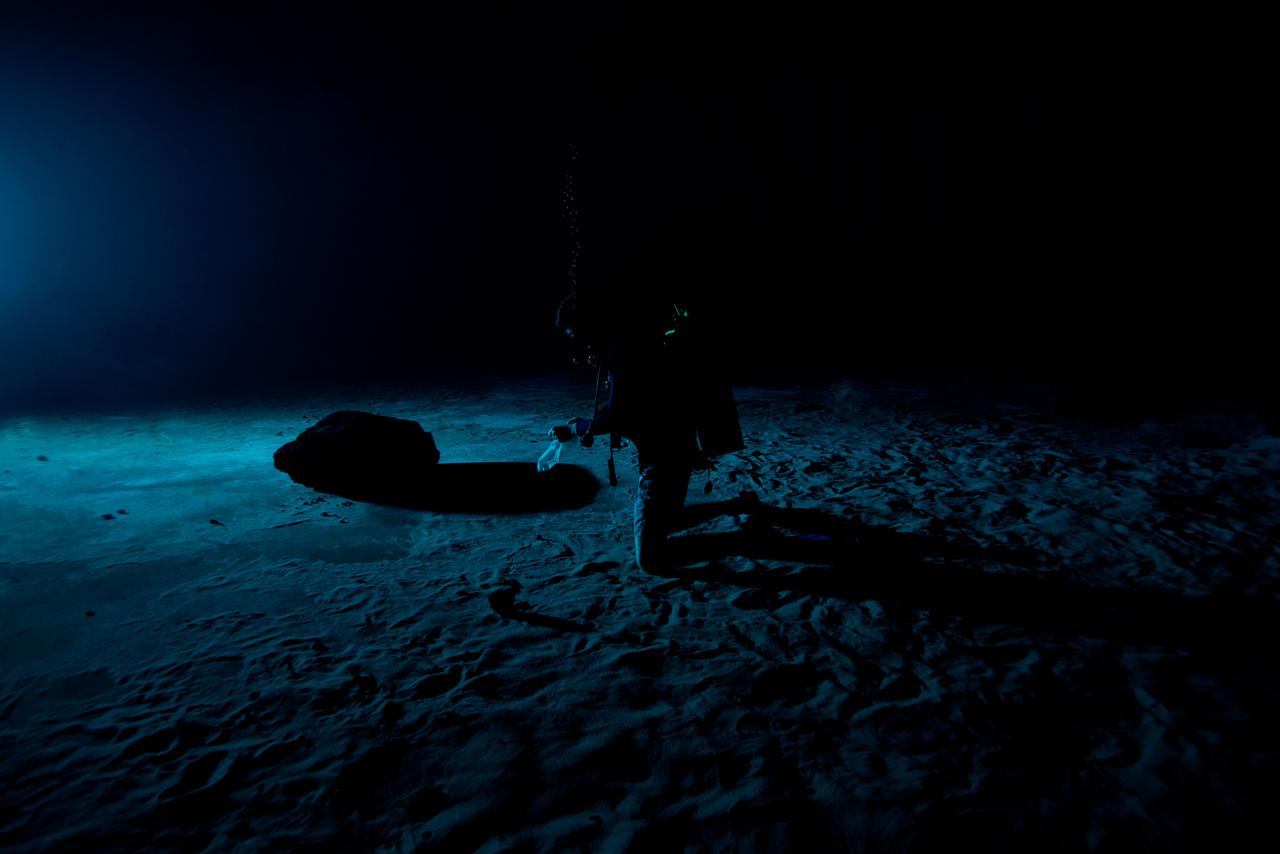
Test subjects performing subjective assessment of underwater lamp source during NBL Preliminary Lunar Lighting Evaluation. Divers at the Neutral Buoyancy Laboratory (NBL) in Houston are setting the stage for future Moonwalk training by simulating lunar lighting conditions. At the Lunar South Pole, the Sun will remain no more than a few degrees above the horizon, resulting in extremely long and dark shadows. To prepare astronauts for these challenging lighting conditions, the team at the NBL has begun preliminary evaluations of lunar lighting solutions at the bottom of the 40-foot deep pool. This testing and evaluation involved turning off all the lights in the facility, installing black curtains on the pool walls to minimize reflections, and using a powerful underwater cinematic lamp, to get the conditions just right ahead of upcoming training for astronauts.
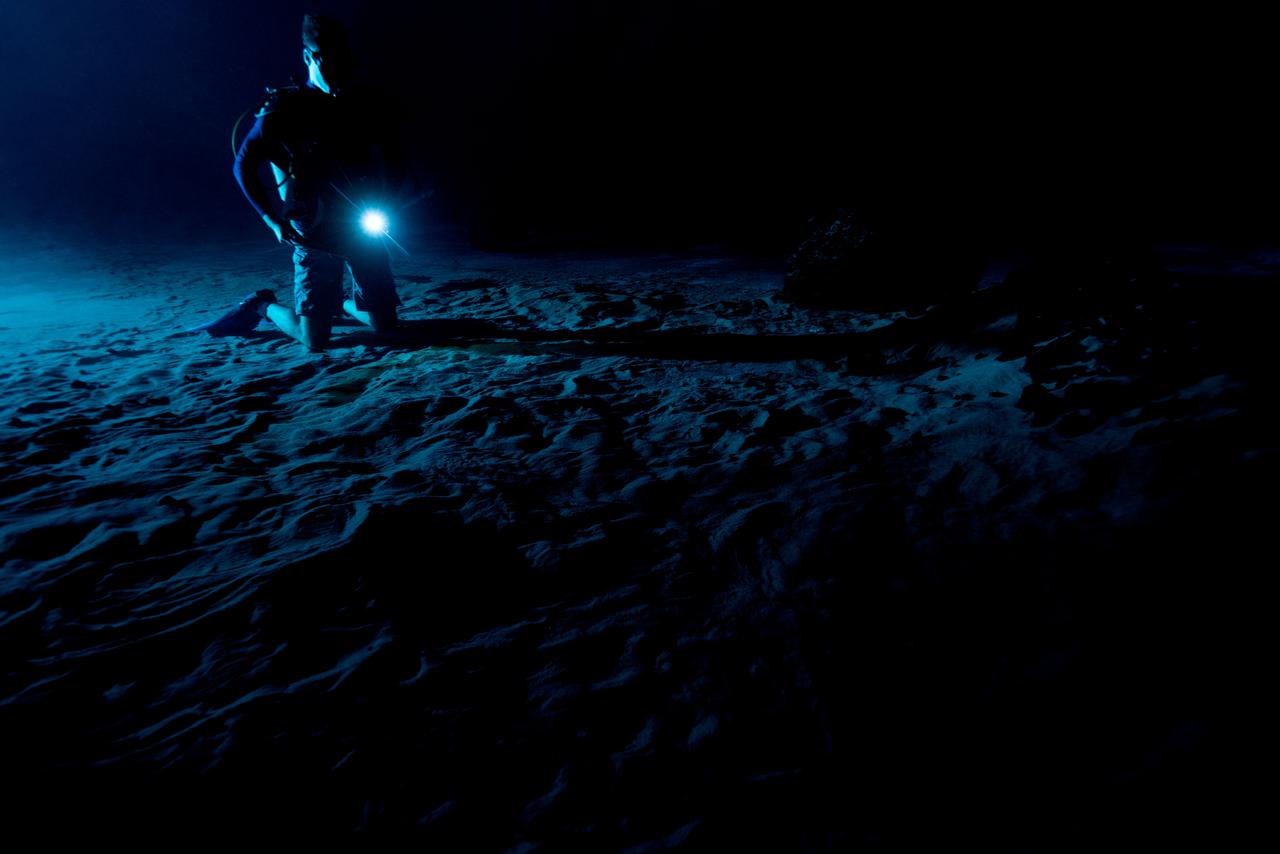
Test subjects performing subjective assessment of supplemental lighting during NBL Preliminary Lunar Lighting Evaluation. Divers at the Neutral Buoyancy Laboratory (NBL) in Houston are setting the stage for future Moonwalk training by simulating lunar lighting conditions. At the Lunar South Pole, the Sun will remain no more than a few degrees above the horizon, resulting in extremely long and dark shadows. To prepare astronauts for these challenging lighting conditions, the team at the NBL has begun preliminary evaluations of lunar lighting solutions at the bottom of the 40-foot deep pool. This testing and evaluation involved turning off all the lights in the facility, installing black curtains on the pool walls to minimize reflections, and using a powerful underwater cinematic lamp, to get the conditions just right ahead of upcoming training for astronauts.
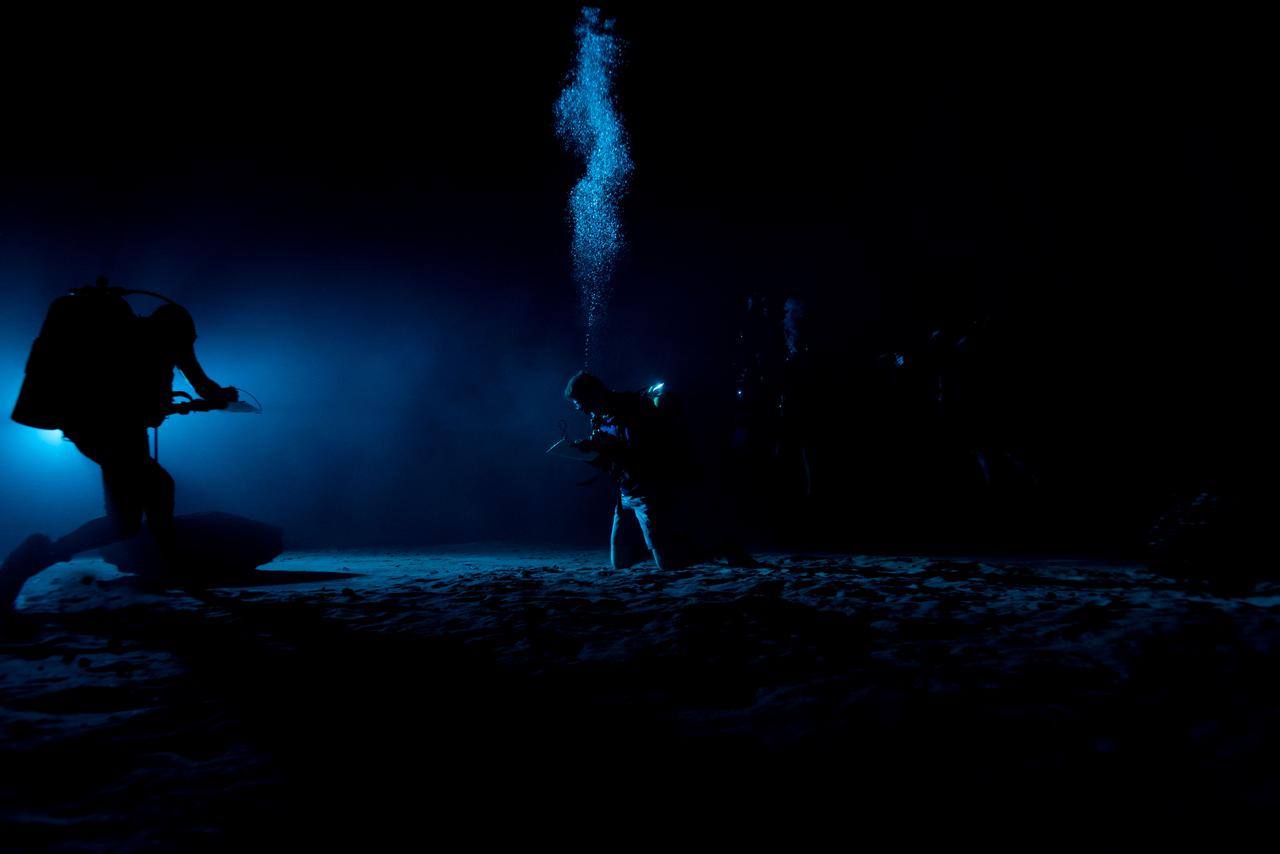
Test subjects performing subjective assessment of underwater lamp source during NBL Preliminary Lunar Lighting Evaluation. Divers at the Neutral Buoyancy Laboratory (NBL) in Houston are setting the stage for future Moonwalk training by simulating lunar lighting conditions. At the Lunar South Pole, the Sun will remain no more than a few degrees above the horizon, resulting in extremely long and dark shadows. To prepare astronauts for these challenging lighting conditions, the team at the NBL has begun preliminary evaluations of lunar lighting solutions at the bottom of the 40-foot deep pool. This testing and evaluation involved turning off all the lights in the facility, installing black curtains on the pool walls to minimize reflections, and using a powerful underwater cinematic lamp, to get the conditions just right ahead of upcoming training for astronauts.
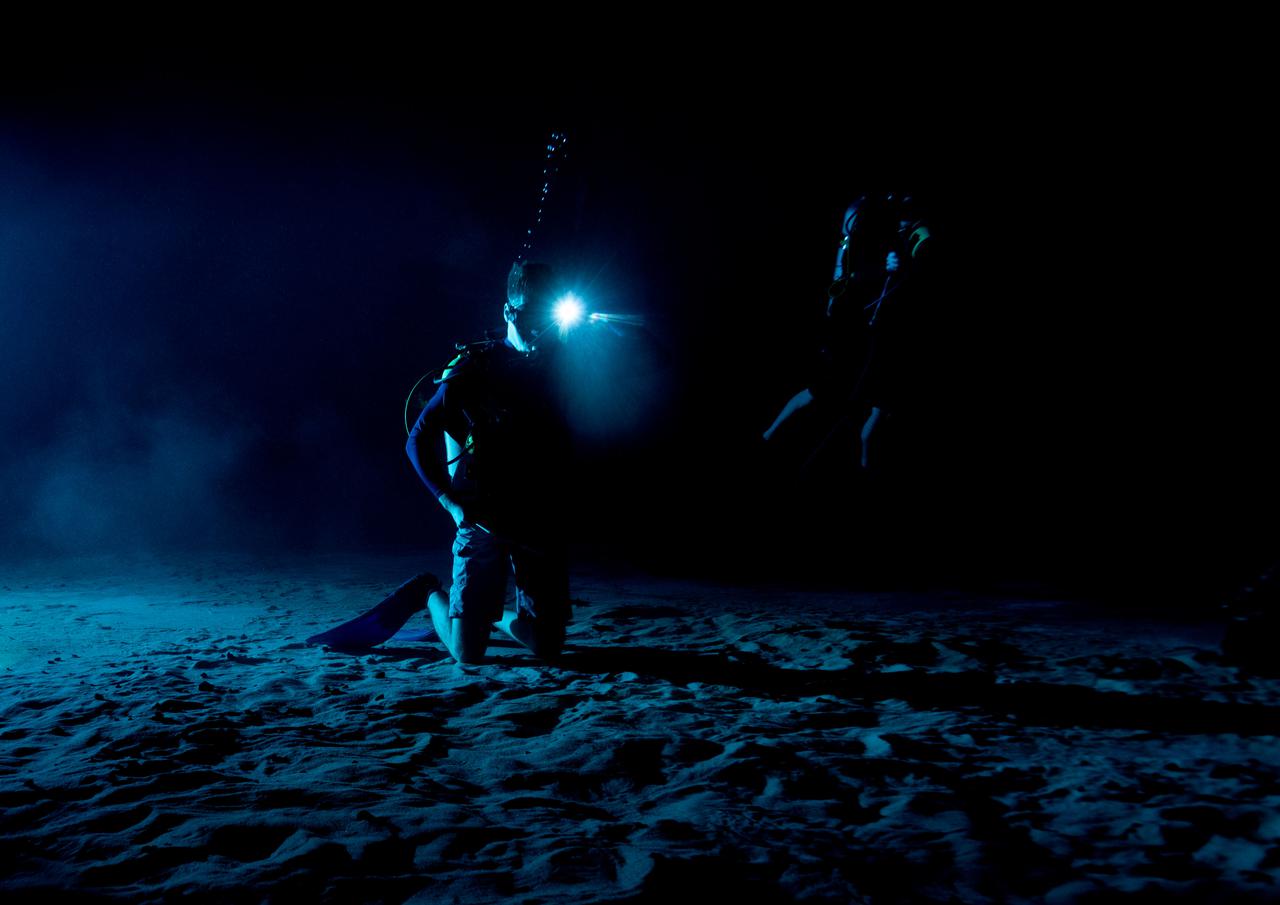
Test subjects performing subjective assessment of supplemental lighting during NBL Preliminary Lunar Lighting Evaluation. Divers at the Neutral Buoyancy Laboratory (NBL) in Houston are setting the stage for future Moonwalk training by simulating lunar lighting conditions. At the Lunar South Pole, the Sun will remain no more than a few degrees above the horizon, resulting in extremely long and dark shadows. To prepare astronauts for these challenging lighting conditions, the team at the NBL has begun preliminary evaluations of lunar lighting solutions at the bottom of the 40-foot deep pool. This testing and evaluation involved turning off all the lights in the facility, installing black curtains on the pool walls to minimize reflections, and using a powerful underwater cinematic lamp, to get the conditions just right ahead of upcoming training for astronauts.
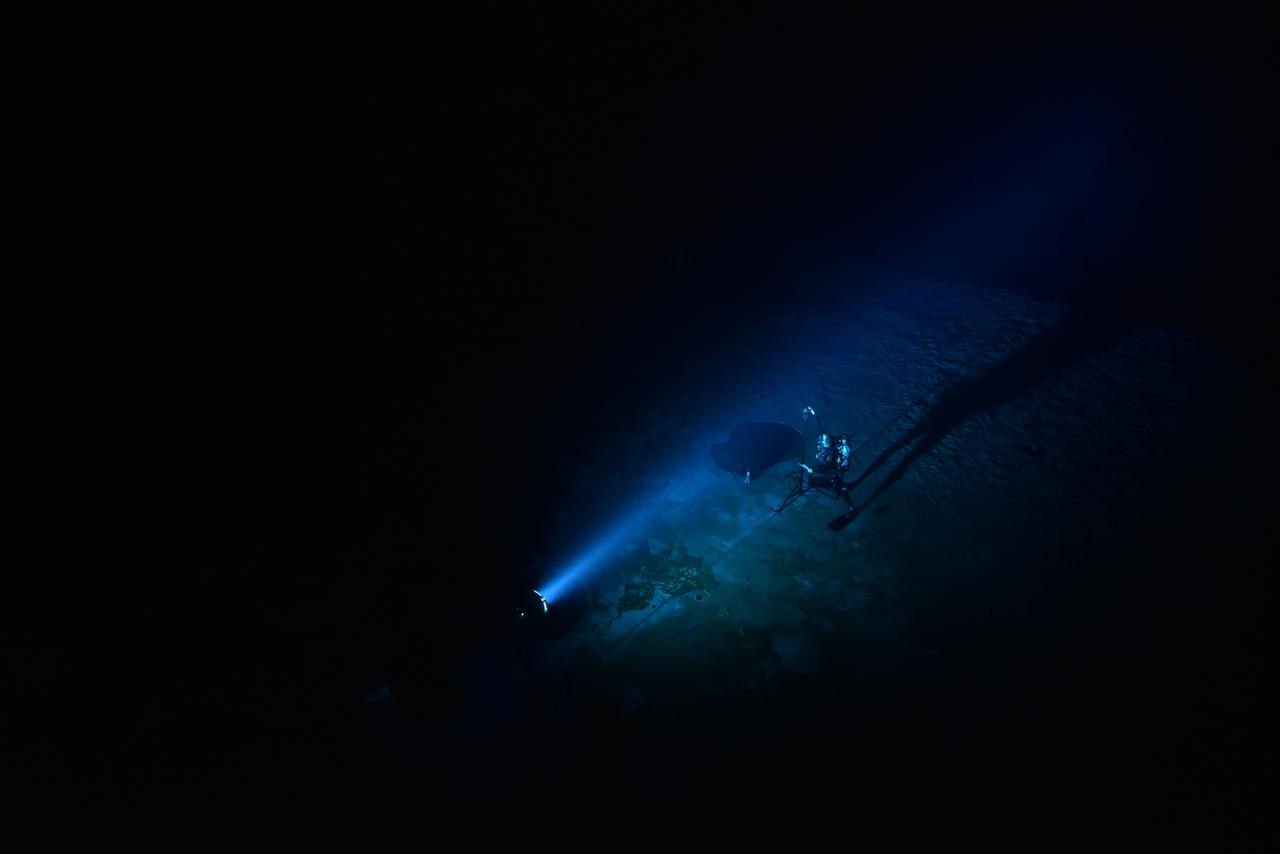
Quantitative evaluation of light source by NBL diver during NBL Preliminary Lunar Lighting Evaluation. Divers at the Neutral Buoyancy Laboratory (NBL) in Houston are setting the stage for future Moonwalk training by simulating lunar lighting conditions. At the Lunar South Pole, the Sun will remain no more than a few degrees above the horizon, resulting in extremely long and dark shadows. To prepare astronauts for these challenging lighting conditions, the team at the NBL has begun preliminary evaluations of lunar lighting solutions at the bottom of the 40-foot deep pool. This testing and evaluation involved turning off all the lights in the facility, installing black curtains on the pool walls to minimize reflections, and using a powerful underwater cinematic lamp, to get the conditions just right ahead of upcoming training for astronauts.
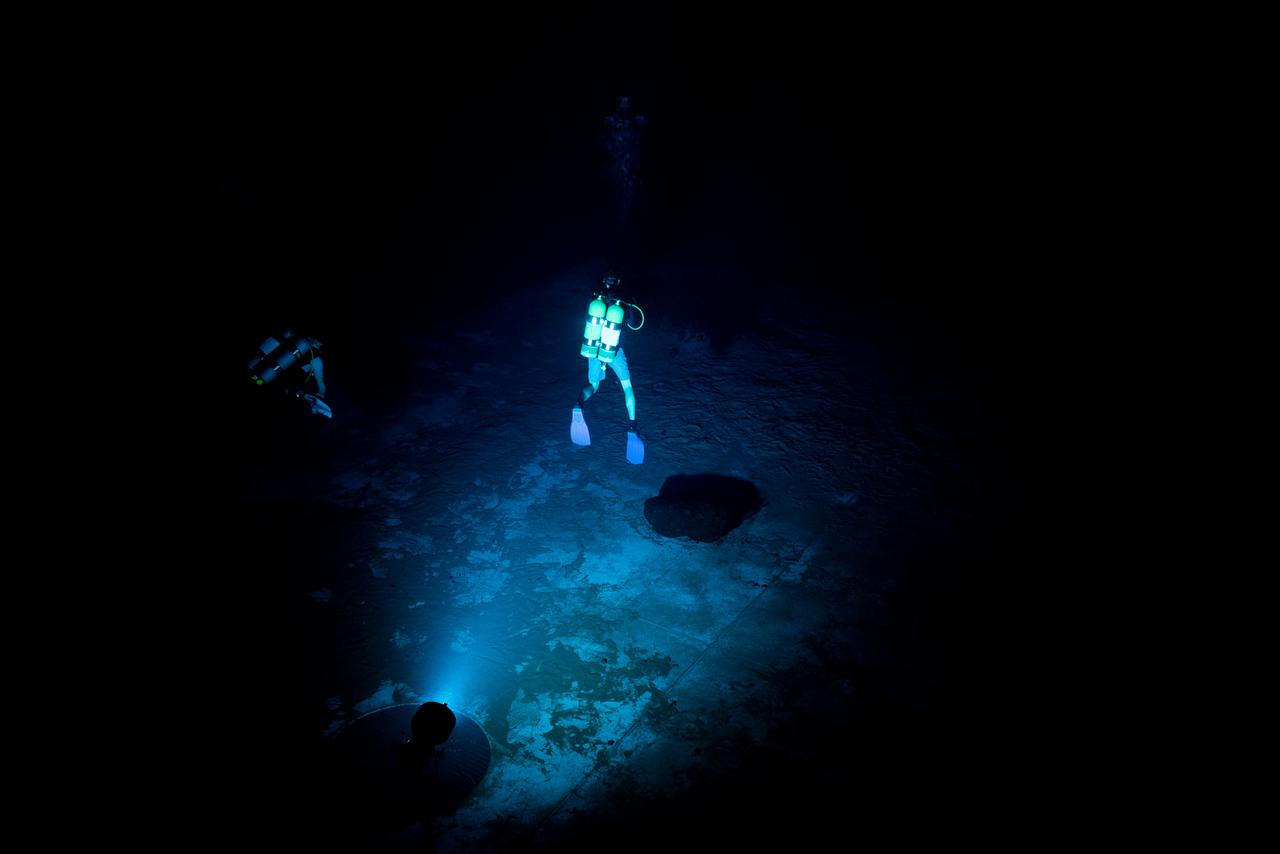
Quantitative evaluation of light source by NBL diver during NBL Preliminary Lunar Lighting Evaluation. Divers at the Neutral Buoyancy Laboratory (NBL) in Houston are setting the stage for future Moonwalk training by simulating lunar lighting conditions. At the Lunar South Pole, the Sun will remain no more than a few degrees above the horizon, resulting in extremely long and dark shadows. To prepare astronauts for these challenging lighting conditions, the team at the NBL has begun preliminary evaluations of lunar lighting solutions at the bottom of the 40-foot deep pool. This testing and evaluation involved turning off all the lights in the facility, installing black curtains on the pool walls to minimize reflections, and using a powerful underwater cinematic lamp, to get the conditions just right ahead of upcoming training for astronauts.
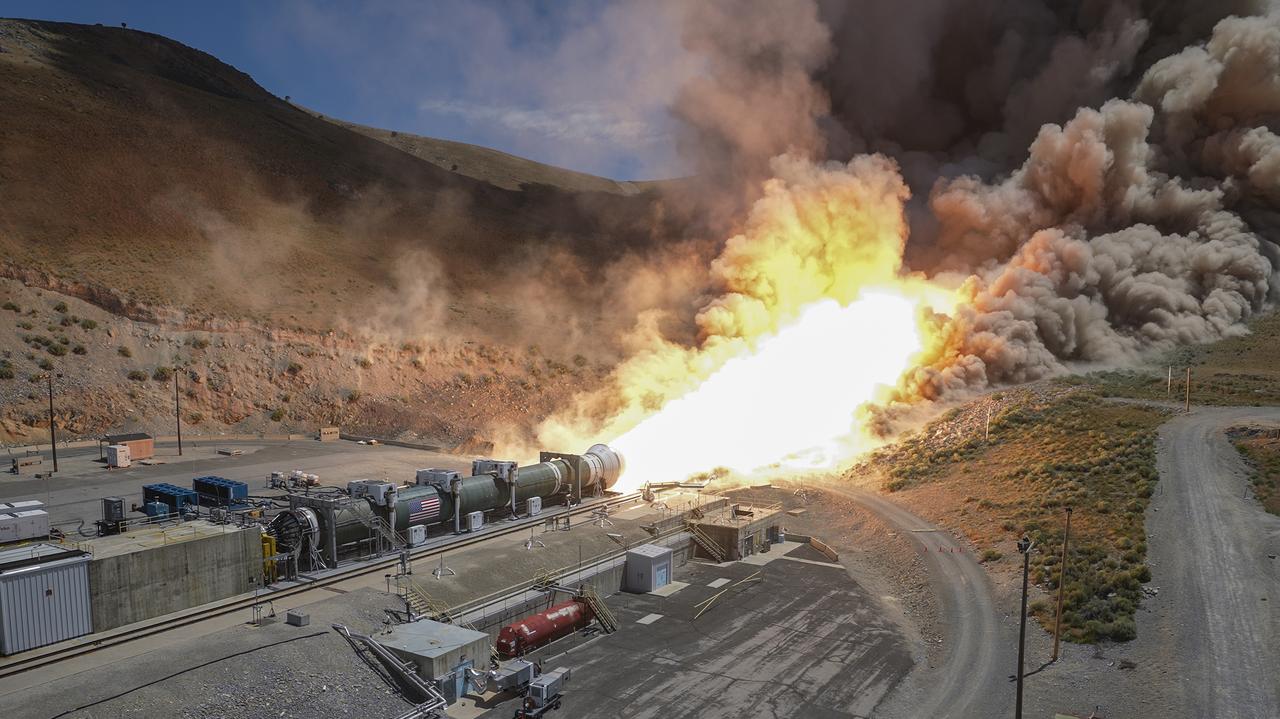
Teams from NASA and Northrop Grumman fire a ground-based version of a booster for the agency’s SLS (Space Launch System) rocket June 26. Secured horizontally in a test stand at Northrop Grumman’s test facility in Promontory, Utah, the single five-segment booster motor fired for more than two minutes and produced 3.9 million pounds of thrust. The booster for this test, known as Demonstration Motor-1 (DM-1), is the result of the Booster Obsolescence Life Extension (BOLE) project. This test was the first full-scale ground test of a new five-segment solid rocket motor. During the test, there was an abnormal event approximately 15 seconds before the end of the motor firing. Despite this event, NASA achieved several of the test’s primary objectives and received valuable data on technical risks identified ahead of the test. Testing this evolved booster for the SLS will help evaluate improvements and new materials in the boosters. The BOLE effort was launched to transition to a more efficient, lower cost commercial solution for the boosters for the SLS rocket. Through the Artemis campaign, NASA will send astronauts to explore the Moon for scientific discovery, economic benefits, and to build the foundation for the first crewed missions to Mars – for the benefit of all. For more information, contact NASA Marshall’s Office of Communications at 256-544-0034.
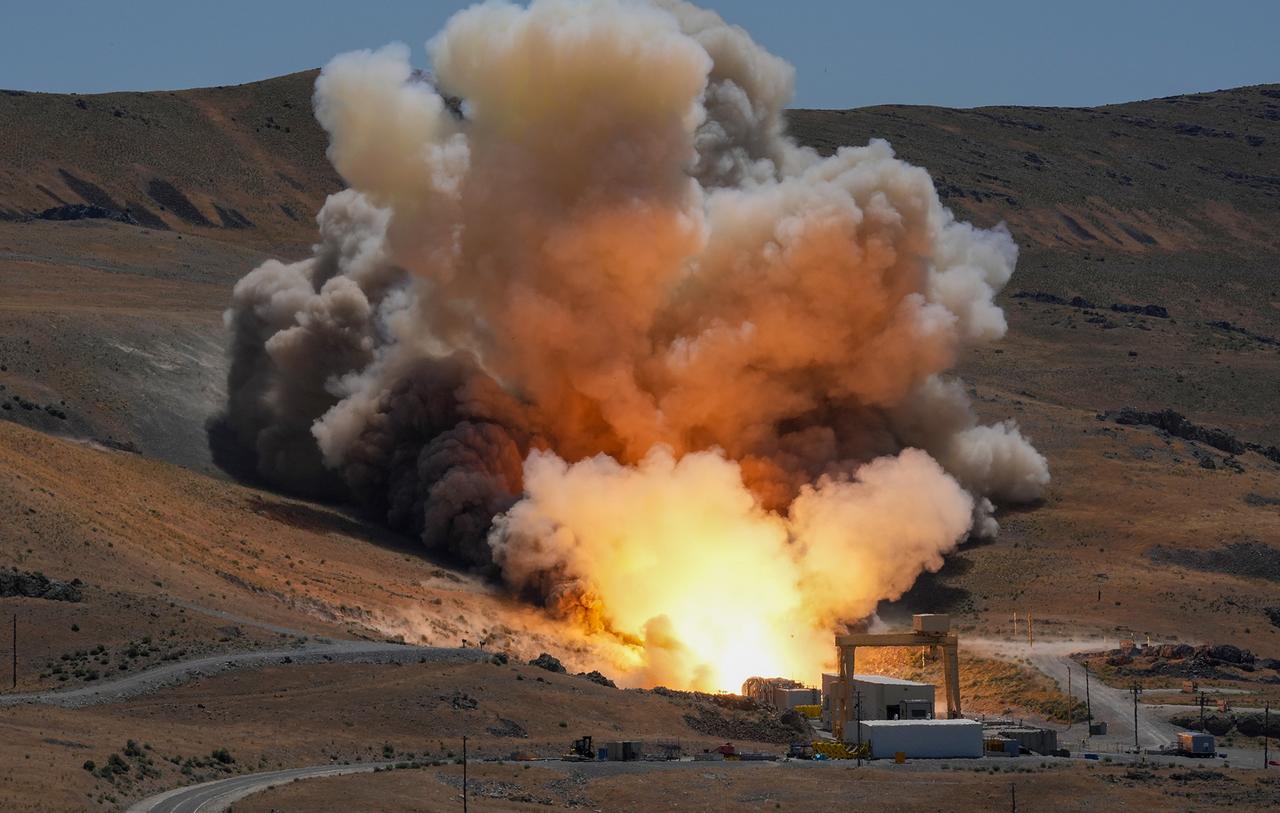
Teams from NASA and Northrop Grumman fire a ground-based version of a booster for the agency’s SLS (Space Launch System) rocket June 26. Secured horizontally in a test stand at Northrop Grumman’s test facility in Promontory, Utah, the single five-segment booster motor fired for more than two minutes and produced 3.9 million pounds of thrust. The booster for this test, known as Demonstration Motor-1 (DM-1), is the result of the Booster Obsolescence Life Extension (BOLE) project. This test was the first full-scale ground test of a new five-segment solid rocket motor. During the test, there was an abnormal event approximately 15 seconds before the end of the motor firing. Despite this event, NASA achieved several of the test’s primary objectives and received valuable data on technical risks identified ahead of the test. Testing this evolved booster for the SLS will help evaluate improvements and new materials in the boosters. The BOLE effort was launched to transition to a more efficient, lower cost commercial solution for the boosters for the SLS rocket. Through the Artemis campaign, NASA will send astronauts to explore the Moon for scientific discovery, economic benefits, and to build the foundation for the first crewed missions to Mars – for the benefit of all. For more information, contact NASA Marshall’s Office of Communications at 256-544-0034.
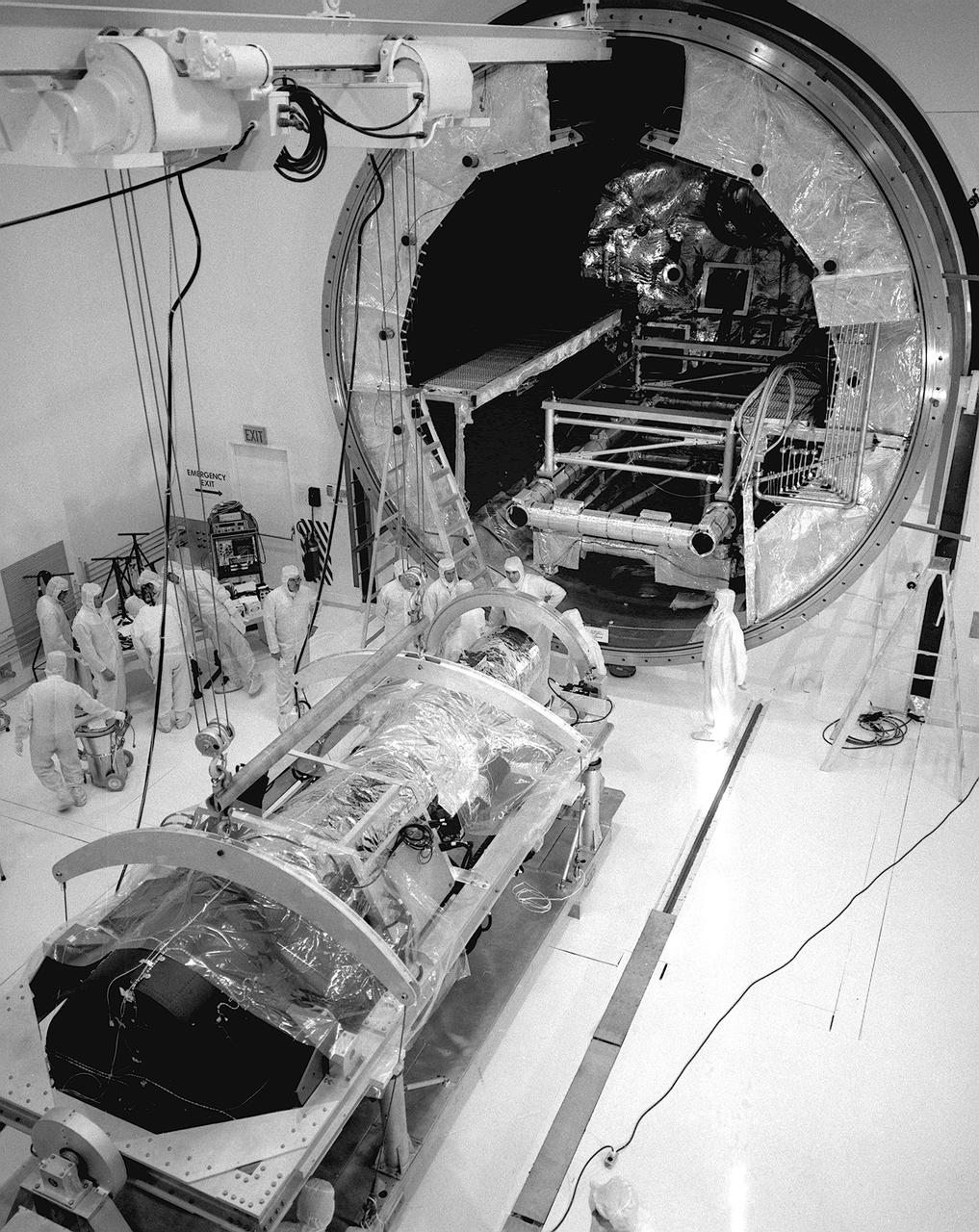
This photograph is of the High Energy Astronomy Observatory (HEAO)-2 telescope being evaluated by engineers in the clean room of the X-Ray Calibration Facility at the Marshall Space Flight Center (MSFC). The MSFC was heavily engaged in the technical and scientific aspects, testing and calibration, of the HEAO-2 telescope The HEAO-2 was the first imaging and largest x-ray telescope built to date. The X-Ray Calibration Facility was built in 1976 for testing MSFC's HEAO-2. The facility is the world's largest, most advanced laboratory for simulating x-ray emissions from distant celestial objects. It produced a space-like environment in which components related to x-ray telescope imaging are tested and the quality of their performance in space is predicted. The original facility contained a 1,000-foot long by 3-foot diameter vacuum tube (for the x-ray path) cornecting an x-ray generator and an instrument test chamber. Recently, the facility was upgraded to evaluate the optical elements of NASA's Hubble Space Telescope, Chandra X-Ray Observatory and Compton Gamma-Ray Observatory.
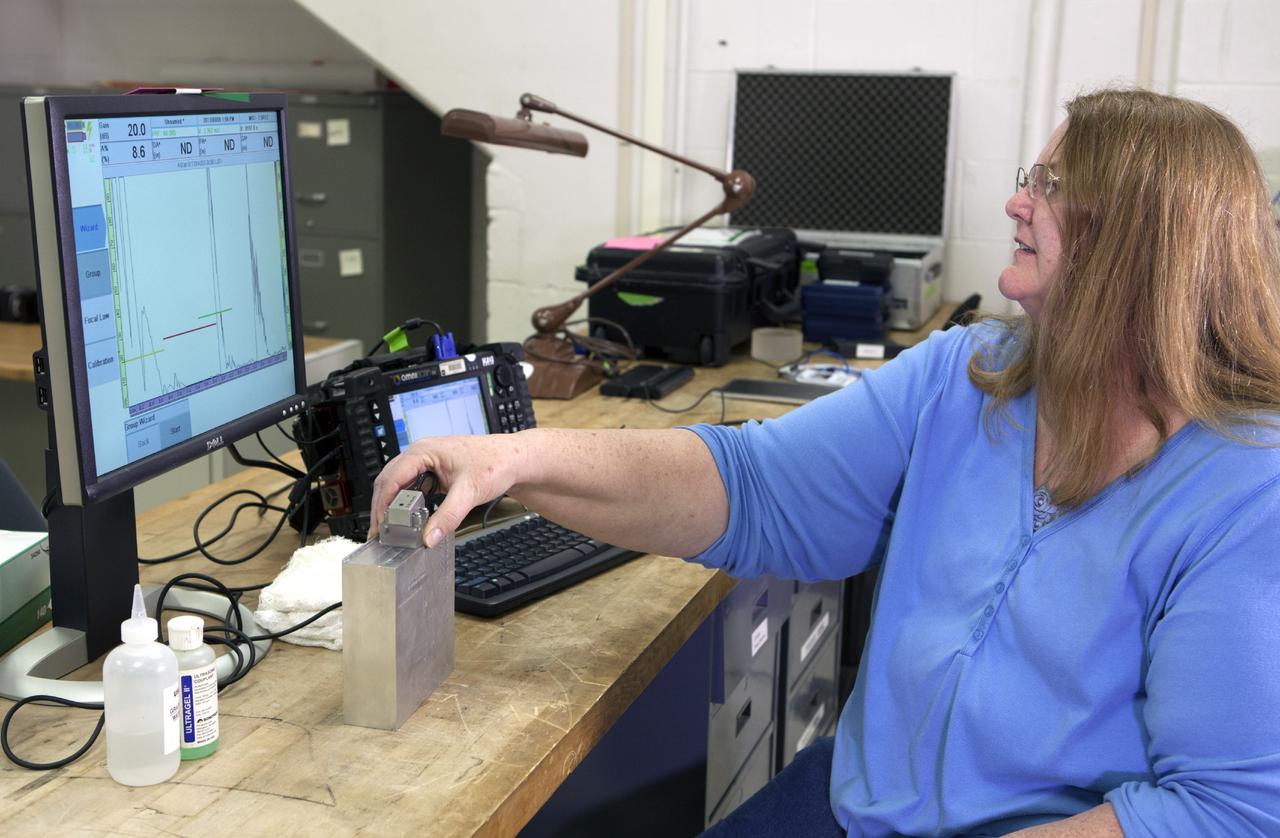
CAPE CANAVERAL, Fla. – In Hangar N at Cape Canaveral Air Force Station, PaR Systems, Inc. operations engineer Lu Bell conducts a phase array ultrasonic inspection. NASA's Kennedy Space Center in Florida recently established a partnership agreement with PaR Systems, Inc. of Shoreview, Minn., for operation of the Hangar N facility and its nondestructive testing and evaluation equipment. As the spaceport transitions from a historically government-only launch facility to a multi-user spaceport for both federal and commercial customers, partnerships between the space agency and other organizations will be a key element in that effort. Hangar N is located at Cape Canaveral Air Force Station adjacent to Kennedy and houses a unique inventory of test and evaluation equipment and the capability for current and future mission spaceflight support. Photo credit: NASA/ Dimitri Gerondidakis
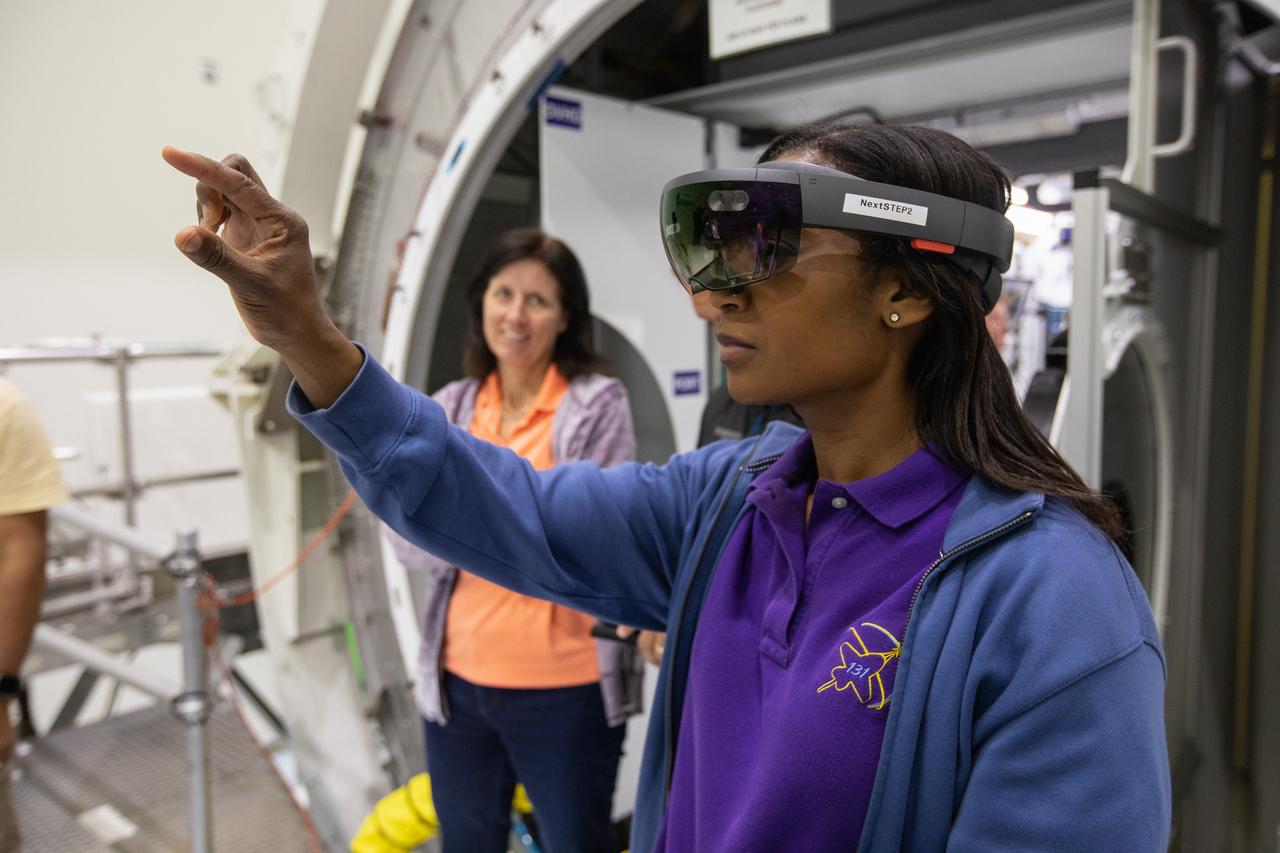
NASA began evaluating five habitat prototypes developed through NASA’s Next Space Exploration for Technologies Partnerships, or NextSTEP, to help engineers refine requirements for the design of an American-made deep space habitat for the Gateway. Lockheed Martin turned over its prototype to NASA, and testing began with crew on March 25, 2019, at Kennedy Space Center in Florida. Pictured inside the Space Station Processing Facility on March 26, 2019, from left are astronauts Shannon Walker and Stephanie Wilson. Astronauts are participating in the evaluations to provide their perspectives as those who may one day live aboard the lunar outpost, which would be located about 250,000 miles from Earth. Ground prototypes developed by Bigelow Aerospace, Boeing, Northrop Grumman, and Sierra Nevada Corporation will be tested in the future at various facilities across the country. A sixth company, NanoRacks, plans to develop a prototype as well.
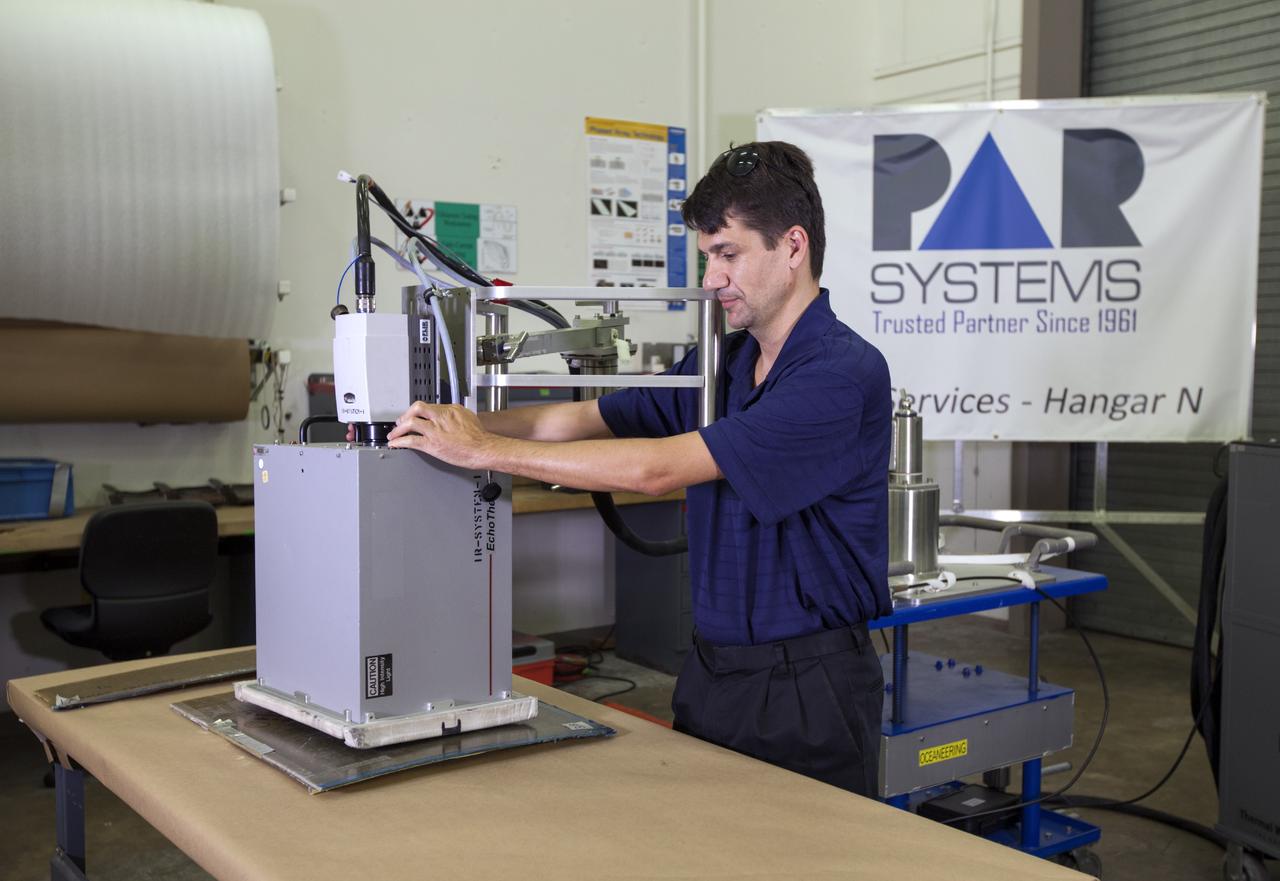
CAPE CANAVERAL, Fla. – In Hangar N at Cape Canaveral Air Force Station, PaR Systems, Inc. development engineer Bence Bertha sets up a flash thermography system. The equipment is used for inspecting hardware with thermal analysis. NASA's Kennedy Space Center in Florida recently established a partnership agreement with PaR Systems, Inc. of Shoreview, Minn., for operation of the Hangar N facility and its nondestructive testing and evaluation equipment. As the spaceport transitions from a historically government-only launch facility to a multi-user spaceport for both federal and commercial customers, partnerships between the space agency and other organizations will be a key element in that effort. Hangar N is located at Cape Canaveral Air Force Station adjacent to Kennedy and houses a unique inventory of test and evaluation equipment and the capability for current and future mission spaceflight support. Photo credit: NASA/ Dimitri Gerondidakis
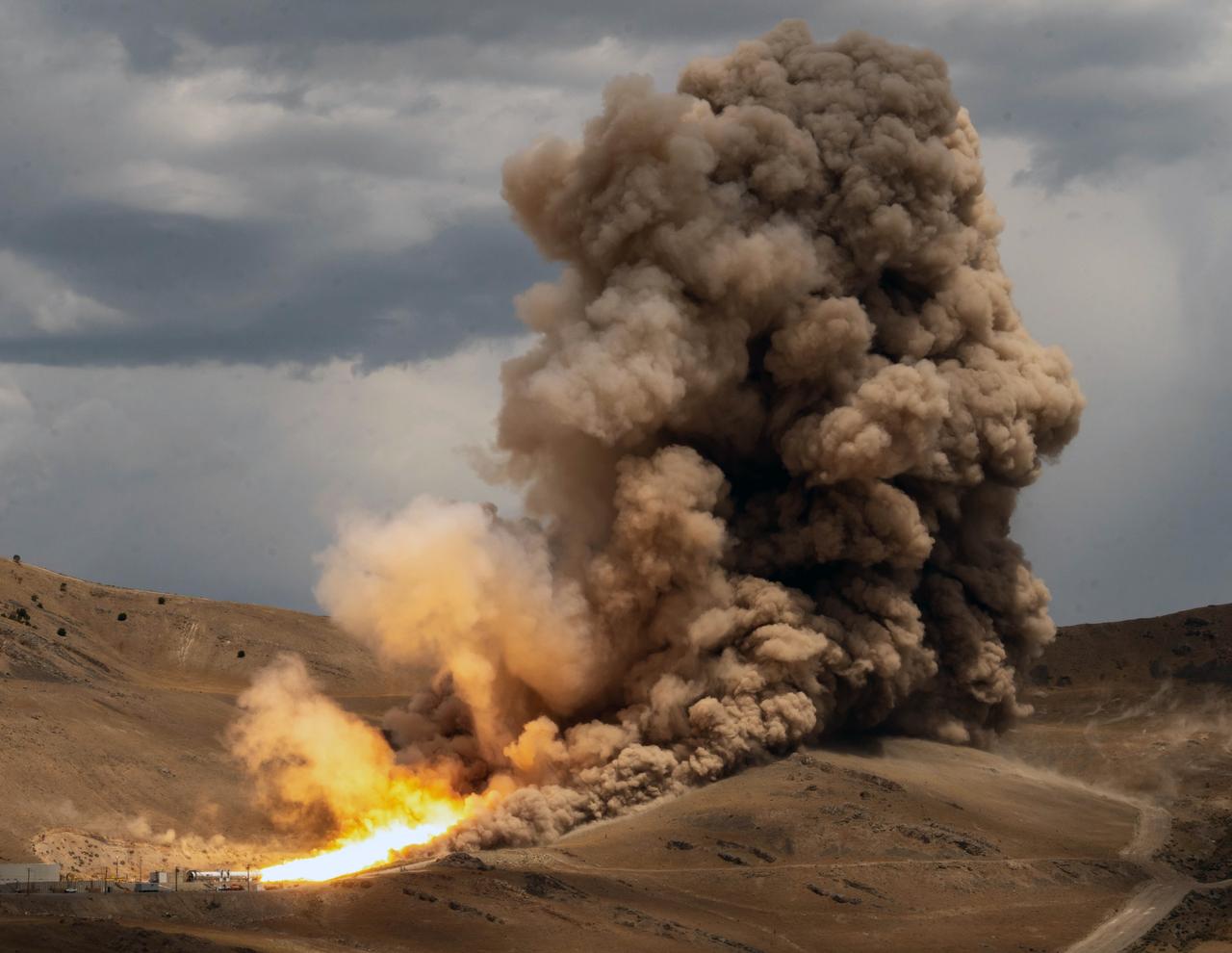
NASA and Northrop Grumman completed a solid rocket booster motor ground test for future flights of the agency’s Space Launch System rocket at Northrop Grumman’s test facility in Promontory, Utah, July 21. The booster motor, called Flight Support Booster-2 (FSB-2), fired for a little over two minutes and produced more than 3.6 million pounds of thrust. Test data will be used to evaluate improvements and new materials in the boosters for missions after Artemis III. When SLS launches the Artemis missions to the Moon, its two five-segment solid rocket boosters produce more than 75% of the initial thrust. The SLS boosters are the largest, most powerful boosters ever built for flight. For more information about SLS, visit nasa.gov/sls
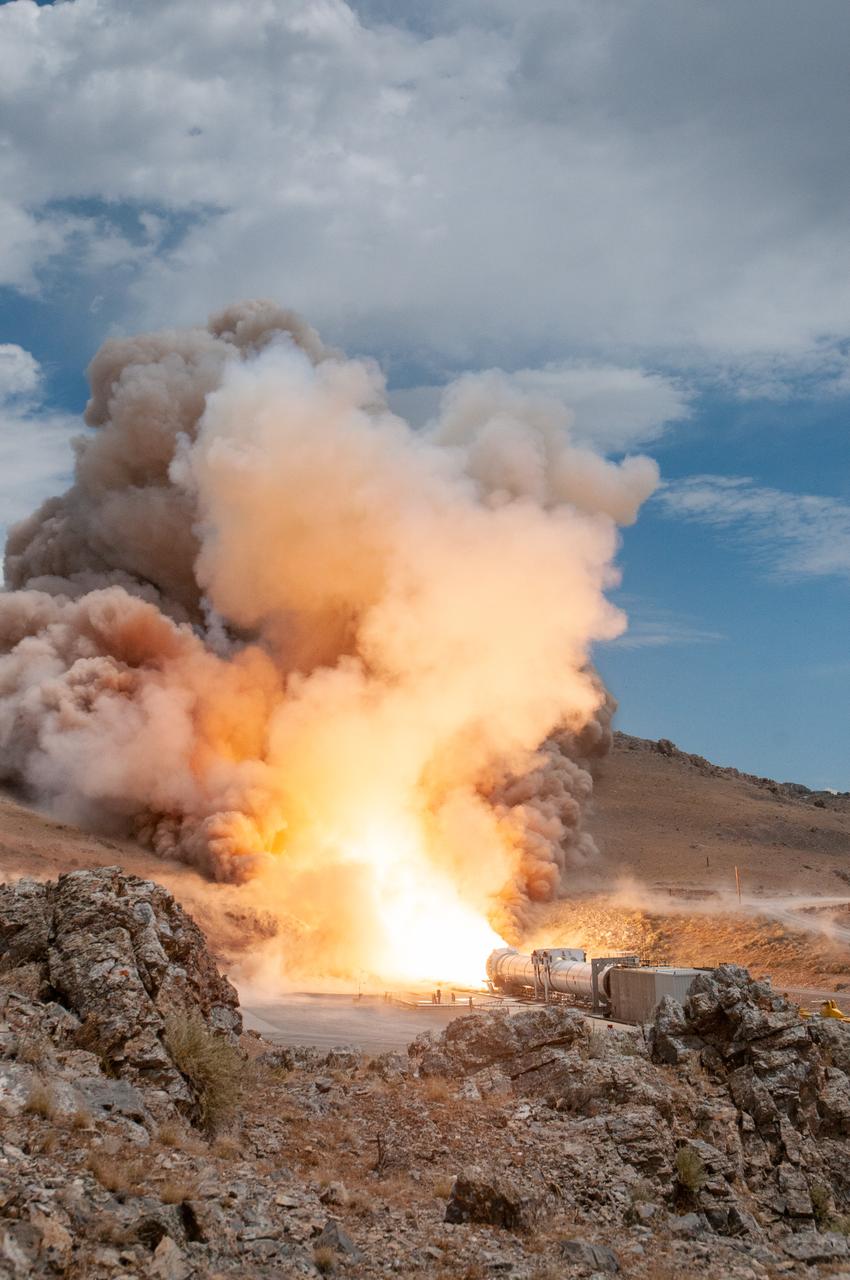
NASA and Northrop Grumman completed a solid rocket booster motor ground test for future flights of the agency’s Space Launch System rocket at Northrop Grumman’s test facility in Promontory, Utah, July 21. The booster motor, called Flight Support Booster-2 (FSB-2), fired for a little over two minutes and produced more than 3.6 million pounds of thrust. Test data will be used to evaluate improvements and new materials in the boosters for missions after Artemis III. When SLS launches the Artemis missions to the Moon, its two five-segment solid rocket boosters produce more than 75% of the initial thrust. The SLS boosters are the largest, most powerful boosters ever built for flight. For more information about SLS, visit nasa.gov/sls
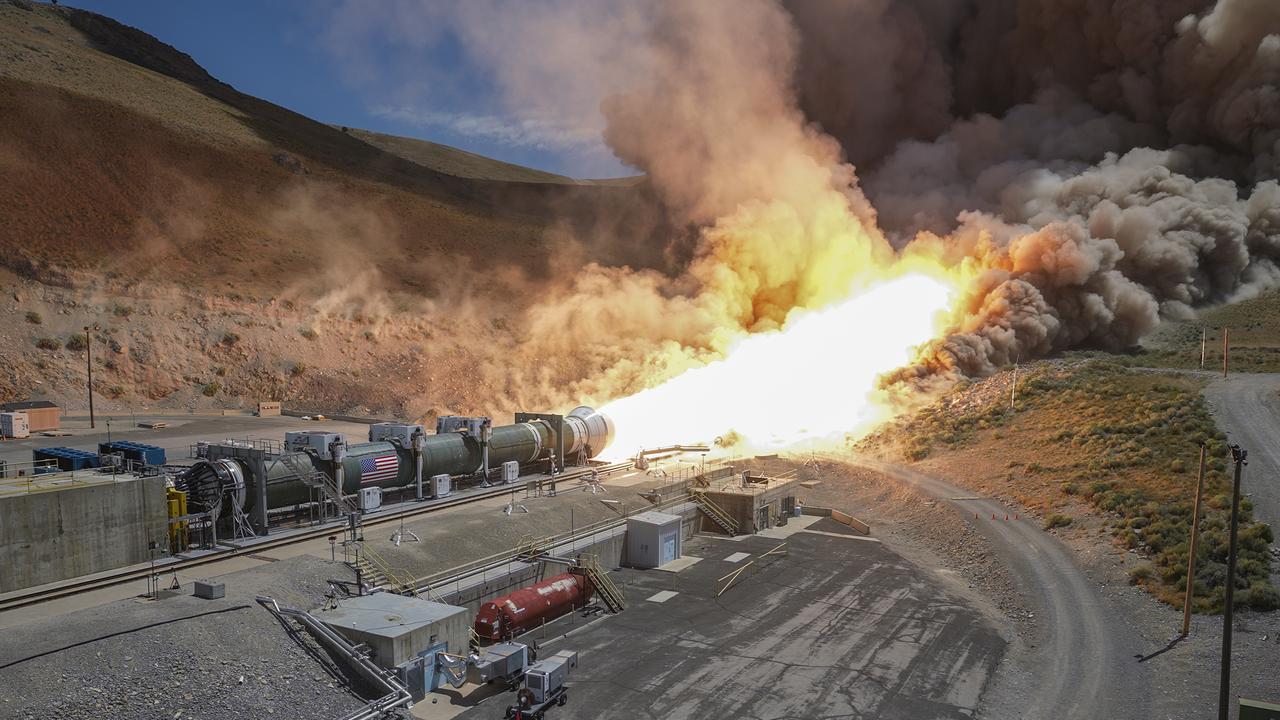
Teams from NASA and Northrop Grumman fire a ground-based version of a booster for the agency’s SLS (Space Launch System) rocket June 26. Secured horizontally in a test stand at Northrop Grumman’s test facility in Promontory, Utah, the single five-segment booster motor fired for more than two minutes and produced 3.9 million pounds of thrust. The booster for this test, known as Demonstration Motor-1 (DM-1), is the result of the Booster Obsolescence Life Extension (BOLE) project. This test was the first full-scale ground test of a new five-segment solid rocket motor. Teams from NASA and Northrop Grumman fire a ground-based version of a booster for the agency’s SLS (Space Launch System) rocket June 26. Secured horizontally in a test stand at Northrop Grumman’s test facility in Promontory, Utah, the single five-segment booster motor fired for more than two minutes and produced 3.9 million pounds of thrust. The booster for this test, known as Demonstration Motor-1 (DM-1), is the result of the Booster Obsolescence Life Extension (BOLE) project. This test was the first full-scale ground test of a new five-segment solid rocket motor. During the test, there was an abnormal event approximately 15 seconds before the end of the motor firing. Despite this event, NASA achieved several of the test’s primary objectives and received valuable data on technical risks identified ahead of the test. Testing this evolved booster for the SLS will help evaluate improvements and new materials in the boosters. The BOLE effort was launched to transition to a more efficient, lower cost commercial solution for the boosters for the SLS rocket. Through the Artemis campaign, NASA will send astronauts to explore the Moon for scientific discovery, economic benefits, and to build the foundation for the first crewed missions to Mars – for the benefit of all. For more information, contact NASA Marshall’s Office of Communications at 256-544-0034.
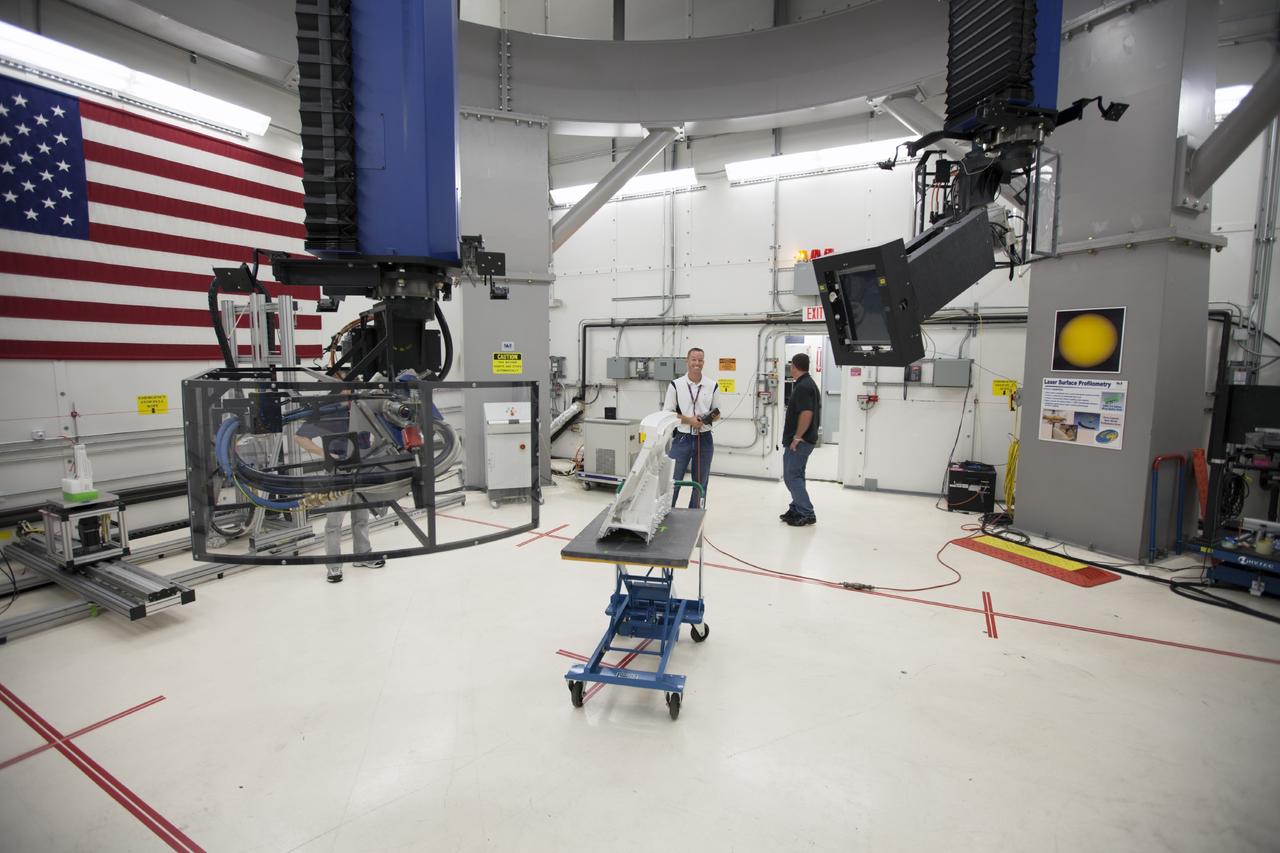
CAPE CANAVERAL, Fla. – In Hangar N at Cape Canaveral Air Force Station, PaR Systems, Inc. operations engineer Jeff Elston, left, and Tony Corak, manager of NDT Services for PaR Systems, operate an 11-axis robotic X-ray system which takes images of hardware for evaluation. The activity is part of work performed by PaR Systems, Inc. under a partnership agreement with NASA. NASA's Kennedy Space Center in Florida recently established a partnership agreement with PaR Systems, Inc. of Shoreview, Minn., for operation of the Hangar N facility and its nondestructive testing and evaluation equipment. As the spaceport transitions from a historically government-only launch facility to a multi-user spaceport for both federal and commercial customers, partnerships between the space agency and other organizations will be a key element in that effort. Hangar N is located at Cape Canaveral Air Force Station adjacent to Kennedy and houses a unique inventory of test and evaluation equipment and the capability for current and future mission spaceflight support. Photo credit: NASA/ Dimitri Gerondidakis
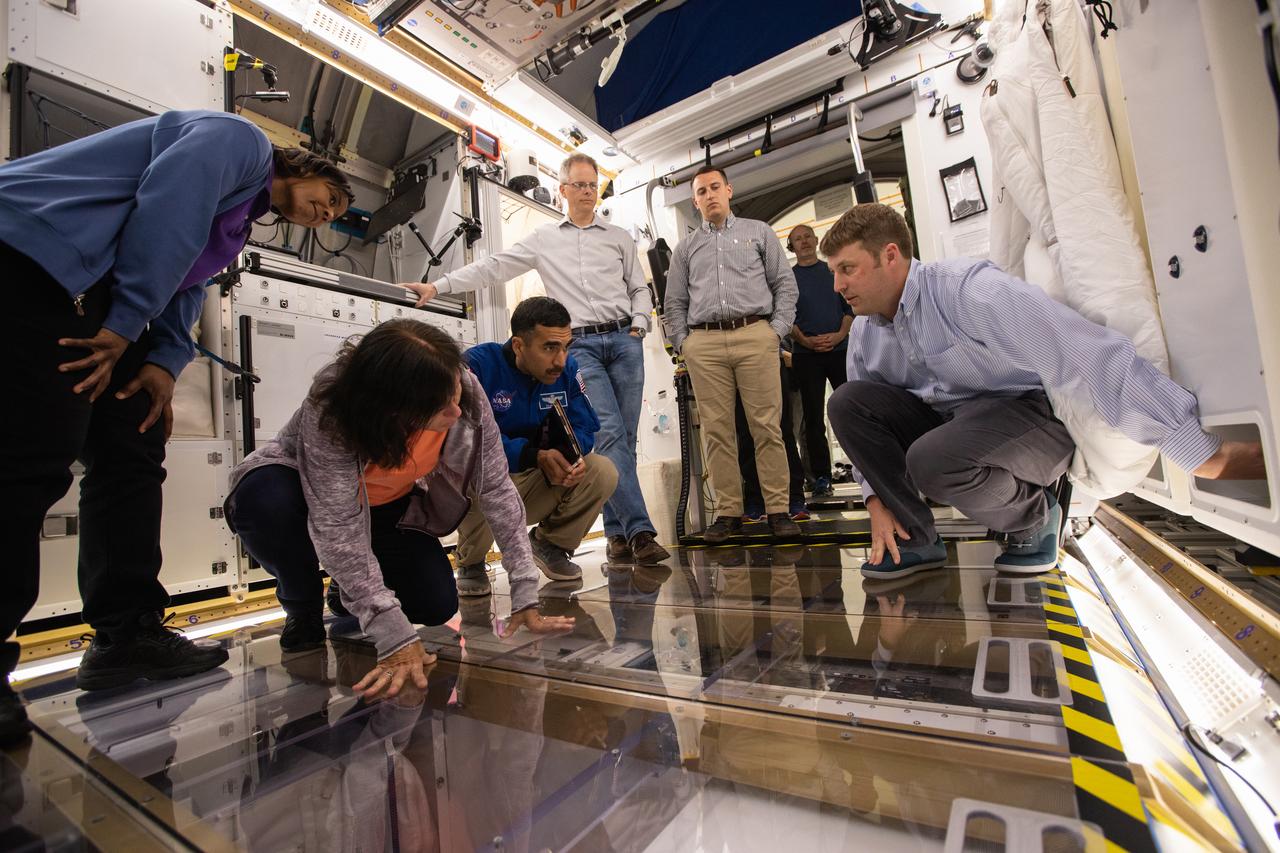
NASA began evaluating five habitat prototypes developed through NASA’s Next Space Exploration for Technologies Partnerships, or NextSTEP, to help engineers refine requirements for the design of an American-made deep space habitat for the Gateway. Lockheed Martin turned over its prototype to NASA, and testing began with crew on March 25, 2019, at Kennedy Space Center in Florida. Pictured inside the habitat prototype on March 26, 2019, from left are astronauts Stephanie Wilson, Shannon Walker and Raja Chari. Astronauts are participating in the evaluations to provide their perspectives as those who may one day live aboard the lunar outpost, which would be located about 250,000 miles from Earth. Ground prototypes developed by Bigelow Aerospace, Boeing, Northrop Grumman, and Sierra Nevada Corporation will be tested in the future at various facilities across the country. A sixth company, NanoRacks, plans to develop a prototype as well.
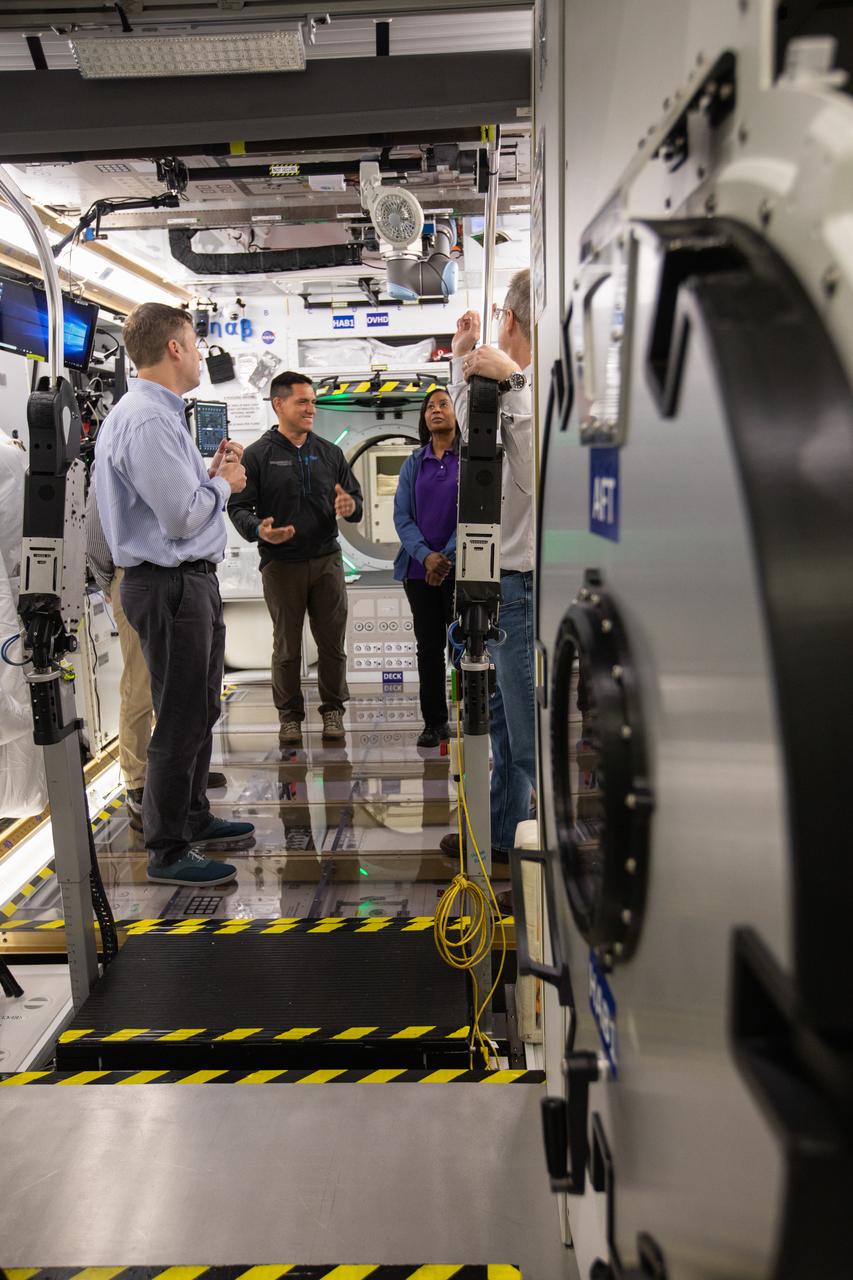
NASA began evaluating five habitat prototypes developed through NASA’s Next Space Exploration for Technologies Partnerships, or NextSTEP, to help engineers refine requirements for the design of an American-made deep space habitat for the Gateway. Lockheed Martin turned over its prototype to NASA, and testing began with crew on March 25, 2019, at Kennedy Space Center in Florida. Pictured inside the habitat prototype on March 26, 2019, second from left is astronaut Frank Rubio. Next to him is astronaut Stephanie Wilson. Astronauts are participating in the evaluations to provide their perspectives as those who may one day live aboard the lunar outpost, which would be located about 250,000 miles from Earth. Ground prototypes developed by Bigelow Aerospace, Boeing, Northrop Grumman, and Sierra Nevada Corporation will be tested in the future at various facilities across the country. A sixth company, NanoRacks, plans to develop a prototype as well.
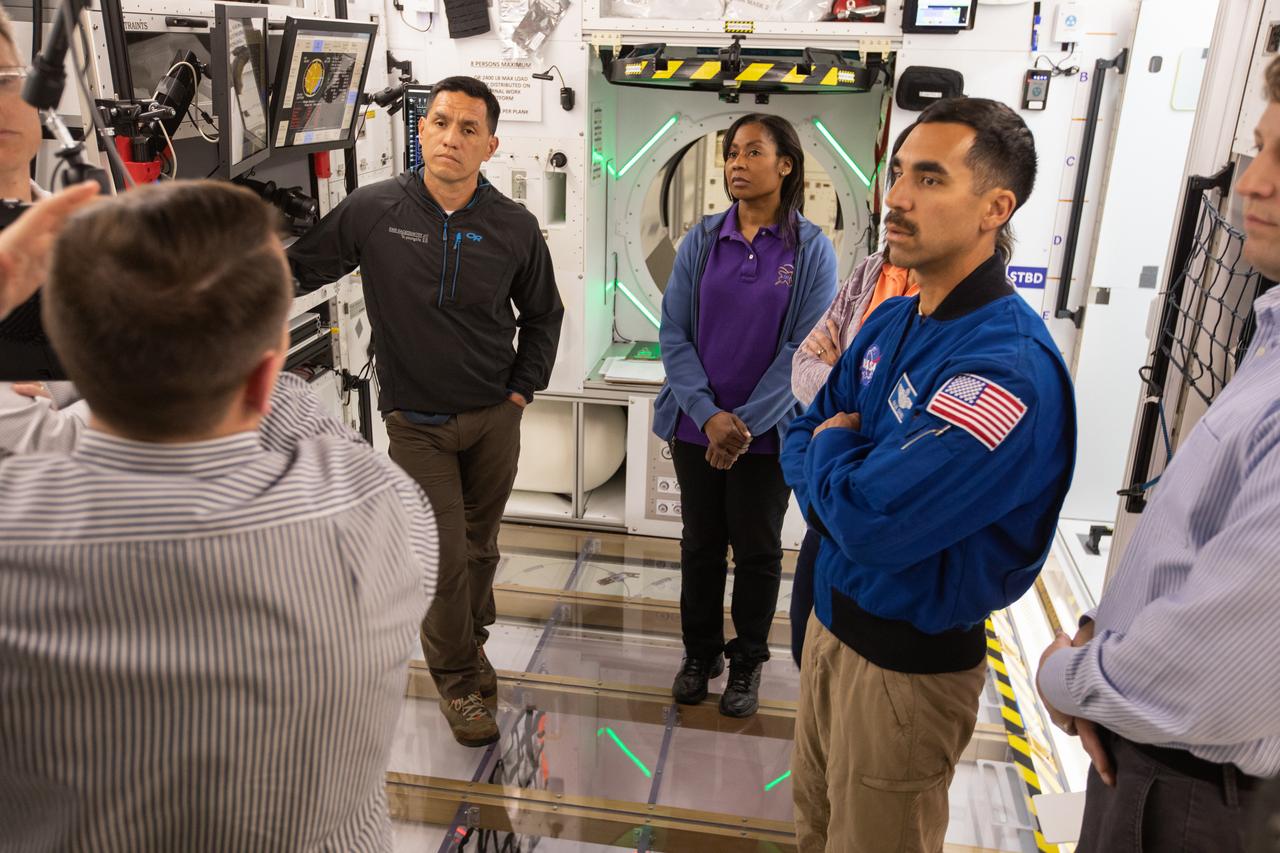
NASA began evaluating five habitat prototypes developed through NASA’s Next Space Exploration for Technologies Partnerships, or NextSTEP, to help engineers refine requirements for the design of an American-made deep space habitat for the Gateway. Lockheed Martin turned over its prototype to NASA, and testing began with crew on March 25, 2019, at Kennedy Space Center in Florida. Pictured inside the habitat prototype on March 26, 2019, from left are astronauts Frank Rubio, Stephanie Wilson and Raja Chari. Partially in view next to Chari is astronaut Shannon Walker. Astronauts are participating in the evaluations to provide their perspectives as those who may one day live aboard the lunar outpost, which would be located about 250,000 miles from Earth. Ground prototypes developed by Bigelow Aerospace, Boeing, Northrop Grumman, and Sierra Nevada Corporation will be tested in the future at various facilities across the country. A sixth company, NanoRacks, plans to develop a prototype as well.
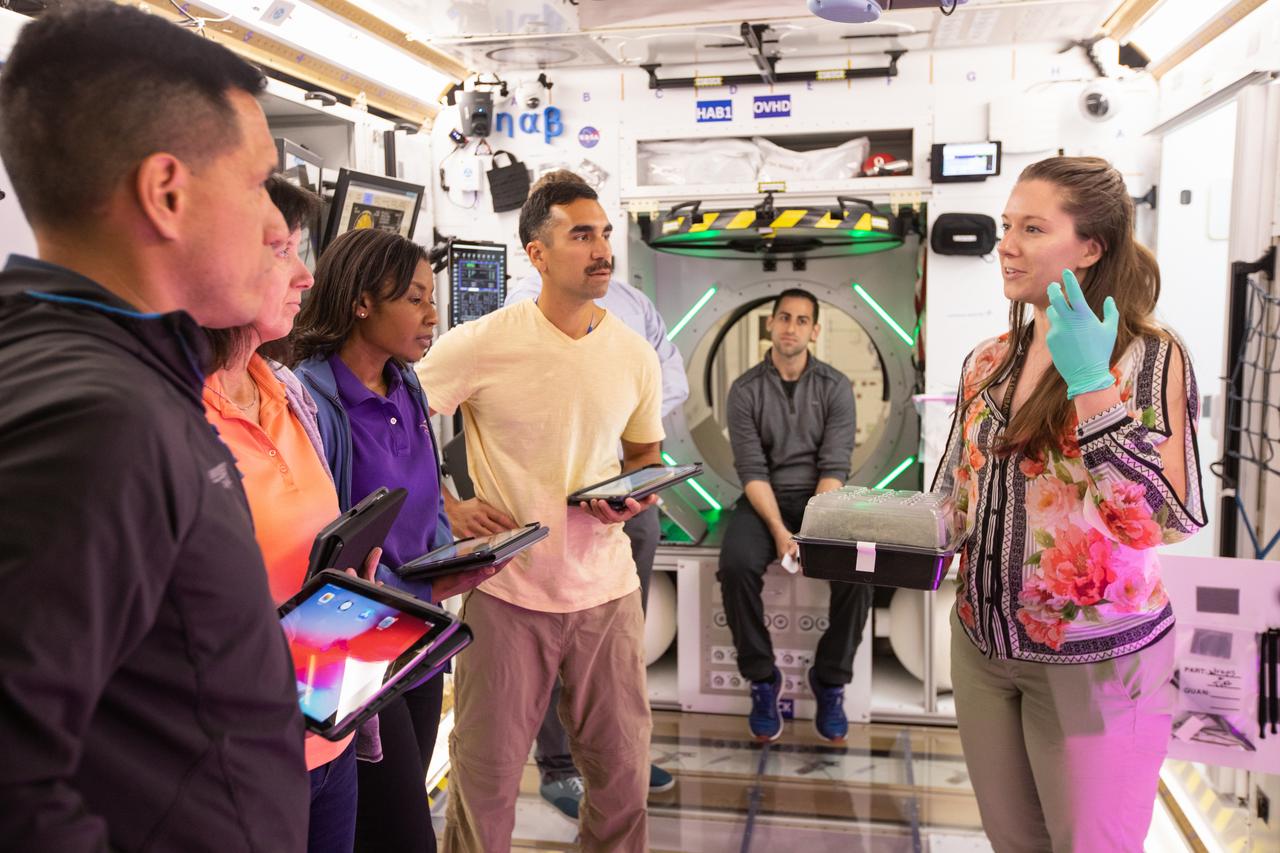
NASA began evaluating five habitat prototypes developed through NASA’s Next Space Exploration for Technologies Partnerships, or NextSTEP, to help engineers refine requirements for the design of an American-made deep space habitat for the Gateway. Lockheed Martin turned over its prototype to NASA, and testing began with crew on March 25, 2019, at Kennedy Space Center in Florida. Pictured inside the habitat prototype on March 26, 2019, from far left are astronauts Frank Rubio, Shannon Walker, Stephanie Wilson and Raja Chari. Astronauts are participating in the evaluations to provide their perspectives as those who may one day live aboard the lunar outpost, which would be located about 250,000 miles from Earth. Ground prototypes developed by Bigelow Aerospace, Boeing, Northrop Grumman, and Sierra Nevada Corporation will be tested in the future at various facilities across the country. A sixth company, NanoRacks, plans to develop a prototype as well.
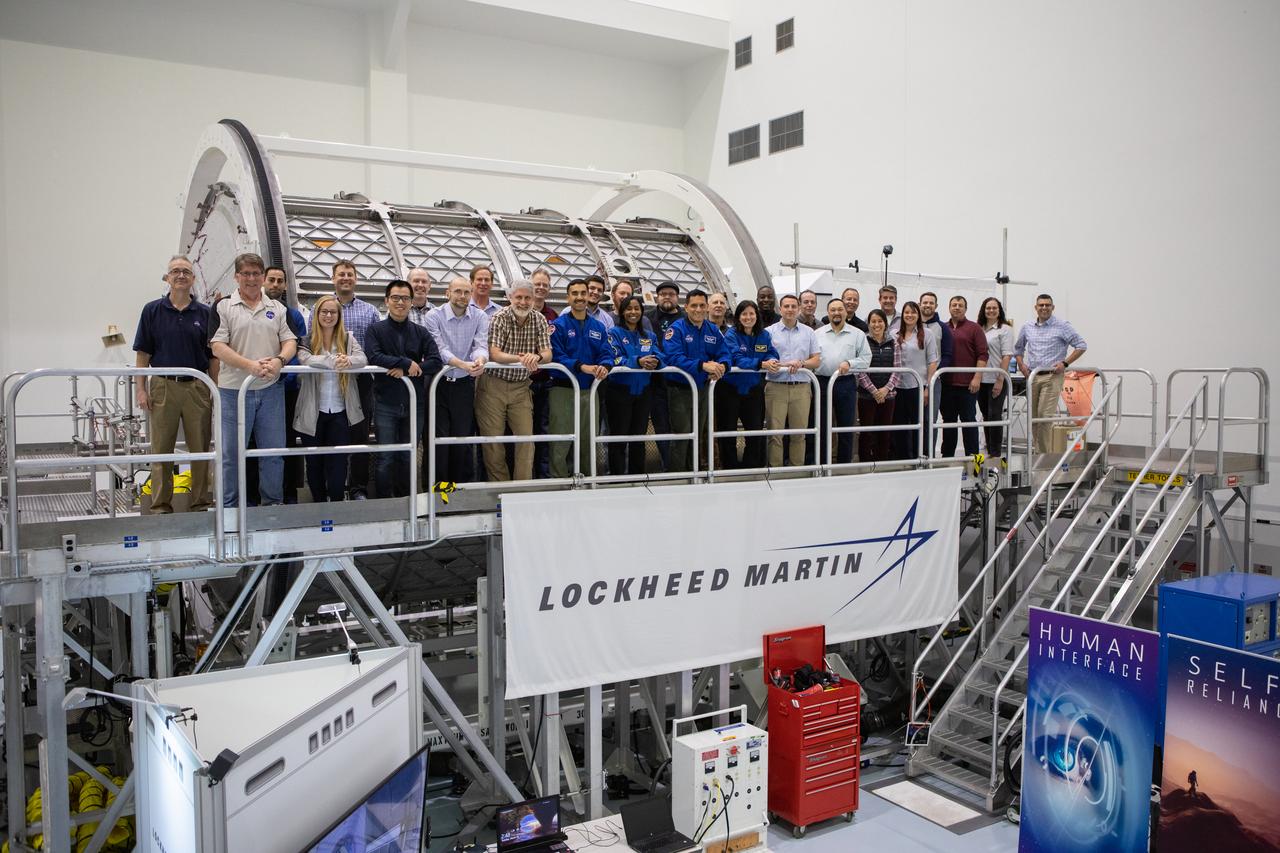
NASA began evaluating five habitat prototypes developed through NASA’s Next Space Exploration for Technologies Partnerships, or NextSTEP, to help engineers refine requirements for the design of an American-made deep space habitat for the Gateway. Lockheed Martin turned over its prototype to NASA, and testing began with crew on March 25, 2019, at Kennedy Space Center in Florida. Astronauts are participating in the evaluations to provide their perspectives as those who may one day live aboard the lunar outpost, which would be located about 250,000 miles from Earth. Ground prototypes developed by Bigelow Aerospace, Boeing, Northrop Grumman, and Sierra Nevada Corporation will be tested in the future at various facilities across the country. A sixth company, NanoRacks, plans to develop a prototype as well.
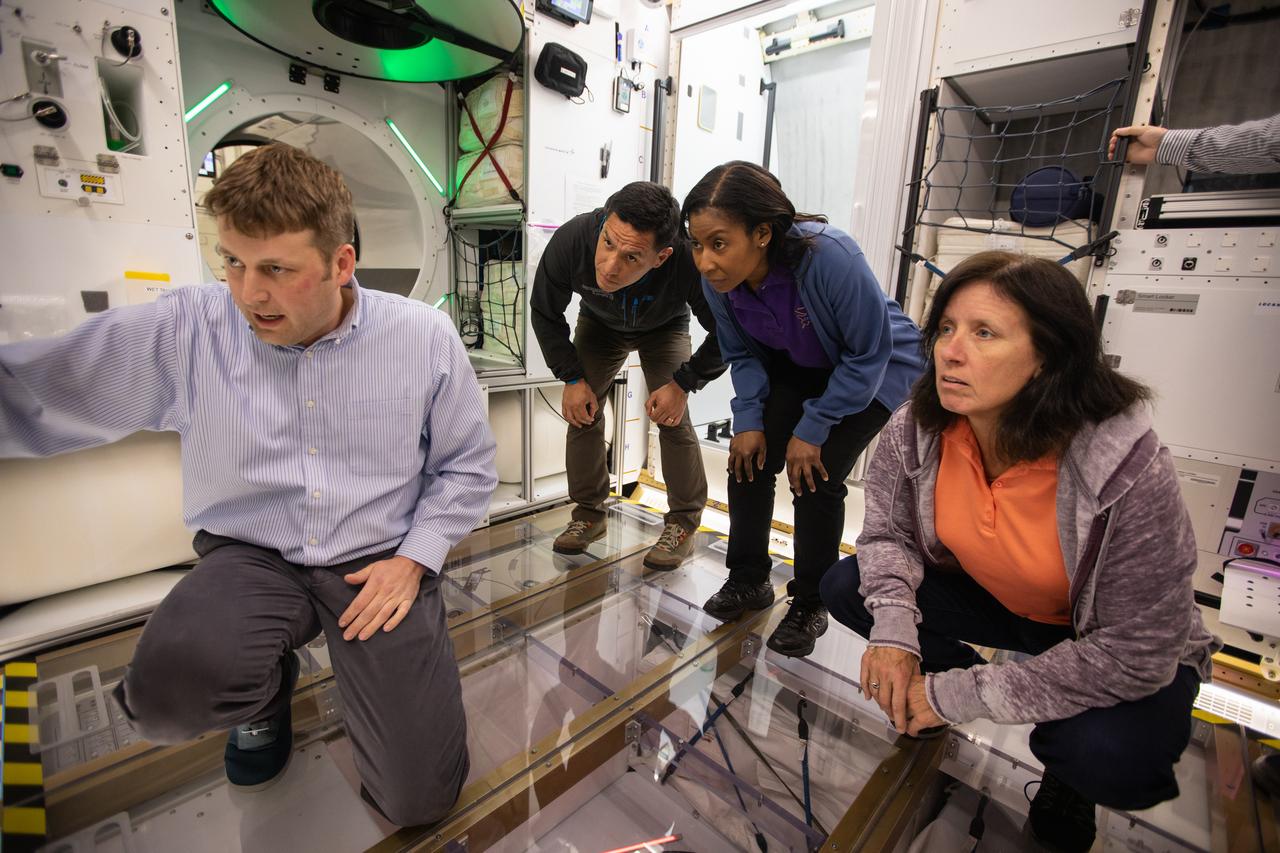
NASA began evaluating five habitat prototypes developed through NASA’s Next Space Exploration for Technologies Partnerships, or NextSTEP, to help engineers refine requirements for the design of an American-made deep space habitat for the Gateway. Lockheed Martin turned over its prototype to NASA, and testing began with crew on March 25, 2019, at Kennedy Space Center in Florida. Pictured inside the habitat prototype on March 26, 2019, in back from left are astronauts Frank Rubio, Stephanie Wilson and Shannon Walker. Astronauts are participating in the evaluations to provide their perspectives as those who may one day live aboard the lunar outpost, which would be located about 250,000 miles from Earth. Ground prototypes developed by Bigelow Aerospace, Boeing, Northrop Grumman, and Sierra Nevada Corporation will be tested in the future at various facilities across the country. A sixth company, NanoRacks, plans to develop a prototype as well.
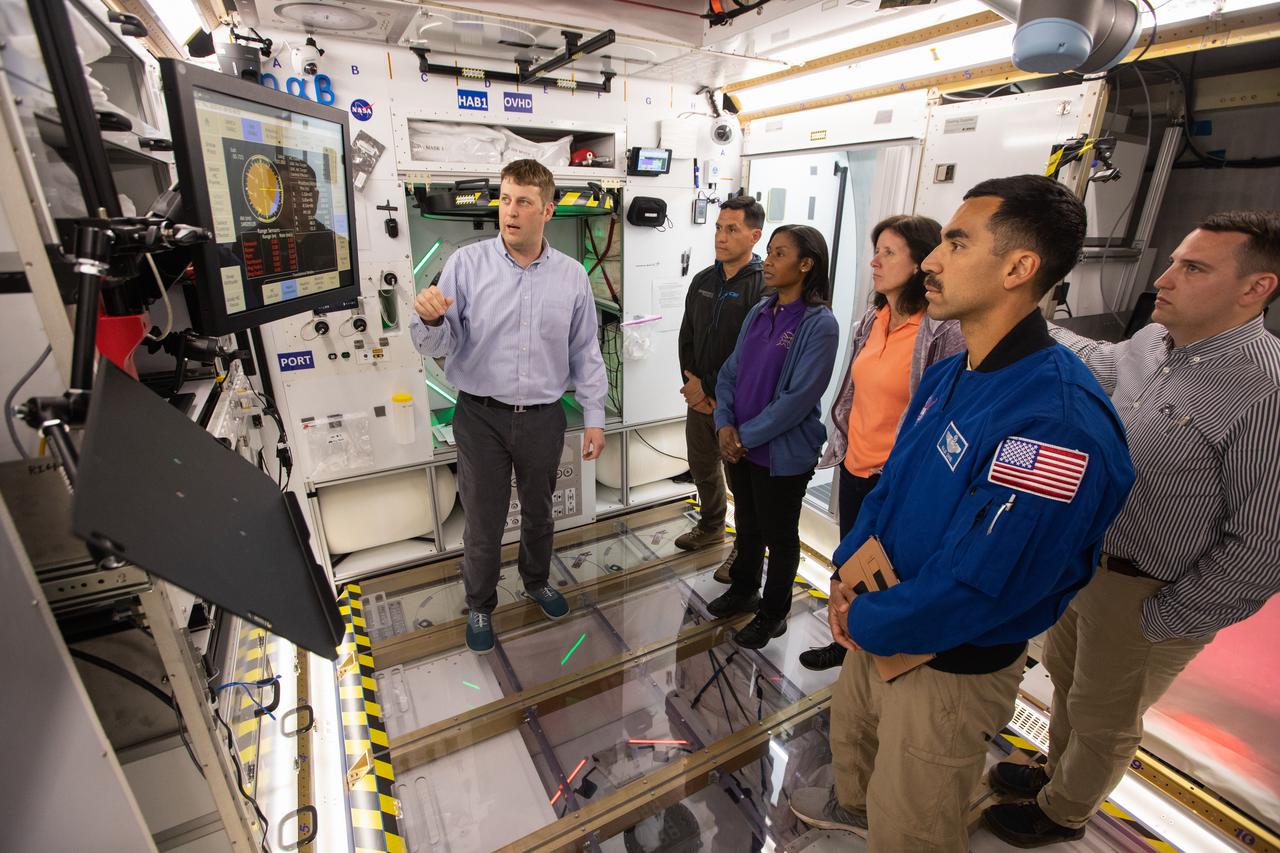
NASA began evaluating five habitat prototypes developed through NASA’s Next Space Exploration for Technologies Partnerships, or NextSTEP, to help engineers refine requirements for the design of an American-made deep space habitat for the Gateway. Lockheed Martin turned over its prototype to NASA, and testing began with crew on March 25, 2019, at Kennedy Space Center in Florida. Pictured inside the habitat prototype on March 26, 2019, beginning second from left are astronauts Frank Rubio, Raja Shari, Stephanie Wilson and Shannon Walker. Astronauts are participating in the evaluations to provide their perspectives as those who may one day live aboard the lunar outpost, which would be located about 250,000 miles from Earth. Ground prototypes developed by Bigelow Aerospace, Boeing, Northrop Grumman, and Sierra Nevada Corporation will be tested in the future at various facilities across the country. A sixth company, NanoRacks, plans to develop a prototype as well.
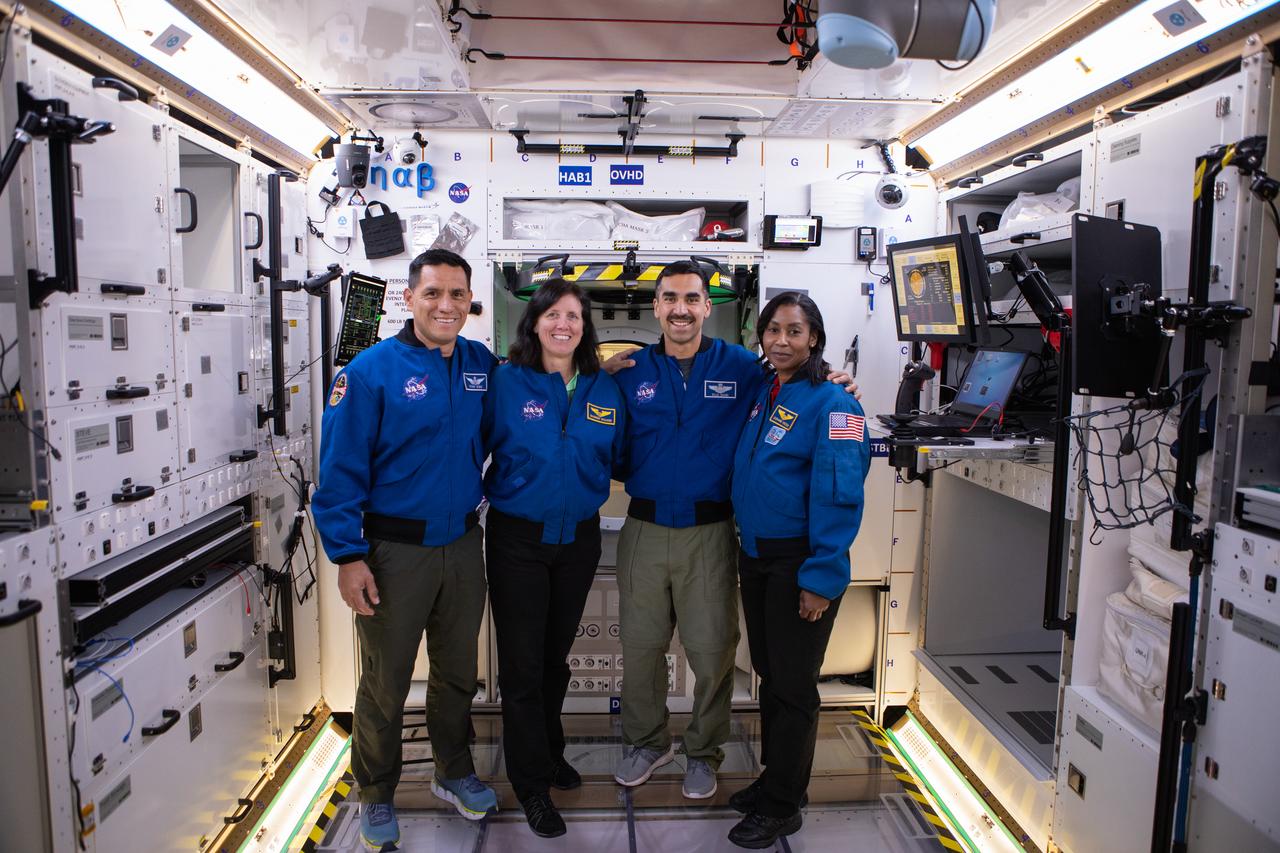
NASA began evaluating five habitat prototypes developed through NASA’s Next Space Exploration for Technologies Partnerships, or NextSTEP, to help engineers refine requirements for the design of an American-made deep space habitat for the Gateway. Lockheed Martin turned over its prototype to NASA, and testing began with crew on March 25, 2019, at Kennedy Space Center in Florida. Pictured, from left are astronauts Frank Rubio, Shannon Walker, Raja Chari and Stephanie Wilson. Astronauts are participating in the evaluations to provide their perspectives as those who may one day live aboard the lunar outpost, which would be located about 250,000 miles from Earth. Ground prototypes developed by Bigelow Aerospace, Boeing, Northrop Grumman, and Sierra Nevada Corporation will be tested in the future at various facilities across the country. A sixth company, NanoRacks, plans to develop a prototype as well.
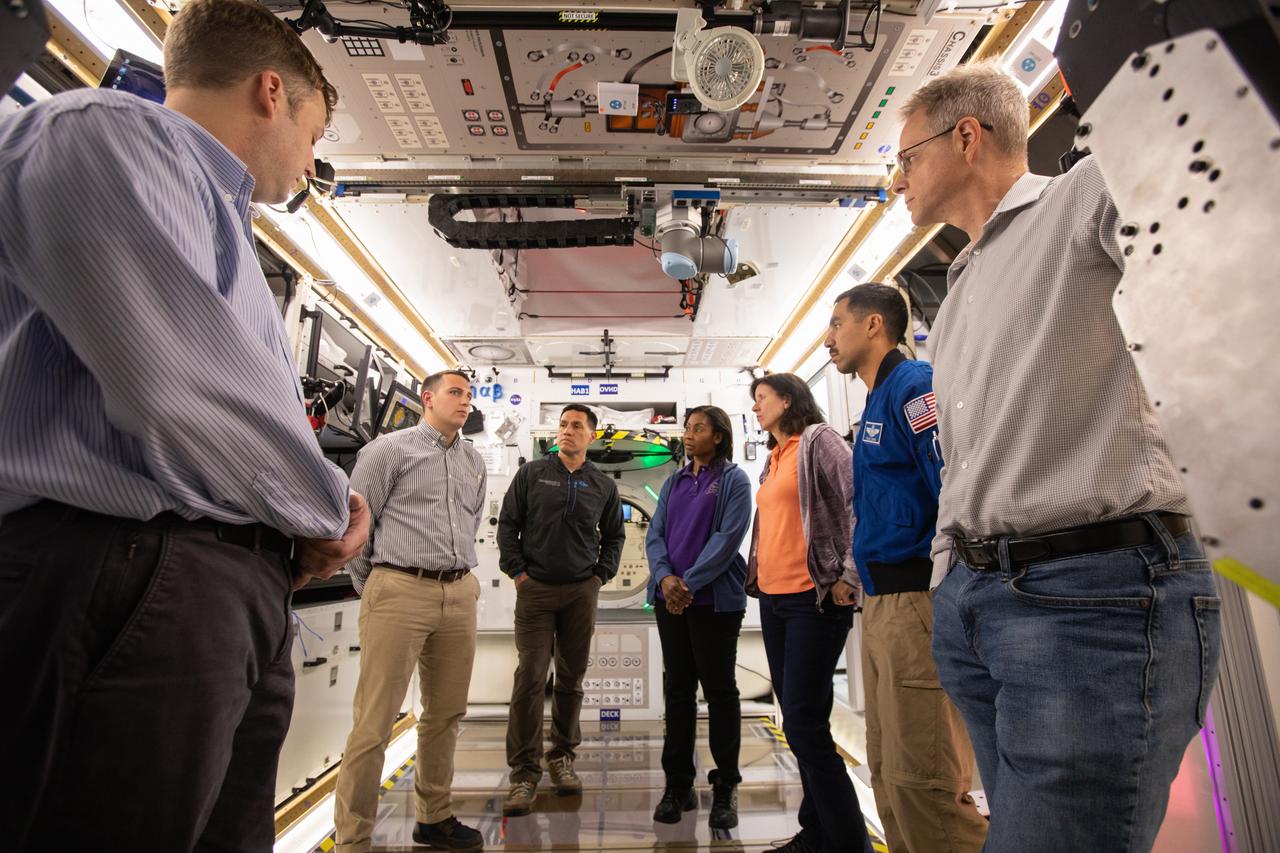
NASA began evaluating five habitat prototypes developed through NASA’s Next Space Exploration for Technologies Partnerships, or NextSTEP, to help engineers refine requirements for the design of an American-made deep space habitat for the Gateway. Lockheed Martin turned over its prototype to NASA, and testing began with crew on March 25, 2019, at Kennedy Space Center in Florida. Pictured inside the habitat prototype on March 26, 2019, beginning third from left are astronauts Frank Rubio, Stephanie Wilson, Shannon Walker and Raja Chari. Astronauts are participating in the evaluations to provide their perspectives as those who may one day live aboard the lunar outpost, which would be located about 250,000 miles from Earth. Ground prototypes developed by Bigelow Aerospace, Boeing, Northrop Grumman, and Sierra Nevada Corporation will be tested in the future at various facilities across the country. A sixth company, NanoRacks, plans to develop a prototype as well.
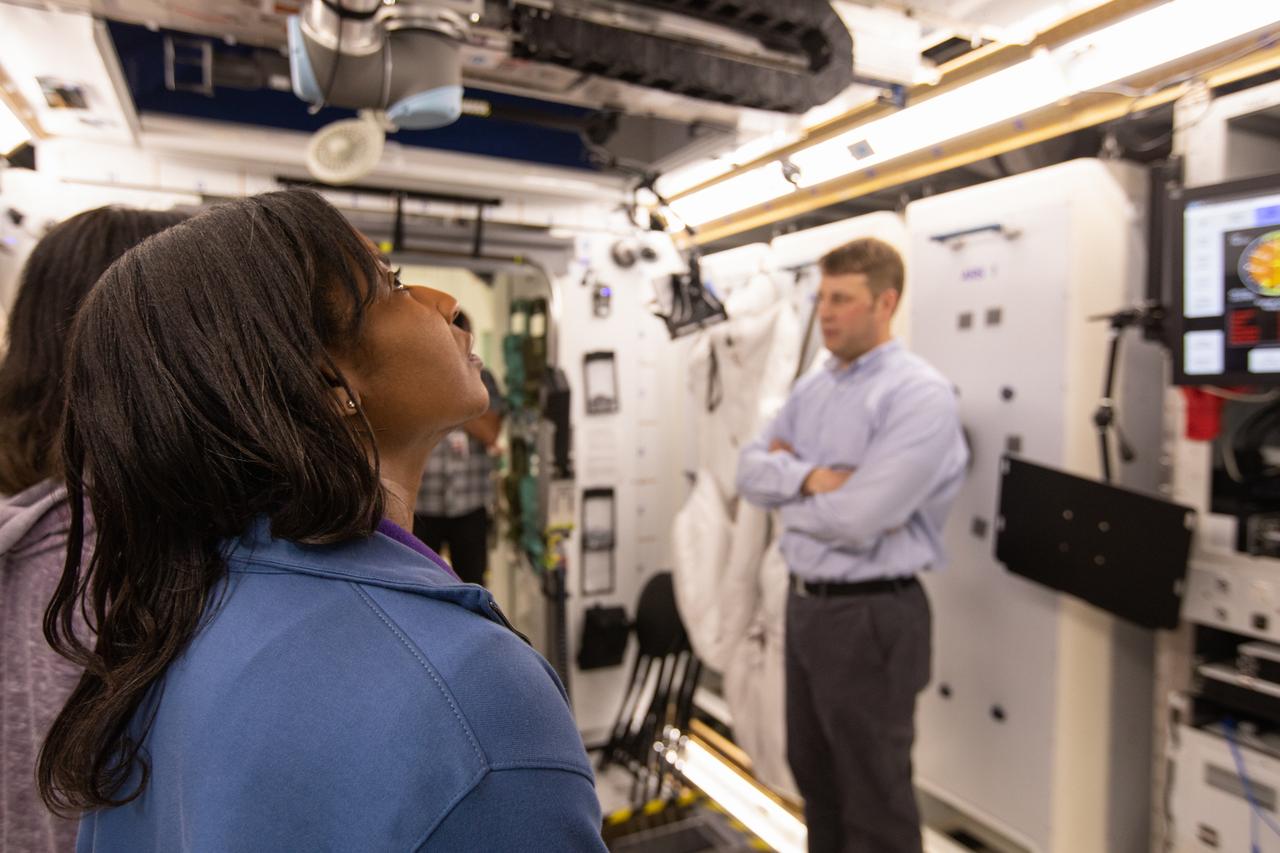
NASA began evaluating five habitat prototypes developed through NASA’s Next Space Exploration for Technologies Partnerships, or NextSTEP, to help engineers refine requirements for the design of an American-made deep space habitat for the Gateway. Lockheed Martin turned over its prototype to NASA, and testing began with crew on March 25, 2019, at Kennedy Space Center in Florida. Pictured inside the habitat prototype on March 26, 2019, at left is astronaut Stephanie Wilson. To her left, partially hidden is astronaut Shannon Walker. Astronauts are participating in the evaluations to provide their perspectives as those who may one day live aboard the lunar outpost, which would be located about 250,000 miles from Earth. Ground prototypes developed by Bigelow Aerospace, Boeing, Northrop Grumman, and Sierra Nevada Corporation will be tested in the future at various facilities across the country. A sixth company, NanoRacks, plans to develop a prototype as well.
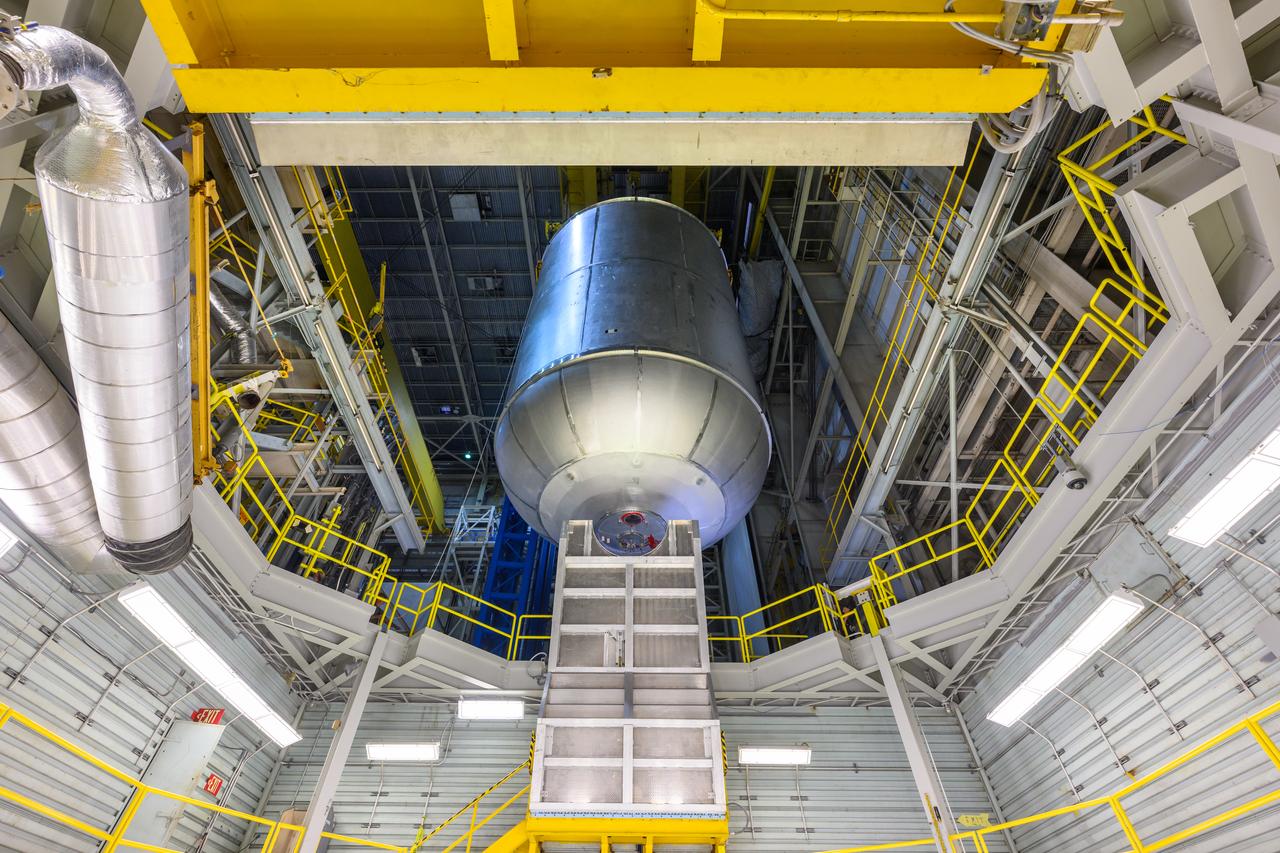
Teams at NASA’s Michoud Assembly Facility in New Orleans successfully completed hydrostatic proof testing of the core stage liquid oxygen tank for the agency’s Artemis III mission. The non-destructive evaluation method tests the structural integrity of the tank’s welds by filling the tank with water, simulating the propellant used during launch. The hardware was then moved to an adjacent cell for internal cleaning. Next, the tank will be readied for primer and application of its thermal protection system. The propellant tank is one of five major elements that make up the 212-foot-tall rocket stage. The core stage, along with its four RS-25 engines, produce two million pounds of thrust to help launch NASA’s Orion spacecraft, astronauts, and supplies beyond Earth’s orbit and to the lunar surface for Artemis.
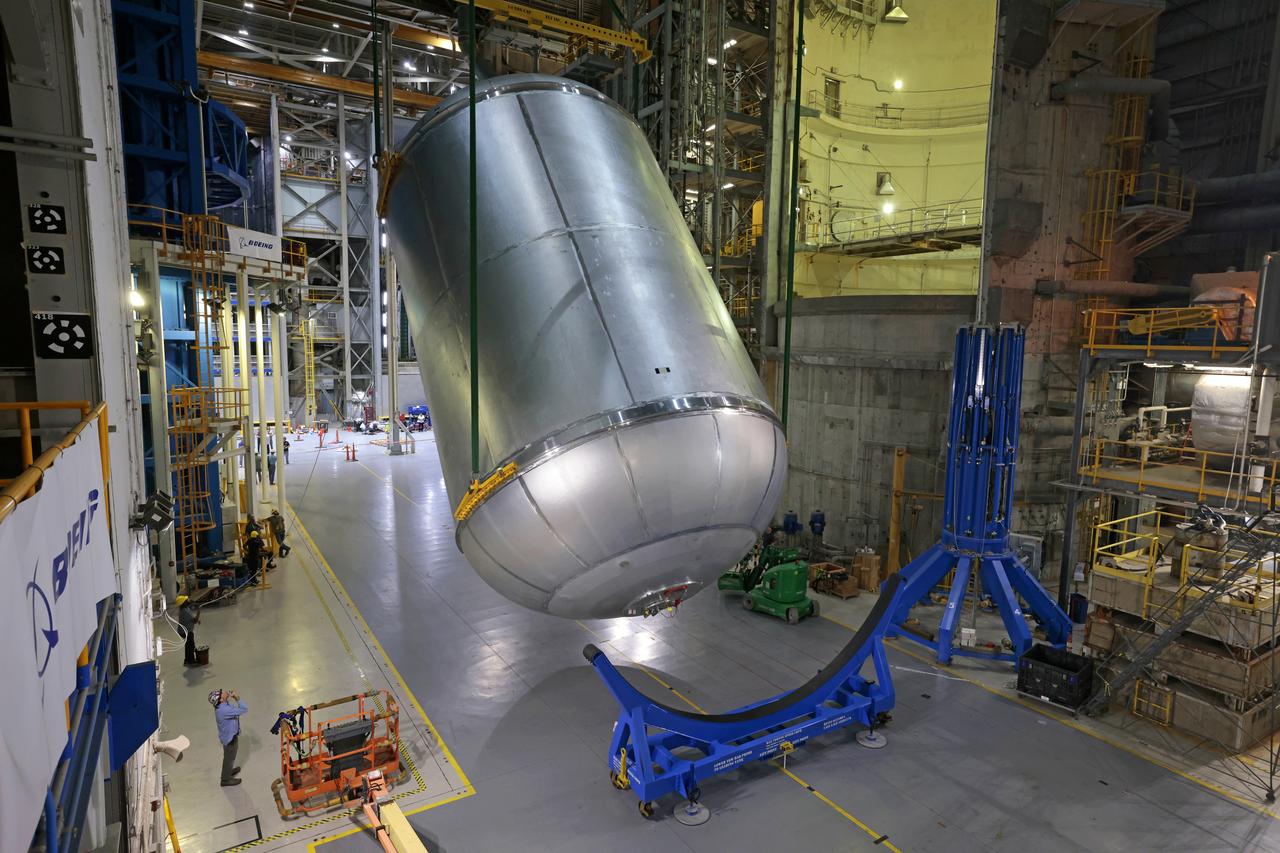
Teams at NASA’s Michoud Assembly Facility in New Orleans successfully completed hydrostatic proof testing of the core stage liquid oxygen tank for the agency’s Artemis III mission. The non-destructive evaluation method tests the structural integrity of the tank’s welds by filling the tank with water, simulating the propellant used during launch. The hardware was then moved to an adjacent cell for internal cleaning. Next, the tank will be readied for primer and application of its thermal protection system. The propellant tank is one of five major elements that make up the 212-foot-tall rocket stage. The core stage, along with its four RS-25 engines, produce two million pounds of thrust to help launch NASA’s Orion spacecraft, astronauts, and supplies beyond Earth’s orbit and to the lunar surface for Artemis. Image credit: NASA/Michael DeMocker
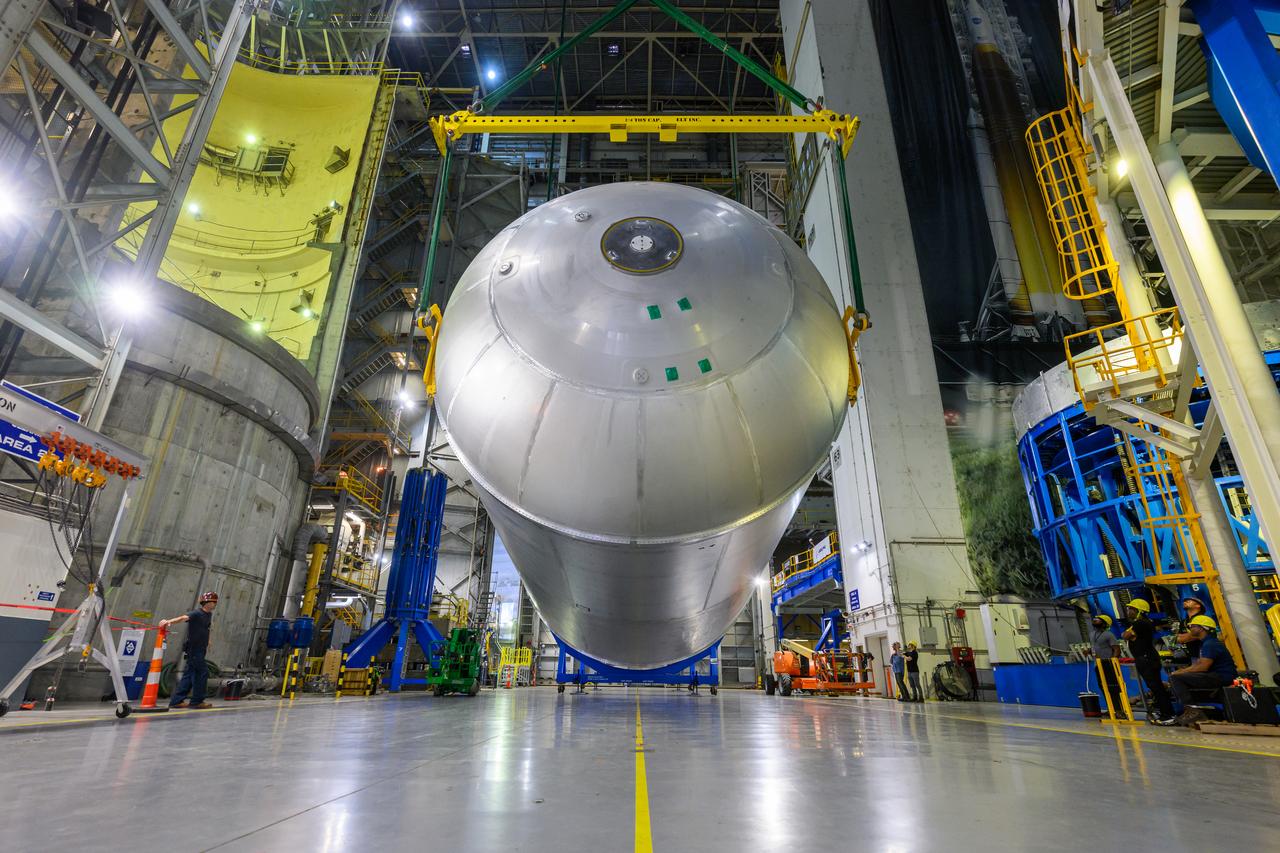
Teams at NASA’s Michoud Assembly Facility in New Orleans successfully completed hydrostatic proof testing of the core stage liquid oxygen tank for the agency’s Artemis III mission. The non-destructive evaluation method tests the structural integrity of the tank’s welds by filling the tank with water, simulating the propellant used during launch. The hardware was then moved to an adjacent cell for internal cleaning. Next, the tank will be readied for primer and application of its thermal protection system. The propellant tank is one of five major elements that make up the 212-foot-tall rocket stage. The core stage, along with its four RS-25 engines, produce two million pounds of thrust to help launch NASA’s Orion spacecraft, astronauts, and supplies beyond Earth’s orbit and to the lunar surface for Artemis.
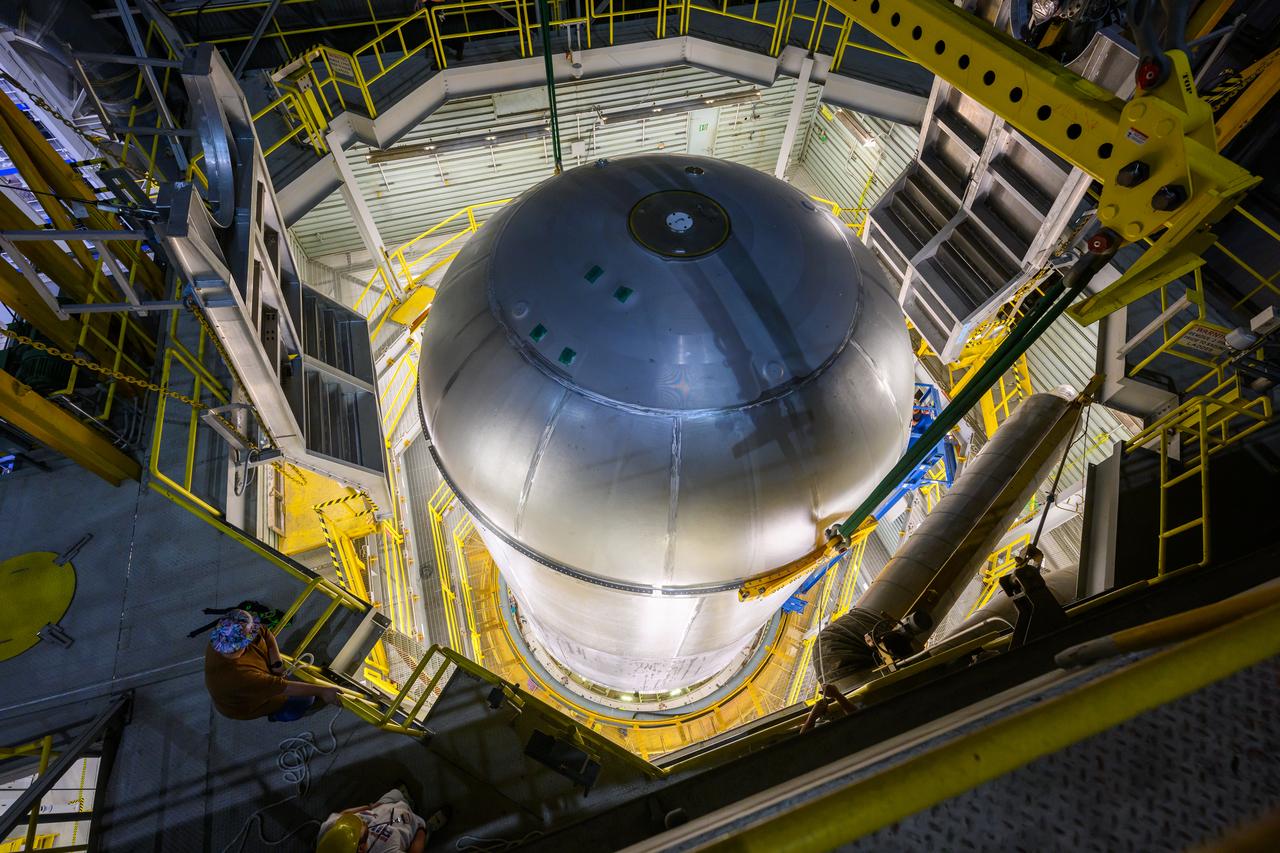
Teams at NASA’s Michoud Assembly Facility in New Orleans successfully completed hydrostatic proof testing of the core stage liquid oxygen tank for the agency’s Artemis III mission. The non-destructive evaluation method tests the structural integrity of the tank’s welds by filling the tank with water, simulating the propellant used during launch. The hardware was then moved to an adjacent cell for internal cleaning. Next, the tank will be readied for primer and application of its thermal protection system. The propellant tank is one of five major elements that make up the 212-foot-tall rocket stage. The core stage, along with its four RS-25 engines, produce two million pounds of thrust to help launch NASA’s Orion spacecraft, astronauts, and supplies beyond Earth’s orbit and to the lunar surface for Artemis.
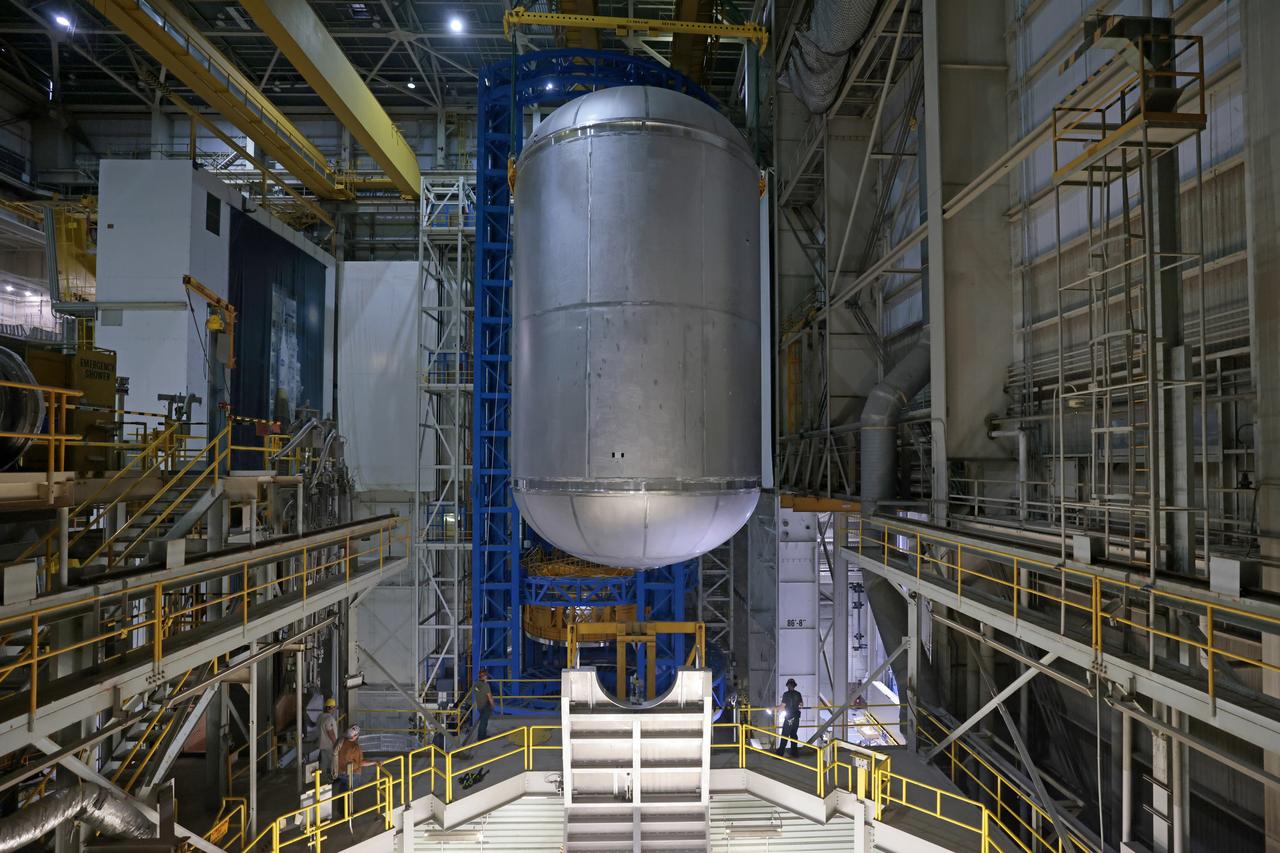
Teams at NASA’s Michoud Assembly Facility in New Orleans successfully completed hydrostatic proof testing of the core stage liquid oxygen tank for the agency’s Artemis III mission. The non-destructive evaluation method tests the structural integrity of the tank’s welds by filling the tank with water, simulating the propellant used during launch. The hardware was then moved to an adjacent cell for internal cleaning. Next, the tank will be readied for primer and application of its thermal protection system. The propellant tank is one of five major elements that make up the 212-foot-tall rocket stage. The core stage, along with its four RS-25 engines, produce two million pounds of thrust to help launch NASA’s Orion spacecraft, astronauts, and supplies beyond Earth’s orbit and to the lunar surface for Artemis. Image credit: NASA/Michael DeMocker
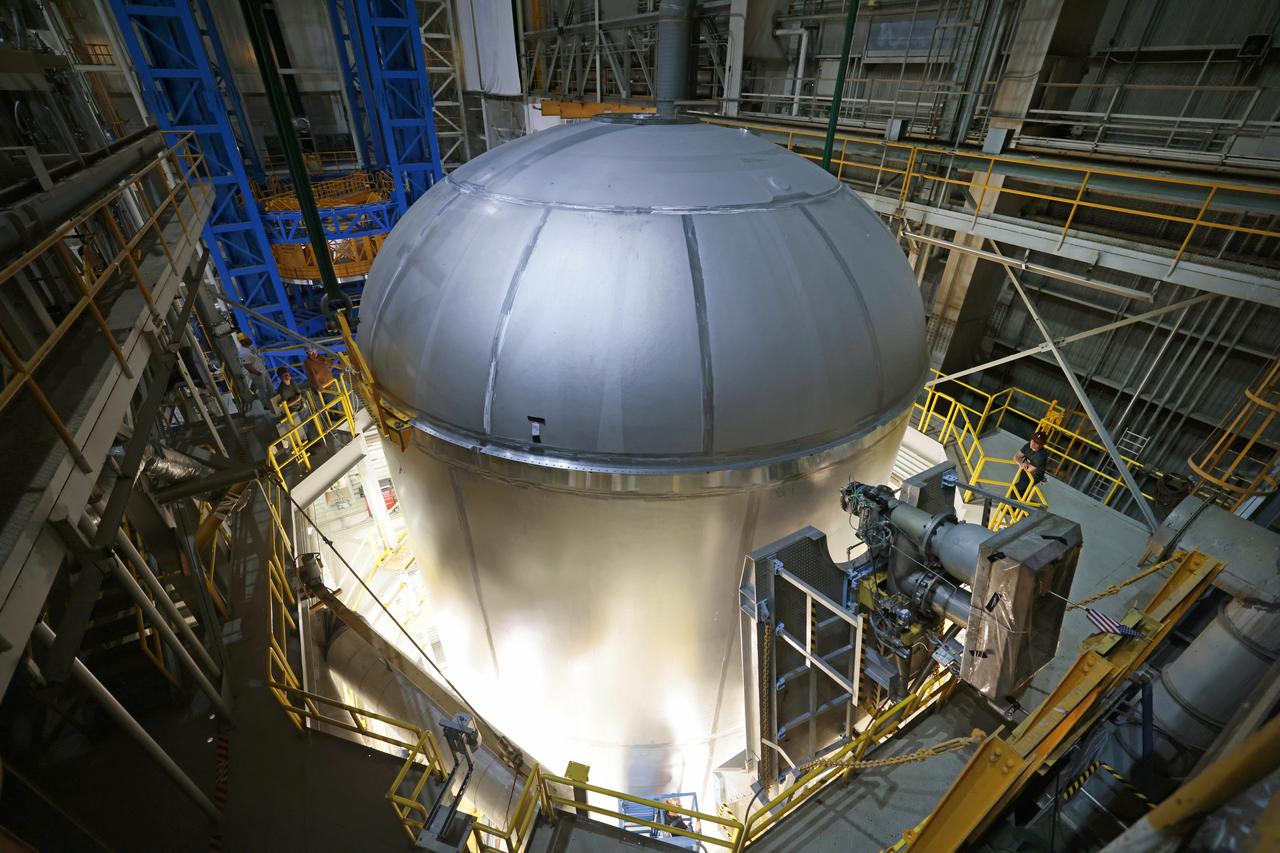
Teams at NASA’s Michoud Assembly Facility in New Orleans successfully completed hydrostatic proof testing of the core stage liquid oxygen tank for the agency’s Artemis III mission. The non-destructive evaluation method tests the structural integrity of the tank’s welds by filling the tank with water, simulating the propellant used during launch. The hardware was then moved to an adjacent cell for internal cleaning. Next, the tank will be readied for primer and application of its thermal protection system. The propellant tank is one of five major elements that make up the 212-foot-tall rocket stage. The core stage, along with its four RS-25 engines, produce two million pounds of thrust to help launch NASA’s Orion spacecraft, astronauts, and supplies beyond Earth’s orbit and to the lunar surface for Artemis. Image credit: NASA/Michael DeMocker
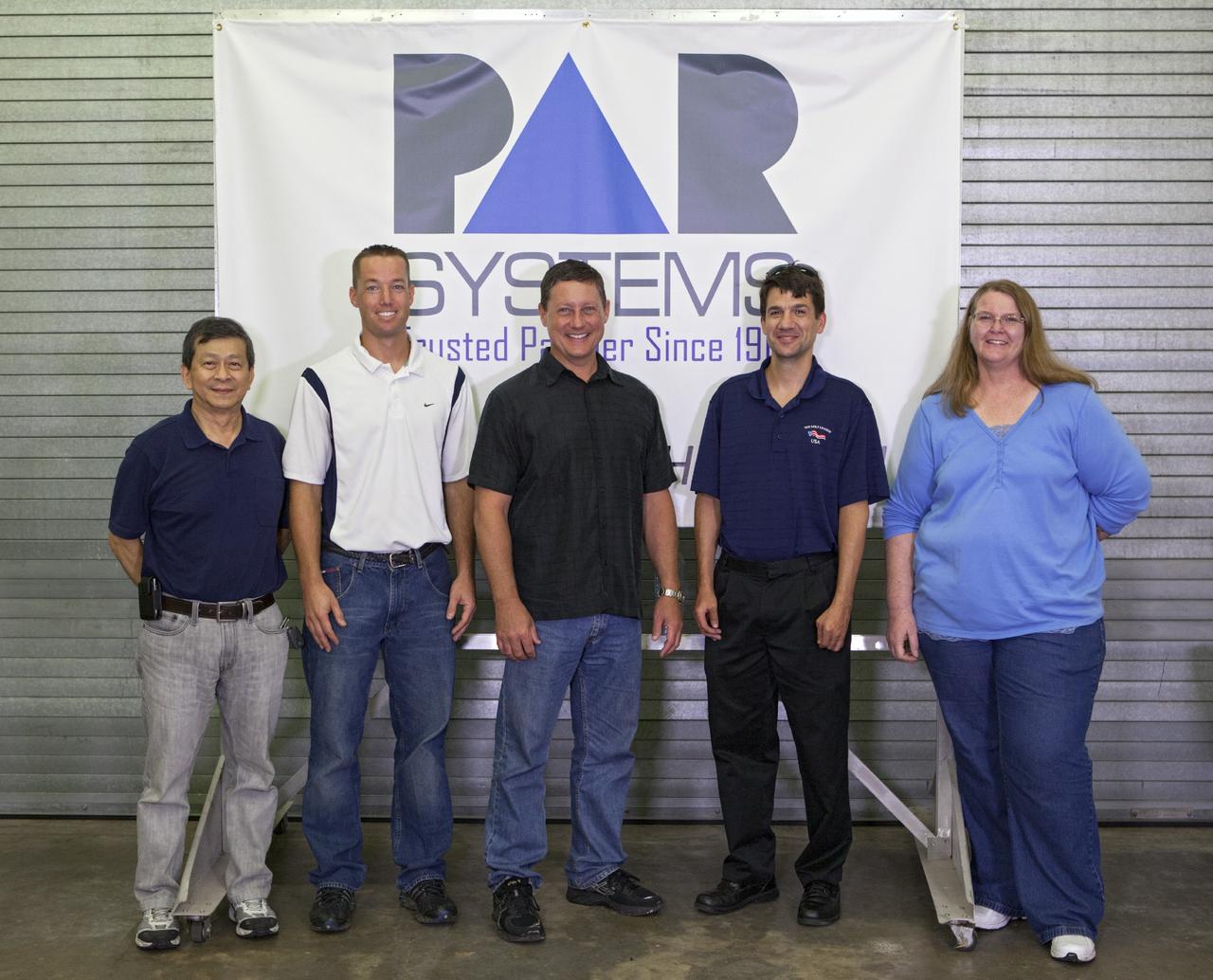
CAPE CANAVERAL, Fla. – In Hangar N at Cape Canaveral Air Force Station, PaR Systems, Inc. employees are performing nondestructive testing NDT work under a partnership agreement with NASA. From the left are: development engineer Wayne Cheng, operations engineer Jeff Elston, manager of NDT Services Tony Corak, development engineer Bence Bertha and operations engineer Lu Bell. NASA's Kennedy Space Center in Florida recently established a partnership agreement with PaR Systems, Inc. of Shoreview, Minn., for operation of the Hangar N facility and its nondestructive testing and evaluation equipment. As the spaceport transitions from a historically government-only launch facility to a multi-user spaceport for both federal and commercial customers, partnerships between the space agency and other organizations will be a key element in that effort. Hangar N is located at Cape Canaveral Air Force Station adjacent to Kennedy and houses a unique inventory of test and evaluation equipment and the capability for current and future mission spaceflight support. Photo credit: NASA/ Dimitri Gerondidakis
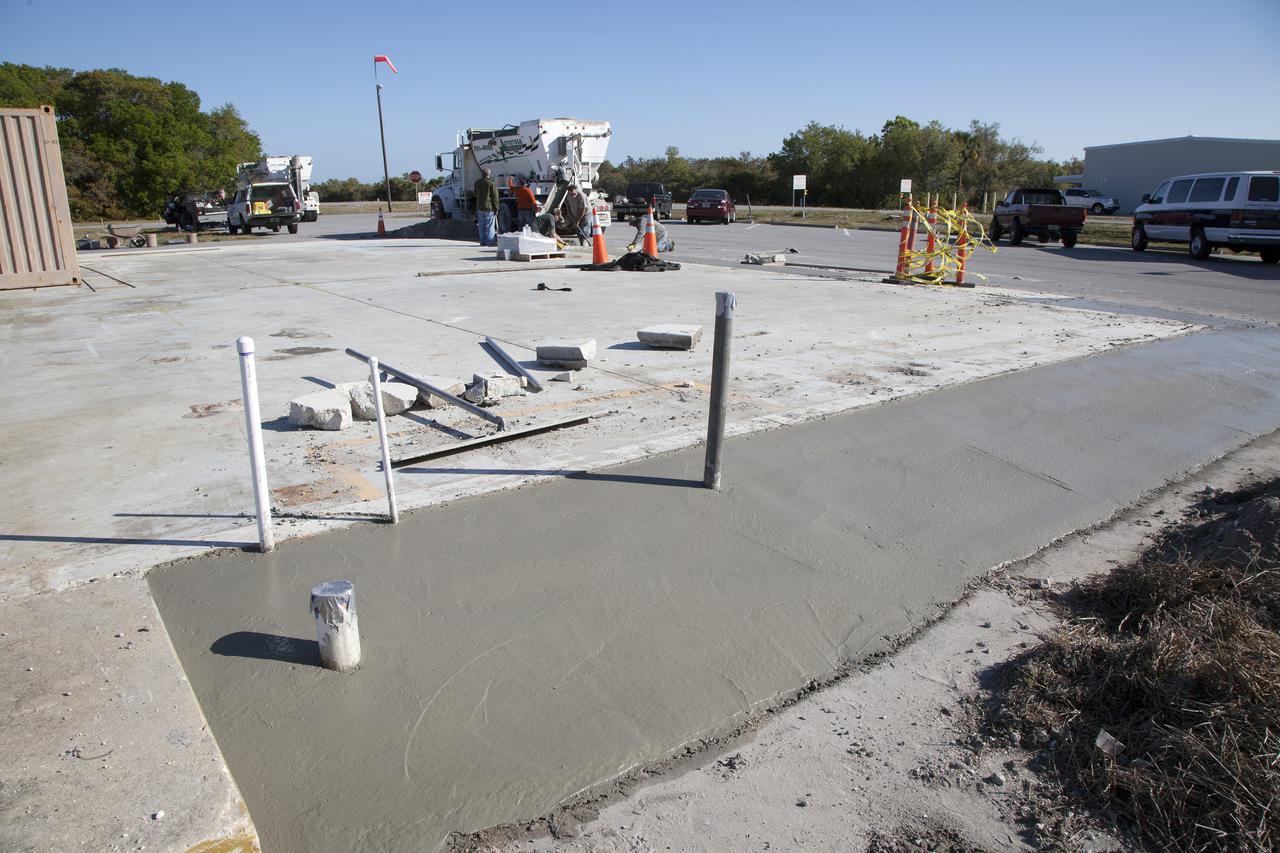
CAPE CANAVERAL, Fla. – Workers pour a concrete mix that utilizes spent material from sandblasting projects at NASA's Kennedy Space Center in Florida. The experimental formula is being tested at the Propellants North facility at Kennedy and will undergo structural and other evaluations as part of a pilot project. Spent blast media, or SBM, makes up much of the waste deposited at the center's landfill and engineers are trying to develop ways to put the debris to use in other ways instead. Photo credit: NASA_Kim Shiflett
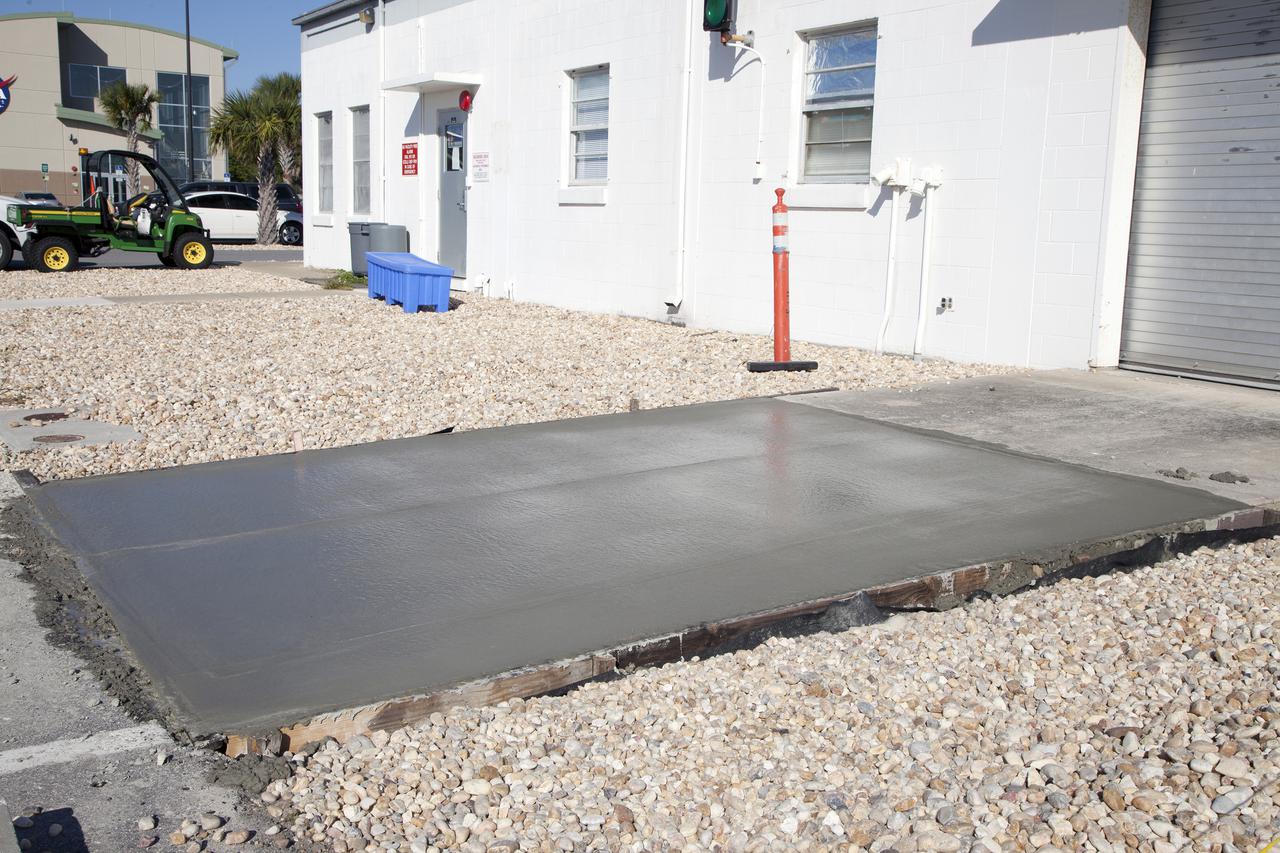
CAPE CANAVERAL, Fla. – A driveway made from a concrete mix that utilizes spent material from sandblasting projects at NASA's Kennedy Space Center in Florida. The experimental formula is being tested at the Propellants North facility at Kennedy and will undergo structural and other evaluations as part of a pilot project. Spent blast media, or SBM, makes up much of the waste deposited at the center's landfill and engineers are trying to develop ways to put the debris to use in other ways instead. Photo credit: NASA_Kim Shiflett
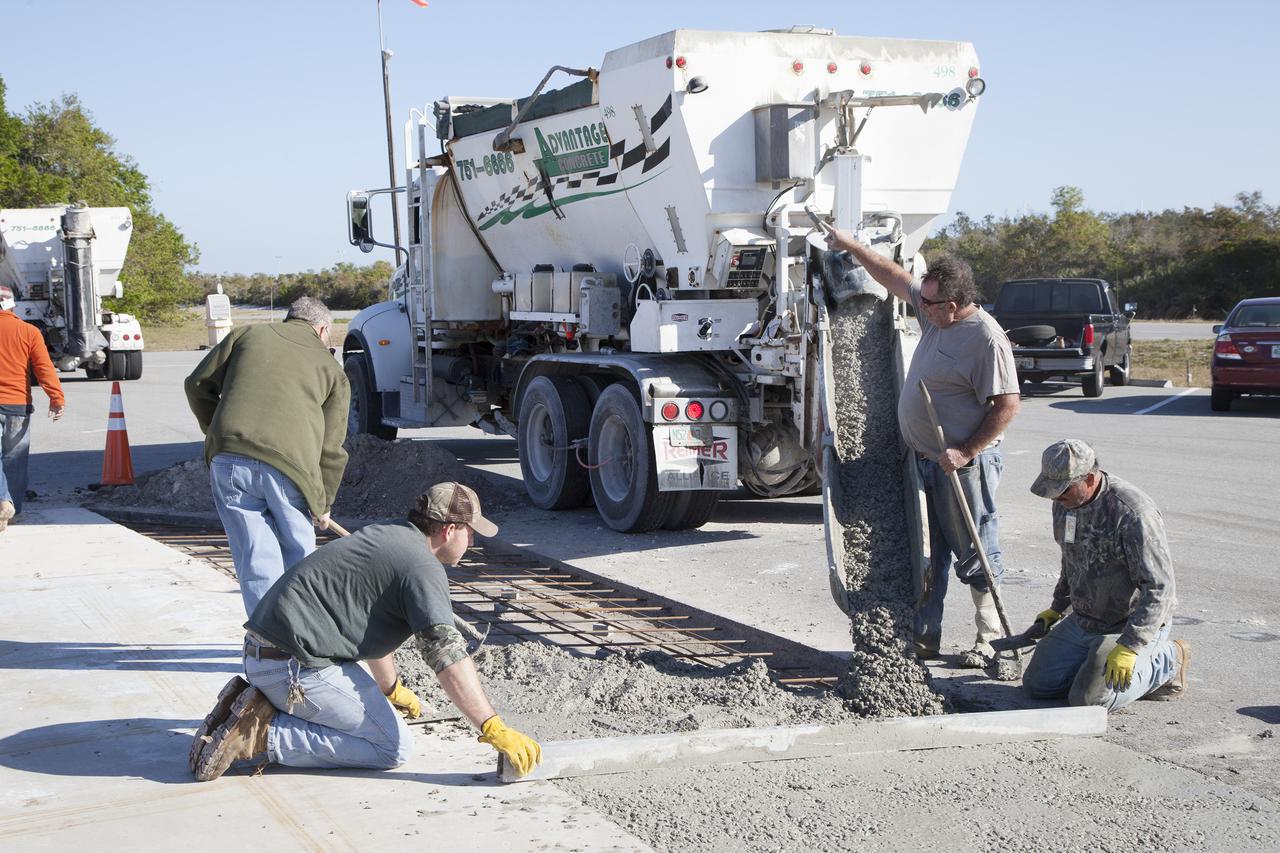
CAPE CANAVERAL, Fla. – Workers pour a concrete mix that utilizes spent material from sandblasting projects at NASA's Kennedy Space Center in Florida. The experimental formula is being tested at the Propellants North facility at Kennedy and will undergo structural and other evaluations as part of a pilot project. Spent blast media, or SBM, makes up much of the waste deposited at the center's landfill and engineers are trying to develop ways to put the debris to use in other ways instead. Photo credit: NASA_Kim Shiflett
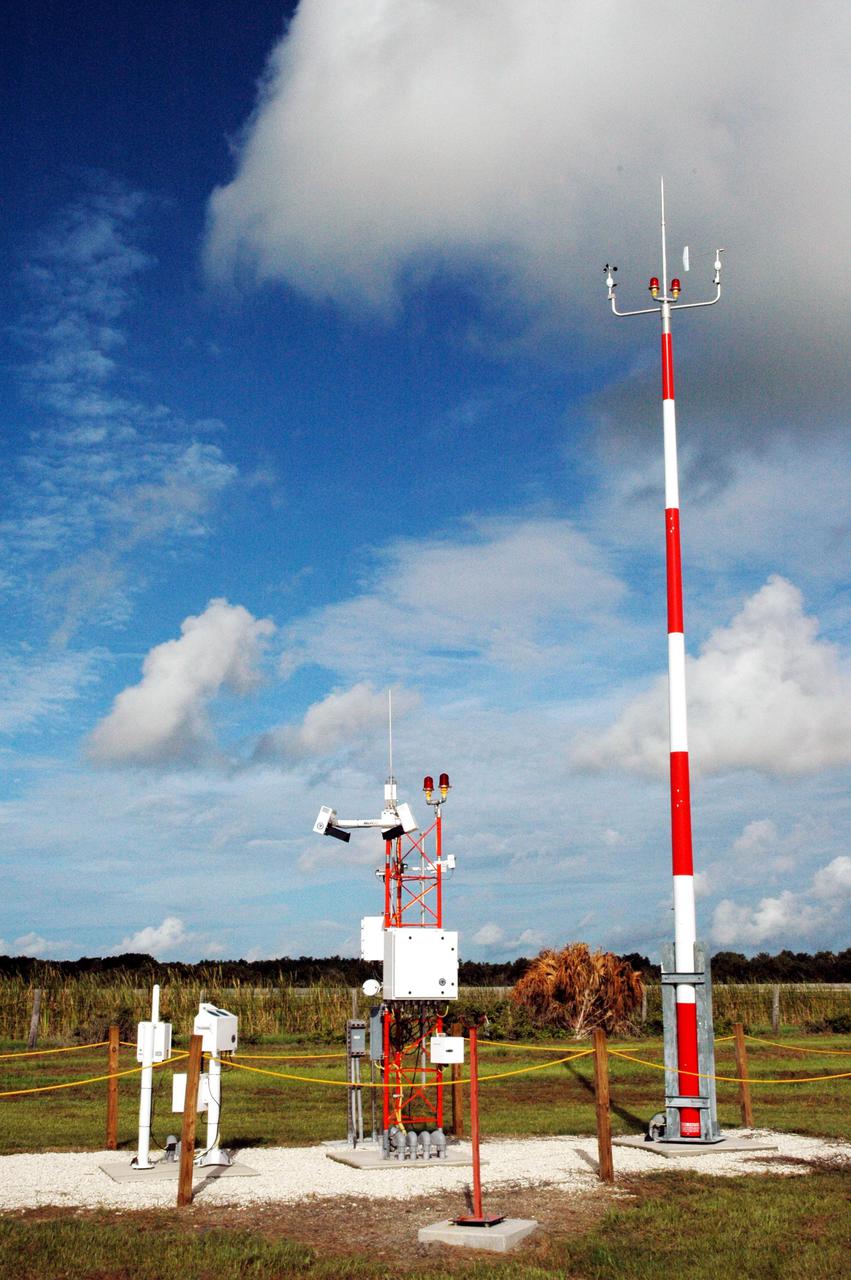
KENNEDY SPACE CENTER, FLA. - The Shuttle Landing Facility (SLF) Meteorological Observation System, a replacement for the current observing system, has been installed adjacent to the runway at midfield. It is currently undergoing final evaluation and testing before becoming operational. Sensors are also located at each end of the SLF runway. New associated computer displays will be installed in the KSC Weather Station located in the NASA control tower.

NASA's highly modified F-15A (Serial #71-0287) used for digital electronic flight and engine control systems research, at sunrise on the ramp at the Dryden Flight Research Facility, Edwards, California. The F-15 was called the HIDEC (Highly Integrated Digital Electronic Control) flight facility. Research programs flown on the testbed vehicle have demonstrated improved rates of climb, fuel savings, and engine thrust by optimizing systems performance. The aircraft also tested and evaluated a computerized self-repairing flight control system for the Air Force that detects damaged or failed flight control surfaces. The system then reconfigures undamaged control surfaces so the mission can continue or the aircraft is landed safely.
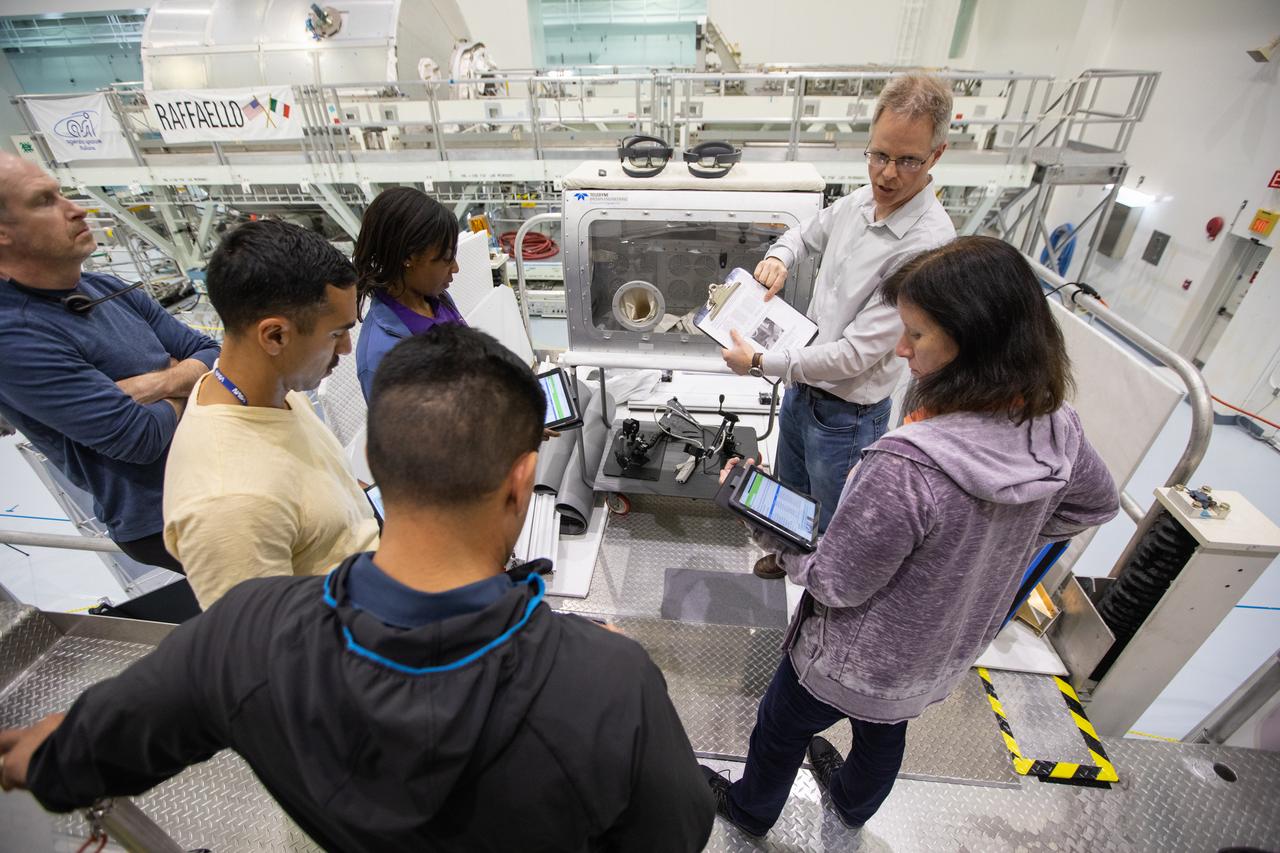
NASA began evaluating five habitat prototypes developed through NASA’s Next Space Exploration for Technologies Partnerships, or NextSTEP, to help engineers refine requirements for the design of an American-made deep space habitat for the Gateway. Lockheed Martin turned over its prototype to NASA, and testing began with crew on March 25, 2019, at Kennedy Space Center in Florida. Pictured inside the Space Station Processing Facility on March 26, 2019, from far left is astronaut Frank Rubio. In front of him, are Raja Chari and Stephanie Wilson. At right is astronaut Shannon Walker. Astronauts are participating in the evaluations to provide their perspectives as those who may one day live aboard the lunar outpost, which would be located about 250,000 miles from Earth. Ground prototypes developed by Bigelow Aerospace, Boeing, Northrop Grumman, and Sierra Nevada Corporation will be tested in the future at various facilities across the country. A sixth company, NanoRacks, plans to develop a prototype as well.
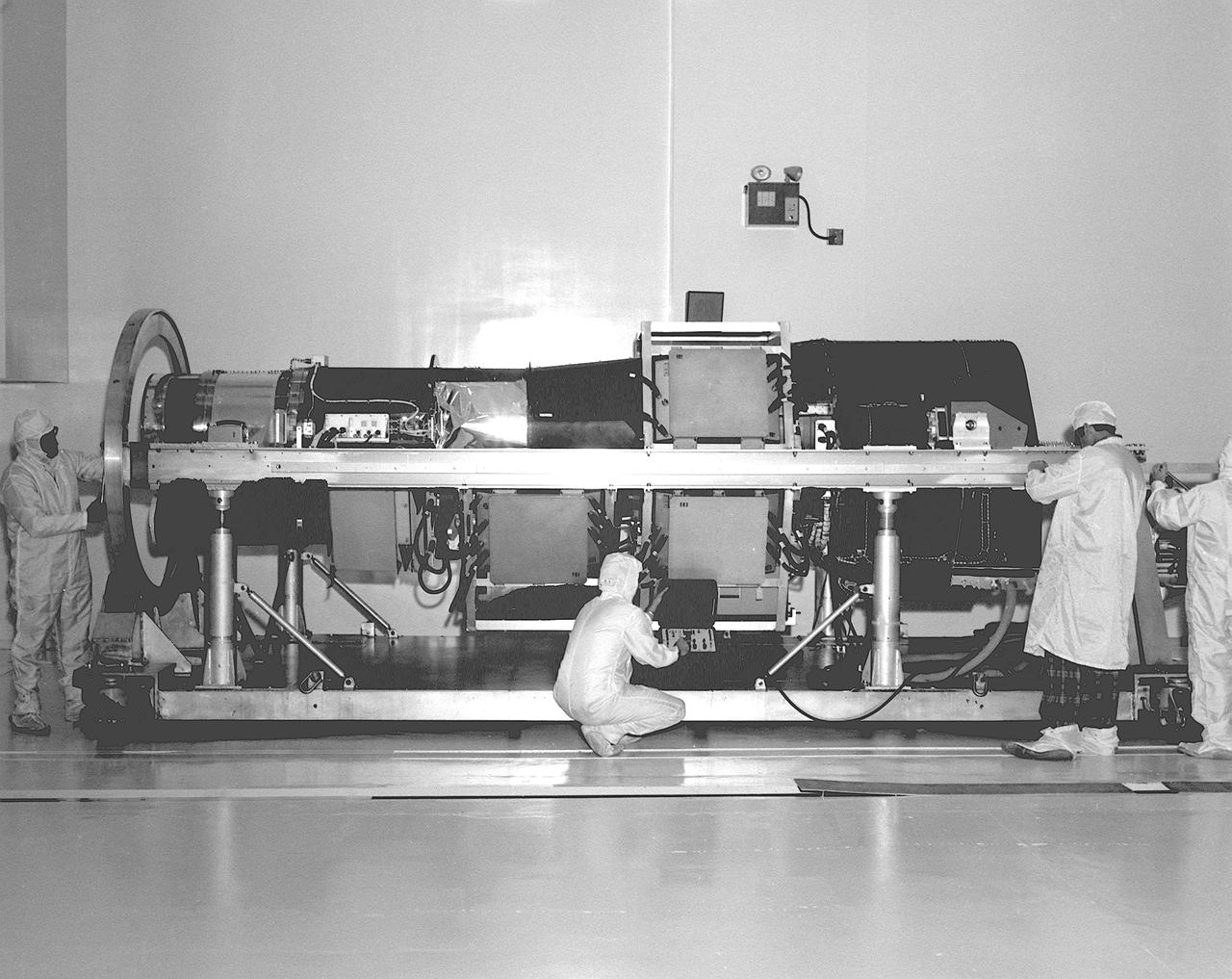
This photograph is of the High Energy Astronomy Observatory (HEAO)-2 telescope being checked by engineers in the X-Ray Calibration Facility at the Marshall Space Flight Center (MSFC). The MSFC was heavily engaged in the technical and scientific aspects, testing and calibration, of the HEAO-2 telescope. The HEAO-2 was the first imaging and largest x-ray telescope built to date. The X-Ray Calibration Facility was built in 1976 for testing MSFC's HEAO-2. The facility is the world's largest, most advanced laboratory for simulating x-ray emissions from distant celestial objects. It produced a space-like environment in which components related to x-ray telescope imaging are tested and the quality of their performance in space is predicted. The original facility contained a 1,000-foot long by 3-foot diameter vacuum tube (for the x-ray path) cornecting an x-ray generator and an instrument test chamber. Recently, the facility was upgraded to evaluate the optical elements of NASA's Hubble Space Telescope, Chandra X-Ray Observatory and Compton Gamma-Ray Observatory.
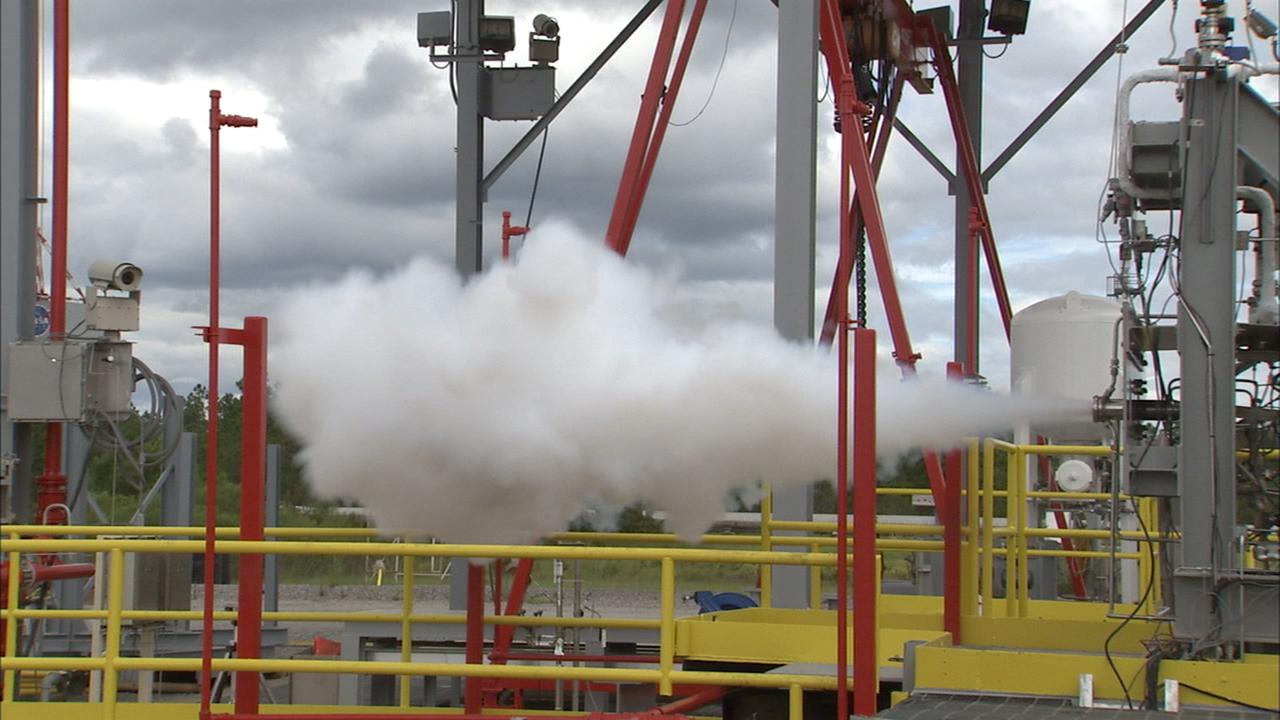
Tests begun at Stennis Space Center's E Complex Sept. 13 evaluated a liquid oxygen lead for engine start performance, part of the A-3 Test Facility Subscale Diffuser Risk Mitigation Project at SSC's E-3 Test Facility. Phase 1 of the subscale diffuser project, completed Sept. 24, was a series of 18 hot-fire tests using a 1,000-pound liquid oxygen and gaseous hydrogen thruster to verify maximum duration and repeatability for steam generation supporting the A-3 Test Stand project. The thruster is a stand-in for NASA's developing J-2X engine, to validate a 6 percent scale version of A-3's exhaust diffuser. Testing the J-2X at altitude conditions requires an enormous diffuser. Engineers will generate nearly 4,600 pounds per second of steam to reduce pressure inside A-3's test cell to simulate altitude conditions. A-3's exhaust diffuser has to be able to withstand regulated pressure, temperatures and the safe discharge of the steam produced during those tests. Before the real thing is built, engineers hope to work out any issues on the miniature version. Phase 2 testing is scheduled to begin this month.

NASA is performing a series of tests to evaluate how astronauts and ground crew involved in final preparations before Orion missions will quickly get out of the spacecraft if an emergency were to occur on the pad prior to launch. In the hours before astronauts launch to space in Orion from NASA’s modernized spaceport in Florida in on the agency’s Space Launch System rocket, they will cross the Crew Access Arm 300 feet above the ground and climb inside the crew module with the assistance of ground personnel trained to help them strap into their seats and take care of last-minute needs. The testing is helping engineers evaluate hardware designs and establish procedures that would be used to get astronauts and ground crew out of the capsule as quickly as possible. Flight and ground crew are required to get out of Orion within two minutes to protect for a variety of failure scenarios that do not require the launch abort system to be activated, such as crew incapacitation, fire or the presence of toxins in the cabin. This testing took place the week of Oct. 30, 2017 using the Orion mockup in the Space Vehicle Mockup Facility at NASA’s Johnson Space Center in Houston. In this photo, engineers used fake smoke to imitate a scenario in which astronauts must exit the capsule when their vision is obscured. Markings on the ground indicate where the Crew Access Arm would be located and help guide the crew. This testing is a collaborative effort between the Orion and Ground Systems Development and Operations programs. Previous egress testing at Johnson and in the Gulf of Mexico has evaluated how crew will exit the spacecraft at the end of their missions..
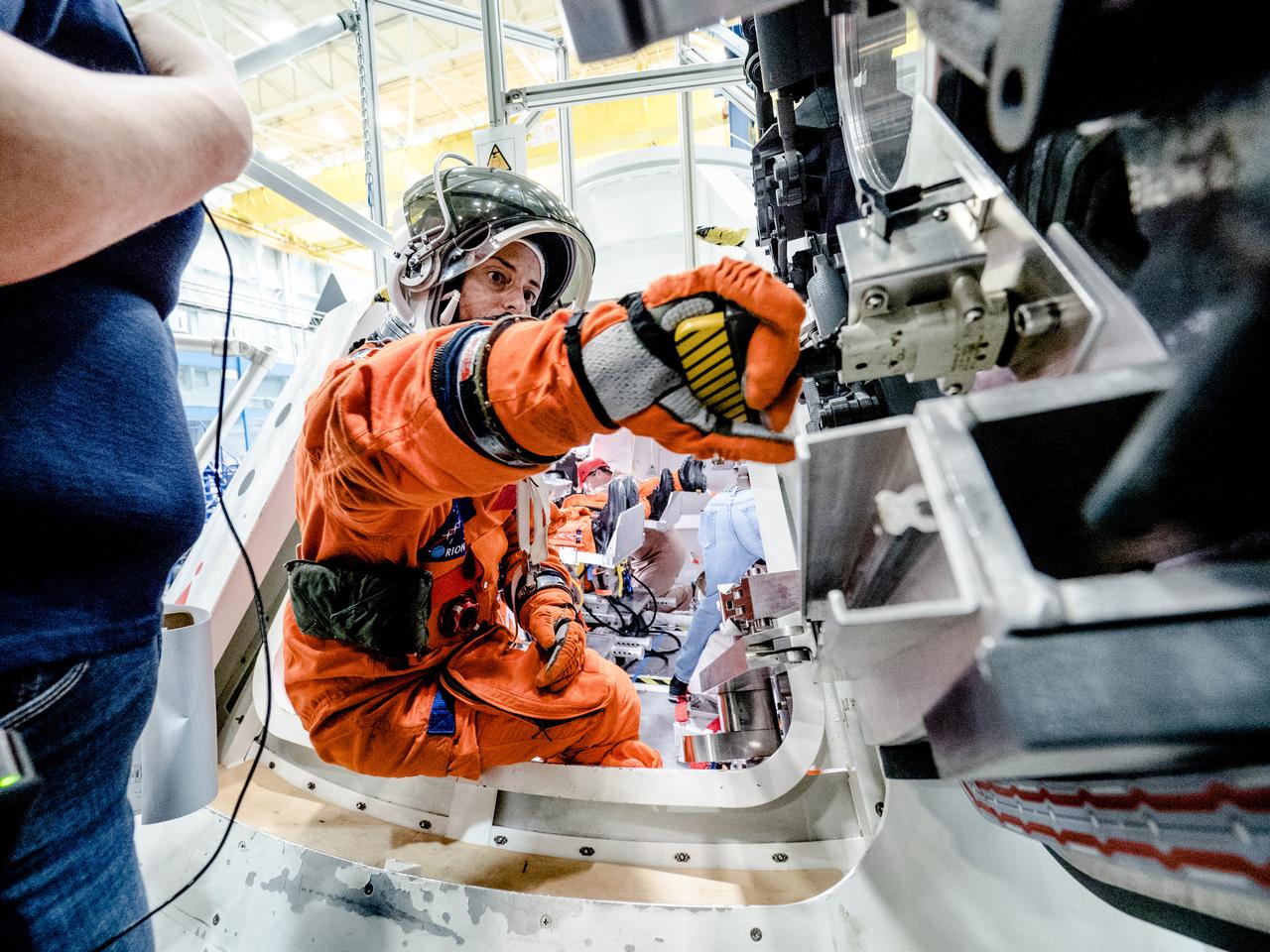
NASA is performing a series of tests to evaluate how astronauts and ground crew involved in final preparations before Orion missions will quickly get out of the spacecraft if an emergency were to occur on the pad prior to launch. In the hours before astronauts launch to space in Orion from NASA’s modernized spaceport in Florida in on the agency’s Space Launch System rocket, they will cross the Crew Access Arm 300 feet above the ground and climb inside the crew module with the assistance of ground personnel trained to help them strap into their seats and take care of last-minute needs. The testing is helping engineers evaluate hardware designs and establish procedures that would be used to get astronauts and ground crew out of the capsule as quickly as possible. Flight and ground crew are required to get out of Orion within two minutes to protect for a variety of failure scenarios that do not require the launch abort system to be activated, such as crew incapacitation, fire or the presence of toxins in the cabin. This testing took place the week of Oct. 30, 2017 using the Orion mockup in the Space Vehicle Mockup Facility at NASA’s Johnson Space Center in Houston. In this photo, engineers used fake smoke to imitate a scenario in which astronauts must exit the capsule when their vision is obscured. Markings on the ground indicate where the Crew Access Arm would be located and help guide the crew. This testing is a collaborative effort between the Orion and Ground Systems Development and Operations programs. Previous egress testing at Johnson and in the Gulf of Mexico has evaluated how crew will exit the spacecraft at the end of their missions..
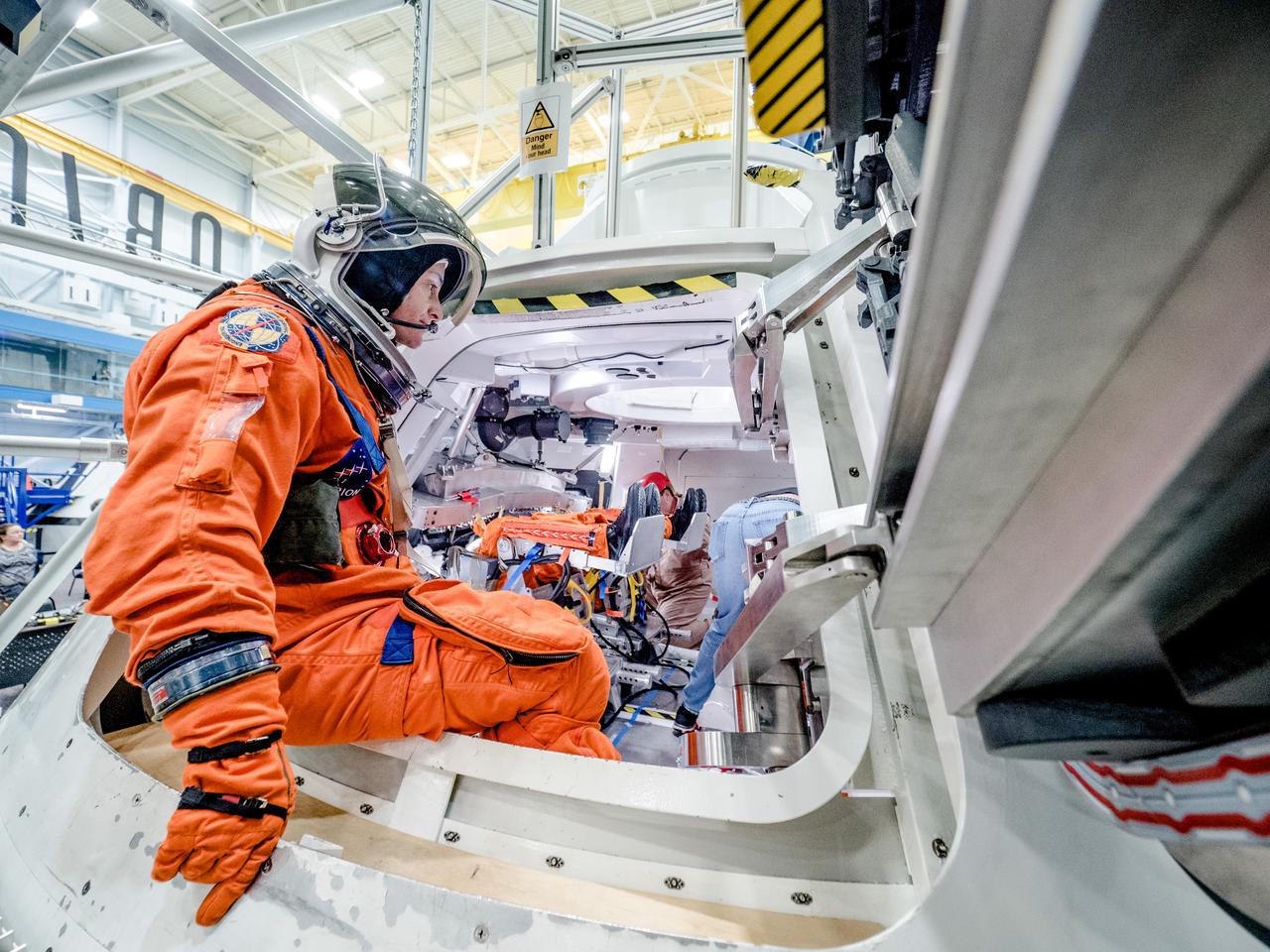
NASA is performing a series of tests to evaluate how astronauts and ground crew involved in final preparations before Orion missions will quickly get out of the spacecraft if an emergency were to occur on the pad prior to launch. In the hours before astronauts launch to space in Orion from NASA’s modernized spaceport in Florida in on the agency’s Space Launch System rocket, they will cross the Crew Access Arm 300 feet above the ground and climb inside the crew module with the assistance of ground personnel trained to help them strap into their seats and take care of last-minute needs. The testing is helping engineers evaluate hardware designs and establish procedures that would be used to get astronauts and ground crew out of the capsule as quickly as possible. Flight and ground crew are required to get out of Orion within two minutes to protect for a variety of failure scenarios that do not require the launch abort system to be activated, such as crew incapacitation, fire or the presence of toxins in the cabin. This testing took place the week of Oct. 30, 2017 using the Orion mockup in the Space Vehicle Mockup Facility at NASA’s Johnson Space Center in Houston. In this photo, engineers used fake smoke to imitate a scenario in which astronauts must exit the capsule when their vision is obscured. Markings on the ground indicate where the Crew Access Arm would be located and help guide the crew. This testing is a collaborative effort between the Orion and Ground Systems Development and Operations programs. Previous egress testing at Johnson and in the Gulf of Mexico has evaluated how crew will exit the spacecraft at the end of their missions..
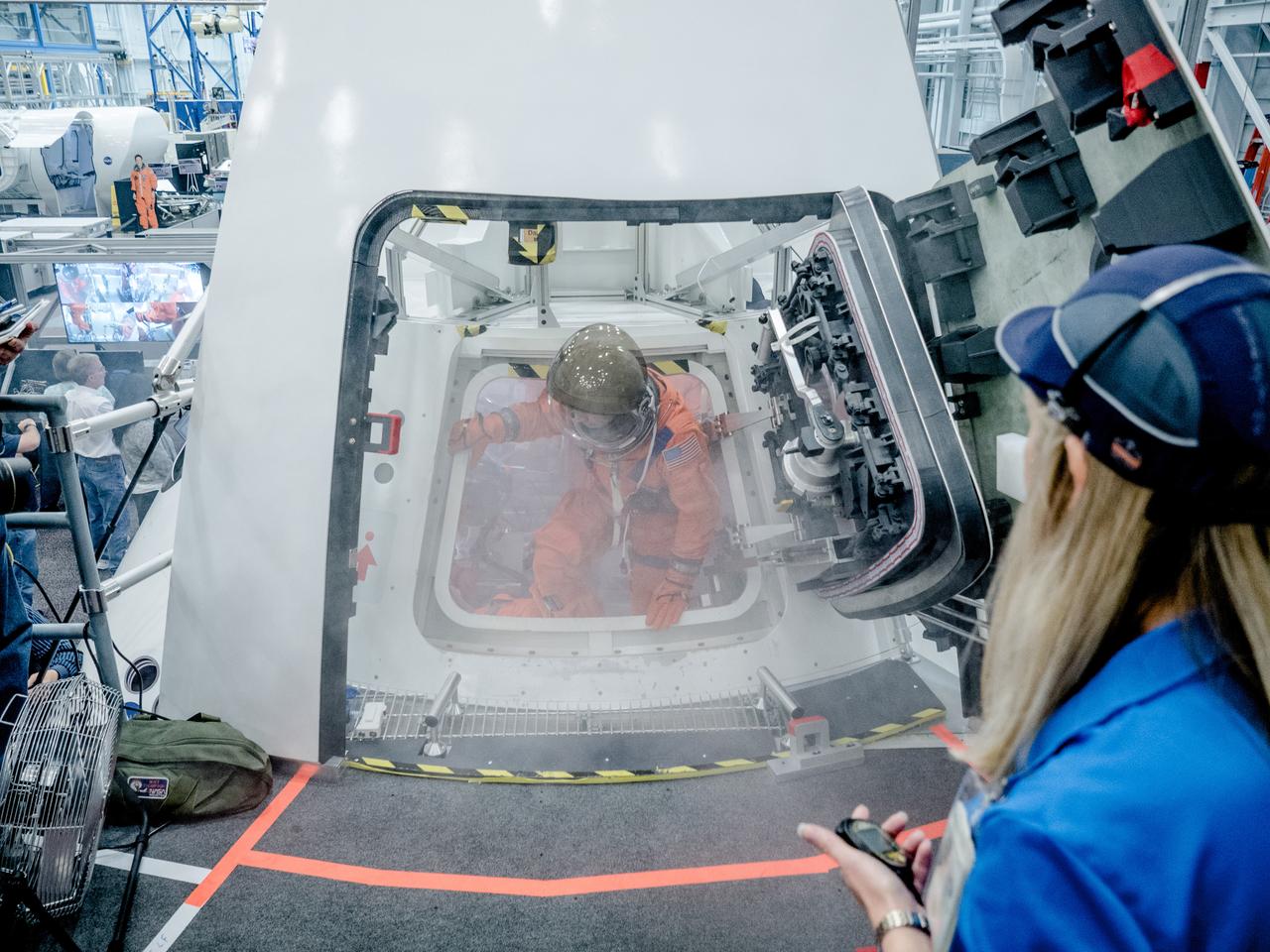
NASA is performing a series of tests to evaluate how astronauts and ground crew involved in final preparations before Orion missions will quickly get out of the spacecraft if an emergency were to occur on the pad prior to launch. In the hours before astronauts launch to space in Orion from NASA’s modernized spaceport in Florida in on the agency’s Space Launch System rocket, they will cross the Crew Access Arm 300 feet above the ground and climb inside the crew module with the assistance of ground personnel trained to help them strap into their seats and take care of last-minute needs. The testing is helping engineers evaluate hardware designs and establish procedures that would be used to get astronauts and ground crew out of the capsule as quickly as possible. Flight and ground crew are required to get out of Orion within two minutes to protect for a variety of failure scenarios that do not require the launch abort system to be activated, such as crew incapacitation, fire or the presence of toxins in the cabin. This testing took place the week of Oct. 30, 2017 using the Orion mockup in the Space Vehicle Mockup Facility at NASA’s Johnson Space Center in Houston. In this photo, engineers used fake smoke to imitate a scenario in which astronauts must exit the capsule when their vision is obscured. Markings on the ground indicate where the Crew Access Arm would be located and help guide the crew. This testing is a collaborative effort between the Orion and Ground Systems Development and Operations programs. Previous egress testing at Johnson and in the Gulf of Mexico has evaluated how crew will exit the spacecraft at the end of their missions..
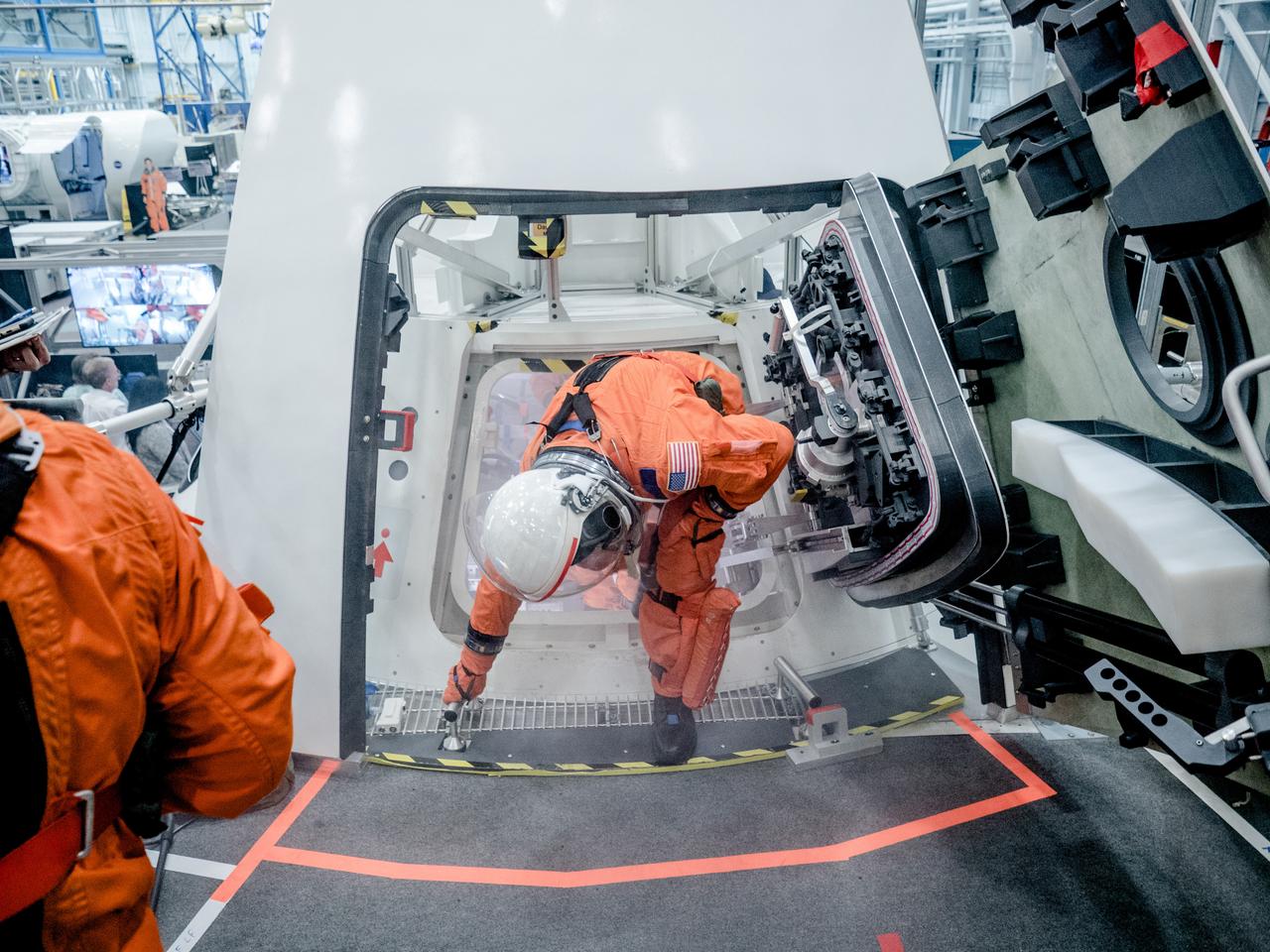
NASA is performing a series of tests to evaluate how astronauts and ground crew involved in final preparations before Orion missions will quickly get out of the spacecraft if an emergency were to occur on the pad prior to launch. In the hours before astronauts launch to space in Orion from NASA’s modernized spaceport in Florida in on the agency’s Space Launch System rocket, they will cross the Crew Access Arm 300 feet above the ground and climb inside the crew module with the assistance of ground personnel trained to help them strap into their seats and take care of last-minute needs. The testing is helping engineers evaluate hardware designs and establish procedures that would be used to get astronauts and ground crew out of the capsule as quickly as possible. Flight and ground crew are required to get out of Orion within two minutes to protect for a variety of failure scenarios that do not require the launch abort system to be activated, such as crew incapacitation, fire or the presence of toxins in the cabin. This testing took place the week of Oct. 30, 2017 using the Orion mockup in the Space Vehicle Mockup Facility at NASA’s Johnson Space Center in Houston. In this photo, engineers used fake smoke to imitate a scenario in which astronauts must exit the capsule when their vision is obscured. Markings on the ground indicate where the Crew Access Arm would be located and help guide the crew. This testing is a collaborative effort between the Orion and Ground Systems Development and Operations programs. Previous egress testing at Johnson and in the Gulf of Mexico has evaluated how crew will exit the spacecraft at the end of their missions..

NASA is performing a series of tests to evaluate how astronauts and ground crew involved in final preparations before Orion missions will quickly get out of the spacecraft if an emergency were to occur on the pad prior to launch. In the hours before astronauts launch to space in Orion from NASA’s modernized spaceport in Florida in on the agency’s Space Launch System rocket, they will cross the Crew Access Arm 300 feet above the ground and climb inside the crew module with the assistance of ground personnel trained to help them strap into their seats and take care of last-minute needs. The testing is helping engineers evaluate hardware designs and establish procedures that would be used to get astronauts and ground crew out of the capsule as quickly as possible. Flight and ground crew are required to get out of Orion within two minutes to protect for a variety of failure scenarios that do not require the launch abort system to be activated, such as crew incapacitation, fire or the presence of toxins in the cabin. This testing took place the week of Oct. 30, 2017 using the Orion mockup in the Space Vehicle Mockup Facility at NASA’s Johnson Space Center in Houston. In this photo, engineers used fake smoke to imitate a scenario in which astronauts must exit the capsule when their vision is obscured. Markings on the ground indicate where the Crew Access Arm would be located and help guide the crew. This testing is a collaborative effort between the Orion and Ground Systems Development and Operations programs. Previous egress testing at Johnson and in the Gulf of Mexico has evaluated how crew will exit the spacecraft at the end of their missions..
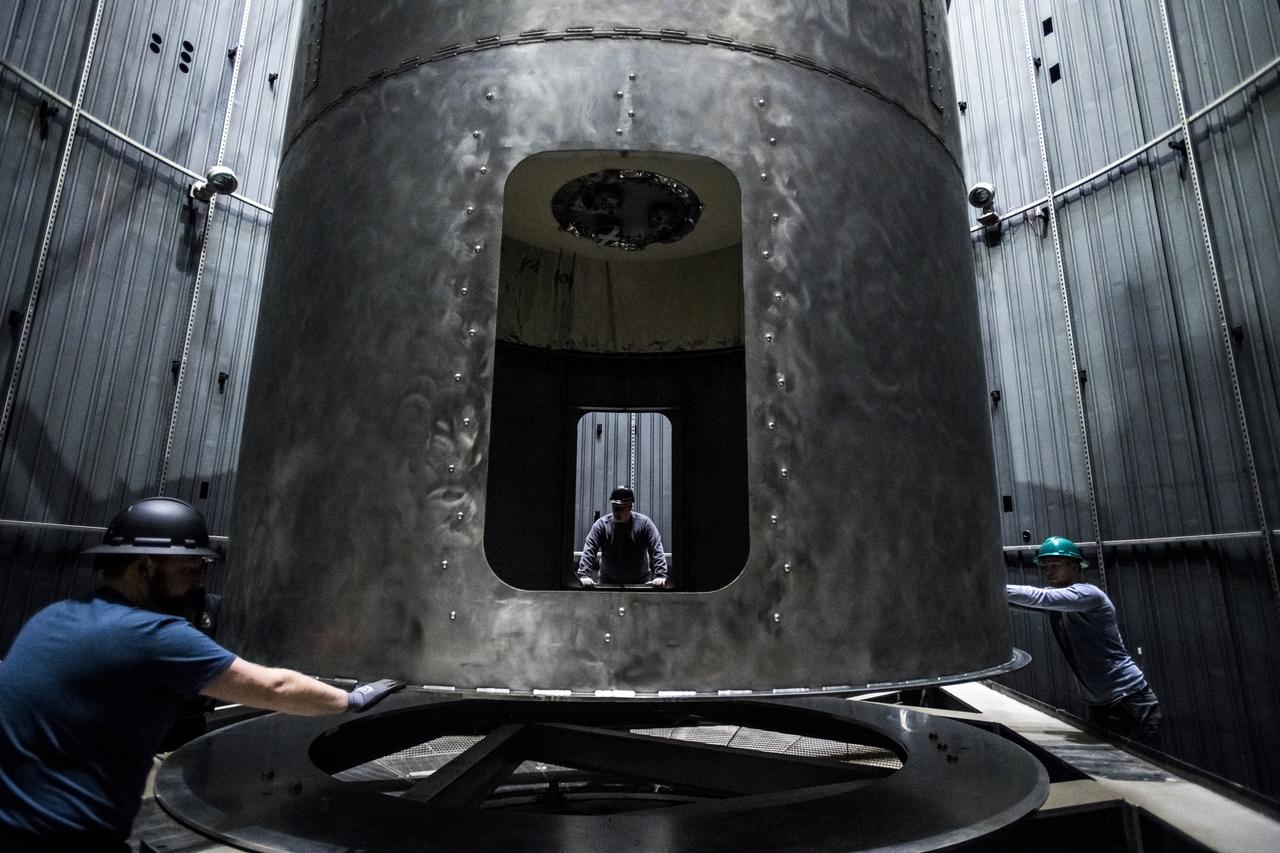
Structural Heat Intercept, Insulation and Vibration Evaluation Rig, SHIIVER is installed in the In-Space Propulsion Chamber at NASA Glenn, Plum Brook Station
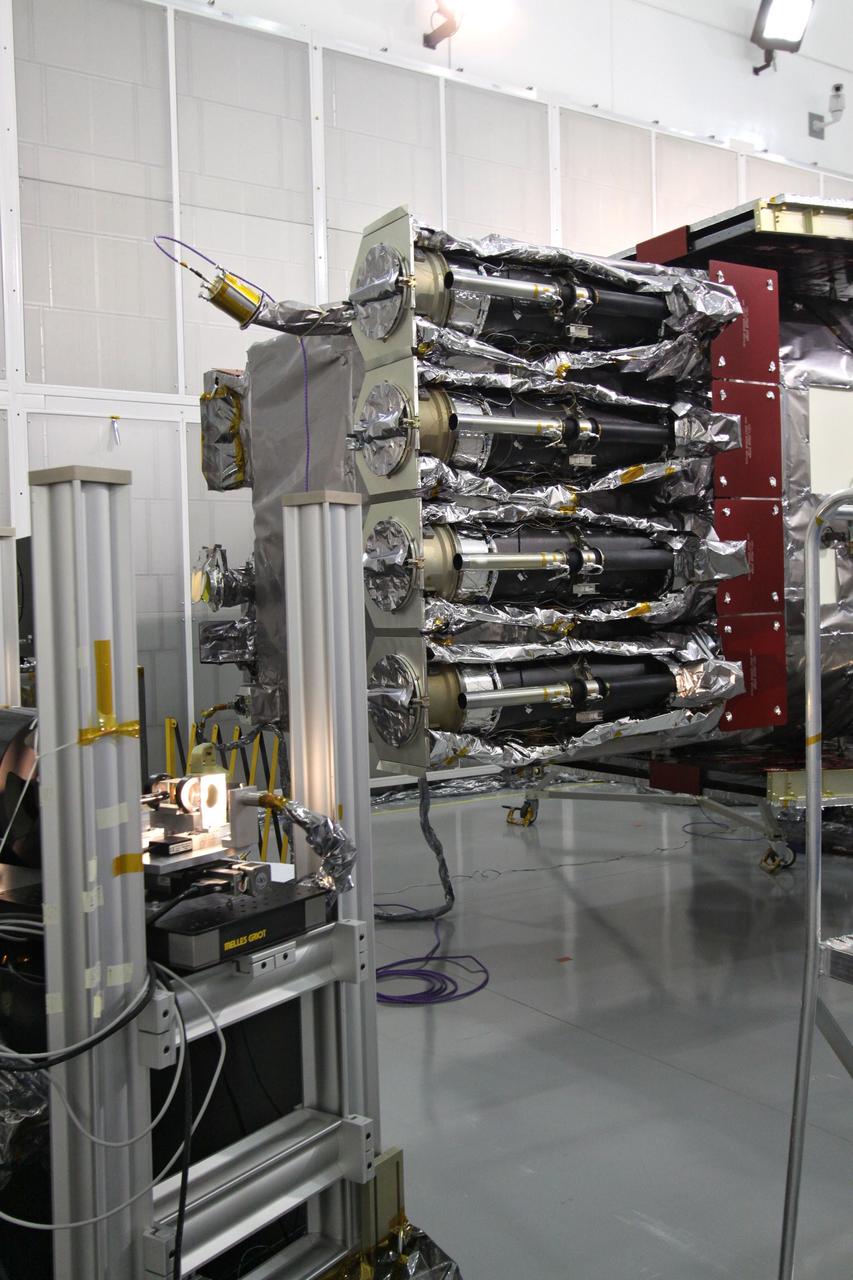
CAPE CANAVERAL, Fla. – At the Astrotech Space Operations facility in Titusville, Fla., the Solar Dynamics Observatory, or SDO, is undergoing performance testing. Seen here is the Atmospheric Imaging Assembly. All of the spacecraft science instruments are being tested in their last major evaluation before launch. SDO is the first space weather research network mission in NASA's Living With a Star Program. The spacecraft's long-term measurements will give solar scientists in-depth information about changes in the sun's magnetic field and insight into how they affect Earth. In preparation for launch, engineers will perform a battery of comprehensive tests to ensure SDO can withstand the stresses and vibrations of the launch itself, as well as what it will encounter in the space environment after launch. Liftoff on an Atlas V rocket is scheduled for Dec. 4. Photo credit: NASA/Jack Pfaller
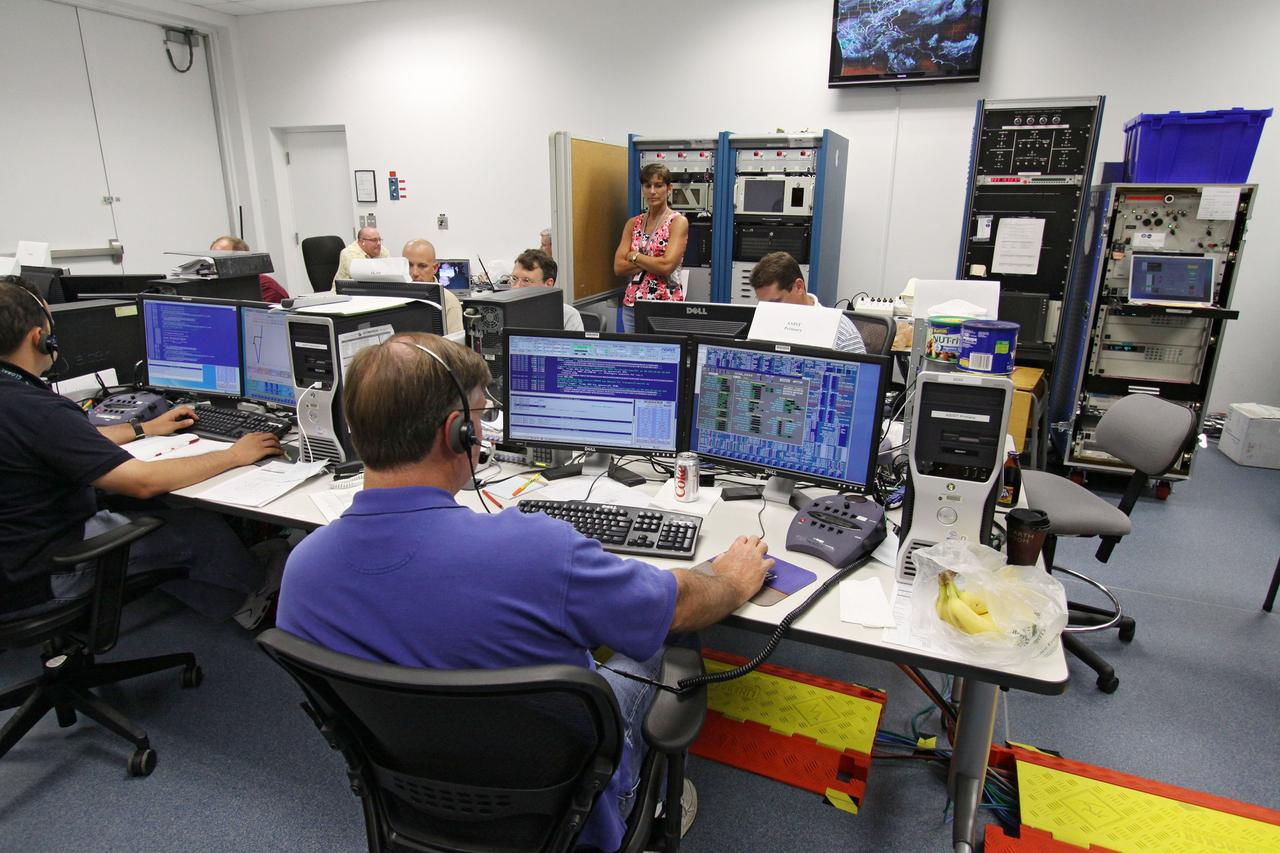
CAPE CANAVERAL, Fla. – At the Astrotech Space Operations facility in Titusville, Fla., workers in the control room monitor the data on computer screens from the movement of the high-gain antenna on the Solar Dynamics Observatory, or SDO. The SDO is undergoing performance testing. All of the spacecraft science instruments are being tested in their last major evaluation before launch. SDO is the first space weather research network mission in NASA's Living With a Star Program. The spacecraft's long-term measurements will give solar scientists in-depth information about changes in the sun's magnetic field and insight into how they affect Earth. In preparation for launch, engineers will perform a battery of comprehensive tests to ensure SDO can withstand the stresses and vibrations of the launch itself, as well as what it will encounter in the space environment after launch. Liftoff on an Atlas V rocket is scheduled for Dec. 4. Photo credit: NASA/Jack Pfaller
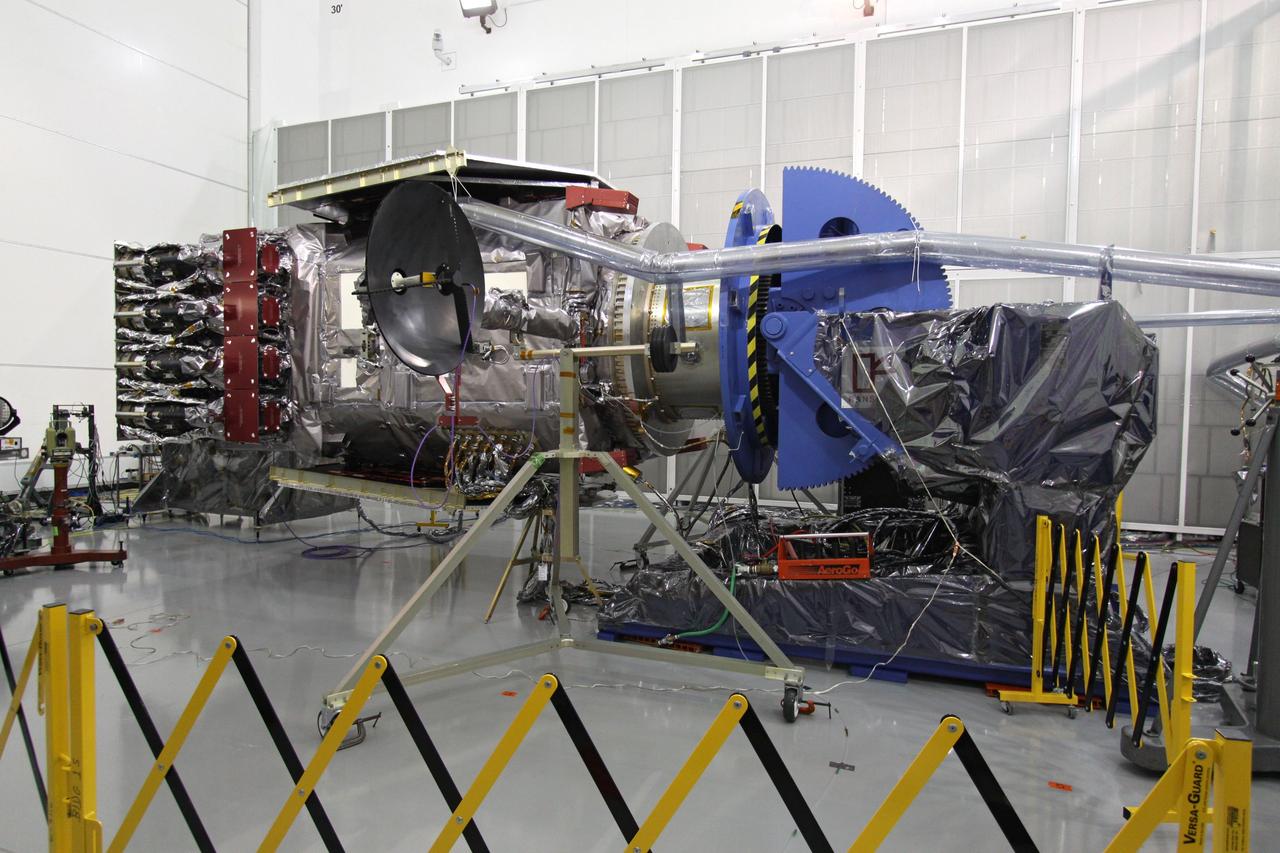
CAPE CANAVERAL, Fla. – At the Astrotech Space Operations facility in Titusville, Fla., the Solar Dynamics Observatory, or SDO, is undergoing performance testing. The high-gain antenna seen at center left will be moved, or gimbaled. All of the spacecraft science instruments are being tested in their last major evaluation before launch. SDO is the first space weather research network mission in NASA's Living With a Star Program. The spacecraft's long-term measurements will give solar scientists in-depth information about changes in the sun's magnetic field and insight into how they affect Earth. In preparation for launch, engineers will perform a battery of comprehensive tests to ensure SDO can withstand the stresses and vibrations of the launch itself, as well as what it will encounter in the space environment after launch. Liftoff on an Atlas V rocket is scheduled for Dec. 4. Photo credit: NASA/Jack Pfaller
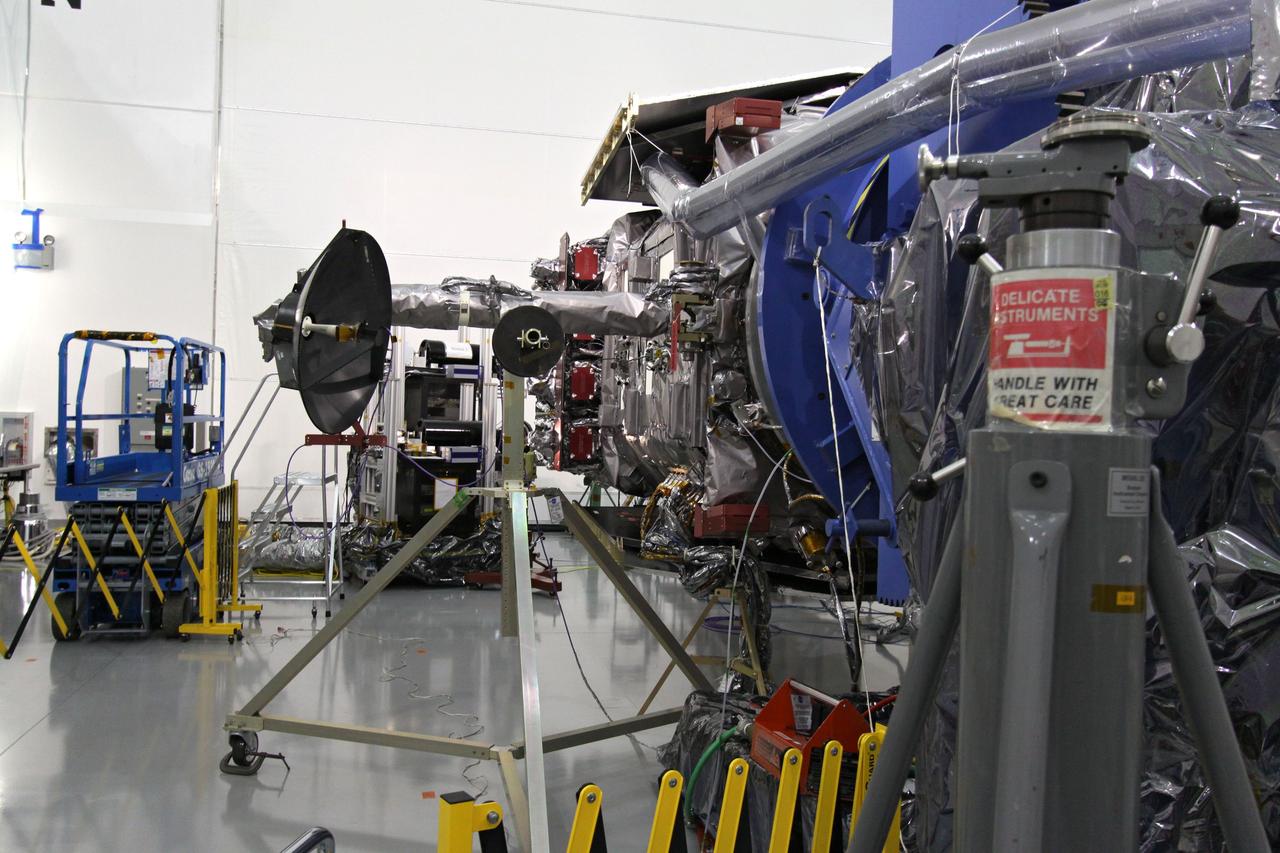
CAPE CANAVERAL, Fla. – At the Astrotech Space Operations facility in Titusville, Fla., the Solar Dynamics Observatory, or SDO, is moved, or gimbaled, during performance testing. All of the spacecraft science instruments are being tested in their last major evaluation before launch. SDO is the first space weather research network mission in NASA's Living With a Star Program. The spacecraft's long-term measurements will give solar scientists in-depth information about changes in the sun's magnetic field and insight into how they affect Earth. In preparation for launch, engineers will perform a battery of comprehensive tests to ensure SDO can withstand the stresses and vibrations of the launch itself, as well as what it will encounter in the space environment after launch. Liftoff on an Atlas V rocket is scheduled for Dec. 4. Photo credit: NASA/Jack Pfaller
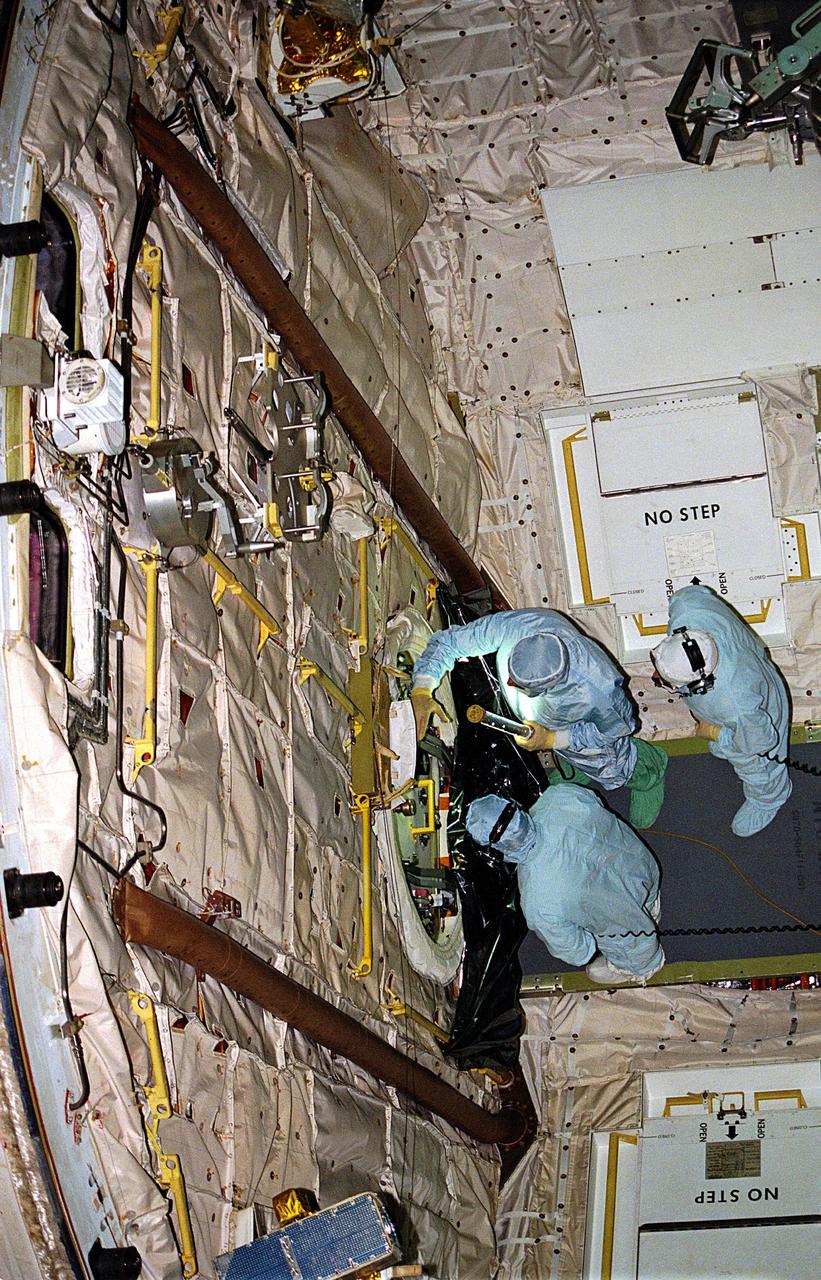
KENNEDY SPACE CENTER, FLA. -- United Space Alliance (USA) technicians in Orbiter Processing Facility Bay 1 troubleshoot the orbiter Columbia’s outer hatch of the airlock, which failed to open during the recent STS-80 Space Shuttle mission. Mission Specialists Tamara E. Jernigan and Thomas D. Jones did not perform the mission’s planned two extravehicular activities (EVAs) or spacewalks because the hatch would not open on orbit. The spacewalks were to be part of the continuing series of EVA Development Flight Tests to evaluate equipment and procedures and to build spacewalking experience in preparation for the International Space Station.
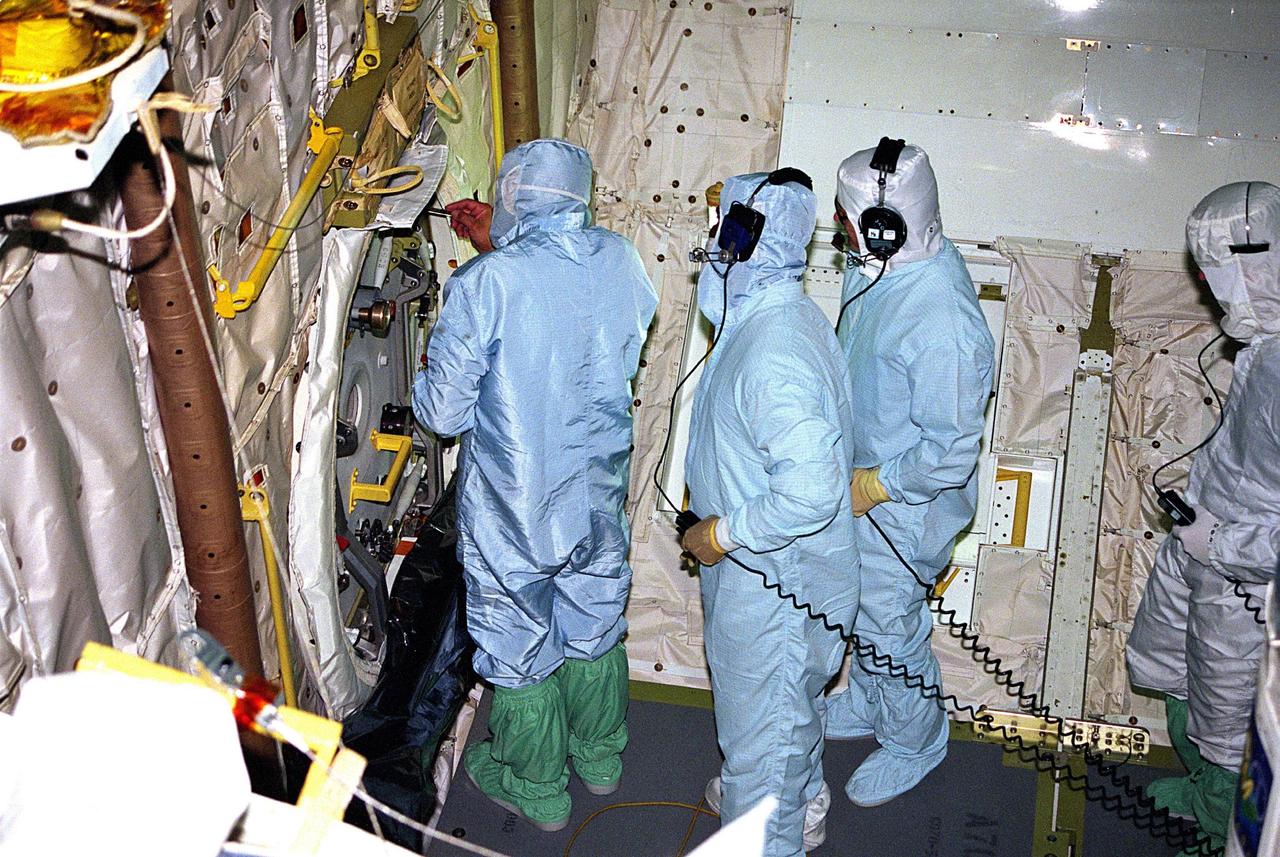
KENNEDY SPACE CENTER, FLA. -- United Space Alliance (USA) technicians in Orbiter Processing Facility Bay 1 troubleshoot the orbiter Columbia’s outer hatch of the airlock, which failed to open during the recent STS-80 Space Shuttle mission. Mission Specialists Tamara E. Jernigan and Thomas D. Jones did not perform the mission’s planned two extravehicular activities (EVAs) or spacewalks because the hatch would not open on orbit. The spacewalks were to be part of the continuing series of EVA Development Flight Tests to evaluate equipment and procedures and to build spacewalking experience in preparation for the International Space Station.
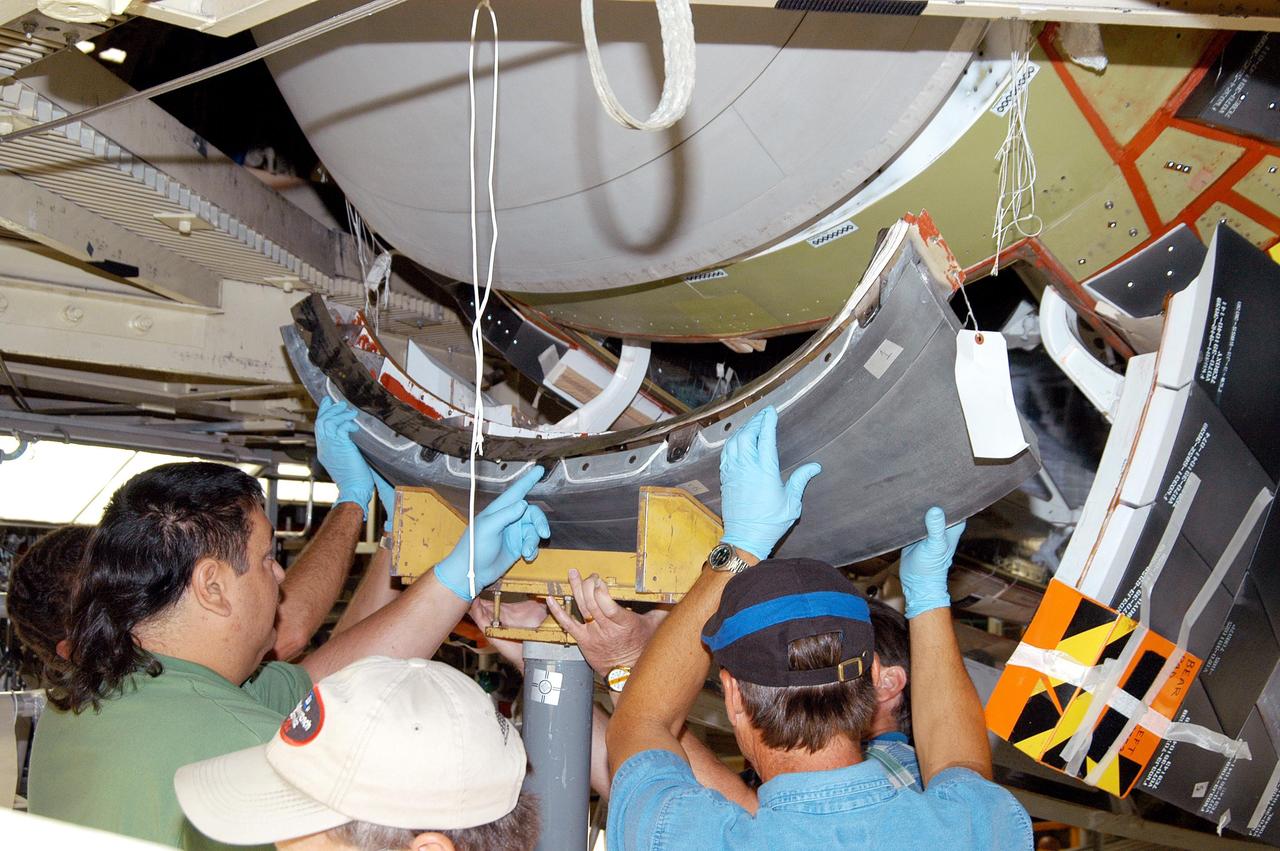
KENNEDY SPACE CENTER, FLA. - Workers in the Orbiter Processing Facility check the placement of the Reinforced Carbon-Carbon (RCC) chin panel on Discovery. . The chin panel is the smile-shaped section of RCC directly below the nose cap that provides a thermal barrier during re-entry. The nose cap, with chin panel, was removed from the vehicle in the summer of 2003 and returned to the vendor, where it underwent numerous forms of Non-Destructive Evaluation. These tests included X-ray, ultrasound and eddy current to ensure its structural integrity prior to reinstallation. Discovery is designated as the Return to Flight vehicle for mission STS-114, no earlier than March 2005.
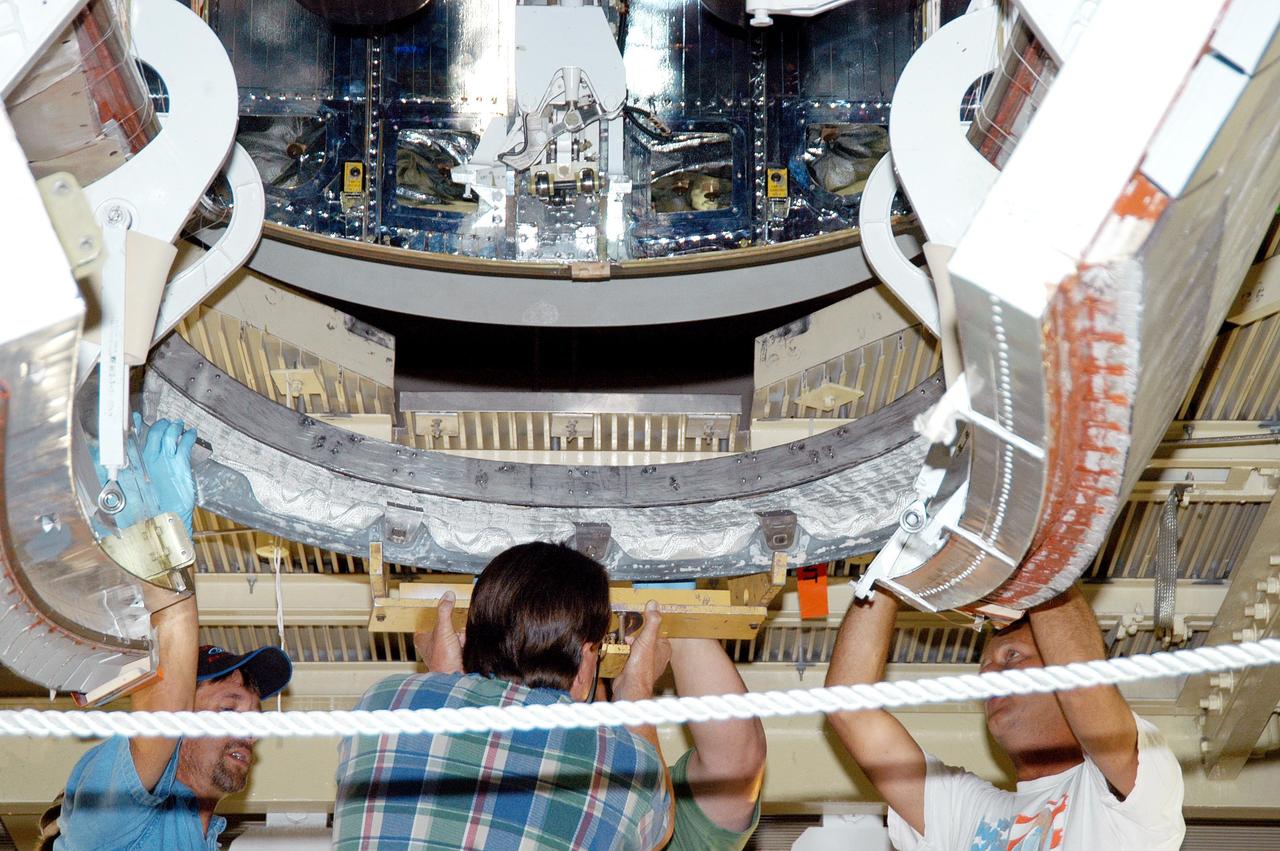
KENNEDY SPACE CENTER, FLA. - Workers in the Orbiter Processing Facility lift the Reinforced Carbon-Carbon (RCC) chin panel into place on Discovery. The chin panel is the smile-shaped section of RCC directly below the nose cap that provides a thermal barrier during re-entry. The nose cap, with chin panel, was removed from the vehicle in the summer of 2003 and returned to the vendor, where it underwent numerous forms of Non-Destructive Evaluation. These tests included X-ray, ultrasound and eddy current to ensure its structural integrity prior to reinstallation. Discovery is designated as the Return to Flight vehicle for mission STS-114, no earlier than March 2005.
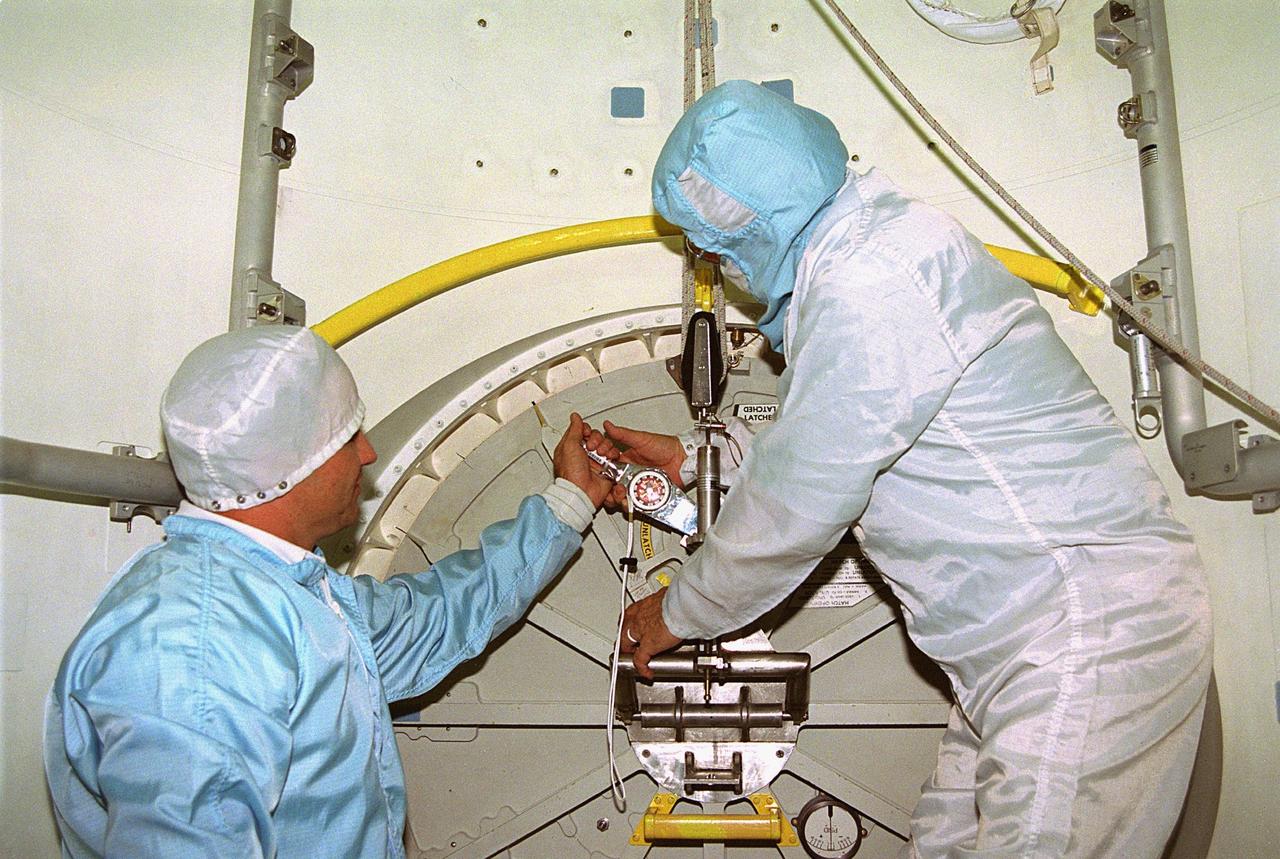
KENNEDY SPACE CENTER, FLA. -- In Orbiter Processing Facility Bay 1, United Space Alliance (USA) technicians Dave Lawrence, at left, and James Cullop troubleshoot the orbiter Columbia’s outer hatch of the airlock, which failed to open during the recent STS-80 Space Shuttle mission. Mission Specialists Tamara E. Jernigan and Thomas D. Jones did not perform the mission’s planned two extravehicular activities (EVAs) or spacewalks because the hatch would not open on orbit. The spacewalks were to be part of the continuing series of EVA Development Flight Tests to evaluate equipment and procedures and to build spacewalking experience in preparation for the International Space Station.
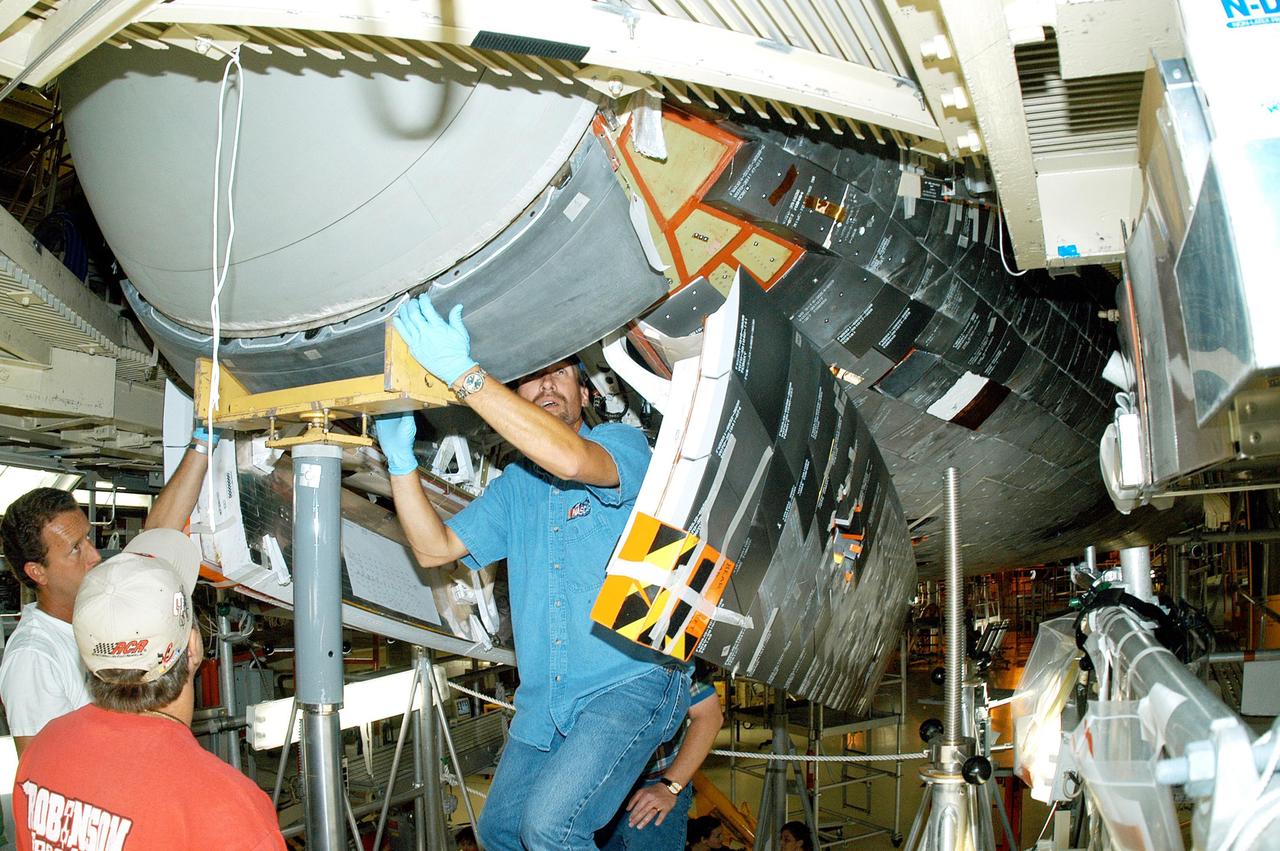
KENNEDY SPACE CENTER, FLA. - - Workers in the Orbiter Processing Facility complete the installation of the Reinforced Carbon-Carbon panel on Discovery. The chin panel is the smile-shaped section of RCC directly below the nose cap that provides a thermal barrier during re-entry. The nose cap, with chin panel, was removed from the vehicle in the summer of 2003 and returned to the vendor, where it underwent numerous forms of Non-Destructive Evaluation. These tests included X-ray, ultrasound and eddy current to ensure its structural integrity prior to reinstallation. Discovery is designated as the Return to Flight vehicle for mission STS-114, no earlier than March 2005.
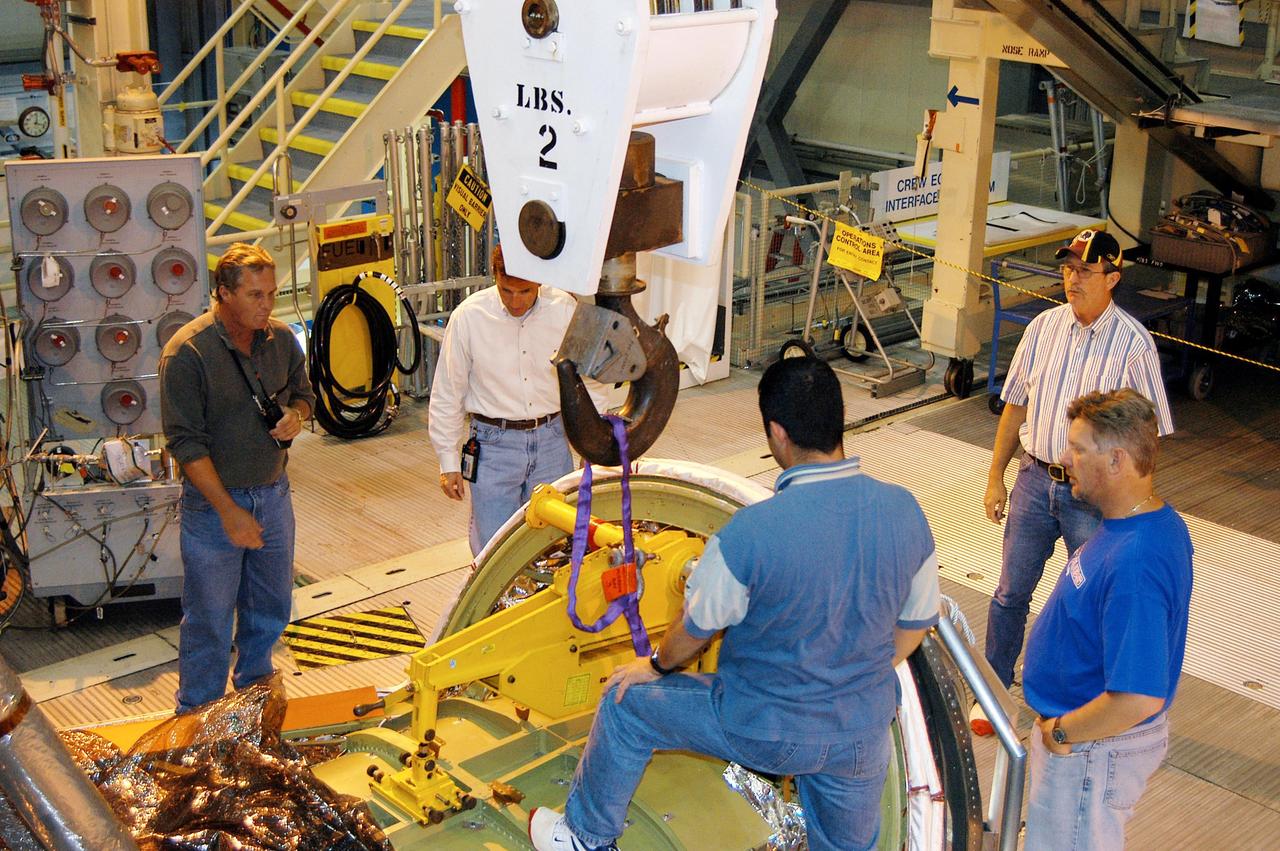
KENNEDY SPACE CENTER, FLA. - Workers in the Orbiter Processing Facility get ready to remove Ground Support Equipment used to install Discovery’s nose cap on Friday. The nose cap had been removed from the vehicle in the summer of 2003 and returned to the vendor, where it underwent numerous forms of Non-Destructive Evaluation. These tests included X-ray, ultrasound and eddy current to ensure its structural integrity prior to installation on the vehicle. The nose cap was also recoated. Once returned to KSC, new Thermal Protection System blankets were assembled inside of the nose cap and thermography was performed prior to installation on the orbiter.
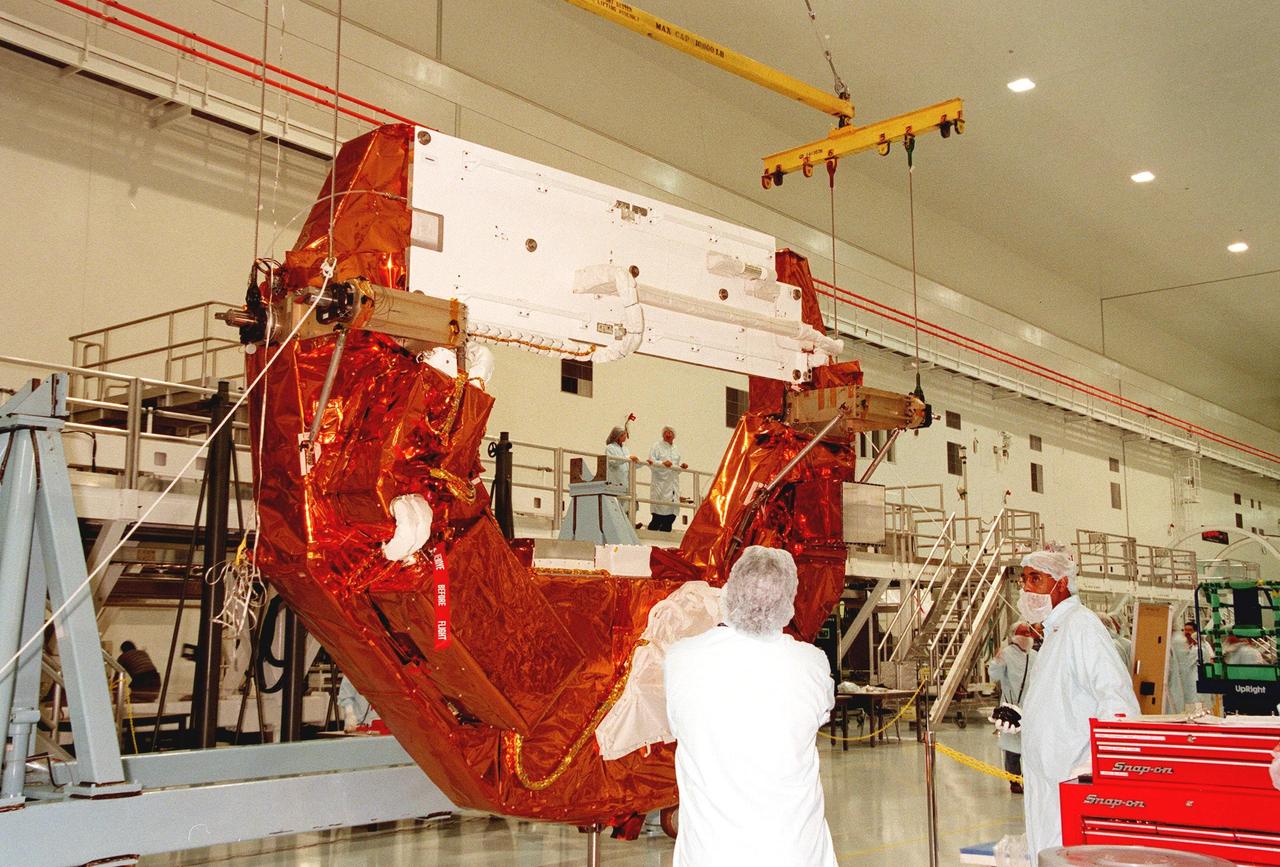
The Hubble Space Telescope Orbiting Systems Test (HOST)is being raised to a workstand by technicians in the Space Shuttle Processing Facility. One of the payloads on the STS-95 mission, the HOST platform is carrying four experiments to validate components planned for installation during the third Hubble Space Telescope servicing mission and to evaluate new technologies in an earth orbiting environment. The STS-95 mission is scheduled to launch Oct. 29. It will carry three other payloads: the Spartan solar-observing deployable spacecraft, the International Extreme Ultraviolet Hitchhiker, and the SPACEHAB single module with experiments on space flight and the aging process
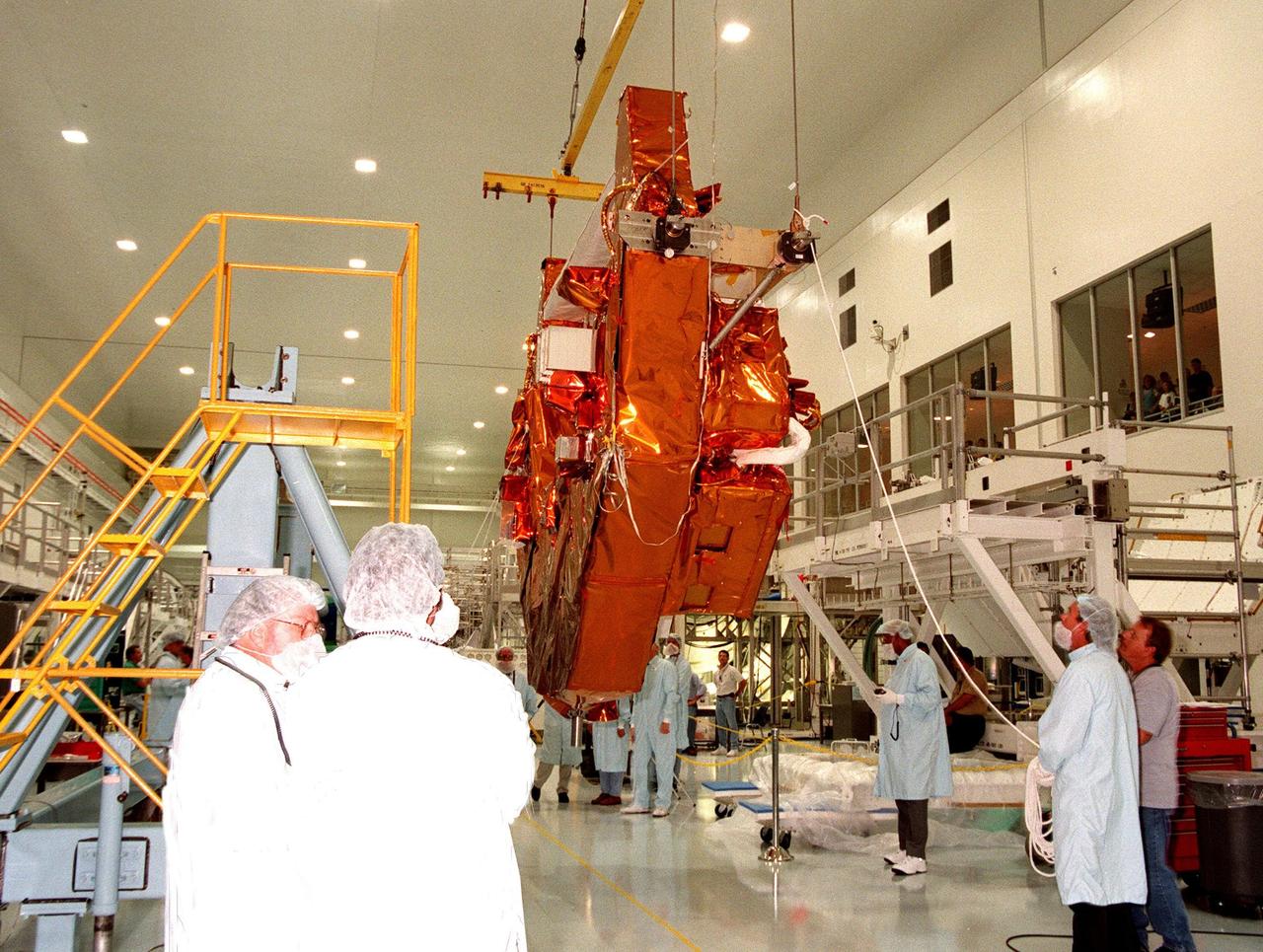
Workers watch as the Hubble Space Telescope Orbiting Systems Test (HOST)is moved inside the Space Shuttle Processing Facility. The HOST platform, one of the payloads on the STS-95 mission, is carrying four experiments to validate components planned for installation during the third Hubble Space Telescope servicing mission and to evaluate new technologies in an earth orbiting environment. The STS-95 mission is scheduled to launch Oct. 29. It will carry three other payloads: the Spartan solar-observing deployable spacecraft, the International Extreme Ultraviolet Hitchhiker, and the SPACEHAB single module with experiments on space flight and the aging process
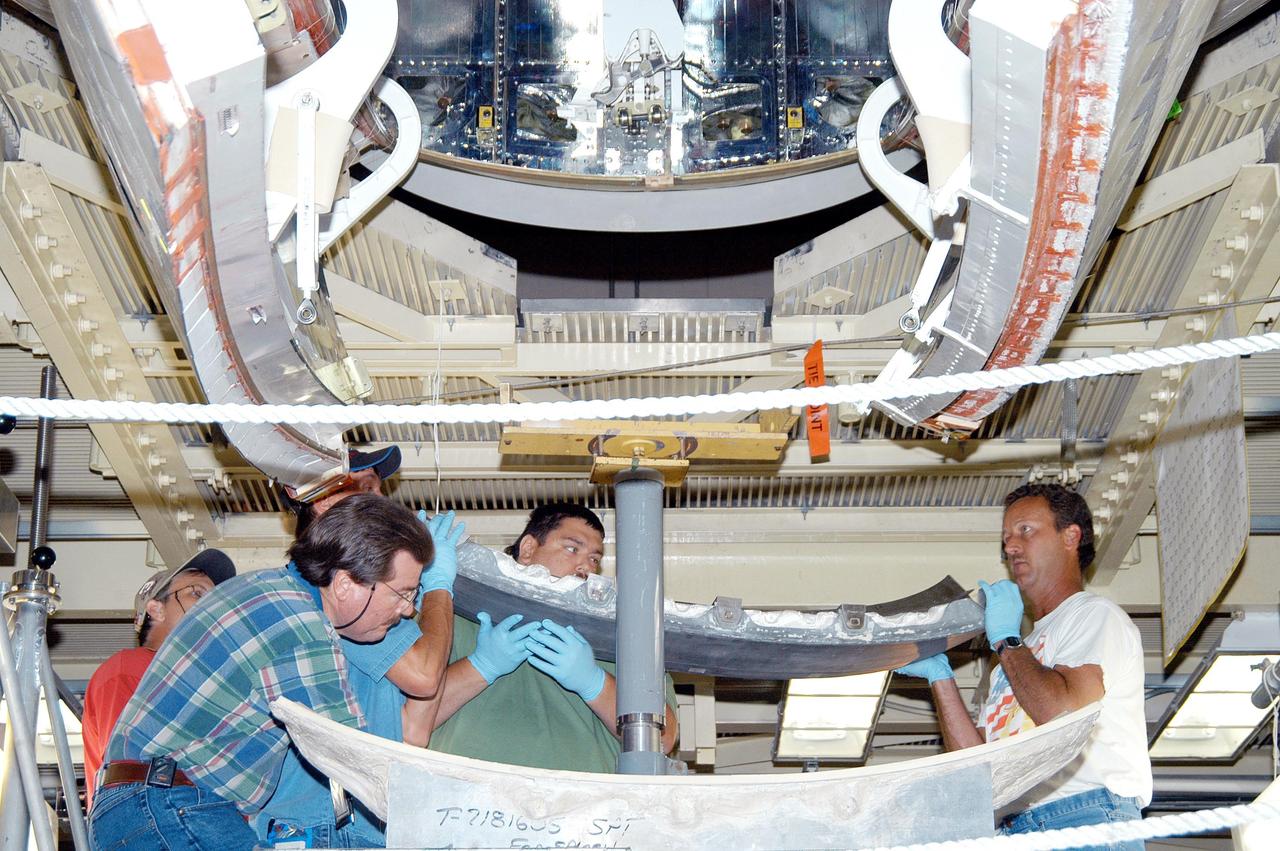
KENNEDY SPACE CENTER, FLA. - Workers in the Orbiter Processing Facility lift the Reinforced Carbon-Carbon (RCC) chin panel to install on Discovery. The chin panel is the smile-shaped section of RCC directly below the nose cap that provides a thermal barrier during re-entry. The nose cap, with chin panel, was removed from the vehicle in the summer of 2003 and returned to the vendor, where it underwent numerous forms of Non-Destructive Evaluation. These tests included X-ray, ultrasound and eddy current to ensure its structural integrity prior to reinstallation. Discovery is designated as the Return to Flight vehicle for mission STS-114, no earlier than March 2005.
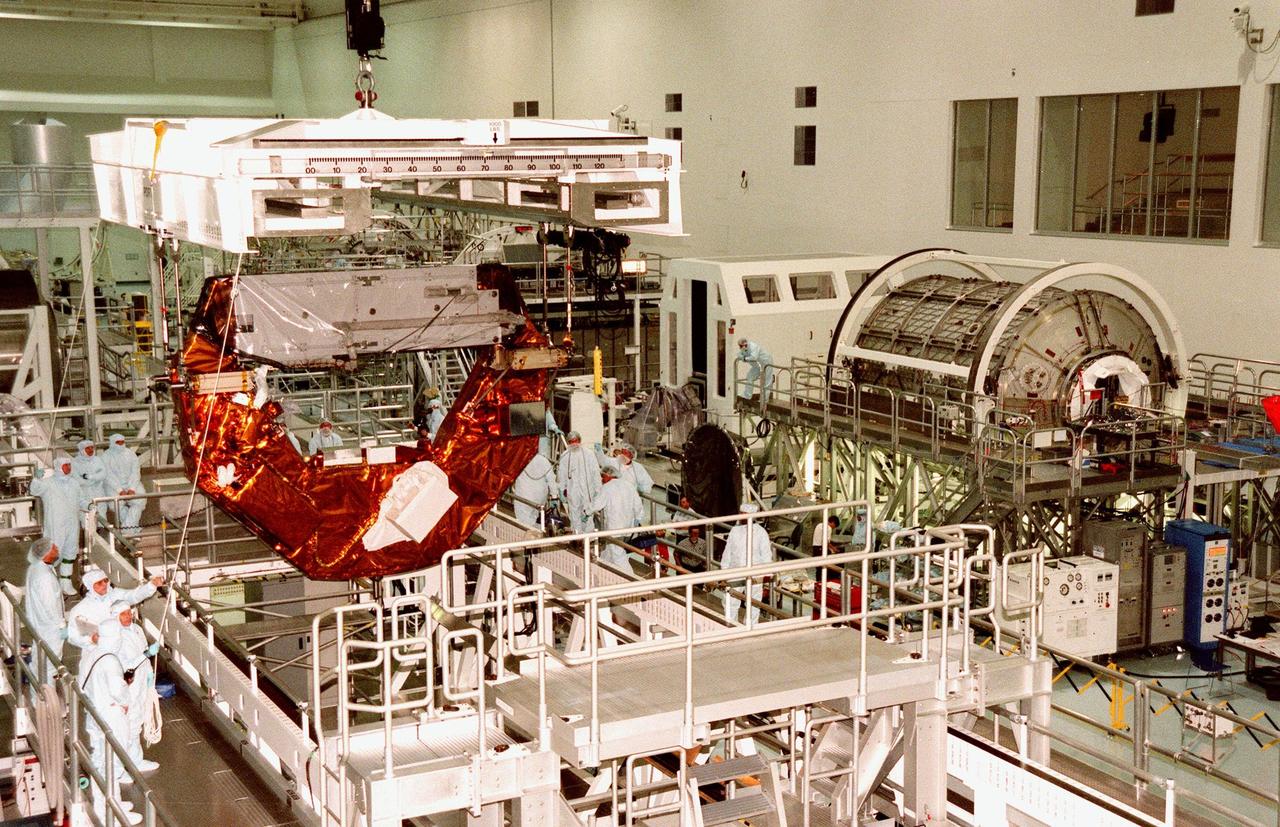
KENNEDY SPACE CENTER, FLA. -- The Hubble Space Telescope Orbiting Systems Test Platform (HOST) is lifted off its work stand in the Space Station Processing Facility before moving it to its payload canister. One of the payloads on the STS-95 mission, the HOST platform is carrying four experiments to validate components planned for installation during the third Hubble Space Telescope servicing mission and to evaluate new technologies in an Earth-orbiting environment. The STS-95 mission is scheduled to launch Oct. 29. It will carry other payloads such as the Spartan solar-observing deployable spacecraft, the International Extreme Ultraviolet Hitchhiker (IEH-3), and the SPACEHAB single module with experiments on space flight and the aging process
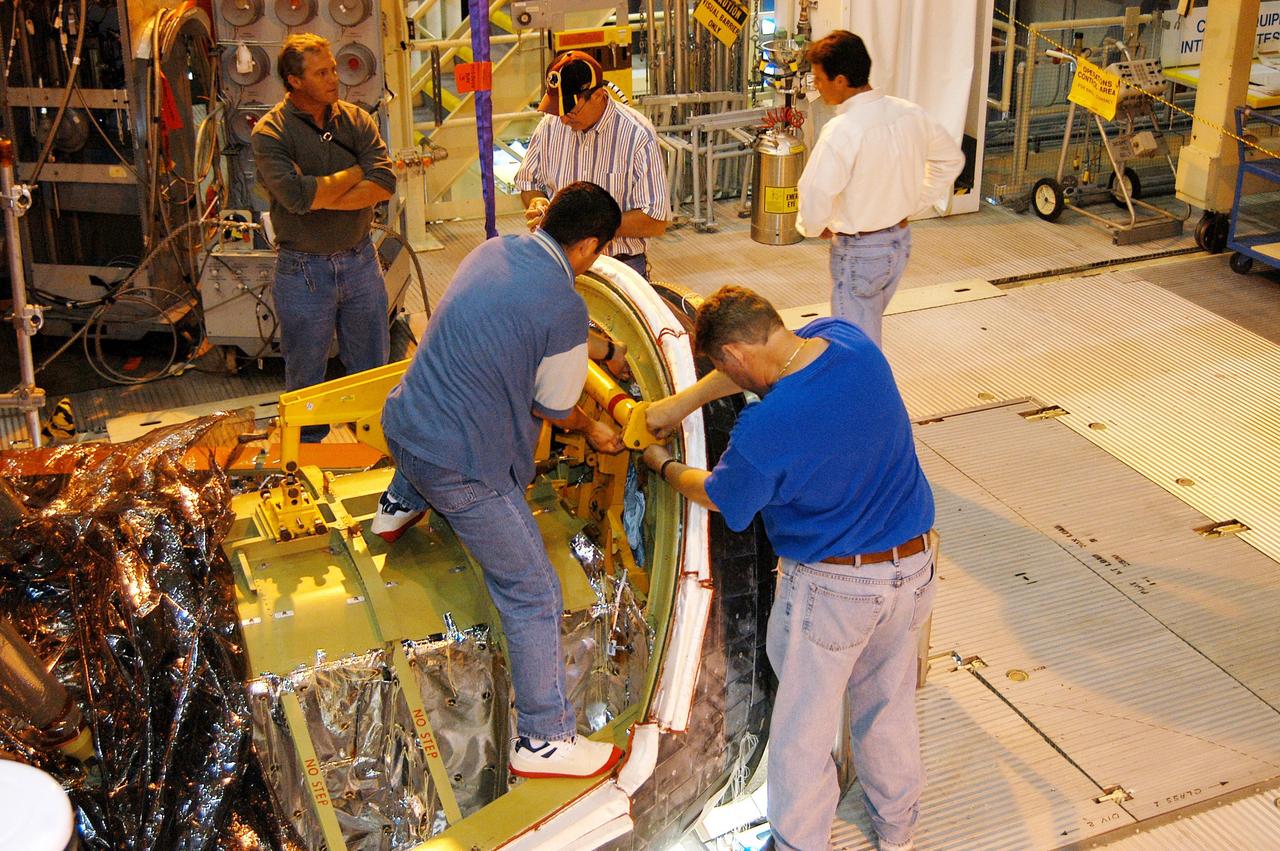
KENNEDY SPACE CENTER, FLA. - Workers in the Orbiter Processing Facility remove Ground Support Equipment used to install Discovery’s nose cap on Friday. The nose cap had been removed from the vehicle in the summer of 2003 and returned to the vendor, where it underwent numerous forms of Non-Destructive Evaluation. These tests included X-ray, ultrasound and eddy current to ensure its structural integrity prior to installation on the vehicle. The nose cap was also recoated. Once returned to KSC, new Thermal Protection System blankets were assembled inside of the nose cap and thermography was performed prior to installation on the orbiter.
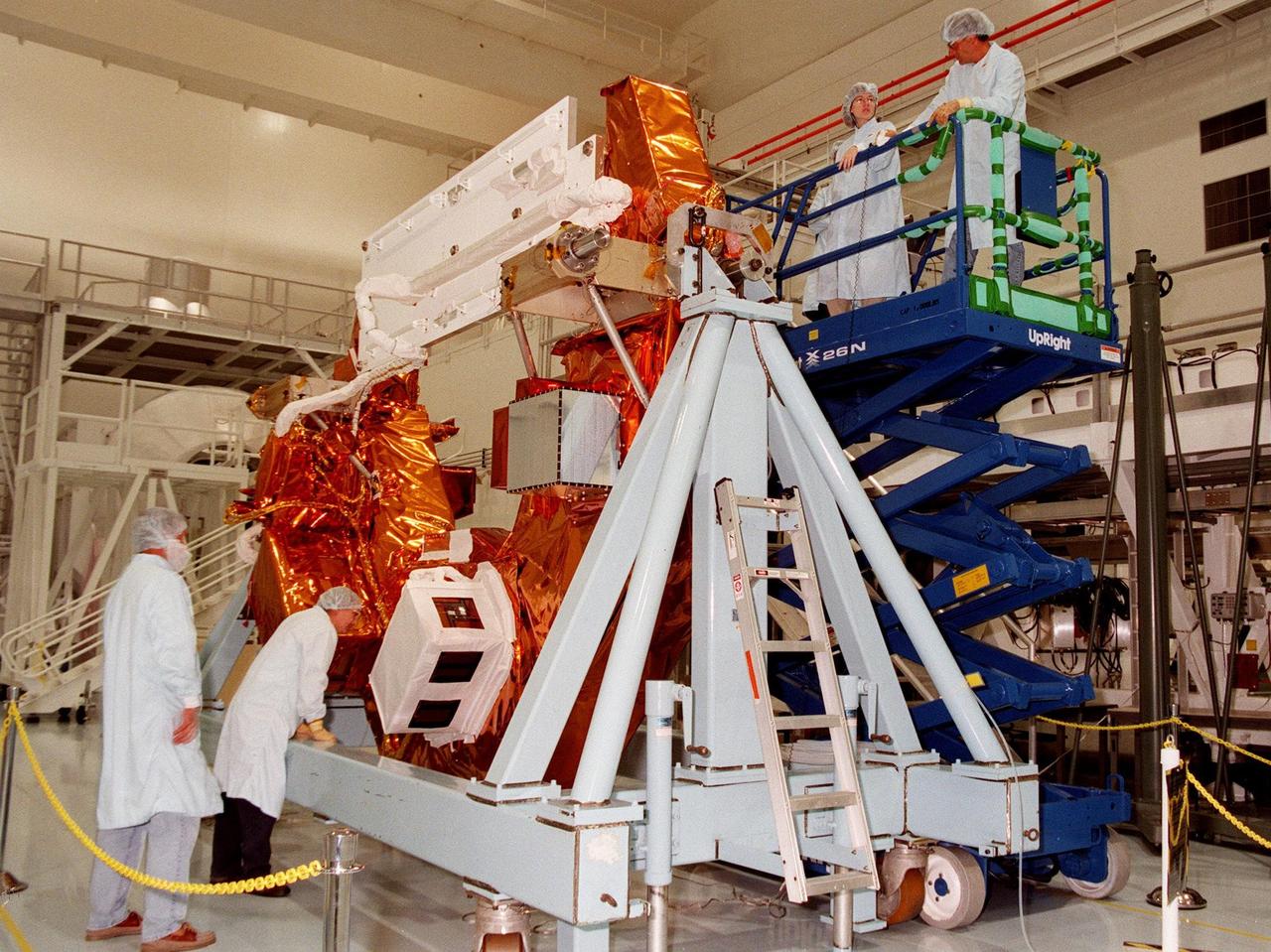
KENNEDY SPACE CENTER, FLA. -- The Hubble Space Telescope Orbiting Systems Test (HOST) is checked out by technicians in the Space Shuttle Processing Facility. One of the payloads on the STS-95 mission, the HOST platform is carrying four experiments to validate components planned for installation during the third Hubble Space Telescope servicing mission and to evaluate new technologies in an earth orbiting environment. The STS-95 mission is scheduled to launch Oct. 29. It will carry three other payloads: the Spartan solar-observing deployable spacecraft, the International Extreme Ultraviolet Hitchhiker, and the SPACEHAB single module with experiments on space flight and the aging process

KENNEDY SPACE CENTER, FLA. - Workers in the Orbiter Processing Facility prepare the Reinforced Carbon-Carbon (RCC) chin panel to install on Discovery. The chin panel is the smile-shaped section of RCC directly below the nose cap that provides a thermal barrier during re-entry. The nose cap, with chin panel, was removed from the vehicle in the summer of 2003 and returned to the vendor, where it underwent numerous forms of Non-Destructive Evaluation. These tests included X-ray, ultrasound and eddy current to ensure its structural integrity prior to reinstallation. Discovery is designated as the Return to Flight vehicle for mission STS-114, no earlier than March 2005.
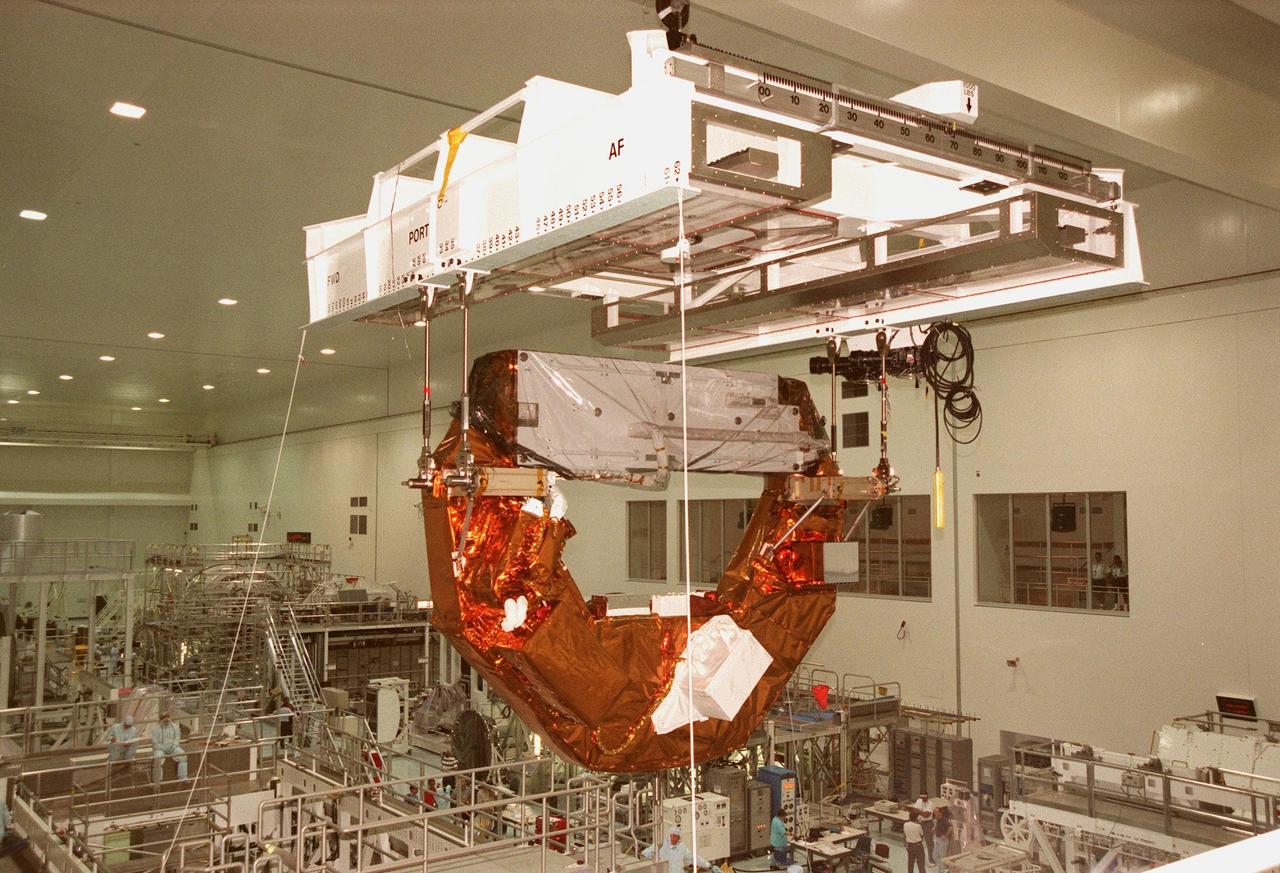
KENNEDY SPACE CENTER, FLA. -- The Hubble Space Telescope Orbiting Systems Test (HOST) is suspended above its work stand in the Space Station Processing Facility before moving it to its payload canister. The HOST platform is carrying four experiments to validate components planned for installation during the third Hubble Space Telescope servicing mission and to evaluate new technologies in an Earth-orbiting environment. The STS-95 mission is scheduled to launch Oct. 29. It will carry other payloads such as the Spartan solar-observing deployable spacecraft, the International Extreme Ultraviolet Hitchhiker (IEH-3), and the SPACEHAB single module with experiments on space flight and the aging process
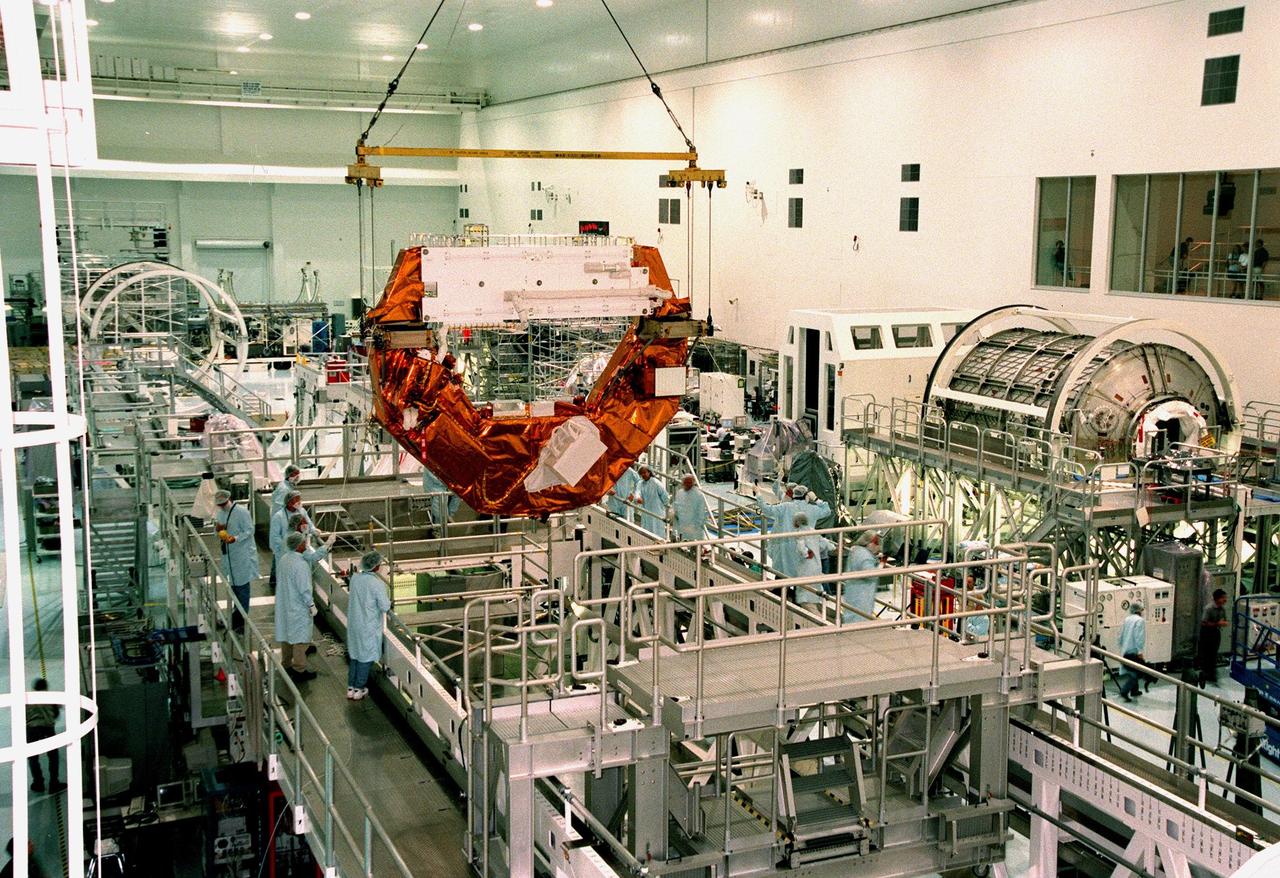
Workers watch as the Hubble Space Telescope Orbiting Systems Test (HOST)is lowered onto a workstand in the Space Shuttle Processing Facility. To the right can be seen the Rack Insertion Device and Leonardo, a Multi-Purpose Logistics Module. The HOST platform, one of the payloads on the STS-95 mission, is carrying four experiments to validate components planned for installation during the third Hubble Space Telescope servicing mission and to evaluate new technologies in an earth orbiting environment. The STS-95 mission is scheduled to launch Oct. 29. It will carry three other payloads: the Spartan solar-observing deployable spacecraft, the International Extreme Ultraviolet Hitchhiker, and the SPACEHAB single module with experiments on space flight and the aging process
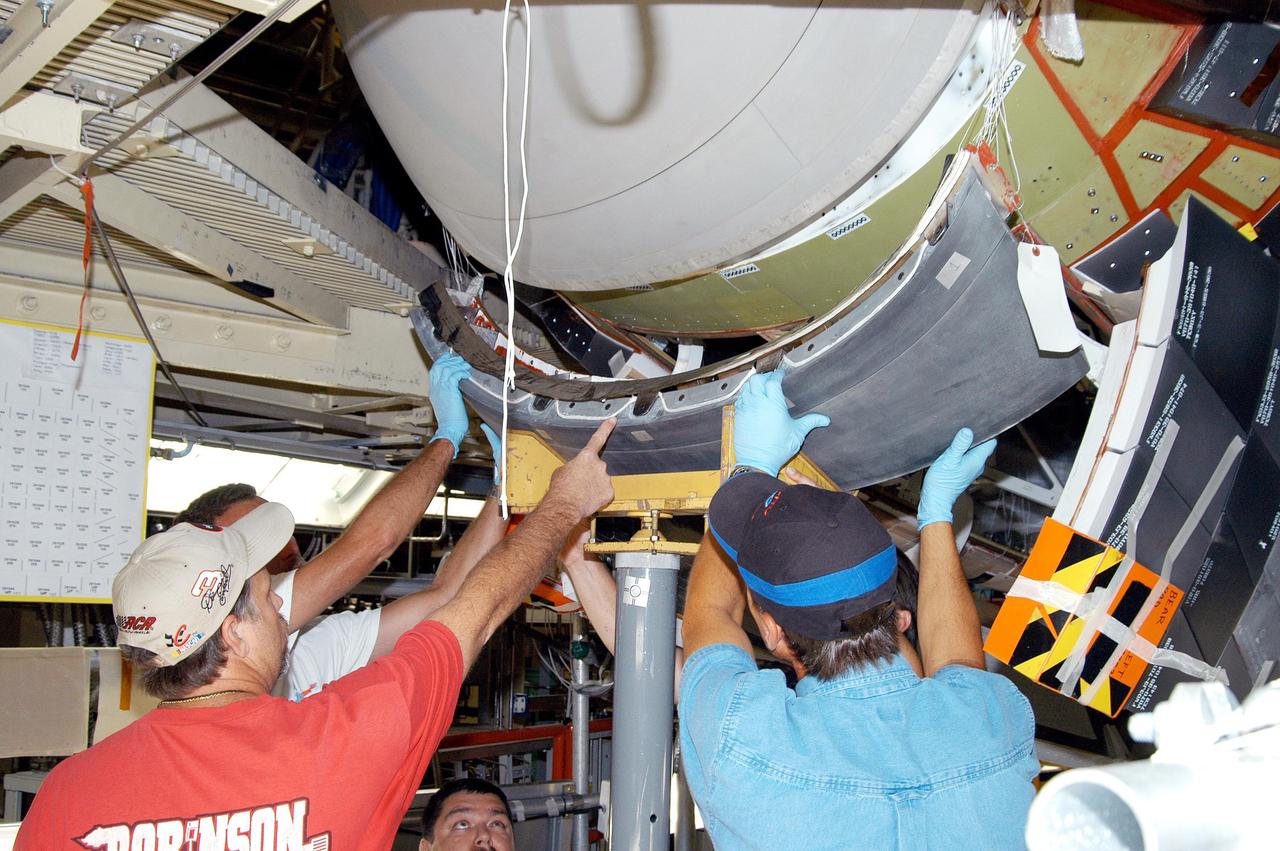
KENNEDY SPACE CENTER, FLA. - - Workers in the Orbiter Processing Facility check the placement of the Reinforced Carbon-Carbon chin panel on Discovery. The chin panel is the smile-shaped section of RCC directly below the nose cap that provides a thermal barrier during re-entry. The nose cap, with chin panel, was removed from the vehicle in the summer of 2003 and returned to the vendor, where it underwent numerous forms of Non-Destructive Evaluation. These tests included X-ray, ultrasound and eddy current to ensure its structural integrity prior to reinstallation. Discovery is designated as the Return to Flight vehicle for mission STS-114, no earlier than March 2005.

The X-1E research aircraft provides a striking view at the entrance of NASA's Dryden Flight Research Center, Edwards, California. The X-1E, one of the three original X-1 aircraft modified with a raised cockpit canopy and an ejection seat, was flown at the facility between 1953 and 1958 to investigate speeds at twice that of sound, and also to evaluate a thin wing designed for high-speed flight. The Dryden complex was originally established in 1946 as a small high-speed flight station to support the X-1 program. The X-1 was the first aircraft to fly at supersonic speeds. The main administrative building is to the rear of the X-1E and is the center of a research installation that has grown to more than 450 government employees and nearly 400 civilian contractors. Located on the northwest "shore" of Rogers Dry Lake, the Dryden Center was built around the original administrative-hangar building constructed in 1954 at a cost of $3.8 million. Since then many additional support and operational facilities have been built including a number of unique test facilities such as the Thermalstructures Research Facility, Flow Visualization Facility, and the newest addition, the Integrated Test Facility.

Commander Steve Swanson harvests plants for the VEG-01 investigation. He is harvesting them on the Maintenance Work Area (MWA) in the Node 2/Harmony. The Veg-01 hardware validation test investigation utilizes the Veggie facility on ISS. This investigation will assess on-orbit function and performance of the Veggie,and focus on the growth and development of Outredgeous Lettuce (Lactuca sativa ) seedlings in the spaceflight environment and the effects of the spaceflight environment on composition of microbial flora on the Veggie-grown plants and the Veggie facility. Lettuce plants are harvested on-orbit, frozen at <-80oC and returned to the ground for post-flight evaluation. Microbial sampling swabs will be taken of the Veggie facility and plant material, frozen and returned to the ground for environmental microbiological examination. Rooting pillows and water sample syringes will also be returned for microbial sampling and root analysis.
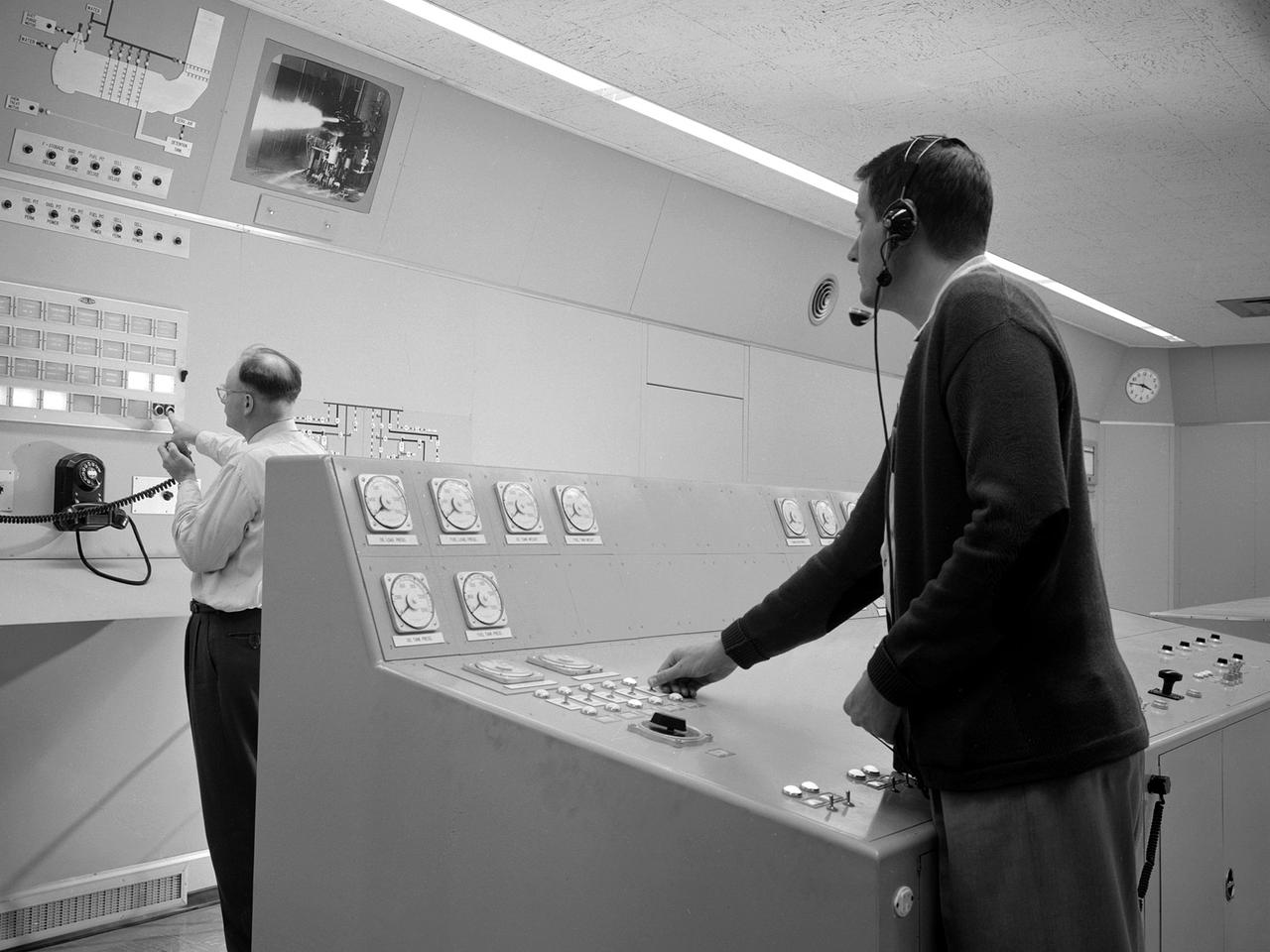
Test engineers monitor an engine firing from the control room of the Rocket Engine Test Facility at the National Advisory Committee for Aeronautics (NACA) Lewis Flight Propulsion Laboratory. The Rocket Engine Test Facility, built in the early 1950s, had a rocket stand designed to evaluate high-energy propellants and rocket engine designs. The facility was used to study numerous different types of rocket engines including the Pratt and Whitney RL-10 engine for the Centaur rocket and Rocketdyne’s F-1 and J-2 engines for the Saturn rockets. The Rocket Engine Test Facility was built in a ravine at the far end of the laboratory because of its use of the dangerous propellants such as liquid hydrogen and liquid fluorine. The control room was located in a building 1,600 feet north of the test stand to protect the engineers running the tests. The main control and instrument consoles were centrally located in the control room and surrounded by boards controlling and monitoring the major valves, pumps, motors, and actuators. A camera system at the test stand allowed the operators to view the tests, but the researchers were reliant on data recording equipment, sensors, and other devices to provide test data. The facility’s control room was upgraded several times over the years. Programmable logic controllers replaced the electro-mechanical control devices. The new controllers were programed to operate the valves and actuators controlling the fuel, oxidant, and ignition sequence according to a predetermined time schedule.
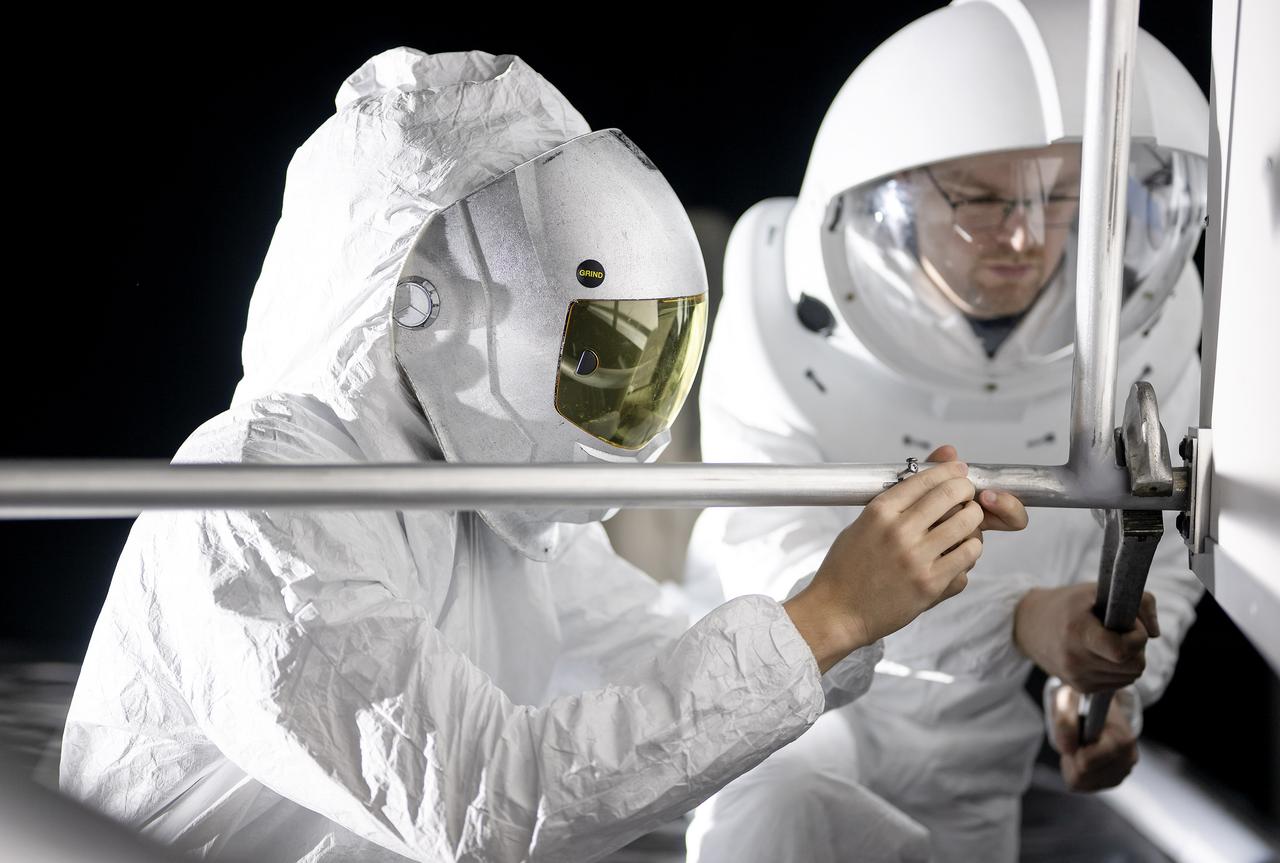
These photos show how teams at NASA’s Marshall Space Flight Center in Huntsville, Alabama, are using the Flat Floor Facility (Building 4619) to understand the lunar lighting environment in preparation for the Artemis III crewed lunar landing mission, slated for 2027. The Flat Floor Facility is an air-bearing floor, providing full-scale simulation capabilities for lunar surface systems by simulating zero gravity in two dimensions. Wearing low-fidelity materials, test engineers can understand how the extreme lighting of the Moon’s South Pole could affect surface operations during Artemis III. High-intensity lights are positioned at a low angle to replicate the strong shadows that are cast across the lunar South Pole by the Sun. Data and analysis from testing at NASA Marshall are improving models Artemis astronauts will use in preparation for lander and surface operations on the Moon during Artemis III. Testing in the facility is also helping cross-agency teams evaluate various tools astronauts may use. NASA Marshall manages the Human Landing System (HLS) Program. For more information, contact NASA Marshall’s Office of Communications at 256-544-0034.
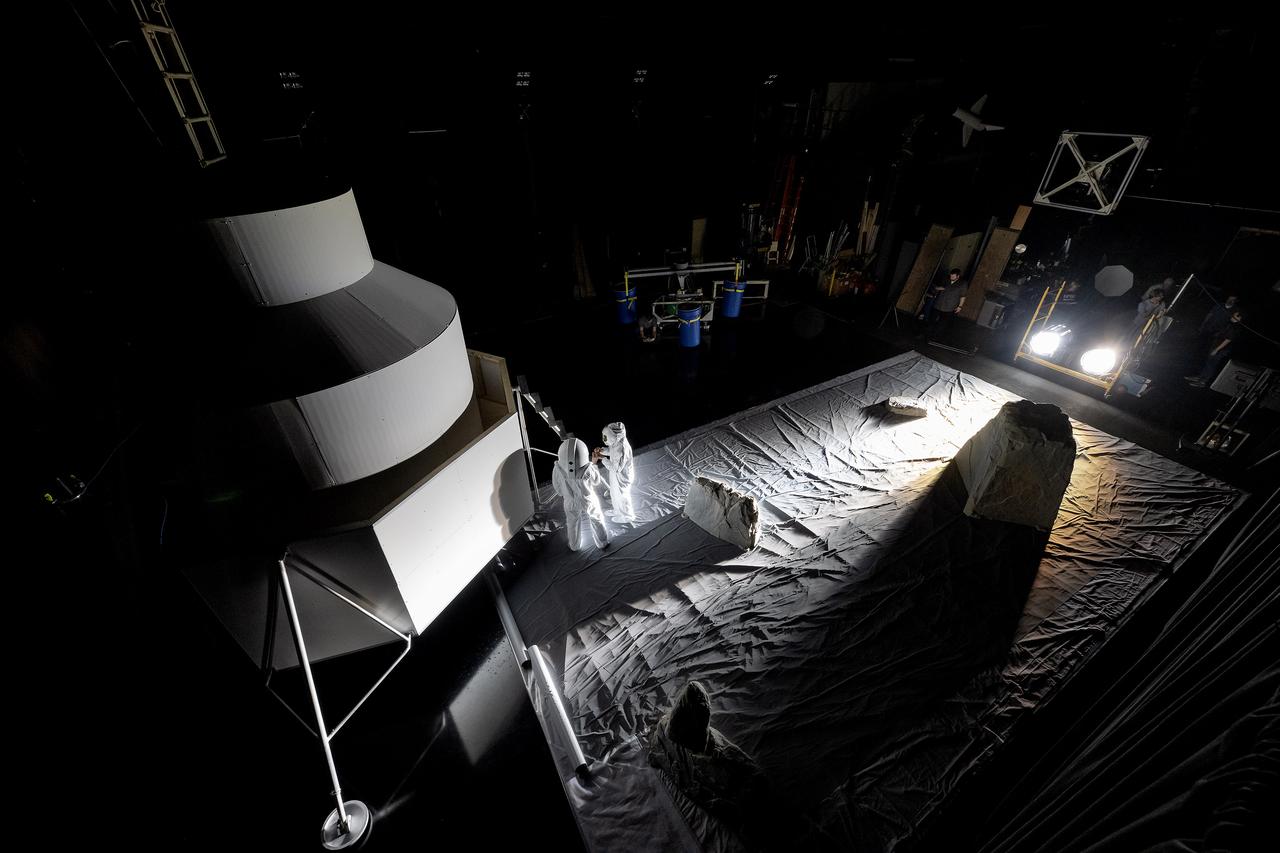
These photos show how teams at NASA’s Marshall Space Flight Center in Huntsville, Alabama, are using the Flat Floor Facility (Building 4619) to understand the lunar lighting environment in preparation for the Artemis III crewed lunar landing mission, slated for 2027. The Flat Floor Facility is an air-bearing floor, providing full-scale simulation capabilities for lunar surface systems by simulating zero gravity in two dimensions. Wearing low-fidelity materials, test engineers can understand how the extreme lighting of the Moon’s South Pole could affect surface operations during Artemis III. High-intensity lights are positioned at a low angle to replicate the strong shadows that are cast across the lunar South Pole by the Sun. Data and analysis from testing at NASA Marshall are improving models Artemis astronauts will use in preparation for lander and surface operations on the Moon during Artemis III. Testing in the facility is also helping cross-agency teams evaluate various tools astronauts may use. NASA Marshall manages the Human Landing System (HLS) Program. For more information, contact NASA Marshall’s Office of Communications at 256-544-0034.
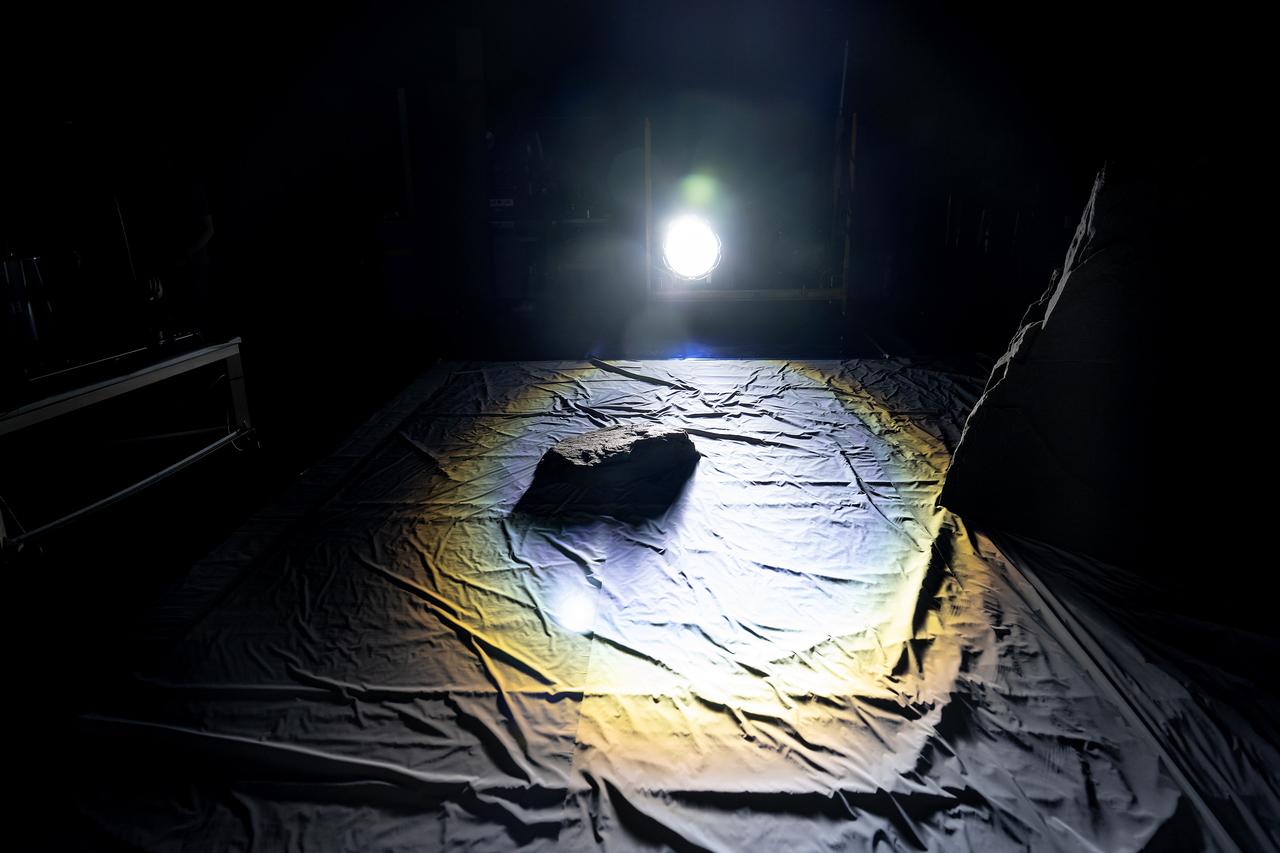
These photos show how teams at NASA’s Marshall Space Flight Center in Huntsville, Alabama, are using the Flat Floor Facility (Building 4619) to understand the lunar lighting environment in preparation for the Artemis III crewed lunar landing mission, slated for 2027. The Flat Floor Facility is an air-bearing floor, providing full-scale simulation capabilities for lunar surface systems by simulating zero gravity in two dimensions. Wearing low-fidelity materials, test engineers can understand how the extreme lighting of the Moon’s South Pole could affect surface operations during Artemis III. High-intensity lights are positioned at a low angle to replicate the strong shadows that are cast across the lunar South Pole by the Sun. Data and analysis from testing at NASA Marshall are improving models Artemis astronauts will use in preparation for lander and surface operations on the Moon during Artemis III. Testing in the facility is also helping cross-agency teams evaluate various tools astronauts may use. NASA Marshall manages the Human Landing System (HLS) Program. For more information, contact NASA Marshall’s Office of Communications at 256-544-0034.
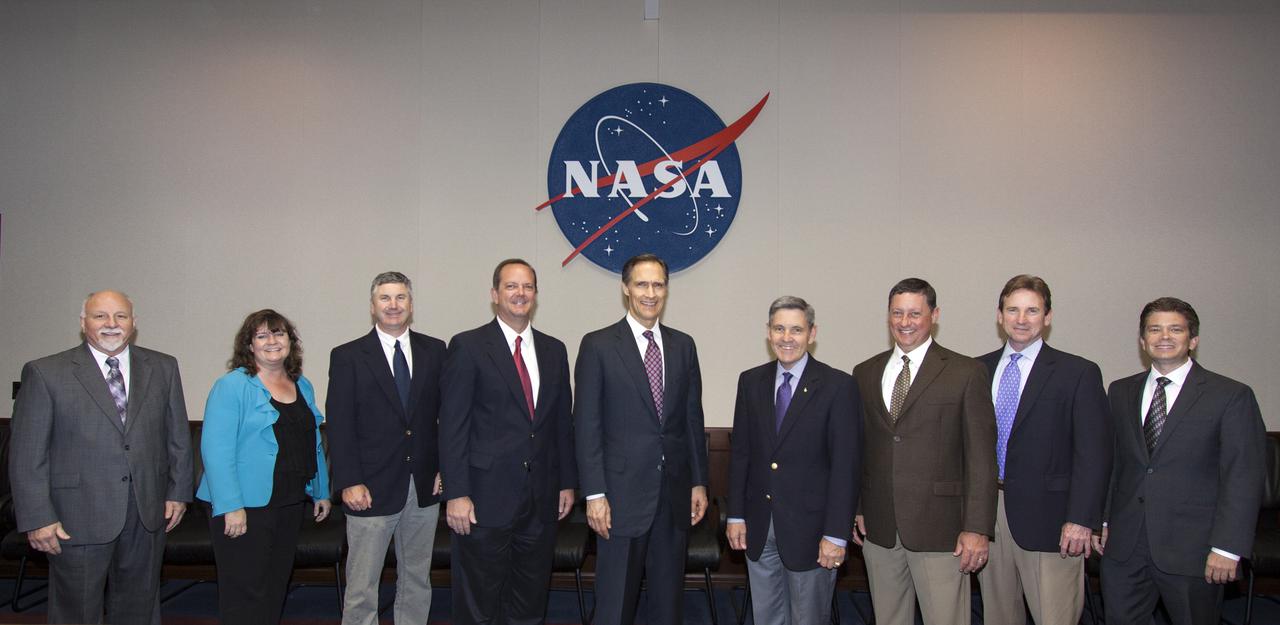
CAPE CANAVERAL, Fla. -- Kennedy Space Center Director Bob Cabana, met with representatives of PaR Systems Inc. NASA recently established a partnership agreement with PaR to operate of the Hangar N facility and its nondestructive testing equipment. Participating were, from the left, Cliff Hausmann, Technical Integration manager in NASA's Program Control and Integration Office, Amy Houts-Gilfriche, Partnership Development manager in NASA's Center Planning and Development Directorate, Scott Colloredo of NASA's Systems Engineering and Integration Division, Tom Engler, deputy director of Center Planning and Development, Brian Behm, president of the Robotics Division of PaR Systems, Tony Corak, manager, of Non-destructive Testing Services for PaR Systems, Dale Ketcham of Space Florida, and Robert Salonen, director of Business Development for the Economic Development Commission of Florida's Space Coast. As the spaceport transitions from a historically government-only launch facility to a multiuser spaceport for both federal and commercial customers, partnerships with other organizations will be a key element in that effort. Hangar N is located at Cape Canaveral Air Force Station adjacent to Kennedy. The facility's unique inventory of nondestructive test and evaluation NDE equipment and the capability for current and future mission spaceflight support was an asset NASA wanted to retain. Photo credit: NASA_Jim Grossmann
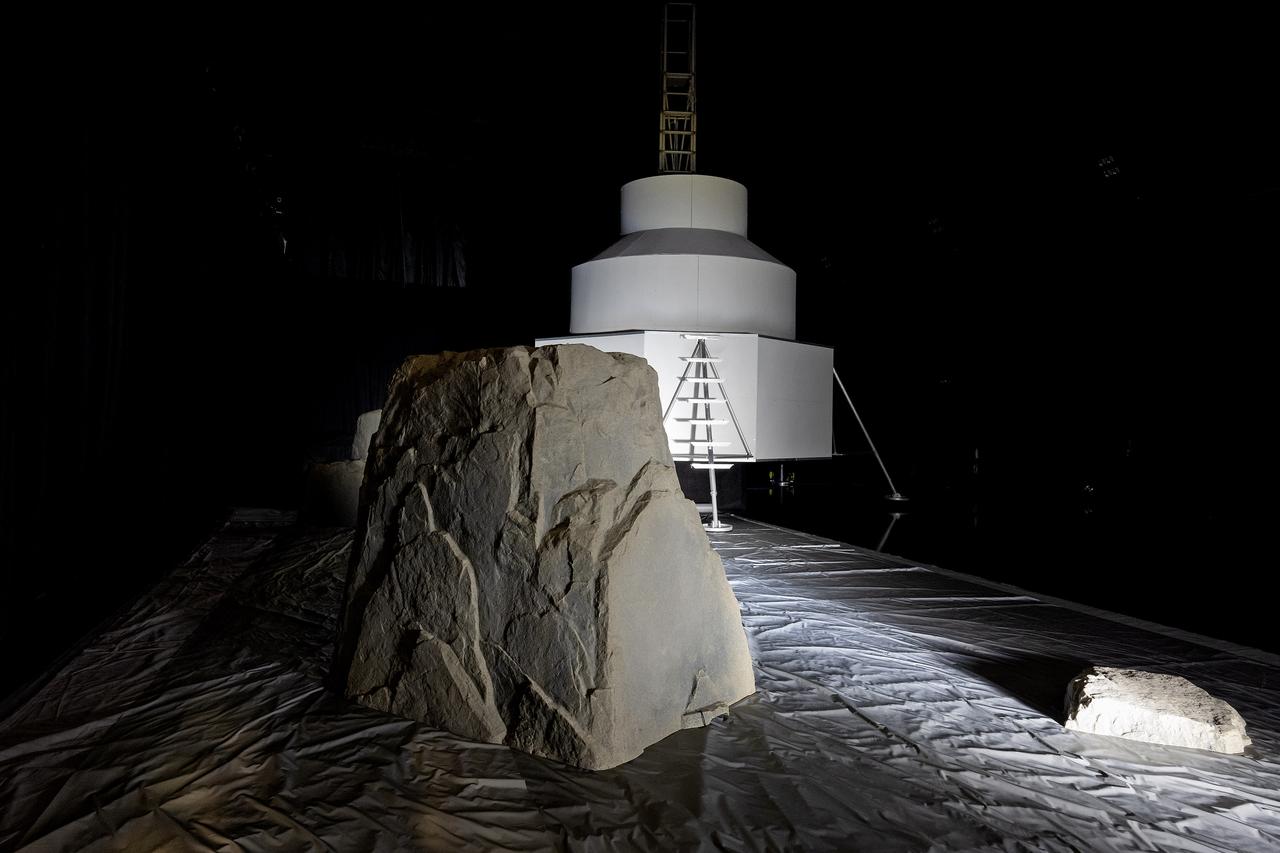
These photos show how teams at NASA’s Marshall Space Flight Center in Huntsville, Alabama, are using the Flat Floor Facility (Building 4619) to understand the lunar lighting environment in preparation for the Artemis III crewed lunar landing mission, slated for 2027. The Flat Floor Facility is an air-bearing floor, providing full-scale simulation capabilities for lunar surface systems by simulating zero gravity in two dimensions. Wearing low-fidelity materials, test engineers can understand how the extreme lighting of the Moon’s South Pole could affect surface operations during Artemis III. High-intensity lights are positioned at a low angle to replicate the strong shadows that are cast across the lunar South Pole by the Sun. Data and analysis from testing at NASA Marshall are improving models Artemis astronauts will use in preparation for lander and surface operations on the Moon during Artemis III. Testing in the facility is also helping cross-agency teams evaluate various tools astronauts may use. NASA Marshall manages the Human Landing System (HLS) Program. For more information, contact NASA Marshall’s Office of Communications at 256-544-0034.
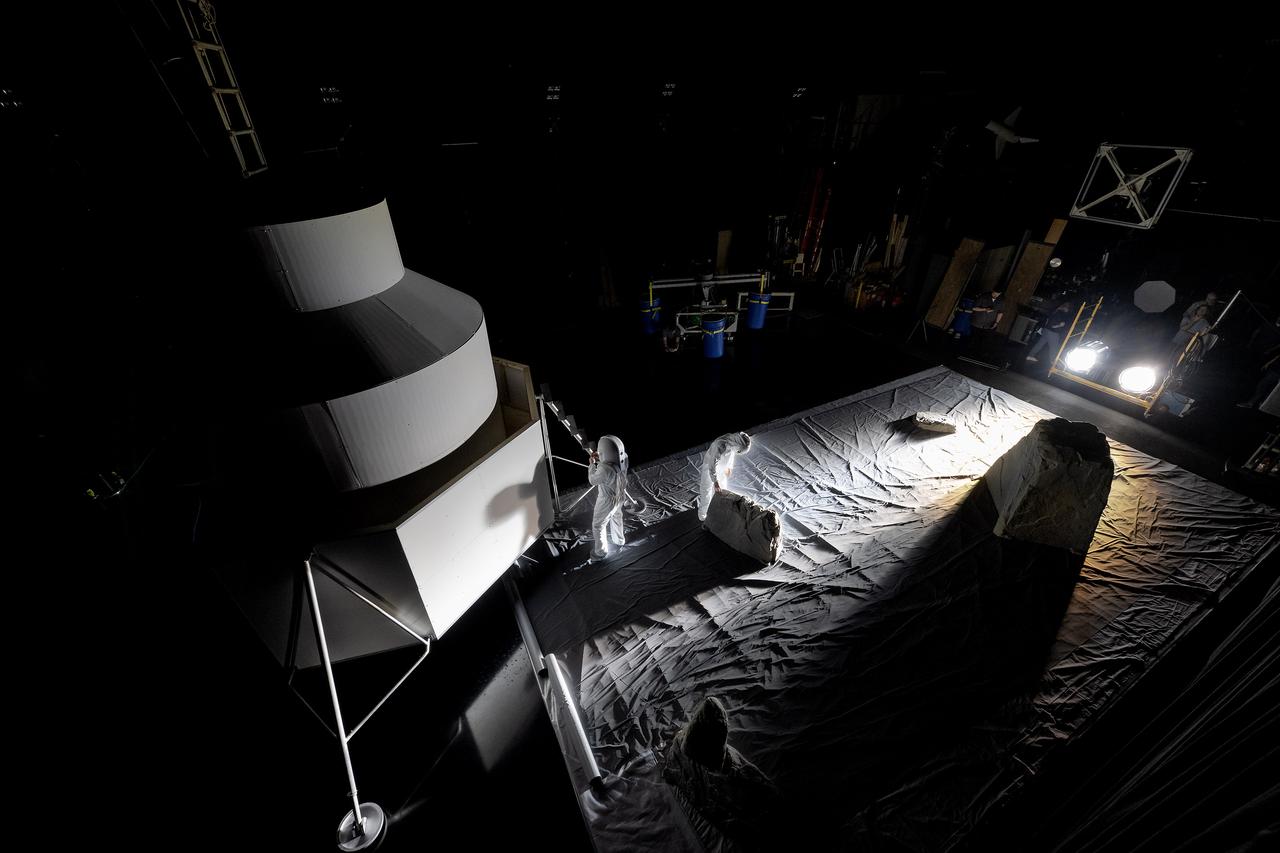
These photos show how teams at NASA’s Marshall Space Flight Center in Huntsville, Alabama, are using the Flat Floor Facility (Building 4619) to understand the lunar lighting environment in preparation for the Artemis III crewed lunar landing mission, slated for 2027. The Flat Floor Facility is an air-bearing floor, providing full-scale simulation capabilities for lunar surface systems by simulating zero gravity in two dimensions. Wearing low-fidelity materials, test engineers can understand how the extreme lighting of the Moon’s South Pole could affect surface operations during Artemis III. High-intensity lights are positioned at a low angle to replicate the strong shadows that are cast across the lunar South Pole by the Sun. Data and analysis from testing at NASA Marshall are improving models Artemis astronauts will use in preparation for lander and surface operations on the Moon during Artemis III. Testing in the facility is also helping cross-agency teams evaluate various tools astronauts may use. NASA Marshall manages the Human Landing System (HLS) Program. For more information, contact NASA Marshall’s Office of Communications at 256-544-0034.

These photos show how teams at NASA’s Marshall Space Flight Center in Huntsville, Alabama, are using the Flat Floor Facility (Building 4619) to understand the lunar lighting environment in preparation for the Artemis III crewed lunar landing mission, slated for 2027. The Flat Floor Facility is an air-bearing floor, providing full-scale simulation capabilities for lunar surface systems by simulating zero gravity in two dimensions. Wearing low-fidelity materials, test engineers can understand how the extreme lighting of the Moon’s South Pole could affect surface operations during Artemis III. High-intensity lights are positioned at a low angle to replicate the strong shadows that are cast across the lunar South Pole by the Sun. Data and analysis from testing at NASA Marshall are improving models Artemis astronauts will use in preparation for lander and surface operations on the Moon during Artemis III. Testing in the facility is also helping cross-agency teams evaluate various tools astronauts may use. NASA Marshall manages the Human Landing System (HLS) Program. For more information, contact NASA Marshall’s Office of Communications at 256-544-0034.
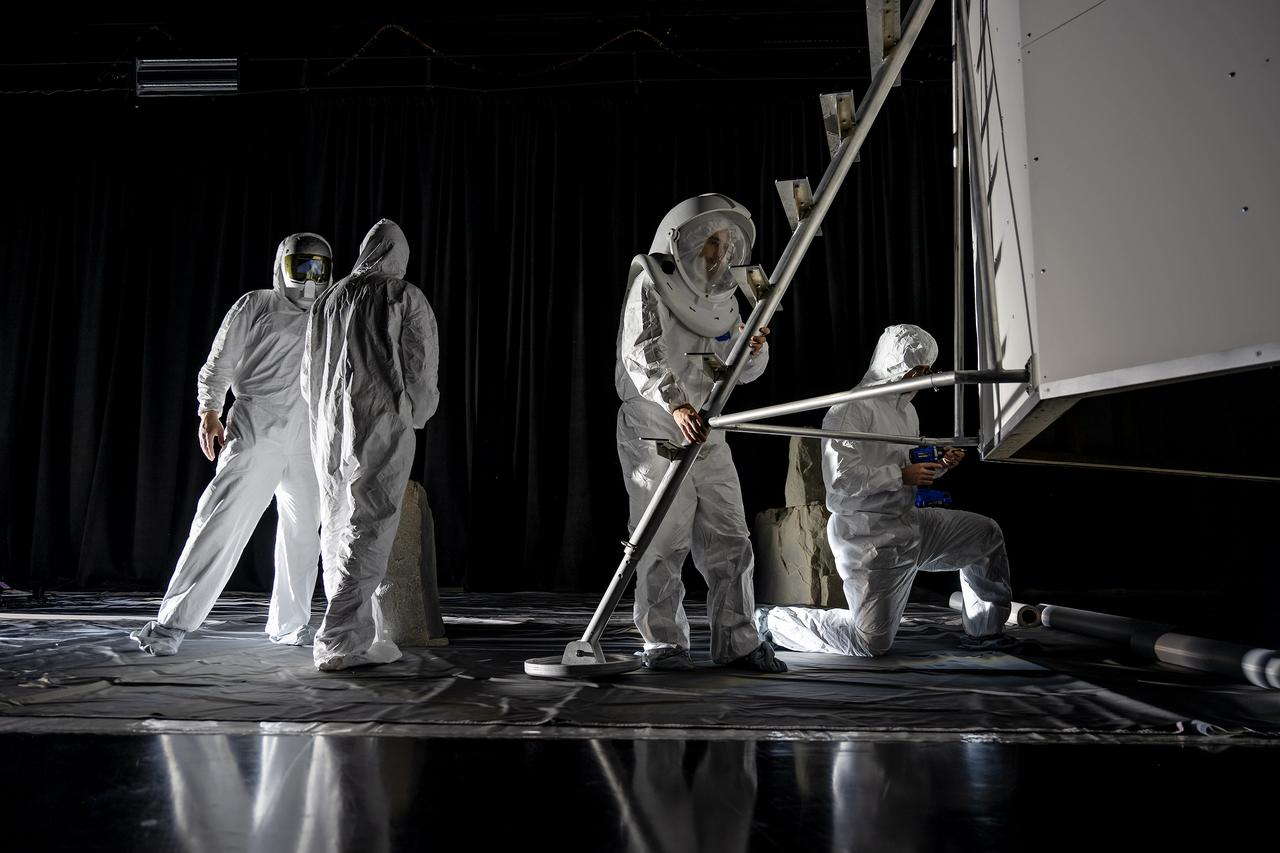
These photos show how teams at NASA’s Marshall Space Flight Center in Huntsville, Alabama, are using the Flat Floor Facility (Building 4619) to understand the lunar lighting environment in preparation for the Artemis III crewed lunar landing mission, slated for 2027. The Flat Floor Facility is an air-bearing floor, providing full-scale simulation capabilities for lunar surface systems by simulating zero gravity in two dimensions. Wearing low-fidelity materials, test engineers can understand how the extreme lighting of the Moon’s South Pole could affect surface operations during Artemis III. High-intensity lights are positioned at a low angle to replicate the strong shadows that are cast across the lunar South Pole by the Sun. Data and analysis from testing at NASA Marshall are improving models Artemis astronauts will use in preparation for lander and surface operations on the Moon during Artemis III. Testing in the facility is also helping cross-agency teams evaluate various tools astronauts may use. NASA Marshall manages the Human Landing System (HLS) Program. For more information, contact NASA Marshall’s Office of Communications at 256-544-0034.