!["The public perception of NASA has a lot to do with our technological successes and the discoveries that we've made, but none of that is possible without the people. "In the six or so years that I've worked at NASA, I've learned a lot of incredible stories — not just of the struggles that different spacecraft encounter on their journeys throughout the universe. There are so many problems that need to be solved and fixes that need to be made, but there are also so many stories of teams that had to work together to accomplish their goals. And a lot of times, these teams are working after hours, on weekends, working late nights and early mornings. These are people who have other problems in their lives that they have to solve, and they're still showing up and making magic happen. "This is why [Aubrey Gemignani] and I started Faces of NASA: We wanted to make that connection. It's not just rockets, astronauts, and telescopes. Hundreds of thousands of people come together to make these missions possible, and that's the part that's really interesting for me. "I like to hold a mirror to other people, and in every Faces of NASA interview, I try to hold a mirror up to what the person has accomplished to get them to be proud of it. For many of those people, it's the first time they have to self-reflect. "That's what's really nice about [the Faces of NASA project]. Everyone who works here is just living day-to-day, so when they have an opportunity to stop for a moment and look back on how far they've come... it's the best feeling for both of us. They're like, 'Wow, I've never really stopped to think about how much I've accomplished or how far I've come.' And I get to share that moment with them. That's my favorite part of Faces of NASA." NASA Communications Strategist, Thalia Patrinos, poses for a portrait, Thursday, July 11, 2024, in Washington. Photo Credit: (NASA/Aubrey Gemignani)](https://images-assets.nasa.gov/image/NHQ202407110011/NHQ202407110011~medium.jpg)
"The public perception of NASA has a lot to do with our technological successes and the discoveries that we've made, but none of that is possible without the people. "In the six or so years that I've worked at NASA, I've learned a lot of incredible stories — not just of the struggles that different spacecraft encounter on their journeys throughout the universe. There are so many problems that need to be solved and fixes that need to be made, but there are also so many stories of teams that had to work together to accomplish their goals. And a lot of times, these teams are working after hours, on weekends, working late nights and early mornings. These are people who have other problems in their lives that they have to solve, and they're still showing up and making magic happen. "This is why [Aubrey Gemignani] and I started Faces of NASA: We wanted to make that connection. It's not just rockets, astronauts, and telescopes. Hundreds of thousands of people come together to make these missions possible, and that's the part that's really interesting for me. "I like to hold a mirror to other people, and in every Faces of NASA interview, I try to hold a mirror up to what the person has accomplished to get them to be proud of it. For many of those people, it's the first time they have to self-reflect. "That's what's really nice about [the Faces of NASA project]. Everyone who works here is just living day-to-day, so when they have an opportunity to stop for a moment and look back on how far they've come... it's the best feeling for both of us. They're like, 'Wow, I've never really stopped to think about how much I've accomplished or how far I've come.' And I get to share that moment with them. That's my favorite part of Faces of NASA." NASA Communications Strategist, Thalia Patrinos, poses for a portrait, Thursday, July 11, 2024, in Washington. Photo Credit: (NASA/Aubrey Gemignani)
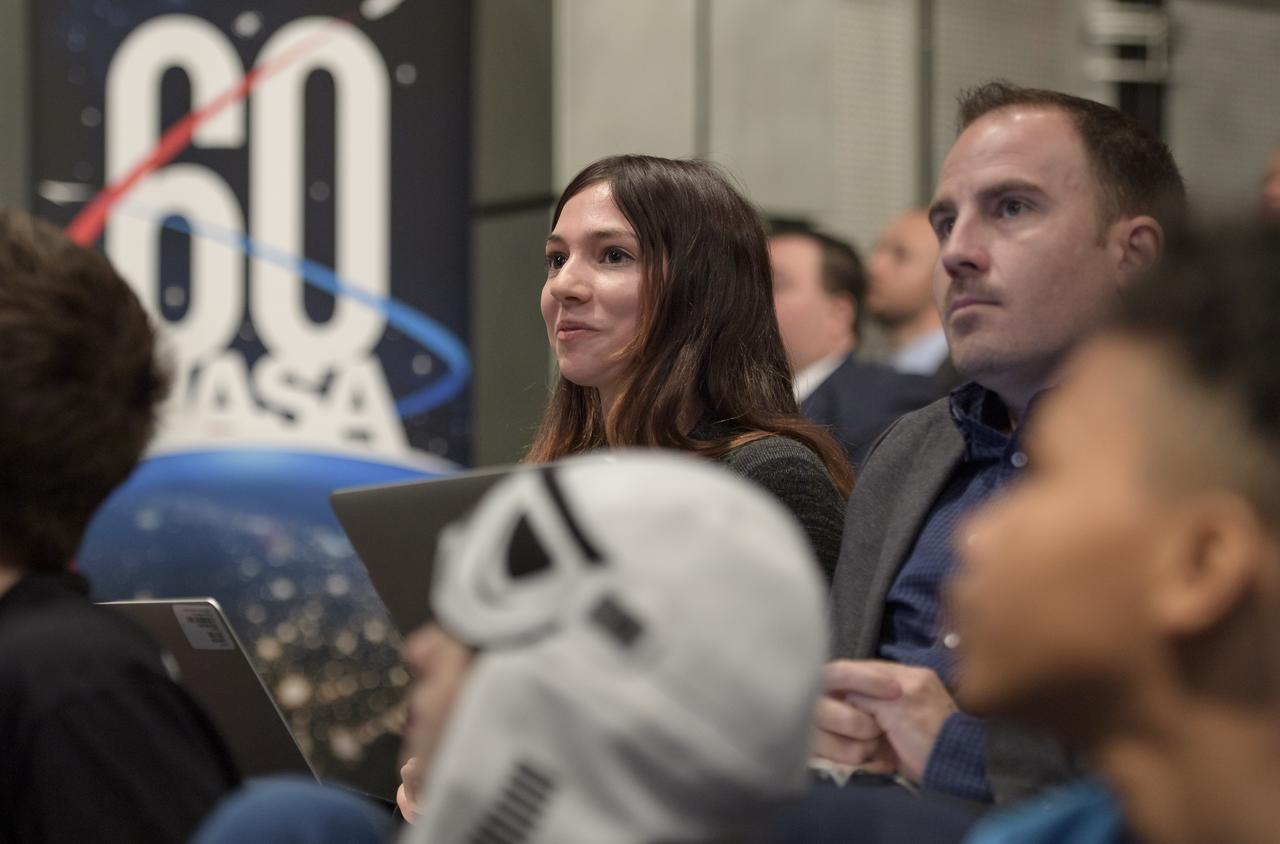
Thalia Patrinos, and Jason Townsend from NASA's Social Media Teamm monitor questions coming in from social media during an event where nine U.S. companies where named as eligible to bid on NASA delivery services to the lunar surface through Commercial Lunar Payload Services (CLPS) contracts, Thursday, Nov. 29, 2018 at NASA Headquarters in Washington. The companies will be able to bid on delivering science and technology payloads for NASA, including payload integration and operations, launching from Earth and landing on the surface of the Moon. NASA expects to be one of many customers that will use these commercial landing services. Photo Credit: (NASA/Bill Ingalls)
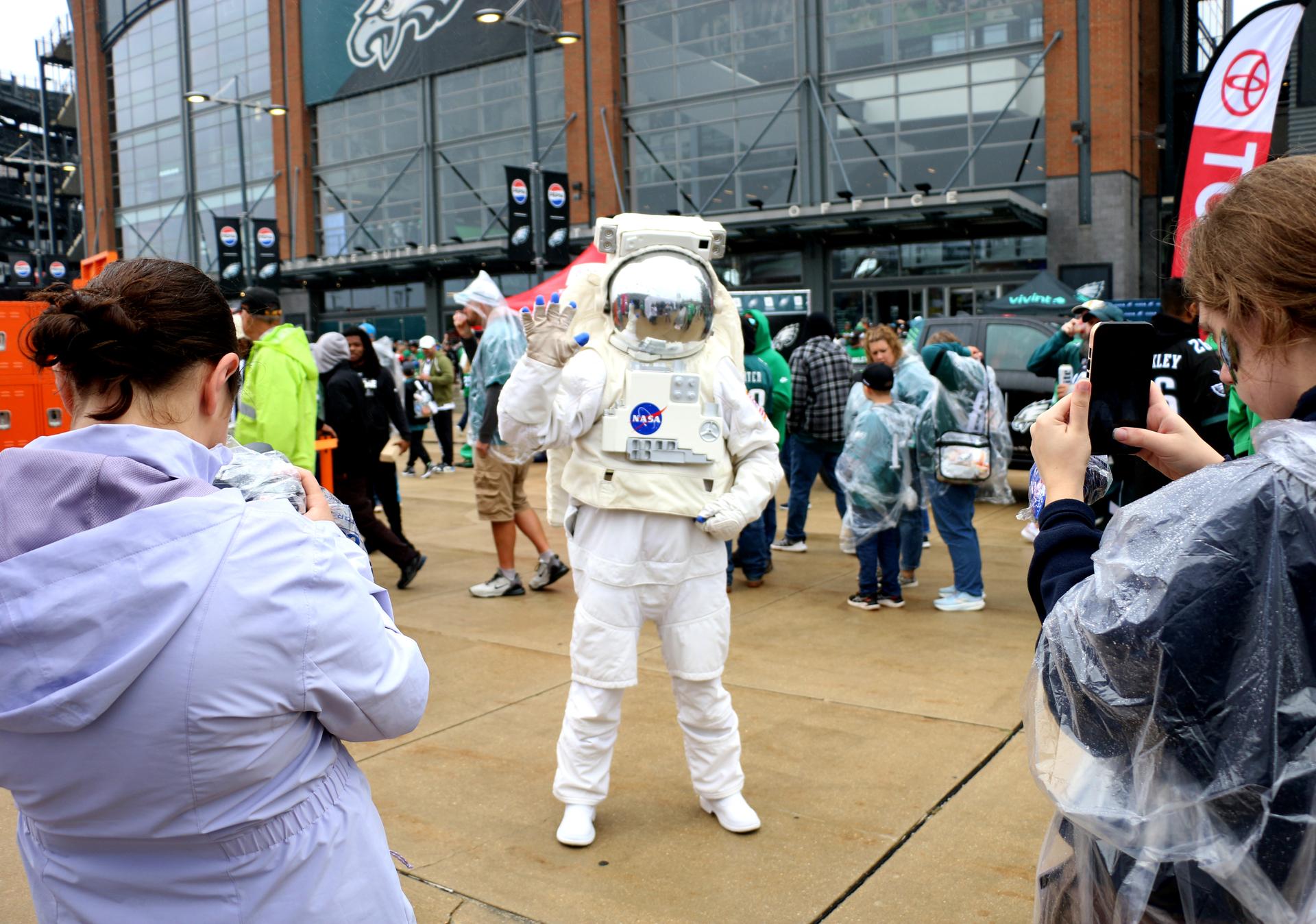
Fans take photos of the astronaut at the NASA activation at the NFL game between the Philadelphia Eagles and the Los Angeles Rams at Lincoln Financial Field on Sunday, Oct. 4, 2026, in Philadelphia. NASA’s engagement at NFL games is part of the agency's Inspiration Tour, aimed at strengthening connections between NASA and its partners and showcasing innovation in air and space in the lead up to the MAX POWER aerospace technology expo and airshow at the agency's Kennedy Space Center in early November. Photo Credit: (NASA/Thalia Patrinos)
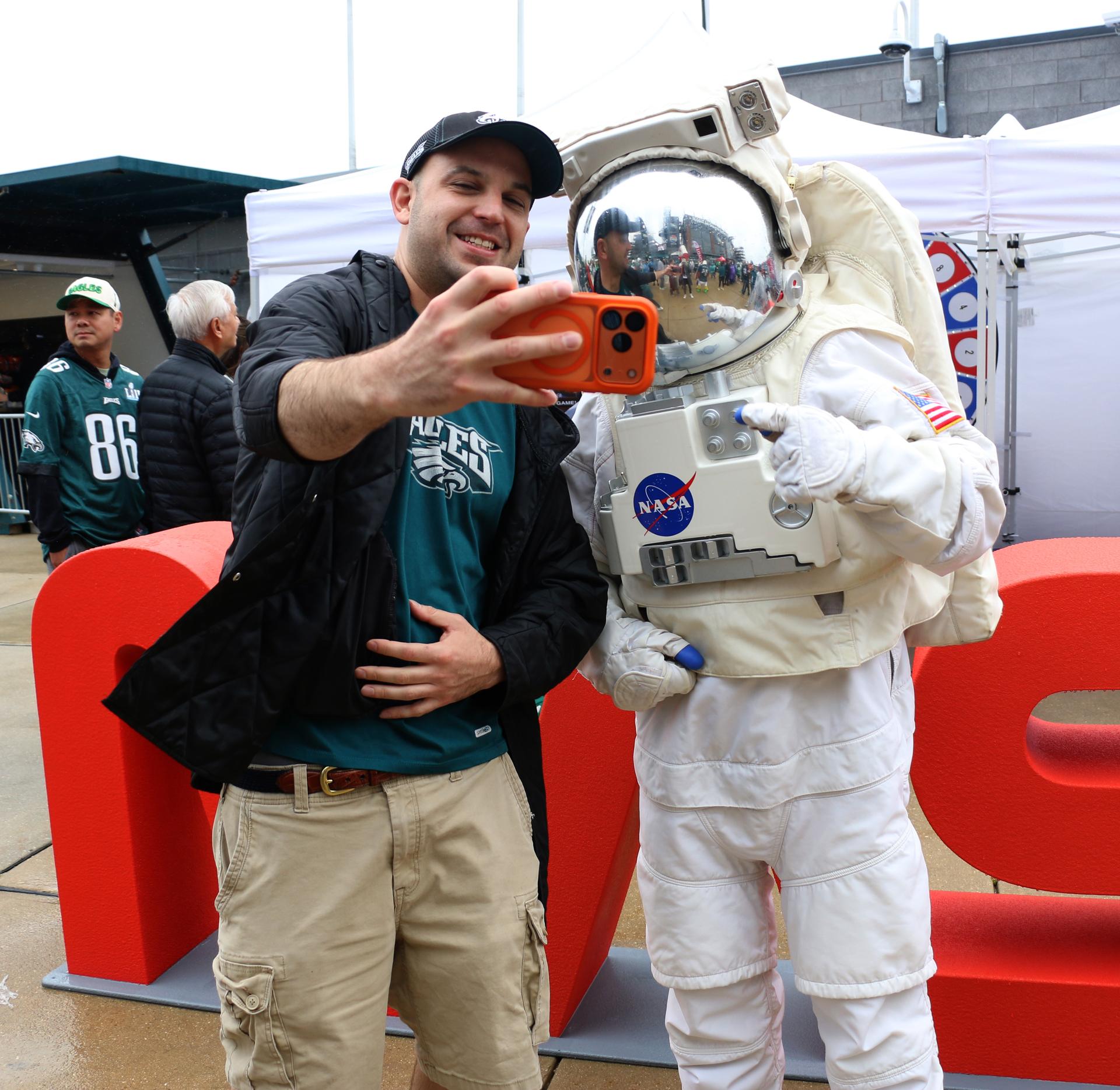
A fan takes a selfie with the astronaut at the NASA activation at the NFL game between the Philadelphia Eagles and the Los Angeles Rams at Lincoln Financial Field on Sunday, Oct. 4, 2026, in Philadelphia. NASA’s engagement at NFL games is part of the agency's Inspiration Tour, aimed at strengthening connections between NASA and its partners and showcasing innovation in air and space in the lead up to the MAX POWER aerospace technology expo and airshow at the agency's Kennedy Space Center in early November. Photo Credit: (NASA/Thalia Patrinos)
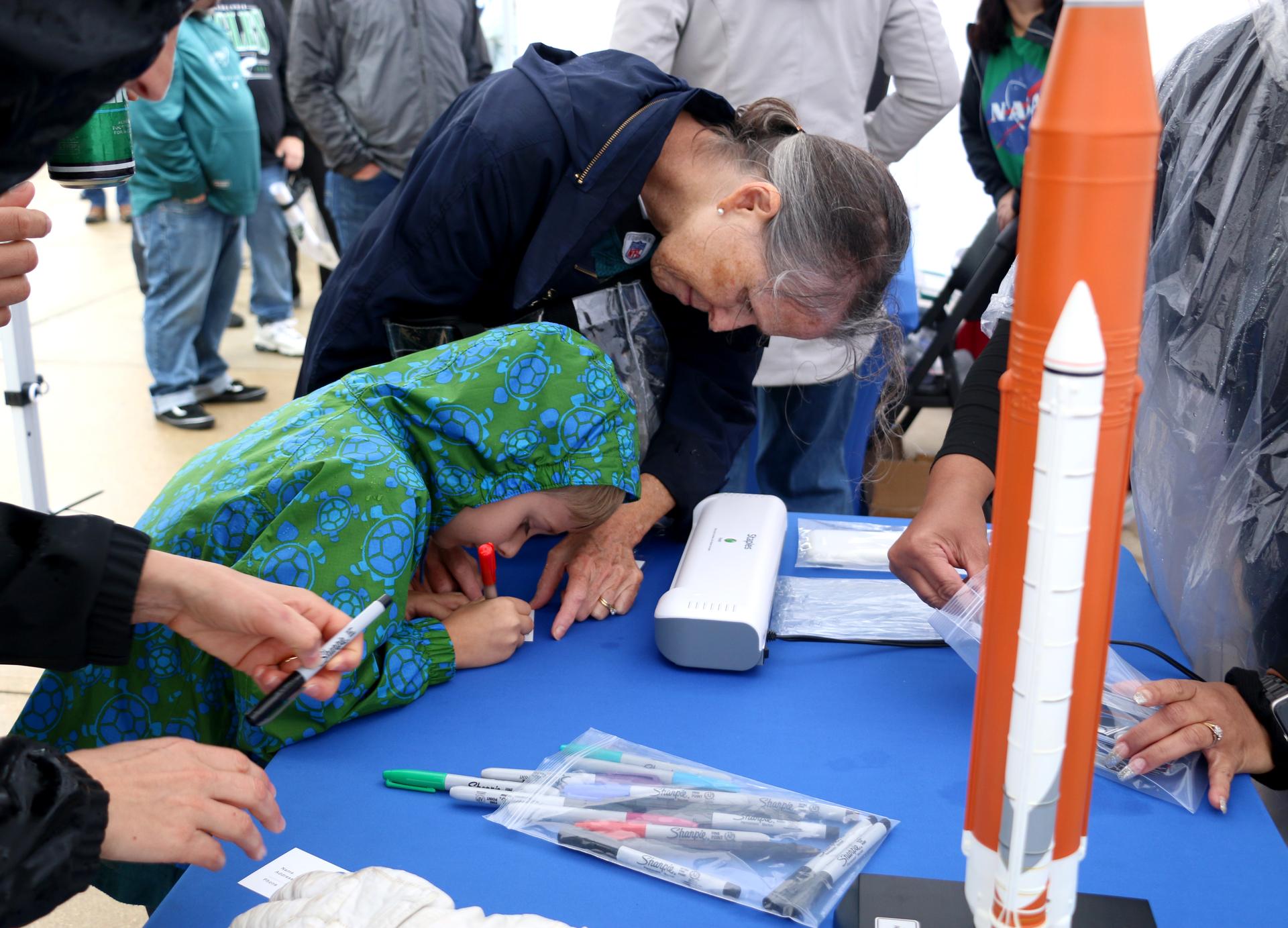
Two fans label their new luggage tag at the NASA activation at the NFL game between the Philadelphia Eagles and the Los Angeles Rams at Lincoln Financial Field on Sunday, Oct. 4, 2026, in Philadelphia. NASA’s engagement at NFL games is part of the agency's Inspiration Tour, aimed at strengthening connections between NASA and its partners and showcasing innovation in air and space in the lead up to the MAX POWER aerospace technology expo and airshow at the agency's Kennedy Space Center in early November. Photo Credit: (NASA/Thalia Patrinos)
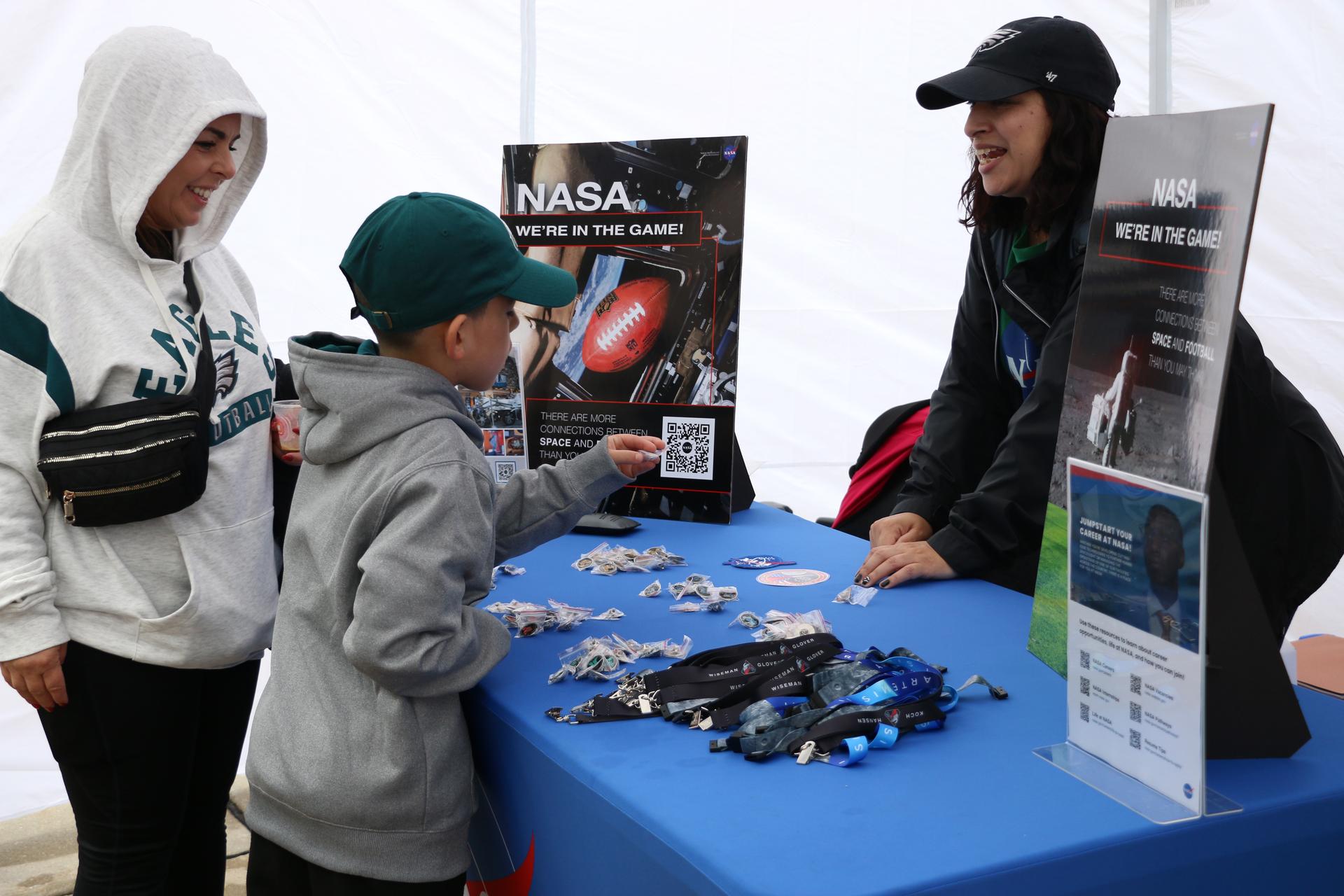
Astrophysicist Knicole Colón greets a young fan at the NASA activation as the NFL game between the Philadelphia Eagles and the Los Angeles Rams at Lincoln Financial Field on Sunday, Oct. 4, 2026, in Philadelphia. NASA’s engagement at NFL games is part of the agency's Inspiration Tour, aimed at strengthening connections between NASA and its partners and showcasing innovation in air and space in the lead up to the MAX POWER aerospace technology expo and airshow at the agency's Kennedy Space Center in early November. Photo Credit: (NASA/Thalia Patrinos)
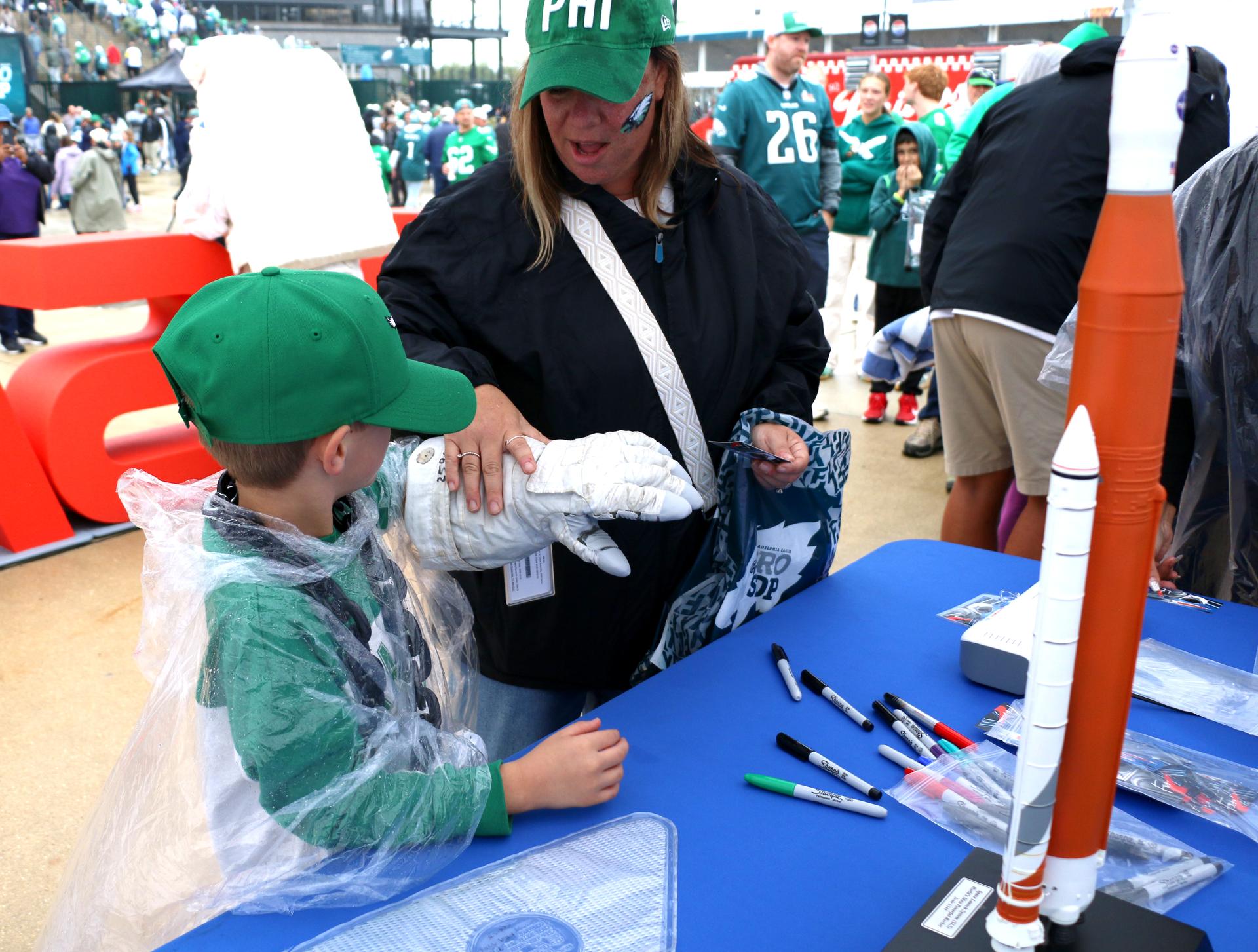
Two fans try on an astronaut glove at the NASA activation at the NFL game between the Philadelphia Eagles and the Los Angeles Rams at Lincoln Financial Field on Sunday, Oct. 4, 2026, in Philadelphia. NASA’s engagement at NFL games is part of the agency's Inspiration Tour, aimed at strengthening connections between NASA and its partners and showcasing innovation in air and space in the lead up to the MAX POWER aerospace technology expo and airshow at the agency's Kennedy Space Center in early November. Photo Credit: (NASA/Thalia Patrinos)
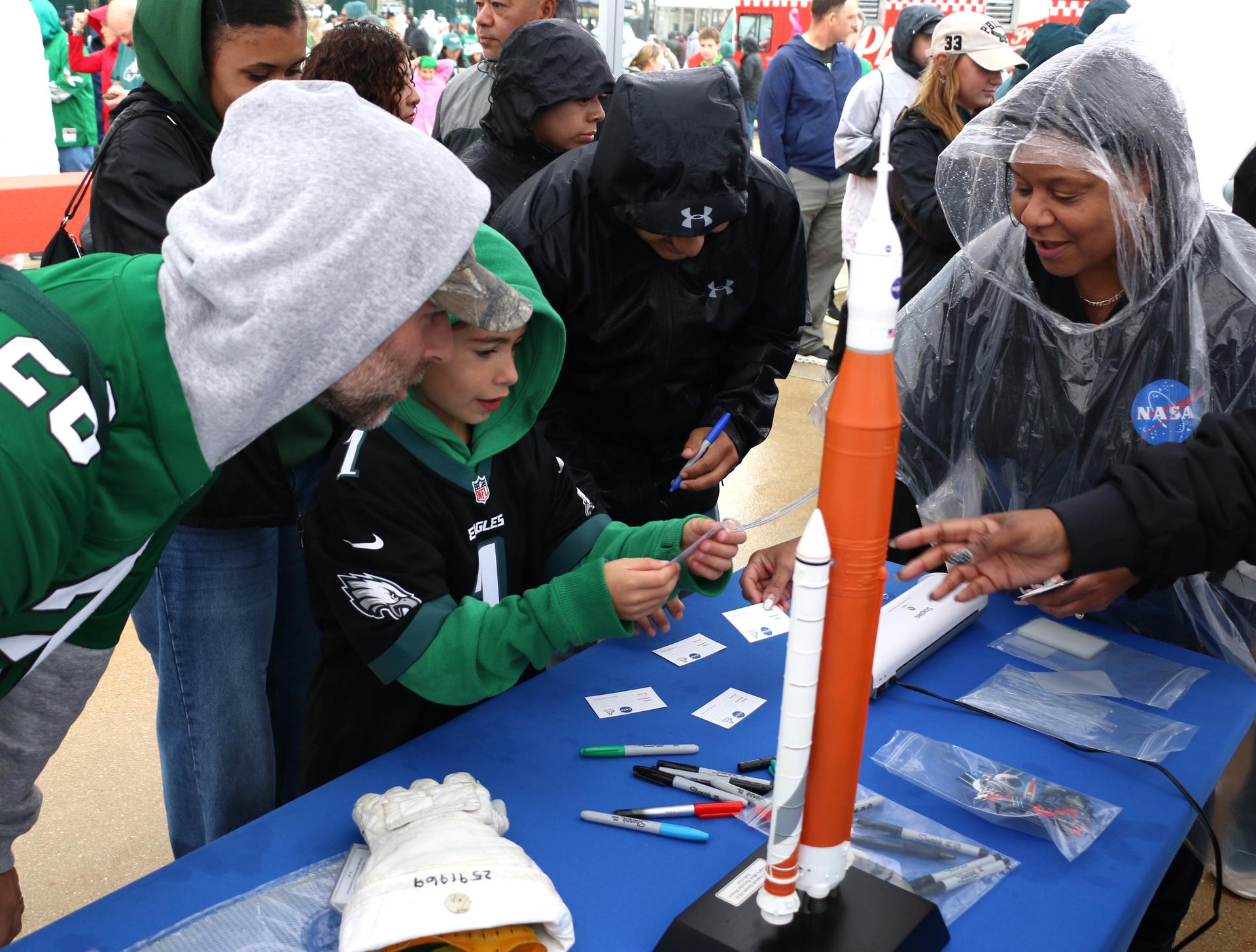
Fans participate at the NASA activation at the NFL game between the Philadelphia Eagles and the Los Angeles Rams at Lincoln Financial Field on Sunday, Oct. 4, 2026, in Philadelphia. NASA’s engagement at NFL games is part of the agency's Inspiration Tour, aimed at strengthening connections between NASA and its partners and showcasing innovation in air and space in the lead up to the MAX POWER aerospace technology expo and airshow at the agency's Kennedy Space Center in early November. Photo Credit: (NASA/Thalia Patrinos)
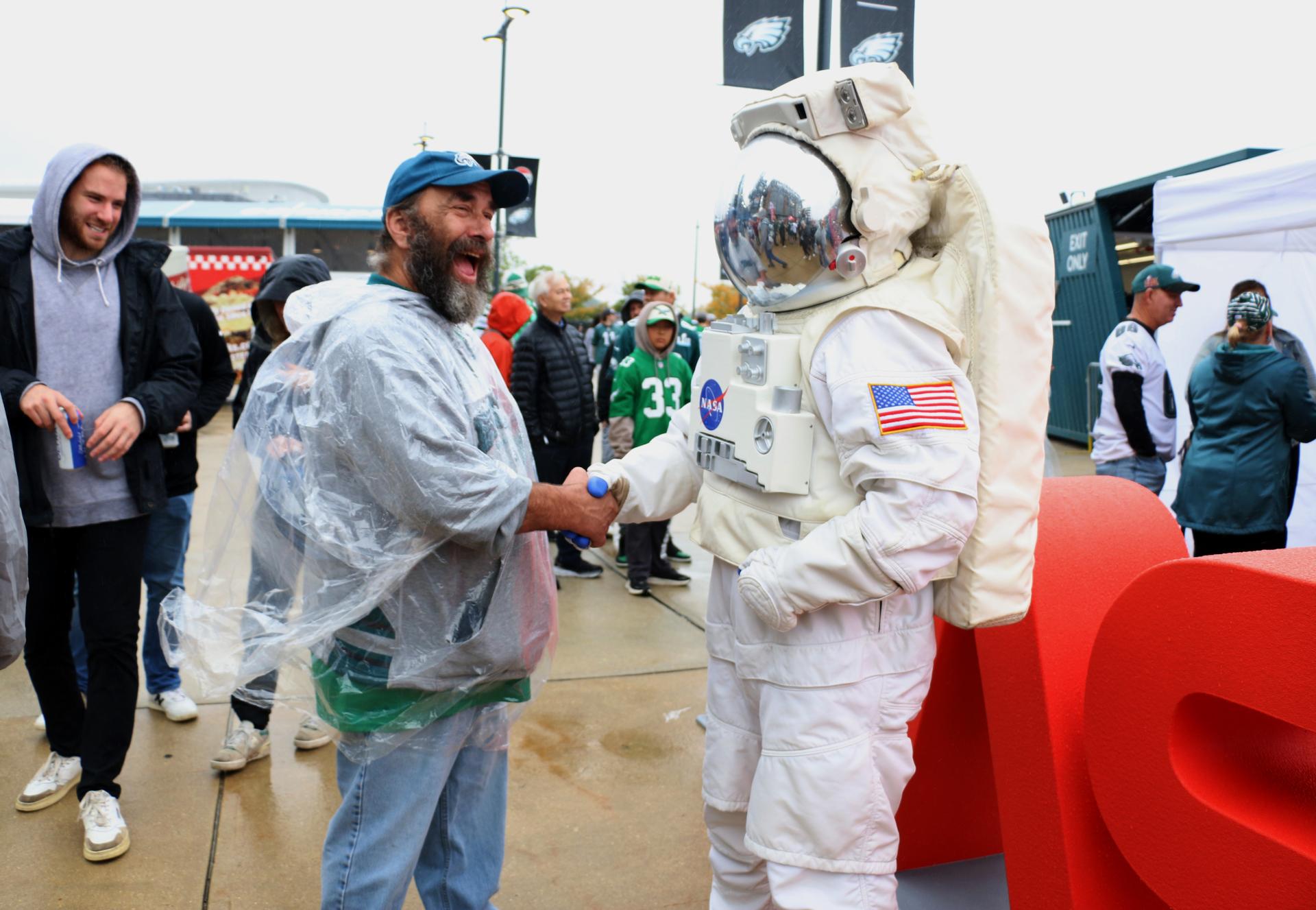
A fan greets the astronaut at the NASA activation at the NFL game between the Philadelphia Eagles and the Los Angeles Rams at Lincoln Financial Field on Sunday, Oct. 4, 2026, in Philadelphia. NASA’s engagement at NFL games is part of the agency's Inspiration Tour, aimed at strengthening connections between NASA and its partners and showcasing innovation in air and space in the lead up to the MAX POWER aerospace technology expo and airshow at the agency's Kennedy Space Center in early November. Photo Credit: (NASA/Thalia Patrinos)
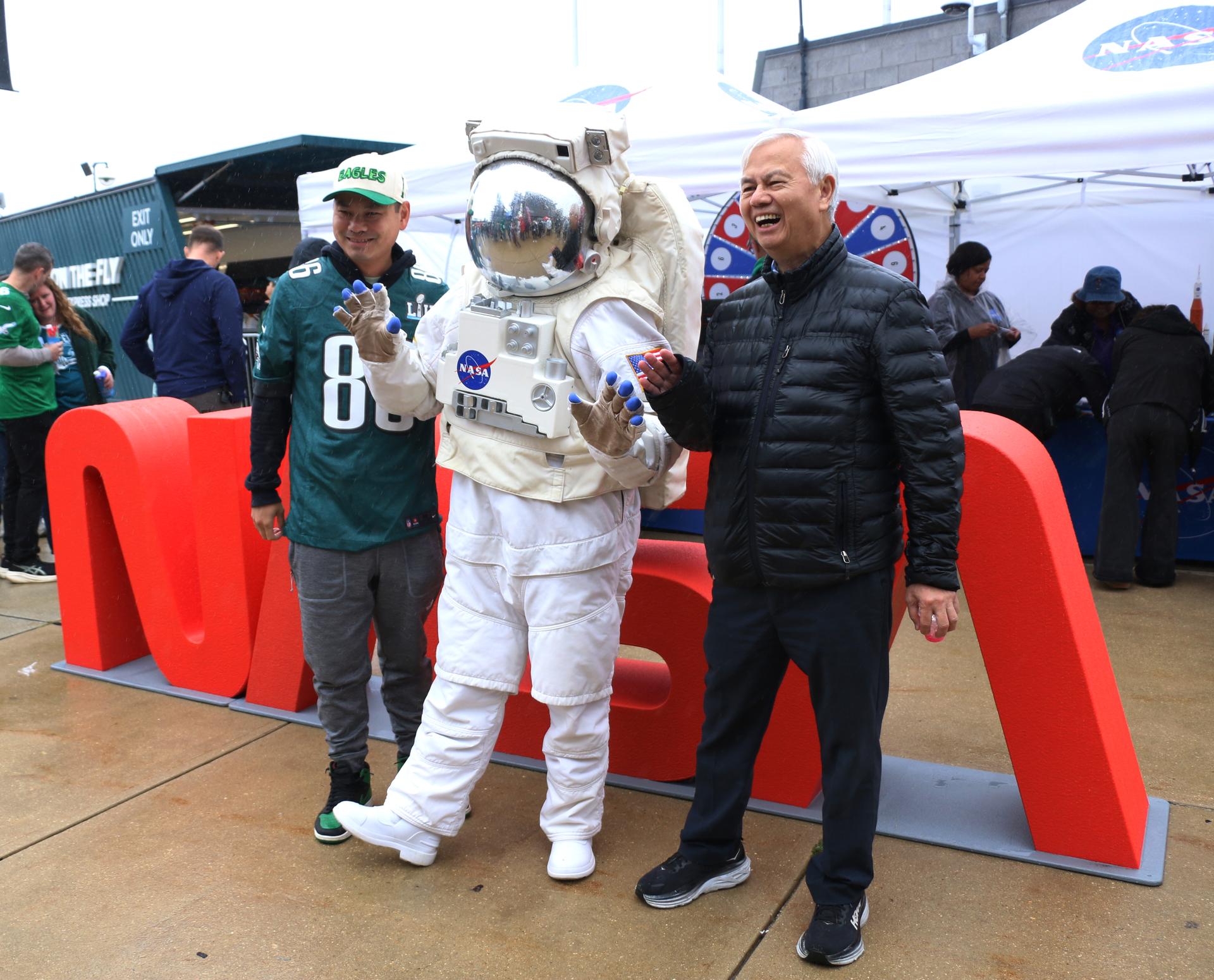
Fans pose with the astronaut at the NASA activation at the NFL game between the Philadelphia Eagles and the Los Angeles Rams at Lincoln Financial Field on Sunday, Oct. 4, 2026, in Philadelphia. NASA’s engagement at NFL games is part of the agency's Inspiration Tour, aimed at strengthening connections between NASA and its partners and showcasing innovation in air and space in the lead up to the MAX POWER aerospace technology expo and airshow at the agency's Kennedy Space Center in early November. Photo Credit: (NASA/Thalia Patrinos)
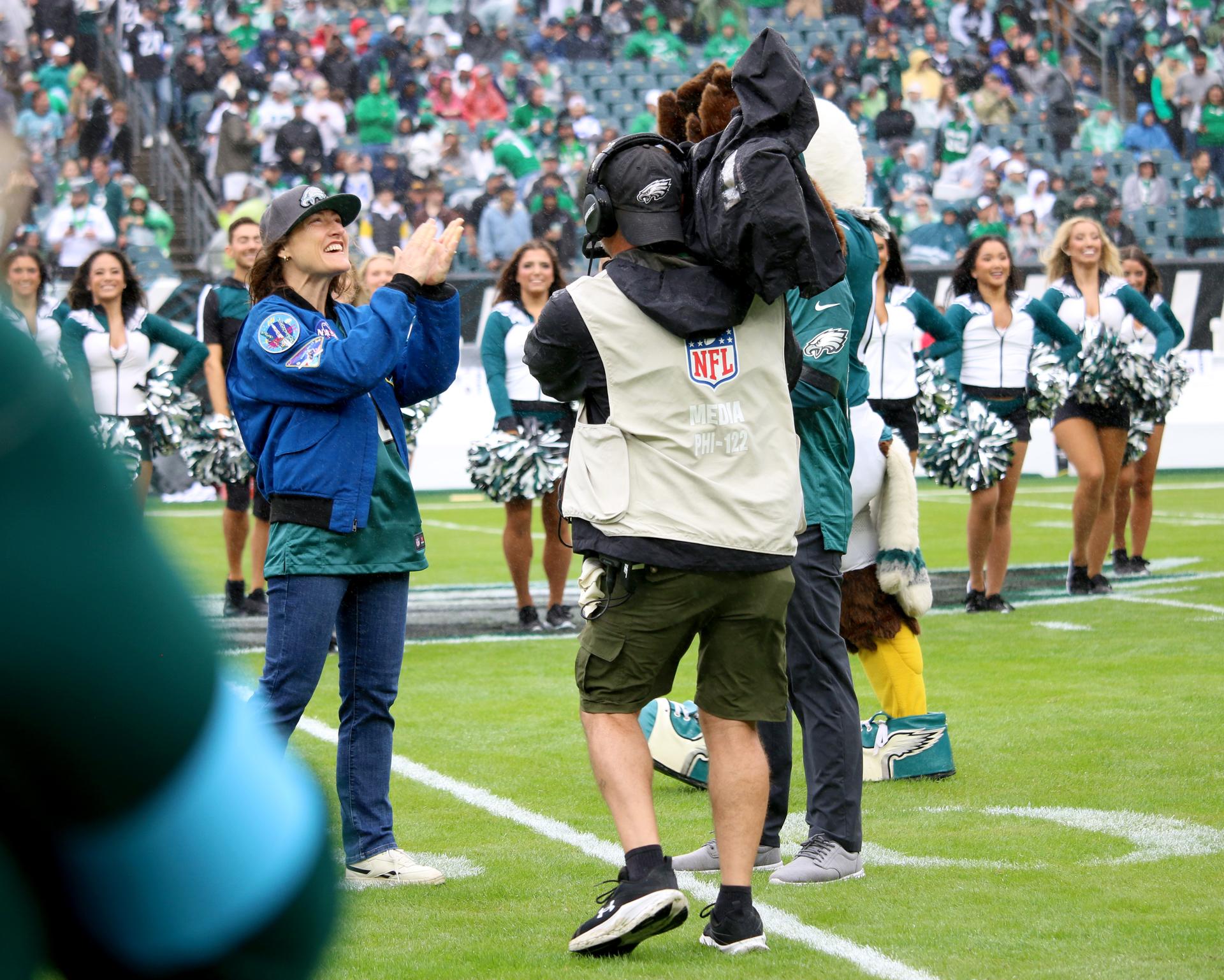
NASA astronaut and mission specialist of the agency's Artemis II mission, Christina Koch, lead the fans in singing the Eagles Fight Song from the field at an NFL game between the Philadelphia Eagles and the Los Angeles Rams at Lincoln Financial Field on Sunday, Oct. 4, 2026, in Philadelphia. NASA’s engagement at NFL games is part of the agency's Inspiration Tour, aimed at strengthening connections between NASA and its partners and showcasing innovation in air and space in the lead up to the MAX POWER aerospace technology expo and airshow at the agency's Kennedy Space Center in early November. Photo Credit: (NASA/Thalia Patrinos)
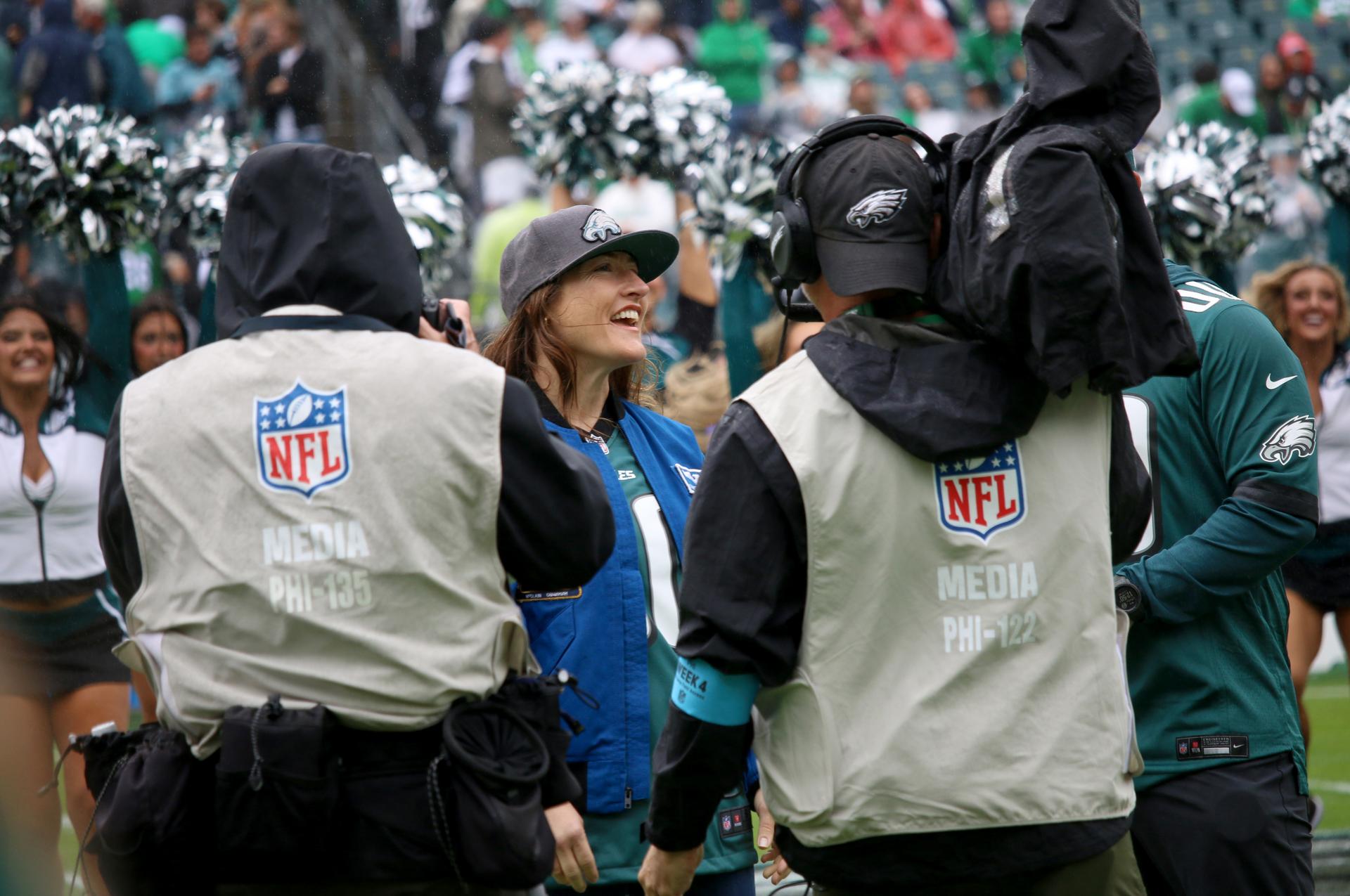
NASA astronaut and mission specialist of the agency's Artemis II mission, Christina Koch, lead the fans in singing the Eagles Fight Song from the field at an NFL game between the Philadelphia Eagles and the Los Angeles Rams at Lincoln Financial Field on Sunday, Oct. 4, 2026, in Philadelphia. NASA’s engagement at NFL games is part of the agency's Inspiration Tour, aimed at strengthening connections between NASA and its partners and showcasing innovation in air and space in the lead up to the MAX POWER aerospace technology expo and airshow at the agency's Kennedy Space Center in early November. Photo Credit: (NASA/Thalia Patrinos)
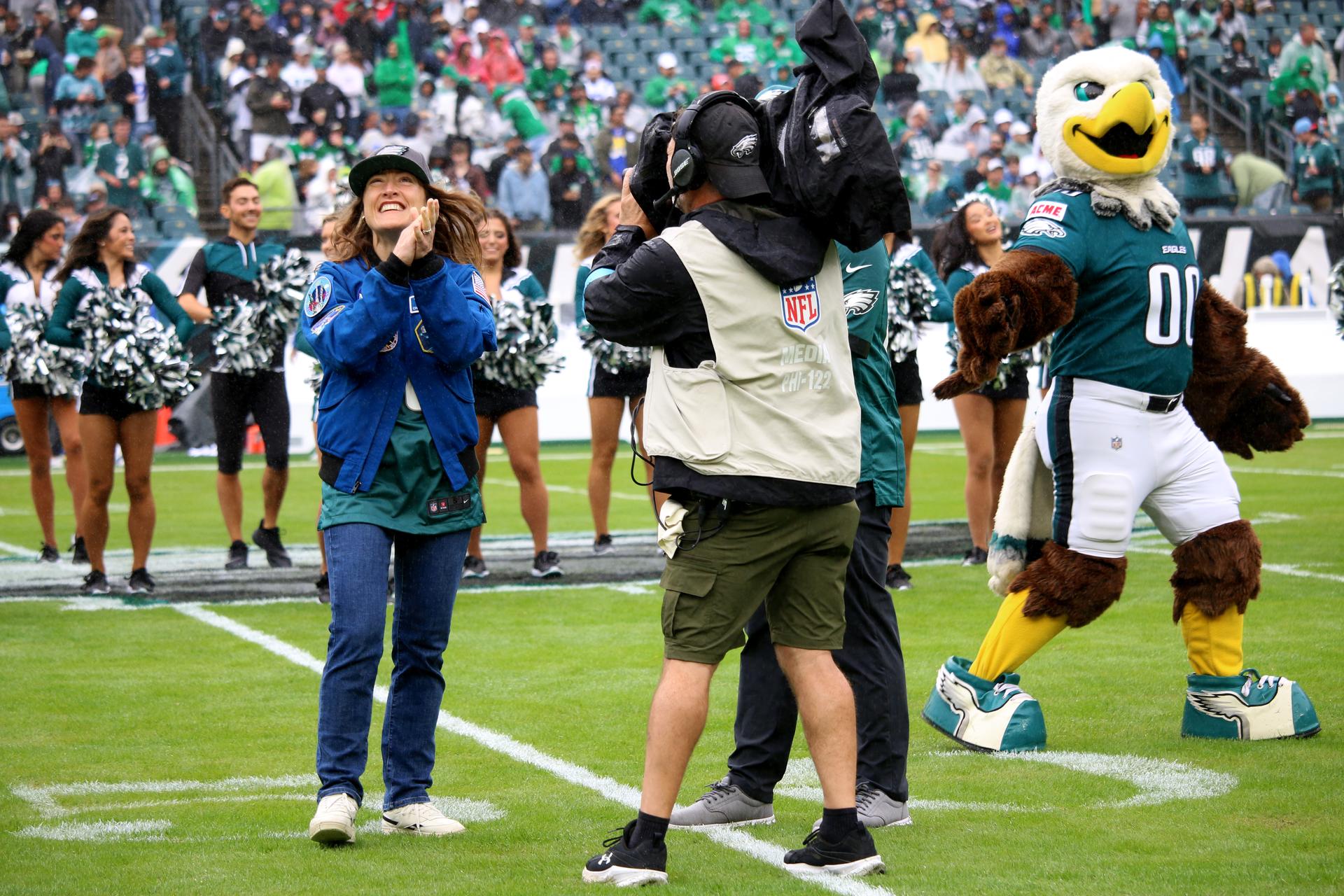
NASA astronaut and mission specialist of the agency's Artemis II mission, Christina Koch, lead the fans in singing the Eagles Fight Song from the field at an NFL game between the Philadelphia Eagles and the Los Angeles Rams at Lincoln Financial Field on Sunday, Oct. 4, 2026, in Philadelphia. NASA’s engagement at NFL games is part of the agency's Inspiration Tour, aimed at strengthening connections between NASA and its partners and showcasing innovation in air and space in the lead up to the MAX POWER aerospace technology expo and airshow at the agency's Kennedy Space Center in early November. Photo Credit: (NASA/Thalia Patrinos)
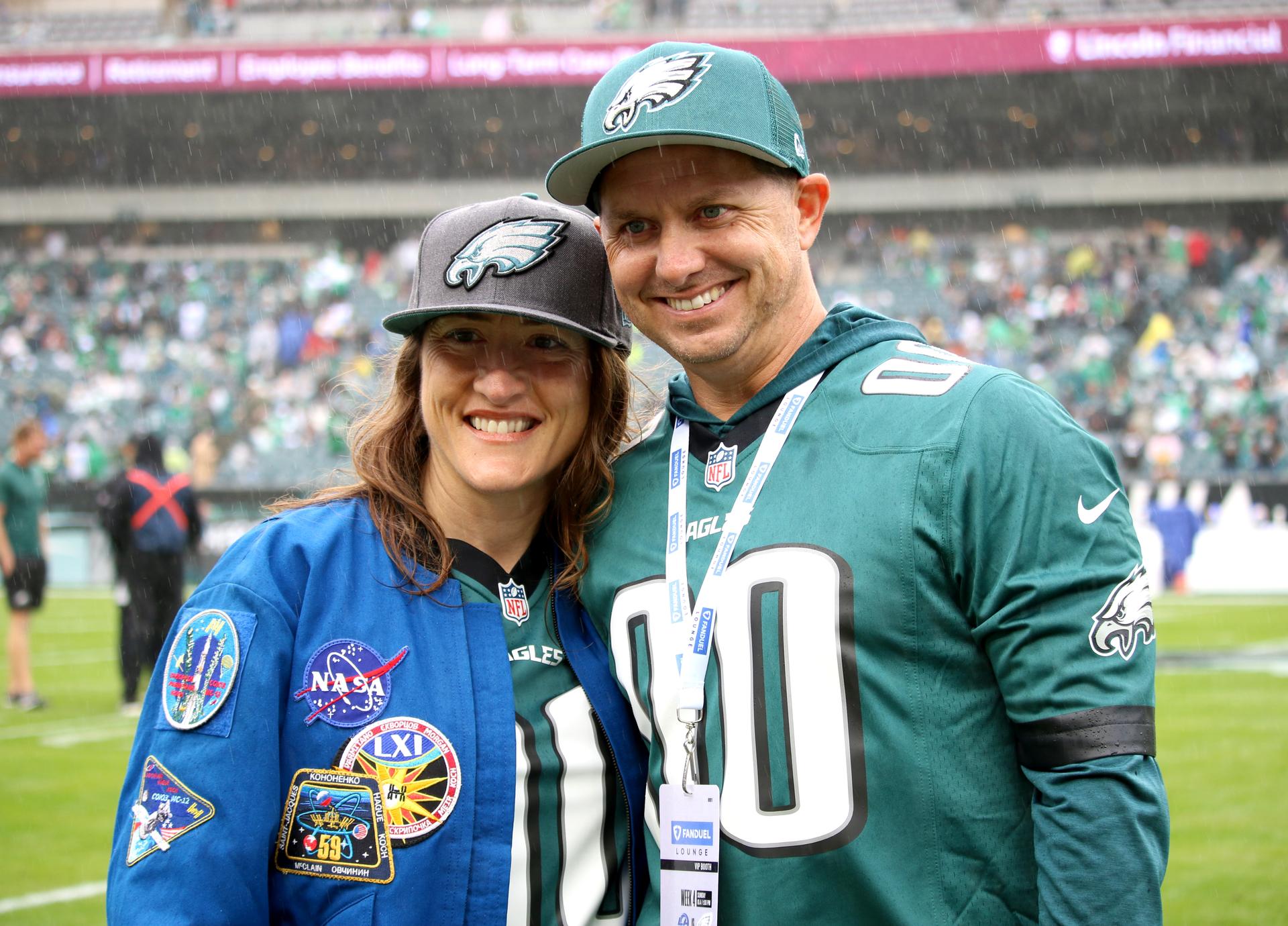
NASA astronaut and mission specialist of the agency's Artemis II mission, Christina Koch, and her husband, Robert Koch, pose at an NFL game between the Philadelphia Eagles and the Los Angeles Rams at Lincoln Financial Field on Sunday, Oct. 4, 2026, in Philadelphia. NASA’s engagement at NFL games is part of the agency's Inspiration Tour, aimed at strengthening connections between NASA and its partners and showcasing innovation in air and space in the lead up to the MAX POWER aerospace technology expo and airshow at the agency's Kennedy Space Center in early November. Photo Credit: (NASA/Thalia Patrinos)
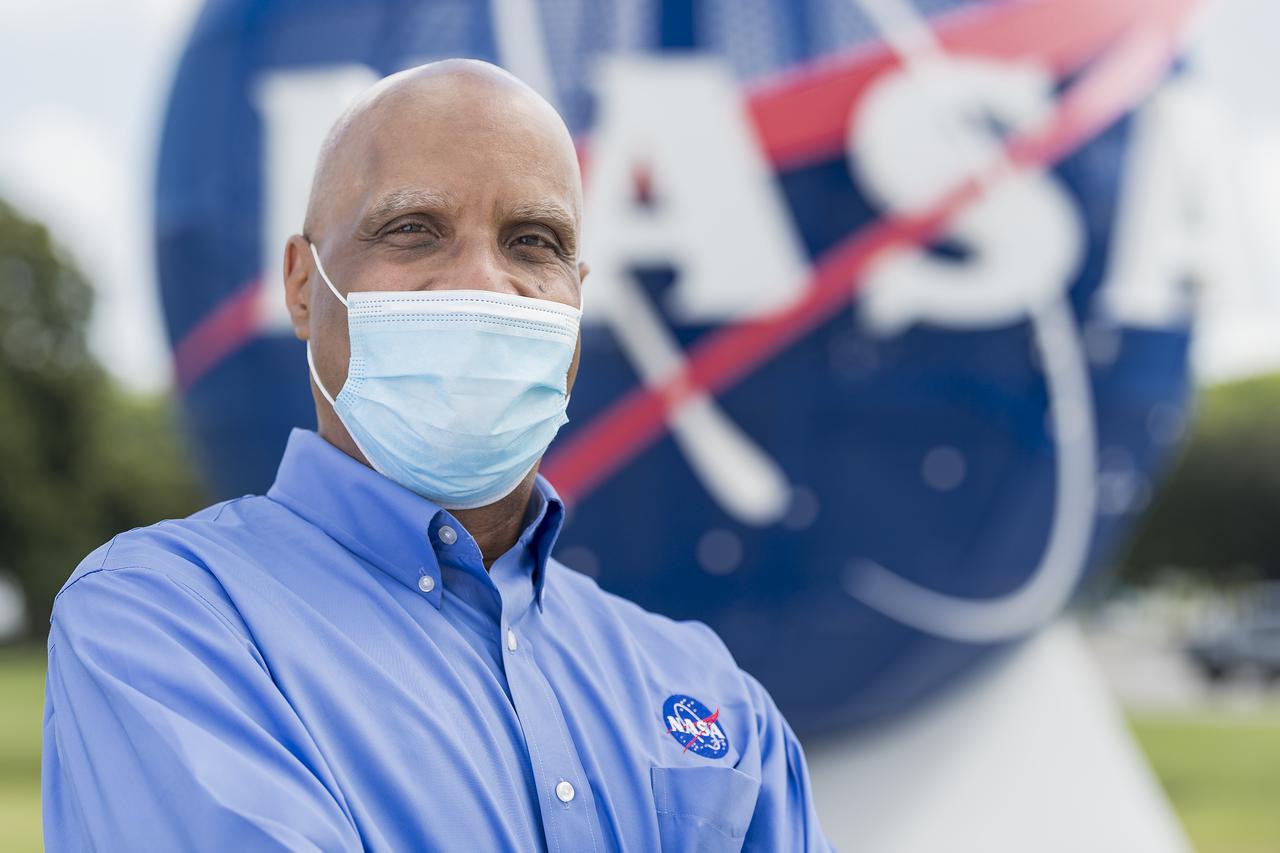
Portrait of Robin "Rob" Lee of the Office of Diversity & Equal Opp. Branch, in front of NASA Langley's "Meatball." The portrait was done for Thalia Patrinos at NASA Headquarters as part of "Faces of NASA" project. Due to the COVID-19 pandemic, masks were mandated by Governor Northam in Virginia in public settings. "Well, little did I know, even at a young age, he instilled in me the importance of seeing people for people. And being able to help people and being able to meet them in their time of need. And that carried me throughout my entire life. Even still today.” — Robin Lee, Director of Office of Diversity and Equal Opportunity, Langley Research Center
![“Discipline is one of the things that they instill with you [in the military.] All the way starting in boot camp, [the goal] is doing the right thing when nobody's looking. Integrity. Whenever you're in boot camp, they always say, ‘it's too easy.’ It's just too easy to follow the rules, read the book, read the regulations, and that's probably why I enjoy contracting. I like reading the regulations and following the regulations. …[Now that I work for Safety and Mission Assurance,] it's really cool to read everything about the different types of the scenarios. I always get to see the task orders and the type of work that is going on to keep people safe on the ground and in the air.” NASA Contract Specialist at NASA’s Goddard Space Flight Center (GSFC), Miranda Meyer, poses for a portrait, Wednesday, Feb. 7, 2024 at GSFC in Greenbelt, Maryland. Photo Credit: (NASA/Thalia Patrinos)](https://images-assets.nasa.gov/image/NHQ202402070015/NHQ202402070015~medium.jpg)
“Discipline is one of the things that they instill with you [in the military.] All the way starting in boot camp, [the goal] is doing the right thing when nobody's looking. Integrity. Whenever you're in boot camp, they always say, ‘it's too easy.’ It's just too easy to follow the rules, read the book, read the regulations, and that's probably why I enjoy contracting. I like reading the regulations and following the regulations. …[Now that I work for Safety and Mission Assurance,] it's really cool to read everything about the different types of the scenarios. I always get to see the task orders and the type of work that is going on to keep people safe on the ground and in the air.” NASA Contract Specialist at NASA’s Goddard Space Flight Center (GSFC), Miranda Meyer, poses for a portrait, Wednesday, Feb. 7, 2024 at GSFC in Greenbelt, Maryland. Photo Credit: (NASA/Thalia Patrinos)
![“When I was a kid, I had a Lego set of one of the twin rovers, Spirit and Opportunity. It was like a Lego rover that could fold up the same way that the actual rover did. It’s crazy because I had that when I was like ten — and now, some of my current coworkers actually worked on that launch. So when I walked into my launch director’s office a couple of years ago, I saw that same Lego set sitting next to the people at Jet Propulsion Laboratory who actually built the rover. “Just being able to see it and touch it [as a kid] helps you impart your own imagination onto it. It’s really exciting. I wasn’t an action figure type of kid — but when I had stuff that seemed real, I really enjoyed putting it together. The project of putting it together was the thing that made my parents think that I was going to be a good engineer. Having it in front of you makes it real. So when you see it on TV, it’s like: ‘I know what that is. I know how that instrument works.’ There’s a connection there.” — Phillip Hargrove, Aerospace Engineer, Kennedy Space Center Interviewer: NASA / Thalia Patrinos](https://images-assets.nasa.gov/image/KSC-20210209-PH-KLS02_0030/KSC-20210209-PH-KLS02_0030~medium.jpg)
“When I was a kid, I had a Lego set of one of the twin rovers, Spirit and Opportunity. It was like a Lego rover that could fold up the same way that the actual rover did. It’s crazy because I had that when I was like ten — and now, some of my current coworkers actually worked on that launch. So when I walked into my launch director’s office a couple of years ago, I saw that same Lego set sitting next to the people at Jet Propulsion Laboratory who actually built the rover. “Just being able to see it and touch it [as a kid] helps you impart your own imagination onto it. It’s really exciting. I wasn’t an action figure type of kid — but when I had stuff that seemed real, I really enjoyed putting it together. The project of putting it together was the thing that made my parents think that I was going to be a good engineer. Having it in front of you makes it real. So when you see it on TV, it’s like: ‘I know what that is. I know how that instrument works.’ There’s a connection there.” — Phillip Hargrove, Aerospace Engineer, Kennedy Space Center Interviewer: NASA / Thalia Patrinos
!["I grew up in China. In China, everybody talks about what they want to be [when they grow up]. Many want to grow up to be a scientist or engineer. So I aspired to be a scientist from an early age. … For the girls or women in science — or in any profession or job — opportunities are more abundant than they were previously. Sometimes you need to take bold steps. Just a little push, and then you will get there. I initially started as a foreign national, so not a lot of opportunities existed for a foreign national, and some of them [required a] green card or citizenship. I think it's hard, but still, there is a path forward. I think it's important to work hard and be optimistic, and you will find something." Space Physics and Space Weather Scientist, Heliophysics Science Division, NASA’s Goddard Space Flight Center (GSFC), Dr. Yihua Zheng, poses for a portrait, Wednesday, Feb. 7, 2024 at NASA’s GSFC in Greenbelt, Maryland. Photo Credit: (NASA/Thalia Patrinos)](https://images-assets.nasa.gov/image/NHQ202402070013/NHQ202402070013~medium.jpg)
"I grew up in China. In China, everybody talks about what they want to be [when they grow up]. Many want to grow up to be a scientist or engineer. So I aspired to be a scientist from an early age. … For the girls or women in science — or in any profession or job — opportunities are more abundant than they were previously. Sometimes you need to take bold steps. Just a little push, and then you will get there. I initially started as a foreign national, so not a lot of opportunities existed for a foreign national, and some of them [required a] green card or citizenship. I think it's hard, but still, there is a path forward. I think it's important to work hard and be optimistic, and you will find something." Space Physics and Space Weather Scientist, Heliophysics Science Division, NASA’s Goddard Space Flight Center (GSFC), Dr. Yihua Zheng, poses for a portrait, Wednesday, Feb. 7, 2024 at NASA’s GSFC in Greenbelt, Maryland. Photo Credit: (NASA/Thalia Patrinos)
![“I found it amazing that this world was covered in ice and had an ocean underneath. I was mapping this area on Europa called Conamara Chaos, where we believe that the surface is locally heated. Because of this, there are ginormous icebergs that broke off and floated around in this slushy ice, so I learned to map [that part of the surface]. Having my physics and math background and thinking about a world with a subsurface ocean, I was like, 'OK, this is a good marriage of fluid mechanics and heat transfer. Europa is a nice world to study that will combine my background with this new planetary science thing that I love.’ “What happened with Europa Clipper was I decided to do my dissertation topic on [the moon]. We'd seen images of these beautiful south polar plumes on Enceladus, these geyser-like plumes, but Europa is much bigger. It has much more water and receives much more tidal heating. Why didn't the Galileo spacecraft see plumes on Europa? Why don't we see geysers? “My dissertation focused on what it would take to have this geyser activity on Europa and for spacecraft cameras to image it. I remember defending my dissertation well but sitting there thinking, ‘People will think I'm a quack because we've never seen geysers on Europa.’ That was in May, and by December, Lorenz Roth's paper came out that Hubble may have detected geysers on Europa. That's when I was like, 'Oh yes, I might actually have a career!' “Shortly after that, the call came out for instrument proposals. Zibi Turtle [Principal Investigator for the Europa Imaging System] met me at a conference and said, 'We're writing a proposal for a camera for the Europa mission. Would you want to be on it?' At that point, I was a year out of my Ph.D. and was like, ‘Are you kidding me?’ Because that usually never happens. Usually, the people on these instrument teams are more senior. They've been around longer, so it’s very rare to be just finishing up your Ph.D. and someone asks you. I](https://images-assets.nasa.gov/image/NHQ202402070010/NHQ202402070010~medium.jpg)
“I found it amazing that this world was covered in ice and had an ocean underneath. I was mapping this area on Europa called Conamara Chaos, where we believe that the surface is locally heated. Because of this, there are ginormous icebergs that broke off and floated around in this slushy ice, so I learned to map [that part of the surface]. Having my physics and math background and thinking about a world with a subsurface ocean, I was like, 'OK, this is a good marriage of fluid mechanics and heat transfer. Europa is a nice world to study that will combine my background with this new planetary science thing that I love.’ “What happened with Europa Clipper was I decided to do my dissertation topic on [the moon]. We'd seen images of these beautiful south polar plumes on Enceladus, these geyser-like plumes, but Europa is much bigger. It has much more water and receives much more tidal heating. Why didn't the Galileo spacecraft see plumes on Europa? Why don't we see geysers? “My dissertation focused on what it would take to have this geyser activity on Europa and for spacecraft cameras to image it. I remember defending my dissertation well but sitting there thinking, ‘People will think I'm a quack because we've never seen geysers on Europa.’ That was in May, and by December, Lorenz Roth's paper came out that Hubble may have detected geysers on Europa. That's when I was like, 'Oh yes, I might actually have a career!' “Shortly after that, the call came out for instrument proposals. Zibi Turtle [Principal Investigator for the Europa Imaging System] met me at a conference and said, 'We're writing a proposal for a camera for the Europa mission. Would you want to be on it?' At that point, I was a year out of my Ph.D. and was like, ‘Are you kidding me?’ Because that usually never happens. Usually, the people on these instrument teams are more senior. They've been around longer, so it’s very rare to be just finishing up your Ph.D. and someone asks you. I
![jsc2020e041336 (Sep 21, 2020) - “There are obvious highlights [about my job] and then there are some highlights that I didn’t really see coming. It’s such an honor to be just one person behind the scenes supporting the crewmembers while they’re up in space and focusing on their missions. It’s such an honor to be a part of them accomplishing their mission. The first time I got a call from space was a major highlight. Every call I’ve gotten from space since then has never gotten less exciting. The fact that I am continuously communicating with people who are living and working on the International Space Station — it’s just very surreal, it’s very mind-blowing still to this day even though I’ve been in this role for several years now. "But one of the highlights that I didn’t necessarily see coming is that a lot of the crewmembers have become mentors to me now. I look up to them for so many different reasons. And we have such a diverse corps that there’s really unlimited wisdom that I can take from listening to each crewmember’s story and from working with each crewmember. They show so much humility and perseverance. Hearing stories about their failures and their successes, watching them problem-solve and even problem-solving with them, has made me grow to be the kind of individual that I think I always wanted to become. I just never knew that I would have the opportunity to have these kinds of mentors to actually help me become that person.” — Stephanie Fernandez, Social Media and Outreach Specialist for the Astronaut Office, Johnson Space Center Image Credit: NASA / James Blair Interviewer: NASA / Thalia Patrinos](https://images-assets.nasa.gov/image/jsc2020e041336/jsc2020e041336~medium.jpg)
jsc2020e041336 (Sep 21, 2020) - “There are obvious highlights [about my job] and then there are some highlights that I didn’t really see coming. It’s such an honor to be just one person behind the scenes supporting the crewmembers while they’re up in space and focusing on their missions. It’s such an honor to be a part of them accomplishing their mission. The first time I got a call from space was a major highlight. Every call I’ve gotten from space since then has never gotten less exciting. The fact that I am continuously communicating with people who are living and working on the International Space Station — it’s just very surreal, it’s very mind-blowing still to this day even though I’ve been in this role for several years now. "But one of the highlights that I didn’t necessarily see coming is that a lot of the crewmembers have become mentors to me now. I look up to them for so many different reasons. And we have such a diverse corps that there’s really unlimited wisdom that I can take from listening to each crewmember’s story and from working with each crewmember. They show so much humility and perseverance. Hearing stories about their failures and their successes, watching them problem-solve and even problem-solving with them, has made me grow to be the kind of individual that I think I always wanted to become. I just never knew that I would have the opportunity to have these kinds of mentors to actually help me become that person.” — Stephanie Fernandez, Social Media and Outreach Specialist for the Astronaut Office, Johnson Space Center Image Credit: NASA / James Blair Interviewer: NASA / Thalia Patrinos
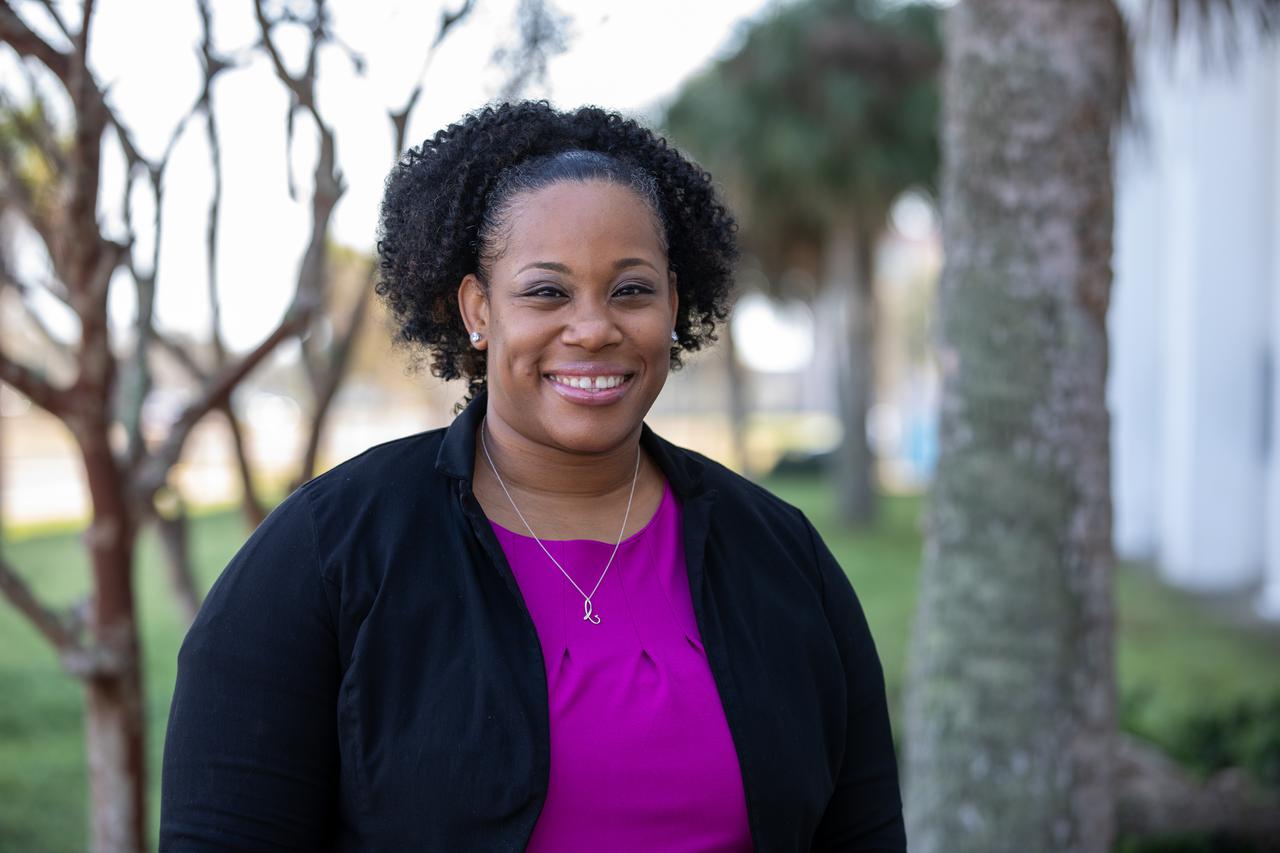
“The day after the Columbia tragedy I knew exactly what I wanted to do with my life. I go to my physics class and tell a friend, ‘I want to go work for NASA.’ My physics teacher walks by and overhears the conversation. She starts the class and says ‘I want to go around the classroom and hear about what everybody wants to do with their life.’ She gets to me. I was super excited. ‘I’m going to work for NASA, I’m going to be an engineer, I’m going to make sure everybody flies safe.’ And she bursts out laughing. And everyone else starts laughing. I’m like, ‘what is the joke?’ And she says to me, ‘If you ever get the opportunity to work for NASA, you make sure you come take me out to lunch.’ And that ended up being the joke of the day at my entire high school. “I think we have a very long way to go. I think that there are not enough educational resources. There are not enough pipeline opportunities. I come from a single-parent family. We weren’t rich. We lived in a New Jersey suburb in a very small town where the idea of a girl going to NASA — it just seemed impossible. I think that we have long way to go to reach out to some of those smaller, under-serving communities where individuals may not have the resources. Where teachers can’t even motivate kids to do something big because they don’t even believe it themselves. I do believe there are strides happening — but I don’t think we’re there yet.” — Brittani Sims, Flight Systems Engineer, Kennedy Space Center Interviewer: NASA / Thalia Patrinos