
NASA Administrator Charles Bolden delivers opening remarks during a panel discussion on the search for life beyond Earth in the James E. Webb Auditorium at NASA Headquarters on Monday, July 14, 2014 in Washington, DC. The panel discussed how NASA's space-based observatories are making new discoveries and how the agency's new telescope, the James Webb Space Telescope, will continue this path of discovery after its schedule launch in 2018. Photo Credit: (NASA/Joel Kowsky)

John Grunsfeld, Associate Administrator for NASA's Science Mission Directorate, far left, speaks during a panel discussion on the search for life beyond Earth in the James E. Webb Auditorium at NASA Headquarters on Monday, July 14, 2014 in Washington, DC. The panel discussed how NASA's space-based observatories are making new discoveries and how the agency's new telescope, the James Webb Space Telescope, will continue this path of discovery after its schedule launch in 2018. Photo Credit: (NASA/Joel Kowsky)

NASA Chief Scientist Ellen Stofan, far left, asks the members of the panel a question during a discussion of the search for life beyond Earth in the James E. Webb Auditorium at NASA Headquarters on Monday, July 14, 2014 in Washington, DC. The panel discussed how NASA's space-based observatories are making new discoveries and how the agency's new telescope, the James Webb Space Telescope, will continue this path of discovery after its schedule launch in 2018. Photo Credit: (NASA/Joel Kowsky)

Dave Gallagher, Director of Astronomy, Physics, and Space Technology at NASA's Jet Propulsion Laboratory speaks during a panel discussion on the search for life beyond Earth in the James E. Webb Auditorium at NASA Headquarters on Monday, July 14, 2014 in Washington, DC. The panel discussed how NASA's space-based observatories are making new discoveries and how the agency's new telescope, the James Webb Space Telescope, will continue this path of discovery after its schedule launch in 2018. Photo Credit: (NASA/Joel Kowsky)

John Grunsfeld, Associate Administrator for NASA's Science Mission Directorate, second from left, answers a question from the audience during a panel discussion on the search for life beyond Earth in the James E. Webb Auditorium at NASA Headquarters on Monday, July 14, 2014 in Washington, DC. The panel discussed how NASA's space-based observatories are making new discoveries and how the agency's new telescope, the James Webb Space Telescope, will continue this path of discovery after its schedule launch in 2018. Photo Credit: (NASA/Joel Kowsky)

John Mather, Project Scientist for the James Webb Space Telescope at NASA's Goddard Space Flight Center, center, answers a question from the audience during a panel discussion on the search for life beyond Earth in the James E. Webb Auditorium at NASA Headquarters on Monday, July 14, 2014 in Washington, DC. The panel discussed how NASA's space-based observatories are making new discoveries and how the agency's new telescope, the James Webb Space Telescope, will continue this path of discovery after its schedule launch in 2018. Photo Credit: (NASA/Joel Kowsky)

NASA Chief Scientist Ellen Stofan, far left, introduces members of the panel prior to a discussion of the search for life beyond Earth in the James E. Webb Auditorium at NASA Headquarters on Monday, July 14, 2014 in Washington, DC. The panel discussed how NASA's space-based observatories are making new discoveries and how the agency's new telescope, the James Webb Space Telescope, will continue this path of discovery after its schedule launch in 2018. Photo Credit: (NASA/Joel Kowsky)
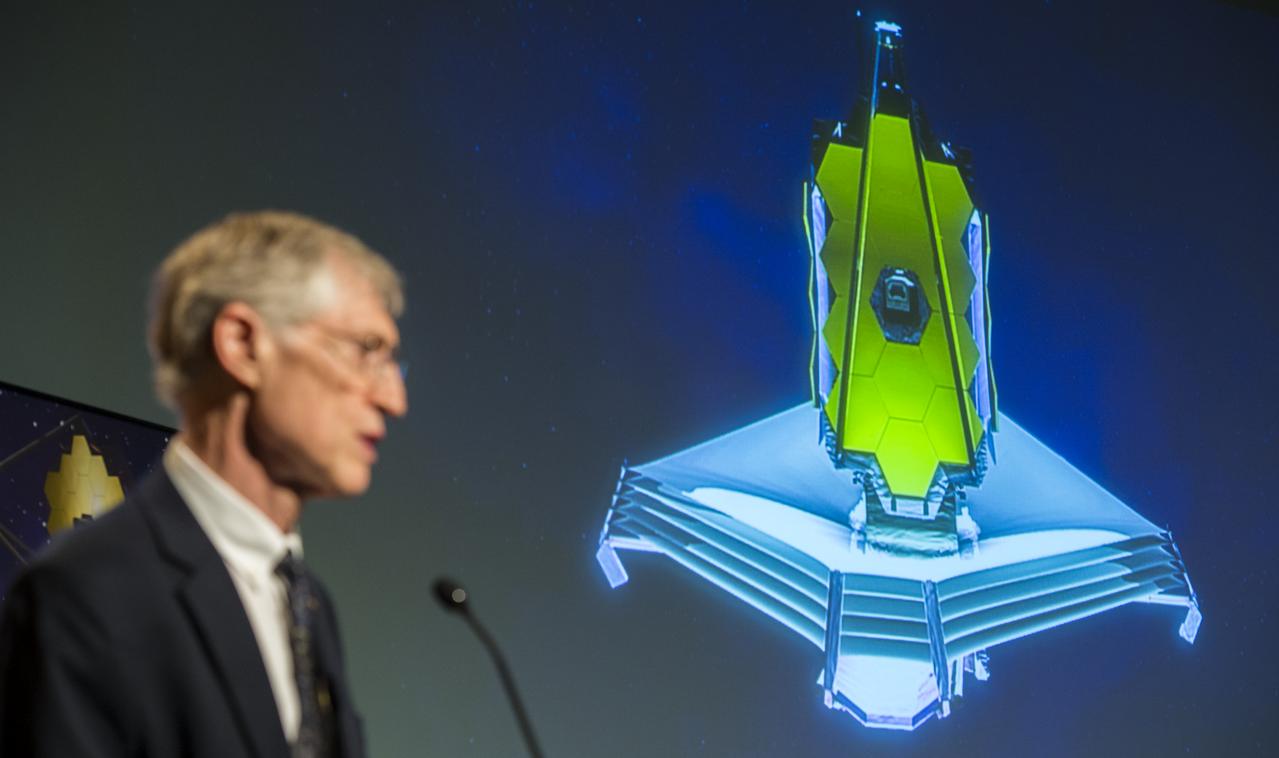
An animation of the James Webb Space Telescope (JWST) is projected as John Mather, Nobel Laureate and Project Scientist for the JWST speaks during a panel discussion on the search for life beyond Earth in the James E. Webb Auditorium at NASA Headquarters on Monday, July 14, 2014 in Washington, DC. The panel discussed how NASA's space-based observatories are making new discoveries and how the agency's new telescope, the James Webb Space Telescope, will continue this path of discovery after its schedule launch in 2018. Photo Credit: (NASA/Joel Kowsky)

Matt Mountain, Director of the Space Telescope Science Institute and telescope scientist for the James Webb Space Telescope, speaks during a panel discussion on the search for life beyond Earth in the James E. Webb Auditorium at NASA Headquarters on Monday, July 14, 2014 in Washington, DC. The panel discussed how NASA's space-based observatories are making new discoveries and how the agency's new telescope, the James Webb Space Telescope, will continue this path of discovery after its schedule launch in 2018. Photo Credit: (NASA/Joel Kowsky)

Sara Seager, a MacArthur Fellow and Professor of Planetary Science and Physics at the Massachusetts Institute of Technology, speaks during a panel discussion on the search for life beyond Earth in the James E. Webb Auditorium at NASA Headquarters on Monday, July 14, 2014 in Washington, DC. The panel discussed how NASA's space-based observatories are making new discoveries and how the agency's new telescope, the James Webb Space Telescope, will continue this path of discovery after its schedule launch in 2018. Photo Credit: (NASA/Joel Kowsky)

Matt Mountain, Director of the Space Telescope Science Institute and telescope scientist for the James Webb Space Telescope, speaks during a panel discussion on the search for life beyond Earth in the James E. Webb Auditorium at NASA Headquarters on Monday, July 14, 2014 in Washington, DC. The panel discussed how NASA's space-based observatories are making new discoveries and how the agency's new telescope, the James Webb Space Telescope, will continue this path of discovery after its schedule launch in 2018. Photo Credit: (NASA/Joel Kowsky)

John Mather, Nobel Laureate and Project Scientist for the James Webb Space Telescope at NASA's Goddard Space Flight Center, speaks during a panel discussion on the search for life beyond Earth in the James E. Webb Auditorium at NASA Headquarters on Monday, July 14, 2014 in Washington, DC. The panel discussed how NASA's space-based observatories are making new discoveries and how the agency's new telescope, the James Webb Space Telescope, will continue this path of discovery after its schedule launch in 2018. Photo Credit: (NASA/Joel Kowsky)
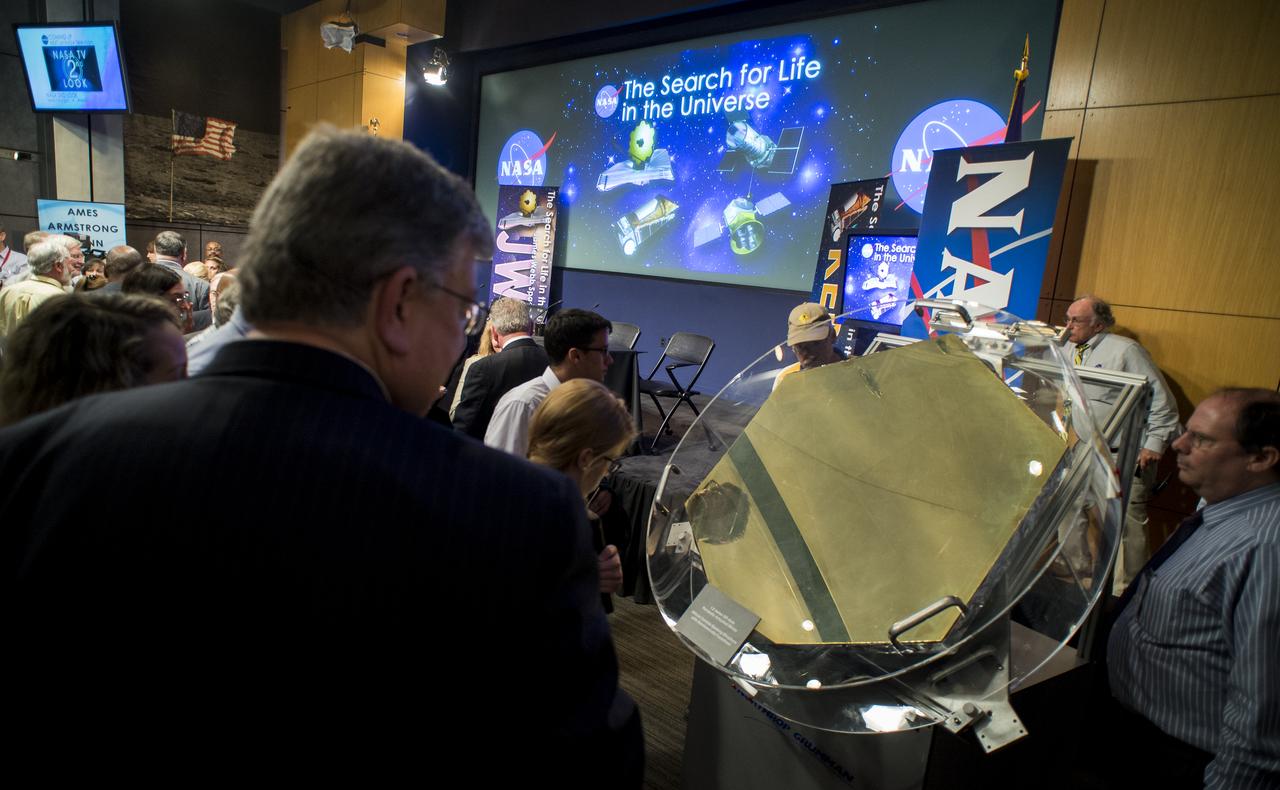
Members of the audience walk past an example of a 1.2 meter telescope mirror that could be used in a future space telescope following a panel discussion on the search for life beyond Earth in the James E. Webb Auditorium at NASA Headquarters on Monday, July 14, 2014 in Washington, DC. The panel discussed how NASA's space-based observatories are making new discoveries and how the agency's new telescope, the James Webb Space Telescope, will continue this path of discovery after its schedule launch in 2018. Photo Credit: (NASA/Joel Kowsky)

John Grunsfeld, Associate Administrator for NASA's Science Mission Directorate, far left, answers a question from the audience during a panel discussion on the search for life beyond Earth in the James E. Webb Auditorium at NASA Headquarters on Monday, July 14, 2014 in Washington, DC. The panel discussed how NASA's space-based observatories are making new discoveries and how the agency's new telescope, the James Webb Space Telescope, will continue this path of discovery after its schedule launch in 2018. Photo Credit: (NASA/Joel Kowsky)

NASA Administrator Charles Bolden delivers opening remarks during a panel discussion on the search for life beyond Earth in the James E. Webb Auditorium at NASA Headquarters on Monday, July 14, 2014 in Washington, DC. The panel discussed how NASA's space-based observatories are making new discoveries and how the agency's new telescope, the James Webb Space Telescope, will continue this path of discovery after its schedule launch in 2018. Photo Credit: (NASA/Joel Kowsky)

Perseverance deputy project scientist, JPL, Ken Williford, screen left, and Participating scientist for returned sample science, University of Nevada Las Vegas, Libby Hausrath, give remarks via remote during a NASA Perseverance rover press briefing about the search for ancient life at Mars and about samples to be brought back to Earth on a future mission, Wednesday, Feb. 17, 2021, at NASA's Jet Propulsion Laboratory in Pasadena, California. The Perseverance Mars rover is due to land on Mars Thursday, Feb. 18, 2021. A key objective for Perseverance’s mission on Mars is astrobiology, including the search for signs of ancient microbial life. The rover will characterize the planet’s geology and past climate, pave the way for human exploration of the Red Planet, and be the first mission to collect and cache Martian rock and regolith. Photo Credit: (NASA/Bill Ingalls)
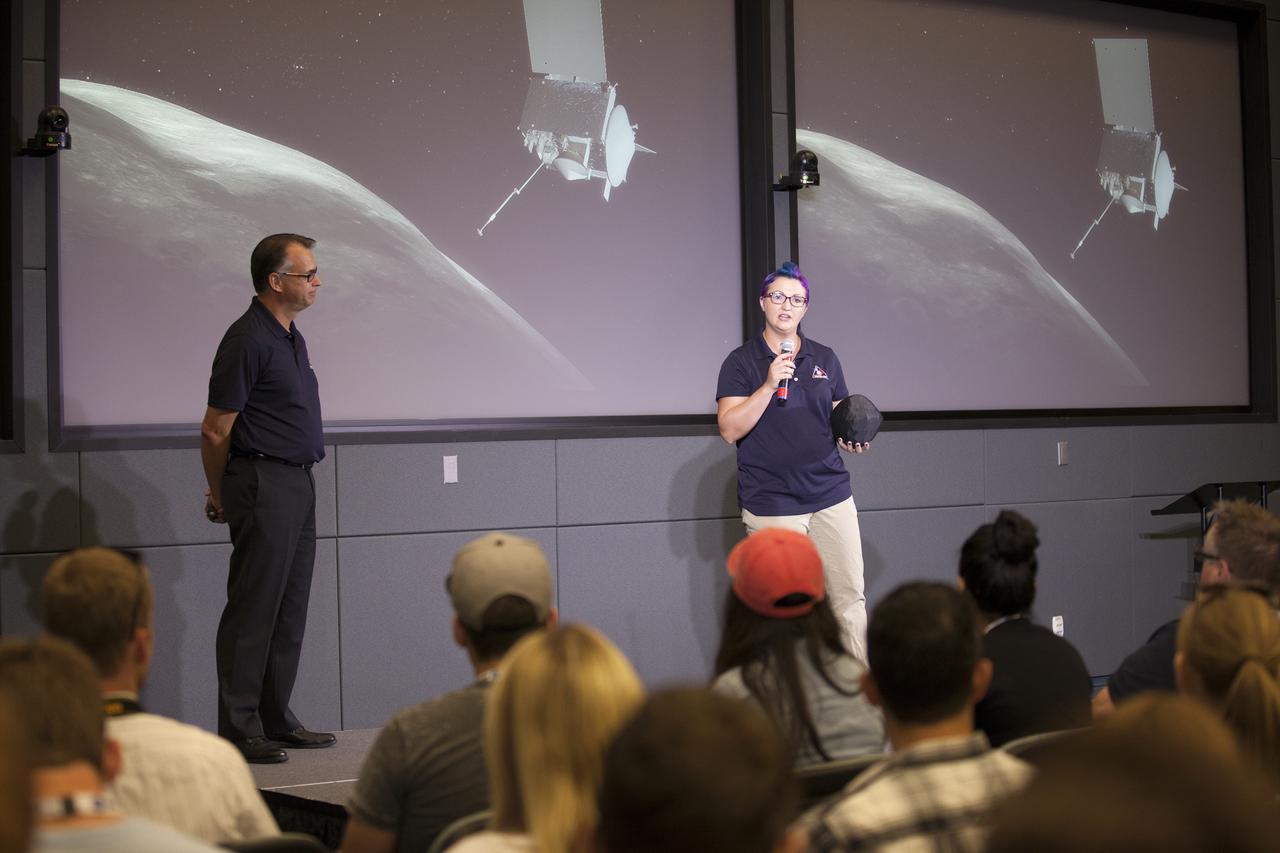
Social media followers were briefed by NASA scientists on asteroids, how they relate to the origins of our solar system and the search for life beyond Earth, during a NASA Social presentation in the Operations Support Building II at the agency’s Kennedy Space Center in Florida. The presentation took place before launch of the agency’s Origins, Spectral Interpretation, Resource Identification, Security-Regolith Explorer, or OSIRIS-REx spacecraft. From the left, are Dante Lauretta, OSIRIS-REx principal investigator from the University of Arizona at Tucson, and Christina Richey, OSIRIS-REx deputy program scientists at NASA Headquarters in Washington.

Principal investigator, Mastcam-Z instrument, Arizona State University, Tempe, Jim Bell, gives remarks via remote during a NASA Perseverance rover mission science overview, Tuesday, Feb. 16, 2021, at NASA's Jet Propulsion Laboratory in Pasadena, California. The Perseverance Mars rover is due to land on Mars Thursday, Feb. 18, 2021. A key objective for Perseverance’s mission on Mars is astrobiology, including the search for signs of ancient microbial life. The rover will characterize the planet’s geology and past climate, pave the way for human exploration of the Red Planet, and be the first mission to collect and cache Martian rock and regolith. Photo Credit: (NASA/Bill Ingalls)
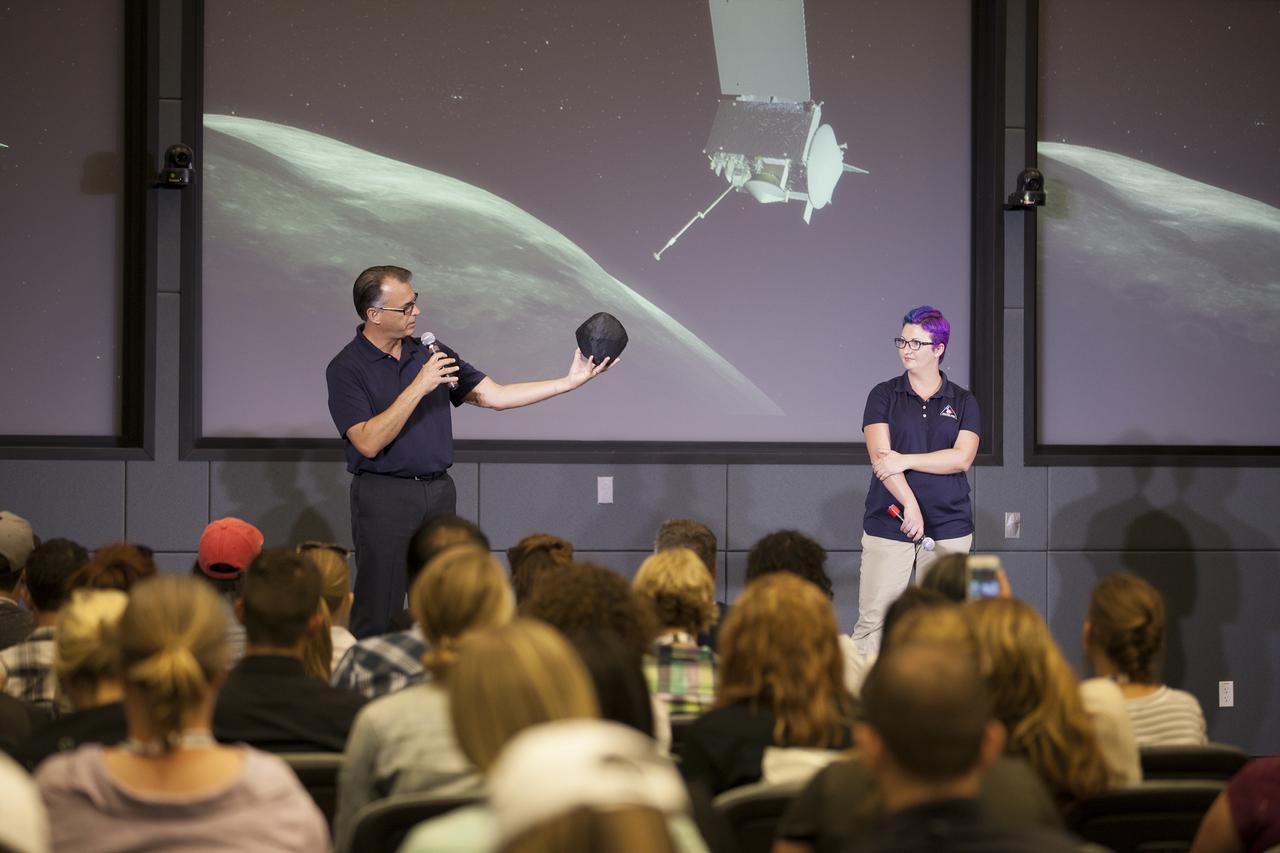
Social media followers were briefed by NASA scientists on asteroids, how they relate to the origins of our solar system and the search for life beyond Earth, during a NASA Social presentation in the Operations Support Building II at the agency’s Kennedy Space Center in Florida. The presentation took place before launch of the agency’s Origins, Spectral Interpretation, Resource Identification, Security-Regolith Explorer, or OSIRIS-REx spacecraft. From the left, are Dante Lauretta, OSIRIS-REx principal investigator from the University of Arizona at Tucson, and Christina Richey, OSIRIS-REx deputy program scientists at NASA Headquarters in Washington.

KENNEDY SPACE CENTER, FLA. -- At the grand opening of the newly expanded KSC Visitor Complex, Center Director Roy Bridges presents Deep Space Nine star Avery Brooks with a plaque, NASA jacket and hat. Brooks narrates the new film Quest for Life at the Visitor Center. Brooks was recognized for his contribution to advancing the public's understanding of NASA and the search for life elsewhere in the universe. The Complex now includes an International Space Station-themed ticket plaza, featuring a structure of overhanging solar panels and astronauts performing assembly tasks, a new foyer, films, and exhibits. The KSC Visitor Complex was inaugurated three decades ago and is now one of the top five tourist attractions in Florida. It is located on S.R. 407, east of I-95, within the Merritt Island National Wildlife Refuge

KENNEDY SPACE CENTER, FLA. -- At the grand opening of the newly expanded KSC Visitor Complex, Center Director Roy Bridges presents Deep Space Nine star Avery Brooks with a plaque, recognizing his contribution to advancing the public's understanding of NASA and the search for life elsewhere in the universe. Brooks narrates the new film Quest for Life at the Visitor Center. The $ 13 million addition to the Visitor Complex now includes an International Space Station-themed ticket plaza, featuring a structure of overhanging solar panels and astronauts performing assembly tasks, a new information center, films, and exhibits. The KSC Visitor Complex was inaugurated three decades ago and is now one of the top five tourist attractions in Florida. It is located on S.R. 407, east of I-95, within the Merritt Island National Wildlife Refuge

CAPE CANAVERAL, Fla. – At NASA’s Kennedy Space Center in Florida, several scientists and researchers participate in a “Looking for Signs of Life in the Universe” news conference, Nov. 22, as part of preflight activities for the Mars Science Laboratory (MSL) mission. From left, are NASA Astrobiology Director Mary Voytek; Professor Jamie Foster from the Department of Microbiology and Cell Science at the University of Florida in Gainesville; MSL Deputy Principal Investigator Pan Conrad; Director of the Foundation for Applied Molecular Evolution Steven Benner; and NASA Planetary Protection Officer Catharine Conley. MSL’s components include a car-sized rover, Curiosity, which has 10 science instruments designed to search for signs of life, including methane, and help determine if the gas is from a biological or geological source. Launch of MSL aboard a United Launch Alliance Atlas V rocket is targeted for Nov. 26 from Space Launch Complex 41 on Cape Canaveral Air Force Station in Florida. For more information, visit http://www.nasa.gov/msl. Photo credit: NASA/Kim Shiflett

CAPE CANAVERAL, Fla. – At NASA’s Kennedy Space Center in Florida, several scientists and researchers participate in a “Looking for Signs of Life in the Universe” news conference, Nov. 22, as part of preflight activities for the Mars Science Laboratory (MSL) mission. From left, are NASA Public Affairs Officer and conference moderator George Diller; NASA Astrobiology Director Mary Voytek; Professor Jamie Foster from the Department of Microbiology and Cell Science at the University of Florida in Gainesville; MSL Deputy Principal Investigator Pan Conrad; Director of the Foundation for Applied Molecular Evolution Steven Benner; and NASA Planetary Protection Officer Catharine Conley. MSL’s components include a car-sized rover, Curiosity, which has 10 science instruments designed to search for signs of life, including methane, and help determine if the gas is from a biological or geological source. Launch of MSL aboard a United Launch Alliance Atlas V rocket is targeted for Nov. 26 from Space Launch Complex 41 on Cape Canaveral Air Force Station in Florida. For more information, visit http://www.nasa.gov/msl. Photo credit: NASA/Kim Shiflett

Panelists (from left) Ellen Stofan, NASA Chief Scientist, left; John Grunsfeld, Associate Administrator for NASA's Science Mission DIrectorate, second from left; John Mather, Nobel Laureate and Senior Project Scientist for the James Webb Space Telescope (JWST) at NASA's Goddard Space Flight Center, third from left; Sara Seager, MacArthur Fellow and Professor of Planetary Science and Physics at the Massachusetts Institute of Technology, third from right; Dave Gallagher, Director for Astronomy and Physics at NASA's Jet Propulsion Laboratory, second from right; and Matt Mountain, Director of the Space Telescope Science Institute and Telescope Scientist for the JWST, right; are seen during a panel discussion on the search for life beyond Earth in the James E. Webb Auditorium at NASA Headquarters on Monday, July 14, 2014 in Washington, DC. The panel discussed how NASA's space-based observatories are making new discoveries and how the agency's new telescope, the James Webb Space Telescope, will continue this path of discovery after its schedule launch in 2018. Photo Credit: (NASA/Joel Kowsky)
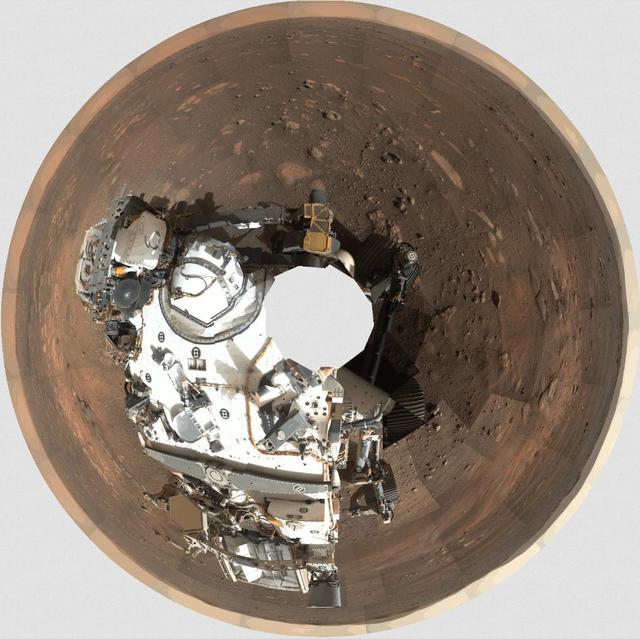
This animation shows the order in which the 142 images that make up Mastcam-Z's first 360-degree panorama were taken. Mastcam-Z is a pair of zoomable cameras on the mast, or "head," of NASA's Perseverance Mars rover. Arizona State University in Tempe leads the operations of the Mastcam-Z instrument, working in collaboration with Malin Space Science Systems in San Diego. A key objective for Perseverance's mission on Mars is astrobiology, including the search for signs of ancient microbial life. The rover will characterize the planet's geology and past climate, pave the way for human exploration of the Red Planet, and be the first mission to collect and cache Martian rock and regolith (broken rock and dust). Subsequent NASA missions, in cooperation with ESA (European Space Agency), would send spacecraft to Mars to collect these sealed samples from the surface and return them to Earth for in-depth analysis. Animation available at https://photojournal.jpl.nasa.gov/catalog/PIA24444

Perseverance deputy project scientist, JPL, Ken Williford, screen left, and Principal investigator, Mastcam-Z instrument, Arizona State University, Tempe, Jim Bell, give remarks via remote during a NASA Perseverance rover mission science overview, Tuesday, Feb. 16, 2021, at NASA's Jet Propulsion Laboratory in Pasadena, California. The Perseverance Mars rover is due to land on Mars Thursday, Feb. 18, 2021. A key objective for Perseverance’s mission on Mars is astrobiology, including the search for signs of ancient microbial life. The rover will characterize the planet’s geology and past climate, pave the way for human exploration of the Red Planet, and be the first mission to collect and cache Martian rock and regolith. Photo Credit: (NASA/Bill Ingalls)
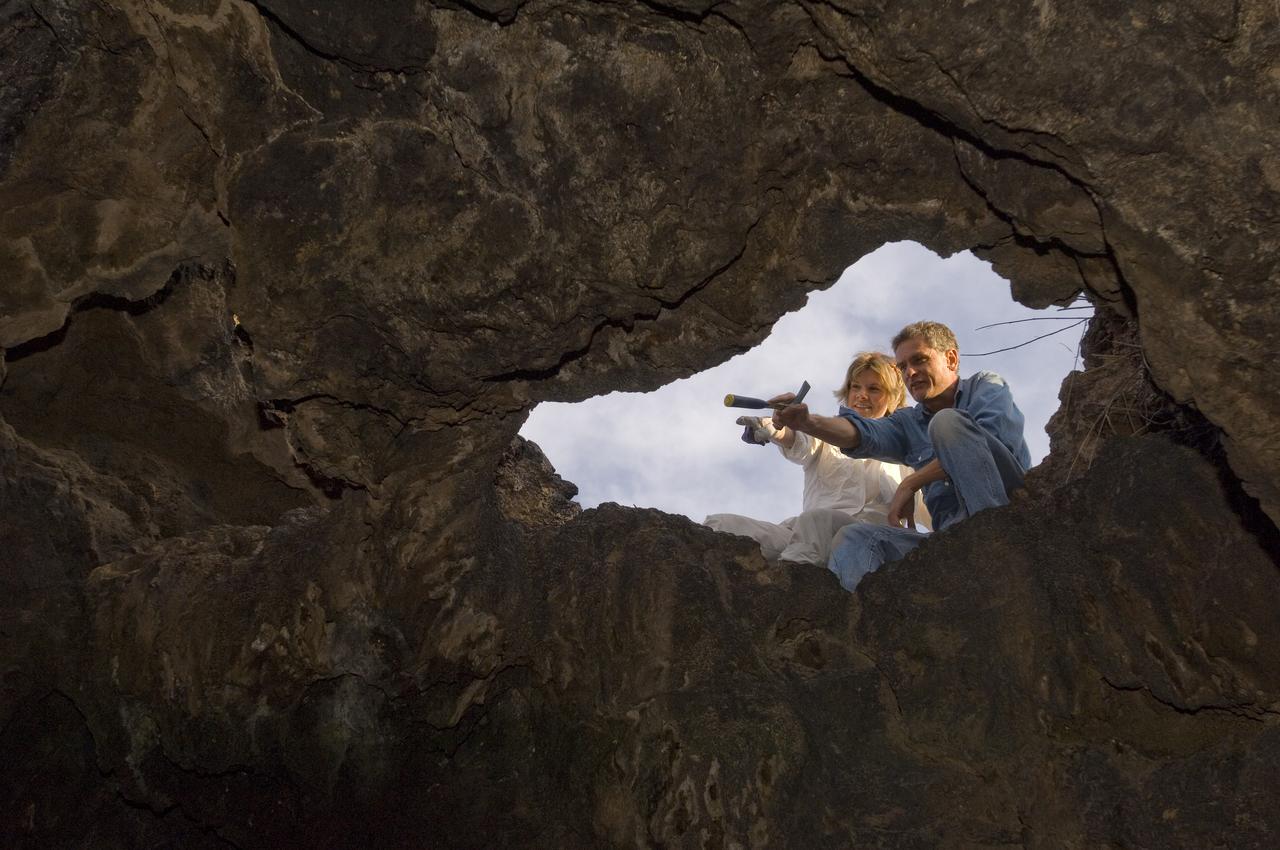
Spaceward Bound event in the Mojave Deser , CA (an outreach exercise) with Dr Chris McKay and Ames Education department personnel Brian Day, Barbara Bazar and a accompaning (learning for the the classroom) team of teachers will be studying side-by-side with NASA scientists who search for life in extreme environments, closely approximating what they expect to find on other planets. Why the Mojave -- an inhospitable, sun-drenched spot in the California Desert? This natural setting presents scientists with opportunities to study environments that are analogous to what explorers will find on the Moon and Mars. Teachers and scientists will perform scientific fieldwork in lunar geology, Mars astrobiology, Mars geology, and issues of temperature and solar inundation and radiation. for additional information and Outreach projects see http://quest.arc.nasa.gov/ shown here are Dr Chris McKay and Monika Kress, Professor of Astronomy at San Jose State University
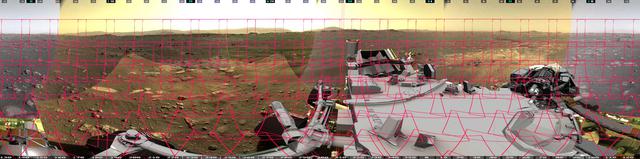
This image shows the 142 images that make up Mastcam-Z's first 360-degree panorama. Mastcam-Z is a pair of zoomable cameras on the mast, or "head," of NASA's Perseverance Mars rover. Arizona State University in Tempe leads the operations of the Mastcam-Z instrument, working in collaboration with Malin Space Science Systems in San Diego. A key objective for Perseverance's mission on Mars is astrobiology, including the search for signs of ancient microbial life. The rover will characterize the planet's geology and past climate, pave the way for human exploration of the Red Planet, and be the first mission to collect and cache Martian rock and regolith (broken rock and dust). Subsequent NASA missions, in cooperation with ESA (European Space Agency), would send spacecraft to Mars to collect these sealed samples from the surface and return them to Earth for in-depth analysis. https://photojournal.jpl.nasa.gov/catalog/PIA24445
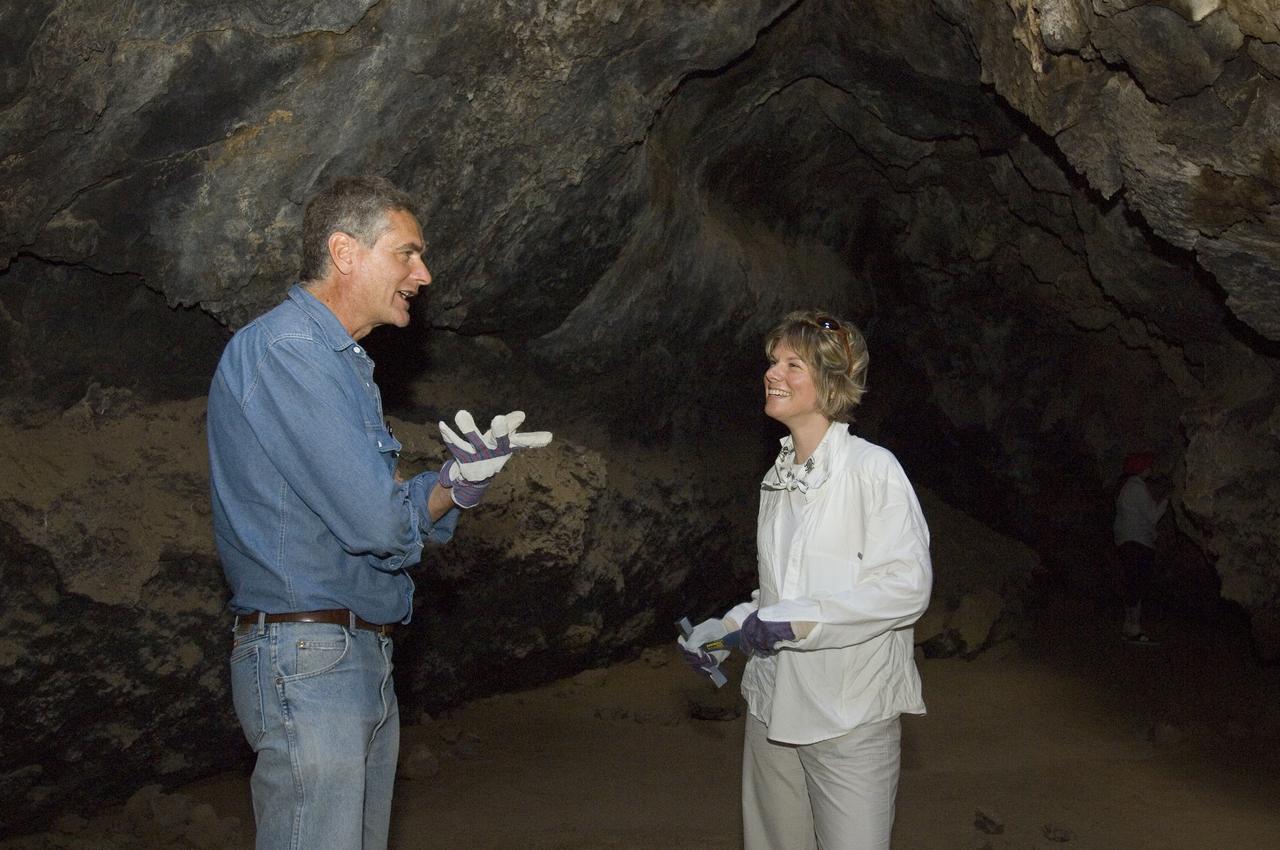
Spaceward Bound event in the Mojave Deser , CA (an outreach exercise) with Dr Chris McKay and Ames Education department personnel Brian Day, Barbara Bazar and a accompaning (learning for the the classroom) team of teachers will be studying side-by-side with NASA scientists who search for life in extreme environments, closely approximating what they expect to find on other planets. Why the Mojave -- an inhospitable, sun-drenched spot in the California Desert? This natural setting presents scientists with opportunities to study environments that are analogous to what explorers will find on the Moon and Mars. Teachers and scientists will perform scientific fieldwork in lunar geology, Mars astrobiology, Mars geology, and issues of temperature and solar inundation and radiation. for additional information and Outreach projects see http://quest.arc.nasa.gov/ shown here are Dr Chris McKay and Monika Kress, Professor of Astronomy at San Jose State University

Spaceward Bound event in the Mojave Deser , CA (an outreach exercise) with Dr Chris McKay and Ames Education department personnel Brian Day, Barbara Bazar and a accompaning (learning for the the classroom) team of teachers will be studying side-by-side with NASA scientists who search for life in extreme environments, closely approximating what they expect to find on other planets. Why the Mojave -- an inhospitable, sun-drenched spot in the California Desert? This natural setting presents scientists with opportunities to study environments that are analogous to what explorers will find on the Moon and Mars. Teachers and scientists will perform scientific fieldwork in lunar geology, Mars astrobiology, Mars geology, and issues of temperature and solar inundation and radiation. for additional information and Outreach projects see http://quest.arc.nasa.gov/ shown here: Monika Kress, Professor of Astronomy at San Jose State University
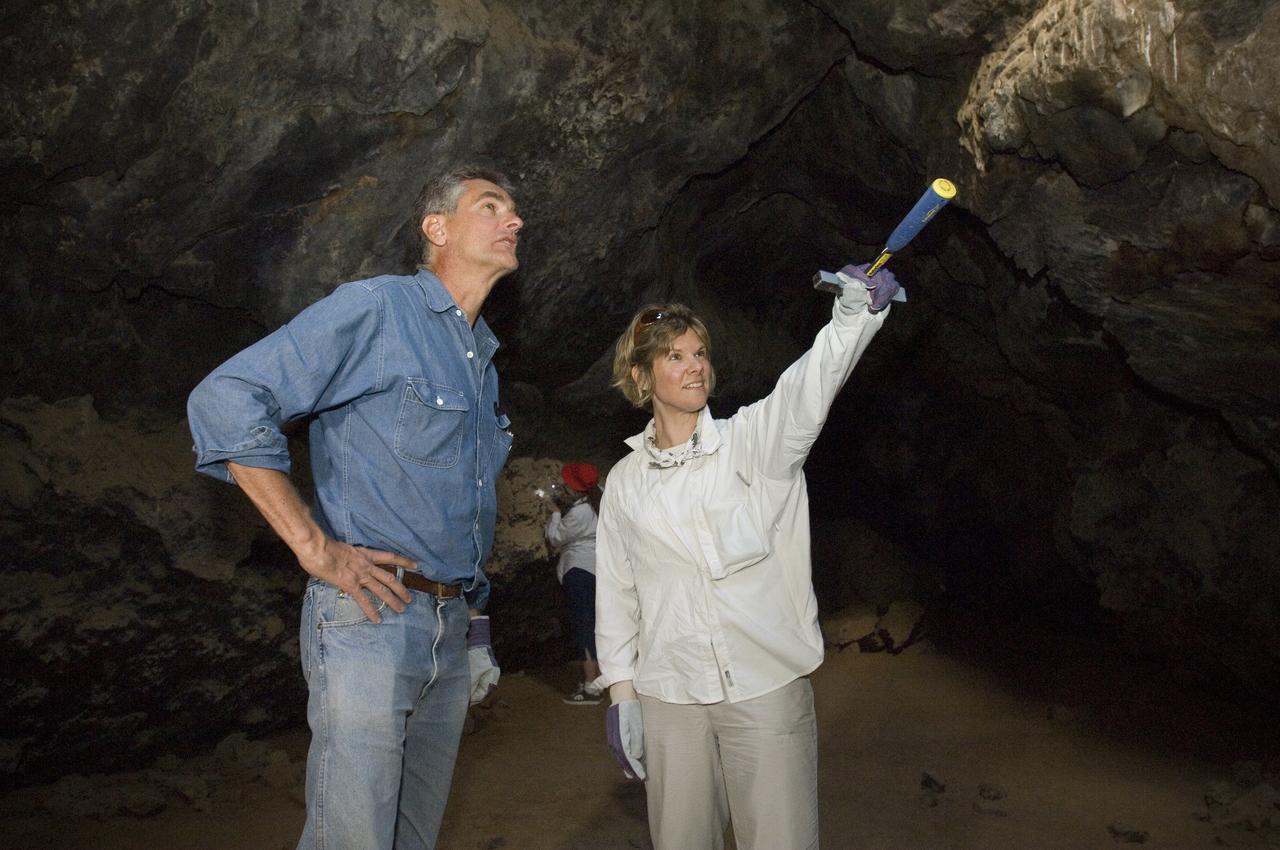
Spaceward Bound event in the Mojave Deser , CA (an outreach exercise) with Dr Chris McKay and Ames Education department personnel Brian Day, Barbara Bazar and a accompaning (learning for the the classroom) team of teachers will be studying side-by-side with NASA scientists who search for life in extreme environments, closely approximating what they expect to find on other planets. Why the Mojave -- an inhospitable, sun-drenched spot in the California Desert? This natural setting presents scientists with opportunities to study environments that are analogous to what explorers will find on the Moon and Mars. Teachers and scientists will perform scientific fieldwork in lunar geology, Mars astrobiology, Mars geology, and issues of temperature and solar inundation and radiation. for additional information and Outreach projects see http://quest.arc.nasa.gov/ shown here are Dr Chris McKay and Monika Kress, Professor of Astronomy at San Jose State University
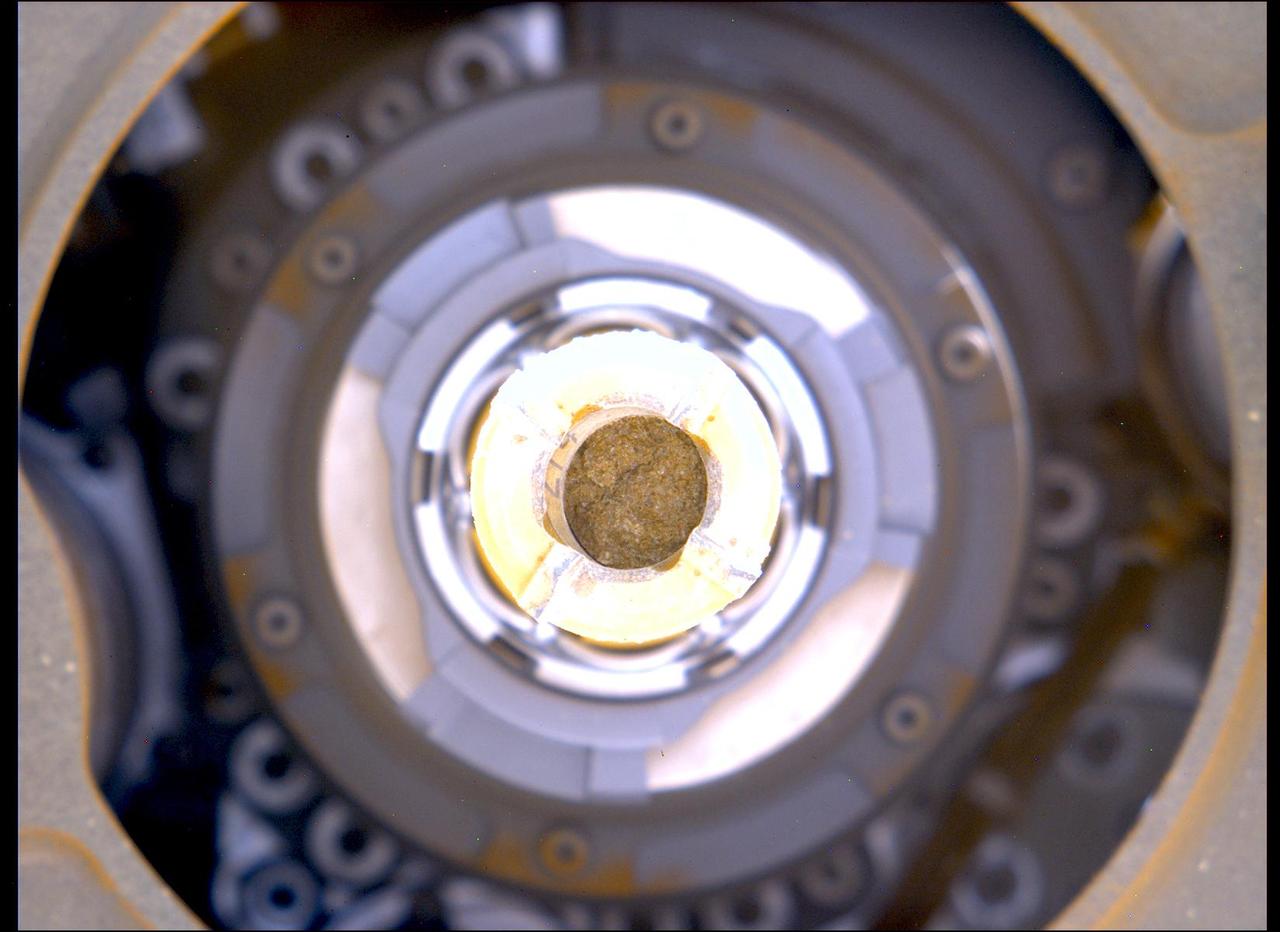
This image shows a cylinder of rock the size of a piece of classroom chalk inside the drill of NASA's Perseverance rover. The sample was taken from an outcrop called "Berea" in Mars' Jezero Crater. The image was captured by Perseverance's Mastcam-Z instrument on March 30, 2023, the 749th Martian day, or sol, of the mission. Each core the rover takes is about 0.5 inches (13 millimeters) in diameter and 2.4 inches (60 millimeters) long. The samples Perseverance has taken are from an ancient river delta in Jezero Crater, a fan-shaped area where, billions of years ago, a river once flowed into a lake and deposited rocks and sediment. These rock cores have been sealed in ultra-clean sample tubes and stored in Perseverance's Sampling and Caching System as part of the mission's search for ancient signs of microbial life. Arizona State University leads the operations of the Mastcam-Z instrument, working in collaboration with Malin Space Science Systems in San Diego, on the design, fabrication, testing, and operation of the cameras, and in collaboration with the Niels Bohr Institute of the University of Copenhagen on the design, fabrication, and testing of the calibration targets. A key objective for Perseverance's mission on Mars is astrobiology, including the search for signs of ancient microbial life. The rover will characterize the planet's geology and past climate, pave the way for human exploration of the Red Planet, and be the first mission to collect and cache Martian rock and regolith (broken rock and dust). Subsequent NASA missions, in cooperation with ESA (European Space Agency), would send spacecraft to Mars to collect these sealed samples from the surface and return them to Earth for in-depth analysis. The Mars 2020 Perseverance mission is part of NASA's Moon to Mars exploration approach, which includes Artemis missions to the Moon that will help prepare for human exploration of the Red Planet. https://photojournal.jpl.nasa.gov/catalog/PIA25690

NASA's Perseverance Mars rover used its Mastcam-Z camera system to capture this view as it was ascending to the rim of Jezero Crater on Dec. 5, 2024, the 1,349th Martian day, or sol, of the mission. The scene shows just how steep some of the slopes leading to the crater rim can be. Arizona State University leads the operations of the Mastcam-Z instrument, working in collaboration with Malin Space Science Systems in San Diego, on the design, fabrication, testing, and operation of the cameras, and in collaboration with the Niels Bohr Institute of the University of Copenhagen on the design, fabrication, and testing of the calibration targets. A key objective for Perseverance's mission on Mars is astrobiology, including the search for signs of ancient microbial life. The rover will characterize the planet's geology and past climate, pave the way for human exploration of the Red Planet, and be the first mission to collect and cache Martian rock and regolith (broken rock and dust). Subsequent NASA missions, in cooperation with ESA (European Space Agency), would send spacecraft to Mars to collect these sealed samples from the surface and return them to Earth for in-depth analysis. The Mars 2020 Perseverance mission is part of NASA's Moon to Mars exploration approach, which includes Artemis missions to the Moon that will help prepare for human exploration of the Red Planet. Animation available at https://photojournal.jpl.nasa.gov/catalog/PIA26475
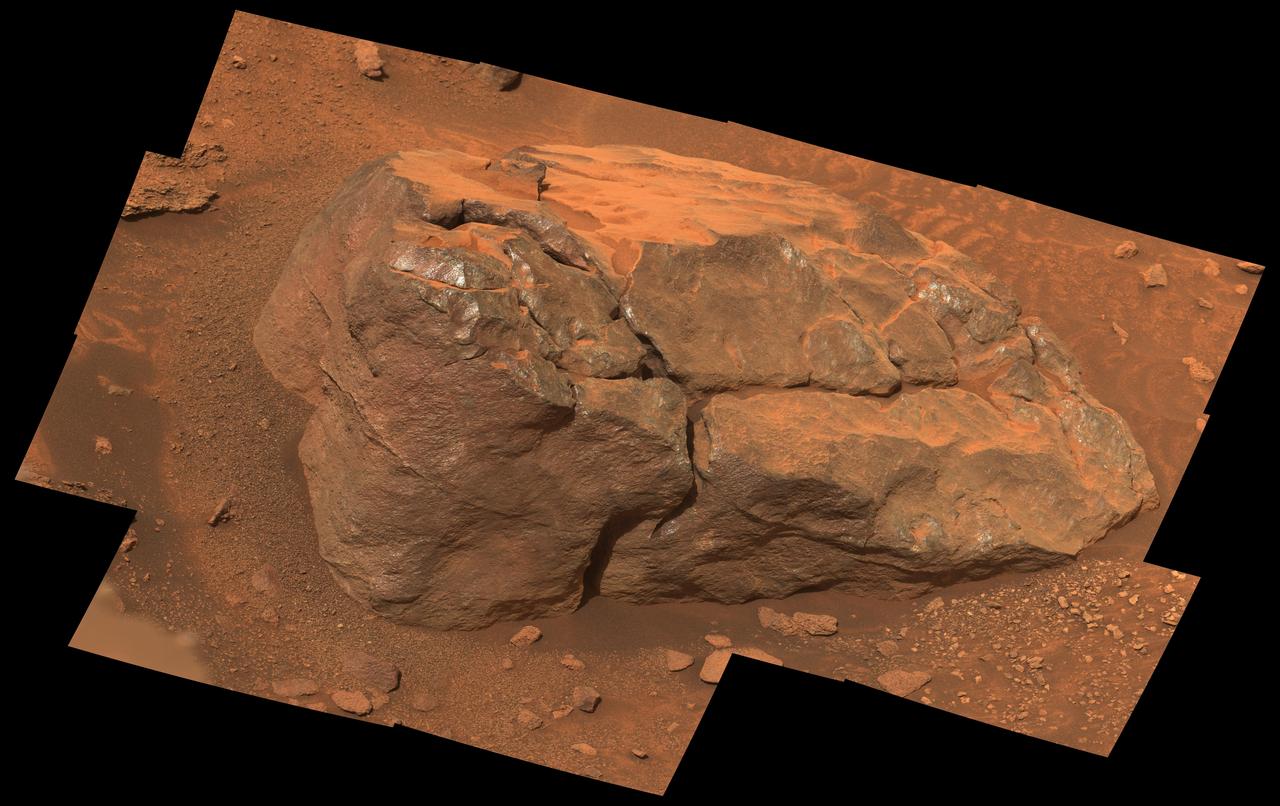
This natural-color, high-resolution mosaic showing "Observation Rock" was taken by the Mastcam-Z instrument on NASA's Perseverance as the rover climbed the western wall of Jezero Crater. The location is near an area the Perseverance science team is calling "Curtis Ridge." The 14 frames used to generate the mosaic were acquired on Oct. 18, 2024, the 1,302nd Martian day, or sol, of Perseverance's mission. Arizona State University leads the operations of the Mastcam-Z instrument, working in collaboration with Malin Space Science Systems in San Diego, on the design, fabrication, testing, and operation of the cameras, and in collaboration with the Niels Bohr Institute of the University of Copenhagen on the design, fabrication, and testing of the calibration targets. A key objective for Perseverance's mission on Mars is astrobiology, including the search for signs of ancient microbial life. The rover will characterize the planet's geology and past climate, pave the way for human exploration of the Red Planet, and be the first mission to collect and cache Martian rock and regolith (broken rock and dust). Subsequent NASA missions, in cooperation with ESA (European Space Agency), would send spacecraft to Mars to collect these sealed samples from the surface and return them to Earth for in-depth analysis. The Mars 2020 Perseverance mission is part of NASA's Moon to Mars exploration approach, which includes Artemis missions to the Moon that will help prepare for human exploration of the Red Planet. https://photojournal.jpl.nasa.gov/catalog/PIA26481
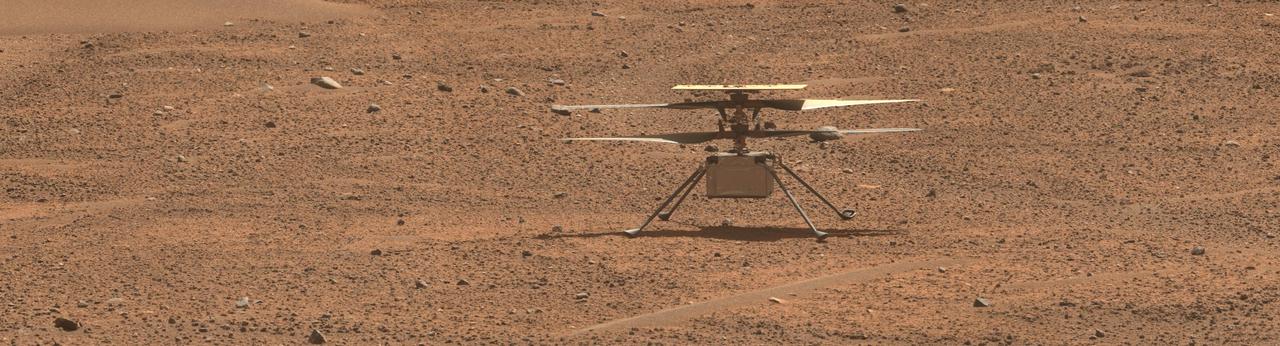
This view of NASA's Ingenuity Mars Helicopter was generated using data collected by the Mastcam-Z instrument aboard the agency's Perseverance Mars rover on Aug. 2, 2023, the 871st Martian day, or sol, of the mission. The image was taken a day before the rotorcraft's 54th flight, and about a week and a half after Flight 53, which was cut short by an unexpected landing. Arizona State University leads the operations of the Mastcam-Z instrument, working in collaboration with Malin Space Science Systems in San Diego, on the design, fabrication, testing, and operation of the cameras, and in collaboration with the Niels Bohr Institute of the University of Copenhagen on the design, fabrication, and testing of the calibration targets. A key objective for Perseverance's mission on Mars is astrobiology, including the search for signs of ancient microbial life. The rover will characterize the planet's geology and past climate, pave the way for human exploration of the Red Planet, and be the first mission to collect and cache Martian rock and regolith (broken rock and dust). Subsequent NASA missions, in cooperation with ESA (European Space Agency), would send spacecraft to Mars to collect these sealed samples from the surface and return them to Earth for in-depth analysis. The Mars 2020 Perseverance mission is part of NASA's Moon to Mars exploration approach, which includes Artemis missions to the Moon that will help prepare for human exploration of the Red Planet. https://photojournal.jpl.nasa.gov/catalog/PIA25968
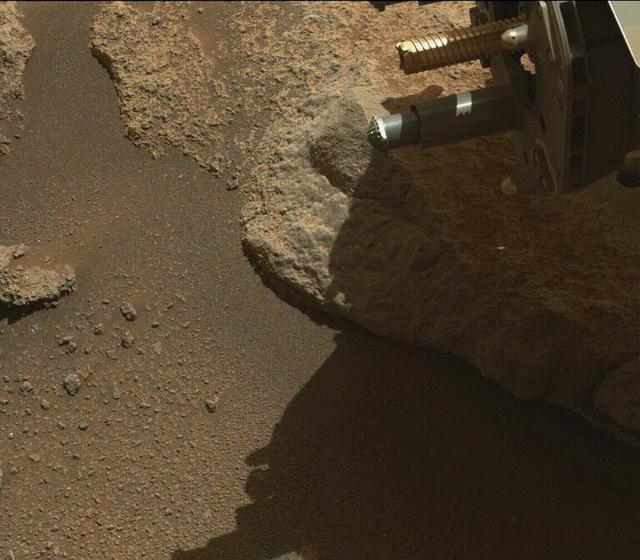
A portion of a cored-rock sample is ejected from the rotary percussive drill on NASA's Perseverance Mars rover. The imagery was collected by the rover's Mastcam-Z instrument on Jan. 15, 2022, the 322nd Martian day, or sol, of the mission, during an experiment that oriented the drill and sample tube (unseen here) around 9 degrees below horizontal and then rotated and extended the drill's spindle. The Mastcam-Z investigation is led and operated by Arizona State University in Tempe, working in collaboration with Malin Space Science Systems in San Diego, California, on the design, fabrication, testing, and operation of the cameras, and in collaboration with the Neils Bohr Institute of the University of Copenhagen on the design, fabrication, and testing of the calibration targets. A key objective for Perseverance's mission on Mars is astrobiology, including the search for signs of ancient microbial life. The rover will characterize the planet's geology and past climate, pave the way for human exploration of the Red Planet, and be the first mission to collect and cache Martian rock and regolith (broken rock and dust). Subsequent NASA missions, in cooperation with ESA (European Space Agency), would send spacecraft to Mars to collect these sealed samples from the surface and return them to Earth for in-depth analysis. The Mars 2020 Perseverance mission is part of NASA's Moon to Mars exploration approach, which includes Artemis missions to the Moon that will help prepare for human exploration of the Red Planet. Animation available at https://photojournal.jpl.nasa.gov/catalog/PIA25072
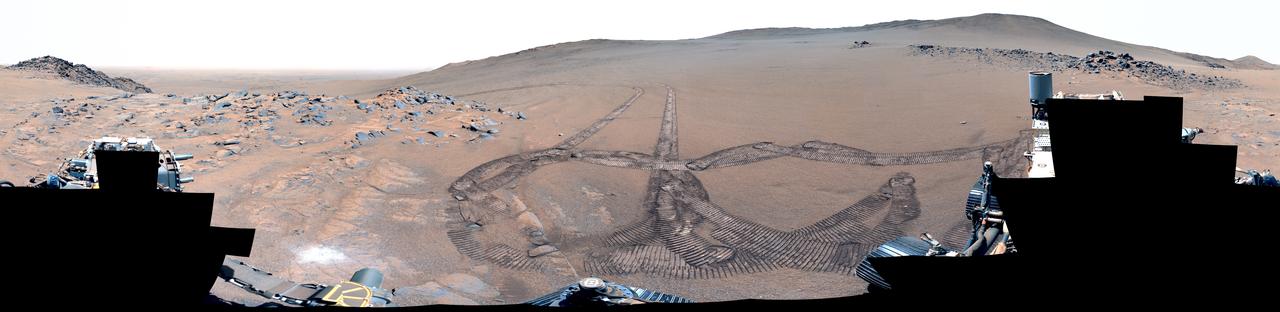
NASA's Perseverance Mars rover used its Mastcam-Z camera to capture this 360-degree panorama of an area nicknamed "Rio Chiquito" on Nov. 23, 2024, the 1,337th Martian day, or sol, of the mission. The rover's tracks can be seen in the center of the image. This enhanced-color version of the image is designed to bring out subtle details. Arizona State University leads the operations of the Mastcam-Z instrument, working in collaboration with Malin Space Science Systems in San Diego, on the design, fabrication, testing, and operation of the cameras, and in collaboration with the Niels Bohr Institute of the University of Copenhagen on the design, fabrication, and testing of the calibration targets. A key objective for Perseverance's mission on Mars is astrobiology, including the search for signs of ancient microbial life. The rover will characterize the planet's geology and past climate, pave the way for human exploration of the Red Planet, and be the first mission to collect and cache Martian rock and regolith (broken rock and dust). Subsequent NASA missions, in cooperation with ESA (European Space Agency), would send spacecraft to Mars to collect these sealed samples from the surface and return them to Earth for in-depth analysis. The Mars 2020 Perseverance mission is part of NASA's Moon to Mars exploration approach, which includes Artemis missions to the Moon that will help prepare for human exploration of the Red Planet. https://photojournal.jpl.nasa.gov/catalog/PIA26474

Composed of 53 images, this mosaic looks west toward the rim of Mars' Jezero Crater on July 8, 2023, the 847th Martian day, or sol, of NASA's Perseverance rover mission. The rover's Mastcam-Z instrument captured the images when Perseverance was about halfway through a boulder field that was 0.6 miles (1 kilometer) wide. Arizona State University leads the operations of the Mastcam-Z instrument, working in collaboration with Malin Space Science Systems in San Diego, on the design, fabrication, testing, and operation of the cameras, and in collaboration with the Niels Bohr Institute of the University of Copenhagen on the design, fabrication, and testing of the calibration targets. A key objective for Perseverance's mission on Mars is astrobiology, including the search for signs of ancient microbial life. The rover will characterize the planet's geology and past climate, pave the way for human exploration of the Red Planet, and be the first mission to collect and cache Martian rock and regolith (broken rock and dust). Subsequent NASA missions, in cooperation with ESA (European Space Agency), would send spacecraft to Mars to collect these sealed samples from the surface and return them to Earth for in-depth analysis. The Mars 2020 Perseverance mission is part of NASA's Moon to Mars exploration approach, which includes Artemis missions to the Moon that will help prepare for human exploration of the Red Planet. https://photojournal.jpl.nasa.gov/catalog/PIA25965

NASA's Perseverance Mars rover used its Mastcam-Z camera to capture Mercury – seen as a tiny speck – passing in front of the Sun on Oct. 28, 2023, the 953th Martian day, or sol, of the mission. The top portion of the GIF zooms in on the upper part of the Sun seen in Mastcam-Z's view; the reticle highlights the planet's transit. The GIF has been sped up 400 times; the portion of Mercury's transit captured by Mastcam-Z took place in just under an hour. Arizona State University leads the operations of the Mastcam-Z instrument, working in collaboration with Malin Space Science Systems in San Diego, on the design, fabrication, testing, and operation of the cameras, and in collaboration with the Niels Bohr Institute of the University of Copenhagen on the design, fabrication, and testing of the calibration targets. A key objective for Perseverance's mission on Mars is astrobiology, including the search for signs of ancient microbial life. The rover will characterize the planet's geology and past climate, pave the way for human exploration of the Red Planet, and be the first mission to collect and cache Martian rock and regolith (broken rock and dust). The Mars 2020 Perseverance mission is part of NASA's Moon to Mars exploration approach, which includes Artemis missions to the Moon that will help prepare for human exploration of the Red Planet. Video available at https://photojournal.jpl.nasa.gov/catalog/PIA26250
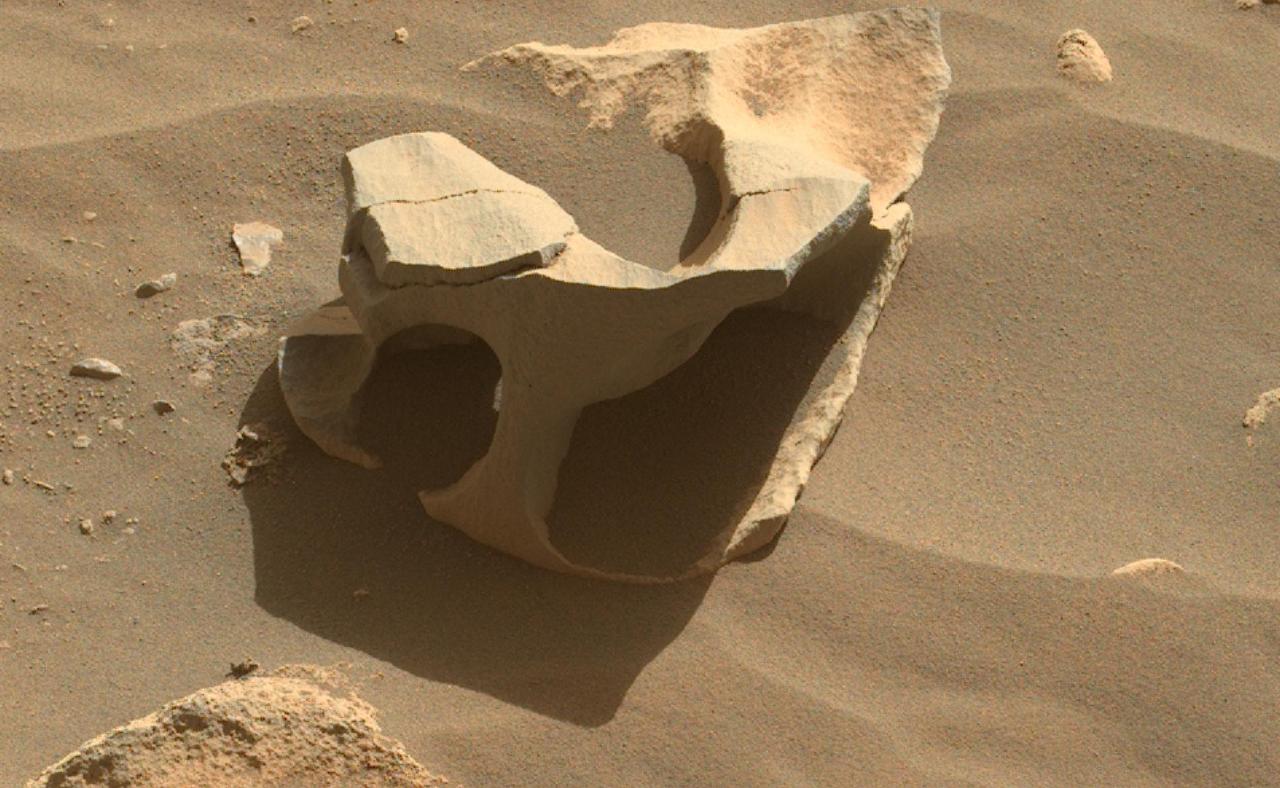
NASA's Perseverance Mars rover spotted this hollowed-out rock in Jezero Crater using its Mastcam-Z instrument on June 26, 2023, the 836th Martian day, or sol, of the mission. Wind can erode all sorts of strange shapes by sandblasting rock surfaces over the course of eons. Arizona State University leads the operations of the Mastcam-Z instrument, working in collaboration with Malin Space Science Systems in San Diego, on the design, fabrication, testing, and operation of the cameras, and in collaboration with the Niels Bohr Institute of the University of Copenhagen on the design, fabrication, and testing of the calibration targets. A key objective for Perseverance's mission on Mars is astrobiology, including the search for signs of ancient microbial life. The rover will characterize the planet's geology and past climate, pave the way for human exploration of the Red Planet, and be the first mission to collect and cache Martian rock and regolith (broken rock and dust). Subsequent NASA missions, in cooperation with ESA (European Space Agency), would send spacecraft to Mars to collect these sealed samples from the surface and return them to Earth for in-depth analysis. The Mars 2020 Perseverance mission is part of NASA's Moon to Mars exploration approach, which includes Artemis missions to the Moon that will help prepare for human exploration of the Red Planet. https://photojournal.jpl.nasa.gov/catalog/PIA25917
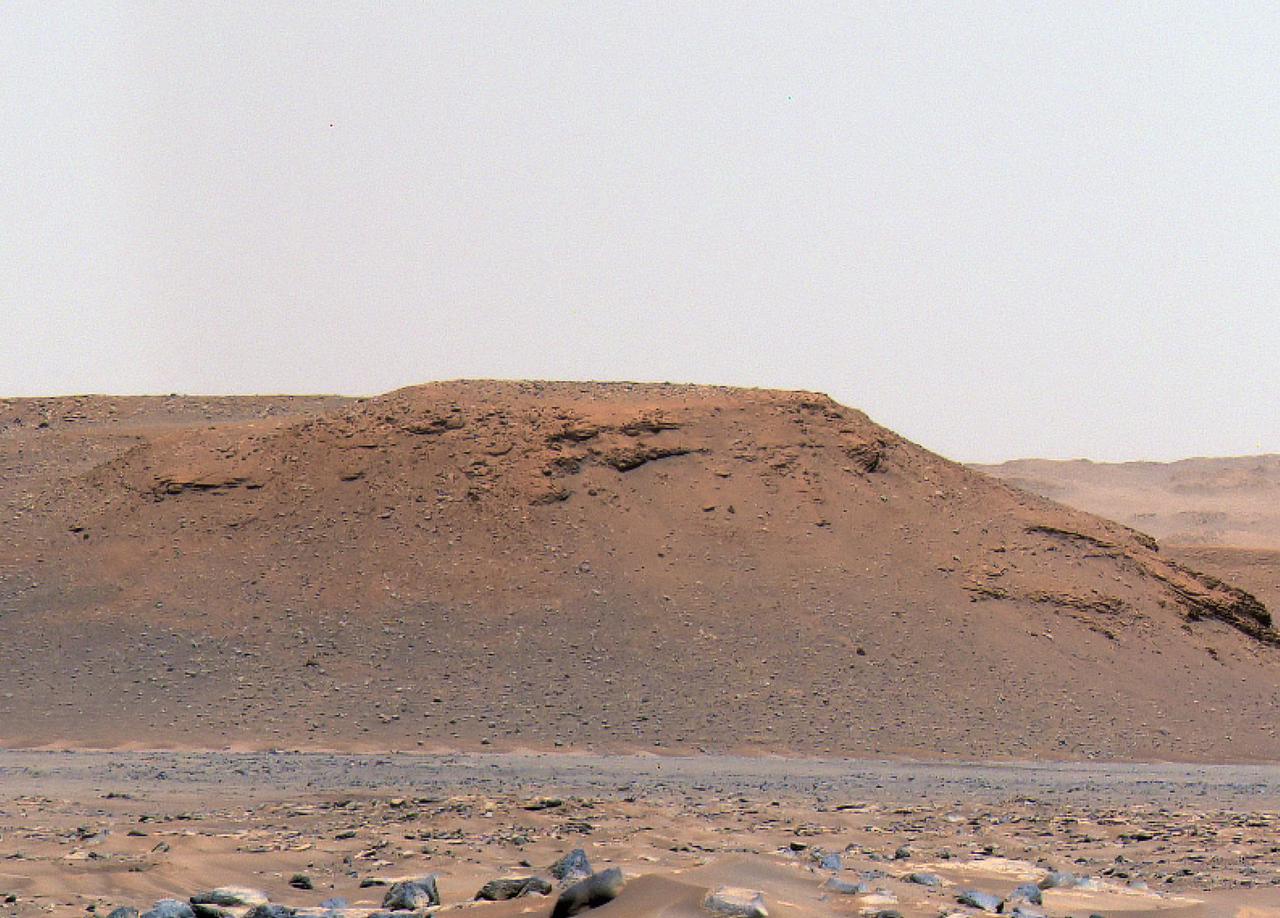
The long, steep slope known as an escarpment, or scarp, along the delta in Mars' Jezero Crater that the science team of NASA's Perseverance rover mission refers to as "Scarp a" is seen in this image captured by the rover's Mastcam-Z instrument on Apr. 17, 2021. The Mastcam-Z investigation is led and operated by Arizona State University in Tempe, working in collaboration with Malin Space Science Systems in San Diego, California, on the design, fabrication, testing, and operation of the cameras, and in collaboration with the Neils Bohr Institute of the University of Copenhagen on the design, fabrication, and testing of the calibration targets. A key objective for Perseverance's mission on Mars is astrobiology, including the search for signs of ancient microbial life. The rover will characterize the planet's geology and past climate, pave the way for human exploration of the Red Planet, and be the first mission to collect and cache Martian rock and regolith (broken rock and dust). Subsequent NASA missions, in cooperation with ESA (European Space Agency), would send spacecraft to Mars to collect these sealed samples from the surface and return them to Earth for in-depth analysis. The Mars 2020 Perseverance mission is part of NASA's Moon to Mars exploration approach, which includes Artemis missions to the Moon that will help prepare for human exploration of the Red Planet. https://photojournal.jpl.nasa.gov/catalog/PIA24813

This close-up image from NASA's Mars Reconnaissance Orbiter gives the impression of looking like bacterial cells and their internal structures which travel and split in the process of life. These features are fractal in nature: the same image is preserved through different scales, with the pattern repeating eternally. The reality is, we are looking at one of Mars' polar regions; the South Polar residual cap to be precise, and, as with many things in Martian planetary science, there is a precise reasoning behind the name. With the coming and going of the seasons, this is an area on Mars where ice remains even after the peak of summer arrives. The texture is very alien, bearing more of a resemblance to the universe of the very small, rather than the universe far, far away. But if this is a polar cap, then why does it not look like the polar caps on Earth? Indeed, there is no equivalent terrain observed here on Earth. The so-called "Swiss cheese terrain, referencing the numerous holes of the region, is a product of seasonal exchange between the surface and the Martian atmosphere. With a predominantly carbon dioxide content at 98 percent, the colder temperatures condense the gas out of the atmosphere to produce dry ice. The prevalence of water is more concentrated in the north, leaving the South polar region more carbon dioxide rich, and it's this difference in composition that generates the unusual texture of the Swiss cheese terrain. The Red Planet is one of the chief candidates in the search for life elsewhere in the Solar System; however, a quick glance at this image virtually gives the impression we have already found it. NB: The cutout image has been rotated so that north is approximately up. https://photojournal.jpl.nasa.gov/catalog/PIA21880
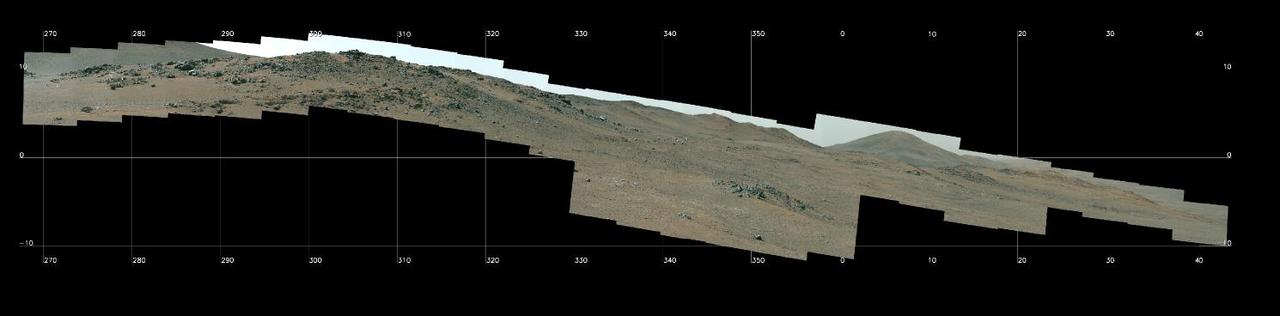
NASA's Perseverance Mars Rover used its Mastcam-Z camera system to capture this panorama of a location nicknamed "Pico Turquino Hills" on Oct. 22, 2024, the 1,306th Martian day, or sol, of the mission. This area is located on the rim of Jezero Crater. Perseverance landed on the crater's floor on Feb. 18, 2021, and has been steadily working its way up and out of the crater since August 2024. The rocks in Pico Turquino Hills are among the oldest yet found by Perseverance, forming in a different geologic era than almost everything the rover has seen before. They're likely part of the original surface that existed before Jezero Crater's formation by a massive asteroid about 3.9 billion years ago. The rocks here are mostly made up of volcanic minerals like olivine, plagioclase, and pyroxene. In the far-right corner of the panorama is a field of white cobbles. This represents the first time Perseverance has encountered pure quartz rock, which may have been created by a hydrothermal system like hot springs – an environment life could have survived in, if any existed on the Red Planet billions of years ago. Arizona State University leads the operations of the Mastcam-Z instrument, working in collaboration with Malin Space Science Systems in San Diego, on the design, fabrication, testing, and operation of the cameras, and in collaboration with the Niels Bohr Institute of the University of Copenhagen on the design, fabrication, and testing of the calibration targets. A key objective for Perseverance's mission on Mars is astrobiology, including the search for signs of ancient microbial life. The rover will characterize the planet's geology and past climate, pave the way for human exploration of the Red Planet, and be the first mission to collect and cache Martian rock and regolith (broken rock and dust). Subsequent NASA missions, in cooperation with ESA (European Space Agency), would send spacecraft to Mars to collect these sealed samples from the surface and return them to Earth for in-depth analysis. The Mars 2020 Perseverance mission is part of NASA's Moon to Mars exploration approach, which includes Artemis missions to the Moon that will help prepare for human exploration of the Red Planet. https://photojournal.jpl.nasa.gov/catalog/PIA26473
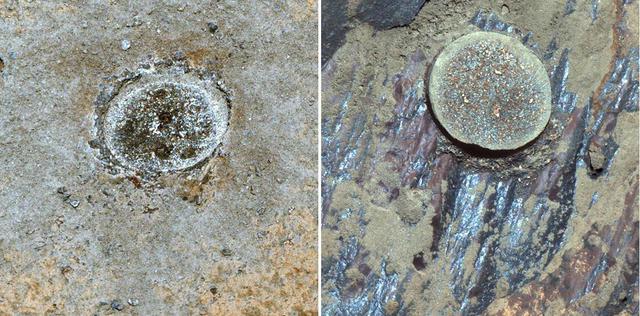
These abrasion targets, nicknamed "Guilliamus" (left) and "Bellegarde" (right), are from the first and second rocks drilled by NASA's Perseverance Mars rover. These images were taken by the rover's Mastcam-Z camera system. The rover abrades rocks using a tool on its robotic arm before drilling them in order to clear away dust and weathering rinds, allowing other instruments to study the rocks and determine if scientists want to grab a sample of them. Arizona State University in Tempe leads the operations of the Mastcam-Z instrument, working in collaboration with Malin Space Science Systems in San Diego. A key objective for Perseverance's mission on Mars is astrobiology, including the search for signs of ancient microbial life. The rover will characterize the planet's geology and past climate, pave the way for human exploration of the Red Planet, and be the first mission to collect and cache Martian rock and regolith (broken rock and dust). Subsequent NASA missions, in cooperation with ESA (European Space Agency), would send spacecraft to Mars to collect these sealed samples from the surface and return them to Earth for in-depth analysis. The Mars 2020 Perseverance mission is part of NASA's Moon to Mars exploration approach, which includes Artemis missions to the Moon that will help prepare for human exploration of the Red Planet. https://photojournal.jpl.nasa.gov/catalog/PIA24769
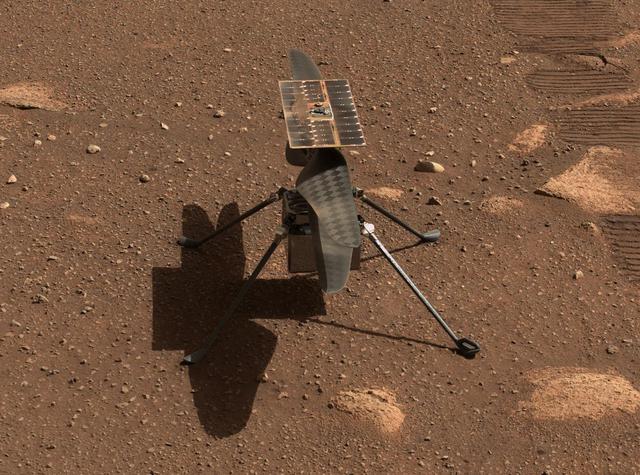
NASA's Ingenuity Mars helicopter is seen here in a close-up taken by Mastcam-Z, a pair of zoomable cameras aboard the Perseverance rover. This image was taken on April 5, the 45th Martian day, or sol, of the mission. The mosaic is not white balanced but is instead displayed in a preliminary calibrated version of a natural color composite, approximately simulating the colors of the scene that we would see if we were there viewing it ourselves. Arizona State University in Tempe leads the operations of the Mastcam-Z instrument, working in collaboration with Malin Space Science Systems in San Diego. A key objective for Perseverance's mission on Mars is astrobiology, including the search for signs of ancient microbial life. The rover will characterize the planet's geology and past climate, pave the way for human exploration of the Red Planet, and be the first mission to collect and cache Martian rock and regolith (broken rock and dust). Subsequent NASA missions, in cooperation with ESA (European Space Agency), would send spacecraft to Mars to collect these sealed samples from the surface and return them to Earth for in-depth analysis. The Mars 2020 Perseverance mission is part of NASA's Moon to Mars exploration approach, which includes Artemis missions to the Moon that will help prepare for human exploration of the Red Planet. https://photojournal.jpl.nasa.gov/catalog/PIA24547
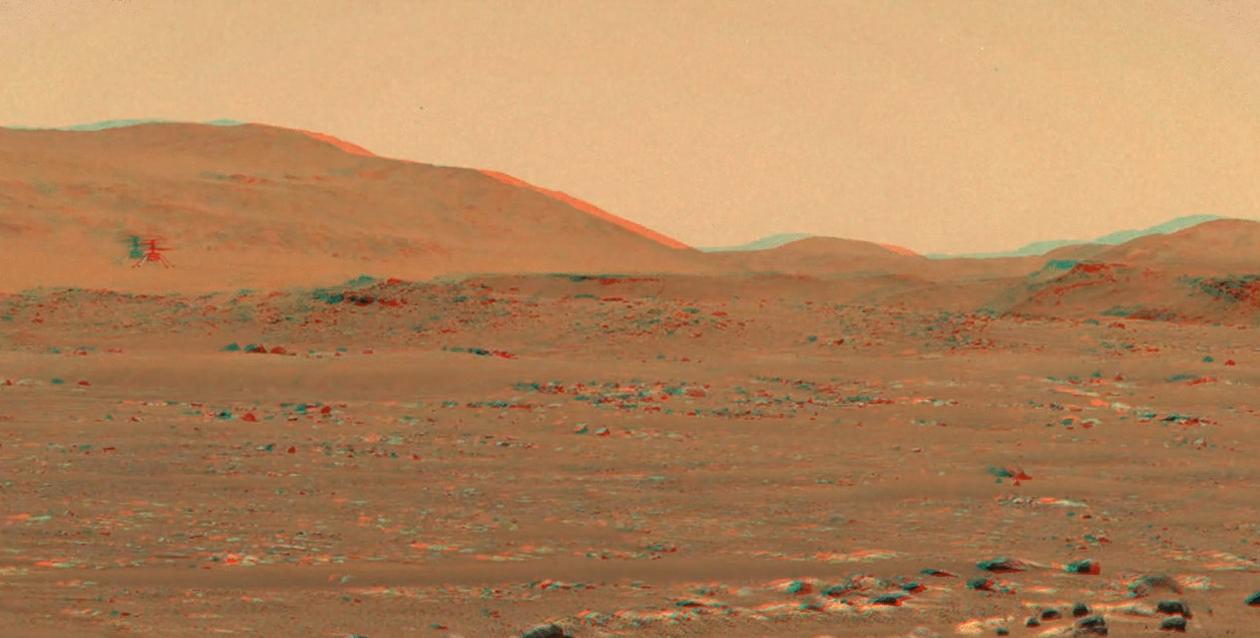
After the zoomable dual-camera Mastcam-Z imager aboard NASA's Perseverance rover captured the third flight of the agency's Ingenuity Mars helicopter on April 25, 2021, Justin Maki, an imaging scientist at NASA's Jet Propulsion Laboratory in Southern California, led the team that stitched the images into a video. The frames of the video were then reprojected to optimize viewing in an anaglyph, or an image seen in 3D when viewed with color-filtered glasses. Arizona State University in Tempe leads the operations of the Mastcam-Z instrument, working in collaboration with Malin Space Science Systems in San Diego. A key objective for Perseverance's mission on Mars is astrobiology, including the search for signs of ancient microbial life. The rover will characterize the planet's geology and past climate, pave the way for human exploration of the Red Planet, and be the first mission to collect and cache Martian rock and regolith (broken rock and dust). Subsequent NASA missions, in cooperation with ESA (European Space Agency), would send spacecraft to Mars to collect these sealed samples from the surface and return them to Earth for in-depth analysis. The Mars 2020 Perseverance mission is part of NASA's Moon to Mars exploration approach, which includes Artemis missions to the Moon that will help prepare for human exploration of the Red Planet. Movie available at https://photojournal.jpl.nasa.gov/catalog/PIA24522
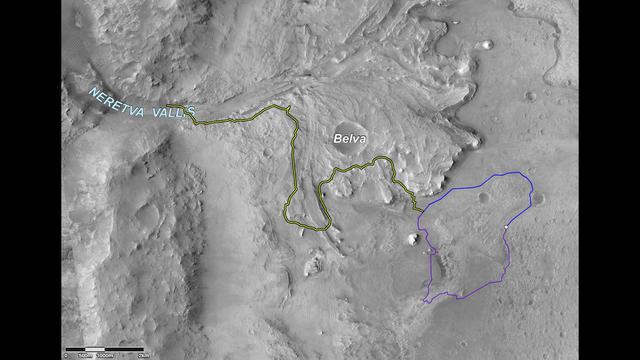
This image shows two possible routes (blue and purple) to the fan-shaped deposit of sediments known as a delta for NASA's Perseverance rover, which landed at the spot marked with a white dot in Mars' Jezero Crater. The yellow line marks a notional traverse exploring the delta. The base image is from the High Resolution Imaging Experiment (HiRISE) camera aboard NASA's Mars Reconnaissance Orbiter (MRO). MRO's mission is managed by NASA's Jet Propulsion Laboratory, a division of Caltech in Pasadena, California, for NASA's Science Mission Directorate. Lockheed Martin Space in Denver built the spacecraft. The University of Arizona in Tucson provided and operates HiRISE. A key objective for Perseverance's mission on Mars is astrobiology, including the search for signs of ancient microbial life. The rover will characterize the planet's geology and past climate, pave the way for human exploration of the Red Planet, and be the first mission to collect and cache Martian rock and regolith (broken rock and dust). Subsequent NASA missions, in cooperation with ESA (European Space Agency), would send spacecraft to Mars to collect these sealed samples from the surface and return them to Earth for in-depth analysis. The Mars 2020 Perseverance mission is part of NASA's Moon to Mars exploration approach, which includes Artemis missions to the Moon that will help prepare for human exploration of the Red Planet. https://photojournal.jpl.nasa.gov/catalog/PIA24486
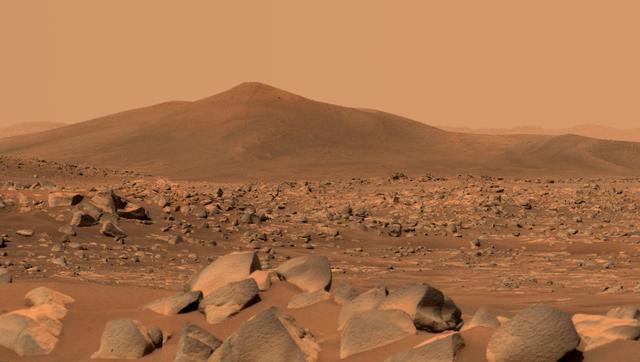
NASA's Perseverance Mars rover used its dual-camera Mastcam-Z imager to capture this image of "Santa Cruz," a hill about 1.5 miles (2.5 kilometers) away from the rover, on April 29, 2021, the 68th Martian day, or sol, of the mission. The entire scene is inside of Mars' Jezero Crater; the crater's rim can be seen on the horizon line beyond the hill. This scene is not white balanced; instead, it is displayed in a preliminary calibrated version of a natural-color composite, approximately simulating the colors of the scene as it would appear to a person on Mars. Arizona State University in Tempe leads the operations of the Mastcam-Z instrument, working in collaboration with Malin Space Science Systems in San Diego. A key objective for Perseverance's mission on Mars is astrobiology, including the search for signs of ancient microbial life. The rover will characterize the planet's geology and past climate, pave the way for human exploration of the Red Planet, and be the first mission to collect and cache Martian rock and regolith (broken rock and dust). Subsequent NASA missions, in cooperation with ESA (European Space Agency), would send spacecraft to Mars to collect these sealed samples from the surface and return them to Earth for in-depth analysis. The Mars 2020 Perseverance mission is part of NASA's Moon to Mars exploration approach, which includes Artemis missions to the Moon that will help prepare for human exploration of the Red Planet. https://photojournal.jpl.nasa.gov/catalog/PIA24546

This image taken by the Mastcam-Z camera aboard NASA's Perseverance Mars rover on Jan. 20, 2022, shows that the rover successfully expelled the remaining large fragments of cored rock from a sample tube held in the drill at the end of its robotic arm. The sample was originally collected by the rover on Dec. 29, 2021, from a rock the team calls "Issole." This image has been processed to enhance contrast. Arizona State University in Tempe leads the operations of the Mastcam-Z instrument, working in collaboration with Malin Space Science Systems in San Diego. A key objective for Perseverance's mission on Mars is astrobiology, including the search for signs of ancient microbial life. The rover will characterize the planet's geology and past climate, pave the way for human exploration of the Red Planet, and be the first mission to collect and cache Martian rock and regolith (broken rock and dust). The Mars 2020 Perseverance mission is part of NASA's Moon to Mars exploration approach, which includes Artemis missions to the Moon that will help prepare for human exploration of the Red Planet. https://photojournal.jpl.nasa.gov/catalog/PIA25073
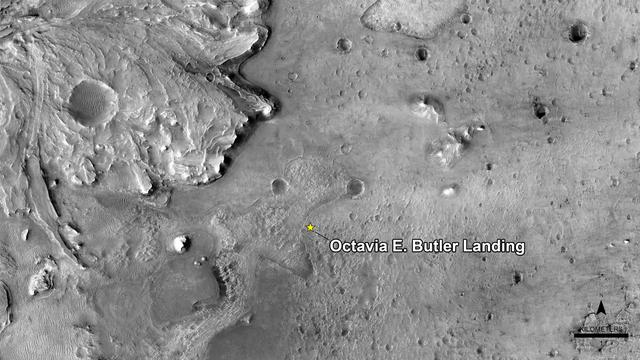
NASA has named the landing site of the agency's Perseverance rover "Octavia E. Butler Landing," after the science fiction author Octavia E. Butler. The landing location is marked with a star in this image from the High Resolution Imaging Experiment (HiRISE) camera aboard NASA's Mars Reconnaissance Orbiter (MRO). MRO's mission is managed by NASA's Jet Propulsion Laboratory, a division of Caltech in Pasadena, California, for NASA's Science Mission Directorate. Lockheed Martin Space in Denver built the spacecraft. The University of Arizona in Tucson provided and operates HiRISE. A key objective for Perseverance's mission on Mars is astrobiology, including the search for signs of ancient microbial life. The rover will characterize the planet's geology and past climate, pave the way for human exploration of the Red Planet, and be the first mission to collect and cache Martian rock and regolith (broken rock and dust). Subsequent NASA missions, in cooperation with ESA (European Space Agency), would send spacecraft to Mars to collect these sealed samples from the surface and return them to Earth for in-depth analysis. The Mars 2020 Perseverance mission is part of NASA's Moon to Mars exploration approach, which includes Artemis missions to the Moon that will help prepare for human exploration of the Red Planet. https://photojournal.jpl.nasa.gov/catalog/PIA24483
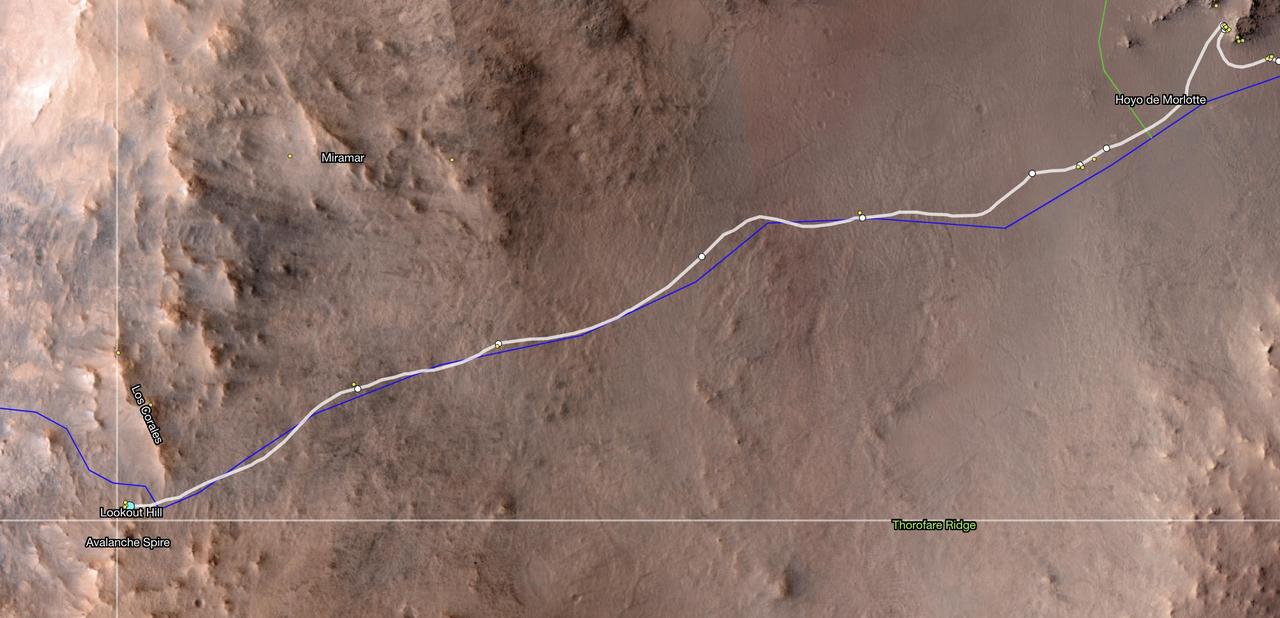
This map shows the location of NASA's Perseverance Mars rover as of Dec. 10, 2024, the 1,354th Martian day, or sol, of the mission, which it reached "Lookout Hill" at the top of Jezero Crater's rim after a monthslong climb. This map was made using data from NASA's Mars Reconnaissance Orbiter's High-Resolution Imaging Science Experiment (HiRISE) camera as well as the European Space Agency's (ESA) High Resolution Stereo Camera (HRSC). The University of Arizona, in Tucson, operates HiRISE, which was built by Ball Aerospace & Technologies Corp., in Boulder, Colorado, NASA's Jet Propulsion Laboratory manages the Mars Reconnaissance Orbiter Project for NASA's Science Mission Directorate, Washington. A key objective for Perseverance's mission on Mars is astrobiology, including the search for signs of ancient microbial life. The rover will characterize the planet's geology and past climate, pave the way for human exploration of the Red Planet, and be the first mission to collect and cache Martian rock and regolith (broken rock and dust). Subsequent NASA missions, in cooperation with ESA (European Space Agency), would send spacecraft to Mars to collect these sealed samples from the surface and return them to Earth for in-depth analysis. The Mars 2020 Perseverance mission is part of NASA's Moon to Mars exploration approach, which includes Artemis missions to the Moon that will help prepare for human exploration of the Red Planet. https://photojournal.jpl.nasa.gov/catalog/PIA26512
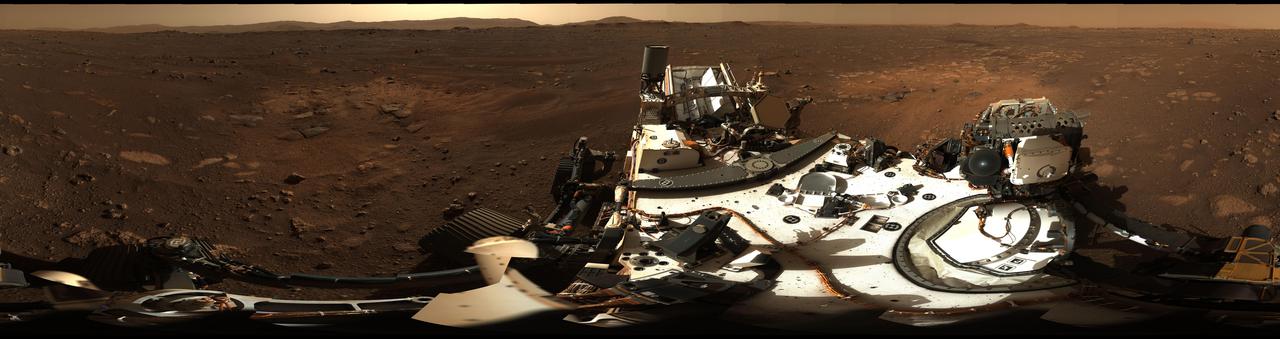
This is the first 360-degree panorama taken by Mastcam-Z, a zoomable pair of cameras aboard NASA's Perseverance Mars rover. The panorama was stitched together on Earth from 142 individual images taken on Sol 3, the third Martian day of the mission (Feb. 21, 2021). Annotated versions of this panorama include a scale bar and close-ups of rock features seen in the distance. A detail shot from the top of the panorama shows the rim of Jezero Crater, Perseverance's landing site. Arizona State University in Tempe leads the operations of the Mastcam-Z instrument, working in collaboration with Malin Space Science Systems in San Diego. A key objective for Perseverance's mission on Mars is astrobiology, including the search for signs of ancient microbial life. The rover will characterize the planet's geology and past climate, pave the way for human exploration of the Red Planet, and be the first mission to collect and cache Martian rock and regolith (broken rock and dust). Subsequent NASA missions, in cooperation with ESA (European Space Agency), would send spacecraft to Mars to collect these sealed samples from the surface and return them to Earth for in-depth analysis. https://photojournal.jpl.nasa.gov/catalog/PIA24264
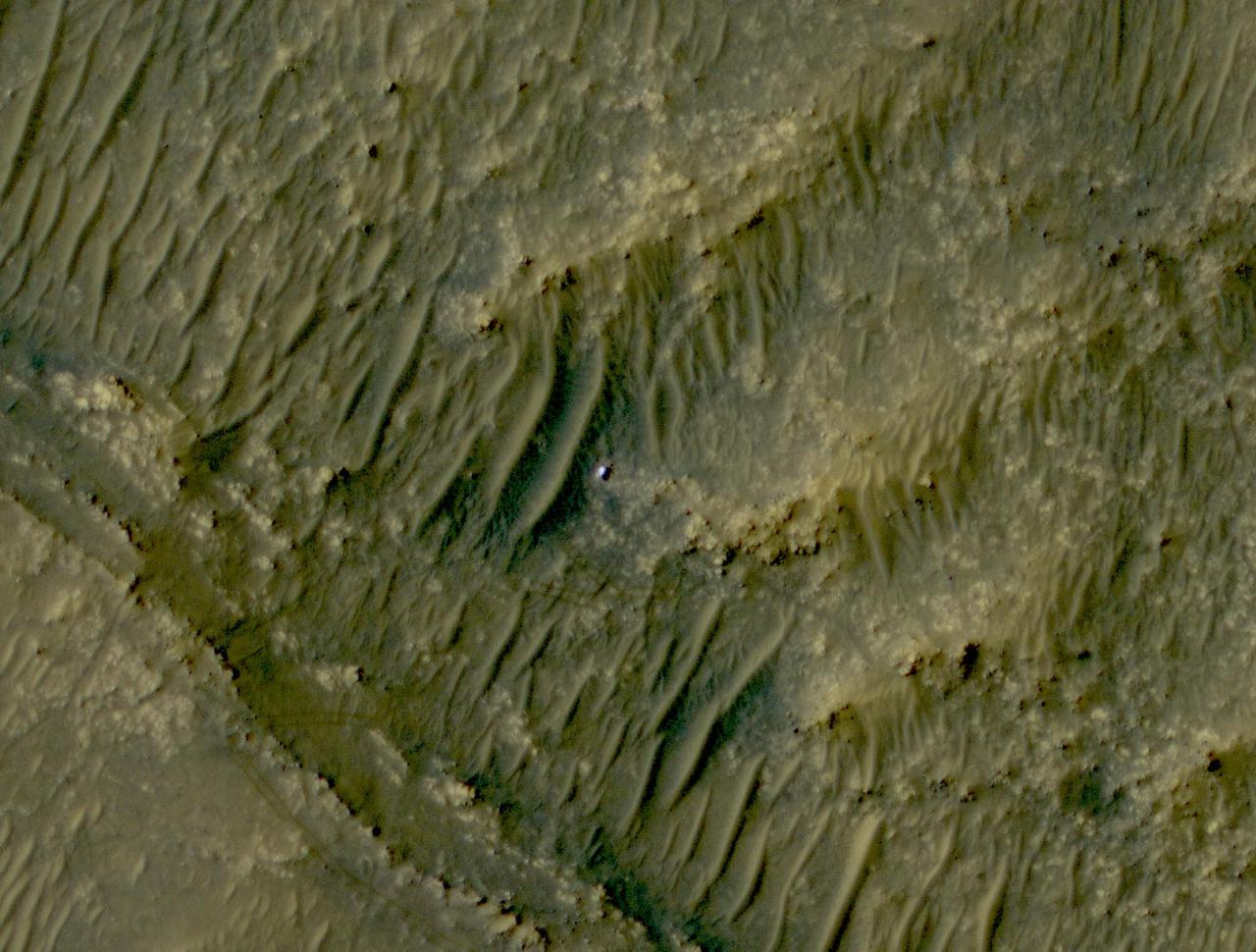
The white speck is NASA's Perseverance rover in the "South Séítah" area of Mars' Jezero Crater. The image was taken by the agency's Mars Reconnaissance Orbiter using its High-Resolution Imaging Science Experiment, or HiRISE, camera. The University of Arizona, in Tucson, operates HiRISE, which was built by Ball Aerospace & Technologies Corp., in Boulder, Colorado. NASA's Jet Propulsion Laboratory, a division of Caltech in Pasadena, California, manages the Mars Reconnaissance Orbiter Project for NASA's Science Mission Directorate in Washington. A key objective for Perseverance's mission on Mars is astrobiology, including the search for signs of ancient microbial life. The rover will characterize the planet's geology and past climate, pave the way for human exploration of the Red Planet, and be the first mission to collect and cache Martian rock and regolith (broken rock and dust). Subsequent NASA missions, in cooperation with ESA (European Space Agency), would send spacecraft to Mars to collect these sealed samples from the surface and return them to Earth for in-depth analysis. The Mars 2020 Perseverance mission is part of NASA's Moon to Mars exploration approach, which includes Artemis missions to the Moon that will help prepare for human exploration of the Red Planet. https://photojournal.jpl.nasa.gov/catalog/PIA24837
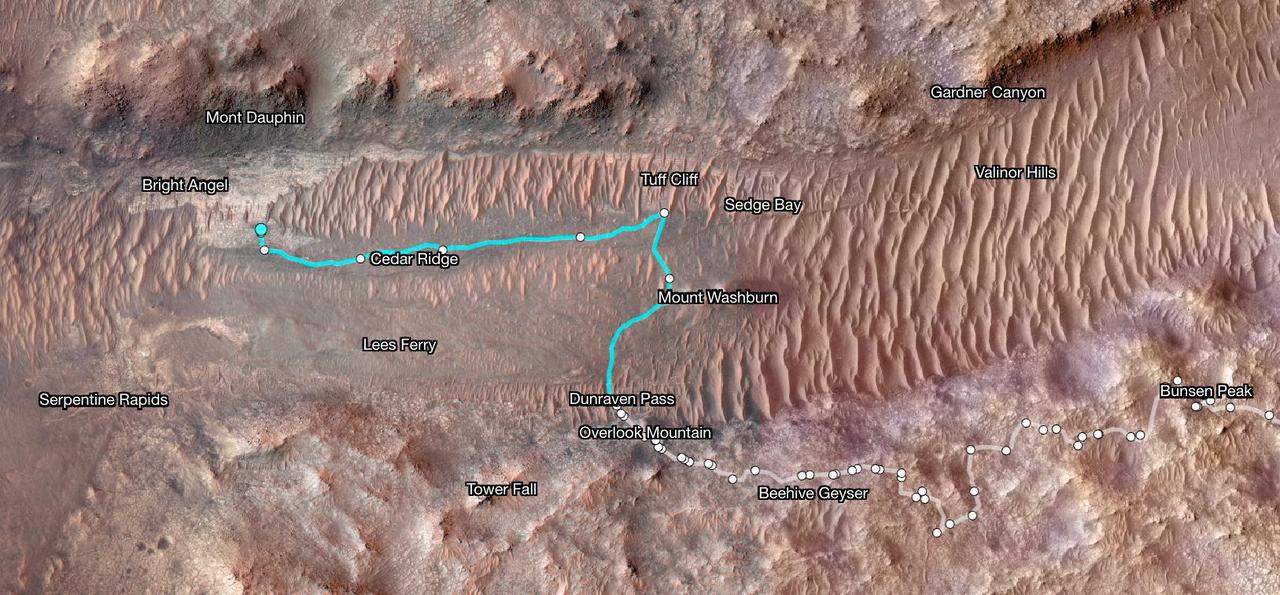
Superimposed on an image taken by the HiRISE camera aboard NASA's Mars Reconnaissance Orbiter, this map shows the path taken by the agency's Perseverance Mars rover between Jan. 31, 2024, and June 11, shortly after it arrived at a geologic area of interest the science team calls "Bright Angel." The route where the rover paralleled the Neretva Vallis river channel is depicted in white. The portion of the route where the rover was inside the river channel is depicted in pale blue. The dots along the white line signify locations where the rover stopped after completing a traverse. The University of Arizona, in Tucson, operates HiRISE, which was built by BAE Systems, in Boulder, Colorado. JPL manages the Mars Reconnaissance Orbiter Project for NASA's Science Mission Directorate, Washington. A key objective for Perseverance's mission on Mars is astrobiology, including the search for signs of ancient microbial life. The rover will characterize the planet's geology and past climate, pave the way for human exploration of the Red Planet, and be the first mission to collect and cache Martian rock and regolith (broken rock and dust). Subsequent NASA missions, in cooperation with ESA (European Space Agency), would send spacecraft to Mars to collect these sealed samples from the surface and return them to Earth for in-depth analysis. https://photojournal.jpl.nasa.gov/catalog/PIA26334
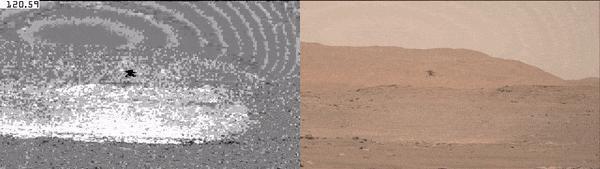
NASA's Ingenuity Mars Helicopter is seen here at the end of its fourth flight, on April 30, 2021. This enhanced video shows the dust kicked up by the helicopter's spinning rotors. Scientists can analyze this dust to learn more about the Martian environment. This video was captured by the Mastcam-Z imager aboard NASA's Perseverance rover. Two files are available for the Mastcam-Z's left and right eyes. The files are available as both mp4s and GIFs. Arizona State University in Tempe leads the operations of the Mastcam-Z instrument, working in collaboration with Malin Space Science Systems in San Diego. A key objective for Perseverance's mission on Mars is astrobiology, including the search for signs of ancient microbial life. The rover will characterize the planet's geology and past climate, pave the way for human exploration of the Red Planet, and be the first mission to collect and cache Martian rock and regolith (broken rock and dust). Subsequent NASA missions, in cooperation with ESA (European Space Agency), would send spacecraft to Mars to collect these sealed samples from the surface and return them to Earth for in-depth analysis. The Mars 2020 Perseverance mission is part of NASA's Moon to Mars exploration approach, which includes Artemis missions to the Moon that will help prepare for human exploration of the Red Planet. Movies available at https://photojournal.jpl.nasa.gov/catalog/PIA24666
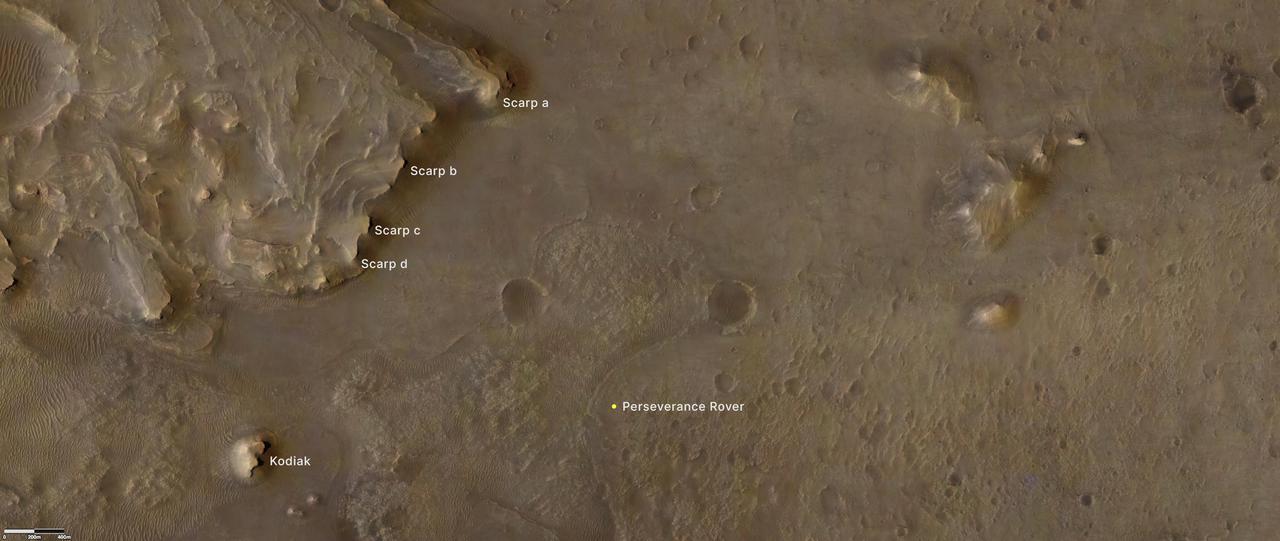
Provided by the High Resolution Imaging Experiment (HiRISE) aboard NASA's Mars Reconnaissance orbiter, this overhead image captures a portion of Mars' Jezero Crater. The yellow dot on lower right indicates the location of NASA's Perseverance rover. The remnant of Jezero Crater's rover delta the science team refers to as "Kodiak" is to the lower left. Long, steep slopes, called scarps, along the delta are on the upper left, labeled A through D. The University of Arizona, in Tucson, operates HiRISE, which was built by Ball Aerospace & Technologies Corp., in Boulder, Colorado. NASA's Jet Propulsion Laboratory, a division of Caltech in Pasadena, California, manages the Mars Reconnaissance Orbiter Project for NASA's Science Mission Directorate, Washington. A key objective for Perseverance's mission on Mars is astrobiology, including the search for signs of ancient microbial life. The rover will characterize the planet's geology and past climate, pave the way for human exploration of the Red Planet, and be the first mission to collect and cache Martian rock and regolith. The Mars 2020 Perseverance mission is part of NASA's Moon to Mars exploration approach, which includes Artemis missions to the Moon that will help prepare for human exploration of the Red Planet. Subsequent NASA missions, in cooperation with ESA (European Space Agency), would send spacecraft to Mars to collect these sealed samples from the surface and return them to Earth for in-depth analysis. https://photojournal.jpl.nasa.gov/catalog/PIA24814

This Mastcam-Z image shows Perseverance's drill with no cored-rock sample evident in the sample tube. The image was taken on Sept. 1, 2021 (the 190th sol, or Martian day, of the mission), after coring – and after a cleaning operation was performed to clear the sample tube's lip of any residual material. The bronze-colored ring is the coring bit. The half-moon inside the bit is the open end of the sample tube. A portion of the tube's serial number – 266 – can be seen on the left side of tube's rim. Arizona State University in Tempe leads the operations of the Mastcam-Z instrument, working in collaboration with Malin Space Science Systems in San Diego. A key objective for Perseverance's mission on Mars is astrobiology, including the search for signs of ancient microbial life. The rover will characterize the planet's geology and past climate, pave the way for human exploration of the Red Planet, and be the first mission to collect and cache Martian rock and regolith (broken rock and dust). Subsequent NASA missions, in cooperation with ESA (European Space Agency), would send spacecraft to Mars to collect these sealed samples from the surface and return them to Earth for in-depth analysis. The Mars 2020 Perseverance mission is part of NASA's Moon to Mars exploration approach, which includes Artemis missions to the Moon that will help prepare for human exploration of the Red Planet. https://photojournal.jpl.nasa.gov/catalog/PIA24803
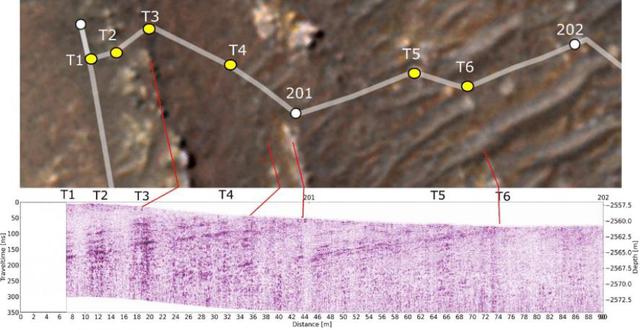
This annotated-composite graphic shows the entry of NASA's Perseverance rover into the "South Séítah" geologic unit from both an orbital and subsurface perspective. The annotated view from NASA's Mars Reconnaissance Orbitor (MRO) depicts the route Perseverance took into Séítah. The image was provided by MRO's High Resolution Imaging Experiment (HiRISE). The graphic below the orbital image is the first "radargram" to be released by the Radar Imager for Mars' Subsurface Experiment (RIMFAX) instrument aboard Perseverance. It shows the subsurface as the rover drove across the "Artuby" ridgeline. The red lines link bright subsurface "reflectors" to erosion-resistant layers outcropping at the surface. The University of Arizona, in Tucson, operates HiRISE, which was built by Ball Aerospace & Technologies Corp., in Boulder, Colorado. NASA's Jet Propulsion Laboratory, a division of Caltech in Pasadena, California, manages the Mars Reconnaissance Orbiter Project for NASA's Science Mission Directorate, Washington. A key objective for Perseverance's mission on Mars is astrobiology, including the search for signs of ancient microbial life. The rover will characterize the planet's geology and past climate, pave the way for human exploration of the Red Planet, and be the first mission to collect and cache Martian rock and regolith (broken rock and dust). Subsequent NASA missions, in cooperation with ESA (European Space Agency), would send spacecraft to Mars to collect these sealed samples from the surface and return them to Earth for in-depth analysis. https://photojournal.jpl.nasa.gov/catalog/PIA25025

The route (shown in blue) that the agency's Perseverance Mars rover is expected to take as it climbs up the western rim of Jezero Crater is superimposed on this image taken by the HiRISE camera aboard NASA's Mars Reconnaissance Orbiter. At upper right is "Serpentine Rapids," the final geologic location of interest for the Perseverance science team before the rover begins its ascent. "Dox Castle" is a region the science team would like to explore during the rover's ascent. Two of the first regions the science team wants study at the top of the crater are "Pico Turquino" and "Witch Hazel Hill." Imagery from NASA's Mars orbiters indicates that Pico Turquino contains ancient fractures that may have been caused by hydrothermal activity in the distant past. Orbital views of Witch Hazel show layered materials that likely date from a time when Mars had a very different climate than today. Those views have revealed light-toned bedrock similar to what was found at "Bright Angel," the area where Perseverance recently discovered and sampled the "Cheyava Falls" rock, which exhibits chemical signatures and structures that could possibly have been formed by life billions of years ago when the area contained running water. The distance the rover will drive to get from Serpentine Rapids to the Aurora Park/Pico Turquino area is about 1.1 miles (1.8 kilometers); the change in elevation between the two locations is about 980 feet (300 meters). The distance covered to go from Aurora Park/Pico Turquino to Witch Hazel Hill is about 1.2 miles (2,000 meters) and the change in elevation is about 820 feet (250 meters). The University of Arizona, in Tucson, operates HiRISE, which was built by BAE Systems, in Boulder, Colorado. JPL manages the Mars Reconnaissance Orbiter Project for NASA's Science Mission Directorate, Washington. A key objective for Perseverance's mission on Mars is astrobiology, including the search for signs of ancient microbial life. The rover will characterize the planet's geology and past climate, pave the way for human exploration of the Red Planet, and be the first mission to collect and cache Martian rock and regolith (broken rock and dust). https://photojournal.jpl.nasa.gov/catalog/PIA26374
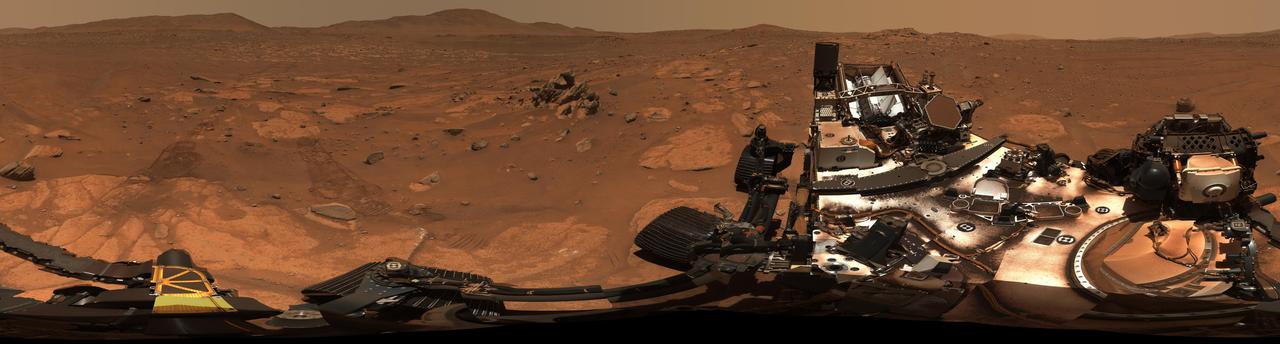
Composed of 993 individual images and 2.38 billion pixels, this 360-degree mosaic taken by NASA's Perseverance looks in all directions from a location the rover science team calls "Airey Hill." The rover remained parked at Airey Hill during the entirety of solar conjunction. Captured by the rover's Mastcam-Z, the images used to create the mosaic were acquired on Nov. 3, Nov. 4, and Nov. 6, 2023, the 962nd, 963rd, and 965th Martian day, or sol, of the rover's mission. The main image is a natural color version at half-resolution. Arizona State University leads the operations of the Mastcam-Z instrument, working in collaboration with Malin Space Science Systems in San Diego, on the design, fabrication, testing, and operation of the cameras, and in collaboration with the Niels Bohr Institute of the University of Copenhagen on the design, fabrication, and testing of the calibration targets. A key objective for Perseverance's mission on Mars is astrobiology, including the search for signs of ancient microbial life. The rover will characterize the planet's geology and past climate, pave the way for human exploration of the Red Planet, and be the first mission to collect and cache Martian rock and regolith (broken rock and dust). Subsequent NASA missions, in cooperation with ESA (European Space Agency), would send spacecraft to Mars to collect these sealed samples from the surface and return them to Earth for in-depth analysis. The Mars 2020 Perseverance mission is part of NASA's Moon to Mars exploration approach, which includes Artemis missions to the Moon that will help prepare for human exploration of the Red Planet. https://photojournal.jpl.nasa.gov/catalog/PIA26080

This sunset on Mars was captured by NASA's Perseverance Mars rover using its Mastcam-Z camera system on Nov. 9, 2021, the 257th Martian day, or sol, of the mission. Martian sunsets typically stand out for their distinctive blue color. Fine dust in the atmosphere permits blue light to penetrate the atmosphere more efficiently than colors with longer wavelengths. But this sunset looks different: less dust in the atmosphere resulted in a more muted color than average. The color has been calibrated and white-balanced to remove camera artifacts. The Mastcam-Z investigation is led and operated by Arizona State University in Tempe, working in collaboration with Malin Space Science Systems in San Diego, California, on the design, fabrication, testing, and operation of the cameras, and in collaboration with the Neils Bohr Institute of the University of Copenhagen on the design, fabrication, and testing of the calibration targets. A key objective for Perseverance's mission on Mars is astrobiology, including the search for signs of ancient microbial life. The rover will characterize the planet's geology and past climate, pave the way for human exploration of the Red Planet, and be the first mission to collect and cache Martian rock and regolith (broken rock and dust). Subsequent NASA missions, in cooperation with ESA (European Space Agency), would send spacecraft to Mars to collect these sealed samples from the surface and return them to Earth for in-depth analysis. The Mars 2020 Perseverance mission is part of NASA's Moon to Mars exploration approach, which includes Artemis missions to the Moon that will help prepare for human exploration of the Red Planet. https://photojournal.jpl.nasa.gov/catalog/PIA24935
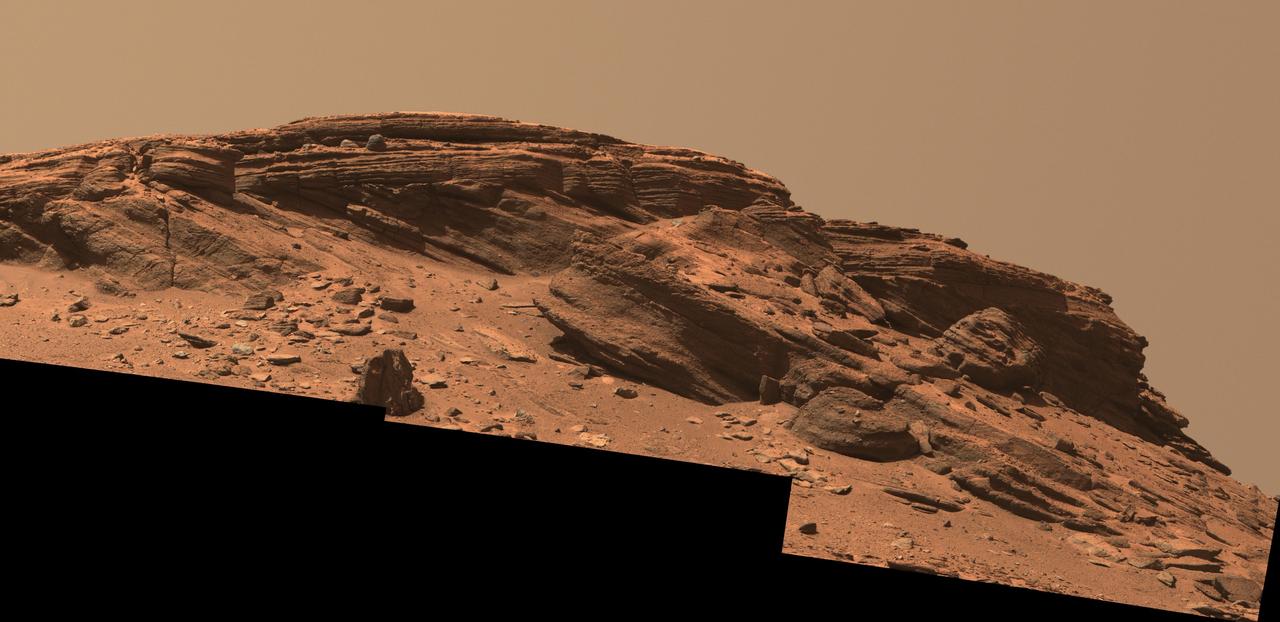
Sedimentary layers at "Franklin Cliffs" are displayed in a mosaic captured by NASA's Perseverance Mars rover using its Mastcam-Z camera on Feb. 12, 2023, the 704th Martian day, or sol, of the mission. The mosaic is made up of three individual images that were stitched together after being sent back from Mars. This natural color view is approximately how the scene would appear to an average person if they were on Mars. Franklin Cliffs, along with other locations like "Skrinkle Haven" and "Pinestand" may have been created as sediment built up here in an ancient river or delta. Arizona State University leads the operations of the Mastcam-Z instrument, working in collaboration with Malin Space Science Systems in San Diego, on the design, fabrication, testing, and operation of the cameras, and in collaboration with the Niels Bohr Institute of the University of Copenhagen on the design, fabrication, and testing of the calibration targets. A key objective for Perseverance's mission on Mars is astrobiology, including the search for signs of ancient microbial life. The rover will characterize the planet's geology and past climate, pave the way for human exploration of the Red Planet, and be the first mission to collect and cache Martian rock and regolith (broken rock and dust). Subsequent NASA missions, in cooperation with ESA (European Space Agency), would send spacecraft to Mars to collect these sealed samples from the surface and return them to Earth for in-depth analysis. The Mars 2020 Perseverance mission is part of NASA's Moon to Mars exploration approach, which includes Artemis missions to the Moon that will help prepare for human exploration of the Red Planet. https://photojournal.jpl.nasa.gov/catalog/PIA25911
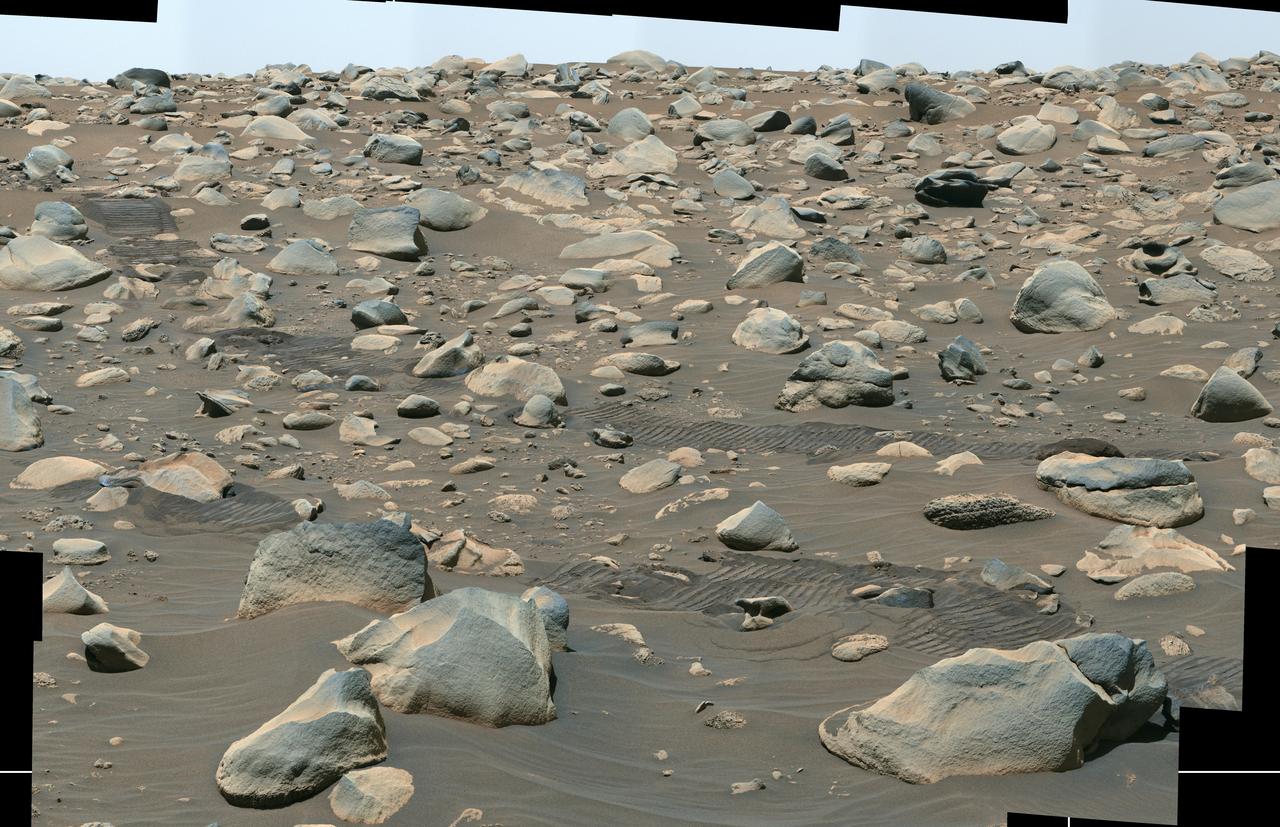
This composite image captured by NASA's Perseverance Mars rover shows boulders that decorate the top of the Jezero Crater fan deposit. Rover tracks across the middle of the image give a sense of scale. These boulders were transported by water that was either deeper or flowed faster than the ancient waterway that deposited the smaller pebbles that also populate the area. Because these boulders are sitting on top of the pebbles, scientists believe they arrived later, possibly much later. Perseverance's Mastcam-Z camera system took the series of images that make up this composite on July 6, 2023, the 845th day, or sol, of the rover's mission to Mars. Arizona State University leads the operations of the Mastcam-Z instrument, working in collaboration with Malin Space Science Systems in San Diego, on the design, fabrication, testing, and operation of the cameras, and in collaboration with the Niels Bohr Institute of the University of Copenhagen on the design, fabrication, and testing of the calibration targets. A key objective for Perseverance's mission on Mars is astrobiology, including the search for signs of ancient microbial life. The rover will characterize the planet's geology and past climate, pave the way for human exploration of the Red Planet, and be the first mission to collect and cache Martian rock and regolith (broken rock and dust). Subsequent NASA missions, in cooperation with ESA (European Space Agency), would send spacecraft to Mars to collect these sealed samples from the surface and return them to Earth for in-depth analysis. The Mars 2020 Perseverance mission is part of NASA's Moon to Mars exploration approach, which includes Artemis missions to the Moon that will help prepare for human exploration of the Red Planet. https://photojournal.jpl.nasa.gov/catalog/PIA25963
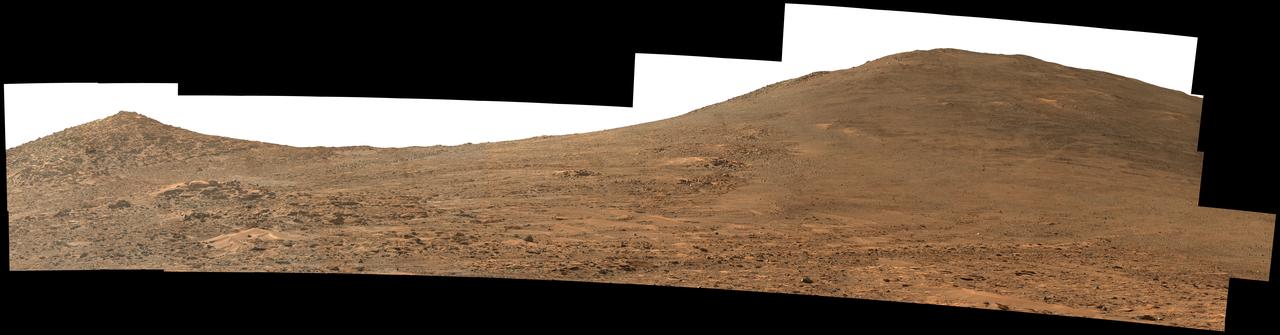
NASA's Perseverance Mars rover used its Mastcam-Z instrument to capture this view looking south toward the rim of Jezero Crater. The panorama, which encompasses 80 degrees, is made up of 59 individual images. They were captured on Aug. 4, 2024, the 1,229th Martian day, or sol, of the mission, and stitched together after being sent back to Earth. The color has been enhanced to bring out subtle details. "Dox Castle," a region the Perseverance science team wants to visit during the rover's climb up the crater rim, is about a half-mile (740 meters) away, on the left side of the hill at right. After the exploration of Dox Castle is complete, the rover will continue its climb up the crater rim, taking a route somewhere in between the two hills. Arizona State University leads the operations of the Mastcam-Z instrument, working in collaboration with Malin Space Science Systems in San Diego, on the design, fabrication, testing, and operation of the cameras, and in collaboration with the Niels Bohr Institute of the University of Copenhagen on the design, fabrication, and testing of the calibration targets. A key objective for Perseverance's mission on Mars is astrobiology, including the search for signs of ancient microbial life. The rover will characterize the planet's geology and past climate, pave the way for human exploration of the Red Planet, and be the first mission to collect and cache Martian rock and regolith (broken rock and dust). https://photojournal.jpl.nasa.gov/catalog/PIA26373

The image on the left is an enhanced-color image taken by the Mastcam-Z imager aboard NASA's Perseverance rover of a rocky outcrop in the "Séítah" geologic unit of Jezero Crater. In the background, a portion of Jezero's ancient river delta can be made out. The image on the right is a mineral map created using Mastcam-Z's multispectral-imaging capability. Olivine is shown in red. Calcium-poor pyroxene is in green. Calcium-rich pyroxene in blue. Séítah rocks contain abundant olivine, and the regolith, or broken rock and soil, is diverse. The data for these images was taken on Oct. 19, 2021 (the 237th sol, or Martian day, of Perseverance's mission to Mars). The Mastcam-Z investigation is led and operated by Arizona State University in Tempe, working in collaboration with Malin Space Science Systems in San Diego, California, on the design, fabrication, testing, and operation of the cameras, and in collaboration with the Neils Bohr Institute of the University of Copenhagen on the design, fabrication, and testing of the calibration targets. A key objective for Perseverance's mission on Mars is astrobiology, including the search for signs of ancient microbial life. The rover will characterize the planet's geology and past climate, pave the way for human exploration of the Red Planet, and be the first mission to collect and cache Martian rock and regolith (broken rock and dust). Subsequent NASA missions, in cooperation with ESA (European Space Agency), would send spacecraft to Mars to collect these sealed samples from the surface and return them to Earth for in-depth analysis. The Mars 2020 Perseverance mission is part of NASA's Moon to Mars exploration approach, which includes Artemis missions to the Moon that will help prepare for human exploration of the Red Planet. https://photojournal.jpl.nasa.gov/catalog/PIA25023
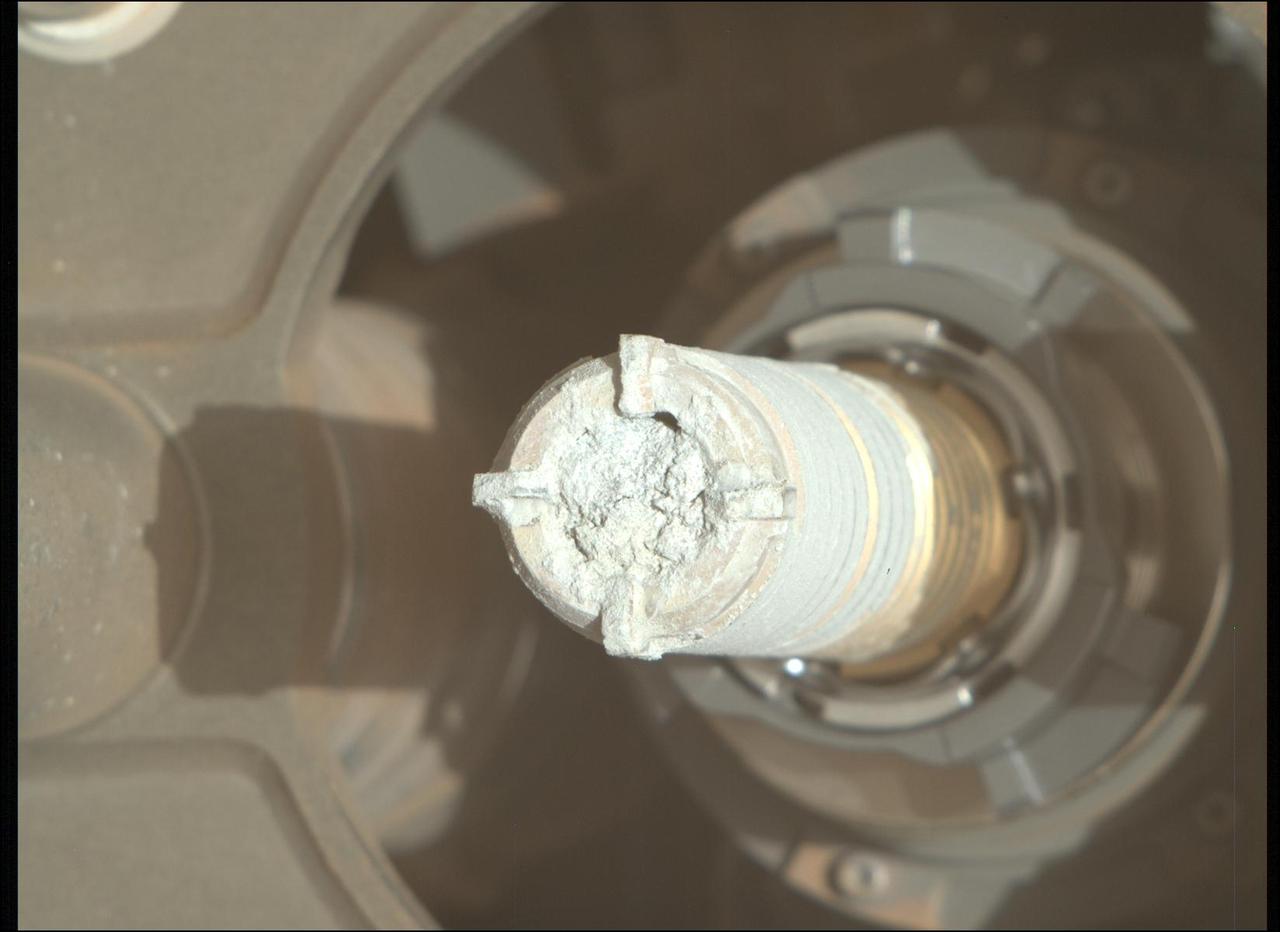
This image shows a cylinder of rock the size of a piece of classroom chalk inside the drill of NASA's Perseverance Mars rover. The sample, dubbed "Green Gardens," was taken from a rock called "Tablelands" on the rim of Mars' Jezero Crater. The image was captured by the Mastcam-Z instrument on Feb. 16, 2025, the 1,420th Martian day, or sol, of the mission. Each core the rover takes is about 0.5 inches (13 millimeters) in diameter and 2.4 inches (60 millimeters) long. Data from the rover's instruments indicates that Tablelands is made almost entirely of serpentine minerals, which form when large amounts of water react with iron- and magnesium-bearing minerals in igneous rocks. During this process, called serpentinization, the rock's original structure and mineralogy change, often causing it to expand and fracture. Byproducts of the process sometimes include hydrogen gas, which can lead to the generation of methane in the presence of carbon dioxide. On Earth, such rocks can support microbial communities. Arizona State University leads the operations of the Mastcam-Z instrument, working in collaboration with Malin Space Science Systems in San Diego, on the design, fabrication, testing, and operation of the cameras, and in collaboration with the Niels Bohr Institute of the University of Copenhagen on the design, fabrication, and testing of the calibration targets. A key objective for Perseverance's mission on Mars is astrobiology, including the search for signs of ancient microbial life. The rover will characterize the planet's geology and past climate, pave the way for human exploration of the Red Planet, and be the first mission to collect and cache Martian rock and regolith (broken rock and dust). Subsequent NASA missions, in cooperation with ESA (European Space Agency), would send spacecraft to Mars to collect these sealed samples from the surface and return them to Earth for in-depth analysis. The Mars 2020 Perseverance mission is part of NASA's Mars Exploration Program (MEP) portfolio and the agency's Moon to Mars exploration approach, which includes Artemis missions to the Moon that will help prepare for human exploration of the Red Planet. https://photojournal.jpl.nasa.gov/catalog/PIA26529
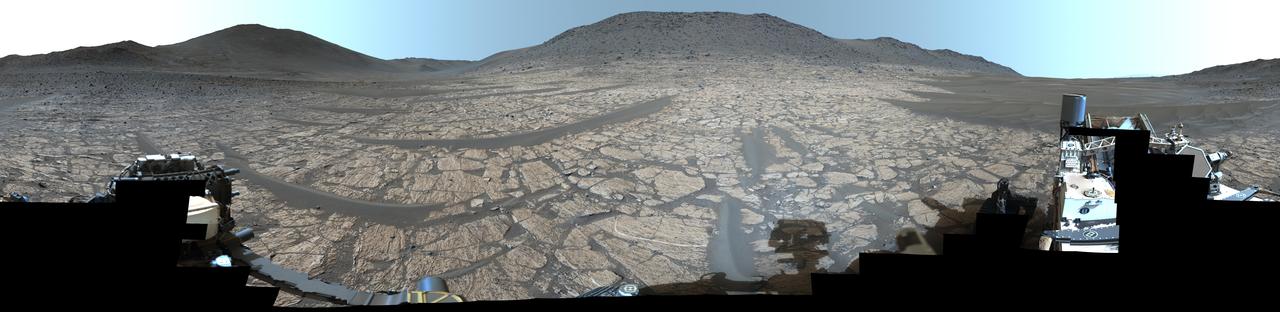
NASA's Perseverance Mars rover used its Mastcam-Z instrument to capture this 360-degree view of a region on Mars called "Bright Angel," where an ancient river flowed billions of years ago. The panorama was captured on June 12, 2024, the 1,178th Martian day, or sol, of the mission, and is made up of 346 individual images that were stitched together after being sent back to Earth. The color has been enhanced to bring out subtle details. It was not far from here that the rover took a sample at a rock dubbed "Cheyava Falls," finding one of the most exciting discoveries of the mission thus far. Cheyava Falls is slightly right of center, about 361 feet (110 meters) from the rover. Also visible is Perseverance itself, though not all of the rover was imaged in this panorama. The rover's mast, or "head," is visible in silhouette at bottom center. Arizona State University leads the operations of the Mastcam-Z instrument, working in collaboration with Malin Space Science Systems in San Diego, on the design, fabrication, testing, and operation of the cameras, and in collaboration with the Niels Bohr Institute of the University of Copenhagen on the design, fabrication, and testing of the calibration targets. A key objective for Perseverance’s mission on Mars is astrobiology, including the search for signs of ancient microbial life. The rover is also characterizing the planet’s geology and past climate, which paves the way for human exploration of the Red Planet. NASA’s Jet Propulsion Laboratory, which is managed for the agency by Caltech in Pasadena, California, built and manages operations of the Perseverance rover. https://photojournal.jpl.nasa.gov/catalog/PIA26369
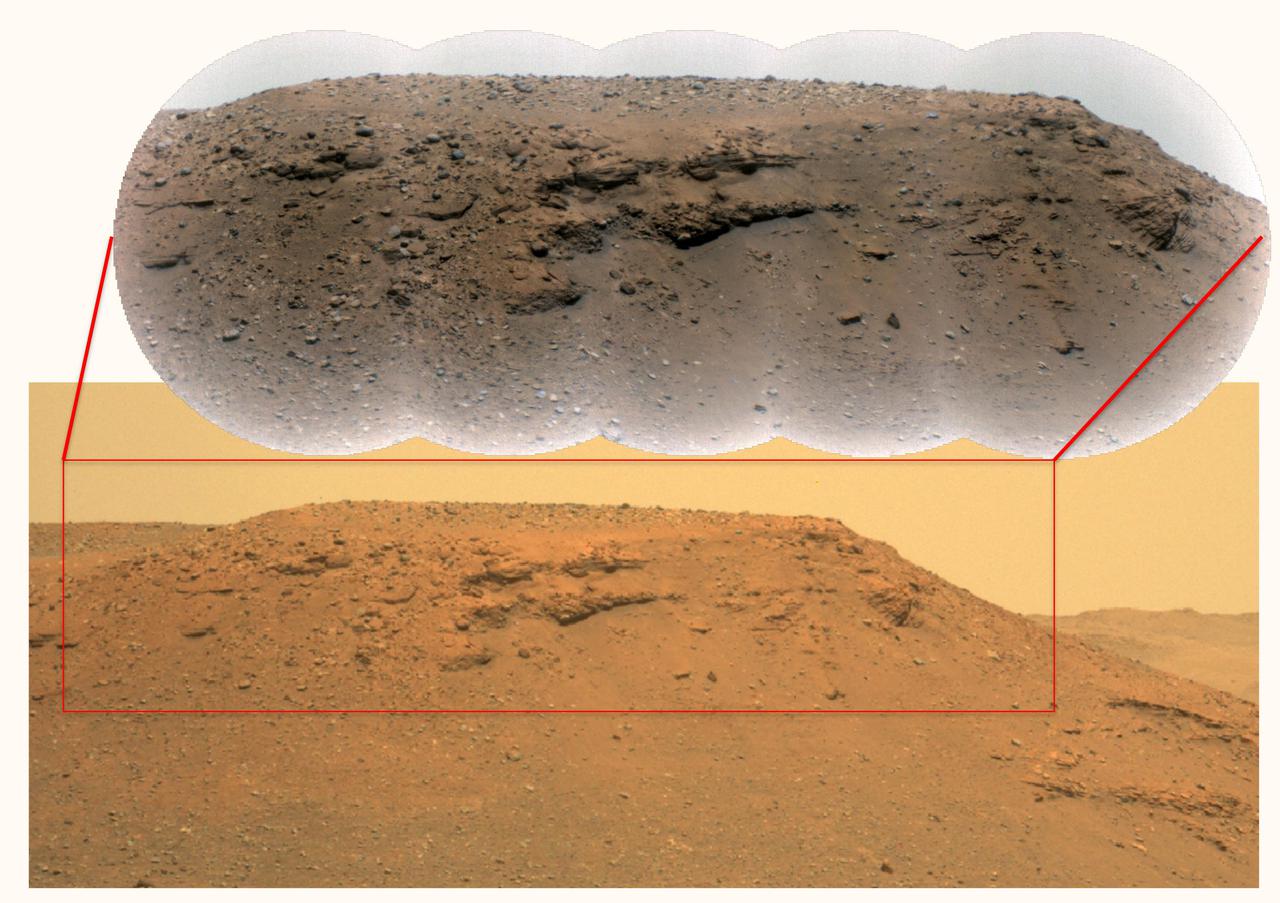
This composite image of the "Delta Scarp" in Mars' Jezero Crater was generated using data from two imagers aboard NASA's Perseverance rover. Taken by the rover's Mastcam-Z, the bottom image shows both the base and plateau of the escarpment. The inset above, created from a mosaic of five Remote Microscopic Imager (RMI) pictures, zooms in on a 377-foot-wide (115-meter-wide) portion of the scarp, allowing closer inspection of some of its intriguing geologic features. Part of the rover's SuperCam instrument, the RMI is able to spot an object the size of a softball from nearly a mile away, allowing scientists to take images of details from a long distance. It also provides fine details of nearby targets zapped by SuperCam's laser. SuperCam is led by Los Alamos National Laboratory in New Mexico, where the instrument's Body Unit was developed. That part of the instrument includes several spectrometers, control electronics and software. The Mast Unit was developed and built by several laboratories of the CNRS (French National Centre for Scientific Research) and French universities under the contracting authority of CNES. Arizona State University in Tempe leads the operations of the Mastcam-Z instrument, working in collaboration with Malin Space Science Systems in San Diego. A key objective for Perseverance's mission on Mars is astrobiology, including the search for signs of ancient microbial life. The rover will characterize the planet's geology and past climate, pave the way for human exploration of the Red Planet, and be the first mission to collect and cache Martian rock and regolith (broken rock and dust). Subsequent NASA missions, in cooperation with ESA (European Space Agency), would send spacecraft to Mars to collect these sealed samples from the surface and return them to Earth for in-depth analysis. The Mars 2020 Perseverance mission is part of NASA's Moon to Mars exploration approach, which includes Artemis missions to the Moon that will help prepare for human exploration of the Red Planet. https://photojournal.jpl.nasa.gov/catalog/PIA24684
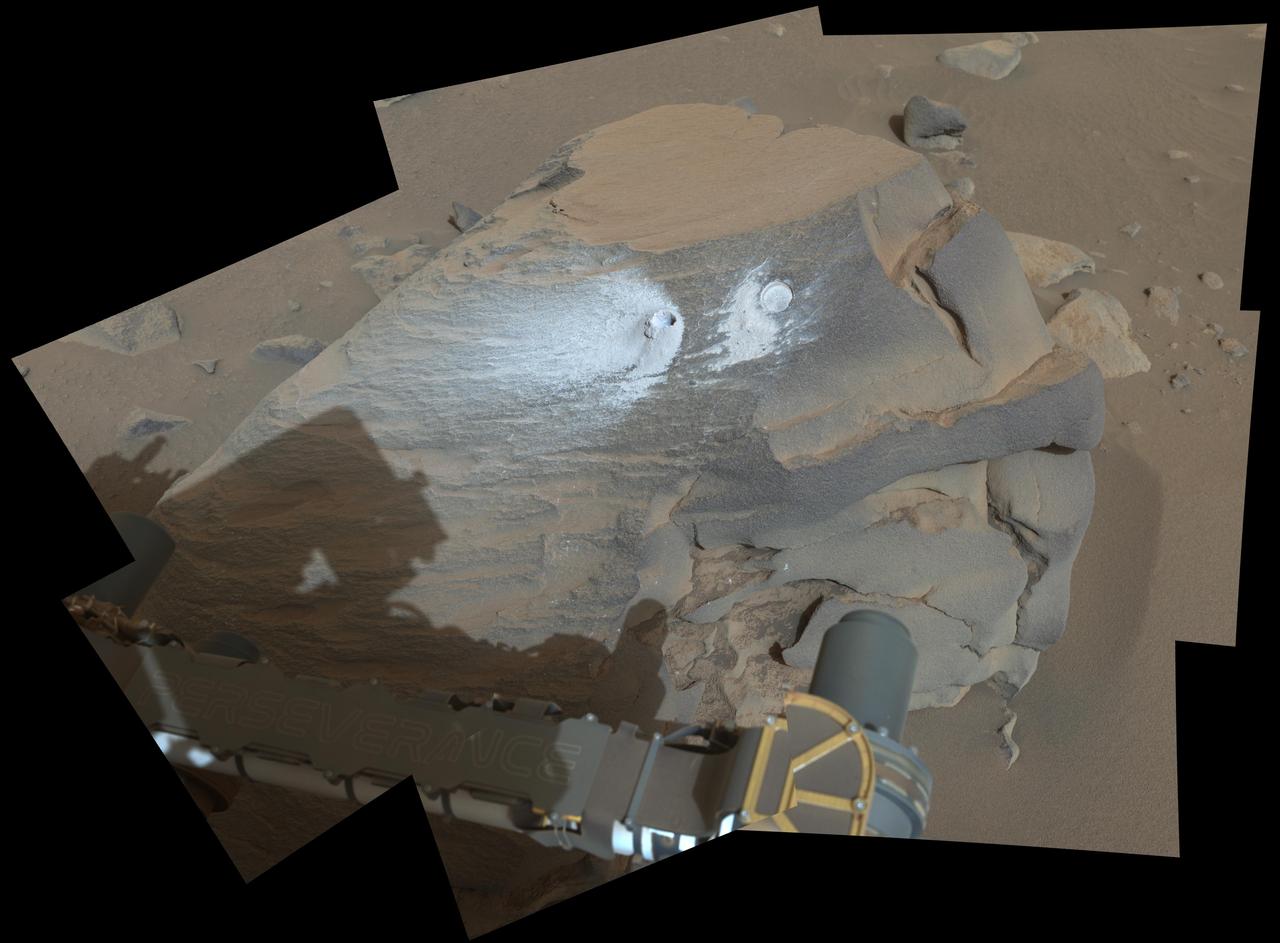
This view shows a rock nicknamed "Bunsen Peak" where NASA's Perseverance Mars rover extracted its 21st rock core (left) and abraded a circular patch (right) to investigate the rock's composition. Perseverance's Mastcam-Z camera system took the eight images that make up this mosaic on March 12, 2024, the 1,088th Martian day, or sol, of the rover's mission to Mars. For scale, the abrasion patch is approximately 2 inches (5 centimeters) in diameter. In this enhanced-color view, the color bands of the image have been processed to improve visual contrast and accentuate color differences. Arizona State University leads the operations of the Mastcam-Z instrument, working in collaboration with Malin Space Science Systems in San Diego, on the design, fabrication, testing, and operation of the cameras, and in collaboration with the Niels Bohr Institute of the University of Copenhagen on the design, fabrication, and testing of the calibration targets. A key objective for Perseverance's mission on Mars is astrobiology, including the search for signs of ancient microbial life. The rover will characterize the planet's geology and past climate, pave the way for human exploration of the Red Planet, and be the first mission to collect and cache Martian rock and regolith. Subsequent NASA missions, in cooperation with ESA (European Space Agency), would send spacecraft to Mars to collect these sealed samples from the surface and return them to Earth for in-depth analysis. The Mars 2020 Perseverance mission is part of NASA's Moon to Mars exploration approach, which includes Artemis missions to the Moon that will help prepare for human exploration of the Red Planet. https://photojournal.jpl.nasa.gov/catalog/PIA26312

NASA's Perseverance Mars rover captured this series of images of sunspots – regions where solar flares erupt on the Sun's surface – using its Mastcam-Z cameras between May 8 and 20, 2024 (the 1,144th and 1156th Martian days, or sols, of the mission). These flares sent charged particles toward Mars, where several NASA spacecraft were able to study them. The Perseverance mission frequently uses Mastcam-Z to capture images of the Sun to help scientists assess how much dust is in the atmosphere, because airborne dust affects the brightness of the Sun. Inadvertently, the camera can also capture sunspots, which are relatively cool areas of the Sun with intense magnetic fields. Arizona State University leads the operations of the Mastcam-Z instrument, working in collaboration with Malin Space Science Systems in San Diego, on the design, fabrication, testing, and operation of the cameras, and in collaboration with the Niels Bohr Institute of the University of Copenhagen on the design, fabrication, and testing of the calibration targets. A key objective for Perseverance's mission on Mars is astrobiology, including the search for signs of ancient microbial life. The rover will characterize the planet's geology and past climate, pave the way for human exploration of the Red Planet, and be the first mission to collect and cache Martian rock and regolith (broken rock and dust). Subsequent NASA missions, in cooperation with ESA (European Space Agency), would send spacecraft to Mars to collect these sealed samples from the surface and return them to Earth for in-depth analysis. The Mars 2020 Perseverance mission is part of NASA's Moon to Mars exploration approach, which includes Artemis missions to the Moon that will help prepare for human exploration of the Red Planet. Animation available at https://photojournal.jpl.nasa.gov/catalog/PIA26301
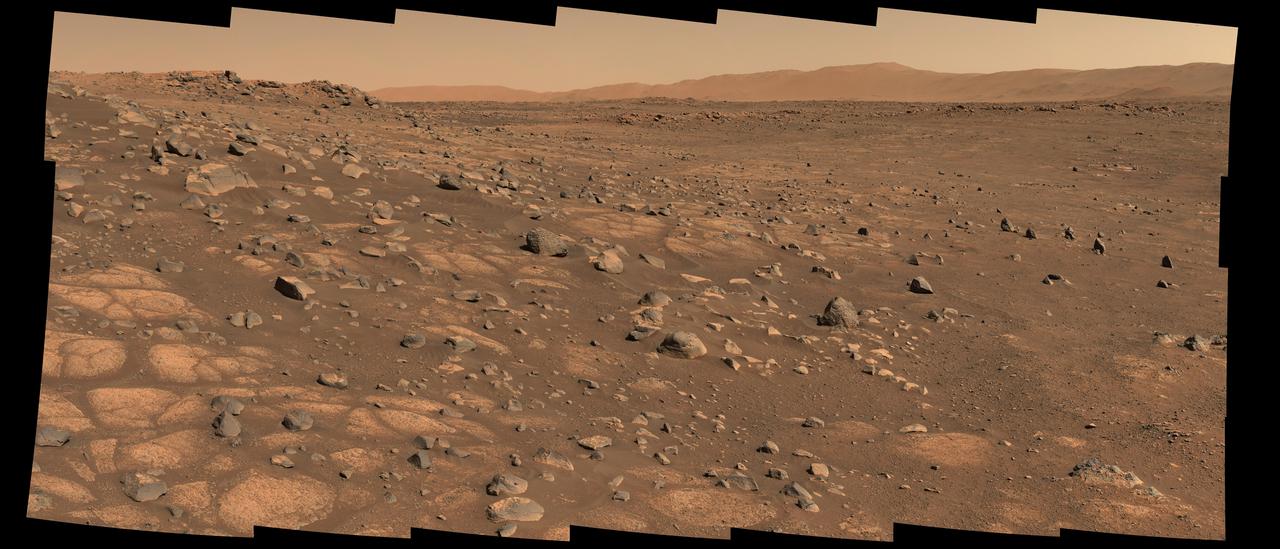
This image shows the area on Mars from which NASA's Perseverance rover will collect its first rock sample. Scientists are particularly interested in the flat stones that appear light-colored (informally called "paver rocks"). The Perseverance team has nicknamed this area in Mars' Jezero Crater the "Crater Floor Fractured Rough" area. The 28 individual images that were combined to make the larger main image were taken by the rover's Mastcam-Z right-eye camera on July 8, 2021 (the 136th sol, or Martian day, of the mission). The images have been calibrated and are presented in natural color, simulating the approximate view that we would see with our own eyes if we were there. The Mastcam-Z investigation is led and operated by Arizona State University in Tempe, working in collaboration with Malin Space Science Systems in San Diego, California, on the design, fabrication, testing, and operation of the cameras, and in collaboration with the Neils Bohr Institute of the University of Copenhagen on the design, fabrication, and testing of the calibration targets. A key objective for Perseverance's mission on Mars is astrobiology, including the search for signs of ancient microbial life. The rover will characterize the planet's geology and past climate, pave the way for human exploration of the Red Planet, and be the first mission to collect and cache Martian rock and regolith (broken rock and dust). Subsequent NASA missions, in cooperation with ESA (European Space Agency), would send spacecraft to Mars to collect these sealed samples from the surface and return them to Earth for in-depth analysis. The Mars 2020 Perseverance mission is part of NASA's Moon to Mars exploration approach, which includes Artemis missions to the Moon that will help prepare for human exploration of the Red Planet. https://photojournal.jpl.nasa.gov/catalog/PIA24746
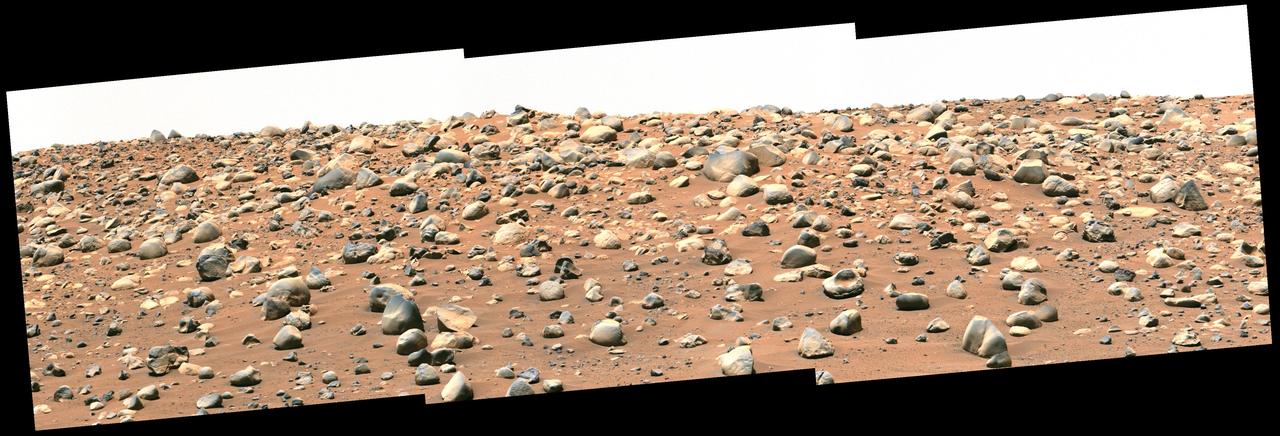
NASA's Perseverance Mars rover captured this mosaic of a location nicknamed "Castell Henllys" using its Mastcam-Z camera on April 13, 2023, the 763rd Martian day, or sol, of the mission. The rounded boulders seen here are believed to have been washed into Jezero Crater, which Perseverance is exploring, by strong flood waters billions of years ago. This occurred during one of three major periods that scientists have identified in the development of the lake and river system that occupied Jezero in the ancient past. This view looks toward the southwest, with the Castell Henllys area approximately 328 feet (100 meters) away. The mosaic is made up of three images that were stitched together after being sent back to Mars. The image has been processed to improve contrast on the terrain. Arizona State University leads the operations of the Mastcam-Z instrument, working in collaboration with Malin Space Science Systems in San Diego, on the design, fabrication, testing, and operation of the cameras, and in collaboration with the Niels Bohr Institute of the University of Copenhagen on the design, fabrication, and testing of the calibration targets. A key objective for Perseverance's mission on Mars is astrobiology, including the search for signs of ancient microbial life. The rover will characterize the planet's geology and past climate, pave the way for human exploration of the Red Planet, and be the first mission to collect and cache Martian rock and regolith (broken rock and dust). Subsequent NASA missions, in cooperation with ESA (European Space Agency), would send spacecraft to Mars to collect these sealed samples from the surface and return them to Earth for in-depth analysis. The Mars 2020 Perseverance mission is part of NASA's Moon to Mars exploration approach, which includes Artemis missions to the Moon that will help prepare for human exploration of the Red Planet. https://photojournal.jpl.nasa.gov/catalog/PIA26208
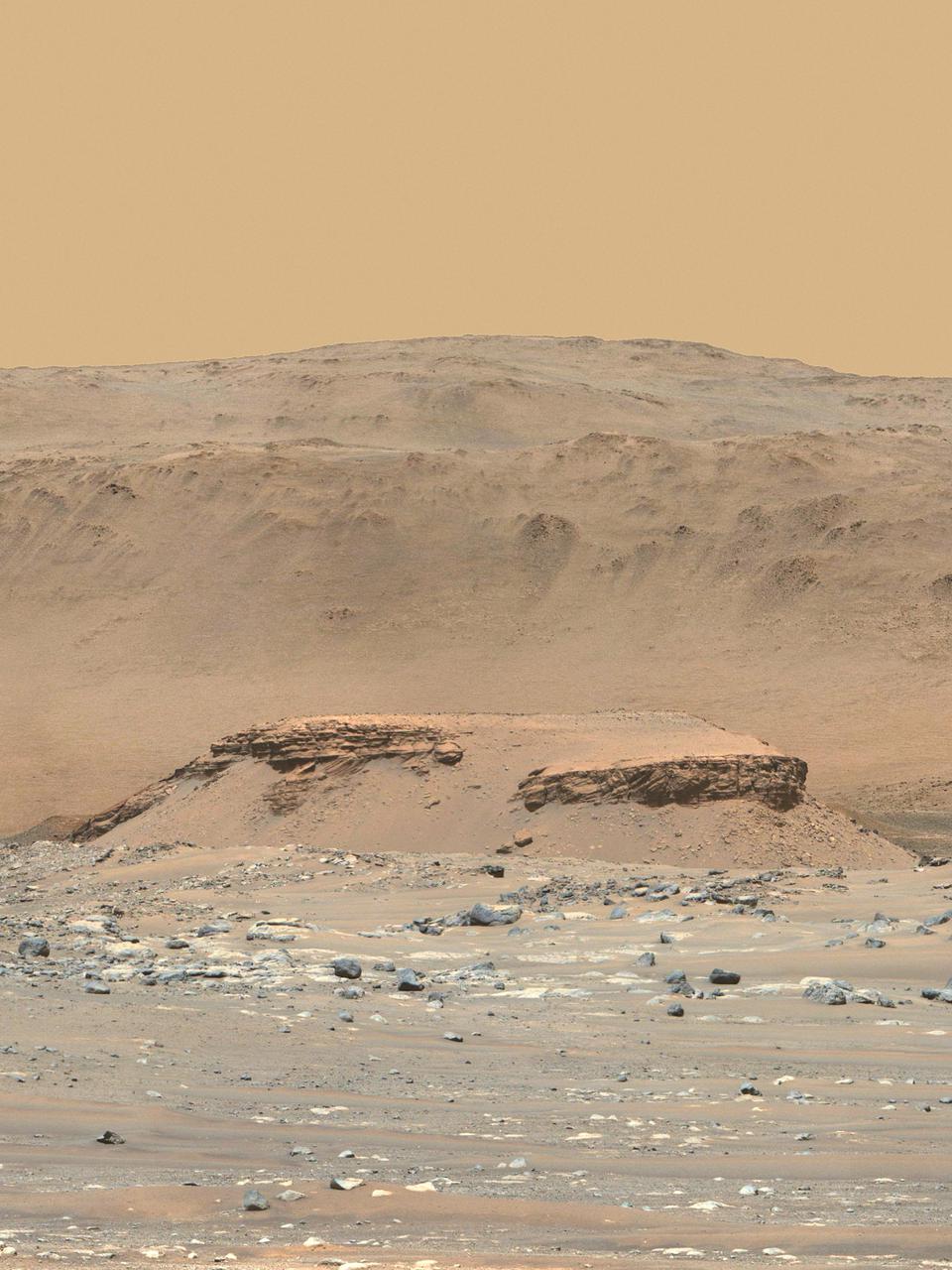
This enhanced-color image of Mars' Jezero Crater was taken by the Mastcam-Z instrument aboard NASA's Perseverance rover on April 18, 2021. The foreground flat-topped hill, informally named "Kodiak," is 1.4 miles (2.2 kilometers) from the rover and 820 feet (250 meters) wide. It exposes ancient layered rocks that indicate gradual deposition of sediments in a river delta, followed by floods. The color bands of the image have been processed to improve visual contrast and accentuate color differences. The Mastcam-Z investigation is led and operated by Arizona State University in Tempe, working in collaboration with Malin Space Science Systems in San Diego, California, on the design, fabrication, testing, and operation of the cameras, and in collaboration with the Neils Bohr Institute of the University of Copenhagen on the design, fabrication, and testing of the calibration targets. A key objective for Perseverance's mission on Mars is astrobiology, including the search for signs of ancient microbial life. The rover will characterize the planet's geology and past climate, pave the way for human exploration of the Red Planet, and be the first mission to collect and cache Martian rock and regolith (broken rock and dust). Subsequent NASA missions, in cooperation with ESA (European Space Agency), would send spacecraft to Mars to collect these sealed samples from the surface and return them to Earth for in-depth analysis. The Mars 2020 Perseverance mission is part of NASA's Moon to Mars exploration approach, which includes Artemis missions to the Moon that will help prepare for human exploration of the Red Planet. https://photojournal.jpl.nasa.gov/catalog/PIA24802
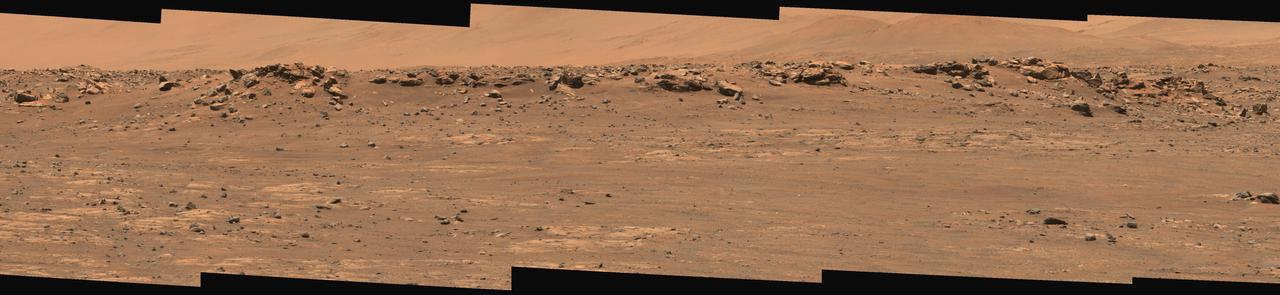
This wide view of Mars' Jezero Crater was taken by NASA's Perseverance rover on July 15, 2021 (the 143rd sol, or Martian day, of its mission). The rover has driven nearly a mile (1.5 kilometers) south of its landing site, "Octavia E. Butler Landing," into a region the team has nicknamed the "Crater Floor Fractured Rough" unit. The stones that appear light-colored and flat in this image are informally referred to as the "paver rocks" and will be the first type from which Perseverance will collect a sample for planned return to Earth by subsequent missions. Small hills to the south of the rover and the sloping inner walls of the Jezero Crater rim fill the distant background of this view. Five images from the rover's Mastcam-Z instrument were calibrated and combined to make this mosaic. Perseverance has been exploring the floor of Jezero since landing on Feb. 18, 2021. The Mastcam-Z investigation is led and operated by Arizona State University in Tempe, working in collaboration with Malin Space Science Systems in San Diego, California, on the design, fabrication, testing, and operation of the cameras, and in collaboration with the Neils Bohr Institute of the University of Copenhagen on the design, fabrication, and testing of the calibration targets. A key objective for Perseverance's mission on Mars is astrobiology, including the search for signs of ancient microbial life. The rover will characterize the planet's geology and past climate, pave the way for human exploration of the Red Planet, and be the first mission to collect and cache Martian rock and regolith. The Mars 2020 Perseverance mission is part of NASA's Moon to Mars exploration approach, which includes Artemis missions to the Moon that will help prepare for human exploration of the Red Planet. Subsequent NASA missions, in cooperation with ESA (European Space Agency), would send spacecraft to Mars to collect these sealed samples from the surface and return them to Earth for in-depth analysis. https://photojournal.jpl.nasa.gov/catalog/PIA24745

NASA's Perseverance Mars rover used its Mastcam-Z camera to capture the silhouette of Phobos, one of the two Martian moons, as it passed in front of the Sun on Sept. 30, 2024, the 1,285th Martian day, or sol, of the mission. Perseverance has captured several Phobos transits since its landing at Mars' Jezero Crater in February 2021. By comparing the various recordings, scientists can refine their understanding of the potato-shaped moon's orbit, learning how it is changing. Eons from now, Phobos' orbit is expected to eventually send the moon toward the Red Planet's surface. Arizona State University leads the operations of the Mastcam-Z instrument, working in collaboration with Malin Space Science Systems in San Diego, on the design, fabrication, testing, and operation of the cameras, and in collaboration with the Niels Bohr Institute of the University of Copenhagen on the design, fabrication, and testing of the calibration targets. A key objective for Perseverance's mission on Mars is astrobiology, including the search for signs of ancient microbial life. The rover will characterize the planet's geology and past climate, pave the way for human exploration of the Red Planet, and be the first mission to collect and cache Martian rock and regolith (broken rock and dust). Subsequent NASA missions, in cooperation with ESA (European Space Agency), would send spacecraft to Mars to collect these sealed samples from the surface and return them to Earth for in-depth analysis. The Mars 2020 Perseverance mission is part of NASA's Moon to Mars exploration approach, which includes Artemis missions to the Moon that will help prepare for human exploration of the Red Planet. Video available at https://photojournal.jpl.nasa.gov/catalog/PIA26380

Stitched together from 56 images from NASA's Perseverance Mars rover, this natural-color mosaic looks downstream of the Neretva Vallis river channel, which fed Jezero Crater with fresh water billions of years ago. The rover captured the images with its Mastcam-Z camera on May 17, 2024, the 1152nd Martian day, or sol, of the mission. "Mount Washburn" is to the far left (north is to the left; southeast is to the right), about 660 feet (200 meters) away. Approximately quarter-mile (400 meters) wide with sand dunes and ripples, Neretva Vallis is at the center of the image. Prior to entering the channel, Perseverance had driven for several months along a boulder-filled route just beyond the camera view on the right of this mosaic. Perseverance's ultra-high-frequency antenna is visible right of center in the foreground. Arizona State University leads the operations of the Mastcam-Z instrument, working in collaboration with Malin Space Science Systems in San Diego, on the design, fabrication, testing, and operation of the cameras, and in collaboration with the Niels Bohr Institute of the University of Copenhagen on the design, fabrication, and testing of the calibration targets. A key objective for Perseverance's mission on Mars is astrobiology, including the search for signs of ancient microbial life. The rover will characterize the planet's geology and past climate, pave the way for human exploration of the Red Planet, and be the first mission to collect and cache Martian rock and regolith (broken rock and dust). Subsequent NASA missions, in cooperation with ESA (European Space Agency), would send spacecraft to Mars to collect these sealed samples from the surface and return them to Earth for in-depth analysis. The Mars 2020 Perseverance mission is part of NASA's Moon to Mars exploration approach, which includes Artemis missions to the Moon that will help prepare for human exploration of the Red Planet. https://photojournal.jpl.nasa.gov/catalog/PIA26335
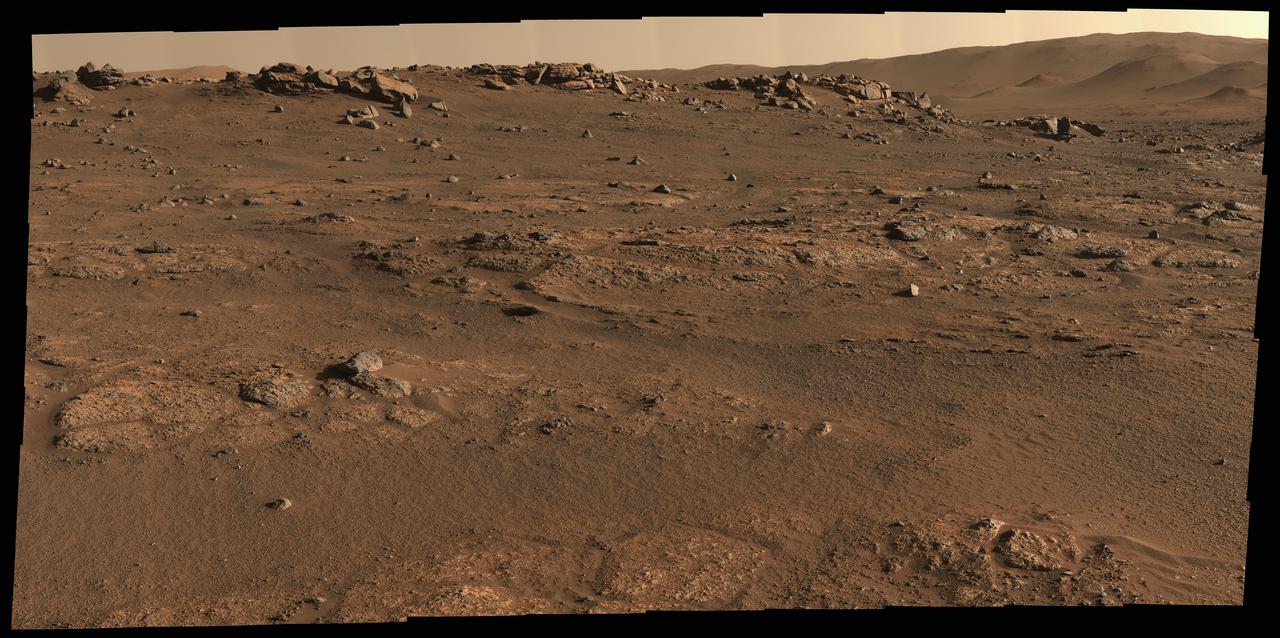
NASA's Perseverance Mars rover used its Mastcam-Z camera system to create this panorama of its first drill site. Scientists will be looking for a rock to drill somewhere in this. Perseverance's team has nicknamed this region the "Crater Floor Fractured Rough" unit. The flat, light-colored stones are informally referred to as "paver rocks" and will be the first type from which Perseverance will collect a sample for planned return to Earth by subsequent missions. Small hills to the south of the rover and the sloping inner walls of the Jezero Crater rim fill the distant background of this view. The panorama is stitched together from 70 individual images taken on July 28, 2021, the 155th Martian day, or sol, of the mission. This panorama is seen here in natural color. The Mastcam-Z investigation is led and operated by Arizona State University in Tempe, working in collaboration with Malin Space Science Systems in San Diego, California, on the design, fabrication, testing, and operation of the cameras, and in collaboration with the Neils Bohr Institute of the University of Copenhagen on the design, fabrication, and testing of the calibration targets. A key objective for Perseverance's mission on Mars is astrobiology, including the search for signs of ancient microbial life. The rover will characterize the planet's geology and past climate, pave the way for human exploration of the Red Planet, and be the first mission to collect and cache Martian rock and regolith (broken rock and dust). Subsequent NASA missions, in cooperation with ESA (European Space Agency), would send spacecraft to Mars to collect these sealed samples from the surface and return them to Earth for in-depth analysis. The Mars 2020 Perseverance mission is part of NASA's Moon to Mars exploration approach, which includes Artemis missions to the Moon that will help prepare for human exploration of the Red Planet. https://photojournal.jpl.nasa.gov/catalog/PIA24765

NASA's Perseverance Mars rover used its Mastcam-Z camera to capture the silhouette of Deimos, one of the two Martian moons, as it passed in front of the Sun on Jan. 19, 2024, the 1,037th Martian day, or sol, of the mission. This is one of several transits of Deimos that NASA's Mars rovers have captured. By comparing the various recordings over time, scientists can refine their understanding of the tiny moon's orbit, learning how it's changing. The video has been sped up by four times; the full transit took over two minutes. Arizona State University leads the operations of the Mastcam-Z instrument, working in collaboration with Malin Space Science Systems in San Diego, on the design, fabrication, testing, and operation of the cameras, and in collaboration with the Niels Bohr Institute of the University of Copenhagen on the design, fabrication, and testing of the calibration targets. A key objective for Perseverance's mission on Mars is astrobiology, including the search for signs of ancient microbial life. The rover will characterize the planet's geology and past climate, pave the way for human exploration of the Red Planet, and be the first mission to collect and cache Martian rock and regolith (broken rock and dust). Subsequent NASA missions, in cooperation with ESA (European Space Agency), would send spacecraft to Mars to collect these sealed samples from the surface and return them to Earth for in-depth analysis. The Mars 2020 Perseverance mission is part of NASA's Moon to Mars exploration approach, which includes Artemis missions to the Moon that will help prepare for human exploration of the Red Planet. Video available at https://photojournal.jpl.nasa.gov/catalog/PIA26249

This mosaic featuring several of the escarpments, or scarps – long, steep slopes – of Jezero Crater's river delta was taken by the Mastcam-Z instrument aboard NASA's Perseverance rover on Apr. 17, 2021. The delta formed billions of years ago from sediment that an ancient river carried to the mouth of the lake that once existed in the crater. The images that stitched together to create the mosaic were taken from a distance of about 1.2 miles (2.2 kilometers). An annotated version of this image (Figure 1) indicates the location of four prominent scarps in the delta. The Mastcam-Z investigation is led and operated by Arizona State University in Tempe, working in collaboration with Malin Space Science Systems in San Diego, California, on the design, fabrication, testing, and operation of the cameras, and in collaboration with the Neils Bohr Institute of the University of Copenhagen on the design, fabrication, and testing of the calibration targets. A key objective for Perseverance's mission on Mars is astrobiology, including the search for signs of ancient microbial life. The rover will characterize the planet's geology and past climate, pave the way for human exploration of the Red Planet, and be the first mission to collect and cache Martian rock and regolith (broken rock and dust). Subsequent NASA missions, in cooperation with ESA (European Space Agency), would send spacecraft to Mars to collect these sealed samples from the surface and return them to Earth for in-depth analysis. The Mars 2020 Perseverance mission is part of NASA's Moon to Mars exploration approach, which includes Artemis missions to the Moon that will help prepare for human exploration of the Red Planet. https://photojournal.jpl.nasa.gov/catalog/PIA24815

This enhanced-color mosaic showing the Martian surface outside of Jezero Crater was taken by NASA's Perseverance from the crater rim at a location where the rover collected a sample dubbed "Silver Mountain." The 83 frames used to generate the mosaic were acquired by the rover's Mastcam-Z instrument on Dec. 25, 2024, the 1,368th Martian day, or sol, of Perseverance's mission. Enhanced-color images have their color bands processed to improve visual contrast and accentuate color differences. Arizona State University leads the operations of the Mastcam-Z instrument, working in collaboration with Malin Space Science Systems in San Diego, on the design, fabrication, testing, and operation of the cameras, and in collaboration with the Niels Bohr Institute of the University of Copenhagen on the design, fabrication, and testing of the calibration targets. A key objective for Perseverance's mission on Mars is astrobiology, including the search for signs of ancient microbial life. The rover will characterize the planet's geology and past climate, pave the way for human exploration of the Red Planet, and be the first mission to collect and cache Martian rock and regolith (broken rock and dust). Subsequent NASA missions, in cooperation with ESA (European Space Agency), would send spacecraft to Mars to collect these sealed samples from the surface and return them to Earth for in-depth analysis. The Mars 2020 Perseverance mission is part of NASA's Mars Exploration Program (MEP) portfolio and the agency's Moon to Mars exploration approach, which includes Artemis missions to the Moon that will help prepare for human exploration of the Red Planet. https://photojournal.jpl.nasa.gov/catalog/PIA26530
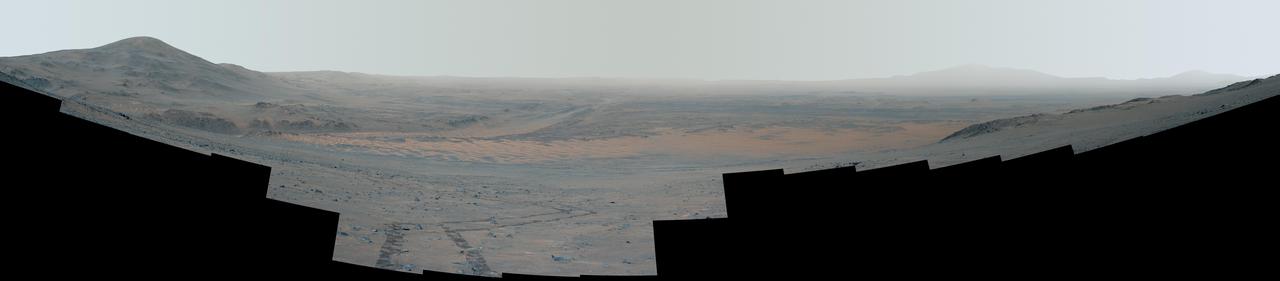
This enhanced-color, high-resolution mosaic showing Mars' Jezero Crater was taken by the Mastcam-Z instrument on NASA's Perseverance as the rover climbed the crater's western wall. Many of the landmarks visited by the rover during its 3½-year exploration of Jezero can be seen, and the vehicle's tracks are also visible. The 44 frames used to generate the mosaic were acquired on Sept. 27, 2024, the 1,282nd Martian day, or sol, of Perseverance's mission. The rover was near a location the Perseverance science team calls "Faraway Rock," about halfway up the climb. Arizona State University leads the operations of the Mastcam-Z instrument, working in collaboration with Malin Space Science Systems in San Diego, on the design, fabrication, testing, and operation of the cameras, and in collaboration with the Niels Bohr Institute of the University of Copenhagen on the design, fabrication, and testing of the calibration targets. A key objective for Perseverance's mission on Mars is astrobiology, including the search for signs of ancient microbial life. The rover will characterize the planet's geology and past climate, pave the way for human exploration of the Red Planet, and be the first mission to collect and cache Martian rock and regolith (broken rock and dust). Subsequent NASA missions, in cooperation with ESA (European Space Agency), would send spacecraft to Mars to collect these sealed samples from the surface and return them to Earth for in-depth analysis. The Mars 2020 Perseverance mission is part of NASA's Moon to Mars exploration approach, which includes Artemis missions to the Moon that will help prepare for human exploration of the Red Planet. https://photojournal.jpl.nasa.gov/catalog/PIA26378
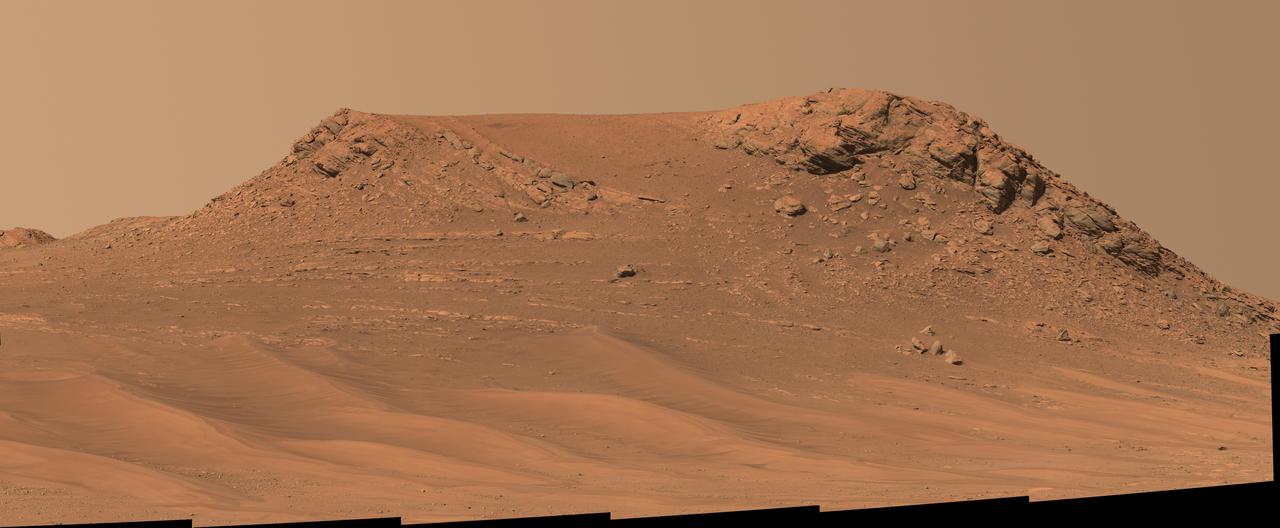
NASA's Perseverance Mars rover captured this mosaic of an isolated hill nicknamed "Pinestand." Scientists think sedimentary layers stacked on top of one another here could have been formed by a deep, fast-moving river. But uncertainty about their formation remains because the layers are exceptionally tall by Earth geology standards to have been created by a river – some standing 66 feet (20 meters) high. The mosaic was captured by Perseverance's Mastcam-Z camera on Feb. 26, 2023, the 718th Martian day, or sol, of the mission. The mosaic was stitched together from 18 individual Mastcam-Z images after they were sent back to Earth. This natural color view is approximately how the scene would appear to an average person if they were on Mars. Arizona State University leads the operations of the Mastcam-Z instrument, working in collaboration with Malin Space Science Systems in San Diego, on the design, fabrication, testing, and operation of the cameras, and in collaboration with the Niels Bohr Institute of the University of Copenhagen on the design, fabrication, and testing of the calibration targets. A key objective for Perseverance's mission on Mars is astrobiology, including the search for signs of ancient microbial life. The rover will characterize the planet's geology and past climate, pave the way for human exploration of the Red Planet, and be the first mission to collect and cache Martian rock and regolith (broken rock and dust). Subsequent NASA missions, in cooperation with ESA (European Space Agency), would send spacecraft to Mars to collect these sealed samples from the surface and return them to Earth for in-depth analysis. The Mars 2020 Perseverance mission is part of NASA's Moon to Mars exploration approach, which includes Artemis missions to the Moon that will help prepare for human exploration of the Red Planet. https://photojournal.jpl.nasa.gov/catalog/PIA25830
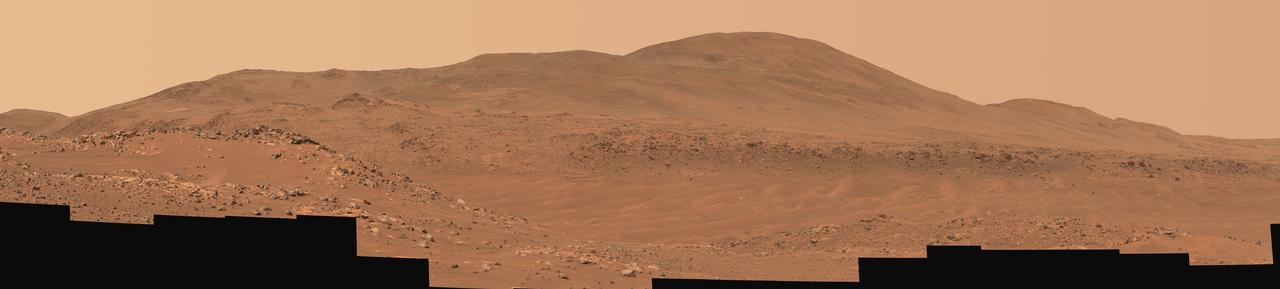
This natural-color mosaic showing NASA's Ingenuity Mars Helicopter at "Valinor Hills" was acquired by the agency's Perseverance Mars rover on Feb. 21, 2024, the 1,068th Martian day, or sol, of the mission. The helicopter – the first aircraft to achieve powered, controlled flight on another world – sits just left of center, a speck-like figure amid a field of sand ripples. Ingenuity damaged its rotor blades during landing on its 72nd and final flight on Jan. 18, 2024. The helicopter team nicknamed the spot where the last flight concluded Valinor Hills after the fictional location in J.R.R. Tolkien's fantasy novels, which include "The Lord of the Rings" trilogy. The 67 images that were stitched together to make this mosaic were captured from about 1,365 feet (415 meters) away by the rover's Mastcam-Z camera. This is a wider and more detailed view of Valinor Hills than was shown in a previously released six-image Mastcam-Z mosaic that was taken from farther away. Arizona State University leads the operations of the Mastcam-Z instrument, working in collaboration with Malin Space Science Systems in San Diego, on the design, fabrication, testing, and operation of the cameras, and in collaboration with the Niels Bohr Institute of the University of Copenhagen on the design, fabrication, and testing of the calibration targets. A key objective for Perseverance's mission on Mars is astrobiology, including the search for signs of ancient microbial life. The rover will characterize the planet's geology and past climate, pave the way for human exploration of the Red Planet, and be the first mission to collect and cache Martian rock and regolith (broken rock and dust). Subsequent NASA missions, in cooperation with ESA (European Space Agency), would send spacecraft to Mars to collect these sealed samples from the surface and return them to Earth for in-depth analysis. The Mars 2020 Perseverance mission is part of NASA's Moon to Mars exploration approach, which includes Artemis missions to the Moon that will help prepare for human exploration of the Red Planet. https://photojournal.jpl.nasa.gov/catalog/PIA26237

NASA's Perseverance Mars rover used its Mastcam-Z camera to capture the silhouette of Phobos, one of the two Martian moons, as it passed in front of the Sun on Feb. 8, 2024, the 1,056th Martian day, or sol, of the mission. This is one of several transits of Phobos that NASA's Mars rovers have captured. By comparing the various recordings, scientists can refine their understanding of the potato-shaped moon's orbit, learning how it's changing. Eons from now, Phobos' orbit is expected to eventually send the moon toward the Red Planet's surface. The video shows the transit as it happened in real time. Arizona State University leads the operations of the Mastcam-Z instrument, working in collaboration with Malin Space Science Systems in San Diego, on the design, fabrication, testing, and operation of the cameras, and in collaboration with the Niels Bohr Institute of the University of Copenhagen on the design, fabrication, and testing of the calibration targets. A key objective for Perseverance's mission on Mars is astrobiology, including the search for signs of ancient microbial life. The rover will characterize the planet's geology and past climate, pave the way for human exploration of the Red Planet, and be the first mission to collect and cache Martian rock and regolith (broken rock and dust). Subsequent NASA missions, in cooperation with ESA (European Space Agency), would send spacecraft to Mars to collect these sealed samples from the surface and return them to Earth for in-depth analysis. The Mars 2020 Perseverance mission is part of NASA's Moon to Mars exploration approach, which includes Artemis missions to the Moon that will help prepare for human exploration of the Red Planet. Video available at https://photojournal.jpl.nasa.gov/catalog/PIA26248

NASA's Perseverance Mars rover captured this video of the Ingenuity Mars Helicopter's 54th flight on Aug. 3, 2023. After performing a preflight "wiggle check" with its rotors, the helicopter takes off, hovers at an altitude of 16 feet (5 meters), and rotates to the left, before touching back down. The mission conducted the short pop-up flight to check Ingenuity's navigation system. The video was captured by the rover's Mastcam-Z imager from a distance of about 180 feet (55 meters). Arizona State University in Tempe leads the operations of the Mastcam-Z instrument, working in collaboration with Malin Space Science Systems in San Diego, on the design, fabrication, testing, and operation of the cameras, and in collaboration with the Niels Bohr Institute of the University of Copenhagen on the design, fabrication, and testing of the calibration targets. A key objective for Perseverance's mission on Mars is astrobiology, including the search for signs of ancient microbial life. The rover will characterize the planet's geology and past climate, pave the way for human exploration of the Red Planet, and be the first mission to collect and cache Martian rock and regolith (broken rock and dust). Subsequent NASA missions, in cooperation with ESA (European Space Agency), would send spacecraft to Mars to collect these sealed samples from the surface and return them to Earth for in-depth analysis. The Mars 2020 Perseverance mission is part of NASA's Moon to Mars exploration approach, which includes Artemis missions to the Moon that will help prepare for human exploration of the Red Planet. Movie available at https://photojournal.jpl.nasa.gov/catalog/PIA25970
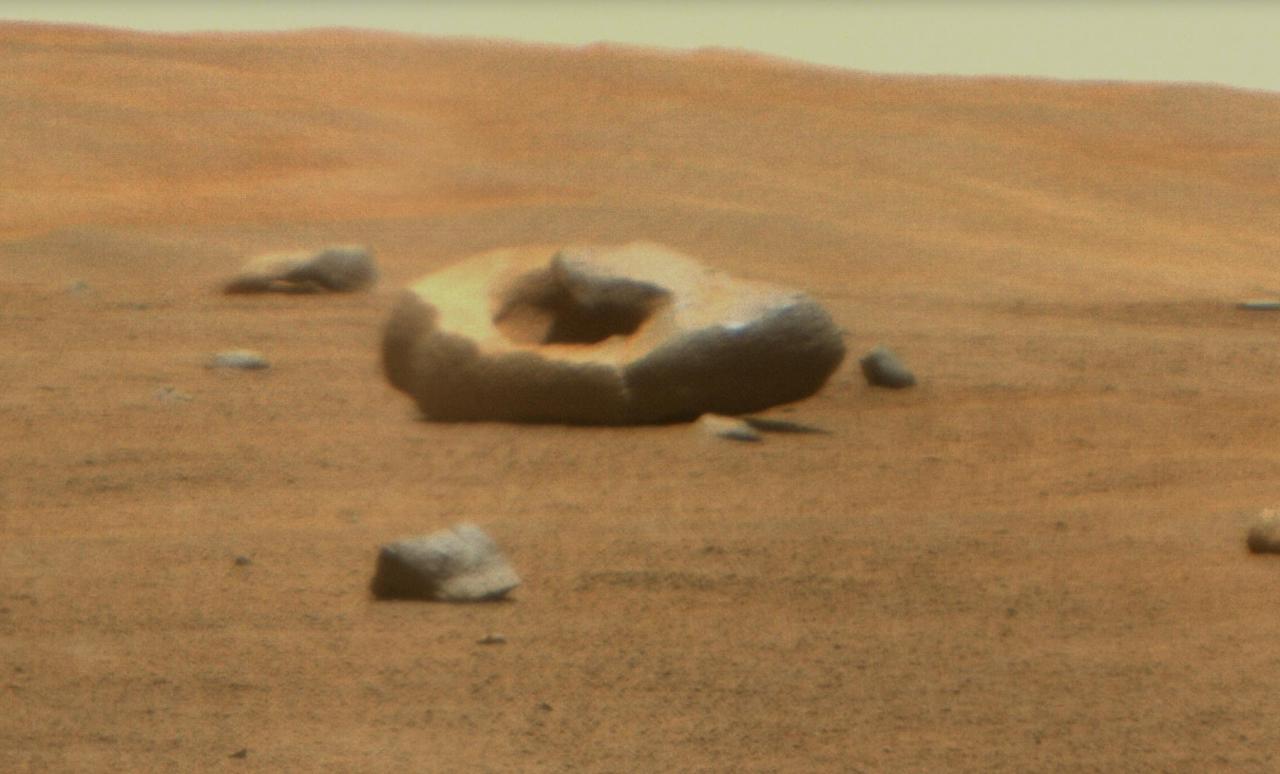
NASA's Perseverance Mars rover captured this doughnut-shaped rock in Jezero Crater from about 328 feet (100 meters) away using its Remote Microscopic Imager (RMI), part of the SuperCam instrument, on June 22, 2023, the 832nd Martian day, or sol, of the mission. Oddly shaped rocks aren't uncommon, either on Earth or Mars; they're often formed over eons as winds sandblast rock faces. This particular rock may have formed after a smaller rock (or multiple rocks) eroded near its center. That left behind a cavity that was later enlarged by the wind. Figure A shows the same rock in its broader context, when it was first spotted by the rover's Mastcam-Z instrument from about 1,312 feet (400 meters away) on April 15, 2023, the 765th Martian day, or sol, of the mission. SuperCam is led by Los Alamos National Laboratory in New Mexico, where the instrument's body unit was developed. That part of the instrument includes several spectrometers as well as control electronics and software. The mast unit, including RMI, was developed and built by several laboratories of the CNRS (the French research center) and French universities under the contracting authority of Centre National d'Études Spatiales (CNES), the French space agency. Arizona State University leads the operations of the Mastcam-Z instrument, working in collaboration with Malin Space Science Systems in San Diego, on the design, fabrication, testing, and operation of the cameras, and in collaboration with the Niels Bohr Institute of the University of Copenhagen on the design, fabrication, and testing of the calibration targets. A key objective for Perseverance's mission on Mars is astrobiology, including the search for signs of ancient microbial life. The rover will characterize the planet's geology and past climate, pave the way for human exploration of the Red Planet, and be the first mission to collect and cache Martian rock and regolith (broken rock and dust). Subsequent NASA missions, in cooperation with ESA (European Space Agency), would send spacecraft to Mars to collect these sealed samples from the surface and return them to Earth for in-depth analysis. The Mars 2020 Perseverance mission is part of NASA's Moon to Mars exploration approach, which includes Artemis missions to the Moon that will help prepare for human exploration of the Red Planet. https://photojournal.jpl.nasa.gov/catalog/PIA25916
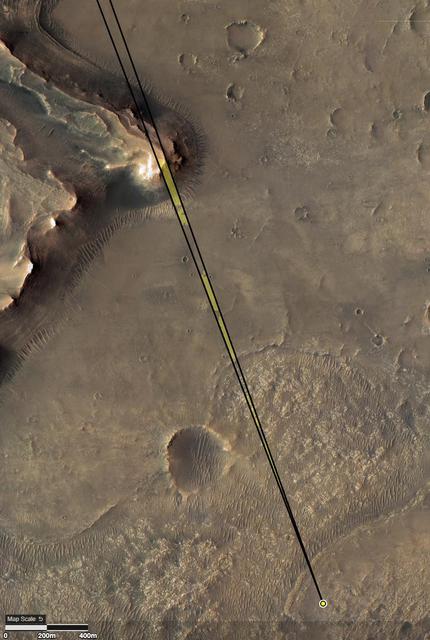
Provided by the High Resolution Imaging Experiment (HiRISE) aboard NASA's Mars Reconnaissance orbiter, this overhead image captures a portion of Mars' Jezero Crater. The yellow dot on lower right indicates the location of NASA's Perseverance rover. The field of view of the rover's Remote Microscopic Imager (RMI) camera is indicated with the diverging lines. The formation in the upper left is the "Delta Scarp," which the RMI camera photographed on March 17, 2021, from a distance of 1.4 miles (2.25 kilometers). The University of Arizona, in Tucson, operates HiRISE, which was built by Ball Aerospace & Technologies Corp., in Boulder, Colorado. NASA's Jet Propulsion Laboratory, a division of Caltech in Pasadena, California, manages the Mars Reconnaissance Orbiter Project for NASA's Science Mission Directorate, Washington. A key objective for Perseverance's mission on Mars is astrobiology, including the search for signs of ancient microbial life. The rover will characterize the planet's geology and past climate, pave the way for human exploration of the Red Planet, and be the first mission to collect and cache Martian rock and regolith (broken rock and dust). Subsequent NASA missions, in cooperation with ESA (European Space Agency), would send spacecraft to Mars to collect these sealed samples from the surface and return them to Earth for in-depth analysis. The Mars 2020 Perseverance mission is part of NASA's Moon to Mars exploration approach, which includes Artemis missions to the Moon that will help prepare for human exploration of the Red Planet. https://photojournal.jpl.nasa.gov/catalog/PIA24685
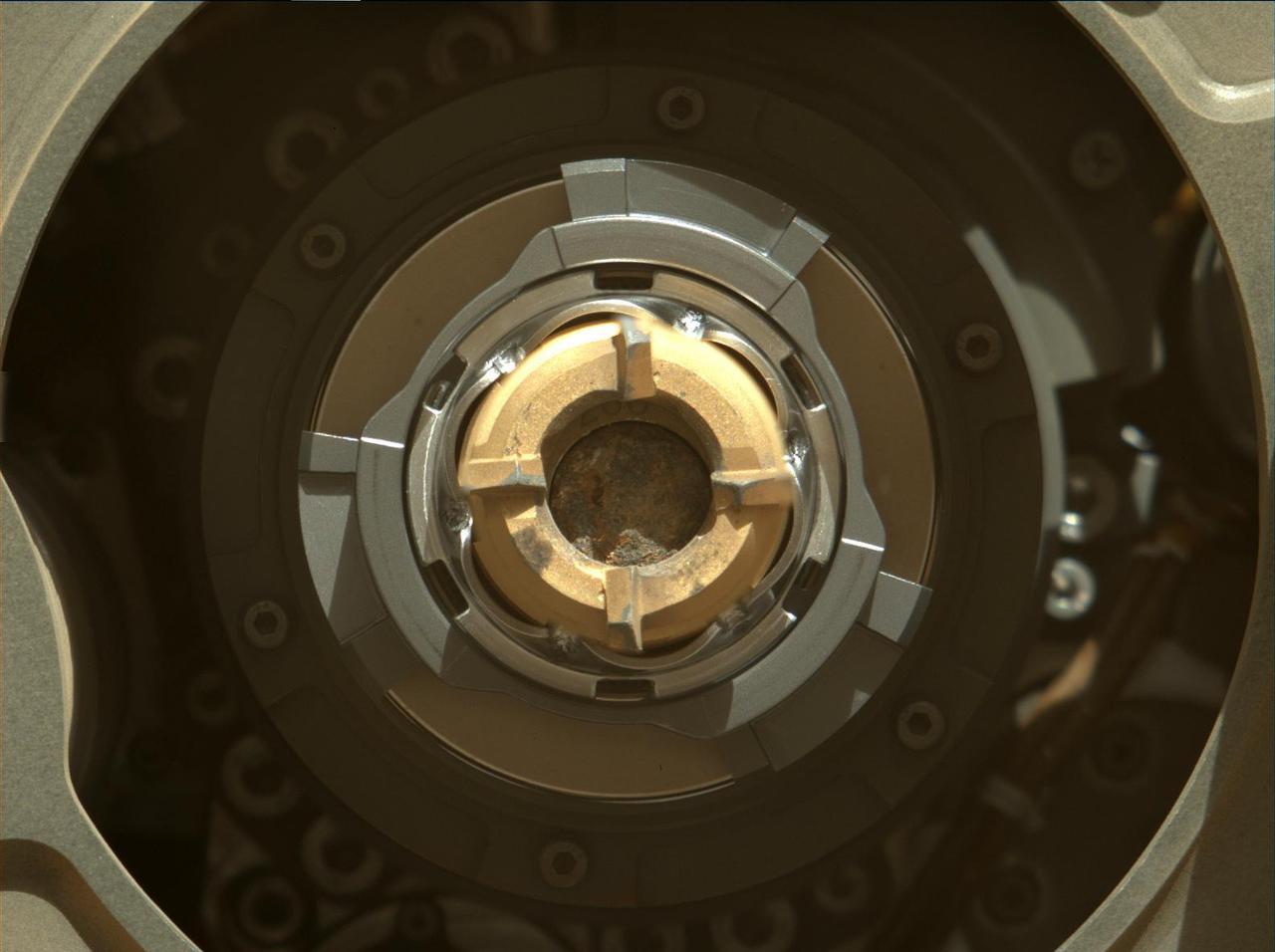
This Mastcam-Z image shows a sample of Mars rock inside the sample tube on Sept. 1, 2021 (the 190th sol, or Martian day, of the mission), shortly after the coring operation. The image was taken after coring concluded but prior to an operation that vibrates the drill bit and tube to clear the tube's lip of any residual material. The bronze-colored outer-ring is the coring bit. The lighter-colored inner-ring is the open end of the sample tube, and inside is a rock core sample slightly thicker than a pencil. A portion of the tube's serial number – 266 – can be seen on the top side of tube's wall. Arizona State University in Tempe leads the operations of the Mastcam-Z instrument, working in collaboration with Malin Space Science Systems in San Diego. A key objective for Perseverance's mission on Mars is astrobiology, including the search for signs of ancient microbial life. The rover will characterize the planet's geology and past climate, pave the way for human exploration of the Red Planet, and be the first mission to collect and cache Martian rock and regolith (broken rock and dust). Subsequent NASA missions, in cooperation with ESA (European Space Agency), would send spacecraft to Mars to collect these sealed samples from the surface and return them to Earth for in-depth analysis. The Mars 2020 Perseverance mission is part of NASA's Moon to Mars exploration approach, which includes Artemis missions to the Moon that will help prepare for human exploration of the Red Planet. https://photojournal.jpl.nasa.gov/catalog/PIA24804
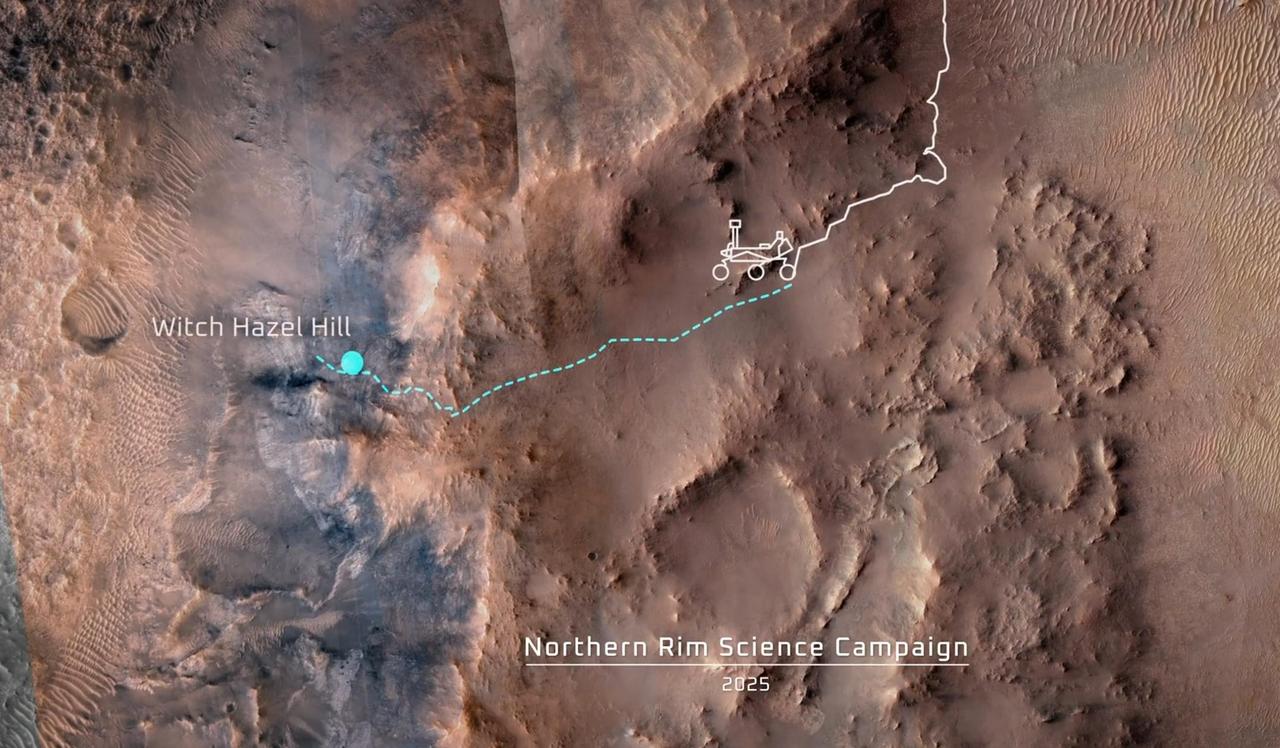
This animation shows the position of NASA's Perseverance Mars rover as of Dec. 4, 2024, the 1,347th Martian day, or sol, of the mission, along with the proposed route of the mission's fifth science campaign, dubbed Northern Rim, over the next several years. This map was made using data from NASA's Mars Reconnaissance Orbiter's High-Resolution Imaging Science Experiment (HiRISE) camera as well as the European Space Agency's (ESA) High Resolution Stereo Camera (HRSC). The University of Arizona, in Tucson, operates HiRISE, which was built by Ball Aerospace & Technologies Corp., in Boulder, Colorado. NASA's Jet Propulsion Laboratory, a division of Caltech in Pasadena, California, manages the Mars Reconnaissance Orbiter Project for NASA's Science Mission Directorate, Washington. A key objective for Perseverance's mission on Mars is astrobiology, including the search for signs of ancient microbial life. The rover will characterize the planet's geology and past climate, pave the way for human exploration of the Red Planet, and be the first mission to collect and cache Martian rock and regolith (broken rock and dust). Subsequent NASA missions, in cooperation with ESA (European Space Agency), would send spacecraft to Mars to collect these sealed samples from the surface and return them to Earth for in-depth analysis. The Mars 2020 Perseverance mission is part of NASA's Moon to Mars exploration approach, which includes Artemis missions to the Moon that will help prepare for human exploration of the Red Planet. Animation available at https://photojournal.jpl.nasa.gov/catalog/PIA26480
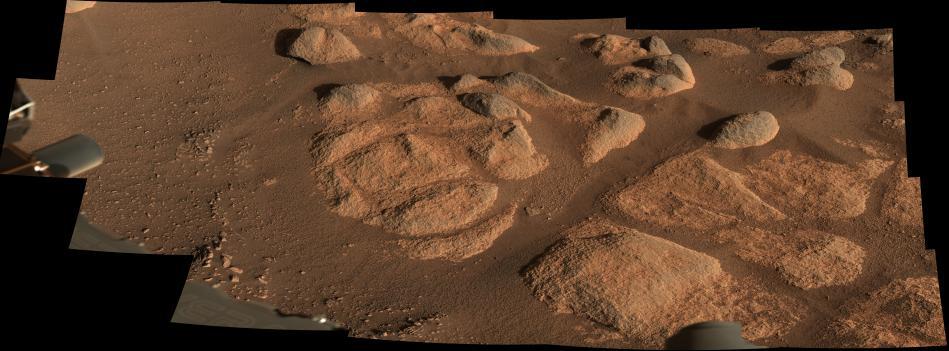
NASA's Perseverance Mars rover viewed these rocks using its Mastcam-Z imager on April 27, 2021, the 66th Martian day, or sol, of the mission. Stitched together from 21 images, this mosaic is not white balanced; instead, it is displayed in a preliminary calibrated version of a natural-color composite, approximately simulating the colors of the scene as it would appear on Mars. For scale, the largest piece of rock casting a shadow in the upper right part of the mosaic is about 11 inches (27 centimeters) across, and the entire scene is about 10 feet (3 meters) across. The smallest pebbles and other features that can reliably be resolved at this zoom scale are around 0.04 to 0.08 inches (1-2 millimeters) across. The scene was also captured in enhanced color (Figure 1) as well as a color anaglyph made for viewing through red-blue 3D glasses (Figure 2). Arizona State University in Tempe leads the operations of the Mastcam-Z instrument, working in collaboration with Malin Space Science Systems in San Diego. A key objective for Perseverance's mission on Mars is astrobiology, including the search for signs of ancient microbial life. The rover will characterize the planet's geology and past climate, pave the way for human exploration of the Red Planet, and be the first mission to collect and cache Martian rock and regolith (broken rock and dust). Subsequent NASA missions, in cooperation with ESA (European Space Agency), would send spacecraft to Mars to collect these sealed samples from the surface and return them to Earth for in-depth analysis. The Mars 2020 Perseverance mission is part of NASA's Moon to Mars exploration approach, which includes Artemis missions to the Moon that will help prepare for human exploration of the Red Planet. https://photojournal.jpl.nasa.gov/catalog/PIA24627
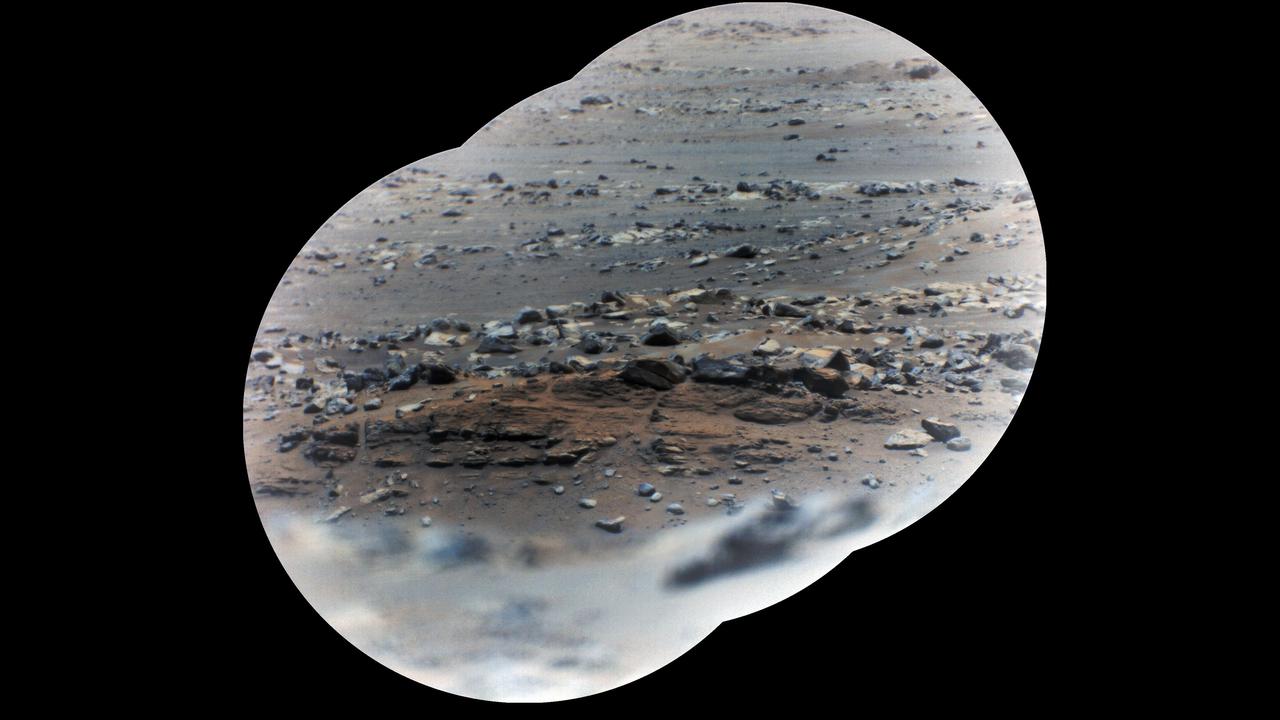
NASA's Perseverance rover took these zoomed-in images of a layered outcrop (just below center of image) nicknamed "Artuby" on June 17, 2021 (the 116th sol, or Martian Day, of its mission), from a little more than a third of a mile (615 meters) away. This mosaic is made up of three images taken by the Remote Microscopic Imager (RMI), part of the rover's SuperCam instrument. Each circular image has a field of view of 37.73 feet (11.50 meters) at this distance. The images were combined using an algorithm that weights the image centers. The outcrop shows evidence of being formed in an ancient lake. The feature is in the 'Verdon' quadrangle of Mars' Jezero Crater, south of the landing site. Artuby is the name of a river in southern France. Perseverance has been exploring the floor of Jezero Crater since it landed on Feb. 18, 2021. SuperCam is led by Los Alamos National Laboratory in New Mexico, where the instrument's Body Unit was developed. That part of the instrument includes several spectrometers as well as control electronics and software. The Mast Unit, including the RMI used for these images, was developed and built by several laboratories of the CNRS (the French research center) and French universities under the contracting authority of Centre National d'Etudes Spatiales (CNES, the French space agency). A key objective for Perseverance's mission on Mars is astrobiology, including the search for signs of ancient microbial life. The rover will characterize the planet's geology and past climate, pave the way for human exploration of the Red Planet, and be the first mission to collect and cache Martian rock and regolith (broken rock and dust). Subsequent NASA missions, in cooperation with ESA (European Space Agency), would send spacecraft to Mars to collect these sealed samples from the surface and return them to Earth for in-depth analysis. The Mars 2020 Perseverance mission is part of NASA's Moon to Mars exploration approach, which includes Artemis missions to the Moon that will help prepare for human exploration of the Red Planet. https://photojournal.jpl.nasa.gov/catalog/PIA24747
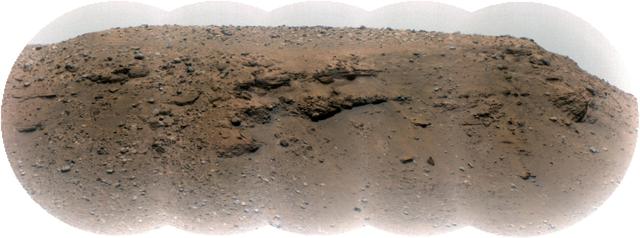
Composed of five images, this mosaic of the Jezero Crater's "Delta Scarp" was taken on March 17, 2021, by the Remote Microscopic Imager (RMI) camera aboard NASA's Perseverance rover from 1.4 miles (2.25 kilometers) away. Scientists believe the 377-foot-wide (115-meter-wide) escarpment is a portion of the remnants of a fan-shaped deposit of sediments that resulted from the confluence between an ancient river and an ancient lake. An annotated version of the same image (Figure 1) reveals location of a conglomerate (rock composed of coarse-grained pebbles mixed with sand) and examples of crossbedding (tilted layers of sedimentary rock that can result from water passing over a loose bed of sediment). Part of the SuperCam instrument, the RMI is able to spot an object the size of a softball from nearly a mile away, allowing scientists to take images of details from a long distance. It also provides fine details of nearby targets zapped by SuperCam's laser. SuperCam is led by Los Alamos National Laboratory in New Mexico, where the instrument's Body Unit was developed. That part of the instrument includes several spectrometers as well as control electronics and software. The Mast Unit was developed and built by several laboratories of the CNRS (the French research center) and French universities under the contracting authority of CNES (the French space agency). A key objective for Perseverance's mission on Mars is astrobiology, including the search for signs of ancient microbial life. The rover will characterize the planet's geology and past climate, pave the way for human exploration of the Red Planet, and be the first mission to collect and cache Martian rock and regolith (broken rock and dust). Subsequent NASA missions, in cooperation with ESA (European Space Agency), would send spacecraft to Mars to collect these sealed samples from the surface and return them to Earth for in-depth analysis. The Mars 2020 Perseverance mission is part of NASA's Moon to Mars exploration approach, which includes Artemis missions to the Moon that will help prepare for human exploration of the Red Planet. https://photojournal.jpl.nasa.gov/catalog/PIA24683
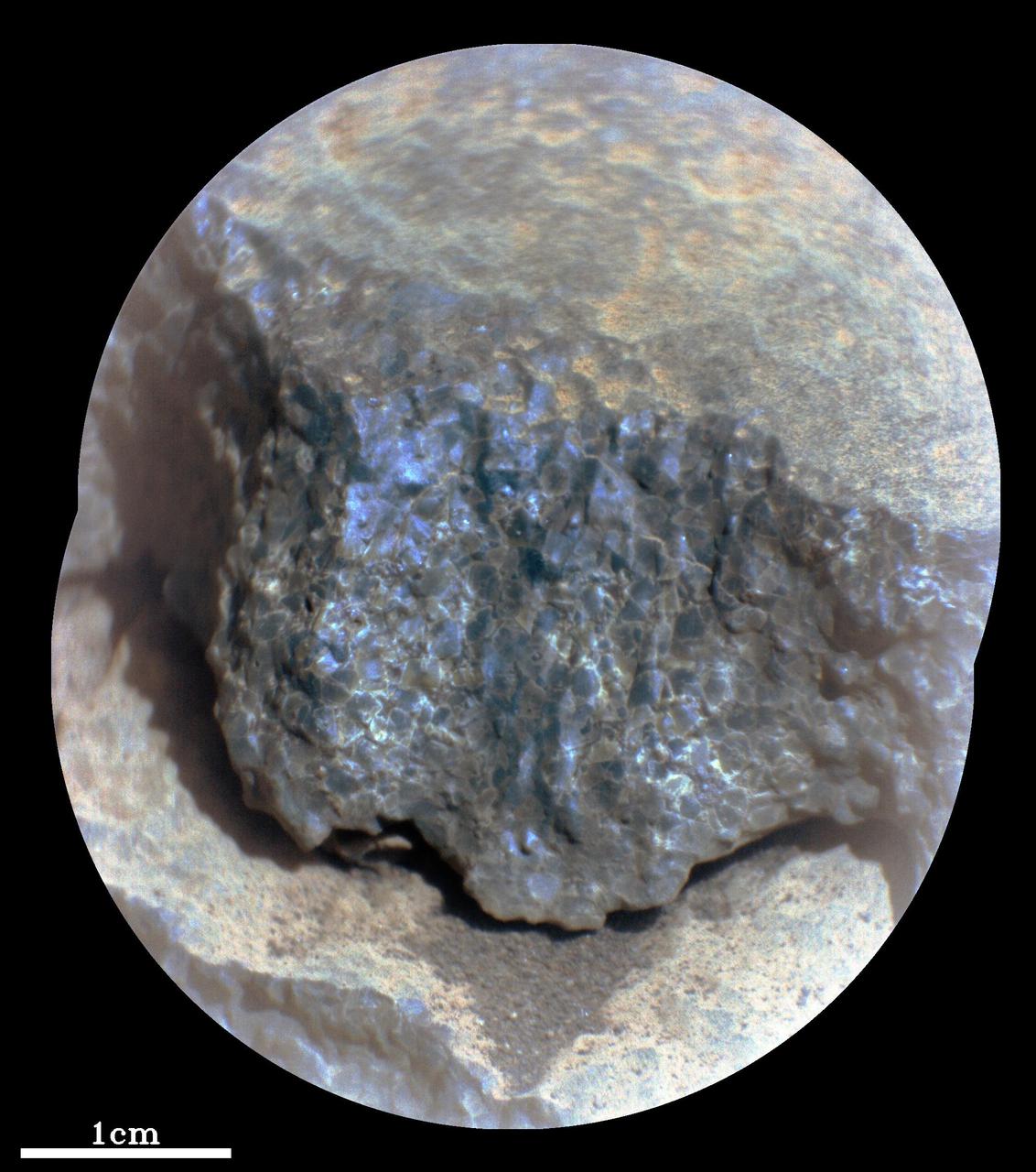
This enhanced-color close-up of a rock target called "Cine" was captured by the SuperCam instrument aboard NASA's Perseverance Mars rover on Sept. 17, 2021, the 206th Martian day, or sol, of rover's mission. SuperCam’s Remote Microscopic Imager took two images that were later combined to form this close-up. The target is 92 inches (2 meters) away, seen from the rover's mast. The image shows a rock layer made up of tightly packed millimeter-size gray, angular grains, or crystals. The image on the right shows a detail of the grain/crystal texture. The composition of this rock target was investigated with SuperCam's laser and spectrometer, along with the Mastcam-Z camera. Using these instruments, scientists can study the chemical composition of rocks from a distance. Analysis of "Cine" showed that it is rich in the mineral olivine. After the image was taken, the mission’s science team debated whether the rock is igneous (volcanic) or consists of fine sedimentary grains of igneous material that were cemented together in a watery environment. SuperCam is led by Los Alamos National Laboratory in New Mexico, where the instrument's body unit was developed. That part of the instrument includes several spectrometers as well as control electronics and software. The mast unit, including the Remote Microscopic Imager used for these images, was developed and built by several laboratories of the CNRS (the French research center) and French universities under the contracting authority of Centre National d'Etudes Spatiales (CNES), the French space agency. A key objective for Perseverance's mission on Mars is astrobiology, including the search for signs of ancient microbial life. The rover will characterize the planet's geology and past climate, pave the way for human exploration of the Red Planet, and be the first mission to collect and cache Martian rock and regolith (broken rock and dust). Subsequent NASA missions, in cooperation with ESA (European Space Agency), would send spacecraft to Mars to collect these sealed samples from the surface and return them to Earth for in-depth analysis. The Mars 2020 Perseverance mission is part of NASA's Moon to Mars exploration approach, which includes Artemis missions to the Moon that will help prepare for human exploration of the Red Planet. https://photojournal.jpl.nasa.gov/catalog/PIA24936
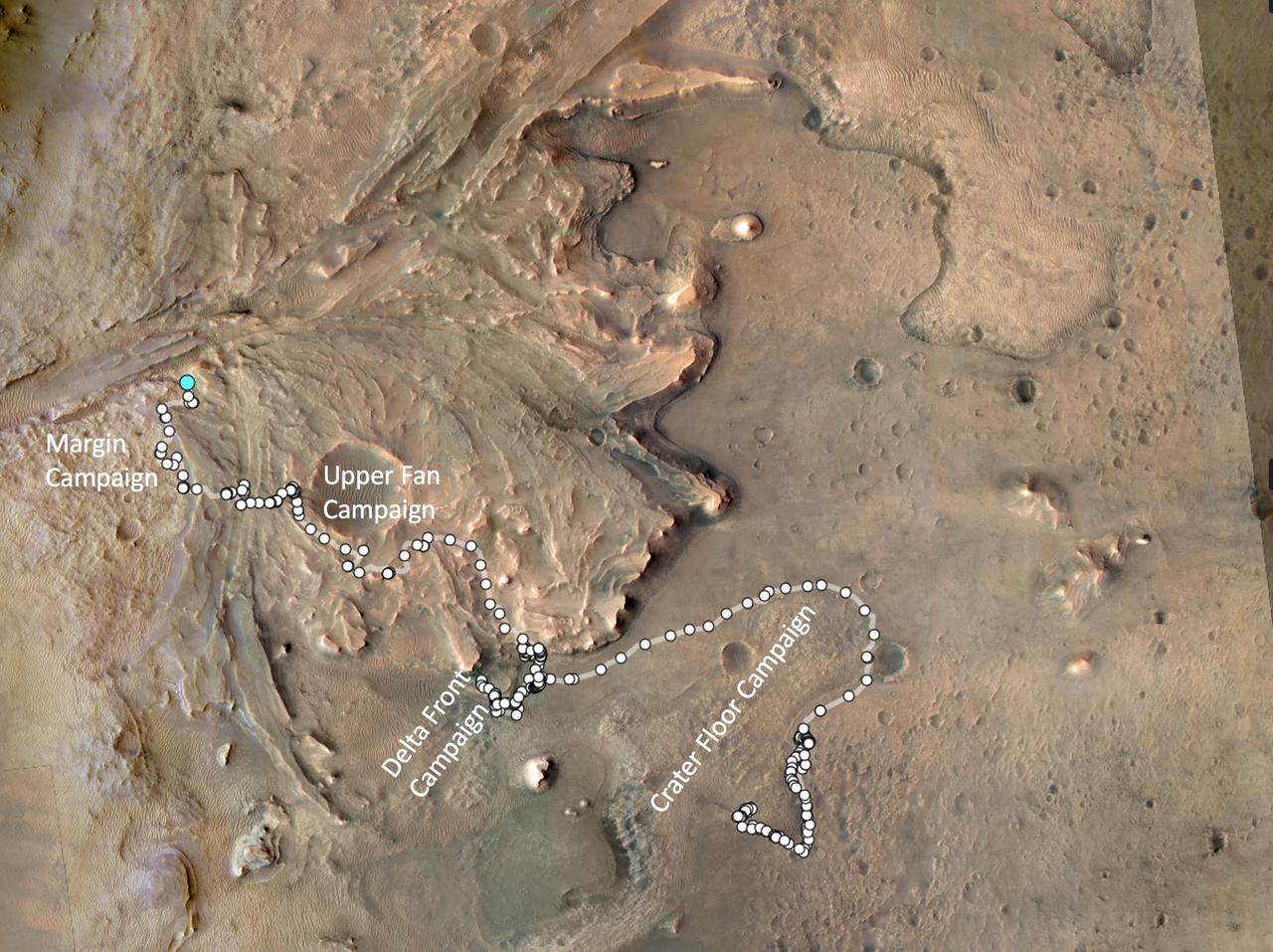
The path taken by NASA's Perseverance Mars rover during the first 1,000 sols (Martian days) of its mission at Jezero Crater is annotated on this overhead view taken by the HiRISE camera aboard the agency's Mars Reconnaissance Orbiter. White circles signify locations on the surface where the rover stopped after completing a traverse. The pale blue circle at upper left indicates the rover's position as of Dec. 12, 2023. The white text indicates the areas of the four rover science campaigns, from initial campaign to current: Crater Floor, Delta Front, Upper Fan, and Margin. Figure A, showing the same general area, is annotated to indicate the route and the two locations where the rover used its PIXL instrument to analyze abrasion patches "Ouzel Falls" and "Bills Bay" and its drill to core corresponding rock samples, "Otis Peak" and "Lefroy Bay." The University of Arizona, in Tucson, operates HiRISE, which was built by Ball Aerospace & Technologies Corp., in Boulder, Colorado. JPL manages the Mars Reconnaissance Orbiter Project for NASA's Science Mission Directorate, Washington. A key objective for Perseverance's mission on Mars is astrobiology, including the search for signs of ancient microbial life. The rover will characterize the planet's geology and past climate, pave the way for human exploration of the Red Planet, and be the first mission to collect and cache Martian rock and regolith (broken rock and dust). Subsequent NASA missions, in cooperation with ESA (European Space Agency), would send spacecraft to Mars to collect these sealed samples from the surface and return them to Earth for in-depth analysis. The Mars 2020 Perseverance mission is part of NASA's Moon to Mars exploration approach, which includes Artemis missions to the Moon that will help prepare for human exploration of the Red Planet. https://photojournal.jpl.nasa.gov/catalog/PIA26231
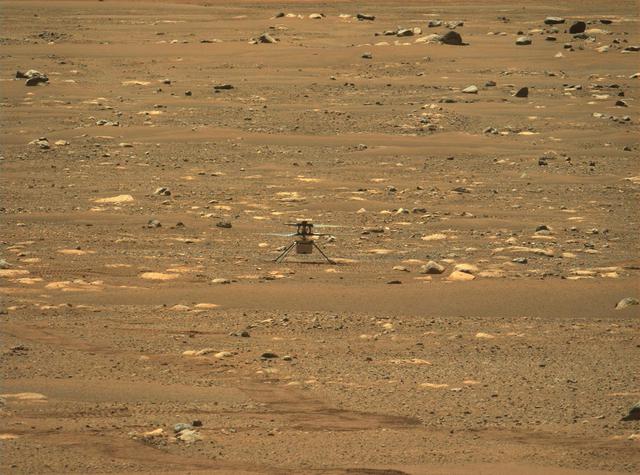
This image was taken after the first flight of NASA's Ingenuity Mars Helicopter — and the first powered, controlled flight on another planet. It was captured by Mastcam-Z, a pair of zoomable cameras aboard NASA's Perseverance Mars rover, on April 19, 2021. Flying in a controlled manner on Mars is far more difficult than flying on Earth. The Red Planet has significant gravity (about one-third that of Earth's), but its atmosphere is just 1% as dense as Earth's at the surface. Stitched together from multiple images, the mosaic is not white balanced; instead, it is displayed in a preliminary calibrated version of a natural color composite, approximately simulating the colors of the scene that we would see if we were there viewing it ourselves. Arizona State University in Tempe leads the operations of the Mastcam-Z instrument, working in collaboration with Malin Space Science Systems in San Diego. A key objective for Perseverance's mission on Mars is astrobiology, including the search for signs of ancient microbial life. The rover will characterize the planet's geology and past climate, pave the way for human exploration of the Red Planet, and be the first mission to collect and cache Martian rock and regolith (broken rock and dust). Subsequent NASA missions, in cooperation with ESA (European Space Agency), would send spacecraft to Mars to collect these sealed samples from the surface and return them to Earth for in-depth analysis. The Mars 2020 Perseverance mission is part of NASA's Moon to Mars exploration approach, which includes Artemis missions to the Moon that will help prepare for human exploration of the Red Planet. https://photojournal.jpl.nasa.gov/catalog/PIA24550
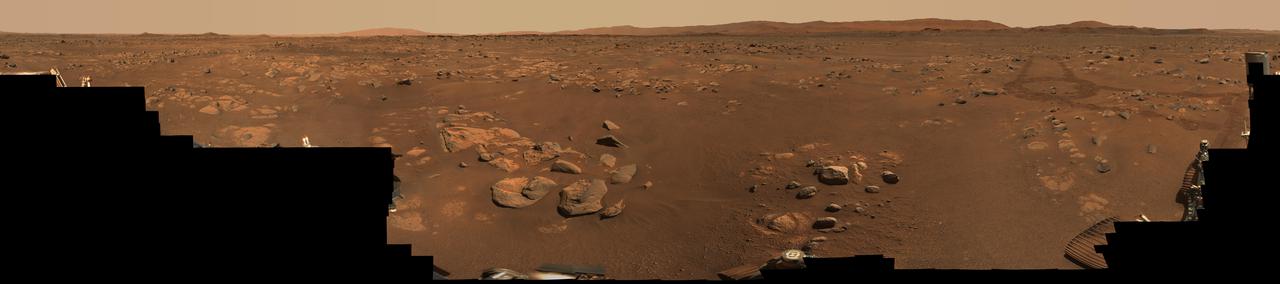
NASA's Perseverance Mars rover used its Mastcam-Z stereo imaging system to capture this 360-degree panorama of "Van Zyl Overlook," where the rover was parked for 13 days as the Ingenuity helicopter performed its first flights. The 2.4 billion-pixel panorama is made up of 992 individual right-eye Mastcam-Z images stitched together. The images were taken between April 15 and 26, 2021, or the 53rd and 64th Martian days, or sols, of the mission. A few small patches of near-field sand had been covered by parts of Perseverance when the right-eye Mastcam-Z images were taken; those gaps were filled with images of the same sandy patches taken by the Mastcam-Z left-eye camera at the same time, or from the earlier navigation camera images. Imaging coverage of the sky has also been digitally smoothed and expanded based on the actual sky color observed as the panorama was being acquired on Mars. Arizona State University in Tempe leads the operations of the Mastcam-Z instrument, working in collaboration with Malin Space Science Systems in San Diego. A key objective for Perseverance's mission on Mars is astrobiology, including the search for signs of ancient microbial life. The rover will characterize the planet's geology and past climate, pave the way for human exploration of the Red Planet, and be the first mission to collect and cache Martian rock and regolith (broken rock and dust). Subsequent NASA missions, in cooperation with ESA (European Space Agency), would send spacecraft to Mars to collect these sealed samples from the surface and return them to Earth for in-depth analysis. The Mars 2020 Perseverance mission is part of NASA's Moon to Mars exploration approach, which includes Artemis missions to the Moon that will help prepare for human exploration of the Red Planet. https://photojournal.jpl.nasa.gov/catalog/PIA24663

Stitched together from 79 individual images, this Mastcam-Z right-eye 110-mm zoom mosaic is from the camera's first high-resolution panorama imaging sequence. These images were taken on the afternoon of Sol 4 (Feb. 22, 2021) of the mission; a sol is a Martian day. The camera was commanded to take these images by scanning the mast, or "head," a full 360-degrees around the horizon visible from the landing site. The top of some of the distant crater rim is cut off in some images to ensure the images would cover the front ridge of the Jezero Crater's ancient delta, which is only about 1.25 miles (2 kilometers) away from the rover in the center of this panorama. At that distance and focal length, Mastcam-Z can resolve features as small as about 50 centimeters (1.6 feet) across along the front of the delta. The mosaic is not white balanced but is instead displayed in a preliminary calibrated version of a natural color composite, approximately simulating the colors of the scene that we would see if we were there viewing it ourselves. Arizona State University in Tempe leads the operations of the Mastcam-Z instrument, working in collaboration with Malin Space Science Systems in San Diego. A key objective for Perseverance's mission on Mars is astrobiology, including the search for signs of ancient microbial life. The rover will characterize the planet's geology and past climate, pave the way for human exploration of the Red Planet, and be the first mission to collect and cache Martian rock and regolith (broken rock and dust). Subsequent NASA missions, in cooperation with ESA (European Space Agency), would send spacecraft to Mars to collect these sealed samples from the surface and return them to Earth for in-depth analysis. The Mars 2020 Perseverance mission is part of NASA's Moon to Mars exploration approach, which includes Artemis missions to the Moon that will help prepare for human exploration of the Red Planet. Complete mosaic available at https://photojournal.jpl.nasa.gov/catalog/PIA23727
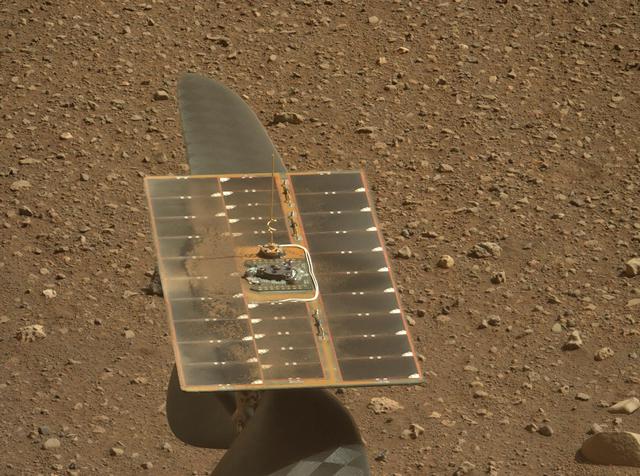
The solar panel of NASA's Ingenuity Mars Helicopter's solar panel as seen by Mastcam-Z, a pair of zoomable cameras aboard NASA's Perseverance Mars rover. Roughly 6.5 by 17 inches (425 mm by 165 mm), the panel charges six lithium-ion batteries inside the helicopter. The small amount of dust on the panel may have accumulated above the helicopter during landing and fallen onto it during helicopter deployment. This dust has had no adverse impact on the helicopter's power. Solar cells in the array are optimized for the solar spectrum encountered at Mars, and the stored energy is used to operate heaters for the cold Martian nights as well as power the helicopter during flight operations. Power expended by the helicopter during an up-to-90-second flight is about 350 watts. The image is not white balanced; instead it is displayed in a preliminary calibrated version of a natural-color composite, approximately simulating the colors of the scene that we would see if we were there viewing it ourselves. Arizona State University in Tempe leads the operations of the Mastcam-Z instrument, working in collaboration with Malin Space Science Systems in San Diego. A key objective for Perseverance's mission on Mars is astrobiology, including the search for signs of ancient microbial life. The rover will characterize the planet's geology and past climate, pave the way for human exploration of the Red Planet, and be the first mission to collect and cache Martian rock and regolith (broken rock and dust). Subsequent NASA missions, in cooperation with ESA (European Space Agency), would send spacecraft to Mars to collect these sealed samples from the surface and return them to Earth for in-depth analysis. The Mars 2020 Perseverance mission is part of NASA's Moon to Mars exploration approach, which includes Artemis missions to the Moon that will help prepare for human exploration of the Red Planet. https://photojournal.jpl.nasa.gov/catalog/PIA24545

CAPE CANAVERAL, Fla. – An educational news conference to explore "Why Mars Excites and Inspires Us" begins in NASA Kennedy Space Center's Press Site auditorium in Florida during prelaunch activities for the agency’s Mars Science Laboratory (MSL) launch. Participants are, from left, Leland Melvin, NASA associate administrator for Education; Clara Ma, student, NASA contest winner for naming Curiosity, Shawnee Mission East High School, Prairie Village, Kansas; Scott Anderson, teacher and science department chairman, Da Vinci School for Science and the Arts, El Paso, Texas; Lauren Lyons, graduate student, Harvard University, FIRST robotics alumna; and Veronica McGregor, manager, Media Relations Office, NASA Jet Propulsion Laboratory. MSL's car-sized Martian rover, Curiosity, has 10 science instruments designed to search for signs of life, including methane, and help determine if the gas is from a biological or geological source. Ma's entry was selected the winner from 9,000 entries in NASA's nationwide student contest to name the rover. At the time, she was a twelve-year-old sixth-grade student at the Sunflower Elementary school in Lenexa, Kansas. Liftoff of MSL aboard a United Launch Alliance Atlas V rocket from Space Launch Complex-41 on Cape Canaveral Air Force Station is planned during a launch window which extends from 10:02 a.m. to 11:45 a.m. EST on Nov. 26. For more information, visit http://www.nasa.gov/msl. Photo credit: NASA/Kim Shiflett

CAPE CANAVERAL, Fla. – An educational news conference to explore "Why Mars Excites and Inspires Us" is under way in NASA Kennedy Space Center's Press Site auditorium in Florida during prelaunch activities for the agency’s Mars Science Laboratory (MSL) launch. Participants are, from left, moderator George Diller, NASA Public Affairs, NASA Kennedy Space Center; Leland Melvin, NASA associate administrator for Education; Clara Ma, student, NASA contest winner for naming Curiosity, Shawnee Mission East High School, Prairie Village, Kansas; Scott Anderson, teacher and science department chairman, Da Vinci School for Science and the Arts, El Paso, Texas; Lauren Lyons, graduate student, Harvard University, FIRST robotics alumna; and Veronica McGregor, manager, Media Relations Office, NASA Jet Propulsion Laboratory. MSL's car-sized Martian rover, Curiosity, has 10 science instruments designed to search for signs of life, including methane, and help determine if the gas is from a biological or geological source. Ma's entry was selected the winner from 9,000 entries in NASA's nationwide student contest to name the rover. At the time, she was a twelve-year-old sixth-grade student at the Sunflower Elementary school in Lenexa, Kansas. Liftoff of MSL aboard a United Launch Alliance Atlas V rocket from Space Launch Complex-41 on Cape Canaveral Air Force Station is planned during a launch window which extends from 10:02 a.m. to 11:45 a.m. EST on Nov. 26. For more information, visit http://www.nasa.gov/msl. Photo credit: NASA/Kim Shiflett