
NASA release date June 21, 2011 The terminator of Mercury, shown here in color, is the line between light and dark, or day and night. On Mercury, three days are equivalent to two years, or in other words, the planet spins around its axis three times for every two orbits around the Sun. The first Mercury year of the MESSENGER mission ended on Monday, June 13, 2011. This image was acquired as part of MDIS's color base map. The color base map is composed of WAC images taken through eight different narrow-band color filters and will cover more than 90% of Mercury's surface with an average resolution of 1 kilometer/pixel (0.6 miles/pixel). The highest-quality color images are obtained for Mercury's surface when both the spacecraft and the Sun are overhead, so these images typically are taken with viewing conditions of low incidence and emission angles. The MESSENGER spacecraft is the first ever to orbit the planet Mercury, and the spacecraft's seven scientific instruments and radio science investigation are unraveling the history and evolution of the Solar System's innermost planet. Visit the Why Mercury? section of this website to learn more about the key science questions that the MESSENGER mission is addressing. During the one-year primary mission, MDIS is scheduled to acquire more than 75,000 images in support of MESSENGER's science goals. Credit: NASA/Johns Hopkins University Applied Physics Laboratory/Carnegie Institution of Washington <b><a href="http://www.nasa.gov/centers/goddard/home/index.html" rel="nofollow">NASA Goddard Space Flight Center</a></b> enables NASA’s mission through four scientific endeavors: Earth Science, Heliophysics, Solar System Exploration, and Astrophysics. Goddard plays a leading role in NASA’s accomplishments by contributing compelling scientific knowledge to advance the Agency’s mission. <b>Follow us on <a href="http://twitter.com/NASA_GoddardPix" rel="nofollow">Twitter</a></b> <b>Like us on <a href="http://www.facebook.com/pages/Greenbelt-MD/NASA-Goddard/395013845897?ref=tsd" rel="nofollow">Facebook</a></b> <b>Find us on <a href="http://web.stagram.com/n/nasagoddard/?vm=grid" rel="nofollow">Instagram</a></b>
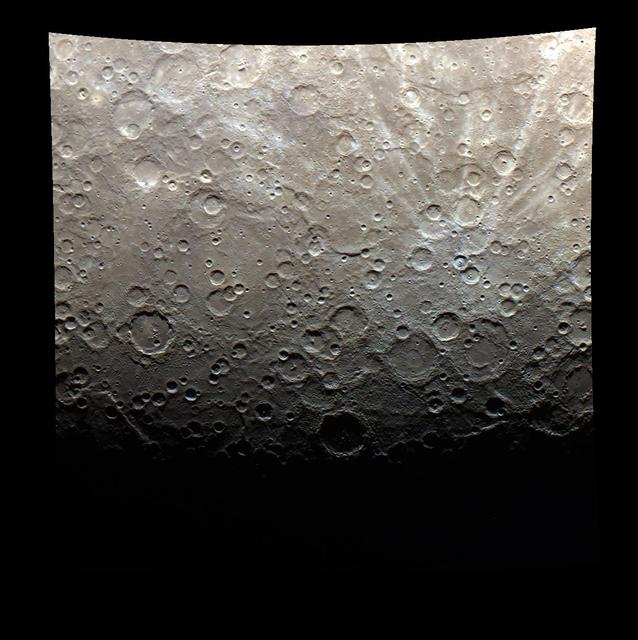
The Terminator is Here - in Color!
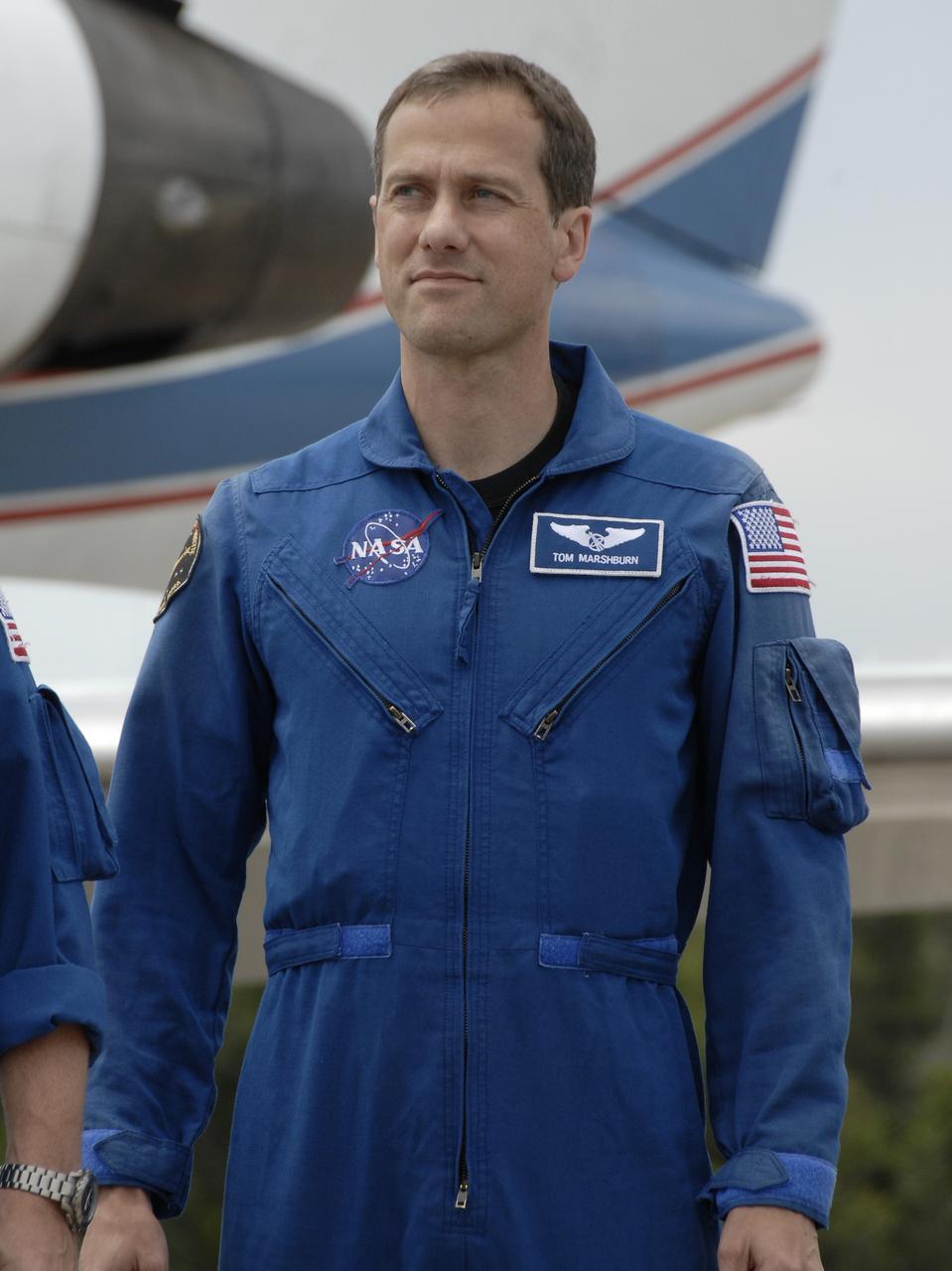
CAPE CANAVERAL, Fla. – Space shuttle Endeavour's STS-127 mission crew members greet the media after arriving at NASA's Kennedy Space Center in Florida for the Terminal Countdown Demonstration Test, or TCDT. Seen here is Mission Specialist Tom Marshburn. The astronauts will be taking part in Terminal Countdown Demonstration Test activities that include equipment familiarization and emergency egress training, and culminates in a simulated launch countdown aboard Endeavour. The STS-127 mission is the final of three flights dedicated to the assembly of the Japanese Kibo laboratory complex. Launch is targeted for June 13. Photo credit: NASA/Kim Shiflett
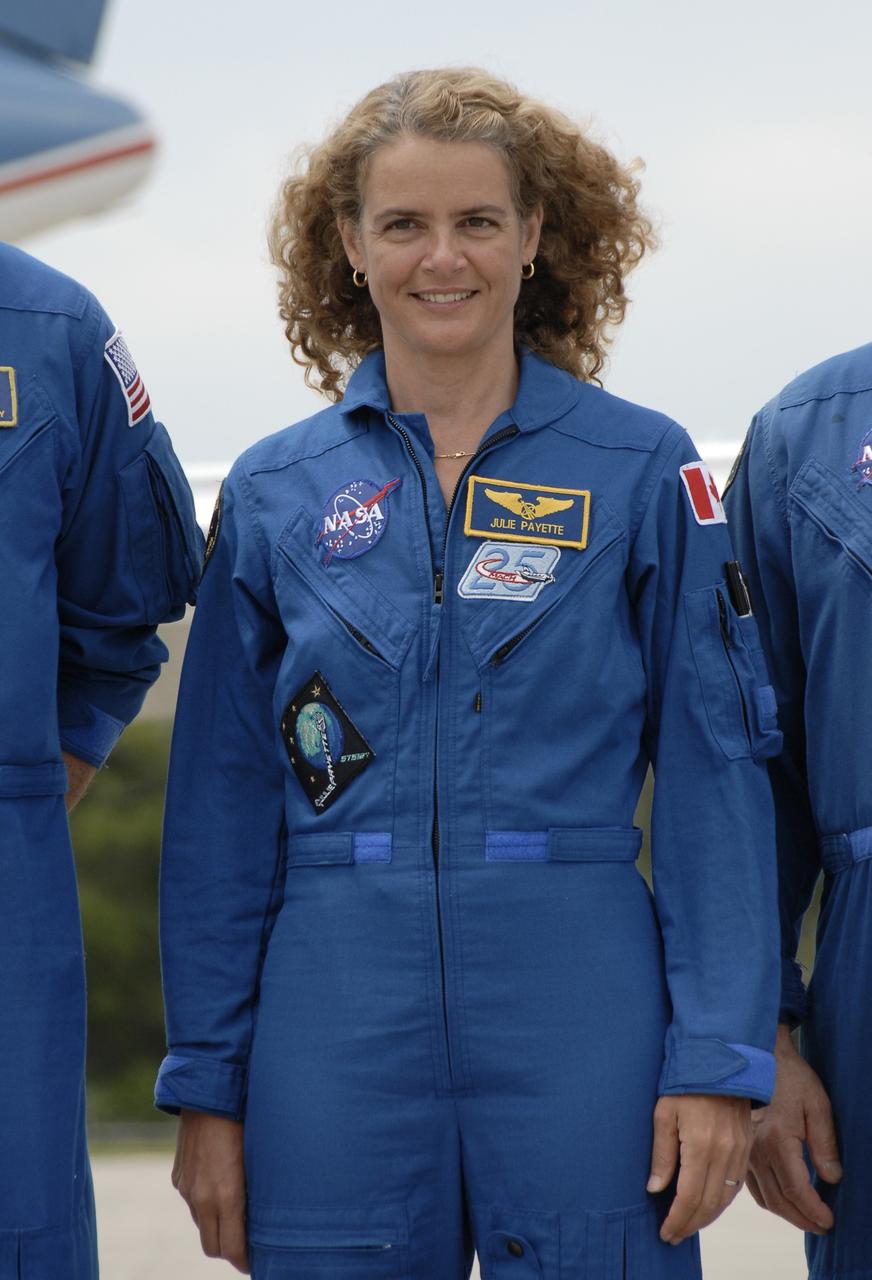
CAPE CANAVERAL, Fla. – Space shuttle Endeavour's STS-127 mission crew members greet the media after arriving at NASA's Kennedy Space Center in Florida for the Terminal Countdown Demonstration Test, or TCDT. Seen here is Mission Specialist Julie Payette, who represents the Canadian Space Agency. The astronauts will be taking part in Terminal Countdown Demonstration Test activities that include equipment familiarization and emergency egress training, and culminates in a simulated launch countdown aboard Endeavour. The STS-127 mission is the final of three flights dedicated to the assembly of the Japanese Kibo laboratory complex. Launch is targeted for June 13. Photo credit: NASA/Kim Shiflett
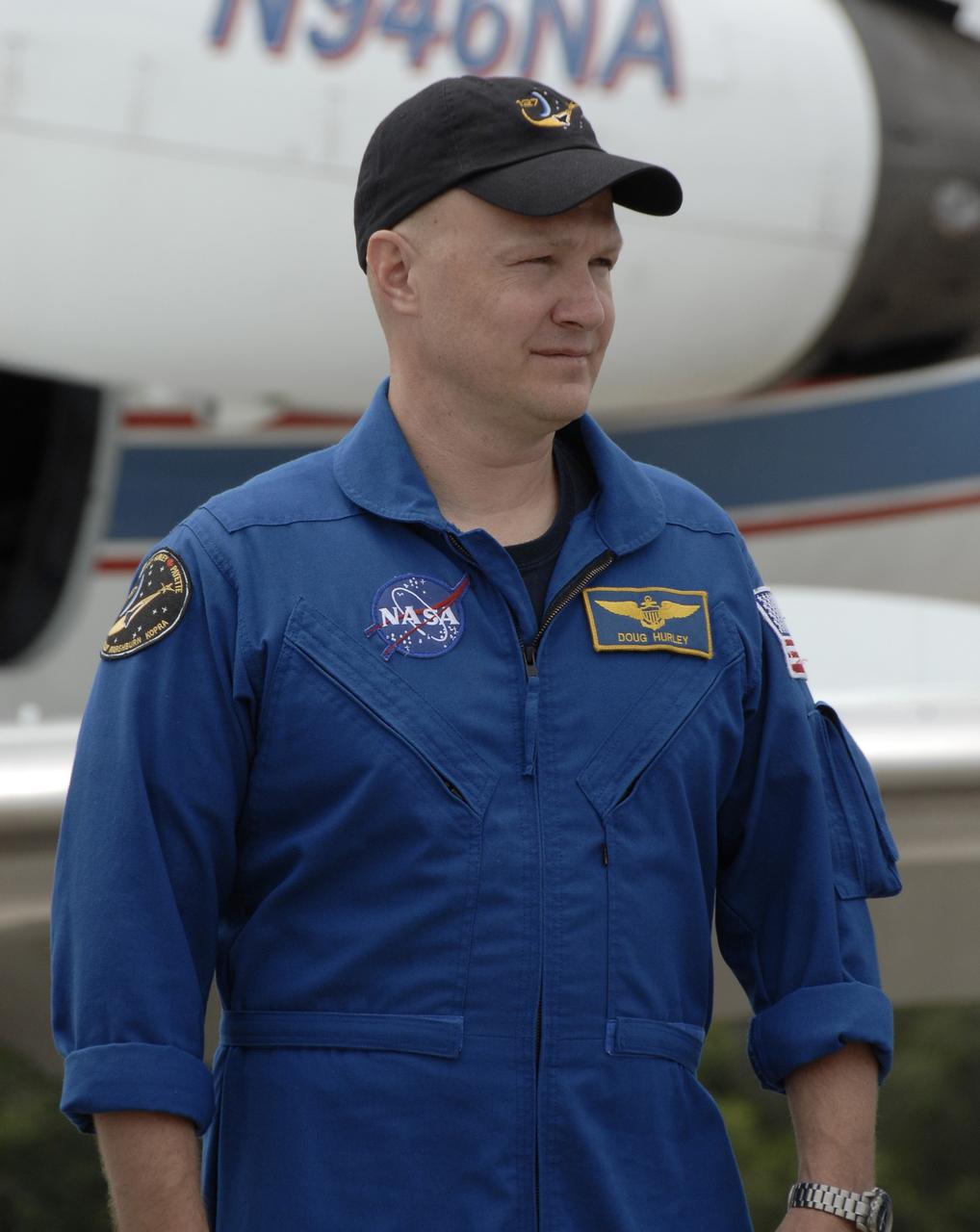
CAPE CANAVERAL, Fla. – Space shuttle Endeavour's STS-127 mission crew members greet the media after arriving at NASA's Kennedy Space Center in Florida for the Terminal Countdown Demonstration Test, or TCDT. Seen here is Pilot Doug Hurley. The astronauts will be taking part in Terminal Countdown Demonstration Test activities that include equipment familiarization and emergency egress training, and culminates in a simulated launch countdown aboard Endeavour. The STS-127 mission is the final of three flights dedicated to the assembly of the Japanese Kibo laboratory complex. Launch is targeted for June 13. Photo credit: NASA/Kim Shiflett
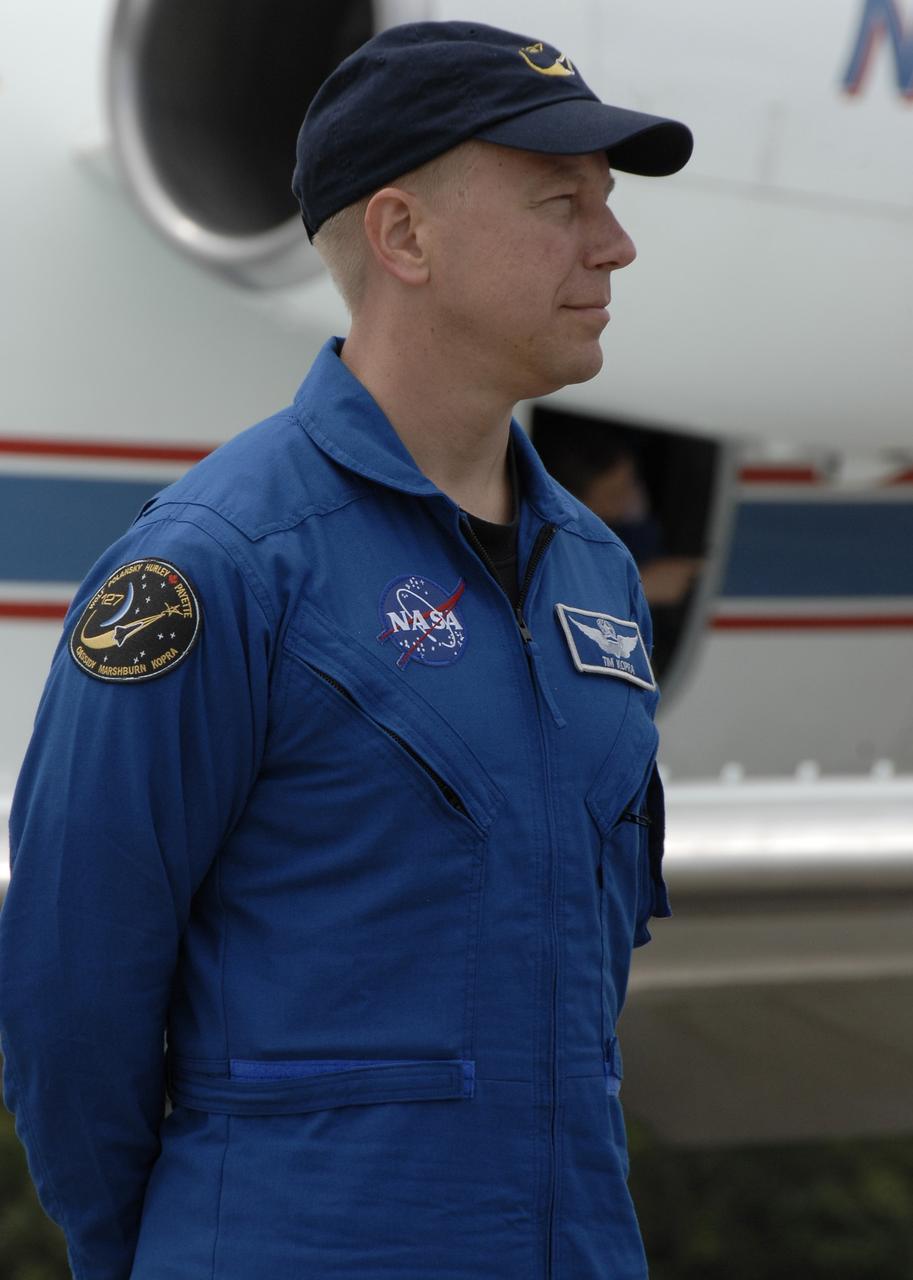
CAPE CANAVERAL, Fla. – Space shuttle Endeavour's STS-127 mission crew members greet the media after arriving at NASA's Kennedy Space Center in Florida for the Terminal Countdown Demonstration Test, or TCDT. Seen here is Mission Specialist Tim Kopra. The astronauts will be taking part in Terminal Countdown Demonstration Test activities that include equipment familiarization and emergency egress training, and culminates in a simulated launch countdown aboard Endeavour. The STS-127 mission is the final of three flights dedicated to the assembly of the Japanese Kibo laboratory complex. Launch is targeted for June 13. Photo credit: NASA/Kim Shiflett
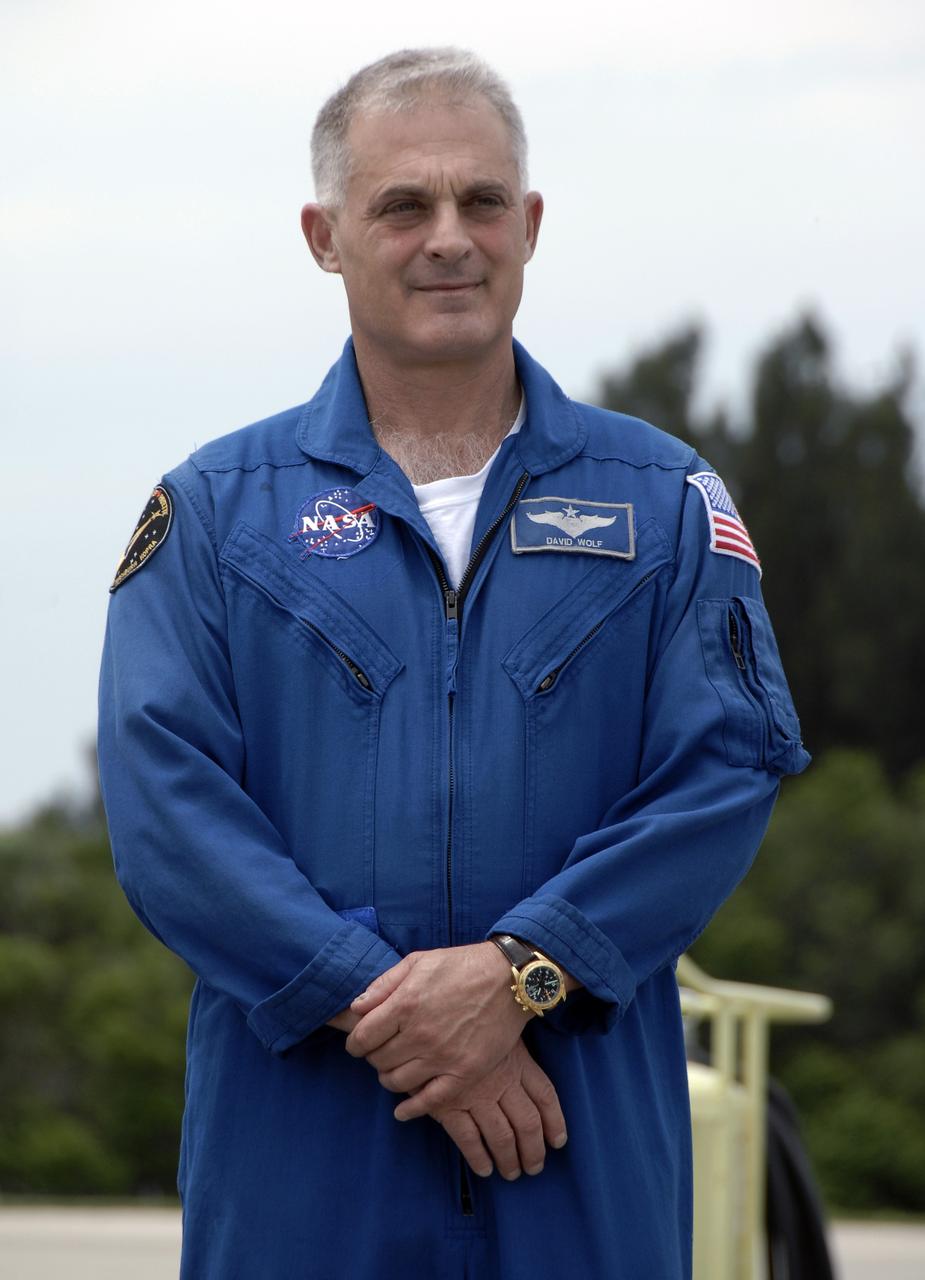
CAPE CANAVERAL, Fla. – Space shuttle Endeavour's STS-127 mission crew members greet the media after arriving at NASA's Kennedy Space Center in Florida for the Terminal Countdown Demonstration Test, or TCDT. Seen here is Mission Specialist Dave Wolf. The astronauts will be taking part in Terminal Countdown Demonstration Test activities that include equipment familiarization and emergency egress training, and culminates in a simulated launch countdown aboard Endeavour. The STS-127 mission is the final of three flights dedicated to the assembly of the Japanese Kibo laboratory complex. Launch is targeted for June 13. Photo credit: NASA/Kim Shiflett
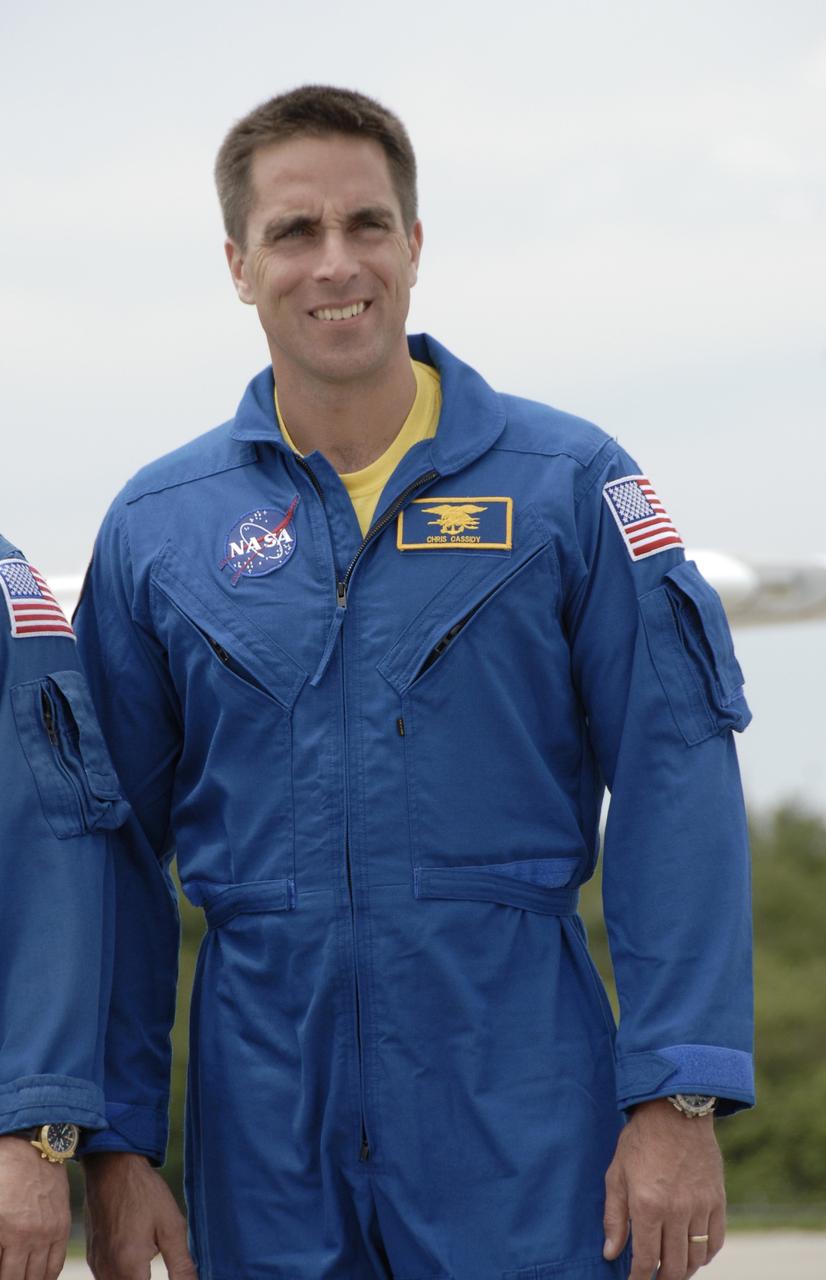
CAPE CANAVERAL, Fla. – Space shuttle Endeavour's STS-127 mission crew members greet the media after arriving at NASA's Kennedy Space Center in Florida for the Terminal Countdown Demonstration Test, or TCDT. Seen here is Mission Specialist Chris Cassidy. The astronauts will be taking part in Terminal Countdown Demonstration Test activities that include equipment familiarization and emergency egress training, and culminates in a simulated launch countdown aboard Endeavour. The STS-127 mission is the final of three flights dedicated to the assembly of the Japanese Kibo laboratory complex. Launch is targeted for June 13. Photo credit: NASA/Kim Shiflett
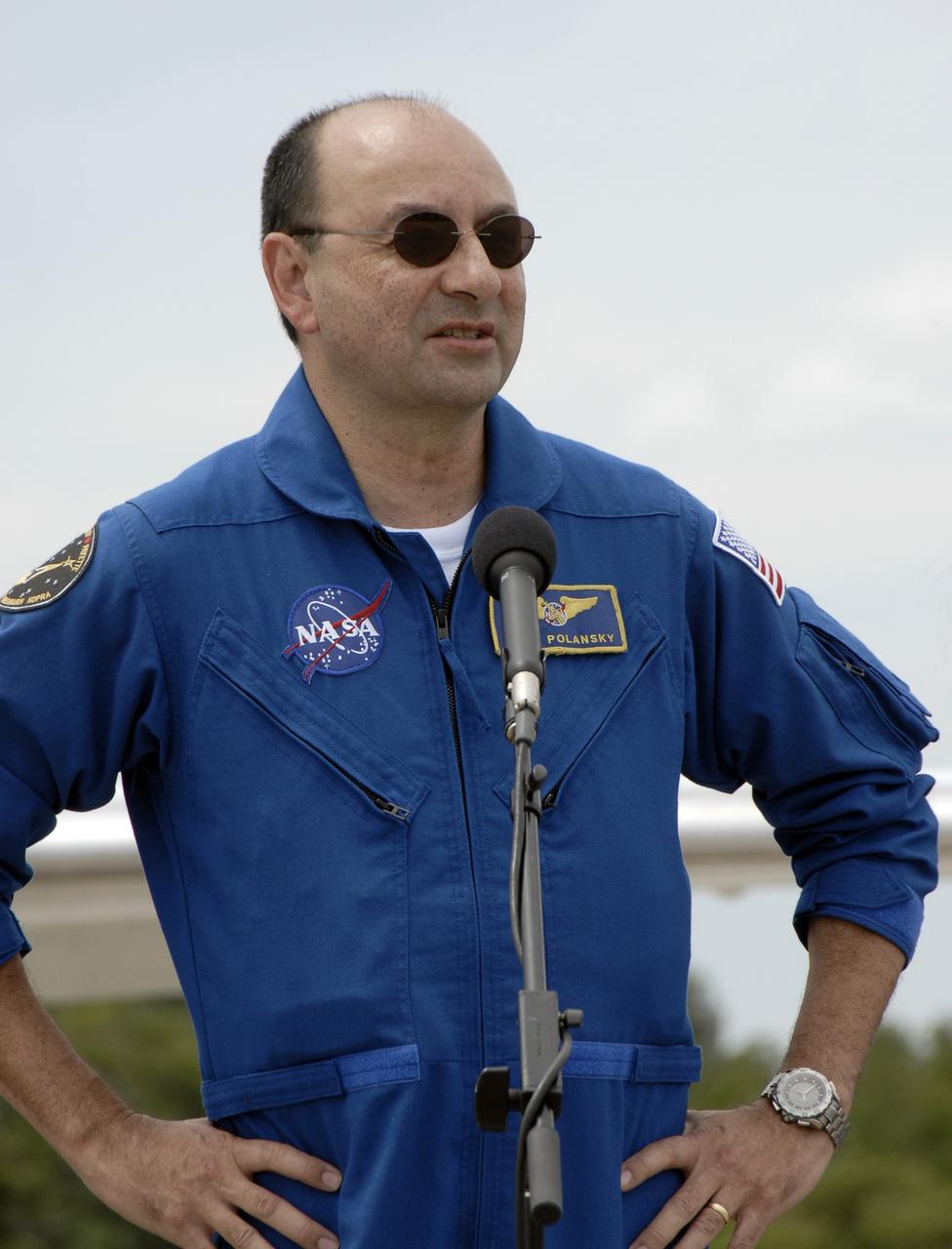
CAPE CANAVERAL, Fla. – Space shuttle Endeavour's STS-127 mission crew members greet the media after arriving at NASA's Kennedy Space Center in Florida. Seen here is Commander Mark Polansky, who explained they were at Kennedy for the Terminal Countdown Demonstration Test, or TCDT. The astronauts will be taking part in Terminal Countdown Demonstration Test activities that include equipment familiarization and emergency egress training, and culminates in a simulated launch countdown aboard Endeavour. The STS-127 mission is the final of three flights dedicated to the assembly of the Japanese Kibo laboratory complex. Launch is targeted for June 13. Photo credit: NASA/Kim Shiflett
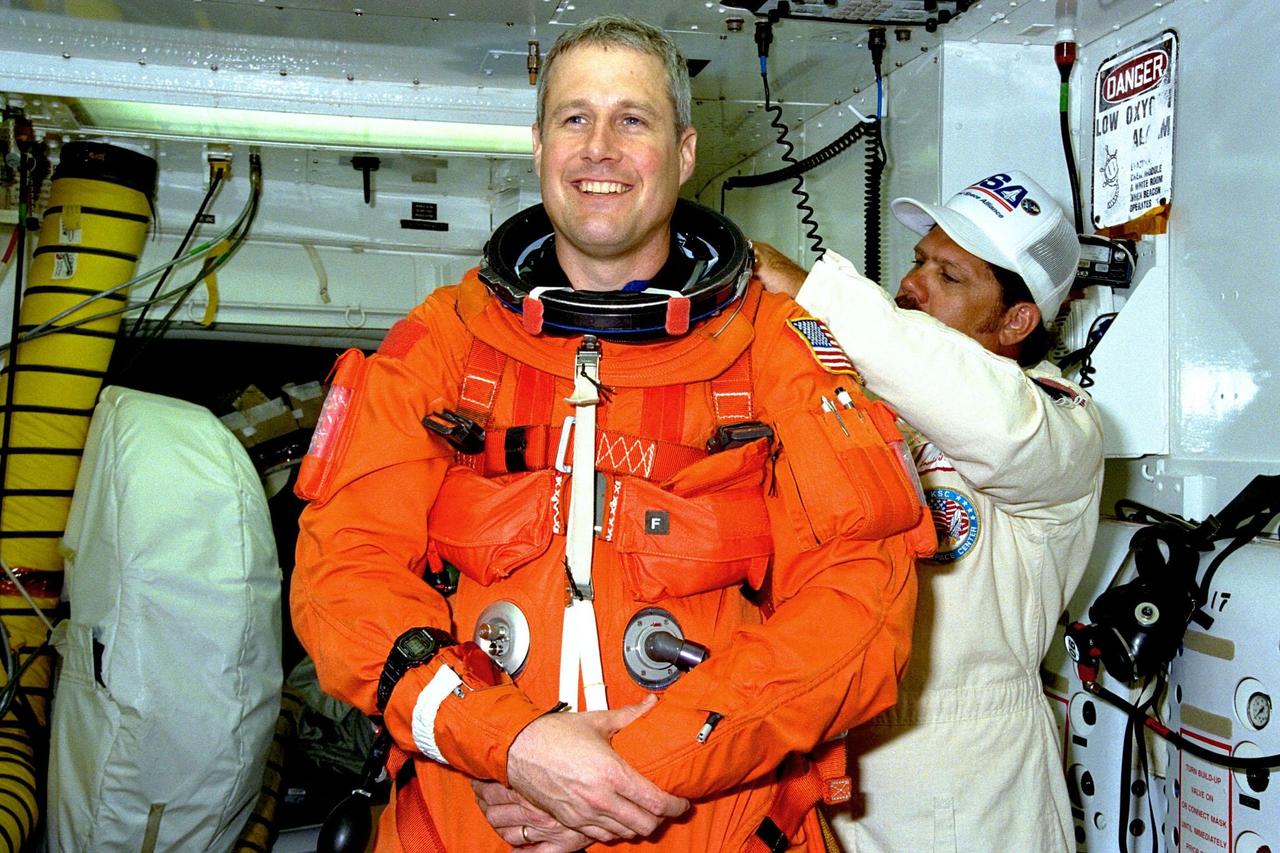
The crew of STS-90 participate in Terminal Countdown Demonstration Test (TCDT) activities at KSC's Launch Pad 39B. The TCDT is held at KSC prior to each Space Shuttle flight to provide crews with the opportunity to participate in simulated countdown activities. Here, Payload Specialist Jay Buckey, M.D., is assisted with his orange launch and re-entry suit by a USA technician. Columbia is targeted for launch of STS-90 on April 16 at 2:19 p.m. EDT and will be the second mission of 1998. The mission is scheduled to last nearly 17 days

STS-83 Payload Specialist Gregory T. Linteris, Mission Specialist Janice E. Voss, and Payload Specialist Roger K. Crouch participate in emergency egress training at Launch Complex 39A during the crew's <a href="http://www-pao.ksc.nasa.gov/kscpao/release/1997/40-97.htm">Terminal Countdown Demonstration Test (TCDT).</a> They are seen here in one of the pads' seven <a href="http://www-pao.ksc.nasa.gov/kscpao/nasafact/pads.htm#emergenc">slidewire baskets.</a
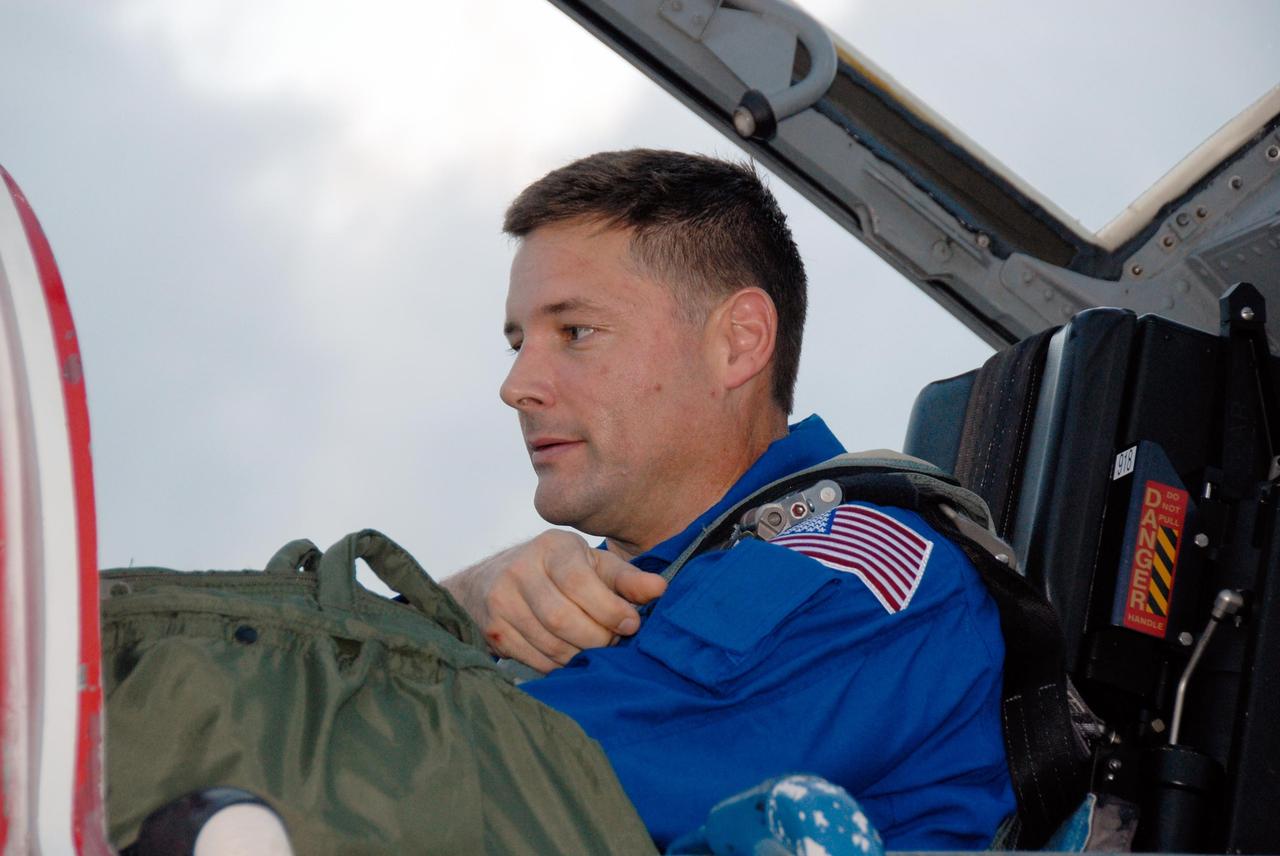
KENNEDY SPACE CENTER, FLA. -- The crew members of mission STS-120 arrive at NASA's Kennedy Space Center Shuttle Landing Facility aboard T-38 jet aircraft to take part in terminal countdown demonstration test activities. Mission Specialist Doug Wheelock, seen here, will be making his first shuttle flight. The terminal countdown demonstration test provides astronauts and ground crews an opportunity to participate in various simulated countdown activities, including equipment familiarization and emergency training. The STS-120 mission will deliver the U.S. Node 2 module, named Harmony, aboard space shuttle Discovery to the International Space Station. Launch of Discovery on mission STS-120 is targeted for Oct. 23 at 11:38 a.m. EDT on a 14-day mission to the International Space Station. Photo credit: NASA/Kim Shiflett
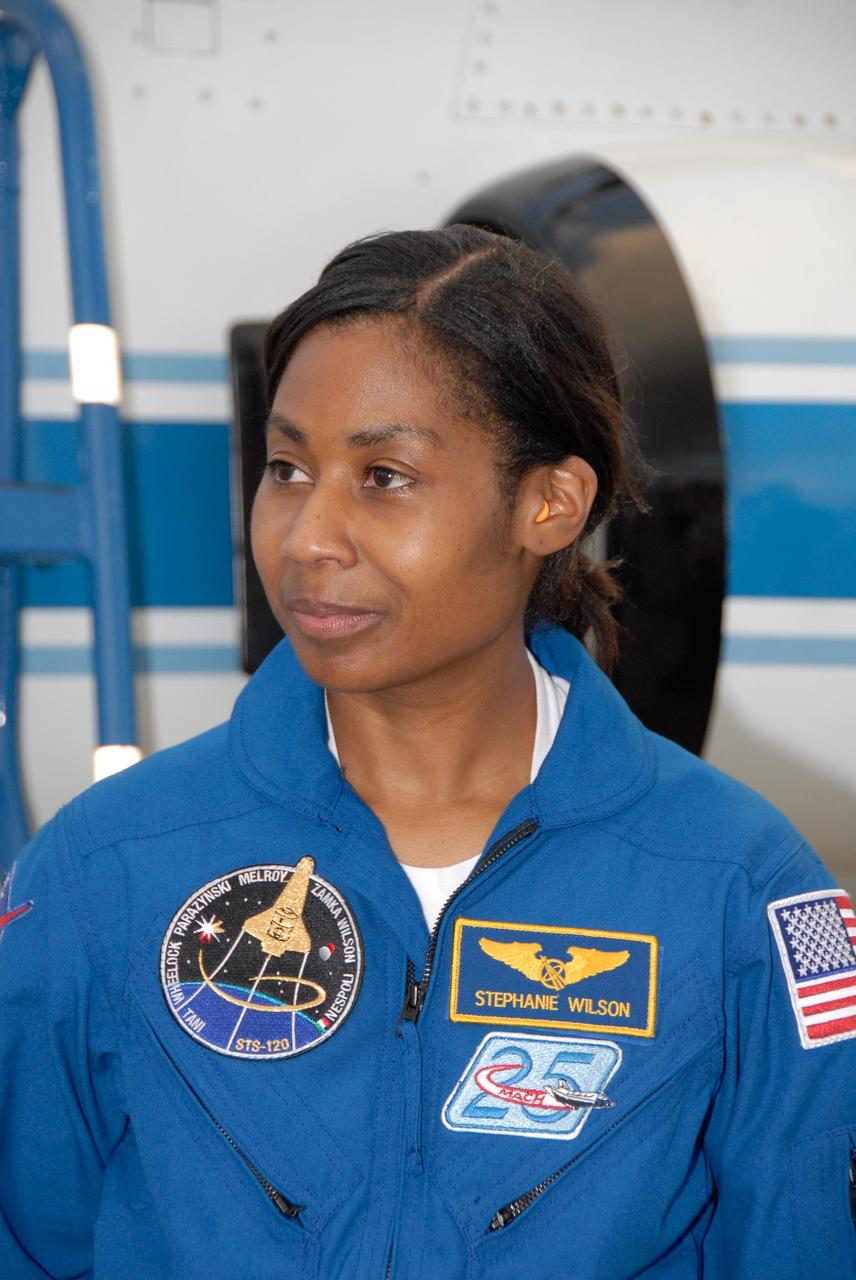
KENNEDY SPACE CENTER, FLA. -- The crew members of mission STS-120 arrive at NASA's Kennedy Space Center Shuttle Landing Facility aboard T-38 jet aircraft to take part in terminal countdown demonstration test activities. Mission Specialist Stephanie Wilson, seen here, will be making her second shuttle flight. The terminal countdown demonstration test provides astronauts and ground crews an opportunity to participate in various simulated countdown activities, including equipment familiarization and emergency training. The STS-120 mission will deliver the U.S. Node 2 module, named Harmony, aboard space shuttle Discovery to the International Space Station. Launch of Discovery on mission STS-120 is targeted for Oct. 23 at 11:38 a.m. EDT on a 14-day mission to the International Space Station. Photo credit: NASA/Kim Shiflett
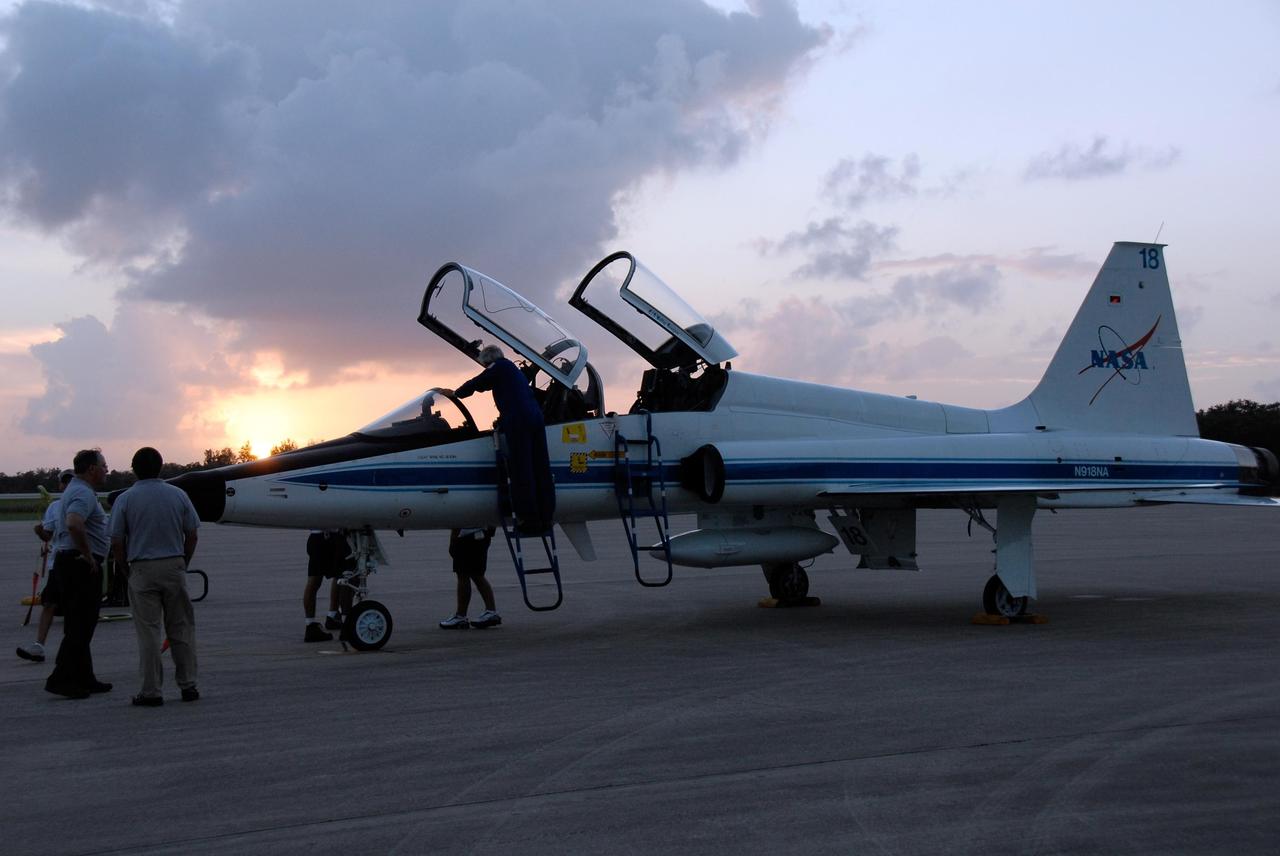
KENNEDY SPACE CENTER, FLA. -- The crew members of mission STS-120 arrive at NASA's Kennedy Space Center Shuttle Landing Facility aboard T-38 jet aircraft to take part in terminal countdown demonstration test activities. The T-38 jet aircraft on which Mission Specialist Doug Wheelock arrived is shown here. Wheelock will be making his first shuttle flight and will perform three spacewalks during the STS-120 mission. The terminal countdown demonstration test provides astronauts and ground crews an opportunity to participate in various simulated countdown activities, including equipment familiarization and emergency training. The STS-120 mission will deliver the U.S. Node 2 module, named Harmony, aboard space shuttle Discovery to the International Space Station. Launch of Discovery on mission STS-120 is targeted for Oct. 23 at 11:38 a.m. EDT on a 14-day mission to the International Space Station. Photo credit: NASA/Kim Shiflett
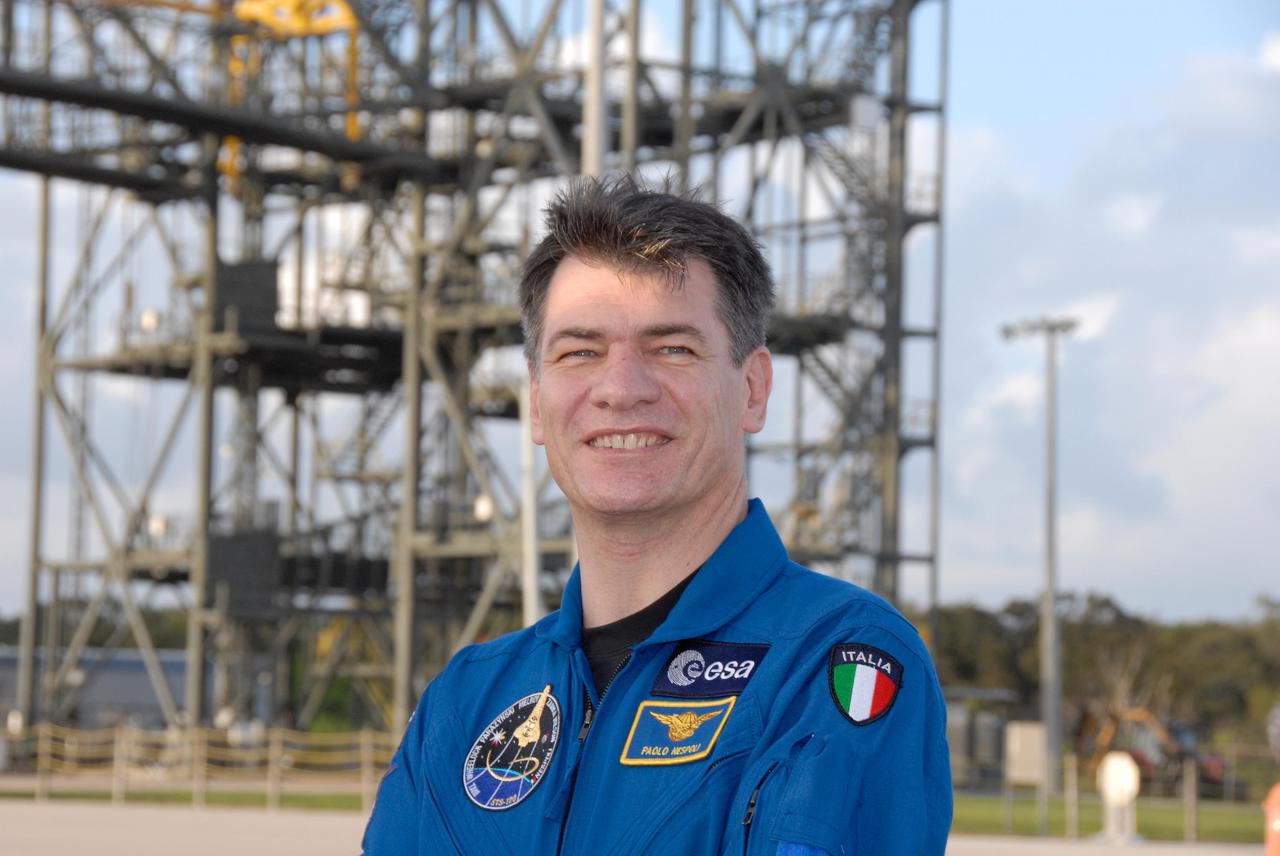
KENNEDY SPACE CENTER, FLA. -- The crew members of mission STS-120 arrive at NASA's Kennedy Space Center Shuttle Landing Facility aboard T-38 jet aircraft to take part in terminal countdown demonstration test activities. Mission Specialist Paolo Nespoli, representing the European Space Agency on his first shuttle flight, is seen here with the space shuttle mate-demate device in the background. The terminal countdown demonstration test provides astronauts and ground crews an opportunity to participate in various simulated countdown activities, including equipment familiarization and emergency training. The STS-120 mission will deliver the U.S. Node 2 module, named Harmony, aboard space shuttle Discovery to the International Space Station. Launch of Discovery on mission STS-120 is targeted for Oct. 23 at 11:38 a.m. EDT on a 14-day mission to the International Space Station. Photo credit: NASA_Kim Shiflett
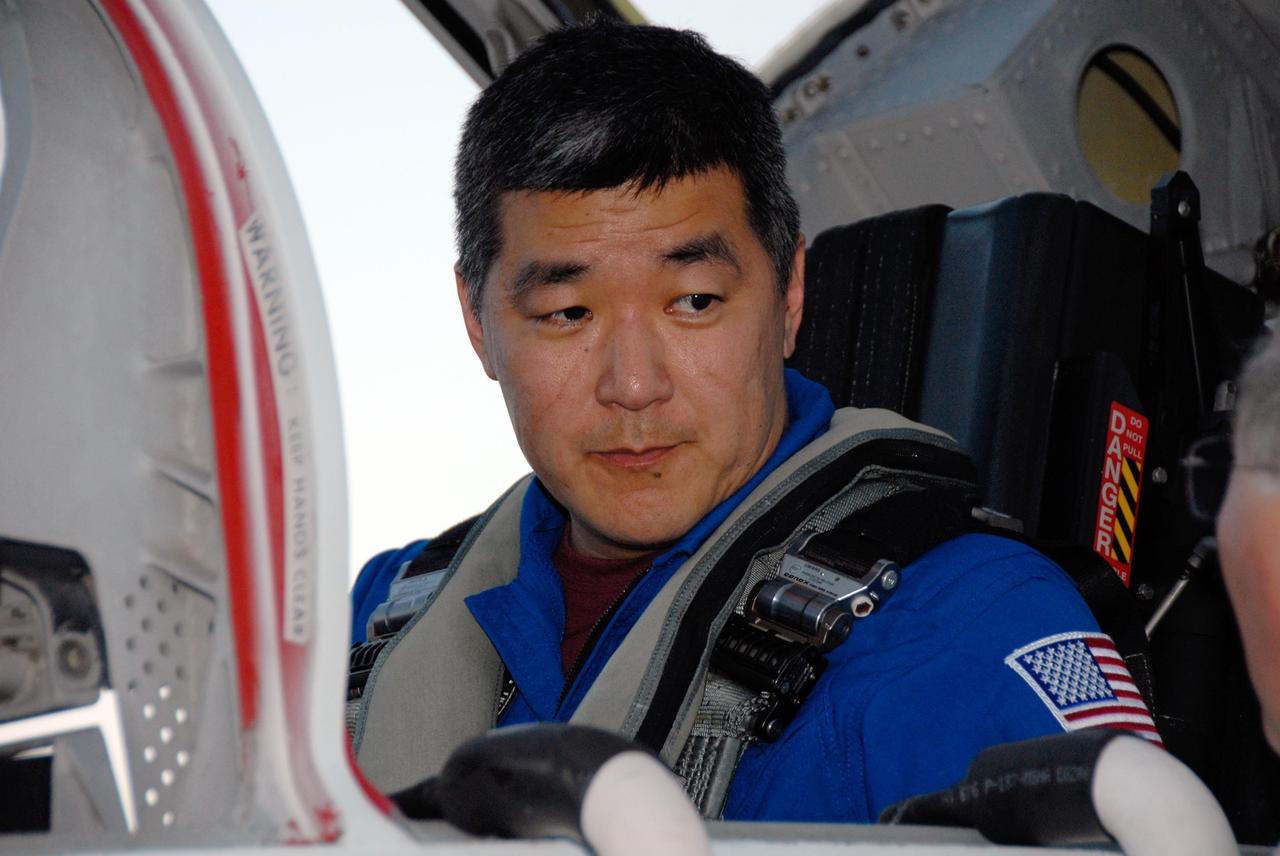
KENNEDY SPACE CENTER, FLA. -- The crew members of mission STS-120 arrive at NASA's Kennedy Space Center Shuttle Landing Facility aboard T-38 jet aircraft to take part in terminal countdown demonstration test activities. Mission Specialist Daniel Tani, shown here, will be making his second shuttle flight and remain on the International Space Station as a member of the Expedition 16 crew. The terminal countdown demonstration test provides astronauts and ground crews an opportunity to participate in various simulated countdown activities, including equipment familiarization and emergency training. The STS-120 mission will deliver the U.S. Node 2 module, named Harmony, aboard space shuttle Discovery to the International Space Station. Launch of Discovery on mission STS-120 is targeted for Oct. 23 at 11:38 a.m. EDT on a 14-day mission to the International Space Station. Photo credit: NASA/Kim Shiflett
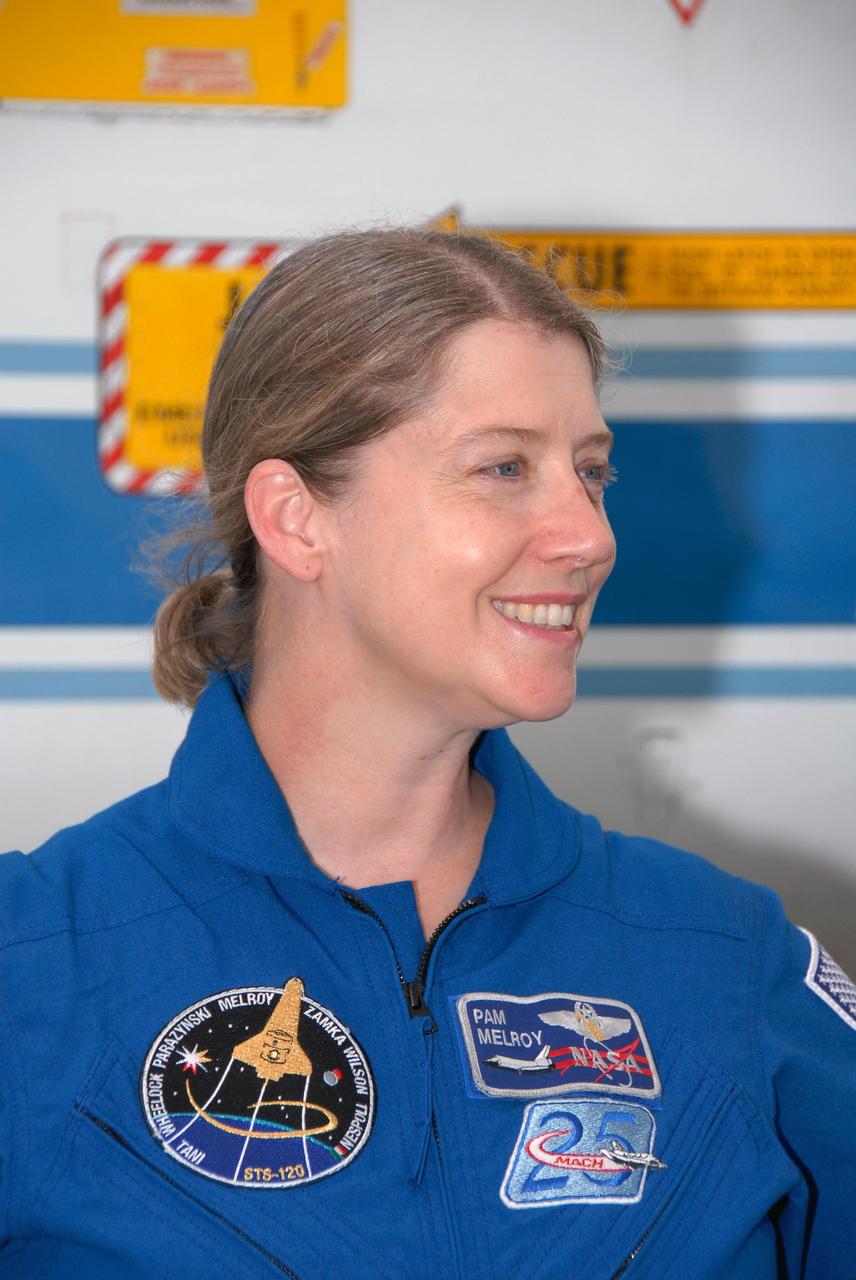
KENNEDY SPACE CENTER, FLA. -- The crew members of mission STS-120 arrive at NASA's Kennedy Space Center Shuttle Landing Facility aboard T-38 jet aircraft to take part in terminal countdown demonstration test activities. Commander Pam Melroy, seen here, will be making her third shuttle flight. She is the second woman to command a shuttle mission. The terminal countdown demonstration test provides astronauts and ground crews an opportunity to participate in various simulated countdown activities, including equipment familiarization and emergency training. The STS-120 mission will deliver the U.S. Node 2 module, named Harmony, aboard space shuttle Discovery to the International Space Station. Launch of Discovery on mission STS-120 is targeted for Oct. 23 at 11:38 a.m. EDT on a 14-day mission to the International Space Station. Photo credit: NASA/Kim Shiflett

The crew of STS-90 participate in Terminal Countdown Demonstration Test (TCDT) activities at KSC's Launch Pad 39B. The TCDT is held at KSC prior to each Space Shuttle flight to provide crews with the opportunity to participate in simulated countdown activities. Here, Mission Specialist Kathryn (Kay) Hire gives a "thumbs-up" to the mission after being suited up in her orange launch and re-entry suit. Columbia is targeted for launch of STS-90 on April 16 at 2:19 p.m. EDT and will be the second mission of 1998. The mission is scheduled to last nearly 17 days
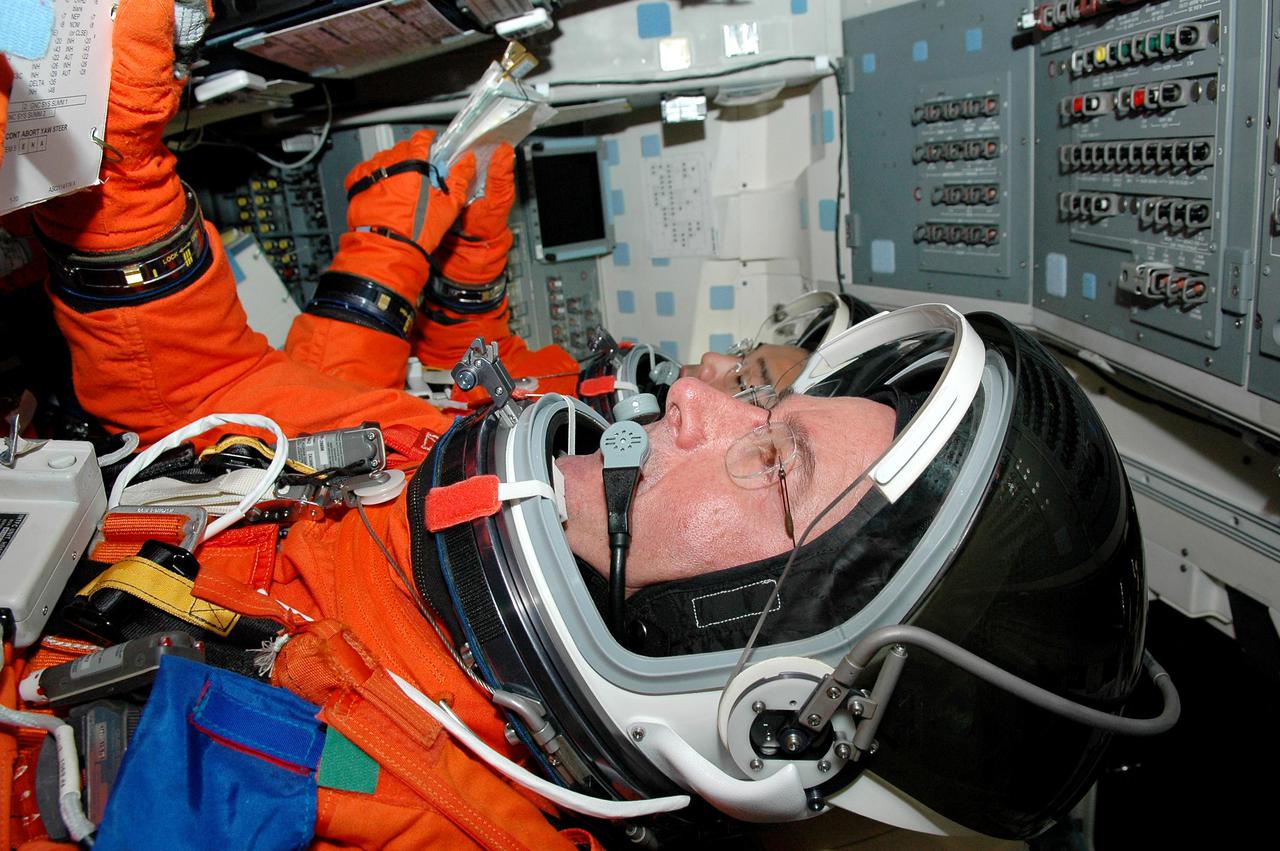
KENNEDY SPACE CENTER, FLA. - STS-114 crew members take part in a mock countdown as pre-launch training included in Terminal Countdown Demonstration Test (TCDT) activities. Seen here in their seats on the flight deck are Mission Specialists Stephen Robinson (front) and Soichi Noguchi (back). TCDT provides the crew of each mission an opportunity to participate in various simulated countdown activities, including equipment familiarization and emergency egress training. STS-114 is the first Return to Flight mission to the International Space Station. The launch window extends July 13 through July 31.

KENNEDY SPACE CENTER, FLA. - STS-114 crew members take part in a mock countdown as pre-launch training included in Terminal Countdown Demonstration Test (TCDT) activities. Seen here in their seats on the flight deck are Commander Eileen Collins (left) and Pilot James Kelly (right).TCDT provides the crew of each mission an opportunity to participate in various simulated countdown activities, including equipment familiarization and emergency egress training. STS-114 is the first Return to Flight mission to the International Space Station. The launch window extends July 13 through July 31.
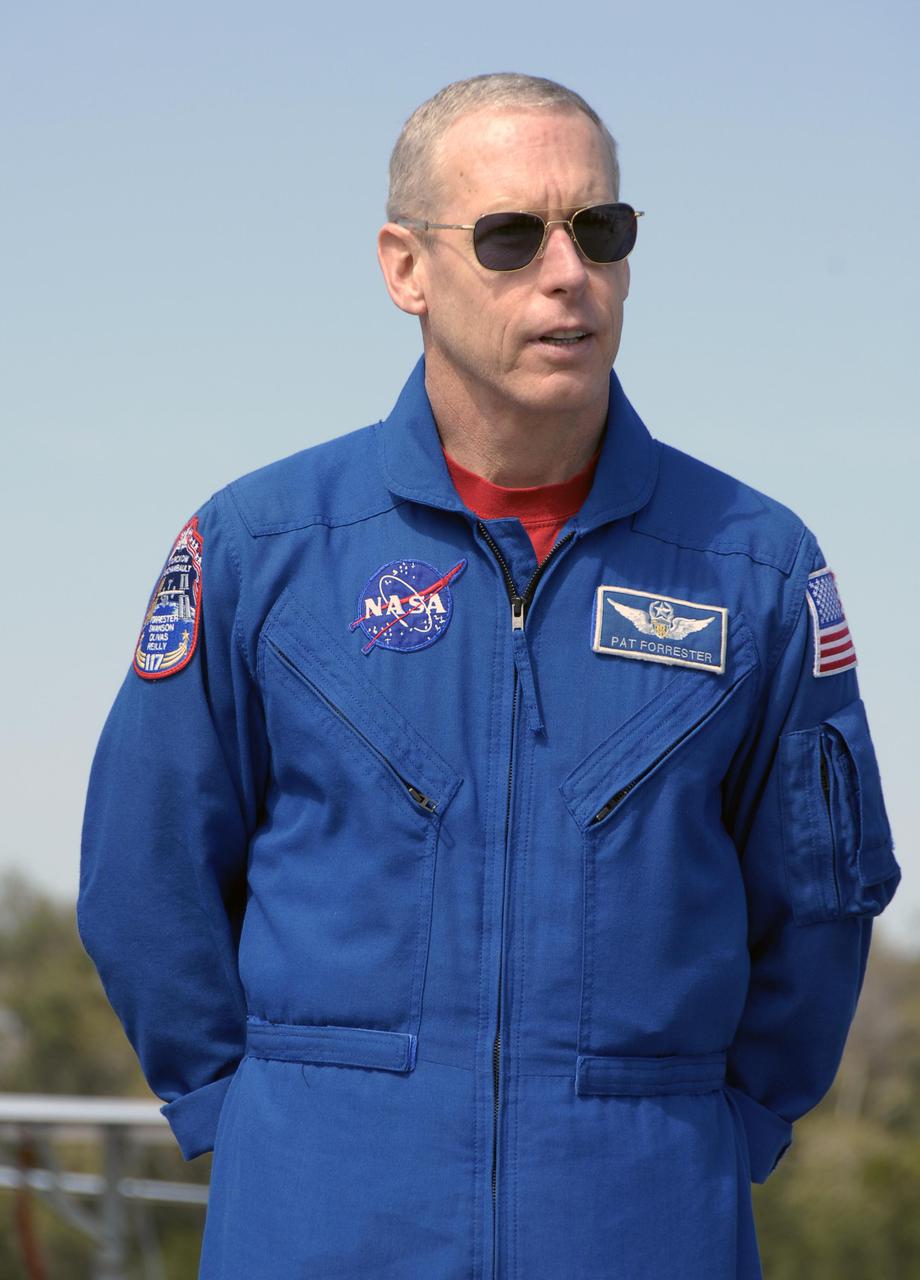
KENNEDY SPACE CENTER, FLA. -- The STS-117 crew arrives at NASA's Kennedy Space Center to take part in the Terminal Countdown Demonstration Test (TCDT), a preparation for the launch March 15 to the International Space Station. Here, Mission Specialist Patrick Forrester talks to members of the media at the Shuttle Landing Facility. The TCDT includes emergency egress training and a simulated launch countdown. The mission payload aboard Space Shuttle Atlantis is the S3_S4 integrated truss structure, along with a third set of solar arrays and batteries. The crew of six astronauts will install the truss to continue assembly of the station. Photo credit: NASA_Kim Shiflett

KENNEDY SPACE CENTER, FLA. - The STS-115 crew members are suiting up for their simulated launch countdown. Shown here is Mission Specialist Daniel Burbank. The mission crew is at KSC for Terminal Countdown Demonstration Test (TCDT) activities that are preparation for launch on Space Shuttle Atlantis, scheduled to take place in a window that opens Aug. 27. The TCDT has included emergency egress training as well as the simulation. During their 11-day mission to the International Space Station, the STS-115 crew will continue construction of the station and attach the payload elements, the Port 3/4 truss segment with its two large solar arrays. Photo credit: NASA/Cory Huston
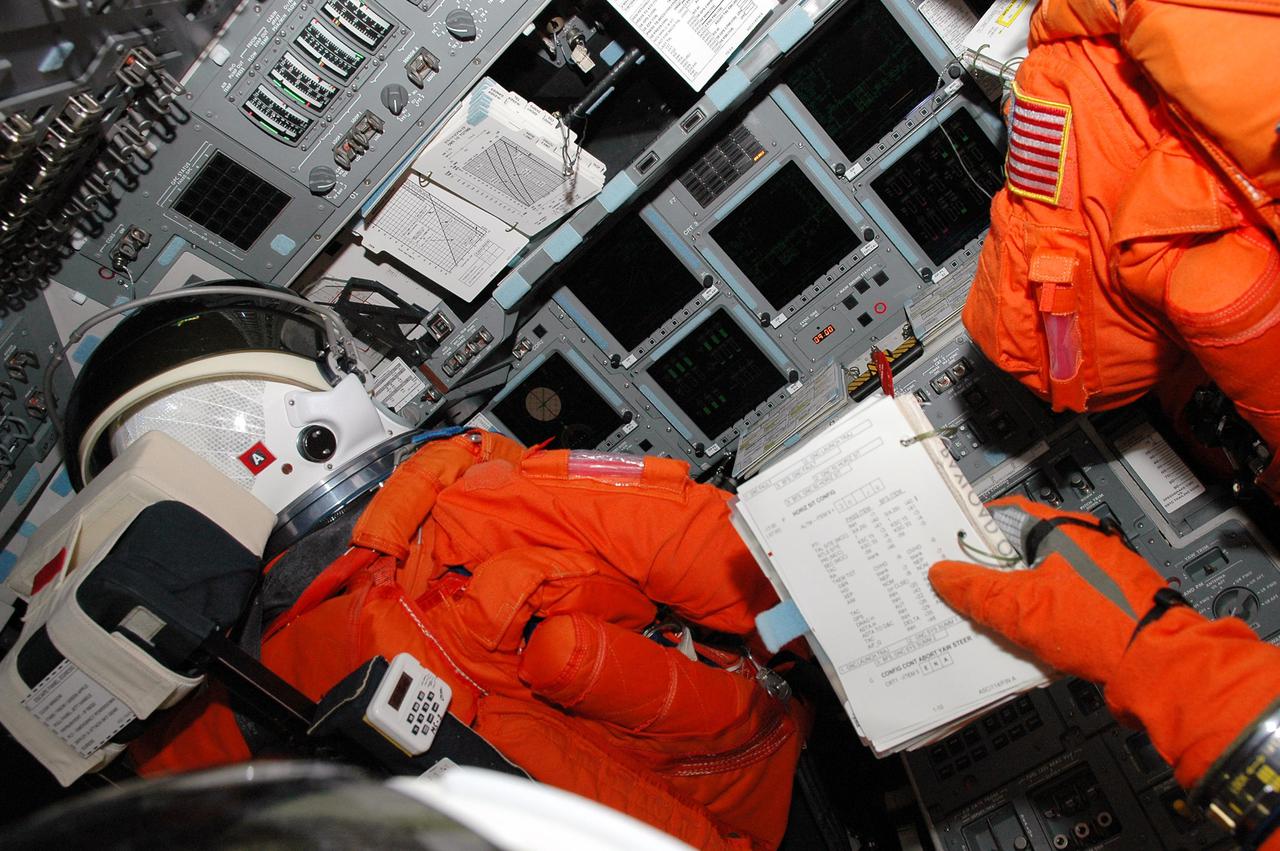
KENNEDY SPACE CENTER, FLA. - STS-114 crew members take part in a mock countdown as pre-launch training included in Terminal Countdown Demonstration Test (TCDT) activities. Seen here in their seats on the flight deck are Commander Eileen Collins (left) and Pilot James Kelly (right). TCDT provides the crew of each mission an opportunity to participate in various simulated countdown activities, including equipment familiarization and emergency egress training. STS-114 is the first Return to Flight mission to the International Space Station. The launch window extends July 13 through July 31.
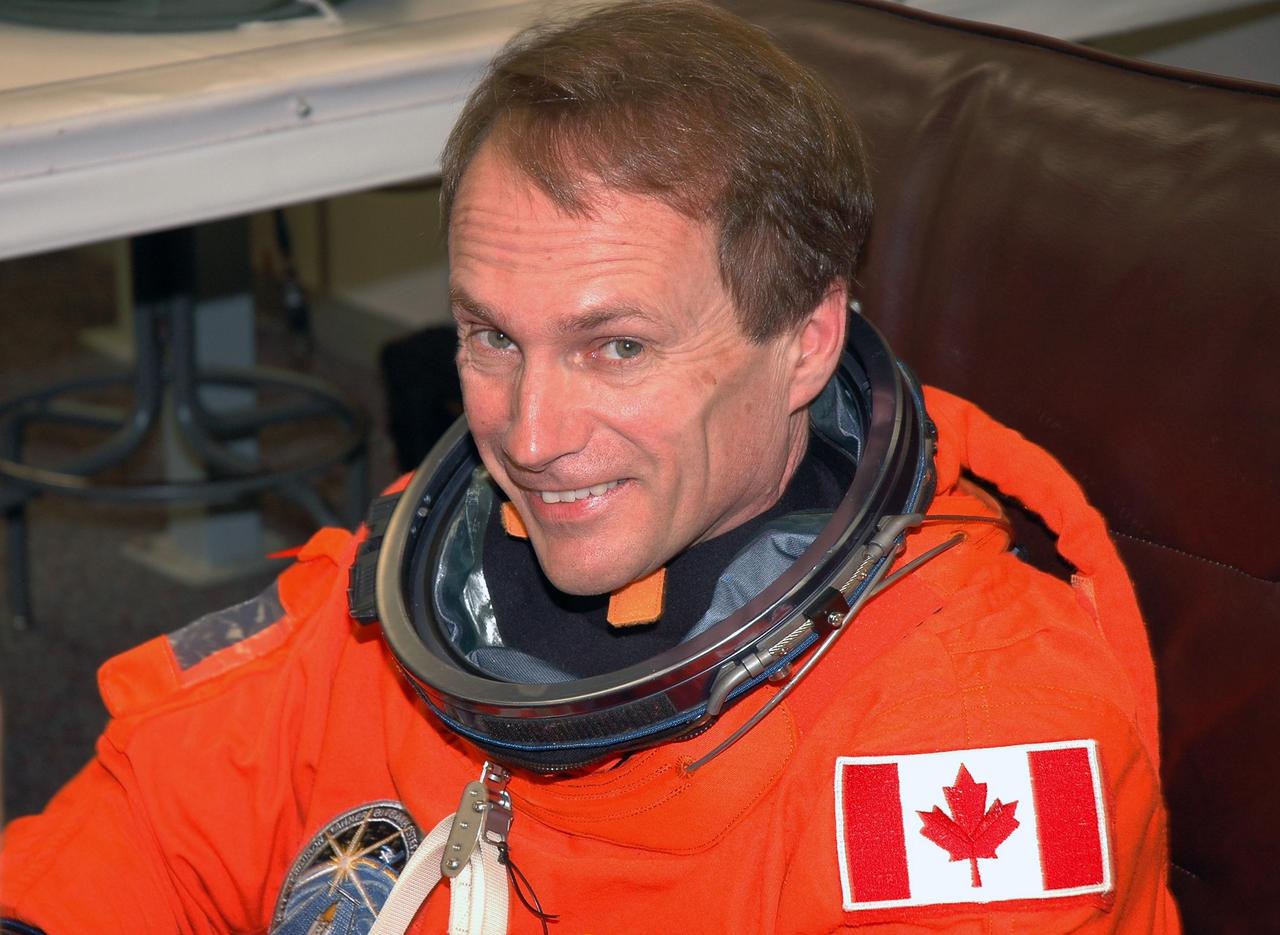
KENNEDY SPACE CENTER, FLA. - The STS-115 crew members are suiting up for their simulated launch countdown. Shown here is Mission Specialist Steven MacLean, who is with the Canadian Space Agency. The mission crew is at KSC for Terminal Countdown Demonstration Test (TCDT) activities that are preparation for launch on Space Shuttle Atlantis, scheduled to take place in a window that opens Aug. 27. The TCDT has included emergency egress training as well as the simulation. During their 11-day mission to the International Space Station, the STS-115 crew will continue construction of the station and attach the payload elements, the Port 3/4 truss segment with its two large solar arrays. Photo credit: NASA/Cory Huston
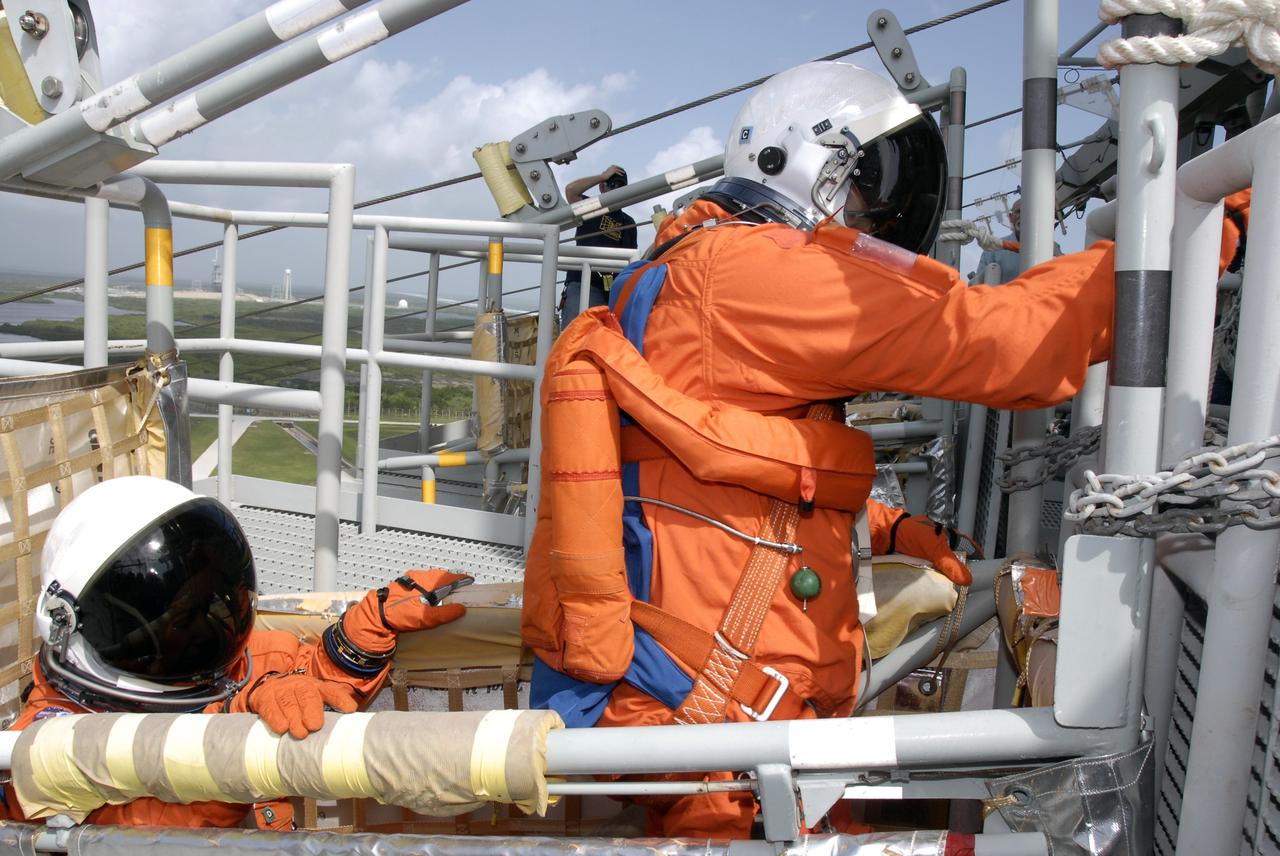
CAPE CANAVERAL, Fla. - After taking part in a simulated launch countdown aboard space shuttle Atlantis, the STS-125 crew members practice an emergency escape from the shuttle. Here they are ready to release the slidewire basket that will speed them away from Kennedy Space Center’s Launch Pad 39A. The countdown is the culmination of terminal countdown demonstration test, or TCDT, activities as preparation before launch. TCDT provides astronauts and ground crews with an opportunity to participate in various launch activities, including equipment familiarization, emergency training and the countdown. Atlantis’ STS-125 mission to service NASA’s Hubble Space Telescope is targeted for launch Oct. 14. Photo credit: NASA/Kim Shiflett
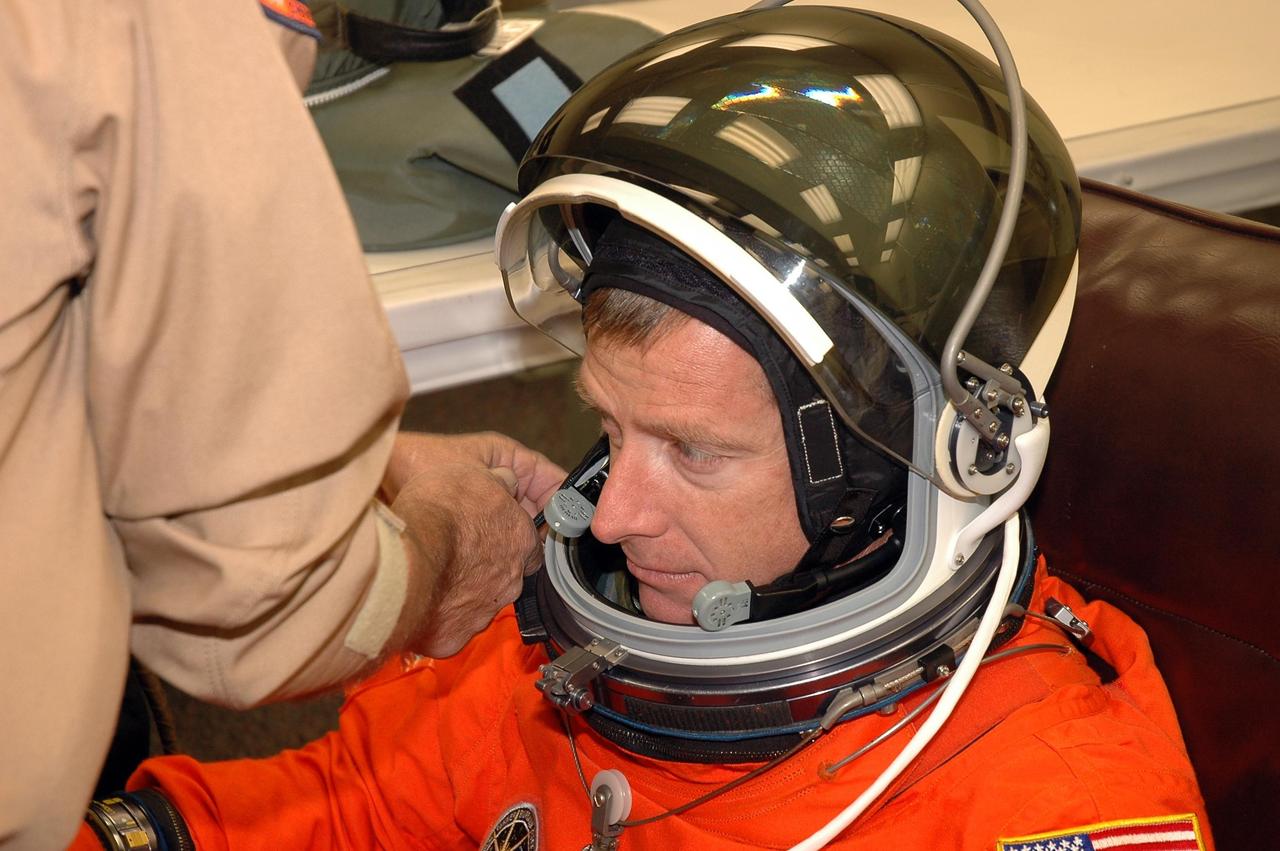
KENNEDY SPACE CENTER, FLA. - The STS-115 crew members are suiting up for their simulated launch countdown. Shown here being helped with his helmet is Pilot Christopher Ferguson. The mission crew is at KSC for Terminal Countdown Demonstration Test (TCDT) activities that are preparation for launch on Space Shuttle Atlantis, scheduled to take place in a window that opens Aug. 27. The TCDT has included emergency egress training as well as the simulation. During their 11-day mission to the International Space Station, the STS-115 crew will continue construction of the station and attach the payload elements, the Port 3/4 truss segment with its two large solar arrays. Photo credit: NASA/Cory Huston
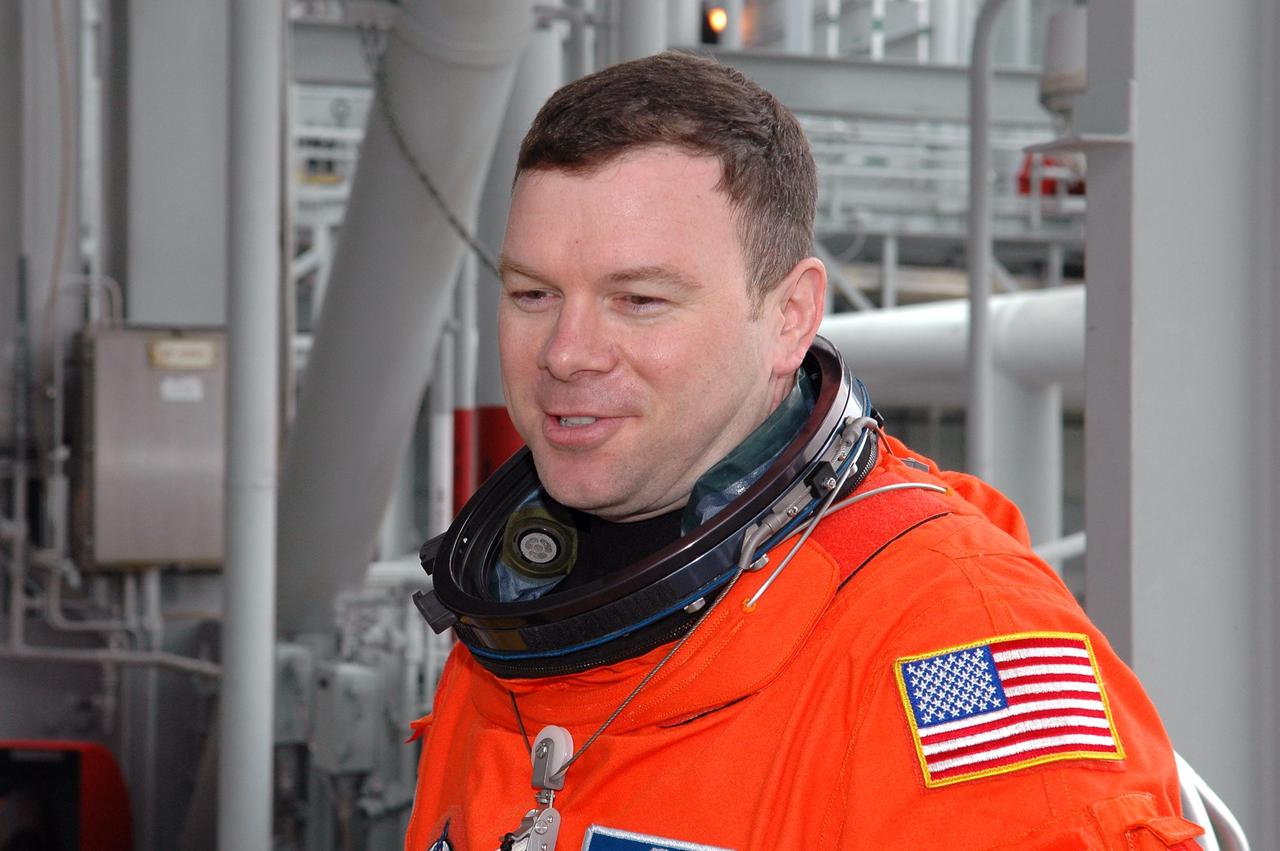
KENNEDY SPACE CENTER, FLA. - Following the mock countdown and emergency egress practice from the Fixed Service Structure on Launch Pad 39B, STS-114 crew members stop at the 225-foot level for a unique view. Seen here is Pilot James Kelly. This culminates the pre-launch training known as Terminal Countdown Demonstration Test (TCDT) activities. TCDT provides the crew of each mission an opportunity to participate in various simulated countdown activities, including equipment familiarization and emergency egress training. STS-114 is the first Return to Flight mission to the International Space Station. The launch window extends July 13 through July 31.
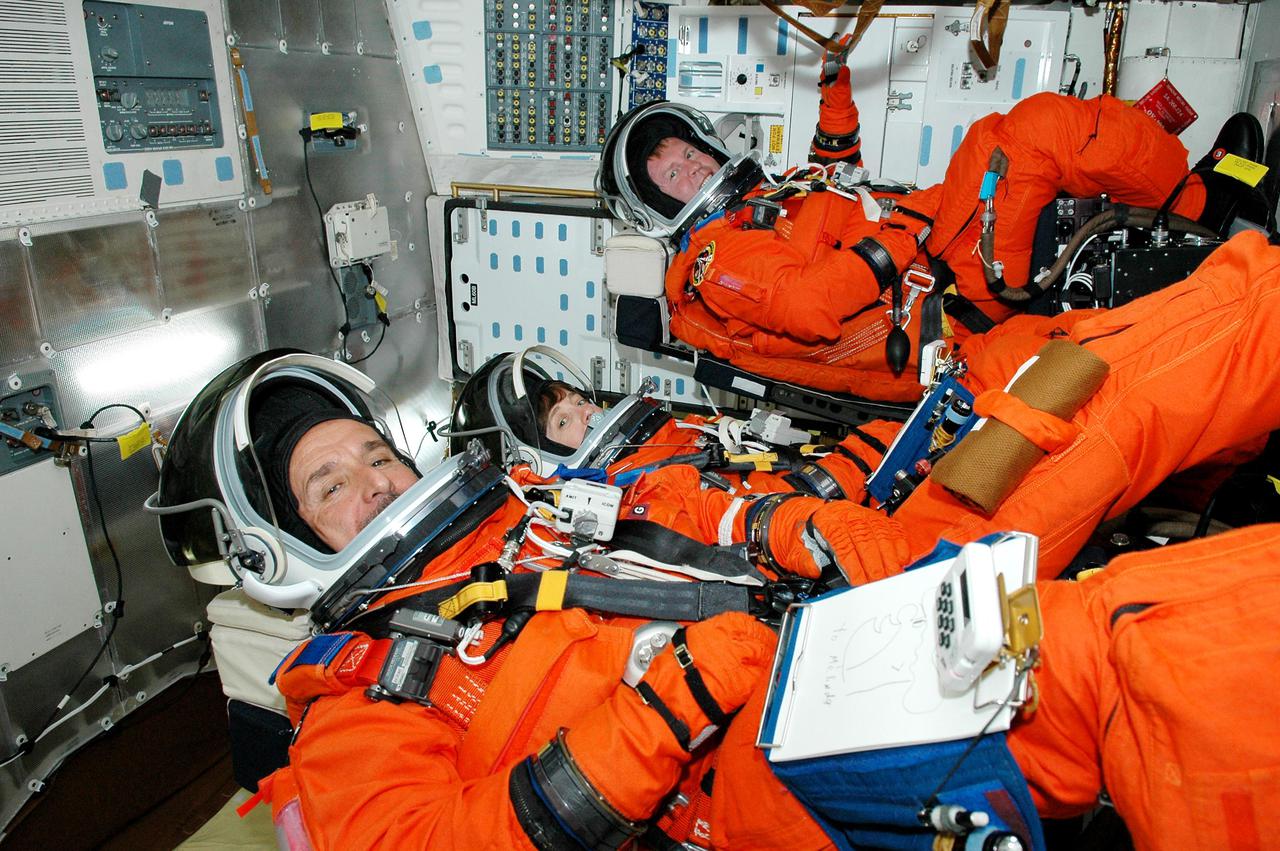
KENNEDY SPACE CENTER, FLA. - STS-114 crew members take part in a mock countdown as pre-launch training included in Terminal Countdown Demonstration Test (TCDT) activities. Seen here in their seats in the mid-deck of Space Shuttle Discovery are (left to right), Mission Specialists Charles Camarda, Wendy Lawrence and Andrew Thomas. TCDT provides the crew of each mission an opportunity to participate in various simulated countdown activities, including equipment familiarization and emergency egress training. STS-114 is the first Return to Flight mission to the International Space Station. The launch window extends July 13 through July 31.
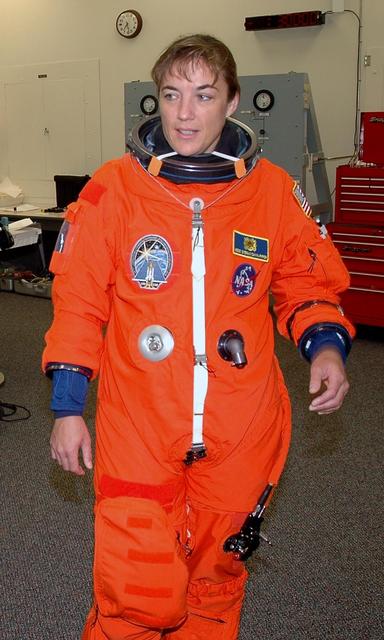
KENNEDY SPACE CENTER, FLA. - The STS-115 crew members are suiting up for their simulated launch countdown. Shown here is Mission Specialist Heidemarie Stefanyshyn-Piper. The mission crew is at KSC for Terminal Countdown Demonstration Test (TCDT) activities that are preparation for launch on Space Shuttle Atlantis, scheduled to take place in a window that opens Aug. 27. The TCDT has included emergency egress training as well as the simulation. During their 11-day mission to the International Space Station, the STS-115 crew will continue construction of the station and attach the payload elements, the Port 3/4 truss segment with its two large solar arrays. Photo credit: NASA/Cory Huston
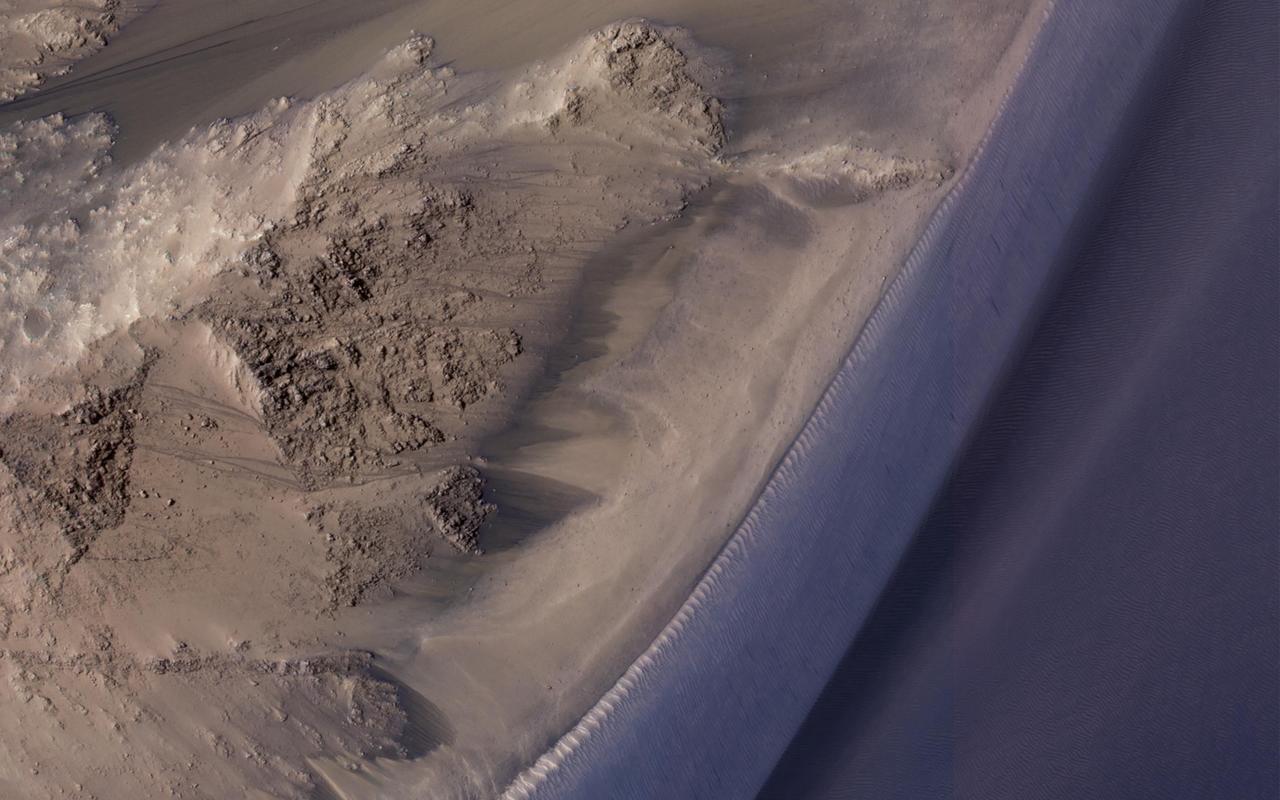
Recurring slope lineae (RSL) are seasonal flows on warm slopes, and are especially common in central and eastern Valles Marineris, as seen in this observation by NASA's Mars Reconnaissance Orbiter (MRO). This image covers a large area full of interesting features. Here, the RSL are active on east-facing slopes, extending from bouldery terrain and terminating on fans. Perhaps the fans themselves built up over time from the seasonal flows. Part of the fans with abundant RSL are dark, while the downhill portion of the fans are bright. The role of water in RSL activity is a matter of active debate. https://photojournal.jpl.nasa.gov/catalog/PIA21608
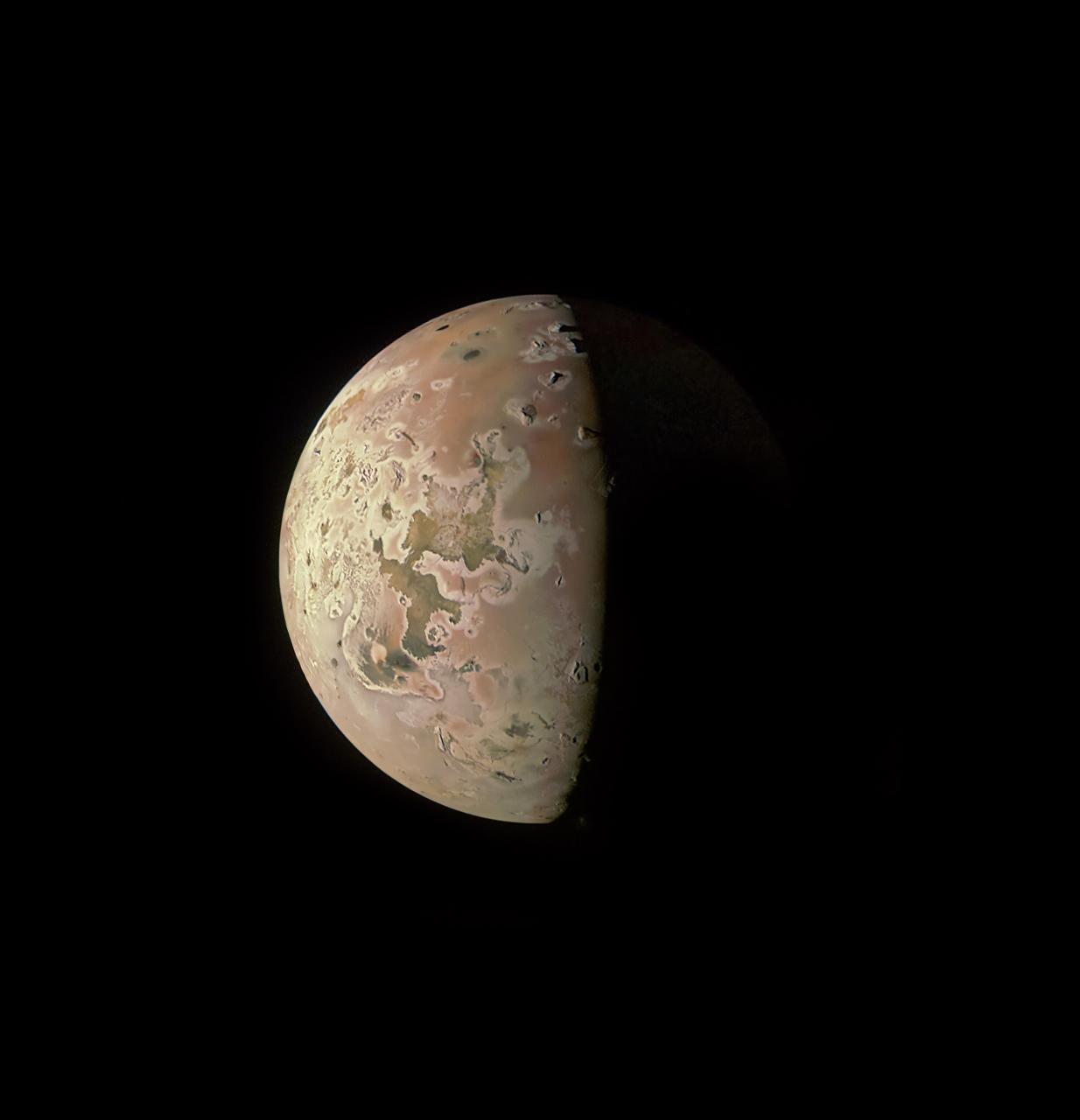
This image revealing the north polar region of the Jovian moon Io was taken on October 15, 2023, by the JunoCam imager aboard NASA's Juno spacecraft. Since the high latitudes were not well covered in imagery gathered by NASA's Voyager and Galileo missions, three of the peaks captured here were observed for the first time. Those mountains are seen at the upper part of the image, near the terminator (the line dividing day and night). At the time the image was taken, the Juno spacecraft was about 7,270 miles (11,700 kilometers) above Io's surface. Citizen scientist Ted Stryk made this image using raw data from the JunoCam instrument, processing the data to enhance details. https://photojournal.jpl.nasa.gov/catalog/PIA26234
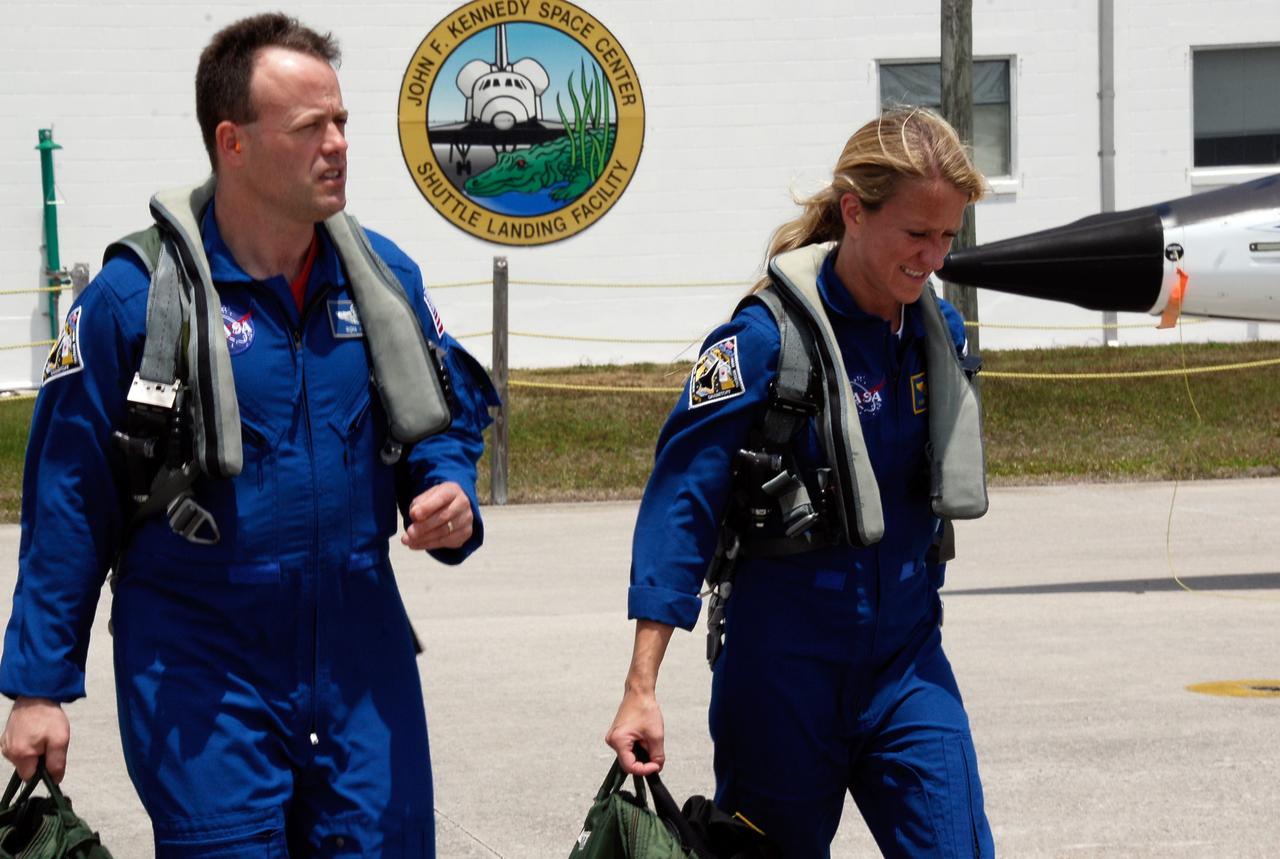
CAPE CANAVERAL, Fla. -- The crew for the STS-124 mission departs NASA's Kennedy Space Center after a successful launch dress rehearsal called the terminal countdown demonstration test. Seen here are Mission Specialists Ron Garan and Karen Nyberg heading for the T-38 training jets for their flight back to Houston. The crew is expected to return in late May for the May 31 launch of space shuttle Discovery. On the STS-124 mission, the crew will deliver and install the Japanese Experiment Module – Pressurized Module and Japanese Remote Manipulator System. Photo credit: NASA/Kim Shiflett

KENNEDY SPACE CENTER, FLA. - The STS-115 crew members are suiting up for their simulated launch countdown. Shown here adjusting his glove is Mission Specialist Joseph Tanner. The mission crew is at KSC for Terminal Countdown Demonstration Test (TCDT) activities that are preparation for launch on Space Shuttle Atlantis, scheduled to take place in a window that opens Aug. 27. The TCDT has included emergency egress training as well as the simulation. During their 11-day mission to the International Space Station, the STS-115 crew will continue construction of the station and attach the payload elements, the Port 3/4 truss segment with its two large solar arrays. Photo credit: NASA/Cory Huston

KENNEDY SPACE CENTER, FLA. -- The STS-117 crew arrives at NASA's Kennedy Space Center to take part in the Terminal Countdown Demonstration Test (TCDT), a preparation for the launch March 15 to the International Space Station. Here, Mission Specialist James Reilly talks to members of the media at the Shuttle Landing Facility. The TCDT includes emergency egress training and a simulated launch countdown.The mission payload aboard Space Shuttle Atlantis is the S3/S4 integrated truss structure, along with a third set of solar arrays and batteries. The crew of six astronauts will install the truss to continue assembly of the station. Photo credit: NASA/Kim Shiflett

KENNEDY SPACE CENTER, FLA. - The STS-115 crew members are suiting up for their simulated launch countdown. Shown here is Commander Brent Jett. The mission crew is at KSC for Terminal Countdown Demonstration Test (TCDT) activities that are preparation for launch on Space Shuttle Atlantis, scheduled to take place in a window that opens Aug. 27. The TCDT has included emergency egress training as well as the simulation. During their 11-day mission to the International Space Station, the STS-115 crew will continue construction of the station and attach the payload elements, the Port 3/4 truss segment with its two large solar arrays. Photo credit: NASA/Cory Huston
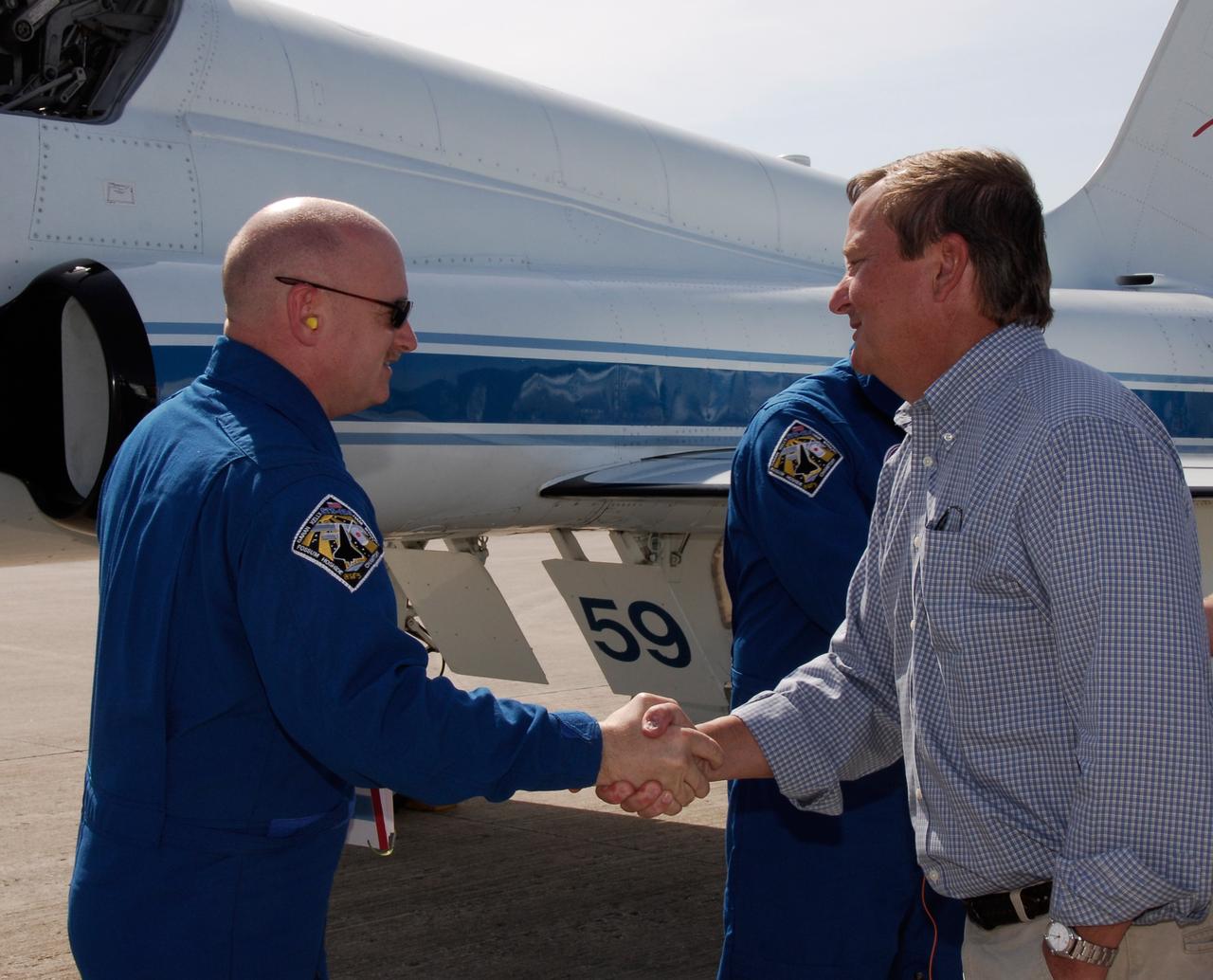
CAPE CANAVERAL, Fla. -- The crew of space shuttle Discovery's STS-124 mission arrive at NASA Kennedy Space Center's Shuttle Landing Facility to take part in the Terminal Countdown Demonstration Test, or TCDT. Here, Commander Mark Kelly is greeted by Shuttle Launch Director Mike Leinbach. Behind Leinbach is Mission Specialist Greg Chamitoff. TCDT is a rehearsal for launch that includes practicing emergency procedures, handling on-orbit equipment, and simulating a launch countdown. On the STS-124 mission, the crew will deliver and install the Japanese Experiment Module – Pressurized Module and Japanese Remote Manipulator System. Discovery's launch is targeted for May 31. Photo credit: NASA/Kim Shiflett
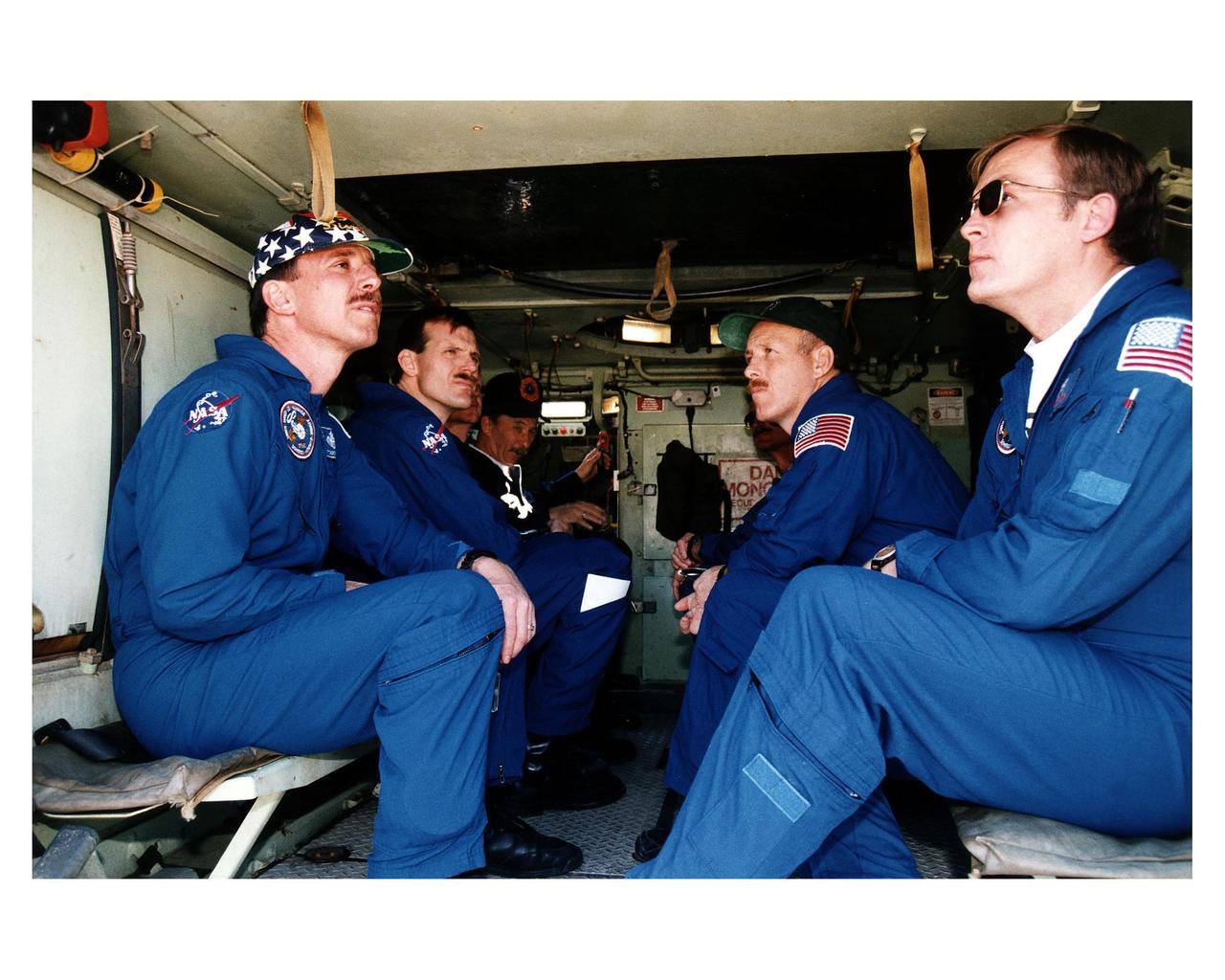
STS-82 crew members ride in and learn how to operate an M-113 armored personnel carrier during Terminal Countdown Demonstration Test (TCDT) activities prior to launch. The four crew members dressed in their blue flight suits and visible here are, from left, Pilot Scott J. "Doc" Horowitz, Mission Specialist Joseph R. "Joe" Tanner, Mission Commander Kenneth D. Bowersox and Payload Commander Mark C. Lee. George Hoggard, a training officer with KSC Fire Services, is visible in the background at left. The 10-day STS-82 flight, which will be the second Hubble Space Telescope servicing mission, is targeted for a Feb. 11 liftoff
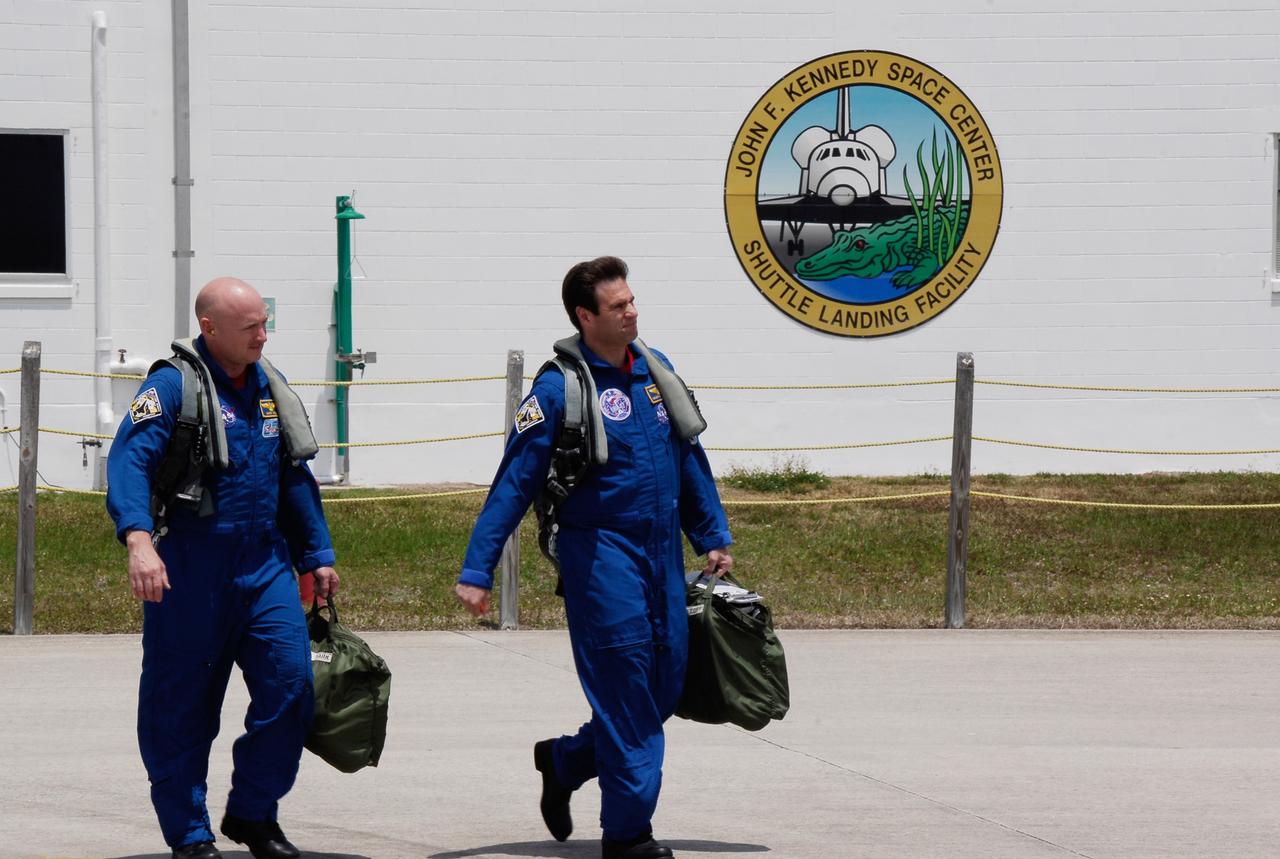
CAPE CANAVERAL, Fla. -- The crew for the STS-124 mission departs NASA's Kennedy Space Center after a successful launch dress rehearsal called the terminal countdown demonstration test. Seen here are Commander Mark Kelly and Mission Specialist Greg Chamitoff heading for the T-38 training jets for their flight back to Houston. The crew is expected to return in late May for the May 31 launch of space shuttle Discovery. On the STS-124 mission, the crew will deliver and install the Japanese Experiment Module – Pressurized Module and Japanese Remote Manipulator System. Photo credit: NASA/Kim Shiflett
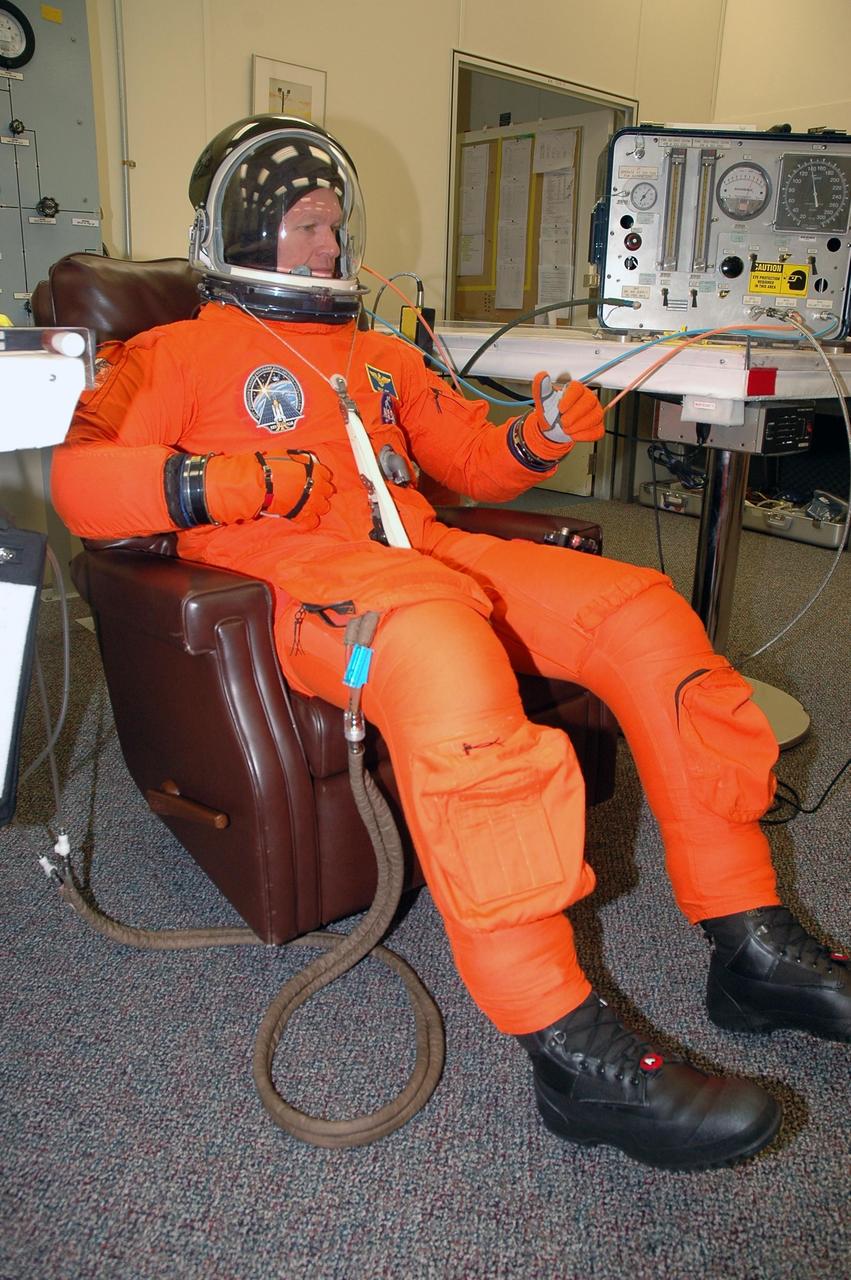
KENNEDY SPACE CENTER, FLA. - The STS-115 crew members are suiting up for their simulated launch countdown. Shown here is Commander Brent Jett. The mission crew is at KSC for Terminal Countdown Demonstration Test (TCDT) activities that are preparation for launch on Space Shuttle Atlantis, scheduled to take place in a window that opens Aug. 27. The TCDT has included emergency egress training as well as the simulation. During their 11-day mission to the International Space Station, the STS-115 crew will continue construction of the station and attach the payload elements, the Port 3/4 truss segment with its two large solar arrays. Photo credit: NASA/Cory Huston
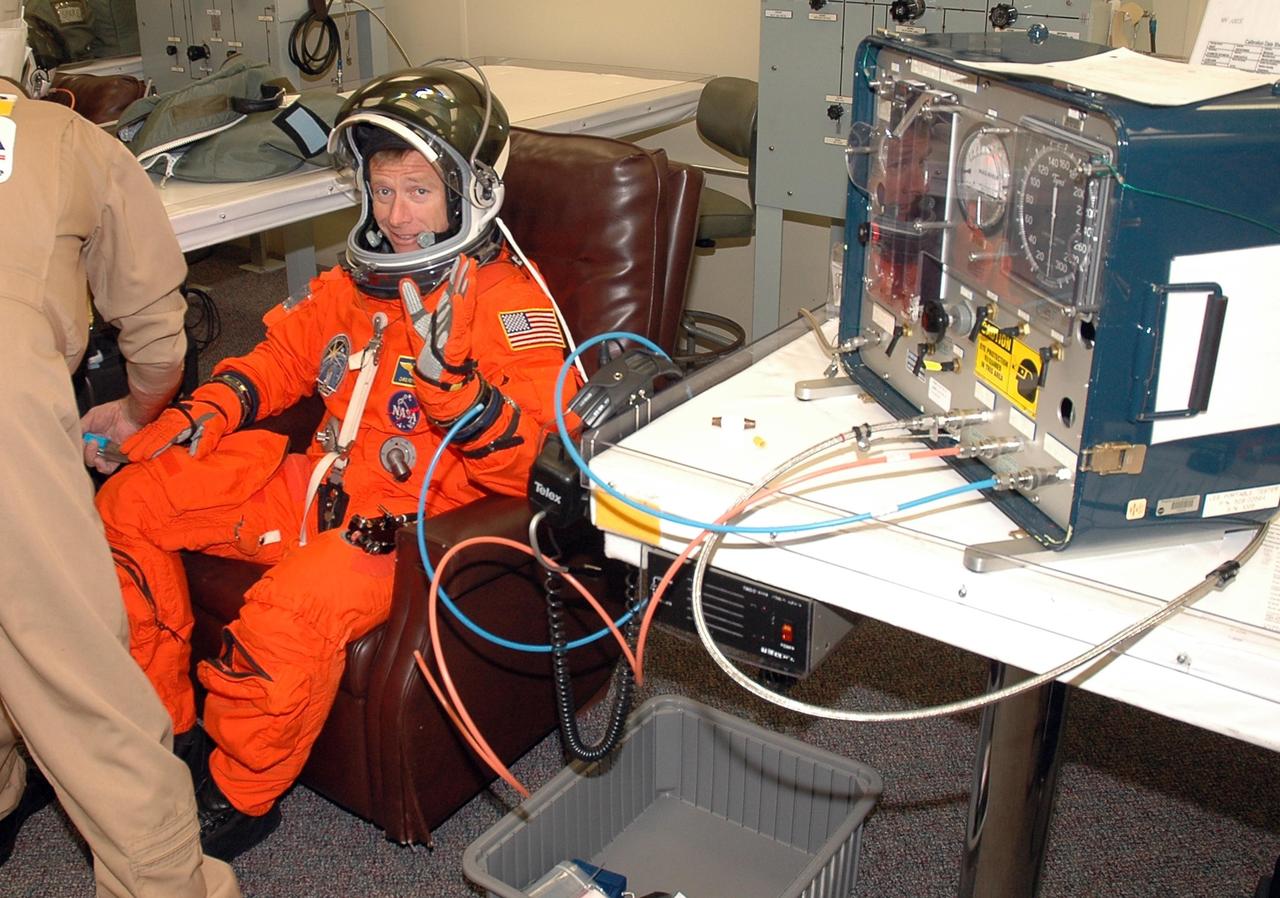
KENNEDY SPACE CENTER, FLA. - The STS-115 crew members are suiting up for their simulated launch countdown. Shown here being helped with his glove is Pilot Christopher Ferguson. The mission crew is at KSC for Terminal Countdown Demonstration Test (TCDT) activities that are preparation for launch on Space Shuttle Atlantis, scheduled to take place in a window that opens Aug. 27. The TCDT has included emergency egress training as well as the simulation. During their 11-day mission to the International Space Station, the STS-115 crew will continue construction of the station and attach the payload elements, the Port 3/4 truss segment with its two large solar arrays. Photo credit: NASA/Cory Huston
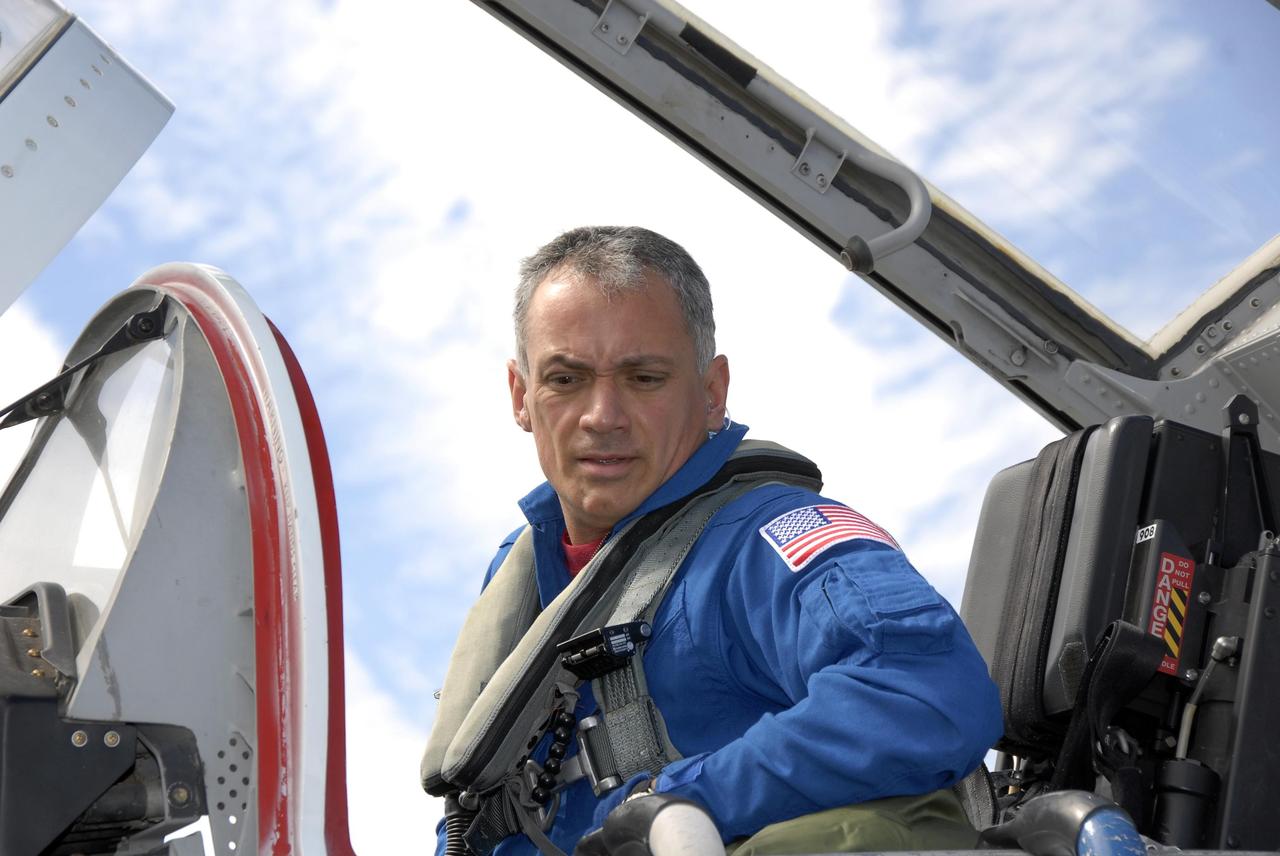
KENNEDY SPACE CENTER, FLA. -- The STS-117 crew arrives at NASA's Kennedy Space Center to take part in the Terminal Countdown Demonstration Test (TCDT), a preparation for the launch March 15 to the International Space Station. Seen here is Mission Specialist Danny Olivas in a T-38 jet aircraft. The TCDT includes emergency egress training and a simulated launch countdown.The mission payload aboard Space Shuttle Atlantis is the S3/S4 integrated truss structure, along with a third set of solar arrays and batteries. The crew of six astronauts will install the truss to continue assembly of the station. Photo credit: NASA/Kim Shiflett
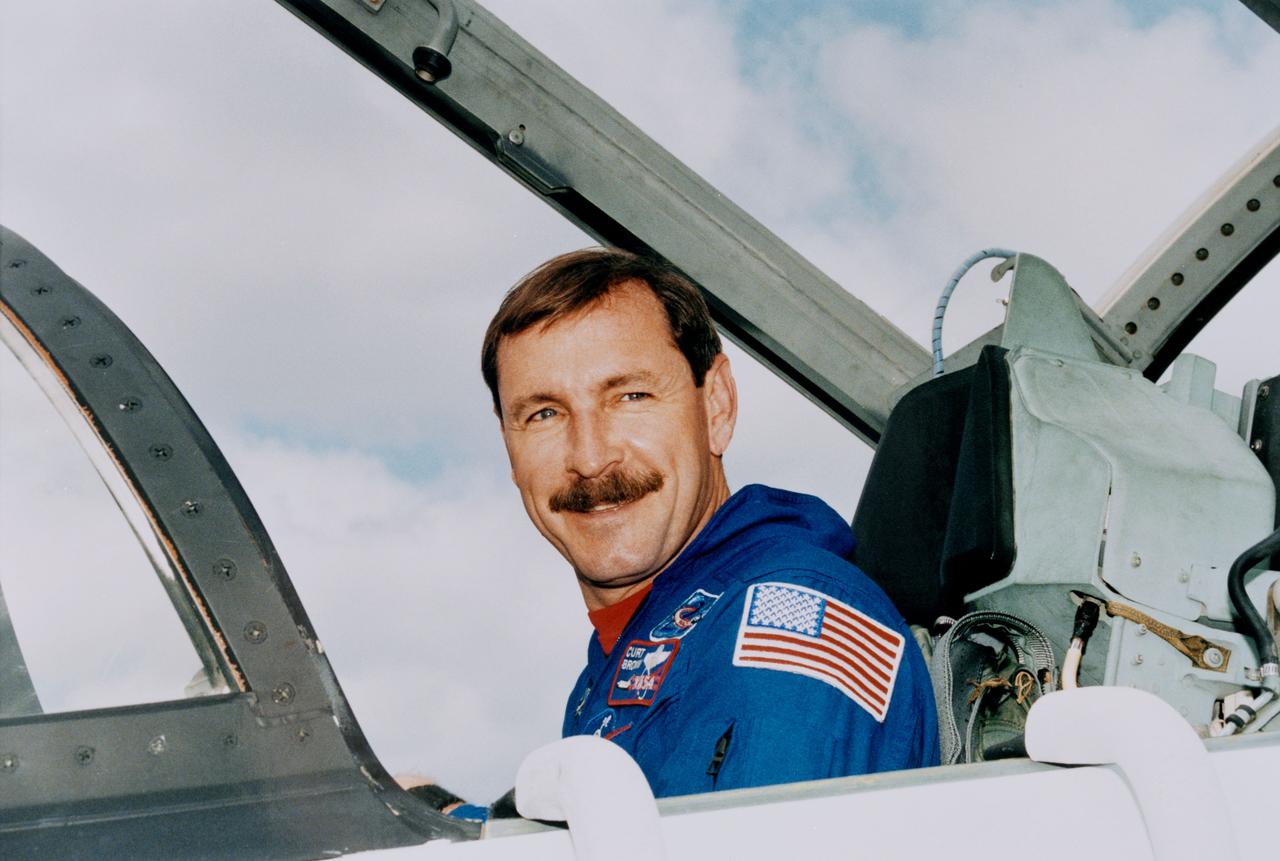
S96-08025 (22 April 1996) --- The STS-77 crew arrives at the Kennedy Space Center's (KSC) Shuttle Landing Facility (SLF) for the Terminal Countdown Demonstration Test (TCDT), a dress rehearsal for launch. Shown here is Curtis L. Brown, Jr., pilot, who will be embarking on his third spaceflight when the Space Shuttle Endeavour lifts off on the STS-77 mission in mid-May. Over the next several days, the six-member crew will participate in emergency egress training at the pad and a simulated launch countdown that includes the entire launch team.
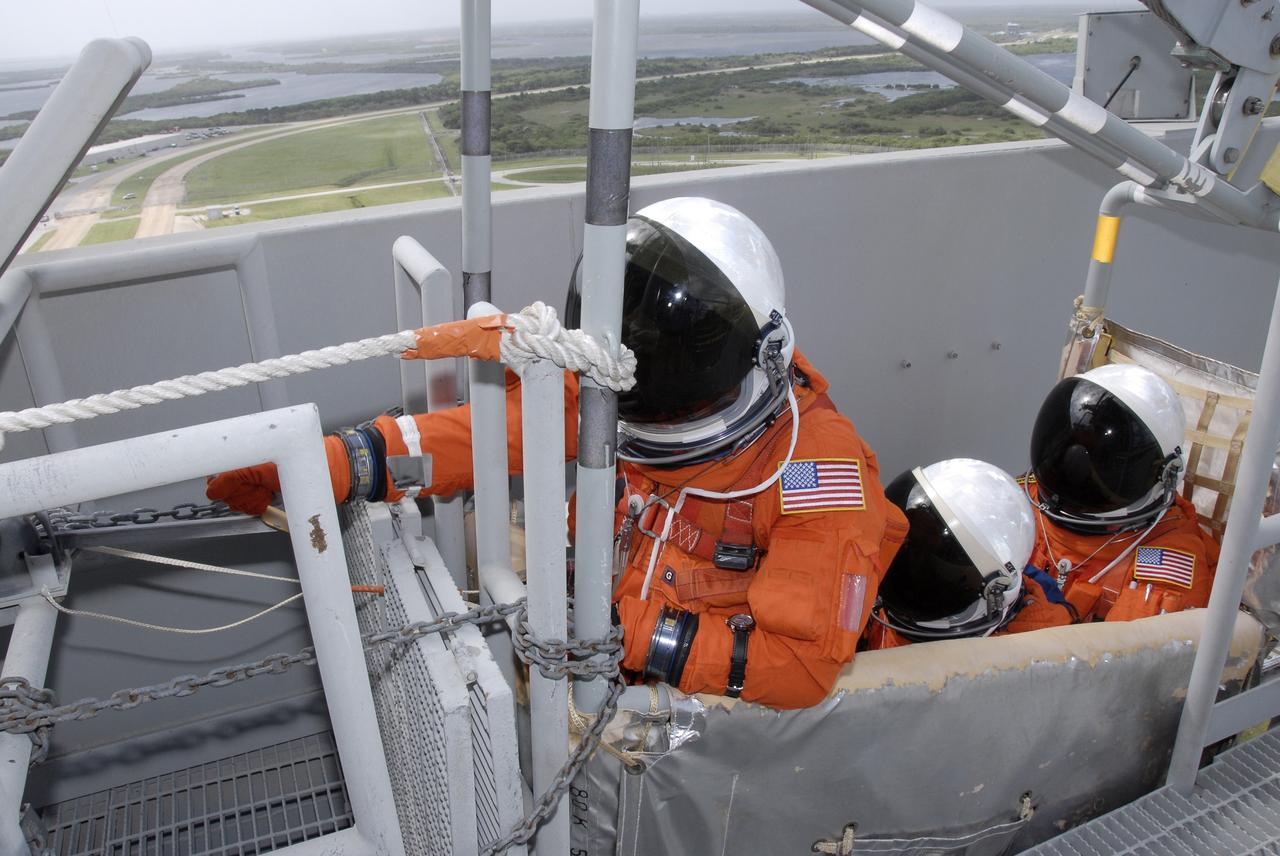
CAPE CANAVERAL, Fla. - After taking part in a simulated launch countdown aboard space shuttle Atlantis, the STS-125 crew members practice an emergency escape from the shuttle. Here they are ready to release the slidewire basket that will speed them away from Kennedy Space Center’s Launch Pad 39A. The countdown is the culmination of terminal countdown demonstration test, or TCDT, activities as preparation before launch. TCDT provides astronauts and ground crews with an opportunity to participate in various launch activities, including equipment familiarization, emergency training and the countdown. Atlantis’ STS-125 mission to service NASA’s Hubble Space Telescope is targeted for launch Oct. 14. Photo credit: NASA/Kim Shiflett
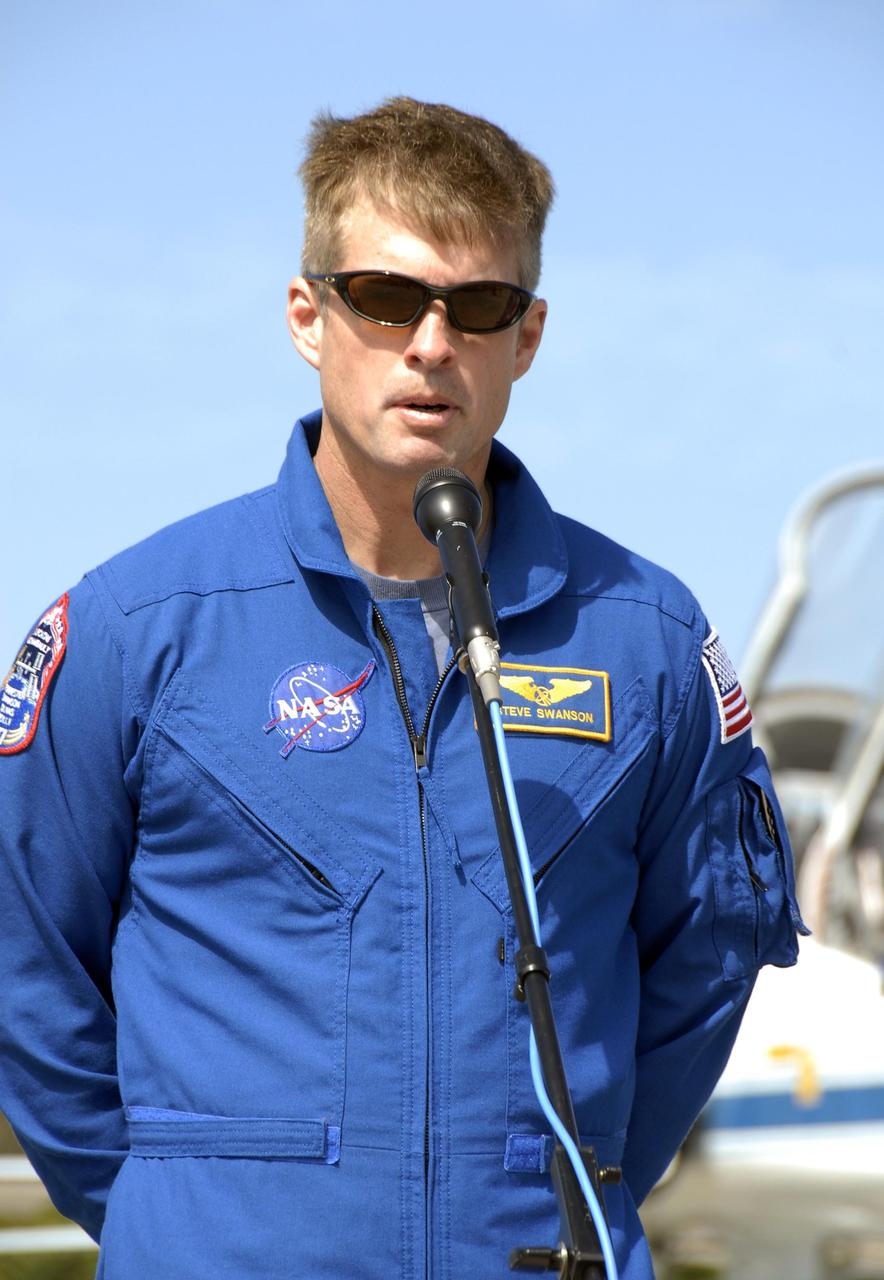
KENNEDY SPACE CENTER, FLA. -- The STS-117 crew arrives at NASA's Kennedy Space Center to take part in the Terminal Countdown Demonstration Test (TCDT), a preparation for the launch March 15 to the International Space Station. Here, Mission Specialist Steven Swanson talks to members of the media at the Shuttle Landing Facility. The TCDT includes emergency egress training and a simulated launch countdown.The mission payload aboard Space Shuttle Atlantis is the S3/S4 integrated truss structure, along with a third set of solar arrays and batteries. The crew of six astronauts will install the truss to continue assembly of the station. Photo credit: NASA/Kim Shiflett
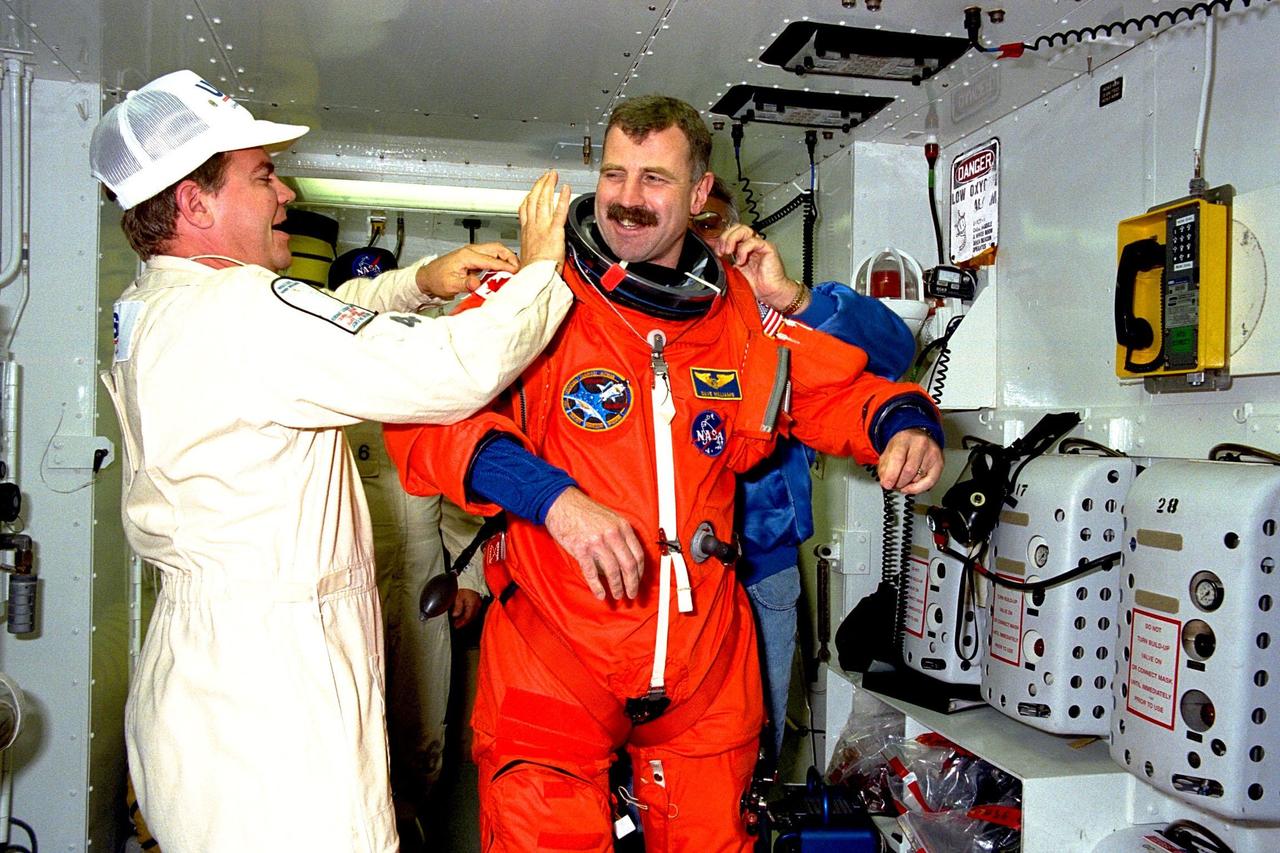
Members of the STS-90 crew participate in Terminal Countdown Demonstration Test (TCDT) activities at KSC's Launch Pad 39B. The TCDT is held at KSC prior to each Space Shuttle flight to provide crews with the opportunity to participate in simulated countdown activities. Here, STS-90 Payload Specialist Dafydd (Dave) Williams with the Canadian Space Agency is assisted into his orange launch and re-entry suit. Columbia is targeted for launch of STS-90 on April 16 at 2:19 p.m. EDT and will be the second mission of 1998. The mission is scheduled to last nearly 17 days
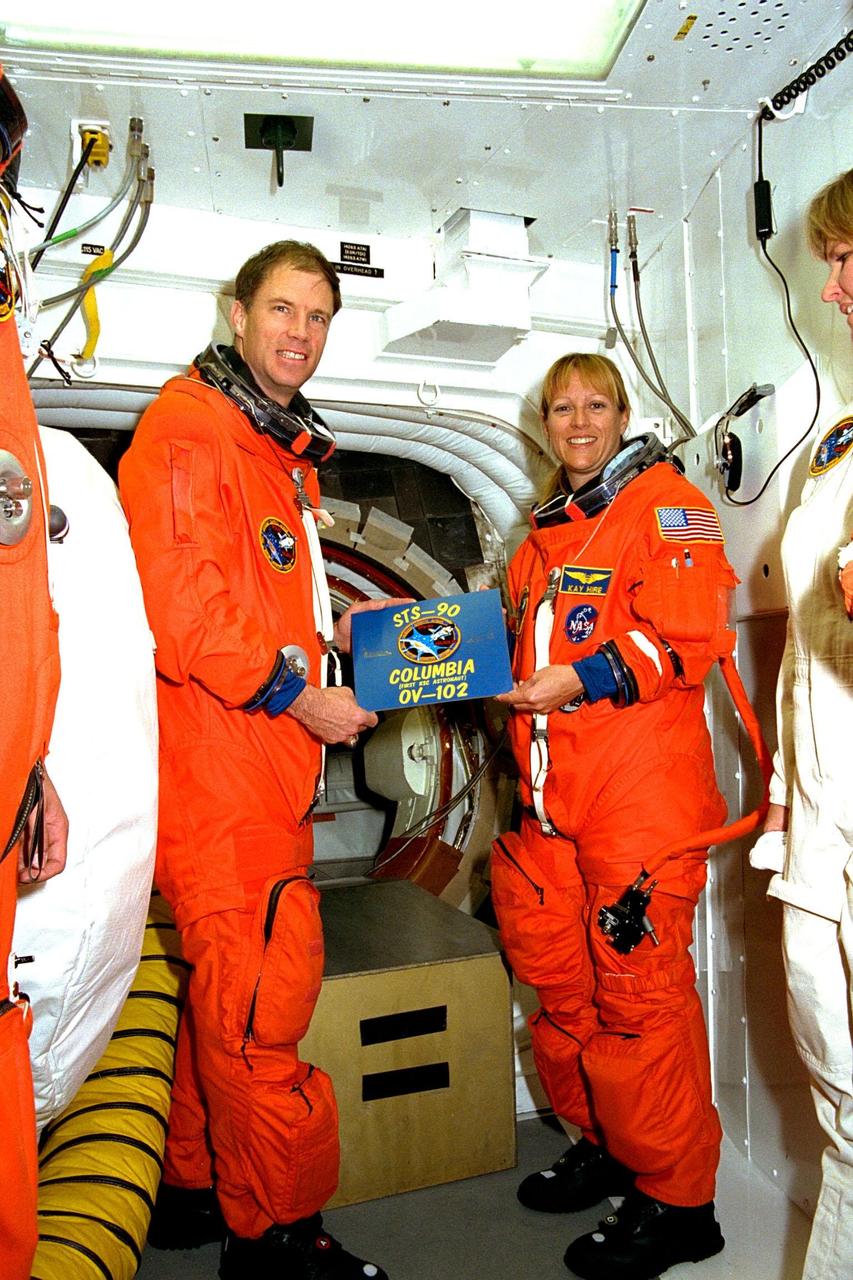
The crew of STS-90 participate in Terminal Countdown Demonstration Test (TCDT) activities at KSC's Launch Pad 39B. The TCDT is held at KSC prior to each Space Shuttle flight to provide crews with the opportunity to participate in simulated countdown activities. Here, STS-90 Commander Richard Searfoss and Mission Specialist Kathryn (Kay) Hire hold the mission patch with orbiter information. Columbia is targeted for launch of STS-90 on April 16 at 2:19 p.m. EDT and will be the second mission of 1998. The mission is scheduled to last nearly 17 days
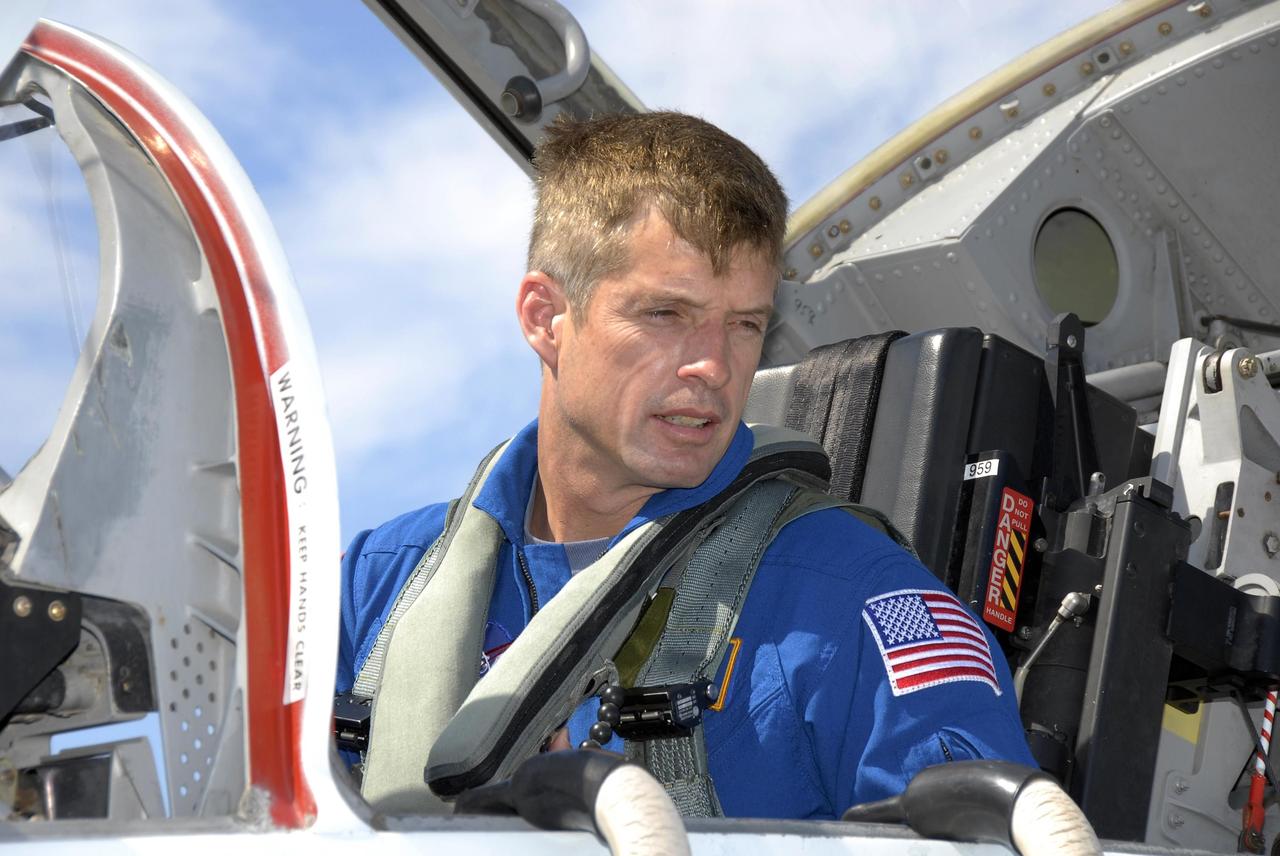
KENNEDY SPACE CENTER, FLA. -- The STS-117 crew arrives at NASA's Kennedy Space Center to take part in the Terminal Countdown Demonstration Test (TCDT), a preparation for the launch March 15 to the International Space Station. Seen here is Mission Specialist Steven Swanson in a T-38 jet aircraft. The TCDT includes emergency egress training and a simulated launch countdown. The mission payload aboard Space Shuttle Atlantis is the S3/S4 integrated truss structure, along with a third set of solar arrays and batteries. The crew of six astronauts will install the truss to continue assembly of the station. Photo credit: NASA/Kim Shiflett
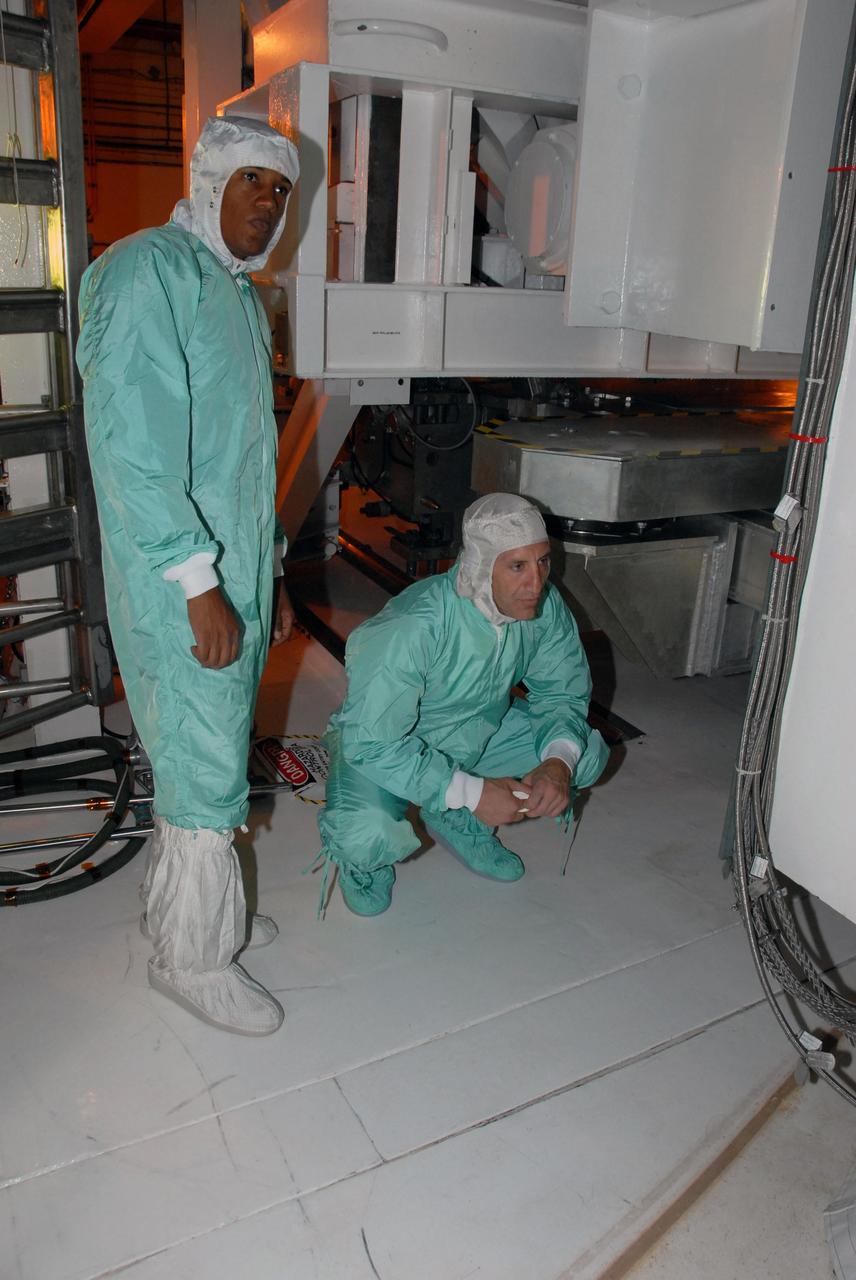
KENNEDY SPACE CENTER, Fla. -- STS-118 crew members get a close look at the payloads installed in Space Shuttle Endeavour. Seen here are Mission Specialist Alvin Drew (left) and Pilot Charlie Hobaugh. The STS-118 crew has been at Kennedy for terminal countdown demonstration test activities that also include M-113 training, emergency egress training at the pad and a simulated launch countdown. The mission is the 22nd flight to the International Space Station and Space Shuttle Endeavour will carry a payload including the S5 truss, a SPACEHAB module and external stowage platform 3. STS-118 is targeted for launch on Aug. 7. Photo credit: NASA/George Shelton
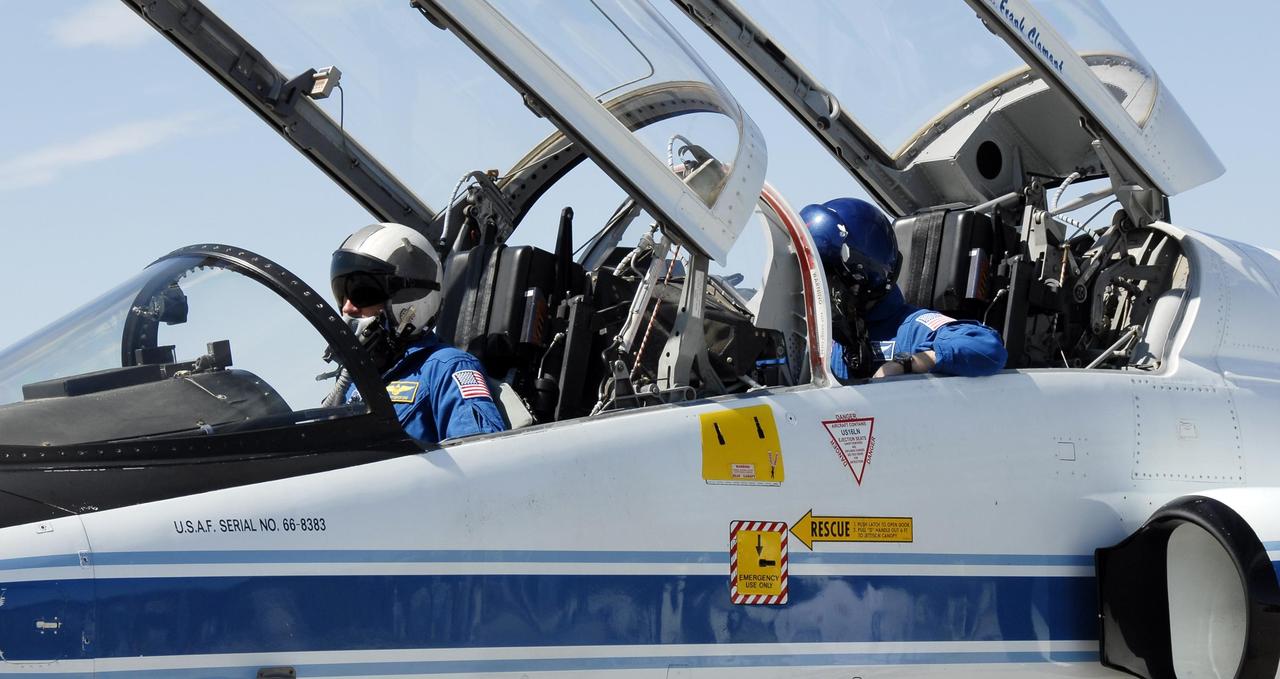
KENNEDY SPACE CENTER, FLA. -- The STS-117 crew arrives at NASA's Kennedy Space Center to take part in the Terminal Countdown Demonstration Test (TCDT), a preparation for the launch March 15 to the International Space Station. Seen here is Commander Rick Sturckow in front and Mission Specialist Patrick Forrester in back in a T-38 jet aircraft. The TCDT includes emergency egress training and a simulated launch countdown. The mission payload aboard Space Shuttle Atlantis is the S3/S4 integrated truss structure, along with a third set of solar arrays and batteries. The crew of six astronauts will install the truss to continue assembly of the station. Photo credit: NASA/Kim Shiflett

KENNEDY SPACE CENTER, FLA. - Following the mock countdown and emergency egress practice from the Fixed Service Structure on Launch Pad 39B, STS-114 crew members stop at the 225-foot level for a unique view. Seen here is Mission Specialist Wendy Lawrence. This culminates the pre-launch training known as Terminal Countdown Demonstration Test (TCDT) activities. TCDT provides the crew of each mission an opportunity to participate in various simulated countdown activities, including equipment familiarization and emergency egress training. STS-114 is the first Return to Flight mission to the International Space Station. The launch window extends July 13 through July 31.
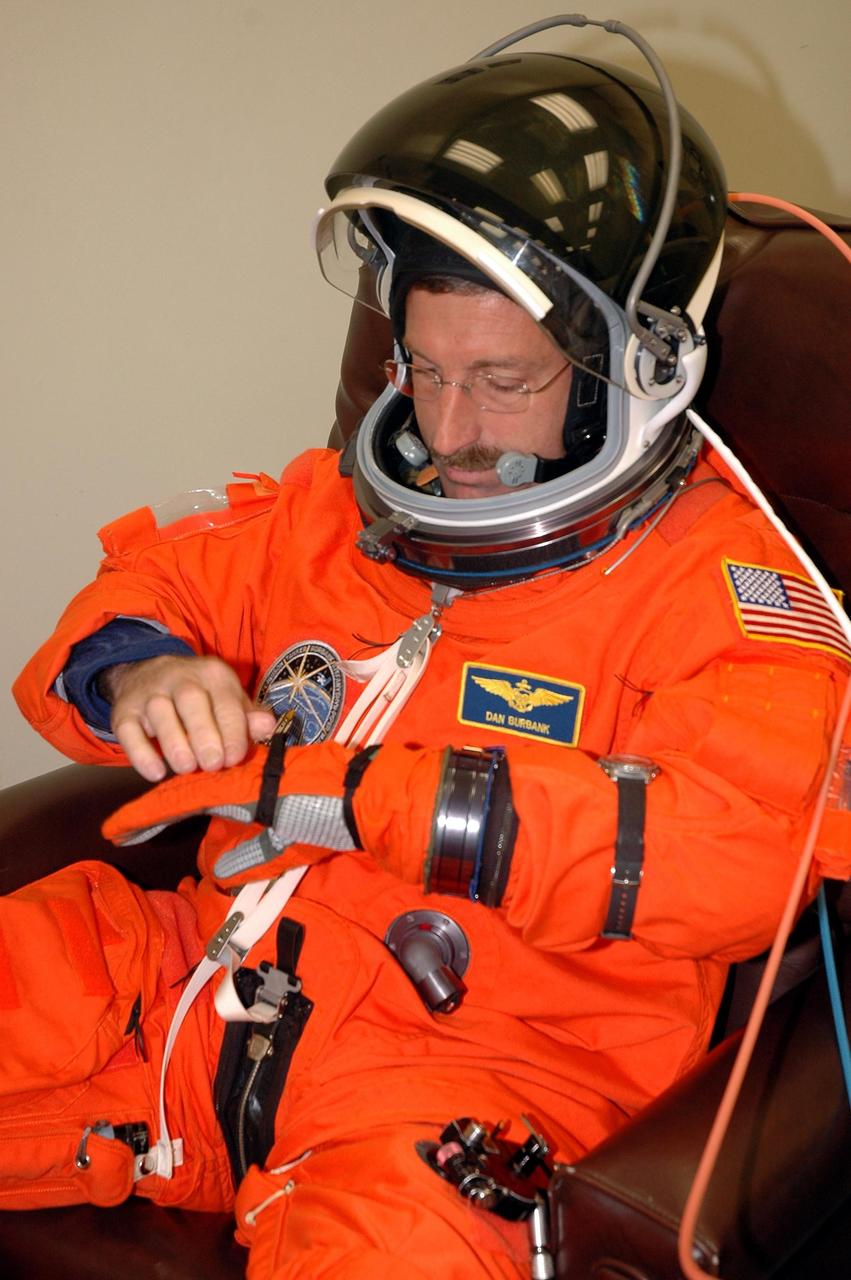
KENNEDY SPACE CENTER, FLA. - The STS-115 crew members are suiting up for their simulated launch countdown. Shown Shown here is Mission Specialist Daniel Burbank. The mission crew is at KSC for Terminal Countdown Demonstration Test (TCDT) activities that are preparation for launch on Space Shuttle Atlantis, scheduled to take place in a window that opens Aug. 27. The TCDT has included emergency egress training as well as the simulation. During their 11-day mission to the International Space Station, the STS-115 crew will continue construction of the station and attach the payload elements, the Port 3/4 truss segment with its two large solar arrays. Photo credit: NASA/Cory Huston
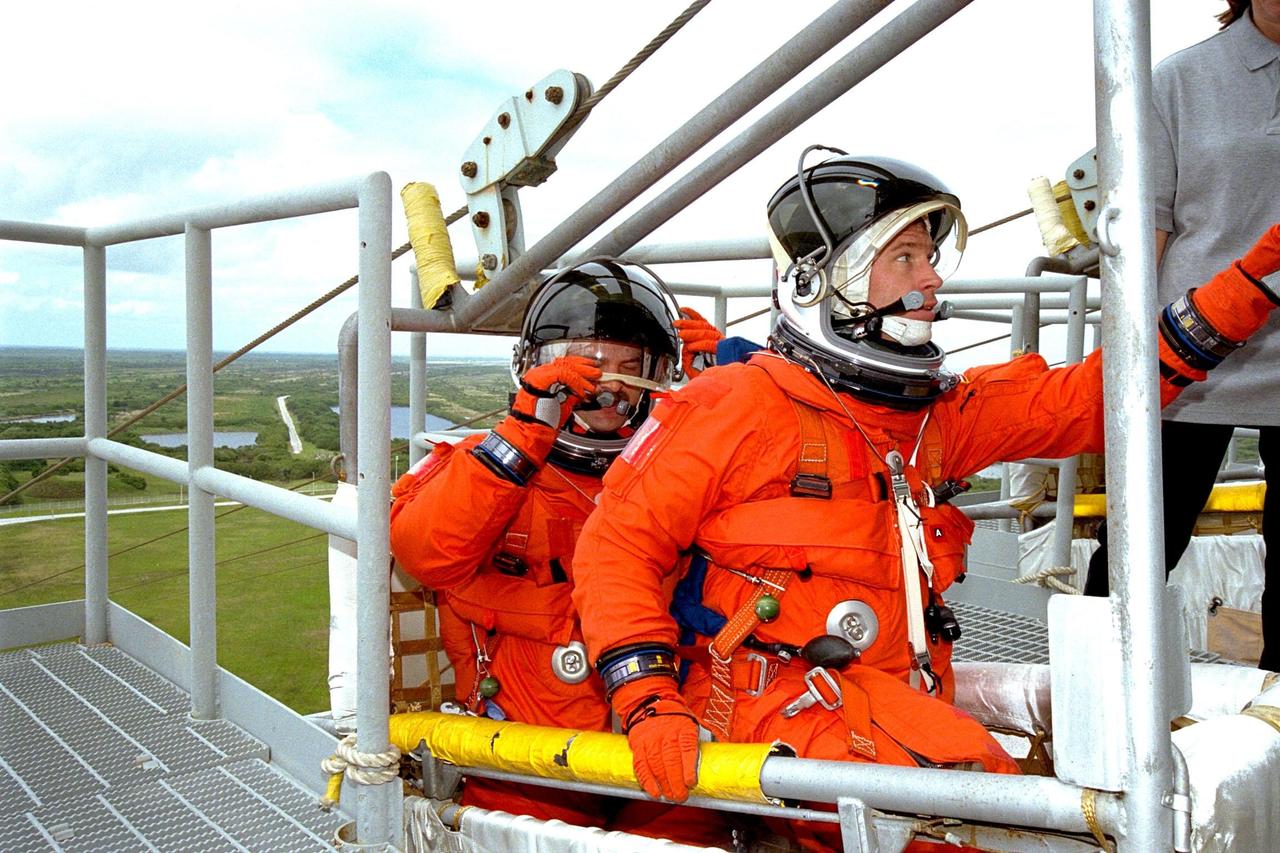
Members of the STS-90 crew participate in mock emergency egress activities during the Terminal Countdown Demonstration Test (TCDT) at KSC's Launch Pad 39B. The TCDT is held at KSC prior to each Space Shuttle flight to provide crews with the opportunity to participate in simulated countdown activities. The STS-90 crew members shown here are Commander Richard Searfoss (front) and Pilot Scott Altman. Columbia is targeted for launch of STS-90 on April 16 at 2:19 p.m. EDT and will be the second mission of 1998. The mission is scheduled to last nearly 17 days
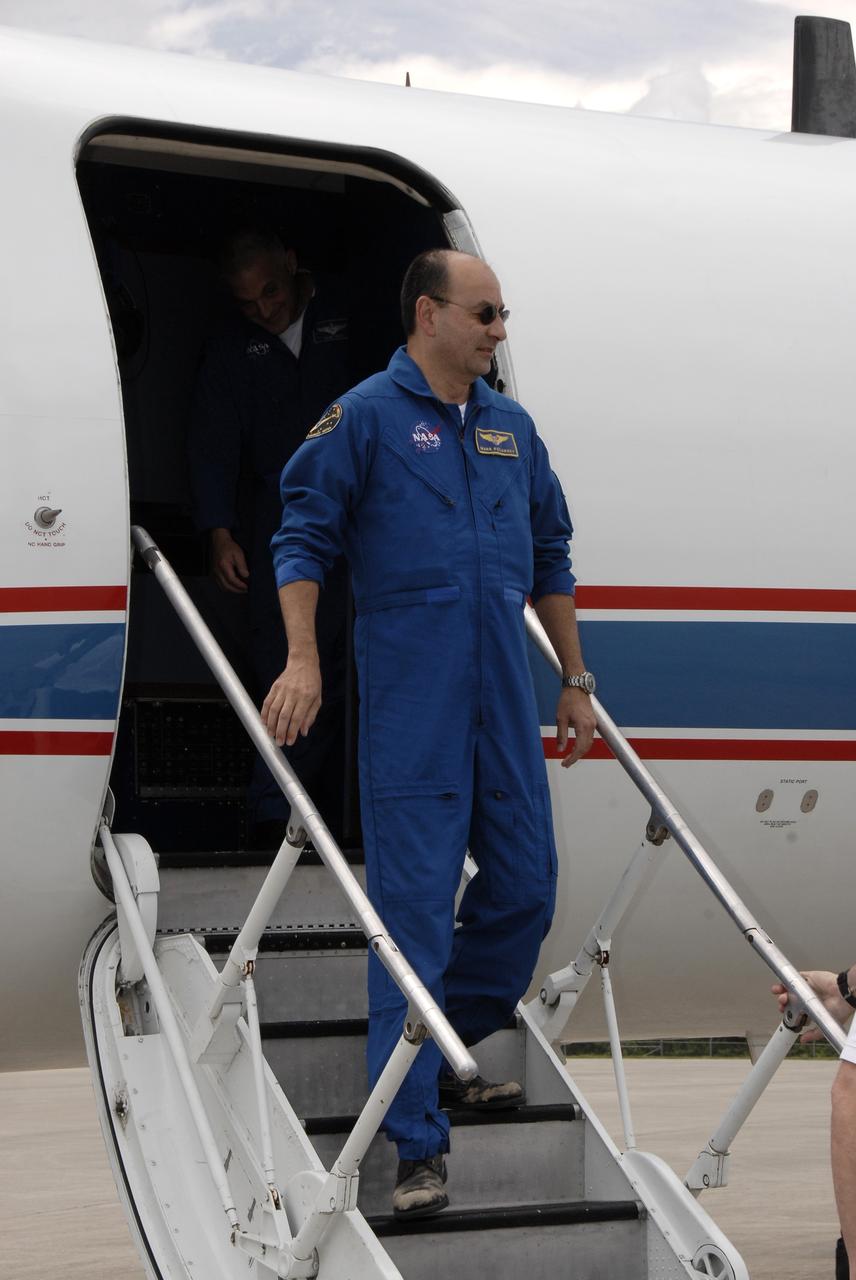
CAPE CANAVERAL, Fla. – Space shuttle Endeavour's STS-127 mission crew members disembark from the Shuttle Training Aircraft at NASA Kennedy Space Center's Shuttle Landing Facility. Seen here is Commander Mark Polansky. The astronauts will be taking part in Terminal Countdown Demonstration Test activities that include equipment familiarization and emergency egress training, and culminates in a simulated launch countdown aboard Endeavour. The STS-127 mission is the final of three flights dedicated to the assembly of the Japanese Kibo laboratory complex. Launch is targeted for June 13. Photo credit: NASA/Kim Shiflett
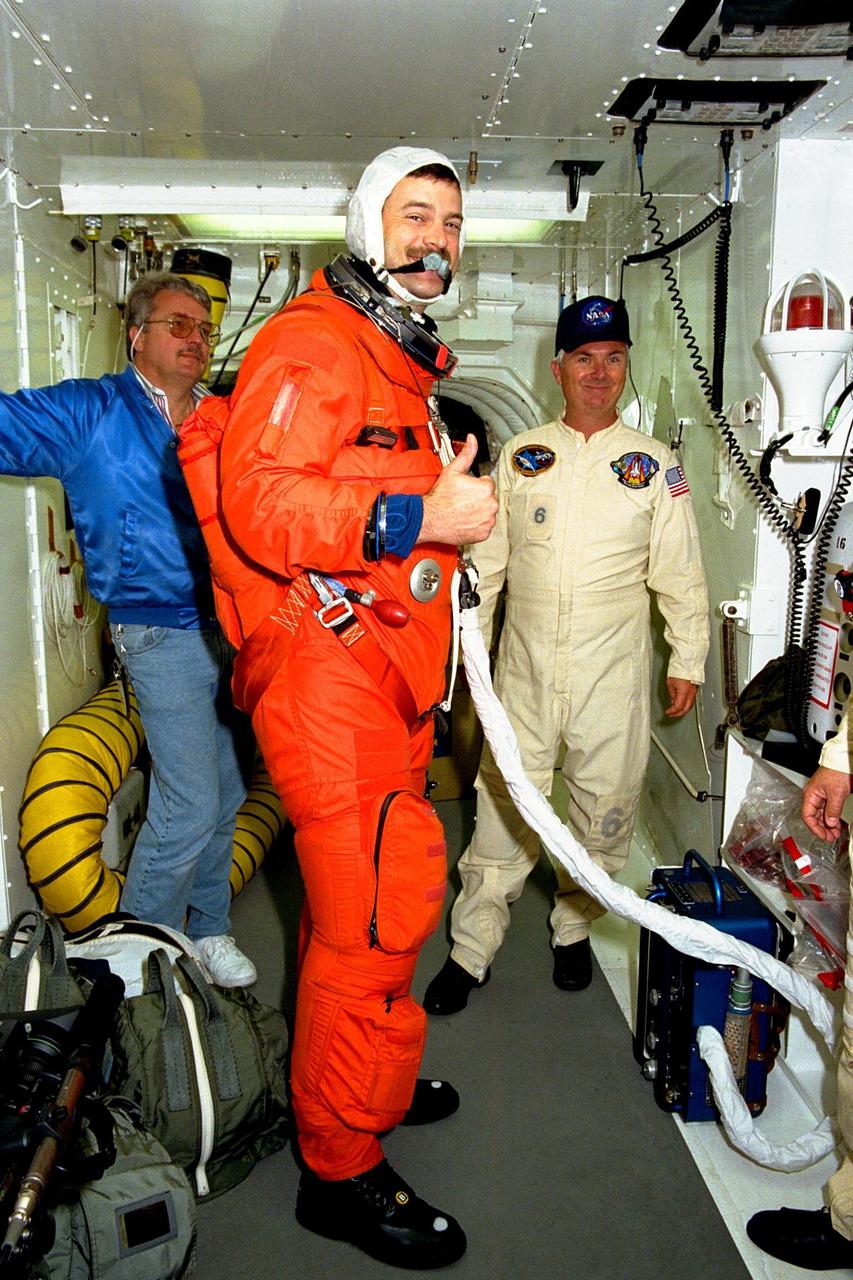
The crew of STS-90 participate in Terminal Countdown Demonstration Test (TCDT) activities at KSC's Launch Pad 39B. The TCDT is held at KSC prior to each Space Shuttle flight to provide crews with the opportunity to participate in simulated countdown activities. Here, STS-90 Pilot Scott Altman gives a "thumbs-up" after being suited up in his orange launch and re-entry suit. Columbia is targeted for launch of STS-90 on April 16 at 2:19 p.m. EDT and will be the second mission of 1998. The mission is scheduled to last nearly 17 days
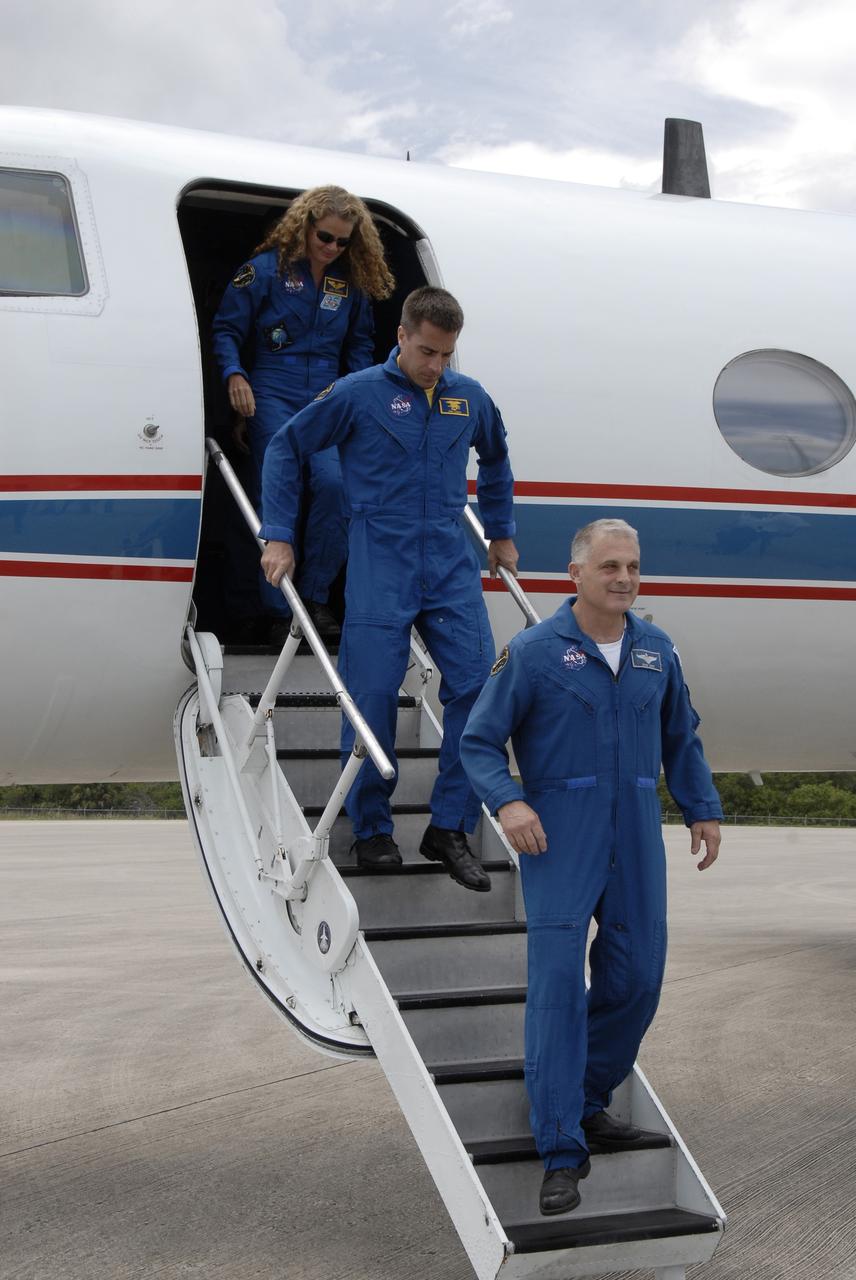
CAPE CANAVERAL, Fla. – Space shuttle Endeavour's STS-127 mission crew members disembark from the Shuttle Training Aircraft at NASA Kennedy Space Center's Shuttle Landing Facility. Seen here are (from bottom to top) Mission Specialists Dave Wolf, Christopher Cassidy and Julie Payette, who represents the Canadian Space Agency. The astronauts will be taking part in Terminal Countdown Demonstration Test activities that include equipment familiarization and emergency egress training, and culminates in a simulated launch countdown aboard Endeavour. The STS-127 mission is the final of three flights dedicated to the assembly of the Japanese Kibo laboratory complex. Launch is targeted for June 13. Photo credit: NASA/Kim Shiflett
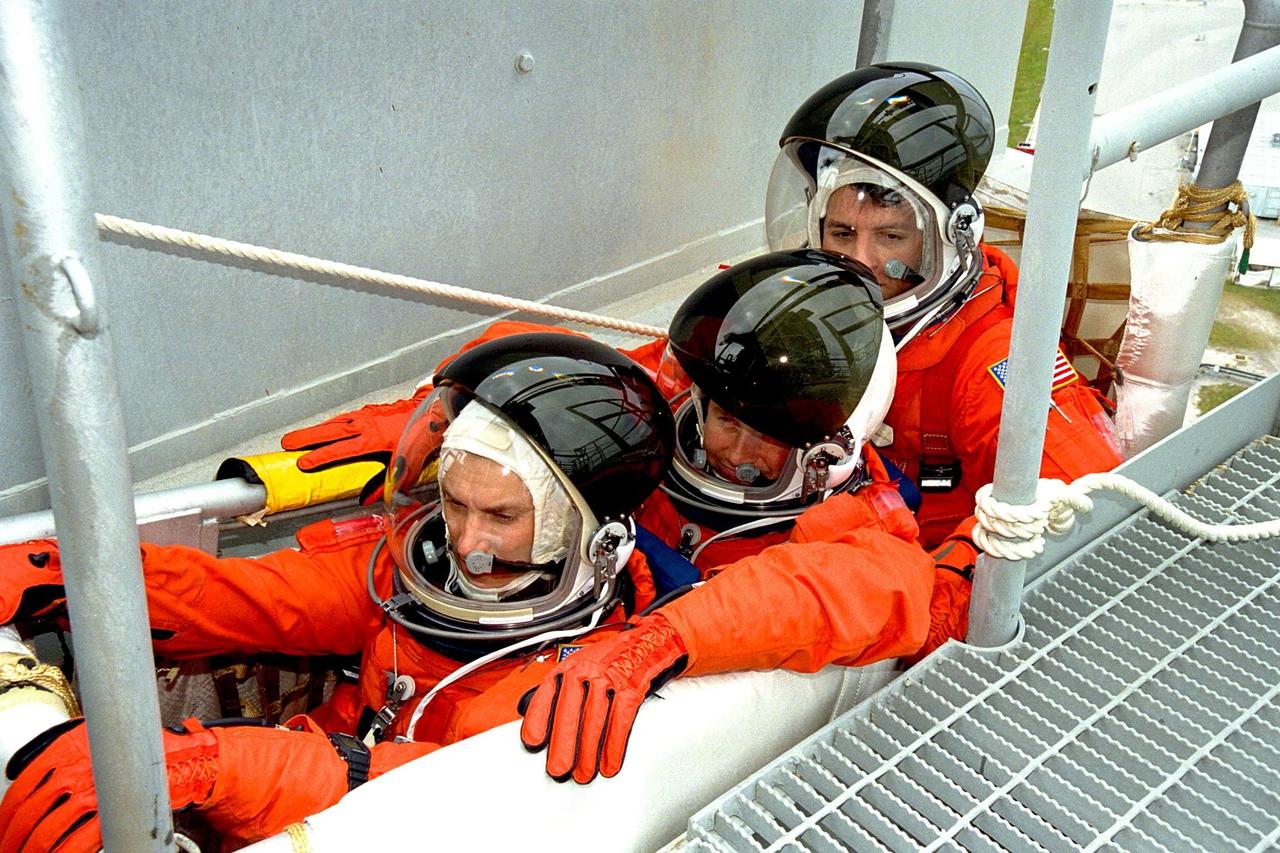
Members of the STS-90 crew participate in mock emergency egress activities during the Terminal Countdown Demonstration Test (TCDT) at KSC's Launch Pad 39B. The TCDT is held at KSC prior to each Space Shuttle flight to provide crews with the opportunity to participate in simulated countdown activities. The STS-90 crew members shown here are, front to back, Payload Specialists James Pawelczyk, Ph.D., and Jay Buckey, M.D., and Mission Specialist Richard Linnehan, D.V.M. Columbia is targeted for launch of STS-90 on April 16 at 2:19 p.m. EDT and will be the second mission of 1998. The mission is scheduled to last nearly 17 days
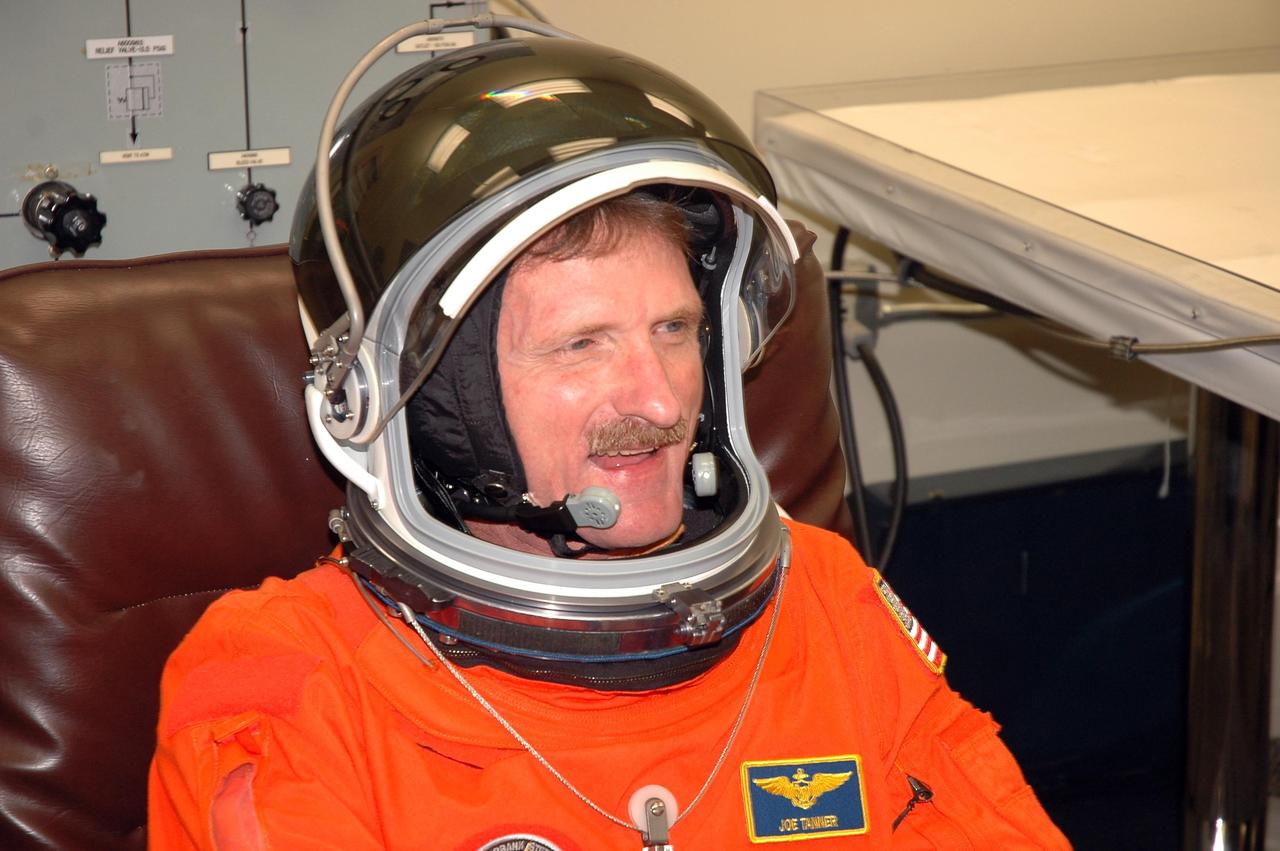
KENNEDY SPACE CENTER, FLA. - The STS-115 crew members are suiting up for their simulated launch countdown. Shown here is Mission Specialist Joseph Tanner. The mission crew is at KSC for Terminal Countdown Demonstration Test (TCDT) activities that are preparation for launch on Space Shuttle Atlantis, scheduled to take place in a window that opens Aug. 27. The TCDT has included emergency egress training as well as the simulation. During their 11-day mission to the International Space Station, the STS-115 crew will continue construction of the station and attach the payload elements, the Port 3/4 truss segment with its two large solar arrays. Photo credit: NASA/Cory Huston

The north polar region of Jupiter's volcanic moon Io was captured by the JunoCam imager aboard NASA's Juno during the spacecraft's 57th close pass of the gas giant on Dec. 30, 2023. The region was imaged at a scale of 1.1 miles (1.8 kilometers) per pixel. The low illumination angle along the terminator (the line dividing day and night) shows several previously unrecognized mountain blocks rising abruptly above the surrounding plains. These are each characterized by a central, sharp peak and adjacent flanks that appear to be collapsing toward the plains. The higher of these peaks range from 2.3 to 6.1 miles (3.7 to 9.8 kilometers) in elevation. The shadows indicate that some of the mountain flanks grade into plateaus under 0.6 miles (1 kilometer). All mountains here are partly or completely covered by bright white diffuse deposits, which may be sulfur dioxide frosts derived from gases escaping the interior and transported up. Extremely large flow fields are evident here. The most active flow regions in Lei-Kung Fluctus (upper left in this image) are evidenced by their darker color and surrounded by white deposits, perhaps liberated from the surface by thermal action. https://photojournal.jpl.nasa.gov/catalog/PIA26484
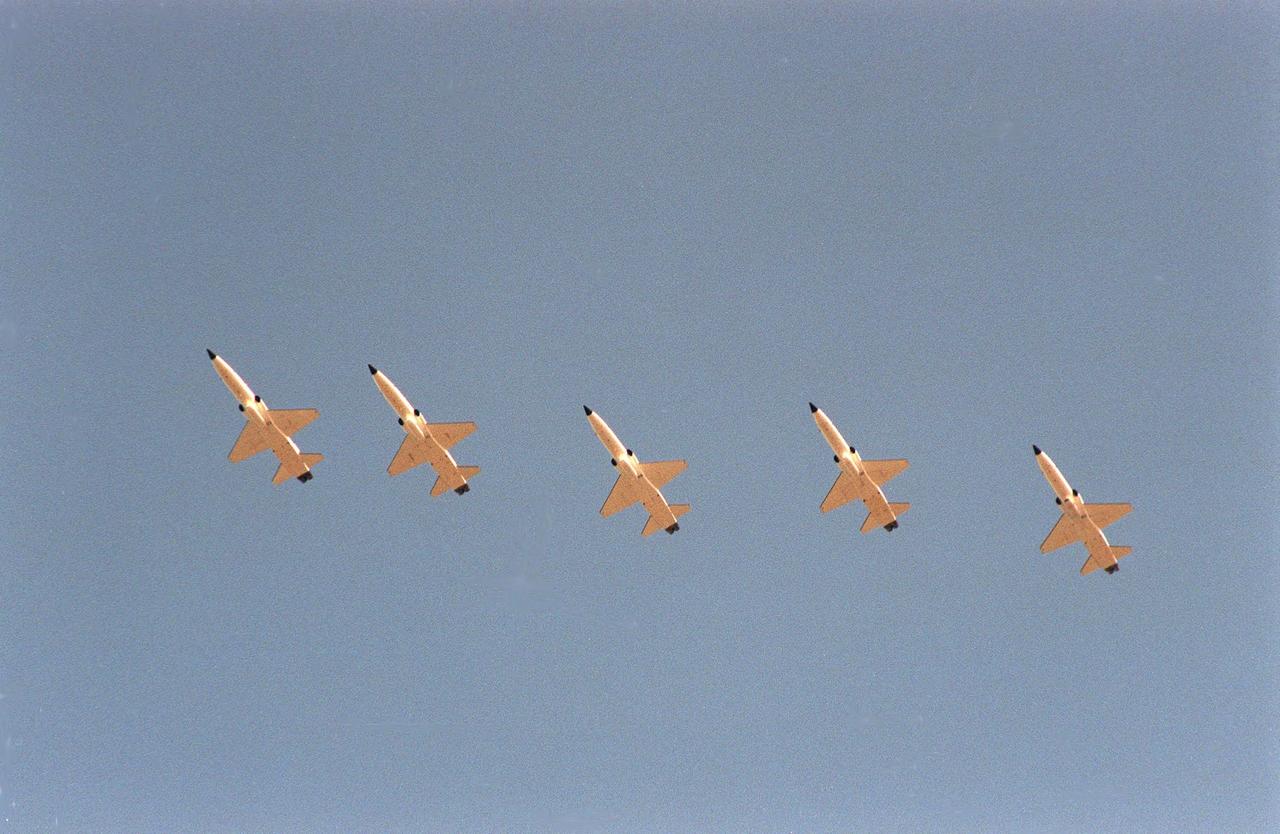
T-38 trainer jets carrying the STS-103 crew arrive in formation above Kennedy Space Center's Shuttle Landing Facility. The crew is here to take part in Terminal Countdown Demonstration Test activities this week. The TCDT provides the crew with emergency egress training, opportunities to inspect their mission payloads in the orbiter's payload bay, and simulated countdown exercises. Participating are Commander Curtis L. Brown Jr., Pilot Scott J. Kelly, and Mission Specialists Steven L. Smith, C. Michael Foale (Ph.D.), John M. Grunsfeld (Ph.D.), Claude Nicollier of Switzerland, with the European Space Agency, and Jean-François Clervoy of France, also with the European Space Agency. The mission, to service the Hubble Space Telescope, is targeted for launch Dec. 6 at 2:37 a.m. EST aboard Space Shuttle Discovery
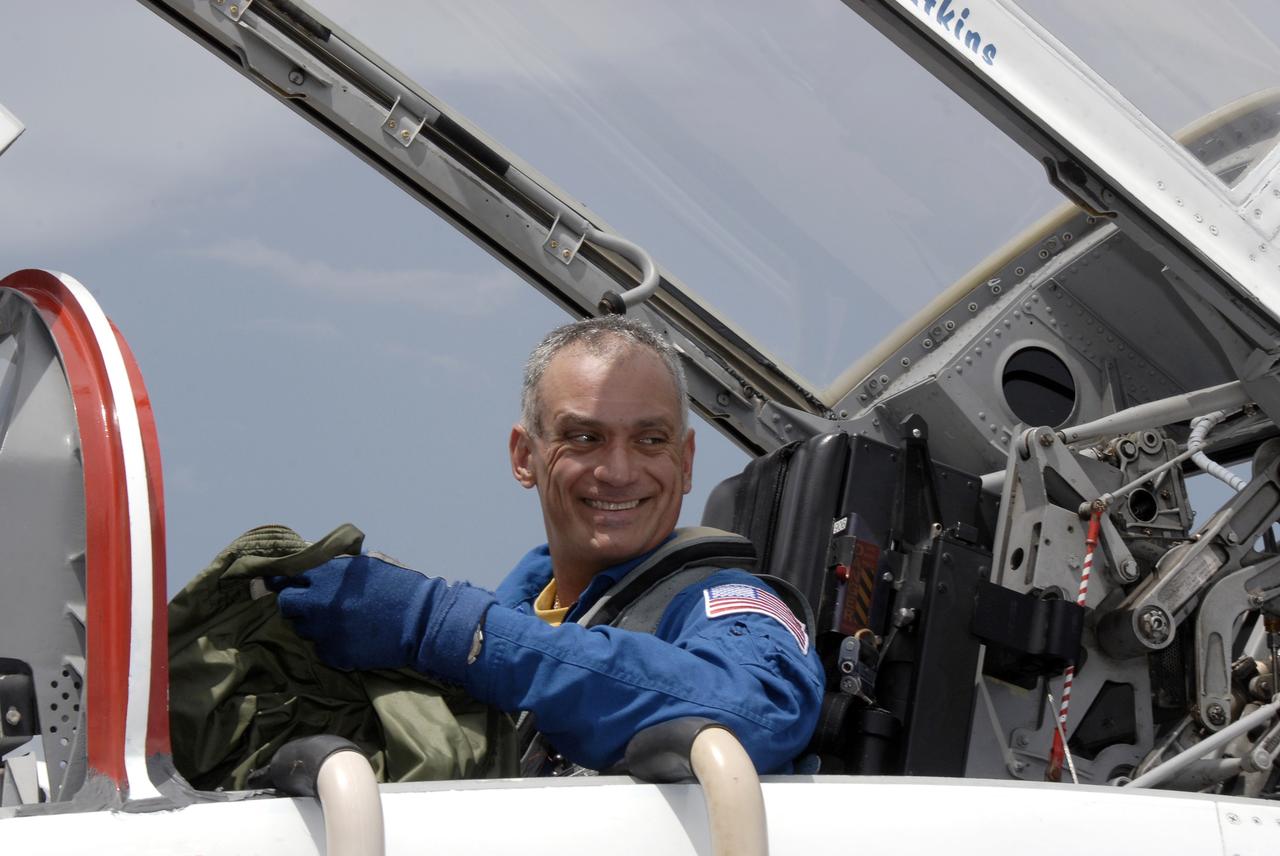
CAPE CANAVERAL, Fla. – Space shuttle Discovery's STS-128 mission crew members arrive in T-38 training jets at NASA Kennedy Space Center's Shuttle Landing Facility. Mission Specialist John "Danny" Olivas is seen here. The astronauts will be taking part in terminal countdown demonstration test activities that include equipment familiarization and emergency egress training, and will culminate in a simulated launch countdown aboard Discovery. The mission will deliver a new crew member and 33,000 pounds of equipment to the International Space Station. The equipment includes science and storage racks, a freezer to store research samples, a new sleeping compartment and the COLBERT treadmill. Launch of Discovery is targeted for late August. Photo credit: NASA/Kim Shiflett

STS052-152-047 (22 Oct- 1 Nov 1992) --- The Kalahari Desert had not seen any significant rainfall for months before the launch of STS-52. Here, Shuttle astronauts have captured the onset of the (Southern Hemisphere) summer monsoon over the Kalahari Desert, as illustrated by the large thunderstorm towers poking up through the sun's terminator. The summer monsoon, with its associated thunderstorms, generally lasts from November through March. Scientist observers of this area report that the summer monsoon contributes most of the annual rainfall to this environmentally sensitive area. Shuttle nadir position: 28.0 degrees south, 25.1 degrees east. The center of the scene is 22.0 degrees south, 25.0 degrees east, 16:20:04 GMT.
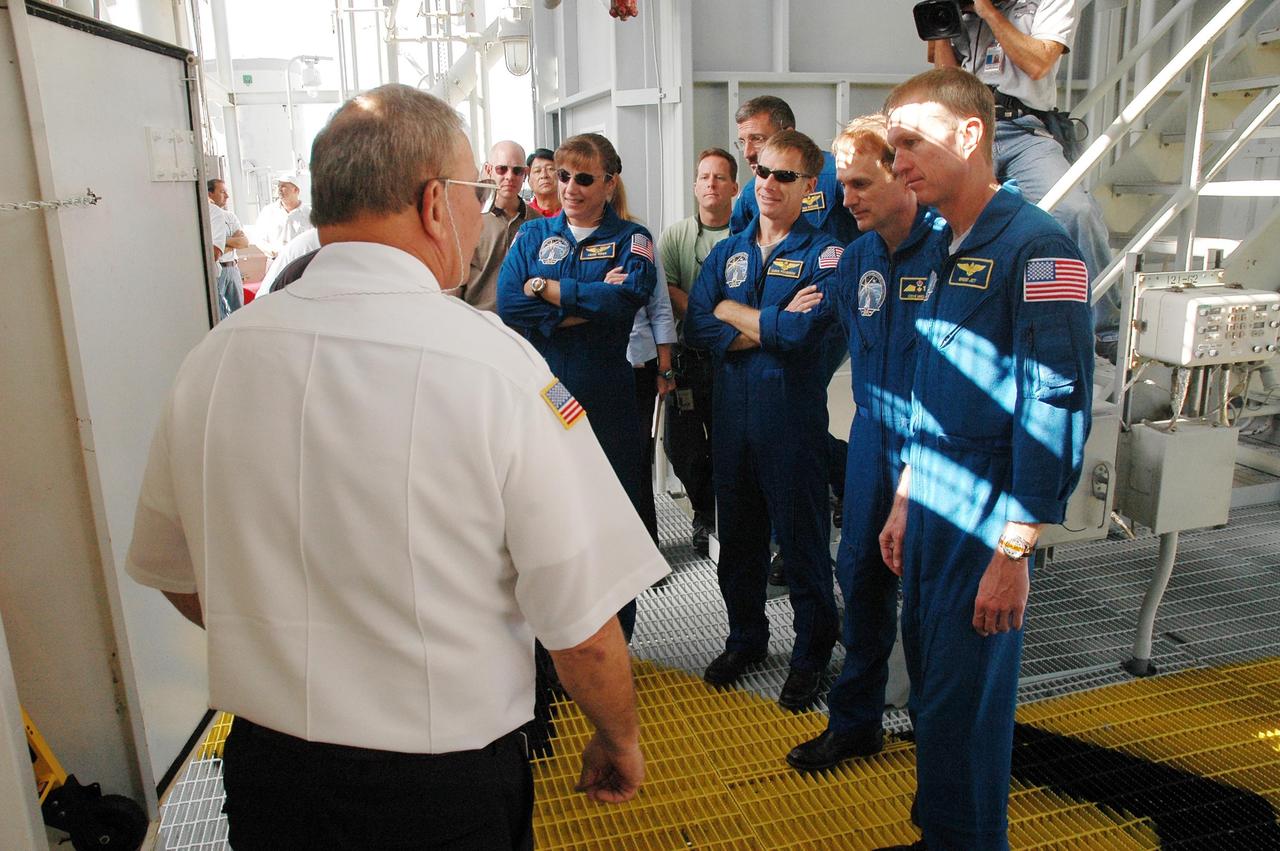
KENNEDY SPACE CENTER, FLA. - The STS-115 crew gets instructions about using the slidewire baskets for emergency egress from the space shuttle on the pad. Seen here are Mission Specialists Heidemarie Stefanyshyn-Piper and Daniel Burbank, Pilot Chris Ferguson, Mission Specialist Steven MacLean and Commander Brent Jett. MacLean is with the Canadian Space Agency. Not seen is Mission Specialist Joseph Tanner. The mission crew is at KSC for Terminal Countdown Demonstration Test (TCDT) activities that are preparation for launch on Space Shuttle Atlantis, scheduled to take place in a window that opens Aug. 27. During their 11-day mission to the International Space Station, the STS-115 crew will continue construction of the station and attach the payload elements, the Port 3/4 truss segment with its two large solar arrays. Photo credit: NASA/Cory Huston
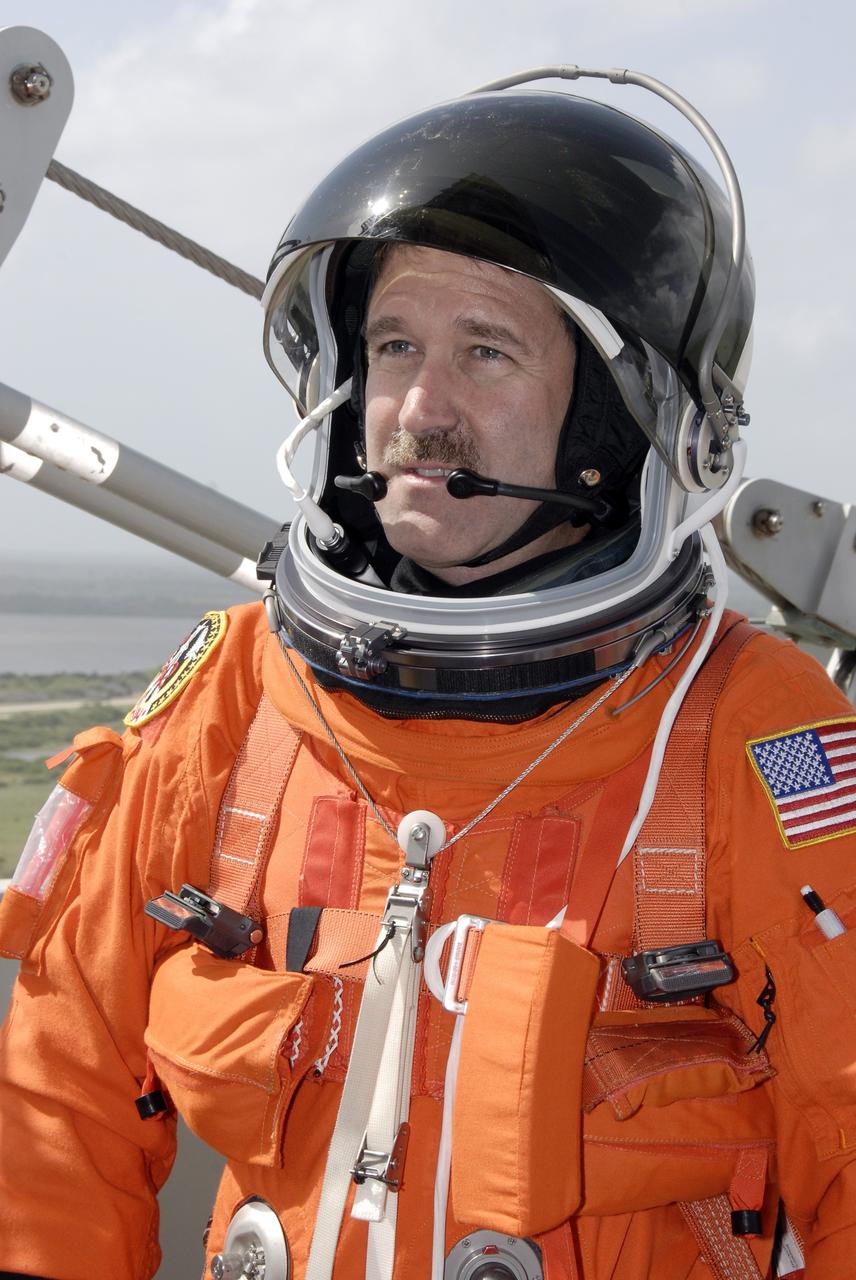
CAPE CANAVERAL, Fla. - After taking part in a simulated launch countdown aboard space shuttle Atlantis, the STS-125 crew members practice an emergency escape from the shuttle. Here Mission Specialist John Grunsfeld has reached the slidewire basket area on the fixed service structure at Launch Pad 39A at NASA's Kennedy Space Center in Florida. The countdown is the culmination of terminal countdown demonstration test, or TCDT, activities as preparation before launch. TCDT provides astronauts and ground crews with an opportunity to participate in various launch activities, including equipment familiarization, emergency training and the countdown. Atlantis’ STS-125 mission to service NASA’s Hubble Space Telescope is targeted for launch Oct. 14. Photo credit: NASA/Kim Shiflett
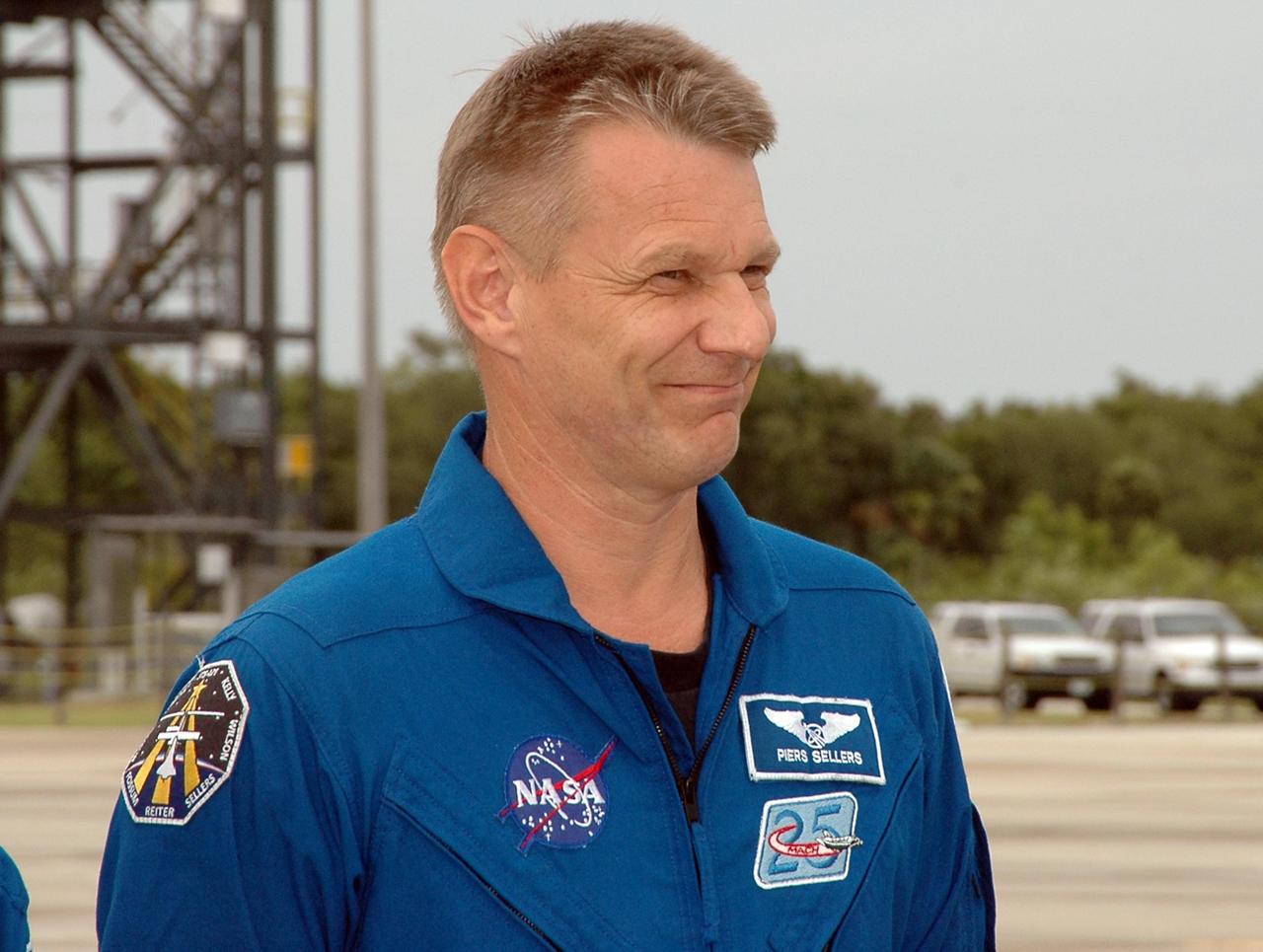
KENNEDY SPACE CENTER, FLA. - After landing at NASA's Kennedy Space Center aboard a Grumman G2 aircraft, the STS-121 crew gathers at a microphone for the media. Seen here at center is Mission Specialist Piers Sellers; at left is Mission Specialist Stephanie Wilson. Other crew members are Mission Commander Steven Lindsey, Mission Specialist Michael Fossum, Pilot Mark Kelly, and Mission Specialists Lisa Nowak and Thomas Reiter, who represents the European Space Agency. The crew is at the space center to take part in a Terminal Countdown Demonstration Test, or TCDT. Over several days, the crew will practice emergency egress from the pad and suit up in their orange flight suits for the simulated countdown to launch. Space Shuttle Discovery is designated to launch July 1 on mission STS-121. It will carry supplies to the International Space Station. Photo credit: NASA/Kim Shiflett
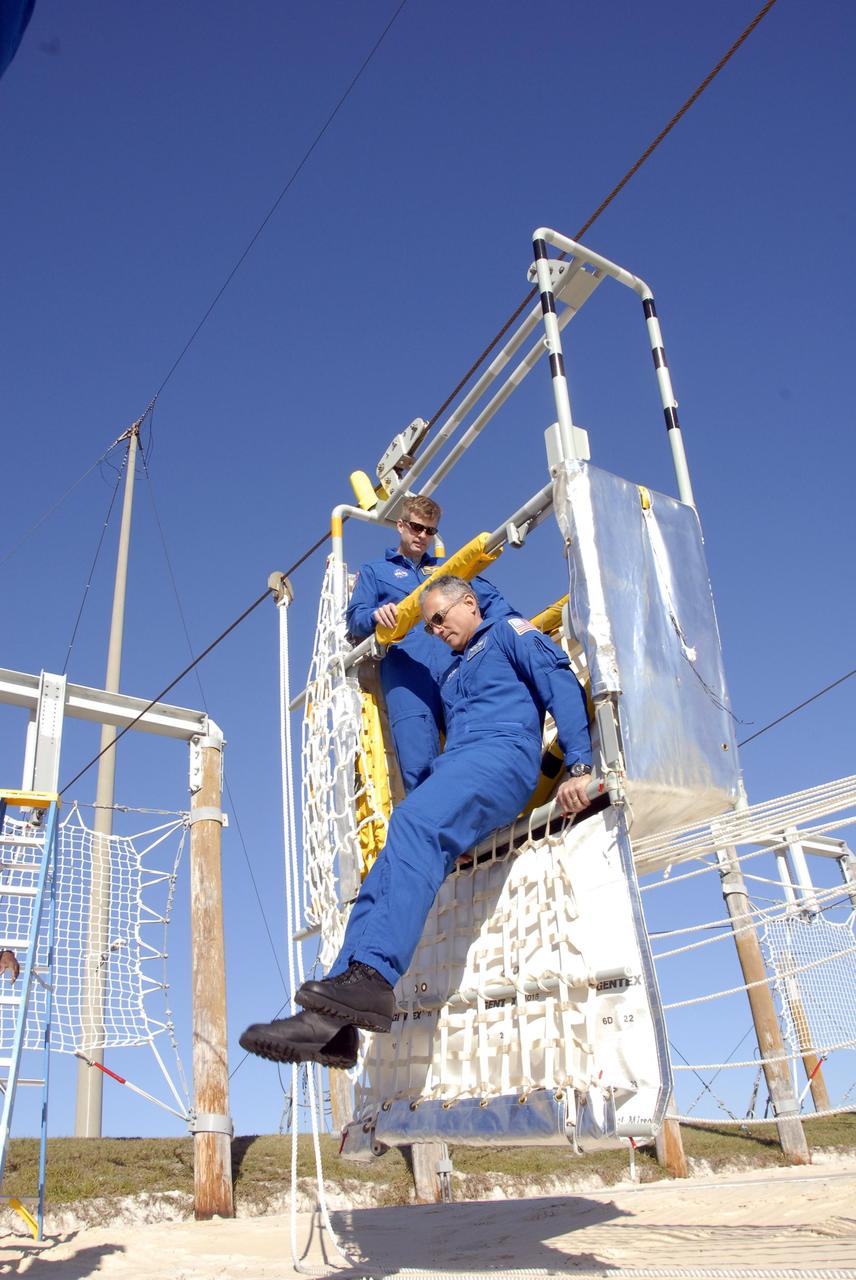
KENNEDY SPACE CENTER, FLA. -- In the Launch Pad 39A area, Mission STS-117 crew members receive instruction on emergency egress using the slidewire basket system during Terminal Countdown Demonstration Test activities. Here, Mission Specialists Steven Swanson (left) and Danny Olivas (right) practice exiting from the slidewire basket. The TCDT also includes M-113 armored personnel carrier training, and a simulated launch countdown. The mission payload aboard Space Shuttle Atlantis is the S3/S4 integrated truss structure, along with a third set of solar arrays and batteries. The crew of six astronauts will install the truss to continue assembly of the International Space Station. Photo credit: NASA/Kim Shiflett
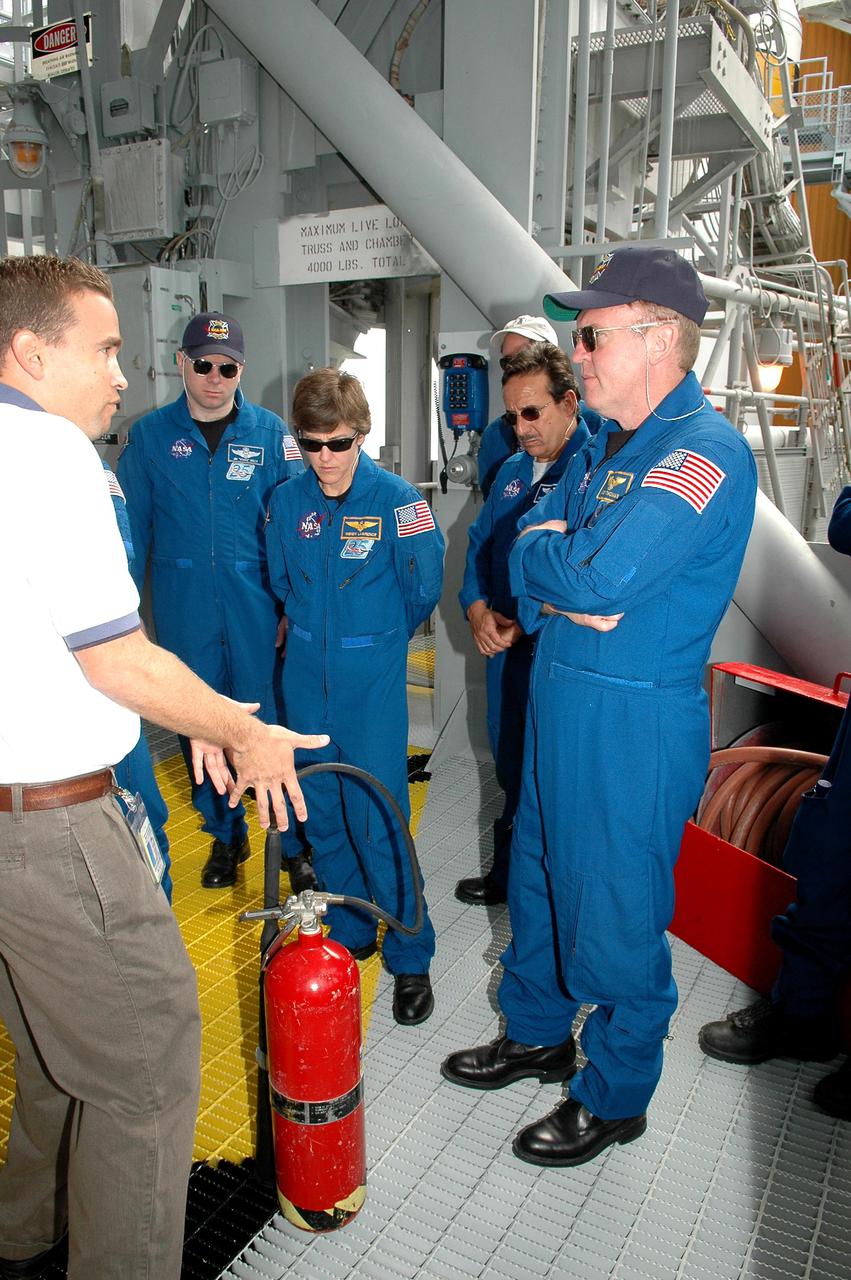
KENNEDY SPACE CENTER, FLA. - On the Fixed Service Structure at Launch Pad 39B, the STS-114 crew gets instructions about fire extinguisher use. The astronauts seen here are (from left) Pilot James Kelly, Commander Eileen Collins, and Mission Specialists Charles Camarda and Andrew Thomas. The training is part of Terminal Countdown Demonstration Test activities. The TCDT is held at KSC prior to each Space Shuttle flight. It provides the crew of each mission an opportunity to participate in simulated countdown activities. The test ends with a mock launch countdown culminating in a simulated main engine cutoff. The crew also spends time undergoing emergency egress training exercises at the launch pad. STS-114 is designated the first Return to Flight mission, with a launch window extending from July 13 to July 31.
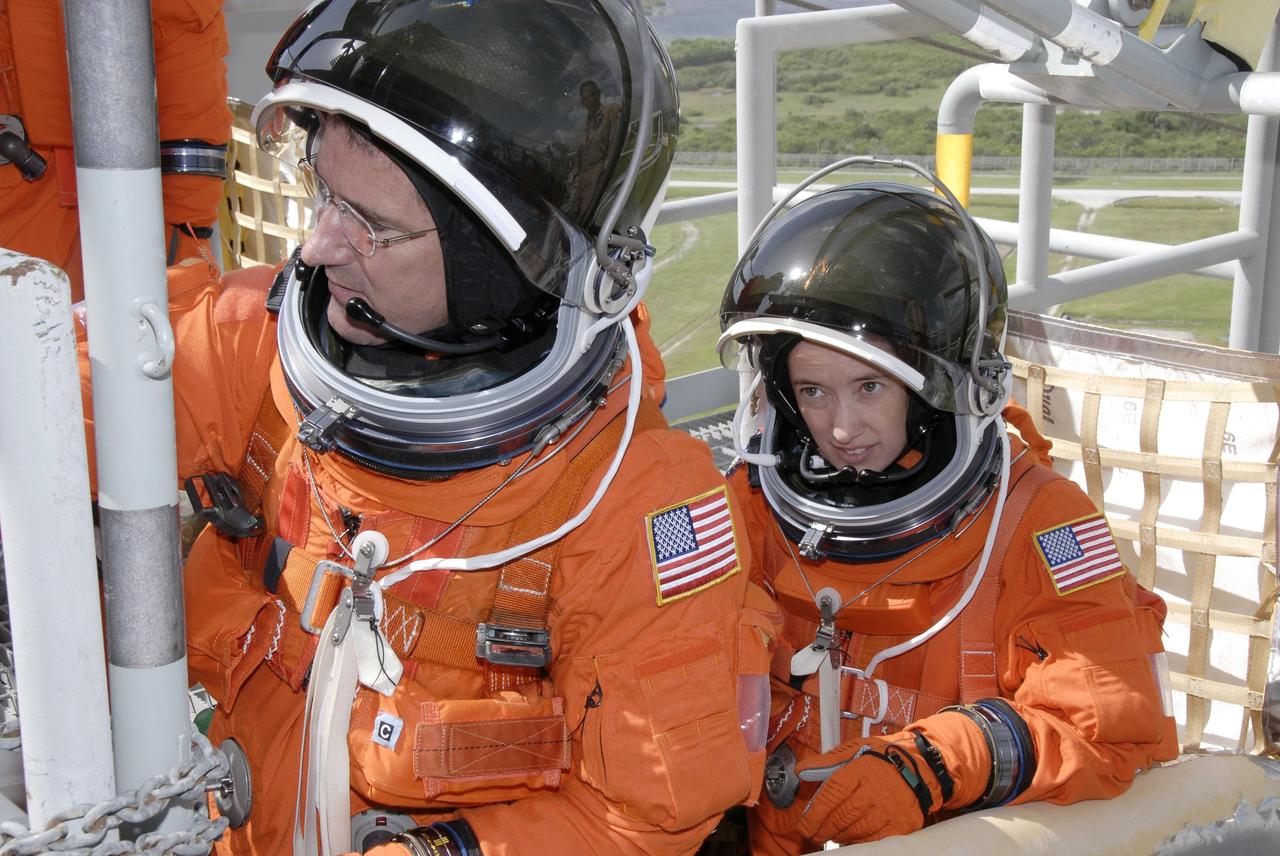
CAPE CANAVERAL, Fla. - After taking part in a simulated launch countdown aboard space shuttle Atlantis, the STS-125 crew members practice an emergency escape from the shuttle. Here Mission Specialists Michael Good and Megan McArthur are ready to release the slidewire basket on the fixed service structure that will speed them away from at Kennedy Space Center’s Launch Pad 39A. The countdown is the culmination of terminal countdown demonstration test, or TCDT, activities as preparation before launch. TCDT provides astronauts and ground crews with an opportunity to participate in various launch activities, including equipment familiarization, emergency training and the countdown. Atlantis’ STS-125 mission to service NASA’s Hubble Space Telescope is targeted for launch Oct. 14. Photo credit: NASA/Kim Shiflett
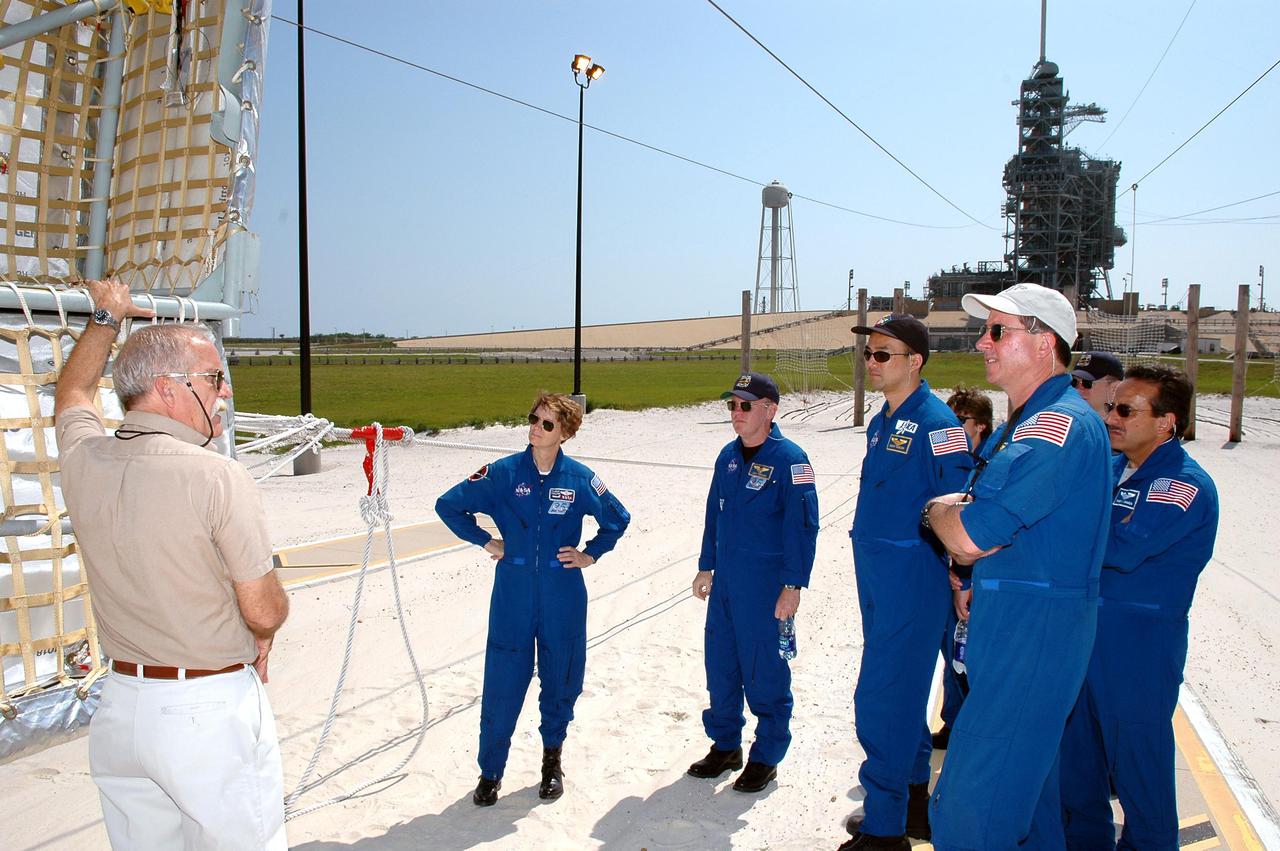
KENNEDY SPACE CENTER, FLA. - The STS-114 crew learn about exiting the slidewire basket at this landing area should they need to leave the Space Shuttle in an emergency situation while on the pad. Crew members seen here are (from left) Commander Eileen Collins and Mission Specialists Andrew Thomas, Soichi Noguchi, Wendy Lawrence, Stephen Robinson and Charles Camarda. Not pictured is Pilot James Kelly. Noguchi is with the Japan Aerospace Exploration Agency. The training is part of Terminal Countdown Demonstration Test activities. The TCDT is held at KSC prior to each Space Shuttle flight. It provides the crew of each mission an opportunity to participate in simulated countdown activities. The test ends with a mock launch countdown culminating in a simulated main engine cutoff. The crew also spends time undergoing emergency egress training exercises at the launch pad. STS-114 is designated the first Return to Flight mission, with a launch window extending from July 13 to July 31.
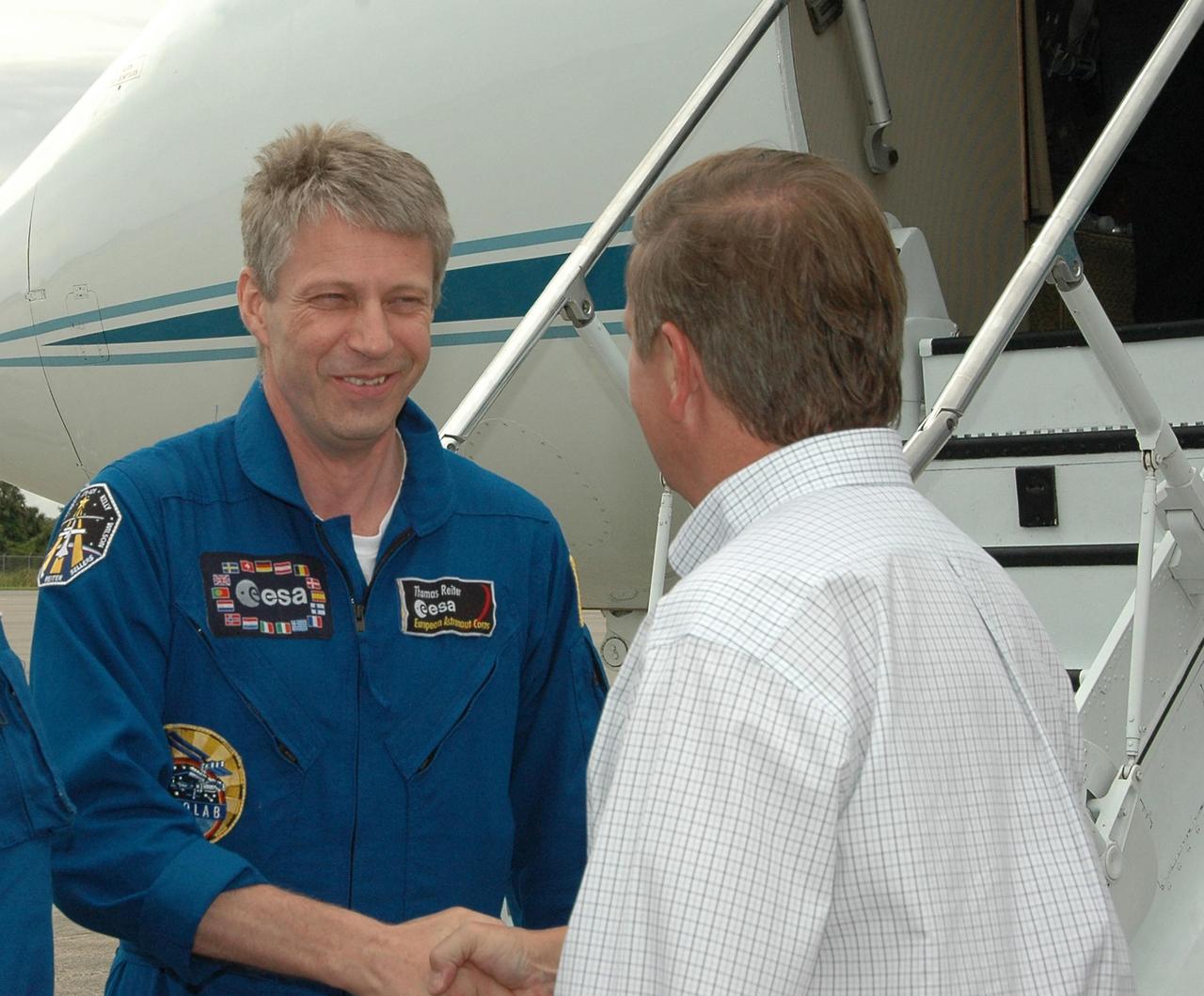
KENNEDY SPACE CENTER, FLA. - During a break in the rain storms from Tropical Storm Alberto, the STS-121 crew arrives at NASA's Kennedy Space Center aboard a Grumman G2 aircraft to take part in a Terminal Countdown Demonstration Test, or TCDT. Greeting the crew is Shuttle Launch Director Mike Leinbach, here shaking hands with Mission Specialist Thomas Reiter, who represents the European Space Agency. Other crew members are Mission Commander Steven Lindsey, Pilot Mark Kelly, and Mission Specialists Piers Sellers, Michael Fossum, Lisa Nowak and Stephanie Wilson. Over several days, the crew will practice emergency egress from the pad and suit up in their orange flight suits for the simulated countdown to launch. Space Shuttle Discovery is designated to launch July 1 on mission STS-121. It will carry supplies to the International Space Station. Photo credit: NASA/Kim Shiflett
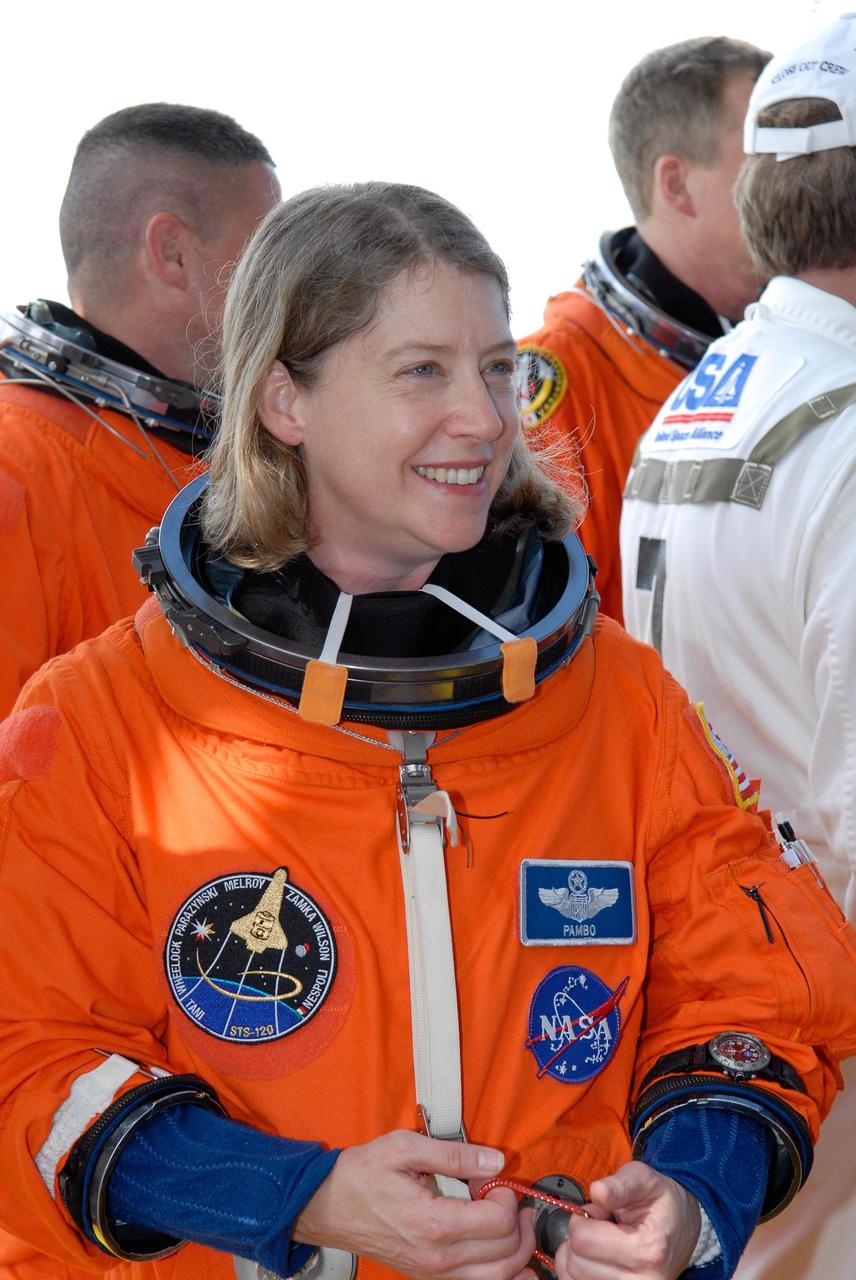
KENNEDY SPACE CENTER, FLA. -- The STS-120 crew gathers at the slidewire basket area on Launch Pad 39A after practicing emergency egress, part of the prelaunch terminal countdown demonstration test, or TCDT. Seen here in their launch and entry suits are (from left) Pilot George Zamka, Commander Pamela Melroy and Mission Specialist Scott Parazynski. Their name patches reflect the nicknames the crew gave each other for the event. The TCDT at NASA's Kennedy Space Center provides astronauts and ground crews an opportunity to participate in various launch preparation activities, including equipment familiarization and emergency training. The STS-120 mission will deliver the U.S. Node 2 module, named Harmony, aboard space shuttle Discovery to the International Space Station. Discovery is targeted to launch on its 14-day mission at 11:38 a.m. EDT on Oct. 23. Photo credit: NASA/Kim Shiflett
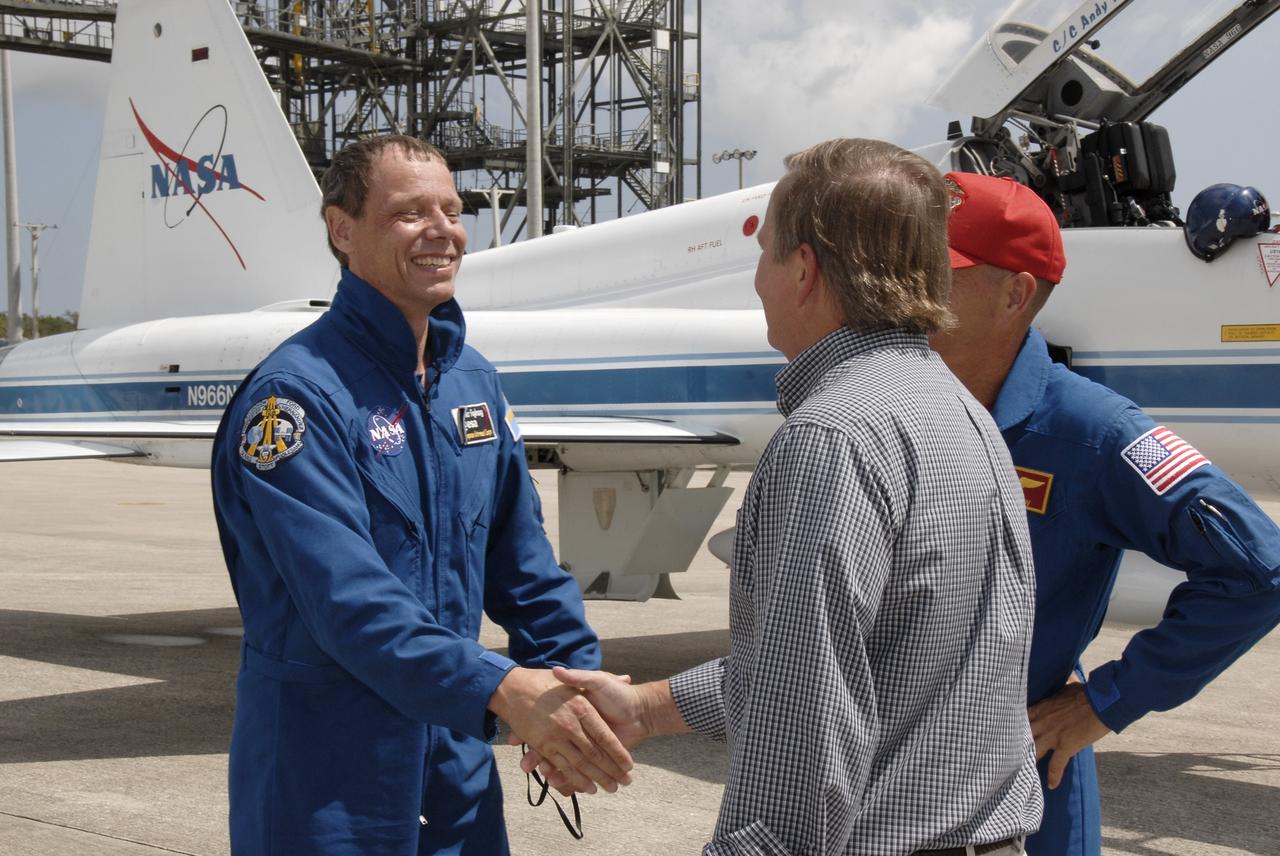
CAPE CANAVERAL, Fla. – Space shuttle Discovery's STS-128 mission crew members arrive in T-38 training jets at NASA Kennedy Space Center's Shuttle Landing Facility. Seen here is Mission Specialist Christer Fuglesang, who represents the European Space Agency, being greeted by Shuttle Launch Director Mike Leinbach. At right is Commander Rick Sturckow. The astronauts will be taking part in terminal countdown demonstration test activities that include equipment familiarization and emergency egress training, and will culminate in a simulated launch countdown aboard Discovery. The mission will deliver a new crew member and 33,000 pounds of equipment to the International Space Station. The equipment includes science and storage racks, a freezer to store research samples, a new sleeping compartment and the COLBERT treadmill. Launch of Discovery is targeted for late August. Photo credit: NASA/Kim Shiflett
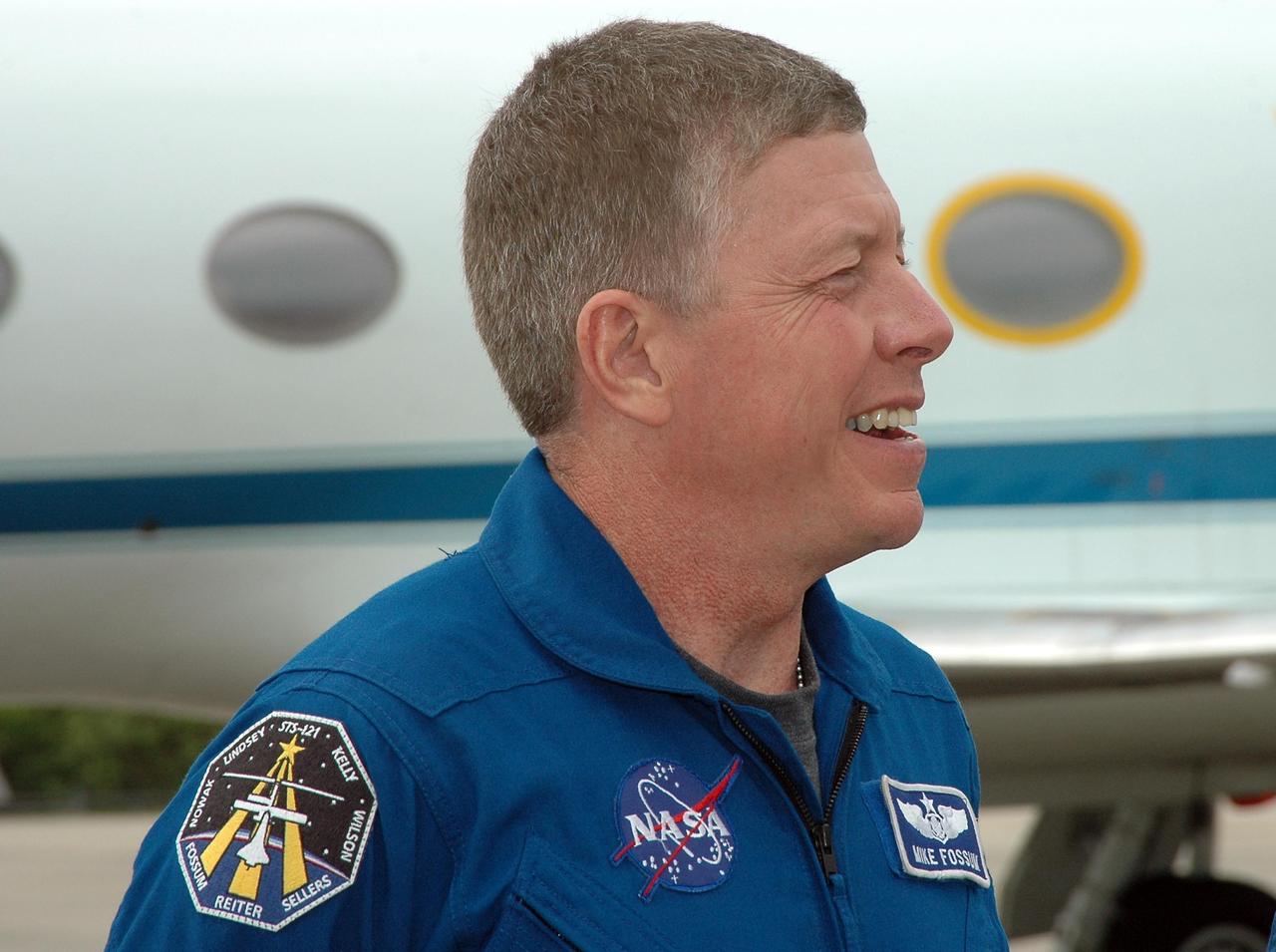
KENNEDY SPACE CENTER, FLA. - After landing at NASA's Kennedy Space Center aboard a Grumman G2 aircraft, the STS-121 crew gathers at a microphone for the media. Seen here is Mission Specialist Michael Fossum. Other crew members are Commander Steven Lindsey, Pilot Mark Kelly, and Mission Specialists Lisa Nowak, Stephanie Wilson, Piers Sellers and Thomas Reiter, who represents the European Space Agency. The crew is at the space center to take part in a Terminal Countdown Demonstration Test, or TCDT. Over several days, the crew will practice emergency egress from the pad and suit up in their orange flight suits for the simulated countdown to launch. Space Shuttle Discovery is designated to launch July 1 on mission STS-121. It will carry supplies to the International Space Station. Photo credit: NASA/Kim Shiflett
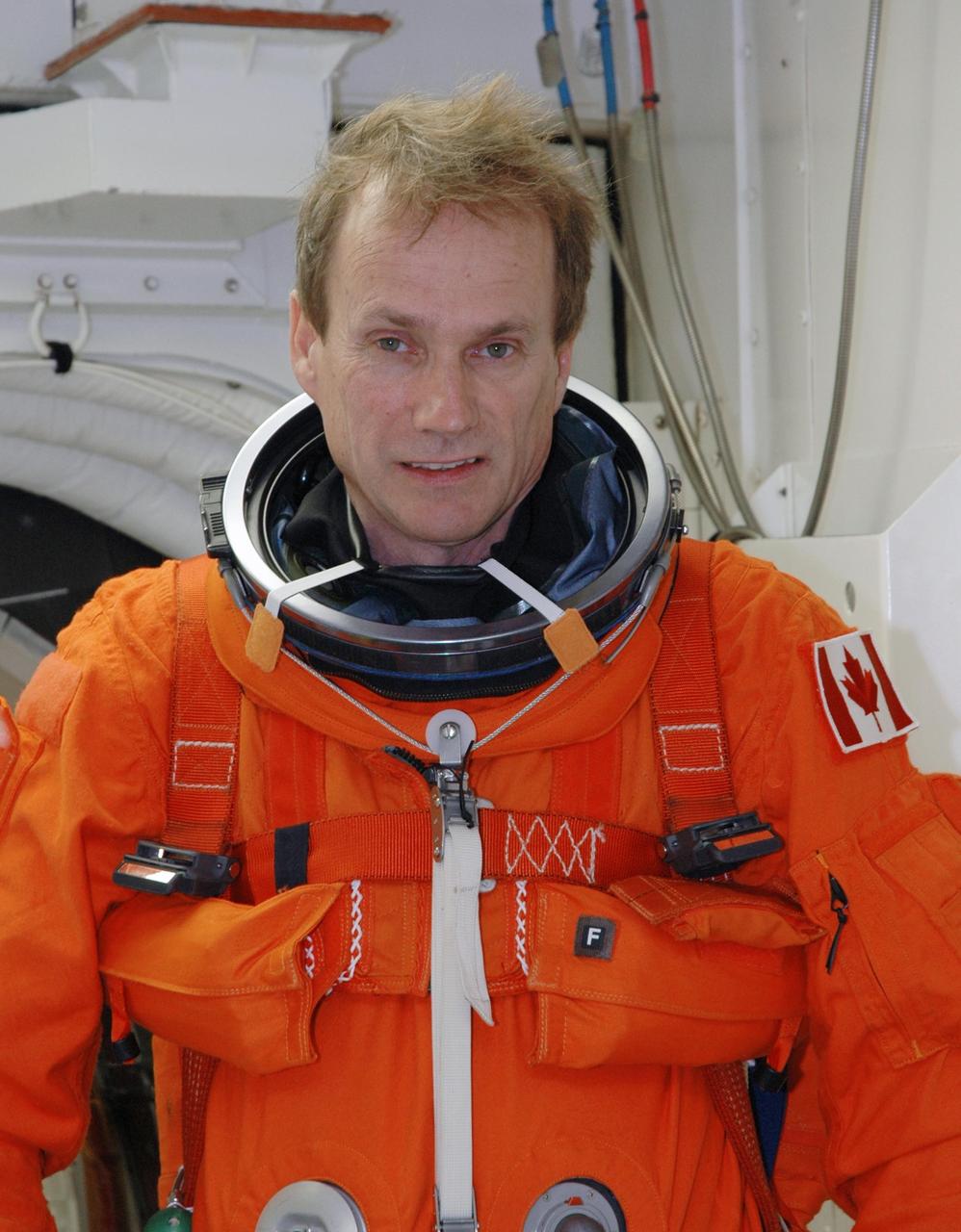
KENNEDY SPACE CENTER, FLA. - The STS-115 crew members complete their suitup in the White Room before entering Space Shuttle Atlantis on Launch Pad 39B for a simulated launch countdown. Shown here is Mission Specialist Steven MacLean. The White Room, which is located at the end of the orbiter access arm, allows entry into the orbiter through the crew access hatch. The mission crew is at KSC for Terminal Countdown Demonstration Test (TCDT) activities that are preparation for launch. Liftoff of Atlantis is scheduled to take place in a window that opens Aug. 27. During their 11-day mission to the International Space Station, the STS-115 crew will continue construction of the station and attach the payload elements, the Port 3/4 truss segment with its two large solar arrays. Photo credit: NASA/Jim Grossmann
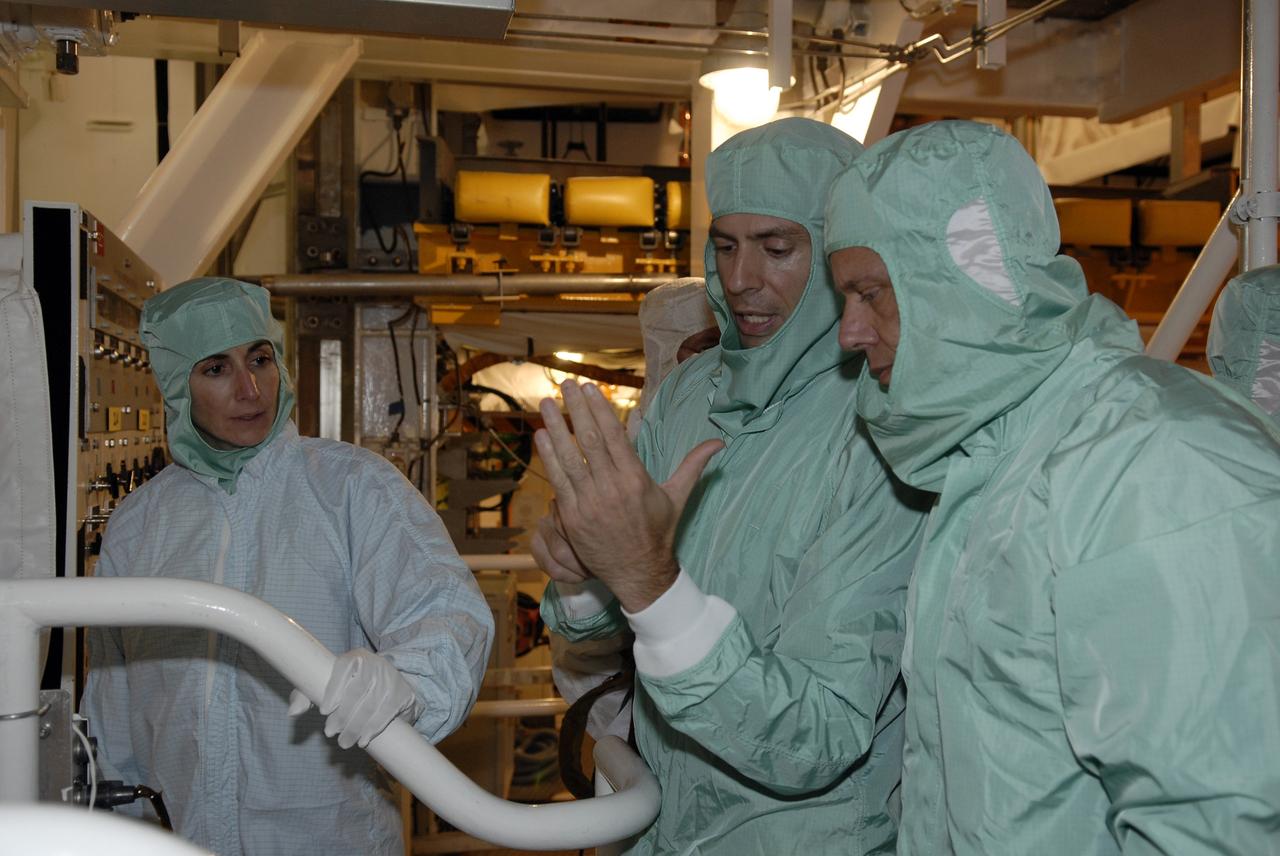
CAPE CANAVERAL, Fla. – In the Payload Changeout Room on NASA Kennedy Space Center's Launch Pad 39A, STS-128 crew members take a close look at the payloads to be installed in space shuttle Discovery. Seen here are Mission Specialists Nicole Stott (left) and Christer Fuglesang (right). The crew is at Kennedy to take part in the terminal countdown demonstration test, or TCDT, which includes equipment familiarization, emergency exit training and a simulated countdown. On the STS-128 mission, Discovery will deliver 33,000 pounds of equipment to the station, including science and storage racks, a freezer to store research samples, a new sleeping compartment and the COLBERT treadmill. Launch is targeted for late August. Photo credit: NASA/Kim Shiflett
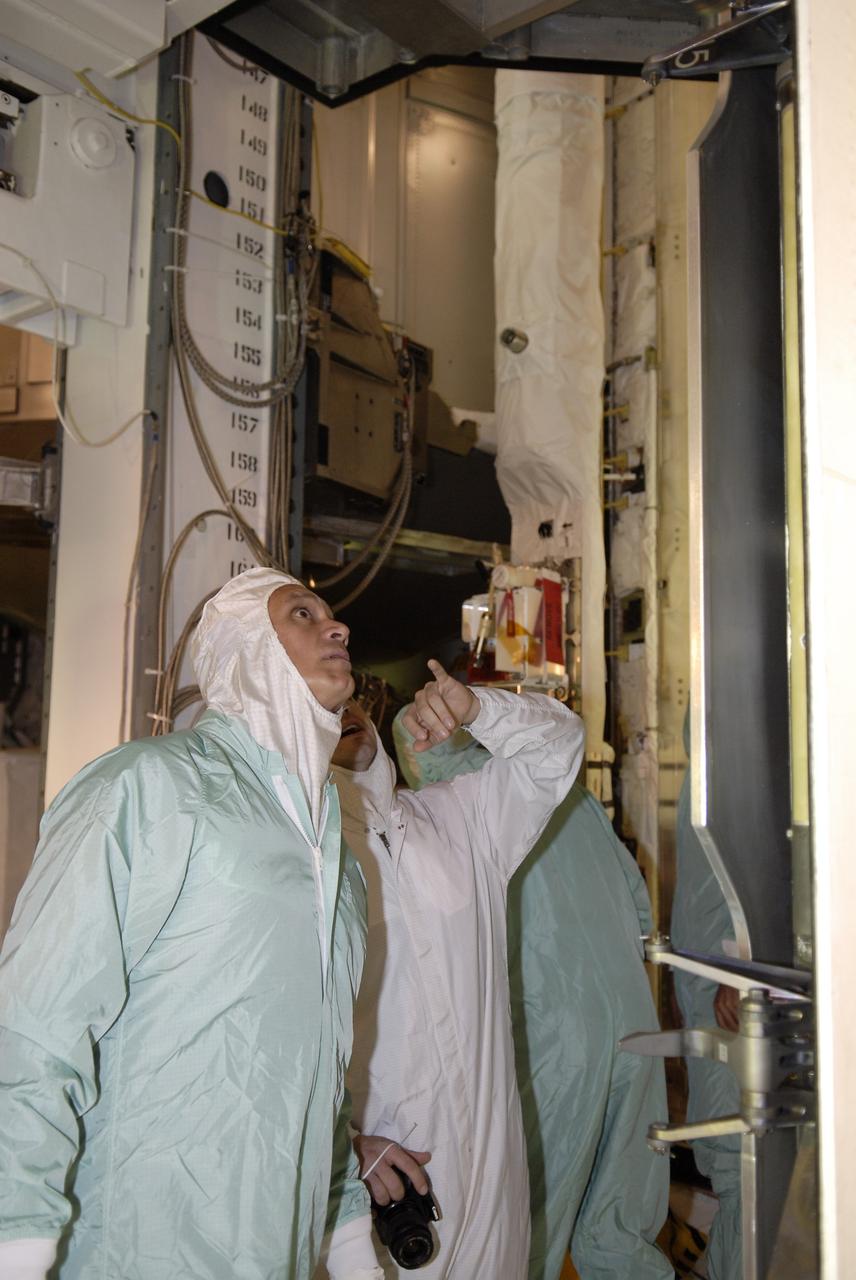
CAPE CANAVERAL, Fla. – – In the Payload Changeout Room on NASA Kennedy Space Center's Launch Pad 39A, STS-128 crew members take a close look at the payloads to be installed in space shuttle Discovery. Seen here are Mission Specialist Danny Olivas and Pilot Kevin Ford (behind him). The crew is at Kennedy to take part in the terminal countdown demonstration test, or TCDT, which includes equipment familiarization, emergency exit training and a simulated countdown. On the STS-128 mission, Discovery will deliver 33,000 pounds of equipment to the station, including science and storage racks, a freezer to store research samples, a new sleeping compartment and the COLBERT treadmill. Launch is targeted for late August. Photo credit: NASA/Kim Shiflett
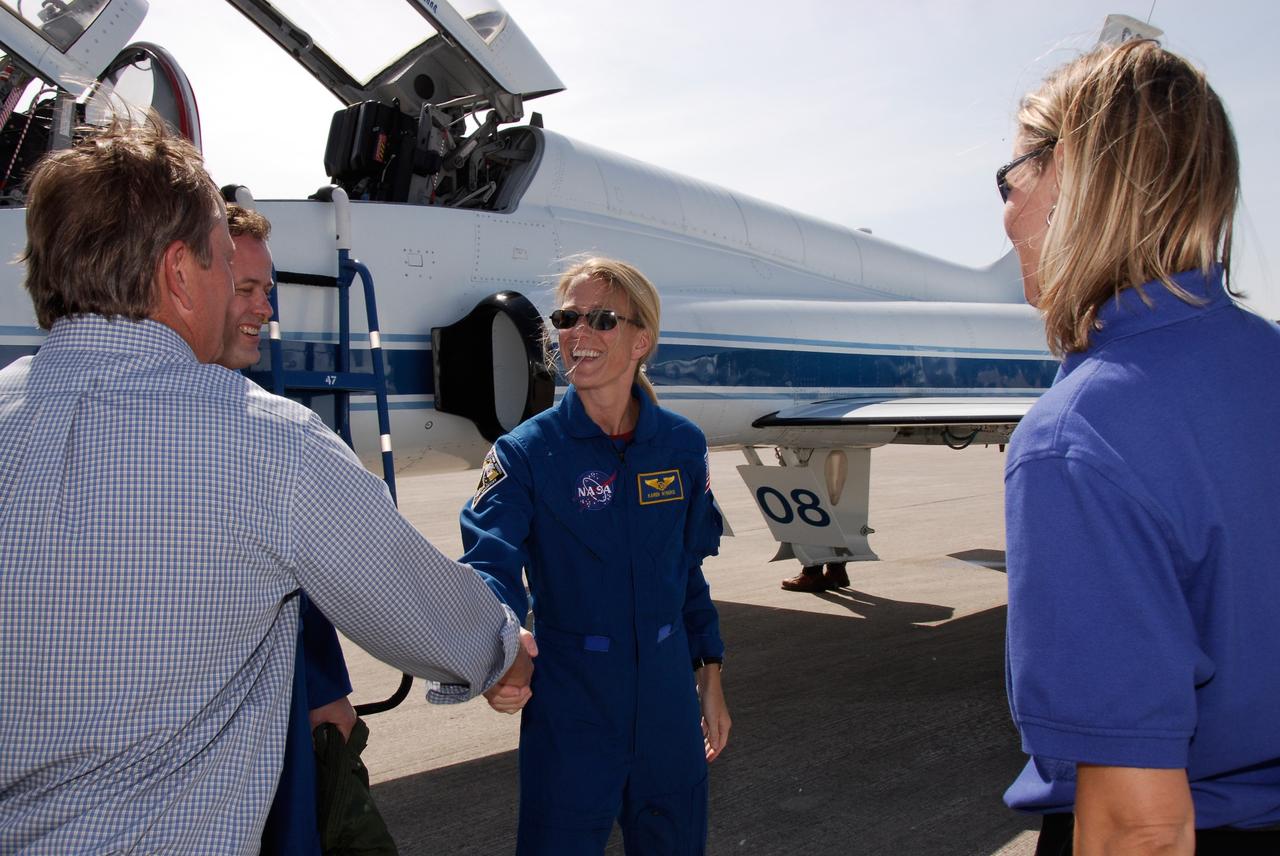
CAPE CANAVERAL, Fla. -- The crew of space shuttle Discovery's STS-124 mission arrive at NASA Kennedy Space Center's Shuttle Landing Facility to take part in the Terminal Countdown Demonstration Test, or TCDT. Here Shuttle Launch Director Mike Leinbach (left) greets Mission Specialist Karen Nyberg. Between them is Mission Specialist Ron Garan. At right is NASA Flow Director for Discovery Stephanie Stilson. TCDT is a rehearsal for launch that includes practicing emergency procedures, handling on-orbit equipment, and simulating a launch countdown. On the STS-124 mission, the crew will deliver and install the Japanese Experiment Module – Pressurized Module and Japanese Remote Manipulator System. Discovery's launch is targeted for May 31. Photo credit: NASA/Kim Shiflett
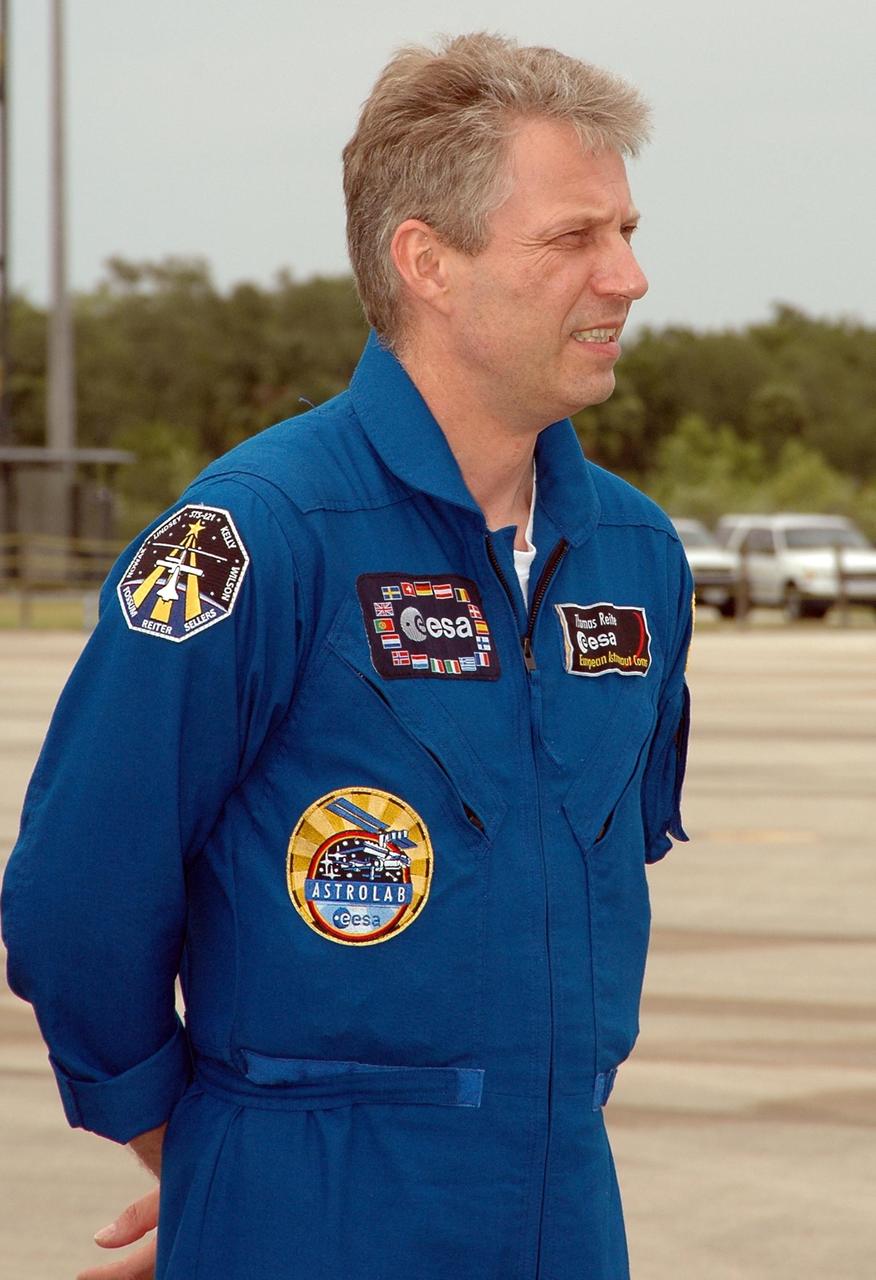
KENNEDY SPACE CENTER, FLA. - After landing at NASA's Kennedy Space Center aboard a Grumman G2 aircraft, the STS-121 crew gathers at a microphone for the media. Seen here is Mission Specialist Thomas Reiter from Germany, who represents the European Space Agency. Other crew members are Commander Steven Lindsey, Pilot Mark Kelly, and Mission Specialists Michael Fossum, Lisa Nowak, Stephanie Wilson and Piers Sellers. The crew is at the space center to take part in a Terminal Countdown Demonstration Test, or TCDT. Over several days, the crew will practice emergency egress from the pad and suit up in their orange flight suits for the simulated countdown to launch. Space Shuttle Discovery is designated to launch July 1 on mission STS-121. It will carry supplies to the International Space Station. Photo credit: NASA/Kim Shiflett
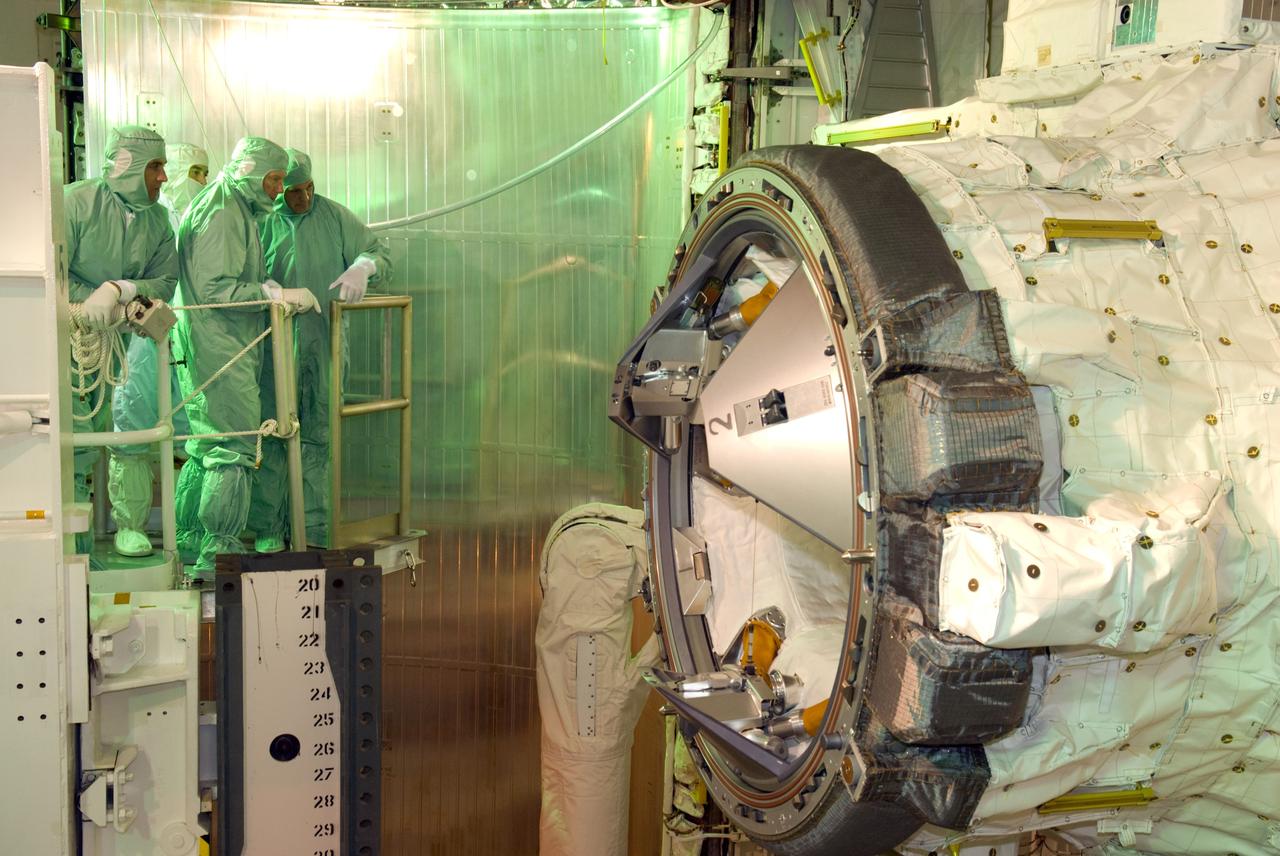
CAPE CANAVERAL, Fla. – On Launch Pad 39A at NASA's Kennedy Space Center in Florida, STS-127 crew members get a close look at space shuttle Endeavour's payload bay. Here Mission Specialists Christopher Cassidy and Tim Kopra and Commander Mark Polansky look at the docking adapter. The payload includes the Japanese Experiment Module's Exposed Facility, or JEM-EF and the Experiment Logistics Module-Exposed Section, or ELM-ES. The astronauts are at Kennedy to prepare for launch through Terminal Countdown Demonstration Test activities. The TCDT includes equipment familiarization and a simulated launch countdown. Endeavour's STS-127 mission is the final of three flights dedicated to the assembly of the Japanese Kibo laboratory complex on the International Space Station. Endeavour's launch is targeted for June 13. Photo credit: NASA/Kim Shiflett
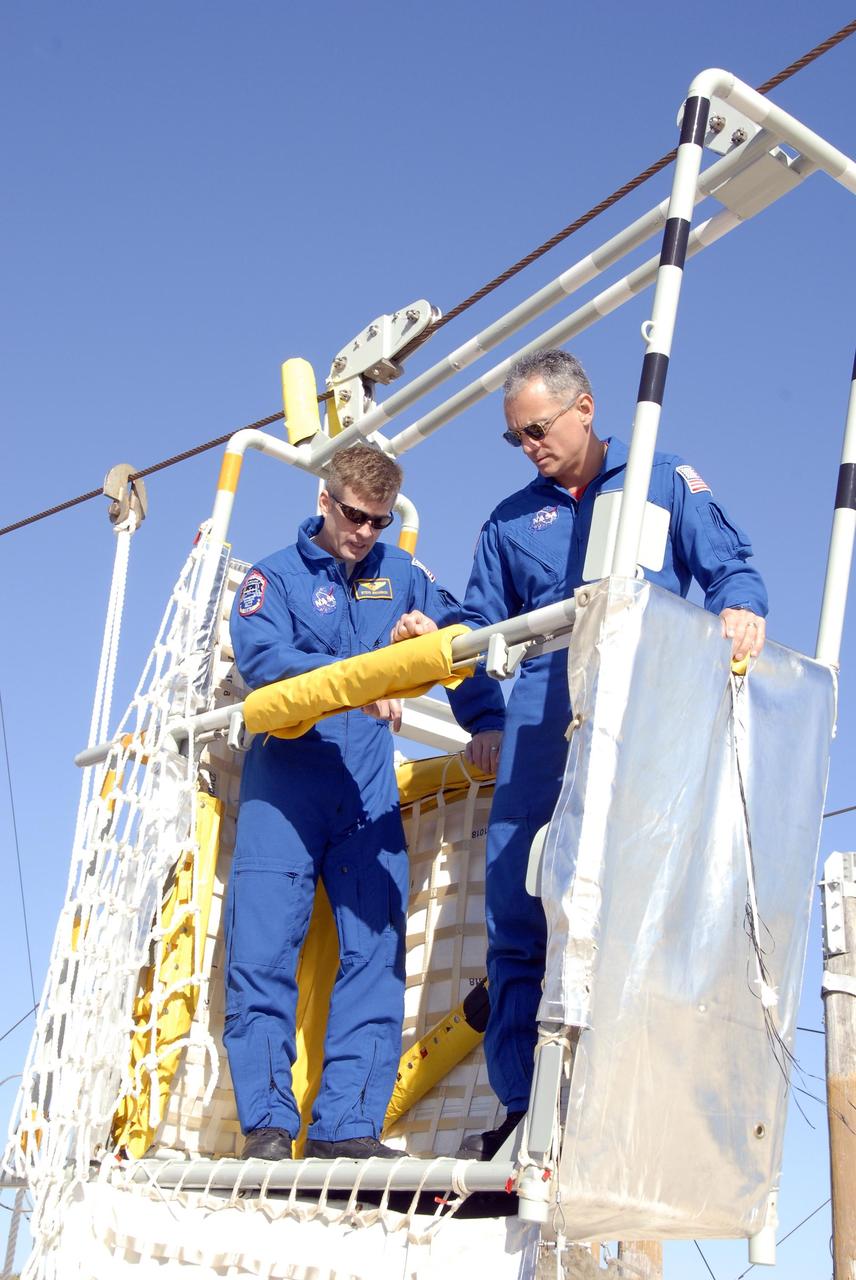
KENNEDY SPACE CENTER, FLA. -- In the Launch Pad 39A area, Mission STS-117 crew members receive instruction on emergency egress using the slidewire basket system during Terminal Countdown Demonstration Test activities. Here, Mission Specialists Steven Swanson (left) and Danny Olivas (right) practice exiting from the slidewire basket. The TCDT also includes M-113 armored personnel carrier training, and a simulated launch countdown. The mission payload aboard Space Shuttle Atlantis is the S3/S4 integrated truss structure, along with a third set of solar arrays and batteries. The crew of six astronauts will install the truss to continue assembly of the International Space Station. Photo credit: NASA/Kim Shiflett
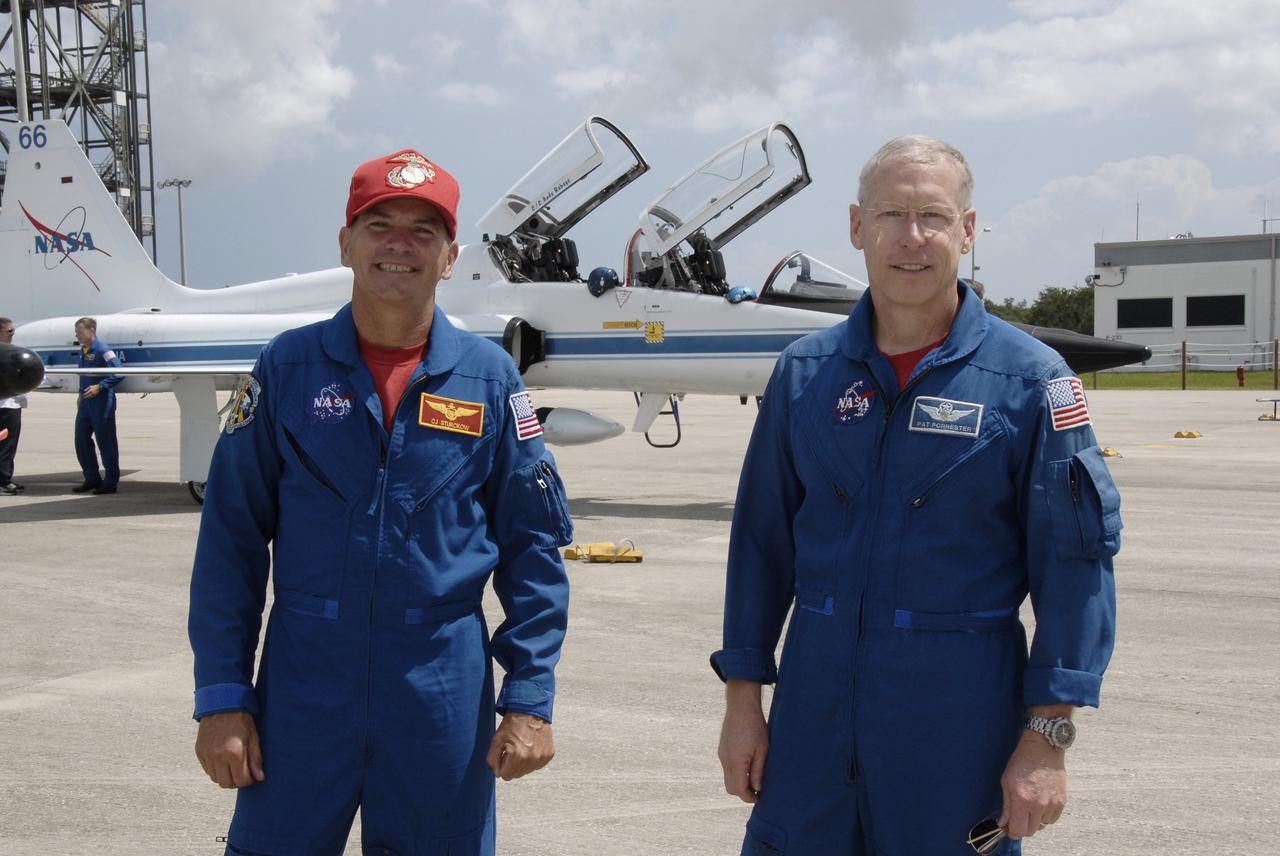
CAPE CANAVERAL, Fla. – Space shuttle Discovery's STS-128 mission crew members arrive in T-38 training jets at NASA Kennedy Space Center's Shuttle Landing Facility. Seen here are Commander Rick Sturckow and Mission Specialist Patrick Forrester. The astronauts will be taking part in terminal countdown demonstration test activities that include equipment familiarization and emergency egress training, and will culminate in a simulated launch countdown aboard Discovery. The mission will deliver a new crew member and 33,000 pounds of equipment to the International Space Station. The equipment includes science and storage racks, a freezer to store research samples, a new sleeping compartment and the COLBERT treadmill. Launch of Discovery is targeted for late August. Photo credit: NASA/Kim Shiflett
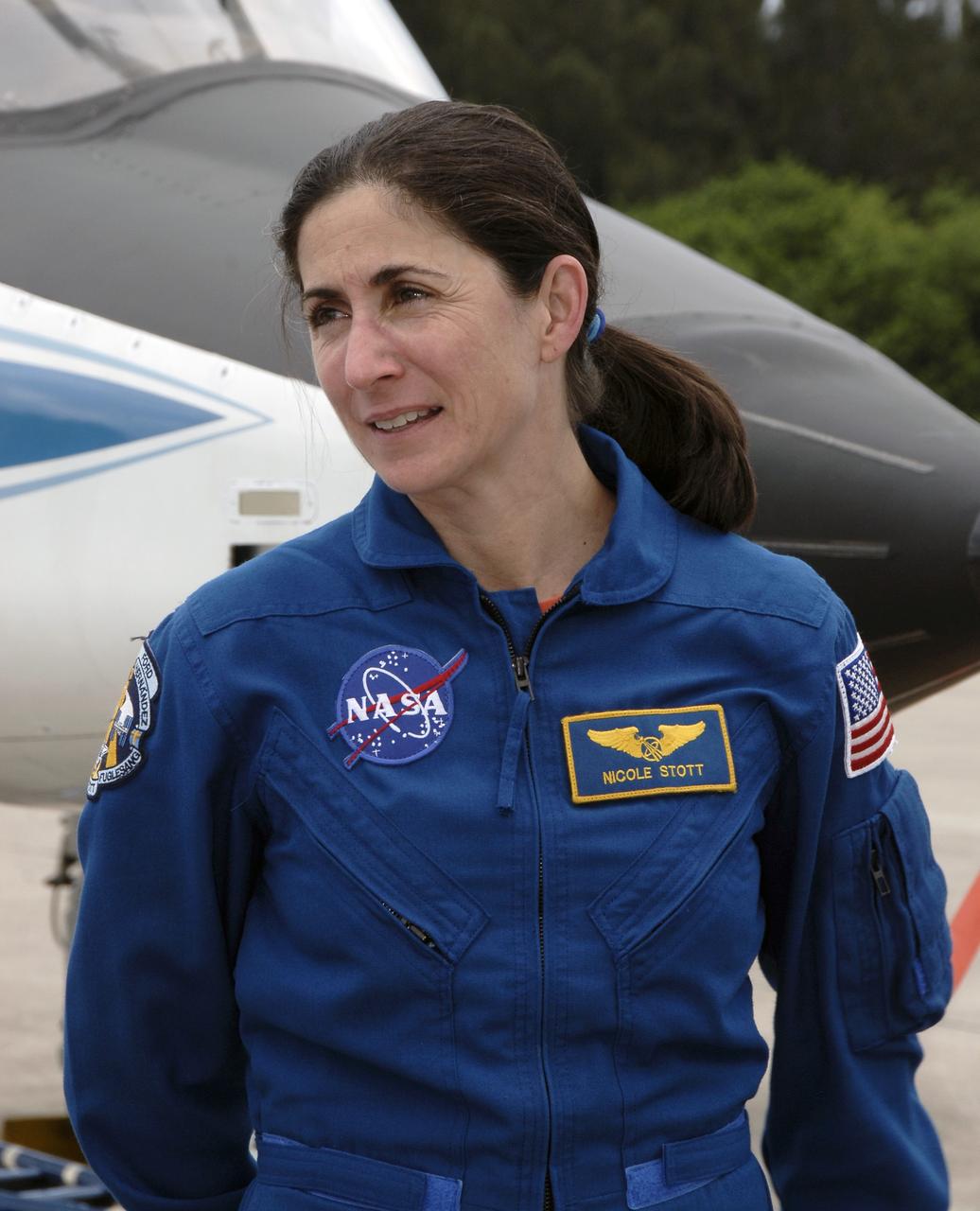
CAPE CANAVERAL, Fla. – Space shuttle Discovery's STS-128 mission crew members arrive in T-38 training jets at NASA Kennedy Space Center's Shuttle Landing Facility. Mission Specialist Nicole Stott is seen here. Stott will join the Expedition 20 crew on the International Space Station as a flight engineer. The astronauts will be taking part in terminal countdown demonstration test activities that include equipment familiarization and emergency egress training, and will culminate in a simulated launch countdown aboard Discovery. The mission will deliver 33,000 pounds of equipment to the International Space Station. The equipment includes science and storage racks, a freezer to store research samples, a new sleeping compartment and the COLBERT treadmill. Launch of Discovery is targeted for late August. Photo credit: NASA/Kim Shiflett
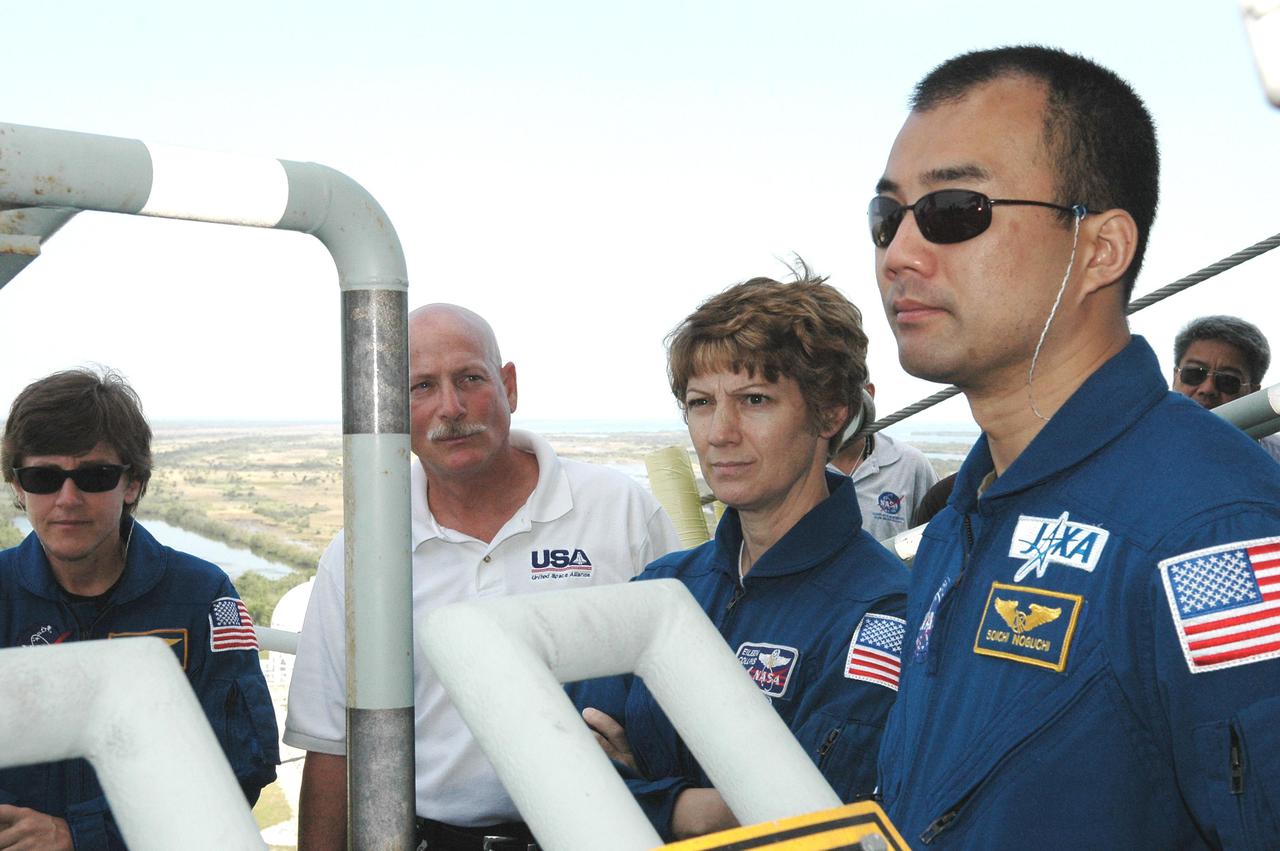
KENNEDY SPACE CENTER, FLA. - On the Fixed Service Structure at Launch Pad 39B, the STS-114 crew gets instructions on using the slidewire basket, emergency egress equipment from the pad. Crew members seen here are (from left) Mission Specialist Wendy Lawrence, Commander Eileen Collins and Mission Specialist Soichi Noguchi, who is with the Japan Aerospace Exploration Agency. The training is part of Terminal Countdown Demonstration Test activities. The TCDT is held at KSC prior to each Space Shuttle flight. It provides the crew of each mission an opportunity to participate in simulated countdown activities. The test ends with a mock launch countdown culminating in a simulated main engine cutoff. The crew also spends time undergoing emergency egress training exercises at the launch pad. STS-114 is designated the first Return to Flight mission, with a launch window extending from July 13 to July 31.
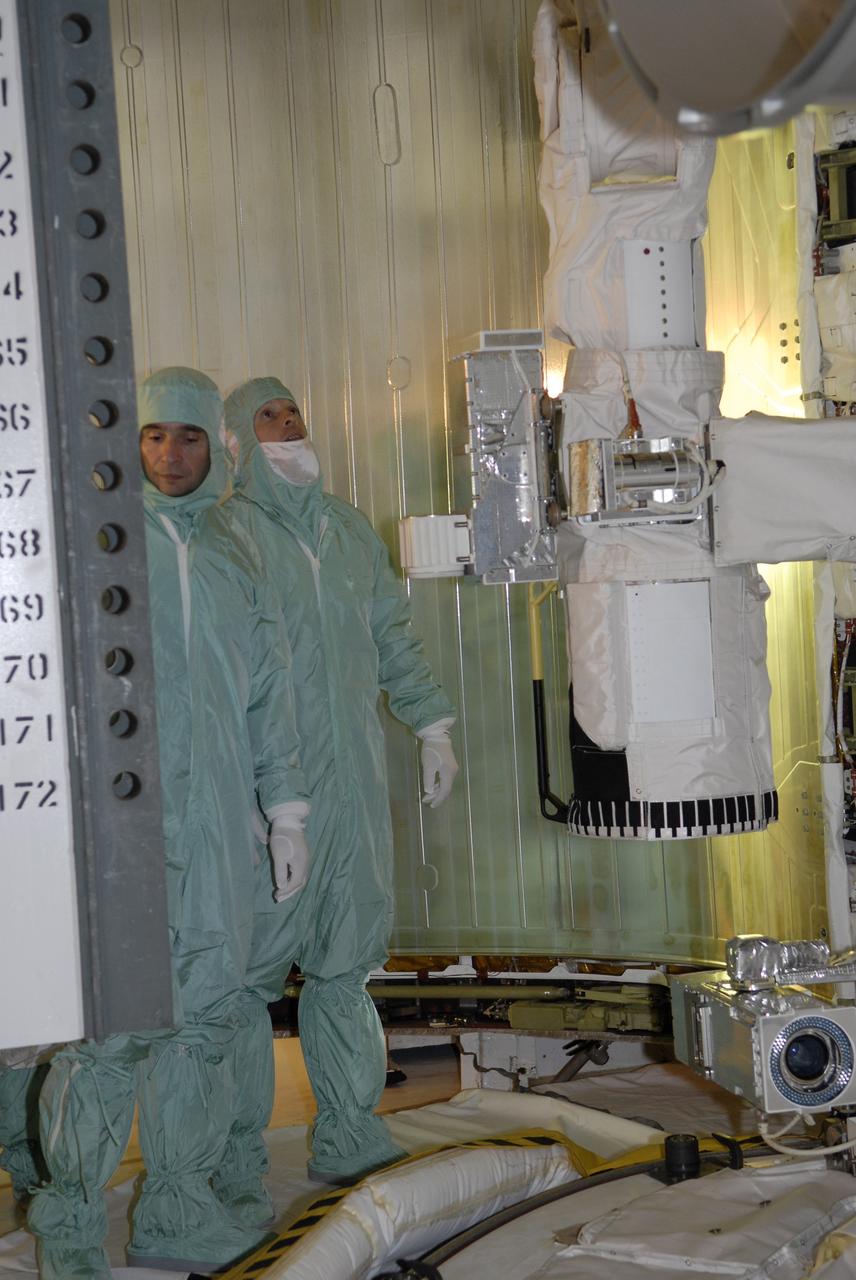
CAPE CANAVERAL, Fla. – On Launch Pad 39A at NASA's Kennedy Space Center in Florida, STS-119 crew members get a close look at the cargo – the integrated truss structure S6 and solar arrays -- installed in space shuttle Discovery's payload bay. Seen here are Commander Lee Archambault (left) and Mission Specialist Joseph Acaba. The astronauts are at Kennedy to prepare for launch through Terminal Countdown Demonstration Test activities. The TCDT includes equipment familiarization and a simulated launch countdown. Discovery is targeted to launch on the STS-119 mission Feb. 12. During Discovery's 14-day mission, the crew will install the S6 truss segment and solar arrays to the starboard side of the International Space Station, completing the station's truss, or backbone. Photo credit: NASA/Kim Shiflett
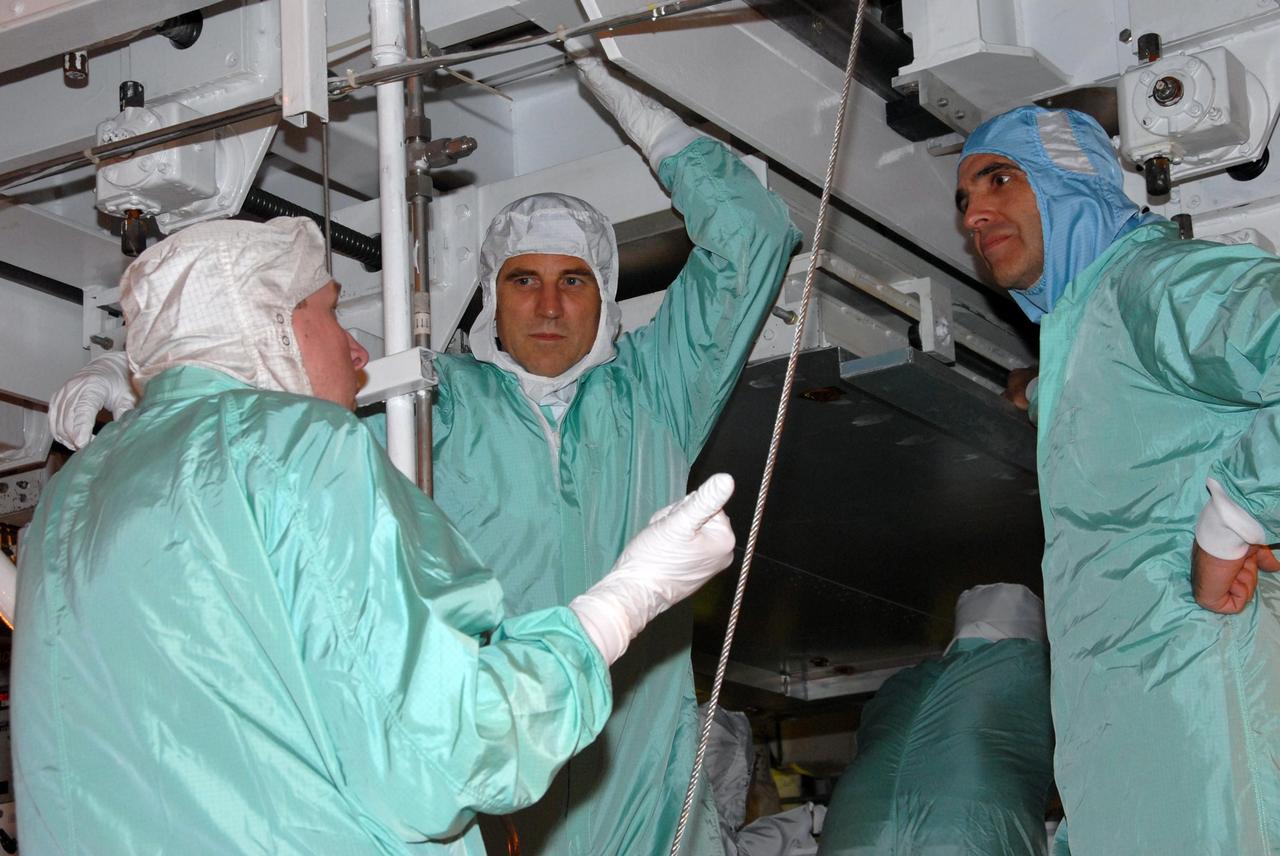
KENNEDY SPACE CENTER, Fla. -- STS-118 crew members confer with a technician about the payloads installed in Space Shuttle Endeavour. Seen here are Mission Specialists Dave Williams (center), who represents the Canadian Space Agency, and Rick Mastracchio (right). The STS-118 crew has been at Kennedy for terminal countdown demonstration test activities that also include M-113 training, emergency egress training at the pad and a simulated launch countdown. The mission is the 22nd flight to the International Space Station and Space Shuttle Endeavour will carry a payload including the S5 truss, a SPACEHAB module and external stowage platform 3. STS-118 is targeted for launch on Aug. 7. Photo credit: NASA/George Shelton
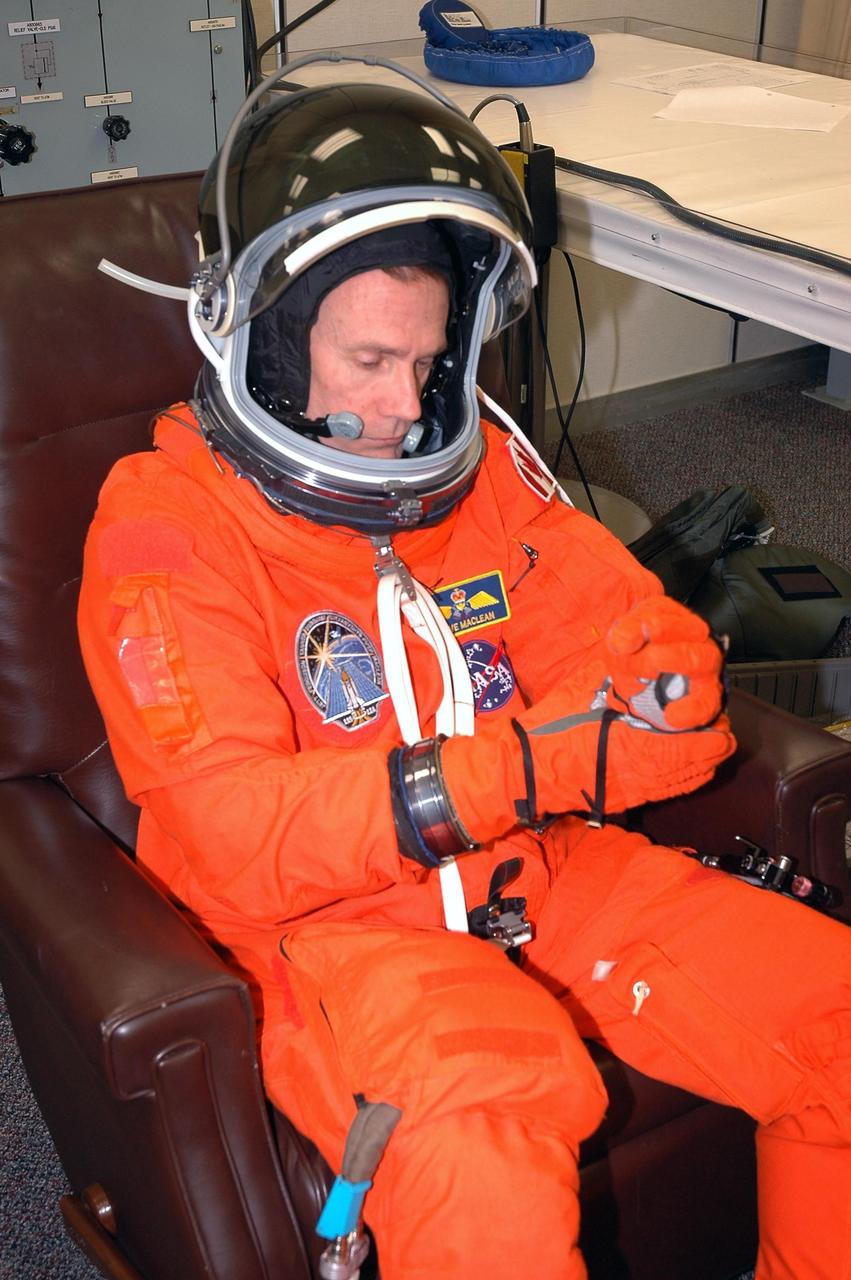
KENNEDY SPACE CENTER, FLA. - The STS-115 crew members are suiting up for their simulated launch countdown. Shown here fixing his glove is Mission Specialist Steven MacLean, who is with the Canadian Space Agency. The mission crew is at KSC for Terminal Countdown Demonstration Test (TCDT) activities that are preparation for launch on Space Shuttle Atlantis, scheduled to take place in a window that opens Aug. 27. The TCDT has included emergency egress training as well as the simulation. During their 11-day mission to the International Space Station, the STS-115 crew will continue construction of the station and attach the payload elements, the Port 3/4 truss segment with its two large solar arrays. Photo credit: NASA/Cory Huston
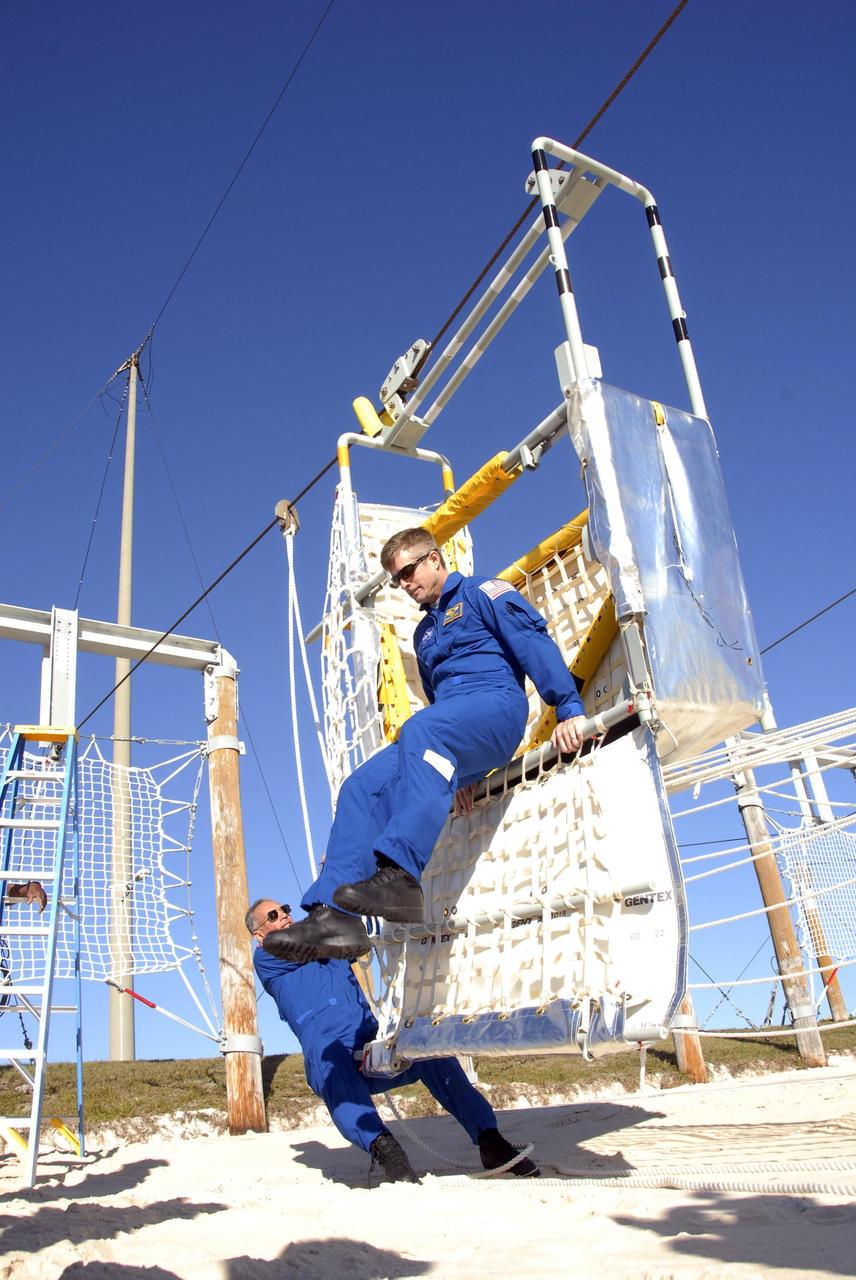
KENNEDY SPACE CENTER, FLA. -- In the Launch Pad 39A area, Mission STS-117 crew members receive instruction on emergency egress using the slidewire basket system during Terminal Countdown Demonstration Test activities. Here, Mission Specialist Steven Swanson (right) practices exiting from the slidewire basket. as Mission Specialist Danny Olivas assists. The TCDT also includes M-113 armored personnel carrier training, and a simulated launch countdown. The mission payload aboard Space Shuttle Atlantis is the S3/S4 integrated truss structure, along with a third set of solar arrays and batteries. The crew of six astronauts will install the truss to continue assembly of the International Space Station. Photo credit: NASA/Kim Shiflett
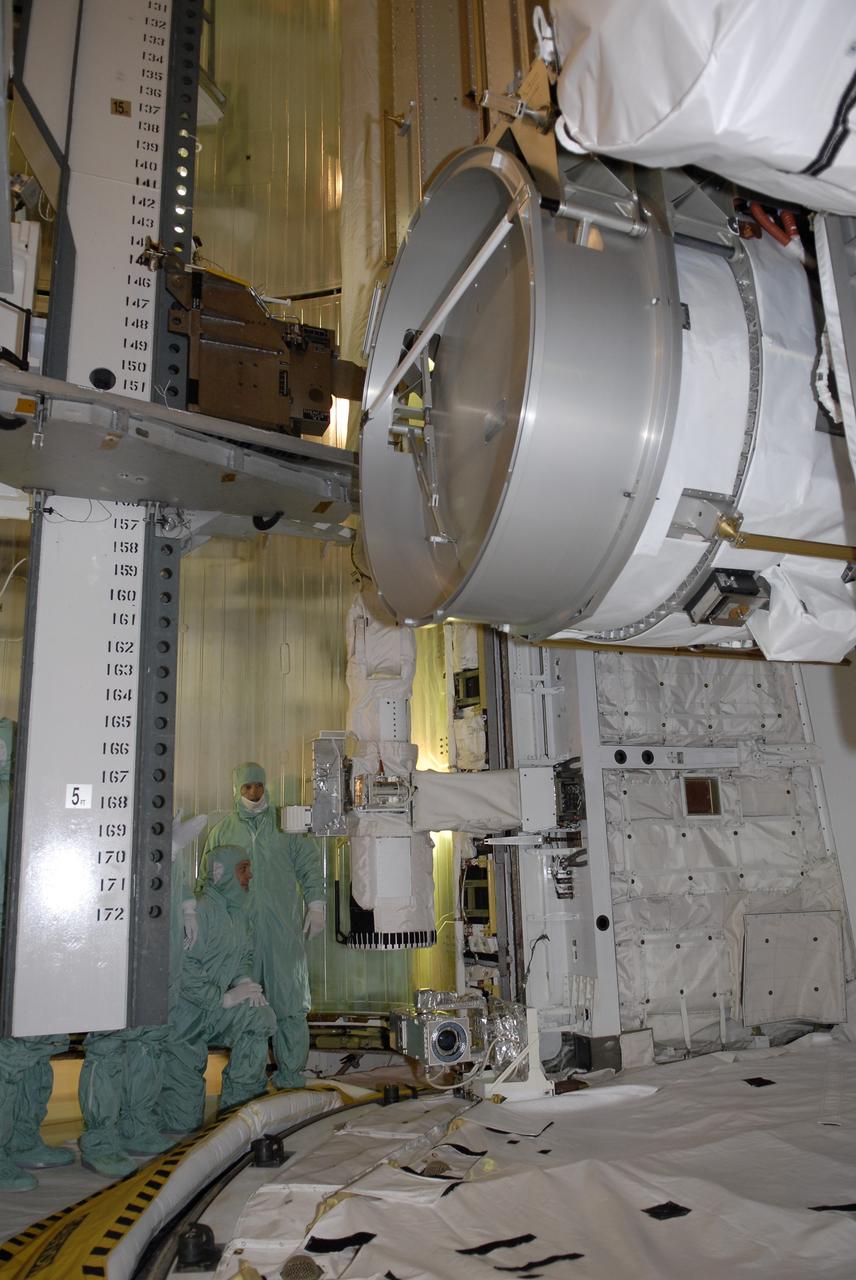
CAPE CANAVERAL, Fla. – On Launch Pad 39A at NASA's Kennedy Space Center in Florida, STS-119 crew members get a close look at the cargo – the integrated truss structure S6 and solar arrays -- installed in space shuttle Discovery's payload bay. Seen here are Commander Lee Archambault (left) and Mission Specialist Joseph Acaba. The astronauts are at Kennedy to prepare for launch through Terminal Countdown Demonstration Test activities. The TCDT includes equipment familiarization and a simulated launch countdown. Discovery is targeted to launch on the STS-119 mission Feb. 12. During Discovery's 14-day mission, the crew will install the S6 truss segment and solar arrays to the starboard side of the International Space Station, completing the station's truss, or backbone. Photo credit: NASA/Kim Shiflett

KENNEDY SPACE CENTER, FLA. -- STS-116 crew members wait for a practice ride in the M-113 armored personnel carrier. The mission crew is at KSC for terminal countdown demonstration test (TCDT) activities that are preparation for launch. Seen here are (left to right) Mission Specialist Robert Curbeam, Commander Mark Polansky and Pilot William Oefelein. Not pictured are Mission Specialists Nicholas Patrick, Christer Fuglesang and Joan Higginbotham. The M-113 could be used to move the crew quickly away from the launch pad in the event of an emergency. The STS-116 mission is No. 20 to the International Space Station and construction flight 12A.1. The mission payload is the SPACEHAB module, the P5 integrated truss structure and other key components. Launch is scheduled for no earlier than Dec. 7. Photo credit: NASA/Kim Shiflett
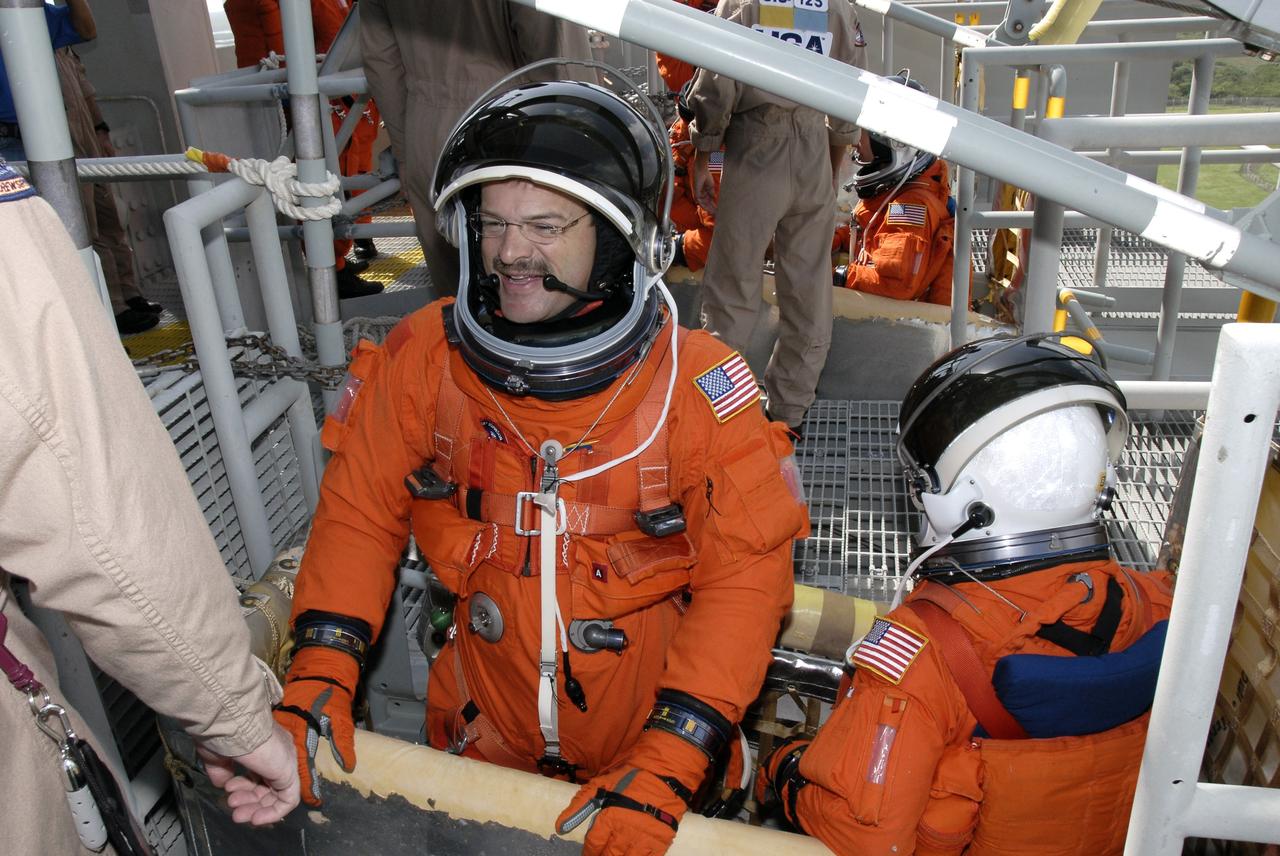
CAPE CANAVERAL, Fla. - After taking part in a simulated launch countdown aboard space shuttle Atlantis, the STS-125 crew members practice an emergency escape from the shuttle. Here Commander Scott Altman (left) and Pilot Gregory C. Johnson are in place in a slidewire basket on the fixed service structure that will speed them away from Kennedy Space Center’s Launch Pad 39A. The countdown is the culmination of terminal countdown demonstration test, or TCDT, activities as preparation before launch. TCDT provides astronauts and ground crews with an opportunity to participate in various launch activities, including equipment familiarization, emergency training and the countdown. Atlantis’ STS-125 mission to service NASA’s Hubble Space Telescope is targeted for launch Oct. 14. Photo credit: NASA/Kim Shiflett
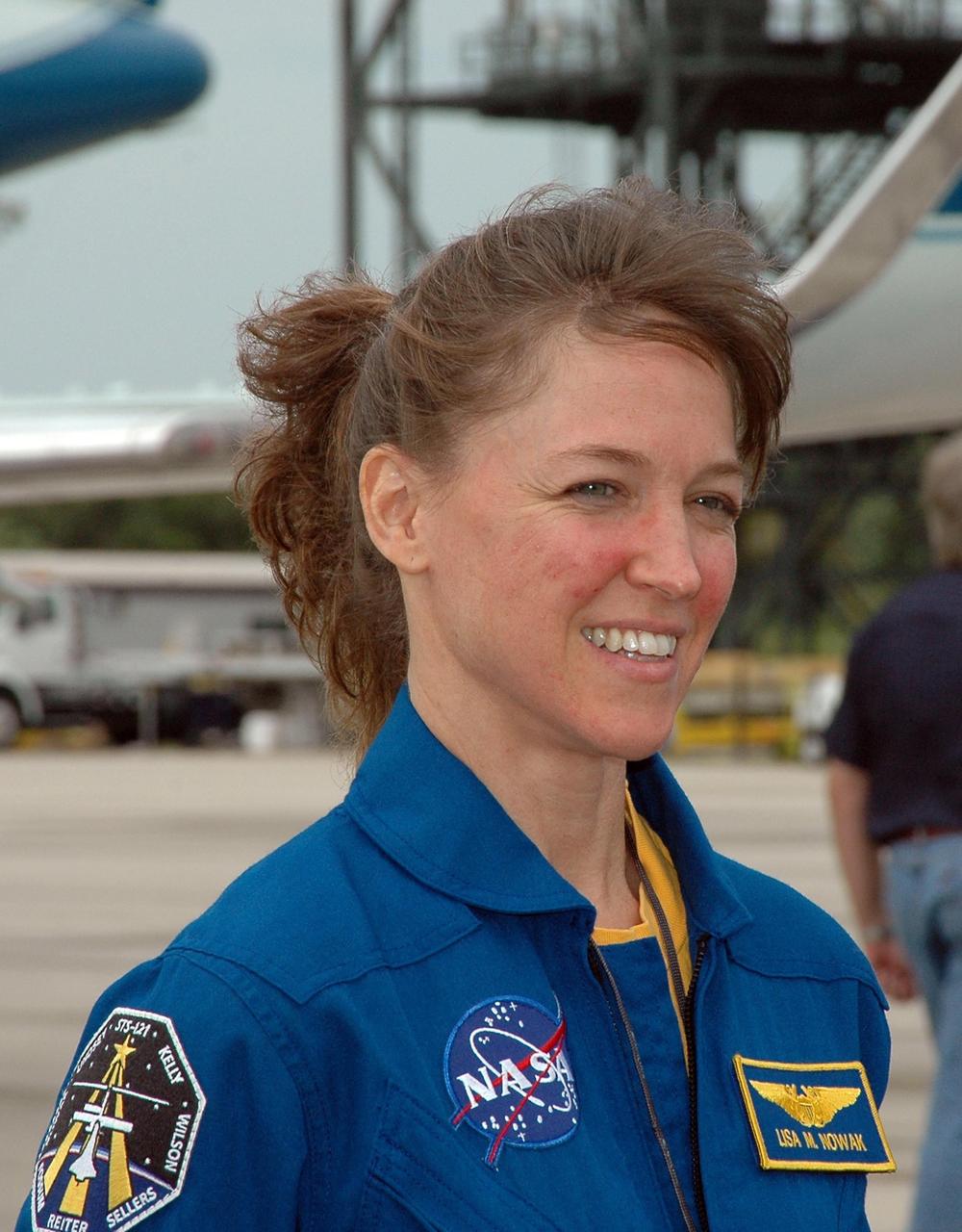
KENNEDY SPACE CENTER, FLA. - After landing at NASA's Kennedy Space Center aboard a Grumman G2 aircraft, the STS-121 crew gathers at a microphone for the media. Seen here at center is Mission Specialist Lisa Nowak; at left is Pilot Mark Kelly. Other crew members are Mission Commander Steven Lindsey, Pilot Mark Kelly, and Mission Specialists Michael Fossum, Stephanie Wilson, Piers Sellers and Thomas Reiter, who represents the European Space Agency. The crew is at the space center to take part in a Terminal Countdown Demonstration Test, or TCDT. Over several days, the crew will practice emergency egress from the pad and suit up in their orange flight suits for the simulated countdown to launch. Space Shuttle Discovery is designated to launch July 1 on mission STS-121. It will carry supplies to the International Space Station. Photo credit: NASA/Kim Shiflett
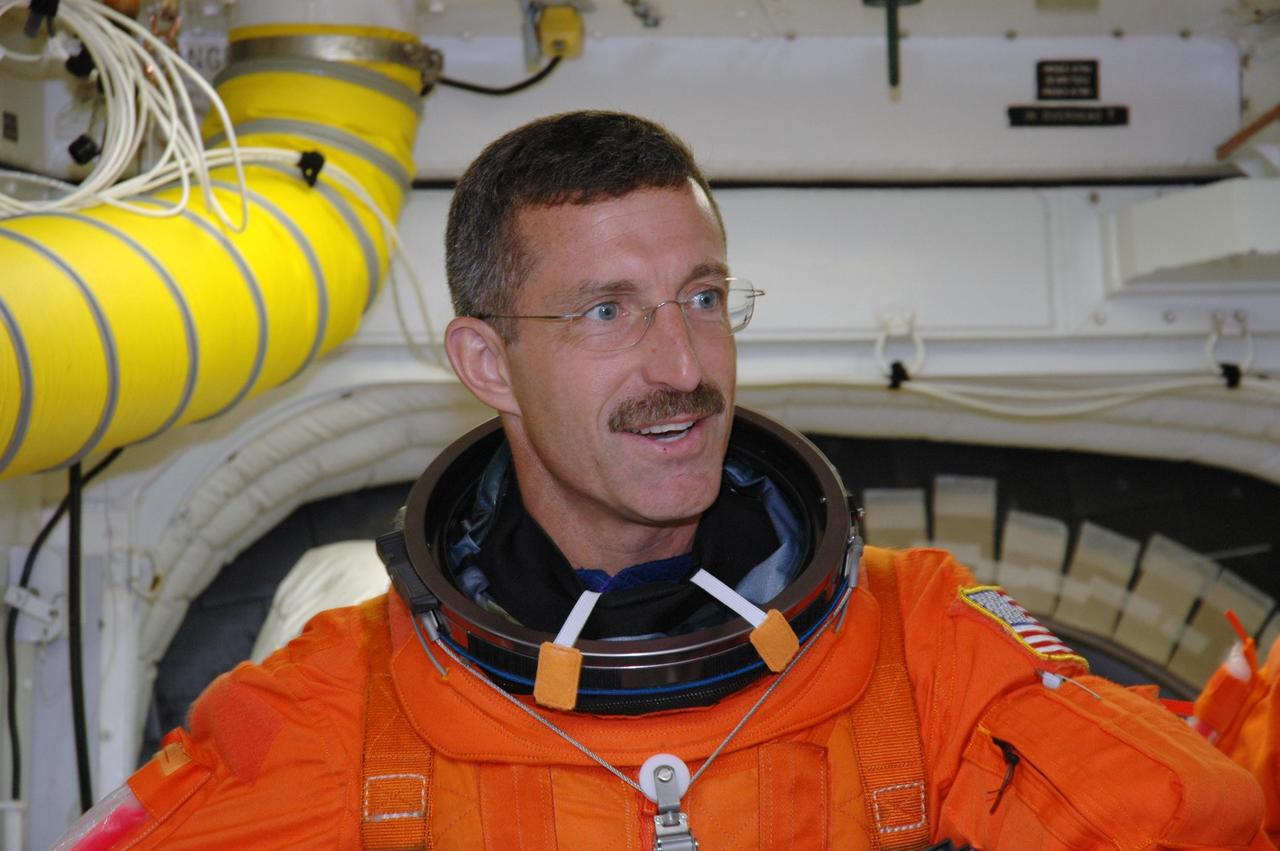
KENNEDY SPACE CENTER, FLA. - The STS-115 crew members complete their suitup in the White Room before entering Space Shuttle Atlantis on Launch Pad 39B for a simulated launch countdown. Shown here is Mission Specialist Daniel Burbank. The White Room, which is located at the end of the orbiter access arm, allows entry into the orbiter through the crew access hatch. The mission crew is at KSC for Terminal Countdown Demonstration Test (TCDT) activities that are preparation for launch. Liftoff of Atlantis is scheduled to take place in a window that opens Aug. 27. During their 11-day mission to the International Space Station, the STS-115 crew will continue construction of the station and attach the payload elements, the Port 3/4 truss segment with its two large solar arrays. Photo credit: NASA/Jim Grossmann
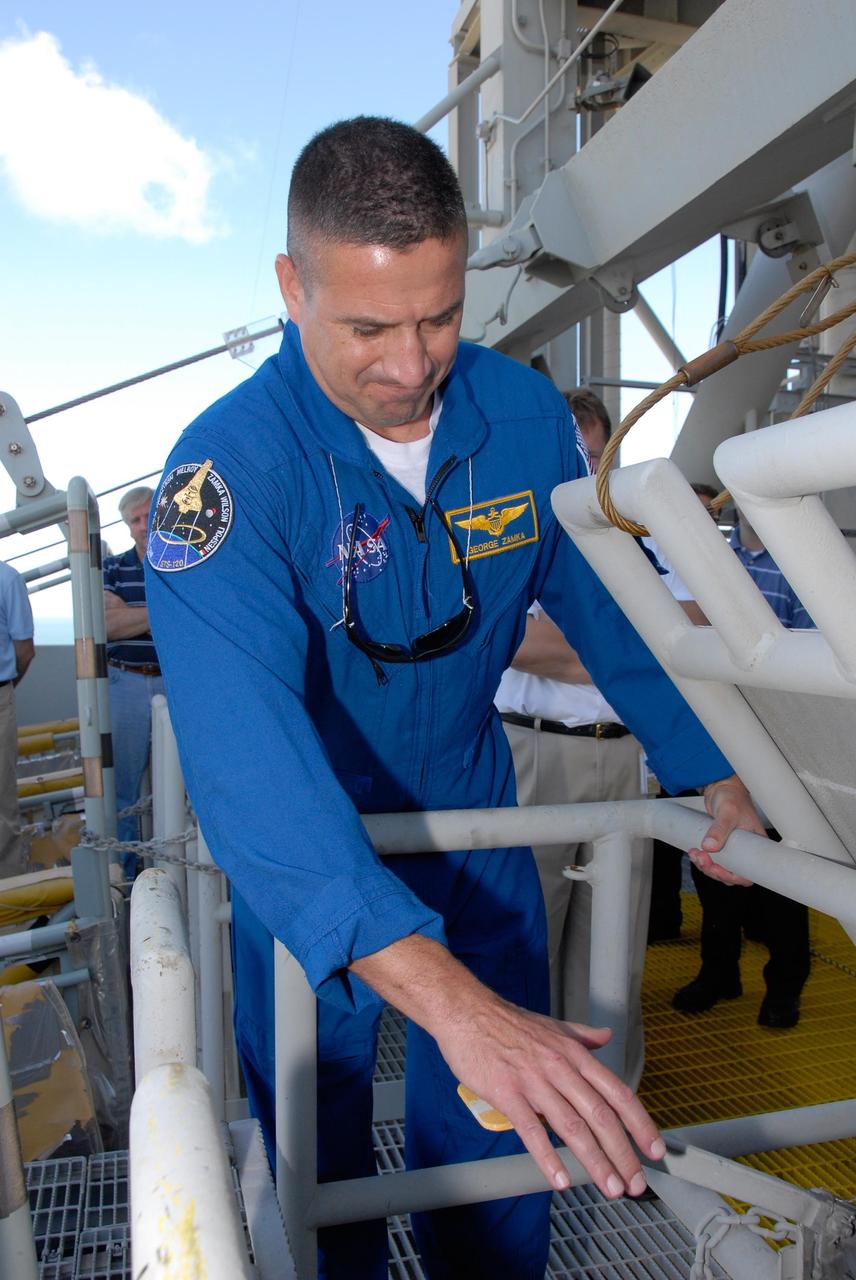
KENNEDY SPACE CENTER, FLA. -- The STS-120 crew is at NASA's Kennedy Space Center for the pre-launch terminal countdown demonstration test, or TCDT. Here, during emergency egress training, Pilot George Zamka touches the handle that releases the slidewire basket that can carry the crew safely to a landing site away from the shuttle. The TCDT provides astronauts and ground crews an opportunity to participate in various simulated countdown activities, including equipment familiarization and emergency training. The STS-120 mission will deliver the U.S. Node 2 module, named Harmony, aboard space shuttle Discovery to the International Space Station. Launch of Discovery on mission STS-120 is targeted for Oct. 23 at 11:38 a.m. EDT on a 14-day mission. Photo credit: NASA/Kim Shiflett
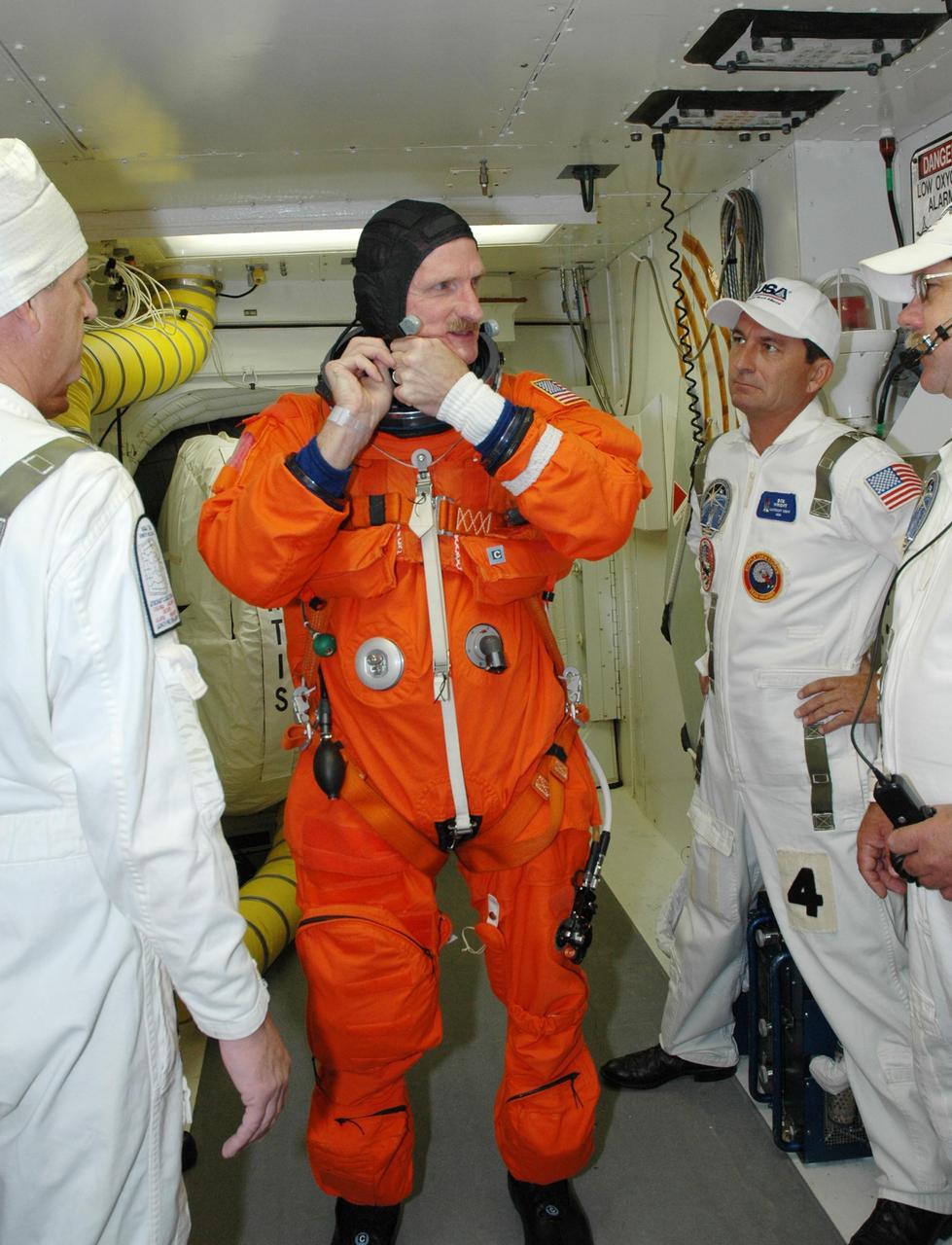
KENNEDY SPACE CENTER, FLA. - The STS-115 crew members complete their suitup in the White Room before entering Space Shuttle Atlantis on Launch Pad 39B for a simulated launch countdown. Shown here is Mission Specialist Joseph Tanner. The White Room, which is located at the end of the orbiter access arm, allows entry into the orbiter through the crew access hatch. The mission crew is at KSC for Terminal Countdown Demonstration Test (TCDT) activities that are preparation for launch. Liftoff of Atlantis is scheduled to take place in a window that opens Aug. 27. During their 11-day mission to the International Space Station, the STS-115 crew will continue construction of the station and attach the payload elements, the Port 3/4 truss segment with its two large solar arrays. Photo credit: NASA/Jim Grossmann
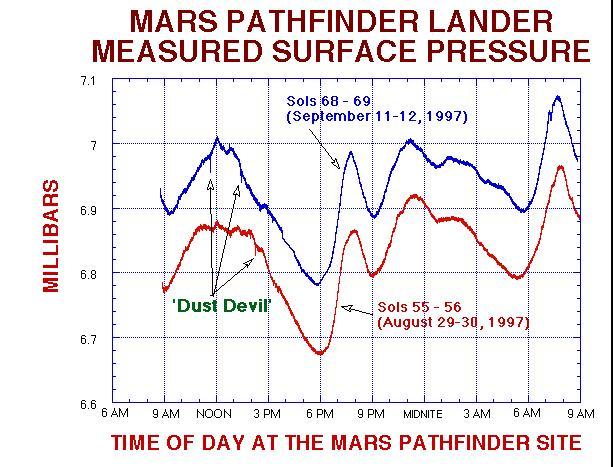
Here is a comparison of the most recent 24-hour met sessions. Note the general trend of increasing pressure with time into the mission. This indicates that the South polar cap is reducing, freeing CO2 into the atmosphere. Also note small pressure features around noon, which we think are "dust-devils." Sojourner spent 83 days of a planned seven-day mission exploring the Martian terrain, acquiring images, and taking chemical, atmospheric and other measurements. The final data transmission received from Pathfinder was at 10:23 UTC on September 27, 1997. Although mission managers tried to restore full communications during the following five months, the successful mission was terminated on March 10, 1998. http://photojournal.jpl.nasa.gov/catalog/PIA00976
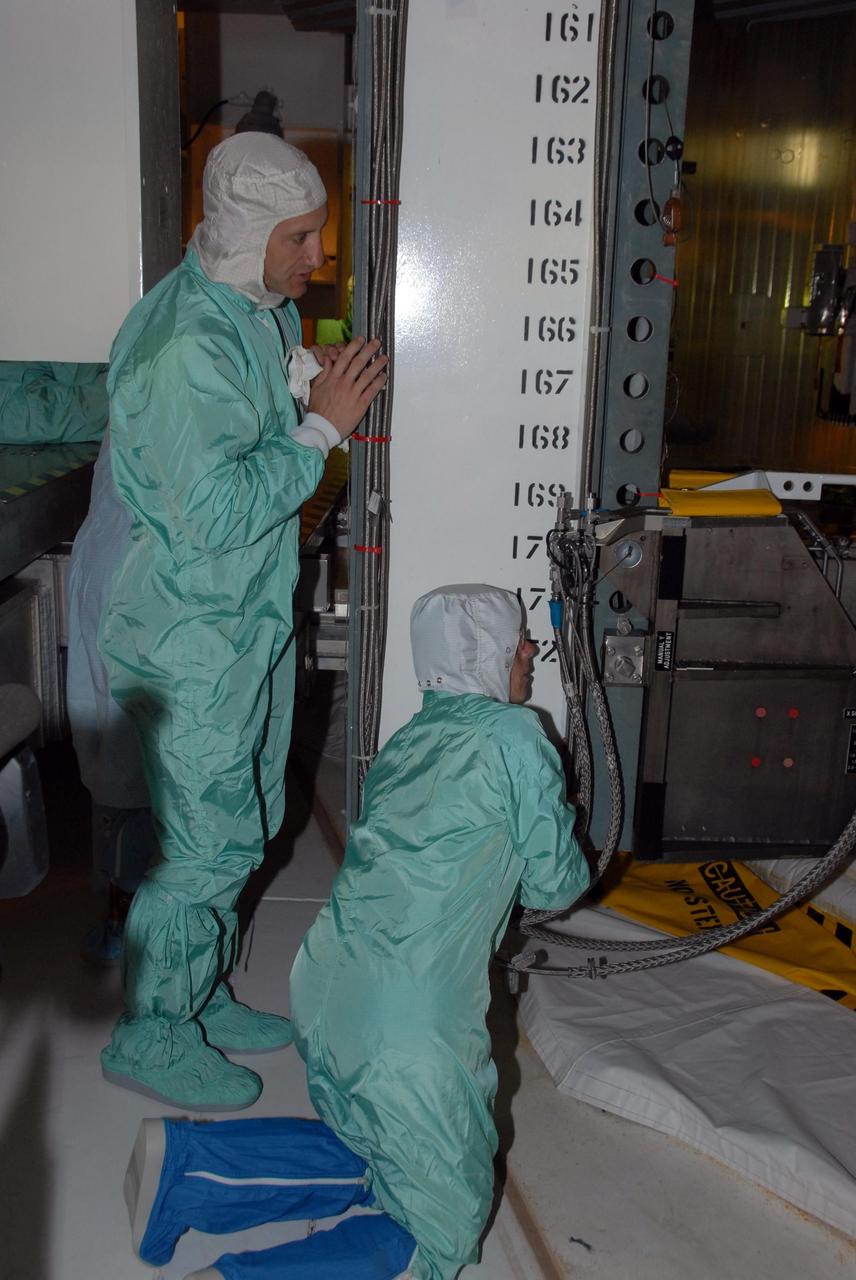
KENNEDY SPACE CENTER, Fla. -- STS-118 crew members get a close look at the payloads installed in Space Shuttle Endeavour. Seen here are Pilot Charlie Hobaugh (left) and Mission Specialist Barbara R. Morgan, who joined NASA's Teacher in Space program in 1985 and was selected as an astronaut in 1998. The STS-118 crew has been at Kennedy for terminal countdown demonstration test activities that also include M-113 training, emergency egress training at the pad and a simulated launch countdown. The mission is the 22nd flight to the International Space Station and Space Shuttle Endeavour will carry a payload including the S5 truss, a SPACEHAB module and external stowage platform 3. STS-118 is targeted for launch on Aug. 7. Photo credit: NASA/George Shelton
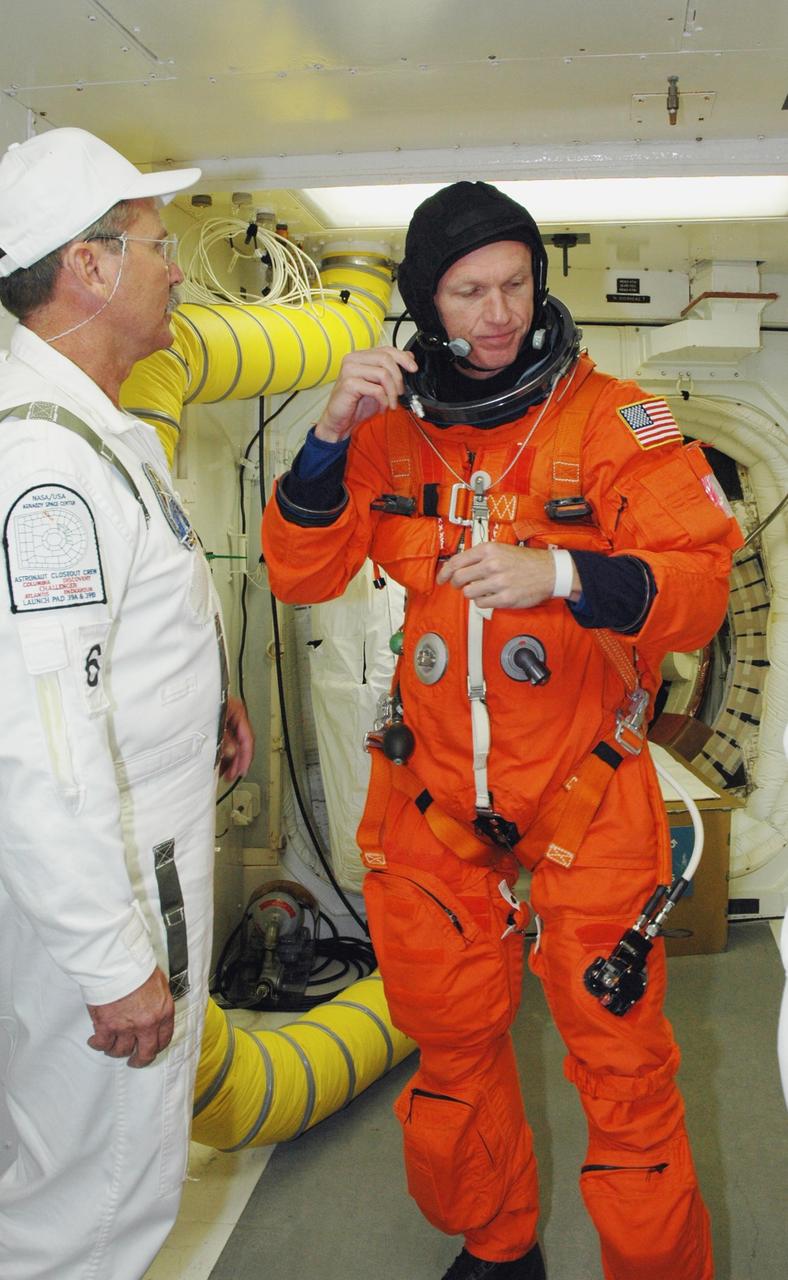
KENNEDY SPACE CENTER, FLA. - The STS-115 crew members complete their suitup in the White Room before entering Space Shuttle Atlantis on Launch Pad 39B for a simulated launch countdown. Shown here is Commander Brent Jett. The White Room, which is located at the end of the orbiter access arm, allows entry into the orbiter through the crew access hatch. The mission crew is at KSC for Terminal Countdown Demonstration Test (TCDT) activities that are preparation for launch. Liftoff of Atlantis is scheduled to take place in a window that opens Aug. 27. During their 11-day mission to the International Space Station, the STS-115 crew will continue construction of the station and attach the payload elements, the Port 3/4 truss segment with its two large solar arrays. Photo credit: NASA/Jim Grossmann
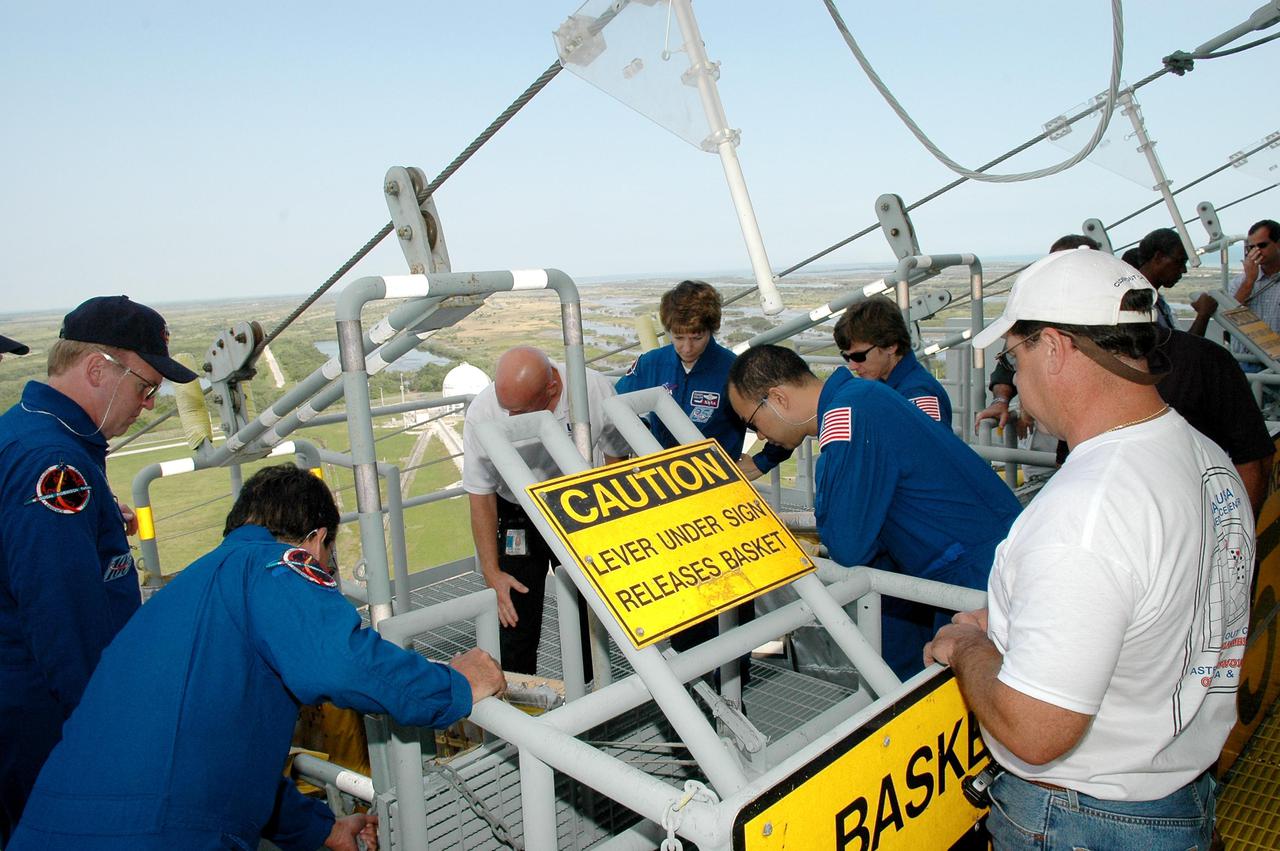
KENNEDY SPACE CENTER, FLA. - On the Fixed Service Structure at Launch Pad 39B, the STS-114 crew gets instructions on using the slidewire basket, emergency egress equipment from the pad. Crew members seen here are (from left) Mission Specialists Andrew Thomas and Charles Camarda, Commander Eileen Collins, and Mission Specialists Soichi Noguchi and Wendy Lawrence. Noguchi is with the Japan Aerospace Exploration Agency. The training is part of Terminal Countdown Demonstration Test activities. The TCDT is held at KSC prior to each Space Shuttle flight. It provides the crew of each mission an opportunity to participate in simulated countdown activities. The test ends with a mock launch countdown culminating in a simulated main engine cutoff. The crew also spends time undergoing emergency egress training exercises at the launch pad. STS-114 is designated the first Return to Flight mission, with a launch window extending from July 13 to July 31.
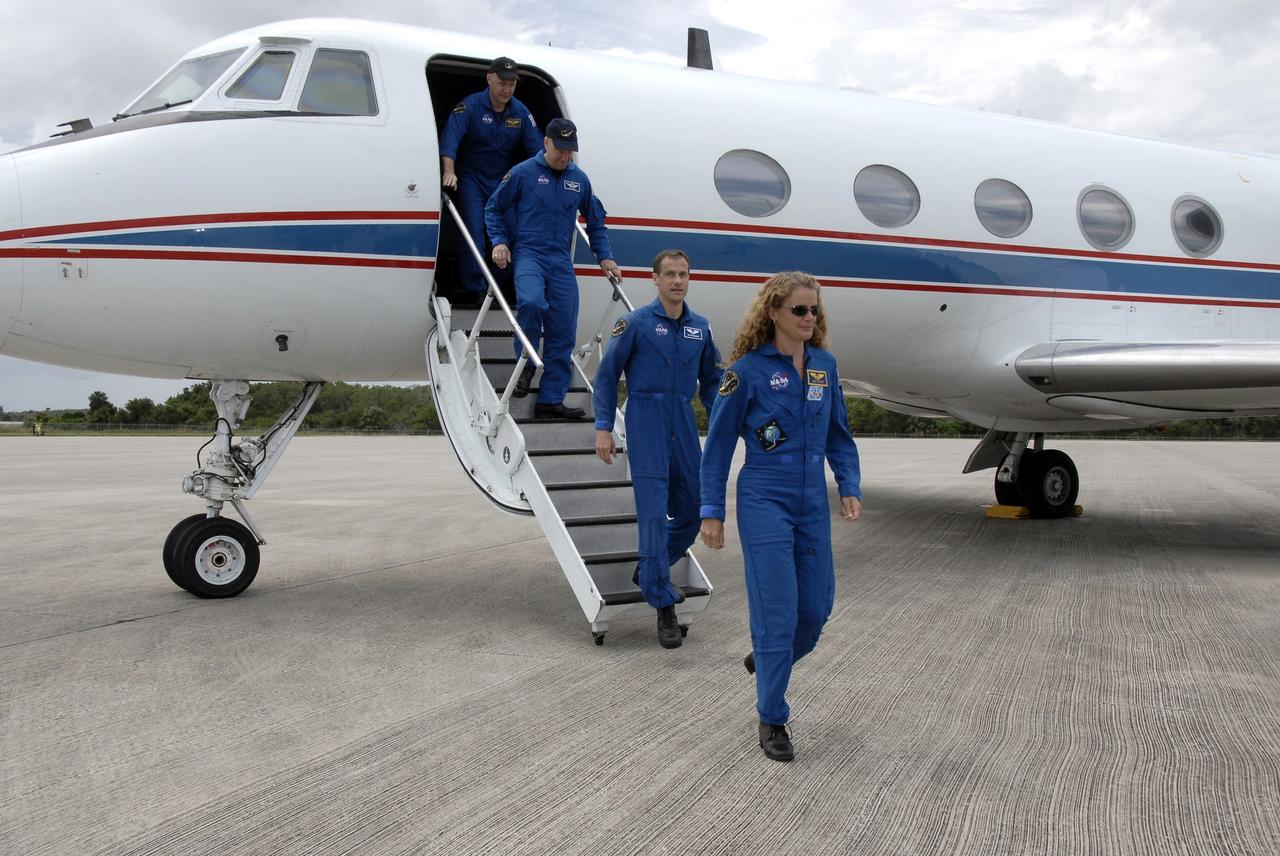
CAPE CANAVERAL, Fla. – Space shuttle Endeavour's STS-127 mission crew members disembark from the Shuttle Training Aircraft at NASA Kennedy Space Center's Shuttle Landing Facility. Seen here are (from right to left) Mission Specialists Julie Payette, Tom Marshburn and Tim Kopra and Pilot Doug Hurley. Payette represents the Canadian Space Agency. The astronauts will be taking part in Terminal Countdown Demonstration Test activities that include equipment familiarization and emergency egress training, and culminates in a simulated launch countdown aboard Endeavour. The STS-127 mission is the final of three flights dedicated to the assembly of the Japanese Kibo laboratory complex. Launch is targeted for June 13. Photo credit: NASA/Kim Shiflett
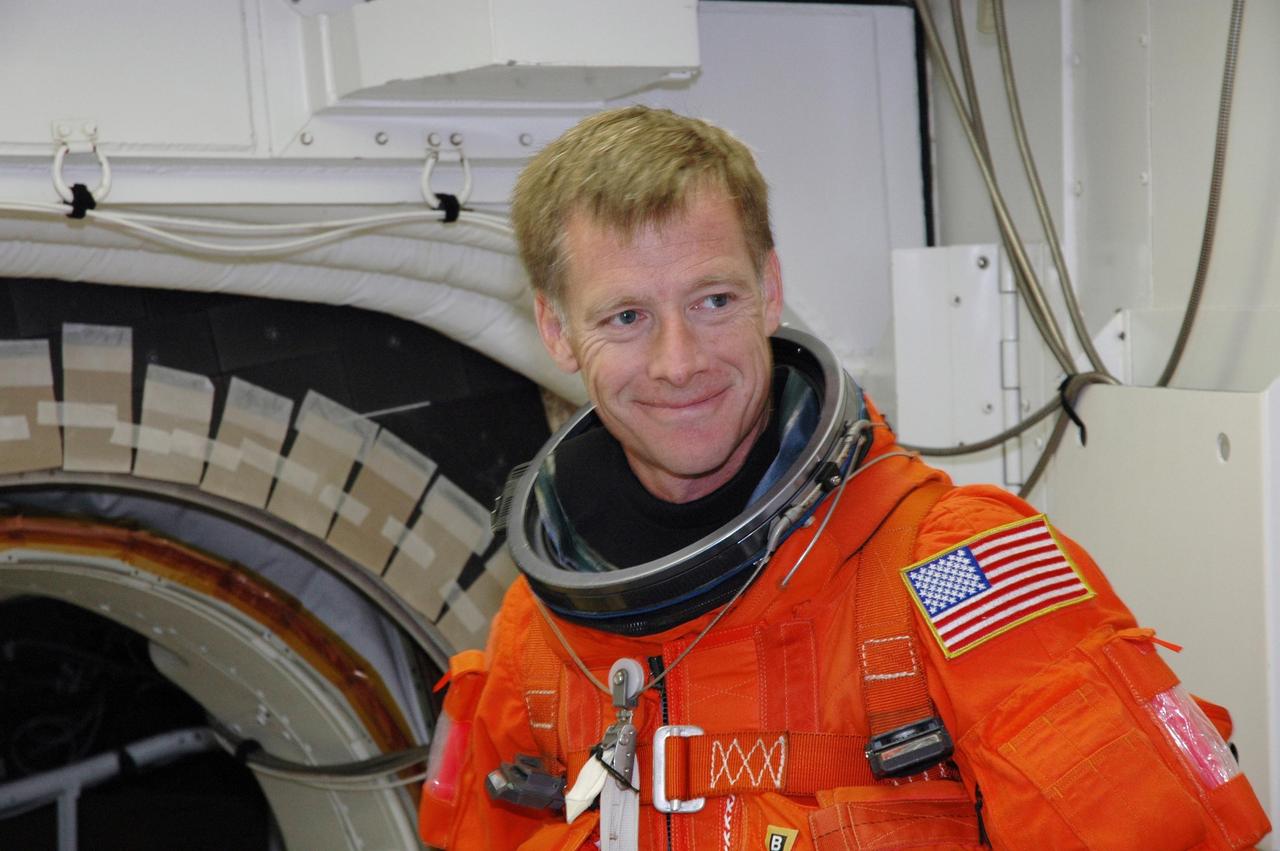
KENNEDY SPACE CENTER, FLA. - The STS-115 crew members complete their suitup in the White Room before entering Space Shuttle Atlantis on Launch Pad 39B for a simulated launch countdown. Shown here is Pilot Christopher Ferguson. The White Room, which is located at the end of the orbiter access arm, allows entry into the orbiter through the crew access hatch. The mission crew is at KSC for Terminal Countdown Demonstration Test (TCDT) activities that are preparation for launch. Liftoff of Atlantis is scheduled to take place in a window that opens Aug. 27. During their 11-day mission to the International Space Station, the STS-115 crew will continue construction of the station and attach the payload elements, the Port 3/4 truss segment with its two large solar arrays. Photo credit: NASA/Jim Grossmann
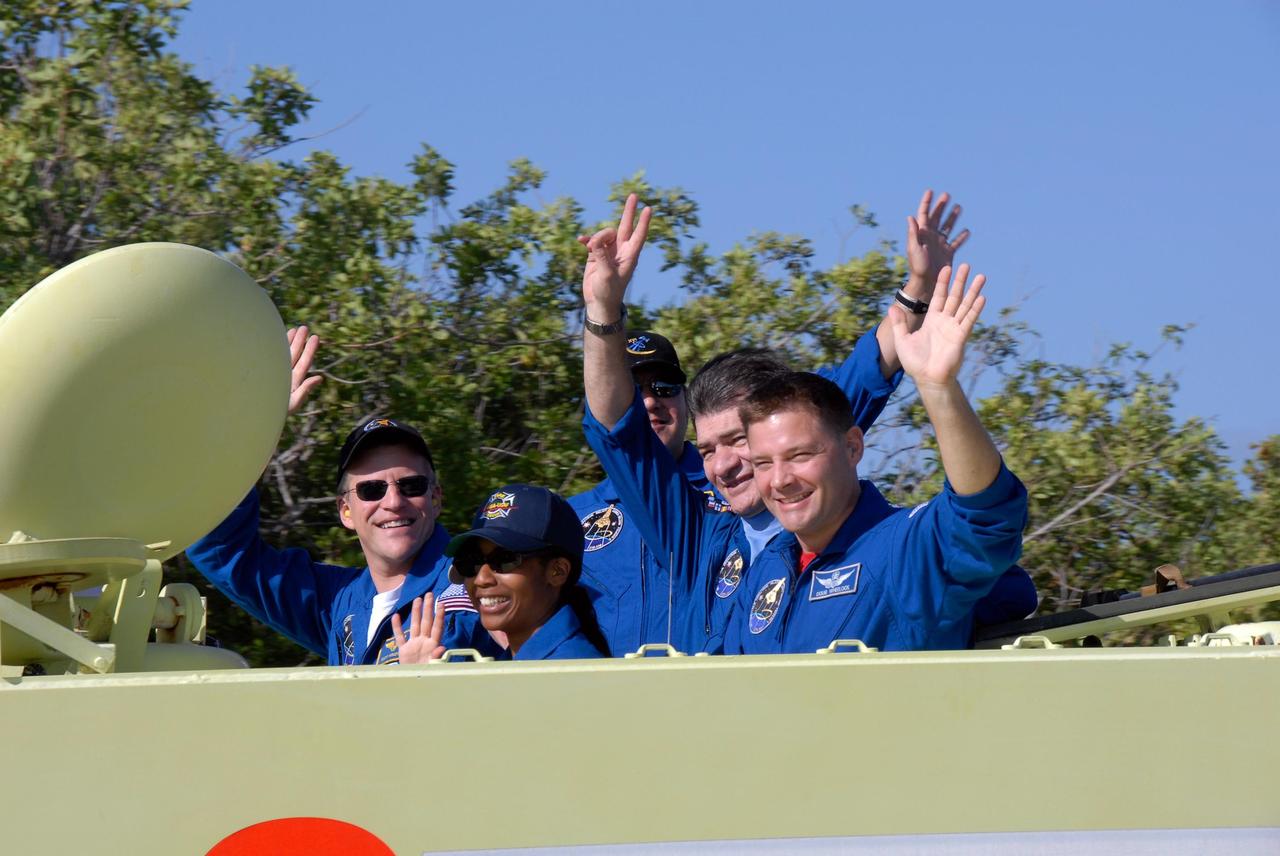
KENNEDY SPACE CENTER, FLA. -- STS-120 crew members signal their pleasure in participating in M-113 driving practice, part of emergency exit procedures from Launch Pad 39A. Seen here on the M-113 are Mission Specialists Scott Parazynski, Stephanie Wilson, Daniel Tani, Paolo Nespoli and Doug Wheelock. Nespoli represents the European Space Agency. The training is part of terminal countdown demonstration test, or TCDT, activities the crew is undertaking at NASA's Kennedy Space Center. The TCDT also includes equipment familiarization and a simulated launch countdown. Mission STS-120, which will carry the Italian-built U.S. Node 2 to the International Space Station, is targeted for launch on Oct. 23. Photo credit: NASA/Kim Shiflett